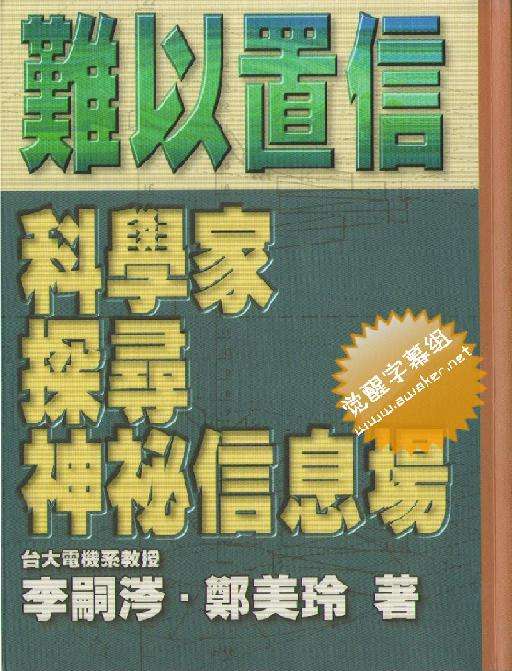
Incredible: Scientists Explore the Mysterious Information Field
Si-Chen Lee and Mei-Ling Cheng
Complete Table of Contents of Incredible
The True Experiences of NTU President Si-Chen Lee
The Experience of a Graduate Student Who Wanted to “Challenge the Establishment”
The “Qigong Fever” That Launched Experimental Research on “Extraordinary Abilities”
Unexpectedly Opening Communication with “Gods and Buddhas”
Unknown Realms Far Beyond Modern Science
Only “Faith,” No “Fame or Fortune”
Viewing Things with a Broader, More Open Mind
Incredible: Scientists Explore the Mysterious Information Field
On the “Scientific Research” of “Qigong” — Hwang Kwang-Kuo
Author’s Preface
Everything Is Just Beginning
Chapter 1: Challenging the Physics Professor
What a Beautiful Day!
The Key to the Information Field
Symbols and Images
Words · Light
Chapter 2: The Impact of Qigong on Medicine
The Impact of Halley’s Comet
The Sensation of Qi Gathering at the Dantian
The Bioenergy Field
“Flash Stimulation” and “Sound Stimulation”
The History of Qigong
What Is Qigong
Developing Body and Mind
Chapter 3: Important Discoveries in Brainwave Experiments
The Enduring Brainwave Craze
The Hidden Meaning in Brainwave Charts
The Brainwave Charts of Partners
Resonant State and Quiescent State
The Realm of “Quiescence”
Chapter 4: Human Latent Extrasensory Perception and Psychokinesis
Micro-Carving — The Creative Fusion of Qigong and Art
The Integration of Qigong and Medicine
Extraordinary Abilities and Magnetic Fields
“Human Potential” at National Taiwan University
The Myth of Past and Present Lives
Near-Death Moments
The Possibility of Transformation Among the Six Sense Faculties
The Development of Human Potential
Interpreting Messages
The Hope of Hua Tuo’s Return — The Ambition of the Bian Que Project
The Third Eye
Human Potential Training Classes
Seeking Scriptures from the Other Shore
The Prospects of Human Science Research
I Am Not Alone in This Path
Drilling Holes with Thought
Biological Consciousness Engineering — Peanuts “Coming Back to Life”
The Sensations of Plants
Spiritual Communication with Plants
Consciousness Micro-Carving
Interfering with Computers Using Mental Power
Teleportation Experiments
Stealing the Sky and Replacing the Sun
Chapter 5: Culture, Qi, and Traditional Medicine Research
The Integration of Humanities and Technology
Starting from Hong Xiuquan
Reexamining Buddhist Scriptures and Commentaries
Opening Another Window on Human Destiny
Qi and the Body — Modern and Traditional
The Significance of the Ya Yue Dance
The Unbroken Lineage of the Way
Chapter 6: Exploring the Truth — Entering the World of Body, Mind, and Spirit
Messages from the Information Field
The Light of the Divine
A Heart of Reverence
Returning to Light
Appendix: Incredible Themes in Science Fiction — Yeh Li-Hua
Incredible II: Visiting the Websites of the Gods
Preface 1: “Pioneering New Frontiers at the Borders of Science”
Preface 2: A Mustard Seed Holds Mount Sumeru, All Within One Mind
Preface 3: Demonstrating the Character of a Scientific Researcher
Preface 4: A Lonely Journey of Discovery
Author’s Preface: The Learning of Life
Chapter 1: The World of the Web
1-1 Turning Back to Find Spiritual Sustenance
1-2 The Word “Buddha” Opens the Information Field
1-3 Levels of Ability Are Like New and Old Versions of Web Browsers
1-4 Children with Finger-Reading Are the Easiest to Train
1-5 Sowing the Seeds of Finger-Reading in the United States
1-6 Finger-Reading Is Also an Artistic Skill
1-7 The Visualization Ability of Artists Should Not Be Underestimated
1-8 An Unconventional Scientist
Chapter 2: The Correct URLs
2.1 Requirements for Connecting to Information Field Websites
2.2 Connecting to the Web Using Script Familiar to Divine Spirits
2.3 Websites Built by Folk Collective Consciousness
2.4 Laozi’s Website
2.5 Confucius’s Website Figure 1
2.6 The Passcode to the Gates of Heaven
Chapter 3: The Medicine Buddha’s Herb Garden
Rows of Bright Circles
Not Only a Herb Garden but Also a Pharmacy
Chapter 4: Conversations with Miss T’s Master
Samantabhadra Bodhisattva Does Not Reveal Himself Easily
Divine Spirits Also Need to Learn
Chapter 5: The Origin of Illness
Modern Medicine Needs Spiritual Science to Complement It
The Principle of Spiritual Healing Arises from Karmic Causation
Chapter 6: The Third Eye
Color Recognition Research
Where Is the Third Eye?
Dragons in the Spiritual Realm
Chapter 7: The Master Seeks the Disciple
Divine Spirits Making Mischief
Miss T’s Second Master
Only the Master Seeks the Disciple
Chapter 8: Foreseeing the Future
Ancient Chinese Cases of Human Potential
The Prophecies of Nostradamus and Dannion Brinkley
The Information Field Has No Time Restrictions
Chapter 9: The Evolution of the Universe and Civilizations
The Origins of the Universe and Humanity
Baffling Ancient Civilizations
Crystal Weapons Destroyed Ancient Civilizations
Chapter 10: Understanding the Torsion Field
The Crystal Qi Field Is the Torsion Field
The Torsion Field Forgotten by Quantum Mechanics
Twentieth-Century Research on the Torsion Field
Properties of the Torsion Field
The Relationship Between the Torsion Field and the Information Field
About to Unveil the Mystery of Qi and Extrasensory Perception
Chapter 11: Roaming the Universe
11-1 The Search for Extraterrestrial Intelligence Program
11-2 Roaming the Universe Through the Information Field
11-3 Extraterrestrials Can Appear Anytime, Anywhere
11-4 Intervening in Evolutionary Theory
11-5 Close Encounters of the Third Kind with Extraterrestrials
11-6 The Moon and Mars Both Host Highly Intelligent Life
11-7 The Peanut in Coma Berenices
Chapter 12: The Hidden World
Hidden Matter in Star Clusters
Four Possibilities for Hidden Matter
Anti-Gravity Hidden Energy
The Information Field, Hidden Matter, and Hidden Energy
Chapter 13: Coming and Going Freely
Ancient Texts Are True and Not False
The True Experiences of NTU President Si-Chen Lee
Tags: Spirituality Category: Accounts of Sentient Beings
Upper video link: http://v.youku.com/v_show/id_XMjE0MzUwMTc2.html
Lower video link: http://v.youku.com/v_show/id_XMjE0MDI5ODI4.html The true experience of NTU President Si-Chen Lee
Professor Si-Chen Lee, President of National Taiwan University and Ph.D. in Electrical Engineering from Stanford University in the United States, conducted over a decade of research on extraordinary abilities and offered a “Special Topics in Human Potential” course in the Department of Electrical Engineering at NTU. Through years of experimental research, his scientific team confirmed that beyond the spacetime in which humans exist, there is a so-called “information field”—commonly known as the “spirit world.”
The Experience of a Graduate Student Who Wanted to “Debunk”
The time goes back to 1999. At that time, Professor Si-Chen Lee, who was teaching in NTU’s Department of Electrical Engineering and is now the President of NTU, had already been conducting qigong research and extrasensory perception experiments such as finger reading for ten years. Tang Da-Lun, then a graduate student in NTU’s Department of Psychology and currently an associate professor in the Department of Mass Communication at Chinese Culture University, was a member of this experimental team.
Looking back on this experience, Tang Da-Lun admits that his reason for joining the experimental team was not to confirm the existence of extraordinary abilities—quite the opposite, he wanted to “debunk it.” Because of his familiarity with psychology, Tang Da-Lun believed he could see through all methods of behavioral manipulation and rescue Si-Chen Lee from “superstition of bizarre forces and chaotic spirits.” Unexpectedly, after participating in the research, his eyes were opened wide and his entire existing knowledge system was overturned. Tang Da-Lun said with a laugh: “At that time I thought I should expose Professor Lee’s vulnerability, to see whether I could make him come to his senses and realize whether he had been deceived. I never expected that after five years of experiments, I discovered that it was actually me who was wrong.”
Exploring the mysteries of extraordinary abilities and supernatural phenomena using scientific methods is not a novel undertaking abroad. As early as 1882, several professors at the University of Cambridge in England established the Association for Psychical Research, dedicated to the study of supernatural phenomena. Abroad, this field is called “Parapsychology,” with over a dozen academic journals publishing various papers. In Taiwan, the best-known pioneer who opened the door to this field of scientific research is Si-Chen Lee.
The current NTU President Si-Chen Lee holds a Ph.D. in Electrical Engineering from Stanford University in the United States, specializing in semiconductor optoelectronic components. Lee’s professional achievements are outstanding, with an endless list of academic titles and awards: he previously served as Chair of NTU’s Department of Electrical Engineering, Consultant to the Ministry of National Defense, and NTU Vice President for Academic Affairs. He received the National Science Council Distinguished Research Award five times and was successively honored with the Sun Yat-sen Academic Publications Award (1987), the Outstanding Engineer Award from the Chinese Institute of Engineers (1987), Academician of the Asia-Pacific Academy of Materials (1997), and the IEEE Millennium Medal (2000).
Why would an outstanding doctoral graduate in electrical engineering dedicate himself to researching “extraordinary abilities”?
The “Qigong Fever” That Launched Experimental Research on “Extraordinary Abilities”
Going further back in time. In 1988, because mainland China had already begun a “qigong fever,” the then Chairman of the National Science Council, Lu-An Chen, convened several top scientists to launch a scientific research program on qigong. At the time, Si-Chen Lee, who was teaching in NTU’s Department of Electrical Engineering and was a complete layman regarding qigong, traditional Chinese medicine, religion, and human body science, personally practiced qigong due to the research program and experienced such remarkable qigong phenomena as “qi gathering in the dantian” and “opening up the Ren and Du meridians.”
In 1993, Si-Chen Lee began offering a “Special Topics in Human Potential” course in NTU’s Department of Electrical Engineering, conducting research on finger reading, telepathy, psychokinesis, and other phenomena. From then on, he came into contact with many people possessing extraordinary abilities, greatly broadening his horizons. In addition to conducting experiments on those who already had extraordinary abilities, Lee also set out to train children aged 7 to 14. The results showed that approximately 10% to 40% of young people could successfully develop the extraordinary ability of finger reading. As a result, Lee had a stable source of experimental subjects.
A finger reading experiment in August 1999 became a turning point in Si-Chen Lee’s many years of researching extraordinary abilities. In the experiment, when testing with the character “佛” (Buddha), the children with extraordinary abilities saw an ever-changing array of imagery, including luminous figures, resounding laughter, temples, monks, and so forth. Through testing with such “special characters,” Lee confirmed that beyond the spacetime in which we exist, there is a so-called “information field”—commonly known as the “spirit world.”
These experimental processes are recorded in detail in three books published by Si-Chen Lee: Top Secret of the Human Body: Human X-Files published in 1998, Incredible: Scientists Explore the Mysterious Information Field published in 2000, and Incredible II: Visiting the Websites of the Gods in 2004.
When Tang Dalun participated in the experiments back then, he provided many suggestions regarding research methods from the perspective of the Department of Psychology. Experts in the Department of Psychology could consider problems that the electrical engineering experts had not thought of when designing the experiments, making the experimental procedures more rigorous. Tang Dalun said, “Psychologists understand best the manipulation techniques and psychological traps of magic. For example, in a performance of a donkey doing arithmetic, the donkey can look at numerical operations and select the correct answer. In fact, this can be achieved through hints or tacit understanding between the performer and the donkey. Therefore, the Department of Psychology understands these tricks best.”
At that time, Professor Si-Chen Lee was conducting experiments with a Japanese little girl with extraordinary functions, Mai Takahashi, attempting to understand extraordinary functions such as reading with fingers. Tang Dalun said: “In 1999, Si-Chen Lee believed that these phenomena should be explainable using scientific methods and physical theories.”
Tang Dalun gave an example: when experimenting with reading with fingers, characters were written on paper, then the paper was crumpled into a ball, stuck together with a seal, and characters were written on the seal. If the seal was torn open, the characters glued back together would definitely not align perfectly; this method was used to rule out the possibility of the paper ball being torn open.
Tang Dalun felt this was not enough. “What I thought of was more than just this. I proposed that there could not be just one paper ball; there had to be a large pile of paper balls, and when conducting the experiment, one paper ball would be drawn from them for the subject to identify, so that even I myself would not know the answer inside the paper ball.” He continued to strictly demand: “Moreover, after the paper ball was felt and identified by the person with extraordinary functions using their fingers, the answer should not be compared immediately. It should be tested five times in a row, and then compared all together. Because if the answer was compared after each test, the experimenter’s reaction to the test results might create a kind of tacit understanding between the tester and the subject, and this tacit understanding might cause the subject to guess the correct answer, or increase the probability of guessing the correct answer. Therefore, we also had to use probabilistic and statistical methods to rule out this possibility.”
However, all kinds of sophisticated designs to prevent coincidences completely failed on Mai Takahashi, and the characters inside the paper balls were identified one by one.
Unwilling to give up, Tang Dalun proposed to Si-Chen Lee that strokes and colors operate in different areas of the brain in terms of visual reception. Therefore, an experiment was designed: after experimenting 20 times on identifying colors with fingers, the answers would not be revealed first. Instead, the subject was asked to point out the colors they saw on a color wheel. After the pointing was completed, the paper strip was opened to be identified once more with the naked eye, to check against the color identified by the fingers. Surprisingly, the results were still all entirely correct! Tang Dalun said: “Wow! The identification results were all the same! There was almost no difference. The colors seen with the Heavenly Eye (Third Eye) could match the colors identified with the naked eye; this experimental procedure conformed to rigorous psychological experiments. I thought, with this, I already believed that Mai Takahashi’s ability actually existed.”
Unexpectedly Beginning Communication with “Gods and Buddhas”
The rigorous experimental procedures forced Tang Dalun to believe in the authenticity of reading with fingers. However, what made people even more curious was how Mai Takahashi actually did it.
After in-depth interviews, it was discovered that the little girl herself did not know why she could see. Instead, there was a master in another space teaching her cultivation. The master would send her a message, flashing an image in her so-called Heavenly Eye at the forehead, and thus she would know what the characters inside the paper ball were.
At this point, the research team knew that further questioning was meaningless. “It could only end here; we had no way to converse with the master; only she could converse with the master.” Tang Dalun stated that if they continued, they would fall into the level of folk spirit-channeling—where people ask questions to a shaman, and deities convey messages through the shaman. Such a pattern completely violated the principles of scientific experiments, because there was no way to know whether what the shaman said was their own thought or a message conveyed by a deity.
As the saying goes: “Man proposes, Heaven disposes.” Professor Chen Jiande, an internationally renowned experimental physicist, Director of the Synchrotron Radiation Research Center of the Executive Yuan, and Academician of Academia Sinica, did not believe in this experiment. He brought a pile of paper balls to test, but unexpectedly became a crucial turning point in this experiment.
Because Chen Jiande believed in Buddhism, among the tested paper balls, there was one with the character “佛” (Buddha) written on it. From then on, the research team found the key to conversing with the deities in the information field.
According to Si-Chen Lee’s description in his book, during the experiment that day, for ordinary vocabulary and graphics, such as words like flowers and animals, Mai Takahashi identified them without error. However, when she picked up the character “佛” (Buddha) unintentionally placed in the pile of papers, the image that appeared in her mind was not a character, but a bright light and a human figure.
Tang Dalun described: “At that time, Professor Lee wanted to see whether various sacred characters would evoke different deities, and sure enough, they really did!”
Because Mai Takahashi was of Japanese-American descent and could speak Chinese, English, and Japanese, when the character “佛” (Buddha) was written in Japanese, the image that flashed in Mai Takahashi’s forehead was actually a tall and thin person, and this “Buddha” even asked her in Japanese: “What?”
In addition, when using “老子” (Laozi) and “孔子” (Confucius) for Mai Takahashi to read with her fingers, what appeared in her mind were dark human shadows. The background was normal, and then the human shadows disappeared.
When touching “药师佛” (Medicine Buddha), a bright light flashed in Mai Takahashi’s mind, and she also smelled the scent of Chinese herbal medicine. Not only that, when reading the characters “药师佛” (Medicine Buddha), the little girl also saw several luminous circles in her mind. It turned out that those were botanical gardens one by one, containing radiant golden herbs.
And when reading the sacred name “耶稣” (Jesus), what she saw was a giant cross emitting bright light.
Tang Dalun said: “Through this procedure and these special characters, we can confirm that this should not be something Mai Takahashi made up; it was truly a message feedback from the spiritual realm over there.”
In December 2000, Si-Chen Lee’s research team began attempting to converse directly with divine spirits. Tang Da-Lun said: “We tried writing questions on slips of paper and crumpling them into balls. As for whether the responses could match up with the paper balls, we would know once we opened them up.”
Unexpectedly, Takahashi Mai’s Master actually answered! During the process, Takahashi Mai could not read the questions written on the slips of paper in her mind; she could only relay the Master’s responses. Only after receiving a response did the research team open the paper balls to look at the questions, and then check whether the answers were related to the questions.
These questions were like: “To which level in Buddhism does the ‘God’ spoken of in Christianity correspond? Are the highest-level worlds described by the two religions the same? Please enlighten us.” The answer reflected on the screen in Takahashi Mai’s mind was in English: ‘I don’t like to compare.’
The research team then asked further: “To which level of deity in Buddhism does Jesus of Christianity correspond? Please enlighten us.” The response was: ‘I don’t like to say.’
They also posed many interesting questions, such as: “Please enlighten us: When can humanity on Earth make contact with extraterrestrial civilizations?” The Master in the information field answered: “Has it not already happened?”
The questions posed to Takahashi Mai’s Master in the information field numbered no fewer than a thousand, and the research team wrote several papers on the subject. But Tang Da-Lun said that the papers are merely black ink on white paper; the wondrousness of the experimental process was far beyond what any paper could convey. These experiences became the most precious harvest of Tang Da-Lun’s student career at National Taiwan University.
An Unknown Realm Far Beyond Modern Science
From qigong research, to extrasensory perception research, to the subsequent discovery of the existence of the information field, and even making contact with the beings within it… one can imagine that these subjects, regarded by the traditional scientific community as “bizarre supernatural forces,” would inevitably provoke much controversy when Si-Chen Lee, a professor at Taiwan’s foremost institution of higher learning, conducted such research.
One sensational example was that in August 1999, over a dozen professors from the Physical Society of the Republic of China, the Department of Physics at NTU, the Department of Physics at Tsing Hua University, the Department of Psychology at NTU, and Academia Sinica formed a group and came prepared with all kinds of props to challenge the findings. As a result, as long as paper placed in a box was not wrapped in lead, the child with powerful extrasensory abilities could accurately state or draw the characters, colors, or various strange figures on the paper. Not long into the experiment, these professors had their eyes opened wide and exclaimed that it was simply incredible. When Si-Chen Lee participated in the selection for NTU president in 2005, his outstanding achievements in his professional field were beyond dispute, yet his extrasensory perception research drew scrutiny from many in the academic community and society at large. After being elected president of NTU, Si-Chen Lee therefore ceased research in this area and temporarily refused all external interviews about the information field.
But the results of finger reading, the discovery of the phenomenon of the information field, and so on, were all accomplished under rigorous experimental procedures; the facts and experimental results were right there before everyone’s eyes. However, Tang Da-Lun also acknowledged that for those who had not personally participated in the experiments, they “would not believe it even if beaten to death”: “The theories Si-Chen Lee proposed to explain these phenomena, though many people do not accept them, the facts are there. To unearth the facts and present them clearly is in fact a scientific process. Unfortunately, the facts that this scientific process reveals are something many people cannot accept.”
Tang Da-Lun explained that the path modern science follows is built upon the methodology of logical positivism, that is, establishing theories based on facts. But this method has its limitations, because things beyond experience cannot yield theoretical inferences: “Think about how many people possess extrasensory abilities? Far too few—one in a million—so there will be no scientific theory constructed for this, and it is no wonder there can be no science of the paranormal.”
But with the experimental data and results from these conversations with the information field, can they be brought within the scope of modern science? Tang Da-Lun believed that the realm they had been exploring had already far exceeded the range that existing science could encompass. The facts he had personally experienced could not be understood through current science, but this did not diminish the authenticity of the experimental results.
Recalling that period of exploring extrasensory perception and conversing with information from another dimension, Tang Da-Lun sighed with emotion that by the time the experiments reached the stage of “conversing with the information field,” in his view it could no longer be called an “experiment”; at most it could be called “an interview with the spirit world.” Because what they faced were divine spirits of the spirit world about which humanity knew nothing and which were of a higher order than humanity, if one did not approach them with a sincere and reverent heart to make entreaties, the experiments could not proceed: “You see, we were very careful when writing our questions, using terms like ‘please enlighten us.’ We were very afraid of offending the Masters in the information field, because during the process we discovered that sometimes that Master would get displeased and would not participate in the experiment. Takahashi Mai is just a physical body, just like us, with no special abilities of her own. All of those abilities came entirely from that Master.”
Only “Faith,” No “Fame and Fortune”
Tang Da-Lun especially emphasized that when leading the experimental team, Si-Chen Lee had a strict requirement: students were not allowed to ask questions related to their own fame and fortune, such as what the lottery numbers would be or whether stocks would rise or fall.
Tang Da-Lun believed that this already brought the experimenter’s “faith” into the experiment. By the definition of knowledge, things within the scope of science are constant and unchanging; if experimental results could only be obtained through faith, then by current standards, it could not be considered science. However, this could only demonstrate the limitations of science and could not negate the authenticity of the experiments.
Most scientists believe that a verified study must be replicable, capable of being experimentally successful under any conditions of time and space. However, because experiments on extraordinary functions involve too many unknown domains, and even the influence of belief, the results cannot be universally replicated. “In fact, many studies in psychology, studies about human beings, cannot be replicated, yet we still have to call those procedures scientific procedures,” said Tang Da-lun. He stated that Lee Si-chen’s most reliable research subject was Takahashi Mai, and that this kind of experimental subject cannot simply be found at random on the street, nor can the experiments be repeated at will. Many well-established traditional scientific theories are unable to explain this phenomenon.
Regarding the mainstream scientific community’s rejection of research on extraordinary functions, Tang Da-lun also offered his views. He believes that if Lee Si-chen wanted to use this research to seek fame and profit, it would be very easy—with just a little embellishment and packaging, it could be heavily promoted and marketed. But Lee Si-chen did not do this. Many people criticize Lee Si-chen’s research as pseudoscience. Tang Da-lun stated that scientific theories are not truth; they can only be called “approximations of truth,” because a genuine scientific theory must always carry the possibility of being refuted. Scientific discovery is a process of continuous revolution. Scientists are not possessors of truth, but seekers of truth.
Tang Da-lun cited the example of Stanford University’s Department of Neuroscience inviting the Dalai Lama to participate in a neuroscience symposium in 2005, asking the Dalai Lama to present the effects of meditation on the positive thinking of the human mind, thereby opening up a whole new horizon for neuroscience research. Tang Da-lun said: “Why not learn from the Dalai Lama—accept, believe, and channel positive energy? As long as you do not trade it for fame and profit, but simply allow humanity to open up one more experience, that is all. Isn’t it wonderful to treat extraordinary functions with this kind of attitude? But people today cannot do this. Many scientists do not believe, do not engage, and even reject and attack.”
Viewing Things with a More Open Mind
Tang Da-lun, who teaches in the College of Communication, observes that given how the media today frequently sensationalize topics related to extraordinary functions in order to boost ratings, grafting serious scientific exploration onto speculative sensationalism and turning it into thrilling supernatural stories, thereby causing misunderstanding among the public, he often expounds correct scientific concepts to his students in class.
Tang Da-lun analyzed the viewpoints of many scientists and philosophers, and he relatively agrees with the view of Professor Hwang Kwang-kuo of National Taiwan University’s Department of Psychology. Hwang Kwang-kuo believes that Western science is built upon the dualism of mind-matter opposition, and only knowledge of the objective material world that can be explained by instrumental rationality is called science by modern mainstream society. But this kind of science cannot understand concepts such as the traditional Chinese notion of “unity of mind and matter”; for example, the phenomena in qigong are very difficult to grasp with a dualistic science based on mind-matter opposition.
Therefore, Tang Da-lun often tells his students in class to view things with a more open mind: “When a person refers to ‘I,’ that is simply how it is—from the human perspective, this world is mine, and this kind of thinking is relatively closed. But beyond this world, there also exists another world.”
◎ By Lee Si-chen and Cheng Mei-ling
Recommendation Preface
In gratitude to the guides who led us to explore body, mind, and spirit,
And to realize the deeper real world—
The Pilots
Mr. Chen Lu-an
Mr. Shi Chao-lin
Takahashi Mai and her mother
Little Wang and her parents
Professor Shen Jinchuan
Ms. Sun Chulin
And others…
On the “Scientific Research” of “Qigong” — Hwang Kwang-kuo
Over the past twenty-plus years, I have devoted myself to developing indigenous psychology in Chinese society on the foundation of Western philosophy of science, and have gained some familiarity with both Eastern and Western cultures and their philosophies. After reading this book, Incredible, authored by Professor Lee Si-chen, Dean of Academic Affairs at National Taiwan University, I deeply feel that although Professor Lee and his colleagues claim that they are using “scientific experimental” methods to conduct research on “qigong,” when viewed from the perspective of the contrast between Eastern and Western cultures, the value of these studies is in fact far more profound than what they claim. How should one put this?
We can illustrate this point through the contrast between modern Western Cartesian philosophy and “qigong theory.” As is well known, after the Western Renaissance movement in the sixteenth century, the reason the natural sciences were able to develop rapidly was primarily because they were built upon René Descartes’s (1596–1650) philosophical foundation of “subject/object” dualistic opposition. Descartes’s rationalism not only held that, as thinking subjects, “humans” are not merely opposed to the objects in the external world, but also that the human mind and body are mutually opposed. His “mind/body” dualism immediately gave rise to a difficult problem: the mind, having no physical form, being neither fixed matter nor occupying space—how could it be connected to the tangible body, on the one hand receiving its sensations and experiences, and on the other hand being able to exert influence upon it?
From his research on anatomy, Descartes learned that deep within the two hemispheres of the brain, there is a very small pineal gland. Because of its location in the brain, he believed that this is the point of connection between mind and body. The mind must influence the body through the pineal gland, and the body must also influence the mind through the pineal gland.
Descartes was utterly wrong about the interaction between body and mind. In fact, the pineal gland has no effect whatsoever on either incoming or outgoing nerve impulses. What is important is that the doctrine of “mind/body” dualism holds that mind and body are separate entities; the human body is like a machine that can be studied using the methods of natural science, while the human mind is the most valuable characteristic of human endowment, understandable only through rational reflection. His philosophy of “subject/object” dualism prompted Western scientists to study various objects in the external world with an absolutely objective attitude, leading to the rapid development of natural science. Similarly, his doctrine of “mind/body” dualism also prompted Western psychology to treat “the human being” as a kind of object in the natural world, to be studied using the methods of natural science, leading to the rapid development of scientific psychology in the twentieth century.
However, this philosophy in fact harbors the great danger of objectifying “the human being.” On the eve of the outbreak of World War II, the European master of phenomenology, Husserl, in The Crisis of European Sciences and Transcendental Phenomenology, published shortly before his death, clearly pointed out that in the Greek tradition, the “theoretical attitude” (theoria) was originally a kind of religious ritual. In such rituals, people contemplated the cosmic truth hidden behind the appearances of the world, hoping it would help them pursue a good life. However, after the Renaissance, the natural sciences built upon Cartesian philosophy alienated this “theoretical attitude” into “instrumental rationality.” Humanity tried every possible means to predict, control, or manipulate objects in nature, using them as “tools” to satisfy human desires. When human beings alienated even “the human being” itself into a kind of “tool” or a kind of “object,” European civilization faced a tremendous crisis.
Husserl’s warning was not able to halt the expansion of Europe’s “instrumental rationality.” After the two World Wars, with the continuous spread of so-called “modernity,” humanity faced even greater problems such as environmental destruction, resource depletion, arms races, and moral decay. In terms of the threat of death, the invention of nuclear weapons brought humanity to the brink of annihilation; in terms of the desire to survive, the development of biotechnology had already enabled scientists to successfully clone the sheep Dolly. If one day humans successfully create “cloned humans,” “the human being” will have assumed the role of “God,” and humanity will face an unpredictable crisis!
The path taken by Chinese “qigong” runs in exactly the opposite direction. From the narrative of this book, we can see that Chinese Daoism has never held that “mind/body” can be divided into two radically opposed poles. On the contrary, they believe that “the human being” can control his or her body through the willful practice of “breathing techniques,” and the medium between “mind” and “body” is qi: “When circulating qi, depth leads to accumulation, accumulation leads to extension, extension leads to descent…”; practicing until “qi gathers at the dantian” and “the Ren and Du meridians are opened” can be considered as having already attained a certain responsiveness. As for practicing to the point of the various “special abilities” described in this book, that depends on the individual’s special endowment—not something everyone can achieve.
This book records many interesting examples illustrating how Professor Li and his colleagues used various “scientific experiment” methods to record the physiological and psychological responses of people when “practicing qigong.” Strictly speaking, this approach still differs from the Western “scientific tradition” of “subject/object” opposition. Chinese Daoism never regards the human body as a machine; the human “mind/body” cannot be divided in two. The human being is an end in himself, his own master. Whether a person wishes to seek a master and learn the art, to “practice qigong,” depends entirely on the individual. As the saying goes, “The master leads you through the door, but cultivation depends on the individual.” To what level a person can practice, how great a cultivation one can attain, also depends entirely on the individual. “Practicing qigong” is not like the Western mechanistic view of the body, where practicing a certain number of times will definitely yield a certain result. Many “scientistic” adherents insist that “qigong” is not science, and this is the main reason.
In fact, that the human body differs from an ordinary machine is precisely the greatest strength of the Eastern “qi-based cosmology.” Why must humanity imagine itself as a lifeless machine? Once we understand the harms caused by the excessive expansion of modern “scientism” and “instrumental rationality,” we probably will not mind this criticism from the “scientistic” adherents. No matter how one “practices qigong,” the practitioner will never regard his or her own body as a machine separate from the mind. “Qigong” can never be alienated into “instrumental rationality,” nor will it, like other technologies, cause enormous harm to human society. Using “scientific experiment” methods to demonstrate the effects of “qigong” is like the “finger pointing at the moon” in Zhiyue Lu—it merely uses so-called “scientific” methods to tell the reader what “qigong” is. Whether the reader wishes to approach it further depends on the reader’s own destiny.
— (Huang Guangguo, Professor, Department of Psychology, National Taiwan University; National Chair Professor)
Author’s Preface
Everything Is Just Beginning (It is just a beginning)
At five o’clock in the afternoon on February 18, 2000, Professor Cui Jiu, Dr. Wang Wushi, and I walked into a hotel situated on a hillside in the outskirts of Tucson, Arizona, USA, bathed in the glow of the setting sun. The dry air hit our faces, and the low, grayish-brown scrub bushes glistened in the golden sunlight. We followed the stairs down to the basement level and found a conference room. A sign on the door indicated it was a pediatrics medical conference. Pushing the door open, we discovered it was filled with an audience of both Eastern and Western faces—presumably scholars and experts in related fields from around the world—who were listening to an invited talk given by the speaker, Dr. Gary Schwartz, professor in the Department of Psychology at the University of Arizona. We squeezed past to the back of the last row of chairs and stood against the wall. Professor Schwartz, who had invited us to attend the talk, was using rich body language and experimental data to explain the new theory of “energy medicine” that he and his wife, Dr. Russek, had developed over the past decade. He emphasized that the interactions between person and person, person and environment, and person and universe are full of energy and information. Therefore, if this information and energy could be skillfully utilized to help children or adults, it would influence and change their future behavior physiologically, not merely psychologically.
The one-hour lecture was nearing its end when Professor Schwartz suddenly changed the subject and once again apologized to the audience. In his entire life, he had never been late for an invited lecture. The reason he was ten minutes late today was truly because, after hearing a brilliant presentation from a delegation of visiting scholars from Taiwan and mainland China, he could not bear to tear himself away.
“Taiwan and China have, over the past decade or more, been conducting some ‘mysterious’ research on the human body. We in the West are far behind…”
“Yesterday I conducted an incredible experiment! I personally used a computer to randomly generate five numbers from 1 to 100 and five letters from A to Z, wrote them on paper, folded them up, and sealed them in envelopes. When it was time to conduct the experiment, I asked someone else to open them, drawing one each time and handing it to a seventeen-year-old girl, who used her hand to touch the paper slip and read the characters. From the outside of the slip, it was absolutely impossible to see what was written inside. The girl’s hand was covered with a black cloth bag, and electrodes were attached to measure the voltage produced by her hand…”
“The probability of guessing one number correctly is one in a hundred, and the probability of guessing one letter correctly is one in twenty-six. Do you know the results? All ten were correct. The probability of guessing them all is far less than one in ten billion. It is simply incredible. For the last three times, this ‘super’ girl even wore a blindfold…”
“From their research results, we have come to understand that children possess great potential that can be developed. This experiment is merely the first spark ignited by the encounter of East and West…”
“I have already spotted them—the team from the East is standing at the back of the auditorium. Let us welcome them!” A round of applause erupted throughout the room. My eyes grew a little warm; I was a little stirred, a little gratified. What we did not know at the time was that Dr. Strauss, the head of the alternative medicine division at the U.S. National Institutes of Health (NIH), was also seated in the audience.
After receiving his doctorate from Harvard University in 1971, Professor Schwartz served as an assistant professor at Harvard, then moved to Yale University as a professor in the Department of Psychology and Psychiatry. During that period, he also served as the director of the Yale University Mind-Body Research Center. Later, because he began to partially shift toward parapsychological research, and in order to have a broader research environment, he moved to the University of Arizona, where he established the “Human Energy Systems Laboratory” to scientifically study the authenticity of “psychic mediums,” and to use modern scientific theory to explain anomalous phenomena such as residual information, the survival hypothesis, and near-death experiences, achieving breakthrough results. In 1999, he and his wife, Dr. Russek, published the book The Living Energy Universe, providing a detailed introduction to their theory. Our delegation, led by Professor Cui Jiu, including Professor Shen Jinchuan from mainland China, the Chinese medicine practitioner Mr. Xu Guowu from Canada, and Dr. Wang Wushi from Taiwan, had made this trip specifically because we knew of Professor Schwartz’s research field, hoping to learn more details and seek opportunities for collaboration. At the same time, we also brought along Miss Takahashi Mai, preparing to demonstrate the finger-reading experiment and to present the Eastern perspective. The results of the visit were an unprecedented success. Professor Schwartz and Dr. Russek were deeply shaken by the finger-reading experiment and by the experimental results presented by Professor Shen Jinchuan, such as “a coin passing through a wall” and “a peanut coming back to life.” We, in turn, were moved by the rigorous existence testing of “psychic mediums.” Both sides decided to collaborate, working together to uncover the mysteries of the “spirit world” (which we call the “information field”).
When the West meets the East, …
A whole is taking shape…
The whole is greater than the sum of its parts…
Everything Was About to Begin
From a young age we were taught to do away with superstition and to promote science, so that the nation could move toward prosperity and strength. When we were children we read about how Dr. Sun Yat-sen, in order to eradicate superstition, once smashed the statues of Buddha in a temple. Popular religious faith, burning incense and worshipping Buddha are merely people’s pursuit of inner peace and tranquility; although they have their social function, in essence they still belong to superstition. Spirit mediums going into trance, spirits possessing a body, and paranormal phenomena are even more outright nonsense, bizarre and supernatural talk, superstition within superstition. Therefore, from childhood he resolved to break down superstition, devote himself to science, and save the nation and its people. There is just one thing I do not understand: why do most of the ordinary people in the advanced countries of the West still go to church on Sunday mornings? Has not science long since proven that the Earth has existed for more than four billion years, far exceeding the few thousand years described in Genesis of the Bible?
Twelve years ago, by a chance opportunity, at the invitation of Mr. Chen Lu-an, then Chairman of the National Science Council, I plunged into the field of researching the human body — qigong. I myself also began to practice qigong and came into contact with traditional Chinese Buddhist and Daoist culture. Phenomena from “qi gathering at the Dantian” and “opening up the Ren and Du meridians” to “emptying the mind and entering stillness” and “emitting external qi” were verified one by one in my own body or confirmed by experiments. It turns out that these are methods of self-cultivation and health cultivation that our ancestors discovered several thousand years ago. The next question was: why, when one’s practice reaches a more advanced level, can one sense the illnesses and pains of others? Why can one emit external qi to treat illnesses on behalf of others? To answer this question, starting seven years ago I turned to the study of “extraordinary functions,” beginning with phenomena such as finger reading, psychokinesis, and telepathy. Once I entered this field, a single touch gave rise to many fortuitous encounters; I met all sorts of people with extraordinary functions and witnessed many different extraordinary abilities. Especially after 1996, when by a fortuitous coincidence I met Professor Shen Jinchuan of China University of Geosciences in Beijing and the functioner Ms. Sun Chulin, my eyes were truly opened. Phenomena such as “bringing peanuts back to life and causing them to sprout rapidly” and “conscious micro-engraving” emerged one after another, challenging modern physics, biochemistry, and physiology, leaving one shocked and thrilled. It made me realize the enormous potential of “consciousness,” that is, of the “mind,” and also made me realize that the current development of science is still a very long way from uncovering the mysteries of the human body. Even more exciting is the fact that these abilities can be developed through training. Children between the ages of seven and fourteen, after a few hours of training, showed a ten to forty percent rate of acquiring the finger-reading function, meaning that the third eye (the heavenly eye) in the brain opened and clairvoyant ability appeared. With sustained and continuous practice, the abilities of psychokinetic bending of objects and teleportation would then be developed, giving rise to the macro-level phenomenon of “unity of mind and matter.” It turns out that extraordinary functions originally belong to everyone; with development they appear, and without development they disappear.
On August 26, 1999, a chance test propelled us from the levels of body and mind into the world of “spirit.” In a finger-reading experiment, the character “佛” (Buddha) caused three children with the function all to see visions — luminous figures, resounding laughter, temples, monks, and an endless variety of imagery, completely unlike what they saw when identifying other characters or patterns. A large body of data compelled us to acknowledge that, beyond the material universe and the four force fields, there exists in this world another kind of “information field,” commonly known as the “spirit realm.” Through the connection of key words, children with clairvoyant ability could communicate with the information field. My existing worldview instantly collapsed…
It turns out that the spirit realm spoken of in religions does exist!
It turns out that religion is not merely faith; it also contains descriptions of a deeper, real world…
It turns out that the reverence for Heaven and awe of the divine in our culture is indeed well founded…
It turns out that burning incense and worshipping Buddha is a search for harmony between humanity and Heaven…
It turns out that human beings possess three levels — body, mind, and spirit — and most people spend their entire lives only at the level of the body…
It turns out that Western science, moving toward the extreme of reductionism, continuously decomposing complex entities into ever smaller units for study, has given us precise understanding of the micro-level real world of atoms, molecules, and quarks. But it has moved ever further from the real world of holistic, complex phenomena…
It turns out that spirit mediums entering trance, and burning incense and worshipping Buddha, are attitudes toward life and behaviors that are closer to the macro-level real world (the spirit realm). When we criticize them as superstitious, it is we ourselves who have moved further from the deeper, real world…
Over these twelve years, every experiment of mine and every idea I had, I shared with my family, especially my wife, Ms. Cheng Mei-ling. Like me, she went from complete disbelief to actually practicing qigong, to participating in finger-reading experiments, growing together with me. We often discussed the results of experiments; she would also offer her views or remind me to pay attention to other people’s theories. This time we have collaborated to turn the insights we have gained over many years into this book, in the hope that all readers can also share the joy of our growth and of hearing the Way.
— Si-Chen Lee
Chapter 1 Challenging a Professor of Physics
The Vision of Fingers — The Key to the Information Field
Symbols and Images — Characters · Light
Chapter 2 The Impact of Qigong on Medicine
The Shock of Halley’s Comet — The Dynamic Sensation of Qi Gathering at the Dantian
The Bioenergy Field — “Flashing Light Stimulation” and “Sound Stimulation”
The History of Qigong — Why Qigong? — Developing Body and Mind
Chapter 3 Important Discoveries in Brainwave Experiments
The Echoing Brainwave Craze — The Hidden Meaning of Brainwave Patterns
The Brainwave Patterns of Partners — The Resonant State and the Meditative State — The Realm of “Entering Meditation”
Chapter 4 Latent Human Extrasensory Perception and Consciousness-Induced Motion
Micro-Engraving — The Creative Work Combining Qigong and Art
The Integration of Qigong and Medicine — “Human Potential” at National Taiwan University — The Puzzle of Past and Present Lives
The Moment Near Death — The Possibility of Transforming the Six Sense Roots — The Development of Human Potential
Interpreting Messages — Expectations of a Reborn Hua Tuo, the Ambition of the Bian Que Project
The Third Eye — Training Class for Human Latent Potential, Seeking Scriptures from the Other Shore
The Vision of Somatic Science Research — Not Alone in My Path, Drilling Holes with Thought
Biological Consciousness Engineering — Bringing Peanuts Back from the Dead, The Senses of Plants
Spiritual Communication with Plants — Consciousness Micro-Carving, Interfering with Computers through Thought
Teleportation Experiments — Stealing Heaven and Changing the Day
Chapter 5 Culture, Qi, and Traditional Medicine Research
Integrating Humanities and Technology — Starting from Hong Xiuquan, Re-examining Buddhist Scriptures
Opening Another Window on Human Destiny — Qi and the Body, The Modern and the Traditional
The Significance of Yayue Dance — An Unbroken Lineage
Chapter 6 Exploring the Truth — Entering the World of Body, Mind, and Spirit
Messages from the Information Field — The Light of the Divine, A Heart of Reverence
Returning to Light
Bibliography
Appendix — “Incredible” Themes in Science Fiction by Ye Li-Hua
Chapter 1 Challenging the Physics Professors
What a Beautiful Day!
In fact, I had been in high spirits since morning. Because this afternoon, a group of physics professors was coming to participate in finger-reading experiments. Ever since my qigong research extended into the domain of human latent potential—especially after the finger-reading experiments attracted media attention and were reported on—I had been continuously criticized as being unscientific and as fostering superstition and an irrational trend.
Actually, I was not asking anyone to believe or disbelieve anything; I simply held that any true scientist should always maintain a curious and open mind. Humanity’s scientific knowledge is built precisely through ceaseless inquiry into the unknown, never content to hold fast to old theories, accumulating bit by bit, breaking through step by step forward—is that not so? It happened that I had the opportunity to come into contact with some special individuals and observe some special phenomena, which I found quite significant and worthy of in-depth investigation by scientists, and therefore I published my findings to share with everyone. Although I had repeatedly expressed my welcome to interested scholars to participate in experiments and engage in joint research, those who were interested in criticizing seemed to have no interest in understanding the truth. They merely clung to their existing frameworks of physics and logic, and as a matter of course rejected unknown domains. They even attempted to prevent Science Monthly from publishing my articles, and wrote pieces comparing me to a “science medium.” Their mindset would probably only undergo an abrupt awakening when Americans began conducting research in this area.
The Vision of the Fingers
In June of this year, two physics professors came to see me, expressing their desire to participate in finger-reading experiments this summer, with one condition: “We will prepare the experimental samples.” I immediately responded: “No problem!” Later, one of the professors told me: “It has been announced on the Physics Society website, and quite a few people may come!” I said: “Welcome!” I certainly understood that some among them were coming to challenge, but I was not worried at all. As the saying goes, “True gold fears no fire”; over the past six or seven years, I had conducted finger-reading experiments seven or eight hundred times, long since moving beyond the stage of testing “whether or not one can see,” and delving deeply into its physiological and psychological mechanisms. Today, let them play the preliminary game for now!
Actually, I was rather impatient to see how these physicists would react after personally confirming that finger-reading was real—this was, of course, a somewhat mischievous sentiment on my part. Imagining what kind of reaction these people, who originally held a complete logical framework about the physical world, might have upon discovering a crack in their world, was a highly fascinating prospect. I could certainly understand their feelings, because I myself had come through the same experience. Fingers are fingers—how could they possibly possess “vision”? It completely contradicted common physiological knowledge. If it was not sheer nonsense, then it was sleight of hand. But when you witness experiment after experiment demonstrating that this phenomenon genuinely exists, aside from accepting the facts, you further want to know why it is so. And so, step by step, I continued, unable to stop myself. Perhaps the physics professors coming today would, like me, be drawn involuntarily into the field of human latent potential! In fact, “experiment is the sole criterion for testing truth”; one should always “seek truth from facts.” I remember that in 1976, shortly after I arrived at Stanford University in the United States, I was working on a problem related to rectifiers. I solved a particular exercise based on the theory in the textbook, only to have the teaching assistant mark it with a big cross. He said the experimental results were not like that—he had based the problem on experiments, not on the theory in the book. What the book described were ideal conditions, but experiments are not ideal conditions. In order to derive theory, books often exclude the more complex factors. But in the laboratory there are all kinds of strange and varied conditions, and that is precisely what engineers must solve. Dr. Samuel Ting once said that his favorite thing was to conduct experiments proving that theorists’ theories were wrong. I could fully understand his mindset.
The Key to the Information Field
At approximately 2:30 p.m. on August 26, 1999, in Conference Room 142 of the Electrical Engineering Building II at National Taiwan University, an experiment in finger reading was underway. The president of the Physical Society led a group of over a dozen people—physics professors from NTU, Tsinghua University, and Academia Sinica, along with two professors from the Department of Psychology—to the session. After everyone was seated, the testing began immediately. Professor Chen, who was responsible for preparing the samples, handed the first paper scroll to the young Miss Takahashi and also spread out the one hundred possible answer characters on the table for her to identify by pointing. The experiment began at 2:37. At 2:38, the electrodes attached to Takahashi’s hands measured the first voltage pulse. Takahashi reported that what she “saw” was merely a flash on the screen. At 2:39 she made out an “M.” When it was opened, it turned out to be a computer-printed “W,” which when turned upside down looked like “M,” so Professor Zheng from the Department of Psychology said: “It should count as having seen it.” At 2:40 the second sample was tested. At 2:43, Takahashi reported seeing only white light and asked, “Could there be a blank sheet of paper?” Professor Chen, who had prepared the samples, thought for a long while and said, “It’s possible.” At 2:45 Takahashi saw white light again and was certain it was a blank sheet of paper. When it was opened, it was indeed a blank sheet. It turned out that the prepared samples had been printed by computer, then cut and rolled up, so some blank portions along the edges of the paper had also been rolled into samples.
At this point, a physics professor said, “The probability of guessing a character correctly is one in a hundred. Guessing a blank sheet of paper correctly would be one in twenty!”
I found it amusing that they were seriously calculating probabilities, hoping to use statistical methods to prove that she was not merely guessing. For the third sample, Takahashi spent seven minutes but could not see anything at all. She said the way it was wrapped prevented her from entering. It was later discovered that this sample had been wrapped in lead, so her perception could not penetrate it. The next two times, within one minute each, Takahashi’s fingers “read” that they were blank sheets of paper. Someone said, “Guessing three blank sheets of paper correctly—that probability is one in eight hundred.” I said, “That’s not right—it’s one in eight thousand!” Next, she spent one minute and saw an “X,” completely correct. At that point, a professor brought out two samples wrapped in lead pouches, and Takahashi said she could not penetrate the packaging for either one. At 3:14, she again spent one minute and saw the character “古.”
By this time, none of the physics professors were calculating probabilities anymore. Instead, some were modifying the packaging of samples, while others were making new samples on the spot. For a sample wrapped in aluminum foil, she read it correctly and even said, “It’s too bright, so the writing is very faint.” Next, samples were placed inside black film canisters. Testing began at 3:22, and by 3:28 she correctly identified the symbol. By this point the professors should have already noticed that Takahashi’s clairvoyance did not come from touch. At 3:30 another test began. She first saw a blurry image, and after a minute, she flipped the paper over on her screen and saw a red sun pattern. When the sample was opened, it turned out that this sheet had been deliberately rolled in reverse, with the patterned side facing outward, unlike the usual method, so she had seen the back first. Everyone had questions: how exactly does finger reading work? Not only can she read the paper strip, but she can even flip it over?
At this point the experiment came to a pause. The physics professors were greatly impressed. Some expressed that it was incredible, while others asked Takahashi’s mother about the training methods. In small groups they discussed: if it is not touch, then what exactly is the mechanism? Today’s experiment should have been enough to make anyone with curiosity and a spirit of exploration think deeply. As most of the professors were rising to leave, someone suddenly said, “What a pity that Professor K, who loves to criticize the most, didn’t come.” “I think there are two reasons he didn’t want to come. First, if finger reading were proven to be real, his worldview would collapse. Second, if it were proven false, he already assumed that to begin with, so there was no need to come.” Hearing this reasoning, I could not help but laugh dumbly. It seemed that quite a few people’s strong skepticism about finger reading had softened, and some had even shifted toward acceptance. Among them, Professor Chen from the Department of Physics was the most enthusiastic, constantly discussing it with me and repeatedly saying, “This is incredible—this is beyond Nobel Prize!” It was rare to meet someone who recognized its value, and I was very pleased. I teased him: “You’ve become one of the believers in the supernatural too.”
The three children with special abilities were now relaxing, eating snacks and drinking beverages. The youngest, a boy, was wholeheartedly playing a video game. The two teenage girls sat quietly together, whispering to each other. Sometimes I wondered whether they had ever tried not speaking and instead conversing through telepathy. The oldest, Takahashi, was already beginning to prepare her university application materials. Her goal was the Department of Veterinary Medicine, because “when animals are sick, it’s hard for them to express themselves to ‘people.‘” Moreover, she still remembered that when she was little, at the zoo, she once heard two monkeys conversing. One of them said, “Can I come over to your place to play?” The other said, “Sure, come on!” Then they saw the first monkey leap and swing over. She had also once heard two little birds discussing the building of a nest. I was filled with expectation and fantasy: if she could recover this ability, and even strengthen it, then Doctor Dolittle’s world would no longer be just fiction—it would be real.
Professor Chen was busy looking for colored pens to make new samples, probably wanting to test the ability to distinguish colors. I saw him hand a rolled-up paper to Takahashi, who was chatting. Not long after, Takahashi said she saw a blue “light.” Director Chen prompted her: “There is one more character; take another look.” But after a few minutes, Takahashi could still only see the character “light.” Professor Chen smiled and opened the paper slip, saying: “Perhaps this character cannot be casually joked about! It is extraordinarily sacred, and Takahashi may not be able to see it.” It turned out to be two characters: “佛 (Buddha, red) 光 (light, blue).” Another professor said: “Could it be the relation of the color?” I secretly felt amused; although Takahashi sometimes missed characters when reading by finger, after trying a few more times there was nothing she could not see.
At four twenty, I asked everyone to return to their positions, attached electrodes to Takahashi’s hand, and began the experiment. From four twenty-three to four twenty-seven, she correctly identified the character “田” written on aluminum foil. At four twenty-nine, Professor Chen gave her another sample. At thirty-two, voltage pulses appeared, and Takahashi said: “Something flashed past.” I looked at her in astonishment. What was going on? In over four hundred past experiments, this had never happened before. Could something flash across the screen? She then said: “There is a person’s image on the screen, very bright.” I could hardly believe it and repeatedly asked her to verify, while wondering in my mind: “Could it be that the paper roll did not contain characters?” At thirty-seven, she said: “That person is smiling at me.” “Can you see what he looks like?” “No, because it is too bright!” At thirty-eight, “It’s gone!” This was truly unprecedented; how could an image appear? Professor Chen opened the paper slip; it was a hand-written black character “佛.” “What is going on?” Everyone was stunned. Over the past six or seven years, across hundreds of experiments, there had never been such a result. How could the character on a paper slip become a luminous image? Could this character “佛” possess special power? We immediately conducted two more experiments. She first saw the two English letters “s t,” and when the paper slip was opened, it read “Christ.” The next one she looked at was the character “瓡,” which she saw as “瓡.” Everything seemed to return to normal; her finger-reading ability had not malfunctioned.
At this time, the student conducting experiments elsewhere in the laboratory with little Chen was calling me: “Professor, Professor!” And the student testing little Wang was also hailing me: “Professor, please come over!” Everyone’s mood seemed high and tense. What exactly was going on? It turned out that Dalun, who had been experimenting with me for years, had just written two “佛” characters and casually handed them over to them to “read.” Now they had both seen astonishing results. Little Chen “saw a bald-headed person holding a string of beads,” and “saw a bald-headed person wearing a black jacket, with the character 佛 written on the white shirt inside.” On the other side, little Wang said: “In the distance there is a temple, with a person standing at the entrance. It flashes once, flashes again, and flashes into a temple.” She did not see any characters at all.
The atmosphere in the laboratory was electric. Everyone wanted to discuss something, and I could not suppress my excitement! “Professor Chen, thank you. An unintentional paper slip has opened a door for us. Perhaps this character ‘佛’ is a tiger tally, a pass to communicate with another information field. Haha, we can explore the three thousand great thousand worlds now; it’s fantastic!” Over the past two years of collaborative research with the China Institute of Body Science, we had gradually developed the concept of an “information field,” because the highly functional individual Ms. Sun Chulin from mainland China often had masters appear on her brain screen to teach her skills, and these masters were said to come from a “high-intelligence information field.” But was this real? Or was it a hallucination in Ms. Sun’s brain? It seemed impossible to verify through experiments. We never expected that a single character “佛” would seemingly open for us the great door leading to the “information field.”
The day’s experiments ended in astonishment and laughter. Everyone was quite excited—except for the three children with extraordinary abilities. They still smiled as usual, seemingly somewhat surprised by our fervent emotions, or perhaps thinking that we ordinary mortals were a bit… uh, foolish?
My son, who was helping record video in the laboratory, must have been shaken by this afternoon’s unexpected results too, right? That evening, when I asked him to practice finger-reading, he showed a rare cooperative attitude. I was busy using the computer to print out rows of “佛” characters, deciding to try again tomorrow, and I gave everyone in the family a piece of paper with “佛”: “Hold this password and meditate; maybe you’ll also have a chance to connect with that world.” Everyone laughed, and my wife said: “Without that channel, just having a pass is useless!”
I cannot help but imagine that one day, when the mechanism for communicating with other information fields of the universe is truly discovered, a monument should be erected in Laboratory 142! That is thinking too far ahead. But what is the ultimate meaning of what happened in the laboratory today? All three children exhibited unusual finger vision, so it should not have been a hallucination. Beyond the world we know so well, there exists other “information fields.” Although I have repeatedly heard this from people with extraordinary powers, in the past they could only communicate with other “information fields” during their meditation and spiritual cultivation. Yet today, in the laboratory, holding a slip of paper in their hands, all three saw visions, and each seemed to have different karmic connections and realms. What exactly is the “existence” of this so-called “information field”? How many such information fields are there in the universe? What are their relationships with one another? Will we find the three thousand great thousand worlds? Or see the Thirty-Three Heavens? I feel that I am walking up to a mysterious and crucial threshold; once crossed, what a vast and unknowable realm will it be? Thinking more practically, how exactly can we open this door and step inside? For thousands of years, how many people have meditated and cultivated themselves, longing to glimpse the mystery, yet it seems they only ever catch a fleeting glimpse, or perhaps more like seeing a tiny bit of light through a crack in the door! What we need to do now is find the right key, open the door, and generously say: “Hi!”
Symbols and Images
Early in the morning of August 27, everyone’s mood continued the excitement from yesterday, and was once again full of anticipation. To more cautiously verify that yesterday’s visions were not hallucinations, I decided to first conduct clairvoyance on ordinary samples, and then intersperse the special keywords among them. However, Director Chen most wanted to try clairvoyance on “physical objects” rather than reading words on a slip of paper, so at 10:04 he gave Takahashi a sealed small box, and by 10:10, Takahashi saw that it was a white pictographic doll. I then proceeded with the scheduled experiment. Today’s task was clairvoyance on two overlapping sheets of paper. I poked holes in the top and bottom sheets respectively, with the purpose of studying the sequence in which she unfolded the papers during the clairvoyance process, as well as the direction of light on the clairvoyant screen. Everything went smoothly. At about 10:37, she drew a string of incomprehensible symbols on the answer sheet, but I knew that was the Tibetan word for “Enlightened One”—meaning “Buddha.” What she saw were the words on the paper. At 10:40, Takahashi took another slip of paper. At first, she saw a field of brightness. Later, in addition to the bright light, she also heard a sound—a very happy, very resonant laughter. In the end, only the brightness remained, and the sound disappeared. The sample this time was a computer-printed black character “Buddha” (“佛”).
At this moment, I felt as if I had been given a shot of adrenaline. It once again confirmed the special nature of the character “Buddha,” and that it could be repeatedly tested. This was absolutely not a hallucination. Because Takahashi had no special reaction to the Tibetan word for “Buddha,” it made me begin to consider the cultural connotations behind written symbols, as well as whether human cognitive activities are controlled by the so-called “collective unconscious.” The question seemed very complex, but also very fascinating.
The laughter Takahashi heard still lingered, and then I heard little girl Wang say: “It’s very bright, it’s a red ‘卐’.”
At 4:28 p.m., Takahashi held the slip of paper in her hand and said, “A field of black.” After a minute, she added, “Very dark reddish-black.” Half a minute later, she saw it was the character “ghost” (鬼). Takahashi frowned and indicated that just now she had been feeling very cold and uncomfortable. At this point, someone protested: “Who is playing this ‘ghost’ trick? If a real apparition appeared, wouldn’t she be terrified?” Wasn’t that the truth? These children with extraordinary abilities were now everyone’s treasures; no one was allowed to bully them. This subtle sentiment in the laboratory was hard to put into words. Regarding the sudden appearance over these two days—or more accurately, the “information” that had suddenly connected with our experiment—everyone was both expectant and afraid of being hurt.
The experiments of “seeing” characters and “seeing” graphics continued as usual. I looked at my watch; it was almost five o’clock. Feeling an irresistible impulse to probe that mysterious world once more, I quietly slipped another computer-printed black character “Buddha” into a film canister and asked Takahashi to take another look. At 4:51, she said, “Very bright!” Two minutes later, the screen appeared again, and she said:
“A person appeared, with a hand resting on Professor Tseng’s shoulder.” Takahashi pointed at Professor Tseng, who was two meters in front of her. Everyone was in an uproar and turned to look at Professor Tseng.
After another minute, she said, “Bright and shining.”
“He is between Professor Chen and Professor Lee, looking down at the instrument and smiling. Very bright.”
The whole room was in a commotion. I asked anxiously, “With so many people in the laboratory, do they all appear on your screen?”
“No, only the people I mention are there. The first time, it was Professor Tseng. The second time, it was you and him.” Takahashi pointed at me, then at Professor Chen.
Professor Chen and I could not help but get excited. We had actually appeared on the screen of the third eye of a person with extraordinary powers—this was unprecedented! And Professor Tseng had even been touched on the shoulder by that very bright “person.” Was that very bright “person” what we call the “Buddha”? Had Professor Chen and I already been introduced to the “person” of that information field?
A professor from Academia Sinica who had been observing coldly from the sidelines was also moved. He personally made a sample and handed it to Taka for testing. Four or five minutes later, Taka drew a red Feynman diagram (). This professor was somewhat unconvinced and stated that it was slightly different from his original drawing. As a result, Professor Chen immediately took a pen and started counting the circles in the diagram: “That’s right, nine circles. You drew one of them flat yourself, but it still counts as a circle!” Seeing the two professors meticulously counting the little circles was truly interesting. I asked Taka, “Did you count just now?” “I didn’t count, but a voice told me nine.”
Today’s experiment was truly full of climaxes. I believe that when everyone left the laboratory, their mood was excited and their thoughts were surging!
Characters · Light
I was filled with a sense of urgency regarding today’s (August 28th) experiment. On one hand, the experiments from the past two days were too incredible, triggering too many questions and associations, yet I couldn’t get any answers, so I was anxious in my heart. On the other hand, it was also because this series of experiments was about to end today.
As soon as I stepped into the laboratory in the morning, I found that there were quite a few more people. I was asking myself in my heart: “What’s going on?” A flash crossed my mind, and I immediately understood that someone must have spread the astonishing experimental results from yesterday. It truly is an era of rapid information flow. It seems that the curiosity of many people had been aroused, and they were all eager to come to seek the truth and validate it. This is a good phenomenon. I have fought alone for so many years, giving lectures everywhere and publishing articles, all in the hope of attracting more people to pay attention to this field and jointly open up a new world.
According to the original plan, “psychokinesis” experiments were to be conducted on the last two days. However, due to the shock brought by the character “佛” (Buddha), the plan had been changed. Today, I was still preparing to continue exploring the related words, symbols, patterns, etc., associated with the character “佛”. To avoid any possible external influence or suggestion, today’s experiment adopted a double-blind method—that is, neither the tester nor the subject knew the answers. Fifteen samples were prepared in advance, and randomly drawn for Taka to identify with her fingers. After identifying one sample, it was not opened immediately, so as to avoid the content of the sample causing associations or suggestions. It was not until nine tests were completed that they were opened one by one. The experiment for the first sample started at 10:26:33. During the process, she saw:
“Pink flowers…”
“Someone is standing on a lotus, bright”
“Looks a bit like a girl, wearing white clothes, like my favorite statue of Guanyin Bodhisattva”
“Disappeared, only bright light”
Finally, it was opened and looked at. It was two layers of pink paper, and the inner one had the two characters “菩萨” (Bodhisattva) written in black.
During the eighth test, Taka described as follows:
“Flashed once”
“A voice said ‘ㄉˋ ㄠ?’ (Dao)”
“The background is bright, no sound”
“The background is bright”
“The background is bright”
The answer was revealed to be a red handwritten character “道” (Dao).
The last test of this group started at 11:18:57. Taka said:
“There is a group of people surrounding a circle.”
“The people disappeared.” At this time, she used a pen to draw a Taiji diagram. The answer of the sample was exactly a black-and-white Taiji diagram.
Among the group of nine samples, in addition to the several tests written about earlier, for the rest, such as the Taiji patterns in red and green colors, the red “卍” (swastika), the cross, and the English word “Buddha” (misspelled as “Buhhda”), etc., Taka, just like usual, directly saw the characters or pictures on the slip of paper.
In the afternoon, we tested Taka twice more using a randomized double-blind method. One was “佛山” (Foshan), and she only saw the character “山” (mountain). The other group was “比佛利山庄” (Beverly Hills), and she only saw “比利山庄” (Bili Hills). On the other hand, little Miss Wang was also being tested. Little Miss Wang put the slip of paper inside a black film canister and held the canister in her hand to “see”. At about 3:00 PM, little Miss Wang heard “It seems like someone is chanting sutras, very much like being in a temple, with a loud echo.” It turned out that the slip of paper in the film canister had the six-syllable mantra “唵嘛呢叭咪吽” (Om Mani Padme Hum) written with a black pen.
How should these visions be explained? Did the three children experience hallucinations when they encountered special characters? Or did these characters allow the children to make contact with another physical world? According to people with extraordinary functions like Taka, when they sit in meditation and practice their skills, figures often appear on the screen in their brains, and they can communicate with each other and discuss problems. This subjective sensation could be a hallucination of the brain, or it could be that the gifted persons truly communicate with another “information field”.
I have previously proposed that finger reading is the brain’s ability to capture information “from the outside in.” It is a macroscopic physical phenomenon of the “unity of mind and matter” (note) formed when the third eye in the brain breaks through the limitations of the body and interacts with the paper. When information flows from the outside in, it forms clairvoyance at the third eye, such as finger reading; when information flows from the inside out, it causes changes in objects, forming what is called “psychokinesis”. Therefore, finger reading is the combination of outside information through the brain’s cognitive system, rather than a hallucination of the brain. Over the past few years, we have conducted finger-reading tests on Taka and others. For related words of seen animals and flowers, such as “狗” (dog), “茉莉花” (jasmine), “山” (mountain), etc., the characters were faithfully presented on the screen, without ever triggering related images, such as the appearance of a dog or a flower, and no sound would occur either. However, this experiment showed that certain special words, such as “佛” (Buddha), would cause all three children to see visions, and even the people at the experiment site would appear on the screen. Therefore, it is absolutely not the deep subconscious or a hallucination.
Note: Please refer to Chinese Journal of Somatic Science, Volume 9, Issue 3.
These experiments seem to confirm that beyond the four-dimensional space-time material world in which we live, there exists an “information field,” the physical nature of which we do not yet know. But when three youngsters with extraordinary abilities use finger reading to enable their brains to achieve a state of unity of mind and matter with the external world, certain special characters, such as “佛” (Buddha), act like keys, connecting to the information field and drawing relevant information back onto the brain’s screen, thereby producing various extraordinary phenomena.
The emergence of this information field represents an entirely new world that the scientific community must confront, one that awaits exploration by all scientists. The scientists present at the experiments clearly felt this sense of anticipation, as if waiting for a curtain to rise, and also came to understand that human “extraordinary abilities” have profound significance. A professor who had originally been strongly skeptical, after being immersed in three days of experimentation, said upon departing: “This may be related to evolution.” These words resonated deeply with me. People nowadays often say that “life science” is the mainstream of twenty-first-century science, but what everyone means by “life science” is actually “biological” science. I, however, believe that true “life science”—encompassing biological research, extraordinary human abilities, and what we call the world of the “spirit,” or the study of alternative forms of “existence”—is the most challenging field of inquiry of the twenty-first century. It can be said that through the training of extraordinary abilities, humanity is undertaking for the first time in history a process of evolution driven by “its own agency.” This is a formidable and magnificent endeavor.
Facing this unknown new world, I feel a sense of pride and self-satisfaction. I feel like the navigator of an expedition—cautious and reverent about every step before me, brimming with grand aspirations for the prospects ahead, and, looking back, finding that the journey has been filled with astonishment, good fortune, and coincidence.
Chapter 2: The Impact of Qigong on Medicine
I remember when I was a child watching my Fourth Grandfather (my father’s fourth uncle) perform the feat of holding a brush in each hand and one in his mouth, writing large characters simultaneously—and moreover writing different characters, every stroke crisp and precise. What superb skill! I heard that Fourth Grandfather had trained in martial arts and was skilled with the whip; ordinary people could not get close to him, and he had once driven off a tiger with his whip in the wild mountains! He sounds like a fierce and mighty warrior, but in my memory, he was simply a kindly grandfather. Fourth Grandfather originally worked in Wu Peifu’s air force meteorological unit, and it was he who brought my father out from their hometown to Luoyang to attend school. When the War of Resistance Against Japan first broke out, my father followed him again to Jiangxi to attend middle school, and later went to Guangzhou for university. My mother and father were classmates at Ji’an Middle School in Jiangxi. During the war, she stayed in the hometown area, working at the tax bureau and also serving as a primary school teacher. During periods of intense fighting, she and several colleagues led two to three hundred orphans taken in by a government welfare institute, trekking over mountains and across rivers to flee from danger. After the war’s victory, she traveled alone from Jiangxi, journeying over a thousand miles to Chengdu to get married. It can be said that they were both new youth of the Westernized education of the early Republican era, and given the upheaval and displacement of wartime, they inevitably felt distant from and unfamiliar with traditional folk activities. So when I was a child, my understanding of qigong amounted to roughly Fourth Grandfather’s skills and the palm wind from comic books. As I grew older, I came to know the various masters from martial arts novels; though I yearned to be like them, I always assumed that was merely the world of fiction and did not exist in real life. My only real connection to traditional qigong and martial arts was probably the eight-form boxing I practiced during my military service.
Precisely because I lacked substantive knowledge and understanding of qigong, when Professor Deng Qifu, Deputy Minister of the National Science Council, called me in the autumn of 1987 to ask whether I would be willing to participate in qigong research, I was taken aback: “Qigong?” Was there some mistake? It was quite unexpected for the National Science Council to be researching qigong. Wasn’t qigong the trickery of quacks and charlatans? Since when had it become a science? And I was a professor of electrical engineering researching semiconductors—I knew absolutely nothing about qigong. Why would they come to me? Still, this was indeed a fascinating novelty, and I agreed.
The idea of seizing new things and new opportunities at the right moment, and not rejecting them lightly, was one of the lessons I gained from studying abroad. Since my educational journey from childhood through university had been fairly smooth—especially after transferring into the Department of Electrical Engineering in my sophomore year, when I truly felt like a fish in water—I had thought at the time that as long as I chose the most difficult and most challenging field and threw myself into it headlong, everything else could be neglected and did not need my attention. But after arriving at Stanford University in the United States, as I shuttled daily across the campus and department buildings, I often caught sight of multiple Nobel laureates or brushed past great masters. The names I had once read in books, the architects of modern science, appeared one after another, alive and in person before my eyes—it truly gave me quite a shock. Beyond stirring up the ambition of “if they can do it, so can I,” what was even more important was that, gradually and almost without my realizing it, I came to appreciate that everyone has a different brilliance, and that it is precisely this which makes a campus rich and colorful. Whether in people or in academic fields, there is no such thing as the “single most important” person or thing. What matters is that each person does their utmost in whatever research they have the opportunity to pursue. So when I received the invitation to participate in qigong research in 1987, though surprised, I thought again: “Why not?”
Some things that seemed jarring at the time, when examined within the longer flow of time, turn out not to be so after all. The river of life flows continuously; its preceding waves and following swells cannot be separated, and all things invariably have their causes and consequences.
The Impact of Halley’s Comet
Although I did not officially begin qigong research until 1988, my personal transformation really should be traced back to 1985. That was the year Halley’s Comet came to visit. By winter at year’s end, I would often take my daughter—bundled up in coat and hat—to the rooftop with my wife to search for traces of the comet. At that time my wife had just become pregnant with our second child, so we now often tell him that our whole family of four watched Halley together. I went and looked up the history of this comet and discovered that it had appeared over two thousand years ago, had already visited the solar system more than thirty times, and would disappear after roughly another forty-plus passes. Halley’s Comet will disappear; of course, the Sun too will one day die, and before the Sun dies it may expand into a red giant and swallow the Earth. If there were still humans at that time, they would naturally perish together as well. Some people might feel there is no need to be pessimistic—that with the development of human technology, we could emigrate to other star systems. But the universe will also die, so life will always have an end. We already “knew” all of this, but it never seemed to have any immediate personal impact. The appearance of Halley’s Comet forced me to confront this fact. At first I was of course a bit depressed. What is life for, after all? Passed down generation after generation, ultimately to end in disillusionment—this is what is meant by worrying that the sky will fall! The sky really will fall; it’s just that the time is not yet near. “A human life does not span a hundred years,” so why “constantly harbor a thousand years of worry”? What matters is to value the process of life and make good use of it. Seize opportunities at all times; do whatever should be done.
The visit of Halley’s Comet had a tremendous impact on me. I went back and reread things I had read before. How was the universe created? How do nebulae form, how do stars form? What about the solar system? Where are the origins of life? Where does today’s me come from? Over those few years I collected many books on these subjects and also began to explore the field of biology, attempting to investigate the evolution of life.
Looking back on it now, it seems I was already, without realizing it, laying the groundwork for my later involvement in research on qigong and human potential.
The Sensation of Qi Gathering at the Dantian
In October 1987, the professors interested in participating in qigong research held their first gathering. Chairman Chen assigned everyone a task: go home and practice, and moreover, practice until you produce “qi.” You had to personally experience the bodily changes during qi practice, and only then could we discuss qigong research. Chairman Chen also gave each person a martial arts manual, Chan Mi Gong (Zen-Secret Skill), and told everyone to go home and practice according to it, then return in a month for a review of results. It was said to be very easy—people with natural aptitude could achieve “qi gathering at the dantian” in as little as ten-plus minutes.
I still remember holding that martial arts manual as though I had found a priceless treasure. I thought back to when I was young, reading Wo Longsheng’s The Jade Hairpin Pact—the story of Xu Yuanping and the Princess in Purple—and as I grew older, Gu Long’s Little Li’s Flying Dagger and Chu Liuxiang, and even Jin Yong’s The Return of the Condor Heroes and Demi-Gods and Semi-Devils. In that world of boundless imagination, striking with palm wind from a distance, pressing acupoints through empty air, even flying through the sky and tunneling through the earth—all held infinite possibilities. And the foundation of all these martial skills lay in gathering qi at the dantian and opening up the Ren and Du meridians. Now I too had the opportunity, through cultivation, to be utterly transformed and become a martial arts master. I was truly thrilled. When I brought this up at home, my wife—who had often neglected food and sleep for martial arts novels—was also full of enthusiasm and began weaving romantic dreams of a knight-errant couple like Guo Jing and Huang Rong. In the evenings, after the children had fallen asleep, we would practice in the living room following the methods instructed in the first chapter of Chan Mi Gong: the Foundation-Building Exercise. Unfortunately, neither of us was a born martial arts prodigy. After standing for a long time, nothing happened at all. After practicing like this for over a week, my wife announced she was giving up. Even though I brought out a whole pile of arguments to persuade her, she remained unmoved, saying: “There’s a problem with this method. You’re supposed to stand still without moving, and at the same time completely relax your whole body. That’s simply contradictory.”
This remark actually made some sense. Maintaining a standing posture is indeed not a state of complete relaxation for the whole body. After thinking it over and over, the only way to completely relax the whole body was to lie down. Practice qigong while lying down? It seemed a bit strange, but why not give it a try! So I lay in bed and began practicing. As I practiced, I fell fast asleep. Strangely, in the middle of the night I suddenly woke up, feeling my abdomen tighten, and moreover, in wave after wave, the sensation kept concentrating toward the area below the navel (the dantian). Was this qi gathering at the dantian? Or was it an abdominal muscle cramp? Just as I was in a state of alarm and uncertainty, I felt it surge upward along the Du meridian. When it passed through my chest, I could barely breathe—it was extremely agonizing, reminding me of the so-called “ghost pressing on the bed” experience from my military service. Could this be what they call obtaining “qi”? In this state of anxiety and unease, half a month passed, and I returned to the National Science Council for verification of results. Chairman Chen invited a high-level master to emit qi for everyone, and sure enough, the same phenomenon occurred. Through the master’s authentication, I learned that this sensation of tightness and contraction in the abdomen was what is called qi gathering at the dantian. In martial arts novels, the characters gather qi at the dantian at the drop of a hat—ha! Now I understand!
The Bioenergy Field
Having passed the first test, we actively began preparing a collective research project on qigong. At the time, Taiwanese society and academia mostly regarded qigong as bizarre supernatural nonsense—an unscientific traditional Chinese physical training practice, which could be called a form of superstition. Therefore we racked our brains and came up with the name “bioenergy field.” In April 1988, we submitted the “Bioenergy Field Collective Research Project” to the Biology Division of the National Science Council. The project had three main directions: first, the effect of external qigong qi on biological cells; second, the principles of traditional Chinese medicine pulse diagnosis and its application to qigong; and third, the principles of using acupoint electrical signal measurement instruments to diagnose disease, and research on measuring qigong masters. The latter two involved studying changes in pulse presentation and acupoint electrical conductivity before and after qigong practice, while the first item investigated the effects of external qi.
At that time, my research mainly focused on the measurement principles of the acupoint electrical signal measuring device, that is, studying the principle of what is commonly known as “Voll electroacupuncture.” Before this, people who used Voll electroacupuncture did not have a background in electrical science, so they always felt that the electroacupuncture machine was incredibly magical. After testing it myself on-site, I found that the electroacupuncture device itself was not mysterious at all; it simply sent a current of ten microamperes into the acupoint and measured its voltage. I finally clarified the working principle of Voll electroacupuncture. During this period, a small episode occurred: one day, on a sudden impulse, I used the laboratory’s alternating current to replace the originally used direct current, and tested my own acupoints at a frequency of four hertz. When the electroacupuncture device touched the Zhongchong acupoint on my left hand, a sudden tingling sensation traveled along my arm, straight to my chest and armpit. It scared me so much that I quickly pulled my hand back. When I went home and checked a book, I found that this was exactly the path of the Pericardium Meridian. That night, I kept feeling restless and very uncomfortable. After a period of time, the fear gradually subsided, and my curiosity arose again. I experimented on myself once more, but the same phenomenon did not reoccur.
As for research on Qigong, because I previously had no substantial understanding of it, I spent a lot of time reading Qigong papers from mainland China, striving to absorb various relevant knowledge and existing research results. By the end of 1988, I visited the laboratory of Professor Wang Weigong at Academia Sinica and found that Professor Wang had designed a large drum. He used the sound of the drum to stimulate the frequency of the human body’s meridian system to help with Qigong practice. After personally experiencing the stimulation of the drum sound, I began to plan scientific research on Qigong, but I still had not found a specific method. By a fortunate coincidence, in early 1989 (before the Lunar New Year), I attended a seminar on “The Effects of Electromagnetic Fields on Biological Cells” hosted by Professor Ma Zhiqin of the Department of Electrical Engineering at National Taiwan University. At that time, the host mentioned that the concentric spherical resonant cavity formed by the ionosphere above the Earth and the ground allows for global electromagnetic oscillation. As long as there is lightning anywhere on Earth, it will excite the electromagnetic oscillation of this resonant cavity. This made me think of the relationship between brainwaves and Qigong. Practicing Qigong stimulates brain alpha waves, so could stimulating brain alpha waves produce a Qigong sensation? I then began to ponder methods of stimulating brainwaves.
”Flash Stimulation” and “Sound Stimulation”
First, I designed the “flash stimulation method” and conducted a total of three experiments. The results showed that the five people in the control group only felt a slight numbness in their palms; whereas among the seven people in the experimental group, four developed a Qigong sensation. This showed that flash stimulation had a certain effect.
Later, I designed the “sound stimulation method.” Because the human ear cannot hear a ten-hertz sound, I asked a student to use a computer to generate high-frequency musical tones audible to the human ear, then cut them into ten beats per second, and recorded them onto a tape. The classmate who helped with the cutting and recording repeatedly listened to it at the computer desk. As a result, it triggered spontaneous movement, and his body swayed involuntarily, making him almost unable to operate the keyboard. Later, when I gave a lecture at Taipei Medical College, I played this sound. In less than twenty seconds, a lecturer surnamed Huang in the audience began swaying in his seat, stomping his feet hard on the floor, and finally fell to the ground, shocking the entire audience. It turned out that he had been meditating for seven or eight years, making him very susceptible to resonating with external stimuli. I called this phenomenon “magic sound piercing the brain.” It also filled me with boundless yearning and reverence for the scenes in The Legend of the Condor Heroes, where Huang Yaoshi used his jade flute and Ouyang Feng used his iron zither to compete against each other.
Although both “flash stimulation” and “sound stimulation” were effective, they both required the assistance of instruments, which was not convenient for the general public. Was there a simpler and more convenient method? One day, I woke up early in the morning and suddenly thought, why not try the method of rapid thinking? Silently counting from one to ten every second, repeating continuously, utilizing the regular discharge (thoughts) of the left brain’s temporal lobe to interactively stimulate the thalamus area. Thinking of this, I immediately jumped out of bed, stood in the Chan-Mi Qigong posture, and then quickly counted in my mind. Unexpectedly, in just a dozen seconds, a Qigong sensation appeared in the Dantian area. It was truly incredibly fast. Excitedly, I shook my sleeping wife awake and asked her to try it according to the method. After ten minutes, I asked her: “How is it? Do you have a Qigong sensation?” “Yes.” “Is the Qi gathered in the Dantian?” “No, it’s in the Shanzhong.” Shanzhong? This guy, always loved to cause trouble. “Is it real or fake?” “Real.” “What does it feel like?” “My chest feels tight, and my throat involuntarily wants to swallow saliva.” Great! Whether it was the Dantian or the Shanzhong, in short, a Qigong sensation was produced. That day, I just felt that the sun rose particularly late. I rushed to school in a hurry, convened all my graduate students, and asked everyone to lie in bed in the Chan-Mi Qigong posture before going to sleep, practicing by rapidly counting, with a time limit of fifteen minutes. There were fourteen people in total, six of whom were not interested and fell asleep every day before finishing the practice. Of the rest, five gathered Qi in the Dantian within thirty minutes (two nights), two had Qi travel along the Ren Meridian within fifteen minutes, and one was relentless, working hard for ten nights before finally tasting the experience of “Qi gathering in the Dantian.” Early on the eleventh morning, he came to report: “I was so excited that I couldn’t sleep all night.” This guy is truly the Guo Jing of today!
The stimulation method, especially “rapid thinking” stimulation, is a shortcut to entering the Qigong state. The “gathering Qi in the Dantian” and “clearing the Ren and Du meridians,” which took the ancients months or even years to successfully cultivate, could actually be this easy as long as the right method was found. Moreover, almost everyone could do it. How wonderful!
Originally, I participated in Qigong research purely out of curiosity. However, after experiencing Qigong practice firsthand and conducting preliminary experiments, I deeply felt that Qigong had methods and theories, and could be scientific. The Qigong developed by our ancestors over thousands of years for survival and healthcare is neither superstitious nor mysterious. We have the responsibility and obligation to carry it forward using modern scientific methods.
The History of Qigong
Qigong has a history of thousands of years in our country. The Xingqi Yupei Ming (Inscription on the Jade Pendant for Circulating Qi) from the Warring States period in 380 BCE contains the following text: “Circulating qi: when deep, it accumulates; when accumulated, it extends; when extended, it descends…”; the Huangdi Neijing (Yellow Emperor’s Inner Canon), traditionally believed to have appeared in the early Western Han dynasty, also mentions in its first part, the Suwen (Basic Questions), in chapters such as “Shanggu Tianzhen Lun” (Treatise on Heavenly Truth from High Antiquity), “Yifa Fangyi Lun” (Treatise on Different Methods and Appropriate Regions), and “Cifa Lun” (Treatise on Needling Methods), terms such as “daoyin” (guiding and stretching), “anqiao” (pressing and treading), and “swallowing the saliva under the tongue,” all referring to qigong training methods. Laozi’s Daodejing contains the phrases “empty the heart, fill the abdomen, reach the utmost of emptiness, guard the steadfastness of stillness,” which also refer to the requirement during practice that the mind be calm and attention focused on the dantian. These abstract written records may be insufficient to establish credibility, but the No. 3 tomb among the Western Han tomb complex at Mawangdui in Changsha, excavated in recent years, yielded not only over ten medical texts but also a “Daoyin Diagram,” vivid and brightly colored, which is the earliest known chart of health exercises in the world. It is thus evident that by the time of Emperor Wen of Han (mid-second century BCE), the concepts and methods of circulating qi and daoyin were already highly developed and widespread.
What Is Qigong
What is “qigong”? Simply put, the “qi” in qigong represents breathing, and “gong” refers to the practice of continuously adjusting the breath and posture using conscious awareness. Therefore, practicing qigong means practicing conscious self-cultivation of body and mind, carrying out self-regulation and even self-control of the life process. During this training process, the body produces specific physiological changes, which we call the “qigong state.” The scientific study of qigong aims to fully understand the physiological characteristics of the body in the “qigong state” and to develop simple and effective methods that enable the body to produce these characteristics. In fact, the various schools and lineages of qigong since ancient times have all been searching for the most effective set of methods. Synthesizing centuries of experience, qigong practice consists of nothing more than regulating the mind, regulating the breath, and regulating the body. “Regulating the mind” means clearing the mind of distracting thoughts, emptying and relaxing it, yet without becoming drowsy. Next, “regulating the breath” is the ancient art of “expiration and inspiration,” which is what we call “abdominal breathing”: “the breath coordinates with the expansion and contraction of the abdomen, making the inhaled and exhaled air fine, long, and even.” Finally, “regulating the body”—regardless of the posture adopted—ultimately requires the entire body to relax. During qigong practice, through adjusting posture and movement, lengthening the breath, and relaxing the limbs, there eventually emerges a “resonance state” in which brain alpha waves increase substantially and the sensation of qi travels along the meridians; or an “absorption state” in which the brain empties and brain alpha waves are suppressed and disappear. Both are states of the human body. As long as the method is correct and practice is applied, everyone has the possibility of entering the “qigong state.” In ancient texts, qigong is referred to as daoyin, expiration and inspiration, circulating qi, sitting in oblivion, and other terms. When practice reaches a certain level, the dantian generates heat that travels backward to the tailbone, ascends along the spine, passes over the crown of the head and descends, passes through the throat and chest, and returns to the abdomen. This is called the “Lesser Heavenly Circuit,” which means qi circulates one full loop through the Ren and Du meridians. The Ren and Du meridians belong to the “Eight Extraordinary Meridians,” which differ from the twelve primary meridians of Chinese medicine and acupuncture (the three yin of the hand, the three yang of the hand, the three yin of the foot, and the three yang of the foot). Some liken the twelve primary meridians to twelve rivers and the Eight Extraordinary Meridians to lakes and reservoirs. The flourishing and decline of qi and blood in the twelve primary meridians rely on the Eight Extraordinary Meridians for regulation and balance. Among these, the Ren and Du meridians are the most important. The Ren meridian runs along the anterior midline of the body and pertains to yin, governing all yin meridians of the entire body; the Du meridian runs along the posterior midline and pertains to yang, overseeing all yang meridians of the entire body. As long as the Ren and Du meridians are opened, all the meridians of the entire body will successively open. Therefore, some believe that the meridian system of Chinese medicine is the result of the ancients’ experience of their own bodies through qigong cultivation such as meditation, daoyin, and expiration and inspiration. Li Shizhen of the Ming dynasty stated in his Qijing Baimai Kao (Examination of the Eight Extraordinary Meridians): “The inner landscapes and pathways can only be illuminated by those who turn their gaze inward.” This means that only through the inward observation of qigong can one perceive the internal physiological phenomena of the human body.
Opening Up Body and Mind
Practitioners all regard opening the Ren and Du meridians as a primary task, considering it the hallmark of successful practice and health cultivation. On this point, there is also an interesting theory holding that this insight came from the ancients’ observations of animal life. Since ancient times, deer, cranes, and turtles have been renowned for their longevity, and driven by the desire for long life, people paid particular attention to the daily habits of these animals. As a result, they discovered that “the turtle draws in breath through the nose, and the deer moves its tail and sacrum, to connect the Ren and Du meridians.” The Bencao Gangmu (Compendium of Materia Medica) records that the deer “when lying down faces its mouth toward the tailbone”; the Huiming Jing (Scripture of Wisdom and Life) further states: “When the deer sleeps, its nose enters the anus, connecting its Du meridian; the crane and turtle connect their Ren meridian.” It was therefore concluded that the connection of the Ren and Du meridians is the primary cause of their longevity. The Ren meridian ascends from the Huiyin acupoint through the chest and abdomen, terminating at the Chengjiang acupoint; the Du meridian ascends from the Changqiang acupoint along the spine, passing over the crown of the head and descending, terminating at the Yinjiao acupoint. During the fetal period, the two meridians are connected; after birth, for the purposes of eating and excretion, they are “cut off above at the mouth and cut off below at the anus.” Therefore, people commonly use “tongue touching the upper palate” and “lifting the anus” to help reconnect the two meridians.
In fact, there are many examples of humans observing animal ecology and imitating their movements for health cultivation. The most famous is Hua Tuo’s Five Animals Frolic. The Biography of Hua Tuo in the Sanguo Zhi (Records of the Three Kingdoms) states: “I have a technique called the Five Animals Frolic: the first is tiger, the second is deer, the third is bear, the fourth is ape, the fifth is bird. It too can eliminate illness and benefit the legs and feet, serving as daoyin.” The origins
There is a thing confusedly formed, born before heaven and earth. Silent and void, standing alone and unchanging, revolving without cease. It may be called the mother of the world.
I do not know its name; I style it “the Way.” Forced to name it, I call it “Great.” Great means passing onward; passing onward means far-reaching; far-reaching means returning.
The Appended Remarks of the Book of Changes says:
That which is above form is called the Way; that which is below form is called a vessel.
In other words, “the Way” refers to the mother that gives birth to all things in the universe; it is the unseen thing that ceaselessly flows in cyclical recurrence. The ancients called the function of this unseen thing “qi.” The ancient form of the character “qi” was “气,” and even earlier “炁,” which precisely conveys the imagery of flowing.
Since Chinese scholars have always regarded the universe as an infinitely continuous life, and since qi is the foundation of life, when discussing the root of the universe, naturally nothing but “qi” would do. The concept and connotations of “qi” accordingly expanded and evolved, becoming an important philosophical concept in Chinese thought. Some even held that whether or not qi was in harmony could affect the rise and fall of nations.
In the Discourses of the States · Discourses of Zhou, there is a record that in 780 BCE, the second year of King You of Zhou, a great earthquake occurred in Shaanxi. The Zhou grandee Boyang Father said:
The qi of heaven and earth does not lose its order. If it exceeds its order, it is because the people have disrupted it. When yang lies hidden and cannot emerge, and yin presses down and cannot rise, then earthquakes occur. Now the three rivers are indeed shaking; this means yang has lost its proper place and is being suppressed by yin. When yang loses its place and resides under yin, the river sources will surely be blocked; when the sources are blocked, the state will surely perish.
During the Spring and Autumn period, Yihe held that the six qi of “yin, yang, wind, rain, dark, and light” were the source from which the five flavors, five colors, five sounds, six illnesses, four seasons, and five nodes arose. Zitaishu also said: “Qi becomes the five flavors, manifests as the five colors, displays as the five sounds… The people have likes and dislikes, joy, anger, sorrow, and delight, born of the six qi.”
Laozi put forth the bodily concept of “embracing yang while bearing yin, harmonizing through the blending of qi.”
By the Warring States period, intellectual thought flourished, and the concept of qi matured. Zhuangzi proposed that “the whole world is one qi” and “wandering in the one qi of heaven and earth,” taking “qi” as the unity of the world and providing a theoretical basis for the mutual transformation of all things (such as Zhuangzi dreaming of becoming a butterfly). Mencius further said: “I am skillful in nourishing my vast, resolute qi.” “…As a qi, it is the greatest and the most steadfast. If nourished with uprightness and not harmed, it fills the space between heaven and earth…”
This philosophical concept of “qi” caused the practice of nourishing qi and training in qi techniques to transcend the purpose of physical fitness and become a means of cultivating the mind and nurturing one’s character. And because qi permeates all things between heaven and earth, everyone can train in qi; even animals, grasses, and trees may undertake cultivation. Ge Hong of the Jin dynasty wrote in The Master Who Embraces Simplicity: “People dwell within qi, and qi dwells within people. From heaven and earth to the myriad things, there is none that does not require qi in order to live. Those who are skilled in circulating qi nourish the body internally and ward off evil externally, yet the common people use it daily without knowing it.” This indicates that everyone possesses qi, and everyone can cultivate themselves to become immortals. Expressed philosophically, this is what the Neo-Confucian scholars of the Song dynasty meant: “Sagehood is attained through learning.” This concept that “ordinary people can, through the cultivation of consciousness, transcend the mundane world and become immortals or sages” is precisely where the Chinese conception of the “person” differs from that of the West. In the West, “God” and “human” are strictly separate, and it is impossible to change one’s role through individual will and effort.
From this it is not difficult to understand the importance of “qigong” in the development of Chinese culture; it is absolutely not merely a means of physical fitness and longevity.
Chapter 3: Important Discoveries from Brain Wave Experiments
In early 1989, I boldly hypothesized that the generation of “qi” was principally caused by neural signals excited through the enhancement of brain alpha waves, causing the tissues, cells, and blood vessels in various parts of the body to undergo localized movement through stimulation by neural signals of the same frequency. When the vibrations of most tissues reached synchrony, large-scale movement or long-distance conduction would manifest. When this vibratory conduction was transmitted back from the nerves to the brain, the sensation of qi was produced. Therefore, qi could be induced by stimulating brain alpha waves. We designed methods such as “flicker stimulation,” “sound stimulation,” and “rapid thinking,” and after actual experiments, all were able to effectively elicit the sensation of qi. However, the so-called “sensation of qi” was only a personal, subjective feeling without objective evidence. Moreover, what we had been emphasizing all along was stimulating brain waves to produce resonance — but were the brain waves actually enhanced? Clearly, actual measured data were needed before further research could proceed. But measuring brain waves required a medical background and instruments. How should I go about it?
Just at this impasse, the goddess of fortune descended gracefully. Dr. Chen Rong-Ji, Director of the Department of Neurology at National Taiwan University Hospital, and Associate Professor Zhang Yang-Quan developed an interest in qigong research. In early 1989, they bravely faced the skeptical gaze of mainstream medicine and joined the ranks of bioenergy field research. Both happened to be brain wave experts, and in the days that followed they gave me a great deal of medical guidance, generously freeing up half a day each week in the brain wave measurement room for me to conduct experiments. From then on, I began an eight-year collaboration with NTU’s Department of Neurology.
The Brain Wave Craze with Endless Reverberations
Human brain waves were discovered in 1924 by Hans Berger of the University of Jena in Austria, but he hesitated for five years before publishing his paper in 1929, and at the time it did not attract widespread attention. However, in 1934, after British researchers confirmed Berger’s discovery, it triggered an enormous “brain wave craze.” Due to the convergence of timing, the development of radio technology in the 1930s combined with the emergence of brain waves opened up boundless imaginative space for people. Popular authors wrote many science fiction stories depicting how humans might use radio receivers to intercept other people’s brain waves and thereby monitor their thoughts. Of course, these fantasies have yet to be realized, but brain waves are indeed extremely useful in the diagnosis of neurological disorders.
At that time, I was studying the effects of stimulation methods on brain waves, as well as the changes in cerebral alpha waves during qigong practice. The experiments were conducted in the measurement room of the Department of Neurology, located in the basement of the old site of National Taiwan University Hospital, with the assistance of professional nursing staff in operating the equipment. First, students were invited to participate in experiments on the stimulation method. In March 1989, preliminary results were achieved: two students successfully induced the sensation of qi through flash stimulation and rapid thinking, respectively, and the effects were reflected in their brain waves.
Based on the results of these experiments, on April 11, 1989, I submitted my first academic paper on qigong research, “Inducing the Sensation of Qi through Stimulation Methods,” which was published in the June 1989 issue, No. 46, of the NTU Engineering Journal. Around the time of submission, because I was attending an academic conference of the Chinese Medical Association, I presented my preliminary qigong research findings at the venue. This was widely covered by the media and from then on attracted skepticism and criticism. In addition to working even harder at my core field of semiconductor research to establish my footing, I continued research related to qigong. The deeper I delved, the more I found myself unable to stop, and the more I could appreciate the profound wisdom of the ancients. I felt deeply ashamed and uneasy about having been so far removed from the fruits of my ancestors’ labors.
The Hidden Meaning of Brain Wave Patterns
The brain wave experiments also yielded an interesting discovery. Originally, the purpose of our experiments was to understand how brain waves change when people engage in various different activities. Therefore, after measuring the baseline brain wave patterns, we asked the subjects to perform mathematical calculations. To our surprise, different subjects exhibited entirely different brain wave changes when performing the same activity. After beginning mental arithmetic, some people’s brain waves became chaotic, while others showed concentrated frequencies and increased amplitude. Through investigation and statistical analysis, we found that those whose brain waves became chaotic were originally poor at mathematics, so mathematical activity caused them difficulty; those whose brain waves became stronger were originally good at mathematics, so mathematical activity was a pleasant and manageable task for them. Later, we asked subjects to perform various different activities, including calculations, reciting passages, silently reciting English, visualizing a landscape, and so on, and found that when each person engaged in activities they liked or excelled at, their brain waves would simplify and strengthen, whereas when they engaged in activities they disliked, their brain waves would become chaotic and suppressed. For example, one subject’s brain waves became completely chaotic when doing arithmetic but increased dramatically when visualizing a landscape—he was very poor at mathematics but loved painting. This discovery made us overjoyed: it turned out that from changes in brain waves, one could discern a person’s true aptitude. I once shared this discovery with several psychologists, hoping that when conducting intelligence tests and aptitude tests, they would also incorporate brain wave testing. Unfortunately, I received little response, and I hope that interested individuals will in the future recognize this discovery and conduct more in-depth exploration and application.
My Partner’s Brain Wave Pattern
Before measuring others’ brain waves, naturally I had to measure my own first. I personally participated in all the tests. After a period of time, I gradually discovered that my brain wave pattern belonged to the minority category of “clean and crisp” types—apart from the main peak, there were almost no other fluctuations, and the main peak was strong. Having seen many chaotic brain wave patterns, I could not help but feel pleased with my “beautiful” brain waves, and began to have various imaginings and the vanity of “Heaven is about to place a great responsibility on this person.” What was frustrating, however, was that these imaginings seemed not to win my wife’s approval. Several times, when I cautiously hinted at it during conversation, she would either play dumb or smile without answering, or even change the subject entirely. This continued for a while, until I finally managed to find a free moment to ask my wife to have her brain waves measured. When my wife’s brain wave pattern appeared on the computer screen, I could not help but silently exclaim, “That was close!” Fortunately, I had not spoken too definitively beforehand, or else I would have been in real trouble now. Her brain wave frequency was exactly the same as mine—10.5 hertz—and the amplitude was even stronger than mine!
Although most people’s cerebral alpha waves are concentrated between 8 and 13 hertz, it is by no means easy for two people’s frequencies to match so precisely.
“Maybe it’s the result of being together for a long time and adjusting to each other.”
“Or should we say it the other way around—that because our brain wave frequencies match, our interactions are harmonious, and that’s why we’re together?”
“That’s right! Why is it that some people make you feel like old friends at first sight, while with others you always feel that ‘half a sentence is too much when the conversation doesn’t click’? Maybe it’s all a matter of brain wave frequencies.”
“When modern people talk about whether there’s a spark or not, they really got it right—it turns out it’s the electrical waves in the brain at work!”
“I have an idea. From now on, when your students want to get a girlfriend, have them bring her in to measure their brain waves first. Whether two people are compatible will be clear at a glance—call it ‘scientific fortune-telling.’ Young couples wanting to get married, in addition to a health checkup, should also have a brain wave checkup. Let’s open a modern fortune-telling parlor, specializing in matching people’s brain waves. How about it?”
The more we talked, the more enthusiastic we became. For a while, we were truly intoxicated by the myth of “scientific fortune-telling.” That is, until the day a friend brought his newlywed wife in to have her brain waves measured. Having heard me talk about it so much, they could not help but want to try it out. When the two brain wave patterns were printed out, my heart cried out in despair: “We’re doomed!” How could such a thing exist in this world? Those were truly the two most “dissimilar” brain wave patterns I had ever seen. Not only were the frequencies completely offset, but one person had a single peak in the middle, while the other had twin peaks on both sides. I racked my brains, sweating profusely, starting from the distribution of brain wave frequencies, circling and detouring for a full half hour before finally arriving at the two people’s perfectly complementary brain waves, bringing it to a close. This was, to date, the most nerve-wracking and difficult impromptu speech I had ever given, for fear that one careless word would hurt the newlywed couple. From then on, I never dared to raise the topic of brain waves for married couples or romantic partners again, and the planned “modern fortune-telling parlor” died in the womb.
Resonant State and Meditative State
After initially confirming that the stimulation method can induce qigong sensations, the next question to explore is: what changes occur in brain waves when a qigong master practices? Are there any differences in brain waves among different schools and sects when they practice?
When the “Bioenergy Field Research Project” just started, Master Li, hired by the National Science Council, had only recently retired from the military. He was of medium build and very refined. The first time I met him, Chairman Chen invited him to help infuse us with qi to verify the qigong sensation. He placed his hands about ten centimeters in front of my abdomen and behind my waist to emit qi. When a qigong sensation arose in my Dantian area, he and I both called out at the same time: “It’s coming!” This showed that he could detect the changes inside my body without touching it. What surprised me did not end there. For three days after being infused with qi by him, the qigong sensation kept moving around inside my body. I didn’t feel it when I was busy working, but as soon as my body relaxed, the qigong sensation came. I had truly experienced the real skill of a master.
Master Li said that he had seven cultivation methods and could emit two types of external qi: nourishing qi and killing qi. I measured his brain wave changes when he practiced three methods: “emptying the mind,” “relaxing,” and “Greater and Lesser Heavenly Circulation”. I found that during “emptying the mind,” the brain alpha waves were suppressed and disappeared, but when practicing “relaxing” and “Greater and Lesser Heavenly Circulation,” the brain alpha waves increased significantly. It was from Master Li that I observed the two different functional states of practice, and I deeply felt the need to collect further data to explore this.
In order to collect more comprehensive data, I inquired everywhere about the practices of various schools and sects, and tried to find ways to invite master-level practitioners to measure their brain waves. From these masters, we not only obtained clear data to define the distinction between the “resonant state” and the “meditative state” during practice, but also verified through experiments that, whether it is Chan or Daoism, the ultimate realm is the “meditative state,” only the starting approaches are slightly different. Daoist practice begins with qi gathering in the Dantian, opening up the Ren and Du meridians; the Lesser Heavenly Circulation; the Greater Heavenly Circulation; and so on, advancing all the way up. It is just like schooling, progressing step by step from kindergarten, elementary school, middle school, and so on. Therefore, gathering qi in the Dantian and opening up the Ren and Du meridians is merely the level of kindergarten or elementary school. Reflected in brain wave states, the “resonant state” is elementary skill, while the “meditative state” is the higher-level realm. Chan practice, on the other hand, uses methods such as breath counting and investigating a huatou, adopting a “one-step-to-arrival” approach to directly enter the “meditative state,” but this method is not something everyone can succeed at.
After coming into contact with many masters, in September 1990 I finally invited Mr. De-Huai Wang, Director of the Customs Administration of the Ministry of Finance, to come for measurements. He could be called a master among masters; as soon as he closed his eyes, his brain waves exhibited the meditative state. Reading up on his background information took quite a bit of thought! I personally admire Director Wang very much. Not only did he practice according to the Daoist methods in ancient books and achieved great success, but he also carefully recorded his own cultivation process to corroborate the ancient texts. In 1987, he wrote the book The Ultimate Truth of the Chinese Immortal Path as a testimony for the times. How fortunate we were to meet a modern immortal. Although I had initially collected brain wave data from masters of many sects, I felt very confused and puzzled by the situation where some exhibited the “resonant state,” some exhibited the “meditative state,” and some exhibited both. In particular, Director Wang himself practiced the Internal Golden Elixir of the Wenshi Sect, which belongs to Daoism, yet his brain waves were in the “meditative state.” Master Huang of the Longmen Dan Dao also had the same situation. What on earth was going on? Later, I read Director Wang’s book The Ultimate Truth of the Chinese Immortal Path. In Chapter 2 of Part 8, on refining qi to transform into spirit, there is a passage discussing ceasing the fire. He said:
The meaning of ceasing the fire refers to when gathering the medicine to form the elixir, because the intensity of the fire is already set, no more fire is added…
In the process of refining qi, the operation of the Lesser Heavenly Circulation is generally called advancing the fire and withdrawing the talisman. The purpose of advancing the fire is to lay the foundation for gathering the medicine later. Therefore, there can be many Lesser Heavenly Circulations; the higher the number of times, the better the foundation. The Greater Heavenly Circulation, however, occurs only once, the reason being that after the great medicine is gathered, the goal has been achieved. Moreover, after the elixir is formed, one must enter the stage of nurturing the fetus, so naturally there is no need to circulate the heavenly orbit again. Furthermore, the alchemical texts emphasize that if the elixir is ripe and the fire is not ceased, there is a risk of damaging the elixir. This is just like cooking rice and stir-frying vegetables; if the rice is done and the vegetables are cooked, and the cook does not know this and continues to add fire, then the already cooked rice and vegetables will inevitably burn. Therefore, ceasing the fire when the elixir is ripe is indeed necessary… After the elixir is formed, the Ren and Du meridians naturally stop operating… However, after ceasing the fire, one deeply misses the situation of the past when the river chariot was ceaselessly toiling all day, and cannot help but often think of using intention to drive the true qi to circulate the heavenly orbit again. The author made a mistake at this crucial point, but fortunately realized it early and no adverse effects occurred…
After reading this passage, I finally understood that Daoist practice has its rigorous steps. The Lesser Heavenly Circulation is an initial foundation-building process. If one wants to ascend to a higher level, one must abandon the “resonant state” stage and enter the realm of the “meditative state.” At this point, I had a more complete understanding of the progression of practice, and only then could I initially construct the related meanings of the “resonant state” and the “meditative state.”
Looking back at the beginning of my qigong research at this time, I had read many papers by Professor Liu Guo-Long from the Beijing College of Traditional Chinese Medicine in mainland China. He had compiled statistics on the brain alpha waves of hundreds of people practicing qigong, and they all exhibited a “resonant state” with increased amplitude. Why didn’t Professor Liu discover another functional state? After careful study, I found that those Professor Liu had invited were all fellow practitioners of the same sect—the Daoist Internal Nourishing Qigong. It is possible that there were no high-level masters among them, so there was no opportunity to observe the “meditative state.” This shows that when conducting experiments, the selection of samples has a massive impact on the experimental results.
During the period of measuring brain waves, we also encountered some interesting situations. For example, there were fellow disciples—brothers or sisters in the same lineage—who trained under the same master and believed they were practicing the same kind of qigong, yet their brain waves showed that the practices they trained in were poles apart, completely different. I wonder how many situations like this exist in Taiwan’s practice halls? Perhaps the master only teaches the technique verbally, and each person practices according to their own understanding. What is more worrisome is whether the master truly has the ability to help resolve problems when disciples encounter difficulties during their practice.
In addition, there were some loyal disciples who, because the brain wave charts measured from their master in the laboratory did not conform to their image of being “profound and unfathomable,” refused to accept the results and kept calling to protest, insisting that our instruments had problems.
As the trend of studying qigong in Taiwan grew, “qigong masters from mainland China” also gradually began appearing on the scene. I once had the opportunity to meet several “masters” from mainland China and invited them to participate in experiments, but when the appointed time came, they would send their disciples instead, saying that the master had received instructions the night before not to participate in the experiment. Two mainland masters in a row behaved this way, and after that I never again invited masters from mainland China, no matter how miraculous people claimed their abilities to be—I remained unmoved.
The State of “Ding” (Deep Meditative Absorption)
From my observations of brain waves, I deduced that the conduction of qi is related to the nervous system, and that the pathways through which qi travels are primarily the Eight Extraordinary Meridians, not proceeding to the Twelve Regular Meridians used in acupuncture until the stage of the Greater Heavenly Circuit. Moreover, the functions developed through a master’s practice are not limited to the “resonance state”—there is also the “state of ding” (deep meditative absorption). However, at that time our research on qigong had only just begun, and these theoretical frameworks had not yet been tested through time. Professor Wang Wei-Gong of Academia Sinica had studied the relationship between qigong and vascular pulse for many years. He believed that the transport of blood has its periodicity, and the fundamental frequency is the heartbeat frequency, approximately 1.2 hertz. The beating of the heart sends blood throughout the body, and the resulting pressure waves are not sine waves, so harmonics of 1.2 hertz such as 2.4 and 3.6 hertz also appear in the pulse. Professor Wang also discovered that during qigong practice, the third, sixth, and ninth harmonics in a master’s pulse increase significantly. But on one occasion, a master of profound attainment came, and it was found that during his practice, the heartbeat harmonics in his pulse not only did not increase but actually showed a decrease—that is, it confirmed that beyond the “resonance state,” there exists another state of qigong practice. When I learned of this, I felt quite gratified, considering it indirect corroboration of the “state of ding.”
The results of the brain wave experiments tell us that regardless of the school or lineage, when practice reaches an advanced level, one will enter the state of “ding.” If that is the case, why does everyone not directly learn ding, like the Chan (Zen) school, and instead practice qi first, taking a long detour before returning to “ding”? Some believe it is because one should first practice qi to build health, avoiding sitting in fruitless meditation. Beyond this, I think it may also be for the convenience of transmitting the teachings, because practicing qi is easier to enter as a beginner, and one can have concrete experiences, giving a sense of accomplishment that makes one less likely to give up halfway.
When people generally discuss practicing qi and entering ding, they inevitably think of Daoism and Buddhism, and moreover they tend to regard qi practice as a Daoist pursuit, while associating ding with seated meditation and the study of Buddhism. In fact, these are all incorrect notions. Some people believe that seated meditation (sitting cross-legged) and entering ding is equivalent to practicing Chan or cultivating the Dao—this is even more mistaken. Sitting cross-legged in meditation was originally just one posture of ancient Indian yoga. Because it helps gather and settle the mind, it was adopted as an expedient method for entering stillness and ding. In reality, sitting in meditation does not necessarily lead to ding, and entering ding certainly does not require sitting in meditation. When we were measuring brain waves, we invited Vice Chairperson Lin of the Fragrance Qigong Association to come to the laboratory. While performing the movements of Fragrance Qigong, she gradually entered a state of “ding,” and a fragrant scent emanated from her. This shows that “ding” is a stage in the process of practice, and has no necessary connection to the posture of the body.
As for the practice of qi, it is by no means exclusive to Daoism. Buddhist cultivation also frequently begins with qi practice. Take the Buddhist Tiantai school as an example: its classics such as the Six Subtle Dharma Gates and the Beginner’s Samatha-Vipashyana contain numerous discussions related to qigong. In discussing the treatment of illness, the text states: “How does one use ‘stopping’ (zhi) to treat illness? Some masters say that simply resting the mind and stopping at the site of illness can cure the disease…” This is precisely what we today call “where the intention goes, the qi follows.” It also says: “Furthermore, some masters say that one inch below the navel is called udana, which means dantian. If one can rest the mind and guard this point without distraction, over time much will be accomplished.” Is this not exactly what qigong today emphasizes as “guarding the dantian with the intention”? Everyone often says, “All martial arts in the world originate from Shaolin,” and the foundation of Shaolin martial arts is precisely qigong. The Elucidation of Shaolin Lineage Methods states: “The various schools of the practice are numerous, but qigong is the principle from beginning to end.” According to the records in the Elucidation of Shaolin Lineage Methods: “As for the method of circulating and directing, the horse stance comes first, also called the standing stance or standing post (zhanzhuang)… If one can train well in the horse stance, then qi will fill the dantian, making one as strong and unyielding as a roly-poly toy.” This method of practice is just like today’s standing post qigong. Shaolin qigong includes both the practice of qi and the nourishment of qi, and it must integrate martial arts and Chan studies into a unity, using qigong to cultivate an “indestructible body like the Vajra Warrior.”
Of course, the deepest historical connection to qigong is still with Daoism. In fact, China’s Daoist tradition is a great body of intellectual thought that dares to make bold hypotheses and dares to pursue them. Daoism holds that the life of a human being can “endure as long as heaven and earth, and live as long as the sun and moon,” and that human life and intelligence can “participate in and assist the transformative workings of heaven and earth”—in other words, if the latent potential of human life were to be fully realized, it could compensate for the deficiencies of heaven and earth. What a magnificent vision this is! Moreover, they not only dared to hypothesize, but also strove diligently to realize those hypotheses. Thus some engaged in research on physics and physiology, some in research on chemical substances and medicines, some studied methods for training the body and cultivating the spirit and nourishing qi, and still others devoted themselves to the study of faith-based practices such as sacrifices and prayers. From these were derived the arts of medicine, inner alchemy, qigong, talismans and incantations, and other such techniques, passed down without interruption for thousands of years.
Our division of the qigong functional state into two types—the “resonance state” and the “meditative absorption state”—is in fact a very simplified and rough classification, because we measured brain wave data at only five fixed points. If all the points (twenty-two in total) were measured in greater detail, the resulting brain wave maps would certainly present much more data for us to conduct in-depth analysis. The Space Brain Function Research Group of the Institute of Space Medico-Engineering on the mainland once performed a brain wave scan on the qigong master Wang Songling on October 6, 1985. The result was that the brain wave map measured during his qigong practice resembled a Taiji diagram, prompting flights of imagination: Could the origin of the Taiji diagram be related to this? Could it be a cerebral phenomenon that appeared during the ancients’ qigong practice? Among the brain waves I have measured myself, there was one Master Li, whose brain alpha waves showed no special changes during qi practice (Figure 1), but whose beta waves formed two eyes in the crown region (Figure 2). Another practitioner, Master Zhong, showed the dominant region of his brain shifting from the occipital area to the parietal area during qigong practice (Figure 3). What messages do these different brain wave maps convey? This is worthy of in-depth exploration by dedicated minds.
Figure 1
When Master Li practices qi, the alpha waves show no obvious change.
Figure 2
When Master Li practices qi, the beta waves form two eyes at the crown of the head.
Figure 3
When Master Zhong practices qi, the dominant region of the brain shifts to the parietal area.
(Yeh Li-Hua, Ph.D. in Theoretical Physics from the University of California, Berkeley, USA; once won first prize in the China Times Chang Hsi-Kuo Science Fiction Award)
Chapter 4: Humanity’s Latent Extrasensory Perception and Psychokinesis
In the second half of 1989, the China Times opened a qigong column on its World Affairs page, and I was invited to write several short essays, publishing the insights from my qigong research at the time. At the same time, a Chinese medicine physician, Mr. Li Zhong-liang, explored from the perspective of clinical empirical experience various questions regarding the medical applications of qigong. He also specifically raised “extraordinary functions” for discussion, saying:
The research and application of extraordinary functions has touched upon various fields such as medicine, politics, the military, art, and sports, and is one of the disciplines most valued by contemporary science… International research on extraordinary functions has long surpassed the stage of debate over “whether they exist” and “whether they are scientific.” If we still remain stuck on such peripheral issues, it is truly meaningless. The pressing course of action now is to take the United States, the Soviet Union, mainland China, and others as models to emulate, and to urgently catch up…
Mr. Li believed that because we had turned in a blank sheet with regard to research on “extraordinary functions” over the past forty years, various worrisome phenomena had emerged. He hoped that extraordinary functions could open up a broad academic space.
Microscopic Engraving — A Creation Combining Qigong and Art
Another author of the column, Mr. Shen Wei-zhong, is a micro-engraving expert from the mainland who happened to bring his works to Taiwan for exhibition. I specially took my son to visit and see him engrave figures from Journey to the West on human hair—strikingly lifelike and truly breathtaking. In his short essay, Mr. Shen discussed:
The first challenge that microscopic engraving must overcome is the problem of the pulse beating in the hands. Each human hair has an average width of between seven si (0.001 cm) and eight si, while the amplitude of a person’s pulse is at least twenty si or more. Therefore, to reduce the pulse amplitude to between seven and eight si, one naturally must employ qigong for effective self-control…
He said his understanding of micro-engraving was—
In the hand, not in the blade; in the mind, not in the hand; in the spirit, not in the mind.
While engraving, he “uses stillness practice to completely isolate himself from the outside world… body and mind entirely focused onto that single strand of hair.”
From between these lines, one can see that he had already combined qigong cultivation with artistic creation and brought it to its ultimate expression. Although Mr. Shen considered himself to have no extraordinary functions, we could see from him how, after entering stillness, human potential is truly inconceivable.
Through experiments, we know that during meditative absorption (also called entering stillness, or emptying), the brain’s alpha waves present a calm state, indicating that the brain has effectively excluded external interference. At this point, consciousness can directly control the human autonomic nervous system, adjusting body and mind to a specific state. Thus, on a small scale one can repair organ ailments, and on a larger scale one can do things ordinarily impossible—so-called extraordinary functions. My own practice of qigong has been of short duration, so naturally I cannot speak of any extraordinary functions, but I do have personal experience of relieving pain. Because I occasionally suffer from calf cramps while sleeping, and each episode would suddenly wake me up in unbearable agony. After learning qigong, I tried using the meditative absorption method to cut off the sensation of pain, and it indeed worked. Not only did the sensation of pain vanish in an instant, but the muscles in the cramped area also relaxed accordingly, ceasing to spasm. This shows that meditative absorption can indeed effectively block the transmission of nerve signals and eliminate the sensation of pain. Therefore, regular practice of entering meditative absorption should help alleviate illness and pain and regulate the body.
The Integration of Qigong and Medicine
As mentioned earlier, the relationship between qigong and Chinese medicine is very close. In our nation’s history, renowned physicians were often also masters who studied qigong in depth. For example, Bian Que of the Spring and Autumn period proposed the method of counting breaths during qigong practice, namely the “breath-counting method.” The famous Han dynasty physician Zhang Zhongjing mentioned in the Jingui Yaolue (Essential Prescriptions from the Golden Cabinet):
If a person can cultivate caution and not allow pathogenic wind to offend the meridians, and if the meridians are only just affected before it spreads to the organs, one should treat it immediately; as soon as the limbs feel heavy and sluggish, one should practice daoyin breathing exercises, acupuncture, and herbal massage, so as not to allow the nine orifices to become blocked.
Ge Hong of the Jin dynasty was also a famous physician of his time, but because he spoke mostly of the way of circulating qi and nourishing life in his book Baopuzi, and because he also studied alchemy, his reputation as a Daoist alchemist actually surpassed his reputation as a physician.
The famous physician Tao Hongjing of the Northern and Southern dynasties also recorded many theories and methods of qigong practice and health cultivation in his Yangxing Yanming Lu (Record of Nourishing Nature and Extending Life). Among them, he proposed:
Whenever circulating qi to eliminate all illnesses, make a mental focus wherever [the illness] is located: if the head hurts, focus on the head; if the feet hurt, focus on the feet; and harmonious qi will go and attack it.
There is one way to inhale qi, and six ways to exhale qi. The one way to inhale qi refers to breathing in; the six ways to exhale qi refer to chui, hu, xi, he, xu, and si, all of which are ways to expel qi…
These are the practice methods of the silent incantation method and the Six-Character Formula.
Sun Simiao of the Tang Dynasty introduced Daoyin in every chapter of his Essential Prescriptions Worth a Thousand Gold. Among them, it mentions:
The way to harmonize the spirit and regulate qi requires a secluded room… lie flat on the back with a straight body… hold the qi in the chest, so that a goose feather placed at the nose does not move. After three hundred breaths, the ears hear nothing, the eyes see nothing, and the mind thinks of nothing…
In addition, he also introduced the application of the Six-Character Formula, and so on.
Because these physicians had profound attainments in qigong, many stories passed down through history, such as remote sensing to diagnose illnesses, bringing the dead back to life, and even Bian Que’s “ability to see the colors of a person’s five viscera,” can actually all be understood as manifestations of extraordinary abilities by physicians—who were also qigong masters.
Extraordinary Abilities and Magnetic Fields
The generally known extraordinary abilities are roughly divided into two categories. One category is called extrasensory perception or extraordinary perception, known in English as Extra Sensory Perception, abbreviated as ESP; abilities such as reading with fingers, clairvoyance, perceiving residual information, telepathy, and foreseeing the future all belong to this category. The other type of extraordinary ability is psychokinesis, known in English as psychokinesis, abbreviated as PK; this part includes breaking through spatial barriers, telekinesis, conscious bioengineering, and so on.
My personal understanding of various extraordinary abilities was initially limited to documentary materials and hearsay, until 1991, when, through the introduction of Dr. Lin at National Taiwan University Hospital, I met Mr. Shi, who lived in Taichung. Dr. Lin specifically took me to Mr. Shi’s house, where I saw many instruments for training extraordinary abilities, including an ESP tester, ESP cards, a PK trainer, an alpha ball, and so on. Teacher Shi also used video tapes to introduce various demonstrations of extraordinary abilities, and he even placed a paperclip in my palm, then held my hand and used psychokinesis to make the paperclip stand up.
After seeing the instruments for training extraordinary abilities, I began to ponder various possible experiments and training methods. Because Mr. Shi was adept at using psychokinesis to affect compasses and the movement of watches, it naturally led one to think of the issue of magnetic fields. Therefore, I decided to test the magnetic field conditions near his head when he mobilized his psychokinesis. The first experiment was using psychokinesis to rotate a sealed compass. We used a Gauss meter probe to measure the magnetic field changes near his right cheek and temple. Another psychokinesis experiment involved temporarily stopping the second hand of a watch; it had to be a battery-operated watch. This time, at a distance of ten centimeters from his forehead, a ten-Gauss magnetic field was measured continuously for forty seconds, with a maximum pulse of thirty Gauss, and the second hand was stopped for several seconds.
According to the laws of electromagnetism, to generate a ten-Gauss magnetic field at a distance of ten centimeters outside the body, there would need to be a current of one thousand amperes inside the skin. Having such a large current inside the body should be impossible. Therefore, we speculated that the cause of this magnetic field might be similar to that of a magnet, formed by magnetic molecules aligning in a certain direction to form domains. However, the actual physiological cause remains to be explored.
The appearance of a magnetic field is a characteristic of Mr. Shi’s psychokinesis. However, a magnetic field can only affect magnetic objects. As we know of many psychokinesis experiments targeting non-magnetic substances, it can be inferred that the primary medium of psychokinesis is not a magnetic field.
”Human Potential” at National Taiwan University
While conducting psychokinesis experiments, I also taught a special topics course on “Human Potential” in the fall of 1991, and asked Mr. Shi to help use ESP cards to conduct telepathy training and experiments with students. Because it was the first time “Human Potential” was brought into a university classroom in the country, it sparked considerable discussion at the time. This course later became an official credit-bearing course and continues to this day.
Currently, we still use ESP cards along with brainwave measurements to try to identify people with telepathic potential, and from the accumulation of statistical data, to establish the brainwave and physiological characteristics of those with such potential. The so-called ESP cards were created in the 1930s by Dr. Rhine, a parapsychology expert at Duke University in the United States, who felt that playing cards were too complex and unsuitable for experimental needs. He simplified them into cards with only five symbols. During the experiment, a card is first drawn randomly, and then the sender transmits the symbol through specific procedures and methods. The receiver writes down the symbol they sense. Of course, the receiver might just be guessing, and the chance of guessing correctly is one-fifth. Therefore, we must continuously repeat the process, accumulating fifty or even over a hundred trials, and then compare the number of correct answers with the theoretical probability to determine whether they possess telepathic ability.
Students taking the “Special Topics in Human Potential” course must conduct fifty to one hundred and thirty telepathy experiments. The students are divided into two groups, and in each class, they take turns acting as senders and receivers, ten times each. Over the years, nearly two hundred students have taken the course, of which about six showed statistical significance. We also found that most of the students with telepathic potential had very small amplitudes in their brain alpha waves during the telepathy experiments, approaching a meditative state. Two of them, in particular, had very small brain alpha waves as soon as they closed their eyes, belonging to a naturally meditative state—perhaps this is what it means to have an innate spiritual capacity! However, people with small alpha waves do not necessarily possess extrasensory perception; it could also be due to chronic mental tension, or fatigue, taking medications, and so on.
In addition to experiments, we also asked students to submit reports on matters related to ESP that they had personally experienced or heard about. One student, whose experimental data showed telepathic ability, submitted a particularly remarkable report revealing that he occasionally displayed the ability to foresee the future. This student was a graduate of Fengyuan Senior High School in 1985 (the seventy-fourth year of the Republic). One day he dreamed that the school auditorium had collapsed. After waking up, he told his parents and classmates about it. Unexpectedly, the next day the auditorium truly collapsed, causing heavy casualties among the students. On another occasion, when he was applying to the Graduate Institute of Civil Engineering at National Taiwan University, he walked into the oral examination room and discovered that the arrangement of the room, the examining professors, and even the examination questions were all exactly the same as the scenario in his dream from two days earlier. Naturally, he was admitted with high scores.
Another interesting report was submitted by a fourth-year student in the Department of Electrical Engineering. It was about a visit he and his family made to see a psychic. This psychic lady merely held his hands and was able to describe his physical ailments. She even knew about the breakup with his girlfriend three years earlier, which left him deeply shaken. Could it really be that past “karma” has left information imprinted on the body, and that someone with paranormal abilities need only hold your hand to read all the information and memories stored in your body? This psychic lady also said, “You will marry at age twenty-four; otherwise, you will never be able to marry for the rest of your life.” The poor student was already twenty-three at the time. Upon hearing this, he felt dizzy and lightheaded on the spot. Fortunately, the psychic pointed out a clear path: “You can go to Zhulin Temple in Linkou and pray to Guanyin to resolve this.” As one might imagine, this student must have been escorted by his family to Zhulin Temple, right?
The Myth of Past and Present Lives
A few years ago, a tremendously sensational bestseller was published in Taiwan by Zhang-Laoshi Culture, titled Many Lives, Many Masters. The original author was an American psychiatrist who, in the course of conducting psychotherapy, used deep hypnosis to help patients unearth deeply buried memories. Unexpectedly, some patients’ memories did not stop at the present life but extended backward as if passing through a time tunnel, describing “experiences” from a previous life, the life before that, or even from hundreds of years ago. After this book caused a sensation, many similar books immediately followed — discussing past lives, future lives, and reincarnation — creating a flurry of activity. Magazines in the marketplace were not idle either, reporting on numerous masters who could see through to others’ past lives.
It was also a coincidental convergence of timing that Tibetan Buddhism had been propagating the Dharma tirelessly in Taiwan in recent years. And the Dharma kings and Rinpoches of Tibetan Buddhism are all reincarnated beings. For a time, it seemed that the people of Taiwan could not avoid confronting the perplexing question of past and future lives. Indeed, quite a few people went to great lengths through various channels to explore their own past lives. I remember reading in the newspaper about someone who was traveling abroad and, while visiting historical ruins, was suddenly struck by a daze — or perhaps one should say suddenly awakened — and saw that in a past life they had lived right there. Not long after, a good friend of my wife’s also invited her to visit a certain sacred cave in Southeast Asia, where it was said that many people would have intense experiences upon arrival. However, my wife probably did not yet have the courage to face her past life, so she never made the trip. Personally, I also had friends who invited me to meet the reincarnations of Li Shimin and Wei Zheng, but unfortunately the timing did not work out and I missed the opportunity. During that period, I found myself looking around every day, wondering who among us might be an ancient person reborn in modern times, which added a great deal of amusement. Regrettably, such cases are extremely difficult to verify, so I could only listen to them as entertaining tales.
Apart from reincarnation, there are also alleged cases of “borrowing a corpse to return to life.” Based on available records, the most credible case is that of Lin Wangyao, a woman from Mailiao. The general account is as follows: in 1959, a Mr. Wu from Mailiao contracted for construction work on Haifeng Island in Taisi. At the time, his wife Lin Wangyao was bedridden with illness. After the construction project was completed the following year, Lin — who had originally died of illness — suddenly got out of bed and moved about freely, yet claimed that she was not Lin Wangyao but rather a woman from Kinmen named Zhu Xiuhua. She said that she and her family had fled by boat as refugees, met with disaster, and drifted to Haifeng Island, where local fishermen murdered them for their money. Her wronged soul wandered in the vicinity of Haifeng Island until, through the guidance of Zhang, Li, and Mo, the Thousand-Year Lords of the Anxi Temple, she borrowed Lin Wangyao’s corpse to return to life.
Because Lin was originally a native of Mailiao, born and raised there, yet after her recovery spoke with a Kinmen accent, and because the originally illiterate Lin, after transforming into Zhu Xiuhua, could write and keep accounts — and moreover possessed a robust body and a much more forceful personality — her family and neighbors were all firmly convinced that this was a case of borrowing a corpse to return to life.
After this incident was reported in the newspapers in 1962 (the fifty-first year of the Republic), Mr. Liu Haibo, the director of Douliu Military Hospital, personally went to investigate but reached no conclusion. This case has been covered by both domestic and foreign media and was also made into a movie. Even now, three or four decades later, with all parties involved already in their seventies and eighties, it remains an unsolved mystery.
Stories of the soul separating from the body like this have been passed down continuously from ancient times to the present, commonly referred to as “out-of-body experiences” or “astral projection.” In the recent wave of bestsellers, many have also discussed the experience of the soul leaving the body during near-death states. Books such as Life After Life published in 1975 by Dr. Moody and Life at Death published in 1980 by Ring both document a large number of out-of-body experiences during near-death states. In a significant proportion of these cases, patients felt themselves floating near the ceiling, watching medical personnel trying to resuscitate them. In other cases, individuals involved in accidents also reported feeling themselves squeezed into a crowd, curiously trying to see what had happened. When they finally discovered that the person lying on the ground was themselves, they would often wake up with a start.
Are these examples truly cases of the soul leaving the body? In fact, when a person is near death, one important physiological characteristic is the disappearance of brain waves—the electrical activity of the brain decreases, just as when one practices cultivation to a profound level and enters a state of deep meditative absorption. Because the person enters a state approaching absolute stillness, does this make them particularly acute and able to sense faint signals? The ceiling and walls, or the wall of onlookers at an accident scene, could all act like mirrors, reflecting the scenes and activities of that moment. Although the mirror surface is rough and the reflected images may be chaotic and out of focus, because the brain at this time is extremely acute, it can interpret these images and form what appears to be a scene seen in a mirror. If we assume the ceiling is a large mirror, then a person lying in bed looking at the scene in the mirror would be like looking down from the ceiling.
If this is the case, then these souls cannot be considered to have “left the body.” Cases more likely to involve “leaving the body” may be some other examples. Some patients claim to have entered a kind of channel, arriving at a place filled with bright light, usually very peaceful and serene, with no pain. There they see certain people and beautiful scenes, but someone tells them: “The time has not yet come; you must go back.” Then they wake up, and all the pain returns as well.
The Moment Near Death
Can we hypothesize that their souls leave the body and come into contact with that world filled with bright light?
What exactly happens to a person at the moment near death? In particular, for those who have truly passed away, does everything return to complete tranquility at the instant of death, and, having attained the realm of nirvana, can they become omnipresent? Otherwise, why would so many people, at the moment of their passing, appear to bid farewell to family and friends? In 1992, a newspaper published an article by Ms. Xu Xilin, detailing the circumstances before and after the plane crash of Air Force martyr Mr. Liu Cuigang during the War of Resistance. Although Ms. Xu saw her husband return in a dream, the orderly downstairs stated unequivocally that the captain had returned late at night—he had personally opened the door and watched him go upstairs with his own eyes. I believe everyone has heard quite a few such “stories.” Just a few months ago, a senior professor in the College of Science at National Taiwan University passed away, and a similar incident occurred.
It turned out that this senior professor, after coming to Taiwan from the mainland, had always lived alone in his dormitory. Later, as he grew advanced in age and needed assistance with daily living, he hired a Filipina domestic helper to help him. During the professor’s final illness, colleagues from his department assisted in sending him to National Taiwan University Hospital, where he was admitted to the intensive care unit, and later passed away during the night. Early the next morning, a friend picked up the Filipina helper and rushed to the hospital. To their surprise, as soon as the helper heard that the professor had passed away in the intensive care unit during the night, her face suddenly changed and she broke down crying in panic. After the professors comforted and questioned her, she revealed that in the middle of the night the old professor had returned home. She heard him wearing slippers and walking up with his characteristic rhythm, and he even came to her doorway to shake her hand and say goodbye, instructing her: “Take care of yourself, I am going.” At the time, she thought the old professor had recovered and come back to get his things, so she did not pay it much attention. She never expected this…
We say that “meditative absorption” is a simulated state of death, so when a person of profound attainment enters deep meditative absorption, they can manifest various extraordinary abilities. But because a single thought still remains, achieving “where the mind goes, the body follows” or “the dharma body pervading everywhere” always falls one step short. The instant of death may truly be able to accomplish this kind of “extraordinary ability,” but unfortunately the “instant” is too brief. And so humanity continually pursues that “realization”—will everything become clear at that “instant”?
The Possibility of Interchange Among the Six Sensory Roots
The eyes, ears, nose, tongue, and body are the five sense organs of human beings, each responsible for one of the five kinds of perception—the so-called form, sound, smell, taste, and touch. Generally speaking, the perceptions of the five senses are not interconnected. Research by many scientists has shown that the five senses are independent of each other, so damage to vision does not affect hearing, and vice versa. However, in April 1996, the British journal Nature published an article—a research report by the Sadato group. Using positron emission tomography (PET) and regional cerebral blood flow measurements, they found that when experienced blind individuals touch Braille, the visual cortex of the brain shows activation responses. This was the first time the scientific community discovered that when blind individuals read Braille by touch, tactile signals are transmitted to the visual cortex—suggesting a phenomenon of interchange between different senses.
Although there are many accounts in Buddhist scriptures of interchange among the six sensory roots, and many Buddhist statues even have eyes drawn on the palms and soles of the feet—so that with a thousand hands there are also a thousand eyes—in our experience, it seems always impossible to “see” things with one’s hands or to “see” things with one’s ears. However, in 1979, in Dazu County, Sichuan Province, a young boy named Tang Yu was able to read characters with his ears. That is, if a slip of paper with characters written on it was stuffed into his ear, he could see the characters in his mind within a few minutes. After this was reported in a local Sichuan newspaper, it aroused the interest of many elementary school teachers, who tested it in their classes one after another. As a result, in less than a year, reports emerged from various parts of Sichuan that hundreds of children possessed the ability to read characters with their ears.
These results attracted the attention of Associate Professor Chen Shouliang of the Department of Biology at Peking University, and so at the end of 1979, he held a training class for the character-recognition function. He invited a total of forty children aged five to fourteen from the area near Peking University to participate. Among them, 80 percent of the children who underwent more than four days of training developed the finger-reading function. Those who received fewer than three days of training showed poorer results. In total, sixteen children developed extrasensory finger ability, accounting for 40 percent of all participants. In 1980, Professor Tian Weishun and others of Hangzhou’s Zhejiang University conducted four-hour induction training on more than 1,200 primary and secondary school students in the Hangzhou area, and found that the highest success rate was among nine-year-old children. Meanwhile, Shao Laisheng and others of the Shanghai Joint Research Group for Human Body Science at Institutions of Higher Learning had been holding special-ability induction training classes since 1982 for faculty and students at various institutions of higher learning in Shanghai as well as local workers, and found that workers with lower educational levels had higher induction success rates and faster improvement of their abilities.
The many experiments conducted on the mainland in the 1980s not only proved the universal existence of the finger-reading function but also revealed that the finger-reading function is a stepping stone to special abilities. According to those with special abilities, the information obtained from touching paper strips with the fingers is all presented on a screen in the mind, commonly referred to as the “screen effect.” The appearance of the “screen effect” indicates that the brain possesses the ability to analyze, organize, and present disordered information from the outside world. Once this basic ability is in place, it can be exercised through different methods to enhance the brain’s functions, much like establishing various problem-solving programs within the brain, progressively completing the connecting channel between the brain and external objects. Those with highly advanced special abilities use this channel to manipulate external objects and bring psychokinetic power into play.
In fact, when I first began the National Science Council’s qigong research in 1987, I also held a skeptical attitude toward finger-reading and special abilities. After all, I had continuously received a modern Western-style education, and having performed very well in mathematics and science from a young age, I had early on aspired to become a “scientist.” When I took the joint university entrance examination, my first choice was the Department of Physics at National Taiwan University, but who would have expected that mathematics, my strongest subject, would be where I stumbled. I remember feeling extremely depressed for several days after the exam, sitting at home in sullen silence, with quite a sense of shattered ideals. In my freshman year I entered the Department of Chemical Engineering, but soon felt that chemistry was not my strength, so I prepared to transfer. Since several good friends from Tainan First Senior High School were all in the Department of Electrical Engineering, and that field was very broad, I transferred into Electrical Engineering in my sophomore year. Looking back on it now, I can truly appreciate the principle that a blessing in disguise may yet prove to be a fortune. If I had not been possessed by some strange impulse during the entrance exam, getting entangled in a simple math problem and leaving the latter half of the exam paper blank, I probably would have entered the Department of Physics as I wished, and in that case presumably would not have transferred departments. Today I might well be a conventional physics professor, and whether I would still have had the opportunity to participate in qigong and special-ability research is unknown.
The Development of Human Potential
But regardless of one’s profession, a true scientist should maintain curiosity about the unknown, and in the face of ever-emerging scientific advances, should always possess the courage and magnanimity to acknowledge that what is true today may supersede what was thought true yesterday. Existing knowledge represents the painstaking efforts of predecessors and is truly remarkable, but if it cannot help and guide us in continuing to make new applications and explorations, then it is dead, becoming lifeless learning. At the end of the nineteenth century, the scientific community generally believed that the development of physics had reached its end, and that humanity’s understanding of the physical world was already complete. Yet the proposal of the theory of relativity and quantum mechanics in the twentieth century opened another door, and what came before was henceforth called “classical physics.” The same is true today; some people have written books claiming to have already seen “The End of Science,” but I do not believe it. I still believe there will be breakthroughs; the present is merely the oppressive dullness and calm before the storm.
After achieving preliminary results in qigong research, one developed a sense of reverence for the “old culture” that had been dismissed as superstitious and backward since the May Fourth Movement, and gained a greater humility when facing the wisdom of our ancestors. Could it be that things once cast aside like worn-out shoes might actually be treasures? Take acupuncture as an example: it was only after Europe and America affirmed its value that we dared to follow step by step in their footsteps—how painfully regrettable! It was originally the achievement of our own ancestors, yet it had to take such a long detour. With this adjustment in mindset, one then looks anew at the many recorded accounts of telepathy and special abilities in history, as well as the stories attributed to ghosts, foxes, immortals, and monsters, and naturally gains a different appreciation. After coming into contact with the mainland’s research literature on special abilities, I deeply felt that there must be profound meaning within; it could not be brushed off with the single phrase “bizarre forces and disorderly spirits,” and was more likely a human potential still awaiting exploration and development. Of course, to gain a deep understanding one had to personally engage in experiments. To conduct such experiments, the first requirement was to find individuals possessing special abilities.
Was there some unseen arrangement at work? Even I could hardly believe my own good fortune. In the summer of 1993, through Teacher Shi, I met an eleven-year-old girl named Mai Takahashi. When Takahashi was nine years old, her mother saw a report about finger-reading on Japanese television and let her try it, only to discover that she actually possessed this ability. Her mother was extremely excited, felt it was rare and precious, and had her practice every day. At our first meeting, I could not wait to test her. I first wrote twenty paper slips using pens of different colors, then randomly drew one and handed it to her. That day we conducted four experiments in total; she correctly saw two characters. Among the two failures, one involved wrapping the paper slip with tape, and the other was when she did not wear the cloth sleeve she was accustomed to wearing. In both cases, she spent more than ten minutes without being able to see anything and gave up. At the time, I did not know the reasons for the failures, but the 50 percent accuracy rate had already made me exceedingly excited, and I decided to explore further in depth.
Thus in October 1993 I invited her to the NTU Department of Electrical Engineering for the first time, and beginning in 1994, every summer when she and her mother returned to the country to visit relatives, I arranged several days for experiments in Taipei. And the experimental content I designed also deepened step by step along with the progress of the research.
The first round of experiments focused mainly on existence testing—that is, confirming that she genuinely possessed the ability of finger reading—so the focus of observation was on her accuracy in recognizing characters and colors. To effectively record experimental data, for each experiment I asked students to make written records and used a V8 video camera to record the entire process. This was the first time anyone in the country had brought “extraordinary abilities” into a university research laboratory.
During the summer of 1994, the second round of experiments was conducted. The focus of observation was on changes in her hand temperature when she “looked at” the paper slips, as well as the role of the eyes in the finger reading process. I used an infrared camera to record the temperature of her palm and observed the movements of her hand touching the paper slip inside a black cloth sleeve. In addition, I adopted the approach of having her wear an eye mask or conduct the experiment in a dark room, hoping to understand the role of the eyes in this function. The results revealed that during the process of “looking at” the paper slip, a drop in the palm temperature of the young Miss Takahashi was one of the conditions for success. And her fingers continuously touched the folded edge of the paper slip inside the sleeve, but she never once unfolded the paper slip. Since finger reading is a form of non-ocular vision, why would there be color responses just like those of retinal nerves? We tested this by blocking the light source, and the results showed that under conditions with lighting and without an eye mask, all fifty-three identifications of colors and patterns were completely correct. After wearing the eye mask, four out of twenty-one attempts had color errors. In the three experiments conducted in a dark room, the patterns were correct but all colors were wrong. Therefore we learned that the light seen by the eyes has an effect on finger recognition—the light seen by normal two eyes serves as the background of the screen in the brain. When the eyes are covered or in a dark room, the background of the screen also becomes dark, making color recognition more difficult.
In the third round of experiments in 1995, in addition to continuing to confirm the observations from the second round, we also attempted to understand the orientation of the patterns on paper as recognized by the fingers. We cut one end of the prepared paper slips into a pointed shape and then consistently began rolling and folding from the pointed end. Since the characters or patterns Takahashi “saw” often appeared gradually, part by part, we compared the sequence in which she “saw” them with the orientation of the paper, hoping to determine whether she “looked” from outside in or from inside out.
In the third and fourth rounds of experiments, we attached one electrode to each of Takahashi’s two palms and recorded the changes in voltage difference between the two hands, then correlated them with the time the screen in the brain appeared, in order to investigate the relationship between palm discharge and the appearance of the screen.
During the fourth and fifth rounds of experiments, we arranged for the young Miss Takahashi to go to Veterans General Hospital to measure changes in her cerebral blood flow velocity during the finger reading process.
Through repeated testing we can confirm that during the young Miss Takahashi’s finger reading process, every time the screen appeared, her body also produced physiological changes. Through measurement we can clearly know that after the screen appeared, a voltage pulse would appear at the palm, reaching a maximum of thirty millivolts. And from the results of blood flow measurement at the Veterans General Hospital Department of Neurology, we found that when the young Miss Takahashi used her right hand to read characters, at the moment the screen appeared, the arterial blood flow velocity in both the middle and posterior brain decreased by approximately twenty percent, indicating a reduction in brain activity. When the blood flow velocity recovered, voltage pulses appeared in both hands, with the right hand positive. But if she switched to using her left hand to read characters, then at the moment the screen appeared, the middle cerebral blood flow velocity would increase by approximately twenty percent, followed by a positive voltage pulse in the left hand. Therefore, although we cannot see her screen, we can know of the screen’s appearance through the physiological changes.
Of course, what everyone most wants to know is how the fingers “see” the information on the paper slip. Based on the experimental results, we believe that the fingers, like the eyes, receive signals reflected from the paper slip, because we once used transparent paper with characters written on it as an experimental sample, and as a result Takahashi’s screen background turned black—apparently because the transparent paper did not reflect—but as long as a white sheet of paper was placed underneath the transparent paper and they were folded together, the background became bright again. In addition, we also poked holes in white paper or stuck black tape on it, and what she saw was a black hole. The results of these experiments led us to infer that during finger reading, after the brain unfolds the paper, it views the reflected signals from the front.
Interpreting Messages
We also discovered that Takahashi’s brain would interpret the messages on the paper slip based on her preexisting cognition. For example, when we wrote the character “线” on a paper slip, we wrote the bottom of the left-side “纟” radical as a careless upward flick, but she saw three dots. Even more interesting was the experiment we conducted in the summer of 1998. We sealed paper inside a square box with the pattern facing downward, asked her to first see the pattern, and then rotate the box in her hand ninety degrees clockwise. Logically speaking, since she saw the front of the pattern, it meant she was looking upward from below; at that point, when the box in her hand was rotated ninety degrees clockwise, the pattern viewed from below should have rotated ninety degrees counterclockwise, yet what she saw was a pattern that had rotated ninety degrees clockwise.
Years of experiments have certainly allowed us to understand many things, but they have also given rise to many questions, including the mechanism of non-ocular vision and the relationship between non-ocular vision and physiological changes, all of which await in-depth research.
The Expectation of Hua Tuo Reborn in the World—The Ambition of the Bian Que Project
In April 1996, I went to Tanzhe Temple in Beijing to attend the “Physics Workshop on Anomalous Phenomena” organized by the China Institute of Human Science. Researchers from mainland China engaged in the study of extraordinary human functions were almost all in attendance. I therefore had the opportunity to learn about the general state of extraordinary-function research across various parts of the mainland, and learned that they were broadly developing children’s extraordinary abilities in various locations. They had also launched the slogan of the “Bian Que Project,” hoping to train a group of children possessing extraordinary abilities such as seeing through the human body and teleportation, and then provide them with medical education through normal channels (at the time, on the mainland, due to the system, being a doctor was not a popular profession, and medical school was relatively easy to get into). The goal was to produce individuals just like the famous physician Bian Que of the Warring States period—someone who could see through the human body to diagnose illness and also had the medical knowledge to treat it—or even to surpass Bian Que, because these individuals could teleport stones, abscesses and tumors out of the body. It seemed that “the reincarnation of Bian Que” was something to be anticipated. The ambitious spirit of this “Bian Que Project” deeply moved me and aroused my own passion; I resolved to develop children with extraordinary abilities in Taiwan.
Thus, in July of that same year, with the assistance of Professor Ji of the Fo Wu Chan Association, I held the first finger-reading training class. Due to limited time, my training class could only be scheduled for four days, three or four hours each day. Looking back now, I was truly lucky. Conducting training for the first time without any prior experience, I actually achieved results within the first hour of the very first day. A young girl surnamed Wang developed the ability on her third attempt, and over the following three days achieved a remarkable finger-reading accuracy rate of over sixty percent.
Does the physiological process of finger-reading have anything to do with the sense of touch? We tried sealing folded paper strips inside opaque film canisters and asked her to hold the canister while practicing. At first she could not “see” anything at all, but after four or five practice sessions she gradually began to see hazy images, and the more training sessions she had, the more clearly she could see. Next we went a step further: we first wrapped the paper strip in aluminum foil before placing it in the film canister. After several days of practice, young Miss Wang slowly became able to see through it as well.
Under the multiple barriers of aluminum foil and the film canister, the brain’s perceptual ability still penetrated through obstacle after obstacle, extracting the information on the paper under lightless conditions. This is an ability that goes beyond normal sensation, as if another eye had grown in the brain, so I call it the “Third Eye.” I believe that the ability of the “Third Eye” can be strengthened through training, and therefore I plan to progressively train its remote-sensing ability—that is, to sense information directly with consciousness, without using the hand to touch the paper strip or canister. In addition, we also developed her psychokinetic power—that is, the ability to direct the power of perception outward from within. After two months of training, young Miss Wang successfully used psychokinetic power to snap a toothpick inside a film canister, and she also once bent an iron wire inside a film canister into a three-dimensional triangle.
The Third Eye
Regarding the operational mechanism of finger-reading, at the very beginning I guessed it was tactile perception, and then, as experiments accumulated, I continuously revised my ideas and proposed the concept of the “Second Eye.” This reminds me of Erlang Shen Yang Jian in Journey to the West; in novel illustrations, an eye is always drawn on the forehead, indicating his ability to see through demons and monsters. For instance, when Sun Wukong wreaked havoc in the Heavenly Palace, he transformed at one moment into a little bird, at another into a fish, and then into a local temple. He could deceive the many heavenly soldiers and generals, but he could not deceive Erlang Shen, simply because Erlang Shen possessed the demon-revealing Third Eye. The plot of the novel is lively and entertaining, and perhaps may seem a bit absurd and far-fetched, yet Erlang Shen’s Third Eye is unambiguously an eye with clairvoyant ability!
The protagonist of Journey to the West, Sun Wukong, himself possesses seventy-two transformations; he can cover five hundred li in a single somersault, and by plucking a hair he can create dozens of clones—truly possessing vast supernatural powers. In Investiture of the Gods, capable figures emerge in even greater numbers: Lei Zhenzi can fly through the sky, Tu Xingsun can travel underground—the variety of abilities is endless. Are not these exaggerated, concretized functions precisely humanity’s dream of breaking through spatial barriers? In novels, there are often accomplished masters who need only calculate with their fingers to know the past and future, or to perceive distant events and objects. This ability to roam through time and space is a human dream, and it is also the realm that practitioners have hoped to attain for thousands of years. Perhaps these are not merely the fantasies of novelists, but real cases of extraordinary abilities that have been exaggerated!
Human Potential Training Class
The successful case of young Miss Wang gave me tremendous encouragement, and for several consecutive years I held human potential training classes during winter and summer vacations, with varying results. In total, up to the present, approximately forty-six children who participated in the training classes and completed the four-day training have included six who developed finger-reading ability—a proportion of thirteen percent, which is clearly lower compared to the mainland’s twenty to forty percent. However, because the overall environment in Taiwan is different and children have too many activities, the training time is shorter, so the lower results should be understandable. What is more regrettable is that the children who have already developed abilities often do not know how to treasure their special abilities, and most parents are also unable to appreciate the profound significance involved, and therefore cannot sustain practice. At present, the only ones among both parents and children willing to cooperate in continuing to maintain their abilities without regression are young Miss Wang and nine-year-old Master Chen. Although Master Chen is young and has only practiced his extraordinary abilities for a few short months, his abilities are very powerful and his potential is astonishing. The way he “sees” characters is also very unusual: he often sees the written characters and colors on the paper strip appearing on the face of the older brother who helps record his experimental process. Once his physical and mental condition and abilities become more mature, we will further explore his physiological mechanisms and train him in other abilities.
Whether it is the mainland’s “Extrasensory Function Induction Training Classes” or Taipei’s “Human Potential Training Classes,” both have confirmed that the ability to recognize characters with fingers is universal among children. In other words, this ability may be innate to human beings, having simply fallen into disuse and degenerated over a long period. Therefore, it can be restored with just a little practice. In addition to recognizing characters with fingers, there is also recognizing characters with the ears, under the armpits, and so on. It seems that the human sensory organs can be used interchangeably, just as Buddhism speaks of the interchangeability of the six sense faculties. I often imagine that once humanity recovers this potential for the interchangeable use of the six sense faculties, there would no longer be the afflictions of deafness and blindness in the world—how wonderful that would be! I once proposed this hypothesis, hoping to arouse the interest of educators in schools for the blind and deaf, to design training methods tailored to special conditions, and perhaps open up a whole new field.
If the interchangeable use of the six sense faculties could truly be achieved, would it be a form of degeneration—a return to the proto-organism stage before cells had undergone functional differentiation—or a form of evolution—human beings training themselves to break through physiological limitations?
Seeking Scriptures from the Other Shore
In 1995, I applied for a sabbatical leave from National Taiwan University. On one hand, I wanted to relax my body and mind and replenish my energy for renewed engagement; on the other hand, I also wanted to take this opportunity to find a breakthrough in the research of extrasensory functions.
When autumn arrived, in September, I took advantage of my leave to accompany my mother to the mainland to visit relatives and friends, with about a week’s stay in Beijing. At the time, the most famous person with extrasensory functions on the mainland was Zhang Baosheng. I very much wanted to have the opportunity to visit him, but having no personal connection and no way in, it seemed rather unlikely. Who would have expected a fortunate coincidence: shortly before my departure, a friend invited me to a dinner, and seated at the table was a Mr. Li from the mainland, who was also a person with extrasensory functions, though with different specialties. I took the liberty of asking Mr. Li if there was any way to find Zhang Baosheng. Mr. Li very kindly gave me a phone number, saying it was the number for Mr. Zhang at the 507 Institute in Beijing.
So I prepared several copies of my own research papers on qigong and extrasensory functions, intending to present myself in Beijing to visit Mr. Zhang. After arriving in Beijing, I first accompanied my mother to visit relatives and friends, touring famous sites, and was busy for several days. Finally, when I found a free slot, I managed through relays of contacts to reach Mr. Zhu Min, Mr. Zhang’s secretary, and immediately took my papers and business card to visit him. Secretary Zhu tactfully indicated that it would be somewhat inconvenient to meet Mr. Zhang. I was of course a bit disappointed, but I still gave him the materials and asked him some questions. Presumably my business card and papers convinced him that I was a sincere researcher, not someone just joining the fray for fun, so after some consideration he told me: “Tell you what! I’ll introduce you to someone even more powerful than Zhang Baosheng, though whether we can find them right now, I can’t say for certain.” He immediately made a phone call, introducing me to the other party as someone from Taiwan, and so on, and arranged for me to go over that very afternoon. “Not bad luck!” he said: “Professor Shen and the person with extrasensory functions are both here today. Normally they’re not easy to find.” I sincerely thanked him; as complete strangers, he could easily have ignored me, yet he was so helpful. At the same time, I also felt somewhat doubtful—in Taiwan I had only heard of Zhang Baosheng’s extraordinary powers, so how could there be someone even more powerful?
The Prospect of Human Body Science Research
That afternoon, as arranged, I found my way to China University of Geosciences, where I met Professor Shen Jinchuan, who was engaged in human body science research, and Ms. Sun Chulin, the person said to be “even more powerful than Zhang Baosheng.” It turned out that the personnel of China University of Geosciences had been sent down to Wuhan during the Cultural Revolution, and Professor Shen had begun his collaborative research with Ms. Sun in Wuhan.
After we exchanged views, Professor Shen showed me the results of their past experiments and videotapes. Every single experiment left me dumbfounded—there were breakthroughs through spatial barriers, consciousness bioengineering (causing seeds to sprout and grow roots), and the like—simply beyond imagination. At the time, my own research on human extrasensory functions was limited to preliminary telepathy and finger character recognition. I had never imagined that extrasensory functions could have such complex and astonishing effects, much less that one person could simultaneously possess such a diverse range of abilities. Secretary Zhu’s claim was no exaggeration—Ms. Sun was truly extraordinary.
It turned out that Ms. Sun had possessed clairvoyance since childhood; occasionally she would see jars buried underground at her grandmother’s house, and during class she would see what was happening in the neighboring classroom. However, during the Cultural Revolution, when she was sent to the countryside, her extrasensory functions did not progress. It was not until the 1979 Tang Yu fervor that Ms. Sun, after being tested, discovered that she also possessed the abilities of ear character recognition and seeing into the human body. Both Tongji Medical University and the Chinese People’s Liberation Army Hospital invited her to serve as a health physician, using her extrasensory functions to see into patients’ bodies. Later, she returned to work at the library of the Institute of Geology, until 1987, when China University of Geosciences approved the establishment of the Institute of Human Body Science, led by Professor Shen Jinchuan, and Ms. Sun was also transferred to the institute. In order to restore and strengthen her abilities to support the research, Ms. Sun practiced for several hours every day, quickly recovering her original capabilities, and continuously trained herself to develop new functions. Sometimes she would also observe others’ demonstrations and painstakingly practice on her own, eventually mastering sixty types of abilities, each one challenging existing physical and biological knowledge.
This meeting advanced my understanding of human extrasensory functions by a great stride, making it clear that various special abilities can be developed through self-training, and that even extrasensory abilities cannot violate natural laws. For example, during her experiments on making seeds sprout, Ms. Sun found that it was relatively easy to make legumes germinate, but attempts to make wheat seeds germinate were unsuccessful—after multiple trials, the wheat showed no response. Later, after consulting agricultural experts, she learned that wheat must first grow roots before sprouting. Ms. Sun then first asked the wheat seeds to “grow roots, grow roots,” and then to sprout—and sure enough, it worked. This example also tells us that relying on extrasensory functions alone yields limited power; only when combined with knowledge can it achieve the effect of a tiger given wings.
When I left the Geological University, I was so excited that I nearly ran down the street cheering. Because I saw the vast prospects of the field of human body science research—how many problems in physics, medicine, biology, evolution… were waiting to be broken through! People say that a hunter’s heart leaps at the sight of game, and the same is true of those engaged in scientific research: upon discovering a new research topic, one is both elated and impatient, and can hardly believe one’s own good fortune! Thanks to the enthusiastic introduction of Mr. Zhu Min, secretary to Mr. Zhang Baosheng, and because I happened to come calling today, I was able to meet researchers from mainland China, creating opportunities for future collaborative research. With the assistance of individuals possessing high-level exceptional functions, I believe many groundbreaking experiments can be conducted.
I Am Not Alone in This Path
We often say: “One gives birth to two, two gives birth to three, and three gives birth to all things.” This saying aptly describes the developing relationship between myself and the human body science community in mainland China. Not long after I became acquainted with Professor Shen and Ms. Sun at the Geological University, Dr. Wei Shouzhang of Taiyuan, Shanxi, also established contact with me. Since Dr. Lan Qing of the Department of Physical Medicine and Rehabilitation at National Taiwan University Hospital was also well acquainted with Dr. Wei, Dr. Wei and I quickly became close despite never having met in person. Dr. Wei was passionate and possessed a strong sense of mission; even though objective conditions were poor, he remained dedicated to qigong research. It was also because of his enthusiastic invitation that I was able to attend in April 1996 the ” Symposium on the Physics of Anomalous Phenomena” held by the China Institute of Human Body Science at Tanzhe Temple in the suburbs of Beijing. This was originally an internal meeting of the Institute of Human Body Science, primarily intended to set the direction for future research, yet they generously allowed this “outsider” to participate. Since virtually all scientists in mainland China engaged in human body science research were present, I had the good fortune to meet friends from all over—from places as far away as Yunnan, Inner Mongolia, Liaoning, and elsewhere—not to mention Beijing and Shanghai. Seeing so many people persistently devoting themselves to human body science research, I deeply felt the joy of knowing “I am not alone in this path,” and was also alerted to the need to work even harder, so that the scientific community in Taiwan would not be absent from what Qian Xuesen called “a scientific revolution that may be even greater than quantum mechanics and the theory of relativity of the early twentieth century.”
Drilling Holes with Thought
Ms. Sun Chulin, an associate researcher at the Institute of Human Body Science at the Geological University, also participated in this gathering and conducted three experiments during the conference. The first was remote perception at a distance. We randomly selected a paper slip used for testing finger-reading, and she was able to “see” the contents of the slip from a distance of fifteen meters. At that moment, I felt a jolt in my heart and immediately realized that so-called “finger-reading” might not actually involve “fingers” doing the seeing—the fingers are merely a medium. Once the ability is induced, touching with fingers is no longer necessary. That is why, after successfully training children in Taiwan to read with their fingers, I gradually increased the difficulty by placing the paper slips inside boxes. Sure enough, after repeated practice, success was achieved. Although we know it has nothing to do with the sense of touch, the actual mechanism at work remains undetermined to this day.
The second experiment was drilling a hole through intention. I provided a Taiwanese ten-yuan coin, which Ms. Sun held in her hand and manipulated with her intention. In less than ten minutes, she had drilled a small hole in the coin, nearly piercing all the way through. After I brought it back to Taiwan, I measured the diameter of the small hole in the laboratory at 1.1 millimeters. I then found a one-millimeter fine drill bit and tried to drill a hole in another coin, but to my surprise, the moment the hammer struck, the drill bit snapped, with only its tip lodged in the coin. According to Ms. Sun’s account, her process of drilling a hole in the coin using intention was as follows:
First, one must empty the mind and enter a state of stillness, feeling as though one is in another dimension of space-time. At this point, a screen appears in front of you, and on the screen there is a fist holding a coin. Then the fist disappears, and the coin appears. At first the image is unstable, but once it gradually becomes clear, you concentrate your intention on drilling a hole. When the intention to drill concentrates to a certain degree, a transparent, crystal-like hexagonal rod appears on the screen, giving the sense that it is extremely hard. As the intention to drill persists and intensifies, a rounded point suddenly protrudes from one end of the hexagonal rod, and in a pulsed manner, with a “thud,” it punches a hole in the coin. When the hole is drilled, the brain feels a jolt of impact, as if the screen is about to shatter. At this point, when you open your palm, the coin already has a hole in it.
The other experiment was using psychokinetic power to accelerate the germination of wheat seeds. This experiment took two hours and twenty minutes, with a video camera recording the entire process. During the experiment, Ms. Sun communicated with the wheat using intention. Sometimes she directed her palm toward the wheat seeds, as though emitting qi toward them; sometimes she touched the seeds with her fingers. She repeated this process for over two hours, and in total caused the wheat seeds to sprout shoots three centimeters long and roots 1.5 centimeters long. Under normal conditions, it would take approximately one week for wheat seeds to reach the same stage of growth.
This conference lasted a total of five days. Since everyone ate and lodged at Tanzhe Temple, apart from the formal meetings and experiments, there was still plenty of time for broad exchange and discussion. Through this I also learned about the status of the mainland’s promotion of the “Bian Que Project.” During this time, the wall-penetration phenomenon was also discussed, and attempts were made to interpret this phenomenon using physical theory. Professor Geng Tianming of the Physics Department at Capital Normal University in Beijing believes that wall penetration (such as a tablet passing out of a medicine bottle) is a macroscopic quantum tunneling effect. Another physicist, Professor Liu Yicheng—he was the one who calculated the launch orbit of China’s first artificial satellite—leans toward an explanation involving multi-dimensional space. That is to say, there is a fourth dimension connected to our three-dimensional space, and the gifted individual lifts the tablet into the fourth dimension, moves it outside the bottle, and then returns it to three-dimensional space. I myself also have a possible hypothesis, which is that the tablet or the bottle forms a macroscopic quantum wave. The reason for this hypothesis is that although there have been many successful experiments involving tablets or crystals penetrating glass bottle walls, and even a living elm leaf beetle could be brought through a wall and remain alive for several days, all these successful experiments share a common condition: the container must have a seam, a small hole, or a lid. Target objects cannot be removed from a completely sealed, seamless container. This phenomenon is very much like the wall-climbing behavior of superfluid helium, which is a phenomenon that occurs after helium forms macroscopic quantum energy levels and a Bose–Einstein condensate. If we could reduce the thermal perturbation velocity at the center of mass of a solid to a certain degree, the entire object could transform into a matter wave, penetrating through pores to move outside the bottle. But once the pores are sealed, the quantum wave cannot penetrate the gaps between atoms within the crystal lattice of the bottle itself, and therefore cannot “break through the spatial barrier.” This also explains why, so far, although the process of tablets or film passing out through bottles can be photographed, it has not been possible to have the experimental result remain in an interlocked state.
All of the above explanations and hypotheses await more precise experiments for verification, and no conclusion has yet been reached.
During those five days, there was another matter that deeply surprised me. When visiting Tanzhe Temple after meals, I saw with my own eyes people from the mainland, who had been “nurtured” for decades by communist materialism, devoutly kneeling and bowing in worship. Tanzhe Temple’s fame may not match that of Yonghe Temple or Biyun Temple, but there is a proverb in Beijing: “First there was Tanzhe Temple, then there was the city of Beijing,” which shows its great antiquity. Tanzhe Temple was built during the Jin dynasty, originally named Jiafu Temple. During the Tang dynasty it was called Longquan Temple, during the Jin dynasty it was renamed Wanshou Temple, and during the Ming and Qing dynasties it was renamed several more times. But no matter how the official name changed, people only ever called it Tanzhe Temple, because there is a Dragon Pool (Longtan) and cudrania trees (zhe shu) on the mountain. The buildings of Tanzhe Temple are arranged in terraces following the terrain, surrounded by ancient trees. Inside the temple there is a chiwen roof-ornament 2.9 meters tall, a Thousand-Handed, Thousand-Eyed Buddha, a stone fish, and the most famous object: the “prayer brick” of Princess Miaoyan. Princess Miaoyan was the daughter of Khubilai, founder of the Yuan dynasty. Because she saw that her father’s killings were too severe, she left home to become a nun, and devoutly worshipped the Buddha at Tanzhe Temple to dissolve her father’s karmic debt. Over the long passage of time, she actually wore deep knee impressions into the prayer brick. This floor brick bearing the knee marks of Princess Miaoyan is currently enshrined and venerated in the rear hall of Tanzhe Temple for people to behold. When I saw this prayer brick at the time, I felt a subtle stirring within. Recalling that hundreds of years ago a young princess relinquished wealth and glory to worship the Buddha here in atonement—how much determination must that have required, how much perseverance, and how many times of bending the knee, day and night, morning and dusk, before she could kneel a concave impression into the prayer brick? Setting everything else aside, this princess’s willpower alone commands admiration. She truly deserved to be Khubilai’s daughter! In fact, I have had no religious faith since childhood, but the spirit of religion has always moved me.
This conference allowed me to meet many pioneers I had long admired by reputation. Their names and papers frequently appeared in the Journal of Human Body Science, and they were the trailblazers in the field of human body science research. Discussing extraordinary human functions among the ancient temples in the mountains and forests, combined with Ms. Sun’s practical demonstrations, truly made one feel as though ancient recluses and immortals had returned to the world.
After returning to Taiwan, I submitted an application to invite Professor Shen and Ms. Sun to Taiwan. The procedures on the Taiwan side were all completed, but in August we learned that the mainland’s State Council Human Body Science Working Group did not approve it. I was greatly disappointed, and as a result, our collaborative experiments were delayed for a year before they officially began.
At the end of August 1997, I took advantage of the period before the school semester started to go to Beijing for a week of experiments. For the needs of the experiments, I brought all kinds of instruments. In addition to filling an extra-large suitcase, I also carried things hanging and draped all over my body. At the airport, the airline staff frowned: “This luggage is too heavy! Don’t do this again.” If it was considered too heavy even to put on the airplane, one can imagine how exhausting it was for me to carry. Since Professor Shen had told me that during their visit to Malaysia in April, Ms. Sun had, within twelve minutes, caused a store-bought packet of roasted peanuts to return to life and grow ten centimeters, becoming a peanut plant with two leaves. I therefore also prepared peanuts and peas to conduct seed germination experiments. In addition, I designed experiments to measure the magnitude of pressure during psychically produced holes, as well as consciousness micro-engraving experiments involving scoring or holing small-dimension metal foils. These experiments have continued from August 1997 to the present, and I travel to Beijing specially about twice a year to conduct experiments using different methods, hoping to gradually understand the inner workings of various types of abilities.
Bio-Consciousness Engineering—The “Resurrection” of a Peanut
The peanuts I brought from Taipei were opened in the first packet at 3:21 p.m. on August 28, for a germination experiment. After about forty minutes of effort, there was no success. Ms. Sun indicated that the molecules inside the peanut were rotating, but the supply nearby was insufficient; it seemed as though they had been damaged. These peanuts were probably from last year.
The next afternoon, we opened the second package of peanuts. Ms. Sun selected one peanut, and I wrote the characters “2 C 李” on it, then began the sprouting experiment. A few minutes later, water was added to the dish. About fifteen minutes later, Ms. Sun’s fingers kept constantly turning the peanut, and she blew on it repeatedly. By 4:18, a sprout about two millimeters long had already appeared. Ms. Sun said that this peanut felt as though it had been processed. After resting briefly, she continued. Ms. Sun placed a small peanut with nothing written on it into the dish and added a little mineral water, working on two peanuts simultaneously. She kept taking deep breaths and blowing, seeming very tired. Around 5:05, she was again blowing constantly, and upon checking the small peanut, a sprout nearly two millimeters long had already emerged.
In November of the same year, the Fourth China Conference on Human Body Science was held in Beijing, and I traveled to Beijing again. In addition to attending the conference, I continued conducting experiments with Professor Shen and Ms. Sun. On the afternoon of November 17, we again attempted peanut sprouting. Five peanuts were taken from those I had brought, and Professor Liu Yicheng wrote the five characters “台,” “大,” “李,” “司,” and “涔” on their surfaces respectively, then handed them to Ms. Sun. Starting from 4:23 in the afternoon, after two hours of effort with no results, I suggested we go eat first. Ms. Sun took the two peanuts marked “司” and “涔” and placed them in a beaker to carry along, sensing them while eating. After returning to the laboratory, water was added to the beaker and the experiment resumed. She sighed repeatedly but was unable to succeed. So at 8:30 we set out for home, and she still carried the two peanuts with her. At 8:42 we got into a taxi, and at 8:48 she said, “I can sense it!” Then, within three minutes, the peanut with the character “司” had visibly sprouted. As soon as we got out of the car, we held the peanuts and rushed straight to Professor Shen’s office to photograph them for documentation, and measured the sprout length at four millimeters.
On November 21, we boldly challenged the limits of biological consciousness engineering, attempting to use consciousness modulation to make a peanut “come back to life.” Experiments in which psychics use consciousness to modulate the rapid sprouting of plant seeds had been developing for several years, and there were extremely many successful cases. Among these, the most incredible was that psychics could bring boiled or deep-fried peanuts or green crisp beans back to life and cause them to sprout. How could seeds whose cells had been almost completely destroyed by boiling or frying come back to life and sprout? One possibility was that during boiling or frying, the cells of the peanuts and green beans did not die completely, so if subjected to normal cultivation, they might still sprout through surviving living cells. To clarify the reality of consciousness “bringing back to life,” we designed a procedure that would completely destroy the peanut cells, causing death, and used a control group with normal cultivation procedures to confirm that the peanuts indeed could not sprout. Then we would ask the psychic to perform the experiment to see whether she could bring the peanuts back to life.
I asked Professor Guo of the Department of Agronomy at National Taiwan University for help. Several hundred peanut seeds of the Tainan No. 11 variety were placed in a desiccator containing a saturated solution of calcium phosphate to maintain a relative humidity of ninety-five percent, and the desiccator was placed in a constant-temperature incubator at thirty degrees Celsius. After thirty days, they were removed. From these, one hundred were randomly selected as a control group for two sprouting experiments, using the one-week sprouting rate as the experimental result. Both times the sprouting rate was zero, so we defined this batch of peanuts as “dead.” We then randomly selected thirty peanuts from the remaining ones as the experimental group, sealed them in vacuum-packed aluminum foil bags, and brought them to Beijing.
Before the experiment, the package was opened on the spot. Five peanuts were taken out, and I signed and made marks on their skins with an oil-based marker, then handed them to Ms. Sun for consciousness modulation to bring them back to life and sprout. Ms. Sun soaked the peanuts in water in a small dish, pressed them with her fingers, and used her intention to prompt their return to life. Perhaps because she saw me signing and marking the peanut skins, she told me: “If you want to preserve these characters and marks, then the skin should not be brought back to life—only let the inside come back. Because once the skin comes back to life, the writing will disappear.” This left me completely dumbfounded, totally unable to make sense of it. In any case, thirty-seven minutes after the experiment began, I witnessed a “miracle”: one peanut had already come back to life and grown a snow-white tender sprout 2.8 centimeters long, but the peanut’s skin remained the dark brown color of death, and my signature and marks were still clearly visible. Since the sprouting rate of the control group from the same batch was zero, the revival and sprouting of this single peanut was already sufficient to confirm the fact that consciousness modulation can bring a peanut back to life.
We know that when a peanut dies, it means that the cell’s proteins, enzymes, DNA, and other molecules have dissociated and deformed. To make a peanut “come back to life” means that the destroyed molecules have returned to their original state. What principle is at work here? We can explain this using hidden variables in a large-scale thermodynamic system. Heating and destroying the molecular structure of a peanut, causing its death, is equivalent to a complex thermodynamic system moving in the direction of increasing disorder, and according to the second law of thermodynamics and the principle of entropy increase, this molecular system will only become increasingly disordered and will not reverse. However, experiments have shown that if the interdependencies between molecules (hidden variables) have not been completely destroyed, it is possible to reverse the external driving force, allowing the molecules to return along the relationships linked by the hidden variables, and the entire system will revert to its original state of lower disorder. Therefore, we speculate that the psychic’s use of consciousness modulation to induce an inward spiral-shaped reverse rotation of the peanut’s internal molecules — the reverse rotation transformation (note) — reverses the process by which heating drove the molecules to dissociate, as if time were flowing backward, and the peanut returns from death to life. Thus it is necessary for us to rethink the definition of “death”: to what degree of damage must the interdependencies between molecules be completely destroyed so that bringing something back to life becomes impossible?
This experiment gave me considerable stimulation. If the process of life can be reversed and time can flow backward, how should we view life and death? If a psychically gifted person can bring peanuts, green beans, and the like back from death to life, then could an even more powerful psychically gifted person also cause a “person” to rejuvenate and return from the dead? To what degree of “death” must a person reach before it counts as truly dead?
Note: Reverse spin transformation refers to the process in which, when a psychically gifted person uses consciousness to regulate the revival or restoration of life force, the regulated object undergoes a spiral rotation from the outside toward the inside; Ms. Sun calls this reverse spin transformation. When consciousness is used to accelerate ripening, a certain substance (information and energy) begins to spiral outward from the central region — sometimes fast, sometimes slow, sometimes sparse, sometimes dense, sometimes loose, sometimes tight — and wherever it passes, immediate obvious changes occur, spinning from the inside out until ripeness is achieved. This process of accelerated growth and accelerated ripening is called forward spin transformation.
The Senses of Plants
In order to observe the process of peanut revival and sprouting more closely, I went to Beijing again in April 1998. This time I prepared transparent ashtrays as experimental props, hoping to shoot from below upward at close range to record the process of peanut revival. On the afternoon of April 1, Ms. Sun began the operation, first nudging the peanuts with her hand. After twenty-five minutes, she said: “Three peanuts can move, the other two don’t move, but I don’t know what the problem is — they just won’t come out.” After resting for five or six minutes, she resumed the experiment. I tried shooting upward through the bottom of the transparent container with the video camera. After one minute, Ms. Sun said: “There are voices, but I can’t hear clearly what they’re saying.” Although she sensed that three peanuts had already initiated the reverse spin transformation of revival, her concentration was not strong enough, so Ms. Sun rested again. After seventeen minutes she tried again, and as soon as she began she said: “They’re babbling, but I still don’t understand.” Over the next ten-odd minutes, Ms. Sun could be seen sometimes tilting her head to listen, sometimes rubbing the peanuts. Later she heard the peanuts say “not nice to look at,” but did not understand what they meant. She had to pause.
The next morning, the same peanuts were tested again. Strangely, every time the reverse spin transformation rotated, the forward spin transformation would follow (a spiral rotation from the center outward, which is the rotational direction for accelerating ripening or death). Even though the command to revive was repeatedly given, the rotation kept going back and forth. I had a sudden inspiration and turned off the CCD camera below. As a result, “the reverse-rotation force is gone, and the screen for sprouting has appeared.” After eight minutes, seeing that the situation was stable, I turned the CCD camera below back on. As a result, the reverse-rotation force appeared again, so I quickly turned it off, and it was fine again. We went back and forth like this for a long time without any result. Why was this? Yesterday the peanuts had said “…not nice to look at” — could it have been a protest against our close-up photography? And the sight of a person and peanuts so intently “conversing and communicating” with each other was at once fascinating and bewildering.
On the evening of April 3, Ms. Sun said she wanted to take the peanuts home and try again while meditating and practicing qigong. I then took out five more peanuts, wrote numbers on them, and together with the five from the previous day that had failed to revive, gave her a total of ten to take along. Early the next morning, Ms. Sun brought back two sprouted peanuts and seven unsprouted ones. Why was one missing? “Taken away by the Master.” “What?”
“Last night at midnight while meditating, I placed the ten peanuts in a box on the chair beside the bed, with water added. After I began meditating, the female Master appeared first. After a while I felt the power was insufficient, so she called the male Master to help exert force together. At that moment, three peanuts appeared on the screen in my mind and began rotating from the outside inward, then stopped. The points of light around them converged toward the center, and all three peanuts suddenly sprouted at the same time. I quickly shook my head — the peanuts on the screen did not disappear, confirming it was not an illusion. I was extremely happy. When the Masters were about to leave, they said: ‘I am taking one sprouted peanut.’ I looked and saw only two peanuts remained on the screen, and I hurriedly opened my eyes to look — there were only two sprouted peanuts in the box. I counted carefully; only nine peanuts remained in total. I searched everywhere on the bed and on the floor but could not find it. The Master really did take it away.”
The two sprouted peanuts I placed in fixative solution on the morning of April 3 for preservation. As for the one peanut that disappeared, it had my signature on its skin — where on earth was it taken? Is Ms. Sun’s Master keeping it? Every time I gaze at the sprouted peanuts in the bottle, I imagine that somewhere in the universe, an immortal being holds a peanut in hand, examining the writing on it — “I know not what year it is tonight in the celestial palaces above.” This reverie may be far-fetched, but in the face of Ms. Sun’s performance in biological experiments, no imagination seems excessive, does it?
Spiritual Communication with Plants
In order to give everyone a more fitting understanding of the relationship between psychically gifted persons and plants, I would like to specially excerpt here a brilliant passage from an article by Ms. Sun published in Chinese Somatic Science, titled “Some Experiences in My Communication with Plants”:
In recent years, I have often wondered: what is the most important condition for a successful experiment? My answer is that one must achieve “heart-to-heart oneness” with plants, must have “spiritual communication.” The primary condition is to love plants, to treat them as one would treat one’s own children, to be filled with love and passion for them — only then is it possible to achieve “spiritual communication.”
Once you have communicated with plants, you will discover that plants have emotions and spirituality. They will tell you their joy, anger, sorrow, and happiness; they will confide in you their various feelings and desires. In the course of numerous experiments, I have had many experiences of exchanging and communicating with them.
· The soybeans said: “Too crowded! Too crowded!”
Once Professor Shen bought a large bag of soybeans, placed them in a small glass jar, and asked me to use my intention to make them sprout quickly. But the beans in the jar were especially crowded; at first I did not realize this and paid no attention to them. I simply began communicating with them, giving them a signal asking them to sprout, but I sensed them feeding back a signal (a voice) saying: “Aiya! Too crowded! Too crowded!! I can’t stand it! I can’t stand it!!” At the time I did not understand what was going on, so I kept sending them the message to sprout: “Please sprout for me! Sprout! Sprout!!” After a while they really did sprout. When I opened my eyes and looked, I realized that a big pile of beans had indeed been put in a single jar—it really was too crowded!! Because there was not enough space, the sprouts that grew out were all as fine and thin as radish roots. It truly left me not knowing whether to laugh or cry.
· The peanut confided in me about its suffering: “I’m uncomfortable, I hurt!”
A friend surnamed Yang brought two samples. He told me there were eight peanut kernels in all. Four were boiled and four were raw, all sealed inside envelopes. Holding the envelopes, I began to sense them, but something always felt not quite right. Perhaps due to nervousness and unfamiliarity, I did not succeed at the time. Back at school, the next day, when I was communicating with them, the peanut kernels began to speak: “I’m uncomfortable, I hurt!” I asked it how it was uncomfortable and how it hurt. Looking through my Heavenly Eye, I saw that a fine copper wire had been threaded through the peanut shell.
This was a mark this friend had deliberately made to prevent the samples from being switched, and it had been kept secret from me beforehand. I saw it, and the feeling of suffering was the peanut confiding in me. This experiment was not continued because of the peanut’s excessive suffering and some other reasons.
· The red bean helped me point out a naming error: “You’re wrong! Wrong!”
Another time Professor Shen gave me three red beans and asked me to make them sprout. When I was communicating with the red beans, I forgot they were red beans. Facing the red beans, I muddled-headedly kept silently reciting: “Green bean, green bean, sprout quickly! Green bean, green bean, sprout quickly!!” As a result, the beans sent me a message saying: “Wrong! Wrong!” I did not catch on at the time and said: “What’s wrong?” I sent it an intention saying: “Are you talking nonsense?” After a while it still said to me: “I’m not talking nonsense, you’re wrong, wrong!” I still didn’t understand how I was wrong, so I focused my attention on the Heavenly Eye at my forehead and took a look. Then it suddenly dawned on me: the object to be sprouted was clearly a red bean, not a green bean. I had gotten the name wrong, calling them green beans while looking at red beans. I corrected my form of address, and the red beans sprouted.
…
At the time I was emitting energy toward them with the thought of making them sprout. The wheat sprouted quite normally during the process. After communicating with it, it soon began to sprout. After it had grown to a certain point, I considered my task complete. But strangely, the image on my Heavenly Eye had not yet disappeared, and an excited message came from the already-sprouted seed; it seemed to be saying: “I still want to grow, I still want to grow!” At this point I felt the nutrients such as fats inside the wheat grain rapidly transmitting toward the embryo from all directions. A whitish substance flickered and sparkled as it rushed upward. It then grew even longer sprouts…
Another time I had already communicated with the plant. The image of the seed appeared on the screen at my forehead, but for a long time it simply could not move further into action. I was quite puzzled and asked the seed in my mind: “Why won’t you sprout? Why won’t you start?” The seed sent a message saying: “I don’t want to do it right now; I want to rest!” My understanding was: right now is not the right time to do it; the hour is wrong, and it cannot sprout…
As the content, number, and difficulty of the experiments increased, my communication and exchange with plants also became broader and deeper. Although plant seeds do not have mouths, in a functional state I could hear the voice messages they emitted. The voices were clear and even had personality; different varieties had different voices…
In medicine, people who have lost the ability to exchange emotions are often called “vegetative persons.” Actually, plants have spirituality and feelings…
During the experiments there were many strange phenomena and sensations. For example, when fried peanuts were returned to life, I also suddenly became especially light and relaxed, as if I were getting younger and younger. Another time, when I urged a flower bud to open, I felt myself burrowing into the heart of the flower. With it I slowly communicated and merged, gradually becoming part of the flower bud, becoming a whole. Together with it I bloomed. The flower was me, and I was the flower. In some other experiments I have done, such as causing buttons and coins to move without physical contact, I also had the experience of becoming one with the target object. It is truly indescribable!
When Ms. Sun visited Japan in September 1999, she successfully placed a fried peanut in a dark bag and, without adding any water at all, grew it into a twenty-four-centimeter peanut plant with leaves within a few minutes. In addition, she performed experiments in which she changed berries from red to green and then back from green to red, and used intention to expose film, producing special photographs.
Consciousness Micro-Carving
There are many examples of psychics using consciousness-directed energy (commonly called psychokinesis) to manipulate external objects. Professor Shen Jinchuan of the Institute of Human Body Science at China University of Geosciences in Beijing and Ms. Sun Chulin have also completed many remarkable experiments, including using consciousness-directed energy to move objects, mentally turning clock hands, bending metal objects and coins, cutting silver rings and stainless steel spoons, as well as using concentrated energy to ignite objects, pop popcorn, and drill holes in coins using concentrated energy. In April 1996, at the “Physics of Anomalous Phenomena Workshop,” Ms. Sun used her mind to drill a hole in a ten-yuan coin I had brought, and she informed me that in past experiments she had successfully thickened a drilled hexagonal rod. This led me to wonder: could a rod be made thinner? If so, how thin could it be reduced?
In order to explore the possible limit of reduction achievable by focused psychokinesis, we fabricated arrays of square gold films, each one hundred micrometers on a side, on silicon semiconductor chips, and asked the psychic to use consciousness-directed energy to perform micro-engraving on the square gold foil: drilling holes, drawing lines, drawing circles, or carving meaningful symbols. According to the psychic’s account, when drilling a hole using thought, the object to be drilled, such as a coin, first appears on a screen in her mind, and then the drilling tool also appears; at that point the psychic can adjust the size of the objects on the screen. Thus, if the target object on the screen were continuously enlarged and the hexagonal rod used for drilling were continuously shrunk, it would be possible to drill very tiny holes—but how small could they get? Micrometers? Nanometers?
The samples we used were arrays of square gold thin films, each measuring one hundred by one hundred square micrometers, fabricated on a square silicon semiconductor wafer with sides of 2.54 centimeters. During the experiment, the semiconductor chip was attached with wax to a square glass plate with sides of 7.5 centimeters, or adhered to stiff cardboard using double-sided tape. A sheet of white paper was placed over the chip and securely taped to it. A small square hole, approximately 0.5 millimeters (five hundred micrometers) on each side, was cut out of the white paper surface, through which approximately eight to twelve small square gold films were exposed.
The first consciousness micro-engraving experiment was conducted between August 27 and September 1, 1997. Facing such small patterns for the first time, Ms. Sun herself did not have much confidence. She held the two sides of the glass with both hands, gazed at the small hole in the white paper, and attempted to bring the gold film pattern onto the screen in her mind. For the first two days, the psychic clearly had difficulty getting a feel for it. On the third day, she finally completed the experiment under standard procedural conditions, taking approximately ten minutes in total. According to Ms. Sun’s account, she used two tungsten wires simultaneously to draw circles on the gold film. Microscopic observation indeed revealed a circle on the lower side; possibly because the engraving force was too great, the boundaries of the engraved marks were not neat.
Another successful experiment was one in which Ms. Sun described using three tungsten wires to simultaneously drill three holes. When observed under a microscope, only one hole and a scratch mark were visible. Later, when the white paper covering the chip was removed, another hole was indeed found in the upper right area. As for the scratch mark in the middle, it was likely the result of the tungsten wire slipping on the gold film while drilling with force. The small hole produced this time had a diameter of approximately forty-five micrometers. Ms. Sun indicated that the image on her mental screen was still unstable and constantly shaking, and that she needed more practice to achieve greater certainty.
The second consciousness micro-engraving experiment was conducted from April 8 to 10, 1999. Because in past experiments the tungsten wire would often slip when drilling in an upright manner, Ms. Sun decided to change her approach: she laid the tungsten wire flat and pressed indentations into the gold film. Under the observation of three personnel, she pressed four fine grooves simultaneously in a single attempt. The finest of these indentations was only 1.8 micrometers. Cross-sectional topographic maps of one of the grooves, observed with an atomic force microscope, showed that one side of the groove was very steep, with a sloped bottom, and the displaced metal had piled up along the edges of the groove to form raised ridges. The tungsten wire on the mental screen was not cylindrical but rather a polyhedron with distinct edges and corners. As shown in Figures 4 and 5, the grooves are extremely neat, with indentation widths of 1.8 to 1.9 micrometers, displaying the cross-sectional shape of a hexagonal prism, indicating that the tungsten wire on the psychic’s mental screen was also a hexagonal rod. In another experiment, she pressed a large hook spanning five square gold films, with the thinnest part measuring only 1.3 micrometers; the extruded metal accumulated on both sides in the shape of mountain peaks (Figure 6). The 1.3 micrometers is the finest experimental result observed to date. Generally speaking, a fine wire of two micrometers is already difficult to discern with the naked eye, yet the psychic could manipulate an even thinner tungsten wire on her mental screen and engrave the gold film. In addition to demonstrating that the psychic could use consciousness-directed energy to perform micro-engraving on the microscopic gold film arrays on a semiconductor chip, the atomic force microscope images show that when the tungsten wire rod pressed against the gold foil on the mental screen, it behaved just as if a real tungsten wire were applying pressure to the gold film—even extruding the gold foil into grooves that piled up into small hills. This indicates that the screen world and the real world are one and the same—what is known as “the unity of mind and matter.” The real is the illusory, and the illusory is the real; the power that may be generated by the unity of mind and matter is astonishing. The great discovery of twentieth-century physics was the interchangeability and unity of mass and energy. If in the new century “the unity of consciousness and energy” can be achieved—transforming consciousness into energy—an entirely new physical world will emerge, which is truly something to look forward to.
Figure 4
Images of the finest 1.8-micrometer groove observed with an atomic force microscope. (a) Topographic map. (b) Surface image and the range of the trajectory traced by the probe tip. (c) Height profile of the trajectory.
Figure 5
Images of another 1.9-micrometer indentation observed with an atomic force microscope. (a) Topographic map. (b) Surface image and the range of the trajectory traced by the probe tip. (c) Height profile of the trajectory.
Figure 6
The thinnest part of the large hook. (a) Atomic force microscope plan view. (b) Height profiles of trajectories A and B traced by the probe tip.
During the psychokinetic drilling experiments, we sometimes also arranged for detectors to record the pressure values produced on the physical object when the hexagonal rod in the screen drilled holes. The results of this part of the experiment remain to be organized and reconfirmed.
Interfering with Computers through Mental Power
Another remarkable experiment was using psychokinetic power to interfere with a computer. We displayed on the computer screen a clock face with a swinging pointer, and asked the gifted subject to use mental intention to make the clock’s pointer shift, stop, or even disappear. We obtained astonishing results. This was equivalent to the gifted subject implanting a virus into the computer through mental intention, and because this virus left no trace, it was therefore difficult to eliminate.
The program we designed used a random number generation method to control whether the pointer moved left or right, so we hoped the gifted subject would use mental intention to interfere with the random numbers, increasing the number of times the pointer deviated to the left or the right. As a result, Ms. Sun successfully made the pointer stop on the left side, the right side, and in the middle several times. During the experiment, the distance between Ms. Sun and the computer was approximately three meters. The success of this experiment gave me great encouragement, so I further asked the gifted subject to conduct an experiment at a distance of three hundred meters. On the evening of August 30, 1998, Ms. Sun was meditating at home, using psychokinetic power to interfere with a computer in a hotel three hundred meters away. The entire process was filmed by a video camera recording the computer screen. The experiment ran from ten o’clock to eleven o’clock in the evening. Starting from 10:11, the pointer would pause every few minutes; at 10:56, after the pointer stopped twice in succession on the right side, it suddenly disappeared from the clock face. When it reappeared, it was noticeably slower, then it stopped on the right side again for several seconds before slowly resuming its swing.
Such results were both exciting and frightening. Human mental intention could actually control a computer — how was this accomplished? In what manner were commands issued to the computer? Science fiction works often reveal concerns that humans will be manipulated by computers, which now seems like overthinking. But from another perspective, if someone could, without touching a keyboard, control another person’s computer from a great distance using mental intention, how much chaos would that cause? So perhaps what we should worry about is not the computer but the human brain. The human brain is humanity’s greatest threat, as well as its greatest salvation.
Apport Experiments
On November 18, 1997, the Fourth China Conference on Human Body Science was held in Beijing. The activities arranged by the conference on the first day were the opening ceremony and paper presentations, and on the second day morning was a demonstration of paranormal abilities by Mr. Zhang Baosheng. This conference was attended by scholars and experts engaged in human body science research from various parts of China and representatives from Japan, totaling approximately two hundred people. From Taiwan, Dr. Sun An-Di of National Taiwan University Hospital and I participated.
The first day proceeded smoothly. On the second day, I got up early and placed fifteen signed peanut seeds into a small medicine bottle, sealed the mouth of the bottle with tape and signed it, put on the cap, then sealed it with more tape and signed it again, preparing for Zhang Baosheng’s apport experiment. I rushed excitedly to the venue, only to find several organizing professors exhausting their words trying to pacify Zhang Baosheng. What was the matter? It turned out that during the opening ceremony the day before, television reporters had come to interview and film. Mr. Zhang, who was seated on stage, thought the evening news would have coverage of him, so he had notified friends to come to his home to watch television. Unexpectedly, the television station did not give him a single shot, causing him great loss of face, so today he would not demonstrate! This threw the organizers into a panic. They spent a long time coaxing him one way or another, but he kept throwing a tantrum like a child, until they had no choice but to play the “Taiwan compatriot card,” asking Sun An-Di and me to persuade him: “They’ve come all the way from Taiwan, you can’t just refuse them like that, right?” Dr. Sun and I repeatedly expressed our long-standing admiration for his reputation and begged him to let us broaden our horizons, and so on. After consoling, persuading, and pleading, it took everyone more than half an hour to settle the matter, and he finally “reluctantly agreed.”
The official start was around 10:30. The hosts of this demonstration session were Chen Xin, Chairman of the China Human Body Science Association, and Xu Lanxu, President of Heilongjiang University. First, Mr. Sun An-Di explained and displayed to the audience the experimental samples provided that day: two sealed medicine bottles prepared by Dr. Sun An-Di, two medicine bottles brought by Mr. Kokubo, representative of Japan’s Science and Technology Agency, and one sealed small bottle prepared by Professor Si-Chen Lee; one sealed envelope brought from Japan by Mr. Kokubo, one sealed envelope prepared by Sun An-Di; three long-handled stainless steel spoons and three stainless steel forks prepared by the conference.
The official proceedings began at 10:38. Mr. Zhang Baosheng lowered his head and cast his eyes downward to adjust his mental state, and the entire hall fell silent, everyone stretching their necks in anticipation. Mr. Zhang sometimes lowered his head, sometimes looked up and around, but one could tell he was working hard to adjust himself into the functional state. Around eleven o’clock he began to get restless, repeatedly asking Chairman Chen to let him burn his clothing, or otherwise to burn the tablecloth. Everyone urged him not to burn anything, but at 11:05, Mr. Sun suddenly smelled a burnt odor. He looked down and discovered that Mr. Zhang had secretly burned a hole in one corner of the hanging tablecloth with his finger. At that moment, he looked like a child who had done something wrong and been caught, his face full of innocence. Then at 11:09, he suddenly picked up a spoon, grabbed the round part with his right hand, and with his left hand pulled down and twisted along the handle — and actually twisted the handle of the spoon one and a half turns, approximately 540 degrees. Just as everyone was exclaiming in amazement and discussing what they had seen, he again could not resist using his finger to burn President Xu on the thigh, causing President Xu to jump up in fright.
At this time, however, he picked up a pen to doodle, and then sat restlessly rubbing his hands and legs. After ten minutes, Mr. Zhang picked up a business card and placed it under an envelope, asking Mr. Sun to press down on it with his hand. But Mr. Sun took advantage of the moment when Zhang Baosheng turned his head to talk to someone to secretly swap it with his own business card, signing his English name Andy on it. Mr. Zhang looked around in all directions, and said to a spectator: “Lend me your camera to take a look.” “No way, it’ll break as soon as you look at it!” This made everyone laugh. In fact, those who knew Mr. Zhang had a consensus on this point. Hearing that I was going to record the whole process today, a few friends warned me: “Be careful, don’t let him blow air at your video camera!”
An hour had already passed. Mr. Zhang suddenly walked out, strolled for two or three minutes, and then returned. He rummaged around, picked up a medicine bottle, spun it a few times, and then switched to another bottle. He casually picked up a watch and blew a breath at it. Mr. Sun, sitting next to him, said the second hand had stopped; he blew another breath, and it moved again. At 11:56, he appeared restless, exhaled a few breaths, and said to Mr. Sun: “The business card pressed under your hand has a photo on it, right?” “That’s right!” Everyone thought he was about to teleport the business card, but who knew he would pick up the medicine bottle again to blow air into it and shake it. He grabbed Mr. Sun’s right palm and shook the medicine bottle over it. “They’re coming out! One, two… four, five.” The people present got excited. “Wow! A whole bunch have come out.” At this time, Mr. Zhang had Mr. Sun hold the medicine bottle. He himself grasped Mr. Sun’s hand and shook it vigorously, and pills continued to fall out in large quantities. The time was 12:01 at noon. More than eighty minutes had passed since he began to cultivate his function, which shows the difficulty of the experiment. However, once the function could be exerted, it was truly astonishing. After shaking out most of the pills, he casually grabbed a fork and a spoon, and with a twist of both hands, tangled them together like a twisted dough stick. Two minutes later, he picked up the same medicine bottle again and shook out two more pills, leaving one pill in the bottle. Mr. Sun examined the medicine bottle, confirming that it was the one he had prepared, and that it was still intact and unopened, yet there was only one pill left inside the bottle.
Stealing the Sky and Changing the Sun
At 12:10, Mr. Zhang forcefully pressed Dr. Sun An-di’s two hands together and blew air at them. Then, he patted the back of Mr. Sun’s hand with his left hand and said, “Take a look and see if the business card under the envelope is still there?” Mr. Sun lifted the envelope and took a look: “Huh, it’s gone. My business card is gone.” As for where it went, Mr. Zhang said he didn’t know either. After a while, Mr. Zhang was seen pursing his lips and blowing air. He pressed down on the envelope prepared by the Japanese with his left hand, picked up the envelope to squeeze it, and then put it back on the table to smooth it out with his hand. “There are two layers of envelopes.” “Yes, there are two layers.” “There is another layer inside.” At this moment, Mr. Zhang squeezed the envelope with his hand. As he squeezed and squeezed, he actually squeezed out a torn envelope, with a slip of paper still wrapped inside, bearing two written words. After verification, Mr. Kokubo confirmed that he had indeed written it. The third envelope layer was originally rolled up after the slip of paper was placed inside, and then put into two sealed envelopes. Now, without the two layers of envelopes being opened, the items inside had been squeezed out. At this point, everyone demanded one after another that the envelopes be cut open to check whether the business cards were inside. So Mr. Sun took the initiative to cut open the envelope he had prepared himself; there was no change inside. At this time, Mr. Zhang casually picked up the remaining spoon and two forks on the table, gave them a twist, and turned them into a twisted dough stick shape again. Next, Mr. Kokubo began to cut open the envelope he had prepared himself. After cutting open the first layer, there was nothing unusual. He then cut the second layer; because it was sealed too tightly, it was very difficult to cut open. Mr. Kokubo almost stabbed his own hand and let out a loud cry. It took a great deal of effort to finally cut open the second envelope, and Mr. Sun’s signed business card was lying perfectly intact inside! Zhang Baosheng used his teleportation function to teleport the business card that Mr. Sun had pressed under his own hand, delivering it through space into the doubly sealed envelope brought from Japan by Mr. Kokubo. The entire audience responded with enthusiastic applause.
Having seen Mr. Zhang’s live demonstration, one could understand that there is a good reason why he could become a national treasure-level figure. In a large conference hall with one or two hundred people, adjusting one’s body and mind to enter a functional state is no simple matter. Other functional individuals might normally have very strong abilities, but when faced with a large audience, they might get stage fright and be unable to produce any results. This is also where the difficulty of researching extraordinary human body functions lies. The physical and mental conditions of a functional individual are not like ordinary instruments that can be turned on or off at any time. Therefore, some more difficult experiments often require days or even weeks of warm-up before they can get into the right state. Moreover, if individuals harboring critical intentions are present on-site, it may also affect the mood of the functional individual and make the experiment difficult to conduct. Yet, in the face of over a hundred experts in somatic science from Japan, Taiwan, and mainland China, and under the surveillance of more than a dozen video cameras, Zhang Baosheng still completed seven incredible experiments within two hours. All of these experimental samples were prepared by foreign guests (from Japan and Taiwan), demonstrating his astonishing abilities.
Chapter 5 Culture, Qi, and Traditional Medicine Research
Starting in the summer of 1997, Academician Li Yih-yuan of Academia Sinica called upon a group of scholars spanning the fields of humanities, social sciences, medicine, and science and engineering to jointly invest in the “Culture, Qi, and Traditional Medicine Research” project.
The Integration of Humanities and Science and Technology
Academician Li believes that the traditional medical and cultural systems of each ethnic group are closely aligned. Western medicine represents the positivist tradition, while Chinese medicine fully expresses the harmonious and balanced cosmological view of traditional Chinese culture. Academician Li proposed that the traditional Chinese concept of harmony and balance includes three levels:
-
The harmony of natural systems. This includes commonly seen divination, physiognomy, and fengshui geomancy, the two respectively representing the pursuit of harmony in time and in space.
-
The harmony of interpersonal relationships. This includes the traditional emphasis on human harmony — harmony among people — as well as superhuman harmony, such as revering spirits and worshipping ancestors.
-
The harmony of the individual system. This includes external harmony, such as attention to the stroke counts of names and the Five Phases, as well as internal harmony, such as the individual’s pursuit of balance in diet, qi and blood, meridians, and spirit.
From the individual, expanding to interpersonal relationships, and further expanding to the relationship with the entire spatiotemporal environment — within this cosmological concept, the harmony and equilibrium of every part must be diligently maintained. And in traditional Chinese thought, “qi” is precisely the element that can run through every link. The equilibrium of qi is related to the health of the individual’s body, influences interpersonal relationships, and even the development of the larger environment. Therefore, “qi” is an indispensable component of Chinese culture.
Within this grand project led by Academician Li, the sub-project I engaged in was the “study of supernatural power phenomena” derived from qigong — that is, research on extraordinary functions. Although the main subject of the research continues the longstanding categories of qigong and extraordinary functions, the opportunity to discuss and exchange ideas with experts and scholars from different fields often led to new insights and discoveries. For a long time, scholars studying the development of human society have struggled with how to position the supernatural power stories circulated in folklore and religion. After personally verifying the existence of extraordinary functions, a new point of entry becomes possible. And it was also through my interactions with folklorists, as well as several personal experiences at new religious centers, that I was able to reconsider many major events in history, breaking free from the previously accepted political-power-centered view of history, and perhaps gaining access to a truer understanding of historical facts.
Starting from Hong Xiuquan
Setting aside more distant examples, consider the Taiping Heavenly Kingdom of over one hundred and fifty years ago. When I read this period of history during my student years, regarding Hong Xiuquan’s claim to be the Son of God and the younger brother of Jesus, and his ability to deceive hundreds of thousands of people into following him with such demonic words, fighting across the lands north and south of the Yangtze River, I only felt that the people of that time were too ignorant and too easily deceived. But now, having verified the objective existence of extraordinary functions, and combined with the excavation and study of historical materials on the Taiping Heavenly Kingdom on the mainland, we believe that both Hong Xiuquan and the Eastern King Yang Xiuqing possessed powerful extraordinary functions.
Hong Xiuquan’s extraordinary functions were induced under circumstances of disappointment in the civil service examinations and extremely bitter and angry spirits. In 1837, Hong Xiuquan went to Guangzhou to take the examination and failed again; the blow to his spirit was so severe that he fell gravely ill for over forty days. It was right after this major illness that he manifested extraordinary functions. After recovering, Hong Xiuquan used his incredible extraordinary functions to heal people’s illnesses. According to the article “The Origins of Hong Xiuquan,” when Hong Xiuquan went to Guangxi to preach, “none failed to believe and follow… thus even the mute opened their mouths, and the mad cured themselves.”
And Hong Xiuquan’s cousin, Hong Rengan, who in 1859 served as the Prince Gan (Prime Minister) of the Taiping Heavenly Kingdom, repeatedly told both Chinese and foreign individuals:
In the hearts and minds of the people, seeing that our Lord could drive out ghosts and expel monsters, all marveled at him as a wondrous man of the world, and thus upon hearing of him they believed and followed. Moreover, his ability to make the mute open their mouths, and that paralysis and strange illnesses were cured upon his encounter, was especially sufficient to cause people to come and submit.
From these historical materials, Hong Xiuquan’s ability to heal illness through extraordinary functions was very similar to the miracles of Jesus recorded in the Bible. Hong Xiuquan was from Guangdong, and Guangzhou had always been a port where Westerners came east, so he was certainly not unfamiliar with the story of Jesus. He may have discovered that his extraordinary functions resembled those of Jesus, and therefore called himself the younger brother of Jesus. Hong Xiuquan’s ability to use extraordinary functions to heal people’s illnesses played an important role in his revolutionary cause, and could even be called the cornerstone of his revolutionary enterprise. From historical records we see:
The wife of Wei (Changhui, later the Northern King) was critically ill, and medicine was of no effect; the rebel Hong cured her instantly, and because of this, the bond between the two became even closer.
(Hong Xiuquan), in Guilin, Pingle, and other places, still used the practice of chanting incantations to heal illness as a pretext; when villagers fell ill, he would wield a sword and burn talismans, and they were often cured, causing a great sensation at the time…
Because he possessed incredible extraordinary abilities, he was able to make generals pledge their allegiance and the people submit. As for his extraordinary abilities, not only did the masses of the time not understand them, Hong Xiuquan himself did not understand them either, so he attributed them to the will of the Heavenly Father, and established the Society of God Worshippers. The Taiping Heavenly Kingdom grew and developed on the foundation of the Society of God Worshippers.
In addition to Hong Xiuquan, the Eastern King Yang Xiuqing also had extraordinary functions, and his abilities surpassed those of Hong Xiuquan. The Loyal King Li Xiucheng once said: “The Eastern King was entrusted by God’s descent, and could know the past and the future, inspiring the utmost admiration. Moreover, the Eastern King could take on illness on behalf of others, to the point of deafness with discharge from the ears, and muteness with drooling, for over two months, so that some suspected him of being a cripple. But then one day he opened his mouth and recovered, and whatever he said came true.”
According to the book Taiping Heavenly Kingdom:
When the Eastern King took on illness, he could not sleep peacefully on his pillow, nor eat with relish; he did not shrink from exhaustion, and endured every hardship, even to the point of being mute and deaf. With his own body he redeemed the illnesses of the people, and with his own suffering he bore the lives of all the world.
From the historical records, it appears that Yang Xiuqing, through prayer and supplication to the divine, voluntarily took on the illnesses of others, causing the patients to recover, and then slowly cured himself afterward. This also allows us to understand the true meaning of the title “Lord Who Redeems Illness” bestowed upon him by the Heavenly King Hong Xiuquan (note).
Note: For relevant historical materials, please refer to the Taiping Heavenly Kingdom, published on the mainland as part of the series on modern historical materials.
The extraordinary functions of these two men set off waves that nearly submerged the Great Qing Empire — how astonishing is the impact of supernatural power (extraordinary function) phenomena on human history! Careful reading of history reveals that similar scenarios appear again and again, yet they are often obscured, distorted, or deliberately ignored. What is strange is that this attitude of evading supernatural powers appears not only in the treatment of human history, but is also widely prevalent in the modern religious world.
Reexamining Buddhist Scriptures and Treatises
From the exposition found in the sutras and treatises, Buddhism does affirm supernatural powers. The Buddhist scriptures contain many descriptions of the supernatural powers of the Buddhas and Bodhisattvas. Mahayana Buddhism further regards supernatural powers as a kind of “skillful means” by which Bodhisattvas deliver sentient beings. Yogācārabhūmi-śāstra, fascicle 41, states: “Having fully accomplished the power of various supernatural transformations, one can instill fear in those sentient beings who should be made to fear, and one can guide and gather in those who should be guided and gathered in. To avoid the faith and offerings of others and therefore not manifest supernatural powers to frighten or guide them—this is called an offense.” This means that if one has attained supernatural powers but does not use them to deliver sentient beings, it constitutes a violation of the precepts. When Śākyamuni expounded the Dharma in his time, he often began with a grand display of supernatural powers, presenting various extraordinary phenomena to subdue people’s hearts, and only then proceeded to expound the teachings. Śākyamuni’s disciples and eminent monks throughout the ages also left behind many accounts of supernatural powers. For example, the Biographies of Practitioners of the Arts in the Book of Jin records that Fotudeng, an eminent monk from the Western Regions who came to China during the Eastern Jin dynasty to propagate the Dharma, once demonstrated such supernatural powers as extinguishing fires from a distance, bringing rain, clairvoyance, knowing others’ minds, discerning good and ill fortune by listening to the sound of bells, divine hearing, and foreknowledge, and through these won the trust of Shi Le and Shi Hu, as well as the admiration of the general public in northern society, enabling Buddhism to flourish and spread throughout China. The Song Biographies of Eminent Monks records that during the reign of Emperor Yang of the Sui dynasty, the monk Faxi possessed the ability to divide his body. The Tang dynasty Chan Master Deng Yinfeng, while traveling and encountering two armies in battle, “threw his monk’s staff into the air and floated gracefully away.” As for monks with the ability to prophesy the future, they are found everywhere in the Song Biographies of Eminent Monks. The Biographies of Bhikṣuṇīs also records a number of bhikṣuṇīs from the Southern Dynasties through the Ming dynasty who manifested supernatural powers. Most of these related accounts were written by Buddhists and have never been accepted as reliable by historians. From the Yuan dynasty onward, accounts of the cultivation of supernatural powers became very rare in Chinese Buddhist historical materials. In modern times, even Buddhist circles avoid discussing supernatural powers.
In Western history, the texts of so-called “mysticism” record many extraordinary phenomena such as divine sight, knowledge of others’ minds, knowledge of past lives, and so on, every bit as colorful and varied as the various records of supernatural powers in the East. The Christian Bible recounts instances of Jesus performing miracles, such as walking on the sea, casting out demons in villages, enabling the mute to speak, and raising the dead.
Opening Another Window on Human Destiny
From the records in ancient texts, we can know that the phenomenon of “extraordinary abilities” is a potential shared by all humanity, regardless of East or West. Through experiments conducted over the past twenty years in mainland China and Taiwan, it has further been discovered that extraordinary abilities can, to a certain extent, be induced and strengthened through training. It is evident that so-called “supernatural powers” are in fact a human capacity, much like skills such as singing or sprinting, which can be acquired through development and training. Academician Li Yi-yuan once pointed out that such training could become a form of “conscious” human evolution—a statement that truly hits the mark. By coincidence, in June 1998, I happened upon the following passage in a book titled Unlocking the Code of the Stars (by Wang Hongqi):
2.5 million years ago, a group of apes stood up and demanded that their children stand up too, and gradually evolved into humans. Those apes that refused to stand up remained apes, locked up by humans in zoos for display, having exited the stage of life’s evolution.
Let us imagine: if a group of people today were to develop extraordinary abilities and cultivate those abilities in their children, could they too undergo continuous evolution and become “superhumans” capable of breaking through existing barriers of space and time? The fate of those ordinary people who refuse such superhuman powers can easily be imagined.
Examining history reveals that Christianity has always attributed Jesus’ extraordinary abilities to “divine power”; Eastern Daoism, on the other hand, holds that extraordinary abilities are something a person can learn and master, a discipline through which one participates in the creative transformations of heaven and earth. In the Buddhist worldview, supernatural powers are abilities developed through spiritual practice and are a marker of one’s level of attainment. Saṃyuktāgama, fascicle 21, recounts the Buddha telling monks that one can use spiritual power to playfully alter the weather. Using spiritual transformations as “play” demonstrates a state of complete freedom and unobstructed ease. Saṃyuktāgama, fascicle 43, states:
At that time, the World-Honored One addressed the monks: “You should uphold the Sutra on Defiled and Undefiled Dharmas and expound it widely to others. Why? Because its meaning is complete, because the Dharma is complete, because the holy life is complete—developing supernatural powers and proceeding directly toward nirvāṇa.”
This represents the Buddhist sequential order of precepts, concentration, and wisdom. Supernatural powers belong to the stage of “concentration”; they are part of the process of cultivation, not the ultimate goal. While supernatural powers are indeed a marker of a practitioner’s attainments, they are also a critical test. Possessing supernatural power allows one to change the workings of many things in the ordinary world, thereby gaining worship and faith, as well as abundant fame and material gain. Yet fame and material gain are precisely the traps of desire that practitioners must most urgently avoid; thus supernatural powers also constitute a major test of whether a practitioner can move toward the wisdom of emptiness. Later Chinese Buddhism’s rejection of supernatural powers was in large part intended to avoid the temptation of fame and material gain. However, if one neglects this stage of cultivation involving supernatural powers, how can one comprehend the worldview constructed by Śākyamuni? Only a person with the ability to break through existing barriers of space and time can possess true “wisdom of emptiness,” can they not? In discarding supernatural powers, did Buddhism also discard the contemplation of the grandeur of the cosmos, thereby confining itself to a religion of the human realm and reducing itself to a philosophy of life?
Qi and the Body—Modern and Traditional
In February 1999, at the start of the new semester, I launched a general education course at National Taiwan University titled “Qi and the Body—Modern and Traditional.” The idea for this course was first proposed by Professor Huang Junjie of the History Department, who also gave me a copy of Theories of Qi and Views of the Body in Ancient Chinese Thought, a collected volume of papers from an international conference held many years ago. The twenty authors in the book include experts from Taiwan, mainland China, the United States, and Japan. The papers are divided into four major sections: the theoretical construction of qi and views of the body, political and social perspectives, interpretations of specific pre-Qin and early Han experts and texts, and reference to Buddhist and Daoist perspectives. The content is extremely rich. Professor Yang Rubin of National Tsing Hua University, in his “Introduction,” states at the outset:
A major distinctive feature of the Chinese view of the body is that, apart from the system of the five viscera and six bowels, there is another system—that of qi and the meridians—and qi may even be regarded as the fundamental principle. Combining qi with the body in discussion is found not only in traditional medicine but also serves as the theoretical foundation upon which many former “empirical sciences,” such as divination, astrology, and the martial arts, were able to operate. Moreover, it provided an immensely important driving force for China’s past mainstream currents of thought. We may even say that without the theoretical presupposition of qi and the body, many important propositions of both Confucianism and Daoism could not have been established, or at the very least would have had to be rewritten. …
After reading this collection of essays, I formed a preliminary idea: I hoped to combine humanities scholars’ insights into the traditional concept of “qi and the body” with the results of modern scientific research on “qi,” and to introduce understandings and applications of “qi” from antiquity to the present to interested young people, providing them with relatively accurate concepts. After planning and outreach, we launched the following units:
-
Qigong and Human Special Abilities (Part One) — Si-Chen Lee (Professor, Department of Electrical Engineering, National Taiwan University)
-
Qigong and Human Special Abilities (Part Two) — Si-Chen Lee (Professor, Department of Electrical Engineering, National Taiwan University)
-
Blood Circulation and Qi — Wei-Kung Wang (Research Fellow, Institute of Physics, Academia Sinica)
-
The Earth’s Magnetic Field and Qi — Yi Zheng (Professor, Department of Earth Sciences, National Taiwan Normal University)
-
The Health Benefits of Tai Chi Chuan Exercise Training — Chin-Hsin Lai (Professor, Department of Physical Medicine and Rehabilitation, College of Medicine, National Taiwan University)
-
Scientific Proof of the Circulation of Qi in the Human Body — Jiu Tsui (Professor Emerita, National Yang-Ming University)
-
Qigong and Human Special Abilities (Part Three) — Si-Chen Lee (Professor, Department of Electrical Engineering, National Taiwan University)
-
Traditional Chinese Modes of Thinking and Their Values — Jun-Jie Huang (Professor, Department of History, National Taiwan University)
-
“Vital Qi Connects with Heaven”: Communication between Body and Nature — Pi-Ming Cai (Assistant Professor, Department of Chinese Literature, National Taiwan University)
-
Disease, Earthly Qi, and the Body—Using the Explanation of the Causes of Smallpox among Han Chinese during the Ming-Qing Transition as an Example — Jia-Feng Zhang (Assistant Professor, Department of History, National Taiwan University)
-
The Confucian View of the Body — Ru-Bin Yang (Professor, Department of Chinese Literature, National Tsing Hua University)
-
Two Theories of Qi in Chinese Thought—the Primordial Qi Theory and the Mind-Qi Theory — Ru-Bin Yang (Professor, Department of Chinese Literature, National Tsing Hua University)
-
The Characteristics and Significance of the “Politics of the Body” in the Intellectual History of Ancient China — Jun-Jie Huang (Professor, Department of History, National Taiwan University)
The professors for each unit provided content summaries, bibliographies, and discussion questions. The course design emphasized the introduction of concepts and the stimulation of thought. Because it was a general education course, we planned to enroll one hundred students. Unexpectedly, the course was highly attractive, and we ultimately enrolled one hundred sixty students. Moreover, during class there were always many auditors who packed the classroom, which gave us great encouragement. Many students stated in their reports that after taking this course, they discovered cracks appearing in their original systems of thought, and some even said that their entire former framework of thinking had collapsed. Being able to provide other directions of thinking beyond the existing framework was precisely one of our goals in offering the course, so we felt very gratified.
The Significance of Ya-Yue Dance
Although we tried to be as comprehensive as possible when planning the course, omissions were still inevitable. For example, Teacher Chen Yu-Xiu of the Cheng-Hsin Rehabilitation Medical Center had, over many years of research on the ancient “Ya-Yue Dance,” already gained considerable insight. “Ya-Yue Dance” was originally the most ancient court music and dance of China. Because “dance is the embodiment of music,” elegant music and elegant dance were jointly referred to as Ya-Yue. A saying familiar to all: “I detest that purple should usurp red; I detest that the music of Zheng should confound the elegant music…” precisely shows Confucius’s appreciation of Ya-Yue. And his feeling toward the music of Zheng was perhaps like how today’s elders find the monster music of young people difficult to accept! According to Teacher Chen’s research, Ya-Yue Dance exerted a very profound influence on the music and dance of the Chinese character cultural sphere. The Ya-Yue surviving on the Korean Peninsula can be traced back to China’s Zhou Dynasty, while Japan, in the first year of the Taihō era of Emperor Monmu (approximately 701 CE), established the Bureau of Ya-Yue, marking the origin of Japanese Ya-Yue today. Ironically, in China itself, due to successive wars throughout the dynasties, the institution of Ya-Yue Dance had already collapsed; only the Eight-Row Dance performed during Confucian ceremonies can be considered related to Ya-Yue Dance. However, whether the Eight-Row Dance, Japan’s “Prince of Lanling,” or Korea’s “Spring Oriole’s Song,” none of these are the original Ya-Yue Dance anymore.
The most fundamental principle of movement in Ya-Yue Dance is maintaining the torso in a vertical relationship with the ground. To sustain this state continuously throughout the dance movements, the four limbs and every joint must possess the capacity for deep relaxation. This principle of movement actually shares a consistency with Tai Chi Chuan and other martial arts. Based on Teacher Chen’s experience of Ya-Yue Dance, dancers of Ya-Yue Dance generate a “sensation of qi sinking” while in motion, and from this gradually enter a state of self-forgetfulness or emptiness and stillness. Seen in this light, ancient court dance, like qigong, was a process of adjusting the body’s posture and achieving self-settlement of body and mind to enter meditative absorption. Such a dance truly makes one’s heart yearn for it.
From the example of Ya-Yue Dance, we can see that many researchers, each entering from their own different professional perspectives, are exploring the bits and pieces of traditional culture, uncovering the deep meanings behind various activities of ancient culture—often to our astonishment!
The Unbroken Transmission of the Way
Despite facing a wave of nearly total Westernization over the past century, with traditional values and various forms of knowledge continuously retreating, a civilization of thousands of years has endured through wars and been transmitted without interruption, possessing a vitality that cannot be ignored. This point was confirmed in the person of Mr. W.
In the early summer of 1999, a friend from the Science Park called and invited us to meet a “Daoist”: “You study extraordinary functions, so you should be interested in meeting this remarkable person.” On the agreed date, my wife and I drove south to the meeting place and discovered that the “Daoist” he mentioned was not the imagined “white-bearded old priest,” but rather a young scholar, refined and slender. Through the host’s introduction, we learned that the young Daoist before us had majored in biology and law in mainland China, later went to the United States to earn a master’s degree in microbiology, and now used Daoist methods to serve others.
Mr. W’s parents were sent down to Guizhou during the Cultural Revolution, so he spent his childhood in Guizhou. When he was seven years old, his master came to find him and taught him to practice qigong, but Mr. W’s parents were completely unaware of it. A few years later, after he had developed certain abilities, master and disciple no longer needed to meet; they only needed to do “distance teaching” during practice. What his master taught him included three aspects: gong, fa, and shu. Gong refers to the methods for personal physical and mental cultivation; fa can simulate what is commonly known as extraordinary functions; shu includes medical arts, physiognomy, and so on. In addition to meditation and cultivation, of course, he also had to read widely the Daoist classics as well as books on medical prescriptions and physiognomy. It was not until after he came to study in the United States and decided to make this his full-time profession that his parents were shocked to discover their son was a deeply accomplished “Daoist”!
Although Mr. W possessed profound abilities and had mastered the methods and techniques, his lineage was strict, knowing what to do and what not to do. He spoke humbly and gently, knowing what could be said and what could not, with clear principles. What is even more valuable is that he had a complete, systematic understanding of the entire structure of the universe, allowing him to address different problems by approaching them from different angles, providing well-organized arguments and explanations.
Mr. W’s situation made us realize that across the vast lands of China, who knows how many such remarkable people there are. They silently seek out their own disciples, passing down the lineage in an unbroken chain, allowing the Daoist tradition to continue endlessly. Regardless of the changing of generations or whether the world accepts it, they persist in passing it down just like this. What exactly is this “Daoist tradition”?
Chapter 6: Exploring the Truth — Entering the World of Body, Mind, and Spirit
What kind of power makes people persist like this? Historically, many cultivators of the Dao live isolated from society for years, seeking neither glory nor wealth. When they occasionally enter the marketplace, it is often to take in disciples or to enlighten people’s hearts; what exactly attracts them, causing them to willingly cast everything aside and devote their entire lives to it without regret? Could it be only for the ethereal “longevity and immortality” sought for thousands of years? Or do they know certain secrets? A kind of thing beyond the cognitive scope of ordinary people, and the attraction of these things is obviously something that worldly glory and wealth cannot even hope to match. Could the secrets they have discovered and the methods by which they learned these secrets be the very Daoist tradition they insist on passing down? In other words, they cannot bear to let the results of their painstaking cultivation be lost, so they try every possible means to leave the “information” they have explored in the human world. However, this information cannot be concretely presented; it cannot be articulated clearly in worldly language. They must find a disciple and teach him how to extract the information.
Messages from the Information Field
The reason for such speculation is, of course, related to the experimental results at the end of August 1999 (for details, see Chapter 1). At that time, we inadvertently established contact with a magical “information field,” which greatly excited everyone involved in the experiment. One of my graduate students posted what he personally witnessed during the experiment on the Internet, sparking a heated debate. Professor Wei-Kung Wang of the Institute of Physics at Academia Sinica, being a fellow member of the National Science Council’s “Bioenergy Field Research Project,” was also frequently asked with affectionate curiosity: “So what you are doing is real?” leaving him not knowing whether to laugh or cry. Did everyone think we were playing fakes for the past ten years? When we met at a conference in October, Professor Wang saw me and said with a laugh, “Wow, I’m so popular right now! So many people have been coming to me, talking about your August experiment. Today, I really must hear the original story from the main person himself.”
The August experimental results indeed brought a huge impact and also sparked much discussion. We tried to find or construct a theoretical foundation for the experimental results. What are the properties of the “information field”? How does it connect with us? How vast is the general field of the “information field”? Can it be further divided into many different sub-fields? Is there any relationship between them? Many questions remain to be answered, and our data is still insufficient. Thus, taking advantage of the Christmas holidays, we invited Miss Takahashi to return to Taiwan to continue conducting experiments on the specific “information field.”
The Light of the Divine
On the first day, we first conducted tests using general shapes and the names of flowers, fruits, and common animals, interspersed with a few words with special meanings. As a result, the general shapes were all perceived normally. For everyday objects such as chrysanthemums, chickens, mangoes, and so on, the words on the paper were also seen, without any images appearing. However, when it came to the interspersed word “Buddha,” she was unable to see the word. Instead, images of a bright light or a glowing person appeared. Among them, there was one written in Japanese by Teacher Shi, who was present: “ほとけさま” (Buddha). As a result, Takahashi saw a bright, skinny person, and that person even said a sentence in Japanese: “なにぉ” (What is it?). This was truly unexpected! For the English word “Buddha,” she also saw a flash of bright light and did not see the word.
Two other slips used other nouns containing the character 佛. One read “佛米级” (fó mǐ jí), and the other read “埃佛勒斯峰” (Āi fó lè sī fēng, Mount Everest). As a result, what she saw was the character “米,” with brightness beside it; on the other slip, she successively saw the character “勒” and the character “斯,” followed by a burst of bright light, after which she could no longer see anything else. It was as though she first saw the partial characters on the paper, and then upon encountering the character “佛,” bright light would appear, obscuring the remaining characters. However, on subsequent days when we separately tested proper nouns such as “弥勒佛” (Maitreya Buddha) and “阿弥陀佛” (Amitabha Buddha), she did not see any characters at all—she directly saw bright light in every case. This shows that these Buddha names, originally translated from foreign languages, have already acquired special significance through the long-term shared recognition of the public.
To verify the special nature of the character “佛,” we prepared many characters with shapes similar to “佛,” such as “佛,” “拂,” and so on, or removed partial strokes from “佛.” The experimental results showed that she normally saw the characters on the paper without any unusual phenomena. But whenever it was the correct character “佛,” she would be unable to see the written marks, and bright light or a luminous image would appear instead. Even more strangely, when I wrote the Bopomofo symbols “ㄈˊㄛ,” she also could not see the written marks—she only saw a flash of bright light. The results of these experiments with character shapes and character sounds led us to believe that the character “佛” is a keyword with special properties: whenever Takahashi’s mental vision sees this character, it opens a certain special channel and establishes contact with that world full of bright light.
After verifying the special nature of the character “佛,” we began testing familiar deities from daily life. On one slip of paper were the two characters “妈祖” (Mazu), printed by computer. Takahashi did not see the characters; instead, she saw a person on the screen, somewhat bright.
Twenty minutes later, someone from the Institute of Ethnology at Academia Sinica gave her a slip of paper. After feeling it for a few minutes, she said: “A woman, bright, very far away, somewhat blurry.” She felt it was the same person as the “妈祖” she had just seen, but the appearance felt different. So she asked her master in her mind: “Why does it feel different?” The master told her that because the characters were written differently, it looked different. When we opened the slip, it was the handwritten characters “妈祖,” and the two characters were one large and one small, a considerable difference. The shape of the characters on paper can influence the image seen by the third eye—this is a very good example.
On another slip printed with the characters “上帝” (God), Takahashi quickly saw the two characters “上帝.” But for the two slips “耶稣” (Jesus) and “耶稣基督” (Jesus Christ), she did not see any characters; instead, she saw a cross, and specifically noted: “Not a cross drawn on paper.” It was a solid, three-dimensional cross, but without any special bright light. I believe this is because the keyword belonging to this system has not yet been found.
Around 12:12 p.m. on December 25, 1999, Takahashi held the slip of paper and said: “Strange, there are many tiny bright people lined up in a queue. They are the same person, yet many separate bodies appear.” After the experiment ended, we opened the slip and were astonished to find that it was printed by computer with many tiny “佛” characters arranged in the shape of the swastika “卍.” Truly incredible—repeated “佛” characters actually produced repeated images.
At 4:05 p.m., Takahashi began touching a new slip of paper. At first, she saw the screen in her mind flash once, bright, and then said: “There’s a medicinal smell.” “Like the smell of Chinese medicine.” When we opened the slip, printed on it was “药师佛” (Medicine Buddha). In the course of Takahashi’s extrasensory perception experiments, besides visual functions, auditory functions also frequently appeared, and in this experiment with “药师佛,” the sense of smell was added as well. Perhaps one day all five senses will be present together, entering a true state of “virtual reality.” Illusory yet real, like truth yet like fantasy—where exactly does the truth lie?
Through repeated testing and verification, it was shown time and again that whenever the character “佛” or related terms appeared—such as 弥勒佛, 阿弥陀佛, 药师佛, 菩萨 (bodhisattva), and so on—or figures from folk belief such as 妈祖, 济公 (Ji Gong), and others, Takahashi would be unable to see the written marks. Bright light or luminous images would always appear on the screen, even when Takahashi herself did not understand the meaning of the terms. The results of these experiments indicate that the so-called world of “spirits” must exist, and moreover, it seems that within the world collectively referred to as “spirits,” there are different domains or boundaries, requiring different keywords to establish contact.
A Heart of Reverence
This led us to reexamine the so-called concept of “unity of heaven and humanity” (天人合一). Does it refer not only to the relationship between humans and the natural world of physics, but also include a world that is invisible and intangible, yet always at our side? Did people of ancient times revere heaven and fear the gods merely out of ignorance and superstition, or was it because they had a greater understanding of the macroscopic truth of the cosmos and thus positioned themselves with humility?
Because of these experiments, my respect for various religions increased. I also gradually came to realize that the emergence of religion is absolutely not merely a matter of spiritual sustenance and consolation. The founders of the major religions may have seen and known the truth of the cosmos, and therefore independently and coincidentally reminded the world of the brevity and emptiness of this life, and repeatedly emphasized the future and eternal life. Unfortunately, the truth they apprehended is inaccessible to ordinary people, which is why religion has evolved into its present-day form.
Recalling twelve years ago, thanks to the promotion of Mr. Lu-An Chen, I had the good fortune to participate in qigong research. Our motivation was very simple: we wanted to understand what changes actually occur in the body when practicing qigong? Why does qigong help improve health? After repeated testing, the states of practice such as “qi sensation” and “entering meditation,” which for thousands of years could only be verified through personal subjective experience, finally found corroborating evidence on electroencephalograms. Qigong is no longer a mysterious superstition but a physiological state that can be learned through methods and verified with instruments—a health-promoting practice well worth promoting widely. In other words, through our research on qigong, we stripped away its mystical cloak, turning it into an open and transparent form of physical exercise.
The originally simple and clear conception, with the passage of time and the progress of research, unknowingly led me into exploring the realm of “mind.” The “mind” referred to here does not mean the heart in the emotional sense, but rather the extraordinary mental abilities that naturally arise in many people who have achieved a high level of accomplishment in qigong practice—what are called “extraordinary functions.” In this area of research, we conducted many types of observational experiments, ranging from the most basic finger-reading function, to using mental intention to control external objects, using mental intention to manipulate the growth of organisms, even enabling dead peanuts to come back to life, as well as the influence of the human brain on computers. These numerous experiments allowed us to see the boundless potential of human mental abilities, and they also posed a challenge to us: How does the power of the mind pass through the human body? How does it act on external objects? If we can answer these questions, it would be not only the birth of a new world of physics but also a great leap forward in human evolution.
Return to Light
Although research on qigong and extraordinary functions had been conducted for many years, and it was generally believed that the religious community should have quite a few accomplished practitioners in this area, no researchers seemed inclined to enter the religious or spiritual domain. In mainland China, due to the constraints of the political environment and ideology, people naturally avoided it at all costs; in Taiwan, since we positioned ourselves as conducting “scientific research,” we had also never intended to venture into the religious sphere in order to avoid unnecessary interference and criticism. Unexpectedly, in August 1999, a hastily written slip of paper forced us to confront the so-called world of “spirits.” Through repeated testing, we proved that certain religious terms do indeed play the role of key words. Extraordinary-function individuals can use these special words or terms to establish contact with the world of “spirits.” One could say that we discovered a method of communicating with the world of “spirits.”
Although I was once excitedly convinced that the “luminous figures” that gracefully appeared in the laboratory were manifestations of the Buddha, I recently had the opportunity to consult Mr. W, and his view differs. He believes that these “luminous figures” have not yet shed their “forms” and should be great achievers of past cultivation who attained realization; the true Buddha lands, however, are protected behind a “screen of light” and cannot be seen. Reviewing the experiments we have conducted, “Buddha,” “Bodhisattva,” “Mazu,” and others all produced “luminous figures,” but specific Buddha names, such as Maitreya Buddha, Amitabha Buddha, and Medicine Buddha, only showed a field of bright light without any form ever appearing—which seems to accord quite well with Mr. W’s explanation. Shortly after the Lunar New Year in 2000, I went to the University of Arizona to attend a scientific conference on bioenergy organized by the East-West Medical Foundation. Professor Schwartz of the University of Arizona’s Department of Psychology, who attended the conference, is a renowned scholar specializing in mind-body interaction research. He devotes part of his time to studying “spiritual” phenomena and has his own theory about the “information” that pervades the universe; in 1999 he published a book explaining his findings. I seized the opportunity to ask him what word in the Christian tradition could represent the supreme God. He said it was “SAM.” During the two days surrounding the conference, samples were prepared for the first time by Dr. Russek, Professor Schwartz’s wife and also an assistant professor at the University of Arizona, with a sentence written on it that included the word “SAM”; the second day, it was “SAM” in my own handwriting, shown to Takahashi, who was attending the conference together. The result both times was that she saw bright light and no written characters—similar to the many previous occasions of viewing the character “Buddha.” According to Professor Schwartz, “SAM” is an abbreviation of “Samuel,” and Samuel is an affectionate term used by the ancient Hebrews for God. Therefore, in the book written by Professor Schwartz, the object of his gratitude is not “God” but “SAM.” And truly, through “SAM,” Takahashi established contact with the deities of the Christian world—what a tremendous discovery!
Behind that field of bright light, does there exist a unified realm? Is it what Mr. W calls the ultimate of the universe or the origin of the universe? In any case, having found a method of connecting with an alternative world was enough to make us rejoice, and we also believe that “where utmost sincerity is applied, even metal and stone will yield.” Given time, we should be able to find a way to pass through the “screen of light.” Although still only a select few with the right affinity can “see” the scenes within, as long as we can prove its existence and can prove the method of contacting it, it is equivalent to removing yet another layer of ignorance for humanity—what a greatly anticipated and exciting undertaking!
Bibliography
-
Top Secrets of the Human Body, by Si-Chen Lee, Taipei: China Times Publishing, 1998.
-
Human Body Science—Collected Papers on Qigong and Extraordinary Functions, by Si-Chen Lee, Taipei: Self-published, 1999.
-
Qigong, by Hui-Min Zhang, Xiaoyuan Publishing, 1999.
-
One Hundred Questions on Buddhist Qigong, by Bing Chen, Kaohsiung: Foguang Publishing, 1991.
-
One Hundred Questions on Daoist Qigong, by Chen Bing, Kaohsiung: Foguang Publishing House, 1991.
-
The Ultimate Truth of the Chinese Immortal Way, by Wang Dehuai, Taipei: Self-published, 1987.
-
Theories of Qi and Views of the Body in Ancient Chinese Thought, edited by Yang Rubin, Juliu Book Company, 1993.
-
Daoist Esotericism and Eastern Mysticism, by Nan Huaijin, Taipei: Laogu Culture Enterprise Company, 1990.
-
Chinese Journal of Somatic Science, quarterly: Volume 6, Issues 1 and 3; Volume 8, Issues 2 and 3; Volume 9, Issues 2, 3, and 4. Shanghai: Shanghai Jiao Tong University Press.
-
Stories of Ancient Medical Scientists, compiled and written by Chen Wen and Cheng Ji, Taipei: Yinhe Culture Enterprise Co., Ltd., 1998.
-
Proceedings of the Academic Conference on Body, Mind, and Spirit Science, Taipei: “Academic Conference on Body, Mind, and Spirit Science,” National Yang-Ming University, 1999.
-
Revelations of Qigong, edited by Zhang Liutong, Taipei: Danqing Book Co., Ltd., 1990.
-
“The Function and Linguistic Characteristics of Supernatural Power Stories in Buddhist Scriptures,” by Ding Min, Taipei: “Academic Conference on Buddhist Literature and Art,” National Taiwan University, 2000.
Appendix: Incredible Themes in Science Fiction — by Ye Li-Hua
In the twentieth-century Western science fiction literary world, there were three centennial-level masters who stood as pillars alongside one another. They were Robert Heinlein (Robert Heinlein, 1907–1988), Isaac Asimov (Isaac Asimov, 1920–1992), and Arthur Clarke (Arthur Clarke, 1917–). Among the numerous works of these three masters, in addition to the indispensable mechanical spectacles of science fiction, themes on the fringe of science would occasionally appear. Carefully savoring these unconventional science fiction works can instead bring us some unexpected revelations.
I
Heinlein was an American. After graduating from secondary school, he entered the United States Naval Academy. Later, because he contracted tuberculosis and was unable to continue serving, he was discharged in 1934 with the rank of lieutenant. In 1939, he wrote the first story of his life, “Life-Line” (Life-Line), and thus began his writing career as “Mr. Science Fiction.”
The themes in Heinlein’s novels had in fact already been written about by many, but he was the first writer to bring these themes to life vividly. For example, “future history” was not new, yet in Heinlein’s hands, it turned the decaying into the magical, creating an entirely new realm. The themes covered in Heinlein’s works were extremely broad, encompassing nearly all science fiction subjects. In hard science fiction, he wrote about aliens, alternate dimensions, mechanical engineering, automation, genetic engineering, atomic energy, human cloning, time travel, and so forth, with the most important being space travel and extraterrestrial colonization. In soft science fiction, his topics included immortality, linguistics, law, criminology, economics, philosophy, sexuality, telepathy, mysticism, and so on.
Many science fiction writers frequently abused the theme of “telepathy,” causing the “internal science fiction logic” of their entire works to fall apart. Heinlein, however, was able to conduct a conservative exploration of this human potential with a scientific spirit and a calm attitude.
For example, in the book Time for the Stars (Time for the Stars, 1956), the author brought “telepathy” into full play. The story is set in the early era of star exploration, when humanity had just flown spacecraft out of the solar system and begun searching for other planets. Due to the limitation of the speed of light, spacecraft and Earth simply could not use radio waves for communication; otherwise, a single message would take months or even years for a round trip. Thus, the telepathy that frequently occurs between twins became the only solution to the problem of interstellar communication!
II
Asimov was a Jewish American who received his doctorate in chemistry in 1948. In the 1940s and 1950s, his works were primarily science fiction, and his important science fiction writings were mostly completed during this period, including the “Foundation” trilogy, the “Empire” trilogy, and the “Robot” series: I, Robot, The Caves of Steel, and The Naked Sun. In the 1960s and 1970s, the focus of his writing shifted to all types of popular science articles and books, covering nearly every field of natural science, from astronomy, mathematics, physics, chemistry, and earth science to biology and basic medicine. In the 1980s and 1990s, Asimov once again took up his greatest love, science fiction, linking together many of the stories he had previously developed into a complete science fiction epic.
Asimov’s breakthrough work was the science fiction novella “Nightfall” (Nightfall), published when he was twenty-one. The greatest feature of this story lies in its originality; it is virtually an unprecedented and unrepeatable subject, bearing no trace of any prior science fiction novel. The story tells of a planet with six suns nearby, whose inhabitants know nothing of darkness. However, approximately every two thousand years, due to a coincidence of celestial motions, this world loses its light for a few hours. For residents who have lived in bright environments their entire lives, the descent of darkness is undoubtedly the end of the world; none is spared, and all are frightened out of their minds. Therefore, the civilization of this world always follows a cycle of formation, abiding, decay, and emptiness, with each period lasting two thousand years.
On the eve of another impending “nightfall,” several top scientists predicted this celestial phenomenon. Unexpectedly, the sole evidence supporting them turned out to be ancient scriptures held by a mysterious religious sect. According to legend, this scripture was an actual record of the previous “generation,” documenting the cyclical destiny of this world. The esoteric texts that the world dismissed as absurd and fanciful were, in the eyes of astronomers and archaeologists, a record of an unknown doomsday mystery…
III
Clarke was British. During World War II, he served as a radar instructor in the British Royal Air Force. From his childhood, he was keenly interested in cutting-edge science, with astronomy and space science being his greatest passions. He wrote many popular science books and articles in these fields and spared no effort in promoting space travel. In addition to writing, he also produced television science programs, making an indelible contribution to the popularization of science in the Western world. For this he received academic awards from the United Nations and many countries.
From 1964 to 1968, Clarke collaborated with the renowned director Stanley Kubrick (1928–1999) to produce the world-famous science fiction classic 2001: A Space Odyssey. When the film was completed, Clarke also wrote the novel of the same name. Many years later, he wrote three sequels to the book: 2010: Odyssey Two, 2061: Odyssey Three, and 3001: The Final Odyssey. Today, in the minds of science fiction fans around the world, this “Space Odyssey series” has become synonymous with Clarke.
What is quite intriguing is that although Clarke was a learned and versatile popular science and science fiction writer, and a fundamentalist of hard science fiction who firmly believed in the infinite potential of both technology and human nature, the images and imagery of “gods/demons” nonetheless appear from time to time in his works. For example, in the book Childhood’s End (1953), Earth is conquered by a group of aliens, but when these aliens finally reveal themselves, humans feel a sense of déjà vu. It turns out that the devils in the ancient myths of various peoples (such as Satan) were modeled after their appearance. According to the author’s explanation, however, it was not that these aliens had visited Earth in ancient times; rather, the collective unconscious of humanity is not bound by time and can move freely along the axis of time. Our ancestors received conscious messages originating from future descendants, which gave rise to those devilish images. At the end of the story, the boundary between gods and demons is broken: it turns out that these alien beings who resemble devils bear a great mission, and their purpose in conquering Earth was to “deliver salvation” to humankind.
The most interesting part of this book is the striking appearance of a “Ouija board” scene. Although Clarke, through the characters in his book, explains that the driving force of the “Ouija board” is humanity’s collective unconscious, he still felt uneasy, fearing misunderstanding and criticism, and ultimately printed on the copyright page the note: “The content of this book does not represent the author’s position”!
Incredible II — In Search of the Websites of the Gods
Si-Chen Lee (2013-04-09 16:06:47)
Preface 1: “Expanding Frontiers at the Edges of Science”
Wei-Hsin Sun (Graduate Institute of Astronomy, National Central University)
From these examples, we can discern two characteristics of science. The first characteristic is that the scientific knowledge we currently possess is not necessarily the most correct or the most comprehensive. The preciousness of science lies in its capacity for “self-error-correction,” its ability to continually improve. “As the future looks upon the present, so the present looks upon the past.” No one, at any given moment, can claim that we have already grasped the ultimate “answer” of the universe; we are merely constantly “asking better questions.” The second characteristic is even more important: science must be able to “tolerate dissenting views.” We may disagree with someone’s doctrine, but we must absolutely not suppress that person’s right to express their own views, because we do not know when or where science will once again open up a new horizon!
Professor Si-Chen Lee of the Department of Electrical Engineering at National Taiwan University began by studying qigong from a scientific perspective in his early years. Later, through a serendipitous convergence of circumstances, he embarked on an exploration of extraordinary perceptual abilities, and subsequently discovered the existence of the “spirit world” and the “information field.” The entire process of exploration and discovery up to the present has been breathtaking to behold. Professor Lee has gathered his recent findings into his second book, Messages from the Angels. In this present book, Professor Lee goes further, using highly functional individuals as mediums to communicate with his “Master” in the spirit world, in order to understand several fundamental questions that have long perplexed the human mind throughout history—such as the connection between “spirits” and “highly intelligent extraterrestrial beings,” the possibility of foreseeing the future, the causes of human illness, and methods for traveling through the cosmos. Because these subjects are so far removed from our everyday experience, many parts of the book are truly astonishing. Yet I faintly sense that the various schools and traditions since ancient times—Confucian, Buddhist, Daoist, and Christian, both Catholic and Protestant—seem gradually to be finding explanation within a unified framework. I deeply believe that, given time, our picture of the origins of all religions and their relationship with the physical world of humanity will become ever clearer.
Of course, during the process in which Professor Lee conducted his research and published his results, a portion of domestic scholars consistently held an attitude of strong skepticism or even resolute opposition. Even though many scholars from different scientific fields participated in Professor Lee’s “finger reading” experiments, personally observed the manifestation of extraordinary abilities, and were unable to find any obvious flaws, some among them still resolutely refused to accept the fact that this phenomenon genuinely exists. This reminds me of nearly four hundred years ago, when Galileo demonstrated that two objects of different masses fall at the same speed, or when he pointed his homemade telescope at the night sky and told others that our Milky Way is actually composed of countless stars—among those who had witnessed it in person, there were still people who resolutely refused to believe, while simultaneously accusing Galileo of “performing magic tricks”! This kind of attitude of “willful disbelief,” just like the attitude of “blind belief,” is equally harmful to the sustained development of frontier science!
We should know that science is merely a logical framework, and it may not be the only framework for examining things, and furthermore the size of this framework may still be in need of improvement! Therefore, things that cannot be fit into the current scientific framework for examination are not necessarily nonexistent or incorrect. The work that truly great scientists engage in is the continuous expansion of this framework, so that emerging science can be applied to the satisfactory explanation of ever more phenomena. Indeed, the mystery of nature lies precisely in the fact that it cannot be seen through at a glance, which is why we need to objectively examine all possibilities with an open mind. Today, when we look at the historical process of astronomy’s development and the many self-righteous notions of people in the past, we often cannot help but laugh in bewilderment, feeling that the ancients were so naive and short-sighted. But I think that when people in the future look at what we today call “science,” they too will probably laugh more often than not. The passage from Laozi’s Daodejing about “hearing the Way” that Professor Lee quotes at the end of the book is truly worthy of our deep reflection!
Preface 2: A Mustard Seed Holds Mount Sumeru; It Resides in a Single Mind
Chen Guozhen (Professor, Department of Physics, Soochow University)
The varieties of life are as vast as the sea, the spread of life permeates all directions, the wondrous transformations of life are beyond imagination. Exhausting the meager knowledge of humanity and spending the prime years of a lifetime, it is truly difficult to fully know its details. Only those who harbor humility, hold no greed or desire, and encounter fortuitous karmic conditions can begin to recognize its winding paths and glimpse its subtle depths.
When I was nearing forty, I was fortunate to receive guidance from an enlightened teacher, and only then did I realize that the three periods of time are fundamentally undivided, the ten directions are wholly without difference. With but a single thought of a clarified mind, distant and foreign lands all shine clearly before one’s eyes, and familiar and unfamiliar scenes fully manifest. Reflecting that the ancient sages could sit in a tiny room and see the four seas, dwell in the present age and discourse on the distant past—a thousand li were never far apart, past and present are but a snap of the fingers—and now I too can begin to do this; how can the astonishment be expressed? Gathering what I saw in my initial attempts, I verified them against the past and found them indeed true; awaiting what was to come, they also mostly came to pass. Suddenly encountering this realm, the scientific view of space and time lost its foundation in my heart, just like ice before the bright sun, no longer able to stand proud and firm.
Great doubts seized my heart, making me restless. Thinking day and night without finding an answer, I went about in all directions seeking to make sense of this extraordinary encounter. My scientific training helped me distinguish true from false, and also helped me, amid the bizarre and chaotic, to analyze systematically and grasp the reasons behind things. After diligent effort over a long period, I gradually understood its universally applicable common properties, and there were also several cases I verified on my own person. After accumulating years of verification and collection, I could only sigh from the bottom of my heart: “The world is so vast, nothing is without its wonders.” Thus I awakened to the insignificance of the human person—how can one rely on one’s meager learning to make dogmatic judgments of right and wrong?
Although my heart calmly accepted the matter of extraordinary abilities, what I had realized was still extremely shallow, and moreover the times were not favorable to me; I did not dare to court public attention, and only occasionally discussed it with two or three good friends. After five more years, I participated in the National Science Council’s bioenergy field research project, and met Professors Cui Jiu, Si-Chen Lee, and others at the conference. In exploring the research domain, everyone was full of enthusiasm, their delight overflowing beyond words. In a flash, seventeen years have passed. Professor Lee, using scientific methods, has repeatedly tested the authenticity of many miraculous latent potentials, confirming that extraordinary abilities are indeed instinctive capacities of life in the natural world—real and not false. Moreover, he has understood that they converge with science and are not entirely absurd and irrational phenomena. In other words, this research foretells that the continued development of human knowledge will inevitably enter this domain—of this there is no doubt.
Investigating wondrous and bizarre matters, though it greatly awakens people’s senses and opens their minds, easily invites criticism that follows like a shadow. Throughout history, those who pursued this path inevitably suffered worldly entanglement—who could be exempt? The transformation of cultural paradigms is truly not something that can be accomplished in a single leap. Pioneers must harbor no resentment and constantly maintain the sincerity of a child, only then can they shoulder the heavy responsibility of revealing what is hidden. For over ten years, unafraid of ridicule and criticism, delighting in expounding the profound without ever exhausting his sincerity—how many more like Professor Lee can be found today?
New knowledge often sprouts amid the trivial and bizarre; those who go against mainstream thought and are ostracized—the historical records of past examples are too numerous to count. Yet Professor Lee’s persistent research has caused the fog of life’s mysteries to gradually dissipate and open up. Many wondrous and profound phenomena are in fact inseparable from what manifests through the mind’s marvelous operation of the “torsion field.” The genesis of all phenomena originates from spiraling rotation. The ancients said: “If heaven does not spin, it is destroyed; if earth does not spin, it falls; if humans do not spin, they wither.” What the mind operates is simply to spin and respond accordingly.
Those of profound wisdom turn their minds inward to illuminate clearly, and can thereby observe all things in order without confusion. Their minds roam the ten directions without stepping out the door; they commune with the ancients in spirit and connect with hidden depths in thought. The boundary between heaven and humanity gradually becomes clear, the frontiers of new knowledge expand daily, and one believes that the exalted Way of heaven endures forever. Thus one shakes the current age and dares to proclaim it—though today it may seem like words contrary to convention and absurd, wait a hundred years when things have changed and stars have shifted—who knows but that it may become the common understanding of the age to come?
What is the meaning of this journey of life? Why is it that we possess only the perceptions of the five senses, and cannot see the wondrous workings of spiritual powers? I pressed this question again and again, until at the age of forty I finally understood: this life is but one segment of learning in the course of existence, a course of study undertaken to elevate wisdom and spirituality. The days of “having a body” pass in great haste; in an instant, the vigor and vitality of prime years have become things of the past. If one allows oneself to be distracted and fails to attend to one’s proper calling, how then can one make even an inch of progress amid the relentless flow of time? A lifetime’s coming and going ends in a flash, and I feared that when the day comes to return, I would be left with nothing but emptiness. Therefore I take the perceptions of the five senses as my guide, so as not to misdirect this course of study and fall into wrong paths.
Have you not seen those who, upon accidentally acquiring some extraordinary ability, immediately become intoxicated and entranced, as though trapped in a cage? To activate such latent faculties only to limit oneself—how is that any different from not wanting them at all! After all, life has its bounds, but the mind is inherently limitless. Extraordinary talents and abilities may serve the elevation of the spirit; to let them obstruct the ascent of knowledge and wisdom would be folly.
Yet for those who can fulfill the duties of their course of study and not submit to unrighteousness, the opening of the wondrous faculties that communicate with heaven can both assist them in attaining measureless sacred wisdom and enable them to respond to heaven and transform the people, benefiting all living beings. For virtuous sages of this caliber, the matter is naturally to be judged differently, and they should not be confined by the conventions of the common herd.
The universe is vast, and stars fill the sky. All people wish to ascend to the highest heavens and survey the great cosmos. How can this long-held aspiration be fulfilled? According to Einstein, all things in the void fly at velocities no greater than the speed of light. If we follow this path, then to ride a spacecraft and roam freely through the great void, there will never come a time for far-reaching travel and comprehensive survey.
The accounts recorded in this book closely correspond to my own experiences. In roaming through the ten directions, what need is there for this humble body to hurry and toil? One need only raise a single thought within a stilled mind, and one can enter and exit both the macroscopic and microscopic worlds, seeing various realms and knowing various states. When the mind is settled, the emotions settle of themselves; when the mind is clear, the situations become clear of themselves. Surveying the myriad phenomena mystically is like gazing at a pearl in the palm of one’s hand—all of it is none other than the manifestation of a single thought in a pure mind. What need then is there for the weariness of carriages and horses?
The pivotal catalyst of human culture originates from the welling forth of inspiration, and the source of inspiration is in truth the inevitable outcome of the boundless unfolding of the mind. If people of the world can cast aside greed, anger, and ignorance, and approach this book with an open and receptive heart, then what they gain will be far more than the amusement of wondrous and strange tales. It will surely prompt you to reflect upon yourself, to devote yourself to self-discipline, and no longer to squander your years until the end.
Preface 3: Demonstrating the Demeanor of a Scientific Researcher
Song Guangyu (Director, Institute of Life Studies, Foguang College of Humanities and Social Sciences)
Although in modern society nearly every person is literate and can read books, in reality, not everyone can understand every book. Conversely, those who write books and establish theories do not write entirely for society as a whole or for the general public. Some specialized works are written for readers in specific disciplines, and those who are not in that field simply cannot understand them. Professor Si-Chen Lee’s new book is not written for people of any particular discipline; rather, it is written for people of superior wisdom, and it discusses the most mysterious realms of the universe and of life.
To use an analogy, the average person is like an 8088-level computer using the DOS operating system.
A professor or doctoral degree holder might be like a 286-level computer using the WordPerfect operating system. The scientists documented in this book who made great discoveries—such as Edison in America, the Russian chemist Mendeleev who devised the periodic table of chemical elements, and Barbara McClintock, who discovered the phenomenon of transposition—might be 486-level or Pentium 2 computers, already possessing basic internet capability. This book is written for people of this high-grade intelligence, or for those who aspire to investigate the ultimate nature of higher wisdom. Anyone who casually flips through a few pages and then scoffs and tosses the book aside, regardless of whatever illustrious academic titles they may hold, merely demonstrates that they are a computer of very low grade—or perhaps not even a computer at all.
Professor Li’s new book makes the following significant contributions:
First, Professor Li demonstrates the true demeanor that a scientific research worker ought to possess. The proper attitude in scientific research is that, when confronting phenomena not yet easily understood, one should first calm one’s mind, reflect slowly, and try various possible methods, ultimately finding a suitable approach to decode these phenomena and offer a convincing explanation. Yet modern society is everywhere filled with “fake” scientific workers who, when they encounter problems not easily understood at the moment, resort to the method of “matching”—searching within existing scientific knowledge for material that can be matched against the phenomenon. Whatever cannot be matched is dismissed as superstition, error, or even ignored as though it does not exist. In truth, there is nothing in this world that can genuinely be “superstition”; there are only degrees of comprehensibility—some deeper, some shallower, some more difficult, some easier. What does exist, however, is the genuine phenomenon of “super-skepticism” [superstition of disbelief]: apart from that little bit of knowledge one already possesses, one refuses to believe anything else whatsoever. This is the common characteristic of most people who style themselves as scientists.
Second, Professor Li’s research overturns the central ideas of “human-centeredness” and “humanity shall conquer nature” that have dominated the scientific world for three hundred years. In medieval Europe, under the domination of Christian theology, people believed that “humans were created by God, and the Earth is the center of the universe.” The primary aim of the natural sciences was to negate this assertion, holding that humanity, the Earth, and even the universe are all merely the products of random collisions of matter, from which consciousness arose. Beyond the Earth, there is no other life. Humans are the sole intelligent beings in the universe. Through the efforts of two individuals with special abilities, Miss T and Sun Chulin, Professor Li’s work demonstrates that within the universe there do indeed exist entities of higher intelligence—only they do not possess “material” bodies. Matter is the object they manipulate. These higher intelligent entities are what people call “gods.” They dwell on other planets and can enter and exit the Earth at will. In this way, medieval Christian theology regains some of its power. The difference is that there is not merely one God, but many gods.
Professor Li did not explain the essential nature of these “Gods” and “deities,” nor what their purpose in coming to Earth might be. Why did they create this Earth and the organisms of its past, present, and future? If one wishes to know the answers, one may consult the book Decoding the Password of Earth Life (Shi Mao Publishing, 2000; Earth: Pleiadian Key to the Living Library), as told through the American great channeler Barbara Marciniak. This is a high-level intelligent entity from the Pleiades who, speaking through Barbara Marciniak, describes how the various star systems of the universe jointly established a “Library of Life” on Earth, located on the outer rim of the galaxy, to serve as a repository for the blueprints of life and also as a laboratory. Each star system sent representatives to preside over the life experiments they wished to conduct. These representatives are what people call “gods” and “God.” Humans and all animals, plants, and minerals are the necessary equipment for fulfilling this life experiment. The Moon is the control center they established, to prevent life on Earth from evolving out of control. There are altogether four such life laboratories like Earth in the universe, but the distances between them are so vast that it is fundamentally impossible to reach one another. In this way, mutual interference is avoided.
Third, his series of studies touches upon questions that are very difficult to answer scientifically, such as “the origin of civilization,” “the origin of wisdom,” “what is intuition,” and “where does inspiration come from.” Based on the understanding gained from Professor Li’s experiments over the years, in order for a person to possess wisdom, one must establish contact with these high-level intelligent entities. Whatever they are willing to teach, a person will learn; what they do not teach, a person will not know. How can one establish such contact? One must enter the “qigong state.” What The Great Learning says — “Knowing where to stop, one then has stability; with stability, one then can be calm; with calmness, one then can be at peace; with peace, one then can deliberate; with deliberation, one then can attain” — is precisely describing how to establish contact with these high-level intelligent entities. Not only Confucianism but also Buddhism, Daoism, the Society of Jesus founded by Loyola, the Sufi order of Islam, and others are all like this. Therefore, this kind of contact has become the driving force of all higher civilizations. The Southern Song poet Lu You said, “Fine verses are naturally formed by Heaven, obtained by chance by a skilled hand” — this is precisely describing the situation when such contact is successfully established. The human body is merely an assemblage of matter and cannot produce any thoughts on its own; only by establishing contact with the higher civilizations of the universe can one acquire even a modicum of wisdom.
Fourth, it gives subjects such as religion, archaeology, culture, thought, history, philosophy, and art room for rethinking. Archaeology is no longer merely a matter of simply describing the length, width, height, color, texture, and stratigraphic position of excavated artifacts; rather, one can infer what the people of that time were thinking, how they established contact with the high information field of the universe, and what records they left behind. History is also no longer merely a chronicle of the successes and failures of emperors, generals, and ministers; rather, it is a television drama collectively scripted and directed by the high-level intelligent entities within the high information field. A well-received and successful play may have several sequels, or it may end after just the one production, with no sequels at all. This concept can precisely explain why civilizations such as those of China and Japan can rise and fall over multiple cycles, while the civilizations of ancient Egypt, ancient Persia, the Maya, and the Inca have long since gone extinct.
Professor Li has always been skilled at lecturing. In a two- or three-hour lecture, climaxes follow one after another with never a dull moment, rivaling any celebrity talker. However, after those celebrity talkers finish speaking, they leave no ripples in people’s minds, whereas Professor Li’s lectures leave audience members with many unexpected gains. His books are as brilliant as his lectures — not only reliable and lively, but also giving listeners and readers a powerful intellectual shock. I am a loyal audience member and reader of Professor Li, and even more so, having listened to his lectures, I have conducted a deep reflection and reexamination of my previous learning. The four points raised above are my personal insights, written out to share with everyone.
Preface 4: A Lonely Journey of Discovery
Zhang Cao (Dentist and Science Fiction Writer)
The initial finger-reading experiments had already proven that the “phenomenon” of supernatural abilities genuinely exists. Then, by using electroencephalography, infrared, functional magnetic resonance imaging (fMRI), and other methods to measure the data when supernatural abilities manifest, it was further proven that this is indeed not an everyday observable phenomenon. Professor Li sought a solution within the framework of existing physical theory, but for many years there was no satisfactory result. Only in recent years did he discover that Russian scientists had long ago solved this problem. Due to the language barrier between scientists of different language families, there was a lack of exchange of scientific papers, which is why this became known so late. Such problems always arise; we can find a pile of examples in the history of science.
During the 1999 experiments, a certain Professor Chen, a Buddhist, mixed a slip of paper with the character “Buddha” (佛) into the stack of papers for finger reading, bringing the experiments to another turning point. They discovered that some of the worlds described in religions might not be hallucinations or philosophical concepts, but truly and genuinely real! The progress of the experiments was filled with surprises at every turn. But when all sorts of incredible phenomena are repeatedly reenacted, it becomes difficult for the general public to understand — like talking of ice to summer insects — and it easily degenerates into the content of programs that discuss mysticism and ghosts, or even becomes a venue for opportunistic individuals seeking to make a name for themselves. Therefore, Professor Li has also been striving to defend his dignity as a scientist.
I myself study Buddhism, so naturally I am pleased to see science and religion coexist harmoniously. The Buddha said that a single drop of water contains eighty-four thousand sentient beings, and the Buddhist scriptures describe the circumstances of various universes in multiple places, or there is the “Consciousness-Only School” that analyzes spiritual consciousness into eight consciousnesses. In the past, others regarded these as superstition or philosophy; today, various academic disciplines are already discussing them (namely, microbiology, cosmology, and psychology). The other worlds and sentient beings frequently mentioned in the Buddhist scriptures, when converted into modern units of distance, all refer to life in another galaxy or in an alternative space. The worlds described in the Buddhist scriptures are often on a cosmic scale, and the existence of higher-level life spoken of therein has been verified one by one in the experiments conducted over the past four years.
The Buddha is presumably the most authoritative figure in Buddhism, yet even he exhorted his disciples not to follow blindly but to experiment personally—what is called faith, understanding, practice, and realization—only after “practice” can one verify that his words are true. The spirit of Buddhism is to actively put the Dharma into practice and verify it through practice. This experimental spirit is precisely the ancient scientific spirit. A friend of mine who studies Indian yoga also always says to me: “If you do not use your own body to personally prove it, how can empty argumentation demonstrate anything?” In fact, what he said precisely articulates the difference between “studying Buddhism” and “Buddhist studies”—the former is empirical realization, the latter is academic research.
The spirit of modern science is likewise so. We should not rush to reject, but should bravely confront problems. When facing such incredible phenomena, our immense curiosity turned into a sense of mission, because the mysteries of thousands of years have finally begun to reveal a glimmer of dawn.
Author’s Preface: The Knowledge of Life
Where do I come from? Where am I going? Is there life after death? What is the ultimate meaning of life? Birth, growth, schooling, employment, marriage, childbearing, retirement, old age—is a person’s life only for the purpose of creating continuing life for the universe? Is the purpose of living only to improve the life of all humanity? The older a person gets, the closer they approach the end of life, and these great questions of life gradually surface. Some people seek answers in religion; others turn to spiritual masters for guidance to settle body and mind. What guided me in seeking answers was a rather unusual path. At age thirty-five, I was recruited by the National Science Council to research the traditional Chinese practice of “qigong,” and I also began practicing qigong. I quickly experienced the phenomenon of “qi gathering at the dantian,” and through this I discovered the secret of the “resonant state” of qigong.
At age forty, I developed an interest in human “extraordinary abilities” and threw myself recklessly into this field, which was regarded as bizarre superstition, and verified the existence of finger reading and psychokinesis. At age forty-seven, during an experimental setting in which physicists were examining the truth of finger reading, I discovered the “information field” beyond four-dimensional spacetime and sought out a higher-level truth of the universe. At age fifty-one, I confirmed the findings of an American collaborative research team: the magnetic field of the material world and the information field produce interactive effects, providing a possible source for the “dark matter” that has puzzled the astrophysics community for many years. At age fifty-two, I began to realize that the physical substance of “qi” and the “information field” may be related to the torsion field produced by particle spin, which Russian scientists had researched for many years. Over the course of more than ten years of exploration, I gradually came to understand that through the cultivation of the “body” by practicing qigong, one can develop extraordinary abilities controlled by the “mind,” producing a phenomenon of unity of mind and matter. Through consciousness transcending the limitations of the body and connecting to the “information field,” one achieves the “spiritual” realization, and thereby the scientific framework of the human “body, mind, and spirit” can be established.
It turns out that in life there are two bodies of knowledge. One is the knowledge of “survival”—that is, the schooling and knowledge we acquire from childhood, from elementary school, through junior high, all the way until before employment, which can help us find work, earn money to make a living, support a family, carry on the family line, and survive. The other is the “knowledge of life”—that is, the knowledge that seeks the meaning of life and personally verifies the true reality of the universe. It has different levels, just like studying: there are kindergarten, elementary school, junior high, high school, university, master’s, and doctoral stages. Beginning to practice qigong is like entering the kindergarten of life, initiating the journey of learning the “knowledge of life.” If one practices smoothly all the way through, by around the high school stage, extraordinary human phenomena will appear. Continuing to practice, by the university and master’s stages, consciousness will transcend the limitations of the body and connect to the “information field” to communicate with it, and thereby gradually understand the true reality of the universe and the meaning of life. At the doctoral stage, one can be free of all hindrances, roam through cosmic spacetime, and realize the true essence of life. It turns out that the Buddhas and Bodhisattvas are precisely the doctoral and master’s graduates of Buddhism, and the Buddhist scriptures are doctoral or master’s theses. The immortals and perfected beings of Daoism are precisely the doctoral or master’s graduates of Daoism, and the thousands of classics in the Daoist canon are the doctoral and master’s theses of Daoism. And Jesus is like the doctoral graduate of Christianity, and the Bible is a doctoral thesis.
What is the meaning of life? Is there life after death? If the soul is immortal, what is the ultimate purpose of this life of ours? Is it, as Buddhism teaches, that we come to learn? What lessons are we to learn? Could it be to learn “the knowledge of life”—to learn to endure suffering, to understand suffering, and thereby to dissolve suffering; to learn love, from small love to great love; to learn compassion—compassion for all living beings throughout the world? Must one keep learning from the kindergarten of the knowledge of life all the way to the doctoral level before it finally ends, before one can break free from the cycle of rebirth and never return? My books have already begun to touch upon these questions, and the answers from the divine spirits of the information field may perhaps provide partial answers.
Si-Chen Lee
Chapter One The Cyber World
The Dao as a thing is elusive and indistinct.
Indistinct and elusive, yet within it there are images. Elusive and indistinct, yet within it there are things.
Deep and obscure, yet within it there is essence. Its essence is supremely real, and within it there is information.
—Laozi, Dao De Jing
In the “Canon of Shun” chapter of the Book of Documents, it is recorded that when Yao yielded the throne to Shun, he “offered the Di sacrifice to the Supreme Deity, performed the smoke sacrifice to the six categories of worship, gazed toward the mountains and rivers, and made offerings to all the myriad spirits.” This means he reported to the Supreme Deity and made sacrificial offerings to the spirits of heaven, earth, and the four directions, as well as to the spirits of famous mountains and great rivers. This belief that all of heaven, earth, mountains, and rivers possess spirits is a nearly universal feature of human civilizations at their beginnings throughout the world. Thus in antiquity, every region had shamans and spirit mediums who served as intermediaries between humans and the divine. In China during the era of Zhuanxu in high antiquity, the situation was so chaotic—because every household had its own shaman who could communicate directly with Heaven—that Zhuanxu appointed Zhong and Li to “sever the connection between Heaven and Earth,” that is, to use political power to restrict the channels of communication between humans and Heaven. From that point on, the “shaman” became a professional spokesperson for the divine.
The people of the Yin-Shang dynasty were renowned for their reverence of spirits and deities, and they believed that departed kings would be united with the Supreme Deity. By the Zhou dynasty, the concept of “Heaven” (tian) emerged—the so-called “receiving the mandate from Heaven”—and the ruler became the “Son of Heaven.” This line of thought was passed down continuously, and emperors thereafter all claimed to “act in accordance with Heaven’s mandate and destiny.” In traditional Chinese culture, the concept of “Heaven” actually encompasses two different meanings: first, the physical sky; and second, the metaphysical, abstract Heaven. The latter is the source from which the Dao arises—the so-called Heavenly Dao, which is the origin of all things in the universe. Hence it is also said: “The Dao gives birth to one, one gives birth to two, two gives birth to three, and three gives birth to all things.”
“Three gives birth to all things” marks the dividing line between two worlds—the world of emptiness and the world of substantial existence, or one might say the pre-celestial world and the post-celestial world, the formless realm and the realm of form. This dual-world cosmology holds that, beyond the world of substantial existence, there is also a world of emptiness. In Chinese Daoist expression, the world of emptiness contains countless immortal mountains and immortal caves, inhabited by realized beings and immortals who can communicate with the human realm at any time and dispel disasters and resolve difficulties. Buddhism, transmitted from India, likewise has its Buddha-land pure realms, where Buddhas, bodhisattvas, and arhats each occupy their proper station, hearing the cries of the suffering and coming to their aid. Christianity too has its Kingdom of Heaven, the place where, after death, people return to the embrace of the Lord and eternally enjoy peace and joy. Moreover, the God in Heaven bestowed the Ten Commandments upon Moses, and Abraham also conversed frequently with God and received His guidance. From this we can see that regardless of whether the land is north or south, and regardless of whether the people are east or west, all religions maintain that beyond this world of form, image, substance, and measurement—a world that can be observed and manipulated—there exists another ethereal world, and they believe that the divine spirits of the ethereal world can communicate with human beings. The gods of ancient Greece not only could communicate with people, fall in love, marry, and have children, but also possessed all manner of emotions like ordinary mortals. Because they were too much like humans, Zeus, Apollo, and others in Greek mythology were often appropriated as material for literature, and people forgot that they were in fact objects of worship, veneration, and prayer for the ancient Greeks. In truth, from the magnificent temples that still stand throughout Greece to this day, one can clearly see the devotion of Greek faith.
1-1 Turning Back to Seek Spiritual Refuge
In the Western world, from the end of the fifteenth century onward, the interactive and mutually stimulating development of maritime exploration, astronomical science, and philosophical thought gradually eroded the old religious concepts and triggered wave after wave of religious reform. Rationalists maintained that human rational thought and scientific method alone were sufficient to guide humanity in the pursuit of truth, and that all those things which could not be verified through sensory perception—metaphysics, art, mythology, and the like—were mere superstition. In 1882, Nietzsche, through the mouth of a madman in his writing, gave voice to the profound dread of modern people after the loss of mythology. The character in the book searches everywhere for God: “Where has God gone?” “We have killed him—you and I! We are all his murderers!” “Do we not wander as though through an endless nothingness?” After scientific rationalism thoroughly subverted religion, the sense of life’s meaninglessness had already left people adrift, and as Christian theology states: the definition of “hell” is a place “without God.” Coupled with the ravages of war and the horrific massacres that the twentieth century had to confront, people finally realized the insufficiency of reason and science. They even discovered that humanity, relying on its own scientific knowledge and technology, was fully capable of destroying the world, with no need whatsoever for divine power or the devil. Consequently, many people turned back one after another to seek spiritual refuge and solace.
For modern people who value human autonomy, traditional religions can no longer satisfy their needs, and so various new sects and spiritual practices have emerged one after another. But if one observes carefully, one will find that many of their concepts and claims actually coincide closely with some early religious teachings. For example, the “New Age” movement that arose in the United States in the 1960s embodies the spirit of the Gnostic belief system, an important system of faith within Christianity in the second century. This sect held that Jesus was a transmitter of wisdom rather than a redeemer; they advocated attaining enlightenment in the flesh and believed that divinity exists within every person’s heart. They therefore placed great emphasis on the cultivation of the individual’s inner spirit, advocated seeking divinity within one’s own heart, and expected thereby to receive secret revelations about the universe and the soul (is this not quite similar to the Buddhist view that Buddha-nature exists within every person’s heart?). Although this sect was branded as heretical by the Church at an early date, its influence has persistently and faintly endured within the Christian system.
The mysticism of sixteenth-century Spain, represented by Saint Teresa of Ávila and John of the Cross, placed great emphasis on techniques of spiritual cultivation, and the Society of Jesus founded by Ignatius of Loyola went a step further by refining the meditative practices of mysticism, developing a highly efficient thirty-day retreat system. Every Jesuit priest must undergo the baptism of this “Spiritual Exercises.”
In fact, this notion of realizing divinity through spiritual cultivation exists universally within various religions. Mystics of Judaism use methods such as meditation and breath control to pursue a state of self-transcendence in hopes of achieving communion with the divine. Mystics of Greek Orthodoxy also believe that those whose hearts are pure and whose minds are tranquil can attain the state of unity with the divine. The mystical sect of Islam—the Sufi order—also advocates achieving spiritual communion with the Prophet Muhammad through meditation, thereby approaching the divine realm. The importance that both Eastern Buddhism and Daoism attach to cultivating the mind and nurturing one’s character is universally known. Although the teachings and cultivation techniques of each religion or sect differ, are the realms they pursue not similar? Or even identical?
Mystics of antiquity and the Middle Ages were once held in great esteem and regarded as people of extraordinary wisdom. But after the rise of modern Western rationalism and empirical science, mystics came to be regarded as delusional or psychologically wounded. Freud even regarded mystical experiences as a form of neurosis. The well-known book The Seth Materials from the American “New Age” movement of the 1960s was written by an American woman, Jane Roberts, through spiritual communication with a “person” calling himself “Seth.” “Seth” claimed to have no physical body and to be an entity composed of energy. Seth spoke about his own world, his own characteristics, the space he inhabited; he also discussed human death and reincarnation, physical space, civilizations that once existed, the eternity of dreams, methods of communication between different dimensions, and so on. Modern psychiatric science holds that Ms. Roberts exhibited psychotic symptoms of auditory and visual hallucinations. However, in the introduction to The Battle for God, Karen Armstrong suggests that it is precisely because modern society lacks mythology that it has had no choice but to develop the discipline of psychoanalysis to help human beings deal with their own psychological problems.
1-2 The Character “Buddha” Opens the Information Field
Since 1997, when I began collaborating with Professor Shen Jinchuan of the Institute of Human Body Science at China University of Geosciences and Ms. Sun Chulin (Ms. Sun Chulin is a person with extraordinarily powerful extraordinary abilities; for detailed background on her and Professor Shen, please refer to the book Incredible published by Zhanglaoche Wenhua) to investigate extraordinary human abilities, I have frequently heard Ms. Sun describe various scenes within her Celestial Eye, as well as how masters from the heavenly or spiritual realms would appear within her Celestial Eye during meditation to guide her in person. These masters possess great abilities and can teach persons with extraordinary abilities various techniques, such as passing tablets through walls and reviving dead peanuts so they sprout, and can also tell them about events in the past or future. Are these “masters” that the person with extraordinary abilities sees within the Celestial Eye of their brain actually hallucinations? Or are they information connecting to a “highly intelligent information field” in another dimension?
Many researchers believe that these “masters” seen in the brain are hallucinations, just like dreaming: when a person with extraordinary abilities enters a functional state, the brain produces dream-like imagery. For example, in 1865 the chemist Kekulé, while dreaming, saw a snake biting its own tail to form a ring, and thereby deciphered the structure of the benzene molecule (six pairs of carbon and hydrogen atoms). What one thinks about by day, one dreams by night; the source of knowledge can also be internal hallucinations. Of course, whether such dreams are ordinary dreams is open to discussion. But some researchers in this field, such as Professor Shen Jinchuan, firmly believe in the existence of another world, which he calls the “highly intelligent information field.” When a person with extraordinary abilities enters a functional state, they can establish contact with this “highly intelligent information field” and extract information from it.
In Taiwan, I did not encounter any psychics with powerful psychokinetic abilities like Sun Chulin, so I was only able to conduct research on finger reading. Besides psychics being able to communicate with masters, we did not know of any other methods to make other forms of contact with the information field. Unexpectedly, on August 26, 1999, under the witness of over a dozen physicists and psychologists, Professor Chen of the Department of Physics at National Taiwan University used the character “Buddha” (佛) to open a door, allowing us to step into the world of the information field from then on. For many years during finger-reading experiments, the psychic Miss T was always able to see the correct characters, but on that day, when she first read the character “Buddha,” she did not see the character; instead, she saw “a bright person smiling at me.” With subsequent “Buddha” characters, she again saw a bright screen, heard resonant, joyful laughter, and even saw a bright person appear in the laboratory. Later, when testing with special terms such as “Bodhisattva” and “Jesus,” the psychic’s celestial eye also respectively produced visions such as a bright person, a bright cross, and so forth. But as long as ordinary words were substituted, the visions disappeared, and she still saw the correct characters. Were these visions hallucinations generated internally within the brain, or were they stimulated by incoming information?
Could it be that her subconscious mind considered these names to possess sacredness and thereby produced hallucinations?
The decisive evidence came half a year later from tests conducted on sacred vocabulary in Tibetan and Hebrew, as well as Islamic sacred patterns. The experimenters and the psychic did not understand these writing systems at all, but when the psychic used her fingers to read slips of paper bearing the Tibetan words “Padmasambhava” and “Mahakala” (the guardian deity of the White Sect of Esoteric Buddhism), the Hebrew words “I am that I am” (God), and the Islamic pattern representing “Allah,” her celestial eye in every case produced extraordinary visions, seeing all kinds of radiant light. This proved that these visions were not hallucinations arising from subconscious recognition, but rather that the sacred vocabulary itself functioned like a web address—regardless of whether you recognized it or not, as long as you connected, you could link to the relevant website. It is just like the current Internet: even with foreign text whose meaning you do not understand, as long as the web address is correct, you can connect to the corresponding website. This confirmed that beyond the material world of our four-dimensional space-time, there exists an information field, comparable to a vast network world containing all manner of websites. This is what our culture and religions refer to as the “world of emptiness,” the “formless realm,” the “metaphysical,” the “spirit world,” or “heaven and hell.” And these sacred vocabulary terms serve as channels or web addresses, allowing the psychic’s celestial eye to connect to the broadcasting stations or websites of the information field and to see the world of the information field.
1-3 Levels of Ability Are Like New and Old Versions of a Web Browser
This phenomenon was discovered in Miss T, whose finger-reading ability was the highest and most stable. If the information field truly existed, then other psychics should have the same reaction. Therefore, we immediately conducted the same tests on Little Miss Wang, who was also present at the experiment and whom I first trained in finger-reading ability in 1996, as well as on Little Boy Chen, a fourth grader who had only just been trained in the ability in July 1999. Although Little Miss Wang’s ability had declined compared to her elementary school years, she could still read characters. On her first test with the character “Buddha,” she also saw a vision: “There was a temple, and at the entrance there was a person, flickering on and off.” The next day, she was tested again with the character “Buddha,” and what she saw was: “There was a person I couldn’t see very clearly, telling me to keep trying, speaking with a Taiwanese accent; I felt it was very familiar.” With the same character “Buddha,” she too saw a vision, but there was no bright light and no bright person; it seemed as though she and Miss T were seeing different worlds. When Little Boy Chen touched the character “Buddha” with his hand, what he saw was “a bald person holding prayer beads,” “wearing a black jacket, with white clothing underneath that had the character ‘Buddha’ written on it.”
The following year I trained another group of children, among whom Little Miss Xu had relatively strong ability. I also had her try some special vocabulary. For “Buddha” and “Jesus,” she saw the correct characters as usual, but the three characters “Medicine Buddha” (藥師佛) caused her to see a different vision: behind the three characters “Medicine Buddha” there was a powerful light, as bright as the sun, so dazzling that she could not open her eyes. And for “Maitreya Buddha” (彌勒佛), she did not see the characters at all but only saw a statue of Maitreya Buddha. Later, I had the opportunity to invite the high-level psychic Ms. Sun Chulin from mainland China to also try the experiment of touching sacred vocabulary with her fingers. As a result, the character “Buddha” led her to see “ten thousand rays of golden light,” while “Buddha Mountain” (佛山) caused her celestial eye to see “a crystalline, translucent mountain of glazed glass.” Although the same vocabulary could cause all the psychics to see special visions, the content varied greatly. What was going on here?
If the information field is a network world and sacred vocabulary serves as web addresses, then the level of a psychic’s ability might correspond to how new or old the version of the web browser is. Little Miss Xu had the lowest ability, perhaps like version 1 of IE (Internet Explorer), unable to browse most websites; Little Boy Chen might be version 2, able to view a few more websites; Little Miss Wang might be version 4; Miss T might be version 10, able to see bright lights and bright persons; and Ms. Sun Chulin might be version 100, able to see higher, more magnificent visions. So we might as well draw an analogy between the structure of the information field and the network world connected by computers in the human realm: the human being is the computer, the brain’s celestial eye function is the web browser within the computer, the information field is the Internet, the sacred vocabulary serves as web addresses, and the clusters of information created by various spiritual beings within the information field are the websites of the network world.
1-4 Finger-Reading Children Are the Easiest to Train
Since ancient times, Taoist cultivation has spoken of the so-called “mysterious gate, single aperture.” We also often speak of “opening an aperture” or “not a single aperture is open,” and so forth. If the heavenly eye is that “aperture” connecting the two worlds, then the simplest known method for opening the aperture at present is to practice finger reading. As long as one develops the ability of finger reading, the heavenly eye is opened and one obtains the most basic browser. In fact, many children are born equipped with an excellent browser, yet do not know to use it.
The following are some cases I have encountered in recent years:
On the last day of spring break in April 2002, a Sunday afternoon, I hurried toward the Electrical Engineering Building carrying data, to conduct the once-a-month children’s finger reading training. The purpose of this activity was to gather once a month the children who had already been trained in these functions, spending three hours reviewing the reading lessons, so that their abilities would not gradually disappear due to neglect of practice at home. On holidays, the plaza in front of the department building often became a venue for various groups’ activities, full of vitality and movement, but this day was unusually quiet. As I reached the entrance, I saw an acquaintance, Ms. L, taking a leisurely stroll with her two children while looking at flowers. I greeted her and casually asked, “How old is your daughter?” “Nine years old.” “That’s just the right age—would you like to come see our finger reading experiment? You can try it out too, in Conference Room 1422.”
Ten minutes after the experiment began, Ms. L brought her two children to the laboratory. The older sister, Xiao-Xuan, was lively and adorable, walking around watching the other children do the experiment. I asked her if she wanted to try. “No!” Twenty minutes later I asked again, and she readily agreed—clearly, having seen the other children’s abilities, she was herself somewhat tempted. The first test took nine minutes; she saw two numbers, 35 and 27, and she chose 27, which appeared more frequently. The answer turned out to be 35. The second time took eight minutes, and she already saw the number correctly: 48, though she got the color wrong—the sample was blue, but she saw it as black. The third time took eight minutes, and she got it completely right: a green 39. After seeing three samples, she did not want to continue, and went off with her mother and younger brother to stroll around the campus. Xiao-Xuan’s case was astonishing—she exhibited the ability in less than twenty minutes, with absolutely no training. It was innate, but it had never been discovered in the past because she had never tried this method of focusing the mind on the fingers. Later, her mother had Xiao-Xuan practice for several consecutive evenings, and to their surprise, her progress was astonishing. Within a few days, she developed remote viewing ability and could identify playing cards covered on a table without touching them with her hands. Ms. L had not had much prior exposure to human potential. I advised her to slow the pace of progress and gave her a reading list, hoping she would learn more about this field. She later told me that she was originally Christian but had not attended church for a long time. For the sake of Xiao-Xuan’s potential, she decided to resume taking Xiao-Xuan to church.
Over the following two months, miracles continued to occur. Xiao-Xuan was very close to her mother and had to call her from school every day to make sure her mother was safe before she could feel at ease. One day her mother did not receive the call and found it strange. When she got home and asked, Xiao-Xuan said that during her prayer she asked, “Is Mommy okay right now?” Jesus suddenly appeared in her mind and told her, “Mommy is fine, don’t worry.” He even let her see, through the heavenly eye, the scene of her mother at work, so she did not make the call. From then on, whenever she missed her mother, she only needed to pray, and Jesus would appear to guide her. Ms. L found that this ability had a positive influence on Xiao-Xuan’s life and behavior. Knowing that Xiao-Xuan was constantly under Jesus’s protection made her increasingly reassured and filled with gratitude.
Beginning in August 2002, with funding from the National Science Council, I went to Stanford University as a visiting professor for half a year. The climate of the San Francisco Bay Area carried a hint of coolness in the mornings and evenings. At midday, under the sunlight, it turned warm—fresh and dry, neither stuffy nor sweaty. Even in summer, one had to wear long-sleeved shirts. By winter, the mornings and evenings were slightly cold, but there was no need to wear heavy fur coats. When I studied here over twenty years ago, I fell in love with this mild climate, like a paradise on earth.
Unexpectedly, in mid-December of that year, the Bay Area was hit by a small typhoon, with wind and rain sweeping through the entire week. What was even more coincidental was that my lecture in Los Angeles was scheduled for the weekend in the middle of it—already planned for two months and difficult to decline out of heartfelt hospitality, so I had to risk taking a round-trip flight on typhoon days. Early Monday morning, the wind and rain subsided somewhat. As usual, I turned on my computer to handle email. One message caught my attention. The subject line was “Sharing,” signed “two lowly elementary school teachers.” He wrote as follows:
Dear Professor Li:
I am an elementary school teacher. Eight years ago, by chance, I learned that you were engaged in research on human potential. So I boldly asked the students in my class (fifth graders) to experiment together with “hearing characters with the ear.” Sure enough, astonishing results appeared. Some students were truly able to hear characters with the ear.
Eight years later, I conducted the same experiment again (for about fifteen minutes). This time, the class I was teaching was sixth graders. Similarly, some students (6 to 7 of them) could guess the text on the slips of paper stuffed into their ears. Yet these children had never received any human potential training, yet they too possessed the same ability. I personally found this quite fascinating. On impulse, I decided to write this letter to share it with you. Taking up your precious time to read this letter is truly inexcusable. I humbly beg your forgiveness.
Wishing you peace,
A lowly elementary school teacher
As I read the letter, I could not help but have tears well up in my eyes. I had waited for this letter for many years—waiting for an elementary school teacher to write and say that she (he) had tried it in class and discovered that children really do possess the ability of “reading with fingers” and “hearing with ears.” I did not know which one among the tens of thousands of elementary school teachers he or she would be. Nor did I know whether such an elementary school teacher even existed. Twenty-five years ago, after the first “ear-reading” prodigy, Tang Yu, was discovered in Sichuan Province on the Chinese mainland, many elementary school teachers in Sichuan tried it out in their own classes. As a result, within a single year over a thousand children were found to possess similar abilities.
Nine years ago, when CTS’s “Good Morning Today” reported on my first finger-reading experiment, I wondered: would elementary school teachers in Taiwan try it with their children? And would they let me know the results? Today, receiving this letter from such a lovable and admirable teacher, I am truly overjoyed. Although he humbly called himself a “lowly” elementary school teacher, in my heart he is a “great” elementary school teacher. This letter was a message from an angel. I finally found this elementary school teacher—Mr. Lai, who at the time was teaching Class 11, Sixth Grade, at Taipei Municipal Bai-Ling Elementary School. In March 2003, the young and handsome Teacher Lai brought four of his sixth-grade students to my laboratory for testing. The results showed that two of the children already had a high level of finger-reading ability, one had some preliminary capability, and the other did not demonstrate it that day. To date, children exhibiting finger-reading abilities have been successively discovered at elementary schools in Yilan and Changhua, confirming that human latent potential is a universally existing phenomenon.
1-5 Sowing the Seeds of Finger Reading in the United States
In California, not only did I enjoy the warm sunshine and genial climate, but I also saw quite a few friends and students I had not laid eyes on in over twenty years. After graduation from university back then, most of my classmates went abroad for further study and went their separate ways, scattering across the United States—unlike students today, who mostly do the opposite and stay in Taiwan. Times change; this too bears witness to Taiwan’s growth and progress over the past twenty years, having dramatically narrowed the gap with the United States. Twenty years ago, I completed my studies and returned to my home department to teach. In the first few years, most of the students I taught also went abroad, and many of them now have very successful careers and accomplishments in the United States. In the Department of Electrical Engineering at Stanford University, where I was a visiting professor, there was a former female student of mine serving as a professor. Professor Meng’s research lab was in the same building as mine, and we would meet every week.
These friends and students knew I was researching “extraordinary abilities” and were quite interested, so they arranged two public lectures in the Bay Area for me to talk about qigong, finger reading, psychokinesis, the information field, and divine spirits. The events were held at a Chinese restaurant—dinner first, then the lecture. Each time, over a dozen tables were set, with over a hundred people attending. Many friends and students who had not seen each other in years met again on these occasions. Professor Meng and classmate K.C. were clearly captivated by the “finger-reading” phenomenon and kept urging me to also run a finger-reading training camp in the Bay Area. These students’ children were roughly between the ages of six and thirteen—exactly the age range most prone to developing the ability. To be honest, though, my interest was not great, because these children’s family backgrounds were too homogeneous, and the proportion who would develop the ability was likely to be low. But K.C. was relentless, sending a constant stream of emails, and had already prepared most of the logistics. And so, during the Christmas holiday period, the camp was held as scheduled in a third-floor conference room in Stanford’s Department of Electrical Engineering.
K.C. and a classmate were in charge of finding children to sign up. They mobilized classmates’ children and students from their wives’ music classes, for a total of twenty-one participants in the training camp. All of these children were born in the United States, and most had learned a little Chinese. Some children, like Kevin, had not studied it at all. When Kevin first heard about finger reading, he thought it was boring and did not want to participate. His mother tried every possible argument, then suddenly hit upon an idea: she told Kevin this was a Jedi Camp. Kevin was a Star Wars fan; the moment he heard it was Jedi training, he immediately and gladly agreed, arriving at the training camp happily and full of hope.
My training follows a standard procedure. First, I spend half an hour introducing the “finger-reading” phenomenon to parents and children, to strengthen their confidence. Next, ten minutes of sitting meditation to calm the children’s minds, attempting mental imaging to assess their imaginative capacity, and then training begins. To my surprise, on the very first day, five children—including Kevin—developed the ability. Over the four days, a total of fifteen children participated in the entire program, of whom nine demonstrated finger-reading ability—a rate of 60 percent, far exceeding my highest record of 35 percent from training in Taiwan. It was truly hard to believe. Everyone marveled endlessly—it turned out that finger reading was real after all. During the training, I had to communicate with the children mostly in English, constantly reminding them: “Use your mind.” I felt like Yoda, the master of the Jedi. In the film, when Master Yoda wants the Jedi to lift a submerged aircraft out of the water, that is exactly the phrase he says.
Professor Meng decided to take over and continue the training and research on finger reading. The seeds unintentionally sown in the United States had already begun to sprout. Kevin was the strongest among them; according to his mother, Kevin’s behavior and attention had changed significantly—he focused on math and rarely made mistakes, and he proactively asked to practice sitting meditation every day. A new Jedi had been born. After I returned to Taipei, I wrote a one-year column for the China Daily News, and I named it the “Yoda Column.”
1-6 Finger Reading Is Also an Art
From the above cases, we can see that the ability of finger reading or ear listening actually exists commonly among children, but if it is not developed and trained, the ability gradually disappears as they grow older. I hope more parents and elementary school teachers will pay attention and help us discover potential superhumans.
Some parents ask me, what is the use of learning finger reading? Finger reading is actually a kind of artistic skill, just like learning to play the piano, play the violin, paint, or write—it adds a skill that can enrich one’s life and yield knowledge and abilities beyond those of ordinary people. Most people assume that extraordinary abilities can be summoned at will, but this is not the case. The functional person’s physical condition, mood, and degree of practiced familiarity all affect the operation of the ability. According to my ten years of research experience, even highly capable functional individuals like Zhang Baosheng and Sun Chulin cannot always complete high-difficulty experiments every time they take the stage. The finger-reading ability is the same; it fluctuates due to various conditions. Therefore, every time an experiment is conducted, a warm-up is necessary first. If the child has practiced for a few days before coming to the laboratory, the warm-up time will be shorter. If the sample wrapping method is suddenly changed, a period of adaptation is needed, just as suddenly changing paddles in table tennis requires time to adapt before one can regain the feel for hitting the ball. This also indicates that finger reading is a skill of the brain, similar to other artistic and athletic abilities, requiring learning and training.
People often ask me, how should one practice in order to make contact with the information field? Is there still a chance for adults? Based on our more than ten years of experience researching finger reading, we have found that if a child possesses visualization ability, it is possible to develop finger-reading ability. What is visualization ability? It is imagining an object in the mind—for example, an apple—and then seeing the image of an apple in the mind, even though there is no apple in front of them at the time, and their eyes are usually closed. This apple image conjured from nothing within the brain must feel exactly the same as an apple actually seen with the eyes to qualify.
Among the approximately two hundred children under the age of thirteen I have tested over the past eight years, more than 95% possess this visualization ability; however, after reaching high school, this ability seems to gradually disappear. This is similar to the 1980 finding by Zhejiang University that finger-reading ability overwhelmingly appears in children between the ages of seven and thirteen. Why do we infer that only if a child possesses visualization ability can they possibly develop finger-reading ability? The main reason is that children with finger-reading ability all actively report seeing numbers appear in their minds, or a screen appearing in their minds with characters appearing on the screen. What the screen displays is an inner world, very similar to the world that appears through visualization. And in Western parapsychology, when practicing extrasensory perception abilities, what is being practiced is precisely visualization ability.
1-7 Artists’ Visualization Ability Should Not Be Underestimated
Among adults, there are also a small number of people who possess visualization ability. The most interesting ones are artists—especially fine artists, virtually all of whom have visualization ability, and architects seem to share this tendency as well. That is to say, people who are highly sensitive to images and those who are very skilled at drawing all seem to possess this ability. For them, this ability is innate, so they always assume everyone is the same; once they learn that others do not have such ability, they are instead astonished. I often ask audiences at public lectures to test whether they have visualization ability. Interestingly, those who raise their hands to indicate they have the ability tend to be either fine artists or people who are very good at drawing. I think my own drawing is quite poor—no matter how I try, it never looks quite right—probably because I lack visualization ability and am unable to construct a scene in my mind and then render it on paper. As the saying goes, having a fully formed image in one’s chest (mind) before executing it in a single stroke!
In March 2004, the “Whitney” Biennial, a major contemporary art event in the United States, opened in New York. Among the 108 participants, the sole Asian artist, Mr. Lee Mingwei, presented the “Psychic Project,” in which he invited six art professionals to participate. What was special was that all six women were psychics. Through the setting of fortune-telling booths at the exhibition site, he conducted a conceptual satire of the modern phenomenon of emphasizing rationality and professional expertise. Mr. Lee pointed out that most people generally accord art workers a high professional image and rarely consider that they might possess a extrasensory side; therefore, he specially planned this “Psychic Project.” All six participants were excited that another aspect of their qualities could be presented. Mr. Lee’s observation was in complete agreement with my nearly ten years of experience. When I saw this report, I was truly delighted, as if I had met a kindred spirit.
Some musicians also have this ability, whether it is learning music in dreams. For instance, the musical prodigy Mozart once said that his works were transcriptions of music he heard in his dreams, and the German Romantic composer Schumann also received musical inspiration from the father of music, Bach, in his dreams on more than one occasion. Or perhaps visual illusions arise during music. I once met a Nanguan expert for whom, the moment the music began, images of landscapes and flowing water would appear in his mind, and as the music shifted, the images would change accordingly. Previously, when I read in books the story of Bo Ya and Zhong Ziqi—how when Bo Ya played the qin while thinking of high mountains and flowing water, Zhong Ziqi could fully comprehend it all—I always thought it was merely a metaphorical way of speaking. Now I realize that they truly could roam spiritually through high mountains and flowing water in their celestial eye, and moreover, the two of them were likely wandering together! Such a true kindred spirit is truly too hard to find. No wonder that once Ziqi passed away, Bo Ya felt that playing the qin had lost its flavor.
In the early twentieth century, the Russian painter Wassily Kandinsky, who lived in Munich, explored in his book Concerning the Spiritual in Art the psychological effects of pure colors, drawing analogies between the influence of colors and musical instruments on the human psyche—for example, comparing bright red to a trumpet—and attempting to create so-called color-music works in hopes of achieving spiritual communication. From now on, when you look at his paintings, you must listen with your heart, so as not to let down his painstaking efforts.
We often say that there is painting within poetry and poetry within painting; that Boya’s music contained landscapes; and that Kandinsky’s works contain music within their paintings. It seems that the exchange and mutual use among the eyes, ears, nose, tongue, body, and mind is really not so inconceivable!
1-8 Alternative Scientists
Surprisingly, a small number of prominent scientists also possess such abilities. Barbara McClintock was the 1983 Nobel laureate in Physiology or Medicine and a cytogeneticist who studied maize. In 1951, she discovered the phenomenon of genetic “transposition”: maize genes, during replication, could jump from one chromosome to another, producing recombination and playing a key role in genetic control. However, this idea was not accepted by the scientific community of the time, and it was not taken seriously until more than twenty years later. What was most distinctive about her was her capacity for intuition. Her biography, A Feeling for the Organism, describes her experience looking at maize cells through a microscope: “When I was fully absorbed, I was no longer on the outside; I had gone inside and become part of that system. I was together with them, and then everything became bigger. I could even see the details inside the chromosomes; everything was really there, moving. Even I was amazed, because I truly felt that I myself was also under the microscope, and they were all my friends.” How remarkably similar these words are to Ms. Sun Chulin’s description of her communication with peanuts, causing them to reverse their aging and sprout (see Incredible). This shows that Ms. McClintock actually possessed visualization ability, able to enter a state of unity of mind and matter, penetrating into the true reality of things, which gave her insights far surpassing those of ordinary scientists. She was proud to be a “mystic,” always believing that, beyond the methods of inquiry upheld by scientists, there were other reliable approaches. She made special efforts to study the training methods of Tibetan lamas, and these convictions stemmed from the many experiences throughout her lifetime that science could not explain.
The physicist Freeman Dyson, in his autobiographical memoir Disturbing the Universe, mentions that in 1948 the brilliantly talented physicist Richard Feynman attempted to use a simple diagrammatic method to explain the complex particle interactions in quantum mechanics. At first he was unsuccessful, because he could not communicate with the other masters—no one understood what he was talking about. Dyson listened carefully and observed closely before realizing the reason: ordinary physicists were unable to understand Dick (Feynman’s nickname) because he never used equations. Dick simply wrote down the answers that were already in his mind, yet he never wrote equations, because he had a concrete mental image of how things happened, and that image allowed him to arrive directly at answers with minimal calculation. Ordinary physicists thought analytically, but he thought visually. It can thus be seen that Feynman also possessed visualization ability, enabling him to directly explore microscopic physical processes, and this also made possible his colorful and varied life.
At the end of the last century, the great American inventor Nikola Tesla was the inventor of the alternating-current generator and motor. The fact that electricity in the twentieth century became a source of lighting and power, thoroughly transforming ways of life, was due precisely to the AC generator and motor. In those days he worked under the great American inventor Edison, who insisted that power generation should use direct current. Tesla, however, insisted that alternating current was necessary to improve efficiency. Although he offended Edison, he ultimately won the final victory. In his autobiography, Tesla wrote that he was personally quite sensitive and sometimes could hear sounds from miles away, which was extremely uncomfortable. When designing machines, he would often first complete the design on the visual screen in his mind, then set the machine running. If it did not run smoothly, he would modify it on the mental screen until everything ran smoothly and steadily; only then would he actually build the machine. The machines thus built were usually perfect, succeeding on the first try and never needing modification. Reading these descriptions truly fills one with excitement and awe. What is exciting is that Tesla also possessed visualization ability and could see a world that ordinary people could not. What is awe-inspiring is that the machines he visualized did not exist, yet their operation on the screen of his mind actually obeyed the laws of operation of the real physical world. This so-called virtual reality, like Sun Chulin’s drilling holes with thought and micro-engraving with consciousness, is truly hard to believe.
Do you still want to communicate with the information field and explore the true reality of the universe? Try out the ability of visualization—take a piece of fruit, look at it carefully, then close your eyes and make every effort to imagine it.
Chapter 2 The Correct URL
Since ancient times to the present, its name has never departed; thereby one observes the origin of all things.
Laozi, Tao Te Ching
(Below is the video URL for the detailed process related to this chapter’s content)
http://www.tudou.com/programs/view/ZybEcuPpHoc/
Once you have a web browser, you can prepare to go online. At that point you need to know the correct web address in order to visit various websites. What would the web address of the information field look like?
Every time I pass by a large temple, I can see numerous believers burning incense and praying, kneeling in devout worship. In the past, although I followed the local custom of burning incense and worshipping, I was not inwardly certain about the existence of the world of gods, Buddhas, and bodhisattvas. But after the finger-reading experiments, in which we discovered that the sacred vocabulary of religions produces anomalous phenomena—preliminarily confirming the existence of the information field, that is, the spirit world—seeing devout men and women kneeling in worship, murmuring prayers to beg the bodhisattvas for protection, I was deeply moved. Thousands upon thousands of people performing rituals handed down for thousands of years, praying to higher wisdom for assistance without the slightest doubt—that steadfast trust truly puts to shame those who fancy themselves rational and free of superstition. Similarly, one of my neighbors is a devout Christian couple, and whenever their church brothers and sisters gather at their home, one can hear the voices of earnest prayer in the stairwell, making me feel that the entire building must be blessed as a result.
2. 1 Requirements for Connecting to Information Field Websites
Can the bodhisattvas hear the requests of devout believers? How can one correctly connect to their websites? We conducted a series of experiments with Miss T, the subject with the strongest finger-reading ability, to clarify this question. I altered the character “佛” (Buddha) a bit—for example, changing it to characters such as “佛,” “弗,” “拂,” and other variants in which the left “person” radical of the character 佛 has one left-falling stroke or one vertical stroke removed. When this was done, all anomalous phenomena vanished in Miss T’s heavenly eye, and she could correctly write out these characters. But as long as it was the character “佛,” she would see special anomalous phenomena such as bright light or a luminous person. In other words, the writing had to be completely correct to connect to the “Buddha” website. This point is the same as the human internet: the web address must be written completely correctly, without the slightest error, in order to Click and connect to the corresponding website. I also tried the zhuyin phonetic symbols for the character 佛, and surprisingly it worked—she also saw a field of bright light. The Mandarin dictionary’s zhuyin notation for this corresponds to only one character, “佛,” so it seems that as long as the sound is right, one can equally connect to the Buddha’s website. We then tried the Burmese word for Buddha, which likewise produced anomalous phenomena: in her heavenly eye she saw something on the screen.
Next we tested “Buddha,” which is a direct phonetic transliteration from Sanskrit. What response would it produce? The first time we tested it, I accidentally wrote “Buhhda,” and as a result Miss T read it as “Buhda,” with no anomalous phenomena and one letter h missing. The second time we tested it, I wrote it correctly, and Miss T saw a field of bright light, successfully connecting to the “Buddha” website. This result also corroborates that as long as the sound is correct, one can connect to the corresponding website through finger-reading. Miss T is Japanese American and knows Japanese, so we also tried testing the Japanese word for Buddha, 仏. As a result, Miss T saw in her heavenly eye a bright, slender person who said something to her in Japanese—何 (what?)—as if this luminous person who understood Japanese had been disturbed by our finger-reading connection action, and asked: “What do you want?” This website was evidently addressed in Japanese, and the webmaster may be a spiritually accomplished Japanese deity.
The sacred vocabulary’s web address must be written correctly, or the sound must be right, and moreover the experient’s ability must be high—the brain’s web browser must be up to date—in order to connect to the websites of the gods and buddhas within the information field and communicate directly with them. We do not know whether ordinary people without such abilities, when praying or asking bodhisattvas for help, can also produce a connection action. But judging from numerous cases in religious history, this is possible, though it remains to be verified by future experiments. At the very least, however, the sound of reciting the name of a bodhisattva or deity must not be incorrect.
2. 2 Connecting Using Script Familiar to the Deities
Several major religions such as Catholicism, Christianity, Buddhism, and Islam are universally spread across the world, accepted by peoples of various languages and scripts. But the prophets or bodhisattvas within each religion lived in extremely ancient times, or never existed in the human world at all. The languages and scripts they used—for example, the Aramaic that Jesus used—may have been lost for a very long time. When we use modern script to connect, or use different scripts to connect, can we still connect? Do the deities understand these languages and scripts?
The “Buddha” website seemed to present fewer problems. We tried Chinese, Japanese, English, Burmese, and Sanskrit, and all could connect to the Buddha’s website and produce anomalous phenomena. But later we also tried the names of several saints of Tibetan Esoteric Buddhism, including “Padmasambhava” and “Great Master Padmasambhava,” who brought Esoteric Buddhism to Tibet in the eighth century CE; “Mahakala,” the guardian deity of the Kagyu school (White sect) of Esoteric Buddhism, the two-armed black-robed Vajra; and “Nagarjuna,” the Indian saint who was the human founder of Esoteric Buddhism. As a result, the experient correctly wrote out these characters but saw absolutely no anomalous phenomena. Why would the saints of Esoteric Buddhism not let us connect to their websites? Did the websites have firewalls, requiring a password to be entered? Later, a careful friend reminded me that these saints of Esoteric Buddhism were either Indian or Tibetan, and they did not understand Chinese.
A single word woke the dreamer. I quickly asked experts who understood Tibetan to help find the Tibetan for “Great Master Padmasambhava” and “Mahakala,” and upon trying, it indeed succeeded. When testing “Great Master Padmasambhava,” Miss T saw a small cluster of intense light flash twice in succession, but could not see any characters. When testing “Mahakala,” she saw a bright screen with colors different from usual. It did not matter at all that the gifted individual did not recognize Tibetan; she could still connect to the relevant websites. However, if the last three characters of the Tibetan for “Mahakala” were cut off, the gifted individual would describe the remaining characters but could not see any extraordinary vision. Once a sacred vocabulary is damaged, it ceases to function as a web address.
Apparently, the Esoteric Buddhist sages do not have Chinese-language web addresses at their websites in the information field. On reflection, this seems quite reasonable: the Esoteric Buddhist sages never learned Chinese during their lifetimes, and few Han Chinese practice Esoteric Buddhism, so these sages had no strong motivation to learn Chinese in the information field either. By extension, what impact would the simplified Chinese characters promoted in mainland China have on the connection process? We tried the word “Guanyin”: the traditional characters for “Guanyin” would always induce extraordinary visions—seeing a very bright screen with no visible characters. But when changed to simplified characters for “Guanyin,” the brightness of the screen was greatly weakened, and the characters also appeared on the screen, seemingly indicating that its sacred significance had diminished. Guanyin Bodhisattva and the Chinese people had communicated using traditional characters for two thousand years. When they were suddenly changed to simplified characters fifty years ago, the character forms became distorted. Although the channel connecting to the information field website was not completely severed, it was greatly weakened, as if keeping Guanyin Bodhisattva at a distance of a thousand miles. Perhaps it will take hundreds of years of continuous communication with Guanyin Bodhisattva using simplified characters before a stable channel can be established. For now, it is probably more effective to communicate with the buddhas and bodhisattvas we are familiar with using traditional characters.
I also once tried the two characters “Wenshu” from Manjushri Bodhisattva, arranged in four different ways: “Wenshu” written left-to-right and top-to-bottom, and “Shuwen” written right-to-left and bottom-to-top. As a result, only the “Wenshu” written left-to-right and top-to-bottom produced extraordinary visions, with bright light and bright characters; the other two, being inconsistent with reading habits, did not produce extraordinary visions. This indicates that reading habits—that is, cultural factors—are incorporated into the initial-stage recognition process of mind-matter integration.
Because on many occasions when Miss T used her fingers to read the sacred term “Yesu” (Jesus), she would see a giant hollow cross radiating light from within; while the English word “Jesus” rarely produced extraordinary visions—at most, “Jesus” would appear with a ring of light around it. This is a puzzling question. English is a relatively modern language. Two thousand years ago, Jesus had not learned English and presumably had not learned Chinese either. Why then would the Chinese term “Yesu” produce such extraordinary visions? Someone reminded me to pay attention to how Jesus’s name was pronounced two thousand years ago. Later I finally found relevant materials: Jesus preached in Aramaic at the time, and the pronunciation of his name in Aramaic was “Yesua,” which is very similar to the pronunciation of the Chinese “Yesu.” We therefore hypothesized that both the correct character form and the correct sound can connect to the website in the information field.
Chinese writing has undergone many changes. The oracle bone script of the Shang Dynasty is understood today only by a few experts; ordinary people can no longer understand it at all. Did early sacred figures only understand oracle bone script, with their information field websites having only oracle bone script addresses, and therefore gradually grow distant from later generations who only understood Chinese regular script, making communication impossible? Many ancient civilizations’ written languages have already been lost in this world. How many disconnected spirits and deities are there in this universe? And do the spirits and deities currently receiving incense offerings all have websites that can be visited?
2.3 Websites Established by Folk Collective Consciousness
Temples are found everywhere in Taiwan: large-scale Buddhist monasteries and Daoist temples, as well as small roadside shrines enshrining all kinds of spirits and deities, receiving long-term worship from hundreds and thousands of devotees. Do they have websites set up in the information field? Can we connect to their websites’ homepages through finger-reading recognition of keywords? Do their websites have passwords or firewalls? We decided to conduct some experiments to find out.
Although we were full of curiosity about the websites of spirits and deities, and quite a few enthusiastic friends provided various names of folk deities for us to test, we knew almost nothing about that world. To protect the gifted individual from harm, we chose to test only some of the more widely recognized righteous deities in folk religion.
Through Miss T’s finger-reading experiments, we obtained the following preliminary results: “Guangong” (Lord Guan): First there would be a solemn feeling, then the characters would appear. “Yuhuang Dadi” (Jade Emperor): A somewhat bright screen appeared. “Wenchang Dijun” (Emperor Wenchang), who oversees the registers of human official emoluments: Patterns that were partly dark and partly white appeared on the screen. “Mazu”: Saw a somewhat bright figure.
“Jigong”: Saw a bright figure or bright screen, with a degree of brightness only slightly lower than that of a buddha or bodhisattva. “Damo” (Bodhidharma), the First Patriarch of the Chan School: Saw a somewhat bright screen, the same as subordinates seen in the past.
“Guangong” was a great general of the Shu Kingdom during the Three Kingdoms era. During the war with the Kingdom of Wu, he was captured by Lü Meng and died unyielding. Later emperors granted him the title “Guansheng Dijun” (Holy Emperor Guan) and built temples for him to receive folk sacrifices and worship, which has continued for over a thousand years to the present. However, there is no historical record of Guan Yu having practiced cultivation and attained the Way, so we speculate that this website in the information field was probably not built through his own spiritual power, but rather seems to have been formed and shaped by the long-term condensation of the collective consciousness of the Chinese nation. “Wenchang Dijun” was originally Zitong Dijun, surnamed Zhang, named Yazi, who resided on Mount Qiqu. He served the Jin Dynasty and died in battle; the people built a temple for him, and in the late Tang Dynasty he was repeatedly enfeoffed as Yingxian Wang (King of Outstanding Manifestation).
Daoism holds that Zitong presides over the Wenchang bureau and the registers of human officialdom, hence the Yuan dynasty conferred upon him the title Emperor Lord; this may well be an embellishment of Daoist invention. However, in history, Emperor Wenchang has been deeply revered by scholars, and to this day remains an object of spiritual hope and reliance for many students. Whenever the joint examination season arrives, examinees and parents flock in great numbers to temples of Emperor Wenchang to pray for success in their exams. It appears that the “Emperor Wenchang” website is also shaped by people’s collective consciousness. From this we may infer that spiritually powerful deities such as Buddhas and Bodhisattvas not only have the ability to establish their own websites, but combined with large-scale worship by humans over thousands of years, a snowball effect may occur, forming super-sized websites.
2.4 Laozi’s Website
After a period of repeated experimentation, we found that Miss T was consistently unable to connect to the websites of Daoist immortals or perfected beings, which left us quite puzzled. Later, we consulted a genuine present-day Daoist priest, and he believed it was very likely because we did not know the passwords to the websites. Ordinarily, Daoist priests are bound by the rules of their lineage and the precepts of their masters; their conduct is very low-key and also very secretive. For thousands of years, they have often transmitted their teachings to a single heir or to only a few successors, not wishing to be known. Consider the Liezi, which stands alongside the Dao De Jing and the Zhuangzi as one of the three great representative books of Daoism. Liezi himself not only possessed profound spiritual attainment: “His eyes were as his ears, his ears as his nose, his nose as his mouth—there was no difference. His mind was concentrated, his form dissolved, bones and flesh all merged; he was unaware of what his form rested upon, what his feet tread upon; drifting east and west with the wind, like a fallen leaf or dried husk, he knew not whether the wind rode upon him, or he upon the wind?”——
Such a figure, who could use his eyes as ears, his ears as nose, his nose as mouth, and drift ethereally riding the wind, was nonetheless able to “dwell in the fields of Zheng for forty years unrecognized by the people, concealing his form among the multitudes so that even the ruler of the state knew him not.” One can see the depth of their skill in containing their radiance inward and concealing all traces. We had not expected that their websites in the information field would also be so mysterious and low-key—that one would not be admitted without knowing the password. Unlike the websites of Buddhas, Bodhisattvas, or Jesus, who in the human world deliver all beings and guide believers, in the information field they also keep their gates of compassion wide open: all those with affinity may enter.
After trying numerous deities of popular Daoism, it was only natural to think of Laozi, revered as the founder of Daoism. In August 2000, during a finger-reading experiment, we tested the word “Laozi” with Miss T for the first time. In her celestial eye, she first saw a dark human silhouette against a normal background; then the silhouette disappeared, and then the two characters “Laozi” appeared. Thereafter, the result was consistent every time: whenever she encountered the two characters “Laozi,” a dark human silhouette would first appear, followed by the characters “Laozi.” Because a vision was seen, this indicated that Laozi has a website in the information field, and we could connect to his website there through finger-reading.
That Laozi has a website in the information field is not surprising; this can be seen from the content of Chapter 25 of the Dao De Jing: “There is a thing formed from a mingled whole, born before heaven and earth. Silent and void! It stands alone and does not change; it circulates ceaselessly and can be regarded as the mother of the world. I do not know its name; I forcibly call it ‘Dao’——” Laozi knew that before the appearance of heaven and earth, there existed a kind of mixture, exceedingly still and unchanging, ceaselessly in motion, the source from which all things in the world arise. He did not know the name of this mixture, so he called it “Dao.” This “Dao” is very much like the “Creator” worshipped in Western religions—the mother of all things in the universe. I suspect that Laozi had discovered what we have discovered: the “information field,” a world beyond the four-dimensional spacetime understood by modern science.
From the state described in the Dao De Jing—“Attain the ultimate emptiness, hold fast to the true stillness——“—one can tell that Laozi had grasped the essence of spiritual practice. The Liezi, in the chapter “Zhongni,” records that when Laozi’s student Yuancangzi practiced, he reached the point of being able to see without eyes and hear without ears; even the most minute speck or the faintest sound, he could perceive, and he was even capable of remote sensing and remote viewing. This was clearly a case of “six supernatural powers” emerging through the practice of qigong. Therefore, if we say that Laozi practiced to a profound stage and was thereby able to connect to the information field, that is a natural result, and it should come as no surprise that he could create a website in the information field. It is just that the image he presented in Miss T’s celestial eye was a dark human silhouette—unlike words such as “Buddha,” “Bodhisattva,” “Ji Gong,” or “Jesus,” which would elicit bright light, a luminous human silhouette, or a luminous cross. It seemed as though his level was closer to that of a human, rather than belonging to the realm of divine beings and Buddhas. If we use the stages from kindergarten and elementary school through master’s and doctoral degrees as an analogy for a person’s level of spiritual cultivation, I would guess that Laozi’s level of cultivation may have reached the high school or university stage, and there may still be a considerable distance compared to the master’s and doctoral levels of divine beings and Buddhas. Therefore, only a dark human silhouette appeared, rather than a luminous one.
Professor Shen Jinchuan of the Institute of Human Body Science at China University of Geosciences in Beijing, and the gifted individual Ms. Sun Chulin, collaborated for a period on “thoughtography” experiments. They placed rectangular Polaroid film into a camera. The camera had no lens, and the outward-facing side that would normally be exposed was blocked by a steel plate.
During experiments, Ms. Sun would press her palm against the steel plate, directly project the image from the Celestial Eye in her mind onto the top sheet of Polaroid film in the camera, then pull out the film, wait one minute for development, and peel apart the protective cover—the image would then appear on the film. Over the past five years, they have successfully produced several hundred mind-photographs, some of which are photographs of Laozi. According to Ms. Sun, she calls out “Laozi” in her heart, and some images fly into her Celestial Eye; she could see them not very clearly, vaguely discerning an old man with a beard and sparse hair, sometimes standing, sometimes sitting, sometimes practicing martial arts or meditating, in various postures. She selected a meditating posture and projected it onto the Polaroid film. Professor Shen gave me a set of these mind-photographs; on the photographs one can see a field of yellow radiance setting off the silhouette of an old man meditating. Could this be the “dark human figure” that Miss T saw through the characters “Laozi”? (See Figure 1)
Ms. Sun, through mental intention, and Miss T, through finger reading, both connected to Laozi’s website in the information field using the keyword “Laozi” and saw its home page. Although we ourselves have not developed such abilities, we can nevertheless, through the mind-photographs of functional practitioners, see the home page of Laozi’s website in the information field. How fortunate we are.
Besides Laozi, we of course also tested quite a few historical figures. Up to now, we have found that whether benevolent rulers or tyrannical ones, even though they called themselves “Son of Heaven” during their lifetimes, none seem to have left the slightest trace in the information field.
On the contrary, Confucius—who for thousands of years has been regarded, through the saying “The Master did not speak of anomalies, physical powers, disorders, or spirits,” as focusing only on the practical learning of statecraft, and as one who said “If you do not understand life, how can you understand death?”—also has a website in the information field!
2.5 Confucius’s Website Figure 1
Laozi practiced cultivation himself, knew of the existence of the information field, and was moreover revered as the founder of Daoism, so it is entirely natural that he has a website in the information field. But what about Confucius? In the Analects, “Yong Ye” chapter, item twenty-one, the Master said: “Attend to the duties proper to the people; respect the spirits but keep them at a distance—this may be called wisdom.” In the “Shu Er” chapter, item twenty: “The Master did not speak of anomalies, physical powers, disorders, or spirits.”
Most people believe that Confucius did not believe in spirits and gods. Therefore, during the finger-reading experiments in August 2000, when the term “Confucius” was used to test Miss T for the first time, she unexpectedly saw an extraordinary vision, which greatly astonished us. She first saw a dark human figure in her Celestial Eye, then the figure disappeared, and then the two characters “Confucius” appeared. The process was exactly the same as the experimental results for the characters “Laozi.” After repeated testing afterward, the same results were obtained each time: whenever the characters “Confucius” appeared, a dark human figure would first appear, followed by the two characters “Confucius.” It turns out that Confucius also has a website in the information field, and his status in the information field seems to be the same as Laozi’s.
We also tested “Mencius” and “Zhuangzi”; the results produced no extraordinary visions at all—both vocabulary words were simply written out directly. It appears that perhaps only the founders of major schools of thought have sufficient power to establish websites in the information field, or perhaps only one website is needed for each domain. As for how Confucius’s website came about—could it be that Confucius also cultivated himself to a profound level and connected to the network? Or was it caused by what the psychologist Jung called the “collective unconscious”—the Chinese people’s collective faith in and worship of Confucius shaping a website in the information field?
However, we can take this opportunity to reflect: did Confucius truly not believe in spirits and gods? In the Analects, “Shu Er” chapter, item thirty-three, it is recorded: “When the Master was ill, Zilu asked to offer a prayer. The Master said: ‘Is there such a thing?’ Zilu replied: ‘There is; the counsel says: Pray to the spirits above and below.’ The Master said: ‘My praying began long ago.‘” The meaning is that once when Confucius was ill, Zilu wanted to pray for him. Confucius asked in return: “Have you really done so?” Zilu said: “I prayed to the spirits and gods above and below in all directions.” Confucius then said: “Then I have been praying for a long time.” Clearly, in Confucius’s time, when one fell ill, one also needed to work at the level of higher consciousness and the informational dimension, adjusting the adverse condition in order to cure the illness. They seemed to believe that a metaphysical world existed. When Confucius composed the Commentary on the Appended Phrases, he wrote: “What is above form is called the Way; what is below form is called implements.” The human body, implements, animals, and plants belong to the world of implements below form, and above the world of implements there is a metaphysical world (the Way). The Way and implements, through the interactive action of qi, give rise to life. This is also the true meaning of what Wen Tianxiang wrote in his Song of Upright Qi: “Heaven and earth possess upright qi, which is variously bestowed upon flowing forms.”
Professor Song Guangyu of Fo Guang College of Humanities and Social Sciences, in his new book An Interpretation of the Heart of the Analects, offers many brilliant discussions of Confucius’s thought and teachings. For example, he says: The Analects all begin with the “Xue Er” chapter, but what is it that one should study? Is it to study the only texts available at the time, the Classic of Poetry and the Classic of History? Or is it to study “the affairs of sages”? According to the traditional Confucian ideal of “inner sagehood and outward kingship,” it should be to study the affairs of sages. Inner sagehood means that one’s mind should possess, like the ancient sage kings, acute and luminously empty powers of perception; outward kingship means using this perceptual ability to discern the operating principles of the external cosmos—that is, to govern the state through the “Way.” In modern scientific language, the Confucian method of study is first to cultivate one’s mind and nature, then to communicate with the information field, and then to draw upon the wisdom of heaven and earth to govern the state.
So what is the meaning of “respect the spirits and gods but keep them at a distance”? Professor Song’s book states: the arrangement of chapters and sections in the Analects has logical relationships between what comes before and after, and a single sentence sometimes resonates with its context. “To devote oneself to the duties of the people, to respect the spirits and gods but keep them at a distance—this may be called wisdom.” This means doing well what ought to be done, respecting the spirits and gods yet not relying entirely on them, preserving personal space for independent thought—this constitutes “wisdom.” As for “The Master did not speak of extraordinary powers, disorders, or spiritual beings,” this resonates with the preceding text: “I was not born with knowledge, but loving antiquity, I am quick to seek it.” Confucius described his own characteristic: “I was not born understanding so many things; rather, in a state of settled and tranquil awareness, I keenly observed various things and phenomena, and only thereby came to know so much.” When engaging in such matters that appeal to a settled mind over prolonged observation, one must be especially careful not to make reckless claims about “extraordinary powers, disorders, and spiritual beings.” It is only in resonating with the preceding context that one must refrain from speaking carelessly of extraordinary powers, disorders, and spiritual beings; the existence of spirits and gods was by no means denied.
Furthermore, in the Analects there is another widely familiar line: “In sacrifice, act as though present; in sacrificing to the gods, act as though the gods are present.”
It seems that Confucius not only did not deny their existence, but actually affirmed the existence of spirits and gods, merely requiring that people not depend on them entirely. What Confucius taught was not only the kingly way of the human realm, but also the learning of the unity of Heaven and humanity. That he possesses a website in the information field thus seems entirely reasonable.
As for Mencius, he was an even more renowned master of cultivating and nourishing qi. Besides the familiar “I am skillful in nourishing my vast, resolute qi” and “As a qi, it is supremally great and supremally firm; nourished with uprightness and not harmed, it fills the space between Heaven and Earth,” he also mentioned “When the will is unified, it moves the qi; when the qi is unified, it moves the will.” This kind of qi-nourishing practice in fact continued without interruption among Chinese intellectuals; the Neo-Confucian scholars of the Song dynasty and scholars of the Ming dynasty alike included experts at qi cultivation. The great Song dynasty Neo-Confucian master Zhu Xi was deeply drawn to the book Cantongqi written by Wei Boyang of the Eastern Han dynasty, and even wrote a commentary on it under the pseudonym Zou Xin, a Daoist priest of Kongtong. It is only because of the invisible constraint imposed by the phrase “The Master did not speak of extraordinary powers, disorders, and spiritual beings” that for over a thousand years so-called orthodox members of society avoided discussing such topics, and so we have no way of knowing whether any of the great qi-cultivation masters of successive dynasties thereby developed extraordinary abilities.
2.6 The Passcode to the Gate of Heaven
Since the information field has the architecture of the Internet, then apart from the homepage, how can one enter other webpages?
Because Miss T, on multiple occasions when reading the sacred word “Jesus” with her finger, saw an enormous hollow cross with light radiating from within. Since the key to the gate of Heaven is generally considered to be the cross, we guessed that the reason Miss T saw a cross radiating light in her celestial vision might be that through the two characters “Jesus” she had connected to the homepage of Heaven. If this were the case, could we approach this heavenly gate or even enter through it? Would there be a chance to roam through Heaven? Would the Holy Spirit of Heaven permit us to enter? How should the web address be written to accurately enter the website? Normally, when using a computer to view a subpage of a website, a slash separates the web address; could we use the same method to view other webpages of the information website? For example, could we write “Jesus” followed by a slash, and then add another sacred term? If so, what word or term should be added? Entering Heaven, one hopes to see God, so the sacred term to add afterward should be “God,” or using the English “SAM.”
So we tried the experiment using “Jesus / SAM.” When the screen first opened in Miss T’s mind, she indeed saw a cross in the distance once again, radiating light from within, and then the screen disappeared. When the screen opened a second time, she actually walked toward the great gate, feeling as though the cross was moving toward her. It worked! The combination of two sacred terms was indeed effective. I asked her, “How big is the cross?” She drew a hollow cross on paper and then placed a dot beneath it, indicating that the dot was her own size (see Figure 2). It turned out the cross was a towering gate reaching into the clouds, grand and magnificent, filled with light within.
However, she was still blocked at the gate, unable to enter. After thinking it over, could it be that a password was needed to enter? And what might the password be? I truly had no idea. The people at the experiment site chattered among themselves for a while, and in their urgency, it occurred to them that Christians always say “Amen!” after finishing a prayer. So we asked Miss T, the next time the screen appeared, to silently think “Amen!” As a result, the moment she said “Amen,” the entire heavenly gate suddenly vanished, and everything returned to blank. It seemed that “Amen” was a closing word, meaning goodbye to God after finishing a prayer. So we began asking around and consulting Christian friends about what phrase might most likely be the passcode to the gate of Heaven.
Before long, someone suggested I use “Hallelujah,” which means praise the Lord. So at the next experiment, we used a slip of paper on which “Jesus / SAM / Hallelujah” was written. Unexpectedly, the result was the same—she was still blocked at the entrance of the cross, unable to enter. How could this be? At that moment, for some reason, I recalled the story of Ali Baba and the Forty Thieves. Could it be a voice-activated gate, requiring one to shout “Open Sesame”? “Try saying ‘Hallelujah.‘” When Miss T said “Hallelujah” in her mind, the cross immediately flew toward her at great speed, and then she felt her entire body bathed in radiance. She had entered the gate.
But in just an instant, all of the scenes vanished without a trace, as if she had come back out through the rear door. “Hallelujah” only let her feel a momentary sacred radiance, but she could not remain there long, nor did she truly get to see the scenes of the Heavenly Kingdom—perhaps because she is not a Christian? However, from this experiment we discovered that one must speak a password aloud and make a request vocally in order to connect to other web pages of the website; written text alone is not sufficient. Or to put it another way, the website of the information field, in addition to connecting via written URLs or the union of URLs, can also accept direct verbal requests to the webmaster to view the website’s contents—this is a voice-control function not yet fully developed in the earthly internet. After this marvelous experience, one can imagine that we would try again and again to knock on the gates of the Heavenly Kingdom, but to date we have not had the opportunity to enter it again. The usual situation is that a bright person appears, and sometimes even asks her: “Who are you?” But shows no intention of letting her enter. We guess that perhaps one must believe in Christianity and be baptized before being permitted to explore it for herself.
The results of this experiment also call to mind what people often say about Guanyin Bodhisattva “hearing cries and saving the suffering.” The Buddhist Śūraṅgama Sūtra records that Śākyamuni instructed the great arhats and bodhisattvas to each describe the path by which they first cultivated the Way and attained perfect penetration, ultimately summarizing twenty-five methods of practice for the human realm. Among them, Guanyin Bodhisattva’s “Perfect Illumination Samādhi through the Ear Gate” begins from turning inward to listen to the nature of hearing, and attains the merit of being able to save sentient beings through attending to sounds. This Dharma method of “perfect penetration through the ear faculty” was evaluated by Mañjuśrī Bodhisattva as the foremost—that is, the most suitable for sentient beings of this world to cultivate. Therefore, when sentient beings seek help from Guanyin Bodhisattva, they should remember to say it aloud so the Bodhisattva can hear!
Chapter 3: The Medicine Garden of the Medicine Buddha
The seafarer speaks of Yingzhou; the people of Yue tell of Mount Tianmu.
—Li Bai, “A Dream of Tianmu Mountain Left in Farewell”
In addition to exploring the Christian system’s Jesus and the Heavenly Kingdom, Miss T of course also attempted to explore the Buddhist world, and achieved very good results. Since discovering in August 1999 that certain religious terms could connect to special scenes within the Heavenly Eye, we repeatedly tested using the titles of various buddhas and bodhisattvas, and recorded one by one what the Heavenly Eye saw during each experiment. Readers may perhaps recall that it was mentioned in the book Incredible that once, when Miss T’s fingers read the slip of paper for “Medicine Buddha,” in addition to bright light she also smelled the scent of medicine—this greatly encouraged us and made us feel that the Medicine Buddha should be amiable, kind, and easy to approach. Therefore we frequently used his name in experiments, hoping that greeting him several more times might build a rapport. Whether this tactic of persistent pursuit took effect (think about it: if one day in heaven is a thousand years in the human realm, and we went knocking every month or two or even on consecutive days, wouldn’t he be annoyed? He might as well just let you in.), or whether Miss T had become so skilled she found the trick, or because on that day of the experiment we had invited Mr. W, a Daoist priest of profound attainment, to provide protection—anyway, we finally made a breakthrough on September 18, 2002.
Rows of Bright Rings
That afternoon, Miss T was performing finger-reading at Veterans General Hospital and undergoing magnetoencephalography (MEG) testing, to find out whether quantum waves appeared in the brain when the Heavenly Eye opened. Unexpectedly, what she saw this time was not just a field of bright light, but also rows of round bright rings. According to her description, each horizontal row had five, and there were countless rows. When we opened the slip of paper, it turned out to be “Medicine Buddha.” This unusual scene stumped us. What did rows of bright rings mean? Mr. W, who was present at the scene, merely reminded us calmly: actually, you can go deeper into the bright rings to take a look.
The next morning, when Miss T used her fingers to read a sample of “Guanyin / Medicine Buddha,” she first saw an intense flash of light, which should be Guanyin’s website, and then immediately saw rows of bright rings appear, the same as the Medicine Buddha’s website from the previous day. The bright rings were five to a row, arranged neatly, extending downward row after row for dozens of rows. This time we were mentally prepared, knowing we could go further into the bright rings to see what it was all about.
I asked Miss T to silently think in her heart: “May I go in and look?”
Suddenly, on the screen of her Heavenly Eye, a tall bright person appeared (five or six times the size of an ordinary person), who asked: “Which one do you want to see?”
Miss T answered: “The eighth one.”
The bright person pointed with a hand, and Miss T entered the eighth bright ring. What she saw then was a botanical garden, where every plant had flowers and leaves, glittering with golden light, and the flower at the top was a glowing sphere emitting golden light—extraordinarily beautiful and magnificent (see Figure 3). Then the screen disappeared, and Miss T asked again: “Can I look at another one, the sixth one?”
The screen opened, and the bright person said: “The last one, you cannot look anymore.”
He pointed again with his hand, and Miss T saw another botanical garden. In this garden grew vine-type plants, hanging down in rows from above, soft and semi-translucent, swaying and drifting gently. The edges of the leaves radiated light, and at the tips there was a small glowing circle, giving one an extremely comfortable feeling, seemingly with the effect of healing body and mind (see Figure 4). Then the screen disappeared. Miss T hurriedly asked: “Can I not touch the paper slip in the future and just come directly to see those beautiful gardens?” Figure 3
The bright person replied: “Yes, you may, but I may not necessarily be here.”
Miss T asked again: “Could you tell me the names of the sixth and eighth medicinal gardens?”
His answer was: “Even if I told you, you wouldn’t know, so I won’t say.”
This bright person was extremely tall and large, and the light he emitted was very strong. Miss T could only see his glowing body below the shoulders and was unable to see his true face. We guessed that this deity was Medicine Buddha? It turns out that within the information field, they also go out traveling or taking care of business, and do not necessarily stay within the website.
Since Medicine Buddha had promised Miss T that she could visit the medicinal gardens when she had time, we naturally had to try again. However, several subsequent attempts failed to enter the medicinal gardens as wished. Although each time a bright person appeared, they would always shake their head and not let her in. On March 28, 2003, we tried once more, and again a bright person came out and shook his head at her. So Miss T asked him: “Can I come next time?”
The bright person then nodded to indicate approval. Therefore, two days later on March 30, we could not wait to try again. This time Miss T first saw rows of bright circles, exactly the same as the previous successful entry into the medicinal garden. We knew that this time it would probably work. Miss T expressed her wish to see the first and third medicinal gardens, and then she entered the first bright circle. Before her eyes appeared a large expanse of green plants. These lush green plants were arranged very neatly. Some of the stems and leaves curled to the left, some curled to the right, or there were two leaves with one curling left and one curling right, somewhat resembling the form of a tree fern or new fern fronds (see Figure 5). Then the screen disappeared, and she was unable to enter the third medicinal garden.
In August, Miss T had another special experience. As usual, she touched the paper slip on which “Medicine Buddha” was written, and before long small bright dots appeared. Then a person came over and reached out to pull her toward one bright dot. Just as Miss T was about to enter the bright circle, that person suddenly seemed to hear someone calling from behind, turned to look, and hastily let go. Then Miss T’s celestial eye closed. After that, whenever we had the opportunity we would try, and gradually figured out a rule, which was to “make an appointment.” A rash and abrupt visit would be unwelcome, but each time we made an appointment for the next visit to the medicinal garden, it was almost always granted permission.
As for the large bright person who first guided Miss T into the medicinal garden — was that Medicine Buddha himself? Or a gardener assistant he had invited? How large were the medicinal gardens? We once asked Miss T’s master about these questions. He told us that Medicine Buddha’s medicinal gardens are extremely large and require many helpers, and as for the tall bright person who came to guide the first time, it was quite possibly Medicine Buddha himself. So we had an idea: to visit each of Medicine Buddha’s medicinal gardens one by one and carefully record them for thorough study. We did not know how many medicinal gardens there were in total. When would this plan be completed? Figure 5
Not Only Medicinal Gardens but Also Medicine Shops
At the end of January 2004, I went to Beijing with Editor-in-Chief Wu of Han Sheng Publishing to visit Professor Shen Jinchuan and Ms. Sun Lin, and we talked about my experiments of the past two years and Medicine Buddha’s medicinal gardens. Unexpectedly, Ms. Sun said that in the past two years she herself had also been interacting frequently with Medicine Buddha, and the relationship was quite close, and she had even brought back a lot of medicine from his pharmacy! This aroused my great interest, and I immediately asked her how the medicinal gardens she saw were arranged. Ms. Sun said: “The medicinal gardens are arranged row by row. There are five in a row, six in a row, and also seven in a row. The further inside, the more there are.” When I heard this I was greatly excited: “There really are five in a row? What Miss T saw was also five in a row.” According to Ms. Sun’s description, Medicine Buddha’s gardens were extremely vast in scope, with people coming and going inside, and many people gathering medicine. The medicine gatherers Ms. Sun saw were obviously people with abilities like herself, whose consciousness could roam the websites of the information field.
Ms. Sun also enthusiastically asked Medicine Buddha: “Can I gather medicine myself?” Medicine Buddha answered well: “You don’t even understand medicine, so how would you gather it? As for what medicine you need to treat an illness, it would be faster for me to give it to you!” As for the pharmacy where medicines were compounded and prepared, it was tall and large like a warehouse, with cabinets inside, each one full of medicine. The finished pills were some large and some small, glittering with golden light. Some of the pills were actually alive — in her celestial eye she could see things moving around inside them, and reportedly they would even multiply! Ms. Sun said she saw Medicine Buddha sitting in front without lifting a hand, and somehow the medicine just flew to her. Medicine Buddha also promised to give her a pill as big as a pumpkin in the future. I thought to myself: so Medicine Buddha’s website has not only medicinal gardens but also medicine shops. In the future, I would ask Miss T to go see them too.
On March 27, 2004, we conducted a finger-reading experiment with Miss T, preparing to make an appointment to enter the Medicine Garden. Beforehand, I told Miss T the details of the Bhaisajyaguru website as described by Ms. Sun, and reminded her to make various requests to Bhaisajyaguru, such as visiting the Medicine Garden with multiple rows, the medicine store, or gathering medicinal herbs. The paper slip I used read “Bhaisajyaguru, appointment to enter the Medicine Garden.” The radiant person who appeared in Miss T’s heavenly eye told her straightforwardly: “Tomorrow.” So the next day, as agreed, we used a paper slip reading “Bhaisajyaguru / Suryaprabha Bodhisattva” to bring Miss T into the Bhaisajyaguru website. Miss T’s first request was: “May I see the Medicine Garden with six in a row or seven in a row?”
The radiant person answered: “Of course!”
Then Miss T saw Medicine Gardens with dozens of luminous circles in a row — even more than the six or seven per row she had requested, but there was only one row. She then asked: “May I go in and gather medicine?”
The radiant person answered: “Not yet!”
Perhaps Miss T’s ability was insufficient; she was still unable to gather medicine. After all, those were merely clusters of energy in the information field of the void. Miss T then asked: “Is there a medicine store to look at?”
The radiant person answered: “Of course!”
At this point, in her heavenly eye, Miss T watched herself walking into a medicine store with two radiant persons, one in front and one behind. Sure enough, the entire room was filled with medicine cabinets of all sizes, gleaming with golden light. Miss T asked: “May I take some medicine?”
The radiant person answered: “You don’t need it now!”
Professor Chen from the Physics Department was right nearby. He had been ill for a while and had not yet fully recovered. So we asked Miss T to say: “Professor Chen is ill and needs medicine.”
“Try taking this one!”
At this moment, among the five people present, two suddenly smelled the scent of medicine. After a few seconds, the scent dissipated. According to Miss T’s account, she reached out hard in her heavenly eye to grab it and was almost about to touch that pill, but ultimately failed.
Miss T continued to make requests: “May I see the seventh Medicine Garden?”
After the radiant person gave permission, Miss T entered a botanical garden filled with rows of upright pole-shaped plants. Each pole gleamed with golden light, arranged very neatly and beautifully (see Figure 6).
Miss T asked: “What is its function? What is its name?”
The radiant person answered: “It is best for treating headaches.”
We compared the Bhaisajyaguru website described by Ms. Sun and by Miss T, and found that they indeed corroborate each other. Listening to Ms. Sun casually recount her various visits to Bhaisajyaguru, it was like discussing how the Sutra of the Merit and Virtue of the Past Vows of Bhaisajyaguru, the Medicine Master and Lapis Lazuli Light Tathagata also contains a passage in which the Bodhisattva Save-Deliverance tells Ananda about the ritual and method for making life-continuation banner lamps: “You must light forty-nine lamps—” — anyone who has read Romance of the Three Kingdoms should find this somewhat familiar, right? That’s right, Zhuge Liang’s method of praying to the stars at Wuzhang Plain is quite similar to this. Is it purely a coincidence? Or did the author Luo Guanzhong have thorough knowledge of the Sutra of the Past Vows of Bhaisajyaguru, the Medicine Master and Lapis Lazuli Light Tathagata? Figure 6
And in Tibet, Bhaisajyaguru is the mythological origin of Tibetan medicine and also its guardian. In the Four Medical Tantras of Tibet, the scene is described of Bhaisajyaguru seated and teaching the Dharma in his pure land — not only pure and beautiful, but also with various medicinal plants planted all around the palace. We wonder whether the Medicine Garden seen by Ms. Sun and Miss T is among them?
In fact, besides the most commonly praised Medicine Master and Lapis Lazuli Light Tathagata, there are also Dharma-Ocean Superior Wisdom King Tathagata, Dharma-Ocean Thunder Sound King Tathagata, Worry-Free Supreme King Tathagata, Golden Color Immaculate Light Tathagata, Light Sound Sovereign King Tathagata, and Good Name Auspicious Merit Tathagata, collectively known as the Seven Medicine Tathagatas. Sometimes Shakyamuni Buddha is also included among them, making the Eight Medicine Buddhas. They are all compassionate in heart and of one mind in relieving suffering and curing illness for all sentient beings. We wonder which one our friends have come to know? With so many Tathagatas working cooperatively, managing the heavenly Medicine Gardens, surely one day they will heal the bodies and minds of all sentient beings.
Chapter Four: Conversations with Miss T’s Master
Although we had been conducting finger-reading experiments for many years, it was not until December 29, 2000, that we officially began directly conversing with a divine spirit through finger-reading. The counterpart was Miss T’s Master. According to what Miss T saw in her heavenly eye, the Master was a radiant person dressed in white robes, but the face was too bright to discern the features clearly. Because on the previous day other spirits had come to interfere with the experiment, we wanted to know exactly who this divine being was who took such an interest in us. So we wrote the first question on paper.
We asked the Master: “Who was the person who came to disturb us yesterday?”
As a result, Miss T’s heavenly eye opened only three times, and she heard the Master tell her the answer:
“You may not speak of it casually.”
Usually, even when viewing a single character or a single word in finger-reading experiments, the Heavenly Eye needs to open three or more times to complete the task. This time the sample had 12 characters plus two punctuation marks, yet the answer came after only three openings of the Heavenly Eye, and no characters appeared on the Heavenly Eye at all. This indicates that Miss T completely did not know the question on the slip of paper, and therefore could not have answered it consciously or subconsciously. It seemed that Miss T was merely playing the role of a medium, like a mobile phone, transmitting the question to the Master in the information field and then relaying the Master’s answer back to us after hearing it. According to Miss T’s explanation, when she normally does finger-reading experiments to recognize characters, she must concentrate her mind on her fingers, and the Heavenly Eye needs to open several times before she finishes viewing a character or word. But during the experiments of conversing with the Master, she was very relaxed, did not need to focus on her fingers, and simply waited for the Heavenly Eye to open. Then she would see a white screen rapidly shrink, as though sent off into the distance, with no characters on the screen. Then when the Heavenly Eye opened a second time, she received the Master’s reply. The entire experiment proceeded very quickly. Therefore we are confident that this reply came from a certain conscious entity in the information field, rather than from Miss T herself. Therefore, whenever a question is written in bold, it is a question we posed to Miss T’s Master through the finger-reading method. Miss T completely did not know the content of the questions; her replies were answers from a conscious entity in the information field.
Since deities of the information field may come to participate in finger-reading experiments at any time, how should we experimenters interact with them? Might the subject Miss T be disturbed, causing adverse effects on her physical and mental well-being? This made us very worried. Should we burn incense before starting the experiment? Sprinkle holy water? Recite the Heart Sutra? Chant mantras? Pray to seek their understanding? So we posed a question to the Master:
“May I ask whether the finger-reading experiments disturb the heavenly realm, causing various deities to come observe and participate? How should we be mindful?”
As a result, when the screen appeared the first time—completely blank—the question was sent out at that moment to the information field for the Master. When the screen appeared the second time, Miss T heard the Master’s answer, mixing Chinese and English:
“Sometimes, but it depends on your heart.”
Hearing these words, we felt as though we had taken a calming pill: as long as we do not use this ability for improper desires, there is no need to worry about being harmed.
Then how great are the abilities of the deities in the information field? How is their comprehension? Are there things they cannot do? What do they do when they encounter something they do not know? They possess abilities that appear to us as divine powers—can they know whatever they wish to know? Or do they also need to learn? For example, there are over two thousand different languages on Earth—do they understand all of them? Otherwise, how do they communicate with the people who believe in and worship them?
We also asked him through the finger-reading experiment:
“Master, do you have a name? How should we address you?”
His reply was:
“Nothing special, doesn’t matter.”
The Master considered names to be of no importance and said it did not matter how we addressed him, casually brushing aside our question. It seems that after all we are mortals, always wanting to distinguish one another’s identities. We even pressed further, asking which level of deity the Master belonged to. But he refused to answer.
All the world’s religions acknowledge the existence of another non-material world, such as heaven and hell, the world we must report to after death. Beyond this, the discourse of each religion differs greatly: Western Judaism, Christianity, and Islam are monotheistic religions, using the Son of God, Jesus, or the Prophet Muhammad to bring the souls of the deceased after death to the place where God or Allah resides. Buddhism and Taoism, on the other hand, demand that one seek within oneself: one must cultivate the self, clarify the mind to perceive one’s true nature, break through the profound gate’s single aperture, escape the cycle of reincarnation, and unite with the Great Way. Is there any relationship among the founders or prophets of the various religions? Regarding this, we asked Miss T’s Master in the information field several questions.
First question:
“To which level in Buddhism does the ‘God’ spoken of in Christianity correspond? Are the highest-level worlds described by the two religions the same? Please enlighten us.”
When Miss T’s brain screen opened for the third time, the Master’s reply came, in English:
“I don’t like to compare.”
“To which level of deity in Buddhism does Jesus of Christianity correspond? Please enlighten us.”
When Miss T’s brain screen opened for the second time, the Master’s reply came, in English:
“I don’t like to say.”
“Please enlighten us: is the ‘Way’ spoken of by Laozi and the ‘God’ spoken of by Christianity referring to the same thing? Are they both the creator of the universe?”
When Miss T’s brain screen opened for the second time:
“Hmm…” The Master let out a very hesitant hum, seemingly unable to decide for a moment. It appears that the Master was very cautious about matters concerning the heavenly realm’s affairs that might cause trouble in the human world, and of course it is even more likely that this kind of discriminative thinking on our part as mortals was unnecessary, or even incomprehensible, in his eyes.
Samantabhadra Bodhisattva Does Not Easily Reveal Himself
However, some questions about affairs in the heavenly realm that do not give rise to conflicts in the human world did receive answers. For a long time, when Miss T looked at the two characters “Samantabhadra,” no unusual phenomena ever appeared, unlike with other bodhisattvas such as “Guanyin” and “Manjushri,” where she would see bright lights, luminous figures, or magnificent scenes. But the three characters “Samantabhadra King” did produce a bright light, which was very strange. Some people speculated that an error had occurred during the early translation into Chinese; others said that Samantabhadra King Bodhisattva was a bodhisattva of esoteric Buddhism and not one of the four great bodhisattvas of exoteric Buddhism. Meanwhile, I was busy trying to find some clues from within the scriptures. Before long, a student gave me a passage from chapter forty of the Avatamsaka Sutra (Mahavaipulya Buddha Avatamsaka Sutra). The gist of it is that at the Avatamsaka assembly, apart from Shakyamuni Buddha, none of the bodhisattvas or celestial beings could see Samantabhadra Bodhisattva, so they asked the Buddha: “Where is Samantabhadra?” Later, the Buddha asked Samantabhadra Bodhisattva to lower his energy level and manifest himself so that everyone could see him. Since all the bodhisattvas and celestial beings could not see Samantabhadra Bodhisattva, it is not surprising that our finger-reading experiments could not connect to Samantabhadra Bodhisattva’s website.
So I brought this question to Miss T’s Master:
“Please enlighten us: In Miss T’s finger-reading experiments, recognizing ‘Samantabhadra’ never produces a bright light. Is this because (1) Samantabhadra Bodhisattva’s spiritual power is so profound that ordinarily one cannot see him. (2) One must use ‘Samantabhadra King’ to correctly represent ‘Samantabhadra’ Bodhisattva. (3) Other reasons.”
At first the Master kept refusing to speak, until Miss T urged him again and again and pleaded with him to make a choice, and only then did he say:
“Alright, it’s (1).”
It seems that what the Avatamsaka Sutra describes is true: Samantabhadra Bodhisattva is not someone that ordinary people can see, and it appears he does not casually let people connect to his website either.
Divine Beings Also Need to Learn
Miss T’s Master often answered questions in English, sometimes mixing in Chinese, and occasionally using Japanese as well. These are all languages that Miss T commonly used. Miss T was born in the United States; her father is Japanese and her mother is Chinese, so she is a Japanese-American citizen, with both Japanese and Mandarin considered her native languages. At age five, her mother brought her back to Taiwan to be raised by her maternal grandparents. At age six she entered an elementary school in Taichung, and at age ten in the fourth grade she returned to the United States, where she has remained to this day. Therefore, she received education in the United States for a longer period; her English was better than her Chinese. Her Chinese had a foundation of four years of elementary education, which in turn was better than her Japanese, for which she had received no formal schooling at all. When the Master communicated with her, he also accommodated her habits, frequently using the English language with which she was most familiar.
We could not help but wonder: how many languages did the Master actually know? I noticed that once when we consulted him using ancient Semitic script, he appeared quite hesitant, thinking for a long time without being able to answer. I guessed that he might not understand ancient Semitic script, so I asked him:
“Master, how many languages can you speak? Did you learn them during your reincarnations on Earth or on other planets? Or do you simply know whatever you want to know?”
His reaction was to burst into laughter and reply:
“More than you know. I also have to learn!”
The languages he knows far exceed what we know of, but he still has to learn them, which accords with the hypothesis we proposed earlier: the sages of esoteric Buddhism never studied Chinese, and within the information field they also did not learn Chinese. Therefore, their information websites have no Chinese-language addresses, and we cannot connect to esoteric Buddhist websites using Chinese names such as “Padmasambhava.” When more and more Chinese practitioners take up esoteric Buddhism, perhaps that will give them an incentive to learn Chinese.
Why did Miss T’s Master learn so many languages? Does he have some special mission or purpose? He also does not seem much like the divine beings worshipped by the various religions today. Could it be that he learned them during reincarnations on Earth or on other planets? Or did he learn them within the information field? Or perhaps he is not a divine being at all, but rather a highly advanced extraterrestrial who invented a language machine and, leveraging the information field’s property of having no time or space, connected to Miss T on Earth, taking the form of her Master to play games with us? So I asked another question:
“Master, are you an extraterrestrial?”
His answer mixed Chinese and English:
“You could say half, half!”
Half and half? He is currently in the information field, but did he once move between Earth and other planets? Could it be that when he possessed a physical life, he had learned different languages and scripts, and upon returning to the information field, he brought this knowledge back with him? Is life a continuous process of learning?
Chapter Five: The Origin of Illness
To know yet not know is superior; to not know yet claim to know is illness. Only by treating illness as illness does one remain free of illness.
Laozi, Tao Te Ching
Modern science originated four hundred and fifty years ago in the era of Descartes and Galileo, following the spirit of reductionism: when something is too complex and too difficult to understand, we can break it into smaller pieces and then try to understand it; if it is still too complex, we break it down further, cutting down layer by layer until we arrive at molecules, atoms, and quarks. Reductionism holds that if we understand the most fundamental structure of matter, we can fully understand the entire material world. This spirit of reductionism created modern technological civilization and can be considered quite successful, but when it encounters domains belonging to the holistic category—such as the human body—it has many blind spots it cannot overcome, such as the physical substrate of the human meridian system and the mechanism of acupuncture.
Modern Medicine Needs Parapsychology to Complement It
From our research on finger reading, we have discovered that the human body can be divided into three levels: “body, mind, and spirit.” “Body” is the collective of the human body’s tissues and organs; “mind” is the latent potential of the human body developed by the brain; “spirit” is the information field accessed through the human body’s potential. Current mainstream science focuses mainly on exploration of the “body” aspect, and its main direction is molecular biology, attempting to see the large through the small, understanding the human body from the molecular level, which is a standard reductionist approach. Understanding and exploration of holism has only just begun, while higher-level human potential is mostly regarded as fraud and fakery, and as for the information field, it is simply not believed.
Modern medicine, based on the spirit of reductionism, mainly treats illnesses of the “body” aspect, operating at the molecular biology level, striving to identify the molecular mechanisms of diseases. In fact, the human body can develop problems at any of the three levels of “body, mind, and spirit” that lead to illness, but modern medicine does not believe in the spirit world. Doctors often cannot identify the causes of illnesses brought about by “spirit,” and naturally cannot treat them.
We consulted Miss T’s Master:
“Please give instruction: Why do people get sick? Is it (1) a mechanical problem of the body, or (2) caused by a problem of the spirit?”
The Master replied:
“Both.”
When asked which is more common? The answer was:
“(2), (2) is more difficult to treat.”
The causes of illness involve problems created by “spirit” more frequently, and they are not easy to treat. If this is true, it means modern medicine has a major gap that needs to be filled by spiritual studies.
The Principle of Spiritual Healing Stems from Karmic Cause and Effect
In 2001, I was introduced by a friend to a great spiritual healer who specializes in treating various illnesses caused by the spirit, including cases that modern medicine considers terminal, which was shocking and awe-inspiring. The principle of healing is entirely based on the karmic cause and effect spoken of in Buddhism. Through negotiation, consultation, and the dedication of meritorious deeds, a win-win or multi-win strategy is found to achieve the effect of healing, with absolutely no need to take medicine. This type of spiritual healing is fundamentally different from modern medical treatment. In the area of the “body,” especially in emergency care, modern medicine has its advantages, but when encountering illnesses of the “spirit,” modern medicine can only provide symptomatic relief. Since the true cause is unknown, a fundamental cure is impossible.
One case I observed was as follows: The subject was a young person in his thirties who had suffered from severe asthma for nearly thirty years and had always relied on medication for control. His father was a doctor at Veterans General Hospital, but could only control the symptoms without achieving a fundamental cure. After the great spiritual healer determined that the cause of the asthma was spiritual interference, the patient received only three treatments and was cured of a thirty-year chronic illness, without taking any medication. It has now been over two years without any recurrence.
The great spiritual healer can not only treat illnesses but also predict the future. One month after the September 11 incident in the United States in 2001, he told me that the disaster of the coming year would be a plague. In our limited life experience, we could not comprehend how terrifying a plague could be. As a result, when SARS broke out in early 2003, the whole of Taiwan was on edge, making us feel the power of a plague and the awe-inspiring prescience of the great spiritual healer.
After nearly three years of observing spiritual healing, I have gradually come to understand that this universe—including the material space-time and the information field—has an operating law that we cannot name, and thus call it karma or karmic cause and effect. “Do no evil, practice all good,” “It is not that retribution does not come, only that the time has not yet arrived”—these ancient wisdoms were perhaps valuable experiences obtained by the ancient sages and worthies through communication with the information field. The development of reductionist science over four hundred years has regarded these ancient wisdoms as superstition and bizarre cults of spirits, to be swept into the ashes of history. Yet now we discover that while reductionist science has led us into the fantastical and magnificent world of atoms, has it not, on the other hand, also departed from a greater cosmic reality? This is worth our careful examination.
Chapter 6: The Third Eye
The fundamental condition that enables spiritual healers to see the true cause of illness and carry out treatment—that is, to negotiate with the spirit causing the illness—is to “be able to see,” to see things that ordinary people cannot see, which is commonly known as “opening the heavenly eye” or “heavenly eye clairvoyance.” However, based on my observations, the so-called heavenly eye has many different levels, and the worlds seen are vastly different. This is, of course, even more different from the visual hallucinations, auditory hallucinations, and so on of psychiatry—one absolutely must not conflate them. This extraordinary heavenly eye has in fact existed abundantly throughout human history, but it has rarely been taken seriously, because the world that most people “cannot see” is truly very difficult to explain clearly and articulate. However, while it cannot be clearly understood in the real world, in fiction it is vividly brought to life and endlessly fascinating!
When I was a child reading Investiture of the Gods, the character I was most fascinated by and admired was Yang Jian, the great general serving under Jiang Ziya. He was a Daoist, a disciple of Jade Summit Perfected One of the Golden Radiance Cave on Jade Spring Mountain, and like Sun Wukong in Journey to the West, he mastered the supreme skill of seventy-two transformations and always carried his hound Xiaotian with him. What was especially formidable was his mastery of the “Nine-Turn Refined Origin Skill.” When assisting King Wu in the campaign against Zhou, if he was ever bitten in half by one of King Zhou’s capable and extraordinary men, he would burrow into the opponent’s belly and act according to the situation to achieve remarkable feats. But what interested me most was that he had three eyes. In addition to his normal pair of eyes, he had a third eye at the center of his forehead, between his eyebrows. This eye was not normally opened easily, but once activated, it could radiate white light and gaze upward into the celestial realm. Given that Investiture of the Gods reveres Daoism, and the author was Xu Zhonglin of the Ming dynasty (one theory says it was the Daoist Lu Xixing), evidently a person who esteemed Daoism, how could he have conceived of the concept of the “third eye”? Later, I noticed that among the statues of buddhas and bodhisattvas in Buddhist temples, some were also sculpted with three eyes, with the third eye likewise located at the center of the forehead between the eyebrows. This was deeply puzzling—why would there be an extra eye?
Color Recognition Research
After I began studying the baffling phenomenon of finger-reading in 1993, I once thought that this phenomenon occurred when tactile signals from the fingers, on their way into the brain, were accidentally routed through the thalamus into the occipital region of the brain that governs vision. At the time, I purchased four or five neurophysiology textbooks and studied them carefully, hoping to find some clue. But after struggling for three or four years, I still could not understand how color signals could be transmitted through the tactile pathway. More importantly, I observed that highly functional individuals on the mainland could “see” the characters written on paper without their fingers even touching it. This showed that the generation, transmission, and reception of signals did not occur through touch but through some other pathway, and that the brain must have a region governing extraordinary vision that was performing this character-recognition task.
So we asked a psychologist to help design brain cognition experiments. First, we tested character recognition while wearing an eyemask, or in a darkroom and other environments with no light. We found that although the shapes of the characters could still be recognized, the error rate for colors began to rise. Especially in a completely dark room with no light at all, the colors were almost entirely wrong. We discovered that the light perceived through normal vision served as the light source for extraordinary vision, illuminating the screen of the heavenly eye so that the colors of the text on the screen could be seen. Finger-reading, this kind of extraordinary vision, and normal vision are different visual pathways in the brain, but the two have a strong interaction.
Next, through finger-reading recognition of the seven colors of red, orange, yellow, green, blue, indigo, and violet, we found that the brain’s extraordinary vision, for the longer-wavelength colors of red, yellow, and green, was completely identical to normal vision. However, for the shorter-wavelength colors of blue and violet, extraordinary vision perceived less brightness than normal vision—that is, extraordinary vision was less sensitive to blue and violet. But extraordinary vision, just like normal vision, also perceived the seven colors of red, orange, yellow, green, blue, indigo, and violet—electromagnetic waves within the wavelength range of four thousand to seven thousand angstroms—seeing neither more nor fewer. Finally, we designed finger-reading experiments conducted under red light, and obtained ample evidence showing that finger-reading, this kind of extraordinary vision, and normal vision were indeed different visual pathways. But strangely, although the pathways were different, extraordinary vision’s recognition of colors and its method of recognizing characters were almost completely identical to normal vision, as if there were another eye in our brain. I then realized that this hidden eye in the brain was the “third eye” that had puzzled me since childhood.
Where Is the Third Eye?
Where exactly in the brain is the third eye? Is it in the brain behind the center of the eyebrows? We decided to use functional magnetic resonance imaging (fMRI) to measure changes in blood flow in Miss T’s brain during finger-reading, hoping to observe which region showed changes when the third eye opened. This experiment spanned four years, with a total of six measurements taken. During the first and second experiments, because the signal measured when the third eye opened was too large—forty times greater than the signal measured in ordinary cognitive experiments—all the experts participating in the experiments did not believe this was a real signal and considered it an experimental error.
We also consulted Miss T’s master on December 31, 2000:
“Is the position of the heavenly eye in the pineal gland of the brain?”
The master’s answer was:
“Somewhere deeper.”
What could lie even deeper? We tried again and again, and discovered that under even stricter conditions, the same signals still reappeared precisely, time after time, which finally convinced the fMRI experts that these signals were real. When Miss T’s third eye opened, the largest signal occurred in a region at the top of the spinal column, behind the thalamus area, overlapping with but not entirely coinciding with the pineal gland. Viewed from the front of the face, it is indeed behind the spot between the eyebrows; viewed from the top of the head downward, it is below the Baihui acupoint. This is precisely what Daoists call the Niwan Palace, the Upper Dantian. In Yunji Qiqian, Volume 33: “One inch back from between the eyebrows is the Mingtang, two inches is the Dongfang, three inches is the Upper Dantian (Niwan Palace)---“. It is also the Ajna chakra described in the Anuttarayoga Tantra of Buddhist esoteric tradition, located at the upper end of the central channel within the triangular bone between the two eyebrows, and it is considered closely related to the cultivation of the “Heavenly Eye.” It seems we have once again confirmed that ancient legends are not merely legends.
In January 2002, we again sought verification from the Master:
“Is the Heavenly Eye located in the brain’s pineal gland? Or does it encompass a larger region that includes the pineal gland?”
“Second one is better and closer,” “Not exactly.”
In June 2003, we wrote up our experimental results as a paper and presented it at the world’s best fMRI international conference, making it the first scientific report on the location of the brain’s “third eye.”
Dragons in the Spiritual Realm
Ordinary people without the power of the Heavenly Eye cannot actively see the sights of the information field (or spiritual realm), yet beings or deities of the information field seem able to selectively appear within our space-time. In 2003, my Daoist priest friend Mr. W revealed: “Dragons” do exist, but they are animals of the information field, and ordinary people usually cannot see them. When I heard this, one thought flashed through my mind: Sun Chulin had seen them. It turned out that Ms. Sun had told us more than once that when she was young and sent down to the countryside, she had seen dragons bringing rain in Zhongxiang County, Hubei, said to be the hometown of dragons in legend. And it was not only her; dozens of people in the entire village saw them. The farmers said: “Look carefully, this is a rare sight seen once in a century!” If this is true, then the mysterious legends surrounding “dragons” over thousands of years, along with their divinity, suddenly become clear: they are animals of the information field, unconstrained by time and space, and may possess the ability to summon wind and rain.
Dragons play an extremely important role in Chinese culture. The dragon symbolizes the Son of Heaven; only the emperor may wear the dragon robe. Chinese people call themselves the descendants of the dragon. The dragon, which ranks fifth among the twelve zodiac animals, is the most popular zodiac sign. Every Year of the Dragon brings a baby boom, and even educational institutions must hasten to prepare additional classes for these dragon sons and dragon daughters. Yet this dragon is also the only animal among the twelve zodiac signs that no one has ever truly seen. Do dragons really exist? What is the origin of the legends about them?
It is generally believed that dragon legends originated in the early Neolithic period, more than eight thousand years ago. During this period, early peoples had already learned animal husbandry, domesticating captured wild horses, wild cattle, wild boars, and so forth as food sources. They also gradually entered an agrarian social pattern, selecting farmland to cultivate grains for harvest. They were already adept at making and using fire, had learned to build simple houses from wood, had begun grinding stone and bone tools, and were crafting pottery by hand, gradually settling into permanent dwellings. The early peoples felt awe and reverence toward the behavior of certain animals—such as fish darting restlessly through water, crocodiles fearsome in both sound and form, snakes sinister and terrifying, lizards bizarre in shape and color—as well as toward the ever-changing natural phenomena: lightning flashing, thunder rumbling, torrential rain pouring down, ocean waves churning, mudslides roaring downhill, devouring villages, livestock, and people, unstoppable in their path of destruction. They vaguely guessed that there must exist an infinitely powerful “divine creature” that ruled, controlled, and managed these animals and natural phenomena, just as a tribe must have a leader.
This divine creature was the “dragon”—an amalgamation of these animals, with the body of a snake, the head of a crocodile, the scales of a fish, and the feet of a lizard—and it became an object of worship. This was also a form of “understanding” of incomprehensible natural forces. Over thousands of years, the divine attributes of the dragon can be summarized as: delight in water, love of flight, connection to heaven, capacity for transformation, spiritual efficacy, portent of disaster, and display of power.
This is an explanation of mythology using modern knowledge. It sounds perfectly reasonable, but if dragons are real animals, these explanations collapse on their own.
So we put this question to Miss T’s Master:
“Please enlighten us: 1. Did the animal ‘dragon’ ever appear in prehistoric Earth? (1) It did appear; (2) It never appeared. 2. Does the ‘dragon’ actually exist now? (1) It does not exist at all; (2) It exists somewhere on Earth; (3) It is an animal of the spiritual realm and still exists; (4) Other.”
The Master’s answer:
“(1), (3)”
The answer to the first question is (1), and the answer to the second question is (3), indicating that the “dragon” appeared in prehistoric Earth and is now an animal of the spiritual realm, still existing. The answer Miss T’s Master gave us appears to corroborate Mr. W’s statement.
Since dragons are animals of the spirit realm, invisible to the human naked eye, how did the dragon’s familiar shape come to be known to us? It is very likely that the leaders of ancient tribes were for the most part shamans, capable of directly communicating with the information field, and upon seeing the image of the dragon, they depicted it and passed it down from generation to generation. Secondly, since the dragon is an animal of the information field, without a physical body, why does it still have the shape described in legends? Judging from the Master’s answer, it should once have appeared on Earth in a physical body, and therefore, after returning to the information field, the spirit body still preserves the shape of its original physical form. What is special about the dragon’s status in the information field? We asked the Master:
“What work does the ‘Dragon’ manage in the information field? (1) Cultivating itself to develop toward higher levels (2) Managing and controlling the climate—wind, rain, thunder, and lightning—on Earth (3) Serving the deities of the heavenly realm (4) Other.”
The answer the Master gave was (1).
The “Dragon” is diligently cultivating in the information field. Seeing this answer, one cannot help but recall the scenes that frequently appear in the Buddhist scriptures, in which devas, dragons, bodhisattvas, humans, asuras, and other beings all gather together to hear the Buddha expound the Dharma. Such a “dragon” is not frightening at all; rather, it is endearing and worthy of respect.
As for the long and deep-rooted intimate relationship between the Chinese people and the dragon, that is the next step of our curiosity and exploration.
Chapter 7: The Master Seeks the Disciple
The Way of Heaven: Prevails without contention, responds without words, Comes without being summoned, plans with calm ease.
—Laozi, Dao De Jing
The information field is filled with highly intelligent information, including deities and their websites. In conducting finger-reading experiments, in order to verify whether the anomalous phenomena caused by certain special terms possess reproducibility and consistency, we had to frequently change various methods to Click on their websites, so as to find the correct web addresses of each website, and repeatedly attempt to enter within the websites. Speaking of it, this is like the behavior of computer hackers. We do not know how the “people” in the information field view such behavior. Would they become angry and resentful, track down the troublemakers, and appear at our experimental site, even intervening in the experiments and causing chaotic results? Or would they feel that “the young can be taught,” and so generously help to enhance our abilities?
Deities Come to Make Mischief
On December 28, 2000, when Miss T was conducting a finger-reading experiment, a very unusual phenomenon occurred. The first sample had the two characters “Ji Gong” written on it. “Ji Gong” is a sacred vocabulary word; in five previous tests of the same word, Miss T had always seen bright light, a bright figure, or bright characters, but this time what she saw was “Qi Gong,” without any light or brightness at all. It was as if the three-dot water radical on the left side of the character “Ji” was first erased to become “Qi” before being sent into her brain for cognition. The result of recognizing the second term, “Falun Gong,” was even stranger: she recognized two characters as “Lun Fa,” reversing their order, and did not recognize the character “Gong.” It was common for Miss T to omit part of a character during finger-reading, but she had never before recognized characters in reverse order. She saw the third slip, “Patriarch Qingshui,” as “Patriarch Qingshui” written with the homophonous character qing (青), as though the three-dot water radical had again been erased from 清. Occasional wrong characters or omitted radicals were not unusual, but this succession of errors felt strange. She saw the fourth slip, “Daoism,” backward as “ism-Dao”; the two characters were reversed again, and Miss T’s recognition was clearly going wrong. The fifth and sixth terms, “Lin Moniang” and “Guanyin,” were also read incorrectly, with both omissions and wrong characters. It appeared that Miss T’s finger-reading ability had developed a serious problem. For a final check, I tested the character “Buddha” (佛).
We had previously tested “Buddha” and related terms more than fifty times. Miss T had always seen anomalous phenomena such as bright light or a luminous figure, without exception. This time, however, she saw no anomaly and perceived only the human radical 人 from the character. I therefore concluded that her finger-reading ability had indeed malfunctioned.
We stopped the experiment and asked Miss T to hurry upstairs to meditate. We also asked her to question the highly intelligent guiding spirit in the Information Field—commonly called the “Master”—about what had happened. Her Master replied only: “They came to make mischief.” In other words, certain deities or spirits in the Information Field had intervened in the experiment and deliberately disrupted its results.
This experience showed that if deities, spirits, or other beings from the Information Field participate in our experiments, their abilities far exceed ours and they act from concealment while we remain exposed. It is therefore effortless for them to interfere with or block a gifted person’s manifestation of mind–matter unity. Once we understood this, we recognized that whether spirits from the Information Field were participating had to be treated as a variable when interpreting finger-reading results, so that our conclusions could better approach the facts.
This may also explain why experiments involving extraordinary abilities are often difficult to reproduce completely. Besides the gifted person’s physical and mental state being difficult to control perfectly, there is an enormous, intelligent Information Field beyond our control that can intervene at any time and seriously affect the experimental results.
Do we have any way to eliminate their interference, so as to achieve the most complete control of external factors in the experiment and minimize environmental variables? Would prayer, chanting sutras, burning incense, sprinkling holy water, reciting mantras, and so on be of any help?
I have had the good fortune to become acquainted with a modern-day Taoist priest, Mr. W, currently in his thirties, who went from mainland China to the United States for graduate study, earned a master’s degree in biochemistry, and thereafter uses Taoist arts to serve others. Although Mr. W is young, his cultivation is profound and his mastery of esoteric techniques is refined. He has a clear sense of what to do and what not to do, what to say and what not to say; his manner is modest and gentle, yet his principles are clear. He possesses a complete cognitive system about the universe and can address different problems from different angles, providing well-reasoned arguments and explanations. He once drew some talismans for the children to use in finger-reading experiments, and the results showed that the children with the ability could not see the talismans themselves but instead saw visions — sometimes bright light, sometimes a rotating black sphere or randomly pointing arrows — indicating that these talismans are also web addresses that can connect to certain special information websites, producing effects such as roaming through time and space, or averting disasters, resolving misfortunes, and curing illnesses.
When Miss T was undergoing magnetoencephalography (MEG) at Taipei Veterans General Hospital, spirits came to interfere during every experiment. Miss T could see them clearly in her Heavenly Eye — sometimes a dark shadow rushing toward her, sometimes a hairy claw trying to press down her screen, sometimes intercepting the information she sent out and bouncing it back. The disruptions were endless, making it impossible for our experiments to proceed smoothly, which gave us a terrible headache. So we consulted Mr. W: Could he help set up a protective field during the experiments, like a golden bell shield, to protect the subject and prevent interference from external spirits? He said he could. So when Miss T was undergoing MEG, we invited Mr. W to the experimental site to provide protection. He kept his eyes closed throughout the entire process, focused with full concentration, and murmured incantations continuously. The result was excellent — throughout the entire experiment, Miss T experienced no interference from external spirits, and everything was completed smoothly. Clearly, the golden bell shield he had set up did its job. I was not only grateful to and admiring of Mr. W, but also deeply felt the profound mystery of Taoist esoteric arts. The Taoist learning that has endured for a thousand years is by no means empty and vague; it is simply that true masters capable of carrying on the lost arts of the ancient sages are hard to find. I consider myself exceptionally fortunate, always meeting at the necessary moment capable people from various quarters who can help, which has allowed the research on extraordinary phenomena to continue.
Miss T’s Second Master
On New Year’s Day 2004, we arranged with Miss T to conduct experiments in the morning at the Department of Electrical Engineering at National Taiwan University on how magnetic fields affect finger-reading, and to observe infrared images of the palm; in the afternoon, at the Department of Psychology at Chinese Culture University, we would observe changes in eye pupils during finger-reading. To prepare for this experiment, we spent four hours the previous afternoon setting up the infrared equipment, hoping that the next day’s experiment could proceed quickly and effectively. At ten o’clock on New Year’s morning, we began testing the first sample, while simultaneously using an infrared camera to monitor Miss T’s finger movements and temperature inside the dark bag. Simple finger-reading was, for Miss T, as easy as could be; we all expected the experiment could be completed quickly. To our surprise, the experiment did not go smoothly. It took fourteen minutes, and she saw a rather uncertain green “21” or “71” — truly bizarre. The correct answer was a green “9381.” For such a simple number recognition task, Miss T should not have made an error.
Then the second sample test took an even longer twenty-one minutes to see; the answer was “辉” (huī, “radiance”), but in the “辉” character she saw, the “光” (“light”) on the left side was upside down. Based on past experience, this definitely meant that a “spirit” had come to the scene and was interfering with our experiment. We asked Miss T to inquire of her Master, and sure enough, our suspicion was confirmed. “Can we ask him to leave?” The Master said: “Not easily!” What were we to do? It looked like our carefully designed experiment was about to go down the drain. We tried every kind of talisman and sacred word such as “佛” (Buddha), but nothing worked. Not only did he not leave, he also thoroughly messed up the images appearing in Miss T’s Heavenly Eye, making them completely different from usual. We struggled on until noon and had to end the experiment in defeat; all our careful preparation went down the drain, and we could only hope that going up to Yangming Mountain in the afternoon might free us from the spirit’s entanglement.
The experiment conducted at Chinese Culture University was intended to determine whether, when Miss T’s Heavenly Eye saw bright light upon testing sacred words, her pupils would contract — in other words, whether the autonomic nerves controlling the pupils would activate when the Heavenly Eye perceived intense light. For this reason, the subject had to wear a helmet to fix the position of the pupils, which was very uncomfortable. Right from the start of the experiment, we discovered that the spirit was still nearby, continuously interfering. After two attempts, we decided to give up and instead try talking directly with the other party.
So, through finger-reading, we asked:
“Great Spirit, from which level of heaven do you come? Is your purpose in coming to teach us to understand the multiple levels of the information field? What do you wish to tell us?”
Miss T tried sending a thought to the Great Spirit, and unexpectedly it worked. Before long, a man appeared in her Heavenly Eye, dressed very much like an ancient Japanese man in wide, loose clothing, making large X gestures with both hands, looking very displeased, and ignoring all questions posed to him.
So we asked him another question:
“Great Spirit, how did you know we were conducting an experiment today? (1) You saw it yourself and came; (2) Someone on Earth notified you; (3) A deity in the spirit realm knew and notified you; (4) As soon as we conducted the experiment, it disturbed the celestial realm and you became aware.”
We then asked Miss T to request him to answer our questions. This time he answered, using Japanese:
“No.”
This was a Japanese spirit — should we ask questions in Japanese? He said:
“No need. Not today.”
He spoke in Japanese throughout. He clearly knew that Miss T understood Japanese, so communication was no problem.
“Today is my day. You cannot conduct experiments today, so I stalled the car. Later, others told me not to do that, so I stopped.”
This left us completely baffled. What day of yours is today? What does it have to do with us? Why won’t you let us conduct experiments? Did he really stall my car, causing me to struggle for half an hour unable to start it, so that I had to ask Miss T’s master to intercede? I asked Miss T to ask again: what day is today? Why won’t you let us conduct experiments?
“Today just won’t do, because Maie (Miss T’s name) needs to practice.”
Miss T needs to practice, so we can’t do experiments? What does she need to practice?
“You will know in a while.”
“Today is my day.”
How long is a while? What exactly does she need to practice?
“Enough!”
The Great Spirit was getting impatient.
What exactly did he want Miss T to practice?
“The ability you want most. But it is not that easy. Today is the best opportunity.”
The ability Miss T wanted most was to understand the language of animals. When she was a child, she had a period of three months during which she could understand what monkeys and little birds said, but subsequently lost this ability. Even now she could not forget it, hoping to recover the ability, and was in the United States preparing to pursue a post-baccalaureate veterinary program, expecting to use this ability to help animals. She chose to become a doctor for animals rather than for humans precisely because she sympathized with animals for being unable to speak human language and thus unable to let doctors understand their own suffering. The Great Spirit said:
“When communicating with animals, your consciousness must pass through their bodies.”
The first step was to bring the image of the animal into the Heavenly Eye.
“For one hour before going to sleep at night, you must bring all the animals you saw today into the Heavenly Eye. I will leave information on one of the animals, and you must try hard to find it.”
This was Miss T’s first assignment, and there would surely be many more in the future. The appearance of this master set Miss T on another course of training. The real-life version of Doctor Dolittle, the animal expert, was about to begin, and we were all excitedly and inexplicably looking forward to it.
At this point I suddenly recalled that this Great Spirit was the “second master” of Miss T that Mr. W had spoken of five years ago — a Japanese warrior who, in a peculiar manner, chose New Year’s Day as the date to formally take on a disciple, in order to teach Miss T to discern the language of animals. What we thought was a wasted day turned out to be an important day on which we witnessed the Great Spirit taking a disciple. As early as 1999, when I first met Mr. W, a present-day Daoist priest, I had shown him a videotape of Miss Ding’s finger-reading experiment from 1993 to seek his guidance. After seeing Miss T in the videotape, Mr. W told me that Miss Ding had two masters in the information field: one wore white robes, and the other was a Japanese warrior. What I knew at the time was that Miss T did indeed have one master who wore white robes, but there was no second master. Over these years I rarely thought about this matter, until today when this master appeared in this manner!
Why didn’t the White-Robed Master clearly tell us the truth? Why didn’t he directly tell us that the second master was coming to take on a disciple? And a master from the spirit realm could actually control my car — intruding from the information field into the physical realm — how was that accomplished? From then on, Miss T painstakingly practiced meditation every day. Two weeks later, she finally succeeded in bringing the animals she had seen that day into the Heavenly Eye, and dimly saw the information that the second master had placed on one of the dogs. However, according to her, the master was quite dissatisfied with her performance, feeling she was not sufficiently diligent. It seemed that Miss T had encountered a strict master.
Speaking of communication with animals, one cannot help but think of that ancient figure, Gongye Chang, who could understand the language of birds. According to records in ancient miscellanies, once a little bird said to Gongye Chang: “Gongye Chang! Gongye Chang! There is a sheep on the southern mountain; you eat the meat, I eat the intestines.” As a result, Gongye Chang forgot this agreement and ate the entire sheep; the bird got nothing to eat and was very angry. Later it told him again that there was a sheep on the southern mountain; Gongye Chang ran to take a look—there was no sheep, but a person had been murdered, and the authorities arrested him as a suspect. Most people have seen or heard this story. In addition, the first entry of the “Gongye Chang” chapter of the Analects is written thus: “The Master said of Gongye Chang that he was worthy of being given a wife. Although he was in bonds, it was not his crime. He gave his daughter to him as wife.” The “Gongye Chang” chapter records Confucius’s evaluations of his various disciples, and the very first one discussed is Gongye Chang. The gist is that although Gongye Chang was in prison, Confucius believed it was not his fault, so he married his daughter to him. Did everyone understand? Who was this Gongye Chang? He was Confucius’s son-in-law. Everyone knows that Confucius had three thousand disciples, among whom seventy-two were worthies, yet he married his daughter to Gongye Chang—and Gongye Chang was a person with the special ability to understand the language of birds. How thought-provoking!
Only the Master Seeks the Disciple
Returning to the subject, let us continue the topic mentioned earlier of spirit-world masters seeking disciples. From 1996 to the beginning of 2000, over a period of more than three years, I collaborated with Professor Shen Jinchuan and Assistant Researcher Sun Chulin of the Institute of Human Body Science at China University of Geosciences in Beijing, conducting research on psychokinetic phenomena such as “dead peanuts returning to life and sprouting,” “consciousness micro-carving,” and “the power of mental perforation,” and published some of the results in the magazine China Somatic Science. At that time, Ms. Sun told us that she had four masters in the information field, who often came to teach her various special abilities while she was meditating—for example, the skill of shaking medicine tablets out from inside a sealed bottle to the outside was something her first master told her the secret to one evening, and she mastered it as soon as she practiced it.
At the beginning of 2000, Ms. Sun’s fifth master appeared. That evening, while she was meditating, she suddenly saw through her Heavenly Eye a bed drifting over from afar, slowly floating in front of her, upon which a Taoist priest was lying on his side, resting his head on his hand and looking at her: “I will teach you to project the yang spirit. Do you want to learn?” She said, “All right!” The Taoist priest then told her the incantation and demonstrated it to her, and she learned it at once. From then on she had five masters. Later, this master introduced himself as the famous Taoist priest of the Northern Song dynasty, the Sleeping Immortal Chen Bo.
This process of a master seeking a disciple is quite dramatic, sounding like the plot of a fantasy or martial arts novel. And the second master of Ms. T, whom we encountered, also appeared suddenly in this manner to come and teach her special abilities. As for whether these people with great abilities can themselves search about in the information field, find a master they like, and then take him as a master to learn his skills—up to now, I have never heard of such a thing. It seems that “masters seek disciples, but disciples cannot find masters.” I think the deities of the information field look at us humans much as we look at ants—ordinarily with not much interest, because the difference between us in all respects is simply too great. When do we notice the existence of ants? Only when an ant bites us and it hurts a little do we go and see what is going on. Upon looking, ah, it is an ant, and then we see where it came from, and whether it has any karmic connection with us.
When a person’s cultivated abilities grow higher and higher, like a child’s word-reading ability growing better and better, and the version of the brain’s web browser grows newer and newer, then the probability of connecting to information websites rises accordingly. If one frequently goes to click on websites, one may perhaps startle the webmaster—that is, the deity of the information field—and so he may come to observe what kind of person is connecting to his website. Upon looking, he discovers that this person has a karmic connection with him, and so he comes to take a disciple. Therefore, the higher the abilities of a person with such abilities, the broader the network world they can access, and the more masters they may have. Since each master teaches different methods, the abilities of the person with such abilities grow increasingly diverse and increasingly powerful, forming a kind of positive feedback phenomenon.
Children who have developed abilities through finger-reading training, if they practice continuously, may gradually come to see the spirit world, and some may also have masters come to find them. Therefore, children who wish to continue training their abilities, as well as their parents, must first have complete psychological preparation, and must fully understand the science of the human body, mind, and spirit, as well as the concept of the information field, so that they can calmly handle the various phenomena that follow.
Chapter 8: Foretelling the Future
Not going out the door, one knows the world; Not looking through the window, one sees the Way of Heaven. The farther one goes, The less one knows. Therefore the sage knows without traveling.
—Laozi, Dao De Jing
Since ancient times, there have been all kinds of stories about foreseeing the future or remote perception at a distance, scattered among various miscellaneous notes and historical records. In October 1997, the Fourth “China Human Body Science Conference” was held in Beijing. Over a hundred scholars engaged in research on exceptional human functions from mainland China, Japan, and Taiwan gathered at the Beijing Municipal Library for a three-day symposium to report on the latest research findings regarding exceptional human functions. In October, Beijing was already bitter cold, with temperatures near zero degrees Celsius, yet inside the conference hall the atmosphere was lofty and the enthusiasm reached a peak. Everyone was looking forward to new results and new surprises. Every person felt a sense of mission—at the frontier of science, leading humanity in exploring the mysteries of the inner universe of the body.
At the conference, a middle-aged man of medium build with a kindly face came over with a stack of papers to find me, hoping I could see whether it might be possible to publish them in Taiwan. He introduced himself as Chen Taoqiu, an electronic engineer from Shanghai. When I heard that he studied electronic engineering, I immediately felt a sense of affinity, since I myself had studied electrical engineering—we were in the same field. The papers belonged to a collection and compilation of ancient Chinese documents, containing numerous cases of “remote perception,” “wondrous effects of thought,” “warning and premonition,” “transcendent intelligence,” and so forth. He gave it an interesting name: “Ancient Experimental Studies in Human Body Science,” which aroused my interest, and I listened carefully to his paper presentation. It turned out that he had adopted the viewpoint of Qian Xuesen, a scholar from a mainland Chinese university of aeronautics: historical documents are records of human social practice in the past and can also be treated as laboratory notes. Through authentication, discarding the rough and retaining the refined, eliminating the false and preserving the true, the results could be organized as a discipline of ancient experimentation, which may be called “ancient experimental studies.” One of the important tasks of ancient experimental studies is to employ modern experimental methods to search for and verify the inspiration that various ancient documents offer for contemporary science and technology. For example, in the Book of Han, “Treatise on Astronomy,” there is a record of the earliest supernova explosion in human history in the year 185 CE; on the oracle bone inscriptions from the ruins of Yin, there is a record of a solar eclipse in 2202 BCE, from which evidence was discovered that Earth’s rotation has been slowing over three thousand years.
Cases of Human Body Potential in Ancient China
Due to various complications, Mr. Chen’s book could not be published in Taiwan, but the Shanghai Jiao Tong University Press finally passed review and published his book Selected Historical Cases of Human Body Potential in December 1998. He carefully selected 318 entries from over one thousand cases drawn from Chinese texts across the dynasties, local gazetteers, and historical notes, dividing them chronologically into three parts—upper, middle, and lower—and added citations, sources, annotations, and vernacular Chinese translations, compiling them into this treasured book for understanding exceptional human functions in ancient times. Let us first cite two examples from remote antiquity to see how human body potential played an important role in history:
Records of the Grand Historian, “Annals of Yin,” Volume 3, records the miraculous story of Yin Gaozong seeking the chancellor who would lead the revival, “Fu Yue.” After Cheng Tang destroyed the Xia dynasty and established the Shang dynasty, the capital was moved several times over the following two hundred years, and the fortunes of the state rose and fell repeatedly. After Pan Geng moved the capital to Yin, his nephew Wu Ding (reigned 1271–1213 BCE) succeeded to the throne (later generations called him Yin Gaozong), and he pondered how
to make Yin prosper once again, but suffered from being unable to obtain outstanding assistance. For three years he entrusted governance to others while quietly observing the customs of the state and the sentiments of the people. One night, Wu Ding dreamed of obtaining a sage called “Yue,” who was not one of the civil or military officials of the court. He therefore dispatched officials to search throughout the land, and eventually they found “Yue.” At the time, he was a slave, working on building a road at Fu Xian (present-day Pinglu, Shanxi), and was brought to the capital to meet Wu Ding. The moment Wu Ding saw him, he said: “This is the very person from my dream.” He then appointed him as chancellor, and the state of Yin was well governed. He then bestowed the place name of his discovery, Fu Xian, as his surname, with the grand name of Fu Yue. This kind of seeing a person’s image in a dream belongs to the extrasensory perception of “remote viewing”—Yin Gaozong actually relied on human body potential to bring about the revival of his state.
Records of the Grand Historian, “Biographies of Bian Que and Cang Gong,” Volume 105, the renowned physician Bian Que (Qin Yueren) was approximately a contemporary of Confucius. After taking the secret prescription medicines of Chang Sang Jun for thirty days, he was actually able to see people on the other side of a wall. From then on, when Bian Que examined patients, he could perceive the location of disease within the patients’ five organs. That is to say, Bian Que possessed the divine eye, one of the six supernatural powers in Buddhism, or the clairvoyant ability within the extrasensory perception of exceptional human functions. It would seem that to become a famous physician like Bian Que, the skills of “observation, listening, inquiry, and pulse-taking” in diagnosis are certainly indispensable; among these, “observation” beyond ordinary vision might perhaps also require a bit of clairvoyant ability.
Mr. Chen Taoqiu graduated from Tsinghua University in Beijing in the 1960s. At that time, he had already developed an interest in foreign research on brainwaves applied to human body potential, and therefore decided to enter the field of bioelectronics. In the 1970s, while sent down to work in a remote mountain valley beyond the northern frontier, he seized the opportunity when U.S. President Nixon visited mainland China and brought the traditional Chinese medical system of using acupuncture for healing and acupuncture anesthesia to the attention of the world. He applied for and received provincial- and ministerial-level research funding, and successfully developed a highly sensitive “dual-channel electrophysiological oscilloscope.” He later returned to Shanghai to work in instrument production.
He was deeply interested in historical materials on brain remote sensing, and after long-term collection and analysis, he believed that “the various types of human potential are neither contemporary miracles nor require importation from abroad, because a large number of definitive records can be found in our country’s vast ancient texts. Since they existed in history, they must necessarily exist in the present, and their authenticity can be confirmed and cross-validated between ancient and modern times through social surveys and laboratory research. This is ‘ancient experimentation in somatic science.‘”
In my research and case investigations of qigong and special functions over the past fifteen years, I have indeed confirmed that phenomena of human potential are universally present in human society. Now, from the “Selected Historical Cases of Human Potential,” I will select three ancient cases to illustrate the phenomena of “telepathy,” “precognition,” and “spirit channeling.”
“Song History,” volume 443, records the case of Tang Bohu of the Northern Song dynasty telepathically sensing his father’s critical illness. In 1088 CE, Tang Bohu’s father went traveling to Hunan, while he and his brothers remained at Danshan to observe mourning for their mother. One night, Bohu woke his younger brother Tang Geng and said: “I dreamed of receiving an urgent letter from Father. When I opened it, I saw only the two characters ‘come quickly.’ Could something have happened to Father?” They then decided to rush to Hunan to visit their father. Early the next morning they went to hire a boat, but the river waters had suddenly swelled, and passenger boats were moored at the shore, not daring to move. Tang Bohu ultimately forced the boatman to set out by offering a heavy sum of money, and after two and a half days they arrived in Hunan. Tang’s father was indeed seriously ill and was greatly astonished by Bohu’s sudden arrival. Bohu prepared a boat to carry his father home, and a few days later the illness recurred and he died.
This phenomenon of crisis telepathy has been ceaselessly recorded by officials. I myself have heard and read of many such cases from the words of relatives and friends and from reports in newspapers and magazines. These events come without warning and cannot be replicated, and therefore are not acknowledged by modern scientists. But those who have personally experienced them can feel that bone-deep shock and no longer doubt their authenticity.
“Old Tang History,” volume 191, records that Sun Simiao, the famous physician of the Sui and Tang era, possessed the ability to foresee the future. From childhood, Sun Simiao resolved to pursue learning, and by his twenties he was already accomplished in the teachings of Zhuangzi, Laozi, and the hundred schools of thought, and also had considerable knowledge of Buddhist scriptures. Emperor Wen of Sui, Emperor Taizong of Tang, and Emperor Gaozong of Tang repeatedly issued edicts wishing to appoint him to office, but he declined every time. He synthesized the medical theories and clinical experiences from before the Tang dynasty, extensively collected prescriptions, pharmacology, acupuncture and moxibustion, and wrote the widely circulated “Qianjin Fang” in 30 volumes, which first catalogued women’s and children’s diseases, established the classification of zang-organ and fu-organ diseases, and built a new systematic framework for Chinese medicine. Additionally, in “Sun Zhenren Dan Jing,” he was the first to record the formula for gunpowder, and thus he earned the title “King of Medicine.”
He once predicted the future development of the three sons of Sun Chuyue, Vice Minister of the Eastern Secretariat, and these were later confirmed. He also predicted the official position that the young Lu Qiqing, Supervisor of the Crown Prince’s Household, would hold fifty years later, and said that his own grandson would serve as his subordinate. At that time, Sun Simiao’s grandson had not yet been born, and all these things were later confirmed one by one.
It seems that from Bian Que onward, famous physicians throughout Chinese history must have possessed some degree of special abilities in order to achieve an enduring reputation lasting a thousand years.
“Mengxi Bitan” by Shen Kuo of the Northern Song records the Zigu oracles that he personally witnessed. Dr. Joseph Needham, the British historian of science, in his work “Science and Civilisation in China,” called the Northern Song scientist Shen Kuo and his notebook “Mengxi Bitan” a landmark in the history of Chinese natural science. The notebook records a passage of his observations on the Zigu oracles. Zigu was a toilet goddess who first appeared in the mid-Tang dynasty, approximately the youngest among the deities of ancient China. From the Tang and Song dynasties onward, welcoming the goddess Zigu to deliver oracles during the Lantern Festival became a folk custom. Based on what he saw and heard, Shen Kuo believed that summoning Zigu to deliver divine oracles could be done at any time. The poetry, calligraphy, painting, medical arts, and divination that descended were quite remarkable — she could even play chess against national chess masters.
The phenomena he observed, in fact, are still circulating among the common people today. For example, spirit mediums can allow deities to possess their bodies and converse with people to relieve human suffering. The spirit writing of Yiguandao can achieve the same things, and even finger-reading experiments can communicate with spirits to answer questions about life, the universe, and science. All of these confirm what Mr. Chen Taoqiu said: since they existed in history, they must necessarily exist in the present.
Nostradamus and Brinkley’s Prophecies
These phenomena are not unique to China; the West also has many similar stories in circulation. Among them, the most famous prophet is the sixteenth-century Frenchman Nostradamus. On September 11, 2001, New York City in the United States suffered a terrorist attack. Two hijacked passenger planes crashed into the World Trade Center towers, killing and injuring thousands of people, shocking the entire world. A week later, Nostradamus’s book “Les Centuries Astrologiques” began selling in large quantities.
Nostradamus was born in 1503 and died in 1566. From a young age he was exceptionally remarkable, learning and mastering Latin, Greek, Hebrew, mathematics, astrology, and more. He later studied medicine at university and became a practicing physician. In the sixteenth century, pestilence raged in southern France — particularly anthrax — causing people to live in constant terror. He traveled everywhere practicing medicine and treating the sick, researched various therapies, and developed a profound interest in magic and metaphysics. He later returned to school to study
He obtained a medical doctorate, but because he made too many enemies, many of his unique new insights could not be deeply researched or published. Later he gave up his teaching position and began a wandering, unsettled career as an itinerant physician, and gradually there began to circulate in society the claim that he possessed extraordinary powers of prophecy. In 1554 he finally settled in Marseille, and the following year he completed his first collection of prophecies, with predictions spanning from the sixteenth century all the way to the end of the world. Each book of prophecy consists of one hundred free-verse poems or quatrains. He originally planned to write one thousand poems, compiled into ten books of prophecy, but for some unknown reason he left the work unfinished at the seventh book.
The poems are written in an obscure and difficult style, incorporating French, the Provençal dialect, Italian, Greek, and Latin, among others. The events do not appear in chronological order, making them very difficult to decipher in advance; often they are only confirmed after the events have occurred. It is said that the book predicted Louis XVI’s flight to Varennes, Napoleon’s defeat, Hitler’s death, the Shah of Iran’s abdication, the secret agreement signed between Persia and Turkey in October 1729, and the identification of the month and date of a certain monarch’s assassination, among other things—all of which were subsequently confirmed. The book contains this poem:
The sky burns at forty-five degrees
Flames approach the vast new city
Without losing time, a great flame falls upon the earth
Bouncing devil-like in every corner
To impose an unprecedented ordeal upon the Germanic people
Experts had previously judged that “forty-five degrees” and “the vast new city” refer to New York in the United States, that “the sky burns” refers to an attack from the sky, possibly missiles, possibly bombing—though of course they never imagined it would be an attack by hijacked airliners. Therefore, immediately after the September 11 incident, some people declared that yet another prophecy from The Prophecies had been fulfilled, causing a sensation in the book market. It is said that The Prophecies is, apart from the Bible, the most widely circulated and best-selling book in the West.
Unfortunately, he only prophesied the future of the Western world; out of one thousand poems, only a few are said to predict events occurring in Asian countries.
We once tested Miss T’s finger-reading using the word “Nostradamus,” and both times unusual phenomena occurred: after the celestial eye opened, it was suddenly closed by an external force, and then text appeared. This seems to suggest that Nostradamus has a website existing in the information field, but he simply does not allow Miss T to view the website’s contents. Over the past 450 years, people have often asked: “Is Nostradamus truly a prophet? Or a fraud? All interpretations are forced and far-fetched.” Based on our current understanding of extraordinary abilities, Nostradamus should have been a person possessing extraordinary functions. He extracted information from the information field in some manner and recorded it. Since he could only describe the scenes seen through his celestial eye, the farther removed events were from his own era, the more obscure his descriptions became—presumably because he himself did not know the significance of what he was seeing, either. Since we had been unable to connect to his website, we also consulted Miss T’s master:
“Why does Nostradamus not allow Miss T to establish contact with him through the celestial eye?”
The master’s answer was:
“Hahaha, ask him!”
And to this day, we still have not been able to ask.
Even in modern times there are similar examples of foreseeing the future. Although the method of obtaining information differs somewhat, learning from the information field about what we call future conditions is essentially the same. Dr. Raymond Moody is a psychiatrist and also a renowned expert in the study of near-death experiences. In 1975 he published the book Life After Life, establishing his position in this field. Among the twenty thousand near-death cases he studied, the most representative was that of Dannion Brinkley. In 1975, Brinkley was twenty-five years old. One day, while making a phone call at home, he was struck by lightning and entered what is medically called death. He later described how, after he had “died,” his soul left his body. He saw his own dead body, and then went to a place inhabited by benevolent, powerful spiritual beings. These spirits allowed him to thoroughly review his past life and to evaluate his own successes and failures. Then he went to a beautiful city composed of crystal and light, where thirteen beings of light taught him various kinds of knowledge and allowed him to view the future of humanity.
Brinkley later told Dr. Moody about the future he had seen, but Dr. Moody did not believe any of these predictions, thinking he was talking nonsense. For several years he merely nodded perfunctorily and casually wrote down what Brinkley said, believing that his brain had been somewhat affected by the lightning strike. It was not until the things Brinkley had described happened one by one that Dr. Moody described himself as feeling as though he had been struck by lightning. Over twenty years, 95 of the 117 events Brinkley predicted have come true, including the collapse of the Soviet Union, the 1990 Persian Gulf War, massive deaths caused by nuclear disasters, and so on. In 1995, Brinkley wrote up his near-death experience in the book Saved by the Light, which became a New York Times bestseller.
The Information Field Has No Time Constraints
A major issue is involved here: in the world of the information field, there seems to be no limitation of time. The past, present, and future exist simultaneously, and therefore spirits in the information field can see the future of the physical universe. Some scientists believe that human free will and foreknowledge of the future are mutually contradictory. For example, if Person A knows that he will have a car accident at Place B tomorrow, he decides not to go to Place B tomorrow and thereby avoids the disaster. This proves that the foreseen future did not occur, and that foreknowledge of the future was wrong.
In fact, viewed from the perspective of quantum mechanics, human free will and foreknowledge of the future are not contradictory. Future events are only a matter of probability; all possible events may occur, just with different probabilities. Taking the example of Person A, the probability of having a car accident when going to Place B tomorrow is ninety percent, while the probability of other outcomes is ten percent. What the Master or the fortune-teller sees should be the most likely event to occur. If Person A does not know, the car accident at Place B tomorrow may actually happen. But once Person A knows and changes his will, the ninety percent probability instantly drops to zero, while various other possibilities begin to increase until their sum reaches one hundred percent. It appears that the future seen in the information field is a changing future.
We also discussed the issue of time in the information field and the perplexity of foreknowing the future with Miss T’s Master.
“Please enlighten us: Master, does time exist in your world?”
When Miss T’s brain screen opened for the fourth time, the Master’s answer arrived, in English:
“There is no limit for me.”
The meaning is: “For me, there is no limitation.” It seems that in the information field where the Master resides, he is not constrained by time and can simultaneously see our past, present, and future. Although the Master said this, does time of the physical universe truly not exist in the information field? Is what the Master says the truth of the universe? Although his level is higher than ours and he sees more deeply than we do, there may be even higher existences beyond him, and his knowledge and experience are only partial truth. How can we verify whether the information field has limitations of time? The only way is to ask the Master to tell us events that will happen in the future, and then verify them later.
Is there truly no limitation of time within the information field? Based on known cases and conversations with the Master, we can currently say that time is merely a variable within the four-dimensional space-time of the physical universe, representing the sequence in which different events occur. There is no time in the information field; all possibilities exist simultaneously. The future of ours that the deities and spirits see is the most likely future to occur under the existing consciousness.
We also consulted the Master on the question of the conflict between foreknowing the future and free will. His answer was in English, the gist being:
“A person has many different paths in life. One of them has long been decided; the others are decided by yourself.”
Does this mean that foreknowledge of the future can see that one main path already decided, but you can still change the other minor branch paths? Therefore the future remains mutable, and free will does indeed become entangled with foreknowledge of the future. We asked another question.
“Since there are so many deities and spirits in the information field, and their powers are very strong, is it possible that the future you see could be changed by another deity through mental power, leading to a prediction error?”
The Master’s answer was again in English, meaning:
“It is not we deities and spirits who change it; it is you who can change it.”
This tells us that we control our own destiny ourselves, and even deities and spirits cannot change it for you. We asked again:
“Can you see the winning numbers for the next or the one after next lottery drawing? If you told someone and let them win, what would be the consequence?”
The Master’s answer was still in English:
“It is only a game, a test.”
We did not fully understand his meaning, but we prohibit such attempts in our finger-reading experiments.
Based on the accumulated results of many experiments and logical reflection, we discovered that when the future the Master informs us about is a future that the person involved can control and change, it often does not come to pass. This is because if the person does not know his future, he will have his own set of ideas and goals to strive for. Once he knows his own future, he tends to look ahead and behind, hesitate and be indecisive, and even constantly consider whether he truly wants such a future. Or, due to believing in this future, when encountering a negotiation or making a decision, he may or may not yield, and as a result, things that should not happen end up happening. Free will frequently interferes with and changes the future.
In order to accumulate cases for scientific verification, we must continually ask about events that will happen in the future and record the Master’s answers, waiting for time to confirm them. Let us first give an example here. Ten days after the terrorist attack on New York, USA, on September 11, 2001, that is, on September 21, we used the finger-reading experiment to consult Miss T’s Master:
“Please enlighten us: Will the United States attack Afghanistan? Will the result be that bin Laden is caught?”
The Master’s answer:
“Yes and No”
Since the answer to this question has only four combinations, and the atmosphere for war in the United States was very strong at that time, the chances of guessing correctly were also quite high. This answer is still correct so far, but the effective period for predicting the future cannot yet be determined.
The master in the information field predicted the Afghanistan war correctly, but the prediction regarding the second US-Iraq Gulf War that began on March 20, 2003 did not match the facts as we understand them. For half a year beforehand, we kept asking the master’s opinion about whether the Gulf War would actually take place. The master’s answer was always: “No.” Even on the eve of March 19, when war seemed inevitable, the master still said no. After the war started, we asked him with some reproach:
“You kept saying there would be no war, and now it has already started. How do you explain this?”
His surprising answer was:
“What I see is different from what you see.”
We were confused and did not know what this meant.
Chapter 9: The Evolution of the Universe and Civilization
The Origin of the Universe and Humanity
On December 26, 2002, we consulted Miss T’s master on a series of questions about the origin of the universe, the evolution of life, the evolution of spirits, and the spatiotemporal properties of the information field.
“Please reveal: How did our universe come to be? (1) Produced by the Big Bang, that is, quantum vacuum fluctuation, suddenly produced; (2) Created by God, that is, produced by the ‘Dao’; (3) Other means, please specify.”
The first answer is what is now widely accepted in physics as the “Big Bang theory.” As a result, the screen in Miss T’s mind (Celestial Eye) only opened twice, and she heard the master tell her the answer:
“First, first; Second, later helped!”
According to the master, our universe was produced by the Big Bang or quantum vacuum fluctuation, and then God helped it develop. Apparently, the material universe came into being after the development of spirits. Since our universe was produced by quantum vacuum fluctuation, could quantum vacuum fluctuation also produce other universes?
“Please reveal: Besides the material universe in which our Earth exists, are there other material universes?”
“Yes, very far.”
Other universes do exist, just very far away. Even for the masters in the information field they are very far away, which means that the master’s so-called “omnipresence” still has limitations, perhaps limited to our universe?
The third question:
“Please reveal: How was the most primitive form of life in the material universe produced? (1) Random evolution; (2) Created by God (Dao); (3) Other, please specify.”
“Majority, one!”
Mainly the first option, random evolution, but other options are not excluded.
“Please reveal: The origin of humans on Earth? (1) Self-evolved gradually from lower organisms on Earth; (2) Extraterrestrials came to Earth to seed lower organisms, which then gradually evolved into humans; (3) Extraterrestrial humans migrated to Earth; (4) Other, please specify.”
The first option is essentially Darwin’s theory of evolution. As a result, Miss T heard the master laugh loudly but did not answer. Four days later we asked the same question again, and the master’s answer was:
“Too hard to answer!”
Although the master did not directly answer this question, it was nonetheless equivalent to answering it. Let everyone interpret it as they will!
“Please reveal: How were spirits produced? (1) Created by God; (2) Self-evolved from the information field; (3) Derived from the material universe evolving into complex systems; (4) Other, please specify.”
As a result, when the screen in Miss T’s mind (Celestial Eye) opened the second and third times, she heard the master tell her the answer:
“hmm—two, two, comparatively closer.”
This is the spirit in dialogue with us, that is, Miss T’s master, giving answers to questions about the material universe and the information field. His description of the real universe, including the material world of four-dimensional spacetime, the void information field, and so on, can serve as precious reference data, helpful for our future research. However, we must still maintain an open mind, always ready to accept other possibilities. But from the perspective of logical reasoning, some parts of his answers are reasonable and highly probable. For example, the idea that spirits also evolve and can emerge from the evolution of the information field is quite reasonable, because animals and plants that have physical bodies all evolve; spirits without physical bodies would naturally find evolution even easier.
Speaking of the evolution of organisms on Earth, although Darwin’s theory of evolution has been dominant, there have always been challenging voices. Looking at the origin of humanity, to this day it remains impossible to find exact evidentiary basis for hypotheses. Even due to the development of modern archaeology and the progress of archaeological techniques, many past hypotheses have been repeatedly overturned.
Recently, anthropologists have again published research findings confirming that the Neanderthals — cave-dwelling hunters who once controlled Europe for over a hundred thousand years — are unlikely to be the ancestors of modern humans. Scientists compared the skulls of Neanderthals, early modern humans, present-day humans, and other primates, and found that the differences between Neanderthals and humans are at least as great as — and perhaps even greater than — those between humans and other primates such as gorillas and chimpanzees. New York University anthropologist Havardi believes this result shows that humans and Neanderthals are different species. And what we are curious about is: where did the Neanderthals go? Why did they disappear without a trace, without even leaving their genes behind?
Baffling Ancient Civilizations
The Christian Bible records that God created the man Adam from mud, and created the woman Eve from his rib. Later, because the two secretly ate the forbidden fruit and committed original sin, they were expelled by God from the Garden of Eden, becoming the ancestors of earthly humanity. This is the religious account of human origins. But why did God use a rib to create Eve? Perhaps we can find clues in Sumerian mythology.
Babylonian texts record that on a bright pure land, the water god brought forth spring water, and the earth mother caused the land of delight to be covered with various sweet plants. Although the water god was also the god of wisdom, he was very gluttonous and secretly ate all these plants. The earth mother was extremely angry and cursed the water god to die. As a result, the water god truly fell ill, and all the gods were helpless. Later, it was the clever fox who used a scheme to get the earth mother to create eight deities of healing, which revived the water god. Among these eight deities, there was a goddess whose name, “Ninki,” is a pun in Sumerian: “the woman from the rib” and “the woman who grants life.” Could this be the prototype of the Bible story? This also makes us think that the currently known source of human civilization may not be the true source, and that modern human civilization may not be the first biological or human civilization on Earth.
The Indian epic Mahabharata contains some descriptions of wars between several tribes in the upper reaches of the Ganges River over five thousand years ago, which were previously always considered to be exaggerated literary descriptions, but now appear to resemble the scene of an atomic bomb explosion:
The brave Atwatan… launched the Agnia, which spewed fire, smokeless, but with infinite power. In an instant, the sky darkened… fierce winds blew, dark clouds rolled, sand and stones continuously struck down from the sky… emitting terrifying heat… animals fell dead, rivers boiled, fish and shrimp were scalded to death… enemy soldiers were burned like charred tree trunks.
In France, because uranium ore imported from the Republic of Gabon in Africa contained insufficient uranium, it attracted scientists’ attention. The results of field investigation revealed that the mining area contained an ancient nuclear reactor, estimated to have operated for five hundred thousand years.
Do these baffling records and signs of ancient history indicate that there was once a highly developed civilization on Earth that was ultimately destroyed in a nuclear war? We consulted Miss T’s master.
“Before modern scientific civilization, did Earth ever have a technological civilization similar to the present one? If so, how many times has there been? Approximately how many years ago?”
The answer received was:
“Not exactly, but similar”
And the ambiguous…
“mmm…”
The mysterious patterns on the wasteland within Peru, recently damaged due to highway construction and a source of concern in the archaeological community, are another baffling relic. These patterns are extremely large, distributed over twenty-seven miles of land, and only from high above can their full picture be seen. Additionally, in Bolivia and Chile there are similar giant patterns. These are obviously flight guidance charts, or even airports. Some people therefore believe that the ancient Incas already had the ability to fly. In Inca legends, there is indeed mention of stories of flying above enemy forces during wartime to report on enemy positions, and Inca pottery and textiles also frequently feature patterns of flying balloons or flying human figures. However, some people also believe that these flight guidance charts are the work of visitors from outer space — that is, extraterrestrials — and that this was the base where their spacecraft took off and landed. We hope that the efforts of archaeologists can, before human development completely destroys these relics, unravel the mystery for us.
Crystal Weapons Destroyed Ancient Civilization
The ancient civilization of Atlantis, long spoken of in Western legend, was an island or continent in the Atlantic Ocean west of Gibraltar, which sank into the Atlantic due to divine punishment. The earliest records concerning Atlantis appear in two dialogues written by the great Greek philosopher Plato 2,360 years ago: Timaeus and Critias. These two books are dialogues among four individuals—Socrates, Hermocrates, Timaeus, and Critias. Timaeus and Critias (Plato’s great-grandfather), in response to Socrates’ ideas about an ideal society, told a story that was “not fiction but fact,” in order to delight Socrates.
This story concerns a conflict between the Athenians and the Atlanteans that took place 9,000 years before Plato’s time, eleven thousand years ago. The Athenians of that era had long since forgotten this ancient history. Critias heard it from his great-grandfather, who in turn heard it from an Athenian lawmaker named Solon, and Solon’s story was transmitted from Egyptian priests. According to the account in Plato’s book, the Atlanteans were descendants born of gods and humans, a superhuman race possessing extremely high intelligence and technology. They built spectacular palaces and temples, and their armies were invincible, conquering all the surrounding lands. But ultimately, as human nature revealed itself, they became arrogant and greedy, so the gods decided to punish them, destroying them with a violent earthquake that sank them beneath the sea in a single night. Is this legend true or not? It has always been a popular topic in the West, but due to the lack of archaeological evidence, it can currently only be regarded as legend.
A woman in the United States named Suzanne Ward wrote two books in which she also offered partial answers to this question. Her son Matthew died in a car accident in 1980 at the age of seventeen. Fourteen years later, her son’s soul suddenly made contact with her and began telling her about various aspects of the spiritual realm. She recorded the large volume of data from her conversations with Matthew over six years, and published the books Matthew, Tell Me About Heaven and Revelations for a New Era. The format of the dialogues in these books is very similar to the way we converse with masters in the information field through finger reading, except that they converse directly, while we converse indirectly.
In the second book, Suzanne and her son discussed the lost continent of Atlantis. Matthew claimed that beginning from fifty thousand years ago, not only was there an advanced civilization called Atlantis in the Atlantic Ocean, but there was also another advanced civilization called Lemuria in the Pacific Ocean. Their technological civilization was extremely advanced; apart from certain weapons and computers that could not match those of modern times, they were far superior to modern technology in many other respects. For example, they knew how to harness the energy of crystals. Scientists designed and manufactured crystal weapons of tremendous power, but the result was that through careless use they detonated an entire continent, with explosive force greater than many nuclear bombs detonating simultaneously, causing the entire civilization to be destroyed.
We posed a similar question to Miss T’s master:
“Please reveal: In human history, how many times has a high-tech civilization similar to today’s appeared on Earth: (1) Once (2) Twice (3) Three times (4) Four times (5) More than five times.”
“How did they perish: (1) Through environmental destruction; (2) Through mutual warfare; (3) Through discovering crystal energy; (4) Other.”
The master’s answer came back quickly.
“(3), (3).”
Since ancient times, Chinese people have liked to wear crystals and jade, believing that they emit qi and can ward off evil and dispel demons. The qigong masters and gifted individuals we know have also all told us that crystals possess qi and emit energy. What exactly is this energy that is said to protect the human body yet once destroyed civilizations?
Chapter 10: Understanding Torsion Fields
Looked for but not seen—it is called the invisible. Listened for but not heard—it is called the inaudible. Grasped for but not obtained—it is called the intangible. These three cannot be further inquired into; Hence they merge into one.
Laozi, Tao Te Ching
At the end of January 2004, I accompanied Editor-in-Chief Wu of Echo Publishing to Beijing to visit Professor Shen Jinchuan and Ms. Sun Chulin. I had not seen Professor Shen for three years and fondly missed all the fascinating experiences from our collaboration on extraordinary human functions five or six years ago, and I could hardly wait to exchange progress on our research work over these past few years. Ms. Sun Chulin had also made great progress in her research on psychokinesis—the refinement of thought photography, the development of the ability to materialize medicine out of thin air, the attempted experiments of bringing cooked shrimp back to life—all still dazzling and difficult to believe.
I gave Professor Shen a collection of my papers, the results of my research on the “information field” published over recent years. Professor Shen in turn gave me several papers, introductory articles written by Professor Jiang Xingliu of the Department of Physics at Beijing University of Aeronautics and Astronautics, such as “Vortex Dynamics in Vacuum Engineering,” “Vacuum Zero-Point Energy,” and “Electrochemical Anomalies and Torsion Field Theory.” At first glance they seemed to have nothing to do with the human potential research I conduct. During the day I was busy with work, and in the evening with nothing to do, I casually picked up these articles to skim through them. Unexpectedly, the more I read, the more startled I became; the more I read, the more excited I became.
He said that the torsion field, also called the spin field or axion field, is a field produced by an object’s rotation twisting the structure of spacetime. Over the past thirty years, this kind of field has been confirmed by a large number of experiments, primarily within the Russian scientific community. It has the following properties: (1) Similar to the gravitational field, the torsion field cannot be shielded by any natural material; propagating through natural materials it does not lose energy, and its effect only changes the spin state of matter; (2) the propagation speed of the torsion field is at least 10⁹ times the speed of light; (3) the torsion field produces axial acceleration; (4) after the torsion field source is removed, a spatial spin structure is still preserved at that location, which is to say the torsion field has a residual effect.
Why did Professor Jiang become interested in the torsion field? This is because he is a nuclear physicist. In 1989, after Professor Fleishmann and Professor Pons of the University of Utah proposed that cold fusion phenomena occur during the electrolysis of heavy water, this drew his attention to cold fusion and he began researching it. Although other physicists quickly presented counter-evidence proving that it was not a nuclear reaction, anomalous heat production was indeed observed. Professor Jiang’s breakthrough came in 1998 during a sabbatical in Canada, when he traveled to the United States to attend an international conference and heard several presentations on Russian research on torsion fields from the 1970s to the 1990s. This inspired his understanding that vortex fields (torsion fields) are produced by electrical discharge at electrode tips, and that anomalous physical phenomena arise within vortex fields. He specifically cited the anomalous energy produced inside tornadoes, which causes planks to pierce through steel plates and straw to be driven straight into tree trunks—phenomena that defy common sense. He believed the source of this anomalous energy is “vacuum zero-point energy.”
The Crystal Qi Field Is the Torsion Field
Professor Chen of the Department of Physics at National Taiwan University spent two years studying the generation, amplification, modulation, and detection of crystal qi fields. According to his research findings, the qi field of crystals appears to be able to penetrate almost all substances, including metal, glass, ceramics, semiconductors, paper, and cloth, with only a few exceptions. This qi field appears to have a residual effect that accumulates continuously; therefore, it is very difficult to detect using alternating current signals. This qi field may be connected to the information field, and since the information field has no distinction of time and space, the predicted speed of signal transmission is very fast, far greater than the speed of light. My own research has also found that when the qi field is modulated through an appropriate intermediary material, it forms a specially shaped three-dimensional structure in space.
Because of my collaboration with Professor Chen on finger-reading experiments, I was very familiar with his research on crystal qi fields. Therefore, when I saw the properties of the torsion field, I was profoundly shocked—how could the two be so alike? My intuitive reaction was: the crystal’s qi field is the torsion field. But why do crystals produce a torsion field, while other substances do not easily produce one? Professor Shen happened to be an expert in materials science and mineralogy and was very familiar with the structure of crystals. He told me that crystals have trigonal and hexagonal systems, forming a helical chain structure. One silicon atom and four oxygen atoms form a tetrahedral unit cell; when the unit cell rotates once every three units along the axial direction, it is the trigonal crystal system, and when it rotates once every six units, it is the hexagonal crystal system. The helical chains combine side by side to form the crystal structure. The mystery was solved: if each atom has its own torsion field, in the shape of a vortex, then after combining into molecules and solids, they form the torsion field of a larger molecule or solid. If the solid structure is appropriate, such as the helical structure of a crystal, is it possible that a macroscopically coherent large-scale vortex torsion field is formed, which can easily be sensed by those who have achieved success in qigong practice? If the torsion field properties described by Russian scientists are correct, then the mysterious veil over qigong and the legendary qi fields of crystals that have been passed down for thousands of years is about to be lifted, and their physical reality will soon be revealed to the world.
After returning to Taiwan, I immediately began searching for materials related to torsion fields. Having taught modern physics for over ten years, I was very familiar with the spin of elementary particles such as electrons and protons—how could I not know of the existence of torsion fields? Of course, standard modern physics textbooks only briefly mention the phenomena predicted by general relativity, such as mass causing the curvature of spacetime, gravitational redshift, and black holes; it is very rare to find any content regarding torsion fields produced by the spin of objects twisting the structure of spacetime. This indicates that the mainstream physics community pays no attention to torsion fields, and physics textbooks do not mention a single word about them. It has become a physical field that seemingly does not exist.
In fact, at the microscopic scale, according to British physicist Dirac’s 1928 introduction of relativity into quantum mechanics, which proved that all fundamental particles possess spin angular momentum, for particles satisfying the Fermi–Dirac distribution function such as protons, neutrons, electrons, and neutrinos, spin has only two possibilities: up or down. The magnitude of its component along the rotation axis is exactly the same, being Planck’s constant h divided by 4 × 3.1416, a fixed value. The radius of the proton is approximately 10^{-13} cm, and its spin can only with some strain be regarded as the proton rotating at high speed about its own axis. However, the radius of an electron or neutrino is smaller than (10^{[exponent absent in source]}) cm; if its spin were regarded as the electron or neutrino rotating at high speed, then the rotational speed would far exceed the speed of light and violate the theory of relativity, so theoretically it is impossible. Therefore, the spin of a particle is a physical quantity whose details remain unknown; it is merely very strange that protons, electrons, and neutrinos differ greatly in mass, yet their spin angular momentum (which is related to the distribution of mass, its magnitude, and the speed of rotation) is exactly the same. Physicists therefore treat it as a quantum effect, a consequence of the Dirac equation, and do not investigate further.
Of course, the magnitudes of the proton’s charge and the electron’s charge are also the same, only with opposite signs. However, charge is an independent physical quantity, unrelated to mass, so it is understandable that different masses can have the same charge. According to Russian scientists, a fundamental property of a particle is normally accompanied by a physical field. For example, the fundamental properties of a particle include mass, charge, and spin; mass is accompanied by a gravitational field, and charge is accompanied by an electromagnetic field. Therefore, spin should also be accompanied by a spin field, which is the torsion field.
The Torsion Field Forgotten by Quantum Mechanics
In the past, when teaching about the hydrogen atom or multi-electron atoms, we would always discuss the orbital angular momentum of electrons revolving around the nucleus and the spin angular momentum of the electrons themselves, as well as the energy levels formed by the interaction between the two. However, the emphasis was always placed on the magnitude of the magnetic field generated by the charged electrons orbiting and spinning—for instance, the Zeeman effect produced by interaction with an external magnetic field—because this is a physical quantity that can be measured, and therefore one can verify whether theory and experiment are consistent. In class, we would also discuss multi-electron atoms, such as the coupling phenomenon that occurs between different electron spin angular momenta in the oxygen atom. Since the quantum mechanics formulas do not contain a term for the mutual interaction of spin angular momenta, all textbooks can only claim that they couple indirectly through the antisymmetric wave functions required by quantum effects, via changes in orbital angular momentum. I taught physics for over ten years, and never once thought that it might be the result of torsion field interactions produced by spin.
In solid-state physics, the most crucial part of deriving the theory of ferromagnetic metals (such as iron, cobalt, and nickel) is the assumption that there exists a spin-spin interaction term between neighboring atoms, causing all atomic spins to align in one direction and thereby producing ferromagnetism. All solid-state physicists believe this is a consequence of the exchange interaction produced by electron spin. However, theoretical calculations reveal that the result of the exchange interaction would require the spins of neighboring atoms to be opposite rather than the same. Therefore, the existence of ferromagnetic substances remains a theoretical mystery, and no one has ever considered that it might be the result of torsion field interactions. I strongly feel that the part forgotten by twentieth-century quantum mechanics—the torsion field—may be the frontier of twenty-first-century science. From qi fields to special abilities to the information field, all may be connected to it to a greater or lesser extent.
On April 21, 2004, the National Aeronautics and Space Administration (NASA) launched the “Gravity Probe B” satellite from Vandenberg Base in California. Its objective was to verify whether Einstein’s “General Theory of Relativity” predictions about the nature of spacetime are correct. When a celestial body such as the Sun or the Earth rotates, the four-dimensional spacetime surrounding it is dragged along by the rotating body, producing a torsion field. The mission of the “Gravity Probe B” satellite is to test the frame-dragging effect, which indicates that by the 21st century, the physics community has finally begun to take seriously the verification of torsion fields. When Einstein proposed the “General Theory of Relativity” in 1915, he did not consider the spin effect of objects. In the 1920s, Cartan first considered within the “General Theory of Relativity” the distortion of spacetime caused by the spin angular momentum of objects, thereby producing the torsion field. It is another force beyond gravitation, electromagnetism, the weak force, and the strong force—the fifth force. When the torsion field is static, its strength is exactly equal to the gravitational constant G multiplied by Planck’s constant h, and is therefore (10^{[exponent illegible]}) times weaker than gravitation, the weakest of the four forces. For this reason it has not received much attention.
Twentieth-Century Research on Torsion Fields
In the latter half of the twentieth century, the most active theoretical and experimental research on torsion fields was conducted by the Russians. In fact, as early as 1906, the Russian scientist Myshkin had already used a balance to discover a field of long-range interaction caused by torsion. These experimental results were confirmed in the 1960s when they were reproduced by the Russian astrophysicist Professor Kozyrev and other teams. As early as the 1940s, Professor Kozyrev proposed that time and rotation are closely related, and therefore a star’s rotation is linked to its energy output. He used rotating gyroscopes to verify his argument: a rotating gyroscope, during special oscillations, would experience a slight change in weight depending on the speed and direction of rotation. In the 1970s, Professor Veinik of the Belarusian Academy of Sciences repeated this experiment and obtained complete confirmation. In 1989, Hayasaka and Takeuchi of Tohoku University in Japan measured the free-fall time of rotating gyroscopes and found that the fall time was related to the speed and direction of rotation. Although later some physicists claimed that the weight of rotating gyroscopes did not change, it was pointed out that these gyroscopes whose weight did not change were stationary, and therefore no effect could be observed. Only a moving torsion field can produce a change large enough to be observed externally.
From the mid-1950s to the late 1970s, Professor Kozyrev designed a new type of detector for astronomical telescopes and discovered that even when the telescope was shielded with metal, signals from stars could still be detected, indicating that among the electromagnetic fields emitted by stars, there is some information that cannot be blocked by metal. Since starlight takes a certain amount of time to reach Earth, he also found that if the astronomical telescope was pointed not at the star’s visible position but at its true present position, the detector would measure a very strong signal, indicating that stars emit a kind of signal that is billions of times faster than the speed of light. This phenomenon was confirmed in the 1980s and 1990s by the Russian Academy of Sciences and the Ukrainian Academy of Sciences, and was explained using the torsion field generated by stellar rotation.
In the 1960s through the 1980s, many other anomalous physical phenomena related to spin were of course also discovered. For example, the Russian Baryshevsky found that when neutrons pass through a spin-polarized (Note 1) target, precession (Note 2) occurs, and the field causing the precession is thousands of times stronger than the magnetic field of the target nucleus. Krusch of the Argonne National Laboratory in the United States found that the scattering cross section of spin-polarized protons is related to the direction of spin. Lhuillier of France found that the thermal conductivity phenomenon of helium-3 is related to the spin of the atomic nucleus. These phenomena are difficult to explain using existing quantum mechanical theory, but they can be unified within the framework of the torsion field.
Starting in the 1980s, Russian scientists began manufacturing torsion field emitters, using rotating objects or rotating magnets as emission sources. The Ukrainian Institute of Materials Research discovered that the field emitted by such emitters can alter the spin structure inside any substance, similar to the changes that psychics can produce in matter, linking the torsion field to human potential for the first time. This research was supported at the time by the “Center for Non-Traditional Technologies” under the USSR State Committee for Science and Technology.
In 1993, the Russian physicist Shipov proposed a set of vacuum equations to discuss various properties of the physical vacuum.
It is claimed that all known fundamental equations of physics, such as Einstein’s “General Theory of Relativity,” the “Yang–Mills equations,” and the “Heisenberg equation,” can be derived in their complete geometric form from these ten vacuum equations. I myself am not familiar with the Shipov equations, but his conclusions leave me profoundly shaken, because these conclusions bear considerable similarity to what we well know about human potential or the information field. His equations show that in addition to the traditional electromagnetic field and the gravitational field being long-range force fields, there exists a third long-range force field, namely the torsion field, and many terms in the strength of the torsion field do not contain the product of the gravitational constant G or Planck’s constant h, and therefore its strength is not weak.
Characteristics of the Torsion Field
The torsion field possesses extremely unusual characteristics. First, the speed limit of the torsion field is no less than (10^{[exponent absent in source]}) times the speed of light. Second, the propagation of the torsion field in four-dimensional spacetime is not restricted by the light cone (Note 3), meaning that it can transmit not only to the future but also to the past. Third, the torsion field can transmit information but not energy. Fourth, the torsion field does not necessarily obey the superposition principle.
Since particle spin has two possibilities along the axis of rotation—upward or downward—torsion fields also have two types: left-handed and right-handed. If the number of electrons in a non-transition-metal atom is even, the overall spin of its electrons is usually zero and will not produce a magnetic field, but the torsion fields accompanying the spins of its electrons and nucleus, when combined into the torsion field of the entire atom, are not necessarily zero. Therefore, a torsion field is not necessarily accompanied by a magnetic field, but a magnetic field is always accompanied by a torsion field. In general molecules, the torsion fields of different atoms combine to form the molecule’s torsion field. By the same logic, the combination of all atomic torsion fields in a solid forms the torsion field of that solid. Under most circumstances, there is no fixed phase relationship between the torsion fields of adjacent atoms, so the torsion fields of a large number of atoms cancel one another out and do not produce a macroscopic torsion field. However, some materials can retain the effect, exhibiting a memory effect, very much like the magnetization of water in homeopathy or the legend of “information water” reported in the literature. Feng shui geomancers often say that a certain location has a good magnetic field and excellent feng shui. In the past, it was always assumed that magnetic fields should not affect feng shui, but now it appears very likely that the effect is caused by the macroscopic structure of the torsion field accompanying the magnetic field, which can influence feng shui and even affect body and mind.
How do the Masters in the Information Field view torsion fields? I posed this question to both Miss T’s Master and Ms. Sun Chulin’s Master. On March 27, 2004, I consulted Miss T’s Master:
“Please enlighten me: What is the reason that crystal produces qi? (1) The spin field (torsion field) produced by electron spin, collected through the helical structure of the crystal into a macroscopic, coherent, enormous torsion field; (2) caused by trace elements; (3) caused by the formation of Si-H from hydrogen within the crystal; (4) other.
Please enlighten.”
The Master answered: “(1).” He seemed to endorse my conjecture.
I also consulted Ms. Sun Chulin’s Master:
“An object spinning at high speed will produce a torsion field. Its propagation speed is (1) slower than the speed of light; (2) equal to the speed of light; (3) 10 times the speed of light C; (4) can be far greater than C, at a speed of (10^{13}) times C.”
The Master answered: “(4).” He agreed that the speed of the torsion field can far exceed the speed of light by a factor of (10^{13}), similar to the prediction of the Shipov equation.
The Relationship Between Torsion Fields and the Information Field
What, then, is the relationship between torsion fields and the Information Field that transcends four-dimensional spacetime? If the speed of the torsion field is no less than (10^{[exponent illegible]}) times the speed of light, it can be used to explain the two-photon entanglement phenomenon, which is very difficult to understand in quantum mechanics, and it can also help us understand the phenomenon whereby there seems to be no spatial distance within the Information Field—although even that speed is still not fast enough; crossing our galaxy of one hundred thousand light-years would still take over eight hours. If the torsion field can transmit not only into the future but also into the past, then one can understand how the Masters in the Information Field can instantly see our past and also see our future. I speculate that, relative to the real-number four-dimensional spacetime, the Information Field appears to exist in an imaginary-number space within quartz (crystal). Because the crystal lattice molecular clusters (SiO₄) form a special helical structure, very much resembling the vortex structure of a torsion field, it is possible that the small torsion fields of different molecular clusters are coherently attracted to one another, forming a macroscopic vortex torsion field that is emitted outward, giving rise to the legend spanning thousands of years that crystal possesses “qi.”
Furthermore, the torsion field of a solid can be altered in structure by an externally applied torsion field, just as ferromagnetic metals can have their magnetization direction changed by an externally applied magnetic field: when the external torsion field is removed, the effect still persists. In real-number space, every object or particle has an accompanying imaginary-number space that constantly exists alongside it, mutually perpendicular—meaning that the true reality of this universe is complex-valued. Instruments and equipment in the ordinary real-number world, unless they possess an imaginary-number component or a properly designed magnetic field, cannot measure the various phenomena within the Information Field. And when particles or objects in the real-number world form “complex-valued” wave functions or quantum fields, the imaginary-number part of the field can make contact with the Information Field in imaginary-number space; under the right conditions, a connection can be established.
Therefore we speculate that in the microscopic quantum world, where elementary particles, complex wave functions, or quantum fields play an important role, the two worlds are connected. And the mass of objects observable to our naked eye is too large, the thermal perturbation velocity of their constituent atoms is too great, and the resulting matter-wave wavelength is too small, so they detach from the imaginary-number world and exist only in the real-number world. However, aggregates of certain objects or atoms can form macroscopic quantum phenomena, such as the Cooper pair electrons inside superconductors mutually coupling to form macroscopic superconducting quantum waves; the superfluid formed by helium-4 below 2 K; and the macroscopic wave state formed when atoms are cooled into the Bose-Einstein Condensate—all can be described by complex-number quantum waves, and all have the opportunity to connect to the world of the information field. If instruments and equipment in the real-number world can utilize these macroscopic quantum fields, or with appropriately designed magnetic fields, it may also be possible to detect information from the information field. By the same reasoning, it can be inferred that when the small torsion fields of atoms or molecules are coupled to form macroscopically coherent giant vortex fields, it becomes possible to connect to the information field.
About to Lift the Veil on Qi and Extrasensory Perception
Professor Jiang told me that in the 1980s the Soviet Union had a deputy premier specifically in charge of torsion field research, which shows the level of importance it received. Unfortunately, after the dissolution of the Soviet Union, experts in this field had scattered to the various republics. According to Russian literature, they not only understood the properties of torsion fields, but also knew how to build torsion field generators and detectors. They discovered that when a torsion field passes through an object with internally long-chained molecules that are neatly arranged, such as high-density polyethylene, the torsion field would interact with the object; otherwise it would pass straight through. With appropriate design using materials similar to polyethylene, the torsion field can be confined within a certain region of space.
Using the same design, I replaced the torsion field generator used by the Russians with a crystal, and as expected, the highly functional person sensed that the qi emitted by the crystal was confined within a certain region of space, strongly indicating that what China has called the qi field since ancient times is precisely the torsion field. My feeling is that the mysterious veil of qi and extrasensory perception—including telepathy, clairvoyance, retrocognition of the past, precognition of the future, and psychokinesis—is about to be lifted.
To explain the phenomena of finger reading and psychokinesis, I once proposed the theory of mind-matter unification, suggesting that when the third eye in the brain enters a functional state, it would produce a physical phenomenon, forming a kind of macroscopic wave that penetrates beyond bodily barriers to explore the surrounding world. This kind of wave would emanate from every part of the body, which is why phenomena such as “ear reading,” “finger reading,” “armpit reading,” and “sole reading”—where characters can be read from every part of the body—exist. This macroscopic wave would attempt to interact with the world surrounding the body, such as a folded paper strip held in the hand; once the interaction succeeds, the paper strip is also induced to enter the same physical state, giving rise to the phenomenon of “mind-matter unification.” At this point, the heavenly eye in the functional person’s brain opens, and the information about the characters or patterns on the external paper strip flows into the brain and is presented on the heavenly eye, allowing the functional person to see them clearly. Is this macroscopic wave phenomenon the torsion field? Is it caused by the small torsion fields of water molecules in the brain’s third eye suddenly forming a long-range coherent macroscopic torsion field? I believe the answer will soon be revealed.
Note 1: Spin polarization: All atoms on the target have their spins neatly aligned and pointing in the same direction.
Note 2: Precession: The phenomenon in which the spin of a particle rotates around a certain axis.
Note 3: Light cone: In the coordinates of space and time, light propagates from the origin at the speed of light in all spatial directions, forming a structure in the spacetime coordinates.
Chapter 11: Roaming the Universe
“Forever bound in passionless roaming, we pledge to meet afar in the Milky Way”
Li Bai, Drinking Alone Under the Moon
Since the speed of the torsion field is equal to or greater than (10^9) times the speed of light, travel within the universe would no longer be a problem. Whether we visit extraterrestrial civilizations or extraterrestrial civilizations travel to the solar system, it could be reached in a snap of the fingers—very convenient. Examining humanity’s decades of attempts to search for extraterrestrial signals from this perspective, it seems the correct methods have not been grasped.
11-1 Search for Extraterrestrial Intelligence Program
In the 1960s, Frank Drake of the United States was the first person to use modern technology to search for extraterrestrial intelligent beings. Using an 85-foot-diameter antenna, he detected radio waves from two sun-like stars, hoping to find meaningful signals. Starting in the 1970s, the National Aeronautics and Space Administration (NASA) executed a “Project Cyclops (Cyclops, a figure in Greek mythology)” to analyze the problems that would be encountered in searching for extraterrestrials. In 1993, NASA even briefly participated in the search of the sky, called the Search for Extra-Terrestrial Intelligence (SETI), but in 1994 the project was interrupted by Congress and ended. However, various private organizations in the United States had long been established to engage in related research work. For example, the “SETI Institute,” founded in 1984, had been continuously cooperating with NASA. After Congress cut NASA’s funding, they took over the search work, renting large astronomical telescopes around the world to detect stars similar to the sun, hoping to find signals with the characteristics of intelligent life. Another organization, the “SETI League,” was established in 1994 and created the more ambitious “Project Argus (Argus, a figure in Greek mythology),” preparing to contact and coordinate 5,000 (currently over a hundred) small radio telescopes worldwide to conduct a real-time search of the entire sky, detecting intelligent microwave signals that might come from outer space.
The University of California, Berkeley, is also executing a SETI project. They use the Arecibo telescope in Puerto Rico to continuously scan the sky, searching for radio signals. Then they divide the received signals into 200 million pieces and send them via the Internet to millions of personal computers, using the idle time of these computers to help calculate and analyze data. This method of processing signals also created a new research field, called “grid computing.”
After so many years of hard searching, measuring, and analyzing nearly half of the sky, no positive results have been obtained. In fact, from the perspective of humanity’s currently limited history, it is truly very difficult to detect signals from extraterrestrial intelligent life. In the Earth’s 4.6 billion-year history, humans have appeared for 6 million years, but since civilization has had enough technological capability to attempt communication with extraterrestrials, it has only been about 40 years to date. Moreover, humanity’s destruction of the environment and the proliferation of nuclear weapons pose a tremendous threat to the continuation of civilization. No one can be sure how long this kind of civilization can be maintained, or whether the existence of high technology will merely be a flash in the pan in the long river of history. If extraterrestrial civilizations also face the same dilemma, the chances for two ephemeral civilizations to exist simultaneously in the exact same few decades during billions of years of evolution seem quite slim.
But from another perspective, according to current knowledge, the universe was created by the Big Bang about 13.7 billion years ago, and after about 300 million years of silence, it began to form various galaxies and the Milky Way. In such a long period of time, there is no reason why various life forms would not have developed within the hundreds of billions of galaxies, and it is hard to believe that Earthlings are the only so-called higher organisms in the universe. Therefore, the existence of extraterrestrial civilizations seems to be beyond doubt, but under humanity’s existing spatiotemporal and technological conditions, making contact with extraterrestrial civilizations is truly fraught with difficulties. A more important question is: do extraterrestrial civilizations also use the radio and microwave bands of the electromagnetic spectrum as communication tools? If their communication tools are different from ours, then even if they continuously send out messages, we would not be able to detect them, right?
Exploring extraterrestrial intelligent life is a great journey of exploration launched by humanity in the 20th century; it actually reflects humanity’s trepidation in the face of the boundless universe. In the era when the sky was round and the earth was square, when stars revolved around the earth, and when the sun and moon shone for humanity, God guarded our world, and humanity lived with such righteous confidence and utter contentment! Now, having discovered the concrete meaning that there are worlds beyond our own, we suddenly feel an inexplicable fear, corroborating the saying that eating the fruit of knowledge caused humanity to lose the Garden of Eden. Thus, we desperately want to answer a major question: “Is humanity alone in the universe?” hoping to rediscover the meaning and position of humanity’s own existence through exploring life in the universe. It is just, are our methods of exploration correct? Could it be like blind men feeling an elephant, merely wasting time in vain?
The Buddhist scriptures speak of three thousand great thousand worlds, with countless Buddhas each guarding a pure land, and the distances between them measurable only by the sands of the Ganges. And when the Buddhist scriptures speak of time, it is often “since beginningless time.” Ancient India also had an enormously large unit of time, the “kalpa” (kalpa), equivalent to 4.232 billion years. How did these concepts of ultra-large space and ultra-large time, utterly disproportionate to human life, come into being? We cannot help but recall the Master’s words: “There is no limit for me.” Could it be that the Buddha discovered a method of entering and exiting the information field, and that the world beheld from the information field is precisely thus boundless and borderless, without beginning and without end? It is only that the ancient language of the Buddhist scriptures cloaks their content in a mysterious aura. If narrated in modern language, could this vast array of three thousand great thousand worlds be a map of the distribution of cosmic civilizations seen through the dharma eye of the Buddha? Of course, it would include not only a material physical world like ours, but also many more worlds invisible to our naked eyes — a topic we shall address later. For now, let us first explore the extraterrestrial civilizations we have been ceaselessly searching for.
11-2 Roaming the Universe via the Information Field
If the world of the information field has no limitations of time and space, then the deities of the information field should be quite clear about whether extraterrestrial civilizations exist, on which planets, and how to make contact with them. On January 1, 2001, we used the finger-reading experiment method to put a question about extraterrestrial civilizations to Miss T’s Master:
“Please enlighten us: When can humanity on Earth make contact with extraterrestrial civilizations?”
When Miss T’s mental screen opened for the first time, the entire question was delivered as a package to her Master in the information field. When the screen opened a second time, the Master’s answer arrived:
“Isn’t it already here?”
I was momentarily stunned, struggling to marshal a coherent thread from my existing knowledge: Earth formed only 4.6 billion years ago, whereas the universe already has a history of 13.7 billion years, three times that of Earth. Since highly intelligent humans have already evolved on Earth, it is of course possible that even higher forms of life have evolved on other planets in the universe. Among them there would surely have appeared beings with formidable abilities like Shakyamuni or Jesus, who thereby discovered the information field. And they may very well have already discovered the physical essence of the information field, as well as methods for communicating with it directly and even entering and exiting it. And any extraterrestrial civilization possessing the ability to enter and exit the information field could surmount the barriers of space and time and come to Earth at any moment — not merely communicate from afar.
Is this line of reasoning too crazy? Yet it can also be taken as a great breakthrough in thought. In the past we did not believe that an information field existed beyond four-dimensional spacetime, and so when researching cosmology we always measured the electromagnetic waves of various wavelength bands emitted from different regions of the universe to compose a picture of the cosmos.
Scientists have always assumed in principle that extraterrestrial intelligent beings could only transmit signals via electromagnetic waves, and so they have only thought of using the detection of electromagnetic waves to search for extraterrestrial intelligence. As for exploration of other planets, one can only launch small space probes to fly beyond the solar system, but even to fly to Alpha Centauri, the star nearest to the Sun at roughly four light-years away, would likely require several hundred or even a thousand years. Thus for humanity to explore other star systems, given current technology, is extraordinarily, extraordinarily difficult. But once we know of the information field, everything is transformed. As long as we can communicate with the information field, we can of course also come into contact with extraterrestrial civilizations. Searching for extraterrestrial intelligence should perhaps proceed through the information field as the proper path, and only thereby achieve a breakthrough — using electromagnetic waves will very likely fail to make contact.
And the information field also provides a method for roaming the universe: it turns out that to overcome the barriers of space, one does not design an ever-larger rocket that can be loaded with a great deal of fuel, stocked with abundant food, equipped with various life-support systems, and made to fly very fast. From now on, should we not attempt to design a machine that can activate a torsion field and transform matter into waves, thereby enabling entry into the information field, after which one can roam through time and space? My heavens!
11-3 Extraterrestrials Can Appear Anytime, Anywhere
Having accepted the possibility of this understanding, one cannot help but consider that Earth may not be a closed biological system. Modern science’s accounts of the evolution of life on Earth, including Darwin’s theory of evolution, rest on a fundamental assumption: that Earth is closed, and that the evolution of life on Earth has not been influenced by external forces. This assumption now appears highly questionable. A couple of years ago scientists announced the discovery in Antarctica of a rock from Mars bearing fossils of primitive life — though still disputed, it for the first time opened up the possibility of mutual exchange between life on Earth and other celestial bodies in the solar system. After gaining a preliminary understanding of the functions of the information field, one realizes that there is in fact no need to confine ourselves to the solar system; life on Earth may have long since had exchanges with advanced extraterrestrial civilizations in this galaxy or other galaxies, while we remain mired in oblivious ignorance.
I began to suspect that Miss T’s Master might be an extraterrestrial. Perhaps he simply sits in front of a “computer,” operating a “computer,” and through the information field connects to Earth, finds Miss T, deems her worthy of instruction and takes her as his disciple, while we on Earth know nothing whatsoever about him and simply regard him as a deity. And then one notices that around Miss T there clusters a group of foolish and lowly scientists single-mindedly trying to study him, so in his idle moments he often amuses himself by playing with us in the guise of a deity.
“Please enlighten us: Master, are you now in the information field (the spirit realm)? Or are you on another planet?”
What I meant was to ask the Master whether he is a divine being of the information field, or whether he has a physical body and currently lives on some planet. When Miss T’s brain screen opened for the second time, the Master’s answer came.
“Any where.”
The Master is omnipresent. Does this mean he is in the information field, without a physical body, and therefore unconstrained by time and space, which is why he can exist anywhere?
We did not forget the question that humanity most wants to know: where is the nearest civilization to Earth? So we asked this question:
“Among the current extraterrestrial civilizations, which is the nearest to Earth? In which constellation? On a planet of which constellation? Please enlighten us.” When Miss T’s brain screen opened for the second time, the Master’s answer came.
“Every where.”
Extraterrestrial civilizations are omnipresent—they are everywhere! If this is truly the case, it is wonderful news, giving us even greater confidence in our future search for extraterrestrials. Since extraterrestrial civilizations exist everywhere, when exactly do they come to Earth?
“Please enlighten us: When was the most recent time that extraterrestrials came to visit Earth in flying saucers? In which city did they appear?”
When Miss T’s brain screen opened for the second time, the Master’s answer came:
“Today, tomorrow, the day after tomorrow—they come every day.”
When the screen opened for the third time, the Master answered:
“Not necessarily.”
This means extraterrestrials can arrive on Earth at any time, and they do not necessarily appear in any particular city. This is consistent with the hypothesis I made earlier: once highly advanced extraterrestrial civilizations understand the physics of the information field and master the technology of entering and exiting the information field, they will have broken through the barrier of space and can travel the universe at any time without needing to spend much time. Naturally, they can come to inspect Earth at any time—today, tomorrow, the day after tomorrow, every day. But why do they come? Since the Master indicated that extraterrestrials also appear on the Moon, we asked further:
“Please enlighten us: What is the purpose of the extraterrestrials who come to the Moon? (1) To migrate to the Moon, to relieve the overcrowding on their own planet; (2) To monitor the evolution of life on Earth, to prevent evolution from getting out of control; (3) To use Earth as their experimental site, attempting to cultivate different forms of life; (4) Other—please explain.”
When Miss T’s brain screen opened for the second time, the Master said:
“(2), (3).”
This indicates that the extraterrestrials’ daily purpose in coming to Earth and the Moon is, on the one hand, to use Earth for experiments in cultivating life, and on the other, to monitor the development of life on Earth. These answers are truly astonishing! If what the Master says is true, then Earth is evidently an open life system, and we have long since been in contact with extraterrestrial civilizations. There are many vividly detailed reports of flying saucer sightings around the world. Although most can be explained by modern science—such as hallucinations, light and shadow effects, balloons, weather phenomena, and so on—approximately 5% of the reports remain unexplainable. Why do these visitors from outer space always flash by in an instant, unwilling to formally meet with the people of Earth? According to the Master, “the time has not yet come.” Perhaps they are afraid of frightening us “lower” creatures!
11-4 Intervention in the Theory of Evolution
In 1859, Darwin published the book On the Origin of Species, proposing the theory that “species are transmitted from generation to generation with slight modifications,” which later generations called the “theory of evolution.” The phenomenon of evolution refers to the gradual change of organisms so as to better adapt to their environment, and the driving force of evolution is “natural selection.” At the time, the British philosopher Herbert Spencer used “survival of the fittest” to elucidate the meaning of “natural selection.” The theory of “natural selection” states that organisms change, and this change is random rather than purposeful or directional, and this change is inherited by offspring. Among the various offspring that produce variations, the individuals best suited to the environmental conditions of the time have a greater chance of surviving and reproducing. Therefore, variations that benefit the individual will accumulate in the naturally selected population.
Within ten years of the publication of On the Origin of Species, the academic community had already accepted that the process of evolution truly exists, but the theory of natural selection was not favored by the general public. It was not until 80 years later, in the 1940s, that it achieved total victory in academia. The most fundamental issue was that the variations produced by individuals were “random” and did not lean in any particular direction—unlike the view insisted upon by the French naturalist Jean de Lamarck, who maintained that “animals can understand their own needs, will change in that direction, and pass the acquired traits to their offspring,” which constituted purposeful, directional change.
Take the example of the giraffe. Its neck is much longer than that of ordinary animals. According to Lamarck’s theory, this is because a long neck enables it to eat leaves at the top of trees, conferring a survival advantage. The giraffe knows its own needs, and therefore continuously evolves in the direction of lengthening its neck. According to Darwin’s theory, the long-necked giraffe is merely a random variation. Because it can eat leaves at the top of trees, in a situation where numerous animals have eaten all the leaves at the bottom of the trees, it has a survival advantage, and therefore survives and reproduces. This kind of evolution—purposeless, directionless, and not constantly evolving toward higher things—was a theory truly difficult for the general public of that era to accept.
From the two notebooks written by Darwin in 1838 and 1839, one can see that the most important difference between Darwin’s theory of evolution and other evolutionary theories lies in its implicit and uncompromising philosophical materialism. He believed that matter is the foundation of all existence, and that mind, spirit, or God are subsidiary phenomena arising from matter, merely phenomena produced by the complex neural networks of the human brain. Therefore, in his theory of evolution, he spoke only of random, purposeless variation and natural selection, and did not allow for the intervention of God or intelligent beings. Only after the appearance of humans, as humans began raising animals such as poultry, livestock, birds, or fish, cultivating various plants and modifying breeds, did the foundations of evolutionary theory begin to shake. Especially with genetic engineering over the past decade, creating a great many new species—insect-resistant vegetables, genetically modified agricultural products, fluorescent fish, and so on—changes in species are no longer random but are purposeful, with intervention by intelligent beings, and can be renamed “interventionist evolution.”
After we established contact with extraterrestrial civilization through finger reading, we came to understand that advanced extraterrestrial civilizations may have long ago broken through the barriers of space-time, come to Earth, and engaged in biological experiments; Earth may not be a closed living system. Darwin’s theory of evolution has an assumption: Earth is closed, and life is not affected by outer space; therefore, natural selection determines the survival of the fittest, and evolution has no purpose and no direction. This now appears to be clearly an erroneous assumption. I believe in “interventionist evolution”—that the intervention of intelligent extraterrestrial beings has led certain species to evolve purposefully and in a directed manner, just as humans are now developing genetic engineering. Combined with the random, purposeless evolution of other species, this may be the true picture of the evolution of species on Earth.
11-5 Close Encounters of the Third Kind with Extraterrestrials
In 1977, the great director Steven Spielberg produced the famous film “Close Encounters of the Third Kind,” released in Chinese under the same title, convincing countless viewers worldwide that we are not alone in the universe. A power company lineman named Richard Dreyfuss, while outdoors checking an electrical problem, suddenly found himself surrounded by strange lights in the sky. From then on, bizarre images and five mysterious musical notes kept appearing in his mind. To solve this incredible mystery, he became as if possessed, and finally made face-to-face contact with aliens himself, embarking on a journey into outer space. Now that the Master has stated that aliens come and go here every day, how could it not make one itch to see them for oneself? We made the request several times, asking Miss T to have a close encounter of the third kind with an advanced extraterrestrial civilization through the information field!
In June 2002, when we were conducting finger reading experiments, we made a request to Miss T’s Master, hoping he could introduce us to an alien:
“Master, could you introduce an alien to get in touch with us? Would we need to use the information field as a medium?”
The Master first nodded, then said a sentence in English:
“Are you guys not satisfied?”
The implication was that he had already told us so many secrets of the universe—how could you guys still be unsatisfied, and continue to give him difficult problems and cause trouble? We hurriedly reported to the Master that we were sincerely pursuing the truth of the universe and wanted to uncover its mysteries, that the Master was magnanimous and possessed boundless spiritual power, and we asked for his help. As a result, the Master said:
“Next time.”
After about a month passed with no activity, we could not help but ask the Master once more. He had probably forgotten about the matter, so he replied:
“Don’t be anxious, I will take the initiative to introduce you.”
We urged him once more, and he became somewhat impatient:
“Oh, don’t be anxious!”
So for quite a while we did not dare ask again. After half a year, seeing that the Master had still not taken the initiative to make an introduction, we again asked for his help. This time he apparently felt embarrassed, and asked:
“Any kind? No specific?”
Any extraterrestrial civilization would do? Or did we want a special one? I quickly answered that any would do, any would do. The Master promised that within one week he would find an extraterrestrial civilization and take Miss T to observe it.
After one week, the Master indeed kept his promise and took Miss T, using her celestial eye, to observe twice an advanced civilization in the constellation Cygnus within the Milky Way. The highly intelligent beings looked similar to humans—two eyes, two nostrils, one mouth, two hands and two feet—but the hands had only three fingers, one of which was particularly large, and on the forehead there was a protrusion like an antenna. Their skin color was very dark and shiny, as if they were wearing a layer of tight-fitting clothing, or as if it were formed as one piece with the entire body. They moved extremely fast and spoke at lightning speed, looking as though they were constantly talking to themselves, or communicating with other people. They also had a kind of machine—when they typed commands on a keyboard, something would come out, and they would grab it and put it directly into their mouths.
According to the Master’s account, the machine they invented can create any object, their technology is far higher than that of Earth humans, and they had also visited Earth. Later, we used the planetary information software of our galaxy, “The Sky Astronomy Software,” to display on the computer screen a map of all stars in our galaxy with a magnitude of 15 or greater, and earnestly requested the Master’s help to point out the location of the planet where this advanced civilization resides. It is a planet of a 7.6 magnitude star in the constellation Cygnus (Cygnus), at declination 32 degrees and right ascension 20 hours 19 minutes. We very much hope that astrophysicists will intensify their efforts to find it. Regarding the alien observed by Miss T, there is a very interesting follow-up story: at the end of January 2004, I went to Beijing and mentioned this alien civilization in casual conversation. Ms. Sun immediately sought to verify it in her Celestial Eye, and then told me that that type of alien should have two antennae on its head. She personally asked the alien: “You obviously have two antennae on your head, so why did Professor Lee and his team only see one?” As a result, the alien retracted one of the antennae in the blink of an eye. Ah? Such a thing happened? When I asked Miss T to conduct an experiment in March, I requested that Miss T’s Master help verify this. As a result, Miss T watched the Master conversing with an alien in her Celestial Eye, and the alien indeed had two antennae on its head, except that one was extending and retracting, appearing and disappearing from time to time. The Master later told us that the retractable antenna was used for receiving messages, and it was retracted when not in use.
The United States’ Search for Extraterrestrial Intelligence SETI program has been underway for ten years, with hundreds, thousands, or even tens of thousands of people participating, but as a result, no signals with characteristics of intelligent life have been found. We achieved considerable results within half a year, but because we relied on the Celestial Eyes of functional people, we lack direct evidence. But I personally deeply believe that using the information field to make close encounters of the third kind may be the only feasible method at present.
11- 6 Highly Intelligent Life Exists on Both the Moon and Mars
Ever since we learned that advanced extraterrestrial civilizations had long ago broken through the barriers of space-time and visited Earth, I began to suspect that there might be other intelligent beings living on some planet in our solar system, or on its moon, where the surface might not necessarily be suitable for survival, but it could be possible beneath the surface. Consequently, I successively consulted Mr. W, a contemporary Taoist priest, Miss T, and Ms. Sun Chulin’s Masters in the information field, and received positive and consistent answers: somewhere beneath the surfaces of both the Moon and Mars, there are highly intelligent beings living.
In March 2004, we made a request to Miss T’s Master.
“Please instruct us: Master, you promised to take Miss T to see the aliens on the Moon. Can we go see them now? Or should we go see the aliens’ base first?”
The Master replied:
“Base first, but not today.”
So the next day we continued to earnestly entreat the Master:
“Please instruct us: Master, please take Miss T to see the aliens’ base on the Moon, and point out its location on a map of the Moon.”
At this time, in her Celestial Eye, Miss T saw large, blocky buildings of a dark earth color in the distance. They were extremely massive, and then everything disappeared. I quickly opened a map of the side of the Moon facing Earth for Miss T to look at, with numerical values marking different regions. The Master replied, “80, not exactly.” 80 referred to the circular Plato crater in the northern part of the Moon. “In which direction, north, south, east, or west, relative to 80?” “To the northwest of 80.” I then placed a dot to the northwest of the Plato crater on the map. “Is it beneath the surface?” The Master nodded.
In March 2003, we had asked Miss T’s Master:
“Please instruct us: Which other planets in the solar system have intelligent life existing on them? (1) Mercury; (2) Venus; (3) Mars; (4) Jupiter; (5) Saturn; (6) Uranus; (7) Neptune. Is their level of technology higher than ours?”
The Master replied:
“(3).”
There are highly intelligent beings on Mars, which is similar to general conjecture. The Master did not answer whether their technology was higher than ours. When asked again in March 2004:
“Please instruct us: Regarding the intelligent beings on Mars, is their technology (1) already capable of building aircraft and utilizing the information field to travel the universe; (2) similar to Earth’s; (3) more backward than Earth’s, not yet having electronic technology.”
The Master replied ..
“(1).”
The Martians’ technology has broken through space-time barriers and can already access the information field. Later, the Master also told us that Martians also live underground. I also consulted Ms. Sun Chulin’s Master on this question regarding the technological level of Martians, and the answer I received was similar:
“Mars has had intelligent beings; they have already mastered advanced aerospace technology and are able to enter the information field to roam the universe.”
Ms. Sun was not certain whether these beings were alien or native.
The two American probes exploring Mars, “Spirit” and “Opportunity,” are currently searching for signs of life on Mars. At present, evidence of the existence of water has already been found, and water is the most important substance for the survival of living organisms, which indirectly corroborates that Mars possesses the conditions to nurture life. According to the Master’s statements, we believe there are even bigger surprises ahead; the question is, would these Martians, who are more advanced than us, be willing to appear and meet with us? Or would they feel that their homeland has been invaded?
11-7 The Peanut in the Constellation Coma Berenices
Everyone perhaps still remembers that recorded in the book Incredible is the evening of April 3, 1998, when I was in Beijing and asked Ms. Sun to conduct the peanut resurrection experiment, a peanut I had signed was taken away by Ms. Sun’s Master. According to Ms. Sun’s understanding, this Master is an extraterrestrial. In February 2004, I asked Ms. Sun to inquire of this Master:
“1. Is that peanut which was taken away still with the Master now? Is it on the planet where the Master lives? In which constellation?”
“2. Has the Master conducted research on that peanut? For example, burying it in soil to allow the peanut to continue sprouting and growing? Are there next-generation peanuts? If there are, could you give me one?”
Ms. Sun’s answer to me was:
“1. That peanut is still with my Master. I am temporarily unclear about which constellation it is in; the Master did not say.”
“2. That sprouted peanut has already grown into a large patch. They seem not to need soil; it is as if they grew up in a glass container. The Master said that if the time is ripe, it is possible to bring one over for you!”
At the end of May 2004, I went to Beijing again to visit Professor Shen and Ms. Sun, and I once again asked Ms. Sun which star system within which constellation the planet where the Master lives is located. The experimental equipment I prepared this time was relatively abundant. First, I showed her a standard star chart I bought from the Taipei Astronomical Observatory, which shows the distribution of stars in the sky as seen from the perspective of Earth as the center. They are all quite bright stars within our Milky Way galaxy, marking the positions of the various constellations, as well as some galaxies and galaxy clusters.
Ms. Sun opened her Heavenly Eye and, under the guidance of the extraterrestrial Master, passed through Virgo and Leo, finally arriving at the location of Coma Berenices, at a star near Right Ascension 12 hours 30 minutes and northern latitude 28 degrees. Because the star chart was not very detailed, I used a computer to open the software used by astrophysics experts, “The Sky Astronomy Software,” which contains detailed data and sky positions for all stars in the Milky Way of magnitude 15 or brighter. The software has a feature that allows continuously zooming in on the star chart, displaying increasingly detailed distributions of more stars in the sky. I asked Ms. Sun to use her Heavenly Eye to search for the planet where the extraterrestrial Master lives, and as a result, she found the star system numbered SAO 82313 in Coma Berenices. After returning to Taipei, I asked Professor Sun of National Central University to help me locate this star, which is about 170 light-years away from Earth. (See Figure 7)
Do we have any way to verify whether this star truly has a high-tech civilization? For example, using a radio telescope to send them a greeting message? But it would take 350 years to receive a reply to the radio waves, and whether human civilization will still exist by then is itself in question. Therefore, using existing technology to communicate with them is impractical; only by utilizing the nature of the information field, which has no barriers of time or space, is it possible to contact them in a timely manner.
In the future, when everyone looks up and finds Coma Berenices at night, please take an extra glance, because the peanuts brought from Taiwan are growing there! The poetic lines by Li Bai, “Forming a heartless roaming, expecting to meet far across the Milky Way,” perfectly capture my current mood regarding the starry sky, and I feel that my anticipation is both truly concrete and like a dream or an illusion!
Chapter 12 The Hidden World
Above it is not bright, below it is not dark, continuous and unnameable, it returns to nothingness. It is called the shape of no shape, the image of no image, it is called elusive and dim. Laozi, Dao De Jing
In astronomy, there are two methods for detecting an object: one is to directly observe the object, and the other is to observe its effect on other objects that are more easily detected. We have long known that there is much matter in the night sky that cannot be directly observed. When astronomers use optical or radio telescopes to observe the sky, they can only see stars that emit light or radio waves; they cannot see planets like Earth, because Earth is too dim and emits too little energy. The combined mass of all the planets in the solar system is far less than one percent of the mass of the Sun. Therefore, when considering the problem of interactions within the galaxy, there is really no need to worry about that non-luminous matter.
Hidden Matter in Star Clusters
In the 1930s, when astronomers studied the motion of galaxies within clusters, they first discovered that clusters seemed to possess large amounts of unobservable matter. Fritz Zwicky and Sinclair Smith, while observing the neighboring Coma Berenices and Virgo clusters, found that the motion speed of individual galaxies within the clusters was ten to one hundred times faster than expected. Since there is only gravitational force acting between galaxies, the larger the total mass of the cluster, the greater the gravitational attraction on individual galaxies, and the faster the galaxies’ motion speed. However, the galaxy speed cannot be so fast as to exceed escape velocity, otherwise it would depart from the cluster, and would not remain within the cluster after more than ten billion years. Therefore, the speed of galaxies within the cluster can be estimated from the cluster’s total mass.
But the observational results revealed that individual galaxies’ motion speeds were ten to one hundred times faster than expected. Motion speed faster than expected indicates that the total mass of the cluster is larger than expected. This extra, unobservable matter is called dark matter, or, using the translation by Professor Ying-Zhong Lü of Nanhua University, it may be called “hidden matter.”
However, because this discovery had many other possible explanations—for example: those galaxies with excessive speed had intruded from outside and were currently passing near the Coma cluster; or these galaxies were located somewhere midway along the line between Earth and the Coma cluster and were mistakenly assumed to belong to the Coma cluster; or they were leaving the cluster due to their excessive speed, but the observation time from Earth was too limited to distinguish this yet—due to these various doubts, the possibility of dark matter’s existence was not taken seriously by astronomers at the time.
By the 1970s, astronomers V. C. Rubin, Freedman, P. James E. Peebles, and others, while measuring the rotational velocity curves of spiral galaxies, discovered even stronger evidence for the existence of hidden matter. There are many spiral galaxies in the sky; the Milky Way, in which our solar system resides, is one of them. Spiral galaxies, like eight-armed octopuses, have many spiral arms, each arm revolving around the galactic center. We can first measure the rotational speed and then calculate the centrifugal force based on universal gravitation. Since galaxies have a formation history spanning several billion to over ten billion years and are stable structures, the centrifugal force must equal the centripetal force. The centripetal force is the universal gravitational force, provided by the mass within the sphere defined by the orbital radius of the spiral arm. Therefore, from the observed distribution of luminous stars, the rotational speed of the spiral arms can be calculated. Conversely, one can also use the rotational speed measured along the galactic radius to weigh the distribution of mass within the galaxy.
For example, upon reaching the boundary of the galaxy, luminosity begins to diminish, indicating that the number of stars decreases—that is, the mass decreases—so the rotational speed should also decrease. But in fact, the measured rotational speed does not decrease; rather, it remains consistently high. This demonstrates that within the galaxy, beyond the stars we can see, there is a great deal of matter we cannot see. This invisible matter is called hidden matter.
How much hidden matter is there? Cosmologists like to use a parameter—the Greek letter Ω—to represent the amount of cosmic mass. Ω is defined as follows. If the cosmic mass is large enough to form a closed universe—that is, the currently expanding universe would eventually contract back and collapse due to sufficient gravitational attraction—then Ω is greater than 1; if the cosmic mass is too small and gravitational attraction is insufficient, the universe would expand forever, forming an open universe, then Ω is less than 1; if the universe is between the two, with expansion and attraction reaching perfect equilibrium, then it is a “flat” universe, and Ω equals 1.
The visible matter currently known in the universe is not much; Ω is approximately 0.05. However, cosmologists estimate from theory that this universe is “flat”—that is, Ω equals 1—meaning that 95% of the matter in the universe is invisible and is hidden matter. In fact, based on the evidence found from astronomical measurements at the time, Ω does not seem to exceed 0.4. Even so, the amount accounted for by hidden matter reaches Ω equal to 0.35, which is seven times the visible matter.
Four Possibilities for Hidden Matter
Over the past thirty years, cosmologists have made many guesses about what hidden matter actually is. Generally speaking, there are four possibilities: The first possibility is to assume that hidden matter consists of planets, which are invisible because they do not emit light. However, we usually assume that planets do not exist independently but form orbiting around stars, so even the largest planets are only a few percent of a star’s mass at most. The Ω they can provide is at most 0.005, which cannot possibly explain the fact that Ω is greater than 0.35. The second possibility is to assume that hidden matter consists of dimmer celestial bodies, such as stars the size of Jupiter that have not yet ignited, or already dead stars like brown dwarfs, white dwarfs, or even black holes. However, the total mass of these bodies is also limited.
From the perspective of “Big Bang Nucleosynthesis” (BBN), after the Big Bang explosion that gave birth to the universe occurred, extremely high temperatures like a hot soup and all kinds of particles were produced. As the universe gradually cooled, ordinary matter particles such as protons, neutrons, and electrons began to form atoms, mainly hydrogen (H), the hydrogen isotope deuterium (D), helium-3 (³He), helium-4 (⁴He), and lithium (⁷Li) atoms. Hydrogen and helium-4 atoms are currently the most fundamental elements composing the universe, and the Big Bang nucleosynthesis theory successfully predicted the ratios of these elements. The quantity of each element formed is closely related to the number of baryons in the universe, so only when the baryonic mass Ω equals 0.1 can the Big Bang nucleosynthesis theory successfully explain the correct ratios of the various elements in the current universe. The baryonic mass Ω equal to 0.1 is larger than the visible matter Ω equal to 0.05, indicating that there are indeed quite a few planets and dead stars in the universe; these celestial bodies can be called dark matter, but they still cannot explain the hidden matter with Ω greater than 0.35.
The fourth possibility is that we do not truly understand the law of gravity. Perhaps the law of gravity at large scales such as galaxies differs from what we can directly measure at small scales. Although this possibility is very small, it cannot be completely ruled out. In fact, in 1983, Israeli physicist Professor Mordehai Milgrom proposed a theory, Modified Newtonian Dynamics (MOND). He put forward a hypothesis: there exists in nature an acceleration constant a₀, just like the gravitational constant G and Planck’s constant h, which is a physical invariant of the universe. When the acceleration of an object under a force is much greater than a₀, Newton’s second law of motion still holds, that is, force is proportional to acceleration, but when the acceleration is less than a₀, the force is proportional to the square of acceleration.
Since a₀ is too small a value, current experiments cannot yet confirm it, but it can be used to explain the problem of why the spiral arms of spiral galaxies rotate too fast, without the need for hidden matter. That is to say, if this theory is correct, then the evidence for the existence of hidden matter would no longer hold. Because this theory is merely a phenomenological theory and lacks a foundation in deeper theory, it is not accepted by most physicists.
Hidden Energy of Antigravity
In 1998, two teams of astronomers announced a groundbreaking discovery: our universe is filled with a kind of energy that can resist gravity, causing the universe to expand faster and faster, called “dark energy.” Current cosmology tells us that the universe emerged 13.7 billion years ago in a Big Bang explosion, and over time, the gravitational attraction between nebulae would gradually slow the expansion. But when these two teams of astronomers studied the changes in the light intensity of supernovae in galaxies very far from Earth, they found that these supernovae were dimmer than expected. That is, their distance from Earth was 10% to 15% farther than expected, which indicates that the speed of the universe’s expansion not only did not slow down, but actually accelerated. This antigravity phenomenon was actually proposed by Einstein in 1917, called the “cosmological constant,” though Einstein later retracted it and claimed it was the biggest mistake of his life.
In 2003, the U.S. Wilkinson Microwave Anisotropic Probe (WMAP), using data obtained from probing the cosmic microwave background radiation, combined with other data such as the Sloan Digital Sky Survey (SDSS) data on millions of galaxies, once again confirmed that the universe possesses a large amount of hidden energy. The expansion of the universe not only did not slow down, but is actually getting faster. Physicists superimposed the WMAP and SDSS data, using the cosmic microwave background radiation as a light source to illuminate galaxy clusters. When light passes through gravitational potential wells, the electromagnetic wave wavelength exhibits a blueshift phenomenon, indicating the existence of antigravity that pulls apart the structure of spacetime.
The current consensus among cosmologists is that the matter we can see and measure in the universe accounts for only 4% of the universe’s total energy, hidden matter with gravitational attraction accounts for 23%, and hidden energy that resists gravity accounts for 73%. That is, the universe as we currently understand it amounts to a mere 4%, and there remains a vast unknown world waiting for us to discover and explore.
Dark energy possesses certain fundamental physical properties; for example, it does not emit light and generates enormous negative pressure that drives the accelerated expansion of the universe. It appears to have no effect on galaxies and galaxy clusters, so its distribution is quite uniform on the scale of galaxies and galaxy clusters. Since its pressure is comparable to its energy density, it resembles energy more than matter, and is therefore fundamentally different from dark matter.
It is generally believed that dark energy is the so-called “vacuum energy” of physics, or the “cosmological constant” postulated in Einstein’s general theory of relativity. It is uniformly distributed throughout space and does not change, and therefore does not produce a direct gravitational interaction with ordinary matter. However, the actually measured dark energy density is far, far smaller than the theoretical value. If “vacuum energy” truly had an effect, its force would have long since torn apart the chemical bonds of atoms and molecules, making it impossible to form stars, galaxies, and life.
Therefore, another theory has been proposed by cosmologists at Princeton, suggesting that dark energy is composed of something called “fifth-type matter” or “celestial-realm matter” (quintessence). From the beginning of the universe’s birth, its energy density was relatively small but not far from the density of matter. Only after the expansion of the universe and the formation of large-scale structures did the energy density of “fifth-type matter” gradually exceed the density of matter, and the repulsive force caused by its negative pressure then drove the universe to expand faster and faster. Cosmologists have also proposed a wide variety of other theories to explain the possible causes of dark energy, such as those caused by networks of cosmological topological defects, the spin of scalar fields (scalar field), the breakdown of the Friedmann equation (note), and so on, but there is no consensus whatsoever. It can be said that the origin of dark energy is currently the largest and most far-reaching problem in the physics community.
The Information Field, Dark Matter, and Dark Energy
The information field we discovered through finger reading is another form of existence beyond four-dimensional spacetime; it is an invisible world containing all manner of deities and spirits. These deities and spirits possess consciousness and energy, and can interact with the physical world. This interaction is accompanied by energy—which is to say mass—and produces gravitational force. We therefore conjecture that the energy of the interaction between the information field and the physical world constitutes at least part of dark matter.
On April 14, 2003, I received an email from KC in the San Francisco Bay Area of the United States, informing me that during finger-reading experiments with children, if the child held a magnet in their hand, the characters they saw would be magnified. On April 20, I quickly tried testing the young girl Xu whom I had trained, and indeed observed a similar phenomenon. Moreover, I further discovered that if the paper slip was placed at the south pole (S pole) of the magnet, the characters seen would become larger, but if placed at the north pole of the magnet, the size of the characters would be unaffected or would shrink slightly. On April 27, I tested again with Miss T, who had the highest abilities, and observed the same phenomenon. Later, we placed the subject’s arm within a relatively strong magnetic field inside an MRI room, and found that when the magnetic field was parallel to the arm, the character size was unaffected, but when the magnetic field was perpendicular to the arm, the characters seen would become larger.
Clearly, the physical phenomenon produced by finger reading interacts with magnetic fields, and is closely related to the direction of the magnetic field. Of course, the interaction with the magnetic field may also be an interaction with the torsion field that accompanies the magnetic field; this still requires future experiments to clarify.
When finger reading recognizes sacred vocabulary, characters such as Buddha, Bodhisattva, and Jesus will connect to corresponding websites in the information field, indicating that the physical substance of the information websites is similar to the mind-matter unity physical phenomenon produced by finger reading. Magnetic fields affect the transmission and resolution process of finger-reading signals, indicating that magnetic fields interact with the information field. The energy of these interactions is hidden—it is a form of energy that current science cannot measure.
As for the “fifth-type matter” or “celestial-realm matter” of dark energy, its distribution in the universe is very uniform, and it produces an effect that resists gravity. We conjecture that the consciousness of deities and spirits within the information field can exist across vast expanses of space, and consciousness can also manipulate matter, just as psychokinesis can move objects. It is very likely also an important component constituting dark energy.
From the effect of magnetic fields on finger reading, we discovered that the mind-matter unity physical phenomenon produced by finger reading can be disturbed by magnetic fields, and this is related to the direction of the magnetic field. The example of the great spirits from the information field actually being able to control automobiles confirms that the information field can intrude into the physical realm and interact with the physical realm. We believe that these forms of energy currently unmeasurable by science—including information websites, deities and spirits, and the energy of interactions—are part of the dark matter with gravitational force discovered in current cosmology.
As for dark energy, which resists gravity, current cosmologists attribute it to “fifth-type matter” or “celestial-realm matter.” We conjecture that it may be related to the consciousness of deities and spirits within the information field. Consciousness can manipulate matter just as psychokinesis can move objects, and it is very likely also an important component constituting dark energy, though the actual mechanism is not clear. What is gratifying is that the rapid development of cosmological research on the largest structures of the universe has already intersected with the picture of the universe we have arrived at starting from somatic science.
Note: The Friedmann equations are used to derive the relationship between mass density and pressure within the universe, and how it changes over time.
Chapter 13 Thus Come, Thus Gone
Looking back at the path I came by, The deep green spans the verdant slopes.
Li Bai, Descending Zhongnan Mountain and Passing by Hermit Husi’s Place for Wine and Lodging
For more than a decade, the research ranging from qigong and human paranormal abilities to the information field has been a natural progression, like water flowing into a channel, without deliberate arrangement. I have also doubted whether I had burrowed into a realm that could never be empirically verified. But just as before, new clues always appear at critical moments, guiding us forward step by step. It is truly a case of “dark willows and blooming flowers leading to another village,” almost involuntarily, unable to stop our footsteps.
Ancient Texts Are True and Not False
The most wonderful thing is that every bit of progress gives me a sudden, enlightened understanding of the obscure words in some ancient classics. For example, the recent exploration of dark matter and dark energy has allowed me to concretely realize what is meant by “empty in nature, yet truly existing.” The shock and joy brought about by this cross-temporal mutual corroboration are the greatest driving forces compelling me to continuously move forward, and they are also the motivation that makes me unable to resist sharing my research results with others.
Undeniably, this is an era that flaunts scientific rationality. The trend of rationalism brought about by the Enlightenment has dominated human development for over four hundred years. In all fields of activity, people hope to throw off past shackles. Whether in the humanities, arts, or scientific circles, everyone strives to create a realm without God and without supernatural factors. Even the religious world attempts to transform the divine parts of its own faith into principles that conform to rationalism.
However, by the late nineteenth and early twentieth centuries, such development had led to a disordered, changing spiritual world. People had to strive to establish new cognitive models to explore the meaning of life, even striving to uncover the depths of the unconscious like Freud, and attempting to rearticulate ancient Greek mythology.
Of course, in the process of the vigorous development of rationalism, there have also been some reflections on rationality itself. The German rationalist Kant once argued that humans cannot be certain whether the “order” they identify from nature is related to “external reality” or is merely a product of human thinking itself. Could the so-called “scientific laws” reveal human psychological states rather than the universe itself? When we receive information from the external material world through our senses, we reorganize this data according to our own internal structures in order to understand its meaning. Therefore, what people call rational perspectives are, in fact, fundamentally unable to exclude the influence of their own psychological states.
Kant also discussed that all our concepts are essentially subjective, artificial interpretations. Such speculative logic reminds me of the text in the Diamond Sutra: “All appearances are illusory,” “The Tathagata says that all minds are non-minds, and thus they are called minds. Why is this so? Subhuti, the past mind is unattainable, the present mind is unattainable, and the future mind is unattainable.”
Many words in the ancient classics that are considered illusory have been proven one by one in the course of our research to be true and not false. Perhaps all ancient classics and religious languages are a kind of “baby talk,” as biblical scholars call it, using the simplest language to express truths so complex that they cannot be elucidated. If we can open our hearts, honestly face all knowable and unknowable phenomena, and not rush to explain everything with existing knowledge or even deny things we cannot understand, the wisdom of life will naturally unfold slowly before our eyes: I hope everyone can share this supreme joy.