Original publication
Original title: 從追隨到領航:邁向頂尖的臺大
Author: Si-Chen Lee (李嗣涔)
Publication year: 2013
Original language: Chinese (Traditional)
Source file MD5:128dcd412157453899633f1d96cbbd58
Si-Chen Lee
From Following to Leading Toward a Top-Tier National Taiwan University Published by NTU Written by Si-Chen Lee NATIONAL TAIWAN UNIVERSITY PRESS
From Following to Leading Toward a Top-Tier National Taiwan University Published by NTU Written by Si-Chen Lee NATIONAL TAIWAN UNIVERSITY PRESS
Published by NTU
Part I: Vision
Educational Excellence, Research Excellence, Caring for Society
Educational Excellence, Research Excellence, Caring for Society
Minister Tu, President Chen, colleagues of the University, distinguished guests:
As I received the seal of office of the NTU presidency from President Chen just now, I felt profoundly that “the responsibility is weighty, the mission solemn.” In fact, from the very beginning when I participated in the selection process for the NTU presidency, I clearly understood that this was my lofty expectation of myself as a “member of the NTU community.” In my understanding, the NTU presidency is not some position of prestige; rather, it is a symbol of the intellectual’s image, bearing multiple responsibilities concerning education, research, and society. Based on this understanding, over the past several months I have presented to you my thoughts and approaches regarding the development of University affairs. Now I would like to reiterate three core principles and spirits among them.
First, NTU must achieve “educational excellence.” The central aim of so-called “educational excellence” is to promote “holistic education.” In addition to enhancing the quality of humanities and science courses within general education, we must also strengthen the cultivation of humanistic activities and environments on campus. Furthermore, the characteristics of “autonomy” and “freedom” in NTU’s cultural tradition must be especially safeguarded and upheld. Only in this way can we carry through the university’s spirit of pursuing truth and cultivate in intellectuals a sentiment of rational autonomy and care for life. Such members of the NTU community will surely “speak what ought to be spoken and act as one ought to act,” truly putting into practice the University motto of “Cultivate Virtue, Advance Intellect; Love Country, Love People,” and earnestly playing the role of pioneers of the era.
Second, NTU must achieve “research excellence.” The standard for measuring so-called “research excellence” is actually quite simple: in any academic field, whenever people discuss relevant topics, they cannot help but mention NTU — then NTU has reached the international first tier in that academic field. A university needs only ten to twenty first-tier fields to have the opportunity to become
an internationally first-tier university. As for how to achieve this, we must adopt the strategy of “balanced development with breakthroughs in key areas,” identifying NTU’s fields of advantage and providing them with focused support. We must identify the developmental bottlenecks of each department and institute and work to overcome them. In the future, under the government’s five-year, fifty-billion-dollar special project funding, in addition to promoting cutting-edge research, we will establish a sound framework for the personnel system and research environment infrastructure, striving toward the global top one hundred.
Third, the university must care for society. The university is the last bastion of a rational society, bearing the responsibility of promoting social progress. It should express opinions on various public policies, and relevant departments and institutes can engage in public welfare activities.
To achieve these goals naturally requires the collective wisdom and effort of all faculty, students, and staff of the University, with shared thinking and planning. I personally will certainly seek sound counsel and gladly accept wise advice, devoting my utmost effort. However, I believe the most critical key to moving toward excellence is that, in one’s own thinking, one must first establish the mindset of a “pioneer” rather than a “follower.” A person must have visionary dreams and the courage and perseverance to pursue them before it is possible to achieve excellence.
Finally, I wish to express my heartfelt gratitude to President Chen and all faculty, students, and colleagues. President Chen’s outstanding leadership over the past twelve years has already laid a solid foundation for NTU in teaching, research, and infrastructure. Facing the even fiercer competition among universities internationally in the future, I also sincerely appeal to all members of the NTU community to join hands and advance together, to build NTU into an internationally first-tier university. This is our shared mission, and it will become our shared glory. Thank you all!
(This text is the address delivered at the NTU Presidential Inauguration Ceremony, June 22, 2005; originally published in Alumni Bimonthly, No. 40, July 2005)
Concentrating Resources to Promote Excellence Is the Guarantee for the Success of the Top-Tier University Project
The Executive Yuan proposed the five-year, fifty-billion-NTD “Developing International First-Tier Universities” plan in 2004, hoping to build at least one domestic university into the world’s top one hundred within five years. By the end of June this year (2005), twenty-nine public and private universities nationwide submitted concept papers for the “Top-Tier University Project” to the Ministry of Education. After the Ministry’s initial review, the approved list was announced in early August, with seventeen universities passing: including NTU, Tsing Hua, Chiao Tung, Cheng Kung, Yang Ming, Chengchi, Normal, Central, Sun Yat-sen, Chung Cheng, Chung Hsing, Ocean, Taiwan Tech, Chang Gung, Yuan Ze, Chung Yuan, and Taipei Medical. The second-stage review process is now underway in earnest. Throughout the month of review, one could observe that public opinion — such as readers’ letters in newspapers — was predominantly opposed to concentrating resources. In fact, this runs exactly counter to the global trend, especially among our neighboring countries.
In recent years, advanced nations around the world such as the United Kingdom, the United States, Japan, and Germany have all provided special funding to support the development of key universities. China’s “Project 985” designated nine universities as the first batch of national key universities as early as 1999, with each university receiving an average of 1.2 billion RMB in additional subsidies over three years. Among these, Peking University and Tsinghua University were especially prioritized, each receiving a special subsidy of 600 million RMB annually (equivalent to approximately 2.4 billion NTD annually). South Korea launched the seven-year “Brain Korea 21” program with an annual investment of 200 billion won (equivalent to approximately 5.8 billion NTD), with the full-force goal of elevating Seoul National University. Japan has also put forth a university structural reform plan, while the four inter-university research centers planned by the U.S. state government of California each receive 100 million USD annually (equivalent to approximately 3.5 billion NTD annually).
funding over a four-year period; the European Union, beginning in 1994, has already invested substantial funds in key European universities. In fact, the cultivation of high-level talent is the most important asset for our country—small in territory, densely populated, and poor in resources—to establish itself in Taiwan and rise to international prominence. If we fail to respond in a timely manner, not only will our nation’s academic advantage in Asia be supplanted by neighboring countries, but we will also effectively abandon the opportunity to further pursue excellence. In the knowledge-based economy of the twenty-first century, our nation’s competitiveness will inevitably erode rapidly, leading to marginalization.
As early as December 1999, the Executive Yuan’s 20th Science and Technology Advisory Conference reached a clear resolution: “Taiwan currently has no university that has reached a world-class level. One university should be selected and given sufficient funding so that within twenty years it can reach a world-class standard.” In November 2001, the Executive Yuan’s 22nd Science and Technology Advisory Conference once again strongly advocated: “The recommendation from the 20th Science and Technology Advisory Conference should be implemented as quickly as possible—select at least one university and provide sufficient resources to enable it to reach a world-class level.” Six years have passed in the blink of an eye; other countries have long since taken action, and their universities have advanced rapidly, while our country’s universities are like a boat sailing against the current—if it does not advance, it falls behind. According to the global academic ranking of universities published by Shanghai Jiao Tong University on August 15, 2005, although NTU still ranks first among Chinese-language universities across the three regions (Mainland China, Taiwan, and Hong Kong) and placed 183rd globally, this represented a slight decline from its 174th place the previous year. Meanwhile, Seoul National University of South Korea, which ranked 173rd globally the previous year, has this year surged to 145th, far ahead of NTU. Tsinghua University in Beijing, which ranked 214th globally last year (2004), has also risen to 187th this year, closely trailing NTU. This demonstrates that neighboring countries’ concentration of resources to support key universities has indeed produced tangible results.
We can use some data to examine NTU’s academic performance in comparison with other universities domestically and internationally. Appendix Table 1 presents a comparison of the total number of SCI scientific and technical literature papers among representative universities in the Asia-Pacific region. It can be seen that Japan’s leading universities are far ahead. The ranking of Seoul National University in South Korea also leads the Asia-Pacific region outside of Japan, and the National University of Singapore has surpassed NTU in the past three years. The University of Melbourne in Australia is roughly comparable to NTU, while Peking University in Mainland China and the University of Hong Kong and Chinese University of Hong Kong are close behind. Notably, Mainland
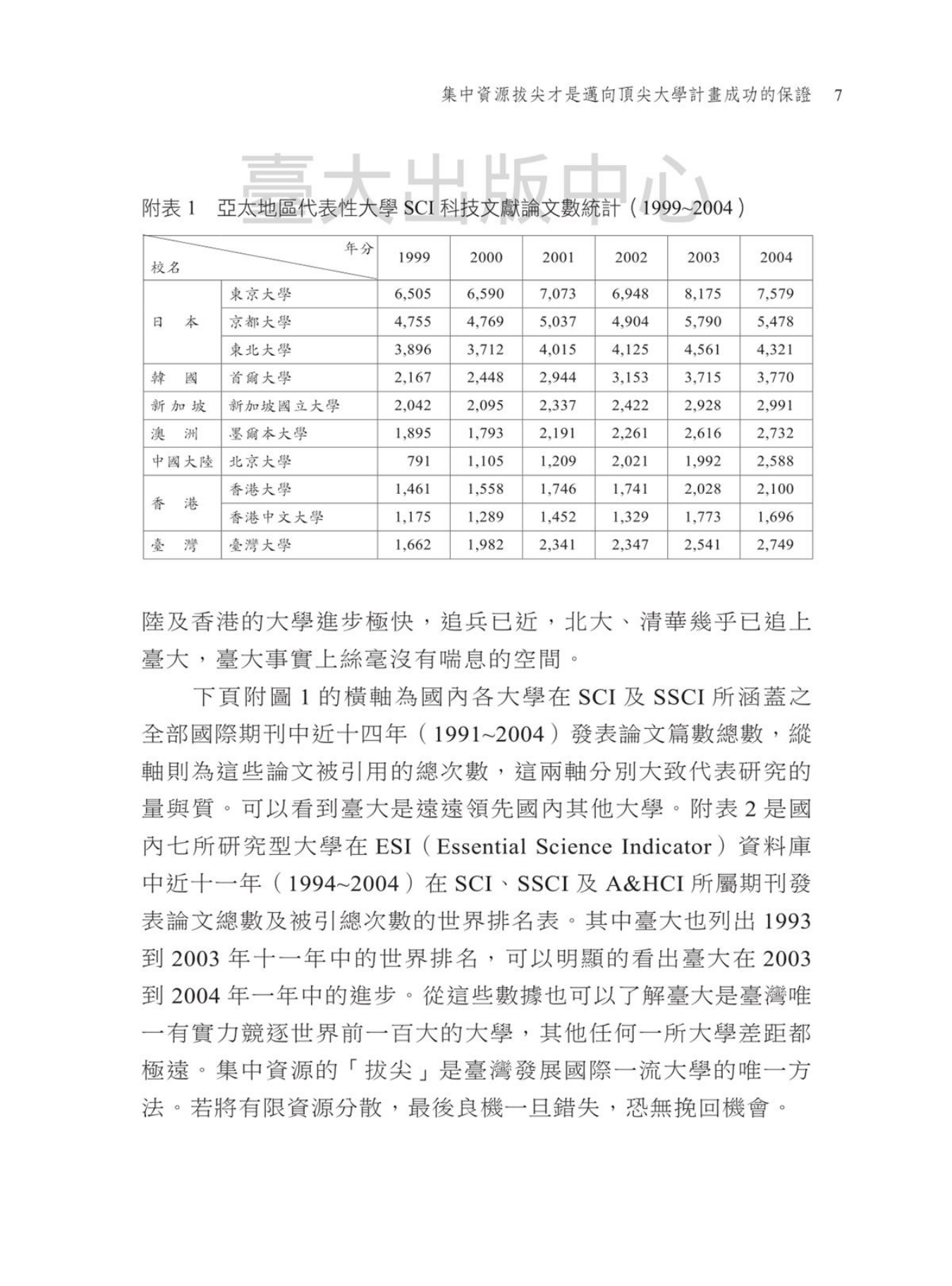
Appendix Table 1: Statistics on SCI Scientific and Technical Literature Papers at Representative Universities in the Asia-Pacific Region (1999–2004)
| Institution | 1999 | 2000 | 2001 | 2002 | 2003 | 2004 |
|---|---|---|---|---|---|---|
| Japan University of Tokyo | 6,505 | 6,590 | 7,073 | 6,948 | 8,175 | 7,579 |
| Kyoto University | 4,755 | 4,769 | 5,037 | 4,904 | 5,790 | 5,478 |
| Tohoku University | 3,896 | 3,712 | 4,015 | 4,125 | 4,561 | 4,321 |
| South Korea Seoul National University | 2,167 | 2,448 | 2,944 | 3,153 | 3,715 | 3,770 |
| Singapore National University of Singapore | 2,042 | 2,095 | 2,337 | 2,422 | 2,928 | 2,991 |
| Australia University of Melbourne | 1,895 | 1,793 | 2,191 | 2,261 | 2,616 | 2,732 |
| Mainland China Peking University | 791 | 1,105 | 1,209 | 2,021 | 1,992 | 2,588 |
| University of Hong Kong | 1,461 | 1,558 | 1,746 | 1,741 | 2,028 | 2,100 |
| Hong Kong Chinese University of Hong Kong | 1,175 | 1,289 | 1,452 | 1,329 | 1,773 | 1,696 |
| Taiwan National Taiwan University | 1,662 | 1,982 | 2,341 | 2,347 | 2,541 | 2,749 |
China’s and Hong Kong’s universities are improving extremely fast. The pursuers are already close; Peking University and Tsinghua University have nearly caught up with NTU. In reality, NTU has not the slightest room to catch its breath.
In Appendix Figure 1 on the next page, the horizontal axis represents the total number of papers published over the past fourteen years (1991–2004) by each domestic university in all international journals covered by SCI and SSCI, while the vertical axis represents the total number of citations of those papers. These two axes roughly represent the quantity and quality of research, respectively. It can be seen that NTU is far ahead of other domestic universities. Appendix Table 2 presents the world rankings of the total number of papers and total citations in the ESI (Essential Science Indicators) database over the past eleven years (1994–2004) for seven domestic research universities, published in journals indexed by SCI, SSCI, and A&HCI. For NTU, the world rankings for the eleven-year period from 1993 to 2003 are also listed, and one can clearly observe NTU’s progress during the single year from 2003 to 2004. From these data, it can also be understood that NTU is the only university in Taiwan with the strength to compete for a place among the world’s top one hundred. Every other university lags far behind. Concentrating resources to “cultivate excellence” is the only way for Taiwan to develop a world-class university. If limited resources are dispersed and the opportunity is missed, there may be no chance to recover.
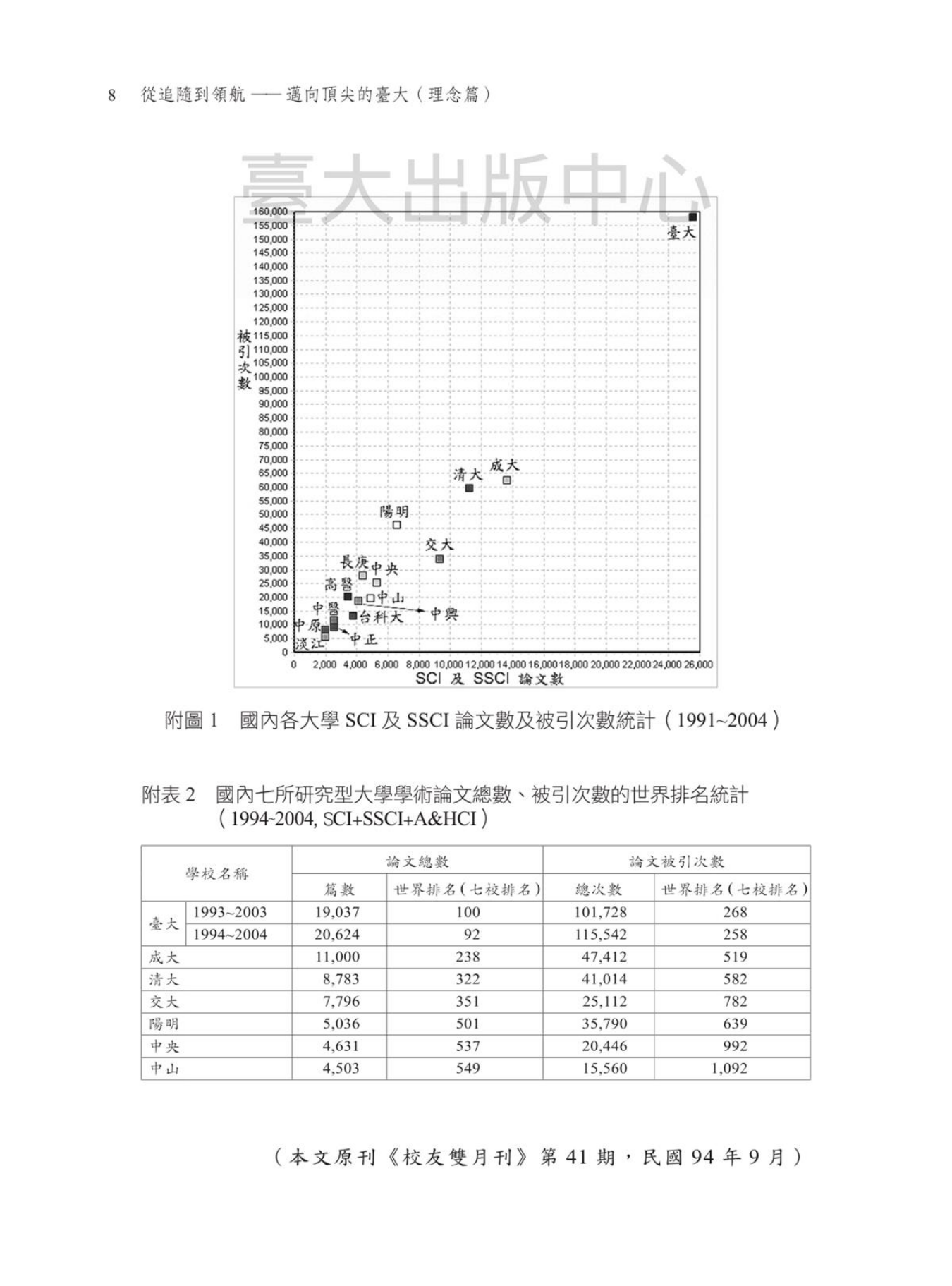
160,000 155,000 NTU 150,000 145,000 140,000 135,000 130,000 125,000 120,000 Citation count 115,000 110,000 105,000 100,000 95,000 90,000 85,000 80,000 75,000 70,000 NCKU 65,000 NTHU 60,000 55,000 50,000 NYMU 45,000 40,000 NCTU 35,000 CGU NCU 30,000 25,000
20,000 NSYSU 15,000 NTUST NCHU 10,000
5,000 TKU CCU 2,000 4,000 6,000 8,000 10,000 12,000 14,000 16,000 18,000 20,000 22,000 24,000 26,000 Number of SCI and SSCI Papers
Appendix Figure 1: Statistics on SCI and SSCI Paper Counts and Citation Counts for Major Domestic Universities (1991–2004)
Appendix Table 2: World Rankings of Total Paper Counts and Citation Counts for Seven Domestic Research Universities (1994–2004, SCI + SSCI + A&HCI)
| Institution | Paper Count | World Ranking (Rank among Seven Schools) | Total Citations | World Ranking (Rank among Seven Schools) |
|---|---|---|---|---|
| NTU | 1993–2003 / 19,037 | 100 | 101,728 | 268 |
| 1994–2004 / 20,624 | 92 | 115,542 | 258 | |
| NCKU | 11,000 | 238 | 47,412 | 519 |
| NTHU | 8,783 | 322 | 41,014 | 582 |
| NCTU | 7,796 | 351 | 25,112 | 782 |
| NYMU | 5,036 | 501 | 35,790 | 639 |
| NCU | 4,631 | 537 | 20,446 | 992 |
| NSYSU | 4,503 | 549 | 15,560 | 1,092 |
(This article was originally published in NTU Alumni Bimonthly, No. 41, September 2005)
Stepping into the Avenue of Palms, Forging a Path — An Earnest Exhortation from a Teacher
Stepping into the Avenue of Palms, Forging a Path An Earnest Exhortation from a Teacher
Dear new NTU students:
First, on behalf of all the faculty and students of NTU, I wish to extend our most sincere welcome to you all, and congratulations on passing through layers of challenges to gain admission to NTU. Seeing your young faces and radiant smiles, it is as if I am seeing myself thirty-five years ago, and I clearly see as well NTU’s inexhaustible wellspring and never-ending vitality. My heart is truly filled with boundless joy.
You are about to begin the most golden years of your life here at NTU, and from this moment on, you become an NTU person. What are “golden years”? What substance must they hold to be worthy of the name “golden years” without shame? What is an “NTU person”? What qualities must an “NTU person” possess to meet the expectations that society and the nation have for them? At this very moment as you first set foot in NTU, I would like to share with you my thoughts on the questions above.
Among Chinese-language universities across the Taiwan Strait and the three regions, NTU is the finest university. NTU has the best faculty, the best students, and the best library. NTU also offers the most diverse curriculum and the most open institutional systems. In the years ahead, you will be immersed in a palace of knowledge — attending lectures, listening to speeches by master scholars, reading classic works, reflecting upon and debating profound theories. Walking between classrooms and campus buildings, you will at every moment be in close proximity to intellectual spirits that drift and weave around you, expanding your wisdom. You will come to understand the world through “knowledge,” and through “knowledge” further generate new insights, thereby constructing your own intellectual framework and philosophical system. These truly are the most precious golden years of a lifetime. If you do not earnestly cherish and seize all these finest resources to shape
yourself, then you will truly have wasted the “golden years.” You must especially understand that so-called “knowledge” is by no means the memorization and arrangement of data. The true meaning of “knowledge” comprehensively encompasses: learning, cultivation, breadth of vision, wisdom, as well as love and compassion. Moreover, it is not enough merely to possess these qualities oneself — one must also be able to extend them to others and dedicate oneself to society. If you can achieve all of this, you will by and large meet the qualifications that an “NTU person” ought to possess. I believe that the spirit and intent of all the above can be distilled into eight characters: “Cultivate virtue, pursue learning; love the nation, love the people” — this is the NTU motto passed down from generation to generation since President Fu Ssu-nien. And I believe this is precisely the creed that an NTU person should uphold, the goal they should pursue, and further, the finest standard by which to judge whether one is truly an NTU person.
What does it mean to “cultivate virtue”? Simply put, it means cultivating “integrity” and “uprightness” in one’s character. A week ago, Dr. Tsai Li-hsing, CEO of Taiwan Semiconductor Manufacturing Company, came to the university to deliver a lecture titled “On Cultivating Virtue and Pursuing Learning from a Corporate Perspective.” He is a 1973 graduate of NTU’s Department of Physics. He said that although TSMC created a new business model — “integrated circuit foundry services” — the most important factor behind its success has been “integrity”: always delivering on time according to contract, unaffected by fluctuations in market prices. Many of you will go on to become elites and leaders in various professions. Your character and abilities will determine the rise and fall of this nation and of your respective fields. During your four golden years, how will you cultivate your character and hold yourselves to high standards? The simplest code of conduct is this: “Do not cheat on examinations” and “Do not plagiarize assignments.” I hope you will all remember the president’s request. Four years from now, when you graduate — which will also be when my term as president comes to an end — I will preside over your commencement ceremony, and I will ask each of you again: “Did you live up to it?”
“Pursuing learning” means studying diligently in pursuit of excellence — tempering and honing oneself, persevering without fail, and establishing a spirit of independent critical thinking and getting to the root of things. A person must have dreams of blazing new trails, as well as the courage and perseverance to pursue those dreams, in order to achieve excellence. When you walked onto campus this morning and paused to gaze up at the Avenue of Palms — those two rows of tall palm trees — it is as if they symbolize
Stepping into the Palm Grove, Forging a Path — A Teacher’s Earnest Advice
symbolize our lofty ideals. But does everyone know why the founders of Taihoku Imperial University, the predecessor of NTU, chose to plant royal palm trees? At the center of Palm Boulevard stands the symbol of NTU — the Fu Bell, cast in commemoration of President Fu Ssu-nien. You may savor the lingering, melodious resonance of its twenty-one tolls, but why did NTU’s forebears choose twenty-one tolls? Dear students, these are the two questions the President entrusts to you on your very first day at the University. I hope you will seek the answers with a spirit of thorough inquiry. At your graduation ceremony four years from now, I will ask each of you again: “Have you found the answers?”
“Patriotism” means caring for the land and society in which you have grown up, and giving back through action. For example, you should be concerned about injustices in society; you should feel the suffering caused by disasters as though it were your own; and you should cultivate your abilities so as to serve society in the future. You will be required to take three semesters of service-learning courses, beginning with maintaining the environment immediately around you, then moving on to serve in the community — giving back to society through action. I hope you will undertake this earnestly and with passion. At your graduation ceremony four years from now, I will also ask each of you: “Have you earnestly performed service?”
“Loving others” means cultivating a heart of inclusiveness and magnanimity, embracing the spirit of feeling others’ hunger as your own and others’ drowning as your own, and taking joy in cooperating with others. These beautiful things in life are by no means easily attained; they require the utmost dedication and effort on the part of the individual before they can be gradually possessed. Dear freshmen, I am not worried that your intelligence and talent may be insufficient. What I worry about is that your “appreciation” of what I have said above may be insufficient, that your “effort” may be insufficient, and that you may drift through four years in a daze of idle amusement without even realizing it, becoming nothing more than an ordinary “university graduate” of the kind one can find anywhere.
Dear new members of the NTU community, you have indeed stepped into a hall of knowledge — a hall that “has its own traditions, its own heroes, its own myths, and its own rituals.” You have come here drawn by its magnetic pull. I hope you will earnestly reflect upon the advice I have given you, and earnestly ponder the profound meaning of “the golden years,” of being a “NTU person,” and
of “Cultivate virtue, advance learning; love the country, love the people.” From this day forward, I will no longer call you “NTU freshmen”; I will call you “fresh NTU people.” You must truly cherish all that you possess, steel yourselves as you explore and enter into the “traditions” of NTU, and be true “NTU people” for the rest of your lives. Thank you all!
(This text is the address delivered at the NTU New Student Matriculation Ceremony, September 16, 2005; originally published in NTU Alumni Bimonthly, Issue 42, November 2005)
Respect and Preserve Cultural Traditions, Pioneer and Innovate the Landscape of Knowledge
Respect and Preserve Cultural Traditions Pioneer and Innovate the Landscape of Knowledge
Distinguished guests, faculty members, and students:
Today marks the seventy-seventh anniversary of our University’s founding and the sixtieth anniversary of our reconstitution. We gather here together to express our joy and congratulations. Over these past few days, I have been constantly reflecting: what, after all, is the true significance of holding an anniversary celebration? And what is the real essence of this joy and these congratulations?
I believe it must never be merely a formality we feel obliged to observe. In fact, just as when we celebrate our own birthdays, the sentiment and meaning behind it should be to remind us: to sincerely look back upon the past, to carefully examine the present, and thereby to spur ourselves on toward the future. For only in this way can NTU’s development continually improve and endure without end. As the ancients said: “Learning is like sailing against the current — either you forge ahead or you fall behind.” I feel that NTU’s situation today is very much the same. Therefore, since taking office, I have worked together with my colleagues, pooling our collective wisdom to establish NTU’s mission: to cultivate the elite of society and to elevate Taiwan’s contribution to the world; our vision: to become the preeminent university in the Chinese-speaking world and a world-class institution internationally; and our core values, drawn from the NTU motto: “Cultivate virtue, advance learning; love the country, love the people.” We have already formulated various strategies accordingly. I believe that if such a mission, such a vision, and such core values can be realized step by step, one by one, then they will surely ensure that NTU remains forever a university of the highest quality. At today’s anniversary ceremony, I call upon everyone to encourage one another, to fortify our shared resolve, and to pledge ourselves to advancing toward the “summit,” never slackening in our efforts.
Beyond formulating strategies and guidelines, and beyond firming up our will and our goals, what else is there that calls for further self-reflection? I believe it is this: we must reshape students’ sense of “carry-
ambition to “carry forward the legacy and open new horizons”; “respect for and preservation of cultural traditions, and the expansion and innovation of the intellectual landscape.” In recent years, Taiwanese society as a whole has single-mindedly pursued democratization and modernization, at times rather impatiently and one-sidedly. In this process, cultural traditions have been deliberately or inadvertently disparaged and abandoned. Yet little do people realize that the most essential foundation of a nation, the most critical underpinning of a sound and stable society, and the most vital connecting network that binds a people together in shared purpose all reside in cultural tradition. The fundamental reason why Taiwanese society today lacks core values and is rife with utilitarian thinking is precisely that its cultural traditions have become obscured and are even teetering on the brink of collapse. In my strategy for propelling this University toward becoming a top-tier institution, I specifically highlighted “educational excellence” and gave particular expression to the modern significance of NTU’s motto — “Cultivate virtue, advance learning; love the nation, love the people.” The deeper aspiration behind this vision is that all faculty and students will embrace the restoration of cultural tradition as their personal calling. If all of us at NTU can truly fulfill the expectations I have set forth above, then we will be demonstrating the excellence of NTU people and the precious value of NTU forever serving as a guiding light for society. This, too, is another profoundly important vision beyond what we pursue under the banner of “academic excellence.”
In contrast to respect for and preservation of cultural traditions, I believe I should further expound upon the expansion and innovation of the intellectual landscape, for the two must be held in balance, mutually nourishing and generative, to do justice to the substance and image of a truly outstanding intellectual. Ever since Galileo and Descartes four hundred years ago, with the progress of science, the system of knowledge has gradually moved toward narrow specialization and instrumentalization — “seeing only the minutest details while missing the entire cartload of firewood.” We should broaden our thinking toward a holistic mode of thought. Indeed, an outstanding professional should constantly reflect on whether the questions he or she pursues are beneficial to human society and human civilization, and whether they will receive positive affirmation in the judgment of human history. As for attitude and method in one’s research, one must first establish the mindset of a “pioneer” rather than a “follower,” and have the courage to question received doctrines and challenge authority. I believe that one must possess a visionary dream, along with the courage and perseverance to pursue that dream, in order to achieve excellence and to expand and innovate the intellectual landscape.
I firmly believe that “respecting and preserving cultural traditions, expanding and innovating the intellectual landscape” constitutes the most fundamental meaning of our mission to “cultivate society’s elite and elevate Taiwan’s contribution to the world”; it is also the most fundamental key to whether we can fulfill this mission.
At today’s anniversary celebration ceremony, we have one most meaningful event — the conferral of honorary doctorates upon Professor Kong Decheng and Professor Shing-Tung Yau. Mr. Kong is a symbol of Confucian culture; Mr. Yau has made monumental contributions to mathematics. Their achievements are universally admired the world over, and they serve as the finest exemplars of our principles to “respect and preserve cultural traditions, expand and innovate the intellectual landscape.” I wish to say: at the University Anniversary of 2005, we have given the finest interpretation of “carrying forward the legacy and opening new horizons.” The enduring value of this occasion will inevitably surface ever more prominently amid the future transformations of Taiwanese society and the world order, and it will guide us ever more clearly and decisively in the recognitions we should hold and the path we should follow as we pursue excellence. Finally, I sincerely congratulate and thank Mr. Kong Decheng and Mr. Shing-Tung Yau, and I wish all guests, faculty members, and students good health and success in all endeavors. Thank you all.
(This text is the address delivered at NTU’s 77th Anniversary Celebration Ceremony, November 15, 2005; originally published in NTU Alumni Bimonthly, No. 43, January 2006)
Top-Tier University Plan
NTU’s Strategies and Approaches
Foreword
On October 9, 2005, the Ministry of Education announced the shortlist for the five-year, fifty-billion-dollar “Top-Tier University Plan.” A total of twelve institutions received funding, among which NTU was awarded three billion dollars per year. With the injection of this substantial sum, the University naturally bears a tremendous responsibility. In response to the earnest expectations of society, the University is prepared to develop ten to fifteen world-class fields of excellence over five years, and has set the University of Melbourne in Australia as its benchmark, aiming to enter the world’s top one hundred in overall rankings within five to ten years.
To effectively implement the “Top-Tier University Plan,” the University has established a “University-Level Execution, Control, and Performance Evaluation Committee” (hereafter the “University Management and Evaluation Committee”) and an “Advisory Committee” composed of experts and scholars from within and outside the University as well as from overseas. Drawing on the recommendations of the Advisory Committee, the University Management and Evaluation Committee will plan the direction of development, implement relevant measures, and conduct annual performance evaluations in accordance with the principles of management by objectives and performance management. The following outlines our strategies and key priorities from five directions:
I. Educational Excellence
NTU students are the elite among our nation’s young people aged eighteen to twenty-four. A significant proportion of these students will go on to become leaders in every walk of life and outstanding teachers at various schools. Their caliber will determine the future of our nation. How should NTU educate these future elites of our country? Our approach is:
Three Major Publishing Centers
(1) Emphasizing Character Education
Reshaping the core values of the campus—namely, our university motto: “Cultivate virtue, advance learning; love the nation, love the people.” At the freshman orientation on September 16 of last year (2005), I asked incoming students to earnestly reflect on the profound meaning of “the golden years,” “being a member of NTU,” and “cultivate virtue, advance learning; love the nation, love the people.” Henceforth, through classroom instruction and advising sessions, teachers will raise relevant discussions and, through both verbal teaching and personal example, enhance character education.
(2) Cultivating a Humanistic and Artistic Campus Environment
To enhance students’ humanistic literacy, we must begin by cultivating a humanistic and artistic campus environment. The “NTU Arts and Cultural Activities Promotion Studio” has recently been established to comprehensively plan the university’s annual arts and cultural events and to seek corporate sponsorship, with activities launching in March of this year (2006). The studio’s members are all faculty with arts expertise from within the university and outstanding arts professionals from outside. We are confident that the events planned will carry the characteristics of depth in thought and will construct moving dimensions of engagement.
(3) Strengthening Holistic Education
We will strengthen students’ general education, life education, democratic and rule-of-law education, and character education to realize the philosophy of holistic education. At the University Anniversary Celebration on November 15 of last year, I articulated a vision: to foster in students the ambition to “carry forward the past and open the way for the future”—that is, “respect for and preservation of cultural traditions, and the broadening and innovation of the horizons of knowledge.” The concrete approach is to increase selected readings of classics in the common curriculum; and in general education, to add cluster courses in humanities, history, philosophy, psychology, and life sciences. These will be delivered through large-class instruction and webcasting, and made available for adoption by all faculty teaching general education courses. One to two percent of the budget will be allocated to this area.
Outside the classroom, several of our faculty members have been invited to write articles (or to reprint outstanding articles) and to use email to discuss various issues of society and life with students,
integrating life education, character education, and values into these discussions, with the hope of subtly nurturing correct values in students through this gradual influence.
(4) Establishing Elite Programs
We plan to establish “Elite Programs” to cultivate outstanding students from various departments, developing them into exceptional intellectuals equipped with sound international perspectives, outstanding professional knowledge, diverse creative thinking abilities, and strong humanistic concern, so as to lead social trends and national development.
(5) Improving Teaching Quality
The Office of Academic Affairs will plan the establishment of a “Center for Teaching and Learning Development” to assist in improving teaching quality. Our Computer and Information Networking Center and the Office of Academic Affairs have already established an excellent web resource—the NTU online curriculum (approximately 1,700 courses)—which will be further enriched. Together with video-on-demand general education courses and live recordings of various lectures, these will greatly contribute to enhancing teaching quality.
In addition to the continued development of the aforementioned web platforms, at the beginning of this academic year we piloted the integration of teaching quality workshops into the orientation for new faculty, with excellent results that we will expand in the future. Next, we will review the overall course structure of the university—not only consolidating courses with overlapping content, but also adjusting their proportions in response to developments in various academic fields. In terms of incentive measures, the number of “Distinguished Teaching and Excellent Teaching Awards” for 2006 will double, and the “Excellent Teaching Award” will also include a monetary prize. We will continue publishing the book series “NTU’s Great Teachers and Mentors” to honor faculty with distinguished teaching records.
Additionally, 10% of the budget will be invested in comprehensively upgrading the audiovisual and network equipment in core and laboratory courses, as well as in common and general education classrooms, and in planning the construction of a brand-new teaching and laboratory building with large lecture halls.
II. Research Excellence
The definition of an “internationally top-tier university” is in fact simple and clear: beyond having an average
research standard that reaches a certain threshold, whenever a particular field is mentioned, one immediately thinks of the research conducted by a particular team at a particular university. As long as a university enjoys such renown in several dozen fields, it qualifies as an internationally top-tier university.
(1) Strategies for Moving toward International Excellence
As can be seen from the Shanghai Jiao Tong University rankings in recent years, so-called internationally top-tier universities must not only have outstanding average performance; exceptional achievements are especially important. Therefore, to become an internationally top-tier university, one must equally emphasize “cultivating peaks” and “building foundations”—that is, “balanced development with breakthroughs in key areas.” “Cultivating peaks” means identifying the research teams most likely to reach international excellence and providing them with focused support. “Building foundations” means identifying the bottlenecks faced by colleges, departments, and institutes whose development has been constrained by a lack of resources, and injecting resources to address those bottlenecks in order to raise the average research standard.
A university’s international reputation is built precisely through “cultivating peaks.” In addition, the number of faculty who receive the Nobel Prize (UC Santa Barbara has had five faculty members receive the Nobel Prize over seven years, which has tremendously enhanced the university’s reputation), honors received by faculty from international academic societies (Awards, Fellowships, etc.), and medals won by students in international competitions all contribute to enhancing international prestige.
(2) Concrete Approaches for Moving toward International Excellence
Elevating research standards ultimately comes down to attracting and rewarding outstanding talent, improving the foundational research environment, and providing adequate research funding. The approaches are as follows:
1. Attracting and Encouraging Distinguished Faculty; Improving Support Staff
Following the principle of performance orientation, we will develop a reasonable flexible salary system to promote a doubling of both the quality and quantity of academic research output within five years. NTU has already drafted the “Flexible Salary and Academic Research Achievement Incentive Guidelines,” establishing Distinguished Chair Professorships, Distinguished Professorships, Distinguished Teaching Awards, and Excellent Teaching Awards to encourage current faculty to devote themselves to enhancing teaching and research. In addition, we will intensify
…strongly promote the “Distinguished Research Chair Professorship” to attract top global talent, including Nobel laureate-level or domestic and foreign academician-level figures, to engage in cutting-edge research and stimulate new academic development; this will be complemented by the recruitment of research, technical, and administrative personnel for support. The funding required for this item is 10–15%.
2. Strengthening the Infrastructure of the R&D Environment
A high-quality research environment is a crucial key to elevating research standards. For the Office of Research and Development, plans are set to establish university-wide, cross-departmental shared laboratories and large-scale basic research facilities, including the Excellence Research Building, the University-wide Animal Research Center, the College of Medicine Animal Center, greenhouses, fabrication centers, the Center for Excellence in Computation, and brain science laboratories. For the Office of General Affairs, projects will include the sewer system construction for the main campus, the renovation of high-voltage distribution substations, network construction and upgrades, the campus security surveillance system, improvements to barrier-free environments, architectural and fire safety improvements for old buildings, and improvements to campus public safety and sanitation. We will also continue to promote the construction of high-quality faculty dormitories through loans to attract outstanding newly appointed faculty. For the Library, we will establish comprehensive core collections, provide outstanding digital services, construct high-quality reading and collection spaces, and enhance human resources. The funding required for this item is 30%.
3. Balanced Development
A Strategic Development Committee will be organized by the deans of each college to supervise departments and graduate institutes in setting target programs abroad, aiming to catch up within five years. The primary task is to identify the bottlenecks in the development of departments and graduate institutes, with the college taking the lead in providing resources to solve the problems. Faculty members in all departments and graduate institutes are encouraged to compete for various awards or become academicians or fellows in international academic societies within their respective fields. The University will strengthen the implementation of the “Faculty Evaluation System” and the “Department and Graduate Institute Evaluation System” to elevate the standards of teaching and research units and faculty. The funding required for this item is approximately 15%.
4. Key Breakthroughs
Currently, the University has reached or is approaching world-class research standards in certain fields. In the future, we must fully support these teams in maintaining their leading positions internationally. First, based on the “Guidelines for Establishing University-Level Integrated Research Centers” and the “Guidelines for Establishing the Institute for Advanced Studies in Humanities and Social Sciences”
,” strict standards will be set to carefully select potential top-tier research fields. The Institute for Advanced Studies in Humanities and Social Sciences has already been established, structuring a platform for interaction, cooperation, and exchange among talents in humanities and social sciences. Six university-level integrated research centers have also been planned, including Nanoscience and Technology, Information and Electronics, Excellence in Medicine, Integrative Life Sciences and Biotechnology, Sustainable Development and Disaster Prevention, and Neurobiology and Cognitive Science. Certain potential fields within various colleges, though not part of the integrated research centers, can still receive support following evaluation. Each college must identify at least one field capable of reaching first in Asia and world-class status within five years. In addition, a system for “Research Technical Personnel” will be established, defining appointment, review, and flexible salaries to enhance the quality of academic research support; a comprehensive research information database will be built to provide all faculty with a way to find collaborative partners and form cross-disciplinary teams. The funding required for this item is 15–20%.
(3) Strengthening the Management and Application of R&D Results
The primary task is to establish a comprehensive patent and technology licensing system and regulations, improve administrative efficiency, provide intellectual property rights education and training courses, and actively assist R&D teams in producing more valuable patents or patent portfolios.
Specific practices include: 1. Conducting technology scouting for potential research results within the university and establishing an intellectual property database; 2. Organizing or participating in results presentations and technology briefings to build an intellectual property platform for external parties to access NTU’s rich R&D achievements; 3. Conducting intellectual property portfolio analysis within the university and formulating strategies for the value-added application of intellectual property; 4. Utilizing the Innovation and Incubation Center to establish diverse marketing channels for the university’s intellectual property rights; 5. Assisting faculty members in exploring industry cases where their expertise can contribute and identifying opportunities for collaboration with the industry. The funding required for this item is approximately 1%.
3. Caring for Society
The university is the conscience of society, bearing the responsibility to promote social progress. Therefore, commenting on social trends, making recommendations on public policies, and introducing academic research results to society in plain language are also social responsibilities that NTU, as the most representative university, must bear. The University has established the “NTU Public Forum” to encourage faculty to offer candid advice on various social phenomena and public policies or to hold seminars, proposing feasible methods for reference by all sectors of society, thereby gaining societal recognition and support for the University’s goals of “pursuing excellence and moving toward the top tier” and “caring for society and responding to societal needs.”
4. Promoting Internationalization
We plan to establish an “Office of International Affairs” to centrally handle matters related to international students, faculty, and researchers, as well as international affairs such as signing agreements with foreign university organizations and sister universities. We will also construct a comprehensive and user-friendly university-wide English website so that international students can quickly understand NTU’s teaching, research, and student dynamics. Our seven major goals are as follows: (1) Strengthening participation in major international university organizations and proactively taking on active roles; (2) Enhancing exchanges with key sister universities; (3) Strengthening transnational dual-degree programs; (4) Facilitating international exchange and cooperation for key research teams in fields of advantage; (5) Supporting faculty and researchers in actively participating in international academic affairs; (6) Assisting young faculty members and researchers in broadening their international perspectives; (7) Internationalizing master’s and doctoral research. The funding required for this item is approximately 5%.
5. Managing the University as a Big Family
First, within the framework of legal regulations, and based on the principles of flexibility and deregulation, we will establish sound systems and review mechanisms, and revise outdated regulations. The amendment to the University Act was recently passed by the Legislative Yuan. The University will cooperate by forming an “Organizational Regulations Revision Task Force” to revise the school’s organizational structure and institutional codes, which will be submitted to the University Council for deliberation. In addition, we must continue to actively fundraise, expand the self-raised funds of the University Endowment Fund, and establish a flexible and efficient mechanism for the control and management of funding utilization.
In terms of administration, we must digitize and network our operations, strengthen the integration of various administrative systems, simplify workflows, and establish ISO certification. The University has already formed a task force for the digitization of administrative units,
Xi Da Publishing
The e‑transformation work is scheduled to be completed by June of the 95th year of the Republic of China (2006). In addition, personnel education, training, and assessment will be strengthened, a performance‑bonus system for implementing units will be introduced, and mechanisms to promote the physical and mental health of staff will be established to enhance the quality of the administrative team.
Regarding alumni relations, regular alumni e‑newsletters will be sent, providing a smooth channel for alumni to express concerns about university affairs and gathering alumni strength to promote university development.
To create a good learning and living environment, campus greening and beautification must continue, making the campus more beautiful and pleasant. The university has established a “Visitor Center” in the New Moon NTU Building, integrating and providing campus environmental information, and, in coordination with the volunteer system, offering satisfactory services to guests. A campus indicator system is also being planned and designed; it will be finalized and installed as soon as possible, expected to showcase an overall style and modern sense.
As for the long‑standing campus parking issue, a supply‑and‑demand analysis and study of campus parking spaces will be conducted, and a parking‑management system for the university will be established. The required budget for this item is approximately 1 % of the total.
Conclusion
It is hoped that the university’s faculty, staff, students, and alumni will pool their wisdom and work together, advancing NTU toward the world’s top‑100 universities and creating a brand‑new future.
(This article is excerpted from the “National Taiwan University Toward a Top‑University Plan Advisory Committee Report,” 《》: month 9)
Xi Da Publishing
Reflections on the 110th Anniversary of the Late President Fu’s Birth
This year (the 95th year of the Republic of China, 2006), on March 26, marks the 110th anniversary of the late President Fu Meng‑zhen’s birth. In remembrance of President Fu’s leadership of NTU, which left a rich spiritual legacy, the university has compiled his articles on school governance, educational philosophy, and practices into a volume titled “National Taiwan University’s Educational Philosophy and Strategies.” Not only does it review history, it also encourages the future; its significance is especially great as NTU moves toward becoming a top‑tier university.
President Fu assumed the presidency on 20 January 1949 (the 38th year of the Republic of China) and served until his death from a cerebral hemorrhage on 20 December 1950 (the 39th year) at the Taiwan Provincial Assembly Hall. His tenure lasted less than two years, yet during this brief period he instituted many reforms in the university’s system, curriculum, faculty, and admissions, thereby laying a solid foundation for NTU’s free academic atmosphere and the flourishing of its humanistic spirit, leaving valuable spiritual assets.
The most celebrated classic of his is the speech delivered at NTU’s fourth anniversary celebration in 1949 (the 38th year of the Republic of China). In that address, President Fu presented the four exhortations “Cultivate Virtue,” “Pursue Learning” (later revised to “Encourage Learning”), “Patriotism,” and “Humanity,” which later became NTU’s school motto and core values. He emphasized that “Cultivate Virtue” begins with “establishing trust”; without trust one cannot seek truth, thus trust is fundamental to personal conduct and to the organization of society and the nation. “Pursue Learning” stresses acquiring knowledge and, through it, cultivating character—academic cultivation leads to personal development. As for “Patriotism” and “Humanity,” they aim to preserve and promote Chinese and world cultures, emulating the selfless love of religious leaders, with the ultimate goal of creating the greatest welfare for humanity.
In contrast to the current state of Taiwanese society—what the president described as an era of “heretical doctrines spreading”—college students often pursue only diplomas, thereby squandering their youth and future.
To nurture students’ sound character and thereby correct societal trends, President Fu quoted the Western philosopher Spinoza: “Contribute this university to the spirit of the universe,” urging faculty and students to share the common ideal of advancing the university and exploring universal truths. This bold statement has, over the decades, become NTU’s highest spiritual benchmark.
President Fu’s most profound impact on NTU was the removal of the instrumental, utilitarian model inherited from the Japanese colonial era, establishing the university’s autonomy for pure academic education. He identified three missions for the university: education, academic research, and enterprise development, with academia at the center. Using this core, the power of education is realized; thus, university education is academic education, and “freedom of teaching and learning” is a necessary condition for academic progress. He stressed, “Running a university is for academia, for youth, for Chinese and world culture; it does not include instrumentalism, and therefore the university possesses its own dignity,” illustrating his educational philosophy.
I deeply admire President Fu’s insistence on academic freedom and educational autonomy. Since I assumed the NTU presidency on 22 June 2005 (the 94th year of the Republic of China), I have repeatedly highlighted the three major visions of “Excellence in Education,” “Excellence in Research,” and “Social Concern,” promoting holistic education, pursuing academic excellence, and fulfilling social responsibility—truly embodying the motto “Cultivate Virtue, Encourage Learning, Patriotism, Humanity,” and living up to President Fu’s expectations for NTU.
President Fu was one of the most renowned scholars of literature and history in the 20th century, an outstanding educational administrator, and a consummate intellectual—an exemplar for future generations. In the chapters collected in this book, we see President Fu incisively critique the flaws of our nation’s university system, offering unique insights and, through comparative analysis of various countries, proposing concrete improvement plans; we see him resist external forces that interfere with campus affairs, steadfastly defending academic independence; we also frequently sense his concern for students’ studies, course selection, dormitory life, and even drinking water, especially his willingness to confront authorities to protect students—his affection for students is evident.
As early as February 1947 (the 36th year of the Republic of China), President Fu published an article titled “This Kind of Song Zi‑wen Must Be Removed” in Century Review, criticizing then Premier Song Zi‑wen; newspapers across the country…
The article was widely reprinted, ultimately forcing the premier to resign. President Fu’s candidness and the intellectual integrity he displayed command great respect.
Reflecting on the past half‑century, rereading President Fu’s writings on his educational philosophy and strategies continues to inspire me, especially regarding the value and true meaning of the school motto “Cultivate Virtue, Encourage Learning, Patriotism, Humanity.” May this spirit be endowed with contemporary significance. I hereby encourage all NTU members to pursue truth, cherish life, and earnestly play the role of pioneers of the age, guiding social ethos and national development.
(Original article published in Alumni Bimonthly, Issue 45, May 2006)
Setting Life Goals and Exploring the Meaning of Life
Venerable Sheng Yen, administrators, students, parents, and fellow alumni:
Greetings! Today, with hearts full of joy, blessing, and expectation, we gather here to hold this commencement ceremony for our graduating students. “Graduation ceremony” in English is “commencement,” which also means “beginning.” This signifies that from now on, you are “beginning” a new journey in life, entering a university called “society,” and the twists and turns, ups and downs, and hardships of that journey will surely be many times greater than those you have experienced before. Standing in the position of your teacher, I have a few words to share with you.
Fundamentally, in the years past, you have been a group much loved and cared for. You may have encountered small frustrations, sorrows, and pains in life, but these hardly count as storms. Throughout your smooth academic career, what you have felt has largely been joy, excitement, and delight. The turbulent changes of the outside world and the assumption and fulfillment of life’s responsibilities have been relatively difficult for you to appreciate. Yet from now on, those simple pleasures found within the simple campus—simply acquiring knowledge, simply making friends, simply participating in activities—will gradually become unattainable. You must prepare yourselves mentally and forge ahead with courage.
I say this not to make you mistakenly believe that the outside world is treacherous or that life’s path is arduous. I merely wish to remind you that the golden era of your life, in which you could fully enjoy all the resources provided by your parents, teachers, and society without needing to give anything back, is drawing to a close. From now on, it is time for you to gradually give back, little by little, and take on responsibility. As you begin to play your new roles, I would like to offer some life experiences for your reference.
1. Cultivate Civic Virtue; Keep “Others” in Your Heart
Over the long term, I have observed our students and found that some consistently place “themselves” at the center of their concerns, with little sense of the “public good.” For instance, beverage cartons are commonly seen in shrubbery and on stone steps; people talk loudly and play ball near classrooms in session; students walk side by side in a row down the road, as if no one else exists; bicycles are parked haphazardly in no-parking zones. These scenes can be seen every day on the NTU campus. They reflect the “self-only” and “whatever” attitude of some students—a lack of civic virtue and a lack of respect for others.
Such behaviors and attitudes, when brought into society, will lead to a disordered and backward society. If you wish to be cultivated individuals, people who are valued and trusted, you must think of the “public good” in all matters. “Do not do evil simply because it seems trivial.” You must have empathy and put yourselves in others’ shoes in everything you do.
2. Only Integrity Can Establish One’s Character and Guide One’s Conduct
Integrity is, after all, the most fundamental and important moral principle of humanity—this holds true in both East and West—because it is the foundation of mutual trust among people and of a decent society. Dear students, many of you will rise to prominence in various fields in the future, becoming elites or leaders. Your character and values will determine the rise or fall of your respective fields. I hope you will, without hesitation, adopt NTU’s motto—“Cultivate Virtue, Advance Intellect; Love Country, Love People”—as your eternal guiding principle for life.
3. Set Life Goals and Explore the Meaning of Life
Current university education is primarily course-oriented, and many students do not know what they are studying for or what they truly want—that is, they lack clear life goals. Yale University once conducted a twenty-five-year longitudinal study on the impact of “goals” on life, and the results showed that students who establish life goals early on tend to achieve greater success in society. Life’s goals should not be limited to acquiring the knowledge needed for survival or attaining social
status; they should also include exploring the meaning of life. Only by understanding the essence of life can one generate genuine feeling and passion toward others from within, and only then can we foster communities of mutual care, mutual understanding, and mutual trust. Only in this way will our society more easily generate positive, proactive, and idealistic creativity.
Dear students, if you can constantly keep “civic virtue” and “others” in your thoughts, uphold integrity as your principle, set life goals, and explore the meaning of life, you will surely attain the most peaceful and fulfilling, the warmest and most beautiful life. You will also surely create a healthier, more progressive, and happier society for yourselves and for the next generation. Finally, I wish to remind you that you are about to enter a larger university—society—where the problems will be more difficult and the margin for error far narrower. Yet you need not panic: as long as you do not forget the teachings of your professors, the inspiration of those who came before you, the motto of your alma mater, and the laughter and tears, ideals and frustrations, and the mutual encouragement you shared in this City of Azaleas, you will traverse any mountain and cross any river with ease. In this season when the flame trees bloom, on behalf of all faculty and students, I wish you boundless horizons, I wish you glory for your alma mater, and I wish your lives to be as radiant as the flame tree blossoms.
(This text is the address delivered at the NTU Commencement Ceremony, June 3, 2006; originally published in Alumni Bimonthly, No. 46, July 2006)
Building a Comprehensive e-Campus
“Building a comprehensive e-campus” was one of the campaign pledges I proposed during the presidential selection process. After taking office, in order to provide NTU members with a convenient, efficient, and user-friendly campus environment, I established the Administrative e-Transformation Task Force in September of last year (2005) to actively advance campus e-transformation—leveraging information and electronic technology to enhance administrative efficiency and improve service quality. After deliberation, the task force proposed four major strategies as execution guidelines. These four strategies are: building foundations from the upstream, integrating and developing systems of the same type, prioritizing services with the broadest reach, and strengthening signature services.
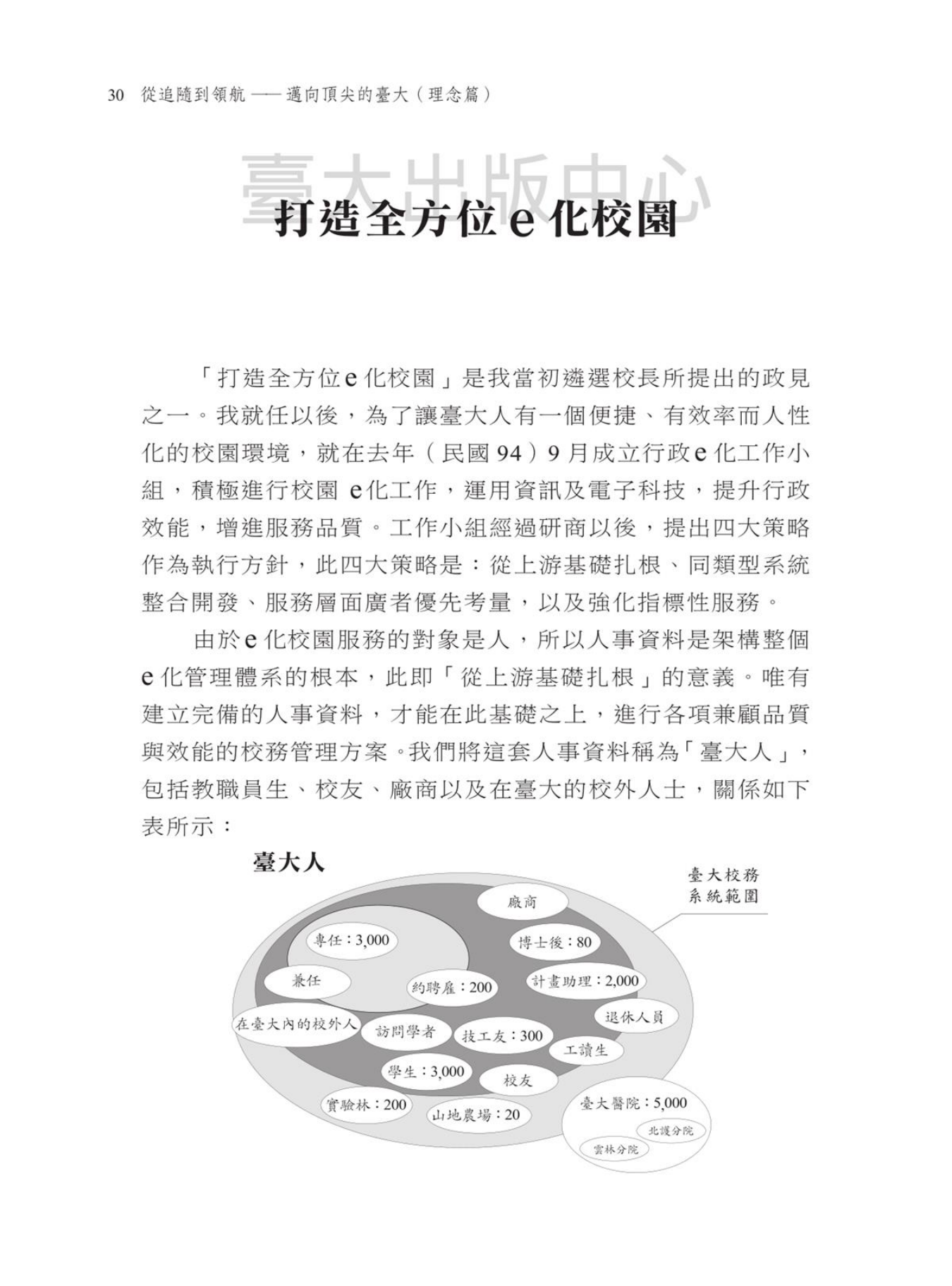
Because the people served by the e-campus are human beings, personnel data forms the foundation of the entire e-management system—this is the meaning of “building foundations from the upstream.” Only by establishing comprehensive personnel data can we, on this basis, carry out various university governance programs that balance quality and efficiency. We call this personnel data system “NTU People,” encompassing faculty, staff, students, alumni, vendors, and external individuals at NTU. The relationships are shown in the following table:
The source diagram places all categories within one large outer set labeled “NTU People.” An arrowed callout identifies the shaded inner subset as the “NTU administrative-affairs system scope.” The categories and printed counts are: full-time personnel, 3,000; part-time personnel; contract employees, 200; postdoctoral researchers, 80; project assistants, 2,000; vendors; retirees; external persons at NTU; visiting scholars; technicians and workers, 300; student workers; students, 3,000; alumni; Experimental Forest, 200; and Highland Experimental Farm, 20. A distinct overlapping subset labeled “NTU Hospital, 5,000” contains the Yunlin Branch and Beihu Branch.
The task force established a total of fourteen projects, including: an online onboarding system for new faculty and staff; online student departure procedures; personnel data inquiry; personnel system integration; data sharing; e-transformation of cards and credentials; Student Affairs Portal; Student Information Service Network; exchange data compilation; online reimbursement system; official document tracking system; online sign-in/sign-out; NTU homepage redesign and enhanced English web pages; and alumni activity tracking. As of July of this year (2006), eight of the projects under the four major strategies have been completed, summarized as follows:
I. Building Foundations from the Upstream
In terms of personnel data, we have completed the online onboarding system for new faculty and staff, online student departure procedures, and personnel data inquiry interfaces. Through bulk data exchange, we have automated processes such as labor and health insurance and transmittal of vouchers. These systems not only replace paper-based operations but also save unnecessary duplicate data entry, effectively streamlining administrative workflows. Going forward, we will continue to plan the personnel integration project, including expansion and enhancement of the personnel system, as well as integration with Pemis2K, to bring most “NTU People” into the management system.
II. Integrating and Developing Systems of the Same Type
Given that students constitute the largest group of “NTU People,” we first launched the Student Affairs Portal and integrated relevant information from various units to establish the Student Information Service Network (http://info.ntu.edu.tw/Sinfo/), providing round-the-clock service. At present, most systems from the eight divisions/offices under the Office of Student Affairs are available for online inquiry, and content will be progressively expanded in the future. Portals for other groups—faculty and staff, alumni, visitors—will also be actively enriched with content and integrated information to provide customized services.
Furthermore, in view of the expanding need for international academic exchange, we will also establish an e-system for exchange data, with the aim of accurately grasping the current status of university-wide international exchange activities. The preliminary plan involves creating registration systems for faculty overseas travel, student club international activities, and unit-level academic exchanges, along with results inquiry capabilities.
III. Prioritizing Services with the Broadest Reach
Among administrative operations, official document transmission and expense reimbursement represent the most voluminous workloads—complex and time-consuming processes—so streamlining these workflows has become a top priority. To this end, we established the official document tracking system project. In December 2005, we completed tracking of outgoing university documents; in June 2006, we completed tracking of unit-initiated document drafts. Together with the follow-up reminder function, this will strengthen the existing document system. Of course, electronic official documents remain a long-term goal; however, electronic documents depend on a complete personnel-organizational framework and an online approval mechanism. We have already completed a simplified version of online approval and an online sign-in/sign-out system. Combined with the personnel integration project, this will complete the preparatory groundwork for electronic official documents.
As for expense reimbursement, this is the administrative task that causes faculty the most headaches and dissatisfaction. The university established the online reimbursement system project, which has preliminarily completed process and form simplification. Subsequent phases will implement real-time inquiry and progress tracking, shortened payment timelines, and various subsystems for business reimbursement, in order to improve service efficiency.
IV. Strengthening Signature Services
Strengthening signature services produces a crowning-touch effect. We have now completed the alumni activity tracking system—the Alumni Information Network (http://host.cc.ntu.edu.tw/alumni/)—and the NTU homepage redesign. The Alumni Information Network serves as a communication platform between the alma mater and alumni. Through collaborative maintenance of the alumni database with alumni themselves, we aim to build an alumni contact network, achieving resource sharing and enhanced service. The system was opened for user access in May. We hope that in the future, every alumnus who visits the website will import the contact information of their former classmates into the alumni database, thereby establishing a real-time, dynamic alumni contact network. In addition, to strengthen internal information exchange, make data searching more convenient for users, and thereby increase international visibility, the university undertook a complete redesign of both the Chinese and English websites, with particular emphasis on enhancing the English web content. The new version was officially launched in July.
The first phase of our campus e-transformation has yielded results. The second phase will focus on enhancing the functions of the online reimbursement system and the Student Information Service Network,
developing personnel system integration, and establishing the international exchange data e-system. Once the aforementioned projects are completed successively, we will proceed to the next phase of system development, continuing our commitment to enhancing administrative efficiency and improving service quality, so as to create a friendly digital environment for all members of the NTU family, serving as a solid backing for NTU’s full sprint toward becoming a top-tier university.
(This article was originally published in Alumni Bimonthly, No. 47, September 2006.)
Heart
Seize the Golden Years
Dear incoming NTU students:
Congratulations on entering the finest university in the nation. Congratulations on the golden years of your life that are about to unfold—the most colorful and vibrant learning journey you will ever embark upon. Congratulations on becoming, from this day forward, a member of the “NTU family.” All of these gratifying and joyous outcomes are, of course, the reward for your hard work and dedication in the past. But beginning tomorrow, an even more formidable peak of knowledge—one you must summon the strength to scale—will rise before your eyes. To surmount it successfully, you must first prepare yourselves psychologically; you will need firmer “willpower,” more vigorous “ambition,” and more strenuous “action.” Only then can you construct your own intellectual framework and philosophical system. Throughout this entire process, you will need an even stronger “sense of responsibility” and a more noble “idealism.”
On your very first day at NTU, I must emphasize to all of you the true meaning of our university motto: “Cultivate virtue, advance knowledge; love country, love people.” These eight-character words of wisdom have constituted the core values passed down through the generations on the NTU campus since the presidency of President Fu Ssu-nien. They were applicable in the past, they will be applicable in the future, and their substance and spirit possess a timelessness that transcends all eras. “Cultivate virtue” means upholding “integrity,” “uprightness,” and “discipline” in character and conduct. Put into practice in daily campus life, it means “no cheating on exams,” “no plagiarizing assignments,” “no disorderly parking of bicycles,” and “no making noise near classrooms.” “Advance knowledge” means studying diligently, refining and challenging yourselves—not only striving for excellence in your chosen fields but also reading deeply in the classics of both Chinese and Western culture, and cultivating a spirit of independent critical inquiry that gets to the root of things. “Love country” means caring for the land where you were born and the society to which you belong, and giving back through concrete action and dedication. Put into practice
in your daily learning process, it means that in the future you will be required to take three semesters of service-learning courses—beginning with keeping your own immediate surroundings in order, then going into the community to serve, or providing professional service, giving back to society through action. I hope you will undertake this work earnestly and with passion. “Love people” means possessing a spirit of tolerance and magnanimity, embodying the ethic of feeling others’ hunger and drowning as your own, and genuinely delighting in cooperation and shared endeavor with others. If, in the years ahead, you can little by little—through understanding, learning, and ultimately practice—live out these eight words, then you will truly deserve to be called a genuine “NTU person.” You will also inevitably continue to scale the highest peaks of your lives and become a person truly worthy of respect.
Dear students, having set forth the true meaning of the NTU motto and its enduring significance for you, what I want to say is this: you are truly a fortunate group. By “fortunate,” I mean not only that you have been admitted to NTU, as though you were the chosen ones; but also that, compared to the seniors who came before you, the launch of the government’s “Aim for the Top University” Plan means you will enjoy a far better and richer learning environment and set of resources at NTU. From the moment you enroll, more refined general education courses and a classic humanities program await your selection; there are improved dormitory facilities and online resources (NTUOnline) that surpass even those of the Massachusetts Institute of Technology for you to utilize; the Freshman Building offers multimedia-equipped, e-enabled classrooms with comfortable desks and chairs for your classes; every day at noon you can bring your lunch to Luming Square and enjoy a variety of artistic performances and demonstrations—this month features lectures and instruction on traditional hand puppet theater. You will have more opportunities and subsidies to spend a year or a semester as an exchange student at a sister university abroad. Of course, in line with the different professional trajectories of each department, the university has already formulated various strategies—establishing endowed chairs, rewarding excellence in teaching and research, creating interdisciplinary research centers, and actively expanding international academic exchange, among others—all of which will provide you with broader and deeper possibilities for learning. In terms of our overall goal, the university intends, within the next four years—that is, during the period when you will be studying here—to develop ten to fifteen fields to world-class status and to strive to join the ranks of the world’s top one hundred universities. You will directly and indirectly benefit from all of these plans and efforts; you will all
be present to witness and partake in this undertaking. On the eve of the new semester, I share all of this with you with but one expectation: that you will cherish it deeply, seize your golden years, and not squander these golden resources. Dear students, with the eager and pure heart of a child, give it your all! Do not disappoint the gifts bestowed upon you by your parents, your society, and your nation.
Finally, congratulations once again to each of you, and my wish that your journey ahead will be filled with abundant harvests.
(This text was delivered as an address at the NTU New Student Matriculation Ceremony, September 15, 2006; originally published in Alumni Bimonthly, No. 48, November 2006.)
Another New Beginning
Distinguished guests, faculty members, and students:
Today is the seventy-eighth anniversary of our university’s founding and the sixty-first anniversary of its reorganization. Sixty years constitutes one full sexagenary cycle. For an individual, passing sixty means entering old age, and those in their seventies and eighties may be described as advanced in years. But for a university, the accumulation of years is precisely the foundation for future development; the longer the history, the greater the pride we can build upon it.
The sixty-first year happens to mark a new beginning in the sexagenary cycle, and this moment is likewise another new beginning for National Taiwan University.
Over the past year, with the support of the Aim for the Top University Project, we have made relatively significant progress in various aspects of university development. We have regularly held salon-style arts and humanities lectures, musical performances, theater and dance, painting and photography exhibitions, hoping to foster a campus rich in humanities and arts. We established the Center for Teaching and Learning Development and created an e-classroom environment, hoping to provide faculty and students with more ample and convenient teaching support and student guidance. We renovated buildings, purchased additional library materials, and improved campus networks and other foundational hardware and software infrastructure, hoping to provide faculty and students with a more comfortable and convenient teaching and research environment. We have planned and built R&D infrastructure and organized integrative research centers, hoping to raise research standards and create new fields of research. We have actively promoted international academic exchange, participated in international organizations, and promoted English-taught courses, hoping to lead NTU toward internationalization. All these efforts aim to achieve the goal of the Aim for the Top University Project: a university that is “preeminent among Chinese-speaking communities and first-class internationally.” At today’s anniversary ceremony, I call upon all faculty and students to encourage one another, strengthen our shared resolve, and work tirelessly to achieve this goal.
In the past, I have repeatedly emphasized that “respect for and preservation of cultural traditions, and the opening up and innovation of the intellectual landscape”
is the guiding principle we pursue for excellence, and neither should be neglected. For placing equal emphasis on science and humanities, and elevating both knowledge and the spirit together, are the primary conditions for becoming a world-class university. To step onto the world stage, we must have our own distinctive character, and our culture is our finest resource. If we can integrate culture into all professional fields, we can create entirely new professional realms, and we may thereby become a focus of worldwide attention. To become world-class, we must further establish in our thinking the mindset of being “pioneers” rather than “followers.” Only when one possesses visionary dreams and the courage and perseverance to pursue them can one possibly achieve excellence.
Today, we confer honorary doctorates upon Mr. Lin Hwai-min and Mr. Chien Ssu, and present Distinguished Alumni Awards to Mr. Simon Sze, Mr. Lee Lou-chuang, Mr. Yao Meng-chao, Mr. Barry Lam, Mr. Lee Kuen-yao, and Mr. Hsu Wen-cheng. Mr. Lin Hwai-min mastered Western modern dance and integrated it with traditional Chinese art and culture, leading Taiwan’s modern dance onto the world stage. Mr. Chien Ssu devoted himself to bioengineering and medicine, consistently dedicated to unlocking the mysteries of various diseases, earning international acclaim. The non-volatile semiconductor memory invented by Mr. Simon Sze has become the mainstream of computer memory. Mr. Lee Lou-chuang proposed multiple astrophysical theories and led our nation’s space team to successfully establish a world-class Taiwanese scientific satellite system. Mr. Yao Meng-chao is a world authority in molecular genetics and a pioneer in chromosome and gene research. Mr. Barry Lam pushed the craftsmanship of the computer manufacturing industry to its zenith, making Taiwan the “laptop computer” kingdom; Mr. Lee Kuen-yao led Taiwan’s optoelectronics industry to capture a global market. These two corporate leaders guided our nation’s technology industry upward and made tremendous contributions to our economic development. Mr. Hsu Wen-cheng devoted his entire life to local grassroots medical care and service, embodying a lofty humanitarian spirit. These eight gentlemen have each, in different fields, dedicated their wisdom and lives to the society, nation, and world they belong to. They developed their own thinking, pursued truth, and cared for life—they are our finest role models. The pioneering efforts of those before us are the driving force of today. Now we are preparing to sprint with all our might, drawing on the strength accumulated over more than one full sexagenary cycle, toward becoming a world top-tier university and one of the global top one hundred. This is another
new beginning. We sincerely hope that NTU will have a brand-new future, and we also hope that more rising stars will follow the example of these eight gentlemen and become the glory of all NTU members.
Finally, I sincerely wish all distinguished guests, faculty members, and students good health and that all goes well with you. Thank you all.
(This text is the address delivered at NTU’s 78th Anniversary Ceremony, November 15, 2006; originally published in Alumni Bimonthly, No. 49, January 2007)
Establishing a Tuition Adjustment Mechanism to Support the Sound Development of Universities
In January of this year (2007), the National Conference of University Presidents formally passed a proposal requesting that the Ministry of Education relax restrictions to allow universities to autonomously adjust tuition and fees within a margin of 10%, and the Ministry of Education also indicated that it would announce the review results by April at the latest. Since the associations of national, private, and vocational/technical institutions successively passed resolutions to raise tuition for the coming year, some members of the public have expressed opposition for two main reasons: First, from 1997 to the present, tuition and fees at public universities and colleges rose by 42.7%, while those at private universities rose by 14.3%, yet the wage increase for salaried workers was less than 8%. The rate of tuition increases far exceeded average salary growth, already constituting a significant burden for ordinary families. Second, over the past two years, the government has invested considerable funding in the “Five-Year, Fifty-Billion Aim for the Top University Project” and the “Teaching Excellence Project,” benefiting many schools, which therefore should not raise tuition further.
In response, I have articulated my position at relevant meetings on multiple occasions: establishing a flexible tuition and fee adjustment mechanism consistent with the principles of fairness and justice is not merely about resolving the financial shortfalls of various universities, but is in fact a long-term consideration for the sound development of universities. Because whether viewed from the current domestic situation or international trends, there is a genuine need to raise tuition and fees, and this point has gradually gained consensus across various sectors. The following discussion uses national universities as an example.
1. Current Situation and Problems
1. Current Domestic Situation: Changes in the Funding Sources of National Universities
Over the past decade, the number of universities and colleges and the number of students in Taiwan have both surged dramatically, reaching unprecedented peaks. The number of national university-level institutions grew from thirty-seven (in
- to 51 (2006), and enrollment increased from 217,000 to 379,000, representing growth of 38% and 75% respectively. Meanwhile, the Ministry of Education’s appropriations to national universities increased from NT43 billion—an overall increase of about 20%. However, due to the increase in the number of institutions, the funding actually allocated to each school declined by 20% to 50%. Measured by per-student cost, the figure dropped from NT118,000, a decline of as much as 35%. This has had an adverse effect on improving teaching and research hardware and software and on enhancing the quality of teaching and research.
Constrained by fiscal difficulties, the government was unable to inject additional funds into higher education. Accordingly, beginning in 1996, it promoted the implementation of University Endowment Funds at national universities, requiring them to self-raise a portion of their funding and gradually increasing the proportion of self-raised funds year by year. Analyzing current revenue sources, the largest category—industry-academia collaboration—yields only management fees for the schools, which is in fact not a substantial amount. Another source is fundraising, but the culture of fundraising among universities in Taiwan has only just begun, and the amounts raised account for an extremely low proportion of total revenue. National Taiwan University’s fundraising is considered relatively substantial, yet it accounts for no more than 6% of expenditures. The proportion of tuition and fees in total revenue rose from 10% to 15% over the course of a decade—that is, relative to the decline in government appropriations, the share of tuition and fees in university revenue rose slightly, providing timely partial relief for the funding gap.
II. International Trends: Universalization of Education and Globalization of Competition
From the perspective of international trends, with the advent of economic globalization, Taiwan joined the World Trade Organization (WTO) in 2002. Facing an increasingly open economic and educational market, our higher education is gradually encountering competition from neighboring countries and regions, and indeed from around the world. Nations around the world, in responding to the challenges of globalization, are actively investing more resources in universities and striving to improve teaching and research environments. In particular, universities in neighboring countries and regions such as Japan, South Korea, Hong Kong, and mainland China have advanced extremely rapidly, which means our graduates will face very intense competition in the future. In order to enhance their competitiveness, high-quality education becomes extremely important. But in this process,
the government has not only reduced per-institution funding but also suppressed tuition and fee adjustments at universities, making institutional management increasingly difficult.
Another international trend is the transformation of the model of university education. Including Taiwan, university education in the past was elite-oriented; these elites would go on to lead society, so governments had to invest heavily—as European universities were all tuition-free in the past (many countries have now begun charging tuition). When the proportion of eighteen-to-twenty-two-year-olds receiving education exceeds half, it becomes universal education, and students must bear a portion of the tuition themselves. In 2005, Taiwan’s net enrollment rate approached 60%, clearly indicating that it has become universal higher education. Moreover, tuition-free education comes at a price: European countries support it with heavy taxation, with rates as high as 40% to 50%. Even the lowest, the United Kingdom, exceeds 35%, whereas Taiwan’s rate is only 11.8%—far lower than Japan’s 25%, South Korea’s 20–23%, and the United States’ 25%. Those who oppose tuition increases argue that the rate of increase in university tuition far exceeds average salary growth. But in fact, Taiwan’s income tax rate remains low, and accordingly, students and families should bear a relatively larger share of tuition and fees.
Rationale for Adjusting Tuition and Fees
1. Practical Factors: Filling the Funding Gap
As described above, the funding sources for our national universities have undergone significant changes over the past decade. Coupled with year-over-year increases in the consumer price index, when prices rise while neither Ministry of Education appropriations to each school nor tuition and fees are adjusted, universities face tight finances due to rising expenditures. They have all actively sought to develop new revenue sources in response, such as facility rental income and donation income. However, donation income cannot grow steadily because the domestic culture of donating to education has not yet taken hold and it is susceptible to economic downturns. Facility rental income often requires borrowing for renovation work, and future revenues must be applied to debt repayment year by year. These sources of income provide only limited relief for universities’ funding gaps, making the adjustment of tuition and fees all the more necessary.
Although tuition and fee revenue at national universities has increased by an average of 40% over the past decade, it
accounts for only 15% of total university revenue. Moreover, university tuition in our country is quite low as a proportion of GDP per capita, and there is still room for adjustment. Looking at 2004, tuition at our national universities was approximately US$1,780, representing 13.8% of GDP per capita, compared to approximately 15.5% for Japanese public universities, approximately 14.8% for South Korean public universities, 22.3% for the Chinese University of Hong Kong, approximately 50% for mainland Chinese universities, and approximately 17% for California State University in the United States. By comparison, Taiwan’s tuition burden can be said to be the lightest. When tuition and fees combined with income tax are calculated as a proportion of per capita income, our national universities amount to approximately 25.4% and private universities 36.7%; Japanese public universities approximately 40.8% and private universities 57.1%; South Korean public universities 40.1% and private universities 52.4%; the Chinese University of Hong Kong 31.1%; California State University 43%; and European universities generally above 40%. Taiwan’s personal burden is also the lightest among neighboring competitor nations.
Some worry that tuition and fee increases will further disadvantage economically disadvantaged students, but this is not necessarily the case. In recent years, because national universities have been under relatively tight financial constraints, the scholarships and financial aid originally provided to students have been squeezed. If universities have sounder finances, they will have more resources to support disadvantaged students. Viewed holistically, tuition increases are actually advantageous for disadvantaged students.
2. Planning Ahead: After the Five-Year, Fifty-Billion Initiative
As for another argument against tuition and fee increases: over the past two years, twelve public and private universities have received funding under the “Five-Year, Fifty-Billion Plan to Develop Top-Tier Universities,” and even more universities have received funding under the “Teaching Excellence Plan.” With these additional subsidies, is it then unnecessary to raise tuition? Our view is precisely the opposite, for two reasons. First, from the perspective of “user pays,” to enjoy more resources, one must pay higher tuition. If schools receiving subsidies are not permitted to adjust tuition and fees, it means students at these schools pay less yet enjoy better treatment, while schools not receiving
Students at schools that raised tuition still received poorer treatment, which does not conform to the principles of social fairness and justice. Second, the “Five-Year Fifty Billion Plan for Top-Tier Universities” and the “Teaching Excellence Plan” are only short-term programs, whereas the corresponding curricular and institutional reforms undertaken by universities are long-term endeavors. To prevent reforms from ending when the plans end, it is necessary to take precautions, seek other revenue sources to cope, and steadily raise tuition year by year as one such measure.
Indeed, the “Five-Year Fifty Billion Plan for Top-Tier Universities” and the “Teaching Excellence Plan” have enabled subsidized universities to significantly improve their operational performance, even creating the possibility of entering the world’s top 100 within five to ten years. Steadily raising tuition in modest increments year by year is the means to ensure the realization of policy goals; failure to reasonably reflect operating costs in a timely manner will make it impossible to maintain university quality and promote the sound development of higher education, let alone enhance the international competitiveness of our nation’s graduates.
III. Establishment of an Adjustment Mechanism
As for how to accommodate the autonomy and diversity of each university’s financial management while steadily raising tuition, the fundamental solution lies in establishing a fair, reasonable, and flexible mechanism. We previously offered three specific recommendations:
First, we recommend that the Ministry of Education establish macro-level, objective, and clear evaluation indicators — for example, student-faculty ratio, campus space standards, financial indicators, and university evaluation results — while avoiding review indicators that are overly harsh, rigid, cumbersome, vague, or retroactive.
Second, for all schools meeting the evaluation indicators, we recommend setting 10% as the ceiling for tuition and fee adjustments, authorizing each institution to determine the magnitude of adjustment on its own.
Third, based on the principle of supporting disadvantaged students, the Ministry of Education may require schools that raise tuition to appropriately increase the amount of scholarships and financial aid, but should not mandate a fixed proportion of tuition assistance measures and regulations. This is because the total number of students qualifying for
subsidies inevitably differs across institutions, and social welfare policy should be borne by the government rather than by other non-disadvantaged students and their parents, so as to avoid unfairness.
After the foregoing recommendations were put forward, some questioned whether they grant excessive authority to universities, inevitably becoming a shield for certain schools to profit. In fact, while granting universities autonomy to adjust tuition, schools must correspondingly bear greater responsibility. This aspect, apart from being regulated by market mechanisms, can also be constrained through university evaluations, using institutional performance as a reference indicator. As for the care of disadvantaged students, this must be addressed separately through supporting social welfare policies, rather than rigidly stipulating that a certain proportion be expended from tuition, requiring all students to share the burden collectively.
IV. Conclusion: Adjusting Tuition Proportions to Strengthen Revenue Sources
Over the past two years, NTU has received subsidies from the “Five-Year Fifty Billion” plan. We have used this funding to make many improvements — such as establishing distinguished professorships, increasing technical personnel, and revising course content — all of which involve the establishment of long-term systems. Without other revenue sources to provide sustained support, once the plan ends, it would be a disaster for the university. Therefore, it is necessary to gradually adjust the proportion of existing revenue sources, and since NTU has not raised tuition for two years, the time has come for an adjustment.
Currently, the Ministry of Education subsidizes NTU with 4.5 billion NT dollars, which is only enough to balance personnel expenditures; all other expenditures rely entirely on revenue from industry-academia collaboration, tuition, and fundraising. Among these, the proportion from tuition is not high, yet it is an indispensable and important revenue source. Recently, it was reported that Princeton University in the United States announced it would not raise tuition this year, because its endowment investment returns have been substantial — the first time in forty years that the university has not raised tuition. NTU has also established an incubation center, and we hope that in the future it will facilitate more industry-academia collaboration and technology transfer, opening up more potential revenue sources. Perhaps tuition would not need to increase, or might even decrease — this is the direction in which NTU is striving.
However, quality remains the most important consideration. We have visited neighboring countries and been quite startled, particularly upon witnessing the rise of mainland China, where the quality of higher-level human capital has made leaps and bounds of progress. “Having money does not necessarily mean you can run a good university, but without money you certainly cannot run a good university.” In order to enhance the international competitiveness of our students, it is imperative to increase the investment in per-student costs. On the other hand, due to the massive increase in the number of schools and students, government education resources have been diluted. The culture of social donations to support education is just beginning to take root and cannot provide timely relief. How, then, can we increase revenue within existing sources? Adjusting tuition has become a subject requiring serious deliberation. Therefore, establishing a fair, reasonable, and flexible tuition adjustment mechanism is the most pressing need for the sound development and sustainable operation of our nation’s higher education today.
(This article was originally published in NTU Alumni Bimonthly, No. 50, March 2007)
Think Far, Act Carefully, Engrave Stone as Monument
NTU’s Next Steps Toward Top-Tier Status
Since the implementation of the “Plan for Top-Tier Universities” beginning in January 2006, all faculty and staff at NTU can be said to have wound themselves tight like a clock spring, advancing step by step toward the plan’s goals — promoting the foundational infrastructure for teaching and research and internationalization, and pursuing teaching and research excellence with full effort. After more than a year of hard work, some progress has been made.
Toward Top-Tier Status
Education is the most important mission of a university, and to cultivate first-rate talent, advanced teaching facilities are indispensable. Therefore, in terms of teaching, we began by improving teaching facilities, including the digitization (e-transformation) of old teaching buildings, the construction of new teaching buildings, and the renovation of large teaching spaces — all of which involve the replacement and renewal of hardware equipment. Another direction is curricular reform: reviewing the teaching content, faculty resources (including teaching assistants), construction of teaching websites, and teaching materials of the current general education courses, common/language courses, basic science courses, and some specialized courses — adjustments and enhancements belonging to software resources. In May of last year (2006), the Office of Academic Affairs established the Center for Teaching and Learning Development, which is expected to further integrate relevant teaching resources and jointly pursue the enhancement of teaching quality.
“Advancing excellence in parallel with laying foundations; emphasizing both forward-looking research and industry-academia collaboration” — this is the principle we have set forth in pursuit of research excellence, hoping to make Taiwan a world-class hub of scientific and technological research and knowledge creation, contributing to the nation’s economic development and the advancement of world civilization. Under this principle, we have selected ten to fifteen fields closest to world-class status, supporting them through the “Top-Notch Plan for Areas of Distinctive Strength” and assisting them in developing within five years into
…to become world top-tier; on the other hand, the “Comprehensive Academic Field Enhancement Program” authorizes each college to autonomously plan its own distinctive features, breaking through the bottlenecks of departmental development and comprehensively elevating every field. This constitutes “pursuing excellence and building foundations simultaneously.” “Emphasizing both forward-looking research and industry-academia collaboration” means stimulating new ideas: for emerging fields or high-risk research, seed funding is provided through the “Forward-looking and Innovative Research Program,” while the “Pilot Program for Promoting Industry-Academia Collaboration” encourages the transfer of research outcomes and nurtures new technology-based industries.
The goal of infrastructure development is to provide a high-quality environment for outstanding faculty and students to learn and conduct research, creating the conditions for the pursuit of excellence. Therefore, in addition to improving campus-wide public infrastructure and renovating aging buildings, we must also enrich library resources and expensive instruments, enhance library information and campus network services, build additional faculty housing, and construct facilities such as an Environmental Research Building, a university-wide greenhouse, and an experimental animal center. Relative to the establishment of tangible landscapes and physical structures, campus culture is the intangible development we strive to build—perhaps not directly related to becoming top-tier, yet it is the transmission and flourishing of the NTU spirit.
To become globally top-tier, the campus must be internationalized. We should strengthen substantive exchanges with existing sister universities. Recent collaborations with renowned universities have produced good results, such as between the Department of Political Science and Waseda University, and between the College of Bio-Resources and Agriculture and the University of Illinois. Our Research Center for Humanities and Social Sciences has also taken the initiative to establish sister-institute relationships with Nanjing University and the Essen Institute for Advanced Study in the Humanities and Social Sciences in Germany, collaborating on research on specific topics. Last year, we also actively expanded exchanges with renowned universities in mainland China. This year (2007), our students will travel to mainland China to participate in summer programs, and mainland Chinese students will also come to our university to take courses for one semester. This is the first formal student exchange between the two sides and has historic significance for cross-strait academic exchange. In the future, we must strengthen Chinese language instruction to attract foreign students to enroll, hoping to increase the level of international exchange.
The next three-year plan will continue to build upon the established foundation, realizing our goal of entering the world’s top 100 within five to ten years. However, the drive toward a top-tier university is only a short- to medium-term plan. For the long-term development of the university, we must comprehensively review the existing organizational laws and regulations…
…as well as the issue of corporatization. In addition, e-administration is a strong backbone supporting NTU’s pursuit of excellence and must be continuously refined. At the same time, we must find ways to showcase our achievements so that the world can understand and affirm NTU.
Revising Organizational Regulations
After the implementation of the university fund system at national universities and the amendments to the University Act, several of our university’s organizational regulations have become outdated and must be revised. In response to the two major trends of financial autonomy and internationalization, our university will establish several new first-level units, including a Financial Management Office and an Office of International Affairs, and strengthen the positioning and functions of units such as media relations and alumni liaison. At the same time, in accordance with the amended University Act of 2005, reforms will be carried out concurrently regarding the selection process for the university president and the composition of the University Council.
The Financial Management Office is being established to meet the need for self-generated revenue. For example, Harvard University in the United States has a university endowment of 3 billion by the conclusion of the Top-Tier University Program.
As for the Office of International Affairs, it is an upgrade of the former Center for International Academic Exchange, consolidating and strengthening the promotion of our university’s various international affairs, such as international higher education organizations, international students, foreign faculty, and researchers. The office has been divided into two divisions based on the nature of its operations: “International Exchange and Cooperation” and “International Student Affairs.” The latter was specially established as a dedicated division to strengthen the recruitment of international students and enhance the degree of internationalization at our university.
Slowing the Pace of Corporatization
Discussions regarding the corporatization of national universities in our country have been ongoing for many years. The original intent behind promoting corporatization…
…was to give universities greater operational flexibility and thereby enhance their international competitiveness. National universities in Japan began implementing corporatization in 2004, but the results over the past three years have not been as expected. Therefore, Professor Kazuo Oike, President of Kyoto University, once kindly advised me to proceed with caution. Considering the current financial situation of our country’s national universities, even after corporatization, the majority of funding would still come from the government budget, and accounting could not be truly liberalized. Conversely, five types of self-generated revenue (university donation income, facility and equipment management income, continuing education income, industry-academia collaboration income, and related investment returns) are not subject to the restrictions of the Budget Act. If tuition and fees could also be included in the future, then even without corporatization, the university would have considerable autonomous space. On the personnel side, flexible salary systems for faculty and the hiring of administrative staff are also being gradually liberalized. In other words, since personnel and financial matters are already trending toward flexibility and autonomy, corporatization is no longer so urgent. Instead, we should slow the pace, plan supporting measures in detail before implementation, and avoid potentially larger problems that may arise after corporatization.
Continuing Administrative Improvement
While national universities strive for personnel and financial autonomy, they must correspondingly improve administrative quality and increase administrative efficiency to ensure the sound operation and sustainable management of the university. Our university established an e-Administration Task Force in September 2005 to actively carry out campus digitalization work, with the aim of providing NTU members with a convenient, efficient, and user-friendly campus environment. Going forward, we must continue administrative improvement, particularly the comprehensive computerization and networking of administrative operations, to fully support NTU’s march toward top-tier status.
Enhancing NTU’s Reputation in the World
Recently, Shanghai Jiao Tong University released its 2007 world university rankings. NTU’s engineering field entered the top 100, while the other four fields still require further effort. This indicates that NTU has the strength to compete among the world’s top-tier universities, and also implies that NTU still has significant room for improvement. From last year’s Times Higher Education Supplement rankings, it was also found that NTU is weakest in the assessment of international reputation. Given that these two world university rankings have become benchmarks pursued by countries around the world…
indicators for pursuing excellence, understanding the key criteria of the aforementioned rankings, and examining our own strengths and weaknesses is the first step for NTU to elevate its international reputation.
The Shanghai Jiao Tong University ranking began in 2003 and emphasizes the quantification of overall research capacity. Starting this year, it has been divided into five fields: Natural Sciences and Mathematics (SCI), Engineering and Computer Science (ENG), Life and Agriculture (LIFE), Medicine (MED), and Social Sciences (SOC), with the top one hundred published for each. The indicators and weights used have been slightly adjusted — for example, the weight assigned to the number of highly cited (HiCi) papers and the number of SCI & SSCI papers has been increased, and a new indicator has been added: the number of papers published in the top twenty journals. In the Engineering and Computer Science field, the amount of investment has even replaced the number of award-winning alumni and faculty. Gaining an in-depth understanding of the key criteria of the Shanghai Jiao Tong ranking can help us identify our own strengths and thereby seek targeted breakthroughs.
The ranking published by the Times Higher Education Supplement in the United Kingdom employs more diverse indicators, including academic reputation, citation rate of faculty research outputs, student-to-faculty ratio, and proportion of international faculty and students. Among these, academic reputation accounts for 40% of the weight; although it is an impression-based score, it has the greatest impact on the evaluation. NTU has traditionally scored low in this area, and from our perspective, this does not fully reflect reality. This may be due to the difficulty of obtaining information, so we should proactively provide accurate data.
For competitions such as the ACM programming contest, funds can be raised to train promising contestants and strive for strong results.
In addition to approaching the issue through international rankings, cultivating students to participate in international competitions is also a very effective promotional strategy. For example, the ACM International Collegiate Programming Contest, organized by the Association for
has long been recognized as the Olympics of programming. Students from our university who have participated over the years have achieved impressive results, not only highlighting NTU’s important accomplishments in teaching but also demonstrating that Taiwan possesses the strength to compete with the world in the field of information science. We could also follow this model by selecting a sport in which we excel or have distinctive characteristics, developing it as a priority, and expanding it across Asia. Through competition and exchange with universities in various countries, we can enable the world to
better understand NTU. Furthermore, in our recruitment brochures for international students, we should strengthen our promotional efforts about the university to attract more international students to study at NTU. After completing their studies, whether they return to their home countries or serve in various parts of the world, they will serve as living testimony to NTU’s educational excellence.
Conclusion
The Aim for the Top University Plan has enabled NTU to have more resources at its disposal within a short period of time. However, NTU still needs greater support to truly advance toward the top tier. The university’s organization, finances, personnel, and administration are all important components, each closely interconnected with the others. On the road toward the top, we must look farther ahead and take each step solidly, so that the stones along the way may engrave our milestones, and so that the world may see NTU.
(Originally published in NTU Alumni Bimonthly, No. 51, May 2007)
Attitude Determines Altitude
Professor Hsin-Ching Kao, fellow administrators, fellow students, parents, and alumni:
Greetings, everyone! Today is our annual commencement ceremony. From today onward, you students will each embark on a new journey — some will continue your studies in pursuit of more advanced knowledge, while others will enter society as newcomers to the school of life. On behalf of all the faculty and students of the university, I offer you my congratulations and wish you a bright future. At the same time, I would like to take this opportunity to share with you a few words drawn from my own heartfelt experiences, and I hope you will listen attentively and reflect earnestly.
First, I would like to remind you that the journey ahead will no longer be as smooth and pleasant as before. As newcomers to society, you must learn how to be subordinates and follow the direction of your superiors; you must learn how to collaborate with others as a team and get things done well; you must learn how to communicate with people and clear up misunderstandings. Along the way, you will inevitably encounter frustrations of all kinds and bear responsibilities great and small. If you can establish the right work attitude and work ethic — qualities such as humility, professionalism, not shifting blame onto others, punctuality, and consideration for others — you will surely overcome difficulties and bring your talents into full play. Please remember: “Your attitude determines your future altitude.”
Second, I wish to emphasize to all of you the importance of ideals and integrity. No person can be without ideals; no society can be without ideals. For ideals give rise to noble values, shape life’s philosophy, and will always be a source of motivation that inspires and elevates us. Sincerity toward others and keeping one’s word are the most fundamental and important moral principles of humanity — this holds true in both the East and the West, for they form the foundation of mutual trust among people and of a wholesome society. Fellow students, many of you will go on to distinguish yourselves in your respective fields and
To become leaders among the elite, your ideal character and values will determine the rise or fall of this industry and this nation. I hope that you should embrace ideals and regard integrity as an eternal motto for establishing yourself in the world and conducting your affairs.
Third, I believe everyone has realized that we live in a “globalized” era characterized by rapid technological advancement. New knowledge is being generated at an astonishing speed, and the challenges you will face in the future are competitions from all over the world, transcending local boundaries. Consequently, you will need more knowledge, foresight, endurance, and the ability to reflect and discern than people in any previous era. In other words, as new graduates entering society, once you enter this “university of life,” you must study even harder—including different languages, cultures, professional skills, and cross-disciplinary knowledge—to have the opportunity to stand out in fierce competition.
Dear students, if you deeply recognize that the journey ahead will inevitably be rugged and full of ups and downs, and that the responsibilities on your shoulders will inevitably deepen and increase, yet you remain confident and steady in moving forward; if, regardless of your environment, you do not abandon the ideals in your hearts, and believe that integrity is an eternal truth—contemplating it, guarding it, believing in it, and practicing it; if you tirelessly absorb knowledge, cultivate endurance, foresight, and the ability to reflect and discern, there is no doubt that you will become outstanding and respectable talents.
Dear students, the path ahead is long, and future changes are unpredictable. However, the faculty of your alma mater has full confidence in you, and your parents surely share that confidence. Please carry our blessings and move forward bravely! Bring honor to your parents, bring honor to your alma mater, bring honor to your society and nation, and fulfill a rich life.
(This article is the speech delivered at the NTU Commencement Ceremony on June 2, 2007 [ROC Year 96]; originally published in Alumni Bi-Monthly, Issue 52, July 2007 [ROC Year 96].)
Published by NTU Press
Strategic Alliance for Industry-Academia Cooperation at NTU’s Zhubei Branch Campus
On June 7 of this year (2007 [ROC Year 96]), Si-Chen and several colleagues from the university took the high-speed rail to Hsinchu, where we signed the “Cooperation Agreement on the Construction and Development of National Taiwan University’s Zhubei Branch Campus” with the Hsinchu County Government. Subsequently, an industry-academia cooperation briefing was held in Hsinchu County on August 2, inviting private enterprises to form a strategic alliance. The hope is that through industry-academia cooperation, we can accelerate development efforts, build the Zhubei branch campus into NTU’s base for industry-academia collaboration, biomedical research, and Hakka studies, thereby responding to the local community’s long-standing aspirations for enhancing Hsinchu County’s industries, education, and culture.
Since the initiative was proposed by the Hsinchu County Government and passed by the county council with land donations for establishment in 1999 (ROC Year 88), eight years have passed. Over these eight years, due to several changes in plans, progress has been delayed considerably. In fact, as early as 2000 (ROC Year 89), the Executive Yuan had approved the project plan, and the Ministry of Education permitted the paid allocation of school land and completed land registration. Then, in 2002 (ROC Year 91), in response to national needs, the Hsinchu Biomedical Park planned by the Council for Economic Planning and Development was incorporated into the design. Thereafter, plans for establishing the campus proceeded vigorously until the National Science and Technology Center took over the biomedical park in 2006 (ROC Year 95). Although the plans were repeatedly altered, NTU’s and the county government’s intention to establish a campus in Zhubei remained unchanged. The reason is that both parties possess abundant academic resources and industrial strength, respectively. If an integration platform can be built through the Zhubei branch campus, it is expected to gather greater energy to make larger contributions to enhancing the value chain of industries and national competitiveness.
Hsinchu, rich in humanistic characteristics, has long been a major hub for Taiwan’s high-tech industries such as information electronics and optoelectronics. With the recent establishment of the Biomedical Park, it is rightly called Taiwan’s Silicon Valley. Moreover, after the opening of the high-speed rail, a one-day living circle has become the norm, elevating it to one of the most desirable counties/cities for residence among Taiwanese people. Thus, it can be seen that Hsinchu County has solid foundations in R&D environment, infrastructure, and human resources, possessing excellent conditions for developing cross-disciplinary integration.
Recognizing that the integration of technologies such as biomedical sciences, information electronics, optoelectronics, and nanotechnology is the future trend, and that NTU is the only comprehensive research university in the country with complete related fields, possessing the strongest foundation for successful technological integration, under this consensus, the Hsinchu County Government and NTU formed a “Six-Person Task Force” in 2006 (ROC Year 95) to restart the Zhubei branch campus plan. This six-person task force consisted of Vice President Bao Tsung-Ho, General Affairs Director Hung Hong-Chi, and Professor Hsu Po-Wen from NTU; and Principal Secretary Wu Chun-Fu, County Mayor’s Office Director Lin Yu-Hua, and County Councilor Hsu Hsin-Ying from the Hsinchu County Government. Through their dedicated planning, they facilitated the birth of this cooperation agreement, providing both parties with more concrete basis for advancing the Zhubei branch campus initiative.
The cooperation agreement consists of eight articles. Initially, it focuses on planning five colleges: the College of Medicine, College of Engineering, College of Electrical Engineering and Computer Science, College of Life Sciences, and College of Management. On a school land area of 35.7 hectares, short-term plans include setting up industry-academia cooperation and research centers related to biomedical and communication fields to conduct R&D on integrated technology and products. Mid- to long-term plans involve establishing related graduate institutes and in-service master’s programs to cultivate cross-disciplinary senior talents for the industrial sector. Cooperative items also include jointly seeking funding subsidies from the central government, shortening various review schedules, allocating Phase II school land north of Douzibu Creek, and improving Hsinchu County’s educational standards and quality of life through cooperative education arrangements.
Since all construction costs for the branch campus must be self-raised, Si-Chen invited several entrepreneurs—including Huang Chung-Jen, Chairman of Powerchip Semiconductor; Li Kung-Yao, Chairman of AU Optronics; Lin Bai-Li, Chairman of Quanta Computer; Tsao Hsing-Cheng, Honorary Chairman of UMC; Chang Chien-Sheng, Chairman of ASE Group; and Lu Chao-Chun, Chairman of Etron Technology—as well as Zheng Yong-Jin, County Mayor of Hsinchu County; Chang Bi-Chin, Speaker of the Hsinchu County Council; and Bao Tsung-Ho, Vice President of NTU; former President Chen Wei-Chiao; Hung Hong-Chi, General Affairs Director; and deans of the Colleges of Medicine, Engineering, Bioresources and Agriculture, Management, and Life Sciences, to jointly form a Preparatory Committee. Huang Chung-Jen was requested to serve as convener, with the expectation of gathering industrial forces to co-build the Zhubei branch campus and achieve the goal of establishing the school as soon as possible.
The Zhubei Branch will be positioned as an important base for NTU’s industry-academia collaboration. Backed by the most comprehensive range of fields and top-tier research talent, NTU will provide industry with assistance and consultation in investment, incubation, operations, and technology, as well as tangible support in space, personnel, and equipment. Teaching units and continuing education centers focused primarily on science, technology, and management knowledge will also be established to cultivate advanced research and management talent. Currently, there are plans to establish nine industry-academia collaboration centers centered on cutting-edge technologies such as biomedical science, biotechnology, information and telecommunications technology, nanoengineering, and energy materials. In addition, member-designated research centers will be set up, with relevant laboratories established to meet members’ needs.
On August 2, we held our first industry-academia collaboration briefing at the Hsinchu Science Park Association, inviting well-known domestic enterprises to attend. Mr. Frank Huang, Chairman of Powerchip Semiconductor, who also serves as convener of the Planning and Construction Committee, urged his industry peers to join and took the lead by pledging an annual donation of at least NT10 million. I am grateful for the support of these three chairmen and alumni, and I am confident that NTU will not fail to meet their expectations.
Enterprises participating in the NTU Zhubei Branch Strategic Alliance enjoy basic membership rights, including priority participation in the University’s industry-academia-research activities. These include access to the latest research and development outcomes, participation in the development of cutting-edge technologies, and academic exchanges with faculty and students, as well as on-campus recruitment, in-service training courses for employees, and complimentary in-house courses. There are four ways to participate. First, by donating an entire building, one may obtain naming rights for the building and, while bearing necessary expenses, use a portion of the space for twenty years. Second, by donating at least NT5 million to NT$10 million annually for ten consecutive years, one may obtain naming rights for a laboratory and, while providing research-project funding, designate that laboratory to carry out particular research projects and use a portion of its space. Fourth, by donating
between NT5 million annually, one may enjoy the basic rights of a Strategic Alliance member. At the same time, civic organizations and other enterprises concerned about NTU’s campus development are also welcome to make small donations to join in this endeavor.
The Strategic Alliance of the NTU Zhubei Branch is an innovative model for the integrated development of science and technology in Taiwan. We hope that this industry-academia collaboration model will successfully reach its goal, building a base for cross-disciplinary technological integration; creating a more comprehensive research and development environment; cultivating outstanding R&D talent; guiding cutting-edge technology policies; and generating new technologies and products. This will not only effectively enhance our nation’s industrial competitiveness but also make a greater contribution to the country’s sustainable growth and the people’s well-being index.
(Originally published in NTU Alumni Bimonthly, No. 53, September 2007)
Four Shoulds and Four Should-Nots for NTU Students
Vice President, administrators, faculty members, and all NTU freshmen—good morning:
Starting today, you become new members of the NTU family. In my capacity as the head of this family, it is with great pleasure that I congratulate and welcome you. Among Chinese-language universities across the Taiwan Strait and the three regions, NTU is the best university. NTU has the finest faculty, students, and library. NTU also offers the most diverse curriculum and the most open institutional system. NTU ranks first in the nation in research across many fields, and some areas have already reached world-class standards. In particular, with the support of the Ministry of Education’s “Aim for the Top University Plan,” NTU is striving to enter the world’s top 100 universities. You are here at just the right time, entering NTU at this moment and enjoying more resources, better facilities, and a superior environment than your senior schoolmates did in earlier years. I want to congratulate you all once again.
Becoming an NTU freshman is the dream of every high school student in Taiwan. Today, through your own hard work and intelligence, you have realized that dream—what a joyful occasion this is! But beyond your happiness, what other feelings do you have? For the golden years ahead, what aspirations and plans do you hold?
As is widely known, “university” is the most important place of learning in a person’s life. “Professional expertise” is cultivated here, and “values” are established here. What kind of person you will become in the future is largely determined during this “university” stage. How can you make the most of these four years of study to lay the foundation for your life and career and, in the future, become a true intellectual, a pillar of society, and a leader in your profession? I have a few suggestions that I hope you will keep in mind.
I believe that as an NTU student, you must adhere to the “Four Shoulds” and “Four Should-Nots.” Let me begin with the “Four Shoulds.”
From Following to Leading: Toward a Top-Tier National Taiwan University (Conceptual Essays)
I. Establish a Broad Foundation of Knowledge to Adapt to a Rapidly Changing World
The 21st century is the era of the knowledge economy. Due to the widespread adoption of information networks and the rapid development of technology, there has been a massive accumulation of knowledge, causing human society and industrial landscapes to become visibly volatile and ever-changing. Technologies and industries that exist ten years from now may not even exist today. How should you study in university? How should you face these challenges? There is no other way: you must learn various foundational disciplines broadly—such as physics, chemistry, mathematics, biology, and the classics of literature, history, and philosophy—to lay a deep foundation; you must establish basic information literacy capabilities, draw upon various experiences and wisdom, and strive to become a “generalist,” thereby ensuring that you do not fall behind, get lost, or even be eliminated in this rapidly changing world.
II. Strive to Be the “Only One,” Not Just the “Number One”
Many of you have probably been required since childhood to be “number one” in everything. You must realize that this “first place” was created only within a small classroom or school. As nearly 4,200 freshmen like you enter NTU, there are 240,000 equally outstanding freshmen entering good universities in mainland China, and 200,000 in India. Although their standard of living is lower, their spirit and atmosphere of diligent study are difficult for students from other places to match. In future global industrial competition, you will compete with them, and your “number one” status can be easily replaced. Please remember firmly to strive to be the “only one,” to be different from others, to possess a spirit of questioning, and not to be a follower. Only self-distinctiveness and innovation are the most critical factors ensuring your survival value and future development.
III. Care About the Crises Facing Human Society
Due to technological advancement and human selfishness and arrogance, humanity is facing gradually expanding crises, such as energy shortages, global warming, and even emotional coldness and the collapse of ethical norms. Any of these could potentially cause a catastrophe for human society. As an NTU student, you should constantly pay attention to, observe, think about, and research these various issues related to human survival, propose solutions, and fulfill your duties as a citizen of the earth. Uphold the expectation that President Fu Ssu-nien (quoting Spinoza) had for NTU students: “to contribute this university to the spirit of the universe.”
The Four “Musts” and Four “Must Nots” for NTU Students
IV. Possess an International Perspective and Learn More About the Cultures and Political-Economic Realities of Emerging Nations
Today is already a globalized era. Interactions between nations and among ethnic groups are becoming increasingly frequent. Various domestic industries, whether manufacturing or services, are gradually moving toward multinational enterprises. NTU students must look outward more, cultivate an international perspective, and learn more about the cultures and political-economic realities of emerging nations, such as the BRIC countries: India, Brazil, Russia, and China. Only then can we cultivate far-sighted global thinking and strategies. When you enter the industry in the future, you will be able to seize opportunities ahead of competitors, which is beneficial for corporate competition and the development of the entire nation.
As for the “Four Must Nots,” they are: First, do not cheat on exams; Second, do not plagiarize assignments; Third, do not skip classes arbitrarily; Fourth, do not park bicycles indiscriminately. To be fair, these “Four Must Nots” represent only the most basic moral character, upbringing, and public conscience expected of a student. However, NTU students’ performance in this regard has not been ideal over the long term—especially the last item: indiscriminate bicycle parking reflects behaviors lacking public conscience, such as laziness, selfishness, and disregard for rules. Cheating on exams, plagiarizing assignments, and skipping classes arbitrarily are dishonest and careless behaviors, representing flaws in moral character and an irresponsible attitude toward studies. A truly high-quality university student should not engage in such conduct. I hope you sincerely exhort yourselves to avoid these behaviors.
Dear NTU freshmen, if you achieve the “Four Musts” and “Four Must Nots,” you will be an outstanding young person who stands out from the crowd. On your first day as an NTU student, I share the above words with you for mutual encouragement. I hope that in four or five years, you will have achieved these goals, earning “respect” for yourselves and adding luster to the large family of NTU. Thank you all!
(This text is from the speech at the NTU Freshman Entrance Ceremony on September 14, 2007 [ROC Year 96]; originally published in Alumni Bi-Monthly Magazine, Issue 54, November 2007 [ROC Year 96])
Seize the Opportunity to Reach New Heights
Distinguished guests, President Lerminiaux, teachers, and students:
Today marks the 62nd anniversary of National Taiwan University and the 79th anniversary of its founding. At last year’s anniversary ceremony, I spoke under the title “Another New Beginning,” elaborating on our vision and ambition to become a world-class top university—that was indeed a brand-new situation facing NTU after six decades of development. Now that one year has passed, we have made considerable progress in various aspects and created more opportunities and a better atmosphere, which can serve as the gift for today’s school birthday celebration.
Over the past year, what moved me most personally was the spirit of all faculty, students, and staff working hard together. The significant improvements on campus are not only visible in concrete hardware, environment, and numbers; research and teaching in various departments, institutes, and schools are also full of vigorous vitality and a drive for excellence—I believe this is our greatest guarantee for ultimately achieving our goals. In August of this year (ROC Year 96), we revised the university’s organizational regulations and established a new primary administrative unit, the “Office of Finance,” to embark on new initiatives in external fundraising, financial management, and new business development. At the same time, to elevate the level of international academic exchange, we upgraded the “International Academic Exchange Center” to a primary unit, the “Office of International Affairs.”
In terms of large-scale fundraising, this year has been a bumper harvest. Mr. Yin Yeh-liang, Chairman of the Luen Tai Group, donated a department building to the Department of Civil Engineering. Mr. Terry Gou (Guo Tai-ming), Chairman of the YongLin Foundation, donated NTD 10 billion to NTU Hospital to establish a 500-bed cancer hospital and proton center, and further donated NTD 5 billion for cooperative research with NTU in stem cell transplantation, preventive medicine, and biomedical engineering. Additionally, he donated NTD 200 million to the Department of Veterinary Medicine to assist Taipei County in solving the stray animal problem. Meanwhile, our Zhubei Campus has also received donations from alumni, officially launching construction work and developing into…
NTU’s first industrial R&D park. Furthermore, the donations by alumnus Li Tze-Chung of the Department of Physics for the “Leung Center for Cosmology and Particle Astrophysics” and by alumna Chen Yizhen of the Department of Chinese Literature for the “Kenneth Pai Chair in Literature” have been a tremendous source of encouragement for elevating our university’s basic science and literary fields. What deeply moves me is that over the past year, the enthusiastic and generous contributions from our alumni and the broader community represent not only material support for the university, but also an exchange of emotion and spirit. It is precisely this warmth, dedication, practice, and action from both within and outside the university that has given the past year a genuinely good start in setting new goals and new directions. We should seize the opportunity and reach even greater heights.
In terms of academic exchange, over the past year, in addition to continuing to increase the number of partner sister universities, the greatest progress has been in substantive exchanges with renowned British universities such as Oxford University and the University of London, student exchanges with leading universities in mainland China, and proactively traveling to selected overseas regions to recruit international students. This September, nearly 190 exchange students came to NTU to study for one semester, and 430 international students came to NTU to pursue degrees. In December, we will also travel to Vietnam to recruit students. In the future, as the Office of International Affairs is elevated in status, the pace of NTU’s internationalization will surely accelerate.
Looking ahead to the coming year, we know that there remain many things we should do but have not yet done. Going forward, we will strengthen our support for the humanities and social sciences, so that development across all fields becomes more balanced, so that research and teaching can flourish more freely, so that faculty and students can enjoy greater resources, accomplishments, and respect, and so that “high efficiency,” “reasonable flexibility,” and “steady and orderly progress” become the norm in our work. These are all important tasks for us in reaching new heights.
Today, we are here to confer honorary doctorates on Professor Wang Wen-hsing and Mr. Barry Lam, and to present the Distinguished Alumni Award to nine gentlemen: Yu Kwang-chung, Lin Wen-yueh, Lü Shao-chia, Tsai Chen-shui, Chu Kuo-jui, Chen Heng-chao, Tsai Ming-jie, Shih Chung-tang, and Li Chia-tung. The term “distinguished alumnus,” of course, refers to someone who graduated from our university, and coincidentally this year, both gentlemen receiving honorary doctorates also graduated from our university. As everyone knows, NTU does not practice parochialism in conferring honorary doctorates—this is clearly evident from past practice. Accordingly,
this year’s recipients coincidentally all being our own alumni perhaps testifies to the excellence of “NTU people,” and this excellence shines brightly across the humanities, the arts, science and technology, industry and commerce, and even social service. This excellence also often transcends the confines of one’s profession, demonstrating the distinctive ideals and character of NTU people. Without a doubt, these eleven gentlemen are our pride and our role models. NTU’s goal is to move toward “excellence,” and these eleven gentlemen have clearly given us boundless inspiration.
“Excellence” is not a slogan, nor merely an ideal. It must be achieved through meticulous planning, correct methods, strong capacity for action, like-minded consensus, perseverance, and the arrival of opportunity—this is the essence and substance of “seize the opportunity and reach new heights.”
Finally, I sincerely wish all our distinguished guests, faculty, and students good health and every success. Thank you all.
(This article is the address delivered at NTU’s 79th Anniversary Ceremony, November 15, 2007; originally published in NTU Alumni Bimonthly, No. 55, January 2008)
Principles of University Classification
Given that the number of universities in Taiwan has approached 150 and university evaluation has been formally implemented, in order to avoid using the same indicators to evaluate different types of universities and to encourage universities to develop their own distinctive characteristics, university classification appears to be an inevitable trend. I would like to offer the following observations:
University Classification in European and American Higher Education
When discussing university classification, the most widely cited model is the three-tier system of California higher education, which includes the University of California (UC), the California State University (CSU), and the California Community Colleges (CCC), forming three tiers. The UC system, comprising ten campuses, offers doctoral programs in nearly every department and admits the top 12.5% of high school graduates. The CSU system, comprising twenty-three campuses, offers programs up to the master’s level at most and admits the top 33% of high school graduates. The CCC system, comprising 109 campuses, provides two-year mass higher education; any high school graduate or person aged eighteen or above may enroll, with an emphasis on vocational education and articulation programs for transfer to UC and CSU. The California higher education system balances the goals of “excellence” and “equity,” avoiding the waste of resources caused by overlapping functions in higher education. It must be noted, however, that this California system was enacted in 1960 through the state legislature, having completed the legislative process to become the legal foundation for the organization and operation of California higher education. Moreover, the California government established these schools with prior planning—they were not classified after the schools already existed. Therefore, every university president knows what his or her mission is, and as long as that mission is fulfilled, he or she is a good president.
Countries such as the Netherlands, Norway, Switzerland, Sweden, Belgium, Denmark, Finland, and Israel, whose population, area, and resources are comparable to ours, offer us another direction for thinking about the development of higher education. These countries saw rapid expansion of higher education beginning in the 1960s, broadly dividing into academically oriented university institutions and vocationally oriented higher education institutions. The academically oriented university institutions are further divided into comprehensive universities and specialized institutes, with an emphasis on basic research; they may award master’s and doctoral degrees, require four or more years of study, and number no more than twenty. The vocationally oriented higher education institutions are primarily practical in nature, train personnel for a wide range of professions, and award basic degrees (Bachelor, Basic Degree). Their programs are flexible in length, ranging approximately from two to five years, and they are several times more numerous than the academically oriented universities.
Principles of Classification
In recent years, universities in our country have flourished, numbering as many as 147, and calls for classifying universities are heard from time to time. However, the development of higher education in our country has not been like that of California in the United States, where legislation was enacted in advance to define the functions and missions of different types of universities. Nor has it been like the eight countries mentioned above, which, during the period of rapid higher education expansion, adopted a strategy of limited growth in the number of academically oriented universities alongside a substantial increase in the number of vocationally oriented higher education institutions. Currently, all of our country’s universities have already been established, and most offer master’s and doctoral programs. To now forcibly classify universities after the fact would likely provoke strong resistance.
Nevertheless, given the limited resources for higher education, the diverse backgrounds of students, and society’s increasingly varied demands, our country’s higher education may also need to move toward classification. In doing so, however, the following principles may need to be considered:
(1) Classification categories: In Europe and the United States, higher education is generally divided into two to three categories. In the past, people in our country have proposed dividing universities into three types — research-oriented, teaching-oriented, and professional-oriented. Recently, some have proposed research-oriented, research-teaching-oriented, teaching-research-oriented, teaching-oriented, and community-oriented;
others have proposed research-oriented, teaching-oriented, and industry-oriented (industry-academia collaboration). Regardless of how many categories higher education is divided into, it is recommended that the principles of classification include: 1. The classifications in European and American countries each have their own historical and cultural developmental contexts; our country should not blindly imitate them but should consider our national conditions and needs to establish appropriate category names. 2. The number of categories should not be excessive or overly detailed, so that higher education institutions and stakeholders, including general taxpayers, can easily understand them. 3. There should be clear distinctions between categories, without excessive overlap, and the core characteristics of each category should be highlighted.
Based on the foregoing principles, I suggest three categories: 1. Research-oriented, where the proportion of undergraduate students to all students is 65±5%; 2. Teaching-research-oriented, where the proportion of undergraduate students to all students is greater than 65±5% and less than 85±5%; 3. Teaching-oriented, where the proportion of undergraduate students to all students is greater than 85±5%. The main consideration is that our country’s universities, under the support of the Ministry of Education’s “Aim for the Top University Plan” and “Teaching Excellence Program,” have already implicitly divided into two broad categories — “research-oriented” and “teaching-oriented.” If we were to add a category of “community” universities modeled on the University of California system, it would result in a mismatch between name and reality as well as resistance from universities. Therefore, based on the existing distribution of students across public and private universities, I propose this three-category classification.
(2) Establish evaluation indicators for each type of university: Based on the planned higher education categories, establish clear and well-defined evaluation indicators for each type of university, specifying which kinds of performance in each category would be considered outstanding, which would be considered average, and under what circumstances an institution would need to exit. This would let higher education institutions know the direction in which to strive — for example, the ratio of annual research funding to total budget, the average number of papers each faculty member publishes in recognized journals, and so forth.
(3) Each institution selects its own university category: Each university should refer to the evaluation indicators for each type of university described above and, based on its traditions, historical development, faculty, students, software and hardware facilities, and other conditions, conduct a SWOT (Strengths, Weaknesses, Opportunities, Threats) analysis and assessment, then select the category best suited to the institution’s development.
(4) Reward outstanding performance by each type of university: During university evaluation, institutions should be evaluated according to the university category they have selected, and outstanding performers in each category should be rewarded. In this way, every institution may have the opportunity to become a top-tier university within its category, which would also help establish pluralistic values in society.
Subsequent Impacts and Complementary Measures
Currently, universities in our country have not been classified, and institutions are rushing to develop into research-oriented comprehensive universities. Under this single value system, all 147 universities nationwide can only be ranked on one and the same pyramid. Yet society needs all kinds of talent. If universities can be classified according to the principles described above, they will become more diverse, creating not just one pyramid but many — and each pyramid will have its own top-tier universities. Furthermore, having each institution select its own university category gives schools the opportunity to re-examine their strengths and limitations, reflect on their own positioning, and identify their niche. Moreover, since each institution’s development is the result of its own choice, the institution must presumably take responsibility for that choice, making it more likely to generate proactive momentum within each school.
That said, it cannot be denied that 147 universities in our country have already been established, and most already offer master’s and doctoral programs. As universities face future classification, when each institution confirms the category it has chosen, it may need to prepare relevant complementary measures — for example, assisting existing departments and programs in reorienting or transforming their faculty, curricula, and teaching to align with future development. At the same time, the evaluation indicators within the faculty evaluation system may also need to be adjusted accordingly, so as to stabilize faculty morale and give faculty clear guidance, enabling them to develop their own professions in conjunction with the institution’s distinctive character and thereby achieve a win-win goal.
(This essay was presented at the forum “Taiwan Higher Education Development Strategies: University Classification,” December 15, 2007; originally published in NTU Alumni Bimonthly, No. 56, March 2008)
The Philosophy and Process of Becoming a Top-Tier University
On June 22, 2005, entrusted by all faculty, staff, and students, I, Si-Chen Lee, assumed the office of President of National Taiwan University (NTU), feeling a profound sense of responsibility. At the inauguration ceremony, I proposed three core concepts—“Educational Excellence,” “Research Excellence,” and “Social Concern”—as our goals. I then set about planning a blueprint, proposing the university’s vision, the challenges we face, and solutions, and led all first-level administrative executives to hold discussions with each college to build consensus. At the University Affairs Meeting on October 22 of the same year, I presented the key focuses for the next four years under the title “Educational Excellence, Research Excellence, and Social Concern—Toward a Top-Tier University.” On October 9 of the same year, the Ministry of Education announced the shortlist for the five-year, NT3 billion annually. To achieve the goals planned that year, over the past three years I have dedicated myself to my duties every day, going all out without daring to slacken, leading our university toward becoming a top-tier university.
The goal of the Ministry of Education’s “Aim for the Top University Plan” is to build at least one domestic university into the world’s top 100 within five to ten years. National Taiwan University is the nation’s largest, oldest, and best university; naturally, this “one university” refers to NTU. With the university receiving such a substantial amount of funding, our responsibility is naturally extremely heavy. To achieve the overall goal of “moving toward a top-tier university,” the university set a target of elevating at least ten to fifteen fields to world-class status within five years, and entering the global top 100 in university rankings within five to ten years. Using six strategies: “Enhancing Educational Quality,” “Recruiting High-Quality Teaching and Research Talent,” “Strengthening Infrastructure and Software/Hardware Environments,” “Balanced Development and Key Breakthroughs,” “Academic Internationalization,” and “Administrative Refinement,” with humanistic concern as the main axis, we aim to build a high-quality teaching and research environment and promote various important related
measures to carry out a comprehensive transformation project. During the two-year implementation period, our university was evaluated by the Ministry of Education as “Excellent”—the highest rating—every year. The application for the second phase (three years) of the “Aim for the Top University Plan” was submitted in October 2007. The evaluation results were announced on February 5 of this year (2008). Our university ranked first among all applying universities in both quantitative and qualitative indicators, continuing to receive a subsidy of NT$3 billion annually.
Over the past three years, the university has actively promoted various reforms and measures. With the concerted efforts and full dedication of all faculty, staff, and students, there has been significant growth in all aspects, and our standing in world university evaluations has improved year by year. For example, in the ranking of the world’s top 500 universities conducted by the Center for World-Class Universities at Shanghai Jiao Tong University, our university’s rankings in 2005, 2006, and 2007 were 183rd, 181st, and 172nd, respectively. Except for 2006, we were the leading university among Chinese universities across the Taiwan Strait and in three regions. In addition, in the “Top 200 Global Universities” ranking published by the UK’s Times Higher Education Supplement, our world rankings in 2005, 2006, and 2007 were 112th, 108th, and 102nd, respectively, giving us the opportunity to enter the world’s top 100 within these two years.
The Role of Universities in the Knowledge Economy
The 21st century is an era of globalized development of the knowledge economy, where knowledge has become the greatest force driving economic development. The popularization of information networks and the rapid development of technology have led to a massive accumulation of knowledge, causing the human world and industrial structures to change rapidly; the technologies and industries of ten years from now may not even exist today. To cope with this situation, a country must possess an innovative cultural mindset and top-tier technological research and development capabilities in order to have international competitiveness and economic and trade strength. This is especially true for a small, densely populated country with scarce resources like Taiwan, which even more so needs the cultivation of high-level talent as the foundation of national development. The source of this talent and knowledge lies in higher education.
The innovative thinking and R&D capabilities of universities have always been seen as the most concrete manifestation of a nation’s cultural and technological level, representing a country’s brand. Based on this, governments around the world
invest substantial funds in higher education, hoping to build high-quality, outstanding universities. These universities serve to pass down culture and pursue advanced knowledge, cultivate the outstanding next generation as the backbone of society and elite leaders, act as a magnet for the knowledge industry, and subsequently play a leading role in the elevation and progress of overall societal quality.
Following the successive implementation of key university policies by neighboring Asian countries, our country’s Ministry of Education also launched the five-year, NT100 billion over ten years,” or include this special budget in the Ministry of Education’s regular budget to become funding for sustainable development.
NTU’s Mission and Vision
NTU’s mission is to provide a high-quality environment for faculty and students to learn and innovate, to cultivate societal leading elites and innovative research talents, in order to elevate Taiwan’s academic standards, assist in the nation’s economic development, and solve major problems in the sustainable development of humanity. It should also broadly recruit world-class talent. Guided by the three core concepts of “Educational Excellence,” “Research Excellence,” and “Social Concern,” NTU aims to become a major global center for education and research, achieving the vision of “Top in Asia, First-Class in the World.”
The Philosophy of Aiming for a Top-Tier University
Upholding the administrative philosophy of President Fu Ssu-nien, our university pursues “University Autonomy” and “Academic Freedom,” with “Cultivate Virtue, Advance Intellect; Love Country and Love People” as our motto, inspiring every NTU member to adopt this as their guiding principle for conduct throughout their lives. To reshape campus culture and civic morality
Therefore, we have re-endowed the university motto with new meaning: “Cultivate Character” signifies “integrity” and “uprightness”; “Pursue Learning” signifies “dedication” and “excellence”; “Love the Country” signifies “care” and “passion”; and “Love Humanity” signifies “inclusiveness” and “social harmony.” These serve as the goals for cultivating a high-quality campus culture. Furthermore, NTU’s teaching emphasizes holistic education; in research, it should deeply cultivate topics at the forefront of technology and medicine with local characteristics, promote integration across different fields, and connect with the pulse of society to assist national economic development.
Due to technological advancement and human selfishness and arrogance, humanity is facing gradually expanding crises, such as energy shortages, global warming, and even problems like emotional indifference and the collapse of ethical norms, any of which could cause a catastrophe for human society. National Taiwan University should constantly pay attention to, observe, think about, and research these various issues related to human survival, propose solutions, and do everything possible to fulfill its responsibilities. It should carry forward President Fu Ssu-nien’s quote, derived from Spinoza: “To dedicate this university to the spirit of the universe.”
The 21st century is also an era of globalization. Interactions between nations and among ethnic groups are becoming increasingly frequent. Various domestic industries, whether manufacturing or services, are gradually moving toward multinational enterprises. Universities facing the era of globalization must move toward internationalization, expand the scale of international academic exchange, enhance students’ language abilities and international perspective, gain more understanding of other countries’ cultures and political and economic conditions, and cultivate visionary global thinking and insight. Only then, upon entering the industry, can they seize the initiative, which will be beneficial for corporate competition and the development of the entire nation.
In the future, NTU will permeate all activities with humanistic care. “Humanistic care” refers to a people-oriented philosophy, meaning that NTU’s teaching, research, and service to society all aim to enhance the life growth of faculty and students and elevate the moral well-being of society as a whole and of all humanity. The details are described as follows:
(1) Excellence in Education under Humanistic Care
NTU students are the elite of Taiwan’s youth, the pillars and backbone of the future national society.
NTU will strive to maintain the characteristics of “autonomy” and “freedom” in campus culture to cultivate students’ intellectual sentiments; emphasize the university’s spirit of pursuing truth to establish students’ universal values; and strengthen the promotion of holistic education, focusing on the cultivation of humanistic literacy and scientific spirit, as well as the development of personal character, to nurture students into modern citizens of the 21st century. It will also deeply root students in traditional local culture, so that all NTU students become new youth in the Chinese-speaking world who are well-grounded and possess a global perspective.
Character education first involves reshaping the core values of the campus: “Cultivate Character, Pursue Learning, Love the Country, Love Humanity.” Through teachers integrating character education into courses, service-learning courses, and diverse activities in leadership talent development programs, character education is reinforced through teachers’ verbal instruction and personal example.
To comprehensively improve the quality of holistic education, in addition to establishing a Teaching Center, improving teachers’ teaching methods, and providing academic counseling for students, the university is also conducting reforms in general education and common courses, establishing diverse and substantial content, deeply cultivating language and foundational education, focusing on the improvement of various professional courses, and encouraging curriculum restructuring.
(2) Excellence in Research under Humanistic Care
NTU promotes excellence in research, particularly recognizing that the research process is the professional growth of teachers. It encourages teachers to adopt an open and critical attitude, discard the barriers of thinking frameworks to explore new knowledge, and move from followers of existing research topics to pioneers of innovative research topics. To promote the advancement toward a top-tier university and enter the world’s top 100, we must understand the indicators for ranking the top 100. In the six indicators of both the Shanghai Jiao Tong University rankings and the Times Higher Education Supplement World University Rankings, cutting-edge research and average performance are included in the evaluation scope. Therefore, strategically, we must emphasize both “pulling up the top” and “building the base.” “Pulling up the top” means identifying research teams most likely to become top-tier and providing key support, while “building the base” means comprehensively raising the research level in all fields, that is, “balanced development with key breakthroughs.” NTU’s greatest strength is
having a relatively complete range of research fields. Creating new research fields through cross-disciplinary integration, such as energy and environment, health sciences, brain sciences, etc., is a key factor in NTU achieving research excellence. Therefore, establishing the leadership and management capabilities of research teams is an urgent matter for our university.
While developing integrated cutting-edge research, attention must also be paid to problems arising from research. For example, we established the “Center for Bioethics, Technology, Law, and Society” to make recommendations on ethical issues in biomedicine and technology, such as stem cell research and Asian organ trafficking, in order to establish norms for scientific research and commercial transactions. In the second phase of the “Toward a Top-Tier University Plan,” we will also increase research funding for the humanities and social sciences, purchase large numbers of books in those fields, and establish the National Taiwan University College of Social Sciences Center for China Studies, developing distinctive interdisciplinary strengths with the goal of becoming a first-class Asian research institution on mainland China. We will establish the “Risk Management Research Center” to promote research in that field and further strengthen exchange and cooperation between academia and industry through various industry-academia collaboration models. We will establish the “Business Ethics Research Center” to enhance domestic enterprises’ understanding of business ethics through professional project cooperation, forums, seminars, and other formats, fulfilling the College of Management’s social responsibility to cultivate business-ethics concepts in domestic enterprises.
(3) Social Responsibility under Humanistic Care
NTU is the most representative university in the country, a model for our society, and should play the role of social conscience, bearing the responsibility of promoting social progress. Therefore, commenting on social trends, suggesting public policies, and contributing academic expertise and research results to society are NTU’s social responsibilities. NTU will encourage teachers to analyze various social phenomena and public policies, such as the constitutional system and judicial justice, legislative bills, education, and culture; express frank opinions or hold seminars; and propose feasible plans to fulfill the responsibility of caring for society.
(4) Inclusiveness and Balanced Development
National Taiwan University (NTU) is a comprehensive university that integrates diverse cultures and sciences; inclusiveness has always been an important aspect of NTU’s spirit, while balanced development across multiple dimensions serves as the foundation for this inclusiveness. In the new era of globalization and the knowledge economy in the 21st century, NTU, as one of the few most representative universities inheriting the cultural traditions of the Chinese-speaking world, must maintain a dynamic balance between the continuity of cultural heritage and the expansion of a global perspective, so that NTU may become a beacon for transmitting and promoting cultural and value-based ideals in the Chinese-speaking world. Furthermore, we strive to achieve dynamic balance between humanities and social sciences and science and technology; among the various professional fields or the eleven colleges; between specialized and general education; between basic and applied research; between local and global issues; and between the university and society. Of particular importance is achieving balance between the university’s institutional identity and the academic independence of each professional field. Under the principle of respecting academic autonomy in each field, we will integrate the strengths of each discipline and the university’s resources to fully leverage NTU’s overall substantial potential, moving from deep cultivation of local roots to global integration, thereby becoming a top-tier university.
(5) Promoting Internationalization
To respond to the needs of global development, university internationalization and various forms of exchange and cooperation among universities are becoming increasingly important. There should be three indicators of internationalization: First, the proportion of foreign students and faculty; second, the scale of international academic exchange, including the number of exchange students and scholars, the extent of international collaborative research, and the frequency of participation in activities of international or regional university associations; third, the number of individuals elected as Fellows in relevant international societies. The university has established the “Office of International Affairs” to centrally handle matters related to international students, faculty, and researchers, as well as international affairs such as signing agreements with foreign university organizations and sister institutions. We have also constructed a complete, convenient, university-wide English website to enable international students to quickly understand NTU’s teaching, research, and student activities. In the future, we will select fifty faculty members annually to conduct short-term research at internationally renowned research institutions.
NTU plans to increase the number of international degree students from approximately 1,430 to 2,000 within five years, and short-term exchange students from 300 to 1,000 within five years. It also plans for one-third of local students to study for one semester at a sister university during their four undergraduate years.
(6) Efficient Management and Operations
In addition to improving the teaching and research environment and human resources, the “Plan to Become a Top-Tier University” also requires substantial improvements to the administrative systems supporting teaching and research. The e-ization and networking of administration will continue, with strengthened integration of various administrative systems and streamlined workflows. In terms of resource development, a Financial Management Office has been established to strengthen fundraising from enterprises, to spin off new ventures based on new technologies developed within the university, and to establish a “Knowledge Industrial Park” to enhance the scale and level of industry-academia collaboration. To improve operational efficiency, professional managers will be appointed for external operational units, and a system of responsibility and performance will be established to reduce costs and increase revenue. In campus maintenance, we are promoting a “Green Sustainable Campus,” including monitoring of campus background and indoor environmental quality, water and electricity management and energy-saving measures, maintenance of ecology and green beautification, and the establishment of campus safety systems and occupational safety and health measures, thereby moving toward sustainable operations.
To remove the numerous constraints imposed by government personnel and accounting systems, national universities must move toward incorporation and develop efficient management systems, with the ultimate goal of enhancing the competitiveness and international reputation of national universities. However, during the process of incorporation, we must adhere to the principles of “maintaining academic autonomy,” “protecting the rights and interests of current faculty and staff,” and “organizational, financial, and personnel autonomy.”
Annual Progress Indicators and Directions for Becoming a Top-Tier University
The university’s “Plan to Become a Top-Tier University” aims to construct a high-quality learning and research campus environment and to cultivate outstanding future cross-disciplinary social leaders and knowledge and industry innovators for our country. Therefore, in addition to comprehensively enhancing teaching and research, integrating resources for focused breakthroughs, attracting top-tier domestic and international talent, and doubling the quality of research publications, NTU is actively pursuing excellence and competing in Asia and the world. The overall goals are shown in the figure below: to have at least ten to fifteen fields reach world-class status within five years, to enter the global top 100 within five to ten years, and to become an Asian top-tier, world-class research university within twenty years.
Construct a high-quality learning and research campus environment.
Ten to fifteen fields reach world-class status.
Double the quality of research publications.
Enter the global top 100 universities.
Become an Asian top-tier university.
Conclusion
Regarding the goal of “Becoming a Top-Tier University,” I respectfully propose the above vision, hoping that all faculty, students, and staff of our university will support this endeavor, pool our wisdom and strength, advance together, overcome various difficulties, and assist our university in becoming a top-tier institution and creating a new future. Only in this way can we account to society and to history.
(This article is excerpted from the National Taiwan University University Council Report, May 3, 2008 [ROC Year 97]; originally published in Alumni Bimonthly No. 57, May 2008 [ROC Year 97])
NTU’s Expectations for the New Government
President Ma, colleagues, ladies, and gentlemen:
Four days ago, on May 20, the old and new governments were transferred, and our country completed its second party rotation. This not only concretely demonstrates the maturity of our democratic politics but also ushers in a new era. We are very pleased to see an NTU alumnus elected as president. First, on behalf of our alma mater, I would like to congratulate President Ma.
National Taiwan University was founded in 1928 and restructured in 1945. This year (2008) marks the 80th anniversary of its founding. Over the past eighty years of history, NTU has experienced different regimes and eras. No matter how the times changed or how regimes alternated, NTU has always stood firm and tall on the land of Taiwan. Just as Oxford University, with over nine hundred years of history in the United Kingdom, and Harvard University, with over three hundred and seventy years of history in the United States, occupy an indelible position in the historical development of those two countries, NTU is the same. At critical moments in Taiwan’s history, it has never been absent; rather, it has bravely shouldered the responsibility of scholars serving the nation. At this critical moment when our country’s democratic politics is entering a new stage, mindful of its responsibility to the nation and society, the University is holding the “Academic Symposium on NTU’s Expectations for the New Government” to fulfill the intellectual’s duty to speak out. This was the case eight years ago during the first party rotation, and it remains so now during the second. Over the course of two days, comprising ten sessions of paper presentations and discussions, our colleagues have offered incisive analyses and recommendations across fields including democratic reform and government reengineering, judicial independence and judicial ethics, education and cultural development, energy and industry-academia development, medical education and the healthcare environment, finance and energy policy, diplomacy and cross-strait relations, gender issues, poverty and diversified demographic phenomena, agricultural development issues, and the newspaper and media legal system, providing them to the new government for reference.
Among the policy recommendations put forward by our colleagues during the two-day agenda, the value concepts of “balance” and “harmony” are collectively highlighted to varying degrees and across different issues. We believe that “balance” and “harmony” are not only the core values that the new government should constantly bear in mind in its future governance, but also the most important mainstream core values among nations and regions in the globalized era of the 21st century.
First, regarding democratic constitutionalism, our colleagues argue that the new government should restore the normal operation of the constitutional system, rebuild the administrative ethics of the national bureaucracy, and investigate illegal and abusive actions; accelerate legislative reform to prevent black-gold politics from eroding the foundations of democracy; correct mainstream political values by using liberalism to rectify narrow nationalism; and urge political figures to undergo spiritual reform. In terms of government reengineering and local governance, emphasis must be placed on the principle of “balance.” The new government should first strengthen the autonomous powers and capabilities of local governments, develop local civil society organizations, and strive to build a dual co-constructive system of civil society and government in public affairs. It should accelerate the administrative regionalization work, such as the merger of county and township levels, to reorganize the scale and capacity of local autonomy. Government reengineering should seek a dynamic balance between “central” and “local,” as well as between government and civil society. Regarding judicial reform, suggestions were made to ensure judicial independence in order to provide the public with high-quality, accurate, and swift trials. The judicial administration and judicial trial systems should be modernized. Through the self-supervision of peer judges and external evaluations by the public, unfit judges should be monitored, forming a virtuous cycle that achieves a dynamic balance in the interaction between “people” and “institutions.”
Second, regarding energy policy, we advocate that the new government’s energy policy should be based on two main pillars: “energy security” and “energy technology.” The best way to achieve a balance between “energy autonomy” and “opportunities for industrial innovation” lies in Kuroshio power generation. Because the Kuroshio current, flowing steadily through the waters eastern of Taiwan, harbors a massive energy reserve several times greater than the electricity Taiwan needs, if relevant technologies can be developed to effectively convert this tremendous momentum into electrical energy, Taiwan will gradually be able to break free from its dependence on petrochemical energy. Furthermore, it will establish a globally competitive marine energy industry while enabling Taiwan to make a significant contribution to the issue of global warming.
A new Taiwan energy policy centered on Kuroshio power generation would best implement the value concepts of “balance” and “harmony” between “humanity” and “nature.”
Third, regarding industry-academia development policy, we recommend that the new government achieve a balance between “developing new-generation high-tech and knowledge-based service industries” and “developing humane and caring technologies to respond to social changes.” We expect the new government to strive to achieve four strategic goals: “leader in industrial technology,” “integrator of global resources,” “innovator of the soft economy,” and “pioneer of lifestyle trends.”
Fourth, regarding fiscal, social, healthcare, and media policies, our colleagues also advised promoting the values of “balance” and “harmony.” We recommend continuing to promote reforms by supplementing and amending the current tax reform plan on the foundation that has been established. Although Taiwan’s income distribution has not seriously deteriorated, there is a trend toward polarization, and solving this problem is an inescapable responsibility of the future government. We advocate implementing policies such as a negative income tax system, an energy tax system, and improving local public finances to strive for social balance and harmony. The new government should promptly rescue the deteriorating environment, reduce the wealth gap and the phenomenon of social exclusion, and adhere to the principles of a “just society, sustainable welfare.” This ensures that social welfare embodies not only the spirit of justice in caring for the disadvantaged but also serves the active function of developing high-quality human capital. It is recommended that the new government develop a socio-economic policy of “gender mainstreaming.” The new cabinet’s overemphasis on a “financial and economic orientation” will create blind spots; it should create employment opportunities and strengthen social welfare to address the poverty issue in Taiwanese society. Regarding healthcare, the new government should seek a balance between the cultivation of physician talent and the public’s health needs, and healthcare workers should have a dignified working environment. Regarding broadcast media policy, we advocate achieving a dynamic balance among “society,” the “state,” and the “media.” The state should provide reasonable resources to foster public media and effectively regulate commercial media. Although media self-regulation is the ultimate goal, at the present stage when self-regulation cannot be expected, co-management among civil society, the state, and the media is necessary to ensure that media performance meets the expectations of civil society and the public interest. We suggest that the new government confront the Internet information ecology and construct a system based on “freedom
a network world that seeks dynamic balance between “economic value” and “social justice.”
Fifth, our colleagues also advocate developing agriculture and industry-academia relations in a spirit of “balance.” We maintain that agriculture should emphasize the balanced “three livelihoods” of “production,” “life,” and “ecology.” The agricultural sector must work hand in hand with non-agricultural sectors to jointly promote the modernization of agriculture, rural villages, and farmers, and to raise farm incomes and the quality of rural life. In industry, we emphasize implementing the results of research and development through industry-academia-research collaboration, increasing opportunities for students to receive diversified training, and providing industry with greater access to new academic knowledge, entrepreneurial ideas, and the effective use of new human resources—thereby achieving a dynamic balance between “industry” and “academia” and enhancing national competitiveness.
Sixth, our colleagues also offer recommendations on cross-strait relations in a spirit of “balance” and “harmony.” We propose a “proactive blue ocean strategy” that seeks balance in the interaction between “diplomacy” and “cross-strait relations.” We maintain that the new government, in handling cross-strait relations, should seek a dynamic balance between “globalization” and “regional integration,” and between “the acceptability to mainland China” and “the realities of international politics.” Balance should also be sought between “domestic consensus” and “cross-strait dialogue,” as well as between short-term and long-term mainland policies. We recommend that the new government foster an inclusive national identity—one that can, on the one hand, unite the people of Taiwan who hold different historical memories and, on the other hand, engage amicably with the other side of the Strait, thereby healing ethnic tensions both domestically and across the Strait.
In conclusion, we believe that in the era of globalization in the twenty-first century, with close interactions across the world, the new government must adopt “balance” and “harmony” as its core governing values and put this spirit into practice through concrete policies and measures. In this process, leaders occupy the most critical position. Our expectation is that the leaders of the new government must hold themselves to strict standards, set an example, and exert a transformative influence from the top down. As long as leaders at all levels of the new government maintain personal integrity and resolutely uphold the practice of not accepting gifts, we are confident that they can eradicate the culture of corruption, transform social mores, and establish clean and capable politics and society.
Finally, we wish especially to call upon the new government to squarely address the importance of cultural development and educational independence. Culture is the most important foundation of national development. All political endeavors, economic
development, social change, and scientific and technological research and development have cultural and value-oriented dimensions. Taiwan occupies a position of extremely important cultural strategic significance. Within the entire Greater Chinese cultural sphere, Taiwan possesses the deepest traditional culture, the most profound values, and the kindest social customs. The new government should make every effort to rebuild and promote cultural values, strive for the popularization and balanced distribution of cultural resources, foster innovative cultural production, expand cultural capacity, promote cultural tourism, and work to create the environment most conducive to the sustainable development of culture. Our expectation is that Taiwan’s new cultural vision will strengthen the foundation for Taiwan to open new horizons in the twenty-first century and also lead a new development in Greater Chinese culture.
Furthermore, from the standpoint of educators, we wish to remind the new government to uphold academic dignity, respect educational professionalism, respect the independence and autonomy of education, increase investment in education, and continue to generously fund the “Aim for the Top University Plan” and the “Teaching Excellence Initiative” so that higher education may continue to develop and national competitiveness may be enhanced. Moreover, the new government should strive to return education to its core values: fairness, freedom, and excellence. Even more importantly, political forces should not interfere with the autonomy of education. Article 1 of the University Act grants universities the right to self-governance within the scope of the law, yet the old habit of political interference in internal university affairs persists and must be discarded.
Dear colleagues, ladies, and gentlemen: Let us, with confidence and love, look to the new government to lead our nation to new heights, and we wish everyone good health and happiness! Thank you all!
(This is the opening address at the “NTU Academic Symposium on Expectations for the New Government,” May 25, 2008; originally published in NTU Alumni Bimonthly, No. 58, July 2008.)
Let Education Become the Foundation of National Development
At the inception of the new government, all quarters hold deep expectations for the nation’s major educational policies. As one who has devoted a lifetime to the cause of education, contributed my efforts, and served in universities over the long term, I hereby offer my recommendations on educational development for the new government. In essence, we urge the new government to actively uphold academic dignity and educational professionalism, strive to normalize the operation of the educational system, and increase investment in education by raising educational funding, so as to “let education become the foundation of national development.”
I. Uphold Academic Dignity and Respect Educational Professionalism
(1) The Importance of Upholding Academic Autonomy and Educational Professionalism
In the history of academic development worldwide, humanity has pursued truth and safeguarded freedom of thought and speech. Through unremitting effort, the spirit of academic autonomy was ultimately established, and academic dignity was accorded its rightful place. To safeguard the spirit of university academic autonomy, Article 1 of our nation’s University Act declares that universities enjoy the right to self-governance within the scope of the law, and that, unless explicitly provided by law, the government and legislative bodies may not interfere in internal academic and administrative affairs of universities. In reality, however, the academic vocation continues to be subjected to interference from various social and political forces. History shows that only by respecting academic dignity and returning to professionalism can the people’s creativity flourish, the quality of human resources be continuously improved, and the entire society be elevated. At the same time, because educational issues encompass a broad range of concerns and are of interest to everyone, a misconception has arisen—namely, that everyone can discuss education and therefore understands every aspect of it—resulting in a failure to respect educational professionalism. In fact, “practice is the sole criterion for testing truth.” Educational affairs involve the metaphysical level of educational philosophy and concepts, as well as pervasive and in-depth social
cultural contexts, education systems and policymaking that aggregate broad public deliberation, as well as practical dimensions such as curriculum, teaching, assessment, and disciplinary guidance at the implementation level. These are deeply intertwined, where pulling one thread moves the whole fabric. Without systematic, professional analysis, research, and small-scale pilot trials, the result is a lopsided approach that neglects certain aspects, blind transplanting of models, and reckless implementation. Therefore, upholding the dignity of scholarship and respecting educational professionalism constitute the foundation for running education well.
(ii) Phenomena of Insufficient Respect for Educational Scholarship
In recent years, we have observed that many problems in education stem from the harmful consequences of insufficient respect for scholarship and educational professionalism. For example, the Ministry of Education occasionally issues official directives prescribing internal administrative procedures at universities. In major educational policies—such as revisions to curriculum guideline content and the formulation of native language education—decisions are frequently influenced by political ideology. Academic factors such as the logical structure of subject content and students’ learning burdens are relegated to secondary considerations. In the course of party competition, educators are sometimes compelled to declare political allegiances, campaign on behalf of specific political parties, and even become instruments for imposing particular ideologies. In terms of administrative operations, legislative bodies—including the Legislative Yuan and local councils—attempt to influence professional educational judgments by requiring school administrators to attend their sessions. In fact, the counterpart bodies to the Legislative Yuan and local councils are the Executive Yuan and local bureaus of education, respectively; the officials responsible for education affairs—ministers, vice ministers, department directors, bureau chiefs, and division heads—should bear full responsibility and accept legislative oversight and questioning. In order to reduce improper political interference and uphold academic dignity and educational professionalism, we maintain that school principals at all levels should not be required to testify at legislative bodies, thereby preserving a peaceful space for professionals to manage education.
(iii) Let Politics Be Politics, and Education Be Education
We advocate that “politics should be politics, and education should be education” so as to address problems at their root. The formulation of national education policy should be led by objective and impartial scholars and experts. The Ministry of Education should establish a channel for “university autonomy” appeals. All matters—including curriculum outline revisions, textbook review, the appointment of educational personnel, and the allocation of education funding—should be handled in accordance with the principles of “academic autonomy”
and “educational professionalism.” Furthermore, the participation of teachers and parents should be broadly embraced, and the expectations of all sectors of society regarding education should be heeded, so that the formulation of education policy is careful and comprehensive.
II. Normalizing the Operation of the Education System
(i) Educational Affairs Should Be Handled at Their Proper Levels
Educational affairs concern national development, talent cultivation, and personal development; therefore, everyone—from the President down to every teacher and parent—cares deeply and holds their own views. However, we must clarify the scope of educational affairs that officials at each level of national governance should lead. Each level should attend to its own responsibilities and maintain its proper role in order for the education system to function normally. First, under the Constitution, our President is responsible for national defense, foreign affairs, and cross-strait relations; the Premier of the Executive Yuan is the highest administrative head, and education falls within his jurisdiction. To clarify the constitutional system, the President should not intervene in educational affairs. As for the Premier, the primary level of concern should be major fundamental policies for national talent cultivation. Taking the U.S. presidential system as an example, several presidents in recent years have issued major directives regarding the direction of national talent cultivation: In 1983, President Reagan issued the A Nation at Risk white paper, sounding an alarm about the decline in the quality of the American workforce and the lack of international competitiveness, and proposing basic remedial strategies. In 2001, President Bush went further, issuing the No Child Left Behind policy framework to address how to enhance workforce quality and increase international competitiveness, guiding the overall direction of talent cultivation.
Second, the Premier should focus on educational matters requiring inter-ministerial coordination. For example, in the area of internationalizing higher education, targets for internationalization should be set—such as the number of international students and faculty, target years for achievement, and supporting measures—matters that involve the Ministry of Education, the Ministry of Foreign Affairs, the Council of Labor Affairs, and the Overseas Compatriot Affairs Commission. Similarly, university incorporation, the allocation of competitive education funding, and graduate employment issues involve the jurisdictions of the Ministry of Education, the Directorate-General of Budget, Accounting and Statistics, the National Youth Commission, the Council for Economic Planning and Development, the Ministry of Economic Affairs, and vocational training agencies, requiring inter-ministerial coordination that should fall under the purview of the Premier.
This falls within the Premier’s scope of leadership. As for the Ministry of Education, as the competent authority for education nationwide, it should be responsible for the formulation, implementation, and oversight of education systems and policies. Next, principals at all levels of schools should uphold educational professionalism and run their schools well. Teachers should exercise their professional spirit, focusing on curriculum, teaching, assessment, and student guidance. Parents should fulfill their responsibilities for family education and assist their children’s learning and growth. Only when each level maintains proper boundaries and attends to its own responsibilities can a solid foundation for the sound operation of the education system be established.
(ii) Education Decision-Making Should Have a Comprehensive and Sound Mechanism
In recent years, multiple education reforms have exhibited shortcomings: policy considerations have been insufficiently thorough, supporting measures inadequately developed, and implementation timelines overly rushed. As a result, despite correct guiding principles, practical outcomes have fallen short of expectations, sometimes even provoking public backlash and stalling implementation. The root causes lie in education decision-making processes that are insufficiently rigorous and complete, the absence of deliberative feedback mechanisms, the lack of pilot trial phases, and frequent turnover of those in charge. In fact, the formation of any broadly consequential public policy should follow a comprehensive development mechanism, including: systematic analysis and research of the problem at hand, the building of public consensus, the proposal of policy alternatives, the development of supporting measures, gradual implementation, and continuous revision through pilot feedback mechanisms. Practice is the sole criterion for testing truth. Therefore, we need a standing educational research institution to conduct systematic, in-depth research on basic education issues, serving as a reference for the Ministry of Education’s policy formulation. We also need to establish sound, objective deliberative and pilot feedback mechanisms to review and evaluate the major education policies and measures proposed by the Ministry of Education, so as to build consensus and increase the thoroughness and feasibility of policies. For example, an objective and impartial “Higher Education Deliberation Committee” could be established to provide consultation and conduct reviews on major higher education policies; an “Education Reform Review Committee” could be set up to examine the many problems arising from current education reforms and propose countermeasures. Most importantly, we need relatively stable leadership in education administration; the Minister of Education should not be replaced frequently in the short term, so as to maintain the coherence and stability of policy implementation.
(3) Emphasizing the Integration and Continuity of Education Policy
We also advocate that the formulation of education policy should consider both vertical continuity across different levels of education and horizontal integration among various elements. Take the articulation between university graduate programs and the positioning of senior high school education as an example. Compared with international practices, we know that American high schools are generally comprehensive high schools, and high school education is positioned as universal basic education rather than specialized academic preparatory education. Therefore, American university education is typically positioned as general education, which on the one hand supplements students’ insufficient academic training and on the other strengthens their liberal arts literacy. Students do not need to select a major upon enrollment; they choose their major in the latter half of university or continue to receive professional education in graduate school. High schools are often positioned as college preparatory education, providing students with the foundation for engaging in specialized academic research. Therefore, upon entering university, students immediately select a major and receive specialized academic training. In contrast, in our country, the pressure of competition for college admission during high school leads students to bury themselves in studying, with no opportunity to explore their own interests or the specialties of different fields. Yet upon university admission, they are required to select a major and receive professional education, resulting in many students discovering a mismatch between their interests and their chosen fields. At the same time, our country’s universities emulate American universities by offering general education courses. However, how should general education and professional education be coordinated? Should university education be positioned as general education or professional training? How should it articulate with high school education and graduate education? These questions involve issues such as the content of high school curricula, university entrance examination methods, university departmental systems, the distinctive characteristics of different types of universities, and the scale and positioning of graduate education. All of this demonstrates that education policies and measures at various levels must be considered in an integrated manner and planned holistically in order to achieve their full effectiveness.
III. Increasing Education Investment and Raising Education Expenditure
(1) The Importance of Increasing Education Investment
We advocate increasing education expenditure, but our perspective is not based on the demand for funding from our own position as educators. Rather, it is from the broader perspective of social and national development.
A nation operating normally naturally has departments for domestic affairs, national defense, the economy, and foreign relations. However, in traditional Chinese cultural society, culture and education form the foundation of a nation’s long-term development. Although the effects are relatively slow to materialize—requiring, as the saying goes, ten years to grow a tree and a hundred years to cultivate a person—if education is done well, other related development will naturally fall into place. For example, high-quality education will reduce crime among citizens, thereby reducing the need for large numbers of judges, police officers, and prosecutors. High-quality education can equip citizens with strong work capabilities, so problems such as unemployment and social welfare relief will not consume excessive government expenditure. High-quality citizens will make sound judgments and will not misjudge the international situation, which can reduce unnecessary military procurement expenditures. We see that within the education sector, people frequently scramble over education budgets in the amounts of hundreds of thousands or millions, while national defense procurement costs routinely run into the hundreds of billions. Plato once said, “Education is the cheapest form of national defense.” With the new administration taking office and cross-strait relations showing a trend toward easing, it is all the more worthwhile to gradually reduce the national defense budget year by year while correspondingly increasing education expenditure year by year. The two sides of the strait should replace the competition of arms and weapons with the competition of talent cultivation. To address the root of the matter, the “return on investment” in education is very high and can reduce other unnecessary expenditures in the overall budget. Only in this way can we eliminate the disputes over funding among primary/secondary schools and higher education, between public and private universities, and between higher education and technical-vocational education, all competing within the same limited pie of education funding. Because funding is limited, a crowding-out effect naturally arises, and everyone feels that there is not enough money. Overall, we believe that current education expenditure is not adequate.
(2) Examining Our Country’s Education Expenditure Through International Comparison
In fact, when viewed against the education investments of other advanced education nations, our country’s education investment is indeed low. An OECD report indicates that as of 2004, countries in Asia’s Confucian cultural sphere, such as Japan, already devoted 4.8% of GDP to education, while South Korea devoted 7.2%. Small Western European countries comparable to us in area and population, such as the Netherlands, devoted 5.1%, and Belgium 6.1%. Nordic countries that have recently achieved notable success in education development, such as Finland,
devoted 6.1%, Sweden 6.7%, Denmark 7.2%, and Iceland 8.0%. On average, OECD countries devote approximately 5.7% of their GDP to education.
(3) Recommendations on Education Expenditure
We are gratified to see that the education policy white paper issued by the new administration clearly states that education expenditure will increase by 0.2% of GDP annually, rising from the current 4.4% to 6% over eight years. We hope the new administration can implement this and continue to increase education expenditure to catch up with the levels of advanced nations.
Conclusion
Facing the advancement of human civilization in the 21st century, the intense international competition brought about by the wave of globalization, and the high demand for talent quality in a knowledge-based society, our country’s government has entered a new era. Following our school motto of “Cultivate moral character, stimulate learning, love the country, and love the people,” and with the self-expectation of addressing the ills of the times and leading the tide of change, we advocate that education should provide individuals with opportunities for development suited to their aptitudes, establish pathways for pursuing diverse excellence, and practice social fairness and justice as its purpose. To achieve these goals, we call on the new administration to actively uphold academic dignity and educational professionalism, strive to normalize the operation of the education system, and increase education investment and expenditure, so as to build up the nation’s strength through talent and lay the foundation for the nation’s long-term stability and peace—truly “letting education become the foundation of national development”!
(This paper was presented at the “NTU Academic Symposium on Expectations for the New Administration,” May 25, 2008; originally published in NTU Alumni Bimonthly, No. 59, September 2008.)
Cultivating Character and Vision, Developing One’s Own Style
Vice Presidents, administrators, faculty members, and all new NTU students — good morning:
First of all, in my capacity as the head of the NTU family, I welcome you as the newest members of our community, and I congratulate you on having emerged victorious from fierce competition to enter NTU and become members of the NTU family. In the Shanghai Jiao Tong world university rankings, NTU is the best university across the Strait and the three regions: we have the finest faculty, students, and library, the most diverse curriculum, and the most open institutional framework. In academic research, NTU not only ranks first in the nation across many fields, but in certain areas has already reached world-class standards. In recent years, with the support of the Ministry of Education’s “Aim for the Top University Project,” NTU has continued to approach the status of the world’s top one hundred universities. Entering NTU at this moment, you have arrived at an opportune time: you can not only enjoy more resources, better facilities, and a superior environment, but also participate in NTU’s effort and glory as it strives to join the top one hundred. In particular, this year (2008) marks NTU’s eightieth anniversary. At this pivotal moment linking past and future, you have come to NTU. At this time, you surely wish to know how to make the most of your four golden years ahead.
As the term “university” implies — a place of “great learning” — a university education cultivates knowledge in a manner distinct from ordinary vocational training. The university’s emphasis lies in cultivating students’ “character and vision” (qi-shi), which is precisely what President Fu Sinian (quoting Spinoza’s famous words) expected of NTU members — “to contribute this university to the spirit of the universe.” “Character and vision” means an open mind, a spirit willing to experiment, independent judgment, and a composed outlook on life. In other words, the purpose of university education is to cultivate intellectuals, not to forge cogs in a machine. Intellectuals are not only leaders in every walk of life, but also the driving force that leads society in the pursuit of a better life.
Therefore, in the process of cultivating character and vision, first, students should learn how to
establish appropriate relationships between self and others. In today’s unpredictable era of information explosion, people often suffer from the anxiety of “Who am I?” and “What do I want?” Fundamentally, this anxiety does not come from without, but from an excessive “self-centeredness.” In a world that overemphasizes the self, we often unconsciously compare ourselves with others, and may even find ourselves in an exaggerated competitive relationship without realizing it. At NTU, a place that gathers the finest talents from across the land, such symptoms are even more likely to appear. At such times, one may alternately become overly self-inflated and then fall into the doldrums of feeling inferior to others, thereby failing to establish appropriate interpersonal relationships and losing the space needed for one’s own unhurried development. Therefore, I suggest that you must strive to find your own rhythm — neither reaching beyond your grasp nor wallowing in self-pity. With a humble attitude, through active interaction with others, reflect on your own shortcomings and learn from others’ strengths. When you have found your own steady pace, you will be able to fully enjoy university life and pursue advancement in both character and knowledge. Here, I would like to offer some guiding concrete steps for your reference.
Study Foundational Knowledge Deeply and Ponder Fundamental Questions, to Build the Capacity to Adapt to a Changing Environment
In today’s world, the speed of change and the sheer volume of accumulated knowledge often leave people unsure of where to begin. What is learned today may become outdated tomorrow. The only solution is to delve deeply into foundational knowledge, so as to respond to all changes with what remains constant. In particular, when the foundational disciplines of literature, history, philosophy, and the natural sciences are studied in mutual comparison and dialectic, they can further help us become “versatile generalists” who grasp the roots of things and understand principles deeply. Once this is achieved, all shifts in worldly affairs and updates in knowledge become easy to adapt to at any time. Therefore, the earnest study of foundational knowledge carries not only the significance of pursuing life’s deeper meaning, but also lays the groundwork for practical living.
Learn to Care for Others and the Environment, to Cultivate a Spirit of Universal Compassion and Harmonious Coexistence
We live in a specific society on this planet, and the relationships between people, and between people and
the environment, are very close. Therefore, caring for others, caring for society, and caring for the ecosystem have already become the basic responsibilities of the modern person. Particularly in today’s globalized situation, the modernization mindset that “prizes conquest” has developed excessively, and a “risk society” in which the smallest problems can trigger large-scale changes has long since taken shape. Attending only to oneself is no longer viable. Learning to serve others, extending from small acts of love to greater love, is a basic sentiment essential to our survival. At the same time, with the development of technology, massive emissions of greenhouse gases have caused global warming, which is gradually threatening human civilization. We must learn how to conserve energy and reduce carbon emissions, and how to observe, think about, and research solutions to this grave problem that threatens our very survival.
Pursue a Distinctive Self, to Develop One’s Own Style and Capacity for Innovation
The value of a person lies in the ability to develop a self that is different from others. Only with one’s own style, with visionary dreams, and with the courage and perseverance to pursue those dreams, is innovation possible, and only then can one ultimately realize the advantages of a “blue ocean strategy.” However, developing one’s own style does not mean acting willfully or seeking to be unconventional for its own sake, much less a cheap nihilism of values. Refusing to follow the crowd may be a starting point, but what is more important is broad-based learning — the ability to discover one’s own abilities and inclinations through multifaceted exploration, so as to unlock the possibility of being genuinely unique. At the same time, beyond classroom learning, you should also participate in student clubs for learning centered on interpersonal relationships and leadership organization. Rich knowledge and independent thinking form the foundation of innovation, but innovation further requires the courage to constantly leave behind convention and the perseverance to keep trying.
To all new NTU students: on the occasion of this eightieth anniversary, I offer the above words for our mutual encouragement. Please remember — your efforts and achievements will determine NTU’s standing in the world, and will also determine the glory of your future lives. Thank you all!
(This text is an address delivered at the NTU Freshman Convocation, September 12, 2008; originally published in NTU Alumni Bimonthly, No. 60, November 2008)
NTU at Eighty, Advancing to the Top Hundred
Distinguished guests, alumni, faculty members, and students:
Today, as we joyfully celebrate the eightieth anniversary of National Taiwan University, all members of the NTU community are filled with delight as we welcome this day of special historical significance. For an individual, seventy or eighty years of age is already considered old—the years of senescence. But for a university, compared with the over nine hundred years of the University of Oxford and the eight hundred years of the University of Cambridge, eighty years can only be considered childhood. Yet over these eighty years, through the tireless efforts of faculty, staff, and students, and the enthusiastic support of our alumni, NTU has cultivated many outstanding talents for Taiwan and the world, including one Nobel laureate in Chemistry, fifteen members of the United States National Academy of Sciences, ninety-nine Academicians of Academia Sinica, the chancellors of the University of California, Berkeley and UC Santa Barbara, thirty-eight current presidents of universities in Taiwan, and leaders in every sector of Taiwanese society. NTU has also set the academic benchmark for Chinese higher education, pioneered numerous directions of development, and made outstanding contributions to society and the nation.
That NTU has stood firm and continuously strived for excellence over the past eighty years must be attributed to its three core principles: “Excellence in Education,” “Excellence in Research,” and “Social Concern”—providing faculty and students with a first-rate environment for learning and innovation, and cultivating societal leading elites and innovative research talents. In pursuing excellence, NTU places special emphasis on humanistic values as its foundation and humanistic literacy as its goal. At the same time, as a pioneer and benchmark for Taiwanese society and the Chinese-speaking world, we particularly emphasize inclusivity and diversity in the content of our education and research. Therefore, between the humanities and social sciences on the one hand and science and technology on the other, between general and professional education, between basic and applied studies, between local and global issues, and between the university and society, we strive for a dynamic
equilibrium. In particular, in the new era of the twenty-first century—an era of globalization and the knowledge economy—NTU, as one of the very few universities in the Chinese-speaking world that can navigate fluently between traditional culture and Western culture, must innovatively integrate cultural continuity with a global vision, so as to become the vanguard in the renaissance of the Chinese-speaking world.
Today, as the global environment changes rapidly, the challenges facing NTU are different from those of the past. In order to build upon our heritage and reach even greater heights, NTU has in recent years set for itself a more proactive and concrete goal: namely, to become “Top in Asia, World-Class.” Over the past few years, we have launched a comprehensive program of transformation. We have renovated campus buildings, expanded library collections, and improved campus networks and other basic hardware and software infrastructure to provide faculty and students with a more comfortable and convenient teaching and research environment. We have established the Center for Teaching and Learning Development and created digitized classroom environments to offer faculty and students more comprehensive and accessible teaching support and guidance. We have undertaken reforms in general and common education, deepened language and foundational education, and strengthened professional curricula to enhance students’ broad intellectual foundations and capacity for independent critical thinking. We have built research infrastructure and established interdisciplinary research centers to raise research standards and develop new research fields. We have actively promoted international academic exchanges, participated in international organizations, and advanced English-taught courses to lead NTU onto the international stage. We have undertaken organizational restructuring to effectively advance all aspects of university governance. Most noteworthy of all, we have also established the NTU Art Center, regularly hosting various arts lectures, musical performances, theatrical and dance productions, painting and photography exhibitions, and more, with the aim of creating a campus filled with a humanistic and artistic atmosphere. All of these initiatives demonstrate NTU’s vibrant vitality, abundant momentum, and the strength to become a global research hub.
Today, we are especially conferring honorary doctorates upon Mr. Li Yih-yuan and Mr. Han Pao-teh, and presenting the Distinguished Alumni Award to nine individuals: Mr. Yang Kuo-shu, Mr. Leo Ou-fan Lee, Mr. Liang-Shih Fan, Mr. Tsai Wan-tsai, Mr. Yin Yen-liang, Mr. Huang Chao-hsiung, Mr. Huang Kun-yen, Mr. Lin Po-jung, and Mr. Tu Chun-yuan. We wish to pay our highest respects to Mr. Li Yih-yuan for his major contributions to the founding and advancement of anthropology in Taiwan, to Mr. Han Pao-teh for his major contributions to architectural education and to the promotion and deepening of culture and the arts, and to our distinguished alumni for their outstanding
achievements in academia, industry and commerce, and social service, and through their exemplary models, to once again highlight the core values that NTU has always upheld.
The future facing humanity is full of the unknown—bringing both formidable challenges and infinite possibilities. As a university that has continuously cultivated higher education for eighty years, we are proud of our growth and contributions amid adversity, and we are humbled by our constant sense of falling short. Yet it is precisely between pride and humility that we gain even greater strength to meet challenges and explore the unknown. At this historic moment as NTU celebrates its eightieth anniversary, all NTU members should join hands ever more closely, harness this strength, and make the greatest contribution to the self-renewal of Taiwan and of humanity.
Finally, let us all wish NTU a happy birthday, and wish all distinguished guests, faculty, and students good health and every success. Thank you all!
(This text is the address delivered at the NTU 80th Anniversary Celebration Ceremony, November 15, 2008; originally published in NTU Alumni Bimonthly, No. 61, January 2009)
Recommendations on Cultural and Creative Industries
The government is committed to promoting the cultural and creative industries. As part of higher education, how should National Taiwan University respond? I would like to offer my personal views. The cultural and creative industries constitute a “category of industry” that has yet to be clearly defined. The main problem lies in the fact that commentators have consistently placed too many “creative” activities of fundamentally different natures under a single category, making it difficult to plan effective policies for them. For example, the pure IT industry must never be conflated with industries grounded in the arts and humanities, and within the latter, those that can be commercialized and generate profit and those that cannot must not be treated as the same; doing so would put the cart before the horse, establishing profitability as the criterion for resource allocation and thereby harming the cultural foundation. In the end, not only would industrial development fail to bear fruit, but the work of laying deep cultural roots would be neglected — which would in turn undercut the very foundation of the cultural industries.
Therefore, the government must first clarify the content of these industries and formulate policies tailored to cultural industries of different natures and at different stages. Cultural industries of different natures include variations in the degree of artistic creativity, the strength of profit-generating capacity, the degree of reliance on existing assets, and the degree of application. Cultural industries at different stages range from artistic and cultural activities and behaviors, to the revitalization and industrialization of arts and culture, to the establishment of industrial mechanisms. On this basis, the tasks of each public-sector body should be further allocated. From the creative end to the industrial end, from the empowerment end to the product end, the tasks and strategies involved are very different, and the roles played and responsibilities borne by different government departments and agencies also differ accordingly. Educational institutions, given their special nature, can be said to bear the lion’s share of the work — from talent cultivation and policy planning to industry incubation, there are areas where they can or must participate. Moreover, universities and colleges differ in their individual character, and their tasks naturally vary accordingly.
The roles and tasks of universities and colleges in the field of cultural and creative industries can be summarized as follows:
(1) Reforms at every stage of education from the perspective of “creativity” — using inspirational teaching methods, strengthening the popularization of aesthetic education, and training critical thinking. This must begin from elementary school, allowing students to learn through immersion in a high-quality environment, cultivating a spirit of innovation and refining their capacity to appreciate beauty, and extending creative potential beyond those specializing in the arts.
(2) Strengthening and expanding courses, programs, and extension training in creativity and the cultural and creative industries at universities — for example, art appreciation, introduction to intellectual trends and creative thinking, creativity-inspiring courses combining the College of Liberal Arts, College of Arts, College of Science, College of Life Science, and College of Management; screenwriting training courses, filmmaking courses, film talent training, art design courses, arts management, intellectual property, cultural heritage and creative generation, cultural industry policy, and cultural industry promotion and marketing.
(3) Encouraging cross-disciplinary research, especially cross-domain integration within the humanities and arts, the integration of art and applied technology, and the possibilities of cross-sector collaboration.
(4) Encouraging the establishment of various art and literary creation classes or creative workshops to provide aesthetic re-education for the general public.
(5) Encouraging the establishment of departments of literary creation. Other arts departments have been in existence for years, but at the undergraduate level, only Chinese Culture University’s Department of Chinese Literature has had a creative writing program for many years. These should be established more broadly; at the graduate level, there is no need for widespread establishment.
(6) Assisting universities in establishing cultural and creative industry policy and incubation centers — integrating university-wide cultural and creative industry resources, planning relevant courses and training, organizing conferences, conducting policy research, promoting industry-academia collaboration, strengthening international exchange, and providing industry consultation.
(7) Selecting and providing guidance to key schools or departments in the cultural and creative industries, using each institution’s distinctive character as a seed development base for different industries. For example, arts institutions should focus on their existing departments as development priorities, while general institutions can focus on their College of Liberal Arts or College of Arts together with their College of Applied Science and Technology, developing various types of writing, digital art, digital applications of artistic content, and cross-disciplinary research in cultural creativity.
(8) The Ministry of Education should provide faculty positions for the cultural and creative industries — such as faculty in literary creation and faculty in digital design — but these should not be concentrated in science and technology departments; arts colleges should also receive a certain number of faculty positions, as should cultural industry policy faculty. The National Science Council should expand its relevant funding areas to encourage research on cultural and creative industry policy.
In other respects, the government can actively promote legislation for the cultural and creative industries. In particular, it must emulate the “Statute for Upgrading Industries” for high-technology sectors and enact guiding legislation that provides tax incentives to encourage industrial development. Furthermore, the government can collaborate with the private sector or encourage the private sector to establish various platforms for cultural and creative industries — both virtual and physical, both permanent and event-based — to facilitate the showcasing and marketization of cultural and creative industry outcomes. Examples include building a talent network for the cultural and creative industries, establishing cultural and creative industry awards, organizing academic conferences on the cultural and creative industries, holding workshops on various topics related to the cultural and creative industries, convening cultural and creative industry exchange meetings, and hosting cultural and creative industry expositions. We believe that under the encouragement of proactive government policies, the cultural and creative industries will have the opportunity to play an important role in Taiwan’s future industrial development.
(This article was originally published in NTU Alumni Bimonthly, No. 62, March 2009)
Our Country’s Energy Problems and Coping Strategies
In recent decades, the increasing severity of greenhouse gas emissions has led to global climate change, and various ecological warning signs continue to appear. Countries around the world are all formulating national energy development policies centered on energy conservation and carbon reduction. According to the 2008 Energy Technology Perspectives by the International Energy Agency (IEA), the global economic scale will be 4 times the current size, energy demand will be 1.7 times, carbon dioxide (CO₂) emissions will be 2.3 times, and the global temperature will rise by 6°C or more. If economic growth and energy demand cannot be decoupled, the global environment will face major impacts and irreversible changes. The IEA believes that to change the current energy structure and carbon emission trends, “general actions” and “proactive actions” are needed. General actions mean improving energy efficiency, while proactive actions mean providing new energy sources other than fossil fuels. The IEA emphasizes that, in addition to renewable energy, adopting CCS (Carbon Capture and Storage) along with three other items—improving the efficiency of fossil fuel use, nuclear energy, and carbon-free transportation technologies—are all necessary proactive actions.
Based on the above trends, at the end of 2008, the European Union proposed a “three 20%” carbon reduction policy, meaning that by 2020: (1) carbon emissions will be 20% less than in 1990; (2) renewable energy will account for 20% of total energy consumption; and (3) fossil fuel consumption will be reduced by 20%. To implement these “three 20%”, the EU needs to invest 100 billion euros in energy infrastructure before 2020. From 2013, carbon-emitting entities will spend 66.1 billion USD annually to purchase pollution allowances.
After US President Barack Obama took office, he proposed a plan that would significantly transform American energy while also creating jobs and enhancing energy security. This plan is rooted
in the strength and depth of its innovation and the innate entrepreneurial spirit of the American people. Its contents include six points: (1) Provide short-term relief to American families facing high oil prices; (2) Strategically invest 150 billion USD over the next ten years to create 5 million new jobs and incentivize private sector engagement in establishing clean energy; (3) Within the next ten years, save more oil than the current total volume imported from the Middle East and Venezuela; (4) By 2015, facilitate 1 million American-made hybrid vehicles capable of 150 miles per gallon to be on the road; (5) By 2012, achieve 10% of US electricity from renewable sources, increasing to 25% by 2025; (6) Implement a Cap and Trade system for greenhouse gases, reducing greenhouse gas emissions by 80% by 2050. The above policies generally adopt the goals set by the Lieberman-Warner Act. To achieve this goal, the cost of emitting one ton of CO₂ will rise from 50 USD in 2015 to 105 USD in 2030.
What is the energy situation in our country? According to the 2007 Energy Statistics Handbook by the Bureau of Energy, Ministry of Economic Affairs, from 1986 to 2007, our country’s energy consumption grew at an annual rate of about 6%. During this period, the share of coal increased from 25% to 32%, oil maintained at about 51%, natural gas increased from 2.7% to 8.4%, and nuclear energy decreased from 20.1% to 8.4%. In this energy supply structure, apart from somewhat significant changes in nuclear energy and natural gas, there has been no obvious change in the others.
Looking at energy conservation again, according to the statistical data analysis of the Council for Economic Planning and Development, over the past twenty years, our country’s GDP has grown at an average annual rate of about 4.5%, while per capita energy consumption has grown at an annual rate of about 6%. This is unlike advanced countries such as the United States and Germany, where the relationship between the two has clearly decoupled: GDP shows significant growth, but per capita energy consumption remains almost flat, which is the result of effective energy conservation. Therefore, our country’s energy conservation measures over the past twenty years have been clearly insufficient.
In terms of reducing greenhouse gas emissions, if we still look at the evolution over the past twenty years, our country’s carbon dioxide emissions have grown at an average annual rate of 6.1%, far exceeding the economic
far exceeding the 3% rate among Organization for Economic Cooperation and Development (OECD) countries, with total emissions ranking 22nd globally in 2007 and per capita emissions rising to 18th. Clearly, efforts to reduce CO₂ emissions have been far from sufficient.
To address the three major aspects of energy issues described above, and to respond to global trends in energy structural evolution and the international movement toward greenhouse gas reduction, the Executive Yuan proposed three energy policies in June 2008, setting specific targets in three areas—energy conservation, carbon reduction, and energy structure: (1) Carbon reduction policy: CO₂ emissions are to be brought back to 2008 levels between 2016 and 2020, to 2000 levels by 2025, and to 50% of 2000 emissions by 2050; (2) Energy structure policy: low-carbon energy sources are to account for over 55% of the national total by 2025; (3) Energy conservation policy: an annual energy savings of 2% over the eight-year period from 2009 to 2016. To achieve these energy policy goals, we believe that Taiwan must substantially improve its energy structure, but the government must invest in proactive measures to accomplish this in a timely manner.
First, nuclear power generation may be one option. Currently, our country’s three nuclear power plants, with a total of six units, have a total installed capacity of 5.144 GW. In 2007, gross generation was 40.5 billion kilowatt-hours, with an average capacity factor of approximately 90%, making it indispensable baseload power. If the two units at the Fourth Nuclear Power Plant can be successfully brought online, if the existing six units can all have their operational lifetimes extended by twenty years, and if an additional 16 GW of nuclear generating units can be added at existing plant sites, all of these would be effective methods for reducing CO₂ emissions and improving our nation’s energy structure. Of course, the prerequisite is that the ultimate disposal of nuclear waste must be completed in a timely manner.
Second, since CO₂ emissions from power generation and industry account for over 80% of our nation’s total emissions, effectively capturing this CO₂ and sequestering it in appropriate locations would provide decisive assistance in reducing Taiwan’s CO₂ emissions. At the same time, gradually upgrading the efficiency of older coal-fired power plants or replacing them with IGCC (Integrated Gasification Combined Cycle) plants would also greatly help improve power plant efficiency. Currently, the efficiency of Taipower’s generating units is as follows: coal-fired 35.4%, oil-fired 34.3%, gas-fired
30.6%, combined cycle units (gas-fired) 43.3%, gas turbines (gas-fired) 27.3%, diesel units (oil-fired) 38.1%, and nuclear units 33.1%, leaving considerable room for improvement. If these can be converted to supercritical or ultra-supercritical units, and from 2018 through 2050, with the goal of replacing Taipower’s existing 18 GW of coal-fired units, new IGCC plants are constructed at a rate of 0.6 GW per year, coupled with the development of an equivalent capacity of CCS sites, then CO₂ emissions will be greatly reduced.
Finally, we have also found that the Kuroshio Current flowing through the waters off eastern Taiwan has a flow rate one hundred times that of the Amazon River and over one thousand times that of the Mississippi or Yangtze Rivers. It flows close to land, with high velocity, large volume, stable direction, and a position that remains unchanged year-round—a rare high-quality ocean current worldwide that is extremely well suited for developing ocean current power generation. If it can be appropriately developed, it would not only enhance our nation’s degree of energy autonomy and effectively reduce CO₂ emissions, but also has the potential to foster our own world-class ocean energy industry. Of course, before full-scale development, many issues—such as the developable capacity and environmental impacts—must still be overcome. This awaits confirmation of government policy, after which multi-faceted collective research efforts can be deployed simultaneously. Once the relevant issues are confirmed and all doubts are fully eliminated, comprehensive development of this energy source unique to Taiwan can proceed.
In light of the aforementioned global energy situation and the solutions adopted by advanced nations, and looking back at our nation’s energy and carbon emissions situation, resolving the energy difficulties Taiwan currently faces will inevitably require the adoption of multiple different measures to succeed. The “proactive measures” described above may well be necessary steps. Whether they can succeed depends entirely on the government’s determination in governance and the degree of coordination with actual conditions, with priorities and timetables set according to real needs and then carried out.
(This article was originally published in NTU Alumni Bimonthly, No. 63, May 2009, Republic of China Year 98.)
Self-Discipline, Forging Ahead
His Eminence Cardinal Shan Kuo-hsi, fellow administrators, fellow students, parents, and alumni:
Greetings to all! Once again, the flame trees are in bloom and the annual commencement has arrived. With heartfelt blessings and expectations, I congratulate the students on successfully completing their studies and embarking on a new journey in life. This year’s (Republic of China Year 98) commencement is a rather special one for me personally and for this year’s graduating class. Four years ago, when I had just assumed the presidency of NTU, it was I who welcomed you at the freshman matriculation ceremony. This year, as we gather at commencement to bid you farewell as you leave the university, it is also the time when my first term as president comes to a close. During this period, we have learned, rejoiced, dreamed, and grown together with NTU. On the eve of your graduation, I would like once again to share a few words of advice, and I hope you will listen attentively and reflect earnestly.
Four years ago, at the freshman matriculation ceremony, I urged you to seize the “golden years” of university life to become a “true NTUer” in every sense, and I expounded upon the NTU motto—“Cultivate virtue, advance intellect; love country, love people.” I hoped you would use these golden years to construct your own intellectual framework and system of thought within this hall of knowledge and ideals at NTU. Cultivating virtue—that is, developing moral character—may seem like a hackneyed refrain, but the content of character encompasses cultivation, broad-mindedness, and a spirit of universal compassion; it can truly be described as “easy to understand, difficult to practice.” For although it begins with oneself, it must extend outward to embrace others and be dedicated to society. And advancing intellect means not merely studying diligently, but more importantly, cultivating a thoroughgoing spirit of inquiry and the pursuit of truth, so that knowledge may ultimately be transformed into “wisdom.” By practicing “cultivating virtue and advancing intellect” in this manner, one naturally achieves “loving country and loving people.” Simply put, the thorough practice of the university motto means becoming a “whole person”—one in whom intellectual accomplishment and moral virtue are equally developed,
The Center: The “Whole Person” Who Pursues Self and Cares for Society
However, the lofty goals envisioned by the university motto must be practiced daily in the smallest details. Students can simply test whether they have “caught the devil in the details” or been “caught by the devil.” For example, regarding “Cultivating Character,” one must begin with integrity and honesty in conduct and affairs. The simplest behavioral standards I propose are “no cheating on exams” and “no plagiarism in assignments.” May I ask: “Have you achieved this?” Regarding “Diligence in Learning,” one must constantly engage in independent critical thinking and get to the root of matters. I once posed two questions: First, the two rows of tall coconut trees along Coconut Avenue seem to symbolize our noble ideals, but does everyone know why the founders of NTU’s predecessor—Taihoku Imperial University—chose to plant coconut trees? Second, standing in the center of Coconut Avenue is NTU’s symbol—the Fu Bell. Why does it always toll twenty-one times? May I ask: “Have you found the answers?” Regarding “Patriotism,” one must step out of the classroom to care for the land and society in which one was raised. The most basic approach is to start by caring for one’s immediate surroundings, gradually expanding to care for and serve the disadvantaged in society. May I ask: “Have you seriously engaged in service?” Regarding “Loving Others,” one must step out of oneself, cultivate an inclusive and magnanimous mind, develop empathy—“when others are hungry, I am hungry; when others are drowning, I am drowning”—and be willing to cooperate with others. May I ask: “Have you broken down the walls of self?”
Dear students, you may not have fully acquired the scholarship necessary for an NTU person. However, after graduation and until retirement from the workplace, there are nearly forty years ahead of you. You still have at least ten four-year terms in the “university of society” to attend, and there is much about the study and wisdom of life that you still need to learn. These demands will surge like an avalanche when you enter society, establish a family, and build a career. You still have many opportunities to gradually realize and gradually learn. The goals of life should not be merely to seek survival and employment or social status; they should also include exploring the mysteries of life and pursuing the wisdom of living. Only by understanding the essence of life can one find from within the foundation for settling down and establishing oneself, generate passion and love for others, and thus not live in vain as a human being who has walked this world.
NTU Publishing Center
Finally, I would like to borrow the concept of “self-demand” proposed by Professor Gao Xijun at our university’s commencement ceremony two years ago and offer it to you all: Rely on your own character to earn respect; rely on your own professionalism to establish yourself in society; rely on your own lifelong learning to keep from falling behind; rely on your own love to participate in public welfare and care for the environment. In this season when the financial crisis is impacting the globe, unprecedented challenges also bring unprecedented tempering, which may stimulate unprecedented potential. The faculty and staff of your alma mater are full of confidence in you. Please carry our blessings and forge ahead! Wishing you a bright future, wishing that you will bring honor to your parents, honor to your alma mater, and honor to your society in the future. I also wish all faculty, staff, and distinguished guests present good health and success in all endeavors.
(This article is the speech delivered at the NTU Commencement Ceremony on June 7, 2009 [ROC Year 98]; originally published in Alumni Bi-Monthly, Issue 64, July 2009 [ROC Year 98].)
NTU Publishing Center
Expecting the Rainbow After the Storm
Starting from NTU’s Actions During the “August 8 Floods”
On August 7 of this year (ROC Year 98, 2009), Typhoon Morakot made landfall with torrential rains. Days of heavy rain caused severe landslides and flooding in southern Taiwan, resulting in tremendous loss of life and property for people across the island, and inflicting the pain of separation and death on countless families. Having just recovered from illness, I felt deeply moved. Guided by the fraternal love of “when others are hungry, I am hungry; when others are drowning, I am drowning,” upon returning to work after my leave on August 10, I immediately convened a meeting with colleagues from various units to discuss countermeasures regarding the severe disasters caused by Typhoon Morakot in southern Taiwan.
First, we launched donation drives for disaster relief.
Second, we conducted a comprehensive survey of the number and current status of students from affected areas enrolled at our university, and promptly formulated relevant financial aid plans to provide timely assistance. After identifying over 400 new and returning students from the disaster zones, among whom 60 urgently needed assistance, the Student Affairs Office immediately took the initiative to contact these students. In addition to ensuring their personal safety and adequate supplies, we informed them of various forms of assistance available from the university, including emergency relief funds (NT50,000), student loans, priority housing, and on-campus work-study opportunities, as well as reductions or waivers of tuition and miscellaneous fees based on the level of disaster impact. We hoped thereby to assist students so that their education would not be affected by the disaster. During this period, we are grateful to alumnus Dr. Hsu Chao-Hui for donating NT$10 million to establish the “National Taiwan University Alumni Dr. Hsu Chao-Hui Disaster Relief Emergency Fund,” ensuring that affected students could continue their studies without worry.
Third, we requested the College of Medicine, College of Public Health, National Taiwan University Hospital, and related units to form medical and social work teams to prepare for entry into the disaster zones to provide services. National Taiwan University Hospital immediately established the “August 8 Floods NTU Medical Rescue Team” (including emergency
professionals from departments including psychiatry, pharmacy, laboratory testing, and nursing), the first medical team flew by helicopter to Dawu, Taitung on August 14 to begin medical relief efforts. The hospital will continue to provide needed medical services through its medical network and in coordination with government deployment. In addition, a service team composed of seventy-seven members from multiple student organizations—including the NTU Sunshine Kite Care Service Club, the Kaohsiung Regional Alumni Association Social Service Team, the Nature Conservation Club, the World Volunteers Club, the Autism Starry Rain Service Team, the Rural Service Club, the Sunshine Coconut Social Service Club, the Compassionate Mountaineers, the Nantou Regional NTU Alumni Association, the Zen Study Club, and the Leaders Club—traveled south in successive groups on August 16 and 18 to Jiadong Township, Pingtung County, to assist local residents in cleaning up their environment and rebuilding their homes. Subsequently, professional teams such as health service teams, public health task forces, and psychological rehabilitation groups will be organized as needed to provide assistance in the disaster areas at appropriate times.
Fourth, academic reflection: Public forums on issues related to the “August 8 Flood” will be held on selected dates to explore problems from the perspective of academic expertise and propose preliminary solutions, assisting the government in post-disaster reconstruction planning. Two forums have already been held on August 20 and 21: “Epidemic Prevention and Control and Livelihood Reconstruction in Disaster Areas After Typhoon Morakot” and “National Land Conservation and National Land Planning Issues in Light of Typhoon Morakot.”
Typhoon Morakot brought torrential floods that turned southern Taiwan overnight into what resembled purgatory. The human suffering is heart-rending, yet the warmth of human nature has also revealed the first rays of hope at the end of the darkness. I thank all the faculty, students, and colleagues of our university for responding to the donation appeal. I believe that, like me, all of you—unable to personally go to the frontlines for disaster relief due to your work responsibilities—may feel that your efforts fall short, yet through financial contributions, we can equally express our profound compassion for our fellow citizens.
The NTU motto exhorts all NTU members to love their country and their fellow people. At this time when the people are suffering from the greatest flood in fifty years, multiple NTU student organizations have taken the initiative to integrate their efforts, forming teams under the banner “NTU Cares: Sending Love to the Disaster Areas” to enter the disaster zones for service. I wish to express my gratitude to these courageous and helpful students. In addition to personally volunteering in the disaster areas, many students have also made effective use of online information, such as establishing the “PTT Netizens Disaster Relief Team,” to promptly compile disaster relief
information and to collect and transport supplies to the disaster areas. The actions of these young people are equally commendable.
In fact, from a historical perspective, Taiwan’s special geographic location has subjected it to the ravages of natural disasters. The memory of the September 21 Earthquake ten years ago remains fresh, and the damage caused by typhoons over the past decade has grown increasingly severe with each occurrence. The cumulative rainfall from Typhoon Morakot this time exceeded Taiwan’s average annual rainfall, setting the highest cumulative rainfall on record—more than Taiwan can bear. The fact that this occurred on the fiftieth anniversary of the “August 7 Flood,” and that even in this era of advanced technology and information, we are still unable to avert the same or even greater disasters, merits our profound reflection as we seek a long-term strategy for flood control in Taiwan. While carrying out post-disaster reconstruction, we should also investigate the causes of this disaster, review existing national land conservation plans, and propose policies to address global climate anomalies. Even existing engineering methods and the tourism industry should be reexamined and revised as necessary. It is never too late to mend the fold after sheep are lost. The key lies in whether we can truly learn from our lessons and not repeatedly make the same mistakes. How many more Typhoon Morakots can Taiwan withstand?
Year after year, floods bring seemingly endless disasters to the people of this beautiful island, yet the brilliance of human nature is always tempered to greater radiance through catastrophe. The large numbers of volunteers pouring into the disaster areas—comforting victims and helping clean up homes—are deeply moving. The enthusiastic donations of supplies and money from both domestic and international sources not only demonstrate the spirit of “when others drown, I drown” compassion, but also consolidate the strength to rebuild homes. This rainbow after the rain came late, but it has come at last! Let us adopt a more humble attitude and learn to live in harmony with nature. For now, we must set aside self-interest and prejudice, support one another, and work together with one heart to rebuild our homes.
(This article was originally published in NTU Alumni Bimonthly, Issue 65, September 2009)
Seize the Golden Years, Start from the Foundation
Dear new NTU students,
First, on behalf of NTU, I wish to extend my sincerest welcome to you all and congratulate you on passing through fierce competition to enter NTU. Seeing your young faces and radiant smiles is like seeing myself thirty-nine years ago, and clearly seeing the inexhaustible wellspring and never-ending vitality of NTU. My heart is filled with boundless joy.
You are about to begin the golden years of your life at NTU, and from this moment on, you become a member of the NTU community. What are the “golden years”? What kind of substance should they hold to be worthy of the name “golden years” without reservation? What is a “member of NTU”? What qualities must such a person possess to meet the expectations that society and the nation place upon them? During the Freshman Orientation Program, I trust you have already heard your professors expound upon the NTU motto: “Cultivate Virtue, Advance Knowledge; Love Country, Love People.” Only by putting this motto into practice in daily life can one be a true member of NTU. In particular, there are four things to do and four things not to do, and I hope everyone will earnestly put them into practice.
Among Chinese-language universities across the Taiwan Strait and three regions, NTU is the best university. NTU has the finest faculty and students, the most diverse curriculum, and the most open system. In the years ahead, you will be immersed in the halls of knowledge—attending lectures, listening to master scholars speak, reading classic works, reflecting on and debating profound theories. Walking between classrooms and campus buildings, you will at every moment be in the company of intellectual minds, expanding your wisdom, enabling yourself to understand the world through “knowledge,” and deriving new knowledge from existing “knowledge,” thereby constructing your own intellectual framework and philosophical system. These are truly the most precious golden years of one’s life. If you do not cherish and make the most of these finest resources to shape yourself, then you will truly have wasted
“golden years.” In recent years, all of our faculty members have noticed an unhealthy trend: very few students attend the first class period in the morning, mainly because students stay up late surfing the Internet at night. An ancient proverb reminds us, “The plan for the day begins at dawn.” Classes begin tomorrow, and I hope that starting today, everyone will go to bed early and rise early, approaching the temple of knowledge each day with a clear mind and refreshed body.
On another note, students should learn to establish appropriate interpersonal relationships in order to grow and strengthen themselves, thereby preparing to face the complex society of the future. In today’s era of information explosion, people frequently find themselves in the anxiety of “Where am I going?” and “What do I want?” This anxiety stems primarily from excessive self-centeredness. In a world that overemphasizes the self, we often unconsciously compare ourselves with others and may even fall into an exaggerated sense of competition without realizing it; at a place like NTU, which gathers the finest talents from across the nation, this tendency is all the more prevalent. At such times, we fall into the predicament of being at the mercy of external forces, causing us at one moment to become excessively self-aggrandizing and at another to sink into the low of feeling inferior to others. Under such circumstances, how can we possibly understand “what I want”? Consequently, we are unable to establish proper interpersonal relationships, and we lose the space we need to develop at our own pace. Therefore, I suggest that students find their own rhythm—neither reaching beyond their grasp nor wallowing in self-pity. Instead, approach your shortcomings with humility, learn from the strengths of others, fully enjoy university life, and pursue advancement in both character and knowledge.
In fact, the starting point of interpersonal relationships is not the school but the family. Interpersonal relationships with family members are the foundation of all interpersonal relationships. Beginning with care for one’s family, one learns to care for others, and then to care for society, the environment, and ecology. Through positive interactions with family, one learns to interact well with classmates and teachers. I once read a line in a magazine that I offer for your reference: “Everyone wants to save the world, but no one helps Mom wash the dishes.”
Freshmen of NTU, you have already stepped into a temple of knowledge. In the days ahead, you must truly cherish all that you possess, start from the fundamentals, discipline yourselves, and explore
what it means to be a true “NTUer” for the rest of your life. Finally, as you enter the “traditions” of NTU, I wish each and every one of you a rich and colorful university career!
(This text is the address delivered at the NTU Freshman Matriculation Ceremony, September 13, 2009; originally published in Alumni Bimonthly, No. 66, November 2009)
Take the World Stage, Compete for Academic Excellence
Distinguished guests, alumni, faculty, and students:
Today, as we celebrate the eighty-first anniversary of National Taiwan University, all members of the NTU community welcome this historically significant day with hearts full of joy. I still recall that last year (2008), as we celebrated our eightieth anniversary, we made the wish “NTU at Eighty, Advancing to the Top Hundred.” This year (2009), in the “World University Rankings” published by the Times Higher Education Supplement of the United Kingdom, our university’s world ranking surged to 95th, entering the world’s top one hundred for the first time—a great stride toward the vision of becoming a world-class university, and the achievement of the initial goal of the government’s “Project for Promoting Academic Excellence and Developing Top-Class Universities.” It is with a deep sense of gratification and pride that I announce: “We have done it!” In the rankings by field, this year three of our fields (Natural Sciences, Humanities and Social Sciences) entered the world’s top 60, and two fields (Engineering and Information Technology, Life Sciences and Biomedicine) entered the world’s top 50. Additionally, in the world university rankings conducted by Shanghai Jiao Tong University, from 2006 to this year, our university’s ranking improved from 181st to 150th, placing us at the forefront among Chinese-language universities across the Taiwan Strait and the three regions. However, entering the top one hundred is merely an important threshold for ascending onto the international stage. The goal of “Top in Asia, World-Class Globally” still requires continued effort. What is gratifying is that over the past several years, our university has undertaken comprehensive improvements in both software and hardware. The results extend well beyond a significant enhancement in the quality and quantity of research; the quality of teaching, student counseling and services, and leadership and creativity education have also seen substantial improvement. Our university’s internationalization and various forms of exchange and cooperation with universities around the world have also increased significantly. Over the next four years, we will expand the number of international students pursuing degrees from the current 1,430-plus (including overseas Chinese students) to 2,000 within five years; short-term exchange students will increase from the current
Stepping onto the World Stage and Competing for Academic Excellence
from 300 to 1,000 over five years, and we plan to ensure that one-third of local students will have the opportunity to study abroad for one semester at a sister university during their four-year undergraduate career.
In terms of expanding international academic exchange, we will actively seek to establish a strategic alliance with the Massachusetts Institute of Technology (MIT) in the United States, and expand collaborative research with the California Institute of Technology (Caltech), IBM, the University of Tokyo, and leading universities across European Union nations. We have already stepped onto the world stage; in the future, we will move beyond the role of follower, compete for academic excellence, and gradually assume the role of pioneer and trailblazer.
NTU’s ability to stand firm and continuously improve over the past eighty-one years must be attributed to its core values—the spirit embodied in the university motto: “Cultivate virtue, advance intellect; love country and love people.” On this foundation, NTU upholds three core philosophies—“Excellence in Education,” “Excellence in Research,” and “Caring for Society”—providing faculty and students with a first-class environment for learning and innovation, cultivating societal leaders and knowledge-innovation researchers, in order to elevate Taiwan’s academic standards, assist the nation’s overall development, and pursue the sustainable survival of humanity.
In today’s rapidly changing global environment, the challenges facing NTU are different from those of the past. To build on the achievements of our predecessors and reach even greater heights, every student must study more diligently, enrich and challenge themselves, and prepare to become a leader in society. In particular, after NTU entered the world’s top 100, all sectors examine us with higher standards and more rigorous scrutiny. In the face of criticism and advice from all sides, we must remain rational and calm—correcting our faults where they exist and encouraging ourselves where they do not. We must neither be arrogant nor belittle ourselves. I hope these experiences will forge in everyone a more mature character, one that not only possesses the ability to discern right from wrong, but also cultivates the magnanimity to appreciate the achievements of others.
Today, we are specially conferring honorary doctorate degrees upon Mr. Ts’ao Yung-ho and Mr. Peng-Wang Chia-Kang; and presenting the Distinguished Alumni Award to six gentlemen: Mr. Yang Shih-peng, Mr. Liu Chao-han, Mr. Ho Chih-ming, Mr. Kao Min-huan, Mr. Chen I-chen, and Mr. Wang Chin-kun. We wish to pay our highest respects to Mr. Ts’ao Yung-ho for his major contributions to elevating the international reputation of Taiwan historical research, to Mr. Peng-Wang Chia-Kang for his outstanding achievements in cancer genetics and
his significant contributions to nurturing talent in clinical cancer research and treatment in this country, and to our distinguished alumni for their remarkable accomplishments in the humanities and arts, academia, industry and commerce, and social service. At the same time, we wish to underscore, through their exemplary models, the core values that NTU has always upheld.
As NTU celebrates its eighty-first anniversary, all NTU members should join hands even more closely, unleash the power of pursuing excellence, and make the greatest contribution to the self-renewal of Taiwan and of humanity.
Finally, let us all wish NTU a happy birthday, and wish all honored guests, faculty, and students good health and that all your endeavors may be fulfilled. Thank you all!
(This text is the address delivered at NTU’s 81st Anniversary Celebration Ceremony, November 15, 2009; originally published in NTU Alumni Bimonthly, No. 67, January 2010)
Petitioning That the Second Phase of the Aim for Top-Tier Universities Program Follow the First Phase’s Block Funding Model
It has been heard that the Ministry of Education’s second phase of the Aim for the Top-Tier Universities Program was recently approved at an advisory committee meeting, the majority of whose members are Academia Sinica academicians. The recommendation is to adopt the Japanese model, using the number of Centers of Excellence (COEs) as the basis for funding allocation, with the explicit stipulation that research center funding must not be less than 60% of the total budget. If this is true, then the foundations and achievements established under the first phase of the Aim for Top-Tier Universities Program cannot be secured or sustained. This is because each university will inevitably have to change course, returning to the model of research universities and Centers of Excellence programs previously led by the Ministry of Education or the National Science Council. What is worrisome is that this past model was not successful. The following observations are offered:
Our Nation’s University Education and Research Environment Urgently Needs Comprehensive Development of a Modern City, Not Just a Few Taipei 101 Towers
The previous Research University Initiative and the subsequent Centers of Excellence Program both focused on research centers—like building Taipei 101 towers—benefiting only a few fields and principal investigators. They could not comprehensively elevate the foundational infrastructure for teaching and research that a university ought to have, such as long-term planning and organizational restructuring, and therefore could not attract world-class talent. Just as a modern city cannot become world-class simply by having one Taipei 101 tower and thereby capture the attention of tourists worldwide, it must instead undertake the comprehensive development of its software and hardware infrastructure, and therein elevate its cultural quality—which is the true key.
The number of universities in our nation, due to a lack of detailed planning in accordance with the actual developmental needs of the country, has expanded blindly over many years. This has not only resulted in a waste of resources but has also led to the original national
The resources available per university student in our country have been severely diluted. Seeing that the infrastructure development of our nation’s universities has stagnated, leading to a steady decline in international competitiveness, the 1999 Executive Yuan Science and Technology Advisory Board Meeting advocated that “our country should concentrate resources to develop one internationally first-class university.” Moreover, our national circumstances differ from those of Japan: the resources per student in Japan are four to six times those of our country. We need at least a dozen years to remedy the severe shortfall in teaching and research infrastructure caused by long-standing inadequacies in funding.
The funding from the first-phase Five-Year, NT50 Billion Plan, the number of papers published approached 5,000, nearly doubling (Figure 1); the number of highly cited papers reached 221 in 2009, also nearly doubling (Figure 2). Other top-tier universities achieved similar results. The reason the goal of doubling both the quantity and quality of papers under the first five-year plan was achieved ahead of schedule was because the strategies of “targeted breakthroughs” and “balanced development” proved effective, while also respecting each university’s autonomy and accommodating the development of research centers in line with each institution’s distinctive character. By contrast, the earlier Research University initiative and the subsequent Excellence in Research program adopted a model similar to Japan’s research center approach, producing only a handful of star scholars domestically without enabling universities to achieve comprehensive development and improvement. Consequently, upon the conclusion of those programs, their impact on our higher education was limited.
The requirement that funding for research centers must not fall below 60% of total funding is highly unreasonable. The Research University and Excellence in Research programs previously led by the Ministry of Education or the National Science Council were essentially identical in model. We recommend that the Ministry of Education should encourage and assist universities in building high-quality teaching and research infrastructure to attract the world’s top talent and pave the way for faculty and students to produce first-class research outcomes. Meanwhile, the National Science Council can guide forward-looking and pioneering research, such as establishing first-class
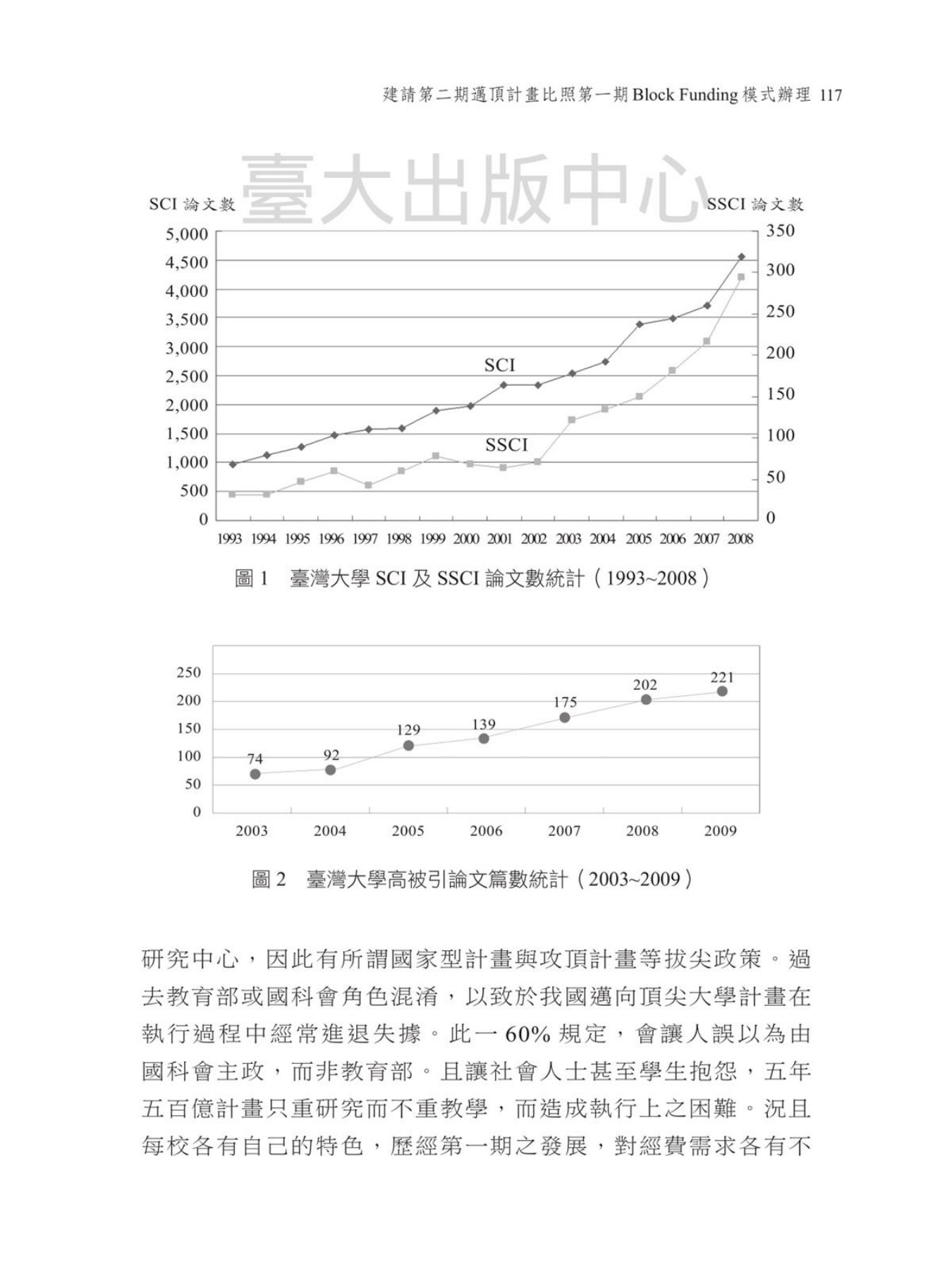
Figure 1. Statistics on SCI and SSCI Paper Counts at National Taiwan University (1993–2008)
The horizontal axis covers every year from 1993 through 2008. The left vertical axis is the SCI paper count, from 0 to 5,000 in increments of 500; the dark diamond-marked SCI series is read against this axis. The right vertical axis is the SSCI paper count, from 0 to 350 in increments of 50; the lighter square-marked SSCI series is read against this axis. The source prints no exact numeric labels at the individual points, so values should be read from the retained graph rather than reconstructed as exact numbers.
Figure 2. Statistics on Highly Cited Papers at National Taiwan University (2003–2009)
The source prints the following exact values: 2003—74; 2004—92; 2005—129; 2006—139; 2007—175; 2008—202; 2009—221. The vertical axis runs from 0 to 250 in increments of 50.
research centers—hence policies aimed at fostering preeminence such as the National-Level Programs and the Apex Programs. In the past, the roles of the Ministry of Education and the National Science Council were confused, causing our nation’s Aim for the Top University Plan to frequently lose its bearings during implementation. This 60% requirement could give the misleading impression that the program is led by the National Science Council rather than the Ministry of Education. It also leads members of the public and even students to complain that the Five-Year, NT$50 Billion Plan emphasizes research at the expense of teaching, thereby creating difficulties in implementation. Furthermore, each university has its own distinctive character; after going through the first phase of development, each has
different needs for funding. Arbitrarily restricting fund usage so that 60% must be applied to centers will constrain the development of each school’s distinctive strengths and undermine the meaning and spirit of university autonomy.
In sum, the first-phase Five-Year, NT50 Billion Plan carry forward the spirit of the first phase, prioritizing the construction of high-quality infrastructure as the main focus, supplemented by the establishment of research centers, and not adopting the Japanese research center model akin to the National Science Council’s Apex Program or National-Level Programs. We agree that the number of research centers may serve as one of the conditions for consideration in funding allocation, but a mandatory proportion for fund distribution should not be imposed.
(The original text was co-authored and jointly published by the author together with President Lai Ming-chao of National Cheng Kung University, President Chen Wen-tsuen of National Tsing Hua University, President Wu Chung-yu of National Chiao Tung University, and President Jiang Wei-ning of National Central University. Originally published in NTU Alumni Bimonthly, Issue 68, March 2010.)
Discussing the Substantive Legal Entity Status of National Universities
To respond to the impact of Taiwan’s accession to the World Trade Organization (WTO) and to enhance the competitiveness of our nation’s universities, the Ministry of Education began revising the University Act in 2000 (Year 89 of the Republic of China). The draft proposal included a special chapter on “Administrative Legal Entities for National Universities.” The primary rationale was that legal entity status offers the following advantages: it adjusts the relationship between the government and universities from one of hierarchical control to one of reciprocal rights and obligations under law; it loosens restrictions on university organization, personnel, and finance, thereby facilitating university management and enhancing academic standards and competitiveness.
Conversely, issues regarding appropriate oversight mechanisms, the rights of faculty and staff, and funding subsidies have arisen in succession, including: (1) Can the oversight mechanism guarantee academic freedom for universities? (2) How are the rights of current faculty and staff protected? (3) Is there a guarantee for government subsidy funds? In particular, concerns—and even backlash—have been raised regarding the requirement that more than half of board members be appointed by the Ministry of Education, which may interfere with academic freedom, and whether employees originally belonging to the civil service system can receive equivalent protection. Consequently, in the final revised University Act, the entire special chapter on administrative legal entities was deleted.
(1) Issues Regarding the Legal Entity Status of National Universities in Taiwan
The concept of granting legal entity status to national universities is based on the principle that autonomous university management is conducive to enhancing competitiveness. Countries around the world, such as Japan, Germany, and Thailand, have already implemented legal entity status for national universities, proving that this trend is inevitable. However, how should the problems faced by national universities in Taiwan regarding legal entity status be resolved?
Issue 1: Should individual universities be granted legal entity status through separate legislation, or should all undergo the transition simultaneously?
In 2005 (Year 94 of the Republic of China), the government attempted to include “Administrative Legal Entities for National Universities” in a special chapter of the University Act amendment and submitted it to the Legislative Yuan for deliberation, but it was deleted. In response, I have advocated for the enactment of a “Public Legal Entity Law for National Universities” to allow all national universities to transition simultaneously, thereby avoiding the arbitrariness and unfairness in government subsidies and oversight that would result from a dual system where some universities are legal entities and others are not.
Issue 2: Can the oversight mechanism guarantee academic freedom for universities?
Does the autonomous management authority of national university legal entities mean they are free from oversight? Since part of their funding still comes from government subsidies, public opinion expects the government to bear responsibility for oversight, while universities themselves worry about restrictions on academic freedom. Regarding supporting mechanisms for government oversight of universities, the United States has a long history of practice, and Japan’s implementation is relatively recent. At that time, we referenced the systems of these two countries and designed two sets of oversight mechanisms:
The first set is similar to the Japanese system, including: (1) Establishing an administrative council to decide on administrative affairs; (2) Establishing a university fund management committee responsible for raising, managing, and utilizing university funds. Since Taiwan’s university funds have been operational for many years, there should be no technical issues in implementation; (3) Changing the status of the university assembly to review university organizational regulations, university development plans, the dismissal or reappointment of the president, and teaching and research matters; (4) The Ministry of Education appoints two supervisors to participate in the administrative council.
The second set of mechanisms is designed as follows: (1) Establish a board of directors (and supervisors): The proportion of directors (and supervisors) appointed by the Ministry of Education is determined by the ratio of the average annual government subsidy to the university’s total annual expenditure over five years; the remaining members are recommended by the university. Directors (and supervisors) must meet strict requirements regarding academic qualifications and administrative experience; (2) The status of the university assembly is changed to review teaching and research matters; (3) The selection and reappointment of the university president follow the design of the current University Act, with a selection committee composed of internal faculty members, alumni, impartial social figures, and Ministry of Education representatives responsible for selection, subject to approval by the board of directors. Reappointment of the president is governed by the university’s organizational regulations.
Issue 3: How are the rights of current faculty and staff protected?
Legislation should protect the rights of current faculty and staff, continuing to apply the retirement and survivor benefits regulations for civil servants and teachers. Newly hired personnel would no longer hold civil servant or teacher status but would instead be engaged under contractual employment agreements, coordinated with the National Pension System or public insurance. Their salaries would be higher than those of current faculty and staff to compensate for the loss of future pension benefits. In this way, regardless of whether they are under the new or old system, all faculty and staff enjoy certain guaranteed rights.
Issue 4: Is there a guarantee for government subsidy funds? Can restrictions be loosened?
Even with the current civil service budget, funding is not guaranteed. To address potential reductions in subsidy funds, universities should be granted greater autonomy to raise resources, such as through flexible adjustments to tuition fees. Another question is whether finances can truly be loosened after national universities become legal entities. The answer is no, because government budgets—such as those for NTU, which account for approximately 40% of annual expenses—must still comply with government accounting systems.
The aforementioned four issues have been delayed for many years. If they cannot be resolved, they will severely impact the development of Taiwan’s universities, particularly the Top University Project. In fact, observing the actions taken by national universities in recent years toward legal entity status, I believe they already possess the connotation of “substantive legal entity status.” With further effort to truly loosen restrictions on organization, personnel, and accounting, all problems can be thoroughly resolved without the need for extensive legislative amendments.
(2) Substantive Legal Entity Status of National Universities
It was previously believed that for national universities to achieve legal entity status, it must have a legal basis requiring legislative passage to obtain formal legal entity status. However, the likelihood of another legislative amendment and passage is low. In reality, in recent years, Taiwan has actually been promoting legal entity status. By granting greater autonomy in organization, finance, and personnel, substantive legal entity status can be achieved without the need to enact new laws or amend existing ones.
Can university organizations be deregulated?
According to Article 14 of the current University Act, universities, based on academic autonomy, may establish various administrative units or convene various meetings. For example, if NTU wishes to establish a first-level unit, it only requires approval by the Administrative Council. However, Article 15 of the Enforcement Rules of the University Act stipulates that organizational levels are limited to no more than two tiers. Since the law explicitly grants authorization, yet the enforcement rules impose restrictions, this exceeds the authority of the parent law and should be deleted. It is recommended that the Ministry of Education (MOE) directly amend these rules to return to the provisions of the parent law, allowing the establishment of organizations to truly be autonomously determined by each university.
Can university personnel management be deregulated?
According to Article 14 of the University Act, national universities may hire staff under contract, and formal vacancies can be reserved and converted to contractual positions, providing flexibility in university hiring. Regarding personnel expenses, according to Article 9 of the Measures for the Management and Supervision of University Funds at National Universities, schools may use five types of self-raised income and tuition/fee revenue to cover allowances for in-quota teachers and researchers beyond their base salary (seniority-based salary) and additional pay, as well as personnel expenses for out-of-quota staff; the payment standards are determined by the school. However, the total monthly remuneration for administrative personnel who have performed effectively in managing such income-generating activities must not exceed 60% of their professional allowance. In short, while there has been significant deregulation in personnel appointment, the issue lies in the need to self-fund expenses. Therefore, it is recommended that all non-government appropriation revenues, such as those from examinations and event organization, be included in the five types of self-raised income to expand financial resources, thereby achieving complete deregulation.
Can university finances be deregulated?
University revenue sources mainly consist of two categories: public budgets and non-public budgets. Any funding derived from the government must comply with governmental accounting systems and cannot be deregulated; even formal corporatization would not change this, because these funds are taxpayers’ money, and the government bears supervisory responsibility. For example, when private universities receive government subsidies,
the use of such funds is similarly regulated. Therefore, deregulation must focus on self-raised funds. According to the Regulations Governing the Establishment of University Funds, the execution of the five types of self-raised income in university funds is not restricted by the Budget Act, Accounting Act, Final Accounts Act, Audit Act, and related laws, though they remain subject to MOE supervision. The fundamental solution is to expand the scope of self-raised income from non-government appropriations and significantly deregulate it; this constitutes substantive corporatization. This is conducive to university management and is key to enhancing academic standards and competitiveness.
(III) Recommendations for Amending the Regulations Governing the Establishment of University Funds
As mentioned above, public budgets should naturally follow relevant governmental accounting regulations. Non-public budget revenues, which are income generated by the school itself, should not be restricted by governmental accounting laws and regulations. Therefore, it is recommended to amend Article 6 of the Regulations Governing the Establishment of University Funds to broadly categorize revenue into government budget and non-government budget income. Among these, non-government budget income includes tuition/fees, continuing education, industry-academia cooperation, facility/equipment usage, donations received, investments, and other income. This is revenue obtained through the university’s own operations and should be authorized for autonomous use by the university to encourage the development of its own income sources.
Handling Non-Government Budget Revenue
Furthermore, regarding the handling of non-government budget revenue, universities should be permitted to invest in companies and enterprises related to university development and research, without being restricted by the provisions of the Budget Act, Accounting Act, Final Accounts Act, Audit Act, and related laws and regulations. Only then can true financial autonomy be realized. It is recommended to amend Article 7-1, Paragraph 3.
Establishment of University Endowment Funds
Based on universities with over a century of history abroad, which all have substantial long-term endowment funds (endowments)—for instance, the average endowment per student at the top five universities in the United States is nearly one million USD—these serve as the foundation for sustainable university development. Therefore, in addition to expanding own-source revenue and actual autonomous utilization, the MOE can encourage each university to establish an “Endowment Fund” under its university fund, with the goal of long-term investment income, using only the interest generated for operational needs. Therefore, it is recommended to amend Article 7-1, Paragraph 4. For endowment funds with a long-term investment nature, upon MOE approval, they should be exempt from the restriction that investment amounts must not exceed 10% of cash balances.
Handling Donation Revenue
University donation revenue is divided into cash donations and in-kind donations. In-kind donations are subject to the Minimum Tax Act, and if cash donations have designated purposes, they are restricted by the Government Procurement Act. Both factors reduce donors’ incentives to donate to national universities.
According to the Minimum Tax Act, individuals with annual income exceeding 6 million NTD must bear a minimum tax burden of 20%, and only cash donations can be deducted from taxable income; in-kind donations cannot be deducted. Major donors mostly donate company stocks. Under current regulations, they still must bear a 20% tax burden. If they sell stocks and donate the proceeds, public declaration is required. All these factors reduce donation incentives. Therefore, it is recommended to amend Article 10-1: Property donated to each university, except for property with attached obligations, may directly designate the recipient university as the managing agency and the MOE as the competent authority, exempting them from processing according to Article 37 of the State-Owned Property Act, and excluding the application of Paragraph 4, Article 12 of the Minimum Tax on Comprehensive Income Act.
Additionally, major domestic donations often involve donors constructing buildings themselves and then donating them in kind to universities, thereby avoiding Government Procurement Act regulations while achieving high efficiency and quality. However, after the implementation of the Minimum Tax Act, in-kind donations cannot be deducted from income, further reducing donation incentives. Therefore, the following legislative amendment is recommended: Procurement conducted by each university using donated cash shall not be restricted by the Government Procurement Act.
(IV) Conclusion
The corporatization of national universities in our country has been discussed for many years. Although legislation has not been enacted, the use of organization and personnel has already been deregulated. By making appropriate amendments to the Regulations Governing the Establishment of University Funds, expanding the scope of non-public budget revenue, and exempting it from restrictions under relevant governmental accounting laws and regulations, while encouraging universities to develop their own income sources, substantive corporatization can be achieved without being constrained by formal corporatization. This will not only dispel long-standing concerns that formal corporatization affects academic autonomy and employee rights but also avoid operational difficulties for schools weak in fundraising. Substantive corporatization can resolve the problem of the prolonged delay in corporatizing national universities in our country in one stroke.
(This article was originally published in Alumni Bi-monthly Magazine, Issue 69, May 2010 [ROC Year 99])
Enjoying Excellence, Achieving Excellence
Chairman Bruce Cheng, distinguished executives, students, parents, and alumni:
Hello everyone! Today is the annual commencement ceremony. From this day forward, you students will begin a new journey in life. On behalf of all faculty members and students across the university, I would like to congratulate you and wish you soaring success and a bright future. At the same time, I would like to take this opportunity to share a few words with you as expectations and reminders for your future endeavors.
During your orientation ceremony upon enrollment, I once congratulated you on being a “lucky” cohort. This is because the government’s initiative toward top-tier universities, known as the “Five-Year, Fifty-Billion New Taiwan Dollar Plan for Top-Tier Universities,” was officially launched one year before your enrollment and concluded this year (2010) upon your graduation. These were five golden years of abundant resources for National Taiwan University (NTU). Therefore, during your time at NTU, you have enjoyed a better and richer learning environment than that of your senior predecessors. You have had more refined general education courses, classic humanities programs, and specialized curricula; you have also benefited from improved dormitories and software/hardware facilities. You have had more opportunities to spend winter or summer vacations, a semester, or even a full year studying abroad at partner universities as exchange students or participating in service-learning programs. All of these provide you with broader and deeper possibilities for learning. I believe everyone has cherished and made the most of these golden years. I hope you will express your deepest gratitude to your parents who raised you, to the faculty members who taught you, and to the university and society at large for their care, support, and excellent environment. Last year, NTU did not fail the expectations of our nation by entering the top 100 universities worldwide, becoming a world-class institution. We also hope that the government will maintain this upward momentum without diminishing it, extending these five golden years into ten golden years.
Dear students, as members of NTU—a world-class university with the longest history in Taiwan, the most comprehensive development, always closely linked to Taiwan’s progress, and highly valued by Taiwanese society—you should aspire to become world-class outstanding talents. What constitutes a world-class outstanding talent? It is someone who makes active contributions to enhancing overall human happiness and solving problems facing human civilization, and who actively participates in the development of human knowledge and spirit. The challenges you will face in the future are global competitions coming from all corners of the world, transcending local boundaries. You will inevitably need a more international perspective, a forward-looking and open-minded attitude, as well as the ability to reflect and discern than any previous generation. In other words, after entering society, you must study even harder, including different languages, cultures, professional fields, and interdisciplinary knowledge, so that you may stand out in fierce competition and become world-class talents.
I believe everyone has realized that we are living in a “globalized” era of rapid technological advancement. The successive emergence of iPods, iPhones, iPads, cloud computing, and other innovations has led to the continuous development, use, and waste of resources. Such massive production activities have resulted in significant emissions of greenhouse gases over the past century, causing global climate change and frequent disasters. Human civilization is facing a crisis. Therefore, developing green energy and comprehensively conserving energy and reducing carbon emissions is also a responsibility for which you cannot shirk contributing your knowledge. This is precisely why we invited Chairman Bruce Cheng of Delta Electronics to deliver a speech today.
Dear students, future changes are unpredictable, and the responsibilities on your shoulders will inevitably deepen and intensify. However, the faculty members of your alma mater have full confidence in you, and your parents certainly do as well. Please carry our blessings and support, and move forward courageously! Strive to achieve your own success, bring honor to your parents, honor to your alma mater, honor to your country, and fulfill a rich and meaningful life. I also wish all faculty members and guests present good health and every success.
(This text is a speech delivered at the NTU Commencement Ceremony on June 5, 2010; originally published in NTU Alumni Bi-Monthly, Issue 70, July 2010)
NTU Top-Tier Alliance Academic Exchange Visit to the United Kingdom
At the invitation of the International Cooperation Division of the National Science Council, the Taipei Office of the British Council (British Council Taipei), and Universities UK (UUK), from July 12 to 20, 2010, Si-Chen Lee, in his capacity as Convener of the Strategic Alliance for Top-Tier Universities, along with the Vice Presidents for Research and Development from seven universities that received funding under the first phase of the Five-Year, Fifty-Billion New Taiwan Dollar Plan, visited seven prestigious institutions in the United Kingdom: the University of Bath, King’s College London, Imperial College London, University College London, the University of Glasgow, the University of Edinburgh, and the University of Southampton. In addition to drawing on the experiences of these universities in developing their strong fields, the delegation also sought more opportunities for research and development cooperation. During this trip, the delegation also paid courtesy calls to university management and funding agencies such as Research Councils UK (RCUK), Universities UK, the Royal Society, and the Higher Education Funding Council for England (HEFCE). On July 20, Si-Chen Lee co-hosted the “Taiwan-UK Research Cooperation Forum” with Professor Steve Smith, Chair of Universities UK and Vice-Chancellor of the University of Exeter. The forum attracted participation from vice-chancellors responsible for research and development from nearly thirty UK universities, yielding substantial benefits.
The delegation had three main objectives for this visit: (1) To gain an in-depth understanding of the facilities and advantages of academic research at UK universities, consolidating and developing opportunities for bilateral research cooperation and in-depth exchange between Taiwan and the UK; (2) To gain an in-depth
NTU Publishing
and research funding mechanisms; (3) to learn from the UK’s experience in applying for and promoting international research cooperation projects, particularly drawing on its successful participation in the European Union’s Framework Programme (FP). Fellow members of the delegation included Vice President Peng Yun-hong of National Taiwan University of Science and Technology, Director of Research Development Chu Yen-hsiang of National Central University, Director of Research Development Chen Chuan-mu of National Chung Hsing University, Director of Research Development Li Chen-yi of National Chiao Tung University, Director of Research Development Chao Sung-i of Chang Gung University, Dean Zeng Yong-hua of the College of Electrical Engineering and Computer Science at National Cheng Kung University, Director Chang Ching-jui and Deputy Researcher Tao Cheng-t’ung of the International Cooperation Division of the National Science Council, Director Lai Hsin-yuan and Deputy Director Chen Pei-i of the British Council Taipei Office, as well as our university’s own Director of Research Development Chen Chi-wang, and Head of the Planning Group of the Research Development Office Chen Chao-ts’en.
The United Kingdom has the largest number of Nobel laureates and possesses a superior tradition in academic research; one can glimpse this from the distinct research strengths of each of the seven universities visited during this trip. Our university has already established bilateral cooperation with some of these institutions. For instance, the University of Bath excels in pharmacology and engineering; its faculty, along with Professor Luo Chu-fang, Dean of our College of Life Sciences, intends to jointly investigate the causes of bee disappearance in the future. The University of Glasgow cooperates with Professor Lin Chi-wan of our Institute of Biomedical Engineering in areas such as parasites, hepatitis viruses, and cardiovascular research, and this collaboration has been included in the FP7 project (7th Framework Programme). Prof. Jeremy Bradshaw of the University of Edinburgh is currently collaborating with our Department of Animal Science and expresses willingness to engage in student exchanges and jointly participate in FP7 projects. Prof. Harvey Rutt, Dean of the Faculty of Electronics and Computer Science at the University of Southampton, already has a collaboration with Professor Tsai Ting-p’ing of our Department of Physics. The newly constructed nanoelectromechanical cleanroom at his university features novel equipment that can serve as a reference for the cleanroom to be installed in our newly built Excellence Building.
The United Kingdom is the country within the EU with the highest approval rate for FP7 projects, and observing their research plans reveals why this is so. For example, the University of Edinburgh’s research on ocean energy is worthy of study by Taiwan, which is situated amidst the oceans. Imperial College London’s research on metabolomics, biomedical engineering, biochips, and climate change addresses either current urgent environmental issues or fields closely related to the prominent discipline of biotechnology. Since these areas align quite well with NTU’s key research domains…
NTU Publishing
…I, Si-Chen, have specially invited scholars from relevant fields to come to Taiwan for exchange.
Vice President for Research and Development Prof. David Price of University College London also discussed the four major challenges humanity faces in the context of climate change: global health, sustainable cities, intercultural interactions, and human wellbeing. Prof. Mike Wilson, a project leader in the bacteriology field of FP7, expressed strong interest in visiting Taiwan; Si-Chen has invited him to come and provide guidance on the key points for writing FP7 proposals. Meanwhile, Professor Lu Mao-tzu, who teaches at the Faculty of Social Sciences at the University of Southampton, is a project leader in the humanities and social sciences field of FP7 and is also willing to cooperate with NTU.
In addition, the internationalization strategies and practices of University College London, and the industry-academia cooperation model of King’s College London, are both highly referential.
During this trip, we also visited several national-level research institutions, which have innovative approaches to research performance evaluation and funding mechanisms that are well worth referencing. For instance, the UK Research Councils advocate a bottom-up management approach to ensure academic freedom; the Higher Education Funding Council for England advocates that the amount of subsidy funds be closely related to the number of students at each university and their research performance; and the publishing department of the Royal Society of London introduced the types of journal articles published and their review principles.
This trip took a big step forward in Taiwan-UK academic exchange, particularly featuring in-depth exchanges in the fields of humanities, social sciences, agriculture, medicine, and engineering. Most precious was the discovery of many potential cooperative partners, opening up more new opportunities for collaboration; it can truly be said that the harvest was abundant.
(This article was originally published in Alumni Bi-Monthly, Issue 71, September 2010 [ROC Year 99])
NTU Publishing
Great Because of Dreams
Dear new NTU freshmen:
First of all, I welcome you in my capacity as the patriarch of NTU. Congratulations on passing through fierce competition to enter NTU and becoming members of the NTU community.
NTU is the best university among Chinese-speaking universities in mainland China, Hong Kong, Macau, and Taiwan. NTU has the best teachers and students, as well as the most diverse curriculum and the most open systems. Regarding how you should seize these golden years in the future, I offer you several suggestions: construct brand-new dreams, take initiative in learning, enrich your character and knowledge, and prepare to face the globalized knowledge economy era of the 21st century.
You have had many dreams since childhood, one of which may have been to attend the best university. This dream drove you to study hard, and now that this dream has come true, where is your next dream? How will you achieve it? During the summer of this year (ROC Year 99), a movie that sparked heated discussion was Inception. “Inception” means origin. The film describes how to use dreaming to implant ideas and concepts into people’s deep consciousness or subconsciousness, becoming the root of action and thereby bringing them to realization. Although it is just a movie, it indeed illustrates the power of thoughts. We often say, “Humanity is great because of dreams,” and this saying applies to individuals as well.
A few years ago, Dr. Morris Chang, Chairman of TSMC, also spoke to NTU students from this very podium. At the beginning, he asked a question: “Students, please raise your hand if you believe you will become leaders in your respective industries in the future.” When this question was posed, less than ten percent of NTU students raised their hands. He told everyone
Greatness Comes from Having Dreams
He went to the Massachusetts Institute of Technology and Stanford University to ask the same question, and about 80–90 percent of the students in the audience would raise their hands; they have dreams and confidence in themselves. When Chairman Morris Chang finished his speech and asked everyone to raise their hands again, I noticed that about 70–80 percent of the students raised their hands. People must have dreams; dreams become the root of your actions, driving you to strive. Today, as you build a new dream, your first dream has already been achieved. NTU provides diverse course content and humanistic landscapes, sufficient for you to gather materials to build your dreams. NTU also offers abundant knowledge and resources to enrich you and prepare you to realize your dreams.
You know that the 21st century is the era of a globalized knowledge economy. After graduation, whether you enter the workforce or pursue further studies, you will face global competition when entering enterprises. This is a global layout. How should you survive when facing different languages and cultures in the future? The rapid development and accumulation of knowledge cause the human world and economic structures to change rapidly and unpredictably. A few years ago it was iPods and iPhones, now it’s iPads; technology and content are changing and progressing rapidly, and business models are also changing very quickly. What you learn may become useless in three to five years. So how should you study? How should you face this? There is no other way but to proactively and broadly learn various foundational knowledge—such as biology, Chinese and foreign literature, history, and philosophy classics—and NTU provides good courses for everyone to lay a solid foundation. For example, there are Chinese language courses in the first year, and on the NTU website, there is a “Selected Readings of Literary Classics,” which offers various kinds of classics, including cultural classics, Confucian, Buddhist, and Daoist studies, as well as ancient and modern novels. Everyone can participate, and teaching assistants will guide you through the course. We also have the “Scholarly Thinking Journey” program, regularly inviting successful professionals, scholars, and entrepreneurs from society to give lectures. Listening to a few hours of a lecture might allow you to gain much from it. You must seize your own time. I hope you can proactively learn and understand, hold yourselves to high standards, so that when you expand into deeper academic research fields in the future, you will be able to handle things with ease; you need to establish basic
information capabilities, participate in clubs, learn experiences in interpersonal conduct, listen to various lectures provided by the university, such as “My Scholarly Thinking Journey,” absorb various experiences and wisdom, pay attention to moral cultivation, and strive to become a “well-rounded person” so that you will not fall behind, get lost, or even be eliminated in this ever-changing world.
NTU students must look outward more and cultivate an international perspective because the current world is globalized. Learn more about the cultures and languages of various countries, cultivate far-sighted thinking and strategies, so that whether in academic fields, industry, or government service in the future, you can foresee opportunities early, which is beneficial to both personal development and the nation as a whole. In the next four years, we will provide one-third of undergraduate students with the opportunity for short-term study at sister universities abroad before graduation. We also offer many domestic and international service-learning activities. You will have three semesters of service courses. Domestically, you might serve disadvantaged children or elderly people in remote areas; internationally, many countries or schools cooperate with NTU, allowing NTU-led service teams to go help residents in remote regions abroad. You have many opportunities, but these must be actively pursued by yourselves. You should enrich yourselves and feel how residents in disadvantaged or remote areas survive.
Of course, we know that many NTU students have probably been required since childhood to be “number one” in everything. Understand that this “number one” was only created within a small class or school. Your “number one” status might be easily replaced once you enter society. Please remember to adopt a blue ocean strategy; in thinking and concepts, maintain a spirit of questioning and innovation. Do not just be followers; only self-characteristics and innovation are the most critical factors for enhancing future development. In this regard, the university also provides a Creative Entrepreneurship Program. We cooperate with Stanford University; their design school is offering courses at NTU these past few weeks, providing design courses. These are not required courses, so interested students should seize this opportunity and not miss it.
Dear new NTU freshmen, you have already stepped into a hall of knowledge. Please do not
let your dreams get lost in the clamor of society. Persist to the end, and you will ultimately realize your dreams. Note that you have already realized your dream by entering the best university.
(This article is the speech delivered at the NTU Freshman Entrance Ceremony on September 8, 2010 (ROC Year 99); originally published in Alumni Bi-monthly, Issue 72, November 2010 (ROC Year 99))
Joining Hands to Pursue Excellence
Dear distinguished guests, alumni, faculty members, and students:
Today marks the 82nd anniversary of the founding of National Taiwan University. All NTU community members are filled with joy in welcoming this day of particular historical significance. Over the past five years, with the support of the Ministry of Education’s “Top University Project,” NTU is experiencing its most rapid period of development in history. We have comprehensively launched renovations and upgrades to both software and hardware infrastructure. The results include not only a significant improvement in the quality of research but also substantial enhancements in teaching quality, student counseling and services, leadership education, and creative education. Various forms of exchange and cooperation between our university and major universities worldwide have also increased significantly. We now have 361 sister universities across 51 countries, 37 dual-degree programs, and 3,000 international students. Furthermore, we plan that within the next three to five years, one-third of undergraduate students will have the opportunity to study abroad at a sister university for an exchange program during their four-year university career.
In last year’s “World University Rankings” published by the UK’s Times Higher Education Supplement, our university ranked 95th globally, entering the world top 100 for the first time. This represents a major step forward toward the goal of becoming a world-class university and achieves the initial objectives of the government’s Top University Project. Additionally, in the World University Rankings conducted by Shanghai Jiao Tong University, our ranking improved from 181st to 127th between 2006 (ROC Year 95) and this year (2010, ROC Year 99). We rank first among Chinese universities across the Mainland, Hong Kong, Macau, and Taiwan. For the first time, we have surpassed the National University of Singapore’s rank of 145th, once again leading Seoul National University’s rank of 148th, placing us within the top 10 in Asia.
Next year (2011, ROC Year 100), the second phase of the Top University Project will commence. Our university will focus on five major axes of concern: cultural elevation and inheritance; deep cultivation of basic academics;
construction of sustainable social development; development of the knowledge economy and technology industries; and healthcare and lifestyle. We will adopt five strategies and various measures—“Excellence in Education and Diverse Learning,” “Recruitment of High-Quality Talent,” “Strengthening Infrastructure and Software/Hardware Environment,” “Excellent and Forward-Looking Research,” and “Expansion of International Cooperation”—to build a high-quality campus for teaching and research by faculty and students. Taking the University of Illinois at Urbana-Champaign (UIUC) in the United States as our benchmark, and aligning with the government’s six emerging industries, we have planned ten top-tier research centers, with the goal of entering the world top 50.
In terms of expanding international cooperation, we will establish a strategic alliance with the Massachusetts Institute of Technology (MIT) in the United States to launch academic collaborations across various fields. We are also actively inviting renowned foreign companies, such as Intel and IBM, to establish R&D centers on campus, and encouraging faculty members to participate in collaborative research with famous universities in European Union countries (such as FP7 or FP8). With the opening of policies allowing students from the Mainland to study in Taiwan, we have signed a strategic alliance with Peking University to cooperatively cultivate outstanding students from both sides of the strait into social leadership elites.
The ten top-tier centers particularly consider important issues regarding sustainable social development. For example, the “Center for Climate Change and Sustainable Development” addresses disaster prevention, greenhouse gas reduction, and new energy development problems triggered by global climate change; the “Center for Health Sciences and Lifestyle” formulates healthcare systems and technologies needed for the advent of an aging society and the era of preventive medicine.
Today, we are specially conferring honorary doctorate degrees upon Mr. Hu Fu; and presenting Outstanding Alumni Awards to nine gentlemen: Mr. Yang Tzu-pao, Meng Huai-ying, Mr. Tsao Hsing-cheng, Mr. Hsu Chao-hui, Mr. Lu Chi-yuan, Mr. Tsai Hung-tu, Mr. Cheng Yu, Mr. Chien Fu, and Ms. Yu Yu-mei. We hereby express our highest respect for Mr. Hu Fu’s significant contributions in establishing the international status of empirical research in political science in Taiwan and setting a paradigm for intellectuals caring for society, as well as for the outstanding achievements of these distinguished alumni in academia, industry and commerce, social service, and national construction. At the same time, through their exemplary models, we wish to highlight once again the core values that NTU has always upheld—the spirit of our university motto: “Cultivate Moral Character, Encourage Learning, Love Country, Love People.” On this occasion of celebrating
the 82nd anniversary of NTU’s founding, NTU community members should join hands more closely, exert the power to pursue excellence, and make the greatest contribution to the self-renewal of Taiwan and humanity.
Finally, let us jointly congratulate NTU on its birthday, and wish all distinguished guests, faculty members, and students good health and success in all endeavors. Thank you all!
(This article is the speech delivered at the 82nd Anniversary Celebration Ceremony of National Taiwan University, November 15, 2010 [ROC Year 99]; originally published in Alumni Bi-Monthly Magazine, Issue 73, January 2011 [ROC Year 100])
New Challenges for University Education in the 21st Century
On February 11, 2011 (ROC Year 100), at the academic lecture commemorating the 103rd birth anniversary of the late President Qian Siliang, Dean Huang Jun-jie of our Institute of Humanities and Social Sciences delivered a keynote speech titled “New Challenges for University Education in the 21st Century—With Discussion on NTU Spirit and Mr. Qian Siliang.” This article is a compilation of my ten-minute commentary following the lecture.
Dean Huang conducted an in-depth analysis and critique of two major trends in the 21st century: globalization and the knowledge economy era, and raised the core problems faced by university education under the impact of these two trends. First, Dean Huang analyzed the appearance and substance of globalization. On the surface, globalization produces a borderless world, such as the European Union and ASEAN, with deep interconnections leading to the end of nation-states. In substance, however, it endorses global hegemony (primarily that of the United States), strengthens domination over peripheral nations, leads to the arrival of an M-shaped society, and widens the gap between rich and poor. When applied to universities in Asia, globalization results in academic self-colonization and comprehensive Englishification, causing a decline in the cultural subjectivity of university education.
Next, Dean Huang analyzed the knowledge economy. Historically, the key factors of economic production have changed with the times: in the agricultural economy era, “land” was the factor of production; in the industrial economy era, “capital” was the factor of production; in the knowledge economy era, “knowledge” is the factor of production. Universities are institutions with the highest density of knowledge and naturally become bases for industrial development and entrepreneurship. Therefore, the four core problems facing higher education are:
- Is the university a national educational institution or an R&D unit within the global capitalist system?
- Is the university a production factory for reserve forces of multinational corporations and the bourgeoisie, or is it the social conscience that critiques injustice?
- Is university education for individual competitiveness or for social well-being?
- Is the university a guardian of national culture or a member of the global knowledge community?
I believe that to answer these questions, we must first look to the history of university development. The Academy (Academy) established by Socrates, Plato, and Aristotle in Athens, Greece, 2,400 years ago was the ancient university of Europe, focusing on the exploration of philosophical, humanities, social, and scientific knowledge. Ancient China also had the establishment of academies (Shuyuan), equivalent to modern universities. For example, Bailudong, Yuelu, Suiyang, and Shigu are collectively known as the Four Great Academies of the World, focusing on character cultivation and the inheritance of knowledge and culture. Among them, White Deer Grotto Academy is located at the southern foot of the Five Old Men Peaks of Mount Lu (now part of Jiujiang, Jiangxi) and enjoys the reputation of being “the foremost academy under Heaven.” Founded during the Shengyuan era of the Southern Tang dynasty (940), it was China’s first fully equipped academy and also the only national academy in Chinese history established by the central government outside the capital.
The rise of Western modern universities began with the establishment of Al-Azhar University in Cairo, Egypt, in 970 or 972 AD, studying Islamic literature and religion. This was followed by the establishment of the first university in Europe—the University of Bologna—in Italy in 1088, the University of Paris in France in 1150, the University of Oxford in the United Kingdom in 1167, and the University of Cambridge in 1209.
During this medieval period, the main task of universities was primarily education, bearing the responsibility of inheriting knowledge and culture, with religious courses occupying a considerable proportion. After the Renaissance, the development of humanities, arts, sciences, and technology advanced rapidly. In the 18th and 19th centuries, research entered universities, leading to the emergence of research-oriented universities. Besides teaching, research became one of the functions of research-oriented universities. In the 19th and 20th centuries, more and more universities were established by governments, and universities took on social responsibilities, including services (such as extension education and consultation on social problems).
The 21st century is the era of the knowledge economy, where knowledge has become a key element of production. Universities are the most knowledge-dense fields and have gradually taken on the responsibility of industrial development. For example: Yahoo originated from a website established in 1994 by David Filo and Jerry Yang, doctoral students in the Department of Electrical Engineering at Stanford University in the United States; Google originated from a search engine completed in 1996 by Larry Page and Sergey Brin, doctoral students in the Department of Information Science at Stanford University, in the basement of the department building; in 2004, Harvard sophomore Mark Zuckerberg set up the Facebook website with several classmates in their dormitory. Six years later, Facebook became the world’s most successful social networking site, with a market value of $63 billion. Professor Meng Huaiying of the Department of Electrical Engineering at Stanford University took a leave of absence from Stanford University in 1998 to found Atheros Communications, which was very successful and ranked among the top 20 promising startups in the United States. Therefore, in the 21st century, entrepreneurship will inevitably become one of the functions of universities, which can be seen as an expansion of the “service” function.
My view is that universities have remained centered on education for a millennium without change. With the evolution of times, new functions have been gradually added. The addition of research functions in the 18th century did not change its main task of cultivating talent. Similarly, the future addition of entrepreneurial functions will certainly not change its primary mission of cultivating talent. It will still prioritize social well-being, although the burden on faculty members will become increasingly heavy. Of course, in the era of globalization, the talent cultivated is no longer limited to local talent but expands to global talent.
Regarding globalization, Asian universities tend toward Englishization, with courses largely switching to English instruction to attract international students. However, this is detrimental to the inheritance of national culture and the deepening of general education and foundational courses. For Taiwanese universities, with the rise of mainland China and the global Mandarin fever, the connotation of globalization has undergone subtle changes. The attractiveness to international students lies not in all-English courses, but in an environment with decent standards, appropriate English courses, and opportunities to learn Chinese. Otherwise, they would
likely choose to attend universities ranked within the top 500 in Europe and America. Therefore, NTU’s policy of expanding enrollment of foreign students should adopt different strategies for undergraduate and graduate students. For undergraduates, who have four years, appropriate Chinese language courses should be provided in the first two years according to the students’ Chinese proficiency levels, while some common and general education English courses should be offered for them to take. From the third year onward, they should mainly study Chinese courses. Since master’s graduate students have a short duration and fewer courses, it is very difficult to attract students with no background in Chinese; therefore, there must be all-English programs. I believe that supporting Chinese and English language courses will be a powerful tool for expanding international student enrollment in the future. Finally, thank you all for attending. I wish you good health and success in all your endeavors.
(This article was originally published in Alumni Bi-monthly Magazine, Issue 74, March 2011)
To Do Some Things, and to Refrain from Others
Former President of the Judicial Yuan Lai Ying-chao, fellow administrators, students, parents, and alumni:
Greetings! Today marks the annual commencement ceremony. From this day forward, you students will embark on a new journey. Some will continue their studies to pursue higher learning; others will leave school to enter the workforce. In twenty or thirty years, many of you will become elites and leaders in various industries. Your perceptions and attitudes will influence our nation’s development and future. On this occasion, I wish to share a few words with you as expectations and admonitions.
I must congratulate you on being a rather “fortunate” graduating class. This is because the government’s initiative to build Taiwan’s higher education brand—the so-called “Five-Year, Five-Hundred-Billion New Taiwanese Dollars Plan for Top-Tier Universities”—was officially launched two years before your enrollment. These have been five years of abundant resources for NTU, enabling the university not only to avoid falling behind in the global wave of higher education internationalization but also to enter the top 100 universities worldwide. Therefore, during your time at NTU, you have enjoyed a more favorable and rich learning environment than that of your seniors. You have had more substantial and refined general education courses, humanities classics curricula, more solid professional courses, and even “Creative Entrepreneurship Curricula,” as well as better software and hardware facilities. You have had more opportunities to study abroad at sister universities as exchange students or for service-learning purposes. All these provide you with broader, deeper, and more internationalized learning possibilities, and offer some preparation for those interested in entrepreneurship. I believe everyone has cherished these opportunities well. I hope you can maintain a heart of gratitude—thanking your parents who raised you, your teachers who instructed you, and the school and society for providing you with an excellent environment and supportive care.
At your freshman orientation ceremony, I once reminded you that as NTU students, you must adhere to the “Four Don’ts” and the “Four Musts”—that is, four things you should not do and four learning directions you should pay attention to. This is simply to encourage you to make good use of your time in school, focusing on character, cultivating general knowledge, innovative abilities, and concern for sustainable social development. I also hope that after entering society, you will maintain this attitude—to “do some things” and “refrain from others.” The workplace is an unfamiliar environment for students; “professional competence” and “work attitude” are the two most valued capabilities in the workplace. NTU graduates have no problem with professional competence, but their work attitude needs improvement. Regarding issues of work attitude, last week I sent a letter to all graduating students with fourteen suggestions. I received many letters of thanks from students, as well as letters of questioning. This reflects that students hold different attitudes toward problems. But please remember: “Attitude determines altitude,” and “Altitude determines vision.”
Today we have invited former President of the Judicial Yuan Professor Lai Ying-chao to deliver a speech. He graduated from the Provincial Yilan Agricultural High School, and through continuous effort, later obtained a Bachelor of Laws degree from the night division of the Taipei branch of Chung Hsing University (now National Chung Hsing University), a Master’s degree in Law from NTU, and a Doctor of Jurisprudence degree from Harvard Law School in the United States. He served in the fiscal, administrative, and judicial departments, eventually rising to become a Justice of the Constitutional Court and President of the Judicial Yuan. His life contains many struggles that can serve as references for you students.
Finally, during this season when phoenix flowers bloom, on behalf of all teachers and students, I wish you a bright future, may you bring honor to your parents and to your alma mater, and may your lives be as brilliant as the phoenix flowers. I also wish good health and all the best to all teachers, guests, and distinguished visitors present.
(This text is from the speech at the NTU Commencement Ceremony on June 13, 2011 [ROC Year 100]; originally published in Alumni Bimonthly Magazine, Issue 76, July 2011 [ROC Year 100])
What is the meaning of life? What is happiness?
We live in a society that is blind to reason yet indulgent in emotion. During the Asian Games, in the incident involving Yang Shu-chun, we saw the public refusing to buy Korean goods, boycotting, and even threatening Korean residents in Taiwan, including Korean international students at NTU who were also threatened. This is entirely an emotionally indulgent society. In the semester prior to this, a conflict occurred between local students and a foreign exchange student. That very night, dozens of students went on sit-in protest, listening only to one side of the story without hearing the other. This is all because we lack profound thinking; we often act according to emotion and sensation. However, as citizens of a rational society, we should exhibit rational behavior.
NTU students will not only become good citizens in this society but also leaders. The quality of a leader lies in the ability to think deeply about problems and solve them. Therefore, the university has long attempted to promote a culture of philosophical thinking within the College of Arts. Perhaps this “NTU Student Philosophy Laurel Award” can serve as a wedge to guide students in their thinking. Thinking is not limited to questions of life; many social issues are also related to each of you.
Let me give two examples regarding university admission methods. The first example is the well-known “Starry Sky Admission Scheme.” After the first stage, the Academic Proficiency Test, concludes, as long as your scores meet the threshold for a certain department, the second stage depends entirely on your high school grade ranking and percentage. For all schools, including Jianzhong High School and other high schools in remote areas, the value is the same. It compares only percentages; whoever has a higher percentage wins and enters that department. Therefore, the second stage looks entirely at the applicant’s ranking in high school. Why is it done this way?
Case One
People in rural areas also go to cities to find jobs, causing rural areas to gradually fall behind and become undesirable places to live. This is detrimental to a nation’s development. Therefore, the government should encourage young people or those from the middle-to-upper classes to reside in rural areas, bringing their children with them. Consequently, children in rural areas must also have opportunities to enter prestigious universities, such as NTU, without having to come to cities to compete. Based on this rationale, some argue that the “Starlight” (Fanxing) admission scheme should exclude elite high schools—such as Taipei Municipal JianGuo High School, National Taiwan Normal University Affiliated High School, Taipei Municipal First Girls’ High School, Zhongshan Girls’ High School, Taichung Municipal First Senior High School, Tainan Municipal First Senior High School, and Kaohsiung Municipal Kaohsiung High School—to align with the concept of balancing urban-rural disparities. Is this approach consistent with fairness and justice? What do you think?
The second example refers to the recommendation-based selection examinations prior to the current system. These recommendation exams typically include a second stage: an oral interview requiring preparation of materials, ideally including past research participation or even research activity data from the Academia Sinica, where professors sit and examine you. Some argue this is unfair, especially for students coming from rural areas, because those in cities have good environments and many opportunities to prepare presentation materials, undergo speech training, and even access nearby universities to seek out professors and conduct research with them; thus, it is deemed unfair.
I do not believe that is the case. If you support or oppose both of these issues, think carefully: you may be committing a logical contradiction or being inconsistent. Many people might think, “I got into university based on my ability and my learning; what does it have to do with where I live? What does it matter whether my family has money or influence!” My learning and effort mean I should receive good opportunities and enter a good university. However, others argue that the environment plays a very important role. If you are in a good place and a good family, receiving excellent education from childhood, unlike children from poorer families who need to help with housework or work part-time to earn money. Moreover, cities have many cultural activities, and residents can conveniently enjoy these things. Even if aptitudes are similar, a better environment makes you more outstanding; in other words, the environment plays such a role, not just your individual effort.
Therefore, if environmental factors are not considered, this higher education admission system is not a
fair and just admission system. What is fairness? What is justice? These are matters that require personal reflection and judgment. Have you examined the roots of such thoughts?
The next question arises: Can universities deprive students of admission opportunities based on their own missions? Sometimes, to help improve urban-rural disparities and make the country develop better, the Starlight admission scheme restricts elite high schools from participating. Is this fair? Is it just? Who says schools can use these missions as reasons to deprive them of admission opportunities?
Another question emerges: If a school has such regulations and they are legally permitted, does that mean they are fair and just? Some say public schools, because they receive state funds, must cooperate with national policies. But why must you comply simply because it is a national policy? Conversely, private schools receive less state funding, so can they make decisions based on their own educational philosophies? These questions emerge wave after wave. Think carefully: when you encounter problems and need to examine them, what is the basis of your argument? Is it correct? Is it really so? Have you engaged in critical thinking? Have there been continuous debates? Can your imagined assumptions truly exclude other possibilities? From another perspective, what must be met to exclude alternatives? The deeper you think, the more questions will appear one by one. This is the society we face.
As a leader facing such a society and acting as a rational citizen, one must delve deeply into these issues. For example, tuition fees at private schools are twice those at public schools. Due to fewer government resources, they must rely on tuition to cover budget shortfalls, whereas public students can pay relatively lower tuition due to government subsidies. But the problem is that public schools, because they receive government subsidies, may have better quality, while this is not necessarily true for private schools. However, private schools, constrained by resources, already struggle to compete with public schools, yet students must pay higher tuition and receive poorer treatment; conversely, public school students pay lower tuition and receive better treatment and teaching standards
…and so on. Thinking further, among those who enter public schools, especially NTU, the majority come from middle-to-upper-class family backgrounds. Because their family environments are good and they have studied smoothly since childhood without needing to support the household financially, they have ample time to study and can easily demonstrate their talents. According to statistics, many students entering private universities come from poorer families with fewer opportunities and less time, so they cannot pass the exams for public universities, yet they must bear higher tuition fees. Is this fair? Is it just? What exactly should we do? How should the tuition system be reformed, and how should it be implemented? These are all problems we must face.
To solve these problems, philosophy plays an important role by cultivating your critical thinking skills, pursuing each question step by step, reflecting inwardly: Why do you have such thoughts? Where is the foundation of your argument? What exactly are you saying? Is this correct? Is this consistent with fairness and justice? You must often ask yourself these questions and then seek possible answers. Therefore, we hope that at least at NTU, we can cultivate such an atmosphere where students do not merely jump to conclusions upon seeing things based on pure sensory reactions, but instead delve deeply into thinking about problems. This is just what you are encountering now; in the future, there will be even more, emerging one by one. This is the important purpose of our hosting the “NTU Student Philosophy Laureate Award”: to get everyone started thinking about problems, learning how to think, how to think independently, and finding ways to do things, rather than listening to my answers.
The meaning of life is a system of values gradually established through life experiences. I can only tell you how I began to think about the questions of life’s value and meaning; this is a process, shared with you for reference. However, what the meaning of life is requires you to find your own answer, because everyone is different, and each person has their own life journey and personal insights.
How did I begin trying to understand this question? When I was young and studying in school, two spiritual slogans were hung on both sides of the school auditorium. They are no longer there, but in our era, it was an age that required slogans. Usually, the one on the right read, “The meaning of life lies in creating the continuing life of the universe,” and the other side read, “The purpose of liv-
ing.” Upon reflection, it seemed plausible. A person is born, grows up, and begins school to study the knowledge of living and survival. After graduating from university, or perhaps pursuing a master’s or doctoral degree, one finds a job to sustain economic survival, then marries and has children, and finally enters the grave, with the next generation repeating the same cycle. Life proceeds in this manner; the meaning of life lies in creating the continuing life of the universe, and thus it goes on. As for the purpose of living? It is improvement—continuous betterment. Since the times are progressing, it is about enhancing human life. This also seems correct! In 1986, I returned from the United States to Taiwan to serve as an associate professor in our Department of Electrical Engineering. What happened in 1986? Halley’s Comet returned. Halley’s Comet has a period of seventy-six years. When it returned in 1986, from 1985 to 1986—a span of more than a full year—it traveled around the sun and back. This was a rare opportunity occurring once every seventy-six years, so I purchased a ten-inch reflecting telescope. Every night, I went to the fifth-floor balcony of our apartment building to observe Halley’s Comet, locating it among the stars of Sagittarius. Our understanding is that it completes one orbit every seventy-six years; having traveled for over two thousand years, it has completed roughly thirty or forty orbits. It is a dirty snowball—a comet composed of accumulated ice and dust—so each time it passes the sun, a portion evaporates. It is estimated that after another thirty or forty orbits, Halley’s Comet will be completely evaporated. This was an astronomical scientific fact I already knew. Similarly, Halley’s Comet will disappear, and one day, the sun too will vanish. The sun is currently between 4.6 and 5 billion years old, in its middle age; in another 5 billion years, it will be gone—either exploding as a red giant or becoming a white dwarf or brown dwarf before dying. If the sun disappears, Earth cannot exist either, because all life on Earth derives from the sun. Thinking about this, I was suddenly struck with awe. Earlier, it was said that the meaning of life lies in creating the continuing life of the universe. Does this mean we should hasten technological progress? Since 5 billion years is still a long time, humanity has time to migrate to the outer solar system. But does the universe contain life? Will it end? This is alarming; perhaps the universe itself will come to an end. It may expand continuously and infinitely. As it expands endlessly, the matter density within a unit volume becomes increasingly sparse, making nuclear reactions impossible
to ignite; they will extinguish. All energy reactions will cease as fuel is exhausted, and life will no longer exist. If the universe were to contract again, eventually compressing back to a single starting point, it would return to its original state, and the universe too would cease to be.
If even the universe might disappear, then the statement that “the meaning of life lies in creating the continuing life of the universe” is incorrect! According to our scientific knowledge, life will one day vanish. Asking myself: if life will disappear, what is the meaning of my living now? I had believed that lineage could be passed down indefinitely, but science tells us this is not true; one day it will disappear and return to primordial origins. This was a thunderclap of realization for me! We have always believed in this matter, yet it may not be factual—that life will indeed end someday. From that moment on, I became interested in the question of life.
How did life on Earth originate? When you read about evolution theory, how did the first DNA arise? How did RNA come to be? How did the first life form emerge? How did the first single-celled organism appear? How did the first multicellular organism develop? How exactly did life evolve? I extensively read related books, including those on Earth’s development and the evolution of life’s most primitive forms, developing a profound interest in life. One day in 1988, while in my office, I suddenly received a phone call from the Deputy Director-General of the National Science Council (NSC). He later served as president of National Chiao Tung University (NCTU). He asked, “Are you interested in researching qigong?” As a professor in the Department of Electrical Engineering, what did I have to do with qigong? I didn’t even know what qigong was; I had only seen it depicted in martial arts novels, where characters performed palm techniques that flew through the air with devastating power. However, I was prepared because I was interested in life, and anything related to life intrigued me. When I received that call, an ordinary person might have said, “Oh, I’m not interested,” and hung up. But I said, “Sure!” Just those few words. Now, more than twenty years later, looking back, it was simply that one word: Yes. That single response entirely changed my subsequent career path, suddenly plunging me into a field others termed “superstition and mysticism,” researching qigong right up to the present day.
During the research process, I began to encounter religion and numerous other matters, and then
I began to truly understand what the meaning of life actually is. So, everyone, in your lifetime, there will be many critical junctures and many points of serendipity that will cause you to begin to feel interested in this topic. Fortunately, National Taiwan University now has the “Research, Development, and Incubation Center for Life Education,” which can research, explore, and disseminate such a field. You can have some contact with it during your university years, rather than having to wait until you are thirty-eight years old, like I did, to suddenly begin to understand.
Life is a process because it will ultimately cease to exist; its meaning must be gradually experienced within that process. This is a lifelong lesson. Through this experience, you will slowly come to understand the meaning of life. The key lies in the fact that as your exposure to the various aspects of life broadens, you will slowly begin to sense the meaning of life. You must go out and search for it, engage in your own critical thinking, and become aware of it yourself. This is an important process. Only through this process can it truly deepen and be engraved in your soul—that is the real thing. No matter how much others tell you, you will forget it as soon as you hear it, or let it pass by without reflection.
Next, let us discuss what happiness is? Happiness is an overall feeling regarding one’s entire state of living. This feeling will change as your age and your experiences change. I can only say that at my age of sixty, I feel that the key root of happiness lies in the family, not in having a lot of money or achieving high accomplishments. If you have a lot of money, you might sit in your office not wanting to go home, feeling that home is a hell, and feeling no happiness at all. So the key lies in the family. I particularly emphasize this is at my age; everyone will have different feelings about happiness at different ages. Director Sun Hsiao-chih of NTU’s “Research, Development, and Incubation Center for Life Education” is about the same age as me, so perhaps he shares similar experiences.
Fortunately, twenty years ago I said “Yes,” which introduced me into the related field, allowed me to witness many things, and enabled me to begin to understand the roots of religion, helping me understand many things. I do not have a religious faith, but my understanding of the universe is not much different from the understanding of religion. If you find a belief that supports your own soul, you do not necessarily need religion. I can say this is my good fortune, because
I conducted these studies, which allowed me to enter very deep levels, gaining a more profound understanding of life, existence, reality, and the reality of the universe, and also allowing me to better understand religion.
This is serendipity. In the process, I made one or several choices. Life is about causes and conditions; conditions arise and conditions cease. One opportunity comes, another goes; many pass by without being seized. So when an opportunity comes, whether you can seize it is related to your philosophy. How do you view life? Is this what I want? It will change your life, leading you down another path. Therefore, I repeatedly emphasize how fortunate I am. I have written three books. If you have read them, you will know what I am talking about, and you will know about religion.
Many people do not have a religious faith. In Taiwan, there are more Buddhists, and the number of Christians is relatively smaller. Most people engage in folk religious practices, which cannot be considered true religion. Regarding religion, if it truly helps me, then I will believe in it. In any case, you must engage in your own critical thinking and examine yourself. Everything depends on yourself.
(This article is the keynote speech for the “First NTU Student Philosophy Laureate Award,” delivered on March 8, 2011 [ROC Year 100]; originally published in Alumni Bi-Monthly, Issue 77, September 2011 [ROC Year 100])
The Ten Basic Qualities of an NTU Person
Dear NTU Freshmen:
First, I welcome you in my capacity as the head of the NTU family. Congratulations on passing through fierce competition to enter NTU and become NTU people. Seeing your youthful faces and bright smiles is as if I see myself forty-one years ago. I also clearly see the endless flow of fresh water at NTU and its inexhaustible vitality, filling my heart with infinite joy.
NTU is the best university among Chinese-speaking universities in the Mainland, Taiwan, Hong Kong, and Macau, and it is the only university in Taiwan to enter the world’s top 100. NTU has the best teachers and students, as well as the most diverse curriculum and the most open systems. How should you seize these golden years in the coming four years? What kind of substance should it have to be worthy of the name? What is an “NTU Person”? What kind of qualities must an “NTU Person” possess to meet the expectations of society and the nation? At the opening ceremony of your “Freshman Learning College,” I proposed the ten basic qualities that NTU people should possess. I categorized them according to NTU’s motto, “Cultivate Character, Diligently Study, Love Country, Love People.” This ranges from “Cultivate Character,” which involves enhancing personal quality, taste, and physical and mental health, to “Diligently Study,” which involves strengthening professional and general knowledge and skills, and cultivating independent and innovative thinking, and finally to “Love Country, Love People,” which prioritizes the community. This includes humanistic care, fulfilling civic responsibilities, respecting diverse cultures, teamwork, and expanding international horizons to explain the ten basic qualities.
To cultivate these basic qualities, the university provides abundant resources, including diverse arts and humanities activities, selected readings of classics in literature, history, and philosophy, 25 foreign languages, over 300 student clubs, more than 30 interdisciplinary programs, opportunities for volunteer service learning at home and abroad during winter and summer vacations, and opportunities for one-third of undergraduate students to study short-term programs at sister universities abroad before graduation. I hope everyone will make good use of these opportunities, take the initiative to compete for them, and actively participate.
Dear NTU freshmen, you have stepped into a hall of knowledge. Make a promise to yourself to dream, put it into action, take the initiative to learn, and temper yourself. You will eventually become a true NTU person. Finally, I wish you a rich and colorful university life!
(This article is the speech delivered at the NTU Freshman Entrance Ceremony on September 7, 2011 [ROC Year 100]; originally published in Alumni Bi-Monthly, Issue 78, November 2011 [ROC Year 100])
Elevating Our Perspective, Advancing Toward the Top—From Followers to Leaders
Distinguished guests, alumni, faculty members, and students:
Today marks the 83rd anniversary of the founding of National Taiwan University. All NTU community members are filled with joy in welcoming this day of special historical significance. This year’s (Republic of China Year 100) anniversary celebration is particularly worthy of congratulations because in April, our university received funding for the second phase of the Ministry of Education’s “Top University Project.” The budget is slightly higher than that of the first phase. Our standing in the global academic community continues to rise; not only has the quality and quantity of research improved significantly, but substantial improvements have also been made in teaching quality, general education, service, leadership and creative education, student counseling, industry-academia collaboration, and technology transfer. This demonstrates that the concept we have upheld over the past five years—“balanced development, breakthroughs in key areas, and expanded international academic exchange”—has achieved remarkable results with the support of the Top University Project and the efforts of all faculty and students.
In the second phase of the Top University Project, in addition to sustaining the momentum accumulated in the past, we have made fundamental changes in our strategic thinking. In research, our innovative approach is to partner with top international companies or leading research institutions through organization-to-organization collaboration. In March this year, Intel, the world’s largest semiconductor company, jointly established the “Intel–NTU Innovation Research Center” with our College of Electrical Engineering and Computer Science to develop M2M (machine-to-machine) technology. In the past, we always played the role of followers, keeping pace with foreign developments; whatever others did, we followed suit with a “me too” attitude. In the future, in M2M technology, we will lead the direction of technological development for the next ten years, transforming from followers into leaders—a shift toward “follow me.” This represents an elevation in our vision and perspective. Our College of Medicine is also preparing to jointly establish a research center with MD Anderson Cancer Center, one of the best cancer centers in the United States.
Furthermore, our university will jointly establish an “International Research Center for Intelligent Robotics and Automation” with the French National Centre for Scientific Research (CNRS) and Paris Descartes University. If approved by the National Science Council before the end of this year, three world-class international research centers will be established at our university early next year, which will greatly contribute to enhancing our international academic standing. Meanwhile, our university has established the “New Hundred Scholars Academy” to expand Sinology and cross-cultural studies. We will collect and organize Taiwan’s achievements over the past sixty years across various fields, disseminating them widely through books and general education courses, with recordings uploaded online to increase Taiwan’s influence in the Chinese-speaking world.
In teaching, we are transforming our approach from one focused primarily on the “teaching process” to one emphasizing “teaching effectiveness.” We first define students’ basic competencies and core abilities. In addition to improving campus culture and the humanities and arts atmosphere, we will comprehensively review all teaching-related activities; add and strengthen action-oriented and integrated courses; create a “student life-learning circle” on campus; and enhance service-learning courses and extracurricular activity counseling. Regarding social responsibility, twenty years ago, Professors Yang Chih-liang, Chiang Tung-liang, and Wu Kai-hsun from the College of Medicine designed Taiwan’s universally admired National Health Insurance system. In the future, our university will strengthen the use of academia to assist in solving important issues related to sustainable social development and enhancing public welfare. For example: proposing countermeasures for disaster prevention and control triggered by global climate change through multi-level governance; planning remote healthcare systems and technologies needed to meet the challenges of an aging society and the era of preventive medicine. To encourage faculty participation, we will take the lead in developing academic evaluation indicators that incorporate policy research aimed at solving social problems through academia.
Today, we are specially conferring honorary doctoral degrees upon Mr. Qi Bangyuan; and awarding the Outstanding Alumni Award to six gentlemen: Yang Nan-jun, Ding Bao-xin, Hu Zheng-ming, Hou Zhen-xiong, Li Sen-tian, and Lu Chao-qun. We hereby express our highest respect for Mr. Qi Bangyuan’s significant contributions to reforming primary and secondary language education in Taiwan, promoting Taiwanese literature on the international stage, stimulating international research, and establishing “Taiwanese Literature” as an academic field, as well as for the outstanding achievements of these distinguished alumni in academia, industry and commerce, social service, and national construction.
We also wish to once again highlight, through their exemplary models, the core values that NTU has always upheld—the spirit of our university motto: “Cultivate Moral Character, Stimulate Learning, Love the Country, and Love Humanity.”
On this occasion celebrating the 83rd anniversary of NTU’s founding, members of the NTU community should elevate their mindset, broaden their vision and perspective, rise from followers to leaders, and make the greatest possible contributions to Taiwanese society and human civilization. Finally, let us jointly congratulate NTU on its birthday, and wish all distinguished guests, faculty members, and students good health and success in all endeavors. Thank you all!
(This text is the speech delivered at the 83rd Anniversary Celebration Ceremony of National Taiwan University, November 15, Republic of China Year 100; originally published in Alumni Bi-Monthly Magazine, Issue 79, January, Republic of China Year 101)
Toward the World’s Top 50
Dear NTU Colleagues,
Happy New Year! This year (2012, the 101st year of the Republic of China) is the Year of the Dragon, and also my zodiac year.
Before the Lunar New Year, the National Science Council announced the cross-national joint centers, and NTU had two centers approved. The first is the “International Top-Tier Cancer Research Center” jointly established with the University of Texas MD Anderson Cancer Center—the best cancer center in the United States—and the College of Medicine at NTU and the College of Medicine at China Medical University. The second is jointly established with the University of Paris VI (or Université Pierre et Marie Curie, UPMC), the French National Centre for Scientific Research (Centre national de la recherche scientifique, CNRS), and the French Institute for Research in Computer Science and Automation (Institut national de recherche en informatique et en automatique, INRIA). Together with the “Intel–NTU Innovation Research Center” established just last year, this previews a good start to the year: we will have three world-class joint centers officially operational.
The establishment of these cross-national top-tier centers at NTU brings about a shift in our mindset. In the past, we were followers; we did what others did. Once these centers are established, the technologies and knowledge developed will lead others, moving from “me too” to “follow me.” This is a good omen, indicating that starting this year, we will continue to elevate our scientific and technological capabilities. We are also promoting many leading initiatives, meaning we aim to be pioneers and innovators.
From Following to Leading: Toward a Top-Tier NTU (Concepts)
This includes the Personal Health Care System, integrating the College of Medicine, the College of Engineering, the College of Electrical Engineering and Computer Science, the College of Management, and NTU Hospital, to comprehensively develop the Personal Health Care System according to software and hardware architectures. We are also pioneering other new endeavors, taking the first step in integrating Chinese and Western medicine, which will hold historical significance.
Stanford University or the Massachusetts Institute of Technology (MIT) in the United States leads the world not only in science and technology and academics but also as entrepreneurs in the era of the knowledge economy. Google and Yahoo both originated from Stanford, while technologies developed at MIT have led the progress of U.S. technology. They all possess creativity and entrepreneurship. So, what should NTU do? In the new year, we will work even harder. This includes the College of Medicine, the College of Management, the College of Electrical Engineering and Computer Science, and the College of Engineering accepting the Health Cloud Business Model Plan from the Executive Yuan’s Department of Health, utilizing health insurance and other data to attempt to pioneer new business models.
We will also elevate the Industry-University Cooperation Center to a Center for Realizing Creativity. Our faculty and students have many good ideas, good papers, and good patents, but they stop there, shelved away without generating impact. How can we build prototypes so that angel funds and angel capital are willing to invest in these good concepts and technologies, turning them into new industries? We are missing this step. Therefore, we must elevate the Industry-University Cooperation Center to a Center for Realizing Creativity, hoping to bridge this gap. We hope to take big steps forward in this area this year.
Additionally, as you know, we have established the New Hundred Academies. The purpose is to transform the high-quality culture Taiwan has possessed over the past sixty years—whether in culture, society, or technology—into courses. We will record these courses and place them on our website, allowing Chinese speakers worldwide to understand Taiwanese culture via the internet. We invited Professor Ke Ching-ming, a retired professor from the Department of Chinese Literature, to plan this. Last year (2011, the 100th year of the Republic of China), courses such as Bai Xianyong’s “New Aesthetics of Kunqu Opera” and Professor Chen Tai-ran’s “Impact of Climate Change on Taiwan’s Comprehensive Security” were offered. Each class is broadcast live globally via the internet, and each course
Toward the World’s Top 50
is filmed and post-produced, with Chinese subtitles added and published on the website. We hope that through this, we can enable Chinese speakers worldwide to jointly learn, appreciate, and understand cultural heritage and interpretation.
In addition to these outstanding achievements in technology and research, NTU has also achieved great success in sports in recent years. Student Cheng Wan-rong from the Department of Life Sciences is a swimmer who won the gold medal in the 400-meter individual medley at the 2009 East Asian Games. This was the first time Taiwan won a swimming gold medal at the East Asian Games. In 2010, she won a bronze medal at the Guangzhou Asian Games, qualifying for the Olympics. If she passes the final qualification for the 2012 Olympics in June this year, she will represent the nation at the 2012 London Olympics. We wish her success in qualifying and bringing glory to the country at the Olympics. Additionally, in our era, the NTU rugby team could compete with the Army Officer School rugby team for first place; it was a formidable team. Starting from the year before last, in the College Cup rugby events, we reclaimed the championship title. Last year, we were double champions in both the 15-person and 7-person formats, defeating the Army Officer School and returning to past glory. We hope to achieve even greater success in sports in the future.
Regarding teaching, the future will move toward reforming teaching effectiveness rather than teaching processes. Effectiveness is determined by whether the students you teach achieve the goals you have set. After NTU students enter the industry, they are criticized for lacking teamwork skills, communication skills, work attitude, and stress resistance. We hope our teaching can improve in these aspects, and in course design,
The Student Affairs Office is also attempting to form student life-learning circles, guiding students to communicate, discuss, and cooperate with each other in their daily lives, hoping to change the deficiencies of the past.
Regarding internationalization, the past focused mainly on English-medium instruction, with hopes to expand the quantity of English-medium instruction. In the future, we will shift direction. Due to the rise of Chinese and the craze for learning Mandarin, many foreigners coming to study in Taiwan actually want to learn Chinese culture and Mandarin. Therefore, in the future, we will significantly increase Mandarin teaching courses. We will start with large-class teaching,
Students who are interested can then move toward small-class, intensive learning. Courses and activities related to Chinese culture will also be strengthened, allowing them to feel the events happening within the Chinese cultural sphere. We employ this strategy to attract international students, hoping it will be successful and significantly increase the number of international students.
Some construction projects in the second phase of the Plan for Advancing to the Top are still underway. The Excellence Building, and the second and third phases of the Research Building, will continue to be constructed. The university needs some public spaces so that when each department has a plan but insufficient space, they can apply to use these spaces, and leave upon completion of the plan, allowing public spaces to be rotated for use by each department and project. In the future, we hope to utilize the underground space near the lawn in front of the General Plan Building as a high-density book storage facility, enabling our university library’s book storage capacity to be sustained for another hundred years without the need to build a new library. The second phase of the Plan for Advancing to the Top aims to lay the foundation for NTU’s long-term future development; therefore, we have also established the International Education Center, with the primary goal of internationalization. We hope that NTU can be a year of vigorous development, like this Year of the Dragon.
Finally, I wish everyone a Happy New Year, good health, and happiness in all endeavors. Thank you, everyone.
(This article is the speech for NTU’s Lunar New Year Group Greeting, January 30, 2012 [ROC Year 101]; originally published in Alumni Bi-Monthly, Issue 80, March 2012 [ROC Year 101])
NTU NTU Innovation and Entrepreneurship Alliance Catalyst for Campus Creativity and Entrepreneurship
Google, Yahoo, and Facebook can be said to be paradigmatic examples of successful campus entrepreneurship, especially Facebook, which has inspired countless young people to try their hand at it. Therefore, several years ago, NTU launched the “Creativity and Entrepreneurship Program,” assisting students in turning creative ideas into viable startups through brainstorming and practical operations. As a world-class university, NTU, like Stanford University and the Massachusetts Institute of Technology, is the R&D partner most anticipated by the business world. In light of this, NTU and many entrepreneur alumni established the “NTU Innovation and Entrepreneurship Alliance,” hoping to seamlessly connect the campus with the industry, aiming to bring together the greatest possible energy to cultivate the next Facebook founder. In other words, NTU in the future will not only follow prestigious schools in academic research but also discover talent, becoming a budding field for the knowledge economy, birthing new ventures in various fields, and leading the era.
Around 970 AD, the first modernized university appeared in Egypt, focusing on religious and cultural heritage teaching. After a thousand years of development, the university’s main task remained focused on teaching until the 18th century, when science began to flourish vigorously, and research became one of the important tasks of universities. By the 19th and 20th centuries, public universities rose, supported by national tax revenues, adding another task for universities: serving society, taking from society and using it for society. From then on, universities shouldered the three major responsibilities of teaching, research, and service. Entering the 21st-century era of the knowledge economy, universities are fields where knowledge is concentrated, making it even more necessary for them to become entrepreneurial bases; this will be an important new task for universities in the future. NTU has entered the top 100 universities in the world, producing a vast amount of top-tier research annually, including practical research. However, it ultimately remains at the research stage, unable to directly create value for industries.
Value creation for enterprises and society through entrepreneurial assistance is very weak. True NTU alumni who successfully took technology out of the campus to start independent businesses are also rare. Most alumni began their entrepreneurial ventures only after leaving school. It is a great pity that research and industry are disconnected. Therefore, the Innovation and Entrepreneurship Alliance was established, allowing entrepreneur alumni to mentor younger generations. Through sharing and inheritance, it promotes a campus entrepreneurial atmosphere of autonomous innovation and courage to break through, making entrepreneurship closer to campus life and a future choice for the new generation. Moreover, the effective combination of industrial application and experience with academic R&D can also provide the general public with innovative and lively new perspectives.
This common creativity and entrepreneurship platform for NTU people, through the matchmaking efforts of Professor Chen Liang-chi, Director of the NTU Creativity and Entrepreneurship Program, received strong support from alumni including Lin Bai-li, Chairman of Quanta Computer; Tsai Ming-chieh, Chairman of MediaTek; Dai Sheng-yi, Chairman of DP Group; Chen Wu-fu, Chairman of Zhirong Innovation; Wu Chun-fa, Chairman of Ruihuan Technology; He Wei-ling, Chairman of Global One Motion; Huang Zhao-xiong, Chairman of Cineplex; Chang Shih-chung, Chairman of Chia Biotech; Tsai Cheng-hsien, Chairman of Xunlian Biotech; and Lu Chao-qun, Chairman of Yestech. These alumni served as honorary founding members of the Alliance. At the tea party on March 4, 2012, the aforementioned honorary founding members personally attended to sign the founding declaration and passed the entrepreneurial torch to new startup teams and current students, symbolizing the inheritance among old, middle, and young generations of entrepreneurs, which is particularly meaningful.
The NTU Innovation and Entrepreneurship Alliance gathers the wisdom, capital, and resources of NTU entrepreneur alumni, integrating NTU’s excellent and top-tier academic research with far-sighted industrial insight and execution capability, contributing NTU people’s wisdom back to society in the form of new ventures. We expect the NTU Innovation and Entrepreneurship Alliance to fully realize its philosophy of “academic research creates value, new ventures contribute to society,” utilizing NTU’s outstanding industry-academia achievements, connecting with the experience of social elites, creating a campus entrepreneurial atmosphere, and birthing a new generation of entrepreneurs. The value we aim to create is not only economic output but also the happiness value that benefits human society.
(This article was originally published in Alumni Bi-Monthly, Issue 81, May 2012 [ROC Year 101])
Innovate, Realize, Create Value
President Liu of the Chinese Cultural Association, distinguished officials, students, parents, and alumni:
Hello everyone! Today is the annual graduation ceremony. In English, this is called a “commencement,” meaning a beginning rather than an end. From today onward, you students will embark on a new journey in life. On behalf of all faculty, staff, and students of the university, I congratulate you and wish you soaring success and a bright future. I also take this opportunity to share a few words with you, offering my expectations and advice.
First, I would like to quote the speech given nine days ago at NTU by Mr. Morris Chang, Chairman of TSMC, titled “Excellence in Learning Leads to Innovation.” After entering society, you will encounter knowledge different from what you learned in school. You must learn how to be a subordinate and accept the direction of superiors; you must learn how to collaborate with others in a team to get things done; and you must learn how to communicate with people and eliminate misunderstandings. Inevitably, you will encounter various setbacks and bear responsibilities of varying magnitudes. If you can establish a systematic, planned, and disciplined attitude toward lifelong learning, along with logical thinking skills, you can progress from “excellence in learning” to “innovation.” This should not remain merely at the level of thought but be “realized” through action, thereby “creating value”—including economic, political, and social value. You will surely be able to overcome difficulties and achieve your life’s goals.
You entered NTU amidst the atmosphere of “Eighty Years of NTU, Advancing toward the Top 100.” This is a golden era of abundant resources for NTU, so you have enjoyed a better and richer learning environment during your studies than your seniors. You have more refined general education courses, a classic humanities program, and specialized courses, as well as better dormitories and software/hardware facilities; you
have more opportunities to spend winter or summer vacations, a semester, or a year as exchange students or in service-learning programs at sister universities abroad. All these provide you students with broader and deeper learning possibilities. Today, you graduate amidst the atmosphere of NTU advancing toward the world’s top 50. I believe you have all cherished and made the most of your golden years. I hope you will, with the most reverent hearts, thank your parents who raised you, thank the teachers who taught you, and thank the university and the entire society for the excellent environment and loving support they have provided you.
Students, as members of NTU, as products of the world-class university with the longest history and most comprehensive development in Taiwan, which has always been closely linked to Taiwan’s development and is most valued by Taiwanese society, you should aspire to become world-class outstanding talents, making active contributions to enhancing overall social happiness and solving the problems facing human civilization. I believe everyone has realized that this is a “globalized” era of rapid technological advancement. The global financial tsunami that began in 2008 has made us aware of the disasters that may result from the capitalist economic operation model of greed and the pursuit of maximum profit. As NTU members, can we propose solutions? This is also the reason why we invited Mr. Liu Chao-hsuan, an NTU alumnus and President of the Chinese Cultural Association, to speak today. The “Righteous Way” culture he is promoting will be an innovative path.
Students, future changes are unpredictable. The responsibilities on your shoulders will inevitably deepen and increase, but the faculty and staff of your alma mater have full confidence in you, and your parents surely do as well. Please carry our blessings and support and move forward bravely! Strive to achieve your own success, bring honor to your parents, honor to your alma mater, honor to your country, and fulfill your rich life. I also wish all faculty, staff, and guests present good health and success in all endeavors.
(This text is the speech delivered at the NTU graduation ceremony on June 9, 2012 [ROC Year 101]; originally published in Alumni Bi-Monthly Magazine, Issue 82, July 2012 [ROC Year 101])
The Government Needs to Establish a Patent Layout Strategy
In 2010 [ROC Year 99], Taiwan’s total national R&D expenditure was approximately NT108.5 billion, of which about NT$40 billion was used for the higher education sector. This funding is mainly used to cultivate R&D talents such as master’s and doctoral students, providing the advanced R&D manpower needed for industrial development. However, the contribution of research outcomes to industry is not high; the revenue from technology transfer and intellectual property rights transferred to industry is only about 1.3% of the R&D investment. For NTU, in the past three years, technology transfer revenue has accounted for only 1–2% of research investment.
The reasons for such low revenue can be summarized into three items, analyzed as follows:
(1) Incorrect Patent Application Strategy
Generally, due to insufficient funding, university professors apply for patents by first filing for cheaper Republic of China (Taiwan) patents, and only later considering applying for foreign patents. Because university reviewers lack industrial experience, they cannot determine which patents are worth the expensive cost of applying for foreign patents. Therefore, most people fail to file applications abroad within six months or one year after obtaining a Republic of China patent, after which they can no longer apply. This results in Republic of China patents being used for free by global manufacturers, as long as the products do not enter Taiwan, where sales volume is relatively small.
(2) Lack of Understanding of Industrial Patent Maps, Leading to Low Value of R&D Outcomes
University professors conducting applied research enjoy considerable freedom but are often not clear about the patent maps of related industries. They do not know where the industrial opportunities (patent windows) lie, so the outcomes they produce naturally have low industrial value.
(3) Inability to produce technical prototypes offers insufficient incentives for industry partners and venture capitalists
University faculty generally prioritize publishing academic papers and lack the capacity to develop technical prototypes (prototypes) and use these prototypes for strategic patent layout. For industry partners and venture capitalists, this makes the technology seem distant from the market, making it impossible to attract funding for subsequent development.
In the past, the government’s mindset regarding R&D funding for industry, academia, and research focused primarily on technology development and encouraged industry-academia collaboration, without considering strategic patent layout. For example, to address the first issue mentioned above: How can we assist universities in selecting patents with potential and paying high fees to apply for patents abroad? The National Science Council (NSC) could establish an auction platform where industry partners select certified Republic of China patents, assist in applying for foreign patents, and negotiate contracts to resolve application fees and future benefit sharing. In other words, this represents an evolution from past technology cooperation between industry and academia to intellectual property cooperation.
Regarding industry patent maps, the NSC could purchase relevant industry analysis data, organize patent window opportunities into various themes, and invite scholars in related fields to submit proposals through project solicitations.
To produce technical prototypes, government subsidies are needed to help each university establish Centers for Idea Realization, hiring professional managers to assist faculty in realizing ideas into prototypes, and establishing platforms for industry-academia exchange. This allows industry to intervene early, assisting in idea realization and patent layout. The Alliance of NTU Alumni Entrepreneurs, organized by NTU alumni entrepreneurs in March of this year (ROC Year 101), is preparing to play such a role.
In summary, current industrial competition involves not only technological competition but also increasingly critical strategic patent layout. Cases such as Apple’s lawsuit against HTC and its patent war with Samsung will determine market trends. Some jokingly refer to patents as landmines or missiles on the battlefield, becoming indispensable weapons in product wars. In the past, our government departments mainly focused on investing in R&D for hardware technology and assisting industry, lacking a
software patent layout strategy. This is the time to change course. I hereby present several views for your consideration.
(This article was originally published in Alumni Bimonthly, Issue 83, September, ROC Year 101)
Cultivating Five Qualities During the Golden Four Years
Good morning, administrative heads, deans, new NTU students, and parents:
First, on behalf of NTU, I congratulate you, the new students, on entering Taiwan’s leading university, National Taiwan University, after fierce competition. I congratulate you, the parents, on your outstanding children entering Taiwan’s best university. I know that some parents are NTU alumni; after leaving school for twenty or thirty years, you have returned to your alma mater. I also welcome you back to our university.
Next, I would like to introduce the scale of NTU. Established in 1928, we are about to celebrate our 84th anniversary. This is Taiwan’s most excellent, most comprehensive, and largest university. We have 33,000 students, including 17,000 undergraduates, 10,000 master’s students, and the remaining 6,000 doctoral students. NTU’s scale is 1.5 times that of Cheng Shiu University, 2.7 times that of National Tsing Hua University, 2.4 times that of National Chiao Tung University, and 7 times that of National Yang-Ming University. One NTU is equivalent to the union of several schools.
Our disciplines are very comprehensive. When you take courses in the future, you will almost always have the opportunity to choose whatever electives you wish, which is our greatest advantage. In terms of achievements, as you know, with the support of the Ministry of Education’s two phases of the Top University Project, NTU is making rapid progress. We entered the top 100 universities in the world in 2009. Currently, in the evaluation indicators of the Shanghai Jiao Tong University ranking, we are ranked first among the two shores and four regions, surpassing Peking University and Tsinghua University in Beijing. Although our overall ranking is 121st, we are ahead of Seoul National University in Korea and the National University of Singapore. We are ranked 9th in Asia, second only to five Japanese universities and three Israeli universities, and we are continuing to improve.
In this year’s Times Higher Education World University Academic Reputation ranking, we have entered the 61–70 tier, moving toward our goal for the second phase of the Top University Project: entering the world’s top 50. This is also reflected in our international cooperation, which is becoming increasingly vigorous and continuously upgrading in level.
Many well-known global companies and schools are willing to cooperate with us and establish joint research centers at NTU. To date, we have three world-class centers. The world’s largest semiconductor company, Intel, has jointly established the “Intel-NTU Innovation Research Center” with NTU’s College of Electrical Engineering and Computer Science. Intel has five university-affiliated centers in the United States, but outside the U.S., this is the only such joint center in the world, located at NTU. We at NTU are Intel Inside. Additionally, the world-renowned, top-tier cancer center, M.D. Anderson Cancer Center, has jointly established a research center with NTU’s College of Medicine, with participation from China Medical University. Furthermore, France’s national research institution CNRS, the University of Paris VI, and the French National Institute for Research in Computer Science and Automation (INRIA) have jointly established the “International Research Center for Intelligent Robotics and Automation” with the College of Electrical Engineering and Computer Science. We are also negotiating with IBM Corporation and the California NanoSystems Institute (CNSI) to establish joint centers. These two centers have passed the NSC’s initial review. If they pass the final review by the end of the year, NTU will have five world-class research centers by early next year (ROC Year 102).
Because NTU has leaped onto the world stage, the world has begun to pay attention to NTU, and many are coming to NTU to establish centers. In our process of rapid progress, you are very fortunate. Why am I saying you are fortunate? Because with the support of the Top University Project, we have made significant improvements in software, hardware, services, teaching, and research.
You are participating in this process of NTU’s rise at the right moment, which will be a beautiful memory in your lifetime. The golden four years of university are already the most beautiful memories in life, but by joining NTU’s rise, you will leave an even more beautiful page in your life.
A university is a place for teaching “great knowledge.” It is not merely about cultivating your professional expertise so that, after graduation, you can find a job and support yourself based on that expertise. But a university is not just a vocational training center; it is actually a place to cultivate a person’s qishi—broad-mindedness and vision. This qishi can roughly be divided into five dimensions.
The first is an open mind. All of you have excellent academic records. Those who enter NTU have likely had good grades since childhood, and many have probably always been ranked first. However, at NTU, the top students from all over the country are present. In your department, whether there are fifty or one hundred classmates, there are many who were first in their previous schools, but ultimately only one can be first here. Inevitably, some may feel a sense of loss. But in the future world, when you enter society, it is not about who is ranked first; it is about whether you have the ability to innovate and whether you can do something unique. In other words, you should not strive to be first, but strive to be unique. This uniqueness does not mean acting eccentrically or arbitrarily in your behavior, but rather refers to your innovative capacity. As long as you can innovate, you step out of the competitive posture, avoiding comparison within existing frameworks, and leap into another innovative domain. This requires an open mind. NTU provides an excellent environment for you to cultivate such an open mind, because at NTU, there are always people better than you, and the sky is not the limit. If you see too many outstanding individuals, you might ask, “Why should I compete with them in intelligence? I can take other directions.”
Everyone knows that Stanford University and Harvard University are the two best universities in the world. Their students are not only the best from the United States but also the best from around the world. Their competition is far more intense than at NTU. How do they handle it? How do their students position themselves? They have long cultivated what is known as an appreciative demeanor and an open mind—appreciating others’ strengths, finding their own niche in diverse learning, and creating their own world. They have already developed this habit. Sixteen years ago, two graduate students at Stanford University, working on a digital library project, faced the problem of how to handle a massive amount of data. They developed several small search engines as an emergency solution. Two years later, they left
to start a business, founding a small company called Google, which changed the world. The small, innovative ideas of these two individuals changed the world. Ten years ago, a young undergraduate at Harvard University created a social networking site. A few years later, Facebook went public, and Facebook also changed the world. They did not compete for first place in academic grades; instead, they used innovative thinking and took action to change the world. To cultivate an open mind, NTU is the best environment. With excellent classmates around you, learn from their strengths, engage in diverse learning, create your own niche, and you can change the world.
The second is the spirit of daring to try, which is also the spirit of being proactive and initiative-driven. The world changes too quickly. As everyone has seen, from iPod, iPhone, iPad, to cloud computing, major changes occur every few years. The things you learn in university may likely become outdated four or five years after graduation. You simply do not know the technological trends and direction of the world ten years from now. What should you do? How should you learn during your university years? The fundamentals do not change. Therefore, first build a solid foundation. Mathematics, physics, chemistry, and biology change very little; master these foundations. In the humanities and social sciences, the classics do not change; read extensively from both Eastern and Western classics. NTU provides many opportunities. We have an online classic reading program covering both Eastern and Western works. However, this requires proactive learning and self-reliance. It is neither a required course nor an elective; it depends on your own initiative to learn. The spirit of daring to try is precisely this proactive learning.
We now live in a globalized world. When you go out to find jobs in the future, companies may have a global layout. We are now in a service-oriented society, not a technology-oriented one. To serve people in different regions of the world, you cannot provide good service if you do not understand them. What are their living habits, linguistic cultures, and needs? If you do not know, you cannot create services. All of this requires proactive learning. The Department of Foreign Languages at NTU offers the largest number of foreign language courses in the country—25 languages. You must proactively seek opportunities to learn.
We also provided incoming freshmen this year (Republic of China Year 101) with the opportunity for approximately one-third of them to have short-term study abroad experiences during their four years at university, or to spend a semester abroad, or to utilize winter and summer vacations for study abroad programs, taking intensive courses at foreign universities. We only provided opportunities for one-third; you must take the initiative to actively strive for them. So what about the remaining two-thirds? We have introduced international students into our campus so that everyone can also feel this globalized atmosphere. Currently, international students account for approximately 9%, nearly three thousand people. In the future, we hope to increase the proportion of short-term exchange students, allowing students who do not go abroad to have many opportunities to encounter international students, understand them, and become familiar with foreign cultures. The university provides various kinds of opportunities; the key is that you must have a proactive and active spirit to strive for them and be courageous in trying new things.
Third is independent judgment. Our society is one that is ignorant of reason yet indulges in emotion; everyone reacts instantly to matters without thinking through the issues. However, making independent judgments is not so easy. You need a sufficient foundation of knowledge. After laying this foundation, and adding some rational thinking abilities, it is only then possible to develop independent judgment. NTU provides you with many opportunities to expand your field of knowledge. We have minor programs, double majors, and more than forty credit-based curricular tracks, all providing comprehensive knowledge for you to take; we also have general education courses across eight major domains that you can elect, expanding your knowledge background so that you possess broad knowledge and a solid theoretical foundation.
We also have the “My Academic Thinking Journey” webpage. The Center for Teaching Development holds two “My Academic Thinking Journey” lecture series each semester, and to date, there have been over fifty speakers. These invite successful individuals from society to share their life experiences. The lectures are fully recorded and all placed on the teaching center’s website. By spending just two hours listening to a lecture and absorbing someone else’s experience, you can save five to ten years of effort. Independent judgment often comes from experience; you can use two hours, ten hours, or
twenty hours to first absorb the successful experiences of many people—their life experiences—and from within them, generate your own independent judgment.
Another aspect is the cultivation of thinking ability. When encountering any matter, do not just react instantly and give a “like”; instead, think through the beginning and end of the issue. The Department of Philosophy holds the “NTU Student Philosophy Laureate Award,” hoping to foster an atmosphere of thinking. In the first year, several questions were posed for students to ponder, such as: What exactly are we pursuing in our lives? Of course, it is happiness; everyone likes happiness and hopes their life goes smoothly and happily. The question is, what is happiness? Have you ever thought about what happiness is? If you have not thought about this, the concept remains empty, and you live along with everyone else. Half a lifetime passes, and you find that in the end, happiness has departed from you because you never thought about this issue; you do not know how to seek happiness. This is due to a lack of thinking and independent judgment. During these four years, try to participate in an essay contest at least once. There are at least four questions each year; choose one question and think it through thoroughly. This will be of immense help in your life; you will not go down the wrong path or take detours. Thinking will help you reach your goals quickly because you have thought it through, and the direction is already determined. Many plans require exactly this approach.
Fourth is a composed outlook on life. With so many outstanding classmates around you, do not let them disrupt your pace. Walk your own path, find your own rhythm, clarify how you want to spend your golden four years of university life, and proceed steadily. Interpersonal relationships are very important; whether you succeed in life has an absolute relationship with your interpersonal skills. If you do not handle interpersonal relationships well, it is difficult to succeed; people everywhere will dislike you, be unwilling to promote you, and refuse to cooperate with you. Among these, communication ability is the most important. Communication must start from those around you. The root of interpersonal relationships lies with the people closest to you, such as your family. How long has it been since you communicated with your parents? Communicate properly about how you plan to pursue your university studies. Try doing this today when you go home; your father and mother may be sitting right
above you. Talk with them about how you want to live your university life. You should try starting communication from your family, then to your good friends, acquaintances, new friends, and teams. Then, through teamwork, move on to clubs, cooperating with unfamiliar people, and communicating. This will provide immense assistance for your lifelong success.
There is one final issue within interpersonal relationships, which is actually the exploration of life’s mysteries—the study of life (learning/study) of life. There are two types of learning in life: one is the learning for survival. You have come to university today to learn specialized knowledge and establish your professional background. The purpose is survival; after graduation, you can find a job, support yourself, start a family, and build a career. This is the learning for survival. There is another, more important learning in life, called “the learning of life.” NTU has a “Life Education Research, Development, and Incubation Center,” which plays this role. It contains many films, videos, and lectures that explore these issues. As you grow older, these questions become increasingly important. This is similar to interpersonal relationships; why do you encounter so many setbacks and feel things are going so poorly? It is because this learning has not been properly addressed.
When you enter this center, it will ask you three questions. These are three questions you must ask yourself throughout your life. If you do not ask them now, you will have to ask them later, though asking later will be somewhat too late. These are the Three Questions of Life: “Why do I live?” and “How should I live?” You should start asking these questions in this generation [youth], which can reduce the time you spend on these issues over the next thirty or fifty years. University life is so colorful; look everywhere, listen everywhere, learn everywhere, be proactive and active, and then organize this knowledge and thinking into your own framework. This is an important role played by university: to help you form a habit—an innovative habit, a habit of asking questions, and a habit of trying to understand yourself.
Finally, there is the cultivation of character. NTU’s motto is “Cultivate Character, Encourage Learning, Love Country, Love People.” Cultivating character is the most important; integrity and honesty are the foundation for establishing virtue and pursuing studies, and the foundation for being an upright person.
The Golden Four Years: Cultivating Five Qualities and Insights
Cultivating character is the foundation of the previous points; please remember this statement.
Dear parents, your children have entered National Taiwan University (NTU) today. Most of them are eighteen years old, minors without voting rights. Four years later, upon graduating from university, they will not only be adults with voting rights, but they should also have established the ability to make independent judgments. They will know how to take the next step. This is a process of transforming from a sheep into a lion. Twenty or thirty years after graduation, they will become elites in various industries, and even leaders. The abilities I have mentioned earlier are those they need to cultivate for their future. They must gradually develop the capacity for independent judgment. Therefore, dear parents, you must learn to let go at the appropriate time, allowing them to develop the ability to make independent decisions. Only then can they become lions, lead society, and become its elites.
Finally, I wish all students, the fresh NTU freshmen, a golden four years; I wish all parents good health, happiness in all endeavors, and family bliss. Thank you!
(This text is the speech delivered at the NTU Freshman Orientation Ceremony on September 8, 2012 [ROC Year 101]; originally published in Alumni Bi-Monthly, Issue 84, November 2012 [ROC Year 101])
Establishing Transnational Top-Tier Research Centers
Benefits for Cultivating Internationalized Talent
In recent months, social media have published numerous comments offering advice and criticism to the government on how to attract and retain talent, and even expressing concerns about a shortage of talent pools abroad. This has created a stir, with opinions varying widely, giving the impression that we are returning to the days of brain drain. In fact, “the century-long dream of studying abroad has awakened.” Currently, most outstanding university graduates remain in Taiwan for development, primarily in the corporate sector, with a smaller portion in academia. Since talent is no longer going abroad for study, we should think in reverse: bring in world-class universities, research institutions, and companies to Taiwan to cultivate internationalized talent locally. Establishing transnational top-tier research centers on campus is undoubtedly an excellent strategy for cultivating internationalized talent.
The Necessity of Transnational Research Centers
In recent years, due to the continuous expansion of universities, Taiwan is now facing a dilemma of talent surplus, rather than the era of brain drain in the past. Therefore, we should return to the essential tasks of a top-tier university to discuss the issue. The responsibilities of a university lie in: knowledge dissemination (teaching), knowledge creation (research), and knowledge translation (innovation) (Figure 1). Within a university, teaching, basic research, and applied research influence and stimulate each other. These three elements constitute the so-called “Knowledge Triangle” (the central part of Figure 1).
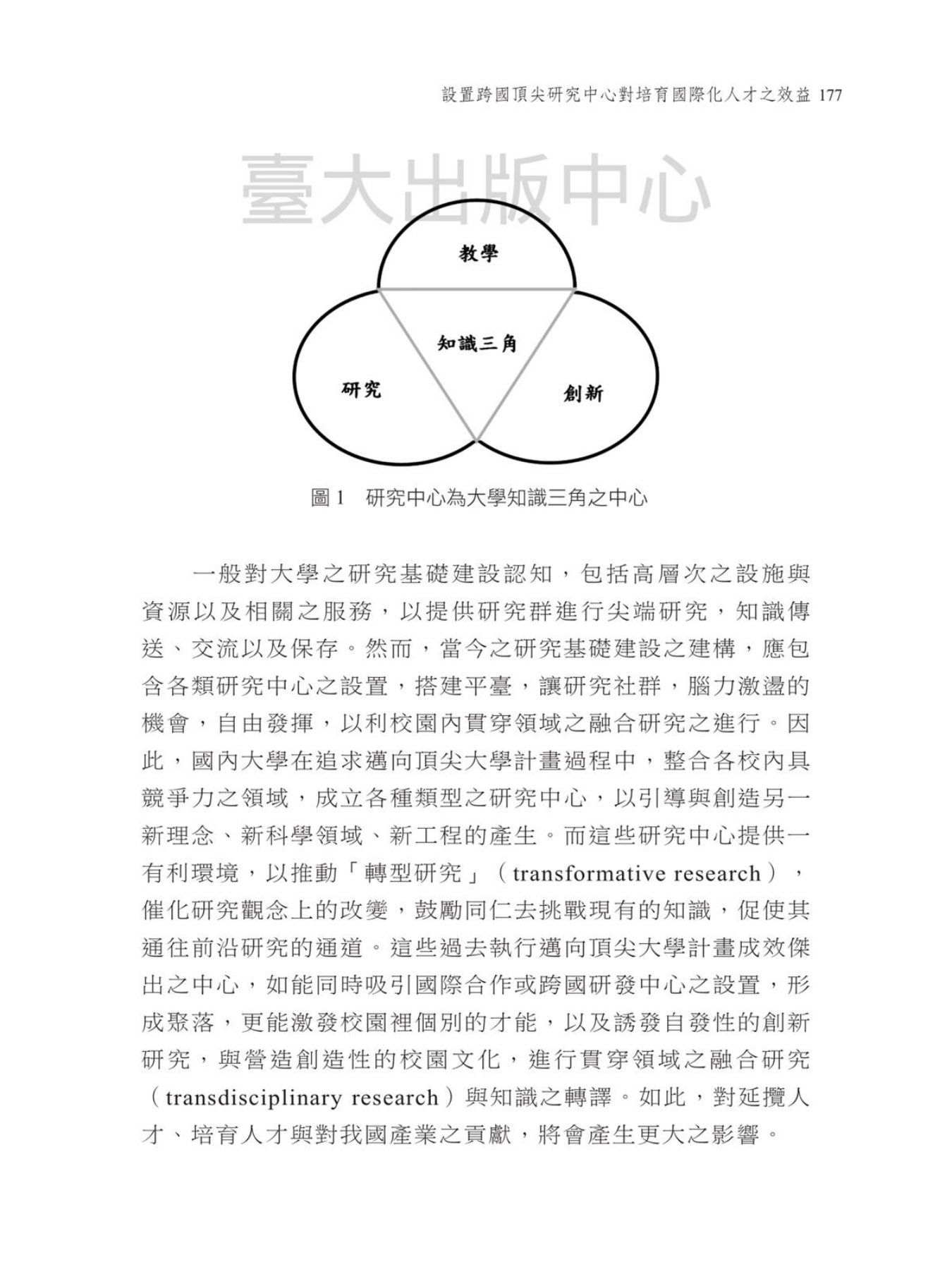
Benefits of Establishing Transnational Top-Tier Research Centers for Cultivating Internationalized Talent
Teaching Knowledge Triangle Research Innovation
Figure 1: The Research Center as the Core of the University’s Knowledge Triangle
General understanding of university research infrastructure includes high-level facilities and resources, as well as related services, to provide research groups with the means to conduct cutting-edge research, knowledge transmission, exchange, and preservation. However, the construction of contemporary research infrastructure should include the establishment of various research centers, building platforms that allow research communities to brainstorm and exercise freedom, thereby facilitating interdisciplinary integrated research within the campus. Therefore, in the process of pursuing the plan to become top-tier universities, domestic universities integrate competitive fields within each institution to establish various types of research centers, guiding and creating new concepts, new scientific fields, and new engineering disciplines. These research centers provide a favorable environment to promote “transformative research,” catalyze changes in research concepts, encourage colleagues to challenge existing knowledge, and facilitate their passage to frontier research. If these centers, which have previously achieved outstanding results in the plan to become top-tier universities, can simultaneously attract international cooperation or the establishment of transnational R&D centers to form clusters, they can further stimulate individual talents on campus, induce spontaneous innovative research, foster a creative campus culture, conduct transdisciplinary research, and translate knowledge. In this way, these centers will have an even greater impact on attracting and cultivating talent and contributing to Taiwan’s industries.
176 From Following to Leading: Toward a Top-Tier National Taiwan University (Ideological Section)
NSC I-RiCE Program
International exchange is one of the important indicators in current world university rankings, and actual participation in collaborative research internationally helps enhance a university’s academic reputation. Therefore, to attract foreign talent and cultivate domestic outstanding talent, the National Science Council (NSC) launched the “Program for Subsidizing the Establishment of Transnational Top-Tier Research Centers in Taiwan” (I-RiCE). This program specifically designed a tripartite cooperation mechanism, with resources jointly invested by the NSC, the applying university, and the foreign partner institution. The hope is that through this cooperative model, Taiwan’s research energy can be fully stimulated to seize original key research or technological breakthroughs in advance.
Through this program, by cooperating with world-class universities, renowned academic institutions, or top global enterprises, abundant R&D resources and energy are integrated to attract top international talent to settle in, cultivating future outstanding talent. At the same time, domestic teachers, researchers, and graduate students with great potential are recommended to go to foreign partner institutions for joint research, absorbing international experience through substantive exchanges and cooperation. Through mechanisms of group cooperation, young scholars are motivated to enhance their research capabilities. This not only solves the current societal concerns regarding talent cultivation and attraction but also significantly raises Taiwan’s innovative R&D level in basic sciences and key technologies, as well as enhancing international visibility and strengthening academic influence.
Benefits of Internationalization
Under the promotion of the NSC I-RiCE project, National Taiwan University and Intel established Taiwan’s first transnational top-tier research center in January 2011: the Intel-NTU Connected Context Computing Center. In February 2012, NTU further cooperated with three international first-class research institutions in France, including the French National Centre for Scientific Research (Centre national de la recherche scientifique, CNRS), and the French National Institute for Research in Computer Science and Automation (Institut national de recherche en informatique et en automatique,
INRIA) and the University of Pierre and Marie Curie (also known as Paris VI University; Université Pierre et Marie Curie, UPMC or Université Paris VI), as well as establishing the “Transnational Top-Tier Cancer Research Center” with the MD Anderson Cancer Center in the United States.
Taking Intel-NTU as an example, over the past nearly two years, the center has gradually transitioned from a phase of rapid growth to one of stable rooting and deepened development, with research teams enthusiastically dedicated to innovative breakthrough research. The Transnational Top-Tier Research Center Intel-NTU provides a new attempt at crossing national boundaries, research fields, industry-government-academia-research sectors, and management mechanisms. Its benefits for internationalization have also become increasingly evident:
- Through Intel’s global deployment of the latest Intel Labs Global Research Network, NTU was fortunate to become one of the twelve universities with which Intel collaborates, standing alongside MIT, Stanford, CMU, and UC Berkeley, as the sole representative in Asia;
- From the determination of research topics to the development of solutions, every research project has undergone countless conference calls, face-to-face meetings, and email discussions. Meetings across time zones and national boundaries directly challenge the English proficiency, communication skills, and logical argumentation of project participants;
- Professors at the center have the opportunity to invite top global researchers to visit NTU, give lectures, and participate in international seminars. This increases opportunities for our university’s faculty and students to interact with masters in the field, with the hope of further promoting research cooperation;
- Professors at the center have organized visits to top research centers and universities in the United States, Japan, and Europe, and through Intel’s arrangements, have engaged in in-depth exchanges with various Intel industry-academia research centers;
- Professors at the center actively participate in the organization and co-organization of top international conferences, serving on organizing and program committees, or being invited to deliver keynotes/invited talks;
- Graduate students participating in the center are selected, with several sent to the United States to serve as interns at Intel during the summer. In the summer of 2012, the center trained more than ten summer interns from multiple countries around the world and other domestic universities;
- The center has successfully recruited international students to participate in the research and development of the projects.
Furthermore, the “International Research Center for Intelligent Robotics and Automation” focuses specifically on the field of cognitive intelligent robotics and automation. The three international top-tier research institutions and universities collaborating with this center include CNRS, a research institution established by the French government and the largest national scientific research institution in France; INRIA, which plays an important role in the scientific fields of France and Europe, dedicated to researching scientific and technological aspects of communication and informatization (STIC); and UPMC, the main successor to the scientific faculty of the Paris Faculty of Sciences and the University of Paris. The university has twenty Nobel laureates. The vast majority of its laboratories have cooperative relationships with CNRS, the French National Center for Scientific Research.
The “International Research Center for Intelligent Robotics and Automation” can leverage France’s high academic standards and its experience in closely cooperating with industry to transfer research results to the industrial sector. This is precisely the assistance most needed for our country’s promotion of intelligent automation and robotics academic research and industrial development. Students will also have the opportunity to directly exchange with researchers and laboratories at France’s LAAS-CNRS research laboratory, the INRAS National Center for Scientific Research, and UPMC laboratories, which will have a significant benefit for cultivating excellent research and practical talents, assisting in expanding international horizons and experience. Since its establishment this year, in less than a year, the center has achieved some phased tasks, including: cooperating with the center’s French research institutions through government industry-academia cooperation projects to develop the world’s fastest-operating four-degree-of-freedom parallel robotic arm; and possessing a joint robotics development platform shared with world-class universities and research institutions (currently held by only more than ten top universities and research institutions worldwide, with this center being the only university in mainland China, Hong Kong, Macau, and Taiwan to possess this platform). It is believed that, through the joint efforts of the center’s faculty and students in the future, Taiwan will be assisted in becoming a pioneer in the “Robot Kingdom” and occupy a place in global robotics research and industrial development.
Conclusion
The establishment of transnational centers not only provides students with better educational opportunities, enhancing their learning skills and workplace competitiveness, but also improves their acceptance and observation of internal changes in knowledge and technology within social structures, and inspires faculty and students to establish industry-academia partnership relationships, cultivating their innovation and creativity. For industry-level facilities already established on campus, it provides a rich environment for collaborative cooperation, allowing industry- and technology-related faculty to cultivate industry-academia partnership relationships. On the foundation of pursuing updated knowledge, universities providing the latest industrial development information will enable students’ knowledge and skills to be timely combined with industrial needs. Industry can, through the complementarity of internal resources, obtain university facilities at a lower cost and establish a strong partnership for dynamic capabilities, giving industries a competitive advantage in development trends.
The establishment of transnational centers can gain international recognition for our country’s research contributions and innovative capabilities, enhance our country’s academic prestige internationally, and, more importantly, cultivate internationalized top-tier talents without the need to go abroad for advanced studies. It is hoped that the National Science Council (NSC) will expand the scale of the I-RiCE program in the future, including domestic world-class companies.
(This article was originally published in Alumni Bimonthly, Issue 85, January 2013 [ROC Year 102])
Nurturing Google at NTU
When I first assumed the position of Dean of Academic Affairs at NTU in 1996, recognizing that NTU’s funding was limited, I believed that concentrating these resources would allow us to purchase some expensive instruments and equipment to break through bottlenecks in research. With the approval of then-President Chen, I jointly supported several projects for expensive instruments and equipment with the Dean of General Affairs. One of these was a cross-disciplinary project called the “Digital Library” (digital library). Its goal was to digitize some of the library’s important archival materials and place them on the internet to promote the dissemination and popularization of knowledge.
This was the first such project in Taiwan and was considered a leading position globally. After two years of execution, because this was a large-scale research project crossing humanities and technology, it received attention from all sides. The National Science Council (NSC) also launched the “Digital Museum” special project in 1998, digitizing collections from various museums across the country. The public could browse museums simply by going online, greatly expanding the educational function of traditional museums. The NSC subsequently merged different digitization project plans in 2002, expanding and transforming them into the “National Digital Archives of Taiwan (NDAT) National Science and Technology Program,” launching large-scale digitization work on national archival data. Government archival institutions, including the Palace Museum, the National Museum of History, the Council for Cultural Affairs, and the Taiwan Literature and History Center of the National Museum of History, actively participated. Five years later, after completing the digitization of a large amount of archival data, in order to actively utilize these data, the second five-year plan transformed into the “National Digital Archives of Taiwan and Digital Learning National Science and Technology Program,” thereby promoting the integration of digital content with education and the cultural and creative industries. This ten-year national program ended at the end of 2012.
What we did not know at the time was that in 1996, two doctoral students in the Department of Computer Science at Stanford University in the United States, Larry Page and Sergey Brin, were engaged in research on digital libraries under the guidance of their professors.
In order to quickly find data that met needs and were truly useful within the vast sea of digital data, they developed a very efficient search engine. Two years after starting research, the two found investors in 1998 and established a small company next to Stanford University. This company was called Google. Everyone is well aware of the story of how Google later developed into an internet giant.
I often think that NTU and Stanford University both launched digital library research projects in 1996. NTU was not lacking in creativity, but Stanford University nurtured Google, which drove changes in world civilization, while NTU only stimulated related research domestically. The biggest difference is that NTU lacked the mindset and environment to realize creativity. The American Silicon Valley is full of an entrepreneurial atmosphere and venture capital companies; good ideas easily receive support, and inspired by many stories of entrepreneurial success, everyone is also brave in trying. In order to change the campus atmosphere, we established the “Center for Innovation Realization” in the Research Development Office in 2012 to assist teachers and students in transforming research ideas into physical prototypes. NTU alumni entrepreneurs, led by Guanda Corporation Chairman Lin Bai-li, also formed the “Innovation Alliance” to serve as a platform for discovering NTU’s innovative prototypes. They come every two months to understand NTU’s research ideas, using the experience and resources of the Innovation Alliance to nurture good innovative prototypes into new companies. It is hoped that before NTU’s centennial anniversary, a company similar to Google can be nurtured.
In the early 1970s, when I was an undergraduate student in the Department of Electrical Engineering at NTU, I took classes in the First Electrical Engineering Building (which had just been completed). At that time, learning to use electronic computers to solve problems was the hottest trend for freshmen. We used a huge mainframe computer; to go online, one needed to punch cards, handing over a large stack of dozens to hundreds of punched cards to the computer room on the first floor of the First Electrical Engineering Building to queue for processing. If one accidentally punched a card incorrectly, it would be returned by the computer room to be re-punched and re-queued, which was very tedious and time-consuming. What I did not know was that in 1972, two master’s students, Lin Bai-li and Wen Shi-ren, on the third floor of the First Electrical Engineering Building, had just completed Taiwan’s first microcomputer. Sixteen years later, Lin Bai-li founded Quanta Computer, becoming the world’s notebook…
From Following to Leading: Toward a Top-Tier National Taiwan University (Ideological Essays)
…the largest manufacturer of personal computers. In 1976, I went to Stanford University in the United States to pursue my Ph.D. What I did not know was that during this period, two young men, Steve Jobs and Steve Wozniak, would spend one evening a week at the Linear Accelerator Center (SLAC) seminar room on the Stanford campus, attending meetings of a self-built computer club to exchange experiences in building their own computers. In 1977, the Apple I computer was released, ushering in the century of the personal computer (PC). Thirty-six years later, today, almost everyone uses various forms of personal computers and smartphones. Coupled with the Internet, these technologies have profoundly changed modern life and business models, while mainframe computers have receded to a secondary status, serving only specialized needs.
Looking back over these forty years, seeing a new era of PCs and new technology emerge and flourish around my younger self, I often wonder whether another equally brilliant generation and technology is currently taking shape in my surroundings. This brings to mind a similar scenario: the 21st century is the century of preventive medicine, treating disease before it manifests, with health maintenance taking precedence over treatment; it is also the era of personalized medicine, where the same disease is treated differently depending on the individual, their genes, and their environment. Currently, health check-ups and disease prevention and treatment require large, expensive equipment in major hospitals, consuming considerable time and cost. In the future, testing and simple treatment devices will surely be as ubiquitous as today’s personal computers—portable, connected to the network to transmit various physiological information to care centers, where health counselors or physicians interpret the data and provide recommendations for further handling. This marks the arrival of the personal care (PC) era, and the dawn of another PC era.
In the era of personal care, we need to develop both hardware and software aspects, just as with personal computers in the past. In addition to the hardware of the Apple I and II, Microsoft’s DOS software and later Windows were needed for support. The hardware required for personal care consists of various physical and chemical detection components and devices: physical components are used to detect physiological parameters of the body, such as blood pressure, electrocardiogram, heart sounds,
electromyography, brainwaves, magnetoencephalography, blood oxygen, meridian conductivity, etc.; chemical detection components include those that detect various components in the blood, such as blood glucose, glycated hemoglobin, etc.; various infectious viruses in saliva; various biomarker molecules of diseases in exhaled breath from the lungs, etc. The key is that these detection components must be portable, inexpensive, accurate, and time-saving.
On the software side, we must start with version 1.0 of health care, developing health consultations needed by healthy individuals. The initial target audience will be middle-aged and elderly people and parents with young children, gradually expanding to those in sub-health states, individuals with various discomforts, or patients with diseases. The software must grow by accumulating users’ personal health data, automatically selecting different versions, and ultimately becoming personalized care software.
NTU launched a long-term development plan for the hardware and software of this new PC era (personal care) two years ago. Some hardware components have already been transferred to new companies through technology licensing. Although NTU missed the opportunity to nurture a company similar to Google sixteen years ago, I sincerely hope that NTU can seize the initiative in this new PC era. Before NTU’s centennial celebration, I hope we will nurture an international major company that will drive the vigorous development of the new PC era.
(This article was originally published in the Alumni Bi-Monthly Magazine, Issues 86 and 87, March and May 2013.)
Performance Essays
Performance in Advancing University Affairs
On June 22, 2005, Si-Chen Lee assumed the office of President of National Taiwan University (NTU), proposing three core concepts: “Excellence in Education,” “Excellence in Research,” and “Care for Society,” as the direction for NTU’s future development. He began planning a blueprint to comprehensively advance university affairs. On October 9 of the same year, the Ministry of Education announced the first-phase selection list for the five-year, 50-billion-new-Taiwan-dollar “Top University Project.” A total of 12 universities received subsidies, with our university receiving an annual subsidy of NT$3 billion. With this significant infusion of funds, our responsibility was naturally very great. To achieve the overall goal of “Becoming a Top University,” our university set the goal of elevating at least ten to fifteen fields to world-class standards within five years, and entering the global top 100 in university rankings within five to ten years. We adopted six strategies: “Enhancing Educational Quality,” “Recruiting High-Quality Teaching and Research Talent,” “Strengthening Infrastructure and Software/Hardware Environments,” “Balanced Development and Key Breakthroughs,” “Academic Internationalization,” and “Administrative Improvement.” Centered on humanistic care, we constructed a high-quality teaching and research environment, implemented various important related measures, and carried out a comprehensive transformation. The overall goals and execution strategies of our university’s first-phase “Top University Project” are detailed in Figures 1 and 2 on the following page.
After five years of effort by all faculty and students of our university, the total number of research papers and the number of Highly Cited Papers (HiCi) both grew nearly twofold, with seventeen fields entering the Highly Cited Papers list. In the 2009 (Republic of China Year 98) Times Higher Education Supplement World University Rankings, our university ranked 95th, proudly entering the global top 100. In the Academic Ranking of World Universities by the Center for World University Rankings at Shanghai Jiao Tong University, our university advanced from 183rd in 2005 (Republic of China Year 94) to 150th in 2009 (Republic of China Year 98), surpassing Seoul National University in South Korea for the first time; in 2010 (Republic of China Year 99), it advanced to 127th, surpassing the National University of Singapore for the first time, achieving the mid-term goal of becoming a top Chinese-speaking university. This fully demonstrates that our university’s exec-
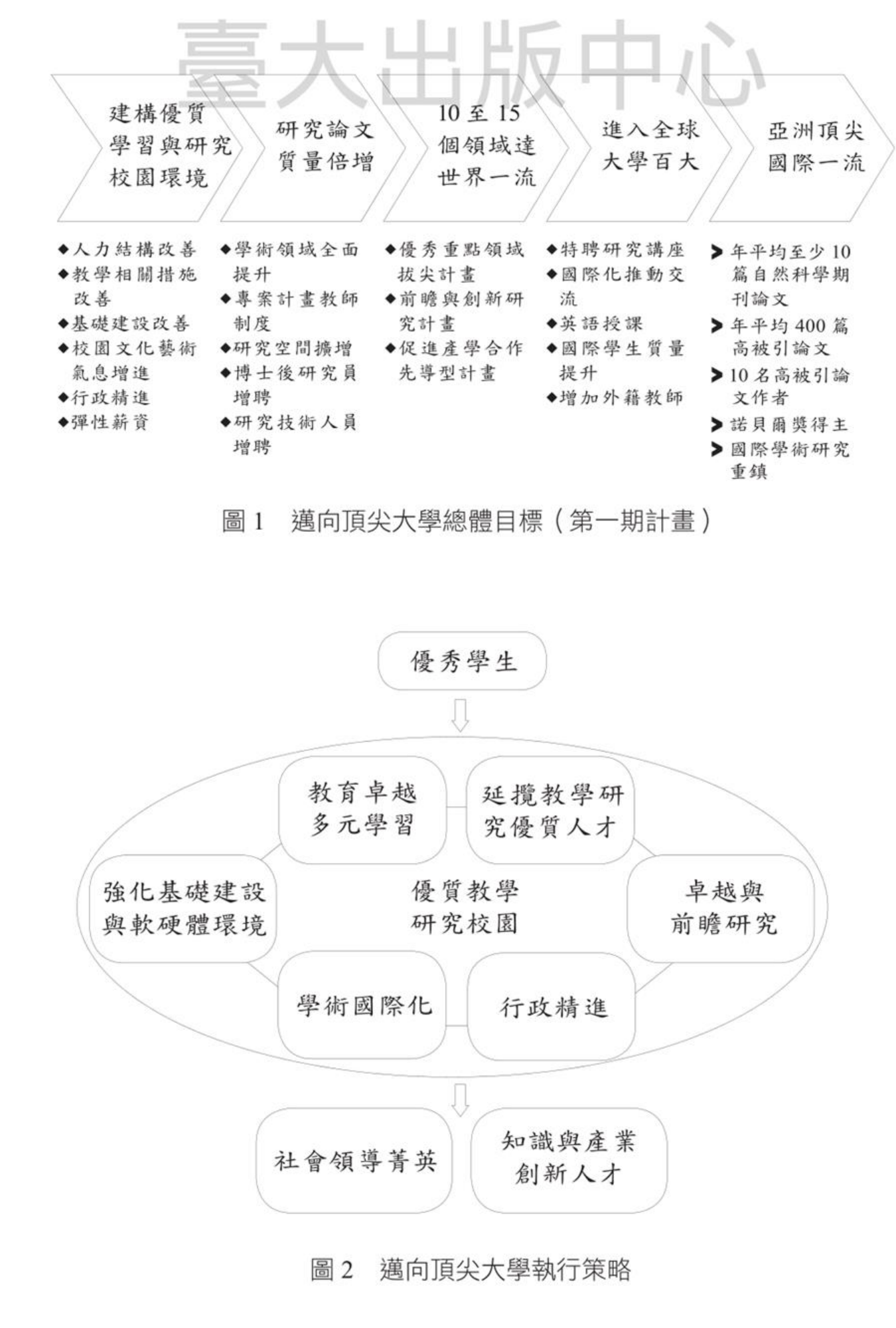
Figure 1 — Overall Goals for Becoming a Top University (First-Phase Project). The source presents a left-to-right five-stage progression. (1) Construct a high-quality learning and research campus, supported by improvements in personnel structure, teaching measures, infrastructure, campus culture and arts, administrative performance, and flexible salaries. (2) Double research-paper quantity and quality through comprehensive upgrading of academic fields, project-faculty systems, expanded research space, and recruitment of postdoctoral researchers and research technicians. (3) Bring ten to fifteen fields to world-class level through key-field excellence projects, forward-looking and innovative research, and pilot industry-academia cooperation projects. (4) Enter the world’s top one hundred universities through distinguished research chairs, international exchange, English-taught courses, improved quantity and quality of international students, and more foreign faculty. (5) Become a top Asian, internationally first-class university, with goals including at least ten natural-science journal papers per year on average, four hundred highly cited papers per year on average, ten highly cited authors, Nobel laureates, and status as an international academic-research hub.
Figure 2 — Execution Strategies for Becoming a Top University. “Excellent students” enter a high-quality teaching and research campus. Within that campus, six mutually supporting strategies surround the center: excellence in education and diverse learning; recruitment and cultivation of high-quality teaching and research talent; excellent and forward-looking research; administrative improvement; academic internationalization; and stronger infrastructure and software/hardware environments. The campus then produces two outcomes: social-leadership elites and knowledge- and industry-innovation talent.
The strategies of the first-phase project were effective.
For the second phase of the “Top University Project,” NTU submitted an application to the Ministry of Education in September 2010 (Republic of China Year 99). The review results were announced on April 1, 2011 (Republic of China Year 100). A total of 12 universities received subsidies, with our university receiving an annual subsidy of NT100 million over the first phase, clearly indicating that the execution results of the first-phase project were affirmed. The overall goal of this phase’s project is to develop our university into an internationally top-tier university. We selected the University of Illinois at Urbana-Champaign (UIUC) in the United States as our benchmark institution, with the goal of entering the global top 50 in university rankings.
To achieve this goal, in addition to continuing the momentum accumulated from the first-phase project and the substantial assets built up by our university in the past, we continued to construct a high-quality learning and research campus. Following the concept of “Balanced Development, Key Breakthroughs, and Academic Internationalization,” and adhering to our core values, we set the short-term goal of doubling the number of publications in top-tier journals. In research, teaching, and internationalization, we adopted strategies more advanced than those in the first-phase project.
In research, to rapidly elevate the level of research, we adopted an organization-to-organization, top-down cooperation model, establishing joint research centers with renowned international top-tier research centers (such as the MD Anderson Cancer Center at the University of Texas in the United States, the University of Paris VI and the National Center for Scientific Research [CNRS] in France) or the world’s largest semiconductor company, Intel. Through top-down leadership plans, we carefully selected fields with international competitiveness and the ability to solve major problems related to sustainable social development, establishing the Center for Public Policy and Law Research to serve as a government think tank. In conjunction with the arrival of the knowledge economy era, we promoted the Industry Incubation Plan to transform the university into a center for nurturing new industries. In teaching, we implemented reforms oriented toward teaching effectiveness. In internationalization, we established the International Education Center and promoted an international student recruitment strategy featuring Chinese language teaching and an understanding of the Chinese cultural environment, supplemented by an appropriate amount of English courses. Furthermore, through forward-looking leadership plans, we explored emerging fields, combined with balanced development across eleven colleges, to drive a comprehensive improvement in our university’s teaching and research, generating a flywheel effect (Flywheel Effect) to accelerate our progress toward becoming a top-tier university (Figure 3).
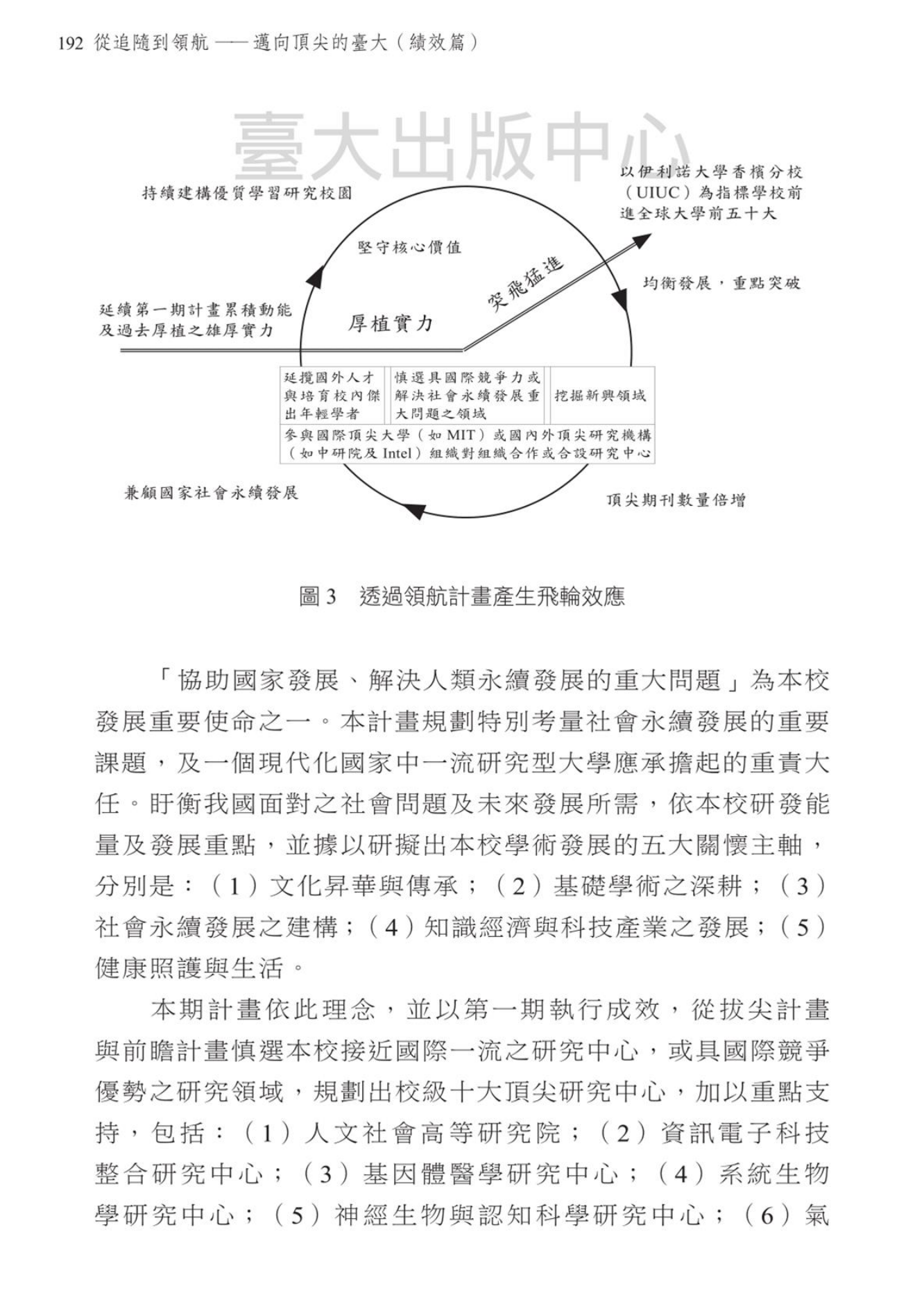
Using the University of Illinois Urbana-Champaign (UIUC) as the benchmark institution, advance toward the global top 50 universities. Uphold core values. Balanced development with breakthroughs in key areas. Build upon the momentum accumulated in Phase I. Achieve leaps and bounds. Consolidate strengths. Leverage the substantial strengths cultivated in the past. Recruit overseas talent. Carefully select outstanding young scholars with international competitiveness or those capable of addressing major issues in sustainable social development. Explore emerging fields. Engage in organization-to-organization collaborations or co-establish research centers with top international universities (such as MIT) or top domestic and international research institutions (such as the Academia Sinica and Intel). Balance national and sustainable social development. Double the number of top-tier journal publications.
Figure 3: Generating a Flywheel Effect through the Leading Plan
“Assisting national development and addressing major issues in sustainable human development” is one of the important missions of our university. This plan specifically considers important issues in sustainable social development and the heavy responsibilities that a first-class research university in a modern nation should undertake. Considering the social problems facing our country and future development needs, based on our university’s R&D capacity and development priorities, we have formulated five major axes of academic concern for our university: (1) Cultural elevation and heritage; (2) Deep cultivation of basic academics; (3) Construction of sustainable social development; (4) Development of the knowledge economy and technology industries; (5) Healthcare and lifestyle.
Based on this concept and the execution results of Phase I, this plan carefully selects research centers close to international first-class standards or research fields with international competitive advantages, planning ten top-tier university-level research centers for key support, including: (1) Institute of Humanities and Social Sciences; (2) Center for Integrated Information and Electronic Technology; (3) Center for Genomic Medicine; (4) Center for Systems Biology; (5) Center for Neurobiology and Cognitive Science; (6) Center for Climate Change and Sustainable Development;
(7) Center for Theoretical Sciences; (8) Center for Molecular Biomedical Imaging; (9) Center for Emerging Materials and Advanced Device Technology; (10) Center for Health Sciences and Lifestyle. These ten research centers will shoulder the responsibility of attracting outstanding domestic and overseas talent, serving as platforms for international cooperation.
This plan aims to ensure that after five years, our university will possess first-class facilities and first-class talent, conduct first-class research, and produce first-class results. The campus will produce more than 600 highly cited papers, 15 highly cited authors, 50 outstanding young scholars, possess ten top-tier international research centers, and have 20 to 30 fields enter the world-class tier, achieving the goal of ranking in the global top 50 universities, thereby elevating NTU to an international academic and research hub (Figure 4).
Construct high-quality learning and research campus environment. Double the number of top-tier journal publications. 20 to 30 fields enter world-class tier. Advance to global top 50 universities. Move toward top-tier university. Improve human resource structure. Comprehensive academic field advantages, key field breakthroughs. Promote internationalization and exchange. Teaching-related measures. Enhance teaching. Natural science journal papers: at least 20 per year on average. Improve infrastructure. Cultivate outstanding young scholars. Pioneering research leading plan.
- Co-establish research centers on campus with famous foreign companies or research institutions. Highly cited papers: 600 per year on average. Flexible salaries. Postdoctoral researchers. Promote industry-academia cooperation.
- Establish strategic alliances with famous foreign universities for broad cooperative research. 15 highly cited paper authors. Phase II Teaching Building. Increase hiring. Pilot projects. Precision Instrument Factory. Distinguished Research Chair Plan. Participate in international cooperation. Nobel Laureate Awards. Ten top-tier research centers. English-taught courses. International academic research hub. Improve quality of international students. Increase foreign faculty. Enhance internationalization capabilities of domestic students.
Figure 4: Overall Goals for Moving Toward a Top-Tier University (Phase II Plan)
By 2012, our university had nineteen fields entering the highly cited papers category. In the Shanghai Jiao Tong University World University Rankings, we rose to 121st, ahead of Seoul National University, National University of Singapore, Chinese University of Hong Kong, Tsinghua University in Beijing, and Peking University in Beijing. In the 2012 QS (Quacquarelli Symonds) World University Rankings, our university also jumped to 80th. In March 2013, the UK’s Times Higher Education Supplement released the “2013 World University Reputation Rankings,” where our university rose to the 51–60 tier, approaching the Phase II Leading Plan’s goal of “moving into the world top 50,” marking our best performance in history.
Overall, over these eight years from 2005 to 2013, our university has actively promoted various reforms and measures. Mentally, we have transformed from followers to leaders. With the concerted efforts and full commitment of all faculty, students, and staff, significant growth has been achieved in all aspects. The following eight aspects illustrate the performance of our university in advancing affairs and the results of executing the plan to move toward a top-tier university.
I. Enhancing Educational Quality
I. Enhancing Educational Quality
To enhance educational quality, the University has adopted strategies including “emphasizing character education,” “strengthening the functions of academic advisors,” “improving general education, foundational, and professional courses,” “restructuring the curriculum,” “increasing interdisciplinary programs,” “faculty development and improvement of teaching quality,” and “improving teaching facilities.” These measures constitute a comprehensive support system to establish a high-quality “holistic education” teaching environment and cultivate outstanding talent. The key measures are outlined below:
1. Emphasizing Character Education and Improving Service Courses
In promoting character education, the University’s primary task is to reshape the core values of the campus and endow them with new interpretations. These core values are embodied in the University’s motto: “Cultivate Virtue, Encourage Learning, Love Country, Love People.” “Cultivate Virtue” signifies “integrity, uprightness, and taste”; “Encourage Learning” signifies “dedication and excellence”; “Love Country” signifies “care and sociability”; and “Love People” signifies “tolerance and enthusiasm.” Furthermore, during the annual freshman orientation, I have required students to adhere to the “Four No’s”: “no cheating on exams,” “no plagiarism in assignments,” “no skipping classes without reason,” and “no illegal parking of bicycles.” Through integrating character education into courses, leadership talent development programs, and diverse service-learning activities, and by reinforcing character education through teachers’ instruction and personal example, remarkable results have been achieved from 2005 to 2012. In 2007 and 2011, the University was twice awarded the title of “Outstanding School in Moral Education” by the Ministry of Education.
To cultivate students’ virtues of responsibility, self-discipline, diligence, service, and mutual cooperation, the University revised its “Implementation Measures for Service-Learning Courses” in June 2006. The new service-learning system was implemented starting from the 2006-2007 academic year, dividing service-learning courses into Service-Learning (I), (II), and (III). The revamped service-learning courses feature richer, more lively, and diversified content, incorporating knowledge-bearing courses and coordinating with the CEIBA website. Through the training of teaching assistants (TAs), the core values of service-learning and reflective activities are implemented, inspiring students’ love for the University and concern for society, while cultivating their ability to serve society and participate in public affairs. Taking the 2012-2013 academic year as an example, the University offered a total of 746 service-learning courses.
To assist NTU students in preparing for their careers or life development with a positive and proactive attitude, and to successfully transition from campus to the workplace, the “NTU Life Etiquette Classroom” was innovatively established. The content includes life education courses on various themes, helping students develop good habits during their studies, cultivate adaptability and resilience in diverse environments, and strengthen their ability to face and handle problems. Because the activities meet student needs and feature engaging and vivid lectures by renowned industry experts, the program has received high recognition from students. From the 2009-2010 academic year to the first semester of the 2012-2013 academic year, eight cohorts were conducted, totaling 216 hours and 72 sessions. Each cohort reached full capacity immediately upon opening registration, with over 1,130 participants covering all colleges and grade levels, including master’s and doctoral students. The overall satisfaction rate among participating students in each cohort averaged above 90%, indicating excellent results.
To achieve the goals of selecting elites and cultivating leadership talent, the University established the university-level “Leadership Program” and “Creativity & Entrepreneurship Program.” The “Leadership Program” (NTU Leadership Development Program) was established in the 2008-2009 academic year. By the first semester of the 2012-2013 academic year, 179 NTU students had enrolled. In addition to imparting theoretical knowledge of leadership and training in humanistic values, the program provides basic knowledge and practical skills in organizational operations, assisting students in systematically developing team leadership and management abilities, as well as the moral character expected of leaders who serve and care for society. Students form their own teams to plan various training and social service projects, achieving fruitful results. The “Creativity & Entrepreneurship Program” (Creativity & Entrepreneurship Program) began recruiting students in the first semester of the 2008-2009 academic year, encouraging students to integrate their personal wisdom and learning outcomes with innovative ideas, applying them
in product development or the aesthetics of quality of life. The University has developed resources, invited outstanding faculty to guide students, and encouraged students to establish clubs for sustainable operation.
2. Strengthening the Functions of Academic Advisors and Student Psychological Counseling
To cultivate students’ sound personalities and promote their physical and mental health, the University has actively strengthened the functions of academic advisors and reinforced counseling work, laying the foundation for learning and unlocking students’ potential.
(1) Strengthening the Functions of Academic Advisors
Making effective use of advisor resources to promote teacher-student interaction, thereby improving student learning outcomes and life education, is a key direction in the University’s promotion of the academic advisor system.
-
Integrating and establishing a comprehensive advisor-student information system: The “Advisor-Student Information Declaration” and “Advisor-Student Data Query” systems were linked in real time. Starting from the second semester of the 2007-2008 academic year, advisors can directly query online at the beginning of each semester the academic performance, reward and punishment records, club participation, and family status of newly assigned advisees. Advisors can also send letters online, and students can proactively contact their advisors through this system.
-
Enhancing friendship through activities organized by college and department (institute) academic advisor committees: Additionally, through interviews with advisors, a special book on outstanding advisors was published. This not only conveys relevant information on student counseling but also aims to assist and inspire interaction between advisors and students through more diverse discussions on campus counseling experiences.
-
Holding advisor competency workshops of various types and levels: These workshops aim to help advisors gain a deeper understanding of students’ mindsets and problems, enhance advisors’ rights and counseling competencies, provide more diverse case analyses of campus counseling, and introduce consultation and referral resources to assist advisors in resolving issues related to student counseling. Examples include the “Workshop on Advisor Competency with Department Heads,” the “Advanced Workshop on Departmental Advisor Business,” and others.
-
Starting from the 2006-2007 academic year, conducting annual evaluations and commendations of outstanding advisors:
Encouraging dedicated and meritorious academic advisors, a total of 51 outstanding advisors were selected over six terms by the 2011 academic year. Additionally, special publications featuring these outstanding advisors were produced to establish role models; by December 2011, three volumes had been published, receiving significant social resonance.
(2) Strengthening Student Psychological and Physical Counseling
The University provides diverse counseling measures for students, assisting them through learning to enhance their psychological and physical management capabilities:
-
Individual counseling sessions at the Student Counseling Center: 2,215 person-times in 2005, 2,564 in 2006, 3,400 in 2007, 4,047 in 2008, 4,322 in 2009, 4,033 in 2010, 4,601 in 2011, and 4,675 in 2012. The most common presenting complaints were emotional distress, followed by issues of self-understanding, and then relationship problems. Furthermore, the total number of psychological test administrations was 961 person-times in 2005, 868 in 2006, 843 in 2007, 902 in 2008, 968 in 2009, 889 in 2010, 703 in 2011, and 399 in 2012.
-
Starting in October 2008, career interest tests were implemented along with counseling services. Students could choose to register individually or in groups for the career interest test, and counseling was provided after the test to help students understand their results. Beginning in 2009, in coordination with the Ministry of Education’s promotion of the “UCAN College Employment Competency Platform,” students could take the tests directly online, performing various levels of assessments according to their individual needs to obtain comprehensive aptitude and vocational suitability data, thereby understanding themselves and using the results as a reference for future career planning. The program was expanded in the 2011 academic year, with promotion and testing conducted during freshman orientation activities in the Freshman Learning College. Number of participants: 205 in 2009, 537 in 2010, 2,485 in 2011, and 2,534 in 2012.
-
Promotion of Campus Mental Health Education: “Mindful Living” lectures were organized to help students better understand and learn about mental health-related knowledge and skills. Topics included emotional management, positive thinking, life education, interpersonal and gender relations, stress adaptation, life adjustment, and career planning. These services covered a wide range of areas, possessing both depth and breadth.
-
Psychological Growth Group Activities and Workshops: The Student Counseling Center organized activities such as freshman career exploration and planning groups, relaxation meditation and self-hypnosis classes, music therapy, stress management, anxiety management, emotional transformation, belief reconstruction, love and relationship workshops, experimental interpersonal interaction groups, life counseling groups, and learning problem remediation series.
-
Starting in May 2006, the website and e-newsletter “NTU Heart Corner” were launched, providing students with information related to mental health. By April 2013, 60 issues had been published, with 3,665 subscribers, and the number increased with each issue. The web platform received approximately 667 views per month.
-
Starting in the 2006 academic year, departmental counseling work was promoted. Full-time counseling teachers from the Student Counseling Center served as fixed college counseling teachers for each college, assisting departmental faculty in promoting students’ mental health and self-management, strengthening primary prevention efforts, and expanding and implementing campus mental health services through departmental counseling activities.
III. Creating a Campus Humanities and Arts Environment
World-class universities all possess excellent cultures, thereby demonstrating unique campus spirits that are highly regarded. Since its founding, our University has maintained freedom of academic pursuit, the quest for truth, and concern for human society as its distinctive and excellent culture. In recent years, we have been committed to shaping a new campus culture to exert a subtle, transformative influence on students. In addition to annually hosting “My Academic Journey,” “Azalea Festival,” “NTU Arts Season,” and “Zuiyue Lake Concerts,” the following new activities and facilities have been added:
(1) Establishment of the Arts and Culture Center
To promote the University’s arts and culture activities, the Arts and Culture Activity Promotion Studio was established in December 2005. In early 2006, planning began for arts lectures, music performances, drama and dance, painting and photography, and other activities. In addition to support from university funds, sponsorship was obtained from the business community. Starting in March 2006, the studio organized activities such as “Luming Small Gatherings,” “Enjoying Good Plays” traditional opera performances, “Flowing Clouds and Water” lunchtime concerts, “Dance Carnival,” demonstration lectures, and “New Perspectives on Culture” speeches. Approaching from both theory and practice, these activities led audiences to immerse themselves in the realm of arts and culture.
Starting in the 2006 academic year, the Arts and Culture Activity Promotion Studio took over the organization of the “NTU Literary Award.” Leveraging the characteristic of deep thinking inherent in arts and culture activities, it constructed a moving and impactful orientation for the event. The studio also used the content of the Luming Small Gatherings and the Flowing Clouds and Water lunchtime programs as themes for photography competitions, capturing the movement, stillness, and beauty of performing arts through the lens. Furthermore, since 2005, the studio has compiled the “NTU Arts and Culture Yearbook,” presenting data on arts performances, humanities-related lectures, and club performances organized by various university units in a richly illustrated format.
In April 2008, the Administrative Council approved the restructuring of the Arts and Culture Activity Promotion Studio into the “NTU Arts and Culture Center.” In November of the same year, it moved into the “Yasong Workshop,” renovated from the former chapel, equipped with professional performance facilities and dedicated office space. It further attempted to introduce artistic atmospheres in different ways, expand arts and culture perspectives, and engage in exchanges with foreign universities or the arts and culture community.
(2) Establishment of the NTU Museum Cluster
For teaching and research purposes, NTU has collected rich specimens in anthropology, zoology, botany, entomology, minerals, and other fields, which possess historical and educational value. To preserve the various unique and precious historical documents, specimens, and collections gathered since the University’s founding, the Library convened relevant units for joint consultation. Adopting a cooperative development approach, the “NTU Museum Cluster” was established. Through overall planning, the educational and research achievements of each museum are displayed, and a “NTU
“Grand Museum Cluster Office,” responsible for executing cooperative development initiatives; meanwhile, the internal operations and development of each member museum maintain their original operational mechanisms and characteristics.
On the university anniversary day in 2007 (November 15), the NTU Museum Cluster was officially launched, and a special exhibition opening ceremony for the NTU Museum Cluster was held in the Chuanliu Hall of the University History Museum, open for visitation by faculty and students within the university, as well as the public domestically and internationally. By February 2013, the member institutions of the NTU Museum Cluster totaled ten: the University History Museum, the Museum of Anthropology, the Geological Specimen Hall, the Physics Artifact Hall, the Entomology Specimen Room, the Agriculture Exhibition Hall, the Botanical Specimen Museum, the Zoological Museum, the Archives Exhibition Room, and the Medical Humanities Museum. The member museums of the NTU Museum Cluster, dispersed throughout the campus, operate independently while collectively showcasing their distinctive features. They break through the limitations of display space within a single building, linking collections with the teaching and research environments of their respective departments and the historical context of the university, thereby forming the unique characteristics of the NTU Museum Cluster.
(3) Establishment of the NTU Humanities Library
To highlight the overall academic strength of NTU community members and create a dedicated collection space exclusively for NTU affiliates, while aligning with the university’s three core spirits of “Educational Excellence,” “Research Excellence,” and “Social Care,” preparations for the “NTU Humanities Library” began in March 2006. The initiative actively collects a rich and diverse array of works authored by NTU community members, transforming the library into a hub for aggregating the university’s academic resources, cultivating academic strength, and stimulating NTU’s academic momentum. The “NTU Humanities Library” held its opening ceremony on the third floor of the library on the university anniversary day, November 15, 2007. By February 2013, the library had received over 7,300 donated books from more than 600 alumni. These books are displayed on shelves organized by college, and the library’s catalog can be searched on the NTU Library website. Through the establishment of the “NTU Humanities Library,” current NTU students are able to learn from the exemplary works of their seniors, continuing the academic pulse and condensing the tradition of mutual support among NTU community members into enduring memories.
IV. Strengthening Holistic Education
To comprehensively elevate the teaching standards of holistic education and cultivate social elites with broad-mindedness, expansive vision, deep humanistic care, and professional competence, the university has, in addition to conducting reforms in general education and common courses to establish diverse and substantial content, deeply cultivated language and foundational education, focused on improving various professional courses, encouraged curriculum restructuring, and established comprehensive supporting measures and regulations at the institutional level to achieve the goal of teaching improvement.
(1) Implementation of the New System for Common and General Education, with Continuous Assessment and Improvement of Teaching Quality
The reform of common and general education was officially implemented starting from the 2007–2008 academic year. General education courses were adjusted from the original four major domains to eight major domains, requiring a total of 18 credits for elective courses; common subjects were adjusted to 12 credits, retaining only “Chinese” and “Foreign Languages,” each worth 6 credits, while other subjects were integrated into general education courses. After the implementation of the new system, the number of general education courses offered increased significantly, with approximately more than 200 general education courses offered each semester. The teaching faculty consists mainly of full-time faculty members from university departments (accounting for approximately 70–80% of the courses offered each semester), supplemented by the recruitment of outstanding part-time external instructors to assist in offering general education courses. Additionally, a general education course map system was completed, and promotional brochures and videos for general education were produced. In March 2008, the Ministry of Education conducted an accreditation of general education at seven top-tier universities. Among the seven accreditation indicators, our university received five A (Excellent) and one A+ (Outstanding) ratings, gaining strong recognition from the accreditation committee.
Furthermore, after the implementation of the new system, the university continued to assess and improve general education courses. An evaluation report on the implementation of the new general education system was completed in early 2008–2009, proposing recommendations for improvement; a comprehensive review and adjustment of general education courses was conducted in 2009–2010, aiming to identify courses that should have been offered but were not, and to adjust courses that did not align with the university’s general education objectives. In February 2011, the “National Taiwan University General Education Self-Assessment Criteria” were formulated, mandating a self-assessment every four years, with external scholars and experts serving as accreditation committee members. An on-site self-assessment visit for general education was completed on May 26, 2011. Subsequently, the university proposed handling methods and a schedule based on the recommendations of the accreditation committee members. From November 2011 to May 2012, three general education review meetings were held, with subsequent continuous reviews to propose directions for improvement. To encourage university faculty to offer general education courses, the university revised relevant regulations regarding teaching hours. Starting from the 2012–2013 academic year, for any faculty member offering general education courses, if the number of enrolled students reaches 75
or more, the teaching hours will be calculated at 1.5 times the standard (with the additional calculation limited to a maximum of one course).
In addition, to make the review and accreditation mechanism for the university’s general education courses more comprehensive, the revision of the “Key Points for the Offering and Review of General Education Courses at National Taiwan University” was completed in 2012. This revision raised the review standards for the teaching evaluation scores of courses applying for offering and general education courses that have been offered for three full years. Furthermore, general education courses that have been discontinued for more than three years and are reopened are treated as newly offered courses, requiring the resubmission of course materials for a three-level, three-stage review. Reference indicators for general education course reviews were also established to provide guidance for course committees at all levels.
(2) Promotion of the Teaching Assistant System, Encouraging Group Discussions in Large-Class Teaching
The “Individual-Type General Education Course Improvement Plan” promoted by the university utilizes funding subsidies for general education course teaching assistants to encourage general education faculty to offer large-class courses with small-group discussions, thereby deepening students’ learning outcomes. Since the implementation of the new general education system in the 2007–2008 academic year, the number of general education courses participating in this plan each semester has exceeded one-third (approximately 80–90 general education courses participating). By the first semester of the 2012–2013 academic year, more than 250 graduate students participated in teaching work for general education courses each semester. This not only assists students’ learning but also helps cultivate future university faculty. Additionally, the promotion of this plan aligns with university policy, emphasizing the planning of students’ after-class learning activities to deepen their learning, advocating a learning-outcome-oriented teaching philosophy, and valuing the assessment of students’ learning outcomes after course implementation.
(3) Language Education
In terms of Chinese language teaching, to integrate diverse directions and highlight core competencies, the “Chinese” course is divided into four domains: “Classical Literature,” “Modern Literature,” “Cultural Thought,” and “Language and Life.” Utilizing network technology, a “Freshman Chinese Teaching Dedicated Webpage” was established, uploading supplementary teaching materials such as “Cultural Classics,” “Poetry Classics,” “Classical Novels,” and “Modern Novels.” Additionally, classic reading was promoted, with classic reading teaching assistants (20 positions) allocated each semester. Through guided discussions,
We organized works recommendation and online challenge activities to promote a reading culture among students. Additionally, we held lectures on auxiliary Chinese language teaching, inviting renowned domestic and international scholars and writers to share their literary creation and writing experiences with students. In addition to the above measures, the University also administered the “Chinese and English Proficiency Assessment for Overseas Chinese and International Students” to assess language proficiency and implement tiered instruction, thereby strengthening their Chinese language skills.
Regarding foreign language instruction, starting from the second semester of the 95 academic year, we successively added introductory courses in various languages. In addition to English, Japanese, French, German, Russian, Spanish, Portuguese, Italian, Turkish, and Dutch, we also offered instruction in Arabic, Mongolian, Korean, Thai, Vietnamese, and Malay, totaling 17 languages. We also provided instruction in eight academic languages: Ancient Greek, Latin, Hebrew, Sanskrit, Manchu, Tibetan, Tangut, and Pali. In the 99 academic year, in addition to maintaining the existing number of language teaching classes, we newly established Indonesian and Filipino language courses to enhance the diversity of foreign language offerings.
To improve the effectiveness of language education, the University has successively hired project-based faculty members (as of the first semester of the 99 academic year: 37 part-time Chinese instructors; 6 full-time and 10 part-time English instructors; 28 part-time Japanese instructors) to reduce the number of students in oversized language classes. We have implemented small-class instruction; for example, the number of Japanese language classes increased from 17 in the 88 academic year to 93 in the 99 academic year, reducing the average class size from 108.5 to 35.04 students. We also approved the use of teaching assistants; for instance, 21 teaching assistants were approved for Japanese courses in the 89 academic year, and by the 99 academic year, 42 teaching assistant person-times assisted in 42 classes, improving teaching quality. We also expanded and strengthened the functions of the Foreign Language Teaching and Resource Center (formerly the Audio-Visual Education Center)’s “Online English Self-Study Classroom,” developed online English vocabulary and advanced listening courses, opened the “Graduate Online English” test, and provided Chinese and English writing counseling through the Writing Teaching Center. Each semester, we offer a total of 31 classes in Chinese and English academic writing. We assist departments in establishing specialized English courses; as of the end of 99, we supported 15 departments in establishing 16 specialized English classes. We launched Chinese and English thesis writing consultation and editing services, held writing-related workshops both inside and outside the University to meet students’ learning needs.
(4) Basic Natural Sciences Education
-
Improvement of Basic Mathematics Teaching. Implementation includes: (1) adopting a large-class teaching, small-class tutoring instructional model; (2) compiling calculus question banks and teaching materials; (3) experimental plan for mathematics software practice courses; (4) hiring part-time instructors to assist with calculus teaching (averaging 9 per semester); (5) assigning teaching assistants (40 each in the first and second semesters of the 98 academic year) to conduct calculus teaching assistance, leading exercise discussions, supplementing course materials, and administering quizzes, resulting in excellent student learning outcomes. By the first semester of the 99 academic year, all items were gradually implemented and demonstrated their results, especially the large-class teaching and small-class tutoring components, which have achieved considerable effectiveness.
-
Improvement of Basic Physics Teaching. Implementation includes: (1) improving physics laboratory teaching spaces and updating experimental teaching equipment; (2) improving the experimental teaching model, with inquiry-based learning as an important goal for experimental teaching; (3) completing the English version of the experimental textbook content to facilitate learning for international students; (4) holding educational promotion and competition activities both inside and outside the University, actively promoting the importance of science popularization education (e.g., hosting the 3rd General Physics Experimental Creative Design Competition, organizing the “Northern Region II General Physics Experimental Creative Design Competition,” co-organizing the “General Physics Experimental Collection Achievement Exhibition,” and the “Life Science Truth Exploration Challenge,” among other activities); (5) adding experimental course videos and demonstration experiment videos, uploading experimental videos to the website for student preview; (6) using Moodle to establish a Course Management System (CMS) to enhance student learning motivation.
-
Improvement of Basic Chemistry Teaching. Implementation includes: (1) hiring 3 part-time instructors to assist in enhancing teaching capacity and quality; (2) assigning teaching assistants for general chemistry courses (15 and 22 in the first and second semesters of the 99 academic year, respectively) to promote large-class teaching and small-class tutoring, and developing demonstration experiments and practical courses;
(3) implementing multimedia digital teaching for general chemistry experiments to diversify teaching resources; (4) purchasing mid-range analytical instruments and developing demonstration experiment teaching materials to align with trends in scientific research; (5) establishing an internet-based digital learning platform, completing the DVD of the conductive polymer experiment demonstration video, and hosting it on the YouTube video platform (ntuchemistrylab); (6) training independent operation and research skills; (7) revising Chinese and English versions of experimental teaching presentations, establishing a website, and compiling and translating English versions of Chemistry Experiment I and Chemistry Experiment II experimental teaching materials to enrich learning resources for international students; (8) improving experimental equipment and environmental, health, and safety facilities.
- Improvement of Basic Biology Teaching. Implementation includes: (1) constructing a university-wide basic biology teaching network, providing a comprehensive platform for course information and teaching opinion exchange; (2) making regular courses and experimental teaching materials fully available online (NTU Course Network), providing real-time information to enrolled students and promoting interaction between teachers and students; (3) providing 24/7 academic tutoring and counseling services; (4) hiring 3 retired professors as part-time instructors for general biology courses to enhance teaching capacity and quality; (5) assigning teaching assistants for all regular courses to reduce the burden on teachers and improve teaching quality; (6) adding experimental class sessions to address the problem of excessive enrollment in some experimental classes and improve class quality; (7) strengthening the system where “senior teaching assistants” lead “practical teaching assistants” to assist in experimental teaching, achieving a ratio of approximately one assistant assisting eight students; (8) laboratory renovation and equipment updates.
(5) Basic Social Sciences Education
Starting from the second semester of the 95 academic year, we subsidized teaching improvement plans for basic courses in sociology and economics. Subsidized items include:
-
Teaching Assistants for Foundational Courses in Sociology and Economics: In Sociology, an average of 18 master’s and doctoral students are employed each semester as teaching assistants to facilitate small-group discussions, continuously enriching and diversifying discussion topics and methods. In Economics, an average of 25 master’s and doctoral students are employed each semester as teaching assistants to help instructors manage course-related matters and to arrange practicum sessions to assist in answering student questions.
-
Management of Teaching Resource Websites for Sociology and Economics: Several part-time assistants at the master’s and doctoral levels are hired to assist in building website content, planning themes related to social practice, economic culture, and social innovation, and regularly updating course information such as syllabi.
(6) Improvement of Professional Courses
To assist in course integration and quality enhancement, priority funding is given to interdisciplinary courses and those with large student enrollments. The Academic Affairs Office has formulated the “Plan for Enhancing the Teaching Quality of Professional Courses” to provide funding for improving teaching equipment, hiring teaching assistants, establishing teaching websites, and developing or purchasing teaching materials for the university’s professional courses. The benefits of this funding in recent years are as follows:
-
Hiring additional part-time faculty in specialized fields to reduce the teaching burden on existing faculty and to make the content of the university’s professional courses richer and more diverse.
-
Establishing a teaching assistant system, promoting the use of teaching assistants to lead and facilitate small-group discussion courses, thereby enhancing the teaching quality of large-lecture classes.
-
Improving classroom environments and teaching-related equipment to comprehensively enhance teaching quality and student learning outcomes.
-
Promoting measures such as online, distance, and multimedia-assisted teaching, making instructors’ teaching methods and students’ learning channels more diverse.
-
Establishment of Various Teaching Centers
To actively promote the development of various teaching-related center operations, under the “Enhancing Educational Quality Plan,” the university has subsidized the establishment of the Center for Teaching Development, the Center for Statistical Teaching, the Center for Writing Instruction, the Center for Science Education Development, the Center for Life Education Research and Incubation, and the Multimedia Production Center. These centers aim to enhance the overall teaching quality of the university, playing a guiding and assisting role, emphasizing the mutual growth of teaching and learning, and providing services for the learning and growth of faculty and students.
(1) Center for Teaching Development
The university established the “Center for Teaching Development” in May 2006 (Year 95 of the Republic of China). Through teaching enhancement workshops, providing teaching consultations, academic tutoring, promoting educational technology, guiding digital learning, exploring course improvements, and assisting in strategic planning, the center provides outstanding teaching support to the university’s faculty and students, creating a learning environment that is continuously innovative and full of positive vitality.
The center is divided into four groups, and based on the nature of their operations, promotes several important activities with remarkable results. The following are the key operational items of each group:
- Faculty Development Group
This group is dedicated to the professional growth of faculty and teaching assistants (TAs). When promoting related operations, its work goals include increasing opportunities for peer exchange and growth among faculty, implementing a comprehensive TA quality control system, enhancing teaching skills and effectiveness, building and managing teaching resources, and creating a campus where teaching is felt and valued. Its key tasks are as follows:
(1) Hosting Orientation Workshops for New Faculty: To enhance new faculty members’ understanding of the university’s relevant rights, obligations, policies, and the teaching, research, and service aspects of an academic career, starting in 2006 (Year 95), an orientation workshop for new faculty is held at the beginning of each academic year at the university’s Xitou Experimental Forest. By the 2012–2013 academic year (Year 101), 474 new faculty members had attended. The average overall impression rating was 4.68 (on a 5-point scale), and participating faculty generally found the workshop highly beneficial.
(2) Promoting Faculty Growth Communities: To help university faculty adapt smoothly to teaching and research work, a mentorship system (the Flying Geese Project) was launched in 2006 (Year 95), arranging for senior
distinguished professors to form their own teams to provide one-year consultation and mentoring. After evaluation, this was transformed into the Faculty Growth Community Plan in 2011 (Year 100), encouraging faculty to form communities with different themes. Through peer interaction within groups, the plan promotes the professional growth of faculty in teaching and learning. By the first semester of the 2012–2013 academic year (Year 101), 30 teams (193 members) had been formed. This provides opportunities for faculty to assist each other and exchange insights, and has successfully established a mechanism for passing on faculty experience and mentoring academic careers.
(3) Promoting the Teaching Leadership Plan: To facilitate the passing on of teaching experience and the exchange of knowledge and skills among university faculty, and to more concretely assist in enhancing individual teaching effectiveness, this plan was launched in December 2011 (Year 100). Distinguished teaching faculty at the university were invited to serve as “Lead Teachers” to conduct various teaching consultation activities and provide specific suggestions. In addition to monthly gatherings of lead teachers, a reservation website was established, allowing university faculty to apply online. Starting in December 2012 (Year 101), “Lead Teacher Small Group Consultations” were held, using a relaxed group dialogue format to initiate interactive exchanges between lead teachers and participating faculty.
(4) Organizing Dinners for Distinguished Faculty: To sustain the teaching enthusiasm and peer cohesion of faculty who have received awards for distinguished teaching at the university, “Dinners for Distinguished Teaching Faculty” have been organized since 2011 (Year 100), with commemorative rings presented as gifts. This serves to thank distinguished faculty for their dedication to teaching and to allow these teachers to interact and share experiences at the dinners. By December 2012 (Year 101), a cumulative total of 35 faculty members had participated in the dinners.
(5) Hosting Faculty Enhancement Workshops: A two-day, one-night workshop is held for faculty who have been at the university for more than three years. Focusing on issues such as teaching counseling and career pressures that faculty may encounter, the workshop aims to help faculty grasp concrete strategies through peer experience sharing and group discussions, ensuring more comprehensive and smooth career development. Held for the first time in January 2013 (Year 102), 26 faculty members attended. The average rating for the workshop courses was 4.52 (on a 5-point scale), and the average overall impression rating was 4.92 (on a 5-point scale). Participating faculty generally found the workshop
benefited greatly from the training camp.
(6) Fully Implementing the Teaching Assistant (TA) Quality Assurance System
TA Certification Workshops: In January 2007 (ROC Year 96), the University established the “Implementation Regulations for the Teaching Assistant System.” For courses approved through review, a certain number of TAs are allocated. From the first semester of the 2006–2007 academic year to the first semester of the 2012–2013 academic year, a total of 7,395 TAs were approved.
To promote the University’s TA system philosophy and roles, and to address different types of TAs, specialized courses are offered in separate sessions for participants to choose and attend. All new TAs must attend the entire workshop to obtain basic certification qualifications. It is also stipulated that TAs must complete at least 2 hours of continuing education per semester to qualify for reappointment in the following semester. From the 2006–2007 academic year to the first semester of the 2012–2013 academic year, a cumulative total of 3,885 TAs completed basic qualification certification. Starting from the first semester of the 2012–2013 academic year, an “Advanced Teaching Assistant Workshop” was added, through which 86 TAs regained their reappointment qualifications, with the expectation that TAs will continue their professional development and enhance their relevant competencies.
Selection and Qualification Review for Outstanding Teaching Assistants: To encourage outstanding TAs and highlight their teaching enthusiasm and skills, the “Selection Regulations for Outstanding Teaching Assistants” were established in December 2006 (ROC Year 95). After the end of each semester’s courses, the Selection Committee, referring to teaching evaluation surveys from enrolled students, assessments and recommendations from instructors regarding TAs, and work reflection reports submitted by TAs, invites distinguished teaching faculty members within the University to serve as selection committee members. In principle, the number of awards is 10% of all TAs. Starting from the second semester of the 2007–2008 academic year, those who have received the “Outstanding TA” award three times are awarded the “Excellence TA” trophy; those who have received the “Excellence TA” award twice are additionally given a cash prize and no longer participate in the selection process. From the 2006–2007 academic year to the 2011–2012 academic year, a cumulative total of 677 individuals received the Outstanding TA award, and 69 individuals received the “Excellence TA Award.” Awardees are publicly commended at the “Annual Excellence in Teaching Awards Ceremony” held every May. For cases where evaluation scores do not reach the 3.5-point level, faculty members and student representatives are invited to conduct case-by-case review and discussion to provide counseling and consultation suggestions.
TA Teaching Analysis and Consultation: To assist TAs leading discussion sections for the first time in improving their teaching skills and classroom facilitation effectiveness, and to promote the exchange and transmission of teaching experience, this program was implemented starting from the 2008–2009 academic year. A consultation team is formed by the Deputy Head of the Center, professional staff members, and TA consultants. TA consultants are recruited from master’s and doctoral students with considerable teaching experience, or those who have been recognized with outstanding teaching awards. They undergo a series of professional training workshops at the beginning of each semester and must complete the entire training program before officially performing their duties. Starting from the first semester of the 2011–2012 academic year, a “Group Consultation” mode was added to the consultation services. The target for this service is courses employing three or more TAs leading discussion sections for the first time, as well as “Micro-teaching Video Consultation,” which targets individuals who have experience with other types of TA roles or have experience leading discussion sections but are receiving subsidy funding for the first time. From the 2008–2009 academic year to the 2012–2013 academic year, there were 10–12 consultants each semester, with a cumulative total of 477 individuals receiving consultation.
(7) Enhancing Teaching Skills and Effectiveness
Teaching Workshops: To enhance the relevant competencies of faculty and TAs, the Center assessed the needs of faculty and TAs and, starting from the first semester of the 2006–2007 academic year, designed a series of lectures, workshops, and forums related to teaching, inviting distinguished teaching faculty from home and abroad to share their teaching insights. Starting from the first semester of the 2010–2011 academic year, to align with the University’s TA training system, the number of TA practical workshops was increased to 3–5 sessions per semester to assist different types of TAs in facing teaching scenarios. Up to the first semester of the 2012–2013 academic year, a total of 76 workshops and overseas lectures were held, attended by 5,791 person-times.
Teaching Achievement Presentation Conference (Coconut Grove Lecture Hall): Since 2008 (ROC Year 97), this conference has been co-organized by the Center, the University’s Academic Affairs Office, and the Center for General Education. In 2012 (ROC Year 101), schools participating in the North Zone II Plan were added as co-organizers. The event invites faculty members teaching general education and distinctive courses at the University to engage in dialogue with outstanding faculty from partner schools in the North Zone II. Up to December 2012 (ROC Year 101), a total of 1,232 people participated.
Promotion of Micro-teaching: The Center has established a micro-classroom in the Liberal Arts Teaching Building, providing a space for University faculty and TAs to practice teaching. Through feedback from professional facilitators and peers, teaching effectiveness is enhanced. In 2012 (ROC Year 101), the micro-classroom was used to conduct four ISW (Instructional Skills Workshop) courses, each lasting 24 hours, training 31 senior TAs to refine their teaching skills, thereby enabling them to advance to roles as TA consultants or workshop speakers. To assist University faculty in conducting interactive classroom teaching, the Immediate Response System (IRS) was purchased and promoted in the first semester of the 2011–2012 academic year, helping faculty effectively enhance students’ interest and participation in classroom learning. Up to the first semester of the 2012–2013 academic year, a cumulative total of 51 courses borrowed the system. Additionally, the Center strategically formed a faculty growth community by inviting faculty members who use or intend to use IRS for teaching. Community members include 15 faculty from 13 departments across 10 colleges. Through regular monthly meetings, they exchange teaching insights and invite external experts to share their experiences, to motivate community members to develop IRS teaching strategies suitable for the University.
(8) Building and Managing Teaching Resources
Teaching Resources Network: This website integrates various teaching resources and information needed by university faculty, and provides links to teaching knowledge and information on university teaching from home and abroad. It aims to provide University faculty with a complete and rich teaching database to enhance their teaching effectiveness. The content includes information on course design and planning, teaching activities, instructional materials and educational technology, student relations, faculty growth and emotional support, teaching research, and various troubleshooting issues. The website was established in the first semester of the 2008–2009 academic year, later suspended service, and reopened in November 2012 (ROC Year 101). Up to December 2012 (ROC Year 101), the total number of visits was 1,070 person-times, and the total number of article views was 6,085.
TA Exchange Platform: Established in 2008 (ROC Year 97), the main function of this platform is to enhance teaching assistants’ understanding of TA work, stimulate their teaching enthusiasm, and refine their teaching skills, providing an environment for sharing and learning. The platform’s content includes: experience sharing, problem discussion, individual consultation, teaching tips, activity information, questionnaire surveys
NTU Publishing
…and other services. Additionally, the center provides a platform for teaching assistants (TAs) to upload teaching materials each semester, facilitating the recruitment of TA talent by faculty members. As of December 2012, the cumulative number of visits reached 152,954.
TA Work Manual: To assist new TAs and faculty members in understanding the TA system and job responsibilities, the TA Work Guide was compiled and distributed. Starting from the 2009–2010 academic year, copies were distributed to faculty members implementing the Teaching Quality Enhancement Plan and to new TAs for reference. The fifth edition was issued in August 2012. As of the first semester of the 2012–2013 academic year, a total of 3,376 copies had been distributed.
Creating a Campus with a Sense of Teaching—Thanks Teaching Week: In the digital age, handwritten notes allow students to express their gratitude toward their teachers. From November 26 to 30, 2012, booths were set up at designated locations on campus, offering free “Thank You Teacher” cards. After students filled them out, the center forwarded them to the respective departments. A total of 4,158 cards written by students were received, with 1,456 teachers receiving gratitude cards.
2. Digital Media Group
This group is dedicated to enhancing the skills and competencies of faculty members, TAs, and students in using media tools for teaching and learning interactions. Through course platforms and teacher-student portfolios, it records and reflects on teaching and learning processes. By actively developing digital teaching materials, audio-visual platforms, and digital teaching platforms, it aims to establish an integrated digital teaching strategy that fosters interaction, mobility, and emotional engagement. The work content over the years is as follows:
(1) Digital Teaching Workshops: To assist NTU faculty, students, and TAs in flexibly using multimedia tools, deepening the integration of information technology into teaching, and improving the effectiveness of IT integration in education, diverse series of workshops have been held regularly each academic year since the first semester of the 2006–2007 academic year. As of the first semester of the 2012–2013 academic year, a cumulative total of 182 sessions had been held, with 4,946 participants. Following an evaluation, these workshops were merged into the general Teaching Workshops starting from the second semester of the 2012–2013 academic year.
(2) CEIBA Digital Course Management Platform: CEIBA is the digital teaching management platform used for official courses at NTU. By combining network and information technologies, it utilizes various modular functions to assist faculty members in conducting systematic and networked instructional design, constructing a “student-centered” learning environment, and smoothing communication channels between teachers and students. Regarding the promotion and use of CEIBA for NTU courses, with the exception of physical education, military training, service learning, thesis writing, and special topics, nearly 60% of courses utilize this platform; the faculty usage rate has exceeded 65%. In response to the increasing volume of usage, continuous adjustments have been made to the system’s software and hardware performance, and the database version has been upgraded to improve data connection and processing speeds. Additionally, modifications to existing functions and data security processing have been strengthened to ensure smooth and unobstructed use by faculty and students in teaching activities.
(3) NTU Lecture Network: To preserve and promote the content of high-quality lectures or seminars held by the university, this website was established. It allows faculty, students, and members of society inside and outside the university to browse outstanding lectures in various fields at any time, unrestricted by time and place, serving as an important resource for extended learning and extracurricular advancement. In 2012, a dedicated opening sequence for the NTU Lecture Network was completed. All post-produced videos by this group use a consistent opening sequence to distinguish the source of the videos. Additionally, two high-definition digital video cameras were purchased. Starting from the first semester of the 2012–2013 academic year, the website began providing high-definition video services, with online video resolution reaching 1280*720 and adopting the MP4 format, which can be played on various computer devices. After the equipment upgrade, the time required for converting mini DV tapes was significantly reduced, not only improving post-production efficiency but also earning praise from university units after the videos were launched. From 2004 to December 2012, the cumulative number of visitors exceeded 600,000, demonstrating significant impact and depth.
(4) Digital Learning and Multimedia Projects: The center accepts commissions from academic units inside and outside the university to jointly develop digital teaching and multimedia materials, in order to improve the teaching effectiveness of foundational courses, raise learning motivation, and provide teaching materials for extension education. Since 2006, it has continuously maintained the “Service Learning Knowledge Lecture Hall” website, providing diverse online audio-visual learning materials for students taking service-learning courses throughout the university and allowing them to study freely and reflect on the issues and meaning of service learning. In 2012, to make browsing more convenient and comfortable for students and to address audio-visual server overload, the video format was converted to MP4 and the files stored in the cloud. The website was also adjusted to provide a larger video-viewing window and permit viewing on mobile devices. From October 2006 through December 2012, cumulative visits reached 112,043.
After collaborating with the Department of Chemistry to produce chemistry-experiment teaching discs and a dedicated multimedia demonstration-teaching website, the center further helped establish a Chemistry Experiment Demonstration Skills channel on YouTube and also placed videos of chemistry-experiment demonstration skills on the NTU OpenCourseWare website to broaden their dissemination. The center is also a member of the implementation team for the “NTU OpenCourseWare” project and is responsible for most course editing and post-production, course-assistant training, and the lending and maintenance of filming equipment. In 2012, filming and post-production were completed for 36 courses, which were placed on the “NTU OpenCourseWare” website for the public to watch and study independently. Two course-assistant workshops were organized. The full-day workshops focused mainly on intellectual-property handling for course materials and video-filming techniques and practical operation; 98 course assistants received training. The center continued to collaborate with the Institute of Astronomy and Astrophysics to produce the Prospects lecture-series albums. From the first semester of academic year 96 through the first semester of academic year 101, 88 lectures were completed and placed on the NTU Lecture Network for a wider public audience.
(5) Web Warriors Matching Service Project: To assist faculty members in constructing or improving digital teaching materials, beginning in the first semester of academic year 99 the project provided “human-resource matching,” “subsidy,” and “consulting” services for teaching-material production. Faculty members may, according to their individual teaching…
needs, applications were accepted at any time. By the end of the first semester of the 101 academic year, 37 applications for “Matching Personnel to Assist Production” and “Teaching Material Production Subsidies” were approved, and there were 64 cases of “Teaching Material Production Consultation.” After evaluation, it was decided to discontinue this project starting in 102.
(6) Public Online Audio-Visual Platform Project: The purpose of this project was to integrate the university’s audio-visual materials and, through public online audio-visual platforms (iTunes U and YouTube EDU), share audio-visual archives, teaching, and research activities featuring the university’s characteristics, while also marketing and enhancing the university’s international image. In May 101, it was learned that Apple Inc.’s headquarters in the United States had no intention of launching iTunes U in Taiwan; the Center therefore decided to suspend planning for this portion. The YouTube EDU project completed its initial planning in 101. Referencing the practices of internationally renowned benchmark universities, it produced high-quality, focused audio-visual content to comprehensively promote the university’s campus activities, teaching content, and research achievements, officially going live in January 102.
- Learning Promotion Group
This group aims to enhance the learning effectiveness of NTU students. Its main responsibilities include providing academic counseling to resolve learning difficulties, promoting various learning activities to attract student participation, and building integrated online learning resources for self-study. The goal is to foster a rich and diverse learning environment by enhancing the campus learning atmosphere. The work accomplished over the years is as follows:
(1) Providing Academic Counseling: To help students achieve their learning goals and resolve learning difficulties, starting from the first semester of the 95 academic year, based on the results of student learning needs surveys, fixed-time and fixed-location academic “counseling services” were provided. In 101, the subjects covered included Calculus, General Physics, Statistics, Economics, Engineering Mathematics, Accounting, English, and Japanese, totaling 8 subjects. By the end of the first semester of the 101 academic year, the cumulative number of counseling sessions reached 13,506, with an average counseling rate exceeding 82.8%, indicating that students’ utilization effectiveness and demand for this service were
consistently high. Additionally, in coordination with the Academic Affairs Office, the “Dean’s Honor Roll Program” was implemented to encourage outstanding undergraduate students (those ranked in the top 10% of their class in academic performance) to register as Honor Roll tutors to provide academic counseling in other subjects, aiming to achieve the effect of peer mutual assistance and learning. After this program was discontinued in the second semester of the 101 academic year, it was converted to providing the list of recipients of the University’s Book Award for students’ reference. Furthermore, the first and second “Learning Commons” were established in October 95 on the first basement floor of the Main Library, and in March 100 on the fourth floor of the Liberal Arts Teaching Building. In addition to providing a suitable environment and equipment for academic counseling services, these spaces also serve as excellent venues for students to conduct extracurricular discussions or various learning activities. By December 101, the combined visitation to these two spaces exceeded 300,000 person-times. Based on observations of entry statistics, usage was most vigorous before mid-term and final exams, and usage by faculty and students in the North Campus Area II also increased during summer vacations.
(2) Promoting Learning Activities: To assist students in enhancing learning effectiveness and stimulating learning motivation, outstanding teachers from inside and outside the university were invited to conduct the “Joy of Learning Series Lectures” and “Learning Strategy Workshops.” Lecture topics included sharing and discussions on various professional subject themes, while workshops involved practicing basic learning skills through interaction and hands-on exercises. From the second semester of the 95 academic year to the first semester of the 101 academic year, a cumulative total of 90 lectures and workshops were held, with 7,185 participants. Selected content from these lectures and workshops over the years was compiled into iLearn: My Learning Handbook, which was distributed to students and Teaching Assistants (TAs) through the Freshman Learning Orientation College and various learning activities of the Center, hoping to help students learn happily and effectively through the handbook’s content. Additionally, a course on “Study Methods and Academic Thinking Processes” was offered in the Freshman Learning Orientation College, specifically organized by the Student Affairs Office for first-year freshmen, inviting outstanding university teachers to share their learning experiences to inspire freshmen’s learning attitudes and help them master university learning methods. In the 102 academic year, new
freshmen college courses shifted to themes introducing campus learning resources, helping freshmen quickly understand how to use university learning resources and providing channels for establishing learning plans to assist students in reviewing their own learning outcomes. Furthermore, through the “Study Group Program,” students were encouraged to conduct study and learning in groups outside of class to foster a campus atmosphere of reading and discussion, and to advocate and practice the spirit of collaborative learning. From the second semester of the 95 academic year to the first semester of the 101 academic year, a cumulative total of 307 study groups (2,546 students) passed review and joined this program. To further enhance students’ spirit of participatory self-directed learning and cultivate talent for leading discussions, the “Dandelion Self-Directed Learning Program” was also held in 101, assisting students in arranging and actually leading discussion courses. A total of 5 students participated in this program, holding 54 discussion sessions.
(3) Building Online Resources: To respond to the online learning trends of the e-generation, the three major learning web resources—Learning Resources Network, Language Learning Network, and Learning Strategy Network—were integrated through the portal website “iLearn Network.” In addition to providing the latest announcements, counseling services, and learning activity information from the Learning Promotion Group, it also helped students quickly grasp the portal for all university learning resources. The aforementioned websites were built successively starting from the second semester of the 95 academic year, reaching a cumulative 17,377 visits by December 101. The content of each webpage was continuously updated and maintained, and new features such as Facebook sharing were added to align with students’ habits of using online communities, improving the convenience of content usage. Additionally, besides providing online learning resources, the Center jointly developed and promoted the NTU Student Learning Portfolio with the Information Group of the Academic Affairs Office. This first integrated records of students’ various learning activities during their enrollment, and further assisted students in planning learning plans, reviewing learning effectiveness, and creating practical resume tools for job hunting and further studies. In the second semester of the 100 academic year, a functional upgrade was completed, with key points including the personal homepage structure
I. Enhancing Educational Quality
Reorganizing and adding attachment functions, etc.
- Planning and Research Group
This group serves as the think tank for the Office of Academic Affairs. Its operational objectives are to plan the future direction of teaching and learning, and to conduct research on teaching-related issues. Its responsibilities include the routine selection of teaching improvement research projects and various questionnaire surveys. In addition to improving teaching quality, these efforts also provide a basis for teaching policy decisions. Furthermore, the Planning and Research Group conducts research projects and promotions on various teaching-related issues in accordance with international trends, and proposes a white paper on enhancing teaching quality. It also edits and publishes specialized books on teaching to enhance the teaching and learning competencies of faculty and students. The group’s work over the years is as follows:
(1) Selection of Teaching Improvement Research Projects: To encourage NTU faculty members to engage in research on teaching and learning-related issues, the Center provides financial assistance to interested faculty members who wish to improve teaching through research. These projects last for three months, six months, or one year, with the aim of enhancing teaching quality. From the second semester of the 95th academic year to the first semester of the 101st academic year, a total of 58 applications were received, and 37 were granted funding. Research projects that received funding in previous years also shared their research results at the “Coconut Grove Lecture Hall” events hosted by the Center. To align with the university’s policy of promoting capstone courses, “Capstone Course Advancement and Development” was designated as the specified theme in 2012.
(2) Freshman Questionnaire Survey: In cooperation with the “Freshman Learning Gateway College” activity organized by the Office of Student Affairs, the Center conducted the “Freshman Questionnaire Survey” for the first time in the first semester of the 97th academic year. The questionnaire explored issues such as department selection and exploration, university learning experiences, and the possession of various competencies. The survey results serve as basic data on the learning background of NTU freshmen and will be linked and compared with graduate questionnaire data four years later to understand the impact of NTU’s educational experience on students.
(3) Graduate Learning Feedback Questionnaire Survey: To understand NTU students’ overall perceptions and suggestions regarding their coursework,
the Center has conducted annual learning feedback questionnaire surveys for undergraduate graduating students since the 95th academic year. Starting from the 98th academic year, the survey subjects were expanded to include graduating graduate students.
(4) Alumni and Employer Questionnaire Surveys: To evaluate student learning outcomes and understand employer satisfaction with NTU alumni, the first alumni (within five years of graduation) and employer questionnaire surveys were conducted in 2010. A second survey was conducted in 2011. To make the survey results more representative, the alumni survey was expanded to include alumni who graduated after 1986. Paper questionnaires were sent via official university letters to public sector employers, while industrial sector employers continued to use online questionnaires. The 2011 alumni questionnaire survey concluded by the end of January 2012, with a total of 158,319 questionnaires distributed and 7,936 returned, yielding a response rate of 5.01%. The employer questionnaire survey concluded by the end of December 2011, with a total of 9,221 questionnaires distributed and 1,495 returned. Among these, 119 respondents did not employ NTU graduates, resulting in a response rate of 15.12%.
(5) Holding the International Symposium on Excellence in Teaching: The symposium invited directors of teaching centers and expert scholars from home and abroad to share experiences, in order to assist universities in Taiwan in establishing teaching development centers. On the first day of the seminar, directors of teaching centers from six universities in the UK, US, Australia, and Hong Kong shared their management philosophies and practical operations. On the second day, professionals from overseas teaching centers explained their service items. On the third day, heads of domestic teaching centers shared their experiences. There were 270 registrants, including representatives from the Ministry of Education, university presidents and deans of academic affairs from various domestic universities, directors of domestic teaching centers, and personnel related to the Excellent Teaching Plan.
(6) Writing the White Paper on Enhancing Teaching Quality: To increase international competitiveness and highlight NTU’s educational characteristics, the first white paper on enhancing teaching quality for NTU was completed in 2009. The content discusses five aspects (SCIAS): system (system), curriculum
I. Enhancing Educational Quality
curriculum (curriculum), instruction (instruction), assessment (assessment), and support (support), and formulates action plans to serve as a blueprint for promoting the enhancement of teaching quality.
(7) Specialized Books on Teaching Competencies: To help new faculty members grasp teaching more quickly and enable experienced teachers to further refine their teaching, Coconut Grove Lecture Hall: Teaching Secrets for University Teachers was published in 2010, and Coconut Grove Forum: Sharing Experiences in Teaching and Learning was published in 2012, further exploring “teaching” and “learning” in various fields.
(8) Various Teaching Research Projects: To enhance NTU’s teaching quality and assist various teaching units in paying attention to internationalization trends and student needs, multiple project studies have been conducted successively since 2007, as follows.
College and Department Curriculum Advancement Project: Participating colleges and departments include the College of Life Sciences, College of Electrical Engineering and Computer Science, Department of Anthropology, and Department of Chinese Literature. This project assists partners in understanding the current status of courses at major international universities, such as faculty teaching hours, student course load, and graduation credit requirements, and provides data on student course enrollment and faculty teaching for partner colleges and departments. Additionally, through focus group interviews with students and faculty, as well as graduate questionnaire survey results, colleges and departments understand the direction of curriculum adjustment to promote active learning among students and effective teaching by faculty.
Teaching Assessment and Faculty Evaluation and Promotion System Project: This project targets NTU faculty and students, conducting questionnaire surveys on issues such as how teaching should be assessed, the weight teaching should carry in evaluation and promotion, and the feasibility of a dual-track system for diverse teaching assessment and promotion (teaching track and research track).
Research on Undifferentiated Majors in the Early Years of University: This project investigates models of undifferentiated majors implemented at foreign universities in Europe, the US, Singapore, South Korea, Australia, Japan, and Hong Kong, as well as at 37 domestic departments. It combines NTU students’ opinions and analyzes possible implementation models for
current status of the colleges, and finally proposed three feasible models to evaluate the feasibility of implementing an undeclared-major system in the initial stage, supporting measures, and potential challenges.
Grading System Survey and Implementation: To align with international standards, this initiative surveyed the grading systems of top 100 ranked academic institutions worldwide. The results indicated that most institutions adopt a letter-grade system. Following a survey of faculty and student opinions at our university, and the formulation of relevant supporting measures and regulations, NTU officially transitioned from a percentage-based grading system to a letter-grade system in the 2010–2011 academic year.
(2) Center for Statistical Education
NTU established the “Center for Statistical Education” in the first semester of the 2007–2008 academic year. Its primary task was to improve the teaching quality of introductory statistics courses, beginning the implementation of large-lecture teaching with small-group practical sessions. Since its establishment, the Center has promoted several important activities with remarkable results:
-
Planning of Computer Practical Courses for Introductory Statistics: By the first semester of the 2012–2013 academic year, 19 departments had joined the Center’s introductory statistics practical course program. The Center planned the schedule for practical courses and arranged statistical teaching assistants. The number of students enrolled in these courses totaled 18,155 from the first semester of the 2007–2008 academic year to the first semester of the 2012–2013 academic year. Instructional materials for introductory statistics practical courses were compiled, covering four different statistical software packages: SAS, SPSS, Excel, and R.
-
Effectiveness of Large-Lecture Teaching and Small-Group Practicals: Implementing the principle of large-lecture teaching with small-group practicals, the Center completed the scheduling of introductory statistics practical courses for all participating departments. Each semester, approximately 35 teaching assistants (20 PhD students and 15 master’s students) were hired to assist with computer practical course instruction. From the first semester of the 2007–2008 academic year to the first semester of the 2012–2013 academic year, approximately 210 classes participated in the practical courses planned by the Center. The evaluation scores for teaching assistants increased from 3.57 in the first semester of the 2007–2008 academic year to 4.21 in the first semester of the 2012–2013 academic year.
-
Training of Teaching Assistants: To enhance the professionalism and competence of statistical teaching assistants, a five-day teaching assistant training camp was held once per academic year. From the 2007–2008 academic year to
the 2012–2013 academic year, nearly 180 statistical teaching assistants were trained.
-
General Education Courses: The course, titled “Statistics and Life,” was taught by four instructors. The primary audience consisted of students from the College of Humanities and the College of Law, though students from the College of Management, the College of Bioresources and Agriculture, the College of Science, and the College of Electrical Engineering also enrolled. From 2007 to 2010, 1,617 students took the course, with course evaluation scores and student enrollment increasing each semester. Furthermore, in accordance with course arrangements, the first Chinese-language general education textbook on statistics, Statistics and Life, was compiled and published in March 2010.
-
Faculty and Teaching Assistant Symposiums: To understand the teaching conditions of faculty and teaching assistants and to conduct reviews, three faculty symposiums were held from the 2007–2008 to the 2012–2013 academic years, with 32 faculty members participating, and five teaching assistant symposiums, attended by 121 teaching assistants.
-
Statistics-Related Workshops: Regular workshops on statistical software such as SAS, SPSS, and R were held. From the 2007–2008 to the 2012–2013 academic years, a total of 14 workshops were conducted, attracting approximately 1,500 participants. Additionally, seven academic lectures were delivered by domestic and international statistics scholars, with approximately 200 attendees.
-
Advisory Committee of the Center for Statistical Education: The committee was composed of deans from the College of Social Sciences, the College of Bioresources and Agriculture, the College of Management, the School of Public Health, the College of Life Sciences, and the College of Science, along with international experts and scholars. The committee provided strategic direction for the Center’s operations and offered consultation and evaluation on its tasks. From its establishment until February 2013, the committee convened six times.
-
Statistical Consulting Services: Statistical consulting services were provided to individuals inside and outside the university. From the second semester of the 2007–2008 academic year to the first semester of the 2012–2013 academic year, a total of 524 consulting cases were completed (including cases from the Statistical Consulting Center of the College of Bioresources and Agriculture).
-
Analysis of Teaching Data: From the 2008–2009 to the 2012–2013 academic years, the Center assisted various university units with the analysis of teaching data in four instances.
-
Planning and Completion of the Establishment of the Master’s Program in Statistics: President Lee Shih-Chen
and Vice President for Academic Affairs Chiang Bing-Huang directed the planning for the establishment of a Master’s Program in Statistics. The Center was responsible for planning and completing the proposal. It was approved by the second session of the University Affairs Council in the second semester of the 2011–2012 academic year on June 16, 2012, and submitted to the Ministry of Education for review on January 25, 2013.
(3) Center for Writing Instruction
The NTU Center for Writing Instruction was established in April 2008. The Center aims to cultivate critical thinking and writing skills among NTU graduate students through formal credit-bearing courses, thereby increasing their opportunities to publish papers in academic journals, enhancing the academic standing of NTU and Taiwan, and serving as one of the measures to realize NTU’s internationalization goals.
- Courses
The Center offers a total of 30 classes in Chinese and English each year. The number of department-specific classes varies annually according to departmental needs.
(1) Chinese Writing: Starting from the mother tongue, courses such as “Academic Paper Writing” and “Creative Communication and Writing Expression” are offered to cultivate students’ solid writing foundations.
(2) English Writing: Progressing from foundational to professional levels, courses are designed to gradually develop professional writing and academic publication skills. Offered courses include “Foundations of English Writing,” “Academic English Writing,” “Oral Presentations of Academic Papers,” and “Engineering Academic English Writing and Oral Presentations.”
(3) Department-Specific Classes: To meet the extensive demand for course enrollment, department-specific classes are offered upon invitation from various departments. Starting with six classes in the 2009–2010 academic year, there has been significant growth by the 2012–2013 academic year.
- Research
(1) Developing writing instructional materials tailored to the needs of Taiwanese graduate students’ academic writing
NTU Press published the “Writing Instruction Series,” comprising two Chinese and two English writing textbooks. The Chinese titles are From Words to Structure: A Guide to Academic Paper Writing and From Paragraphs to Discourse: Analytical Techniques in Academic Writing; the English titles are Applying Academic Vocabulary: The First Step in Paper Writing and Applying Grammatical Structures: Key to Advancing Academic English Writing. All four books have undergone multiple reprintings.
(2) To enhance students’ academic publication capabilities, instructional materials for academic English presentations were developed.
(3) For engineering academic writing, a manual detailing the steps of engineering academic writing was developed as course material.
(4) To ensure teaching quality, a teaching database was established, and multimedia faculty training materials were produced to integrate writing instructional methods and teaching experiences.
- Services
(1) Academic activities and exchanges: To provide alternative learning channels, lectures and workshops are held each semester to serve all faculty and students. Additionally, support is provided to academic units both inside and outside the university to conduct writing-related training and activities.
(2) Faculty training: Each semester, effective training for faculty and teaching assistants is conducted, completing their pre-service and in-service training.
(3) Consulting and editing: In response to the university’s needs, the Center launched Chinese and English academic paper writing consulting and editing services in 2012 (Year 101 of the Minguo calendar).
(IV) Center for the Advancement of Science Education (CASE)
Since National Taiwan University aims to become a world-class university, it should strive to lead the discourse on science and technology knowledge in the Chinese-speaking world. As the premier institution of higher education in the nation, NTU should unquestionably take the lead in national science education. To promote the sound development of science education at NTU and nationwide, and to rectify current educational malpractices, the Center for the Advancement of Science Education (Center for the Advancement of Science Education, abbreviated as CASE) was officially established in October 2008 (Year 97 of the Minguo calendar). Its mission is to leverage NTU’s natural science
academic resources and relationships to establish a high-quality culture and environment for foundational science education nationwide; and through planning, research, curriculum design, event organization, consulting, and the development of publishing and digital platforms, to build a hub of high-quality foundational science learning materials, thereby reforming national foundational science education. CASE aims to provide a new perspective for Chinese science popularization efforts, with the goal of building a major Chinese science education platform. Under the strategies of science popularization activities, science education resources, and science communication innovation, CASE has created unprecedented records in Taiwan’s science education, including:
-
The first university-based platform grounded in academia, integrating science education, science popularization, and science communication. (http://case.ntu.edu.tw)
-
The first foundational science education resource platform to reach one million page views and one million article views. (http://highscope.ch.ntu.edu.tw/wordpress/)
-
The first open course and science education activity audio-visual network produced with high-definition video and clear sound effects. (http://case.ntu.edu.tw/CASTUDIO/)
-
A web-based communication initiative linking science and technology with cultural creativity and social issues, returning science to its cultural essence. (http://case.ntu.edu.tw/blog/, http://shs.ntu.edu.tw/shs/)
-
Innovative edutainment science popularization activities, providing an environment and opportunities for non-formal science education. (http://case.ntu.edu.tw/scinarrator/, http://case.ntu.edu.tw/explores.php, http://case.ntu.edu.tw/CASTUDIO/index.php?speech_ID=714&page=1#Playing)
(V) Center for Life Education Research and Development
Life education is the foundation of holistic education and the core content of lifelong learning. In December 2008 (Year 97 of the Minguo calendar), the university established the “Center for Life Education Research and Development.” Centered on the “Three Questions of Life,” the Center organizes various life education promotion activities, guiding all faculty and students
to reflect on the meaning and value of life, explore the scholarship of life, and thereby embody the concept of “The Learning of the Great Person.”
-
Journal of Life Education academic journal: Focusing on ultimate concerns, ethical reflections, personality and spiritual development, and the theory and practice of life education, four volumes comprising eight issues had been published by December 2012 (Year 101 of the Minguo calendar).
-
Development of academic and teaching research communities: Irregular community group meetings are held to discuss and develop research on core life education issues, accumulating a substantial life education think tank.
-
Life Education Academic Symposiums: Experts and scholars from relevant fields are invited to participate in discussions and exchanges. Five consecutive symposiums were held from 2008 to 2012 (Years 97–101 of the Minguo calendar), with a cumulative total of 86 papers presented and over 1,500 attendees.
-
Life Education Film Festival: Selected films related to life education are screened each semester, followed by post-screening discussions inviting scholars and experts to engage in in-depth analysis and sharing with the audience. These events have consistently received high praise. From 2008 to 2012 (Years 97–101 of the Minguo calendar), a total of 30 events were held, with over 3,000 participants.
-
Life Education Lectures: Thought-provoking and moving life stories are brought into general education classrooms. Through interactive and reflective feedback, students are encouraged to ponder important life issues and learn to find the strength to bear their own life difficulties from others’ life experiences. From 2008 to 2012 (Years 97–101 of the Minguo calendar), over 30 lectures were held, with a total of over 7,000 participants.
-
Service-Learning “Life Story Books”: Using service-learning courses as a venue for practicing life education, students transcend campus walls through community service. The project received recognition as an Excellence Award in the Non-Departmental Category of the Service-Learning Super Award.
-
Faculty and Student Workshops: From 2009 to 2010 (Years 98–99 of the Minguo calendar), three faculty workshops and one student workshop were held. Through extended activities and course arrangements, participants were guided
Leaders facilitate deeper life exchanges and spiritual reflection among participants in discussions.
-
Freshman College Life Education Lectures: In coordination with the Freshman Learning Orientation College, a series of special lectures on life education were held during the summer vacation of 2012 (ROC year 101). A total of 18 sessions were conducted across three cohorts, with approximately 4,000 first-year students participating. The theme of these lectures was “Romantic Love,” aiming to help students newly entering university correctly understand and distinguish the levels and expressions of love, learn to build intimate interpersonal relationships with a healthy attitude, and further discuss related topics such as making friends, dating, and breakups.
-
Freshman Special Topic “Love, Life, and Learning”: Starting from the 2012 academic year (ROC year 101), the special topic course “Love, Life, and Learning” was established for freshmen. An internal teaching research community was also formed to jointly develop freshman special topic courses and teaching materials that align with NTU’s cultural qualities through regular meetings.
-
Online Promotion of Life Education: Through the official website, the operation of a Facebook fan page, and a YouTube channel, relevant information on life education is promoted and provided to the public. As of December 2012 (ROC year 101), the fan page had accumulated approximately 1,400 fans, the YouTube channel had reached 7,725 views, and the website averaged about 15,000 visits per month. The monthly life education e-newsletter, published continuously, has a circulation of approximately 4,900 copies per issue, with stable growth in subscriptions.
-
High School Life Education Course Teaching Credit Program: In cooperation with the Division of Continuing Education, excellent faculty members with strong academic backgrounds from across Taiwan were recruited to plan solid and rich continuing education courses. Classes were opened in northern, central, and southern regions. By 2012 (ROC year 101), over 400 qualified life education instructors had been trained. It is expected that these seed instructors of life education will bear fruit after completing their studies and returning to their schools.
(VI) Multimedia Production Center
To integrate on-campus audio-visual teaching needs, enhance the quality of multimedia teaching and research, cultivate audio-visual creative talents, and promote industry-academia cooperation and exchange, the functional “Multimedia Production Center” was established on October 19, 2006 (ROC year 95).
The objectives of the Center are as follows:
- Integrate teaching needs across departments, institutes, and centers, and establish a digital studio for use by various on-campus units for teaching, striving for excellence and leadership in teaching outcomes.
- Provide support for on-campus research to enhance research quality.
- Develop multimedia communication models for the digital age, constructing NTU’s multimedia platform and communication mechanisms.
- Provide a platform for on-campus student organizations to develop audio-visual creativity.
- Combine industry-academia cooperation to create a digital creative environment.
VI. Establishing Interdisciplinary Programs
In the 2011 academic year (ROC year 100), NTU already had 42 interdisciplinary credit programs, providing students with diverse and rich learning opportunities and strengthening their competitiveness. Among them, the NTU Leadership Program was established starting from the 2008 academic year (ROC year 97). Its purpose is to enable enrolled students to possess a broad international perspective, strong humanistic care, excellent professional abilities, and cultivate the personality traits necessary for outstanding leadership through course arrangements.
The Creative Entrepreneurship Program was also established starting from the 2008 academic year (ROC year 97). Its goal is to provide students who have undergone professional knowledge training with the opportunity to take relevant heterogeneous courses and a platform for creative practice, thereby enhancing their creativity and innovation capabilities. It guides students to participate in practical social actions, allowing them to passionately unleash their creative potential and ultimately realize their ideals and goals of creative entrepreneurship.
VII. Rewarding Outstanding Teaching Faculty
To encourage outstanding teaching faculty and affirm their efforts and contributions in teaching, NTU established the “Measures for the Selection and Reward of Outstanding Teaching Faculty” in 1998 (ROC year 87). In 2006 (ROC year 95), the quota for the “Outstanding Teaching Award” was increased from “four percent of the total number of full-time and project faculty university-wide” to nine percent, while the quota for the “Distinguished Teaching Award” remained at “one percent of the total number of full-time and project faculty university-wide.” In the 2012 academic year (ROC year 101),
25 Distinguished Teaching Faculty and 212 Outstanding Teaching Faculty were selected. In addition to receiving plaques and bonuses, the awardees were publicly commended at the Teachers’ Day tea party.
Regarding the bonuses for rewarding outstanding teaching faculty, in the 2011 academic year (ROC year 100), faculty who won the “Distinguished Teaching” award received a bonus of 200,000 NT dollars, and those who won the “Outstanding Teaching” award received a bonus of 40,000 NT dollars, as encouragement. By the 2011 academic year (ROC year 100), the system for selecting and rewarding outstanding teaching faculty had been in operation for 15 years, with a cumulative total of 2,507 faculty members receiving awards.
In addition to awarding and commending, since the 2006 academic year (ROC year 95), NTU has compiled the personal teaching-related achievements of each faculty member who won the “Distinguished Teaching” Award for that year into a book, published as the Stories of Distinguished Teaching Faculty for that respective year. Through the rich professional knowledge and life experiences of distinguished teaching faculty, students are guided and inspired to adopt different learning attitudes and wisdom. It is also hoped that other faculty members at NTU will emulate these role models, jointly improving teaching quality.
VIII. Improving Teaching Facilities and Equipment
Good teaching facilities and equipment help enhance teaching quality. In recent years, NTU has not only planned and constructed new teaching buildings but also renovated existing classrooms.
(I) Construction of the Liberal Arts Teaching Building (Phase I New Construction of Teaching Buildings)
To address the shortage of teaching space at NTU and meet the needs of large-class general education courses and group discussions, the old site of the Department of Geography was rebuilt in place in 2006 (ROC year 95) to create a brand-new teaching building, adding 7 large classrooms and 21 seminar rooms. During this period, the relocation of the Institute of Taiwanese Literature and the Center for East Asian Civilizations, as well as the pre-construction and relocation of the Arts and Culture Center and related auxiliary facilities, were carried out. Additionally, several old trees within the construction site were relocated. The entire project was completed in December 2010 (ROC year 99), providing a diverse teaching environment and enhancing teaching quality.
(II) Reconstruction of the Comprehensive Teaching Building (Phase II New Construction of Teaching Buildings)
Starting in 2010 (ROC year 99), Phase II of the teaching building project was planned, involving the demolition of the Comprehensive Teaching Building
I. Enhancing Educational Quality
The new construction approach involves rebuilding a completely new teaching building. Planning and 30% of the detailed design were completed in July 2012. The entire project is scheduled to break ground in May 2013, be completed in July 2015, and open for use in September. The teaching building adds 20 medium-sized classrooms, 3 specialized classrooms, and 1 lecture hall with a capacity of 600 people. It also includes 1 open learning space and 1 automated high-density library capable of storing 1.5 million volumes.
(3) Renovation of Existing Classrooms
To improve the existing teaching environment and facilities and enhance teaching quality, since the summer vacation of 2006, the university has been renovating the e-learning equipment of old teaching buildings such as the New Student Teaching Building, the Common Teaching Building, and the General Teaching Building in batches each year. After the classrooms in the New Student Teaching Building were completed in the summer of 2006, structural reinforcement was implemented for the building in 2009, adding discussion spaces and surrounding permeable plaza walkways. Regarding the Common Teaching Building, architectural decoration, electromechanical engineering, desk and chair updates, e-learning equipment installation, and central air conditioning engineering were completed by the end of October 2007. In 2010, outdoor discussion spaces and one elevator were added, providing a more diverse learning environment and comfortable spaces for those with mobility impairments. For the General Teaching Building, central air conditioning, lighting, and updates to desks and chairs in flat classrooms were completed first in the summer of 2007. In the summer of 2008, various teaching equipment and e-learning environments were replaced with new ones, and an air conditioning system was added.
- Promoting Reform Targeted at Teaching Effectiveness
At the beginning of the first phase of the Leap to the Top Plan in 2006, teaching improvement focused mainly on the teaching process, emphasizing the preparation of teaching materials, refining teaching methods, training teaching assistants, and skills in leading discussion classes. Later, it gradually shifted toward reform targeted at teaching effectiveness. To evaluate teaching effectiveness, there is no need to be overly concerned with a difference of one or two points in grades. Therefore, starting from the 2010 academic year, the university changed academic grades from a percentage system to a letter-grade system. This is the first time in 65 years since the university was reorganized from the Imperial University of Tokyo’s Taipei branch into National Taiwan University in 1945 (ROC Year 34) that it has adopted the European and American academic system by changing grades to a letter-grade system. Secondly, the university established ten basic competencies required by the school, and each department and institute then establishes its core competencies based on these ten school-level competencies. To achieve these core competencies, each department and institute must classify all courses, create a curriculum map, and interlock them to guide students in taking courses, step by step achieving the core competencies at each stage.
The ten basic competencies are classified into three categories of competencies to be established: “Individual,” “Professional,” and “Community,” based on the NTU motto “Cultivate Character, Promote Learning, Love Country, Love People.” “Individual” requires cultivating character, establishing three competencies: moral reasoning and practice, physical and mental health management, and aesthetic taste. “Professional” requires promoting learning, including two competencies: independent thinking and innovation, and professional knowledge and skills. “Community” requires cultivating the mindset of loving the country and people, including five competencies: fulfilling civic responsibilities, humanistic care, communication and expression and teamwork, international perspective, and understanding and respecting diverse cultures. The completion of the curriculum map can help students establish a logical sequence for taking courses and cultivate various core competencies.
To promote the assessment of student learning outcomes, the following items were completed:
(1) Promotion of Student Learning Outcome Orientation
- Conducted promotional explanations of related concepts to 49 departments and institutes, and organized feedback opinions for reference in future policy formulation.
- Reported data and materials related to student learning outcomes in special reports at the “Learning Outcome Assessment Committee” and the “University Curriculum Committee.”
- Designed five learning outcome-oriented questions in the teaching opinion survey, implemented university-wide starting from the 2010 academic year.
- Completed five university-wide curriculum map reviews for all departments and institutes, and twice issued customized official documents requesting some departments and institutes to adjust the content of their curriculum maps.
- Assisted the Department of Mechanical Engineering in designing the effectiveness questionnaire and analyzing survey data for the “Machine Creative Design Practical Competition” activity, and completed the questionnaire design and pre-class testing for “Mechanical Design Principles and Machine Creative Design Practical Projects.”
(2) Promotion of Capstone Courses
-
Conducted a survey and statistics on capstone courses across all university departments. The results showed that most departments offer integrated courses in different forms, mainly in the form of projects and internships.
-
Completed cooperation with the Department of Bio-Industrial Mechatronics Engineering, using the course “Mechatronics Integration and Internship” as an example to conduct an initial exploration of capstone course cases. Research results were shared in relevant meetings to serve as a reference for departmental development or improvement of capstone courses, and as a foundation for future promotion.
-
Compiled the capstone course explanation manual The Keystone of Teaching and Learning – Capstone Courses, and held a capstone course briefing in late 2012, inviting heads of departments and institutes and chairs of curriculum committees from the university and partner schools in the Northern Second District to participate. The aim of this briefing was to help departments better understand capstone courses, and through explanations of funding subsidies and dedicated consultation windows, encourage departments to offer capstone courses.
-
Reforming the Selection Admission Method
As university teachers, we often lament that our society is blind to reason and indulges in emotion. Whenever any social issue arises, we only see a burst of media hype, with the public following suit by liking posts, and the government hastily acting to quell the issue, lacking in-depth analysis, reasoning, discussion, and the formulation of detailed solutions. Day by day, the public and society tend to become superficial. The key is that most people lack the habit of collecting data and thinking deeply about problems. Therefore, we plan to start in the 2013 academic year by adding a philosophical short essay exam in the second stage of individual applications for selection admission in a small number of NTU departments, such as the Department of Medicine, and gradually expand to other departments. This aims to guide high school students to learn to think deeply about problems they will face in life beyond textbooks, as well as social problems, and to be able to use written text to present the results of their thinking through rational argumentation. We hope this will gradually stimulate a culture of thinking among high school students and bring this upward into universities and society.
11. Establishment of the “NTU New Hundred Masters Academy”
To respond to changes in the era, explore the true meaning of civilization, exert the benevolent function of knowledge and wisdom, create influence in the Chinese-speaking world, and disseminate the achievements of Taiwan’s development over the past sixty-plus years as backing for the “Taiwan College,” the “NTU New Hundred Masters Academy” was established in the 2011 academic year, with Professor Ke Ching-ming of the Institute of Taiwan Literature serving as Executive Director. Utilizing multimedia audio-visual media and the boundless, synchronous dissemination effects of the internet, courses offered by our university are broadcast to all parts of the world.
The Academy’s operations involve carefully selecting themes, inviting masters with broad vision to plan and host, gathering renowned experts with specialized knowledge for seminars, recording on-site, post-producing and uploading to the internet for open sharing, and producing DVDs and specialized books for dedicated research and teaching applications. The initial planning directions were determined around four major themes: “Exploring Contemporary Issues,” “Disseminating New Knowledge from Research and Development,” “Elucidating Cultural Values,” and “Honoring Exemplary Figures.”
Since the 2011 academic year, the “New Hundred Masters Academy” has completed the following productions:
(1) The Impact of Climate Change on Taiwan’s Overall Security
This series was planned and hosted by Professor Chen Tai-jen of the Department of Atmospheric Sciences. Scholars and experts including Yeh Chun-jung, Li Ching-sheng, Chi Shui-shang, Huang Chin-shan, Wu Yueh-hsi, Lu Hu-sheng, Hsiao Tai-chi, Liang Chi-yuan, Wang Yun-ming, Wang Gen-shu, Hsiao Hui-chuan, Li Pei-fen, Tang Hsiao-yu, Chin Chin-fu, Hu Rui-zhou, Tong Ching-bin, Chen Liang-chuan, Hsu Huang-hsiung, Kuo Fei-yu, Tsai Chang-tai, Chen Tsung-fu, Liu Tsung-yung, Pao Tsung-ho, and Su Chi were invited to discuss, respectively, the formation of the global and Taiwanese risk environment in relation to climate change; the impacts on hydrology and land, industrial systems, energy security, public health, natural ecology, and national defense; as well as related environmental risk assessment, climate security legislation, and new thinking on national security. A total of 15 lectures have been uploaded to the internet for viewing, and in August 2012, 15 DVD discs and one book of the same name were published.
I. Enhancing Educational Quality
(2) Taiwan Literature at NTU
This series was planned and hosted by Professor Ke Ching-ming. NTU alumni including Chi Bang-yuan, Lin Wen-yueh, Wang Wen-hsing, Yeh Wei-lien, Chen Ruo-hsi, Pai Hsien-yung, Tu Kuo-ching, and Wang Chi-mei were invited to deliver keynote speeches on themes such as modern fiction, prose, translation, literary autobiography, poetics, drama, writing, and perspectives on Taiwan literature research. A total of 8 lectures have been uploaded to the internet for viewing, and in May 2012, 8 DVDs and one book of the same name were published.
(3) Global Economy and Traditional Confucianism
This series consists of keynote speeches on self-selected themes by former President Sun Chen. The content includes “The Impact of Globalization on the World Economy,” “Hidden Worries about Global Economic Imbalance,” and “Traditional Confucianism and Modern Growth.” A total of 3 sessions have been uploaded to the internet for viewing, and in December 2012, 3 DVD discs were published, with a revised edition of the specialized book published in August 2013.
(4) New Aesthetics of Kunqu Opera
This series was planned and hosted by Distinguished Professor Pai Hsien-yung, who personally served as the “NTU Pai Hsien-yung Literature Lecturer.” Scholars and experts including Wang An-chi, Hua Wei, Zhang Shu-xiang, Xin Yi-yun, Wang Tong, Tseng Yong-ni, Wu Su-chun, Wang Meng-chao, Hsu Pei-hung, Chou Hsueh-hua, Yueh Mei-ti, Weng Kuo-sheng, Tseng Yong-i, and Hung Wei-chu were invited to explain themes such as the historical evolution of Kunqu Opera, the relationship between Kunqu Opera and literature, calligraphy, painting, dance, and stage design, as well as Buddhist and Daoist thought; Kunqu Opera theory and practice; Kunqu Opera performance art; and performance and inheritance. A total of 17 lectures have been uploaded to the internet for viewing, and in May 2013, 17 DVDs and one specialized book were published.
(5) Taiwanese Folklore and Folk Culture
This series respectfully invited Professor Hung Shu-ling of the Department of Chinese Literature to plan and host. Scholars and experts including Tseng Yong-i, Lin Ming-te, Hsieh Tsung-jung, Li Feng-mao, Li Hsiu-o, Pu Chung-cheng, Tseng Tzu-liang, Lu Yi-lu, Peng Yen-lun, Lin Ho-yi, Wu Ming-te, Jian Shang-ren, Tsai Hsin-hsin, and Cheng Jung-hsing were invited…
…to deliver keynote speeches on themes such as traditional Taiwanese dietary culture, historic architecture culture, folk beliefs and Daoist culture, temple fair culture, folk life rituals, folk tales, Geza books (songbooks), glove puppetry, Geza opera, Hakka traditional arts, storytelling and singing arts, indigenous myths, and Nan’an (Southern Music) performance arts. A total of 15 lectures were delivered. This series has been uploaded to the internet for viewing, and 15 DVDs and one specialized book are scheduled for publication in the near future.
(6) Responses and Challenges to Globalization
This series was planned and hosted by Professor Pao Tsung-ho of the Department of Political Science. Scholars and experts including Yeh Chun-jung, Chu Yun-han, Liu Chin-tien, Liu Pi-chen, Tseng Yen-fen, Li Pi-han, Ku Yun-wen, Lin Wan-i, Liao Hsien-hao, Hung Chen-ling, Hsiao Chuan-cheng, Chang Ya-chung, Tao Yi-fen, Chou Su-ching, and Hsu Chin-yu were invited to deliver speeches on issues such as globalization and changes in legal order, regional integration, regional development, transnational mobility, employment trends, social welfare, media, cultural trends, trade, government organizational reform, cross-strait relations, generational politics, and urban development. A total of 16 lectures were delivered. This series has been uploaded to the internet for viewing, and 16 DVD discs and one specialized book are scheduled for publication.
(7) Yin Hai-guang and Liberalism
This series was planned and hosted by Professor Yuan Chu-cheng of the Department of Philosophy. Scholars and experts including Ku Chung-hua, Pan Guang-zhe, Hsiao Kao-yen, Qian Yong-xiang, He Xin-quan, Chen Rui-lin, Ke Ching-ming, and Hsieh Shih-min were invited to deliver speeches on themes such as the exemplary significance of Yin Hai-guang, the turning points in Yin Hai-guang’s thought, Yin Hai-guang on liberty, Yin Hai-guang on democracy, Yin Hai-guang on tradition and modernity, Yin Hai-guang on science and methods of thought, the philosophical foundations of Yin Hai-guang and liberals, and the responsibilities of intellectuals. A total of 8 lectures have been uploaded to the internet for viewing, and 8 DVDs and one specialized book are scheduled for publication.
(8) Chinese Cultural Heritage Lecture Series
This series respectfully invited Professor Li Lung-hsien of the Department of Chinese Literature to plan and host. Zhang Heng was invited…
I. Enhancing Educational Quality
Experts in Chinese studies, including Ting Pang-hsin, Lin Wen-yue, Hsia Chang-pu, Mei Kuang, Cheng Ching-mao, Cheng Tsai-fa, Chang Kuo-yu, Leo Ou-fan Lee, and Hung Kuo-liang, delivered a total of 10 lectures on topics such as the Analects, modern prose, the Laozi, the Siku Quanshu (Complete Library in Four Sections), the Classic of Poetry, Chinese linguistics, late Qing culture, and Qing dynasty scholarship. These lectures have been made available online. Senior experts specializing in Chinese culture will be invited successively to deliver lectures, which will be recorded and posted online.
(9) Opportunity—The Distinctive Brilliance of Contemporary Taiwanese Lyric Literature
This series was planned and hosted by Professor Ko Ching-ming, inviting poets and essayists Xi Murong, Ya Xian, Shang Qin, Wai-lim Yip, Guan Guan, Tu Kuo-ching, Xiang Ming, Chang Hsiao-feng, and Yin Ti to discuss topics including poetic theory, creative processes, reading, and textual interpretation. A total of 10 lectures have been made available online.
(10) Lectures by Renowned Scholars
- “Pai Hsien-yung Literature Lecture,” delivered by Professor Fujii Shozo: Comparative Literature of Taiwan and Japan, totaling 8 lectures.
- “Pai Hsien-yung Literature Lecture,” delivered by Professor Kawai Yasuzo: Classical Chinese Literature in World Literature, totaling 16 lectures.
- Visiting Professor Wang Jing-yu: Western Theory and Research on Classical Chinese Literature, totaling 2 lectures.
- Distinguished Professor Pai Hsien-yung: Father and the Republic and the History of the Republic of China.
- Professor Hsieh Feng-chou: Two Hands Welcoming Life.
All the above lectures have been made available online. The “New Hundred Masters Academy” recorded the following for the second semester of the 101 academic year:
- “Pai Hsien-yung Literature Lecture,” delivered by Professor Kawai Yasuzo: Classical Chinese Poetics, expected to total 16 lectures, which have been successively posted online.
- Planned by Professor Cheng Yu-yu, and delivered by Professors Lin Hung-chia, Cheng Yu-yu, Tsai Yu, Hsiao Li-hua, Huang Yi-chen, Liu Shao-xiong, Cao Shu-juan, Gao Jia-qian, and others: (Chinese) Classical
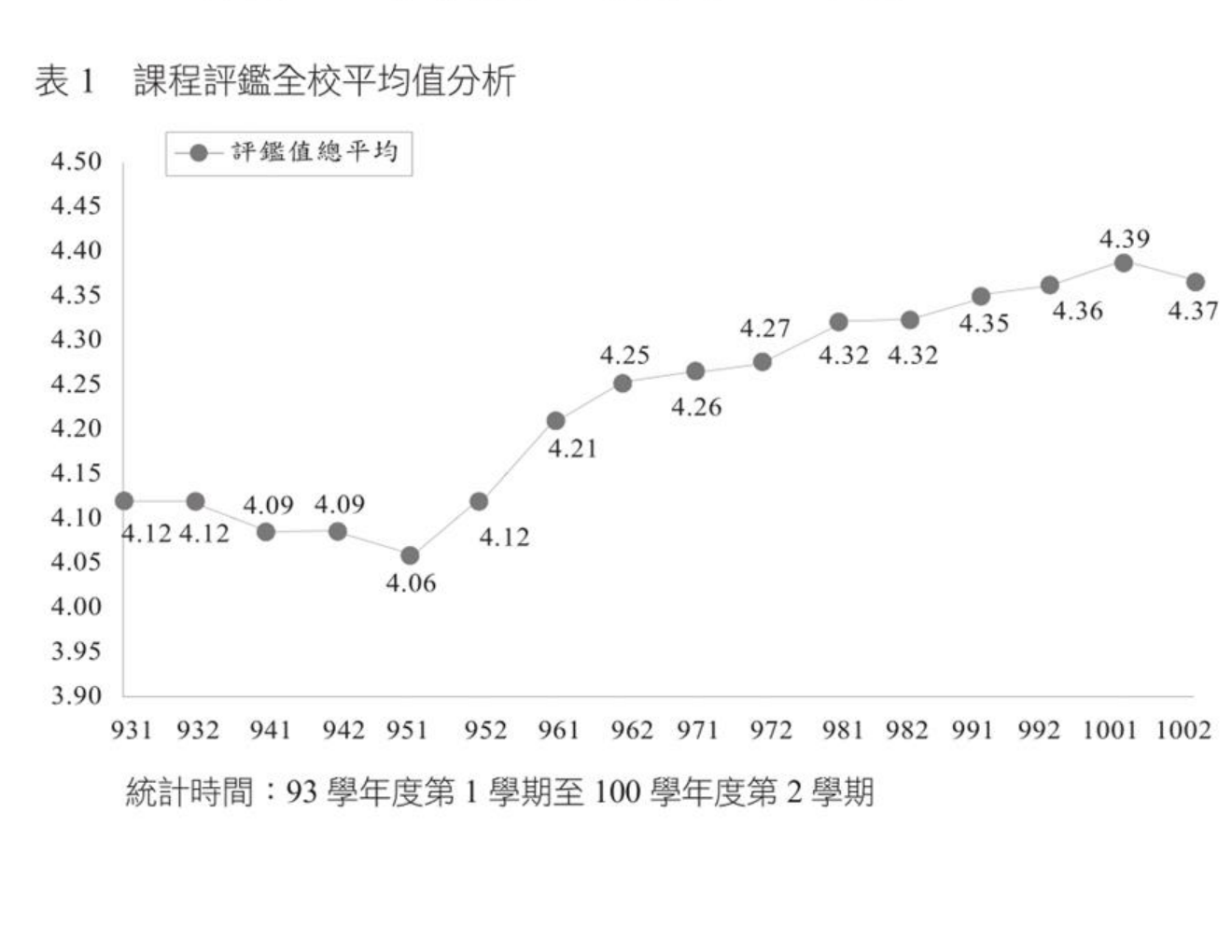
Lyric Literature, expected to total 16 lectures, which have been successively posted online.
For the first semester of the 102 academic year, the “New Hundred Masters Academy” invited Professor Chao Yong-mao to plan and host a series of lectures on the Exploration and Innovation of Taiwan’s Competitiveness, expected to total 16 lectures. Additionally, Professor Yamaguchi Mamoru will be invited to deliver the “Pai Hsien-yung Literature Lecture” on “Comparative Modern Literature of East Asia,” expected to total 16 lectures. For the second semester of the 102 academic year, Distinguished Professor Pai Hsien-yung will personally deliver the Pai Hsien-yung Culture Lecture and plan and host a series of lectures on Re-examining the History of the Republic of China, expected to total 16 lectures. In the future, audio-visual recordings will continue to be posted online, and the lecture series will be post-produced and published as DVDs and monographs.
Overall, the University has actively enhanced educational quality, and student course evaluation scores have risen year by year in recent years, as detailed in Table 1. The average rose from 4.06 in the first semester of the 95 academic year (951) to 4.37 in the second semester of the 100 academic year (1002).
Table 1 Analysis of University-wide Average Course Evaluation Scores
- Y-axis: Average Evaluation Score (ranging from 3.90 to 4.50)
- X-axis: Statistical Period (931, 932, 941, 942, 951, 952, 961, 962, 971, 972, 981, 982, 991, 992, 1001, 1002)
- Data Points:
- 931: 4.12
- 932: 4.12
- 941: 4.09
- 942: 4.09
- 951: 4.06
- 952: 4.12
- 961: 4.21
- 962: 4.25
- 971: 4.26
- 972: 4.27
- 981: 4.32
- 982: 4.32
- 991: 4.35
- 992: 4.36
- 1001: 4.39
- 1002: 4.37
Statistical Period: First Semester of the 93 Academic Year to Second Semester of the 100 Academic Year
II. Enhancing Research Standards
Our University is the most comprehensive university in our country, aiming to be a top-tier university and taking it as its mission to lead academic research in our country. Amid the wave of globalization, in recent years, the University has been actively dedicated to the integration and overall enhancement of research, developing key areas, and pursuing excellence.
1. Recruiting Outstanding Faculty and Improving Support Staff
Faculty members are on the front lines of the University’s research; only with outstanding faculty can there be excellent research outcomes. To this end, the University has actively recruited outstanding faculty and research personnel, with the following results:
(1) Actively recruiting outstanding faculty is a key priority for the University’s pursuit of excellence in teaching and research. From 2005 (Republic of China year 94) to 2012 (year 101), the University newly hired 675 outstanding full-time faculty members and 1,759 part-time faculty members (including various types of non-tenured faculty). Regarding the recruitment of outstanding overseas talents to return to the country, a total of 556 individuals were recruited from 2005 to 2012. This includes talents in the latest cutting-edge fields and interdisciplinary areas, comprising 4 members of the U.S. National Academy of Sciences and 38 academicians of the Academia Sinica.
(2) Promoting flexible salaries and performance management, establishing a performance-based flexible salary system for teaching and research personnel to recruit and retain talent. The University formulated the “Measures for the Establishment of Chairs” in March 1997 (year 86) and the “Implementation Guidelines for the Establishment of Distinguished Professors and the Granting of Distinguished Allowances” in June 2006 (year 95), conferring the titles of Chair Professor and Distinguished Professor and issuing chair grants and distinguished allowances. From the 2006 (year 95) to 2012 (year 101) academic years, a cumulative total of 74 Chair Professor appointments and 406 Distinguished Professor appointments were made. Additionally, in June 2010 (year 99), the “Measures for Current and Newly Hired…”
Outstanding Teaching and Research Personnel Allowance Guidelines,” for those with good performance in teaching, research, and service, an outstanding allowance for incumbent positions is provided. This was implemented starting from the 99th academic year, and in the 2nd meeting of the University Fund Management Committee in the 100th academic year, the standards for the outstanding allowance, including the duration of payment, the proportion of recipients, and the specification that the number of recipients shall be determined separately based on government subsidies, were revised. In the 99th academic year, 83 incumbent outstanding teaching and research personnel were approved; in the 100th academic year, 100 incumbent outstanding teaching and research personnel were approved; and in the 101st academic year, 118 incumbent outstanding teaching and research personnel were approved. Additionally, in accordance with the “Measures for Subsidizing Colleges and Universities to Recruit Special Outstanding Talent” promulgated by the National Science Council of the Executive Yuan in June 101, the application process for recommending special outstanding talent was carried out. In the 101st academic year (until the end of January 102), 11 individuals were approved for subsidies by the Council. Furthermore, in accordance with the Council’s revised “Measures for Subsidizing Colleges and Universities to Recruit Special Outstanding Talent,” the university established the “Guidelines for Rewarding Newly Hired Special Outstanding Talent,” which was announced and implemented in January 102. Through the National Science Council’s total subsidy fund, which is to be used exclusively for this purpose, the university was authorized to review and reward newly hired special outstanding talent.
(3) To invite Nobel laureates, academicians from advanced countries, or scholars with high academic standing internationally to give lectures, provide series of lectures, conduct or guide research, the “National Taiwan University Distinguished Chair” was established in 92, divided into two categories: Distinguished Research Chair and Distinguished Chair Professor. From 92 to February 102, a cumulative total of 67 Distinguished Research Chairs and 31 Distinguished Chair Professors were recruited.
(4) Recognizing that basic research personnel are the cornerstone of academic development, and in order to strengthen research capabilities in various fields and cultivate research talent, the “Guidelines for Subsidizing Postdoctoral Researchers and Research Technicians” were established in 95. As of March 102, there were 119 postdoctoral researchers and research tech
- Assisting New Faculty in Conducting Research
Outstanding new faculty members are the vital force of our university. The university adopts the following supportive measures to help new faculty members exert their academic research potential:
(1) To assist new faculty members in quickly establishing an independent research environment and to encourage the launch of various forward-looking academic research projects, the “Guidelines for Subsidizing New Faculty Academic Research Projects” were established in 95, providing seed research funds and special project research subsidies.
(2) To enhance teaching and research standards and to recruit scholars with outstanding academic achievements from home and abroad to serve at the university, the university’s “Guidelines for Providing Additional Allowances to Newly Hired Faculty and Research Personnel” were established in June 95, and subsequently revised twice in October 96 and October 98. Newly hired faculty and research personnel who have made concrete contributions academically may, after review and approval according to prescribed procedures, receive an additional teaching and research allowance. From the 95th academic year to the 101st academic year, a total of 27 person-times of additional teaching and research allowances were issued to newly hired faculty.
(3) To enhance the teaching and research standards of newly hired faculty, the “Guidelines for Faculty Overseas Lectures, Research, and Advanced Studies” were revised in 101. It was added that faculty members hired according to the hiring criteria for new full-time faculty of each college and listed as priority candidates for overseas advanced studies under the department’s cultivation plan shall not be subject to the restriction of 16% of the existing faculty members in that department (department, graduate institute, laboratory, or center), in order to increase opportunities for newly hired faculty to go abroad for advanced study and research.
- Establishing Functional Research Units
In pursuit of academic excellence, the university has established university-level functional research units in addition to the college-level research centers established by each college, to enhance the university’s research capacity. Before 94, the established units included the Center for Population and Gender Studies, the Center for Condensed Matter Science, the Center for Biotechnology, the Center for Biodiversity, the Evergreen Center for Biomedical Engineering, and the Nanotechnology Research Center jointly established by NTU and the Industrial Technology Research Institute. University-level functional research centers established from 94 to 101 include: the Center for Emerging Materials and Advanced Device Technology, the Center for Information and Electronic Technology Integration, the Center for Indigenous Studies, the Center for Neurobiology and Cognitive Science, the Center for Genomic Medicine, the Institute of Humanities and Social Sciences, the Center for Angiogenesis Research, the Center for Systems Biology, the Center for Mathematical Sciences, the Center for Digital Humanities, the Survey Research Center, the Li Tsung-Dao Center for Cosmology and Particle Astrophysics, the Center for Science and Technology Policy and Industrial Development, the Energy Research Center, the Center for Smart Life Technology Integration and Innovation, the Center for Biomedical and Technology Ethics, Law and Society, the Center for Health Sciences and Life, the Center for Quantum Science and Engineering, the Center for Measurement Theory and Applications, the Center for Climate, Weather and Disaster Research, the Center for Developmental Biology and Regenerative Medicine, the Center for Climate Change and Sustainable Development, the Center for Electrical Innovation, the Center for Theoretical Sciences, the Center for Public Policy and Law, the CTBC Charity Foundation Center for Children, Youth and Family, the Health Data Research Center, the Center for Innovative Drug Research, the Ocean Center, as well as the International Center for Smart Robotics and Automation, and the Intel-NTU Innovation Center.
As a comprehensive university with numerous academic fields, based on the mission of “providing a high-quality environment for first-class learning and innovation for faculty and students, cultivating social leadership elites and knowledge innovation research talent, and assisting national development and solving major problems of human sustainable development,” and taking into account the social problems facing our country and the needs of human development, and according to the university’s R&D capacity and development priorities, the university has formulated five major axes of concern for its academic development, namely: (1) Cultural elevation and inheritance; (2) Deep cultivation of basic academics; (3) Construction of sustainable social development; (4) Development of the knowledge economy and technology industries; (5) Health care and life. The second phase of the Plan for Advancing to the Top uses these five major axes of concern as the core
II. Enhancing Research Standards
core, specifically planned ten university-level integrated research centers to assume the role of locomotives, assisting NTU in becoming an international top-tier university:
(1) Institute for Advanced Study in Humanities and Social Sciences
The Institute for Advanced Study in Humanities and Social Sciences (hereinafter referred to as the “IAS”) at NTU is based on the Ministry of Education’s “Research University Project” Humanities and Social Sciences Research Center. With “East Asian Confucianism and Education” and “Taiwan Education and Culture” as its main research directions, it integrates humanities and social sciences from within and outside the university, as well as domestically and internationally, to build an academic platform, promote collaborative academic research, advance bachelor’s degree programs, and enhance teaching effectiveness, making NTU a global hub for East Asian studies.
The IAS strengthens research on issues related to Taiwan and global development, conducting foundational theoretical and interdisciplinary-integrated transnational, long-term research. Key axes include: research on economic globalization and the world trade system, organizational behavior, growth models, and global management strategies of Chinese enterprises under globalization, Chinese capital and spatial networks, international migration and Taiwan, etc. By the second semester of the 101 academic year, the six major research projects and three major research integration platforms conducted include: (1) East Asian Confucianism Research Project; (2) East Asian Democracy Research Project; (3) Trade, Labor, Finance, and Productivity Research Project in East Asian Countries; (4) East Asian Courts and Legal Reception Research Project; (5) Psychological Research on the Chinese Self in East Asia; (6) Research Project on Developmental Changes in Contemporary Mainland China and the Transformation of Subjectivity in “China Studies” amid the Rise of East Asia; (7) Digital Humanities Research Integration Platform; (8) Japan and Korea Research Integration Platform amid the Rise of East Asia; and (9) European Union Research Integration Platform. All are directed by outstanding scholars of our university, covering important academic issues with a focus on East Asian culture.
(2) Integrated Research Center for Information and Electronic Technology
Based on the Information and Electronic Technology Research Center, one of the four major research centers within NTU under the Ministry of Education’s “Research University Project,” and extending it, with a macroscopic, forward-looking “overall goal,” a comprehensive evaluation and incentive system, establishing key research teams and integrated laboratories, strengthening interdisciplinary integrated research, and closely cooperating with the industrial sector.
(3) Genomic Medicine Research Center
Based on the Genomic Medicine Center, one of the four major research centers within NTU under the Ministry of Education’s “Research University Project,” and extending it, in addition to establishing an advanced genomic medicine technology research platform and providing core equipment and technical support, it also adds Cancer and Infectious Disease Research Centers to propose new treatment and prevention technologies and strategies for solving important diseases affecting the Chinese people.
(4) Systems Biology Research Center
Integrating resources from different colleges, targeting the most cutting-edge issues in the fields of life medicine and biotechnology research, introducing the mathematical theories and computational principles of systems science, and thereby constructing precise quantitative analysis models of biological systems, gaining a deeper understanding and mastery of the operational principles of complex life phenomena, and creating broader space for progress in life medicine and biotechnology research. It aims to promote NTU’s life sciences research and teaching toward world-class standards and connect with the biological industry.
(5) Neurobiology and Cognitive Science Research Center
Combining the personnel and resources of relevant departments in various colleges and the Hospital of NTU College of Medicine, promoting integrated research from different levels such as genes, molecules, cells, systems, behavior, cognition, society, evolution, and computational simulation, thereby enhancing the level of neurobiology and cognitive science in our country, and promoting the development of neuropsychiatry and the integration of engineering and intelligence. Research topics include schizophrenia, perception and emotion, memory and language, chronic pain, neurodegenerative diseases, etc.
II. Enhancing Research Standards
(6) Theoretical Science Research Center
Our university has always been in a leading position among all universities in Taiwan in basic theoretical sciences. Since 91 (2002), it has entered a new stage in the field of natural sciences. Some mathematics and physics projects have already gained an advantage in the international academic community and have the potential for major breakthroughs in the future. In addition, the Institute of Atomic and Molecular Sciences, the Institute of Mathematics, and the Institute of Astronomy and Astrophysics of the Academia Sinica have all relocated to our university campus, and the National Center for Theoretical Sciences (Northern Region) is also located at our university. Therefore, the mission of this center is to promote horizontal connections between different theoretical science disciplines, stimulate more creativity and entirely new interdisciplinary research directions, and guide entirely new collaborations.
(7) Molecular Biomedical Imaging Research Center
This center integrates currently the most advanced imaging technologies, combining laboratories for molecular genetic technology, imaging contrast technology, molecular animal models, and imaging analysis technology, to engage in education and training, research and development of new systems and methods for molecular biomedical imaging, and jointly research and explore important issues such as gene expression, embryonic development, cancer diagnosis and tracking, tissue atrophy and necrosis, and brain function. Making good use of our university’s advantage as a comprehensive university, it continues to develop research platforms, on one hand deepening existing interdisciplinary basic science research, and on the other hand expanding and deepening translational research on medical imaging in the diagnosis of various diseases, achieving the best integration of research, education, and clinical application. It is expected to become an international top-tier excellence center for biomedical molecular imaging by 104 (2015).
(8) Emerging Materials and Advanced Component Technology Research Center
Based on the Nanotechnology Research Center, one of the four major research centers within NTU under the Ministry of Education’s “Research University Project,” renamed the Advanced Nanomaterials Center in 96 (2007), received 10
The goal is to integrate on-campus research and resource sharing. The core organization involves five layers: materials, components, mechatronics, biomedical, and education. The fields span the Colleges of Science, Engineering, Electrical and Computer Engineering, Medicine, Life Sciences and Agriculture, and Life Sciences, encompassing departments of Chemistry, Physics, Materials Science and Engineering, Chemical Engineering, Polymer Science and Engineering, Mechanical Engineering, Electrical Engineering, Electronics Engineering, and Photonics. The aim is to form world-class research teams with units such as the National Center for Theoretical Sciences at NTU, jointly develop the fabrication of novel materials, establish a platform for forward-looking component technologies, and, in coordination with the national development of semiconductors and photonics and energy-saving needs, achieve the goal of sustainable development for Taiwan.
(9) Center for Climate Change and Sustainable Development
To integrate multiple disciplines on campus, this center was established in June 2011. As a university-level research center, its main axes are establishing regional and global resource and disaster potential monitoring and forecasting systems, conducting research on multi-level governance strategies and benefit assessments for climate change, reducing greenhouse gas emissions, developing low-carbon energy, improving energy efficiency, and developing precision agriculture, fisheries, and animal husbandry. It is supported by formulating quantifiable policy benefit assessments and strategies, establishing regional and global disaster prevention monitoring systems and capabilities, and forming alliances with major domestic and international research institutions and industries to jointly develop overall research centered on the government’s two policy goals of “green energy industry” and “precision agriculture.”
(10) Center for Health Sciences and Life
Integrating research talents from NTU in the fields of psychology, sociology, biomedical sciences, engineering, business administration, design, education, and information and electronics, this center is dedicated to integrating the outcomes and resources of domestic health care and smart life technology-related projects to conduct interdisciplinary research. Its research outcomes will help promote remote medical care, save national medical expenditure, and build Taiwan’s medical brand, jointly promoting innovative R&D from needs exploration to industrial upgrading.
Most of NTU’s research projects come from government R&D funding. To expand other sources of research funding, NTU plans to use the Ten Key Research Centers or research groups from the Top-Tier Project as the core to actively integrate interdisciplinary research. Through Leverage Funding channels, it encourages the joint appointment of teaching and research personnel by domestic and external units to secure resources from the Industrial Technology Research Institute (ITRI), the National Science and Technology Council (NSTC), the Academia Sinica, legal persons, and industry, as well as to cooperate with or jointly establish research centers with renowned foreign academic institutions. For example:
NTU Publishing
NTU New Energy Center
In 2009, NTU’s New Energy Center signed a three-year international cooperation plan with King Abdullah University of Science and Technology (KAUST) in Saudi Arabia, totaling US130 million) to develop Solar Building Technology. NTU was the only Asian university selected for this cooperation.
European Union Centre in Taiwan
Established in 2009, the European Union Centre in Taiwan is tasked with promoting and deepening EU research, participating in global EU research communities, facilitating exchanges between Taiwanese and EU civil societies, and serving as a platform for policy communication and dialogue between both sides. In the long term, it will develop into the most important base for EU research and bilateral civil society exchanges in the Chinese-speaking world.
APEC Research Center for Typhoon and Society
In 2010, with the approval of APEC, the APEC Research Center for Typhoon and Society (ACTS) was established at NTU. Adhering to the purpose of disaster relief and mitigation, the center constructs an international cooperation network as a platform for APEC member economies to share typhoon research and disaster prevention and relief experiences.
NTU Publishing
Additionally, to further enhance R&D capabilities, NTU has adopted an “organization-to-organization” strategy to promote multinational research centers in cooperation with international top-tier research teams. These include:
International Center for Intelligent Robotics and Automation
This center is an international cooperative research project conducted by NTU with three first-class international research institutions and universities: the French National Centre for Scientific Research (Centre national de la recherche scientifique, CNRS), the French National Institute for Research in Computer Science and Automation (Institut national de recherche en informatique et en automatique, INRIA), and Pierre and Marie Curie University (Université Pierre et Marie Curie, UPMC; also known as Paris VI University). The focus is on jointly developing intelligent robots and automation tools to improve the quality of human life.
Intel-NTU Innovation Research Center
NTU has partnered with Intel Corporation to establish this research center on the NTU campus to explore and develop new Machine-to-Machine (M2M) technologies that meet future needs.
Multinational Top-Tier Cancer Research Center
NTU has successfully integrated three top-tier cancer institutions: the College of Medicine at NTU, China Medical University, and the University of Texas MD Anderson Cancer Center, to conduct active and diversified multilateral cooperation and establish a world-class multinational cancer research center.
In addition to the aforementioned “international-level” top-tier research centers, NTU is also actively securing funding from government departments such as the National Science and Technology Council to establish “national-level” key field or interdisciplinary research institutions at NTU. Such research centers include: National Center for Earthquake Engineering
II. Enhancing Research Standards
… the Promotion Center, the Research and Education Center for Infectious Disease Prevention, the National Science Council’s National Taiwan University Center for Major Instruments, the National Science Council’s Center for Humanities and Social Sciences, and others. The most recently established among these is the “National Science Council’s Center for Humanities and Social Sciences,” founded in January 2012 (ROC Year 101). Its primary goal is to integrate close interdisciplinary collaboration in the humanities and social sciences to promote the excellence of humanities and social sciences in Taiwan. Its academic service items include consultation and services for major instruments, database integration, academic journal evaluation, and academic monograph publication. It also cooperates extensively with other domestic academic institutions to jointly cultivate academic talent and raise Taiwan’s overall research standards. Furthermore, it invites outstanding foreign scholars to give lectures and reside at the university, strengthening exchanges between Taiwan and the international academic community and promoting the growth of local talent.
IV. Establishment of the Center for Innovation Realization
Stanford University or the Massachusetts Institute of Technology in the United States are not only leading the world in science and technology or in academia; in the era of the knowledge economy, they are also leaders in entrepreneurship. As the university with the longest history and largest scale in Taiwan, enjoying abundant resources from all sectors of society, our university should shoulder the responsibility and mission of “creating value through academic research and contributing to society through startups.” To transform the creative ideas, excellent technologies, and patents of all faculty, staff, and students into new products or new industries, thereby bringing greater impact and contribution to society, the “Center for Innovation Realization” was officially established on July 31, 2012 (ROC Year 101). It is hoped that through the center’s resource integration and assistance, the latent innovative and creative energy of our university will be realized. Although the establishment of the Center for Innovation Realization started later compared to foreign counterparts, measures to encourage an entrepreneurial spirit on campus have been implemented for many years, including innovation competitions and the establishment of the Entrepreneurship Association, which have attracted considerable attention and response. The establishment of the Center for Innovation Realization will have an important impact on the integration and execution of campus entrepreneurial planning.
V. Awards for Academic Research Achievements
To encourage our university’s full-time faculty and researchers to actively publish academic research achievements and to establish a flexible salary system for faculty, the “National Taiwan University
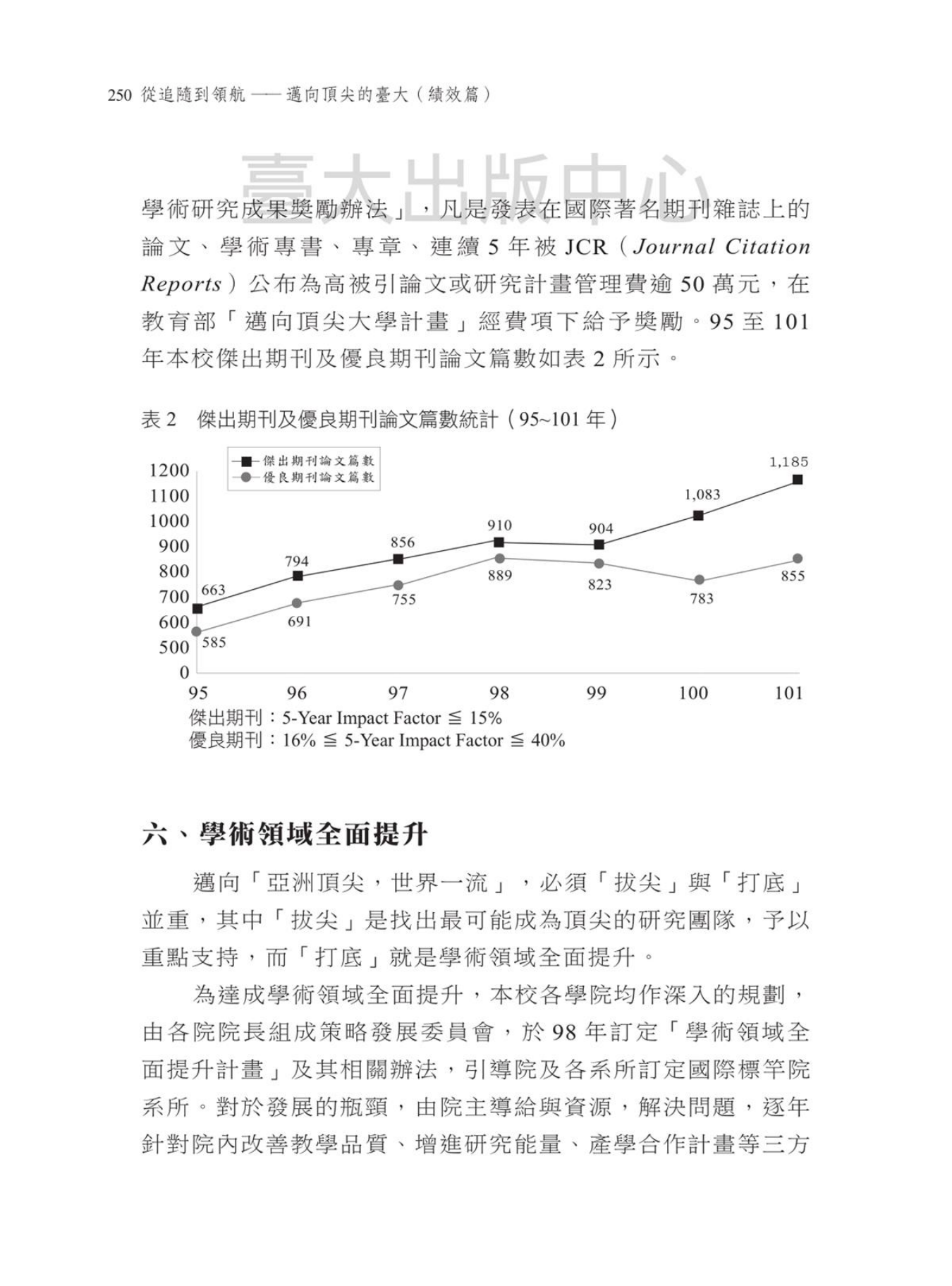
Regulations on Awards for Academic Research Achievements” was formulated in February 2006 (ROC Year 95). Papers published in internationally renowned journal magazines, academic monographs, book chapters, papers listed as highly cited for five consecutive years by JCR (Journal Citation Reports), or research project management fees exceeding NT$500,000 are awarded under the budget item of the Ministry of Education’s “Top University Project.” The number of outstanding journal and good journal papers at our university from 2006 to 2012 (ROC Years 95–101) is shown in Table 2.
Table 2 Statistics of Outstanding Journal and Good Journal Papers (2006–2012)
| ROC year | Outstanding-journal papers | Good-journal papers |
|---|---|---|
| 95 | 663 | 585 |
| 96 | 794 | 691 |
| 97 | 856 | 755 |
| 98 | 910 | 889 |
| 99 | 904 | 823 |
| 100 | 1,083 | 783 |
| 101 | 1,185 | 855 |
- Outstanding Journal: 5-Year Impact Factor ≤ 15%
- Good Journal: 16% ≤ 5-Year Impact Factor ≤ 40%
VI. Comprehensive Enhancement of Academic Fields
To move toward “Asia’s Top, World-Class,” we must place equal emphasis on “picking the best” and “building the foundation.” “Picking the best” means identifying research teams most likely to become top-tier and providing them with key support, while “building the foundation” means the comprehensive enhancement of academic fields.
To achieve the comprehensive enhancement of academic fields, each college of our university has made in-depth plans. A Strategic Development Committee composed of deans of each college formulated the “Comprehensive Enhancement Plan for Academic Fields” and related regulations in 2009 (ROC Year 98) to guide colleges and their respective departments and institutes in setting international benchmark departments and institutes. For developmental bottlenecks, the college takes the lead in providing resources to solve problems, conducting comprehensive reviews and improvements annually in three aspects: improving teaching quality within the college, enhancing research capacity, and industry-academia cooperation plans. For example, reinforcing human resources and equipment, expanding the international horizons of faculty and students, subsidizing attendance at international conferences and publication of papers, actively inviting international scholars for visits and lectures, and organizing international conferences, so that our university’s overall teaching and research meet international standards.
One of the important goals of NTU moving toward the top is the comprehensive enhancement of all academic fields. Based on this vision, development strategies and specific plans are formulated annually for parts needing reinforcement in teaching, research, or industry-academia cooperation, as well as for internationalization and other key directions, to conform to the self-positioning and development of each college.
II. Enhancing Research Standards
VII. Picking the Best in Key Fields
During the execution period of the first phase of the Top University Project, in order to make our university a hub for academic research and knowledge innovation in Asia within five years, with the subsidy of the Ministry of Education’s Top University Project funds, in addition to promoting a comprehensive academic enhancement strategy, we also set the goal of entering the world’s top 100 in university rankings. Therefore, the “Key Points for Subsidy Operations of the Excellence Plan for Advantageous Key Fields” was formulated in February 2006 (ROC Year 95). This plan targets fields where NTU currently holds an advantage internationally, such as the “Institute for Advanced Study in Humanities and Social Sciences,” the “Center for Advanced Nano-Materials” (renamed in 2011 [ROC Year 100] to the “Center for Emerging Materials and Advanced Device Technologies”), the “Center for Integrated Information and Electronic Technologies,” the “Center for Medical Excellence” (renamed in 2010 [ROC Year 99] to the “Center for Genomic Medicine”), and others. Through substantial financial injection, these centers are intended to become world-leading in a short period of time. In the first phase of the Top University Project, among the plans proposed by the five major research centers and colleges, a total of 16 main plans and 68 sub-plans were approved for subsidy.
In 2011 (ROC Year 100), our university continued to receive funding injection for the second phase of the Top University Project, continuing to promote the Excellence Plan for Key Fields. The goal is to develop twenty to…
become world-leading in thirty fields. This period saw the approval of seven major research centers, including the “Institute of Humanities and Social Sciences,” the “Center for Emerging Materials and Advanced Device Technologies,” the “Center for Integrated Information and Electronic Technologies,” the “Center for Genomic Medicine,” the “Center for Theoretical Sciences,” the “Center for Systems Biology,” and the “Center for Molecular Biomedical Imaging.” From the proposals submitted by these seven research centers and the colleges, a total of 21 main projects and 104 sub-projects were approved for funding.
- Forward-Looking Research Leadership Program
Starting from the second phase of the Top University Plan, in order to deepen research in basic sciences, shift from a follower mindset (“me too”) to a leader mindset (“follow me”), assist national economic development, and address major issues concerning sustainable social development, we adopted a top-down approach to establish the “Guidelines for the Forward-Looking Research Leadership Program.” Deans of colleges and directors of centers recommended top-tier fields within their respective units to the university. After initial review by external scholars and experts, and subsequent approval by the internal review committee, funding was provided. The number of approved projects was 9 in the 100th year (2011) and 15 in the 101st year (2012). These leadership programs will guide the development of many emerging academic and technological fields in the next decade.
To address global climate change, the “Center for Climate Change and Sustainable Development” was established to build forecasting and evaluation systems for climate change, water resource changes, and food/fishery supply. In cooperation with the New Taipei City Government, we established a research database for local and regional governance, as well as flood disaster assessment and prevention systems. Year by year, we integrated literature and information from specialized books, journal articles, and related websites from the UK, US, and other countries regarding local and regional governance, becoming an important database and research discussion platform for local and regional governance studies in Taiwan and the Chinese-speaking world.
To address the challenges of an aging society and healthcare, we developed a model that leverages the remote health management services of National Taiwan University Hospital to drive the development of the biomedical information electronics industry. Starting small and expanding, we integrated with the insurance and social work sectors to gradually promote these services to society. To develop precision agriculture,
increase rural employment opportunities, and combine disciplines such as biology, agriculture, mechanics, and electronics to develop plant factories, we created high-end agriculture that is organic, water-saving, and land-efficient, contributing to society through technology transfer to manufacturers or the establishment of companies.
Leadership programs in biomedical sciences include the integration of Traditional Chinese Medicine pulse diagnosis with Western medicine, empirical research and mechanism exploration in energy medicine, the impact of environmental energy on plant growth, the mystery of disappearing bees, and the development of new drugs for treating degenerative neurological diseases.
- International Cooperative Research Program
To enhance the university’s international visibility and become a hub for international academic research, we promoted the participation of our full-time faculty and researchers in research teams at world-class international academic institutions to conduct forward-looking and innovative research. Accordingly, in February of the 100th year (2011), we established the “Guidelines for the International Cooperative Research Program,” providing funding for three types of research projects:
The first type of research project involves participation in plans to jointly establish cross-national research centers with the National Science Council (NSC) and renowned international academic institutions. In accordance with the NSC’s “Plan for Subsidizing the Establishment of Cross-National Top Research Centers in Taiwan (Pilot Scheme),” the university, the NSC, and the foreign partner each bear one-third of the costs. The funding period is five years. In the 100th year (2011), we jointly established a research center with Intel, the world’s largest semiconductor company, to develop M2M (Machine-to-Machine) technology. In the 101st year (2012), we jointly established a cancer research center with the MD Anderson Cancer Center at the University of Texas, USA. We also jointly established the “International Research Center for Intelligent Robotics and Automation” with the French National Center for Scientific Research (CNRS), the French National Institute for Research in Computer Science and Automation (INRIA), and the University of Paris 6 (UPMC). A total of three research centers were approved, which greatly contributed to enhancing the university’s research standards and international reputation.
The second type of project involves plans that have received NSC funding to promote bilateral cooperation (with subsidies of over 2 million NT dollars). The application schedule is based on actual needs, and the application proposal submitted to the NSC must be provided. The funding subsidy is matched with the NSC subsidy, with a principle of not exceeding 500,000 NT dollars. Four projects were approved in the 101st year (2012).
The third type of project involves cooperative research plans signed with top-tier overseas universities under strategic alliances. The application schedule is determined by the content of the contract with the strategic alliance partner university. The funding subsidy is based on the principle of fair and equal partnership with the strategic alliance partner university, depending on the content of the research plan. Four projects were approved in the 101st year (2012).
- Academic Research Career Development Program
To motivate our faculty to dedicate themselves long-term to original research on important field-specific topics, fully unleash their research potential, and aim for leadership positions in cutting-edge and important research areas, we established the “Guidelines for the Academic Research Career Development Program” in February of the 100th year (2011). This program includes two types of subsidies: Deep-Cultivation Research Projects and Laureate Research Projects. Faculty members from each college submit applications according to the regulations.
(1) Deep-Cultivation Research Projects
Faculty members prepare project proposals according to the “Guidelines for the Academic Research Career Development Program.” All proposals undergo administrative review before being sent to scholars and experts in relevant fields abroad for initial review. Domestic scholars and experts then conduct a secondary review based on the initial review comments, and the project is approved by the Committee of the Office of Research and Development. Priority is given to projects in academic fields that are forward-looking, innovative, or developmental, and possess international competitiveness. A total of 25 projects were approved for funding in the 100th year (2011), and 18 projects were approved for funding in the 101st year (2012).
(2) Laureate Research Projects
The funding for this program serves as the university’s matching contribution to NSC projects. Any full-time faculty member or researcher at our university who has received an NSC Academic Peak Research Project or an Outstanding Young Scholar Research Project may apply. A total of 31 projects were approved for funding in the 100th year (2011), and 64 projects were approved for funding in the 101st year (2012).
II. Enhancing Research Standards
11. Improving Individual Research Accounts
Previously, the allocation method for surplus funds from industry–academia cooperation projects stipulated that if the surplus amount reached NT50,000 or more, after deducting NT$10,000, 80% would return to faculty members for individual teaching and research use.
In the 97th year of the Republic of China (2008), the number of cases where surplus funds from industry–academia cooperation projects were allocated for individual faculty use was 241, with a total amount of NT371,977,546, specifically NT80,695,381 in the 99th year, NT135,828,319 in the 101st year, representing a substantial increase of 147%. Therefore, following the implementation of the new system up to March of the 102nd year of the Republic of China (2013), the University’s individual research accounts have increased year by year, enabling more effective application of surplus funds from industry–academia cooperation projects, thereby enhancing resource utilization efficiency and elevating faculty members’ individual research standards.
12. Promoting Pilot Industry–Academia Cooperation Projects
To actively utilize the funds from the Ministry of Education’s “Top University Project” and promote mechanisms and environments for industrial development, each college proposed plans according to the “Guidelines for Subsidizing Industry–Academia Cooperation Research Projects.” After inviting experts from both industry and academia to listen to the applicants’ presentations and provide recommendations on the technical and market value of the projects, the subsidy funds were approved and passed by the University’s Advisory Committee. The number of subsidized projects for each year is shown in Table 3:
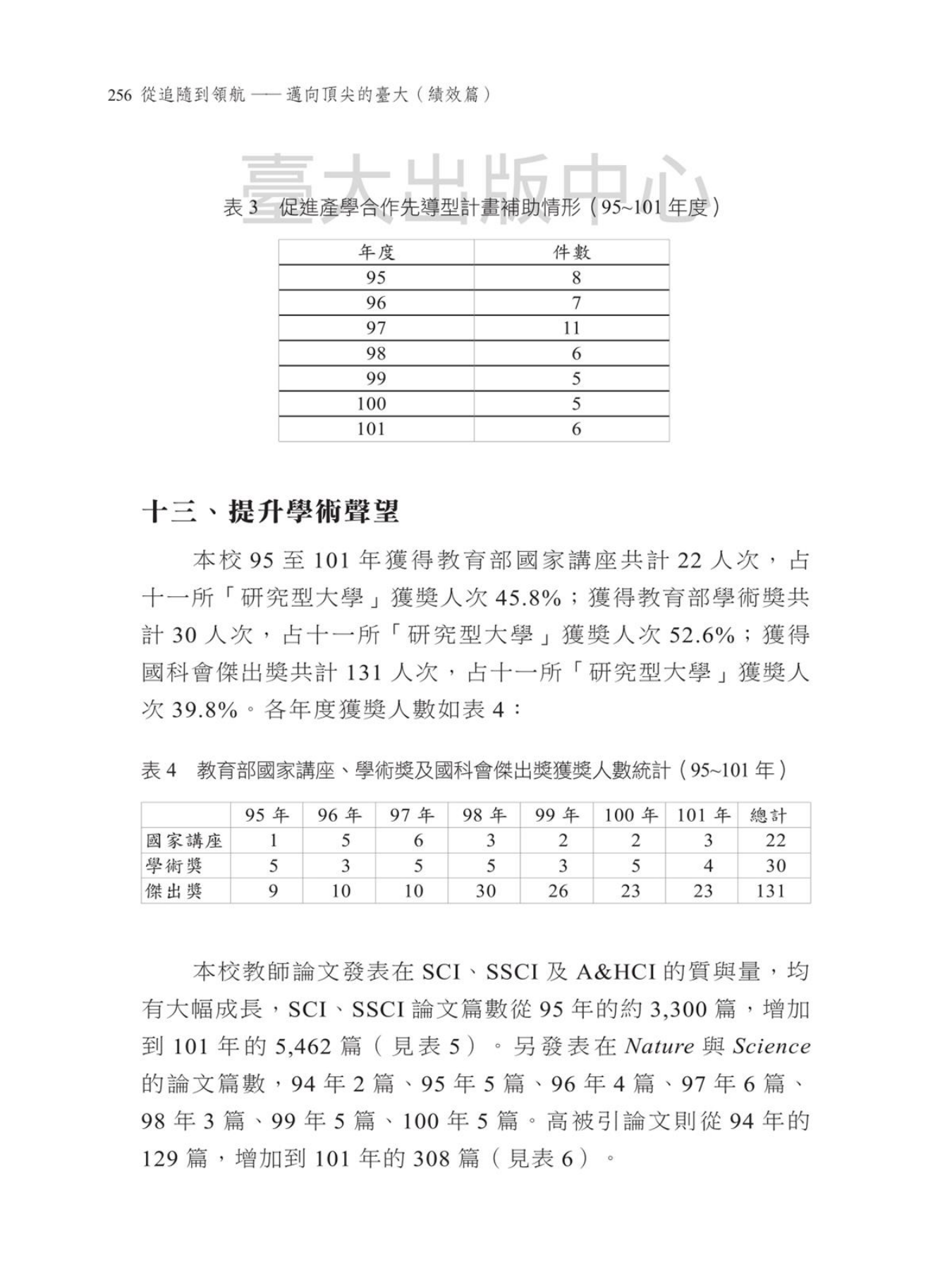
Table 3: Subsidy Status of Pilot Industry–Academia Cooperation Projects (95th–101st Years of the Republic of China)
| Year | Number of Cases |
|---|---|
| 95 | 8 |
| 96 | 7 |
| 97 | 11 |
| 98 | 6 |
| 99 | 5 |
| 100 | 5 |
| 101 | 6 |
13. Enhancing Academic Reputation
From the 95th to the 101st year of the Republic of China (2006–2012), the University received a total of 22 appointments to the Ministry of Education’s National Distinguished Chair, accounting for 45.8% of the appointments awarded to the eleven “Research Universities”; it received a total of 30 Ministry of Education Academic Awards, accounting for 52.6% of the awards given to the eleven “Research Universities”; and it received a total of 131 National Science Council Outstanding Research Awards, accounting for 39.8% of the awards given to the eleven “Research Universities.” The number of awardees for each year is shown in Table 4:
Table 4: Statistics on Awardees of the Ministry of Education’s National Distinguished Chair, Academic Awards, and the National Science Council’s Outstanding Research Awards (95th–101st Years of the Republic of China)
| 95 | 96 | 97 | 98 | 99 | 100 | 101 | Total | |
|---|---|---|---|---|---|---|---|---|
| National Distinguished Chair | 1 | 5 | 6 | 3 | 2 | 2 | 3 | 22 |
| Academic Award | 5 | 3 | 5 | 5 | 3 | 5 | 4 | 30 |
| Outstanding Research Award | 9 | 10 | 10 | 30 | 26 | 23 | 23 | 131 |
The quality and quantity of faculty publications in SCI, SSCI, and A&HCI have grown significantly. The number of SCI and SSCI papers increased from approximately 3,300 in the 95th year of the Republic of China (2006) to 5,462 in the 101st year of the Republic of China (2012) (see Table 5). Additionally, the number of papers published in Nature and Science was 2 in the 94th year (2005), 5 in the 95th year (2006), 4 in the 96th year (2007), 6 in the 97th year (2008), 3 in the 98th year (2009), 5 in the 99th year (2010), and 5 in the 100th year (2011). The number of highly cited papers increased from 129 in the 94th year (2005) to 308 in the 101st year (2012) (see Table 6).
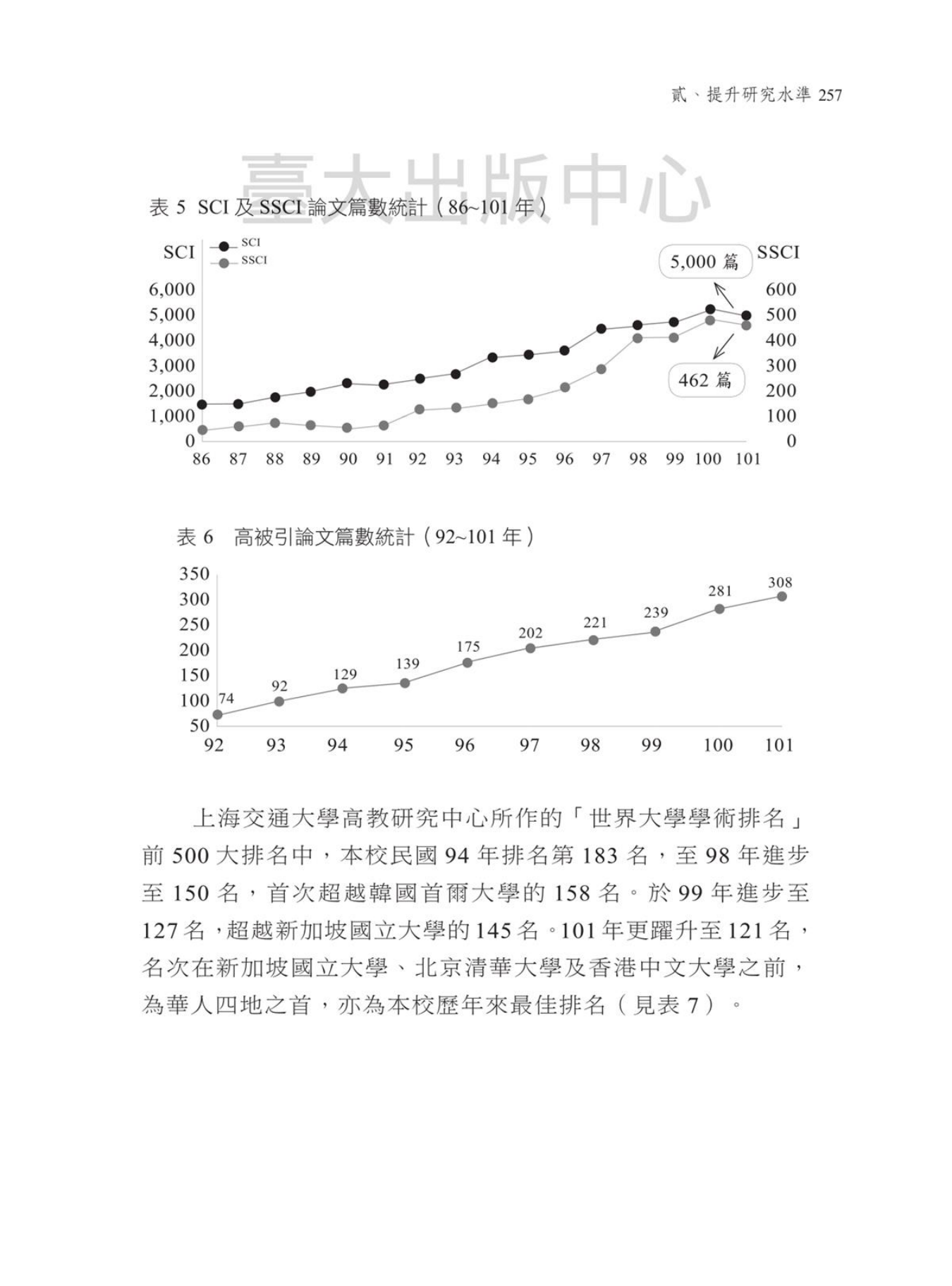
Table 5: Statistics on the Number of SCI and SSCI Papers (86th–101st Years of the Republic of China)
[Chart: Line graph showing trends for SCI and SSCI papers from year 86 to 101. Y-axis ranges from 0 to 6,000. Data points indicate growth, with a specific label noting 462 papers for SSCI in year 101.]
Table 6: Statistics on the Number of Highly Cited Papers (92nd–101st Years of the Republic of China)
[Chart: Line graph showing the number of highly cited papers from year 92 to 101. Y-axis ranges from 0 to 350. Specific values labeled on bars include 74 (92), 92 (93), 129 (94), 139 (95), 175 (96), 202 (97), 221 (98), 239 (99), 281 (100), and 308 (101).]
In the “Academic Ranking of World Universities” (ARWU) top 500 ranking produced by the Center for World University Rankings at Shanghai Jiao Tong University, the University ranked 183rd in the 94th year of the Republic of China (2005). By the 98th year (2009), it had improved to 150th; in the 99th year (2010), it reached 127th, surpassing the National University of Singapore’s rank of 145th. In the 101st year (2012), it further rose to 121st, placing ahead of the National University of Singapore, Tsinghua University in Beijing, and the Chinese University of Hong Kong, securing the top position among the four Chinese-speaking regions and achieving the best ranking in the University’s history (see Table 7).
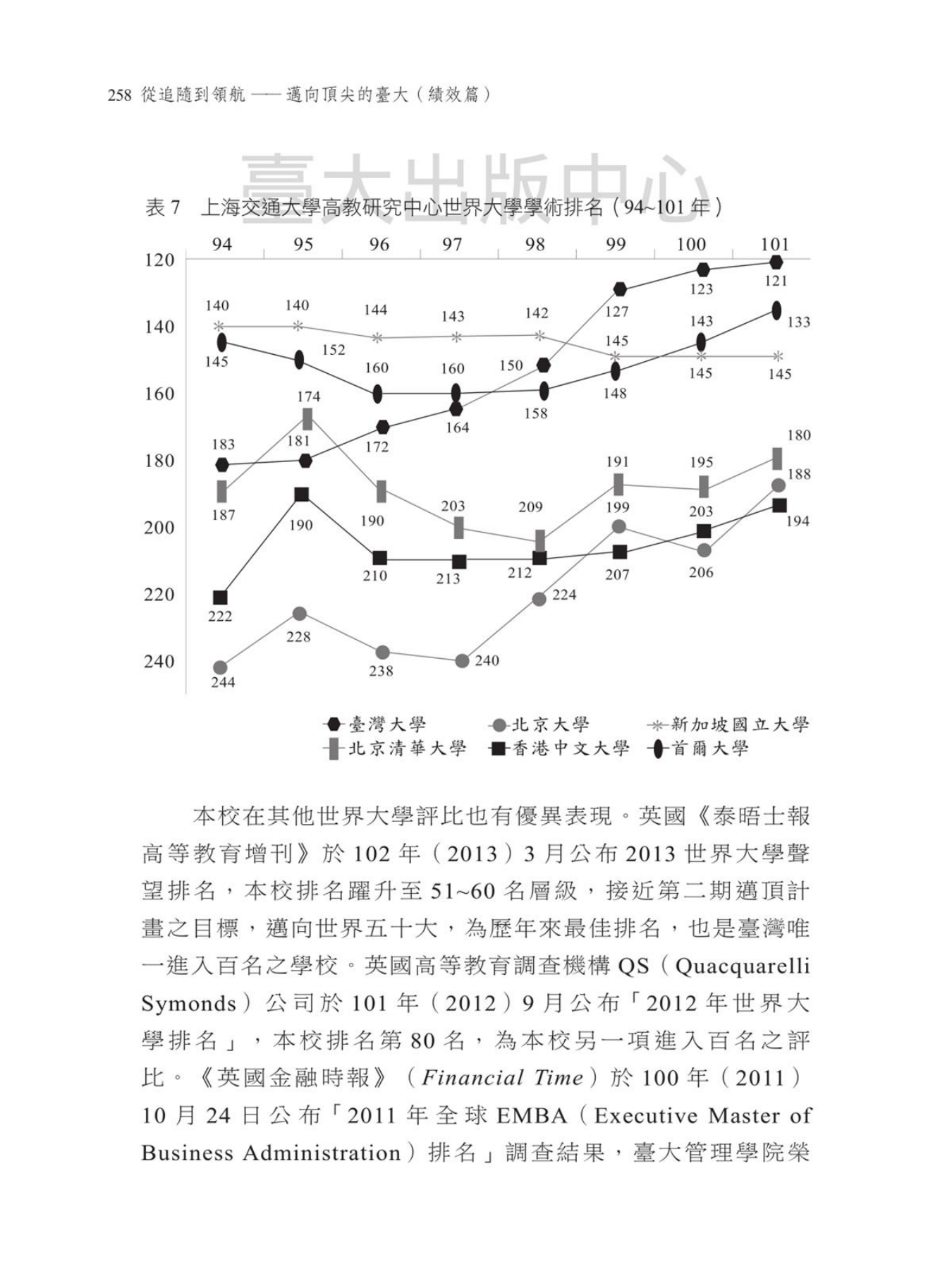
Table 7 Academic Ranking of World Universities by the Center for World University Rankings at Shanghai Jiao Tong University (2005–2012)
| ROC year | NTU | Peking | NUS | Beijing Tsinghua | CUHK | Seoul National |
|---|---|---|---|---|---|---|
| 94 | 183 | 244 | 140 | 187 | 222 | 145 |
| 95 | 181 | 228 | 140 | 174 | 190 | 152 |
| 96 | 172 | 238 | 144 | 190 | 210 | 160 |
| 97 | 164 | 240 | 143 | 203 | 213 | 160 |
| 98 | 150 | 224 | 142 | 209 | 212 | 158 |
| 99 | 127 | 199 | 145 | 191 | 207 | 148 |
| 100 | 123 | 206 | 145 | 195 | 203 | 143 |
| 101 | 121 | 188 | 145 | 180 | 194 | 133 |
*National University of Singapore
Our university has also demonstrated excellent performance in other global university rankings. In March 2013 (year 102), the UK’s Times Higher Education Supplement released the 2013 Reputation Rankings of World Universities, in which our university’s ranking jumped to the 51–60 tier. This result approaches the target of the second phase of the “Marching to the Top” Plan—to enter the global top fifty—and represents our best ranking to date. It also makes us the only institution in Taiwan to enter the top one hundred. In September 2012 (year 101), the UK higher education research organization QS (Quacquarelli Symonds) released the “2012 World University Rankings,” in which our university ranked 80th, marking another instance of our university entering the top one hundred in a global assessment. On October 24, 2011 (year 100), The Financial Times (UK) announced the results of its “2011 Global EMBA (Executive Master of Business Administration) Rankings,” in which the College of Management at National Taiwan University was honored
with the world ranking of 45th, topping all institutions in Taiwan.
- Establishment of the Research Ethics Center
The development of academic knowledge and technology across various human domains today greatly benefits from the assistance of research participants. However, any research involving humans as participants may bring varying degrees of risk to those willing to assist in the research, or may produce outcomes contrary to their interests. Therefore, in internationally advanced academic nations, top-tier universities establish committees to conduct ethical reviews of research plans. These committees are typically referred to as Institutional Review Boards (IRBs) and must include at least two types of review panels: biomedical and non-biomedical. In addition to reviewing issues concerning the ethics, human rights, and well-being of research participants, some universities also include the protection of laboratory animals. The Research Ethics Committee at our affiliated hospital has been in operation for over twenty years as of 2012 (year 101). However, in non-biomedical fields such as behavioral sciences, social sciences, business administration, and humanities and arts—where researchers similarly use personal data of participants and invite or recruit them to participate in studies—there were no corresponding research ethics review systems or regulations to protect these participants. Therefore, our university actively sought subsidies from the National Science Council to implement the “Plan for Establishing a Governance Framework for Human Behavior Research Ethics and Human Subject Research Ethics” in January 2010 (year 99). This initiative aimed to establish a non-biomedical research ethics review mechanism to promote respect for the human rights of research participants, align with international academic and research trends, and gradually enhance our university’s international academic standing.
After studying the practices of advanced nations, our university has structured a research ethics review system, review organization, and educational training institution that features behavioral and social sciences and conforms to Taiwan’s national conditions. The Research Ethics Center serves as the core of the administrative support system. With the support of the Research Ethics Center, our university has successively established
three committees: the “Behavioral and Social Sciences Research Ethics Committee,” the “Research Ethics Review Committee,” and the “Research Ethics Advisory Committee.” These committees assist our faculty and students in ensuring that their research in the fields of social sciences, behavioral sciences, humanities and arts, and business administration meets international standards and complies with various ethical norms, thereby implementing the concept that “protecting research participants promotes sustainable academic development.” Furthermore, in 2011 (year 100), our university initiated the establishment of the “Northern Taiwan Alliance for the Protection of Research Participants” (hereinafter referred to as the “Alliance”). Serving as the locomotive driving correct academic research practices, our university shares and promotes the basic educational training on research ethics and the philosophy of protecting research participants throughout northern Taiwan to advance domestic academic progress.
The main responsibilities of the Research Ethics Center include: undertaking the review, audit, and personnel training tasks for human behavior and human subject research plans at our university (and the Alliance); designing and promoting research ethics concepts and conducting research ethics educational training courses; handling administrative matters related to the ethical review of research plans; promoting research ethics education; providing research ethics-related consultation services; and protecting laboratory animals.
As of February 2013 (year 102), the achievements of the Research Ethics Center include: hosting 31 research ethics educational training sessions involving human research at our university and Alliance institutions, with a total of 1,966 person-times attending the training courses; handling a total of 318 human research ethics review cases for our university (and the Alliance); convening universities in the northern region to form an alliance, with 38 alliance partners having joined and numbers continuing to increase; and providing research ethics-related consultation services to over 1,200 person-times for our university (and the Alliance). Additionally, regarding laboratory animals, the center has conducted three training courses for laboratory animal users, with a total of 435 participants, and hosted one lecture by a foreign scholar, attended by 57 people. It has also processed 235 laboratory animal application cases.
III. Planning for Long-Term University Development
To plan for the long-term development of university affairs, in addition to revising the University’s Organizational Regulations to lay the foundation for university development, we strengthened cooperation with domestic and international research institutions, actively expanded branch campuses, established the NTU Innovation Alliance to nurture innovative industries, and actively raised funds and established an endowment fund to lay the financial foundation for sustainable development.
1. Revising Organizational Regulations and Planning Professional Schools
In response to the revision of the University Act, the Second Academic Affairs Meeting of the First Semester of the 2005–2006 Academic Year passed the formation of the “National Taiwan University Organizational Regulations Revision Task Force.” After multiple meetings and discussions and holding university-wide public hearings to gather opinions, a draft revision of the University’s Organizational Regulations was completed. Subsequently, after discussion at four interim Academic Affairs Meetings on April 21, April 28, May 12, and May 19, 2007, the draft was submitted to the Second Academic Affairs Meeting of the Second Semester of the 2006–2007 Academic Year on June 16, 2007, which passed a total of 64 revised articles. These were reported to the Ministry of Education for approval and took effect on August 1, 2007, laying a good foundation for the future development of university affairs.
This revision of the Organizational Regulations included three important changes: 1. Changes in the affiliation and addition of administrative units, such as upgrading the International Academic Exchange Center to a first-level unit, the Office of International Affairs; reorganizing the Research Development Committee into the Office of Research Development; and establishing the Office of Financial Management, responsible for fundraising, developing new ventures, and managing the university fund. 2. A change in the method for selecting the president, shifting from a two-stage process to a one-stage selection procedure. 3. A reduction in the number of Academic Affairs Meeting representatives, from 379 to 167. Subsequently, secondary units, staffing quotas, and related regulations requiring revision were reviewed and handled to meet the needs of university development.
Due to the provisions of the University Act, the existing university system is divided into two levels: col-
leges and departments. This structure cannot fully meet the demands of contemporary academic development and global trends; for example, Europe and the United States have the design of professional schools. To provide greater flexibility for academic organizations, a professional school system was designed. Administratively, professional schools remain at the same level as departments and are subject to the oversight of their parent colleges, but academically, they enjoy greater autonomy in matters such as faculty hiring and promotion. This was passed by the First Academic Affairs Meeting of the Second Semester of the 2007–2008 Academic Year and reported to the Ministry of Education for approval, taking effect on August 1, 2008.
The First Academic Affairs Meeting of the Second Semester of the 2012–2013 Academic Year passed the establishment of the “Professional School of Pharmacy,” which has been reported to the Ministry of Education.
2. Formulating and Realizing Substantive Corporate Personhood Strategies
University corporate personhood involves broad aspects and has significant impacts. Its ultimate goal is to enhance the competitiveness and international reputation of national universities. The University’s Higher Education Advancement Committee established a “Corporate Personhood Formulation and Promotion Task Force” to formulate matters related to university corporate personhood. In 2006, the task force visited the University of Tokyo, Kyoto University, and Nagoya University in Japan to examine the operational status of Japanese national universities after their corporate personhood reform, using this as a reference for planning. Considering the domestic and international environment and future development goals, and based on the principles of “maintaining academic autonomy,” “protecting the rights and interests of current faculty and staff,” and “organizational, financial, and personnel autonomy,” we invited external research experts to give presentations and conducted careful research. Considering the strength of university competitiveness, in addition to research and teaching, the administrative system supporting teaching and research, management, and the integration of personnel, affairs, and authority, as well as breaking free from the heavy constraints of government personnel and accounting systems, are the key points of corporate personhood reform. After several years of effort, following the revision of the University Act and the Ministry of Education’s formulation of the Measures for the Management and Supervision of University Funds, the University’s organization and personnel have become quite autonomous. Only finance and accounting remain unloosened. After two years of communication and coordination with the Ministry of Education, the University completed the revision of the “University Fund Establishment Regulations” in 2010 and submitted them to the Executive Yuan.
III. Planning for Long-Term University Development
for deliberation. If the Executive Yuan submits them to the Legislative Yuan for legislative passage, then although national universities have not been formally reorganized into corporate persons through legislation, they will have substantively achieved the ideal of corporate personhood, ensuring the quality and competitiveness of higher education.
3. Strengthening Cooperation with Domestic and International Research Institutions
Modern cutting-edge academic research, such as nanotechnology, biomedical technology, information electronics, and astrophysics, requires cross-disciplinary team cooperation. The University has signed academic exchange agreements with the Academia Sinica, domestic and international universities, and research units such as the National Health Research Institutes, the Industrial Technology Research Institute, and the Institute for Information Industry. To make good use of the advantages and strengths of both parties in academic research and jointly promote academic development, we have conducted multi-faceted academic research exchanges through various forms of cooperation such as joint appointments, secondments, and research projects. For example, in the 2012–2013 Academic Year, the Academia Sinica jointly appointed 56 of our University’s faculty members, and our University jointly appointed 122 researchers from the Academia Sinica. We co-sponsored two international graduate programs and enrolled 14 students. In the future, the University will continue to promote cooperation with domestic and international research institutions, strengthening the use of both parties’ core facilities and research capabilities to jointly develop and pioneer academic research.
To promote the participation of our University’s full-time faculty and researchers in research teams at top international academic research institutions for forward-looking innovative research, we formulated the “Guidelines for Subsidizing International Cooperative Research Projects” in February 2011, subsidizing three types of research projects, as detailed previously.
4. Establishing the Innovation Alliance to Nurture Innovative Industries
The spirit of entrepreneurship is an indispensable driving force for driving socio-economic development and promoting overall social progress. To enhance NTU people’s development of new ventures and industry-academia cooperation, establish an NTU entrepreneur exchange and interaction platform, achieve the transmission of experience and mutual assistance of resources, and drive the domestic entrepreneurial atmosphere to promote overall social progress, President Lee Si-Chen
Serving as co-chairman alongside Dr. Lin Baili, Chairman of Quanta Computer, a distinguished entrepreneurial alumnus, the “NTU Innovation Alliance” was established in March 2012 (Year 101). It rallied outstanding alumni such as Ms. Ho Wei-ling, Chairman of Global Mobile; Mr. Wu Chun-fa, Chairman of AmTRAN Technology; Mr. Shih Chong-tang, Chairman of ASUSTeK Computer; Mr. Chang Shih-chung, Chairman of Medigen Biotechnology; Mr. Chen Wu-fu, Chairman of Zhi Rong Innovation; Ms. Chen Yi-chin, Executive Director of Trend Education Foundation; Mr. Huang Zhao-xiong, Chairman of CyberLink; Mr. Tsai Ming-chieh, Chairman of MediaTek; Mr. Tsai Cheng-hsien, Chairman of GeneLink Biotechnology; Mr. Lu Chao-qun, Chairman of Etron Technology; and Mr. Dai Sheng-yi, Chairman of Wowprime Group, to serve as advisory committee members of the Innovation Alliance. Simultaneously, the NTU Startup Day event was held, inviting 31 NTU entrepreneurial teams to showcase and exchange ideas. Nearly 700 NTU students participated that day, demonstrating the innovative and entrepreneurial vitality of NTU.
After the Innovation Alliance was established in March 2012 (Year 101), by March 2013 (Year 102), it had organized 10 entrepreneurial activities, established a volunteer group, set up a Facebook fan page, and actively assisted the NTU Creativity and Entrepreneurship Program in planning the NTU “Startup Team Co-working Space” (NTU Garage). Details are as follows:
(1) Organizing Entrepreneurship-Related Activities
As of the end of February 2013 (Year 102), the Innovation Alliance had held 5 entrepreneurship salons, 2 entrepreneurship lectures, 2 job/internship matching events for startups, and 1 entrepreneurship forum. Event reports were published on the Innovation Alliance’s Facebook fan page, NTU News, and NTU Bimonthly, to extend the benefits of the activities and promote the spirit of innovation and entrepreneurship.
- NTUEA Entrepreneurship Salon
(1) “Dialogue with Venture Capital Experts”: In July 2012 (Year 101), Dr. Fang Song-ren, founder of Daying Technology Management Consulting, was invited to engage in close dialogue with nearly 80 attendees, sharing insights on the ecology of Taiwan’s venture capital industry, how to find venture capital firms, how to communicate with venture capitalists, and the expectations of venture capitalists for startups.
(2) “From App to App+”: In September 2012 (Year 101), Mr. Li Yong-ting, Director of Rayark Games, and Mr. Li Kun-mou, founder and CEO of Yuxuan Digital Media, were invited to share their entrepreneurial experiences and processes, interacting closely with nearly 40 attendees through practical case studies.
(3) “Web 2.0 x Steel Strawberries”: In October 2012 (Year 101), Mr. Chen Yi-cheng, COO of iPeen, was invited to exchange ideas with nearly 50 attendees, sharing how the team guided young people’s creativity into entrepreneurship, how they overcame numerous difficulties, and how they secured cooperation with “Yahoo! Kimo Life+”.
(4) “Creating Value from User Experience”: Co-hosted with the Times Foundation in November 2012 (Year 101), this event invited Mr. Claus Jepsen, co-founder of Designit (Denmark), to share with 143 attendees how to continuously innovate design thinking based on user experience.
(5) “Social Enterprise Entrepreneurship Mindset—Dialogue in the Dark”: Co-hosted with Social Enterprise Flow, Dialogue in the Dark, and the NTU Different Sound Society in January 2013 (Year 102), this event invited Mr. Chang Rui-lin, founder of DiD (Dialogue in the Dark) in Hong Kong, to share how to use innovative business power to solve social problems, how to balance financial and public welfare goals for the sustainable development of social enterprises. Nearly 60 attendees participated.
- Entrepreneurship Lectures
(1) “Fearless Spirit—An Entrepreneurial Road Through Nine Brushes with Death” Lecture: Co-hosted with the NTU Asia-Pacific Youth Entrepreneurship Society in September 2012 (Year 101), this lecture invited Mr. Dai Sheng-yi, Chairman of Wowprime Group, to share his entrepreneurial journey, allowing more students and alumni interested in entrepreneurship to understand Taiwan’s entrepreneurial environment, the mental journey and advice of entrepreneurial predecessors. 231 attendees participated on the day of the event.
(2) “Facebook World Hack 2012 Taipei” Winners’ Sharing Session:
In November 2012 (Year 101), winning teams from the 2012 competition were invited to share their participation process, insights, and observations on the ICT industry, to facilitate exchange between students and winning teams and to refine development experience. 126 attendees participated on the day of the event.
- Startup Job/Internship Matching Events
(1) To enhance NTU students’ application of entrepreneurial knowledge and provide opportunities for entrepreneurial teams to match and exchange, an event was co-hosted with Zhi Chu Venture Capital in May 2012 (Year 101). Over 50 startup teams set up booths to recruit talent, and approximately 300 people from inside and outside the university registered to participate.
(2) An expanded event was held in December 2012 (Year 101), co-organized with Zhi Chu Venture Capital, the Times Foundation, Digital Times, the Youth Entrepreneurship Association, and the App Creative Park, to increase the diversity of recruiting teams. A total of 48 startup teams were invited to exhibit, covering industries such as information technology, services, tourism, media and publishing, and general manufacturing. A total of 118 internship positions were provided, covering categories such as software and hardware development, marketing and sales, editing and design, and management and finance.
- Creativity and Entrepreneurship Forum
Co-hosted with the NTU Creativity and Entrepreneurship Program in December 2012 (Year 101), this forum invited owners of three traditional industries—drum troupes, traditional cuisine, and textiles—to share topics on the re-innovation of traditional industries. At least 250 students participated that day.
- Planning the 2013 NTU Startup Day Event
(1) Held in March 2013 (Year 102), with “Elevation” as the main theme, presenting the concept of seniors mentoring juniors. Zhi Chu Venture Capital, the Times Foundation, Digital Times, the App Creative Park, the Youth Entrepreneurship Association, and ACCUPASS were invited as co-organizing units to jointly promote the event.
(2) The teams participating in exhibitions and on-stage sharing sessions were all composed of NTU students and alumni. A total of 33 teams were recruited for fixed-point exhibitions, and 18 teams for on-stage sharing sessions. The event is expected to attract more than 700 guests, and journalists will be invited to expand media coverage, thereby enhancing the visibility of NTU entrepreneurial teams, the NTU Startup Alliance, and NTU’s innovative image.
(2) Establishment of the Startup Alliance Volunteer Corps
To encourage students and alumni interested in entrepreneurship or currently engaged in startups to cultivate an entrepreneurial spirit and broaden their entrepreneurial horizons through participation in event planning and execution, the Startup Alliance established a Volunteer Corps in September 2012 (101). A volunteer feedback mechanism was planned, granting volunteers who contribute to event preparation and execution lifetime priority registration rights for Startup Alliance activities, to encourage young students to join the volunteer ranks. From its establishment until March 2013 (102), the Volunteer Corps had recruited 17 volunteers.
(3) Establishment of a Facebook Fan Page
To increase opportunities for interaction and exchange among entrepreneurial partners and to enhance the visibility of the Startup Alliance, a Fan Page was established in September 2012 (101). It provides information on Startup Alliance-related activities, event photos, post-event reports, article sharing, and entrepreneurship-related activities, and has accumulated 1,036 fans.
(4) Assistance in Establishing a Co-Working Space for Startup Teams
To promote exchange among startup teams, the Startup Alliance actively assisted the NTU Creative Entrepreneurship Program in establishing the “Startup Team Co-Working Space” (NTU Garage) on the NTU campus. By setting up a co-working space, the initiative plans to provide NTU startup teams with resources and assistance in a systematic manner, creating an efficient campus entrepreneurial environment. This workspace is scheduled to open its first phase for team occupancy in June 2013 (102). Through entrepreneurship-related services, guidance, and assistance, the goal is to enhance the competitiveness and success opportunities of NTU entrepreneurial teams and shorten their startup cycles.
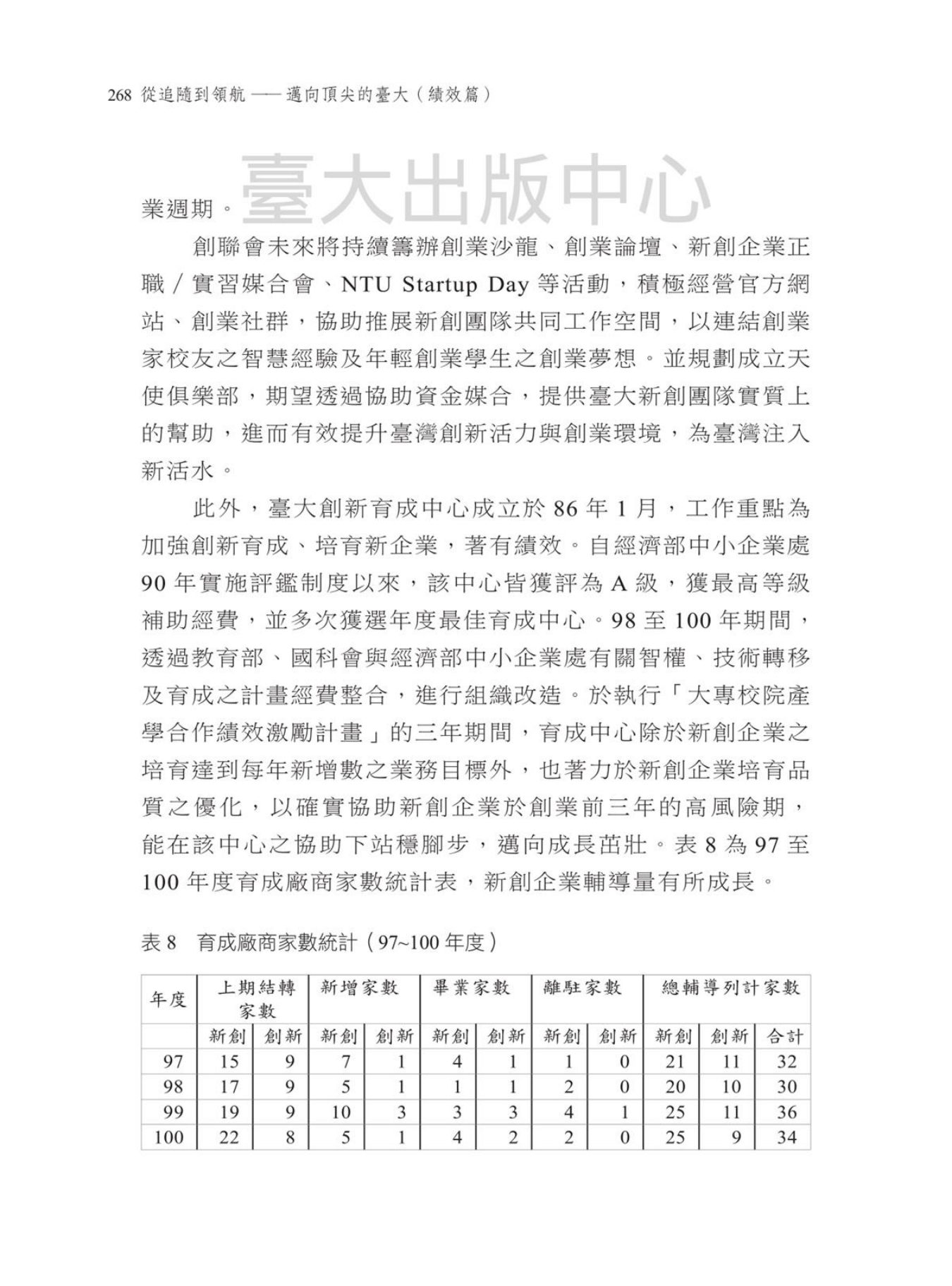
The Startup Alliance will continue to organize events such as entrepreneurship salons, entrepreneurship forums, job/internship matchmaking events for startups, and NTU Startup Day. It will actively manage its official website and entrepreneurial community, assist in promoting the startup team co-working space, and connect the wisdom and experience of entrepreneur alumni with the entrepreneurial dreams of young student entrepreneurs. Plans are also underway to establish an Angel Club, hoping to provide substantial assistance to NTU startup teams by facilitating funding matchmaking, thereby effectively enhancing Taiwan’s innovative vitality and entrepreneurial environment and injecting new vitality into Taiwan.
In addition, the NTU Innovation Incubation Center was established in January 1997 (86), with a focus on strengthening innovation incubation and nurturing new enterprises, achieving notable performance. Since the Department of Small and Medium Enterprises (DSME) of the Ministry of Economic Affairs implemented an evaluation system in 2001 (90), the center has consistently been rated Grade A, receiving the highest level of subsidy funding, and has been selected as the Best Incubation Center of the Year multiple times. Between 2009 (98) and 2011 (100), through the integration of project funds from the Ministry of Education, the National Science Council, and the DSME regarding intellectual property, technology transfer, and incubation, organizational restructuring was carried out. During the three-year implementation of the “Performance Incentive Plan for Industry-University Cooperation at Universities and Colleges,” the Incubation Center not only met its business target of adding a certain number of new enterprises annually but also focused on optimizing the quality of startup cultivation, to effectively assist new enterprises in stabilizing during the high-risk period of their first three years of operation with the center’s support, moving toward growth and maturity. Table 8 presents the statistics of incubated manufacturers from 2008 (97) to 2011 (100), showing an increase in the volume of startup counseling.
Table 8 Statistics of Incubated Manufacturers (2008–2011)
| Year | Carried Over: Startup | Carried Over: Innovation | Newly Added: Startup | Newly Added: Innovation | Graduated: Startup | Graduated: Innovation | Departed: Startup | Departed: Innovation | Total Counseled: Startup | Total Counseled: Innovation | Total |
|---|---|---|---|---|---|---|---|---|---|---|---|
| 97 | 15 | 9 | 7 | 1 | 4 | 1 | 1 | 0 | 21 | 11 | 32 |
| 98 | 17 | 9 | 5 | 1 | 1 | 1 | 2 | 0 | 20 | 10 | 30 |
| 99 | 19 | 9 | 10 | 3 | 3 | 3 | 4 | 1 | 25 | 11 | 36 |
| 100 | 22 | 8 | 5 | 1 | 4 | 2 | 2 | 0 | 25 | 9 | 34 |
Among the new enterprises currently incubated by the Innovation Incubation Center, approximately 30% of the newly added manufacturers since the 2009 (98) academic year have come from the implementation of the Ministry of Education’s “College Graduate Entrepreneurship Plan.” Most of those counseled are entrepreneurial teams composed of NTU alumni within five years of graduation. After receiving six months of entrepreneurship counseling, those who continue to participate in the second-stage entrepreneurship competition have achieved good rankings and received subsequent subsidies. Among them, “Tokugawa Speaker Design,” an entrepreneurial venture by NTU Veterinary Medicine alumni counseled in 2010 (99), received not only the Ministry of Education’s entrepreneurship award but also passed multiple government subsidy applications for small business operations. Recommended by the center, it participated in the first NTU Startup Alliance’s Emerging Entrepreneur Showcase, receiving positive feedback. Another team, “Mad Play Studio,” composed of alumni from NTU’s Political Science, Drama, and Foreign Languages departments, won first prize in the cultural and creative category of the entrepreneurship competition (an 800,000 NTD award) and received a 7 million NTD subsidy from the Council for Cultural Affairs for the project “Island Song and Dance Action Theater.”
Currently, 90% of the teams counseled by the center through this plan continue to operate, regardless of whether they received subsequent awards. The center has also revised the occupancy fee policy for this type of entrepreneur to better meet practical entrepreneurial needs, reduce occupancy costs, and achieve the goal of independent operation as soon as possible.
Additionally, due to the establishment of the Industry-University Cooperation Center, technology transfer and incubation have become more transparent and frequent in their daily horizontal coordination compared to the past. Through participation in campus incubation deepening initiatives led by relevant university industry-university centers, such as the “Idea Realization Plan” and “Germination Plan,” since the 2010 (99) academic year, there has been a daily increase in entrepreneurial proposals from laboratory teams that have subsequent technology transfer plans. The Incubation Center has held multiple discussions with professors or entrepreneurial teams to assist in establishing and clarifying the concept of corporatization. By the 2012 (101) academic year, two companies had completed establishment and moved in, and one was in preparation.
V. Strengthening Alumni Liaison Services
Since its founding in 1928 (ROC Year 17) to 2012 (ROC Year 101), the university has a history of eighty-four years.
With as many as 238,000 alumni, and growing at a rate of 8,000 per year, alumni are distributed across the country and abroad, achieving outstanding performance in various industries. Alumni are the best resource for promoting the development of the university. Our university actively builds systems, updates alumni data, and promotes other supporting measures to serve alumni and increase their sense of identification:
(1) Issuance of the NTU Alumni E-Newsletter: Launched in October 2005, it reports on campus news and alumni activities, and is sent to approximately 116,000 alumni domestically and internationally.
(2) Development of the “NTU Alumni Information Network”: The website was launched in June 2006, establishing an alumni contact platform. It provides an alumni database maintained jointly by alumni individuals, classes, departments, and the Alumni Relations Office based on resource sharing. By February 2013, the system had secured contact information for over 110,000 alumni.
(3) Issuance of the “NTU Alumni Card”: Issued since August 2006, it integrates the library alumni reading card and serves as identification for alumni to use various discounted facilities and services. By March 2013, over 47,571 cards had been issued.
(4) Selection of “Distinguished NTU Alumni”: Conducted since 2006, the awards are divided into five major categories: Humanities and Arts, Academia, Business and Industry, Social Service, and Comprehensive. By 2012, seven cohorts totaling 53 distinguished alumni had been selected and commended at annual anniversary celebrations.
(5) Issuance of the NTU Alumni English E-Newsletter starting in April 2007: It reports on the university’s relevant R&D achievements, enhances alumni understanding of the alma mater, and strengthens cohesion.
(6) Establishment of the NTU Facebook Fan Page: Established in March 2010, it increases the communication platform between alumni and the alma mater.
(7) Organization of alumni networking activities: From 2007 to 2012, six reunions for alumni graduating 30 years ago have been held; in 2011, the first reunion for alumni graduating 35/40 years ago was held.
years ago; additionally, in 2010, in conjunction with the NTU Azalea Festival, an alumni karaoke competition was held. From 2007 to 2012, over 4,500 alumni participated in reunions and various activities.
VI. Enhancing Fundraising Performance and Establishing New Ventures
Our university began managing the University Fund in the 1996 fiscal year. The proportion of self-raised funds increased annually from 20%, reaching 65.6% of total revenue in the 2012 fiscal year. To address the increasing financial pressure year by year, the university revised its organizational regulations in August 2007, adding the Division of Financial Management, expanding alumni services to gain recognition, and actively expanding industry-education cooperation and securing other resources, with concrete results achieved.
(1) Actively securing external donations or donations for building construction Those exceeding NT$10 million are listed below:
-
December 2005: Chairman Morris Chang of the Taiwan Semiconductor Manufacturing Company (TSMC) Cultural and Educational Foundation donated NT$120 million to construct the New Chemistry Research Building (Phase II).
-
June 2006: Chairman Jonney Shih of the Guanshu Education Foundation donated NT$540 million to construct the Humanities Building.
-
January 2007: Chairman Huang Chong-jen of the Powerchip Group donated NT5 million annually) for faculty and research expenses for the Institute of Applied Physics.
-
April 2007: Chairman Lee Hua-lin of the Chuanliu Foundation donated USD 300,000 to renovate the Special Exhibition Hall of the University History Museum, and USD 20,000 to establish the NTU Humanities Library.
-
June 2007: Chairman Yin Yeh-liang of the Ruentex Group donated one Civil Engineering Building, approximately 2,000 to 2,500 ping.
-
September 2007: Chairman Terry Gou of the YongLin Healthcare Foundation donated
the Engineering Building, and additionally donated NT$5 billion for cutting-edge equipment in medical centers and cancer research.
-
October 2007: Chairman Terry Gou of the YongLin Healthcare Foundation donated NT$200 million to the Department of Veterinary Medicine to cooperate with the New Taipei City Government to solve the stray animal problem.
-
October 2007: For fundraising to establish the Hsinchu-Zhubei Campus Industry-University Park, Etron Technology, Inc. donated NT50 million over ten years.
-
October 2007: The chairman of an electronics company donated NT$100 million (800 lots of stock) to the university, with the interest to be used for research projects.
-
October 2007: Ms. Chen Yi-zhen, an alumnus of the Department of Chinese Literature, donated USD 1 million for a period of 5 years to establish the “Bai Xianyong Literature Lecture Series.”
-
November 2007: Mr. Liang Tzu-Chen, General Manager of Quanta Computer and an alumnus of the Department of Physics, donated NT$205 million for a period of 10 years to establish the “Liang Tzu-Chen Center for Cosmology and Particle Astrophysics.”
-
January 2008: Chairman Terry Gou of the YongLin Healthcare Foundation donated NT$60 million to the NTU College of Medicine for the costs of six project faculty members and research projects over 5 years.
-
December 2008: The YongLin Healthcare Foundation developed a NT50 million for preparation-related expenses was made.
-
April 2009: Dr. Hsu Chao-hui, an alumnus of the Department of Pharmacy, donated the construction of two buildings, “Bichen Hall” and “Shuisen Hall,” with the in-kind donation amounting to approximately NT$600 million.
-
August 2009: The YongLin Healthcare Foundation donated to the NTU College of Medicine
III. Planning for the Long-Term Development of University Affairs
Medical research-related equipment: NT$40 million.
-
In February 2010, Trend Micro Inc. donated funds to establish the Cloud Computing Trend Program at our university, with donations distributed over three years totaling NT$18 million.
-
In September 2010, E.SUN Bank and the E.SUN Foundation jointly donated to establish the “Yuanta Academic Award,” with a donation amount of NT$10 million.
-
In October 2010, our university signed an agreement to accept a donation from the Outstanding Talent Development Foundation for the construction of housing for new scholars at National Taiwan University and the Academia Sinica.
-
In December 2010, the YongLin Healthcare Foundation donated the LIS system software project, valued at NT$29 million.
-
In June 2011, an anonymous donor established a special account for “Cognitive Science” with a five-year total donation of NT$15 million.
-
In July 2011, alumnus Hung Yun-Hui donated USD 300,000 to the Department of Medicine and USD 200,000 to the Department of International Business.
-
In August 2011, Liu Jie-Zhou donated NT$90 million for the construction of the new building for the College of Social Sciences.
-
In September 2011, our university signed a donation agreement with International Electrolux Co., Ltd. for the “Hung Chien-Chuan Memorial International Hall,” including a cash donation of NT10 million.
-
In October 2011, we received a three-year donation from an alumnus totaling NT$15 million.
-
In November 2011, the family of former College of Medicine Dean Li Chen-Yuan donated NT$10 million to establish the “Dean Li Chen-Yuan Memorial Medical Award” to reward emerging medical professionals and to set up a sustainable special account.
-
In November 2011, Fubon Capital Venture Investment Co., Ltd. donated NT$30 million to our university to establish the “Fubon Sustainable Chair” to recruit outstanding teaching and research faculty.
-
In 2011, the YongLin Healthcare Foundation donated the LIS-EMR system software project, valued at NT$12 million.
-
In 2012, Ms. Ren Jiang-Lü-Sheng donated USD 1 million to our university to establish a sustainable fund scholarship to reward outstanding students from disadvantaged backgrounds.
-
In January 2012, the Administrative Council approved the donation agreement between the China Trust Charitable Foundation and our university, along with the “Guidelines for the Use of Funds Donated by the China Trust Charitable Foundation,” with a donation amount of over NT$51 million.
-
In April 2012, Mr. Qian Fu completed the donation of the “Qian Si-Liang Memorial Scholarship” on behalf of the donor, with a donation amount of NT18 million.
-
In August 2012, Quanta Computer Vice Chairman and alumnus Mr. Liang Tzu-Chen allocated part of the amount originally donated in November 2007, completing a donation of NT200 million; additionally, he committed to donating physical assets valued at NT$350 million within two years.
-
In August 2012, Mr. Zheng Xin-Yi donated NT100 million.
-
In August 2012, we signed a donation contract with the MediaTek Education Foundation, donating NT$300 million for the exclusive construction of one building for the College of Electrical Engineering and Computer Science, the “Fa Yang Building.”
-
In November 2012, the Zong Zhuo-Zhang Education Foundation donated NT$30 million for the construction costs of the new College of Engineering building.
-
In December 2012, alumnus Ms. Chen Yi-Zhen donated to the “Bai Xian-Yong Humanities Lecture” project, with a total annual donation of NT$5 million, to be carried out over three years.
III. Planning for the Long-Term Development of University Affairs
-
In December 2012, the Administrative Council approved the renewal of the donation contract with Macronix International Co., Ltd. to establish the “Macronix Chair” at our university.
-
In December 2012, our university signed a donation agreement with Pegatron Corporation and its affiliated company, Casetek Holdings Ltd. (Cayman Islands), along with Mr. Tung Tzu-Hsien and Mr. Hsu Shi-Chang, for the construction of the new College of Social Sciences building, with a donation of NT$80 million.
-
In January 2013, Epistar Corporation donated one GB-125K glovebox to the Department of Chemistry, College of Science, valued at NT$12.6 million.
-
In February 2013, Dr. Hsu Zhao-Hui, an alumnus of the Department of Pharmacy, donated USD 345,000 (approximately NT$10 million) for, but not limited to, the relocation of the Department of Pharmacy to the Shui Sen Building and the maintenance of the new building.
-
In March 2013, Siwei Company donated NT$25.6 million for the construction of the university building “Zheng Jiang Building,” to be carried out over five years.
(II) Development of New Ventures
To review investments in new venture development for our university, the “National Taiwan University Finance Department New Venture Development Investment Review Committee” was established in January 2012. Committee members consist of university faculty with expertise in investment management or external professionals. The annual goal is to develop one to two new venture investment cases. By the end of February 2013, the “VSense Limited” investment case had been approved. VSense Limited is a new company derived from university technology, primarily engaged in the research, development, and sales of in vitro diagnostic devices, a field with expected future growth. To enhance equity value, plans are in place for a future listing in the United States.
VII. Establishment of a Sustainable Fund
In the 2008 academic year, the University Fund Management Committee approved the establishment of a sustainable fund. Through university allocations, donations from various sectors, and investment appreciation (return rate of 26%), the fund size grew by 146% by the end of February 2013.
The endowment fund utilizes only 4% of its accrued interest annually. Through long-term active investment, the university increases its endowment income, leveraging the cumulative effect of gathering sand to build a tower, to support the school’s long-term development. The accrued interest will provide teaching and research awards, sponsor lecture funds, assist the university in recruiting world-class renowned professors, and enhance faculty standards and campus construction. Coinciding with the 80th anniversary of National Taiwan University in the 97th academic year, to expand fundraising projects and strengthen contributions to the endowment fund, the “NTU Endowment Fund (Donations for Outstanding Faculty)” was specially established. Subsequently, various large-scale donation projects and scholarships have each established their own dedicated endowment accounts according to their distinct donation intents, achieving results in teaching, research, and assisting students from underprivileged backgrounds.
VIII. Establishment of a Campus Construction Fund
NTU’s buildings are aging. The university has a total of 783 buildings, of which 216 are over 60 years old, 232 are between 30 and 60 years old, and 261 are between 10 and 30 years old. Future repair and reconstruction costs will rise sharply. If NTU’s buildings, covering over 300,000 ping, are to be rebuilt over a period of 100 years, with a cost of 150,000 NTD per ping, the total requirement would be 50 billion NTD. Therefore, it is necessary to accumulate 500 million NTD annually for the campus reconstruction fund, sourced from annual venue rental income, surplus funds from industry-university cooperation, and other revenues.
IX. Establishment of a Faculty Personnel Bank
To appropriately allocate faculty positions, fully utilize teaching resources, and facilitate the university’s outstanding development, the university previously passed the “Guidelines for Faculty Position Adjustment” at the 2nd session of the 2nd semester of the 92nd academic year on May 29, 2004. This authorized each college to allocate faculty positions within its departments and institutes, taking into account the status of faculty positions and development needs, and to formulate its “Faculty Position Circulation Management Plan” based on the college’s overall development plan and academic development trends.
Starting from the 97th academic year, the Ministry of Education implemented a plan for the streamlining of personnel quotas. In response to
the tightening of personnel quotas, and in coordination with the university’s development plan and academic development trends, the university has balanced overall resource allocation and utilization, flexibly allocated faculty positions, activated the efficiency of faculty position usage, enhanced competitiveness, and moved toward becoming a world-class top university. Based on the concept of a personnel bank, the university formulated the “Implementation Principles for Faculty Position Circulation,” which has been implemented since the 101st academic year. The implementation principles and methods are as follows:
(1) The principle of not affecting teaching and research quality: According to Article 2 of the university’s “Guidelines for Faculty Position Adjustment,” to maintain teaching and research quality, for undergraduate programs with 1 class, the principle is to retain 18 faculty positions; for each additional undergraduate class, the principle is to increase by 12 faculty positions; independent institutes or units explicitly listed in the university’s organizational regulations may retain 7 faculty positions. Teaching tasks shall not be affected by the execution of this plan.
(2) Gradual recovery method: Starting from the 101st academic year, over a three-year period (101st to 103rd academic years), 4% of faculty positions from each college will be recovered. 2% will be centrally utilized by the university, and 2% by the college.
(3) Priority recovery of faculty positions for central university and college utilization: 1. Faculty positions vacated by department/institute suspension of enrollment or adjustment/merger; 2. Positions vacated by teaching assistant resignations; 3. Faculty vacancies due to retirement, dismissal, or resignation; 4. Faculty positions occupied by part-time faculty.
(4) Recovered faculty positions for central university and college utilization shall return to unit usage: When units hire new faculty, they must submit explanations regarding department/institute development plans, faculty position utilization status, required talent expertise areas, and course planning, and apply to the college or university for faculty position allocation. Public recruitment of faculty may only proceed after approval. Faculty needs for common, general education, and university-wide service courses shall be applied for separately based on teaching hours and enrollment numbers for such courses.
(5) Establishment of university-level and college-level “Faculty Position Utilization Advisory Committees,” responsible for reviewing recommendations on faculty positions and personnel circulation in each teaching unit, and conducting necessary planning and recommendations for human resources in the university’s future development directions and key academic fields. In the 101st academic year, 3 positions were provided for each college’s central utilization, and 2 positions for the university’s central utilization; in the 102nd academic year, 1 position was provided for each college’s central utilization, and 0.5 positions for the university’s central utilization; in the 103rd academic year, 3 positions were provided for each college’s central utilization, and 7.5 positions for the university’s central utilization. Additionally, the “Guidelines for the Establishment of the University-Level Faculty Position Utilization Advisory Committee” were drafted and approved at the 2750th Administrative Meeting of the university on February 19, 2013.
IV. Promoting Overall Campus Construction Development
The campus is where faculty and students learn and live. A high-quality campus must not only provide facilities conducive to teaching and research but also offer diverse service functions. In recent years, the university has made achievements in campus software and hardware construction, environmental beautification, environmental protection and energy conservation, campus safety, and the establishment of a sustainable campus, and completed the “Sustainable Campus White Paper” in 2007.
I. Strengthening Library Infrastructure
With support from the basic construction budget of the Plan for Advancing NTU to a Top University, the Library has actively undertaken measures to enhance collection quality and improve services, based on three main axes: establishing comprehensive core collection resources, providing excellent digital information services, and constructing high-quality collection and reading spaces. The results are listed as follows:
(1) Establishing Comprehensive Core Collection Resources
- Diversity
(1) In cooperation with various colleges, from January 1, 2007, to December 31, 2012, the library collected and purchased 343,243 core teaching and research monographs across various fields, 17,541 volumes/items of retrospective journals, 34,083 volumes/items of current journals, 5,402 types of electronic journals, 737,134 types of e-books, and 76,793 volumes/items of audiovisual and non-book collection resources, aiming to achieve broad and diverse thematic coverage in collection resources. As of December 2012, the library’s total book holdings reached 6,866,660 volumes/items.
(2) During the 95th to 99th years (2006–2010), human resource support was secured, enabling the successful execution of 77 projects under the “Humanities and Social Sciences Research Library Project” administered by the Division of Humanities and Social Sciences Development at the National Science Council (NSC). The NSC provided NT$570 million in funding for book purchases, resulting in the acquisition of over 300,000 new volumes for the library’s collection.
- Uniqueness
(1) Actively collected 6,207 volumes of township gazetteers from Taiwan and 5,300 volumes from mainland China. By December of the 101st year (2012), the library had collected all published township gazetteers from Taiwan, as well as provincial gazetteers from Guangdong, Fujian, and other provinces in mainland China. The library will continue to systematically collect local gazetteers from coastal to inland regions to build a distinctive collection for academic research.
(2) Collected over 100,000 volumes/items of resources related to Taiwan studies, including: the valuable historical materials of the Debus Collection from the period of U.S. aid to Taiwan; donations for research on the development of Taiwan’s democratic politics from Huang Zhaotang and Hsu Shih-kai; donations for research on Taiwanese archaeology and anthropology from Kokubu Naoichi and Lien Chao-mei; donations for research on Taiwanese physical anthropology from Kanaseki Takeo; donations for research on Taiwanese religion, including good books from temples across Taiwan; donations for research on post-war popular music in Taiwan from Guan Huashi, Shen Zhi, Zhou Lanping, and Four Seas Records; donations for research on traditional opera during the Japanese colonial period in Taiwan from the Chaozhou Laoyuan Zhengxing Troupe; and donations for research on Taiwanese literature, including manuscripts from Gui Wenya, Bai Yang, Dai Yanhui, Pei Puyan, Xu Shouchang, Lu Zhihong, Wang Shuchuan, and others.
(3) Executed the digitization of rare library collections, including Chinese and foreign rare books, journals published in Taiwan during the Japanese colonial period, publications of the Taihoku Imperial University, and old archival records, totaling nearly 500,000 images along with their metadata.
(4) Undertook the digitization of resources for the long-term preservation of research and teaching materials, collaborating with important archival institutions and private collectors. This included cooperation with the KMT Party History Museum to digitize party history materials, resulting in over 880,000 images and metadata.
images and metadata. Collaborated with the Ci-Lin Cultural Foundation, established by Mr. Lin Yixiong, to digitize over 460,000 images and metadata of historical materials on Taiwan’s social movements. Regarding audio-visual materials, the digitization of records from Four Seas Records, the Taipei Women’s Rescue Social Welfare Foundation, audio-visual records of the life and lectures of Mr. Mou Zongsan, the Taiwan Social and Humanities Audio-Visual Database, and audio-visual records related to the Democratic Progressive Party was completed. In total, nearly 19,000 audio-visual digital files were archived. This not only achieved the goal of preserving valuable research records but also enabled researchers from various fields to utilize these digitized outcomes to gain a deeper understanding of the rich content of Taiwan’s audio-visual materials.
(2) Providing Excellent Digital Information Services
- University Academic Research Output
(1) Starting in June of the 95th year (2006), the university library executed the “Institutional Academic Output Repository Project” commissioned by the Ministry of Education, establishing the NTU Institutional Repository (NTUR). By February of the 102nd year (2013), the system had indexed nearly 188,735 bibliographic records of research reports, journal articles, and conference papers by faculty, staff, and students, including 63,526 full-text items.
(2) The Chinese Electronic Thesis and Dissertation Service System had cumulatively indexed 47,311 full-text doctoral and master’s theses from NTU by February of the 102nd year (2013).
- Introduction of High-Quality Online Academic Research Resources
(1) Established the NTU Academic Resources Network, which had indexed over 54,743 open-access academic websites by February of the 102nd year (2013), and developed a search engine and full-text retrieval mechanism.
(2) Academic open-access electronic journals: cumulatively collected 11,224 titles by February of the 102nd year (2013); electronic books: 108,361 volumes.
(3) Established a web archive, which had indexed 5,451 websites of government agencies, important contemporary events, and university sites by February of the 102nd year (2013), preserving important native digital resources.
- Constructing Convenient Information Service Functions
(1) Established an integrated electronic resource query system.
(2) Developed a joint sharing system for Chinese academic institutional repositories, indexing nearly 300,000 records from NTU and the University of Hong Kong, with continuous additions.
(3) Provided personalized information services: customized services such as RSS and MyDatabase.
(4) Developed mobile versions of the website and App applications for scanning barcodes to query library holdings.
(5) Established Web 2.0 social interaction platforms, such as the Facebook fan page, the Plurk NTU Library page, and the NTU Book Review New Books blog.
(6) Provided services on the library website such as “findbook” cover displays and short video links.
(7) Established the NTU Library Digital Learning Network, providing self-paced learning courses accessible anytime and anywhere, with over 100,000 users annually.
(8) Established an intelligent management and backup energy-saving environment for computer servers, improving the backup and usage efficiency of the library’s information systems, while also saving the power consumption previously used by various distributed servers.
(9) Provided readers with convenient searchable PDF scanning services, with a cumulative total of over 53,000 pages scanned.
(10) Produced publications introducing library resources and services to promote faculty and student understanding and utilization of library resources, while also providing electronic versions for unlimited access and download by faculty and students.
IV. Promoting Comprehensive Campus Development and Construction
(3) Constructing High-Quality Collection and Reading Spaces
-
Constructing a Comprehensive Collection Space for Taiwan Studies Resources A dedicated Taiwan Studies Resources Zone was added to the Special Collections section on the fifth floor of the library (capable of accommodating nearly 80,000 volumes), comprehensively collecting Taiwan studies materials and providing open-shelf access.
-
Implementing Space Adjustment and Utilization Planning (1) In collaboration with the Teaching Development Center of the Office of Academic Affairs, an “Open Learning Space” was planned and established, providing venues for students’ small study groups and academic discussions within the library’s quiet reading atmosphere. (2) On the same floor, a complete set of library resource functions was integrated, connecting spaces for faculty and students to listen to lectures (International Conference Hall), engage in silent self-study (Study Rooms), consult theses and dissertations (Thesis and Dissertation Room), discuss and learn (Open Learning Space), photocopy materials, purchase books at the bookstore, and dine (Student Activity Center). (3) The book stacks at the Shuiyuan Campus Library were renovated, and steel bookshelves were purchased to accommodate approximately 130,000 volumes originally housed in the old Main Library stacks. Additionally, new bookshelves were installed in the high-density stacks on the second floor of the Main Library, increasing collection space by approximately 20,000 volumes, accompanied by the adjustment and relocation of collection materials. (4) New and expanded steel bookshelf projects were carried out on the second, fourth, and fifth floors of the Main Library, increasing collection space by a total of approximately 97,550 volumes. Additional bookshelves were installed in the high-density stacks on the second floor, increasing collection space by 3,500 volumes. In coordination with these new storage spaces, collection materials were adjusted, relocated, and reorganized.
-
Improving the Reader Reading Environment (1) Lighting facilities in the reader reading areas of the Main Library were added, improving 82 light fixtures.
(2) Anti-theft and security protection capabilities for books and facilities were strengthened. RFID anti-theft chips were activated at the Medical Library Branch and the Law and Social Sciences Library Branch. The Main Library completed the installation of a digital surveillance video system, deploying a total of 152 security cameras to protect facility safety. Additionally, to support colleagues’ daily equipment patrols, two sets of high-performance two-way radios were newly purchased for use during internal patrols, facilitating communication. (3) In coordination with space adjustments in the Main Library, the internal signage system was comprehensively updated. Traditional posters and signs with negative prompts such as prohibitions and warnings were replaced with text content featuring positive guidance and clear instructions. Internationally recognized graphic symbols were integrated to redesign various notices, with a total of 60 posted. Additionally, in coordination with the newly established Indigenous Peoples Library and Information Center and the Open Learning Space, floor signage within the library was modified to present bilingual information.
II. Improving the Information Environment
To construct the information and communications environment befitting a top-tier university and enhance international competitiveness, the University’s Computer and Information Network Center (hereinafter referred to as the “CINC”) initially focused on improving basic information and communications infrastructure, strengthening the provision of high-performance computing environments, upgrading the campus-wide network, and establishing campus VoIP services, achieving considerable success. In recent years, efforts have been dedicated to building cloud computing infrastructure and services that are on-demand, shared, and fully utilized, providing faculty, staff, and students with high-performance, high-security university administrative information systems, information application system platforms and storage equipment for various administrative units, as well as storage services supporting research teams’ high-performance computing and mobile synchronization, and cloud services for software sharing. The goal is to achieve resource integration and sharing, effective utilization, and energy conservation and carbon reduction. Active efforts have also been made to enhance the overall campus network communications environment, promote wireless network construction, and optimize the information security and performance of cloud services. The achievements are listed as follows:
(1) Construction of High-Performance Computing Environment
In establishing the high-performance computing environment, between 2005 and 2012, the CINC constructed and continuously upgraded and maintained a total of six sets of computing equipment. These included two SMP mainframes, each equipped with up to 256GB of memory, suitable for executing OpenMP parallel programs and those with large memory requirements; three Cluster computing clusters, with a total of over 2,000 computing cores, suitable for executing MPI parallel programs; and one GPU computing cluster, equipped with 32 Nvidia display chips, suitable for executing GPGPU parallel programs. Regarding commercial computing software, offerings included SAS, Matlab, Mathematica, DiscoveryStudio, Material Studio, Gaussian, VASP, and others. Additionally, high-performance computing service briefing sessions were continuously held to introduce and promote related services and identify potential users within the university. To date, research groups served have spanned fields including mathematics, physics, chemistry, materials science, optoelectronics, molecular science, quantum chemistry, nanotechnology, atomic structure, biology, pharmacy, molecular simulation, scientific computing, and statistical research, covering ten colleges and three university-level research centers, totaling 36 departments and institutes, with approximately 131 research teams. According to 2012 statistics, research outputs generated through high-performance computing services have produced over a hundred journal articles, conference papers, and degree theses.
(2) General Computing Infrastructure
- Server Room Improvement and Update, Power Supply Diversification and Backup (1) Expansion of the uninterruptible power supply (UPS) system was completed to meet the needs of newly added high-performance computing hosts and various network equipment, effectively supporting new power demands. (2) A dual power supply system was completed. Mainframes are equipped with dual power supplies, reducing downtime caused by single power circuit failures and ensuring a stable server room environment.
-
Deployment of Universal Computing Environments Establish diskless computer laboratories for use by all students, with user files stored on file server hosts; integrate computer monitoring systems with seat reservation systems to provide seat selection services; and deploy printer management systems to offer printing services, thereby establishing a complete suite of computer lab on-site services.
-
Deployment of Software Services (1) Establish the NTU e-University Service Center to actively support the teaching and research environment for all faculty and students. Within the universal computing environment, deploy a “Software Bank” cloud service system, enabling on-demand access to university-licensed software regardless of time, location, or device, realizing installation-free, maintenance-free, and cross-platform cloud software services. (2) Procure and upgrade university-wide licensed software to provide the latest research tools for all faculty and students, and in coordination with the new Software Bank cloud service platform, offer the most convenient software usage services.
-
Next-Generation e-University Procure Fortify 360 Source Code Analyzer as the source code security audit software for NTU’s e-University information systems. This software is currently deployed on cloud servers at the Computing and Information Center, allowing colleagues developing administrative systems to remotely upload source code for security testing, further safeguarding the security of administrative applications and databases.
(III) Network Infrastructure
- Strengthen Campus Network and Upgrade University-Wide Network Infrastructure (1) Regarding campus network construction, upgrade the university’s backbone core routers to
Jida Publishing Center
100 Gbps connectivity, enhance the scalability of backbone core switches, and expand core backbone connection bandwidth, establishing a data center network architecture capable of cloud computing.
(2) The overall backbone bandwidth of the campus network has been significantly increased. Backbone core routers are mutually redundant and connected to all campus backbone routers at 20 Gbps each, providing uninterrupted network services. All exit switches for departments and units across campus have been comprehensively updated, and the connection speed from each department/unit to the backbone network has been upgraded to 1 Gbps, effectively improving network transmission performance. For inter-campus network services, network interconnection services are provided between the Main Campus and the College of Medicine, the Affiliated Hospital, the College of Law and Social Sciences, the College of Public Health, and the Shuishuen Campus, each with a bandwidth of 1 Gbps. A 100 Mbps network connection service is provided between the Main Campus and the Xingyuan Building.
(3) Upgrade external-facing backbone routers to a dual-host redundant configuration, expanding the routing and switching capacity of the backbone routers to effectively improve the stability of routing and switching operations. Through a dual-host operational redundancy mechanism, improve the availability of backbone routers and prevent interruptions to external network connectivity.
(4) Regarding student dormitory networks, in 2006 and 2007, eight male dormitories, nine female dormitories, and two graduate student dormitories were updated. In coordination with dormitory renovations, internal wiring for four dormitories was also updated. Provide real-time monitoring of network traffic and error detection, and implement user bandwidth management measures to balance user needs with ensuring fairness in the sharing of network resources.
- Deployment of Network Telecommunication Systems Regarding the deployment of campus network telephony, utilize campus telephone lines and the high-speed backbone network to establish NTU’s own IP-PBX telecommunication switching system. Integrate all campus telephone services into a single network telecommunication system autonomously managed by the university. Extend this system to other campuses via fiber optic networks to achieve the goal of telephone system integration, providing mobile and cost-effective telecommunication services for all faculty and students, and thereby achieving telecommunications cost savings for the university.
- Expansion and Improvement of Campus Wireless Networks
(1) To enable unrestricted use of wireless networks by all faculty and students, starting in 2006, we assisted schools and colleges in deploying campus wireless networks in classrooms under their jurisdiction. As demand for wireless networks among faculty and students has increased year by year, and requirements for signal stability have become increasingly high, by December 2012, in coordination with renovation projects for classrooms under university jurisdiction, we gradually replaced and expanded wireless network access points in libraries and classrooms. Across the entire university (the Main Campus has a total of 116 buildings), 104 buildings have wireless network coverage, accounting for 90%, with a total of 1,957 wireless network access points installed. Simultaneously, this effort assists various user units within the university in their information security management mechanisms, preventing unauthorized access and fully integrating existing information security software and hardware with the network infrastructure.
(2) According to historical records, 760,000 person-times used the campus wireless network in 2007, 880,000 in 2008, 1.67 million in 2009, 3.1 million in 2010, and 6.35 million in 2011. In 2012, driven by the growing prevalence of tablet computers and smartphones, total usage surged to 14.25 million person-times, more than double that of 2011. Convenient wireless network access in public areas is necessary for faculty and students in teaching and research, aiming to reach the standard of world-class universities and achieve the ultimate goal of a “U” (Ubiquitous) campus.
(3) The number of simultaneous online users on campus has increased sharply year by year, and many wireless network hotspots on campus have experienced bandwidth insufficiency. Therefore, starting in 2011, we comprehensively procured wireless network access points with specifications of
(4) In 2012, the university comprehensively upgraded the wireless network base stations in classrooms (including the Liberal Arts Building, general classrooms, shared classrooms, the Freshman Building, and the College of Management) and libraries to 802.11n high-speed wireless networks, with maximum speeds reaching 450 Mbps.
(4) Smart University Cloud Service System
-
Over the years, the university’s administrative systems have strived toward comprehensive digitalization. Many important information application systems related to university administration, teaching, research, and student affairs, such as the online reimbursement system and the online approval and application system, have been successively launched. The Information Technology Center has re-planned the server infrastructure for university administrative information systems/services, gradually advancing toward a cloud service architecture characterized by “shared ownership and usage” and “effective utilization.” In 2010, the university’s administrative system databases were migrated from old servers to next-generation servers in three phases, and cluster (Cluster) servers were constructed. These cluster servers provide fault-tolerance functions for the database system, enhancing system reliability. Coupled with cloud storage space, this increases the scalability of university administrative databases. By migrating 183 university administrative systems to cloud virtual hosts, the characteristics of cloud computing allow for dynamic allocation of system resources according to the workload of each host, making full use of overall system resources, improving the performance of university administrative information systems, and achieving the requirements for high availability (high availability) and load balancing (load-balance) of university administrative systems. In addition, the cloud environment also provides high system scalability (scalability). In the future, virtual hosts can be dynamically added or removed as needed, reducing system management costs.
-
Establishment of the next-generation Single Sign-On system—SSO (Single Sign On) 2.0. This allows various university-wide ICT services and systems to dynamically display authorized service con-
tent based on each user’s identity and status, and integrates similar related services. This accelerates each user’s access to appropriate service content, enabling them to obtain authorized services through a simple and seamless mechanism. At the same time, the human-machine interface display mode of the provided services can be intelligently adjusted according to each user’s usage habits and preferences.
-
Construction of the NTU Student Learning Portfolio. This integrates various information systems related to students, including student registration records, parent communications, course maps, online course selection, grade management, ranking inquiries, mid-term teaching feedback, end-of-term teaching evaluations, course review, graduation review, minor and double-major programs, and academic excellence awards. A backend platform is provided, allowing students to fill in data or upload files themselves. By combining learning portfolio data and selecting their preferred templates, students can create personal web pages or export them as electronic resumes. After graduation, alumni retain permissions for online inquiry and partial usage.
-
Construction of the NTU Teacher Teaching Portfolio. This serves as a platform for recording and reflecting on each teacher’s teaching career. In addition to automatically importing basic teacher data, teaching courses, and student evaluations, teachers can proactively record text regarding their teaching philosophy, planning, and reflections, serving as a reference for improving teaching. Teachers can use platform data to establish personal electronic teaching portfolio files, which can be applied to evaluations, promotions, and grant applications.
-
In 2012, to strengthen the quality of university-wide administrative systems and university-wide email services, a disk array system was expanded and established. This system connects to the email system host via a fiber optic interface, with transmission speeds reaching 8 Gb/s. Additionally, it is built using RAID 6, providing a higher degree of fault tolerance, with a total storage capacity of 256 TB. The establishment of this system provides a complete storage and backup mechanism, maintaining the efficiency and reliability of important email processing and backups. Mailboxes for all university email users are stored in duplicate at the Information Technology Center, providing greater security for users’ valuable emails.
-
Establishment of the Mail 2.0 next-generation email system. This adopts an enterprise-grade email system. In addition to significantly increasing the mailbox capacity for faculty and students, it also features advanced functions such as mobile synchronization, security, and calendar and address book integration, providing email services for all university faculty, staff, and students that meet the demands of the mobile communication era. The Information Technology Center began phasing in the activation of mailboxes for faculty, staff, government-funded project accounts, freshmen, and new personnel starting in May 2011, and subsequently notified students in batches to activate Mail 2.0. By December 31, 2012, all active faculty, staff, and student mailboxes were upgraded to the Mail 2.0 system, totaling nearly 50,000 mailboxes.
-
To enhance the overall computing performance and storage space of cloud services, new blade server hosts and high-grade storage array systems were established. Blade servers reduce data center space while providing the same computing performance. The high-grade disk array system utilizes 15,000 RPM SAS hard drives and fiber optic interfaces with 8 Gb/s transmission rates, and features dual controllers and dual power interfaces, significantly improving the performance and stability of the storage system.
-
Starting in 2010, planning and construction began for NTU’s Smart University Cloud (i-university) Service Center. This center provides university faculty and students with high-performance, secure, smart mobile cloud ICT environments, content access, and services and equipment for sharing campus software resources. This aims to accelerate student learning, enhance teaching and research excellence, and improve teaching and research productivity. The execution results are as follows:
(1) Establishment of the NTU Space cloud personal file storage service. This provides 25 GB of storage space for all faculty members and 10 GB for each staff member and student. Users can synchronize files anytime, anywhere, and on any device, achieving the benefits of real-time synchronization, backup, and sharing of personal files. This meets the increasingly mobile work patterns of faculty, staff, and students in teaching, research, and learning. Users can operate in a cloud environment to
data exchange, preservation, and sharing of files with others across multiple devices. After going live, system functions were continuously enhanced, adding features such as collaborative work, historical versions, and a trash bin. From its launch on April 18, 2012 (ROC year 101) to February 28, 2013 (ROC year 102), the number of users exceeded 20,000.
(2) Establishment of the NTU AppShare Cloud Service Virtual Desktop System and Application Sharing Service: Through virtualization and automation, computing resources are centrally managed to achieve resource access that is convenient and available at hand. All faculty, staff, and students can virtualize their computer desktops via the cloud virtual desktop service, and, combined with cloud technology, flexibly combine the application environments (such as Matlab, Office, etc.) and user space required according to user needs. This achieves resource sharing and effective utilization, while simultaneously providing a flexible virtual cloud desktop for individual applications that are available on demand, thereby offering appropriate resources to meet the needs of different users. Since the service went live on November 20, 2012 (ROC year 101), 3,450 people have logged in to use it. This includes teaching purposes where students use Matlab and ArcGIS software during class hours, as well as customized dedicated systems for the presidential selection process, providing high-security remote access applications for sensitive data.
(V) Establishment of the NTU Jindou Cloud (“Somersault Cloud”) Excellent Research Computing/Storage Service
In 2010 (ROC year 99), the University completed the first phase of the “NTU Jindou Cloud (“Somersault Cloud”)” service based on cloud concepts, providing a virtual computing host service (NTU VM) environment for research teams across the university to use on demand. The second phase began in 2011 (ROC year 100) by providing cloud storage/backup services (NTUBackup). Through virtualization technology, the former can provide more than 100 virtual hosts, while the latter consolidates numerous storage servers into a shared storage pool placed in the network cloud, providing more than 150TB of capacity. Research teams and students with needs for virtual hosts and large-scale storage backups can use this service through a subscription model, without needing to procure, plan, and build servers themselves, and with the ability to scale freely. The implementation results are as follows:
-
By the end of October 2011 (ROC year 100), the software and hardware construction and development were completed, including the establishment of the NTU Jindou Cloud (“Somersault Cloud”) website. This included a front-end web-based user automated service platform, a back-end service management and operation platform, and integration with the NTU Single Sign-On (SSO) system and the Research Development Office’s project management system.
-
The software and hardware infrastructure for the NTU Jindou Cloud (“Somersault Cloud”) virtual host and storage backup service platforms were completed as follows:
(1) Hardware Equipment a. Two blade chassis, totaling more than 16 high-end hosts (IBM HS22 and HP BL460c hosts) as computing nodes, providing execution and computing resources for the cloud platform. b. Eight high-speed disk arrays (IBM DS5100, Infortrend S12F-R1840, Proware S) with a total of 290TB, providing the space required for cloud storage backup services. c. High-performance platform equipment for cloud services, with specifications as follows: (a) HP Blade chassis, containing two 10Gb-level VCconnect modules; (b) HP Blade Server (Intel X56502 / 48GB Memory / 146GB SAS Hard Drive2); (c) IBM BladeCenter H chassis; (d) IBM Blade Server; (e) Infortrend DS Series Storage * 7; (f) Proware CT Series Storage * 1; (g) IBM DS5100 Series Storage * 1. This platform is designed with characteristics of high performance, high availability, high reliability, and high scalability, and is more energy-efficient than general servers.
(2) Software Platform a. Cooperation with Microsoft to establish a cloud cluster environment, providing non-stop service.
b. Establishment of a cloud service online access system and portal, providing timely information and online application services.
-
After the Center for Information Technology completed the construction of the cloud platform, it expanded the portal to allow users to make online applications, and integrated the website with the NTU Single Sign-On platform, allowing users to use cloud services with their existing NTU service accounts.
-
Launch of virtual host and storage backup services in 2011 (ROC year 100): The virtual host service targets research teams within NTU, providing a cloud laboratory environment to assist research teams in building cloud research systems and storage space. This not only simplifies the work of managing hosts for research teams but also achieves the goals of energy conservation, carbon reduction, and building a green campus. This service can also be applied for by administrative units within the university to provide hosts and website space for official duties. The cloud storage backup service also went live in October 2011 (ROC year 100), providing flexible expansion and freely configurable cloud storage according to usage needs for research and administrative teams within the university. This saves research teams significant costs in procuring and managing storage equipment, while avoiding the risk of data loss caused by storage equipment damage, protecting important data, and improving research efficiency. Research conducted by NTU faculty and students can more conveniently utilize various devices to access and share data under the cloud storage service, improving research efficiency and the sustainable preservation of important data.
-
The cloud virtual host and storage backup services have been applied for and used by numerous faculty members and administrative units. By 2012 (ROC year 101), units using the service within the university included: the General Affairs Office, Department of Chemical Engineering, Department of Finance, Institute of Environmental Engineering, Institute of Forest and Cell Biology, Department of Accounting, Department of Geological Sciences, College of Law, Department of Electrical Engineering, and Institute of Biomedical Engineering.
(6) Information Security Protection Plan for the Smart University Cloud Service System
- Assist university units in enhancing information security management mechanisms to prevent unauthorized access, proactively protect against interruptions in basic service infrastructure, and fully integrate existing information security software/hardware with network infrastructure.
- Provide deep defense and round-the-clock protection for the campus network backbone. Utilize high-performance detection and defense mechanisms to achieve comprehensive application security protection, network attack protection, and zero-day attack defense, instantly blocking the infection and intrusion of worms, viruses, and backdoor programs.
- Through the campus information security information and event analysis integration platform, use information security event correlation analysis conditions to quickly identify known attacks from records of networks, systems, and security devices, providing administrators with immediate insights to identify potential information security issues.
- To ensure campus information security, establish four lines of defense for campus network information/system security protection: (1) Deploy a high-performance intrusion detection and prevention system at the campus network entry point to prevent external intrusions and filter malicious content; (2) Regularly conduct information security vulnerability and threat detection for important campus website content, including: completing the “24x7 Round-the-Clock Website Malware Alert System” to maintain website security management and the online safety of website users; providing system vulnerability scanning and patching recommendations for important campus servers; completing the deployment of next-generation information security protection to provide vulnerability scanning services for campus websites, offering patching recommendations to strengthen the security of university websites; (3) Establish detection for malicious/virus/phishing emails on the NTU mail server cluster; (4) Establish active reconnaissance for potentially compromised or infected zombie machines within the campus to ensure the information security of the NTU domain.
- Comprehensively improve the security, stability, and bandwidth of faculty and student connections to the wireless network to effectively support NTU’s Smart Cloud Services.
- Update and add wireless network base stations, fully supporting the 802.11i security protocol, and enable WPA on existing campus wireless network base stations to effectively protect faculty and students from having their content stolen by malicious actors when using the wireless network.
- Complete the development of the Virtual IP Authentication System, and utilize records collected from firewalls (security devices); after data analysis, this can be used to provide historical event queries and information security audit events.
- In May of the 100th year of the Republic of China (2011), complete the establishment of the email security filtering mechanism. All emails sent to @ntu.edu.tw are filtered at the front end for sender origin, advertising/spam, and virus emails. Suspicious emails are first quarantined on the filtering equipment, and users are periodically notified via email of which suspicious emails have been quarantined, allowing users to decide whether to ignore or retrieve the emails. This mechanism balances system-level and personalized email security filtering effects, and can also be further extended to email servers independently established by various departments, acting as a centralized campus email protection cloud to protect the security of personal computers and data.
- Through the establishment and operation of network forensics mechanisms, the causes and impacts of information security events can be tracked and deeply analyzed, and recovery recommendations and assistance can be provided to offer users effective solutions. This can prevent the expansion and recurrence of information security events, strengthening the campus network information security system and overall information security protection capabilities.
(7) Uninterrupted Access Service and Performance Optimization Engineering for the Smart University Cloud Service System
- Between the 95th and 96th years of the Republic of China (2006–2007), comprehensively upgrade the campus fiber optic network. The main campus area is upgraded from multi-mode fiber to single-mode fiber. The backbone network speed of each department is upgraded from the original 100Mbps to 1Gbps, and can even reach future high-speed academic network speeds of 10Gbps and 100Gbps.
- To accommodate the high-speed academic network, successively update the top-layer switches of each department, upgrading from the original 100Mbps to 1Gbps high-speed switches, ensuring that faculty and student research is not affected by network interruptions.
- Starting in the 95th year of the Republic of China (2006), continuously replace and update wireless access equipment built more than three years prior. Adopt wireless network base stations that support the higher security levels of the 802.1X and 802.11i protocols to replace insecure wireless access equipment within departments. Facing the arrival of the mobile communication era, the use of mobile communication devices by faculty and students has surged. The wireless network is comprehensively expanded with the 802.11n high-speed wireless network protocol (maximum speed up to 450Mbps) to replace the existing 802.11bg, solving the problem of insufficient hotspot bandwidth.
- Establish a high-availability cloud computing environment. From the campus core backbone, cloud environment web firewall, and network switches, to cloud computing servers, a dual-redundancy architecture with dual lines, dual devices, and dual-loop power supply is fully adopted to provide uninterrupted access with high-availability services, achieving stable and high-performance NTU cloud services.
- Establish a network access service quality monitoring system to monitor and record the network service quality of departments or dormitories, and conduct in-depth analysis and quantification of the data. Effectively analyze obstacles to quickly detect network problems in departments or dormitories. The real-time analysis alert mechanism allows problems to be solved or their root causes located before they erupt.
(8) Smart University Campus Mobile Service System
- Establish the system platform for the campus mobile service system, adopting blade server-grade equipment. This service is built in a virtualized manner, which not only increases service performance but also ensures uninterrupted mobile services, possessing high availability, high scalability, and energy-saving effects.
- Complete the development of the free “i-NTU” App application, providing six major services including contacts, calendar, campus activities, campus map, library, and emergency announcements. Users can download separately on the two major mobile computing platforms, AppStore (iPhone) and Android Market.
installation. Version 2.0 was completed in December 2012, improving the presentation of “Campus Activities” content and integrating with the university’s event registration system to provide users with more convenient information access and immediate online registration functions. Additionally, two major services were added: “NTU News” and “Student Grade Inquiry.”
-
Designed mini-posters for display at the Visitor Center, complete with QR codes, allowing visiting guests to scan and install the app quickly to obtain campus-related information, thereby enhancing NTU’s image.
-
Provided faculty, staff, and students with an integrated information system portal, achieving the goal of the i-NTU Smart Campus. This facilitates access to campus and personal-related information for the university community, delivering high-quality services.
-
Established the m.ntu.edu.tw mobile service website, enabling users to quickly access NTU mobile services. Just as most universities use “www” followed by their domain name as their portal (NTU’s homepage is www followed by ntu.edu.tw), the naming convention of “m” plus the school’s domain name has also been widely adopted by various institutions as the portal for mobile services.
(9) Enhancement of the Basic Environment for Smart University Cloud Services
-
Replaced and upgraded core campus backbone network equipment, elevating the campus network architecture to a data center network architecture capable of cloud computing, and expanding the core backbone connection bandwidth to 100Gbps. Optimized campus network transmission quality, increased the flexibility for adding connection points and expanding network services on the core backbone routers, and strengthened the redundancy mechanisms of the backbone routers to improve campus network availability and stability.
-
Addressed bottlenecks in campus cloud service transmission to ensure that both the campus network and cloud services can provide the highest level of service to all faculty and students. Leveraging this capability to welcome the era of network multimedia, distance education, and various information education applications.
-
As the scale of cloud services continues to expand, data and computing resources are gradually being integrated and centralized in cloud server rooms. By reorganizing hosts, improving system power efficiency, optimizing power usage and heat dissipation management across racks and various levels of the data center infrastructure, reducing the demand for air conditioning equipment, improving air conditioning system power consumption, and enhancing resource utilization efficiency.
-
To enhance the quality of cloud services, new cloud service servers were established, adopting the latest CPU architecture and large-capacity memory. This allows for providing the most suitable services for various different virtual machine needs. In the future, virtual machines can be rapidly deployed to meet high CPU or high memory demands, increasing flexibility.
-
Established a virtualized integrated management mechanism for storage devices. Various storage devices hosting images and data spaces for virtual hosts are managed uniformly through a high-performance integrated interface, achieving efficient data access, backup, and high-availability redundancy benefits. Storage is classified and stored according to data importance, ensuring effective utilization of storage resources.
-
The construction of storage virtualization in the cloud server room has been completed. In the future, the storage equipment required for the backend of NTU cloud services will be virtualized and integrated for management. This will effectively improve the flexibility of current storage equipment, achieving expansion of storage capacity without downtime, and allowing for part replacement and maintenance without interrupting services.
III. Undertaking Major Construction Projects
To meet the spatial needs for the university’s future development, the construction projects completed or planned in recent years are described below:
(1) Completed Projects
- Xinsheng South Road Underground Parking Lot / Xinyue Terrace: Completed in December 2005.
-
New Veterinary Medicine Building for Animal Diseases: Completed in October 2005.
-
College of Public Health: Completed in December 2005.
-
Mingda Hall: Completed in December 2006.
-
Phase I Scholar Dormitory (Yefeng): Handed over from April 2006 to October 2007.
-
Addition to the Top Floor of the Transgenic Greenhouse: Handed over in July 2007.
-
Addition to the Earthquake Center: Completed in November 2007.
-
Civil Engineering Research Building: Completed in June 2008.
-
Student Dormitory BOT Project: The Changxing Street dormitory area was put into use in September 2008; the Shuiyuan Campus student dormitory was put into use in March 2009.
-
College of Law: Named Linze Hall and Wancai Hall, completed in June 2009.
-
Phase II New Chemical Research Building: Named Jixue Hall, completed in November 2009.
-
Industry-University Cooperation Building at the Zhubei Campus: Completed in December 2009.
-
Astronomy and Mathematics Hall: Put into use in January 2010.
-
Environmental Research Building: Completed in January 2011.
-
Pharmaceutical Technology Building: Named Shuisen Hall, completed in January 2011.
-
Phase I Teaching Building: Named Boya Teaching Hall, put into use in February 2011.
-
High-Voltage Distribution Station Upgrade and Improvement: Completed in February 2011.
-
New Construction of Dormitories for New Faculty and Scholars: Four sites in total, among which Site 3 (Zhongyong Street, Shilin District) and Site 4 (2nd Section, Hangzhou South Road) were opened for occupancy successively in December 2011.
-
New Construction of the No. 9 Women’s Cafeteria: Completed in November 2012.
-
Social Sciences Building: Completed in November 2012, with the completion ceremony held in May 2013.
-
Donated Scholar Dormitory for the Center for the Development of Outstanding Talent: Completed in December 2012.
IV. Promoting the Overall Development of Campus Construction
- Sewage and Wastewater Discharge System for the Main Campus: Completed in December 2012.
- Experimental Animal Center: Completed by the end of December 2012.
(B) Projects Under Construction
- Excellence Research Building: Scheduled for completion in October 2013.
- Cancer Center: Phase I (diaphragm wall and pile foundation works) was completed by the end of October 2012; Phase II is currently undergoing bidding procedures.
- Biomedical Engineering Building: Expected to be completed by the end of 2013.
(C) Projects in the Planning Stage
- Humanities Building: The second joint meeting was held on November 28, 2012, with urban design review and environmental impact difference analysis conducted simultaneously.
- Phase II New Construction of the Teaching Building: The preliminary design report was approved by the Executive Yuan in December 2012, and the urban design review was passed on February 21, 2013. Detailed design is currently underway.
- New Construction of Teaching Parking Facilities (Motorcycle and Bicycle Parking Lots): The preliminary design was approved by the Executive Yuan in December 2012. Subsequent urban design review is being processed, with the review committee scheduled to convene in March 2013.
- New Construction of the Excellence Joint Center: The preliminary design was approved by the Executive Yuan in March 2013, with urban design review procedures conducted simultaneously.
- Phase II New Construction of the Excellence Research Building: The preliminary design report passed the urban design review by the end of 2012 and was approved by the Executive Yuan in February 2013. Detailed design is currently proceeding simultaneously.
- Bioelectronic Information Teaching and Research Building: The planning document was submitted to the Ministry of Education in 2011, and preliminary design is underway in 2013.
- New Construction of the Teaching Facility Energy Center: The preliminary design report
was approved by the Executive Yuan in October 2012. A building permit was obtained in November 2012, and the bidding documents were made available for public review from March 1 to 7, 2013.
- Phase II Comprehensive Building of the College of Engineering: Since 2010, internal personnel from the Zhi-Hong Building and the Department of Mechanical Engineering have been relocated to other spaces, and trees on the construction site have been transplanted. If the environmental impact assessment and funding arrangements proceed smoothly, construction is expected to commence by the end of 2013.
IV. Improving the Safety of Old Buildings and Extending Their Service Life
Many of the university’s buildings have been in use for over 30 years, and some are historical monuments dating back more than 80 years. To comply with current building regulations and structural safety standards, and to address issues such as leakage and seepage in older structures, the university has successively renovated 97 school buildings since 2005, including structural reinforcement for 12 buildings, to extend their service life and ensure the safety of faculty and students. Additionally, since many buildings were constructed in earlier eras without building permits or occupancy permits, the university has conducted building-by-building reviews and improvements since 2010. As of July 2012, 15 buildings have obtained legal building certificates or occupancy permits.
V. Promoting the Sustainable Campus Action Plan
To fulfill the demonstrative role of higher education and lead the trends of the times, the university established the Sustainable Campus Action Plan in 2005. It has repeatedly convened relevant internal units to actively promote this initiative, moving toward sustainable management. In 2006, the Environmental Protection and Occupational Safety and Health Committee (hereinafter referred to as the “Environmental, Safety, and Health Committee”) confirmed and approved the “National Taiwan University Sustainable Campus Action Plan Table.” Two symposiums, one coordination meeting, and three working group meetings were held to discuss specific execution tasks. The Sustainable Campus Action Plan Table includes eight major themes: “Establishing a Sustainable Campus Management System,” “Conserving Energy,” “Conserving Water,” “Reducing Laboratory Hazards,” “Reducing General Waste and Sewage Discharge,” “Campus Safety and Health,” “Strengthening Campus Environmental Education,” and “Maintaining Campus Ecological and Cultural Environments.” These encompass 21 sub-themes and 50 work items.
These tasks are executed by multiple administrative units of the university according to their respective responsibilities and relevance to the themes. The Environmental Protection and Occupational Safety and Health Center (hereinafter referred to as the “Environmental, Safety, and Health Center”) compiles and records the university’s achievements and efforts in promoting the sustainable campus on an annual basis. In 2007, the “2007 Sustainable Campus White Paper” was published. Based on this, the current status of campus sustainability was analyzed and assessed, and the direction for promoting each theme was reviewed.
(A) Initiating the Campus Background Environment and Indoor Air Quality Monitoring Project
To understand campus environmental quality and maintain the safety and health of faculty, staff, and students, the university conducted environmental quality monitoring for the Main Campus in 2006 and 2007. The monitoring scope included air quality, environmental noise, surface water, and groundwater quality, to establish basic background data for the campus. The results of the environmental monitoring were reported to the Environmental, Safety, and Health Committee, and improvement suggestions were proposed. To thoroughly resolve the issue of sewage and wastewater discharge on campus, the university invested significant funds to reconstruct the sewage and wastewater discharge system. The system for the Main Campus was completed in December 2012, achieving remarkable improvements in campus environmental quality. In recent years, due to increased demand, campus land has become significantly insufficient, leading many buildings to develop vertically into enclosed structures. To prevent laboratory air quality from being contaminated by chemical reagents, provide a good working environment, and protect the health of faculty, staff, and students, air quality monitoring for laboratory spaces in the Main Campus and the Medical Campus was conducted. From 2006 to 2008, air quality monitoring was completed in multiple locations, including the College of Engineering, College of Medicine, College of Life Sciences, College of Agriculture and Bioresources, College of Science, College of Electrical Engineering and Computer Science, and College of Public Health. Since most colleges at the university have completed laboratory space monitoring, this project has concluded. The Environmental, Safety, and Health Center also purchased a batch of direct-reading indoor air quality monitoring instruments in December 2010 for borrowing by various units for self-monitoring.
(B) Conducting Campus Biodiversity Surveys
In 2008, Professor Pei-Fen Lee from the College of Life Sciences was commissioned to conduct “Establishment of Biodiversity Indicators and Basic Data Survey for the NTU Campus” to ensure the ecological environment of NTU.
Sustainable utilization. The total records include 6 species of mammals, 77 species of birds, 16 species of reptiles, 12 species of amphibians, 34 species of insects, and more than 9,000 plant records, including 14 species of protected animals. This survey project also formulated ecological protection hotspots and conservation strategies, as well as a recommended removal list for alien plant species, to serve as a reference basis for the University’s future development planning and operational management.
In addition, to continue the results of the aforementioned surveys, a comprehensive campus tree survey was conducted in 2012 (Year 101), and a GIS database was established, demonstrating the University’s emphasis on tree assets. This survey data was completed by the end of 2012 (Year 101) and will be used for the daily cultivation and management of trees, as well as for related teaching and research activities at the University.
(3) Strengthen water and electricity management and energy-saving measures
Each first-level administrative unit and college of the University established a “Water and Electricity Conservation Team” in November 2007 (Year 96) to cooperate in promoting water and electricity conservation plans and jointly participate in executing water and electricity management and energy-saving measures. In addition, to establish a water and electricity conservation evaluation and assessment system for the University, the Taiwan Green Productivity Foundation was commissioned to assist the University in establishing systems for electricity conservation management, evaluation and assessment, and reward measures, in order to effectively manage and reduce the University’s electricity consumption and curb the growth of electricity costs.
Starting in 2008 (Year 97), the “Energy and Equipment Reporting System” and the “Power Monitoring System” were activated to establish an electricity consumption audit system. Personnel were dispatched for regular inspections to monitor electricity usage in various buildings, and old, energy-consuming air conditioning equipment was successively updated, while streetlights and indoor lighting fixtures on campus were comprehensively replaced with LED and T5 fluorescent tubes. Through multi-faceted efforts, the University’s electricity consumption has shown a negative growth trend since 2010 (Year 99). Moreover, through measures such as separating electricity accounts, reducing peak over-contract usage, adjusting contracted capacity, and improving power factor, electricity costs were successfully saved and over-contract penalties reduced. On December 28, 2010 (Year 99), the 2651st Administrative Meeting approved the “National Taiwan University Electricity Conservation Reward Measures,” encouraging all units to actively cooperate in executing various conservation measures, and commending and rewarding departments with good performance.
(4) Establishing a Campus Signage System and Greening and Beautifying the Campus Environment
- A campus signage system combining physical and online maps
Previously, the Main Campus lacked a complete signage system, making it difficult for faculty, students, and visitors to distinguish directions within the campus. Therefore, the construction of a campus signage system was promoted. In 2006 (Year 95), a bilingual information road signage system was updated and established. In July 2010 (Year 99), an interactive campus map website combining the University’s GIS information and bilingual content was launched. A mobile version was provided in June 2011 (Year 100). Leveraging the real-time and infinitely expandable characteristics of the internet, it mutually supplemented the signage system facilities, achieving good results.
- Greening and beautifying the campus and conducting tree health checks
The Coconut Avenue and azaleas are famous characteristic landscapes of the University. In addition to regular pruning and maintenance each year, a maintenance system was established in cooperation with relevant departments of the University. During the annual Azalea Festival, the beautiful campus landscape is displayed, leaving the public with a deep and favorable impression of the NTU campus.
To improve the quality of campus landscape maintenance, starting in July 2006 (Year 95), the maintenance of plantings in some public areas on campus was outsourced, mainly including the maintenance of flower beds, lawns, and shrubs in key landscape areas. Design and maintenance operations for landscape plantings were promoted in a zoned and graded manner to improve the quality of planting landscapes in key areas; some areas appropriately adopted extensive management to increase ecological diversity.
In addition, to maintain the health of the numerous trees on campus, the “Top 100 Campus Trees Health Check Plan” was promoted in 2009 (Year 98), and the “Campus Tree Brown Root Rot Health Check Plan” was conducted from 2011 to 2012 (Years 100–101) to grasp the health status of trees and provide proper care.
- Transforming campus space, balancing ecology and landscape
Improvement work on Zhoushan Road began after the alley was abolished in July 2000 (Year 89). The landscape improvement project at the intersection of Zhoushan Road and Roosevelt Road was completed in September 2010 (Year 99), with the entire transformation operation taking
10 years to finally complete. Zhoushan Road transformed from an urban road with moving cars and motorcycles into a green living corridor lined with large trees providing shade, lawns, water features, plazas, and pedestrian walkways. The rich natural ecological landscape has become part of campus life. The transformation results of Zhoushan Road received the Special Award of the “4th Taipei City Urban Landscape Award” from the Taipei City Government in December 2005 (Year 94). Subsequently, the “Phase I Restoration Project of the Lugong Canal” was also recognized with an Excellence Award in the “Natural Ecological Environment Space Category” at the “1st National Landscape and Appearance Award” of the Construction and Planning Agency in March 2007 (Year 96).
Zuiyue Lake is also one of the representative landscapes of the University. To address long-standing shortcomings such as bank tilting, poor water quality, excessive cementation of the pool banks, and overly dark forests, renovations were carried out between August and December 2011 (Year 100). The bank foundations were redone to make the waterfront safer and to create diverse aquatic environments, attracting wildlife to inhabit and forage. This project excavated a large amount of accumulated sludge and added water supplementation and circulation systems to improve water quality. The renovated Zuiyue Lake landscape is more open and its natural ecology is richer than before, frequently attracting faculty, students, and off-campus visitors to stop and enjoy the scenery and rest.
- Promoting campus waste reduction
To promote campus waste reduction, a user-pays policy for dedicated garbage bags was implemented starting in July 2010 (Year 99). In 2011 (Year 100), the average per capita annual garbage volume dropped to the lowest level in history, resource recycling volumes increased significantly, and the annual garbage volume tended to stabilize, with significant policy effectiveness. The University also conducted crushing and recycling of tree branches and fallen leaves for use as pathway paving, or remanufactured them into compost for fertilizing campus flowers and plants, specifically achieving the effects of waste reduction and resource recycling and reuse.
(5) Promoting a Safe Campus
The Main Campus campus installed an emergency telephone reporting system connected to the stationed police duty desk. From 2005 (Year 94) to 2012 (Year 101), 14 locations were added, bringing the total number of emergency telephones across the university to 37.
To enable rapid response to emergency distress calls, minimize hazards and losses, and enhance campus safety.
Regarding campus traffic safety, we particularly emphasized a people-oriented traffic philosophy to create a safe, reliable, and friendly traffic environment. In addition to strengthening traffic safety signs and indicators on campus, we planned and adjusted traffic flow patterns both within and around the campus to prevent traffic accidents and ensure pedestrian safety. Meanwhile, to ensure that bicycle parking spaces met actual needs while maintaining campus aesthetics, and to maintain appropriate allocation of emergency rescue lanes and parking spaces within the campus, we specifically formulated the “Guidelines for the Adjustment and Planning of Bicycle Parking Spaces at National Taiwan University,” which was approved at the Administrative Council in May 2011.
Furthermore, the Environmental, Occupational Safety and Health Center conducts monthly tests for coliform bacteria in 100 water dispensers across the campus to monitor drinking water quality, and performs weekly regular tests for starch and fat residues on restaurant tableware to ensure food safety.
In terms of laboratory safety, in addition to continuing to conduct safety and health education workshops and safety visits for laboratory sites, the “Regulations for the Review of Establishment of Laboratory Sites” were approved at the Administrative Council in January 2010. Thereafter, all laboratory sites on campus must pass the establishment review to obtain a certificate of compliance. This measure helps to make laboratory operations more efficient and in compliance with environmental protection and occupational safety and health standards, while ensuring the safety of faculty, staff, and students.
(6) Strengthening Occupational Safety and Health Measures
In recent years, our university has also actively strengthened measures related to occupational safety and health to protect the health of our teachers, students, and colleagues. These include the establishment of the university’s “Radiation Protection Management Committee” and “Biosafety and Management Committee,” and the implementation of an online laboratory waste management system.
The university established the “Radiation Protection Management Committee” in May 2006, revised the university’s radiation protection plan, and conducted comprehensive visits to all radiation operation sites on campus and implemented a radiation dose monitoring program. We actively assisted various units in training professional personnel, improving equipment, and conducting regular monitoring to protect the safety of all teachers and students. In July 2006, at the Environmental, Occupational Safety and Health Committee
meeting, in addition to overseeing operations, reviewing the export, import, and changes of infectious biological materials, and providing guidance on biosafety training, we also innovated the supervision method for applications regarding changes in infectious biological materials at our university, gradually integrating and improving the university’s biosafety management system.
Since August 2006, the university has implemented a laboratory waste management system, changing the previous method to one where each laboratory logs and applies online for the quantity of waste to be cleared; once the statistical amount reaches an appropriate level, clearance is arranged. To improve administrative efficiency and service quality, and to meet the needs of various campuses, it was resolved at the Administrative E-ization Working Group meeting in June 2009 that the Information Center would assist the Environmental, Occupational Safety and Health Center in digitizing multiple reporting tasks, establishing the “Environmental, Occupational Safety and Health Operation Reporting System.” This not only simplified operational processes, saved paper, and accelerated administrative work, but also reduced the time and space required for laboratories to store waste and the associated risks.
Additionally, in December 2010, the Environmental, Occupational Safety and Health Center established a chemical resource sharing platform to enable effective resource utilization, reduce the burden of storing and handling chemical reagents on campus, and minimize unnecessary waste.
After many years of implementing the Sustainable Campus Action Plan, in response to environmental changes and the refinement of sustainable campus thinking, the content of the Sustainable Campus Action Plan was updated and revised in 2013. The new version of the Sustainable Campus Action Plan is divided into two major goals: “Environmental Protection and Sustainability” and “Health and Safety,” comprising a total of fourteen programs, forty-six sub-topics, and ninety-eight execution tasks. In addition to continuing existing ongoing work, multiple new programs were added, such as strengthening mental health management, campus disaster prevention, and the activation and preservation of humanities and history, to continuously promote the university’s sustainable campus work. Furthermore, several innovative initiatives of our university were also incorporated into the new version of the Sustainable Campus Action Plan, such as greenhouse gas inventory, the installation of Automated External Defibrillator (AED) equipment, and the safety officer system. Key measures are as follows:
Promoting the ISO 14064-1 Greenhouse Gas Inventory Plan
In view of the international trend in greenhouse gas reduction management and in alignment with government policy directions, our university proactively planned the launch of this project starting in June 2010. The scope of the inventory covered 19 campuses of our university. We successively completed related work including senior management declarations, educational training, relevant data surveys, internal verification, and external verification, becoming the first national university in the country to complete external verification of greenhouse gases and obtain a declaration statement. Subsequently, the university has continued to conduct annual surveys and tracking to plan energy-saving, carbon-reduction, and environmental protection management work, moving toward the goal of a sustainable campus.
Installation of Automated External Defibrillator (AED) Equipment and Reporting System
To maintain personal safety on campus, the university installed 25 Automated External Defibrillators (AEDs) in various locations on campus in 2011, making it the university in the country with the earliest and largest number of AED installations. In 2012, we continued to add 30 units of equipment, demonstrating the university’s emphasis on personnel safety. Additionally, to enable people nearby to immediately come to help in case of an emergency, the AED storage box is connected to an alarm. Once someone opens the storage box, the alarm sounds, and simultaneously sends a message to connect to the campus police station to seek assistance.
Establishment of Campus Safety Patrols and the Safety Officer System
Starting in September 2011, the Environmental, Occupational Safety and Health Center, in collaboration with the General Affairs Division, jointly promoted monthly campus safety patrols. For areas with safety concerns, the using units were required to make improvements, and the progress of improvements was tracked and managed to gradually eliminate hidden danger factors on campus.
Additionally, to maintain the safety of our teachers and students and provide a good educational environment, through the operation of safety organizations in various departments, institutes, colleges, and first-level research units to reduce various hazard factors, the Environmental, Occupational Safety and Health Center began planning the safety officer system in 2010, and the “Guidelines for the Establishment of Safety Officers at National Taiwan University” were approved at the Administrative Council in March 2011. From then on, each department,
Institutes, colleges, and first-tier research units shall designate one faculty member to serve as a safety officer to assist unit heads in supervising safety matters.
VI. Completion of Measurement, Registration, and Maintenance Management of University Assets
To integrate campus building survey plans, the paper map data of existing buildings and indoor spaces were digitized and computerized. This involved conducting surveys of orthophoto maps, topographic maps, and attribute data, as well as area measurement work. In June 2007 (Year 96 of the Republic of China), the construction of the Campus Building Spatial Geographic Information System was completed. By 2012 (Year 101), a total of 424 buildings (with a total floor area of 1,386,297 square meters) across the Main Campus, College of Medicine, College of Law and Social Sciences, and College of Public Health had been registered. Subsequent data searches, retrievals, and statistics can all be conducted on this platform, achieving the goal of speed and accuracy.
The university’s off-campus Japanese-style wooden dormitories are aging. In response to the Taipei City Department of Cultural Affairs’ designation for preservation and management, a “Japanese-Style Dormitory Planning Task Force” was established to comprehensively plan the budget and usage plans for these dormitories, and to formulate preservation, adaptive reuse, and sustainable operation and maintenance management schemes for city-designated monuments and historical buildings. Following four on-site inspections and appraisals by the Taipei City Department of Cultural Affairs of 80 off-campus Japanese-style dormitory units, eight were designated as monuments and twelve as historical buildings in December 2006 (Year 95), while the rest were not designated for preservation. This was officially announced by the Taipei City Government on May 27, 2007 (Year 96), which has facilitated the development and utilization of off-campus land and reduced maintenance costs for the Japanese-style dormitories.
The dormitories located off-campus are an extension of the campus. Due to their dilapidated condition, exorbitant repair costs making allocation impossible, scattered locations, and adjacency to irregular private land parcels making reconstruction coordination difficult, they can only be maintained in their current state for use. This has led to underutilization of the land on which these dormitories sit, urgently requiring redevelopment. However, constrained by the University Fund’s financial difficulties and the challenge of self-financing construction, the university actively promoted reconstruction through urban renewal. The Roosevelt Road urban renewal project has now been completed. The university received back approximately 2,500 ping of a standalone 15-story building, a corresponding proportion of land ownership, and 40 underground flat parking spaces. Additionally, the university received compensation for the residual value of legal buildings in the amount of NT$5,064,448 and a price difference of
NT92,931,850, which was added to the University Fund.
The Ministry of Education’s office building on Zhongshan South Road was originally constructed by the university under its budget, nominally as the Pharmacy Building, and lent to the Ministry of Education for use. To appropriately resolve the Ministry of Education’s long-term borrowing of the university’s Pharmacy Building, after multiple rounds of negotiation and consensus, a “land-for-land” exchange method was adopted. The Ministry of Education transferred the East Campus of the National Taipei University’s Jianguo Campus to the university for use. On October 5, 2011 (Year 100), National Taipei University agreed to the university’s application for gratuitous transfer. The scheduled handover of the property is set for January 2015 (Year 104), upon completion of the construction and relocation of student dormitories at National Taipei University’s Sanxia Campus. As this involves the university’s rights and interests, coordination regarding the transfer continues.
To promote the integrated planning and development of the Veterinary Hospital, Cancer Center Hospital, and surrounding university land, efforts were actively undertaken to transfer the properties of Ciguang Village 17, managed by the Ministry of National Defense. After multiple written reminders and coordination meetings, the Ministry of National Defense issued a document on October 12, 2011 (Year 100), agreeing to the university’s application for the transfer of Ciguang Village 17 properties. Following approval by the Executive Yuan, the change of management authority to the university was completed on March 23, 2012 (Year 101).
The Civil Aviation Administration’s Flight Service Center originally managed the Xiang’an Building (Plot No. 181, Section 5, Subsection 1, Xinhai District, Da’an District, Taipei City). Due to mission adjustments, there is currently no usage plan for this property. Given that the surrounding land largely belongs to the university and lies directly on the axis of the university’s development of the Biomedical Technology Park, after negotiations with the Civil Aviation Administration, the university was granted permission to process a compensated transfer via installment payments over ten years. This was approved by the Executive Yuan on January 16, 2012 (Year 101). Additionally, as the aforementioned land was zoned as government agency land in the urban plan, the Ministry of the Interior agreed on February 6, 2012 (Year 101) to forward the case to the Taipei City Government to process an individual change according to legal procedures. This case was reviewed and passed by the 635th meeting of the Taipei City Urban Planning Committee on May 24, 2012 (Year 101). Upon completion of the urban plan change, the land transfer procedures will continue.
The building at “No. 7 Chaozhou Street” is a dormitory of the former Taihoku Imperial University received by the university (Dai Yung-Kuei’s residence). The land on which it sits (Plot No. 289, Section 1, Subsection 1, Nanhai District, Zhongzheng District, Taipei City) was originally provincial property. The university previously requested its transfer, but the Provincial Department of Finance replied that
it should be processed via “purchase.” Due to budget constraints, the university did not proceed. Starting in 1994 (Year 83), the Provincial Department of Finance and the head office of the Land Bank of Taiwan successively requested the university to demolish the buildings and return the land. Subsequently, in 1999 (Year 88), due to functional, operational, and organizational adjustments, the Provincial Government transferred this land to the National Property Administration for management. Starting in 2001 (Year 90), the university repeatedly applied to the National Property Administration for transfer, but was still denied gratuitous transfer on the grounds that “a plan for auction and disposal already existed.” The National Property Administration also frequently cited the university’s occupation of the aforementioned land with its buildings, demanding unconditional vacating and return, or urging the university to promptly process a compensated transfer (calculated at approximately NT6.09 million); otherwise, it would be listed as a subject of litigation. To this end, the university maintained frequent communication with the National Property Administration, and finally obtained approval from the Executive Yuan for gratuitous transfer via letter on June 29, 2011 (Year 100).
VII. Monument Maintenance and Management
Having been established for over eighty years, the university’s early constructions have continuously aged, with some old buildings designated as city-level monuments or historical structures. The university is committed to maintaining the original functions of these old houses or activating their use, finding new vitality for the old buildings.
The College of Letters is a city-designated third-class monument. The facade of the building’s entrance porch was mottled and weathered. Restoration and renovation were completed in 2010 (Year 99), restoring its former elegance. Additionally, among the 22 monuments and historical buildings off-campus, five had been activated by 2010 (Year 99) in accordance with the Cultural Affairs Bureau’s regulations on monument maintenance, based on themes planned according to the old houses’ history. For example, Yin Hai-Guang’s Former Residence was reopened in November 2008 (Year 97) in the form of cultural relic commemoration and academic seminars. Ma Ting-Ying’s Former Residence combined monument tours, geological science exhibitions, academic lectures, and catering services, operating under the name “Qingtian 76” since June 2011 (Year 100), and received the Gold Award for Commercial Architecture in the 2011 Urban Renewal Office Old House Rebirth Grand Award.
Additionally, three of the university’s historical buildings—Dai Yan-Hui’s Residence (No. 2, Lane 1, Section 2, Nanchang Road), Dai Yung-Kuei’s Residence (No. 7 Chaozhou Street), and No. 9 Chaozhou Street—completed research and surveys in December 2012 (Year 101) and were submitted to the Cultural Affairs Bureau for record. Among them, Dai Yan-Hui’s Residence
In early January 2013 (Year 102), the outsourcing contract was signed and the response plan submitted, pending approval for restoration construction; for the former residence of Dai Yundong and No. 9 Chaozhou Street, the outsourcing contract was signed and the response plan submitted in March 2013 (Year 102), also pending approval for restoration construction. For another historical building, the former residence of Fang Dongmei (No. 4, Lane 60, Guling Street), research and investigation were completed in March 2013 (Year 102), and the report was submitted to the Cultural Bureau for record. However, regarding the dilapidated Japanese-style wooden dormitories outside the main campus that were no longer habitable, the University, in accordance with the National Property Administration’s principles for revenue from state-owned land, the Taipei City Land Zoning Regulations, and with reference to the Government Procurement Law, conducted open procedures to introduce external resources, thereby reducing the burden of repairs on the public sector. By the end of 2012 (Year 101), more than ten dilapidated old dormitories had been revitalized for use as restaurants, art galleries, tea promotion centers, craft studios, and other purposes, giving new life to old houses. One such old house, repurposed as a second-hand furniture showroom and coffee shop, won the Bronze Award in the Commercial Architecture category of the 2011 (Year 100) Urban Renewal Agency’s “Old House Rebirth” Grand Award. This demonstrates that the University’s efforts in revitalizing and managing old houses and historical buildings are gradually gaining recognition.
VIII. Shaping a Comfortable, Friendly, and Sustainable Campus Transportation Environment
To implement the human-centric philosophy of prioritizing pedestrians in the campus transportation environment, the University’s campus transportation planning adheres to the principles of peripheralization and undergroundization for car and motorcycle parking, coupled with separation of pedestrians and vehicles, to reduce the impact of vehicles on the campus environment. Additionally, based on the usage characteristics of campus travelers, the University manages various modes of transport and employs technology for the e-operation of car and motorcycle parking lots and automated access control. Through three dimensions—transportation planning, traffic management, and parking lot operations—the University shapes a comfortable, friendly, and sustainable campus transportation environment.
(1) Implementing Human-Centric Transportation Planning
-
Between 2007 and 2008 (Years 96–97), motorcycles and cars were phased out from the area surrounding the First-Year Graduate Dormitory on Zhoushan Road. Vehicle entry and exit routes were adjusted, and guard posts relocated, creating safe pedestrian spaces for faculty and students between the campus and the Gongguan MRT station.
-
To ensure pedestrian safety, in areas with high foot traffic such as Dawn Redwood Avenue, Fan Palm Avenue, and Weeping Ficus Avenue, car and bicycle parking spaces on both sides were gradually relocated to surrounding areas or basements between 2010 and 2011 (Years 99–100). This preserved wide roadways for large numbers of pedestrians and served as emergency rescue channels. Simultaneously, the concept of separating pedestrians and vehicles on campus roads was promoted. Between 2010 and 2012 (Years 99–101), dedicated lanes for cars, pedestrians, and bicycles were planned in areas such as Little Coconut Grove, Drunken Moon Lake, and beside the Central African Building, enhancing safety for both pedestrians and vehicles.
-
To improve traffic flow around the main campus, between 2009 and 2012 (Years 98–101), the University proactively negotiated and cooperated with the city government to improve roads surrounding the main entrances of the main campus (including the intersections of Xinsheng South Road, Xinhai Road, Changxing Street, and the Shuiyuan Campus), ensuring the safety of faculty and students entering and exiting the campus. Additionally, through coordination with the city government, 12 dedicated bicycle lanes were added to urban roads surrounding the main campus. These were completed sequentially between 2010 and 2011 (Years 99–100), safeguarding the safety of faculty and students traveling by bicycle.
-
Due to the high volume of pedestrians and cyclists traveling between the Changxing Dormitory Area and the main campus, after multiple rounds of coordination with relevant units of the Taipei City Government and the Waterworks Bureau between 2009 and 2011 (Years 98–100), dedicated bicycle lanes were established on both sides of Changxing Street (from Keelung Road to Fanglan Road) to provide exclusive right-of-way for bicycles and enhance cycling safety. These dedicated bicycle lanes were completed in September 2012 (Year 101).
(2) Implementing Traffic Management for Various Modes of Transport
Bicycles are the most common, convenient, and numerous mode of transportation on campus. The University promotes the e-management of bicycle permits, coupled with towing and publicity measures, to maintain parking order.
-
Starting in the 2007 academic year (Year 96), the policy of “one person, one bicycle, one permit” was implemented, enforcing total quantity control on bicycle permits.
-
In 2008 (Year 97), a barcode system for bicycle permits was implemented to establish a bicycle database,
enhancing overall operational efficiency. PDAs were used to record violations, towing, and vehicle retrieval management processes. An online bicycle management system was also established at http://mybike.ntu.edu.tw/bike, providing online inquiry services and two-way communication channels for bicycle users.
-
Between 2006 and 2011 (Years 95–100), approximately 5,000 bicycle parking spaces were adjusted and added in the main campus area to achieve maximum parking efficiency. Currently, the total number of bicycle parking spaces across the entire university, including the main campus and dormitory areas, is approximately 29,000 (including BOT dormitory areas). Simultaneously, the “Guidelines for the Adjustment and Planning of University Bicycle Parking Spaces” were implemented to ensure rational allocation of campus space.
-
Surprise night towing of illegally parked bicycles was implemented to correct opportunistic attitudes, yielding significant results. In 2012 (Year 101), surprise towing on weekends and nights continued. Starting in the 2010 academic year (Year 99), during the start of each semester, proactive publicity campaigns were conducted at MRT stations and major roads surrounding the campus, reminding NTU bicycle owners to exercise self-discipline and not park randomly, so as not to obstruct the passage of neighboring citizens.
-
To enhance students’ awareness of bicycle traffic safety on campus, in 2010 (Year 99), a specialized “Bicycle Riding Manual” exclusively for university use was compiled. This manual provided safety guidance on bicycle-related matters, including precautions before riding, basic safety equipment to increase safety while riding, and etiquette for riding bicycles on campus. The manual also emphasized the University’s unique bicycle towing system to strengthen students’ impression of the importance of bicycle riding safety.
-
Given the large number of bicycles on campus, bicycle riding safety is particularly important. Recognizing that students’ nighttime bicycle riding safety equipment was not fully adequate, the University promoted the installation of lights on bicycles for nighttime riding between 2010 and 2011 (Years 99–100). This initiative aimed to enhance the safety of bicycle riding on roads inside and outside the campus at night and reduce traffic accidents.
occur, creating a high-quality traffic environment. It is hoped that this will serve as a foundation for forming a new campus driving culture, thereby encouraging all faculty, staff, and students to develop the habit of installing front and rear lights on bicycles ridden at night, ensuring both personal and others’ driving safety, with the goal of minimizing nighttime traffic accidents on campus.
(3) Pursuing Sustainable and Automated Parking Lot Operations
-
In 2007, complementary measures including electronic ticket small-amount deduction and automatic payment machines were implemented in the externally operated parking lots surrounding the Main Campus, achieving the goal of automated payment for peripheral parking lots. Starting in 2009, the university’s integrated card-and-ID policy was implemented in parking lot control, making entry and exit via card swiping more convenient. In 2011, a trial program for automated nighttime exit access control at the Main Campus was further initiated; monthly permit holders could enter and exit the campus by swiping their cards, while other timed-ticket vehicles after 11:00 PM would pass through specific checkpoints after payment, saving the university management costs. In 2012, a trial operation plan was conducted, using long-distance microwave sensors to detect Parking-Tag labels combined with physical vehicle permits on cars, and integrating the parking management system with parking equipment, gradually implementing automated management.
-
Some of the university’s parking lots adopt automated management and are unattended. To enhance campus safety, in 2010, surveillance cameras and emergency call equipment were added to the Earthquake Center parking lot, and 24-hour emergency phones were installed at the Law College, Mingda Hall, Biotechnology Center parking lots, and the Xinhai, Changxing, and Jilong Gate checkpoints, allowing direct communication with the Xinnan Management Center. If parking equipment malfunctions or any accidents occur, personnel can be dispatched promptly for handling.
-
Promoting the digitalization of daily backend accounting operations at each checkpoint, executing electronic processing of checkpoint fee reports. Digitalization improvements began in 2008, with automated generation of daily and monthly reports, which can effectively improve the operational efficiency of the accounting system and reduce the workload of current manual processing by 50%.
- Starting in 2012, a cloud-based management mechanism for parking lots was launched. The university’s parking lot operation system mainframes include the parking management systems of pricing computers at each checkpoint, the card-swiping access control systems of each parking lot, and the Parking-Tag systems of the Biotechnology Center parking lot, among other equipment. To improve parking management efficiency and provide dynamic information for real-time transmission and exchange of messages, the aforementioned system mainframes were migrated to cloud virtual hosts managed by the Computing Center, which is responsible for specialized management, to maintain the sustainable operation of parking lots.
V. Promoting Internationalization
The results of internationalization are an important indicator for the university’s progress toward the top 50 in the world, and also a focus of attention from all sides. From 2005 to 2013, the university actively promoted internationalization work, with notable performance. The following is a summary by category:
I. Strengthening Administrative Organizational Functions
In August 2007, the “International Academic Exchange Center” was officially upgraded to a first-level unit, the “Office of International Affairs,” to coordinate university-wide internationalization affairs and effectively promote internationalization measures. Based on the nature of the business, an “International Cooperation Group” and an “International Student Group” were established. In the 2007-2008 academic year, the “International Exchange Strategy Development Committee” and the “International Student Affairs Committee” were established; from the 2011-2012 academic year, these were changed to the “International Affairs Promotion Committee,” providing consultation on internationalization strategies and practices within the university to strengthen the functions of the Office of International Affairs. General education courses in Chinese and English were offered, and the “International Education Center” was established in the 2011-2012 academic year.
To promote the internationalization of the administrative systems of all units across the university, the following matters were actively promoted:
(1) Establishing international affairs specialists or dedicated units in each department: Starting from the 2006-2007 academic year, each college appointed specialists or established dedicated units responsible for promoting international exchange-related business within the college, and also representing the college in cooperation and liaison with the Office of International Affairs.
(2) Formulating various regulations related to international exchange: In the 2004-2005 academic year, the “Scholarship Regulations for Foreign Students,” “Scholarship Regulations for Foreign Graduate Students,” and “Assistantship Regulations for Foreign Graduate Students” were formulated; in the 2005-2006 academic year, the
“Guidelines for Subsidizing International Exchange Activities under the Top University Plan,” “Annual Work Items for Colleges to Promote International Exchange,” “Suggested Fund Allocation Table for Colleges under the Top University Plan for Promoting International Exchange,” and “Guidelines for Establishing Scholarships for Outstanding and Financially Needy Exchange Students” were formulated; in the 2007-2008 academic year, the “Operating Guidelines for Initial Funding for International Exchange of New Faculty under the Top University Plan,” “Performance Evaluation Regulations for International Exchange of Colleges under the Top University Plan,” “Regulations for Establishing the International Exchange Strategy Development Committee,” “Regulations for Establishing the International Student Affairs Committee,” and “Key Points for Attention in Written Academic Cooperation Agreements with Overseas Educational and Research Institutions” were formulated; in December 2008, the “Implementation Regulations for the Visiting Student Program” and “Income Distribution Standards for the Visiting Student Program at the University” were formulated; in the 2011-2012 academic year, the “Guidelines for Establishing the International Affairs Promotion Committee” and “Guidelines for Establishing the International Education Center of the Office of International Affairs” were formulated. The above legal and regulatory operations serve as the basis and norms for promoting various internationalization measures.
(3) Formulating internationalization indicators: To establish the direction and strategy of internationalization and set standards for evaluating internationalization-related business, the “Reference Indicators for International Exchange of Colleges” were formulated in March 2006, divided into nine major aspects: domestic students studying abroad, flagship programs, academic exchange, administrative support, recruitment of international students, teaching content, international relations, faculty sources, and other value-added items, serving as the basis for colleges within the university to promote and track the effectiveness of internationalization.
(4) Grasping university-wide international exchange data and establishing an international academic network: The “International Academic Exchange Information Network” was officially launched in January 2007, utilizing e-based real-time registration and query functions to conduct statistics and analysis of international exchange data from various units within the university, thereby assisting in the promotion of internationalization business.
(5) Conducting educational training for various units: A series of educational training sessions were organized for faculty and staff across all teaching and administrative units of the university. The topics covered the conclusion of academic cooperation contracts, reception of foreign guests, organization of international conferences, international etiquette, recruitment and training of volunteers, enrollment and counseling of international students, and the implementation of overseas education programs. These initiatives aimed to comprehensively expand the international perspective of administrative staff and enhance their capabilities in handling international affairs. From 2007 to 2012, nearly 20 different themes were covered in over 60 sessions, with participation exceeding 2,000 person-times.
II. Promoting Deep Cooperation with Sister Universities
By February 2013, the university had signed agreements with 415 sister universities and colleges, including 169 in Asia, 144 in Europe, 88 in the Americas, 13 in Oceania, and 1 in Africa, covering 55 countries. The cooperative programs undertaken were diverse, totaling 287 student exchange programs, 22 faculty exchange programs, 51 dual (joint) degree programs, 7 summer school programs, and 13 visiting student programs, reflecting vibrant international exchanges and diverse channels.
Starting in 2010, the university actively strengthened substantive cooperation with key sister universities and cultivated specific regions to expand the depth and breadth of international exchanges. By selecting key sister universities and their key fields, departments or chairs within those fields promoted composite, long-term cross-border cooperative programs to deepen cooperative relationships. Under the principle of equality and mutual benefit, the forms of cooperation were planned according to the actual needs and interests of both parties, including the establishment of chairs, dispatching faculty members abroad for teaching or research, collaborative curriculum development, establishment of scholarship funds for further studies, organizing short-term further studies and lectures, jointly executing teaching or research projects, and offering distance learning courses. Approved exchange programs received financial support from the university. Under the university’s global layout strategy, each college selected its key cooperation regions based on its academic development and resource allocation, and formulated plans and established key cooperative partners accordingly. In this way, the macroscopic vision of the university’s global layout complemented the unique development of each college’s key regions, achieving good integration.
Regarding the reception of foreign guests, there were 418 visits in 2005. Cumulatively, by the end of February 2013, over 5,700 person-times had visited the university for in-depth academic visits, with guests coming from all five continents. Since 2010, nearly 1,000 person-times have visited annually, demonstrating the university’s strong international appeal. Visiting guests are arranged with the most appropriate itineraries based on their professional fields or purposes of visit, including lectures, professional discussions, or visits to key laboratories, with the goal of facilitating optimal and substantive international cooperation and expanding the university’s international cooperative reach.
III. Participation in International Higher Education Organizations
The university continues to participate in important international higher education organizations, including the Association of East Asian Research Universities (AEARU, participated by 17 East Asian research universities, with the NTU President serving as President from 2002–2003), the Association of Pacific Rim Universities (APRU, with 42 outstanding universities from Pacific Rim countries as members, and only NTU from Taiwan invited to join), the Association of Southeast Asian Higher Learning Institutions (ASAHIL), the Asia-Pacific University Presidents Forum (CAPs), the Eurasia-Pacific Uninet, the Pacific Neighborhood Council (PNC), the Pacific University League, the Southeast Asian University Presidents Forum (SATU), and the University Mobility in Asia and the Pacific (UMAP, participated by universities from the US, Canada, Australia, New Zealand, and many Asian countries, with NTU serving as the National Secretariat from 1996–2008, and the NTU President serving as Chair of the Board of Directors from 2005–2006).
In addition to the above organizations, the university has also actively taken on or sought driving roles and tasks within major organizations to promote cooperative exchanges with member universities. Since 2005, NTU has hosted the 2005 World University Presidents Forum (November 2005), the AEARU Summer Workshop (August 2006, August 2007), the UMAP Annual Conference (October 2006), the AEARU Fourth Network Education Seminar (November 2006), the APRU Fourth Senior Officials Meeting and APRU Forum (March 2007), and co-organized the
University Presidents’ Conference of the Four Regions across the Taiwan Strait (July 2007), the Inaugural Meeting of the Pacific University Alliance under the Democratic Pacific Alliance (August 2007), the Second Student Tennis Invitational of the Association of East Asian Research Universities (May 2008), the Asia-Pacific University Presidents Forum (November 2008), the Fifth Multiple Disasters Symposium of the Association of Pacific Rim Universities (August 2009), the Fifth Cultural Symposium and the Tenth Symposium on Molecular Biology and Biochemical Technology of the Association of East Asian Research Universities (November 2009), the Annual Conference of the Association of Southeast Asian Institutions of Higher Learning (April 2010), the Fourth Energy and Environment Symposium of the Association of East Asian Research Universities (March 2012), and the First Deans of Agriculture Conference of the Association of Pacific Rim Universities (October 2012), among others. In addition, NTU attends three major international higher education conferences and other higher education meetings annually, including the Asia-Pacific International Educators Conference (APAIE), the European Association of International Educators (EAIE), the Association of International Educators Conference and Education Expo (NAFSA), the Association of International Education Administrators (AIEA), the British Council International Education Conference (GoingGlobal), and the University Administrators Workshop (UAW). In 2011, NTU hosted the APAIE conference, which was the largest in the conference’s history in terms of scale and exhibition space, with participating guests from 45 countries worldwide, totaling nearly 1,000 attendees.
IV. Providing Services to International Scholars
NTU launched the “International Scholar Service Program” in 2008 to provide various services to foreign faculty and research personnel employed full-time or visiting the university. Since the implementation of the program, as of February 2013, it has served approximately 280 full-time foreign faculty and research personnel within the university, and has also made visiting international scholars from 24 countries, totaling approximately 275 person-times who visited for more than one month, feel at home. The academic research fields of visiting international scholars are widely distributed across the university’s eleven colleges and research units, with the majority visiting the Institute of Humanities and Social Sciences, the College of Letters, the College of Law, and the College of Science.
The contents of the International Scholar Service Program include: issuance of university ID cards, provision of university brochures and materials, maintenance of the International Scholar dedicated webpage, consultation on university units and scholar-related matters, and other reception tasks, such as airport pickup and campus tours. All university units and receiving departments collaborate effectively to help international scholars understand NTU’s rich research resources and administrative support systems, accelerating their adaptation to life in Taiwan. Additionally, to enhance interaction and exchange between international scholars and the university community, NTU holds an International Scholar Tea Party every semester. From 2008 to 2011, seven tea parties have been held, with a cumulative total of 350 person-times of international scholars participating and exchanging ideas.
V. The Courtesy Student Program
NTU is committed to creating an internationally friendly campus environment. In 2008, the Office of International Affairs planned and implemented the “Courtesy Student Program” to assist various university units in handling important foreign guest visits and receiving visiting international scholars, cultivating NTU students to serve as courtesy bridges for the university. This program simultaneously provides NTU students who are of good character, academically excellent, and fluent in foreign languages with opportunities to interact with international figures and gain experience in international exchange, further building a platform for deepening the internationally friendly campus environment at NTU. The tasks performed by courtesy students include: welcome and reception, providing campus tours, and assisting with international conferences and related activities. From 2008 to February 2013, a total of 80 courtesy students were cultivated, with students coming from all eleven colleges of the university. Starting in 2013, plans were made to expand the “Courtesy Student Program,” deepening the program within various university units and strengthening assistance to units in need to plan “Courtesy Student Programs” that align with their international exchange strategies. Initially, students from the College of Medicine and the College of Public Health initiated the “Medical Campus Youth Ambassador Group,” aiming to promote student participation in international exchange affairs and assist in receiving foreign guests visiting the medical campus. Whether students, faculty, researchers, or administrative staff, the entire university works together to build an internationally friendly campus environment.
VI. Expanding Enrollment of International Students
NTU’s international students include degree students (including cross-national dual/joint-degree students), short-term exchange students, visiting students, summer students, and Chinese-language students. The total number increased from 2,128 in the 2005 academic year to 3,714 in the 2012 academic year, as shown in Table 9. The analysis is as follows:
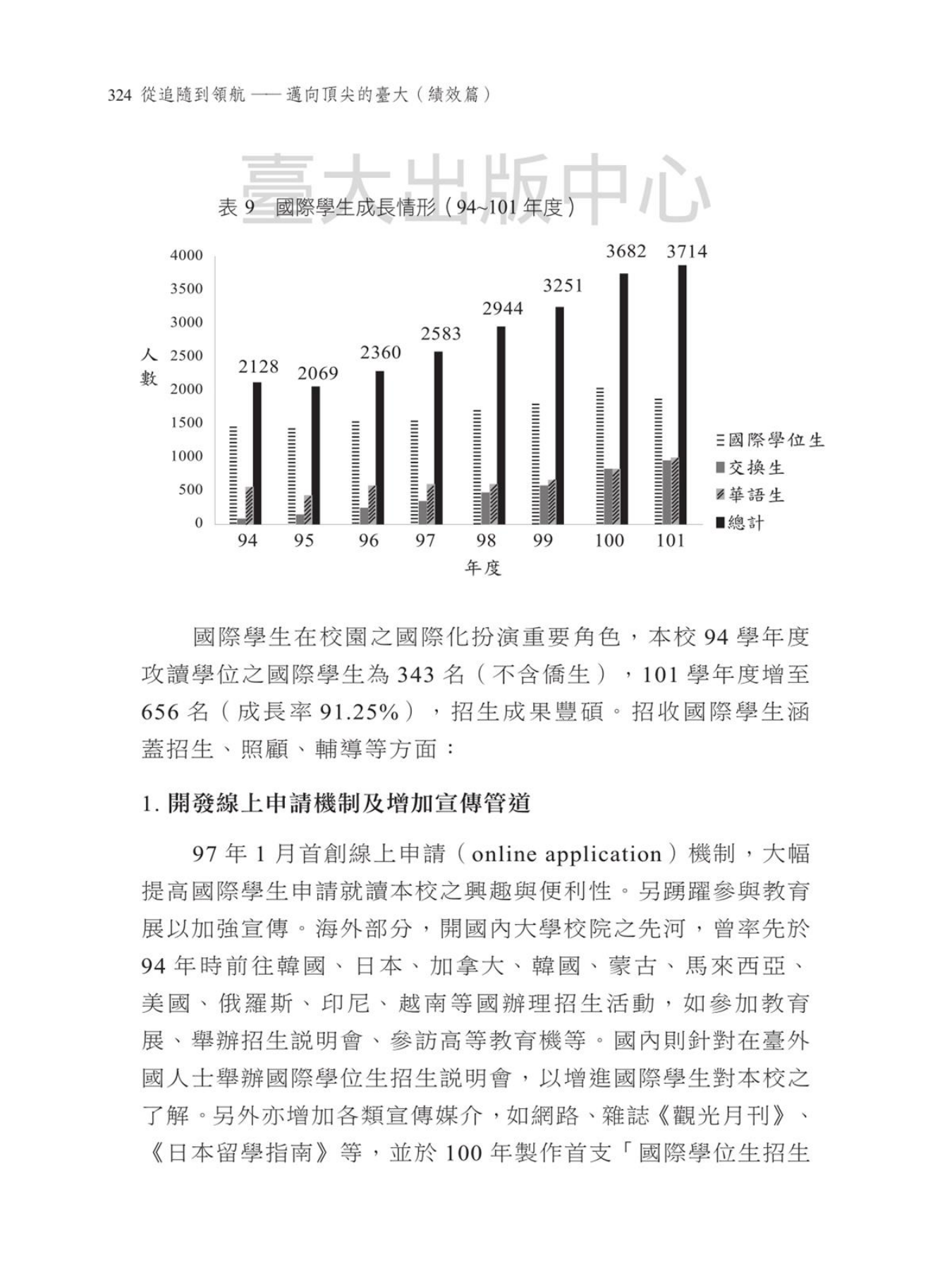
Table 9. Growth of International Students, 2005–2012
Bar chart. The vertical axis is number of people, from 0 to 4,000 in increments of 500; the horizontal axis runs from 2005 through 2012. The four series are international degree students, exchange students, Chinese-language students, and total. Printed totals are:
| Academic year | Total |
|---|---|
| 2005 | 2,128 |
| 2006 | 2,069 |
| 2007 | 2,360 |
| 2008 | 2,583 |
| 2009 | 2,944 |
| 2010 | 3,251 |
| 2011 | 3,682 |
| 2012 | 3,714 |
The individual category bars are visible in the retained source graph but do not carry exact printed value labels.
International students play an important role in the internationalization of the campus. In the 2005 academic year, there were 343 international students pursuing degrees at NTU (excluding overseas Chinese students), which increased to 656 in the 2012 academic year (a growth rate of 91.25%), demonstrating fruitful enrollment results. Recruiting international students covers aspects such as recruitment, care, and counseling:
- Developing an online application mechanism and increasing promotional channels
In January 2008, NTU pioneered an online application mechanism, significantly increasing the interest and convenience of international students applying to study at NTU. Additionally, NTU actively participates in education expos to strengthen promotion. Overseas, NTU took the lead among domestic universities and colleges, having previously gone to countries such as South Korea, Japan, Canada, South Korea, Mongolia, Malaysia, the United States, Russia, Indonesia, and Vietnam to conduct recruitment activities in 2005, such as participating in education expos, holding recruitment briefings, and visiting higher education institutions. Domestically, NTU holds recruitment briefings for international degree students targeting foreigners in Taiwan to enhance international students’ understanding of NTU. Furthermore, various promotional media have been added, such as the internet, magazines like Tourism Monthly and Study in Japan Guide, and in 2011, the first “International Degree Student Recruitment
“Advertisement,” placed on online platforms for broadcast.
- Promoting English-taught instruction, distinctive degree programs, and courses
The Global MBA Master’s Program was established in the 2006–2007 academic year; the International Master’s Program of the Department of Agricultural Economics was established in the 2006–2007 academic year; the Joint Master’s Program in Structural Engineering and Construction Management with the Hanoi University of Civil Engineering in Vietnam was established in the 2009–2010 academic year; and the Doctoral Program in Translational Medicine was established in the 2009–2010 academic year. All of these are fully English-taught degree programs. Additionally, up to the first semester of the 2012–2013 academic year, the University offered approximately 400 English-taught courses per semester.
To enable international students to gain a comprehensive understanding of Taiwan from diverse perspectives, the University began offering the “Exploring Taiwan” English general education series in the first semester of the 2007–2008 academic year, allowing international students to access an accessible yet in-depth introduction to Taiwanese culture, history, society, music, politics and economics, geography, natural environment, and biological resources.
- Strengthening academic and life counseling mechanisms
The University combines administrative units, departments, and faculty advisors to jointly assist international students in adapting to their academic pursuits. For example, seminars for foreign student mentors have been held, coordinating with faculty and various units to discuss counseling matters for international students. From September 2007 to January 2013, three seminars for foreign-student faculty advisors were held, coordinating support for international-student affairs across the various colleges. From recruitment through counseling, the University understands the backgrounds, proficiency levels, individual circumstances, and difficulties encountered by international students in each college. That is, the University and colleges maintain close coordination to jointly counsel international students.
Since the 2007–2008 academic year, the University has combined a volunteer system with service-learning courses, enabling local students to demonstrate caring service by assisting foreign students in adapting to campus life, while facilitating two-way exchange. To date, more than 600 students apply annually to serve as reception volunteers for foreign students, receiving positive feedback from the international student body. Life is learning; to assist international students in adapting to the
living environment of the University, student dormitories actively organize various orientation and international cultural exchange activities and lectures, such as dormitory life lectures, language and culture learning lectures, festival experience activities, and tours to explore Taiwan, etc. These initiatives expand the social sphere of international students, enhance their understanding of Taiwanese culture, and facilitate their smooth adaptation and integration into dormitory life. Meanwhile, through interactions between international and local students, local students also learn to respect cultural diversity and enhance their global perspective.
Additionally, in 2008, the University planned and established the Global Lounge, located on the third floor of the Second Student Activity Center. The purpose, besides providing a gathering and socializing space for international and local students, includes planning monthly activities themed around different countries, inviting local students and students from various nations to participate in exchanges. Local students may also host cultural or international-related events here, inviting international students to join in the celebrations.
- Enhancing Chinese language proficiency
Addressing the language adaptation issues of foreign students, the University developed the “Chinese Proficiency Assessment Test” in 2006. In the 2006–2007 academic year, the University implemented the Chinese proficiency assessment for all incoming international first-year students for the first time, and assigned them to Chinese language classes based on the assessment results. Those who did not meet the standard were arranged to receive free intensive Chinese instruction at the Language Center. Starting from the 2012–2013 academic year, the University integrated internal resources to offer a weekly six-hour Chinese tutoring course for first-year students, aiming to reduce the language barriers they encounter in daily life and academic studies. Additionally, large-class Chinese credit courses for international degree-seeking graduate students, exchange students, and visiting students were established, providing a weekly six-hour, three-credit course, as well as a four-hour, zero-credit intensive Chinese course. Besides the aforementioned large-class Chinese courses, students may also pay out-of-pocket to attend small-group selected Chinese courses or elite Chinese courses at the Language Center.
- Increasing scholarship and grant support
To attract outstanding foreign students to study at the University, the University provides various scholarships and grants to international degree-seeking students, including the National Taiwan University Scholarship (originally the
“Gratitude Scholarship”), the National Taiwan University Scholarship for Foreign Graduate Students, and the National Taiwan University Grant for Foreign Graduate Students. In 2012, the University joined the Ministry of Education’s Taiwan Scholarship Alliance, supporting the Ministry of Education’s Taiwan Scholarship, which waives tuition and miscellaneous fees for recipients.
(B) Cross-national Dual/Joint Degree Students
From the 2005–2006 academic year to the first semester of the 2012–2013 academic year, a cumulative total of 28 higher education institutions worldwide had established dual/joint degree agreements with the University, reaching 83 contracts. Partner institutions include Waseda University in Japan, Hanyang University in South Korea, Hanoi University of Civil Engineering in Vietnam, Nanyang Technological University in Singapore, the University of Geneva in Switzerland, Paris-Sud University (Paris 11), Université Grenoble-Alpes (Fourier University), Pierre and Marie Curie University, and the Paris Institute of Agronomy in France, as well as the University of Illinois, the University of South Carolina, and Temple University in the United States. A cumulative total of over 100 students have participated in the dual/joint degree programs. As early as 2002, the University established scholarships for dual-degree students, including the Taiwan-France Dual Degree Scholarship and the Waseda Dual Degree Scholarship.
(C) Exchange Students Visiting the University
From the 2005–2006 academic year to the second semester of the 2012–2013 academic year, the University had signed 288 student exchange agreements with 220 sister universities worldwide, spanning 36 countries across five continents. The number of exchange students visiting the University increased from 105 in the 2005–2006 academic year to a cumulative total of 3,461 participants by the end of the 2012–2013 academic year.
In 2006, the University pioneered and completed the development of a university-level online application system for incoming exchange students. Starting from the 2007–2008 academic year, the system was opened for student applications and login queries regarding various application items. The online document upload and sister university nominator system facilitates coordinators at partner institutions in confirming nominated students’ application materials and tracking progress, eliminating the need to mail application documents to Taiwan, thereby successfully achieving energy-saving and carbon-reduction goals. The system continues to be updated and maintained, maximizing its digital functionalities.
In terms of counseling and care, in addition to printing the English version of the Exchange and Visiting Student Handbook annually to provide students with important information, orientation briefings, campus tours, and unified registration days are held for new students before the start of each semester. Starting from the 2009–2010 academic year, group airport pickup services were planned and implemented; up to the 2012–2013 academic year, a total of 1,310 students were served, including exchange, visiting, and degree-seeking students. Starting from the 2011–2012 academic year, a social networking website for annual incoming exchange students was established, providing a platform for exchange students to share experiences and information with one another.
To attract students from sister universities to participate in our university’s exchange student program, promotional materials and posters were designed for overseas education fairs organized by various institutions, made available for use by sister universities and for students to obtain. We also assessed the possibility of sending staff to participate in key exhibitions to strengthen publicity. Additionally, experience reports and blogs from past visiting exchange students were placed on the website for future interested students to read.
(4) Visiting Students Coming to Our University
The Visiting Student Program coming to our university was launched in the 2008–2009 academic year, providing international students the opportunity to study at our university by paying their own tuition fees. Up to the second semester of the 2012–2013 academic year, students who came to our university for study through this program covered 22 countries and 105 institutions, including Yale University, Princeton University, Duke University in the United States, and Waseda University in Japan. The total number of participating students from the 2008–2009 to the 2012–2013 academic years was 218.
To strengthen exchanges with top overseas universities and integrate internal resources, the International Education Center has developed customized group special programs for top-tier institutions, such as the University of Illinois (UI), with the goal of becoming the Asia-Pacific Hub for overseas education (Study Abroad) for top North American and European universities.
(5) International Summer Students
The NTU Summer+ Programs aim to combine NTU’s internal teaching resources and professional disciplines to provide international students with the opportunity to come to NTU for short-term study of 2 to 6 weeks and cross-national cultural exchange during the summer vacation. Since the newly established International…
The number of participants increased from 17 to 143. Course offerings included Summer+1, “Exploring Taiwan: Chinese Language and Culture”; Summer+2, “Summer Research Laboratory and Culture”; Summer+3, “Taiwan Agricultural Biology and Cultural Diversity”; and Summer+4, “Summer Biotechnology Laboratory.” In 2013, two additional courses were added: Summer+5, “International Summer Program in Academic Leadership,” and Summer+6, “International Economic and Trade Law.”
(6) Chinese Language Students
The Chinese-language courses offered by the Language Center under the College of Liberal Arts provide international students with Chinese-language training. Students are assigned to classes according to proficiency, and intensive small-group instruction is used. Four sessions are held each year—spring, summer, autumn, and winter. Professional and experienced Chinese-language teachers select materials that progress from elementary to advanced, guiding international students step by step to achieve optimal learning outcomes; the program has received high international praise.
VII. Expanding Overseas Education Programs
(1) Outgoing Exchange Students
The university actively expanded cooperation agreements with countries in different language regions, increased subsidies for exchange students, established electronic processing for exchange-student affairs, and encouraged and assisted colleges and departments in administering exchange students, thereby improving both the quality and quantity of exchange participation. The second phase of the Top University Project set a goal of giving one-third of undergraduates an opportunity to study abroad as exchange students during their studies.
- Increasing Exchange-Student Quotas and Subsidies
To further expand cooperative relationships with leading international universities, NTU actively signed cooperation agreements with countries in different language regions. In the 2005–2006 academic year, 113 NTU students studied abroad on exchange, of whom 26 received various scholarships; by the 2012–2013 academic year, outgoing
exchange students, the cumulative total reached 3,095 students. From the 2005–2006 to the 2012–2013 academic years, a total of 741 students received scholarships.
To encourage and expand the number of participating students, the “Guidelines for Establishing Scholarships for Outstanding and Financially Needy Exchange Students” were set up in the 2006–2007 academic year. By the 2012–2013 academic year, a cumulative total of 287 outstanding students from our university had received this scholarship and successfully studied at sister universities. Other scholarships provided to our university students to participate in exchange programs from the 2005–2006 to the 2012–2013 academic years include: the Ministry of Education’s “Flying High in the Sea of Learning” Plan, the “Cherishing Pearls in the Sea of Learning” Plan, the Taiwan-Germany Exchange Student Scholarship, the Taiwan-Austria Exchange Student Scholarship, the Taiwan-US Elite Short-Term Study Scholarship, the Japan Foundation Short-Term Exchange Student Scholarship, the MediaTek Cross-Strait Exchange Student Scholarship, the MediaTek/MIT Scholarship, exchange student scholarships from various colleges of our university, and scholarships provided by sister universities to our students.
- Electronic Processing of Exchange Student Affairs
The selection process for exchange students within our university has been fully computerized, simplifying the application process for students and improving efficiency.
The “Exchange Student Family” webpage established by the Office of International Affairs promotes the inheritance and sharing of experiences among past exchange students from our university, and simultaneously serves as an important channel for the Office of International Affairs to maintain contact with exchange students abroad. As of March 2013, there were 1,377 registered members participating in this family. In the future, we will continue to promote experience sharing and contact within the online family, and establish a complete exchange student family network.
- Encouraging and Assisting Colleges and Departments in Managing Exchange Students
In addition to university-level exchange programs, the Office of International Affairs also provides information and relevant regulations to assist departments in managing exchange students, consolidating our university’s exchange student operational processes, simplifying administrative procedures, and improving efficiency.
(2) Outgoing Visiting Students
To address the issue of insufficient quotas at some exchange sister universities, and to open up non-exchange sister…
V. Promoting Internationalization
opportunities for study at sister universities. Starting from the 2008–2009 academic year, the university launched the Visiting Student Program, allowing NTU students to study at foreign universities at their own expense. By the end of the second semester of the 2012–2013 academic year, the schools with which NTU established visiting student programs covered 14 institutions in 5 countries, including the University of Washington in the United States, the London School of Economics and Political Science in the United Kingdom, and Waseda University in Japan. A total of 73 students participated from the 97th to the 2012–2013 academic years.
(3) Overseas Summer Students
In addition to encouraging students to participate in overseas exchange student programs, the university also promotes and develops diverse overseas summer courses to provide students with the opportunity to study abroad for 3 to 6 weeks during the summer vacation.
To expand opportunities for NTU students to study abroad and to broaden the possibilities for cooperation with top-tier foreign universities, starting from the 2010–2011 academic year, the university actively engaged in discussions with various first-class foreign universities regarding overseas summer courses. By the 2012–2013 academic year, NTU had established 22 overseas summer course programs with 20 institutions in 8 countries, including the University of California, Berkeley; the University of California, Davis; Hertford College, University of Oxford; King’s College London; the University of Hamburg; and Heidelberg University in Germany. A total of 1,468 students participated during the period from the 99th to the 2012–2013 academic years.
- Creating a Bilingual Environment
In addition to actively promoting internationalization in academics, the university has comprehensively implemented bilingualization across the campus environment. Following customary practice, the university publishes the NTU Profile and Brief Introduction to NTU in both Chinese and English every year, produces multimedia CDs introducing NTU, and issues bilingual souvenirs. The university’s English website was revamped in July 2006, with “Highlights” and “Spotlight” sections updated regularly on a weekly or biweekly basis, and sections such as “Students” and “Faculties” included.
Furthermore, important administrative regulations, forms, campus maps, road signs, directional guidance markers, public service areas, employee ID cards, business cards, nameplates, and temporary
identification cards (business visitor passes) have also been bilingualized. Telephone switchboard voice services, campus tours, and consultation services also provide foreign language support.
The university began printing the Life Magic Book in the 2008, providing diverse and rich bilingual campus and surrounding life information for easy reference; dormitories also produced Chinese-English bilingual floor plans, evacuation signs, facility usage instructions, and important housing regulations and announcements, providing clear and convenient services. Additionally, starting from the first semester of the 2005–2006 academic year, the university printed bilingual versions of the NTU International Degree Student Admission Brochure and the NTU International Degree Student Life Handbook for use by international students.
VI. Promoting Administrative Reform, Enhancing Administrative Efficiency and Quality
The university’s administrative work supports the advancement of teaching, research, and service. An excellent administrative system is an indispensable key element of a university’s competitiveness. Only when colleagues are proactive, enthusiastic, innovative, and active can they effectively support the advancement of the university’s teaching, research, and service work. In recent years, the university has been committed to administrative e-ization, streamlining processes, improving regulations, and promoting publicity and communication, with notable results.
- Administrative E-ization
In September 2005, the university established an Administrative E-ization Task Force, chaired by the Chief Secretary, and composed of representatives from various primary administrative units, the College of Electrical Engineering and Computer Science, the Department of Electrical Engineering, the Department of Information Engineering, and other departments and colleges, to promote comprehensive e-ization across the university, aiming to achieve the goals of “creating a comprehensive e-campus, streamlining administrative processes, enhancing administrative efficiency, and improving service quality.” Its promotion strategy focuses on building a solid foundation upstream, integrating and developing similar types of systems, prioritizing services with broader coverage, and strengthening indicator-based services, actively promoting various projects. By February 2013, the results of the university’s promotion of administrative e-ization were as follows:
(1) Systems Already Online
- University-wide
(1) E-newsletter dispatch platform: went online in May 2006.
(2) NTU homepage revamp: went online in July 2006.
(3) Resignation savings e-ization service: went online in December 2006.
(4) Online voting system: went online in June 2007.
(5) Registered mail inquiry system: went online in July 2007.
(6) Campus card e-ization: completed in August 2007.
(7) Computerization of maintenance and construction business: went online in October 2007.
(8) Single entry point for venue space borrowing information: went online in December 2007.
(9) Comprehensive Gymnasium venue reservation system: went online in February of the 2008.
(10) Satisfaction questionnaire survey system: went online in May of the 2008.
(11) NTU recruitment and job-seeking system: went online in September of the 2008.
(12) NTU campus recruitment system: went online in October of the 2008.
(13) English website Phase II: went online in October of the 2008.
(14) NTU event registration system: went online in January 2009.
(15) Repair application and management system Phase II: went online in August 2009.
(16) NTU event registration system Phase II: went online in October 2009.
(17) NTU event registration system Phase III: went online in March 2010.
(18) Registered mail inquiry system Version 2.0: went online in January 2011.
(19) Property and equipment management system: went online in July 2011.
(20) “Repair Application and Management System” (expanded and revised edition): launched in March 2012.
(21) “Property and equipment management system Phase II” (revised version): went online in October 2012.
(22) Official mail mailing system: went online in December 2012.
(23) “Campus Recruitment System” (Computer and Information Networking Center edition): launched in January 2013.
- Students
(1) Student Affairs System Portal Phase I: went online in February 2006.
(2) Student Information Service Network: went online in July 2006.
(3) Student Affairs System Portal Phase II: went online in October 2006.
(4) Student Graduation and Departure System: Launched in January 2007. (5) Initial Counseling Appointment System: Launched in March 2007. (6) Online Course Scheduling System: Launched in April 2007. (7) NTU Student Learning Portfolio: Launched in September 2007. (8) Online Course Add/Drop System: Activated in October 2007. (9) Academic Regalia Borrowing and Return Control System: Launched in November 2007. (10) Poster System: Launched in January 2008. (11) Scholarship Application System for Foreign Students (English Interface): Launched in February 2008. (12) Counseling Appointment Service System: Launched in March 2008. (13) Graduate Diploma Collection Representative Registration System: Launched in April 2008. (14) Student Affairs Office Disadvantaged Student Financial Aid Application and Management System: launched in July 2008. (15) Expansion of the Scope of the “NTU Student Learning Portfolio”: Launched in September 2008. (16) Student Departure and Leave of Absence System: Launched in May 2009. (17) Leave of Absence and Departure System, Phase II: Launched in January 2010. (18) Mentor Comprehensive Data Registration and Query Integration System, 2010 Edition: Launched in January 2010. (19) E-ization of Dormitory Payment and Refund Mechanisms: Launched in August 2010. (20) Student Leave Request System: Launched in September 2010. (21) Club Activities and Venue Reservation System, Phase I: Launched in May 2011. (22) Student Comprehensive Data Registration and Query System, 2011 Edition: Launched in June 2011. (23) Tuition and Fees Reduction/Exemption System (New Functions): Launched in August 2011. (24) Academic Regalia Control System (Revised Version): Launched in September 2012. (25) Physical Examination System (Revised Version for Undergraduate Programs): Launched in October 2012.
- Personnel
(1) Personnel Data Query System: Launched in February 2006. Upgraded in January 2007 to include photo management functions. (2) Faculty and Staff Online Check-in System: Launched in July 2006. (3) Staff Online Clock-in/Clock-out Operations: Launched in October 2006. Online clock-in/clock-out using Natural Person Certificates was launched in January 2009. (4) Faculty Hourly Fee Processing System: Launched in December 2006. Later upgraded in January 2010 to align with the Personnel Management System 2.0. (5) Faculty and Staff Overseas Travel and Leave Application System: Launched in January 2007. (6) National Health Insurance System: Launched in March 2007. Later upgraded in December 2008 to align with the Personnel Management System 2.0, and again in July 2011 to accommodate government salary adjustments. (7) Living Allowance System: Launched in March 2007. Later upgraded in January 2010 to align with the Personnel Management System 2.0. (8) Work Expense Control System: Launched in March 2007. Later upgraded in January 2010 to align with the Personnel Management System 2.0. (9) Appointment, Dismissal, and Transfer Subsystem: Launched in April 2007. (10) Voting System: Launched in June 2007. Later upgraded in October 2011 to support the Flash format for myNTU. (11) Public Insurance System: Launched in May 2008. Later upgraded in December 2008 to align with the Personnel Management System 2.0, and again in July 2011 to accommodate government salary adjustments. (12) New Personnel Management System: Launched in March 2009. (13) Recruitment and Appointment System, Establishment Management System: Launched in July 2009. (14) New Attendance and Leave System: Launched in September 2009. (15) Personnel Management System 2.0: Launched in March 2010.
(16) Address Book Management System: Upgraded in August 2010. (17) Contract Staff Performance Evaluation System: Launched in October 2010. (18) Technician and Laborer Performance Evaluation System: Launched in November 2011. (19) Subsidy System: Launched in February 2012.
- Official Document Management
(1) Official Document Tracking System: Launched in June 2006. (2) Official Document File Number Query System: Activated in January 2007. (3) Two-Level Archive Description System: Launched in January 2008. (4) Archive Management Information Subsystem—Archive Inventory System: Launched in July 2008. (5) Official Document Management Subsystem—Official Document Announcement Version 2.0: Launched in July 2008. (6) Official Document Management Subsystem—Official Document Announcement Version 4.0: Launched in August 2009. (7) Official Document Information Management System (with Online Approval Functions): Launched in November 2011.
- Accounting and Cashier Services
(1) E-ization of Receipt Subsystem: Launched in March 2005. (2) E-ization of Petty Cash Services: Launched in October 2006. (3) E-ization of Severance Pay Savings Services: Launched in December 2006. (4) Payment Notification System (Individuals and Vendors): Launched in January 2007. (5) Vendor Payment Email Notification and Web Query System: Launched in February 2007. (6) Integrated Vendor Remittance Program System: Launched in May 2007. (7) Web Query for Student Tuition and Fee Payment Status: Launched in July 2007. (8) Individual Payment Email Notification System: Launched in August 2007. (9) E-ization of Accounting System: Launched in September 2007.
(10) Laser receipt design and application: Launched in January 2008. (11) Online temporary salary reimbursement system: Launched in January 2008. (12) Postcard-style withholding tax certificate printing: Launched in March 2008. (13) Year-round online printing of tuition and fee payment certificates: Launched in June 2008. (14) Enhanced e-ization of the salary system: Launched in October 2008. (15) Integrated personal payment inquiry webpage: Launched in November 2008. (16) Multi-account usage for payees in the accounting system: Launched in November 2008. (17) Reimbursement process tracking: Launched in November 2008. (18) Online reporting and verification of income from executive business: Launched in January 2009. (19) Labor and health insurance premium verification system—check analysis program: Launched in March 2009. (20) E-ization of cashier services: Launched in May 2009. (21) Student departure system integrated with the e-ized refund system: Launched in December 2009. (22) Registration system linked to the comprehensive fee collection system: Launched in December 2009. (23) AP TO AP function provided by banks collecting tuition and fees on behalf of the university: Launched starting from the second semester of the 2009 academic year. (24) Student housing management integrated with the e-ized payment system: Launched in July 2010. (25) Student housing management integrated with the e-ized refund system: Launched in September 2010. (26) E-ized reconciliation of revenues and expenditures: Launched in September 2010. (27) Bank batch transfer reimbursement system: Launched in September 2010. (28) Third phase of the e-ized accounting system: Launched in October 2010. (29) E-ized loan request forms: Launched in December 2010. (30) Addition of the four major convenience store chains as collection units to the NTU online payment system payment slips: Launched in June 2011. (31) Human resources and salary platform: Launched in December 2011. (32) E-ized payment slip system: Launched in June 2012.
(33) Fourth phase of the e-ized accounting system: Launched in June 2012.
- Others
(1) Alumni Information Network: Launched in June 2006. (2) International Academic Exchange Information System: Launched in January 2007. (3) E-ization of research project business: Launched in June 2007. (4) Second phase of the “NTU Academic Output Information System”: Launched in February 2008. (5) Alumni Website Information Platform: Launched in January 2009. (6) Project personnel employment application system for “temporary workers” and “related personnel” applications: Launched in June 2009. (7) Project bidding inquiry and registration system: Launched in August 2009. (8) Shared management system for expensive instruments: Launched in November 2009. (9) E-ized project management system for enhancing environmental safety, health, and cleanliness in teaching, research, and internship facilities: Launched in April 2010. (10) Donation system (back-end) for the “Alumni Website Information Platform”: Launched in April 2010. (11) Third phase of the donation system (front-end) for the “Alumni Website Information Platform”: Launched in January 2011. (12) Online resignation procedure and certificate issuance system for full-time project personnel: Launched in February 2011. (13) Alumni Information Network (formerly NTU Collaborative Network): Launched in September 2011. (14) Research Project Management System (enhanced and revised version): Launched in December 2011.
(B) Benefits
The completed systems cover aspects such as academic affairs, student affairs, general affairs, research and development, international affairs, human resources, and accounting, with remarkable results. Examples are provided below:
- Website
The university’s Chinese and English homepages underwent a comprehensive redesign in July 2006, significantly improving information content, graphic design, and website convenience. Single-entry links for the latest news, visitors, and alumni were provided for faculty, staff, and the public to query.
According to the Webometrics ranking of global university websites conducted by the Spanish National Research Council’s Scientific Information and Documentation Center as of February 2013, our university achieved the excellent result of ranking 38th globally.
- Student Graduation and Departure System
Approximately 8,000 students graduate and leave the university each year. This system was launched in January 2007, providing students with real-time information related to departure procedures. Students no longer need to run around to various departments, and can handle departure procedures without time restrictions, effectively simplifying administrative processes.
- E-ization of Student Affairs
Integrating the university’s vast and complex resources to serve students through a single window, the “Student Information Service Network” was established in July 2006. This initiative made information integration public, established easy and convenient communication channels, and provided faculty and students with real-time query services through a user-friendly interface, creating a rich and diverse database of student campus life. As of February 2013, the Student Information Service Network had approximately 14,051,103 user visits. To integrate university systems into a single window, the Computer Center integrated this service network into myNTU in March 2013. Additionally, the “NTU Learning Portfolio” was completed in September 2007. Centered on personal resumes, future NTU graduates can directly print their resumes online for job hunting.
- E-Reimbursement System
In September 2007, the reimbursement process was simplified, reducing annual paper usage by approximately 2 million sheets and significantly lowering the error rate. Additionally, the number of approval stamps required for regular expenses such as salaries and business-related costs was reduced from eight to six, and for property items under NT$6,000, from nineteen to six, thereby doubling overall efficiency.
- E-Cashier Management and Cross-Unit Workflow Integration
A comprehensive review of business processes was conducted to implement e-cashier operations for financial administrative control, accelerating processing times and enhancing internal cashier controls. Following the internal e-implementation of cashier operations, vertical and horizontal e-information integration across units began, linking e-workflows. This included the completion of the integration and e-implementation of university-wide revenue accounting categories, e-claiming of salaries for project-based teaching and research personnel and contractual staff, e-claiming of work allowances for talents hired with National Science Council subsidies, the HR salary platform, reimbursement process tracking, linking and sharing of accounting and cashier data, and the integration of tuition and fee data. These measures saved manual processing time for business units and improved administrative efficiency. Since June 2008, additional services have been provided to make tuition and fee payments more convenient, such as online printing of payment slips and real-time updates of payment slip information. This not only saved postage costs but also facilitated fee payments for students with changes in status, such as those applying for student loans, tuition and fee reductions or exemptions, or dormitory fee adjustments. Cooperation with banks also enabled tuition and fee payments at convenience stores. Furthermore, students could print tuition and fee payment certificates online for tax reporting purposes, saving time for both students and administrative staff handling paper-based procedures.
- Online Staff and Faculty Check-in System
This system integrates the procedures required for new hires to report for duty, allowing new personnel to fill in personal basic information and apply for various services online, eliminating the need to submit separate paper applications and the hassle of repeatedly entering personal data. The Human Resources Office provides a single-window check-in service, resolving the inconvenience for new hires of traveling back and forth between various units to apply for services.
Administrative units can directly process new hire applications based on the data provided by the system, simplifying internal administrative operations. Since its official launch in July 2006 until February 2013, more than 1,100 new personnel have used the system with good results.
- E-Card and ID Integration
Given the large number of scattered buildings on campus and the separate establishment of access control systems, which caused the inconvenience of individuals holding multiple cards, plans were developed for a unified campus card system, completed in the 2007–2008 academic year. The original magnetic stripe IDs held by faculty, staff, and students (including student IDs and faculty/staff IDs) were uniformly updated to cards combining MIFARE contactless chips with EasyCard functionality. In addition to resolving the inconvenience of multiple cards and simplifying access control management, this system can be integrated with on-campus card-based payment mechanisms in the future, significantly enhancing the convenience of a single-card solution.
- Transparency of Venue Information
To ensure transparency in the use of space in various university venues, a comprehensive survey was conducted of all spaces under the jurisdiction of the university’s departments, including classrooms, conference rooms, auditoriums, and other facilities. In December 2007, a master list of venue rental information and a gateway webpage were completed, providing link functions. Staff from the General Affairs Group serve as a single window for on-campus venue rental services, providing consultation on information for various relevant venues.
- E-Property Management System
This system went live on June 1, 2011, integrating functions for property management, property inquiries for units in the main campus area, and second-hand property exchange. It allows users to directly generate property management forms online and query the latest status of property changes at any time. The management side can instantly grasp the school’s property resources, and the data is synchronized with the accounting reimbursement system records, simplifying operational processes.
- Third Phase of the Alumni Website Information Platform: Front-End Donation System
In January 2011, the system’s front-end provided an online real-time donation platform for alumni both domestically and internationally, allowing them to receive the latest alumni-related information at any time, alongside a redesigned user workflow for the new pages. In addition to reducing paper-based operations and improving donation efficiency, this system enhances interaction among alumni, the university, and classmates.
- Second and Third Phases of the NTU Event Registration System
As NTU advances toward becoming a top-tier university, various on-campus activities have flourished. This system integrates NTU’s rich and diverse activity information, establishing a single-entry website for event registration, making registration information transparent and effectively fulfilling promotional tasks for events. The system officially went live in January 2009. By February 2013, it had been used by 113,838 people, covering 896 events and a total of 2,224 event sessions.
- HR Salary Platform
The system provides an online platform for the Human Resources Office and other business units to upload relevant salary calculation and deduction data. After the Cashier Group extracts the HR master file, salary details, and various withholding amounts, the system compares the data to generate a discrepancy report. After reviewing and confirming that the paper-based data is correct, a payment list is printed for submission. The establishment of this salary platform allows for immediate correction of data discrepancies between units, reducing the occurrence of subsequent overpayments requiring recovery, underpayments requiring supplementary issuance, or deductions requiring collection. This strengthens the cross-checking of salary disbursements and further improves administrative efficiency.
- Campus Recruitment System
To provide a single online service window for recruiting enterprises, the Campus Recruitment System was created in October 2008, allowing companies to fill in basic information once to access services such as recruitment registration and campus recruitment. Combined with fair activities and lecture registrations, students only need to register their student ID in the event registration system to sign up for company visits, career counseling
and other activities such as aptitude tests. This system provides business units with relevant statistical and reporting functions, significantly reducing the time managers spend on data compilation and collection. By utilizing a user-friendly operational system, we have attracted more high-performing and leading enterprises to participate in campus recruitment activities, providing students with more employment opportunities.
II. Official Document and Correspondence Reform
(A) Actively Promoting the Digitization of Official Documents
From 2005 to 2012, the methods for handling official documents continued to evolve, advancing from the original manual transmission of paper documents to online announcements and scanned file archiving. By 2012, the goal of full digitization of official documents—where transmission, approval, announcement, and archiving are all completed on an online platform—was achieved.
-
In August 2005, after four years of work, a project to retrospectively archive 1.4 million files was completed, the largest quantity among all schools in the country, improving the quality of file management. In January 2006, a system for tracking official documents and querying file classification numbers was completed.
-
In October 2006, the “Official Document Management System” integrated website (https://doc.ntu.edu.tw/) was launched. This integrated the sub-systems for official documents commonly used by handlers (uploading, tracking, querying), as well as the internal correspondence processing system and external network resources, into a single website to assist correspondence efficiency via the internet.
-
In June 2009, paperless processing for internal notification-type official documents was implemented within the university, adopting online announcements and ceasing the issuance of paper documents. After promotion and dissemination, a survey in January 2010 showed that 90% of respondents believed timeliness had improved. Regarding paperless practices, 26% chose not to print at all, 68% chose to print only those relevant to their units, and only 1% printed everything, initially achieving the effects of energy saving, paper reduction, and accelerated transmission.
-
Retrospective digital scanning of official document archives began in December 2009. By January 2011, over 60,000 items totaling 650,000 pages of permanent preservation files related to appointments, personnel, and hiring from the period 1981–2003 were completed, improving the execution efficiency of document digitization.
- The Official Document Management Information System with online approval functions (https://edoc.ntu.edu.tw/) went live in November 2011. This project was initiated in July 2007. After five years of planning, negotiation, and system development, including 120 requirement interview meetings and 103 training courses, it finally went live in November 2011. By December 2012, the ratio of official documents using online approval across the university reached 14.45%, gradually demonstrating the new system’s function in improving administrative efficiency and saving energy and paper.
(B) Promoting Official Document Writing and Providing Customized Standard Template Services
-
Starting in July 2008, annual official document training courses were held, targeting general staff, new employees, and supervisors, with courses divided into basic and advanced levels to strengthen colleagues’ official document writing and related professional skills. By February 2013, a total of 23 sessions of official document writing and related courses had been conducted, significantly improving the overall quality of official documents.
-
In April 2010, the “Quantitative Indicators for Official Document Writing Quality” measure was implemented. After conducting itemized statistical analysis of errors in official document drafts across the university, the university-wide average error rate was announced. Units with error rates higher than the average were notified via official letter to make improvements. Additionally, an internal “Common Error Correction Reference Table” was produced for reference, effectively improving the accuracy of official document content.
-
In April 2011, all units were requested via official letter to provide commonly used official document examples. These were proactively reviewed and adjusted one by one according to the relevant regulations in the Correspondence Handling Manual, corrected, and uploaded upon the completion of the new official document system launch, further enhancing the quality of our university’s official documents with the implementation of the new system.
(C) Comprehensive Innovation in Archival Operations
- Archival conservation operations were launched in August 2005. In August 2007, the “Archival Conservation Room” was established at the Shuiyuan Campus. Various archival conservation training courses are offered annually, divided into basic, advanced, and thematic courses, with long-term promotion of the concept of archival conservation and preservation.
This has been extended to internal unit file managers, the museum cluster, and conservation volunteers (19 individuals). We have also actively engaged in exchanges with external units (hosting a National Archival Conservation Symposium in December 2007). By March 2013, 27 related training seminars and achievement exhibitions had been conducted.
-
The “Archival Exhibition Room” was established in October 2007 and joined the university’s museum cluster. The first official document archival exhibition was launched during the university anniversary in November 2007. By February 2013, cumulative archival application activities had reached 26 sessions. The themes were all related to issues of concern within the university and social trends. Collaborative partners and exhibition locations extended both inside and outside the university, with visitor numbers reaching hundreds of thousands. This successfully injected vitality into the archives and enhanced their function in humanities education.
-
After undergoing reforms including the planning and relocation of new storage facilities, reorganization of case files, and promotion of applications, our university’s archival operations were recommended by the Ministry of Education to participate in the 2008 National Golden Archive Award selection in June 2008. We won the sixth national “Golden Archive Award” and the individual “Gold Quality Award.” In December 2010, we again received awards from the Archives Administration for “Archival Research Papers” and “Archival Creative Value-Added” categories. Currently, domestic and foreign archival units frequently visit for observation and exchange. Starting in 2010, we collaborated with the Ministry of Education to visit and provide recommendations to various universities. In July 2011, we cooperated with the Ministry to conduct a three-day archival training for subordinate agency schools.
(D) Enhancement and Legalization of Mail Processing Efficiency
-
The “Registered Mail Inquiry System” was launched in June 2007. Registered incoming letters were digitized using barcodes, providing a service for recipients or units to inquire online.
-
In November 2007, after negotiations with Chunghwa Post, the first domestic “Letter Delivery to Department Service” was launched, ensuring same-day delivery of mail. Departments no longer needed to send personnel to the university mail room to collect letters. By February 2013, there were a total of 104 delivery points, saving manpower and improving letter delivery efficiency.
-
In July 2011, the “National Taiwan University Mail Management Guidelines” were established, clearly regulating the time limits for handling correspondence, procedures for special mail, and the internal receiving, returning, and forwarding mechanisms, among other matters. This was done to respond to internationalization and to further standardize mail processing procedures.
-
In December 2012, the official mail mailing system went online. As one of the few systems in the country capable of integrating with the official document management system, it offers significant benefits in automation, timeliness control, and the simplification of reporting processes, thereby substantially improving the quality of mail services.
III. Improving Personnel Regulations and Simplifying Procedures
To improve personnel regulations and simplify procedures, the University has implemented the following measures:
(1) Improving Personnel Regulations
In accordance with the needs of university development, between 2005 and 2013, the University added to and revised relevant personnel regulations. In addition to the “Organizational Regulations,” these include the “Measures for the Establishment of the Faculty Review Committee,” “Measures for the Establishment of Distinguished Research Chairs,” “Guidelines for the Appointment of Part-Time Faculty,” “Guidelines for the Appointment of Professional Technical Personnel for Teaching,” “Guidelines for the Secondment of Full-Time Faculty,” “Measures for the Appointment of Honorary Professors,” “Guidelines for the Establishment of the University-Level Staffing Utilization Advisory Group,” “Implementation Guidelines for Staff Attendance and Leave Management,” “Guidelines for the Approval of Mandatory Leave Subsidies for Faculty Holding Part-Time Administrative Positions,” “Implementation Guidelines for Encouraging Staff to Actively Participate in University Affairs,” “Guidelines for Faculty Overseas Lecturing, Research, and Advanced Studies,” “Implementation Guidelines for Professor Leave for Research,” “Principles for Remuneration and Personnel Expenses for In-Staff Faculty and Researchers Beyond Base Salary (Seniority Salary) and Allowances, and for Out-of-Staff Personnel,” “Guidelines for Remuneration for Faculty and Researchers Holding Functional Supervisory Positions,” “Guidelines for Measuring Work Performance for Five Self-Generated Revenue Items,” “Principles for Personnel Funding under the Plan to Develop International First-Class Universities and Top Research Centers,” “Principles for Flexible Salaries and Reward Subsidies to Recruit and Retain Special Outstanding Talent,” “Guidelines for Rewarding Newly Hired Special Outstanding Talent,”
“Implementation of Employee Mental Health Programs,” “Guidelines for the Prevention of Sexual Harassment,” “Measures for the Joint Appointment of Full-Time Faculty and Full-Time Researchers,” “Guidelines for the Management of Contract Workers,” “Work Rules for Contract Workers,” “Implementation Guidelines for the Employment of Teaching and Research Personnel from the University Fund,” “Guidelines for Handling Cases of Fraud in Submitted Faculty Qualifications and Academic Achievements,” “Measures for the Establishment of Departmental (Program) and Graduate Institute Advisory Committees,” “Guidelines for Staff Position Rotation,” “Pilot Plan for the Rotation of Contract Workers,” and “Work Rules for Maintenance Staff,” totaling more than 30 types of regulations.
(2) Establishing a Management System for Contract Personnel
To establish a management system for contract-hired personnel at the University, the “Guidelines for the Management of Contract Workers” were established in December 2007, followed by the “Work Rules for Contract Workers” in January 2008. The above regulations have been revised several times in accordance with practical experience. In addition to responding to the special nature of positions and reflecting market mechanisms, they have established key performance indicators (KPIs) and a flexible salary system for contract workers. Furthermore, to implement performance management, a job sequence list was established, annual promotion operations are conducted, and those receiving special allowances (including project salaries) or holding positions at the Deputy Manager level or above are assessed using key performance indicators. The establishment of these systems has helped attract outstanding talent and effectively utilize human resources.
(3) Establishing Standard Operating Procedures for Personnel Affairs
To improve the quality and efficiency of personnel affairs and to strengthen internal control operations in personnel affairs, thereby implementing a self-inspection mechanism, seventy-eight personnel business operating procedures were established successively starting in 2006. The content includes responsible personnel, applicable subjects, application times, legal basis, required forms, precautions, and operating procedures. These are posted on the “Operating Procedures” section of the Personnel Office homepage for colleagues’ reference. In May 2012, after a comprehensive review of the University’s personnel affairs, more than eighty personnel busi-
ness standard operating procedures were produced, classified into eleven major categories: organizational staffing, examination and distribution, appointment and transfer, qualification review and appointment, training and advanced studies, service attendance and leave, assessment and rewards/punishments, remuneration and insurance, welfare, retirement and survivor benefits, and educational personnel.
(4) Simplifying Operating Procedures
- Reviewed the hierarchy and division of labor of faculty review committees at various levels within the University, totaling thirty-two items.
- Simplified the approval hierarchy for domestic leave requests by faculty and staff.
- Simplified the administrative process for faculty (researchers) to apply for university approval for part-time positions in government agencies.
- Improved the operating procedure for the Teachers’ Day Award Ceremony and Tea Party.
- Simplified the application process for faculty overseas lecturing, research, and advanced studies.
- Simplified the application process for using five self-generated revenue items to fund official overseas dispatches.
- Simplified the procedure for issuing lecture fees to faculty.
- Simplified the procedure for issuing work fees to faculty and staff.
- Simplified the process for non-staff personnel at the University to apply for faculty IDs.
- Improved the procedures and schedule for salary disbursement and National Health Insurance enrollment for new faculty and staff.
- Accelerated the approval speed of condolence payments.
- Simplified and merged the titles of visiting faculty or visiting researchers at the University.
- Simplified the procedure for promotion.
- Simplified the hiring process for out-of-staff faculty and researchers at the University.
- Simplified the staff qualification review process.
- Accelerated the hiring process for contractual and hired labor.
- Simplified attendance and leave management business.
- Simplified the composition process of the Contract Worker Assessment Committee.
- Promoted online application for certificates of employment and service.
- Simplified the application process for certificates of employment for technical and maintenance staff.
- Simplify the application process for website updates.
- Simplify the operational procedures for mandatory leave subsidies for contractual staff.
- Redesign and simplify the workflows for labor and health insurance and labor retirement fund services.
- Simplify the application process for labor and health insurance transfer certificates.
- Improve the operational methods for supplementary payments to the retirement and pension fund.
(V) Clarification of Responsibility Levels
To assist the needs of teaching, research, and extension activities, the University revised its “Detailed Table of Hierarchical Responsibilities” in December 2005 and September 2012, clarifying “responsibility levels” to improve the efficiency of the University’s administrative work.
IV. Evaluation of Administrative Units and Enhancement of Effectiveness
To establish a high-performance administrative system, in addition to conducting evaluations of various administrative units and building an integrated suggestion system, the University encourages administrative units to obtain ISO certification or promote other quality control mechanisms.
(1) Conducting Administrative Quality Evaluations
To enhance administrative quality and effectively support the overall operation and development of university affairs, the “Measures for Administrative Quality Evaluation and the Establishment of an Evaluation Committee” were formulated in August 2001, and an Evaluation Committee was established to conduct evaluations of all administrative units across the University. Each administrative unit is subject to evaluation once every four years. The evaluated unit first conducts a self-evaluation and carries out a customer satisfaction survey, followed by an on-site visit and evaluation by the Committee. After the visit, follow-up on the implementation status is conducted every three months.
Starting from the 2006 academic year, one or two outstanding-performing units among those evaluated in that academic year are recommended for colleagues to engage in “benchmarking learning.” Through exchanges of insights and observational learning at these sessions, positive responses have been received.
VI. Promoting Administrative Reform to Enhance Administrative Efficiency and Quality
(2) ISO Certification for Administrative Units
Following the General Affairs Office and the Computing and Information Network Center passing ISO certification in 2002 and 2003 respectively, the Academic Affairs Office, the Office of Research and Development, and the Office of International Affairs successively implemented the ISO 9001 quality management system. This involved documenting, itemizing, and standardizing administrative business contents, conducting internal and external audits, and passing certification in December 2006, May 2008, and July 2009, respectively.
(3) Lean Project of the Student Affairs Office
To enhance the quality of student affairs administration, establish a learning organization, and enable every colleague to identify with the University’s educational goals, reach a consensus on the core values of student affairs and the appropriate attitude toward student affairs, and mutually support and learn more diverse knowledge for handling problems or innovative solutions, the Student Affairs Office launched the Lean Journey Plan on June 4, 2007. The first phase began in May 2007, divided into five stages: organization formation, diagnosis, strategic planning, execution, and evaluation, aiming to form a learning organization. The second phase continued in 2010, focusing on constructing the NTU model for professional student affairs. The third phase began in April 2011, with the goal of developing a student learning assessment mechanism.
(4) Suggestion System
The University’s integrated suggestion system, activated in October 2005, accumulated 5,904 suggestions by March 2013, of which 5,855 were processed and completed, resulting a completion rate of 99.17%.
V. Establishment of Surplus Fund Accounts for Departments
Starting from the fiscal year 2007, to ensure the proper and flexible use of surplus funds from departments, the University allows the surplus funds from departments whose combined execution rate for regular teaching expenses and library/instrument/equipment expenses reaches 80% or more to be transferred to subsequent years to cover future teaching and research needs.
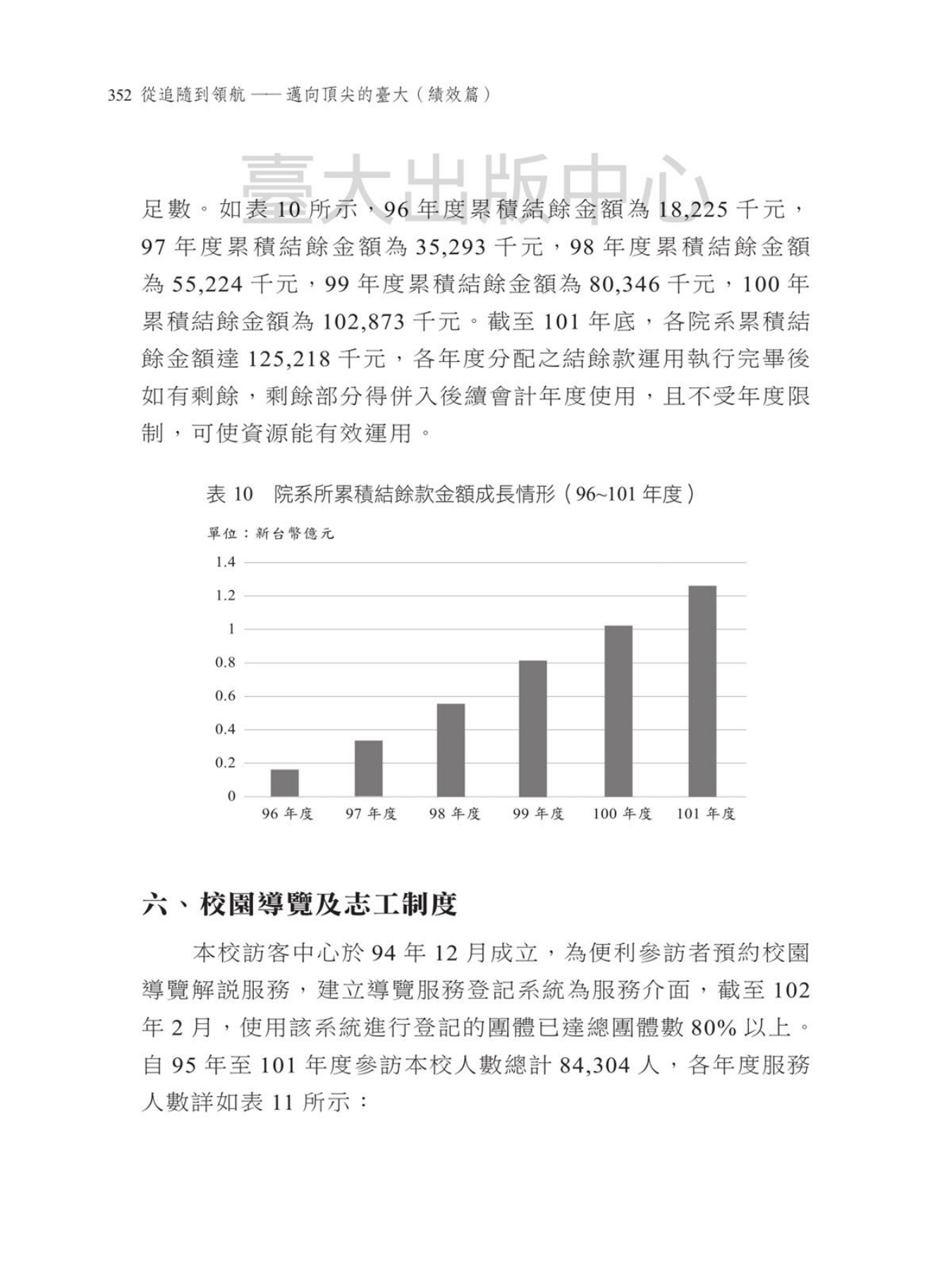
As shown in Table 10, the accumulated surplus amount in fiscal year 2007 was NT35,293 thousand, in fiscal year 2009 it was NT80,346 thousand, and in fiscal year 2011 it was NT125,218 thousand. Any remaining funds after the allocated surplus for each year has been fully executed may be merged into subsequent accounting years for use, without annual restrictions, thereby enabling effective resource utilization.
Table 10 Growth in Accumulated Surplus Funds for Departments (Fiscal Years 2007–2012) Unit: NT$ hundred million
1.4 1.2 1.0 0.8 0.6 0.4 0.2 0.0 Fiscal Year 2007 Fiscal Year 2008 Fiscal Year 2009 Fiscal Year 2010 Fiscal Year 2011 Fiscal Year 2012
VI. Campus Tour and Volunteer System
The University’s Visitor Center was established in December 2005. To facilitate visitors in reserving campus tour and interpretation services, a tour service registration system was established as the service interface. By February 2013, groups using this system for registration had accounted for more than 80% of the total number of groups. From fiscal year 2006 to fiscal year 2012, a total of 84,304 people visited the University. The number of people served in each year is detailed in Table 11:
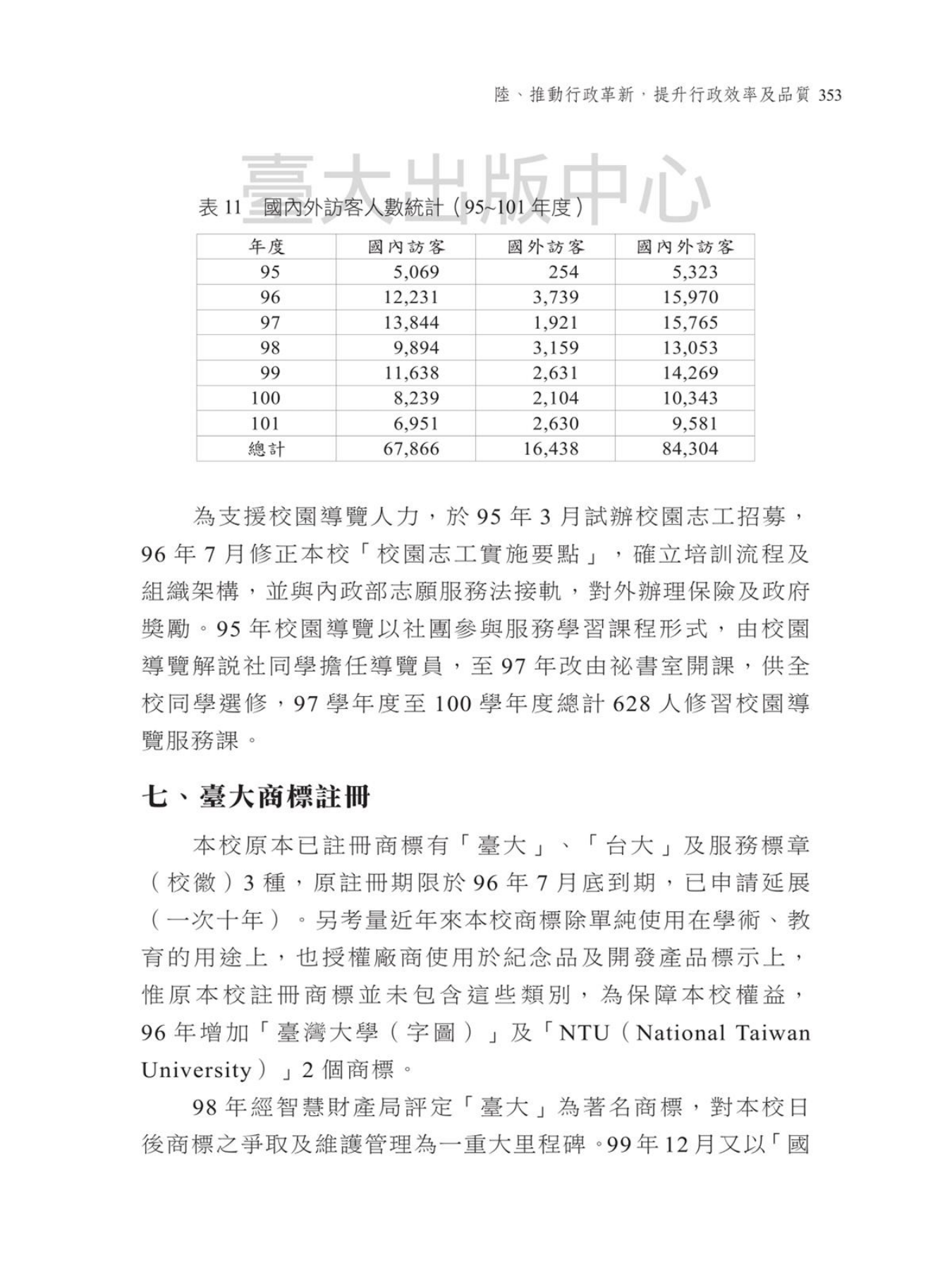
Table 11. Statistics of Domestic and International Visitors, 2006–2012
| Year | Domestic Visitors | International Visitors | Total Domestic and International Visitors |
|---|---|---|---|
| 2006 | 5,069 | 254 | 5,323 |
| 2007 | 12,231 | 3,739 | 15,970 |
| 2008 | 13,844 | 1,921 | 15,765 |
| 2009 | 9,894 | 3,159 | 13,053 |
| 2010 | 11,638 | 2,631 | 14,269 |
| 2011 | 8,239 | 2,104 | 10,343 |
| 2012 | 6,951 | 2,630 | 9,581 |
| Total | 67,866 | 16,438 | 84,304 |
To support campus tour guide manpower, a pilot program for recruiting campus volunteers was launched in March 2006. In July 2007, the university’s “Guidelines for Campus Volunteer Implementation” were revised to establish training procedures and organizational structure, aligning with the Ministry of the Interior’s Volunteer Service Act, and providing external insurance and government incentives. Campus tours in 2006 were conducted through service-learning courses offered by student clubs, taken by students as electives. From the 2008–2009 through 2011–2012 academic years, a total of 628 students enrolled in the campus tour guide service course.
VII. Registration of NTU Trademarks
The university had previously registered three trademarks: “Tai-Da” (臺大), “Tai Da” (台大), and the service mark (university emblem). The original registration period expired at the end of July 2007, and extensions have been applied for (ten years per extension). Additionally, considering that in recent years, the university’s trademarks have been used not only for academic and educational purposes but also licensed to manufacturers for use on souvenirs and developed products, whereas the originally registered trademarks did not cover these categories. To protect the university’s rights, two additional trademarks were added in 2007: “National Taiwan University (word and logo)” (臺灣大學(字圖)) and “NTU (National Taiwan University).”
In 2009, the Intellectual Property Office designated “Tai-Da” (臺大) as a well-known trademark, marking a significant milestone for the university’s future efforts in securing and managing trademark rights. In December 2010, under the name “National Taiwan University” (國立臺灣大學), the China Trademark Office approved the registration of trademarks including “Tai Da” (台大), “Taiwan University” (臺灣大學), “NTU,” and the university emblem, covering 32 categories of goods.
In 2012, a total of 20 trademark-registration certificates were approved for the university: 10 domestic certificates and 10 mainland-China certificates. The 10 domestic registrations comprised “TAIDA” in classes 21, 30, 32, 35, and 43 (five classes) and “台大TAIDA” in classes 18, 21, 41, 42, and 43 (five classes). The 10 mainland-China registrations comprised “台大” in class 44; “台大TAIDA” in classes 7, 14, 16, 18, 25, 28, 30, and 41 (eight classes); and “台灣大學” in class 29. This was the first approved case of a Taiwanese government agency registering trademarks in mainland China under a name bearing the “National” designation, making it a highly significant benchmark in trademark rights.
VIII. Increasing University Fund Revenue
The university manages the turnover and utilization of cash across various accounts, increasing the amount of fixed deposits to boost interest income. Since 2006 and 2007, New Taiwan Dollar interest rates have remained persistently low. To diversify revenue sources, US Dollar fixed deposits and capital-guaranteed products were used to enhance interest income, with interest rate fluctuations monitored closely to facilitate conversions for maximum returns.
Starting in 2008, the Cashier’s Office provided daily cash flow statements to the Finance Division for reference in investing in money market funds, serving as a short-term fund management tool. By calculating daily cash usage needs, the Finance Division was notified of the amounts available for purchasing or redeeming money market funds, allowing for flexible fund utilization and increased interest income for the university fund.
IX. Securing Tax Exemptions
(A) Securing Exemption from Withholding Income Tax for Foreign Publication Fees
To achieve international excellence and compete with world-class universities, the university rewards faculty for further education and research, actively encouraging faculty to publish papers in foreign journals. The university agreed that faculty and researchers could submit invoices issued by foreign companies to reimburse expenses related to publishing papers abroad for faculty and students, as an incentive. However, the National Tax Bureau determined that these reimbursed expenses constituted remuneration for services provided by the recipients and should be included in their salary income. Considering that these expenses were not additional income for the faculty but merely advanced costs, after seven months of multiple negotiations with the National Tax Bureau, the university finally obtained the bureau’s agreement in October 2007 that faculty reimbursement for paper publication fees would be exempt from income tax. This has helped stabilize faculty and researchers’ willingness to conduct research and publish papers.
(B) Securing Exemption from Withholding Income Tax for Advanced Patent Application Fees
Faculty research and development results had already been applied for patents, with related patent application fees paid. After the Office of Research and Development approved the payment of patent application fees, the patents were transferred to the university, and faculty then applied to the university for reimbursement of the advanced fees. Considering that these reimbursements constituted expense expenditures and could be exempt from income tax withholding, the university vigorously communicated with tax authorities on legal theories and statutory applications. In November 2007, the tax authorities finally agreed that the reimbursement fees did not constitute faculty income and were exempt from income tax.
X. Establishing a Procurement System for Scientific Research
To promote scientific and technological research and development, public interest, and fairness and reasonableness, the “Guidelines for Procurement Operations for Scientific and Technological Research and Development at National Taiwan University” adopted a new mindset, loosening current procurement procedures. These guidelines were promulgated and implemented on October 22, 2010. Based on the agreement of the National Science Council of the Executive Yuan to use these guidelines as the agreed-upon procurement method for scientific research, this improved upon previous limitations where scientific research procurement projects were constrained by the Government Procurement Act. Under this new system, applying units can procure necessary equipment and instruments from suppliers immediately after approval, to align with the timing requirements of research progress.
Due to the amendment and promulgation of the “Science and Technology Basic Act” (hereinafter referred to as this Act) on December 14, 2011, Article 6, Paragraph 4 added that procurement conducted by public schools and others accepting government commissions is also excluded from the application of the Government Procurement Act. Therefore, in accordance with this Act and the “Supervision and Management Measures for Procurement for Scientific and Technological Research and Development” amended on May 7, 2012, and other related
regulations, the scope of application of these guidelines was revised to include commissioned research projects. Considering existing internal operational procedures and internal control requirements, a minimum attendance requirement for review panels was added, and the thresholds for requiring procurement records and conducting acceptance inspections were lowered. Adopting current operational regulations under the Government Procurement Law regarding subcontracting for commissioned research projects, it was added that if the subsidizing or commissioning agency designates specific vendors for procurement, or if the subcontracting parties are explicitly stated in NTU’s bidding documents and incorporated into the contract by the subsidizing or commissioning agency, the announcement procedure may be waived.
- First Time Independently Managing a Joint Supply Contract
Previously, NTU jointly commissioned the Procurement Department of the Bank of Taiwan to handle the procurement of foreign-language books together with National Chengchi University, with the bank’s Procurement Department charging a 1% service fee on each order amount. Starting from the 2011 fiscal year, NTU took back the management of the joint supply contract for foreign-language book procurement, independently drafting bidding documents, planning the bid-opening process, handling bidding, awarding, contracting, and subsequent administrative tasks, providing a convenient vendor selection method for NTU units and all government agencies and schools nationwide. Since order prices are negotiated by NTU and contracted suppliers through an open bidding process, using this contract for orders eliminates the need for individual bidding and awarding for each purchase. Moreover, NTU can collect service fees to contribute to the university fund, generating revenue for the university.
VII. Managing the University as One Large Family
To foster NTU as one large family, in addition to actively shaping campus culture and strengthening campus ethics, we also value the rights and interests of faculty, staff, and students, attend to everyone’s needs, and create welfare for all.
- Establishing a Mechanism to Assist Employee Physical and Mental Health
NTU assists faculty, staff, and students in maintaining their physical and mental health through health examinations, promoting sports and health courses, and providing psychological counseling referral mechanisms:
(1) Conducting health examinations for new graduate students, first-year undergraduate students, and transfer students each academic year to safeguard the health of new students and conduct follow-ups.
(2) Continuously conducting health examinations for newly hired faculty and staff, and carrying out subsequent health management work.
(3) To enhance the physical, mental, and spiritual development of staff, establish a healthy psychological environment, foster a positive organizational culture with good interaction, strengthen team cohesion, and revise NTU’s “Health and Welfare Measures Improvement Plan,” “Implementation Guidelines for Maintaining Faculty and Staff Physical and Mental Health,” and “Principles for Conducting Faculty and Staff Health Examinations.” Starting from 2006, civil servant health examinations have been conducted annually according to NTU’s Principles for Conducting Faculty and Staff Health Examinations. From 2006 to 2013, health examination subsidies were approved for 1,485 regular faculty and staff members and 112 personnel applied by analogy. Additionally, health examinations are conducted annually for first-level administrative supervisors, emeritus professors, and regular teachers aged 60 and above (including researchers and professional technical personnel). From 2005 to 2013, first-level administrative supervisors applied for health examination subsidies
with 79 applicants, emeritus professors with 613 applicants, and teachers aged 60 and above with 151 applicants, totaling 843 person-times receiving this subsidy.
(4) Starting from 2005, the Environmental, Occupational Safety and Health Center conducted special occupational health examinations for personnel in laboratory settings, and in 2012, general health examination services were included. To help examinees remember their examination times, examinations are specially scheduled according to the examinees’ birth months, with approximately 300 people examined each year. From the 2010 academic year to the 2012 academic year, a total of 1,046 people completed examinations. In addition to sending health examination reports to each examinee, the Environmental, Occupational Safety and Health Center has physicians comprehensively diagnose whether abnormal items in each health examination report are related to the occupational environment. For those at the third level of management or above, physicians from the Occupational Injury and Disease Treatment Center of NTU Hospital, the head of the Occupational Health Group at NTU’s Environmental, Occupational Safety and Health Center, and handlers visit the site to propose improvement plans. As of February 2013, there were no staff members at NTU diagnosed as being under third-level management.
(5) To promote the physical and mental health of NTU faculty and staff, establish correct knowledge of physical fitness and exercise methods, and implement the “Sports Health Promotion Plan,” the university hoped to provide faculty and staff with correct exercise concepts and, through the introduction of comprehensive physical-fitness courses, cultivat-
ing a regular exercise habit, thereby building strong physical and mental health and reserving sound physical stamina. From September 2006 to December 2012, 17 sessions were held, with 70 classes and 1,869 participants, receiving positive feedback from staff. Special classes for supervisors were also held, giving first-level supervisors an opportunity to exercise body and mind and build stamina amid heavy workloads, so as to help drive NTU fully into the ranks of the world’s top universities. From March 2006 to April 2013, the president led supervisors in physical-fitness activities at least once each month, cultivating a regular exercise habit.
(6) Regarding the counseling referral mechanism, in addition to the University’s Student Psychological Counseling Center, pursuant to the University’s “Implementation of Employee Mental Health Plan,” the Zhang Laoshi Foundation (a charitable corporation) was commissioned as a designated institution for psychological counseling for university faculty and staff, officially commencing operations in August 2007. University colleagues utilizing this service are eligible to apply for subsidies annually; by the end of 2012, a total of 257 person-times had received psychological counseling services.
(7) The “Regulations for Leave and Travel Subsidies for Faculty Serving Concurrently as Academic Administrative Heads” were promulgated in 2007 and implemented from the 2007–2008 academic year through the 2011–2012 academic year, with satisfactory results.
(8) The “Faculty and Staff Activity Center” was established on the first floor of the Comprehensive Gymnasium and opened in November 2007, providing colleagues with a venue for rest, exchange, and social networking.
(9) The Health Center conducts health education and promotion activities each year addressing diverse health issues, including sex education, tobacco harm prevention, mental health, and disease prevention. The annual large-scale health promotion event, the “NTU Fruit Festival,” continues to be held. In 2010, the “Campus Emergency Rescue Promotional Video” was produced, and in 2011, the updated NTU First Aid Manual was published, both receiving high praise. Furthermore, web pages and the “NTU Online Academy” are actively utilized to conduct online health education activities, providing faculty and students with additional channels to access health information.
II. Implementing Participation and Suggestion Systems
In November 2006, the University promulgated the “Implementation Guidelines for Rewarding Staff for Active Participation in University Affairs,” which underwent two revisions in March 2007 and May 2010. The implementation content includes two major categories: “Participation” and “Suggestions.” Through diverse organizational learning tools such as work circles, symposiums, benchmarking learning, and university affairs suggestion boxes, the effectiveness of personnel learning is enhanced and administrative efficiency is improved.
The reward content includes two major categories: the selection of outstanding staff and individual performance rewards. Those selected as outstanding staff are awarded a medal and a work fee of NT10,000. For those selected for individual performance rewards, there are two methods for issuing work fees: direct approval by the heads of first-level units, or evaluation and issuance by the university. The former is distributed within the annual quota allocated to each unit, while the latter provides work fees ranging from NT6,000 per person based on performance.
III. Administering Group Insurance for Faculty, Staff, Students, and Laboratories
To improve the welfare provision mechanism and reasonably care for university faculty and staff, a “Group Insurance for Faculty and Staff” project team was formed in accordance with the relevant provisions of the “Health Welfare Measures Improvement Plan.” Adopting a publicly administered, self-funded model, the University handled group insurance matters under the name of National Taiwan University. From November 2007 to October 2009, vendors provided regular on-site services at the University for group insurance-related matters. From November 2009, the focus shifted to the self-funded group accident insurance for public school employees administered by the Civil Servants’ Housing and Welfare Committee. This committee, entrusted by the Council of Personnel Administration’s Civil Servants Association, conducted public bidding to select vendors to handle the matter starting in 2009, allowing faculty and staff to freely choose to participate in group insurance. Starting from the 2013 fiscal year, the self-funded group accident insurance for public school employees was transferred to the Council of Personnel Administration. Each year, information regarding the group insurance projects handled by vendors selected through bidding is provided to colleagues for reference.
Additionally, considering that the frequency of accidental injuries among individuals entering laboratories for experiments is higher than that of students not engaged in experiments, in order to share the risks of campus safety management, the Environmental, Occupational Safety, and Health Center established management responsibilities for the university, each management unit, and the heads of experimental sites in a layered manner. In September 2012, the “Guidelines for Campus Safety Insurance” were approved at the Administrative Conference. In addition to the Environmental, Occupational Safety, and Health Center uniformly insuring 111 public sites—including the Main Campus, Social Sciences Campus, Public Health Campus, and Medical Campus—against public accidents, each head of an experimental site is required to insure personnel engaged in experimental research against personal accidental injuries, thereby reducing the burden on each management unit in the event of an accident.
IV. Strengthening In-Service Training for Staff
To respond to the advancement of various university affairs, encourage colleagues to enrich their professional knowledge and skills, improve quality, and enhance work efficiency, in-service training for staff is conducted in accordance with the University’s “Regulations for In-Service Training for Staff.”
(1) In coordination with lifelong learning, the University formulates an education and training plan each year. In addition to training for new personnel, recommended-level supervisors, and appointed-level personnel, other courses include English improvement, computer information application, official document writing, Administrative Procedure Act, Administrative Penalty Act, Labor Standards Act seminars, mind-body-spirit, interpersonal communication, crisis management, sustainable development, and biodiversity lectures. The rich and diverse content helps improve administrative performance and service quality.
(2) To enhance the English proficiency of university staff, pursuant to the “Implementation Plan for Enhancing the English Proficiency of Administrative Personnel at National Taiwan University,” various English training courses and thematic lectures are conducted to strengthen the English communication skills of incumbent personnel, thereby improving colleagues’ listening, speaking, reading, and writing abilities in foreign languages. By the end of December 2012, nearly 70% of staff had passed the English proficiency qualification test.
(3) Annual off-campus benchmarking learning for staff is conducted to strengthen communication of opinions between the university and staff, enhancing mutual understanding. Through benchmarking learning, self-improvement is sought, and administrative efficiency and team identity are enhanced.
(4) The effectiveness of the University’s in-service training and education for staff won the Excellence Award in the Agency or Employer category for promoting the employee paid learning system from the Ministry of Education in 2008 and 2012.
V. Actively Promoting the Construction of New Faculty Housing
To attract outstanding faculty to serve at the University, providing high-quality housing is a necessary condition.
- In view of the severe shortage of short-term dormitories for returning scholars and new faculty members currently provided by the University, as well as their advanced age, poor condition, and inadequate space, which fail to meet the needs of new faculty members who can only reside there for one year before being required to move out, the “Construction of Dormitories for Scholars and New Faculty Members” project was incorporated into the University’s infrastructure plan for becoming a top-tier university. The first phase planned the development of four sites to construct 44 dormitory units for new faculty members; by 2012, 26 units had been completed and made available for application by new faculty members, while planning for the second phase of development continued. In addition, the University collaborated with the Foundation for the Development of Outstanding Talents and the Academia Sinica to construct scholar dormitories on two off-campus land parcels owned by the University. These were completed and handed over in January 2013, providing short-term accommodation for 12 visiting scholars and 7 new faculty members. Thereafter, new faculty members could reside for two years before moving out.
To serve visiting scholars and guests requiring short-term accommodation, the University’s self-operated Luming Guest House was renovated in January 2007, offering a more comfortable living environment at low prices. Additionally, professional hotels operated by contracted vendors, such as Zunxian Hall and Xiuqi Hall, provide high-standard long-term rental or short-stay services, offering visiting scholars more diverse and economical accommodation options.
VI. Renovation of Student Dormitories and Management of Campus Restaurants
Starting in 2006, 21 student dormitory buildings were renovated in five batches over five years, with all renovations completed by the summer of 2011. At the same time, attention was paid to the management of campus restaurants to provide high-quality services.
(1) Renovation of Student Dormitories
To provide students with a healthy, safe, and comfortable living environment, a student dormitory renovation plan was implemented from 2006 to 2011, completing the renovation of 21 old dormitory buildings on campus. Renovation items included roof leak prevention, updating of furniture inside bedrooms, installation of power and network system connections, and the redesign and construction of public spaces such as bathrooms, drying rooms, corridors, stairwells, study or seminar rooms, lounges, and kitchens. By 2011
September, a total of 8,554 beds for general students were renovated, and 94 beds for students with disabilities were added, bringing the total number of student dormitory beds to 8,648. Additionally, the BOT (Build-Operate-Transfer) dormitory, constructed through a contract partnership between the University and the private sector, was officially opened in September 2008, with dormitory counselors appointed and a Student Life Self-Government Association established, providing 3,500 beds.
To replace old air conditioners with environmentally friendly and energy-saving inverter air conditioners, the University began updating or installing new air conditioners in student dormitories starting in 2009. By March 2013, a total of 3 dormitory buildings had new air conditioners installed, and 11 dormitory buildings had their air conditioners updated. The University will continue to promote air conditioner updates for the remaining 7 dormitory buildings and the rewiring of all student dormitory air conditioners, hoping to complete the related projects by 2016.
(2) Improvement and Construction of Activity Centers
The University’s two student activity centers underwent improvement and construction in 2007 and 2008, respectively. After renovation, the First Student Activity Center featured more flexible space utilization and a lively atmosphere, with an open leisure space set up for student discussions, exchanges, or receiving relatives and friends. During the summer of 2008, the club offices on the eighth and ninth floors of the Second Student Activity Center were renovated. The scale of club offices was adjusted from one room for 12 to 24 clubs to one room for 3 clubs. Meanwhile, the third floor of the Second Activity Center was planned as the Global Lounge, providing a space for local and international students to interact.
(3) Management of Campus Restaurants
The campus offers diverse dining services for faculty and students to choose from. Locations such as Luming Hall, Xiaofu Building, the first and second floors of the Second Student Activity Center, student dormitories, Xinyue Terrace, and the Zhoushan Road Pancake House select the best vendors through outsourcing and public evaluation to manage the venues. Through the “Online Voting for Excellent Service Catering Vendors” activity held annually by the Dietary Coordination and Management Committee, vendors are encouraged to maintain the best service and food quality to meet the needs of faculty and students. The restaurant in the First Student Activity Center is the most heavily used by faculty and students. To serve the entire university community, the restaurant operates on the principle of offering good value for money,
providing breakfast, lunch, and dinner services for faculty and students. A new bidding process was conducted in 2007, with multiple briefing sessions held to gather opinions from all sides. Based on the needs of faculty and students, nine counters were set up, including Chinese and Western cuisine, a breakfast shop, and a convenience store, to meet dining needs. The space and equipment were also re-planned and reorganized, significantly improving the convenience of dining for faculty and students. The restaurant ranked second, first, and first in the University’s online voting for excellent service catering vendors in 2010, 2011, and 2012, respectively.
Following the renovation and completion of Zuiyue Lake, coffee and light meal services were added by the lakeside in June 2012. Faculty and students strolling and enjoying the scenery at Zuiyue Lake can also pause to enjoy the aroma of coffee, experiencing a comfortable campus life. To transform Xiaofu Building into a lasting landmark for student club networking, a new bidding process was conducted when the contract expired at the end of June 2012. The winning vendor conducted comprehensive decoration and renovation during the summer vacation, creating a natural and minimalist style and adopting a food street model. Service items included lifestyle department stores, Western simple meal counters, and newly added Western fast food, light meals and drinks, Chinese and Japanese cuisine, eyewear, and photocopying services, officially opening for business on September 10 of the same year.
VII. Establishment of Various Scholarships and Grants for Economically Disadvantaged Students
The University’s various scholarships and grants are funded by the university budget and include: the Hope Scholarship, the Academic Excellence Scholarship, the Disadvantaged Student Assistance Plan, the Outstanding Student Performance Scholarship, the Special Education Scholarship and Grant, the Student Life and Learning Grant, and the Graduate Student Scholarship. These are primarily established to assist poor but excellent students in successfully completing their studies or to reward outstanding students. Approximately 9,000 students receive assistance or rewards annually. The Ministry of Education stipulates that the amount allocated from tuition and miscellaneous fees to scholarships and grants by each university must not be less than 3% to 5%. The University allocates 23.5% of its annual tuition and miscellaneous fee revenue as the budget for student stipends and scholarships/grants, far exceeding the minimum allocation ratio stipulated by the Ministry of Education.
(1) Hope Scholarship
Starting from the 2007 academic year, the “Guidelines for the Establishment of the Hope Scholarship” were formulated to help those who have not yet
Scholarships for Underprivileged First-Year Students
This initiative provides scholarships to underprivileged first-year students of the university, allowing them to be free from financial pressure and devote their time and energy to their studies, thereby facilitating their future applications for scholarships. Eligible applicants include those with a family annual income of NT10,000 or less, and family business income of NT30,000; Level 5 reduces tuition and accommodation fees by 1/5, with an annual scholarship of NT2,650,150; in the second semester of the 2012 academic year, 65 students were subsidized, totaling NT$2,731,798.
(2) Merit-Based Scholarships for Underprivileged Students
These scholarships reward outstanding underprivileged students in the undergraduate program (second year and above) and graduate schools who successfully complete their studies. Applicants include low-income households, families affected by misfortune, and tax-exempt households. The annual subsidy is NT4,565,000.
(3) Assistance Plan for Disadvantaged Students
For families with an annual income of NT5,000 to NT8,146,000.
(4) Student Life and Learning Subsidies
Starting from the 2008 academic year, the original work-study system was transformed, leading to the establishment of the “Guidelines for the Establishment of Student Life and Learning Subsidies” at the university, providing subsidies to encourage students to participate in life and learning activities on campus. In the second semester of the 2011 academic year, these guidelines were revised to guarantee opportunities for disadvantaged students with a family annual income of NT$700,000 or less to engage in life and learning, with an annual subsidy amount of approximately
NT$20 million.
(5) Graduate Student Scholarships
Graduate student scholarships are established to encourage graduate students to participate in teaching, service, and research in various departments and institutes, aiming to enhance their research capabilities and academic level during their studies. Approximately 8,000 graduate students are subsidized, with a total amount exceeding NT$300 million, to implement the educational goal of caring for students and leading their learning and growth.
VIII. Caring for Society, Serving as a Government Think Tank, and Expanding Outreach Services
The university possesses high-quality teaching and research resources. In addition to pursuing excellence, to fulfill the responsibility of caring for society and promoting social progress, we organize public forums, academic achievement presentations, continuing education, and industrial innovation incubation, and give back to the nation and society through student club social service activities.
1. Establishment of the NTU Public Forum
To fulfill the responsibility of caring for society and promoting social progress, the university planned and established the “NTU Public Forum” starting in September 2005, inviting faculty members from across departments and institutes to comment frankly on various social phenomena and public policies and propose feasible methods for reference by all sectors of society. The forum also provides a platform for dialogue between academia and society and presents the results of academic research to society in accessible language. From October 2005 to February 2013, the forum covered topics such as “Facing Avian Influenza with Knowledge,” “How to Balance the Development of the Telecommunications and Broadcasting Industry and Consumer Rights: What Should the NCC Do Most? What Is Most Urgent?”, “Who Is Responsible for the Nutrition of the Taiwanese Public,” “Cherish Our Treasures—Alternative Thinking and Appeals for Child Protection,” “Credit Card Debt Problems: Whose Responsibility Is It?”, “Global Chinese Language Fever: Where Are Taiwan’s Opportunities?”, “Human Hepatitis B Virus-Carrying Mouse Model: A New System for Studying Immune Mechanisms and Treatment Methods,” “The Impact of Single-Member Constituencies and Halving the Legislature on Political Parties and the Legislative Yuan,” “Global Warming and Energy Trends,” “The Role of Judicial Personnel and Social Expectations,” “Caring for Animals, Respecting Life,” “Protecting Taiwan: Land Monitoring Is Urgent,” and “Food Safety in Light of the Toxic Milk Incident.”
“How to Face the H1N1 Novel Influenza Epidemic,” “Post-Typhoon Morakot Epidemics, Prevention, and Life Reconstruction for Victims,” “Land Conservation and Land Planning Issues in Light of Typhoon Morakot,” “The Impact of ECFA on Cross-Strait Economic and Trade Exchanges and Taiwan’s Economic and Trade Development,” “The Impact of ECFA on Taiwan’s Political and Social Landscape,” “What Kind of Performance Evaluation System Can Boost Administrative Efficiency and Civil Servant Morale?”, “Reflections on Sentences for Child Sexual Assault: Starting from Recent Controversial Cases,” “Facing Declining Birthrates,” “Dilemmas and Challenges in Promoting Long-Term Care,” “Food Safety in Light of the Addition of Plasticizers,” “Correct Energy Policy to Ensure National Sustainable Development,” “The People’s Assessor System,” and “Democratic Dialogue vs. Populist Confrontation: Discussing the Development of Taiwan’s Democratic Politics in the Current Political Context.” Each forum session received enthusiastic responses.
2. Establishment of the Center for Public Policy and Law
The university has a complete range of professional fields and abundant talent. Various public issues can be integrated across the university’s colleges, departments, and institutes, with professors conducting multi-faceted analysis and research. To achieve the goal of the “Top University Plan” to “solve major problems facing social development,” the “Center for Public Policy and Law” was established in September 2011 to conduct integrated research on various public policies and legislative effectiveness, providing a rational policy analysis platform for the nation, aiming to achieve the effect of academic research being implemented in social practice. The center functions as an integrated platform, combining scholars from across departments and institutes to develop research topics based on the importance and timeliness of issues. From topic selection, inviting scholars and experts to conduct research analysis and discussion, soliciting opinions, and holding public hearings, to reaching consensus and proposing policy recommendations or relevant supporting legal provisions, the center also conducts policy evaluation and review.
The center’s current research focus is on policies related to the lives of the vast majority of people and policies that will affect the next generation. The 2013 public policy themes include: education policy, broadcasting regulations, forestry policy, retirement systems, cross-strait relations, food safety
and others. Topics include: The Future of Taiwan’s Higher Education and Human Resources—Problems and Countermeasures; Research on the Planning Scheme for 12-Year Compulsory Education; Legislative Research on the Integration of Cross-Media Enterprises; Exploration of Sustainable Forestry Policy under Ecological Conservation Principles; Retirement Systems and Elderly Economic Security—Enhancing Generational Integration and Reducing Occupational Gaps in Benefits; Grand Unified Thinking; Cross-Strait Relations and Policies; Political Relations across the Taiwan Strait during the Period of Peaceful Development; Research on Taiwan’s Food Safety Management System and Implementation; Tracking Research on Poverty Dynamics in New Poor Families; The Third Generation of Health Insurance Systems; High-Tech Industry Policy; Research on Industrial Mergers and Acquisitions; Policies and Countermeasures for Taiwan’s Energy, etc.
- Holding Academic Achievement Press Conferences
To demonstrate the impact and social concern of various academic researches, the University strives to identify outstanding research achievements and holds press conferences, inviting media and research teams to communicate face-to-face, enabling the general public to understand the University’s outstanding academic research achievements and their contributions to society and humanity. From April 2005 (Year 94) to April 2013 (Year 102), the implementation details are as follows:
(I) One Outstanding Research Achievement Presentation in 2005 (Year 94)
- “Presentation of Innovative Industry-University Cooperation Model Achievements: Nano-Biomedical Research Team Develops New Generation Biomedical Blood Analyzer Using Innovative Patented Electrochemical Principles”: Presented the research achievements of Professor Wu Guang-zhong from the College of Engineering.
(II) Five Outstanding Research Achievement Presentations in 2006 (Year 95)
- “Successful Breeding of Green Fluorescent Protein Gene-Transgenic Pig—A Milestone in the Development of Stem Cell and Regenerative Medicine in Our Country”: Presented the research achievements of Assistant Professor Wu Hsin-chih from the Department of Animal Science and Technology, College of Agriculture and Bioresources.
- “New Discovery of Molecular Mechanisms Inhibiting Cancer Cell Metastasis”: Presented the research achievements of Professor Kuo Ming-liang from the Institute of Toxicology, College of Medicine.
- “New Breakthrough in Real-Time Disease Detection and Reporting Technology”: Presented the research achievements of Professor Lü Hsueh-shih from the Department of Electrical Engineering, College of Electrical Engineering and Computer Science.
- “Is Early Detection of Gastric Cancer Possible?”: Presented the research achievements of Professor Chou Lü-pin from the Department of Biochemistry, College of Medicine.
- “Survival Strategies of Life in Inorganic Environments”: Presented the research achievements of Assistant Professor Lin Li-hong from the Department of Geology, College of Science, and Assistant Professor Wang Pei-ling from the Institute of Oceanography.
(III) Four Outstanding Research Achievement Presentations in 2007 (Year 96)
- “No Chemotherapy for Highly Malignant Gastric Lymphoma? Our Country’s Antibiotic Treatment Research Leads Internationally”: Presented the research achievements of Professor Cheng An-li from the Department of Internal Medicine, College of Medicine.
- “New Discoveries in Particle Physics, New Particles, and New Theories”: Presented the research achievements of Professor He Xiao-gang from the Department of Physics, College of Science.
- “‘NTU Chinese’ Online Learning Software, Real-Time Speech Diagnosis Technology Leads Globally”: Presented the research achievements of Professor Li Lin-shan from the Department of Electrical Engineering, College of Electrical Engineering and Computer Science.
- “Achievement Presentation for Sub-Project Two of the Excellence in Key Areas Project—‘NTU Excellence Research Teams Display 13 Multimedia Technologies Leading Internationally’”: Presented 13 outstanding research achievements from the Center for Information and Electronic Technology Integration.
(IV) Seven Outstanding Research Achievement Presentations in 2008 (Year 97)
- “Unlocking the Mystery of Human Genetic Diseases”: Presented the research achievements of Professor Lin Shu-hua from the Department of Medical Technology, College of Medicine.
- “Towards Unlocking the Mystery of the Disappearance of Antimatter in the Universe”: Presented the research achievements of Professor Chang Pao-te and Professor Hou Wei-shu from the Department of Physics, College of Science.
- “NTU Develops Solar Lighting, Air Conditioning Energy Saving, and Seawater Desalination”: Presented the research achievements of Director Wu Nai-li (Department of Chemical Engineering) from the NTU Energy Research Center, and Professor Huang Bing-jun (Department of Mechanical Engineering) from the College of Engineering’s New Energy Center.
- “No Compromise with Death: Our Country’s ECMO Technology Doubles Emergency Survival Rates”: Presented the research achievements of Dr. Chen Yi-qun, Dr. Ko Wen-je, and Dr. Yu Xi-yu from the Department of Cardiovascular Surgery at NTUH, and Dr. Lin Zhao-wei from the Yunlin Branch of NTUH.
- “Research on New Particles in High-Energy Physics, Taiwan Achieves Outstanding Results”: Presented the research achievements of Professor Hou Wei-shu from the Department of Physics, College of Science.
- “Ultra-High-Speed Wireless Communication Technology Leads Globally—Wireless High-Definition Television Is No Longer a Dream”: Presented the research achievements of Associate Professor Li Zhi-yi from the Institute of Electronics, College of Electrical Engineering and Computer Science.
- “Great Decryption of Super Earthquake Cycles—Science Publishes Top Achievements of NTU Earthquake Research Team”: Presented the research achievements of Associate Professor Shen Chuan-zhou from the Department of Geology, College of Science.
(V) Two Outstanding Research Achievement Presentations in 2009 (Year 98)
- “International Breakthrough in Diagnostic Technology for Blood Cancer Patients—Magnetic Resonance Imaging of Angiogenesis Significantly Improves Prediction and Diagnostic Effect Assessment”: Presented the research achievements of Professor Shi Ting-fang from the Department of Medicine, College of Medicine, and Professor Chen Zhi-hong from the Department of Electrical Engineering, College of Electrical Engineering and Computer Science.
- “Game Theory Win-Win: Unlocking the Thinking Code of Reasoning and Intuition—Taiwan’s First Economic Topic Paper Published in Science”: Presented the research achievements of Associate Professor Huang Zhen-ying from the Department of Economics, College of Social Sciences.
(VI) Two Outstanding Research Achievement Presentations in 2010 (Year 99)
- “New Developments in Treating Canine Malignant Oral Melanoma” and “New Breakthroughs in Predicting Canine Mammary Tumors”: Presented the research achievements of Director Zhu Rui-min from the College of Veterinary Medicine and the NTU Animal Cancer Medicine Research Center.
- “Taiwan’s Rivers Have High Sinuosity; Laonong River’s Upper Reaches Have the Highest”: Research on river sinuosity in the North Pacific region published in the journal Science. This presents the research results of Professor Chen Hung-yu from the Department of Geology, College of Science.
(7) Five outstanding research achievement presentations were conducted in 2011 (ROC Year 100).
- “New Drug Development for Asthma: Red Algae Make a Major Contribution”: This presents the research results of Professor Chiang Po-lun from the Department of Pediatrics, College of Medicine, and Director Chou Hung-nong from the Institute of Fisheries Science, College of Life Sciences.
- “Achievement Presentation of the ‘Taiwan Biotech Takeoff Diamond Action Plan’—Instant Detection of Viruses or Cancer in 12 Minutes: Successful Development of a Portable, Multi-functional Diagnostic Device”: This presents the research results of Professor Lin Shih-ming from the Center for Optoelectronic Medicine, College of Medicine.
- “Global Breakthrough in Red Imported Fire Ant Invasion: Research Paper on Fire Ants by NTU’s Department of Entomology Published in Science”: This presents the research results of Professor Shih Cheng-jen from the Department of Entomology, College of Bioresources and Agriculture.
- “Unveiling the Molecular Mechanism of Anti-Cancer Drugs: Research Paper by NTU’s Medical Team Published in Science”: This presents the research results of Associate Professor Chan Nai-li from the Department of Biochemistry and Molecular Biology, College of Medicine, and Associate Professor Lee Tsai-kun from the Institute of Microbiology.
- “Research Achievements by NTU’s Cross-Institutional and Interdisciplinary Team: Detecting Pathogenic Bacteria, Using Nanotechnology Exclusively Worldwide for Rapid Screening of Septic Bacteria, Published in Nature Communications”: This presents the research results of Assistant Professor Liu Ting-yu from the Institute of Polymer Science and Engineering, College of Engineering.
(8) Six outstanding research achievement presentations were conducted in 2012 (ROC Year 101).
- “NTU Successfully Reaches the South Pole: The Tian Tan Array and Double Coincidence”:
This presents the research results of Professor Pisin Chen from the Department of Physics, College of Science.
- “New Breakthrough in Remote Smart Healthcare: Development of a Home-Based Pediatric Virus Detection Tri-Device”: This presents the research results of Director Lin Shih-ming from the Center for Optoelectronic Medicine, College of Medicine.
- “Unraveling the Mystery of Cellular Energy Balance: NTU’s International Research Published in Nature”: This presents the research results of Assistant Professor Lin Yu-i from the Department of Biochemistry and Molecular Biology, College of Medicine.
- “Unveiling the Secrets of the Brain’s Neural Network: New MRI Technology Discovers Rigorous Three-Dimensional Structure”: This presents the research results of Professor Tseng Wen-yi from the Center for Optoelectronic Medicine, College of Medicine.
- “NTU and Academia Sinica Collaborative Achievement Published in Nature Communications: ‘The Revelation of Taiwan’s Crested Laughingthrush: Working Together, Brightness Is in Sight’”: This presents the research results of Professor Yuan Hsiao-wei from the Department of Forestry and Natural Resources, College of Bioresources and Agriculture.
- “Disaster Foretold by Coral? South Pacific Sea Surface Temperature Records Unveil the Secret of Taiwan’s Summer Rainfall”: This presents the research results of Professor Shen Chuan-chou from the Department of Geology, College of Science.
(9) Two outstanding achievement presentations were conducted from January to the end of April 2013 (ROC Year 102).
- “NTU Research Team Wins Seven Major Research Awards”: This presents the research results of the interdisciplinary neuroblastoma research team.
- “Unraveling the Mystery of Beautiful and Varied Plumage: NTU Professor Discovers Feather Pigment Stem Cell Ring, Exclusive Worldwide, Published in Science”: This presents the research results of Associate Professor Lin Sung-jan from the Institute of Biomedical Engineering, College of Medicine, and his research team.
4. Expanding Continuing Education
(1) The Department of Continuing Education, in coordination with social needs and combining resources from various colleges and departments, organizes various credit and non-credit continuing education courses, and produces management programs and basic science online courses. In addition to providing in-service training for professionals, the department collaborates with enterprises to conduct corporate internal training. Partnering enterprises include Quanta Computer, Delta Electronics, Chunghwa Telecom, Taiwan Mobile, Fubon Life Insurance, Shin Kong Financial Holding, China Steel Corporation, and more than 30 other companies, tirelessly training talent for enterprises and enhancing national competitiveness. From its establishment in 1987 (ROC Year 76) to 2012 (ROC Year 101), the department has offered over 3,000 classes, with more than 90,000 person-times of enrollment. Furthermore, since January 2005 (ROC Year 94), the Department of Continuing Education and the Teacher Education Center have jointly offered the “Credit Course for In-Service High School and Vocational School Teachers in Life Education,” actively cultivating life education teachers for high schools, demonstrating the university’s educational philosophy of promoting lifelong education, lifelong learning, and serving society. By July 2012 (ROC Year 101), the fifth cohort had been completed, with over 300 teachers completing additional course registration. In 2009 (ROC Year 98), in response to the impact of the global financial tsunami on Taiwan, the “Professional Competency Enhancement Plan” was implemented, offering free courses to allow unemployed individuals and those on unpaid leave to return to campus for recharging, with a total of over 2,000 person-times enrolled.
(2) The Industrial Technology Research Center organizes various seminars and training classes, with rich and diverse courses that have received high praise.
(3) The Department of Electrical Engineering, College of Electrical Engineering and Computer Science, organizes computer training classes; the Department of Information Engineering organizes information system training classes; and the Language Center of the College of Liberal Arts organizes professional training related to languages, benefiting the general public with remarkable results.
(4) Providing a large number of Open Course Ware (OCW). To promote the sharing of teaching resources, implement the concept of constructing a lifelong learning environment, and provide self-learners with broad learning content, open courseware has become a global trend. In response to the global open education movement, to fulfill our social responsibility, and to enhance the university’s visibility, the university invited various departments to provide high-quality courses that highlight their distinctive characteristics, establishing the “Open Course Ware” website (http://ocw.aca.ntu.edu.tw/OCW). In addition to providing free online self-study materials for the general public, these resources are also made available to domestic and international students, faculty, and related researchers as references for learning aids, course instruction, and research topics, thereby enhancing learning outcomes and research quality. The university began developing open courseware in 2009 (ROC year 98), starting with general education and foundational courses, and expanded to include core departmental courses from June 2011 (ROC year 100). The Academic Affairs Office and teaching units established an execution team and hired dedicated assistants to handle intellectual property rights and audio-visual post-production editing. By March 2013 (ROC year 102), there were 119 courses with a total of 696,578 views; the YouTube EDU channel (http://www.youtube.com/ntucourses) was completed, offering selected courses and campus focus videos for public use; simultaneously, a promotional webpage (http://youtube.ntu.edu.tw) was established to expand course visibility and encourage self-learners’ willingness to learn.
(5) The Physical Education Office organizes summer sports and recreation camps for children and adolescents. From its inception in 2005 (ROC year 94) through the summer of 2012 (ROC year 101), a total of 168 classes were conducted, with over 5,600 participants. On regular days, swimming, squash, badminton, and tennis instruction classes are continuously offered, benefiting the public.
- Deepening Social Service by Student Clubs
Student clubs at the university participate in social services during regular terms and winter/summer vacations, reaching into every corner, with their footprint extending overseas, earning widespread recognition and praise. Details are as follows:
(1) Regular Services and Winter/Summer Vacation Social Service Teams: The number of winter/summer vacation social service teams increased from 60 teams in 2006 (ROC year 95) to 74 teams in 2012 (ROC year 101). The number of participating volunteers increased from 1,322 to 2,546, and the number of beneficiaries increased from 3,371 to 7,015. Service areas covered high mountains and remote regions of Taiwan’s main island, as well as offshore islands such as Kinmen County’s Lieyu Township and Penghu County’s Qimei Township. Service recipients included children with autism, children with cancer, indigenous children, children with intellectual disabilities, and disadvantaged groups in remote areas. Additionally, more than 10 clubs, including the Tzu Chi Youth Society, the Tzu-yu Yiguang Group, and the Scout Club, engaged in regular social service work.
(2) Club Participation in International Volunteer Services: Since 2006 (ROC year 95), overseas service-learning groups have been established to cultivate service-oriented clubs to expand their services overseas, encouraging them to look beyond borders and go international. Through service, students develop a diverse and service-oriented outlook on life, conduct good citizen diplomacy, broaden their horizons and minds, and cultivate the demeanor of leadership talent. By February 2013 (ROC year 102), the university’s overseas service-learning groups had served in India, Myanmar, the Philippines, Thailand, Malaysia, Vietnam, Mongolia, Guangxi, and Yunnan. Service content included work at orphanages, disability care facilities, autism care institutions, and organizing life skills camps for disadvantaged children. The total number of student club overseas service teams expanded from 2 teams in 2006 (ROC year 95) to 8 teams in 2012 (ROC year 101). In addition, clubs such as the World Volunteer Club and the International Affairs Study Club traveled to India, the Philippines, Thailand, Myanmar, and other places to conduct social services.
(3) Organizing the “Joint Achievement Presentation of Social Service Teams”: To demonstrate the effectiveness of service-oriented clubs and attract more students to join the ranks of service, the “National Taiwan University Social Service Teams Joint Achievement Presentation” was held for the first time in September 2006 (ROC year 95). Starting from the 2009–2010 academic year (ROC year 98), a seminar on service-learning and social service team achievements was co-organized with service-learning courses. This seminar format allowed presenting clubs and faculty and students from inside and outside the university to have in-depth learning and discussion opportunities. A special publication on service-learning and social services was printed as a venue for presenting achievements, recording the activities of the university’s winter/summer vacation social service teams, and reflecting on service-learning insights.
(4) Publishing the NTU Social Service Yearbook: Starting in 2007 (ROC year 96), the abundant annual achievements accumulated by the university’s social service teams have been faithfully recorded through the publication of a yearbook, documenting the service accomplishments and expressions of compassion of the social service teams for widespread dissemination. All yearbooks are printed in color and produced as electronic book CDs.
(5) Conducting a “Satisfaction Survey of Services Provided by NTU Social Service Teams”: After the completion of winter/summer vacation service teams each academic year, service institutions are asked to fill out a service satisfaction survey, evaluated using a five-point scale. In terms of overall performance, the satisfaction rate of 4 or above was 94.47% in the 2008–2009 academic year (ROC year 97), 94.16% in the 2009–2010 academic year (ROC year 98), 94.94% in the 2010–2011 academic year (ROC year 99), and 96% in the 2011–2012 academic year (ROC year 100). Overall, service institutions expressed satisfaction with the performance of the university’s service teams and hoped that the service teams would continue to provide services.
- Awarding Faculty Service Awards
To recognize and thank faculty members for dedicating their expertise, passion, energy, and time to the university or society, the Outstanding Faculty Service Award was established. Since service deeds are categorized into “Outstanding Faculty Social Service Award” and “Outstanding Faculty Internal Service Award,” these distinctions are made to highlight their contributions and provide encouragement. The regulations were revised in 2009 (ROC year 98); recommended candidates’ service deeds still span both internal and external spheres, but an “Excellent Award” category was added, implemented from 2010 (ROC year 99). From 2007 (ROC year 96) to 2012 (ROC year 101), 18 faculty members received the Outstanding Faculty Social Service Award, and 17 received the Outstanding Faculty Internal Service Award; from 2010 (ROC year 99) to 2012 (ROC year 101), 5 faculty members received the Excellent Faculty Social Service Award, and 7 received the Excellent Faculty Internal Service Award.
National Taiwan University Press
National Library Publishing Pre-Cataloging (CIP) Data From Following to Leading: Toward a Top-Tier National Taiwan University / by Si-Chen Lee. — First Edition. — Taipei: Published by National Taiwan University Press; Distributed by National Taiwan University, June 2013. Pages; cm. ISBN 978-986-03-7090-4 (Hardcover)
- National Taiwan University 2. Higher Education 525.833/101 102010811
From Following to Leading: Toward a Top-Tier National Taiwan University
Author Si-Chen Lee
General Supervisor Chieh Hsiang
Responsible Editor Shih-Chu Tang
Text Editor Yu-Chin Li
Cover Design Meng-Yueh Chen
Interior Layout Nai-Yen Yu
Publisher Representative Si-Chen Lee
Distributor National Taiwan University
Publisher National Taiwan University Press
Legal Advisor Attorney Wen-Chih Lai
Printer Jin-Dong Printing Co., Ltd.
Publication Date June 2013
Edition First Edition
Price NT$ 500
Sales Outlets National Taiwan University Press No. 1, Sec. 4, Roosevelt Road, Taipei 10617 Tel: (02) 2365-9286 Fax: (02) 2363-6905 1st Floor, Cheng-Si Building, No. 18, Si-Yuan Street, Taipei 10087 Tel: (02) 3366-3991–3993 ext. 18 Fax: (02) 3366-9986 http://www.press.ntu.edu.tw E-mail: ntuprs@ntu.edu.tw
National Book Store, Songjiang Branch 1st Floor, No. 209, Songjiang Road, Taipei 10485 Tel: (02) 2518-0207
National Online Bookstore http://www.govbooks.com.tw GPN: 1010201120 ISBN: 978-986-03-7090-4
All rights reserved; reproduction prohibited. DOI: 10.6327/NTUPRS-9789860370904
National Taiwan University Press
During Si-Chen Lee’s eight-year tenure as President of National Taiwan University (2005–2013), the government was promoting the “Top University Project.” With relatively ample funding, President Lee was able to realize his long-cherished ideas for advancing university affairs. At the beginning of his term, he proposed his goals for governing the university, along with strategies and implementation plans, centered on three main pillars: “Educational Excellence,” “Research Excellence,” and “Social Engagement.” Over the past eight years, through the full mobilization and joint efforts of NTU’s faculty, staff, students, and alumni, significant achievements have been attained—NTU entered the top 100 universities worldwide in 2009, and the top 60 in 2013.
This book records the process and outcomes of Si-Chen Lee’s eight years in charge of university affairs. It is divided into two parts: “Philosophy” and “Performance.” The former collects speeches delivered by the author at various occasions such as university anniversaries, graduation ceremonies, and freshman orientation ceremonies, as well as articles published in the NTU Alumni Bi-Monthly, presenting his philosophy for governing the university. The latter details the concrete performance of university governance, mostly presented through data, serving as a summary report of policies and their execution results.
The book’s title, “From Following to Leading,” reflects the author’s hope that NTU will further elevate its vision and perspective in the era of globalization: shifting from a mindset of being a “follower” to that of a “leader”; and transforming from a “me too” mentality to a “follow me” attitude.
ISBN 978-986-03-7090-4 00500 9789860370904 GPN: 1010201120 Price: NT$ 500 NATIONAL TAIWAN UNIVERSITY PRESS