[Cover]
Special Abilities and Supernatural Powers
Development of Special Abilities and Supernatural Powers
Zhang Yongming
People’s Sports Publishing House
Development of Special Abilities and Supernatural Powers
Written by Zhang Yongming
People’s Sports Publishing House
ISBN 7-5009-0906-3/G·873
Beijing New Registration No. 040
Development of Special Abilities and Supernatural Powers
Written by Zhang Yongming
Published by People’s Sports Publishing House Printed by the Printing Factory of the Chinese Academy of Sciences Distributed by the Beijing Distribution Office of Xinhua Bookstore General Headquarters
787 × 1092 mm, 32mo format, 5 printing sheets, 100,000 characters
First edition: June 1993 First printing: June 1993 Print run: 1–5,240 copies
ISBN 7-5009-0906-3/G·873 Price: ¥4.00
Preface
The miraculous special abilities make people envious and intoxicated; the five eyes and six powers of immortals and buddhas inspire worship and veneration. Among the tens of millions of qigong enthusiasts in our country today, a considerable number harbor a deep inner longing and aspiration to become superhuman. However, in the process of yearning and pursuing, people have finally discovered one fact: those who study the Way are as numerous as hairs on an ox, while those who attain the Way are as rare as phoenix feathers. Consequently, there are those who blame heaven and others; those who deny the existence of special abilities and supernatural powers; those who, after being deceived, curse in the streets; those who, due to improper practice, fall into zouhuo rumo (spiritual deviation); and there are also those who wander in bewilderment, not knowing what to do.
Are special abilities and supernatural powers real? What scientific and theoretical basis underlies these miraculous phenomena? Do methods exist for developing special abilities and supernatural powers? Can we find general principles for developing special abilities and supernatural powers? What are the reasons why so many people fail to achieve attainment? All of these have become issues of widespread concern in the current qigong community.
On the foundation of broadly seeking instruction from renowned masters and eminent monks, widely befriending fellow qigong practitioners, delving deeply into both Buddhist and Daoist circles, undertaking years of rigorous qigong cultivation, and studying a large quantity of somatic science materials, the author has written this book with the purpose of answering the questions raised above. This book will strive to overcome the flaws of superficiality and deliberate mystification in both theory and cultivation methods, boldly proposing and clearly explaining the scientific principles behind human special abilities and supernatural powers, and concretely introducing the pathways and methods for developing special abilities and supernatural powers. The author believes that everyone possesses Buddha-nature, everyone has latent special abilities, and through diligent and earnest
By practicing authentically and scientifically, everyone can become a superhuman. I hope that readers will patiently and carefully ponder every word and every sentence of the principles in this book, repeatedly, until they achieve great awakening and thorough enlightenment. When you achieve thorough enlightenment, that will be the day you attain the true fruit of cultivation.
Table of Contents
Preface
Chapter 1: The Theoretical Basis of Special Abilities and Supernatural Powers
- Section 1: Are Special Abilities Real?
- Section 2: We Must Start from Philosophy …10
- Section 3: Functions Possessed by Living Beings Are Universally Possessed by Humans …29
Chapter 2: Basic Training for Special Abilities and Supernatural Powers …34
- Section 1: Proficiently Master One Dynamic Qigong Method …35
- Section 2: Several Types of Basic Training
- Section 3: Fasting and Bigu (Inedia) …67
Chapter 3: Intensive Cultivation of Special Abilities and Supernatural Powers …74
- Section 1: Subjective and Objective Conditions for Intensive Cultivation …74
- Section 2: Prevention of Qigong Deviations …82
- Section 3: Intensive Cultivation Methods …89
Chapter 4: Techniques for Developing Special Abilities and Supernatural Powers …92
- Section 1: Classification, Taboos, and Key Points of Development Techniques …92
- Section 2: Several Development Techniques …95
Appendix: The Enlightenment Reports of Twenty-Five Buddhist Saints …126
Afterword
Chapter 1: The Theoretical Basis of Special Abilities and Supernatural Powers
Section 1: Are Special Abilities Real?
Things that cannot be explained by previous theories are often real things; existences that defy common sense, yet you cannot help but acknowledge their existence. The phenomenon of special abilities does indeed contradict people’s common sense, and cannot yet be given a rigorous, thorough, comprehensive, and reasonable explanation by existing philosophy and natural science, but it is an objectively existing fact, already recognized by the scientific community both domestically and internationally.
[Special abilities are] genuine rather than fraudulent human bodily functions that exceed what we ordinarily accept. Up to the present, the types of special abilities of the human body that have been discovered are many, and can be categorized differently from different perspectives. Classified by the manner in which the special abilities are formed, they can be divided into innate special abilities and acquired special abilities. Although most people, during childhood, unconsciously possess a certain degree of special abilities, those who still retain relatively strong special abilities after reaching adulthood are, after all, a minority. Those who, without engaging in qigong cultivation, still maintain relatively strong special abilities—we call them innate special ability possessers. The majority of special ability possessers have acquired their special abilities through qigong cultivation, which activated the latent potentials within the body, and only then possessed
special abilities. In addition, there are a very small number of individuals who have developed special abilities due to accidental incidents, such as electric shock, injuries from falls, mental trauma, or other unexpected causes, or from taking medications. These latter two types of people we call acquired special ability possessers.
Based on the nature of special abilities, they can be divided into three major categories: supernormal physiological abilities, supernormal cognitive abilities, and supernatural powers. The so-called supernormal physiological abilities refer to physiological functions that exceed those of ordinary people’s bodies, mainly manifesting in the following aspects:
(1) Supernormal bone and tendon strength. For example, the feats we ordinarily see in hard qigong performances—splitting bricks and stones with the hand, head-butting stone tablets, kicking wooden posts, bending steel rebar by force, pulling a car with hair, dragging train cars by biting steel cables, supporting a thousand catties with the body, thrusting a steel spear into the throat, lying face-down on a steel trident, and so on. People marvel at these hard qigong feats; although they cannot be explained theoretically, people firmly believe in their authenticity. Because they have been seen so often and for so long, they have become common sense. In people’s view, what is common sense is also what is real.
(2) Supernormal human temperature tolerance. This includes two types: high temperature tolerance and low temperature tolerance. The former [includes practices] such as the Tibetan Buddhist “Tummo meditation” (Candali samadhi) and the Daoist qigong “Snow Refining Method.” Mr. Liang Zhenglong of the Hong Kong martial arts community is skilled in the “Hot Eagle Exercise.” On one occasion, at the Wuyang City Hotel VIP Dance Hall in Guangzhou, he gave a charity performance for the Guangdong Province Children’s Welfare Foundation. In a wok containing fifty to sixty catties of boiling oil, he first poured in two bags of shrimp crackers; in an instant, the crackers puffed up and rolled to the surface of the oil, making “sizzle, sizzle” sounds, demonstrating the extreme temperature of the oil. At this point, Mr. Liang Zhenglong focused his spirit before the oil wok for a moment, mobilized his power and issued force, his qi following his intent, his right hand striking like an eagle swooping on prey—fiercely thrust into the boiling oil, swiftly scooped out an iron chain from the bottom of the wok and tossed it onto the ground, while his arm remained unharmed. Conversely, if one cultivates “Tummo meditation” or the “Snow Refining Method,” one can become impervious to bitter cold. In the depth of winter, amid the boundless ice and snow of the Tibetan plateau, a person who has attained a certain level of proficiency in “Tummo meditation” can sit naked on a frozen river, braving the biting cold wind, wrap pieces of cloth soaked in ice water around the body, and use the heat energy generated from within the body to dry the wet cloths one by one. This repeated operation can continue for
2
hours at a time.
Although the Daoist “method of refining snow” (炼雪之法) and the Tibetan school’s “Cultivation of the Inner Fire” (拙火定) share the same purpose, they differ in their original methods of achieving resistance to cold. The “method of refining snow” achieves its cold-resistant effect by sealing the meridians, regulating the breath, lowering body temperature, reducing the temperature differential between the body’s interior and exterior, and enveloping the body with outward qi (外气). (3) Supernormal resistance to electricity. The average human body can withstand a maximum voltage of no more than several tens of volts, yet those who have cultivated electrical qigong can withstand several hundred volts of high voltage. In today’s society, there are quite a few people with this kind of special ability; among them, qigong masters such as Yan Xin, Zhang Baosheng, and Zhang Hongbao are outstanding representatives. (4) Supernormal functions of the body’s various systems, such as the respiratory system, digestive system, and blood circulatory system. Some people, through qigong cultivation, can go for extended periods without breathing (闭气), without eating (辟谷), suspending the breath (停息), or suspending the pulse (停脉). In India, there was a man named Balado Babu who could go for long periods without sleep, without rest, without drinking, and without breathing. If he were locked in a box and buried underground, the box would contain nothing but bedding—that is to say, no food, no water, and not even air. With his eyes closed in the box, he would sit in meditation and still cultivation, lasting for up to 32 days. In 1967, there was a piece of sensational news that shook the world: the Indian holy monk Baba Singh Vidatsu ordered his faithful followers to bury him alive underground and dig him out twenty years later. By the end of 1987, his disciples, following the holy monk’s “testament,” dug his coffin out from underground. Astonishingly, the holy monk was still alive; his appearance was exactly the same as twenty years prior, with no signs of aging whatsoever. (5) Lightness skill (轻功). Since ancient times, in both qigong and martial arts circles, there have been cultivators who possess extraordinary lightness skills. In contemporary qigong circles, there is a qigong master named Zhang Jialing who can walk on water and lie on his back atop a balloon without breaking it. At the 1988 Spring Festival Gala, he performed the remarkable feat of “suspending a paper ring on a fluorescent tube and rising into the air.” (6) Highly concentrated and ordered human energy. Some people can accumulate high levels of energy within their bodies and release this energy at will. When this energy is
3
released, it often manifests in the form of thermal energy, electrical energy, light energy, or outward qi and other material forms. Some people, due to excessive accumulation of energy within the body, can experience spontaneous human combustion. In 1673, there was a man in Italy named Palisian; in 1744, a woman in Ipswich, England, named Patt; on May 18, 1957, a woman in Philadelphia, USA, named Anna Martin; and on July 1, 1951, an elderly woman in St. Petersburg, Florida, USA, named Mary—all died from spontaneous bodily combustion. There are over 200 such incidents recorded in history alone. Some practitioners of Tibetan esoteric qigong (藏密气功) in our country can, at the time of their passing, mobilize the energy within their bodies to self-cremate. In 1883, the great accomplished master (大成就者) Rigdzin Pema Dudul (仁增白玛堆兑) achieved the rainbow body transformation (虹化). Subsequently, when his disciple Chörab (怀日克) achieved rainbow body transformation at Mindrolling Monastery (敏珠林寺), only a single fingernail remained. This relic was later brought to Dokham (多康) and remains there to this day. In 1952, Zhang Guohua, the former Party Secretary of the Tibet Autonomous Region, and the master Thubten Nyima (土登尼) personally witnessed the rainbow body transformation of Sonam Namgyal (索郎南杰), a native of Yilong, Derge. Generally speaking, during rainbow body transformation, the practitioner sits in meditation, enters samadhi, and emits energy to ignite their own body. At this moment, sounds and light emanate from the practitioner’s body, shaking heaven and earth. After the rainbow body transformation, a ghostly white vapor lingers in the sky, slowly ascending to the heavens—a scene of extraordinary wonder that defies comprehension. The most commonly seen phenomenon of the human body accumulating and releasing energy is the emission of outward qi (外气). Almost everyone who has undergone a certain level of qigong cultivation can mobilize the energy within their body to emit outward qi. Those of high attainment can use outward qi to strike people and objects. The renowned qigong master Yan Xin, from a distance of thirty meters, was able to cause a thousand-year-old camphor tree to sway and bend. Wang Liping, the eighteenth-generation lineage holder of the Daoist Longmen sect, could transmit force through a palace pillar so thick that two people could barely encircle it with their arms, knocking down the person behind it.
The so-called supernormal cognitive abilities refer to sensory and intellectual capacities that exceed those of ordinary people. Therefore, they can be further divided into two levels: supernormal perception and supernormal intelligence.
Supernormal perceptual abilities include: supernormal vision, supernormal hearing, supernormal smell, supernormal taste, and supernormal touch. Supernormal intelligence includes supernormal memory and supernormal computational ability, among others. All of these abilities exist in ordinary people to some degree; it is just that those with special abilities far
4
exceed the level of ordinary people. For example, some individuals with special abilities can see the human aura (晖光) and the energy fields (气场) of objects that ordinary people cannot see, and can smell the diseased odors of human internal organs that ordinary people cannot detect. Some individuals with special abilities possess extremely powerful memory and computational abilities. According to a report in the China Youth Daily on May 9, 1991: “Wang Lizheng, a 23-year-old female teacher at Jilin City United University, recently recited pi accurately to 10,500 decimal places in 1 hour and 51 minutes before a public audience, setting a new national record.” On May 19, 1991, Reference News (参考消息) published a brief dispatch: “García Serrano, a 34-year-old Colombian, today set a new world record. Using his unique method of mental calculation, he computed flawlessly every day from year 1 AD to year 100,000 AD. He is regarded as the fastest human calculator in the world. He currently holds two Guinness World Records: memorizing a 200-digit number within three minutes, and performing rapid mental extraction of roots.”
Supernatural powers (神通, shentong) represent the highest level of human special abilities. Buddhism refers to the unfathomable, unobstructed power of the human spirit as supernatural powers. The Avatamsaka Sutra (华严经) states: “All sentient beings possess the wisdom and virtuous attributes of the Tathagata. It is only due to deluded attachments that they cannot realize them.” To be more specific, every one of us and indeed all living beings inherently possess the vast supernatural wisdom of the Tathagata Buddha. It is only because, since beginningless time, people have accumulated endless afflictions and deluded thoughts, polluting and obscuring the radiance of their own innate Buddha-nature, that we have become ordinary and mediocre people. The Buddhadharma also points out to us the path of cultivation for transcending the ordinary and entering the sacred, and restoring the supernatural wisdom we inherently possess—namely: “Diligently cultivate precepts (戒), concentration (定), and wisdom (慧); extinguish greed (贪), anger (瞋), and delusion (痴).”
The supernatural powers discussed in Buddhism total six types: the Divine Eye (天眼通), the Divine Ear (天耳通), the Knowledge of Others’ Minds (他心通), the Knowledge of Past Lives (宿命通), the Power of Transformation (神变通), and the Destruction of All Defilements (漏尽通).
The Divine Eye is also called “the supernatural power of divine eye wisdom” (天眼智证通). It has three levels: a person possessing elementary Divine Eye ability can perceive the “energy fields” of living beings and indeed of all things. A person with intermediate Divine Eye
5
People with eye penetration can see objects through walls, see into the human body, or see things several meters underground. Those who possess advanced heavenly eye penetration can see through any obstacle in space and perceive material phenomena that are extremely distant and extremely minute. The contemporary famous Tantric master Losang Rampa, the great qigong master Yan Xin, and China’s number one extraordinary person Zhang Baosheng all possess a relatively high level of heavenly eye penetration ability. There was a young man named Liu Dong, a student at a medical college in Beijing. Not only could he recognize objects through walls and see into the human body, he could also read books in cross-section, and even use his eyes to see cells that ordinary people can only observe under a microscope.
Heavenly ear penetration is also called “Heavenly Ear Wisdom Realization Penetration.” Those who cultivate this supernatural power can hear sounds from extremely far away, can hear ultrasonic or infrasonic waves that ordinary people cannot hear, and can hear through obstacles. Therefore, it includes three types of special abilities: distant hearing, micro-hearing, and inner hearing. Legend has it that Guanyin Bodhisattva cultivated the complete penetration of the ear faculty and possesses the most supreme heavenly ear penetration. In the vast universe, among the immeasurable sentient beings throughout empty space and the entire dharma realm, no matter where you are, as long as you single-mindedly and devotedly recite the holy name of Guanyin Bodhisattva, Guanyin can hear your call and go to relieve your suffering. Of course, this is merely a story within Buddhism; in real human society, no such extraordinary person has yet been discovered.
Mind-reading penetration is also called “Other-Minds Wisdom Realization Penetration.” Those who obtain this ability can perceive the thoughts, intentions, and emotions of others and even all living beings — what we now call “thought sensing.” There is a miraculous performer in the Moscow Song and Dance Troupe of the Soviet Union named Tofik Dadashev. The program he performs is “spiritualism.” Each time he takes the stage, he first invites a subject from the audience at random. You may think of any thought, write it on paper, and hand it to the judges. Dadashev can completely and accurately state the thought written on the paper. In the Jilin Provincial Museum of China, there is a middle-aged artist named Wang Youcheng. On March 10, 1988, at the Beijing Film Studio, he performed a demonstration of special abilities. After Zhang Zhicai of that studio completed a thought process, he asked Wang Youcheng to test him. Wang stated on the spot the content of what Zhang Zhicai had been thinking. In China, for the ability of mind-reading penetration, Zhang Baosheng must be ranked first. He has the ability to acquire knowledge from other people’s minds. He drives a car —
an airplane, or uses a computer; although he has never studied these, as long as the driver or operator is present, he can operate these devices with great proficiency. In Zhang Baosheng’s own words: “I can make use of the knowledge in other people’s minds.”
Destiny penetration is also called “Former Lives Wisdom Realization Penetration.” Those who obtain this ability can freely perceive past and future events, and understand the evolution of society and the changes in human affairs. When the great qigong master Yan Xin treats patients, not only can he detect what illness the patient has, but he can also uncover their past medical history. The Chongqing Municipal Party Committee once formed an investigation team on Yan Xin’s qigong. In the investigation team, there was a newspaper editorial department director surnamed Wang. He only told Yan Xin his child’s name and asked Yan Xin to state what illness his child had. Yan Xin immediately pointed out that the child was a girl, that she had headaches, and that the girl had suffered a head injury from a fall to the ground when she was two or three years old.
The examples listed above are facts about tracing the past. Below is an example of predicting the future.
There is a qigong master in Shanghai named Kong Xiande. On the night of September 25, 1988, at his own home, he accurately predicted the situation of the following day (September 26): Chinese athlete Yang Wenyi would fail to win the championship and would place second in the women’s 50-meter freestyle final at the Seoul Olympics. The specific process was as follows:
September 26, 1988, was the day of the women’s 50-meter freestyle final at the 24th Seoul Olympics. Chinese athlete Yang Wenyi won first place in her group in the preliminary rounds on the 25th — so could she win the championship in the final the next day? Yang Wenyi’s first coach in Shanghai had been invited by a Shanghai newspaper to give a statement after Yang Wenyi won the championship. To be cautious, he went to the home of qigong master Kong Xiande and asked the qigong master to predict the result of the next day’s final. Kong Xiande told the coach that Yang Wenyi would place second, and that the main reason was that in the latter half of the swim, her center of gravity sank, which affected her speed. The next day, Yang Wenyi indeed won the silver medal. According to a dispatch from Seoul dated the 26th by the Xinmin Evening News, Chen Yunpeng, the deputy head coach of the Chinese swimming team, focused on finding technical reasons. He said: “Yang Wenyi’s start today was —
quite good, but in the last 25 meters, her kicking motion seemed somewhat stiff, and her center of gravity was too low, which affected the effectiveness of her stroke — this is the most fundamental reason.” Look at how astonishingly the qigong master’s prediction coincided with the deputy head coach’s on-site commentary!
Divine transformation penetration is also called “Divine Realm Wisdom Realization Penetration.” Those who possess this supernatural power can transform themselves and external objects at will, and can transcend spatial and temporal obstacles to move freely. The Buddhist scripture Great Perfection of Wisdom Treatise (Da Zhi Du Lun), Volume 5, states that divine transformation penetration includes: (1) “ability to travel,” meaning levitation in flight, bringing the distant near, arriving without traveling, disappearing here and appearing there; (2) “transformation,” meaning the ability to transform oneself and external objects at will, and to change their quantity and size at will; (3) “sacred wish-fulfillment,” meaning the ability to transform pure and impure objects at will. The concrete manifestations of these supernatural powers are the abilities people often speak of: object transportation, flying, passing through walls, invisibility, levitation arts, summoning wind and rain, gathering hundreds of beasts, escapology, and so on.
In today’s China, for abilities such as psychokinesis, object transportation and flight, passing through walls, and invisibility, Zhang Baosheng must be ranked first. In the area of object transportation, Zhang Baosheng has two records: one is transporting a 50-kilogram bag of white sugar out of a tightly locked warehouse; the other is, within the compound of the Beijing Customs Headquarters, using his mind to transfer an electric heating cup from a moving car to a location more than ten kilometers away. On one occasion, people tested Zhang Baosheng’s wall-penetration art. People first locked him in a room and told him to find a way to leave the room, cross a street, and enter a locked room in the building opposite. During this test, monitors were stationed outside the room, on the street, and in the building corridors. As a result, Zhang Baosheng completed the test perfectly, passing through walls without being discovered by anyone.
Zhang Baosheng’s proudest feat — and also the most baffling — is the duplication of objects. Once, in the city of Zhuhai, Zhang Baosheng publicly asked the mayor of Zhuhai, Liang Guangda, to produce a business card and sign it, making it a card that could not be faked. Then he asked a member of the audience present to put the card in his mouth and chew it up, then spit it into a dish. Zhang Baosheng took the paper mush from the dish, placed it in his hands, and rolled —
After pinching for a few minutes, he held it to his mouth and blew on it several times. Before long, a miracle occurred: the three characters “Guangda” reappeared on the business card.
At present, although quite a few people possess the skill of levitation, no one has yet been found who can freely come and go through the clouds at high altitudes. On the evening of September 20, 1986, in the small auditorium of the office building at East China Normal University, Miss Chen Huihua and Miss Xiao Jiehuan from Hong Kong performed yogic levitation for the Shanghai press and scientific community. The two young ladies sat in the full lotus posture (jiāfūzuò) on the carpet and entered stillness. After more than ten minutes, their bodies rose into the air, ascending approximately 30 centimeters above the ground, and drifted forward about 60 centimeters. After their bodies landed, they rose again and drifted again, repeating this cycle multiple times.
In China, several people have already been discovered who possess the ability to summon wind and rain. When the qigong master Quan Guanliang emitted energy toward the sky, he could split cloud layers and cause blue, yellow, and purple halos to appear around the moon. Wang Liping, the eighteenth-generation successor of the Daoist Longmen lineage, could extend both hands toward the sky to emit energy and instantly halt a torrential rain.
The Extinction of Outflows (Lòujìntōng) is also called “the Spiritual Power of the Realization of the Knowledge of the Extinction of Outflows” (Lòujìnzhìzhèngtōng). It refers to the complete severance of all afflictions, the attainment of supreme, perfect, and equal awakening (wúshàng zhèngděng zhèngjué), and the permanent ability to autonomously control one’s own mental activities. The Extinction of Outflows described in Buddhism belongs to the transcendent dharma (chūshìfǎ). It is said that only the holy ones within Buddhism can cultivate and attain it, whereas the preceding five types of spiritual power can also be cultivated by practitioners outside of Buddhism.
The above phenomena of human special abilities have almost all been confirmed by scientific experiments. They are not legends, still less are they frauds, magic tricks, or illusions — they are absolutely real, objective existences. Of course, current natural science and philosophical theory cannot yet provide a fully thorough and convincing explanation for these phenomena. This only shows that theory is still far from perfect. As is well known, the tree of reality is forever verdant, while theory is grey. Theory is merely a kind of reflection of objective existence; it can never remain fixed at one level, but can only develop along with the advancement of practice. As Qian Xuesen pointed out: “A specter of human body science is haunting
9
among us. Research into human special abilities, if pursued, will inevitably lead to a scientific revolution — another great leap in humanity’s understanding of the objective world.”
Section Two: We Must Start from Philosophy
The history of the development of human knowledge follows this law: every epoch-making leap in social life and scientific experimentation gives rise to a revolution in natural science and philosophy. What were previously regarded as indestructible truths prove powerless in the face of new facts. Thus, courageous and creatively minded people first rise up to break the old theoretical frameworks, and, guided by new worldviews and methodologies, boldly propose new scientific hypotheses.
The history of the development of human knowledge also exhibits another law: every epoch-making historical advance, every revolution in the realm of thought and science, must inevitably first challenge the existing philosophical system, thereby provoking philosophical transformation. At the same time, the new worldview in turn becomes the intellectual vanguard of social and scientific revolution, fundamentally resolving the various difficulties raised by the practice of social life and scientific experimentation. This is because philosophy is the essence of the spirit of the age — it is the worldview and methodology. All knowledge in the world, if traced to its roots, must ultimately converge on philosophical questions, especially the fundamental philosophical question of the relationship between thinking and existence, between spirit and matter. Therefore, throughout history, all famous scientists have been thoroughly versed in philosophy, while all true philosophers have been deeply learned in natural science.
As the footsteps of the historical giant stride into the final decades of the twentieth century, a mighty and surging tide of human body science research is sweeping across all countries of the world, especially across every stratum of Chinese society. The wonder of special abilities and the mysteries of the human body have filled people’s hearts with clouds of doubt. People have finally discovered that the most incomplete of all human knowledge turns out to be knowledge about human beings themselves. The world that was once understood by people has become increasingly incomprehensible. All past and present, traditional and
10
imported theories have almost all lost their former vitality in the face of the questions raised by human body science. The entirety of knowledge created by human civilization will be subjected to a fresh judgment to determine what should be retained and what discarded. A great revolution in philosophy and science unfolds before us, and courageous people will rise to meet the challenge.
The Phenomenal World and the Noumenal World
The fiery red sun, the deep blue sky, the ethereal multicolored clouds, the layered green mountains, the vast fields, the towering buildings, the straight roads, the bustling markets… all these colorful scenes spread out before you — with sounds, forms, colors, temperatures, textures of hardness and softness, with time and spatial orientation — Buddhists call this the dharma realm (fǎjiè), physicists call it the physical world, and philosophers call it the phenomenal world. Regardless of what people call it, there is one common question that has been debated in the history of philosophy for thousands of years: is this phenomenal world spiritual or material? Is it subjective or objective? Behind the phenomenal world, does there exist a noumenal world?
Ordinary people never concern themselves with these abstruse debates. People habitually regard the phenomenal world as an objective material world that exists independently of human will. People unconsciously guide their own life practice with this naive materialist worldview, as if everything were quite natural, quite harmonious, quite familiar, quite reasonable. However, it is precisely this naive materialism that has veiled people’s eyes and obstructed human wisdom, leaving the vast majority of people helpless and at their wits’ end before human body science.
Einstein said that there is a vast material world outside us, which exists independently of humanity. This is indeed correct. But Einstein
11
but rather the “noumenal world” that lies behind the phenomenal world and serves as its material foundation. The noumenal world exists in the unseen depths, while the phenomenal world is the sensory image that the noumenal world presents to the human senses when it acts upon them. In other words, the phenomenal world is not a material world independent of the human body; it is merely the reflection of the material world within the human senses and brain. The sun, moon, stars, mountains, rivers, the earth, the bustling traffic of vehicles, grass, flowers, and trees — all that we perceive through our senses as having form, color, sound, and odor — appear to be things existing outside the human body, but are in reality the sum total of various human sensations, constituting human perceptual cognition. As Einstein said: “Natural science, especially the most fundamental among them, physics, is the study of just such sensations; the concept of the physical object, especially that of the rigid body, is a relatively constant composite of this kind of sensation.” The relationship between the noumenal world and the phenomenal world is like the relationship between an actual object and its image in a mirror. Our senses and brain are like the mirror, the noumenal world is like the actual object, and the phenomenal world is like the image in the mirror. What we directly cognize is the phenomenal world; we can only infer the state of the noumenal world through rational thought. On this question, Einstein held the following view: he used the external appearance of a clock to metaphorically represent the phenomenal world, and the internal mechanism of the clock to metaphorically represent the noumenal world. He believed that the human senses can only cognize the external state of the clock — that is, the phenomenal world — but cannot directly cognize the internal mechanism of the clock — that is, the noumenal world. He said: “The reality (i.e., the noumenal world) that we try to understand is somewhat like a person who wants to know the internal mechanism of a closed watch. He can see the face and the moving hands, and can even hear the ticking, but he cannot open the case.”
12
To say that the phenomenal world is subjective and spiritual is something many people cannot accept under any circumstances. For this reason, we cite some facts and explain them in simple terms, in the hope that readers and the author can reach a common understanding. You should know that if you do not clarify this question, you will never be able to awaken to the Way, and it will be utterly impossible to transcend the ordinary and enter the sagehood.
Place a glass cup in front of you. Look at it carefully with both eyes open, and use your right index finger to press your right eyeball from right to left. You will find that the cup before your eyes becomes two. Now I ask you: objectively there is clearly only one cup, so why do you see two? Are the images of these two cups objective or subjective, material or spiritual? Physics would tell you this: there is an objective, material cup; its light rays enter both your eyes and respectively form images on the retinas at the back of your left and right eyes, and thus two images of the cup are formed in your brain. It can be seen that what you see is not two material cups, but two images of a cup. An image is something subjective and spiritual; it is the subject’s reflection of the object. From this we can infer that even when you are not pressing your eyeball with your finger, what you see is likewise not an objective, material cup, but an image of a cup.
Place a glass cup filled with water in front of you. Insert a straight chopstick obliquely into the water so that half of it remains above the surface. At this point, what you see is a bent chopstick. Now I ask you: since the chopstick is objectively straight, why do you see it as bent? Physics would again tell you that because the light rays from the chopstick undergo refraction at the interface between water and air, a bent image of the chopstick is formed on the human retina. It can be seen that what you see is something within your senses and brain — the result of the subject’s reflection of the object — rather than the material object itself.
13
What does it mean when an opaque object appears red? Physics tells you that under surrounding illumination, the object absorbs the light waves of other components and reflects only the light wave with a frequency of approximately 3.9 × 10⁴ Hz. When light waves of this frequency enter the eyes of a normal person, the subjective visual sensation they produce is red. It can be seen that red is a subjective sensation; the object itself objectively has no color whatsoever. This is because light waves of the same frequency do not appear red to a color-blind person, and for other animals, who knows what color they might appear to be! Some might say that the visual colors perceived by color-blind people are incorrect. I say that different people have different visual structures, and therefore the visual colors reflecting the same light wave also differ. Here there is only a distinction between normal and abnormal; there is no difference between correct and incorrect. If one day the majority of people were to become color-blind, then at that time, today’s color-blind people would become normal, and today’s normal people would become color-blind.
Astronomy confirms that the shape of the Milky Way resembles a flying saucer — it is a flat, elliptical disk with a diameter of 100,000 light-years (as shown in Figure 1). This means that from one end A of the Milky Way to the other end B, a light wave must travel for 100,000 years.
Suppose that tonight you stand at point C and observe outer space, A using a camera to photograph 8 the entire vista of the Milky Way. Further suppose that the distance AC is 75,000 light-years, and the distance BC is 50,000 light-years. This means that star A, which you Figure 1 see tonight, existed there 75,000 years ago; the light it emitted at that time is only now being seen by you. As for where star A has now traveled, and whether it still exists — you have no way of knowing. Likewise, star B existed there 50,000 years ago; where it is now and whether it still exists, you are entirely ignorant. This leads to a conclusion: the scene of the Milky Way that you see tonight is a projection in your mind of a historical synthesis of the images of stars that existed at different periods. As for the real present state of existence of the various stars in the Milky Way, you will never be able to know.
From the analysis of the above examples, we can at least draw the following conclusions:
(I) The phenomenal world and the noumenal world are two different worlds. The former is based on ti
It exists in the form of human subjective spirit and is a synthesis of human vision, hearing, smell, taste, and touch. To humans, it seems to be outside the human body, but in reality, it is within the human senses and brain. The latter is the material world outside the human body; the former is the reflective result of the latter, and the latter is the material basis of the former.
(2) Only a part of the noumenal world is transformed into the phenomenal world. The content of this part continuously expands with the development of human practice and understanding. Hundreds of years ago, humanity did not know the existence of electrons, particles, and fields, nor did it know that there were stars in the cosmic space billions or tens of billions of light-years away, but now we know. However, the noumenal world will always have an endless amount of content that has not yet transformed into phenomena, and humanity can never exhaust its understanding of the noumenal world. The things we have already come to know can prove their existence. We cannot assert that things we have not yet recognized definitely do not exist. Things you have not perceived may be perceived by others (such as those with special abilities). This is to say, whether a thing exists or not does not depend on the sensory perception of you, me, or him. Therefore, one must be cautious when dealing with special ability phenomena and must not lightly put the labels of idealism or feudal superstition on others.
(3) The phenomenal world and the noumenal world have a relationship of reflecting and being reflected, spirit and matter, subjective and objective; the two can never be equated. The noumenal world is a mystery, a “black box,” and it can only be known by people after it transforms into the phenomenal world. But when it transforms into the phenomenal world, it has already been imprinted with human subjective marks. It must be specifically pointed out: because different people and different animals have different sensory or brain structures, the same noumenal world presents a phenomenal world that is not exactly the same for different people and different animals. The world dogs see is black and white, the world humans see is colorful, the colors of the world in the eyes of normal people and colorblind people are different, and the world in the eyes of bees is more vivid and beautiful than that of humans. Ordinary people can only see the outward appearance of people and the solid state of all things, but in the eyes of some people with special abilities, everyone is a skeleton, and all things are surrounded by 15
qi fields, and the whole world is dazzling and shrouded in mist.
You, me, him—each of us is like a television set. Because the structure, quality, and functions of our “television sets” are not exactly the same, in the same [broadcast], its colors, tones, sound quality, and so forth will not be completely identical. The programs that your “television set” cannot receive do not mean that my “television set” cannot receive them either. Whoever has a “television set” with good structure and high quality will see a richer “program” on the “world stage.”
Do you want to understand the mysteries of the universe more fully and clearly? You must transform, elevate, and optimize your own physical and mental qualities. This requires you to engage in spiritual cultivation. Only those who follow correct methods and engage in long-term, arduous cultivation have the hope of transcending the ordinary and entering the sacred, reaching the radiant pinnacle of life.
(4) The nature of the phenomenal world is different for different people. Such things as color, sound, smell, three-dimensional space, and one-dimensional time are merely characteristics exhibited by the noumenal world to us ordinary people. These properties may not exist for other specially-abled people.
For example, we think a certain object is very far away, and its light, sound, and smell cannot possibly be perceived by our senses. However, for some masters of supernatural powers, the light, sound, and smell of that object may have the property of not attenuating with increasing distance, or the object may not be as far away as we think, and very likely is right beside them.
We ordinary people think that a certain solid is hard, and our bodies cannot easily pass through it without being harmed. But for those who have mastered the art of evasion (Dunshu), no object is impenetrable; in their view, all objects are things in a field state, and all can blend with one another.
We ordinary people think that regarding things that have already happened in the past and things that will only happen in the future, 16
because we have no knowledge of them, we cannot possibly know their situations. But for a person possessing the supernatural power of knowing past and future lives (Sumingtong), the situation is different. In their phenomenal world, time is reversible, and space is four-dimensional, five-dimensional, or even infinitely dimensional, or perhaps closed, ring-shaped, and scalable. The noumenal world is like an incomparably giant, all-encompassing video and audio recorder. Whatever content from whichever time and whichever space they want to play, they can tune in to listen and watch at any time.
In short, we must discard our previous old worldview and old way of thinking, and replace them with a new worldview and a new way of thinking. Only then can we thoroughly comprehend the phenomena of special abilities and supernatural powers, and only then can we find the true scriptures of studying the Way, thereby bringing about a reborn transformation of ourselves and cultivating the sacred fruit of the Five Eyes and Six Supernatural Powers.
II. The Relationship Between Matter and Consciousness
The question of the relationship between matter and consciousness is the fundamental question of philosophy, and it is also the ultimate question to be involved in special abilities and human body science. Consider:
(1) Teleporting objects through intention. Under the effect of intention, an object suddenly vanishes without a trace in one place and suddenly appears in another. To clarify the underlying mechanism, at least the following few questions must be answered: ① Are “object” and “matter” the same concept? ② Why would an object, as matter, suddenly change from existence to non-existence, and then from non-existence to existence? ③ Is emptiness (nothingness) a mode of existence of matter? ④ Are human intention and matter of the same unity, and can they be transformed into each other?
(2) Telepathy (Taxintong). When two people do not use spoken language or written words, their thoughts can communicate directly. People will surely ask: Are thoughts radio waves? Are thoughts matter? Are spirit and matter the same kind of existence? 17
(3) The Supernatural Power of Knowing Past Lives (宿命通). Without any material or informational resources—such as written records or audio recordings—available for people to consult, a person with special abilities can know events that occurred years, decades, or even thousands or millions of years ago. People will surely ask: Behind the phenomenal world, in the unseen world of noumenon, is the complete information of all past events preserved? How does the brain of a person with special abilities establish contact with the cosmic knowledge repository? Is it the assistance of spirits and ghosts, or some kind of resonance between human and heaven?
We can assert without needing too many examples: to clarify the mechanisms of special abilities and supernatural powers, we must first resolve what matter is, what consciousness is, and the relationship between the two.
In the history of philosophy, the most complete definition of matter to date is the one given by Lenin. He said: “Matter is a philosophical category denoting the objective reality which is given to man by his sensations, and which is copied, photographed and reflected by our sensations, while existing independently of them.” From this definition of matter, we can derive two fundamental attributes of matter: ① Matter is a real, tangible existence; ② It can be perceived by human sensations. That is to say, if something also possesses the above two attributes, then that thing can also be called matter.
Comparing the two fundamental attributes of matter, let us analyze consciousness and see whether consciousness also possesses these two attributes. Undoubtedly, consciousness does indeed possess the two fundamental attributes of matter. First, consciousness is a form of existence; it truly and tangibly exists in the brains of countless people in the past, present, and future. Qigong practice has already proven that the more people practice together, the stronger the consciousness field becomes, and the better the results of practice. Modern physiology and brain science both prove that when a person is thinking, the brain’s electrical waves undergo distinct changes. Second, consciousness can be perceived by the human senses. Experiments on telepathy (他心通, the supernatural power of reading others’ minds) and thought transmission have proven that one person’s conscious activity can be perceived by others.
18
Since consciousness possesses the fundamental attributes of matter, it is logically sound to conclude that consciousness is a special, advanced form of matter. To this end, we boldly construct a new theory of matter-consciousness structure:
(1) The essence of the world is material. Everything in the world, including consciousness, is material. Different kinds of matter have different structures, and matter with different structures has different functions and properties. The entire universe is an infinitely large giant system composed of matter at multiple levels, in multiple forms, and with multiple functions.
(2) Viewed from the forms of existence that matter presents in the phenomenal world, matter can be classified into substantial matter and field-state matter; from the perspective of functional characteristics, substantial matter can be classified into inorganic matter, organic matter, and biological matter, while field-state matter can be classified into physical fields and consciousness fields.
(3) Consciousness is a kind of field-state matter. It shares many similarities with physical fields such as electromagnetic fields and gravitational fields: it exists and moves in the unseen cosmos; it is omnipresent and fills cosmic space. Like physical fields, the consciousness field also attaches to substantial matter. In physical fields, electromagnetic fields can only manifest when there are electric charges and electric currents; once the charged entities are removed, the electromagnetic field vanishes without a trace. Similarly, the consciousness field can only manifest when a living human brain exists; once the brain dies, the consciousness field that accompanied the brain also fades away.
(4) The consciousness field also differs from physical fields in many ways. First, the consciousness field has enormous penetrating power—it enters everything, encounters no obstacles, and can exist within any substantial entity. In contrast, the penetrating power of physical fields is limited; the shielding effect is unique to physical fields. Second, the consciousness field lacks the attenuation property of physical fields; its field strength barely changes with variations in distance. It is precisely for this reason that remote diagnosis across thousands of miles can be achieved. Qigong diagnostic and therapeutic practice has already proven that there is almost no significant difference between remote diagnosis across a thousand miles and in-person diagnosis and treatment, whether in terms of energy consumption or therapeutic efficacy. Finally, the consciousness field possesses tremendous subjective initiative: it can consciously cognize the world and
19
consciously transform the world; it can move in any form and at any speed. In this regard, physical fields are incomparable.
(5) Substantial matter and field-state matter can transform into each other under certain conditions. The mass-energy formula of relativity (E = mc²) reveals this transformation relationship. Similarly, “consciousness” as field-state matter and “matter” as substantial matter can also transform into each other under certain conditions. Using this principle, one can successfully explain phenomena in special abilities and supernatural arts such as psychokinesis (意念致动), teleportation of objects by thought (意念搬运), destruction of objects by thought (意念破坏物体), replication of objects by thought (意念复制物体), as well as the art of vanishing (遁术), the art of invisibility (隐身术), the art of passing through walls (穿墙术), and so on. The so-called teleportation of objects by thought refers to the process in which, under the action of thought, matter first transforms from a substantial state into a consciousness field state, and then is restored from the consciousness field state back to a substantial state. The so-called art of vanishing is the process by which the practitioner teleports himself using his own thought—that is, first transforming his own physical body into a consciousness field, and then restoring the consciousness field back into a physical body. Qigong practice has proven that when a person enters deep meditative absorption (入定), one can illuminate the emptiness of the five aggregates (五蕴皆空), and can transform one’s own physical body from a substantial state into a void-like consciousness field state.
(6) Just as one cannot equate a physical field with a physical entity, cannot equate an electromagnetic field with a charged particle, and cannot equate a gravitational field with the Earth, one likewise cannot equate the consciousness field with the human brain. The volume of the human brain is finite, whereas the space in which the consciousness field exists is infinite.
(7) As a special form of material existence, the consciousness field obeys the law of conservation of matter and the law of conservation and transformation of energy. When the consciousness field is attached to a certain person’s brain, it constitutes that person’s consciousness. Once a person’s brain dies and disappears, it does not mean that the consciousness field originally attached to the brain also disappears along with it. The consciousness field will not turn from something into nothing; it is very likely transferred to another brain entity, or returns to the general repository of the universal total consciousness field.
(8) No person’s consciousness field arises out of nothing, nor does it suddenly vanish from existence. An individual’s consciousness field is part of the universal total consciousness field. What
20
Therefore, the wisdom and knowledge accumulated by humanity over generation after generation will not disappear; they will be preserved in the form of information within the cosmic consciousness field. This proposition can serve as the theoretical basis for the supernatural power of knowing past lives (suming tong). Why can a person, under the qigong state, trace back to know the past and foresee the future? Where does such knowledge come from? We might explain it as follows: when a person enters the qigong state, their consciousness field communicates with the cosmic consciousness field, and thus they can freely select the information they need from the cosmic consciousness field. Of course, people’s levels of skill vary in strength, and the ability to select information from the general field of cosmic consciousness differs among individuals in terms of depth, breadth, and degree of freedom. Generally speaking, the deeper the degree of meditative concentration (chan ding), the better the communication between the individual consciousness field and the cosmic consciousness field, and the more vast and extensive the supernatural powers one can manifest.
III
Special Abilities, Supernatural Powers, and the Subconscious
The view that the formation and functioning of special abilities and supernatural powers are essentially a kind of mental power (yinian li) has been accepted by most people in the qigong community. However, consciousness is a complex, multi-layered system. With which part of consciousness are special abilities and supernatural powers connected? To answer this question, we first introduce several theories concerning the structure of consciousness.
A theory of consciousness structure that is currently fashionable in Western capitalist countries and has also been quite influential in our country in recent years is Freudianism and Neo-Freudianism.
Sigmund Freud (1865–1939) was an Austrian psychiatrist and psychologist. He divided the human psychological structure into three systems at different levels: the unconscious system, the subconscious system, and the conscious system. He held that the unconscious system is the most primitive element of the human psyche, and also the most active and restless
1-21
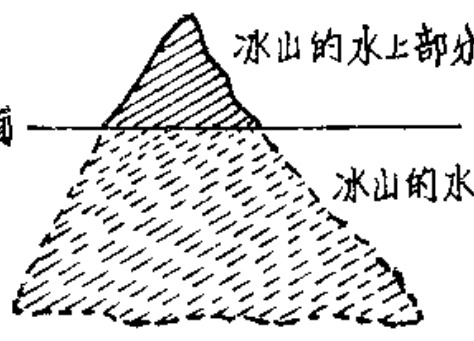
element. It resides at the deepest and lowest stratum of the mental domain. The conscious system refers to the psychological structure related to direct perception. It faces the external world and carries out the functions of the sensory organs. It manifests as clear thinking, logical analysis, and realistic thought activity in the here and now. It подчиняетсяs the reality principle, and its main function is to do its utmost to exclude the innate, bestial instincts and desires originating from the unconscious system, so as to normalize a person’s mental life. It occupies the highest level in the psychological structure and is the “head of the household” in the large family of human psychological factors, governing the entire mental household. The subconscious system, also called the preconscious system, is a border zone between the conscious system and the unconscious system. It is composed of past experiences and concepts that can be recalled. After the thinking of the conscious system has concluded, various experiences and concepts are all cast into the subconscious system. When needed again, consciousness can recall these experiences and concepts, summoning them back from the subconscious into consciousness. They once belonged to consciousness, but because they currently have little or no relevance to real life, they have been expelled from the domain of consciousness and entered the subconscious system. The function of the subconscious is twofold: on the one hand, it is the storage repository of consciousness; on the other hand, it serves as a sentinel between the conscious system and the unconscious system, preventing the unconscious from entering conscious activity. Freud believed that human mental life is essentially unconscious, and that consciousness is merely a surface ripple produced by the undercurrent of the unconscious. He likened the human mental world to an iceberg in the ocean. What is exposed above the water is consciousness, which constitutes only a small portion of the “iceberg,” while the greater part of the mountain submerged under water is entirely unconscious. Although the unconscious cannot be perceived by consciousness, it provides the motive force for consciousness (see Figure 2).
One of the successors of Freud’s doctrine, the Swiss psychologist and psychiatrist and leading representative of Neo-Freudianism, Carl Gustav Jung (1875–1961), proposed revisions to Freud’s theory of psychological structure. He divided all psychological phenomena into two parts, namely consciousness and the unconscious. These two
22
The portion of the iceberg above the water
Sea surface
The portion of the iceberg below the water
Figure 2
are complementary to each other. The unconscious again has two levels, namely the personal unconscious and the collective unconscious. The personal unconscious corresponds to the subconscious system in Freud’s theory; its main content consists of things that were originally conscious but have been forgotten or repressed and thus disappeared from consciousness, as well as things derived from personal experience and unconsciously learned. The collective unconscious corresponds to the unconscious in Freud’s theory; it is inherited. They are the physiological and psychological precipitates acquired through the processes of biological evolution and cultural-historical development—that is, the reflections of the experiences of previous generations deeply imprinted in the structure of the brain.
In fact, in the Eastern world over two thousand years ago, there already existed theories concerning the structure of consciousness. These theories not only predated the above-mentioned Western theories by more than two thousand years, but were also far more profound and comprehensive than the Western theories. These theories are the theory of the Original Spirit (yuanshen) and the Conscious Spirit (shishen) of Chinese Daoist qigong, and the Consciousness-Only (Wei Shi) doctrine of Indian Buddhism.
Daoist qigong holds that human consciousness has the distinctions of Conscious Spirit (shishen), Original Spirit (yuanshen), Yang Spirit (yangshen), and Yin Spirit (yinshen). The Yang Spirit is the genetic factor a person receives from the father and the patrilineal family line. The Yin Spirit is the genetic factor a person receives from the mother and the matrilineal family line. The unity of the Yang Spirit and the Yin Spirit is called the Original Spirit. The Original Spirit is the subconscious inherited innately from ancestors and parents, also called the True Nature (zhenxing) or Original Face (benlai mianmu).
23
The “conscious spirit” (识神) refers to our everyday perceptual and rational cognition. It is ceaselessly beset by wandering thoughts, pursuing external material desires and kindling the seven emotions internally. The so-called cultivation of qigong, special abilities, and supernatural powers means precisely attaining, through regulating the mind, a state in which the mind is no longer scattered, the conscious spirit yields its place, and the primal spirit (元神) takes charge.
The Buddhist theory of Yogācāra (唯识论) provides a detailed exposition of the structure of human consciousness. Its richness, profundity, and perfection far surpass those of modern Western psychology. Yogācāra divides the human psychological structure into mental king (心王) and mental factors (心所). The so-called mental king refers to mental activities of a universal nature. The mental king is divided into eight categories, namely: eye, ear, nose, tongue, body, mental consciousness, manas-consciousness (末那识), and ālaya-consciousness (阿赖耶识). They respectively represent visual perception, auditory perception, olfactory perception, gustatory perception, tactile perception, mental consciousness, self-consciousness, and seed-consciousness. The so-called mental factors refer to mental activities of special significance, such as joy, anger, grief, happiness, sorrow, fear, fright, greed, hatred, delusion, and so forth, totaling fifty-one mental factors. If we compare this theory with Freudianism, the six mental kings of eye, ear, nose, tongue, body, and mental consciousness in Yogācāra correspond to the conscious system of Freudianism. Among them, the five mental kings of eye, ear, nose, tongue, and body correspond to perceptual cognition, while mental consciousness corresponds to rational cognition. The manas-consciousness in Yogācāra is close to the subconscious system of Freudianism, yet differs in certain respects. The manas-consciousness stubbornly regards the external phenomenal world as material entities independent of human consciousness, and stubbornly takes the ever-changing body and mind to be a constant, unchanging “self.” Therefore, the manas-consciousness is the root of the two attachments to self and to phenomena (attachment to and pursuit of the self; attachment to and pursuit of external objects). It is the driving force behind human selfish instincts and the pursuit of material desires, and is the chief culprit responsible for all the afflictions of life. The ālaya-consciousness spoken of in Yogācāra is also called seed-consciousness or storehouse-consciousness. It closely resembles the unconscious system of Freudianism. It is the root and seed of all current conscious activities of human beings. Conversely, a person’s current consciousness continuously perfumes, transforms, and alters the ālaya-consciousness. The ālaya-consciousness is the basis for the cycle of reincarnation of sentient life across generation after generation. It accumulates the knowledge and experience of infinitely many past lives, and it is the subject of the Five Eyes and Six Supernatural Powers (五眼六通). Yogācāra organically unifies consciousness and the unconscious, making them interdependent and mutually transforming. In this regard, it is
24
far superior to Freudianism.
As the saying goes, make the past serve the present, make foreign things serve China, and weed through the old to bring forth the new. Our purpose in introducing and studying the theories of consciousness structure from our predecessors is to establish our own theory of the essence of special abilities and supernatural powers. Below, the author attempts to summarize the current practical experience of qigong, human special abilities, and supernatural powers, draw upon the beneficial elements of earlier theories, and boldly propose a hypothesis of his own regarding the structure of consciousness:
The human consciousness system can be roughly divided into three levels: manifest consciousness, sub-consciousness, and latent consciousness. Manifest consciousness refers to those mental activities of a person that can be directly recognized and experienced in everyday life. It includes various forms of sensory and perceptual cognition, various psychological activities such as emotions and feelings, and the rational cognition constituted by concepts, judgments, and inferences. Manifest consciousness occupies the surface layer of the consciousness structure system. It directly participates in life and practice, senses and cognizes the external material world, and uses this to guide and direct our speech and actions. In a person’s daily life and practice, manifest consciousness is the leader of the entire consciousness family. It suppresses latent consciousness so that it does not emerge to dominate and influence people’s thoughts, speech, and behavior. Manifest consciousness is extremely active. When a person is awake, one thought follows another without ceasing for a moment—it is truly like a monkey’s mind and a galloping horse. The characteristics of manifest consciousness are: rapid response, high clarity and accuracy, and possession of stability, universality, objectivity, and logicality. However, its energy is relatively small; its effects typically only act upon external objects by directing the person’s physical body. Manifest consciousness’s cognition of the surrounding world follows the practice-reflection principle; its content mainly derives from the reflection of objective reality during a person’s social practice. In other words, without a living brain and nervous system, manifest consciousness cannot exist; without human social practice, manifest consciousness would have no content.
Sub-consciousness is a transitional consciousness between manifest consciousness and latent consciousness. Its function is bidirectional. It is like a reservoir with two water conduits. One conduit leads to manifest consciousness, and the other leads to latent consciousness. The streams of consciousness in both conduits
25
can move in both directions. Some elements of consciousness—such as ideas, experiences, knowledge, and emotions—that manifest consciousness temporarily does not need are stored in the sub-consciousness system. When manifest consciousness once again needs these contents of consciousness, it can retrieve these elements. When certain stored consciousness accumulates sufficiently and goes unused for a long time, it may also flow through the other conduit into the latent consciousness system, transforming into latent consciousness content. Conversely, consciousness elements in the latent consciousness system sometimes also seep into the sub-consciousness system, and under certain conditions, may further flow into the manifest consciousness system, transforming into manifest consciousness, and manifest in people’s words and deeds. The external manifestations of this situation include slips of the tongue, slips of the pen, dreams, spontaneous qigong movements, madness, hallucinations, special abilities, and so forth.
Between manifest consciousness and latent consciousness, sub-consciousness plays the dual role of facilitating communication and standing guard over the connection between the two sides. There are many methods for developing latent consciousness and mobilizing it to do work: (1) Unidirectionally close the channel between manifest consciousness and sub-consciousness so that the manifest consciousness stream no longer flows—or flows in reduced amounts—into the sub-consciousness “reservoir,” thereby reducing the resistance and interference on the path from latent consciousness to manifest consciousness. This requires the cultivation of “concentration power” (定力) to suppress manifest consciousness. This is called the “Block-Manifest” (堵显) project; (2) Unidirectionally
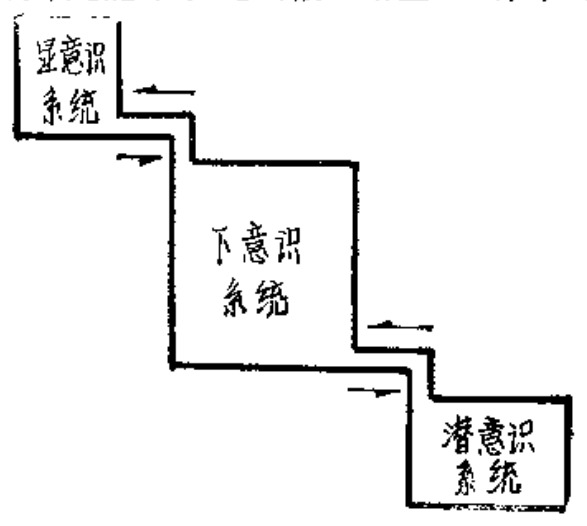
Manifest Consciousness        Sub-Consciousness        Latent Consciousness
        System                      System                    System
Figure 3: The “Block-Manifest, Regulate-Latent” Project
26
Clear the channels from the subconscious to the sub-conscious, and from the sub-conscious to the conscious, so that the subconscious can more easily enter the conscious system. This requires the cultivation of “mind power” (nianli) to activate and order the subconscious. This is called the “Regulation Project” (see Figure 3).
The subconscious is the deepest level of the entire consciousness system. Over the millions of years of human evolution, and throughout the tens of millions of years of long history of biological evolution, all accumulated biological instincts and consciousness information are contained within the subconscious. The physiological basis of the subconscious is the genetic genes within cells. Modern biology holds that the structure, traits, and functions of an organism are controlled by genes. Genes exist within cell chromosomes. Chromosomes are composed of the genetic material DNA and non-genetic material proteins. The molecular structure of DNA is a double-helix chain; it wraps around proteins to form nucleosomes, which then gradually spiral into solenoids, super-solenoids, and finally fold into chromosomes. This is somewhat like spinning a thick thread from a fine silk filament. The filament is folded in half and spirally twisted tight, then folded again, and twisted tight again; this is repeated multiple times until a long, fine silk filament is twisted into a short, thick rope. It is worth noting that: (1) The proteins in chromosomes play a repressive role in the expression of DNA genes. Therefore, the biological genetic information stored in the chromosomes is always in a suppressed state. This is the physiological reason why the subconscious exists as a latent state of information. (2) The deeper the DNA molecules within the chromosome, the earlier the genetic information dates back in biological history. Furthermore, the deeper the biological genetic information is within the chromosome, the greater the suppression it receives. Therefore, in the process of developing special abilities, the earlier the function dates back in biological history, the more difficult it is to develop. (3) The practice of qigong can separate the proteins in the chromosomes from the DNA molecules, allowing the genetic information to be expressed. This causes humans to exhibit extraordinary biological traits—special abilities. Therefore, qigong practice is the fundamental pathway for developing human special abilities.
From this perspective, the subconscious is a multi-layered structural system (as shown in Figure 4). Its outermost layer is close to the sub-conscious, a psychological structure formed by long-term repetitive
27
Time Acquired Subconscious Surface Quasi-genes Human genetic information Deep Layer Subconscious Higher animal genetic information Innate Lower animal genetic information Lower organism genetic information Unicellular organism genetic information
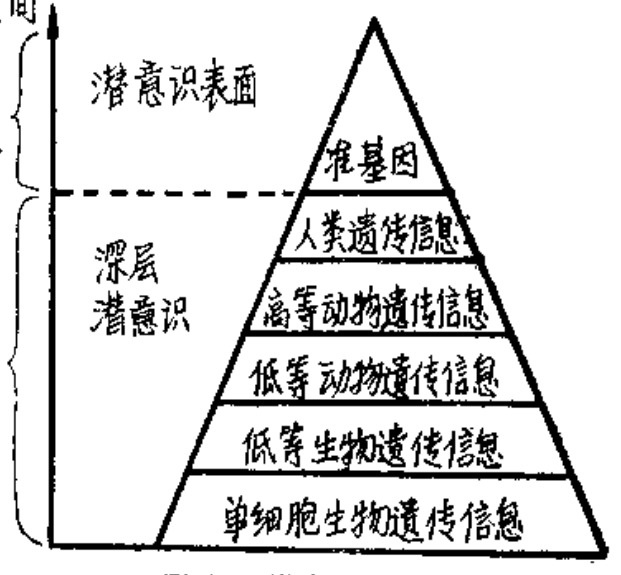
Figure 4: Structure of the Subconscious
conscious activities after a person is born. It is characterized by habits and instincts, and belongs to the acquired category. The deep-layer subconscious is the innate genetic information a person receives from their parents. This part also has multiple levels; the deeper the level of the subconscious, the earlier it dates back in biological history.
The subconscious differs from the conscious; its consciousness field covers the entire universe and possesses immense inclusivity. Its information volume horizontally encompasses all organisms, and vertically contains the entire history of biology. Therefore, it is transcendent of space and time. The subconscious possesses tremendous energy. Not only can it be transformed into conscious awareness via the sub-conscious, thereby controlling the physical body to do work, but it can also act directly upon physical entities, altering their internal structure and spatial orientation. Therefore, fundamentally speaking, all supernatural powers and special abilities are functions of the subconscious.
If one were to compare a person’s conscious and subconscious, the conscious mind is like an island exposed above the sea, while the subconscious is like the continental shelf beneath the water. There are thousands upon thousands of islands large and small on Earth, but all islands are connected
28
together through the continental shelf. All humanity, and even all organisms, whether past, present, or future, although each lives independently in different eras and regions, their subconscious is a unified whole. The deeper the subconscious of every organism goes, the closer they become; therefore, it is said that all organisms are spiritually connected. Isn’t this principle sufficient to explain telepathy and clairvoyance of past lives! Isn’t it sufficient to explain the phenomenon where some people can converse with animals and plants? Isn’t it sufficient to explain spiritualism, the phenomenon where the living can communicate with the souls of the dead?
Although the subconscious possesses vast supernatural powers, it also has its inherent limitations. First, the subconscious can only fully exert its power by attaching itself to the brain and physical body of a human or organism. Detached from physical matter, the subconscious field is merely an information repository and an energy reservoir; it cannot apply its information and energy to the physical world to achieve the purpose of transforming it. Therefore, the residual information of deceased historical spirits cannot directly act upon the living, much less cause havoc or trigger changes in nature and society. The prosperity of an individual’s, a family’s, a nation’s, or a country’s endeavors depends on the efforts of the living, and one cannot place hopes on the help of ancestral spirits. Second, the subconscious is usually suppressed by the conscious mind and cannot function. If the subconscious is to work, the conscious mind must first be suppressed. Third, the subconscious lacks clarity, logic, and stability. The information it provides is often vague and chaotic, and thus lacks the universality and repeatability required by scientific experiments. Therefore, demonstrations of special abilities and supernatural powers do not have a one hundred percent guarantee of success like physics or chemistry experiments. Remote viewing and precognition within supernatural powers are also often ambiguous and nonspecific.
Section 3
Humans Possess All Functions That Organisms Possess
Unicellular organisms are considered the most primitive organisms. Yet, a tiny cell
29
Nor is it simple: it has a complex internal structure, in which each constituent component has its own职责 yet is interconnected, working in an orderly and coordinated manner to ensure the cell’s survival and development. Cells also possess many remarkable functions. For example, a cell must take in nutrients, water, and air from the outside, while also seeking benefit and avoiding harm, dodging unfavorable factors in the external environment and searching for environments favorable to survival. It must perceive changes in the surrounding environment and adjust its own mechanisms to adapt to the changed environment. It must reproduce its own kind and pass on functions accumulated over generations to the next generation. Cells are constantly evolving. Under the condition of continuously changing individuals, functions already acquired… may no longer be useful in the new living environment, but this “ability” will be stored in a latent manner within the genes of the cell’s chromosomes and preserved forever.
With biological evolution, single-celled organisms developed into multicellular organisms. Taking animals as an example, multicellular animals are composed of tissues with different forms and functions, and tissues are composed of cells with similar forms and identical functions. Various different tissues carry out their own distinct functions.
The emergence of tissues caused the originally multifunctional single cell to undergo differentiation and polarization. Cells in different tissues each developed some functions, degenerated some functions, and proliferated some new functions. For example, epithelial tissue cells have relatively strong roles in protection, absorption, excretion, and respiration; connective tissue cells possess relatively strong functions of support, protection, nutrition, repair, and transport; the primary function of muscle tissue cells is to convert chemical energy into mechanical energy; and nerve tissue cells have relatively well-developed abilities to sense stimuli and conduct excitation.
The emergence of tissues and the differentiation of cells, although causing a division of labor among cells, merely strengthened certain functions and left others idle. This does not mean that the idled functions would entirely disappear. Certain long-idled functions would persist in a degenerated state, in latent form, within the genetic genes of the cell’s chromosomes.
30
Recognizing this point is extremely important for researching, understanding, and developing special abilities. Why is it that some individuals with special abilities can recognize characters with their ears, palms, soles of the feet, armpits, or the Heavenly Eye acupoint (Tianmu xue)? The reason is simple: every cell in the human body originally possessed the functions of vision, smell, respiration, feeding, and so forth. The cells in the ears, palms, soles, armpits, and Heavenly Eye region inherently possessed visual function—it simply degenerated and exists in latent form. As long as the conditions are met, the visual function of cells in these regions can be restored, transforming from a latent form into a manifest form. The principle underlying special visual function is thus, and the principles of all other special abilities are no different.
With the further development of life, multicellular organisms evolved into complex animals and plants. From multicellular lower animals, through coelenterates, flatworms, nematodes, annelids, mollusks, arthropods, echinoderms, and chordates, vertebrates ultimately developed. In the course of vertebrate development, there was a progression from fish, to amphibians, to reptiles, to birds, and finally to mammals, culminating in the appearance of the highest form of life on Earth—human beings. Over this long river of biological evolution, life forms successively produced all manner of functions. These functions appeared more strongly in some animals and more weakly in others. For example, many animals living in water can breathe through their skin; generally speaking, birds have exceptionally sharp eyesight; herbivores on the grasslands often have extremely keen hearing; and the sense of smell in most carnivores is particularly powerful. Some animals can fly thousands of miles without losing their way; some animals sense an earthquake before it occurs; some animals can go without food for long periods in winter; some animals can travel great distances without drinking water… The various functions manifested in animals may seem wondrous and incomprehensible to humans. In fact, all the functions manifested in animals are also possessed by humans, because humans are the last and highest animal in the course of life’s development. Just as in the process of conceptual development, the later a concept appears, the more concrete it is, so too in the course of biological development—
31
the later an animal appears, the more perfected its functions. The biological functions formed at each stage in the history of life’s development will not disappear in subsequent developmental processes. Certain long-unused functions may degenerate or weaken, and they will be stored in the form of genetic genes within the chromosomes of biological cells. On the surface, many functions of the human organism are inferior to those of animals, but fundamentally, the human organism latently encompasses all functions possessed by living things. Once human potential is developed, humanity will become the king of the cosmos not only rationally but also in terms of bodily functions.
Where there is progress there is regression—this is the dialectic of all developmental processes. Likewise, in the historical course of biological development from lower to higher, from simple to complex, along with the overall evolution of organisms, localized degenerative phenomena also occur. As previously stated, single-celled organisms are multifunctional: the cell itself possesses the functions of feeding, respiration, sensation, defense, digestion, excretion, reproduction, and so on. With biological evolution, cellular functions underwent division of labor, tissues and organs appeared, and organisms thus developed from single-celled to multicellular, from lower organisms to higher organisms. The more advanced the organism, the more refined the division of labor among cells, and the simpler and more specialized the functions of each cell become. Although higher organisms possess many advantages—the continuous development of the brain in particular making organisms increasingly intelligent—biological evolution has also brought many negative consequences: (1) The survival capacity of each individual cell has gradually declined, and the ability to independently resist the invasion of adverse external factors has progressively weakened. Single-celled organisms essentially do not die; in principle, they can divide indefinitely. The mother cell does not die as a result of division; each division injects renewed vitality into the cell. But once a multicellular organism dies, its constituent cells also die along with it. (2) The more advanced and structurally complex the organism, the more prone it is to malfunction. Any minor fault can potentially cause disease in the entire organism, or even bring about the death of the organism. (3) Contrary to the direction of biological evolution, individual cells actually degenerate as organisms evolve. The function of each cell becomes increasingly simplified, and each cell…
32
increasingly sacrifice their own right and value of independent existence; they can only exist for the sake of the whole; (4) As biological evolution progresses, the more information the cerebral cortex of animals contains, the stronger the organism’s dependence on neural regulation becomes, thereby causing the organism’s perceptivity of its surrounding environment to diminish. As for the highest-level organism—humans—the more developed their intelligence, the more their special abilities are suppressed and difficult to develop. The more the material and spiritual civilization of human society develops, the weaker the human body itself becomes. With the progress of social history, the functions inherent in the human body are gradually externalized into instruments, tools, and equipment. Radios, televisions, telephones, telegraphs, telescopes, microscopes, radar, airplanes, missiles, artificial satellites, and spacecraft have replaced the many latent potentials that humans originally possessed. Humans have become the most powerful and wealthiest organism in the universe, yet at the same time the most fragile and impoverished. Only humans equipped with modern science, technology, and material facilities are incomparably powerful. Once deprived of these external material accoutrements, humans become pitiful creatures helpless even against a mosquito.
All things reverse upon reaching an extreme. Life has developed to the present day, and humanity itself now faces a great revolution. The aim of human body science research is to ensure that humans possess not only advanced science and technology and powerful material equipment, but also that the human organism itself becomes strong. Under the premise of continuing to perfect the conscious awareness of the human brain and further developing science and technology, the time has now come to vigorously develop the latent potentials of the human body that were originally inherent but later set aside and suppressed. There is reason to say that the coming twenty-first century will be a century of comprehensive development of human special abilities and supernatural powers.
Chapter 2: Basic Training for the Development of Special Abilities and Supernatural Powers
From the theoretical analysis in the preceding sections, we know that the latent potentials of the human body exist primarily in the form of the subconscious, and the material form of the subconscious is the genetic code of cellular chromosomes. From this, we can naturally derive the basic pathways for developing human special abilities and supernatural powers: (1) Change the current living environment of cells, so that cells return, either fully or partially, to their primordial living environment, thereby compelling the primitive functions of the billions of cells in the human body to be restored; (2) Unify and concentrate the revived functions of the billions of cells, forming powerful material energy through the process of ordering; (3) Suppress the conscious awareness of the brain, so that the long-suppressed subconscious becomes active. On the basis of strengthening and ordering the individual’s subconscious field, open the channel between the individual subconscious field and the cosmic subconscious field, thereby maximally absorbing cosmic energy and information.
If these three conditions can be realized, the special abilities and supernatural powers of the human body will inevitably be developed. And the fundamental method for realizing the requirements of these three conditions is the cultivation of qigong.
The basic content of qigong cultivation includes regulating the body (tiao shen), regulating the breath (tiao xi), regulating the mind (tiao xin), as well as adjusting daily diet and lifestyle habits. As with the developmental process of anything in this world, qigong cultivation cannot be accomplished in a single step. It requires a long and arduous process of quantitative accumulation leading to a qualitative leap. This process can be divided into at least two major stages: the foundational training stage and the stage of intensifying the emergence of abilities. This section focuses on introducing the content and methods of basic training.
34
Section 1: Become Proficient in One Moving Qigong Method
Those who are new to qigong cultivation are often physically weak and prone to illness, with poor vitality. In particular, their temperament tends to be restless, their minds filled with distracting thoughts, and their conscious awareness is difficult to calm. If they immediately study stillness qigong (jing gong), it is generally very difficult. Therefore, beginners should first study moving qigong (dong gong). Moving qigong can mobilize the limbs and joints, relax the muscles and invigorate the blood, open the meridians, eliminate illness and strengthen health, and enhance physical constitution. At the same time, moving qigong can also temper one’s character, cultivate morality, calm distracting thoughts, and increase interest in practice. This lays the physiological and psychological foundation for further cultivation of meditative concentration (chan ding).
In cultivating moving qigong, it is best to select from the many established qigong methods one that suits your own physical and mental constitution. Once you have chosen a particular moving qigong method, you must make it a habit and practice it daily. Practice requires patience and perseverance; you must persist over the long term. You must never practice for three days and rest for two. Nor should you be fickle, constantly switching methods. There are many moving qigong methods currently popular in society. From the several methods the author has personally practiced, the successive stages of “Zhineng Qigong” (Intelligent Qigong) created by Qigong Master Pang Heming are very good. Additionally, the “Bagua Ruyi Gong” (Bagua As-You-Wish Qigong) created by Qigong Master Zhao Weihan is also an excellent set of practices.
It is best to practice moving qigong in a location with beautiful surroundings and a good qi field. Generally speaking, places with abundant trees and flowers, few people, free from noise and other pollution, where one feels comfortable, are all good practice sites. If there is an ancient temple, a Daoist shrine, a famous historical site, or a pagoda forest of eminent monks nearby, it is even more auspicious.
It is best to practice moving qigong in the early morning. According to Chinese qigong circles, the period from the zi hour (11 PM–1 AM) to the wu hour (11 AM–1 PM) is when yang energy rises; the qi at this time is called “living qi.” At the same time, the early morning air is fresh, and after a night’s sleep, it is precisely the moment when the human body transitions from stillness to movement—
35
a physiological transition. Practicing at this time is highly beneficial to the body.
In the cultivation of moving qigong, special attention should be paid to the following issues:
(1) During practice, the intention (yi nian) must work in close coordination with the physical form. The movements of the body help the intention travel along the meridians or through space, achieving the effect of training the intention; the intention directs the bodily movements, making them more harmonious and graceful, thereby achieving the effects of relaxing the muscles, invigorating the blood, eliminating illness, and strengthening health.
(2) During practice, one must maintain a state of relaxed joints, supple tendons, and harmonious mind-spirit from beginning to end. The movements should be soft, rounded and lively, moderate in speed, with clear distinction between empty and full. Pay special attention to the movement of the joints; the joints should move in a wavelike, undulating manner (yong dong), not forced into large-range motion with excessive effort.
(3) Be attentive to the sensation of qi. Following the guidance of intention and movement, you should feel an indescribable substance flowing within the body. This produces an incomparably comfortable sensation. Without such a sensation, your qigong practice lacks proper method; it will become dry and tasteless, and you will not be able to persist.
(4) Fully conclude the practice (shou gong); otherwise, not only will you fail to achieve the effects of practice, but you may also harm your body, resulting in dizziness, nausea, and fatigue. This is because, first, during practice, much of your own qi disperses into the surroundings, and it needs to be drawn back into the body when concluding the practice; second, during the practice process, the brain has been inhibited, and concluding the practice restores the mind to its normal, clear-headed state.
Section 2: Training in Several Basic Skills
Training in the Basic Skill of Sitting Meditation
The cultivation of qigong for the purpose of developing special abilities and supernatural powers has its most fundamental—
36
The core skill is sitting meditation. The general principle for the sitting meditation posture is: keep the whole body upright and internally relaxed, preventing stiffness and slackness. The specific sitting postures can be divided into three types, namely, the natural cross-legged sit, the half-lotus, and the full-lotus. However, for the cultivation and development of special abilities and supernatural powers, it is best to adopt the full-lotus sitting posture, and it is required that one can sit continuously for at least three or four hours. Because only through prolonged sitting can one enter dhyana (meditative concentration); short periods of sitting cannot lead a person into deep states of tranquility and samadhi. Of course, achieving this requirement cannot be done overnight. The training for sitting meditation should start from the natural cross-legged posture, gradually transition to the half-lotus, and finally achieve prolonged full-lotus (see Figures 5, 6, and 7).
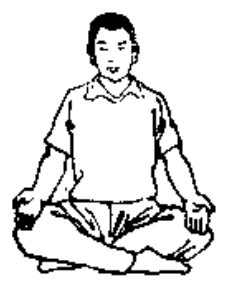
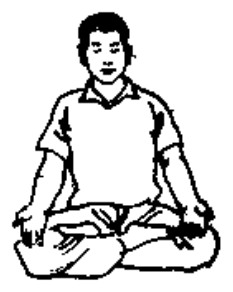
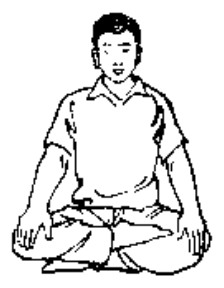
Figure 5 Natural cross-legged sit, also known as loose cross-legged (san pan) Figure 6 Single jiafu sit [half-lotus], also known as half-lotus (dan pan) Figure 7 Double jiafu sit [full-lotus], also known as full-lotus (shuang pan)
The sitting posture must be performed to standard according to the requirements; otherwise, it is easy to cause harm to the body. The standard posture should be: the torso upright, the chin slightly tucked in, the chest slightly hollowed and the back straightened, the lower abdomen slightly tucked in; the eyes slightly closed or leaving a crack of light; the mouth lightly closed, the tip of the tongue lightly touching the upper gums; both upper limbs naturally drooping, shoulders sunk and elbows dropped; both hands forming a mudra (generally the Samadhi mudra), placed upon the legs and in front of the lower abdomen; the face bearing a faint smile.
The location for sitting meditation is best chosen to be a quiet room. The room should be dry and ventilated, with ample sunlight, fresh air, and quiet cleanliness. Sitting meditation can be done on a hard bed covered with a cotton mattress, or on a futon on the ground. Before sitting meditation, the following preparations should be made: (1) Change the air in the room; (2) Seal doors and windows to prevent thief-wind (drafts) from invading; (3) Hang curtains to make the light in the room slightly dim; (4) Empty urine and feces; (5) Wear comfortable, loose
37
clothing and loosen belts; (6) Prevent wind and cold. It is best to cover the shoulder, back, and knee areas with a towel blanket; (7) Lock the door tightly to prevent people or animals from suddenly breaking in and causing a shock.
Beginners can first practice the natural cross-legged sit. Practice exclusively for 1–2 hours every day, and whenever conditions permit normally, it is best to maintain the cross-legged posture. After training like this for several months to half a year, when you can continuously persist for several hours without feeling great pain in your lower back and legs, you can change to the half-lotus posture training. The left and right legs should be practiced alternately. When you can persist in the half-lotus sitting meditation for several hours without feeling extreme pain, you can proceed to full-lotus training. When you can also persist in the full-lotus for several hours, the sitting meditation skill can be considered successfully cultivated.
The cultivation of the basic skills of sitting meditation is extremely arduous; generally, one cannot meet the requirements without three to five years. During cultivation, one must absolutely not act too hastily, pull a muscle, or cause Chan sickness (meditation sickness) from excessive fatigue. During the sitting process, various uncomfortable sensations such as soreness, aching, numbness, and swelling will arise, sometimes even unbearably painful. When I sit in meditation, I often adopt some expedient methods (upaya) to alleviate the pain and extend the meditation time. These methods mainly include: (1) The method of diverting attention. Listen to some beautiful music while sitting in meditation; tap a wooden fish while sitting; recite the holy name and count prayer beads at the same time; (2) The method of regulating the breath and guiding Qi to dispel evil. The physiological reason for the sensations of soreness, numbness, swelling, and pain in the human body is the production of a substance called fatigue toxin (referred to as evil Qi in Qigong) within the body. During sitting meditation, as long as the fatigue toxin can be expelled, the feeling of pain can be eliminated or alleviated. Adopting the method of regulating breath and guiding Qi can achieve this goal. The so-called method of regulating breath and guiding Qi is: following the rhythm of deep breathing, the intention guides the evil Qi out of the body from the point of pain. Generally, the evil Qi is expelled from the Yongquan acupoint on the soles of both feet. Another function of the breath-regulating and guiding method is that it unblocks the meridians throughout the whole body, especially in both legs.
After each sitting meditation training session is completed, you must pay attention to earnestly closing the exercise (shougong), otherwise it is extremely easy to leave behind Chan sickness. The main methods for closing the exercise are: rub both hands together to generate heat, rub the face up and down with both hands, gently tap the crown of the head and the temples with your hands, then pat the whole body several times, earnestly massage the spine, especially the lumbar spine area, until there is no more pain, and finally walk on the ground for 5 minutes.
38
II
Training of the Basic Skills of Regulating the Breath
Explained using ancient Chinese Qi theory and the doctrine of Yin and Yang, human breathing is exactly communicating with the Yin and Yang of the universe. Exhalation is Yang, and inhalation is Yin. The Guanzi: Neiye chapter says: “The spiritual Qi is in the heart; it comes and goes, it is so small there is nothing within, it is so large there is nothing without.” Modern scientific experiments prove that during inhalation, the impulse of the sympathetic nerves is strengthened, and during exhalation, the excitability of the sympathetic nerves is inhibited. It is known that the sympathetic and parasympathetic nerves form a pair of oscillating loops that are opposite yet complementary; when one is strong, the other is weak; when the former is excited, the latter is inhibited, and vice versa. Their alternating changes will correspondingly cause concentration changes in two types of cyclic nucleotides (C-AMP and C-GMP), thereby leading to changes in various biochemical activities of the cells. That is to say, respiratory movement is related to the structure and function of human cells. If people’s breathing habits are changed, or even if pulmonary breathing is stopped, it will definitely cause a qualitative change in the structure and function of cells, thereby activating many of the cells’ primitive, dormant functions. Therefore, regulating the breath has a significant relationship with the development of special abilities and supernatural powers.
What exactly is being “regulated” in regulating the breath? What are its general principles and overall guiding ideology? This is something that beginners practicing Qigong should pay special attention to. Buddhism divides human breathing into four states: the wind phase (fengxiang), the panting phase (chuanxiang), the air phase (qixiang), and the breath phase (xixiang). The Tongmeng Zhiguan (Samatha-Vipasyana for Beginners) explains these four phases as follows: “What is the wind phase? When sitting, the breath entering and leaving the nose is felt to have sound; this is the wind phase. What is the panting phase? When sitting, although the breath makes no sound, its entry and exit are knotted and stagnant, not flowing smoothly; this is the panting phase. What is the air phase? When sitting, although the breath is silent and not knotted or stagnant, its entry and exit are not fine; this is the air phase. What is the breath phase? Without sound, without knotting, without coarseness, entering and leaving continuously, as if existing yet as if disappearing, sustaining the spirit in peace and stability, the mind holding joy and delight; this is the breath phase.” The so-called regulating the breath in Qigong is adjusting the first three phases into the fourth phase, adjusting them into the breath phase.
19
Methods of Breathing
There are said to be at least 118 methods of breathing. However, the breathing patterns that belong to regulating the breath (tiáoxī, 调息) mainly include the following types.
The first is natural breathing. Its characteristic is to let things take their natural course. For most people, natural breathing is a mixed thoracic-abdominal pattern: during breathing, both the chest and abdomen rise and fall quite noticeably. The Chan (Zen) School and the Pure Land School of Buddhism generally adopt this breathing method during seated meditation. Although natural breathing follows its natural course, this does not mean the original breathing pattern remains entirely unchanged. The natural breathing of qigong requires that, on the basis of ordinary natural breathing, the breathing frequency is gradually slowed and the depth of breathing is progressively deepened, making the breath appear even more gentle, natural, and comfortable. Natural breathing is the foundation of regulating the breath and is also the minimum requirement for training in breath regulation.
The second is thoracic breathing. This type of breathing is actually a form of natural breathing. Its characteristic is that the chest rises and falls with the breath, using the expansion and contraction of the thoracic cavity to perform respiration. This breathing method has therapeutic effects on certain chest ailments, but it does not appear to be widely adopted in qigong practice aimed at developing special abilities and supernatural powers.
The third is abdominal breathing. It too should be considered a form of natural breathing. There are three common types of abdominal breathing:
- Forward abdominal breathing: that is, the abdomen expands on inhalation and retracts on exhalation.
- Reverse abdominal breathing: that is, during inhalation the abdominal muscles are gradually contracted so that the abdomen draws inward; during exhalation the abdominal muscles naturally relax and the abdomen gradually rises.
- Latent breathing (qián hūxī): With breathing, the lower abdomen rises and falls very subtly. This is a form that appears when the breath has become extremely gentle and soft.
During practice, abdominal breathing can be combined with mental intention (yìniàn), which yields even better results. On inhalation, one imagines generating force from behind the spine at the central point of the abdominal cavity, straightening the lower back, relaxing the abdominal muscles, and drawing in a large amount of air, as if the qi is being transported along the spine toward the anus. While inhaling, one simultaneously uses mental intention to press downward, at which point one feels the lower abdomen become full, comfortable, 40
and at ease. Hold the breath briefly, then exhale slowly. One may also adopt an alternative method of intention-based breathing: on inhalation, imagine the qi entering from the navel and pressing toward the Mingmen (生命门, Gate of Life) point; on exhalation, imagine the qi pressing from the Mingmen toward the navel. This method can cause the Dantian (丹田) region to grow warm, achieving the effect of cultivating true qi (zhēnqì, 真气).
The fourth is deep breathing. This means making every effort to breathe deeply, slowly, finely, and evenly. The breathing rate is reduced from 16 times per minute to 10, 8, 4, or even 1 time, extending the breathing cycle as much as possible. However, one must follow nature and not force it.
The fifth is breath-retention breathing. It is essentially a form of breath-holding exercise, practiced on the foundation of abdominal breathing and deep breathing. The basic practice method is: there is a pause of breath retention between one inhalation and one exhalation, or between one exhalation and one inhalation. One may also inhale for a long time and exhale for a short time, or inhale for a short time and exhale for a long time. Hence it is also called differential breathing. It should be noted that beginners should not practice breath retention, because a weak foundation can produce adverse phenomena such as breath holding discomfort, tinnitus, dizziness, and sweating.
The sixth is intention-directed breathing. That is, one’s intention reaches a certain place, as if drawing the qi to that place. This method has the effect of unblocking the channels and invigorating the blood. During seated meditation practice, one can use this breathing method to alleviate physical fatigue and pain.
The seventh is movement breathing. Daoist dynamic practices (dòng gōng, 动功) and spontaneous qigong frequently employ this breathing method. It uses movement to assist breathing, or special movements are coordinated with breathing.
The eighth is embryonic breathing (tāixī, 胎息). This is a relatively advanced breathing method and also an excellent breathing method for developing special abilities and supernatural powers. Some even believe that only upon achieving embryonic breathing can one cultivate supernatural powers.
The so-called embryonic breathing refers to breathing that is brought to its shallowest and slowest extreme, with the abdomen nearly motionless. At this point, pulmonary breathing is almost entirely unused, and navel breathing is employed instead. The She Sheng San Yao (摄生三要, Three Essentials of Preserving Life) 41
states: “One must visualize the qi exiting from the navel and entering through the navel, regulating it to be extremely fine, and then no longer using the mouth and nose, but breathing only through the navel, as though within the womb; hence it is called embryonic breathing.” The Baopuzi · Neipian · Shizhi Juan (抱朴子·内篇·释滞卷, Master Baopu’s Inner Chapters, Scroll on Resolving Stagnation) points out: “One who achieves embryonic breathing can refrain from inhaling and exhaling through nose and mouth, as though within the womb — then the Way is accomplished.” It is noteworthy that embryonic breathing only manifests when breath regulation has been practiced to an advanced stage, reaching the state of ‘the nasal breath is barely perceptible, as if present yet as if absent.’ Embryonic breathing forms naturally and cannot be forcibly pursued; only when one’s skill reaches a certain level can it be gradually experienced.
The ninth is hibernation-pattern breathing. This method resembles the breathing of animals such as turtles and snakes during hibernation. As manifested in the human body, it does not use pulmonary breathing, but rather breathing through the pores of the entire body — that is, body-surface breathing (tǐ hūxī, 体呼吸). This type of breathing is also an important mode for activating the cells’ primordial functions. If one’s breath regulation can reach this degree, then the emergence of special abilities and supernatural powers is not far off!
There are many methods of regulating the breath. Must every method be practiced? The answer is no. For the development of special abilities and supernatural powers, the most important objectives of regulating the breath are twofold: (1) to compel all the body’s cells to restore their dormant primordial functions; and (2) to suppress the conscious mind and mobilize the subconscious. To this end, one should select breathing methods related to these two objectives. Based on the experience of predecessors, the author believes that those who practice qigong for the purpose of developing special abilities and supernatural powers should appropriately choose natural breathing, abdominal breathing, deep breathing, embryonic breathing, and hibernation-pattern breathing. Practitioners may begin with natural breathing and progress to deep abdominal breathing. Achieving embryonic breathing or hibernation-pattern breathing would be ideal.
There are several points of caution regarding the practice of breath regulation:
First, the adjustment of breathing should follow its natural course; one must never force it blindly, otherwise haste will not bring success. Not only will one fail to achieve the effects of practice, but adverse reactions may arise, and even deviations (piānchà, 偏差) may occur.
Second, when practicing the embryonic breathing method or the hibernation-pattern breathing method, one must certainly seek the guidance of a master. 42
or guidance from an experienced practitioner; one must not practice blindly and secretly on one’s own.
Furthermore, when regulating the breath, one must maintain a calm and peaceful mind. When restless thoughts and miscellaneous distractions arise in profusion, with the mind like a runaway horse, it is impossible to regulate the breath. Peng Zu said: The Way does not lie in complexity; one need only cease thinking about food and clothing, cease thinking about sounds and sights, cease thinking about victory and defeat, cease thinking about right and wrong, cease thinking about gain and loss, and cease thinking about honor and disgrace.
Finally, regulating the breath is also related to time and climate. Ancient medicine held that from the zi hour to the wu hour is the time when yang energy rises, and the breath at this time is called “living breath” (sheng qi). Only during the time of living breath can one regulate the breath. Conversely, from the wu hour to the zi hour is the time when yin energy rises, and the breath at this time is called “dead breath” (si qi). One must not regulate the breath during the time of dead breath. Ancient medicine also held that adverse weather conditions are unfavorable for regulating the breath. Therefore, the famous Tang dynasty physician Sun Simiao stated in Qianjin Yaofang (Essential Prescriptions Worth a Thousand Gold): “As for the method of regulating the breath, after midnight and before noon, the breath is alive and may be regulated; after noon and before midnight, the breath is dead and may not be regulated.” “If there is overcast sky, fog, fierce wind, or bitter cold, do not draw in the breath, but simply keep it closed.”
However, the ancients’ views should be taken as reference only and not followed rigidly. For if one could only regulate the breath during the time of living breath, that would be equivalent to saying that qigong cultivation can only be carried out during the time of living breath. Yet in the advanced stages of qigong cultivation, one must practice not only during living hours but also during dead hours. One must practice continuously for seven or eight hours, or even dozens of hours, in order for supernatural powers to emerge. Therefore, the author believes that those with suitable conditions should regulate the breath during the living hours whenever possible, and when necessary, it is also acceptable to extend practice time into the dead hours.
Section Three
Basic Training in the Power of Concentration (Dingli)
Qigong cultivation aimed at developing special abilities and supernatural powers has as its core content the training of consciousness. Only when the conscious mind (shi shen) yields its place and the primordial spirit (yuan shen) takes charge can special abilities and supernatural powers arise. Therefore, among the three regulations—regulating the body, regulating the breath, and regulating the mind—regulating the mind is the core and the key.
43
By “regulating the mind” is meant adjusting one’s intention and awareness during practice. It means causing the conscious mind to be inhibited and calmed, while mobilizing the primordial spirit and bringing it into an orderly state. Many people understand regulating the mind merely as entering a state of mental quietude; this is incorrect. Regulating the mind comprises at least two aspects: first, inhibiting the explicit consciousness so that it quiets down, thereby cultivating “the power of concentration” (dingli); second, mobilizing and training the subconscious, bringing it into an orderly state, thereby cultivating “the power of intention” (nianli).
Training in the power of concentration is the cultivation of the ability to enter quietude. Entering quietude is a special state of awareness—achieved on the basis of relaxation, regulating the body, regulating the breath, and mental focus—characterized by wakefulness combined with reduced thinking and low responsiveness. Its essence is a progressively deepening inhibitory process of the cerebral cortex, under conditions in which the ascending activating system of the brainstem reticular formation holds a dominant excitatory state. This special state of unified excitation and inhibition is, in actuality, a special compound conditioned reflex established through repeated self-induction.
The normal conscious activity of the human brain roughly has three states: the waking state, the sleeping state, and the qigong quieted state. During sleep, oxygen consumption is about 10% lower than in the waking state; during the qigong quieted state, oxygen consumption is at least 16% lower than in the waking state; and in a state of deep quietude, oxygen consumption can be as much as 34% lower than in the waking state. Therefore, the qigong quieted state has the lowest oxygen consumption and represents a low-consumption, high-efficiency feedback physiological effect. It is especially important to note that entering quietude must not be equated with drowsy sleep. The quieted state is one in which the practitioner is awake yet has interrupted contact with the external world, achieving a high degree of mental calm, relaxation, and comfort. In the quieted state there is no dream-talk, whereas drowsy sleep is often accompanied by dreams.
The quieted state has multiple levels. Some people divide it into two levels (such as Pang Heming): the first refers to the concentration of conscious activity, transforming disordered, scattered mental activity into regular, single-pointed mental activity; the second is when there is not a single thought in the mind—the mind is empty and hollow, indistinct and vague, yet clear and luminous. Some people divide entering quietude into three levels (such as Wang Yin and Zhang Baoying), namely the elementary quieted state, the intermediate quieted state, and the advanced quieted state. They hold that in the elementary quieted state, the practitioner has
44
fewer distracting thoughts, and whatever distractions arise are quickly eliminated, resulting in calm and comfort; in the intermediate quieted state, the practitioner is virtually deaf to interfering external sounds, the entire body is extremely relaxed and comfortable, and the use of intention is effortless. After completing practice, the practitioner is full of energy, finds life joyful, has a clear mind, and works with high efficiency; in the advanced quieted state, external disturbances produce no response in the practitioner, breathing seems as if it exists and yet does not, the use of intention is effortless, and it is as if the self no longer exists—as if present, as if gone—the entire organism feels like empty nothingness, relaxed and floating, with an indescribable happiness.
The great Tang dynasty physician Sun Simiao, in Cun Shen Lian Qi Ming (Inscription on Preserving the Spirit and Refining the Breath) and She Yang Zhen Zhong Fang (Pillow Methods of Nourishing Life), described the levels. He said: “Those who study the Way pass through five stages: In the first stage, the mind is mostly active and rarely quiet; thoughts run to ten thousand realms, choices are inconstant, worries and calculations are like wild horses—this is the state of the ordinary person. In the second stage, the mind is mostly quiet but often active; one draws activity into quietude, yet the mind is largely scattered and hard to subdue; by diligently and urgently gathering it in, one begins to pursue the Way. In the third stage, activity and quietude are roughly equal; the mind seems to gather into quietude, yet still remains half quiet and half scattered; through diligent and urgent effort, gradual familiarity with regulation appears. In the fourth stage, the mind is mostly quiet and rarely active; the gathering of the mind becomes gradually familiar—whenever it moves, one gathers it back, focusing on a single object, and if it is lost, it is quickly regained. In the fifth stage, the mind is consistently and purely quiet; whether there are affairs or not, nothing can stir it—through long practice, the gathered mind becomes proficient, and what was scattered is firmly settled.”
The great qigong master Yan Xin divides entering quietude into seven levels of progressive depth: The first level is tranquility (anjing), meaning all distracting thoughts and inner conflicts are expelled, and the mood becomes calm. The second level is equanimity (pingjing), meaning the breath is brought into harmony, placing oneself in a very calm and peaceful state of mind. The third level is serenity (ningjing); at this point one should think of joyful things, feeling very relaxed and natural, and gradually enter a deeply serene state. The fourth level is settled stillness (dingjing); at this point, if complicated thoughts arise, they must be quickly reined in. If, during practice, scenes, images, or written characters suddenly appear in the mind, one should not become nervous but should hold them fast in the mind’s eye. Sounds that are heard should also be fixed in the mind and not casually dismissed. The fifth level is empty stillness (xujing); at this point a blurry, vast, and hazy state appears, as if nothing around one exists anymore. Are you sitting? Are you
45
Standing? It is also unclear. Coming in the clouds, going in the mist, not even knowing where one’s own body is. It seems as if one’s body has become empty and no longer exists; the sixth level is True Stillness (zhen jing). At this point, one truly enters the state of stillness. In the True Stillness stage, one feels that everything around is “empty” and “void,” yet this feeling is also real. Only then do you understand what is going on; the seventh level is Spiritual Stillness (ling jing). At this time, it seems as if you have arrived in another world, and everything seems not to exist. However, you are extremely sensitive to the surrounding environment and signals, with incredibly quick reactions. Or rather, at this time your subconscious field communicates with the general field of universal consciousness, and you begin to acquire the Five Eyes and Six Supernatural Powers.
If qigong practice reaches the states of True Stillness and Spiritual Stillness, one enters the state of Samadhi (ding jing). Entering Samadhi is an advanced state of entering stillness. The Xingming Fajue Mingzhi (Clear Instructions on the Methods of Nature and Life) believes that when entering Samadhi, breath ceases, pulse ceases, thoughts cease; one does not eat yet is not hungry, does not drink yet is not thirsty. Pulmonary respiration stops and embryonic breathing is achieved, the six pulses all stop, chaotic and unconscious, like a body dead from lack of breath, but the face remains as if alive. At this time, one must not assume it is death in a seated posture (zuohua); one must have fellow practitioners to protect and support, and must not startle the Yang Spirit (yang shen) that has entered Samadhi. The practitioner also must not recklessly exit Samadhi, letting everything take its natural course. Entering Samadhi is further divided into Minor Samadhi, Middle Samadhi, and Major Samadhi. Daoists believe that Minor Samadhi lasts for one day, Middle Samadhi for three days, and Major Samadhi for seven days [OCR text reads “seven mouths”]. When practice reaches the state of Samadhi, one is not far from the emergence of supernatural powers.
Buddhism further divides entering Samadhi into several levels. Speaking only of worldly dhyana, there is the theory of the Four Dhyana and Eight Samadhis. The Four Dhyana and Eight Samadhis are the eight successive levels of entering Samadhi in worldly dhyana as spoken of in Buddhist studies. According to the Abhidharmakośa (Jushe Lun) and the Shichan Boluomi Cidi Famen (Sequential Methods of the Dhyana Pāramitā), the physical and mental effects and standards of the Four Dhyana and Eight Samadhis are roughly as follows:
First Dhyana: When a practitioner cultivates this samadhi, in the empty and still mind where they were previously unaware of the body’s existence, they gradually feel the body again, light as a cloud shadow. The eight sensations—movement, itching, coolness, heat, heaviness, lightness, smoothness, and roughness (or sixteen sensations)—occur, and the mind’s eye sees various objects [OCR text reads “Nuo objects”] inside the body; this is the self-perception of entering the First Dhyana. Entering this dhyana possesses five qualities: seeking (xun), observing (si), joy (xi), happiness (le), and concentration (ding). Seeking means investigation; observing is a deeper and subtler examination than seeking, situated on the boundary between the conscious mind and
the subconscious; joy refers to the happiness felt when the body experiences the eight sensations, feeling relieved and joyful in the heart; concentration refers to the mind being still and unmoving. Physiologically, for one who enters the First Dhyana, eating, drinking, and sleeping become optional. Psychologically, the one who enters Samadhi can be tranquil and without desire, without giving rise to bad emotions such as greed, anger, or worry. Although the mind of one who enters the First Dhyana is still, there remains the perception of various sensations and the investigation and observation of seeking and observing, so the mind is not completely silent; hence it is named “Samadhi with Awareness and Observation.”
Second Dhyana: One who enters the Second Dhyana mainly possesses four qualities: inner purity, joy, happiness, and concentration. Inner purity means that the mind has already left the defilement of awareness, observation, seeking, and observing that still remained in the First Dhyana, making the mind even more clear and pure; joy differs from the First Dhyana, where joy arises from physical sensations—rather [OCR text reads “face is”], it naturally gives birth to joy and happiness from the inner purity of the mind; happiness refers to experiencing tranquil and pleasant bliss within the joy, like coming out of a dark room and seeing the bright light of the sun and moon, the mind suddenly becoming bright, and the body and mind feeling incomparably light. The Second Dhyana is also called “Samadhi without Awareness and Observation.”
Third Dhyana: Entering the Third Dhyana, the one in samadhi possesses five qualities: equanimity, mindfulness, wisdom, happiness, and concentration. Equanimity means relinquishing the disturbance of the joy felt in the mind during the Second Dhyana; mindfulness means naturally being able to illuminate with right mindfulness, guarding the attained samadhi; wisdom means being able to regulate the mind with appropriate methods, free from the fault of attachment to the joy of dhyana; happiness refers to “continuous happiness, emanating from the inner mind, the joy of the mind is beautiful and beyond compare.” It is said that this happiness is the greatest among worldly joys. Therefore, the Third Dhyana is also called “Joy-associated Dhyana.”
Fourth Dhyana: It possesses four qualities: equanimity, pure mindfulness, neither-painful-nor-pleasant, and concentration. Equanimity means relinquishing the disturbance of the profound joy of the mind in the Third Dhyana; pure mindfulness means the mind is free from various thoughts and brightly illuminates without defilement [OCR text reads “face brightly illuminates”]; neither-painful-nor-pleasant means transcending the two un-quiet realms of pain and pleasure; concentration is even quieter than the concentrated mind of the previous three dhyanas, so even when encountering circumstances and conditions, or interacting with people and handling affairs, the concentrated mind remains undisturbed. Because the mind is extremely still, it causes respiration to cease. The Fourth Dhyana is also called “Equanimity-associated Dhyana.”
Samadhi of the Realm of Infinite Space: In the concentrated mind of the Fourth Dhyana [OCR text reads “mind towel”], if one wholeheartedly visualizes vast empty space, one can enter the Samadhi of the Realm of Space. When entering this samadhi, the mind is clear and pure, far from sensations such as pain and pleasure, seeing only the boundlessness of empty space, without seeing one’s own body and the world, putting an end to and escaping the bondage of the physical body, with the spirit like a “bird flying from a broken cage.” This is probably the Original Spirit (yuanshen) leaving the shell.
Samadhi of the Realm of Infinite Consciousness: In the Samadhi of the Realm of Space, eliminating the concept of boundless empty space and internally observing one’s own mind, one can enter the Samadhi of the Realm of Consciousness. When entering this samadhi, one sees nothing but the present consciousness with its continuous stream of thoughts, the past consciousness having ceased, the future consciousness about to arise; consciousness is infinite in time and vast and boundless in space, and the inner mind is bright, sharp, and pure.
Samadhi of the Realm of Nothingness: Continuing to observe the mind in the Samadhi of the Realm of Consciousness, one finds that consciousness is also nonexistent. Entering this samadhi, the whole mind is internally pure, empty and without reliance, pleasantly silent and secluded, various thoughts do not arise, and the various meridians in the body and the heartbeat also all cease.
Samadhi of the Realm of Neither Perception nor Non-Perception: In the Samadhi of the Realm of Nothingness, further observing that the concept of “nothingness” is also empty, one can ascend to the Samadhi of the Realm of Neither Perception nor Non-Perception. In this samadhi, one has already departed from the thought of “nothingness,” hence it is called “neither perception,” but there still exist subtle concepts of “neither existent nor nonexistent” and “transcending existence and nonexistence,” not having completely severed all concepts, hence it is called “nor non-perception.”
The above introduces the different levels of entering stillness and entering samadhi. So how exactly does one cultivate the power of concentration to achieve entering stillness or samadhi?
There are many specific methods for cultivating the power of concentration, but before applying any method of entering stillness, one should first regulate the body, regulate the breath, and relax. How to regulate the body and regulate the breath has been introduced earlier; below [OCR text reads “below west”] is an introduction on how to “relax.”
People are usually tense more often than they are relaxed. Before practicing, one should first relax. Relaxation must first start from relaxing mentally, that is, first sending a signal from the cerebral cortex to relax the whole body, so as to be able to relax the muscles and internal organs of the whole body.
The main methods of relaxation include:
- Mind-Intention Relaxation Method
- Silent Recitation of Wholesome Words Method
- Vocal Relaxation Method
- Almost-Smiling Relaxation Method
- Induced Floating Relaxation Method
- Silent Mantra Relaxation Method
- Eyebrow-Expanding Relaxation Method
- Almost-Urinating Relaxation Method
- Neck Relaxation Method
- Infusing Qi Relaxation Method
- Beautiful Environment Induction Method
- Three-Line Relaxation Method
- Four-Line Relaxation Method
- Five-Line Relaxation Method
The Mind-Intention Relaxation Method refers to the consciousness sequentially sending out relaxation commands to various parts of the body…
command. For example, first concentrate your intention on the head, command the head to relax, then command the back to relax, and sequentially command the waist and abdomen, hips, thighs, calves, and feet to relax.
The Method of Mentally Reciting Positive Words refers to silently thinking and reciting positive, beautiful words during practice, allowing one to achieve a feeling of relaxation and joy. For example, silently reciting “The whole body is relaxed, relaxed and joyful” or “Divine light shines universally, the whole body is warm and harmonious,” etc.
The Vocal Relaxation Method involves, after the practice preparations are complete, opening the mouth to exhale and making the sound of the word “Song” (relax), which then transitions into the sound of the word “Song” (send). It is as if you are sending the filth and evil qi inside the body out of the body. The sequence is: head → chest → upper abdomen → lower abdomen → lower limbs → soles of the feet. As the qi mechanism descends, the body correspondingly relaxes.
The Half-Smile Relaxation Method is very simple. During practice, as long as you make your face show a “half-smile” expression, you will feel mentally relaxed.
The Induced Floating Relaxation Method is as follows: imagine that you are practicing in water, and experience the buoyant feeling of the water on your body, thereby achieving relaxation of the whole body. On this basis, further imagine that the water flows into your body from all around your skin, soaking the five zang and six fu organs; this way, the internal organs will also correspondingly relax.
The Silent Recitation Relaxation Method means repeatedly reciting silently during practice: relax the head, relax the neck, relax both shoulders, relax the left arm, relax the left hand, relax the right arm, relax the right hand, relax the back, relax the waist, relax the buttocks, relax the chest, relax the abdomen, relax the left leg, relax the left foot, relax the right leg, relax the right foot. While reciting silently, you must experience the state and feeling of each part of the body. You must recite and experience repeatedly until all parts of the body are truly relaxed. The difference between the Silent Recitation Relaxation Method and the Intention Relaxation Method is that the latter first concentrates the intention on a certain part of the body, and then issues a command signal; the former focuses the awareness of relaxation on a certain part of the body while simultaneously and synchronously reciting the words of relaxation.
The Eyebrow-Relaxing Method means that after adjusting your posture, you focus your intention on the forehead and silently recite the word “Relax” 49
word. After silently reciting it 3 to 5 times, your eyebrows will stretch out, a smile will appear on your face, and your whole body will relax.
The Neck Relaxation Method involves imagining that water is floating your head up and moving it slightly with the water. As the head moves slightly, experience at what position your neck feels most comfortable; at that point, your head can remain still and you can begin your practice.
Pouring Qi Relaxation Method: After adjusting your posture and completing preparations, place both hands in front of your lower abdomen with palms facing each other, as if holding a ball. Then slowly raise both hands, with the palms gradually facing your body. When your hands are raised above your head, face both palms downward as if covering the top of your head, about 30–40 cm above it. Imagine that the centers of your palms emit qi, pouring it into the top of your head. Take three breaths, then slowly lower your hands down the front of your body to your lower abdomen, with your intention descending from within the body. Repeat this three times.
The Beautiful Environment Induction Method: Imagine that the surrounding environment is extremely beautiful, and picture yourself being personally present in it; this will make your body and mind relaxed and happy, and distracting thoughts will vanish instantly.
Three-Line Relaxation Method: This belongs to intention relaxation or silent recitation relaxation, but it specifies a special relaxation route. The specific method is, after settling into your posture, calm your emotions, divide your body into three lines, and relax them sequentially. The first line runs from both sides of the head → both sides of the neck → both shoulders → both upper arms → both elbow joints → both forearms → both wrist joints → both palms → both fingers. The second line runs from the top of the head → face → neck → chest → abdomen → both thighs → both knees → both calves → both ankle joints → both toes. The third line runs from the top of the head → back of the neck → back → waist → back of both thighs → popliteal fossae (backs of the knees) of both legs → bellies of both calves → heels → soles of the feet. When practicing the Three-Line Relaxation Method, start with the first line; only after relaxing the first line do you relax the second line, and finally relax the third line. Note that each time you finish relaxing the third line, you can temporarily rest your intention on the navel or the affected area for one minute. Generally, you can relax for 1 to 3 cycles per practice session.
The Four-Line Relaxation Method has one more relaxation line than the Three-Line Relaxation Method. This fourth line enters the cranial cavity from the Baihui acupoint (GV20) and passes through the spine to the cauda equina. The other contents are the same as the Three-Line Relaxation 50
method.
The Five-Line Relaxation Method adds yet another relaxation line compared to the Four-Line Relaxation Method. This fifth line enters the brain from the Baihui acupoint → pharynx, larynx, trachea, esophagus → lungs, heart → diaphragm → liver and gallbladder → pancreas → stomach and spleen → kidneys, large intestine, small intestine → bladder → uterus, fallopian tubes, etc. The other contents are the same as the Four-Line Relaxation Method.
You may choose any one of the above relaxation methods during your practice. The quality of the relaxation directly affects the next step of regulating the mind and entering a state of tranquility (rujing), so it is required to carry it out as thoroughly as possible. So, how do you know when you are truly relaxed? Generally speaking, after completing the relaxation exercise, you will feel mentally relaxed and free of distracting thoughts; your whole body will feel comfortable and joyful, your hands and feet will be warm and moist, warm qi will reach everywhere, or your muscles may twitch slightly, or your body may feel light and floating. Going further, you will feel the blood flowing quietly throughout your body, your whole body will feel completely at ease, all distracting thoughts will disappear, and there will be an indescribable sense of refreshment and quietness.
Keep the following questions in mind when practicing relaxation:
(1) Relaxation always emphasizes being directed by intention; you must not be impatient. Relaxation must deepen step by step.
(2) The meaning of relaxation has three aspects: First, it refers to relaxing the tense cerebral cortex, thoughts, and emotions, which is the most crucial; second, it refers to relaxing the joints of the whole body; third, it refers to relaxing the internal organs.
(3) Relaxation is a state of non-tension; it should not be understood as being slack or loose.
(4) To achieve relaxation of the mind, emotions, and spirit, one must value virtue (zhong de). By valuing virtue, you will have fewer mental burdens, making it easier to enter the right state.
(5) To achieve relaxation of the joints and muscles throughout the body, it is best to remove restrictive items from the body before practicing, such as belts, abdominal binders, overly tight clothing and pants, watches, bracelets, earrings, rings, glasses, etc. Also, do not engage in strenuous activity before relaxing.
(6) To achieve relaxation of the internal organs, you must pay attention to dietary hygiene. Do not overeat or drink 51
As for food, do not practice when famished, do not eat too full, do not eat snacks, do not eat hard-to-digest foods, do not eat highly stimulating foods, and it is best not to smoke or drink alcohol.
Once regulating the body, regulating the breath, and relaxing are all done well, the next step is regulating the mind to enter quiescence (entering a state of mental stillness).
Below are introduced several of the most commonly used and effective methods for entering quiescence; readers are encouraged to choose and adopt them according to their own conditions.
(1) Direct Method. This is the simplest and also the most advanced method. This method can be further divided into two types.
① The Method of Letting Go of All Conditions (Wan Yuan Fang Xia): Adjust your posture and give yourself a command: “Let go of all conditions.” The so-called letting go of all conditions means not caring about anything anymore and not keeping anything in mind. What if someone’s thoughts and emotions cannot quiet down all at once? One way is to let it be natural; whether thoughts arise or not is up to them, anyway I am practicing. By thinking this way, you will actually quiet down instead.
② The Method of Directly Pointing to the True Intent (Zhi Zhi Zhen Yi Fa). True intent is the subconscious mind, which is the Original Spirit (Yuan Shen). How do you find the true intent when sitting in meditation? The method is, when meditating, allow distracting thoughts to arise freely. When things reach an extreme, they must turn around. Amidst the chaotic mental activities, a “thought” that stops the distracting thoughts will suddenly appear. This sudden moment of awareness is the true intent. As soon as this state appears, seize it immediately and maintain it.
(2) Analysis and Processing Method. When a distracting thought comes, you analyze it: what is this thought doing here? What is its significance? Tracing it to its roots, the result is a complete loss of interest. Once this thought is processed, the mind becomes quiet. If another distracting thought arises, analyze and process it again using this same method. The key here lies in the two words “fear not.” That is, do not fear the arrival of distracting thoughts; once you fear them, you create a mental burden. You must welcome the distracting thoughts, concentrate your spirit on this distracting thought, and other thoughts will not be able to arise. This is a bit like sleeping. The more you worry about not being able to sleep, the more you cannot sleep. If you are not afraid of not falling asleep, you will fall asleep very quickly instead. The Chan (Zen) Buddhist “investigating the Huatou (keyword)” is similar to this method.
(3) Intent-Maintenance Method (Yi Shou Fa). This is the most commonly used method for entering quiescence. The so-called intent-maintenance,
52
is to maintain your intent on a specific part of the body or an external scene, using one thought to replace ten thousand thoughts, thereby achieving the goal of entering quiescence.
The most commonly maintained part is the human body’s “Dantian”. Most people and most practices maintain intent on the Lower Dantian. A few practices, especially those aimed at developing wisdom, often maintain intent on the Upper Dantian (source typo: Shang Dan Jiu). When maintaining intent on the Upper Dantian, you must have guidance from a renowned teacher, otherwise it is easy to experience zou huo ru mo (catching fire and entering the demonic; qigong deviation). In addition to maintaining intent on the Dantian, you can also maintain intent on other acupoints and body parts, such as the Yongquan acupoint, the Laogong acupoint, the tip of the nose, the focal area of a disease, and so on. Besides maintaining intent on internal parts of the body, you can also maintain intent on external scenes, such as flowers and trees, bonsai, a burning incense tip, and so on.
When practicing the intent-maintenance method, you must never use intent excessively or maintain it forcefully; you should maintain it as if maintaining and yet not maintaining, gradually entering the state of quiescence. If you maintain it forcefully, it will instead cause excitement in the cerebral cortex, resulting in the opposite of what is desired, or even leading to deviations.
(4) Intent-Circulation Method (Yi Xing Fa). This is the circulation of intent within the body. The commonly used method is to let the intent circulate along the meridians, moving from one acupoint to another. The Daoist Heavenly Orbit practice (source typo: Zhou Mie Gong) often adopts this method. When applying this method, you must have guidance from a master, and you yourself must also understand some knowledge of meridians. You absolutely must not guide and lead blindly, to prevent deviations from occurring.
(5) Breath-Counting Method (Shu Xi Fa). When practicing, use your intent to silently count your breaths. One exhalation and one inhalation make one breath. It is best to count from 1 to 10 and then start over. By counting your breaths cyclically in this way, over time you will naturally enter quiescence. The breath-counting method is a relatively practical method that combines regulating the mind with regulating the breath.
(6) Silent Recitation Method (Mo Nian Fa). This is a method of entering quiescence by silently reciting a sentence with a positive intent over and over again. In Buddhist practices, one often silently recites a mantra or a holy name. The most commonly used ones are as follows: “Namo Amitabha” and “Namo Guanshiyin Bodhisattva” (source typo: Namo Guanshiyin A Pan).
(7) Pleasing Sound Stimulation Method. While practicing, the practitioner can listen as if listening and yet not listening
53
to a faint, relaxed, and pleasant sound. For instance, the ticking of a clock, the rushing sound of water flowing in a pipe, the sound of ocean waves, the rustling sound in the woods, and so on. It is said that Bodhisattva Avalokitesvara (Guanyin) cultivated the Perfect Penetration of the Ear Root by adopting this method of entering quiescence.
Below, the method of Bodhisattva Avalokitesvara cultivating the Perfect Penetration of the Ear Root is introduced for readers’ reference:
In the Shurangama Sutra (Da Fo Ding Shou Leng Yan Jing), it records Bodhisattva Avalokitesvara reporting the process of his attaining the Way to Shakyamuni Buddha. He said: “I followed the teaching instructions and began my practice from the hearing-nature of the ear root. Initially, from within hearing, I followed the nature and went against the current, turning the light inward to reflect. Not only did I lose awareness of the sound-dust (objective sound) that was heard, but the hearing-nature itself also became naturally still; the two marks of movement and stillness completely vanished. Thus gradually increasing, the power of samadhi deepened day by day. The root of hearing and the sound-dust that was heard simultaneously perished. Since the root and the dust were both gone, a boundless, clear state appeared. Nor did I stop in this clear state; I continued to practice diligently. Not only was the clear state that was perceived emptied, but the wisdom that illuminated this state was also emptied. Since emptiness and awakening were perfectly rounded, not only did the state of wisdom that was emptied naturally perish, but the emptiness that empties also perished accordingly. Since arising and ceasing were both extinguished, from then on, the true mind of non-arising and non-ceasing naturally manifested, radiating great light, and ignorance was instantly severed. In a single kshana (moment), I suddenly transcended the world and the world beyond, no longer bound by concepts like emptiness and existence. Yet, in still illumination encompassing emptiness, the ten directions were perfectly bright. Because of this, I attained two kinds of supreme merits: First, above, I unite with the fundamental, enlightened, wondrous mind of all Buddhas in the ten directions, sharing the same body with the Buddhas and the same power of compassion, enabling me to wield unconditional great compassion to universally save sentient beings. Second, below, I unite with the minds and natures of all sentient beings in the six realms of the ten directions, able to share their sorrows and troubles, and their grief and reverence.”
Although the above text is in vernacular Chinese, because it contains many Buddhist terms, it is still quite difficult for ordinary people to understand when reading it. Therefore, the author will specifically explain it:
“At the Shurangama Assembly where Buddha Shakyamuni was lecturing on the sutras, Bodhisattva Avalokitesvara, at the Buddha’s invitation, recounted to the Buddha and the assembled multitude the process of his own cultivation and attainment of the Way. He said, I received the Buddha’s teachings and started my cultivation from the sense of hearing. I was meditating by the sea, and the sound of the tide continuously entered my ears. I listened as if listening and yet not listening, hearing but not listening (source typo: Ting Mian Bu Wen), letting the sounds from
54
…flowed past my ears, yet was not clung to by my cerebral consciousness. My mind did not chase the sound of the external tide, but rather guarded its own inner nature, turning the light inward to illuminate itself. In this way, over time, not only did I cease to perceive the sound of the external tide, but even my own sense of hearing fell into complete stillness. At this point, I reached a realm without movement or stillness. Continuing to cultivate in this way, my power of samadhi grew day by day. Because both the objective sounds of the outside world and the subjective sensory experience of hearing no longer existed, a clear, transparent, silent, and boundless scene appeared before my eyes, reaching the realm where the Four Elements are all empty (Buddhism holds that all non-living things are composed of the four elements of earth, water, wind, and fire). But I did not stagnate in this realm; instead, I continued to practice diligently. At this time, not only did that clear, transparent, silent, and boundless scene become empty, but even the self-mind that could perceive this scene became empty. Later, even the perception that could perceive the emptiness itself became empty. This is the so-called realm where the Five Skandhas are all empty (Buddhism holds that all living entities are composed of the five factors of form, sensation, perception, mental formations, and consciousness). From then on, my own inherent Buddha-nature and true mind manifested, radiating great light. All the ignorant afflictions, deluded thoughts, and confusions of life completely vanished. In this single instant, I attained sudden enlightenment. I suddenly transcended the mundane world and the realm of the Hinayana, no longer bound by Hinayana concepts such as emptiness and existence, fully grasping the truth of the universe and life. As a result, I accomplished two supremely excellent merits: First, I obtained the wisdom identical to that of all Buddhas, achieving great, thorough enlightenment, and gave rise to a heart of great compassion to universally deliver all sentient beings; Second, I gave rise to a heart of great pity for the myriad sentient beings suffering in the cycle of the Six Realms, and simultaneously obtained incomparably vast and great supernatural powers, able at any time to perceive the tribulations of all sentient beings in boundless universes, and to go and rescue them upon hearing their cries.”
四
Basic Training of Willpower (Nianli)
Willpower (nianli) is a term commonly used in Buddhist qigong. The Yijiao Jing (Sutra of Bequeathed Teachings) says: “If the power of will is strong, 55
even if one enters the midst of the thieves of the five desires, one will not be harmed by them.” What is referred to as willpower is the function of “retaining intention” obtained through the practice of Buddhist qigong, that is, the power of thought. It is important to note here that willpower does not refer to ordinary mental power, nor the power of the conscious mind when people use their brains to think about problems in daily life, but specifically refers to the power of the subconscious mind. When a practitioner enters a qigong state, the subconscious is mobilized, generating tremendous energy. This willpower is the material basis for human special abilities, especially the functions of the Five Eyes and Six Supernatural Powers.
The purpose of cultivating the power of samadhi is to suppress the conscious mind and awaken and mobilize the subconscious. The cultivation of willpower is to further order, strengthen, and functionalize the mobilized subconscious.
In terms of content, willpower can be divided into external scene willpower and internal scene willpower. External scene willpower refers to the ability to form images of external objects in the mind. Internal scene willpower refers to the ability to form images of one’s own internal bodily states in the mind. The functions of these two types of willpower are not exactly the same. External scene willpower is the material and energetic basis for supernatural powers such as telekinesis and duplication; internal scene willpower is a necessary condition for cultivating inner vision, the Heavenly Eye, and the Heavenly Ear.
There are roughly three approaches and methods for willpower training: (1) specialized willpower training; (2) willpower training within the practice of routine qigong; (3) willpower training in daily life, work, and study. Regardless of which method you adopt to train your willpower, you should proceed from the shallow to the deep, advance step by step, and gradually increase the intensity of your willpower.
Specialized willpower training refers to qigong practice aimed at training willpower during a specific period of time. Below, we will first introduce the specific methods for the specialized cultivation of external scene willpower, and then introduce the specific methods for the specialized cultivation of internal scene willpower.
Methods for Specialized Cultivation of External Scene Willpower:
(1) Prepare some simple graphics and number cards. For example, literacy cards used for children’s character recognition or playing cards.
(2) Regulate the body, regulate the breath, and regulate the mind to bring yourself into a qigong state. Then, 56
take a glance at a graphic or number card, and quickly close your eyes, or shift your gaze to a dark place. Try your best to make the graphic or number on the card appear in your mind or before your eyes, making these images as consistent as possible with the actual graphics on the card in terms of shape, color, and other aspects. If unsuccessful, you can look at the card again, and then try to recall it. Repeat this training until you achieve complete success. By practicing with one card at a time, over a long period, you will be able to quickly form a complete image in your mind or before your eyes of all simple external graphics or simple physical objects (as shown in Figure 8).
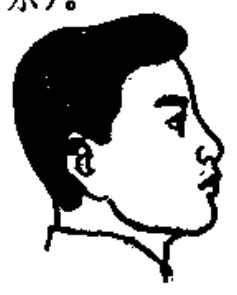
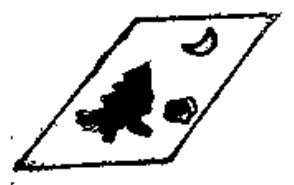
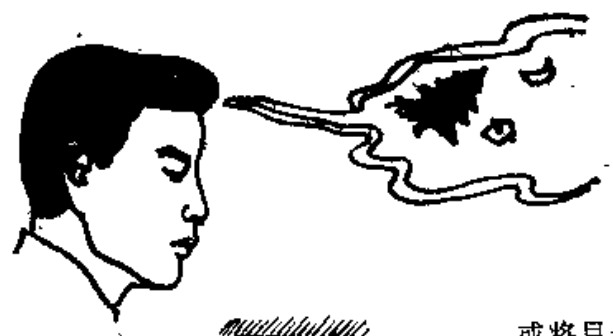
Take a glance at the graphic or card. Quickly close your eyes, and try your best to make the graphic or number on the card appear in your mind. Or shift your gaze to a dark place, and make the graphic or number on the card appear before your R eyes. Figure 8 15
(3) Visualize a Buddha statue. Place a painted or sculpted image of a Buddha in front of you. After focusing on it for a moment, close your eyes and visualize it. At first, you may only be able to form a rough outline of the Buddha statue in your mind, but after repeated training, you will be able to accurately reflect the shape, expression, and color of the Buddha statue in your mind (as shown in Figure 9).
a Figure 9: Visualizing a Buddha statue
(4) You should not only visualize Buddha statues, but you can also visualize all objects around you. Over time, your brain will be able to immediately and completely reflect the images of all objects.
(5) Imagination training. When there is no object to visualize before your eyes, you close your 58
Close your eyes and silently visualize an object you have seen in the past, striving to form a complete and clear image in your mind. If you cannot picture it, you may find the actual object, look at it for a while, and then put it away and meditate on it again after an interval. At first, the interval can be relatively short, and then slowly lengthened over time. If you can quickly and faithfully bring to mind the image of any object whenever someone asks you to visualize something, then your external-scene thought-power training is basically successful.
There are many specialized methods for internal-scene thought power. Below, a few simple and easy-to-practice methods are introduced for readers’ reference:
Method 1: Sweet Dew Washing the Marrow.
It is best to choose the Zi hour (11:00 PM – 1:00 AM) to practice. First, sit in meditation and enter a state of tranquility. Imagine that you are ten thousand zhang tall, standing upright between heaven and earth, sitting on the ground, with your whole body emitting white light. Next, imagine that a sweet dew fragrant spring deep within the earth’s crust shoots directly into the Huiyin acupoint, ascends through the central channel to the top of your head, and then spurts out from the Baihui acupoint. This sweet dew falls slowly and gently all around your skin like a fountain. At this time, you should feel your whole body become transparent, with your bones, internal organs, meridians, and acupoints clearly distinguished, while simultaneously feeling your whole body cool, comfortable, and overflowing with fragrance. Practice for 30 minutes before concluding. Rub both hands together until warm, use both hands to “dry wash” your face, then pat your head, chest, back, and waist, stand up and walk around for a moment (see Figure 10).
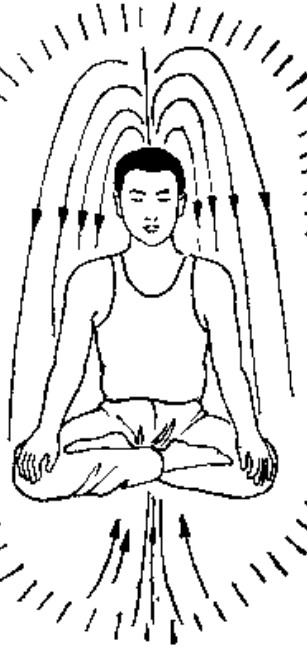
Figure 10: Sweet Dew Washing the Marrow
59
Method 2: Rotating the Central Channel.
It is best to practice in the early morning, either by standing in stance (Zhan Zhuang) or sitting in meditation. Imagine that the central channel is like a fluorescent tube, emitting white light, illuminating the whole body, exquisitely translucent, and harmoniously integrated throughout. Imagine a Qi energy from the earth’s root deep in the earth’s crust spiraling at high speed (rotating to the right) into the Huiyin acupoint, passing through the central channel, exiting at the Baihui acupoint, and shooting straight up into the infinite sky. Then, imagine an energy from the heaven’s root spiraling at high speed (rotating to the right) into the Baihui acupoint, passing through the central channel, exiting at the Huiyin acupoint, and shooting straight down into the deep earth’s crust. Practice this repeatedly for 30 minutes before concluding. The concluding method is the same as the previous method. Note that the heaven’s root Qi is a yang and firm energy, red in color and warm; the earth’s root Qi is a yin and soft energy, cool and white in color (see Figure 11).
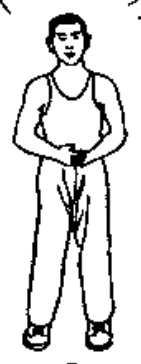
Heaven’s root Qi Earth’s root Qi Figure 11: Rotating the Central Channel
Method 3: Welcoming Fragrance from a Thousand Miles.
It can be practiced at any time, regardless of the hour. Sit in meditation to enter tranquility, and focus your intention on the Yingxiang acupoint. Imagine that two dragon whiskers grow from the Yingxiang acupoint, and that the whiskers touch various scented objects in the room, such as fruits and candies. Inhale in short, continuous bursts through the nostrils, using your mental focus to perceive the scent of the objects.
60
Once successful, you can gradually increase the distance between you and the objects, from a few meters to dozens of meters, hundreds of meters, thousands of meters, and even infinitely far. If you can smell the scent of objects from a long distance or an ultra-long distance, this olfactory thought-power method is considered mastered (see Figure 12).
Method 4: The Raging Sea.
This method can be practiced at any time, with no required posture; walking, standing, sitting, or lying down are all acceptable. Close your eyes, enter tranquility, and imagine that the left and right hemispheres of your brain are incredibly vast, like oceans. The waves (brain Qi) of the left brain crash into the right brain accompanied by the sound of surging waves, and the waves (brain Qi) of the right brain crash into the left brain accompanied by the sound of surging waves. Practice in this manner for about 30 minutes before concluding. The concluding method is the same as Method 1. Once this method is mastered, you can use mental focus to control others (see Figure 13).
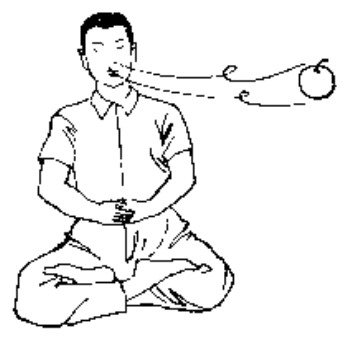
Figure 12: Welcoming Fragrance from a Thousand Miles
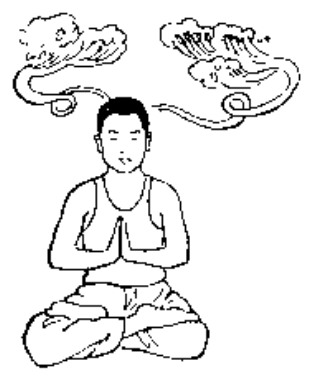
Method 5: The Precious Mirror of Romance.
This method was originally published in Huitong Dantian Qigong and Its Principle of Remote Sensing Disease Healing, and is transcribed as follows:
(1) Stand in whichever posture feels most free and comfortable to you. Slowly close your eyes, press your tongue against the roof of your mouth, and relax your entire body as much as possible. Recite the mantra “Nuo, Ni, Tou” for one minute.
Figure 13: The Raging Sea
(2) Feel your feet. Begin with the sensation in the soles of both feet, then sequentially feel your ankles and toes. During the process of visualization and sensation, imagine that the muscles, blood vessels, and other tissues of your feet have disappeared, leaving only the bones. In this form, experience the pressure in your feet as entirely concentrated on the foot bones.
61
(3) Relax both eyes, look internally at the Shan Gen (the position at the center between the eyes), and visualize a field of red in front of you. Within this red, the shape of your foot bones appears (see Figure 14-1).
(4) Just as in (2), now visualize that the muscles in areas such as your knees, lower legs, and feet gradually disappear, leaving only the bones.
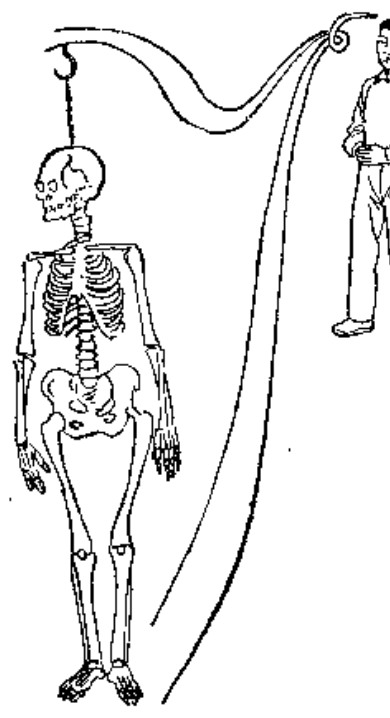
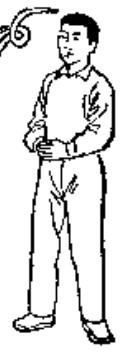
(5) Visualize that the muscles in areas such as your waist, abdomen, legs, and feet have disappeared, leaving only the bones.
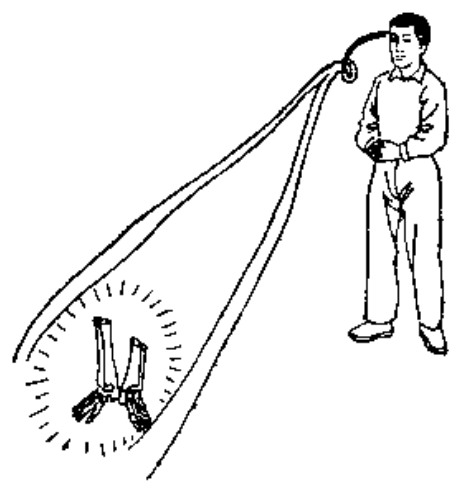
(6) Starting from the tailbone, move upward along the spine, visualizing one bone joint at a time. Visualize the entire spinal column, chest bone, ribs, shoulder blades, collar…
Figure 14-1: The Precious Mirror of Romance Figure 14-2: The Precious Mirror of Romance
62
bones, neck bones, upper arm bones, elbow joints, forearm bones, wrists, palm bones, and finger bones. The muscles, internal swellings, and organs in these areas all disappear, leaving only the bones.
(7) Visualize the head. First, visualize the entire skull and the cavity it forms. Then visualize one by one the lower jawbone, upper jawbone, teeth, nasal cavity, eye sockets, and so on. Imagine that all the muscles and organs in these areas have completely disappeared, leaving only the bones.
(8) Visualize a rope threaded through the skull, suspending the entire body’s skeleton from the Baihui point. As the skeleton is lifted, each bone is drawn upward from top to bottom, until finally the entire body’s skeletal frame is suspended (see Figure 14-2).
(9) Imagine that when you inhale, qi enters the skeletal frame from the lower part of the chest cavity, the ribs begin to expand, and qi fills the chest cavity. When you exhale, the ribs contract, the chest cavity shrinks, and qi is expelled from the lower part of the chest cavity. Repeat this breathing for five minutes, then conclude the practice. The method of concluding is the same as in Method One. Note: Your intention should be placed on the movement of the skeletal frame, that is, on the expansion and contraction of the ribs and chest cavity, not on the actual breathing.
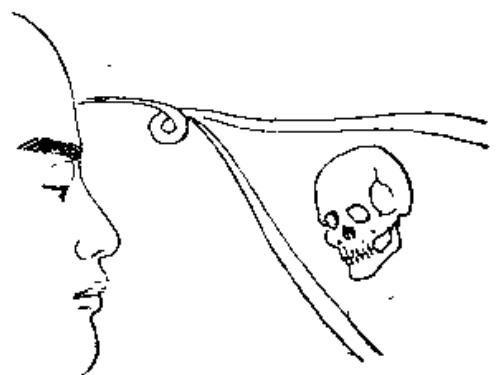
Method Six: The Wind-and-Moon Precious Mirror — Cranial Cavity Expansion and Contraction Method.
On the basis of the above training methods, practice this method.
(1) Using the visualization from the previous method, imagine the entire body’s skeleton being suspended.
(2) Look inward, reflect, and feel that your skull is like a large rubber ball, very
—7—
Figure 15: The Wind-and-Moon Precious Mirror — Cranial Cavity Expansion and Contraction Method
63
elastic, with a large cavity in the middle (see Figure 15).
(3) Visualize the skull expanding, the cavity enlarging. Qi rises from deep within the earth, passing through the heels, leg bones, and spinal vertebrae to reach the cranial cavity.
(4) Visualize the cranial cavity contracting. Qi is squeezed out from the cranial cavity, passing through the spine, leg bones, and heels to be released into the ground.
(5) Repeat continuously for ten minutes, then conclude the practice. The method of concluding is the same as in Method One.
Note: When practicing Methods Five and Six, you may place a diagram of the human skeletal structure in front of you to assist in visualizing the internal imagery.
The above is the first pathway of intention-power training — the dedicated cultivation method for intention power.
The second pathway of intention-power training is the integration of intention-power training with established qigong routines. This pathway is as follows: rather than providing dedicated time and methods for intention-power training, one achieves the goal of intention-power training as a by-product while practicing qigong for other purposes. You may practice qigong for health or to treat a certain illness, but you might as well select those methods that have a stronger effect on intention-power training. This
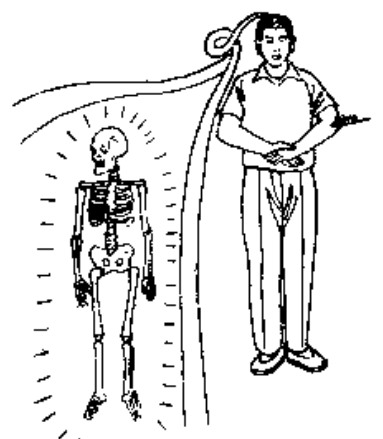
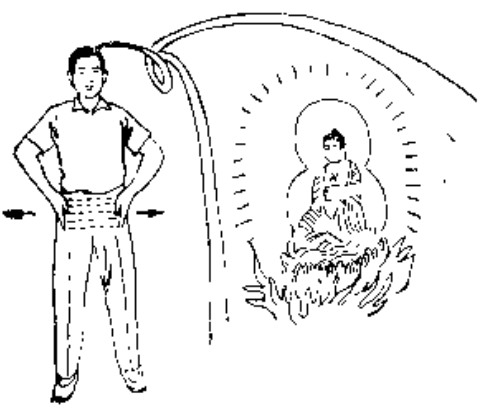
Figure 16: Ten Thousand Dharmas Return to One Qigong, First Section
Figure 17: Ten Thousand Dharmas Return to One Qigong, Second Section
“Buddha Lotus Method” — Visualize a ball of fire in the Qi Sea; within the fire sits a Buddha on a lotus, radiating white light.
“Penetration Method” — Visualize the white light before your eyes merging with the Buddha light in the Qi Sea, illuminating all the bones of your body.
64
Figure 18: Ten Thousand Dharmas Return to One Qigong, Third Section
Figure 19: Ten Thousand Dharmas Return to One Qigong, Fourth Section
“Opening the Heavenly Gate” — Right palm facing the Shenque point, back of the left hand facing the Mingmen point, with both hands about one inch from the body, using inner strength. Swap hands approximately every five minutes. Visualize the white light before your eyes merging with the Buddha light in the Qi Sea, illuminating your skull.
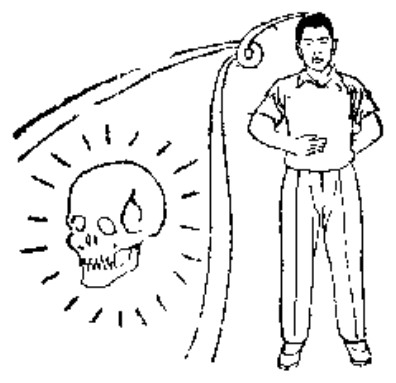
“Great Penetration Method” — Hands joined together in front of the chest, with the third segments of the middle fingers of both hands protruding and pressing against each other with force, fingertips spread apart. Eyes slightly closed, silently reciting a mantra.
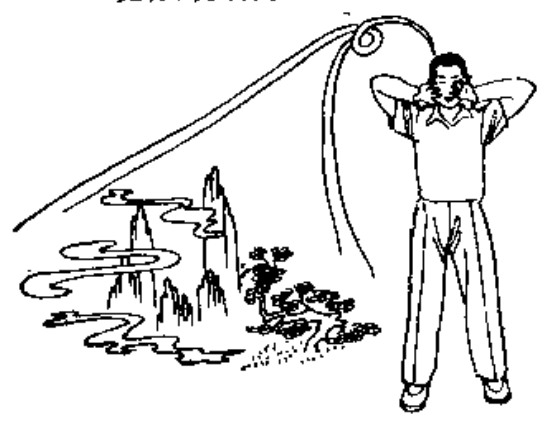
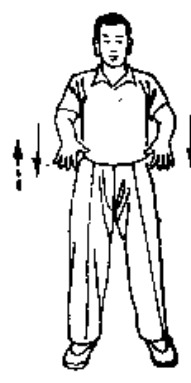
Figure 20: Ten Thousand Dharmas Return to One Qigong, Fifth Section
Figure 21: Ten Thousand Dharmas Return to One Qigong, Sixth Section
“Buddha’s Footstep Method” — Visualize opening your Yintang point and clearing the clouds and mist before your eyes. At this point, you see the mountains and rivers of your homeland.
“Ascent to Heaven Method” — Hands on both sides of the body, palms facing down, slowly raised, performing a pressing-down motion. Visualize that each time your hands press down, you ascend one level of heaven. After pressing down thirty-six times, you have ascended thirty-six levels of heaven.
65
This way, you can achieve multiple benefits at once. For example, the Buddhist qigong method “Ten Thousand Dharmas Return to One” (Wanfa Guiyi Gong), promoted by Qigong Master Zhang Xiaoping, is primarily designed to train the brain’s visualization ability (see Figures 16, 17, 18, 19, 20, 21, 22, and 23).
Figure 22: Ten Thousand Dharmas Return to One Qigong, Seventh Section
Figure 23: Ten Thousand Dharmas Return to One Qigong, Eighth Section
“Obtaining the Dharma Method” — Stand naturally, eyes slightly closed, hands joined in front of the chest, then push the palms outward to the left, right, and upward respectively. Visualize pushing away things you cannot see clearly. At this point, you can see clearly above, below, left, and right, and you are overjoyed. You can see whatever you wish and behold the scenes of the human world you hope to see.
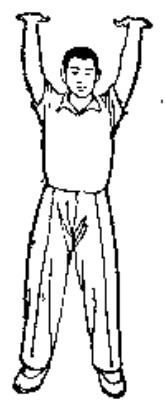
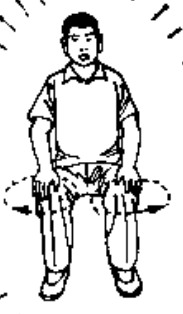
“Buddha Light True Fruit Method” — Your body emits ten thousand rays of golden light, and the light generates heat. Perform a squatting motion, hands apart, palms facing down. Draw circles with both hands in front of the knees.
In addition to the methods introduced above, there are of course many other methods that are helpful for intention-power training. It can be said that almost all Esoteric Buddhist (Vajrayāna) methods are advanced intention-power qigong. However, Esoteric Buddhist methods are very difficult to practice well for those without a deep foundation in qigong. Moreover, to grasp the essence of Esoteric Buddhist methods, one must receive instruction and initiation from a qualified guru (vajrācārya). Otherwise, not only will one fail to learn true skills, but deviations may also occur.
The third pathway of intention-power training is to integrate intention-power training with daily life, study, and work. Specifically, in daily life, study, and work, every time you see an object, close your eyes and recall its form, trying your best to do so in your
66
a clear and complete image of that object will remain in your mind. With prolonged training in this way, your mental power will naturally improve. The advantage of this method of training mental power is that it saves time.
Section 3
Fasting and Bigu (Avoiding Grains)
So-called fasting refers to the practice during qigong cultivation of voluntarily reducing food intake or temporarily ceasing to eat, in accordance with certain conditions. So-called bigu (避穀, “avoiding grains”) refers to the spontaneous phenomenon during qigong cultivation in which one no longer desires food and ceases eating. Whether it is deliberate fasting or spontaneous bigu, both are beneficial to human health and necessary for the development of special abilities and supernatural powers. This is because:
(1) [Fasting and bigu promote the body’s detoxification and transformation.] For during the process of putrefaction of food within the body, a portion is converted into nutrients needed by the human body to maintain the metabolism of the organism, but on the other hand, it also produces large quantities of toxins that poison the body, especially poisoning the internal organs and the nervous system, promoting premature death of cells and dysfunction of the nervous system. Daoism calls the toxins produced during the putrefaction of food the “Three Worms” (三蟲) of the human body: “The first is the upper worm residing in the brain palace, the second is the middle worm dwelling in the Mingxing, the third is the lower worm residing in the abdomen and stomach.” It holds that the Three Worms are the root cause of human desires, the evil demons that poison the human body, and the material basis for qigong deviations (走火入魔). If a person does not eat the five grains and meats, cutting off the qi of grains, then the Three Worms cannot survive. “Once the Three Worms perish, there will never again be anxious thoughts,” and a person can achieve a pure heart and few desires, reaching the advanced qigong state of extraordinary spiritual refinement.
(2) Fasting and bigu change the body’s existing habits of life, forcing the organism to undergo physiological and psychological changes, especially forcing each cell to change its existing mode of survival, partially restoring the life functions of the single-cell state, enhancing the cell’s life field and its sensitivity to the external world, thereby activating latent special abilities of the
67
human body.
(3) For the organism to manifest special abilities and supernatural powers, qigong must be cultivated to a state of deep tranquility. The ancients said: minor meditation [requires entering samadhi for] one day, medium meditation three days, great meditation seven days. When entering samadhi (入定), the human body enters a state of suspended breathing and suspended pulse. At that time, of course, no eating or drinking activity is possible. If one does not normally practice fasting and bigu, entering samadhi suddenly will endanger one’s life.
Regarding fasting and bigu, some people may raise the following question: human survival requires an energy supply, and for most people, the energy source for the body’s activities mainly depends on food. Fasting and bigu cut off the body’s energy source and would only endanger the organism’s existence—how could they instead promote the development of human special abilities and supernatural powers?
This question is not difficult to answer. We believe that fasting and bigu will not affect human survival and health, because: First, fasting and bigu are not absolute, permanent, or unconditional, but rather relative, temporary, and conditional. During the course of practice, the human body will produce a very natural urge to not desire food. This shows that the body’s energy reserves exceed its energy expenditure, and food intake can be temporarily suspended. Practitioners should seize this opportunity to carry out fasting and bigu. When the body once again produces a sensation of hunger, fasting and bigu should be stopped. Moreover, bigu can be divided into three situations: in some cases of bigu, one merely refrains from eating the five grains and meats, while fruit, tonics, and water are still not restricted. Second, from a nutritional perspective, the nutrients contained in the food people eat are not fully absorbed by the human body; rather, the greater part is wasted. Those undigested foods that remain in the body for extended periods will turn into “stagnant feces” (宿便). Stagnant feces are highly harmful to the human body. A person well-trained in qigong will have all aspects of bodily function strengthened, not only digesting food more thoroughly and absorbing its nutrients more fully, but also more effectively reducing physical energy expenditure and greatly improving the body’s energy utilization rate. In this way, a person no longer needs to eat so much food,
68
and therefore it becomes both necessary and possible to carry out moderate fasting and bigu. Third, one cannot assume that the energy required by the human body comes solely from food. In fact, under an advanced qigong state, a person can directly absorb energy from the cosmos.
Fasting and bigu are relatively original methods in Chinese qigong, derived from the initial School of Ingesting Substances (服餌派) that sought the elixir of immortality. Shengji Zonglu (《圣济总录·神仙服饵门》, Comprehensive Record of Sacred Relief — Gate of Divine Ingestion), Huatuo Shenyi Mizhuan (《华佗神医秘传》, Secret Transmission of the Divine Physician Hua Tuo), Beiji Qianjin Yaofang (《备急千金要方》, Essential Prescriptions Worth a Thousand in Gold for Emergencies), Qianjin Yifang (《千金翼方》, Supplement to the Prescriptions Worth a Thousand in Gold), and Dongyi Baojian (《东医宝鉴》, Precious Mirror of Eastern Medicine) all contain dedicated discussions of this. The ancients believed that ingesting rare and pure fragrant substances such as zhi (芝, lingzhi mushroom), jade, chrysanthemum, and zhu (术, Atractylodes) could eliminate impurities and lighten the body. They further thought of qi, which is even more ethereal, and thus arose the art of ingesting qi and avoiding grains (服气辟谷), believing that ingesting qi and practicing bigu could lead to immortality and the attainment of the Dao. From the pre-Qin period to the Han dynasty, among the fangshi (方士, alchemists), a belief formed: “Those who eat water are good swimmers but feel cold; those who eat earth have no heart yet do not cease; those who eat wood are strong but stubborn; those who eat grass run well but are foolish; those who eat mulberry leaves produce silk and become moths; those who eat meat are brave and fierce; those who eat grains are wise and skillful; those who eat qi are divine and long-lived; those who eat nothing are immortal and divine.” (Da Dai Liji · Yibenming, 《大戴礼记·易本命》) “If you wish for long life, keep the belly clear; if you wish for immortality, let the belly be free of residue.” (Huainanzi, 《淮南子》) The pre-Qin fangshi also imitated the lifestyle of the divine person of Guyao described by Zhuangzi, who “ate no five grains but inhaled the wind and drank the dew.” Later, through the advocacy of Zhang Liang in the early Han dynasty, the arts of bigu and qi ingestion became part of qigong practitioners’ training.
From ancient times to the present, every dynasty has had those who achieved longevity through bigu and qi ingestion. Zhang Liang of the Han dynasty practiced bigu for over a year in his later years; the Shiji · Liuhou Shijia (《史记·留侯世家》, Records of the Grand Historian — Hereditary House of the Marquis of Liu) records that he “then studied bigu and daoyin (道引, guided stretching) for lightness.” Li Bi (李泌), the friend and teacher of Emperor Suzong of the Tang dynasty and a meritorious official who quelled the An Lushan Rebellion, was also able to “abstain from grain” (绝粒). The Jiu Tangshu (《旧唐书》, Old Book of Tang) records that he “then retired to Mount Heng, abstaining from grain and dwelling in spirit,” and the duration of his bigu was quite long. The Nanyue Zhi · Ye Hou Waizhuan (《南岳志·邺侯外传》, Gazetteer of the Southern Peak — Unofficial Biography of the Lord of Ye) says of him: “In the eighth year of Tianbao, at the home of his cousin Zheng Quanhe, he had already abstained from grain for many years; his body was so light he could walk on a folding screen.” Ge Hong of the Wei-Jin era, in Baopuzi · Neipian · Zaying (《抱朴子·内篇·杂应》, The Master Who Embraces Simplicity — Inner Chapters · Miscellaneous Responses), enumerated many Daoist priests who practiced bigu and qi-ingestion arts. He said: “I have repeatedly seen people who abstain from grains for two or three years; they are all light in body and good in complexion, able to endure wind, cold, heat, and dampness—though mostly none of them are fat.” Among them “there was one named Feng Sheng,
69
“He simply swallowed qi, and had abstained from grain for three years. Observing him climbing steep mountains with steps, carrying a load of about one hu, he was never tired all day. He also sometimes drew a bow, but spoke very little, and when he did speak, he was unwilling to raise his voice. When asked about this, he said, ‘Abstaining from grain depletes essence and wastes qi; this is the greatest taboo.‘” Recently, during the qigong craze in our country, quite a few people have experienced the phenomenon of bigu (abstaining from grain). Chen Baoquan, a teacher at the Technician School of the Jiangsu Yizheng Chemical Fiber Joint Company, did not eat any food for 18 consecutive days from July 16 to August 2, 1988. Every day, he only drank two bowls of boiled water with a spoonful of honey. During this period, all his activities proceeded as usual. On the 12th day of bigu, he went to the hospital for a physical examination. Apart from a weight loss of 5 jin, his other physiological indicators were all normal. Bigu caused a lock of white hair on his forehead to start turning black, and his sinusitis, which he had suffered from for nearly 40 years, was basically cured. Song Jinxiang, a qigong enthusiast from Xiangtan, Hunan, practiced bigu and consuming qi for a period of 9 days, from March 28 to April 5, 1988. During this time, he insisted on practicing qigong 4 times a day, each session lasting half an hour to 1 hour. He drank water 3 times a day, ate no food, and went to work as usual. On the 6th day of bigu, while practicing the Empty Force Standing Stake (Kongjin zhanzhuang) exercise, he practiced once for 75 minutes. Not only was he not fatigued, but as he continued practicing, his stance got lower and lower, his internal qi became abundant, and the connection between internal and external qi significantly strengthened. The 9 days of bigu only reduced his weight by 7 jin, and his other physical fitness indicators (pulse, blood pressure, blood test, physiological functions, etc.) showed no obvious changes. In Liaoning Province, there was a 71-year-old woman named Jiang Zongqin who had been practicing qigong for over 20 years. After listening to an empowered lecture by Yan Xin on April 4, 1987, she exhibited the phenomenon of bigu. From April 4 to April 30, she did not eat a single grain of food for 26 days. Sometimes she only drank a few sips of water to moisten her throat, and all activities remained normal during bigu. Daoist Master Shi Zhiyun, the 21st-generation transmitter of the Longmen sect of Daoism in Gansu Province, is now 79 years old and has abstained from grains for 7 years. His disciple, Zhang Xianyu, female, 53 years old, has abstained for 10 years. Every day, the two of them only consume a few self-made pills and a small amount of dried fruit.
The above facts show that fasting and bigu objectively exist, and they are closely related to qigong cultivation. Through bigu, one can make the body feel light and refreshed, the inner mind tranquil, and stimulate special abilities.
70
Qigong Master Zhao Jinxiang believes that the process of bigu can generally be divided into three stages: the preparatory stage, the intermediate fasting stage, and the final concluding stage.
The main reactions in the preparatory stage include: changes in dietary habits. Not wanting to eat foods usually liked, or a noticeable reduction in food intake; belching after meals. Sometimes there is an unusual sensation in the throat area, feeling like something cannot be spit out or swallowed down. This is because the internal qi mechanism is not yet coordinated enough, which is different from a pathological reaction in that area; there is no sensation of choking or pain in the throat. After meals, the qi mechanism in the abdominal cavity is very active, continuously producing bowel sounds and flatulence, with a feeling of hunger, but being unable to eat.
The main reactions in the intermediate fasting stage: No desire for food or drink, no feeling of hunger, or only eating fruits and drinking a little boiled water, but the body feels light and energetic, and one can still engage in normal physical and mental labor. Spontaneous qigong (zifa gong) occurs intermittently, and the sensation of qi is particularly strong. Sleeping very little, or always being in a state of half-asleep. The frequency of urination and defecation is significantly reduced, or one may not pass urine or stool for many days. Some people remain in a qigong state all day, continuously experiencing wonderful hallucinations. Some people, along with bigu, find their skills constantly improving, their complexion rosy, their weight not decreasing, or although their weight decreases, their spirit gets better and better.
Reactions in the concluding stage: The feeling of hunger gradually returns; some people suddenly become extremely hungry and want to eat. At this time, one should not immediately resume a normal diet, but should first eat a small amount of thin, easily digestible food, slowly increasing the amount of food until returning to a normal diet.
There are many specific methods for fasting and bigu. According to the famous Daoist representative figure of the Jin Dynasty, Ge Hong, regarding bigu: “There are recently about a hundred methods. Some take dozens of pills of mineral medicines to guard the center, and they can abstain from grain for forty to fifty days without hunger. Refining pine and cypress and atractylodes (zhu) can also guard the center, but it is not as good as the Great Medicine, generally not exceeding ten years. Some abstain for one or two hundred days, or must take it daily to avoid hunger. Or first eat a delicious meal until extremely full, and then take medicine to nourish the eaten food so that it is not digested, allowing one to abstain for three years. If one wishes to return to eating grain, one should take mallow seeds and pig fat to purge it, and the delicious food made will be purged out, undamaged as before.”
71
Fasting and bigu are usually always combined with consuming qi. The following introduces several ancient methods for bigu and consuming qi:
Method 1: The posture is not limited, to the degree of comfort. Place the tongue against the upper palate, close the eyes slightly, relax the whole body, and eliminate distracting thoughts. Breathe in through the mouth, taking 3 mouthfuls of air in succession, just like eating. At the same time, lift the anus and perineum, and swallow the qi into the Dantian with your intention. Hold the breath for a moment, and slowly exhale through the mouth. As your skill grows, gradually increase the number of times you consume qi, eventually increasing to about 500 to 1,000 mouthfuls of qi in succession. The best time to practice is during the Yin hour (3:00 AM - 5:00 AM), and the practice location should be chosen where the air is fresh and trees and plants are lush. Start practicing for 5 to 10 minutes, gradually increasing to 30 minutes.
Method 2: Basically the same as Method 1, except that after swallowing qi 36 times, use your intention to transport the qi from the Dantian to the area between the Naohu and Tianmu acupoints. Then imagine the qi rotating around the head 36 times to the left, and then 36 times to the right. Focus your intention on the area between the Naohu and Tianmu acupoints for 10 to 30 minutes. This method is easy to practice on an empty stomach before meals, practicing for 10 to 30 minutes each time. It is forbidden for those with high blood pressure.
Method 3: Choose a quiet fasting room as a practice venue. When practicing, sit in the full lotus posture, and imagine the sun and moon in the mouth, as large as a ring; imagine the sun is red, with 9 rays of purple light. The moon is yellow, with 10 rays of white light. Then swallow the light and saliva; or imagine the sun and moon on your own face, the sun on the left and the moon on the right, allowing the image of the sun and moon to connect with the qi of the pupils of your eyes.
Although there are many methods for bigu, the general principle is a passage spoken by Qigong Master Yan Xin: “If you are not hungry and do not want to eat, then do not eat, without any hesitation, not the opposite.”
When practicing bigu, the following points should be noted:
(1) The occurrence of bigu during the practice process is a normal and good phenomenon. Do not panic; let everything take its natural course.
72
(2) When you feel weak and sore, you may appropriately consume a little fruit, diluted milk, brown sugar water, etc. (3) You should clearly explain to family members and relatives and friends around you that this is a qi-transformation reaction from practice, and is a normal phenomenon; they should not urge you to eat. (4) During the Bigu (inedia) period, you should strengthen your practice in order to absorb the primordial qi (yuanqi) of the universe and nourish yourself. (5) Hold fast to Great Harmony (Taihe) and remain composed. You should remain in a state of friendliness and harmony, neither anxious nor irritable, and unaffected by any interference. (6) During the period when appetite returns, you should first drink a small amount of liquid food, then switch to semi-liquid food, and then resume normal eating. (7) Artificial fasting can only be short-term. Bigu is a phenomenon that arises naturally during practice; its duration should be left to take its own course. (8) There is a difference between Bigu and the pathological state of loss of appetite. The distinguishing sign is that Bigu makes a person increasingly energetic, whereas the pathological loss of appetite produces the opposite effect. 73
Chapter Three
Intensive Cultivation of Special Abilities and Supernatural Powers
For many years, the Chinese national football team has never been able to break out of Asia and conquer the world football arena. Apart from a naturally poorer physical constitution, the main reason lies in mistakes in training methods. Recently, a foreign coach was hired to lead the team. After investigating our original training methods, he pointed out that the fundamental flaw in our football training was insufficient intensity. In the past, the total daily training volume of the Chinese national football team was still quite large and no less than that of the world’s football powerhouses today. However, the training volume per unit of time was not large, and the players were not trained at the intensity of fierce competition in actual matches. Therefore, once it came to actual matches, the Chinese national football team appeared slack and lacked stamina, and had to resign itself to conceding defeat when playing against strong teams.
The cultivation of special abilities and supernatural powers shares certain common principles with football training. In addition to requiring persistent foundational training, one must also, after establishing a certain foundation, undergo intensive training in pursuit of a qualitative breakthrough. It can be said that those who have not undergone intensive cultivation will find it very difficult to acquire special abilities, and especially difficult to attain supernatural powers.
Section One
Subjective and Objective Conditions for Intensive Cultivation
In China, since ancient times, those in the martial arts and qigong communities who cultivate superior methods have regularly undertaken intensive cultivation. This is what is known as “retreat” (biguan). Some retreat for several months, while others retreat for several years. Some retreat only once in their lives. Some retreat multiple times in their lives. This depends on what kind of skill is being cultivated and how many kinds of skills are being cultivated. Whether viewed from the overall perspective of developing special abilities or from the perspective of training in a particular skill alone, one must undergo intensive cultivation in order to have any possibility of achieving high-level skills and great supernatural powers. 1
Intensive cultivation is extremely arduous. In Tibet, there is a method of practice known as the “retreat cell” (guanfang), which is extremely similar to the Han Chinese practice of retreat. Specifically, a sealed small hut is selected in a secluded location deep in the mountains, with very thick walls to prevent sound from penetrating. When the practitioner enters the retreat, the entrance is immediately sealed. Inside the “retreat cell” there is not a ray of light and no furniture whatsoever; there is only an empty room. Food is delivered through a window designed to block sound and light, once a day. The practitioner retreats within, cultivating with a tranquil mind, for a minimum of 3 years, 3 months, and 3 days. Just imagine—this kind of monotonous and rigorous practice is very difficult for an ordinary person to endure. Thus the ancients said that there are Eight Difficulties and Nine Afflictions in studying the Way. The Eight Difficulties are: (1) not abandoning the resolve for the Way; (2) not seeking an enlightened teacher; (3) not settling in a secluded dwelling; (4) not relinquishing worldly affairs; (5) not severing emotional attachments; (6) not giving up profit and desire; (7) not eliminating joy and anger; (8) not cutting off sensual desire. The Nine Afflictions are: (1) having resolve but no opportunity; (2) having opportunity but no companion; (3) having companion but no resolve; (4) having resolve but no teacher; (5) encountering a teacher but not recognizing them; (6) recognizing them but not being diligent; (7) being diligent but not holding to the Way; (8) establishing resolve but not comprehensively; (9) being firm but not enduring. Studying the Way is this difficult, which is why among those in the world who study the Way, they are as numerous as ox hairs, while those who attain the Way are as rare as phoenix feathers and unicorn horns. If this is so even for learning ordinary qigong and martial arts, then it goes without saying even more so for cultivating special abilities and supernatural powers.
To acquire special abilities and supernatural powers, one must undergo intensive cultivation. And to carry out intensive cultivation, one must possess certain subjective and objective conditions.
The ancients said that to study the Great Way, one must have “method, companion, wealth, and place.” Today we should add the word “time,” making for a total of five objective conditions: “method, companion, wealth, place, and time.” 75
The first condition, “method,” means having a correct method of cultivation. The Laozi Xiang’er Zhu (Commentary on Laozi by Xiang’er) states: “When the true Way is hidden, false texts emerge. In the world there are always fraudulent techniques claiming to be Daoist teachings; all are great deceptions, abandoning the correct to follow the crooked path, desiring speed but obstructed and blocked.”
The conservatism of small-scale production in ancient Chinese society gave rise, since ancient times, to a special system of secret master-disciple transmission in the manner of transmitting the Way. To transmit the Way, one must set up an altar and swear an oath. The key incantations, techniques, and secret formulas were not written in books for external transmission, but were transmitted orally from master to disciple. As the Jin Dynasty alchemist Ge Hong said: “The most true esoteric instructions are either transmitted orally, or contained in no more than a few feet of silk, kept concealed upon one’s person. Only by following a master for a long time, through accumulated diligence and repeated trials, can one obtain them.” This is to say, to learn true and high-level skills, one must have the guidance of a renowned master. Han Yu once said: “In every craft and profession, there are those who specialize in particular areas.” Therefore, in learning any art or skill, one should choose a renowned master with specialized and uniquely accomplished skill. Although the disciples of renowned masters are not necessarily always outstanding, following a famous master at least ensures that one will not be led in the wrong direction or taught incorrect essentials. This is certainly safer than the so-called “blind leading the blind.”
This raises the question of how to identify a renowned master and how to find one. Who is a renowned master? People often have no way of knowing. This is especially true for those who have not yet entered the gateway of qigong skill—they are even less able to judge who is a renowned master, who is a mediocre teacher, and who is a fraud. When one is unable to clearly distinguish who is a renowned master, following one who has been publicly acknowledged by the masses as a renowned master is comparatively safe. Alternatively, being introduced by an already-established teacher to one who has not yet become famous is also relatively reliable. And being introduced by a renowned master you trust to another renowned master is also a viable approach.
qigong places great emphasis on virtue; morality and skill are twin brothers. The Buddhist Dharma holds that only by observing the precepts can one enter samadhi (meditative concentration), and only from samadhi can wisdom arise. A person who does not observe the precepts and is heavily afflicted by greed, anger, and ignorance will find it difficult to enter samadhi. Even if they do enter samadhi, they will suffer from zouhuo rumo (fire deviation and demonic possession). How then could they cultivate the Five Eyes and Six Abhinñas (supernatural powers)? Therefore, a person without morality cannot possibly cultivate high-level skills. To judge: 76
Whether a person possesses high-level skill and genuine ability can be seen at a glance simply by examining their moral outlook on life. Anyone burdened with intense greed or lust; anyone who pursues money and reeks of the stench of commerce; anyone who mistreats their parents, bullies the weak, tyrannizes their locality, and lacks all sense of shame; anyone who is frivolous, arrogant, and talks recklessly; anyone who flouts Party discipline and national laws and acts lawlessly — none of such people can possibly possess genuine ability or high-level skill, and therefore absolutely cannot be a renowned master.
As the common saying goes, practice is the sole criterion for testing truth. Whether a person has high-level skill and genuine ability does not depend on how they or others boast, but on practice. Just let them display a bit of supernatural power and show a trick or two for everyone to see, and all questions are resolved. If someone who calls themselves a master is always unwilling to demonstrate some ability for everyone to see, and hides and dodges, then it is best to stay far away from them so as to avoid being deceived.
Renowned masters in the world have always been few, and finding one naturally becomes all the more difficult. Those whose skill is high and whose virtue is deep do not seek fame or profit; they live in seclusion in deep mountains or hide among the common crowds of the marketplace, making them very hard for people to recognize. Yet anyone who has learned a skill does so in order to use it, and generally speaking will not shelve the ability they painstakingly acquired and trained. Once an ability is used, its true nature will inevitably be recognized by people, so renowned masters will always emerge into the world and can always be found. The key lies in having a sincere heart. Nothing in the world is difficult for a determined person. A sincere heart can move Heaven, and naturally it can also move a renowned master.
In searching for a renowned master, the first requirement is to actually search. You must go out and visit everywhere. Old Man Qianfeng, Zhao Bichen, the author of Mingzhi Directive Methods of Inner Nature and Life (Xingming Fajue Mingzhi), once took many masters as his teachers. He said: “Those who seek the true Way will not succeed by seeking only one master; one must seek multiple masters and cross-verify with each other, otherwise one cannot distinguish true from false. I sought over thirty masters, and among those who knew the dual cultivation of inner nature and life (xingming shuangxiu), there were only five or six.” This experience tells us that only by going out and, through the process of taking masters and studying the Way, making comparisons, can one find a renowned master.
Besides seeking a master oneself, the second path is to wait for a renowned master to come and find you. Yan Xin said it well: “In high-level skill, it is not the disciple who finds the master; it is often the master who finds the
77
disciple.” These words hold a certain truth. First of all, not just anyone can cultivate high-level skill. Those who cultivate high-level skill must: first, possess virtue; second, have good physical constitution; and third, possess the perseverance and patience to endure great hardship over a long period. Therefore, among the many people who study the Way, when a high-level master takes on disciples, he must certainly choose carefully. Secondly, a high-level master is also human and also experiences birth, aging, illness, and death. His skill must have a reliable successor. Therefore, a high-level master always seeks and selects a direct lineage disciple (dichuan dizi) as early as possible. All those who wish to study under a renowned master should actively cultivate the following conditions: (1) possess good moral cultivation; (2) possess firm determination to study the Way; (3) possess the perseverance to train diligently.
The second objective condition for studying the Way is “companion” (lü), that is, fellow practitioners. To cultivate advanced skills and develop special abilities and supernatural powers, it is impossible to do without the companionship of like-minded fellow practitioners of comparable skill. As the proverb says, “The master leads you through the gate; cultivation depends on the individual.” A master cannot accompany you all day long as you train. It is your fellow disciples who truly accompany you at all times in your training and in exchanging and honing techniques. Moreover, when qigong is cultivated to a high level — such as circulating the microcosmic orbit (yun zhoutian), gathering the great medicine (cai dayao), entering deep meditation (ru dading), forming the golden elixir (jie jindan), or the spirit leaving the body (yuanshen chuke) — it is absolutely essential to have fellow practitioners nearby to assist and stand guard; otherwise, not only will no skill be cultivated, but there will inevitably be danger to one’s life.
The third objective condition is “wealth” (cai), that is, financial resources. Learning any kind of skill requires investment, and studying the great Way of supernatural powers requires even more investment — what the ancients called “Way funds” (daozī) and “Way grain” (daoliang). The ancients said: “Without money, one cannot sustain the Way”; “The poor study literature, the wealthy study the martial arts.” This is because to learn skills, one must seek masters and visit friends, travel to famous mountains and great rivers, build practice facilities, and so on. Therefore, without Way funds, studying the Way is sometimes impossible to advance even a single step. Under present-day conditions, this point should be viewed objectively.
The fourth objective condition is “place” (di), that is, a suitable location for training. Generally speaking, our current living conditions are not suitable for cultivating supernatural powers. Cultivating special abilities, especially supernatural powers, requires an extremely quiet dwelling. Generally, the practice room should be built in a remote mountain forest or seaside far from busy cities, with sparse population, pleasant climate, beautiful scenery, fresh air, and no
78
pollution.
The fifth objective condition is “time” (shi), that is, ample time for training. When undertaking intensive qigong cultivation, it is far from sufficient to use only the brief time available outside of work. One must completely withdraw from work, study, family chores, and social interactions, and enter secluded retreat (biguan) for cultivation.
These five objective conditions are, I am afraid, not possessed by most people, and especially not by young and middle-aged people who have jobs and family responsibilities.
For intensive cultivation of special abilities and supernatural powers, in addition to the above objective conditions, one must also possess the subjective conditions of “faith, severance, reform, restraint, simplicity, realization, diligence, and constancy.”
“Faith” (xin) is the foremost condition for cultivating the Way. The ancients said: “Faith is the mother of the source of the Way and of meritorious virtue.” In studying the Way, the greatest concern is “the failure to establish resolve and the failure to make faith firm.” Only those who “revere and respect, with decisive and unwavering conviction” have the hope of attaining the Way. With faith, one can set great ambitions. Only those who resolve to cultivate the great method of supernatural powers for the happiness of the masses will be willing, during cultivation, to climb mountains of blades and descend into seas of fire, enduring utter exhaustion, and never retreating even through nine deaths and one life.
The second is “severance” (duan), that is, severing one’s ties with worldly affairs. The famous Daoist Lü Dongbin once said: “The months and years slip away, time passes swiftly. Seeking fame and profit, deluded thoughts are not yet eliminated; loving children and cherishing grandchildren, attachments arise again. Even if one manages to turn one’s heart toward the Way, alas, one is old and one’s vitality is declining — like spring snow or autumn flowers, lasting but a brief season; like the setting sun or the morning moon, its light cannot endure for long. Those who devote themselves to the Way find it hard to obtain the time within their lives.” Therefore, those who study the Way should seize the time, concentrate their energy, sever their worldly ties, and cultivate with a dedicated heart. To this end, they must let go of attachments of love and affection toward family, spouse, children, relatives, and friends, and relinquish worldly desires for fame, status, material wealth, and spiritual entertainment.
[illegible]
To this end, one must quit smoking, quit alcohol, quit spicy and stimulating foods, eat a vegetarian diet as much as possible, and limit
79
Control your diet, gradually achieving fasting or bigu (avoiding grain).
The fourth is “gathering” (收), that is, gathering the mind (收心). The core of cultivating special abilities and supernatural powers lies in regulating the mind. The key to regulating the mind lies in gathering the mind — that is, eliminating distracting thoughts and idle fantasies, and suppressing the conscious mind. The renowned Tang dynasty qigong theorist Sima Chengzhen pointed out: “The mind and eyes are the master of the whole body, the commander of all the spirits. In stillness, wisdom arises; in movement, confusion ensues.” “Therefore, at the beginning of studying the Dao, one must sit peacefully and gather the mind, departing from external realms and dwelling in non-being, attaching to nothing at all, naturally entering into emptiness and nothingness, whereupon the mind merges with the Dao.” This means that practitioners of the Dao should regard the four great elements as empty, detach from all worldly prejudices and afflictions, and not only abandon fame, status, wealth, family ties, love, and longing, but also avoid disputes over good and evil, right and wrong. “All that is heard and seen should be as though not heard or seen; then right and wrong, good and evil do not enter the mind. When the mind is not affected by the external, it is called an empty mind; when the mind does not pursue the external, it is called a peaceful mind. When the mind is peaceful and empty, the Dao naturally comes to abide.”
The fifth is “simplifying” (简), that is, simplifying affairs (简事). The so-called simplifying of affairs means not doing things that are improper or beyond one’s role, not doing things beyond one’s ability, and avoiding as much as possible all matters unrelated to practice, so as not to exhaust the mind and drain the spirit, or stir up the seven emotions and six desires. Sima Chengzhen said: “Know that life has its allotted share; do not pursue what lies beyond one’s lot. Recognize what affairs are proper; do not undertake improper affairs. Improper affairs harm one’s intellect and energy; pursuing beyond one’s lot exhausts body and spirit. If the body is not at peace, how can one attend to the Dao? Therefore, those who cultivate the Dao must cut away and simplify affairs and things, know what is essential and what is trivial, weigh the heavy and the light, recognize what to keep and what to discard. What is non-essential and non-critical should all be eliminated.”
The sixth is “realization” (悟). Qigong emphasizes oral transmission and mental instruction, comprehension through the heart and spirit. Many things cannot be expressed through language; one must practice, experience, and reflect on them personally. To learn true abilities and to develop skills quickly, one must possess the capacity for realization (悟性). That is, one must constantly ponder the changes within one’s own practice, continuously bring about a distinct change in the wisdom of one’s mind, and thereby awaken to certain principles.
How does one realize? First, one must be adept at observing one’s own sensitive points and those in one’s surroundings. Some people may develop clairvoyant ability in their hands, others in their feet — as for you personally, it is not certain. This requires you to observe and discover your own sensitive points. Some people feel very comfortable practicing under cypress trees,
80
some feel very comfortable practicing beside large rocks, some feel very comfortable practicing by the water — as for where it is best for you to practice, you must figure this out for yourself; no one else can do it for you. The most effective time for practice also varies from person to person. As for what time of day is best for your practice, and what season or festival of the year is best for practice, you must explore and discover this yourself. Furthermore, each person’s physical constitution is different: some are the receiving-information type, some are the sending-information type; some are very sensitive to qi, while others are relatively slow to perceive qi. Therefore, different people should choose different practice methods for training. Each person should also be selective when interacting with others; otherwise, it is easy to be harmed by others drawing off your qi. As for what practice method you should choose and what kind of people you should associate with, you must explore this in practice. Of course, there are many, many more questions that need to be discovered and answered in practice, and all of these require one to be diligent in pondering. Second, one must study qigong theory. One must understand and thoroughly grasp the principles of qigong, special abilities, supernatural powers, and magical arts through theory. Only by understanding the theory can one stand high and see far, achieving complete comprehension through one insight. The principles introduced in this book are very important; once you understand them, you will be free in your qigong cultivation. Third, one should broadly gather the strengths of various schools of practice. In our country, the major qigong schools number five: Buddhist, Daoist, medical, martial, and folk; the minor ones number forty-eight thousand dharma gates. It should be said that no single practice method is perfect. Moreover, each person differs from others both in physical constitution and in level of cultivation, so each person should have a different path of cultivation from others. Under the condition of broadly gathering the strengths of various schools, one should establish the practice method most suited to oneself — and this too requires a very high capacity for realization.
The seventh is “diligence” (勤), that is, diligent study and assiduous practice. Practicing qigong requires conscientious diligence and the ability to endure hardship. One must be diligent in hands, diligent in feet, diligent in speech, and diligent in mind. One should practice diligently, visit others diligently, seek guidance diligently, and think diligently. One should be modest and prudent, guard against arrogance and impetuosity, respect teachers and cherish friends. At the same time, one must be prepared to endure hardship, be skilled at enduring hardship, and be capable of enduring hardship.
When everyone first begins practicing, they may all experience feelings of pleasantness and comfort. But
81
after entering the intermediate level, one must endure suffering — endure great suffering, endure suffering that ordinary people can hardly bear. Only when one has practiced to the point of turning yellow three times and emaciated three times, of hovering between life and death nine times, can high-level abilities emerge. Only when one has practiced to the point where all roads seem exhausted will the bright and promising prospect of victory suddenly appear.
The eighth is “perseverance” (恒), that is, perseverance (恒心). Practice requires willpower, perseverance, and sustained commitment. The development of human special abilities and supernatural powers is a long, slow, and arduous process. Without mental preparation for long-term endurance and practice, one will not succeed. The idea of achieving success easily without paying a high price of labor can only be a fantasy. Only those who persist in practicing every day, every month, every year, throughout their entire lives, have the hope of reaching the glorious summit.
Section Two
Prevention and Correction of Qigong Deviations
Practicing qigong can sometimes cause deviations in people. The process of development in qigong cultivation is precisely the continuous intensification of the contradiction known as “when the Dao rises one foot, the demon rises ten feet.” Generally speaking, dynamic practices produce fewer deviations, while stillness practices produce more deviations. When engaging in intensive cultivation of special abilities and supernatural powers, one is especially prone to serious deviations, disorders, and what is known as “catching fire and entering demon” (走火入魔, qigong deviation). For this reason, before practitioners of special abilities and supernatural powers undertake intensive cultivation, it is necessary to master some knowledge of deviation prevention.
The symptoms caused by qigong deviations can be divided into two major categories: (1) Somatic symptoms. These include headache, dizziness, fullness in the head, staggering gait, palpitations, chest tightness and shortness of breath, abdominal distension and pain, qi coursing erratically, lower back pain, limb numbness, general malaise, trembling of hands and feet, alternating chills and fever, indigestion, nocturnal emissions, sweating, and so forth; (2) Psychological symptoms. These include tension and insomnia, fear and anxiety, dullness and sluggishness, forgetfulness and excessive dreaming, restlessness, excitement and agitation, emotional depression, suspiciousness and confusion, negativity and pessimism, and so on. In severe cases, there may be visual and auditory hallucinations, delusions and erratic behavior, spirit or ghost possession, incoherent speech, and wild gesticulation.
82
uncontrolled stomping and flailing, involuntary movements, uncontrolled crying and laughing, beating and cursing others, suicide, homicide, and other forms of mental derangement.
The main causes of qigong deviation are the following three:
- Poor physical and mental constitution of the practitioner.
A person’s constitution includes two aspects: physical constitution and character. Generally speaking, those with weak constitutions—especially those with organic diseases—those with introverted, sensitive, suspicious, and narrow-minded personalities, and those with personal or family histories of mental illness or neurological disorders should absolutely not undertake intensive qigong cultivation. At most, such people may practice health-preserving qigong.
Studying the Dao is like walking through a maze. There is only one correct path, yet false doors and divergent byways appear at every turn. During the long course of qigong practice, the slightest lapse in attention can lead one astray. The factors that produce such outcomes are numerous and can be roughly summarized as: not understanding the Great Dao, not encountering the correct Dharma; not receiving transmission from a teacher, practicing blindly and recklessly; not grasping the essential principles, acting on one’s own whims; not following the natural laws, pulling up seedlings to help them grow; not realizing the true meaning, grasping at the partial and entering delusion; not distinguishing the essential from the secondary, abandoning the root and seeking the branches; not regulating various conditions, forcing entry into meditative absorption; lacking faith and sincerity, going through the motions perfunctorily; being led astray by false teachers, with erroneous teachings spreading; practicing in unclean environments, at improper times, and so on. All of the above failings demonstrate the importance of “teacher,” “Dharma,” “companions,” and “realization.” Students of the Dao must have the guidance of a renowned teacher, rely on the correct Dharma, receive the protection and support of fellow practitioners, and at the same time acquire a relatively comprehensive knowledge of qigong, thoroughly understanding the “Dao,” “method,” and “technique” of qigong, so as not to stumble during the long course of cultivation.
- Unhealthy thoughts and psychology of the practitioner.
Some people lack proper guiding principles in their practice. For example, practicing qigong to pursue novelty, to stand out above others, to get rich, to learn skills for revenge, to disrupt society, to undermine morality, and so forth.
Some people ordinarily lack moral cultivation: greed, anger, ignorance, arrogance, and suspicion are too heavy; they have little kind-heartedness and much viciousness. For example, they do not revere parents and teachers above, nor cherish
83
relatives, friends, and family below; they bully neighbors and act tyrannically, spreading viciousness throughout their communities; they compete for fame at court and contend for profit in the marketplace; they are arrogant and conceited, dismissing everything and everyone; they are narrow-minded, jealous, and miserly; they are lustful and dissolute, behaving improperly; they are bellicose and aggressive, delighting in killing living beings, and so on.
Some people have unhealthy psychologies, such as decadent moods, depressed emotions, melancholic feelings, sorrowful brooding, anxious awareness, excessive sentimentality, and so forth.
All of these unhealthy thoughts and psychologies are the primary causes of “catching fire and entering demonic states” during meditative absorption, resulting in mental deviations.
As discussed earlier, the human subconscious has multiple layers. Its outermost layer consists of deposits from the acquired conscious mind. The firmly established thoughts, moral qualities, personality traits, habits, and psychological characteristics formed over a person’s lifetime are the main components of these consciousness deposits. Although these consciousness deposits have not yet entered the chromosomes of cells in the form of genetic genes, they have already formed something akin to unconditional reflexes and physiological instincts, lying latent behind the conscious mind. When a qigong practitioner enters deep stillness, the conscious mind is suppressed, and the surface layer of the subconscious becomes active first, releasing and venting. If the practitioner’s ordinary thoughts and psychology are unhealthy, then at this point various hallucinations and phantom sounds corresponding to those unhealthy thoughts and psychology will appear. The practitioner takes them to be real, cannot exercise self-control, and pursues illusory realms, resulting in the evil consequence of entering demonic states.
The character “魔” (mó, “demon”) was coined by Emperor Wu of Liang. The so-called demon, in Buddhism, refers to the general term for various factors that cause deviations during sitting meditation and qigong practice. Anything that can destroy, obstruct, or disturb practitioners of Buddhism, thereby causing them to lose their wisdom-life and enter erroneous paths, is called a demonic event (moshi). The Sui dynasty eminent monk Zhiyi wrote in Xiuxi Zhiguan Zuochan Fayao (Essentials of Cultivating Stopping and Contemplation in Sitting Meditation), Chapter 8, “Awakening to and Understanding Demonic Events”: “The Sanskrit word Māra is rendered in Chinese as ‘killer’ (shazhe); it robs practitioners of their wealth of merit and kills the life of their wisdom, therefore it is called an evil demon (eymo).”
Classified by the causes that produce demonic tribulations, demons can be divided into four categories: the demon of afflictions (fannao mo), the demon of the five aggregates (wuyun mo), the demon of death (si mo), and the heavenly demon (tian mo). Below we analyze one by one the characteristics, causes, and methods of prevention for each of these demons.
84
The so-called demon of afflictions refers to the condition in which our mental activities lose their balance and autonomous control—the mind is not under one’s own command, the mind turns with circumstances, one is entangled in every matter, unable to let go, unable to put down, unable to obtain what is sought, unable to dispel what is unwanted. All of this is caused by the selfish psychology centered on the ego acting as a mischief-maker. Lü Dongbin gave a relatively detailed description of the demon of afflictions: “If one’s eyes are filled with fragrant flowers, one’s ears with the sound of reed pipes, one’s tongue craving sweet flavors, one’s nose delighting in exotic scents, one’s emotions roaming freely, one’s spirit exuberant—if one sees such things and cannot refrain from engaging them, this is the demon of the six thieves (liuzei mo). If there be jade pavilions and jeweled towers, painted beams and carved rafters, pearled curtains and embroidered screens, orchid-scented chambers and magnolia rooms, coral spread across the ground, gold and jade filling the hall—if one sees such things and cannot refrain from engaging them, this is the demon of wealth (fu mo). If there be golden saddles and treasured horses, heavy canopies held high, noble titles over ten thousand households, envoys with banner-bearing retinues, the whole household clad in purple silks, boots and tablets heaped upon the bed—if one sees such things and cannot refrain from engaging them, this is the demon of nobility (gui mo). If there be light mist swirling, warm sun stretching long, sudden storms and torrential rain, thunder crashing and lightning flashing, pipes sounding brightly, weeping and sorrow—if one sees such things and cannot refrain from engaging them, this is the demon of the six emotions (liuqing mo). If there be relatives in distress, family members suffering calamity, children falling ill, parents passing away, brothers scattered apart, wives and concubines separated—if one sees such things and cannot refrain from engaging them, this is the demon of familial love (en’ai mo). If there be falling into fire and being burned, tumbling from high cliffs, vicious beasts causing harm, poisoning by toxic substances, encountering vicious bandands on the road, death from violating the law—if one sees such things and cannot refrain from engaging them, this is the demon of disaster (huannan mo). If there be the ten stages (bhumis) shining like the sun, the Three Pure Ones and the Jade Emperor, the Four Spirits and Seven Luminaries, the Five Sacred Peaks and the Eight Kings, with majestic regalia and measured authority, soaring back and forth—if one sees such things and cannot refrain from engaging them, this is the demon of sages and worthies (shengxian mo). If there be clouds massing with soldiers and horses, blades piling up like boxes, spears and halberds raised in combat, bows and arrows drawn taut, rushing forward to kill, swift and fierce beyond resistance—if one sees such things and cannot refrain from engaging them, this is the demon of weapons and warfare (daobing mo). If there be fairy maidens and jade ladies, arranged in rows, pipes sounding brightly, all raising rainbow-colored garments, pairs of red sleeves vying to offer golden goblets—if one sees such things and cannot refrain from engaging them, this is the demon of female musicians (nüyue mo). If there be many beautiful women, gorgeous in heavy makeup, drinking by night in orchid terraces, jade-light in flimsy garments, in charming and alluring postures, vying to pair up—if one sees such things and cannot refrain from engaging them, this is the demon of female beauty (nüse mo).”
To prevent such demonic tribulations from occurring, one must not only uphold precepts in cultivation and engage in rigorous moral self-discipline, but also work from the transformation of one’s worldview and view of life—truly seeing through the mundane world, realizing that the four great elements are all empty, and putting down all attachments. The ancients said: “Material desires are easy to eliminate, but emotional desires are hard to eliminate; the hindrances of greed, anger, and ignorance are difficult to clear, but the hindrance of wrong views is even harder to eliminate.” The meaning of this passage is that students of the Dao face the obstacles of material desires and emotional desires
85
obstacles — there are obstacles of behavior and emotion (karmic obstacles, shì zhàng) and obstacles of theory and thought (principle obstacles, lǐ zhàng). By comparison, obstacles of material desire are easier to eliminate than obstacles of emotion, and karmic obstacles are easier to overcome than principle obstacles. The greatest obstacle that practitioners encounter in their cultivation is their failure to understand the fundamental principles of cultivation in terms of worldview and philosophy of life. As a result, they cannot practice in accordance with the Dharma with true sincerity, full confidence, unwavering perseverance, and sustained commitment, nor can they relinquish worldly pleasures and calmly, contentedly, and over the long term — even for an entire lifetime — live the austere, desire-free, and monotonous life of a practitioner.
All political parties and all religions attach great importance to educating their members in worldview and philosophy of life, and qigong is no exception. For only by thoroughly grasping the truth of the universe and human life from the heights of worldview and philosophy of life can practitioners break through the encirclement of secular conceptions, so that their minds will not be disturbed by passions burning like fire or freezing like ice. Only then can they maintain a tranquil state of mind throughout meditation, so that the depths of their soul can attain purity and stillness, and so that they can avoid the destruction and interference of the affliction demon (fánnǎo mó). At the same time, only then can they fundamentally master the general laws and specific methods of cultivation.
In cultivating special abilities and supernatural powers, the most important, most fundamental, and most difficult task is not learning specific practice methods, but rather thoroughly comprehending the truth of the world and of human life. Beginning qigong students generally do not understand this principle. They often desperately pursue specific cultivation methods — that is, “techniques” (shù) — while neglecting the study and mastery of qigong’s general principles and laws — that is, the “method” (fǎ) — and are even less willing to explore the philosophical questions of qigong — that is, the “Way” (dào). This is putting the cart before the horse. This is also one of the main reasons why most practitioners fail to attain awakening and fail to accomplish the Way.
To prevent the arising of the affliction demon, it is necessary to thoroughly comprehend the truth of the world and human life. However, understanding something in theory and thought does not equate to having thoroughly corrected one’s former habits in emotion and action. To eliminate unwholesome factors in thought and psychology, one still needs long and arduous practice of maintaining precepts. This means constantly, in every matter and every situation, controlling one’s own material desires and emotions, gradually wearing away one’s worldly nature, and casting aside the ordinary
86
mind. Through such long-term cultivation, one will ultimately attain great freedom of body and mind and acquire a healthy mind and psychology.
Buddhist teachings hold that the human body and mind are composed of five factors, namely form (sè), sensation (shòu), perception (xiǎng), volition (xíng), and consciousness (shí). The first is the form aggregate (sè yùn), which is the fundamental factor constituting our physical body. The form aggregate, when further subdivided, can include the four elements of earth, water, wind, and fire. The second is the sensation aggregate (shòu yùn), which is the factor constituting psychological feeling and emotion. The third is the perception aggregate (xiǎng yùn), which is the factor constituting mental imagination. The fourth is the volition aggregate (xíng yùn), which is the factor constituting will and aspiration. The fifth is the consciousness aggregate (shí yùn), which is the factor constituting the discrimination, cognition, and thinking of things. The consciousness aggregate is a complex system that can include eight parts: eye consciousness, ear consciousness, nose consciousness, tongue consciousness, body consciousness, mental consciousness, manas consciousness (mò nà shí), and ālaya consciousness (ā lài yē shí). The function of eye consciousness is visual perception; the function of ear consciousness is auditory perception; the function of nose consciousness is olfactory perception; the function of tongue consciousness is gustatory perception; the function of body consciousness is tactile perception; mental consciousness grasps external things as a whole and serves the function of cognizing and discriminating objects. Manas consciousness is self-awareness, serving the function of treating the self as an integrated, substantial entity. Ālaya consciousness is the origin and noumenon that produces the other consciousnesses and evokes the objects of cognition; it is the spiritual subject by which the human “soul” does not die, undergoes the cycle of birth and death, and transmigrates between birth and death.
The five aggregates are not personified ghosts or spirits. Their nature and function are determined by the karmic force accumulated from a person’s actions throughout countless past lives. Because ordinary unenlightened beings possess the karmic obstructive forces of afflictions such as greed, anger, ignorance, arrogance, and doubt, when they practice meditation the five aggregates will emerge to interfere with and disrupt their meditative concentration, thereby becoming the five aggregates demon (wǔ yùn mó).
What the five aggregates demon and the affliction demon have in common is that they both originate from the human body and mind and are caused by unwholesome factors within the subject.
The difference between the five aggregates demon and the affliction demon is that the former is innate, caused by the karmic forces of a person’s actions throughout countless past lives, while the latter is acquired, caused by a person’s unwholesome thoughts and psychological factors in this present life. Therefore, the affliction demon can be prevented —
87
through cultivation one can eliminate the afflictions in one’s own mind, thereby reducing or even eradicating it. The five aggregates demon, however, will inevitably arise and cannot be prevented, but its functioning can be resisted and overcome through the power of meditative concentration, thus preventing the occurrence of meditation illnesses. The method for resisting the interference of the five aggregates demon is: when you practice meditation, you must always maintain a clear and lucid mind, remain unmoved by any visual or auditory hallucinations, and remain completely undisturbed by any appearance whatsoever. The Diamond Sutra (Jīngāng Jīng) says: “All conditioned appearances are illusory and false. If one sees all appearances as non-appearances, then one sees the Tathāgata.” This means that when practicing meditation, the correct meditative state is without appearance. If appearances do arise, whether wholesome or unwholesome, they are all illusory and false things. When you understand this principle, you have attained the wisdom of the Buddha.
The death demon (sǐ mó) refers to the fact that a person’s lifespan is limited and one will inevitably die one day. The threat of death brings a sense of urgency regarding time and a psychological burden to practitioners, thereby affecting and disrupting their cultivation. There are two methods for resisting the death demon: (1) From the perspective of worldview and philosophy of life, see through the universe and human life. Recognize clearly that all things are constantly changing and possess no inherent substance. Where there is birth there must be death, and where there is death there must be birth. Although an individual’s life is brief, humanity as a whole is eternal. Seize the time to cultivate and contribute the abilities you have cultivated to humanity — this is what is most meaningful. When you think in this way, you will make diligent use of your limited human life for cultivation, and you will not fear death; (2) As early as possible, thoroughly comprehend the Great Way of qigong, master the correct methods for cultivating special abilities and supernatural powers, seize every moment to practice diligently, and strive to attain the ultimate fruit of cultivation as soon as possible.
The heavenly demon (tiān mó), also called the ghost-spirit demon, refers to demons, monsters, ghosts, and spirits outside the human body. According to Buddhist scriptures, these ghost-spirit demons have all obtained the five supernatural powers of the heavenly eye, heavenly ear, supernatural travel, knowledge of past lives, and knowledge of others’ minds — they have merely not yet obtained the power of eliminating all defilements (lòujìn tōng). It is said that ordinary common people cannot encounter great demons; only great practitioners will meet them. The Śūraṅgama Sūtra (Dà fó dǐng shǒu léng yán jīng) provides a detailed description of how the Buddha Śākyamuni, at the Śūraṅgama Dharma assembly, instructed Ānanda and the great assembly on how to guard against heavenly demons disrupting meditation. The Buddha told the assembly that they need not be alarmed by the disruptions of heavenly demons, because these ghosts and spirits are things of worldly toil, endowed with dark
88
turbid qi to take form, giving rise to deluded and evil conduct. But you practitioners cultivate the wondrously awakened, pure mind, and emit upright, great, radiant qi. Because evil cannot overcome righteousness, and light can dispel darkness, when heavenly demons appear, as long as you pay them no attention and achieve a single-pointed mind without distraction, these heavenly demons will naturally flee in terror and vanish without a trace.
It is worth noting that the symptoms of being afflicted by a heavenly demon and those of being afflicted by the demon of afflictions are quite different. Those afflicted by the demon of afflictions will exhibit psychiatric illnesses, which are relatively easy for people around them to detect, allowing for timely treatment. Those afflicted by heavenly demons, however, not only show no illness but also possess various supernatural powers. It is just that these powers do not belong to the practitioners themselves, but to the heavenly demon attached to their bodies. Once the heavenly demon leaves these people’s bodies, they will have no abilities whatsoever.
Some readers may ask: do heavenly demons truly exist? The author believes that these accounts carry the religious coloring of Buddhism and Daoism, and we need not rush to conclusions. If you are not a religious believer, you are entirely free not to believe. You may simply regard them all as hallucinations of the human brain. But the methods described above for preventing deviation and subduing demons are undoubtedly correct, and one should honestly practice accordingly.
Section Three: Intensive Cultivation Method
Intensive cultivation requires setting aside concentrated time, completely freeing oneself from daily study, work, and worldly affairs, and under the guidance of a qualified teacher, selecting an advanced qigong method to cultivate in seclusion with dedication and diligence.
There are many advanced qigong methods. After a practitioner finds a qualified teacher, the master will naturally select one for them. From among the numerous advanced qigong methods, this book has selected one that is suitable for most practitioners—simple, easy to practice, reliable, and effective—and presents it to fellow seekers, so that we may encourage one another:
The prerequisites for cultivating this method are:
89
(1) Purity of conduct. That is, within a certain period of time, one has not committed unwholesome deeds; one’s conduct is undefiled, one’s mind is clear and bright, and one bears no mental burden.
(2) Good health. One must first undergo a comprehensive physical examination at a hospital; one must not cultivate while ill. If one feels physically exhausted or lacks energy, one should first rest and recuperate for a period before commencing cultivation.
(3) A considerable foundation in meditative concentration and mental power. One should be able to sit in meditation continuously for three to four hours or more.
(4) A quiet and secluded place. Find a quiet room free from worldly interference and noisy sounds, with moderate air and sunlight. It is best to choose a location in the mountains or countryside; if this is truly impossible, one may also select a clean room at home.
(5) Time arrangement. First, choose a season with relatively mild climate, such as spring or autumn; second, ensure sufficient time for cultivation.
(6) Material resources. Prepare all daily necessities for the period of intensive cultivation, and be mindful of one’s own weaknesses, considering nourishing supplements.
(7) Companions for protection. Daily life during the cultivation period must be attended to by a designated person. Invite fellow practitioners of comparable skill to assist with the practice, provide timely guidance, and strictly prevent people or animals from startling the practitioner.
Once the above conditions are essentially met, choose a starting time, clean the room, and remove all unnecessary items as much as possible.
The daily cultivation schedule is as follows:
(1) First round: Begin sitting meditation at 2:00 a.m., lasting 4 hours. After descending from the seat, walk in circumambulation for 120 laps, then eat breakfast.
(2) Second round: Begin sitting meditation at 8:00 a.m., lasting 3 hours. After descending from the seat, walk in circumambulation for 120 laps, then eat lunch and rest briefly.
(3) Third round: Begin sitting meditation at 2:00 p.m., lasting 2 hours. After descending from the seat, walk in circumambulation for 240 laps, then eat dinner and rest briefly.
90
(4) Fourth round: Begin sitting meditation at 7:00 p.m., lasting 2 hours. After descending from the seat, walk in circumambulation for 120 laps, then eat a small amount of nutritional food, and sleep at 10:00 p.m.
Basic requirements for sitting meditation:
(1) It is best to sit in the full lotus posture (jie jiafu zuo). One may adopt the full lotus posture, commonly known as “double lotus,” or sit naturally with legs loosely crossed.
(2) It is best to form the “Samadhi” (sanmodi) mudra; one may also place both hands on the knees. In short, what matters is that the body is naturally comfortable.
(3) Recite the Buddha’s name. Recite the six-character mantra “Namo Amituofo” (Nanwu Amituofo). The volume of the recitation should be neither too loud nor too soft—very moderate. While reciting the Buddha’s name, simultaneously listen with the ears. One must hear each character clearly, recite each one distinctly, without losing focus. The sound of recitation should be uninterrupted, with no extraneous thoughts. It is not the case that reciting faster or more is better. It should be neither too slow nor too urgent—continuous and unbroken, like a fine, steady thread—until one reaches the point of reciting without consciously reciting, the practice becoming a seamless whole, the mind single-pointed and undisturbed, with the four great elements (si da jie kong) all empty before one’s eyes, and a field of radiant light.
This method belongs to the Buddhist Pure Land tradition. It is extremely effective and very easy to practice. Each dedicated cultivation cycle should last at least 7 days. Those with suitable conditions may double the duration. Cultivating in this manner, within a hundred days supernatural powers will surely emerge.
91
Chapter Four: Methods for Developing Special Abilities and Supernatural Powers
Section One: Classification, Prohibitions, and Key Techniques of Development Methods
Generally speaking, after the intensive cultivation described in the previous section, most people will manifest varying degrees of special abilities from different aspects. But exactly which abilities will appear is often unknown to the practitioner beforehand. However, after intensive cultivation, if one can further cultivate a specific special ability development method, then the practitioner can consciously develop their own potential in a particular area.
It should be noted to practitioners that an overly fast pace of life is incompatible with the development of special abilities. Only through silently maintaining concentration in tranquility can one find the necessary path to developing special abilities. Pursuing worldly fame, profit, status, money, and lust, or becoming entangled in the afflictions of the seven emotions and six desires, will prevent the development of any ability whatsoever. Even if some abilities have already emerged, they will be obscured by the dark clouds of greed. On a blank sheet of paper one can write characters with iron strokes and silver hooks; only in the pure vacuum of consciousness will the wondrous phenomena of the universe manifest. The more thoroughly emptied the conscious mind is, the more easily the subconscious can be mobilized, and supernatural powers will reveal themselves one by one. The true emptiness (zhen kong) spoken of in Buddhist teaching is not nothingness, but rather the emptying of subjective deluded thoughts, afflictions, and attachments. Only with purity and formlessness can one—
92
…reveals the Chan (Zen) mind of spiritual knowing and silent illumination. The Chan mind is pure and formless, yet it can personally realize and directly perceive the nature and characteristics of things, clearly and distinctly. The Ten Treasures of the Zen Sea (Chan Hai Shi Zhen) says: “Like an image in a mirror, it can see all conditioned phenomena. With no mind and in stillness, it can manifest all dharmas; there is nothing it does not know.” “Prajñā is non-knowing, yet there is nothing it does not know; Prajñā is non-seeing, yet there is nothing it does not see.” This is the general principle for the development of special abilities and supernatural powers.
There may be thousands of specific techniques for developing special abilities and supernatural powers, but generally speaking, they can be divided into two categories. The first is the cultivation of Chan meditation (Chan ding), attained through the training of meditative concentration (ding li) and willpower (nian li); the second is attained through the method of chanting mantras. The special abilities and supernatural powers cultivated through the former method often belong to the practitioners themselves. Generally speaking, to cultivate supernatural powers, the training of meditative concentration must reach the realm of the fourth dhyana (fourth level of meditation). The Essentials of Chan Meditation (Chan Fa Yao Jie) says: “If one seeks the five supernatural powers, it is easy to attain them by relying on the fourth dhyana; if one relies on the first, second, or third dhyana, although they can still be attained, seeking them is exceedingly difficult, and the attainment is not firm.” Even if one reaches the serene and concentrated mind of the fourth dhyana, one must still engage in specialized cultivation according to the “Four Bases of Psychic Power” (Si Ru Yi Zu) to attain the five powers. These Four Bases of Psychic Power are: 1. Desire (Yu), referring to the intention and desire to cultivate and attain supernatural powers; 2. Vigor (Jing jin), practicing diligently without slackening; 3. One-pointedness of mind (Yi xin), focusing on a single object; 4. Contemplation (Si wei), which is primarily visualization.
The latter method is chanting mantras. Using the method of chanting mantras to achieve the goal of developing special abilities and supernatural powers involves using a specific mantra or several mantras to resonate and communicate with super-beings existing in the universe. A mantra represents certain information, which can connect with specific cosmic consciousness, thereby requesting, mobilizing, and dispatching super-beings to work, and through this, performing various miraculous deeds.
These two methods each have their pros and cons. In the former, if meditative concentration is lost, the supernatural power will also be lost. Therefore, it requires the practitioner to cultivate continuously, without relaxing for a single moment. In the latter, if the super-being departs or if you violate a taboo, the supernatural power will also be lost. Super-beings often manifest themselves in two ways: first, by attaching themselves to the neurological functions of the practitioner, controlling the practitioner’s words and deeds; second, by whispering into the practitioner’s ear, allowing them to receive information in advance. Attached-type supernatural powers and message-transmitting-type supernatural powers actually belong to the
93
scope of induction, and the practitioners themselves have not yet reached the level of supernatural powers.
In the process of developing special abilities and supernatural powers, a key point or secret is the feedback method. In the process of entering stillness and inner vision, special information such as text, sounds, and images (abbreviated as ESP) often appears. One must grasp in a timely manner the mental state when ESP appears. Through repeated training, one can master the patterns of ESP’s appearance. Once you can freely control the appearance of ESP, you can freely summon your special abilities and supernatural powers.
In the process of developing special abilities, aptitude for enlightenment (Wuxing) is very important. For many magical arts, the master does not teach them; you must rely on your own enlightenment. The science of Qigong has two important categories: “Gong” (Attainment) and “Fa” (Method). Gong refers to Kung Fu, abilities, and capabilities. Fa refers to methods and secrets. Gong is the foundation, requiring a long time to be spent on cultivation. Fa is the law or pattern, the guide to cultivating Gong. Generally, it is just a few simple words, but if they are not pointed out to you, it is difficult to know. Having Gong but no Fa means practicing in vain for a lifetime; no abilities will emerge, and even if they do, you will not know it and will not be able to use them. Having Fa but no Gong is like a boxer sick in bed or a general discussing strategy on paper; they remain powerless to act. Thousands of Qigong books in the world introduce many Gong methods, and these are also Fa. Qigong masters are willing to teach these ordinary methods, the methods whose learning will not harm sentient beings. But when it comes to great divine methods, almost no Qigong master is willing to make them public. For example, how does one move objects with the mind? How does one control others with the mind? Such magical arts have not yet been seen publicly taught. However, nothing is difficult in the world for a willing heart. As long as you practice hard, lay a solid foundation, and cultivate strong meditative concentration and willpower, these great divine methods can still be comprehended. For a person without Gong, these magical arts can never be learned. For a person with Gong, as long as they are willing to use their brain and experiment, they can always comprehend a few principles. These magical arts are nothing but combinations of intention (yinian), mudras (shouyin), and mantras. What others can comprehend, you too should be able to comprehend.
Finally, it must be reminded to those who study the Way that special abilities and supernatural powers cannot violate
94
the laws of nature, nor can they change established facts. They can only allow you to receive messages in advance or over long distances; they can only be performed for others to see or serve as experiments for scientific research, offering no great benefit to social and historical development. On the contrary, those who like to show off supernatural powers and are addicted to supernatural phenomena deviate from the normal track of life. Historical facts prove that those who constantly display supernatural powers without knowing restraint often incur fatal disasters, violent deaths, and ominous calamities.
Below we introduce several development techniques for special abilities and supernatural powers, hoping scholars will decide for themselves what to adopt or reject.
Section 2
Several Development Techniques
Development Technique for the Divine Eye
In the previous chapters of this book, we introduced the phenomenon of the Divine Eye (Tian Yan Tong). The specific manifestations of the Divine Eye can be divided into four levels: inner vision, penetrating vision, microscopic vision, and remote vision.
In the paintings and statues of Buddhism and Daoism, ghosts and gods with three eyes are often seen. In addition to having the same left and right eyes as ordinary people, these ghosts and gods also have a vertical eye in the exact center of their foreheads. It is said that this third eye possesses the function of the Divine Eye. Perhaps this was imagined based on folklore, but it is said that foreign archaeologists discovered, on fossils of ancient human skulls, three holes on the facial surface. The two holes are the eyes, and the one in the upper center forms a triangle with the pair of eyes. According to analysis, this might also have been an eye, which later, during human evolution, was gradually obscured by the expansion and extension of the frontal lobe of the brain. Thus, this eye disappeared, evolving into
95
became the present-day pineal gland. The results of modern anatomical research on the pineal gland show that it has three functions and mechanisms: (1) The pineal gland contains a degenerated retina and therefore possesses visual capability; (2) The pineal gland has imaging ability; (3) The pineal gland can secrete a hormone that inhibits human sexual maturation. It is currently widely recognized in qigong circles that the pineal gland is the physiological basis of the Celestial Eye faculty. In other words, a person who possesses the Celestial Eye faculty has had their pineal gland activated under certain conditions.
Chinese Daoist qigong theory holds that in the human head, a line connects three points from between the eyebrows at the front of the forehead to the Yuzhen Gate (玉枕关) at the back of the brain. This line is called the “Nature Line” (性线). These three points are respectively “Heaven” (天), “Eye” (目), and “Point” (穴). The “Point” is at the front and can be used for acupuncture; the “Eye” is located in the Niwan Palace (泥丸宫) within the brain, which is precisely where the pineal gland resides; the “Heaven” is at the rear and serves to reflect light and information. The Heavenly Eye Point (天目穴) is the pathway through which divine light (神光) enters and exits, and it is also the physiological basis of the Celestial Eye faculty. This theory is very close to modern anatomy, which shows how exceedingly intelligent the ancient Chinese were.
Activating the pineal gland and opening the Nature Line in the head is the fundamental approach to opening the Heavenly Eye.
Who can more easily open the Heavenly Eye? Generally speaking, the younger the age, the less the pineal gland has degenerated, the easier it is to open the Heavenly Eye Point, and the easier it is to attain the Celestial Eye faculty. Among children, those who are immature, carefree and late-maturing, and mischievous rule-breakers tend to open the Heavenly Eye more easily. Among adults, those who have read little, are unwilling to use their minds, have extroverted personalities, think little, and have weaker cognitive abilities find it relatively easier to open the Heavenly Eye. The reason is that these people have a less developed conscious mind; their subconscious is less repressed and more easily activated. Furthermore, when such people practice qigong, they have few doubts and can believe sincerely and devotedly. Thus the ancients said: “As learning increases day by day, the Way decreases day by day.” Those who possess much knowledge and always insist on getting to the bottom of everything find it very difficult to cultivate special abilities and supernatural powers.
There are many methods for opening the Heavenly Eye, but they can be broadly grouped into seven categories:
The first category is the Line-Drawing Method (拉线法). This involves causing one’s own, another person’s, or the universal field’s true qi (真气) or consciousness stream to pass through the pineal gland from different angles, stimulating and activating it.
96
The second category is the Qi-Gathering Method (聚气法). By focusing the mind on the Upper Dantian (上丹田), Niwan Palace (泥丸宫), the Mysterious Gate (玄关), the Mountain Root (山根), and other acupoints and cavities, a greater amount of energy is gathered in the area of the pineal gland, thereby warming, nourishing, and activating it.
The third category is the Visualization Method (观想法). Through training in imaginal thinking, the pineal gland area continuously receives qi, light, energy, and information from both inside and outside the body, thereby activating the pineal gland.
The fourth category is the Qi-Embracing Method (搂气法). Through specific movements, qi is projected into the Heavenly Eye Point in order to activate the pineal gland.
The fifth category is the Point-Opening Method (扒穴法). Through the movement of using both hands to pry open the Heavenly Eye Point, the mental intent’s stimulation of the pineal gland is strengthened.
The sixth category is the Vibration Method (震颤法). On the basis of entering stillness, a vibrating intention is applied to the pineal gland, thereby activating it.
The seventh category is the Assisted Method (他助法). A person with a certain level of qigong attainment is asked to emit qi, press acupoints, or apply electrical stimulation at your Heavenly Eye Point, forcibly activating the pineal gland through external power.
Below, several specific practices for opening the Heavenly Eye Point are introduced.
Practice Method One: (This practice was created by Qigong Master Chen Linfeng)
(1) Stand facing the sun, relax the whole body, close the eyes, and visualize the sun entering through the Heavenly Eye Point, passing through the Central Channel (中脉), and exiting through the Huiyin Point (会阴穴), then returning to its original position. Repeat this cycle 108 times; then visualize the sun entering through the Huiyin Point, passing through the Central Channel, and exiting through the Heavenly Eye Point, then returning to its original position. Repeat this cycle 49 times (see Figure 24).
(2) Visualize the sun entering through the Heavenly Eye Point, passing through the head and both arms, and exiting through the Laogong Points (劳宫穴) in both hands, then returning to its original position. Repeat this cycle 108 times; then visualize the sun entering through the Heavenly Eye Point, passing through the head, torso, and both legs, finally exiting through the Yongquan Points (涌泉穴) in both feet, then returning to its original position. Repeat this cycle 108 times (see Figure 25).
(3) Visualize the sun entering through the Baihui Point (百会穴) and exiting through the Heavenly Eye Point, then returning to its original position.
97
Figure 24
Figure 25
Repeat this cycle 108 times; then visualize the sun entering through the Heavenly Eye Point and exiting through the Baihui Point, then returning to its original position. Repeat this cycle 108 times; then visualize the sun entering through the Baihui Point, passing through the Central Channel, and exiting through the Huiyin Point, then returning to its original position. Repeat this cycle 49 times (see Figure 26).
(4) Visualize the sun slowly entering through the top of the head, sequentially passing through the brain, both eyes, mouth, throat, chest, various internal organs, and waist, traveling down both legs all the way to the soles of both feet, and then being discharged deep into the ground. Repeat this cycle 108 times. Note: Each time you visualize the sun traveling, you must internally observe your entire skeleton and internal organs. Each time the sun
Figure 26
Figure 27
98
passes through the whole body, the duration should be approximately half a minute to five minutes. During visualization, you should enter stillness and perform the practice with closed eyes (see Figure 27).
(5) Visualize the sun and the moon simultaneously entering through the two hands respectively (the sun enters the left hand, the moon enters the right hand), passing through both arms, shoulders, neck, and head, and exiting through the Heavenly Eye Point. Repeat this circulation 108 times; visualize the sun and moon entering through the Baihui Point, passing through the entire body, and being discharged respectively through the soles of both feet (the sun exits the left foot, the moon exits the right foot) deep into the ground. Repeat this circulation 108 times (see Figure 28).
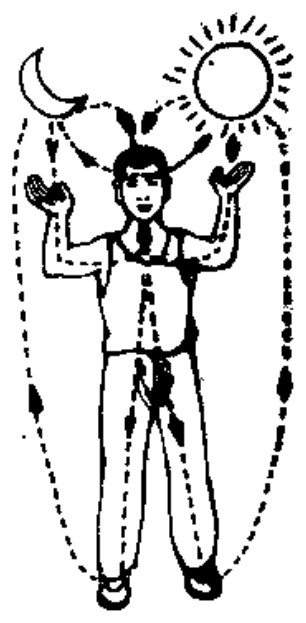
(6) Closing the practice. Rub both hands together until warm, then “dry-wash” the face several times until the mind becomes clear. Then pat the whole body from top to bottom with both hands until all areas feel comfortable.
Practice Method Two:
(1) Sit in meditation and enter stillness.
(2) Use your awareness to first internally observe your own kidneys. Then internally observe the bladder, followed in sequence by the liver, spleen, lungs, heart, throat, and Niwan Palace. Note that when internally observing the internal organs, the colors of each organ are respectively: kidneys and bladder are black, liver is green/blue, spleen is yellow, lungs are white, heart is red.
(3) Focus your mind on the Niwan Palace for 5 minutes. Feel the area between the eyebrows become tight, pulsating, and luminous.
(4) Closing the practice. Same as Practice Method One.
Practice Method Three:
99
The posture is unrestricted, based on comfort. Place the tongue against the upper palate, close the eyes slightly, and look inward with the gaze. Imagine the gaze shooting out from the Tianmu acupoint directly to the extreme far front, and then slowly retract the gaze back to the Tianmu acupoint. Repeat this for 30 to 60 minutes. Then, point one finger at the Tianmu acupoint, gradually move the finger parallel to the distance for 10 to 20 centimeters, and then move it back towards the Tianmu acupoint. Repeat this 100 times. Finally, conclude the practice; the method is the same as Method 1 (see Figures 29 and 30).
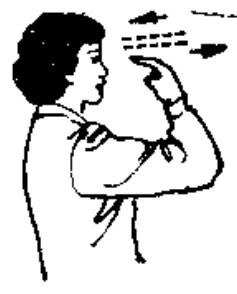
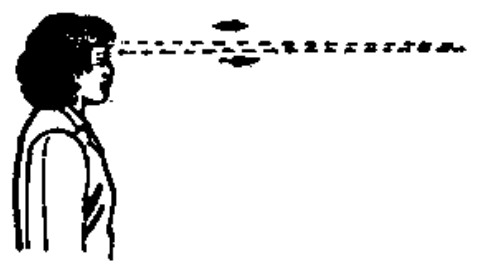
Figure 29
Figure 30
Method 4: The posture is unrestricted, based on comfort. Place the tongue against the upper palate and close the eyes slightly. Focus your intention on the Tianmu acupoint, look inward at the Tianmu acupoint with both eyes, and listen inward to the Tianmu acupoint with both ears. Persist like this for 30 to 60 minutes. Finally, conclude the practice. The method is the same as Method 1.
Method 5: (1) Practice the Eye Purification Technique (Jingmu Shu). Push a thumbtack into a wooden board and stare at it unblinkingly. When the thumbtuck on the board appears to split left and right, it means your Eye Purification Technique is complete (see Figure 31). (2) Supplementary practice: Warm Water Nose Purification Technique. The Eye Purification Technique and the Nose Purification Technique are best trained alternately. The specific method for the Warm Water Nose Purification Technique is: First, pour warm water at 35°C into a washbasin to a depth of about 10 centimeters, then add a small spoonful of salt into the water, and stir the salt and water evenly with your hand. After inhaling half a breath, submerge your face in the water, and use your nose to inhale the warm water. The water only
100
Figure 31
enters the mouth through the nose; do not inhale the water into the trachea or lungs. When inhaling water, the abdomen should slowly expand, and then spit the saltwater out from your mouth. Repeat inhaling and spitting water until the water becomes cloudy and can no longer be used.
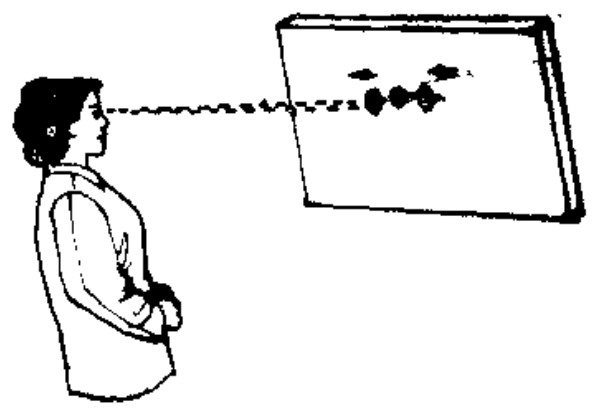
Method 6: (1) After the practitioner sits in meditation and enters a state of tranquility, form “sword fingers” (Jianzhi) using the middle and index fingers. Point the sword fingers at the glabella (Yintang) and repeatedly stroke across the glabella, eyebrows, tips of the eyebrows, along the eyebrows, and above the eyebrows 3 to 5 times. Then stroke the sword fingers along the sides of the nose 3 to 5 times (see Figure 32). (2) Invite a highly skilled Qigong master to simultaneously emit qi using both hands’ sword fingers towards the practitioner’s two temples (Taiyang acupoints) for 1 minute (see Figure 33). (3) Invite the Qigong master to emit qi towards the practitioner’s Tianmu acupoint using the sword fingers. The sword fingers should move from far to near, and then from near to far (movement distance about 1 to 2 centimeters) and rotate continuously, making the movement of the sword fingers spiral-shaped. Each round trip takes about 15 seconds. Repeat continuously; the total qi emission time is 10 minutes (see Figure 34). (4) Invite the Qigong master to emit qi using the sword fingers from the practitioner’s glabella to the Baihui acupoint for 10 minutes (or emit qi from the back of the head towards the Tianmu acupoint) (see Figure 35). (5) Conclude the practice. The method is the same as Method 1.
101
Figure 32
Figure 33
Baihui acupoint
Figure 34
Figure 35
Method 7: (1) Assume a standing stance (Zhanzhuang) posture. Separate the feet to shoulder width. Hollow the chest and round the back, lift the anus and retract the abdomen. Overlap both hands (left hand on the outside for males, right hand on the outside for females) with the Laogong acupoints facing each other, and place them on the lower abdomen. Close the eyes slightly, place the tongue against the upper gums, relax the whole body, and take deep, long, fine, and even breaths (see Figure 36). (2) With the palms facing each other, slowly separate the hands to the left and right sides. Then turn the hands so the palms face upward, and slowly lift them up from both sides of the body. When the hands reach the height of the head, slowly move them towards the forehead (see Figure 37).
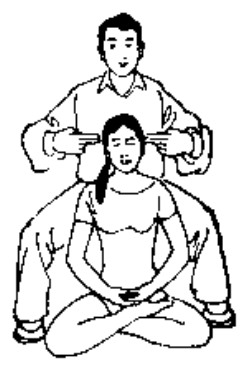
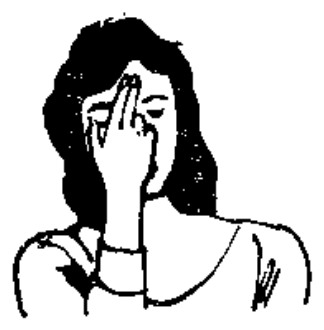
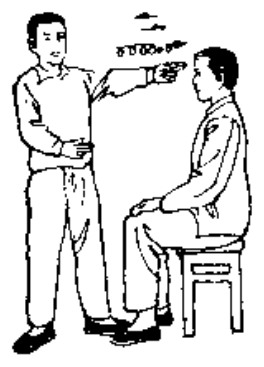
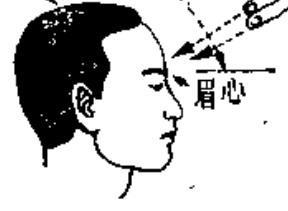
202
[illegible diagram]
Figure 36 Figure 37
(3) Overlap the hands in front of the forehead, with the Laogong acupoints of both hands facing each other. The left hand is in front, [illegible]. When [illegible], the positions of the left and right hands are reversed (see Figure 38). (4) The Laogong acupoints in the centers of both hands simultaneously emit qi towards the Tianmu acupoint for 3 minutes. (5) Form the hands into [illegible] shape and forcefully pull apart to the left and right sides. At the same time, imagine the Tianmu acupoint being pulled open, and a beam of white light entering the Tianmu acupoint (see Figure 39).
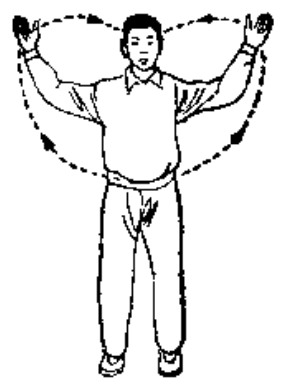
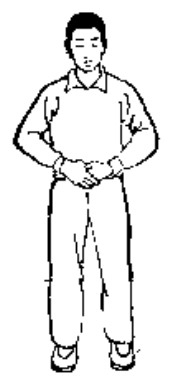
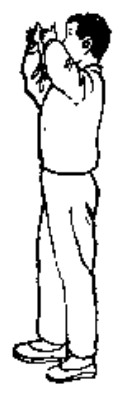
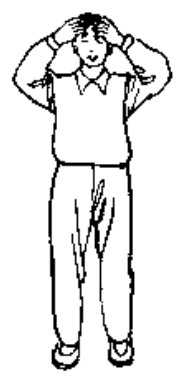
[illegible diagram]
(6) [illegible]
103
(7) Repeat the above movements 21 times. (8) Closing the practice. The method is the same as Method 1.
Method 8: The Method of Examining Treasures Underground and Discerning Human Good and Evil
This is a magical art that combines two basic methods for developing special abilities, namely the Chan Ding (meditative concentration) method and the mantra-holding method. The Tai Ming Wu Wei Jing says: “The lungs govern Metal, are generated by Earth, are restricted by Wood, and come from the West. Their color is white, clear and pure with a faint glow. When the practice reaches a thousand breaths, the light shines radiantly. When regularly practicing [absorbing qi], every day during the Chou hour [1:00–3:00 AM], visualize qi within the lungs, shaped like a white pearl. Its light gradually flows upward to the space between the eyebrows. Then chant the mantra: ‘Geng and Xin of the West, profound and true of Taiwei, internally responding to the six fu-organs, transforming into the lung spirit, manifesting in the supreme void, roaming in the Dantian, protecting my life, using it to become an immortal, quickly, quickly, as commanded by the law.’ Visualize and recite once. Doing this for forty-nine days, qi like a white cloud will manifest within the lungs on its own. This qi illuminates all treasures underground and discerns the good and evil of people, revealing the inside through the outward appearance.”
The cultivation of this method should involve sitting in meditation and swallowing qi for a total of 4 hours every day from the Zi hour [11:00 PM–1:00 AM] to the Chou hour. The method of swallowing qi is to swallow air into the stomach through the mouth, just like eating. When swallowing qi, one must simultaneously visualize; visualize white qi in the lungs, radiating brilliant light like a precious pearl. Its light gradually flows upward from the lungs to the space between the eyebrows. At this time, one must also silently recite the mantra once. Repeatedly cultivate in this way for forty-nine days, and the skill can be achieved. After the skill is achieved, when applying it, shoot the white qi from the lungs out through the space between the eyebrows. Illuminating the ground allows one to see through the earth and discover treasures; illuminating a person’s body allows one to see through the human body and know their good or evil. The ancients believed that if a person commits a single bad deed, a spot of black qi will appear on their body. If the person you observe has many black spots, it means this person has bad intentions and should be kept at a distance.
II. Method of Opening the Heavenly Gate
The Heavenly Gate acupoint is located at the Baihui acupoint on the top of a person’s head. The ancients believed that once this gate is opened,
one can communicate with spirits, and the primordial spirit (Yuan Shen) can enter and exit. Therefore, to obtain abilities such as the knowledge of past lives (Suming Tong) and telekinesis, one must open the Heavenly Gate acupoint.
Method 1
(1) Form a stance-standing posture, with feet shoulder-width apart, sink the chest and straighten the back, lift the anus and retract the abdomen, with the palms of both hands facing each other in front of the abdomen to form a ball-holding shape, eyes slightly closed, tongue pressing against the upper gums, relax the whole body, and take 7 deep, long, fine, and even breaths (see Figure 40). (2) Imagine the qi of the heavenly root descending from the extremely high altitude, entering the Baihui acupoint, passing through the central channel and both legs, and being expelled deep underground from the Yongquan acupoint. Repeat the above mental activity 3 times (see Figure 41).
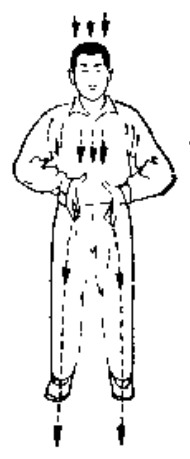
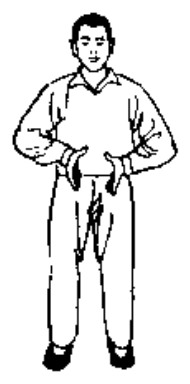
Figure 40 Figure 41
(3) With the fingers of both hands facing each other and palms facing up, slowly lift up, passing in front of the lower abdomen, chest, and head, pointing straight to the sky. At the same time, imagine the qi of the earth root entering the Huiyin acupoint in a right-spiral motion, passing through the central channel, exiting the Baihui acupoint, and reaching straight to the sky (see Figure 42). (4) Turn the palms over, with the fingers of both hands facing each other and palms facing down, slowly press down, passing in front of the head, chest, and lower abdomen, returning to the ball-holding posture. At the same time, imagine the qi of the heavenly root entering the Baihui acupoint in a right-spiral motion, passing through the central channel, exiting the Huiyin acupoint, and reaching straight deep into the earth’s crust
(see Figure 43).
Qi of the Heavenly Root 144 Qi of the Earth Root Figure 42 Figure 43
(5) Repeat movements (3) and (4), 3 times each. (6) Slowly lift both hands from the sides of the body to the top of the head. With palms facing down, the left hand is below, about an inch away from Baihui, and the right hand is above, about an inch away from the left hand (on even-numbered repetitions, it is the opposite: the right hand is below, and the left hand is above). Both Laogong acupoints simultaneously emit qi into the Baihui acupoint for 3 minutes (see Figure 44). (7) Form claws with both hands and forcefully pull apart to the left and right. Imagine the Baihui acupoint being pulled open, and a pillar of light entering the central channel from Baihui, reaching straight to the Huiyin acupoint (see Figure 45). (8) Slowly lower both hands from the sides of the body, returning to the ball-holding posture. (9) Repeat movements (6), (7), and (8) 21 times. (10) Closing the practice. Rub both hands together until warm, dry-wash the face several times until the mind is clear. Use your hands to pat the head, chest, arms, back, waist, and legs. The patting should be of a heaviness that feels comfortable to the body.
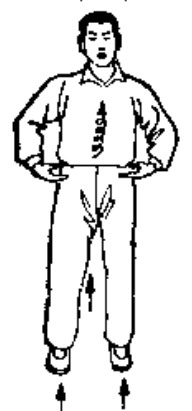
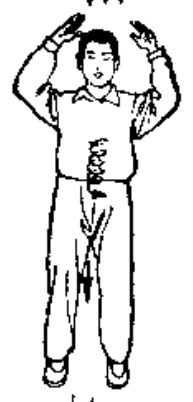
Pillar of Light Figure 44 Figure 45
Method 2
(1) The practitioner sits in meditation and enters a state of quietness. (2) Invite a Qigong master with profound skill to use the sword fingers to emit qi to the practitioner’s Baihui acupoint, Taiyang acupoint, and Tianmu acupoint for 10 minutes each. (3) The practitioner imagines the qi of the earth root entering the Huiyin acupoint in a right-spiral motion, passing through the central channel, exiting the Baihui acupoint, and reaching straight to the sky. Then, the qi of the heavenly root enters the Baihui acupoint in a right-spiral motion, passing through the central channel, exiting the Huiyin acupoint, and reaching straight deep into the earth’s crust. Repeat this 3 times. (4) Closing the practice. The method is the same as Method 1.
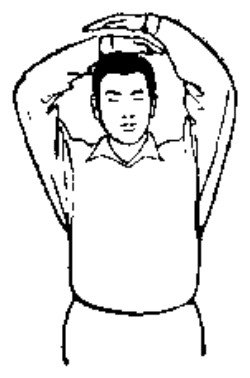
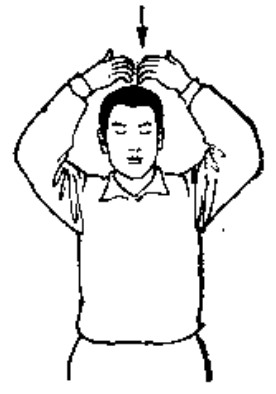
III. Training Methods for Gathering Qi, Emitting Qi, and Hand Sensing Abilities
The training methods for gathering qi, emitting qi, and sensing qi introduced here are all selected from the book Super-Functional Qigong Treasure Book (Chao Gongneng Qigong Baodian).
The ability to use the palms to gather qi, emit qi, and sense qi is also a type of special ability.
Once these abilities are developed, one can use hand sensitivity to diagnose illness, detect objects with hand sensation, perform distant acupoint stimulation, expel dark qi, and treat illness with qigong.
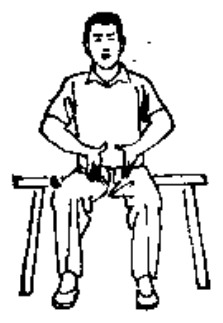
The training of dual-hand sensitivity ability can be divided into eleven steps of practice.
First Step Practice Method:
(1) Place both hands together palms touching, rub with slight force until they become warm. If after repeated rubbing the palms still do not become warm, you may soak both hands in hot water, dry them, then rub again.
(2) Face the centers of both palms toward each other, with a distance of 1–2 centimeters between the two palms. Keep the five fingers together, and place both hands in front of the chest or abdomen. At the same time, concentrate your intention on both palms (see Figure 46).
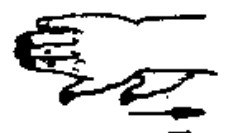
(3) Slowly move both palms in parallel in forward-backward, left-right, up-down, and diagonal directions, changing the distance between the two palms. At this time, carefully observe whether the centers of the palms have any sensation of qi (see Figure 47).
Figure 46
108
Training Mnemonic:
Both palms should be straight, not bent; Do not practice when overly fatigued. Avoid rubbing palms with violent force; Tension in shoulders and arms makes qi hard to sense. Careful sensation is the key; Over time, skill will manifest.
Second Step Practice Method:
(1) Slightly bend both palms inward, naturally spread the ten fingers, face the centers of the palms toward each other, as if holding a ball with a diameter of 5 centimeters. Then, rotate both palms in opposite directions using the Laogong point (劳宫穴) as the axis. When they can no longer rotate, return to the original position, then rotate again and return again, repeating continuously. Carefully experience the sensations in the palms and fingers (see Figure 48).
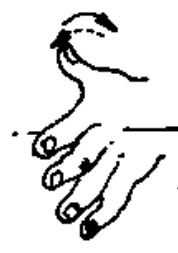
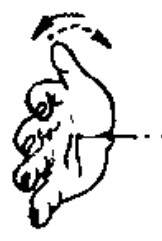
Figure 48
(2) If during the above movements, the palms and fingers have special sensations, then you can increase the distance between both palms for practice. Continue until the special sensation disappears. In this way, repeatedly enlarge and reduce the distance between the two palms to train the palms’ sensitivity to qi.
Qi Sensation Mnemonic:
109
Between the two palms, It is qi that causes it. When there is a sensation of heat, The hands attract each other, What seems like heat, Like magnetic force. When the hands are pulled farther apart, The palms generate qi, Still feeling heat, The hands feel pressure, Qi has already appeared. Or difficult to bring together, Like a cool breeze, Or difficult to pull apart. Like an electric current, Qi sensations, Tingling and chilly, Altogether five kinds, Varying by person, Each different.
Third Step Practice Method:
This practice method trains using a person as the subject. The subject chosen should be someone sensitive to qi, or someone who has some degree of qigong aptitude. The training steps are:
(1) Two people face each other, either sitting or standing. Each person rubs their own palms until sufficient warmth is generated.
(2) Both people extend their palms forward, arms not too straight. The distance between your own palm and the other person’s palm should be 5–10 centimeters, with the centers of both parties’ palms facing each other. Then, at a slow speed, bring the two people’s palms closer or pull them farther apart, or move them up and down, left and right (see Figure 49).
(3) When both parties can feel the presence of qi, one person first holds both palms facing each other at a distance of 10 centimeters. The other person then uses a single palm to pass through from top to bottom between the first person’s two palms. At this point, the first person should be able to clearly feel that the qi between their two palms has been cut off. The latter person’s single palm should also experience an unusual sensation. Initially, the two may do this while watching; after becoming proficient, the first person may close their eyes to experience it (see Figure 50).
Fourth Step Practice Method: Two-person paired practice of qi absorption and emission.
110
Left hand Right hand Figure 49 Figure 50
(1) The assistant extends their arm, palm facing upward. The practitioner positions their own palm facing the assistant’s palm, with a distance of 3–7 centimeters (see Figure 51).
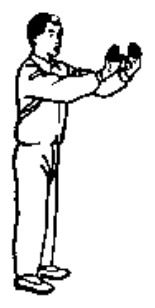
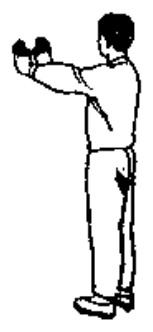
(2) Initially, the practitioner must use imagination and the aid of vision to draw the assistant’s qi from their arm through the palm to their own (the practitioner’s) palm (see Figure 52).
(3) The practitioner transmits their own qi to the assistant’s hand. The method is to emit one’s own qi through the palm, sending it into the assistant’s palm and arm. At this time, one cannot rely solely on imagination; one must still use the aid of vision. The gaze follows the movement of intention—first along one’s own arm, then as the qi flow reaches one’s own palm, it is transmitted into the other person’s palm, and finally into the other person’s arm (see Figure 53).
(4) To determine whether the experiment is successful, you must ask the assistant about their sensation at the time. If the assistant feels that their qi has been drawn out from the palm area, or that qi has flowed in, then the experiment is successful. If there is no such sensation, you may ask the assistant whether they have
Practitioner’s hand Assistant’s hand Figure 51
1t
Practitioner Qi circulation route Practitioner’s hand Gaze Assistant’s hand Figure Fifty-Two Practitioner Gaze sweeping Qi movement route Assistant’s hand Figure Fifty-Three the following sensations: When the practitioner absorbs qi, the assistant’s hand mostly feels a cold sensation. 112
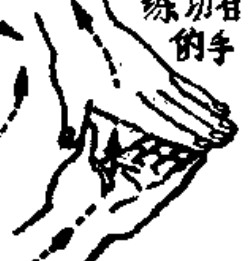
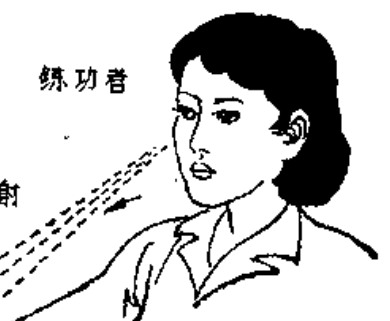
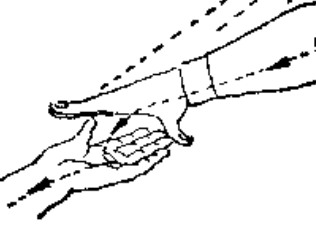
When the practitioner sends qi to the assistant’s hand, the assistant’s hand feels warm and hot. If even the above sensations are absent, one may ask the assistant whether they can distinguish the difference between absorbing qi and sending qi. If there is still no sensation, it indicates that the practitioner should redo the individual qi-sensing training.
Fifth Step Practice: Qi-sensing training using trees as the object.
First, select a tree suitable for oneself. The mnemonic for the selection principle is: Best is new wood in early summer, Strong trunk, lush branches, green leaves. Next are pine, cypress, and holly, Overlapping branches, layered leaves, abundant qi. Flowers in full bloom have feeling, Qi contains hormones. Do not select those of sound body and mind, Those with weak nerves can be supplemented. In harsh winter, jade-green is hard to find, Evergreen species are not restricted. Do not select withered vines and old trees, And one should especially avoid oleander.
Once the tree is selected, one may begin the training of absorbing tree qi. The specific method is as follows:
(1) Fully rub both hands to warm the palms.
(2) Move the palms closer to the tree and sense the direction of the tree’s qi. If qi is sensed, move both hands to find the location where the tree’s qi is strongest, generally at the dense foliage on the sun-facing side (see Figure Fifty-Four).
(3) Fix the palms at the location where the qi is strongest, and perform movements of bringing the palms closer and pulling them farther away, to strengthen the perception of qi, or use slight finger-waggling movements to 113
sense the qi force (see Figure Fifty-Five).
Figure Fifty-Four Figure Fifty-Five
(4) After the qi sensation continuously strengthens, use both palms to draw that qi to your own chest, repeating this process. Alternatively, extend the head forward, use both palms to draw qi from the head, passing in front of the head, to near the chest pit. Note that at this time one should not sense the qi flowing inside the body, because once attention is diverted, the power of intention in the palms weakens, and thus the pulling force on the tree qi is also weakened. At this time, move the hands slowly and apply slight pressure toward the lower abdomen position (see Figure Fifty-Six).
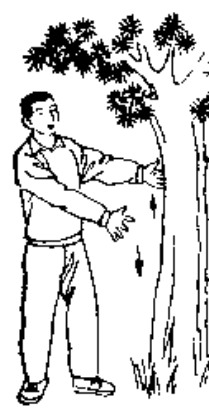
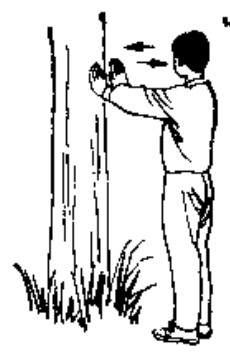
(5) If qi has actually entered the body, one will feel comfortable and full near the chest pit, and the whole body will have a slight sensation of numbness and warmth.
Sixth Step Practice: Sensing training using electrical devices.
The electrical devices referred to here mainly mean electrical plugs, sockets, and some items with strong magnetism. Now, using a power plug as an example to explain the training method:
(1) Hold the insulated wire near the plug with one hand, point the plug toward the palm of the other hand, with a distance of 1–2 centimeters between them (see Figure Fifty-Seven).
(2) Carefully experience the faint qi emitted from the plug. When a qi sensation arises, move the plug and palm alternately closer and farther, then experience the qi sensation again.
(3) Find another person, preferably the one who previously did the two-person training with you, 114
Figure Fifty-Six Figure Fifty-Seven
Following the method in (1), ask them to hold the wire with one hand and point the palm of the other hand at the plug. Touch the wire part with the palm of one of your hands, then slowly move your hand toward the plug. At the same time, exert slight force from your lower abdomen, as if trying to draw the electrical qi into your palm (see Figure Fifty-Eight).
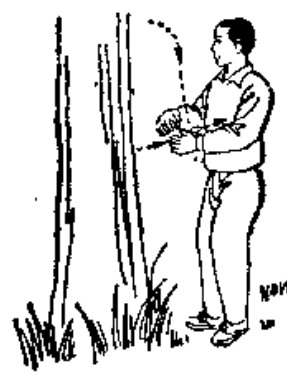
(4) Repeat the above movements and experience the qi sensation.
Seventh Step Practice: Testing an object’s qi force with the palms.
It is best to start with small objects during practice. Now, selecting a pyramid model that relatively easily emits qi as an example, to explain the practice steps:
(1) Fully rub both hands.
(2) Place the hand at a position several centimeters away from the experimental object.
(3) Carefully experience the qi of that object. If there is no qi sensation, move the hand slightly closer to the object. Conversely, if the object’s qi field is relatively strong, slowly move the hand farther away until the palm can only slightly feel the presence of qi (see Figure Fifty-Nine).
(4) During the experiment, if the hand feels aversion or a cold sensation, stop the experiment immediately. The object may contain harmful substances. 115
Figure 58 Figure 59 Once you can skillfully master the qi emitted by small objects, you can proceed to use large objects as experimental subjects.
The best experimental subjects are ancient buildings such as famous temples and old monasteries. The sensing method is as follows:
(5) Since the object is large, the experimenter should ideally stand several meters or tens of meters away from the object.
(6) You can use your palm or your whole body to sense the qi of the object. If you feel aversion or a cold sensation, you should immediately abandon the experiment and choose another object (see Figure 60).
(7) You may also sense each room. By carefully experiencing it, you will find that the qi emitted by each room is different. Any place where the palm or body feels a particularly strong qi field, and that makes one feel comfortable, is suitable for living and beneficial to human health. Conversely, places with no qi field response, or that cause aversion or a cold sensation, are inauspicious places and are not suitable for living.
(8) You can also perform sensing on people. There are many methods, and the purposes differ as well.
If you wish to assess a person’s moral character and whether they are worth associating with, you only need to look at them once, then close your eyes, enter stillness, and experience it. When you feel clarity in your mind and comfort in your body, it proves that this person is a kind and devout person with a good heart, and you may associate with them. Conversely,
911
Figure 60 when you feel inner restlessness, aversion arises spontaneously, and your body is uncomfortable, this person must be someone who is not easy to associate with.
If you wish to assess a person’s health condition, you can move close to them, calm your mind, and experience your sensations. Anyone who makes your body uncomfortable must have an illness. If you also want to know which part of their body is ill, you can use the hand-checking method or the body-checking method.
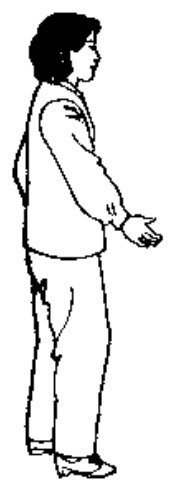
The hand-checking method is as follows: you pass your hand from their head down to their feet to sense (your hand should maintain a certain distance from their body). Wherever your hand feels an abnormal sensation on their body, that part of their body has a lesion.
The body-checking method is performed as follows: look at the other person once, superimpose their image onto your body, and carefully experience the sensations in various parts of your body. At this point, wherever your body feels uncomfortable, that is where the subject has a lesion.
There are many more methods for the hand-checking method and the body-checking method, which will not be introduced one by one here.
117
It is hoped that readers can extrapolate from these examples and explore through practice.
Eighth Step Exercise: Qi-Sensing Object Discrimination Training
(1) Prepare several identical paper boxes or opaque plastic boxes, and also prepare a small magnet or other small object with relatively strong qi-emitting ability.
(2) Before placing the object into the paper box, first use your palm to sense the qi it emits. Then place the object into a paper box, and place your palm over the paper box, but do not make contact with the box. Carefully experience the difference between the qi emitted by an empty paper box and one containing an object. Only when you can clearly feel the difference should you proceed to the next experiment.
(3) Ask your assistant, while you are away, to place the magnet into a certain paper box and place it together with the remaining empty boxes, so that an ordinary person cannot distinguish which box contains the magnet. Then use your palm to sense and identify the paper box containing the magnet. If you can succeed, you have acquired the preliminary special ability to distinguish objects without using your eyes.
Ninth Step Exercise: Long-Distance Qi Sensing Training
This type of training uses people as subjects. The selected subjects should be people who are sensitive to qi or who have some degree of qigong cultivation. The training steps are as follows:
(1) Two people stand facing each other, each rubbing their own hands until their palms are sufficiently warm.
(2) Both people extend their palms forward, facing each other’s palms in pairs, with the centers of the palms 5–10 centimeters apart. Carefully sense the qi emitted by the other person.
(3) After the qi sensation clearly appears, one person remains still while the other slowly retreats, maintaining the original posture. Note that during the retreat process, always keep the palms of both people facing each other, until retreating to the farthest position where qi can still be sensed (see Figure 61).
(4) Repeated training will gradually increase the relative distance between the two people.
Tenth Step Exercise: Remote Control Technique Training
(1) With two people’s palms facing each other, after mutually sensing the effect of qi, one of them
118
Figure 61 Figure 62 gradually retreats, approximately to a distance of 1–2 meters.
(2) The person with stronger qi forcefully emits qi from their palm, causing the other person’s qi to enter a sensing state. The qi emitter slowly moves their palm back and forth, while simultaneously visualizing that the other person’s hand is also moving in synchronization with your hand. If in fact the other person’s hand begins to move following your hand, then the experiment is successful. As your skill continuously strengthens, you will have acquired the special ability to remotely control others (see Figure 62).
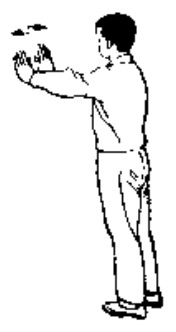
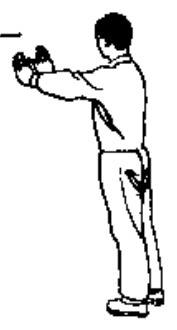
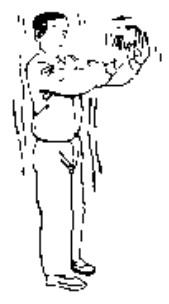
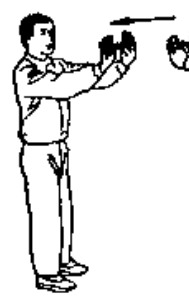
Eleventh Step Exercise: Training to Make Qi Pass Through Objects
(1) One person stands inside the doorway, and the other stands outside the door. First, open the door wide, and the two people face each other with palms opposite, each sensing the other’s qi (see Figure 63).
(2) Close the door, and the two people still face each other with palms opposite, to see whether they can still sense each other’s qi. If they can, one person retreats, to see at what distance the two can still sense qi (see Figure 64).
(3) If successful, the two people can further sit on either side of a thick wall, mutually sensing the qi emitted by the other person’s palm.
(4) If the above experiment succeeds, you can prepare a metal container, ask the other person to place their hand inside the container, and you emit qi inward from outside the container with your palm, then ask
119
[illegible]
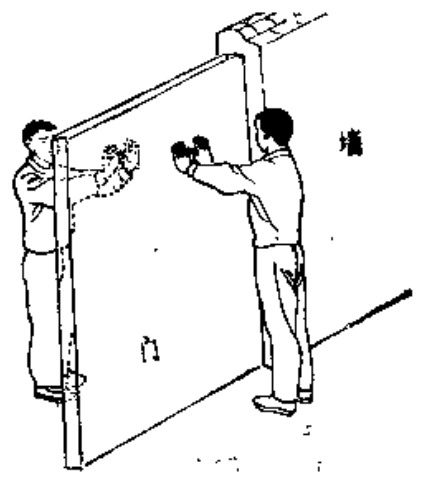
六十三 图六十四
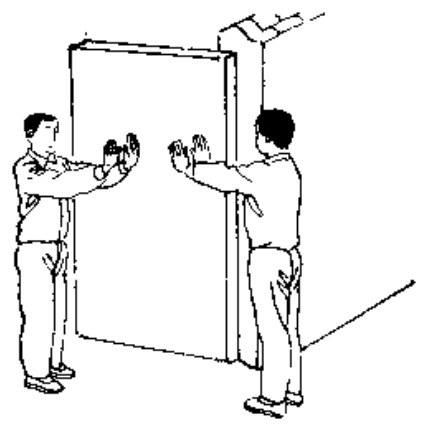
Whether the other person has any sensation. If there is a sensation, it indicates that your skill level is quite high (see Figure 64).
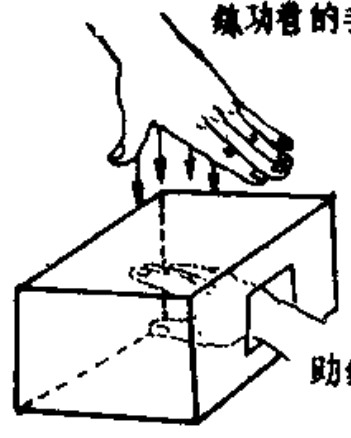
[illegible]
六十五
[illegible]
This practice method is selected from The Supreme Treasure of Super-Ability Qigong.
120
(1) Find a partner to train with you. This person’s level of emitting qi and sensing qi should be close to yours.
(2) Randomly draw several cards from a deck of playing cards and place them in sequence on the table, with the backs facing up.
(3) One person aims the palm of their hand at one of the cards and emits qi, maintaining a certain distance, infusing qi into the card. In addition to using mental intent to guide the infusion of qi, your gaze should also concentrate on that card, as if using your eyes to inject the qi from your palm into the card (see Figure 66). At this time, the other person should step away.
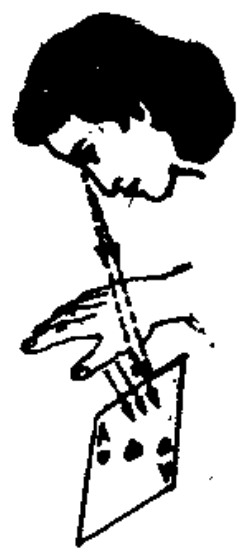
(4) Ask the person who stepped away to return to the table and use their palm to sense the qi intensity of each playing card. If you find that the qi emitted by a certain card is particularly strong, that card is the one that was just infused with qi.
(5) Repeated training will enhance your accuracy in judgment. Note that when redoing the experiment, it is best to replace the card that was infused with qi. If there is no card to replace it with, you can remove the qi from it. The method is simply to sweep your palm over the card.
(6) Set up a barrier in the middle of a table. From two decks of cards, select several cards of the same suit (for example, all hearts) and the same numbers (for example, all hearts 5, 6, 7, 8, 9), and divide them into two groups. Then place the two groups of cards on either side of the barrier in one-to-one correspondence, with the fronts facing outward.
(7) Two people sit on either side of the barrier respectively. One of them emits qi toward a certain card with their palm, or gazes at that card, using mental intent to emit qi (see Figure 67).
121
(8) The other person, on the other side of the barrier, uses their palm to sense the qi of each card one by one. If you find that a certain card gives the sensation of being attracted or repelled, that card has the same number as the card on the other side of the barrier that was infused with qi. Inform the other party and ask them to judge whether it is accurate.
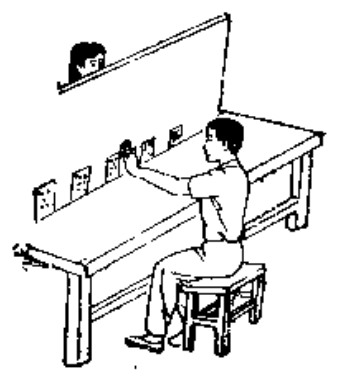
(9) After the above training is accurate and error-free, you can switch to training in two separate rooms, that is, one person emits qi to a certain card in one room, while the other person finds the card with the same number in another room. Subsequently, you can train separately in each person’s home, communicating by telephone.
(10) If the above experiments are all successful, you can continue training with the following method: one party concentrates their gaze on any card, visualizes the content and image of the card in their mind, and sends this mental intent to the other party. At this time, the other person should also close their eyes, enter a meditative state, and strive to receive the information. If the image of the card appears in your mind, you then possess the ability of telepathy and mind-reading (tāxīntōng) (see Figure 68).
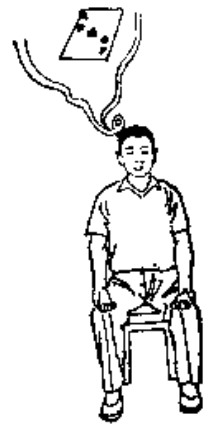
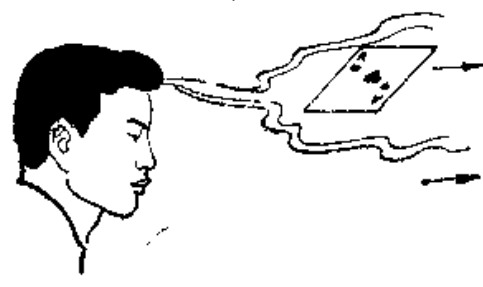
图六十八
122
Five
Training for the Ability to Read Ten Lines at a Glance and Never Forget What You Read
People who have a considerable foundation in meditative concentration (dìnglì) and mental power (niànlì) can immediately master this ability with only slight training. This is because people who have undergone meditative concentration training can quickly enter stillness, maintain a clear mind, and achieve a state of blank conscious awareness. People who have undergone mental power training have very strong image-based thinking and image-based memory; every time they look at an object, they can form a complete and clear image of that object in their mind. The ability to read ten lines at a glance and never forget what you read naturally becomes very easy to develop.
The specific steps of practice are as follows:
(1) First, prepare simple number cards and image cards. Remove distracting thoughts and enter a qigong state. Look at these cards only once, immediately close your eyes, cause the images of these cards to appear in your mind, and then describe every detail of the images.
(2) Find a passage of text that interests you. Remove distracting thoughts and enter a qigong state. Use your eyes to gaze at this passage of text; do not read it, do not think about it, and even more so do not memorize it. Close your eyes and cause this passage of text to appear in your mind, then read out this passage of text.
(3) After you can remember short text at a glance, gradually increase the amount of text until you can take in an entire page of text at a glance and read it out from memory.
(4) Select a book outside your field of expertise, gaze at it page by page, and recite it page by page. When your training is accurate and error-free, you have mastered this special ability.
Six
The Method for Developing Celestial Hearing (Tiān’ěrtōng)
This practice method is selected from The Supreme Treasure of Super-Ability Qigong.
123
(1) Lie face up, arms straight at your sides, palms on the ground (see Figure 69). (2) Keep your feet together and slowly raise them, inhaling. At the same time, silently recite the mantra “Amo” in your heart. When your legs are perpendicular to the ground, hold your breath. Maintain this posture for 5-10 seconds. At this time, do not exert force with your toes (see Figure 70).
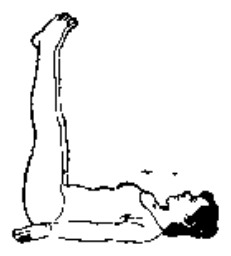
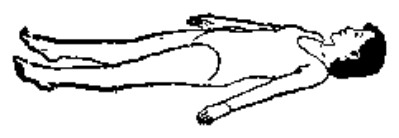
Figure 69 Figure 70
(3) Slowly lower your feet, taking twice the time it took to raise them, while exhaling and silently reciting the mantra “Xiena”. (4) After your feet touch the ground, relax your body. After resting briefly, repeat the movements in (2) and (3). (5) Press your palms firmly, exhale, silently recite the mantra “Xiena”, and raise your waist at the same time. (6) Support your waist with your hands, bending your body into a ”<” shape (see Figure 71). (7) Hold this posture for 1 minute, exhale, silently recite “Xiena”, and return your body to its original state. Rest for 1-2 minutes.
Points to Note:
- The time for holding the posture in (6) starts from one minute, increasing by one minute every day, until you can maintain it for 30 minutes after a month.
- When resting, the posture of the body is: lie flat on your back, legs apart 124
about 15 degrees, hands slightly away from the body, placed flat on both sides of the body, palms facing up, eyes slightly closed. Focus your mind on your fingers, [illegible] heart, keeping your whole body in a relaxed state [illegible] (see Figure 72).
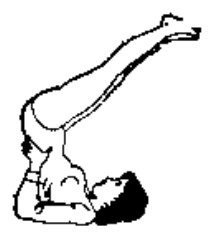
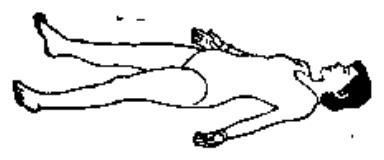
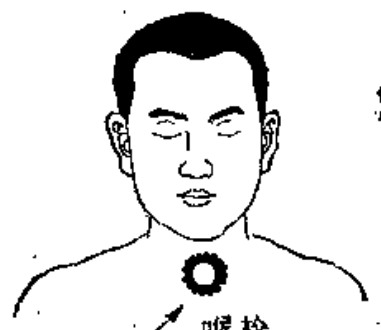
Figure 71 Seventy-two [illegible] [illegible] [illegible] Figure 73
- Except for resting, throughout the entire process you should envision a qi ball at the Dantian, [illegible] [illegible] [illegible] (E+E).
- [illegible] [illegible] [illegible] 125
Appendix
(Enlightenment Reports of the Twenty-Five Buddhist Sages)
People often say, “If you wish to cultivate supernatural powers, you must study the Shurangama Sutra (Leng Yan Jing).” The Shurangama Sutra belongs to the True Permanent Mind-Only (Zhenchang Weixin) system of Mahayana Buddhism. Ancient Chinese practitioners believed that to study and practice Mahayana Buddhism, one must cultivate according to the Shurangama Great Samadhi (Leng Yan Da Ding) expounded in the Shurangama Sutra; otherwise, it would be absolutely impossible to attain the Five Eyes and Six Supernatural Powers, and to achieve Supreme Bodhi.
The contents of this Sutra include the analysis of the psychology of cultivation, introductions to cultivation methods and their conditions, guidance on the phenomena of cultivation and realization, and the revelation of holy and demonic states during the cultivation process. The profoundness and thoroughness of its principles, and the comprehensive and specific nature of its methods, are beyond the comparison of any Qigong book.
The situation regarding the “Enlightenment Reports of the Twenty-Five Sages” is as follows: At the Shurangama Dharma Assembly, Buddha Shakyamuni revealed the secret treasury of the Shurangama Great Samadhi to the attending multitude. After explaining the general principles of cultivation, the Buddha’s disciple Ananda requested the Buddha to further reveal the specific methods of cultivation. This led to the presentation of enlightenment reports by twenty-five great Bodhisattvas and great Arhats, who introduced their own cultivation processes.
Below is a transcription of the contents of Chapter 9 of the Shurangama Sutra:
Enlightenment Reports of the Twenty-Five Sages
Ananda and the great multitude received such compassionate guidance from the Buddha. Regarding the sequence of untying the knots, the wondrous wisdom that illuminates the nature of the faculties, and the wondrous principle that can certify the Patient Endurance of the Dharma, although they had not yet 126
personally cultivated and realized it, they had already achieved a complete integration and understanding without any further doubt. Therefore, they simultaneously pressed their palms together, bowed, and respectfully said to the Buddha: “Today, our bodies and minds are bright and clear, smoothly and thoroughly unobstructed. Although we have awakened to the ultimate meaning of entering deeply through one faculty to simultaneously eradicate all six sense organs, we still do not know which is the fundamental root of perfect penetration, and thus we do not know where to begin our cultivation.
“World Honored One! We have been drifting in the bitter sea of life and death, wandering through the six realms of reincarnation for many kalpas. How are we any different from orphans wandering in a strange land? How could we have extravagantly hoped to become brothers with the Buddha? Now, being placed in the order of heavenly relations is already beyond our expectations. Now, furthermore, leaving the home-life under the Buddha and constantly following by your side is truly like a nursing infant who has lost its milk suddenly meeting a compassionate mother. If, through this fortunate encounter, we can realize the fruit of the Bodhi Way, then we will not have failed this life. Now that we have respectfully heard the secret teachings that are usually not expounded, if we can indeed engage in hearing, pondering, and cultivating, and untie the knots through the sense organs, then the Right Samadhi can be entered and the Patient Endurance of the Dharma can be certified. If we remain as before, following the text and pursuing the literal meaning, vainly holding onto intellectual understanding without seeking actual practice and realization, what difference is there from not having heard it at all? We only hope that the World Honored One, out of his great compassion, will bestow upon us the secret, stern, and pure wondrous Dharma, completing the final instruction of the Tathagata’s ultimate teachings.” After Ananda finished speaking, he once again prostrated himself fully on the ground to worship the Buddha, then retreated to his original position, silently praying in his heart, hoping that the Buddha would not state it explicitly but would secretly transmit it to him.
The Buddha’s great wisdom illuminated everything, and he thoroughly understood Ananda’s intention. Therefore, he did not state it explicitly himself first, but instead asked the twenty-five sages in the assembly to each recount their own experiences of realizing the fruit. At that time, the World Honored One generally announced to all the great Bodhisattvas and Arhats who had exhausted their outflows in the assembly: “You Bodhisattvas and Arhats, and others, within my Dharma, have diligently and bitterly practiced and have already realized the state of the Sage Beyond Study. I now ask you: Initially, by what Dharma did you generate the Bodhi mind, awaken to which among the Eighteen Realms is the fundamental root of perfect penetration, and by what Dharma did you begin your cultivation and certify the Samadhi?”
Ajnata Kaundinya and the other four bhiksus first rose from their seats. After prostrating to the Buddha, they recounted their process of enlightenment, saying: “In the past, we cultivated at the Deer Park and the Chicken Garden. After the Buddha attained enlightenment, he came to convert us first, teaching us the Four Noble Truths of Suffering, Origination, Cessation, and the Path three times. Through the Buddha’s verbal teachings, I thoroughly understood the ultimate truth of the Four Noble Truths. At that time, the Buddha asked the bhik- 127
…bhikshu. Who has attained understanding? I was the first to awaken. The Tathagata verified my awakening and named me Ajnata (meaning “first to understand”). What was my understanding? It was the realization that sound is a dharma produced by causes and conditions; although the sound itself is illusory and unreal, its nature is eternally true. It is the wondrous, enlightening, luminous essence—secret, formless, and without characteristics, yet when applied, it pervades the entire Dharma Realm. Thus, I took sound as my fundamental cause of cultivation and attained the stage of Arhat. When the Buddha asked what is the most perfect penetration, based on my own realization, sound is the foremost.”
Next was Upanishad, who also rose from his seat, bowed to the Buddha, and respectfully recounted to the Buddha the causes of his realization: “I was one of those who personally witnessed your initial attainment of enlightenment, so I encountered the Buddha earliest. Because my greed and desire were heavy, the Buddha taught me to practice the meditation on impurity. I contemplated how within the physical body, there is truly nothing clean. I realized the nature of form: since birth is impure, after death there is merely a pile of white bones. Burning the bones to ashes, they transform into fine dust, scattering with the wind and ultimately returning to emptiness. Emptiness and form are non-dual. Therefore, I entered realization and attained the fruit of the ‘no-more-learning’ path. The Tathagata verified this and named me Upanishad (the nature of form). When the characteristics are exhausted, the nature manifests. Observing all forms again, they are all the Tathagata’s treasury of the true mind, pervading the Dharma Realm. The Dharma principle is subtle and secret, and its great function is perfect. I relied on form as my fundamental cause of cultivation and became an Arhat. When the Buddha asked what is the most perfect penetration, based on my realization, form is the foremost.”
Next was the youth Xiangyan. He said: “In the past, I received the Buddha’s compassionate teaching, instructing me to carefully observe at all times and places the sense organs, sense objects, and consciousness, and all the myriad things produced by causes and conditions. I took leave of the Buddha, concealed my traces, purified my body and mind, and sat quietly in a peaceful room. I saw monks burning aloeswood incense. The invisible, soundless fragrance entered my nose. I immediately observed the origin of this fragrance right in that context. It should not come from the wood, because having merely the wood, it cannot burn itself; nor does it come from emptiness, because the nature of emptiness is eternal, while fragrance is impermanent. It is naturally not produced by smoke, nor does it come from fire. It suddenly gathers and scatters, coming from nowhere and going nowhere. Thus, consciousness ceased to arise, and both the sense organ and sense object vanished, entering a state of non-discrimination. I suddenly realized the state of outflowlessness, fully comprehending that the nature of fragrance is precisely the Tathagata’s treasury of the true mind. The Tathagata verified this and bestowed upon me the name Xiangyan. Consequently, characteristics were exhausted and nature manifested. Although the object of fragrance arises and vanishes in an instant, the true fragrance of self-nature pervades the Dharma Realm. This principle is subtle and difficult to understand. I attained Arhatship through Xiangyan (fragrance). When the Buddha asked what is the most perfect penetration, based on my realization, Xiangyan is the foremost.” 17 The two Dharma Princes, Medicine King and Supreme Medicine, along with five hundred Brahma Heaven Kings in the assembly, followed the youth Xiang- 128
yan, rising from their seats, bowing in reverence, and then standing respectfully to address the Buddha: “Since countless kalpas ago, life after life, we have been excellent physicians. In this Saha world, we have personally tasted as many as 84,000 kinds of plants, trees, minerals, and metals. We know all flavors such as bitter, sour, salty, bland, sweet, and pungent, as well as their various combinations and transformations—whether they are cold or hot in nature, poisonous or non-poisonous, usable or unusable; there is nothing we do not know. Therefore, today, as we serve the Tathagata, we still have not forgotten our old habits and continue to use the object of taste as our field of contemplation. Consequently, we realized that taste is neither empty nor existent. It does not arise from the tongue or tongue-consciousness, nor does it exist apart from the tongue and consciousness. We understood that the characteristics are illusory while the nature is true, and from this we awakened. The World-Honored One, the Buddha, personally verified us brothers and bestowed upon us the Bodhisattva names Medicine King and Supreme Medicine. In this assembly, we serve as Dharma Princes. We used the object of taste as our fundamental cause of cultivation, awakened to the true and eternal, and attained the rank of Bodhisattva. When the Buddha asked what is the most perfect penetration, based on our realization, the contemplation of taste is the foremost.”
Bhadrapala and his companions, sixteen Bodhisattvas (Kaishi), subsequently rose from their seats and reported to the Buddha: “During the time the previous Buddha, King of Awesome Sound, was in the world, we left home upon hearing the Dharma. On a day when the monks were bathing, we entered the bathhouse following the routine. As the water touched our bodies, we felt sensations of cold, heat, roughness, and slipperiness. We then thoroughly investigated the water: did this tactile sensation arise from washing away dirt, or did it arise from washing the body? If it is said to be from washing away dirt, dirt is inherently insentient, so how could it have a tactile sensation? If it is said to be from washing the body, the body is but an illusory combination of the four elements and is also an insentient object, so naturally it has no tactile sensation either. Since it arises neither from washing dirt nor from washing the body, in between there is peaceful stillness, entirely empty and nonexistent. Seeking the characteristics of the tactile object, they cannot be found at all. Our contemplative practice was accomplished, and through this, we awakened to and entered the wondrous true suchness. Through kalpas up to the present, our past habits have not been forgotten. Now, leaving home again under the Buddha, we received the teachings to sever delusions, enabling us to attain the sagehood of the ‘no-more-learning’ stage. That Buddha named me Bhadrapala. The wondrous touch was clearly declared, and I attained Bodhisattvahood, abiding in the stage of Equal Enlightenment, becoming a true son of the Buddha, fully capable of inheriting the Buddha’s throne. When the Buddha asked what is the most perfect penetration, based on my realization, the contemplation of touch is the foremost.”
Mahakasyapa and the Bhikshuni of Purple Golden Light, along with others, stood up simultaneously, bowed to the Buddha, and recounted their causes for entering the Way: “In past kalpas, when a Buddha came to this Saha world in response to the times, named Sun-Moon-Lamp, I had the affinity to draw near him, respectfully listen to his teachings, and practice according to the Dharma. After the Buddha’s passing, to repay his profound kindness as the Dharma-nourisher, I made offerings to his relics (spiritual bones), lighting lamps every night to continue the sun- 129
light, making them eternally bright and unobscured. I also used purple gold leaves to overlay the Buddha’s image. These Bhikshunis of Purple Golden Light were my retinue, who, along with me, simultaneously resolved to restore the Buddha’s image; therefore, just like me, their bodies constantly maintain the color of purple golden light. I observed the six sense objects arising, ceasing, and changing, without pause for even an instant. They are empty in their very substance. I contemplated only emptiness and stillness, practicing the Samadhi of Extinction, allowing my body and mind to pass through hundreds of thousands of kalpas as quickly as a snap of the fingers. By practicing the contemplation of emptiness, I extinguished the dharma-object and attained the path of the Arhat. The World-Honored One praised me as foremost in ascetic practices (Dhuta). When the dharma-object was extinguished, the subtle Dharma-nature manifested; therefore, I awakened, understanding the Tathagata’s treasury of the true mind and eliminating all outflows. When the Buddha asked what is the most perfect penetration, based on my realization, the contemplation of dharmas (dharma-object) is the foremost.”
Next, Aniruddha rose in turn, bowed to the Buddha, and honestly recounted: “When I first left home, I was often prone to sleeping. The Tathagata reprimanded me, likening me to an animal. Upon hearing the Buddha’s scolding, I cried bitterly and blamed myself, going without sleep for seven days and seven nights, which resulted in the loss of my sight. At that time, the World-Honored One, taking pity on me as a teachable talent, pointed out that seeing does not necessarily require the eyes. He taught me the Vajra Samadhi of Joyful Seeing and Illumination. I practiced diligently according to the teaching, thereby attaining the Heavenly Eye. Without relying on my physical eyes, I observe the great trichiliocosm (three thousand great thousand worlds) clearly and thoroughly, just like viewing a piece of fruit in the palm of my hand. The Tathagata verified that I had attained the path of the Arhat. When the Buddha asked who attained the most perfect penetration, based on my realization, turning back the outgoing essence of seeing to return to and follow the original, luminous true seeing is the foremost.”
Following him was Culapanthaka, who stated to the Buddha: “I lacked the ability to memorize chants and was not a vessel for extensive learning and broad hearing. When I first encountered the Buddha, I left home upon hearing the Dharma. The Tathagata taught me to recite a seven-syllable verse. After a hundred days of trying, I still could not recite it from memory; I would remember the first three characters and forget the last four, or recall the last four and forget the first three. The Buddha took pity on my stupidity and taught me to dwell in a quiet place, sit upright with a straight posture, and regulate the in-and-out breath through my nose. I followed this instruction, constantly observing my breath. After a long time of practice, my mind gradually became subtle and fine. I came to know the in-and-out breaths, and eventually was able to exhaust the four characteristics of the breath—arising, abiding, changing, and ceasing—and their momentary transformations. Thus, I suddenly awakened, attained great unobstructed freedom, and eventually eliminated all outflows to become an Arhat. Under the Buddha, I was verified as having attained the sage fruit of ‘no-more-learning.’ When the Buddha asked about perfect penetration, based on my realization, turning back the breath to follow emptiness is the foremost.” 130
Gavampati then rose from his seat, bowed to the Buddha, and recounted the causes of his awakening, saying: “In a past life, I saw an old monk who had no teeth, and I laughed at him for eating like an ox. Because of this karmic speech error, throughout successive lives I was reborn with an ox’s tongue and suffered from a chronic empty-stomach ailment. Fortunately, I encountered the Tathāgata, who covered for me and specially bestowed upon me a rosary, instructing me to recite the Buddha’s name, cut off all distracting conditions, and purify my mind. My mind attained purity, stilling distraction and entering stillness, and I first gained the samādhi of Buddha-recitation. Then, from stillness I aroused illumination, and investigated the nature of knowing taste: it originally arises neither from the tongue faculty nor from external objects. At that thought, I entered the wondrous true suchness of the Tathāgata-garbha, immediately transcending all worldly outflows. Inwardly I shed the bonds of body and mind; outwardly I released the constraints of the world. Far removed from the three realms, like a bird escaping its cage, all defilements were completely eliminated and my Dharma-eye became pure. I became an Arhat, and the Tathāgata personally certified me, establishing me in the stage of non-learning. The Buddha asks about complete penetration. According to my realization, using the tongue as the fundamental basis of cultivation, returning flavor and revolving awareness inward to observe the nature of tasting—this is the foremost method.”
Pilindavaccha also rose from his seat, and after bowing, stood respectfully before the Buddha and recounted the process of his awakening, saying: “When I first generated the aspiration to practice, I left home under the Buddha’s tonsure. I constantly heard the Tathāgata proclaim that the world is suffering, with nothing truly pleasurable. I accordingly practiced contemplation as taught. One day, while going into the city to beg for food, I was so absorbed in contemplation that I failed to notice a poisonous thorn on the road. Walking carelessly, the poisonous thorn pierced my foot, and the pain pierced to the marrow of my heart. Meeting with this painful event, I stood still and did not proceed, investigating: who is it that perceives this severe pain? Through this, I realized that within the body there exists a mind that can perceive severe pain, and only because of it can one become aware of such severe pain. Yet although it can perceive the severe pain, this perception must manifest because of pain, and therefore must be a false perception. My originally pure, true mind of fundamental awakening actually has no pain to be perceived, nor any pain-perception that perceives. I then thought carefully: one person, one body, should have only one awareness—why is it that now there is both an awareness that knows pain and an awareness of the pure awakened mind? Could it be said that one body has two awarenesses? Thereupon I gathered my thoughts and arose in contemplation. Before long, the true prevailed and the false ceased; body and mind were both forgotten. I suddenly realized that the mind that perceives pain is actually body-consciousness. In this way, after twenty-one days, all afflicted minds completely vanished, and fundamental awakening manifested. I became an Arhat and received the Buddha’s personal seal of certification, attaining the stage of non-learning. The Buddha asks who has complete penetration. According to my realization, pure awareness transcending the body—this is the foremost.”
Subhuti also left his seat and bowed to the Buddha, recounting the causes of his awakening, saying: “From countless kalpas past, I had already realized a mind free from obstruction. I recall that my cycles of death and rebirth have been as numerous as the sands of the Ganges—131
In this very life, while still in my mother’s womb, I already knew that the four great elements are illusory and the five aggregates are non-existent, eternally empty and still. After birth, through the realization of personal emptiness, I awakened to the emptiness of dharmas, perceiving that the myriad phenomena throughout the ten thousand worlds only appear to exist, while their nature is fundamentally empty and still. Therefore, after leaving home to follow the Buddha, I extensively proclaimed to sentient beings the truth of the twofold emptiness—of person and of dharmas—enabling beings to equally and directly realize the nature of emptiness. Later, through the Tathāgata’s clear instruction, I attained the understanding that within the Tathāgata-garbha, the innate awakening is precisely true emptiness, and the innate emptiness is precisely the substance of true awakening. The nature of emptiness is fundamentally luminous, illuminating the Dharma-realm in its totality. Through this, I accomplished the path of the Arhat, suddenly entering the Tathāgata’s precious, luminous, and wondrous ocean of true emptiness, sharing the same knowledge and vision as the Buddha. The Tathāgata certified that I had already attained the non-learning stage of the Great Vehicle. Though I have realized the nature of emptiness, I am not bound by emptiness; emptiness and existence do not obstruct each other—I am supreme. The Buddha asks about complete penetration. According to my realization, the characteristics of person and the characteristics of dharmas both return to emptiness. The emptiness that empties and the characteristics that are emptied—both are not clung to. Turning the false, arising-and-ceasing myriad phenomena, one returns to the original nature of awakening. To realize this original nature of awakening, one must begin with the mind-faculty—this is the foremost.”
Śāriputra rose, joined his palms, bowed to the Buddha, and said: “From distant kalpas past, my visual consciousness has been pure. Through such cycles of rebirth, as numerous as the sands of the Ganges, whether in worldly or transmundane realms, in all defiled and pure conditions, in ordinary and sagely domains, and all kinds of transformations—at one glance I could instantly distinguish them through mental discernment, understanding them completely without obstruction. One day on the road, I met the Kāśyapa brothers and heard them expound: ‘Dharmas arising from causes and conditions—I say are emptiness; they are also called false names, and are also called the meaning of the Middle Way.’ I then awakened to the supreme principle of the perfect harmony of mind and matter, knowing that this true mind pervades the entire Dharma-realm. Thereupon I left home to follow the Buddha. Formerly, I only had unobstructed visual consciousness, but through personally receiving the Buddha’s instruction, I realized the essence of consciousness, perfectly luminous, attained great freedom, possessed the four kinds of fearlessness, and became an Arhat. As the Buddha’s eldest Dharma-son, hearing the Dharma from the Buddha, I realized the Dharma-body—as if born from the Buddha’s mouth, transformed by the Buddha’s Dharma. The Buddha asks about complete penetration. According to my realization, through visual consciousness I attained unobstructed light of wisdom; at the ultimate point of this wisdom-light, one shares the Buddha’s knowledge and vision. Therefore, I consider the eye-faculty to be the foremost.”
Samantabhadra Bodhisattva then rose from his seat, joined his palms, bowed, and said: “I have been the Dharma-prince of as many Tathāgatas as the sands of the Ganges. My realization equals that of the Buddha, and I am already able to inherit the Tathāgata’s legacy. The Buddhas of the ten directions instruct their disciples of Great Vehicle capacity to practice the Samantabhadra conduct, which is named after me. World-Honored One! I need only use hearing to distinguish the insights of sentient beings. If in other worlds, even 132
as far away as beyond worlds as numerous as the sands of the Ganges, there is even one sentient being who generates the aspiration to practice Samantabhadra conduct, at the very moment of their aspiration, I immediately mount a six-tusked white elephant, divide my body into hundreds and thousands, and appear before each aspirant to meet with them. Even if, due to deep karmic obstructions, they cannot see me, I will secretly and personally rub their crown, supporting and comforting them, enabling them to fulfill their vows. The Buddha asks about complete penetration. I specifically recount my fundamental cause: using only auditory consciousness and discerning through mental attention, one can emit the light of wisdom, universally illuminating all capacities and attaining great freedom. Therefore, regarding complete penetration, this is the foremost.”
Sundarananda also rose from his seat, bowed to the Buddha, and said: “When I left home, I learned the transmundane path from the Buddha. Although I never transgressed the Buddha’s precepts, my mind was often scattered and could not enter samādhi. Because I could not generate wisdom to sever defilements, I had not yet attained the state free from outflows. At that time, the World-Honored One instructed me and Koṭṭhita to focus both eyes on the white spot at the tip of the nose, in order to concentrate the mind on a single point. Following the Tathāgata’s instruction, I gathered my mind and carefully contemplated. After twenty-one days, I first perceived the breath in my nose, its coming and going like a wisp of black smoke. The nose-consciousness became inwardly luminous, and the light of wisdom arose, shining outward upon the world—a vast expanse of empty purity, seemingly like lapis lazuli. After contemplating thus for a long time, the defilements were nearly exhausted, and the smoky appearance gradually disappeared. The breath flowing in and out of the nose turned white. Through this, my mind opened and all outflows ceased; the breath entering and leaving the nose transformed into radiance, illuminating the ten directions. I realized Arhatship, and the World-Honored One bestowed upon me the prophecy that in the future I would certainly realize Bodhi, the fruit of Buddhahood. The Buddha asks about complete penetration. Through gathering the mind to contemplate the nose, I attained the light of wisdom, universally illuminating the ten directions and eliminating all outflows. According to my realization, this is the foremost.”
Pūrṇa Maitrāyaṇīputra then rose from his seat, bowed to the Buddha, and said: “From distant kalpas past, I have possessed unobstructed eloquence, constantly proclaiming the Dharma of suffering and emptiness, and profoundly understanding the principle of the true aspect. Even the secret Dharma-gates of as many Tathāgatas as the sands of the Ganges—I could expound their subtle and profound meanings before the great assembly with masterful clarity, my mind knowing no fear. The World-Honored One, knowing my great eloquence, instructed me in the wheel of sound to promote teaching and transformation. I assisted the Buddha before his very seat, helping to propagate the teaching and turning the Dharma-wheel on his behalf. Through roaring the lion’s roar, I became an Arhat. The World-Honored One certified me as the foremost among those who expound the Dharma. The Buddha asks about complete penetration. Through tongue-consciousness, I expound the Dharma without fear, using the sound of Dharma to subdue demonic enemies and eliminate all outflows. Regarding complete penetration, tongue-consciousness should be considered the foremost.”
Upāli then rose from his seat, bowed to the Buddha, and said: “Formerly, I followed the Buddha, half—133
[He] left the city at night, journeyed to the forest of asceticism, and personally witnessed the shaving of hair and beard to leave the home-life and study the Way. He personally witnessed the Tathagata’s six years of diligent study and practice, personally witnessed the Tathagata subdue all demons and restrain non-Buddhists, and personally witnessed his liberation from worldly greed and various outflows. The Buddha bestowed upon me the 250 precepts of a bhikkhu, and I progressively advanced to the 3,000 dignified manners and 80,000 subtle practices of the Mahayana Bodhisattva precepts. I became entirely pure regarding both intrinsic karmic offenses and prohibitive karmic offenses. Through precepts, samadhi was attained, and body and mind became extinguished; through samadhi, wisdom arose, severing delusions and realizing truth, attaining Arhatship. Under the Tathagata’s assembly, I served as the disciplinarian among the multitude. I received the personal seal of approval upon my mind for upholding precepts and cultivating my body, and I was recognized by the assembly as the foremost. The Buddha asked about perfect penetration. I upheld the physical precepts of the Lesser Vehicle through body consciousness, ensuring that body consciousness did not give rise to states of compliance or resistance, thereby attaining physical freedom first. Sequentially upholding the mental precepts of the Greater Vehicle, my mind achieved penetration and awakened to the wondrous precepts of non-action. Once there was neither a mind that upholds precepts nor any precepts to be upheld, body and mind became entirely unhindered. If we discuss perfect penetration, according to my realization, body consciousness should be the first.
Maha-Maudgalyayana (大目犍连) subsequently rose from his seat, bowed his head to the Buddha, and said: “On my way to beg for food, I chanced upon the three brothers Uruvelva (优离频螺), Gayanadi (伽耶那提), and Kasyapa (迦叶波). They were expounding the profound meaning of causes and conditions as spoken by the Tathagata. I instantly brought forth the Bodhicitta and awakened to perfect penetration through consciousness. The Tathagata graciously bestowed a kasaya robe upon me; my hair and beard naturally fell out, immediately manifesting the appearance of a bhikkhu. I traveled throughout the ten directions, coming and going freely without hindrance. Through the awakening of this supernatural power, I understood that consciousness is precisely the nature of the Tathagatagarbha—unchanging yet responding to conditions, free and unhindered. Within the great assembly, I was acclaimed as the foremost in supernatural powers and attained Arhatship. Not only does the World-Honored One praise my supernatural powers as supreme, but all Tathagatas in the ten directions also praise my spiritual power as perfectly bright, pure, autonomous, and fearless. The Buddha asked about perfect penetration. I turned the consciousness of false discrimination around, returning it to the perfectly pervading, eternally abiding mind-nature. This consciousness alone is the foremost.
Ucchusma (乌刍瑟摩) then approached the Tathagata, pressed his palms together, bowed his head, and said to the Buddha: “I often recall many kalpas ago, when I was an ordinary being, I was greedy for form and lustful, accumulating habits until they became my nature. At that time, a Buddha appeared in the world, honored by the name King of Emptiness (空王). Teaching according to my capacity, he said that a person with excessive lust is like a raging mass of fire. The fire of lust not only burns away good roots, but it can also incinerate the seeds of wisdom. He then taught me to contemplate my entire skeleton and four limbs. Following his instruction, I engaged in contemplation. Before thoughts of desire arose, my entire body was originally cool and comfortable;
but once the lustful mind stirred, my entire body burned, becoming restless and agitated. Only then did I believe that the teaching comparing it to a mass of fire was truly no empty words. Fear arose in my mind, and therefore I focused my contemplation. The divine light gathered inward, transforming the lustful mind into the fire of wisdom, and through this I attained the Fire-light Samadhi. Because I was skilled at contemplating the nature of fire, from then on, all Buddhas called me Fire-Head (火头). Through the power of the Fire-light Samadhi, I severed all bonds and became an Arhat. I then made a vow to protect the Dharma: whenever Buddhas attain the Way, I shall act as a mighty warrior to protect the Buddhist teachings and personally subdue demonic enemies. The Buddha asked about perfect penetration. I diligently contemplated the warm sensation of body consciousness and attained the Fire-light Samadhi. Using the divine light of wisdom-fire, which flows through the ten directions, I merged with the nature of the Tathagatagarbha, burning away the firewood of afflictions and incinerating all outflows. Though born in the state of non-enlightenment, I ascended to the stage of enlightenment. If we discuss which is the means of perfect penetration, diligently contemplating the fire element (火大) should be the first.”
Earth-Holding Bodhisattva (持地菩萨) subsequently rose, pressed his palms together, bowed his head, and respectfully addressed the Buddha: “I remember in the past, when the Tathagata Universal Light (普光如来) appeared in the world, I was a bhikkhu. I would constantly frequent major travel routes, land and water ferry crossings, and narrow passages between fields. Wherever it was disadvantageous to pedestrians, carriages, or horses, I would fill, repair, and level the ground. I either built bridges with my own hands or personally carried sand and stones. Engaging in such diligent and bitter labor, I served through the appearance of countless Buddhas in the world without ever slackening. If there were elderly or weak sentient beings in market towns or bazaars who needed others to transport their goods, I would carry the items to their destination for them. I would put the items down and leave immediately, absolutely refusing any form of reward.
“When Buddha Vipasyin (毗舍浮佛) was in the world, the shared karma of sentient beings brought about many famines. At that time, I worked as a porter, carrying goods for others. Regardless of the distance, I only accepted a single coin as compensation. If an ox cart became stuck in the mud, I possessed the spiritual strength to push the wheels, helping them escape their distress. One day, the king hosted a vegetarian feast and respectfully invited the Buddha to accept the offerings. Knowing the road the Buddha would definitely take, I went ahead to level it and wait. The Tathagata Vipasyin took pity on my long kalpas of bitter toil, rubbed my head with his own hand, and said: ‘You should level your own mind-ground. If the mind-ground is level, then there will be no uneven ground in the world.’ Upon hearing this instruction, my mind immediately opened. I saw that the microscopic dust particles within my own body and all the microscopic dust particles that make up the world were exactly the same, without the slightest difference. All microscopic dust particles, whether inside the body or outside in the world, have an intrinsically empty nature; they do not obstruct or rub against one another. It is like empty space merging with empty space, leaving no trace whatsoever—how could they interfere with each other? Not only that, but even if weapons such as swords or spears were applied to my body, it would be like slicing light or chopping
shadows, incapable of causing harm. Because I awakened to the fact that all dharmas share the same self-nature, I realized the forbearance of non-arising dharmas (无生法忍) and attained Arhatship. Now, turning back the mind of the Lesser Vehicle, I have entered the stage of a Mahayana Bodhisattva. Every time I heard the four Buddhas since the Bhadrakalpa (贤劫) expound the Wonderful Dharma Lotus Flower Sutra (妙法莲华经), revealing the Buddha’s knowledge and vision, I specifically stepped forward to testify. At the Dharma Flower Assembly, I was the leader among those of faith, understanding, and practice. Now the Buddha asks about perfect penetration. I diligently contemplated the body faculty and the two dusts of the world, which are equal and without difference. They are all illusory manifestations arising from the empty falseness of the Tathagatagarbha nature. Now awakening that the entire appearance is the nature, the dust-like appearances are eliminated, and the light of wisdom becomes perfect, capable of achieving the supreme path of enlightenment. If we discuss perfect penetration, according to my realization, contemplating the earth element (地大) should be the first.”
Youthful Moonlight (月光童子) subsequently rose, bowed his head to the Buddha, and said: “I recall in the past, as many kalpas ago as the sands of the Ganges, a Buddha descended into the world, named Water-Deva (水天). He taught Bodhisattvas to use water as an object of contemplation, and once the contemplation was perfected, one could enter Samadhi (correct concentration). Following the Buddha’s instruction, I first contemplated that the nature of water is one and mutually non-obstructive. I started from nasal mucus and saliva, then proceeded to body fluids, blood, and eventually urine and feces. Aside from the saliva and fluids having a clear appearance of water, the rest all had a turbid appearance of water. These circulate back and forth within the body; though clear and turbid differ, the nature of the water is the same. Once my internal contemplation matured, I expanded it outward to contemplate the waters of the world and the fragrant waters outside the world. Although they differ in distance and size, the nature of the water is still one, perfectly equal without the slightest difference. At that time, I had just achieved this contemplation, but I had not yet forgotten the physical form. I merely used water as my body and had not yet reached the state of being formless. At that time, I was a bhikkhu peacefully practicing meditation in a quiet room. I had a young, ignorant disciple who peeked into my room. Seeing the room filled with clear water and nothing else, driven by curiosity, he took a piece of broken tile and tossed it through the window into the water. It struck the water with a splash, and he glanced around and left. After I came out of Samadhi, I suddenly felt a pain in my heart, just as Sariputra felt a headache after exiting Samadhi when he was struck by a harmful ghost. I thought to myself: ‘I have now attained the fruit of Arhatship and long severed the source of illness. Why do I suddenly suffer from heart pain today! Could it be that the fruit of the Way has regressed?’ Just then, the young boy ran over happily and told me about this strange event. Only then did I know the cause of my heart pain. I instructed him that when he saw the water in the room again, he should immediately enter the water and fish out the broken tile that was thrown in. The boy obeyed my instruction. Waiting until I entered Samadhi, he still saw the room full of water, with the tile clearly soaking in it. He immediately opened the door, entered the water, and removed the tile. When I came out of Samadhi
…afterward, the heartache was healed, and the body remained perfectly safe and sound. In this way, encountering countless Buddhas, my contemplative practice deepened day by day, until the descent of Buddha King of Self-Mastery through Mountains and Seas, where I was finally able to forget my own bodily form and flow unified with the waters of all fragrant seas in the ten directions of the world. I realized the nature of the Tathagatagarbha; the nature of water is true emptiness, the nature of emptiness is true water; they are non-dual and without distinction. Now, before the Tathagata, I have obtained the name of Youthful Purity and been admitted into the assembly of Bodhisattvas. The Buddha asked about perfect penetration [enlightenment]; due to practicing the water contemplation, I realized that internal and external water flow as one, absolutely equal and without difference, attaining the patience in the unproduced nature of dharmas (wu sheng fa ren) and realizing perfect penetration. If one wishes to perfect unsurpassed Bodhi, contemplating the water element should be considered the foremost.”
The Dharma Prince Vaidurya (Lapis Lazuli) Light then rose, bowed his head to the Buddha, and said: “I remember in the past, as many kalpas ago as there are sands in the Ganges, a Buddha descended into the world named Infinite Sound. He used the supreme vehicle Dharma and the principle of the wondrous brightness of original enlightenment to instruct Bodhisattvas, teaching them to practice contemplation, using the existing world and the sensory bodies of sentient beings as the objects of contemplation, showing that both are transformed by the wind-power of ignorant, illusory conditions. I immediately received this teaching and observed that the establishment of the world is maintained by wind-power; the flow and changes of the world are all secretly shifted by wind-power. The body’s movements and stops, such as walking, standing, sitting, and lying down, are without exception driven by wind-power. The arising, abiding, changing, and ceasing of thoughts in successive instants are all due to the stirring of the wind. Observing thus in detail, internally regarding body and mind, and externally regarding the world, although the characteristics of movement change in a thousand ways and are intricately intertwined, their substance is non-dual; it is entirely the exact same nature of wind, without any distinction.
“Consequently, I realized that these movements come from nowhere and go nowhere. The inverted beings throughout the ten directions, as numerous as motes of dust, share the same illusory nature. Thus, all beings throughout the three thousand great thousand worlds are like mosquitoes and gnats housed in a single container, buzzing chaotically, wildly making noise, and ceaselessly clamoring within a vessel no more than a few inches in size. Therefore, not long after encountering Buddha Infinite Sound, I attained the patience in the unproduced nature of dharmas. My true mind was revealed, and I personally saw that amidst the movement, there is an immovable Buddha-land in the East, presided over by Akshobhya (Immovable) Buddha. Before the seat of Akshobhya Buddha, I became a Dharma Prince, serving all Buddhas throughout the ten directions. My true mind radiated great light, illuminating all without obstruction. Regarding perfect penetration, by observing that the wind-power lacks a substance of its own, I awakened to the Bodhi mind and entered Samadhi, uniting above with all Buddhas in the ten directions in the same wondrously bright true mind. If perfect penetration is discussed, this is the foremost.” 7 137
Akashagarbha (Xukongzang) Bodhisattva then rose from his seat, bowed to the Buddha, and said: “In the past, together with the Tathagata, I was in the presence of Dipankara (Lamp-Lighting) Buddha, where I realized a body of boundless empty space. At that time, holding the wisdom precious pearl that illuminates the four great elements, I brightly illuminated the Buddha-lands throughout the ten directions, as numerous as motes of dust, transforming them all into empty space. Furthermore, within my own mind, I manifested the Great Perfect Mirror Wisdom, emitting ten subtle, wondrous precious lights internally that shone upon the ten directions, causing the entirety of empty space, reaching down to the fragrant seas where various floating banner royal kshetras reside, to enter entirely into my mind-mirror and thus into my own body. Yet my body was identical to empty space, and they did not obstruct one another. I was also able to divide my body into limitless forms, pervading lands as numerous as motes of dust, universally responding to beings’ capacities, extensively performing Buddha-works, freely and without obstruction.
“The reason I possess such great majestic spiritual power is entirely due to carefully observing that the four great elements lack substance, arising merely from the production and cessation of deluded thoughts; they are empty in their very nature, no different from empty space. The Buddha-lands do not depart from the four great elements, so they too are fundamentally empty. Thus, where form and emptiness coincide, I suddenly awakened to the fundamental truth and attained the patience in the unproduced nature of dharmas. Now the Buddha asks who has attained perfect penetration; I entered Samadhi through observing the boundlessness of empty space, realizing the wondrous power of perfect brightness. This should be considered the foremost.”
Maitreya Bodhisattva then rose from his seat, bowed to the Buddha, and recounted his experience of realization: “I remember in the past, as many kalpas ago as there are motes of dust, a Buddha named Sun-Moon-Lamp resided in the world. I followed that Buddha and left the home-life, yet I could not forget worldly glory and wealth; I enjoyed running to the homes of the powerful and noble, networking and clinging to gain fame and profit. At that time, the World-Honored One pitied my foolish delusion and taught me to practice the Samadhi of Mind-Only Consciousness. This enabled me to understand that the three realms are mind-only, that all dharmas are consciousness-only, and that all external environments are but transformations of mind and consciousness, like dreams and illusions, entirely devoid of reality. Consequently, my mind ceased to scatter, and I entered Samadhi. Throughout passing kalpas, I continually used this Samadhi to serve Buddhas as numerous as the sands of the Ganges, no longer harboring any desire for worldly fame or profit. It was not until the appearance of Dipankara Buddha in the world that I finally achieved the supreme, wondrously perfect Samadhi of the Consciousness-Mind. Only then did I realize that the Tathagata’s lands filling empty space—whether pure or impure, existent or non-existent—are all illusory manifestations transformed by my own mind-consciousness. World-Honored One! Because I understood that pure and impure lands are all transformations of mind-consciousness, from the consciousness-nature of the Dharma body, I manifested limitless Tathagatas. Therefore, I am now prophesied by the Buddha to be a successor to the Buddha’s position, becoming the fifth Buddha in the Bhadrakalpa (Auspicious Aeon), and in the future, I will preach the Dharma to deliver sentient beings in the three assemblies under the Naga flower tree. The Buddha asks about perfect penetration; I carefully contemplated the ten directions, realizing that all dependent and retributive, defiled and pure dharmas are but transformations of a single mind. Through the perfect brightness of the consciousness-mind, I entered the perfectly accomplished real nature, departing from 138
the dependent nature and the imagination-driven attached nature, attaining the patience in the unproduced nature of dharmas. If perfect penetration is discussed, based on my own realization, this should be considered the foremost.”
Dharma Prince Mahasthamaprapta (Great Power) and his fellow practitioners, fifty-two Bodhisattvas, then rose from their seats, bowed to the Buddha, and said: “I remember as many kalpas ago as the sands of the Ganges, [a Buddha] taught me to practice the Buddha-Recollection Samadhi. For example, suppose there are two people, A and B. A constantly thinks of B, but B does not have A in mind. Such two people will naturally find it difficult to meet and see each other; even if they accidentally meet, it is as if they haven’t, and seeing each other is the same as not seeing. However, if the two mutually recollect each other, thinking of each other ever more deeply, they will eventually meet and become close, unwilling to part. Even through life and death, they will be like a shadow following the body, mutually attached and unwilling to separate. The Tathagatas of the ten directions pity and think of sentient beings just like a loving mother thinks of her children. If the children run away, even if the mother constantly thinks of them, it is in vain. But if the children think of the mother just as the mother thinks of the children, then the mother and child are connected in heart, and surely throughout life after life, they will not think of parting.
“If the minds of sentient beings are exactly like the Buddha’s mind that thinks of sentient beings, constantly recollecting and reciting the Buddha, now or in the future, they will certainly see the Buddha in person. The day when the flower opens to see the Buddha is not far away. At that time, without relying on other expedient methods, one will naturally reveal the inherently possessed Mind-Buddha. Just like a person who perfumes clothes, their body naturally carries the fragrance; this is called the Adornment of Fragrance and Light.
“I used the Buddha-recitation mind as the original causal mind of my practice to enter the patience in the unproduced nature of dharmas. Now in this Saha World, I take in those who recite the Buddha’s name, leading them to jointly return to the Pure Land. The Buddha asks about perfect penetration; I have no other choice but to single-mindedly recite the Buddha’s name. Using this reciting mind, I unify the six sense faculties, ensuring that pure thoughts continue unbroken from one to the next. If one wishes to attain Samadhi, this should be considered the foremost.”
At that time, after the twenty-four sages had successively reported their own awakenings, Guanyin (Avalokiteshvara) Bodhisattva finally rose from his seat, bowed to the Buddha, and recounted his process of awakening: “World-Honored One! I recall that as many kalpas ago as the sands of the Ganges, a Buddha resided in the world named Guanyin. I had resolved to awaken the Bodhi mind before that Buddha. At that time, Buddha Guanyin taught me to enter Samadhi through the three wisdoms of hearing, contemplating, and practicing.
“I followed the instruction and began my practice starting from the auditory nature of the ear faculty. Initially, from the hearing… 139
The nature reverses its flow; turning the light inward to illuminate, one no longer knows the sound-objects (viṣaya) that are heard, and the hearing-nature itself becomes still and silent. The two marks of motion and stillness simultaneously disappear. Thus, gradually advancing upward, the power of samādhi deepens day by day. The organ that hears and the sound-objects that are heard perish together. Once organ and objects are both gone, a boundless, lucid state manifests. One does not linger in this lucid state but continues to practice diligently. Not only does the perceived lucid realm become empty, but the wisdom that illuminates this realm also becomes empty. When emptiness and awareness are both perfected, not only does the known realm that is emptied naturally cease, but even the emptiness that does the emptying perishes along with it. Once arising and ceasing are both extinguished, from that point onward, the unarising and unceasing true mind naturally manifests, radiating great light. Ignorance is suddenly severed. In a single instant, one transcends the worldly and the supramundane, no longer bound by concepts such as emptiness and existence. One merely abides in still illumination encompassing the void, perfectly luminous in all ten directions, thereby attaining two kinds of supreme merit:
First, above, one unites with the fundamental, wondrous enlightenment-mind of all Buddhas throughout the ten directions, sharing the same body as the Buddha and the same power of compassion, able to exercise unconditional great compassion and universally deliver sentient beings.
Second, below, one unites with the minds and natures of all sentient beings throughout the ten directions in the six realms, able to share their sorrows and hardships, their grief and longing.
“World Honored One! Through my making offerings to the Tathāgata Who Contemplates Sound, I was graciously taught the Vajra Samādhi of illusory hearing-perfumation and hearing-cultivation. Having realized the body of the Buddha, I also share the Buddha’s functions. Therefore, I have been enabled to accomplish thirty-two kinds of response-bodies, able to respond to beings according to their karmic dispositions, freely roaming all lands, universally delivering the deluded, and leading them together to the shore of awakening.
“World Honored One! If there are bodhisattvas who enter samādhi and diligently practice the path of outflow-free attainments, each following the dharma-gate they cultivate, when the wisdom-realization manifests before them, and they are on the verge of thorough penetration but have not yet fully penetrated, when their practice is about to be fulfilled but is not yet fulfilled, I then manifest in the body of a Buddha and speak the Dharma of the Buddha Vehicle, enabling them to attain partial or ultimate liberation.
“If they are students prior to the third fruit who occupy the ranks of the worthy and sage, who delight solely in stillness and seek natural wisdom, when supreme wondrous wisdom manifests and is about to be fulfilled but not yet fulfilled, I then appear before them in the body of a Solitary Awakened One (pratyekabuddha) and speak the Dharma of no-self, enabling them to liberate themselves from the afflictions of wrong views and thoughts, and to attain the fruit of the stage beyond learning, the Arhat fruit.
“If they are students prior to the third fruit who occupy the ranks of the worthy and sage, who contemplate the twelve links of dependent origination in reverse order and awaken to the principle of non-arising, when the links are severed and the nature is revealed, and they are about to realize but have not yet realized the emptiness of dependent origination, I then manifest in the body of a Condition-Awakened One and speak the Dharma of the emptiness of dependent arising, enabling them to liberate themselves from the life-and-death of differentiated portions, and to attain the Condition-Awakened Sage
140
fruit.
“If they are students prior to the third fruit who occupy the ranks of the worthy and sage, who have realized the emptiness of the Four Noble Truths, who cultivate the path and enter cessation, and when the non-arising nature of the truth of cessation is about to reach perfection, I then manifest in the body of a Sound Hearer (śrāvaka) and speak the Dharma of the truth of cessation and non-arising, enabling them to liberate themselves from all worldly outflows, transcend the three realms, and enter the Nirvāṇa of the Realm of Expediency with Remainder.
“If there are sentient beings who wish their minds to be clear and awakened, who deeply understand that sexual desire is the root of bitter consequences, who uphold precepts and cultivate their bodies, who do not violate the dust of desire, making their bodies pure, I then appear before such persons in the body of the Brahmā Heaven King and speak of the Four Immeasurable Minds and the discourse on transcending desire, teaching them to cultivate the path of renunciation, enabling them to be freed from the suffering of the desire realm and to be born in the Brahmā Heaven.
“If there are sentient beings who aspire to become lords of heaven, governing all the heavens, I then appear before such persons in the body of Śakra Devānām Indra and speak of the highest grade of the ten good deeds and various treatises on virtue, enabling them to attain the fruit of Śakra Devānām Indra.
“If there are sentient beings who wish this body to roam freely and travel throughout the ten directions without hindrance, I then appear before such persons in the body of the Sovereign Heaven King and speak of the highest grade of the ten good deeds and other dharmas, enabling them to attain the blessed reward appropriate to the Sovereign Heaven and to be born in the Paranirmita-vaśavartin Heaven.
“If there are sentient beings who wish this body to fly freely through empty space, I then manifest in the body of the Mahā-īśvara Heaven King and speak of the highest grade of the ten good deeds, the dhyāna of purification, the Four Immeasurable Minds, and other dharmas, enabling them to attain the most supreme blessed reward.
“If there are sentient beings who delight in commanding ghosts and spirits to protect the land, I then appear before such persons in the body of a Great Heavenly General and speak of the five precepts and ten good deeds, secret divine mantras, and methods for invoking deities and summoning spirits, enabling them to attain formidable valor and divine courage to protect the common people.
“If there are sentient beings who delight in governing the world and protecting sentient beings, I then appear before such persons in the body of the Four Great Heavenly Kings and speak of the highest grade of the ten good deeds and methods for protecting the nation and its people, fulfilling their aspiration to govern the world.
“If there are sentient beings who wish to be born in heavenly palaces and command ghosts and spirits, I then appear before such persons in the body of the Prince of the Four Heavenly Kings’ realm and speak of taking refuge in the Three Jewels, maintaining fasting and observing precepts, the ten good deeds, talismans and incantations, and other dharmas, enabling them to achieve fulfillment and satisfy their wishes.
141
“If there are sentient beings who delight in being virtuous kings who govern their states righteously, I then appear before such persons and speak of the five precepts and ten good deeds, and the virtuous conduct of emperors, enabling them to establish good causes and fulfill their aspirations.
“If there are sentient beings who delight in being heads of great clans, respected and loved by the people of the world, I then appear before such persons in the body of an elder and speak of broadly giving to relieve the multitudes, loving the people and cherishing all beings, and other dharmas, enabling them to achieve their wishes.
“If there are sentient beings who enjoy discussing famous people of ancient and modern times, their fine words and exemplary deeds, institutional codes and cultural artifacts, who dwell in the dusty world yet maintain minds constantly pure, undefiled by worldly pleasures, and who abide by the Way, I then manifest in the body of a layperson (upāsaka) and speak of purifying the mind and reducing desires, keeping oneself clean and cultivating one’s person, and other dharmas, enabling them to achieve their wishes.
“If there are sentient beings who delight in governing the country and assisting in administration, judging right and wrong at all levels of government, I then manifest in the body of a minister-official and speak of self-cultivation, regulating the family, governing the state, and bringing peace to the world, of diligent governance and love for the people, and of loyalty and dedication to protecting the nation, and other dharmas, enabling them to achieve their wishes.
“If there are sentient beings who delight in astronomy and geography, divination and physiognomy, the way of nourishing life, and practices for self-care, I then appear before such persons in the body of a Brahmin and speak of yin-yang and the occult arts, methods for regulating the breath and refining the elixir, and other dharmas, enabling them to achieve their wishes.
“If there are men who are weary of the dusty world, who delight in studying the Buddha Dharma, who sever attachments and leave their families, who abandon the worldly life to become monastics, I then appear before such persons in the body of a monk (bhikṣu) and speak of the studies of precepts, samādhi, and wisdom, and the pure brahmacarya practices, and other dharmas, enabling them to achieve their wishes.
“If there are women who are weary of worldly toil, who delight in studying the Way and cultivating practice, who leave the worldly life to become monastics and uphold various prohibitive precepts, I then appear before such persons in the body of a nun (bhikṣuṇī) and speak of departing from defilement and attaining purity, of diligently cultivating brahmacarya, and other dharmas, enabling them to achieve the three studies and five virtues.
“If there are men who revere and admire the Buddha Dharma and delight in upholding the five precepts for self-cultivation, I then appear before such persons in the body of a layman (upāsaka) and speak of the benefits and virtues of the five precepts and other dharmas, enabling them to achieve their wishes.
“If there are women who guard themselves with the five precepts, I then appear before such persons in the body of a laywoman (upāsikā) and speak the Dharma, enabling them to achieve their wishes.
“If there are women who are chaste, serene, and refined, who diligently cultivate womanly virtue, who ably manage their households, and who thereby cultivate the foundation of the nation, I then manifest in the body of the female head of a national household and speak of the three obediences and four virtues, of dignity and virtuous conduct, and other dharmas,
142
and enable them to accomplish their wishes.
If there are sentient beings who avoid contact with women, preserve their chastity, and delight in living singly, I appear before such persons in the body of a celibate youth and speak for them the dharmas of guarding the truth and embracing the uncarved block, securing the essence and preserving the origin, enabling them to forever preserve their chaste body as they wish.
If there are maidens who delight in remaining virginal, do not seek marriage, refuse to submit to force, and wish to preserve their virginity, I appear before such persons in the body of a maiden and speak for them the dharmas of steadfast virtue and purity, dwelling cleanly and alone, enabling them to accomplish their wishes.
If there are celestial beings who wish to leave the celestial realm and seek rebirth in the human realm, I appear in the body of a celestial being and speak of impermanence, suffering, emptiness, and other dharmas, enabling them to accomplish their wishes.
If there are nāgas who wish to leave the nāga class and seek rebirth in the human realm, I appear in a nāga body and speak of generosity, maintaining precepts, uprightness and true gentleness, kindness and humility, and other dharmas, enabling them to obtain their wish.
If there are yakṣas who hope to transcend their kind and seek rebirth in the human realm, I appear before them in a yakṣa body and speak of upholding precepts and cultivating merit, gentleness and compliant goodness, enabling them to achieve accomplishment.
If there are gandharvas who wish to transcend their kind and seek rebirth in the human realm, I appear before them in a gandharva body and speak of distancing from indulgence, the five precepts, and the middling ten virtues, enabling them to achieve accomplishment.
If asuras wish to transcend their kind, I appear before them in an asura body and speak of compassion, patience, humility and reverence, open-minded receptivity to instruction, the middling ten virtues, and other dharmas, enabling them to achieve accomplishment.
If kiṃnaras wish to transcend their kind, I appear before them in a kiṃnara body and speak of how singing and music scatter the mind, how sense pleasures are impermanent, the middling ten virtues, and other dharmas, enabling them to achieve accomplishment.
If mahoragas wish to transcend their kind, I appear before them in a mahoraga body and speak of cultivating wisdom and compassion, patience and gentleness, the middling ten virtues, and other dharmas, enabling them to achieve accomplishment.
If all sentient beings wish to be born as humans life after life, I appear before each in a human body and speak of the five precepts, the middling ten virtues, and other dharmas, enabling them to accomplish their wishes.
If all non-human beings, whether with form or without form, with perception or without perception, each wish to transcend their own kind, I appear before each one in a body matching their kind, responding to each one’s capacity and speaking the dharma accordingly, enabling each and every one
141
to accomplish their wishes.
Although there are these manifold responses according to the capacities of beings, there is no attachment to form and no defilement. This is called the wondrous and pure thirty-two response bodies. The reason I am able to do this is entirely through cultivating and realizing samādhi through the ear faculty. Because the inherent awakened hearing-nature perfumes inwardly, it initiates the wondrous wisdom of initial awakening. Through the practice of turning the hearing inward, one attains the unconditioned wondrous power and thus accomplishes all with freedom.
World-Honored One, through this hearing-perfuming and hearing-cultivation, I further realize the vajra samādhi and produce unconditioned wondrous power. Because I share the sorrows and anguish and the same reverence and hope with all sentient beings of the six realms throughout the ten directions and three periods of time, now that I possess this inconceivable power and function, it enables all sentient beings to obtain fourteen kinds of fearlessness — functions and virtuous applications — within my body and mind.
First, because I do not myself observe the sounds of the world but only investigate who it is that observes, the light of wisdom does not shine outward. Freed from adhesion and subdued inwardly, turning away from defilements and merging with awakening, I realize the vajra samādhi and attain unconditioned wondrous power. Through this inconceivable function, virtuous application arises and blesses sentient beings. Therefore, when sentient beings in distress throughout the ten directions single-mindedly call upon my name, I can perceive their cries, seek the sound and rescue them from suffering, enabling them to immediately attain liberation.
Second, reversing the false knowing and false seeing that pursue external dusts and returning to the true knowing and true seeing of one’s own nature. The faculty of sight belongs to fire. Since one has returned from falsity to truth, the inner fire of visual perception has been extinguished, and external fire in the world cannot cause harm. Through this function, virtuous application arises and blesses sentient beings. Therefore, if sentient beings enter a great fire, they need only single-mindedly call upon my name and they will not be burned.
Third, contemplating the true nature of hearing, reversing the false hearing that pursues the dust of sound, and returning to the true hearing of one’s own nature. Hearing belongs to water. Since the karma of hearing has been eliminated, water cannot drown. Therefore, one can bless sentient beings: even if sentient beings fall into great water, if they can single-mindedly call upon my name, the water cannot drown them.
Fourth, with the cessation of deluded thoughts, there is internally no mind of killing and externally no karma of killing, completely transcending the psychology and conduct of ghosts and spirits. Therefore, one can enable sentient beings to enter all ghostly domains — if they can but single-mindedly call upon my name, ghosts cannot harm them.
Fifth, through turning the hearing inward to contemplate one’s own nature, the inherent awakening perfumes inwardly, reversing the false hearing and returning to true hearing, causing all six faculties to become simultaneously pure, all returning from falsity to truth, and realizing the vajra samādhi. Using this unmoving and indestructible
144
foundation to bless sentient beings, one can enable sentient beings, at the moment of being attacked, to single-mindedly recite my name, and blades and swords that touch the body will break of themselves and cannot cut or wound. Even if the blade does not break on its own, it will be like slicing light or chopping water — unable to harm so much as a hair.
Sixth, when the power of hearing-perfuming reaches its ultimate depth, the original true essence radiates with crystalline light, illuminating the entire dharma realm, and all darkness completely vanishes. Ghosts and spirits take as their nature to dwell in darkness and turn away from light; thus they cannot even preserve themselves, much less cause harm. Therefore, one can enable sentient beings to single-mindedly call upon my name, and yakṣas (male ghosts who devour humans), rākṣasīs (female ghosts who devour humans), kumbhāṇḍa ghosts (nightmare ghosts), and piśācas (essence-devouring ghosts), pūtanas (fever ghosts), and the like — even if they draw near — cannot open their eyes to look, much less cause harm.
Seventh, at the time of turning the hearing inward, the two characteristics of sound — movement and stillness — are clearly understood as non-arising. The contemplative hearing turns inward, and both faculty and dust are simultaneously extinguished. Thus there is internally no bondage and externally no constraint. Through this wondrous power, blessing sentient beings, one can enable sentient beings to single-mindedly recite my name, and no fetters, shackles, or cangues can bind their bodies.
Eighth, extinguishing sound and freeing oneself from the bonds of the dust of sound, turning the hearing inward to perfectly realize the faculty-nature — there being externally no opposition, all merges into one mind. Therefore, the power of compassion arises everywhere. Through this, blessing sentient beings, one can enable sentient beings to pass through desolate mountains and perilous roads — if they single-mindedly recite my name, bandits and thieves cannot rob them.
Ninth, through hearing-perfuming one departs from the dust of sound, and the bonds of the six dusts are all simultaneously released. One manifests form in response to form, no longer seized by form — like a mirror reflecting images, like water reflecting shapes. Through this, blessing sentient beings, one can enable all sentient beings with many thoughts of lust to single-mindedly recite my name and thereby depart from craving for sense pleasures.
Tenth, the pure and unified wondrous nature of hearing sound has no corresponding dust of sound. Externally there is no corresponding object, and internally there is no corresponding faculty. Faculty and object merge into one whole. One should understand that anger arises from frustrating opposition; since all duality is eliminated, rage has no source from which to arise. Through this self-realized wondrous power of non-anger, blessing sentient beings with angry and resentful minds, one can enable sentient beings to extinguish the blazing fire of rage.
145
Eleventh, dissolving the illusory dust of obscuration and dullness, returning to the refined and luminous wondrous awakening—internally throughout body and mind, externally throughout the Dharma Realm—spiritually radiant and crystal clear, like pure and flawless lapis lazuli, its light shining universally, bright and unobstructed. By means of this self-realized great wisdom and wondrous power, blessing sentient beings, one can enable all bewildered, ignorant beings devoid of goodwill to forever depart from the darkness of delusion and obtuseness.
Twelfth, transforming the illusory form composed of the four great elements, returning to the single true hearing-nature, the entire body becomes one integrated, pure, precious awakening, without leaving the bodhimanda, yet deeply entering the world. Manifesting in forms according to the class of beings, accomplishing phenomena in accordance with principle, yet without destroying the conventional appearances of the world, one can pervade the worlds of the ten directions, making offerings to the Tathāgatas as numerous as motes of dust, and before each Buddha’s seat, serving as a Dharma Prince. By means of this wondrous power of merit and wisdom, blessing sentient beings, one can enable beings in the Dharma Realm who are without offspring and wish for sons—if they sincerely bow and make offerings—to give birth to sons endowed with merit, virtue, and wisdom.
Thirteenth, the six sense faculties—eye, ear, nose, tongue, body, and mind—can mutually function as one another, perfectly bright and unobstructed, with completely identical capacities, each able to encompass the worlds of the ten directions like a great perfect mirror. Because the Buddha-worlds of the ten directions are all contained within it, the provisional name “empty Tathāgata-garbha” is established. Receiving and complying with the secret Dharma-gates of the Tathāgatas as numerous as motes of dust throughout the ten directions, each one received without omission, by means of this wondrous power of sovereign freedom, blessing sentient beings, one can enable beings in the Dharma Realm who pray for daughters to give birth to daughters of upright appearance, endowed with merit, gentle and compliant, beloved and respected by all.
Fourteenth, this three-thousand-great-thousand world contains one billion suns and moons. There are presently sixty-two koṭis of Ganges’ sands of Dharma Princes who, within the three realms and six paths of rebirth, manifest in forms according to the class of beings, cultivating in purity, personally demonstrating by example, teaching and transforming sentient beings, complying with the dispositions of beings, using expedient wisdom and various skillful means to teach aptly.
Because of the perfect penetration of the fundamental faculty I have realized—based on the wondrous principle of the unborn and undestroyed hearing-nature of the ear faculty—I raise the wondrous wisdom of turning inward to illuminate the nature, illuminating that the five aggregates are all empty, realizing the substance of perfect penetration, and from this substance giving rise to function. Then body and mind become subtle and all-encompassing, pervading the entire Dharma Realm. This can enable all sentient beings who uphold my name to obtain merit exactly equal to that obtained by simultaneously upholding the names of sixty-two koṭis of Ganges’ sands of Dharma Princes.
World-Honored One! Upholding my single name and upholding that many names—the merit obtained is 146
without any difference, truly because I have cultivated the Ear-Gate Samādhi and realized genuine perfect penetration.
What has been stated above is called the Fourteenfold Merit of Fearlessness. The merit and virtue are fully complete, bestowed upon sentient beings. Sentient beings throughout the ten directions need only sincerely call my name, and I can seek out the sound and rescue them from suffering; every prayer will be answered.
World-Honored One! Because I have attained this genuine perfect penetration, and my cultivation and realization are about to reach fulfillment, and I will ultimately accomplish the unsurpassable Buddha Path, I have further obtained four kinds of supremely divine and wondrous, spontaneous and effortless, inconceivable virtuous functions.
First, because I originally obtained the most wondrous among the wondrous—the perfect penetration of the ear faculty—this hearing-mind, wondrous among the wondrous, being solely one essential mind, causes both faculty and sense-object to vanish together. Therefore, seeing, hearing, feeling, and knowing no longer remain confined to their respective sense faculties, no longer obstructing one another, but become one unified, perfectly integrated, pure, precious awakening, thoroughly interpenetrating and mutually functioning without obstruction—one or many, freely at will. Therefore, I can manifest countless wondrous faces and speak boundless secret spiritual mantras. As for the head: the head is the most honored part of the human body; normally a person has only one head, but I can simultaneously manifest three heads, five heads, seven heads, nine, eleven, thus up to one hundred and eight heads, a thousand heads, ten thousand heads, even eighty-four thousand firm and indestructible heads. As for arms: normally a person has two arms as the standard, but I can manifest four arms, eight arms, up to a thousand arms, ten thousand arms, reaching eighty-four thousand arms, each arm bearing a hand, each hand forming a mudrā. As for eyes: normally a person has two eyes, but I can manifest four eyes, nine eyes, a thousand eyes, ten thousand eyes, even eighty-four thousand pure, precious eyes, perfectly bright and clear, untainted and unobstructed—some awesome and fierce, some tranquil and still, some illuminating with wisdom. The various forms manifested are all for the purpose of rescuing and protecting sentient beings, and all can be naturally manifested and freely accomplished.
Second, from this, through hearing, contemplating, and cultivating, one enters samādhi, liberating the six sense faculties from their bonds and transcending the obstructions of the six sense-objects, just as sound passes over a wall and the wall cannot block it. Therefore, I exercise the function of wondrous efficacy, responding spontaneously to conditions, and can manifest various kinds of bodies according to the capacities of beings, and speak various spiritual mantras. Employing these bodily forms and these spiritual mantras, I bestow fearlessness upon sentient beings, relieving them of terror. Therefore, the lands as numerous as motes of dust throughout the ten directions all honor me as the Bestower of Fearlessness.
Third, because I have cultivated this fundamental, wondrous perfect penetration and realized the pure, originally complete nature of the Tathāgata-garbha, 147
free from all defilement and attachment—wherever I travel in the world, I enable sentient beings to relinquish their own precious treasures and offer them to me, begging me in compassion to deign to accept them. I then accept them and perform Buddha-works.
Fourth, because I have obtained the secret causal-ground mind of all Buddhas, and cultivated accordingly, realizing the ultimate Śūraṅgama Great Samādhi, entering the ocean of wondrous, magnificent nature, endowed with boundless merit and wisdom, I am able to make offerings of various precious jewels to the Tathāgatas of the ten directions, and extend this to the sentient beings of the six paths throughout the Dharma Realm. I enable those who seek a wife to obtain a wife, those who seek children to obtain children, those who seek samādhi to obtain samādhi, those who seek long life to obtain long life, and thus up to those who seek to realize the Great Nirvāṇa to attain the Great Nirvāṇa.
The Buddha now asks about perfect penetration. I deeply entered through the single gate of the ear faculty. The skill of turning inward to hear the hearing-nature ripened, and the six sense faculties simultaneously dissolved. Stillness and extinction manifested before me. I realized the perfect-illuminating samādhi, attaining equality with all Buddhas above, and transforming sentient beings below, responding to conditions and establishing skillful means, all in perfect freedom. That I am now able to do so truly stems from cultivating against the current—turning the hearing inward, entering the stream and dissolving the sense-objects—and thereby attaining samādhi, accomplishing the path of Bodhi, and perfecting the cultivation and realization of the fruit-ground. If we discuss perfect penetration, the ear faculty should be considered foremost.
World-Honored One! At that time, the Tathāgata Avalokita praised me for having obtained the most excellent gate of perfect penetration, and specifically, within the great assembly, bestowed upon me the prophecy of the name Avalokiteśvara. Because I contemplate and hears throughout the ten directions, perfectly and luminously without obstruction—like sound passing over a wall, like the moon reflected in water—every sincere call is answered. Therefore, the name Avalokiteśvara is universally known throughout the worlds of the ten directions.”
At that point, the World-Honored One, having heard the individual accounts of the twenty-five sages, returned to the Lion Throne and simultaneously radiated precious light from the five parts of his body, beaming it afar to the crowns of the Tathāgatas and Dharma-Princes and Bodhisattvas as numerous as motes of dust throughout the ten directions. The Tathāgatas of the ten directions likewise simultaneously emitted precious light from the five parts of their bodies, converging from directions as numerous as motes of dust to pour upon the Buddha’s crown, and also upon the great Bodhisattvas and Arhats in the assembly. At the same time, the forest trees and ponds all resounded with Dharma sounds, and the interwoven light formed a pattern like a net of jeweled threads. The great assembly, seeing such auspicious sights with their eyes, hearing subtle Dharma sounds with their ears, and receiving the Buddha’s light upon their crowns, truly experienced what they had never before seen or heard. Overcome with joy, they awakened, universally obtaining the Vajra Samādhi realized by the Great Being. Just then, the sky rained white jeweled lotus flowers—of blue, yellow, red, and white hues—intermingling and scattering, causing the empty space of the ten directions to take on the colors of the seven jewels. The mountains, rivers, and great earth of this Sahā world suddenly 148
Then, all at once vanished, and upon the countless lands throughout the ten directions—numberless as motes of dust—they merged into a single world. Celestial hymns were sung and music arose spontaneously, as though heavenly music resounded through the sky. Thereupon the Tathāgata asked Dharma Prince Mañjuśrī: “You have now observed these twenty-five great Arhats and Bodhisattvas who are beyond study, each one recounting the skillful means of his initial awakening. From the first arising of the aspiration for enlightenment to the attainment of the Way, in every case they take the eighteen dhātus of sense-roots, sense-objects, and consciousness, together with the seven great elements, as their starting point. Each declares that through cultivating in this manner, he ultimately attains authentic, perfect penetration, each regarding his own as foremost. In truth, among the skillful means they practice, there is no distinction of superiority or inferiority, before or after; the perfect penetration they have realized is no different. Although there are many gates of skillful means, there is but one single return to the source. Yet because the entrances differ, there inevitably remain differences of ingenuity and clumsiness, slowness and speed. I now wish to enable Ānanda to awaken. Which of these twenty-five skillful means of practice do you think is most fitting? And after my passing, when the sentient beings of this world wish to enter the Bodhisattva Vehicle and set their hearts upon seeking the supreme Buddha Way, through which gate of skillful means should they enter in order to most easily achieve attainment?”
Dharma Prince Mañjuśrī, reverently receiving the Buddha’s decree, immediately rose from his seat, bowed his head in homage to the Buddha, and then, relying on the awesome spiritual power of the Buddha, spoke in verse:
The ocean of awakening’s nature is clear and perfect; Its perfect clarity is originally wondrous. The original illumination gives rise to an object; Once the object is established, the nature of illumination perishes. From delusion and confusion, empty space comes to be; Dependent on space, the worlds are established. Congealed thought becomes the lands; Perception and awareness become sentient beings. Space arises within the great awakening Like a single bubble forming on the sea. The impure lands, numberless as motes of dust, Are all born dependent on space. When the bubble bursts, space itself was never there— How much more so the three realms of existence? Returning to the source, the nature is not two; The skillful means are many-gated. The holy nature is unobstructed in all; Whether顺着 or 逆着, both are skillful means. For those of beginning resolve entering samādhi, Slow and fast are not of the same order.
Form, bound by thought, congeals into dust; Even the finest particle cannot penetrate it. Being neither clear nor penetrating, How can one thereby attain perfect penetration?
Sound and voices are mixed with language; They are but names, phrases, and meanings. One does not encompass all— How can one thereby attain perfect penetration?
Fragrance is known through contact; When separated, it fundamentally does not exist. Since what is perceived is not constant, How can one thereby attain perfect penetration?
The nature of taste is not inherent; It requires the presence of flavor to arise. Its nature is never constant— How can one thereby attain perfect penetration?
Touch is known through what is touched; Without an object, there is nothing to touch. The nature of joining and separating is not fixed— How can one thereby attain perfect penetration?
Dharmas are called inner dust-objects; Relying on dust-objects, there must be a basis. The perceiver and the perceived do not universally interpenetrate— How can one thereby attain perfect penetration?
The nature of seeing, though penetrating and clear, Illuminates what is before but not behind. Of the four directions, half is deficient— How can one thereby attain perfect penetration?
The breath of the nose passes in and out, But right before you, there is no junction of air. Fragmented, it does not interpenetrate— How can one thereby attain perfect penetration?
1.149
Bitterness does not enter without cause; It is through flavor that one first perceives it. When flavor vanishes, perception ceases to be— How can one thereby attain perfect penetration?
The body is the same as what is touched; Neither alone constitutes complete perception and contemplation. Their boundaries and limits do not silently meet— How can one thereby attain perfect penetration?
The knowing root is mixed with confused thoughts; In ultimate clarity, it is never seen. Since thought and ideation cannot be shed— How can one thereby attain perfect penetration?
Consciousness and seeing are mixed, arising from threefold conjunction. Investigated at its source, it is called “non-form.” Since its own nature has no fixed identity— How can one thereby attain perfect penetration?
The mind’s intent penetrates the ten directions, Born of the power of great causes. Those of beginning resolve cannot enter through it— How can one thereby attain perfect penetration?
The contemplation of the nose was originally an expedient device, Only meant to gather the mind and let it rest. Once it rests, the mind becomes attached to its resting place— How can one thereby attain perfect penetration?
Expounding the Dharma manipulates sounds and words; Awakening depends on what was previously established. Names and phrases are not free of outflows— How can one thereby attain perfect penetration?
Observing precepts and violations merely restrains the body; Where there is no body, there is nothing to restrain. It is fundamentally not all-pervasive— How can one thereby attain perfect penetration?
Spiritual powers stem from past causes; Why inquire into distinctions of Dharma? Mindful conditioning does not depart from objects— How can one thereby attain perfect penetration?
If one contemplates the nature of earth, Its solid obstruction is not penetrating. What is conditioned is not the holy nature— How can one thereby attain perfect penetration?
If one contemplates the nature of water, Thought and ideation are not true reality. “Thusness” is not perception and contemplation— How can one thereby attain perfect penetration?
If one contemplates the nature of fire, It arises from aversion to existence, not true detachment. It is not a skillful means for beginners— How can one thereby attain perfect penetration?
If one contemplates the nature of wind, Movement and stillness are not without opposition. What has opposition is not supreme awakening— How can one thereby attain perfect penetration?
If one contemplates the nature of space, Its dullness and obscuration are fundamentally non-aware. Without awareness, it differs from bodhi— How can one thereby attain perfect penetration?
If one contemplates the nature of consciousness, The consciousness contemplated is not ever-abiding. To hold it in mind is mere delusion— How can one thereby attain perfect penetration?
All conditioned activities are impermanent; The nature of mindfulness is fundamentally subject to arising and ceasing. Cause and effect now yield different results— How can one thereby attain perfect penetration?
I now address the World-Honored One: The Buddha appears in the Sahā world. In this realm, the true vehicle of teaching Is purity through sound and hearing. If one wishes to attain samādhi, Truly one must enter through hearing.
Free from suffering, attaining liberation— Excellent indeed is Avalokiteśvara! Throughout kalpas numerous as the sands of the Ganges, Entering Buddha-lands many as motes of dust, Obtaining the power of great sovereignty, Bestowing fearlessness upon sentient beings.
Wondrous sound, Avalokiteśvara (Guānshìyīn), Brahma-sound, ocean-tide sound— Saving the world, bringing total peace, Transcending the world, attaining the eternal.
I now declare to the Tathāgata, As Avalokiteśvara has stated: It is like a person sitting in a quiet room— If drums are struck in ten different places, All ten are heard simultaneously. This is perfect and true.
The eye cannot see beyond an obstruction; Mouth and nose are likewise limited. The body knows only through contact; Mental thoughts are tangled without end.
But hearing sound through a wall— Both far and near can be heard. This surpasses what the five sense-faculties can reach; This is unobstructed and true.
The nature of sound lies in movement and stillness; In hearing, it appears as presence and absence. When there is no sound, one calls it “not hearing”— But in truth, the faculty of hearing is not absent. When sound ceases, hearing does not perish; When sound arises, hearing is not born. Arising and ceasing are both entirely transcended— This is the eternal and true.
150
Even in dreams, hearing does not cease For lack of conscious thought. Perception and contemplation transcend conceptual thought; Body and mind cannot reach it.
In this Sahā land of ours, The teaching of sound is made known and clear. Yet sentient beings, deluded about their inherent hearing, Follow sounds and so drift in saṃsāra. Even Ānanda, with his powerful memory, Could not avoid falling into erroneous thoughts. Is it not that, drowning wherever he followed, By turning the current back, one attains the unconditioned?
Ānanda, listen carefully! I, by the Buddha’s awesome power, Proclaim the Vajra-King, Like-illusion, inconceivable, Mother-of-Buddhas true samādhi.
You have heard the secret gates Of all Buddhas numerous as motes of dust, But if the outflows of desire are not first eliminated, What you have accumulated through hearing becomes an error.
You use hearing to uphold the Buddha’s words on the Buddha— Why not turn hearing inward to hear your own hearing? Hearing does not arise of itself; It is given a name because of sound.
Turn hearing around, let it be free of sound— When freed, what name shall you give it? Once one root returns to its source, All six roots attain liberation.
Seeing and hearing are like a film over the eye; The three realms are like flowers in the void. When hearing is restored, the diseased root is removed; Dust-objects vanish, awareness becomes perfect and pure.
At the utmost purity, light penetrates everywhere; Still illumination encompasses all space. Turning back to regard the world, It is all like a dream.
Mātaṅgī is in a dream— Who could detain your form? It is like a master magician of the world Who conjures up various men and women.
Though you see their faculties moving, It is all driven by a single mechanism. When the mechanism ceases and all returns to stillness, The illusions vanish, having no nature of their own.
The six sense-roots are just the same. Originally dependent on a single pure essence, They divide into six harmonious unions. When one place is restored to rest, The six functions can no longer operate. Dust and defilements vanish at a single thought, And one attains perfect, bright, pure wonder.
When residual dust still remains, one is still a learner; When clarity reaches its utmost, one is the Tathāgata. Great assembly and Ānanda— Turn your inverted faculty of hearing! Turn hearing inward to hear your own nature; This nature becomes the supreme path. Perfect penetration is truly thus.
This is the one path By which all Buddhas, many as motes of dust, enter nirvāṇa. All Tathāgatas of the past Have accomplished through this gate. All Bodhisattvas of the present Now each enter perfect clarity through it. All practitioners of the future Should rely upon this very Dharma. I myself have also realized through it— And not only Avalokiteśvara.
As the World-Honored One has truly asked me Concerning the skillful means, To save sentient beings of the end-times Who seek to transcend the world, To accomplish the mind of nirvāṇa— Avalokiteśvara’s method is supreme. The remaining skillful means All depend on the Buddha’s awe-inspiring power; They involve setting aside worldly toil through specific circumstances. They are not for constant practice, And their depths and shallows alike require explanation.
I bow to the Tathāgata-garbha, The unsullied, inconceivable. May its blessings sustain those of the future, So they may have no doubt about this gate.
This skillful means is easy to accomplish And is suitable for teaching Ānanda, As well as those submerged in the end-times. By cultivating with this very root, Perfect penetration surpasses all others— Such is the true mind.
Having heard Mañjuśrī Bodhisattva’s crystal-clear exposition, Ānanda together with the great assembly all
151
Body and mind became clear and bright, suddenly breaking through to complete understanding. Then, regarding the great Way of Buddha-bodhi and the holy fruit of Great Nirvana — though not yet personally attained and realized — it was like someone who, having traveled far from home on business to a distant land, though for the time being unable to return home, already clearly knew the path home, without the slightest doubt. All the great assembly present — the devas, nāgas, and the eight classes of beings, the Two-Vehicle practitioners still in training, and all newly resolved Bodhisattvas, numbering as many as the sands of the Ganges — all awakened to their inherent true mind, distanced themselves from worldly dust and defilement, and attained the pure Dharma Eye. The Bhikṣuṇī Xing, upon hearing Bodhisattva Mañjuśrī speak the verse, immediately attained the fruit of Arhatship. There were also countless beings who all brought forth the unsurpassed, unequaled mind of Anuttarā-samyak-saṃbodhi.
152
Postscript
I have always been passionately fond of reading mythology, ghost stories, and martial arts novels. As early as childhood, I muddled my way through reading more than a dozen novels including Investiture of the Gods, Strange Tales from a Chinese Studio, Romance of the Three Kingdoms, Water Margin, Journey to the West, Seven Heroes and Five Gallants, and The Cases of Lord Shi. I dreamed that one day I would become an immortal and attain the Dao, or become a grandmaster of the martial arts world. This passion has not diminished to this day; I still frequently bury myself in Jin Yong’s books, forgetting to eat and sleep.
In the late 1950s and early 1960s, I had the good fortune to read several qigong books. Unfortunately, at that time I did not have much belief in this qigong business, so I only practiced for a few days and said “bye-bye” to it. Ever since March 1979, when Sichuan Daily published the news of Tang Yu recognizing characters with his ear, I suddenly became a qigong fanatic.
I am a peculiar person. Before graduating from university, I was devoted to the natural sciences, determined to become some kind of Chinese Newton or Einstein. After graduating from university, I immersed myself in the study of Marxist-Leninist theory, and actually managed to pass the graduate entrance examination in 1978, later even scraping by to become a Master of Philosophy and Associate Professor of Philosophy. Now I have become a qigong fanatic, absolutely determined to get to the bottom of the mysteries of qigong and special abilities.
I must say, after practicing qigong for several years, I really did gain some results. Many illnesses accumulated over the years slowly healed completely. Even more gratifying, I developed some special abilities: within a range of several hundred meters I could actually sense the diseased qì on certain people’s bodies; predicting certain things was sometimes quite accurate; and I had some skill in diagnosing and treating illnesses for others. This further strengthened
153
my confidence and determination to get to the bottom of the mysteries of qigong and special abilities. This little booklet may be considered my preliminary reflections and gains from research.
How to cultivate special abilities and supernatural powers has been introduced in detail in the preceding text. However, three points must be specially emphasized: (1) Practice must proceed step by step; one must absolutely not rush things, otherwise things will inevitably turn into their opposite; (2) In daily life, one must pay attention to moral cultivation. One should firmly establish the ideology of serving the people wholeheartedly, and must overcome bad thoughts and bad habits of selfishness and harming others for personal gain. Otherwise, not only will one fail to develop special abilities, but one may also suffer from qigong deviation and become possessed; (3) Once one has developed abilities, one must not boast recklessly or show off everywhere. Still less may one use one’s abilities to harm others. Otherwise, one will surely suffer evil retribution. With these three points, I guarantee that you will soon develop abilities and attain great freedom.
154
Cover Title Copyright Preface Table of Contents Table of Contents Preface
Chapter 1: The Theoretical Basis of Special Abilities and Supernatural Powers
Section 1: Are Special Abilities Real?
Section 2: We Must Begin from Philosophy
Section 3: Functions Possessed by Organisms Are Possessed Without Exception by Humans
Chapter 2: Basic Training for Special Abilities and Supernatural Powers
Section 1: One Should Become Proficient in One Dynamic Qigong Method
Section 2: Several Basic Training Methods
Section 3: Fasting and Bigu (Avoiding Grains)
Chapter 3: Intensive Cultivation of Special Abilities and Supernatural Powers
Section 1: Subjective and Objective Conditions for Intensive Cultivation
Section 2: Prevention of Qigong Deviations
Section 3: Intensive Cultivation Methods
Chapter 4: Development Techniques for Special Abilities and Supernatural Powers
Section 1: Classification, Prohibitions, and Key Secrets of Development Techniques
Section 2: Several Development Techniques
Appendix: Reports on Attaining the Way by Twenty-Five Buddhist Sages