Qian Xuesen et al.
Sichuan Education Publishing House
Qian Xuesen et al. Creating Human Science CHUANGJIANRENTIKEXUE 1 Human-Body Science Series Sichuan Education Publishing House
Executive Editors: Han Chengxun, Liu Zongxun Cover Design: He Yibing Layout Design: Gu Qiushi Creating Human Science (Volume 1) (Human-Body Science Series) Published and distributed by Sichuan Education Publishing House (No. 3 Yandao Street, Chengdu) Distributed by Sichuan Provincial Xinhua Bookstore Printed by Sichuan Xinhua Printing Factory Format: 850×1168 mm 1/32; impression: 26.25; insert pages: 27; word count: 635,000 First edition: May 1989 First printing: May 1989 Print run: 1–1,920 copies ISBN 7-5408-0536-6/G·521 Price: ¥10.00
Publisher’s Note
The brand-new concept of “human-body science” was proposed by the renowned Chinese scientist Comrade Qian Xuesen. It refers to a system of science — within the overall structural framework of science and technology, it is a newly emerging major category alongside the three great divisions of natural science, mathematical science, and social science. Human-body science studies the functions of the human body, investigates how to protect human bodily functions, how to further develop the latent potentials of the human body, and how to bring human potential into full play. The theoretical system of traditional Chinese medicine, qigong, and extraordinary human abilities serve as a key to launching this research.
Living as we do today in the twentieth century, with science and technology so highly developed, people still do not truly understand themselves; the latent capacities of the human body have not yet been fully recognized. These latent potentials once seemed to appear only in mythology, yet now they have genuinely and gradually been discovered in real life. Of course, this is still only a beginning. As Comrade Qian Xuesen has said: “What people in the past called ‘immortals’ was nothing more than something imagined. But if the achievements of human-body science research are applied to the cultivation of human beings, and the latent potentials of human beings are brought forth, then that would be a level higher still — not only could everyone become a sage, but everyone could become an ‘immortal’!” One can imagine that once people fully discover, unearth, and bring into play all of their own latent potentials,
Viewed from that future time, the human beings of today will appear just as the primitive people of the past appear to us today!
Comrade Qian Xuesen points out: “In-depth research into human-body science will surely thoroughly transform humanity’s ability to understand and reshape nature, bringing benefit to humankind.” “This may lead to a new scientific revolution in the twenty-first century, perhaps an even greater scientific revolution than quantum mechanics and the theory of relativity at the beginning of the twentieth century.” “It will surely bring about a second Renaissance, another great leap forward in human history.” For this reason he solemnly declares: “We are creating history!”
The emerging field of human-body science has attracted a large group of renowned older-generation scientists in our country, such as Zhao Zhongyao, Wang Ganchang, and Bei Shizhang, and has drawn the attention of people from all walks of life. An ever-increasing number of scientific and technological workers and comrades in other fields have devoted themselves to this work with tremendous enthusiasm. Over the past several years, human-body science research in our country has developed rapidly and has produced a number of quite encouraging results, which have not only aroused enormous repercussions domestically but have also received great attention internationally. Regrettably, specialized monographs in this field remain a blank to this day. In order to present these results in a timely manner and to promote the further development of human-body science research, we have compiled and published this volume, titled by Comrade Qian Xuesen himself, Creating Human Science (I), as a modest contribution to this immense undertaking for humanity.
This book is organized into three major parts: theoretical exploration, comprehensive reviews, and experimental research. The theoretical part comprehensively expounds the concept, nature, status, scope of research, and research methods of human-body science, as well as its relationship with other disciplines, especially crosscutting disciplines. It essentially includes all of Comrade Qian Xuesen’s relevant discussions to date. The experimental part
Publisher’s Note
brings together the various typical experimental results and experimental investigations since the inception of human-body science research in our country, including research on qigong functions and research on extraordinary human abilities. The latter is further divided into such topics as extrasensory perception (ESP), psychokinesis (PK), and extraordinary radiation.
This book is the first volume of Creating Human Science. Following Comrade Qian Xuesen’s suggestion, subsequent volumes — the second, the third, and so on — will continue to be published in the future. We consider ourselves fortunate to offer this book to the world and to those who are creating history, and we feel boundless gratification.
This book was compiled under the direction of Comrades Zhu Runlong, Secretary-General of the China Human-Body Science Society, and Zhu Yiyi, Executive Council Member. Comrade Zhang Zhenhuan, President of the Society, gave tremendous support to the publication of this book. We extend our sincere gratitude.
The Editors
October 1988
Prefatory Article 1
A Child Who Can Identify Characters with His Ear Is Discovered in Dazu County
Prefatory Article
Recently in Dazu County, a child has been discovered who can identify characters and distinguish colors using his ear. After repeated investigations, the matter has been confirmed as genuine.
The child, Tang Yu, is presently twelve years old, a fifth-grade elementary school student. His home is in the Jianli Production Brigade of the Tuanjie People’s Commune in Dazu County. One day in the tenth month of the old lunar calendar last year, Tang Yu was walking along the road together with his friend Chen Xiaoming. His ear inadvertently touched the upper jacket pocket of Chen Xiaoming, and the brand name of a pack of cigarettes — the two characters “Fei Yan” (Flying Goose) — appeared in his brain. As if he had discovered a new continent, Tang Yu said to Chen: “The cigarettes you’re carrying are ‘Flying Goose brand,’ right?” Chen Xiaoming was surprised that Tang Yu had guessed his cigarettes were Flying Goose brand, but since they were playing at the time, he did not pay it much attention. More than two months later, one day, Han Renfu and other stonemasons of the same brigade were playing a guessing game with dice. Tang Yu was watching from the sidelines for fun and said to them: “Let’s guess characters. You can write them anywhere you like; once you’ve written them, wrap them up and I’ll guess.” Han Renfu then wrote the character “房” (house) with his back turned, crumpled it into a small ball, and handed it to Tang Yu. He placed it against his ear and quickly identified it, to the great astonishment of the other party. In this way, the news that Tang Yu could identify characters with his ear spread.
To verify this matter, the commune cadres wrote characters such as “猪” (pig), “牛” (cow), “马” (horse), “羊” (sheep), and “狗” (dog), crumpled them into balls, and Tang Yu took them, held them close to his ear, listened quietly for a moment, and then casually read them out. The County Science and Technology Commission and the Bureau of Culture and Education sent people to verify the matter and deliberately wrote the character “瑞” instead of “端” in the phrase “尖端科学” (cutting-edge science) on a slip of paper, and gave it to Tang Yu
to identify with his ear. Tang Yu identified each one correctly as before and also pointed out that the character “端” had been written incorrectly. During the investigation, it was further discovered that Tang Yu could distinguish whether the color of the characters was red, blue, or black, and whether they had been written with a brush or with a pen. When the news reached the Jiangjin regional government offices, the leading comrades of the regional Party committee conducted an examination and reported the matter to the provincial Party committee. Reporters, having heard the news, went to the scene and conducted further investigations of the matter. They wrote slips with characters such as “中国” (China), “四川省” (Sichuan Province), and “安定团结” (stability and unity), using several kinds of pens and different colors; some were folded into many layers, and others were crumpled into small balls, and they were all handed to Tang Yu to identify with his ear. For each slip, Tang Yu needed only a few minutes to identify the characters. He could even distinguish what color and what kind of pen had been used. Later, several English letters were written and handed to Tang Yu for identification. Since Tang Yu had not studied English, he could not pronounce them, but he faithfully traced the shapes of the letters. Everyone present was amazed. The reporters then learned that Tang Yu was in good health, had good academic grades, and was especially fond of mathematics. According to Tang Yu’s own account, his hand felt as if it had electricity; when he held a paper ball with characters written on it, the characters would begin to register in his brain; when the paper ball was placed in his ear, his mind would display the strokes of the characters one by one, as if on a silver screen; if he was in a happy mood and free from interference such as noise, the characters appearing in his mind would be very clear. Regarding this peculiar phenomenon, people had varied discussions: the extraordinary ability of Tang Yu’s ear is exceedingly rare, and human physiology has gained new subject matter for research.
Recently, the responsible comrade of the provincial Party committee went to the local area, met with Tang Yu and his family, and learned the actual situation. Relevant scientific research departments of the province have already taken measures to conduct scientific research on this matter.
Zhang Naiming, Gao Qi, Ding Faxian
(This article was originally published in Sichuan Daily, March 11, 1979)
Contents
A Child Discovered in Dazu County Who Can Recognize Characters with the Ears
Prefatory Remarks …
Theoretical Discussion
Dialectics of Nature, Noetic Science, and Human Potential … (3)
The Future of Medicine Lies in the Modernization of Traditional Chinese Medicine … (18)
Systems Science, Noetic Science, and Human-Body Science … (20)
Carrying Out Basic Research in Human-Body Science … (41)
Guiding Research in Human-Body Science with Dialectical Materialism … (58)
Expounding the Theory of Traditional Chinese Medicine with Marxist-Leninist Philosophy … (67)
Is This the Seed of a New Scientific Revolution? … (74)
A Preliminary Understanding of the Theory of Human Functional States … (86)
The Structure of Marxist Philosophy and the Modern Exposition of Traditional Chinese Medicine Theory … (100)
The Human-Cosmos Outlook, Human-Body Science, and Human-Body Studies … (112)
Extraordinary Human Abilities and Society … (128)
On Practice or Rationalism? … (142)
The Debate over Extraordinary Human Abilities in China … (156)
An Important Event on China’s Scientific Front in 1981 … (165)
On the Philosophical Questions of Extraordinary Human Abilities … (182)
A Leap in Cognition of the Objective World … (199)
Prospects for Human-Body Science … (203)
Our Research Work Must Give Equal Emphasis to Experiment and Theory … (213)
Applying the Achievements of Modern Science to Advance Human-Body Science Research … (221)
On the Strategy for Modernizing Traditional Chinese Medicine … (234)
Establishing a Phenomenological Qigong Science … (246)
The Specter of Human-Body Science Is Haunting … (256)
The Methods of Systems Science Must Be Used to Study Human-Body Science … (268)
Welcoming the Arrival of a Second Renaissance … (273)
Comprehensive Reviews
Research on Extraordinary Human Abilities in China … (283)
Report on the 1982 International Parapsychology Conference … (290)
Qigong Scientific Research in China … (300)
Research on Extraordinary Human Abilities in China … (314)
A Summary of Historical Materials on Extraordinary Human Abilities in China (Abstract) … (356)
Experimental Research
Preliminary Experimental Results on Detecting the Material Basis of Qigong Directed-Qi Therapy … (393)
Experiment on Consciousness-Controlled Electrostatic Increment … (399)
Low-Frequency Magnetic Information Experiment … (404)
An Experimental Investigation of Qigong and Bile Secretion … (408)
Study of Brain Waves in the Qigong Functional State … (420)
Observation of the Effect of External Qigong Qi on Gram-Negative Bacteria … (440)
Observation of the Effect of External Qigong Qi on Gram-Positive Cocci … (447)
Preliminary Testing of External Qi from Kongjin Qigong … (451)
Effect of External Qigong Qi on the Beating Function of In Vitro Cultured Cardiac Cells … (456)
Observation of Blood Flow Changes in the Qigong Functional State … (464)
Entropy Analysis of R-R Intervals in the Qigong Functional State … (477)
Study of the Physiological Characteristics of Qigong Meditation …
Observation Report on Image Recognition by Non-Visual Organs … (498)
Joint Test Report on the Authenticity of Extraordinary Human Abilities … (507)
Investigation Report on the Authenticity of Special Perceptual Functions of the Human Body … (535)
Experiment Using EEG to Monitor the Authenticity of Extraordinary Visual Functions … (541)
Preliminary Exploration of Modern Medical Verification of Extraordinary Human Abilities … (551)
On the Universality of Special Perceptual Functions of the Human Body … (565)
The Image Display Process of Special Perceptual Functions of the Human Body … (539)
The Recognition Process of Special Perceptual Functions on Multilayered Samples … (574)
The Recognition Process of Special Perceptual Functions on Paper Wads and Paper Rolls … (580)
Experiment on Direction Discrimination Using Special Perceptual Functions … (585)
Preliminary Experimental Results on the Human Body’s Ability to Magnify Objects … (590)
Shielding Effect of Extraordinary Human Abilities … (594)
Investigation of the Nature of the Information Carrier in Extraordinary Human Vision … (600)
Study of the Spatial Propagation and Physical Properties of the Information Carrier in Clairvoyance … (606)
Experimental Study of Optical Phenomena and Their Nature in Extraordinary Human Abilities … (617)
Experiment on the Effect of Extraordinary Human-Body Signals on Microorganisms … (628)
Preliminary Testing of the Mechanical Effects of Extraordinary Human Abilities … (638)
Several Experiments on Object Movement by Extraordinary Human Abilities … (647)
Experiments on Moving Objects Out of and Into Sealed Containers Using Extraordinary Human Abilities … (678)
Experimental Study of Extraordinary Psychokinesis Using a Pen Recorder … (695)
Exploration of the Phenomenon of Extraordinary Human Abilities Breaking Through Spatial Barriers … (705)
Observation Report on Extraordinary Writing and Stamping by Breaking Through Spatial Barriers … (718)
Experiments and Investigations on Extraordinary Writing … (725)
Preliminary Discussion of Extraordinary Writing Ability and Its Material Basis … (736)
Piezoelectric Effect of Extraordinary Human Abilities … (742)
Reed Switch Experiment on Extraordinary Energy … (746)
Negative Reading Phenomenon in Testing Extraordinary Human-Body Radiation … (752)
Repeated Detection of Extraordinary Human-Body Radiation … (765)
Experiment Using Biological Detectors to Study the Physics of Human-Body Radiation … (773)
Experiment Using Photomultiplier Tubes to Detect Human-Body Radiation … (781)
Testing and Discussion of the Dose of Extraordinary Human-Body Radiation … (787)
Observation and Analysis of High-Frequency Electromagnetic Waves from the Human Body and Their Biological Effects … (796)
Appendix Figures
Theoretical Exploration
Dialectics of Nature, Noetic Science, and Human Potential
Qian Xuesen
[Editor’s Note]
This article is Comrade Qian Xuesen’s first public discussion touching upon qigong and extraordinary human body functions. Comrade Qian Xuesen has consistently maintained that the natural sciences are developing rapidly and continuously, and that with each step of development, rather than terminating human understanding, they instead raise more new problems for people to solve. Based on this, he points out in this article that the development of today’s computers demonstrates that human mental labor still has potential; similarly, qigong and extraordinary human body functions are also human potentials. People should dynamically explore the latent capacities inherent in their own organisms. This is an article of significant importance.
Currently, many people in our country are dedicated to studying the dialectics of nature. There are specialized academic organizations, such as the Dialectics of Nature Society and its branches, which publish journals and hold academic conferences, creating a vibrant atmosphere. This is very gratifying and represents a new phenomenon following the rectification of past chaos.
When there are many people, there is much discussion; it is only natural that everyone expresses their own views and cannot reach a consensus for a time. A recent report in Guangming Daily on the National Symposium on the Theory of Dialectics of Nature held in Chengdu in October of last year [1] illustrates this phenomenon. Reading the report also prompted some of my own thoughts, which I will share in this article as my participation in the discussion. My thoughts are rather broad and not limited to the dialectics of nature itself. Of course, these words will inevitably contain inaccuracies or errors, and I sincerely ask everyone for their criticism and correction.
What is the dialectics of nature? Some comrades now want to expand the scope of study of the dialectics of nature far beyond Engels’s original intent, claiming that this is the modernization of the dialectics of nature. For example, they want to introduce cybernetics, systems engineering, and the science of science. In fact, cybernetics is a technical science [2], systems engineering is an engineering technology [3], and the science of science is a social science; how can they all be treated as the dialectics of nature? The dialectics of nature cannot all-inclusively absorb every branch and new discipline of modern science and technology. If it did, what would be the rational division of disciplines and the structural system of science and technology?
So what was Engels’s original intent? I think it is best to read Engels’s letter to Marx dated May 30, 1873, and Dialectics of Nature (manuscript). In this letter and in the main text of Dialectics of Nature, the content Engels discussed is solely the dialectical materialist view of nature, which means observing the natural world using dialectical materialism. To be more specific, it is the inseparability of matter and motion; that is, matter is matter in motion, and motion is the motion of matter. Proceeding further, it analyzes the different levels of material motion and the transitions between these levels, from which it addresses the division of disciplines. In summary, this is the content. This is the scope of study of the dialectics of nature. As for the Notes and Fragments included in Dialectics of Nature, which discuss the history of science and specific disciplines, I believe they should be understood as Engels’s preparatory work for writing, and cannot simply be considered the main text, nor must they necessarily be incorporated into the Dialectics of Nature. Therefore, the history of science and technology and the structural theory of science and technology do not necessarily have to be studied as part of the dialectics of nature. Here, I believe we must seek truth from facts and not add meanings our Marxist mentors never originally intended to the precious manuscripts they left us.
Another point that should attract our attention is that the dialectics of nature, as an academic discipline
Its position within the entire system of modern science and technology. In the era of Engels, in order to establish Marxist philosophy, it was necessary to draw upon humanity’s experience from all practice—including production struggle, class struggle, and scientific experimentation—and to distill and generalize from it; this naturally involved the dialectical relations of nature and the dialectical relations of society. This gave rise to a habit, as if Marxist philosophy comprised three components: dialectical materialism, historical materialism, and the dialectic of nature. But today, Marxist philosophy has already been established, and we should clearly designate its overarching doctrine as dialectical materialism. Dialectical materialism must guide research in the natural sciences and the social sciences, and it must also draw nourishment from new achievements in natural science and social science research, continually enriching and deepening Marxist philosophy, that is, dialectical materialism. Of course, this relationship likewise exists between Marxist philosophy and all other fields of science and technology (here “science and technology” includes the social sciences). This exchange must pass through two bridges: one bridge is the dialectic of nature, which pertains to the natural sciences; the other bridge is historical materialism (the dialectic of society), which pertains to the social sciences. If one does not like calling them bridges, one may also call them sub-doctrines. In any case, dialectical materialism should not be placed on the same level as historical materialism and the dialectic of nature; the latter two should sit one level below dialectical materialism, and each has its own corresponding category of science and technology to which it is connected.
What has been discussed above is what should be done today. Of course, this is an ideal, and reality is not entirely so. On the one hand, some self-styled Marxist philosophers after Marx, Engels, and Lenin did not use new achievements in science and technology to enrich and deepen Marxist philosophy; instead, they often erroneously criticized these new theories, labeling them anti-Marxist. For example, Morgan’s genetics and the discovery of genes, the resonance theory of chemical bonds, cybernetics, artificial intelligence, and the replacement of part of human mental labor by electronic computers all suffered certain criticisms. These criticisms have all been proven wrong by facts and must be retracted in their entirety. Perhaps precisely because of these shortcomings, a reaction arose on the other side: certain science and technology workers do not acknowledge the guiding significance of the basic principles of Marxist philosophy for scientific and technological research. They accuse the phrase “great scientist, petty philosopher” of being a label,
and they say that investigating “what, after Poincaré and Mach, is genuinely worth humbly learning from scientists in terms of tradition, spirit, philosophy, and so forth” is forbidden ground. They persistently believe that there is no freedom here, and thus they yearn for the so-called academic atmosphere of present-day capitalist countries. What good does such wrangling do!
The emergence of these two situations is regrettable, because we know that since Engels wrote The Dialectic of Nature (manuscript), natural science has undergone earth-shattering development. Relativity and quantum mechanics were established long ago and replaced classical mechanics; the levels of matter in motion, from the microscopic world, have gained three new levels—the atomic nucleus, elementary particles, and strata-partons (quarks)—and from the macroscopic world, they have also expanded to new levels such as galaxies, clusters of galaxies, and clusters of galaxy clusters. Workers in the dialectic of nature and workers in the natural sciences should have joined hands to jointly cultivate this vast new domain, which would have deepened our fundamental understanding of the infinite levels of matter in motion. Everyone should, first, seek mutual understanding, and second, learn from one another. Workers in the dialectic of nature should earnestly study science and technology, at least reaching the level of the advanced popular science journal Science (Kexue). And workers in the natural sciences should earnestly study philosophy—of course, they should also read some idealist philosophy books; only through comparison can one distinguish truth from falsehood. With this foundation, comrades from both sides can convene topical discussion meetings in each field, such as elementary particle physics, molecular biology, astronomy, and so forth. I very much hope that the Society for the Dialectic of Nature Research can promote this endeavor. In addition to organizing discussion meetings, it can also run philosophy refresher courses and modern science and technology refresher courses. For the same reason, although the Institute of Philosophy of the Chinese Academy of Social Sciences already has a Research Office for the Dialectic of Nature, it would also be appropriate to establish within the Chinese Academy of Sciences a unit devoted to studying the dialectic of nature. Nor is it necessary for all researchers in the dialectic of nature to converge on the above work; there are still many things that can be done. For example, comrades working on the dialectic of nature in medical colleges and universities can collaborate with medical personnel to study the question of integrating Chinese and Western medicine to promote the development of medicine. Another example: those with a fondness for historical research can turn to specializing in the history of science and technology. Some may have already launched into science-of-science research, and that can certainly be continued. Some who aspire to the organizational management of scientific and technological research can then
engage in scientific research systems engineering.
Two
We say that the dialectic of nature connects the natural sciences and engineering technology, while historical materialism (the dialectic of society) connects the social sciences and social phenomena. But stated this way, there is also a problem: modern science and technology have already given rise to certain disciplines that fall between the two—that is, on the one hand they involve transforming the natural world, while on the other they involve problems of transforming human society. For example, engineering technology always has economic factors to consider, and among the large new class of systems engineering fields that have emerged—such as scientific research systems engineering, agricultural systems engineering, enterprise systems engineering, and engineering systems engineering—the factors on the social science side become even more important. Furthermore, disciplines such as demographics, futurology, and the science of science stand squarely between the natural sciences and the social sciences, belonging to both sides at once.
In fact, the purpose of humanity’s grasp of the laws of the objective world is not merely to adapt to the objective world; more importantly, it is to use these laws to transform the objective world, and the direction of transformation will inevitably be connected to society and, ultimately, to the transformation of our society. The examples of engineering technology listed earlier are all like this. We can take environmental science as an example: it involves ecosystems, which belong to nature, and it also involves the structure of industrial and agricultural production, which then belongs to society.
and to summarize, elevate, and incorporate them into Marxist philosophy.
In summary, I feel that current research in Marxist philosophy should distill the extremely rich achievements of approximately the past hundred years of modern science and technology—including the natural sciences, mathematical sciences, social sciences, technical sciences, and engineering technology—and use them to develop Marxist philosophy. Compared with this, scrutinizing the writings of past philosophers cannot but be considered secondary. Moving forward is always more important than looking backward, and it deserves greater effort.
III
Beneath the overarching framework of dialectical materialism, Marxist philosophy—apart from the dialectics of nature and historical materialism (the dialectics of society) already discussed above—has two further component parts: the epistemology of dialectical materialism and dialectical logic. Opinions on this matter are not unanimous; some workers in the dialectics of nature hold that epistemology and methodology can both be subsumed under the dialectics of nature, because research in the natural sciences cannot proceed without them. In my view, however, it is better not to subsume them under the dialectics of nature, since epistemology and methodology are not unique to the natural sciences—other disciplines cannot do without them either. Moreover, the research methods employed across modern science and technology are increasingly converging, to the point that one can no longer distinguish the methodology of the natural sciences from that of the social sciences. Going a step further, I believe the issue lies not in how one partitions Marxist philosophy into subfields, but rather in the practice of modern science and technology itself, which is heralding an even more momentous transformation: the emergence of noetic science (the science of thinking).
What has brought about this transformation is the electronic computer. The electronic computer is precisely what Comrade Mao Zedong described as a technological revolution arising from a major technical change—it is a technological revolution on a par with the steam engine, electric power, and, in our own time, nuclear energy. How is it that the electronic computer gives rise to the question of noetic science? This is an important question concerning the computer as a technological revolution.
Let us begin with a conclusion of modern mathematical logic. That conclusion is: all problems that can be solved by mathematical logic can also be solved by an electronic computer. To put it a little more plainly: anything that a teacher can explain clearly—the teacher can teach a student to do it through explanation—the teacher can also teach an electronic computer to do. Last year, Beijing Daily reported that science and technology workers in the Beijing area had “imparted” the entire body of theory and clinical experience of the renowned traditional Chinese medicine liver-disease specialist Professor Guan Youbo to an electronic computer. The computer can adjust prescriptions based on eight main types and thirty-six subtypes of liver disease, as well as the specific condition of the individual patient; it can produce approximately two hundred million different prescriptions, and each time it produces one
correctly, earning Professor Guan’s endorsement. Does this not demonstrate that problems solvable by mathematical logic can also be solved by an electronic computer?
Of course, this requires us to investigate how to use mathematical logic to solve problems—that is, first, whether an answer can be obtained; and second, what method of logical calculus to use, and how to compute step by step. The discipline that studies this is called algorithmics or the theory of algorithms. Of course, even when the theory of algorithms says that a certain problem can be computed—that an algorithm exists—it does not necessarily mean that an electronic computer available today can solve that problem. The difficulty lies in the algorithm being too clumsy: even the fastest and largest electronic computer currently in existence might compute for ten thousand years without reaching a result. An interesting example is computer chess. In the United States, the best electronic computer chess player at present is called Belle, built by two scientists at Bell Telephone Laboratories, K. Thompson and J. Condon. When making moves, Belle can examine fifteen thousand piece positions per second; yet at the speed required in official tournament play—forty moves in two hours—it cannot defeat human chess masters! Belle’s rating is 1900 points (Class E ranges from 0 to 1199 points, Class D from 1200 to 1399, Class C from 1400 to 1599, Class B from 1600 to 1799, Class A from 1800 to 1999; Expert from 2000 to 2199, Master from 2200 upward), while the current world champion Anatoly Karpov’s rating is 2705 points. In the endgame, Belle’s ability is especially weak: it cannot defeat even half of the ordinary tournament entrants, although in the opening it can defeat 95% of players. So in the end, human beings are superior to the electronic computer! It is said that the weakness of the computer’s program lies in its inability to assess the overall situation from the full board position of both sides’ pieces; and this capability in human beings becomes especially prominent in the endgame, when there are fewer pieces on the board.[1] Human beings do not rely on calculation, but on recognizing the situation.
This particular strength of human beings may be precisely what we call wisdom. This contrast places enormous pressure on computer experts—especially software engineers and software scientists—prompting them to ask: can we make computers a bit smarter and less clumsy? This is the so-called research on artificial intelligence. It began in the 1950s, and after twenty years of work, we now know the several approaches
aspects: first, to clarify the relevant factors of the problem and the relationships among the factors—that is, to lay out the problem in problem space—this is called problem representation; second, to begin searching for a solution to the problem, which proceeds from the unknown to the known and is therefore blind, so that the results are often unsuccessful and fail to meet requirements; third, to recognize from failure certain features of the problem space—that is, pattern recognition—and thereby find ways to avoid paths that are unlikely to succeed; fourth, learning—that is, summing up previous experience; fifth, planning—that is, transforming the initial blindness into purposeful search for a solution, which greatly improves the efficiency of solving problems, and ultimately the computer may achieve a certain degree of global inductive overview.[] In fact, listing these aspects merely constitutes a working outline; the concrete work still has to be done bit by bit. There are also many details and important links that have not been listed, such as the problem of memory from the second to the third to the fourth aspect, and with memory there is also the problem of language. In addition, there is a so-called “cognitive science”[] that has grown up alongside artificial intelligence, and it too investigates these topics. Artificial intelligence and cognitive science are two modern sciences that are developing very rapidly.
This is looking at the problem from the viewpoint of computers, seeking to make machines more intelligent. Of course, there is another aspect, namely turning back to look at the human brain, for the human brain is the seat of human intelligence—this is the object of study in neuroanatomy and neurophysiology. Research in these two sciences requires extremely meticulous work; in fact, it was not until the beginning of this century that the necessary tools began to be found. Thus, although the role of the brain had long been recognized, the great strides in neuroanatomy and neurophysiology have come only in the last decade or two. Recently, the American advanced popular science journal Scientific American[10] devoted an entire issue to discussing this matter. Although great progress has been made, we are still far from understanding all the functions of the brain. We perhaps know only the general outline of the problem. The human brain has approximately tens of billions of nerve cells (neurons), and each neuron has roughly several thousand synaptic contacts, so altogether the human brain may be equivalent to a computer with 10¹⁵—or one hundred trillion—switches! But one thing that differs from present-day man-made
electronic computers is that the connections between neurons do not appear to be entirely fixed. The left and right hemispheres of a single person’s brain are not completely identical; moreover, the DNA genetic code that determines a person’s growth and development cannot fully govern the details of brain structure. These structural details are extremely important—they can change and develop with a person’s practice. Humans are smarter than monkeys, and this is innate; but human intelligence, it seems, is largely acquired after birth.
Looking at yet another area of research, the development of psychology has followed a similar course. Psychology has traversed a tortuous path over the past century. Under the guidance of dialectical materialism, psychology workers in our country have summed up the practical experience of this hundred years and concluded that the mind is a function of the brain and a reflection of objective reality. We must guard against two deviations: the biologization of psychology and the sociologization of psychology. That is to say, it is the material substance of the brain that thinks, but the function of thinking is influenced by social practice. This conclusion is entirely consistent with the conclusions of neuroanatomy and neurophysiology. One is macroscopic, the other microscopic, yet they share a general common view—this is gratifying.
Through the explanations in the preceding several paragraphs, we can see that whether from the viewpoint of computers or from the viewpoint of human brain thinking, it is understandable that human beings are superior to present-day electronic computers—or in other words, we believe that the human thought process is comprehensible. Not only that, but there are concrete avenues of research, namely through four sciences: artificial intelligence, cognitive science, neurophysiology (neuroanatomy), and psychology. The scope of this research is far broader than logic; it encompasses all of human thinking, including both logical thinking and imaginal thinking. We may also call the science encompassing this scope the science of thinking.
The science of thinking constitutes a major category of sciences. Besides the fields already discussed—artificial intelligence, cognitive science, neurophysiology (neuroanatomy), and psychology—there are also linguistics, mathematical linguistics, grammatology, methodology of science, formal logic, dialectical logic, mathematical logic, and theory of algorithms. Closely related to the science of thinking are mathematics, cybernetics, and information theory. In this way, disciplines that have long been dispersed and not directly interrelated can be organically combined into a single system, and precision is introduced through mathematical logic. This is because electronic compu-
It is a developmental trend in the structure of modern science and technology brought about by the revolution in computer technology. As described above, it separates dialectical logic, currently a department of philosophy, and incorporates it into noetic science; it also incorporates scientific methodology, which some currently treat as part of the dialectics of nature, into noetic science. Yet another department of philosophy, the epistemology of dialectical materialism, then serves as the bridge connecting Marxist philosophy with noetic science. This can be described as a major reorganization of the system of science and technology. Of course, these considerations are still quite a way from establishing the system of noetic science. For example, we are not very clear about the relationships among the various disciplines mentioned above. Comrade Zhou Jianren said that thinking precedes spoken and written language [12], and this is correct; beyond that, we do not know much. But if we actively promote scientific research in this area and establish and strengthen specialized research institutions, then it may be possible—without waiting until the end of this century—to establish the system of noetic science.
IV
One outcome of developing noetic science is that the original goal of artificial intelligence research can be realized: building smarter computers, enabling computers to replace a greater portion of human mental labor, and thereby further liberating people from mental labor. Some may ask: as machines can do more and more things, what will humans do? I think this should not be a problem. After being liberated from relatively simple mental labor, the human brain will go on to tackle more difficult and higher-level problems, thereby promoting the forward development of the human brain. Is not the history of humanity precisely like this? In primitive society, the things a person’s brain could think about were surely fewer than they are now; our brains today must be better than those of our ancestors. Although we cannot necessarily say that one person’s brain weight is a substitute for that person’s intelligence, average brain weight does represent the brain’s potential. The brain weight of modern humans is indeed heavier than that of our ancestors. A British statistical source [13] reports that the average brain weight of modern British adult males is 1,424 grams, increasing by 0.66 grams per year, and that of modern British adult
females averages 1,242 grams, increasing by 0.62 grams per year—both are increasing. Therefore, the human brain is still continuously developing. Computers can be made increasingly sophisticated as a result of the development of noetic science, and they can replace more of human mental labor, but a computer is always something made by humans, and it can never catch up with the humans who made it.
Another outcome of developing noetic science is that it will enable us to understand how to more fully bring the capacities of the human brain into play. For example, the human brain possesses creative ability. This is not logical reasoning but a leap of thought—so-called “inspiration.” Of course, inspiration is also derived from the distillation and elevation of practical experience. If it did not come from practice, would not a newborn infant immediately be capable of inspiration and creation? There is no such thing. Moreover, creative ability and inspiration cannot be clearly explained, nor can they be taught to students. I remember that Mr. Lu Xun once spoke about how he learned to write essays: he said his teacher never taught him how to write; he simply wrote every day, writing and writing, and eventually he noticed that the red strokes his teacher drew on his manuscripts gradually decreased, while the circles added increased, until finally there were no more corrections—just circles all around. That, he said, was what it meant to learn to write. This shows that the most profound aspect of human mental labor is creation, and precisely because we do not currently understand the creative process or the patterns of creative thinking, we cannot teach students; we can only let students grope on their own—perhaps they will eventually get it, or perhaps they never will. If we develop noetic science, then perhaps one day we will understand the laws of creation and be able to teach students how to make leaps of thought. How wonderful that would be.
From the perspective of dialectical materialism, humans surpassing computers will also be a conclusion of noetic science. Even in Western countries today, where electronic computers are widely used to replace a considerable amount of human mental labor, when it comes to leadership decision-making, they always say that one cannot rely on electronic computers. Comrades Wang Shouyun, Chai Benliang, Chen Baoting, and others, in their article “From the Art of Leadership to Soft Science” [14], argue that this discipline—the science of leadership—is what is abroad called soft science. I think that because noetic science is still in its infancy, soft science is not yet a true science either. The study of leadership is also in the process of transforming from an art of leadership into a science of leadership, and the “art” component of leadership work still occupies a very important position. What about
the future? In the future, when noetic science has developed and certain patterns of thinking in leadership work have been clarified and turned into science, the human brain will have advanced further, and the art of leadership will again encompass new elements not yet distilled into science. Therefore, soft science will always be somewhat “soft.” The term “soft science” is a very apt one.
V
The foregoing discussion of matters related to noetic science shows that the capacity for human mental labor still has untapped potential—that humans can be even more intelligent than they are now and possess greater wisdom. But I think this is only one aspect of human potential; we should also consider other aspects.
One matter that calls for research is qigong, which has been continuously passed down in our country for thousands of years. Qigong has two branches: hard qigong and soft qigong. Hard qigong involves breaking stone slabs bare-handed and withstanding the blows of axes and swords with one’s bare body. Soft qigong involves warding off illness and maintaining health. Hard qigong is related to physical culture; everyone has seen many astonishing performances in television programs and has marveled at them. But in my view, these are carefully designed performances that also include certain mechanical principles already known to everyone, applied with great ingenuity—nothing more. This can be explained using theories already known in modern science and technology [15]. If this portion is separated out from hard qigong, then hard qigong and soft qigong can be combined into one matter: through regular, conscious training, humans can use the nervous system to influence the body’s functions—that is, “practicing qigong”—and gradually develop bodily functions that people who have not trained do not possess, enabling them to “direct qi and emit gong.” In recent years, this phenomenon has attracted the attention of many scientific and technological workers, and preliminary quantitative tests have been conducted [16]; it has also been affirmed by psychologists in our country, who consider that it can provide new understanding of how the subjective initiative of the human mind is reflected in the regulation of the body’s internal activities. Therefore, qigong demonstrates that humans still possess capacities that are generally unrecognized and thus unutilized—this too is human potential.
Over the past two years, newspapers and magazines have continuously carried reports about children around ten years old who can recognize characters with their ears, distinguish colors, and recognize characters under their armpits. There is debate about this: some do not believe it, calling it fraud and deception; others
One is inclined to believe that rather rigorous tests have been conducted, and the reason is that the human body possesses a seventh type of sensory receptor [17]. One point I think is worth noting is this: those who possess this function are all children around ten years old; those who are younger will not do, nor will those who are older. Could it be that when too young, the nervous system has not yet developed to the point of having such a possibility, whereas when too old, this function, having long gone unused, has degenerated and disappeared? We should not fear controversy; we should go deeper, make our testing work more rigorous and more comprehensive, and get to the bottom of it.
All of these matters point to the fact that human beings still have untapped potential. We can, conversely, consider how people’s current abilities—whether the capacity for physical labor or for mental labor—gradually developed from humanity’s ancestors. In Engels’s Dialectics of Nature, there is an essay titled “The Part Played by Labour in the Transition from Ape to Man,” which is well known to all. The argument there is that labor created the human world and, in this process, created human beings. But from apes to ancient humans, and then from ancient humans to modern humans, the process of transforming human beings was not something people undertook consciously; people did not actively tap the latent potentials of their own organisms. Everything proceeded through physical labor and mental labor, naturally and imperceptibly. What about now? And what about the future? I believe that from now on, we should transform this process from an unconscious one into a conscious one, utilizing the tools and methods of modern science and technology—from cognitive science, from qigong, from all latent functions of the human body—to develop human potential. We should establish a specialized, powerful research force, especially in physiology and psychology, with the aim of actively improving human capabilities. Some of our comrades now say we should pursue eugenics [18]. But eugenics, compared with what we are discussing here, appears far more limited, far too narrow.
Here I have spoken of qigong, and I have also spoken favorably about the possible existence of a seventh sensory receptor. Does this contradict Engels’s essay “Natural Science and the Spirit World” in Dialectics of Nature? There is no contradiction. I am no more appreciative of the Mr. Wallace and Mr. Crookes discussed there; not only that, I am no more appreciative of today’s Mr. Wallace and Mr. Crookes. I believe we should all strive to act in accordance with a scientific attitude—that is,
to act in accordance with dialectical materialism—but we must emancipate our thinking and be sure “not to throw the baby out with the bathwater.”
Comrade Mao Zedong once said: “Marxism-Leninism has not exhausted truth but ceaselessly opens up roads to the knowledge of truth in the course of practice.” From the perspective of dialectical materialism, science and technology are always continuously developing, and both their content and structure are constantly being enriched. Therefore, the existing system of scientific research will not remain unchanged either. In our country, there already exists the Chinese Academy of Sciences, whose primary focus is research in the natural sciences, and the Chinese Academy of Social Sciences, whose primary focus is research in the social sciences. But in connection with what I have discussed here and in another essay [1], in the future there should also be established a Chinese Academy of Cognitive Science, a Chinese Academy of Physiological Science, and a Chinese Academy of Systems Science. That, presumably, will be a matter for the twenty-first century.
Notes and References
[1] “Some Controversial Issues in the Study of the Dialectics of Nature,” Guangming Daily, December 20, 1979.
[2] Qian Xuesen and Song Jian, preface to the revised edition of Engineering Cybernetics, Science Press, 1980.
[3] Qian Xuesen, Xu Guozhi, and Wang Shouyun, “Systems Engineering: The Technology of Organization and Management,” Wenhui Daily, September 27, 1978.
[4] Selected Works of Marx and Engels, Vol. 4, pp. 407–409.
[5] Qian Xuesen, “Modern Science and Technology,” People’s Daily, December 9, 1977.
[6] Beijing Daily, March 27 and 30, 1979.
[7] “Chess 1.7v, Belle,” Scientific American, Vol. 243, No. 3, p. 60, 1979.9; Science [Chinese edition], 1980, No. 1, p. 134.
[8] “Artificial Intelligence,” Encyclopedia of Computer Science and Technology, Vol. 2, Marcel Dekker, N.Y.
[9] “Cognitive Science,” ibid., Vol. 5.
[10] Scientific American, Vol. 243, No. 3, 1979.9; Science [Chinese edition], 1980, No. 1.
[11] Wang Jisheng, “On the Path of Development of Psychology in China,” Philosophical Research, No. 12, 1979. [12] Zhou Jianren, “A Preliminary Exploration of Noetic Science,” Guangming Daily, June 13, 1979. One interpretation states that the content of the thinking process is thought; therefore, this article uses “noetic science” rather than the term “thought science.” [13] J.A. N. Corsellis, A. K. H. Miller, Annals of Human Biology Vol. 4, p. 253; see New Scientist Vol. 75, P. 719 (1977.9.22). [14] See Journal of Dialectics of Nature, No. 4, 1979. [15] S. Feld, R. E. McNair, and S. R. Wilk, ‘The Physics of Karate’, Scientific American Vol. 240, No. 4, April 1979, P. 150–158. [16] Gu Hansen, Zhao Wei, “Research on the Material Basis of Qigong ‘External Qi’,” Nature Journal, Nos. 5 & 6, 1979; Zhang Huiliang, “Successful Trial Manufacture of a Far-Infrared Information Therapy Instrument,” Nature Journal, No. 7, 1979; Gu Hansen et al., “Research on the Material Basis of Qigong ‘External Qi’—Experimental Results of Consciousness-Controlled Electrostatic Increments,” Nature Journal, No. 10, 1979; Tao Zulai, Lin Zhongpeng, “The Current Status and Future of Qigong Research,” Mechanics in Engineering, No. 3, 1979; Fan Liangzao, Xue Minglun, Tan Hong, “Qigong and Bioelectrical Anomalies,” Mechanics in Engineering, No. 3, 1979; “Qigong Discussions,” Nature Journal, No. 11, 1979. [17] Xie Yuyu, Wang Zhixiu, “A Summary of Observations of Xie Zhaohui Recognizing Characters, Distinguishing Pictures and Colors with His Ear”; Joint Investigation Team of Dazu County, Sichuan Province, “Investigation Report on Tang Yu Distinguishing Colors and Recognizing Characters with His Ear”; Chen Shouliang, He Muyan, Wang Chu, Zhu Tan, “The Decline and Recovery of Jiang Yan’s Special Sensory Function,” all in Nature Journal, No. 12, 1979; Luo Dongsu, “Why Can Ears and Hands Distinguish Colors and Recognize Characters?—Further Discussion on the Human Body’s Seventh Receptor,” Science Garden (Tianjin Association for Science and Technology), January 10, 1980, and Guangming Daily, February 13, 1980. [18] Guangming Daily, December 18, 1979. [19] Qian Xuesen, “Vigorously Develop Systems Engineering and Establish the System of Systems Science as Early as Possible,” Guangming Daily, November 10, 1979.
The Future of Medicine Lies in the Modernization of Traditional Chinese Medicine
Author: Qian Xuesen
[Editor’s Note] Comrade Lü Bingkui is a deeply accomplished practitioner of Traditional Chinese Medicine (TCM) and was at the time the Director of the TCM Bureau of the Ministry of Health. He has profound research into TCM and has done a great deal of work for the development of China’s TCM enterprise. He once wrote a letter to Comrade Qian Xuesen regarding issues in TCM research, and this text is Comrade Qian Xuesen’s reply.
In his reply, Comrade Qian Xuesen compares the two different methods of studying things in Western medicine and TCM—namely, the analytical method and the synthetic method. He points out the flaws in Western medical research and boldly proposes that the direction of medicine is TCM, not Western medicine, and that Western medicine must also move onto the path of TCM. This clarion call caused quite a stir in the medical community at the time.
At the same time, in this letter, Comrade Qian Xuesen expresses the idea of pioneering human-body science, indicating that China’s ancient TCM should be considered in conjunction with the then-flourishing qigong and the emerging research into extraordinary human abilities.
I was very pleased to receive your letter and materials and to see you on television. Your speech taught me many things, and I strongly agree with distinguishing the integration of TCM and Western medicine from the modernization of TCM. The former uses the respective strengths of current Western medicine and TCM to comprehensively treat patients; the latter represents the great enhancement and great development of medicine. Even current Western medicine will ultimately have to take this path. To put it plainly, the future of medicine lies in the modernization of TCM, not in any other avenue. However, based on current practical realities, proposing that these three forces coexist over the long term is correct.
I hope you will write up the full content of your “Speech” into an article for publication; it will be a beneficial work of public education. Lin Biao and the “Gang of Four” undermined TCM hospitals and TCM colleges, which was a devastation of the older generation, while their loud trumpeting of the “integration of TCM and Western medicine” was a poisoning of the younger generation!
The reason I believe that the modernization of TCM is the path for the development of medicine is as follows:
(1) Western medicine originated and developed during the “age of analysis” in science and technology; that is, in order to study things deeply, it separates objects into their constituent parts to understand them one by one. This has its advantages, making things easier to understand, but it also has its disadvantages, splitting apart what is originally an integrated whole. The flaw of Western medicine lies precisely here. However, this shortcoming was pointed out by Engels a hundred years ago, and about twenty years ago it was finally recognized by the broader scientific and technological community, leading to a call to restore the “systems perspective,” which some call the “systems age.” Human-body science must adopt a systems perspective, and this is exactly the viewpoint of TCM. Therefore, the direction of medicine is TCM, not Western medicine; Western medicine must also move onto the path of TCM.
(2) However, existing TCM theory cannot yet be connected with modern science and technology, and science and technology must be integrated into a unified whole; it cannot be in pieces, one piece here and another there. Solving this problem is what you call the modernization of TCM, which is in reality the modernization of medicine.
I believe that the unification of TCM, qigong, and extraordinary human abilities would be highly persuasive in promoting the above viewpoints. I hope the Ministry of Health will vigorously support qigong research, just as it acts to rescue the TCM enterprise, to save advanced qigong that is on the brink of extinction. Do you happen to know the advanced qigong master Yang Meijun in Beijing? She (about eighty years old) has four scientific and technical personnel as students: Comrade Cao Jian from the Institute of Semiconductors of the Chinese Academy of Sciences, Comrade Hao Jingyao from the Institute of Mechanics, Comrade Li Yingbo from the Institute of Acoustics, and Comrade Wang Yonghuai from the Institute of Automation. They are learning very well, but urgently need leadership support. Do you know them?
I am a complete layman regarding medicine, and the above opinions are bound to contain errors. I hope to receive your guidance.
(Originally published in Xinhua News Agency’s “Internal Reference,” No. 78, September 19, 1980)
System Science, Noetic Science, and Human-Body Science
Qian Xuesen
[Editor’s Note]
In this article, Comrade Qian Xuesen, with great foresight, proposes the establishment of three new major categories of science: system science, noetic science, and human-body science.
System science originates from systems engineering and already has a history of several decades; its contours are relatively clear. In noetic science, Comrade Qian Xuesen for the first time proposes that figurative thinking and inspirational thinking should be brought within the scope of science for investigation. Comrade Qian Xuesen also pioneeringly puts forward human-body science, linking traditional Chinese medicine, qigong, and extraordinary human abilities for joint investigation.
This is an extremely important article. It puts forward for the first time the definition and scope of human-body science; it concretizes the research domain of noetic science; and with respect to system science, which the author has studied for many years, the exposition is particularly penetrating and masterful.
When one studies the development of modern science and technology, one naturally also raises the question of the structure of the system of science and technology.[1] Beyond the three major divisions of natural science, mathematical science, and social science, it now seems that we should consider three new, still-emerging major divisions: system science, noetic science, and human-body science.[2] Regarding these three divisions, I previously expressed some preliminary views in several articles [2,3,4], and I have also received comrades’ comments on these views.
Their comments prompted me to further consider the development and structural issues of these three major divisions of science. Here I will discuss some of my ideas for everyone’s discussion, criticism, and correction.
Let me first address the major division of system science.
Previously I mentioned the necessity of vigorously developing a new category of engineering technology—systems engineering—and therefore proposed further developing and deeply studying the theoretical foundations of this category of engineering technology. At present, in addition to the specialized knowledge related to each systems engineering specialty—such as applied mechanics, mechanical design, and electrical engineering for engineering systems engineering—the common theoretical foundation of all specialized systems engineering is operations research; and further development in the future will also draw on cybernetics, which is related to operations research. However, within the modern system of science and technology, operations research is the general theory residing closest to engineering practice; it belongs to the category of science we call technological science. Technological science serves engineering technology directly; one may also say that the theoretical summarization of practical experience first reaches the plateau of technological science. Cybernetics—a new science that grew out of automatic control technology during the first half of the twentieth century—is also a technological science. But above the plateau of technological science, there should be yet another plateau, namely fundamental science. In the major division of natural science, for example, physics is a fundamental science, and chemistry is a fundamental science. Engineering technologies such as systems engineering, once they ascend to the plateau of operations research and cybernetics, will not simply stop there; above them lie their fundamental sciences. But what are their fundamental sciences? This is a question that, from the standpoint of the modern system of science and technology or from the standpoint of the science of science [1], one cannot help but raise. In other words, what is needed is to establish the structural framework of system science.[2]
Regarding the question of the fundamental science of system science, I previously had no answer, and only vaguely raised the question [3]: Would further refinement of operations research yield a theoretical theory of affairs? Would further refinement of cybernetics (including engineering cybernetics, biological cybernetics, economic cybernetics, and social cybernetics) yield a theoretical cybernetics? This formulation only stimulated our thinking but did not indicate a path forward; it did not solve the problem.
To make progress, we must step outside the scope of systems engineering and examine the matter from a broader vantage point.
We see that in the development of biology, as Rosen (R. R. Rosen) stated in a recent paper [5], the development of modern science since the eighteenth century has been dominated in natural science research by the methods of reductionism and empiricism, or metaphysical methods. At the time, this was a great advance—a counterattack and revolution against the ancients, who intuitively viewed organic matter or spirits as governing everything. However, Rosen seems to have forgotten that between animism and Laplace’s mechanistic view there also existed ancient materialism and dialectics; modern scientific methods developed from ancient materialism. Rosen points out that this method of modern science, which focuses exclusively on analysis and experimentation, has, in biological research, dissected organisms into ever finer parts; over the past four to five decades, it has even advanced to the molecular level. We can say that decomposing life phenomena into interactions between molecules has now achieved tremendous and astonishing accomplishments, establishing the very richly substantive science of molecular biology. Yet in the face of this development, many biologists also feel disappointed: the more detailed and the more we know, the more we lose sight of the whole picture, and we feel that our understanding of life remains very remote—it seems as though we know less. Fifty years ago, von Bertalanffy recognized this point relatively clearly. He began the study of so-called theoretical biology (Theoretische Biologie, 1932), seeking to study organisms from the perspective of the whole, treating the organism as a whole together with its environment as a large system. From this, von Bertalanffy also founded the science he called general system theory [6], and applied it to the study of a broad range of problems, such as human physiology, human psychology, and social phenomena.
The discipline of general system theory originated from biological research; it is an important development. Comrade Wang Xingcheng, in introducing it [7], summarized its basic principles as, first, the principle of wholeness,
Second is the principle of interconnection; third is the principle of orderliness; fourth is the dynamic principle. Since general systems theory studies systems, the first two basic principles are easy to understand. The third and fourth basic principles are somewhat novel: they originate from observing organisms and life phenomena. Organisms possess an orderly structure and can grow and evolve purposefully. This appears to be unique to life. Once an organism dies, its structure immediately begins to break down, and growth and evolution immediately cease, transitioning to decomposition. Therefore, the core of general systems theory lies in these latter two basic principles. Von Bertalanffy and others were the first to recognize that this phenomenon unique to life differs from what the Second Law of Thermodynamics in physics describes: the Second Law of Thermodynamics states that the entropy of a closed system (a finite system with no exchange of energy or matter with its surrounding environment) can only increase, seemingly becoming increasingly disordered rather than moving toward order. Grasping this point, general systems theory emphasizes the openness of systems—that is, systems must exchange energy and matter with their surrounding environment.
An important achievement of general systems theory is the linking of the orderliness and purposefulness of biological and life phenomena to the structural stability of systems: there is order because only in this way can the system’s structure remain stable; there is purpose because the system moves toward the most stable system structure. This concept is, of course, related to cybernetics in modern science.
However, owing to the high degree of complexity of biological and life phenomena, theoretical biologists working on general systems theory have encountered great difficulties. Over the course of several decades, general systems theory has essentially remained at the level of conceptual elaboration, with very few concrete and quantitative theoretical results. Of course, the hopes they hold remain very high. Rosen once said: “From an evolutionary perspective, biology can be regarded as an encyclopedia telling people how to effectively solve complex problems, along with things to avoid in solving these problems. Biology provides us with examples of how to cooperate rather than compete in large collectives whose members each differ, thereby demonstrating that such collective cooperation is possible and exists.” (Of course, he here separates cooperation from competition; in the biological world, cooperation and competition are also dialectically unified.)
Structural stability in complex systems represents orderliness, but how does this stability ultimately
arise? The first clues in this regard were provided by Prigogine (I. Prigogine) and the so-called Brussels School in Belgium that he led. Over the course of several decades of work, they first proceeded from equilibrium thermodynamics and studied thermodynamics slightly deviating from equilibrium, thereby arriving at a theory for treating various transport processes in generally non-uniform matter. This utilized Onsager’s reciprocal theorem regarding transport coefficients. This is the non-equilibrium thermodynamics established by this school. Prigogine then pushed further in the direction of systems far from equilibrium. He found that as long as the rate of chemical reactions was not so great as to cause an excessive distortion of the molecular velocity distribution compared to the Maxwell equilibrium-state distribution, the linear transport relations—meaning that the transport flux intensity bears a linear relationship to the spatial gradient of the state—remained correct, even though the transport coefficients now had to be treated as functions of the local state. This enabled their non-equilibrium thermodynamics to be extended to situations far from equilibrium. Through this, they discovered stable structures far from equilibrium, namely the so-called “dissipative structure” [8], and proposed that dissipative structures are precisely the stable system structures with orderliness that general systems theory had been seeking. Their system conforms to the requirements of theoretical biology: from a thermodynamic perspective, the system must be open. Although the system itself is producing entropy, it simultaneously outputs entropy to the environment; the output exceeds the production, so the entropy retained by the system decreases, and the system moves toward order. These achievements of the Brussels School advanced theoretical biology by a great stride, providing general systems theory’s ordered structural stability with a rigorous theoretical foundation. The process by which a system moves on its own toward an ordered structure can be called system self-organization, and this theory can also be called the self-organization theory of systems.
II
However, approaching the problem solely from thermodynamic considerations and studying it only at the macroscopic level, while credible, still leaves one with the feeling of scratching an itch through one’s boot—not thorough enough. We must penetrate to the microscopic level, starting from the system’s
examine the movement of the entire system from every minute detail. In this regard, cybernetics—which starts from comparatively simple systems—has in recent years seen a new development, namely, giant system theory. Giant system theory focuses on analyzing the hierarchical structure of systems: one level governs the next, and there is a certain degree of independence among structures at the same level. This is indeed a microscopic theory, but applying giant system theory directly to biology, starting from the cell as the basic unit, or to socioeconomic systems, starting from each enterprise or each production team as the basic unit, would require bringing billions of cells, or millions of enterprises and production teams, into computation and analysis all at once—it would, after all, be far too cumbersome and impossible to obtain concrete results. Therefore, directly approaching the system from the micro level is likewise impractical and unrealistic. This dilemma is precisely the situation people faced back when they recognized that a gas is composed of countless mutually interacting molecules, that the law governing the interaction between a pair of molecules was clear, but that, because there were simply too many molecules, the properties of the gas as a whole system—that is, of these billions upon billions of molecules—could not yield concrete results. We needed a theory that bridges from the microscopic to the macroscopic. The key to achieving this transition lies in the following realization: we do not actually need to know the motion of every single molecule in order to know the properties of the gas as a whole; macroscopic knowledge does not require that many details. This realization led physicists in the latter half of the nineteenth century to develop a new discipline—statistical mechanics—which does not seek to know the motion of each molecule, but rather seeks to obtain the average behavior of the molecules as a whole. Statistical mechanics enabled thermodynamics, the study of macroscopic laws, to be explained through the microscopic motion of molecules; the path from microscopic to macroscopic was thereby opened up. This is one of the brilliant achievements of modern physics. It offers us an inspiration: in studying complex giant systems, we too must apply statistical methods in order to see clearly the transition from the local to the global, to avoid unnecessary details, and to grasp the principal phenomena. Hermann Haken studied system behavior from precisely this kind of perspective. His work began in the 1960s with research on the mechanism of laser emission. Since the diverse achievements of modern science and technology were already laid out before him, he absorbed the relevant portions of probability theory, information theory, and cybernetics, and furthermore, from the theories of certain equilibrium states—such as superconductivity and ferromagnetism—he discovered that the emergence of ordered structure does not necessarily require being far from equilibrium. The structure of superconductors and ferromagnets is a kind of ordered
structure; even liquid and solid structures are ordered to a certain extent, and they can all arise from a disordered state under thermodynamic equilibrium. Haken also discovered that laser emission—a system far from equilibrium—and the aforementioned equilibrium-state systems are similar in the mechanism by which they form ordered structures: both are intrinsic properties of the system itself. That is to say, the key lies neither in whether the system is in thermodynamic equilibrium or disequilibrium, nor in how far it is from equilibrium, but rather in the following situation: the detailed motion or microscopic description of a system can be expressed by a large set of simultaneous ordinary differential equations involving first-order time derivatives, with as many variables describing the system’s state as there are equations in the set. For a complex system, the variables describing it may number in the thousands, tens of thousands, or even hundreds of millions at any given instant; but no matter how many there are, if a coordinate is used to mark the value of each coefficient transformation, then the instantaneous state of the system can always be represented by a single point in a multidimensional space formed by many mutually perpendicular coordinate axes. This multidimensional space is called phase space in statistical mechanics; the change of the system over time is the movement of this point—which represents the system’s state—through phase space over time. Therefore, if the system itself tends toward an ordered structure, that means the point representing that ordered structure of the system is the system’s goal: no matter from which point in the space one starts, one will ultimately arrive at the point representing the ordered structure. A more complex situation can also arise: the ordered structure is not fixed and unchanging over time, but is rather a recurrent oscillation—in which case there is a closed loop in phase space, and this loop constitutes the system’s goal. If one also wishes to incorporate the random fluctuations in the vicinity of the ordered-structure point or the recurrent oscillation, then one would say that this point or loop in phase space is not so sharply defined—it is somewhat blurred.
How does this “point” or “loop” arise? His theory elucidates that what is called purpose means that, given a particular environment, the system is stable only at the purpose point or on the purpose loop; once it departs from them it becomes unstable, and the system will not rest until it pulls itself back to the point or loop. This is precisely the self-organization of the system. In studying the stability of systems in phase space, Haken benefited from René Thom’s catastrophe theory. Thus Haken founded his theory only by synthesizing the many achievements of modern theoretical science.
or “synergetics,” and applied it to physical phenomena, chemical and biological phenomena, and even to social phenomena.
From the exposition in the preceding section and this section, we can see that systems-theory research is an extraordinarily broad front. On one hand, the practice of various systems engineering fields has driven the development of operations research and cybernetics, especially the theory of giant systems; on the other hand, research in theoretical biology has given rise to general system theory, simultaneously advancing the study of non-equilibrium thermodynamics and producing the concept of dissipative structures in open systems far from thermodynamic equilibrium, as a theory of orderliness and self-organization. In recent years, Haken has synthesized achievements from many areas of modern science and established a comparatively profound systems theory, breaking through the barrier between closed and open thermodynamics and casting off the constraints of classical thermodynamic concepts. Of course, the Brussels school, the Haken school, and general system theory are all still undergoing further development, and we are far from being able to subsume all research related to systems theory under these few aspects alone; there are also areas of research that I have not addressed. Combining all these achievements with operations research and cybernetics to establish a foundational theoretical science of systems—“systems science” [xitongxue]—does not seem too far off, and the framework of this scientific and technological department called systems science can now be established. This is much more concrete than what I previously described—after all, there is now a discernible outline of systems science. This is the benefit of broadening one’s horizons. We can expect that the results of systems science will also assist the development of theoretical biology and other scientific theories. This will be mentioned later in this article.
The establishment of systems science will also provide material for deepening and developing Marxist philosophy. Prigogine’s emphasis on open systems—that a localized region of the world can move toward order—is illuminating; it liberates us from the stifling atmosphere of classical thermodynamics, and we no longer need to summon Maxwell’s demon to reduce entropy somewhere.[10] Of course, the philosophy thus deepened and developed will in turn guide scientific and technological research, and not only for systems science itself but for the entirety of systems science, and it will also hold profound significance for other sciences and other technologies. The bridge from Marxist philosophy to systems
science may be termed the “systems perspective” or “systems theory” [xitonglun], and it will become a constituent part of dialectical materialism.
III
Now let me turn to the second topic of this article: noetic science [siwei kexue]. Previously[2] I did not clearly delineate the scope of noetic science research. In order to demarcate the field of research from the next topic in this article—human-body science—I believe that noetic science should be specifically concerned with the study of human conscious thinking, that is, thinking over which a person can exercise self-control. The subconscious is not included within the scope of noetic science, but falls within the scope of human-body science research; it is a matter for psychology. Of course, this demarcation is not immutable; brain activities that are presently non-conscious or not yet controllable may eventually come to be understood by human beings and become controllable, at which point they would be incorporated into the scope of noetic science.
I have also said before that the bridge between noetic science and Marxist philosophy is epistemology. I still hold that this can be said. Of course, the development of noetic science will greatly enrich the content of epistemology, thereby providing material for the development of Marxist philosophy. Clarifying the relationship between noetic science and philosophy can also help resolve the disagreements that have recently emerged in discussions of dialectical logic,[11] for clearly, materialist dialectics belongs to philosophy, while dialectical logic belongs to noetic science.
Now let us consider: how many major categories does conscious thinking comprise? It is generally held that thinking falls into two broad categories,[12] one called logical thinking, or abstract thinking, and one called imagistic thinking [xingxiang siwei]. Up to now, only logical thinking has received comparatively systematic study, from which its laws—the discipline of logic—have been summarized; imagistic thinking, by contrast, has been studied quite inadequately and has not yet become a science. Is this because people have always assumed that imagistic thinking is closely related to literary and artistic creation, and have therefore regarded it as the province of literature and art, irrelevant to science
and theory? If that is the case, it too is a misunderstanding, because literary and artistic creative activities are themselves a form of human social practice, and it is practice that endows writers and artists with the ability to engage in imagistic thinking during the creative process. If imagistic thinking truly lacked laws and one could proceed arbitrarily, then there would be no writers or artists; moreover, imagistic thinking is employed not only by literary and artistic practitioners but also by others—including natural scientists and engineers—who use it frequently. Therefore, there must be laws, and it must be possible to establish a science of imagistic thinking, which may be called “imagistic thinking studies” [xingxiang siweixue].
But I believe that even now we must not assume that thinking consists solely of logical thinking and imagistic thinking, these two types. There is yet another type that may be called inspiration [linggan]—that is, the climax a person experiences in scientific or literary and artistic creation, a brief thought process that arises suddenly and vanishes in an instant. It is neither logical thinking nor imagistic thinking; the latter two types of thinking can be sustained for long durations, to the point that one speaks of forgetting to eat and sleep, whereas inspiration lasts only an extremely short time—a few seconds, or even just one second. Is inspiration controllable? One thing is certain: if a person does not seek inspiration, it will not come; those who receive inspiration must always go through a lengthy period of painstaking contemplation using the other two types of thinking as preparation. Therefore, inspiration is still a form of brain activity that a person can control oneself; it is a form of thinking. Are there laws? A newborn infant cannot have inspiration, so inspiration is a product of human social practice, not something divinely bestowed. Since it is a product of social practice, it represents a distillation of experience and should therefore have laws. In sum, inspiration is yet another form of brain activity that human beings can control, yet another form of thinking, and it too has laws. We must also study it and create an “inspiration studies” [lingganxue].
In the future we may also discover other types of thinking.
Logic, imagistic thinking studies, and inspiration studies all belong to the fundamental sciences within the major scientific and technological department of noetic science. As for fields such as linguistics, grammatology [wenzi xue], cryptography, artificial intelligence, computer software technology, pattern recognition technology, and the like, these may all be regarded as applied technologies within the noetic-science system, belonging to the engineering-technology category. As for what the technical sciences of noetic science—that is, those intermediate between the fundamental sciences and applied technologies—might be, this is still even less clear. We may even consider incorporating aesthetics into the system of noetic science. In short, thinking
… the system of the science of thinking still awaits further research and development, and for now cannot be clearly stated; it is merely, as stated at the beginning of this article, that the science of thinking and the science of mathematics are two distinct major departments of science and technology, each with its own system.
Logic, the science of imagery thinking, and the science of inspiration serve as foundational sciences—as “thinking science”—yet only the logic component is relatively mature; the other two parts still await establishment. But once these disciplines come into being, their impact on the progress of science and technology will be enormous. We say this because we have the example of logic: logic is the theoretical foundation of the modern electronic digital computer. The tremendous achievements of electronic computers—first in numerical computation, now extended to the manipulation of mathematical formulas, and further advancing toward computer-assisted proof of theorems—have already touched every aspect of modern society, including production, scientific research, management, and administration. The electronic computer may be called a technological revolution, on a par with the steam engine of the eighteenth century, electricity of the nineteenth century, and nuclear energy of the modern era. And this development has been powered by the application of logic, giving rise to the discipline of software technology—an extremely important branch of learning within electronic computer technology—without which computer science and technology could not take shape. By comparison, imagery thinking has not yet been established as a discipline; we still do not understand the laws of imagery thinking. Even pattern recognition remains a major problem: we do not know how the human brain recognizes images! Therefore we also do not know how to build an image-recognition machine, or how to get a computer to recognize images. Some people are experimenting with this now, but the results of machine image recognition are highly unsatisfactory: the machines are extremely clumsy and unreliable. For example, the machines used in post offices to read postal codes on envelopes are said to have only about a 60% success rate; a substantial proportion cannot be read by the machine and must be sorted out for human recognition. The so-called “convenience for one party, difficulty for ten thousand parties”—even that one party’s convenience is limited. Compared with machine numerical computation, which performs hundreds of thousands, millions, tens of millions, or hundreds of millions of operations per second, the difference is truly like that between heaven and earth! What is the reason? It lies in the fact that we have mastered logic but have not mastered the science of imagery thinking. Once we do master the science of imagery thinking, might we use it to set off yet another new technological revolution? This is a prospect well worth pondering.
Then, if we were to master the science of inspiration, human creative capacity would be universally and immensely
enhanced—would not everyone then become a “genius”? This is even more thought-provoking.
Recognizing the great and far-reaching significance of delving deeply into the study of thinking science and developing the science of thinking, we must ask: how exactly should we go about researching thinking science, a discipline of such importance? One approach is comparatively venerable and may be called the psychological method: introspection by the individual— that is, examining one’s own thought processes, using oneself as an experimental subject. Old methods can also have new content: we can draw on the results of relatively new sciences such as cognitive science and the methodology of science; moreover, experimental techniques have advanced greatly, and various precision scientific measuring instruments can now be employed. For example, electroencephalography (EEG) technology has developed: the measured electrical potential signals can be processed by electronic computers to filter out noise and obtain various pure signals. One type is called the “event-related potential” (ERP), which marks different units of cerebral thinking activity. In experiments, various drugs that produce specific effects on particular brain regions can also be used to alter their activity, and the effects on thinking can then be observed. This approach may also be called the macroscopic research method.
Another approach is the microscopic method. The human brain is composed of a great many nerve cells. There are also many types of cells—some estimates suggest as many as 50 million types; the total number of cells is approximately 100 billion, or (previously estimated at ). Each cell extends many branches: it has one main branch called the axon, and a number of subsidiary branches called dendrites. Both axons and dendrites form one-to-one contacts with neighboring cells or nerve cells; these contacts are called synapses. A synapse is like a switch, and the switching function is realized through specific organic chemical molecules. How many pairs of switches does the brain have in total? Altogether (previously estimated at ), so the human brain is like an electronic computer with switches! This is many times larger than the largest computer in the world today—beyond reckoning. And there is a further important difference: the internal structure of an electronic computer—at least of present-day electronic computers—is fixed and unchanging; once it is built, it stays that way. But the human brain, from childhood to adulthood to old age, is continually being remodeled and refined through the person’s practical experience throughout life; human intelligence can keep improving. That is to say, the functions of the human brain are intimately connected with human social activity; the human brain is a…
systems that are living and changing and subject to social influence. We must pay attention to this characteristic.
All the above is merely the general picture of the human brain as told to us by modern cerebral neuroanatomy. It is not just the above overview; cerebral neuroanatomy and cerebral neurophysiology also tell us the general structure of the human brain, especially the specific actions of neuronal axons and dendrites. The details of these actions are becoming clearer day by day. This is a tremendous achievement of the past decade (18). The microscopic approach to studying noetics that we speak of means linking this kind of microscopic structure of the human brain and the action performance of each individual unit with human thinking, seeing that the human brain has units, or in other words, that the human brain is a super-giant system composed of units. Is the microscopic approach to studying thinking feasible? If it were not for the preparatory work in systems science described in the previous sections of this article, I think it would be difficult to answer this question. With this preparation, we can generally say: although the human brain is an extremely complex and massive system, the further development of systems science will eventually lead to the success of the microscopic approach to studying noetics, completing the transition from the microscopic to the macroscopic. In our research, we can also draw on the work of artificial intelligence simulated by electronic computers [3], so that we will eventually not only know the “what is so” of our own thinking, but also its “why is it so.”
Four
Now let us discuss the third topic of this article: human-body science [4].
First, I will talk about the scope of research in human-body science. It studies the functions of the human body, how to protect the functions of the human body, and further develops the latent functions of the human body to bring human potential into play [. Conscious brain activity—that is, thinking—although it is a very important function of the human body, has already been classified under the scope of noetic science, and is therefore not included in the scope of human-body science.
Then there is the issue of terminology. I previously used [2] the term “physiological science,” which is inaccurate and too narrow. Some comrades now use the term “human-body life science,” adding
the two characters for “life.” I feel this has the implication of imposing a restriction. Considering that human-body science is a major department of science and technology, a system that, just like systems science and noetic science, includes three major categories ranging from basic science to technological science and applied engineering technology—especially applied technology—it will include non-living content. Restricting it would actually be inappropriate; it is better not to add “life,” which also saves two characters and makes the term shorter.
Speaking of short terms, there is another term: “humanology” (renxue). This term has two different meanings. The “humanology” of Comrade Gao Lin (14 aims to study human beings comprehensively and synthetically, and its scope of research far exceeds that of human-body science. Another interpretation of “humanology” refers to the fact that, due to the unhealthy trends that have emerged in our current society, there exists a so-called “discipline” of pulling strings, going through the back door, flattering, and bootlicking. Both of these are different from the human-body science discussed here.
Now let us talk about the system of human-body science. Starting from applied technology and engineering technology, we can first mention sports technology, which also includes martial arts, acrobatics, as well as the combat stunts and bodily movement skills in Chinese opera. Activities in this field naturally occupy a very important position in modern society and have international influence. My purpose in bringing this up here is to say that sports technology should be treated as a branch of science and technology; one must be able to explain the rationale behind it, rather than relying solely on clever tricks or physical exertion. Sometimes sports equipment or props are also very important; for example, in pole vaulting, the weight and elasticity of the pole are crucial. A bamboo pole is not as good as a fiberglass pole, and a fiberglass pole is not as good as a carbon fiber one. All of this involves knowledge.
Human-machine engineering is another extremely important applied human-body science technology. It specializes in studying the coordination between humans and machines, considering human functional capabilities, and how to design machines so that the overall effectiveness of the human and the machine achieves an optimal state when the human operates the machine. In the production process, if human-machine engineering is done well, production efficiency can be greatly improved. In weapon design, if human-machine engineering is done well, combat effectiveness can be greatly enhanced. In special environments, such as inside a manned spacecraft, the human is in a state of weightlessness, and upon re-entering the atmosphere and returning to the ground, they must endure overweight acceleration, among other things. How to train astronauts and design the various operational systems of the vehicle is naturally a serious problem, and this too is human-machine engineering.
For some automated systems, it has been found that if a human can make timely and appropriate interventions in the system, it is better than having no human participate at all. This means allowing humans to exert their strengths in synthesizing situations, weighing multiple pros and cons, and making judgments, while also letting machines exert their strengths in high power, high speed, and precise movement. Even in the computational processes of electronic computers, there are instances where human intervention in the calculation can shorten the computational process. Human-machine engineering is the integration of human-body science, mechanical science, and electronic science; it is a technology that is developing very rapidly today.
From the perspective of human-body science, the well-known medical disciplines can be considered the applied technologies within this scientific system. This includes various clinical disciplines such as internal medicine, surgery, obstetrics and gynecology, pediatrics, ophthalmology, otolaryngology, dermatology, neurology, psychiatry, stomatology, as well as endocrinology, oncology, perinatal medicine, geriatrics, infectious diseases, orthopedics, and so on. In addition, serving as applied technologies within the human-body science system are various preventive medicine disciplines, such as occupational medicine, juvenile and child hygiene, nutritional hygiene, and labor hygiene. In terms of applied technology, there is also the extremely important and absolutely unignorable qigong therapy.
Within the system of human-body science, the discipline that provides the direct theoretical basis for the aforementioned applied technologies is the technological science. For example, associated with sports technology are sports biomechanics and sports psychology. The former uses mechanical principles to study the rationality of various body movements; the latter studies the state and role of an athlete’s psychology in sports. Associated with various human-machine engineering projects is ergonomics, also known as human engineering (ergonomics) [18]. As for the technological science associated with medical health, that would be pathology, pharmacology, toxicology, immunology, parasitology, etc., and these in turn draw upon the achievements of natural sciences such as microbiology, biochemistry, and organic chemistry.
What about the basic science of human-body science underlying this major category of applied technologies and technological sciences? That would be anatomy, which elucidates the structure of the human body; physiology, which deals with human body functions; as well as histology, embryology, and genetics; and furthermore, psychology, which studies the non-conscious activities of the human brain. Of course, the functions of the human body are also influenced by the conscious activities of the human brain, so what was discussed in the previous section…
The science of thought is also a basic science of human-body science. That is to say, there is intersection among the several major divisions of modern science and technology. In fact, the applied technologies and engineering sciences within the major division of human-body science discussed above also synthesize disciplinary knowledge from other divisions.
From the foregoing account, we can see that the various disciplines of human-body science have all already been established, and some have histories of over a century. In proposing here the concept of a system of human-body science, I am merely organizing and arranging them according to basic science, engineering science, and applied technology, so that they take their proper places within the new framework. But is it merely that? Since we have established this major division of science and technology called human-body science, then, in accordance with the structural system of modern science and technology that we previously proposed, we must inevitably ask: What is the connection between this division and Marxist philosophy? What is the bridge of transition? What we are discussing here is the connection between a major division of science and technology and philosophy—not the relationship of a single science or a single technology, taken individually, to Marxist philosophy, such as the relationship between medicine and philosophy.[16] This accords with the essential nature of philosophy as a high-level generalization; therefore, it is comparatively easy to examine problems from a broad perspective and thereby achieve results. Of course, this bridge leading to philosophy still awaits our construction.
V
In fact, our purpose in organizing the system of human-body science is to meet the development that has already begun in this division and the even greater advances that are soon to come, and to acknowledge its rightful importance within modern science and technology.
What major developments are these? We may begin with the situation abroad. As I noted in Section I of this article, in modern biology, many people see that [there is more to biology than the approaches of the past century have revealed—partial views akin to “seeing trees but not the forest”], and thus can never achieve a comprehensive understanding of the “forest”! Therefore, theoretical biologists have proposed studying the organism as a whole. Moreover, research in physiology and medicine continually discovers new phenomena of the human body,
forcing us to change our former conceptions of the organization of the human body. For example, we previously thought that the various organs of the human body were organized in a hierarchy: the brain served as the central command issuing orders, followed by the various physiological systems, each with its own function-transmitting chemical compounds, each in its proper place, each performing its own function. Among the chemical substances “working at the grassroots level” are corticotropin, angiotensin, cholecystokinin octapeptide, gastrin, growth hormone, insulin, beta-lipotropin, oxytocin, prolactin, vasopressin, and so on; from their very names we can see that they were originally believed to work within the various visceral systems of the human body. But it has now been discovered that the compounds mentioned above, together with other compounds of the same class—over twenty in all—actually appear in the human brain.[17] We may say that those working at the grassroots level have shown up at the central command headquarters. Does this not disrupt our notion of the human body as an organization with clearly demarcated hierarchical levels? It demonstrates that the integrative functions of the human body are far more flexible than we previously supposed, and that there must still be many mysteries we have not yet penetrated.
Professor Zhang Xiangtong (H. T. Chang), a Chinese expert in neurology, has studied the mechanism of acupuncture analgesia. Can needling at a particular acupuncture point produce a localized analgesic effect? From the standpoint of classical physiology, in which each organ of the human body performs its own function, the notion that acupuncture can produce analgesia is unacceptable. Even today in China there are physiologists who do not believe that acupuncture can relieve pain. But Professor Zhang Xiangtong discovered that acupuncture can stimulate the human hypothalamus to secrete endorphins, and that endorphins act upon the nerves to produce a local analgesic effect. The analgesic action of acupuncture is not direct; it operates through the brain. This, again, gives us an insight: the integrative functions of the human body cut across organizational divisions.
These achievements of modern science impel us to consider the correctness of our nation’s traditional medicine and the theoretical system of Chinese medicine. The yin-yang theory and the five-phases theory in Chinese medical theory, the viscus theory and the meridian theory of Chinese medical theory, the “six excesses” and “seven affects” of Chinese medical theory, and the Chinese medical emphasis on syndrome differentiation and treatment—all of these stress the holistic view of the human body, as well as the holistic view of the relationship between the human being and the environment, and between the human being and work. It should be said that this is consistent with Marxist philosophy, namely dialectical materialism. The shortcoming of Chinese medical theory is that it cannot be linked with modern science and technology; its language and concepts constitute a different system. Consequently, Chinese medicine has its own system, and Western medicine has its own system; each can only develop on its own, each going its separate way.
At present, the so-called integration of Chinese and Western medicine is, in practice, a matter of clinical treatment: the patient is treated by Chinese medicine and also treated by Western medicine, each bringing its strengths to bear, a two-pronged approach to accelerate the patient’s recovery. This form of Chinese-Western medical integration also constitutes one path for the medical enterprise, and it too should be promoted. The current situation in our country involves three paths: one is Western medicine, one is Chinese medicine, and Chinese-Western integration is a third.
Is it truly impossible for Chinese medicine to employ the language and concepts of modern science and technology? Goldberg in 1973 and Professor Kuang Ankun in 1977 provided an answer: they each demonstrated through scientific experimental analysis that the symptoms referred to in Chinese medicine as yin deficiency and yang deficiency are, at least in part, directly linked to the levels of cyclic adenosine monophosphate (cAMP) and cyclic guanosine monophosphate (cGMP) in the blood. Does this not translate the language of Chinese medicine into the language of modern science? Moreover, yin deficiency and yang deficiency can only be characterized qualitatively, not quantitatively, whereas analysis of cAMP and cGMP in the blood can be precisely quantified. This is the modernization of ancient Chinese medicine! All of this proves that Chinese medicine can be modernized. The future direction for the development of Chinese medicine lies in its modernization.[18]
Closely related to Chinese medicine is yet another treasure of our nation’s traditional health practices—qigong. We have already touched upon it in the preceding section. Qigong has acknowledged effectiveness in protecting the health of the people and in treating disease. But qigong itself also has exceedingly important scientific significance: as Comrade Lü Bingkui has pointed out,[1] qigong and Chinese medical theory are interlinked. Those who practice qigong, through the practice of directing qi and cultivating exercises, gain experiential awareness of such Chinese medical doctrines as qi and blood, meridians, and the viscera, and thereby come to understand them more readily. For this reason, qigong is also a key to the study of Chinese medical theory. Some comrades hold that the renowned physicians and pharmacologists of ancient China were very likely accomplished qigong masters themselves; these comrades further maintain that qigong is the wellspring of the theoretical system of Chinese medicine and pharmacology. If we wish to study Chinese medical theory and bring about the modernization of Chinese medicine, we must simultaneously conduct scientific research on qigong.
But the scientific significance of qigong has another dimension: advanced qigong practitioners—those who have cultivated qigong to a profound level—also possess abilities such as the power to see through the human body, to see through underground structures, to “emit qi” to repel attackers, and to knock a person to the ground from a distance of ten paces. This connects qigong with the extraordinary human abilities that are currently attracting attention. The extraordinary abilities of advanced qigong masters are acquired through postnatal cultivation, whereas the extraordinary abilities of children around ten years of age are innate endowments that have been brought out through induction; the extraordinary abilities of advanced qigong masters
…may be even stronger and their effects more astonishing, although both may reflect the manifestation of some latent inherent human capability. Research on extraordinary human abilities in children and adolescents is important work, and recent progress has been made [20], which is encouraging. But we should devote even greater effort to studying qigong in conjunction with the practical experience of advanced qigong masters, and to establishing the discipline of “qigong science and technology.”
Other countries have already recognized the importance of this and have begun related work [21]. We should feel a sense of urgency and not lose time. However, this requires the investment of significant resources: scientists and technical personnel from various fields must be organized, and certain conditions must be provided. At present, work in this area still does not receive state support and remains amateur in nature; consequently, it is often constrained by limitations in instruments and equipment, falling short of the rigor, clarity, and conclusiveness required to open up a new domain of science. Comrade Wang Jialin [22], in order to obtain incontrovertible scientific results under these conditions, actually performed surgery on himself—making an abdominal incision to measure the relationship between bile flow and qigong practice. Such dedication commands our profound respect.
The situation described above also leads us to reflect: why is it that qigong, traditional Chinese medicine, and extraordinary human abilities—practiced in China for over two thousand years—have been intermittent, gained and then lost again, with such a tortuous path? What is the reason? Is it human prejudice? Yes, prejudice has caused us to lose truth. We must be vigilant!
This also makes me think: what else have we discovered in history, only to later discard it? In his letter to me, Comrade Chen Taoqiu held that a person can sense the thoughts of an intimate friend from a thousand li away, and that there are many historical records to attest to this. I believe that this phenomenon can of course be tested using modern scientific instruments, but in addition, it seems feasible to conduct a thorough investigation and study of historical documents. Historical documents are records of humanity’s past social practice and can also be regarded as laboratory notes. China’s seismological researchers, for example, have obtained extremely valuable seismic data from historical books such as official histories, county gazetteers, and miscellaneous records. Professor Zhu Kezhen also consulted historical books and ancient texts for materials on ancient climate, and from them compiled a curve showing the rise and fall of temperatures in China over successive years in ancient times. So, can we now take the references in ancient texts to qigong, traditional Chinese medical theory, extraordinary human abilities, distant sensing between persons, and other
examples, subject them to critical evaluation, discard the dross and select the essence, eliminate the false and retain the true, and organize them into a discipline of ancient experimentation? We might call it “paleo-experimental studies.” Would this not be highly useful for our research into human-body functions?
Having said all the above, I think the argument that human-body science is poised for major development has become comparatively clear. Just look—how much latent potential humanity still possesses! We will bring about a thorough transformation of the existing human-body science as outlined in the previous section! In this great development and great creation, it is essential to treat the human being itself as a system, and to treat the human and the environment together as a system. Therefore, the research achievements of systems science and noetic science will surely also promote the study of human-body science.
Before concluding this article, we cannot help but marvel at the speed of progress in modern science and technology. Judging from the cited literature, it is precisely thanks to the collaborative labor of the broad scientific and technical community at home and abroad that we are now able to propose at once three entirely new major branches of science and technology: systems science, noetic science, and human-body science—spanning from basic science to technological science, to applied technology. Yet at the 1978 National Science Conference, they had not yet occupied prominent positions. The eight areas then considered to be comprehensive scientific and technological fields of overarching influence, major emerging technological fields, and leading disciplines were: agricultural science and technology, energy science and technology, materials science and technology, electronic computer science and technology, laser science and technology, space science and technology, high-energy physics, and genetic engineering. The new disciplines discussed in this article appeared only in individual research projects. All three of these new branches of science and technology possess powerful vitality: what drives systems science research is the need for modern organization and management; what drives noetic science research is the need for a revolution in computer technology; and what drives human-body science research is the need to develop human potential. The changes over just two years are inspiring—the future of modern science and technology is boundless! Let us close by once again quoting the lines from Bai Juyi’s poetry that Comrade Guo Moruo used in his speech at the National Science Conference: “At sunrise, the river flowers glow redder than fire; when spring comes, the river waters turn green as indigo!”
Notes and References
[1] Qian Xuesen, Scientific Research Management, 1 (1980).
[2] Qian Xuesen, Philosophical Research, 4 (1980) 7.
[3] Qian Xuesen, Guangming Daily, November 10, 1979, p. 2.
[4] Chen Xunqing, Beijing Science and Technology Report, No. 108, July 18, 1980, p. 1.
[5] Rosen R., Int. J. General Systems, 5 (1973) 173.
[6] von Bertalanffy L., General System Theory, G. Braziller (1968).
[7] Wang Xingcheng, Philosophical Research, 6 (1980) 35.
[8] Glansdorff P., Prigogine I., Thermodynamic Theory of Structure, Stability and Fluctuations, Wiley (1971); Shen Xiaofeng, Zhan Kenhua, Journal of Dialectics of Nature, 1 (1980) 37.
[9] Haken H., Synergetics, an Introduction, Springer (1977); Haken H., Nature Journal, 1 (1978) 229.
[10] Zhang Zhongwen, Beijing Science and Technology Report, No. 107, July 11, 1980, p. 1.
[11] Qiutian, Guangming Daily, October 23, 1980, p. 1.
[12] Shen Dade, Wu Tingjia, Social Sciences in China, 3 (1980) 103.
[13] Science, 1 (1980).
[14] Gao Lin, Beijing Science and Technology Report, No. 109, July 25, 1980, p. 3.
[15] Feng Genquan, Beijing Daily, May 16, 1979, p. 3.
[16] Xuwei, Newsletter of the Chinese Society for the Dialectics of Nature, No. 19, 1980, p. 1.
[17] Wingerson L., New Scientist, 186, 1201 (1980) 16.
[18] Wang Jianping et al., Shanghai Journal of Traditional Chinese Medicine, 4 (1980) 2.
[19] Lü Bingkui, Nature Journal, 2 (1979) 676.
[20] Nature Journal, 3 (1980) 643.
[21] Tao Zulai, Lin Zhongpeng, Mechanics in Engineering, 3 (1979).
[22] Wang Jialin, Nature Journal, 3 (1980) 164.
Carrying Out Fundamental Research in Human-Body Science
—Qian Xuesen
[Editor’s Note]
At the suggestion of Comrade Qian Xuesen, the Second National Symposium on Extraordinary Human Abilities was held in Chongqing, Sichuan, in May 1985, and the Preparatory Committee of the Chinese Human-Body Science Society was established. This article was written by Comrade Qian Xuesen for the conference and was presented on his behalf by Professor Chen Xin.
This article strongly emphasizes the importance of carrying out fundamental research in human-body science. From the perspective of systems science, it points out that the human being should be studied as a complex giant system. On this basis, it puts forward the theory of human functional states and clearly identifies the existence of the qigong functional state.
This article further stresses that in conducting human-body science research, attention should be paid to assimilating the nourishment of modern science. Only persons who are fully equipped with modern science and technology can achieve high-level research results.
In 1979, like a spring thunder across the land of our motherland, extraordinary human abilities appeared among young people—“recognizing characters with the ear.” Over the following two years, children around ten years of age possessing extraordinary human abilities were discovered and elicited in large numbers across the country. The total number has not yet been tallied, but it should be no fewer than a thousand. The abilities also progressed from non-ocular “vision” to microscopic magnification at one hundred times, remote “viewing,” remote sensing, consciously moving watch hands and breaking twigs, as well as other newly discovered capabilities. During this process, it was also found that children with extraordinary abilities could relieve patients’ pain—just like qigong healers treating illness. On the other hand, China’s advanced qigong masters also possess the aforementioned extraordinary human
abilities. This links extraordinary human abilities with qigong: the extraordinary human abilities of adolescents are based on spontaneous onset, whereas the extraordinary abilities cultivated through qigong are subject to conscious control. As for adults, there are also those who have acquired extraordinary abilities through spontaneous onset, but these are only isolated cases. Therefore, our research on extraordinary human abilities focuses on a selected group of subjects, rather than—unlike abroad—selecting subjects without any screening [1]. This makes our test results very striking and very conclusive. We do not cast about in an ocean of massive data using statistical methods to fish out the single needle of extraordinary-ability phenomena; our approach has clear advantages.
On another front, the practice of qigong masters and the records found in classical Chinese medical literature further demonstrate the deep historical connection between Chinese medical theory and qigong. It is very likely that the renowned physicians of ancient China were themselves advanced qigong masters. In this way, Chinese medicine, qigong, and extraordinary human abilities are linked together as a single system, in which qigong constitutes the core—the key to understanding both Chinese medical theory and extraordinary human abilities. This in turn gives our research a foundation in long-standing social practice.
However, throughout the two-thousand-year history of our country, the activities of qigong masters have always been cloaked in an aura of mystery. They have frequently been dismissed as unorthodox and have suffered political suppression. Consequently, the general impression has always been that qigong is not particularly scientific, not mainstream, and unfit to enter the halls of modern science and technology. Is this truly the case? I do not agree with this view. But this is a major scientific question, and we must present sound reasoning. In this article, I wish to convey my current understanding: qigong, Chinese medical theory, and extraordinary human abilities embody the most fundamental principles of human-body science (2); they are not mysterious, but are closely linked to the most cutting-edge developments in modern science and technology. They are, therefore, themselves major research topics in science and technology. Of course, my ability to reach this understanding is inseparable from the assistance of extraordinary-human-abilities research workers across the country. Over the past year, it is they who have continuously shared their research results with me through correspondence, enabling me to learn about new developments and gain inspiration. Yet what I present here will inevitably be incomplete, and may contain errors. I write it to seek the guidance of comrades and to invite everyone’s criticism and correction.
To illustrate the viewpoint stated above, we must begin with acupuncture analgesia. The study of the mechanism of acupuncture analgesia is a contribution of our country’s neuroscientist, Professor Zhang Xiangtong. Needling a certain acupoint produces an analgesic effect in another part of the body—is there a direct connection between the two? Judging from the surface phenomenon of things, it appears as though there is a direct connection between the needled acupoint and the analgesic site; this is also the traditional view of Chinese medicine. If that were the case, however, the only relatively direct connection between the needled acupoint and the analgesic site would be the nervous system, and transmission through the nerves would be extremely rapid, virtually instantaneous. But in reality this is not so: it often takes more than twenty minutes from the insertion of the needle to the onset of analgesia. Therefore the connection cannot be that direct; it must be far more circuitous, involving an intermediate slow process. Professor Zhang Xiangtong discovered that acupuncture instantaneously stimulates the hypothalamus, which then secretes endorphins, and the endorphins in turn act on the nervous system—a process requiring more than twenty minutes. It is the action of endorphins on the nervous system that produces the analgesic effect. This understanding is important in two respects: first, the pathway is not direct from the needled acupoint to the analgesic site; second, the circuitous route passes through the nervous system, including the brain. This demonstrates that surface phenomena can lead people astray.
But if we say this, does the human body actually possess a physical entity of meridians? We ask: what are the meridians of the human body? Through human anatomy one cannot find the meridians; there is no special physiological tissue connecting the acupoints along a meridian. Yet human beings do indeed have sensations that travel along meridian pathways; moreover, not only are there sensations, but measurements by various scientific instruments[] serve as evidence, and acoustic emissions along meridian pathways can also be detected. You say they do not exist? And yet they do. I believe the key to this mystery lies in the human nervous system—in the brain within the nervous system. It may be that the brain receives signals from the various acupoints along a meridian, and then the neural units in the brain corresponding to the next acupoint are stimulated, thus sequentially activating each acupoint along the meridian. This, once again, is analogous to acupuncture analgesia—a circuitous pathway from one acupoint to the
brain, then from one unit of the brain to another, and then acting upon the next acupoint. It is the brain that links the meridians, not the so-called tissues in the vicinity of the meridians; it is an integral effect, not a local one. Therefore, to study meridians, one cannot rely on dissecting the human body (a corpse), but rather must observe the brain activity of living persons—human mental activity and the overall activity of the human giant system.
This kind of human mental activity, according to Comrade Wang Jialin’s account ([]), is precisely the internal action of qigong; the sensation of propagation along a meridian is what is meant by circulating the “qi.” Therefore, the circulation of “qi” within the body in qigong should not be understood as a stream of substance traveling along a meridian, but rather as a sensation manifested by the complex functions of the entire human body under the control of consciousness. The sensation is greatly simplified; it is the result of information received by the nervous system during the complex functional activities of the human body and then processed in the brain. Such processing is closely related to human social experience—as when a qigong practitioner says that circulating “qi” to a certain part of the body produces a sensation of warmth; this derives from an analogy with the sensation of actually receiving external stimuli in real life, and is a figurative mode of expression. Therefore, the qi circulating within the body is not, in this sense, directly substance. However, the physiological and psychological activities of the entire human body during qigong are of course motions of matter, and thus “qi” is the result of material motion. Only by viewing the phenomenon of a qigong practitioner circulating qi within the body in this way can we free ourselves from the aura of mystery and place “qi” within the framework of modern science. In the history of science, there are many analogous cases of progression from “understanding” formed by human perception to genuine science. Regarding the motions of the sun, moon, and stars, understanding progressed from domination by celestial deities to the geocentric theory, and from the geocentric theory to the heliocentric theory—each step a cognitive process from surface appearance to essence. The more deeply one penetrates to the essence, the more it can be unified with the entirety of modern science and technology, thereby achieving modernization.
A qigong practitioner can circulate qi, while a person who does not practice generally cannot—this shows that circulating qi requires prior training. This so-called practice includes: assuming the necessary bodily posture for training; the action of the tongue; regulating the breath; relaxing the limbs; and focusing the mind on the body (意守机体)—ultimately achieving the circulation of qi. That is to say, through practice the qigong practitioner adjusts the body to a state far removed from everyday human life, attaining “mental concentration” (意守), “entering tranquility” (入静)—or, we may say, a special functional state of the human body, which we might call the qigong functional state.
This may sound novel at first, but in fact it is nothing extraordinary. Everyone knows that within any twenty-four-hour period, any person generally alternates between two functional states of the human body: the waking functional state and the sleeping functional state. These two functional states are clearly and unambiguously different in both physiological and psychological respects. Beyond ordinary daily life, there is also the crisis functional state that a person enters after suffering severe injury or under other adverse conditions such as oxygen deprivation, in which both physiology and psychology adjust to meet the emergency and protect the body through a life-threatening crisis. In addition, there are times when a person is required, within a relatively short period, to exert effort beyond the ordinary—as in athletic activity, piloting an aircraft during takeoff or landing, operating a spacecraft during launch or return to Earth, or a soldier’s charge or close-quarters combat—where the body must also be adjusted to yet another functional state: the alert functional state. Furthermore, there is hypnosis, which can likewise induce a functional state different from both waking and sleep, called the hypnotic functional state. Of course, current research on human functional states is still in its preliminary stage. The five categories of human functional states described above—not counting qigong—may not necessarily be the most appropriate division; with deeper research in the future, other classifications may emerge. But it is certain that the human body has different functional states with distinct physiological and psychological characteristics. Adding one more—the qigong functional state—is therefore naturally acceptable.
Raising the question of functional states also serves to clarify the concept of qigong and to connect further research on qigong with modern science and technology. The human body is a highly complex organism, or what may be called a highly complex giant system. In recent years, the theory of giant systems—that is, the study of systemology—has passed through the stage of general system theory and the stage of dissipative structure thermodynamics far from thermodynamic equilibrium, and has entered the stage of statistical theory, such as synergetics.[,7,] These works have confirmed that a complex giant system can possess multiple relatively stable functional states. Each degree of freedom of a giant system occupies one coordinate in the phase space of the system; in this multi-dimensional phase space of countless degrees of freedom, the system has relatively stable points or loops. The system can “linger” in the vicinity of a point or loop, forming a functional state of the system. A complex giant system has more than one such point or loop; through external influences, the system can transition from one point or loop—that is, one functional state—to another point or loop—that is, another functional state. For example, a person in the sleeping functional state can be shifted to the waking functional state through external stimuli such as loud sounds or shaking; a person in the waking functional state
through the hypnotist’s influence one can enter a hypnotic functional state.
Here again there is a very important distinction between humans and objects: humans possess consciousness, whereas objects do not. To possess consciousness means that a person can use the mental activity of the brain to influence the nervous system, slightly altering the human body—which is a highly complex giant system—so that the originally relatively stable point or loop in the giant system’s phase space becomes unstable, while another point or loop becomes more stable, and the human body shifts into this functional state. It is also possible that, through the action of consciousness, the giant system of the human body may produce a relatively stable point or loop that did not previously exist in the system, giving rise to a new functional state. In either case, a person can, through the action of consciousness, move from one functional state into another. Every one of us can transition from the waking state to the sleep state—though some comrades suffer from insomnia and need the help of medication. We should note that this alteration of the body’s functional state by human consciousness and mental activity is not direct, but rather more subtle and indirect: consciousness and mental activity act upon the human nervous system, the nervous system affects the entire body, and only then does the entire body enter a new functional state of the giant system. It is also for this reason that some people abroad refer to it as consciousness feedback or biofeedback, but I believe this is a very broad concept. We should give prominence to the qigong functional state, so as to facilitate discussion and research and to make clear that what is being discussed and studied is the role of qigong—that is, the transition into the qigong functional state rather than into other functional states (such as the sleep functional state). Therefore, I agree with Comrade Wang Jialin’s proposal of the concept of qigong internal action, whereby it is qigong internal action that causes a person to transition from the waking functional state into the qigong functional state.
II
The qigong functional state described above still belongs to the elementary stage within qigong practice. When one progresses further to the advanced stage of qigong, the “qi” is no longer confined to within the human body; it can be emitted from a body location or acupuncture point designated by consciousness, producing a stream of “external qi.” This “qi” is material and also carries information. At the advanced stage of qigong, this ability becomes highly developed and can be
used with ease and mastery. The “qi” emitted by different qigong masters will differ in both quantity (i.e., intensity) and quality (i.e., nature). This “external qi” can be measured by scientific instruments, and depending on the performance characteristics of the measuring instruments, different effects are produced: some are infrared radiation, some are microwaves, and some are electrons of a certain energy. Therefore, I believe that what is measured is a derivative of the “qi,” not the carrier itself that constitutes the “qi.” This “external qi” can also act upon objects, which may be inanimate or living, such as another person. After receiving the “qi,” an object can also send back information, and this information likewise has a material carrier. An advanced qigong master can receive the returned information at a location or acupuncture point on his own body; the information is then transmitted to the brain, the brain processes it, and finally a perception is formed. Adolescents with extraordinary human abilities also undergo this same process when exercising their abilities. The final perception is mostly located in the visual region of the brain, producing a perception of form and imagery. “Recognizing characters with the ear,” recognizing characters and images with the skin, X-ray vision, and remote “vision” may all be this kind of process. A qigong master of advanced attainment can likewise “see” the “qi” emitted by another qigong master—that is, perceive the form and quality (color) of the “qi” in the brain. As for remote sensing, it is a similar process, except that the information carrier may be different.
Understanding the abilities of advanced qigong masters and adolescents with extraordinary human abilities in this way expands the giant system that operates qi within the body, extending it beyond the human body to external objects, and external objects must also feed back information. Two points need to be clarified here: first, the control center of this enlarged, highly complex giant system is still the brain of the person emitting the qi, and consciousness and mental activity still play the leading role; therefore, in terms of its fundamental nature, it is no different from the system of circulating qi within the body. Second, there is also a new factor: the emergence of “external qi” as an information carrier, and it must interact with external objects to produce returned information. What substance constitutes this carrier? At present, this cannot yet be clearly stated.
Recently, the achievements of adolescents with extraordinary human abilities have developed beyond merely requiring objects to feed back information, extending to a kind of “resonance” effect, such as mentally moving a watch hand or mentally bending a plant stem. Is this possible? First, we observe that many plants, upon receiving the action of ultrasound, can produce
…great changes: sweet potatoes grew to enormous size, mushrooms grew to over a foot across, and wheat showed increased yields after sowing, among other effects. Then there was Fröhlich (H. Fröhlich), who first proposed theoretically that electromagnetic waves could induce coherent resonance in cells analogous to that in a laser. Later, Smolyanskaya (A. Z. Smolyanskaya) et al. [10] and Fröhlich’s collaborators [11] both discovered that millimeter electromagnetic waves (– Hz), when tuned to a very narrow suitable frequency band (bandwidth of only – Hz), could cause multiples of increase in the growth activity of E. coli and yeast.
People have also been demonstrating the resonance of DNA and other life-substance components under electromagnetic wave excitation, thereby proposing research in quantum genetics [12]. Other lines of research, such as blood luminescence and cell luminescence, along with many similar endeavors, are emerging. All of this indicates that “qi”—the carrier of information emitted by the human body—interacts with non-living and living matter, producing feedback information and even giving rise to intense “resonance.” These are phenomena that modern science and technology deem possible and are actively investigating, and preliminary results have already demonstrated their existence. Therefore, the extraordinary human abilities cultivated through practice by advanced qigong masters, and the extraordinary human abilities that arise spontaneously in children and adolescents, can be fully investigated within the existing knowledge structure of science. It seems that not even entirely new principles are needed, let alone anything mystical or supernatural.
When we extend the human body—a highly complex giant system—beyond the body itself to include non-living and living matter, we truly have a super-giant system, in which each local part is interconnected and mutually interacting, and cannot be separated. If separated, the experiential sensations of practice cannot be explained. There is an ancient Chinese saying: “All things blow upon each other through their breath,” which is most apt here. And what gratifies us is that such a concept is precisely a concept of modern science. This should be discussed in two respects. On one hand, there is the research in recent years on the foundations of quantum mechanics—that is, the work of clarifying the hidden variable problem that Einstein et al. [13] raised as early as 1935. To date, seven experimental results have been published, with one more important experiment still to be completed and published. From the published results, the majority—five of them—prove that quantum mechanics theory is correct. Given the two premises of acknowledging the primacy of the objective world’s existence and that the objective world has its own laws of motion—premises that are beyond dispute for us—we must conclude that all things are related;
in other words, separability is violated. d’Espagnat (B. d’Espagnat), who recently reviewed this matter, states [14]: “Most particles or combinations of particles that are ordinarily regarded as isolated objects have, at some time in the past, already interacted with other objects. The violation of separability seems to imply that, in a certain sense, all these objects constitute an indivisible whole. In such a world, the concept of independently existing reality may perhaps retain some meaning, but it is a different meaning—one far removed from everyday experience.” Of course, the experimental work cannot yet be said to be complete, and it is premature to draw final conclusions, but the probability that all things are related is rather high.
It should also be pointed out here that research on the foundations of quantum mechanics has established a rigorous theoretical structure. All results derived from this theoretical structure that can be compared with experiment have been fully confirmed, thereby leading people to believe that quantum mechanics theory is correct. Yet for sixty years, people have continually faced a difficult problem: how to understand this theoretical structure itself, because the theoretical structure seems to conflict with, and be incompatible with, our habitual concepts of existence [15]. For example, one interpretation—the “many-worlds theory” of Everett, Wheeler, Graham, and DeWitt—points to latent new properties of the existence of matter. But these new perspectives derived from the foundational theory of quantum mechanics also seem to be related to the phenomena discovered in extraordinary human abilities. Perhaps the two puzzles, combined, may actually be resolved together.
Another source of support comes from research in cosmology. People have discovered that phenomena ranging from elementary particles to the entire universe are governed by a small number of parameters, and that there are many “coincidences” here. For example, the ratio of the strength of electrostatic repulsion between two protons to the strength of gravitational attraction is approximately , and the ratio obtained by dividing the age of the universe—counted from the Big Bang that occurred roughly 15 billion years ago up to the present—by the time it takes light to traverse an atom is also approximately . Dirac (P. A. M. Dirac) once proposed the “large number hypothesis,” requiring these two ratios to be identically equal; this would require the gravitational constant to decrease over time. Multiple experiments have failed to confirm this. Now Carr (B. J. Carr) et al. [16] propose that, taking into account the other “coincidences” mentioned above, we can also consider our human body as the knowing subject of the world…
The reason the subject of the universe appears in the present age (in cosmic time, a difference of hundreds of millions of years is of no great consequence) is that our universe happens to be capable of producing humans, and only with humans can the objective world of the universe be cognized. Therefore, it appears that humans and the universe, subject and object, exist in mutual dependence and have an inseparable relationship. Karl called this the anthropic principle (some comrades translate it as the “human cosmic principle” or the “anthropic principle”), and I propose calling it the “human-heaven view.” Although the theory of heaven-human induction in the theological worldview of Dong Zhongshu from two thousand years ago must be discarded, the new, scientific, dialectical-materialist human-heaven view is an achievement of modern scientific research.
I have previously believed [2] that traditional Chinese medical theory, qigong, and extraordinary human body functionalities, with qigong as the core, constitute a key to launching research in human-body science. However, because the conception was not concrete, it was not possible to formulate a research plan. From what has been stated previously, our current conception of qigong and extraordinary human abilities is based on practice, and we have further connected it with the systematology and physics of modern science and technology, as well as with the latest developments in modern science and technology. Its holistic view also coincides with the new achievements of science, the foundational research of quantum mechanics, and the human-heaven view of cosmology. This gives me confidence in this rough understanding, and I consider it a starting point that can serve as the foundation for human-body science. The work I proposed in the preceding text [] can now begin: initiating the foundational research of human-body science.
III
Since it has been affirmed that the key to the new development of human-body science is traditional Chinese medical theory, qigong, and extraordinary abilities, then the foundational research of human-body science should make the collation of over two thousand years of traditional Chinese medical theory and qigong practice a key task. It must also clean up and organize records of extraordinary human abilities that have appeared throughout history from ancient books, serving as a research task of paleo-experimental science [2]. Of course, this kind of work has been carried out intermittently for many years since the founding of New China, but it seems to have yielded little results. I
believe that one of the reasons is that previous collation work could be said to be collating for the sake of collation, still using old concepts and ancient language for the collation, lacking the thinking of modern science and technology. In the past, this was also unavoidable, because there was no scientific understanding of the core qigong, and the inexplicable “qi” had to be used for explanation. How could this solve the problem? If we undertake the collation work now, we can try applying the concepts discussed earlier in this text, using concepts from systematology, physics, and physiology, and using the terminology of systematology, physics, and physiology to collate traditional Chinese medical theory and qigong practice, translating the ancient language into modern language, the language of modern science. Of course, there are still some things that temporarily cannot be explained clearly, such as the “external qi” emitted during qigong practice, which at present can only be referred to as an information-carrying material carrier emitted by the human body. From this, it can be seen that this collation work not only requires traditional Chinese medical theorists and qigong masters to participate as the backbone, but also requires the participation of experts in modern science and technology, so that the collation can be conducted using modern scientific language.
Another reason for the limited effectiveness of previous collation work, I believe, is that the Party’s policy was not strong enough. Originally, the majority of traditional Chinese medical doctors, medical theorists, and qigong masters, especially the accomplished experts, generally came over from the old Chinese society, and life in the old society inevitably left its impact on them. The Party must care for them, encourage them, ask them to eliminate sectarian prejudices, overcome feudal remnants, dedicate their knowledge and experience, dedicate their extraordinary skills, and unite to make contributions to the great development of human-body science and the Four Modernizations of the socialist motherland. The national government must also arrange their livelihoods well, providing them with necessary care in all aspects so that they can work with peace of mind.
Now our country has restored the Academy of Traditional Chinese Medicine and the Colleges of Traditional Chinese Medicine, which were damaged during the decade of turmoil. This is beneficial for the collation of the aforementioned traditional Chinese medical theory. However, at present, it seems that insufficient attention is paid to acupuncture and moxibustion in traditional Chinese medicine, and qigong work also seems to be unorganized. All of this urgently needs to be resolved. Can we use these existing bases, the Academy of Traditional Chinese Medicine and the Colleges of Traditional Chinese Medicine, to organize acupuncture and moxibustion, as well as qigong, together? They are inherently interconnected; consulting and discussing together is beneficial to the collation work and also beneficial to the research work. This must be referred to the health departments for consideration.
In addition to the collation work, there is another aspect of research work that can mobilize relevant scientific and technical personnel and scientific research institutes across the country. This is what was discussed in the previous Section Two: the reactions of matter under the influence of various electromagnetic waves ranging from microwaves, millimeter waves, and infrared waves to light waves, etc., as well as other forms of radiation (matter including both non-living and biological entities). This also relates to some spontaneous phenomena, such as blood luminescence, covering a very wide scope. It even extends to the ordering of matter under excitation, and this ordering can produce various phenomena similar to lasers, such as biological lasers, and can also produce strong “resonance.” This work can be launched immediately, and its research results, before the carrier of qigong “external qi” is clearly identified, can inspire people to explore the essence of the material carrier of “external qi” and ultimately grasp it. Once the carrier is identified, they will also be necessary for carrying out further research on the interaction between “external qi” and matter. In this regard, everyone must discuss, collaborate vigorously, coordinate with each other, and avoid duplication; therefore, a national-level plan is needed.
After the aforementioned research work is launched, we can begin to study problems in human-body science that are closer to humans themselves. That is, questions related to the material basis of “external qi” in advanced qigong: how does it carry information, how is “external qi” emitted from the human body, and how does the human body receive feedback information? As we have stated earlier, up to now measurements of “external qi” may not have touched upon its essence; only some derived phenomena have been measured. Therefore, this research is comparatively difficult and will be a tough battle.
Of course, not all information received by the human body comes from the feedback of “external qi.” It may also be external light, heat radiation, and sound waves; human eyes seeing things is an example. Parts of the human body other than the human eyes may also have the ability to receive light and heat radiation [17], and parts of the human body other than the human ears may also have the ability to receive sound waves. We must also study this kind of reception and its mechanisms.
IV
The various aspects of work discussed in the preceding section are, for the foundational research of human-body science, still peripheral work—or, one might say, preparatory work. The foundational research of human-body science is of course the study of the various functional states of the human being as a highly complex giant system, with the aim of elucidating their mechanisms. The so-called various functional states refer to all possible functional states that may arise in the human body. Based on what was discussed earlier, it now appears that functional states include the waking functional state, the sleep functional state, the hypnotic functional state, the crisis functional state, the alert functional state, and the qigong functional state. The qigong functional state may not be limited to a single type: there is the qigong functional state of internal practice, and there is the qigong functional state of emitting “external qi.” From the perspective of system science, these human-body functional states are all relatively stable states within the giant system of the human body. The transition process from one functional state to another is relatively unstable. Based on what is currently known from experience, not all functional states can transform into one another; for example, the qigong functional state can only transition with the waking functional state. Our task is to study the functional states themselves, to study the transition processes, to compare different functional states, and ultimately to achieve a comprehensive understanding of the physiology and psychology of the human-body system.
There is also an important aspect of work here, namely the study of abnormal or pathological human-body systems. This is of course related to medical treatment, but here we mean utilizing yet another physiological and psychological condition of the human body—another condition different from the healthy, normal one—to study the human body and compare it with the normal condition, thereby achieving a more comprehensive understanding of the functions of the human-body system. This kind of research must be carried out in coordination with clinical medical work; it is very important, but naturally it also has its limitations: when a person is ill, experiments cannot be conducted without limit.
There is another aspect, which is to consider that as a person ages, there are also changes in physiology and psychology, and the human-body system is also different. Otherwise, why would spontaneous extraordinary human abilities mostly appear in children around ten years of age? Therefore, our research must also take into account people of various
different ages, and compare the changes in the human-body system with age. Another factor that may be relevant is sex.
Thus, the objective of our research is to achieve a comprehensive understanding of the human-body giant system, starting from the study of six or seven human-body functional states and their transition processes, while also taking into account the three factors of health and various disease conditions, age, and sex.
What research methods should be used? The first is to understand the actual conditions of the human body—that is, the knowledge of human-body organization accumulated by people over thousands of years, especially human anatomy and human physiology over the past hundred or more years, as well as more specialized studies such as neuroanatomy, neurophysiology, and histology. Work in this area is currently being carried out both domestically and internationally, with new discoveries continuously emerging.
The second research method is based on the fact that we are using human beings to study human beings. The researcher, as the subject, is studying himself as the object; we must employ the method of introspection or internal reflection. This is particularly important in human-body science, because the human-body functional states we wish to study can only exist in living persons. The living person must be the primary object of study. And in employing this research method, it is especially important to comprehend human consciousness, the influence of consciousness on the human-body system, and the processes by which such influence is produced. This is precisely the internal action of qigong and the qigong functional state it produces. This is also why we say that qigong is the core of the three elements—traditional Chinese medical theory, qigong, and extraordinary human abilities—and that traditional Chinese medical theory, qigong, and extraordinary human abilities together constitute the key to launching research in human-body science. Practice in our country over the past several years has also demonstrated this point: it was the youths with extraordinary human abilities who opened the door to human-body science. Therefore, foundational research in human-body science must include the participation of qigong masters and of youths with extraordinary human abilities. Moreover, all research workers should themselves learn and practice qigong; otherwise, without experiential understanding, how can they elevate the research to a theoretical level? They might even misanalyze the results of observations and tests.
Another human-body functional state that involves the role of consciousness is the hypnotic functional state; therefore, the practice of hypnosis also plays an important role in human-body science research.
Modern science and technology have also provided a third category of methods for foundational research in human-body science: the research method of instrumental experimental testing. For the reasons already mentioned above—namely, the dominant position of the brain in human-body functions—electroencephalography (EEG) testing technology plays the primary role here. Because electroencephalograms are often subject to interference from many sources, in order to discern any single brain activity, it is necessary to use electronic computers to process the EEG signals, eliminate interference, and highlight the primary measurement quantities. Therefore, EEG testing technology also encompasses data-processing techniques and equipment. Changes in electrical potential in other parts of the human body are also a manifestation of the body’s functional activity, so other potential measurements such as electrocardiography (ECG) are also necessary. The human body also has magnetic fields, so it is further necessary to perform biomagnetic measurements. Because variations and interference from external magnetic fields in ordinary environments are very large, biomagnetic measurements should ideally be conducted inside a magnetically shielded room. Changes in the brain’s magnetic field are only on the order of Tesla, and changes in the heart’s magnetic field are only on the order of Tesla, so the magnetic field inside a shielded room should preferably be below Tesla. Such magnetically shielded rooms require a large quantity of magnetic-shielding materials and are relatively expensive to construct. However, magnetoencephalography (MEG) also has advantages over electroencephalography: it can measure signals coming only from a specific region of the cerebral cortex without recording signals from deep within the brain, whereas electroencephalography cannot make this distinction.
As mentioned earlier, there is also the use of acoustic emission technology to trace meridian conduction, and the use of ultra-weak luminescence measurement devices to measure the luminescence of human blood; these are all research tools that may be needed. Of course, there are now many instrumental measurement methods for studying physiology and psychology that we may employ in human-body science research; we will not elaborate further here. What is worth mentioning here is that, given the high complexity of the human-body system, we may need to use multiple instruments, with multiple probes and multiple measurement points conducting simultaneous testing. This requires integrating the testing instruments into a comprehensive testing system, including electronic computers, magnetic tape recording, and display devices.
Foundational research in human-body science has yet another auxiliary method, which is the use of drugs to influence human brain function. There are many drugs that act on specific sites, locally altering their original functions—enhancing or suppressing them—which is also a method of artificially changing the functions of the human-body giant system. Comparing the functions before and after such alteration is also one approach to analyzing problems.
Finally, we must of course also mention theoretical work: we must apply systems science and other scientific theories to human-body science and establish the foundational theory of human-body science. For the reasons already explained above, this work will connect to the most cutting-edge developments in scientific theory.
From the First National Conference on Extraordinary Human Abilities held in Shanghai in 1979 to the Second National Conference on Extraordinary Human Abilities held in Chongqing, the pace of development has been continually accelerating, and is now advancing with each passing day. This fervent atmosphere cannot help but recall the scene sixty years ago when relativity and quantum mechanics first appeared on the stage of modern science; but there is one difference: the stage then was in Western Europe, while the stage now is in People’s China! Is this not inspiring? This article of mine was also written in precisely such a frame of mind. Of course, what I have presented in this essay is aimed at eliciting discussion, criticism, and correction from comrades. I believe that through discussion, we can begin to formulate plans and programs for carrying out foundational research in human-body science. In this way, the hard work over the past several years of researchers in extraordinary human abilities and of young people possessing extraordinary abilities will be brought onto the proper track. Combined with the two national treasures of Traditional Chinese Medicine theory and qigong, human-body science will blossom and bear fruit in socialist China, and human potential will be unlocked.
On the road forward, there will be unreasonable and mischievous criticisms, and we need not be distracted by them; there will also be people who sneer,[18] and we need not pay them any attention—such people existed fifty or sixty years ago as well. As long as we work diligently and steadfastly, we will ultimately make contributions.
Notes and References
[1] See Encyclopædia Britannica, 1964 English edition, entries for “parapsychology,” “psychical research,” and “spiritualism.”
[2] Qian Xuesen, Nature Journal, 4 (1981) 3.
[3] Wang Dekun, Nature Journal, 3 (1980) 803.
[4] Shenyang Science and Technology News, 111 (1980), p. 1.
[5] Wang Jialin, Nature Journal, 4 (1981) 165.
[6] Haken H., Synergetics, Springer (1977); Haken, Nature Journal, 1, 3 (1978) 229.
[7] Qian Xuesen, Systems Engineering — Theory and Practice, 1 (1981) 2.
[8] Gu Hansen, Nature Journal, 2 (1979) 71, 370, 619, 681; 3 (1980) 563, 747.
[9] Marios M. (ed.), Theoretical Physics and Biology, North Holland (1969) 13.
[10] Smolyanskaya A. Z., Vilenskaya B. L., Soviet Phys. Uspekhi, 16 (1974) 571.
[11] Grundler W., Keilmann F., Fröhlich H., Phys. Letters, 62A (1977) 463; Grundler W., Keilmann F., Fröhlich H. Z., Naturforsch., 33C (1978) 15.
[12] Wang Shenli, Nature Journal, 3 (1980) 886.
[13] Einstein A., Podolsky B., Rosen N., Phys. Rev., 47 (1935) 777.
[14] d’Espagnat B., Scientific American, 241, 5 (1979) 158.
[15] Jammer M., The Philosophy of Quantum Mechanics, John Wiley & Sons (1974).
He Xiangtao, Shen Xiaofeng, Chen Haoyuan, Journal of Dialectics of Nature, 6 (1980) 31.
[16] Carr B. J., Rees M. J., Nature, 278 (1979) 805. Translation in Science and Philosophy, 6 (1980) 100.
[17] He Muyan, Nature Journal, 4 (1981) 57.
[18] Scientific American, 243, 8 (1980) 74.
Guiding Human-Body Science Research with Dialectical Materialism
Yang Chao
[Editor’s Note] This article is the author’s address at the Second National Conference on Extraordinary Human Abilities in May 1981. The author points out that research in human-body science should be conducted under the correct guidance of dialectical materialism, emphasizing that humanity’s cognition of the world cannot proceed from certain eternal and unchanging principles or definitions, nor can it proceed solely from concepts and logical inference; it can only begin first from the objective world itself, from actual reality. The essential nature of human social life is practical, and theoretical debates must inevitably be adjudicated by practice. With respect to the emergence of extraordinary abilities, bold exploration should be undertaken so that research in human-body science can achieve major development.
Human-body science, including the study of extraordinary human abilities, is attracting the attention of all of society, and debates in the theoretical community are extremely intense. After the smashing of the “Gang of Four,” we welcomed the springtime of science. Research in human-body science is situated in an era of new scientific and technological revolution. Humanity’s investigation of the natural world has been continuously deepening; by comparison, humanity’s study of itself remains quite insufficient. Therefore, research in human-body science should be greatly strengthened. In-depth study of human-body science will surely thoroughly transform humanity’s ability to cognize and transform nature, bringing benefit to humankind. At present, the various debates and certain erroneous claims surrounding human-body science research should be understood and resolved through dialectical materialism. In a word, research in human-body science can proceed correctly only under the philosophical guidance of dialectical materialism.
…be carried out. Below I will offer several points of opinion.
I. Developing Human-Body Science Is the Requirement of the Times
In today’s world, science and technology are developing at a pace of rapid leaps and bounds; some call it the era of “knowledge explosion.” It is said that the speed of development of modern science and productive forces in the twentieth century over the past decade or dozen years equals the sum total of all previous historical development. It is also said that the 1980s will see a further doubling on the existing foundation. After the Second World War, with the redirection of military industry and military science toward civilian use, the development of productive forces was greatly promoted. Due to the development and application of new scientific and technological achievements such as electronic computers, the 1960s and 1970s produced a period of enormous growth in twentieth-century productive forces. The characteristic of modern scientific development is, on the one hand, increasingly fine-grained subdivision into branch sciences and borderline sciences, and on the other hand, a movement toward comprehensive, integrative sciences. In the new technological revolution, the further development and application in production of the most influential electronic technology, biotechnology, new materials technology, and new energy technology will bring about tremendous changes to the world’s economic landscape. I believe that the development of biological science will inevitably become the mainstream of scientific development. The twenty-first century will inevitably be the century of biological science development. For a considerable period to come, the most serious problem of global proportions is the population problem. In the mid-1970s, the world population was approximately 4.4 or 4.5 billion. By the year 2000, some estimates place it at over 6 billion. Increasing at the same rate, by 2030 the world population will reach approximately 10 billion. Feeding 10 billion people on this “Noah’s Ark” of Earth — is this not a problem of global proportions? Currently, biotechnology is already widely applied in chemical engineering, food, mining, pharmaceuticals, environmental protection, and many other fields, and its developmental trend will inevitably bring about a second “Green Revolution.” I believe that human-body science should be regarded as the forefront of biological science, given high priority, and its research strengthened. In the contemporary era, development has proceeded from molecular biology to neurobiology, and then further into in-depth research on the human brain, on the material basis and the laws of motion of human memory, thought, and consciousness.
Through the revelations brought by research on extraordinary human abilities, there will also be breakthrough developments for human-body science, enabling humanity to further understand itself, and on the basis of fully unleashing human potential, to understand and transform the world more comprehensively and profoundly.
Last year, at the Chongqing Conference on Research into Extraordinary Human Abilities, I once said that human-body science research should especially promote “carrying forward the past and inspiring the future.” “Carrying forward the past” means carrying forward the legacy of ancient Chinese traditional science. “Inspiring the future” means employing modern scientific and technological means to study human-body science, integrating our nation’s traditional science and technology with modern science and technology — this will greatly benefit the study of this science. In ancient China, whether in traditional Chinese medicine, qigong, or extraordinary abilities, there was extremely rich experience and a vast body of textual records. Especially during the Spring and Autumn and Warring States periods, the hundred schools of thought contended and flourished, outstanding talents emerged in great numbers, forming a peak in the development of ancient Eastern culture and leaving behind a large quantity of precious cultural classics. Within the vast corpus of ancient Chinese cultural texts, there are many scientific and technological achievements that shine with the light of human wisdom. However, some of these are cloaked in mysticism and lack scientific rigor and precision in their theoretical foundations, causing the valuable essence to be submerged within the dross of feudal superstition; many have been dismissively labeled as feudal superstition. Today, we should approach these traditional sciences and technologies with a fresh perspective, taking the essence and discarding the dross, and organizing and summarizing them on the foundation of modern science and technology. This should be an immense and arduous task in the course of our human-body science research.
Over the past two hundred years, our country’s science and technology have fallen far behind those of the West. As Comrade Ye Jianying said in his article “Spring of Science,” it was nothing more than the Western world having “taken the whip first”! Well then, might there subsequently emerge a new era of Chinese culture, flourishing and developing on the foundation of modern science and technology under socialist conditions? Chinese culture is the only uninterrupted culture in the world, possessing powerful vitality; it will surely be rejuvenated and advance to the forefront of world science and technology. It can be affirmed with certainty that this era will definitely arrive.
II. Human-Body Science Research and Philosophy
Because, in the study of human-body science, the phenomena of extraordinary human abilities cannot be explained by the traditional view of nature and by physics, a number of opinions have arisen. Some say that “physics now needs to be reconsidered,” that “matter is disappearing”; that “philosophy is in crisis”; that “the fundamental principle of philosophy — dialectical materialism — seems to be out of fashion and deserves a big question mark!” Some even doubt the principle that matter determines thought. There are also opinions from another direction, saying [that human-body science] “opposes the principles of materialism” and is “the ghost of the soul invading the gates of science.” Especially after the discovery of new extraordinary abilities such as telepathy, remote sensing, clairvoyance, magnification, watch manipulation, and object movement, these claims can more easily cause ideological confusion among people.
All of the above erroneous understandings need to be clarified through the application of Marxist-Leninist philosophical thought. That is to say, research in human-body science should be conducted under the correct guidance of dialectical materialism. In the introduction to Dialectics of Nature, Engels has this saying: we must “adhere to explaining the world from the world itself.” This means that humanity’s understanding of the world cannot proceed from some eternally immutable principle or definition, cannot proceed purely from concepts and logical deduction, but must first and foremost proceed from the objective world itself, from actual reality. The life of human society is essentially practical, and theoretical disputes must inevitably be adjudicated by practice.
In his work Dialectics of Nature, Engels wrote an article subtitled “Natural Science in the Spirit World.” In this article, Engels drew upon a large body of facts to criticize the kind of “empirical observation” that relies solely on experience and holds theorizing in great contempt. This article should also be carefully studied in the course of our research on human-body science. What I wish to say here is that Engels at that time had indeed not studied extraordinary human abilities, but the principles Engels set forth must be affirmed. The period in which Engels lived was still the stage of the ether hypothesis…
Without modern high-energy physics, without the proposal of elementary particles, there would be no research into extraordinary human abilities grounded in the foundation of our modern science. Indeed, we should boldly explore the question of multidimensional space-time and the circumstances under which anomalous states arise. Human-body science is a frontier science. If, after the report of Tang Yu’s ability to recognize characters with his ear, a dispute arose between science and superstition, then now that research work is unfolding more broadly, a struggle between materialism and idealism will inevitably emerge. This debate will inevitably exist. I think it would be helpful to review the relevant discussions of the classic writers of Marxism-Leninism, which can help us correctly understand and resolve these problems.
In Materialism and Empirio-Criticism, Lenin devoted extensive space to forcefully critiquing the fallacies of Machism and similar doctrines that exploited new discoveries in physics to promote and propagate idealism. When criticizing the “fundamental and typical” idealist and agnostic view that “matter has disappeared,” he pointed out: “The expression ‘matter is disappearing’ means that the limit within which we have hitherto known matter is disappearing, and that our knowledge is deepening; those properties of matter that were formerly regarded as absolute, immutable, and original (impenetrability, inertia, mass, etc.) are disappearing, since they are now revealed to be relative and characteristic only of certain states of matter. For the sole ‘property’ of matter is that it is an objective reality existing outside our consciousness. Philosophical materialism is inseparable from this property.” (Selected Works of Lenin, Vol. 2, p. 266) He further maintained that “matter in motion can pass from one state to another that appears to us to be irreconcilable with it,” and that no matter how strange or bizarre it may seem from the standpoint of “common sense,” it “merely once again confirms dialectical materialism.” These teachings of Lenin point the way for our research in human-body science and strengthen our conviction. Any accusations of “pseudoscience” or “spiritualism” are not worth our attention; rather, we must adopt a scientific attitude and carry out brave and fearless exploration in practice.
In the study of human-body science, the relationship between subject and object has changed. It takes the individual, concrete person as the object of research—that is to say, among the inducer, the test subject, and the person possessing extraordinary abilities in thought transmission, whoever transmits to whom, there is always a subject-object relationship,
and there is always a material process of motion involved in information transmission. Whatever the information may be, it must traverse a certain distance and rely on a certain carrier so that the test subject receives, processes, and transforms this information. The transmitted information, although it passes through the action of thought, possesses a kind of material energy and is also a material process of motion. We need to conduct renewed research on thought, but this does not mean that the principles of dialectical materialism are no longer applicable or that a “crisis” has arisen—that is simply not the case. Whether extraordinary human abilities involve doing work or moving objects, this process reflects a material process of motion involving the accumulation and release of energy, rather than thought somehow altering matter. We can only say that the connotation of the concept of matter has become richer. Since the emergence of high-energy physics and elementary particles, since the emergence of the concept of information, and especially with the deepening of our understanding of the transformation of matter and energy, our knowledge of matter has reached a higher level. Even the development of genetic engineering, giving rise to vast numbers of species and varieties, as well as the highly advanced development of microelectronics and the proliferation of robots, will still not change the relationship between matter and thought, or between subject and object—it is merely that the forms of their expression have become more complex.
The activity of thought indeed deserves our serious study. In the past, we regarded mental activity merely as an attribute and function of the brain and as a reflection of objective reality. The results of scientific research have demonstrated, through measurements of brain waves and cerebral blood flow, that it is a material process of motion involving a certain consumption and conversion of energy. One can say that without the material motion of the human brain, there could be no consciousness or thought whatsoever. That is to say, with the development of science—through in-depth research on bioelectricity, information systems, information and its carriers, life sciences, and the brain—our understanding of the processes of thought and cognition will inevitably deepen, thereby further enhancing the human capacity for cognition. This, in turn, will enable thought not only to reflect things at the macro-system level of the objective world but also to obtain information at the micro-system level. In other words, human cognitive capacity will develop tremendously; it does not reverse the relationship and lead to the conclusion that thought determines existence.
III. On the Relationship among Traditional Chinese Medicine, Qigong, and Extraordinary Abilities
According to the view of Comrade Qian Xuesen, basic research in human-body science encompasses traditional Chinese medicine, qigong, and extraordinary human abilities. What, then, is the relationship among these three? I believe they share a very important commonality, namely the meridians. Whether in the theory of traditional Chinese medicine, or in qigong and extraordinary abilities, the meridian doctrine is taken as the theoretical foundation, emphasizing what is called selecting acupoints along meridians and clearing the meridians. The meridian system is what Qian refers to as the “virtualized” transport system for information and energy in the human body. Qian believes that qigong is the breakthrough point for the study of human-body science. I believe that research into the meridian doctrine is also a crucial issue. At present, countries in Europe, America, and Japan attach great importance to the study of Chinese acupuncture and the meridian doctrine, indicating that the meridian doctrine has already attracted worldwide attention and recognition. It is only natural that China should be at the forefront of this research. Research on the meridian doctrine must focus on the key acupoints. Different meridians each have several most important acupoints; we must understand these key acupoints thoroughly and then elucidate the entire pathway. I feel that a very important question is to clarify the relationship between the meridian system and the nervous system—this should be regarded as highly significant work. Why is it possible to clear the meridian system, under the guidance of consciousness, through qigong? Why is it that ordinary people have not cleared them, yet through qigong practice they can be cleared? In particular, clearing the meridians through qigong training can stimulate adults to develop extraordinary abilities. Existing experiments have demonstrated that some adults also possess extraordinary abilities, and in some cases these abilities are relatively strong. Research into how human beings can most effectively train, stimulate, and thereby acquire extraordinary abilities through optimal methods will generate tremendous practical application value. Training and cultivating more individuals with extraordinary abilities to serve the various causes of our socialist construction will be a matter of extremely great significance.
The task of modernizing traditional Chinese medicine is arduous. We should promote the theoretical characteristics of traditional Chinese medicine’s holistic view and its practice of pattern differentiation and treatment, but we must integrate them with modern science and strive to overcome its
mechanical application of concepts such as yin-yang and the five phases, and even certain idealist elements. The theories of meridians and collaterals, acupuncture, acupuncture anesthesia, Chinese herbal medicine, and so forth are highly effective in practice, but their mechanisms cannot be clearly explained and their theoretical foundations remain incomplete. We must use the language and concepts of modern science to elucidate them.
The integration of Chinese and Western medicine is still far from ideal at present. Western physicians learning Chinese medicine, Chinese herbal medicines prepared by Western pharmaceutical methods, Western medical diagnosis combined with Chinese medical prescriptions, and treatment based on syndrome differentiation—these represent the level we have only just reached. At present, there are still quite a few comrades engaged in Western medicine who do not accept the theory of meridians and collaterals, yet it is an objective reality. Comrade Mao Zedong stated at a conference of musicians in 1956 that China’s new medicine and new pharmacology should develop the traditional Chinese medicine of our motherland. Here, I would like to mention in passing the T.D.P. radiator. The T.D.P. radiator contains over thirty elements, and the wavelength range of its spectrum irradiation spans from 0.46 to 50 μ, equivalent to more than sixty times the range of visible light. In other words, the T.D.P. radiator shares certain commonalities with the current abilities of qigong masters as well as extraordinary human abilities. This makes it well worth our attention in Chinese medical research. Why does the T.D.P. radiator have a certain therapeutic effect? I believe the T.D.P. radiator can also assist us in researching human-body science. The T.D.P. radiator does indeed have quite good therapeutic efficacy; the Second Outpatient Clinic of Sichuan Province has already accumulated over a thousand cases. In the future, all places and units using the T.D.P. radiator must carry out thorough observation, recording, and statistical work, and conduct further research, improvement, and enhancement of its efficacy.
Regarding extraordinary human abilities, I think we may derive a certain degree of inspiration from research achievements in human embryology. The recapitulation rate of human fetal development demonstrates the historical sequence of the development of animal morphology. Therefore, we can logically infer that since the recapitulation rate of fetal development is an epitome of the process of animal morphological development, may we not say that human beings, during their childhood, adolescence, and even adulthood, may reflect certain functions possessed by animals—that is, what we call extraordinary abilities? As a result of the interaction of various complex factors, such extraordinary abilities may manifest very prominently in certain individuals. But it should be said that human beings universally possess the foundation for the induced production of extraordinary abilities; otherwise, it would not be possible to generate extraordinary abilities through induction. Many phenomena of extraordinary abilities are found in animals, such as the orientation of bats, the olfactory sense of dogs, the discriminative capacity of homing pigeons, the earthquake-prediction ability of certain animals, and ants predicting
floods, and so forth. These instincts of animals enable them to seek advantage and avoid harm, thereby preserving themselves. Before the emergence of human beings, all animals possessed only a first signal system. During their evolutionary development, animals gradually developed a rudimentary nervous system. Before their sensory organs differentiated into the five sense organs, and owing to their neural and cognitive systems being far more primitive and simpler than the human brain, they could receive many forms of microscopic information from the external environment. Only when human beings emerged and language arose was a second signal system formed, and only then did the cerebral cortex develop specialized language areas. Through the discovery of fire, the consumption of cooked food, and the increase in social interaction after the emergence of language, human beings gradually became more intelligent, and the second signal system gradually became distinguished from the first signal system, becoming the mainstream of what we now call consciousness. In this way, consciousness became differentiated into conscious intentional actions and so-called subconscious processes. What is the relationship between human subconscious activity and extraordinary abilities? I raise this question for everyone to research.
China possesses extremely rich historical documentation and a deep-rooted tradition regarding Chinese medicine, qigong, and even extraordinary abilities. China has a formidable research force in Chinese medicine, and among the masses there are numerous schools and lineages of those engaged in qigong practice and research, with a long and enduring history. There has now also emerged a corps of scientists and engineers dedicated to using the tools of modern science and technology to research and develop human-body science and extraordinary abilities. We should resolutely eliminate interference, explore courageously, and strive to place China’s research on human-body science at the forefront of the world.
Expounding the Theory of Chinese Medicine Using Marxist-Leninist Philosophy
Qian Xuesen
[Editor’s Note]
This article is based on the speech delivered by Comrade Qian Xuesen on January 21, 1983, at the All-China Chinese Medicine Spring Reception Symposium. It is another article on the modernization of Chinese medicine, following a letter written to Comrade Lü Bingkui in August 1980.
In this article, the author not only identifies the goal of modernizing Chinese medicine but also clearly points out how to proceed step by step toward that goal. The author also passionately celebrates the immense significance of modernizing Chinese medicine, elevating it to the level of a scientific revolution.
Comrades, it is quite inappropriate for me to speak here, because I am completely ignorant of Chinese medicine. However, viewed from the perspective of the development of science and technology, I feel that Chinese medicine is extremely important. After arriving today and hearing Minister Cui and many comrades, experts, and senior colleagues discuss issues of Chinese medicine, it seems I could more or less follow what was being said, which gave me a bit of encouragement. So when Comrade Lü Bingkui just now asked me to say a few words, I ventured to make a few remarks.
My initial contact with Chinese medicine came through encountering certain senior colleagues in Chinese medicine who were experiencing considerable difficulties in their daily lives. About three years ago, I suggested to Comrade Pei Lisheng of the China Association for Science and Technology that, as the China Association for Science and Technology serves as the home for Chinese scientific and technical personnel, it ought to support Chinese medicine. From that point on, I began wanting to learn a bit about Chinese medicine and to understand the situation. The first person I came into contact with was our Comrade Lü Bingkui. He sent me some materials, and after reading them, I felt
…written it very well, and so I wrote that letter to Comrade Lü Bingkui. That letter was written boldly—I felt that, as a letter between comrades, there was no need to be too reserved. Later, when the letter was made public, oh my! It was quite something—I offended a great many people! Minister Cui forwarded me a letter written by a comrade from the College of Traditional Chinese Medicine. It seemed that this comrade from the College was not particularly enthusiastic about traditional Chinese medicine, and so he said: What qualifies you, Qian So-and-so! You don’t understand traditional Chinese medicine, yet you’re there running your mouth—what is your crime! This was actually a great help and a great education for me; only then did I realize that the situation in here was truly complicated. So I wrote a reply to Minister Cui. I said, I am very grateful to you for forwarding this letter to me; it has added greatly to my knowledge. I must also say that at that time, my regard for traditional Chinese medicine was purely a matter of enthusiasm—I did not understand the situation. At the time I felt that the development of modern science and technology had reached such a high level that the problem of traditional Chinese medicine could presumably be explicated and explained from the perspective of modern science and technology. At that time, quite a few comrades put forward many ideas—information theory, cybernetics, systems theory—all to be applied to traditional Chinese medicine. But gradually I came to realize that it was by no means so simple a matter; in fact, it was precisely the opposite. Once traditional Chinese medicine is truly understood, it will affect all of modern science and technology. Once we truly understand and summarize the theory and practice of traditional Chinese medicine, it will transform present-day science and technology and bring about a scientific revolution. That is to say, as the American philosopher of science described it, a scientific revolution is a new leap forward for science. Over the past few years, this understanding of mine has grown ever deeper. So whereas I earlier felt that the letter I wrote to Comrade Lü Bingkui was somewhat rash, now I can say that I do not think I was rash at all—and I still stand by it, without revision! But I also feel that this is a very large problem, and we must not be impatient. Thus my understanding is that traditional Chinese medicine is not what is called a science in the sense of modern science; it is a philosophy, or rather, what was called natural philosophy in earlier times, before modern science had taken shape. Regarding natural philosophy, Engels, in his brilliant work Ludwig Feuerbach and the End of Classical German Philosophy, has an excellent passage in which he says that natural philosophy was superseded once modern science came into being. But our traditional Chinese medicine is still natural philosophy. Because
of this, if you forcibly try to impose modern cybernetics, information theory, systems theory, or whatever other “theory” onto it, I would say that good intentions will not produce good results. You will not be able to explain it.
From what several comrades have just said, my understanding is this: if our traditional Chinese medicine is to achieve development, the first task is to preserve this entire system of traditional Chinese medicine and truly master it thoroughly. This is the foremost task. The comrades have also emphasized the importance of clinical practice, and I fully agree. I often use an analogy—perhaps it is not entirely apt—in which I recount that I remember a middle school student once wrote to Lu Xun, saying: You are a great man of letters; please tell me, how does one write an essay? Lu Xun’s reply was this: he said, this I have no way to answer. How is it that I came to write? Simply by writing every day. In the old private school, the teacher made you write every day—today you write, tomorrow you write as well, you keep on writing. He said, my teacher never once told me how to write a good essay. Every day I would submit an essay, and he would mark it up—at first there were many crosses and slash-marks, and I felt I had gotten it wrong, but he never told me how to get it right either. Well then—the next day write again, the day after that write again, keep writing! Gradually, after writing and rewriting, the teacher’s crosses and slashes grew fewer, and the circles grew more numerous. He said, this probably meant I was on the right path, so I should keep following that path. After two years of this, the teacher was drawing nothing but circles at the top, and finally there would be a few words of comment, saying the writing was coherent and smooth and so on. I felt that I had probably learned how to write an essay. I believe that traditional Chinese medicine cannot follow the approach of modern science. For traditional Chinese medicine, one must thoroughly study and master the classical writings of Chinese medicine. Then one must undergo a long period of clinical practice under the guidance of a teacher. Slowly, slowly, the things you have studied and your clinical experience come together, and then presumably you achieve understanding, and gradually you become a good Chinese medicine doctor, and eventually an outstanding physician. That is the process. It is not like modern science, which lays everything out so clearly—one is one, two is two, one plus one equals two, one plus two equals three. Traditional Chinese medicine does not do this. It gives you a form of guidance, a method for thinking about problems; as for how exactly to think, it does not say—you still have to rely on your own practice. Then, as a student of Chinese medicine, to practice you probably still need a teacher. The teacher regularly looks at your prescriptions, and after looking the teacher says it’s not right, makes a change for you, and you then come to understand—oh, so that’s how it’s changed, why
“So if I write it one way, will he revise it for me?” One time you may not grasp it; two times, three times, four times — slowly, gradually, you come to grasp it. That is the kind of process it is. The theory of Chinese medicine is a philosophy, so how do you apply it concretely? You must rely on clinical practice. Through the long-term accumulation of experience, you gradually come to understand it — just like writing an essay. Today there has never been a great writer of literature who, immediately upon graduating from university and receiving a degree, became a great writer of literature. There is no such case; it is impossible. Is this analogy correct? Because from listening to what everyone has said, it seems this is the reasoning.
If this is the case, then I feel that, exactly as Minister Cui said, the first task is to properly summarize our historical experience — at the very least, experience since the founding of the nation. From that time to the present, in each period of China’s history, have our understandings of Chinese medicine been comprehensive? Have they been entirely correct? We must especially consider that the question of Chinese medicine involves the views of the entire society on this matter. These are very complex factors. All kinds of people have their own existence, and their existence determines their consciousness; they hold their views for their own reasons — it is not that they have no reason at all. Did Hegel not say that whatever is real is rational, and whatever is rational is real? So when such a phenomenon arises, there must inevitably be a rationale behind it. If we do not understand why the various views about the theory of Chinese medicine arise in society, then I am afraid the policies we formulate and the way we conduct our work may not be entirely appropriate. Therefore, the first issue is one of summarizing experience. Within the task of summarizing experience there is a sociological problem — that is, we must connect it to the development of society. For example, as I just mentioned, there is a very simple matter: many people are talking about modernizing Chinese medicine immediately. They say they will use information theory, cybernetics, systems theory — this theory, that theory. These are probably young people. Why do they do this? How should we understand them? Are they acting out of bad intentions? They are not acting out of bad intentions. Because they do not understand Chinese medicine very well — they find it unfathomably deep. And another thing: they are young, and they are anxious to produce something, to publish a few articles so they can get promoted! Are these problems not generated precisely in this way? It is very simple. The various factors that arise from all sides all have their reasons. So then what about us? We need to formulate —
appropriate guidelines and work plans. We must be able to understand these things. I think this is one point.
Another point is that we genuinely face a task: many of the comrades and elder gentlemen present here today are getting on in years, and we must consider how to preserve the wealth of experience and knowledge they have accumulated over many years. This is a rescue task. Now, there happens to be a very modern method available — that is, the electronic computer. To what stage have electronic computers developed today? People abroad have something called an “expert system.” It does not argue from principles; rather, as long as an expert states his or her views, skills, and methods of analyzing problems a certain number of times, the computer records them. Then, even in the expert’s absence, the computer can solve problems according to the expert’s approach. This expert is, of course, the veteran Chinese-medicine practitioner! The many years of rich experience, knowledge, and the set of clinical research and diagnostic methods that our veteran practitioners of Chinese medicine have developed — these can be preserved using modern electronic computers. It simply means recording them onto magnetic tape, and the content will not be distorted. I feel that this work must absolutely be done now. Do not first insist on further analysis or further summarization — do not talk about that yet. Just preserve it first! That can surely be done, can it not? We now have computers available. I think this work is the first and most urgent need.
And then? I also understand everyone’s view on this point — namely, that teaching in the colleges of Chinese medicine should be conducted according to the methods of Chinese medicine itself. Today’s high-school graduates cannot even read classical Chinese! Once they enter the college, they still have to study classical Chinese, do they not? If they do not study it, how can they understand it? They cannot even grasp the meaning of the words. Then they must earnestly and seriously study the books of Chinese medicine — the four or five classical works mentioned just now — and we should train them using our traditional method for cultivating practitioners of Chinese medicine, without deviating from it. Because this is a training method that has been handed down based on the distillation of traditional experience. Then comes practice, with teachers and masters guiding them. This is the second point.
And the third point? What I have been saying may seem to be entirely about preservation, so is there no progress to be made? Progress still must be pursued. The modernization of Chinese medicine — I still think this is correct, and moreover, China’s…
The modernization of Chinese medicine is of tremendous importance. In my previous letter to you (Lü Bingkui), I was simply saying that the modernization of Chinese medicine is the future of the entire field of medicine. Now I would like to raise the stakes further: the modernization of Chinese medicine may bring about a revolution in medicine, and a revolution in medicine may in turn bring about a revolution in all of science. Therefore, we must keep moving forward. How, then, do we move forward? I believe we still need to proceed step by step, in a solid and down-to-earth manner. Back in 1981, I made a suggestion, which was to articulate the theories of Chinese medicine in modern language — that is, to enable people today to truly understand the theories of Chinese medicine. Now I see that what I said back then was not enough, because what exactly constitutes “modern language”? Is that not itself a question? Now I feel that since Chinese medicine is a philosophy, one must use the language of modern philosophy to articulate the theories of Chinese medicine. What is modern philosophy? This hardly needs to be stated — it is, of course, Marxist philosophy. That is to say, one must use the entirety of Marxist philosophy, including the development of Marxist philosophy in the modern era — the development of Marxism in the modern era due to the advancement of science and technology — that is, a more complete Marxist philosophy that has been developed and sublimated, to articulate the philosophical theories of Chinese medicine. As people have said before, dialectics is the most incisive of things. Now, for example, the idea of “the unity of heaven and humanity” — modern science has in fact already confirmed that this viewpoint is correct. Thus, it is modern science that has enriched and developed Marxism, and the new, more enriched, more developed, and sublimated Marxist philosophy that results — using this new Marxist philosophy to articulate the philosophy of Chinese medicine — this would constitute genuine modernization. To do so is, of course, not easy; it is very difficult indeed. That is to say, the comrades who undertake this work must have a truly solid grasp of Marxism — and that is not so easy! Moreover, as I just said, I have raised the stakes further: one must use the Marxist philosophy that has been sublimated and enriched by modern science and technology to interpret Chinese medicine as a natural philosophy. This is the modernization of Chinese medicine; only then can the theories of Chinese medicine be explained a little more clearly. This is the first step of modernization — knowing the “what” but not yet the “why.” The second step is more difficult; it is a tough nut to crack. Questions such as mind and matter, subject and object — the entire world is now paying attention to these issues, and some promising leads have already emerged.
In summary, the first step is to inherit and preserve the tradition. Electronic computers. The second step is to train students of Chinese medicine using traditional methods and to strengthen clinical practice. The third step is the one I proposed last: using Marxist-Leninist philosophy to articulate, interpret, and re-explain the philosophical aspects of Chinese medicine. Only with these foundations in place can we begin to consider the issues that follow. The genuine modernization of Chinese medicine will probably have to wait until the twenty-first century! For now, it cannot be done; it is beyond reach. If it is accomplished in the twenty-first century, it will be an earth-shattering event — science will be completely transformed, and the entire world will advance tremendously. Therefore, the future is still bright. Our undertaking is immense. The tasks currently facing the Chinese Medicine Society are very heavy, and the Chinese Medicine Society is critically important to the development of science and technology as a whole. That is what I have come to say today.
I am still wearing a military uniform, but I am not speaking here in the name of my work unit, because my work unit is the Commission of Science, Technology and Industry for National Defense, which does not handle these matters. Today I am wearing the nameplate of the China Association for Science and Technology. The China Association for Science and Technology should attach great importance to the Chinese Medicine Society, because the relationship between us and the work of the Chinese Medicine Society is of tremendous significance.
Does This Harbor a New Scientific Revolution?
Qian Xuesen
[Editor’s Note] In June 1982, after heated debate, the Propaganda Department of the Central Committee of the Communist Party of China issued a directive halting criticism of research into extraordinary human abilities. In October of the same year, in Beijing, the Chinese Human-Body Science Society (Preparatory Committee) convened its Third Plenary Session (Enlarged). This article is the speech delivered by Comrade Qian Xuesen at that meeting.
In this important speech, Comrade Qian Xuesen pointed out that research into extraordinary human abilities may lead to a new scientific revolution in the twenty-first century, perhaps one even greater than the quantum mechanics and the theory of relativity of the twentieth century. He profoundly expounded the great significance of research into extraordinary human abilities.
Comrades have asked me to give a speech at this meeting, and I am very happy to do so. This is the third plenary session of the preparatory committee of the Human-Body Science Society, and it is also the third gathering of human-body science researchers held at Beijing Teachers College since January of this year. We should all express our gratitude to Beijing Teachers College for its support of human-body science research.
Things are always developing, and over the past few months, research on extraordinary human abilities has continued to advance just as before. Because there is controversy over extraordinary human abilities in our country, this has also prompted us to earnestly and carefully consider a question, namely, the relationship between research on extraordinary human abilities and society.
Perhaps because we live in the environment of our own country, we pay special attention to the situations occurring domestically. But I would like to say that we should not consider the issue in such a limited way. Research on extraordinary human abilities is an inevitable phenomenon of the development of science and technology up to the present day. The problems encountered in this research are by no means unique to China. The situation is more or less the same all over the world, sharing commonalities. Abroad, debates over this issue are also fierce. In capitalist countries, due to the inherent contradictions of the social system itself, the masses are disappointed, and thus they escape from reality and seek novel stimuli, to the point that performances of extraordinary human abilities have also become a hot commodity, being very popular probably from the late 1960s through the 1970s. Indeed, there are people who use it to make money, taking the stage to perform, grandstanding, producing television shows, and so on. In order to make things sensational, there are cases of falsification and fakery. This situation, of course, provoked the opposition of some honest and serious scientists; this is one situation. There is another situation, which relates to the so-called scientific revolution, the kind of scientific revolution described by Thomas Kuhn. A set of scientific laws formed over a long period in history is deeply imprinted in people’s minds, and therefore it is believed that extraordinary abilities seem to violate a whole set of accepted scientific laws. Historically, every time such a problem or new phenomenon arose, it was inevitably rejected by the majority of scientific workers, because they considered it a violation of the established system of scientific laws. There are many such people abroad. The magazine Scientific American has done a lot of work in popularizing scientific knowledge, but this publication has successively had two regular contributors
who wrote articles on mathematical theory. One is named Martin Gardner, who is now retired and succeeded by Douglas R. Hofstadter. These two have always been fiercely opposed to extraordinary human abilities; their opposition is abusive in nature, claiming that extraordinary human abilities “are all fake.” In such a relatively authoritative publication, the attitude of its editorial board is to oppose extraordinary human abilities. There is also a third situation: I recently read a document saying that someone who originally supported extraordinary human abilities later turned around and attacked the research on extraordinary human abilities. The author of this article, Brian Inglis, used a term: Retro-cognitive dissonance. What does it mean? Retro-cognitive means rethinking, and dissonance means non-resonance or lack of sympathy. It means that there is a certain kind of person who, when first exposed to extraordinary human abilities, says that this is amazing, a great discovery, and is very proactive and supportive; but after a while, they ponder it over and over, and the more they think about it, the more uncomfortable it feels, ultimately becoming a firm opponent. For this kind of person, I have coined a name: “ruminating dissonants.” There is a British mathematics professor named John Taylor who wrote a book attacking the work on extraordinary human abilities, saying that he initially believed in it, but later withdrew his support. What is the reason for this? It is nothing more than saying that extraordinary human abilities cannot be explained by the established system of laws of modern science, and therefore the more he thinks about it, the more unsettled he feels, and the most reassuring approach is to stand up and oppose it, which might be a comfort to his mind. This situation is not limited to John Taylor alone. Furthermore, there is a fourth situation, which is somewhat milder, believing that the repeatability of test experiments on extraordinary human abilities is poor—sometimes they work, and sometimes they do not. Therefore, should these experiments be believed or not? It is difficult to handle, so a reserved attitude is temporarily adopted. This is a moderate form of opposition.
Because of the above four situations abroad, research on extraordinary human abilities has never been able to gain significant support, and it has always been maintained by researchers scraping together a bit here and a bit there. There is also a claim stating that researchers engaged in extraordinary human abilities research at the Stanford Research Institute in the United States received six-figure dollar support from the Pentagon, amounting to nothing more than a few hundred thousand
…ten thousand dollars! In fact, in the United States, six-figure research funding is a mere pittance. For example, the space shuttle actually cost forty billion dollars to develop—a ten-figure sum. All in all, in the United States, research on extraordinary human abilities is still a “poor man’s business,” to the point that they themselves say: “Our field cannot get support.”
One of them, Stanley Krippner, complained bitterly that he had been working on extraordinary human abilities since his university days, for over twenty years—truly “neither for fame nor for profit.” This kind of situation is widespread; it is the same in Britain. Researchers in the capitalist countries who visit the Soviet Union and meet with their Soviet colleagues find that the same situation currently prevails there as well. So this situation is universal—in the capitalist countries it is so, and in the Soviet Union it is likewise.
In our country, those who oppose research on extraordinary human abilities are probably not much different from the four types described above. Therefore, I feel that on this issue—the relationship between extraordinary human abilities and society—perhaps we researchers engaged in extraordinary human abilities should seriously study it. Why? Because the actual circumstances of this work are rather complex, and where contradictions exist, the intricacy of their interweaving is very high. Under such complex conditions, how can we formulate correct policies, strategies, and measures in our work? How can we command this battle? This is indeed very important. To command this battle, we must grasp its underlying pattern. What pattern? It is precisely a discipline such as “Extraordinary Human Abilities and Society.” This is also a topic within the science of science. Previously, we had not yet established the concept of the science of science, and there was a certain blindness regarding the question of scientific development and society. Now that we understand the importance of the science of science, it would no longer be permissible to treat this issue blindly.
Of course, in studying the question of extraordinary human abilities and society, besides paying attention to the general situation both domestically and abroad, we must also integrate the specific conditions of our country. In our country, the Party leads everything. It is precisely for this reason that we now have Comrade Yaobang’s instructions on this matter, the Central Propaganda Department’s “Notice,” and Marshal Ye’s directives—all of which serve as the basis for our work. But in our country, it is not enough to see only the opinions of supporters; we must also recognize
…what kind of thinking our opponents hold, and why? This must be studied. This is a question of the relationship between science and technology on the one hand and society on the other. I feel that if we review the experience and lessons that should be summarized over the past few years, we will find that we previously did not study this question sufficiently—that our heads were somewhat overheated, that we were overly optimistic and divorced from reality. Those of us who work in science and technology sometimes do not think much about such questions. I believe that over the past two years we have already received ample lessons on this issue; not studying this question will not do—advancing this work has already become a social phenomenon. Therefore I suggest: should we perhaps establish, within our research society, a study group on the topic of “Extraordinary Human Abilities and Society,” specifically devoted to studying this question? We must, under the leadership of the Party, follow the directives of the Party Central Committee, and in our concrete work, take Marxism-Leninism and Mao Zedong Thought as our guide, pay attention to strategy and method, earnestly consider the opinions of opponents, and unite all those who can be united—only in this way can we do our work well.
The second question I wish to address is this: according to the Party’s directives—that is, according to the recent Notice issued by the Central Propaganda Department—what exactly should we do from here on? I would like to offer a few suggestions for your consideration.
The first point: the Central Propaganda Department’s Notice states that a small number of people may continue conducting research in this area under the responsible management of relevant units. Since it is a small number, then we must be truly top-notch, fielding a lean and capable team. I think we should not set up many sites across the country. How exactly should this be done? This is open for discussion. The team that actually carries out research work must be lean and capable—lean and capable meaning that it must have genuine caliber. Judging from the experience of recent years, conducting research on extraordinary human abilities is by no means easy. It requires the integration of many disciplines—physics, biology, physiology, psychology, and various testing technologies—all of which must be brought together. There is a book (Consciousness and the Physical World,
B.D. Josephson and V.S. Ramachandran, eds., published by Pergamon Press in 1980) is about human consciousness and the physical world. This book has a highly witty preface written by F. J. Dyson of the Institute for Advanced Study in Princeton, in which he says that there are two kinds of people studying consciousness: one kind is physicists, who are bold and daring in innovation, but whose specialized knowledge of biology is inadequate; the other kind is biologists, who are precisely the opposite—rich in specialized knowledge but timid. He therefore suggests that people from both sides should combine forces, and only then can this endeavor succeed. I think there is some truth in what he says, and we should do the same: if we truly wish to carry out scientific work in this field, we must attract competent professionals from various fields to jointly tackle this key challenge. This is a collective undertaking, relying on collective wisdom; everyone must work harmoniously, each contributing their strengths, while also pulling together. Such a central research collective naturally also needs a “team leader” who can unite this small group. This is one of the necessary conditions for this research work to proceed and truly achieve results. Without this condition, it would probably be very difficult to carry out genuine scientific research on extraordinary human abilities.
Second, it is essential to have appropriate monitoring instrumentation. A difficulty that everyone encounters in our work is that when children with extraordinary abilities are unable to produce results during testing, they may become anxious and cheat; therefore, instrumental monitoring is essential. Key areas must be monitored so that genuine and fake results can be distinguished. For example, using an electroencephalograph for monitoring, one can observe whether they are in a special functional state; if the EEG shows special characteristics, it is an extraordinary-ability state, and therefore genuine; without such special brainwave activity, it does not count. How exactly should instruments be used for monitoring? Everyone should think of approaches. At present, Comrade Mei Lei of the Institute of Space Medico-Engineering already has preliminary experimental leads. In short, we must truly grasp the key points and not use seven or eight video cameras for monitoring, making things tense—that is a clumsy approach. Besides EEG, what other methods can be adopted? Everyone can consider approaches from psychological and physiological perspectives.
Another point: others have criticized us, saying that extraordinary abilities are unstable—and they are indeed unstable. How can stability be achieved? The Chinese are already incomparably ahead of foreigners: we have discovered children with extraordinary abilities, whereas foreigners test virtually without selecting their subjects, searching for a needle in a haystack, looking through massive statistical samples. We, by contrast, have children with spontaneous extraordinary abilities, but their functional states are not very stable either. What is to be done? There are methods available. We have the precious heritage passed down over thousands of years in our motherland, namely qigong. Qigong can enable a person, under the guidance of consciousness, to enter a special functional state. This is controlled by consciousness, and therefore it may be possible to maintain a stable extraordinary-ability functional state—to enter that functional state whenever one wishes. Everyone can study how this works. If possible, we should incorporate qigong, gradually training people so that they can enter an extraordinary-ability functional state at will. I recently heard that Comrades in Sichuan and many other places are considering this question, combining qigong with extraordinary abilities.
In the future, our country should establish a small number of centers with highly capable teams. The research work must be rigorously organized, with instruments available, combining extraordinary abilities with qigong, leveraging our nation’s advantages and greatly raising the level. There are also people abroad who recognize that future research in parapsychology should concentrate efforts in the direction they call “psycho-physical.” This is consistent with our view. In our research on extraordinary abilities, we must produce results that are irrefutable and undeniable. If we can produce such experiments, the situation will open up—just as Michelson’s interferometer experiment enabled Einstein to create the theory of relativity based upon it.
In coordination with these efforts, following Comrade Yaobang’s instructions and the “Notice” of the Propaganda Department of the Central Committee, we can also publish an internally circulated journal. We should not disperse our forces; we should publish one genuinely respectable scientific journal. Flashy and superficial things are not wanted—this page space is precious! Such a journal must stand the test of history, with high-quality, serious papers and articles. Of course, the scope of the papers and articles need not be very narrow; for example, articles in the field of science studies such as “extraordinary human abilities and society” are also needed, but things with too much filler should not be included. I suggest that only one such journal be established, not pursued here and
carry out work there as well, dispersing our strength.
These suggestions all seem restrictive. I think we cannot close the door so tightly; we must open it a little. After all, there are many people across the country interested in extraordinary human abilities. Taking this into account, we might consider another association-type organization in which anyone interested in extraordinary human abilities could participate. Could it perhaps also be combined with other things, such as qigong? In 1980, at the editorial office of Nature Magazine, I once said: extraordinary human abilities are so unusual that those who can accept them are likely a minority. Broader in scope is qigong, which can cure illness and is readily accepted by people. Although extraordinary human abilities may not yet be fit for respectable venues, qigong is. The July issue of Beijing Literature this year published a reportage piece by Comrade Ke Yan titled “Cancer ≠ Death,” which is about the efficacy of qigong. This shows that qigong has gained broad recognition. Of course, what is even broader is traditional Chinese medicine. We could look into establishing an association-type organization that could unite with qigong and traditional Chinese medicine. On one hand, following the Notice of the Central Propaganda Department, we organize a small number of people to work on it—those genuinely researching extraordinary human abilities must be highly capable. On the other hand, we also need a mass organization that can serve as the vanguard, scouting and discovering new extraordinary human abilities.
III
Recently I myself have studied some literature, which has strengthened my conviction: human-body science is a frontier issue within modern science, with far-reaching significance and strong theoretical importance. The matter should be introduced this way: John H. Crook (Associate Professor of Psychology at the University of Bristol, UK) wrote a book, The Evolution of Human Consciousness (Oxford University Press, published in 1980). This book asks: human consciousness, or the function of the human mind, viewed from the perspective of long-term historical evolution—what exactly is it?
In the past, when people studied this question, they often confined themselves to a biological perspective. Crook argues that when the human brain developed to a certain stage, it produced society, and it was the influence of society reacting back upon human beings that enabled consciousness to develop gradually and continuously. One piece of evidence he cites comes from the research findings of the Swiss child psychologist J. Piaget: a newborn child has no self-consciousness; self-consciousness has a process of gradual development and is also a product of society. On this point, it can be said to be entirely consistent with Marxism—the Marxist viewpoint is exactly this. I have here a document from the Central Party School that discusses matter and consciousness, stating: “The dependence of consciousness on matter is manifested both in the fact that consciousness is a product of the long-term development of matter and is a function of the human brain, and in the fact that consciousness is a reflection of the objective material world, a subjective image of the objective material world. Only by fully grasping both aspects can one correctly understand the essence of consciousness, uphold the materialist principle that matter is primary and consciousness is secondary, and thoroughly refute idealist fallacies” (Central Party School, Lecture Notes on Marxist Philosophy, July 1982, Lecture 3, “Matter and Consciousness”). This means that the material basis of human consciousness is the brain, but the brain alone cannot produce consciousness; rather, the brain receives external influences, and only then does consciousness arise. Some foreign scholars, after many twists and turns, have also arrived at this truth. Based on this understanding, Crook raises the question: at the present stage, is it possible for human beings to consciously and proactively exercise their own brains, so as to enhance their intelligence and their capacity for insight into things? If one wishes to achieve this, what measures can be taken? The answer is qigong. He cites numerous authorities, all from Eastern sources: Daoist, Confucian, and Buddhist. He cites a Japanese word, Zen, which is the Japanese pronunciation of “Chan,” referring to entering a state of tranquility, enabling the human brain to enter a new functional state. What the ancient Chinese Daoists, Confucians, and Buddhists called “cultivating the self and nourishing the nature” refers precisely to this. Through this kind of training, it may be possible to enhance human intelligence—that is, the ability to cognize the objective world. Whether human beings can indeed enter a special functional state through “entering tranquility,” thereby enabling the brain to be exercised and human intelligence to be enhanced—this is probably a question worth researching. Ke-
Luoke raised this issue. Later, I checked other books, and others also mentioned that if humanity now wishes to further enhance its intelligence and evolve to a higher level, it must use qigong. Foreign scholars are researching qigong and Zen meditation with great fervor. By comparison, we descendants of the Yellow Emperor seem to fall short. Regarding the question of the further evolution of human consciousness, we must have full awareness: are we knocking on the door of higher human intelligence? And is the knocking block qigong and extraordinary human abilities? Whether this is indeed the case is something everyone can research.
To study this as a scientific issue—whether researching the problem of mind and matter or the problem of consciousness and the brain—we must be guided by Marxist philosophy. Foreign theories are diverse and extremely chaotic. Some of their arguments are very naive; the most naive is denialism, which claims that mind and consciousness are not categories for scientific discussion and avoids them altogether. In psychology, this is behaviorism. Some even say: “The word ‘consciousness’ is not allowed to appear in my books.” Because this is so absurd, it is gradually becoming rejected. Taking its place is dualism, which primarily appears among experts in neurophysiology and brain anatomy, such as the Australian John C. Eccles (J. Eccles) and the British philosopher Karl Popper (K. Popper). They promote dualism, arguing that the mind is still an independent existence, different from matter and different from the brain. In fact, this is quite superficial. Faced with the complex phenomenon of how exactly mind and consciousness emerge from the brain, they express a kind of despair, even giving up and asserting that mind and consciousness cannot be explained by matter. They hold high status, being knights of the British Empire, and they unblushingly promote themselves everywhere as dualists. However, since dualism remains untenable scientifically, a third category has emerged—emergentists of mind or consciousness. That is, they believe mind and consciousness do come from the brain, but this school has a flaw: after arguing that the mind emerges from matter, they then treat it as a non-material existence. One could say they come close to being correct, but later revert to dualism, making them “1.5-monists.” The book written by the Canadian Mario Bunge (M. Bunge,
The Mind-Body Problem: A Psychobiological Approach, published by Pergamon Press in 1980) expounds exactly this kind of argument. He also criticizes the dualists and the mechanical materialists, but he himself cannot entirely break free from their influence. Seeing these phenomena makes me even more deeply appreciate the brilliance of Marxist philosophy. As thorough dialectical materialists, we can avoid their many errors. To study this problem, it is highly necessary for us to learn Marxist philosophy even better; this foundation must be laid solidly. When reading foreign materials, we must not be influenced by them, regardless of whether the author is a university professor or a knight!
What I have just discussed—the problems of matter and mind, the brain and consciousness—are now unavoidable issues and have been placed on the agenda of world science. It would be improper for us not to study this problem. And researching this problem is closely related to extraordinary human abilities. It involves the longer-term development of humanity’s inherent potential. How can humans dynamically exercise their brains to achieve a higher development of their wisdom? In researching this question, we indeed possess unique advantages: on the one hand, we have the guidance of Marxism; on the other, we have an extremely rich cultural legacy left by antiquity. Of course, due to the historical limitations of the time, ancient things are also intermingled with some idealistic elements. For example, upon acquiring a certain function through qigong meditation, one might indulge in wild imagination, believing that humans can understand the past and future of the universe without relying on social practice. This is absurd. However, looking at the mainstream, since this is the product of thousands of years of people’s practice, we should study this rich heritage. Recently, some people have begun studying the Zhouyi Cantongqi. I have received papers researching the Zhouyi Cantongqi and Laozi’s Dao De Jing, which are quite inspiring. In short, this kind of work—the collation of our classical heritage, including qigong and traditional Chinese medical theory—can serve as the basic science for our exploration of extraordinary human abilities, and research in this area should be strengthened.
This also involves the transition from human-body science to Marxist philosophy. I call the bridge for this transition the “view of human-cosmic relations” (ren-tian guan), which touches upon the problems of mind and matter, and conscious-
ness and the brain. The study of the “view of human-cosmic relations” has three levels: the largest level is the cosmic/macroscopic level, which is what foreigners call the “anthropic principle,” among other things, stating that the emergence of humanity is inseparable from the overall arrangement of the universe. There is also a microscopic level, which quantum mechanics has already proven: nothing in the world is entirely uncorrelated; absolute independence does not exist. These are all results of modern scientific research. The richest part of our nation’s heritage is the macroscopic level, which is this middle tier, speaking of “all things blowing upon each other with their breath”—all things are interconnected.
Taking what modern science has discovered in astronomical cosmology, along with the results of microscopic quantum mechanics research, and combining them with the precious legacy of our motherland spanning thousands of years for comprehensive collation is, I feel, a highly meaningful endeavor. It can form a Marxist “view of human-cosmic relations,” which will be the most useful tool to guide our entire research into human-body science. Therefore, I would like to offer another suggestion: should we organize a research group on the “view of human-cosmic relations”? Please consider this.
I have made these suggestions above; whether they are correct or not, please discuss and examine them. If there are errors, please criticize and correct them. If there is anything worth adopting, I hope everyone can further specify it; consider this a modest spur to induce you to come forward with valuable contributions! I think what truly compels us to explore along this winding and perilous path is that this could lead to a new scientific revolution in the 21st century, perhaps even greater than the quantum mechanics and relativity revolutions of the early 20th century. Who among us will become the enlightener of this future scientific revolution? Who will it be?
4 Preliminary Understanding of the Theory of Human Functional States
Zan Chongbao, Zhu Runlong, Zhu Yiyi
[Note] In April 1983, the Symposium on Human Functional States of the Chinese Human-Body Science Research Association (Preparatory) was held in Kunming. This article is a paper presented by Comrade Zhu Runlong at the conference.
The theory of human functional states was proposed by Comrade Qian Xuesen. Building upon this foundation, this article classifies certain fundamental characteristics exhibited by human beings at the overall level into four major categories: normal functional states, abnormal functional states, super-normal functional states, and anomalous functional states. The anomalous functional states include the qigong functional state, the extraordinary-ability functional state, the hypnotic functional state, and others.
At the Second National Symposium on Extraordinary Human Abilities, held in Chongqing in May 1981, the renowned scientist Comrade Qian Xuesen published the paper “Carrying Out Basic Research in Human-Body Science” (published in Nature Journal, No. 7, 1981), in which he proposed for the first time the concept and theory of human functional states. This is an important document guiding research in human-body science. Inspired by that paper, we have written this article, which, in a certain sense, also represents some of our reflections from studying that paper. We publish it here to seek guidance from all readers.
Human functional states refer to certain fundamental characteristics manifested by a person at the overall level, mainly including physiological conditions, various behaviors and functions—such as learning, thinking, eating, sleeping, walking, and working—as well as a certain body temperature, blood pressure, respiration rate, pulse rate, and so forth. Therefore, it can be considered that human functional states constitute an objective reality. This is not inconsistent with our everyday life experience and is common knowledge that is readily understood.
Into which categories can human functional states be divided? Through observation of various types of phenomena, we believe they can be preliminarily classified into four major categories: normal functional states, abnormal functional states, super-normal functional states, and anomalous functional states.
-
Normal functional states: These are the most common and abundant phenomena in people’s daily lives. They represent a high-level abstraction and generalization of the vast range of activities carried out by healthy persons engaged in ordinary daily work and life. Specifically, they can be further divided into the waking functional state and the sleeping functional state. These two functional states are distinct and can each be studied independently; for example, the sleeping functional state can be studied separately. However, the two are also interconnected: a person can never remain permanently in the waking functional state, nor can they remain permanently in the sleeping functional state.
-
Abnormal functional states: We classify all states in which the human body finds itself due to disease or under adverse external conditions unfavorable to the survival of the organism as abnormal functional states. Specifically, these can be divided into the disease functional state and the crisis functional state. The disease functional state is also commonly and abundantly encountered in daily life—for example, in psychiatric patients, ranging from mild insomnia and neurosis to mental disorders; in tuberculosis patients, with facial flushing and persistent low-grade fever; in certain acute disease patients, with accelerated breathing and high fever. In short, all conditions that differ from the manifestations of normal functional states and are caused by disease fall under the disease functional state, referring to cases where the human body itself has developed organic pathological changes. When the disease functional state progresses further, it can develop into a crisis functional state. When
the crisis functional state occurs, it may of course also be caused by factors such as hypoxia in the external environment affecting the human body or massive blood loss. During the crisis functional state, the human body adjusts to an emergency condition in order to survive the life-threatening crisis; its limit is death. This is a malignant abnormal functional state.
-
Super-normal functional states: This concept can be understood as referring to benign abnormal functional states, which display capabilities that surpass those of ordinary conditions. Super-normal functional states can be divided into the competitive functional state in athletic sports and the alert functional state of soldiers during combat, charging, and bayonet fighting. The two aforementioned functional states are not only related to a high degree of cerebral excitation but also involve the mobilization of physical strength. In addition, there is the inspirational functional state, during which a person’s thinking flows smoothly and a very high level of intelligence is displayed; the most outstanding manifestations of this are referred to as “genius.” The inspirational functional state is primarily manifested in the intellectual domain. Under super-normal functional states, people can achieve remarkable accomplishments.
-
Anomalous functional states: These constitute yet another type of human-body state distinct from the normal functional state, in which anomalous phenomena can be manifested. They can be further divided into the hypnotic functional state, induced under hypnosis; the qigong functional state, formed through entering tranquility, mental focus, and other practices; and the extraordinary-ability functional state, entered by persons possessing extraordinary abilities.
These four major categories comprising ten types of functional states can transform into one another. The normal functional state can be regarded as a person’s “ground state”—a relatively stable functional state formed innately through long-term evolution, heredity, and variation of the species. Apart from patients with congenital hereditary diseases, all of the various functional states of human beings depart from this state and then return to it; among them, the waking functional state occupies an important position. The super-normal functional state is primarily a transition state or excited state transformed from the waking functional state, and it can be achieved through proper training. Physical exercise and athletic training, military drills for soldiers, and continuous learning and thinking are all methods of training. Research on anomalous functional states has not yet been sufficiently in-depth, and we do not know much; but there is no doubt that they can transform mutually with the normal state. Certain cases indicate that appropriate training can also promote the emergence of anomalous functional states. The abnormal functional states are those we do not wish to occur; medical treatment and therapy, as well as research on certain extreme physiological conditions, in a broad sense, amount to promoting the return from abnormal functional states to normal functional states. Other types of transformation, as has been reported in some accounts, include certain individuals who, after falling ill with a serious
Whether the acquisition of extraordinary human abilities after recovery from a serious illness can be regarded as evidence of a transformation from an abnormal functional state toward an extraordinary functional state remains a topic worthy of further investigation.
II
Do these four categories have a basis?
First, the majority of the phenomena within the four major categories described above are commonly encountered by people. The waking state and sleep state of the normal functional state are experienced by every normal, healthy person in alternating repetition every day, and the distinction between the two is very clear. The abnormal functional state is also encountered in large numbers, and these require no further elaboration here. The manifestations of the super-normal functional state appear frequently in literary works, news reports, biographies, films, television, and drama. Sports stars, combat heroes, artistic masters, literary giants, and scientific luminaries—when they achieve astonishing accomplishments—always exhibit a super-normal functional state during a certain period; this is also not difficult to understand.
As for the exceptional functional state, it is not commonly seen in everyday life, so some description is needed.
The hypnotic state is one in which the hypnotist causes the subject to enter a hypnotic state by applying “hypnotic information” (such as language, gestures, etc.). In this state, the person temporarily loses consciousness, yet it differs from sleep, because the subject can be made to answer questions or perform many actions according to the hypnotist’s instructions, while remaining completely unaware of this after awakening. Hypnotism has been applied abroad in many fields, including criminal investigation and medical treatment. Hypnotism has a history of at least several hundred years.
The qigong functional state is of course also a state. For example, a hard qigong practitioner’s palm, in ordinary circumstances, is soft and supple; but upon entering the qigong functional state, through directing qi, it can become as hard as iron and shatter cobblestones. Of course, there are many schools of qigong, each with different training methods, but their common feature is that all require practice, with necessary postures and movements, as well as adjustment of breathing, relaxation of the limbs, and ultimately achieving mental focus and directing qi, and during practice a state different from the ordinary arises—this too is widely known. The extraordinary functional state is a state uniquely possessed by those with extraordinary abilities,
but this state does not “come at will” at any time. Anyone who has participated in extraordinary ability experiments knows that it often takes a relatively long time to complete the first experiment, but once it succeeds, a series of tasks can be completed rapidly; yet at other times, for a period, the ability may fail to manifest at all. It can therefore be considered that an “extraordinary functional state” exists, and only by entering this state can extraordinary abilities be manifested. Of course, the above classification is merely an induction based on phenomena already discovered; with further development of experiments, more precise characteristics and parameters will replace these descriptions.
Second, from the perspective of modern system science, the human body is precisely a complex giant system. Biological research has long divided the human body into many levels, such as systems (respiratory, digestive, circulatory, nervous, urinary, reproductive, motor, etc.), tissues (connective, adipose, epithelial, muscle, nervous, etc.), cells (cell biology, cell chemistry, cell physiology, cell genetics, etc.), molecules (molecular cytology, molecular genetics, molecular evolution, molecular taxonomy, molecular biology, etc.), and even the quantum level. Each level can be regarded as a subsystem of the human body system.
The formation of systems theory was indeed achieved through the study of biological organisms. About fifty years ago, von Bertalanffy first treated the organism as a whole, while also studying this whole together with its surrounding environment as a larger system, creating general system theory and emphasizing the openness of systems—that is, the exchange of energy and matter between the system and its surrounding environment (we believe that today this must also include the exchange of information). This differs from the study of closed systems in the second law of thermodynamics (finite systems isolated from the surrounding environment, with no exchange of matter or energy), in which entropy can only increase and the system moves toward disorder. It links the orderliness and “purposefulness” exhibited by organisms and life phenomena to the structural stability of systems: order is what makes a system’s structure stable; and to have “purpose” means that the system moves toward its most stable structure.
But how does the orderliness of complex systems arise?
This question, through decades of effort by the Brussels school in Belgium, represented by Prigogine,
starting from equilibrium thermodynamics, studied thermodynamics slightly deviating from equilibrium, founded non-equilibrium thermodynamics, and further extended it to study conditions far from equilibrium, discovering stable structures far from equilibrium—dissipative structures. Dissipative structures are precisely the ordered, stable system structures that general system theory has been seeking. The so-called dissipative structure, from a thermodynamic point of view, means that the system must be open: although the system itself produces entropy, it also outputs entropy to the surrounding environment (or absorbs negative entropy), so that the entropy value of the system is a “difference”—a dynamic concept. If the output exceeds the production, then the entropy retained by the system decreases, and the system moves toward order.
This theory, through Haken’s application of statistical theoretical treatment, entered the stage of synergetics. Synergetics holds that for complex systems, although the variables describing the system may number in the tens of thousands, the value of each system variable can be marked by a separate coordinate, and the instantaneous state of the system can always be represented by a point in the multi-dimensional space—a phase space—formed by these many mutually perpendicular variable coordinate axes. The change of the system over time is the movement of this point in phase space over time. If the system itself is to move toward an ordered structure, then the point of the ordered structure is the system’s goal. In more complex cases, the point of the ordered structure is a repeated oscillation, and thus there is a closed loop in phase space, and this loop becomes the system’s goal.
If random fluctuations are added, then such a point or loop is not so sharp and clear, but somewhat blurred.
Applying the above concepts, it is not difficult to understand that the normal functional state of the human body is precisely the stable, ordered structure that the giant system of the human body pursues—a “loop” of repeated oscillation constituted by the alternating waking functional state and sleep functional state. And the formation of this giant system is precisely the result of billions of years of slow evolution in nature.
Of course, applying the above theory, it is also not difficult to understand that due to changes in one or several subsystems, the instantaneous state of the giant system deviates from the stable structure, thereby relatively forming the abnormal functional state, the super-normal functional state, and the exceptional functional state. This, of course, is also readily understandable.
However, apart from the general understanding of systems science, the human being as such is also an intelligent organism. Viewed as a whole, the nervous system—and especially the brain, as a system—occupies a critically important position within the giant system of the human body. It is therefore necessary to discuss the special importance of the brain’s functions (consciousness) within the functional states of the human body.
Among the normal functional states, the waking functional state and the sleep functional state alternate with each other; the primary distinguishing feature between them lies in the differing regions and modes of excitation within the brain. Research on the sleep functional state over the past decade or more has revealed that during sleep, humans exhibit a rapid eye movement (REM) period and a slow-wave period, with these two phases alternating throughout the sleep process. It has also been found that chemical substances such as sleep peptides and sleep factors are produced, and it is reasonable to consider that these are all related to brain function, since modern science has already demonstrated that many small-molecule polypeptides possessing significant physiological functions are secreted directly by the brain.
In the abnormal functional states, although the direct cause of the giant system’s abnormal manifestation lies in a defect arising within some subsystem (at the system, organ, tissue, cellular, or molecular level), the overall presentation is nevertheless related to brain function. Setting aside mental illnesses and neurological disorders, which are directly related to brain function, even ordinary diseases such as the high fever induced by pneumonia or the low fever induced by tuberculosis are both connected to the body-temperature regulation center; in situations severely detrimental to the organism, such as altitude sickness, the response is likewise produced through the brain’s regulatory control.
The relationship between supernormal functional states and the brain is even more significant. The competitive functional state is the result of conscious and purposeful cultivation and training by athletes and coaches. It requires the athlete, starting from the normal functional state, to achieve cerebral excitation through a large amount of stimulation (warm-up exercises, pre-competition trial heats, removal of psychological barriers immediately before competition, etc.), thereby most effectively mobilizing the optimal state oriented toward physical strength and athletic skill, and entering competition so as to achieve results that often surpass those attainable during the normal waking functional state. The alert functional state, similarly, is the result of conscious and purposeful cultivation and training by soldiers and commanders in ordinary times. It requires the soldier to transition immediately from the normal functional state to the wartime alert functional state. Through extensive stimulation (patriotic ideology, national consciousness, combat orders, the sound of gunfire on the battlefield, the morale of surrounding comrades,
etc.), it also enables the brain to maintain a state of highly intense, extremely focused excitation. Under such conditions, all other functions of the brain coordinate and cooperate with this state, and as a result, certain sensations actually become dulled. For example, in the heat of battle, even when covered in wounds, one may feel no pain; having lost a great deal of blood, one may be entirely indifferent; a chasm that would normally be impossible to cross can be leapt in a single bound. As for “inspiration,” although it sometimes appears in the brain for only a very brief moment, it can be considered the result of the brain’s functions being tuned to their most coordinated, most ordered—that is, optimal—state. Moreover, “inspiration” does not descend from nowhere; it is the result of long-term accumulation through logical thinking (in the case of scientists) or imagistic thinking (in the case of literary writers and artists), and engaging in logical or imagistic thinking is, of course, a function of the brain.
Anomalous functional states are also closely related to brain activity. The essence of the hypnotic state is that the subject has received certain information input by the hypnotist, producing excitation in certain regions of the brain while other regions also cooperate with these regions, thereby forming a particular state. The essence of the qigong state is that the qigong practitioner uses self-consciousness to regulate and excite certain regions of the brain (we hold that such actions as relaxing the limbs and regulating respiration are, in their essence, also means of enabling certain regions of the brain to enter the qigong state). Comrade Mei Lei, through measurements of brain electrical activity, found that under the qigong state compared with the normal state, there is a displacement effect in which the alpha-wave dominant peak shifts from the occipital region (normal state) to the frontal region (qigong state), as well as an effect of alpha-wave frequency reduction. This demonstrates that qigong is indeed closely related to brain activity. The extraordinary-ability functional state can also be produced and enhanced through induction and training, in which the control of cerebral consciousness plays the primary role; moreover, some experiments have shown that certain individuals, while exhibiting extraordinary abilities, also produce distinctive brain electrical signals.
In summary, the functional states of the human body are very closely correlated with the functions of the brain.
III
Human-body science is a discipline proposed by the renowned scientist Qian Xuesen in January 1981. Human-body science is
a science aimed at studying the functions of the human body, further developing its latent capabilities, and maximizing human potential. According to Comrade Qian Xuesen’s views, with respect to the system of human-body science, at the level of applied technology and engineering technology, it includes sports technology, martial arts, acrobatics, combat skills, and body-movement arts. Human–machine engineering studies the coordination between humans and machines so as to bring the performance of both human and machine to an optimal state. The medical disciplines also constitute a major area of applied technology, encompassing the various clinical specialties as well as preventive medicine. The theoretical foundations for applied technology are the theoretical bases underlying the aforementioned disciplines—for example, biomechanics and sport psychology serve as the direct foundational theories of sports science. The basic sciences of human-body science include anatomy, physiology, histology, embryology, genetics, psychology, and so forth, all of which are long-established disciplines. However, the true objective of human-body science research—and the major breakthroughs soon to arrive in this field—lie in three major areas: traditional Chinese medicine, qigong, and extraordinary human abilities.
In accordance with this understanding, we attempt to compare the theory of human-body functional states with the research described above.
- The normal functional states fall within the scope of traditional biological science research.
It can be maintained that the disciplines that have traditionally elucidated the structure of the human body—such as anatomy—and the functions of the human body—such as physiology—as well as histology, embryology, genetics, cytology, biophysics, biochemistry, bioenergetics, experimental biology, anthropology, human morphology, anthropometry, ethnology, gerontology, and meteorological biology, all constitute basic theoretical research on the normal functional states of the human body. The maintenance of normal functional states by the human body is founded upon normal structure and function in all of these areas.
- The abnormal functional states fall within the scope of medical science, pathophysiology, and nursing science.
As noted earlier, the abnormal functional states also represent a very broad generalization. Since the giant system of the human body is composed of many subsystems at different hierarchical levels, and since a deviation from normality in any one level’s subsystem may lead to changes in the giant system, the various clinical disciplines—such as internal medicine, surgery, obstetrics and gynecology, pediatrics, ophthalmology, otolaryngology,
dermatology, neurology, psychiatry, stomatology, endocrinology, oncology, geriatrics, infectious diseases, traumatology and orthopedics, occupational medicine, nursing, child and adolescent hygiene, nutritional hygiene, occupational hygiene, as well as pathology, pharmacology, toxicology, immunology, parasitology, microbiology, bacteriology, radiation genetics, and so on — the purpose of all these research efforts is to bring about the transformation of the human body from a dysfunctional state to a normal functional state.
- The supernormal functional state falls within the scope of modern psychology.
Research on the competitive functional state should belong to the domain of sports psychology. This field already has a certain history abroad, and in China research has also begun in recent years. The study of the alert functional state has likewise always been highly valued by military science. As for research on the “inspiration functional state,” it has not yet been subjected to systematic scientific investigation. Not only that, but in fact the imagery-based form of thinking — one of the two forms of thinking — has also not been subjected to systematic scientific study, whereas the summary of logical thinking has already produced the discipline of logic. If people could grasp the patterns of inspiration and greatly tap human potential, then one can imagine what enormous spiritual and material wealth this would create! Therefore, Comrade Qian Xuesen’s view that a research sector of “noetic science” should be established at present is a vision of remarkable foresight.
- The abnormal functional state is the principal object of study in human-body science.
From the above introduction it can be seen that research on all other functional states has already been incorporated into established traditional disciplines, whereas the manifestations of the abnormal functional state — such as qigong and extraordinary abilities — despite having thousands of years of historical records in China, have never been admitted through the gates of science. Their various functional manifestations often make them difficult to believe; yet when examined from a holistic perspective, one finds that theoretical exploration of them is by no means impossible. On the contrary, they are precisely an attribute and a manifestation of one aspect of the giant system that is the human body. All qigong and extraordinary ability phenomena are attributes of the abnormal functional state. This constitutes one basis for identifying the current focus of human-body science research. Secondly, because the research is conducted holistically, it must be integrated with the theory of traditional Chinese medicine. As is well known, the theory of traditional Chinese medicine precisely emphasizes a holistic view of the human being. Its doctrines of yin and yang, the five phases,
the zang-fu organs, the meridians, and the midnight-noon flow — all approach problems from the standpoint of the human being as a whole. The clinical treatment of Chinese medicine emphasizes syndrome differentiation and treatment based on it, and emphasizes a systemic view of the relationship between the human being and the environment; these happen to coincide remarkably with the highly integrative systems science developed today. One may say that the theory of Chinese medicine contains the seeds of a naive systems theory. However, the theory of Chinese medicine is, after all, of great antiquity; at that time, it could not possibly have incorporated the achievements of modern biology and physiology, which are based on analysis. It is therefore inevitable that it appears vague in certain respects, and this must be acknowledged as a deficiency. Hence, it is necessary to link the theory of Chinese medicine with the achievements of modern science, combining macro-level systems theory with the achievements of micro-level molecular biology and cellular physiology. For example, in 1973, Goldberg connected the achievements of biochemistry — the discovery in the human body of cyclic adenosine monophosphate (cAMP) and cyclic guanosine monophosphate (cGMP), a pair of mutually antagonistic, multi-effect biomolecules — with the yin-yang doctrine of Chinese medicine, thereby finding a material basis for the theory of Chinese medicine at the molecular level. Is this not an excellent paradigm for the modernization of Chinese medicine?
Comrade Qian Xuesen holds that the current principal research direction of human-body science is the trinity of Chinese medical theory, qigong, and extraordinary human abilities, with the core being the study of the qigong state. This view is extremely apt.
IV
The theory of human functional states has brought qigong research and the study of extraordinary human abilities onto the track of modern scientific research.
Chinese medicine has a history of several thousand years in our country. After liberation, the Party Central Committee and the People’s Government consistently promoted Chinese medicine and formulated a series of policies for it, making clear that Chinese medicine and pharmacology constitute a great treasure house. Yet for various reasons, Chinese medicine still failed to receive commensurate development. Taking the ranks of Chinese medicine practitioners alone, according to relevant statistical data, in 1958 there were 500,000 practitioners of Chinese medicine nationwide,
but by 1978 there were only 250,000. Over twenty years, the population grew tremendously, yet the number of Chinese medicine practitioners declined — this is clearly abnormal. But even so, Chinese medicine still occupies a place in medical treatment; qigong fares even worse, not only having no place in hospitals but also having once been subjected to considerable discrimination. Nevertheless, qigong has continued to be transmitted among the people, and this in itself demonstrates the value of qigong. Today, qigong is gradually being accepted by all; this is, of course, a very good phenomenon.
The theory of human functional states has undoubtedly established the status of research on qigong and extraordinary abilities. Like research on the normal functional state, the dysfunctional state, and the supernormal functional state, these are all objects of modern scientific research. Moreover, since this field has only just begun to be explored, it holds, in a certain sense, even broader prospects.
The proposal of the theory of human functional states has also consolidated the early results of qigong research and extraordinary human ability research. By classifying the numerous experimental results — which ones are merely records of qigong and extraordinary human ability phenomena, which experiments come closer to the essence of the abnormal functional state, and which represent work closer to another scientific domain — we can have a clearer picture and thus a more definite main direction of attack for the next steps of work.
V
The proposal of the theory of human functional states is of great significance. For the first time, it explicitly puts forward the existence of the qigong functional state and the extraordinary ability functional state as abnormal functional states of the human being, greatly broadening people’s horizons.
The American historian of science Thomas Kuhn, applying the ideas of modern systems theory to study the structural problems of scientific development, held that the development of natural science, in addition to the piecemeal accumulation of normal science, must necessarily also undergo leaps — scientific revolutions. Great discoveries in science all fundamentally overturn the universal or “normal” understanding previously established by scientists, breaking
Breaking old paradigms and establishing new ones—this thought and action constitute a scientific revolution. It not only transforms the face of science beyond recognition but also brings about changes in people’s worldview. The proposal of human functional states has precisely broken through people’s traditional “conventional understanding.” Its final establishment will ultimately give rise to a new scientific revolution, and we are now precisely in the gestation phase of this new revolution. It can be predicted that this revolution will be even greater than those of relativity and quantum field theory.
The proposal of the theory of human functional states is also related to debates within modern science—for example, it is connected to questions such as “hidden variables,” the “principle of universal correlation,” the “many-worlds theory,” and the “human-heaven view” (the “anthropic principle,” the “cosmological principle of humanity”). Might it not be possible to place several of these difficult problems at a higher level of thought for resolution, and perhaps thereby find greater hope? Therefore, it is not without reason to say that research in human science may be a breakthrough point at the frontier of contemporary science.
The fundamental purpose of proposing the theory of human functional states is to tap human potential and further elevate humanity’s position in the natural world. If we grasp the patterns of super-normal functional states, enabling more mental workers to frequently experience bursts of “inspiration” and greatly increasing the frequency with which “geniuses” appear; if we enable manual laborers and sports professionals to frequently remain in competitive functional states—then work efficiency will be greatly enhanced, humanity will become “superhuman,” and the face of the entire world will undergo even greater change. Through research on anomalous functional states, humanity will acquire still greater abilities to understand and transform nature, turning phenomena that occur only sporadically among human beings into wealth shared by all of humanity, and unearthing the treasures buried deep within the mind—what an alluring prospect this would be!
Of course, these new understandings will also inevitably impact people’s worldview and profoundly influence their understanding of matter and spirit. However, we believe that all new scientific discoveries will inevitably enrich Marxist dialectical materialism; what will be shattered are only the shackles that imprison people’s thinking.
The theory of human functional states has been proposed for barely two years. Although it is the product of combining the results revealed by a large body of experimental phenomena with modern systems-thinking, and thus possesses a solid foundation,
it has not, as far as can be seen at present, attracted the attention of the scientific community. In particular, the inspirational functional state among super-normal functional states, and the qigong functional state and extraordinary functional state among anomalous functional states, are even more difficult for ordinary people to understand. We believe that the proposal and establishment of a theory must rest upon a large body of experimental evidence and can only be ultimately established after repeated debate and testing. At present, there is still a lack of basic experimental research that grasps the essence of human functional states. From the experiments conducted thus far, the experiments by Comrade Mei Lei and colleagues at the Institute of Space Medico-Engineering have, through their descriptions of the reversal and alteration of alpha waves under the qigong functional state, already approached the essence of the qigong functional state: the so-called qigong functional state is a change in the functional state of the brain as a giant system within the human body. From this, one may speculate: how would brain functional activity differ from the normal waking functional state under “inspirational” states and under extraordinary functional states? Once these essential features are captured, the establishment of this theory will be beyond doubt.
Of course, research on brain function must be conducted on living subjects, and the subjects tested must undergo training. Moreover, such subjects are distributed only in certain numbers within the population, and the functional states to be studied appear only when the subject is under relatively stable conditions—herein lies a genuine contradiction. Furthermore, the instrumental means currently available for studying brain function consist only of advanced electroencephalogram testing devices, magnetoencephalography devices, and the like; these instruments are quite expensive and are generally unavailable in ordinary laboratories. These are all aspects of difficulty. What is needed is to take them seriously and persevere unwaveringly.
The theory of human functional states and human science are new things. In the course of their growth, they have already encountered various forms of resistance, and there will surely be twists and difficulties in the path ahead. But we firmly believe that under the guidance of Marxist-Leninist theory, we shall achieve victory.
The Structure of Marxist Philosophy and the Modern Exposition of Traditional Chinese Medicine Theory
Qian Xuesen
[Editor’s Note] Traditional Chinese Medicine, or what may be called our national medicine, has a history of several thousand years. The whole world recognizes that Chinese medicine is a gem in the treasury of human medicine. Yet, despite the fact that since the founding of the nation, the Party and the People’s Government have repeatedly emphasized the importance of Chinese medicine, in practice it has not undergone any tremendous development, and to the contrary, it still faces the danger of extinction.
Within the scientific community, there are two attitudes toward Chinese medicine. One holds that it is unscientific, being entirely composed of inexplicable matters. Although not many people say so openly, there are quite a few who dismiss it with contempt. The other extreme holds that the theory of Chinese medicine is already thoroughly perfected, and that one need only master the vast corpus of ancient Chinese medical texts and the writings of renowned physicians from the Huangdi Neijing onward to achieve flawless completeness. In this article, Comrade Qian Xuesen both passionately celebrates the greatness of Chinese medicine and correctly points out its present position of hovering outside the modern scientific system.
Comrade Qian Xuesen points out that Chinese medicine is not yet a science in the modern sense. Chinese medicine must be modernized, and modernization means scientization. Although Chinese medicine is not a science in the modern sense, it contains rich philosophical wisdom of classical natural philosophy, and to date there is no scientific theory that can fully replace it.
Comrade Qian Xuesen further points out that the first step in the modernization of Chinese medicine should be to use the entire structural system of Marxist philosophy—one core and eight foundations—to summarize and expound the traditional theory of Chinese medicine. This
Only in this way can traditional Chinese medicine theory finally depart from “natural philosophy” and become a phenomenological science of the interaction between human beings and their environment.
This insight surpasses previous thinkers; it could only be proposed by someone who has fully grasped the pulse of the modern scientific system. It has found an appropriate place for traditional Chinese medicine theory within the construction of the edifice of modern science.
Comrade Gao Qinghai of Jilin University [1] mentioned in a conversation with me that he was preparing to write a textbook titled Marxist Philosophy. At the request of the Ministry of Education, he organized a public discussion of the entire outline. At one discussion meeting, a comrade wanted to remove [a section ending in] “–ism” from the outline because it was included in the outline. For such a comrade, to speak of Marxist philosophy means only repeating what Marx, Engels, Lenin, and Mao Zedong said; development and deepening are not permitted, nor is absorbing humanity’s new experiences and new knowledge in understanding the objective world. This can truly be described as what Confucius taught: “transmitting but not creating.” I do not agree with this view, and I sympathize with Comrade Gao Qinghai’s predicament. No, it is not merely sympathy — I will also say some even more “unconventional” things in this piece. Fortunately, this column is the “Forum” of Explorations in Nature, so presumably one may propose new insights, and criticism is also welcome, and debate is acceptable. Of course, if I am wrong, I will certainly correct myself. Otherwise, how can we comprehensively open up a new situation in socialist construction?
Marxist philosophy was originally humanity’s highest scientific generalization, achieved through summarizing the understanding of the objective world gained from social practice. Therefore, Marxist philosophy, as a set of principles, inevitably guides all human social activities. But by the same reasoning, the fruits of all human social activities — that is, new understanding of the objective world — will also inevitably serve as raw material,
and through refinement be absorbed into Marxist philosophy, so that Marxist philosophy is developed and deepened. This is precisely what distinguishes Marxist philosophy from other philosophies: Marxist philosophy is the sole scientific philosophy.
This is exactly what Marx and Engels did. When Engels saw the great discoveries of nineteenth-century natural science — namely, that the cell is the basic unit of plants and animals, and that they all develop through its propagation and differentiation; the mutual transformation of various forms of energy; and Darwin’s theory of evolution — he thereby recognized that the state of affairs in which the natural sciences had been divided into disconnected branches was now at an end, and he wrote a remarkably incisive passage:
“Thanks to these three great discoveries and the other immense advances in natural science, we are now in a position not only to show the connections between the processes within each individual domain of nature, but also, in general terms, to show the connections between the various domains themselves. In this way we can, relying on the facts presented by empirical natural science itself, depict in an approximately systematic form an overall picture of the connections in nature. Depicting such an overall picture had previously been the task of so-called natural philosophy. And natural philosophy could accomplish this task only in the following manner: substituting ideal, fantastical connections for the as-yet-unknown real connections, using conjecture to fill in for missing facts, and using pure imagination to fill in the gaps in reality. In doing so, it put forward some brilliant ideas and anticipated some later discoveries, but it also expressed some thoroughly absurd views, which at that time was inevitable. Today, when the results of humanity’s investigation of nature need only be examined dialectically — that is, in terms of their own interconnections — in order to produce a satisfactory ‘natural system’ for our age, and when the dialectical character of these connections even compels the metaphysically trained minds of natural philosophers, against their will, to accept them, natural philosophy is finally banished. Any attempt to resurrect it is not only superfluous but a step backward.” [2]
If removing natural philosophy from Marxist philosophy constitutes doing “subtraction,” Marx and Engels also constantly watched for new results in scientific research, using them to enrich Marxist philosophy — doing “addition.” For example, Marx attached great importance to
L. H. Morgan’s results from his study of North American Indian societies, [3] using them to enrich historical materialism. This work was later completed by Engels, who wrote a great work: The Origin of the Family, Private Property, and the State. As another example, Engels himself stated in 1873 that he intended to summarize the dialectics within natural science [4] in order to deepen dialectical materialism. Regrettably, he was unable to fully complete this plan during his lifetime and bring Dialectics of Nature to publication as a book. From these two examples, one can also see that Marx and Engels both worked diligently to construct the edifice of Marxist philosophy: they distilled historical materialism from the achievements of the social sciences, and dialectics of nature from the achievements of the natural sciences. Both are foundations of the edifice of Marxist philosophy. We may also say figuratively that historical materialism is the bridge from the social sciences to Marxist philosophy, just as dialectics of nature is the bridge from the natural sciences to Marxist philosophy.
Arranging the relationship between Marxist philosophy and historical materialism in this way may seem somewhat less than “classical”: are people not accustomed to placing dialectical materialism and historical materialism side by side? I take dialectical materialism as the core of Marxist philosophy, and historical materialism as the bridge leading to that core. Is this correct? The reasoning has of course already been stated above. If one still seeks some classical basis, one may cite Lenin’s words on materialism:
… its incompleteness and one-sidedness, and was therefore convinced of the necessity of bringing the science of society into harmony with the materialist foundation and reconstructing it on that basis. Since materialism in general always explains consciousness by being, rather than the reverse, the application of materialism to human social life requires that social consciousness be explained by social existence.
Has this not made the matter perfectly clear? Marx’s study and creation of historical materialism was for the purpose of transforming and establishing dialectical materialism.
In the era of Marx and Engels, science was broadly divided into the social sciences and the natural sciences, but modern science and technology have developed enormously. I believe they have now been divided into six major departments. In addition to the social sciences and the natural sciences, there are also: mathematical science, systems science, cognitive science, and human-body science. If the six departments represent a vertical division of modern science and technology, then horizontally there are stepped tiers: at the most basic level, engineering technology that directly transforms the objective world; one tier above the base level, the technical sciences that provide the theoretical basis for engineering technology; and above the tier of technical sciences lies the tier of basic science. Three tiers—base, middle, and upper—across six major departments of science and technology. At the very top there is yet another layer, namely Marxist philosophy as the highest generalization. Each of the six major departments has a bridge leading to Marxist philosophy. Two of these bridges have already been explained above: historical materialism and the dialectics of nature. There are four more bridges: the bridge of mathematical science is philosophy of mathematics or mathematics studies; the bridge of systems science is systems theory; the bridge of cognitive science is epistemology; and the bridge of human-body science is the human-heaven view. I have already elaborated on this structural design in previous works [7,8], and I will not repeat it here. What perhaps should be clarified is this: the epistemology referred to here has been greatly enriched and developed compared to the older epistemology, because it is built upon the refinement and generalization of a new scientific discipline—cognitive science.
Human social practice, of course, has been summarized into more than just the six major departments of science and technology described above. One important aspect of human social activity is literature and the arts, and the discipline that studies this social activity of literature and art is literary and artistic studies. The practice of literature and art must also ultimately be generalized into Marxist philosophy, and literary and artistic studies likewise has its bridge to Marxist philosophy, which I believe is aesthetics—the philosophy of beauty.
There is yet another major department of human social activity: military affairs [10]. The importance of military affairs in history
and in today’s world is self-evident. Military practice is distilled into military technology, and above military technology lies military science. Should military science be generalized into Marxist philosophy? Of course it should. The bridge from military science to Marxist philosophy is military philosophy; and military philosophy in our country has a tradition spanning thousands of years, and will certainly be able to contribute to the development of Marxist philosophy. Comrade Mao Zedong had already set a fine example for us in this regard.
Therefore, from a modern perspective, the structure of Marxist philosophy is as follows: one core—dialectical materialism; and eight foundations—historical materialism, the dialectics of nature, philosophy of mathematics (mathematics studies), systems theory, epistemology, the human-heaven view, the philosophy of beauty (aesthetics), and military philosophy. Of course, such a structural design is also characteristic of a particular period; when human understanding develops further in the future—for example, by the twenty-first century—the structure of Marxist philosophy will then become even more enriched and abundantly developed.
III
We must also recognize that truly building up Marxist philosophy requires a great deal of work still to be done. I believe the first priority is to establish the eight foundations properly. Among these eight foundations, historical materialism is relatively mature, but in our effort to build a modernized socialist material civilization and a modernized socialist spiritual civilization, we have also encountered many new problems. For example, the agricultural production responsibility system and the enterprise economic responsibility system, which are connected to the principle of distribution according to work, require in-depth exploration. It appears that during the historical stage of socialism, genuinely implementing distribution according to work is necessary to mobilize people’s enthusiasm for production; therefore, it is not “from each according to ability, to each according to work” but rather “distribution according to work, from each according to ability.” Only in the future, when communist society is reached and labor has become a habit of people’s lives—an indispensable component of life—will the principle be “from each according to ability, to each according to need.” Research into such fundamental questions will surely develop historical materialism.
The rapid progress of natural science and technology over the past half-century will of course affect the dialectics of nature, and our broad community of researchers in the dialectics of nature has already recognized this important issue. Yet so far there still seems to be more talk than real work, probably because actually getting something done is not so easy—science does not tolerate reckless claims. But I think the prospects are extremely attractive: for example, the hierarchy of the structure of matter is already several times richer than in the era of Engels. Below the level of the atom there is the atomic nucleus, below the level of the atomic nucleus there are elementary particles, below the level of elementary particles there are strata-particles, and so on. This is looking in the microscopic direction. Looking in the macroscopic direction—or rather, we should say the cosmoscopic direction: above the level of the solar system there are galaxies, above the level of galaxies there are galactic clusters, clusters of galactic clusters, and so on—it is truly endless. Moreover, there is currently a heated debate on the question: “Is the universe finite?” One school of astronomers favors the “Big Bang theory,” saying that everything is determined by the starting point of the explosion, by the starting point of time. The British astrophysicist Sir Fred Hoyle does not endorse this theory [11], but there are those in our country who promote it. I do not agree with this viewpoint, but to persuade this school of astronomers one must present sound reasoning, using powerful Marxist philosophical theory and incisive dialectics of nature. This task has not yet been completed.
The philosophy of mathematics (mathematics studies) was only explicitly proposed recently, but since mathematical science has had a history of several thousand years, questions in the philosophy of mathematics have long been explored, albeit under different names—called foundations of mathematics or “metamathematics.” In particular, since the beginning of the twentieth century many scientists have contributed to this area. Yet the problems have persistently remained unsolved; there has been development and deepening, but the issues have grown ever more intense, to the point of forming a “crisis” [12,13]. But I think Comrade Huang Yaoshu of Peking University [13] is right: without introducing Marxist philosophy, the crisis cannot be resolved either.
The other five foundations are even more in need of future efforts to take shape, because the departments to which they are connected—namely, systems science, cognitive science, human-body science, literary and artistic studies, and military science—though rich in raw materials, have not yet been organized into rigorous sciences, and therefore there is even more work to be done in these areas. But one thing is certain: in the course of research, regardless of
whether it is a core or whether there are eight foundations, they all mutually support one another. It is especially important to note that the basic principles of Marxist philosophy are a bright lamp guiding our progress, one that we constantly need; in exploring the unknown, we must make full use of the known portions of Marxist philosophical theory. And once a discovery is made in a certain area, the new discovery will surely strengthen other parts of the structure of Marxist philosophy. Therefore, in our work, we must never lose sight of the whole picture of things.
An important proposition currently belonging to Marxist philosophy is: the question of subject and object, spirit and matter, consciousness and brain. This is, of course, also an important proposition of all philosophy, and it is the primary mark distinguishing materialism from idealism. But with the development of science over the past forty-plus years—especially the tremendous advances in neuroanatomy, neurophysiology, brain neuroscience, psychology, electronic computers, and artificial intelligence—there has now emerged a field called physiological psychology, a science that explains human sensation from a physiological standpoint. The 1981 Nobel laureate, American physiologist R. Sperry [14], went further by proposing that consciousness is nothing but a manifestation of the highest-level activity of brain nerves; and because all of this lies within a single central nervous system that includes the brain, the highest level, the intermediate levels, and the sensation that constitutes foundational activity all interact with one another. Sperry emphasized that the different levels of central nervous activity are qualitatively different, just as different levels of material structure are qualitatively different. He proposed calling the science that studies high-level brain activity “Mentalics.” Sperry is aware that this new science is already germinating; it has already become a topic of concern among physiopsychologists and psychologists worldwide. We may expect this: once Mentalics is someday established, the question of subject and object, spirit and matter will already have become part of the content of human-body science, having moved from philosophy into the domain of science and technology. By that time, idealism too will be buried, just as the earlier “geocentric theory” was buried. Is this not yet another instance of “subtraction”?
Thus things always change and develop; what thing is there that remains immutable? Marxist philosophy cannot remain unchanged either; Marxist philosophy, as a philosophy of science, must surely
develop, and it must always guide all of our social practice.
IV
Since it is said that Marxist philosophy, even if it is not yet entirely perfect, should guide all of our social activities, should Marxist philosophy also guide the social practice of modernizing Traditional Chinese Medicine? This may seem like a strange question, but it is a very important one, and it is not as simple as it appears on the surface: Traditional Chinese Medicine, distilled from thousands of years of practice in our motherland, was pointed out by Chairman Mao and Premier Zhou in the past as a precious treasure; the current national policy is for three parallel paths—Traditional Chinese Medicine, Western medicine, and the integration of Chinese and Western medicine—and even the Constitution, the fundamental law of the state, stipulates the development of traditional medicine. Yet in practice, Traditional Chinese Medicine still faces the danger of extinction! The crux of the problem is probably this: the theory of Traditional Chinese Medicine is not science in the modern sense. How so, not science in the modern sense? If it is science, then its theory should be able to guide practice—what is said should be done. Yet a student of Traditional Chinese Medicine, having studied its theory, has only learned an introduction and cannot independently diagnose patients; an experienced Chinese medicine doctor must serve as a teacher to guide them—guiding for one year is not enough, two years may still not be enough; only after three or four years do they gradually become competent, and only after accumulating many years of clinical experience can they become a good doctor. This is just like a writer of literature: a student who has graduated from university may not yet be capable; they must go through writing practice—one year, two years, three years—writing and writing, and only gradually become capable, producing good essays; but along the way they also need the help of literary critics. How to become a writer of literature is not a science—this is already a settled conclusion; therefore, becoming a good Chinese medicine doctor is likewise not yet a science. Hence Traditional Chinese Medicine must be modernized. Modernization means making it scientific.
The argument I have set out above may not yet be sufficiently rigorous or sufficiently scientific! Now let us carefully examine the essence of Traditional Chinese Medicine. Here I wish to quote the words of the late Mr. Huang Liang of Taiwan, as introduced by Professor Yuan Hongshou of Hebei University [16] [1]: “Western medicine, having observed the internal changes of the body, could not comprehensively study them by the methods of investigating matter [17], and so it established psychosomatic medicine; yet its attention
scope extends only to emotions, which seems rather narrow, and progress has been very slight.” “We have long-standing experience and a body of literature on studying neural activity through sensation, and we trust all of it to be true, whereas Western medicine does not dare to accept it so readily.” “Traditional Chinese medicine employs a variety of methods for using sensation to determine the causes of disease, disease manifestations, and the efficacy of medicines. I venture to propose sensation as a method of research, because as for externally observable neural activity, apart from sensation, there is no way to understand it.” Professor Yuan also mentioned the “three kinds of conditions” proposed by Mr. Huang: “(1) ordinary general sensation; (2) sensation obtained through the use of sleep; (3) sensation obtained through special exercises such as qigong.” Indeed, traditional Chinese medicine relies on sensation because, in the era when TCM was founded, there were no scientific instruments capable of probing a living organism—there was fundamentally no other approach. Having obtained sensations, TCM still had to further organize them into a system before a theory could take shape. How was this organization accomplished? The creators of TCM had no choice but to resort to analogy—that is, to draw one-to-one analogies between the content of sensations and what people could observe in the natural world: the sun, moon, and stars; wind, clouds, thunder, and rain; the four seasons of cold and heat; the alternation of day and night. This is the TCM principle that “the human being and heaven and earth correspond to each other.” A step further, it evolved into the regularized principle that “medicine and the Yijing (Book of Changes) are interconnected.”
Does this way of describing TCM theory not make it very consistent with what Engels said about natural philosophy, as quoted in the first section of this paper? TCM theory is not science in the modern sense, but it is natural philosophy in the classical sense. Yet this part of “natural philosophy” must on no account be allowed to perish, because there is as yet no scientific theory to replace it, and the modernization of TCM has not yet been realized!
How, then, can the modernization of TCM be achieved? I previously proposed [8] that the first step should be to organize and expound TCM theory in modern language, so that its content can be understood by scholars of today, treating this task as the first step in the modernization of TCM. But at that time I did not explain clearly enough what kind of modern language should be used; I only mentioned the concepts and terminology of systematology, physics, and physiology. Other comrades, when discussing the modernization of TCM, have mentioned the need to employ cybernetics, information theory, general system theory, non-equilibrium thermodynamics, dissipative structures, and so on from modern science and technology. I have also recently seen the outline for a Treatise on the Systematology of Traditional Chinese Medicine drafted by Comrade Zou Weijun, a middle-aged physician at the People’s Hospital of Jiangpu County, Jiangsu Province. [1] But none of these is sufficiently comprehensive. I now answer the question posed at the very beginning of this section: I believe that the first step in the modernization of TCM should be to use the entire structural system of Marxist philosophy proposed in this paper—
one core and eight foundations—to summarize and expound traditional TCM theory. Even the philosophy of beauty among the foundations proves useful, for beauty is nothing other than the unity of the subjective and the objective that results from the interaction between subjective practice and objective reality. Is this not in complete agreement with the human-environment outlook?
Yes, we must summarize and expound, not merely expound, because TCM theory has undergone development over the course of two thousand years: there is the Huangdi Neijing (Yellow Emperor’s Inner Canon); there are Zhang Ji’s (Zhang Zhongjing’s) Shanghan Lun (Treatise on Cold Damage) and Jingui Yaolüe (Essentials from the Golden Cabinet), along with specialized studies by renowned scholars; later there are Zhang Jiebin’s Leijing (Classified Canon), Leijing Tuyi (Illustrated Supplement to the Classified Canon), and Leijing Fuyi (Appended Supplement to the Classified Canon), as well as the vast corpus of TCM literature. Therefore we must not merely expound; we must also summarize—or one might say systematize—TCM theory. But whether we speak of summarizing, systematizing, or expounding, the difficulty lies in the fact that the object of summarizing, systematizing, and expounding is not science in the modern sense but “natural philosophy.” It contains a great many treasures and “ideas of genius,” but also “thoroughly absurd views.” How are we to discard the dross and keep the essence, to eliminate what is false and preserve what is true? How are we to draw distinctions? And the specific scientific basis for such discrimination is still quite insufficient; human-body science remains to be developed. Under these circumstances, we have no recourse but to rely on the most reliable yet at the same time most comprehensive principles—that is, to rely on Marxist philosophy, the entirety of Marxist philosophy. Here we are speaking of using Marxist philosophy directly to summarize and expound TCM theory, not of using Marxist philosophy to guide the work of summarizing and expounding TCM theory. This is because TCM theory is itself a philosophy; we are using a correct philosophy to assess a kind of “natural philosophy.” I hope that the result of doing so will enable TCM theory to break free of “natural philosophy” and become a phenomenological science of the interaction between the human being and the environment, serving as the first step toward establishing a foundational theory of human-body science and preparing the way for the next step of a deeper, mechanism-based foundational theory of human-body science.
Applying Marxist philosophy in this manner may well be an undertaking of a rather distinctive character, would it not? Moreover, this work will lead to the modernization of TCM, and the modernization of TCM, in the view of Professor Yuan Hongshou, [15] constitutes a revolution in medical science; and a revolution in medical science may very well extend beyond medicine—it would be a scientific revolution. Is this prospect not all the more enticing?
Notes and References
[1] Gao Haiqing, Vice President of Jilin University, Chair of the Department of Philosophy, Professor.
[2] Engels, Selected Works of Marx and Engels, People’s Publishing House, 1972, Vol. 4, p. 22.
[3] Lewis H. Morgan: Ancient Society, or Researches in the Lines of Human Progress from Savagery through Barbarism to Civilization, Macmillan, London, 1877.
[4] Engels’s letter to Marx, Selected Works of Marx and Engels, Vol. 4, p. 407.
[5] Lenin, Selected Works of Marx and Engels, Vol. 1, p. 10.
[6] Qian Xuesen, Philosophical Research (Zhexue Yanjiu), 1982, No. 3, pp. 19–22.
[7] Qian Xuesen, Nature Journal (Ziran Zazhi), 1981, No. 1, pp. 3–9.
[8] Qian Xuesen, Nature Journal (Ziran Zazhi), 1981, No. 7, pp. 482–488.
[9] Qian Xuesen, Art World (Yishu Shijie), 1982, No. 5, pp. 2–3.
[10] Qian Xuesen, Proceedings of the Beijing Academic Symposium on Scientific Methods and Philosophical Issues in Systems Theory, Information Theory, and Cybernetics, 1982.
[11] Sir Fred Hoyle: New Scientist, Vol. 92, 1981, pp. 521–527.
[12] Keith Devlin: New Scientist, Vol. 95, 1982, pp. 162–165.
[13] Huang Yaoshu, Journal of Dialectics of Nature (Ziran Bianzhengfa Tongxun), 1982, No. 6, pp. 6–14.
[14] Roger Sperry: Neuroscience, Vol. 5, 1980, pp. 195–206.
[15] Yuan Hongshou, manuscript: On the Meaning of the Yi Jing in Medicine, with a Discussion of the Revolution in Medical Science, December 1982.
[16] Huang Liang: The Yi Jing and the Way of Medicine, in Studies on the Application of Yi Learning, Taiwan Zhonghua Bureau, 1974.
[17] Here Mr. Huang Liang is referring to non-living matter.
[18] Correspondence between Zou Weijun and the author.
The Human-Heaven View, Human-Body Science, and Human Somatic Science
Qian Xuesen
[Editor’s Note] Comrade Qian Xuesen holds that modern science can be divided into six major branches: social science, natural science, mathematical science, systems science, cognitive science, and human-body science. Human social activities also include literature and art as well as military affairs. The structure of Marxist philosophy is: one core — dialectical materialism; eight foundations — historical materialism, dialectics of nature, the science of mathematics, systems theory, epistemology, the human-heaven view, aesthetics, and military philosophy. These constitute the philosophical foundations of the aforementioned fields of science and social activity.
Accordingly, after discussing the question of actively promoting fundamental research in human-body science, this article proceeds directly to propose research on the human-heaven view, expounding how to understand the giant system formed by humanity and the environment, humanity and the cosmos. Important insights are offered on the three constituent parts of the human-heaven view — the cosmic-scale human-heaven view, the macroscopic human-heaven view, and the microscopic human-heaven view.
The author then discusses, from the standpoint of systems science, the foundational importance of human somatic science for human-body science and how to carry out research in human somatic science.
Finally, the author discusses the mutually reinforcing and mutually dependent relationships among the human-heaven view, human-body science, and human somatic science, and offers an assessment of the bright prospects and significance of human-body science.
This article is also one of the foundational pieces of human-body science.
Two years ago I wrote a piece on human-body science [1], in which I proposed expanding what the American physicist
Robert H. Dicke first introduced in 1961 and which the British astronomer Brandon Carter later greatly elaborated in 1974 [2] — the so-called “Cosmological Principle of Humanity” or “Anthropic Principle” — into the human-heaven view. I later suggested [3] that the human-heaven view serve as the bridge from a new major division of modern science and technology — human-body science — to Marxist philosophy. In recent times I have written two further pieces, one on the structure of Marxist philosophy and the theory of traditional Chinese medicine [4], and one on cognitive science [5], both of which touch upon the human-heaven view and human-body science, but neither of which was able to say much about the human-heaven view itself and its relationship to human-body science. In the present piece I wish to focus specifically on my current understanding of these matters, so as to seek the guidance of comrades; I ask for criticism and correction.
The first basic viewpoint that must be stated is the perspective of systems science. The human being is an extremely complex material giant system, and this giant system is open — it has myriad connections with its surrounding environment and with the cosmos, involving exchanges of matter and energy. One may therefore say that humanity and the environment, humanity and the cosmos, together form a super-giant system. The principles of systems science — systems theory — tell us that to comprehend a material system of such complexity and to clarify its functions, it is necessary but not sufficient to use only the reductionist approach, decomposing level by level: from the human being to the various systems of the body, to the histology of each system, to cells, to organelles, to the nucleus, to chromosomes, … all the way down to molecular biology. We must also adopt a holistic perspective to understand the naturally formed multilevel structure of the human-body giant system, the different functions of each level, the relationships among levels, and so forth. We must combine the reductionist perspective with systems theory and synthesize them in studying the human body and its environment; this is the task of human-body science. In the work of researching human-body science, we must of course always proceed from humanity’s cognition of the objective world…
The highest synthesis of the intellectual world — Marxist philosophy — serves as our guide; at the same time, we must constantly connect to the philosophical thought of the human-universe view (ren tianguan). My view [3] is that the human-universe view constitutes that specific part of Marxist philosophy directed expressly at human-body science.
So what is the human-universe view? I now believe that the human-universe view concerns the super-giant system of the human being and the environment, the human being and the cosmos. It can therefore be considered to comprise three parts: a cosmoscopic human-universe view, a macroscale human-universe view, and a microscale human-universe view. The first part places the human being within the cosmos for examination; the second part examines the relationship between the interior of the human body and the environment; and the third part examines the quantum-mechanical foundations of the human-universe view. In this section, I will first briefly discuss the cosmoscopic part and the microscale part, while the macroscale part will be treated as a key focus of this article and addressed in later chapters.
The cosmoscopic human-universe view holds that the existence or emergence of human beings is related to the actual evolution of the cosmos; conversely, one may also say that the actual properties of the cosmos constitute necessary conditions for human existence. We habitually look at the problem from the latter perspective, as a matter of course. But Dicke, and Carter in particular, pointed out that cosmic evolution, over the course of tens of billions of years, could have followed many possible paths with multiple branching points. Why did it take precisely this one path — the path the cosmos actually traveled? Why not another path? The significant point is this: if cosmic evolution had taken another path, then the organisms we now know — we human beings — would most likely not have appeared! This also relates to the fundamental physical parameters that determine cosmic evolution and the fundamental parameters governing the motion of matter: they are precisely set, taking exactly the values we know, as required by the emergence of human beings. One may therefore say that, since human beings have in fact appeared, the properties of the cosmos must necessarily be as they are and could not be otherwise. In other words, at the level of the fundamental nature of matter, human beings and the cosmos — that is, human beings and the solar system, the Milky Way galaxy, and the entire universe — are interrelated. This is the cosmoscopic human-universe view. Studying the cosmoscopic human-universe view relies on cosmology. Although current cosmological research has achieved great successes, there are still many questions that cannot yet be definitively settled, awaiting the efforts of astronomers in the future. Thus the cosmoscopic human-universe view still requires further development.
The microscale human-universe view begins with the measurement theory of quantum mechanics. Because the theoretical framework proposed by quantum mechanics, when made concrete in the measurement of the objective world, is incompatible with the classical viewpoint, A. Einstein was never fully satisfied with quantum mechanics and proposed the idea of hidden variables — that is, the motion of matter might still return to the classical viewpoint of measurement, except that in addition to the currently known parameters of matter motion there might also be unknown hidden variables. However, theoretical and experimental research results over the past twenty years can no longer support the hidden-variable hypothesis, and instead support the correctness of quantum mechanical theory. Combined with the manifold confirmations that have accumulated since the founding of quantum mechanics, we have no choice but to accept this theory in full. How, then, can the contradiction on the question of measurement be resolved? There are many suggestions in this regard [6]. He Zuoxiu and Huang Tao [7] hold that the viewpoint of A. Daneri, A. Loinger, and G. M. Prosperi can be adopted: the measurement problem of quantum mechanics can be resolved through the macroscopic properties of measuring instruments plus quantum statistical mechanics — that is, through the slow-response characteristics possessed by an “actual” instrument.
But I believe that from the perspective of the human-universe view, the so-called “actual” instrument in the above theory is still an imagined instrument; the genuinely actual instrument is the human sensory organ used by human beings to cognize the objective world, and the neurons internal to the sensory organs, as well as the brain that processes information, are also microscopic — they are quantum-mechanical processes. It is only after the brain processes the results of sensation that one arrives at the measurement cognized by the human being, that is, the objective world cognized by the human being. Therefore, to thoroughly resolve the measurement problem of quantum mechanics, one must use the human sensory system as the measuring instrument, rather than an imagined instrument. This also effectively advances the process of human cognition into the microscopic domain, into the quantum-mechanical domain. This field of study may be called quantum epistemology (Quantum Epistemology). It is quantum epistemology that constitutes the microscopic theory of the relationship between the human being and the environment, and only through quantum epistemology can the problems of the microscale human-universe view be resolved. This, too, is a task that must be accomplished through future efforts. At present, we can only say that, according to quantum mechanics, all objects that have interacted with one another at some time in the past constitute an indivisible whole — and what object in the universe has never interacted with other objects in the past?
II
Although the various views described in the preceding section cannot yet be called complete—their content still requires development to become more perfect and profound—one point can already be affirmed: the human body is a giant system that constantly interacts and communicates with its environment and with the universe. Its internal structure must also form numerous levels, each with its own characteristics; the levels also interact with one another, with feedback regulation and control. The task of human-body science is to comprehend this complex giant system. Of course, in confronting this task, we do not start with a blank sheet of paper, doing everything from scratch. Based on our knowledge of biology and physiology, we know, as Wang Deyao has pointed out,[8] that the following levels exist: (1) submolecular, (2) molecular, (3) cytoplasm, (4) chromosome, (5) nucleus, (6) organelle, (7) cell. The problem is that in physiology, beyond this point, one finds only descriptions of various organs and their tissues, which then converge into the body’s functional systems, such as the respiratory system, the circulatory system, the digestive and absorptive system, the sensory nervous system, the reproductive system, and so forth—one sees only particular characteristics and not commonalities. Are there whole-body, commonly shared levels of the human body that are higher than the cell? In discussing the contradictions and problems that exist in molecular genetics, Wang Deyao[8] also noted the difficulties of resolving biological heredity solely from the perspective of molecular genetics, and likewise recognized the important role played by higher levels. In recent years, scientists studying biological evolution and biological development have also proposed mechanisms of supra-whole-genome gene sets and developmental heterochrony, all of which imply the existence of higher levels. Of course, taking the human being as the unit, the highest level is the individual person. Our question is: how many levels does the human body have? Counting from the submolecular level, it must be more than eight structural levels.
Given that there are so many structural levels, each with its own characteristics and functions, another important question concerns the interrelationships among these levels—especially how the giant system of the human body is linked together, how each organ at every level coordinates its work, and how control of the giant system is
carried out. For human beings, and for human-body science, what is especially important is the central control and regulatory function of the central nervous system within the giant system, because this is the function conferred by the highly developed human brain that distinguishes humans from other organisms. The international medical community has recently also come to feel that its earlier neglect of this aspect of bodily function was wrong, and has therefore initiated the so-called study of psychosomatic medicine,[10] putting forward the demand to establish the discipline of psychophysiology. But this is only a beginning, and it is still very far from resolving the problem of control and regulation of the human-body system.
Of course, to understand the control and regulatory functions of the human-body giant system, one must first understand the central control organ of the human-body giant system—the brain. The brain has approximately neuronal switches, and on this point alone it already far surpasses the largest electronic computer ever built by humanity. Research on such a complex organ is a matter of only the last forty or fifty years; significant progress in brain physiology and brain neuroscience has been made only in the most recent twenty years, and it has become a leading discipline in the scientific and technological community only since the 1970s. I believe that an important development in this area is that brain neuroscience has fully confirmed a fundamental tenet of Marxist philosophy—dialectical materialism: the dependence of consciousness on matter. This dependence is manifested both in the fact that consciousness is a product of the long development of matter and is a function of the human brain, and in the fact that consciousness is a subjective reflection of the objective material world. Research in brain science, as stated by the 1981 Nobel laureate and American neuroscientist R. Sperry,[11] shows that consciousness is nothing more than a manifestation of human brain activity—thereby refuting all idealist doctrines, as well as dualism, a variant of idealism. The renowned Australian brain scientist Sir John Eccles and the renowned British philosopher Sir K. Popper are dualists, and they are quite candid about it. There is also a more covert dualist, M. Bunge, who says that consciousness emerges from the material brain. But once it has emerged and left matter behind, what is it then? It is no longer matter, is it? No wonder some say Bunge creates mind–brain confusion.[12] But Sperry also has his limitations; for example, he keeps insisting that he opposes Marxist materialism—truly incomprehensible!
Sperry correctly points out that the brain itself is a complex giant system; its
Activity also has levels, just as all complex systems form structural levels. When sensory stimuli received by human sensory organs are transmitted to the brain and the brain takes them in, this can be described as the primary activity of the brain. When the brain processes the sensory stimuli it has received—for example, forming a visual image, or forming another kind of integrated information from sound—this can be described as the secondary activity of the brain. Ascending in this way, through who knows how many levels, one finally arrives at higher-order activity, and this is consciousness. Sperry also very explicitly pointed out that the activity of a higher level of the brain can influence or control the activity of lower levels. This means that consciousness can influence or control human physiological functions. All of this, if one approaches the problem from the standpoint of Marxist philosophy or, more directly, from the standpoint of systems theory, is entirely a matter of course. Yet abroad, because they lack these perspectives to guide their scientists’ research, it has actually given rise to so much confusion!
Consciousness is the manifestation of higher-level activity in the human brain; Sperry called the discipline that studies this level of brain activity “Mentalics.” Mentalics is, of course, closely related to psychology. And because consciousness is also the human brain processing information and constitutes the foundation of human thinking, mentalics is also the foundational science of noetic science[5] and the foundation of the study of thought. According to the system of science and technology that I have proposed, mentalics belongs to human-body science, and therefore mentalics links human-body science and noetic science together: one branch extends into the study of thought, developing into abstract (logical) thought, imaginal (intuitive) thought, and inspirational (sudden-insight) thought; and these three forms of thought in turn appear to be three levels of thinking of differing degrees of complexity—abstract (logical) thought is linear, imaginal (intuitive) thought is planar, and inspirational (sudden-insight) thought is three-dimensional. These will be explored elsewhere and I shall not elaborate further here, but one point is clear: the development of noetic science will also more profoundly illuminate the activities of consciousness, thereby in turn promoting the development of mentalics. Another branch of mentalics must be integrated with the study of the human body as an open giant system, addressing the integrated functions of the human giant system and the functions of each level within the human body’s structure—and the higher-level functions have more than one functional state. In light of the overall task of human-body science discussed at the very beginning of this section, such a discipline will constitute an important foundational science of human-body
science. I propose calling this discipline “human somatology.” Establishing human somatology is, of course, an extremely arduous research undertaking, because even brain physiology, which serves as one of the foundations of human somatology, has not yet fully resolved the formation of visual images at even the relatively preliminary level of secondary activity at present; as for still higher-level activities, they remain at the stage of mechanistic conjectures or hypotheses. We still have a long road ahead. Below, I would like to discuss research in human somatology.
III
The foundational research in human-body science that I discussed previously is, in fact, research in human somatology, and so I need not repeat here the research methods and areas of investigation. What I wish to address here is, first and foremost, that we now have a further understanding of human somatology, guided by Marxist philosophy and using the perspectives of the human-heaven view and systems theory. We have gained a deeper understanding of the multi-level complexity and multi-level integrity of the human body’s structure, recognizing that due to the high degree of development of the human brain, human somatology differs from biology and zoology—animals cannot possess all of human functions, cannot possess the higher functions of human beings, and cannot possess so many functional states. Therefore, when we study human somatology, we must place still greater emphasis on these distinctive features of the discipline. For example, when conducting experiments on human subjects and designing instrument-based measurement experiments, one must use multiple detection instruments to simultaneously measure multiple parts of the human body, and one must absolutely avoid interference from the detection instruments with human body functions. Electromagnetic fields and electromagnetic waves must be shielded. The laboratory must also be very quiet and natural, creating an elegant environment. Since detection involves multiple sites and multiple instruments, the measurement information obtained is extremely voluminous, and the recording of measurement results must necessarily be automated and processed by electronic computers before threads of order can be extracted from what appears to be disordered records. Mei Lei[15] has already begun attempts in this direction, and although they are still limited to a few areas such as electroencephalography, the results already obtained are quite remarkable. Therefore, this experimental direction
…this much we can affirm. For this reason, we must also make great efforts in electronic computer technology and computer software technology in order to keep pace with the needs of the work.
Things that ought to be common sense in scientific exploration seemingly still need to be repeated: researchers should keep their eyes open in all directions, prick up their ears, liberate their thinking, and absorb everything useful; they must never lightly refuse to consider anything. For example, the claim that human beings can directly detect radar signals without relying on electronic equipment and instruments was long rumored, yet scientists dismissed it with a smile and paid no attention. Now the American scientists Chang-Kwang Chou, Arthur W. Guy, and Robert Galambos[1] say that it is indeed a real phenomenon: pulsed radar electromagnetic waves from 300 MHz to 300 GHz, provided the intensity is sufficient, can be absorbed in the human head, causing uneven heating, which in turn produces stress waves; when these stress waves propagate through the human head into the ear cavity, they create an auditory sensation resembling a knock, a buzz, or a hiss. As another example, Zhang Yingqing wrote a book[17] — The Three Laws of Biological Structure — discussing the biological holographic law, the biological derivative law, and the biological latitudinal-longitudinal law, which he says he arrived at through practical field investigation. His inductive reasoning is not rigorous enough to meet the standards of exact scientific and technical work. But should we reject it wholesale? Might his observations be related to what we are discussing here — the levels above the cellular level of the giant system? Or take the questions of genetics (Wang Deyao’s views have already been recorded above) and biological evolution: the scientific community has debated them ceaselessly for over a hundred years, and it appears that many of the problems are caused by one-sidedness and a lack of dialectical thinking. But it is also possible that these debates ultimately have to do with the multilevel structure of the biological organism and its overall control and regulatory functions. In short, scientific research must be serious and rigorous, but one must never be so serious as to become rigid, narrow, and single-tracked — that would shut the door to progress.
Another issue to be mindful of in the study of human somatology is this: our experimental test subjects are living persons, persons with consciousness, and therefore testing is not as simple or as easily controlled as in physics or mechanical engineering experiments. This fact is often insufficiently appreciated by colleagues who come to human-body science research with expertise in physics or engineering, with the result that test outcomes cannot be replicated and fail to meet the requirements of scientific research. Comrades engaged in
biology and zoology research are attentive to this point. In medical research, where the subjects are patients, one naturally pays attention to controlling test conditions, but this alone is not enough, because it is virtually impossible to control different people so that they are exactly identical; one must expand the number of cases and employ statistics in order to obtain scientifically valid results. Yet we should also recognize that in the study of human somatology, the research subjects are even harder to control than patients, because patients receiving treatment are at least somewhat passive, whereas in somatic research the test subjects themselves participate in producing the test results — they are active participants. Therefore, in somatic research we must pay close attention to the subject’s consciousness, psychological state, emotional state, and other factors; in other words, the researcher in human somatology must study the psychology of the test subjects. This in itself is a new field of learning, for it is not merely the psychology of people in general, but rather the psychology of qigong masters and persons possessing extraordinary human abilities — people who differ from the ordinary — because they are the important objects of study. Are the minds of qigong masters and persons with extraordinary abilities different from those of ordinary people? I believe they are very likely different. After all, is human consciousness not a subjective reflection of the objective material world? Is human psychology not a product of human social practice? The social practice of qigong masters and persons with extraordinary abilities is different from that of ordinary people, and this difference must inevitably leave its traces in their psychology. Studying this psychology that differs from that of ordinary people is also one of the tasks of human-body science.
All scientific research is a social activity and requires exchange and discussion within the collective; today this exchange and discussion has developed to a global scale. The same is of course true for research in human-body science and its important foundational science, human somatology. We must therefore also engage with colleagues around the world, and in these activities we need a clear-eyed assessment: where do our own strengths lie, and where do our weaknesses lie, so that we can carry out exchanges in a targeted manner. I believe that our weakness in human somatology is that we appear backward and under-resourced in those areas recognized and valued by the international scientific community, while we appear advanced and strong in those areas that are disputed and disregarded by the international scientific community. This is perhaps because qigong has had a history of thousands of years in our country, and extraordinary human abilities are connected with qigong
…is closely related to qigong. Of course, our most outstanding strength lies in having Marxist philosophy as the sharpest intellectual weapon, which enables us to see through everything and distinguish right from wrong boundaries under extremely complex circumstances. The controversy that human-body science underwent in China from the second half of 1981 to the first half of 1982, along with the subsequent developments, illustrates this point. This would be impossible in capitalist countries, where there exist people who deliberately muddy the waters. For example, Maharishi Mahesh Yogi, who visited China as a tourist in the second half of 1982, is the leader of a modern religion that advertises itself as combining natural science with “social science.” We must assess him with a two-sided approach: the natural-science side of his work, such as EEG recordings and physiological and biochemical tests, can serve as material for our study and reference, but his so-called “social science” is religious belief. Science should be distinguished from religious belief—and fortunately, when China received the Maharishi visiting delegation, they too were treated as a religious group. In summary, while recognizing our shortcomings, we must by no means forget our strengths; otherwise we shall commit strategic errors.
IV
In this section I shall specifically address how to bring the powerful force of Marxist philosophy to bear in the study of human-body science and humanology. This is extremely necessary, because, as explained above, this research endeavor is extraordinarily arduous, and we must mobilize every tool we can call upon.
My proposal is as follows: Human-body science is likewise divided into three tiers—from applied technology to technical science, and then from technical science to basic science. Humanology belongs to the basic-science tier. The bridge from human-body science to Marxist philosophy is the human-heaven view. We can see that this system is still very incomplete: humanology is still in the process of being established, and the human-heaven view is also still in the process of being established, yet both already possess some building materials and components. In the preceding section I dealt mainly with questions concerning…
…humanology; here I wish to discuss the question of constructing the human-heaven view. The human-heaven view is part of Marxist philosophy—an expanded Marxist philosophy—and is philosophy. Its cosmoscopic portion and microscopic portion have already been briefly expounded in Section I of this article. The remaining question concerns the macroscopic portion. Are there source materials for a macroscopic portion? If there are materials, how should they be organized and assembled? If they can be assembled, then the human-heaven view can take shape; and even if it remains incomplete and quite crude for the time being, this philosophical system of the human-heaven view will surely be able to guide and assist research in humanology and human-body science. My answer to the above questions is: the source materials for the macroscopic human-heaven view are traditional Chinese medical theory and qigong theory—that is, traditional Chinese medicine’s understanding of the human body, and the ancient learning of the Daoist, Buddhist, and Confucian schools on cultivating the self and nourishing life. The method of assembly is to use the aforementioned Marxist philosophy to sort through these materials, discarding the dross and selecting the essence, eliminating the false and retaining the true, rather than confining ourselves merely to annotating ancient texts.
Why is this possible? Because traditional Chinese medicine and qigong theory are by no means without foundation. On the contrary, they embody the summary of several thousand years of practice by the Chinese people and possess an empirical basis, although, given the conditions of their eras, none of them can be called science in the modern sense.
I have previously stated that traditional Chinese medical theory is natural philosophy in the classical sense—a mixture of facts, conjectures, and guesses. Since it is natural philosophy, we can use Marxist philosophy—the philosophy of science—to organize it and transform it into genuine philosophy (418). Yes, the result is philosophy, not medical theory, just as Comrade Huang Jianping’s book on traditional Chinese medical theory is titled The Methodology of Our National Medicine (1)—methodology belongs to the category of philosophy, serving only to guide people in treating illness but not telling them specifically how to do so.
China’s writings on qigong theory are likewise as vast as the sea. The Daozang (Daoist Canon) of the Daoist school alone could fill whole libraries with its countless volumes, not to mention the Buddhist learning of the Buddhist school and the Confucian school’s learning of human nature and destiny. But all of these too remain natural philosophy rather than science; they all, as Engels pointed out, on the one hand rest upon a practical foundation, while on the other hand all “replace the not-yet-known real connections with ideal, fantastical connections, fill in missing facts with conjecture, and fill the gaps in reality with pure imagination. In doing so they proposed certain…”
genius thought, predicted some later discoveries, but also expressed utterly absurd views—which was inevitable at that time.” [20] For example, Daoism had “external alchemy,” which was in fact nothing more than some seemingly curious chemical reactions. How could ingesting the compounds produced by these reactions make a person live forever? Of course, this can still be studied as ancient chemistry, but it has nothing to do with qigong, nor is it any kind of “health supplement.” As another example, it is said that through cultivation one can attain the “six penetrations”: the heavenly eye penetration, the heavenly ear penetration, the penetration of others’ minds, the penetration of past lives, and finally becoming a deity to attain the penetration of the divine realm, and even becoming a Buddha to attain the penetration of the exhaustion of all defilements. The first several of these penetrations are probably extraordinary abilities developed through cultivation. As for the penetration of past lives, it is likely a form of control at the threshold of life and death—that is, regulating the breath until vitality nearly ceases, then regulating it back to normal [21]. This too is possible; after all, can organisms not also enter a state of cryptobiosis, appearing dead and then reviving [22]? But the last two penetrations—the penetration of the divine realm and the penetration of the exhaustion of all defilements—which claim the ability to know everything across past and present, to be omniscient—these are the absurd arguments of idealism. The Maharishi mentioned in the previous section also said that consciousness, developed to its highest level, becomes so-called “cosmic consciousness”—this too is the same kind of absurd notion. Therefore, qigong theory is also natural philosophy and must also be sorted out using Marxist philosophy.
Sorting out and articulating traditional Chinese medical theory in modern language is a research undertaking of enormous scope. Likewise, sorting out and articulating qigong theory in modern language is also a research undertaking of enormous scope. Both require researchers to possess relatively high accomplishments in classical Chinese and Marxist philosophy. In this regard, we Chinese, and China’s scientific workers in particular, have an inescapable duty and must take on this arduous task.
With such a foundation in place, the macroscopic human-cosmos view would roughly take shape. By that time, the cosmic-scale human-cosmos view and the microscopic human-cosmos view would also have been greatly enriched through the development of cosmology and quantum epistemology. Then the three components of the human-cosmos view, having mutually supported one another during the course of their establishment and development, could finally be integrated into a comparatively complete human-cosmos view. This human-cosmos view, having already exchanged ideas with and mutually supported human-body science during its own process of establishment, would ultimately serve as the bridge connecting human-body science to Marxist philosophy, and would also play a guiding role in the further development of human-body science. And the further development of human-body science would in turn further enrich
and deepen the human-cosmos view, and further enrich and deepen Marxist philosophy.
What will the development of such a large-scale scientific theory bring to human practical life? First, of course, there will be improvements in medical and health-care technology—not merely the modernization of Chinese medicine, but a revolution in medicine [4]. Second, through a thorough understanding of the relationship between human beings and their environment, a scientific basis will be provided for transforming the environment—not only for environmental systems engineering as an engineering technology, but also for the technological science and the Earth surface science that underlie environmental systems engineering. Third, through a thorough understanding of the processes of consciousness and thought, and through a profound recognition of the functions of the human body, the creation of new human beings—a new generation of people—will no longer be achieved blindly through practice as in the past, but rather through consciously designing and implementing practice. This is what I previously described as consciously improving human capabilities and developing human potential [4]. Abroad as well, quite a few psychologists have proposed using qigong to further enhance human intelligence [5]. All of this may well amount to a scientific revolution combined with a technological revolution [20]. Given such prospects, we are confident that in the campaign to pioneer human-body science, even if we encounter the greatest obstacles, they will prove to be no more than temporary difficulties.
Notes and References
[1] Qian Xuesen, Nature Magazine (Ziran Zazhi), vol. 4 (1981), no. 7, pp. 483–488.
[2] See Brandon Carter, in Confrontation of Cosmological Theories with Observational Data; Proceedings of the Second Copernicus Symposium, M. A. Longair, ed., 1974, D. Reidel Publishing Co.
B. J. Carr, M. J. Rees, Nature 278 (1979), 605; Chinese translation in Science and Philosophy (Kexue yu Zhexue), no. 6 (1980), p. 100.
George Gale, Scientific American, no. 12 (1981), pp. 114–122; Chinese translation in Science (Kexue), 1982, no. 4.
[3] Qian Xuesen, Philosophical Research (Zhexue Yanjiu), 1982, no. 3, p. 19; also published in Qian Xuesen et al., On Systems Engineering (Lun Xitong Gongcheng), Hunan Science and Technology Press, 1982, p. 296.
[4] Qian Xuesen, Exploration of Nature (1983), no. 3. [5] Qian Xuesen, Nature Journal, vol. 6 (1983), no. 8. [6] M. Jammer, The Philosophy of Quantum Mechanics, John Wiley & Sons (1974); He Xiangtao, Shen Xiaofeng, and Chen Haoyuan, Journal of Dialectics of Nature (1980), no. 6, p. 31. [7] He Zuoxiu and Huang Tao, Journal of Beijing Normal University (Natural Science Edition), no. 3 (1978), pp. 77–85. [8] Wang Deyao, Journal of East China Normal University (Natural Science Edition), no. 2 (1982), pp. 105–112; no. 3 (1982), pp. 95–102. [9] See J. T. Bonner, ed., Evolution and Development, pp. 2–10, pp. 208–209, Springer-Verlag, Berlin–Heidelberg–New York, 1982. [10] Wu Zhengyi, Liu Chengjie, and Wang Xiaodao, Journal of Dialectics of Nature (1980), no. 6, pp. 49–51. [11] R. Perry, Neuroscience, vol. 5 (1980), pp. 195–206. [12] R. Puccetti, trans. Lu Xudong, Newsletter of Philosophical Problems of Natural Science (1982), no. 2, pp. 90–92. [13] I suggest the following English translations of several terms: 人天观 as “anthropic principle”; 人体科学 as “somatic science”; 人体学 as “somatology”—the English words being old terms given new meanings. [14] For example, J. Szentágothai, in Proceedings of the Sixteenth International Congress of Philosophy, Düsseldorf (1978), and Fu Shixia, Journal of Dialectics of Nature (1980), no. 6, pp. 44–48. [15] Mei Lei: unpublished experimental report, April 1983. [16] Chongkwang Zhou, Arthur W. Guy, Robert Galambos, Journal of the Acoustical Society of America, 71 (1982), 1321–1334; also Scientific American, September 1982, p. 85. [17] Zhang Yingqing: The Three Laws of Biological Structure, Inner Mongolia People’s Publishing House, 198[?].
[18] Qian Xuesen, Research on Extraordinary Human Abilities, vol. 1 (1983), no. 1, p. 3. [19] Huang Jianping: Methodology of Our National Medicine, Hunan People’s Publishing House, 1982. [20] Engels: Ludwig Feuerbach and the End of Classical German Philosophy, in Selected Works of Marx and Engels, vol. 4, p. 242, People’s Publishing House, 1972. [21] Jin Guan, Qigong and Science, inaugural issue, 1982. [22] Boyce Rensberger, trans. Li Peishan, Science and Philosophy (1982), no. 5, pp. 187–195. [23] Qian Xuesen, Environmental Protection (1983), no. 6, p. 2. [24] Qian Xuesen, Philosophical Research (1980), no. 4, p. 13; also collected in Qian Xuesen et al., On Systems Engineering, Hunan Science and Technology Press, 1982, p. 234. [25] E.g., John H. Crook, The Evolution of Human Consciousness, Clarendon Press, Oxford (1980). [26] Qian Xuesen, Talent (1983), no. 1, pp. 5–7.
Extraordinary Human Abilities and Society
Qian Xuesen
[Editor’s note] This article was written by Comrade Qian Xuesen after surveying the debates surrounding extraordinary human abilities both in China and abroad throughout history. He provides an analysis of those who oppose or do not support research on extraordinary human abilities, and points out the profound historical reasons and social background underlying the existence of this phenomenon. The article emphatically states that comrades engaged in research on extraordinary human abilities must study Marxist philosophy and be guided by dialectical materialism; it is also essential that Marxist philosophers participate in the research work on extraordinary human abilities.
In the first issue of this internally circulated publication, I once proposed[1] the establishment of a “research group on extraordinary human abilities,” to first study the social repercussions arising from extraordinary human abilities, to understand why fierce debates have erupted, and then to examine various organizational and managerial issues in the work on extraordinary human abilities. We comrades who study extraordinary human abilities must, on the basis of actual circumstances, clearly determine how to conduct our work; we must not act blindly or naively, lest we err and cause the work to suffer.
First, we must clarify: what are the extraordinary human abilities referred to here? In my view, the extraordinary human abilities we speak of include all genuine—that is, non-fabricated—human bodily functions that exceed the functions we ordinarily accept. The first requirement is that they must be real, not fake, because there are indeed fakes, and even cases where real and fake are mixed together. The second requirement is that they exceed the functions of the human body that we ordinarily accept; this in turn involves
two major categories: one large category is extraordinary perception, abbreviated in English as ESP, short for Extra-Sensory Perception, meaning information perception that exceeds the normal, such as “recognizing characters with the ear.” The other large category is extraordinary psychokinesis, abbreviated in English as PK, short for Psycho-Kinesis, meaning the movement of objects at a distance beyond normal means, such as “penetrating spatial barriers.” For details, one may consult this journal [2]; I will not elaborate here. In making this classification, I have not imposed any further restrictions on who counts as a person with extraordinary abilities, because we cannot rule out the possibility that people we consider normal may also, under certain unusual circumstances, possess extraordinary abilities. Among those whose abilities are pronounced, some are spontaneous, such as children with extraordinary abilities, while others have developed them through deep qigong practice—that is, they are trained—such as advanced qigong masters. As for the effects of qigong on physical exercise, health maintenance, and the enhancement of physical strength, these are not included within extraordinary human abilities. The reason the extraordinary abilities mentioned here are called “extraordinary” is simply that we do not yet understand them and cannot yet explain them using modern science and technology, and therefore do not recognize them. Lack of understanding and recognition are of course temporary, because “there are only things in the world that have not yet been recognized, but no things that cannot be recognized” [3]. Within this, there are two further types: one can already be understood using existing science and technology; it is just that the pathway has not yet been found. The other requires expanding and supplementing the existing system of science and technology before it can be understood. The former type does exist: for example, people previously believed that the human ear’s ability to directly perceive radar signals without electronic equipment was an extraordinary ability, but last year Chongkang Zhou et al. [4] demonstrated that it is merely the result of uneven heating of the human head caused by radar electromagnetic waves, and therefore it is no longer an extraordinary ability—it can be called an “extraordinary ability” whose extraordinariness has been lifted. We researchers of extraordinary human abilities should study the former type, but we should not fear the latter either—after all, exploring the unknown is the point. Now let me turn to the main topic.
Comrades who study extraordinary human abilities often say that this matter has existed since ancient times, so
when we discuss extraordinary human abilities and their relationship to society, we should begin with history. In this regard, many comrades have recently done considerable work, searching through China’s vast sea of ancient texts for records related to extraordinary human abilities. Chen Taoqiu is one such person [5], as are Xie Yuyu and Li Jinyong [6]. But I believe that from the perspective of extraordinary human abilities and society, after uncovering historical cases, we must go further and investigate: why is it that throughout China’s several thousand years of history, although people with extraordinary abilities were sometimes tolerated by feudal rulers, they were overall subjected to suppression and attack, and could even bring about the disaster of execution? Why? This must be understood from the very nature of feudal society. The feudal rulers were a group of the most insatiable individuals; they wanted to live long, even to achieve immortality, but they were lazy and unwilling to exercise, so they most loved to worship immortals, pray to buddhas, and seek elixirs of immortality and elixirs of deathlessness. This is why they tolerated certain accomplished masters of both Daoist and Buddhist traditions, in pursuit of the path to deathlessness. Yet the emperor, who from the start styled himself the Son of Heaven and boasted of his own supreme authority, once a person with extraordinary abilities appeared—whether a child or an adult—this could not but constitute a threat to him: someone even more remarkable than the emperor had emerged, and this would attract the oppressed and tormented common people of feudal society to seek out this new savior—how could that be allowed? This “menace” had to be eliminated. The fortunate ones were driven into the mountains and wilderness; the unfortunate ones were beheaded. As for whether these people had committed any misdeeds, some had indeed done so, but the rest was merely a pretext.
Can this perhaps explain why, throughout China’s several thousand years of feudal society, and over more than a century of semi-feudal, semi-colonial society, even though on the one hand superstition and ghosts and spirits ran rampant, immortals could only exist in heaven and could not descend into the human world? When the “arts of immortals” genuinely appeared in society as extraordinary human abilities, they could not be tolerated by feudal rulers. Is this way of looking at the history of extraordinary human abilities in China correct? Everyone should study this.
Yet this situation also speaks to the relationship between extraordinary human abilities and religious belief. Even today, in capitalist countries there are new religions that promote extraordinary human abilities as their rallying cry. The Maharishi Mahesh Yogi group, which came to China for tourism in 1982, is one example; this Indian man utilized abilities developed through qigong practice, and also engaged in
have carried out some scientific experiments, but from there they propagate a so-called “new awakening of humanity,” seek to organize a so-called new world government, and save the world; he claims to have a hundred million followers. There is also Maharishi in Switzerland, using the European Research University as a scientific base.[7] Our comrades must distinguish between science and religious belief, and can only draw upon and make use of their genuine scientific experimental work.
Maharishi’s activities also demonstrate that in Western countries, rigorous, scientific research into extraordinary human abilities of the human body has difficulty obtaining support from capitalists. To get capitalists to provide funding, one must exploit the capitalists’ enthusiasm for religious activities. Why are capitalists in Western countries so enthusiastic about religion? This is an old question: it is nothing other than using religion to soften the working people’s dissatisfaction with them and with the capitalist system, diverting the people’s attention toward an illusory new world. In this way, extraordinary human abilities of the human body are also made to serve the capitalists! In fact, the capitalists’ exploitation of extraordinary human abilities extends to other areas as well: having people with extraordinary abilities perform on stage satisfies the audience’s desire to seek stimulation in the wake of disillusionment with reality, while at the same time making money; there are also numerous television programs on extraordinary human abilities that attract viewers and allow broadcasters to increase advertising revenue. Truly, it serves multiple purposes at once! However, this also attracts opportunists who resort to fakery, incorporating magic tricks into their performances to curry favor and attract attention, thereby damaging the reputation of extraordinary human abilities research.
I have also said before that in Western countries, because some people deliberately muddy the waters, the broad masses of upright people harbor misunderstandings about research into extraordinary human abilities, believing that extraordinary human abilities are fraudulent, and therefore do not support their research. This is one reason for opposing extraordinary human abilities, and it is very intense among many people in the scientific and technological community. Another reason for opposing extraordinary human abilities is the claim that it contradicts the theories of modern science and technology, and therefore cannot be accepted. Such people are also quite numerous in the scientific and technological community of Western countries. Here there is also a variant, which may be called a third reason for opposing extraordinary human abilities: these people originally believed in extraordinary human abilities and did research work, but after repeated consideration, they were unable to reconcile them with scientific theory, felt very uneasy, and ultimately simply abandoned extraordinary human abilities to attain peace of mind.[3] Such people can be given the nickname
“ruminant disconnector.”[8] There is also a fourth type of people who oppose extraordinary human abilities, also very numerous in Western countries. They argue that extraordinary human abilities are unstable: for any given individual with extraordinary abilities, the abilities sometimes fail, and therefore, in a statistical sense, they cannot be convincing, so they also withhold support. Because large numbers of people in Western societies oppose extraordinary human abilities, even though research on extraordinary human abilities has long had academic organizations and scientists enthusiastic about it, the research work remains extremely difficult, with little funding, and it cannot be included in state-supported scientific research programs. Even when researchers write manuscripts, it is difficult to find a willing publisher. For example, a university professor, R. A. McConnell, had his book turned down by 29 commercial publishers and 32 university presses, none of whom paid any attention; in the end, he printed it at his own expense. These conditions were already made very clear in several review papers[10] presented at the joint academic conference held in Cambridge, England, in August 1982, celebrating the 100th anniversary of the Society for Psychical Research and the 25th anniversary of the Parapsychological Association.
As for the situation in the Soviet Union and the countries of Eastern Europe, in 1970 a book by Ostrander and Schroeder[11] described the work on extraordinary human abilities there as thriving, seemingly far more advanced than in Western countries. Newspapers in Western countries also like to use front-page headlines to publish exaggerated reports about extraordinary human abilities in order to attract readers; as for news coming from the Soviet Union and Eastern European countries, they trumpet it even more loudly. This practice of exaggerating Soviet scientific and technological “achievements” is also a tactic used by some people in capitalist countries to create a basis for their advocacy of arms expansion and war preparation. In 1975, an American researcher of extraordinary human abilities, Stanley Krippner,[12] debunked this myth: the so-called large-scale research into extraordinary human abilities in the Soviet Union simply did not exist.
The legendary large-scale extraordinary human abilities research programs abroad, whether in Western or Eastern countries, are mostly based on imagined military applications. Of course, once extraordinary human abilities of the human body
are successfully applied to military affairs, it would constitute a major revolution in military technology. But judging from the current level of research on extraordinary human abilities, that possibility is still quite far away, and this is primarily because the abilities are unstable. Instability and unreliability are defects in any application, and in military applications, this defect is even more intolerable. For example, if the remote-sensing function of extraordinary perception were used to obtain military intelligence, but the intelligence obtained is unreliable due to instability, then the significance is not great. Therefore, I believe that even if foreign military authorities have allocated funds for research into extraordinary human abilities, it is merely a long-term plan, first providing modest funding, to be expanded and accelerated only when promising applications emerge and the abilities become stable and reliable. Thus, current annual expenditures on extraordinary human abilities research cannot be very large; even if, as some say, it amounts to millions of dollars, compared to the annual military budgets of the Soviet Union and the United States, each exceeding two hundred billion dollars, it is but a tiny fraction.
The foregoing analysis of the work on extraordinary human abilities in foreign societies is only preliminary and should continue, as a research topic on extraordinary human abilities and society. We must find from it things that can serve as references for us.
In the previous section I discussed the situation of extraordinary human abilities in ancient Chinese society, and also discussed the current situation abroad. In these following sections, I shall specifically address the situation of extraordinary human abilities in modern People’s China, particularly the various social aspects in the four years since the spring of 1979, when Tang Yu, a child with extraordinary abilities who could recognize characters with his ear, was discovered in Dazu, Sichuan. Let me first address the opposition.
Honest scientific and technical personnel—scientists and engineers—regardless of their nationality or the social system in which they live, all share common traits formed by their profession. They
The situation with regard to extraordinary human abilities is broadly similar. In our country, quite a few among them oppose extraordinary human abilities, and if one were to categorize them, it would be much the same as abroad: they can be divided into four groups—namely, the fraud proponents, the anti-science proponents, the “inverted disconnection” camp, and those who temporarily withhold judgment and maintain reservations. This is not unique to us, so there is no need to elaborate further.
What is distinctive about our socialist country is that here we also have opponents who set their arguments on very high ground. “High ground” means that their basis—or so they themselves claim—is grounded in the classic writings of Marxism, and therefore what they oppose are things that violate Marxism. The height of this stance is nothing more than an attempt to occupy a position of superiority, so as to make those they oppose feel pressured. The classic work most frequently cited is Engels’s essay in the manuscript of Dialectics of Nature: “Natural Science in the Spirit World,” in which Engels severely criticized Mr. Wallace and Mr. Crookes, who deceived others while simultaneously deceiving themselves. Those who deceive others while deceiving themselves should of course be criticized. Those of us who study extraordinary human abilities, and those who support such research, must also seriously criticize them, because fraud violates the principles of scientific research. I made this point clear long ago in that piece from early 1980,[13] where I stated: “I have no admiration for today’s Mr. Wallace and Mr. Crookes either.” So the “high ground” of these high-ground debaters is hollow; it would be more fitting for them to descend into the ranks of one of the types of opponents listed above—the fraud proponents. Yet these particular fraud proponents also have distinctive features: first, when invited to observe experiments in extraordinary human abilities and verify what is genuine versus fake, they refuse to look, saying, “I must not dirty my eyes!” Second, they say that among all experiments in extraordinary human abilities, including the demonstration-type tests discussed below, if even one is proven to be fake, then all are fake. They are truly rare “wonders” of the world: it is as though a patient refuses medical treatment, saying that therapy would dirty his body; or claims that if a particular doctor’s treatment is ineffective on a single occasion, then all doctors must be frauds.
So let us calmly examine why falsehoods arise in experiments and tests of extraordinary human abilities. The fundamental problem is that the abilities of spontaneous extraordinary-function individuals are
not very stable; they are subject to interference from various environmental factors and cannot be fully controlled. But what further promotes fraud is social causes—or, put more gently, psychological factors. As for the extraordinary-function individuals themselves, it is well known that they sometimes engage in deception[3]; the problem is clear, and future research must address how to avoid it. But as an issue of extraordinary human abilities and society, there is this: in our society, there are now some people who wish to reap personal benefits from demonstrations of extraordinary human abilities, especially when the social climate is favorable and public interest is high—such as from the second half of 1980 to the first half of 1981. At such times they appear on television and at various other venues, posing as experts in extraordinary human abilities, as organizers of scientific experiments, or as enthusiastic advocates. They will say, “Extraordinary human abilities are widespread and can be immediately applied to archaeology, public security… and even national defense and military affairs. You don’t believe it? Just watch!” If the children with extraordinary abilities whom they have organized are temporarily unable to produce their abilities due to interference, would that not undermine their credibility? It would be disastrous—and so they resort to fakery. Such people are the bad apples within our research community on extraordinary human abilities; we must be vigilant against them. Fortunately, their conduct is not difficult to spot.
In our country, the influence of the ten years of internal turmoil has not been entirely eliminated. There are some individuals, driven by selfish motives, who have imported the whole set of feudal-era skills—flattery, sycophancy, and currying favor with superiors. They serve as the hatchet men for the high-ground opponents I described earlier. These hatchet men have no principles whatsoever; everything is about currying favor. If their superiors say to oppose extraordinary human abilities, they can betray their conscience, calling right wrong and wrong right. Fortunately, once such people are exposed, they are always held in contempt. They hardly deserve further mention here, but since we are discussing extraordinary human abilities and society, I note them briefly for the record.
III
Having discussed the opposition to extraordinary human abilities work, let us now turn to the ranks of those of us working on
extraordinary human abilities.
One important segment of our ranks consists of extraordinary-function individuals. Among them, there are both spontaneous and cultivated types. In our country, the majority of spontaneous extraordinary-function individuals are youths around ten years of age, though a few have now been discovered who are around twenty or even older. We already have many experiments demonstrating that through simple induction—without prolonged training—a considerable proportion of youths around ten can acquire elementary extraordinary human abilities, such as recognizing characters with the ear. Therefore, the number of such spontaneous extraordinary-function individuals in our country could be very large, though those with very strong abilities remain a very small minority among the young. At present, the parents of these few strongly endowed youths have raised a number of problems that need resolution: these children cannot adapt to the current educational system and teaching methods, because having such abilities actually interferes with their studies and prevents them from learning well. Furthermore, activating extraordinary human abilities consumes physical energy, so health-protective measures must be taken for extraordinary-function children. In addition, ability testing takes up the children’s time for normal activities and affects their healthy development, and so on. Among these problems, the latter ones are relatively manageable, while the earlier problems concerning education and learning are more difficult, because they involve the psychology of extraordinary-function individuals.
As for spontaneous extraordinary-function young adults, although they are not numerous, their abilities are strong, and they constitute another important subject of extraordinary human abilities research. But the difficulties faced by this group are even more acute than those of extraordinary-function youths. Because of their extraordinary abilities, their life experiences differ from those of ordinary people: things that ordinary people do, they may not do, while things that ordinary people cannot do, they may be able to do. This naturally gives rise to unusual psychology in extraordinary-function individuals—that is, the psychology of extraordinary-function individuals mentioned earlier. Such life experiences also give rise to a series of problems for extraordinary-function young adults in adapting to normal social environments, such as employment, marriage, family, and so forth.
The social adaptation problems of spontaneous extraordinary-function individuals discussed above constitute an important item in the study of extraordinary human abilities and society. Our society, after all, was built for normal people, and extraordinary-function individuals living within it inevitably face special problems that require special handling. But
We should also not view the problem entirely in negative terms: the unusual psychology of persons with extraordinary abilities will also affect their human-body giant system, and in turn strengthen their extraordinary abilities. Such psychological factors do exist, and in some books on extraordinary abilities [14] this point is made quite explicitly.
Another important component of those with extraordinary abilities consists of those whose abilities have been developed through training, whom we generally call qigong masters. As explained in the preface to this article, this does not refer to those qigong teachers who instruct people in health and wellness practices—they have already made major contributions to the health of the people, to physical culture for the people, and to the study of human-body science, and they will make even greater contributions in the future. Their work is recognized by the people. The qigong masters connected with work on extraordinary human abilities are advanced qigong masters who themselves possess extraordinary human abilities and can alter the abilities of other persons with extraordinary abilities. Their abilities differ from those of persons with spontaneous extraordinary abilities in that they are more strictly controlled by consciousness and are therefore comparatively stable. Clearly, these qigong masters are extremely important to the work on extraordinary human abilities. In terms of past lineages of master-and-disciple transmission, there have been Daoist, Buddhist, and Confucian traditions. Passed down over nearly two thousand years, numerous schools and lineages have naturally formed. At the Qigong Methods Experience Exchange Conference held in Jinan, Shandong, in March 1983, dozens of methods were demonstrated, and there are probably several hundred methods of various kinds nationwide. In the past, the formation of numerous lineages that did not interact with one another was a product of social and historical conditions. Now that the social system has changed, under the socialist system everyone can certainly unite. Therefore, within the ranks of this contingent it is essential to strengthen exchange, learn from one another, and mutually improve so as to achieve further development. But to enable advanced qigong masters to cast off the ideological shackles they carry and enter the great family of our socialist society, there is also something our society must do: we must thoroughly change past attitudes toward them, accept them as part of the people, just like workers, peasants, and intellectuals. Yes, in the old society, feudal-superstition secret societies and sects were attached to the reactionary classes; they were obstacles to the revolution and had to be eliminated. But our country today has already eliminated the system of exploitation and the exploiting classes; the class-based roots of religion have fundamentally disappeared. We should no longer allow concepts that took shape in the past but no longer conform to our country’s
actual conditions to persist. In our country, everyone must abide by the Constitution and the laws and decrees of the state; we cannot single out a group of people and treat them as suspicious characters, subjecting them to discriminatory treatment. As for those among the people who still hold certain backward ideas, that is a matter to be gradually addressed and corrected through assistance and education in the course of vigorously building socialist spiritual civilization. I believe that although this problem is much smaller than the problem of correctly treating intellectuals, the time has come for it to be resolved as well.
Yet another important component of the workforce engaged in extraordinary human abilities work is the scientific research personnel. Judging from the current situation in our country, among this part of the workforce, a relatively large proportion originally trained in physics and electronic technology. They are liberated in their thinking and dare to confront new phenomena that go beyond traditional scientific concepts, which is favorable for carrying out the work. However, among them there are also a few individuals who rush for quick results, casually putting forward one or another theory of “fields”—but that merely replaces the original unknown with a newly coined unknown, so how can progress be achieved? Furthermore, because extraordinary abilities are human extraordinary abilities, and the object of study is the human being, research must inevitably involve human physiology, life phenomena, psychological phenomena, and so forth—that is, the domain I call human-body science [15,16] . Physics and electronic measurement technology alone are clearly insufficient; we also need the assistance of specialists in physiology, neuroscience, psychology, and other biological sciences. Yet among the specialist scientists in these disciplines in our country, perhaps because they are rich in traditional knowledge, they tend to be comparatively constrained and rather reluctant to take on the topic of extraordinary human abilities. Of course, this is a generalization, with a minority of exceptions; biologists who enthusiastically pursue extraordinary human abilities are all the more precious. Once human-body science and its foundational science—humanology [17]—are established, the situation should improve. But within this contingent of scientific researchers at present, there is a very practical issue of promotions in technical rank and professional title, as well as wage adjustments, because the overwhelming majority of them are around forty years old, and this problem urgently needs to be resolved. The trend of opposing extraordinary human abilities that is prevalent in society, as discussed earlier, leads leaders of most units to regard work on extraordinary human abilities as so-called “neglecting one’s proper occupation,” or even to consider it “crooked paths and evil ways.” This naturally affects promotions and wage adjustments, and other living conditions and benefits
go unimproved as well—which is unfair.
How can this unfairness be corrected? It still comes down to making people understand the significance of extraordinary human abilities. This is a demanding task. Accurate reporting and promotion in newspapers, periodicals, and books is extremely important. From 1980 to the first half of 1981, were our publishing work and propaganda work always careful and serious? The experience of that period is well worth thoroughly reviewing, and we must strive not to repeat the same kinds of errors in the future. We must also absolutely not behave like irresponsible publishers in capitalist countries, churning out sensationalist, vulgar publications.
Confronted with a complex problem such as extraordinary human abilities—one that concerns the development of modern science and technology yet appears to contradict prevailing scientific theory—we urgently need the guidance of Marxist philosophy. We therefore hope that within our country’s broad philosophical community, there will be those who earnestly study the problem of extraordinary human abilities and help the scientific and technical personnel researching extraordinary human abilities answer the philosophical questions they encounter. Philosophers must also help sort through the ancient Chinese texts passed down concerning extraordinary human abilities—for example, the classical canon of Daoist scriptures—distinguishing content that accords with dialectical materialism from the dross that violates dialectical materialism. In short, the study of extraordinary human abilities requires the participation of Marxist philosophers.
IV
The contingent of those working on extraordinary human abilities in our country, as described in the preceding section, is very small, but the working environment they face is difficult. This is also why we must devote effort to studying the relationship between extraordinary human abilities and society, so as to illuminate the path ahead. Yet the study of the relationship between extraordinary human abilities and society—and indeed all work on extraordinary human abilities as a whole—still requires the leadership of the Party. Only with Party leadership can there be a core to organize the work as a whole and formulate guiding principles. The current reality is that this Party leadership is provided by the leaders of work units supporting extraordinary human abilities work, and they are also the ones who, in recent years, in the practical work on extraordinary human abilities
formed in their work as core party leaders. We can rejoice that among these core party leaders there is a group of veteran comrades, highly experienced in the storms of revolution and of very high caliber, who are capable of steadily holding the course of the ship of human extraordinary abilities. Everyone naturally supports them, hoping that under the conditions within their capabilities, they can lead us through the rugged path that human extraordinary abilities must traverse in the days to come. This leadership issue itself is also a matter of human extraordinary abilities and society.
Since the topic of human extraordinary abilities and society has arisen, I should perhaps first explain the content of the topic. What I have discussed above is my answer. What I have said is definitely not exhaustive, and it is very likely that I have made mistakes; please criticize and correct me.
Notes and References
[1] Qian Xuesen, Human Extraordinary Ability Research, 1, 1 (1983) 3. [2] Joint Testing Group for Human Extraordinary Abilities, Human Extraordinary Ability Research, 1, 1 (1983) 9. [3] Human Extraordinary Abilities Newsletter, June 30, 1982, Issues 6–7 (General Issues 24–25), p. 1. [4] Chong kang Zhou, Arthur W. Guy, Robert Galambos, J. Acoust. Soc. America, 71 (1982) 1321. [5] Chen Taoqiu, Chen Jianqiu, Human Extraordinary Abilities Newsletter, General Issue 8 (1981), p. 4; General Issue 9 (1981), p. 2; General Issue 12 (1981), p. 2; General Issue 13 (1981), p. 2; General Issues 24–25 (1982), p. 2; General Issues 27–28 (1982), p. 8; General Issues 29–30 (1982), p. 8. [6] Xie Yuyu, Li Jinyong, Collection of Ancient Chinese Human Extraordinary Abilities, Medical Information and Data Room, Affiliated Hospital of Hubei College of Traditional Chinese Medicine, May 1982. [7] Maharishi European Research University, The MERU Ideal Society Index (1979). [8] For example, John Taylor, who is a professor of mathematics at King’s College, London,
England, and wrote a book called Science and the Supernatural, E. P. Dutton, N.Y., (1980). He is a “retrocognitive dissociator” (retrocognitive dissodancer). [9] R.A. McConnell, Department of Biological Sciences, University of Pittsburgh, USA, “Encounters With Parapsychology”, self-published in 1981. [10] See Program and Presented Papers, Centenary Jubilee Conference of Society for Psychical Research and Parapsychological Association, Trinity College, Cambridge, Vol. 1 and 2. (1982 August). [11] S. Ostrander, L. Schroeder: Psychic Discoveries Behind the Iron Curtain. Englewood Cliffs, N. J. Prentice-Hall (1970). Translation found in Research on Human Potential, 1982, Issue 1, p. 1, and Issue 2, p. 1. [12] Stanley Krippner: Song of the Siren—A Parapsychological Odyssey, Harper & Row (1975), Chapter 6, etc. [13] Qian Xuesen, Philosophical Research, 4 (1980) 14. [14] Hans J. Eysenck, Carl Sargent, Explaining the Unexplained—Mysteries of the Paranormal, Weidenfeld and Nicolson, London (1982). [15] Qian Xuesen, Exploration of Nature, 2 (1983) 4. [16] Qian Xuesen, Journal of Nature, 6 (1983) 563. [17] Qian Xuesen, Exploration of Nature, General Issue 6 (1983).
On Practice or On Rationalism?
Zhang Zhenhuan
[Editor’s Note] The author of this article, Comrade Zhang Zhenhuan, was formerly the Director of the Science and Technology Committee of the Commission for Science, Technology and Industry for National Defense. He has long been engaged in leading our country’s national defense scientific research, and he currently serves as the President of the China Qigong Science Research Society and the President of the China Human Science Society.
Targeting Comrade ××בs article “An Important Event on the Philosophical Front in Our Country in 1981,” this article expounds its own viewpoints, pointing out that the comrade’s error lies in touching upon a fundamental issue in philosophy: namely, whether the sole criterion for testing truth is people’s practice or people’s reason. The error of the opponents lies in inverting this relationship.
This article also lists facts and analyzes a series of unserious practices by the opponents, such as violating logic, lacking supporting evidence, and fabricating targets for their own criticism.
The China Philosophy Yearbook 1982 (published by Encyclopedia of China Publishing House) published a special article by Comrade ×××: “An Important Event on the Philosophical Front in Our Country in 1981” (hereinafter referred to as “Important Event”). This is indeed an important event, because it involves a fundamental issue in philosophy: is the sole criterion for testing truth people’s practice, or people’s reason?
“An Important Matter” deals with the criticism of extraordinary human abilities such as “recognizing characters with ears.” Because Comrade ××× considered this an important matter, he leveled grave charges against extraordinary human abilities of the “recognizing characters with ears” type. The original text states: “This kind of anti-scientific propaganda that directly opposes the principles of materialism … has disrupted the thinking of many people, interfered with work in science, education, public health, and other fields, and encouraged superstitious activities.” Is this truly the case? Since Comrade ××× has framed the issue in this way, it is imperative to get to the bottom of it. Standing in direct opposition to the above-mentioned campaign of criticism is a group of mid-career scientists and technologists who are personally engaged in research on extraordinary human abilities. Most of them are university graduates trained by the Party in the 1950s and 1960s and possess solid scientific training. The conclusion they have drawn from their scientific research is that “extraordinary human abilities” constitute a science very much worthy of study, yet at present it is being suppressed and opposed by certain state agencies in charge of scientific research. This is truly a strange state of affairs. Furthermore, the very first edition of the Chinese Philosophical Yearbook actually published this suppressive article—this is indeed an important matter. Since both sides consider this an important matter that cannot be avoided, it is naturally imperative to distinguish right from wrong and ascertain the truth.
First, let the facts speak for themselves.
On June 12, 1983, at the China Institute of Space Medical Engineering, I invited several deputies to the National People’s Congress to observe tests of Zhang ×בs “extraordinary human abilities.” All test samples were secretly prepared and brought by the testers. One of the samples was a sealed kraft-paper envelope containing a headline copied from a newspaper; inside the envelope a one-jiao renminbi note was also placed (serial number: IX8258225). The seal of the envelope was inspected and found to be completely sealed, with no openings. The sample was handed to Zhang ××, who was under close surveillance by the testers. In this session, three types of extraordinary abilities possessed by Zhang ×× were demonstrated:
(i) She accurately “recognized” the content of the headline sealed inside the opaque kraft-paper envelope. Upon inspection, the seal was found to be completely intact as before.
(ii) She removed the one-jiao renminbi note from the sealed kraft-paper envelope, which had not been damaged in the slightest (verified serial number: IX8258225); at the same time, she placed a candy wrapper and a pear stem into the envelope, and no opening could be found on the envelope.
(iii) Zhang ×× used a pen to write on the envelope surface characters reading “The women’s volleyball team is really something.” When the testers opened the envelope, they discovered that these same characters had also appeared on the back of the folded paper inside the envelope, with handwriting similar to that on the envelope.
This test was representative and typical, and it has already been repeated many times. Past testers have included colleagues from the Institute of Biophysics and the Institute of High Energy Physics of the Chinese Academy of Sciences, and associate professors and lecturers from Peking University and Beijing Teachers’ College. On each occasion, the methods were carefully scrutinized and could not be refuted—only then were the results accepted. Many of their research findings have been written up as papers and published, and they welcome others to attempt replication.
On February 24, 1982, Comrade ××× gave a report to the Beijing-based units of the Chinese Academy of Sciences, criticizing “recognizing characters with ears.” Someone once asked him, “On what basis do you oppose extraordinary human abilities?” He answered bluntly, “On the basis of my reason!” Others invited him to observe these experiments on extraordinary human abilities in person, but he flatly refused.
Comrade Mao Zedong pointed out long ago in On Practice: “In the history of philosophy there is the so-called school of ‘rationalism,’ which acknowledges only the reality of reason and not the reality of experience, maintaining that only reason is reliable while sensory experience is unreliable. The error of this school lies in inverting the facts.” Comrade ××בs error also lies in inverting the facts. As a result, the “reason” in his mind becomes water without a source and a tree without roots—merely something subjectively generated and unreliable. On Practice further points out: “In terms of the order of the cognitive process, sensory experience is primary. The reason we emphasize the significance of social practice in the process of cognition is that only social practice can cause human cognition to begin to arise, to begin to obtain sensory experience from the objective external world. A person who shuts his eyes and stops his ears and is completely insulated from the objective external world can have no cognition whatsoever. Cognition begins with experience—this is the materialism of the theory of knowledge.”
The comrades engaged in research on extraordinary human abilities (including a small number of dedicated individuals from over a dozen institutions of higher education such as Peking University, Yunnan University, Harbin Institute of Technology, and Shanghai Jiao Tong University) have all been regarded by Comrade ××× as “empiricists.” In reality, they are precisely following the line of materialist epistemology pointed out in On Practice to explore the mysteries of the human body. Comrade ××× repeatedly emphasizes that their reliance on firsthand observation through “seeing is believing” and their detection using instruments are nothing but “empiricism that wants only eyes and not brains.” In fact, this precisely proves that Comrade ××× himself has fallen into “rationalism that wants only brains and not eyes” on this issue. Otherwise, why would he refuse to personally observe extraordinary human abilities? One fundamental principle of materialism is that existence is primary and consciousness is secondary—that existence determines consciousness, not consciousness determines existence. Yet Comrade ××× maintains that without conducting any on-site observation whatsoever, he can rely solely on the inherent reason in his mind to determine that “extraordinary human abilities” absolutely cannot exist and, in fact, do not exist. “In ten thousand instances (of experiments on extraordinary human abilities), they (referring to those who personally conduct the experiments) have not truly succeeded even once.” Does this not clearly show that Comrade ××× believes that consciousness alone in his mind can determine the success or failure of these scientific experiments? In fact, according to repeated tests by Associate Professor Chen Shouliang and others at Peking University, the success rate of the sisters Wang Qiang and Wang Bin in “recognizing characters with ears” was above 80%. Furthermore, based on group surveys they conducted in several elementary schools, this special sensory function of “recognizing characters with ears” exists quite commonly among children, generally reaching about 40%. Comrade ××× once commissioned a colleague from the Academy of Social Sciences to investigate “recognizing characters with ears” (in reality, to collect material for the campaign of criticism). Unexpectedly, one of that colleague’s two children tested as possessing the ability to “recognize characters with the ears.” Comrade ××× would not believe even this; what more is there to be said? Comrade ××× repeatedly accused those engaged in research on extraordinary human abilities of all taking empiricism as their
philosophical weapon,” then when Comrade XXX uses what is inherently in his own mind to deny the existence of human extraordinary abilities, what theory does he use as his philosophical weapon? Is it the “Theory of Practice”? It seems not. If we call it “rationalism,” that would be pretty close. It is clearly a case of using rationalism to oppose the Theory of Practice, yet they insist on smearing the scientific researchers of human extraordinary abilities as idealist empiricists. Should this inversion of right and wrong continue?
If it is said that because human extraordinary abilities such as “recognizing characters with the ear” violate common sense, they are therefore doubted and disbelieved, this is entirely understandable. In fact, among the scientific and technical personnel currently engaged in the study of human extraordinary abilities, many initially did not believe that the ear could recognize characters; the knowledge already in their minds was that only the retina of the eye can receive visual signals. Therefore, in the beginning, they always wanted to use scientific experiments to overturn “recognizing characters with the ear,” but the results of field tests were contrary to their subjective imagination. At this point, should objective facts be made to conform to one’s subjective imagination, or should one’s concepts be made to submit to the facts? This indeed encountered a philosophical problem. The focal point of the problem lies in whether or not one acknowledges that practice is the sole criterion for testing truth. On this issue, we have a fundamental disagreement with Comrade XXX. Below, I would like to look at the depth and breadth of this divergence based on the details of the article “Important Matters.”
II
In its wording, “Important Matters” has an ingenious treatment: it uses the narrative formulation “the promotion of ‘human extraordinary abilities such as recognizing characters with the ear’,” and entirely avoids mentioning the fact that there is research into human extraordinary abilities (at least dozens of units and hundreds of scientific researchers across more than twenty provinces, municipalities, and autonomous regions nationwide—including Beijing, Sichuan, Shanghai, Anhui, Yunnan, Heilongjiang, Jilin, Liaoning, Hebei, Shanxi, Shandong, Hubei, Hunan, Zhejiang, Guangxi, Guizhou, Shaanxi, Gansu, Xinjiang, Inner Mongolia, Tibet, and others—have engaged in this research).
Through such handling by Comrade XXX, what was originally a problem in a scientific field studying natural phenomena turned into a problem of social ideology. In May of last year, the Propaganda Department of the Central Committee of the Communist Party of China issued a document pointing out that those who engage in serious research on human extraordinary abilities must be strictly distinguished from swindlers. Comrade XXX apparently does not agree with this distinction, because once such a distinction is made, his “Important Matters” becomes shooting an arrow without a target. Therefore, with a turn of his pen, Comrade XXX insists on calling serious scientific research reports propaganda against materialism. Please see:
(1) “Important Matters” quotes a scientific research report published in Issue 9, 1981, of Nature Magazine (a report faithfully recording the results of human extraordinary psychokinesis experiments), and then criticizes it: “This report does not say that matter can be annihilated, but rather writes that matter can ‘temporarily disappear.’ This verbal trickery does not change the fact that they believe matter can be annihilated.” This is truly a shocking distortion. Looking at the full text of the scientific research report, the four characters “temporarily disappear” refer to the fact that during the process of human extraordinary psychokinesis, for a period of time, a small radio transmitter that was psychokinetically moved (transported) went somewhere unknown; not only was it invisible to the naked eye, but even the radio receiver could not receive the signals it emitted. Only after a period of time did this small transmitter reappear in another place, and only then could the receiver pick up a weak signal again. The phrase “temporarily disappear” describes exactly this process and does not involve any philosophical exposition. Because before the principles are understood in natural science, how can it be discussed philosophically? Comrade XXX emphasizes rationality; where has his rationality gone here? The scientific researchers engaged in this study said: “What we wrote is an experimental report, not a philosophical paper; this is perfectly clear. What is written in the experimental report is the process we observed, and the experimental results also prove that matter was not annihilated; the transmitter, temporarily undetectable by instruments, reappeared without missing a single part. How can this be mentioned in the same breath as the theory of the annihilation of matter, which Lenin criticized?
It seems that Comrade XXX is eager to find a target for criticism in our experimental report, and as soon as he saw the four characters ‘temporarily disappear,’ he immediately seized upon them and would not let go. Why doesn’t he use his brain and think: semantically speaking, ‘temporary disappearance’ implies that it will reappear; how can this be confused with the concept of the annihilation of matter? Comrade XXX repeatedly accuses us of being ‘empiricists who only want eyes and not brains,’ but in fact, when reading our experimental report, he is making the exact mistake of using only his eyes and not his brain. That someone who emphasizes rationality loses his own rationality cannot but make one feel regretful.”
(2) The article “Important Matters” then continues its critique: “The original intent of the so-called ‘mental-intent-induced motion’ they vigorously advocate is that material force is not needed to cause the movement of an object, and therefore it is clearly contrary to the materialist principle of the indestructibility of motion. A clock was ‘made to run’ without applying any material force. A flower was broken from a tree without applying any material force. If this is not creating motion, what is it?” The argument in this paragraph is truly bizarre and even more baffling. Presumably, as soon as Comrade XXX saw the two characters for “mental intent,” he immediately pitted them against “matter.” Thus, “mental-intent-induced motion” became “not requiring material force to cause the movement of an object.” Where did this explanation come from? The published experimental reports on human extraordinary psychokinesis have never made such a statement; this is fabricated by Comrade XXX using his “rationality.” In fact, “mental intent” is a term commonly used in qigong, referring to the activity of the human brain. The active state of the human brain can be monitored using an electroencephalograph. When a qigong master’s mental activity reaches a highly concentrated state, their electroencephalogram (EEG) is vastly different from that of an ordinary person. As the state of mental activity changes, the EEG also exhibits different changes, which indicates that the process of mental activity is essentially a process of material movement. When conducting extraordinary psychokinesis experiments, the children (subjects) did not touch the object (strain gauge) inside the sealed container, yet they were able to use extraordinary abilities to cause a bending response in the strain gauge. At this time, EEG monitoring of the child subjects showed that their EEGs also underwent changes similar to those that occur when a qigong master is at work, except that the magnitude of the changes was even greater. More…
What is most noteworthy is that the change in the strain gauge and the change in this child subject’s electroencephalogram (EEG) were synchronized—that is, they occurred almost simultaneously. This phenomenon has been repeatedly verified across several different subjects and is the result of joint observation by a group of scientific researchers from different institutions. As for the question of what kind of material force links the EEG change and the strain gauge change when a child exercises extraordinary abilities, that is a question requiring further research. Before this question has been thoroughly investigated, Comrade ××× [already] asserted that “mental force is used to cause material motion”—is this not utterly baffling? On what perceptual basis did Comrade ××× arrive at this rational judgment? He ought to provide an explanation when writing his critical attack article; otherwise, it becomes nothing but daytime delirium.
Even from a philosophical standpoint, the opposition between consciousness and matter is meaningful only when discussing what is primary and what is secondary. Consciousness is originally a manifestation of one mode of advanced motion of the material brain. According to the principles of materialism, there is nothing in the world besides matter in motion and the motion of matter. If consciousness is not the motion of matter, then what is it? On this point, Comrade ××× presumably cannot answer either. Since experiments have already shown that in qigong and extraordinary abilities, mental intention is simply a kind of material motion, then is it not philosophically sound for this material motion to produce new material forces? Is it not consistent with the principles of materialism? In the book Principles of Dialectical Materialism compiled by Xiao Qian and other comrades, [it is noted that] extraordinary abilities represent a topic that has been insufficiently studied in the past and should be philosophically investigated in the future. This is the attitude of a scholar exploring questions; anyone who opposes this approach merely demonstrates that they mistake prejudice for truth. This certainly cannot help develop truth and can only serve as a shackle stifling new developments in science. The new forces upholding thoroughgoing materialism on the scientific front, no matter how difficult the circumstances, must rise up and shatter these iron chains of shackles—they are fearless.
(3) The article “Important Matters” heaps one imposition after another on research into human extraordinary abilities. Yet another is: “They [referring to researchers of human extraordinary abilities] vigorously promote the claim that those with extraordinary abilities possess the power of fluoroscopic vision and remote viewing—that is, even when no light can pass through or reach [the target], they can still recognize images or see various scenes… . Therefore, this kind of recognition becomes perception without any external stimulus.” This passage is logically disjointed and cannot sustain itself. The comrades engaged in research on human extraordinary abilities have received certain scientific training and have never made such an absurd inference. For whether it is fluoroscopic vision or remote viewing, there is always an objective object involved. Through what pathway does information about these objective objects enter the senses of the person with extraordinary abilities? This is precisely the topic that needs to be studied. Several associate professors and lecturers at Peking University once conducted such an experiment: testing the “character recognition by ear” extraordinary perceptual function in a dark room under conditions without ordinary light illumination, and then adding varying degrees of illumination to test this extraordinary perceptual function again, in order to study the effect of ordinary visible light on this function. After multiple experiments, the situation appeared rather complex, and therefore they were not in a hurry to publish their experimental results. Faced with this complex natural phenomenon, they adopted an extremely cautious attitude. What is astonishing, however, is that Comrade ×××, without having personally conducted any experiments, drew a conclusion that the scientific researchers themselves did not dare to draw: “When no light passes through or reaches [them], they [referring to persons with extraordinary abilities] can still recognize images or see various scenes.” Is this a bold hypothesis? No—this is Comrade ××× employing his “rationality” to hand down a conclusion on behalf of the scientific researchers, so that he can take up his pen to launch his critique. This practice should perhaps not be called “shooting an arrow without a target,” but rather “shooting an arrow at a target”—except that this target was set up by Comrade ××× himself, whereupon he loosed an arrow at it. It is therefore no wonder that some scientific researchers have said: “Mr. Lu Xun once remarked that he very much hoped someone skilled in Marxist marksmanship would take a shot at him, so as to reveal his own shortcomings. We share this sentiment and hope that someone will point out our deficiencies in a serious manner; but Comrade ××בs article is truly disappointing, because the things he critiques
have nothing to do with us—they are straw men of his own making. If this is called Marxism, how can it be convincing?”
(4) The central thrust of the article “Important Matters” is to devote considerable ink to portraying researchers of human extraordinary abilities as “all using empiricism as their philosophical weapon.” The basis? It is said there are three points. The first is: “They emphasize that ‘seeing is believing,’ and refuse to analyze whether what is ‘seen’ is in fact an illusion or hallucination. This kind of empiricism that wants only eyes and not brains provides philosophical cover for those possessing ‘extraordinary human abilities’ to perpetrate fraud through sleight of hand.” Because Comrade ××× has never been willing to observe how scientific researchers actually conduct tests of extraordinary human abilities, he is completely lacking in any perceptual understanding of what measures the researchers have adopted to rule out false appearances. In order to discuss the matter seriously and rigorously, it is worth citing some concrete examples here.
To investigate extraordinary human vision (the general term for “character recognition by ear” and the like), scientific researchers designed the following experimental protocol—that is, the experimental design had to satisfy the following requirements:
(1) Test samples (the recognition targets and their packaging) had to possess certain unique characteristics to ensure that they could not be swapped or replicated during the experiment.
(2) The recognition targets had to be sealed in opaque, irreversible packaging—that is, once the seal was broken during the experiment, the packaging would be destroyed and could not be restored; and without breaking the seal, the target could not be recognized through ordinary vision.
(3) Neither the experimenter nor the subject knew the contents of the sample to be recognized, ensuring a “double-blind” condition and avoiding suggestion.
(4) On-site monitoring had to be reliable, with at least two or more persons monitoring simultaneously, and the sample was not permitted to be taken away from the testing site.
(5) Experimental results had to be repeated multiple times and had to demonstrate statistical significance.
Under the above conditions, the “Joint Testing Group for Extraordinary Human Abilities,” composed of forty scientific and technical personnel from more than ten institutions including the Institute of Biophysics of the Chinese Academy of Sciences, in 1982
From April to July, 30 tests were conducted on 11 subjects. In this series of experiments, there were 9 successful recognitions; 12 failed recognitions; 8 instances where cheating was discovered; and 5 questionable instances. Among the 9 successful recognitions, the recognition success rate was at lowest 60%, and at highest all were recognized correctly (10 characters per session).
The “Joint Testing Group” submitted their experimental report to several senior scientists for review. These senior scientists believed that the results obtained according to the aforementioned experimental design should be credible, as they tallied both the successful tests and identified the instances of cheating.
However, Comrade XXX criticized in their article: “They [referring to researchers of extraordinary human abilities] emphasize that if an experiment succeeds once, what does it matter if they peek a hundred times?… According to the principles of dialectical materialism, laws should originally be generalized from a large number of phenomena, but they deny this. They believe that a single so-called ‘successful’ experiment is enough to develop laws and constitute a science.” The quote used by Comrade XXX here, “What does it matter if they peek a hundred times?”, is a line written by a scientific researcher in a poem. The author of this poem stated: “A single successful experiment can establish a fact; as long as this fact is established, even a hundred instances of peeking cannot prevent me from acknowledging this fact. This is the logic people are ordinarily accustomed to. The inverse of this logic is that as long as one instance of peeking is discovered, then all experiments are completely invalidated and all are concluded to be fake. Could it be that Comrade XXX endorses this latter logic? This line of poetry was written precisely against this latter logic; it might also touch a sore spot for some people, and for that I am truly a bit sorry! As for the idea that a single successful experiment can develop laws and constitute a science, this meaning cannot be deduced from this line of poetry; anyone with even a slight degree of cultural literacy would not generate this kind of misunderstanding. Is this not a perfectly clear matter?”
Comrade XXX also accused researchers of extraordinary human abilities, saying: “They deny the conclusions drawn from extensive practice throughout human history. It seems that extensive historical practice does not count as practice, and truths tested by such practices do not count as truths; only their experiments (which are unscientific) and performances, and viewing their performances, count as practice; it seems that only
the kind of practice they speak of can test whether something is a truth. This is a brutal distortion of ‘practice being the sole criterion for testing truth.‘” This passage touches upon the core of the problem and should be carefully dissected.
There is a very vivid exposition in On Practice, which is: “If you want to know the taste of a pear, you must taste it yourself.” What happens after you taste it? You then know the taste of the pear. If this pear is of the same variety as those eaten by people in the past, and this person’s sense of taste is not abnormal, then the taste of the pear they experience should also be the same as what people in the past tasted. If this pear is a new variety, and a very extraordinary one at that, then the taste they experience might be different from what was tasted in the past. With this different experience, can one deny the “conclusions drawn from extensive practice throughout human history”? Of course not; this is the most basic common sense. If evidence could be presented to accuse researchers of extraordinary human abilities of lacking even this bit of common sense, it would indeed be shocking, and the criticized parties would naturally be completely defeated. Unfortunately, such evidence simply cannot be found in the words and deeds of researchers of extraordinary abilities. Consequently, this kind of fallacious criticism loses its luster. Judging from the language of the writing, the author of Important Matters was aware of this, which is why, when accusing researchers of extraordinary human abilities of “denying” the “conclusions” drawn from extensive historical facts, they used the word “seems” twice in a row. It should be pointed out: since Comrade XXX has elevated the issue to a debate within the philosophical domain, it requires a serious and meticulous attitude. Using a string of “seems” as evidence—is this not a bit childish? The 1982 Chinese Philosophy Yearbook represents the level of our country’s philosophical development; if the editors were aware of the author’s prestige, they should have shown care and dissuaded them, rather than publishing it so rashly.
In fact, if viewed from the heights of philosophy, the focus of this debate is also very clear: should determining whether extraordinary human abilities are real or fake rely on practice (conducting scientific experiments)? Or should it rely on the existing conclusions from “human history”? Regarding this, Comrade XXX, in an article published in Issue 2 of Social Sciences in China in 1982, has already
has stated explicitly: “We originally believed that the extraordinary human abilities promoted in this way were simply impossible, and that this was a matter on which a judgment could be made without the need for experiments; however, in order to enable more people to recognize the facts (for us, this means enabling more people to understand that this is fraud and fakery), we advocate that it would do no harm to conduct another round of testing.” This passage makes two points: one is that to verify whether extraordinary human abilities are genuine or fake is a matter on which a judgment can be made without conducting experiments; the other is that conducting another round of testing would do no harm, but “for us (Comrade ××× referring to himself),” the purpose is merely to get more people to accept the already-established conclusion — that extraordinary human abilities constitute fraud and fakery. From the publication of this article in Chinese Social Sciences to the release of the 1982 Chinese Philosophy Yearbook, more than a year passed. Did Comrade ××× carry out his “testing”? He did not mention it in a single word in his article “Important Matters.” What he still emphasizes is this one statement: “So-called extraordinary human abilities” simply cannot exist, and in fact do not exist. “In ten thousand (experiments), not once did they truly succeed.” In this way, from a philosophical perspective, the issue becomes very clear: in the debate surrounding extraordinary human abilities, the two sides’ positions are as follows: one side advocates using the philosophical weapon of “practice is the sole criterion for testing truth” to verify, through repeated scientific experiments, whether extraordinary human abilities are genuine or fake; the other side advocates making a judgment without the need for experiments — even if ten thousand experiments have already been conducted, there is no need to look at them, because “not once did they truly succeed.” That such a person, who “shuts his eyes and ears and is utterly insulated from the objective external world,” should have written an “important” article like “Important Matters” is something worthy of attention. It shows that China’s philosophical front is by no means a pool of placid water without a single ripple. The 1982 Chinese Philosophy Yearbook published this special article, and in this sense, it may not be a bad thing. But differing views should also be allowed to be published.
I am well acquainted with Comrade ×××, but “I love my teacher, yet I love truth even more.” Though we have known each other for many years, I have always found it difficult to understand what Comrade ××× has done and said on this matter. Perhaps he has his own difficulties of which we cannot conjecture.
Half a century ago, Comrade Mao Zedong put forward a famous proposition: the charge of “empiricism.” The practice of the Chinese revolution long ago consigned this kind of accusation and ridicule to the dustbin of history. It is the practical actions of millions of people. In dealing with the question of extraordinary human abilities, I hope that Comrade ×××, too, can proceed in accordance with this correct idea (which is undoubtedly a correct idea elevated to the level of reason) to judge what is genuine and what is fake, and to determine right and wrong, rather than arbitrarily accusing those who are personally engaged in practice of being “empiricists.”
After this article was drafted, it was reviewed by many comrades who offered their comments, enabling it to be enriched, refined, and rewritten into its present form. I hereby express my gratitude!
The Debate over Extraordinary Human Abilities in China
Zhang Zhenhuan
[Editor’s Note] This article concisely introduces the circumstances of the debate that arose in China surrounding research on extraordinary human abilities, identifies the focal points and main content of the debate between the two sides, and employs the Marxist-Leninist viewpoint that practice is the criterion for testing truth to analyze certain basic propositions, openly setting forth the author’s own views.
The 1981 China Encyclopedia Yearbook, page 367, introduced the development of extraordinary human abilities in China over the preceding two years and noted: “This research has also received the attention and support of many renowned Chinese scientists such as Qian Xuesen, Bei Shizhang, Wang Ganchang, Zhao Zhongyao, and others. However, there are still some people who hold skeptical attitudes toward the authenticity of extraordinary human abilities.” Such is indeed the case. In the autumn of 1981, a fierce debate erupted over research on extraordinary human abilities. In fact, phenomena of extraordinary human abilities had long been recorded in Chinese classical texts and circulated as folklore among the people — something that many traditional Chinese medicine practitioners, historians, and qigong masters had known for a long time. Moreover, this phenomenon is by no means unique to China. In the United States, research in this area began roughly in the 1940s, and by the late 1970s some ten or so specialized research groups had been established. Such research falls broadly into three categories: the first consists of on-site investigations conducted after events have occurred; the second involves demonstrations by persons possessing extraordinary human abilities on the spot, or even stage performances; the third involves laboratory settings, where extraordinary human abilities are subjected to scientific instrumentation under conditions as rigorously controlled as possible, to conduct
conduct observational testing. Clearly, the first and second categories fail to meet the requirements of scientific experiments. From the 1970s onwards, due to various social reasons, more and more Americans enjoyed watching performances and shows of extraordinary human abilities, mostly out of curiosity-seeking. This made the second category all the rage for a time, with performers and showmen competing to out-weird one another, confusing the fake with the real. Many performances were nothing more than deception. Furthermore, some newspapers and magazines often exaggerated them in front-page headlines to grandstand. This situation naturally aroused the disgust of some upright American scientists. In addition, extraordinary human abilities occur in living people. People are influenced by various factors, and their abilities are often unstable; sometimes tests succeed, and sometimes they fail. They cannot be tested repeatedly with perfect success like physics or chemistry experiments or the movement of inanimate matter, and their reproducibility is relatively poor. Furthermore, for scientists, extraordinary human abilities are difficult to accept because of their “bizarreness.” Especially in Western Europe, starting from the late 16th century with the beginning of modern science, and going through many revolutions like quantum mechanics and relativity, the theoretical system of modern science was finally constructed, and extraordinary human abilities seem completely incompatible with it. All of this has caused the study of extraordinary human abilities to be doubted by many scientists. Although the academic organization conducting this work in the United States, the Parapsychological Association, was accepted into the American Association for the Advancement of Science (AAAS, i.e., the American “Association for Science and Technology”) in 1969, serious and advanced popular science journals like Scientific American have consistently opposed research into extraordinary human abilities, dismissing it as pseudoscience. Therefore, the situation for scientists engaged in scientific research on extraordinary human abilities in the United States is quite difficult. It is said that in 1973, the U.S. government appropriated 1 to 1.5 million U.S. dollars for this; now it has increased to 6 million U.S. dollars per year, but this amount is not even enough to buy half a fighter jet, so it is not any remarkable scientific research funding. Other Western countries are generally the same as the aforementioned situation in the United States. From the early 1960s, practitioners of extraordinary human abilities in Western countries (some of whom were scientists researching extraordinary human abilities, and some were journalists) continuously visited the Soviet Union and other Eastern European countries. According to them, the situation in the Soviet Union was also similar to that of Western coun-
tries. The study of extraordinary human abilities was not recognized by the state. Although there were many reports on extraordinary human abilities in the Soviet press, these publications were mostly of a popular science nature or local periodicals. The research work was an amateur activity for scientists, with no government support. Not only that, but authoritative state newspapers and magazines, such as Pravda, also frequently published refuting articles. This situation, in turn, did not exist in European and American countries.
In May 1981, the Second National Symposium on the Science of Extraordinary Human Abilities was held in Chongqing. On August 8 of the same year, Comrade XXX delivered a speech titled “Adopting a Scientific Attitude Toward Philosophy Teaching: Concurrently Discussing Why the Trick of ‘Reading with the Ears’ Has Led Some Philosophy Workers Astray from Dialectical Materialism” at the Summer Training Class on the Principles of Dialectical Materialism at Renmin University of China. On August 11, Comrade XXX gave a speech criticizing the promotion of “reading with the ears” at the Annual Academic Conference of National Popular Science Newspapers, Periodicals, Radio, and Television. Thus, the bugle call for the public debate on “extraordinary human abilities” was sounded once again in our country.
On the one hand, Comrade XXX published a series of papers in national publications such as Knowledge is Power, Encyclopedic Knowledge, Philosophical Research, and Social Sciences in China, such as “A Review of the Promotion of ‘Reading with the Ears’ Over the Past Two Years and More,” “Spiritualism, Psychical Research, Parapsychology, and Extraordinary Human Abilities,” and “Psi and Its Variants: Extraordinary Human Abilities.” He also personally organized the publication of Research Materials on the Investigation of Extraordinary Human Abilities, conducting a wholesale denial and critique of research into extraordinary human abilities. On February 24, 1982, at a scientific conference held in Beijing, XXX gave a special report titled “A Historical and Scientific Analysis of the So-Called Extraordinary Human Abilities.” On February 25, the People’s Daily reported on Comrade XXX’s speech at the conference under the title “Criticizing the Research and Promotion of the So-Called ‘Extraordinary Human Abilities’,” and, in the form of an “editor’s note,” regarding extraordinary human
…has leveled criticism against extraordinary ability research. To date, eight issues of Research Materials on the Investigation of Extraordinary Human Ability Issues have been published. In the seventh and eighth issues, published after July 10, 1982, Comrade XXX continued to publish parts (five) and (six) of the article “A Commentary on the Promotion of ‘Character Recognition by Ear’ over the Past Two-Plus Years,” which had not been able to be fully published in the magazine Knowledge Is Power.
On the other side of the picture, the seventh issue of Nature Magazine in 1981 published papers by Comrades Qian Xuesen, Nie Chunrong, He Chongyin, and others on the objective existence of extraordinary human abilities, and the editorial department of Nature Magazine published and distributed the Extraordinary Human Abilities Bulletin. From November 9 to 12, 1981, the Second Plenary Session of the Chinese Human-Body Science Research Association (Preparatory) was held in Shanghai. In December 1981, some National People’s Congress deputies from Yunnan and Xinjiang submitted a proposal to the Fourth Session of the Fifth National People’s Congress, requesting that the government permit and support the development of extraordinary human ability research. In January 1982, the Chinese Human-Body Science Research Association (Preparatory) Academic Discussion on Physics Specialization was held in Beijing, where the physical research of extraordinary human abilities was discussed as a special topic. From August 16 to 21, 1982, at the invitation of Dr. Puthoff of the Stanford Research Institute in the United States, and entrusted by our country’s extraordinary human ability researchers, two Chinese scientists attended the Twenty-Fifth Annual Conference of the American Parapsychological Association, held at Cambridge University in England. The Chinese scholars presented “Extraordinary Human Ability Research in China” at the conference, which was warmly welcomed and highly valued by attendees. From October 16 to 20, 1982, the Third Plenary (Expanded) Session of the Chinese Human-Body Science Research Association (Preparatory) was held in Beijing.
The focal points of the debate over extraordinary human abilities in China are:
(I) Do extraordinary human ability phenomena objectively exist?
Comrade XXX believes: “‘Extraordinary human abilities’ are fundamentally impossible; this is a matter that can be judged without the need for experimentation” (Social Sciences in China, 1982, No. 2, p. 41). “They are simply not facts at all; they are things that could absolutely never occur in our world. And we materialists only acknowledge our world.
At the same time, they are all anti-physics (and therefore also anti-human anatomy, physiology, and psychology). They are not opposing the universality of certain laws of physics, but rather opposing physics itself as the foundation of materialism” (Policy Research Office of the State Science and Technology Commission, Internal Discussion, 1982, No. 7, p. 13).
Tracing back to March 1979, Sichuan Daily reported a case of the existence of extraordinary human abilities; subsequently, some people published criticisms in the newspapers.
Beginning in September 1979, Nature Magazine reported on multiple occasions the experimental research of scientific workers on extraordinary human abilities. At first I too did not believe that ears could recognize characters. Since there was now a debate, in the spirit of “if you want to know the taste of a pear, you must personally take a bite,” I decided to give it a try. On November 27, 1981, I tried it with two young people, and indeed they could “recognize characters with their ears.” On February 25 and 27 and March 9, 1982, three public tests of extraordinary human abilities were organized in Beijing. Under conditions where the masses provided test samples and served as monitors, the first test of character recognition by ear succeeded, but psychokinesis did not; the second test added body clairvoyance, and that also succeeded; the third test separately tested the abilities of character recognition, body clairvoyance, and object teleportation in six young people with extraordinary human abilities, with complete success, allowing more than one hundred comrades to witness the existence of extraordinary human abilities. The facts proved that those who criticized others for “using the ear in place of the eye” were themselves using the ear in place of the eye.
Some comrades told me that there are also test subjects who cheat, and this is what we oppose. They should be educated to seek truth from facts; they should not cheat, nor is there any need to cheat. Furthermore, in terms of testing methods, it should be ensured that there is fundamentally no possibility of cheating.
That certain research and investigation materials exclusively publish reports of cheating, while refusing to face the objectively existing facts, carries a great one-sidedness. Theory is undoubtedly very important, but where does theory come from? When one’s theory no longer corresponds to objective reality, should one revise the theory to conform to objective reality, or should one distort objective reality to conform to the theory? If one is unwilling to engage in practice and give it a try oneself, then what is the point of talking about the important role of critical rational thinking—and what force does it carry?
Is it not said that “it would do no harm to conduct another round of testing”? (This purpose is also quite obvious.) Very well then: if one day, under the supervision of impartial witnesses, and in accordance with procedures and methods agreed upon by both parties and based on a rigorous scientific attitude, an experiment is conducted—if it does not succeed, we will accept our bad luck and start over after the failure; but if it does succeed, what will you do? How will you comport yourselves? Truth must be tested through practice!
(II) Should exploration and research into “extraordinary human abilities” be permitted or not?
Comrade XXX states: “‘Extraordinary human abilities’ research is a kind of spiritualism that was prevalent in China for a period starting in March 1979.” (Encyclopedic Knowledge, 1982, No. 1, p. 22) “Psi and ‘extraordinary human abilities’ research are both pseudosciences. Their researchers and promoters call them science, but this is not acknowledged by our scientific community. Abroad, this pseudoscience has also desperately tried to infiltrate the scientific work system, and has waged a prolonged ‘struggle’ for this purpose, but has never obtained the recognition of the scientific community.” “If we are to take a position on the question of whether Psi and ‘extraordinary human abilities’ should or should not have a place in our country’s scientific work, then, from the brief account in the preceding sections, I believe a completely negative answer can be given.” (Social Sciences in China, 1982, No. 2, pp. 39–40)
By contrast, the scientific workers represented by the Chinese Human-Body Science Research Association (Preparatory) demand the legitimate right to engage in human-body science research. At Peking University, Beijing Teachers College, Sichuan University, Chongqing University, Yunnan University, Wuhan University, Jilin University, Harbin Institute of Technology, Heilongjiang University, Shanghai Jiao Tong University, Liaoning College of Traditional Chinese Medicine, Changchun College of Traditional Chinese Medicine, Yunnan College of Traditional Chinese Medicine, Jiamusi Medical College, Norman Bethune University of Medical Sciences, and a number of other institutions, this kind of extracurricular research activity has received the sympathy and sponsorship of relevant individuals.
The debate over “extraordinary human abilities” has already attracted the attention of scholars overseas. The Hong Kong paper Ta Kung Pao, in its fourth edition of January 23, 1982, reported that at a lunch gathering in Hong Kong, …
The professor (referring to Yang Zhenning) smiled and said that in fact research in this area has been conducted in the United States for over thirty years, and to this day no scientific data sufficient to corroborate it has yet been obtained. He believes that research on “extraordinary human abilities” in China may well continue, but it would be best to confine it to the realm of civil society and scientific research; it does not seem necessary for high-level figures to express too many opinions, so as to avoid “aggravating the problem.”
III
To sum up, the debates over extraordinary human abilities in China and abroad share certain similarities, and it is not surprising that debates have also arisen here among us. However, we are a socialist country guided by Marxism-Leninism, with the correct leadership of the Party Central Committee; there is no need to argue for decades—the matter should be resolved correctly and completely. First, it must be made clear: we oppose fraudulent practices and superstitious activities, and we also oppose irresponsible, exaggerated reporting in publications. But we must not refuse to eat for fear of choking—to claim that publicizing and researching extraordinary human abilities will give rise to superstitious activities is an untenable position. This is the same principle as the fact that one cannot attribute bourgeois liberalization to the emancipation of the mind. We advocate carrying out serious scientific research work, giving it encouragement, assistance, and support, and doing a good job of mutual exchange. Propaganda work must also seek truth from facts, provide correct guidance, and pay attention to social effects. It is not surprising that many people do not believe in extraordinary human abilities, and this is understandable; but we do not agree with the method of pinning labels on people, casually denouncing it as pseudoscience. Whether to proceed from facts or from principles and concepts—this is the point of divergence in our debate. The foolish act of using administrative means to interfere with scientific research must not be repeated. In the past, criticism of relativism was used to criticize the theory of relativity, and Mendel’s and Morgan’s genetics were criticized, as was cybernetics. Have we not suffered enough losses, and has the damage inflicted on scientific research work as a result not been extensive enough?
Whether extraordinary human abilities objectively exist—so long as one respects the elementary common sense of dialectical materialism and the primacy of practice,
brings forward people who possess extraordinary human abilities, and conducts tests according to scientific methods—the conclusion as to whether they are genuine or fake will be self-evident, without the need for excessive expenditure of ink and breath. The most difficult aspect—
is employed.
Some say that if these experiments are real, then the entirety of scientific theory must be supplemented or reevaluated, or even wholly or partially overturned—it would constitute a comprehensive impact on these scientific laws. Would this be a bad thing? We believe that this is precisely its major contribution to the development of natural science (and human-body science), and precisely where the significance of launching this scientific research lies. In the history of science, such occurrences are far from rare. Therefore, there is no need to worry that it necessarily lacks a “scientific” basis.
Some say that it will also deal a comprehensive blow to philosophy. Hasn’t the rapid progress of modern natural science, engineering and technology, and the social sciences long since “challenged” Marxism? Are there not the problems of information theory, systems theory, and cybernetics? Marxism is fully capable of and ought to “take up the challenge,” providing guidance, making generalizations, and simultaneously developing itself. Extraordinary human abilities are no exception: they are ultimately produced by matter and constitute a material force; it is only that their form of material existence and mode of motion, as well as what kind of relationship between matter and spirit they entail, still require in-depth exploration. This requires conducting multidisciplinary comprehensive research under the guidance of Marxism (for example, in physiology, biology, physics, chemistry, psychology, medicine, and so on), organizing collaborative efforts to tackle key problems, and carrying out solid, substantive scientific research work.
China is uniquely endowed, with a long history: extraordinary human abilities have been recorded since early times, and the cultural heritage of our motherland is exceedingly rich. A number of science and technology workers are combining the theory of traditional Chinese medicine, qigong, and extraordinary human abilities in their research, applying the achievements of modern science—this is of extremely important significance for uncovering our national heritage.
Can extraordinary human abilities make a contribution to the Four Modernizations? This depends on the degree of our efforts. Various types of abilities have not yet been systematically collected, organized, and rigorously verified;
they remain in a spontaneous state, and it is inevitable that some are inaccurate or exaggerated. This requires discarding the rough and retaining the refined, eliminating the false and preserving the true—putting in considerable effort, and seizing upon representative cases to achieve breakthroughs. For example, human beings can create electronic computers that surpass their own computational power, but to build a structure as exquisitely refined as the human brain still requires enormous effort; this does not prevent us from combining traditional Chinese medical diagnosis with electronic computers so that they can examine patients. The same can be done with extraordinary human abilities. X-ray vision abilities can be cross-checked against the equipment of modern medicine. As long as we delve deeply and accumulate more data, exploring in various directions is very meaningful. Let me say it once more: the most important thing about research into extraordinary human abilities is its scientific significance. Human-body science still has vast territories awaiting development, the difficulty is great, and the task is exceedingly arduous.
The realization of the Four Modernizations in our country depends on all trades and professions working together with one heart and in mutual coordination, mobilizing all positive factors, so as to converge into a mighty current—and this includes research on extraordinary human abilities serving the Four Modernizations. What is wrong with jointly opening up a new prospect? It all depends on whether our measures are appropriate.
Adhering to the Marxist standpoint, viewpoint, and method, implementing the resolutions of the Third Plenary Session of the Eleventh Central Committee and of the Twelfth National Congress of the Party; there are only things not yet known, there is nothing unknowable—this is our firm conviction.
“In science there is no level highway; only those who, undaunted by hardship, climb along the steep mountain path can hope to reach the glorious summit.” “Go your own way, and let people talk!”
An Important Event on the Scientific Front in China in 1981
Author: Nie Chunrong
[Editor’s Note] The author of this article, Comrade Nie Chunrong, is the former Secretary of the Secretariat of the China Association for Science and Technology (CAST). At the Second National Symposium on Extraordinary Human Abilities held in Chongqing in May 1981, he and Comrade An Jingshan, Director of the CAST Office, represented CAST in establishing the Preparatory Committee of the China Human-Body Science Research Association. He personally investigated many individuals with extraordinary abilities, observed tests conducted by numerous researchers, and has consistently supported human-body science research with great enthusiasm.
This article provides a detailed analysis and reasoned critique of the errors on a series of fundamental issues in Comrade XXX’s article.
The first issue of the China Philosophy Yearbook in 1982 published a paper by Comrade XXX criticizing extraordinary human abilities, titled “An Important Event on the Philosophical Front in China in 1981”[1] (hereafter referred to as “X’s Article”). Indeed, extraordinary human abilities were an important event on the philosophical front in China in 1981, but more importantly, they should be called an important event on the scientific front. This is primarily because it has been scientifically verified that extraordinary human abilities objectively exist; secondly, it is precisely because of their objective existence that a societal debate was triggered. Judging by the gravity of its nature, the breadth of its scope, and the magnitude of its impact—regardless of who is right or wrong—it can be described as an important event on the scientific front.
Extraordinary human abilities verified through scientific experiments objectively exist. Therefore, I disagree with the author of “X’s Article” and his supporters, who claim that extraordinary human abilities “are simply not facts; they are things that absolutely cannot occur in our world… They oppose physics itself, which serves as the foundation of materialism.”[2]
Let me introduce here a comprehensive paper on extraordinary human abilities, “Research on Extraordinary Human Abilities in China”[3]. This is a paper read by Chinese scholars at the centenary celebration of the Society for Psychical Research held in Cambridge, UK, in 1982, which was concurrently the 25th conference of the Parapsychological Association. It provides a summary of the research on extraordinary human abilities in China over the past three years. If readers are interested, they can also consult the 29 citations following that paper. These scientific experimental papers confirm the objective existence of extraordinary human abilities, representing a form of matter and energy not yet fully understood by humanity.
First, under strict scientific experimental conditions, the authenticity of “reading with the ears” (a proxy term for a special perceptual function of the human body) was scientifically investigated. The results of the investigation indicate that the special perceptual function of “reading with the ears” objectively exists.
Second, the research work of the Extraordinary Human Abilities Research Group at Peking University confirmed that the success rate for completely accurate recognition in “reading with the ears” exceeds 80%, and found that, among children and adolescents within a certain age range, the special perceptual function of “reading with the ears” is universal to a certain degree.
Third, in addition to “reading with the ears,” some scientific experiments have also confirmed the authenticity of anomalous movement, anomalous transportation, and the bypassing of spatial barriers. Examples include the “equivalent power-time” curve measured during anomalous watch-hand manipulation, and the phenomenon observed in experiments bypassing spatial barriers where large objects are transported through small holes, etc.:
Fourth, scientific experimental research exploring the mechanisms of extraordinary human abilities has been carried out; for example, research on information carriers and human radiation characteristics, research on information reception and transmission characteristics, and research on information processing and display characteristics.
Fifth, efforts have begun to collate and study records of extraordinary human abilities in ancient Chinese literature.
My purpose in introducing this paper is to show people that through this paper, one can broadly see the scientific achievements we made in extraordinary human abilities in 1981. At the same time, through the citations, one can understand in detail that these achievements are the results obtained through scientific practice; they are the experimental records of solemn and earnest scientific practice carried out by scientific workers. The scientific conclusions written by scientific workers based on scientific practice do not oppose but rather develop physics itself, which serves as the foundation of materialism. Philosophical workers should study and analyze these results; if they are found to be true, they should first be affirmed. Then, philosophical treatises should be written based on scientific practice. Philosophy cannot violate science. Although philosophy plays a role in guiding scientific practice, … Conversely, no matter how long your article is, or how seemingly rigorous your “reasoning” may be, the result will inevitably be wrong. This is a very obvious truth.
The author of “X’s Article” claims to be a Marxist and a scientific and technological worker adhering to the guidance of Marxist philosophy. He even proclaims in his article: “In September 1981, a second wave of criticism against this promotion began,” and points out that the article “A Critique of the Promotion of ‘Reading with the Ears’ over the Past Two Years,” published in Knowledge is Power[4], rendered a “meritorious service” in the counter-promotion. In this way, it makes us feel that he may have unintentionally rendered a “great service” in overturning the relationship between philosophy and science. Inverting the relationship between philosophy and science will inevitably lead to erroneous conclusions.
In addition to the above scientific experiments, there are many others; for example, the observation and recording of brainwaves when a person enters the “extraordinary ability state” and the “qigong state” follow laws that are completely different from when a person is in a “normal functional state.” These scientific experiments…
is sufficient to prove that extraordinary human abilities are objectively existing phenomena, that their information carrier is material, and that they represent a form of material energy not yet understood by humanity. Whether you are willing to accept it or not, they can not only reflect numerous extraordinary phenomena of the objective world but can also influence many changes in the objective world. This does not violate but rather develops the theory of dialectical materialism. It adds a new chapter to our discipline of dialectical materialism. As new things develop continuously, humanity’s understanding of the world develops continuously. “There are only things in the world that have not yet been recognized, and no things that cannot be recognized.” To deny the developmental principle of materialism inevitably leads to erroneous conclusions. Therefore, when the ”× Article” states that “we say the promotion of ‘recognizing characters with the ears’ and other ‘extraordinary human abilities’ directly opposes the basic principles of materialism—this is fully justified,” it is precisely for this reason that we say this proposition is erroneous and without basis, because it denies that the development of extraordinary human abilities has advanced humanity’s understanding of the world. If one follows his “logical reasoning,” the inevitable result is that materialism terminates here and ceases to develop, and “static theory” becomes a kind of “patch” for “creationism,” thereby negating the dialectical principle that materialism develops endlessly forward.
The ”× Article” is a philosophical essay by Comrade ×××. I am a good friend of his and also very much enjoy reading his articles. After reading this essay, I believe that his main purpose was to use materialist theory to criticize research on extraordinary human abilities, and to criticize it as a philosophical “important matter” that violates materialism. What is strange is that this essay only mentions the promotion of extraordinary human abilities, without mentioning research on extraordinary human abilities, as if extraordinary human abilities were merely something promoted into existence! What is even stranger is that it sidesteps a fundamental question: which is primary, matter or consciousness? We believe this question absolutely
cannot be avoided, for it is the dividing line that distinguishes materialism from idealism. All materialists acknowledge that matter is primary, and only idealists regard matter as secondary. To sidestep this question is obviously unpersuasive. The author subjectively and erroneously believes that the practitioners and supporters of extraordinary human abilities have violated one of the basic principles of materialism, and peremptorily labels them as “idealists” and “dualists.” What basis does he have? His so-called basis is a scientific experimental report on research into extraordinary human abilities, in which a passage of objective narration regarding the phenomenon of extraordinary teleportation performed by a test subject is intentionally or unintentionally distorted: “Under conditions of no bodily contact, a small object is transported from one place to another. During the transport process, the sample is sometimes ‘lost’ (i.e., ‘disappears’), going through a process from ‘nothing’ to ‘something’ (i.e., ‘reappearing’). We believe that it is not the case that matter has disappeared, only that ordinary human senses and conventional means of detection are temporarily unable to observe its existence. We tentatively call this extraordinarily ‘disappeared’ and ‘reappeared’ state of matter a ‘heteromorphic state.’ The objective narration given by scientific workers of the extraordinary transport process (heteromorphic state) phenomenon is truthful.” The report further holds: “‘Nothing,’ ‘disappearance’ and ‘something,’ ‘reappearance’ constitute a ‘heteromorphic state’ of matter.” If plasma is regarded as the fourth state of matter, then the “heteromorphic state” is the fifth state of matter—a discovery that does not depend on human will. The author refuses to acknowledge this newly discovered “heteromorphic state” and peremptorily bestows upon it the “laurel” of “dualism”—this is extremely unfair.
The fact is that the author has not conducted any on-site investigation yet denies it; this can only be due to the author’s “unfamiliarity” with the emergence of the “heteromorphic state.” We say that extraordinary human abilities have been validated through thousands of scientific experiments conducted by hundreds of scientific workers. This cannot be denied by subjective “negation,” nor can it be arbitrarily distorted and characterized as the “other world,”
and what is more, the labels of “idealism” and “dualism” cannot be forcibly imposed on the heads of scientific workers in order to launch a “critique.”
If it is said that ghosts and spirits do not exist, that is because ghosts and spirits are things that have not been validated through scientific experimentation. Since their objective existence has not been verified through scientific experimentation, there is of course no need to conduct further scientific experiments to deny their existence—this is correct. But extraordinary human abilities objectively exist, and this objective existence (a synonym for “material”) is primary. It cannot be “negated” by subjective “inference” (a synonym for “consciousness”). The ”× Article” cites one of the basic principles of materialism: “The world is by its nature material; all phenomena in the world are various forms of moving matter…; all things have a single material origin.” Therefore, I believe that the author is someone who acknowledges that matter is primary. Given the objective existence of extraordinary human abilities, no matter how much one’s subjective “reasoning” appears to “accord” with traditional science and classical writings, it remains erroneous. Since extraordinary human abilities are a verified objective existence, to deny them one can only use still more reliable, new scientific experiments to verify that they are not an objective existence—only then can they be negated. The ”× Article” has not produced any scientific experiment; it has merely used so-called “logical reasoning,” employing the methods of “putting on hats” and “wielding sticks” to insist that extraordinary human abilities do not exist, are fake, and are tricks. This is a kind of “non-recognition-ism,” and it cannot convince anyone.
The author erroneously believes that “scientific research on extraordinary human abilities is ‘pseudoscience’ and ‘spiritualism,’ which over the past two hundred years and more has been ‘exposed’ countless times, proven to be ‘non-existent.‘” So how does the author now “expose” them? He once instructed certain people to carry out so-called video recording and screening activities targeting extraordinary human abilities. Regrettably—whether the author truly does not know one cannot say—this video had been edited! Both successful and unsuccessful segments were cut out, and only the parts showing fakery were retained! Then such a crude propaganda piece was screened everywhere, attempting to prove that extraordinary human abilities are “fake” and are
Theory Exploration 171
was improper in its approach and had a very bad influence. The purpose of doing so was an attempt to “eliminate” human extraordinary abilities and their research. However, human extraordinary abilities exist independently of human likes and dislikes, and scientific researchers have not ceased their investigations simply because some people oppose them. The results of such an investigation could only provoke dissatisfaction from all sides: first, the individuals performing extraordinary abilities were dissatisfied and felt they had been exploited; second, those who recorded and screened the footage were dissatisfied, considering such behavior dishonorable and feeling guilty and remorseful; and after people who had viewed the recording learned the truth, they too were dissatisfied, considering that they had been deceived in watching such a recording. Thus, the outcome of the “exposure” was entirely counterproductive, and instead confirmed from the opposite direction the objective existence of human extraordinary abilities. This approach—first adopting the premise that extraordinary abilities “must not exist,” then conducting a recorded investigation to verify this, and appealing to the audience to confirm their “nonexistence”—is doomed to failure.
We say that human extraordinary abilities are real, but that some portion involves fakery; however, one cannot entirely negate what is genuine simply because fakery exists. Falsehood can only remain falsehood; it cannot negate what is true. The author’s attempt to use the false to negate the true cannot be sustained. In the past, such methods were used to commit certain wrongs (for example, the case of the Schistosomiasis Snail Girl), and such things must never be done again, because doing so does not conform to the facts, does not conform to dialectics, and furthermore harms people and causes damage.
The article ”× Text” cites the example of “mentalism” [6] and subjects it to criticism. First, one should analyze and study the relevant scientific experiments and determine whether they are reliable. Only after affirming the reliability of the scientific experiments should one proceed to discuss other matters. As for how the experimental results are to be interpreted, various different lines of reasoning are permissible. Among these inferences, some conform to the principles of materialism and some do not; this is normal and constitutes precisely what is meant by “a hundred schools contending.” However, one must never use erroneous reasoning to negate the authenticity of the scientific experiments. We believe the focal point of the debate is whether or not one acknowledges the objective existence of human extraordinary abilities. Given the premise of acknowledging their objective existence, we do not oppose but rather endorse using the materialist viewpoint to criticize idealist viewpoints. The problem is that the author has not acknowledged the objective existence of human extraordinary abilities. For in the final analysis, we say that the author wishes to use the pretext of opposing “mentalism” to achieve the goal of opposing the objective existence of human extraordinary abilities—and this is futile.
In summary, since this is a philosophical paper, and its title is “An Important Event on Our Country’s Philosophical Front in 1981,” how can it avoid the objective existence of human extraordinary abilities and simply pronounce “negation” without addressing it? Because negating objective existence will turn right and wrong upside down, it will leave the author—who claims to be a materialist—with no ground to stand on. This is the fundamental reason why this paper fails to persuade.
III
The author also acknowledges that objective existence is primary, but he denies the objective existence of human extraordinary abilities. Of course, he also knows that this question is the focal point of the debate. So who is right and who is wrong? Who is in possession of truth? We say, “Practice is the sole criterion for testing truth.” However, the author only acknowledges that “historical” scientific practice is “unscientific” and cannot serve as “the sole criterion for testing truth.” We say that historical scientific practice was directed at traditional scientific principles, whereas current scientific practice on human extraordinary abilities is directed at the study of human extraordinary abilities; new scientific practice will always break through some existing scientific principles. Therefore, we say that current scientific practice on human extraordinary abilities is the sole criterion for testing whether extraordinary abilities exist, and one must not use historical scientific practice to constrain current scientific practice and limit the discovery of new phenomena—this is the correct position. The author does not verbally deny the principle that “practice is the sole criterion for testing truth,” but he has adopted another principle, namely that “reasoning” is a “more reliable” criterion for testing truth [7]. At one meeting, someone asked him: Is the question of “determining whether human extraordinary abilities objectively exist” a matter of practice or a matter of theory? The author definitively answered: “This is a theoretical question” [8]. This means that determining whether human extraordinary abilities objectively exist is not to be tested through the practice of experimental science, but rather judged through scientific “reasoning.” Comrade Zhang Zhenhuan, a good friend of the author of the ”× Text,” once discussed the question of human extraordinary abilities and
Theory Exploration 173
with an open spirit, inviting him to see for himself, saying that if he would just look with his own eyes it would be clear—“seeing is believing,” after all. He said, I will not look; if I look, I will be deceived—“seeing is believing” is “empiricism.” He also said, I am one thousand percent correct. When asked: On what basis? He replied, On my “reason.” He believes that “human extraordinary abilities are fundamentally impossible, and this is a matter that can be judged without the need for experimentation” [9].
It is obvious that the author proceeds from theory rather than from practice. We say that theory is important and can guide practice; however, no matter how profound it may be, theory is produced on the foundation of practice, not practice on the foundation of “reasoning.” This is something that a materialist must acknowledge. The author once cited the example of past physicists who used reasoning to
as a criterion for testing truth. Indeed, past physicists used reasoning to demonstrate the impossibility of a “perpetual motion machine,” and this was correct, because thousands upon thousands of “perpetual motion machines” were not “perpetual,” and physicists could only have based their argument on the fact that perpetual motion did not exist in any of the countless “perpetual motion machines,” using the principles of thermodynamics to demonstrate the impossibility of a “perpetual motion machine” [10]. The author’s attempt to apply this same method to demonstrate the impossibility of human extraordinary abilities is erroneous. Human extraordinary abilities differ from “perpetual motion machines”; they have already been demonstrated through
the experiments are “perpetual.” The author has failed to perceive this difference, and this is also where his errors arise.
So, how does the author “reason”? The ”× Text” quotes the second of the fundamental principles of materialism: “Not only matter but also motion can neither be created nor destroyed.” The author accepts the principle that “matter and motion are neither created nor destroyed”; however, he
matter and motion can be both created and destroyed.” What is the actual situation? Human extraordinary
When a practitioner enters the “extraordinary functional state” and emits qigong, they release a kind of “energy” capable of causing objects to enter an “altered state” and also capable of moving watch hands. It is simply that this “energy” has not yet been fully clarified as to what kind of substance produces it. This does not violate the basic materialist principle that matter and motion “can neither be created nor destroyed.”
So why does the author compel researchers and supporters of extraordinary human abilities to accept the false accusations he puts forward? This is because the author believes that extraordinary human abilities do not conform to common scientific knowledge and do not conform to classical theory. In his view, “whenever” something does not conform to common scientific knowledge and “whenever” something does not conform to classical theory, it is impossible. Based on these two “whenevers — natural forces,” it follows that “matter and motion can be both created and destroyed.” This does not conform to materialist principles. We believe that the “reasoning” of these two “whenevers” is erroneous. The logically sound conclusion should be that psychokinesis involves a kind of “energy”; it is simply that this “energy” has not yet been fully clarified. Researching and clarifying this “energy” is precisely the task of scientific workers. Researching and mastering this “energy” can bring benefit to humanity.
To demonstrate that the author’s two “whenever” propositions are erroneous, consider the following two examples. For instance, when the traditional “geocentric theory” held a dominant position, the “heliocentric theory” did not conform to the common scientific knowledge and classical theory of the traditional “geocentric theory.” According to his logic, the “heliocentric theory” was an impossibility and should have been “rejected.” However, Galileo, through verification by scientific experiment, demonstrated that the “heliocentric theory” was correct, and thereby overcame the then-traditional “geocentric theory.” As another example, when Newtonian mechanics held a dominant position, Einstein’s theory of relativity did not conform to the scientific common knowledge and classical theory of Newtonian mechanics. According to his logic, relativity was an impossibility and should have been “rejected.” However, Einstein, through verification by scientific experiment, demonstrated that relativity was correct, and thereby advanced the Newtonian mechanics of the time. These two examples suffice to show that his two “whenever” logic and propositions are untenable.
In sum, we must acknowledge: to test whether extraordinary human abilities objectively exist, we must
use scientific practice as the test. Adopting this principle amounts to accepting the principle that “practice is the sole criterion for testing truth.” If we acknowledge that scientific experiments represent practice and objective existence represents truth, then whether extraordinary human abilities objectively exist becomes easy to determine. The approach is to invite the author to personally observe the scientific experiments on extraordinary human abilities conducted by scientific workers, and the problem can be readily resolved. If one still finds it difficult to believe the scientific experiments conducted by others, we can jointly organize several experiments on extraordinary human abilities, and the truth of the matter will naturally come to light.
IV
The article “Article ×” quotes the third fundamental principle of materialism: “Sensation is the result of the action of things-in-themselves, existing objectively outside us, upon our sense organs.” “Without passing through sensation, we can know no form of things, nor any form of motion; sensation is evoked by the action of matter in motion upon our sensory organs.” This shows that he upholds this principle. However, the author only acknowledges that “light falling upon the retina gives rise to the sensation of color” as the sole pathway for recognizing color, and does not acknowledge or permit the existence of another pathway. Yet researchers in extraordinary human abilities have developed another sensory pathway. This form of “sensation” may involve a kind of radiation emitted by the human body, thereby perceiving external objects. This form of “sensation” is a pathway that scientific researchers are currently exploring [11]. When this pathway is thoroughly researched and clarified, the abilities of “fluoroscopy” and “remote viewing” possessed by extraordinary-ability individuals will no longer be surprising. We say that this ability is another kind of “sensation” — it is real. It can penetrate all manner of barriers that visual sight cannot see through, and can identify samples placed in kraft paper envelopes sealed with adhesive, in plastic boxes sealed with sealing wax or wax, and in glass ampoules whose mouths have been flame-sealed. This form of “sensation” is simply a newly discovered “sensation” beyond the traditional human senses. If the human perception of gravity and weightlessness, and so on, is regarded as a sixth sense,
then it is likewise “the result of the action of things-in-themselves, existing objectively outside us, upon our sensory organs.” Where it differs from the traditional “sensation” is only that this kind of “sensation” can appear solely when one is in the “extraordinary functional state.” This sensation is realized through the human body emitting a kind of “radiant energy.” This does not violate but rather develops the fundamental principles of materialism. The reason the author of “Article ×” finds it incomprehensible is that this new “sensation” has not yet been thoroughly researched and clarified. Once it has been thoroughly researched and clarified, it will naturally be understood.
There is another reason why the author of “Article ×” finds it incomprehensible: the phenomena of some extraordinary-ability individuals are very strange, like magic performances. Magic performances are also very difficult to see through. Without analysis, it is very difficult to distinguish extraordinary abilities from magic performances. This is why he does not observe extraordinary human abilities. Hence he says that “seeing is believing” is “empiricism.” The implication is that if one only uses one’s eyes to look, without analysis, one may mistake a magic performance for an extraordinary ability, or mistake an extraordinary ability for a magic performance, and will naturally arrive at the erroneous conclusion of “empiricism.” But what are the actual facts? In reality, the overwhelming majority of people, after observing, use their minds to analyze, and after analysis conclude that extraordinary human abilities objectively exist. Only those who have not observed dare not affirm whether they objectively exist. Yes! Relying solely on the eyes without analysis will lead one into the trap of “empiricism.” But one cannot therefore refuse to look; on what basis can one analyze without looking?
The author stresses that “seeing is believing” is “empiricism,” and further stresses that testing with the eyes and instruments is inferior to using the brain for “analysis.” Such a conclusion necessarily holds that judging whether objective things exist by replacing tests conducted with the eyes and instruments with the method of mental “reasoning” is more accurate. We believe this is a tactic of using “rationalism” to oppose “empiricism.” Neither “empiricism” nor “rationalism” is materialist.
In fact, magic performances require prefabricated props; during performance, one is only permitted to watch with the eyes, but not to measure with instruments. Extraordinary abilities, by contrast, require no props, yet during testing one can both observe with the eyes and measure with instruments. This is not difficult to distinguish. In fact, anyone with even a little sense
…can distinguish the differences among them. Only those who neither use their eyes and instruments to observe, nor use their minds to analyze, but merely cry out emptily, “This is impossible!” are the most foolish, and therefore the “denial” they offer is also the most meaningless.
The author further attempts to “deny” the objective existence of extraordinary abilities on the grounds that scientific experiments on extraordinary human abilities cannot be replicated. What are the facts? The facts are that they can be replicated. Because this type of experiment is conducted on the human body, replication requires waiting until the subject enters the “extraordinary-function state.” When the subject has not entered the “extraordinary-function state,” replication is not possible.[1] When the author compares such experiments with scientific experiments in physics and chemistry, it is natural that the replication rate of scientific experiments in physics and chemistry is higher than that of scientific experiments on extraordinary human abilities—this is not surprising. Because there is a substantive difference between scientific experiments on human physiology and scientific experiments in physics and chemistry, their replication rates naturally differ as well. This difference is absolutely not as difficult to replicate as the author makes it out to be with his description: “exposed nine thousand nine hundred and ninety-nine times, and perhaps the ten-thousandth time might succeed.” If one cannot approach this difference in a realistic and pragmatic manner, one will arrive at erroneous conclusions.
There are indeed some so-called performers of extraordinary human abilities who practice fakery and specialize in deception. There are also some careless publicists who promote fraudulent and deceptive material in the press—this we all oppose. However, one must not “refuse to eat for fear of choking.” It is wrong to dismiss all of extraordinary human abilities as “fake” and “deceptive” simply because some fakery exists. We should distinguish between performers and publicists who specialize in fakery and deception on the one hand, and scientific researchers who conduct scientific experiments on extraordinary human abilities on the other. We strongly endorse the guiding spirit of the Central Propaganda Department’s instructions: those who, for the sake of fame and profit, use extraordinary human abilities to swindle and deceive must be treated differently from scientific researchers who conduct scientific experiments on extraordinary human abilities for purposes of research.[2] Those who engage in swindling should be opposed and criticized; scientific researchers should be supported and encouraged. Only in this way can the Party’s policy of “distinguishing right from wrong” and “letting a hundred schools of thought contend” be properly embodied, rather than indiscriminately slapping the “hat” of “fakery and deception” on everyone without distinguishing right from wrong. Otherwise, following the author’s logic, uniformly “opposing” all who work on extraordinary human abilities without distinguishing right from wrong—
—cannot convince anyone. The consequences of such an approach (as in the case of the criticism directed at the Morgan school of genetics) would harm people and damage worthy causes; we must never do this again.
We all oppose the promotion of superstition. However, to characterize the study of extraordinary human abilities as “promoting superstition” is incorrect. Although extraordinary human abilities have been confirmed as objectively existing, as a discipline they are still far from being thoroughly investigated. Only by studying them can we hope to understand them. If we oppose them as superstition, and reject studying and disseminating knowledge about them, then what other method could there be to clarify this new phenomenon? I believe this is also an important reason why the Central Propaganda Department calls for differential treatment. Let us press the question further: what is “superstition”? Generally speaking, to be deeply convinced that something which does not exist does exist, to the point of blind belief, is what is commonly called superstition. The author takes extraordinary human abilities—which are objectively existing phenomena—and declares them to be nonexistent, deeply convinced of their nonexistence, to the point of blind conviction; this too may be called superstition—a new kind of superstition. Whether old superstition or new superstition, both should be eradicated.
Scientists engaged in researching extraordinary human abilities are precisely the ones who can eradicate such superstition, because the scientific experiments they conduct can distinguish the genuine from the false, thereby identifying and eliminating both forms of superstition. There are indeed people in society who exploit extraordinary human abilities to promote superstition. The best way to address this kind of superstitious activity is to use scientific experimental methods to demonstrate that what these individuals present as superstitious propaganda is in fact an instinctual manifestation that occurs when a person is in the “extraordinary-function state”—once this is shown, their superstitious propaganda will collapse of its own accord. The adherents of the new superstition will naturally see clearly as well. Therefore, in order to eradicate superstition and benefit humanity, we should also clarify the principles behind this objective phenomenon—extraordinary human abilities. If we can elucidate the principles involved, we will take a great stride forward in science: not only will we be able to understand it, but we will also be able to harness it for the benefit of humanity.
Five
Finally, we should discuss how to correctly approach extraordinary human abilities.
First, I do not agree with the author of the ”× article,” who, simply because extraordinary human abilities are highly unusual and seemingly incomprehensible, proceeds to “deny” them and even criticizes them as “heretical paths.” We believe that scientific experiments and theoretical research on extraordinary human abilities should be permitted and encouraged. Not only should the principles be elucidated, but the phenomenon should also be harnessed for the benefit of humanity.
Second, extraordinary human abilities require theoretical research. These abilities have been confirmed to involve a form of matter and energy that humanity has not yet fully understood. Researching and mastering this matter and energy will have an enormous impact on science. This will lead to a great scientific revolution.
Third, research on extraordinary human abilities has not only major theoretical significance but also great practical value. Theoretically, it will become an important key to scientific progress; practically, it has substantial application value for biological development, medical health and fitness, information and communications, artificial intelligence, and even military and public security affairs. It is closely related to the “Four Modernizations” and should be vigorously researched.
Fourth, to correctly approach extraordinary human abilities, we should protect persons with extraordinary abilities, gather scientific workers who voluntarily devote themselves to this research, and “rescue” those with powerful abilities to participate in research work; establish schools for cultivating extraordinary human abilities and dedicated research institutions; include research topics in the national plan, with allocations for operational and experimental funding. All relevant parties should provide support and assistance. In this way, our country may move to the forefront among nations in this discipline and become a pioneer of scientific progress.
Fifth, within extraordinary-human-abilities research institutions, establish an information center for human-body science (including extraordinary human abilities, qigong, and traditional Chinese medical theory); vigorously collect, organize, and disseminate…
work on, research, and report relevant literature and materials; publish abstracts, translated series, and scientific demonstrations; translate relevant foreign books and periodicals; organize ancient texts and relevant literature.
Does our research work on extraordinary human abilities actually have the conditions and potential to vie for a leading position in this discipline? I believe it does. First, China has many high-level qigong masters and powerful extraordinary ability possessors who can serve as research subjects and researchers; this is a necessary condition that no other country can match. Second, our “Daoyin” arts have a long history, and the ancients left us much material for reference. Apart from India’s ancient texts on “Yoga,” this too is an important condition that no other country can match. We have now trained a contingent of active and enthusiastic scientists and achieved results at a certain level; these are basic conditions that no other country can match. We also have the leadership of the Communist Party and the policy of “letting a hundred schools of thought contend”; this is an advantageous condition that no other country can match. Therefore, I say that there are conditions and potential to strive for a leading position in this discipline. As long as we earnestly strengthen this research work, it is possible to achieve great results in this discipline and add a measure of scientific strength to the “Four Modernizations.”
Notes and References [1] XXX, Chinese Philosophy Yearbook, compiled by the Philosophy Research Office of the Chinese Academy of Social Sciences, Encyclopedia of China Publishing House (1982) 21. [2] Compiled by the Policy Research Office of the State Science and Technology Commission, Internal Discussions, (1982) 13. [3] Chen Xin, Mei Lei, Research on Extraordinary Human Abilities, 1 (1983) 28, 30, 34. [4] XXX, Knowledge is Power, 11, 12 (1981); 1-5 (1982). [5] In April 1983, Comrade Mei Lei read the paper “Functional State Analysis and Human Brain Field Effects” at the Symposium on Extraordinary Human Abilities held in Kunming, confirming that when a person enters an “extraordinary ability state,” there are abnormal phenomena in the electroencephalogram (EEG). [6] Several teachers from the University of Science and Technology of China, in May 1981 at the “Second National Symposium on Extraordinary Human Abilities” held in Chongqing, read an article titled “On Ideation”,
[7] XXX, Social Sciences in China, 2 (1982) 41. [8] A passage of dialogue from the “Report Meeting on Propaganda Work” held by the Chinese Academy of Sciences on February 24, 1982, in Beijing, when the masses asked Comrade XXX questions face-to-face after the meeting. [9] A passage from Comrade Zhang Zhenhuan’s speech at the “Scientific Symposium on Human Functional States” held in Kunming in April 1983. [10] I published an article on extraordinary human abilities in the seventh issue of Nature Magazine in 1981. In the article, there is this sentence: It is correct that we “cannot consider that whatever violates scientific common sense cannot exist; nor can we consider that whatever violates classical theories should not be recognized.” There are two “whatevers” in this sentence, and Comrade XXX mistakenly thought these two “whatevers” referred to him. Therefore, Comrade XXX said at a meeting when discussing the issue of extraordinary human abilities: Everyone knows that I am politically opposed to the two “whatevers,” but in science, I will uphold the viewpoint of the two “whatevers.” [11] Joint Testing Group for Extraordinary Human Abilities, Research on Extraordinary Human Abilities, 1 (1983). [18] Document of the Central Propaganda Department, June 15, 1986.
A Preliminary Discussion of the Philosophical Problems of Extraordinary Human Abilities
Ye Jun
[Note] This article was originally a speech draft presented at the 2nd National Symposium on Extraordinary Human Abilities, published in the 1st issue of 1984 of the magazine Research on Extraordinary Human Abilities, and won the “Sichuan Province Outstanding Academic Paper Award” for the period 1980–1985. Modifications have been made for this publication.
This article boldly explores the philosophical problems of extraordinary human abilities, arguing that researching extraordinary abilities alongside qigong and traditional Chinese medicine theory within human-body science has an impact and significance that far exceeds the realm of natural science. It will not only trigger a revolution in adjacent disciplines but is also bound to promote philosophical reform and development.
Starting with the discovery of Tang Yu’s “recognizing characters with the ear” in 1979, China began basic research into human-body science. Since the National Congress of Human-Body Science was held in Beijing in 1986, the many years of debate over its authenticity have come to an end. It has now solidly mounted the stage of scientific research, becoming a new topic with strong vitality in the 1980s, attracting the attention of scholars both domestically and internationally.
After years of experiments and research, extraordinary human abilities have progressed from “recognizing characters with the ear” and observational records to mechanism discussions and applied explorations. This signifies that scientific research on extraordinary human abilities has developed to a brand-new level, characterized by qigong, traditional Chinese medicine theory
…began to be integrated and researched within human-body science [1]; and its influence and significance extend far beyond the domain of the natural sciences: it will not only bring about a revolution in neighboring disciplines, but is also bound to promote the transformation and development of philosophy.
The extraordinary human abilities of the human body (hereafter “human extraordinary abilities” or “extraordinary abilities”) are highly diverse. Those already discovered include extraordinary vision—that is, non-ocular vision or vision-like functions—and extraordinary action—that is, the function of distant psychokinesis by extraordinary energy—as well as qigong and hypnotism, which this article will not discuss for the time being, among others.
Engels once said: “If we wish to know in truly exhaustive detail what life is, we must examine all its manifestations, from the lowest to the highest” [2]. It can be anticipated that scientific research on human extraordinary abilities will ultimately knock open the gate of stone guarding the mysteries of human life.
I. Historical Retrospective: An Epistemological Summary of a Great Debate
For the unusual scientific discovery of human extraordinary abilities, there is a history worth reviewing as well as valuable experience and lessons.
(i) Negation of the Negation
Several years have now passed since the Sichuan Daily first reported on Tang Yu’s ability to recognize characters with his ear. Looking at the course of events, the period from March to April 1979 was the stage of discovery of human extraordinary abilities; May to September was the stage of negation; and September 1979 to February 1980 was the stage of re-negation, that is, affirmation. Clearly, this was a dialectical process of development—discovery, negation, affirmation, namely the negation of the negation—and also a process of cognitive development in which scientific thinking gradually overcame traditional conceptions. After the First National Scientific Symposium on Human Extraordinary Abilities in February 1980, a new stage of scientific research was entered. The convening of the Second National Symposium in May 1981, and the preparatory work to establish a Chinese human-body science research organization, marked that this scientific research had
already been elevated to a new level. The formal establishment of the Chinese Human-Body Science Society in June 1987 demonstrated that this disciplinary field had received official recognition from the state and society. The development of human-body science had thereupon entered a new milestone.
(ii) A Great Debate
The historical process described above shows that in recent years Chinese academic circles did indeed unfold a great debate over extraordinary human abilities: one faction affirmed them and advocated researching them, while the other faction negated and opposed researching them. The main reasons or grounds given by those who negated them were that extraordinary human abilities are “anti-science,” “violate common sense,” lack a “materialist outlook,” and so forth. Examining the sources of their so-called grounds, the publicly published articles reveal no more than the following five:
First, derived from Liaozhai Zhiyi (Strange Tales from a Chinese Studio). Because the blind monk in the Liaozhai story who “smelled writing with his nose” was fake, the currently discovered cases of recognizing characters with the ear, armpit, hand, foot, and so on must also “all be absurd nonsense” (the article “From ‘Smelling Writing with the Nose’ to ‘Recognizing Characters with the Ear,’” People’s Daily, May 5, 1979).
Second, derived from the classical text Liezi. Because the “Zhongni” chapter had already stated that “seeing with the ears and hearing with the eyes” was “the fabrication of those who transmitted it,” it is evident that the currently discovered ear-based character recognition is certainly “without any theoretical basis whatsoever” and therefore absolutely not to be believed (the article “Ears and Eyes Must Not Be Used Interchangeably,” Social Science Front, 1979, no. 4).
Third, derived from so-called “common sense.” Because “the eyes are for seeing and the ears are for hearing” is a matter of course, the discovery and research of non-ocular vision and the like constitutes a violation of “scientific common sense and materialist science” and are “unscientific, anti-scientific things” (the articles “News Reports on Recognizing Characters with the Ear,” People’s Daily, May 18, 1979, and “Beware of Using the Name of ‘Science,’” July 7, 1979).
Fourth, derived from “my” own “assumption.” Because neither medical textbooks nor oneself can explain non-ocular vision, the fact of Tang Yu’s ear-based character recognition, even when personally witnessed, could only be regarded
as the “tricks of a magician” employed by a primary school student: either “concealed peeking,” or “light-transmission peeking,” or “borrowed-light peeking,” or “paper-switching peeking,” and so forth (the summary report of the Sichuan Medical College Investigation Team, published in People’s Daily, June 2, 1979).
Fifth, derived from a one-sided mode of thinking. Taking the claim that the material basis (“electrical signals”) and the process of action of ear-based character recognition “who has ever seen?” as their grounds, some went so far as to insist that the scientific facts of extraordinary human abilities were nothing but “the spread of bizarre rumors and delirious ravings”; furthermore, they selectively excerpted quotations that were largely irrelevant and arbitrarily launched criticism. Such an approach is neither serious nor honest, and it departs even further from materialist dialectics (the article “Unscientific Science Reporting,” News Front, 1979, no. 3).
However, the broad community of scientific and technical personnel and cadres adhered to the principle of proceeding from reality and seeking truth from facts. They held neither prejudice nor carelessness toward the new discovery of human extraordinary abilities; rather, they consistently insisted on distinguishing truth from falsehood through practice: whether through “five-level verification” (i.e., the progressive verification of Tang Yu’s non-ocular vision at five levels—village, township, county, prefecture, and province) [3]; or “examination by a thousand people” (i.e., from April to June 1979, more than one thousand people successively examined the extraordinary abilities of Wang Qiang and Wang Bin) [4]; or “a thousand tests” (i.e., scientific and technical personnel conducted more than one thousand tests on the extraordinary abilities of Tan Xin, Xie Zhaohui, and others) [5]—and only then did they establish the facts, leaving the scientific principles to be resolved by future research. They declared:
Human extraordinary abilities are indeed “a pioneering field of research with broad prospects…” (the observation report by a Nature Journal reporter, September 1979 issue, et al.) [4].
That is to say, they respected facts and upheld materialism, while also acknowledging contradictions and upholding dialectics. This is the only correct scientific attitude. From the standpoint of epistemology, this is a cognitive process that proceeds from reality to books, from practice to theory, from objective actuality to subjective understanding—that is, from things to thought.
At the beginning of this century, Lenin profoundly expounded the opposition and essence of the two lines of cognition: is it “from things to sensation and thought, or from thought and sensation to things” [6]? Today,
When we stand at the height of Marxist epistemology to review and summarize the debates that unfolded in our country’s academic circles several years ago surrounding extraordinary abilities, it is obvious that that great debate also, to some extent, reflected the opposition and struggle between these two lines of cognition and two methods of thought, did it not? Looking back at history and looking forward to the journey ahead, let us persist in following “the first line, namely the materialist line” advocated and traversed by Engels and Lenin, and unhesitatingly reject “the second line, namely the idealist line” [ ], carrying the discussion of the practical criterion of truth deeper into the academic world, so as to accelerate the pace of advance toward the modernization of our country’s science and technology.
(3) Practice Is the Highest Authority
Marxism has a fundamental principle: “The viewpoint of practice is the first and basic viewpoint of the epistemology of dialectical materialism” [7]. This means that social practice, including scientific practice, is the sole criterion for testing whether all things are truth or possess authenticity.
Four hundred years ago, Copernicus’s book could be banned and Bruno could be burned at the stake. Yet social practice ultimately pronounced its verdict: the heliocentric theory was correct, and the Inquisition was absurd and reactionary.
Forty years ago, genetics was branded a “heretical doctrine,” and geneticists were condemned as “heretics.” But history rendered its merciless judgment: the gene theory was scientific, and Lysenko and his associates were anti-scientific and metaphysical.
A few years ago, extraordinary abilities such as “reading characters with the ears” were for a time regarded as “utterly absurd” “rumors” and “nonsense.” But scientific practice has eloquently demonstrated that extraordinary human abilities are not only objective facts but also possess major theoretical and applied value.
From this it can be seen that practice is indeed the highest authority and the sole standard. It respects living objective facts and mocks stale subjective opinions; it promotes the elevation of empirical facts,
and eliminates the inertia of established thought and theory; it upholds a developmental view of nature and rejects a rigid “model theory.”
II. Theoretical Inquiry: Philosophical Questions Concerning Extraordinary Abilities
The discovery and study of extraordinary human functions has uncovered latent human capacities, added new means of perception to the human body, and revealed new cognitive processes and modes of mental activity, thereby elevating and strengthening humanity’s ability to know and transform the world. Clearly, exploring and studying the relevant philosophical questions of extraordinary human functions is not only an important aspect of conducting research in human-body science, but even more so a necessity for enriching and developing Marxist philosophy.
(1) Is It Still the “Five Senses”?
Since aviation medicine’s discovery at the beginning of this century of the “sixth category of sensation”—including tension, acceleration, tilt, and vibration—and its “proprioceptors,” humanity’s sensory organs of cognition have increased from “five organs” to “six organs,” thereby breaking through the limits of “five-organ” perception. After the discovery of extraordinary human functions, some have said it may be a functional manifestation of a “seventh receptor” by which the human body directly perceives electromagnetic waves or special forms of energy (fields). Regardless of what the receptor for extraordinary abilities is called, it is certain that the organs and pathways of human sensation have increased—that is, they are no longer the “six senses,” and certainly not merely the “five senses” for perceiving and knowing things. Therefore, on the question of sensory organs in epistemology, we must face reality and revise and develop the theoretical concept of “five-sense” perception found in existing philosophy textbooks.
(2) What Is Meant by “Two-Nature” Cognition?
Children and adolescents possessing extraordinary abilities all say that their recognition of written characters and images involves a gradual process of unfolding and assembly, as shown in Figure 1:
和 — ロ — 禾 — 和;
(贮存)
闰 — — — 年;
欧 — — — X — — 凶 — — — 欧;
(贮存) (转向) (换位)
0 — 日. — 0;
周 — — 点 — — 点 — 点 — 点.
(下面有3–4个小圆球滚动)
Figure 1
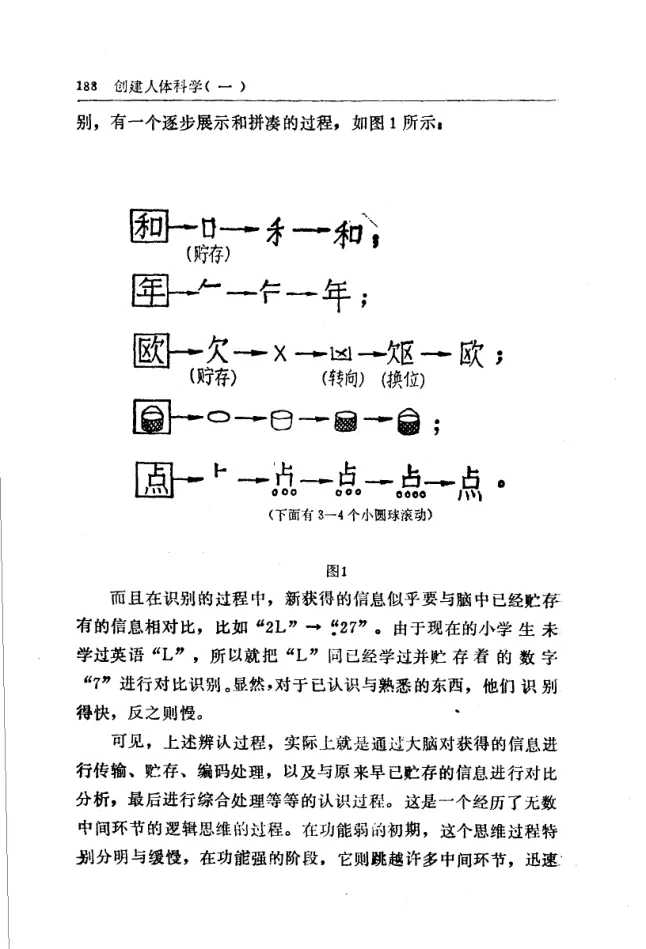
Moreover, during the recognition process, newly acquired information appears to be compared against information already stored in the brain—for example, “2L” → “27.” Since present-day primary school students have not studied the English letter “L,” they compare “L” with the numeral “7,” which they have already studied and stored, in order to recognize it. Clearly, they recognize things they already know and are familiar with quickly, and conversely, slowly.
It can be seen that the recognition process described above is in fact a cognitive process carried out through the brain’s transmission, storage, and encoding of acquired information, as well as comparative analysis with previously stored information, and finally comprehensive processing. This is a process of logical thinking that passes through countless intermediate links. In the initial stage when the ability is weak, this thinking process is especially distinct and slow; at the stage when the ability is strong, it skips many intermediate links and rapidly
arrives at the result of recognition.
From this it appears that the “two-nature” cognition we have always discussed—that is, from perceptual cognition without such mental processes as analysis and synthesis, to rational cognition “manifested as a series of abstractions and generalizations, analyses and syntheses,” along with the epistemological theory that “between perceptual cognition and objective things there are no intermediate links whatsoever” [8]—is at least difficult to reconcile completely with the actual process of recognition through extraordinary abilities. Therefore, the logical process of extraordinary abilities should be studied, and the theoretical concept of “two-nature” cognition should be developed.
(3) Is “Telepathy” “Idealism”?
When discussing epistemology, we always speak of “matter becoming spirit” and “from practice to cognition.” Faced with the objective facts of “remote sensing” and “thought transmission,” might we also speak of “spirit becoming spirit” or “from cognition to cognition”—that is, “thought induction”? That is to say, a person’s cognition or thought, apart from being a reflection of the objective external world, can also be directly transmitted or transformed from the information carriers of another person’s thought and cognition. If we regard the concrete material movements of thought and consciousness in another person’s brain as an external object of the knower (the subject), then the phenomena of “remote sensing” and “telepathy” in extraordinary abilities are not only not opposed to the materialist theory of reflection, but rather constitute a tremendous enrichment and development of Marxist epistemology. Clearly, the “telepathy” of extraordinary abilities is by no means idealism.
(4) Can Learning Only Be Through Seeing and Hearing?
Based on investigations into the information carriers of extraordinary abilities and the mechanisms of sending and receiving brain waves, the confirmation by photographic film exposure experiments that the human body actively emits matter waves, and the general effectiveness of “telepathy” or “thought induction,” some people now propose that, after simulating the mechanisms of extraordinary abilities, it may become possible to purposefully transmit knowledge carrier waves to the human brain, thereby providing humanity with new scientific methods for learning knowledge and enhancing memory. If this proves to be the case,
were the case, it would produce revolutionary impacts not only for the materialist theory of knowledge, but also for human pedagogy, social intelligence, and its transmission, among other fields.
(5) Is There a “Third Signal System”?
Our philosophy textbooks accept Pavlov’s theory, holding that the human brain possesses lower-level conditioned reflexes directly elicited by physical stimuli, and higher-level conditioned reflexes elicited by verbal signals—that is, a first signal system and a second signal system exist. Extraordinary human abilities, along with the functions of “extraordinary movement” [特异致动], indicate that the human brain very likely also possesses a “third signal system”—that is, the existence of a “third reflex” elicited by thought-based information, and that these three systems may be nothing more than constituent parts of the brain’s unified information system. The philosophical theory of consciousness should encompass this new situation.
(6) What Is the Essence of Thought?
Engels said that thought and consciousness “are products of the human brain” [9]. Lenin also said: “Thought and consciousness are products of the human brain” or “functions” [10]. Of course, all of this is correct, but it does not fully explain the problem, and given the scientific level of the time, it was impossible to do so fully. Yet even today, our philosophy textbooks still say the same thing: “Consciousness is an attribute or function of the human brain” [11]. But why is consciousness an attribute or function of the human brain? What is the specific material basis and its laws of motion through which this attribute or function manifests itself? In a word, what exactly is the essence of thought? With respect to these questions, philosophy not only fails to answer and explore them, but has consistently treated them as forbidden zones—for example, it has consistently criticized research into the physical processes, physiological processes, and biochemical processes of thought and consciousness as “vulgar materialism” or “reductionism,” or has simply equated the two, thereby blocking the gateway to in-depth exploration of the mechanisms of thought and consciousness [12].
At present, research abroad on the microscopic level of the brain, and research in China on the mechanisms of extraordinary functions, are helping us gradually gain certain law-like understandings of the nature of thought movement and the material process of consciousness. Moreover, the objective facts of extraordinary effects or “telekinetic movement by mental command” further inspire us with the following: First, since the thought process is very likely accompanied by the emission and reception of some kind of “extraordinary energy,” it is possible under certain conditions to make objects move in accordance with subjective will; therefore, the proposition “whatever one thinks, one can do,” if it continues to be categorically criticized as “subjective idealism,” is no longer appropriate. Second, the phenomenon of thought is likely a manifestation of some kind of matter in motion at a deeper level than brain nerve cells, just as electrical phenomena are a manifestation of electron motion, and light phenomena are a manifestation of photon (electromagnetic wave) motion. Therefore, the ancient view that thought is a process involving the action of the most subtle form of matter (atoms or qi) appears to have some rational basis. Thus, consciousness or spirit itself is absolutely not something devoid of material content, nor can it any longer be regarded as the empty, contentless opposite of matter. The successful partial decoding of brainwave codes by Americans indicates that the thought process of the human brain is very likely a process in which the movement of macroscopic matter (the brain) is converted into the movement of microscopic matter (such as thought waves); and thought transmission—that is, telepathy—may simply be the tuning resonance of the brain’s receiving system with thought brainwaves. Searching for this information carrier of thought movement and elucidating the laws of motion of the thought process is precisely the task of modern science. With the advancement of the science of thought, “one day we shall […] display […] movement” [13]—or in other words, at that time we shall display consciousness activity at the quantum level—thereby enormously enriching and developing the materialist theory of knowledge, the theory of consciousness, and so forth.
(7) Accept the Challenge, Develop Philosophy
In May 1981, at the Second National Scientific Conference on Extraordinary Human Abilities, as well as in a special discussion forum convened with a group of philosophy and dialectics of nature scholars, leaders of the
China Association for Science and Technology issued a call: given that extraordinary human abilities touch upon many major questions in philosophy, on the one hand everyone “should study some dialectics of nature and philosophy,” and “at the same time, we hope that colleagues researching the dialectics of nature and philosophy will join the battle.” They should personally participate in conducting important experiments in human-body science; closely monitor newly emerging functions and phenomena; and conscientiously study and correctly explain the new problems encountered. “We must use the methods of the dialectics of nature to guide the research work of human-body science along the correct path forward. We must occupy this position and prevent idealists from exploiting gaps” [14].
The discovery and study of extraordinary human abilities have indeed posed a number of major questions for materialist philosophy, such as: What exactly is the essence of thought? How should the theory of reflection be developed? How should the new relationship between matter and consciousness be formulated? And so on. Furthermore, phenomena once regarded as “absurd”—such as “a blind person identifying cards,” “telepathy,” “clairvoyance,” and “extraordinary energy causing movement”—have been confirmed as genuine facts; and phenomena once ridiculed as “extreme fantasy, blind credulity, and superstition”—such as “invulnerability to blades and bullets,” “magnetic hypnosis,” “clairvoyance,” “prolonging life,” “rejuvenation,” “creating new species,” “summoning wind and rain,” and so forth [13]—have also become facts or are in the process of becoming reality. Therefore, putting the labels of “idealist heresy” or “feudal superstition” on them is no longer feasible, and will only bring trouble upon oneself.
So then, faced with a new discovery, what attitude and policy should materialist philosophy adopt?
First, uphold the principle of the primacy of practice; have the courage to acknowledge objective reality; and welcome new scientific discoveries. For “nature is the touchstone of dialectics” [15], and “the materialist view of nature is nothing more than the simple understanding of nature as it actually is, without adding any extraneous elements…” [16].
Second, with the courage to revise theory, absorb new scientific content, and enrich and develop oneself. For “with every epoch-making discovery in the field of natural science, materialism must inevitably change its form” [17].
Third, appearing in the role of an ally, supporting scientific research and playing a guiding role, “forging an alliance with modern natural scientists.” [18]
However, if instead of doing so, one takes ready-made philosophical conclusions to frame new scientific discoveries and forcibly trims objective facts to fit—as if cutting the foot to suit the shoe—then not only will new and emerging things be suppressed and scientific development hindered, but philosophical theory will inevitably become rigidified, thereby risking the danger of placing oneself in the anti-scientific position of “replacing science with philosophy.”
3. Scientific Prospects: The Development and Significance of Extraordinary Human Abilities
Over the past several years, thanks to the nurturing and guidance of senior scientists, the diligent work of the broad scientific and technological community, and the enthusiastic support of leading cadres at all levels, the young shoot of science that is extraordinary human ability has grown vigorously and vibrantly. Its development and significance are both immeasurable.
(1) Abilities Continue to Develop
Today, whether in terms of their functional manifestations or their scientific connotations, extraordinary human abilities are far broader and richer than when they were first discovered. To date, the development of these abilities can be summarized in three stages. The first is the stage of tactile perception. Beginning with the discovery of recognizing characters with the ear (March 1979) and extending to the point where the skin across the entire body and even teeth could recognize characters through contact, this stage lasted approximately one year. [3] The characteristic of this stage is that the functional site had to make contact with the object (target) in order to exercise its recognition function.
The second is the stage of remote perception. Beginning with sensor-based and remote-sensing character recognition (January 1980) and extending to the discovery of thought induction, this stage lasted approximately half a year. [19] The characteristics of this stage are: first, the functional site could exercise its recognition function without contacting the object; second, close relatives could sense each other’s thoughts whether in contact or not.
The third is the stage of extraordinary action or extraordinary-energy-mediated movement. This began with the discovery that persons with extraordinary abilities could use extraordinary
energy to move watch hands (July 1980). To date, “extraordinary energy” experiments have been successfully conducted in unlocking locks, retrieving objects, manipulating safety pins, threading buttons, moving watch hands, and activating signaling devices, among others. [20] The characteristic of this stage is that persons with extraordinary abilities, without contacting the object, can exert an effect on it and perform work through extraordinary energy controlled by consciousness.
It can thus be seen that extraordinary human abilities, which initially only enabled people to better perceive and understand the objective world, have now developed to the point of helping people better act upon and transform the objective world. Extraordinary human abilities are still developing, and it is too early to speak of their boundaries. May they surge forward unbridled, rolling eastward like a mighty river. [21]
(2) Glad Tidings for Humanity
The deployment of extraordinary abilities as an expression of the human body’s latent potential will not only make people physically robust but also intelligent and wise, thereby promoting the progress and development of humanity. Based on the currently known functional manifestations, it is expected that extraordinary abilities will benefit humanity in at least the following five areas:
First, the blind will no longer be “blind.” Given the success achieved in training extraordinary abilities in blind children, it is no exaggeration to say that when bionic extraordinary sensory organs (such as visual prostheses for the blind) are successfully developed, that day will surely be the day when all blind people in the world regain their sight. This will not only bring happiness to blind people in China and around the world, but will also uncover many useful talents among them.
Second, the sick will no longer be “sick.” Qigong has been used to cure illness and relieve pain since ancient times. It has now been discovered that persons with strong extraordinary abilities also possess the skill to cure illness at a touch and the power to strengthen the body through practice. If the power of this healing ability can be fully unleashed, there is great hope for relieving humanity of its illnesses and suffering.
Third, the paralyzed will no longer be “paralyzed.” If one day all of the human body’s “extraordinary energy” can be mobilized, then paralyzed patients, relying on the power of “extraordinary-energy-mediated movement,” will be able to control the facilities around them and take care of themselves even while confined to bed.
Fourth, the cognitively impaired will no longer be “impaired.” This does not refer to using gene recombination to improve the structure of the human brain, but rather to the prospect that will emerge when knowledge carrier waves can be transmitted to the human brain. At that time, some individuals with physiological cognitive impairments, through extraordinary learning methods, will be able to eliminate some or all of their symptoms.
Fifth, intelligence and longevity. This also does not mean relying on genetic engineering to obtain the physiological basis for making people intelligent and long-lived, but rather means maximally deploying the latent potential of the human body and, in conjunction with the latest achievements in science and technology, improving and raising the level of human mental and physical capacity, thereby realizing humanity’s cherished aspiration for intelligence and longevity. Since it may be possible to eliminate human illness, disability, cognitive impairment, and paralysis, then enabling humanity to develop more fully upward may perhaps be no more difficult than the ancient tale of “Chang’e flying to the moon.”
(3) A Scientific Revolution
Based on the information obtained from preliminary research, people have a premonition that the in-depth development of extraordinary human abilities—posing a challenge to modern science—will have incalculable impact and value for basic theory, technical science, and practical applications alike, thereby precipitating a scientific revolution in the truest sense.
In the history of modern science, compared with physics, the life sciences have far more blank spots. Many of the mysteries of life activities remain to be revealed, and the unknowns concerning the human body itself are the most numerous. For example, we know very little about the human brain, which stands at the highest level of evolution and possesses the greatest amount of information; to this day it remains almost an unknown realm of necessity. Now, the discovery and study of extraordinary human functions is like lighting a lamp in this labyrinth of secrets. It will eventually illuminate the winding paths of exploring the nature of thought and the mechanisms of memory, thereby making it possible for us to penetrate the depths of consciousness within the brain’s “black box.” Through the in-depth study of the human body’s “extraordinary energy,” information transmission, the brain’s thought processes, and cerebral electromagnetism, cerebral chemistry, and so forth by means of extraordinary abilities, the vigorous development of basic sciences such as biology, physics, biophysics, and biochemistry will surely be propelled, and information science will be closely integrated with the life sciences. Once a breakthrough is achieved in basic theory, it will inevitably promote the mutual penetration and cross-fertilization of technical sciences such as bionics, information theory, electronics, and medicine, thereby giving rise to a series of new technologies such as bionic electronic devices, bionic image displays, and bionic radar. In short, the in-depth development of human-body science—with extraordinary human abilities at the forefront—will inevitably catalyze a revolution in basic science and tech-
a revolution in technical science, just as the scientific revolution triggered sixty years ago by the successive birth of relativity and quantum mechanics from physics [22].
Extraordinary human visual functions will not only add new proactive exploratory capabilities for humanity, but will also provide new high-sensitivity detection instruments for medicine and other disciplines. Furthermore, the clinical application of “X-ray vision” and naked-eye microscopic functions will inevitably lead to major innovations in medicine and diagnosis. The “unfolding” and “reassembling” functions, meanwhile, will become new tools for image recognition as well as for scientific observation of living organisms or whole systems. Particularly encouraging is the fact that, as extraordinary functions and even the mechanisms of human brain thinking are gradually elucidated, they will provide humanity with new methods of learning, thinking, and memory, improving and enhancing the brain’s work efficiency, and ultimately even simulating and extending thought processes, thereby bringing about revolutionary changes in industrial and agricultural production, scientific research, and national defense [23].
Finally, the research and development of extraordinary human functions will also overcome people’s intellectual inertia, wash away many stale ideas and concepts, transform humanity’s mutual relationships with nature and society, as well as traditional understanding of them, and usher in the prosperity and flourishing of philosophy and the social sciences.
(IV) Social Transformation
Clearly, the full development of human potential will not only bring about humanity’s own progress and civilization, but will also promote the transformation and development of human society.
The “clairvoyance” and “clariaudience” of extraordinary abilities will not only change people’s habitual perceptions of space and time, but will also bring about major innovations in social communication and liaison.
“X-ray vision” and “remote viewing” functions can naturally provide new investigative tools, but they will also create social problems for confidentiality. Combined further with “extraordinary psychokinesis” functions, they will also become entangled with criminal issues. However, such functions in other extraordinary individuals—especially the ability to identify “residual information”—will distinguish truth from falsehood and curb reckless behavior. As the saying goes: “As the Way rises a foot, the demon rises ten feet.”
“Thought telepathy” will change people’s modes of thinking and their mutual relationships. Regarding
its technological innovation and application, it will leave no secret in the world, thereby leading to the development of intelligence warfare.
The use of so-called “extraordinary weapons” will change the face of warfare: remote viewing will transform reconnaissance entirely—fast, accurate, with small losses and great gains; “extraordinary action” can destroy the enemy’s critical facilities and strategic weapons; and the use of “thought weapons” (such as extraordinary hypnosis, brainwave interference, etc.) will lead to a transformation of warfare, shortened durations of conflict, and clean battlefields. Such inquiries, which in our country might be mocked as “pages of absurd fantasy,” have abroad already been listed as important national defense research projects and are being seriously studied in secret.
The full deployment of extraordinary vision, extraordinary action, qigong, and other human potentials will undoubtedly bring about a high degree of automation and scientization in social production, daily life, and entertainment, leading to great social progress [23]. However, just as any science, while benefiting humanity, can also bring varying degrees of harm to society, the full deployment of human potential will certainly produce many adverse effects on human society that are unforeseen today. Therefore, it would seem worthwhile, in the scientific research of extraordinary human functions, to also begin studying their futurology.
Notes and References
[1] Qian Xuesen, “Systems Science, Noetic Science, and Human-Body Science,” Nature Magazine, January 1981 issue.
[2] Engels, Anti-Dühring, Selected Works of Marx and Engels, Vol. 3, p. 122.
[3] “A Child Who Can Recognize Characters with the Ears Discovered in Dazu County,” Sichuan Daily, March 11, 1979.
[4] “Observation Report on ‘Image Recognition by Non-Visual Organs,’” Nature Magazine, September 1979 issue.
[5] “Summary of Observations on Xie Zhaohui Recognizing Characters, Images, and Colors with the Ear,” Nature Magazine, December 1979 issue.
[6] Materialism and Empirio-Criticism, Selected Works of Lenin, Vol. 2, p. 36.
[7] “On Practice,” Selected Works of Mao Zedong (one-volume edition), p. 273.
[8] Ai Siqi, Dialectical Materialism and Historical Materialism, pp. 167–168.
[9] Same as [2], p. 74.
[10] Same as [6], p. 84.
[11] Same as [8], p. 56.
[12] Same as [8], p. 53.
[13] Engels, Dialectics of Nature, pp. 34, 226.
[14] Nie Chunrong, “Promoting Research on Human-Body Science,” Nature Magazine, 1981, No. 4, p. 491.
[15] Same as [2], p. 62.
[16] Same as [13], p. 177.
[17] Engels, Ludwig Feuerbach and the End of Classical German Philosophy, Selected Works of Marx and Engels, Vol. 4, p. 224.
[18] “On the Significance of Militant Materialism,” Selected Works of Lenin, Vol. 4, p. 608.
[19] “Actual Conditions of Several Tests on Thought Transference,” Human Extraordinary Functions Bulletin, 1980, No. 4.
[20] “Major Breakthrough in Experiments on Extraordinary Human Functions; Research Enters the Domain of ‘Extraordinary Energy,’” Human Extraordinary Functions Bulletin, 1980, No. 5.
[21] He Chongyin, “Vigorous Vitality, Splendid Prospects—Progress and Outlook on One Year of Research on Extraordinary Human Functions,” Nature Magazine, 1981, No. 4, p. 492.
[22] Qian Xuesen, “Carrying Out Fundamental Research on Human-Body Science,” Nature Magazine, 1981, No. 4, p. 487.
[23] “The Miraculous Potential of the Human Body—A Brief Introduction to Extraordinary Functions,” Science Enthusiast, 1981, No. 5, pp. 2–3.
A Leap in Humankind’s Understanding of the Objective World
Qian Xuesen
[Editor’s note] This article is a summary of remarks delivered by Comrade Qian Xuesen at a qigong academic symposium held at Tsinghua University on February 10, 1984. In his remarks, he posed the question: “Is the specter of human-body science wandering among us?” He said, “Judging from what we are doing, I have this sense.” He emphasized that human-body science must not be regarded purely as a question of science and technology; it is also a social movement, a leap in humankind’s understanding of the objective world, and will lead to a scientific revolution. If handled well, this revolution may arrive in the twenty-first century.
At this symposium, the remarks made by several comrades just now all touch upon one question: how should we view traditional Chinese medicine, qigong, and extraordinary human abilities? On this question, I feel that two tendencies are both incorrect. One is to regard traditional Chinese works—such as Laozi’s Dao De Jing and Wei Boyang’s Zhouyi Cantong Qi—as entirely correct and highly scientific, and to hold that for further development we need only study and understand these ancient texts and extrapolate from them. This kind of view is incorrect. The other tendency is to completely reject ancient Chinese thought as wholly unscientific; this too is wrong. We should approach these questions using Marxist philosophy and a dialectical-materialist perspective. Last year, at the Spring Festival gathering convened by the China Association of Traditional Chinese Medicine, I
once spoke about this: the theories of traditional Chinese medicine are extremely precious, being distillations of several thousand years of practical experience, but they also contain elements of conjecture. Therefore, they are more akin to what in the West is called natural philosophy, rather than natural science. This body of knowledge is very precious, yet imperfect; it contains a great deal that is correct, but also things that are mistaken. To reject it entirely is wrong, and to accept it wholesale will not do either. What, then, should be done? Some have proposed combining Western and Chinese elements. I have discussed this with these comrades: the word “combine” is not appropriate; one cannot use simple addition. This work is not easy; it is very difficult to carry out. But we should not be discouraged, because we have two strengths: one is that the treasures of our ancient cultural heritage are here with us; the other is that we have Marxism-Leninism and Mao Zedong Thought, and this point is extremely important. We need only look at the problems and difficulties encountered in research on qigong and extraordinary human abilities over the past period to appreciate how important correct philosophical thinking is. For example, some people refuse to acknowledge the role of the mind, as in the behaviorist perspective in psychology in the past, which holds that the human body is a “black box” whose interior cannot be understood, so that only inputs and outputs can be studied, while the human mind is regarded as a forbidden zone that must not be touched. This kind of thinking is in fact mechanical materialism, not dialectical materialism. And mechanical materialism, in the final analysis, is actually idealism. How should this problem be resolved? When we last gathered at the Beijing College of Traditional Chinese Medicine, I proposed several approaches: first, to publicize the fact that Western medicine abroad—in physiology and other fields—has found itself insufficient in the course of its development, and consequently has become very interested in traditional Chinese medicine and qigong, so that people come to understand that the classical body of Western medical knowledge is no longer adequate; second, to publicize the development of brain science, which has already indicated that the mind is not something that cannot be discussed, that there are already clues regarding the relationship between mind and matter, and that human consciousness is simply a manifestation of matter in motion. In fact, there is already a good deal of material in these areas, and the lecture notes compiled by the Philosophy Teaching and Research Office of the Party School of the Central Committee have already been written in this way. The above two points are things I have discussed before. Later, I thought of one more point: the results of our qigong research should be written up as scientific papers and published in authoritative academic journals abroad. For example, cases treated with qigong should be written up conscientiously according to the case-reporting standards commonly used
throughout the world; we should strengthen the routine documentation work in this area and write papers to be published abroad. In short, in response to the situation of those who do not acknowledge these phenomena, we must still do the work of shifting people’s understanding—this is a very important aspect.
Furthermore, in dealing with foreigners, we must be serious and conscientious.
The people abroad who study this question are very complex. An article published in the British magazine New Scientist on June 16, 1983 discussed two individuals: one is the British scientist Crookes, whom Engels criticized in his essay “Natural Science and the Spirit World.” The article says that Crookes had a certain intellectual inclination—he very much wanted to see his younger brother who had died young. Crookes himself was a chemist and later even served as president of the Royal Society. The other person is J. B. Rhine, who forty years ago was a famous figure in parapsychology in the United States. The article says the reason Rhine studied parapsychology was that he believed in a supreme deity, and therefore considered religion entirely correct; he wanted to use such research to spark a worldwide surge of religious belief, in order to counter the communist movement. This shows that the people abroad engaged in this research are very complex. In addition, Maharishi, who visited China not long ago, is a modern religious leader who presents himself as combining natural science with “social science.” We should take a two-sided view of him: in the realm of natural science, his work on electroencephalography and physiological and biochemical testing can serve as material for our study and reference, but his so-called “social science” is religious belief. Science should be distinguished from religious belief; when drawing on the techniques of others, we must do so analytically. Among foreigners there are all sorts of such people—it can be said that they come in every variety—and we must be serious and conscientious in our dealings with them, and must not let our guard down.
All in all, pursuing this undertaking is far from easy, but we believe that if we persist, it will surely lead to a scientific revolution—a leap in humankind’s understanding of the objective world. If handled well, this revolution may arrive in the twenty-first century.
The Communist Manifesto begins with the words: “A specter, the specter of communism, is wandering in Europe.”
Is the specter of human-body science wandering among us? Judging from what we are doing,
Look, I have this feeling. Since this is the case, there will be a struggle. Our comrades must keep a clear head; we cannot simply view it as a scientific and technological issue; it is also a social movement. We must recognize the issue in this way. Regarding this, some of the comrades present may feel unfamiliar. We need to see clearly the various intricate and complex relationships, and see clearly all kinds of different people. In a complex situation, one must have a clear head, cannot be too naive, and must use the dialectical materialist viewpoint to understand the surrounding world. Be firm, but do not be reckless; this is actually a battle to defend dialectical materialism.
Prospects of Human-Body Science
— Qian Xuesen
[Editor’s Note] The 507 Institute is a famous research institute in our country; its primary research task is aerospace physiology. Since 1982, at the suggestion of Comrade Qian Xuesen, the institute has carried out research on human-body science. This text is a speech given by Comrade Qian Xuesen at the 14th Annual Academic Conference of the institute. In this speech, Comrade Qian Xuesen astutely points out that the “syndrome” (zheng) in the syndrome differentiation and treatment of traditional Chinese medicine refers to the functional state. He also points out that beyond the cosmoscopic, macroscopic, and microscopic levels usually studied by people, there are even larger and smaller levels: the expansive scope (zhangguan) and the infinitesimal scope (miaoguan). He hopes that scientific researchers will practice qigong to strengthen their understanding of qigong; and he indicates how to use Marxist philosophy to guide the research of human-body science. This is a very richly detailed report.
Comrades: A year ago, on January 15, 1984, the 507 Institute held its 13th Annual Academic Conference. Today is the beginning of the 14th Annual Academic Conference. Director Zhang of the Science and Technology Committee of the National Defense Science and Industry Commission is out of Beijing and cannot come today. Today, Deputy Director Ye Zhengda has come in person. First of all, on behalf of the Science and Technology Committee of the National Defense Science and Industry Commission, I extend a warm welcome to the more than thirty units, more than sixty professors and directors, and other comrades and guests who have gathered here today, and I thank you for coming to the institute to guide our work. Second, I want to speak of the achievements that the 507 Institute has attained in the past year, as just mentioned by Deputy Director Shi,
especially the ten major achievements that the institute, under the leadership and support of higher-level organs, united as one to form an integral collective strength, has been able to attain in the past year. For this, I also express my congratulations, and I hope that in the new year, you will continue to advance.
1. The Mission of the Research Institute Must Be Developed
At the 13th Annual Conference I said that the fundamental task of our institute is to develop human-machine system engineering, so that human roles can be fully brought into play and humans and weapons can be closely integrated. Today, I believe that, in accordance with the spirit of the Central Military Commission symposium held at the end of last year, we should expand the scope proposed last year. That is to say, while developing the human-machine system, we must ensure that human roles in all aspects can be fully brought into play to promote socialist construction. This task is even larger than last year’s, because the current spirit, whether from the Central Committee or the Central Military Commission symposium at the end of last year, asks our national defense system to make greater contributions to the national economy and to socialist construction. Therefore, I think the work of our 507 Institute must be considered more broadly. The first aspect is the work in the area of human-machine system engineering. This area of work is familiar to all of us; for many years it is what we have striven for. I do not need to say much about this point; in the past, our institute has done very well in this regard. In addition to this, I will speak of the second aspect, which is human health. Deputy Director Shi also spoke of this issue just now. Our institute has already made contributions; I feel that we must consider these efforts even more in the future. For example, since ancient times, regarding their own health, humans initially did not even know how to treat illnesses and left things to nature. Speaking of treating illnesses, some comrades say this is the first medicine, the first step of medical science. Later, a further step was taken: instead of waiting for illness to arrive, could methods be devised to prevent disease? The shift from treating disease to preventing disease is a leap in human medicine. As I just said, going from not treating disease to treating disease is the first medicine; going from treating disease to preventing disease is the second medicine. Now it seems to have gone a step further. Not only preventing and treating diseases, but attention is also paid to after one gets sick,
being cured, and recovering health, which is called rehabilitation. This is not without its issues; from preventing disease, treating disease, to human rehabilitation—the complete restoration of health—some call this the third medicine, known as rehabilitation medicine. This area is now receiving attention. There are also comrades who propose establishing rehabilitation traditional Chinese medicine; that is, although the person no longer has the disease, they have had it before and are not fully healthy, which is called the rehabilitation process. I feel that since the entire development of medical science follows such a process—first medicine, second medicine, third medicine—then we must pay attention to these issues. Not only that, I feel that on this basis we must also consider another issue, which is the development of human potential. Humans currently have many better functions that we have not yet developed or realized. For instance, is everyone’s intelligence the same? It is not. We see this often. Some people are simply smarter. Is their being smarter innate? In the past, it was put this way: there are geniuses; but now, from our research in many areas, we see they are not geniuses, but acquired post-natally. How are they acquired? This question is very worthy of study now. That is to say, every person can change. The question of exactly how one can become smarter—I feel that such a major question is actually a matter of the human body itself possessing potential that you must unearth using scientific methods. This is an issue that people have been researching recently. For example, Comrade Wu Yi, a teacher at the county middle school in Susong County, Anhui Province, said that human intelligence has latent potential. What kind of method can be used to develop this intelligence? He believes one can practice qigong. Therefore, he wrote me a letter. I was very happy to read it, and I wrote back to him. I said, do not just talk about it; if you believe this, then run a training class at your middle school! Teach middle school students to practice qigong and see if their intelligence has improved. I wish that in the future, the top scorers in the national college entrance examination will all come from your middle school! Looking at it now, this aspect is indeed possible, because work in this area is already being done by some. Therefore, if our 507 Institute can also do a little work in this third aspect, then the contribution to our country and even to humanity will be very great. Thus, the first point I want to make is that, according to the current spirit of the Central Committee and the Central Military Commission symposium, the issues our 507 Institute considers have become larger. We must see all of China, we must…
…to make contributions to our socialist construction, to the construction of two civilizations. Therefore, there are three aspects of work. The first is the one we have spoken of very often in the past, and which is indeed very important: namely, the area of human-machine systems engineering. But now we must also strengthen the second aspect, which is first medicine, second medicine, and third medicine. Not only that, but we must also add a third aspect: the development of human potential and human intelligence. For this reason, our Institute of Space Medico-Engineering must bring all of human-body science to bear.
II. Prospects for Human-Body Science
To accomplish this task, we must enable the comprehensive development of human-body science. How exactly should we go about it? I addressed this point at last year’s academic annual conference. That is, under the guidance of Marxist philosophy, using the theories and methods of systems science, we should take Western medical science and traditional Chinese medicine (which is in reality ethnic medicine, since it also includes Tibetan medicine and Mongolian medicine) — including here the practice and theory of qigong, as well as extraordinary human abilities — combine all of these, Western and Chinese, in their entirety, and comprehensively refine and distill them. Last year I used a philosophical term: I said that this refinement is what in philosophy is called Aufhebung (sublation) — meaning it is not merely a matter of addition, but of becoming something new, something at a higher level. Using such a method to create human-body science — that is what I said last year, and to this day this idea of mine has not changed. I feel that this formulation has, through one year of practice, through studying with comrades, participating in discussion meetings, and listening to opinions from other quarters across the nation, proven still to be correct. There are the following minor developments, which I would like to take this opportunity to report to you comrades.
The first question concerns the philosophical concept within human-body science. We call it the human-heaven view (rentianguan), which is the close relationship between human beings and the cosmos, and between human beings and their environment. I now feel that this concept of the human-heaven view should be expanded somewhat further, because last year and before, when we spoke of the objective world, in our terms it was the macroscopic and the microscopic. The scale that humans can touch and see is called the
macroscopic. What about something smaller? Even a microscope cannot see it — that is called the microscopic. What about expanding further? The cosmic scale — the entire Milky Way, for instance — is called the cosmic scale (yuguan). Moreover, in each of these three domains there are fundamental physical concepts corresponding to them. At the macroscopic level, as we all know, it is Newtonian mechanics — the oldest. At the microscopic level, it is quantum mechanics. Going larger, beyond even the solar system, to the Milky Way galaxy — that is a scale of about a hundred thousand light-years. Then we need to use general relativity. This year, having read some further articles and publications, I feel that speaking only of the macroscopic, the microscopic, and the cosmic scale is still not enough. In the past, cosmology always discussed a well-known theory called the Big Bang theory. That is to say, the universe in which all of humanity exists started out very small, then underwent an expansion, an explosion, and thereby formed the universe in which we now exist. How large is this universe? Approximately over ten billion light-years — meaning that light, traveling from its edge to us, would take over ten billion years. Such a Big Bang theory has many similarities with the phenomena we have observed, so some astronomers firmly adhere to the Big Bang theory. But from the standpoint of Marxist philosophy, there are also many problems. The first problem is this: it started from something very small, so there must have been a beginning — what was there before the beginning? The Big Bang theory cannot resolve this question. This is a very big problem indeed. However, in recent years, mathematicians and astrophysicists have also come to feel that the Big Bang theory is truly imperfect, so they have sought ways to address it. In recent years a new theory has emerged, called the cosmic inflation theory. I will not go into the details here; this theory holds that beyond the universe in which we currently reside, there exist things on an even larger scale — that is, within the entire infinite universe, to put it vividly, there exist many small bubbles in this universe, and these small bubbles can inflate into the universe in which we reside; but there are also other bubbles that may not be inflating at present yet still exist. This means that there are things existing beyond the universe in which we reside, and this scope is even larger than the ten-billion-light-year range mentioned above. Didn’t I just say that the very largest is the cosmic scale? What do you call it when you need something even bigger? I’ll coin a term — since it’s an inflating cosmos, let’s call it the “inflationary scale” (zhangguan), even larger than ten billion light-years, approximately 10^{100} light-years — unimaginably vast.
Not only that, but on the small side, saying “microscopic” is no longer sufficient, because in recent years a physicist, Bohm, has proposed that the scale of quantum mechanics is generally 10⁻¹² cm, and this has given rise to many problems—namely, the indeterminism of quantum mechanics. Why is it indeterminate? Are all things indeterminate? He says there are still smaller things. When we look through a microscope at a tiny speck of dust or a grain of pollen, we see that it seems to move randomly in water. Why does it move randomly? Of course, we know that this random motion is caused by water molecules in motion. As the water molecules move, they collide with the speck of dust or pollen, and it appears as though it is moving, while the water molecules themselves are too small to see. This is a figurative way of putting it—that is, the indeterminism of quantum mechanics arises from the existence of things at an even smaller level. These things at the even smaller level are much, much smaller, on the order of 10⁻³⁴ cm, so I call this the “sub-microscopic view” (渺观).
That is to say, we originally had the microscopic, macroscopic, and cosmoscopic—three levels of observation. Now, for what is even larger above, we add the “mega-cosmoscopic” (涨观), and for what is even smaller below, we add the “sub-microscopic” (渺观). In other words, the concept of the human-cosmos view (人天观)—which we previously discussed as encompassing a microscopic human-cosmos view, a macroscopic human-cosmos view, and a cosmoscopic human-cosmos view—now also includes a mega-cosmoscopic human-cosmos view, and below, a sub-microscopic human-cosmos view. What concrete relationship do these have to human-body science? I think they are related. Take our observation of the objective world: the first thing we recognize about the objective world is individual objects—or, to use the perspective of physics, this is a teacup, this is a pot of flowers, that is an electric lamp, and so on. This is the most superficial level of understanding. If you truly examine matters, you will see that the things that appear to you to exist independently are in fact not independent; there are interrelationships among them—and this is precisely the approach of systems science. Now let us look again at the human body. From a superficial, anatomical perspective, a person has a circulatory system, a nervous system, and many organs. So what perspective do we adopt in human-body science? This is also something we frequently discuss at the May Seventh Institute—we must regard the human body as a system, a giant system, and moreover recognize that this system has
an intimate relationship with its surrounding environment. Therefore I call it a super-giant system—this is the perspective of systems science. It is not enough to look at it solely from an anatomical viewpoint. This concept of a giant system can, roughly speaking, help us understand through the concept of the giant system the various states we observe in the human body—including illness, or health, or transitions from normal to abnormal states. But there is also a problem here: certain human bodies possess extraordinary abilities, such as extraordinary psychokinesis, and for these, the concepts just mentioned alone are insufficient. Abroad, there are also scientists who research extraordinary abilities and extraordinary psychokinesis and who have proposed—including the British physicist I mentioned just now—that this requires delving into the microscopic within the microscopic, that is, into the sub-microscopic. This is not purely a problem of physics. It is also a problem within human-body science. Problems that we previously considered very difficult to explain, for which there seemed to be no path to explanation, now have hope and a pathway. Of course, much work remains to be done; we have merely glimpsed a possibility. To put it into concrete practice will depend on future work. And once this work is carried forward, our purpose will not merely be to explain extraordinary abilities—that is certainly important work—but, in my view, what is even more important is ultimately to truly uncover the latent potential of human beings. This is a question that has come into view over the past year: the development of the human-cosmos view.
Let me also report to you on a second matter, namely the core of traditional Chinese medicine theory—the so-called “syndrome differentiation and treatment” (辨证论治). “Differentiating syndromes”—the word “syndrome” (证) is the same “zhèng” as in “evidence” (证据). First, one must differentiate the syndrome, and then, on this basis, consider how to treat the illness—hence “syndrome differentiation and treatment.” The central idea in the development of traditional Chinese medicine since the Han dynasty has been syndrome differentiation and treatment. So what exactly is a “syndrome” (证)? Within the theory of traditional Chinese medicine there are also two different explanations. After reading them, I still could not figure out what exactly a “syndrome” is. In this regard, I must thank Huang Jianping of Hunan Medical College, who, in an academic report he gave at our May Seventh Institute, proposed that his understanding of the so-called “syndrome” in Chinese medicine is linked to the functions of the human body. His words gave me great inspiration. I had previously said that the human body is a giant system with various functional states. He said that a “syndrome” is precisely a kind of functional state of the human body—and this clarified the matter. Because the medical texts of Chinese medicine are not written in modern language, one could not fully fathom what a “syndrome” is.
what it is all about. If we say that “zheng” (syndrome pattern) refers to a person’s functional state, then it becomes clear. That is to say, when a person falls ill, there is a cause — perhaps exposure to cold, or bacterial invasion — that causes the human body’s giant system to deviate from its normal state, and the person falls ill. Illness is the deviation from the normal state; this is the process of falling ill. Then what about treating illness? It means finding ways to induce and pull the deviated, abnormal functional state of the human giant system back to a normal functional state, and the person’s illness is cured. Because Chinese medicine holds that under normal functional states, the human body inherently possesses the ability to resist disease, and also has an immune system to kill invading bacteria. Therefore, when Chinese medicine treats you, it does not necessarily give you bactericidal medication, yet it can still cure your illness. Therefore, the concept of syndrome differentiation and treatment in Chinese medicine can be understood as using various methods to pull the human body that has deviated from its normal state back to the normal state. There are still many methods: medication is one approach — first giving you some medicine, then doing a follow-up examination a day later to see how far your state has been pulled back. If it has been fully pulled back, you are recovered; if it has been pulled back halfway, then medication is prescribed again based on that half-way state, to enable you to return further toward normal. This is the method of taking medicine. Other methods include acupuncture, which is one approach; there is also what Western medicine calls physical therapy, which is also a form of treatment; and there is one most ingenious method, namely psychological therapy. At the County People’s Hospital in Jiangpu County, near Nanjing, Jiangsu Province, there is a Chinese medicine doctor in his forties named Zhou Weijun, a hereditary Chinese medicine practitioner. He wrote an article titled “Suggestive Therapy in Chinese Medicine,” which points out that suggestion can also cure illness — without taking any medicine at all, the skillful use of psychological therapy can also restore a person’s abnormal state to a normal state. What he wrote in this article is his own practice. What is suggestive therapy? He gives an example: a female comrade, after becoming pregnant, did not understand psychologically what was going on. She felt different from her past normal state — she vomited whatever she ate. For this illness, taking this medicine or that medicine did not work. Eventually she found Zhou Weijun, who was somewhat renowned. He took advantage of this female comrade’s psychology of trusting him, pretended to take her pulse and make a diagnosis, and treated her, saying: “Your illness is very serious. I need to specially prepare some medicine for you. I don’t have it with me right now; I need to go home to get it.” And so he left her. Later, after an hour, he returned, saying he had obtained the medicine, and brought
five pills, saying they would take effect immediately. He then gave the five pills to the female comrade. She took them, and her illness was cured. Only then did he tell her what these five pills were: they were Niuhuang Jiedu Wan (Bovine Bezoar Detoxification Pills). This was entirely a matter of utilizing the patient’s psychological state to overcome her psychological condition, and the illness was cured. So this too is a kind of functional state of the human body — a pathological state — which can also be induced into a normal functional state through various methods.
The thought of syndrome differentiation and treatment in Chinese medicine has also been applied to other problems. For example, regarding the treatment plan for microwave sickness, Professor Zhang Ruijun of our institute uses the Chinese medical principles of syndrome differentiation and the theory of yin and yang. Microwave sickness is not a bacterial infection either — what is it? It is that the person’s bodily functional state has deviated from the normal state, with yin and yang in imbalance. Then this “zheng” (syndrome pattern) involves the study of yin and yang. Of course, some medications are also used, and this precisely illustrates that the human body’s functional state has deviated from the normal functional state, and it is necessary to regulate yin and yang to pull the abnormal functional state back to the normal state.
The third issue: let me talk about the research work in human-body science in recent years. There has been some development in this area of work. Recently, I have received some letters from people who have received higher education; some are engineers. Some of them had poor health and received qigong training. After practicing qigong, not only were their illnesses cured, but some also developed extraordinary human abilities and could treat others’ illnesses. These people have received higher education, possess modern scientific knowledge, and are also qigong practitioners — they are not merely research subjects but also fellow researchers. All of this is conducive to their research and to the development of work in this field. We must strengthen our connections with these comrades who understand both modern science and Chinese medicine and extraordinary abilities, and jointly study the problems in this area.
The fourth issue: let me discuss how to use the Marxist-Leninist perspective to create a new human-body science. Last year, I still thought there was no way to begin, and the path to establishing such a science was not yet visible. Over the past year, my view has changed somewhat. This is precisely what I have just discussed: first, syndrome differentiation and treatment; second, our institute has invited many colleagues from both inside and outside the institute to present many new developments from China and abroad, such as hemorheology, electromagnetic biology, psychophysiology, brain science, human body fluid regulation, and many other new topics. In the 12th issue of Encyclopedic Knowledge in 1984, I saw Ye Jiaxin’s
…wrote entitled “An Overview of Contemporary Research on the Geomagnetic Field and Life.” There are still others, and developments are very rapid. In the tenth issue of Scientific American in 1984, there was also a report saying that when a person catches a cold, Western medicine has its usual set of methods—taking medicine and getting injections—and if there is no fever, they say you are cured. But you feel weak all over and still are not normal; this state can last for several days, several weeks, or even several months. This report said they had discovered that the reason is that drugs lower the efficiency of muscular energy metabolism. Because taking medicine interferes with the metabolic processes of muscle, ATP function becomes disordered, making people feel weak—that is, one has not yet returned to a normal functional state.
All four of these questions are inspiring, and all deserve attention in research on how to apply them to solve problems within human-body science.
At last year’s annual meeting, I spoke of the need to establish human-body science, but at that time there was only an outline. Now I believe there is a way forward for human-body science. Everyone needs to study some Chinese medical theory, but Chinese medicine is all written in classical Chinese—yin-yang and the five phases, the eight trigrams, and so forth—and young people today cannot absorb it; moreover, the barrier of classical Chinese itself is very hard to pass. They cannot understand it. Therefore, we must give Chinese medicine a new outfit—put on modern attire—so that Chinese medicine does not frighten people, so that it is easy to accept. But how do we give Chinese medicine a new outfit? It is by using our current work to explain Chinese medical theory, bringing together Chinese medical theory, systems science, and the human-heaven view to form a framework. Then we gather all the materials mentioned above, enrich them, and fill them into this framework. When it is filled, a new theory will take shape. Last year I did not yet see this point, but in fact many things already exist. I hope everyone will pay attention to gathering them up and enriching this framework. I suggest that the comrades here, especially the comrades at Institute 507, collect these things—gather up whatever you see. This requires everyone’s concerted effort. I suggest organizing a team to work on this problem; everyone should keep their eyes open and search, and when they find something, report it to this group. I believe that if everyone works hard, it can be accomplished in about five years. Accomplishing this well is very important—it is a technological revolution, an orientation toward the future!
Finally, I wish Institute 507 success in forming an assault team for China’s human-body science in 1985.
Our Research Work Must Give Equal Weight to Experiment and Theory
Qian Xuesen
[Editor’s note] In October 1981, the Chinese Human-Body Science Research Association (Preparatory) convened a discussion meeting on the research priorities and research methods of extraordinary human abilities research at Peking University. This article is Comrade Qian Xuesen’s speech at that meeting. Prior to this, Comrade Qian Xuesen had repeatedly emphasized the need to conduct more solid and substantive experimental research; at this meeting, Comrade Qian Xuesen proposed for the first time that research work must give equal weight to experiment and theory. This signified that extraordinary human abilities research had risen another step.
This article also gives a focused introduction to the British scientist Bohm’s concept of the ultra-microscopic—that is, what the world would look like at a scale on the order of 10⁻¹⁵ cm.
Comrade Zhang Zhenhuan has just described some recent advances in extraordinary human abilities research. These advances are an encouragement to all of us engaged in this work. Over the past few years, thanks to the efforts of the comrades present here, more and more comrades have seen with their own eyes that extraordinary human abilities are a fact. During the thirty-fifth anniversary of National Day, on the Tiananmen rostrum, I met Comrade Qin Chuan of the People’s Daily. He said that the number of people supporting research on extraordinary human abilities is growing. I said, yes, it has grown, but I am afraid the problem has not been thoroughly resolved. I said this because I feel that in our country, our work is situated in just such an ambiguous state. If you ask whether it has been completely blocked—no, it has not been blocked; one can still
continue working; if you ask whether it can be included as formal scientific research in the national plan—that cannot yet be achieved. All of you comrades have encountered this situation. Right now, the people in various organizations who support this work all have a “tacit understanding”: some funding can be provided, but it cannot be put in writing—this is the kind of situation it is. In our country, research on extraordinary human abilities is, in practice, in roughly the same situation as qigong research and even Chinese medicine research. It seems to me that this problem is regarded as an ideological issue. Many people believe that they have seen that extraordinary human abilities are real, but that they seem to contradict modern science and to contradict Marxist philosophy. Why do they not dare to support it openly? Because they fear it involves an ideological issue. Of course, to say that it contradicts Marxist philosophy is incorrect; in reality, the contradiction exists only in their heads. But even so, many people do not dare to touch this issue! For this reason, many comrades, on the one hand, have seen the fact of extraordinary human abilities and acknowledge this fact, but on the other hand, it cannot be included in the national plan.
Facing this actual situation, we must seek truth from facts. On the one hand, we should recognize that conditions are somewhat better than in previous years; a few years ago, some people wanted to kill it with a single blow, but in the end it was not killed, and research can continue. On the other hand, we should not harbor the illusion that it will soon be formally included in the national plan. Under these circumstances, those of us doing this work must make the best of the situation—that is, seek truth from facts and do our own research well. This is precisely the question to be discussed at this meeting: how to make our research go deeper, to resolve step by step the contradictions between the various phenomena of extraordinary human abilities and modern science. I believe the most fundamental task of the Chinese Human-Body Science Research Association is to organize our strength. Many tasks, no matter which individual organization undertakes them alone, are very difficult; everyone must support one another and be better organized, so that our not-so-large collective can play a greater role under very difficult conditions. The Chinese Human-Body Science Research Association must solve this problem; it is very important. This is the first point I wish to make.
Next, I would like to offer a few personal and preliminary opinions on the theme of our meeting—the research priorities and research methods of extraordinary human abilities.
To research it as a science, our research work on extraordinary human abilities is now in a preliminary stage of exploration, and therefore we cannot yet see things clearly. There are many hypotheses arising from this—for example, regarding what the human body emits under the state of extraordinary human abilities. Some comrades believe it is electromagnetic waves; among electromagnetic waves, some believe it is microwaves, while others believe it is infrared rays, and moreover that the infrared rays are amplitude-modulated, with a rather low modulation frequency, on the order of tens of times per second, which is very low. This point is again related to what some comrades describe as acoustic wave vibrations: the frequency of acoustic waves is tens of times per second, sometimes over ten times per second, constituting infrasound that cannot be heard. Others speak of ultrasound. Still other comrades say they have detected it with instruments as a particle stream. Others say it does not seem much like a particle stream. Some propose it is plasma. There are also comrades who propose it is a magnetic field, and moreover an alternating magnetic field, also with very low frequency, on the order of a dozen or tens of times per second, linked again to infrasound. There are also those who have measured the acupoints of the human body and found mechanical vibrations under the functional state, with mechanical vibration frequencies also on the order of a dozen or tens of times per second. Regarding the above-mentioned emissions under the functional state, or what may be called a “field,” Comrade Zhang Tianjian of Sichuan has proposed it is the “yuan field” or the “qi field.” I think all of these are conjectures. There are also comrades who say: “I have measured it with an instrument.” It should be noted that such an instrument was designed to measure certain things, and when a response or a record appears during measurement, there are many things that can cause the instrument to respond; it is not necessarily the thing that the instrument was originally designed to measure. Therefore, even if something has been measured, one cannot say it is what the instrument was originally designed to detect. For this reason, the various statements and conjectures mentioned above—whether electromagnetic waves, infrasound, plasma, alternating magnetic fields, and so on—what are they, really? We must ultimately get to the bottom of it. If it is said to be plasma, then plasma cannot exist under normal temperature and pressure. Simply saying it is plasma does not solve the problem; one must explain why plasma could exist there. Here I am merely raising a question: there are now many hypotheses and conjectures, but what is it really? We need to delve deeply into this. We may propose hypotheses, but there must be scientific experimental proof that it is this thing and not something else; only then can we go deeper. At this conference we should carefully discuss how to go deeper,
and how to transform this into rigorous scientific research. This question is probably one that everyone needs to consider, and I ask you all to study it seriously.
In the process of going deeper, I come to my third point. Although everyone present here is engaged in experimental work, I believe theoretical work is also very important. Whether a conjecture conforms to scientific principles ultimately depends on theoretical work. If it is said to be plasma, then it needs to be demonstrated theoretically, so theoretical work remains very important. This can be seen from the perspective of modern science: research in atomic physics and high-energy physics proceeds with experimental work and theoretical work conducted simultaneously, and neither can be dispensed with. On this issue, I am afraid our ranks are still lacking in comrades who can genuinely undertake theoretical work. In recent years I have been mobilizing people to join this work, but I have managed to recruit only a few; some theorists are not very interested. Those I have been able to mobilize include several comrades from the Second Department of the National University of Defense Technology, such as Comrades Zhao Yijun and Zhu Daimo, and possibly a younger comrade, Tan Shusheng. They have some foundation in modern physics theory. Comrades Zhao Yijun and Zhu Daimo are both interested in quantum physics, and the relationship between quantum physics and extraordinary abilities is worth noting.
On this topic, let me mention some literature I have recently come across. Let us start from the most fundamental problem of quantum physics. In the 1930s, Einstein was consistently dissatisfied with quantum physics. He once said: “I believe God does not play dice.” That is to say, he believed the objective world is deterministic and could not be indeterministic in the manner of quantum mechanics. This debate has continued to the present day; fifty years have passed, and the problem has in fact not been resolved. Theoretical physicists today all evade this question. Comrade Zhu Daimo recently attended a symposium on modern theoretical physics, where the question was not touched upon at all, as if the question did not exist in their minds. This greatly surprised Comrade Zhu Daimo. Why such indifference to so major a question? I think it may be because it is too difficult to crack. If it cannot be cracked, then one simply avoids it; it is the same abroad. Einstein and Bohr fought a prolonged battle of published exchanges, and later others also did work on it, but none could get through. Some materials I have recently seen indicate that there is one person who is genuinely thinking about this question. This person is
is David Bohm, professor of physics at the University of London. In his early years he had contact with Einstein and was relatively familiar with Einstein’s ideas. He also felt that the fundamental problem of quantum mechanics—the “uncertainty principle”—was always something difficult to accept. In 1980 he published a book: Wholeness and the Implicate Order. “Wholeness” means holistic integrity, and “Implicate Order” means a hidden order—that is, behind the explicit order we perceive there is also a hidden order. That is the title of the book. Its main thesis is: the entire universe is a whole, and one should view all things from this starting point. This kind of holism has existed in philosophy since ancient times; both ancient China and ancient Greece were grounded in holism. With the advent of modern science, holism was dismantled—things were studied one by one, divided into separate parts. Bohm sought to restore the holistic perspective, maintaining that the entire universe is a whole. This room we are in, Peking University, the city of Beijing, the Earth, celestial bodies, what lies beyond the celestial bodies, and even the entire universe—all are a single whole. He held that what we now call molecules, atoms, and elementary particles are merely temporary manifestations within this whole; they are not truly real. In truth, there are no such molecules, atoms, or elementary particles. He said: we think something is a molecule, an atom, an elementary particle, but in fact it is always changing, just as with us human beings—sitting here we appear to be a particular person, but in reality the cells composing the human body are constantly changing: old ones die, new ones grow, and it is something that is changing at every moment. We regard it as an unchanging, independently existing thing only because our vision is too shortsighted to truly understand it.
This, then, is Bohm’s fundamental viewpoint. Therefore he said that the Heisenberg uncertainty principle in quantum mechanics refers only to surface phenomena—there is something deeper, which he called the implicate order. In this deeper world, it is like classical Brownian motion: what one sees under the microscope is particles running about randomly, which is analogous to what quantum mechanics observes—the impossibility of simultaneously determining position and momentum. In reality, this is because there is a deeper layer of things influencing it; people do not see this deeper layer—what they see is the uncertainty principle of quantum mechanics. He did not seek to overturn quantum mechanics, but rather held that the reason the uncertainty principle of quantum mechanics exists—
—is due to a deeper cause, namely the implicate order. He developed this line of reasoning and thereby raised new questions. Why did I seek out this article to read? It was because Bohm, in an interview with a journalist, said: “My theory has not yet been fully established, but once it is established, ESP and PK and such extraordinary human abilities can all be explained, and they will no longer be remarkable.” At the same time he also revealed that although Einstein did not state this in his published articles, he had said in private correspondence that he believed modern science was perhaps still inadequate; if science continued to develop, perhaps all separations—the distinctions of location, the distinctions of time, the distinctions among past, present, and future—would in the future cease to exist altogether. David Bohm’s theory aims precisely to resolve this problem. If this problem is resolved, extraordinary abilities will no longer be extraordinary.
After finding and reading this book, I also felt somewhat dissatisfied, feeling that Bohm too has his shortcomings. In capitalist countries, when these scientists turn to questions of philosophy of science, they inevitably go astray—and going astray means lapsing into idealism. When Bohm spoke of mind, he went astray. In fact, the problems he encountered do have a way forward. In the theory we seek to establish, the materials from the development of science up to the present can still all be used. We need to go further still: to encompass all scientific theories up to the present, but in a more profound way. Proceeding in this way to solve the problem brings us into close relation with systems theory, systems science, and systemology. It appears that Bohm is not very familiar with systems science. Although he is in London, England—not far from Brussels, where Prigogine’s main base of systemology is located—he is not familiar with it (this may be because Bohm first began proposing his theory in the 1950s, when systemology had not yet emerged). Yet here in the Far East, these two things have actually been combined. Why do I say this? Our concept is that the entire universe is a system, and moreover we must probe deeper. Probing down to molecules, atoms, atomic nuclei, and elementary particles is not enough, because the scales described by electromagnetic interactions, strong interactions, and weak interactions are all still rather large. The size of an elementary particle is on the order of cm—this scale is too large. I recently saw, in the December 1983 issue of Scientific American magazine, an article discussing
articles on quantum gravitational fields, which combine Einstein’s general relativity with quantum mechanics, discuss the hypothesis that when quantum mechanics and gravitational fields are combined, there exists an even smaller scale—a level that is not 10⁻¹³ cm but rather 10⁻³⁴ cm. At such a scale, the entirety of space-time pulsates extremely rapidly; it is not static but rather chaotic, with many very rapid changes, or pulsations. If the gravitational field and quantum mechanics are combined, this is what Bohm calls the implicate order. At such a minute scale, determinism still holds, but everything is pulsating—it is a pulsating field. Bohm says that in this way the indeterminism of quantum mechanics can be explained. There is also another point: within the overall pulsations at such a minute scale, there is simply no such thing as the phenomenon of the speed of light. The speed of light refers to the velocity of light, but at such a minute scale, light and electromagnetic waves no longer exist, and thus the restriction of the speed of light no longer applies; faster-than-light propagational influences can perfectly well exist.
Well then, at this scale of 10⁻³⁴ cm, we arrive at what Bohm calls the implicate order, which is a foundation for the existence of the entire material world. In that case, what is a particle? From a systems perspective, it is a self-organizing phenomenon—that is, in this super-microscopic world, the entire world is one super-large system, and this system exhibits self-organizing phenomena, which manifest themselves as the emergence of various kinds of particles. Human beings are also formed through self-organizing phenomena, only more complexly. At the super-microscopic level, various microscopic particles are formed through self-organization, and such particles cannot be permanent or unchanging. It has now been discovered that all kinds of particles are changing; even the proton has a finite lifetime. Such a concept also resolves another problem, namely that elementary particles can produce things they did not originally contain. For example, when a positron and a negatron collide, they produce photons; photons can in turn change, transforming back into a positron and a negatron, or they can produce the newly discovered W⁺, W⁻ particles and Z⁰ particles, even though photons do not originally contain these things. I previously found this very difficult to accept, but from the present conceptual standpoint, what we call a particle is in fact a self-organizing phenomenon within the super-microscopic world of the implicate order; it can form alternative organizations, thereby becoming new particles.
Therefore, I would like to say here that having recently read about these developments, I truly feel that the advancement of
our modern science seems to be approaching a threshold, showing some promising signs—namely, pushing quantum mechanics further into an even more super-microscopic domain, combining the gravitational field with quantum mechanics, into the world at the scale of 10⁻³⁴ cm, where the entire world is one system and all particles are manifestations of self-organizing phenomena. This gives rise to a hope, exactly as Bohm has said: if this theory can be developed, all extraordinary human ability phenomena can be explained. Of course, from the standpoint of theory construction, explaining the extraordinary human abilities of the human body is merely a by-product; the true significance is a scientific revolution—a great leap forward in humanity’s understanding of the objective world.
What I have discussed above is a report to you all on my recent studies. There is great potential in this area of work. Our country’s theoretical physicists do not seem to attach importance to this; if they will not, then we who work on extraordinary human abilities of the human body should take it seriously ourselves, and we can organize comrades to undertake this work. In that case, is there not the following possibility: that from among us there may emerge a remarkable revolution? I ask you all to consider this.
In summary, in our research on extraordinary human abilities of the human body, we must attach importance to theoretical work, because without theoretical work we cannot convince those who have mental reservations—who fear that work on extraordinary human abilities of the human body may contradict Marxist philosophy. Once we genuinely produce a theory, we will be able to persuade them powerfully.
Applying Modern Scientific Achievements to Promote Research in Human-Body Science
Chen Xin, Long Shenzhao
[Editor’s note] This article principally discusses the fundamental tasks, objects of study, and research methods of human-body science research. It emphatically points out that the foundational theory of human-body science should be established under the guidance of modern scientific theory, and that experimental techniques for human-body science research should be established using contemporary advanced technology as the means.
The authors of this article attach great importance to the theory of systems science. Combining it with their own professional work, they have put forward the concept of “human–machine–environment systems engineering,” which has attracted broad attention from colleagues both domestically and internationally.
This article represents a further extension of their thinking. It provides expositions on the environmental objects, fundamental tasks, and principal research methods of human-body science. The article also discusses how newly emerging theoretical research fields can be integrated with human-body science research. Many of the viewpoints are entirely new and may serve as reference for those engaged in human-body science research.
Human-body science is a discipline that studies the functions of the human body, how to protect human-body functions, and further how to develop the latent potential functions of the human body and bring human potential into full play. [2][3] The vigorous development of human-body science can not only greatly transform traditional medical research of all kinds, but can also greatly improve the work efficiency of various human–machine–environment systems involving human participants. [4] Therefore, human-body science should be an extremely crucial and important field in the development of modern science. It is worth noting that up to the present, people have used their own intelligence and ingenuity to drive the rapid advancement of science and technology and have created countless human miracles; yet, humanity’s understanding and study of itself remains quite superficial. Although the current exploration of life phenomena and
Understanding has gradually penetrated to the molecular level and has achieved enormous progress, yet compared with other disciplines, it remains at an elementary stage. In this sense, human-body science is a lagging field in the development of modern science, yet it is also the discipline with the greatest vitality. Comrade Qian Xuesen has emphasized on multiple occasions that we must use the essence of modern science and technology to advance the research and development of human-body science. This article offers some preliminary explorations on this subject.
1. The Object of Study in Human-Body Science
As is well known, the human body is a highly complex organism. Whether in structure or in function, it is exceedingly complex, exceedingly refined, and exceedingly coordinated. The number of its state variables or subsystems is no longer in the tens or hundreds, but in the thousands, tens of thousands, or even more, forming a tremendously large giant system. The object of study in human-body science is precisely the human-body giant system.
In the past, research on the structure and function of the human body was conducted predominantly from a microscopic perspective, using the methodology of reductionism to study the human body, and many important results have been obtained. This is of course important and very useful for studying the human-body science of the whole; however, very little has been done to study the overall performance of the human being from a systems perspective. After the emergence of cybernetics, people have mainly conducted macroscopic research on the human body based on the following viewpoint: for a given system, those parts whose structure is not yet fully understood can be investigated functionally to explore structures or supporting principles that are not inconsistent with its function. In other words, for a system whose structure is unknown but whose function has inputs and outputs, one can infer its internal structure—that is, a structure that does not contradict the function—based on the system’s input-output behavior. Up to the present, the theoretical basis for studying the human body as a giant system, and for studying biological systems in general, has been grounded in cybernetics. This is commonly referred to as black-box theory or grey-box theory. Regarding work in this area, in 1981 the author wrote an entry for the Encyclopedia of Medicine: “Applications of Cybernetics in Physiology.” That article briefly described developments from the 1950s through the early 1980s, and explored questions concerning the application of cybernetics in physiological research. It was, of course, still quite preliminary; by now
there has been great progress in this area, and it has attracted widespread attention. Yet at the time, even such preliminary applications were unacceptable to some. Going forward, deeper research should be conducted in this area. The more that is understood at the microscopic level, the richer the systemic and macroscopic content becomes.
However, for research in human-body science, confining oneself to studying the human body solely from a microscopic perspective and through the methodology of reductionism falls far short of meeting the requirements. The human body, as a whole, constitutes a giant system and must be studied macroscopically, comprehensively, and holistically using the methodology of systems thinking. At present, research in this area remains very inadequate—it may even be called a blank. Therefore, research in human-body science must explore a new avenue of investigation tailored to the characteristics of the human-body giant system.
The characteristics of the human-body giant system can be roughly summarized in four aspects. First, the physiological functions of the human body possess a high degree of relative constancy, such as constant blood pressure and constant blood glucose, which are achieved through a complex set of physiological mechanisms. In engineering terms, this constitutes multi-level, multi-subsystem coordinated control, which is difficult—and sometimes even impossible—to implement in engineering. Consequently, this often arouses great interest in human physiological mechanisms among engineers, and many engineering and technical professionals are willing to collaborate closely with medical researchers, which is conducive to exploring new control theories. Second, the movements of the human body are highly coordinated, possessing extremely refined coordination mechanisms. Third, the human body possesses advanced information-processing mechanisms. Various functions of the human body are all controlled by the central nervous system, and the central regions possess many advanced capabilities for processing information. Take the visual system as an example: from the moment the eye sees a shape, all the way to completing the recognition function, numerous other advanced capabilities are involved, such as learning and association. Only by possessing these advanced information-processing capabilities can a person recognize an object. Even for this kind of image recognition alone, engineering implementation is extremely difficult. Fourth, the above characteristics of the human body are in turn influenced by numerous external factors. Therefore, the human-body giant system involves a great many internal and external factors; it is a typical multi-variable, multi-input, and multi-output system.
Faced with such a complex human-body giant system, the problems that need to be addressed in human-body science research will undoubtedly be multifaceted.
2. The Fundamental Tasks of Human-Body Science Research
As stated above, the object of study in human-body science is the human-body giant system. When a system reaches the scale of a giant system, the system’s performance undergoes a leap and a qualitative change occurs. Functional states are the most prominent characteristic of such a system. For the human body as a giant system, the issue of functional states likewise exists. Therefore, research in human-body science is primarily concerned with studying the various functional states of the human-body giant system and elucidating their mechanisms. It is necessary not only to study the functional states of the human body themselves, but also to compare different functional states and investigate the processes of their mutual transformation, so as to comprehensively understand the physiological and psychological nature of the human-body system, and thereby unlock the mysteries of the phenomena of human life.
Based on the above viewpoint, we believe that the fundamental tasks of human-body science research can be specified in four aspects: first, to determine the various functional states that the human body may exhibit; second, to seek the characteristic parameters that describe human-body functional states; third, to explore the control variables that alter human-body functional states; and fourth, to determine the physical and biological effects corresponding to the production of various human-body functional states. Only by proceeding from these four aspects can we comprehensively and profoundly understand and reveal the physiological and psychological phenomena of human beings.
1. Determining the Various Functional States the Human Body May Exhibit
As noted earlier, the human body is a highly complex giant system. In recent years, giant system theory (also called systemology) has confirmed that every complex giant system has multiple relatively stable functional states. Each degree of freedom of a giant system occupies a coordinate in the system’s phase space. In this multi-dimensional phase space of thousands upon thousands of degrees of freedom, the system has relatively stable points or cycles. The system can “linger” in the vicinity of a point or cycle, forming a functional state of the system. Any complex giant system typically has multiple relatively stable points or cycles, and through the action of certain external factors (or controls), it can transition from one point or cycle (i.e., one functional state)
entering another point or ring (i.e., another functional state). At present, research on human-body functional states remains very preliminary. Professor Qian Xuesen once defined six functional states for the human body: the waking functional state, the sleeping functional state, the alert functional state, the hypnotic functional state, the crisis functional state, and the qigong functional state. As long as we firmly grasp the several basic functional states that may exist in the human body, and study the conditions and characteristics of transformations among these functional states, we can reveal the comprehensive situation of the human-body giant system.
2. Seeking Characteristic Parameters That Describe Human-Body Functional States
Of course, owing to the high complexity of the human-body giant system, the characteristic parameters used to describe human-body functional states should also be multifaceted. The characteristic parameters available for selection may be physiological indicators of the human body (such as electroencephalograms, electromyograms, magnetoencephalograms, electrocardiograms, etc.), or biochemical indicators (such as the levels of various chemical substances within the human body), and sometimes even certain psychological indicators may be adopted. Of course, with the continuous advancement of science and technology and of physiological testing methods, the characteristic parameters used to describe human-body functional states will steadily increase. Therefore, we should strive to seek various methods and indicators capable of describing human-body functional states. However, when selecting these indicators, it should be noted that more is not necessarily better, nor is completeness necessarily better; rather, mathematical methods should be used for refinement, so that the selected indicators can represent the characteristics of the functional state, with strong representativeness and minimal quantity. Therefore, how to select appropriate characteristic parameters will be an important part of human-body science research.
3. Exploring Control Variables That Alter Human-Body Functional States
In order to change the functional state of the human-body giant system, certain information must be input to the human body. We call this information the control variable. Modern medicine holds that the regulation and control of human-body functional states are carried out through two channels: neural and humoral. We believe that whether other pathways exist should also be investigated in depth. For example, whether the regulatory and control channels for the qigong functional state and the extraordinary-ability functional state involve new mechanisms is well worth exploring. Of course, as
science and technology progress, the means of altering human-body functional states are also steadily increasing. However, how to select appropriate control variables for a given specific functional state—that is, how to choose the correct input “window” so as to alter the human-body functional state—constitutes the essence of human-body science research.
4. Determining the Physical and Biological Effects Corresponding to Various Human-Body Functional States
When the human body is in a particular functional state, it will inevitably produce corresponding physical effects and biological effects, accompanied by certain material attributes. Therefore, human-body science research must address the testing of physical effects, biological effects, and their material attributes, and strive to explore their applications. This is a difficult topic. For example, what exactly is the external qi emitted by a qigong master in the qigong functional state? Is it electrical, magnetic, light, microwave, infrared, or a composite? And how is this information carried? The resolution of these questions is indeed highly significant. It can provide extremely valuable information for revealing the mechanisms of human-body functional states.
In order to accomplish the four tasks set forth above for human-body science research, we should strive to explore the most advanced research methods.
III. Main Methods of Human-Body Science Research
Ordinarily, for any giant system (see Figure 1a), without considering noise, it can be described by the following state equation:
Input variable | Internal system state | Output variable
x(t)
(7.n
(a)
y(t)
Input information | Internal human-body state | Output information
x(t)
u(t)
(b)
y(t)
Figure 1. Schematic diagram of a general giant system and the human-body giant system
where , , and are respectively the state variable, the control variable, and the output variable of the system. , , and are respectively the parameter matrix, the input matrix, and the output matrix of the system.
For the human-body giant system, its operating principle does not differ greatly from that of a general giant system (compare Figures 1a and 1b). However, Comrade Qian Xuesen once emphatically pointed out that studying a giant system from the perspective of control theory differs considerably from studying a giant system from the perspective of human-body science. The main differences are twofold:
First, the purpose of research differs. When studying a giant system from the perspective of control theory, what is of concern is whether the system’s output variables can be effectively controlled or obtained through the input variables—this is the controllability and observability of the giant system in the sense of control theory. In order to realize the controllability and observability of a giant system, one must first study the stability of the giant system. The so-called stability refers not only to the reachability of the system under the action of input variables, but also to the system’s capacity for disturbance rejection. Therefore, studying a giant system from the perspective of control theory is essentially a matter of resolving how to achieve and maintain a certain stable state. However, studying a giant system from the perspective of human-body science has a much broader scope. It is concerned not only with a certain stable state, but even more so with how to proceed from an existing stable state through an unstable state and then into a new stable state—that is, to achieve a transformation of human-body functional states. Therefore, its research interest lies in: stable state — non-stable state — new stable state.
Second, the research approach differs. When studying a giant system from the perspective of control theory, one typically investigates the relationship between information input and information output of the giant system for specific system parameters (i.e., the matrix in Equation (1) is constant), thus involving only a two-dimensional information problem. However, when studying a giant system from the perspective of human-body science, under the action of a certain factor, one investigates not only the alteration of system output through control variables, but also the alteration of system output through changes in the internal parameters of the human body (i.e., changes in the matrix ). Therefore, it is a study of a three-dimensional information relationship.
From the above, it is not difficult to see that giant-system research conducted from control theory is essentially a kind of
… “broad static research,” whereas the giant-system research conducted by human-body science is instead a “broad systems theory.” Its many theoretical achievements (such as the controllability, observability, and stability of systems) play a significant role in promoting the giant-system research of human-body science. However, the giant-system research of human-body science should also form its own unique research style and establish a corresponding theoretical system. To this end, we must make unremitting efforts in two aspects: first, guided by modern scientific theory, establish the foundational theory of human-body science; second, using contemporary advanced technology as the means, establish the experimental technology for human-body science research.
1. Establishing the Foundational Theory of Human-Body Science Guided by Modern Scientific Theory
To date, numerous modern scientific theories have provided broad avenues of thought for human-body science research, among which the most representative are the following:
(1) Synergetics: Its greatest contribution to human-body science research lies in providing an overall perspective from a research-strategy standpoint. As noted earlier, the human body is a particularly complex giant system, with its number of state variables in the thousands or tens of thousands. If conventional methods were used, attempting to directly derive the state of the giant system from the state of each subsystem would be extremely difficult. This is akin to attempting to use the state of each individual molecule to describe the state of gas motion within a certain volume; it is both cumbersome and unrealistic. Then, could we, like gas dynamics, describe gas motion only from a macroscopic perspective without regard to the specific details of its internal molecular motion? This is not entirely appropriate either, because the various subsystems of the human body (whether at the cellular or molecular level) possess a high degree of organization. One must grasp the laws of motion of each subsystem in order to grasp the macroscopic characteristics of the human-body giant system. How can this contradiction be resolved? Synergetics provides a completely new line of thought. Synergetics holds [5, 6] that any giant system in nature is composed of many subsystems, and that these subsystems cooperate in a highly regular manner. It is precisely this cooperation that leads to highly definite processes or states in macroscopic space or time. Moreover, when certain external parameters
change, its macroscopic structure or function can undergo remarkable alterations. It is also believed that the performance of the entire system can be described by one or several order parameters; that is, a small number of degrees of freedom can replace the numerous degrees of freedom of the giant system. These “few degrees of freedom” are precisely the characteristic parameters describing functional states that human-body science is concerned with. Therefore, the value of synergetics in human-body science research can be readily imagined.
(2) Catastrophe theory: Its role in human-body science research is primarily to provide mathematical means for model building. The essence of catastrophe theory lies in [7, 8]: it attempts to use vivid and accurate mathematical models to describe the developmental laws of objective things, and broadly answers universal questions such as why some things remain unchanged, some undergo gradual changes, and some undergo sudden changes. This reflects the development of mathematical methods from describing continuous motion to describing catastrophic motion. This development exactly matches the various transition problems between functional states that human-body science research needs to solve. Therefore, the application of catastrophe theory in human-body science research will contribute to uncovering the mysteries of human-body phenomena.
(3) Stability theory: It can provide an objective basis for the division of functional states in human-body science research. This is because the core of the giant-system research on the human body is to focus on solving the problem of how to proceed from a certain stable state, pass through an unstable state, and then enter a new stable state. The resolution of this problem must rely on stability theory to study whether a certain state is stable or not, and to provide a principle for judging whether a human-body functional state has changed: under the action of external causes, if the intermediate transition state experienced by the human-body functional state during the change is unstable, then the currently determined functional state is a new functional state; if the intermediate transition state is stable, then the currently established functional state is not a new functional state. Therefore, using the stability criteria of stability theory allows one to avoid the confusion and arbitrariness when people define functional states.
(4) Several recently developed theories, such as differential dynamics, strange attractors, and the renormalization group, can also serve as references for human-body science research. The object of study of “differential dynamics” is also giant systems, and its research framework basically coincides with that of systems theory.
The object of study of “strange attractors” is nonlinear systems. It points out that when a certain parameter changes, a so-called chaotic phenomenon (that is, becoming disordered and irregular) can occur. Mathematicians gave this a strange name, calling it a “strange attractor,” which is used to study the singular phenomena that may appear in complex systems. The “renormalization group” theory originated from quantum field theory. Generally, for a complex system, studying its statistical properties is mathematically difficult. How can this be handled? In this case, one can draw on the “renormalization group” theory.
(5) Fully understand and utilize the new achievements of modern medicine and biology to carry out new holistic research on human-body science.
(6) The theory and practice of Traditional Chinese Medicine, qigong, and extraordinary human abilities are the keys to carrying out human-body science research [3]. The most essential aspect of Traditional Chinese Medicine theory lies in its use of holistic and systemic perspectives to observe and explain human-body phenomena; its shortcoming is that it has not yet been objectified, standardized, and quantified, and it relies heavily on empirical experience. However, if Traditional Chinese Medicine theory is combined with modern Western medicine, it can greatly promote the development of human-body science research. Of course, this integration of Chinese and Western medicine is not a simple addition, but rather a “sublation” of both Traditional Chinese Medicine theory and Western medicine—discarding the dross and selecting the essential, eliminating the false and retaining the true—so that they integrate at a higher level. This enables human-body science research to see both the trees and the forest, thereby revealing the various mysteries of human-body phenomena.
In short, as long as human-body science research is connected with the very forefront of contemporary science, it will be possible to establish the foundational theory of human-body science as early as possible, guiding and promoting the vigorous development of human-body science research.
2. Establishing the Experimental Technology for Human-Body Science Research Using Contemporary Advanced Technology as the Means
The vigorous development of contemporary science and technology has provided various technical means for human-body science research, among which the most important are information technology and system identification technology. Comrade Qian Xuesen once called these two technologies the two magic weapons of human-body science research.
(1) Information technology. To understand the actual state of the human body, it is essential to employ information technology. It is generally held that materials, energy, and information are the three great pillars on which contemporary science and technology depend for their existence. For research in human-body science, this is no exception whatsoever. As noted earlier, human-body science involves three-dimensional information problems—control information, parameter information, and output information—so the application of information technology is especially important.
In general, information technology encompasses information measurement, information storage, information extraction, information transmission, and information display, among which the two most important links are information measurement and information extraction; these become all the more prominent in human-body science research.
In order to solve the problem of measuring various types of information about the human body, the first task is to develop the necessary measuring instruments, and, moreover, noninvasive measurement must be the primary approach. This is because the experimental subject of human-body science is the human being. Conducting experiments on humans is vastly different from conducting experiments on animals; injury and suffering to the subject must be avoided or minimized as much as possible, and the measurement of all physiological parameters should strive to achieve this goal. Of course, current biochemical measurements (such as blood tests) still face certain difficulties, and efforts should be made to resolve these in the future.
The problem of information extraction is another major challenge confronting human-body science research. The human giant system is not only structurally complex but also has numerous parameters. If a large amount of data is measured but the correct methods are not used to extract useful information from it, one may sometimes go astray. We need to study and extract various types of precise information about the state of the human body. For example, the matrix A in Equation (1) represents parameter information about the human giant system; matrix B represents information about the input “window”; and matrix C represents information about the output “window.” Only by precisely grasping these three types of information can we reveal the patterns of activity of human-body phenomena.
(2) System identification technology. It provides a means for comprehensive data analysis in human-body science research. So-called system identification involves determining, on the basis of inputs and outputs, a certain system from a class of possible systems that is equivalent to the system under measurement. According to this definition, a class of systems can be specified; its elements are called models, the system under measurement is called the measured process, and the equivalence of the model and the process is evaluated according to a given criterion. Clearly, system identification technology is
highly suited to the needs of human-body science in studying changes of functional states. As long as corresponding data are obtained through human-body experiments under selected control variable conditions, it becomes possible to determine the functional state model (including the structure and parameters of the human giant system) and to make the model output equivalent to the person’s actual behavior, thereby revealing the general picture of various functional states of the human body.
We can firmly believe that, in today’s era of rapid development in science and technology, as long as we are guided by the philosophical thought of dialectical materialism combined with the systems perspective and the reductionist perspective, and grounded in systems science thinking, we will certainly be able to make discoveries, inventions, creations, and advances in the field of human-body science research. The timing we now find ourselves in is excellent. People may perhaps not forget that general system theory came from the hands of a scientist engaged in theoretical biology research, von Bertalanffy. Today, when systems science has developed far beyond the general system theory of that era and is becoming increasingly perfected, its impetus for human-body science research will inevitably bring about a new cognitive leap. Therefore, by fully utilizing the brilliant achievements of modern science and technology, we can surely reveal the patterns of development and change in the human giant system, thereby promoting the vigorous development of human-body science research.
Notes and References
[1] Qian Xuesen, Philosophical Research, 1, (1979) 1.
[2] Qian Xuesen, Nature Journal, 4, 1 (1981) 1.
[3] Qian Xuesen, Nature Journal, 4, 7 (1981) 483.
[4] Chen Xin, Long Shengzhao, Collected Papers (III), Institute of Space Medico-Engineering, (1981) 1.
[5] H. Haken, Nature Journal, 1, 4 (1978) 323.
[6] H. Haken, Introduction to Synergetics, Scientific Research Office, Northeast University of Technology, (1981).
[7] Poston T., Catastrophe Theory and Its Application (1978).
[8] Saunders P. T., An Introduction to Catastrophe
Theory (1980).
[9] Journal of Dialectics of Nature, 4 (1980) 18.
[10] Qian Xuesen, Song Jian, Engineering Cybernetics (New Edition), Science Press.
[11] Tu Xuyan, Automation, 1 (1977).
[12] Von Bertalanffy L., General System Theory (1968).
On the Strategy for Modernization of Traditional Chinese Medicine
Qian Xuesen
[Editor’s note] In February 1986, a scientific symposium on the modernization of Traditional Chinese Medicine was held at the Institute of Space Medico-Engineering. This article is Comrade Qian Xuesen’s address at that symposium.
In this address, through deeper reflection on the strategic steps for the modernization of Traditional Chinese Medicine, the author proposes developing Traditional Chinese Medicine through multiple disciplines, applying modern science and technology to free Traditional Chinese Medicine from its ancient mode of natural-philosophical, speculative discourse, and to establish a phenomenological theory expressed in the language of modern science. Going further, the author maintains that a second step must also be considered: incorporating Traditional Chinese Medicine into the system of modern science and technology and establishing human-body science. This constitutes the modernization—and the future-ization—of Traditional Chinese Medicine.
To achieve these two objectives, this article provides a careful analysis of the current state of Traditional Chinese Medicine research and the work that should be undertaken.
The modernization of Traditional Chinese Medicine is indeed a highly complex issue. Personally, my original understanding of this problem was also quite insufficient; in reality, it is far more complex than I initially realized. So I will first discuss this intricate and
…constantly changing situation.
Looking back to the early years after the founding of the nation, the state had already clearly recognized the importance of Chinese medicine and had further set forth the demand that Chinese medicine must be modernized. But the question of how to modernize it later seemed to turn into what is called the integration of Chinese and Western medicine — that is to say, treating Chinese medicine as unscientific and using Western medical science to modernize Chinese medicine. Whether such an approach can succeed now appears worthy of reconsideration. At a meeting several years ago, I met Professor Kuang Ankun, a renowned expert on the integration of Chinese and Western medicine. That evening the two of us had a very congenial conversation, and I told him directly that the integration of Chinese and Western medicine — using Western medicine to make Chinese medicine scientific — was probably unattainable, because the guiding philosophy of Chinese medicine differs too greatly from that of Western medicine, and the distinctive feature of Chinese medicine lies in viewing problems from the perspective of the whole and of systems. After hearing me out, Professor Kuang said that he had been engaged in the integration of Chinese and Western medicine for thirty years and also felt that this path had reached something of an impasse; he was therefore glad to hear me propose an alternative direction. This was roughly four or five years ago. In other words, after thirty years of pursuing the modernization of Chinese medicine through the integration of Chinese and Western medicine, he ultimately felt deeply frustrated — which shows that the problem is not so simple.
Article 21 of our nation’s new Constitution explicitly stipulates the development of traditional medicine. Traditional medicine encompasses a broader scope: in addition to Chinese medicine, it also includes the medical traditions of other ethnic groups, such as Tibetan medicine, Mongolian medicine, and so forth. This stipulation is highly significant. The Constitution is the fundamental law of the nation and, as a matter of principle, must be implemented. But what is the actual situation? Everyone says that Chinese medicine lacks successors and is in serious danger of dying out — which again shows that the problem is far from simple.
Another development is that Comrade Zhang Zhenhuan took the lead in writing a report … on the development of … and on the importance of … At that time, they said the matter would be earnestly considered and incorporated into the national science and technology key program. For this purpose, the Ministry of Health convened the First National Multi-Disciplinary Academic Conference on Chinese Medicine from November 1 to 5 of last year at the Beijing College of Traditional Chinese Medicine. As far as I know, several more meetings were subsequently held to discuss this topic. I have seen a good number of papers from these conferences, and my overall impression is that opinions are widely divided, with no unified understanding of the question of modernizing Chinese medicine. Moreover,
at some of these meetings, certain Chinese medicine practitioners explicitly opposed raising the slogan of modernizing Chinese medicine. They said that if the modernization of Chinese medicine were proposed, it would imply that Chinese medicine is not yet modern and not scientific. They worried that practicing Chinese medicine was already very difficult; if you further declared it unscientific, how could that be tolerated? At the conference of the All-China Association of Chinese Medicine early last year, I stated that the theory of Chinese medicine cannot yet be called a scientific theory, which provoked a strong reaction. Some people disagreed with this view — opinions were indeed divided! What, then, is the result? Consider the national key science and technology projects for the Seventh Five-Year Plan, issued by the State Planning Commission: there are seventy-six projects in total, and only one — Project No. 64, “Development of Chinese Medicine and Materia Medica” — explicitly pertains to Chinese medicine. As I see it, the scope covered by this project is very broad, and it can hardly be said to focus concentrated effort on the modernization of Chinese medicine. I have also consulted the recent Chinese Medicine and Materia Medica Information News, which published nearly one hundred research topics on the integration of Chinese and Western medicine approved by the Ministry of Health. It is apparent that these topics are likewise disparate in viewpoint, each going its own way. They may all be worth researching, but from them one cannot discern which specific problems the modernization of Chinese medicine ought to concentrate on tackling.
Judging from these circumstances, the proposals for developing Chinese medicine are likely to come to nothing. This is by no means because the comrades are not active enough, nor because our country lacks the capacity to provide support. The problem is that we have not grasped the crux of the matter and have not been able to concentrate our efforts in a single direction. We acknowledge that the problem is extremely complex and very difficult. But Marxism holds that there are only problems not yet understood; there are no problems that cannot be understood. Human beings can always come to know the objective world, no matter how complex that objective world may be. What is to be done? I believe that what we must first study is the strategic question — and the so-called strategic question is a question of ideological understanding. Everyone must put serious effort into ideological understanding to identify where the problem of Chinese medicine lies; only then can we arrive at the direction for modernizing Chinese medicine.
II
Below I offer some preliminary ideas for consideration at this conference.
How should the strategy be formulated? The first point: everyone speaks of using multiple disciplines to develop Chinese medicine — and this also includes Tibetan medicine, Mongolian medicine, and so forth. That is to say, Chinese medicine should be integrated with the system of modern science and technology. Since multiple disciplines are involved, it cannot be any single discipline. There is only one path for developing Chinese medicine: we must use the powerful modern scientific system to free Chinese medicine from its ancient formulations in the manner of natural philosophy and speculative reasoning. It must change its garb and be transformed into a phenomenological theory expressed in the language of modern science. What is a phenomenological theory? It is one that is entirely summarized and generalized from phenomena to arrive at a systematic theory. In other words, it explains how things are but cannot yet explain why they are so. Based on practical experience, it demonstrates that things are indeed thus, and it presents this in an orderly and coherent manner. This is what we call phenomenological Chinese medicine. Let me give an example here. We all studied the gas laws in junior secondary school. What is the gas law? It states that the pressure of a given quantity of gas multiplied by its volume equals a constant multiplied by the absolute temperature. How did this gas law come about? It came from many measurements that were summarized into such a regularity, and all gases behave this way. As for why this is so, it does not address that question. This is what is meant by knowing how things are but not why they are so. When I was in secondary school and studied the gas law, I too felt unsatisfied, but there was nothing to be done about it. To go beyond the phenomenological level and truly explain the mechanism requires a great deal of learning. It was not until later, when I was a graduate student studying statistical physics, that I came to understand what was going on. Therefore, to describe something scientifically, the first step can only be phenomenological: you first honestly summarize the regularities of what you have observed and put into practice; as for why such regularities exist — that is a matter for later. I believe Chinese medicine must also take this step.
The current theory of Chinese medicine already contains a great deal of summarization, but it has not been expressed in the language of modern science. I once wrote a piece, “The Structure of Marxist Philosophy and the Modern Formulation of Chinese Medical Theory,” published in Explorations of Nature, 1983, No. 3, pp. 1–6. I said that since the exposition of Chinese medical theory is regarded as speculative natural philosophy, we must use Marxist philosophy to truly transform it into a generalization of practical experience expressed in modern language — and the result of doing so is phenomenological Chinese medicine. I believe that achieving this step would solve a major problem: the problem of teaching Chinese medicine. Because graduates of senior secondary schools who enter colleges of Chinese medicine
After entering the academy, it is very difficult to read the classic works of traditional Chinese medicine. Leaving aside the problems of language and script, the entire way of thinking does not match up. Therefore, if you give it a new form and use the perspective of Marxist philosophy to expound this issue, it will make it less difficult for them to learn. I have seen two books: one is The Philosophy of the Huangdi Neijing and the Methodology of Traditional Chinese Medicine by Liu Changlin (Science Press); the other is The Methodology of Our Motherland’s Medicine by Huang Jianping (Hunan People’s Publishing House). These two books are very well received because they explain traditional Chinese medical theory using modern language. I believe that using Marxist philosophy, including the human-universe view—the perspective and theory that the human being and the universe form a super-giant system—to organize the accumulated experience of traditional Chinese medicine into a phenomenological theory in modern language is the first step.
At the same time, we must also summarize a phenomenological theory of qigong. I have spoken about this issue at the China Qigong Science Research Association. I believe the same is true for qigong: we must first summarize and generalize our thousands of years of practical experience into a phenomenological qigong science. I am afraid this will be even more difficult than achieving a phenomenological traditional Chinese medicine, because the canonical texts of qigong are books on practicing qigong, and most use very difficult-to-understand language, making it hard to grasp exactly what they are talking about. Phenomenological qigong science can only make a breakthrough starting from the current writings on the exercise methods of qigong masters. But this is not easy either. There are hundreds of various qigong methods from current qigong masters in our country; they are all experiences and all correct, but they are mostly not comprehensive generalizations. Proceeding from here, we must earnestly check the things written by these qigong masters against the practical experience of qigong exercises, and then refer to the classical works on qigong by Daoist, Buddhist, and Confucian schools. Because we already have the experience summarized by qigong masters based on practice to guide the way, when we then refer to the classical works on qigong, it becomes possible to find what we need. There are also extraordinary human abilities; because extraordinary human abilities are related to qigong, this must also be considered here. We must put in some hard work to organize qigong into a phenomenological discipline.
Phenomenological traditional Chinese medicine and phenomenological qigong science are both things we must do; they are the first step in the modernization of traditional Chinese medicine, and this is a matter of urgent priority. The workload of this step is certainly not small, but I feel the direction is relatively clear, scientific, and relatively certain. Of course, this is only the first step. When we use phenomenological traditional Chinese medicine and phenomenological qigong science to teach students, the students
can only know the “what” but not the “why.” There are still many things that students cannot completely think through all at once. Because the principles have not been thoroughly explained, if they go to treat patients clinically just like that, they might apply them incorrectly. Hasn’t traditional Chinese medicine always been learned this way since ancient times? A teacher guides a student, and the student must observe the teacher treating patients; if one year is not enough, then two years; if two years are not enough, it may take several years before they can complete their apprenticeship and truly learn how to apply this phenomenological knowledge. What does this mean? It means we must earnestly summarize the clinical experience of experienced Chinese medicine practitioners. Now there is a way: there are electronic computers, called expert systems. That is, the experiences of veteran Chinese medicine doctors with practical experience are recorded in a computer, and as a result, this computer can prescribe just like an experienced Chinese medicine doctor. Our country has already done a lot of this, and the results are quite good. I have met the veteran Chinese medicine doctor Guan Youbo. Dr. Guan is very positive about this, because his experience is recorded in the expert system, and the prescriptions issued by the computer for medical consultations satisfy Dr. Guan when he reviews them, so he has great faith in this system. This is also what Comrade Ma Binrong, who is here today, calls traditional Chinese medicine engineering; this is very important and must be done. This is one thing that must be done simultaneously with summarizing phenomenological traditional Chinese medicine and phenomenological qigong science.
III
I feel that the task and working method of this first step are very clear. With the first step, we can consider the second step, which is a more profound step: incorporating traditional Chinese medicine (including qigong, extraordinary human abilities, etc.) into the system of science and technology, and creating a new science of human beings, which I call human-body science. Once such a discipline is established, it will inevitably elevate and transform the existing system of science and technology. Of course, this step should be thorough: it is not merely a generalization of phenomena, not merely knowing the “what,” but being able to explain the “why.” This is the true modernization of traditional Chinese medicine; no, it is more than modernization, one could even say it is the future-ization of traditional Chinese medicine! This is a great task, one that will transform the entire system of science and technology,
and create a new system of science and technology, so it is a scientific revolution.
But this is very difficult to do. If we say we want to do this step right now, I see that the conditions are not yet ripe, so what we must do now is still preparatory work for this great step. We must seek truth from facts and do some preparatory work. From this perspective, the work everyone is doing now is all useful. Since this is our goal in the 21st century, when we are doing this preparatory work, we must pay attention to using Marxist-Leninist philosophy to guide our entire work. We must pay attention to some very important philosophical viewpoints that are currently showing signs of emerging, namely systems theory and the human-universe view. Systems theory and the human-universe view are actually the viewpoint that the human being and the universe form a super-giant system. This is a new supplement to the existing core viewpoints of Marxist philosophy, such as dialectical materialism, the dialectics of nature, historical materialism, and epistemology.
To do this preparatory work, there are also a few things that can be done right now, which I will discuss below.
A very important issue is to use the perspective of systems science to study what the “zheng” (证) in traditional Chinese medicine is—that is, what exactly is the “zheng” (证) in “syndrome differentiation and treatment” (辨证施治). Today, Researcher Zhang Ruijun will speak about his viewpoint, which is that the “zheng” (证) refers to a functional state. I agree with this viewpoint. Because the issue of the “zheng” (证) is a core issue in traditional Chinese medical theory, putting effort into it is quite practical. As for how to summarize this issue, I think we need the perspectives mentioned in the previous sections. Recently, I saw an article written by Comrade Liu Shijue from the Wenzhou Medical College in the 1986 No. 1 issue, pages 33–36, of the bulletin of the Shandong College of Traditional Chinese Medicine, titled “The Separation and Integration of Clinical Thinking in Traditional Chinese and Western Medicine,” which revolves around the issue of the “zheng” (证). I believe that Comrade Liu Shijue’s guiding ideology is not so very clear. At first, he discusses the separation, meaning that traditional Chinese medicine is different from Western medicine, and I agree with this point. Then he says that traditional Chinese medicine focuses on “zheng” (证), whereas Western medicine focuses on the “zheng” (症) of illnesses; one is “证” and the other is “症”——this is stated very clearly. But in the latter part, they are integrated, and this integration cancels out the “zheng” (证) of traditional Chinese medicine, which is not good. I think he is not bold enough; it seems he merely talks about the “zheng” (证) of traditional Chinese medicine
unscientific, and in the end one still has to be somewhat scientific, so it becomes the Western medical concept of “symptom.” I say that the Chinese medical concept of “zheng” (syndrome/pattern) is completely scientific from the perspective of system theory — it is a functional state of the human body. Of course, why the human body can enter such a functional state certainly involves bacteria, infections, and so forth, but the Chinese medical concept of “zheng” takes a holistic perspective, and it holds up entirely. In carrying out this work, summarizing the clinical experience of Chinese medicine is extremely important, because the subtlety of “zheng” lies precisely in the clinical work of Chinese medicine.
Then there is the study of temporal rhythms, psychophysiology, and the biophysics of meridians. We recently saw an appeal from Comrade Zhu Zongxiang, an associate research fellow at the Institute of Biophysics of the Chinese Academy of Sciences, saying that his work faces great difficulties domestically but receives attention abroad. He called for the establishment of a biophysics research center for meridians — this is probably a promising report. The so-called biophysics here refers to research that combines acoustic, optical, and electrical effects.
There is also the interaction between microcirculation and electromagnetic waves, which we must also consider carefully. Are there not many so-called qigong therapeutic devices nowadays? They are simply electronic instruments. There are dozens of such instruments nationwide, and I think their effects are at least partly related to microcirculation. The external qi emitted by qigong masters also shares certain similarities with this, so work on the interaction between microcirculation and electromagnetic waves — that is, so-called electromagnetic therapeutic devices — must also be pursued vigorously.
Furthermore, there is work in the field of biomagnetism. There are now excellent instruments capable of measuring extremely weak magnetic fields. In this area, it seems that our country’s colleagues working on magnetism have not yet gotten started; that is, research on changes in the human body’s magnetic field must also be conducted.
There is also a theoretical question. A mathematician named Wu Xuemou has written many articles promoting pansystems theory, which is a highly generalized formulation of systems theory. He says that the theory of Chinese medicine is consistent with his pansystems theory. I believe the work of Wu Xuemou and his collaborators is well worth our attention. Articles on the application of pansystems theory in medicine have been published in the Sichuan journal Exploration of Nature (Da Ziran Tansuo), with articles appearing from 1983 onward, in 1984 and 1985 as well — roughly four articles in total. I believe we should also invest some effort here and examine what his theory is really about.
The things currently very much in vogue in Western medicine, such as molecular physiology and molecular biology — we still accept the scientific content of these fields. The American journal Scientific American devoted a special issue last October to publicizing the achievements of molecular biology. Their viewpoint is that all life phenomena can be reduced to three classes of macromolecules: proteins (including enzymes), deoxyribonucleic acid, and ribonucleic acid. They also discuss cells, cell membranes, and so on, but the main focus is on these three classes of biological macromolecules. In my view, this is probably insufficient, because at the very least they lack a holistic perspective; in their theory, the holistic perspective is very weak. Since they have done so much work, and since when we speak of systems and holism these microscopic biological molecules still constitute the foundation, we cannot disregard them entirely. However, our ultimate theory — what we call the future scientific revolution — must connect everything from the microscopic level all the way to the holistic level.
Other fields, such as brain science, have also been advancing rapidly of late, and we must pay attention to them as well.
All of the above work must be carried out. The ultimate goal is to realize a scientific revolution, that is, to transform modern science. But reaching this point is not a matter of one or two days. What we must do now is preparatory work, and the first step is the establishment of the phenomenological theory discussed in the previous section. There is also the other preparatory work discussed in this section, which requires many colleagues to pay attention to, summarize, study, and advance the aforementioned work from various angles. And this work has a common goal: on the basis of the first step, to carry out the second step. This is the strategy for the modernization of Chinese medicine.
IV
I believe that such an outline of ideas differs from the thinking of some comrades at present. We need to do persuasive work with these comrades and ideally win them over — we must unite and strive together.
One type of person believes that Chinese medicine forms its own system, that it is independent and entirely scientific. These people say that the theory of Chinese medicine is a treasure, and I too acknowledge it as a treasure, but they add
one more thing, namely that this treasure must not be touched. That is, these people oppose the modernization of Chinese medicine. This also includes some people who have gone down a blind alley. They say that the classical texts of Chinese medicine are called “national learning” (guoxue), handed down from our ancestors, and therefore there is no need for modern science — one need only study these classics, truly understand how to reason and deduce from them, and one can explain the past and future of the world and even the entire universe. With these comrades, we must still patiently do persuasive work. Many things said by the ancients are quite good, but after all they were ancients, not modern people. We now have so much experience, science is so advanced, and there are so many instruments — you cannot say that what the ancients studied cannot be altered in the slightest. We should absorb their strengths, but we must also develop further; otherwise, if you say that as descendants of Yan and Huang, whatever Laozi said is what I will say, then that is not right.
Another type of person is engaged in the integration of Chinese and Western medicine. We should acknowledge that since the founding of the nation, through their own diligent labor, they have done much useful work and made contributions to a deeper understanding of traditional medicine. But after all, since today’s science also has its limitations, as mentioned earlier, Professor Kuang Ankun, who has worked for over thirty years on the integration of Chinese and Western medicine, also feels that continuing down this path is difficult. I believe his words. The classical Western medicine that developed from the seventeenth century has its limitations: it emphasizes only reductionism, lacks systems theory, and lacks a holistic perspective. Now many people engaged in medical research abroad also feel that they can no longer continue down that classical path, so these people are actually very interested in Chinese medicine and want to study it. For foreigners studying the Huangdi Neijing (Yellow Emperor’s Inner Canon) of Chinese medicine, it is truly difficult! How can they study it? We should lend them a hand and translate the content of Chinese medicine into modernized language. Can we perhaps use these principles to do persuasive work with these comrades?
A third type of person feels that the problems of Chinese medicine are intractable, so they come up with a tactic: measuring with scientific instruments. With these comrades, we should advise them that using scientific instruments entirely without knowing what to measure, without a clear objective, results in spending great effort and using sophisticated instruments to produce a large pile of data that cannot be digested. I think much of our past work falls into this category. Many measurements of meridians, pulse conditions, and so on, have been very difficult to yield clear results. This
Perhaps this is because scientific research must first have a purpose—there has never been anyone who conducted scientific experiments without a purpose. And to determine a purpose, one needs to have a correct view of the human body.
We need to explain this reasoning to these comrades.
There is another type of person—I call them field theorists. Since they cannot explain traditional Chinese medicine clearly anyway, they fabricate a “field”—the human-body field, the qi field, and so on. On what basis do these people construct such fields? Probably on imagination, believing that such a field ought to exist. Manufacturing field theories in such an illusory and unsubstantiated manner to explain the human body is also not a viable path, because in the end it still cannot be explained clearly. We must also work with these comrades, hoping they will change their perspective and not use the unknown of “fields” to explain the unknown of the human body. This is of no avail.
V
Finally, I believe a very significant issue is that our current domestic scientific and technological work suffers from a flaw, namely fragmentation, with no connection between parties. For the work I just described, if we are to proceed in this manner, a tremendous amount of scientific and technological organizational work will be required. In the past, we referred to the atomic bomb, hydrogen bomb, missiles, and satellites as “national defense cutting-edge technology,” adding the word “cutting-edge” [jian duan] as though it were even higher than “high technology”—large-scale, super high technology. I think we can also apply this term to our present work; that is to say, the modernization of traditional Chinese medicine that we want to undertake—the futurization of traditional Chinese medicine—constitutes a scientific revolution we aim to accomplish in the twenty-first century, and it is bona fide cutting-edge science. We must cooperate energetically and organize rigorously. Just as we did in the past with national defense cutting-edge technology, there must be a central command department with overall authority, and the people working on each aspect must cooperate energetically—they cannot work in a fragmented manner. As I just mentioned, here in Beijing, Zhu Zongxiang of the Institute of Biophysics, Chinese Academy of Sciences, is studying the biophysical phenomena of the meridians, and three colleagues including Lin Xianzhe from the Yunnan College of Traditional Chinese Medicine are also working on the meridians, studying the phenomenon of luminescence measured along the human body’s meridians. Setting up many separate operations like this is the least efficient
approach. It is fine for both you and others to work on this, but there must be a unified plan and mutual coordination. We must proceed as we did in the past with national defense cutting-edge technology: the supreme commander at the top was Premier Zhou Enlai, the day-to-day commander was Nie Rongzhen, and all of us below were executors—it would not do to disregard orders.
The modernization of traditional Chinese medicine that we are now discussing is such a complex task, and it appears that we will not see clear results until the twenty-first century, so organizational and coordination work is extremely important.
We should have an academic center for the modernization of traditional Chinese medicine, serving as our command headquarters and general planning department, directing the overall situation. Under this general planning department, there can also be separate specialized groups—for example, a meridian specialty group, a group for establishing a phenomenological traditional Chinese medicine discipline, and a group for establishing a phenomenological qigong discipline. Each specialized group should coordinate its own work, with everyone cooperating energetically, and then the center for the modernization of traditional Chinese medicine should coordinate the overall effort. I believe this is the only way forward. Therefore, the strategy for modernizing traditional Chinese medicine must, in addition to unifying our understanding of the issue, also study how to organize this work. I think our commander is right here—Comrade Zhang Zhenhuan was formerly a commander of national defense cutting-edge technology, and now that he has retired to the second line, there could be no one more suitable to command our work. He is richly experienced and knows how to get things done. Let us all follow his lead—what do you say!
Establishing a Phenomenological Qigong Science
Qian Xuesen
[Editor’s Note] This article is a speech delivered by Comrade Qian Xuesen at a symposium organized by the China Qigong Science Research Association. In this speech, Comrade Qian Xuesen proposed that the first step in current qigong scientific research is to establish a phenomenological qigong science, which undoubtedly carries profound strategic significance.
This article is an extremely important document in qigong research and also constitutes an important component of human-body science research.
Regarding qigong, I am a complete layperson, but from the perspective of the development of science and technology, I am very interested in the research work on qigong. When the China Qigong Science Research Association was first being established, [1] I wrote to Comrades Zhang Zhenhuan and Li Zhinan to discuss with them: in researching qigong science, should we perhaps start by establishing a phenomenological theory of qigong as a starting point? This was originally a letter addressed to the two of them, but later it was shown to everyone, and this made me feel a responsibility to explain clearly to comrades what exactly I was thinking—this is the first point. Second, this letter raised a question, namely the establishment of a phenomenological theory of qigong and its connection to what constitutes the earliest classical text on qigong. I had not studied this myself; I had only heard from Comrade Zhou Shiyi of Xiangtan Normal College in Hunan that The Kinship of the Three (Zhouyi Cantong Qi) by Wei Boyang of the Eastern Han Dynasty is a book written in the language and terminology of external alchemy, but whose content actually concerns internal alchemy—that is, qigong. He recently returned from England, where he spent over a year consulting and discussing with Joseph Needham, and succeeded in changing the view that Dr. Needham had held for thirty years, namely that this was a book on external alchemy. Ultimately, for the English translation of The Kinship of the Three by Zhou Shiyi, Needham wrote a preface in which he noted that previously he had considered this a work on external
The book on dan is now considered to be a book that can be regarded as being about refining the internal dan. In November of last year, after hearing Zhou Shiyi explain this situation to me, I thought: since this book was originally written in the 2nd century AD and is probably the earliest book on qigong, could we take the Zhouyi Cantongqi as the core, combine it with numerous qigong practices, and summarize and establish a phenomenological theory of qigong? Comrade Li Zhinan read this letter and corrected my error. He said that the Zhouyi Cantongqi is only one of the important qigong classics, not the only one; there are many others, and he delivered these books into my hands. I am very grateful to Comrade Li Zhinan for correcting my error.
It is precisely based on these two points—first, since everyone has read my letter, I have a responsibility to elaborate further; and second, because there was an error in my letter that needs correction—that I must say research on phenomenological qigong science should reference all books on cultivating the internal dan of qigong, not just the Zhouyi Cantongqi, as there are many other important classics. Based on these two points, I would like to talk further below about the issue of how qigong scientific research must begin with phenomenological qigong science.
The overall topic is: A current task of qigong scientific research—establishing phenomenological qigong science.
I. Basic Viewpoints
The first issue is that in studying phenomenological qigong science, there are several basic viewpoints that must be clarified; this is the starting point and is extremely important.
One viewpoint involves what is called science and what is called modern science. Regarding what is called science, there are various sayings. Some people believe that as long as something is summarized from actually existing things, it can be called science. For example, is traditional Chinese medicine (TCM) theory considered science or not? TCM theory has been summarized and elevated into theory through thousands of years of practice. A theory summarized in this way can play a guiding role in the practice of TCM. But can such a TCM
…theory be called science? Can it be called modern science?
One of my basic views is that what modern science refers to is no longer individual pieces of knowledge that can exist independently, but rather an entire system that has formed into a modern science. In this system, various departments can communicate with each other, and its highest generalization is Marxist philosophy. All achievements of modern science will inevitably feed back into Marxist philosophy, causing Marxist philosophy to continuously develop. Then, can everything summarized from actually existing things be incorporated into this scientific system? It seems not. Currently, in addition to the structure of this massive modern scientific system, there exist many, many summaries of practical experience. For instance, at a rocket launch site, the chief engineer can make a final decision on the spot based on his experience, and his assistants might not understand some of his decisions. If the launch is successful, practice shows that his decisions were correct. But why were they correct? Even the engineers working closely with him might not necessarily understand. Another example is on the battlefield, when a commander makes a decision in the heat of battle; sometimes even the chief of staff may not necessarily understand it. This is relying on experience. There is a vast amount of this kind of knowledge where the reasoning cannot be clearly explained. In daily life and work, such experiences are innumerable. For example, in a factory, an old master worker can do a job very well, but his apprentice cannot. When the apprentice asks the master, “You can do this well; how exactly do you do it?” the old master worker will often say, “Just follow along and do it, and when the time comes, you will know.” There are simply too many things that cannot be explained with language. Similar situations in TCM are also common; the principles contained within TCM practice are very precious, but these things cannot yet be incorporated into the modern scientific system. One could say that these precious summaries of practical experience form the periphery of the magnificent structure of the modern scientific system. I have given this a name: proto-science. Proto-science is the necessary nutrition and raw material for the development of science. Putting it this way is not meant to belittle it; it is merely to illustrate the relationship between it and the scientific system. This kind of knowledge that has not yet been incorporated into the modern scientific system but forms its own system can only be called proto-science. From this perspective, TCM theory is a proto-science, not science in the modern sense. TCM cannot yet be elucidated using things from the modern scientific systems of physics, chemistry, and so forth;
it forms its own system and is a proto-science, not a modern science within the modern scientific system.
Now, the China Qigong Science Research Association has been established. Since it bears the word “science,” the responsibility is great and the task is formidable. We must realize it step by step: first systematizing the vast amount of scattered practical experience, and establishing phenomenological qigong science is the first step.
This involves the second basic viewpoint: What is meant by phenomenological knowledge? It is also of a proto-scientific nature, but phenomenological knowledge takes a step further than empirical knowledge; it is more systematic. For example: when we were in junior high school, we all learned the gas laws. When a gas is heated, its pressure increases; or if a certain pressure is maintained, its volume increases; or if the pressure is increased, the gas volume shrinks. Summing this up, it can be elevated to a phenomenological theory, which is the gas law: . Why do we say it is phenomenological? Because it does not clarify why there is a constant. If you ask the teacher further, the teacher cannot answer either. It was not until later, when I was studying as a graduate student, that I truly understood why the gas law is the way it is. This problem can only be solved from the perspective of statistical physics: it turns out that temperature represents the movement of molecules. Derived theoretically, the gas law must inevitably be so; moreover, not only that, it can also explain the scope of application of this law—it is only applicable within a certain range of temperatures and pressures. This is what is called modern science. In junior high school, it was enough just to be able to memorize the gas laws; knowing the phenomenological knowledge was sufficient.
This example illustrates: What is a phenomenological science? It is only knowing the “how” but not yet knowing the “why.” Once the “why” is understood from the overarching principles of the entire modern scientific system, it is elevated to modern science. But phenomenological science is the first step, an indispensable step.
Based on the third viewpoint, how should the characteristics of human beings be understood? A human being is a system. On this point, Western medicine, which has developed over the past few centuries, has areas of incompleteness. In the past, Western medicine studied the human body from an analytical or reductionist perspective, breaking the system down into organs, the organs down into cells, and pursuing it all the way down to the molecules that make up the cells.
This approach still plays a very significant role even now. The October issue of Scientific American last year devoted an entire issue to the achievements of modern biology, and it focused exclusively on molecular biology. Molecular biology ultimately reduces all life phenomena to chemical actions, in which three types of molecules play the leading roles: one is proteins, including enzymes; one is ribonucleic acid (RNA); and one is deoxyribonucleic acid (DNA). To hold that these biological macromolecules embody the mysteries of life is arguably far too simplistic—are there really no roles for electromagnetic fields and electromagnetic waves? And in fact, life phenomena are far more complex than this; even molecules plus electromagnetic fields are still insufficient. The main shortcoming of molecular biologists is that they do not examine problems from the perspective of the entire system. The human system is not merely a large system; in essence it is a giant system, extremely complex. This giant system can possess functions that simple systems do not, and looking solely from the perspective of molecular biology one cannot appreciate its full picture. Of course, in the study of the human body, is reductionism still needed or not? Engels stated over a hundred years ago that one must get to the root of things, so the method of decomposition and reduction is still necessary. But reductionism alone will not do; one must go further and regard the human being as a whole and observe it from an overall perspective. Only in this way can we resolve certain difficulties encountered by Western medicine and biology.
The human being as a giant system is also an open system. Human beings have an extremely intimate relationship with their environment. This giant system of the human being exists within the entire universe; the universe is a super-giant system, and human beings are constrained by this super-giant system. Viewed in this way, studying the human giant system becomes extremely complex. Among the issues involved, one that is related to qigong research is the relationship between mind/spirit and matter. On this question, Western science is materialist, but it goes a bit too far, veering into mechanical materialism, and does not acknowledge the reactive role of the brain. In fact, the brain can react back upon the levels below it, including the various organs and the components of those organs. That is to say, consciousness [mind/spirit] is the movement of matter (the brain), and consciousness can in turn react back upon matter (the organs of the human body)—it is precisely such a viewpoint that constitutes dialectical materialism and genuinely accords with Marxist philosophy. On this point, abroad there is a babel of divergent views; relatively few of them get it right, and the majority remain either idealist or mechanically materialist. The year before last, the Nobel laureate—
—Sperry (R. Sperry), already over eighty years old, holds views that are correct and accord with the principles of Marxist philosophy, yet he himself constantly insists that he opposes Marxism. Abroad, there is indeed a certain confusion on these matters. On this point, we possess an advantage, because we have correct Marxist philosophy as our guide. Grasping this point, we can be a cut above foreigners. There are many examples here. There is an Austrian physicist in America, Fritjof Capra, in his forties, who saw that Western science had run into certain critical barriers that it could not resolve. By chance he came across some Chinese books, such as the Daozang [Daoist Canon], and found them inspiring, so he came to our country. On one occasion he was watching Chinese opera and saw Jiang Ziya holding a flag with a character written on it; when he asked, he learned it was the character wu [无, “non-being” or “nothingness”], meaning “emptiness.” He was astonished and believed it resolved the problems he had encountered in his science, so he wrote a book: Tao of Physics. Someone adapted and translated it into Chinese, changing the title to Eastern Mysticism and Modern Physics. It would appear that this person has gone astray: he discovered the shortcomings of Western reductionism, but then he leapt all at once onto the path of mysticism, which certainly will not solve the problem either.
For us, apart from philosophy, is there anything within modern science that can be put to use? For example, systems science within modern science, which has developed over the past twenty years, can be used by us—it is a scientific method for solving problems. It looks very promising for us to apply systems science in studying problems. Our Institute of Space Medico-Engineering, whose research topic is how to send human beings into space, has applied certain viewpoints from systems science and achieved major breakthroughs. In January of this year they went to the United States and presented these viewpoints to their American counterparts; at first the Americans did not understand, but once the papers were presented, the Americans were very impressed. Presenting these viewpoints is not empty talk but is backed by solid, substantive work—when foreigners hear it, they immediately feel that these viewpoints are more sophisticated than their own. This shows that it is not the case that Chinese people are incapable in every respect; by truly bringing the advantages of Marxism into play, we can create things that rank among the best in the world.
Let me add one more point: during the qigong process, how exactly should we view the changes in the human system? I think there are a few sentences in the preface that Joseph Needham wrote for the Chinese edition of Zhouyi Cantongqi (The Kinship of the Three) translated by Zhou Shiyi, which may serve as a useful reference. Needham wrote: Qigong is a physiological alchemy, which seeks to use the various bodily fluids, organs, and substances produced by the body itself to refine the “elixir” of immortality. I believe that the meaning of these words by Needham, summarized in terms of my current concepts, comes down to this: by utilizing what is inherent within the human body and bringing it into proper harmony, one brings about a functional state of the human bodily system—a state that is healthy and capable of resisting disease. In other words, from the perspective of systems science, qigong practice (refining the inner elixir) is nothing other than bringing the human body into a particularly healthy functional state.
The basic viewpoints I wish to present are, then, as follows: first, science has developed to the point where it has already taken shape as an entire modern scientific system; second, the pathway for studying qigong can begin by establishing a phenomenological qigong science, as the first step toward truly making qigong into a science; third, how should this be done? We must take Marxism as our guide and apply systems science.
These basic viewpoints are extremely important. I believe that only in this way can we draw a clear line against the poisonous legacies of capitalism and feudalism, and against feudal superstition and the feudal patriarchal clan system. But are they correct or not? This requires everyone’s serious discussion to reach a common understanding. Only after we have unified our understanding on these basic viewpoints can we further carry out our research work well. Therefore, this constitutes a foundation.
II. Employing the Systems Science Method
The second question: once we have this foundation, we can formulate our strategy. Its basic method is to seek truth from facts. Here I can sketch out some outlines.
First, the starting point for studying qigong must be grounded in the practice of those who cultivate qigong. Up to the present, there is no scientific instrument capable of displaying or recording it; it relies primarily on the introspection of practitioners.
The accounts of the qigong practice process that I have seen are all the results of practitioners’ introspection. At the same time, qigong can treat illness, and treating illness is an objective matter—the course of an illness can be observed objectively. Therefore, the starting point for studying qigong is twofold: one relies on introspection during qigong practice, and the other is grounded in the objective changes in a patient’s condition during the course of qigong treatment. This constitutes the most fundamental level.
Second, at the next level up, qigong masters summarize their practical experience in cultivation and write books teaching qigong methods. There is already a very large body of material in this area, with hundreds of different practice methods. This represents a preliminary processing of practical experience.
Third, at an even higher level, there are theoretical works on qigong, such as Zhouyi Cantongqi. Due to the limitations of their era, these books are written in a very archaic and recondite manner, and their content is extremely difficult to understand. Their mode of expression carries a certain ambiguity; people in antiquity were adept at using indistinct language to convey their ideas—Chinese literary discourse, for instance, delights in speaking of “high mountains and flowing water” and emphasizes artistic conception. The theoretical literature of qigong exhibits this same quality, and inevitably various personal views have been interwoven into them. The highest-level works become the most abstruse and mysterious, and the most difficult to comprehend.
What is to be done? The solution is to establish a phenomenological qigong science—just as in the example given earlier, where rather than starting with statistical physics, one first seeks to discover what regularities can be summarized among the temperature, pressure, and volume of a gas. For carrying out this work, I have a suggestion, which I call “breaking through from the middle.” That is, starting from the second level described above, using what has been preliminarily summarized and drawing upon the books on various practice methods, we compile and assemble them together. This constitutes the necessary raw material. For these materials, we must first go back to the first level—the materials from qigong practice—to verify them, checking whether they have been tested through practice, and adopting a truth-seeking approach in carrying out this work. The materials assembled in this way will likely contain quite a few contradictions and may not be entirely consistent. What then? This requires further research into how to clarify the interrelationships among these materials and to construct a model that takes into account factors even more comprehensively than the books on the various practice methods do. This method of model-building is one commonly employed in systems science.
As for the model thus constructed, it must still be measured against the theoretical books on qigong to determine
whether it holds up. In this way, we will approach these books with specific questions in mind, which makes it easier to understand the content of these theoretical works, and reading them takes on practical significance. Rising one step further, we must ask: does such a model contradict the principles of Marxist philosophy? Does it contradict the theories of systems science? At the same time, we must also examine whether it is consistent with basic foundational knowledge, including the foundational knowledge of biology. After such repeated scrutiny, and by bringing in experts who specialize in system modeling to consult together, it becomes possible to establish this model.
In summary, the method of breaking through from the middle involves first systematizing the books on various practice methods and constructing a model; then checking whether this model aligns with qigong theory, with philosophy, with systems science, with physiology, and so forth. I believe this is how the work should proceed.
As for specific working methods and the steps for organizing and collecting materials, wherever possible we should
utilize modernized methods. For recording practical data and collecting practice methods, we can make use of computer databases and computerized retrieval systems.
There are many technical issues involved in the above work, and we can seek assistance from experts in various fields—for example, when it comes to system models, there are experts in system identification.
There is also a specific issue: the current books on qigong practice methods say relatively little about the subjects of practice. Different people should employ different practice methods. I am an elderly person—I am afraid the Shaolin Temple methods would not be suitable for me! Factors such as the age, gender, lifestyle, and even the different geographical environments of practitioners should all be studied systematically by category, in order to achieve better results.
III. Conclusion
As for the significance of studying qigong, there is no need to elaborate further—this is truly a remarkable undertaking. The China Qigong Science Research Society has been established, and this is indeed a major event. Our country has
With a population of one billion, if one in a hundred people practices qigong, that makes ten million. If one in every hundred practitioners becomes a teacher, then one hundred thousand qigong masters are needed. Raising the level of these one hundred thousand qigong masters is itself a major undertaking. At present, when people speak of practicing qigong, they generally only talk about maintaining health and longevity, but there is another aspect: in Buddhist texts it is said that “stillness gives rise to wisdom,” meaning that when qigong is practiced to a degree of calm and stillness, it can enhance intelligence. Last year I received a letter from Teacher Wu Yi of a middle school in Susong County, Anhui Province, saying that teaching students to practice qigong could increase their intelligence. A few days ago I received another report stating that Dr. Yang Yunliang of the Second People’s Hospital in Anning District, Lanzhou City, taught qigong to primary and secondary school students, and the result was that their mathematics and language scores both improved, with statistical processing confirming this beyond doubt. This matter is of tremendous importance. The twenty-first century will be a worldwide battle of intelligence. If qigong can enhance human intelligence, what significance will that hold for us? Finally, there is also a sharp question: practice shows that qigong can cultivate extraordinary human abilities. Looking at these several aspects together, qigong can improve health—this is certain; it can also enhance intelligence—this too is supported by data; and finally, extraordinary abilities are also related to qigong, as qigong can mobilize innate human potential. If we promote qigong research and transform it into science, we can greatly enhance human capabilities and improve the effectiveness of human self-transformation. This is a work of far-reaching significance. We must strive to do it, starting with the systematic organization of materials, establishing a phenomenological qigong study. Once this system is in place, and then transformed into true science, that will be a scientific revolution. By that time, we descendants of Yan and Huang will also be worthy of our ancestors and should become renowned throughout the world.
Notes and References
[1] On December 25, 1985, with the approval of the State Commission for Restructuring the Economic System, the China Qigong Science Research Association was formally established.
The Specter of Human-Body Science Is Haunting
—Qian Xuesen
[Editor’s Note] In May 1986, a congress of the Human-Body Science Research Association was held in Beijing, at which the China Human-Body Science Research Association was formally established, and Comrade Qian Xuesen was engaged as honorary president. The following is the speech delivered by Comrade Qian Xuesen at the congress on May 26.
This text represents the culmination of the author’s thinking in recent years and more fully reflects his comprehensive views. Comrade Qian Xuesen first emphasizes that the special environment in which human-body science research finds itself should be analyzed from a sociological perspective, linking this work to the situation of Chinese society and even the world as a whole. He then addresses the strategic question of developing human-body science research, elaborating on scientific attitude, academic democracy, developing sociological research, publishing journals, and organizational bylaws. This text further develops the idea of scientific revolution, pointing out that creating human-body science is not only a new scientific revolution but also a new cultural revolution—a renaissance for humanity once again.
Comrades, our academic organization is called the China Human-Body Science Research Association. The first question to be clarified is: what is the scope of human-body science? Human-body science is a major division of modern science. This is my view. I categorize modern science into nine major divisions, and human-body science is one of them, a major division on par with natural science and social science. Its scope is very broad. However, we must also be realistic.
It is impossible to make the scope of research excessively large and unwieldy all at once. For a certain period to come, it should be said that the questions we are concerned with are research on extraordinary human abilities, qigong science, and the modernization of traditional medicine—the latter including the modernization of ethnic medicines such as Tibetan medicine and Mongolian medicine. These are the areas we need to consider now. Why? Because these three aspects are closely interrelated. Research in any one of them will inevitably involve the other two. Therefore, our Human-Body Science Research Association should attend to these three aspects: research on extraordinary abilities, qigong science, and the modernization of traditional Chinese medicine. Whether this is correct, I ask the delegates to discuss.
I. The Environment of Our Work
What follows is essentially a supplement to the excellent report that Comrade Zhenhuan just gave. What I wish to emphasize is the strategic question of the Human-Body Science Research Association. On March 18 of this year, a symposium on the modernization of traditional Chinese medicine was held at the Institute of Space Medico-Engineering. At that meeting, I gave a talk entitled “The Strategy for Modernizing Traditional Chinese Medicine.” This talk has already been distributed to everyone; I welcome your criticism and guidance. There too I spoke of strategy. What is strategy? It is the overall tactics of our work within a specific environment. What Comrade Zhenhuan spoke of just now was also primarily a matter of guidelines and policies—also a matter of strategy. For this reason, we must first clearly understand the social environment, that is, the question of human-body science research and society. I should offer a self-criticism to my comrades: on this question I too traveled a tortuous path. In my article on launching fundamental research in human-body science, published in Nature Journal in July 1981, I was overly optimistic; I did not foresee the difficulties that China’s actual conditions would bring. As Comrade Zhenhuan said, subsequent historical developments educated me. By the third issue of Research on Extraordinary Human Abilities in 1983, I raised the topic of extraordinary human abilities and society. At that point, I began to see the difficulties more realistically. However, my understanding at that time was still
…is not enough. By early 1984, at the qigong symposium held at Tsinghua University, I once again put forward the phrase “a specter of human-body science is haunting our midst.” I borrowed this phrase from the opening sentence of the Communist Manifesto. Now applying it to human-body science, the implication is that this bears similarities to the communist movement. We must absolutely not regard this as a simple matter; it involves a revolution in people’s thinking and consciousness. Therefore, today I want to talk about the environment in which our work takes place. Of course, my own understanding is not yet sufficiently deep. We need everyone to discuss this problem together. I believe that, first and foremost, we must have a correct strategy, one based on linking human-body science with our surrounding environment, with Chinese society, and indeed with the situation in the world as a whole.
I believe the situation is genuinely not simple. First, we must look at the circumstances around us. Feudal and superstitious activities in our country have recently shown something of a resurgence. This year, on page 5 of the April 26 edition of People’s Daily, there was a reader’s letter reporting that in rural areas such as Xiangxiang and Shuangfeng in Hunan, feudal, clan-based, and superstitious practices are rampant. Among some peasants, the customs of ranking by surname, ordering by generational seniority, banding together as “brothers” and “elders,” and forming factional cliques are becoming increasingly prevalent. Some openly raise the banner of religion to promote factionalism, hold clan assemblies, and dupe the masses. Some compile ancestral genealogies and levy “able-bodied male taxes,” ranging from as little as two yuan to over a hundred yuan. Some spend enormous sums sculpting divine statues of their “progenitors” and constructing clan temples. This has led many people to worship gods and pray to Buddhas. In order to vie for “dragon-vein geomantic land,” some clan leaders have gathered mobs to cause disturbances, exhumed graves, and engaged in armed brawls, leaving the living battered and bloody and the dead unable to rest in peace. The letter states that in recent months alone, peasants in Xiangxiang and Shuangfeng have been involved in four major armed clashes. The principal reasons why feudal superstition is so severe in these areas are: shamans, sorceresses, and religious leaders are stirring up trouble and seizing the opportunity to swindle the masses of their property; some people provoke, incite, and disregard the law, seeking pretexts to cause disturbances; and some party members and cadres are ineffective in their work, turning a blind eye and a deaf ear when problems arise, with some even posing as clan leaders and scheming behind the scenes.
The news item I have cited shows that we must recognize the reality of China: so-called religious and superstitious activities of this kind are an objective reality. Moreover, there exists an ideological and intellectual basis for them. I have also seen an internal publication compiled by the China Institute for Popular Science Writing called Commentary and Research, which on August 30, 1984,
devoted an entire special issue to an investigative report on superstitious activities. This investigation focused on rural Sichuan. The material is quite lengthy, running to dozens of pages, so I will not go into it further here. There are probably other materials concerning feudal and superstitious activities nationwide. I believe we must clearly recognize that the reality of China includes these things, and we must not forget what kind of country ours is.
Second, how should we all regard ancient Chinese medicine? On the one hand, it is a distillation of thousands of years of practical experience — a treasure. On the other hand, it did indeed originate in very ancient times, when there was no modern science, and moreover, the people of that era were not modern people. They inevitably mixed together what was correct with what was erroneous. Therefore, we cannot say that everything ancient is a treasure, that everything ancient is correct. When I say this, I immediately offend certain elder practitioners of Chinese medicine. Two years ago, at a conference of the China Association of Chinese Medicine, I spoke in these terms and drew criticism. The core issue here is this: can the theory of Chinese medicine exist independently, outside the system of modern science and technology? I believe this is a question of how one understands modern science and technology. Modern science and technology form an integral system, and no discipline can exist independently outside this system. However, some of our elder practitioners of Chinese medicine hold different views. What is to be done?
Third, some Chinese medicine practitioners who are engaged in combining Chinese and Western medicine believe that Chinese medicine can be completely transformed using modern science. Their guiding thinking is, to a greater or lesser extent, one of using modern Western medicine to transform Chinese medicine. These comrades also find the view I have just expressed difficult to accept, because, by this account, their work is seen as inadequate. I once spoke with Professor Kuang Ankun, our country’s most eminent expert on the integration of Chinese and Western medicine. Professor Kuang said that he had been working on the integration of Chinese and Western medicine for thirty years and also felt that as he went further, there were many problems, and that there was a need to carefully sum up experience. That day, when I spoke with him, I proposed whether we might consider another approach — applying the perspective of systems science. He was quite interested and felt it might be a promising direction. This is to say that modern science has not reached its final stopping point; it must continue to develop. Therefore, if you believe that applying modern science can fully resolve all the problems of Chinese medicine, qigong, and extraordinary human abilities, you will be disappointed — this is precisely the view of mine that Comrade Zhenhuan described just now, namely, that modern science and technology must be integrated with human-body science.
In the process of integration, it is also necessary to transform modern science and technology itself. I must also do work to explain this to comrades engaged in combining Chinese and Western medicine.
Fourth, there are those in Western medicine who do not acknowledge Chinese medicine or qigong. They consider Chinese medicine to be entirely wrong and unworthy of study. We all know of such cases: for a certain patient, a Western medicine doctor said that with this illness, the patient could live at most another two months. Later, our patient practiced qigong and used qigong to treat the illness—not only did the patient live more than two months, but was still doing quite well after two years. When the patient went back to that doctor, the doctor refused to acknowledge that practicing qigong could cure illness, admitting only to a “misdiagnosis.” Senior Bei (Professor Bei Shizhang) is present here today; the Institute of Biophysics of the Chinese Academy of Sciences, which you formerly led, had intense controversy over whether meridian research should be pursued. I believe some people felt that meridians were unworthy of study, deeming them unscientific.
Fifth, there is another type of person who invents so-called theories out of thin air. There are many such examples—the so-called “qi field,” or what one comrade called the “dragon particle”—in fact, none of these things have verified facts from scientific experimentation; they are purely products of imagination. It should be said that the era of such pure speculation has long passed. Before the advent of modern science, the West had what was called “natural philosophy,” which sought to connect observed phenomena through imagination. Its results, as Friedrich Engels observed a hundred years ago, ultimately did not constitute science; much of it was conjecture. Engels also noted that among these conjectures, some turned out to be correct, but quite a few were wrong. At the time, there was no alternative. However, Engels also said that to return to such methods now would constitute a retreat. When some comrades propose this “field” or that “particle,” they are merely replacing one unclear concept with another unclear concept. This cannot be called science.
Sixth, there is now another major problem, namely that the Marxist-Leninist theoretical level of our broad ranks of cadres and scientific and technical personnel still needs to be raised. On this issue, I quote the words of Comrade Deng Xiaoping from last year’s Party Congress: “Now, I would like to put forward a new requirement. This applies not only to new cadres but equally to veteran cadres as well, which is to study Marxist theory. Some comrades may ask: we are now engaged in construction, and what we most need to study is specialized knowledge and management knowledge—what practical significance does studying Marxist theory have?” Comrade Xiaoping said: “This
is a misunderstanding. Marxist theory has never been a dogma but a guide to action. It requires people, on the basis of its fundamental principles and methods, to continuously integrate with changing reality and explore answers to new problems, thereby also developing Marxist theory itself.” I quote this passage to say that the Marxist-Leninist level of our broad ranks of cadres, including scientific and technical personnel, still needs to be raised.
Seventh, everything I have said above concerns China. Are things perhaps better abroad? People say that those countries have been practicing capitalism for so many years and are developed nations. Are Britain and the United States perhaps a bit better? I think we must be realistic about this—they are not necessarily all that astute either. For example, Comrade Chen Xin and Comrade Mei Lei attended, a few years ago, the academic conference marking the 100th anniversary of the founding of the British Society for Psychical Research, which was established in 1882. It has been operating for a hundred years, and it still has not gained prominence. Can one say that science is underdeveloped there? No! How many Nobel laureates have they produced? Take the United States, for another example, which considers its science and technology to be the most remarkable in the world. The American Parapsychological Association was accepted in 1962 as a member of the American Association for the Advancement of Science. But how have things gone for them? At the very conference that Comrades Chen Xin and Mei Lei attended, they too complained about their difficulties, saying that although their Parapsychological Association had joined the AAAS and was recognized by the scientific community, they still faced enormous obstacles. These circumstances can be seen by consulting their published books. Sometime around last year, two individuals—one whom you may perhaps know, R. Targ of the Stanford Research Institute; and another person, K. Harary—wrote a book called The Mind Race[1]. The book discusses extraordinary human abilities and describes the situation of extraordinary abilities within American society; it is quite clear that they too are not accepted. Moreover, there are many people who deliberately cause trouble. Britain and the United States can both be called advanced countries, and they face this kind of situation too.
Looking at it from these seven aspects, the problem is indeed not simple. Therefore, we must have a good understanding of the environment in which our work takes place. It is beneficial to anticipate difficulties, because this matter is truly of enormous significance. That is, as Comrade Zhenhuan quoted earlier from what I said on the afternoon of April 30 this year at the inaugural conference of the China Qigong Science Research Association: extraordinary human abilities, qigong, and
medicine, to truly scientize it, you must simultaneously transform modern science — relying only on present-day science is insufficient. However, we must begin by employing present-day science and technology. Therefore, in the past we used a term: we cannot merely speak of combining modern technology with ancient Chinese medicine and qigong — I say that “combining” is not enough. We should use the philosophical term: Aufheben (sublation). That is to say, in the process of combination, there is struggle and contradiction. In the end, this contradiction and struggle are synthesized and elevated to a new level — that will be the science we are to create in the future. Therefore, we should use the term Aufheben. In fact, on April 30, I only mentioned a new scientific revolution. Later, I reflected further: at present, our country not only faces this, but also still has a great deal of feudal superstition and religious activity. The level of Marxism-Leninism among our broad ranks of cadres, including our scientific and technical personnel, is not particularly high. Therefore, in the course of conducting this research, there is a scientific revolution, but there is also a revolution in our ideology and consciousness. What is underway now is not only a scientific revolution, but also a genuine cultural revolution (not the “Great Cultural Revolution”). The task we are to accomplish is highly disproportionate to the cultural level of the overwhelming majority of people — one could say we are to carry out this revolution in an environment of ignorance. I think this is being realistic and truthful, and it employs the perspective of historical materialism. I feel that everyone must recognize this issue.
II. The Strategy for Developing Human-Body Science Research
Under these circumstances, what should be the tactics and strategy of our human-body science? I believe that, first, we must uphold a serious scientific attitude, use Marxist philosophy as our guide, elevate our theoretical level, and arm ourselves with all of these. The day before yesterday, I received two books, gifted to me by Mr. Zhao Guangping, a Chinese-American who works as a translator at the United Nations and is enthusiastic about research on extraordinary human abilities. Of the two books, one is by the well-known figure F. Capra. This is his second book. The first book is entitled The Tao of Physics,
and this second one is entitled The Turning Point [2]. The content of the two books is consistent throughout. Capra originally worked in elementary particle physics. He felt that the path of modern physics could no longer be pursued, because modern physics is quantum physics and quantum mechanics. Quantum mechanics has always had a problem that is difficult to resolve: the series of problems brought about by indeterminacy. So what is to be done? First, he pondered this question. As a result of his pondering, he felt he had drawn inspiration from the discourse of ancient Chinese philosophy, because Chinese learning is all rather indeterminate and possesses fuzziness. Capra appreciated this point. By the time of The Turning Point, he stated it even more explicitly. He believed that in the capitalist countries, in disciplines such as economics, the precise computational methods of modern science also do not work. I must say that he got this wrong too. I would also say that regarding his first point — the way out of the indeterminacy of quantum mechanics — he found the wrong path as well. As for the problem of indeterminacy in quantum mechanics, I believe the way out lies in the perspective of Professor David Bohm, a theoretical physicist born in the United States who worked in Britain, namely that it is caused by the structure of matter at the next deeper level — that is, you cannot see the physical structure at the next deeper level. Then, at the level of quantum mechanics, the so-called microscopic level, the problem can no longer be solved; there is yet another level below — from the macroscopic to the microscopic, one must go still further down. A few years ago I coined a term: “渺观” (the femto-scopic level). That is, without reaching the femto-scopic level, the problem of indeterminacy in quantum mechanics cannot be resolved. This point, our friend Capra did not see. He may not have known of this line of thought either. As for the economic problems of the capitalist countries, everyone also knows that the bosses fight among themselves, battling to the death for supremacy. Under such circumstances, how could there be any implementation of a state planned economy? It is impossible. Therefore, no matter how precise the mathematics, it cannot produce a precise forecast for their country. I say that the viewpoints Professor Capra put forward are mistaken, but there is one thing he got right: he said that the old set of methods can no longer continue; something new is needed to solve the problems. However, the new things he proposed turned into mysticism — that won’t do! The translator at the United Nations, Mr. Zhao, also gave me a second book, one specifically about the psi of extraordinary abilities, discussing scientific research in the field of psi [3]. The author of this book is Charles T. Tart, an American
is a professor of psychology at the University of California (Davis Campus), and he wrote this book in all seriousness. However, in the end, his book attributes everything to “perception,” which has an enormous influence on us—but what is this “perception”? It is unclear; in reality, it is God in disguise. This professor goes on about science this and science that, and in the end arrives back at God!
My purpose in mentioning these two books is to say that we should not blindly trust foreigners either. Foreigners tend to make two kinds of mistakes: either they fall into mechanistic materialism, or they fall into idealism. Nowadays, idealism is hard to justify openly, so they adopt dualism, in which matter and God coexist. The Professor Tart just mentioned also has matter and God coexisting. Comrades, think about it: if we go down this path, won’t everything be thrown into confusion? Can that clarify problems? Can it become true science? It cannot be done. Therefore, I say that our strategy and tactics must uphold Marxist philosophy. On this we cannot be ambiguous; we must conduct research in a thoroughly scientific and serious manner.
Second, given this kind of objective situation, I believe that as an academic organization, we must patiently and continuously carry out work of persuasion and unity. We must not exclude any comrade simply because we disagree with their ideas—that will not do. For we ourselves are not necessarily always right. We too progress continuously from being wrong to being right. Therefore, academic democracy among us is extremely important. Comrades from all quarters have good opinions, but they may not be fully developed—that does not matter. We promote democracy and thorough discussion. For example, Comrade Zhu Dazheng, who wrote to Director Zhang, is over there forecasting earthquakes. He can forecast earthquakes all over the world. This question needs to be studied. Could we get in touch with the National Seismological Bureau on behalf of such a comrade and see how his claims hold up? We must seek truth from facts; I fully agree with what Comrade Zhenhuan said just now. The legal framework for our work is very important.
So, I say that everyone’s opinions are all good, and even though they may not be perfect, we can study them further—that is, we must continuously and patiently carry out the work of persuasion and unity.
Third, we must launch research on human-body science and society. We must study this continuously. How should we conduct research on human-body science within the environment of China or the world? Policy issues and strategic issues are very important. Therefore, should our research society
have a leading comrade personally take charge of this matter? We should organize everyone to study this problem, and ideally produce a few articles each year to expound upon it. This will enable our ranks to develop a relatively high capacity for discernment and judgment. On the front page of People’s Daily on May 10 this year, there was an editorial entitled “Eliminate the Termites, Protect the Pillars”: you cannot, in the course of eliminating termites, chop down the pillars as well—the point is to get to the bottom of things and determine where the boundary lies. Well, our human-body science has this same kind of problem: where does the boundary lie? There is a film produced by the China Association for Science and Technology on dispelling superstition called “The Deceptive Tricks of Sorcerers.” We can watch it and determine which part is human-body science and which part is feudal superstition—we must get this clear. To clarify this question, we must study it and articulate the reasoning, and then formulate laws based on that reasoning. If we cannot draw this boundary clearly, how can we formulate laws?
Fourth, we are preparing to launch a journal. Comrade Zhenhuan said it would cost ten thousand yuan a year, but from what I hear everyone discussing, we still need to find a way to come up with the money. This journal still must be published; I think it is necessary to have a journal of human-body science. At present, there are the most journals in Chinese medicine—over thirty. Qigong has about ten or so. There were also several journals originally devoted to research on extraordinary human abilities. Now, for those of us working on human-body science, we should at least have one journal, shouldn’t we? In connection with the question just raised, our journal should not be simplistic; it should be established as a very serious academic journal. But it should not be too aloof either—it should have its feet somewhat in the mud, meaning it should address social issues. I advocate that every issue of this journal carry an editorial. The editorial should discuss the topic of human-body science and society. Would that work?
Fifth, I have a suggestion: the constitution of our research society should include a preamble, just like the Party Constitution, which has a passage at the beginning. We uphold Marxist philosophy, and we should make this explicit. In this respect, our research society will be superior to the venerable British Society for Psychical Research, and also superior to the American Society for Psychical Research. Comrades, please consider whether this suggestion works. Let us discuss it and have it written at the very front, setting forth clearly how we, the Chinese Human-Body Science Research Society, view this issue. Then, when others talk about us in the future, we will have already stated our position up front. We are Marxists; we do not indulge in idle fantasy. We recognize that in the future
Those who attack us will never be entirely absent; there will always be some.
Let me speak on these five points and see whether everyone might study and discuss them. In conclusion, to sum up: the task we must undertake is of the utmost importance. Recently there has been much news about how the Japanese are attaching importance to work in this area—namely traditional Chinese medicine, qigong, extraordinary human abilities, and related fields. It appears that Japan has consistently attached importance to work in this area. Prime Minister Nakasone has proposed a so-called “Human Frontier Science” research program to counter the American SDI program, Mitterrand’s Eureka program, and the Eastern Eureka program of the COMECON bloc. Our neighboring country is already pursuing this; it is said they plan to invest 500 billion US dollars over 20 years! Should this not prompt us to raise our level of awareness? I think the Renaissance that emerged in the sixteenth century, beginning in Italy, was a momentous event. It unfolded over two hundred years, and by the eighteenth century the capitalist system was established. In the latter half of the eighteenth century, the Industrial Revolution began. Engels gave this Renaissance a very high appraisal. In the introduction to Dialectics of Nature, Engels wrote: “It was the greatest progressive revolution that mankind had so far experienced, a period which called for giants and produced giants—giants in power of thought, passion, and character, in versatility and learning.” I believe that Marx and Engels founded scientific socialism and established dialectical materialism and historical materialism. It has now been 100 years. We must continue to advance along the path created by Marx and Engels. The result will be a new scientific revolution and a new cultural revolution. Would that not be another Renaissance? This is a simple question; it would be a recurrence in human history of an event as momentous as the Renaissance. We should not view the problem simplistically; the situation is very complex. Yet the prospects are so alluring. There is indeed a specter of human-body science wandering among us! As scientific and technical workers under the leadership of the Communist Party of China, we should assess the situation, act judiciously, and exercise great caution—not relying on enthusiasm alone. We must have enthusiasm, but we must also have science, and we must formulate a strategy for developing human-body science research. We ourselves must also, in the course of this great revolution, transform humanity, including ourselves.
Therefore, the meeting we held today in the small auditorium of the National Defense University is a very significant
meeting.
Notes and References
[1] For details, see Mei Lei: Research on Extraordinary Human Abilities, combined January–February issue, 1985, pp. 53–59.
[2] Fritjof Capra: (1) The Tao of Physics, 1975, Berkeley: Shambhala. (2) The Turning Point, 1982, New York, Simon and Schuster.
[3] Charles T. Tart: PSI: Scientific Studies of the Psychic Realm, 1977, New York, E. P. Dutton.
Using the Methods of Systems Science to Study Human-Body Science
—Qian Xuesen
[Editor’s note] Comrade Qian Xuesen once discussed the path he himself has taken in science, which can be roughly divided into three periods: the period of missile research, the period of research on systems theory, cybernetics, and related theories, and the current period of research on human-body science and cognitive science. He believes that the topics studied in each successive period are larger and more difficult than those of the preceding one.
How should human-body science be studied? Comrade Qian Xuesen found a treasure from the methodological standpoint: systems science. In this article he elaborates on this viewpoint in detail. By regarding the human body as a giant system, and by regarding the human and the environment together as a super-giant system, and by using this entirely new perspective to study human-body science comprehensively, one can avoid a considerable amount of futile labor and avoid many detours.
This article also proposes a new category of science—behavioral science.
From the standpoint of human-body science, human beings live within an environment, and the super-giant system comprising the human and the environment is dialectically unified. As a giant system within this super-giant system, the human being can attain certain functional states, which may be normal or abnormal. The transition from normal to abnormal functional states appears to involve factors in three aspects:
- Various environmental factors, such as vibration, high temperature, low temperature, carbon monoxide, and so on—the action of various forms of energy or matter.
- Modern society affects human emotions or mental states, pulling people’s functional states into abnormal conditions;
- Within every twenty-four hours of a day, how many thousands upon thousands of times is a person subjected to bacterial invasion or the corrosion of dying cells? A person is constantly at war with these countless millions of “enemies.”
In short, the human being, situated within the super-giant system of the environment, is continuously subject to disturbances, and the person takes self-protective actions—such as stress responses, immune responses, and so forth. Is this not a fundamental concept?
The giant system of the human being is continuously disturbed within the super-giant system; the person rises in self-defense, eliminates these disturbances, and thereby forms various functional states. What traditional Chinese medicine calls “syndrome differentiation and treatment”—this “syndrome” is precisely a functional state. Can we employ this concept? This is an explanation from a systems perspective; only by adopting the systems viewpoint and the methods of systems science can we place human-body science on the foundation of modern science.
Another point: during this period, I have been considering certain problems arising from the considerable tension caused by social factors. What problems? Namely, the problems of behavioral science.
Two years ago, I said that the entire scientific system comprises six major branches: natural science, social science, mathematical science, systems science, noetic science, and human-body science. Later, this was expanded to eight branches, namely with the addition of military science and literary and art theory. Up until last year, I still spoke of eight major branches, though I also thought there might be new additions. In January of this year, the Economic Daily reported that a behavioral science society had been established, that the First Behavioral Science Symposium had been held, and that behavioral science had been formally designated as a field of study to be researched. Its content is difficult to fit into any of the existing branches; therefore, there are now nine major branches—that is, there is additionally the discipline of behavioral science.
Here, we should also recognize that behavioral science abroad has its biases. They study behavioral science in order to mobilize the enthusiasm of employed personnel to serve the interests of capitalists. We study behavioral science, of course, for the sake of socialist construction; therefore, it must have Chinese
characteristics, and must take Marxism-Leninism and Mao Zedong Thought as its guiding principles. So, what exactly should be done? In this year’s issues No. 3 and No. 4 of the journal Social Sciences in China, there is a lengthy article by Comrade Ji Hongzhen titled “The Conflict between Civilization and Ignorance,” which discusses how people’s thinking fails to keep pace with the development of the times, thereby giving rise to conflict. Originally, the human being’s subjective perception of the objective world is secondary, while the development and movement of the objective world is primary. How can the secondary keep pace with the primary? This is a universal problem. Human cognition, generally speaking, always lags behind the development of objective things, and human social consciousness likewise always lags behind social development. In an era of transition between old and new, when revolution or reform is imminent, this problem becomes even more prominent. In socialist countries, it manifests as the conflict between civilization and ignorance. Such a conflict is eternal: when old contradictions are resolved, new contradictions will still arise. This conflict causes tension in both our lives and our consciousness. When confronted with objective phenomena whose laws one does not grasp, it is very difficult to cope. At such times, one feels tense, and it is precisely this that behavioral science seeks to study—researching how to enable people to adapt to such circumstances. On the one hand, education must be conducted so that people can keep pace with the development of the times. Today, people are educated to have ideals and moral virtue—this pertains to the domain of ethics. On the other hand, people in society differ between the advanced and the backward; some are seriously backward and may even commit crimes. When such situations arise, measures should be taken, adopting the methods of rule by law—that is, “binding them with law.” Viewed in this way, behavioral science has two aspects: first, ideological and political work; second, legal constraints. Thus, legal science also falls within the scope of behavioral science.
The fundamental contradiction is that between people’s subjective understanding failing to keep pace with objective development. Having recognized this fundamental contradiction, we are not entirely powerless. Marxist philosophy holds that human beings can always come to know the objective world, and that knowing the objective world is in turn for the purpose of transforming the world. In response to the above contradiction, we can take measures—educating people and binding them with law—so that people can adapt to this society and to social development. With Marxism as our guide, we can carry out research in behavioral science very well. Through
research, combined with practice, so that unfavorable factors can be minimized as much as possible. If each of us can understand a bit more of the highest generalization of human knowledge—Marxist philosophy—then we can understand the world a bit faster, and thereby transform it more appropriately. When a person’s ideological realm is high, their approach to handling problems will differ from the ordinary. Experienced individuals and those lacking knowledge behave differently when confronting the aforementioned contradictions. When encountering difficult problems, a person with richer cultivation will feel that they were anticipated long ago, and thus they will not be anxious. A person’s cultivation comes from training in multiple areas. Looking at our traditional culture, many ancient philosophers and scholars benefited from using qigong to cultivate their character and temperament; this path is well worth noting.
Through study and training, we firmly believe that humans are capable of understanding the world, and that understanding the world is for the purpose of transforming it. Under the guidance of this thought, we must strengthen research work in behavioral science, thereby striving to mitigate the contradiction where society advances but ideology lags behind. As long as we master the laws of how things develop, we will fear neither exhaustion nor difficulty. When some people encounter a situation and say it is “hard to handle,” it is precisely because they do not understand the underlying laws. Researching behavioral science means solving the problem of mastering these laws.
The environment must be treated as a complex super-giant system, and the deviation factors within it must also be understood, so as to better resist various interfering factors. In our academic research, we must definitely adopt a systems perspective; without this perspective, it will be very difficult for our work to make progress. In our academic activities, some have discussed emergency systems, and others have discussed immunity issues, presenting all the collected materials. The materials are very good; they have already reached the threshold of systems science, but they hesitated. The 1984 Nobel Prize laureate Niels K. Jerne proposed a network theory; he too had already walked to the threshold of systems science, but stopped there. This should be advanced into the theory of the human-body giant system. Since we are just one step away from entering it, why don’t our comrades do this work? The network theory is still too superficial. If we continue researching from the perspective of the human-body system and put in a bit more effort, there is great hope. The same is true for research on meridians: merely looking for a one-to-one
relationship from the phenomena makes it impossible to uncover the essence of meridians. At present, research on meridians both domestically and internationally has yielded a massive amount of data, yet in the end, it remains unclear. This is due to an incorrect perspective; therefore, none of them have succeeded. We should put in a bit more effort and use the systems perspective to organize these massive results, “turning stone into gold.” Comrades! Why aren’t we doing this?
Welcoming the Arrival of the Second Renaissance
Qian Xuesen
[Editor’s Note] This article is a transcript of the speech given by Comrade Qian Xuesen during the final academic activity of the year at the Institute of Space Medico-Engineering on December 29, 1986.
In this speech, Comrade Qian Xuesen moves from the issue of artificial intelligence to the development of human potential and early childhood education. He proposes that if the research results of human-body science are applied to the cultivation of people, then it will be “not only that ‘everyone can become a sage,’ but that ‘everyone can become an immortal.‘”
This speech is rich in content and persuasive, providing immense inspiration.
Just now, hearing the issues regarding intelligent interfaces presented by Comrade Cheng Hu allowed us to learn a great deal. This issue, as Comrade Cheng Hu noted, is very important; it is a problem that has already been forced upon us. We must integrate electronic computers into the human-machine system; this is a problem that must be solved.
To provide a brief historical review, this is a bit like the situation with aviation technology in the 1920s. After World War I, aviation took off; by the 1920s, there was a demand for vigorous development. However, the theoretical foundations of aviation at that time had not yet been well established, so aviation in the 1920s was advanced entirely by brute force, without much theoretical guidance. The reason
is very simple: the urgency of technical requirements had outpaced the development of science. The great expansion of aviation theory in the 1930s and 1940s promoted the development of aviation technology. Of course, the development of aviation technology in turn posed new topics for aviation theory. I had this same feeling at the conference in Zhuozhou: artificial intelligence is also an issue that reality is pressing us to solve. However, the current theoretical foundation is still very poor. For instance, in the situation introduced by Comrade Cheng Hu, the tools currently used are very fragmented. Take the issue of speech; it involves semantics, as well as graphics, images, and other issues. At the same time, it also involves human thinking, but to date, human thinking is not yet fully understood. Only one type is understood, which is abstract thinking, or logical thinking. The only thinking tool used now is this kind, but we know that this is only a part of thinking; there is another, even more important part, which is figurative and intuitive thinking, which is far from being clearly understood and has no way to be applied. This is the basic situation at present.
I have called out on multiple occasions that work in artificial intelligence is extremely important, but we must never forget that we must also vigorously develop theoretical work at the same time. Otherwise, I am afraid it will ultimately be difficult to go deeper. I believe that as theory develops, it will certainly promote the resolution of practical problems such as artificial intelligence and interfaces. There are already precedents for this, namely the development of aviation technology in the 1920s and 1930s. Looking at the broader principles, Marx already stated long ago that theory and practice promote each other; one cannot focus on only one aspect. This is my thought after listening to this report.
Today is December 29; this is our final academic activity of the year. We are all scientific and technological personnel, and we must reflect on the path we have taken this year, as well as the path we will take in 1987 and beyond.
Today, I want to speak from a broader perspective, which is the latent potential of human beings.
First, let us start with the issue of education—cultivating undergraduate, master’s, and doctoral students. I am not in the field of education; I have not studied pedagogy, though I have practiced it. However, as a layman, I feel that educational science is not yet scientific enough; one could say that an educational science does not yet exist.
Although there is an Academy of Educational Sciences in Beijing, education is not yet scientific; it is primarily experiential and cannot yet form a discipline of science—it probably still lacks theory. So two years ago I wrote an article in which I addressed this question from my own experience. I had no theory to offer. I said: I entered elementary school at age six and completed six years of elementary school and six years of secondary school, enrolling at the proper age in an orderly fashion. I graduated from high school at eighteen. Looking back now, my secondary school was truly excellent. It is what is now the Secondary School Affiliated with Beijing Normal University, outside Hepingmen. At that time, the academic atmosphere in this school was superb: students sought knowledge rather than memorizing by rote. In high school there were many elective courses; for example, one could study ethics as well as non-Euclidean geometry in mathematics. The high school was divided into Division One and Division Two. I was in Division Two, which was oriented toward science and engineering. I studied a great deal then: advanced algebra, analytic geometry, and calculus were all covered. Later, when I entered Shanghai Jiao Tong University, there was nothing new to learn in the first year; for most of the second year there was also nothing new to learn—it was as though I was left to graze freely for a year and a half—and it was not until my third year of university that I encountered new coursework. In my fourth year, graduation was approaching, and again I was left to graze, for half a year. In the old China, when students were about to graduate, the professors and teachers were quite polite and undemanding, as though they wanted to maintain good relations between teachers and students. So in truth, I only devoted real effort to studying for two years at Jiao Tong University.
Therefore, in my article two years ago I argued that entering school at age six and graduating twelve years later—that is, graduating at age eighteen—was equivalent to the current level of a university sophomore. I believe that studying for two years at university should be sufficient to earn a bachelor’s degree, and if one studies for four years, one should reach the current level of a master’s degree. These observations are not merely my personal experience, Qian Xuesen’s; they also include the experience of my classmates. Therefore, I maintain that entering school at age six, graduating from high school at eighteen, and then completing four years of university can bring one to the current level of a master’s degree. What could be accomplished in the old China can surely also be accomplished in the new China. But I have also considered that there will be obstacles. In our current reforms, there will be obstacles to everything. So I allowed some time: could this ambitious plan perhaps be realized by the year 2000?
About a year or so ago, I received another lesson. A research fellow from the Institute of Psychology of the Chinese Academy of Sciences named Liu Jinghe came to see me. She said that, inspired by Marxist philosophy—
namely, Engels’s dialectics of nature—she had conducted experiments over many years, teaching abstract thinking to elementary school students. She had carried this out in earnest and found it feasible. This gave me a profound education. Based on my own practice, I had previously thought that students could only begin to receive education in abstract thinking in the third year of junior high school. But that was my empiricism, because I myself began studying geometry in the third year of junior high. Before studying geometry, I had no abstract thinking; learning was merely memorization by force. Children simply remember many things out of interest; they cannot yet reason about the relationships between things. So my mistaken notion was that elementary school students were incapable of abstract thinking. Comrade Liu Jinghe shattered this notion of mine—she actually went into elementary schools to conduct experiments.
The examples she gave me were fascinating. For instance, the dialectical relationship between one and many. The teacher draws one apple on the blackboard and asks the students what it is. They answer: one apple. She draws another; the answer is two apples. She draws another; the answer is three apples. Then, beneath the three apples, she draws a plate and asks the students again. Some are stumped, but some students boldly say: that is a plate of apples. Teacher Liu says: correct—now three has become one; it is now one plate of apples. She used this method to inspire the children. Later, she went on to teach middle school mathematics courses in elementary school, with great success.
The children became able to think independently. For some lessons, certain students would say, “Teacher, you don’t need to explain this—I can understand it just by reading the textbook myself.” Moreover, teachers of other subjects told Liu Jinghe, “Your method is wonderful. Those students of yours perform especially brilliantly in my classes.” Hearing all this, I felt enlightened. I acknowledged my own mistaken notions. In this way, I came to feel that there should be a new plan. Combined with my observations of the third generation in my own family, I concluded that the old system should be overturned and that children could enter elementary school at age four. Nor does high school require twelve years—isn’t our Jingshan School a ten-year continuous system? I have heard that in Shanghai there is even a nine-year continuous system. Setting aside the nine-year version for now and referring only to the ten-year continuous system, a child could reach the current level of a university sophomore by age fourteen. On this basis, a young person could reach the master’s level by the age of eighteen.
I discussed this idea of mine with people working on education reform in Shanghai, and they published my words.
Come to think of it, in this year’s issue No. 88 of Internal Reference, the title was Qian Xuesen Discusses Educational Reform in Shanghai. In fact, I did not go to Shanghai; I spoke in Beijing with an investigation team from Shanghai. Reaching the master’s level by age 18 may be difficult to achieve in practice, so should it be realized in the 21st century? I believe this is achievable because there is a factual basis for it.
Recently, another matter gave me inspiration. That morning, just as I arrived at the office, the secretary told me that Comrade Zhenhuan was bringing a child prodigy this morning and absolutely insisted on seeing me. I said, if he wants to see me, then let’s meet. This prodigy was followed by a teacher from Wuhan University. When I asked the prodigy’s name, he was called Jinjin, only 6 years old, and already an undergraduate student at Wuhan University! I asked him some questions, and he spoke about many things; he could talk about a lot of affairs. Not only could he read Chinese materials, but he could also read English, and his spoken English was quite good. It can be seen that this child’s level of brain function development is at least at the junior high or high school level. Of course, “prodigy” is in quotation marks; he is not exactly “miraculous.” I later learned that his parents had educated him from a very young age. It is said that his mother began paying attention to this during her pregnancy. Regarding him, Comrade Zhenhuan has a large package of materials that I have not yet had time to read. This is an intellectual family; the child was educated from the moment he was born. Therefore, this child was built up through education; his brain developed through education. At just 6 years old, he is surprisingly intelligent. He speaks English fluently and has a wealth of knowledge. Thus, I feel that reaching the master’s level by age 18 is entirely possible, and it seems it could be pushed even higher.
All that I have discussed above indicates that there is vast potential in education. If we summarize these situations, then through education, we can make everyone a “sage”—a person of high wisdom, knowledge, and accomplishment. But I think we cannot stop there, because we are also engaged in human-body science here, researching extraordinary human abilities. At present, our institute has already proven the fact of extraordinary human abilities; this is not legend, nor is it a hoax. This contains many things worth exploring. Since everyone already knows about it, I will not go into detail. I will mention another individual with extraordinary abilities, named Zhu Dazheng, who can sense earthquakes in advance. This matter is strange, yet not entirely strange; historically, there have been many observations and records of this. Old
rats and snakes can sense earthquakes in advance, which means that an earthquake emits certain information that makes rats and snakes feel uneasy, leading to phenomena such as snakes relocating. In reality, we humans can also perceive this information. But the problem is that we educated people have been educated too much; we subjectively dismiss the information we perceive, thinking it is not something for us to consider. However, Zhu Dazheng processed the information he sensed to predict the earthquake, and that is not strange! Since even rats and snakes can sense earthquakes, humans, with their sound brains, should be able to sense them even more accurately. Thinking about it this way, extraordinary abilities are not all that extraordinary. Comrades all know that extraordinary abilities can be induced. In the recent fork-bending experiment, just finding anyone at random could produce results. Therefore, I feel that when people in the past spoke of “immortals,” it was nothing more than something imagined by people. However, if we apply the research achievements of human-body science to the cultivation of human beings and unearth human potential, that would reach a higher level: it would not just be that everyone can be a “sage,” but that everyone can be an “immortal”! Comrades, think about it: if we develop the prodigy phenomena discussed earlier and apply them to the educational system, then by the 21st century, we could achieve making everyone a “sage.” If we can find the patterns within extraordinary human abilities and unearth human potential, that would be an even higher level—everyone can be an “immortal.” This is a deduction. Therefore, as we undertake this endeavor, we should consider these issues. In fact, this represents a great leap forward for humanity in understanding and transforming the objective world.
I previously mentioned at a human-body science research conference that the problem we currently face is in fact a second Renaissance, and this is a major event. The first Renaissance occurred in the 16th century; it shattered the ignorance of the Middle Ages and opened the path for the development of modern science. What I have just said simply points out that there are still many things constraining people’s minds. Those who are constrained appear very ignorant. We want to break this, to bring about an even greater, overall leap in our understanding and transforming of the objective world. Is this not a second Renaissance?
Engels had a few things to say about the Renaissance: “The Renaissance was the greatest progressive revolution ever experienced by humanity, an era which needed and produced giants—in
“…an age in need of giants and producing giants in power of thought, passion, and character, in versatility and learning.” This is Engels’s evaluation of the Renaissance. I believe that what we are facing today is another era of Renaissance.
Today, on page 3 of Reference News, Japan’s so-called Human Frontier Science Program was published. As everyone knows, Japan plans to spend billions of dollars on this grand project. But after reading it, I felt that the Japanese are really not all that; they have not yet broken out of the old framework. The so-called “new human frontier” research is still the same old routine, lagging far behind what the comrades present here are thinking! Therefore, we must not belittle ourselves. The endeavor we are undertaking is truly an extraordinary undertaking. Of course, we must absorb all good things. For example, the day before yesterday I bought a good book: Anticipatory Systems by Robert Rosen. The meaning here is that there is a type of system that can predict the future based on what it senses, and therefore take appropriate measures. This book is dedicated to studying precisely such a system. He says that such systems are in fact biological organisms. He states that what distinguishes living things from non-living things lies precisely in the fact that living organisms can perceive the future. I think this concept is well worth noting. We have always felt that reductionist approaches struggle to explain why living organisms exist and what the difference is between the living and the non-living. Rosen’s purpose in writing this book is exactly this: to find a perspective on the phenomenon of life. I think this book is very much worth studying. Thus, good things do exist, and we must absorb them. However, having just read Japan’s multibillion-dollar plan, I am not very impressed; perhaps they are keeping it secret and have not revealed the best parts.
In short, the work we are engaged in has a far-reaching future; I would say it will shake history. But we will encounter all kinds of difficulties in doing this. Historically, among the great figures who contributed to the first Renaissance, some were beheaded, and others were burned at the stake. Because if you want to make a revolution, if you want to change the face of the world, the old ways will be unable to accept it and will create all sorts of difficulties for you, even going so far as to eliminate you. History is like this, and it is not surprising; such is the contradiction between the new and the old.
Therefore, the difficulties we encounter in doing these things are trivial; they are nothing! You are also quite fortunate. We are now the People’s Republic of China under the leadership of the Communist Party of China. We are merely encountering a few little difficulties, and moreover, we have the leadership’s support for this work. So, we must not fear difficulties. I feel that having set our sights on this goal—the second Renaissance, and our future aspiration to make everyone into an “immortal”—we should not be afraid of any difficulties.
I have recently been frequently quoting a poem by Mr. Lu Xun advising Yu Dafu; the meaning is that one should not covet ease and comfort, but should act, and not fear difficulties no matter what. The lines of poetry are: “In the peaceful woods and genial sunshine, the strong wing is detested; the small hill, full of fragrance, conceals the high ridge.” The meaning of the first line is that in a climate of calm winds and warm sun, a bird truly capable of soaring to great heights and flying far does not like it. The next line means that if a small hill is covered with blooming, fragrant flowers, and you stay there, you will not be able to see the towering mountains behind it. I think it is the same for us; the things we are doing will surely usher in a second Renaissance, representing another great leap forward in human history.
The words I have spoken today will serve as our New Year’s greeting!
Notes and References
Note: Senior Engineer at the Institute of Software, Chinese Academy of Sciences. The title of the report was: “Intelligent Interfaces and Related Issues”.
Research on Human Extraordinary Abilities in China
Chen Xin, Mei Lei
[Editor’s Note] In August 1982, the International Society for Research on Extraordinary Phenomena and the American Parapsychological Association jointly held an international parapsychology conference in Cambridge, UK. Professors Chen Xin and Mei Lei were invited to attend the conference. This was the first time that Chinese researchers of human extraordinary abilities had appeared at an international conference.
This article is a paper commissioned by Chinese researchers of human extraordinary abilities and submitted to the conference by these two representatives, and it was read by Comrade Chen Xin. The paper aroused widespread interest among the participants.
Commissioned by Chinese researchers of human extraordinary abilities, the authors report to this international gathering on their work and ideas. Their attitude toward this research is serious, and they strive to meet the standards of scientific research in their experiments.
I. Overview
On March 11, 1979, Sichuan Daily first reported that a h-
sound. was discovered in Dazu County, Sichuan Province. Subsequently, more than a dozen adolescents capable of “recognizing characters with their ears” were successively discovered in places such as Beijing, Anhui, and Hubei. In September 1979, Nature Magazine published an “Observation Report on ‘Non-Visual Organ Image Recognition’” written by one of its journalists after personal observation, affirming that “recognizing characters with the ears”—“this kind of abnormal function indeed exists and is worth exploring.” Subsequently, the magazine published reports across three consecutive issues from October to December by Peking University, Anhui Normal University, and other institutions [1–4].
In February 1980, the editorial department of Nature Magazine hosted the first “Human Extraordinary Abilities Science Symposium” in Shanghai, with representatives from eight provinces and three municipalities participating. Thereafter, the term “human extraordinary abilities” became a general designation in Chinese newspapers and magazines for “recognizing characters with the ears” and other various abnormal functions of the human body.
Driven by this science symposium, research work in various places achieved further development. In May 1981, the second “Human Extraordinary Abilities Science Symposium” was held in Chongqing. Some renowned scientists submitted papers to the conference [ ]. Many researchers read their research reports at the meeting. This science symposium incorporated diverse opinions and made no definitive conclusions. Before the symposium concluded, the preparations for the establishment of the Preparatory Committee of the Chinese Human-Body Science Society were initiated. Later, the Preparatory Committee held a specialized physics discussion meeting in Beijing in January 1982.
The 1981 China Encyclopedia Yearbook, published by the Encyclopedia of China Publishing House, included an entry on “Human Extraordinary Abilities” in its “Science and Technology” section, introducing the development of research into human extraordinary abilities in China [ ], while also pointing out: “However, there are still some people who hold skeptical attitudes toward the authenticity of human extraordinary abilities.”
II. Work Items of Chinese Researchers
Over the past three years, Chinese researchers have carried out work in the following areas:
- The authenticity of the human special perceptual ability known as “recognizing characters with the ears” has been examined under strict experimental conditions. To eliminate false phenomena and ensure experimental rigor, Chinese researchers have continuously improved their experimental methods, bringing the experimental design to meet the following conditions: (1) ( ) ( ) characteristics of the samples, to ensure that under the set experimental conditions, the samples cannot be copied or swapped. (2) “Opaque and irreversible” packaging is used for identifying the “target”; that is, under the set experimental conditions, once the packaging is opened, it is destroyed to the extent that it cannot be fully restored; if it is not opened, the target cannot be identified through ordinary vision. (3) Neither the experimenter nor the subject knows the content of the “target,” ensuring a “double-blind” setup and avoiding suggestion. (4) Reliable on-site monitoring, including more than one person monitoring on-site or using video surveillance, so that it can be replayed for inspection. (5) ( ) which possesses “statistical reliability.”
Under such strict experimental conditions, some subjects with relatively strong abilities achieved a success rate of completely correct identification higher than 80% across dozens of sample tests [17]. These experimental results indicate: this human special perceptual ability, euphemistically called “recognizing characters with the ears,” objectively exists.
- Researchers at Peking University, during experiments conducted on more than 70 children around 10 years old, found that a considerable proportion of the children possessed the special perceptual ability to “recognize characters with their ears” [8]. They believe that among children of a certain age, this ability has a certain degree of universality, and they speculate that this function may be a physiological ability in a latent state. This discovery of “universality” further affirms the authenticity of human extraordinary abilities, while also providing a larger pool of test subjects for research into human extraordinary abilities.
Our experiments also show that: although test subjects possessing human extraordinary abilities are not
are individual cases, but those possessing stable, strong abilities over extended periods are rare. Under certain conditions, the experimental results of human extraordinary abilities can be “reproduced,” but they cannot be “repeated” at will in the manner of ordinary physics and chemistry experiments; they often exhibit marked individual differences, and even for a single subject, there is an instability characterized by fluctuations.
-
According to reports from some researchers, apart from “recognizing characters with the ear,” the human body may also possess various other extraordinary abilities. They have conducted observations and explorations of functions such as psychokinesis[1] and teleportation[2], for example measuring the equivalent power–time curve during anomalous clock-hand movement, and examining the possibility of large objects being anomalously transported out of containers with small openings.
-
Some researchers have carried out experimental studies exploring mechanisms, mainly in the following areas:
(1) Research on information carriers and human radiation characteristics. On the one hand, containers made of different materials and with different apertures are used to seal “targets” for recognition, and tests are conducted to examine the influence of shielding materials and aperture size on test results, thereby discerning certain characteristics of the information carrier. On the other hand, modern technological means are applied to detect relevant human radiation effects when the subject is in a state of extraordinary functioning. Published reports include: the effects of human radiation on biological detectors and photon counters[3], on a type of photosensitive probe[4], and measurements of the body-surface magnetic field of individual subjects[5].
(2) Research on information reception and transmission characteristics. Published reports include: using monochromatic weak light from a spectrophotometer to illuminate the ear, hand, and other areas of extraordinary-function subjects, confirming that these areas possess the ability to perceive and distinguish colors in the visible light band[6], confirming that extraordinary-function subjects possess the ability to perceive near-infrared light[7], and are able to distinguish magnetic north and south poles[8], determine north-south orientation in transmission characteristics[9], the ability to perceive spatial optical images[10], and experimental studies on the response sensitivity to different light waves[11].
(3) Research on information processing and display characteristics. Published reports[12] point out: when the human body’s special perceptual faculty recognizes a target, it exhibits characteristics such as unfolding, magnifying, layered recognition, and
comparative selection, step-by-step display, and automatic adjustment of orientation.
We believe that the experimental research on mechanism exploration remains preliminary and requires further repetition and deepening. On the basis of experimental research, some Chinese researchers have also begun preliminary explorations of the theoretical mechanisms underlying human extraordinary abilities.
- The compilation and study of records related to human extraordinary abilities in ancient Chinese literature has already begun[13].
In China, research on human extraordinary abilities has attracted researchers from multiple disciplines including biology, physics, and physiology, and has received the attention, support, and specific guidance of several prominent scientists. Professor Qian Xuesen has also published a dedicated article[14] expounding on the relationship among human extraordinary abilities, qigong, and the theoretical study of traditional Chinese medicine, raising the question of tapping human potential, as well as the question of how to open up and develop the major discipline of “human-body science.” In his article “Carrying Out Fundamental Research in Human-Body Science,” he points out that the theory of traditional Chinese medicine centered on qigong, qigong itself, and extraordinary abilities constitute a key to launching research in human-body science; within them lie the most fundamental principles of human-body science, and they are closely related to the frontier developments of modern science and technology. He further proposed a theory of human functional states based on systems science. These theoretical viewpoints have already begun to play an important guiding role in carrying out fundamental research in human-body science.
We believe that future Chinese research on human extraordinary abilities should pay attention to integrating the relevant parts of traditional Chinese culture with modern science and technology, and to integrating research on qigong, traditional Chinese medical theory, and extraordinary abilities, so as to progressively bring them onto the track of modern scientific research.
III. Concluding Remarks
We believe that research on human extraordinary abilities is of major theoretical and practical significance, and we firmly believe that in the world there are only things not yet recognized, but no things that are inherently unknowable.
We are full of confidence in the prospects for Chinese research on human extraordinary abilities.
Notes and References
[1] Chen Shouliang et al., Nature Journal, 2 (1979) 715. [2] Xu Zifang et al., Nature Journal, 2 (1979) 716. [3] He Dahua et al., Nature Journal, 2 (1979) 780. [4] Chen Shouliang et al., Nature Journal, 2 (1979) 781. [5] Qian Xuesen, Nature Journal, 4 (1981) 483. [6] He Chongyin, China Encyclopedia Yearbook, (1981) 367. [7] Human Extraordinary Abilities Joint Testing Group, Research on Human Extraordinary Abilities, 1 (1983) 8. [8] Chen Shouliang et al., Nature Journal, 3 (1980) 334. [9] He Muyan et al., Nature Journal, 3 (1980) 683. [10] Yunnan University Human Extraordinary Abilities Research Group, Nature Journal, 4 (1981) 348. [11] Lin Shuhuang et al., Nature Journal, 4 (1981) 652. [12] Zhao Yongjie et al., Nature Journal, 4 (1981) 602. [13] Zhao Yongjie et al., Electronic Science and Technology, 7 (1981) 6. [14] Zheng Tianmin et al., Nature Journal, 4 (1981) 563. [15] Lin Shuhuang et al., Nature Journal, 4 (1980) 114. [16] Wang Shengli et al., Nature Journal, 3 (1980) 336. [17] Fang Xiaoren et al., Nature Journal, 3 (1981) 895. [18] Zhang Zuqi et al., Nature Journal, 4 (1980) 741. [19] Zhang Zuqi et al., Nature Journal, 4 (1981) 292. [20] Yang Jianhua et al., Nature Journal, 4 (1981) 897. [21] Liu Yicheng et al., Nature Journal, 4 (1981) 906. [22] Zhang Yunzhi et al., Nature Journal, 5 (1982) 104. [23] Wang Chu et al., Nature Journal, 3 (1980) 438.
[24] Chen Yi et al., Nature Journal, 4 (1981) 185.
[25] Luo Lin’er et al., Nature Journal, 4 (1981) 291.
[26] Shao Shaoyuan et al., Nature Journal, 5 (1982) 274.
[27] Ye Ziquan, Nature Journal, 5 (1982) 276.
[28] Chen Taoqiu, Nature Journal, 4 (1981) 756.
[29] Qian Xuesen, Nature Journal, 4 (1981) 8.
Report on the 1982 International Parapsychology Conference
Chen Xin, Mei Lei
[Editor’s Note]
Professor Chen Xin and Professor Mei Lei attended the conference of the Parapsychological Association for the first time as representatives of Chinese researchers into extraordinary human abilities. This article is an account of the conference. From it one can see that although China’s research on extraordinary human abilities started late, it has progressed relatively rapidly thanks to correct guiding principles.
I. General Situation
At the invitation of Dr. Puthoff of the Stanford Research Institute (USA), and entrusted by our country’s researchers into extraordinary human abilities, we attended the 25th Annual Conference of the Parapsychological Association (USA), held at Cambridge University in England from August 16 to 21, 1982. Dr. Puthoff gave us warm and sincere assistance.
This conference was jointly organized by the Parapsychological Association and the Society for Psychical Research. Over 300 delegates participated, and more than 90 papers were presented. Special presentations by representatives from the Soviet Union and China were also arranged (the Soviet delegate was unable to attend). A number of panel discussions were also organized. Most of the reports had already been printed in conference proceedings, published in
two volumes (upper and lower).
In addition to attending the conference and listening to the reports, we also participated in a series of side events and individual conversations, thereby gaining a basic understanding of international research on extraordinary human abilities and forming deeper impressions on certain issues.
II. Historical Review
To commemorate the 100th anniversary of the founding of the Society for Psychical Research and the 25th anniversary of the founding of the Parapsychological Association, the conference opened with reports on research history. The overall impression was as follows: research in this field is extremely difficult and progress has been relatively slow, but it is gradually moving onto a scientific track. Over the past decade and more in particular, there has been notable progress in research theory, techniques, and potential applications, and the overall trend is one of ascent. Over the decades, a body of facts has been accumulated, gradually gaining partial recognition from society. For example, the Parapsychological Association (USA) was formally admitted to the American Association for the Advancement of Science (AAAS) in 1969, and from 1976–1977 it formally participated in the academic activities of the Institute of Electrical and Electronic Engineers (IEEE) (Symposium on the Nature of Extrasensory Perception). In the United States there are seven research centers, and some universities offer specialized courses in parapsychology and enroll graduate students in parapsychology degree programs. For example, Kennedy University in San Francisco has a dedicated graduate program; upon completion, one can earn a Master’s degree in parapsychology, and they expressed an intention to raise funds to accept Chinese graduate students. As another example, the Esalen Institute in California has a dedicated research program on human potential, encompassing qigong, acupuncture, biofeedback, parapsychology, and many other areas. The work at the Stanford Research Institute has also received support from organizations such as NASA and the U.S. Navy, and is currently exploring possibilities for practical
applications. Internationally, there are already numerous journals devoted to extraordinary abilities.
III. Developments in Research Technology
Research abroad generally falls into two categories: field description of spontaneous extraordinary abilities and laboratory experimental analysis. Field description emphasizes objective investigation and the application of a series of psychoanalytical methods; no notable new progress is apparent in this area. Laboratory analytical research, by contrast, has seen remarkable advances with the introduction of quantum mechanics theory and the application of modern computer technology. For example, in 1970, Schmidt invented a Random Number Generator (RNG), also called a Random Event Generator (REG), for studying micro-psychokinetic phenomena. Initially, the random beta decay of the strontium-90 atom was used as a noise source to observe the influence of human psychokinetic ability upon it. A low-level psychokinetic effect was found, indicating that extraordinary human abilities can influence quantum processes in the microscopic world. By drawing an analogy with the observer effect in quantum mechanics, the “observer theory” was proposed to explain extraordinary-ability phenomena. This may have important implications for extraordinary-ability research and medical research. Later, to increase the signal frequency, most researchers switched to using solid-state diodes as noise sources. After filtering, shaping, sampling, and other processing steps, binary random pulses are output, and the influence of extraordinary abilities upon them is observed. It was found that the human body can perceive the state of pulse generation (prediction) and can also control the probability of two types of pulses occurring (micro-psychokinesis). For example, when the subject, according to feedback display, strives to increase positive-phase pulses, the probability of positive-phase pulses increases and the cumulative curve of positive-phase pulses gradually rises, and vice versa.
Some researchers have used evoked-potential methods to analyze changes in brain function during REG experiments. Preliminary observations revealed that even before the feedback signal arrives—that is, during the random-signal generation phase—there were already signs of changes in brain bioelectrical activity. It is worth noting here that using brain bioelectrical activity to study
Extraordinary abilities are an issue that foreign countries are currently attempting to solve, but there is a certain degree of difficulty. In addition to the aforementioned evoked potential technology used in REG research, spontaneous brainwave (EEG) technology is also used to observe its relationship with spontaneous psychokinesis and extrasensory perception. Particular attention is paid to the possible role of alpha waves, which some refer to as the “Psitron.” In addition, research on EEG remote sensing is being actively carried out, with preliminary changes [observed]. They are also very interested in using the CNV (Contingent Negative Variation) in evoked potentials to study human precognitive abilities. At the same time, some brain function models are being proposed to explain the state of extraordinary abilities, such as brain filter theory, internal attention theory, sub-consciousness theory, and the possible roles of the two cerebral hemispheres and the frontal lobes. This indicates that theories of brain function and bioelectricity hold an important position in the study of extraordinary abilities.
Another new technology in micro-psychokinesis research is the use of piezoelectric sensors to observe psychokinetic effects. When compared with strain gauges, it was found that piezoelectric sensors are more sensitive than strain gauges. They simultaneously convert the piezoelectric effect into an acoustic effect; when touched by a hand, it produces a sharp screeching sound, thereby helping to rule out cheating phenomena such as hand contact. An experimental apparatus using this piezoelectric sensor was displayed at the conference, and a demonstration was conducted (which we did not see). Our country has previously conducted strain gauge tests, which possess strong objectivity; the high sensitivity of piezoelectric sensors makes them worth pursuing. What is especially noteworthy is that they also found that repeated training can induce or enhance the extraordinary ability of the human body to act on piezoelectric sensors, thereby effectively solving the problem of experimental repeatability, which deserves our attention.
The Ganzfeld method has also been widely adopted. Covering the eyes with half of a ping-pong ball can produce visual disorientation and an increase in EEG alpha wave activity, an effect similar to the quiescent state in qigong. Sometimes, white noise can be further used simultaneously to create a uniform auditory environment. This Ganzfeld state can enhance extraordinary abilities. They believe that sensory suppression, sensory isolation, and sensory relaxation all belong to this state. Some also raised the question of whether a spatial weightless state could induce an extraordinary ability state.
In remote viewing experiments, how to quantitatively evaluate the efficiency of information transmission is a difficult
problem. At the conference, someone reported a method for quantitative judgment.
In terms of computer applications, some proposed using small pocket computers to program personal testing and training devices for extraordinary abilities. Some suggested using computer-controlled video game technology to conduct research on extraordinary abilities. The Psychophysics Research Laboratory at Princeton University is quite active in conducting laboratory research using new technologies. Puthoff also mentioned that he had compared experiments on atomic radiation decay with computer models in his experiments, though the details are unclear.
During activities outside the conference, someone demonstrated the ability to “bend spoons” and invited individuals without such abilities to participate in the demonstration; it was said that the latter were surprisingly also able to bend and twist the spoons (we did not go to watch).
Someone reported the results of human body radiation measurements. The measurement range was from 260 to 870 nanometers, and light radiation in the 600 to 700 nanometer range was detected only on certain parts of the body. The radiation intensity was strongest at the fingertips, followed by the head and face, and weakest at the chest and abdomen.
IV. Theoretical Exploration of the Mechanisms of Extraordinary Abilities
The conference recognized that the development of theoretical research in recent years is also an important achievement, as it can predict hard-to-capture facts and subsequently verify them experimentally, thereby promoting the development of research.
In early research, some field theories were proposed, such as various so-called extraordinary ability fields (Psi-fields, P-fields), biological fields, bioelectric fields, bioenergy fields, and bioplasma fields. These have gradually been replaced by neural and systemic theoretical models, and combined with quantum physics theories. For example, the so-called “Conformance theory” emphasizes that extraordinary abilities can alter the random nature of simple systems to conform to the needs of the organism, but no detailed introduction was seen at the conference. For another example, the aforementioned so-called “Observational theory” is an application of quantum mechanics theory, which considers consciousness to be a hidden variable that can influence
Review Articles 295
quantum processes at the neural level. This theory has accumulated a certain body of evidence based on results such as REG experiments and can make certain predictions; at present it holds a degree of representativeness. For another example, General Systems Theory integrates feedback reinforcement learning phenomena with phenomena related to different individuals and the Internal Attention Theory proposed by some scholars into a unified consideration, and is also able to make some predictions.
Two theories elicited a relatively enthusiastic response from conference attendees. One is the so-called Morphogenetic Field theory (Morphic field for short), reported by Sheldrake of Cambridge University, although the term itself was proposed fifty years ago. This theory holds that the reason biology has thus far been unable to explain what causes organismal development is that during the process of embryogenesis, the development of each organ is preceded by the existence of a morphogenetic field (for example, the development of an ear is preceded by the existence of an ear-shaped morphogenetic field). Like magnetic fields, gravitational fields, and so forth, although it is invisible, it objectively exists and carries information. This kind of morphogenetic field is formed through continuous accumulation and averaging during the evolutionary process of the same species; it can interact across time and space, and it possesses memory and storage capacity. The author contends that this kind of memory is not stored within the nervous system of the individual organism (physiologists have so far failed to find any definitive memory structure in the brain), but rather is stored external to the organism; however, it must act through the nervous system. The nervous system is like a radio, tuning its own functions to a certain state in order to produce resonance with the external memory field (Morphic resonance). This theory bears similarities to relevant theories of external fields in the field of parapsychology, especially theories such as “Psistructure,” but is argued more systematically and more concretely. The experimental facts on which it is based include: after a new crystal is synthesized in one laboratory, it becomes comparatively easier to synthesize in other laboratories; after some mice have been trained to accelerate their learning functions, other untrained mice can also accelerate such learning. The reporter believes that this theory can explain many peculiar phenomena in extraordinary abilities, such as telepathy and residual information.
Another presenter proposed a systems theory, which is in actuality an information theory.
The author stated that this is an extension and improvement of the observation theory. Building on general information theory, it puts forward the concept of Pragmatic information, attempting to address the essential distinctions among the functions of different levels within the brain and their influence on extraordinary abilities. It holds that the higher levels of the nervous system, unlike the lower levels of neural function, do not operate according to Shannon-style information principles but rather according to the principles of pragmatic information. More Shannon-style information does not equal more pragmatic information. Within this system of finite pragmatic information activity, reliability and automaticity are two mutually offsetting factors: the greater the reliability, the smaller the automaticity, and the smaller the possibility of extraordinary abilities manifesting. In other words, the manifestation of extraordinary abilities is strictly limited by the system. The author believes that this theoretical hypothesis can predict certain facts or be subjected to experimental verification.
V. On the Possibility of Applying Extraordinary Abilities
A special symposium on applications was organized during the conference, primarily discussing the possibility of applying extraordinary abilities to communications and medicine.
The use of remote viewing in communications technology is an attractive topic. In submarine communications experiments, Stanford Research Institute concluded that it had obtained significant results. They currently have a collaborative project with the Navy. Given the special difficulties of seawater communications, if such experiments yield reliable results, they will have significant practical value. Terrestrial remote viewing experiments have been repeatedly conducted in the vicinity of Stanford University, between New York and San Francisco, and between Chicago and the Soviet Union–Eastern Europe region. Spatial remote viewing experiments have also been conducted aboard the Apollo 14 spacecraft, reportedly obtaining “negative correlation” results. Apollo 14 lunar astronaut Mitchell carried out this experiment; he is now an enthusiastic researcher of extraordinary abilities and works closely with Stanford Research Institute. According to Puthoff, Stanford Research Institute is currently the most supported institution in extraordinary abilities research in the United States. NASA assigned them two tasks: one is to study the predictive abilities of pilots in human-machine systems, and the other is to conduct Earth resource prediction. Pilots in
Before flight systems experience accidents, there is often a certain abnormal sensation; an experiment was conducted to enhance observing pilots’ predictive ability regarding changes in the functional status of machine systems. Tests were conducted on over one hundred people, and it was found that 6 individuals possessed strong predictive abilities. Earth resource prediction is carried out in coordination with earth resource satellites, requiring the ability to predict whether a given area has mineral deposits and other resources. This work is just beginning.
During the conference, we spoke with a low-level staff member from the U.S. Presidential Executive Office and learned that the U.S. government attaches great importance to the recent research achievements in neurophysiology regarding brain control and has formulated a specialized research plan. It is said that two weeks ago at a neurophysiology conference held in Montreal, Canada, scientists announced that stimulating with electric fields of different waveforms (without using implanted electrodes) can control biological behavior (we have not yet obtained materials on this experiment). If this research result is true, it will be a breakthrough, producing significant consequences in both theory and practical application. At the same time, the U.S. government is closely monitoring the progress of research on extraordinary human abilities.
The Esalen Institute utilizes techniques such as qigong and extraordinary human abilities to conduct research, teaching, and medical activities. They use computers to collect weekly updates from 7,500 international scientific journals. The central mission is to study the exploration and application of human potential, involving dozens of fields including consciousness, voluntary control, self-training, hypnosis, sports, meditation, relaxation, yoga, Buddhism, extraordinary human abilities, biofeedback, acupuncture, longevity, and more. They believe that the potential of biological organisms is continuously strengthened during the evolutionary process, and that research into uncovering human potential will have greater practical significance than artificial organs and genetic engineering. They cite successful examples from anti-cancer research to demonstrate the role of human potential research in medical and longevity studies; they also mentioned the significance of such research in manned spaceflight. Murphy, the director of the research program, and his colleagues expressed great interest in Chinese traditional medicine, qigong, and research on extraordinary human abilities. They had just returned from a visit to the Soviet Union and were preparing to undertake some collaborative efforts with the Soviets, as well as planning to organize a joint meeting for American and Soviet astronauts to discuss special sensations experienced during spaceflight. It is said that this institute currently receives short-term learners from all over, offering them courses on human potential, teaching them martial arts and qigong, and showing great vitality.
VI. The Status of China’s Human-Body Science Research
As mentioned above, foreigners are extremely interested in China’s traditional medicine, qigong, and extraordinary human abilities, and they possess a considerable depth of understanding. When Murphy discussed the Chinese concepts of “qi” and “dao,” he spoke with great articulation and authority. Some of them have even written specialized books on these subjects. They believe that cooperating with China in these areas is much more valuable than cooperating with the Soviet Union. It gave us the strong impression that China truly possesses a world-leading tradition in these fields and is held in high respect internationally. It is an area where our country can genuinely lead the global scientific community, and it must be thoroughly and carefully studied.
At this conference, we presented on “Research on Extraordinary Human Abilities in China,” which naturally received high attention from the attendees. As an exceptional gesture, the entire audience applauded warmly to welcome us before we even spoke. After the presentation, the discussion was highly enthusiastic, and many questions were raised. China’s “ear recognition of characters” is quite distinctive and represents an issue worthy of thorough investigation: the relationship; the mechanisms of “ear recognition of characters”; in which journals the relevant research materials are published (emphasizing the authority of the journals); what opposing views exist and how they are addressed; what will be done if it is proven to be unrelated to science; other issues regarding color recognition; possibilities for cooperation; and so on.
At both the opening and closing ceremonies, the conference chair specially mentioned the participation of Chinese scientists. Both inside and outside the venue, many people were eager to exchange a few words with the Chinese delegation. No one with malicious intent or hypercritical attitudes was found (including among the skeptics).
VII. A Few Perspectives
In summary, our attendance at the international parapsychology conference was fruitful. We gained a further understanding of the current international status and trends in research on extraordinary human abilities, as well as an understanding of their difficulties and problems, including some opposing views. The overall impression is that there is a group of serious scientific workers persisting in their research despite overcoming various difficulties. Research on extraordinary human abilities has, at least among these researchers, been recognized as a legitimate field of scientific inquiry; they use modern scientific measurement, recording, and analytical instruments, conduct regular research and exchange, and are gradually making some progress. As a science, it has not yet achieved a breakthrough, and their theoretical viewpoints have not yet surpassed the arguments put forward by Professor Qian Xuesen in our country. Furthermore, sometimes due to the limitations of their worldview, they still mix in some idealist thinking, which we need to critically discard.
At the same time, because they lack extraordinary subjects with strong abilities, they mostly use massive statistical methods to observe low-level effects, which can be described as looking for a needle in a haystack. In this regard, our country has a great advantage: there are many individuals with extraordinary abilities, their functions are strong, and coupled with the traditions of qigong and Chinese medicine, we have a much superior potential for development compared to them. The international situation further proves that if Chinese scientists can combine research on extraordinary human abilities with qigong and Chinese medicine, and integrate it with the frontier theories of modern science, they will make significant contributions to world science.
China’s Qigong Scientific Research (Part One)
He Chongbao, Zhu Runlong, Zhu Yiyi
[Editor’s Note] This paper was read by Comrade Zhu Yiyi at the Symposium on Functional States of the Human Body, organized by the Preparatory Committee of the China Society for Human-Body Science, held in Kunming in April 1983.
This article summarizes the general situation of qigong scientific research in China after the “Cultural Revolution” and classifies qigong scientific research into several areas: the nature of external qi, the effects of external qi, physiological changes during the qigong state, the relationship between qigong and traditional Chinese medical theory, research on the neurophysiology of qigong, qigong bionics and life information, and qigong theoretical research, among others. A number of important studies are mentioned, and some forward-looking speculations have been confirmed by practice in recent years.
Qigong phenomena have a long history. Since the invention of writing by humanity, there have been records in this area. However, due to the limitations of historical conditions, these generally consisted only of observations and descriptions of the phenomena, while discussion of their essence and mechanisms was confined to mere speculation. Owing to the popularization of modern scientific and theoretical knowledge and improvements in detection methods, research on qigong has gradually attracted the interest of scientific researchers. In particular, over the past five years, China’s qigong scientific research has made great strides and achieved remarkable results.
This article is primarily a review and summary of the achievements in China’s qigong scientific research over the past five years, and it attempts to conduct some analysis and offer
some views on the future of qigong scientific research in China.
I. Research on the Properties of Qigong External Qi
In May 1978, the inaugural issue of Nature Magazine (Ziran Zazhi) reported for the first time that Comrade Gu Hansen and colleagues at the Institute of Nuclear Research, Chinese Academy of Sciences, using two short-range infrared measurement devices of their own design aimed at the Laogong acupoint on the right hand of qigong master Lin Housheng, detected infrared radiation emitted by Lin at a distance of 1.2 meters from the receiving probe when he summoned and emitted qi, and that this infrared radiation was modulated by low-frequency fluctuations. They also used a charge increment measurement device to detect an accumulation of static electric charge at the Laogong acupoint after Lin Housheng emitted qi, and found that different bodily conditions led to a reversal of charge polarity. Approximately half a year after the article was published, comrades of the Third Coordination Group of the Beijing Qigong Research Laboratory repeated this experiment and, using an infrared detector, likewise measured the external qi emitted by another qigong master, Zhao Guang, to also be modulated infrared radiation. This was a major discovery in qigong research.
As for the “external qi” of qigong, in the past it either received no attention and died out on its own, or was exaggerated by some and thus cloaked in mystical colors, making it difficult for people to believe. Comrade Gu Hansen’s work was the first to test the external qi of qigong using scientific instruments, recording certain of its physical properties and thereby proving the objective existence of external qi. This pioneering research can be considered the beginning of a new journey in China’s scientific research on the external qi of qigong. As the commentary article in the British journal Nature of October 26, 1978, noted, “These discoveries have the character of pioneering work.”
After Comrade Gu Hansen’s article was published, these test results were successively replicated in different regions and with different qigong masters, thus further confirming the scientific nature of this work.
Building on the above work, Comrade Gu Hansen further tested the external qi emitted by qigong masters of different schools and
discovered the diversity of properties of these external qi. For example, the electrostatic increment received at the Yintang acupoint of qigong master Cheng Zhijiu was on the order of 10⁻¹⁴ coulombs, and it was found that the polarity of the charge was related to the mode of qigong practice; the external qi emitted by qigong master Zhao Wei during qi emission was found to possess the characteristics of a particle stream; and for qigong master Liu Jintang, low-frequency magnetic information perpendicular to the surface of the qi-emitting area was detected by instruments, measuring 1.67 gauss and 1.25 gauss respectively.
To this day, research on the physical properties of qigong external qi continues to deepen. However, from these experiments it can be seen that, because different qigong masters practice different methods, the external qi they emit is also different, possessing a wide variety of properties. Whether these preliminary experimental results have already reflected the essence of external qi remains a major issue that researchers must devote great effort to exploring.
In her experiments, Comrade Gu Hansen also discovered that qigong external qi not only possesses properties such as infrared radiation, static electricity, magnetism, and particle streams, but also carries certain special information. Under different physiological conditions and under the influence of different intentions, the information carried by different qigong practices also differs. On this basis, she proposed the concept of “information-bearing qi,” thereby opening up a new domain of exploration for further research into the mysteries of the human body.
Another inspiration from Comrade Gu Hansen’s work is that it is necessary to organize scientific and technical personnel from different disciplines and use modern scientific means to research and explore China’s ancient theories of traditional Chinese medicine, such as the theories of meridians, zang-fu organs, yin-yang and the five phases, qi and blood, qi-transformation, and qi itself. These highly synthetic and seemingly fuzzy theories, through careful analytical study and incorporation into the framework of modern scientific research to the greatest extent possible, represent a practical and important pathway toward the modernization of traditional Chinese medicine. We believe that continued exploration along this path will surely lead to breakthroughs.
II. Research on the Effects of Qigong External Qi
Qigong masters can use external qi to treat certain illnesses; therefore, the relationship between qigong external qi and the body’s immune
It also extends to the relationship between qi and blood in traditional Chinese medicine theory, as well as its biological effects, and this has also been one aspect of China’s medical scientific research over the past five years.
Comrade Feng Lida and colleagues at the General Hospital of the PLA Navy applied external qi emitted through qigong to Gram-negative bacilli and Gram-positive cocci, obtaining some quite valuable results. Their experiments showed that external qi of qigong had killing effects on Escherichia coli, dysentery bacilli, white staphylococci, and Staphylococcus aureus, and they therefore concluded that external qi of qigong has killing effects on both Gram-negative bacilli and Gram-positive cocci. They also conducted experiments on whether external qi of qigong has a growth-promoting effect on the aforementioned types of bacteria, and likewise obtained positive results. It is noteworthy that, when conducting the killing and growth experiments on these bacteria with external qi, they also produced diametrically opposite effects on the bacteria through the qigong practitioner’s subjective intention—that is, in the first minute the emission of external qi was directed by the intention to “kill,” and in the second minute the emission of external qi was directed by the intention to “promote growth,” and affirmative results were likewise obtained.
Comrade Luo Sen and colleagues at the Zhejiang Provincial Institute of Traditional Chinese Medicine conducted experiments on the effect of external qi of qigong on cAMP levels in the blood plasma of healthy individuals. The result was that under the action of external qi of qigong, the cAMP content in blood plasma could be increased. As we know, cAMP and cGMP are important factors in metabolic regulation and control that exist in the human body in trace amounts; their actions are mutually antagonistic, and the ratio between the two is roughly maintained within a certain range, thereby sustaining the normal equilibrium state of the human body. Since external qi of qigong can affect cAMP levels, it will inevitably lead to a series of physiological changes, from which its enormous regulatory role can be inferred.
Comrade Luo Sen and colleagues also conducted experimental observations on the effect of external qi of qigong on DNA synthesis in human lymphocytes. The results showed that after a qigong practitioner emitted external qi, DNA synthesis in peripheral blood lymphocytes of normal individuals could be promoted. Lymphocytes are one of the markers of the human body’s immune function, and the synthesis of lymphocytes depends on lymphocyte DNA synthesis. Since qigong has the ability to promote lymphocyte DNA synthesis, there is reason to believe that qigong may have the effect of enhancing immune function.
Although these experiments are preliminary, and the experiments on cAMP and lymphocyte DNA synthesis
were conducted under in vitro conditions, nonetheless they clearly tell us that external qi emitted through qigong has direct effects and influences on the life activities of biological organisms.
The outcome of the emission of external qi of qigong is related to the subjective intention of the qigong practitioner who emits the external qi—this was recorded in ancient texts long ago. The experiments described above, especially the fact that within approximately two minutes the use of different intentions can produce diametrically different results—causing Gram-positive bacilli to multiply rapidly or to die quickly, with the difference between flourishing and perishing being merely a matter of a single “thought”—this fact is undoubtedly astonishing. It inspires us to ask: does external qi of qigong carry different “information” due to different intentions? What effect does intention ultimately have on external qi of qigong? This topic undoubtedly holds extremely intriguing prospects for science.
These experiments also inspire us to consider that external qi of qigong or similar other human-body phenomena can be exploited as detection means, since biological organisms may in certain respects be more sensitive than modern scientific instruments. At a time when there is still a lack of various specialized instruments for probing the mysteries of the human body, this remains a simple yet effective method.
III. Research on Physiological Changes in the Qigong State
During the process of circulating qi, what changes actually occur in the various functional activities of the qigong practitioner’s body? When a qigong practitioner emits external qi to act upon a patient, what changes occur in the patient’s various physiological conditions? And what correlative effects exist between them? In order to clarify the changes in human digestive fluid secretion activity in the qigong state, Comrade Wang Jialin of Yunnan Institute of Nationalities first persuaded a doctor to perform surgery on his own body, installing a drainage tube for over four months to observe bile secretion under different states including during qigong practice, sleep, and rest, thereby obtaining extremely precious data. Statistical analysis showed that during the process of practicing qigong, both the instantaneous values and mean values of bile secretion were significantly increased compared to the resting period before practice, and bile secretion
activity was also significantly enhanced during the processes of qigong practice and sleep. At the same time, the quality of the qigong state was also closely related to the amount of bile secreted. Comrade Wang Jialin and colleagues also observed that various changes in blood pressure occur during the process of practicing qigong. Qigong practice can lower the blood pressure of hypertensive patients, while the blood pressure of hypotensive patients tends toward the normal range; during practice, when mentally focusing on acupuncture points at different positions above and below the body, blood pressure also changes accordingly. Comrades at the Shanghai Sixth People’s Hospital and other units used infrared thermography to measure changes in body surface temperature during qigong practice, and found that when practicing the relaxation exercise and when combining relaxation with mental focus, the point temperature at the Shenque acupoint on the abdomen rose in both cases, with a certain regularity; whereas individuals who did not practice qigong showed no such regularity. Comrade Lin Yagu and colleagues at the Shanghai Institute of Traditional Chinese Medicine and comrades at the Human Body Field Research Group of Shanghai Jiao Tong University also conducted research on this. They used thermography and other instruments to observe changes in the intensity of infrared radiation on the body surface of neijin (internal force) qigong practitioners and recipients during the process of emitting and withdrawing qi. They found that when the qigong practitioner was emitting qi, the infrared radiation intensity on the palms and arms of both the practitioner and the recipient increased; but after the qigong practitioner withdrew the qi, the infrared radiation phenomenon on the practitioner’s palms nearly completely subsided, while the infrared phenomenon on the recipient’s palms could be maintained for a certain period of time, and the temperature of the back of the hand and fingers both rose. They also found that when the qigong practitioner emitted qi, the locations where the recipient reported sensations were correlated with the locations where infrared radiation intensity increased. The experiments showed that the qigong practitioner’s emission of qi is entirely under the control of the brain’s intention, and furthermore, the qigong practitioner’s intention can also suppress the infrared radiation intensity at various locations on the recipient’s body surface.
For many years, qigong has been used as a means of strengthening the body, prolonging life, and treating certain ailments. The experiments described above demonstrate that after practicing qigong, the human body’s physiological state does indeed undergo corresponding changes, which further provides a scientific basis for the health-care and therapeutic effects of qigong, and also raises numerous topics for research into the different response effects of various qigong methods on the human body and the associated physiological changes.
To observe changes in various physiological phenomena of the human body in the qigong state, one must conduct observations within the human body that is in the qigong state. This cannot be done after the human body’s life activities have ceased, nor can it be carried out on ordinary people who have never undergone qigong training. This has created great difficulties for the study of whether physiological phenomena change in the qigong state. In order to
They obtained direct evidence of changes in various physiological phenomena of the human body under the qigong state, braving the risks of surgery and enduring physical suffering, thereby making contributions to scientific research on qigong in our country.
At present, quite a few scientific researchers are learning qigong in order to unlock the secrets of qigong, and they persistently engage in qigong practice—this should be vigorously promoted. Through practicing qigong, qigong researchers can gain personal experiential understanding, enabling them to design reasonable experiments for qigong research methods and achieve twice the result with half the effort. This is of great significance for the scientific study of qigong.
4. Research on the Relationship between Qigong and Traditional Chinese Medicine Theory
The theories of qi and blood, the zang-fu organs, the meridians and channels, and pulse conditions constitute the foundation of traditional Chinese medicine (TCM) theory. In ancient TCM texts, there has long been a doctrine that the pulse conditions at the cunkou (distal radial) position correspond one-to-one with the zang-fu organs. How to use qigong masters’ direction of qi to different parts of the body (organs) so as to produce reflections at the cunkou pulse is not only a topic valued by qigong researchers but also a question of concern to medical science workers.
Comrades Chai Jianyu and others at the Shanghai Institute of Chinese Medicine used a pulse condition instrument to test the cun, guan, and chi pulses of two qigong masters who practiced the Internal Nourishment exercise and hard qigong. The results showed that when the qigong masters directed qi to different regions of the body—the chest and throat, the upper abdomen, and the lower abdomen—their cun, guan, and chi pulse conditions underwent corresponding changes, and the magnitude of pulse change caused by directing qi in hard qigong was greater than that in the Internal Nourishment exercise. The results of this experiment provided preliminary experimental evidence for the TCM pulse condition theory regarding the relationship between the cunkou pulse and the zang-fu organs, and also found a pathway for exploring the relationship between TCM theory and qigong.
If the relationship between the zang-fu organs and pulse conditions can be studied using qigong, then can other TCM theories also be investigated through qigong? Comrade Qian Xuesen holds that qigong is a key to opening up human-body science—a view worthy of deep reflection by researchers in both TCM and qigong.
5. Neurophysiological Research on Qigong
The human being is a complex, multi-systemed, multi-level biological organism. At different systems and different hierarchical levels, each has its own specific patterns of activity. But as a whole, the brain and the nervous system are the master of the human being. Under the qigong state, how exactly the physiological state and activity patterns of the brain change is undoubtedly one of the most important topics in qigong research, and it has historically been a weak link in qigong studies.
Comrades Mei Lei and others at the China Institute of Space Medical Engineering applied brain function measurement technology, using computers to process and analyze brain waves under the qigong state, and obtained encouraging results. They found that when qigong masters attained the qigong state, a dominant α peak with concentrated energy appeared in the frontal region of the brain, and the frontal-occipital relationship was reversed. Under qigong states such as entering tranquility, mental focus on the lower dantian, emitting qi, and releasing qi through the baihui point, the qigong masters’ brain wave patterns were not only relatively similar to each other but also exactly opposite to the brain wave images of ordinary people. At the same time, for the same subject, the frontal α dominance could increase with the duration of entering tranquility, so that the difference between the frontal and occipital regions became ever greater, and the frontal-occipital reversal relationship became increasingly evident.
The experiments also demonstrated that during the qigong state, the frontal α peak tended to shift below 10 Hz; the qigong masters’ occipital α peak frequency could shift downward to 7.5 Hz, whereas in ordinary people the energy of the occipital brain waves in the α band was mostly above 10 Hz.
Their experimental results are not only of great significance for qigong research but also represent a major contribution to the study of the brain, which has been called the greatest mystery of all. As is well known, during human embryonic development, the frontal part of the brain is the most recently formed region. On the scale of biological evolution, the frontal brain is evidently a hallmark of highly advanced evolution. However, for a long time, people did not understand the connection between this region and the body’s internal world, and it was once called a “silent area” by some. Yet the work of Comrade Mei Lei and colleagues revealed that
the frontal region of the brain is very actively engaged when people reach advanced qigong and extraordinary states. This shows that the “silent area” is not in fact “silent,” and this part of its function is being recognized by people.
It also heralds that modern scientific research on qigong will inevitably converge with the brain research that modern physiologists are focused on—such as investigations into the physiological basis of the nature of thinking, memory, consciousness, and learning—adding its own brick and tile to the construction of the edifice of modern science.
6. The Proposal of the Qigong Functional State Theory
Over the past five years, there has also been some progress in theoretical research on qigong. The most prominent among these was the “qigong functional state” theory first proposed by Comrade Qian Xuesen at the Second National Symposium on Extraordinary Human Abilities in May 1981.
This theory holds that qigong masters can direct qi, while people who do not generally practice qigong cannot, thereby demonstrating that one must first practice qigong before being able to direct qi. Practice includes: the necessary bodily posture, movements of the tongue, adjustment of breathing, relaxation of the limbs, mental focus on the body, and ultimately achieving the direction of qi. In other words, through practice, the qigong master tunes the body to a state far removed from that of everyday life, in order to achieve “mental focus” and “entry into tranquility.” This constitutes another special functional state of the human body. Comrade Qian Xuesen termed this special state the “qigong functional state.”
The qigong functional state theory recognizes qigong as a special state in human life. It is just like the well-known waking functional state during daytime alertness and the functional state during nighttime sleep—it is by no means incomprehensible. This draws a clear line from all manner of mysticism and agnosticism. At the same time, the theory also demonstrates that the qigong functional state and other functional states different from the general everyday life state each have their own particular characteristics. The so-called other functional states include, for example, the crisis functional state produced under severe oxygen deprivation (in which both physiology and psychology are adjusted to an emergency response to protect the human body through a life-threatening juncture), and the functional states entered during athletic activity
…the competitive state entered by a person, the alert functional state entered when piloting an aircraft for takeoff or landing, when piloting a spacecraft for launch or return to Earth, or when soldiers charge into battle or engage in close combat, the hypnotic functional state induced by hypnosis, and so on. This was the first time the concept of qigong was clearly defined, and the status of qigong research was expressed unmistakably: it should occupy a rightful place within modern scientific research.
The theory of the qigong functional state is based on research in systems science. In recent years, the theory of giant systems has passed through the stage of general systems theory and the stage of thermodynamic theory of dissipative structures far from thermodynamic equilibrium, and has entered the stage of synergetics in statistical theory. Giant system theory has confirmed that complex giant systems can possess multiple relatively stable spatial and temporal structures. A giant system has many degrees of freedom, and each degree of freedom occupies one coordinate in the phase space of the system, so that the system can form relatively stable points or loops. The human body is a highly complex organism and can of course be regarded as a complex giant system. From the perspective of the overall function of the human person, there can be many different functional states, and because of changes in degrees of freedom, the points or loops of a giant system can transition from one point or loop to another. Human functional states can likewise shift from one kind to another, as when the sleep functional state shifts to the waking functional state. Furthermore, because humans possess consciousness—that is, they use the mental activity of the brain to influence the nervous system and thereby regulate the person’s functional state—the qigong functional state is precisely one in which, through the regulation of cerebral consciousness, a person transitions from the waking functional state into the qigong functional state.
The theory of the qigong functional state was proposed on the basis of extensive generalization of qigong phenomena. The five categories of experiments introduced above all require the qigong master to enter the qigong state in order to be completed. This point is self-evident. In particular, the work of Comrade Mei Lei at the Institute of Space Medico-Engineering more directly measured evidence of changes such as the displacement of alpha waves within the brain, highlighting the important significance of cerebral consciousness in the transition of a person from the waking functional state to the qigong functional state.
The proposal of the qigong functional state is a milestone in qigong theoretical research over the past five years. It places qigong research directly within the framework of modern scientific theory, linking it to the hidden variable problem in quantum field theory,
to the hypothesis of the universal interrelatedness of all things, to the hypothesis of the “many-worlds theory,” and to the “human-heaven view” (i.e., “the anthropic cosmological principle” or “the anthropic principle”), thereby making research on the qigong functional state the core of the trinity of scientific research encompassing traditional Chinese medical theory, qigong, and extraordinary human abilities—a key to human-body science research. We firmly believe that with the future development of qigong research, the theory of the qigong functional state will further demonstrate its guiding significance.
VII. Research on Qigong Bionic Engineering and Life Information Therapy
In the course of experiments in which scientific researchers investigated the physical properties of external qigong qi, the following phenomenon was observed: when a qigong master was emitting external qi to treat a patient who had sustained injury to the cauda equina nerves resulting in paraplegia of both lower limbs and incontinence of urine and feces, the qigong master directed his emission at a point more than a foot above the Dan-tian acupoint of the bedridden patient. The patient’s buttocks repeatedly lifted off the bed and fell back, both feet turned outward, and the entire body trembled continuously within the infrasonic frequency range. Moreover, after the paralyzed patient was covered from head to foot with three cotton quilts, the external qi emitted by the qigong master could still act upon the patient. It is generally considered that the energy carried by external qi is clearly insufficient to cause a body that is already paralyzed or has lost function to undergo such large-amplitude movements. This led researchers to consider whether the emitted external qi might carry some kind of special information from the human body, and whether, once this information acted upon certain acupoints of the patient, it could stimulate and regulate the functions of various systems of the human body, producing a series of responses and thereby achieving a certain therapeutic effect.
Through waveform analysis of the external qi emitted by qigong masters, it has already been discovered that it constitutes a form of information modulated by low-frequency fluctuations. Could this special information then be simulated to achieve the same therapeutic effect? This in turn gave rise to another important achievement of qigong scientific research: the birth of qigong external qi bionic engineering. Scientific researchers first simulated the low-frequency-fluctuation-modulated “infrared” information emitted by qigong masters and fabricated multiple models of qigong
“infrared” information therapeutic devices. After these devices were put into clinical use, they were found to possess a broad range of therapeutic effects—not only achieving the same therapeutic results as when qigong masters emit “external qi,” but in certain circumstances yielding even more stable outcomes with wider applications. At the same time, experiments were also conducted on animals, which further aroused broad interest in the biological and medical communities. The creation of these simulation devices gave rise to the brand-new concept of “life information therapy,” in which qigong external qi information is used to treat disease. Although the exploration of the nature of information continues to be a subject of worldwide debate, the scientific research practice of qigong has linked life information with medical science, providing clues for the further development of new fields: using life information to activate the latent physiological functions of the human body and exploring the release of human life energy. With people’s deepening understanding of information science, it is believed that research on life information therapy will see even greater development.
In the short span of five years, scientific research on qigong has yielded a large volume of experimental results across many domains—including the material nature of external qigong qi, the effects of external qi on biological organisms, the physiological effects of internal qi, the relationship between qigong and traditional Chinese medical theory, and the relationship between qigong and the brain’s functional states. At the same time, the “qigong functional state” theory has been proposed and formed in terms of scientific theory, and progress has been made in several areas, including qigong external qi bionic engineering simulation.
Qigong is an ancient science, but for a long time it was labeled with tags such as “superstition” and “sorcery,” and thus became a forbidden zone. Anyone who researched or supported qigong was suspected of violating the prohibition, so the issue of qigong research became a thorny problem that people dared not support or tackle. Yet over these five years, the ancient traditional theory of qigong has rapidly become a rather active aspect of our modern scientific research arena. This is by no means accidental. It is precisely the result of the broad body of scientific researchers, under the guidance of the principles of the Third Plenary Session of the Eleventh Central Committee of the Party, upholding the principle that practice is the sole criterion for testing truth, seeking truth from facts, emancipating their thinking, overcoming secular prejudices, dismantling outmoded notions, breaking through forbidden zones, advocating the coexistence of a hundred schools of thought in academic discourse and the free expression of individual views, and applying modern scientific knowledge and modern scientific methods to conduct earnest and rigorous scientific research on qigong.
The work of the past five years has opened up the situation and laid the foundation for future research, and naturally it has also pointed the way forward for our future studies.
Although qigong research over the past five years has achieved no small number of results, many phenomena that occur during the qigong state have not yet received scientific explanations, and some experiments remain quite incomplete. Since qigong masters possessing a certain level of capability are, after all, limited in number, the number of repetitions of some experiments is still insufficient; perhaps we can only say that this is merely a beginning. But it is a good beginning, one that may harbor major breakthroughs.
Contemporary natural science is now facing a new breakthrough. Some say that the twenty-first century will be the century of life science, and that life science is the point of breakthrough before us. Through qigong research, we have already entered the front line of this breakthrough, and the prospects are bright. However, as qigong scientific research deepens, the path will become even more arduous and tortuous. We firmly believe that as long as everyone perseveres and presses forward courageously as before, strengthening collaboration and striving together to advance the cause of life science research, we qigong researchers will certainly make our own contribution to opening a new chapter for the Four Modernizations.
Notes and References
[1] Gu Hansen et al., Nature Journal, 1, 1 (1978) 12.
[2] Jiang Tao, Nature Journal, 2, 1 (1979) 61.
[3] Gu Hansen et al., Nature Journal, 2, 5 (1979) 271.
[4] Beijing Qigong Third Collaborative Group, Nature Journal, 2, 4 (1979) 198.
[5] Zhang Huimin, Nature Journal, 2, 7 (1979) 957.
[6] Gu Hansen, Nature Journal, 2, 10 (1979) 619.
[7] Lü Bingkui, Nature Journal, 2, 11 (1979) 679.
[8] Wang Jialin et al., Nature Journal, 3, 3 (1980) 11.
[9] Shanghai Sixth People’s Hospital, Nature Journal, 3, 4 (1980) 281.
[10] Gu Hansen et al., Nature Journal, 3, 10 (1980) 747.
[11] Wang Jialin et al., Nature Journal, 3, 10 (1980) 743.
[12] He Qingnian, Nature Journal, 3, 8 (1980) 566.
[13] Qian Xuesen, Nature Journal, 4, 1 (1981) 8.
[14] Mei Lei et al., Nature Journal, 4, 9 (1981) 662.
[15] Qian Xuesen, Nature Journal, 4, 7 (1981) 483.
[16] Feng Lida et al., Nature Journal, 5, 3 (1982) 163.
[17] Luo Sen et al., Nature Journal, 5, 3 (1982) 165.
[18] Luo Sen et al., Nature Journal, 5, 3 (1982) 166, 167.
[19] Chai Jianyu, Nature Journal, 5, 6 (1982) 415.
[20] Feng Lida, Nature Journal, 5, 9 (1982) 653.
[21] Lin Yagu, Nature Journal, 5, 5 (1982) 354.
[22] Qian Cunze et al., Journal of Shanghai Jiao Tong University, supplement, June 1979.
Research on Extraordinary Human Abilities in China
Zhu Runlong
Zhu Yiyi
[Editor’s note] This article is a paper presented by Comrade Zhu Runlong at the Human-Body Science Research Association Congress held in Beijing in May 1986.
The article provides a detailed account of the general situation regarding extraordinary human abilities in China since March 1979. The authors have assembled fairly comprehensive source materials, and the report is therefore relatively thorough and systematic. It offers objective and fair reporting and evaluation of how each type of ability was discovered, how various researchers further developed the work, and what studies have been conducted. Through this introduction, readers can gain a general overview of the full scope of research on extraordinary human abilities in China.
It has now been more than seven years since March 11, 1979, when Comrade Zhang Naiming and others first reported in Sichuan Daily that Tang Yu possessed the phenomenon of “reading characters with the ear.” Over these seven-plus years, there have been multiple debates concerning the authenticity of human-body extraordinary phenomena, debates that continue to this day. This article was compiled by categorizing and aggregating the research work carried out by our country’s scientific researchers over seven years—including observations of extraordinary human ability phenomena, experiments designed to verify their authenticity, and investigations into their mechanisms. The primary sources are documents published in newspapers and journals, as well as papers, video recordings, and other informational materials exchanged at various specialized conferences.
This article will provide an introduction from six aspects: research on extrasensory perception, research on psychokinesis, research in other areas, inducibility and universality, extraordinary human abilities and sociology, and theories and hypotheses.
I. Research on Extrasensory Perception (ESP)
Extrasensory perception is defined as a phenomenon of extraordinary human ability in which a person with extraordinary abilities can gain knowledge of objects, events, or the thoughts of others without relying on the usual sensory organs and without passing through ordinary sensory pathways. In our country, research in this area has mainly encompassed extraordinary character recognition, extraordinary clairvoyance, thought transference, and the identification of residual information.
(1) Extraordinary Character Recognition
1. Overview
The rise of extraordinary human ability research in our country in recent years began with “reading characters with the ear.” The first report was published by Comrade Zhang Naiming and others in Sichuan Daily on March 11, 1979. Subsequently, the Beijing Science and Technology News, the Anhui Science and Technology News, and localities such as Cang County in Hebei, Wuhan in Hubei, and Huanan County in Heilongjiang successively discovered more than a dozen adolescents and children capable of “reading characters with the ear.”
In September 1979, Nature Journal published a report written by the journal’s own reporters who, through personal experience and by inviting over twenty scientific and technological workers to observe under relatively rigorous monitoring and controlled experimental conditions, concluded that this anomalous ability is genuine and worthy of investigation. The journal then published, in three consecutive issues from October to December, experimental observation reports by researchers including Chen Shouliang of Peking University, Xu Zifang and colleagues at Anhui Normal University, Luo Dongsu of the Air Force Fourth Research Institute, and Xie Yuyu and colleagues at Wuhan College of Traditional Chinese Medicine, all confirming the authenticity of the “reading characters with the ear” ability.
In February 1980, the editorial board of Nature Journal convened and hosted in Shanghai the First National Conference on Extraordinary Human Abilities, with representatives from eight provinces and three municipalities participating. In May 1981,
The Sichuan Provincial Science and Technology Commission, the Sichuan Provincial Association for Science and Technology, the Sichuan Daily, and the editorial department of Nature Magazine jointly convened the Second Symposium on Human Extraordinary-Ability Science in Chongqing. At these two conferences, further exchanges were conducted on experimental research into paranormal character recognition.
- Observational Experiments
Through extensive work, researchers have discovered the following phenomena (characteristics) of paranormal character recognition.
(1) Multi-site capability. Apart from the ears, other parts of the body—such as the hands, feet, top of the head, buttocks, armpits, mouth, and nose—can also recognize targets. Recognition is even possible when the sample is detached from the body.
(2) Target unfolding. Extraordinary-ability subjects can unfold folded, rolled, or crumpled test samples in their minds into a planar image.
(3) Layer-by-layer recognition. For a stack of targets or a book, recognition can proceed layer by layer, page by page, and the subject can recognize a designated target or a designated page.
(4) Stepwise display. When recognizing a designated target, sometimes only a partial image appears first, then gradually becomes complete.
(5) From blurry to clear. After a target appears, it is initially blurry and gradually becomes clear.
(6) Automatic orientation adjustment. After a target is displayed in the mind, it may sometimes appear inverted or sideways; through comparison and selection in the mind, it will be adjusted.
(7) Splicing. For torn test samples, the fragments are assembled and spliced together in the mind—much like assembling a tangram puzzle—and then recognized once complete.
(8) Shield penetration. There is a “penetrating” ability through newspaper, kraft paper, black paper, plastic, glass, and metal with gaps.
(9) Magnification. Some extraordinary-ability subjects report that the target displayed in their mind is larger than what is observed with the eyes. There are also individual extraordinary-ability subjects who can observe the shapes of white blood cells, viruses, and mycoplasma-like bodies with the naked eye.
(10) Color display. Subjects can distinguish colors correctly.
(11) Forehead display. Most extraordinary-ability children report that the test sample is displayed in the forehead region, where a screen similar to a television screen appears, enabling recognition.
(12) Recognition speed. During the first recognition attempt, the speed is relatively slow, with most taking one to over ten minutes; subsequently, several test samples can be recognized in rapid succession.
(13) Instability. The strength of the ability possessed by a given subject is unstable. At the group level, there are individual differences; at the individual level, it also fluctuates. Preliminary observations indicate that the strength of the ability is related to the subject’s emotional state and also to physical health conditions (including hunger, fatigue, illness, menstrual cycle, etc.).
(14) Environmental influence. Under conditions of warmth and calmness, in the presence of familiar people, and in familiar surroundings, the ability tends to emerge more readily; the opposite makes it difficult.
(15) Trainability. For those who persist in training over a long period, the ability can be strengthened and maintained for a considerable length of time; conversely, if practice is neglected for a long time, the ability will fade or even disappear entirely.
The above results constitute valuable data accumulated through extensive experimentation by a broad community of Chinese science and technology workers (especially those at Peking University). Some have suggested that certain of these phenomena reflect the process by which visual phenomena were formed during the early developmental period of humanity, and may serve as a reference for studying the origins of vision.
- Establishment of Methodology
Every discipline has its own set of experimental methods, and the study of extraordinary human abilities must pay even greater attention to methodological research.
From April to July 1982, in order to conduct a scientific appraisal of the authenticity of extraordinary human abilities, the China Human-Body Science Research Society (Preparatory) organized scientists from relevant units in various provinces and municipalities to conduct joint testing in Beijing. The Joint Testing Group for Extraordinary Human Abilities conducted a study on experimental methodology. They held that, in order to eliminate artifacts and ensure the rigor of experiments—specifically with regard to paranormal character recognition—the following five conditions must be satisfied:
(1) The test sample (the recognition “target” and its packaging) must possess certain “unique” features, ensuring that under the experimental conditions the sample cannot be copied or substituted.
(2) The recognition “target” must employ opaque, irreversible packaging—that is, under the experimental conditions, the target cannot be identified through ordinary vision without opening the package, and once the package is opened, it is damaged in such a way that it cannot be fully restored.
(3) Neither the experimenter nor the subject knows the content of the “target,” ensuring “double-blind” conditions to avoid suggestion and telepathy. Avoiding suggestion is a requirement of psychological experiments; telepathy, on the other hand, is another manifestation of extraordinary ability and should be distinguished from paranormal character recognition.
(4) On-site monitoring must be reliable, including on-site monitoring by more than one person or video monitoring, so that playback and review are possible.
(5) The experimental results must, in statistical terms, exclude the possibility of “lucky guessing”—that is, they must possess “statistical reliability”—in order to satisfy the requirements of modern biology and other natural sciences.
Experimental methodology emerged from the extensive work of researchers and through the process of debate with opponents. It has progressively brought the study of extraordinary human abilities onto a scientific track, fully in step with the requirements of modern scientific experimentation. The establishment of experimental methodology is of great significance to the enterprise of researching extraordinary human abilities.
It was under precisely such rigorous experimental conditions that a group of subjects with relatively strong abilities underwent testing with dozens of samples, achieving a success rate of over 80% in completely correct sample recognition, thereby demonstrating that the human paranormal character-recognition ability exists objectively.
- Exploration of Mechanisms
Chinese researchers of extraordinary human abilities, proceeding from the perspectives of their respective professional fields, have carried out a large amount of work on the mechanisms of extraordinary human abilities.
(1) Research on Information Carriers
① Shielding experiments. Comrade Shi Tianyuan of the Nanjing Institute of Electronic Technology conducted an experimental study of the shielding properties of extraordinary human abilities. He employed physical seals and ordinary seals (with gaps) for the test samples, using packaging materials made from various metallic and non-metallic materials. Both types of seals…
the sealed specimens could not be visually distinguished from one another in appearance. After thousands of specialized tests, he drew the following conclusions: First, fully sealed (physically sealed) metals and non-metals (whether transparent or opaque) have a strong shielding and isolating effect on individuals with extraordinary human abilities; for the same material, the same person, and at the same time, the recognition success rate is negatively correlated with the degree of sealing. Second, extraordinary human abilities have a strong penetrating effect on gaps—that is, a pronounced gap effect. Third, extraordinary human abilities exhibit a strong diffraction effect. At the same time, Guan Tonglin of Changchun College of Traditional Chinese Medicine, He Muyan of Peking University, Liu Beisheng of the Chengdu Branch of the Chinese Academy of Sciences, and other comrades reached similar conclusions.
② The light-like properties of the carrier. Associate Professor Xu Lanxu and others at Heilongjiang University designed a complete set of optical experiments for individuals with extraordinary abilities, including reflection experiments (sodium lamp, prism, spectrometer), refraction experiments (water basin), polarization experiments (Zeeman effect apparatus), circular-aperture diffraction experiments, and others. They found that the carrier of human extraordinary visual information obeys the laws of reflection, refraction, and total reflection; the carrier has the properties of a transverse wave and obeys polarization laws. The authors made the following inference: the carrier is an electromagnetic wave, and at least a substantial portion of its frequency falls within the visible light region. The visual sensitivity of individuals with extraordinary abilities within the visible light range is far higher than that of ordinary people, but this does not mean that the carrier of human extraordinary visual information is only visible light; visible light is merely one part of its broad frequency range. Rather than saying that the carrier of human extraordinary visual information is a substance similar to electromagnetic waves, it is currently more appropriate to say that it simply is an electromagnetic wave. The researchers also believe that when individuals with extraordinary abilities use extraordinary vision to see inside the human body, they continuously radiate energy outward from the body. What kind of relationship exists between this outward-radiating energy and the information carrier is, in our view, a question well worth further in-depth investigation.
③ Photographic paper exposure experiments. As early as February 1980, at the First Shanghai Symposium on the Science of Extraordinary Human Abilities, Peking University, Beijing Teachers College, and other institutions reported the phenomenon in which children with extraordinary abilities, during the process of recognizing characters, simultaneously caused photographic paper to become exposed. The initial idea of placing written samples together with photosensitive material inside a dark box for experimentation was designed in 1979 by Wang Chu, Chen Shouliang, and other comrades at Peking University. Subsequently, comrades at the
Institute of High Energy Physics, Chinese Academy of Sciences, conducted similar experiments using nuclear emulsion photosensitive material, and the Shanghai Institute of Traditional Chinese Medicine also conducted similar experiments; all confirmed the above phenomenon. Building on the work of these comrades, Shao Laisheng, Fang Linhu, Zhao Ziguang, and others at Fudan University used large sheets of both black-and-white and color photographic enlarging paper together with silicon photocells to study the optical phenomena of extraordinary human abilities, obtaining the following results:
First, exposure records obtained using enlarging paper showed that when individuals with extraordinary abilities recognized patterns, visible light within the electromagnetic spectrum accompanied the process in the vicinity of the specimens. The frequency range covered the entire visible light band, and phenomena such as refraction, reflection, and polarization were observed. This result is consistent with Xu Lanxu’s experimental conclusions.
Second, in a darkroom illuminated by a sodium lamp, specimens composed of red, green, yellow, and blue color filters together with color enlarging paper were used to test individuals with extraordinary abilities. It was found that after exposure, the color presented across the entire sheet of enlarging paper was the single complementary color of the sodium light, indicating that the visible light in the test environment participated either directly or indirectly in the functioning of extraordinary human abilities.
Third, in further testing, it was found that the extraordinary-function individual Xiao Lei could also exercise various extraordinary abilities in the dark. In a darkroom shielded from external light, specimens composed of color filter sheets and color enlarging paper, as well as probes composed of silicon photocells, were used to conduct extraordinary-ability tests on Xiao Lei. The results showed that the color enlarging paper was not exposed, and the silicon photocells produced no electrical signal output. Therefore, the authors concluded that light has no intrinsic connection with extraordinary human abilities, and that visible light in the environment only participates indirectly in the functioning of extraordinary human abilities.
This experimental result represents a significant advance in mechanistic exploration experiments in recent years. The experiments did not require a large expenditure of material or financial resources, and the design was conceived on the basis of predecessors’ experiments, yet it embodies an extremely clear design philosophy: whether the results are positive or negative, they can be pursued further. This demonstrates that within the field of extraordinary human abilities research, experimenters need to further engage their ingenuity and discard the blind guesswork in experimental design. We hope that some comrades will repeat their experiments and, based on their results, design new experiments to carry this work forward in greater depth.
(2) Experiments on discriminating monochromatic (single-frequency) spectra
Wang Shengli, Jiang Minghua, Jin Xingdi, and other comrades at the Shanghai Institute of Laser Technology, in a dimly lit laboratory, used a British UNICAM SP700 ultraviolet-visible spectrophotometer. By rotating the wavelength-reading drum on the instrument (i.e., changing the position of the instrument’s dispersive element) and simultaneously adjusting the size of the exit slit, they obtained light spots of varying sizes and colors from the sample chamber. These spots were directed onto the Laogong acupoint on the hand of the test subject, or, after reflection by a mirror, into the subject’s ear canal, in order to test the color-discrimination ability of individuals with extraordinary abilities. The testing yielded the following conclusions:
① Most adolescents possessing extraordinary abilities have the capacity to identify multiple colors within a continuous spectrum.
② They are most sensitive to red light in the continuous spectrum, with the highest correct recognition rate; next is violet light; the least sensitivity is to yellow light. This may be related to the fact that the dim light in the laboratory was close to yellow light, affecting discriminating ability.
③ The ear has a greater receiving capacity than the hand and is more accurate.
Fang Xiaoren, Tian Jingfa, and Liu Yicheng of the Institute of Physics, Chinese Academy of Sciences, and Zhang Chongqi, Lin Shuhuang, and others of Beijing Teachers College conducted measurements on individuals with extraordinary abilities. The experimental results showed that the test subjects saw red light in the infrared region and violet light in the ultraviolet region, while in the visible light range they saw the same as ordinary people. This proved that the visible spectral range of their eyes is far wider than that of ordinary people (one test subject’s photosensitivity extended at least beyond 1000 Å), and at the same time it proved that their sensitivity to light is far stronger than that of ordinary people, and that they appear to possess the ability to discern certain weak lights from a strong-light background.
Yang Jianhua and Ye Ziquan of the Institute of Biophysics, Chinese Academy of Sciences, and Liu Yicheng and Zhang Yunzhi of the Institute of Physics, and other comrades, tested the relative sensitivity values of non-ocular vision in response to four different wavelengths of light: 636 mμ, 560 mμ, 491 mμ, and 452 mμ. The results showed that non-ocular vision has different response sensitivities to these four wavelengths, being most sensitive to 452 mμ blue light, next most sensitive to 491 mμ green light, and least sensitive to 636 mμ red
sense. (3) Light contrast transfer characteristics
Yang Jianhua of the Institute of Biophysics, Chinese Academy of Sciences, and Liu Yicheng of the Institute of Physics conducted a preliminary study on the light contrast transfer characteristics of non-ocular vision. Experimental results showed that the rectangular-wave transfer capacity of human non-ocular vision is a function of spatial frequency, and the light contrast transfer characteristics are extremely similar—that is, both exhibit band-pass characteristics. The transfer capacity for rectangular waves attenuates at both the high-frequency and low-frequency ends, and there exists a passband range with an optimal response frequency at approximately 0.2 line pairs per millimeter. Based on extrapolation from experimental results, the cutoff frequency is set at approximately 325 line pairs per millimeter; compared with normal specifications, non-ocular vision attenuates strongly at the low-frequency end. The modulation transfer function can be approximately described by the contrast transfer function.
They also observed the perceptual capacity of non-ocular vision for spatial optical images. Experiments demonstrated that children possessing non-ocular visual function could distinguish spatial optical images and changes in image size using their palms. When not positioned at the focal plane of the optical image, they perceived only a blurry expanse and could not see the image.
Accordingly, they concluded that, with respect to light response, non-ocular vision and ocular vision share certain similarities.
(4) Color blindness and extraordinary abilities
Comrades He Muyan, Shao Shaoyuan, Wang Chu, and others at Peking University used the Japanese Ishihara Color Blindness Test Chart for Schools to test color-blind children, and induced extraordinary perceptual function in some of them, enabling five to acquire extraordinary abilities. They then tested these subjects using embroidery threads of different colors as samples. The results revealed that, for the six control colors that color-blind children could correctly identify with their eyes, the average error rate when using extraordinary perceptual function was 80%; for the seven test colors that were frequently misidentified by eye, the average error rate was 65%, whereas the average error rate when identified using extraordinary perceptual function was 66%.
The authors concluded that this result indicates that the central components associated with extraordinary perceptual function may have some close connection with the visual centers.
(5) Electroencephalography
Zhang Genliang and Yang Zhixian of the Tangshan Coal Mining Medical College, while conducting EEG studies, discovered that one child with extraordinary abilities exhibited alpha-wave suppression (desynchronization of brain waves) when the palm was illuminated by light (with eyes closed). They termed this the “skin illumination–brain wave desynchronization phenomenon.”
Another closely related study was conducted by Wei Shouzhang of the Taiyuan Railway Central Hospital and Wang Aimin of the Taiyuan Municipal Institute of Scientific and Technical Information, who used EEG to monitor the authenticity of extraordinary visual function. They exploited the different brain wave patterns when the eyes were open versus closed and confirmed that children could recognize characters with their eyes closed.
(6) Rheoencephalography
Li Yongguang, Li Qiang, and others at the Heilongjiang Provincial Institute of Traditional Chinese Medicine tested the relationship between character recognition at the Laogong acupoint and changes in rheoencephalogram (REG) in adolescent extraordinary function subjects. They tested the bilateral frontal-mastoid lead REG before, during, and after the character recognition process. Based on their results, they concluded that during character recognition there appeared to be a phenomenon of bilateral redistribution of cerebral blood flow, possibly accompanied by a series of phenomena including vasoconstriction and right-side cerebral vasodilation.
Zhang Guifang, Li Xinye, Wang Xiuguo, and others at the Jiamusi Medical College measured cerebral blood flow in extraordinary function subjects before and after ear-based character recognition. They first measured the pre-recognition R.E.G.; then they conducted the extraordinary function test, separately recording the REG at the moments when characters flickered, when characters were recognized, and after the sample was removed. Among six indicators—wave amplitude, inflection-height ratio, vascular resistance index, rise time, inflow volume, and amplitude difference—the changes in wave amplitude and inflow volume velocity were pronounced, both increasing. The average amplitude difference across five trials increased by 36.7% for extraordinary function subjects, compared with only 7% for controls.
During the extraordinary character recognition process, when the subject reported “the characters have appeared,” the wave amplitude rose markedly, reaching its peak upon successful recognition, and dropped immediately after the sample was removed.
The researchers inferred that, after the extraordinary function subject receives information from the sample, the information is processed and displayed in the brain through the nervous system, accompanied by hemodynamic changes such as increased cerebral blood supply and elevated metabolism.
(7) Meridian relationships
Lin Xianzhe, Li Guoqiang, and Guan Fang of the Yunnan College of Traditional Chinese Medicine, and Liu Guanjun, Jiang Qingshan, and Huang Yi of the Changchun College of Traditional Chinese Medicine, obtained data showing increases or decreases in skin conductance at several major acupoints along meridian pathways. Zhang Shuzhen, Shao Xiaodong, Wang Changlu, and others at the Jiamusi Medical College independently conducted studies on extraordinary abilities and meridian phenomena. They jointly reached the following conclusions:
① Individuals with pronounced extraordinary character recognition function are almost all meridian-sensitive persons.
② During extraordinary character recognition, sample conduction is consistent with meridian conduction; when conduction reaches the head, character recognition succeeds, and conversely it fails.
Based on the above results, it is speculated that extraordinary function subjects may use meridian pathways, transmitting information to the brain through the circulation of qi and blood, thereby achieving recognition.
(8) Other physiological indicators
Liu Guanjun, Li Ying, and others at the Changchun College of Traditional Chinese Medicine found that, in addition to the conduction phenomenon during character recognition, other physiological changes were also present.
① Skin temperature: Of 136 acupoints measured, 98 showed an increase, accounting for 65.44%, with an average rise of 1–4°C; 24 showed a decrease, accounting for 17.65%. Differences at the Laogong, Neiguan, and Dazhui acupoints were significant.
② Meridian current: Of 136 acupoints measured, 82 showed an increase, accounting for 60.29%; 41 showed a decrease, accounting for 30.15%. Among these, the Laogong acupoint increased by 5.48 μA.
③ Blood pressure: 89.47% of subjects showed elevated systolic pressure, with an average increase of 7.47 mmHg. 63.16% of subjects showed elevated diastolic pressure, with an average increase of 4.52 mmHg.
④ Heart rate: 66.67% showed an increase, with an average acceleration of 5.2 beats per minute.
⑤ Rheoencephalogram: 64% showed increased REG wave amplitude.
Based on these findings, the researchers concluded that extraordinary character recognition involves information being transmitted through some material substance, pass-
transmitted to the brain via the meridian channels, thereby achieving the result of recognizing characters and forming images.
(9) Other Research
In addition to the aforementioned studies, many comrades have conducted explorations under other special conditions, such as:
① Explorations of character recognition in a physically darkened room.
② Studies involving the application of light stimulation to recognition areas of the human body.
③ Studies of character recognition under liquid nitrogen cryogenic conditions.
④ Studies of character recognition under low pressure (10⁻⁵–10⁻⁶ atmospheres).
These experiments remain only scattered explorations and still require systematic and rigorous experimentation. Regarding human body radiation, there have also been reports of receiving infrasonic waves, eight-millimeter microwaves, and cold neutron radiation; these too are merely preliminary explorations before formal experiments and require further refinement. Others have attempted to identify the influence of factors such as age or menstrual cycle on extraordinary abilities by conducting long-term monitoring of experimental subjects. Without a doubt, this work is also highly worthwhile.
(II) Fluoroscopy
- Experimental Verification of Fluoroscopic Ability
(1) Human Body Fluoroscopy
As early as February 1980, at the First National Symposium on Scientific Research into Extraordinary Human Body Functions held in Shanghai, it was proposed that children and adolescents capable of extraordinary character recognition possessed the ability to see through people’s clothing to the body surface, and even to penetrate the body surface to view internal organs, bones, and other structures.
Subsequently, Comrade Xie Yuyu of the Hospital Affiliated with Hubei College of Traditional Chinese Medicine trained her own child, Xiao Xie, to acquire fluoroscopic ability, conducting fluoroscopic studies on a total of 105 cases of liver disease, fetal position, fractures, and other conditions, demonstrating that Xiao Xie had a certain capacity for fluoroscopic discrimination of the above phenomena.
Inspired by this, Comrade Lin Xianzhe of Yunnan College of Traditional Chinese Medicine also cultivated eight extraordinary children who acquired the ability to fluoroscope internal organs.
At the same time, in the city of Harbin, a 44-year-old adult was also discovered to possess fluoroscopic ability.
He was observed in a total of 38 individuals across 76 items, with 59 accurate results, yielding an accuracy rate of 77.6%.
Starting in August 1980, Wang Zhihan, Zhang Yunpeng, and others at the Kunming Municipal College of Traditional Chinese Medicine conducted “fluoroscopic” ability training with two children with extraordinary abilities, exploring its value in clinical medical disease diagnosis. Through clinical observation of 100 cases, they achieved encouraging results. They began with readily visible pathological phenomena (such as tumors, calculi, fetuses, fractures, etc.) and then induced the children to fluoroscope more subtle pathological changes (such as myocardial lesions, gastric disorders, intravascular changes), proceeding from the simple to the complex, from the surface to the interior, gradually expanding the scope of fluoroscopy and improving the “fluoroscopy” accuracy rate. As a result, Group A achieved a fluoroscopy accuracy rate of 92.4% across twelve major categories of disease, and Group B achieved an accuracy rate of 88.8% across seven major categories.
Yang Junpeng and Liu Xing of the General Hospital of the Urumqi Military District in Xinjiang, in conjunction with clinical medical work, conducted relatively comprehensive scientific research on the fluoroscopic ability of extraordinary function individuals. They used modern scientific diagnostic techniques—such as X-ray, ultrasound, radioisotopes, electrocardiography, electroencephalography, fiber-optic endoscopy, and other clinical diagnostic methods as well as direct surgery—to verify the accuracy of extraordinary function fluoroscopic diagnosis. From June to November 1981, they tested a total of 117 cases encompassing 33 different diseases, achieving an accuracy rate (fully accurate and basically accurate) of 89.8%, an inaccuracy rate of 8.5%, and an indeterminate rate of 1.7%. They also compiled statistics on the accuracy of extraordinary function diagnosis across different categories of disease and found that the accuracy rate of fluoroscopic diagnosis of cranial and cerebral diseases was the highest, reaching approximately 95%; next were hepatobiliary region diseases, with an accuracy rate of approximately 90%.
This phenomenon of human body fluoroscopy has been confirmed through multiple independent verifications.
(2) Geological Stratum Fluoroscopy
In addition to fluoroscopy of the human body, in Gansu Province, China, a boy named Xiao Wei was discovered who could perform fluoroscopy on geological strata. In July 1980, Wang Jiuwen, Zhu Runlong, and other comrades from the production crew of the film Do You Believe It or Not invited Engineer Gao Naixi of the Beijing Municipal Engineering Bureau to verify this. Using municipal design drawings and on-site excavation methods, they confirmed that Xiao Wei could correctly describe the location, direction, and pipe diameter of underground buried pipelines.
In addition to this, extraordinary function individuals who can fluoroscope underground water sources and petroleum deposits have already been discovered in China.
Fluoroscopic ability is a capability with considerable application value. As far as we know, many comrades first had their lesion sites fluoroscopically identified by children with extraordinary abilities, and only subsequently received confirmed diagnoses at hospitals before undergoing surgery. Fluoroscopic ability can also distinguish the condition of human soft tissues, and the colors appear true to life—something that no other instrument can currently replace. As for the fluoroscopic ability to detect underground water sources and mineral deposits, it likewise possesses enormous application potential.
- Research on the Information Carrier of Fluoroscopy
Ruan Yingchao and other comrades of the Department of Physics at Heilongjiang University investigated the information carrier of fluoroscopic ability. Using a spectrometer together with prisms, gratings, and polarizer sets, the experimenters measured certain properties of the functional carrier. The results showed that the color and shape information perceived through fluoroscopy possessed the same physical characteristics as light waves of the corresponding wavelengths in the visual spectrum of the object being viewed—that is, they obeyed the same laws of geometrical optics and wave optics, including: rectilinear propagation in optically homogeneous media; reflectivity and refractive index at interfaces between media; dispersion; the same wave-optical patterns exhibited at corresponding wavelengths through gratings; consistent transverse-wave properties; the same color perception for monochromatic light; and the property that both could be attenuated by being obstructed by optical media. Based on this, the experimenters concluded that the color and shape information perceived through fluoroscopy by individuals with extraordinary human body functions possesses strict electromagnetic-wave attributes and is indistinguishable from the light wave of the specific wavelength corresponding to the object being viewed—that is, what the extraordinary function individual perceives through fluoroscopy is the light wave of the corresponding wavelength emitted by the object being viewed. At the same time, the experiment ruled out in principle the conjectures that the color and pattern information perceived through fluoroscopy consists of X-rays, microwaves, or amplitude-modulated light waves.
—
The author believes that the fluoroscopic ability possessed by extraordinary function individuals is equivalent to a kind of “biological ultra-micro-light (extremely faint light) detector” possessing unprecedented photosensitivity and selective recognition performance, and that it constitutes a three-dimensional “detector” formed by multiple regions of the body.
(III) Thought Sensing
Thought sensing refers to the extraordinary ability to perceive the thoughts of another person through some means that is not yet understood at present. Research in this area has been reported from time to time abroad (for example, in the United States and the Soviet Union)
There have been reports [of this]. Domestic research initially began with the discovery of this phenomenon existing between a pair of sisters with extraordinary abilities. When they simultaneously conducted character-recognition tests using different samples, it often occurred that one person recognized the other’s target object—that is, both reported the same answer. Dong Zhenjun from Wuhan University, Song Niantang from the Hubei College of Traditional Chinese Medicine, and others conducted research on this. They carried out tests on telepathy between two people separated by distances of 1 meter, 2 meters, 3 meters, and 4 meters, with a success rate of over 80%. They also found that not only did “unidirectional transmission” exist (where one person sends and one receives), but “bidirectional transmission” also existed, where both transmitted and received simultaneously. Norman Bethune University of Medical Sciences also conducted similar work. At the same time, Comrade Dong Wenbao from Huishui County, Guizhou Province, discovered that telepathy also existed between him and his son (then 4 years old). Numbers that he thought of in his own mind would appear in his son’s mind. In May 1980, Zhu Runlong, Zhu Yiyi, and others from the Nature Journal office designed two sets of experiments for the Dong father and son. Under conditions that strictly excluded visual, auditory, and tactile perception, they adopted rigorous measures such as a triple-blind method (experimenter, sender, and receiver all blinded) and mutual controls, confirming that telepathy could indeed take place between the Dong father and son. The father acted as the sender, and the son as the receiver. The above experiments all involved sending simple graphics or numeric symbols; compared with international efforts, there is still a gap, and the work done so far has been merely descriptive and verifiable in nature. In the past two years, Professor Mei Lei and others from the Institute of Space Medico-Engineering have used electroencephalographs to conduct explorations on telepathy between a pair of sisters with extraordinary abilities and a pair of qigong masters, over distances ranging from tens of meters to several kilometers, achieving encouraging results. Telepathy has considerable application value; therefore, it is worthwhile to further conduct research in this area.
4. Identification of Residual Information
The so-called identification of residual information refers to the situation where a certain container previously stored an object (such as a picture
or text). When this container is given to a person with extraordinary abilities for identification, the contents are no longer inside the container, yet they can still identify what was originally stored based on certain information. This phenomenon was discovered as early as 1980, but it was not studied in depth. In the past three years, Comrade Luo Chenglie from Shandong Qufu Normal Teachers College, as well as Wang Chu, He Muyan, Chen Shouliang from Peking University, and Yang Jianhua from the Peking University Branch, have conducted research on this. They designed a series of experiments, ruling out possibilities such as telepathy or remote sensing, and confirmed that certain children do indeed possess the ability to identify residual information. What is particularly interesting is that the residual information stored in a container can be preserved for a longer period in the dark; however, under sunlight or ultraviolet lamp irradiation, the residual information completely disappears after 15 minutes. In similar research, Zhang Hekang, Shen Hanchang, and others from Shanghai Jiao Tong University conducted tests on a young person with extraordinary abilities to identify personal experiences from photographs. The test results showed that several individuals with special experiences were identified with a very close match, but the overall success rate was not high. This is also a field worthy of study.
5. Identification of Magnetic Fields
Fang Xiaoren, Tian Jingfa, Liu Yicheng, Lin Shuhuang, Zhou Binghui, Huang Yuchun, Shen Xianjia, Liu Huiyi, Li Yingbo, Xu Hongzhang, and other comrades explored the magnetic responses of extraordinary abilities. The results include the following: (1) They can correctly identify the N pole or S pole of a magnet, and can even identify them through walls or objects (up to a maximum distance of tens of meters). (2) They possess a certain ability to identify magnetic characters and magnetic images (writing characters and drawing pictures on magnetic tape using magnetized pins). (3) They can cause a compass to move in tandem with the swinging of their palm. Testing showed that the magnetic field strength reached and .
(4) There are individual differences when identifying the magnetic poles of a bar magnet. Some perceive “luminescence” that possesses color; some feel a relative sensation of “cold” or “heat” at the S (N) pole; and others experience sensations of “numbness” or “pain.” (5) They were unable to distinguish the polarity of electromagnets.
6. Direction Identification
When Zhang Zuqi, Wu Baogang, and others from Peking University were conducting character-recognition and picture-identification tests on a child with extraordinary abilities, they discovered that the bright spot generated in her mind was related to direction: whenever the bright spot in her mind was at its dimmest, the child was facing due south. Furthermore, whether her head was in different positions or she herself was at different geographic latitudes (Beijing, Guangzhou, Wuhan), it did not affect her identification of south. The experimenters also utilized an applied magnetic field to alter the static magnetic field of the space where the subject was located. They set the static magnetic field to zero; made it horizontally opposite to the Earth’s magnetic field; set the horizontal component of the opposing magnetic field to 8 times and 100 times that of the Earth’s magnetic horizontal component; placed two blocks of strontium ferrite on the east-west axis at the subject’s head (with a magnetic flux density of 30 Gauss at the midpoint); and even placed her entire body within the magnetic field of a coil directed opposite to the Earth’s magnetic horizontal field, with a magnetic flux density of 6–20 Gauss. As a result, none of these conditions had any impact on the subject’s identification of south. Based on this, the experimenters concluded that the directional discrimination function of this child with extraordinary abilities is unrelated to the horizontal component of the Earth’s magnetic field that she directly perceives. Some of the perceptual phenomena discovered above cannot be adequately explained using existing physical knowledge.
II. Research on Extraordinary Movement (PK)
1. Overview
Compared with “reading with the ear,” the investigation and research on extraordinary movement phenomena in China started much later
More than a year.
In early June 1980, a comrade from Sihong County, Jiangsu Province, wrote to the editorial board of Nature Magazine, stating that a young man in the county had experienced a strange phenomenon of timing disorder when his watch (a mechanical watch) was worn on his hand or placed on his chest or under his armpit. In late June of the same year, Zhu Runlong from the editorial board of Nature Magazine went to Sihong to conduct an on-site investigation. During a one-hour period from 8:30 to 9:30 p.m. on June 30, the four watches used in the experiment exhibited timing disorders three times, sometimes advancing rapidly and sometimes reversing. This was the first report in China in recent years on the study of extraordinary kinetic action, published in the September 1980 issue of Human Extraordinary Abilities Newsletter (mimeographed, Issue 16).
After the article was published, Luo Xin, Yao Hongjun, and others in Yunnan Province first consciously trained children with extraordinary abilities to conduct similar watch-turning experiments, which eventually developed into detached watch-turning experiments and achieved success. On October 15 and 25 of the same year, the Spring City Evening News reported this phenomenon, and the relevant comrades referred to it as “mental watch-turning.”
At the same time, Zhu Runlong, Zhu Yiyi, and others from the editorial board of Nature Magazine in Shanghai also conducted similar training and testing.
Subsequently, inspired by “mental watch-turning,” comrades Guan Shixu, Peng Wenjin, and others from the Harbin Institute of Technology conducted a series of experiments. In addition to detached watch-turning, these included assembling and disassembling snaps, passing safety pins through buttonholes, assembling nuts, opening rings, opening locks, bending brass keys, breaking chalk, breaking glass fiber cords and nylon straps, and peeling tangerines. From this, they proposed the concept of “extraordinary energy.”
“Extraordinary energy” possesses the following properties: (1) This energy is greater than normal muscle strength and can break nylon straps, bend keys, etc. (2) Without intermediate conversion, it can directly do work on external objects. (3) It is a controlled energy that can cause multiple forms of motion; it can cause objects to move in a straight line, generate rotational motion, and also cause objects to leap into the air, possessing a high degree of skill and accuracy.
(4) It can be highly concentrated on a stable target to release energy, making the fractures of glass fibers, nylon straps, etc., quite neat. (5) It has strong penetrating power; certain closed metal containers provide no shielding effect against it.
In addition, they were the first to apply video recording to the study of extraordinary kinetic action, observing two children with extraordinary abilities transferring goldfish along with water from one container to another.
Luo Xin, Zheng Tianmin, Zhu Nianlin, and others from Yunnan University further observed the “transfer” phenomenon: children with extraordinary abilities could transfer flowers from outdoor plants into a sealed container indoors.
Comrades Jia Shibin, Yang Honggen, and others from the University of Science and Technology of China observed the phenomenon of children with extraordinary abilities retrieving objects from another room.
Comrade Shao Laisheng from Fudan University in Shanghai observed phenomena such as children with extraordinary abilities breaking matchsticks inside test tubes and bending lead wires.
Lin Shuhuang, Zhou Binghui, and others from Beijing Teachers’ College further designed experiments on transferring aluminum sheets. They implemented strict on-site monitoring and measures to ensure the uniqueness of the transferred samples (special shapes and signatures on the aluminum sheets) and successfully conducted the experiments.
Although the above experiments all reflected the objective existence of the extraordinary kinetic action phenomenon to varying degrees, on the one hand, due to the limitations of experimental conditions, some experiments could not achieve complete control over every experimental detail. Although the individuals with extraordinary abilities could repeat certain experiments, they could not guarantee success in any public setting, and the on-site experimental recording data were not sufficiently complete. On the other hand, because this phenomenon was too far beyond everyday human experience, and the existing theories of modern science could not yet explain it, these observational experiments were not only disparaged by some opponents in society but also criticized and doubted by some researchers of extraordinary abilities (who acknowledged phenomena such as extraordinary character recognition). However, these doubts were soon
dispelled due to the appearance of a highly capable individual, Zhang ××, and the in-depth work of the Institute of Space Medico-Engineering.
Zhang ×× possessed strong extraordinary abilities and could perform in public many extraordinary kinetic action phenomena, such as extracting pills from sealed medicine bottles. Comrades Wang Xubi, Song Kongzhi, and others from the Institute of Space Medico-Engineering, building upon a series of works by the aforementioned experimenters, designed highly rigorous protocols for Zhang ×בs breakthrough of spatial barriers. They ensured the sealing and uniqueness of the containers used for breaking through spatial barriers, employing reliable encapsulation methods such as glass bottles sealed with plastic caps and cork stoppers wax-sealed, saline bottles sealed with rubber stoppers and aluminum sheets, and specially made glass test tubes. The target objects to be transferred were coded with passwords to ensure their uniqueness; these targets included different pills, plastic blocks of various shapes and colors, as well as enameled wires and shielded wires. At the same time, provisions were made for the reproducibility and statistical viability of the experiments. After over a year of effort, they obtained extremely valuable, complete data, including video and high-speed photography records, as well as containers and samples properly preserved after the experiments. The most precious of these data were the instantaneous images of pills moving out of the sealed glass bottles, recorded by high-speed photography at 400 frames per second. These indisputable experimental results powerfully proved the objective existence of the extraordinary kinetic action phenomenon.
Another noteworthy contribution is the video recording by comrades Zhang Tianjian and others from the Sichuan 708 Institute, showing experiments on the kinetic action on a mantel clock by children with extraordinary abilities. It allowed people to clearly see the scene of the mantel clock automatically “walking” on the table under the influence of extraordinary kinetic action.
Through these studies, at the discussion meeting on the research focus and methods of the China Human-Body Science Research Association (Preparatory) held at Peking University in 1984, the participants unanimously affirmed this phenomenon, and no one maintained an attitude of opposition or doubt.
Currently, research on extraordinary kinetic action primarily involves observing the movement phenomena of target objects and conducting experiments known as “breaking through spatial barriers.”
(II) Experimental Research
- Mechanical Experiments
(1) Clock-actuation experiment
Comrades of the Human-Body Extraordinary Abilities Research Group at Yunnan University used a table clock to conduct, for the first time, an experimental test of extraordinary psychokinetic actuation. They removed the primary drive system from the clock and, at the same time, installed a cylindrical grating on the hand-setting wheel axle of the auxiliary drive system. Inside the cylinder was a photosensitive element; close to the outer wall of the cylinder, an arc-shaped grating was mounted, and a light source was installed outside, forming a fringe signal generator. Using this apparatus, they performed measurements of rotation time, rotation angle, friction torque, and maximum static friction torque when an extraordinarily gifted adolescent remotely turned the hands of the clock.
Through these measurements, they demonstrated that the human radiation of an extraordinary-ability subject is of the pulse type. The pulse durations vary, with long ones exceeding 1 second and short ones under 100 milliseconds. The number of pulses can reach more than ten, and the total duration can extend to 6–7 seconds. The radiation power is also quite strong: when the hands are caused to rotate rapidly, the power exceeds 100 milliwatts.
(2) Pen-writer recorder actuation experiment
Liu Yicheng of the Institute of High Energy Physics, Chinese Academy of Sciences, and Lin Shuhuang of Beijing Teachers College, together with eleven comrades from five institutions, conducted a study on measurement issues in extraordinary human abilities. They performed an extraordinary-actuation experiment on an LM-6 type pen-writer recorder. The experimental results revealed that under the influence of extraordinary actuation, when an electrical signal was input to the pen-writer recorder, the instrument did not record the signal, equivalent to a short circuit at the input terminal or an open circuit at the output terminal. Conversely, when no external signal was input, the pen-writer recorder nevertheless began operating and recorded signals such as steps, square waves, pulses, and oscillations. The experimenters considered that the possible modes of action of the above extraordinary actuation include mechanical effects, electromagnetic effects, and effects on the performance of electronic circuit components.
On this basis, the experimenters also raised the measurement problem in human-body science—namely, treating the human body, the measuring instrument, and the target being measured as one large system for investigation. At the very least, in measurement processes using the pen-writer recorder as part of the data system, the measurement data should be carefully analyzed.
(3) Piezoelectric effect
Comrades Ye Ziquan of the Institute of Biophysics, Chinese Academy of Sciences, and Fan Liangzao of the Institute of Mechanics, Chinese Academy of Sciences, and others used a desktop miniature calibration shock tube (used to calibrate the dynamic performance of piezoelectric crystal pressure sensors and other types of pressure sensors). Through the mental activity of three children with extraordinary abilities (the children were more than 1 meter away from the sensor), they caused a piezoelectric effect to be generated. The experiment succeeded, and two different types of pressure waveforms were recorded. One corresponded to the pressure waveform produced by lightly flicking the sensing surface of the pressure sensor with a finger, with an action time of 10⁻¹ seconds and a peak-to-peak value equivalent to a force of 300 grams. The other pressure waveform had an oscillation process lasting 1.5 milliseconds, with a pressure peak-to-peak value corresponding to the signal voltage roughly equivalent to the amplitude achievable by a 50-gram force.
The experimenters discussed this phenomenon and concluded that the piezoelectric signal produced by the pressure sensor under the influence of mental intention can only be regarded as a certain equivalent piezoelectric signal, and it is not necessarily the case that a genuine mechanical force was acting upon it. When a child with extraordinary abilities focuses mental intention on a certain object, whether the properties of the space in which the object resides and the properties of the object itself undergo some sudden change, thereby leading to the output of a certain piezoelectric signal, is something that should be considered.
- Low-light video monitoring
In the course of studying extraordinary actuation, Lin Shuhuang and others at Beijing Teachers College designed a very ingenious experiment: the target object was sealed inside a closed box with an opening at one end, and then a low-light video system was used to monitor the target object so as to directly observe and record the changes occurring to it. They obtained encouraging experimental results.
(1) The phenomenon of a piece of paper being actuated was observed: in the video recording, the paper “automatically” stood up.
(2) A “white light” was observed at the moment a postage stamp flew into the box.
(3) Phenomena such as a button suddenly disappearing and a white spot on an eraser suddenly appearing were observed.
Among these, the low-light video recordings of children with extraordinary abilities in Beijing and Xi’an actuating matches contained
the greatest amount of information.
① It was discovered that the low-light video recording system was continually subjected to interference; upon detection, low-frequency and ultra-high-frequency electromagnetic wave components were found.
② It was discovered that the target objects monitored by the low-light video system and the surrounding background environment underwent continual changes in brightness; these changes were of a pulsed nature.
③ During one actuation process, the target object and a nearby plastic support underwent an extremely large brightness change, resembling a flash change, and at the same moment, the matchstick underwent a longitudinal displacement and fell from the support.
These low-light video results have recently been processed using false-color techniques by Comrade Dai Zongshu of the Department of Computer Science, Harbin Institute of Technology.
This is yet another extremely important experiment concerning extraordinary actuation. The consistency between human-body radiation and object movement indisputably demonstrates that this kind of extraordinary actuation is completely different from ordinary mechanical motion in which objects are moved through mechanical force.
- Object displacement and breakthrough of spatial barriers experiments
Lin Shuhuang, Zhang Chongqi, Liu Huiyi, and others at Beijing Teachers College; Ding Shiyin at Beijing Qinghe Middle School; Zhang Yu at Xiyuan Hospital of the China Academy of Chinese Medical Sciences; and Zhang Xuekai, Chen Fang, Zhuang Jiangxiang, and other comrades at Institute 507 of the National Defense Science and Technology Commission conducted further research on object-displacement experiments, with the focus on tracking the target objects. They carried out the following several experiments:
(1) Tracking the electromagnetic wave signal of the displaced object (the target object was a miniature electromagnetic wave signal transmitter, with the entire unit sealed inside a small object such as a matchbox). They found that during the transfer process, the monitored signal exhibited pulsating large-amplitude fluctuations, and even disappeared on multiple occasions, with disappearance times as short as 24 seconds and as long as 61 minutes. At the same time, they also discovered that the variation in monitored signal strength had a certain correlation with the transfer state of the test sample: when the monitored signal strength remained stable at a non-zero constant value, this corresponded to the “present” state of the sample; when the mon-
a transitional state of “non-being.” (2) Photographic exposure experiment. Photographic material No. 2 printing paper was used as the “transport” specimen, placed in a light-tight bag with excellent light-blocking properties. The child with extraordinary abilities was asked to transfer the specimen from one light-tight bag to another in a lit room. The result showed that during the transport process, the photographic material was not exposed at all. (3) Breaking through spatial barriers. A metal nut was placed inside a plastic 135 film canister, and a small hole was made in the center of the canister lid. The subject was asked to transport the large object (the nut) out through the small hole. (4) Transporting a mechanical watch experiment. The experiment showed that during the transport process, the mechanical movement of the watch continued to operate, and no time difference was observed. (5) Transporting insects experiment. The experiment showed that insects (fruit flies, houseflies) continued to survive after being transported.
Through the above series of experiments, the experimenters proposed the hypothesis of an “anomalous state.” Its main points are as follows: ① Certain individuals with extraordinary abilities can cause some objects to enter a special state — the “anomalous state.” When an object is in the “anomalous state,” the senses of ordinary people and conventional detection means temporarily cannot detect its existence, but individuals with extraordinary abilities and qigong masters can sense it. ② During the transport process, objects can break through physical spatial barriers, indicating that this “transport” is apparently not simple mechanical movement in three-dimensional space; rather, the object has entered the “anomalous state.” ③ When an object is in the “anomalous state,” its mechanical movement, life processes, and so forth continue to proceed. ④ When matter is in the “anomalous state,” the electromagnetic wave signals it emits are extremely attenuated; the effect of visible light on photographic materials in the “anomalous state” is also extremely attenuated. From this, it may be inferred that when matter is in the “anomalous state,” there may be some degree of energy and information isolation from the external environment.
This discovery is of very great significance; it demonstrates that phenomena of extraordinary human abilities differ fundamentally from
simple movements of objects under ordinary conditions.
- Research on Human Body Radiation
In studying extraordinary psychokinesis, questions involving “force,” “energy,” and “work” arise, and it is natural to trace their “source.” Some comrades therefore thought of human body radiation. In the course of studying human body radiation, some extremely valuable phenomena were discovered, and the “extraordinary nature” of this radiation was demonstrated.
(1) Anomalous phenomena on the photosensitive probe
Zheng Tianmin, Zhu Nianlin, and Luo Xin of Yunnan University, and Li Hongyi of Wuhan University, while using a radiation instrument to measure the human body radiation of children with extraordinary abilities, discovered that the instrument’s digital display exhibited the anomalous phenomenon of negative readings. The probe of this radiation instrument was a photosensitive diode with a sensitivity of 10⁻⁷ W/cm² and an effective measurement response range of 190–1100 nm.
Through analysis, they concluded that this photosensitive diode probe may have received an unknown radiation different from the response acceptance range of this diode. Its interaction with the probe altered the characteristic curve, producing a phenomenon that is difficult to understand. At the same time, this demonstrated that this type of diode is sensitive to the extraordinary radiation of the human body, and that extraordinary human body radiation differs significantly from the radiation of ordinary people. The negative readings of children with extraordinary abilities could reach 10⁻⁹–10⁻⁸ W/cm², whereas ordinary people essentially did not exhibit such readings (isolated cases were 10⁻⁹–10⁻⁸ W/cm²), a difference of two to three orders of magnitude.
Although it was not understood what physical quantity these negative readings represented, further investigation showed that the patterns of change were closely correlated with the state of qigong emission by the children with extraordinary abilities. During qigong emission, the children with extraordinary abilities universally underwent a process of energy storage and accumulation, manifested on the curve as a pulsed, continuous rise; after this stage, the work achieved its result, and once the result was achieved, the curve immediately returned to the zero point. Moreover, when the target object had different levels of difficulty, the various relative power readings also differed: non-visual word recognition yielded readings of 7 × 10⁻⁹, thought perception or word recognition yielded 1 × 10⁻⁹, extraordinary psychokinetic watch manipulation yielded 1.15 × 10⁻², and extraordinary psychokinetic object retrieval yielded 1.56 × 10⁻². As completion was approached, the pulse fluctuations of the ability
became extremely large. At the same time, through recording it was found that the differences in information (individual differences) among children with extraordinary abilities were very large; some were relatively dense, while others were relatively sparse.
Through this experiment, the experimenters also put forward an extremely significant viewpoint, namely a questioning of the physical quantities measured in past tests of extraordinary human abilities. As this experiment demonstrated, what they measured was not negative radiation, nor was it necessarily electromagnetic radiation in the 190–1100 nm frequency range. Thus, were the physical quantities — infrared, electrostatic, magnetic effects, and so on — measured by other colleagues in the past actually abnormal measurement results produced by the probe itself under the influence of extraordinary radiation, or were they genuine, objective measurement results? This seems worthy of re-examination and recalibration. The nature of the information (i.e., carrier) they captured is currently unclear. From the perspective of extraordinary functional phenomena, this “extraordinary radiation” may be merely an accompanying signal or secondary effect, and the true objective carrier of the extraordinary psychokinetic effect remains to be further sought.
(2) Thermoluminescence measurement experiment
Zhang Anqi, Fan Longxiang, and others at the University of Science and Technology of China applied lithium fluoride and beryllium oxide thermoluminescent dosimeters to observe and record human body radiation during the process of palm word recognition. They observed that the radiation accompanying the word recognition of the extraordinary functional subject was equivalent to a dose of 120 milliroentgens of X-rays and gamma rays. In addition, they also observed a “memory phenomenon”: the dose produced by extraordinary human body functional radiation, after measurement and annealing, still left a considerable dose that could be measured upon re-measurement; whereas the dose produced by ordinary radiation, after measurement and annealing, dropped to background levels upon re-measurement. At the same time, they also observed that the luminescence peak produced after extraordinary human body functional word recognition was broadened, exhibiting its own specific characteristics.
(3) Biological probe and photomultiplier tube experiments
Zhao Yongjie, Xu Hongzhang, Shen Jing, and other comrades at the Institute of High Energy Physics of the Chinese Academy of Sciences applied a biological detector to study human body radiation. The biological probe used consisted of a leaf of the floating-heart plant (Nymphoides), a specimen box, and two probes. They measured that the extraordinary radiation was episodic, with a pulsed waveform; the pulse rose relatively quickly, with an action time of less than one second. The extraordinary functional subject 4
The radiation is very strong, generally ranging from one to several volts, and can reach tens of volts during extraordinary character recognition; whereas when qigong masters emit qi, the waveform rises relatively slowly, with changes within one second at most at the millivolt level.
They also used a detection system employing a photomultiplier tube as the probe to study human-body radiation. This detection system can perform photon counting for electromagnetic waves in the visible light, near-infrared, and near-ultraviolet ranges. At a wavelength of 4400 Å, the quantum efficiency can reach 20–30%, meaning that for every 3–5 photons striking the anode, one multiplied electron pulse with a 10-millisecond pulse width can be produced. This system is sensitive to electromagnetic pulses, visible light and photons in its adjacent spectral ranges on both sides, and charged particles.
The experimental results showed that when individuals with extraordinary abilities reported experiencing flashes of light in their minds, the scaler, power meter, multichannel analyzer, and oscilloscope at the receiving display location produced corresponding records. When the scaler was set to a 6-second sampling interval with a background of 60–80, the maximum count rate for an ordinary person concentrating their intention was 800/s, while for individuals with extraordinary abilities it could reach 20,000–40,000/s. For ordinary persons, the “qi” radiation rose and fell gradually, whereas for individuals with extraordinary abilities, the radiation during character recognition rose and fell abruptly—that is, in a pulsed manner—with both rise and fall occurring within less than one second.
Based on the oscilloscope display, they concluded that this radiation was not an electromagnetic pulse but rather a quantum electron-multiplied pulse. This radiation could also penetrate black cloth and reach the photocathode. The next step should be to determine whether this radiation consists of photons, charged particles, or some other unknown penetrating excitation quantum.
Research on psychokinesis (PK) is an important component of current research on extraordinary human abilities in China. Judging from previous work, the achievements have been considerable. Work in this area in China is in no way inferior to the experimental reports from other countries that have been seen.
III. Research in Other Areas
(1) Experiments on the Rejoining and Restoration of Broken Materials
1. Restoration Experiments on Matchsticks and Iron Wire
Chai Jianyu, Zhao Yong, and others at the Shanghai Research Institute of Traditional Chinese Medicine conducted tests on breaking and rejoining materials. An individual with extraordinary abilities, Xiao Jun, could break or rejoin and restore matchsticks inside a matchbox, and could also rejoin iron wire with a diameter of 0.9 mm. From the start of experiments in April 1981, dozens of matchsticks and double-strand 0.9 mm iron wires were rejoined. The experimenters conducted the following tests on the rejoined matchsticks and iron wires:
(1) Soft X-ray fluoroscopy. The results revealed that the joints were quite tight, with the broken fibers perfectly aligned, and that there was some increase in density differences at the broken rejoining site in the wood. In the iron wire, the break could be seen on the outer periphery, but the central joint showed no visible gap and was continuous.
(2) Metallographic examination. From the metallographic photographs, the microstructure was found to consist of ferrite grains of varying sizes, with some ferrite not yet restored to equiaxed form. On both sides of the specimen, the notch edges showed relatively obvious plastic deformation, and on the inner side of the notches there were no crack traces perpendicular to the axial direction of the iron wire. The microstructure and inclusion arrangement at that location were identical to those of the normal portions of the iron wire—it could be described as seamlessly joined.
(3) Scanning electron microscope observation. The results showed that a clearly visible gap remained on the circumferential surface at the joint; however, cross-sectional observation revealed that apart from the edge cracks, which were clearly visible, the center had already formed a continuous sheet, consistent with the metallographic observations.
(4) Fracture testing. The mean transverse breaking force for normal matchsticks was measured at 540 grams, while for rejoined matchsticks it was 290 grams, with breaking strength lower than the normal value. It is noteworthy, however, that when the rejoined matchsticks were subjected to fracture testing, the break did not occur at the original fracture site but rather adjacent to it.
This experiment is astonishing, yet it precisely demonstrates the extraordinary nature of extraordinary abilities.
2. Experiments on the Extraordinary Breaking and Rejoining of Steel Needles
Lin Shuhuang of Beijing Normal College and Liu Weisheng of the Beijing Iron and Steel Research Institute conducted experiments on breaking and rejoining steel needles. Scanning electron microscope analysis results showed that when an individual with extraordinary abilities broke a steel needle, the needle was “pulled apart” relative to mechanical force; and for the rejoined steel needle, apart from normal cracking, no detectable welding marks were found at the joint. This is consistent with the analytical conclusions of the aforementioned comrades Chai Jianyu and colleagues.
Similar to this, there have also been studies on individuals with extraordinary abilities restoring torn paper fragments, as well as experimental studies on the breaking and rejoining of plant tissues (torn and restored leaves) and animal tissues (broken and restored bones). However, no experimental reports on the relevant research results have been published to date.
This is an experimental field with broad application prospects and merits serious exploration.
(2) Extraordinary Writing
The so-called extraordinary writing refers to the ability of individuals with extraordinary abilities to complete specific instructions involving written characters, images, and the like under seemingly impossible conditions. Research in this area has been carried out in several regions including Shanghai, Beijing, Harbin, and Yunnan. Regarding extraordinary writing, the following phenomena have been discovered so far:
(1) A folded sheet of letter paper is placed inside a sealed kraft envelope, and the individual with extraordinary abilities writes characters on the envelope; upon opening the envelope, text identical in content to what was written on the envelope is found to have appeared on the letter paper inside.
(2) A pen is rolled up inside a sheet of blank paper, and the individual with extraordinary abilities is then asked to write characters on the paper from a distance, without physical contact.
(3) A pen and paper are placed flat inside a shallow box, and the individual with extraordinary abilities is then asked to complete the writing process, even though there is obviously no space inside the box for the pen to stand upright.
(4) The experimenter holds a special pen in their hand and asks the individual with extraordinary abilities to write in a notebook
a specified page (signed beforehand by the experimenter) to complete the writing with this pen. (5) The experimenter arbitrarily specifies a color (for example, the pale purple of a plastic flower), and asks the person with extraordinary abilities to write on paper using that color. Comrades Zhang Ming, Ding Yizhong, and others from the Shanghai Maritime Academy have studied some of these directed-writing materials. They found that extraordinary writing involves a “transport” process with respect to the specified material — that is, the traces of ink or other solution appearing on the paper are in fact the originally specified substance.
Extraordinary writing encompasses many complex extraordinary phenomena, including transport, breaching spatial barriers, and mentally directed writing. For this reason, some consider research in this area to be of extremely important significance.
(III) Effects of Extraordinary Abilities on Organisms
1. Seed Germination Experiments
In 1981, Xu Zifang, Xia Jiquan, and others at Anhui Normal University first reported that after seeds were subjected to “emitted qi” [fagong] by a person with extraordinary abilities, the seeds’ germination rate increased significantly.
Subsequently, Luo Xin, Zheng Tianmin, Zhu Nianlin, and others at Yunnan University conducted experiments in which tobacco seeds were subjected to “emitted qi” by persons with extraordinary abilities. They found that not only did the germination rate increase, but the germination of tobacco seeds was also accelerated, shortening from the original seven days to three.
Zhu Yiyi and Zhu Runlong of the Shanghai editorial office of Nature Magazine, along with Ni Dexiang of Fudan University and others, conducted further experiments in which sea buckthorn seeds were subjected to “emitted qi” by persons with extraordinary abilities. They observed a series of phenomena including increased germination rate, increased total weight of plants after germination, and increased radicle length.
Wuhan University also conducted similar experiments and simultaneously observed the entire process of plants from germination to fruiting, finding that under laboratory conditions the fruiting rate of plants was somewhat enha[nced].
2. Flower Bud Forcing Experiments
Zhu Yiyi, Zhu Runlong, Ni Dexiang, and others in Shanghai observed the phenomenon in which a person with extraordinary abilities, by holding a flower branch in their hand,
could cause a flower bud to gradually open into a fully bloomed flower. Among these, the forcing open of carnations was carried out in winter, while the control flower buds never opened until they withered. This indicates that extraordinary abilities have a clear promoting effect on the forcing open of flower buds. However, whether this is due to a mechanical force–like effect or a physiological capacity remains to be further determined.
3. Direct Visual Observation of Biological Organisms
Some viruses that can normally only be observed under a microscope, or even under an electron microscope, can be observed by persons with extraordinary abilities without the aid of such instruments. They can perceive the forms of these viruses and draw images of polyhedral bodies. This was discovered through experiments by the Department of Biology at Wuhan University. They also found that persons with extraordinary abilities can promote the massive proliferation of E. coli bacteriophages.
Chen Yi and others at the Changchun College of Traditional Chinese Medicine also observed that persons with extraordinary abilities can perform counts on white blood cell smears. Their work is quite persuasive.
4. Removing Objects from within Living Organisms
Xu Zifang, Xia Jiquan, and others at Anhui Normal University reported that persons with extraordinary abilities can move soybeans into a chicken’s crop — that is, introduce foreign objects into a living organism.
More recently, they surgically implanted foreign objects into chicken muscle tissue, then sutured the incision. After the muscle had fully healed, persons with extraordinary abilities were then asked to move the foreign objects out. According to reports, there have been several successful cases; after the removal of the foreign objects, the muscle tissue was completely undamaged.
The above experiments are quite intriguing and represent exploratory work toward the medical application of extraordinary abilities — for example, the removal of various types of stones from patients’ internal organs.
(IV) The Relationship between Extraordinary Abilities and Qigong
As early as the First National Symposium on Human Extraordinary Functions in 1981, it was observed that qigong can promote, as well as hinder and interfere with, extraordinary abilities. Furthermore, some researchers studied the ability of persons with extraordinary abilities to resist qigong interference.
According to the subjective accounts of certain qigong masters, they are able to observe the scene of images flickering in the brains of children with extraordinary abilities, and can also observe the position of objects in a “hidden state” during extraordinary psychokinesis.
In addition, certain qigong masters simultaneously possess extraordinary abilities.
Experimentally, many probes or experimental devices can receive both the external qi emitted by qigong masters and the extraordinary radiation from children with extraordinary abilities. The former manifests as a gentle rise with a relatively low peak value; the latter is pulse-like, with peak values higher than those of the qigong masters’ external qi — in some cases higher by 2 to 3 orders of magnitude. Its physical significance is unclear. The experimental work was carried out primarily by Yunnan University and the Institute of High Energy Physics, Chinese Academy of Sciences; for details, see the section on Human Radiation.
Investigating qigong and human extraordinary abilities in a linked manner is a major distinctive feature of China’s research into human extraordinary functions. These studies carry profound scientific significance.
IV. Research on Inducibility and Universality
In 1979, Comrade Xie Yuyu of the Affiliated Hospital of Wuhan College of Traditional Chinese Medicine carried out induction training on her son, Xie Zhaohui, enabling him to develop extraordinary abilities.
In early 1980, Comrades Chen Shouliang, He Muyan, and others at Peking University conducted experiments on more than seventy children around ten years of age (primary school students) and found that, through appropriate psychological induction and suitable training, a substantial proportion (approximately 40–60%) of the children could acquire the extraordinary perceptual function of “reading with the ears.” They concluded that, within a certain age range of children, this function is in fact a physiological capacity existing in a latent state. This was a significant discovery: it not only further confirmed the authenticity of human extraordinary functions, but also pointed to their universality, and provided research on human extraordinary functions with a larger pool of test subjects.
The work of Chen and He was widely replicated across the country. Particularly noteworthy is the fact that Comrade Xiao Guangda of the Wenshan Autonomous Prefecture Institute of Education in Yunnan, together with Comrades Shao Laisheng, Zhu Yiyi, Zhang Ming, and others from the Shanghai Inter-University Joint Testing Group for Human Extraordinary Functions, further developed this
I work.
Comrade Xiao Guangda has, since 1970, successively carried out induction and training with dozens of children and adolescents, achieving breakthroughs in children’s extraordinary abilities. He not only trained children capable of extraordinary character recognition, but further trained strongly gifted children and adolescents possessing extraordinary psychokinesis such as moving clock hands and transporting objects through spatial barriers. Over long-term practice, he developed a set of simple, practicable training methods.
Comrades Shao Laisheng, Zhu Yiyi, Zhang Ming, and others in Shanghai have, since 1980, conducted similar experiments at a primary school in Shanghai, achieving a success rate as high as approximately 80%.
Not only that, but they also achieved a breakthrough in terms of age: since 1981, they have conducted induction training with young people around twenty years of age. They first separately trained university students, PLA soldiers, young workers, and young peasants, and all achieved varying degrees of success. Through induction training, these young people manifested extraordinary abilities of varying degrees. Among these, the induction training of young peasants in recent years has been particularly noteworthy. After short-term induction training, these young peasants developed relatively strong abilities including extraordinary psychokinesis, extraordinary writing, and breaking through spatial barriers, and the success rate of induction was also very high.
All of this work demonstrates that the human body itself possesses such latent physiological functions, which merely cease to be expressed because they have not been developed; once sufficient attention is given, it becomes possible to bring them out. Secondly, the phenomenon that the success rate of induction is lower among university students while higher among young peasants may hint that extraordinary human abilities are entirely different from the modes of logical and cognitive mental activity, and that the ease or difficulty of manifesting extraordinary abilities is related to this as well—these are questions worthy of investigation.
In short, the discovery of “universality” and the fact that extraordinary human abilities can be induced in children, adolescents, and young adults not only proves the authenticity of extraordinary human abilities, but also indicates that humanity’s understanding of itself is far from having reached a state of perfection. Human latent capacities remain far from being developed, and once these functions are unearthed, they will inevitably have an immeasurable impact on human society.
V. Extraordinary Human Abilities and Sociology
The opening up of this field of research was proposed by the renowned scientist Comrade Qian Xuesen. He suggested the need to study the social repercussions arising from extraordinary human abilities, to understand why disputes emerge, and further to study various organizational and management issues in the work on extraordinary human abilities.
(i) Paleo-Experimentology
The practice of searching through China’s vast ocean of ancient texts for records pertaining to extraordinary human abilities (which constitute ancient people’s records of extraordinary human ability phenomena) and subjecting them to study is termed paleo-experimentology.
Those primarily engaged in this work at present include Comrades Chen Taoqiu, Xie Yuyu, and Li Jinrong. The latter two collaborated on the book A Collection of Extraordinary Human Abilities in Ancient China.
Comrade Chen Taoqiu is currently undertaking the implementation of an ambitious plan. He proposes dividing the source materials into three major systems, namely: central historical materials represented by the Twenty-Five Histories (official histories); local historical materials from provincial, prefectural, departmental, and county gazetteers; and private writings consisting of notebooks, chronological biographies, and collected works. Using the official histories as the warp and the gazetteers as the weft, selectively incorporating highly reliable notebook records as well, he aims to weave a network of the historical development of human-body science. In recent years, he has begun publishing in installments the Compilation of Historical Materials on Extraordinary Human Abilities in China, which has already systematically recorded nearly one thousand examined and analyzed historical cases. From the remote-viewing dream of Wu Ding of the Shang dynasty’s Gaozong three thousand years ago, to the extraordinary experiences of Ping Liang during the Xuantong reign of the Qing dynasty, it can be said that wherever there is recorded history, there are records of extraordinary abilities. From these, one can see that nearly all types of abilities currently discovered can find corresponding examples in the historical materials; and certain special types recorded in the historical materials still await further in-depth investigation and excavation by today’s researchers.
In the Compilation, Chen divides the material into eight chapters in chronological order, and each chapter is further classified into five major categories:
(1) Precocious talent and exceptional memory (Talent).
(2) Extrasensory perception (ESP), such as X-ray vision, microscopic vision, remote viewing, knowing characters by touching a book, and auditory preannouncement.
(3) Extraordinary psychokinesis and illusory effects (PK), including psychokinesis by intention, illusion-casting, remote retrieval, grain abstention and qi ingestion, etc.
(4) Information telepathy (Telepathy), including thought-transference among relatives, siblings, close kin, and close friends.
(5) Early warning and precognition (Precognition), including early warning to avoid harm, repeatedly verified forecasts, fulfilled prophetic dreams, and prediction of the time of death, etc.
The above historical materials are systematically classified by category, so that over a thousand historical cases each find their proper place, rendered into a systematic whole. Each case is assigned a four-digit code, constituting a useful attempt at establishing a database of historical materials for retrieval via microcomputer. In compilation, for each historical case, there are generally two or more ancient textual records available for cross-verification, and the author has repeatedly cross-checked relevant historical works and a large number of modern and contemporary reference books, striving to establish clearly the when, where, who, what, and why. Therefore, this work is extremely arduous.
In summary, paleo-experimentology still has a great deal of work that requires the close collaboration of all those who are dedicated to this endeavor.
(ii) Social Causes Underlying the Controversy
The question of extraordinary human abilities has provoked controversy in every country throughout the world. The renowned scientist Qian Xuesen has offered a profound and incisive analysis of this. He believes that in Western countries there are four types of people who express skepticism or opposition:
(1) The fraud proponents. This is because some people deliberately muddy the waters, thereby causing people to harbor misunderstandings about research into extraordinary human abilities, believing it to be fraudulent.
(2) The science-violation proponents. They maintain that extraordinary human abilities are contrary to modern science and technology’s…
theory, and therefore cannot be accepted. (3) Those who have broken away after initial belief. They originally believed in extraordinary human abilities, but after repeated consideration, found themselves unable to reconcile them with existing scientific theories, and consequently felt uneasy. (4) Those who hold reservations and decline to become involved for the time being. They believe that extraordinary human abilities are unstable and, in terms of experimental design, cannot inspire confidence, and therefore they do not offer support.
Comrade Qian Xuesen believes that in China, apart from the four types described above, there are three additional types:
The first type consists of opponents who frame their arguments at a very high theoretical level. Their “high level” refers to the basis of their arguments: they consider their views to be grounded in the classic works of Marxism, and thus they oppose what they regard as violations of Marxism. The reason they elevate their arguments to such a lofty level is simply to assume a commanding position from above, so as to exert pressure on those whom they oppose.
The second type consists of those who seek to reap personal benefits from research into extraordinary human abilities, particularly when the social climate is favorable and public interest in extraordinary human abilities is high. During the wave of enthusiasm, they pose as experts on extraordinary human abilities, as organizers and enthusiastic proponents of scientific experiments. When the children with extraordinary abilities whom they have organized are temporarily disrupted and unable to manifest their functions, these people resort to fakery. Such individuals are a scourge within the research community on extraordinary human abilities, and vigilance must be maintained against them.
The third type consists of those who, influenced by the decade of turmoil, harbor deep-seated selfish motives and bring out the whole repertoire of sycophancy and flattery of superiors perfected in feudal society, serving as hatchet men for the first type described above. These hatchet men have no principles whatsoever; their sole aim is to ingratiate themselves. When their superiors say to oppose extraordinary human abilities, they act against their conscience, calling right wrong and wrong right.
Comrade Qian Xuesen’s analysis incisively explains the profound social and historical reasons underlying the controversy over extraordinary human abilities.
(III) Philosophy
1. Pointing Out the Errors of the Opponents
Comrade Zhang Zhenhuan published an article titled “On Practice or On Rationalism,” pointing out that the opponents’ errors lie in a question of a fundamental nature within philosophy—namely, whether the sole criterion for testing truth is people’s practice or people’s reason.
Comrade Zhang Zhenhuan argues that the opponents’ error lies in inverting facts, so that the reason in their minds becomes water without a source and a tree without roots—something subjectively generated and unreliable. Conversely, those whom the opponents dismiss as “empiricists” are in fact proceeding precisely along the materialist epistemological line set forth in On Practice to probe the mysteries of the human body.
Next, the author analyzed an ingenious maneuver by the opponents: they substituted one thing for another, transforming the fact of research into extraordinary human abilities into “propaganda about extraordinary human abilities.” Through this maneuver by the opponents, what was originally a question within a field of scientific research investigating natural phenomena was turned into a question of social ideology.
The author then incisively dissected a series of improper practices by the opponents, including crude distortions, violations of logic, lack of supporting evidence, and the fabrication of straw-man targets for their own critique.
Comrade Zhang Zhenhuan wrote: “Viewed from a philosophical standpoint, the issue becomes very clear. In the debate surrounding extraordinary human abilities, the positions of the two sides are as follows: one side advocates using the philosophical weapon that practice is the sole criterion for testing truth, verifying through repeated scientific experiments whether extraordinary human abilities are genuine or false. The other side maintains that there is no need to conduct experiments to make a judgment—even if experiments have already been performed ten thousand times, there is no need to look at them, because ‘not once have they ever truly succeeded.‘”
The author concludes by expressing the hope that the opponents will judge truth and falsehood and determine right and wrong in accordance with the sound principle that “no investigation means no right to speak,” rather than arbitrarily accusing those who are personally engaged in practice of being “empiricists.”
This is a highly persuasive work. Its arguments are grounded in a wealth of facts and adopt a meticulous, reasoned approach that is convincing—forming a sharp contrast with the writings of the opponents.
Professor Wang Fangming of Renmin University of China also addressed the topic from the standpoint of logic in a piece titled “Three Points of Questioning.”
2. The Impact of Extraordinary Human Abilities on Philosophy
Once the phenomena of extraordinary human abilities were confirmed, they prompted reflection among some colleagues in the philosophical community.
Comrade Xiao Qian and others at Renmin University of China wrote in the section “Manifestations of the Active Role of Consciousness” in their book Principles of Dialectical Materialism: Qigong “produces special functions of the body, thereby providing new insights for the study of the active role of consciousness.” Of course, the authors did not elaborate here, but it demonstrates that extraordinary human abilities have already stimulated thinking within the philosophical community.
Comrade Ye Jun of the Chengdu Branch of the Chinese Academy of Sciences wrote “A Preliminary Discussion of Philosophical Questions Concerning Extraordinary Human Abilities,” proposing that human cognitive faculties have undergone development and that the theoretical concept of the “five senses” found in existing philosophy textbooks should be revised and developed.
He also conducted preliminary explorations into “cognition of the two sexes,” “thought transmission” and the theory of reflection, thought information and intelligent transmission, whether a “third signaling system” exists, and the nature of thought.
Without a doubt, these explorations remain preliminary at present and await further investigation by the broader community of researchers in philosophy.
(IV) Other Research
Due to the distinctive nature of research into extraordinary human abilities, some scientific workers have also conducted studies in other fields.
Comrade Zhang Yu of Xiyuan Hospital, China Academy of Chinese Medical Sciences, and Comrade Liu Huiyi and others of Beijing Normal College published their views on the health care of children with extraordinary abilities. Because the subjects of research into extraordinary human abilities are mostly children and adolescents, special attention must be paid to their health and development. The article addresses children with extraordinary abilities in terms of politics, ideology, academic studies, physical development,
…conducted beneficial discussions on issues such as nutrition and health care.
Comrade Liu Yicheng from the Institute of High Energy Physics, Chinese Academy of Sciences, explored the distinction between phenomena of extraordinary human abilities and magic, pointing out the boundaries that separate the two, in order to clear up various misunderstandings arising from the confusion of these two different fields by some people.
Comrade Yang Jianhua from the Branch Campus of Peking University explored the issue of fraud in extraordinary human abilities, analyzing common fraudulent methods, pointing out the social causes and personal psychological factors behind fraud, and proposing effective methods to prevent it, as well as the special significance of preventing fraud in the study of extraordinary human abilities.
6. Theory and Hypotheses
(1) The Position of Extraordinary Human Ability Research in the Scientific Community
As early as when research into extraordinary human abilities was just emerging, the famous scientist Comrade Qian Xuesen published the article “Systems Science, Thinking Science, and Human-Body Science” in Nature Magazine. In this article, Comrade Qian Xuesen argued that all previous scientific departments could generally be summarized into the natural sciences, mathematical sciences, and social sciences. From the current perspective, beyond these three major departments, three new scientific departments were rising and taking shape: systems science, thinking science, and human-body science.
Comrade Qian Xuesen believed that human-body science primarily studies the functions of the human body, how to protect these functions, and further explores the potential functions of the human body to unleash human potential. In his article, Comrade Qian Xuesen emphasized that the reason for organizing a system of human-body science was to prepare for the major advancements that had already begun to develop and were imminent in this sector. At present, the specific content of human-body science research includes three aspects: traditional Chinese medicine theory; the study of qigong, a treasure of our motherland’s medicine closely related to traditional Chinese medicine theory; and the striking research on
extraordinary human abilities. In the text, Comrade Qian Xuesen enthusiastically praised the progress already achieved in the important work of researching extraordinary human abilities.
This marked the formal incorporation of extraordinary human ability research into human-body science—a contemporary frontier of scientific research—by a renowned scientist. Precisely for this reason, in May 1981, during the preparations to establish a research society at the Second National Symposium on Extraordinary Human Abilities held in Chongqing, it was named the “Chinese Human-Body Science Research Society (Preparatory).”
At another conference, Comrade Qian Xuesen stated: research on extraordinary human abilities could lead to a scientific revolution in the 21st century, perhaps even greater than the 20th-century revolutions of quantum mechanics and relativity.
The practice of researching extraordinary human abilities is advancing precisely along this path. With every new discovery of extraordinary human ability phenomena, it becomes increasingly clear to people: this greater scientific revolution is by no means an indefinitely remote prospect!
(2) The Theory of Human Functional States
In another article, “Carrying Out Basic Research in Human-Body Science,” Comrade Qian Xuesen proposed the theory of human functional states.
Based on recent research in giant system theory, namely systems science, it is believed that a giant system can have multiple relatively stable functional states. Each degree of freedom of the giant system occupies a coordinate in the system’s phase space. In this multi-dimensional phase space comprising billions and billions of degrees of freedom, the system has relatively stable points or loops. The system can remain in the vicinity of a point or a loop, forming the system’s functional state. A complex giant system has more than one point or loop; through external influences, it can transition from one point or loop—that is, one functional state—into another point or loop—that is, another functional state.
The human body is a highly complex organism, which can also be described as a highly complex giant system. Therefore, it too can produce different functional states, such as the common sleep functional state, waking functional state, competitive athletic functional state, and hypnotic functional state. Qigong exercise is essentially a process of using conscious regulation to transition a person from the waking functional state into the qigong functional state. Each
functional state should have corresponding physiological parameters, and the state of the brain is particularly important among them.
This theory laid the foundation for the subject of experimental research into extraordinary human abilities: human beings themselves can regulate their own functional states.
Theory plays a powerful role in guiding experiments. Guided precisely by this concept, Comrades Mei Lei, Zhou Chuandai, and others from the Institute of Space Medico-Engineering conducted unipolar EEG tests on the frontal region (F2) and occipital region (O2) of six qigong masters with varying levels of proficiency. The results revealed:
① In the qigong functional state, an alpha dominant peak with concentrated energy appeared in the frontal region of the brain, and the frontal-occipital relationship was reversed (the brainwave patterns were relatively similar during qigong activities such as entering tranquility, focusing on the Dantian, emitting qi, and expelling qi from the Baihui acupoint). Under the qigong state, the maximum power of the frontal alpha peak could reach over 150μV²/sec. ② In the qigong functional state, the center frequency of the frontal alpha wave shifted to the left (moved toward a lower frequency). The longer the training time, the more pronounced the leftward shift, reaching a minimum of 7.5 Hz. The authors suggested that a qualitative change in frontal brain function might be the basis for a series of anomalous EEG recordings observed during the qigong state.
The authors further explored the significance of the qualitative change in frontal function, pointing out that the frontal region is the latest area to form in the evolutionary process of the brain. It differs significantly from other brain regions in phylogeny, individual embryonic development, and cytoarchitecture. Eccles (Eecles) viewed the prefrontal area as the place where neural processes transition into conscious processes, making it a crucial region for human brain consciousness activities. Therefore, a qualitative change in frontal function must hold special significance.
The authors concluded that all their work proves that qigong is indeed a special functional state, and that the reversal of the frontal-occipital relationship and the hypersynchronization of frontal alpha waves represent a qualitative change in human brain function.
(3) Other Multiple Hypotheses
The revolutionary mentor Engels once said: “As long as natural science is thinking, its form of development is the hypothesis.” A hypothesis is both the forerunner of theory and the basis for practical design. Therefore, hypotheses occupy a highly important position in the development of science. For a major topic such as the study of extraordinary human abilities, hypotheses hold an even more uniquely significant meaning…
meaning.
Regarding extraordinary human abilities, hypotheses abroad include the electromagnetic wave transmission hypothesis, the particle transmission hypothesis, the psychical resonance hypothesis, the “field” hypothesis, the combined B-P-Psi field hypothesis, the quantum theory hypothesis, the spacetime topological wormhole hypothesis, the morphogenetic field hypothesis, and others. In China, in addition to hypotheses conceptually similar to the above, scholars have also proposed the “altered state” hypothesis, the “Wu” (无) and “Wu-field” hypothesis, the negative energy state hypothesis, the physical-state transformation hypothesis, the multidimensional space hypothesis, and others. As things stand, some of these hypotheses are comparatively crude and lack experimental evidence; some, though supported by certain experiments, are still far from accounting for a broader range of experiments; and some hypotheses themselves are not yet described with sufficient completeness. Therefore, further efforts are still needed before hypotheses acceptable to the majority can be established.
Comrade Qian Xuesen recently expressed his views on qigong research, holding that the primary task of the current qigong community is to establish a phenomenological qigong study. We believe that the perspective of establishing a phenomenology applies not only to current qigong research but is also very much in keeping with the present state of extraordinary human abilities research. In the study of extraordinary human abilities, many phenomena still await our recognition, observation, and in-depth exploration. Some experiments even require a process of separating truth from falsehood, and we must be prepared to pay a greater price in exchange for correct understanding.
Once a phenomenology of extraordinary human abilities is established, it will inevitably lay the groundwork for subsequent theoretical foundations. The day a new theory is established—that is, the day the discipline of extraordinary human abilities is born—will also be the moment a new scientific revolution arrives.
The foregoing constitutes our comprehensive review and assessment of seven years of research on extraordinary human abilities in China. Due to the authors’ own limitations, the constraints of source materials, and restrictions on article length, there may well be many finer works that we have failed to include, and these remain to be further supplemented and organized in the future.
A Summary Review of Historical Materials on Extraordinary Human Abilities in China (Abstract)
Chen Taoqiu
[Editor’s Note]
Phenomena of extraordinary human abilities have existed since ancient times. Comrade Qian Xuesen holds that ancient phenomena have great reference value for today and may be called “paleo-experimental science.” Following this understanding, the author of this article has persevered in conducting research in this area, compiling nearly one thousand cases in a voluminous work of several hundred thousand characters. This article is a summary of these historical materials.
Extraordinary abilities are manifestations of inherent latent potentials of the human body. For well-known reasons, rigorous experimental testing and scientific investigation of them are very recent developments, and they cannot yet be incorporated into the framework of modern science. This is not a cause for regret; on the contrary, it precisely indicates that the seeds of a new scientific revolution may well be gestating within.
Since extraordinary abilities are regarded as human potentials, it must be acknowledged that all people may possess them (i.e., universality) and that they have run throughout the entire course of human developmental history. In fact, extraordinary abilities not only exist in the present but also existed in the past, for history is simply yesterday’s reality, and reality—though it develops with each passing day—still more or less reproduces the projections of history. Confucius said: “Review the old to know the new.” This statement applies equally to the acquisition of knowledge and to the study of extraordinary abilities, both yesterday and today.
The present author began paying attention to research on telepathic brain-information remote sensing in the early 1960s and has devoted effort to searching historical records for supporting examples. After several years of planned, systematic investigation,
nearly one thousand relatively prominent records of extraordinary abilities have been identified from China’s major historical works. They can be divided into two broad categories: phenomena of extraordinary abilities arising from occasional spontaneous occurrence, and extraordinary abilities achieved through long-term, deliberate cultivation and practice. After textual verification using methods accepted in the historical scholarly community, these records are established as quite reliable historical facts. When we examine these records through the lens of modern science and compare them against recognized categories of extraordinary abilities, we find that many of these records are, precisely as Comrade Qian Xuesen has pointed out, experimental observation records of ancient extraordinary abilities [2].
Though some are primitive and even tinged with mysticism, many are superbly executed and should be regarded as gems among ancient experimental reports.
Toward such a precious historical legacy, we descendants of Yan and Huang have an obligation to carry out systematic compilation, with the hope of making the past serve the present. After collecting materials, they must be classified into categories—and this raises the question of how to classify them. In the author’s modest work, A Preliminary Investigation of Extraordinary Human Abilities in Chinese Classical Texts, completed at the end of 1980, extraordinary abilities were already divided into five major categories, a scheme that the present article continues to adopt. Its advantage is that the latter four categories conform to international conventions, facilitating academic exchange, while the first category falls precisely at the interface between modern psychology and parapsychology; this division thus helps to bridge the connection between the two. Within each major category, several subcategories are further distinguished, and cases belonging to the same subcategory are arranged in chronological order of occurrence or by the birth and death years of the individuals manifesting the abilities. A four-digit code is assigned to each case to indicate the dynasty, the category, and the sequential number, so that up to a thousand cases can each be properly placed. This also provides convenience for the future establishment of a paleo-experimental database for human-body science, using microcomputers for storage, editing, and retrieval. The five major categories are:
(1) Talent: supernormal intelligence (precocious brilliance in childhood, exceptional memory);
(2) ESP: extrasensory perception (clairvoyance, microscopic vision, remote viewing, discerning characters by touching a book, auditory premonition, etc.);
(3) PK: extraordinary effects of mind (psychokinesis, inducing hallucinations, remote retrieval, abstaining from grain and consuming qi, the hundred schools of qigong, etc.);
(4) Telepathy: telepathic brain-information remote sensing (between parent and child, between siblings, between close relatives, between close friends
mind, awareness of others’ thoughts, and remote sensing); (5) Precognition: early warning and foreknowledge (early warnings to avoid harm; frequent verification of forecasts; prophetic dreams fulfilled; predicting the date of death).
For detailed classifications and the meaning of each code, please refer to the ongoing publication of the compiled materials collection. This collection strives for fidelity to the original materials and takes care to select cases with multiple records. To help readers grasp the original meaning of the classical texts without making the volume excessively large, the collection adds only very brief editorial notes, offering concise textual research and analysis of each case, and generally does not provide annotations or paraphrases. The present article, by contrast, attempts to offer a comprehensive review drawing on the textual research of the earlier, more prominent, and more typical cases selected from that collection. It may perhaps be said that every type of ability currently reported can almost invariably find a corresponding category in that collection and be “matched to its seat,” while certain special categories in the collection—like the empty cells on the Periodic Table of Elements in its day—await today’s researchers as they go deep into practice to investigate and unearth them!
Before beginning the categorized review, we first introduce the three major historical-source systems and the “Five W’s” method of textual verification.
China is a nation with a civilizational history of five thousand years. Amid the vast sea of historical records, how should we search for and discover source materials of representative value? To do so, one must have an understanding of the three major components of China’s historical corpus.
The first major category is the official histories, commonly known as the Twenty-Four Histories (together with the Draft History of Qing compiled during the Republican period, it should be called the Twenty-Five Histories). These are the histories of successive dynasties, initiated by Sima Qian, narrated in biographical form, and typically compiled under official auspices. Some of their source materials were often selected and filtered from local gazetteers and even private jottings. Multiple block-printed editions from successive dynasties once existed; through more than twenty years of effort, Zhonghua Book Company finally completed the punctuated and collated edition—the complete set (excluding the name index) comprises 288 volumes, approximately four thousand chapters, and over sixty million characters—and it is essential reading for all who study history. If one includes the veritable records of each dynasty and the imperial diaries, this becomes an enormous system of court and central-government historical sources.
The second major category consists of local gazetteers. The compilation of gazetteers in China began around the Sui and Tang dynasties and reached its peak during the Ming and Qing. Provinces had general gazetteers, and prefectures, departments, counties, major towns, famous mountains, and great rivers each had their own gazetteers. What they
record is the political, economic, military, cultural, and educational conditions of a given historical period in a given locality, along with mountains, rivers, products, local customs, and folkways. Particularly abundant are the biographical sections; it can almost be said that nearly every gazetteer contains several records of extraordinary abilities. Gazetteer-type historical sources are unique to China; their extensive geographical coverage and detailed content constitute an indispensable supplement to the official histories. Although the majority were also compiled under official auspices, a considerable amount of source material was drawn from interviews reaching deep into the grassroots of society, making it relatively detailed and authentic. This is an enormous system of local historical sources; according to the statistics of Professor Zhu Shijia, there are approximately eight thousand titles and over one hundred thousand volumes. Among them are a considerable number of fine and rare editions, and some have even been lost overseas, making them difficult for readers to access. Since Liberation, experts in relevant disciplines have collaborated with historians to compile topical collections totaling several million characters on topics such as astronomy and meteorology, minerals, and earthquakes, using this system of source materials—sufficient evidence of its high scientific value. Clearly, without considerable manpower and time, a comprehensive survey would be difficult. Nevertheless, simply going through the general gazetteers of the twenty-odd provinces already yields considerable representativeness.
The third major category consists of miscellaneous-note historical sources, stele biographies, family-held documents, chronological biographies, and so forth. Most record anecdotes and lore of former dynasties, or the authors’ personal experiences and observations, ranging from affairs of state and military strategy to street gossip and neighborhood talk. As Lu Xun observed, unofficial histories and popular traditions often speak the truth and are less inclined to put on the airs of official historians. Though they may represent only a single individual’s perspective, some have been adopted into the official histories. Of course, they too must be collated and analyzed critically—not every word is a treasure—and it is especially difficult to draw a clear line between factual records of direct experience and fictional invention. The total quantity is very difficult to estimate precisely; over the past century, the two sides of the Taiwan Strait have edited, reprinted, or photomechanically reproduced six or seven thousand titles, so the system is certainly no smaller than the local gazetteers.
From the above it can be seen that any one of these three major historical-source systems contains an information capacity of at least several billion characters, making it virtually impossible for an individual to exhaust them all. Yet with proper collection methods, one can still gain a comprehensive overview without bias. Based on the experience of many years of planned and systematic surveys and searches, we are keenly aware that each of the three major source systems has its own strengths and can complement the others. Perhaps one may vividly say: using the official histories as the warp and the local gazetteers as the weft, selectively incorporating high-credibility miscellaneous notes, one can weave a splendid tapestry of the historical development of human-body science. Taking a longitudinal view from the Shang and Zhou dynasties through the end of the Qing, one can observe a temporal continuity in records of the various types of extraordinary abilities; if one takes a cross-section for examination (equivalent to a period-based historical study), one finds that all categories of abilities are fully represented, and that those possessing such abilities are not restricted by ethnicity, gender,
occupation, or age, with extensive geographical distribution. Both perspectives demonstrate the historical universality of extraordinary abilities.
Retrieving a historical record of a given case is merely the first step; one must then conduct character-by-character verification against its multiple attestations, correcting errors, supplying omissions, and adopting the most reliable readings in order to grasp its essential purport. History is yesterday’s news, and so the “Five W’s” of journalism (i.e., when, where, who, what, and why) can serve as a useful reference. The ancients were sparing with ink, and classical Chinese is concise and rich in meaning; therefore the Five W’s are by no means self-evident at a glance. To clarify the Five W’s, one often must repeatedly consult relevant passages in the official histories, various chronological tables, chronologies of major events, dictionaries of names and place names, historical atlases, and dozens of other reference works before the historical facts can be established. The Five W’s must be asked for every single entry; the answers may consist of only a few words, but the effort expended far exceeds that of collecting the source materials. Where a matter cannot be clearly verified, it is preferable to leave it unrecorded rather than being hasty and taking things for granted. The result is that what initially appeared as isolated, accidental, and flat depictions becomes a vivid, three-dimensional image with broad social connections and profound historical necessity, enhancing both credibility and intelligibility. What follows is the textual research on typical historical cases of each type.
Supernormal Intelligence (Talent)
In recent years, reports and discussions within China regarding individuals with supernormal intelligence—both in our country and around the world—have multiplied. Modern psychology also endorses the study of supernormal intelligence and has developed some quantitatively testable methods and indicators; for example, the measurement of intelligence quotient (IQ) is one such method. Research on precocious youth and the proposal of early identification and directed training are of great significance for producing outstanding talent early and producing it well. For another example, foreign reports have noted that Einstein’s brain structure had supernormal features (such as 70% more glial cells than ordinary people), which at the very least indicates that people are devoting themselves to
Revealing the mechanisms of supernormal intelligence.
Human-body science likewise attaches great importance to phenomena of supernormal intelligence, and its field of investigation is even broader. Thanks to innate hereditary advantages, as well as diligent study from an early age or the nurturing influence of a favorable environment, prodigies and precocious youths emerge—wonders of thinking, memory, and calculation. This is the supernormal intelligence under discussion.
In China’s historical records, there are a great many biographies of outstanding talents who often left accounts of precocity in childhood. Of course, they were not all prodigies, but if one sets aside the flattering words of those who courted the powerful and carefully analyzes the deeds recorded, one must acknowledge that a considerable number of them did indeed possess supernormal intelligence. Over a hundred cases have now been verified.
In the official histories of successive dynasties in China, the deeds of many precocious youths and prodigies are recorded. In the present author’s view, among the many prodigies, the case of the Tang dynasty poet Li He, who at the age of seven caused a sensation in the capital with his poetic fame, is the most worthy of recounting: Li He, courtesy name Changji (790–816), “at seven could compose literary works” and “moved the capital with his long and short songs.” Because he could write beautiful poems at such a tender age, he aroused the astonishment of the renowned Han Yu (768–824) (a master of prose, ranked first among the Eight Great Prose Masters of the Tang and Song) and Huangfu Shi (a jinshi during the Yuanhe era, who studied ancient-style prose under Han Yu). They decided to visit his home in person to see for themselves. When they saw that Li He was indeed a mere child who had not yet lost his milk teeth, they could hardly believe he could compose poetry, so they decided to test him on the spot. The young Li He, as if no one else were present, spread out paper, dipped his brush in ink, and gladly set brush to paper; in the blink of an eye he had dashed off a seven-character poem entitled “A Visit by a Grand Carriage,” written about the scene of the two literary giants calling at his door and his own aspirations for the future. It was perfectly clear that this was neither a plagiarized work nor something composed in advance, but a genuine improvisation. The two literary giants were profoundly shocked and immediately felt love for the young talent; “they rode together back to his residence and personally bound up his hair.” This was an unconventional “expert appraisal” that took place in 796, and as a result Li He’s fame spread even farther. This poem by Li He is now found in Quan Tang Shi, juan 393, with a clearly written title note: “Composed because Han Yu and Huangfu Shi came to visit.” Li He’s precocious ability in poetry is recorded multiple times in ancient texts such as the Tang-era Zhiyan, the Old and New Tangshu, and the Taiping Guangji (for details, see [4] 4116), so its reliability is relatively
high.
If we arrange these prodigies and geniuses in order of the age at which they “made their names” (note: all are in traditional nominal age), we obtain an interesting procession:
Wang Xun (1234–1281) could recite a thousand characters at age three;
Empress Wu Zetian (reigned 684–707) personally tested a four-year-old prodigy;
Zhang Kan (25–57) was called a “sacred child” at age six;
In addition, Wang Bo (648–675) was skilled in literary composition at age six and at thirteen wrote the “Preface to the Pavilion of Prince Teng” on the spot; Fang Yanqian (545–614) could recite tens of thousands of words at age seven and became a district registrar at eighteen; Yan Shu (991–1055) could write at age seven and participated in the palace examination alongside jinshi degree holders; Xiao Yingshi (708–759) “entered the Imperial Academy” at age ten, approximately the earliest “young university student”; Gan Luo, at twelve, “devised a brilliant plan and became a High Minister of the State of Qin”; Sang Hongyang served as Palace Attendant at thirteen, that is, a senior advisor to the emperor. All of this sufficiently demonstrates: “In every age, talents emerge”! These were all supernormal youths. And extensive learning with powerful memory represents the manifestation of supernormal intelligence in adults.
For example, the well-known Cai Wenji (177–?) was a woman of letters with memory far surpassing that of ordinary people. After Cao Cao ransomed her from the Xiongnu with gold and jade, though she was already middle-aged, in gratitude for Cao Cao’s kindness, she wrote from memory over four hundred articles she had previously read thoroughly—amounting to several hundred thousand characters in total—and was able to do so “without a single error or omission.” The strength of her long-term memory function is truly admirable ([4] 2130)!
Zhang Boyu of the Song dynasty was a prodigious drinker with a powerful memory; while downing several dozen cups of wine in succession with companions, he would have someone randomly pull out any scroll from his four bookcases, and with only someone providing the opening words, he could recite it fluently. These four cabinets of ancient books surely amounted to over a million characters, demonstrating that the breadth and firmness of his memory were extraordinary ([4] 5143).
Others include: Zhang Anshi (d. 62 BCE), who was able to reproduce from memory three boxes of lost books for Emperor Wu of Han (at least tens of thousands of characters) without a single character’s discrepancy; the monk Yixing, Zhang Sui (683–727), who demonstrated “remembering everything at a glance” at a grand assembly of thousands of monks and before Emperor Xuanzong of Tang; Xing Shao (c. 500–559) and Wu Lai (1297–1340), who were skilled at rapid reading and could recite the entire Hanshu within a few days; and Xu Youren (1287–
1364), renowned for his powerful memory across seven reigns of the Yuan dynasty.
There are quite a few others with similarly exceptional memory, but the most astonishing case must be Niu Su’s eldest daughter, Yingzhen. While asleep, she was able to recite the entire Zuo Zhuan Chunqiu (thirteen juan in total) without a single error. It must be noted that this is one of the most ancient Chinese historical works, comprising tens of thousands of characters. That she could “suddenly recite” during sleep at night—whether it was a systematic retrieval of memories after fragmentary reading, or the turning of pages through remote viewing in a dream and “reading them aloud”—is extraordinarily anomalous and worthy of in-depth investigation.
Extra-sensory Perception (ESP)
Modern research indicates that approximately 90% of the total information acquired by the human brain is related to vision. This point can also be corroborated by the predominance of extraordinary vision among historical cases of ESP from ancient times. In such abilities as remote viewing for reconnaissance and rescue; guessing hidden objects and seeing through concealment; remote viewing in dreams for precognition; and discerning a person through sound, scent, or pulse reading, various forms of extraordinary vision constitute the overwhelming majority.
In China’s first official history, Sima Qian’s Shiji (“Records of the Grand Historian”), in the “Basic Annals of the Yin Dynasty,” there is recorded the moving story of the Yin emperor Wu Ding dreaming through remote viewing and thereby obtaining the worthy minister Fu Yue (yuè). Emperor Wu Ding lived approximately in the thirteenth century BCE, reigned for fifty-nine years, and was quite accomplished; his consort Fuhao was an outstanding female military commander (after Liberation, Fuhao’s tomb yielded a great quantity of artifacts). That they brought the Yin dynasty to its zenith was directly connected to Wu Ding’s appointment of Fu Yue as chancellor. The process by which this worthy was selected was most extraordinary. After ascending the throne, Wu Ding “did not speak for three years,” thinking day and night of obtaining a good assistant. Thereafter, he actually saw the image of Fu Yue in a dream, and “he compared the figure seen in his dream with the assembled officials and officers, and none of them matched.” He then ordered someone to paint a portrait of the person seen in his dream and sent agents to search everywhere, until finally at Fu Xian (identified as being near modern Pinglu in Shanxi Province) they found the man from the dream. “When he spoke with him, he was indeed a sage.” Although the man was at that time merely a slave building roads, Emperor Wu Ding promoted him with extraordinary favor: “He raised him up and made him chancellor, and the state of Yin was greatly governed well.” Thereupon, the place of his discovery, Fu, became his surname, and he was called Fu Yue. This historical legend of the Yin sovereign Gaozong [Wu Ding] obtaining a good minister through a dream is probably China’s earliest
The earliest recorded example of dream clairvoyance in history ([4] 1201).
Of course, between King Wu Ding’s selection of his minister and Sima Qian’s writing of the Records of the Grand Historian, over a thousand long years elapsed, and it is no longer possible to verify the pre-Qin ancient texts on which this account was based. However, among the more than 200,000 oracle bone inscriptions that have been excavated and catalogued to date—especially the divination inscriptions of the “auspicious and inauspicious dreams” category from the Wu Ding period—one may perhaps discover new evidence for “Wu Ding’s elevation of Yue,” thereby strengthening the authenticity of this case.
Similarly, the Song dynasty scientist Shen Kuo had repeated dreams foreseeing the garden where he would eventually settle, which also contained a certain element of dream clairvoyance.
Shen Kuo, courtesy name Cunzhong (1031–1095), mentioned in the preface to his scholarly masterpiece Dream Pool Essays the origin of the characters “Mengxi” (“Dream Brook”): around the age of thirty, he repeatedly dreamed of a delightful little garden and naturally would have been very happy to live there. Ten years later, he entrusted someone with purchasing a garden but had not yet gone to inspect it. It was not until his later years, after being demoted from office, that he happened to pass by the garden he had long since purchased, and to his astonishment felt that this was a place he had already visited in his dreams more than twenty years earlier. The small garden had both hills and water, so he named it “Mengxi” (“Dream Brook”), and used this as the title of his notebook ([4] 5220).
During the Southern Song, there was also a Zheng Ruochong (whose son Zheng Qingzhi twice served as chancellor under Emperor Lizong of Song, in 1233 and 1247), who had extraordinary experiences similar to Shen Kuo’s and also established a mountain villa called “Mengxi” ([4] 5225).
In addition to these spontaneous dream clairvoyance experiences, there are also historical examples of clairvoyance used in a waking state for active investigative or rescue work.
For example, during the Tang dynasty there was Jia Dan (730–805), courtesy name Dunshi, who served as chancellor for thirteen years. He was fond of reading and regarded the esoteric arts of yin-yang and divination as his “avocation.” Once, when invited to divine the whereabouts of a stolen ox, he most likely employed clairvoyant investigative abilities, directing the owner to quickly locate the thief and the ox ([4] 4222).
Furthermore, Yang Bochou, who was summoned to court by Emperor Wen of Sui, declined the gift of garments, and made his living by divination in Chang’an, divined on behalf of others for lost sons, lost gold, and lost horses. He was as if witnessing the theft process itself, and could precisely report the addresses for the victims to pursue recoveries ([4] 4210). In 1192, Xia Juyuan found a lost small chest of documents on someone’s behalf ([4] 5223). These are all splendid examples of clairvoyant investigative abilities.
There are also historical examples of extraordinary abilities combining clairvoyance and rescue. The eminent Indian monk Fotudeng (Buddhacinga, 232–348) ([4] 3221) possessed profound accomplishments and a record of remarkable deeds. In 310 he moved to Luoyang, already nearly eighty years old, and first became acquainted with Guo Heilyue, a senior general under Shi Le; the two maintained a very close relationship. Later, when Guo fell into an ambush by the Qiang people and was surrounded, Fotudeng, from a thousand li away, instantly perceived the situation. He led the monastic community in prayers and vows, and eventually enabled Guo to change horses and break through the encirclement. On another occasion, a disciple he had sent to purchase incense encountered bandits on the road. Fotudeng declared that he saw, in the palm of his hand, the perilous predicament his disciple was in. He again led the assembly of disciples in burning incense and offering prayers; the disciple and the bandits, a thousand li away, both detected a wondrous fragrance. The bandits, their courage failing them, believed that a rescue force had already arrived and fled in panic, thus enabling the incense purchaser to escape to safety. The most extraordinary case was when Fotudeng and Shi Jilong were together atop a tower in the capital. He suddenly declared that a great fire had broken out in Youzhou, hundreds of li away. He took wine and sprayed it in the direction of Youzhou, where it turned into a large dark cloud and sent down a sudden rain shower. Indeed, it extinguished the great fire in Youzhou. It is said that this matter was verified by Shi Jilong, who dispatched a fast horse to investigate.
If Fotudeng, as an eminent Indian monk, may be considered a “foreign expert,” then Sengshi (secular surname Cheng, 476–536), who rescued from afar the collapse of a Jiangnan temple, was a native of Lingwu in Xianyang (present-day Jingyang County, Shaanxi)—a Chinese monk through and through. He was held in high esteem by Yuwen Tai, Taizu of Northern Zhou, and during the Datong era (535–551) of the Wei, he held overall authority over Buddhist affairs in the north. One day, he suddenly ordered the assembly of monks to prepare incense and candles, perform Buddhist rites, and chant to Guanyin, saying that he wished to rescue a certain Jiangnan temple from the calamity of collapse. At that very moment, a sutra-lecture gathering was being held in Yangzhou. The hundreds of monks and laypeople in attendance suddenly all detected a strange fragrance drifting from the northwest and the sounds of celestial music. Just as they all rose from their seats to investigate this wondrous and extraordinary phenomenon, there was a tremendous crash—the main hall of this ancient Jiangnan temple suddenly collapsed, yet not a single person was injured or killed! When the Liang emperor in Jiankang (present-day Nanjing) received the report, he made inquiries to the north and learned that it was the work of Sengshi’s clairvoyant rescue. He thereupon sent generous gifts in gratitude. At that time, the Eastern Wei and Northern Zhou had their capital at Xi’an, approximately one thousand kilometers from Yangzhou. How did the incense and the sounds of celestial music travel there? Perhaps it was Sengshi who mobilized the concentrated intentions of the monastic assembly and directionally transmitted information, so that all those present at the scene…
…the several hundred monks and laypeople simultaneously experienced illusory smells and hearing, left their seats to investigate the marvel, and thereby avoided this major casualty incident ([4] 3225).
There are quite a few others with similar abilities, such as Fan Ying, who rescued Chengdu from a great fire from afar, and Guo Xian, who rescued Shandong from a great fire from afar, and so on. Their common feature is that on the basis of what they perceived through remote viewing, they carried out long-distance psychokinetic or hallucinatory effects, or mental amplification, controlling great energy and creating miracles of rescue. However, over centuries of retelling, accounts of factual abilities have become mixed with exaggerated records, leaving one half-believing and half-doubting. We believe that only by deeply investigating such extraordinary individuals who may exist today and conducting modern experimental research can the mystery of remote-viewing rescue be uncovered.
Another category involves “shefu” (guessing hidden objects) and seeing through concealment. Shefu was originally an ancient game. The host would place various inanimate objects or animals under a large overturned box and challenge participants to guess them. Sometimes the guesser would not state the name of the item directly, but instead compose the guessed item into a riddle or folk rhyme to add interest. Thus it can be said that shefu was a form of training and testing the ability of naked-eye perspective in ancient times. According to research in the Cihai and Ciyuan dictionaries, the term “shefu” originated from the games of Emperor Wu of Han and Dongfang Shuo and others (see [4] 2201). Ordinary people relied entirely on guessing and had a low hit rate, while those with perspective abilities often scored astonishing hits. Because modern double-blind methods were not used—the person who placed the object and the examiner were both present—the possibility cannot be excluded that subjects may have learned the contents of the concealed vessel through remote sensing ability.
Guan Lu, a Daoist practitioner of Wei during the Three Kingdoms period (see [4] 3201), was also a master of shefu and possessed multiple extraordinary abilities. He has a biography of six to seven thousand characters in the Weizhi (Records of Wei), the longest record for a person with extraordinary abilities in China’s official histories. The Three Kingdoms, Two Jin, and Southern and Northern Dynasties—three centuries of frequent warfare—were nevertheless a period that produced many masters of shefu, of seeing through the human body, and of detecting underground concealments. The more notable cases include: Emperor Jing of Wu (Sun Xiu, r. 258–264) personally tested the perspective ability of a certain shaman to determine whether he could be relied upon to exorcise ghosts and cure illness ([4] 3202); Emperor Mo of Wu (Sun Hao, r. 264–280) found a shaman with the ability to see through the ground or sense residual information to excavate an unidentifiable burial mound for reburial ([4] 3204); during the Liang dynasty, Shu Chuang slightly outperformed Emperor Wu of Liang, Xiao Yan, in a shefu competition: he judged
that the dying mouse in the box was also carrying three unborn pups, and subsequent dissection fully confirmed his judgment ([4] 3207); Liu Xiu (429–482) and Xu Wenbo were both able to see through the human body and fetuses ([4] 3211). In addition, there was the monk Hui who could see through the ground to buried building foundations ([4] 3212); Zhao Yi, who could see through others’ bodily functions and impersonated a person of several hundred years of age; and Yan Etou, renowned as a divine diviner but in fact possessing the ability to see through the human body ([4] 3215)—all with extremely remarkable deeds. Other dynasties also produced many shefu masters: for example, Yuan Keshi, son of Yuan Tiangang of the Tang dynasty, perceived through perspective that a pregnant mother mouse placed in a box had already given birth to pups ([4] 4202); Tian Zhongliang of the Yuan dynasty was also skilled at shefu and could remotely sense ([4] 6200) the emperor’s thoughts.
Lu Taiji of the Sui dynasty, after going blind, was indeed able to recognize characters by hand touch ([4] 4201); Du Junmo of the Tang dynasty was skilled at shooting arrows with closed eyes, with ten shots falling in a connected sequence ([4] 4220); Wei Pu of the Song dynasty, though blind, was proficient in computation and calendrical science, able to “know the calculation by touching the counting rods”; a Daoist without eyes could identify the era inscription on a coin placed in his palm ([4] 5231)… These are all precious historical records of non-ocular vision.
Furthermore, Geng Tingsheng could smell an object and determine its owner’s life or death and social status ([4] 5241); the monk Zhiyuan was skilled at “reading the pulse to know a person’s status, misfortune, and fortune,” “diagnosing a father’s pulse and thereby narrating the fortunes of his son,” and could extract information about a person and their relatives when touching that person’s acupuncture points. These are rare examples of other extraordinary perceptions.
The Wondrous Effects of Mental Intention (PK)
Whether Indian yogis, ascetic practitioners, eminent Buddhist monks, or China’s Daoist practitioners, yellow-capped Daoist priests, or Confucian masters, all advocate self-cultivation of body and mind. Although the specific methods of practice differ, they arrive at the same destination by different routes: through entering stillness they form a concentrated intention (highly condensed spirit), which, like a laser, once directionally emitted, can be transformed into all kinds of peculiar material motions.
This section records exclusively historical examples of such broadly defined psychokinesis. In addition to narrowly defined PK, it also includes phenomena such as extraordinary writing; mental long-distance retrieval (plucking flowers, breaking branches, summoning money, moving objects); mental hallucination induction (hypnosis); abstention from grain and ingestion of qi (the qigong hibernation state); extraordinary joining and restoration; immunity to ice and fire; invulnerability to blades and spears; mental analgesia; extraordinary hard qigong; external-qi healing of illness; and still-to-be-fully-verified summoning of wind and rain (influencing local climate for short periods), among other extraordinary effects. It is firmly believed that research into this kind of broadly defined psychokinesis will not only promote the development of human-body science itself, but will also more profoundly reveal the various laws governing the interaction between matter and spirit, thereby greatly enriching and developing the philosophy of dialectical materialism.
Since there are many such historical examples, even after screening, detailed description would require considerable space. To save space, only a few outstanding cases are selected as representatives; other similar ones are mentioned only briefly. Interested readers are invited to consult the original texts in the Compendium according to the annotations.
Yi Da, a Daoist practitioner of the Western Han dynasty who could use mental intention to make go stones on the board “strike each other on their own,” may be considered the earliest psychokinetic individual recorded in official history. However, Emperor Wu of Han had boundless desires and repeatedly demanded that he produce new feats. Unable to defy the imperial command, Yi Da was forced to resort to deception, but was discovered and put to death—a historical tragedy that occurred in 113 BCE ([4] 2302). Nevertheless, such individuals with these abilities were not entirely eradicated. Sun Zhensheng of the mid-Tang dynasty ([4] 4303) “could make stones fight each other on their own and make grass run about as if driven by people,” is one example. During the Southern Qi dynasty, an old woman surnamed Pan from Dihuang Village was able to “perform the Yu Pace and generate qi,” using mental intention alone to cause iron nails driven into wooden posts to spring out on their own;
[the arrowhead] lodged in an eyeball, enabling the person to escape danger safely. This may be the earliest report of psychokinesis applied in surgical practice ([4] 3306).
Wang Shanren set down for Li Deyu the eight-character prophecy “you shall reach the highest office among officials and live to sixty-four”; the Tang dynasty already had historical instances of extraordinary writing ([4] 4307). Zhigu is a toilet deity who was only “canonized” during the Tang dynasty. In Song and Yuan dynasty notebooks, accounts of “Zhigu descending to write” began to appear, which was very likely also a form of extraordinary writing. Shen Kuo recorded in detail the custom of invoking the deity Zhigu in his Dream Pool Essays ([4] 5301); it is said that Emperor Huizong of Song, in 1112,
He also personally verified in the imperial garden the giant-brush writing of the Zigong spirit of Xiangyi (〔4〕5302); during the Southern Song, a man named Shen made a profession of invoking the Zigong spirit to descend and write prophecies in answer to people’s questions (〔4〕5306). He was a consummate extraordinary writer. In Shen’s tiny room, which could accommodate only one table, the Four Treasures of the Study were laid out. Usually, those who came to ask questions brought a “heart petition” (a paper on which they had written their pending doubts), burned it in a brazier before entering the door (without needing to show it to Shen), and then together with Shen ground ink, prepared the brush, and spread out the paper before all withdrew together to wait quietly outside the curtain. They could only hear the sound of writing on paper and the brush being set down, but saw no human figure. Afterward they entered the room together and found the entire sheet filled with the Zigong spirit’s replies to the visitor’s questions. From this it can be seen that this Shen possessed both the ability to read others’ minds (or extraordinary restoration) and the ability to extraordinarily write prophecies. In fact, extraordinary writing in the form of invoking Zigong was still recorded in the Yuan dynasty, as in the case of Zhang Renyi invoking Zigong to warn against rebellion (〔4〕6452). It is said that this custom still survives today, making it well worth conducting a social field investigation.
Long-distance extraordinary psychokinesis refers to mental remote retrieval, object displacement, and the like, which have been reported throughout the dynasties, for example: Zuo Ci catching perch and obtaining Shu ginger at the banquet hosted by Cao Cao (〔4〕2301); the fangshi Jie Xiang, who was skilled in prohibition arts and remote retrieval (〔4〕3303); Ming Chongyan producing melons in spring and snow in summer before the emperor (〔4〕4300); the Daoist priest Luo Gongyuan remotely retrieving the crown prince’s gold and silver vessels (〔4〕4301); the Song dynasty court official Li Zongyi, who on impulse at a banquet obtained winter persimmons for guests in summer, only to be distanced by Chancellor Yan Shu in return (〔4〕5300); the Song dynasty Daoist priest Cao Daoweng and the Yuan dynasty Liang Tianchang could “call forth coins to relieve the poor,” and may be regarded as extraordinary ability practitioners of noble integrity and morality. The sorcerer Peng Zhi, who could remotely swap a memorial sealed inside its envelope, must have been the outstanding one among them (〔4〕4304): When the Tang dynasty Chancellor Cui Ning (724–784) was still serving as Military Commissioner of Xichuan, he once had a confidential memorial sent to the capital. The special courier had already been riding for three days when Cui Ning suddenly noticed that the fair copy of the memorial was still among the documents on his desk—he had been so busy that by mistake he had sealed and sent off the draft instead, which constituted the crime of “deceiving the sovereign,” leaving him utterly panic-stricken and at a total loss. Suddenly, he recalled that a renowned sorcerer named Peng Zhi lived nearby, and he asked him to find a solution. Peng lit a brazier of incense, placed the fair copy of the memorial on top of it, and suddenly it vanished into thin air; and in less than the time it takes to eat a meal, the draft of the memorial that had been sent off three days earlier miraculously drifted down before Peng. Afterward, the courier said that everything was as usual, and when he delivered the memorial
the seal was completely intact. Peng retired to the deep mountains in 777, and two years later Cui Ning entered the capital and was promoted to Chancellor. Without Peng Zhi’s remote substitution, Cui Ning’s future would have been unpredictable in its fortunes and misfortunes. This is an unprecedented record of rapid mental object displacement and substitution over a distance of several hundred kilometers. Modern relevant experimental reports provide corroborating evidence for the credibility of this case.
Mental illusion-induction is comparable to hypnosis abroad: the practitioner, through focused and intense mental intent, controls the subject, or causes the subject to experience various hallucinations. Emperor Wu of Han’s favored consort Lady Li died young, and the Emperor yearned for her endlessly. The Qi native Shaoweng “summoned Lady Li at night,” comforting Emperor Wu of Han’s longing (〔4〕2310). The ancients believed he could communicate with the divine and make the spirit of the deceased reappear, or they thought he was merely using a palace maid to deceive Emperor Wu of Han. In truth, within the forbidden precincts of the palace, how could a fangshi get close to and collude with a palace maid? He needed only to employ a minor hypnotic technique to make Emperor Wu of Han, whose longing had grown ever more intense, experience visual hallucinations in the flickering candlelight, without any need for the help of spirits of the dead! In this regard, the most illustrative case is that of Mr. Zhao of the Song dynasty. He had a person sit back-to-back with him; by circulating his qi and entering stillness, he could cause the other person, in a trance, to “tour” with him through a terrifying hell, and “see” an acquaintance suffering in purgatory. After waking, this person hurried to inquire, and indeed his acquaintance had just recently died (〔4〕5311). This is a very typical case of hypnotic illusion-induction, during which the subject indirectly received the terminal information about the acquaintance.
Extraordinary restoration or rejoining of broken objects is another wondrous effect of mental intent. Notable ancient historical examples of this category include: the Yuan dynasty case of Wu Shuji, who wished to marry and whose broken jade hairpin rejoined (〔4〕6301). She was a native of Fenyang in Shanxi. While she was awaiting marriage in her boudoir, one morning she rose to apply her makeup and carelessly dropped a jade hairpin to the ground, breaking it. Then, by coincidence, her fiancé died prematurely. Her father wished to choose another husband for her, but Shuji sorrowfully swore: “Unless the broken hairpin can be rejoined, I will not marry.” A few days later, she read a poem by the scholar Yang Ziye and could not put it down; from the poem she was drawn to the man, and suddenly felt deep affection. When she opened her cosmetics box, the previously broken jade hairpin had miraculously rejoined as before. She also had her wish fulfilled and became Ziye’s wife. If this broken jade hairpin was unique, then this case should be considered one of the ancient examples of spontaneous extraordinary restoration or “welding.” When Li Ao (772–841) of the Tang dynasty was stationed as military governor of Lu Prefecture (present-day Hefei, Anhui) (822–825), he encountered a Daoist priest who caused him to go from suspicion,
The process from acquaintance to reverence is quite thought-provoking: at first, the Daoist sought an audience, but Li denounced him as a fraudulent evildoer and ordered him imprisoned. That very night, Li’s wife suffered heart pain so severe she nearly died. This was very likely the Daoist using telepathic intention to induce pain as a warning. Having no choice but to release him and seek instruction, the Daoist told him to write a memorial to the Heavenly Emperor, burn it as an offering, and soon enough Lady Li did indeed recover. What was astonishing was that the Daoist even said the memorial Li wrote was “not careful” (i.e., it had corrections and alterations). Li thought to himself: he had written it with his own hand and burned it with his own hand; the Daoist had never laid eyes on it—how could he know? At that moment, the Daoist smiled and pulled from his robe the very memorial that Li Ao had already burned; on it there were indeed marks of alteration ([4] 4515)! Of course, only after rigorously excluding every possibility of duplication or substitution can one confirm this as genuine paranormal restoration. This is remarkably similar to the way modern individuals with extraordinary abilities can seamlessly restore pictures that have been torn to pieces or even chewed into pulp.
All three teachings—Daoism, Confucianism, and Buddhism—advocate seated meditation, and each has had a number of practitioners capable of sitting in extended meditation for days, months, or even close to a year at a stretch. Indian yogis have frequently performed in public the extraordinary feat of being buried alive for several days without harm. There is reason to hypothesize that perhaps a rare and precious “qigong hibernation state” also exists, enabling one to abstain from food for extended periods while sustaining life. The earliest known physical evidence is the silk manuscript unearthed from the Han tomb at Mawangdui: the chapter “On Abstaining from Grain and Consuming Qi,” which shows that long before Buddhism was introduced to China, Chinese fangshi (alchemical practitioners) had already practiced this technique and produced treatises on it. In the historical records, examples of monks and Daoists achieving longevity through extended meditation are too numerous to count. For instance: Wang Zhen and Hao Mengjie, who could abstain from grain, practice embryonic breathing, and gather qi for a hundred days ([4] 2321); Cao Cao once shut Zuo Ci behind closed doors for over a month to test his grain-abstention ability (as to whether he stayed in the room alone enjoying delicacies obtained telepathically from afar, that remains unknown), while his son, Cao Zhi, Prince of Chen, reportedly stayed in person to monitor Xi Jian’s fast, which lasted a full hundred days ([4] 2322); the Indian monk Xian could enter meditation for days without any sign of hunger on his face ([4] 3322); the monk Bo Sengguang would remain in meditative absorption for seven days before rising, and lived to be 110 years old ([4] 3324); the Tang dynasty monk Chu’nan (818–888) would regularly remain in meditation for over a month ([4] 4329); the monk Wuwai passed through years of famine in meditative absorption ([4] 4328); the Song dynasty monk Yunhu entered absorption for months or even close to a year ([4] 5332). Because the Tang dynasty under the Li imperial house was relatively partial to Daoism, the “Book of Tang” records many long-lived Daoist elders, such as: Pan Shizheng (585–682), who chewed pine needles and drank from mountain springs; Sun Zhiliang (618–758),
who lived to the age of 140 by eating mountain fruits and drinking from springs; Wang Xiyi (630–726), who ingested pine and cypress, held his breath, and practiced extraordinary nourishment; Xu Lingfu (746(?)–846), who cultivated himself and abstained from grain, living past a hundred years… War and famine may have been social factors contributing to the development of such practices; the extraordinary feat of extended meditation seems to place the human body in a state of low energy consumption, low metabolic rate, and even self-sustaining nourishment. The ability to remain clear-headed and move freely after prolonged fasting is particularly a marvel of latent human potential. Finding modern volunteers who practice such techniques and conducting scientific monitoring will have far-reaching significance for the development of human-body science and even spaceflight science.
The therapeutic effects of qigong and daoyin (guided exercise) are gaining broad societal recognition. In fact, there is no shortage of historical records in this area: Li Bi (722–789), who served as a chancellor of the Tang dynasty, frequently practiced “grain abstention” (fasting), and a practitioner with light-body skills could walk on top of folding screens, emitting such intense external qigong from his fingertips that he could blow out a candle! The Song dynasty Daoist Xu Xiangzhen once taught Ouyang Xiu the oral formulas of qigong and daoyin, thereby curing his foot ailment; Su Dongpo in turn learned the formulas from Ouyang Xiu and taught them to the magistrate of Huanggang County, who saw results within seven days. This occurred during the Yuanyou era (1086–1094) of the Northern Song. How worthy of serious excavation and popularization are such simple, easy-to-learn, and effective qigong formulas! In the early Yuan dynasty, the Imperial Preceptor Danba (?–1303) and Chen Kefu both used the “jinjia technique” (roughly equivalent to emitting external qi) to treat Kublai Khan, and the latter thereby won several decades of trust from the imperial court ([4] 6320).
Both internal nourishment practice and hard qigong (including martial arts) can strengthen the body and improve health, while focused intention can also protect the human body and produce many marvels. Historical materials of this kind are practically everywhere one looks. For example: Wang Zhongdu of the Han dynasty was impervious to cold and heat ([4] 2333); Jiao Guang (165–249) slept exposed in winter and summer and enjoyed longevity ([4] 2322); the Tang monk Tongda wore but a single robe year-round, undeterred by ice or scorching heat ([4] 4331); Guo Zongshu (?–977) of the Song dynasty was likewise impervious to cold and heat ([4] 5320); Zhao Bo could even lie exposed to the summer sun and sleep buried in snow in winter ([4] 5326)… All of these represent enhancement of the human body’s ability to adapt to extreme environmental temperatures through mental intention control.
The extraordinary abilities of walking through fire and treading on boiling water, which originated in primal religion and shamanism [5], as well as the hard techniques of invulnerability to blades and spears, were indeed the precursors of modern qigong hard-skill demonstrations. The Buddhist and Daoist religions competed for prestige, status, and followers; driven by
Altar disputations later developed into contests of magical powers before emperors — even more spectacular showdowns between qigong and extraordinary human abilities. During the Northern and Southern Dynasties, the monk Huishi (the “White-Footed Monk,” ?–435) was “repeatedly struck but remained unharmed.” It is recorded that the Xiongnu chieftain Helian Bobo (who founded the Xia state, reign 407–425) personally drew his sword and struck at him, and ultimately “grew frightened and apologized.” This was a remarkable incident that occurred in the winter of 418 in Chang’an (present-day Xi’an). The Daoist priest Ye Fashan (616–720), who had access to the imperial palace for fifty years during the Tang dynasty, once consumed two sheng of walnuts shells and all before Emperor Zhongzong of Tang, and then lifted a red-hot iron bowl with his bare hands, frightening away the old monk ([4] 4335), becoming a source of pride for the Daoists. The Northern Qi monk Xian’s magical contest defeating a Daoist ([4] 3328) and the Tang monk Chonghui’s public performances in the capital of walking through boiling cauldrons and climbing knife-ladders are both rare treasures recorded in the Biographies of Eminent Monks.
With the preliminary elucidation of the mechanisms of acupuncture anesthesia and the unfolding of research into qigong anesthesia, one cannot help but wonder whether focused intention might truly possess a self-analgesic effect. The monk Dazhi (568–610) burning his arm to defend Buddhism is a rather prominent example. To protest the court’s suppression of Buddhism, he publicly and with his own hands applied a burning iron to his arm, severing flesh and breaking bone, burning through his arm until it was completely gone, yet he was able to “maintain an unchanged expression and converse as though nothing had happened,” ceaselessly “expounding the Dharma for the assembly.” And before this, he had already fasted for three days ([4] 4320). Similar examples, apart from the well-known story of Hua Tuo scraping the bone to treat Guan Yu’s poisoning, include Zhang Qiong of the Song dynasty breaking a bone to extract an arrowhead after a single cup of wine ([4] 5330), and Liu Yu (920–985) himself taking a knife to cut a sore down to the bone ([4] 5331), among others. These all represent ancient surgical procedures performed without pharmacological anesthesia, and probably cannot be explained merely by saying that “military generals had strong willpower and could endure pain exceptionally well.” Drinking a single cup of wine, without adding Mafeisan (anesthetic powder), would have had only a limited analgesic effect. Considering the existence in the human world of pain-free children — those born without any sense of pain — it has now been essentially determined that this is due to extremely high endorphin levels in their brains. Could focused intention then regulate endorphin production, thereby producing a self-analgesic effect? This should be a research topic in modern intention-control experiments.
Artificial weather modification is one of the ten great challenges of modern science. Even to raise or lower the temperature by just 0.5°C in a limited area might require the energy of a hydrogen bomb. Is it then possible to summon wind and rain? Liu Daohe of the Tang dynasty stopped the rain before the Yiluan Hall ([4] 4354); the Yuan
dynasty had Li Shimao and his disciples who summoned clouds to bring rain ([4] 6338); the Ming dynasty had the “Seven-Rain Daoist” whose prayers for rain were invariably answered. The Secret History of the Mongols records historical material on Genghis Khan’s use of “jida shu” (praying for wind and rain) to wage meteorological warfare and achieve victory during the founding of his empire. Can focused intention amplify and control enormous energy? All of this awaits future investigation and verification.
Information Telepathy (Telepathy)
As mentioned earlier, the author has paid attention to the field of brain-information telepathy from an early stage, and consequently the relevant historical materials accumulated through research are relatively rich. Five years ago, a preliminary classification and arrangement scheme for such historical materials was proposed ([ ]). This classification is based on the relationships between the persons involved in the telepathic events, namely: parent-child, siblings, close relatives, close friends, and complete strangers — five categories in all. To avoid repetition, this section supplements only several newly verified outstanding historical examples, summarized by category below:
Zheng Zichan sensing his mother’s illness while on the road ([4] 1402) is the earliest historical record of telepathy between parent and child discovered to date. Zichan, namely Gongsun Qiao (?–522 BCE), was a statesman of the State of Zheng during the Spring and Autumn period. He served as Chief Minister of Zheng from 552 BCE onward, was active in politics for over thirty years, and was reputed for his integrity and enlightenment. He also cast the “Penal Code,” likely the earliest Criminal Law in Chinese history. In 542 BCE, while en route to the State of Jin on behalf of Duke Jian of Zheng, he suddenly felt chest pain and unease. Upon returning home, he learned that his elderly mother had fallen gravely ill and was gazing anxiously, longing for his return! This account is at least half a century earlier [than the story of Zeng Shen], at a time when even Confucius, the founder of Confucianism, was only a ten-year-old child. Clearly, “Zichan sensing his mother’s illness” occurred before the formation of Confucian learning and the appearance of the Classic of Filial Piety (composed by Zeng Shen), and is therefore free from any suspicion of “imitating Zeng Shen to gain a reputation for filial piety.” This kind of telepathy between parent and child appears in virtually every dynastic history and local gazetteer, becoming one of the hallmarks of the historical tradition of filial piety and fraternal duty. Often it involves children far from their homeland who, upon telepathically sensing their parents’ imminent peril,
information, he rushed home desperately. For example, during the Liang dynasty of the Southern Dynasties, Yu Qianyan sensed his father was critically ill and abandoned his official post to return to his hometown to visit him ([4] 3413); in the Song dynasty, Lei Xiang sensed his mother’s illness and also resigned his post to return ([4] 5400); when Sima Chi sensed his mother was in mortal danger, he resolutely gave up the excellent opportunity of the palace examination ([4] 5401); in the Yuan dynasty, Jia Lu (1287-1343) sensed his father’s illness and abandoned his post to visit home ([4] 6410); Du You was alarmed in his heart and resigned from his position to return and attend to his sick father ([4] 6415)… In ancient times, after ten years of hard study in the cold window, what students hoped for was to have their names on the golden list and obtain an official position. But what force made them resolutely abandon examinations or posts and return home long before receiving definite news from their families? It was brain information remote sensing, which still lacks scientific explanation to this day, and their profound belief in it.
According to the Book of Jin, when Yan Han (265–357) was young, he and his family members successively dreamed that his brother Yan Ji had come back to life and requested that the coffin be opened. It turned out that he had been in a deep coma and was mistakenly thought to be dead by his family, who had placed him in a coffin. In ancient times, after the deceased was placed in a coffin, it was often kept in the hall for mourning and sacrifices for several days before being buried in the earth. Ancient superstition also held that reopening a coffin after death was inauspicious. It was precisely because of Yan Han’s persistence that his family finally opened the coffin and discovered that his brother still had a breath left in him. “He was never able to get up again, relying entirely on Yan Han’s diligent care for thirteen years.” This was profound brotherly love and the telepathic connection between siblings, which created the miracle of saving a person who had been in suspended animation.
In addition to blood ties, there are many historical examples of deep mutual empathy among other family members, such as mothers-in-law and daughters-in-law, husbands and wives, sisters-in-law, and even lovers who fell in love at first sight and were deeply devoted to each other. Among them, one of the earliest and most commendable cases occurred during the reign of Emperor Wu of Han. Zheng Mao, a native of Nanyang and one of the “Three Elders of Huguan,” fell “dead” from illness and had already been placed in a coffin. Before he was buried, he appeared in a dream to his old wife, asking her to open the coffin to save him. In fact, Zheng was not truly dead at the time; although he was extremely weak and exhausted, he still had enough energy to send his wife a remote sensing message pleading, “Open the coffin so I may live.” His wife received and believed it, allowing him to be successfully revived as he wished. The ancients could not scientifically understand such events, leading to various superstitious legends about the immortality of the soul and karmic retribution. We should carefully distinguish between superstitious doctrines and the facts of remote sensing, and faithfully treat this as the earliest proven example of information remote sensing between husband and wife. What is most amazing is that a courtesan who had admired Qin Guan (one of the Four Scholars under Su Dongpo’s tutelage) for a long time was able to have a brief encounter with him because he was demoted and exiled. Subsequently, they lost contact for six years. Suddenly, one night she dreamed of
Qin Guan. Upon waking, she suddenly realized that this signified a parting by death. She resolutely packed her luggage and set off on the road, braving the summer heat to travel thousands of miles to search for him. She finally found Qin Guan’s coffin at an inn. Clothed in deep mourning, she held a solemn memorial ceremony, and finally “circled the coffin three times, uttered a loud wail, and passed away.” Excessive exhaustion and grief took her life; one might also consider that she died for love.
Between teachers and students of deep affection, between close friends who showed absolute sincerity to each other, and between rulers and ministers as inseparable as fish and water, there are also countless historical records of brain information remote sensing. Here are a few major examples. According to the Zuo Zhuan (Chronicle of Zuo), Kong Chengzi and Shi Chao, two ministers of the State of Wei, simultaneously dreamed of Kang Shu (the brother of King Wu of Zhou and the founding ancestor of Wei), instructing them to henceforth support Yuan as Duke Ling of Wei (in 535 BC). This is the earliest instance of information remote sensing between close friends, and it contains an element of precognition, because “at the time of the dream, Yuan had not yet been born” ([4] 1401). In the Eastern Han dynasty, Fan Shi sensed the death and farewell of Zhang Shao ([4] 2440); during the Northern and Southern Dynasties, Lu Yuanming dreamed of reading a farewell poem by Yu You ([4] 3447), and the famous physician Tao Hongjing dreamed of Prince Xiao Keng coming to bid him an eternal farewell ([4] 3445). As for the Tang dynasty when Emperor Taizong dreamt of Wei Zheng bidding him farewell, only to hear the obituary from the Wei mansion upon waking, it became an eternal tale of the deep bond between a generation’s brilliant ruler and his wise prime minister ([4] 4441).
Between strangers who have never met, sometimes their respective information can miraculously “connect” and resonate; more often, it is well-trained practitioners who are adept at detecting the thoughts of others. This is all referred to as “mind-reading remote sensing.” For example, during the reign of Emperor Wu of Han, there was Li Shaojun (who was probably not the same person as Shaojun of Qi in the previous example), who relied on his ability to read others’ minds to impersonate a god of longevity (a person of several hundred years old) ([4] 2450); in the Tang dynasty, before Zhang Sui (the monk Yixing) even entered the door, his intentions were already perceived by the monks of Guoqing Temple; and the monk from Gandhari dreaming and painting Emperor Wu of Liang (reigned 502–549) matching the real person, as well as Emperor Xuanzong of Tang dreaming and painting an Indian monk matching his image ([4] 4451), were both record-breaking in terms of remote sensing distance.
According to the Book of Liang and the History of the Southern Dynasties, the monarch of the Kingdom of Gandhari dreamed of paying tribute to China, where he saw the appearance of Emperor Wu of Liang, Xiao Yan. Upon waking, he drew it himself, and then dispatched a painter to present gifts to Emperor Wu of Liang, and copied his likeness to bring back to his country. When the two paintings were compared, they were exactly identical. According to research, the ancient Kingdom of Gandhari was located on the Sumatra archipelago south of the present-day Strait of Malacca ([1], with the equator running through it, which perfectly matches the tropical scenes recorded in ancient texts. Today, it belongs to Indonesia
…nesia, facing Singapore across the strait. Although the exact location of its ancient capital is unknown, the straight-line distance from its northernmost shore to the Liang capital (present-day Nanjing) exceeds four thousand kilometers — an unprecedented record of remote sensing. By contrast, Emperor Xuanzong of Tang, Li Longji, was comparatively more reverent and still placed faith in “monks from afar.” Śubhākara Siṃha (637–735), a descendant of the Śākya clan who had renounced the throne to enter the monastic life, was an eminent Indian monk commissioned to transmit Buddhism northward. He had entered the Turkic realm to expound the Vinaya and arrived in Tang China by way of Tibet. His reputation spread so widely that Emperor Xuanzong dreamed of meeting him; upon waking, Li Longji personally drew a portrait from memory, and when they eventually met, he found that Śubhākara Siṃha was precisely the person in the painting. The Li-Tang dynasty, which had embraced both Daoism and Buddhism, extended extraordinary courtesy to Śubhākara Siṃha. Investigation shows that by the early Kaiyuan era, Śubhākara Siṃha had already departed India, passing through the Turkic and Tibetan regions — at that point he was over two thousand kilometers from the Tang capital of Chang’an. To determine whether Li Longji truly possessed remote-sensing ability or whether the author of the monastic biography fabricated the account, the crucial question is whether Li Longji was skilled at painting. After a thorough examination of the “Basic Annals” of the Tang shu and modern compilations such as the Dictionary of Tang and Song Painters and the Great Dictionary of Chinese Painters, it becomes evident that from Emperor Gaozu through Emperor Zhaozong, painting was a traditional “amateur hobby” of the Li-Tang royal clan. Li Longji, who lived to the age of seventy-eight and reigned for forty-four years, was also praised for his skill in painting and is acknowledged as the originator of the “ink bamboo” technique. This fact naturally enhances the credibility of this case.
“On the seventh day of the seventh month, in the Hall of Eternal Life, / When none were about, they whispered in the night. / In heaven they vowed to be as birds flying wing to wing; / On earth, as branches of a tree intertwined.” These lines from Bai Juyi’s celebrated poem “Song of Everlasting Sorrow” are not the poet’s romantic imagination but were distilled from a Daoist priest’s report to Emperor Xuanzong ([4] 4453). As it happened, during the An Lushan Rebellion, after Emperor Xuanzong was compelled to put Imperial Consort Yang to death at Ma Wei Slope, he was consumed with unceasing remorse. A Daoist priest from Shu claimed to possess the arts of Shao Jun and could make Yang Guifei appear again before Emperor Xuanzong. This was, of course, impossible; so he falsely reported having conducted a search through heaven and the underworld, eventually tracking down the former imperial consort — now enrolled in the immortal registers — upon an overseas fairy mountain. She naturally could not come in person to see the Emperor, so she entrusted the priest with conveying her respects to His Majesty and disclosed a few intimate words known only to the two of them, as proof that the priest had indeed journeyed among the immortals. Emperor Xuanzong, on hearing this, believed it without the slightest doubt. How could he have known that his own brain was inherently an excellent transceiver, and that the priest who dared to fabricate lies to deceive his sovereign was in reality someone possessing the extraordinary ability of telepathy — capable of directly “reading out” another person’s memories and
hidden secrets!
As historical materials have accumulated and certain rare specimens have been obtained, through repeated comparison and analysis, the author believes that [these cases] can be further classified into the following five categories according to the characteristics of information-based remote sensing:
- Information sent unconsciously, received through natural “tuning”;
- Information (or interference) consciously and actively sent for others to receive;
- The practitioner’s ability to actively extract or specifically receive others’ information;
- Both parties simultaneously possessing transceiving capability and information-coherence phenomena;
- Distortion and misinterpretation phenomena in remote-sensing information.
The first category is ubiquitous, referring to what people ordinarily discuss as spontaneous extraordinary (remote-sensing) experiences. People, whether connected by blood ties or by intimate companionship, naturally become “tuned” to each other’s signal “frequencies.” When one party encounters peril, the victim unconsciously sends out a “mental cry for help” that can be received by those on the “same frequency” — much as people select a television channel or tune in to a radio broadcast. This category accounts for the majority of known historical cases.
The second category involves the deliberate, active sending of information (often indistinct information) for reception by others. For example, in the Spring and Autumn period, Zeng Can’s mother bit her arm, causing pain, to summon Zeng Can (505–435 BCE); in the Eastern Han, Cai’s mother bit her hand to call Cai Shun ([4] 2402); the mother-son pair of Ruan Xiaoxu (479–536) from the Northern and Southern Dynasties period is still more remarkable. Ruan had gone to Mount Zhong to hear an eminent monk expound the scriptures, while at their home in the capital (present-day Nanjing), his mother suddenly fell gravely ill. The family was alarmed and wanted to go to Mount Zhong to find Ruan Xiaoxu. But his mother said with confidence: “Xiaoxu and I share a connection of the mind; he will surely know that I have fallen seriously ill and will hurry back soon — there is no need to send word.” The situation was as though mother and son had just concluded a wireless telephone call. Sure enough, before long Xiaoxu arrived, recounting that while listening to the lecture he was suddenly seized by alarm and unease, surmised that there was an emergency at home, and immediately excused himself to rush back. These examples strongly suggest that as early as over two thousand years ago, our ancestors had already recognized the phenomenon of cerebral-information remote sensing and had begun to use it as one of their means [of communication]. The most splendid among the historical materials in this category is the story of Su Shi of the Song Dynasty angrily rebuking a Daoist priest ([4] 5452). Su Shi, styled Layman Dongpo (1036–1101), endured a turbulent official career and repeatedly suffered distant…
disdain. In 1092 he took office as prefect of Yangzhou (present-day Jiangsu Province). One night, he dreamed that he had entered deep mountains and dense forests, when suddenly a fierce tiger leapt out. At this critical moment, a Daoist priest in a purple robe used his sleeves to shield him and shouted the tiger away. The next day, a Daoist priest came to visit and immediately said: “You were not frightened by the tiger last night, were you?!” Master Dongpo was furious: “Do not play such tricks before me!” It turned out that the Daoist, finding no pretext to gain an audience, had devised the scheme of posing as the protector in the dream to win the favor of Prefect Su. Who could have expected that it would instead provoke Master Dongpo’s intense aversion? This case suggests that focused intention may be able to intervene in or induce dreams in complete strangers, causing the latter to have extraordinary experiences. This is one of the historical records of actively sending interfering information—intention-induced dreaming.
The third category typically consists of individuals with “mind-reading” abilities developed through long training, roughly corresponding to the fifth subtype in the previous classification (remote sensing of strangers). Most of them can capture others’ thoughts, remotely sense others’ secrets, and extract others’ distant memories. The perceptual or cognitive information in ordinary people’s brains is probably being radiated outward at all times, much like how the surface of the human body presents a drifting “mist” on an infrared thermal imaging device—except that under normal conditions, people’s unconscious emission of brain information may be comparatively weak, yet mind-readers can still perceive it, and often quite clearly and accurately. This is undoubtedly the result of long-term cultivation and improvement of the ability. Belonging to this category is the shamaness of Shanyang described by Shen Kuo, who “could read the numbers in others’ minds” ([4] 5451); the monk Baozhi of the Southern and Northern Dynasties (?–514) also possessed mind-reading ability and could make prophecies ([4] 3451); the historical fact that Dongsong, a Song-dynasty monk who had treated Yue Fei generously, remotely sensed that Qin Hui harbored harmful intentions toward himself and calmly left behind a poem and a Buddhist image before departing to avoid danger ([4] 5457) may be one of the earlier records of mind-reading applied to seeking advantage and avoiding harm. Based on this type of ability, it may be possible to explain certain mysterious phenomena of remembering a past identity after reincarnation. For instance, Xiang Jing (courtesy name Fengxian, 363–421) was stationed at Wuxing (present-day Wuxing County, Zhejiang) in 414. He had previously had a daughter who died young; when she first fell ill, she was playing with a small knife, and her mother would not let her play with it. During the struggle over the knife, the birth mother’s hand was injured. Not long after, Lady Xiang gave birth to another daughter. When she reached the age of four, she asked her mother: “Where is that knife from when we were struggling over it before and I accidentally hurt your hand?” The mother was astonished and told her father. Xiang Jing said: “That small knife from before is still around, is it not? Why not
find a few more knives, mix them together, and let our daughter identify it.” The mother did as he said. The young girl was delighted and immediately picked out from among many knives the one that had injured her mother’s hand. This strange event was long regarded by the ancients as evidence that “the deceased daughter was reborn to her mother to make recompense.” Buddhists further regarded it as proof of “the cycle of birth and death, and karmic retribution.” According to current understanding, this event might be interpreted as the girl possessing a spontaneous mind-reading ability: she “read” from her mother’s brain the record of the incident in which the previous daughter struggled with her mother over the knife and injured her hand, and had already become familiar with the image of the small knife she had never seen, which is why she was able to pick out the knife that had caused the mishap from among several knives she had never seen before. There are still other historical examples of the same type. Those seemingly absurd stories of being able to call out the names of people known in a previous life upon first meeting them after reincarnation may all be the result of mind-reading remote-sensing ability!
From the first category to the third, one can clearly see the progressive increase in the capacity for remote sensing of brain information. The training and development of the third category of ability holds extremely broad and enticing prospects.
In principle, the human brain is a dual-function organ capable of both transmitting and receiving information, and those spontaneous brain-information coherence phenomena seem to support this view. Among the ancient historical examples belonging to this fourth category, the more typical ones are the two cases recorded in Bai Xingjian’s Three Dreams Record: Liu Youqiu (635–713) returning to see his wife on an outing in a dream, and Dou Zhi and a shamaness meeting one another beforehand in a dream.
Liu Youqiu, courtesy name Wenxian ([4] 4431), passed the jinshi examination during the Shengli era of Empress Wu Zetian (698–700), and later rose to the position of Left Vice Director of the Department of State Affairs. While serving as county lieutenant of Chaoyi (north of present-day Huayin, Shaanxi), he was once returning home at night from a trip. When he was still over ten li from home, he passed by a ruined temple. From inside, sounds of cheerful singing and laughter suddenly came forth. Peering over the broken wall, he saw his wife sitting together with a dozen or so men in the courtyard, having a picnic. Thoroughly puzzled, he decided to investigate, but the temple gate was tightly shut and he could not enter. Furious beyond measure, he threw a piece of tile, scattering the mysterious group of visitors. When he and his attendants climbed over the wall into the temple grounds, there was nothing left behind at all. He rushed home; his wife had just lain down to sleep but rose to greet him. After exchanging a few pleasantries, she said: “Just now I had a dream. I was touring a temple with a group of people, and then we were having a meal in the courtyard, when suddenly someone threw tiles from outside and shattered the dream.” Liu also recounted his extraordinary encounter to his wife, but neither could explain what had happened. In this case, Liu Youqiu saw his wife’s dream and, through his interference, destroyed it with a single throw. His wife’s dream was like a biological holographic image—
presented itself in the ruined temple along his route: it had sound, form, and scent, yet in an instant vanished without a trace. Even more remarkable is that, more than ten li away, his wife likewise felt that an absurd dream had been rudely interrupted by some unidentified agency. This may have been a spontaneous case of brain-information remote sensing and coherence between husband and wife. In a similar vein, during the mid-Tang period, Dugu Xiashu was returning home at night and saw his wife wandering in a dream ([4] 4432); this case has a rather strong flavor of legendary literature, and it appears that the above example was in fact their common prototype drawn from lived experience.
Another case in Three Dreams Record involves Dou Zhi and a female shaman who met in a dream beforehand. This took place during the Zhenyuan era (785–805) of the Tang dynasty, at the Huayue Shrine near Tongguan in Shaanxi. Dou dreamed at night of the shaman Second Sister Zhao, who requested to perform a blessing for him; the next morning, he indeed saw this very person from his dream in front of the Huayue Shrine, and the shaman Second Sister Zhao accepted the two rings of coins that Dou offered. This is an example of two people entirely unknown to each other having a premonitory dream encounter (possibly involving mutual remote viewing of each other’s appearances), which was subsequently fulfilled, with both parties simultaneously sending and receiving information—much like a modern videophone. A comparable example is that of the Yuan dynasty’s Kublai Khan, who dreamed of someone pointing out a crossing; upon waking, he met the person from his dream at the indicated location. After the Yuan army crossed the Yellow River (in 1279), that person was even granted the title Darqan and given an official seal of the fifth rank ([4] 6451).
The fifth category of phenomena is even more thought-provoking: remote-sensing information may undergo distortion and misinterpretation. Let us cite several examples.
During the Eastern Han dynasty, in the State of Chen (present-day Huaiyang, Henan), there was a man named Zhang Hanzhi who went to Nanyang (approximately 240 kilometers from Huaiyang) to study the Zuo Zhuan under Yan Du (whose biography is in Book of the Later Han, Chapter 64) as his teacher. Several months later, his younger sister returned to her maiden home and suddenly fell ill, speaking entirely in her brother’s voice and manner: “I have already died of illness in a foreign land; a certain item is still hanging in a certain corner behind the house; Fu Zifang gave me five hundred coins, placed in a certain spot for you to take; the document for purchasing a cow from Li You is in a certain trunk.” When they searched according to these instructions, everything was found exactly as described. These were matters that even Zhang Hanzhi’s wife did not know about; how could his sister, who had just arrived from her husband’s home, know such details? The entire family grew ever more sorrowful, believing that Hanzhi had died, and they donned mourning clothes and went to receive the coffin for burial. Who could have expected that upon arriving in Nanyang, they would see Zhang Hanzhi alive and well alongside a dozen or so fellow students—instead they thought they were seeing a ghost. Very likely, Zhang Hanzhi had been away from home for several months without sending word,
and suddenly recalled that there were a few matters he had not yet communicated to his family and wife, which left him somewhat uneasy. Unexpectedly, this anxious thought was inadvertently sent out and received by his sensitive sister. Because he had left without any communication, it caused anxiety among his family members, and especially cast a shadow over his sister’s subconscious. While she correctly decoded the locations of several items, she misinterpreted the remote instructions as a last will and testament! This then led to the entire family rushing to receive the coffin for burial, and upon seeing a living person, thinking they had seen a ghost—a tremendous misunderstanding.
Another example concerns a Suzhou merchant named Fei Ji, who was away on business and had not sent a letter home for many years. At that time, banditry on the roads was rampant, and his wife was deeply worried. One night, while at an inn on Mount Lu, he was chatting with fellow lodgers, which stirred his homesickness. He mentioned that in order to test his wife, he had tucked a gold hairpin into the door frame, but then forgot to tell her before he left. On that very same night, Fei’s wife dreamed that he said: “I was killed by bandits two years ago. If you do not believe me, feel along the door frame and you will find your gold hairpin—I tucked it there before I left home.” When Fei’s wife awoke, she indeed found the hairpin there, and so she believed this was her husband’s dream visitation after death and held a funeral. To her surprise, a year later, Fei Ji walked home safe and sound. A similar case was also recorded and commented upon by Su Shi in his Dongpo Miscellany ([4] 3430). There is also the case of Song Yao, who boarded a ship on a diplomatic mission to Goryeo, encountered danger but survived; at that time, a servant in his friend’s household suddenly began distributing his estate in his voice ([4] 5442). Such cases are numerous and varied. In fact, from the perspective of information theory, any communication system inevitably has defects that cause distortion of transmitted information, leading to ambiguity—just as telegrams sometimes suffer from character errors and mistranslations. The human brain’s remote sensing of information, as a spontaneous and natural communication system, is by no means infallible. Therefore, the occurrence of the above types of information distortion and misinterpretation is entirely possible. The ancients did not understand this principle and attributed everything to the machinations of ghosts and spirits—a kind of mix-up of yin and yang—which is understandable. In today’s age of advanced science, it would of course be laughable to hold such views, but to dismiss these accounts as sheer nonsense and cast them aside would be even worse. In the several cases above, those who “mistranslated” the remote-sensing information were all women; this may be mere coincidence and of no particular significance, but a woman imitating a man’s voice is to some extent a manifestation of hysteria. What is worth noting is that “mistranslation” likely originates from prolonged anxiety and tension casting an indelible shadow over the subconscious—in other words, mental stress may lead to significant errors in brain-information remote sensing.
This point is expected to be verified in future experiments.
Extraordinary Precognition (Precognition)
The phenomenon of precognition—both spontaneous and among those possessing extraordinary abilities—has been one of the major topics in international parapsychological research over the past century. Due to its historical entanglement with religion and sorcery, its abuse by charlatans, and especially the lack of correct philosophical generalization and research guidance, the study of this subject has encountered particular difficulties. If, as some foreign researchers have done, one attributes extraordinary precognition to supernatural revelations of will (or spirit), then it would inevitably be like attempting to dig a tunnel to heaven, plunging this research into an impasse. In recent years, the reason why Chinese researchers of human-body science have shown little interest in this area is mainly that they feel extraordinary precognition is too difficult to comprehend, fearing they might become captives of religious theology, fearing they might serve as unwitting propagandists for “God exists, the soul is immortal.”
In recent years, while collecting and organizing ancient documentary sources on extraordinary human abilities, the present author has continually encountered a considerable quantity of historical materials on extraordinary precognition. Although domestic researchers currently have little interest in this, the historical sources—like other extraordinary ability phenomena—cannot but contain many Chinese ancient specimens in this area as well. It is believed that real, existing cases can also be found, so as to avoid the situation where, should one wish to begin research in this area, one would first have to import foreign examples and gifted individuals. The decision to survey, organize, and selectively publish such historical materials required courage. This courage stems from a firm faith in the philosophy of dialectical materialism: there is nothing in the world that cannot be known; there are only laws of material motion that have yet to be revealed. Of course, writing this section does not mean that such research should be undertaken immediately. On the contrary, the present author believes that research on this type of ability should appropriately begin in a number of years’ time. It is hoped that these historical materials may serve as a few small paving stones on the road of future research.
Extraordinary precognition can be broadly divided into the following five categories:
(1) Precognitory warning and disaster avoidance; (2) Prediction of imminent changes
(3) Prophetic dreams that come true; (4) Extraordinary prediction; (5) Foretelling the date of one’s own death.
Examples are now given by category:
(1) Early warnings that avert disaster: Many cases of spontaneous extraordinary foreknowledge suggest that within the human subconscious there may exist an early-warning system—what is commonly called intuition. It can keenly detect the seeds of disaster or sense latent hostility. It is like a modern early-warning radar, which can sound an alarm within seconds of an enemy missile being launched and formulate a response. Since such warnings are essentially a keen perception of already existing but not-yet-manifest crises, or of an approaching assassin—enabling one to seek advantage and avoid harm—they have a certain connection with persons possessing extraordinary insight (extraordinary perception) or the ability to read others’ minds (hostility from strangers). For example, both the Shiji and the Zhan Guo Ce record the historical case of Zhao Xiangzi, who (on two occasions) received early warnings and thereby escaped assassination by Yu Rang ([4] 1507); in 199 BCE, Emperor Gaozu of Han, Liu Bang, passed through Bairen County and, relying on an early warning, “left without staying overnight,” thus escaping an ambush planned by the Zhao chancellor Guan Gao and his associates ([4] 2501); Xu Chu, then serving as commander of the bodyguard, though exhausted from round-the-clock duty, still relied on an early warning to correct a momentary lapse—otherwise Cao Cao would certainly have been assassinated ([4] 2502); Xiao Yan, Emperor Wu of Liang (r. 502–549), a lifelong devout Buddhist, relied on his own early warning to change his crossing route and thereby foiled an assassination plot organized by members of the royal house ([4] 3505), and the Buddhist monks attributed this to the protection of the bodhisattva. Among the most remarkable cases in this category are the two examples of Xu Xiaosi, who was startled by a dream and escaped being crushed ([4] 3504), and the monk Lingrui, who received an early warning and escaped assassination ([4] 4500).
Xu Xiaosi (453–499), in his early years, was taking a midday nap by the north wall of a certain room in the commandery office, when he suddenly dreamed of two young boys anxiously calling out: “Quickly, move His Excellency’s bed!” Xu started up from the dream and heard the wall making strange sounds. He had fled only a few paces when the collapsing wall crushed the bed. This may have been a cortical sentinel point transforming received harmful information into a dream to alert the conscious center and avert disaster. Yet despite surviving this great calamity and rising to the rank of the Three Lords (one of the three highest officials among all civil officials), Xu still could not escape the tragic fate of being forced to drink poison.
The Sui-dynasty monk Lingrui was originally surnamed Chen. During the Wude era (618–626) of Emperor Gaozu of Tang, Li Yuan’s reign, he went to Sichuan’s Faju Temple to expound the scriptures, and he would often sit in meditation on a bed against the north wall of his room. One night, he suddenly felt restless and uneasy, with every hair standing on end, and he moved to the bed on the south side. At the third watch, he suddenly heard a loud sound; upon looking, he discovered that a lacquered bamboo spear, over two zhang long, had pierced through the wall and thrust directly at the north bed where he normally sat. Had he still been sitting there, his body would surely have been run through. Knowing that someone had repeatedly tried to murder him, he relocated to Mianzhou…
(2) Foretelling imminent events: This type of ability is a step further than the previous one; often it involves extraordinary prophets making clear and accurate predictions about imminent events. The earliest example is the shaman of Sangtian’s prophecy that the Marquis of Jin would not live to eat the new wheat ([4] 15·04), and the most outstanding is Wang Chun of the Northern and Southern Dynasties, who used his own son’s life as a wager to test his prediction ([4] 3515). Other examples include: Zhang Daoling (34–156), the founder of Daoism, foretold that Zhao Sheng would come to seek him as a master ([4] 2510); Han Shuo predicted a fire in the palace ([4] 2520); Ren Wengong accurately predicted an imminent flood disaster and urged the preparation of boats during a drought ([4] 2522); Dai Xiang, serving as a military staff officer, predicted military developments with complete accuracy ([4] 3521); Jin Shizu (1039–1092), on his deathbed, predicted the lifespans of his wife and younger brother ([4] 6512); the Yuan-dynasty figure Long Guanghan predicted another person’s daily menu ([4] 6515); and Shi Chungu predicted that three days after his death, a Mr. Kong, a complete stranger, would encoffin him and send him home.
In the seventeenth year of Duke Jing of Jin (583 BCE), while on campaign, he killed Zhao Tong and Zhao Kuo. Two years later, he dreamed of a vengeful ghost (i.e., the ancestor of the Zhao clan) coming to demand his life. After waking in alarm, he summoned a shaman from Sangtian (in present-day Shanxi Province) to interpret the dream. The shaman bluntly declared that Duke Jing of Jin would soon depart this world—he would not even live to eat that year’s new wheat. Before long, the Duke indeed fell gravely ill. But in order to make the shaman’s prophecy fail, he impatiently ordered that new wheat be presented as soon as it first ripened, and he had the Sangtian shaman brought in to see the offered new wheat, then had the shaman put to death. Unexpectedly, the Marquis of Jin indeed died—drowned when the latrine collapsed—right before eating the new wheat. As the saying goes: “The shaman was killed because his arts proved true; the minor official brought disaster upon himself by speaking of the dream.”
Wang Chun of the Northern and Southern Dynasties period was a native of Anyi (present-day Xia County, Shanxi). In his youth he devoted himself to studying the Yi…
[Wang Chun] was recruited as a guest retainer by Qi Shenwu (i.e., the Northern Wei general Gao Huan). In the intercalary third month of 532, Gao Huan fought a great battle against the Erzhu clan forces at Hanling (north of modern Anyang, Henan). In the midst of a bloody day-and-night battle, surrounded on all sides and with army morale collapsing, Gao Huan wanted to withdraw his troops, but Wang Chun dissuaded him and insisted firmly that “at the wei hour [approximately 1–3 p.m.] there shall be a great victory.” He even bound his own son as a hostage, declaring, “If we do not prevail, please execute him.” Gao Huan did indeed win the battle, and later erected a stele as testimony. Wang Chun subsequently became the army’s diviner, and “his words proved accurate more often than not.” This may have stemmed from resourcefulness and strategic acumen, but it is even more likely to have arisen from the ability to remotely perceive and sense the relative strengths of both sides, as well as from extraordinary prescient ability.
(3) Fulfillment of predictive dreams: Some people, upon arriving in a new environment or facing a particular scene, suddenly have the extraordinary experience of déjà vu — “as if they had been here before.” Numerous historical cases suggest that certain people’s dreamt events or scenes ultimately become reality. The “Mengxi” [Dream Brook] anecdote involving Shen Kuo and Zheng Ruochong, described in the preceding section, can also be classified in this category. During the Spring and Autumn period, someone dreamed in advance that Gong Sunqiang would bring about the destruction of the state of Cao (〔4〕1506), which is perhaps the earliest recorded predictive dream by an ordinary person. During the Northern Wei, Zhu Shilong and his wife, and during the Tang dynasty, the couple Li Shaoyun and his wife both simultaneously dreamed that the husband would die a violent death — and afterward it indeed came to pass exactly as the dreams had foretold (〔4〕3530, 〔4〕4531). Around the time of the An Lushan Rebellion during the mid-Tang period, there were also records of predictive dreams being fulfilled, such as Zhao Jiao’s predictive dream of escaping danger (〔4〕4533). During the Song dynasty, there were Wang Zhiwen’s predictive dream in which he judged that Wang Shao would be exiled (〔4〕5530), and Xiang Shujian’s predictive dream that he would command Weiyang (〔4〕5537). The longest interval belongs to Xu Qing and a certain clerk who simultaneously dreamed of a scene that would occur forty years later: Xu Qing (?–684) served as Secretary of the Right Martial Guard during the reign of Emperor Gaozong of Tang. In 645, when Li Shimin personally led a campaign against the Korean kingdom of Goguryeo (in what is now most of Liaoning, southern Jilin, and the northern Korean Peninsula), Xu served as judge on the Liaodong campaign. One night he dreamed that he was seized and killed by a clerk, and at the same time, that clerk also dreamed of killing a Xu Qing who “had transformed into a sheep.” After Wu Zetian assumed the throne, both Xu and Pei Yan (who served as chancellor in 680) were executed — and the executioner was the very same clerk who had shared the same ominous dream forty years earlier (〔4〕4530). The shortest interval goes to the predictive dream of Xiao’s wife in 1097, in which she foresaw that Dongpo (Su Shi, 1036–1101) would cross the sea; and twelve days later, Su Shi was indeed exiled to Danzhou (modern Dan County, Hainan Island).
(4) Extraordinary prediction: If the fulfillment of predictive dreams can be understood as spontaneous extraordinary experiences — in which the subconscious transforms its predictions into dream imagery — then this category refers to active predictions made by individuals of strong ability while in a waking state.
Sang Daomao, who lived through five reigns of the mid-Tang period — those of Emperors Su, Dai, De, Shun, and Xian (756–820) — made multiple correct predictions regarding major affairs of state and military matters. Around 783, when Li Sheng was serving as General of the Golden Guard, Sang Daomao visited him bearing a gift of fine silk and entrusted his own life and family to Li Sheng in advance. He clearly understood that he would be coerced into serving as an official in Zhu Ci’s puppet regime, and that all such individuals would be sentenced to execution; therefore, he asked Li Sheng to note this beforehand and to intervene on his behalf when the time came. Events unfolded exactly as he had predicted. This may be one of the earlier documented instances of a person with extraordinary predictive ability using that ability to avert harm and secure advantage, and it also represents a successful attempt at applying this faculty (〔4〕4543). Similar cases include the Song dynasty’s Fu Yu, who predicted and financially supported Wang Zeng, and after Wang Zeng sat for the examinations, he indeed became chancellor (〔4〕5543); Xia Song (984–1050) insisted that Pang Ji (988–1064) would inevitably become chancellor (〔4〕5545). The most ironic case is that of an anonymous fortune-teller in the capital who, in a single day, made correct predictions about four future chancellors in succession — yet himself died in poverty and starvation. This can be regarded as a tragic epitome of many ancient prognosticators.
Because individuals possessing such abilities often practiced dream interpretation and divination as their profession, superstitious elements were inevitably mixed in. Only by repeatedly cross-checking the persons and historical events mentioned can one make a preliminary determination of whether they genuinely possessed such abilities. As for the present-day imitators — those who, under the guise of extraordinary prediction, engage in charlatanry and swindle, thereby tarnishing the reputations of both researchers and those with extraordinary abilities — they must be resolutely suppressed.
(5) Predicting the date of one’s own death: Among the abundant historical records of extraordinary prescience, the most astonishing and possessing considerable practical research value is the fact that ancient practitioners of the esoteric arts, eminent monks, and even Confucian scholars who practiced meditation and were learned in the Yijing, were often able to accurately announce to their family and friends the date of their own passing. Some even held grand farewell banquets and then passed away peacefully right on schedule.
Such records appeared in China as early as the late Eastern Han dynasty, for example: the far-sighted Zhe Xiang, who predicted his own death date (〔4〕2554); during the Tang and Five Dynasties, the Daoist Wang Huibian (?–681) and Li Hanxiong (?–916); during the Song dynasty, the longevity practitioner Liu Kui (98?–1064), and Chai Tongyuan, who was able to practice bigu (abstaining from food) and attained the ripe old age of over one hundred (〔4〕5550). The famous Daoist Chen Tuan, who spanned the late Tang and early Song, possessed multiple extraordinary abilities, and finally predicted the day of his own immortal departure…. The most striking among them is the case of Zheng Yifu, recorded by Shen Kuo in Mengxi Bitan [Dream Pool Essays] (〔4〕5552).
Zheng Yifu attained official rank while still young and was brimming with talent, but he encountered a fortune-teller who told him he would not live past thirty-five. Upon hearing this, he was filled with sorrow and lamentation. Someone advised him to study the philosophy of Laozi and Zhuangzi, with their emphasis on tranquility and non-action, so as to transcend the troubles of the secular world. Later, at Jinshan Temple in Runzhou (present-day Zhenjiang City, Jiangsu), a monk passed away peacefully while meditating and chatting and laughing with people. This deeply moved Zheng, and he said: “Although Heaven has not granted me long years, if only I can die like this monk, I would have no regrets.” He resolutely turned to Buddhism and immersed himself in the Śūraṅgama Sūtra. After about a year, he suddenly felt as though a great barrier had been lifted from his mind, and he said: “I now understand the principle of life and death.” From then on, he no longer wore a sorrowful expression. Later, when he was reassigned to Kaifeng, he predicted the date of his own death, wrote letters ten days in advance to bid farewell to family and friends, and properly arranged all his household affairs and last matters. On that day, he burned incense, bathed, and changed his clothes as though attending a grand banquet. Outside his home there was a small garden by a stream, with a neat and elegant pavilion. Zheng went there, urged the servants to sweep and clean, and burned incense. While he was gesturing and giving instructions, he suddenly died standing upright. By the time his family rushed over calling out to him, he was already as stiff as a withered tree, with one hand still extended, pointing at something… When the news spread, everyone from the local prefect to common folk immediately came to witness this extraordinary scene. Because Zheng was a distant relative of Shen Kuo, Shen recorded the matter in detail and considered it something “never before heard of among scholars.” That is to say, it was an unheard-of marvel.
Similar records, occurring across different dynasties and regions, are so numerous that they compel deep reflection. Admittedly, due to the passage of time and the vagueness of the accounts, the ages and dates of some of those recorded are difficult to verify. But it can be affirmed that most of them were real events, and they were entirely natural deaths — neither murders nor world-weary suicides!
In fact, whether in the historical texts of China or abroad, ancient or modern, or in literary creations, all manner of heroic deaths have been recorded and celebrated: generals dying on the battlefield or taking their own lives with a sword; men of letters sacrificing themselves for righteousness and perishing resolutely in martyrdom; steadfast women, unyielding in loyalty, drowning or hanging themselves — all demonstrating a heroic spirit that treats death as a homecoming. But after all, these occurred only at certain specific historical junctures, when a small number of people were forced to choose from various tragic and agonizing forms of death. For the great majority of people living in peace and contentment, what they experience is merely an ordinary and painful death. Buddhism declares that human life entails six kinds of suffering, the last
being the agony of death, which essentially reflects reality. For whether it is an untimely death caused by natural or human disasters, or a death from old age in one’s own bed, the process mostly involves suffering — for the deceased, for their relatives, and even for society. Despite the tremendous advances in medicine since the beginning of this century, which have significantly extended average human life expectancy, there remain many incurable diseases. Strictly speaking, there is no possibility of “passing away without illness,” and the deeper the illness and the longer it drags on, the greater the suffering for all parties concerned. In recent decades, there has been research on the psychology of near-death experiences abroad. In countries such as Switzerland and Denmark, legislation has permitted “painless killing” for critically ill patients who are suffering tremendous pain and are beyond medical help, using medical means to help them pass away early and be freed. But this clearly invites condemnation on ethical, moral, and humanitarian grounds. Out of respect for the feelings of patients’ families, medical personnel have no choice but to spend enormous costs to prolong, as much as possible, lives that have no hope of recovery. The agonizing pain endured by patients as a result goes without saying, and it is also a heavy burden on families and society. Medical progress has led people to revise the definition of death, from “the cessation of heartbeat and respiration” to “the silencing of brain waves.” Some have even boldly proposed deep-freezing patients with terminal illnesses, placing their hopes in the medicine of the future, but only a tiny handful can actually carry this out. For the great majority of those beyond medical help, a peaceful death (Euthanasia) would be a blessing — sparing themselves suffering or even eliminating it entirely, while not becoming a burden to family and society.
Just as physicians and lawyers in the West today endlessly debate whether voluntary euthanasia, in which the patient chooses to receive medication, is humane and lawful, the ancient texts of the East seem to have long since provided a perfect answer: through diligent meditative practice, it may truly be possible to predict the endpoint of one’s own life. These individuals could calmly issue a prediction, methodically bid farewell to family and friends, unhurriedly arrange their posthumous affairs, and then pass away peacefully right on schedule — as though merely setting out on a long journey. Some eminent monks, on the predicted date of their passing, would burn incense, bathe, change clothes, and enter nirvana; they often displayed what is called “the crown remaining warm for seven days.” These four characters alone suggest that deep meditative stillness not only has an analgesic effect but can also slowly and automatically extinguish the flame of one’s own life. This is neither murder nor suicide, nor does it rely on drugs or any external force — this is the Eastern form of euthanasia in which one can announce the date of one’s own death! How worthy of deep reflection this is for modern medicine!
From the preliminary examination and analysis in the above sections, it is evident that the various types of extraordinary human abilities have already produced, and will continue to produce, a considerable combined effect on the entirety of human social life.
Clairvoyant seeing through the human body and beneath the ground can already produce colored three-dimensional images within a living human body—something that modern technology has not yet been able to achieve. This includes the ability to see through to the fetus, which will make new contributions to eugenics and maternal-child health care.
The expansion of human visual range through remote viewing, micro-vision, and information-based remote sensing has heightened the acuity and breadth of perception; various internal nourishment exercises aimed at strengthening the body and promoting health; extraordinary endurance to intense heat and bitter cold manifested through mental control; improved striking and self-defense capabilities achieved through training in the various schools of hard qigong; life-information therapy characterized by the emission of external qi; and the possibility of achieving lightness and robustness of the body, even prolonging life and achieving longevity, through abstaining from grain, consuming qi, chewing pine, and drinking from springs—all represent valuable explorations for enhancing the human capacity for survival and extending the human lifespan.
And extraordinary prediction, with its dramatic announcements of the date of death, further completes a perfect journey of human life—from joyous birth to peaceful passing.
Although the above review and synthesis are not exhaustive, they are already quite representative. If parapsychological research abroad has a history of one hundred years, then China’s ancient experimental records of human-body science span at least three thousand years! Many well-documented historical facts eloquently demonstrate that it deserves its proper place in the history of world science and technology, and will continue to stir up successive waves of a new scientific revolution!
Notes and References
[1] Qian Xuesen, Philosophical Research, 1980, No. 1.
[2] Qian Xuesen, Nature Journal, 4 (1981) 3.
[3] Chen Taoqiu and Chen Jianqiu, Research Newsletter on Extraordinary Human Abilities, 8–12, 24–30.
[4] Chen Taoqiu, Research on Extraordinary Human Abilities, 3 (1985), serialized.
[5] Chen Taoqiu, Research on Extraordinary Human Abilities, 1 (1985) 4, “An Examination and Analysis of Walking Through Fire and Wading Through Water.”
[6] Guo Moruo, ed., Atlas of the Draft History of China, Upper Volume, p. 74 (1979), 12th edition.
Preliminary Experimental Results on Detecting the Material Basis of Qigong External Qi Therapy
Gu Hansen, Lin Housheng
[Editor’s Note] The authors of this article employed certain experimental methods of modern physics to measure the external qi emitted by qigong masters, and received infrared radiation modulated by low-frequency fluctuations, low-frequency magnetic information, and static-electricity phenomena controlled by consciousness, respectively. Although there remains debate at present as to whether the signals received truly represent their actual physical quantities, the fact that qigong external qi objectively exists is widely acknowledged. This pioneering work is of great significance; as the review article in the British journal Nature, published on October 26, 1978, stated: “These discoveries have the character of pioneering work.” This work has had a major impact in qigong circles and has further propelled qigong scientific research in China over the past decade. This article and the following two articles present the results of these experiments.
Authors’ affiliations: Gu Hansen, Shanghai Institute of Nuclear Research, Chinese Academy of Sciences; Lin Housheng, Shanghai College of Traditional Chinese Medicine.
According to the theories of traditional Chinese medicine, built upon several thousand years of extensive clinical practice, the human body possesses a meridian system through which “qi and blood circulate.” The blood circulation system has long been confirmed by anatomists, but what exactly is “qi”? What are acupoints? To this day, these questions still cannot be clearly answered.
This report presents, for the first time, the finding that one form of “external qi” is infrared radiation modulated by low-frequency fluctuations.
radiation; for the first time, recorded the phenomenon of charge accumulation and polarity reversal at the acupoints of qigong practitioners; for the first time, detected the enrichment of the element Ni at certain human acupoints; and so forth. These are all discoveries of important significance and merit attention.
Qigong yunqi therapy is one of the precious legacies of traditional Chinese medicine. It is a branch of qigong therapy, with a long history spanning several thousand years, and it is still practiced among the people today. In yunqi therapy, after a physician cultivates and circulates qi, “external qi” is emitted through certain specific acupoints on the body, and without touching the patient’s body, this “external qi” can be received by certain of the patient’s acupoints, converted into the patient’s “internal qi,” and thereby induce a series of physiological and biochemical changes—currently not yet understood—within the patient’s body, achieving the goal of treating illness. According to incomplete statistics, the application of this therapy has achieved relatively good therapeutic results for patients with schizophrenia, lumbar disc herniation, hypertension, and paraplegia, among others.
Comrade Lin Housheng and these institutions carried out the following work:
① The Central Laboratory of Shanghai First People’s Hospital applied yunqi therapy to a patient with a comminuted fracture of the left dorsum of the foot. After the treatment, the skin temperature at the patient’s left Jiexi acupoint rose by 2.7°C over the course of one hour and seven minutes.
② The Shanghai Institute of Physiology, Chinese Academy of Sciences, recorded changes in the electromyogram of the recipient following yunqi therapy.
③ The radiation-field photography conducted by the Physics Teaching and Research Group of Fudan University showed a considerable difference in the degree of light emission between the fingers of qigong practitioners and those of ordinary persons.
But what is “qi”? There has never been a clear answer. We applied certain experimental methods of modern physics to conduct a preliminary exploration of qigong yunqi therapy. This report records several experimental results concerning the “qi” of qigong and the distinctive composition of acupoint tissues.
(1) Using two self-designed near-infrared measurement devices aimed at the right-hand Laogong acupoint of qigong physician Comrade Lin Housheng, at a distance of 1.2 cm from the receiving probe, infrared radiation emitted by Lin during “circulation of qi” was received. The modulation signal had distinctive characteristics: when Lin was “circulating qi” comfortably, the modulation depth of the far-infrared reached 80%, with a relatively low frequency,
with the lowest being only 0.05 cycles per second; when he held his breath, the infrared modulation depth was less than 10%, with a relatively higher frequency, the lowest being 0.3 cycles per second; when the emission was nearing completion, the modulation depth was around 30%, with the lowest frequency at 0.17 cycles per second (Figure 1).
mV
100
90
80
70
60
Sensation of wanting to emit but unable to do so
50
40
250 seconds after completion of practice
30
20
Sensation of very comfortable emission
Sensation of nearly finished emission
10
0
40
60
80 280 20,20 20 20 120 120 120,120 20 20
Figure 1 Infrared radiation chart of Comrade Lin Housheng
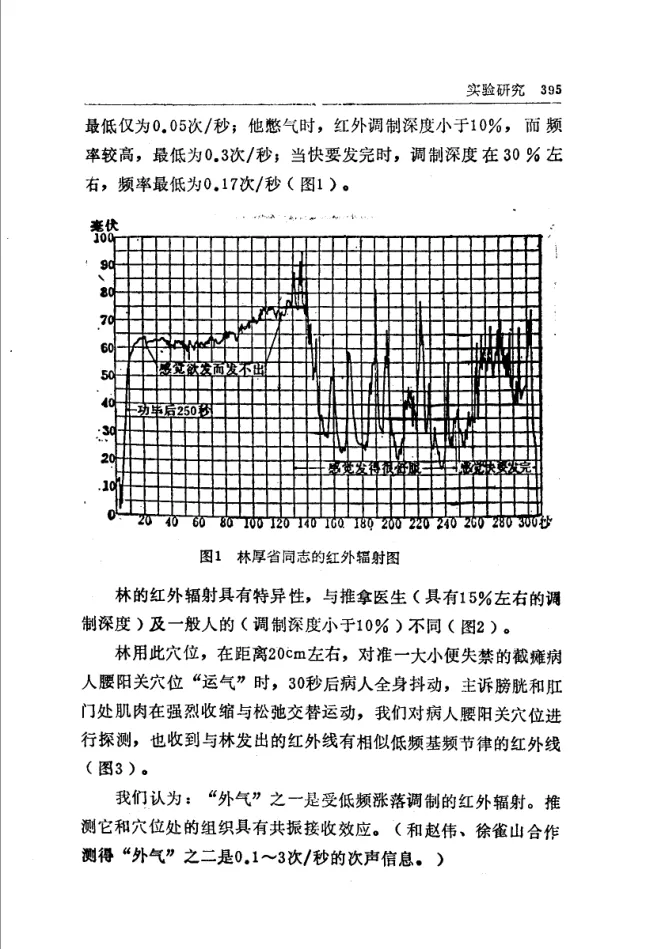
Lin’s infrared radiation exhibited distinctive characteristics, different from those of a tuina physician (with a modulation depth of about 15%) and those of an ordinary person (modulation depth less than 10%) (Figure 2).
Using this acupoint, at a distance of approximately 20 cm, Lin aimed at the Yaoyangguan acupoint on the lower back of an incontinent paraplegic patient and “circulated qi.” After 30 seconds, the patient’s whole body trembled, and the patient reported that the muscles around the bladder and anus were undergoing alternating strong contractions and relaxations. We probed the patient’s Yaoyangguan acupoint and also received infrared radiation with a low-frequency fundamental rhythm similar to the infrared radiation emitted by Lin (Figure 3).
We believe that one form of “external qi” is infrared radiation modulated by low-frequency fluctuations. We hypothesize that it has a resonant reception effect with the tissues at the acupoint. (In collaboration with Zhao Wei and Xu Queshan, we measured that a second form of “external qi” is infrasound information at 0.1–3 cycles per second.)
V
100
90
80
70
60
0 10 20 30 40 50 60 70 80 90 100 120
seconds
50
Figure 3
30
20
10
20 40
60
80 100
Figure 2 Infrared radiation chart of a tuina physician and an ordinary person
(2) Using a charge increment measurement device, we measured the accumulation of static electric charge at the Laogong acupoint of Comrade Lin Housheng after emitting qi, as well as the reversal of charge polarity due to changes in physiological state (Figure 4).
When Lin felt comfortable, the first increment was negative, corresponding to an increase in negative charge; when Lin felt “breath-holding discomfort” (segment AB in the figure), the first increment was positive, corresponding to an increase in positive charge.
8
0
10
20
30
40
90
70
80
60
seconds
Figure 4
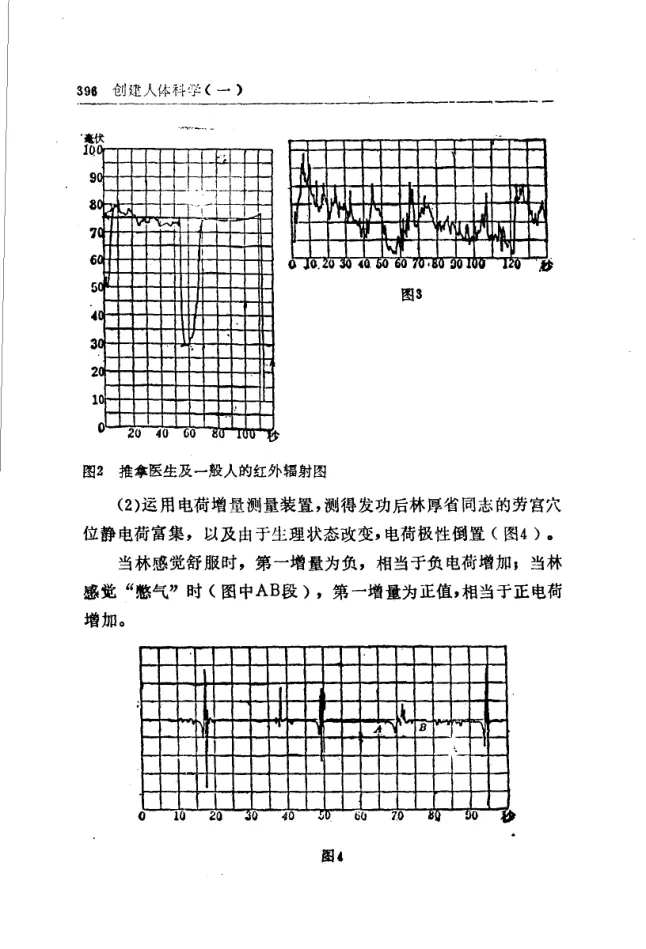
Based on this, we hypothesize: the bioelectricity emitted by practice movements at a certain level of proficiency causes the dipoles of a certain life-substance at the acupoint to transition from disorder to order.
(3) Based on the hypothesis that acupoints are prone to resonance, and having measured that the resistance at the Neiguan acupoint of Comrade Lin Housheng drops abruptly during practice (Figure 5), we conclude that current resonance occurs at the acupoint. We hypothesize that the acupoint tissue contains certain structural units of substances capable of exhibiting ferromagnetic behavior,
mV
80
70
20
10
0
60 80 110 120 130
Figure 5
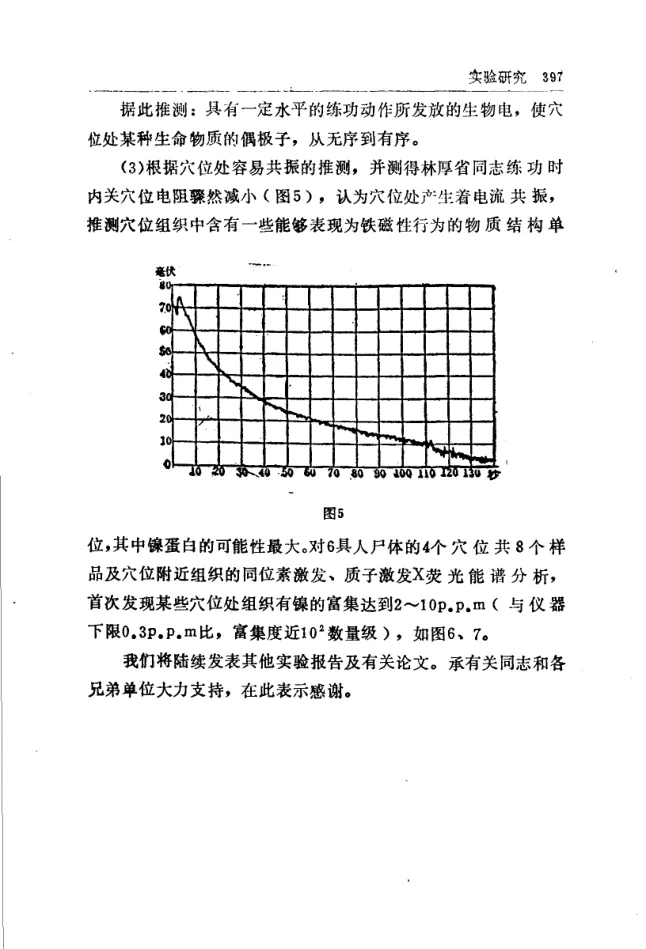
with nickel protein being the most likely possibility. Using isotope excitation and proton-induced X-ray fluorescence energy spectrometry on 8 samples from 4 acupoints and nearby tissues from 6 human cadavers, we discovered for the first time that the enrichment of nickel in the tissues at certain acupoints reaches 2–10 p.p.m (compared with the instrument’s lower detection limit of 0.3 p.p.m, the enrichment is on the order of nearly 10²), as shown in Figures 6 and 7.
We will successively publish other experimental reports and related papers. We gratefully acknowledge the strong support of the relevant comrades and all cooperating institutions.
Te
Figure 6 Acupoint tissue
Zn
Figure 7 Control
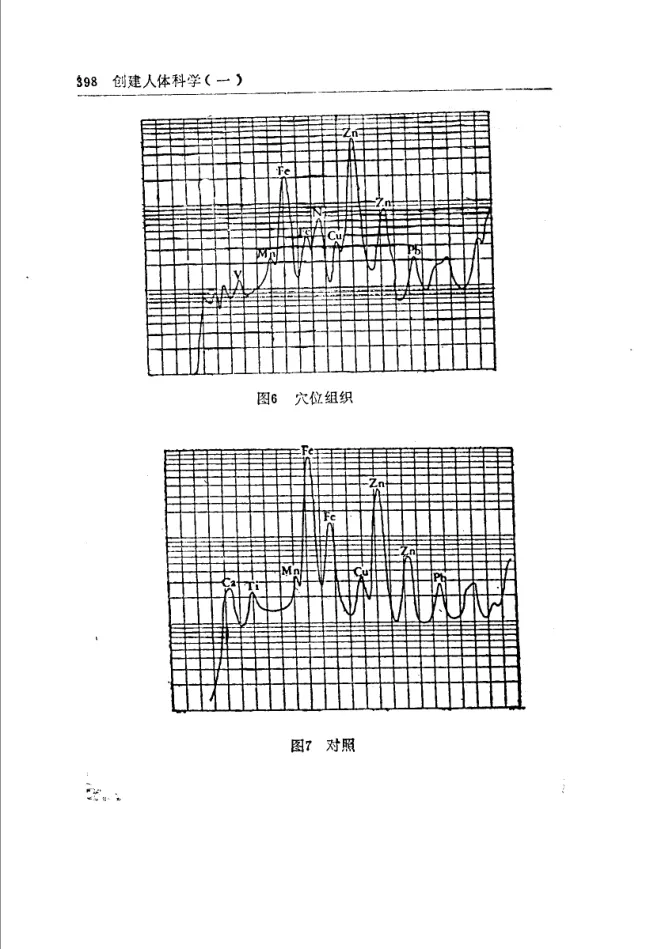
An Experiment on Consciousness-Controlled Electrostatic Increment
Gu Hansen
Qigong Collaboration Group, Shanghai Institute of Traditional Chinese Medicine Research
[Editor’s Note] Qigong, a treasure in the storehouse of traditional Chinese medicine, has a long history of thousands of years, originating almost simultaneously with Chinese civilization. Evolving to the present day, there are thousands of qigong schools and lineages. Due to differences in training methods among different schools, the physical content of the “external qi” signal varies; even for the same physical quantity, the parameters differ. There have been reports of electrostatic charge accumulation and infrared radiation with 80% deep low-frequency modulation [1], as well as particle flow signals [2]. This article reports that when qigong practitioner Comrade Cheng Zhijiu emitted qi, with the instrument aimed at his Yintang acupoint, an electrostatic increment on the order of coulombs was received, and it was measured that the polarity of the charge is related to the mode of qigong practice.
This article was reviewed by Comrade Lin Jiahua. Special instrument components were provided by Shanghai No. 1 Factory, No. 14 Factory, and No. 41 Factory.
I. Measurement Principle
When Cheng emitted qi, an electrostatic increment appeared instantaneously at the Yintang acupoint, and a corresponding induced charge appeared on the sensing electrode P at the amplifier input end in Figure 1, corresponding to which a pulse voltage of amplitude could be measured at the amplifier output end. Therefore, based on the amplifier performance, can be calculated from the measured .
cr
Yintang acupoint 2 cm
B sensing electrode P
A.
To automatic recorder
6 cm
Shielding
↓ Electrostatic probe
Figure 1 Schematic diagram of electrostatic increment measurement principle
II. Method for Calculating Charge Increment
→
where : charge injected into the amplifier input end. : open-loop gain of the amplifier. : calibration capacitance (1.7 pF ±30%). : pulse voltage amplitude of the constant-voltage signal generator. : total cold capacitance to ground at the amplifier input end. : voltage at the amplifier input end. : feedback capacitance. : feedback resistance ( ohms ±20%). : pulse step amplitude at the amplifier output end. : equivalent input capacitance of the amplifier during operation.
Figure 2 Schematic diagram of the measurement and calculation principle for charge injected into the amplifier input end
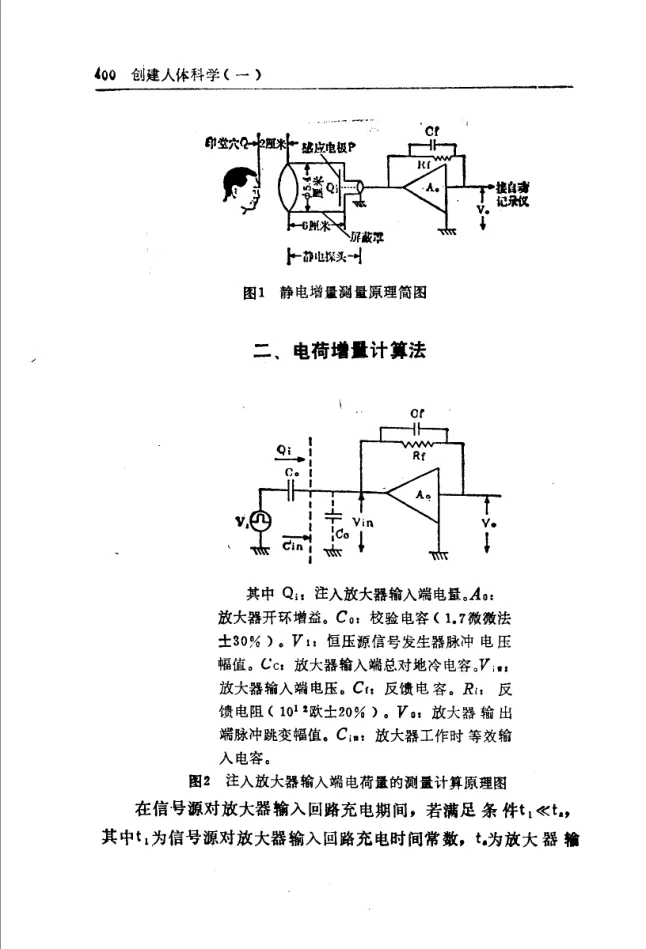
During the period when the signal source charges the amplifier input circuit, if the condition is satisfied, where is the charging time constant of the signal source for the amplifier input circuit and is the discharging time constant at the amplifier input end, then the influence of the input resistance produced by can be neglected.
Since , , therefore:
Because , therefore ,
Hence
can be determined by the following method: connect a known capacitance in series at the amplifier input end such that , and apply a voltage to obtain . Substituting into Equation ①:
Therefore:
Since is a known calibration capacitance, and and can be measured, can be calculated. Substituting into Equation ① yields the charge injected into the amplifier input end.
III. Experiment and Results
(1) With Cheng Zhijiu’s Yintang acupoint 2 cm from the shielding cover, when Cheng rapidly drew the “qi” of his entire body toward the Yintang acupoint, the recorder recorded a negative pulse. Repeating the above process, a negative pulse was recorded each time, as shown in Figure 3. From the figure, , so the influence of can be neglected.
From the figure, the largest pulse obtained was mV.
According to Equation ①: coulombs ±30%.
For ordinary persons, and for Cheng Zhijiu in his normal state or when in poor physical condition, the electrostatic increment was zero.
(2) On May 30, 1978, after Cheng Zhijiu switched to practicing Zhao Wei’s [2] qigong method, an electrostatic increment was obtained:
| Time (s) | ||||
|---|---|---|---|---|
| 20 | ||||
| 40 | ||||
| 60 | ||||
| 0 | ||||
| −5 |
Voltage (mV)
| −10 | | | | | | −15 | | | | | | −20 | | | | |
Figure 3 Static electricity increment diagram corresponding to the Yintang acupoint of Cheng Zhijiu, May 3, 1978
In increment diagram 4, the static electricity increments include both positive and negative pulses, with relatively small amplitudes. Cheng then practiced his own original exercise for 5 minutes, yielding static electricity increment diagram 5, which consists of a train of small negative-polarity pulses.
Cheng then practiced his own original exercise for 15 minutes, concentrating his emitted-gong energy to produce diagram 6, in which a train of small negative pulses contains one relatively large negative pulse.
Jor
Voltage (mV)
| 20 | 40 | 60 | 80 | 100 |
|---|
Time (s)
Figure 4 Static electricity increment diagram corresponding to the Yintang acupoint after Cheng Zhijiu switched to Zhao Wei’s exercise
Voltage (mV)
| 0 | ||||
|---|---|---|---|---|
| 5 | ||||
| 20 | 40 |
Time (s)
Figure 5 Static electricity increment diagram corresponding to the Yintang acupoint after Cheng Zhijiu practiced his own original exercise for 5 minutes
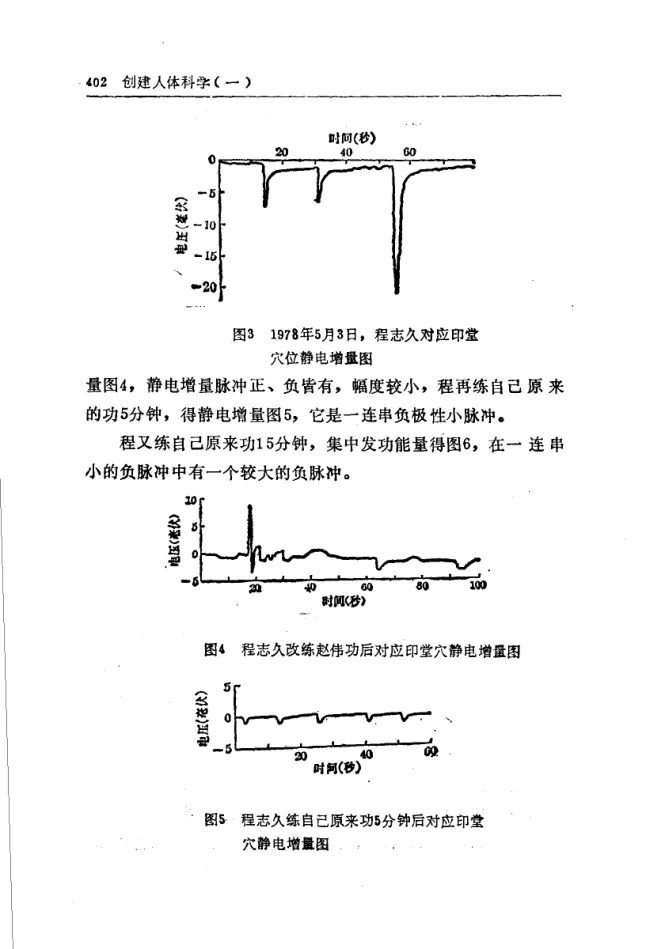
Voltage (mV)
| −5 | ||||
|---|---|---|---|---|
| −10 | ||||
| 20 | 40 | 60 |
Time (s)
Figure 6 Static electricity increment diagram corresponding to the Yintang acupoint after Cheng Zhijiu practiced his own original exercise for 15 minutes
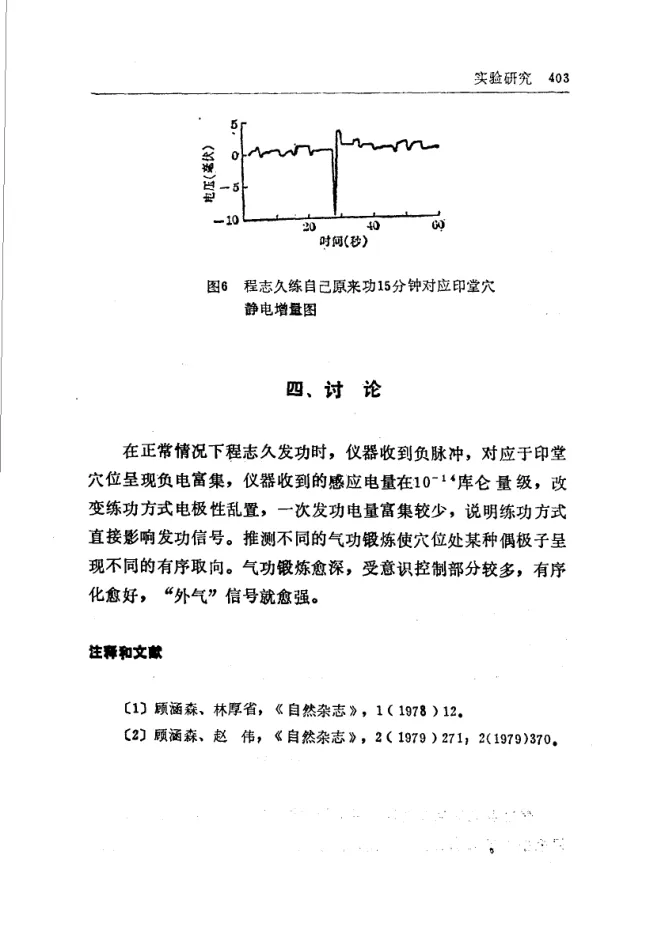
IV. Discussion
Under normal conditions, when Cheng Zhijiu emits gong, the instrument receives negative pulses, corresponding to a negative electrical enrichment at the Yintang acupoint. The induced charge received by the instrument is on the order of 10⁻¹⁴ coulombs. When the exercise mode is changed, the electrode polarity becomes disordered, and the charge enrichment from a single gong-emission is smaller, indicating that the exercise mode directly affects the emitted-gong signal. It is inferred that different qigong exercises cause a certain type of dipole at the acupoint to adopt different ordered orientations. The deeper the qigong training, the greater the portion under conscious control, and the better the ordering, the stronger the “external qi” signal.
Notes and References
〔1〕 Gu Hansen, Lin Housheng, Nature Journal, 1 (1978) 12.
〔2〕 Gu Hansen, Zhao Wei, Nature Journal, 2 (1979) 271; 2 (1979) 370.
Low-Frequency Magnetic Information Experiments
Gu Hansen
[Editor’s Note] Following the various experimental reports on the material basis of qigong “external qi” [1, 2], the author subsequently discovered that when qigong practitioners Liu Jinrong and Qin Yaoqing channel “qi” to their respective gong-emitting sites, the instrument received low-frequency magnetic information perpendicular to the surface of the gong-emitting site, measuring 1.67 gauss and 1.25 gauss respectively. No information was recorded for ordinary persons, nor for Liu and Qin in their normal states. The following is the experimental report on low-frequency magnetic information.
I. Testing Equipment
A magnetic detection device was self-designed using magnetically sensitive diodes connected in a differential circuit with a 2Acm configuration, followed by a voltage amplifier. Its sensitivity to magnetic induction perpendicular to the sensitive face of the magnetically sensitive diode was 12 mV/gauss, and its characteristics are shown in Figure 1. The measurement error was <20%.
II. Experimental Results
When qigong practitioner Liu Jinrong emitted gong, a steel plate strip 4 cm wide, 80 cm long, and 0.4 cm thick was struck forcefully against the Baihui acupoint on the top of his head, bending the steel plate strip, yet he felt no
| 0.9 |
|---|
Output voltage (mV)
| 25 | |||||
|---|---|---|---|---|---|
| 0 | |||||
| 1 | 2 | 3 | 4 |
Magnetic induction (gauss)
Figure 1 Curve of output voltage versus magnetic induction for the qigong magnetic characteristic measurement device
pain. At a distance of 5 cm from Liu’s Baihui acupoint, with the sensitive face of the magnetic detection device’s probe placed parallel to the skin surface of the Baihui acupoint, Liu’s magnetic information was received as shown in Figures 2 and 3.
| 3 | 8 |
|---|
Output voltage (mV)
| 10 | |||||||
|---|---|---|---|---|---|---|---|
| 0 | |||||||
| T | 2 | 3 | 4 | 7 |
Time (s)
Figure 2 Magnetic radiation information perpendicular to the Baihui acupoint when Liu Jinrong was in good health
Output voltage (mV)
| 16 | |||||||
|---|---|---|---|---|---|---|---|
| 10 | |||||||
| 5 | |||||||
| 0 | |||||||
| 6 | 10 | .15 | |||||
| (8) | 0 | 0 |
Figure 3 Magnetic radiation information perpendicular to the Baihui acupoint when Liu Jinrong was in poorer health
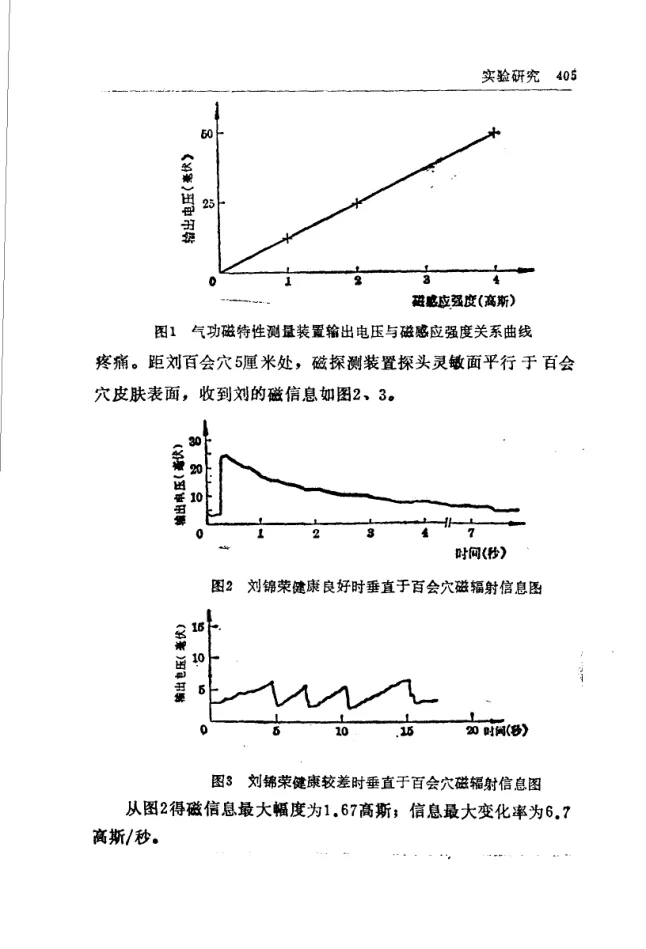
From Figure 2, the maximum amplitude of the magnetic information is 1.67 gauss; the maximum rate of change of the information is 6.7 gauss/s.
From Figure 3, the maximum amplitude of the magnetic information is 0.25 gauss, and the maximum rate of change of the information is 1 gauss/second.
On November 23, 1978, while the qigong practitioner Qin Yaoqing was emitting qi, he enabled two audience members present to mutually use a 1-millimeter-thick needle to pierce through each other’s two layers of skin without pain or bleeding. At a distance of 2 cm from Qin’s right-hand Laogong acupoint, with the sensitive surface of the magnetic detection device’s probe parallel to the skin surface of the Laogong acupoint, Qin’s magnetic signal was received as shown in Figure 4.
From Figure 4, the maximum amplitude of Qin Yaoqing’s magnetic information is 1.25 gauss; the maximum rate of change of the information is 1.25 gauss/second.
The magnetic radiation information of the ordinary person Kong Xiangjun is identical to the slow fluctuation of the instrument’s baseline, as shown in Figure 5.
Output voltage (mV) 20 10 0 20 40 60 80 100 120 140 Time (μs) Figure 4: Magnetic radiation information chart perpendicular to the right-hand Laogong acupoint when Qin Yaoqing is in better health
Output voltage (mV) 10 5 0 6 10 10 06 25 30 Time (s) Figure 5: Magnetic radiation information chart of the non-practitioner Kong Xiangjun
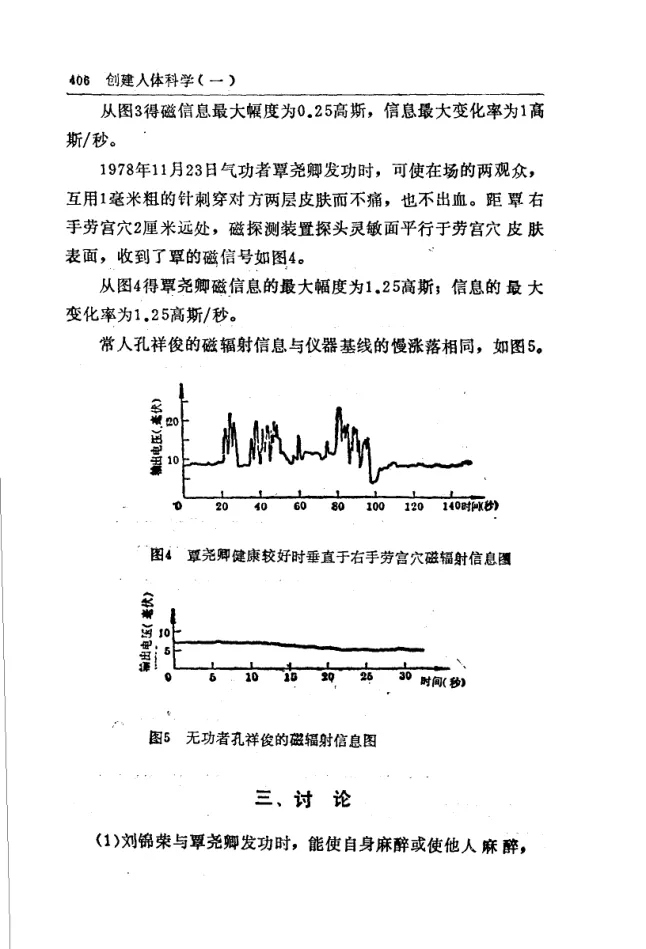
III. Discussion
(1) When Liu Jinrong and Qin Yaoqing emit qi, they can anesthetize themselves or others. The instrument received low-frequency magnetic information perpendicular to the surface of their qi-emitting areas, with intensities ranging from several hundred milligauss to several gauss; the rate of change of the information ranged from several hundred milligauss per second to several gauss per second.
(2) When Liu and Qin are in good health, the magnetic information amplitude is large and the information rate of change is large; conversely, it is small, or even unrecordable.
The author believes that this is because, within the bodies of Liu and Qin, certain paramagnetic life units, under the action of electrical information from the brain’s mental activity, transition from a disordered arrangement to an ordered arrangement; acting as a whole, they move near their equilibrium positions, generating low-frequency magnetic information. Ordering the paramagnetic life units requires externally supplied energy; the better the physical condition, the greater the energy the body can provide, and thus the greater the amount of information in the magnetic signal.
We express our sincere gratitude to comrades Jin Ningya from the Shanghai Municipal Bureau of Metrology, Fang Qiwen from Tongji University, and Wang Shengli and Jin Xingdi from the Laser Research Institute, for calibrating the instruments used in this experiment.
Notes and References [1] Gu Hansen, Lin Housheng, Nature Journal (Ziran Zazhi), 1 (1978) 12. [2] Gu Hansen, Zhao Wei, Nature Journal, 2 (1979) 271; 2 (1979) 370. [3] Gu Hansen et al., Nature Journal, 2 (1979) 019.
An Experimental Investigation into Qigong and Bile Secretion
Wang Jialin
[Editor’s Note] When a qigong master is in the process of directing qi, what exact changes occur in the human body’s various functional activities? Because this is an introspective activity of the qigong master, it is generally quite difficult to obtain direct data and first-hand information. In order to clarify the secretion of human digestive fluids under a qigong state, the author of this article persuaded a doctor to perform surgery on his own body, keeping a drainage tube in place for over four months to observe the secretion of bile under different states such as during qigong practice, sleep, and rest, thereby obtaining exceptionally precious first-hand data.
At the time of publishing this article, the author was employed at the No. 3 Middle School in Gejiu City, Yunnan Province; he is currently the Director of the Human-Body Science Research Office at the Yunnan Institute of Nationalities, and continues to engage in qigong scientific research.
Qigong-directed qi therapy is one of the effective methods for overcoming many chronic diseases. However, major subjects such as why qigong therapy can cure diseases and what exact changes occur in the human body’s various functional activities during the qigong state have not yet been resolved. I believe that scientific research on qigong-directed qi therapy should include: research on the application of qigong-directed qi methods; research on the mechanisms of qigong functional activities; research on the physical effects and biochemical processes on the body surface and outside the body during the process of qigong practice; and research on the physical, biochemical, and physiological changes inside and outside the body of a receiver after receiving emitted qi information. Regarding the research on qigong functional activities, after the 1950s,
many units and individuals in China have done much work and accumulated a great deal of valuable data. For example, some units conducted research on changes in gastric juice secretion activity during the qigong state, but it lacked systematicity and objectivity. This research initially confirmed that digestive and absorptive activities are enhanced during practice. However, digestive function is primarily the digestive function of digestive juices. Gastric juice, pancreatic juice, and bile are the three main digestive juices. Therefore, systematically observing the changes in the secretory activity of these three digestive juices—or any one of them—controlled by the vagus nerve during qigong practice is of great significance for further clarifying the changes in digestive and absorptive functional activities during practice.
Directly observing the changes in the secretory activity of the three digestive juices or any one of them during qigong practice is a major challenge in the study of qigong functions. The dogs with gastric fistulas created by Pavlov made an extremely significant contribution to the establishment of Pavlovian conditioned reflex theory and the subsequent development of physiology, yet they are of no help in qigong functional research. Performing surgery on a well-trained qigong practitioner to directly observe changes in digestive juice secretion activity during practice is also extremely difficult to realize.
In order to directly and deeply observe the changes in digestive juice secretion activity during qigong practice, I requested surgery. I underwent surgery at the Department of General Surgery of the First Affiliated Hospital of Kunming Medical College1, where a drainage tube was placed to observe the bile drainage volume under different states such as qigong practice, rest, and sleep.
I. Experimental Methods
In the early stages of the experiment, I used a volumetric flask to measure the bile drainage volume; later, I switched to a graduated cylinder with an accuracy of 1 milliliter to measure the drainage volume. I used a wristwatch for timing, conducting one or two observations per day (for two observations, one was in the morning and one in the afternoon). During each observation, care was taken to eliminate…
Regarding the various possible factors affecting bile secretion activity: The specific arrangement of each experiment was as follows. Before practice, there was generally 1 hour of continuous rest, during which the bile drainage volume was measured twice (the first observation is denoted as pre-practice rest ①, and the second observation as pre-practice rest ②); next, the subject practiced qigong for half an hour or 1 hour, and the drainage volume was measured; after stopping practice, there followed another 1 hour of rest, during which the bile drainage volume was also measured twice (the first observation is denoted as post-practice rest ①, and the second observation as post-practice rest ②). To facilitate comparative analysis and research, I used the “bile time-value” as an objective indicator of bile secretion activity; the bile time-value is the hourly drainage volume of bile.
It should be pointed out that the drainage volume discharged from the drainage tube is only a part of the bile; the other part is discharged into the duodenum through the sphincter of Oddi (referred to in the original text as Oddi’s aperture). Therefore, changes in the patency of the sphincter of Oddi will have a certain impact on the bile drainage volume. To verify whether the drainage volume objectively reflects bile secretion activity, five retrograde biliary angiographies and biliary tract pressure tests were conducted successively in the Department of Radiology of the First Affiliated Hospital of Kunming Medical College and the Department of Radiology and Department of Surgery of the Second Affiliated Hospital. In all five angiographies, the distribution of contrast agent in the duodenum was observed, proving that the sphincter of Oddi was unobstructed during the experiment; the resistance of the sphincter of Oddi was 140 mmHg, which falls within the normal range (normal range is 90–230 mmHg). This means that the drainage volume can objectively reflect the actual changes in bile secretion activity.
II. Experimental Results and Analysis
From May 26 to July 22, 1979, 36 observations were successively made using volumetric flasks. The measured values clearly showed the pattern of changes in bile secretion activity during the practice process. To more precisely measure the changes in bile drainage volume under the qigong state, after July 22, we switched to a measuring cylinder with a precision of 1 ml and continuously observed 11 times. In a series of observations, it was seen that a high-protein, high-fat diet significantly increased the bile drainage volume, and different physiological states also had different effects on the bile drainage volume, which is consistent with the laws of modern physiology. Additionally, it was observed that the daytime bile time-value was higher than that during nighttime sleep, and the practice process had a significant impact on the bile drainage volume.
To study the impact of the practice process on bile secretion activity, the relevant experimental data were compiled and analyzed from the following aspects.
1. Experimental Results
The 47 experimental studies consistently showed that, compared with rest, the practice process had a significant impact on bile secretion activity. To facilitate precise analytical research, we focused on analyzing the results of 11 experiments measured with a measuring cylinder. The results of the 11 observations are shown in Table 1. Among them, the experiment on the morning of August 1 was interrupted due to the complete blockage of the glass nozzle of the drainage tube and has no analytical significance. For the bile time-values under the same measurement sequence states in the remaining ten experiments, the mean values were taken and represented on the vertical axis; the horizontal axis represents the experimental observation sequence states, thus yielding Figure 1. From Table 1 and Figure 1, it can be clearly seen that during the practice process, the mean bile time-value increased significantly compared to that during pre-practice rest. The mean time-value during practice was 2.6 times that of pre-practice rest ① and 3.8 times that of pre-practice rest ②. This is, of course, no ordinary change. Then, is it caused by accidental factors? To clarify this issue, mathematical statistics are required. Because the distribution of bile time-values does not necessarily follow a normal distribution, the rank-sum test must be used to test whether there is a significant difference in bile secretion activity between the practice period and the pre-practice rest period. The ranks of the bile time-value data during practice and during pre-practice rest ① are shown in Table 2. The number of bile time-value data points for pre-practice rest ① is , and the number of bile time-value data points for practice is . From Table 2, it can be seen that the rank sum of the bile time-values for pre-practice rest ① is:
From the rank-sum test table, when and , the lower limit of is , and the upper limit is . From this, we obtain the result , which indicates that there is a significant difference in bile secretion activity between the practice process and pre-practice rest ①.
Mean bile time-value (ml/hour) 0 8 5 4 2 10 During practice Pre-practice ① Post-practice ① Post-practice ② 1 Figure 1
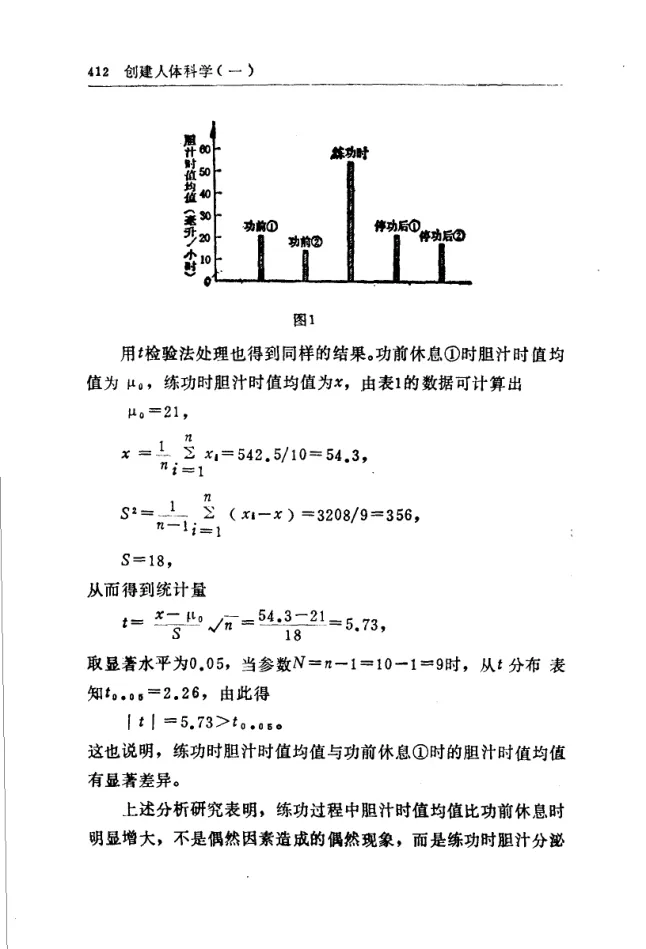
Processing with the t-test also yields the same result. Let the mean of the bile time-values during pre-practice rest ① be , and the mean of the bile time-values during practice be . From the data in Table 1, we can calculate:
Thus, the statistic is obtained:
Taking the significance level as 0.05, when the parameter , from the t-distribution table we know . Thus,
This also shows that there is a significant difference between the mean bile time-value during practice and the mean bile time-value during pre-practice rest ①.
The above analytical research indicates that the significant increase in the mean bile time-value during the practice process compared to pre-practice rest is not an accidental phenomenon caused by chance factors, but rather bile secretion
Table 1. Experimental Results of Bile Drainage Volume Measurement Before and After Qigong Practice
| Status | Metric | 7.22 | 7.23 | 7.24 | 7.25 | 7.26 | 7.27 | 7.28 | 7.30 | 8.1 | Average |
|---|---|---|---|---|---|---|---|---|---|---|---|
| Pre-practice rest ① | Time | 14:30–15:00 | 8:30–9:00 | 8:45–9:25 | 8:00–8:30 | 9:00–9:30 | 8:00–8:30 | ||||
| Drainage volume | 10 | 10 | 24 | 12 | 2.5 | 1.5 | |||||
| Hourly value | 20 | 20 | 36 | 24 | 5 | 3 | 22 | ||||
| Pre-practice rest ② | Time | 15:00–15:30 | 9:00–9:25 | 9:30–10:00 | 8:00–8:30 | 8:30–9:00 | 9:30–10:00 | 8:30–9:00 | |||
| Drainage volume | 2 | 0 | 2 | 23 | 10 | 7.5 | 0.5 | ||||
| Hourly value | 4 | 0 | 4 | 46 | 20 | 15 | 1 | 14.3 | |||
| During practice | Time | 14:00–15:00 | 9:15–9:45 | 15:30–16:30 | 9:30–9:50 | 10:00–10:30 | 8:30–9:10 | 9:00–10:00 | 10:00–10:30 | 9:00–9:30 | |
| Drainage volume | 40 | 40 | 20 | 20 | 23 | 35 | 45 | 27.5 | 0 | ||
| Hourly value | 40 | 80 | 20 | 60 | 46 | 52.5 | 45 | 55 | 0 | 54.3 | |
| Post-practice rest ① | Time | 15:00–16:00 | 9:45–10:15 | 16:30–17:30 | 10:30–11:00 | 9:10–10:10 | 10:00–11:00 | 10:30–11:00 | 15:30–16:30 | ||
| Drainage volume | 25 | 10 | 35 | 17.5 | 25 | 15 | 2 | 25 | |||
| Hourly value | 25 | 20 | 35 | 35 | 25 | 15 | 4 | 25 | 21.4 | ||
| Post-practice rest ② | Time | 16:00–17:00 | 17:00–18:00 | 17:30–18:00 | 11:00–12:00 | 10:10–11:20 | 11:00–12:00 | 16:30–17:00 | |||
| Drainage volume | 25 | 25 | 9 | 22 | 15 | 13 | 7.5 | ||||
| Hourly value | 25 | 25 | 18 | 22 | 14.3 | 13 | 15 | 17.8 |
Drainage volume unit: milliliters; hourly value unit: milliliters/hour.
Note: 10:00—flushed; drainage tube obstructed.
Table 2
| Date | Time | State | Bile Time-Value | Rank of Data |
|---|---|---|---|---|
| 7.22 | Afternoon | Qigong process | 40 | 7 |
| 7.22 | Afternoon | Rest ① before qigong | 20 | 3.5 |
| 7.23 | Morning | Qigong process | 80 | 14 |
| 7.23 | Morning | Rest ① before qigong | 20 | 3.5 |
| 7.24 | Afternoon | Qigong process | 20 | 3.5 |
| 7.24 | Afternoon | Rest ① before qigong | 36 | 6 |
| 7.25 | Afternoon | Qigong process | 60 | 12 |
| 7.25 | Afternoon | Rest ① before qigong | 24 | 5 |
| 7.26 | Morning | Qigong process | 46 | 9 |
| 7.26 | Morning | Rest ① before qigong | 5 | 1 |
| 7.27 | Morning | Qigong process | 52.5 | 10 |
| 7.28 | Morning | Qigong process | 25 | 8 |
| 7.28 | Afternoon | Qigong process | 60 | 12 |
| 7.30 | Morning | Qigong process | 88 | 15 |
| 8.1 | Afternoon | Qigong process | 55 | 11 |
…results showing that activity is significantly enhanced compared to rest.
During the experiment, liver function tests confirmed that liver function was normal; it should be considered that bile secretion activity during qigong is significantly enhanced compared with normal rest. Let be the amount of bile increase during qigong, and let and respectively represent the mean values of the drained bile time-values measured twice during qigong and during the pre-qigong rest; then we obtain:
where is a coefficient whose value depends on the amount of bile discharged into the duodenum. When the amount of bile discharged into the duodenum = 0, ; when the amount of bile discharged into the duodenum > 0, ; therefore, . In our experiment, ml/h, and ml/h; thus, we obtain ml/h. If one practices qigong three times a day for 1 hour each time, the daily bile secretion will increase by ml. Because the Oddi orifice was unobstructed during the experiment, , so the daily bile secretion will increase by more than 109.8 ml. From this, it can be seen that the daily bile secretion of regular qigong practitioners is significantly increased compared to that of normal individuals.
The mean bile time-value during Rest ① after cessation of qigong was significantly lower than that during qigong, but it was still higher than the mean bile time-value during the pre-qigong rest; the mean bile time-value during Rest ② after cessation continued to decrease, approaching the level of the pre-qigong rest. This indicates that the enhanced response of bile secretion activity during the qigong process can last for about half an hour after the cessation of qigong.
2. There is a significant difference in bile secretion activity between the qigong process and the sleep process
In order to clarify the difference in bile secretion activity between the qigong process and the sleep process, a systematic comparative observation was also made on the bile time-values during qigong and during nighttime sleep on the same day. The results are shown in Table 3.
From Table 3, it can be clearly seen that the mean bile time-value during the qigong process is 2.9 times that during sleep. Obviously, the difference between the two is not an ordinary variance. This was similarly verified using the rank-sum test method in mathematical statistics, and the rank sum of the bile time-value data during sleep is 33. From the rank-sum test table, the lower limit of is , so . This indicates that the bile secretion activity during the qigong process is significantly enhanced compared to that during sleep.
3. Observation of changes in bile secretion activity at different times of the day
To understand the possible influence of the time factor on the changing process of bile secretion activity during qigong, we also observed the changes in bile secretion activity during continuous rest in the afternoon at the same time scheduled for the experiment. The specific procedure was to change the scheduled qigong time to rest, keep the scheduled pre- and post-qigong rests unchanged, and measure the flow rate 4 times. We observed for a total of two afternoons, and the results are shown in Table 4. From Table 4, it can be clearly seen that there was no significant difference in the mean bile time-value within the scheduled afternoon experiment time across the 4 consecutive measurements. This rules out the possible influence of the time factor during the experiment on the bile secretion activity experiment.
In addition, observations were also made on the effects of before and after meals, and different diets on the bile drainage volume, as well as the effects of different physiological states such as rest, sleep, and activity on the bile drainage volume.
4. The conscious counter-effect of focusing on the Dantian is the fundamental cause of changes in bile secretion activity during qigong
My personal qigong method does not involve breath-regulation processes, etc., but only mental focus based on relaxation
Dantian process. Therefore, it can be concluded that the fundamental cause of the changes in bile secretion activity during practice is the reactive process of consciousness of attending to the Dantian; the relaxation process itself also has a certain influence; and the changes in bile secretion activity during practice are not caused by changes in breathing patterns.
Table 3
Time values in units: ml/hour
| Measured values | Practice process | During nighttime sleep | |||
|---|---|---|---|---|---|
| Month/Day | Flow rate | Time value | Flow rate | Time value | |
| 7.23 | 15 | 40 ml/30 min | 80 | 220 ml/510 min | 25.5 |
| 7.24 | 15 | 20 ml/60 min | 20 | 200 ml/480 min | 25 |
| 7.25 | 15 | 20 ml/20 min | 60 | 200 ml/510 min | 23.5 |
| 7.26 | 15 | 23 ml/30 min | 46 | 150 ml/510 min | 17.6 |
| 7.27 | 15 | 35 ml/40 min | 52.5 | 185 ml/510 min | 21.8 |
| 7.30 | 15 | 42.5 ml/30 min | 85 | 45 ml/510 min | 5.3 |
| 8.1 | 15 | 27.5 ml/30 min | 55 | 182 ml/510 min | 21.4 |
| Average | 56.9 | 19.7 |
Table 4
Time values in units: ml/hour
| State | Rest ① | Rest ② | Rest ③ | Rest ④ | |||||
|---|---|---|---|---|---|---|---|---|---|
| Month/Day | Time | Time value | Time | Time value | Time | Time value | Time | Time value | |
| 7.30 | 15:00–15:30 | 10 | 15:30–16:00 | 18 | 16:00–16:30 | — | 16:30–17:00 | 20 | |
| 7.31 | 15:00–15:30 | 25 | 15:30–16:00 | 22 | 16:00–16:30 | 20 | 16:30–17:00 | 20 | |
| Average | 17.5 | 20 | 17 | 20 |
It was also observed in the experiments that: in Table 1, the mean bile time value during practice across the 10 measurements was 54.3 ml/hour, which was 3.8 times the mean bile time value of 14.3 ml/hour during pre-practice rest ②; on the morning of July 24, the bile time value during practice was 30 ml/hour, which was 1.2 times the bile time value of 25 ml/hour during pre-practice rest ②. It is clearly evident that the mean bile time value during practice across the 10 measurements showed a significant increase compared with pre-practice rest ②, whereas on the morning of July 24, the bile time value during practice also showed an increase compared with pre-practice rest ②, but the increase was not significant. In the first 10 experiments, attending to the Dantian during practice was good; on the morning of July 24, attending to the Dantian during practice was precisely less than satisfactory. This indicates that the enhancement of bile secretion activity during practice has a parallel relationship with the degree of effectiveness of the reactive process of consciousness of attending to the Dantian.
III. Discussion
The above experiments demonstrate that bile secretion activity during the practice process and for a certain period after practice was significantly enhanced compared with normal resting and sleep states. How does the practice process bring about such a significant enhancement of bile secretion activity?
Bile is a digestive fluid secreted by hepatocytes. The regulation of bile secretion is divided into neural regulation and neuro-humoral regulation. The role of neural factors is that the vagus nerve, through the release of acetylcholine, acts directly on hepatocytes to increase their bile secretion activity and causes gallbladder contraction to expel bile. The role of humoral factors is that, under vagal excitation and the mechanical and chemical stimulation of food, gastrin is released; gastrin acts on hepatocytes through the blood circulation to directly secrete bile; or it causes gastric acid secretion, which then triggers the release of secretin, and secretin acts on hepatocytes to secrete bile. Compared with the pre-practice and post-practice rest periods and sleep, the practice process involves no enhanced mechanical or chemical stimulation from food. Therefore, it can be concluded that the significant enhancement of bile secretion activity during the practice process is due to the fact that during practice, through the reactive process of consciousness of attending to the Dantian, the activity patterns of the brain’s neural system are first altered,
causing vagal activity to tend toward enhancement compared with the normal resting state. This, on the one hand, enhances hepatocyte secretory activity through increased vagal activity; on the other hand, the increased vagal activity enhances hepatocyte bile secretion through increased gastrin release; and through the increased gastrin release, gastric acid secretion is increased, thereby promoting increased secretin secretion, and the increased secretin enhances hepatocyte bile secretion activity. In addition, there is also the possibility that changes in meridian bioelectric activity and other physical and biochemical processes promote the enhancement of bile secretion activity.
From the perspective of modern physiology, gastrointestinal motor function and the secretion of gastric juice, pancreatic juice, and bile are all governed, controlled, and regulated by the vagus nerve. Therefore, the changes in bile secretion activity during the practice process give us definite knowledge that during practice, gastric juice secretion activity, pancreatic juice secretion activity, and gastrointestinal motor function activity indeed tend to be enhanced compared with the normal resting and sleep states. In other words, after qigong therapy treatment, digestive function returns to the normal range; during the practice process, digestive function activity tends to be enhanced compared with the normal resting state; and in those who practice regularly, digestive function is enhanced compared with that of normal persons. This is entirely consistent with clinical observations.
The tendency of digestive function activity during the practice process to be enhanced compared with the normal resting state provides favorable conditions for the absorption process to also tend toward enhancement compared with the normal resting state, and at the same time provides the material conditions or basis for the process by which the assimilation process of the body’s tissue cells during practice tends toward enhancement compared with the normal resting state. Therefore, the experimental study of bile secretion activity in the qigong state, through direct observation of the changes in the liver’s bile secretion activity during the practice process, strongly supports my fundamental views that “the reactive process of consciousness is the common and essential operative process underlying all functions,” that “the reactive process of consciousness is the fundamental cause of the formation and development of qigong functional activity,” and that the holistic activity process of the qigong state is the formation and development of a “directional change process of qigong metabolism.”
This experimental study was conducted with the assistance of my wife, Li Jiping, in carrying out the observations, and received support and assistance from various parties. Vice President Professor Lan Hu of Kunming Medical College and the affiliated hospital of Kunming Medical College…
Comrade Liu Xiaoheng, Deputy Director of Surgery at the First Hospital, assisted with the surgical procedure and provided the experimental conditions. During the experiment, I received meticulous care from Su Lian, Vice President of the First Affiliated Hospital of Kunming Medical College; the medical staff of Surgical Ward Three; and Comrade Wei Ancheng, Head of the Chinese Language Teaching and Research Group at Gejiu No. 3 Middle School. Comrade Tan Qilun, Deputy Head of the Educational Reform Group at Gejiu No. 3 Middle School, dispatched by the Gejiu Bureau of Culture and Education, monitored the work and personally observed several sessions. Comrade Su Yin, a leading official of the Yunnan Provincial Association for Science and Technology, personally convened a meeting of over twenty experts and scientists specifically to discuss my research and arranged for me to publicly demonstrate the bile drainage experiment. My research also received enthusiastic assistance and support from comrades Zhang Qijun, Wei Shuzhen, Chen Zhanjie, Yang Jianyao, Lü Guangrong, Yang Bairu, Mu Jun, Xie Jinlun, Liu Xiaotai, Luo Xin, Zhang Shijie, Lei Yintian, Tang Ruilin, Fang Guoding, and Peng Changchun. I hereby express my heartfelt gratitude!
Brain Wave Research on the Qigong Functional State (Part One)
Mei Lei, Zhou Chuandai, Xue Xinmin
[Editor’s Note] The human body is a complex, multi-system, multi-level living organism. At different systems and different hierarchical levels, each has its own specific patterns of activity, yet as a whole, the brain and the nervous system are the master of the human body. How the physiological state and activity patterns of the brain change under the qigong functional state is undoubtedly an extremely important topic in qigong research.
Professor Mei Lei, the author of this article, has long been engaged in electroencephalographic research. Using brain function measurement techniques, he processed and analyzed brain waves under the qigong state by computer, obtaining encouraging results.
These experimental results are not only of great significance for qigong research but also represent a major contribution to the study of the brain—often described as the greatest mystery among mysteries. Many of these findings are the first discoveries in the history of human brain activity research.
Authors’ affiliation: Institute of Space Medico-Engineering.
The human brain, as a giant system, possesses multiple functional states, and the qigong functional state may be one distinctive state among them. Using various technical means to analyze human brain functional states—especially the qigong functional state—is of great importance for understanding the physiological mechanisms of qigong and for carrying out comprehensive research on human brain physiology.
In recent years, physiological research on qigong has attracted increasing attention. In particular, a series of discoveries regarding extraordinary human abilities has stimulated scientific exploration in this field. Abroad, some researchers have also taken note of and studied certain special states of the brain, proposing for example the hypnotic state, the twilight state, the reverie state, as well as concepts such as the fringe of consciousness, the preconscious, the off-conscious, and transliminal experience. Biofeedback research related to these topics has also received considerable attention in recent years, but all still lack in-depth neurophysiological analysis.
We attempted to use brain function measurement techniques to conduct brain wave analysis of the qigong functional state, exploring the role and position of the human brain in extraordinary human abilities.
I. Methods
Brain wave recordings were made on six subjects with qigong capabilities (Nos. 1, 2, 3, 4, 5, and 6). The qigong training and experimental conditions for the six subjects are shown in Table 1.
Table 1
| Subject No. | Year Qigong Training Began | Experimental Items Participated In |
|---|---|---|
| 1 | 1980 | Entering quiescence, emitting qi from Baihui, producing images |
| 2 | 1979 | Entering quiescence, emitting qi, emitting qi from Baihui, producing characters |
| 3 | 1978 | Entering quiescence, emitting qi from Baihui, attending to the lower dantian, producing characters |
| 4 | 1977 | Entering quiescence, emitting qi from Baihui, attending to the lower dantian, closed-loop, producing characters |
| 5 | Many years | Entering quiescence, emitting qi from Baihui, attending to the lower dantian, producing characters |
| 6 | Long-term | Entering quiescence 1, 2, 3, 4 |
To minimize interference with the subjects’ qigong state, the number of electrodes was kept to a minimum. Based on this laboratory’s experience, monopolar brain waves were recorded from the frontal region (Fz) and the occipital region (Oz). The bioelectric amplification system had a time constant of 0.3 seconds and high-frequency filtering at 30 Hz (Subjects 1, 2, 3, and 4) and 60 Hz (Subjects 5 and 6). Results stored on a tape recorder underwent power spectral analysis on a general-purpose digital computer via an analog-to-digital conversion
system. The sampling rate was 256 points per second. Two processing methods were used: one used a sample length of 2 seconds, taking the average power spectrum of 8 samples (16 seconds), with a frequency resolution of 0.5 Hz; the other used a sample length of 1 second, calculating continuously for 16 seconds to produce a power spectral series plot, with a frequency resolution of 1 Hz. A total of 1,113 power spectra were computed.
The experiments were conducted in two batches. The first batch tested Subjects 1, 2, 3, and 4, with one repetition. The second batch tested Subjects 5 and 6.
Top: Qigong state (entering quiescence); Bottom: Quiet with eyes closed. F: Frontal region; O: Occipital region. Vertical axis: EEG power (/Hz/sec); Horizontal axis: Frequency.
Figure 1 Comprehensive comparison of brain wave power spectra (Subjects 1, 2, 3, and 4)
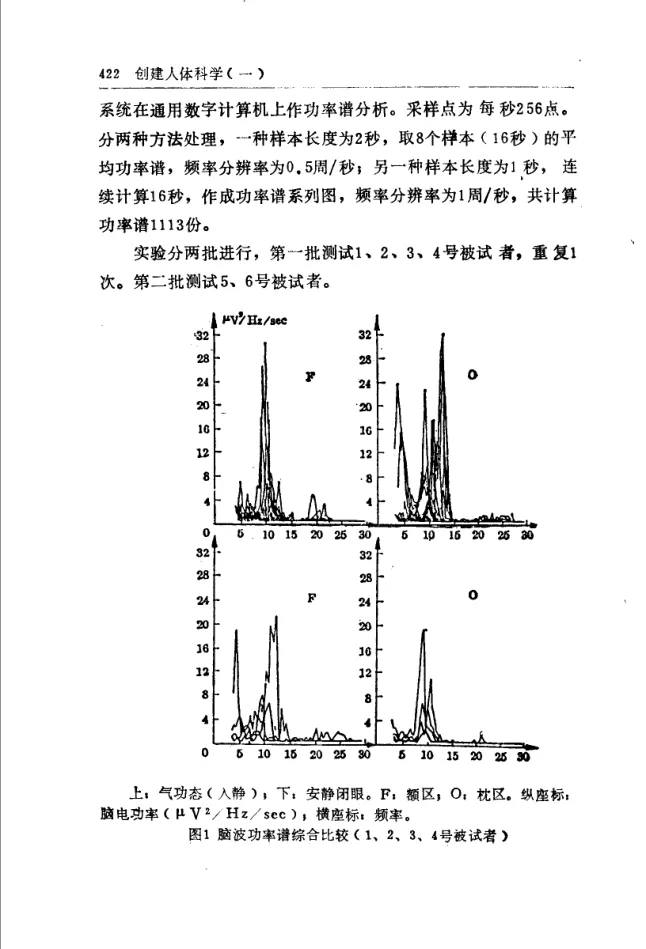
2. Results
1. During the qigong functional state, energy-concentrated α dominant peaks were found in the frontal region of the brain, with a reversal of the frontal–occipital relationship.
Top: Power spectra. Left: Eyes closed, quiet; Middle and Right: Qigong state. Bottom: Raw EEG tracings. Left: Eyes closed, quiet; Middle and Right: Qigong state.
Figure 2 Reversal of frontal–occipital brain waves (Subject No. 4)
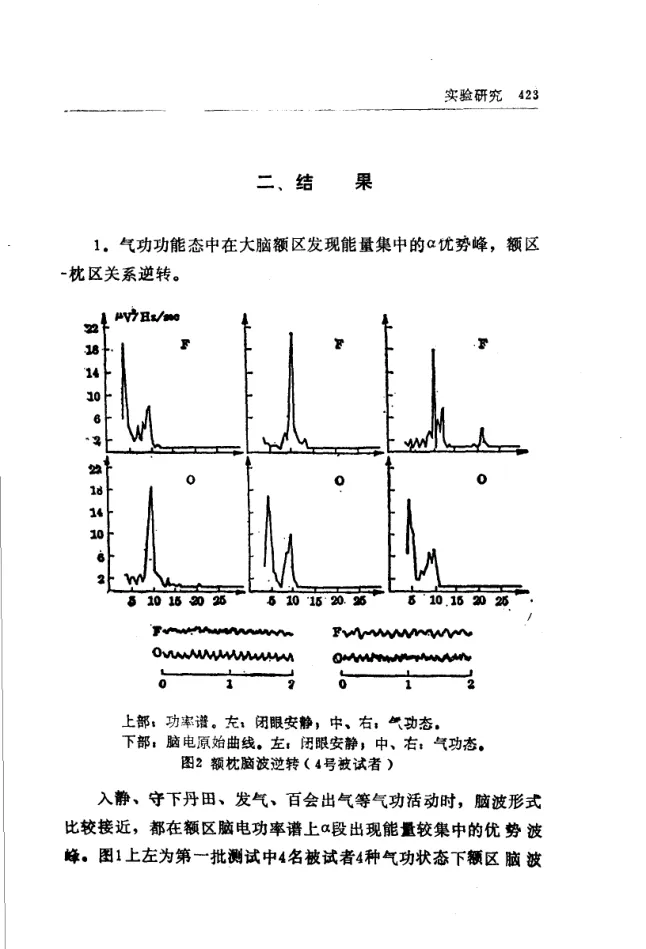
During qigong activities such as entering quiescence, attending to the lower Dantian, emitting qi, and expelling qi from the Baihui point, the brain wave patterns were comparatively similar: in the α band of the frontal EEG power spectrum, a relatively energy-concentrated dominant wave peak appeared. In Figure 1, upper left, the frontal brain wave power spectra of four subjects under four qigong states in the first batch of tests are
Figure 3 Comparison of the quiescence process (Subject No. ___)
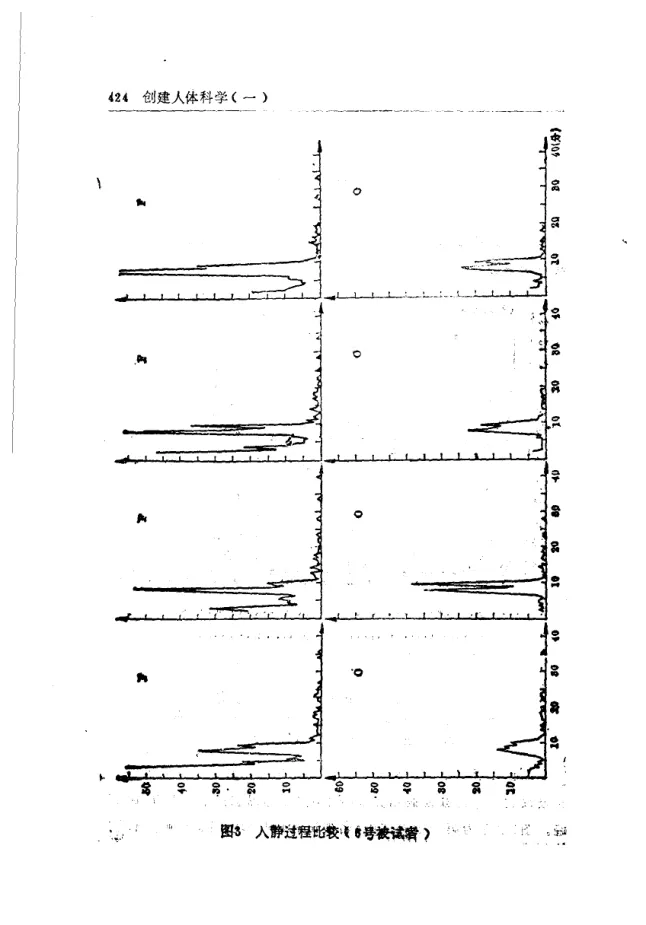
combined power spectra, showing a prominent α-band sharp peak protrusion, with no large peaks in other frequency bands. In contrast, in the combined occipital power spectra shown in Figure 1, upper right, the peaks are clearly dispersed.
The above brain wave pattern is obviously opposite to the brain wave pattern of ordinary people. For comparison, the brain wave power spectra of these subjects under the eyes-closed quiet state were calculated, as shown in Figure 1, lower panel. Although qigong masters easily enter the quiescent state with eyes closed, the differences between the two can still be seen from the figure: that is, during eyes-closed quietness, the α-band energy is concentrated in the occipital region and relatively dispersed in the frontal region, exhibiting a reversed relationship with the qigong-state brain waves. In the brain wave power spectra of certain individuals, typical examples of this frontal–occipital brain wave relationship reversal can also be seen. As shown in the upper part of Figure 2, for Subject No. 4, the frontal–occipital relationship of brain waves during eyes-closed quietness (left) and the qigong state (middle and right) is completely reversed. The lower part of Figure 2 shows the raw EEG tracings of this subject: during quiet eyes-closed, the occipital α waves are dominant; during quiescence, the frontal α waves are dominant, and the frontal–occipital reversal relationship can be clearly seen with the naked eye.
In the same subject, the frontal α dominance could increase with prolonged quiescence time. Figure 3 shows the brain wave power spectra of Subject No. 6 at 5, 10, 15, and 20 minutes during the quiescence process. It can be clearly seen that the frontal α peak continuously rises with increasing quiescence time, while the occipital α peak fluctuates at a relatively lower level; consequently, the difference between the frontal and occipital regions becomes increasingly large—that is, the frontal–occipital reversal relationship becomes increasingly pronounced.
In the 16-second power spectra series plots (Figures 4–7), this pronounced relationship among different subjects can also be observed. The α dominant peaks all appear in the frontal region, while in the occipital region they are smaller or scattered. Moreover, the longer the training time and the deeper the skill, the greater the frontal α peak power. When the frontal α wave power is low (Subjects No. 1 and 2, Figures 6 and 7), no unified peak can be found in the occipital region; when the frontal α wave power reaches a relatively high level (Subjects No. 4 and 6, Figures 4 and 5), the occipital α waves begin to develop, and a unified peak appears.
These facts indicate that the occipital α wave peak of ordinary people shifts to the frontal region during the qigong state. In 29 person-times of qigong-state tests (excluding emitting qi), α wave peaks appeared in the frontal region in 24 person-times, accounting for 83%.
From bottom to top: 0–16 second power spectra
Figure 4 Series plot of quiescence brain wave power spectra (Subject No. 4)
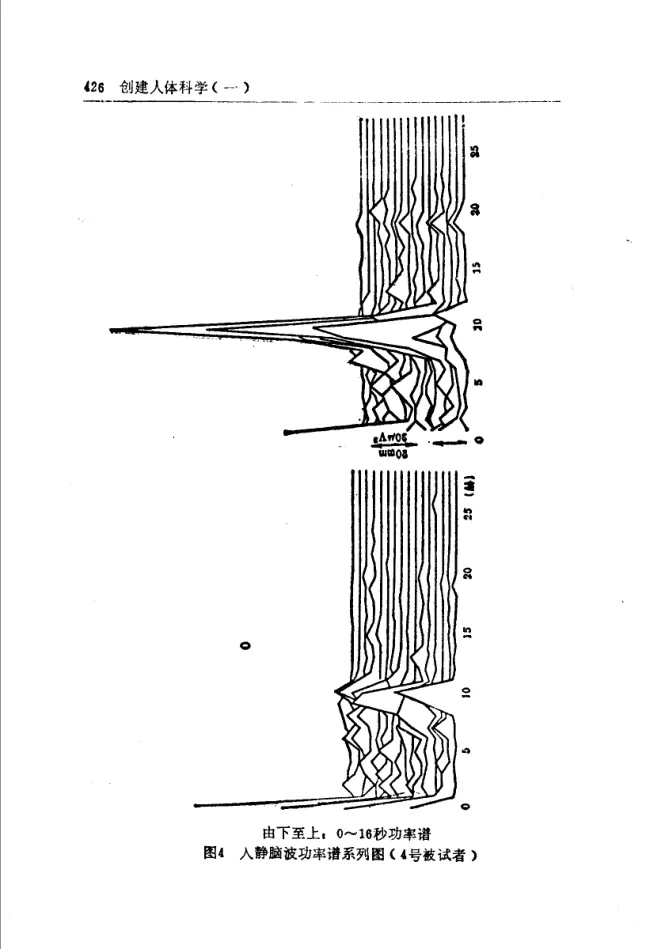
25 (Hz)
a
0
5
23
20
15
10
5
20V
20mm
From bottom to top: 0–16 second power spectra
Figure 5. Series of brain-wave power spectra during the quiescent state (Subject No. 6)
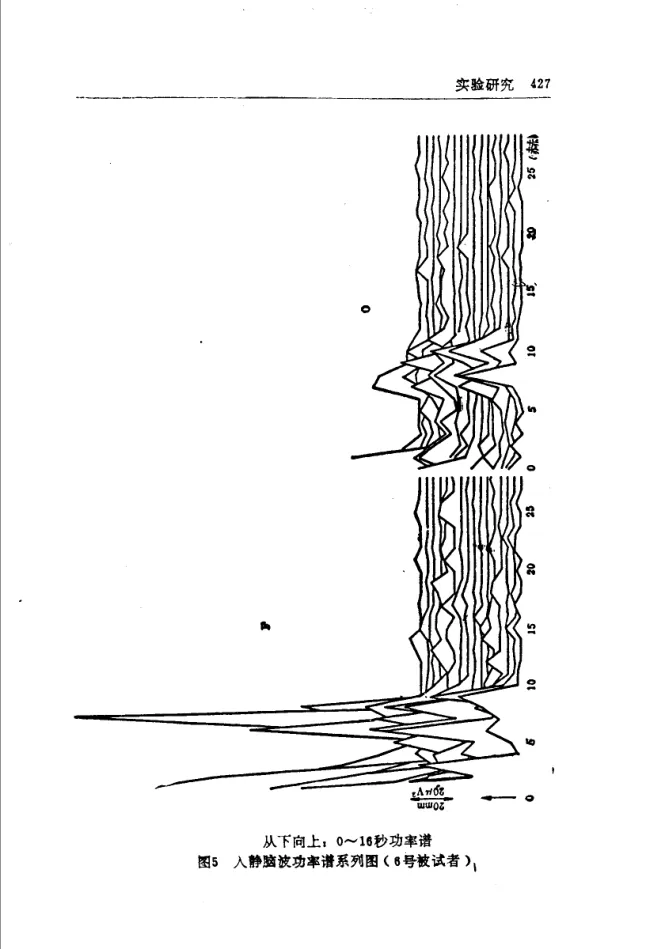
(9)
25
20
23
20
10
20μV
20mm
Figure 6. Series of brain-wave power spectra during the quiescent state (Subject No. 2)
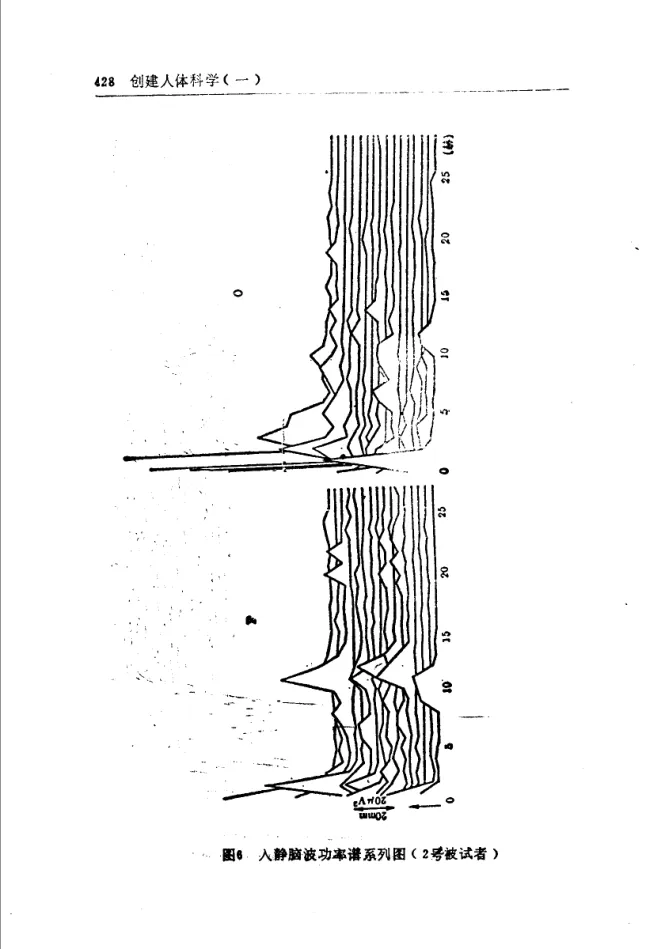
2. Frequency Characteristics of the Frontal α Peak
As can already be seen in Figure 1, during the qigong state the frontal α peak tends to shift below 10 cycles, whereas the energy of the occipital brain-wave α band is mostly above 10 cycles. Comparison with the lower part of Figure 1 also shows that the frontal α waves in the quiet, eyes-closed state are likewise mostly above 10 cycles. This indicates that during the qigong state, the peak frequency of the frontal α waves shifts toward lower frequencies (a leftward shift). In veteran qigong practitioners, the frontal α peak frequency can shift leftward to 7.5 cycles. The upper part of Figure 8 compares the frontal α peak values of different subjects in the quiescent state, and one can observe an overall trend of frequency leftward shift accompanying increases in power.
It can also be seen from Figure 3 that the frontal α peak of Subject No. 6 includes two peaks, at 7.5 and 8.5 cycles respectively. During the process of entering quiescence, the 7.5-cycle peak rises while the 8.5-cycle peak declines—that is, a leftward frequency shift occurs, causing the 7.5-cycle peak to become prominent. Although the occipital region shows a similar tendency, it is far less pronounced than in the frontal region. In the 16-second power spectrum series, one can also observe competition between peaks in Subject No. 6 (Figure 5).
In the power spectrum analysis spanning 0–64 cycles, one can additionally observe that the frontal region exhibits relatively strong resonance peaks with intervals of approximately 6 cycles, extending all the way to over 60 cycles, with the resonance repeating more than 10 times (lower part of Figure 8).
When the occipital α waves also develop to a certain degree, resonance peaks can appear between the frontal and occipital regions. Using cross-power spectra to compute the coherence between the frontal and occipital power spectra, we preliminarily observed that when coherence values are relatively high, the subject subjectively feels that his or her qigong practice state is good. For example, when Subject No. 6 had been in quiescence for 10 minutes, he reported having entered quiescence very well, and the coherence value reached 1015, higher than the coherence values of other quiescence sessions (200, 733, 761). For other personnel—for example, Subject No. 5—the frontal–occipital power spectrum coherence values fluctuated between 10.6 and 103, far lower than those of Subject No. 6.
3. Brain-Wave Power Spectrum during the Qi-Emission State
The brain-wave power spectrum during the qi-emission state differs markedly from other qigong states: the frontal α sharp peak does not appear or is unstable (Figure 9), and desynchronization-type brain waves appear more frequently.
( )
15
5
25
20
5
10
2Aπ06
20mm
Figure 7. Series of brain-wave power spectra during the quiescent state (Subject No. 1)
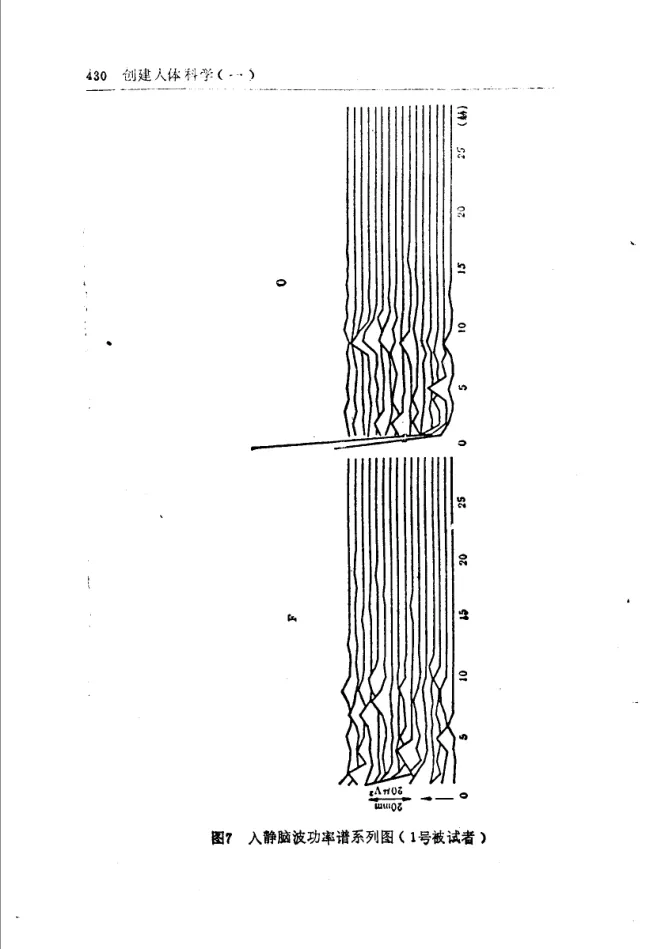
Test subject No. 5, who claimed to be relatively proficient in the character-emission ability, also exhibited desynchronized-type brain waves relatively frequently during character emission. Moreover, from the series of power spectra, one can observe a picture in which synchronized and desynchronized functional states appear alternately. As shown in Figure 10, in the upper curve group the frontal region is in a desynchronized state (the occipital region shows the opposite), in the middle curve group the frontal region is in a synchronized state (the occipital region shows the opposite).
80
70
60
50
40
30
20
10
7 7.5 8.6 10 10.5 11.5
8
8
0
Top: Comparison of five subjects (from left to right: subjects No. 6, 5, 4, 3, 2) Vertical axis: Power (μV²/Hz/sec); Horizontal axis: Frequency.
Bottom: Subject No. 5 Vertical axis: P value (probability of local peak occurrence); Horizontal axis: Frequency (0–64 cycles).
Figure 8 Leftward Shift and Resonance of Brain Waves
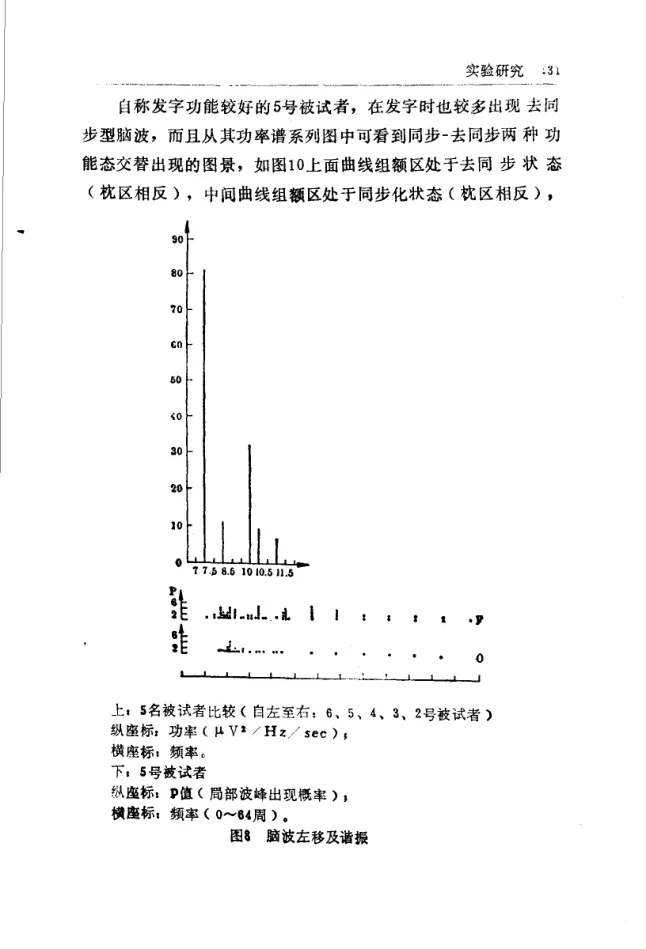
The lower curve group shows that during the first time segment (1–10 seconds) the frontal brain waves exhibit desynchronization, while during the latter time segment (11–16 seconds) they transition to synchronization, clearly demonstrating a brain-wave transition phenomenon (the occipital region also shows an opposite trend). The transitions between different brain-wave states and the antagonistic relationship between the frontal and occipital regions are displayed here in a relatively typical manner.
μV/Hz/
F4
2
0
10
15
20
25
4
O2
2
5
10
15
20
25
Fz
2
0
10
15
20
25
Oz
4
2
Mh
0
.5
10
15
20
25
Top: Subject No. 3; Bottom: Subject No. 1.
Figure 9 Brain Wave Power Spectra during “Character Emission”
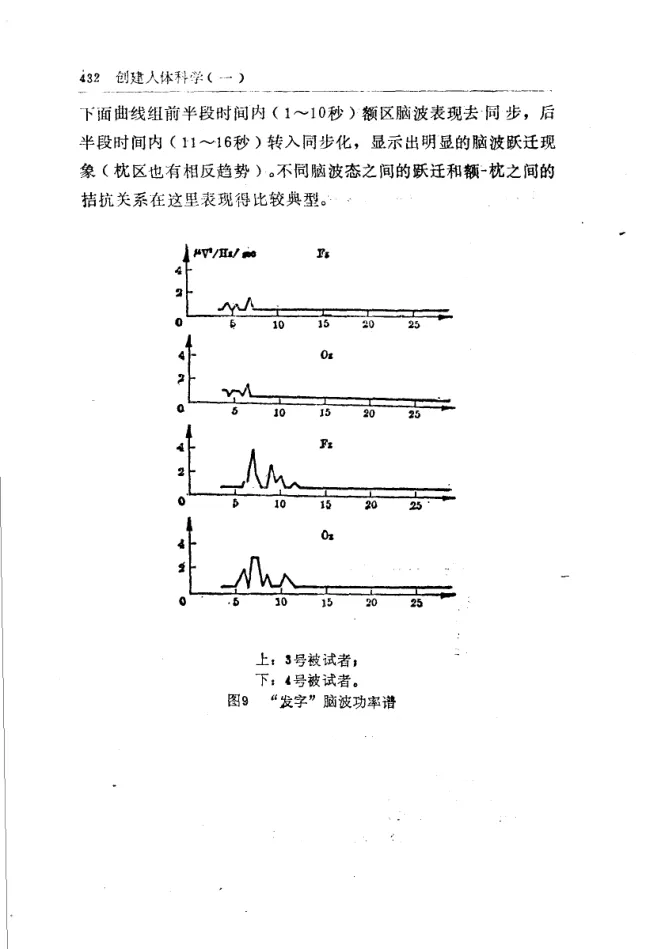
(#)
23
20
5
23
20
1
2V
20mm
Figure 10 Analysis of the “Character Emission” Process (Subject No. 5)
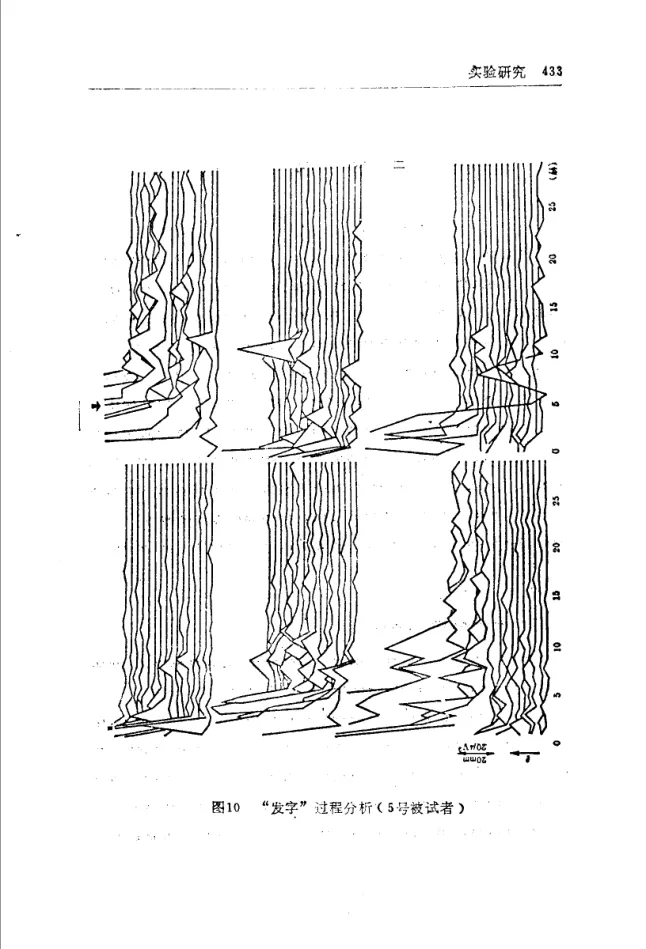
III. Discussion
1. The Specificity of the Qigong Functional State
All of our results support the view that qigong constitutes a special functional state. The shift of the human brain’s dominant α-waves from the occipital region to the frontal region has not been reported in the general population in a non-specific state. In Adey W. R.’s “collective brain wave maps,” the averaged EEG power spectra of 50 candidate astronauts also showed no prominent α peak in the frontal region [ ], whereas in the qigong state reported in this paper, the maximum power of the frontal α peak can reach over 150 μV², which represents a considerable change. Only Subject No. 5 showed no significant frontal α dominance, but clear leftward frequency shift and resonance were present in the frontal region. From the results of the majority of subjects, the marked reversal of the frontal–occipital brain wave pattern indicates that during the qigong state, a certain qualitative change (mutation, transition) occurs in human brain function, especially in frontal region function. We have previously reported on the frontal–occipital reversal (antagonism) phenomenon and the relationship between quantitative and qualitative changes, and pointed out their significance in brain function research [4]. The qualitative change in frontal brain function may constitute the basis for a series of extraordinary phenomena that emerge in the qigong state.
2. The Significance of the Qualitative Change in Frontal Region Function
The frontal region is the most recently formed brain area in the course of cerebral evolution. It differs significantly from other brain regions in phylogenesis, embryonic development, and cytoarchitecture. Eccles regarded the prefrontal area as the locus where neural processes transition to conscious processes [7]. That the frontal region serves as an important area for conscious activity in the human brain is supported by numerous facts in physiology. In our laboratory, in studies on color vision, manual tracking control, and learning and memory, we have repeatedly observed the special role of the frontal region. Therefore, the qualitative change in frontal region function during the qigong state must carry special significance; it may potentially lead to a certain qualitative change in conscious activity or level of consciousness. In the extraordinary-functional state,
Will subconscious activities enter the domain of consciousness? Can consciousness be amplified? Can some new material property of the brain—a new, higher-level form of conscious activity—be produced in the brain? All of these may be questions that need to be explored in research on the extraordinary functions and functional states of the human brain.
It is a known fact in physiology that the frontal region “links” the activities of various sensory and motor areas and enters into relations with the external world of the body. However, research on the connections between the frontal region and the body’s internal world has been very limited. Neuroanatomy demonstrates that the autonomic nervous center—the hypothalamus—connects with the frontal region through the mediodorsal nucleus of the thalamus. The frontal region can also exert influence on the limbic system and the hypothalamus. Signals related to the body’s internal states (hunger, thirst, joy, anger, fear, sexual drive, etc.) can be transmitted from the hypothalamus, the septal nuclei, and the limbic system (hippocampus, amygdala) through the mediodorsal nucleus of the thalamus to the frontal region, where they imbue conscious experience with emotional coloring [7]. No other cortical region has such a pronounced connection with the hypothalamus. Therefore, there are strong reasons to hypothesize that the qualitative change in frontal region function during the qigong state establishes a connection between the frontal region and the body’s internal world, enabling processes that originally belonged to the subconscious to enter the domain of consciousness, thereby receiving “colored” signals from the internal organs and actively regulating the visceral organs, thus achieving comprehensive control of the “human-body giant system” [1].
Can the frontal region also receive other external signals beyond the ordinary five senses? Adey reported that the hippocampus responds to electromagnetic oscillations of around 7 Hz (6–8 Hz) in the external environment, and that brain wave rhythms modulated by microwaves can be fed back to the human brain to enhance brain waves [8], demonstrating that the human brain possesses the ability to receive electromagnetic oscillations. Whether this ability is greatly enhanced during the extraordinary functional state, and whether the human brain can receive or emit forms of energy other than electromagnetic waves—such as gravitational waves and other unknown cosmic factors—constitutes a problem that must be resolved in the study of the “super giant system” [1].
- The Significance of α-Wave Ordering in the Frontal Region
Regarding the generation of α waves, there have been the cortical–thalamic recurrent circuit theory [10],
the thalamic midline pacemaker theory [11], the thalamic functional pacemaker theory [12], and others. Although they differ in emphasis, they all affirm the role of the thalamus in the generation of cortical α waves. Among these, the medial portion of the thalamus is clearly related to the generation of α waves, and as noted in the preceding section, the mediodorsal nucleus of the thalamus is a decisive link in connecting the frontal region with the hypothalamus. This further strengthens the belief that the emergence of frontal α dominance is closely related to the establishment of the fronto-hypothalamic connection. It is conceivable that under ordinary conditions, the human brain is primarily open to the external world of the body, so α waves dominate in the occipital region and other exteroceptive systems; in the qigong functional state, the human brain turns toward the body’s internal world, the frontal–thalamic–hypothalamic connection is established, and α waves shift to the frontal region.
According to model studies of the collective activity (mass action) of the nervous system, the lumped model can be divided into hierarchical levels such as K0, KI, KII, and KIII according to complexity [13]. Frontal α synchronization in the qigong state may represent activity at a higher K level, whereas desynchronization may correspond to activity at lower K0 or KI levels. The progression from desynchronization to synchronization to hypersynchronization represents a process of neural activity ordering (Figure 11), and is linked to the processes of neuronal membrane depolarization, polarization, and hyperpolarization. Haken compared biological ordering phenomena with laser phenomena [14], and there is reason to believe that the shift from desynchronization to hypersynchronization is an energy storage (pumping) process, which increases the number of neurons in the hypersynchronized state. Brain wave resonance mechanisms must also play an important role in this process. The transition from hypersynchronization to desynchronization is an energy release (emission) process; physiologically, slow energy release processes are more commonly observed. Whether there might also be rapid, short-duration releases of large amounts of energy through “stimulated transitions” is an extremely intriguing question. Is the “flash” phenomenon during the qigong state, and other forms of energy bursts, related to this? It is known that biological systems possess considerable amplification capacity: the retina can amplify the energy of a single photon one million-fold within a few milliseconds, leading to neural electrical firing [15]; astronauts in space can perceive flashes caused by a single heavy particle; and intracerebral electrical stimulation at 0.1–0.01 μV/cm can elicit neural electrical activity on the order of 1 kV/cm [17]. Furthermore, could the synchronized activity of large numbers of postsynaptic potentials produce effects similar to those of a biological accelerator?
From the perspective of biological orderliness and biological radiation, in-depth study of the functional states of the human brain—above all the frontal region—at different levels, both macroscopic and microscopic, will bring hope to the study of extraordinary human functions and will propel biological research to the forefront of modern science.
IV. Conclusions
Brain wave power spectrum analysis was performed on six subjects with qigong capabilities, yielding the following results.
(1) During the qigong functional state, an energy-concentrated α-wave peak appears in the frontal region of the human brain, while the occipital α wave is inconspicuous by contrast. Compared with normal individuals, the fronto-occipital brain wave relationship is clearly reversed. The longer the qigong training, the greater the frontal α-wave peak value. The maximum peak value exceeded 150 μV²/sec.
(2) During the qigong functional state, the central frequency of the frontal α wave shifts to the left (toward lower frequencies); the shift is more pronounced in those with longer training, reaching a minimum of 7.5 Hz. The frontal region also exhibits multiple harmonics at 6 Hz intervals, and resonance peaks can appear between the frontal and occipital regions.
| Level |
|---|
| Synchronization (KIII) |
| Synchronization (KII) |
| Hypersynchronization |
| Energy storage |
| Desynchronization (KI) |
Figure 11. Schematic diagram of brain wave transitions
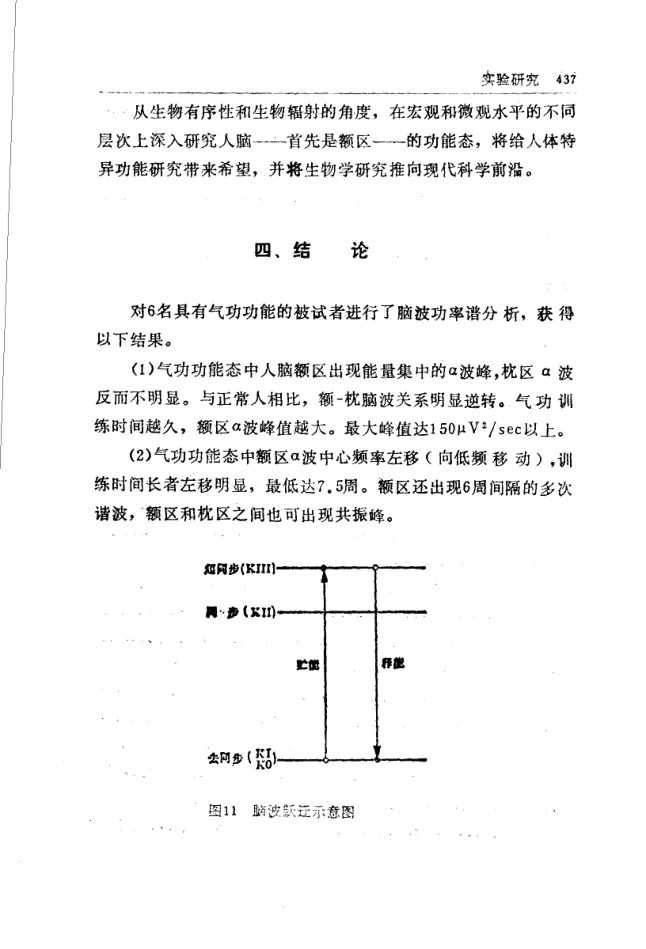
(3) It was preliminarily observed that during the character-emission process, unlike other qigong states, brain waves exhibited a desynchronized state, with transition phenomena appearing between synchronization and desynchronization.
It is held that qigong is a state of extraordinary ability, and that the reversal of the frontal-occipital brain wave relationship and the hypersynchronization of α waves in the frontal region represent a qualitative change in human brain function. The possible mechanisms and significance of the ordering of frontal brain waves are discussed.
This work was carried out under the initiative of Comrade Qian Xuesen. Bao Xianwen, Zhang Wenjie, Hao Jinyao, Cao Jian, Wang Yonghuai, and Li Yingbo participated in the experimental work. Comrade Luo Shuming assisted with data processing. During the course of the work, support and participation in discussions were received from Deputy Director Chen Xin. We hereby express our gratitude!
Notes and References
[1] Qian Xuesen, Nature Journal, 4 (1981) 483.
[2] Budzynski T.H., ed. Schwartz G.E., Shapiro D. Consciousness and Self-Regulation. Plenum Press (1976) 361.
[3] Adey W.R., ed. Schade J.P., Smith J. Computers and Brains. Amsterdam (1970) 45.
[4] Mei Lei, Wu Wencan, Wang Zhiqing, Zhou Chuandai, Journal of Astronautics, 2 (1980) 77.
[5] Mei Lei, Zhou Chuandai, Wan Zhiqing, Wu Wencan, 28th International Congress of Aviation and Space Medicine. Abstracts of Papers, Montreal (1980).
[6] Eccles J.C. Human Mystery. Springer-Verlag (1979).
[7] McGeer P.L., Eccles J.C., McGeer E.G. Molecular Neurobiology of the Mammalian Brain. Plenum Press (1978).
[8] Adey W.R., ed. Burch N., Altshuler H.L. Behavior and Brain Electrical Activity. Plenum Press (1975) 363.
[9] Bishop G.H., Cold Spring Harbor Symp. Quant. Biol.,
4 (1936) 305.
[10] Chang H.T., J. Neurophysiol., 13 (1950) 235.
[11] Dempsey F.W., Morison R.S., Amer. J. Physiol., 135 (1942) 301.
[12] Andersen P., Anderson S.A. Physiological Basis of Alpha Rhythm. New York (1968).
[13] Freeman W.J. Mass Action in the Nervous System. Academic Press (1975).
[14] Haken H., Nature Journal, 1 (1978) 229.
[15] Basar E. Biophysical and Physiological Systems Analysis. Addison-Wesley (1976).
[16] Sybesma. An Introduction to Biophysics. Academic Press (1977).
[17] Adey W.R., Neurophysiological Estimates of Human Performance Capabilities in Aerospace Systems, N75-28710, AD-A0C5690 (1975).
[18] Jueneman F.B., Industrial Research/Development, Nov. (1978) 15.
Observations on the Effects of Qigong External Qi on Gram-Negative Bacteria
Feng Lida Qian Juqing Li Suying Bao Guiwen Wu Fuguang
[Editor’s note] The authors of this article observed the effects of qigong external qi and found that external qi has a bactericidal effect on Gram-negative bacteria, with strong killing power against both E. coli and dysentery bacilli. It is noteworthy that they also conducted the reverse experiment: the same qigong master emitted external qi in the same manner, but with the intention that the external qi cause the bacteria to proliferate, and the results confirmed that the bacteria did indeed proliferate. This phenomenon is well worth further investigation. This article is the observation report of that experiment.
Authors’ affiliations: Feng Lida and three others, General Hospital of the Navy, Chinese People’s Liberation Army; Wu Fuguang, General Hospital of the Air Force, Chinese People’s Liberation Army.
Through practice it has been confirmed that qigong “external qi” does have a certain efficacy in improving human health, but its effects on the specific and nonspecific immune functions of the organism remain unclear. We conducted studies on the relationship between qigong “external qi” and the body’s immunity. This article reports observations on the effects of qigong “external qi” on Gram-negative bacteria.
I. Materials and Methods
- Materials
Bacterial strains: E. coli No. 81723 (non-pathogenic), Shigella dysenteriae (Flexner) No. 81811; Culture medium (solid): 1.5% agar medium containing 1% beef extract, 1% peptone, 0.5% sodium chloride, pH adjusted to 7.2–7.4; Broth: containing 1% beef extract, 1% peptone, 0.5% sodium chloride, pH adjusted to 7.2–7.4.
All culture media and apparatus required for this experiment were sterilized at 15 psi under high pressure.
- Methods
One colony of E. coli (medium-sized) cultured for 24 hours at 37°C was taken and placed in a 1 ml sterile test tube, mixed thoroughly, and serially diluted tenfold up to 10⁻¹⁰.
Each sample group consisted of 3 tubes: one tube served as the control, and the other two tubes were held by the qigong master, who emitted qigong “external qi” (which could be either a destructive form or a growth-promoting form). The broth-bacterial suspension tubes that had received qi emission were then incubated at 37°C for 24 hours.
The broth-bacterial suspension cultured for 24 hours at 37°C was used as the original solution, diluted to concentrations of 10⁻¹ and 10⁻²; 0.4 ml of bacterial suspension was placed onto plates containing agar medium and spread evenly. After drying, the plates were incubated at 37°C for 24 hours, and results were then observed.
II. Results and Observations
From July 23 to late August 1981, we conducted experiments on the destructive effect of qigong “external qi” on E. coli. The duration of qi emission was one minute in all cases. Results are shown in Tables 1 and 2.
As seen in Tables 1 and 2, qigong “external qi” has a destructive effect on E. coli. This can be seen in photographs and electron micrographs (Figures 1–7). The photographs and electron micrographs were taken under double-blind conditions. At electron microscope magnifications of 5,000–10,000×, bacteria after qi emission showed swelling, rupture, and dissolution. Regular photographs show the growth of bacterial colonies before and after qi emission for both the control and experimental groups.
In the course of investigating the destructive effect of qigong “external qi” on E. coli, we also observed the destructive effect of qigong “external qi” on Shigella dysenteriae, as shown in Tables 3 and 4.
This is useful, because when conventional chemical and physical agents are tested for antibacterial activity against enteric bacteria, E. coli is used as the representative organism. If there is a destructive effect on E. coli, it can be considered to apply to enteric bacilli.
Table 1 Destructive effect of qigong “external qi” on E. coli (dilution 10⁻¹)
| No. | Control colony count | Post-emission colony count | Destruction rate (%) |
|---|---|---|---|
| 1 | 611 | 312 | 49 |
| 2 | 295 | 164 | 44 |
| 3 | 403 | 41 | 89.8 |
| 4 | 403 | 50 | 87.6 |
Table 2 Destructive effect of qigong “external qi” on E. coli (dilution 10⁻²)
| No. | Control colony count | Post-emission colony count | Destruction rate (%) |
|---|---|---|---|
| 1 | 78 | 7 | 91.03 |
| 2 | 68 | 34 | 48.5 |
| 3 | 48 | 13 | 73.0 |
| 4 | 48 | 12 | 75.0 |
Table 3 Destructive effect of qigong “external qi” on Shigella dysenteriae (original solution)
| No. | Control colony count | Post-emission colony count | Destruction rate (%) |
|---|---|---|---|
| 1 | 584 | 23 | 96.1 |
| 2 | 584 | 23 | 96.1 |
Table 4 Destructive effect of qigong “external qi” on Shigella dysenteriae (dilution 10⁻¹)
| No. | Control colony count | Post-emission colony count | Destruction rate (%) |
|---|---|---|---|
| 1 | 182 | 2 | 98.9 |
| 2 | 182 | 8 | 95.6 |
| 3 | 63 | 21 | 66.7 |
| 4 | 6 | 1 | 83.3 |
a destructive effect can be demonstrated. Therefore, Tables 1–4 demonstrate that qigong “external qi” has a destructive effect on both E. coli and Shigella dysenteriae, from which it may be inferred that qigong “external qi” has a destructive effect on Gram-negative bacilli.
To further understand the effect of qigong “external qi” on Gram-negative bacilli, we conducted observations on the growth-promoting effect of qigong “external qi” on E. coli and Shigella dysenteriae. These demonstrated that qigong “external qi” can also have a growth-promoting effect on E. coli and Shigella dysenteriae, as shown in Tables 5 and 6.
Table 5 Growth-promoting effect of qigong “external qi” on E. coli
| No. | Control colony count | Post-emission colony count | Fold increase |
|---|---|---|---|
| 1 | 295 | over 700 | 2.37 |
| 2 | 66 | 456 | 6.9 |
Table 6 Growth-promoting effect of qigong “external qi” on Shigella dysenteriae
| No. | Control colony count | Post-emission colony count | Fold increase |
|---|---|---|---|
| 1 | 63 | 196 | 3.1 |
| 2 | 6 | 42 | 7.0 |
| 3 | 71 | 103 | 1.31 |
| 4 | 16 | 21 | 1.31 |
Concurrent with the above work, we also observed the relationship between successively emitted destructive-form and growth-promoting-form qigong “external qi” on E. coli. That is, under the qi emitter’s mental intention control, within approximately 2 minutes, the destructive form was emitted first for 1 minute, followed immediately by the growth-promoting form for the next minute. Results are shown in Table 7.
Table 7 Comparison of the effects of the destructive form and the growth-promoting form on E. coli
| No. | Control colony count | Post-destructive-form colony count | Post-growth-form colony count | ||
|---|---|---|---|---|---|
| Count | % | Count | Fold | ||
| 1 | 295 | 164 | 44.4 | over 700 | over 2 |
| 2 | 66 | 34 | 48.6 | 456 | 6.9 |
As can be seen from Table 7, under the qi emitter’s mental intention control, two different types of qigong — namely, the function of destroying E. coli and the function of promoting the growth of E. coli — can alternately appear within a period of approximately 2 minutes. Therefore, we believe that if patients with certain chronic enteric infectious diseases practice internal qigong exercises on their own, building upon the foundation of receiving qigong “external qi” therapy, it can play a beneficial role in disease prevention and treatment. During the experimental process, we also noted that subjective and objective factors have a certain degree of influence on the emission of qigong “external qi.”
This article provides a preliminary experimental result on the interaction between qigong “external qi” and Gram-negative bacilli. It is hoped that this experiment may offer some reference and insight for further exploration of the interaction between qigong “external qi” and living organisms, as well as the therapeutic mechanisms of qigong “external qi.”
Figure 1 Comparison of the effects of the destructive form and the growth-promoting form on E. coli
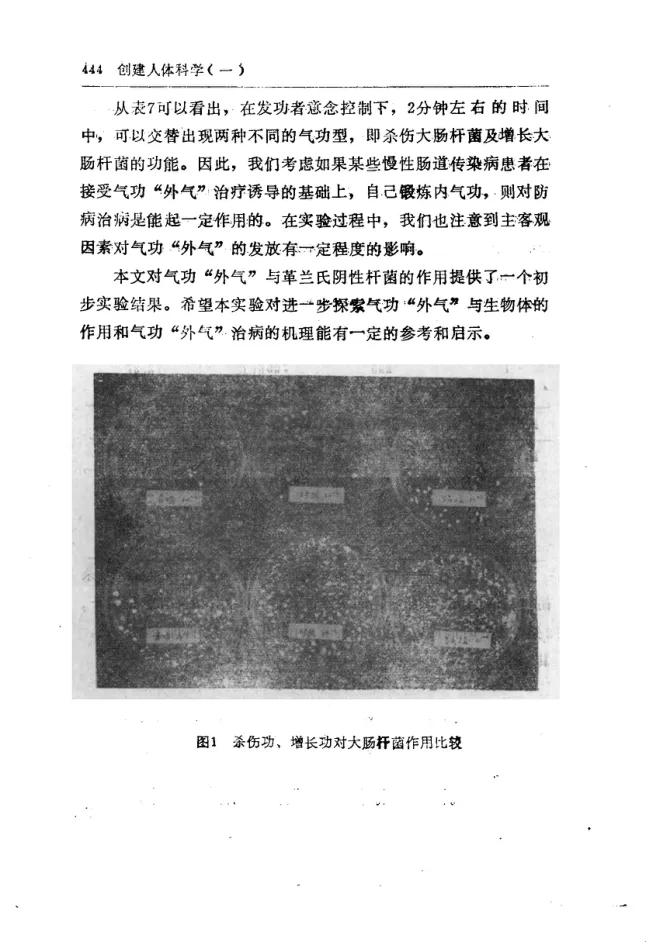
Figure 2 Normal Escherichia coli bacterium under an electron microscope Figure 3 Escherichia coli bacterium under an electron microscope showing swelling phenomenon, but not yet ruptured Figure 4 Under an electron microscope, a portion of normal Escherichia coli bacteria are in an intact state, while most of the slender ones have been destroyed
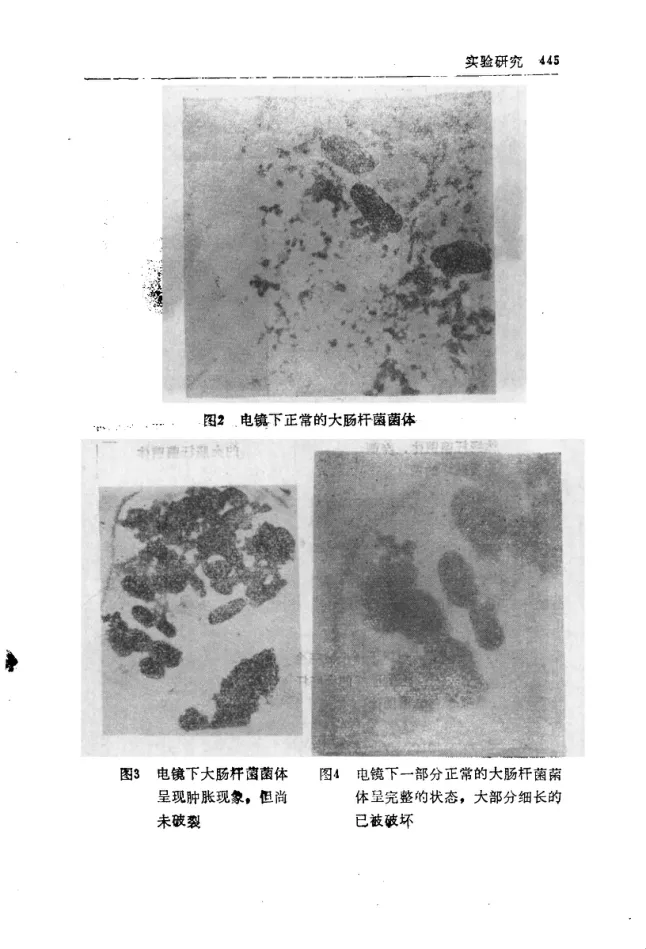
Figure 5 A normal Escherichia coli bacterium under an electron microscope, with a destroyed bacterium beside it Figure 6 An Escherichia coli bacterium beginning to be destroyed under an electron microscope Figure 7 A completely dissolved and destroyed Escherichia coli bacterium under an electron microscope
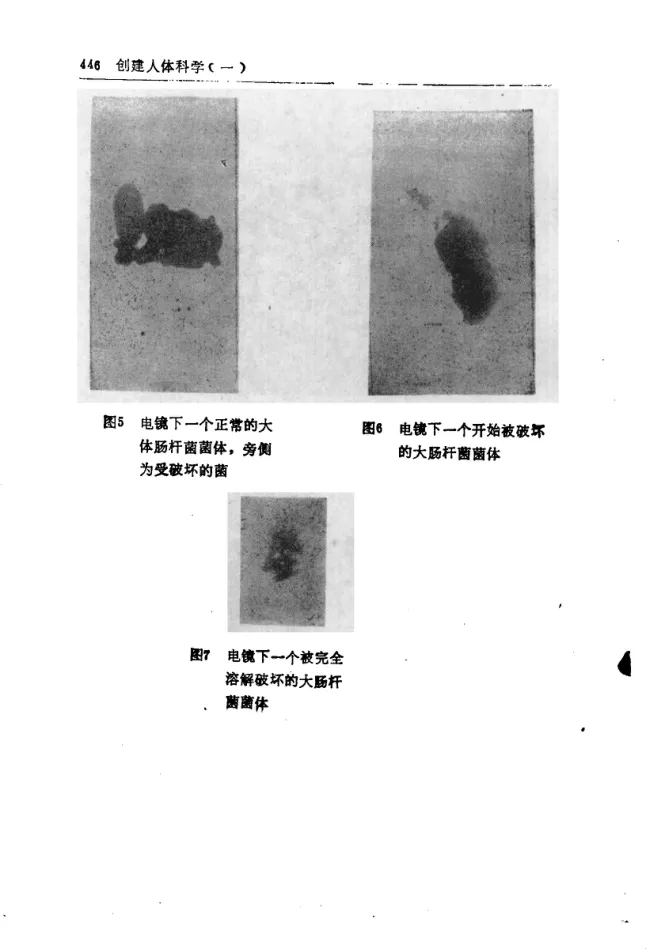
Observation of the Effects of External Qigong on Gram-Positive Cocci
Feng Lida, Bao Guiwen, Qian Ju, Li Suying
[Note] This article reports on the observations of the effects on Gram-positive cocci, and the results are clear. The methods used in the experiment are very simple, and the bacteria can have no subjective intentions involved, so it is quite convincing. This experiment proves that external qigong is indeed an objective existence. Authors’ affiliation: General Hospital of the Chinese People’s Liberation Army Navy.
Staphylococcus is the most common of the pyogenic cocci. As currently known, there are at least 9 or more species in this genus of cocci; some are pathogenic, while others are non-pathogenic.
A common classification method divides them into three types based on the different pigments of their colonies: (1) Staphylococcus aureus, which produces a golden-yellow pigment; most are pathogenic and it has the strongest pathogenicity among the bacteria of this genus, capable of causing a variety of diseases. (2) White Staphylococcus, which produces a white pigment; some strains are pathogenic, but their pathogenicity is relatively weak, and this bacterium is often found on normal skin. (3) Staphylococcus citreus, which produces a lemon-yellow pigment and is generally non-pathogenic; it is widely distributed in water, air, and on utensils. The resistance of Staphylococcus is relatively strong; it can survive for months under dry conditions and for years in carbohydrate-free media. Its resistance to heat is greater than that of ordinary non-spore-forming bacteria; it must be exposed to moist heat at 70°C for 1 hour to be killed, and at 80°C moist heat for 30 minutes to be killed. Bacteria on clothing and in concentrated sweat can still survive for weeks or months after drying, and in 5% carbolic
acid or 0.1% mercuric chloride solution, they die within 10–15 minutes. They are relatively sensitive to certain dyes; for instance, a gentian violet solution diluted to 1/100,000–1/200,000 can inhibit their growth. In summary, there is a relatively clear understanding of the pathogenic conditions of Staphylococcus aureus and white Staphylococcus. Among them, Staphylococcus aureus has stronger pathogenicity. Therefore, when conducting research on the relationship between qigong science and organismal immunity, it is necessary and essential to observe the effects of qigong “external qi” on Gram-positive cocci, so as to further provide certain data for the disease-preventing and curing efficacy of qigong.
I. Materials and Methods
- Materials
(1) Bacterial strains: White Staphylococcus, code 81922;
Staphylococcus aureus, code 811027.
(2) Culture medium (solid): 1.5% agar medium, containing 1% beef extract, 1% peptone, 0.5% sodium chloride, pH adjusted to 7.2
7.4. (3) Broth: 1% beef extract, 1% peptone, 0.5% sodium chloride, pH adjusted to 7.27.4. All required media and equipment were autoclaved at 15 lbs of pressure. - Methods (1) Take a colony of white Staphylococcus or Staphylococcus aureus cultured on solid medium at 37°C for 24 hours (about 0.5 mm in diameter) and place it into a test tube containing 1 ml of sterile water. After mixing evenly, dilute to . Then, using broth, place the bacterial suspension into sterile broth to make it (the volume of the broth bacterial suspension is 3 ml for all). (2) Two tubes of sterile broth in total: one tube for the control, and one tube for the qigong master to hold the test tube
Emission function.
(3) The broth tubes after the qigong master emits qi can be further diluted to and to facilitate counting. From each tube, 0.4 mL of the bacterial suspension is taken and evenly distributed over the surface of the culture medium plate. After drying, they are placed in a 37°C incubator for 24 hours, and the results are then observed.
II. Results
Since the autumn of 1981, we have conducted experiments on the killing effect of qigong “external qi” on Staphylococcus albus. The duration of qi application was 1 minute in all cases. The details are shown in Table 1.
As shown in Table 1, regarding the killing of Staphylococcus albus by qigong “external qi” (through glass test tubes) after one minute of qi application, the killing percentage ranged from 34.5% to 81.5%. The control colony counts were between 84 and 1096, and after one minute of qi application, the colony counts were reduced to between 28 and 317. Obviously, qigong “external qi” has a killing effect on Staphylococcus albus.
Table 1: Killing Effect of Qigong “External Qi” on Staphylococcus albus
| Sequence | Control colony count | Post-qi colony count | Killing percentage (%) |
|---|---|---|---|
| 1 | 480 | 105 | 79 |
| 2 | 1096 | 194 | 81.5 |
| 3 | 84 | 28 | 66.6 |
| 4 | Over 500 | 317 | 34.5 |
Table 2: Killing Effect of Qigong “External Qi” on Staphylococcus aureus
| Sequence | Control colony count | Post-qi colony count | Killing percentage (%) |
|---|---|---|---|
| 1 | 62 | 34 | 45.1 |
| 2 | 297 | 290 | 0.97 |
| 3 | 231 | 10 | 96.7 |
| 4 | 430 | 361 | 16.9 |
Since October 1981, we have also conducted experiments on the killing effect of qigong “external qi” on Staphylococcus aureus. The duration of qi application was also one minute, and the details are shown in Table 2.
As shown in Table 2, qigong “external qi” has a killing effect on Staphylococcus aureus, which has the strongest resistance among the Staphylococcus genus; the killing percentage ranged from 0.97% to 96.7%. It can also be seen from the table that the killing effect was inconsistent; for example, in the second experiment, the killing percentage was only 0.97%, whereas in the third experiment, the bactericidal effect on Staphylococcus aureus was 96.7%. As far as we understand, the reason for this significant difference is somewhat related to the intentional information of the qigong master during the application of qi (it is also related to the qigong master’s degree of fatigue and the duration of qi application). During the second experiment, the qigong master engaged in some conversation completely unrelated to the qi application before emitting qi, and emitted the external qi in the middle of the conversation. In the third application of qi, the qigong master concentrated entirely on killing these highly pathogenic bacteria. Whether these are the reasons affecting the killing rate of the qi application is worthy of further study.
During the course of our work, we also considered that intentional control might have a certain effect on the outcome of the qi emission, which makes the quantitative accuracy of the operating method more prominent. For instance, colony size and dilution volume can both impact the experimental results. Therefore, the accuracy of the operating method is an issue that warrants further attention.
Preliminary Testing of the External Qi of Kongjin Qigong
Zhang Yiqun, Zhu Junjie, Yang Hongliang
[Editor’s Note] The authors of this article used instruments such as a gamma scintillation spectrometer, a plastic scintillation spectrometer, a wire chamber device, a semiconductor spectrometer, and an X-ray analyzer to test qigong masters. They found that external qi can elicit a response from the instruments; however, upon careful analysis, these responses were found to be neither charged particles nor X-rays and gamma rays. They believe this is a unique qigong signal, and only through further research can the mystery of qigong signals be unveiled. This article presents the test results of their experiment.
The authors are affiliated with the University of Science and Technology of China.
In recent years, people have conducted various studies on human-body signals. As far as we know, various experiments have been conducted tens of thousands of times, and individuals have put forward their own views based on their experiments. However, among this large body of research, we have not yet seen any reports utilizing nuclear physics measuring instruments to systematically study qigong signals. If various charged particles, X-rays, gamma rays, and so on exist within qigong signals, then as long as their energy exceeds the threshold of the nuclear detector, regardless of how high their energy is, they can be detected. This is something that today’s experimental nuclear physicists can readily accomplish.
I. Measuring Instruments and Methods
We prepared a gamma scintillation spectrometer, commonly used in experimental nuclear physics—this is a
γ-ray spectrometer; plastic scintillation spectrometer — this is a spectrometer sensitive to β-rays; multiwire chamber apparatus — this is a nuclear detector sensitive to X-rays above 1 keV, and its recording efficiency for various charged particles passing through it approaches 100%; semiconductor spectrometer and X-ray analyzer — these are measuring instruments sensitive to α-particles, X-rays, and so on. We used radioactive sources to adjust these instruments so that they operated in their most sensitive state, and then removed the radioactive sources and had the qigong master direct qigong at these detectors using his fingers or palms, thereby obtaining qigong information. On November 7, 1982, and November 14, 1982, we conducted six tests on the qigong master Huang Renzhong (he practices Kongjin qigong); for comparative testing, we also tested Huang Renzhong’s student Comrade Qin ××, and at the same time had two comrades without qigong training also undergo testing. The experiments showed that persons with and without qigong could be clearly distinguished on the following two types of test instruments, and persons with different levels of ability could likewise be clearly distinguished, with the experiments being repeatable multiple times.
Figure 1 shows the test results of the effect of qigong information on the multiwire chamber apparatus. For ease of comparison, this figure uses semi-logarithmic coordinates. Curve 1 in the figure is the spectral line produced by 5.9 keV X-rays from a ⁵⁵Fe source. The instrument background did not exceed 10 counts per channel during the corresponding 10-second measurement time. Curve 2 is the energy spectrum measured over 5 minutes of qigong emission by Comrade Qin ××, a student of qigong master Huang Renzhong, and it is 4 times the instrument background count. Curves 3 and 4 are the energy spectra from 5 minutes of qigong emission by Huang Renzhong, with peak values 140 times the instrument background count and 35 times those of Qin ××. In the above measurements, it was found that the multichannel counts exhibited a burst-like character at the moment of qigong emission, with each burst lasting as briefly as less than 1 second and the longest lasting 2–3 seconds. The counts varied between 214 and 6,522 during non-burst and burst periods of 6 seconds. The above phenomenon was repeated 4 times, but although the peak values were very high, the peak positions showed essentially no change.
Using the γ-spectrometer with the NaI crystal removed, we placed the probe and the qigong master’s hand inside a dark bag for testing. After eliminating interference from other factors, qigong master Huang Renzhong emitted qigong at a distance of approximately 10 centimeters from the photomultiplier tube, and the burst phenomenon of qigong information could still be seen on the multichannel analyzer. Within 3 seconds, one could observe the counts beginning to shift in the direction of increasing channel number. When the shift
Counts ×10⁴
1×10³
0.31 1
0.28 2
0.30 1×10²
10
50
20
10 40 50 70 90 110 130 150 170
Channel number
Results of the first measurement of qigong information on November 7, 1982. Curve 1 is the ⁵⁵Fe spectrum counted over 10 seconds; curves 2, 3, and 4 are all counted over 30 seconds.
Figure 1 Output spectrum of the multiwire chamber apparatus
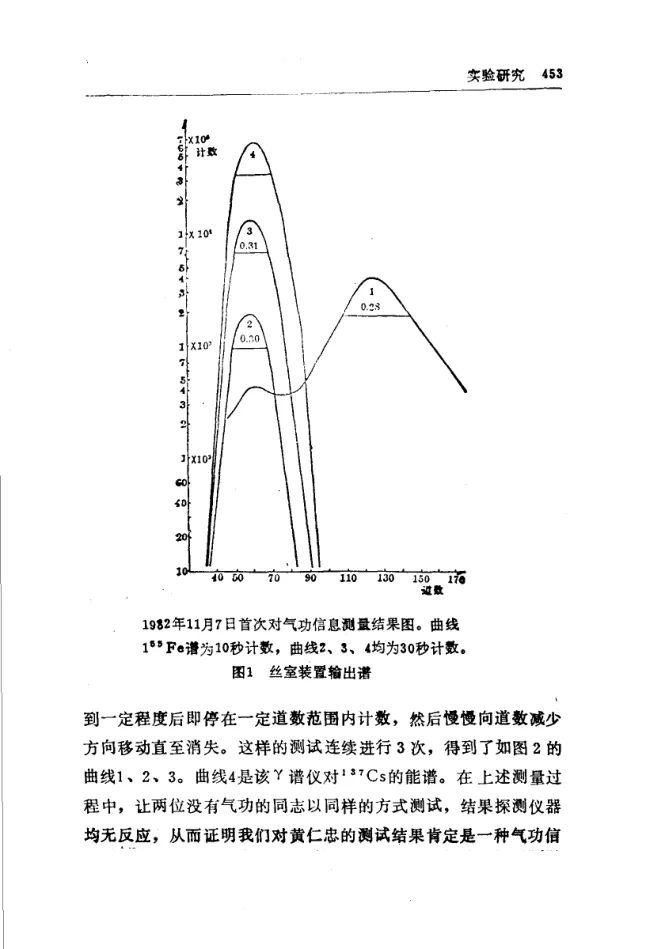
reached a certain level, it would stop within a certain range of channel numbers and then slowly shift in the direction of decreasing channel number until it disappeared. This test was performed continuously 3 times, yielding curves 1, 2, and 3 as shown in Figure 2. Curve 4 is the energy spectrum of ¹³⁷Cs from this γ-spectrometer. During the above measurement process, two comrades without qigong were tested in the same manner, and the detection instruments showed no response whatsoever, thereby proving that our test results for Huang Renzhong were definitely a form of qigong information.
Counts
1000
800
600
400
200
0 50 100 150 200 250 300 350
Channel number
Results of qigong information measurement on November 14, 1982. The scintillation counter operated at a working voltage of 600 volts. The ¹³⁷Cs total-energy peak (curve 4) was measured under the condition of NaI crystal amplification factor M = 16; curves 1, 2, and 3 were measured under dark-bag conditions with the NaI crystal removed, at M = 64.
Figure 2 Output spectrum of the photomultiplier tube
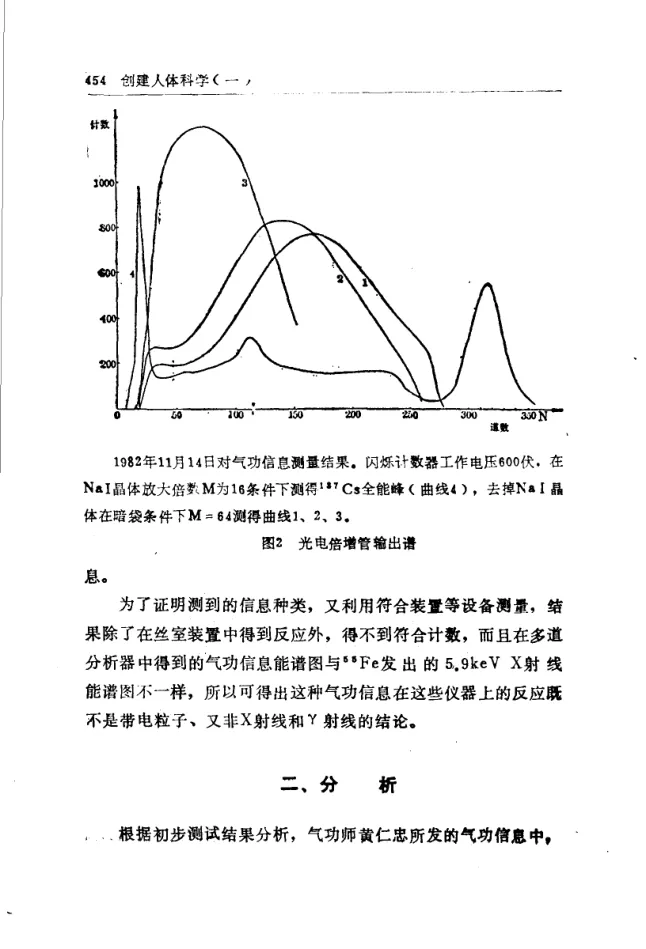
In order to verify the type of information detected, coincidence apparatus and other equipment were used for measurement. The results showed that, apart from obtaining a response in the multiwire chamber apparatus, no coincidence counts were obtained. Moreover, the qigong information energy spectrum obtained from the multichannel analyzer differed from the 5.9 keV X-ray energy spectrum emitted by ⁵⁵Fe. Therefore, it can be concluded that the response of this qigong information on these instruments is neither that of charged particles nor that of X-rays or γ-rays.
II. Analysis
Based on the preliminary test results, the qigong information emitted by qigong master Huang Renzhong contains:
If there are charged particles, their kinetic energy must be below the detector threshold (approximately 0.2 MeV for electrons); if there are X-rays, their energy must also be below 1 keV; and γ-rays were clearly not measured. So, what is it that causes the multiwire chamber apparatus to produce count information? Based on the shape of the energy spectrum and the phenomenon that different wire chambers — even different wires, different mixed gas compositions, and different high voltages — cause the peak position to shift, it can be concluded that Huang Renzhong’s qigong information acts on the wire chamber through some kind of force (tentatively designated as a biological force), causing displacement of the wires, which in turn causes changes in the electrostatic charges on the wires and thereby produces counts. By analogy, what causes the BF₃ counter tube to register counts may not necessarily be neutrons; therefore, only by deeply studying the interaction between qigong information and matter (including biological matter) can the mystery of qigong information be unraveled.
Since it is unclear what effect this biological force would have on the photocathode of the multiplier tube, and the only thing known is that the photocathode of such a multiplier tube is sensitive to radiation with wavelengths between 3,600 and 7,000 Å, if its information can be measured, then it can be considered a type of biological light accompanying this biological force. This is consistent with the accounts of some individuals who have observed an “auspicious light” around a qigong master at the moment of qigong emission.
The Effect of Qigong External Qi on the Pulsation Function of In Vitro Cultured Myocardial Cells
Li Caixi
Min Guanglu
Jin Long
Zhao Guang
[Editor’s Note] This is also an article studying the effects of qigong external qi. Comrade Zhao Guang is a renowned qigong master who excels in both internal and external alchemical practice. It can be seen that the external qi he emits has a significant impact on isolated myocardial cells.
Authors’ affiliation: Xiyuan Hospital, China Academy of Chinese Medical Sciences.
The qigong department of our hospital has utilized qigong “external qi” to treat cardiovascular diseases such as myocarditis, coronary heart disease, and hypertension, with genuinely good therapeutic efficacy. To investigate its mechanism of action, we conducted experiments on the effect of qigong “external qi” on the pulsation function of in vitro cultured myocardial cells, in order to explore whether qigong “external qi” has direct biological effects on myocardial cells.
I. Materials and Methods
Synchronously beating myocardial cells cultured for 5–6 days were prepared according to the method in reference [1]. Cells were first observed for 10–12 hours under an inverted microscope equipped with a thermostatic device (31±1°C), and cell clusters with stable pulsation were selected for experimentation. The qigong master directed both hands toward the pre-selected
changes in rate, rhythm, and intensity; and the pulsation pattern was recorded using a photoelectric monitoring device for myocardial cell pulsation.
Control observations were conducted using the same method applied to myocardial cells by ordinary persons who had never studied qigong and could not emit external qi (hereafter referred to as “ordinary persons”), and the changes in their pulsation were observed.
II. Results
Normal myocardial cell clusters observed on the thermostatic microscope stage for 10–12 hours showed pulsation frequency variation within the range of ±10.6%. The longer the observation time, the greater the range of variation.
Control group: When ordinary persons emitted “external qi” into the flask, comparing 1 hour after the application to before the application, the rate of change in pulsation frequency was −1.26±4.642, falling within the range of normal variation. See Table 1 and pulsation tracings 6–8.
| Changes in rate (%) |
|---|
Figure 1 Effect of qigong “external qi” on the pulsation frequency of in vitro cultured myocardial cells
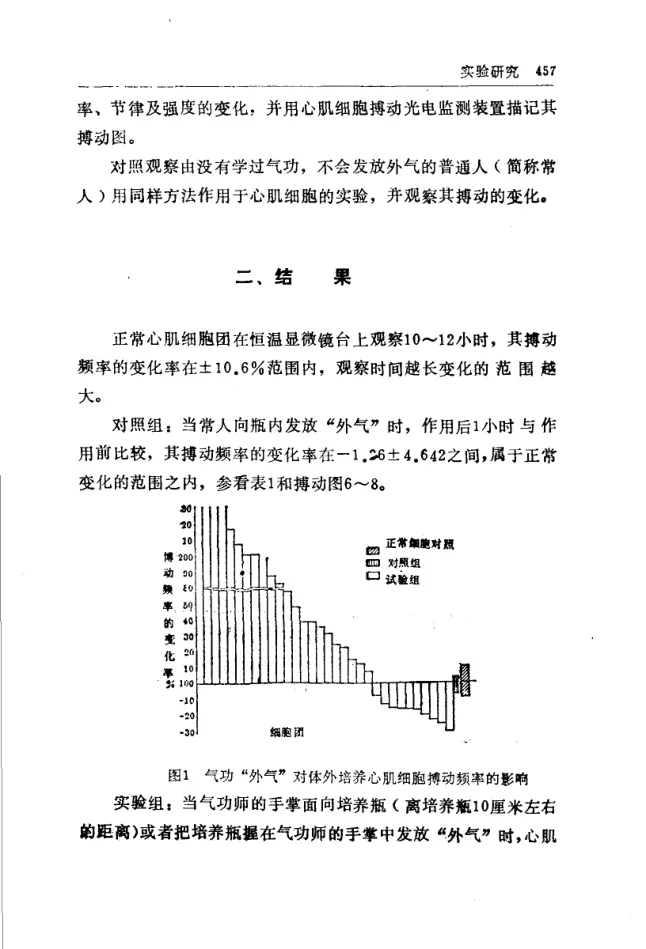
Experimental group: When the qigong master’s palms faced the culture flask (at a distance of approximately 10 cm from the culture flask) or when the culture flask was held in the qigong master’s palms while emitting “external qi,” the myocardial
Table 1 Effect of “External Qi” from Ordinary Persons on the Pulsation Frequency of In Vitro Cultured Myocardial Cells
| Cell cluster | |||||||||||
|---|---|---|---|---|---|---|---|---|---|---|---|
| 1 | 2 | 3 | 4 | 5 | 6 | 7 | 8 | 9 | 10 | X±SD | |
| Before qi (beats/min) | 74 | 93 | 65 | 71 | 138 | 19 | 14 | 20 | 62 | ||
| After qi (beats/min) | 75 | 94 | 65 | 72 | 13 | 8 | 20 | 13 | 18 | 60 | |
| Rate of change (%) | 1.3 | 1 | 1.4 | 5.2 | 8.2 | 10 | 3.3 | −1.26±4.642 | |||
| Sign | (+) | 0 | 0 | 0 | (+) | (−) | (−) | (−) |
Before qi: 10 beats/min
After 10 min of practice: 20 beats/min
1 hour after practice: 20 beats/min
Pulsation frequency before practice was 10 beats/min; after practice, the pulsation frequency increased to 20 beats/min.
Figure 2 Myocardial cell pulsation tracing (1)
Before qi: 52 beats/min
2 hours after practice: 36 beats/min
Pulsation frequency before practice was 52 beats/min; after practice, the pulsation frequency decreased to 36 beats/min.
Figure 3 Myocardial cell pulsation tracing (2)
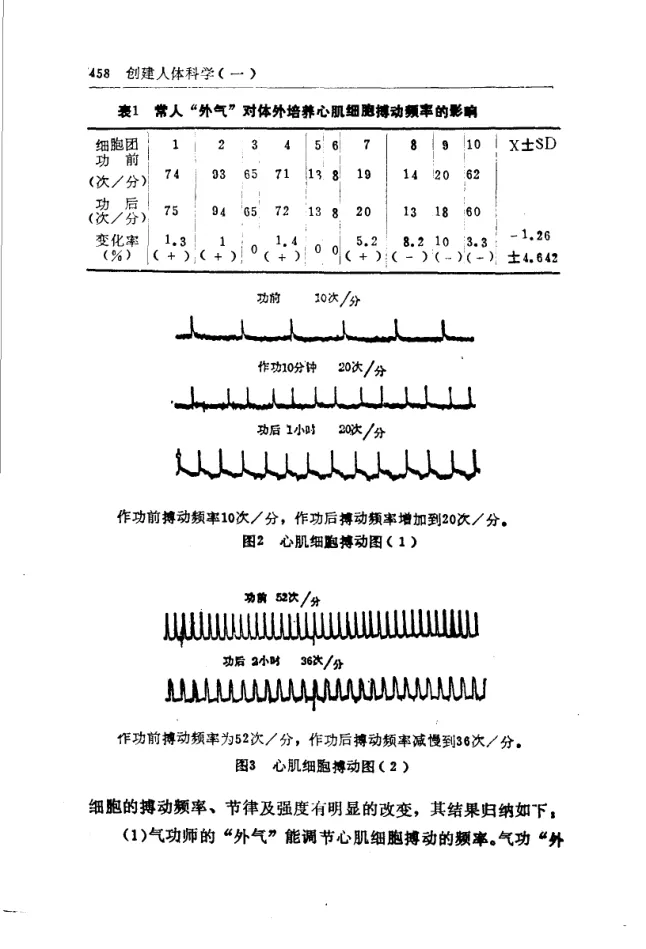
The pulsation frequency, rhythm, and intensity of the cells showed marked changes, and the results are summarized below:
The information of qi can accelerate the pulsation frequency of synchronously beating myocardial cell clusters (Figure 2),
Before qi
After 10 min of practice
15 min after practice
Before practice, the pulsation rhythm of the cell cluster was irregular; 15 minutes after practice, the rhythm was essentially normal.
Figure 4 Myocardial cell pulsation tracing (3)
or it can reduce the pulsation (Figure 3). A total of 31 cell clusters were tested. Comparing the frequency at 1 hour after practice with that before practice, 20 clusters (64.5%) showed a marked increase in pulsation, 9 clusters (29%) showed a marked decrease in pulsation frequency, and 2 clusters (6.5%) showed no significant change. After statistical analysis (F-test) and comparison with ordinary persons, it was evident that the pulsation frequency was altered with very high significance (Table 2 and Figure 1).
Further analysis of the pattern of changes revealed that cell clusters with lower pulsation frequencies (<50 beats/min) mostly (12/14) showed accelerated pulsation after receiving qigong “external qi” information, while those with higher frequencies (>75 beats/min) mostly (6/8) showed deceleration. On this basis, we tentatively propose that qigong “external qi” has a bidirectional regulatory effect on heart rate, which awaits further in-depth study.
(2) The information of qigong “external qi” can convert the pulsation of cell clusters with irregular rhythms (disordered rhythm, bigeminy, trigeminy, etc.) to normal rhythm (a total of 5 cell clusters). Although the time at which the effect occurred and the duration of maintenance varied, all showed improvement in rhythm (Figures 4, 5).
(3) When the information of qigong “external qi” acts on myocardial cells, the majority of cell clusters showed changes in pulsation intensity accompanying the changes in frequency and rhythm (Figures 2–5).
| Before qigong | During qigong for 7 minutes | 2 hours after qigong |
|---|
Before qigong the rhythm was irregular; 2 hours after qigong the rhythm became essentially regular; 7 hours after qigong the rhythm completely returned to normal, and the beating intensity was markedly enhanced.
Figure 5. Myocardial cell beating tracing
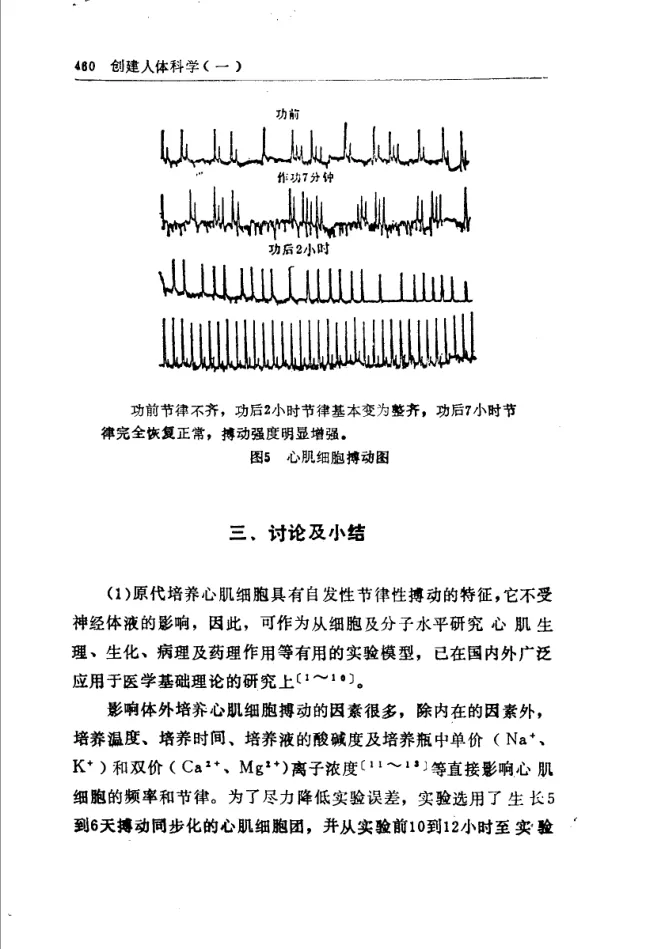
III. Discussion and Summary
(1) Primary cultured myocardial cells possess the characteristic of spontaneous rhythmic beating; they are not influenced by neurohumoral factors, and therefore can serve as a useful experimental model for studying cardiac physiology, biochemistry, pathology, and pharmacological actions at the cellular and molecular level. This model has been widely applied in basic medical research both in China and abroad [1–10].
Many factors affect the beating of cultured myocardial cells in vitro. Apart from intrinsic factors, culture temperature, culture duration, pH of the culture medium, and the concentrations of monovalent (Na⁺, K⁺) and divalent (Ca²⁺, Mg²⁺) ions in the culture flask [11–13] directly affect the frequency and rhythm of myocardial cells. To minimize experimental error as much as possible, this experiment used myocardial cell clusters whose beating had synchronized after 5 to 6 days of growth, and from 10 to 12 hours before the experiment until the experiment
Table 2. Effect of the qigong master’s “external qi” on the beating frequency of cultured myocardial cells in vitro
| Cell cluster | Before (beats/min) | After (beats/min) | Change rate (%) | Cell cluster | Before (beats/min) | After (beats/min) | Change rate (%) |
|---|---|---|---|---|---|---|---|
| 1 | 10 | 20 | 100 | 17 | 66 | 91 | 37.8 |
| 2 | 13 | 26 | 100 | 18 | 77 | 86 | 11.6 |
| 3 | 14 | 33 | 135.7 | 19 | 103 | 128 | 24.2 |
| 4 | 25 | 39 | 56 | 20 | 127 | 167 | 31.5 |
| 5 | 26 | 69 | 165.3 | 21 | 43 | 34 | −21 |
| 6 | 28 | 38 | 35.7 | 22 | 52 | 36 | −30.8 |
| 7 | 29 | 63 | 117.2 | 23 | 56 | 41 | −26.8 |
| 8 | 33 | 60 | 81.8 | 24 | 59 | 49 | −17 |
| 9 | 33 | 62 | 87.8 | 25 | 75 | 62 | −13.4 |
| 10 | 42 | 62 | 47.6 | 26 | 75 | 63 | −16 |
| 11 | 44 | 52 | 13.6 | 27 | 80 | 61 | −23.75 |
| 12 | 45 | 62 | 37.5 | 28 | 104 | 86 | −17.4 |
| 13 | 55 | 131 | 138.2 | 29 | 107 | 94 | −15.2 |
| 14 | 56 | 116 | 107 | 30 | 68 | 73 | 7.35 |
| 15 | 59 | 72 | 22 | 31 | 41 | 38 | 7.32 |
| 16 | 60 | 120 | 100 |
A minus sign before a number indicates a decrease in frequency.
Before qigong: 62 beats/min. After qigong: 60 beats/min.
Figure 6. Myocardial cell beating tracing
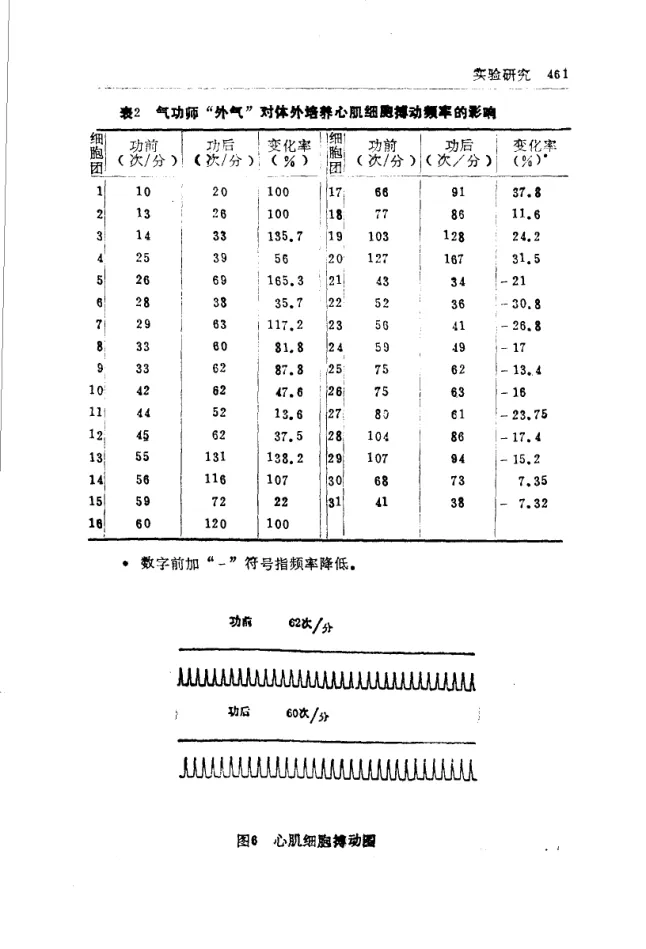
Before qigong: 18 beats/min. After qigong: 20 beats/min.
Figure 7. Myocardial cell beating tracing
Before qigong: 20 beats/min. After qigong: 18 beats/min.
Figure 8. Myocardial cell beating tracing
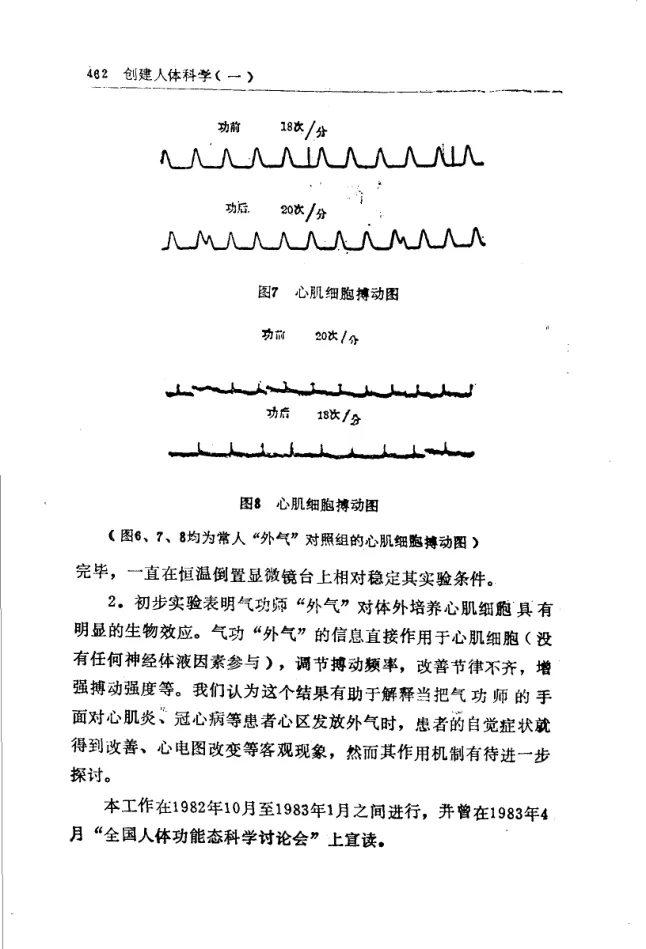
(Figures 6, 7, and 8 are all myocardial cell beating tracings from the ordinary-person “external qi” control group)
…was completed, the experimental conditions were kept relatively stable on the stage of a constant-temperature inverted microscope.
- Preliminary experiments showed that the qigong master’s “external qi” has a marked biological effect on cultured myocardial cells in vitro. The information of qigong “external qi” acts directly on myocardial cells (without any involvement of neurohumoral factors), regulating beating frequency, improving irregular rhythm, and enhancing beating intensity. We believe this result helps explain the objective phenomena observed when a qigong master holds his or her hand toward the cardiac region of patients with myocarditis, coronary heart disease, and other conditions to emit external qi: the patients’ subjective symptoms improve and electrocardiographic changes occur. However, the mechanism of action awaits further investigation.
This work was conducted between October 1982 and January 1983, and was presented at the “National Symposium on Human Functional States” in April 1983.
Notes and References
[1] Ishida H. et al. [Japan], Heart (Shinzō), 13, 2 (1981) 149.
[2] Yoneda H. et al. [Japan], Heart (Shinzō), 11, 3 (1979) 324.
[3] Ebisawa K. et al. [Japan], Heart (Shinzō), 10, 7 (1978) 998.
[4] Friedman I. et al., J. Mol. and Cell. Cardiology, 8 (1976) 641.
[5] Friedman I. et al., Immunology, 20, 2 (1971) 225.
[6] Thomson A. et al., J. Mol. and Cell. Cardiology, 9 (1977) 945.
[7] Thomson A. et al., J. Exp. Med., 131, 2 (1970) 245.
[8] Noboru Iida, Jap. Circ. J., 42 (1978) 887.
[9] Li Lianda et al., Chinese Journal of Cardiology (Zhonghua Xin Xue Guan Bing Za Zhi), 8, 2 (1980) 144.
[10] Li Lianda et al., Journal of Traditional Chinese Medicine (Zhongyi Za Zhi), 21 (1980) 468.
[11] Li Ying’ou et al., Chinese Journal of Integrated Traditional and Western Medicine (Zhongxiyi Jiehe Za Zhi), 1, 2 (1981) 93.
[12] Yoneda H. et al., Igaku no Ayumi (Medicine and Progress), 105, 2 (1978) 83.
[13] Yoneda H. et al., Igaku no Ayumi (Medicine and Progress), 104, 3 (1978) 185.
Observations of Blood Flow Changes During Qigong Functional States
Hou Shuli, Zhang Linfu Gong Wenyao, Jiang Fangying
[Editor’s Note] The authors of this article tested blood flow changes among qigong masters, qigong practitioners, and ordinary individuals under different states, comparing them across several aspects including stroke volume, cerebral blood flow, upper-limb blood flow, lower-limb blood flow, lower dantian regional blood flow, and respiratory rate. They also sought patterns from aspects such as the qigong master’s pre-practice resting state and the focused attention on different regions—Baihui, left Laogong, right Yongquan, and lower dantian—during the functional state.
The experimental design of this study is sound, the reported data are complete and properly processed, and certain patterns have been discovered. It is a comparatively comprehensive experimental research report on blood flow changes in recent years.
Authors’ affiliation: Institute of Space Medico-Engineering.
I. Purpose
The theory that “when qi arrives, blood arrives”[2], and Tang Rongchuan of the Qing dynasty said, “It is blood that carries qi, and it is qi that moves blood”[1]. It can be seen that the relationship between qi and blood is very close.
After a person who has undergone a certain degree of qigong training enters the qigong functional state, there arises the so-called “qi sensation” of internal qi movement. To date, the nature of internal qi remains unclear. Therefore, the qi sensation is mostly based on the self-reports of practitioners, without objective indicators. In recent years, there have begun to be reports observing single indicators such as the electroencephalogram, cerebral blood flow, limb blood flow, and skin temperature at acupuncture points during the qigong functional state; the blood flow at the region of focused attention during practice increased by 25% compared to the pre-practice resting state[2]. However, quantitative observations of synchronized multi-channel blood flow changes when focusing attention on different regions during the qigong functional state—especially studies on blood flow changes in the lower dantian region when attention is focused there during the qigong functional state—have not yet been reported.
The purpose of this article is, based on the theory of traditional Chinese medicine that “qi and blood are closely related” and on the principles of modern biophysics regarding the measurement of regional human blood flow, to use the impedance rheography method[3] to record stroke volume (SV, ml/beat), cerebral blood flow (CBF, ml/beat), upper-limb blood flow (ULBF, ml/beat), lower-limb blood flow (LLBF, ml/beat), lower dantian regional blood flow (DBF, ml/beat), and respiratory rate (BE, Hz or breaths/min), in order to observe changes in SV, CBF, ULBF, LLBF, BE, and DBF among qigong masters, qigong practitioners, and control subjects who have never practiced qigong, during the pre-practice resting state and during the qigong functional state when focusing attention on the Baihui, left Laogong, left Yongquan, and lower dantian regions, so as to find characteristic physiological indicators for describing the qigong functional state and to provide objective evidence of quantitative blood flow changes.
II. Methods
Due to instrument limitations, only four channels of blood flow could be recorded simultaneously, so the experiment was conducted in two parts.
(1) Ten male qigong masters (qigong master group) who had practiced methods such as inner-nourishing qigong for over ten years were selected, along with seven males (control group) of similar age who had never practiced qigong,
and eighteen practitioners (practitioner group) who had practiced the same methods for periods ranging from two months to several years.
(2) The second part of the experiment was essentially a continuation of the first. Qigong methods involving focused attention on the lower dantian region during practice were selected, such as “inner-nourishing qigong” and other stillness practices. Twenty-one qigong masters (qigong master group) with over three years of practice were selected; twenty practitioners (practitioner group) who had practiced the same methods for periods ranging from a few months to less than three years; and ten control subjects (control group) of similar age who had never practiced qigong.
For both parts of the experiment, all subjects made preparations according to the requirements of qigong practice (for example: not practicing within one hour before or after meals, not practicing when fatigued or drowsy, etc., in order to prevent changes in lower dantian regional blood flow caused by excessive hunger or fullness, and changes in cerebral blood flow caused by fatigue or drowsiness). They entered the examination room, where the temperature was maintained at 19 ± 2°C, and lay supine on the examination bed in the posture for practicing inner-nourishing qigong. Cerebral blood flow, upper-limb blood flow, lower-limb blood flow, and lower dantian regional blood flow electrodes[4] and a respiratory sensor were positioned. Blood flow signals were amplified through BDS-1B and HB-3CDG rheograph instruments. Then, during the pre-practice resting period, the 10-minute course of qigong practice, and within 5 minutes after concluding the practice, the above indicators of each subject were continuously and synchronously recorded at a speed of 5 mm/s on an ML-6 pen recorder.
The blood flow indicators during practice and after concluding practice were standardized[5], and values were calculated using the formula:
and percentage change values were obtained using the formula:
followed by inter-group comparisons[6].
III. Results and Analysis
(I) First Part of the Experiment
1. Comparison of All Indicators Among the Three Groups During Pre-Practice Resting State
Comparison between the qigong master group and the control group under resting conditions is shown in Table 1.
As shown in Table 1, under pre-practice resting conditions, when comparing the qigong master group with the control group, there were no significant differences in SV, CBF, ULBF, LLBF, BE, or Age (years), thereby ruling out the influence of these factors on the between-group comparisons of changes in each indicator under the qigong functional state.
2. Comparison Under the Qigong Functional State
As shown in Table 2, when practice had entered the qigong functional state for 4–5 minutes, while mentally focusing on Baihui, left Laogong, left Yongquan, and the lower Dantian region, compared with each individual’s resting percentage values, the blood flow at the body region corresponding to the qigong master’s mental focus all showed significant or even highly significant increases. However, when the qigong master mentally focused on the lower Dantian region, both upper limb blood flow and lower limb blood flow decreased, even reaching a highly significant degree.
3. Changes in Each Indicator When Mentally Focusing on Different Body Regions
Table 1 Comparison of Various Indicators Between the Qigong Master Group and the Control Group at Rest
| BE (×10⁻¹ Hz) | SV (ml/beat) | CBF (ml/beat) | ULBF (ml/beat) | LLBF (ml/beat) | Age (years) | |
|---|---|---|---|---|---|---|
| Qigong master group | 45±16 | 2.2±0.7 | 63.5±20.3 | 5.8±4.2 | 1.5±0.7 | 40±1.1 |
| Control group | 44±7 | 2.2±1.2 | 75.0±13.9 | 3.8±1.1 | 1.□±0.7 | 28±1.3 |
| Comparison | NS | NS | NS | NS | NS | NS |
(1) CBF
As seen in Table 2, when mentally focusing on Baihui, the CBF of the qigong master group was significantly higher than that of the control group, reaching 11.8%; whereas when mentally focusing on left Laogong, left Yongquan, and the lower Dantian region, it was lower than that of the control group, reaching a level of significant difference. When mentally focusing on different body regions, the CBF of the control group showed no significant changes.
22°29 -12.1±33.4 21.2±42.3 -29.7±29.3 -5.7±28.6 -7.2±12.1 -38.3±25.4 5.4±16.9 -33.2±31.8 -10.9±36.6 -2.4±13.3 -17.6±25.1 + 0.3±12.1 -0.6±8.8 2.7±4.8 -5.6±8.3 -2.2±5.8 1.7±10.5 26.9±15.0 8.1±11.3 Comparison of changes in various indicators when the three groups mentally concentrate on different parts of the body (%) ULBF 0.7±5.1 -3.1±9.0 2.8±3.6 0.0±3.4 -3.6±16.9 -7.5±16.6 24.1±23.2 14.0±14.8 -13.9±19.8 -3.4±15.0| -2.8±10.7 -1.8±2.2 4.0±3.2 1.3±1.9 -2.4±9.2 -5.0±16.3 1.3±7.2 11.8±8.1 3.9±7.7 -2.0±2.8 -10.9±0.4 -0.9±11.5 -5.3±7.1 -11.9±10.8 1.9±8.3 -16.3±12.1 -.6±10.7 -1.2±5.7 CBF -0.6±16.2 2.6±12.7 1.8±3.1 0.8±12.3 -0.1±10.5 1.5±4.0 8.2±26.2 0.6±10.3 2.8±2.4 10.9±14.7 1.3±10.1 1.3±2.6 Number of subjects 10 11 7 10 18 7 10 18 7 10 18 7 Table 2 Group Qigong master group Qigong master group Qigong master group Qigong master group Practitioner group Control group Practitioner group Control group Practitioner group Control group Practitioner group Control group Group Part Baihui Laogong Dantian Yongquan Qigong master group vs. control group: *P<.05, **P<.01, ***P<.001 Qigong master group vs. practitioner group: *P<.05, **P<.01 Practitioner group vs. control group: +P<.05
(2) ULBF From Table 2, it can be seen that compared with the control group, only when mentally concentrating on the left Laogong, the ULBF of the qigong master group was significantly higher than that of the control group, reaching 24.1%; when mentally concentrating on other parts, the ULBF changes of the qigong master group were all lower than those of the control group, with no significant difference yet. When mentally concentrating on different parts, the ULBF of the control group did not change much compared with the resting state.
(3) LLBF From Table 2, it can be seen that only when mentally concentrating on Yongquan, the LLBF change of the qigong master group was very significantly higher than that of the control group, reaching 26.9%; when mentally concentrating on the remaining parts, it was lower than the control group, and when mentally concentrating on the lower Dantian area, it reached a level very significantly lower than the control group. When mentally concentrating on different parts, the LLBF of the control group did not change much compared with the resting state.
(4) BE From Table 2, it can be seen that when entering the qigong functional state, the BE changes of the qigong master group were all lower than those of the control group. However, when mentally concentrating on Baihui and left Yongquan, both reached a level of significant difference, being -27.0% and -33.2%, respectively. When mentally concentrating on the lower Dantian area, it reached a level of very significant difference, being -38.3%. The BE of the control group had no obvious changes when mentally concentrating on different parts compared with the resting state.
- Comparison among the three groups The comparison among the qigong master group, the practitioner group, and the control group is shown in Table 2. When mentally concentrating on Baihui, the CBF of the practitioner group increased by 3.9%, which was significantly lower than the 11.8% of the qigong master group, but higher than the -2.0% of the control group; when mentally concentrating on the left Laogong, the ULBF of the practitioner group increased by 14.0%, which was lower than the 24.1% of the qigong master group, but significantly higher than the 1.3% of the control group; when mentally concentrating on the lower Dantian area, the CBF change of the practitioner group was -2.4%, which was significantly higher than the -11.9% of the qigong master group, but lower than the 1.9% of the control group. At this time, the LLBF change of the practitioner group was 1.7%, which was significantly higher than the -8.1% of the qigong master group, but lower than the
2.8%. At the same time, the BE change in the practitioner group was −17.6%, higher than the −38.3% in the qigong master group, but clearly lower than the 5.4% in the control group. When focusing attention on the left Yongquan point, the LLBF change in the practitioner group was 8.1%, very significantly lower than that in the qigong master group, but higher than the 0.0% in the control group.
From the above results, it can be seen that under the qigong functional state, when attending to different body regions, using changes in CBF, ULBF, LLBF, and BE as indicators, wherever there were significant changes, the values of the practitioner group all fell between those of the qigong master group and the control group—that is, proceeding in the order of control group, practitioner group, and qigong master group, the changes in these indicators exhibited a certain regularity.
It can also be seen from Table 2 that, compared with the control group, when the practitioner group attended to the lower Dantian, BE decreased significantly, reaching −17.6%; when attending to the left Laogong point, ULBF increased significantly, reaching 14.0%; whereas none of the other indicators showed significant changes. It is generally accepted that the practitioner group has attained a certain level of skill compared with the control group, and therefore the two indicators BE and ULBF are characteristic physiological indicators that show changes relatively early in the course of qigong cultivation.
At the same time, it can be noted from Table 2 that, under the qigong functional state, compared with the practitioner group, when the qigong master group attended to Baihui, CBF increased significantly, reaching 11.8%; whereas when attending to the lower Dantian region, CBF decreased significantly, reaching −11.9%. Moreover, when attending to the lower Dantian, LLBF decreased significantly; whereas when attending to the left Yongquan point, LLBF increased very significantly, reaching 26.9%. Therefore, the two indicators CBF and LLBF are characteristic physiological indicators that exhibit changes only when qigong cultivation has reached a certain level of attainment.
In summary, the results show that, for the selected subjects, CBF, LLBF, and BE are characteristic physiological indicators under the qigong functional state. Their changes can indeed reflect the level of qigong cultivation of the qigong master group, the practitioner group, and the control group.
We noted that, under the qigong functional state, when the qigong master group attended to the lower Dantian region, both ULBF and LLBF decreased, and compared with the control group, the decrease in LLBF was
very significant; at the same time, the CBF of the qigong master group also decreased significantly, whereas the changes in SV and heart rate were not significant. Thus, it can be indirectly inferred that the blood flow to the lower Dantian region may significantly increase under the qigong functional state.
Our second part of the experiment confirmed this phenomenon.
(II) Second Part of the Experiment
1. Comparison of indicators among the three groups during quiet rest before practice
As can be seen from Table 3, there were no significant differences among the qigong master group, the practitioner group, and the control group in any pairwise comparison with respect to age, respiratory frequency BE, cerebral blood flow CBF, and lower Dantian region blood flow DBF (ml/beat). This rules out the influence of age and pre-practice resting BE, CBF, and DBF on inter-group differences in changes during practice.
2. Comparison among the three groups under the qigong functional state
(1) Comparison between the qigong master group and the control group
As can be seen from Table 4, during the 9-minute process of entering the qigong functional state through practice, the changes in BE and CBF in the qigong master group ranged from −41.6% to −55.6% and from −11.1% to
Table 3. Comparison of indicators among the three groups during quiet rest before practice
| Number of subjects | Age (years) | BE ×10⁻¹ (Hz) | CBF (ml/beat) | DBF (ml/beat) | |
|---|---|---|---|---|---|
| Qigong master group | 21 | 42±14 | 2.3±0.9 | 2.2±1.0 | 16.1±4.8 |
| Practitioner group | 20 | 50±12 | 2.2±0.7 | 1.8±0.7 | 14.2±3.9 |
| Control group | 10 | 46±11 | 2.0±0.5 | 11.8±0.9 | 17.0±6.6 |
| Comparison | NS | NS | NS | NS |
[Figure: Comparison of indicator changes among groups in the qigong functional state (%)]
P<0.001 (standard deviations omitted)
Recoverable numerical values and significance markers from the figure:
| Indicator | Qigong master group vs. control group | Qigong master group vs. practitioner group | Practitioner group vs. control group |
|---|---|---|---|
| BE | −55.0 (ΔΔΔ) | −37.2 | −37.3 (ΔΔΔ) |
| CBF | −11.7 (ΔΔΔ) | −12.3 (ΔΔΔ) | −3.7 (NS) |
| DBF | 21.7 (∇∇∇) | 25.9 | −2.2 (NS) |
Note: ΔΔΔ indicates P<0.001 for the comparison; ∇∇∇ indicates P<0.001 for the comparison; NS = not significant. Standard deviations are omitted.
Caption: Comparison of indicator changes among groups in the qigong functional state (%)
Group labels: Qigong master group; Practitioner group; Control group
Indicators: BE; CBF; DBF
between −16.3%; whereas those of the control group ranged from −1.3% to +5.0% and from 0.3% to 3.7%, respectively. The analysis showed that under the qigong functional state, the changes in BE and CBF for the qigong master group were both very significantly lower than the corresponding changes in these indicators for the control group at the same time points.
At the same time as the above changes, as shown in Table 4, the DBF of the qigong master group was very significantly higher than that of the control group. The range of DBF change for the qigong master group was between +25.6% and +37.4%, with an average of 34.8%; whereas for the control group it was between −4.1% and +3.1%.
(2) Changes in the practitioner group
As shown in Table 4, under the qigong functional state, the changes in BE, CBF, and DBF for the practitioner group at each time point all fell between those of the qigong master group and the control group.
From the above results it can be seen that, proceeding in order from the qigong master group, the practitioner group, to the control group, BE, CBF, and DBF all exhibited regular patterns of change—that is, the deeper the qigong attainment, the greater the negative-direction change in BE and CBF, and correspondingly, the greater the positive-direction change in DBF. Conversely, the shallower the attainment, the smaller the negative-direction change in BE and CBF, and correspondingly, the smaller the positive-direction change in DBF.
The vast majority of qigong scholars hold that the practice of qigong requires attention to the “three regulations,” namely “regulating posture,” “regulating breathing,” and “regulating intention.” The results presented above show that BE is a characteristic physiological indicator of the state of “regulating breathing”; CBF is a characteristic physiological indicator reflecting the degree of cerebral quiescence of the qigong master in the qigong functional state, characterizing the state of “regulating intention”; while DBF represents the change in blood flow in the region targeted by the qigong master’s intention—it is the result of the qigong master using intention to guide qi, with intention arriving, qi arriving, and qi arriving, blood arriving. It is a marker of the functional changes in qi and blood at the body site mentally focused upon by the qigong master upon “obtaining qi,” and it is one of the reflections of the qigong master’s level of attainment upon entering the qigong functional state.
In summary, BE, CBF, and DBF are characteristic physiological indicators representing the requirements of the “three regulations” at different levels and in different systems of the qigong master’s whole body. The three are interconnected, mutually constraining, and indispensable.
Furthermore, from the results it can be seen that, with the exception of focusing intention on Baihui, under the qigong functional state the
qigong master’s CBF always decreased. The decline in CBF indicates a reduction in cerebral metabolism, a decrease in energy consumption, and entry into a state of incomplete self-control [⁶]. This is precisely an important indicator of the qigong master’s entry into quiescence during practice. The “eight sensations”—large, small, light, heavy, warm, cool, itchy, and numb (⁷)—that appear at different stages of the qigong functional state are all sensory experiences of internal qi movement upon entering the qigong functional state, that is, “qi sensations.” In this experiment it was observed that when qigong masters focused intention on Baihui, left Laogong, and left Yongquan, CBF, ULBF, and LLBF all increased significantly, respectively. All of these occurred under the qigong functional state. Some have observed a “lag phenomenon” in acupoint skin temperature during entry into quiescence in practice [⁸]—that is, during the 12-minute process of entering quiescence, the temperature increased significantly only at the 12th minute, whereas during the 10-minute recovery process after concluding the practice, the acupoint skin temperature increased significantly or very significantly at every time point (Table 5). The significant increase in blood flow occurred during entry into quiescence in practice, whereas the sensations of coolness and warmth that manifest as qi sensations occurred only on the basis of blood flow changes. This precisely demonstrates that changes in blood circulation are the foundation of qi sensation—that is, “blood is the mother of qi.” Conversely, precisely because during entry into quiescence the qigong master repeatedly performs the act of intention hundreds and thousands of times, using intention to guide qi, with intention arriving, qi arriving, and qi arriving, blood arriving, it is the brain—through internal qi (qi mechanism) (⁹)—that “directly” governs the blood circulation system, forming the distinctive self-control characteristic of the qigong functional state, causing the blood circulation system to undergo redistribution changes in accordance with intention—that is, “qi is the commander of blood.” Therefore, in this experiment, the results of multi-channel blood flow changes during the qigong master’s intentional focus under the qigong functional state constitute objective proof of the closely correlated theory of qi and blood in traditional Chinese medicine, namely “qi is the commander of blood” and “blood is the mother of qi.”
IV. Summary
(1) In this paper, through observations of blood flow changes under the qigong functional state in two groups totaling 86 subjects (31 qigong masters, 38 practitioners, and 17 controls), it was demonstrated that when qigong masters focused intention on Baihui, left Laogong, left Yongquan, and the lower Dantian region, the corresponding
Table 5 Lag effect of acupoint temperature in qigong masters (°C)
| 0 | 1 | 3 | 5 | 12 | 10 | 12′ | |
|---|---|---|---|---|---|---|---|
| Resting | 32.9 | ||||||
| Focusing on Laogong | 33.2 | 33.4 | 33.5 | 33.6 | 33.8 | 34.0* | |
| Recovery after practice | 34.0 | 34.0 | 34.0 | 34.2 | 34.3 | 34.3 |
Standard deviations omitted; compared with resting: *P < 0.05, **P < 0.01 (cited from Gong Wenyao, 1984).
CBF, ULBF, LLBF, and DBF all increased significantly or very significantly, increasing by 11.8%, 24.1%, 26.9%, and 34.8%, respectively, compared to the pre-practice resting state, whereas blood flow at non-intention sites all decreased markedly. This is an objective proof of the traditional Chinese medicine doctrine that “qi is the commander of
blood.”
(2) The experimental results show that the significant decrease in BE and the marked increase in ULBF under the qigong functional state are relatively good objective indicators of entry into quiescence that can manifest even at the early stage of qigong practice; whereas the significant change in CBF and the significant increase in LLBF are relatively good objective indicators that appear only when attainment reaches a certain level in the course of qigong practice.
(3) The experimental results further show that, proceeding in order from the qigong master group, the practitioner group, to the control group, several indicators—CBF, ULBF, LLBF, DBF, and BE—exhibited regular patterns of change. They are characteristic physiological indicators representing the “three regulations” of practice requirements, representing different levels and different systems of the qigong master’s whole body. They are interconnected, mutually constraining, and change in coordination with one another; none can be absent. They can indeed reflect the differences in the level of qigong attainment.
Notes and References
[1] Jiang Chunhua, Research on Activating Blood and Resolving Stasis.
[2] Zhao Baofeng: “On the Issues of Mental Focus and Entering Stillness during Qigong Practice,” Medical and Health Exchange · Qigong Special Issue, 26 (1982).
[3] Nyboer T.: Electrical Impedance Plethysmography, Charles C. Thomas, Springfield (1970).
[4] Hou Shuli: “Observation of Characteristics of Circulatory Changes in the Qigong State,” Qigong and Sports, 2 (1985).
[5] Hou Shuli: “Observation of Changes in Blood Flow in the Lower Dantian Region under the Qigong Functional State,” (internal materials) (1986).
[6] Ma Jiren: Chinese Qigong, Shaanxi Science Press (1983).
[7] Li Shaobo: The Method of Circulating True Qi, Gansu People’s Publishing House (1979).
[8] Gong Wenyao: “Observation of Acupoint Effects in the Qigong State” (internal materials) (1984).
[9] Wang Minghui: “On the Convergence of the Concepts of ‘Qi’ and Neural Function,” Liaoning Journal of Traditional Chinese Medicine, 8 (1981) 4.
Experimental Studies
Entropy Analysis of R-R Intervals in the Qigong Functional State
Gong Wenyao, Zhang Linfu
[Editor’s Note] The human body, as a giant system, is extremely complex, yet its structure is highly ordered. “Ordered” refers to the coordinated unity of the various functional systems. Information theory holds that entropy is the physical quantity describing order or disorder. The greater the entropy, the greater the disorder.
In this article, the authors analyzed R-R intervals from inconspicuous heart rate changes in the qigong state, calculated their entropy values, produced histograms of R-R intervals, and identified patterns of change in the qigong state.
Authors’ affiliation: Institute of Space Medico-Engineering
I. Introduction
It is well known that heart rate, as an outward manifestation of cardiac activity, changes markedly under conditions of physical or mental stress; however, in the qigong state, based on our observations, heart rate changes are not obvious. Can effective information elucidating the organism’s physiological changes in the qigong state be extracted from such inconspicuous heart rate changes? To this end, we adopted entropy-related indices from information theory as a measure of the characteristics of physiological changes in the qigong state, exploring the possibility of revealing patterns of change that are difficult to discern using general medical statistical methods. In this study, we measured and analyzed R-R intervals, calculated their entropy values, and produced R-R interval histograms to investigate the regularity of changes in the qigong state.
II. Methods
Continuous printouts of the V₅ lead R-R intervals were obtained for each subject before practice, during the practice process, and after closing the practice. R-R intervals were taken for analysis and calculation from the following time segments: 14–15 minutes before practice; the 1st–2nd (during practice₁), 6th–7th (during practice₂), 11th–12th (during practice₃), 15th–16th (during practice₄), and 19th–20th minutes (during practice₅) of the practice; and the 1st–2nd minute after closing practice. The sample size for each time point was 128 points. A computer was used to calculate the entropy values of the R-R intervals(1) and to construct histograms.
The subjects were divided into a practice group: 8 persons, aged 47–63 years, mean 55.5 years, with 2–5 years of qigong practice experience, practicing the Inner Nourishment exercise and the Nourishing Qi exercise; and a control group: 6 persons, aged 40–48 years, mean 41.6 years, with no qigong practice, who performed simulated mental focus and stillness during the examination.
The examination was conducted in a seated position. The procedure consisted of 15 minutes of quiet rest before practice, 20 minutes of practice or simulated mental focus and stillness, and 5 minutes of observation after closing practice.
III. Results
1. Analysis of R-R Intervals
As shown in Figure 1, during practice or simulated mental focus, the heart rates of both groups were relatively stable, with no statistically significant changes between the groups.
2. Changes in Entropy Values
According to the perspective of information theory, the information entropy value characterizes the organism’s own regulatory capacity. Generally speaking, a large entropy value indicates that the organism’s self-regulatory capacity is diminished, whereas the converse indicates that the organism’s self-regulatory capacity is relatively good. When the state of a system changes, its information entropy value also
Experimental Studies 479
changes accordingly. From the increase or decrease in the information entropy value, one can determine whether the system’s trend of change is deteriorating or moving in a favorable direction(1).
R-R interval (ms)
- Practice group ×—× Control group
900
800
700
| Before practice | During practice | After practice | |
|---|---|---|---|
| Time | 4–5 |
Figure 1: Changes in R-R intervals in the qigong state
Our statistical results using the minimum entropy value during the mental focus process (Table 1) showed that the entropy values of the practice group during the mental focus process were significantly lower than the pre-practice resting values; in terms of between-group comparisons, the entropy values of the practice group during the mental focus process were also significantly lower than those of the control group.
Table 1: Entropy values of R-R intervals
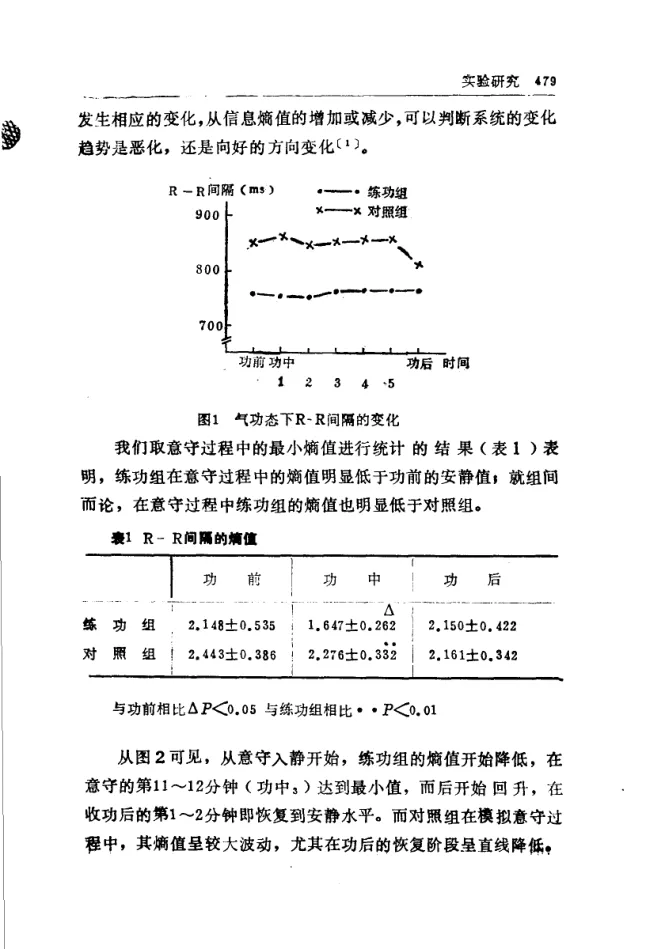
| Before practice | During practice | After practice | Δ | |
|---|---|---|---|---|
| Practice group | 2.148 ± 0.535 | 1.647 ± 0.262 | 2.150 ± 0.422 | |
| Control group | 2.443 ± 0.386 | 2.276 ± 0.332 | 2.161 ± 0.342 |
Compared with before practice: △ P < 0.05; Compared with the practice group: ** P < 0.01
As shown in Figure 2, from the beginning of mental focus and entering stillness, the entropy values of the practice group began to decrease, reaching a minimum at the 11th–12th minute of mental focus (during practice₃), then began to rise, recovering to the resting level within the 1st–2nd minute after closing practice. In contrast, the control group’s entropy values fluctuated considerably during the simulated mental focus process, and in particular decreased linearly during the post-practice recovery phase.
Entropy value •· Qigong practice group x——× Control group 2.8 x 2.6 x x 2.4 1 2.2 2.0 1.8 Before qigong During qigong After qigong Time 1 2 3 4 5 Compared with control group · P<0.05 ·· P<0.01 Figure 2 Entropy values of R-R intervals
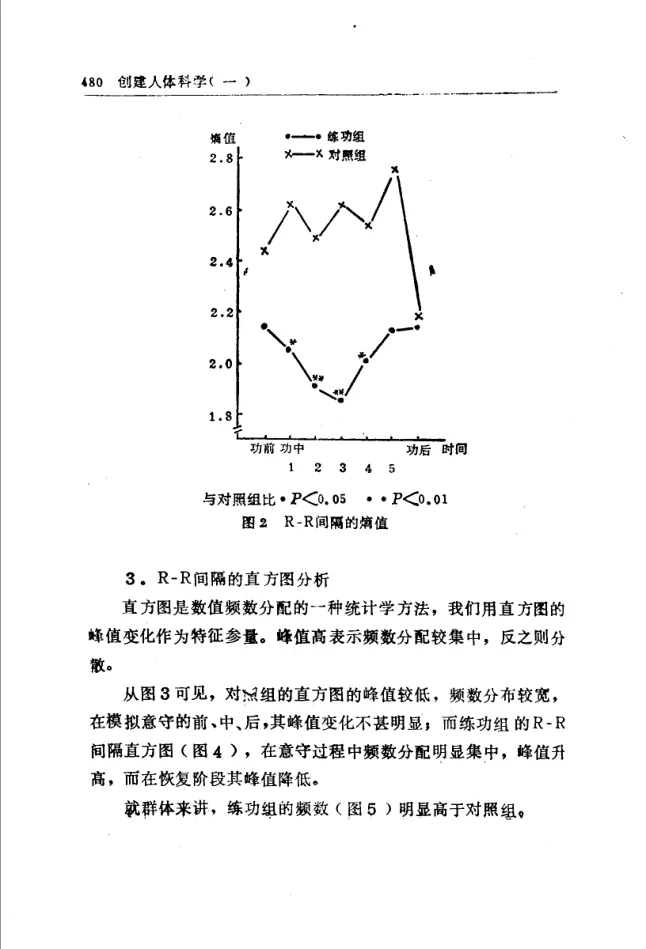
- Histogram analysis of R-R intervals
A histogram is a statistical method for numerical frequency distribution. We use the peak value changes of the histogram as a characteristic parameter. A high peak indicates a more concentrated frequency distribution, whereas a low peak indicates a more dispersed distribution.
As can be seen from Figure 3, the histogram peak values of the control group are relatively low, with a broad frequency distribution. Before, during, and after simulated mental focusing, the peak value changes are not very obvious. In contrast, for the R-R interval histogram of the qigong practice group (Figure 4), the frequency distribution is clearly more concentrated during the mental focusing process, with elevated peak values, while in the recovery phase the peak values decrease.
For the group as a whole, the frequency values of the qigong practice group (Figure 5) are significantly higher than those of the control group.
Frequency 30 20 10 0 092 800 1940 (sm) 4 7888889 6 9 8 88.888 8 9 Before qigong During qigong After qigong Figure 8 R-R interval histogram of the control group (No. 4)
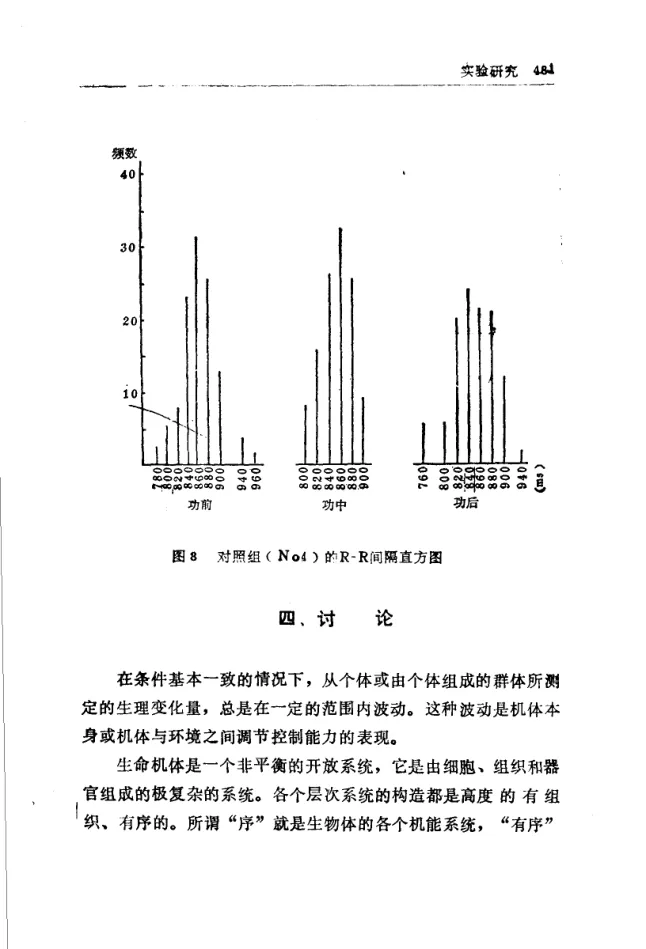
IV. Discussion
Under basically consistent conditions, the physiological variables measured from individuals or from groups composed of individuals always fluctuate within a certain range. This kind of fluctuation is a manifestation of the regulatory and control capabilities of the organism itself or between the organism and its environment.
A living organism is a non-equilibrium open system; it is an extremely complex system composed of cells, tissues, and organs. The structures of the systems at each level are all highly organized and ordered. The so-called “order” refers to the various functional systems of the organism, and “ordered”
Frequency 60 50 40 30 20 10 000 (sw) 6777778 802468 246 8 Before qigong During qigong After qigong Figure 4
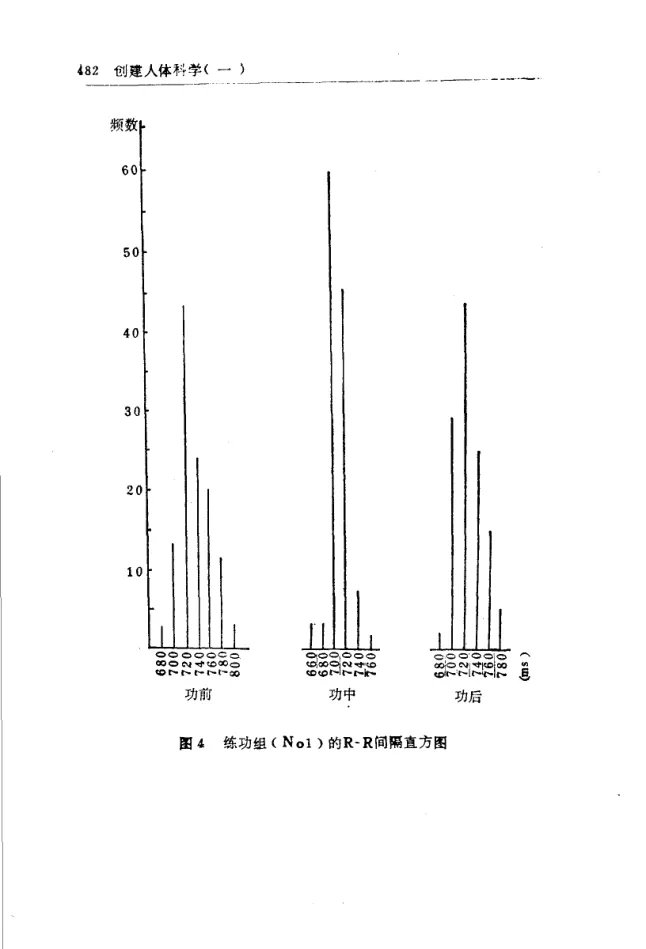 R-R interval histogram of the qigong practice group (No. 1)
· Qigong practice group Frequency x—x Control group 60 1. 50 40 30 Before qigong During qigong After qigong Time 2 3 4 5 Compared with control group · P<0.05 ·· P<0.01 Figure 5 Frequency distribution of R-R intervals under the qigong state
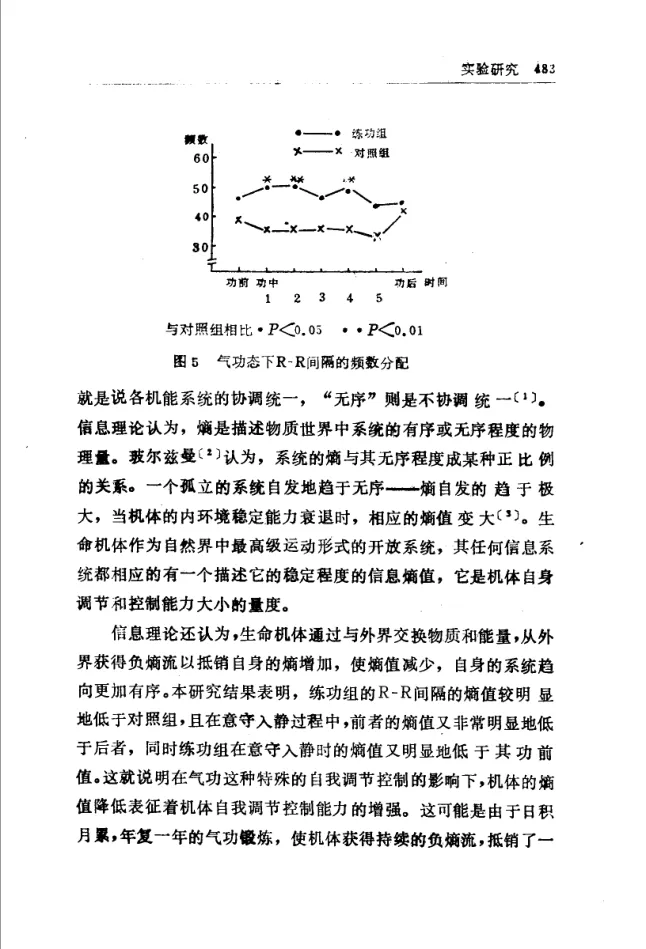
Information theory holds that entropy is a physical quantity describing the degree of order or disorder of a system in the material world. Boltzmann [2] held that the entropy of a system bears a certain proportional relationship to its degree of disorder. An isolated system spontaneously tends toward disorder—entropy spontaneously tends toward a maximum. When the stability capacity of the organism’s internal environment declines, the corresponding entropy value increases [3]. As the highest-level form of motion in nature, the open system of a living organism has, for any of its information systems, a corresponding information entropy value that describes its degree of stability; this is a measure of the magnitude of the organism’s own regulatory and control capabilities.
Information theory further holds that a living organism, through the exchange of matter and energy with the external environment, obtains a negative entropy flow from the outside to offset its own entropy increase, thereby reducing the entropy value and causing its own system to become more ordered. The results of this study show that the R-R interval entropy values of the qigong practice group are clearly lower than those of the control group, and during the process of mental focusing and entering quiescence, the entropy values of the former are very significantly lower than those of the latter; at the same time, the entropy values of the qigong practice group during mental focusing and entering quiescence are also significantly lower than their pre-practice values. This indicates that under the influence of qigong—a special form of self-regulation and self-control—the reduction in the organism’s entropy value signifies an enhancement of the organism’s self-regulatory and control capabilities. This may be because, through day-after-day and year-after-year qigong practice, the organism obtains a sustained negative entropy flow, offsetting one
…partly from positive entropy flow entering from the body itself or from the external environment. At the same time, information theory holds that information represents the degree of order in a system: the greater the information content of a system, the smaller its entropy value, indicating that the system’s structure is more regular; whereas the smaller the information content, the entropy value increases.
It can be postulated that the deeper one’s qigong practice, the greater the information content or capacity for promoting the body’s self-regulation and control, and the more beneficial it is for the roles of strengthening health, preserving life, and treating disease. By comparison, the entropy value of the control group, which did not practice qigong, was higher than that of the practice group, reflecting a lower capacity for bodily regulation and control.
In this study, when conventional medical statistical processing was applied to the R-R intervals, no difference was observed between the two groups, whereas the entropy values showed physiologically meaningful changes between groups. This readily demonstrates that methods related to entropy values from information theory can more effectively extract useful information and elucidate the regularities and mechanisms of physiological changes during the qigong process.
From the analysis of the R-R interval histograms, it can be seen that the frequencies of the practice group were more concentrated, while those of the control group were more dispersed; especially when compared with their pre-practice values, during the mental-focus (yishou) process, the histogram frequency distribution of the practice group was even more concentrated. This readily demonstrates that through qigong practice, the fluctuations in the body’s physiological changes can be reduced, thereby enhancing the stability of the body’s internal environment.
In his “synergetics,” Haken argued that for human beings to achieve order, the physiological, psychological, and motor aspects must all be unified. It can be argued that qigong practice, through regulating the mind (tiaoxin), regulating the body (tiaoshen), and regulating the breath (tiaoxi), can promote this unifying effect, causing the rate of entropy increase in the body to be smaller or slower than in non-practitioners, and enabling the body to reach a new steady state.
V. Summary
(1) This study calculated and analyzed the R-R intervals and their entropy values of subjects under the qigong state, and produced R-R interval histograms.
(2) The entropy values of the practice group were lower than those of the control group. During the mental-focus process, the entropy
values of the practice group were very significantly lower than those of the control group, and were also significantly lower than their own pre-practice values.
(3) Compared with their pre-practice values or with the control group, the histogram frequency distribution of R-R intervals in the practice group was significantly more concentrated during the mental-focus process.
(4) The calculation of entropy values and histogram analysis of R-R intervals can yield more regular physiological change parameters than conventional medical statistical methods.
Notes and References
[1] Hu Chang’an, Introduction to Medical Information Theory, Hubei People’s Publishing House, (1981).
[2] Luo Da, “From ‘Disorder’ to ‘Order’,” Qigong and Science, 11, (1985).
[3] Xie Huanzhang, “Qigong and Negative Entropy,” Qigong and Science, 11, (1985).
A Study of the Physiological Characteristics of Qigong Meditation
Zhang Linfu, Gong Wenyao, Hou Shuli, Jiang Xiuying
[Editor’s Note] To establish a phenomenological qigong science, it is necessary to have an objective description of the qigong meditative state. How to apply modern physiological indicators to represent the meditative state is an area in which the authors of this paper have carried out commendable explorations.
The authors adopted six indicators — respiratory rate, right Hegu temperature, frontal α-band voltage, occipital α-band voltage, occipital α peak value from spectral analysis, and occipital spectral entropy value during practice — or used the first five or the first four indicators for judgment, achieving a very high concordance rate.
Using external indicators for assessment is undoubtedly a promising approach to studying qigong meditation. Only through such work can we gradually establish a phenomenological qigong science and incorporate qigong research into the modern scientific system.
Authors’ affiliation: Institute of Space Medico-Engineering.
I. Purpose
Regulating the mind, regulating the breath, and regulating the body are the three essential elements of qigong practice, of which regulating the mind is the key. Some articles have also reported that the meditative state during qigong practice is closely related to therapeutic efficacy, but at present there is a lack of objective methods for assessing the meditative state.
Clinical practice shows that qigong has excellent effects in strengthening health and treating disease, but its physiological basis is not clear. It is therefore necessary, starting from a systems perspective, to use multi-indicator comprehensive observation to study the physiological changes during qigong meditation, so as to provide some physiological explanation for the health-strengthening and disease-treating effects of qigong [1–4].
In 1984, we used indicators such as EEG, temperature, and blood flow to study certain physiological changes during meditation by subsystem, and found that some physiological indicators do indeed undergo significant changes during meditation. It is therefore necessary to further study the physiological changes during qigong meditation using multiple indicators and to search for sensitive parameters from a systems perspective. The objectives of this study are:
(1) To systematically observe the physiological changes during qigong meditation using multiple indicators, and to search for methods to assess mental-focus meditation.
(2) To improve the processing methods for certain indicators and to further search for sensitive parameters.
II. Methods
1. Examination Procedure
After the examinee arrived at the examination room, relevant precautions were explained, electrodes were attached, and the examinee rested for several minutes until the skin temperature stabilized (i.e., the difference between two consecutive measurements did not exceed 0.2°C), after which the formal examination began. The procedure consisted of 5 minutes of quiet rest, 20 minutes of mental focus on the Dantian, and 20 minutes of recovery. Throughout the entire process, the examinee remained seated with eyes closed.
2. Examinees
The control group consisted of healthy staff members, with a mean age of 44.5 ± 5.9 years, totaling 12 persons.
The practice group consisted of staff members or retired cadres who had consistently practiced qigong (the Inner Nourishment practice) for one to several years, with a mean age of 56.0 ± 6.9 years.
- Recording indicators
Left frontal and occipital lead EEG.
Respiration, heart rate, and limb-lead cardiac output.
The above indicators were recorded continuously using an LM-6 pen-writing recorder and a JCM magnetic recorder.
Skin temperature at the Laogong, Hegu, and Yongquan acupoints was sampled once every 30 seconds.
- Data processing
DY-02 analyzer
Power–phase entropy
Electromagnetic recording
Sampling
Heart rate
Sampling
Figure 1 Analysis of EEG and heart rate data
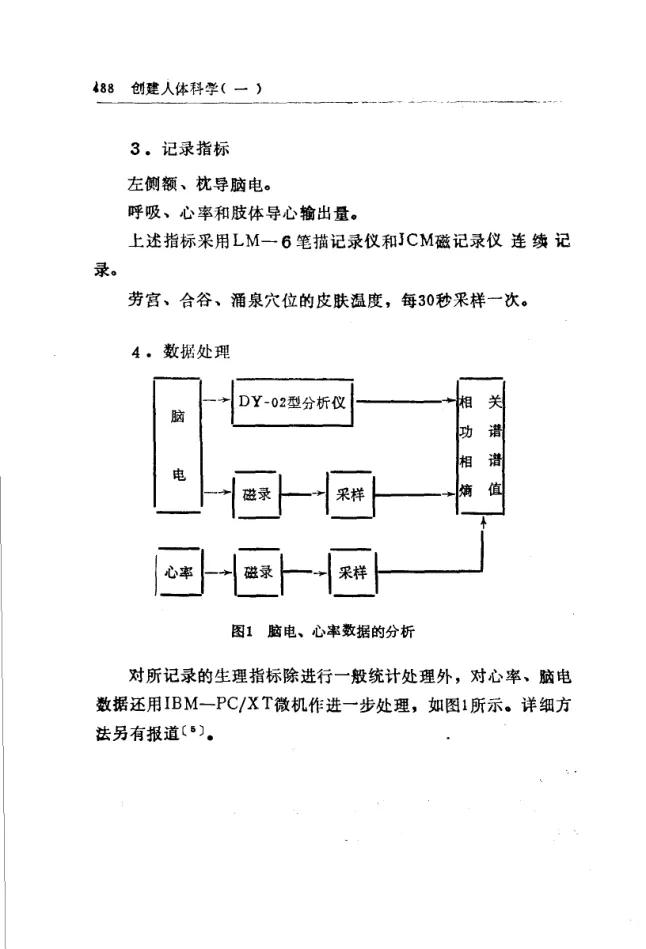
In addition to general statistical processing of the recorded physiological indicators, the heart rate and EEG data were further processed using an IBM-PC/XT microcomputer, as shown in Figure 1. Detailed methods have been reported elsewhere.[5]
III. Results and Analysis
- General conditions
The control group and the qigong-practicing group showed different changes in certain physiological indicators during eyes-closed, quiet mental focus on the Dantian.
Figures 2 and 3 show the change curves of physiological indicators including EEG, heart rate, output, respiration, and skin temperature for the two groups of subjects during mental-focus quiescence. As seen in the figures, the control group showed little change in temperature and respiration during quiet relaxation, while the occipital α rhythm decreased slightly; however, in the qigong-practicing group during mental-focus quiescence, respiration decreased markedly, while skin temperature and the occipital α rhythm rose significantly. When comparing the two groups of subjects, the differences in the trends of these physiological indicators were evident.
(%) 1.20 Temperature × Respiration Occipital α 1.00 Pre During (minutes) 2 6 10 14 18
Figure 2 Changes in EEG and other indicators during quiescence in the control group (percentages)
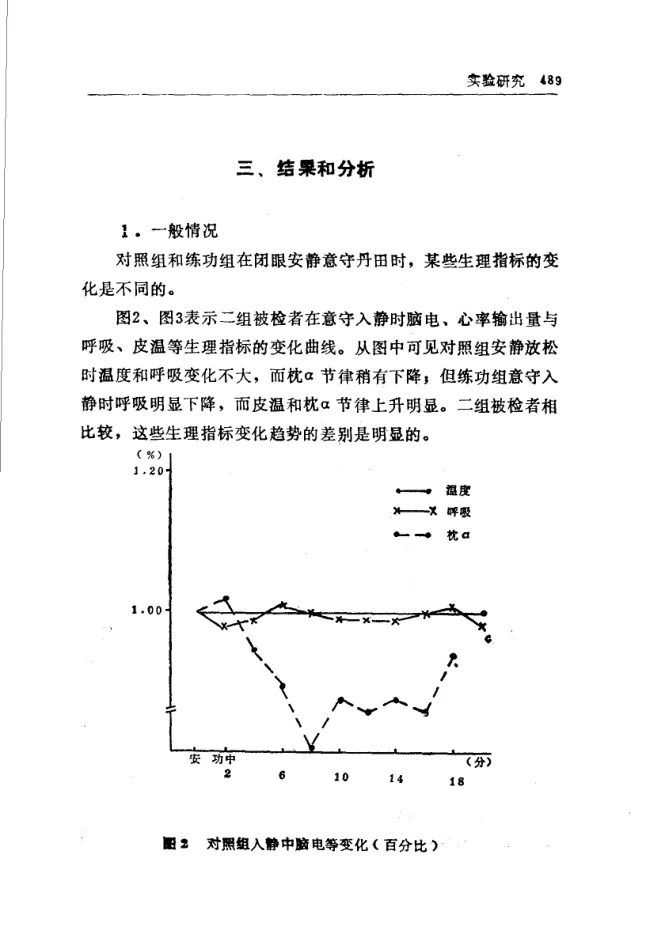
(%) 1.20 Temperature × Respiration —— Occipital α 1.00 × Pre 2 6 10 14 18 (minutes)
Figure 3 Changes in EEG and other indicators during quiescence in the qigong-practicing group (percentages)
- Changes in heart rate and other physiological indicators
Table 1 shows the changes in heart rate and other physiological indicators for the two groups of subjects during mental-focus quiescence. As seen in the table, the mean values of heart rate and cardiac output showed no significant changes during mental-focus quiescence.
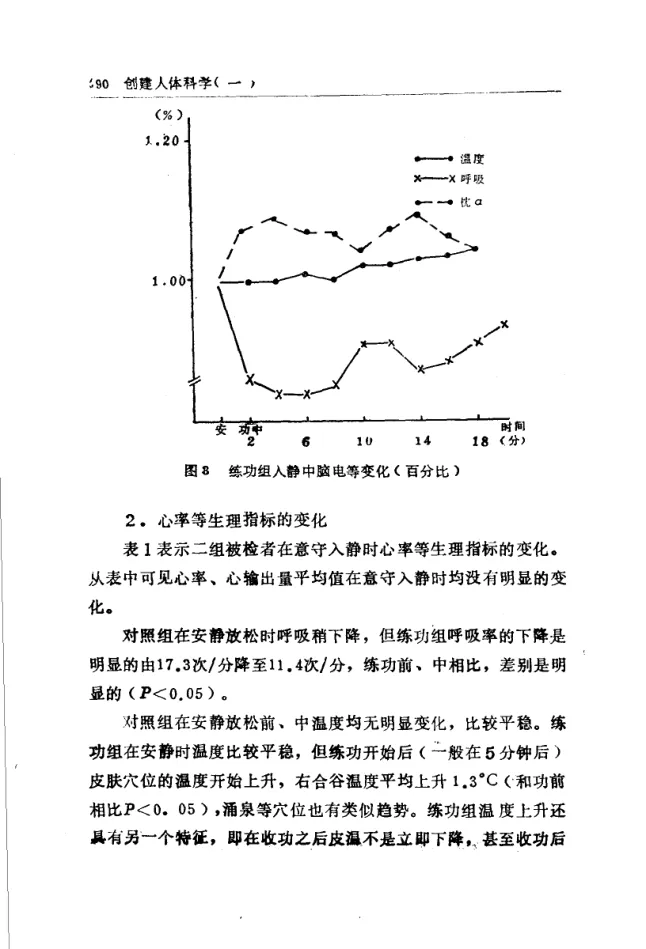
In the control group, respiration decreased slightly during quiet relaxation, but in the qigong-practicing group the decrease in respiration rate was marked, dropping from 17.3 breaths/min to 11.4 breaths/min. The difference between pre-qigong and during-qigong was significant (P<0.05).
In the control group, there was no significant change in temperature before and during quiet relaxation, remaining relatively stable. In the qigong-practicing group, temperature was relatively stable during the quiet phase, but after qigong practice began (generally after 5 minutes), the skin temperature at the acupoints began to rise. The temperature at right Hegu rose by an average of 1.3°C (compared with pre-qigong, P<0.05), and similar trends were observed at Yongquan and other acupoints. The temperature rise in the qigong-practicing group had another characteristic: after concluding the practice, skin temperature did not drop immediately, and even 20 minutes after
concluding practice, skin temperature had not yet returned to the pre-qigong level.
Table 1 Changes in physiological indicators before and during quiescence in the two groups of subjects
| Stroke volume (ml/beat) | Laogong temperature (°C) | Respiration (breaths/min) | Heart rate (beats/min) | Hegu temperature (°C) | ||||||
|---|---|---|---|---|---|---|---|---|---|---|
| Pre | During | Pre | During | Pre | During | Pre | During | Pre | During | |
| Control group (n=12) | 17.5 | 15.8 | 73.6 | 70.8 | 84.0 | 34.0 | 84.0 | 34.0 | 32.7 | 32.6 |
| Qigong group (n=19) | 17.3 | 11.4 | 76.1 | 74.2 | 69.0 | 59.0 + | 32.2 | 33.1 + | ||
| 31.7 | 33.0 |
Pre vs. during comparison: · P<0.05 ·· P<0.01 ··· P<0.001 Qigong group vs. control group comparison: + P<0.05 ++ P<0.01 +++ P<0.001
- EEG changes
Tables 2 and 3 show the EEG changes for the two groups of subjects during mental-focus quiescence. Table 2 presents the results of the five-band EEG analysis. As seen in the table, the greatest difference between the two groups of subjects during mental-focus quiescence is that in the qigong-practicing group, the α rhythm increased in both the frontal and occipital regions during mental-focus quiescence, whereas in the control group it decreased. This difference was significant (P<0.05).
Table 2 Changes in θ and α rhythms before and during quiescence in the two groups of subjects
| Frontal (mV) | Occipital (mV) | |||||
|---|---|---|---|---|---|---|
| Δθ | Δα | Δθ | Δα | |||
| Control group | 16 | -17 | 15 | -39 | ||
| Qigong group | -3 + | 10 + | 18 | 21 ++ |
Δ: mean during quiescence − mean at rest
Table 3 Results of EEG Power Spectrum Processing for Two Groups of Subjects
| Group | Frontal Δ peak (%) | Frontal peak/total power (%) | Frontal entropy (rest) | Occipital Δ peak (%) | Occipital peak/total power (during practice) | Occipital entropy |
|---|---|---|---|---|---|---|
| Control group | 0.202 | −2.700 | −7.683 | −4.000 | 4.157 | 4.243 |
| Practice group | 2.665 | −0.700 | 44.315+ | 6.400+ | 4.042 | 3.879++ |
Table 3 presents the results of EEG power spectrum processing and entropy analysis. From the table, we can also see that compared with the control group, the practice group showed an increase in the peak energy of the EEG and in the ratio of peak energy to total energy during mental-focus tranquility, while the entropy value decreased (these results repeat our 1984 findings).
Many research articles on qigong consider that during qigong mental-focus tranquility, EEG electrical activity tends more toward orderliness. We know that EEG activity recorded from the cranial surface is a composite manifestation of the electrical activity of large numbers of nerve cells; each cell’s electrical activity has a certain frequency and phase, and EEG power spectrum processing decomposes the composite wave into sinusoidal waves of different frequency components. Therefore, when the frequencies and phases of the electrical activity of many nerve cells become more similar, the macroscopic EEG power spectrum energy also becomes more concentrated within a certain frequency band—that is, there is a larger peak-to-peak/total energy ratio and a smaller entropy value. Some research results also indicate [6] that in the excited state the brain is in a high-entropy state with relatively disordered activity, whereas during sleep or when a repetitive stimulus is given, EEG activity tends toward greater order, and the power spectrum energy becomes more concentrated within a narrow frequency band. Therefore, in the future it may be possible to use the above parameters to quantitatively represent the orderliness of EEG activity.
4. Orderliness
The organism is a highly ordered self-organizing system; through precise coordination within systems and
between systems, it adapts to changes in the internal and external environments. From a systems perspective, the organism is a giant system that must coordinate and cooperate at different levels to adapt to changes in the internal and external environments and maintain the stability of the internal environment. We believe that the increase in orderliness during qigong exercise is manifested not only centrally but also peripherally and in the coordination between the periphery and the center.
Earlier we already analyzed the EEG changes during mental-focus tranquility, showing that the orderliness of EEG activity indeed increases. Below we further analyze the relationship between cortical and subcortical activity during mental-focus tranquility.
Table 4 Heart Rate Changes Before, During, and After Practice in Two Groups of Subjects
| Group | Entropy before | Entropy during | Entropy after | Histogram peak before | Histogram peak during | Histogram peak after |
|---|---|---|---|---|---|---|
| Control group | 2.444 | 2.602 | 2.348 | 40 | 30 | 37 |
| Practice group | 2.149 | 1.990+++ | 2.151 | 45 | 51++ | 45 |
Table 5 Correlation Between EEG and Respiration
| Group | Frontal α and respiration | Occipital α and respiration | Frontal α and occipital α |
|---|---|---|---|
| Control group | −0.18 | −3.19 | 0.76 |
| Practice group | −0.83 | −0.90 | 0.77 |
We used heart rate to represent subcortical activity, analyzing the histograms, autocorrelation functions, and entropy values of R-R intervals before, during, and after mental-focus tranquility. From Table 4 we can see that during mental-focus tranquility, the practice group’s heart rate R-R histogram distribution narrowed, with a more pronounced peak, and the entropy value also decreased significantly; whereas the changes in the control group were not significant. The differences between the two groups were clear (P < 0.05 or P < 0.001). This also indicates that during mental-focus tranquility, the qigong group’s heart rate activity became more stable and more regular. In this study, it was also observed that one subject in the practice group had obvious cardiac arrhythmia before practice, which disappeared during practice.
We further analyzed the relationship between EEG and respiration to study the relationship between cortical and subcortical
activity. Table 5 and Figures 2 and 3 show the changes in frontal and occipital α and respiration during mental-focus tranquility for the control group and the practice group. From the figures it can be seen that the practice group showed a close relationship between EEG and respiratory activity, whereas in the control group the relationship between the two was less close. To study the quantitative relationship between the two, we calculated their correlation; the results are shown in Table 5. From the table it can be seen that during mental-focus tranquility, the changes in EEG and respiratory activity in the practice group showed a high correlation, and the difference between frontal and occipital regions was very pronounced.
In summary, the physiological changes in the practice group during mental-focus tranquility were: respiration decreased significantly, skin temperature rose, EEG α rhythm increased, EEG power spectrum entropy decreased, and EEG and respiratory activities showed a high correlation.
5. Multivariate Discrimination
All the examinations we conducted indicated that the physiological changes during qigong tranquility are multimodal. In terms of the main parameters that changed, sometimes respiration predominated and sometimes EEG predominated; there were also differences in the onset times of the changes; and in terms of the principal brain regions where EEG changes occurred, it was generally the occipital region, but sometimes frontal changes predominated. Clearly, how to evaluate the qigong tranquility state is a complex problem, and using a single indicator inevitably has many drawbacks. Therefore, we adopted a multi-indicator comprehensive evaluation method to assess the qigong tranquility state.
We used the following six parameters for multivariate discrimination under Fisher’s criterion:
- = respiration rate, breaths/min;
- = right Hegu point temperature (during practice − at rest), degrees;
- = frontal α-band voltage (during practice − at rest), millivolts;
- = occipital α-band voltage (during practice − at rest), millivolts;
- = occipital α peak value from power spectrum analysis (during practice − at rest), microvolts;
- = occipital power spectrum entropy value during practice.
The discriminant equation for the six indicators is:
The discriminant threshold is . If , the subject is classified into the control group; if , the subject is classified into the qigong-practice group. The discriminant results are shown in Table 6.
The total number of subjects in both groups was 31. For convenience of use, we also tried applying 5 and 4 indicators. When 6 and 5 indicators were used for discrimination, the correct classification rate was 94%; when 4 parameters were used, the correct classification rate also reached 90%, with a prediction accuracy of 85%.
There was good consistency among these three different discriminant analyses. When we further analyzed the misclassified subjects, we found that the misclassification was by no means accidental. As can be seen from Table 7, the means of the 6 parameters of these two subjects clearly deviated from the qigong-practice group means and were closer to the control group means; therefore, they were classified into the control group.
To ensure that the evaluation method possesses reliability and generalizability, we used this method to predict the classification of 13 subjects examined in 1984
Table 6. Discriminant Analysis Results
| Indicators | Total | Correct Rate (%) | Misclassified Subjects |
|---|---|---|---|
| Six indicators – | 31 | 94 | θ4, θ15 |
| Five indicators – | 31 | 94 | θ4, θ15 |
| Four indicators – | 31 | 90 | θ14, θ15, θ3 |
Table 7. Physiological Parameters of the Two Misclassified Subjects
| Group | ||||||
|---|---|---|---|---|---|---|
| Control group | 15.75 | −0.011 | −16.42 | −38.92 | −7.68 | 4.243 |
| Qigong-practice group | 11.47 | 1.04 | 9.37 | 21.47 | 45.11 | 3.879 |
| Misclassified subjects | 16.50 | −0.37 | −1.00 | −17.50 | −14.44 | 3.954 |
; the accuracy rate also reached 85%. None of the 5 control-group subjects were misclassified, while 2 of the 8 qigong-practice-group subjects were misclassified.
Table 8. Prediction Results for 13 Subjects in 1984
| Fisher Result | |||
|---|---|---|---|
| Original Group | Total | Control | Qigong Practice |
| Control | 5 | 5 | 0 |
| Qigong Practice | 8 | 2 | 6 |
Analysis of these two subjects also revealed that during mindfulness-induced quiescence, the decrease in respiration, the rise in temperature, and the increase in EEG alpha rhythm were all not pronounced.
It is possible for us to use multi-indicator comprehensive testing and multivariate discriminant methods to distinguish the general calm-and-relaxed state of the control group from the mindfulness-induced quiescence state of the qigong-practice group, thereby evaluating the effectiveness of qigong training.
IV. Summary
(1) This experiment observed changes in physiological indicators—including EEG, respiration, skin temperature, heart rate, and blood flow—in 12 control subjects and 19 qigong practitioners during mindfulness-induced quiescence, and found that the differences in physiological changes between the two groups of subjects during mindfulness-induced quiescence were pronounced.
(2) During mindfulness-induced quiescence, the qigong-practice group exhibited slowed respiration, elevated skin temperature, increased EEG alpha rhythm, and decreased entropy values.
(3) This experiment systematically observed the increase in orderliness of the qigong-practice group during mindfulness-induced quiescence. It was found that during mindfulness-induced quiescence, the EEG alpha rhythm increased, the peak-to-total-energy ratio of the power spectrum increased, and the entropy value decreased; the heart-rate histogram peak narrowed, and its entropy value also decreased. The EEG alpha rhythm and respiration showed clear correlation. This indicates that during mindfulness-induced quiescence, the orderliness of the practitioner’s physiological activities increased.
(4) The physiological changes of the qigong-practice group during mindfulness-induced quiescence were multimodal. To evaluate the qigong
state of quiescence, we adopted the Fisher discriminant method, with an overall accuracy rate of 94% and a prediction accuracy rate of 84%. The prediction accuracy for the 13 subjects examined in 1984 also reached 85%; therefore, this method possesses relatively high accuracy and generalizability.
Notes and References
[1] Cao Jian, Nature Magazine, 5(8) (1982), 568.
[2] Wang Yongqing, Journal of Chinese Medicine and Pharmacology, 3 (1986), 6.
[3] Wang Jialin, Nature Magazine, 3 (1980), 743.
[4] Tao Bingfu, Collected Works on Qigong Therapy, People’s Medical Publishing House, (1982).
[5] Zhang Linfu et al., Measurement and Analysis of EEG During the Qigong State, (internal materials) (1984).
[6] E. Basar, Synergetics of the Brain, New York, (1983).
An Observation Report on Non-Visual Organ Image Recognition
—Staff Reporter, Nature Magazine2
[Editor’s Note]
From May to July 1978, the People’s Daily took the lead in publishing articles criticizing human extraordinary abilities, directly naming and criticizing the Sichuan Daily and a certain leader of Sichuan Province at the time. Subsequently, additional critical articles echoed this stance. In July of the same year, the leadership and editors of Nature Magazine went to Beijing to attend a “qigong briefing conference” reporting to leading comrades of the Party Central Committee. During this period, they organized some scientific researchers to conduct further tests on extraordinary abilities and found that “it indeed exists.”
Driven by the Party Central Committee’s guiding principle that “practice is the criterion for testing truth,” the scientific journal Nature Magazine bravely published an article signed by “this publication’s reporter,” demonstrating that phenomena of human extraordinary abilities exist objectively, standing alone amid a clamor of criticism and holding that it is necessary to conduct scientific research on phenomena of human extraordinary abilities.
The publication’s reporter also took great pains to devise a novel term to replace the popular phrasing of “recognizing characters with the ear,” calling this phenomenon “non-visual organ image recognition.”
After this article was published, it attracted the attention of scientific researchers nationwide. Researchers who had originally been conducting quiet investigations gradually began to gather toward Nature
submitted to Nature Journal, and Nature Journal became the only magazine in the country that published research on human extraordinary abilities. For a period of time, the Nature Journal office became the national center for research on human extraordinary abilities. This phenomenon of overstepping one’s proper bounds was jokingly called “a historical misunderstanding” by people. Therefore, this article holds historical significance.
In July of this year, while attending a meeting in Beijing, we heard some scientists discussing the claim that certain children could use their ears to distinguish written characters. That ears could “read” characters—that the auditory organ possessed visual function—sounded at first utterly absurd and hard to believe. But those who spoke of it were emphatic and insisted that “seeing is believing,” hoping that everyone would go and see for themselves and judge authenticity through practice. We therefore joined together with comrades from the scientific, medical, educational, journalistic, and publishing communities to conduct three observations of two sisters who were said to possess this extraordinary function—11-year-old Wang Bin and 13-year-old Wang Qiang. The results of the three observations are reported below.
Wang Bin and Wang Qiang were students in the third and fifth grades (before the summer vacation) at a certain primary school in Beijing. Their father, Wang Wenhua, was a cadre in the security section of a certain factory in Beijing, and their mother, Zhu Meihua, was a worker at a certain factory in Beijing. According to Wang Wenhua, it was only after the Beijing Science and Technology News published a report on April 13 of this year about a child in Shijingshan who could “read characters with the ear” that they discovered Wang Qiang and Wang Bin could also “read characters with the ear,” but their older sister and younger brother did not have this extraordinary function. From mid-April to early June, more than a thousand people saw with their own eyes that Wang Qiang and Wang Bin genuinely possessed this function. Not only the ears, but also the armpits could “read characters”—when a paper slip was placed under the armpit and pressed with the hand, they could also “read” the writing and colors on the slip. Wang Wenhua also mentioned that both Wang Qiang and Wang Bin had poor vision, at 0.4 with astigmatism.
I. First Observation
Time: 8:00 p.m. on July 17.
Location: The home of Wang Qiang and Wang Bin.
Observers: Shen Hanchang and Cai Zuxian of Shanghai Jiao Tong University; Luo Dongsu of a certain Air Force research institute; He Chongyin, Zhang Feng, Zhu Runlong, and Zhu Yiyi of Nature Journal; and Yang Weihe of a certain Beijing work unit. Wang Wenhua and Zhu Meihua were also present.
Wang Qiang and Wang Bin sat in the center of the room, with observers seated around them front and back. The lighting in the room was not very bright. They began by using paper slips that had been written out in advance and brought along; these were folded and placed inside the ears of Wang Qiang and Wang Bin, who were asked to hold them in place with their own hands. After a while, both said they had no impression and requested to try under the armpit instead.
Accordingly, Shen Hanchang, Zhu Yiyi, and others went to another room and wrote out new paper slips, folded them twice, and inserted them from behind into their shirts, placing them under the armpits, where the girls held them in place with their hands. Apart from the person who did the writing, no one else in the room knew what was written on the papers.
After 2 minutes and 40 seconds, Wang Qiang said she had “read” it. Everyone asked her not to say it aloud but to go to the side and write it down. She wrote “3” and also noted “blue.” Upon opening the paper slip, it was found to be “36” written in blue ballpoint pen, with a space between the “3” and the “6”—she had gotten half of it right. Another paper slip was placed for Wang Qiang; after 4 minutes, she wrote the character “兰” and also wrote “blue.” The paper slip had the characters “兰白” written in blue ballpoint pen, again with a space in between, and she had again gotten half of it right.
The paper slip placed under Wang Bin’s armpit had “17” written in blue ballpoint pen. After 13 minutes and 42 seconds, she wrote “1” and noted “blue”—again getting half of it right.
Another paper slip was placed for Wang Bin: “上.” After 1 minute and 27 seconds, she wrote it out completely and correctly. A paper slip was placed for Wang Qiang: “A.” After 3 minutes and 30 seconds, she too wrote it out completely and correctly. Both were written in blue, and both girls wrote correctly.
Another paper slip was then placed for Wang Bin, with “王宾” written in red ballpoint pen (the two characters not separated). Wang Qiang was seen touching Wang Bin’s leg with her hand, and shortly afterward said: “I know it.” Wang Wenhua said that such “tele-sensory” phenomena had occurred in the past—when certain parts of their bodies made contact, they could “read” the writing on the paper slip under the other’s armpit. At this point everyone
was quite astonished and asked Wang Qiang not to say it aloud but to go to one side and write it down. She wrote “王宾” and “red”—completely and correctly. At 8 minutes and 28 seconds, Wang Bin also wrote “王兵” →
At the time when Wang Qiang, through “tele-sensory” means, wrote out the characters on the paper slip under Wang Bin’s armpit, the paper slip under her own armpit had “潤” (in traditional form) written in red ballpoint pen. After 4 minutes and 15 seconds, she wrote “朋” and “red.” “潤” was mistakenly rendered as “朋”—the character forms were somewhat similar.
Finally, another paper slip was placed for Wang Bin. After only 1 minute and 10 seconds, she correctly wrote “北” and “red.”
II. Second Observation
Time: 3:00 p.m. on July 18.
Location: A certain guesthouse on Sanlihe Road, Beijing.
Observers: Ou Deshi and Fan Liangzao of the Institute of Mechanics, Chinese Academy of Sciences; Gu Hansen of the Shanghai Institute of Nuclear Research, Chinese Academy of Sciences; Luo Dongsu of a certain Air Force research institute; Lin Hai of the Shanghai Research Institute of Traditional Chinese Medicine; Zhu Lichao, Du Wenjun, and Wang Yancong of the Qingdao Hospital of Traditional Chinese Medicine; Pang Heming of the Beijing Pharmaceutical Factory; Shen Hanchang and Cai Zuxian of Shanghai Jiao Tong University; Shen Ping of Xinhua News Agency Headquarters; Sha Yansun and Yang Xiangqiao of the Tianjin Science Garden newspaper; and He Chongyin, Zhang Feng, Zhu Runlong, and Zhu Yiyi of Nature Journal. Wang Wenhua and Zhu Meihua were also present.
Wang Qiang and Wang Bin again sat in the center of the room, with the others seated around them. Fan Liangzao, Shen Hanchang, Zhu Yiyi, and others went outside to write out the paper slips, using the same method as before.
A paper slip placed under Wang Bin’s left armpit had the figure ”□” drawn on it. After 31 minutes, Wang Bin reproduced ”□.” The comrade who had drawn this figure found it strange that above the ”□”
Where did the ”.” come from? Opening the slip of paper to take a look, it turned out that the slip of paper drawn with a fountain pen "" was folded, and a dot of ink in the square was not yet dry, and happened to print on one side of the fold, thus becoming "". Wang Bin faithfully traced the ink marks on the paper.
A slip of paper was placed inside a matchbox, which was placed under Wang Bin’s armpit. After 22 minutes and 45 seconds, Wang Bin used a red ballpoint pen to color out a red background with the white character “大”. The comrade who placed the matchbox was very surprised, because the slip of paper had neither red color nor the character “大”. Upon taking it out to look, it turned out that she had traced the image on the surface of the matchbox. This was a finely packaged “Daqing” brand matchbox produced by the Beijing Match Factory, with a dark red surface and the cursive traditional characters for “Daqing” in the upper right corner. What Wang Bin traced was exactly a part of the surface of this matchbox.
The other two tests given to Wang Bin were: “信” (letter), which she correctly wrote out in 6 minutes; “H”, for which she wrote the character “们” in 13 minutes, which is similar to the bottom half of “H”.
Wang Bin also tried “sensing.” When Wang Qiang had a slip of paper with “qigong” written on it under her armpit, Wang Bin put her hand on her older sister’s leg and wrote out “Wang Qiang’s (blue) qigong” in 7 minutes. Wang Qiang herself only wrote out “攻” (attack) after 27 minutes; after finishing writing it, she thought for a moment, and then wrote “(I) wrote it wrong,” it is “功” (skill). She only got half of it right.
The other three tests Wang Qiang took were: “天” (sky), which she correctly wrote out after 30 minutes and 15 seconds; the graphic "", of which she traced the bottom half: "" after 14 minutes; the flat, green characters “Shanghai” printed on the edge of a narrow slip of paper, which she could not “see,” and at 12 minutes and 15 seconds, she wrote down “I feel (sense) there are no words.”
When Wang Bin had a slip of paper with the character “信” under her armpit, Wang Qiang touched her younger sister’s body and correctly wrote “信” in 5 minutes and 35 seconds; when Wang Bin had the matchbox under her armpit, Wang Qiang also wrote out “I feel (sense) the surroundings are red, the words are white” 5 minutes after contact, but she could not make out the shapes of the characters.
III. Third Observation
Time: 9:00 a.m., July 27.
Location: Same as the second time.
Observers: Ma Wenju and Yan Mingshan from the Institute of Mechanics, Chinese Academy of Sciences; Huang Cheng, Dong Zhiming, and Chen Dezhen from the Institute of Vertebrate Paleontology and Paleoanthropology, Chinese Academy of Sciences; Lin Zhongpeng from the Nonferrous Metals Research Institute of the Ministry of Metallurgical Industry; He Qingnian from the Beijing Institute of Traditional Chinese Medicine; Luo Dongsu from an Air Force Research Institute; Cai Zuxian and Que Qiaogen from Shanghai Jiao Tong University; Zhang Guomin, Zhang Hongguang, and Gao Xiuying from Popular Science Press; Zhang Feng, Zhu Runlong, and Zhu Yiyi from Nature Journal Agency; and Yang Weihe from a certain unit in Beijing.
Wang Qiang and Wang Bin still sat in the center of the room, with the observers sitting around them. Cai Zuxian, Yan Mingshan, Dong Zhiming, and others went outside to write the slips of paper; again, each person wrote their own, so the rest of the people did not know.
In order to conduct the tests under stricter conditions, this time Wang Qiang and Wang Bin were wearing white cotton gloves. The slips of paper were put into the gloves behind their backs, lying flat against the palms, and the glove openings were fastened with bands and rubber bands. After inspection, it was proven that no trace of the paper slips could be seen outside the gloves. Finally, they tucked their hands into their shirts and placed them under their armpits.
Unexpectedly, Wang Bin quickly (about 1 minute) said she “felt it,” but unfortunately the time was not accurately recorded. She traced the graphic of “工” and indicated “blue.” Opening the glove and taking out the slip of paper to look, it was a blue “φ”, and the shape of the character was slightly similar. Another test was given to Wang Bin, and after 22 minutes, she said she “felt it,” wrote the character “土” (earth), and then said it was incorrect. After a while, she wrote “志” (will) and “green.” At this time, when she saw the ”
magazine,” she pointed to the character “志” and said, it is exactly this character. She also said, do not give me cursive characters to read, I get confused. Opening the glove to take a look, it turned out to be this small piece torn from the letter paper with the character “志” on it.
Wang Qiang was also undergoing testing. She first said that there were two colors, red and blue. At 33 minutes, she traced "" on the paper and wrote “the outside is red” and “the inside is blue.” Opening it to take a look, the slip of paper indeed had a red outside and blue inside "", only the graphic was drawn a little out of shape.
The other tests conducted that day did not involve wearing gloves.
After Cai Zuxian placed the slip of paper under Wang Qiang’s armpit, after a short while, Wang Qiang said: “I can’t feel it.” Cai asked: “Why?” Wang Qiang answered: “There is a large piece of paper wrapping it on the outside.” Cai Zuxian then took the paper package out from under Wang Qiang’s armpit, and then placed the slip of paper into her shirt under her armpit from behind her back. After 44 minutes and 43 seconds, Wang Qiang correctly traced ”△” and “blue.”
The other two tests Wang Qiang did were: the “回” (return) graphic, after 21 minutes and 28 seconds, she traced "", which is slightly similar to the shape of the folded paper slip; the three characters “红领巾” (red scarf) written in extremely faint strokes, she said she could not feel them. The other two tests Wang Bin did were: the "" graphic, she traced ”○” at 28 minutes, but the ”+” in the middle was not traced; “1+2=4”, which she was unable to write out.
IV. Statistics and Others
In the above three observations, the two made a total of 24 tests. Wang Qiang did 12 tests, with 3 complete successes, 7 partial successes, and 2 unsuccessful; Wang Bin did 12 tests, with 5 complete successes, 6 partial successes, and 1 unsuccessful. Out of the 24 times, the color of the handwriting and graphics, adopted one…
Correct. Wang Bin’s accuracy rate was somewhat higher, with completely successful cases accounting for 42% and partially successful cases accounting for 50%. For Wang Qiang, completely successful cases accounted for 25%, and partially successful cases accounted for 58%. Regarding time, for completely and partially successful cases, Wang Qiang averaged 18 minutes and 29 seconds, and Wang Bin averaged 14 minutes and 45 seconds; Wang Bin was somewhat faster than Wang Qiang. The fastest instance was Wang Bin correctly writing the character “北” (north) in 1 minute and 10 seconds, and the slowest was Wang Qiang taking 44 minutes and 43 seconds to correctly write ”△“.
In “sensing” the writing on the paper slip under the other person’s armpit, Wang Qiang did it 3 times: 2 completely successful and 1 partially successful; Wang Bin did it only once, completely successfully. The time was between 5 and 8 minutes, faster than the person themselves (i.e., the one with the paper slip under their armpit).
In the three observations, there were 30 participants in total (excluding their parents). Among them, 5 observed 3 times, 3 observed 2 times, and 22 observed once. None of the observers on-site raised any fraudulent behavior by the subjects, nor did they raise any suspicion of fraud.
According to Wang Qiang and Wang Bin themselves, the so-called “recognized” or “felt” means that the image of the writing or graphic appeared in their minds. The image appears in a flash and vanishes instantly, but they cannot control when it appears, so they must concentrate. Sometimes it is not clearly recognized the first time it appears, and they must wait for a second appearance. For example, when Wang Qiang had a paper slip with a red and blue graphic "" under her armpit, she said the first time she only felt it was red and blue, but could not distinguish which color was inside and which was outside; it was only at 33 minutes that it appeared a second time, and she clearly distinguished that red was outside and blue was inside. According to them, generally the first appearance is faster, and the second is slower.
They also said that after the tests, they felt very tired. Wang Wenhua explained that in past tests, there were also successes and failures, and the times were sometimes fast and sometimes slow, which was related to the children’s health and mood. When in good health and a happy mood, the success rate was somewhat higher and the time somewhat faster; when in poor health and feeling tense or depressed, the success rate was somewhat lower and the time somewhat slower.
During the observations, it was found that after the two placed paper slips under their armpits and held them with the other hand, the hands holding the paper slips kept moving inside their shirts. Observers asked them: why do your hands move? They said: “We are looking for the spot.” Which part exactly—the armpit or a part of the hand—had to touch the paper slip before the image appeared in their minds was something they could not explain clearly.
V. Concluding Remarks
This extraordinary ability of Wang Qiang and Wang Bin—a certain part of the body other than the eyes (such as the ear, armpit, or hand) having the extraordinary ability to recognize graphics—having no name for it, we tentatively call it the ability of “graphic recognition by non-visual organs.” Compared with the normal vision of the eyeball, it is much weaker and duller.
Current scientific knowledge cannot yet fully explain this phenomenon. Although modern science has developed to its current level, it still has a very insufficient understanding of the human body (especially the brain); many phenomena of human life cannot be explained to this day. Regarding various mysteries of human life, scientific circles in various countries are currently enthusiastically exploring them and consider this a pioneering research field with broad prospects.
This observation report indicates that the extraordinary ability of “graphic recognition by non-visual organs” is indeed a reality and is worth exploring.
Joint Test Report on the Authenticity of Extraordinary Human Abilities
Extraordinary Human Abilities Joint Test Group
[Editor’s Note] In November 1981, the Chinese Human-Body Science Research Society (Preparatory) held its second plenary committee meeting in Shanghai. In response to the situation at the time where some people publicly criticized the research on extraordinary human abilities, it decided to submit a report requesting the State Science and Technology Commission to organize an open test and appraisal. The problem was not resolved. Therefore, in April 1982, the Research Society (Preparatory) sent out invitations to several universities, research institutes, and other units nationwide, organizing a joint test. More than twenty units participated in this work. The main purpose of the joint testing process was to verify the authenticity of extraordinary human abilities. This article is the experimental report of the joint test.
This joint test was the largest and longest experiment to date. All experimental personnel, braving the enormous external pressure at the time, formulated the experimental plan with a serious and conscientious scientific attitude and sought the opinions of many experts.
The design principles of this experiment won the recognition of the unbiased scientific community and also became an important method in the research of extraordinary human abilities. The entire experiment was divided into two main parts: the extraordinary human vision experiment and the extraordinary human psychokinesis experiment.
The experimental conditions of this joint test were very strict, the results obtained were reliable, and they were reproducible. The results show: extraordinary human vision abilities, as well as extraordinary human psychokinetic abilities such as extraordinary transportation, extraordinary writing, and breaking through spatial obstacles, all objectively exist.
In order to scientifically appraise the authenticity of extraordinary human vision and psychokinetic abilities, the Chinese Human-Body Science Research Society (Preparatory) sponsored and organized scientific workers from relevant units in some provinces and municipalities to conduct a joint test in Beijing from April to July 1982. The test results are now comprehensively reported as follows.
I. Extraordinary Human Vision Experiment
The purpose of this experiment was to investigate, under strict experimental conditions, the authenticity of the extraordinary human vision ability of “reading with the ears.”
(I) Experimental Plan
1. Design Principles
We believe that an experimental design should be considered strict if it satisfies the following conditions:
(1) The sample (the recognition “target” and its packaging) possesses several “uniqueness” features, ensuring that under the set experimental conditions, the sample cannot be replicated or swapped.
(2) The recognition “target” uses “opaque, irreversible” packaging. That is, under the set experimental conditions, once unpacked, the packaging is destroyed to the extent that it cannot be completely restored; if not unpacked, the target cannot be recognized through ordinary vision.
(3) Neither the experimenter nor the subject knows the content of the “target,” ensuring a “double-blind” setup and avoiding suggestion.
(4) On-site monitoring is reliable. There must be two or more people carefully monitoring on-site, and samples are not allowed to be taken off-site or out of monitoring.
(5) The experimental results have “statistical significance.”
2. Specific Plan
To strictly implement the above design principles, the following specific measures were adopted.
(1) Specimen preparation:
Type A: One hundred Chinese characters were randomly selected and printed into a “Human Extraordinary Vision Test Card.” The 100 black printed Chinese characters were cut out individually using a curved-line method (Figure 1–1). Each character sample was folded twice, and all were placed into a glass container; after shaking the container multiple times to “mix” the samples, the character samples were poured out one by one at random and sealed individually into kraft paper bags or hard plastic boxes (see sealing methods below); after 10 character samples had been sealed, the remaining 90 character samples were sealed into an envelope, marked, and retained by the preparer. Before testing, the seal packaging of the 10 character samples was marked (including sequential markings and signature markings) and verified.
多 (colored) Cut-out character sample 证 (证) 信 (仰)
Figure 1–1 Curved-line cutting method
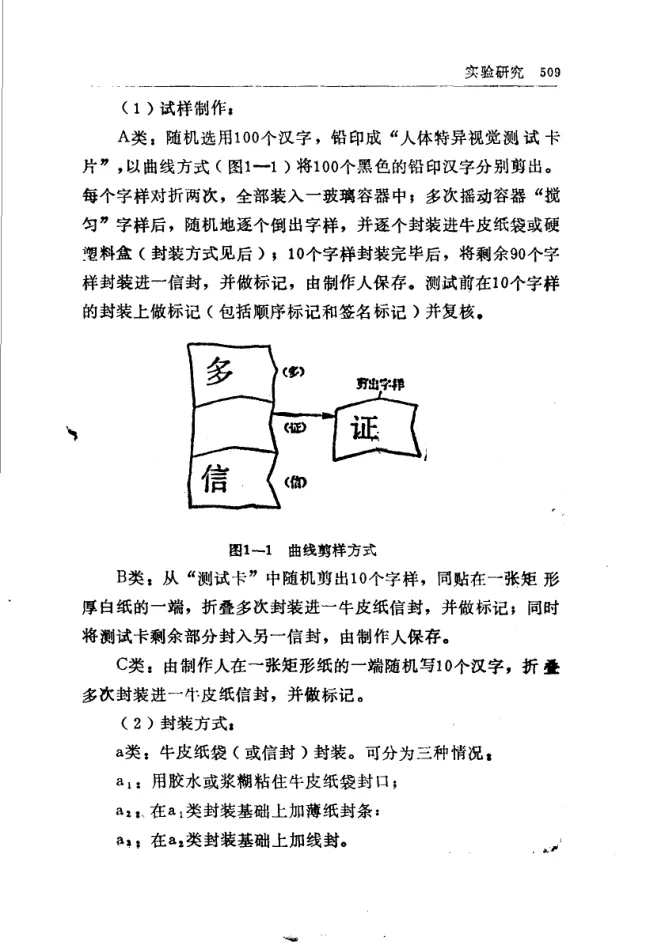
Type B: Ten character samples were randomly cut from the “Test Card” and affixed together at one end of a rectangular sheet of thick white paper, folded multiple times, sealed into a kraft paper envelope, and marked; at the same time, the remaining portion of the Test Card was sealed into another envelope and retained by the preparer.
Type C: The preparer randomly wrote 10 Chinese characters at one end of a rectangular sheet of paper, folded it multiple times, sealed it into a kraft paper envelope, and marked it.
(2) Sealing methods:
Category a: Kraft paper bag (or envelope) sealing. This can be divided into three situations:
a1: The opening of the kraft paper bag is sealed with glue or paste;
a2: A thin-paper seal strip is added on the basis of the a1 sealing method;
a3: A thread seal is added on the basis of the a2 sealing method.
Category b: The character sample is placed inside a hard plastic box used for mechanical pencil leads, and the lid is sealed with epoxy resin.
(3) Testing method:
The experiment is conducted under the monitoring of two or more examiners; before the experiment, the subject is not permitted to come into contact with the specimens; during the experiment, the subject is permitted to come into contact with the specimens but is not permitted to remove the specimens from the site or leave the monitoring, nor is the subject permitted to contact the specimen preparer; after the subject reports the identification results, the examiners inspect the condition of the specimen seals and markings on the spot, and then open the seals for verification.
(4) Overall verification (for Types A and B):
After one round (generally 10 character samples) of testing is completed, the specimen preparer and the on-site monitor carry out the following verification: re-inspection of the sealing and markings of the “identification targets”; inspection and then opening of the sealing and markings of the “remaining targets”; conducting an overall verification of the 10 items. This method is commonly known as the “Tiger Tally method.”
(5) Statistical processing of test results and evaluation.
We believe that implementing any of the above specific schemes can meet the requirements of the five design principles.
(II) Test Results
- Overview
Eleven subjects (in 9 groups) participated in this joint test, of which 4 achieved affirmative experimental results. The successful experimental results are now listed in Table 1 and briefly introduced as follows:
; 4%
Table 1
| Experiment No. | Subject No. | Test Date | Specimen Preparation | Sealing Method | No. of Characters Identified | Characters Correctly Identified | Success Rate | No. of Examiners | Verification Evaluation |
|---|---|---|---|---|---|---|---|---|---|
| 001 | ① | 4.18 | Type A | Category a1 | 10 | 6 | 60% | 6 | Reliable |
| 002 | ② | 4.18 | Type A | Category a1 | 10 | 10 | 100% | 7 | Reliable |
| 003 | ③ | 4.18–19 | Type A | Category a1 | 10 | 8 | 80% | 9 | Reliable |
| 072 | ③ | 7.8 | Type C | Category a2 | 10 | 6 | 60% | 5 | Reliable |
| 068 | ④ | 6.30 | Type B | Category a2 | 10 | 9 | 90% | 6 | Reliable |
| 040 | ④ | 7.8 | Type A | Category a3 | 10 | 6 | 90% | 9 | Reliable |
| 073 | ④ | 7.10 | Type B | Category a2 | 10 | 10 | 100% | 7 | Reliable |
| 039 | ④ | 7.12–14 | Type A | Category b | 5 | 5 | 100% | 6 | Reliable |
| 075 | ④ | 7.22 | Type B | Category a2 | 10 | 10 | 100% | 6 | Reliable |
At the same time, all test results are listed in Table 2 and briefly introduced as follows:
Table 2
| Test Result Classification | No. of Subjects | Total Test Groups | Successful Identification Groups | Failed Identification Groups | Questionable Groups | Cheating Groups | Total Characters Identified | Characters Correctly Identified |
|---|---|---|---|---|---|---|---|---|
| I | 4 | 16 | 9 | 5 | 2 | 0 | 155 | 73 |
| II | 4 | 8 | 0 | 6 | 2 | 0 | 80 | 0 |
| III | 3 | 10 | 0 | 1 | 1 | 8 | 100 | 0 |
| Total | 11 | 34 | 9 | 12 | 5 | 8 | 335 | 73 |
· Classification of test results consists of three situations: Category I: tests yielding affirmative results; Category II: tests yielding non-affirmative results but without cheating behavior; Category III: tests yielding non-affirmative results and with cheating behavior;
· For all questionable and cheating groups, the number of correctly identified characters is counted as 0.
All experiments listed above have detailed records with complete documentation available for verification. Due to space limitations, only a few examples can be listed here in order to understand the specific experimental process. Below, taking Subject No. ④ as an example only:
…taking the experiment with subject No. 4 as an example to illustrate several types of experimental processes and to examine the reliability of the experimental results.
2. Examples of Typical Experimental Results
Taking subject No. 4 as an example, an overview of its testing is shown in Table 3.
Table 3
| Number of test groups | Number of successful identification groups | Number of identified characters | Number of failed groups | Number of doubtful groups | Number of fraudulent groups | Number of correct characters | Overall success rate |
|---|---|---|---|---|---|---|---|
| 5 | 5 | 45 | 0 | 0 | 0 | 43 | 95.5% |
Examples of the three types of experiments are as follows:
[Example 1] Categories A and as. Experiment number: 0040. Time: July 8. Location: Room 432, Building 7, Beijing Teachers College. Weather: Sunny turning to overcast rain. Subject: No. 4. Examiners: Yang Jianhua, Dong Zhenjun, Shi Yingzhang (sample preparation), Tu Shuding (labeling), Liu Huiyi, Wang Zheng, Lin Shuhuang (monitoring), Yang Yuanming, Zhang Hanyu (overall verification). Sample preparation: Category A (test card number 0040). Packaging method: Category a3. As shown in Figure 1-2, the sample is packaged in the following order: (a) Glue the left half of the thin paper seal strip to the inside of side 1 of the kraft paper. (b) Sequentially fold sides 2, 3, and 4 toward side 1. Use thread to sew sides 3 and 4 together, glue sides 3 and 4 to side 2, and then place the folded character sample into this paper pocket. (c) Fold the right half of the thin paper seal strip toward side 1, pass the sewing thread through the seal strip, and glue the seal strip to sides 3 and 4; at the same time, pull the sewing thread tight and cut it from the base (leaving about 2 mm). Once the glued area is completely dry, sign the seal strip to make a mark. At this point, the gluing and thread
seal have already connected sides 2, 3, 4, and the seal strip into a single unit.
-38- 40 —105 3 (a) 16 2 1 5 Kraft paper Thin paper seal strip Sewing thread (a) Sewing thread passing through the seal strip (b) (c) Unit: mm
Figure 1-2 Schematic diagram of the a8 category packaging process
(d) Sequentially fold sides 5 and 6, and glue side 6 to the outside of side 1, then sign a sequential mark at the glued area of side 6. Here, sides 5 and 6 mainly serve to protect the seal strip and the thread seal. Testing conditions: Under the on-site monitoring of two people, the subject identified the samples one by one (the sample preparer was not present throughout the testing process). The sample was placed on the desk; the subject would sometimes pick up the sample, sniff it, and put it back in its original place. After sniffing a few times, the identification was completed. No other actions were observed. His identification speed was fast, and the sample never left the on-site mon-
Table 4
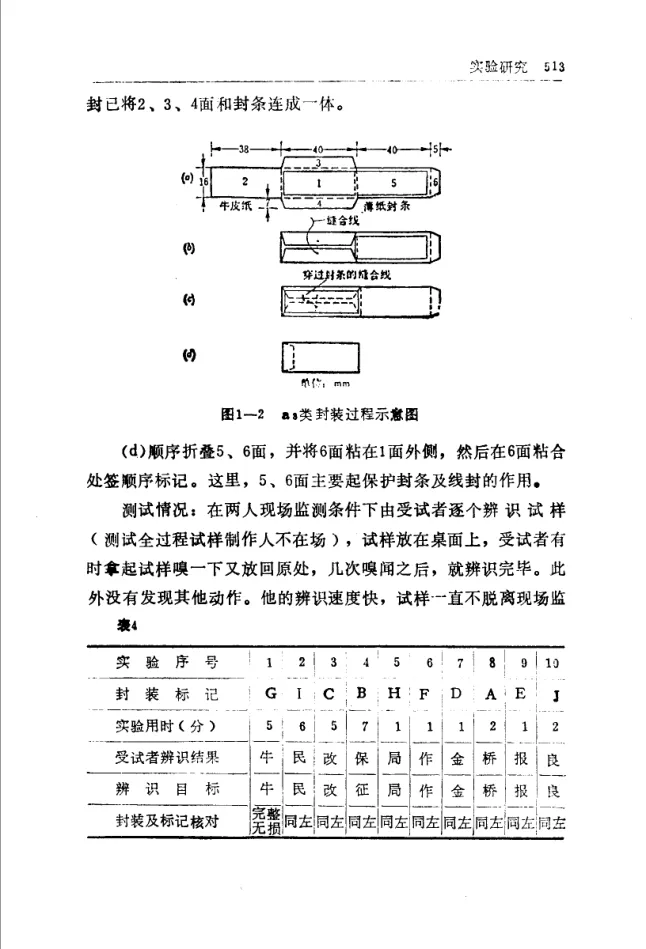
| Experiment serial number | 1 | 2 | 3 | 4 | 5 | 6 | 7 | 8 | 9 | 10 |
|---|---|---|---|---|---|---|---|---|---|---|
| Packaging mark | G | I | C | B | H | F | D | A | E | J |
| Experiment time used (min) | 5 | 6 | 5 | 7 | 1 | 1 | 1 | 2 | 1 | 2 |
| Subject’s identification result | Niu | Min | Gai | Bao | Ju | Zuo | Jin | Qiao | Bao | Liang |
| Identification target | Niu | Min | Gai | Zheng | Ju | Zuo | Jin | Qiao | Bao | Liang |
| Packaging and mark verification | Intact and undamaged | Same as left | Same as left | Same as left | Same as left | Same as left | Same as left | Same as left | Same as left | Same as left |
itoring. After identification, the monitors carefully checked the kraft paper bag’s packaging and its marks on the spot, then opened the seal for verification. The test results are shown in Table 4.
From the above table, it can be seen that the identification success rate reached 90%.
Overall verification: First, check the packaging and marks of the envelope containing the 90 “remaining targets”; then, conduct an overall verification of these 90 “remaining target” characters against test card No. 0040, with correct results; finally, the sample preparer and the overall verifier again double-checked the packaging and marks of the 10 “identified targets”, with correct results.
Reliability examination: (1) “Uniqueness”: The “tiger tally” method (curved cut sampling, overall verification) is used to ensure the uniqueness of the “identified characters”, and a marking method is used to ensure the uniqueness of the packaging paper bag. In addition, since the subject is not allowed to touch the sample before the test, and the sample never leaves the monitor’s sight during the on-site test, it is impossible to replicate or swap the sample without being discovered. (2) “Double-blindness”: Using a two-stage random sampling method, and keeping the subject out of contact with the sample preparer, ensures “double-blindness” and prevents “cueing”. (3) (Packaging “reliability”): Three layers of kraft paper bags are used, plus a thin paper seal strip, plus a thread seal. Repeated practice has proven that this packaging method is reliable; it is impossible to restore it on the spot after opening without being discovered. The “identified characters” are folded in half twice and then sealed inside three layers of kraft paper bags. Without opening the seal, ordinary people cannot “see” the characters under the established test conditions (even under strong light transmission). This eliminates the possibility of identifying the target through ordinary vision. (4) The “reliability” of on-site monitoring is mainly guaranteed by the following points: the sample is always placed in the open and never leaves the monitoring; the test actions are “clean”; and the test time is short (the longest being 7 minutes, most within 2 minutes). Under these conditions, serious on-site monitoring by multiple people can ensure its reliability.
(5) The experimental results have statistical significance. According to statistical theory, the probability of selecting out of Chinese characters at random, guessing of them correctly, and guessing incorrectly can be calculated by the following formula:
Considering the situation in the test where the seal is opened immediately after each character is identified, the probability of the above-mentioned “accidental correct guess” is:
From this, it is easy to list the table. When taking and , the situation is as shown in Table 5:
Table 5
| 1 | 0.10989 |
| 2 | |
| 3 | |
| 4 | |
| 5 | |
| 6 | |
| 7 | |
| 8 | |
| 9 | |
| 10 |
It can be seen that, under the set conditions3, as long as the identification success rate is above 40%, the probability of a lucky guess does not exceed . This indicates that if one relies entirely on guessing, then the probability of a successful guess
…a rate exceeding 40% is fundamentally impossible in practice.
In practice, the joint testing team conducted a “guessing” probability test in April 1982 on a third-grade class at Bali Zhuang Primary School in Beijing (40 groups, 400 character samples), and the results were consistent with the theoretical calculated value.
The recognition success rate of this experiment reached 90%, which should be considered statistically significant.
[Example 2] Categories A and b, Experiment No.: 0039. Time: July 12, 9:20 a.m. – 10:35 a.m. July 14, 1:10 p.m. – 1:15 p.m. Location: Room 432, Building 7, Beijing Teachers’ College. Weather: Clear. Subject: No. ④. Examiners: Zhang Yunpeng, Dong Zhenjun, Shi Yingzhang (sample preparation), Yang Yuanming (marking, monitoring), He Ren, Lin Shuhuang, He Qingnian, Liu Huiyi (monitoring), Yang Jianhua, He Qingnian (overall verification). Sample preparation: Category A (test card No. 0039). Packaging method: Category b (Figure 1-3).
Epoxy resin seal Figure 1-3 Schematic diagram of Category b packaging
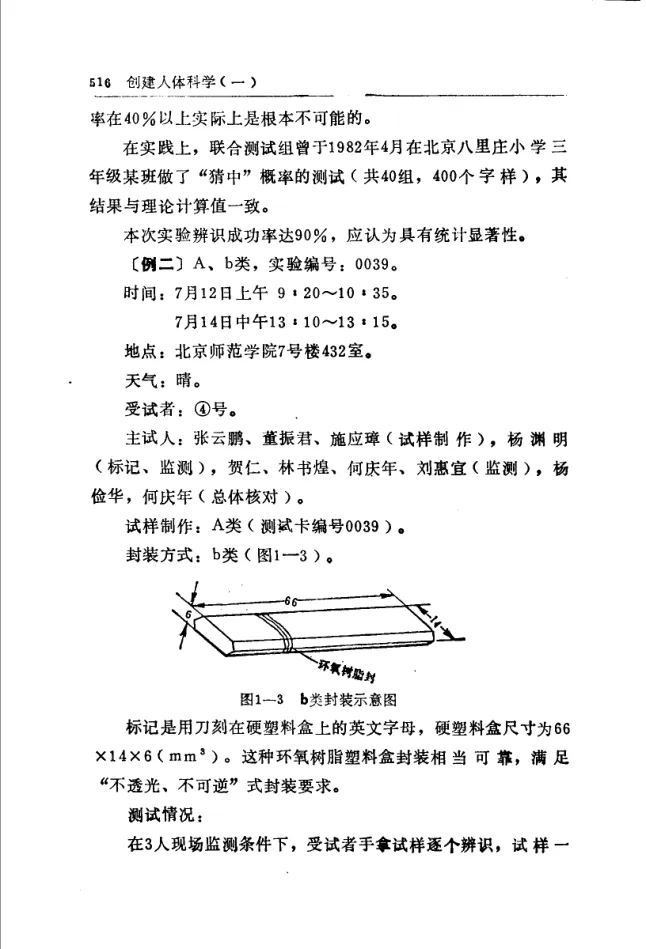
The marks are English letters carved with a knife on a hard plastic box; the dimensions of the hard plastic box are 66 × 14 × 6 (mm³). This epoxy resin plastic box packaging is quite reliable and meets the packaging requirements of being “opaque and irreversible.”
Testing conditions: Under the condition of on-site monitoring by three people, the subject held the samples in his hand and identified them one by one. The samples
never left the monitors’ sight (none of the sample preparation personnel were present). He identified each sample in as fast as 2 to 3 minutes, or as slow as 15 to 30 minutes. The monitors carefully inspected the epoxy resin packaging and the marks of the sample’s hard plastic box on the spot; all were intact, and then they were opened (split open with a knife on the spot) to verify the results. We asked him to identify five samples; all were correct, and the recognition success rate reached 100%.
Overall verification: No errors.
[Example 3] Categories B and a2, Experiment No.: 0073. Time: July 10, 4:20 p.m. – 4:40 p.m. Location: Room 432, Building 7, Beijing Teachers’ College. Weather: Clear. Subject: No. ④. Examiners: Huang Yuchun (sample preparation and marking), Shi Junya, Lin Shuhuang, Liu Huiyi (marking, monitoring), Yang Yuanming, Yang Jianhua, Zhang Hanyu (overall verification). Sample preparation: Category B (test card No. 0073). Packaging method: Category a2 (Figure 1-4).
Thin paper seal Kraft paper envelope Figure 1-4 Schematic diagram of Category a2 packaging
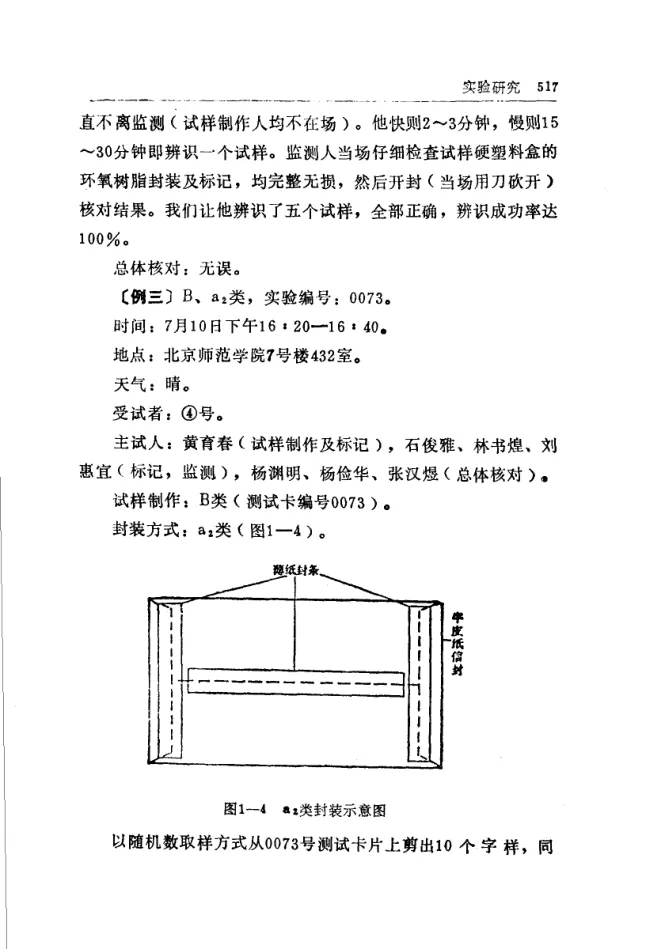
Using a random number sampling method, 10 character samples were cut from test card No. 0073, and at the same time
they were pasted onto one end of a 265 × 50 mm² rectangular thick white paper. The rectangular white paper was folded into ten layers and put into a kraft paper envelope, sealed with a thin paper strip. Six private seals of Huang Yuchun and the characters “7073” were stamped on various places on the seal strip. Before the test, Lin Shuhuang and Liu Huiyi each signed it. The remaining portion of the “test card” was folded and sealed in another envelope in the same manner, and kept by Huang Yuchun (from sample preparation until the end of the test, the subject and Huang Yuchun never had contact to ensure “double-blindness”).
Testing conditions: Under the condition of on-site monitoring by three people, the subject began the test. The sample was placed on the table; he sometimes picked up the sample, sniffed it, and put it back in its original place. Then, he wrote down the recognition results one by one on the sample envelope, sniffing, writing, and reviewing as he went. The sample never left the monitoring. He finished identifying (10 character samples) in just 20 minutes. The monitors carefully inspected the kraft paper envelope packaging and the marking condition of the sample on the spot, verified that they were intact, and then opened them for verification. As a result, his recognition success rate reached 100%.
Overall verification: After the test, the recognition targets were checked against the remaining part of the test card kept by Huang Yuchun, and the results were correct.
In summary, under experimental conditions satisfying the five design principles, Subject No. ④ underwent five sets of tests totaling 45 character samples, and the success rate of completely correct recognition was higher than 95%. This experimental result provides at least one example demonstrating that the extraordinary human visual function of “ear reading” objectively exists.
(III) Discussion
- On the Repeatability of Experimental Results
The results of this joint test are consistent with the test results obtained by some scientific workers in the past [1, 2]. This means that under strict experimental conditions, past experimental results were repeated using different subjects.
In this test, some subjects had a high experimental success rate, demonstrating a high degree of repeatability. All the above indicates that the experimental results of extraordinary human visual function possess repeatability.
However, this “repeatability” is not like that of physics or chemistry experiments, which can be repeated “at any time.” Because what we are doing is a biological experiment, examining the functions of the human body when it enters a certain special state. The human body is a very complex giant system, with many factors influencing it (such as physical condition, mood, weather, testing environment, and other factors not yet recognized by us), making it extremely difficult to control completely identical experimental conditions. We believe that “repeatability” is conditional. The requirements for “repeatability” should differ for different forms of motion.
The results of this test show that “repetition” is not an easy task. Among the 11 pre-selected subjects, only 4 achieved positive results. Only Subject No. ④ was able to repeat multiple times, and even he could not enter the functional state at any time.
Preliminary investigations indicate that the following issues are worth noting:
(1) Individual differences: That is, the strength and stability of the functions of different subjects are clearly different.
(2) Functional decline: One or two years ago, the “ear reading” function of some subjects was very strong, and positive experimental results could be obtained multiple times under strict experimental conditions. Although positive experimental results were also obtained in this test, their functional state had clearly declined. This shows that the same subject may have different functional states in different periods. There are also some subjects whose original function clearly declined after developing a new function.
Practice shows that while individuals possessing extraordinary human visual functions are not isolated cases, those who maintain stable, strong functions over a long period are rare. Therefore, how to induce, stabilize, and enhance subjects’ functions, and prevent decline, is a topic worthy of attention in research work.
(3) Fluctuations in functional state: Our subjects, including those with strong functions, generally cannot yet completely control themselves to enter the functional state at any time; nor can they
achieve sustained experimentation without fatigue. Taking Subject No. 4 as an example, within a two-month period, only about 10 days showed a peak functional state; in a given month, only 5 groups of “character recognition” experiments were conducted. Each period of peak-state functioning was very brief, and after each peak the subject would enter a relative trough, remaining “calm” for a period before being able to enter a new peak. Their functional state exhibited marked fluctuations and interruptions.
The causes underlying this phenomenon are likely very complex. Physiological, psychological, energy-consumption, and environmental factors should all be considered. We have not yet grasped the patterns involved, and there is a great deal of blind trial-and-error. This is precisely a topic we should study. Only after we have mastered the patterns and overcome this blindness will it be possible for us to gradually achieve controlled, repeatable reproduction of extraordinary human abilities.
Once we take note of the above characteristics, we can arrive at a correct understanding of the “repeatability” of experimental results in extraordinary human abilities, and adopt scientific methods consistent with the underlying patterns for conducting such experiments.
Of course, while emphasizing “repeatability,” we should not overlook the importance of single-trial (multi-parameter correlated) rigorously controlled experimental results.
- On the problem of cheating
During this joint testing, we repeatedly discovered instances of cheating among certain subjects (among the 11 subjects tested, cheating was discovered in 3). Their methods of cheating were quite ingenious. In order to distinguish genuine from fabricated test results, we must exercise extreme caution and care, repeatedly scrutinizing the evidence. Dissenting opinions, including those of a minority, should be given due weight. The “Five Principles” of experimental design that we put forward were gradually formed through repeated struggles against cheating, incorporating the lessons learned from both positive and negative experiences. Experiments have shown that strict implementation of the five principles of experimental design can eliminate false appearances and ensure the rigor of the experiments.
It should be pointed out that certain subjects whose strong extraordinary abilities have been confirmed under rigorous experimental conditions have also been found to engage in cheating. We must carefully distinguish between genuine and fabricated cases.
We believe that in the study of extraordinary human abilities, the “problem of cheating” is an issue that warrants serious attention and should be treated as a specialized research topic. This is a very complex problem, encompassing social, psychological, educational, and scientific dimensions. It includes studying the methods, causes, and preventive measures related to cheating, as well as the question of how to cultivate a corps of subjects who are well-rounded in moral, intellectual, and physical development, and how to enhance the qualities and standards of the scientific research workforce.
- On the scientific basis of experimental methods
Based on the above points, we consider it necessary to discuss the scientific validity of experimental methods used in extraordinary human abilities research. Here, the rigor of experimental conditions, the reasonableness of experimental requirements, and the conformity of experimental methods to underlying patterns must all be considered simultaneously.
By “rigorous,” we mean ensuring that under the experimental conditions set, it is impossible to identify the target characters through conventional means (for example, “switching,” “peeking,” or “prompting”). Given this premise, experimental designs may vary greatly and differ in their level of difficulty. For example, some subjects confirmed to possess the ability under the sleeve-enclosure method prove incapable with sealed paper-sleeve samples; other subjects can successfully handle “sealed paper-sleeve” samples but prove incapable with seamless wax-sealed samples. Therefore, experimental design must be both rigorous and reasonable, proposing specific protocols tailored to the strength and characteristics of each subject’s ability. Of course, various high-difficulty experiments should also be attempted, but those serve primarily to explore mechanisms.
By “conforming to patterns,” we mean gradually exploring and understanding the characteristics of this discipline, so that experimental methods accord with its inherent patterns. We believe that long-term, systematic, and multifaceted observational experiments and follow-up studies should be conducted on certain key subjects. Archives should be established, including detailed records of physical condition, psychological state, weather, seasonal periods, time of day, and testing environment, striving to create the most favorable conditions and conduct an appropriate amount of experimentation while subjects are in a “peak functional state,” rather than adopting a fatigue-inducing strategy of continuous experimentation.
At the same time, all experimental situations—whether successful, failed, doubtful, or involving cheating—should be meticulously recorded and carefully analyzed, and all original materials should be retained.
II. Experiments on Extraordinary Human Movement
The purpose of this experiment is to examine, under rigorous experimental conditions, the authenticity of extraordinary human movement abilities. The primary focus is on three types of abilities: extraordinary transport, extraordinary writing, and the overcoming of spatial barriers.
(I) Principles of Experimental Design
For different abilities, the requirements of experimental design are not entirely the same. In order to eliminate false appearances and ensure experimental rigor, we believe that the experimental design for all three types of abilities should satisfy the following conditions:
(1) Samples shall possess certain “uniqueness” characteristics, ensuring that under the established experimental conditions the samples cannot be copied or switched.
(2) Set up certain “barriers” (for example, “irreversible” sealing, “separation from the body,” etc.), to ensure that under the experimental conditions set, it is impossible to achieve this type of extraordinary movement through conventional means.
(3) Reliable on-site monitoring. The experiment shall be conducted under the monitoring of two or more chief examiners. Before the experiment, the subject shall not be permitted to come into contact with the sample; during the experiment, the subject shall not be permitted to take the sample away from the site or outside of monitoring.
(4) The experimental results must possess “reproducibility.”
Below, we will use typical experiments to illustrate how the above experimental design principles are concretely implemented, and will specifically examine the reliability of the experimental results.
(II) Examples of Typical Experiments
- Overcoming Spatial Barriers
Experiment No.: 1027. Content of experiment: Transport target character samples out of a sealed kraft paper envelope. Time: July 11, 1982, 9:02–9:04 AM. Location: Room 432, Building 7, Beijing Teachers’ College. Weather: Clear. Subject: Z. Experimenters: Wen Guangxun, Dong Zhenjun, Yang Jianhua (sample preparation); Liu Huiyi, Lin Shuhuang (monitoring); Yang Yuanming, Wang Zheng (overall verification). Sample preparation: Adopted the A and a2 class methods from Human Extraordinary Vision Experiments. One hundred character samples were cut out in a curved manner from No. 0067 Human Extraordinary Vision Test Card; 90 character samples were randomly selected from these4 and sealed in a kraft paper envelope, and then a thin paper seal was added (see Fig. 1-4). Each seal bore Yang Jianhua’s signature; the front of the envelope was inscribed with words such as “Remaining 90, 0067, Wen Guangxun”. Layout: As shown in Figure 2-1.
West Sample △ Lin North z Liu Bed Figure 2-1
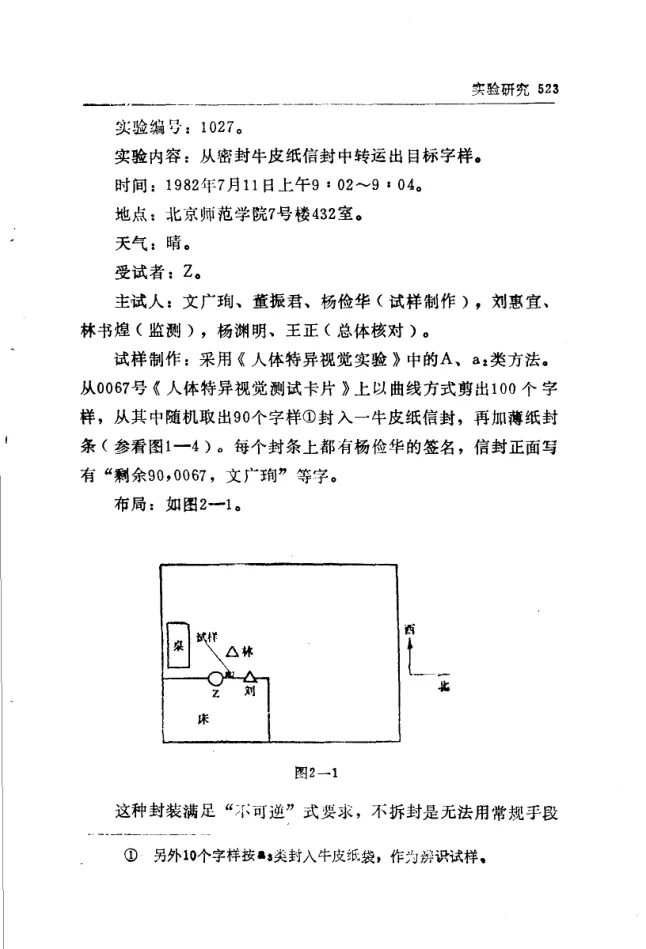
This packaging satisfies the “irreversible” requirement; without opening the envelope, it is impossible to use conventional means to extract the character samples; the “target character samples” and the sealed kraft paper envelope both possess “uniqueness”. Z sat on the bed holding the sample; Liu Huiyi also sat on the bed, and Lin Shuhuang stood nearby watching.
Experimental process: ① At 9:02, the experiment began. Z held the sample in his right hand and gave it a shake over his left palm. The monitoring personnel present immediately discovered that six “target character samples” had appeared in Z’s left palm. ② Next, Z held the upper corner of the sample envelope with his right hand and shook “target character samples” onto Liu Huiyi’s right palm (12 character samples in total). ③ After a short wait, at 9:04, Z again held the upper corner of the sample envelope with his right hand and shook it. At this moment, both Lin Shuhuang and Liu Huiyi clearly saw a “target character sample” fall from the lower corner of the sample envelope into Liu Huiyi’s right palm. The movement was very “clean”. However, how the “target character sample” was transported out from the corner of the sample envelope could not be seen. At this point, a total of 19 character samples had been “extracted”. ④ On-site inspection indicated that the packaging and markings of the sample envelope were completely intact.
Overall verification: ① At 16:00 on July 12, 1982, the 19 character samples transported out by Z on July 11 were affixed to the original No. 0067 test card for overall verification. The results confirmed that these 19 character samples were cut from the original No. 0067 test card. ② At 9:00 AM on July 28, 1982, the sample envelope (0067, remaining 90) was opened. Upon verification, there were 71 character samples inside the envelope; adding the 19 extracted character samples, the total number was exactly 90. The 71 unextracted character samples were subjected to an overall verification with the original No. 0067 test card, and no discrepancies were found. Before and after opening, over a dozen scientific workers present carefully inspected the packaging and markings of the sample envelope again. The results showed that the packaging and markings were completely intact.
Reliability examination:
① The sample possesses “uniqueness”. The “Tiger Tally” method (curved cutting of samples, overall verification) ensures the uniqueness of the “target character samples”, and the marking method ensures the uniqueness of the sealed paper envelope. ② The numbers match. The total number of cut character samples was 100, of which 10 served as identification targets, and 90 as psychokinetic targets. 19 were taken out from the 90, leaving 71 (i.e., 100=10+90, 90=19+71). ③ The packaging of the sample envelope meets the “irreversibility” requirement. Upon careful inspection, its packaging and markings were completely intact. ④ On-site monitoring was reliable. The sample was randomly selected by the experimenter from multiple samples 1 minute before the start of the experiment. The subject had not touched the sample beforehand. During the test, the subject’s movements were simple, the sample never left monitoring, and the speed was very fast; the experiment concluded in about two minutes. Under these conditions, it would be impossible for the subject to duplicate and swap the sample on the spot (without being discovered). ⑤ The experimental results possess “reproducibility”. Z has successfully performed the same type of experiment 4 times.
2. Extraordinary transportation
Experiment No.: 1003. Content of experiment: Transport a pass into a tightly shut drawer 3.8 meters away. Time: May 20, 9:20–9:22 AM. Location: Room 435, Building 7, Beijing Teachers’ College. Weather: Clear. Subject: Z. Personnel present: Liu Yicheng, Yang Jianhua, Yang Yuanming, He Ren, Liu Huiyi, Lin Shuhuang. Transported sample: A pass for XXX of the XX Factory in Shenyang, numbered 6858, with a photograph and steel seal.
Layout: As shown in Figure 2-2. The sample was transported from A (desktop) to B (inside the drawer). The distance between A and B was 3.8 meters. The drawer was unlocked, but tightly shut.
He’s object West △ △ 1 △ North △ Lin Door 2 Yi Bed Figure 2-2
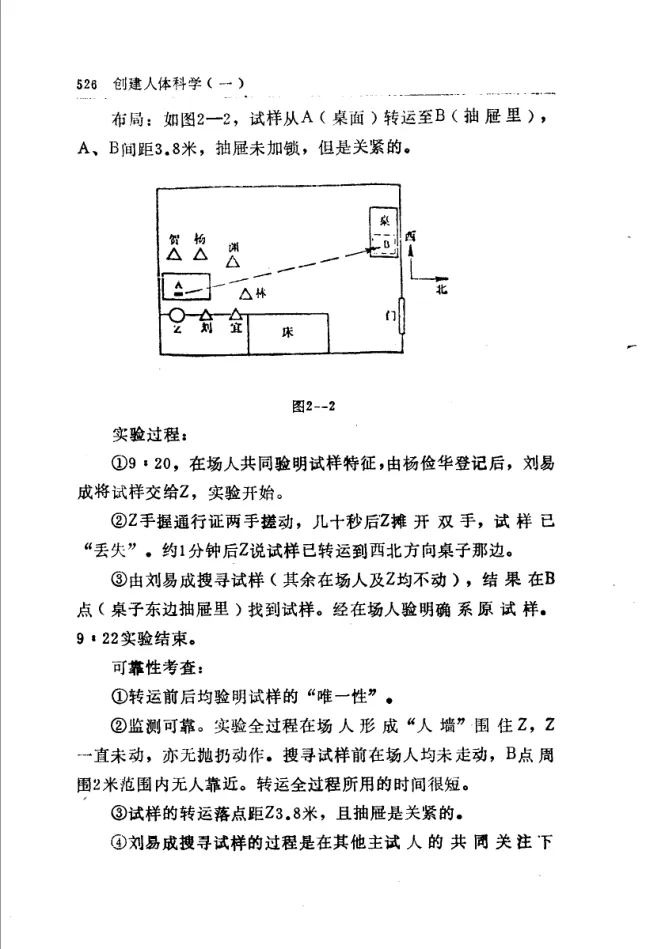
Experimental process: ① At 9:20, those present jointly verified the characteristics of the sample. After Yang Jianhua recorded it, Liu Yicheng handed the sample to Z, and the experiment began. ② Z held the pass with both hands and rubbed them together; tens of seconds later, Z opened his hands, and the sample had “disappeared”. About 1 minute later, Z said the sample had been transported over to the table in the northwest direction. ③ Liu Yicheng searched for the sample (the others present and Z did not move). As a result, the sample was found at point B (inside the east drawer of the table). Those present verified that it was indeed the original sample. The experiment ended at 9:22.
Reliability examination: ① The “uniqueness” of the sample was verified both before and after transportation. ② Monitoring was reliable. Throughout the entire experiment, the personnel present formed a “human wall” surrounding Z. Z did not move, nor did he make any throwing motions. Before searching for the sample, none of the personnel present walked around; no one approached within a 2-meter radius of point B. The entire transportation process took a very short time. ③ The drop point of the transported sample was 3.8 meters away from Z, and the drawer was tightly shut. ④ Liu Yicheng’s process of searching for the sample was carried out under the joint scrutiny of the other experimenters
was conducted. He first rolled up his sleeves before beginning the search, and finally pulled the drawer open from the bottom.
⑤ The experimental results possess “reproducibility.” The same type of experiment has been successfully performed by Z 8 times.
- Extraordinary Transport and Breaking Through Spatial Barriers
Experiment number: 1013.
Experimental content: Transport a marked egg into a locked drawer.
Time: June 8, evening 21:40–21:46.
Location: Room 435, Building 7, Beijing Teachers’ College.
Weather: Clear.
Subject: Z.
Monitors: Chai Jianyu, Lin Shuhuang.
Sample: The on-site monitor used a pencil to write the character “师” (Teachers) on the egg, and then used a blue ballpoint pen to make special markings. The minimum linear dimension of the egg was L_min = 39 mm.
Layout: As shown in Figure 2–3.
The sample was transported from the desktop (A) into the west-side drawer (B). Both drawers of the desk were locked, and the key to the lock of the west-side drawer was itself locked inside the east-side drawer.
Lock
West
△ Chai
— Sample
North
Lin
2
Bed
Bed
Figure 2–3
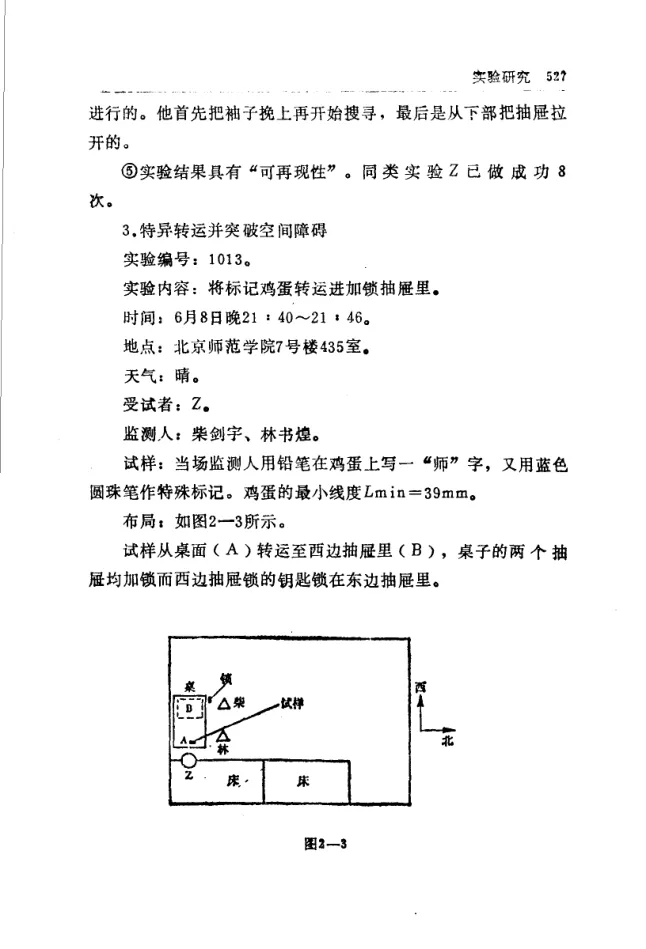
Experimental procedure:
① 21:40 — After Lin Shuhuang verified the markings, the sample egg was handed to Z, and the experiment began.
② 21:45 — Z held the egg in both hands, rubbed it briefly, and the sample “disappeared.” Z said the sample had already been transported into the drawer.
③ Lin Shuhuang kept Z under surveillance to prevent him from moving his position, while Chai Jianyu took the key from the east-side drawer, unlocked the west-side drawer, and inspected it. The original sample was found inside the west-side drawer. The monitors verified on the spot that it was indeed the original sample. At 21:46 the experiment concluded.
Reliability assessment:
① The “uniqueness” of the sample was verified both before and after transport.
② It was verified on-site during the experiment: under the condition that the west-side drawer was locked, its maximum gap L_max = 30 mm, so it was impossible for the egg sample to enter the drawer by conventional means without damage.
③ On-site monitoring was reliable. As can be seen from the layout diagram, the desk was 1 meter long, the lock was at the west end, and Chai Jianyu and Lin Shuhuang were seated right by the desk monitoring. Z never moved from his position throughout, and the entire experimental process was very brief. Under these conditions, it would have been impossible for the subject to unlock the west-side drawer without being detected.
④ The experimental results possess “reproducibility.” The same type of experiment has been successfully performed by Z 3 times.
- Extraordinary Writing
Experiment number: 1020.
Experimental content: Extraordinary writing of 12 characters.
Time: June 16, morning 8:45–9:00.
Location: Room 432, Building 7, Beijing Teachers’ College.
Weather: Overcast.
Subject: Z.
On-site monitors: Shi Junya, Liu Huiyi, Wang Zheng.
Sample preparers: Shi Junya, Liu Huiyi, He Qingnian, Lin Shuhuang, Liu Yicheng.
Sample preparation: Shi Junya provided a silver-white-barreled blue ballpoint pen. The preparers jointly signed a blank sheet of paper without characters and noted the date. This sample paper was then used to tightly wrap the ballpoint pen into a cylindrical shape, with both ends folded back.
Layout: As shown in Figure 2–4. The sample was placed on the surface of a round table, and Z was simultaneously given a fountain pen and another sheet of blank paper.
Sample
△ Wang
West
Table
△ Liu
Shi
Bed
Figure 2–4
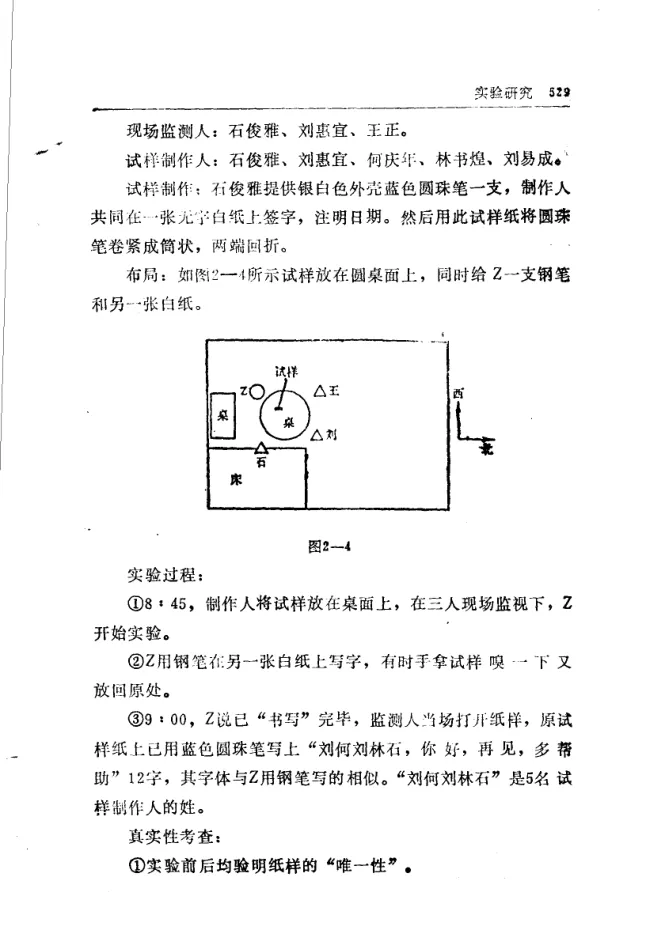
Experimental procedure:
① 8:45 — The preparer placed the sample on the table surface, and under on-site surveillance by three persons, Z began the experiment.
② Z used the fountain pen to write on another sheet of blank paper, and at times picked up the sample, sniffed it, and set it back in its original place.
③ 9:00 — Z said the “writing” was complete. The monitors opened the paper sample on the spot. On the original sample paper, 12 characters had been written in blue ballpoint pen: “刘何刘林石,你好,再见,多帮助” (Liu, He, Liu, Lin, Shi — hello, goodbye, please help more). The handwriting was similar to that written by Z with the fountain pen. “刘何刘林石” are the surnames of the five sample preparers.
Authenticity assessment:
① The “uniqueness” of the paper sample was verified both before and after the experiment.
② Without opening the tightly rolled and folded paper sample, it is impossible to perform “writing” by conventional means.
③ On-site monitoring was reliable. Throughout the entire experimental process, the subject never moved from his position. Apart from the subject picking up the sample and sniffing it a few times, the sample was kept on the table surface the entire time. The paper sample was never unfolded.
④ The experimental results possess “reproducibility.” The same experiment has been successfully performed by Z 5 times.
(III) Overview of Experiments
The principal subject was Z. A total of 81 formal tests were conducted, of which 25 were reliably successful, 18 were doubtful, 8 involved cheating, and 30 were failures.
The results of the “reliably successful” tests are compiled in Table 6.
As can be seen from the table: experiments in the three categories of extraordinary transport, extraordinary writing, and breaking through spatial barriers were each repeated more than 5 times, and the number of on-site monitors for each experiment was no fewer than two. All experiments listed have detailed records with complete documentation available for verification.
(IV) Discussion
(1) The results of this joint testing are consistent with the results previously obtained by certain scientific workers. [3, 4] In effect, these results repeat past findings under stricter experimental conditions.
(2) In exploring the mechanism, the following points are worth noting:
① During the process of extraordinary transport, the sensory organs of ordinary people are for the time being unable to detect the trajectory of the sample’s movement or any sound. The sample seems to “disappear” from one location and then “reappear” at another. The intermediate process is unknown. However, the subject himself gives such subjective descriptions of the sample.
Table 6
| Number | Date (1982) | Project | Description | Number of persons present |
|---|---|---|---|---|
| 1001 | Evening, 5/19 | Extraordinary writing | Performed 3 times, writing 12 characters in total | 4 |
| 1002 | Morning, 5/20 | Breaking through spatial barriers | Transferred a pass into a covered biscuit tin | 9 |
| 1003 | Morning, 5/20 | Extraordinary transfer | Transferred a pass into a drawer 3.8 m away | 6 |
| 1004 | Morning, 5/20 | Extraordinary transfer | Transferred a bunch of keys into a covered cup 2 m away | 0 |
| 1005 | Morning, 5/22 | Breaking through spatial barriers | Transferred two passes into a covered biscuit tin | 8 |
| 1006 | Afternoon, 5/24 | Breaking through spatial barriers | Removed tablets from a medicine bottle with a double-layer cap | 8 |
| 1007 | Afternoon, 5/24 | Breaking through spatial barriers | Transferred a personal address book into a porcelain cup with a screwed-on lid | 4 |
| 1008 | Afternoon, 5/25 | Extraordinary writing | Performed 1 time, writing 6 characters | 4 |
| 1010 | Evening, 6/8 | Extraordinary transfer | Transferred a marked medicine bottle into a drawer 4.2 m away | 2 |
| 1011 | Evening, 6/8 | Extraordinary transfer | Transferred a marked medicine bottle onto a door frame 4 m away | 4 |
| 1012 | Evening, 6/8 | Extraordinary transfer | Transferred a marked medicine bottle into a locked drawer | 2 |
| 1013 | Evening, 6/8 | Breaking through spatial barriers | Transferred a marked egg into a locked drawer | 2 |
| 1014 | Evening, 6/8 | Breaking through spatial barriers | Removed 6 pieces of chocolate from a sealed chocolate box | 4 |
| 1015 | Noon, 6/11 | Breaking through spatial barriers | Removed 2 pieces of chocolate from a sealed chocolate box, while simultaneously placing 3 paper-wrapped candies inside | 2 |
| 1016 | Morning, 6/9 | Breaking through spatial barriers | Transferred a marked egg into a covered biscuit tin | 9 |
| 1017 | Morning, 6/9 | Breaking through spatial barriers | Transferred a marked bamboo ring into a covered biscuit tin | 9 |
| 1018 | Morning, 6/16 | Breaking through spatial barriers | Removed a marked tomato and egg from a locked drawer | 3 |
| 1019 | Noon, 6/16 | Breaking through spatial barriers | Removed a marked tomato from a locked drawer, while simultaneously transferring a Sanyo radio-cassette recorder into the locked drawer | 2 |
| 1020 | Morning, 6/16 | Extraordinary writing | Performed 1 time, writing 12 characters | 3 |
| 1022 | Afternoon, 6/28 | Extraordinary transfer | Transferred a special photocopy into a drawer 3.5 m away | 4 |
| 1024 | Morning, 7/2 | Extraordinary transfer | Transferred a marked coin into a drawer 3.5 m away | 2 |
| 1027 | Morning, 7/11 | Breaking through spatial barriers | Removed a unique marked text from a sealed envelope | 2 |
| 1030 | Afternoon, 7/13 | Breaking through spatial barriers | Transferred a marked pencil-lead box into a biscuit tin | 4 |
| 1031 | Afternoon, 7/13 | Extraordinary transfer | Transferred a marked pencil-lead box onto a door frame 5 m away | 4 |
| 1033 | Morning, 7/23 | Breaking through spatial barriers | Removed a unique marked text from a sealed envelope | 4 |
Such subjective descriptions are frequently consistent with the results of searching for specimens at the experimental site. For the intermediate process, the subject also provides narrative accounts, and at present there is no way to verify their authenticity. This, of course, cannot serve as a basis for
scientific conclusions. However, careful study of such subjective accounts may be beneficial for experimental research work.
② The ability of an object to “break through spatial barriers” during the transfer process is a fundamental phenomenon that may involve the nature of space and matter. The process by which a specimen “breaks through spatial barriers” is likewise invisible to ordinary people. By the time the on-site monitors see the specimen, it has already been transferred out of the sealed container. Experimental results also preliminarily indicate that different packaging conditions and different materials of the packaging container and specimen result in different levels of difficulty for “breaking through spatial barriers” experiments. For example: the difficulty differs between specimens with gap-sealed packaging and those with fully sealed packaging; experiments with paper bag or plastic box packaging are easier to perform than those with glass sinter-sealed specimens. It can be seen that “breaking through spatial barriers” is conditional; at least up to now, it has not been possible to achieve “breaking through” the “spatial barriers” of every type of packaging.
③ The experimental results of extraordinary writing demonstrate that this type of extraordinary psychokinesis is extremely precise and complex.
III. Concluding Remarks
We believe that the question of the authenticity of extraordinary human abilities is, fundamentally, a practical question rather than a theoretical one. The purpose of this joint test was to determine the authenticity of certain extraordinary human abilities through rigorous scientific experiments.
The experimental conditions of this joint test were rigorous, the results obtained are highly reliable, and they possess a certain degree of repeatability. The examples provided by the joint test demonstrate that the extraordinary human visual ability of “reading with the ears,” as well as extraordinary human psychokinetic abilities such as “extraordinary transfer,” “extraordinary writing,” and “breaking through spatial barriers,” objectively exist.
The experiments conducted in this joint test still fall within the category of phenomenon observation, and the results obtained remain preliminary. We must move forward and focus on in-depth, mechanistic exploratory fundamental
Appendix: List of Personnel Participating in the Tests
Name: Dong Zhenze, Sun Xianjun, Shi Yingzhang, Shen Changhuang, Lin Qichun, Zhang Huiwu, Huang Yihong, Zhou Yufan, Dong Nianyin, Liu Yuyu, Zhao Jieqing, Zhang Lin, Qian…, He…, Ding…, Zhang…, Chai…, Tan…, Xi…, Cui… Gender: Male, Male, Female, Male, Male, Male, Male, Male, Male, Male, Female, Female, Male, Male, Male, Male, Male, Male, Male, Male Age: 48, 39, 99, 33, 86, 99, 8 Work Unit: Xiyuan Hospital, Wuhan University, Liaoning University, Shanghai Jiao Tong University, Shanghai Medical University, Department of Physics, Peking University, Department of Physics, Beijing Teachers College, Beijing Medical College, Beijing College of Traditional Chinese Medicine, North China Agricultural University, etc. Professional Title: Associate Researcher, Editor, Editor, Assistant Researcher, Assistant Researcher, Assistant Researcher, Researcher, Professor, Researcher, Engineer, Associate Professor, Lecturer, Lecturer, Teaching Assistant, Attending Physician, Attending Physician, Attending Physician, Laboratory Technician, Laboratory Technician.
Name: Yang Jian, Liu Chengyi, Xu Hongzhang, Chen Xin, Zhao Junyi, Yang Mingyuan, Chen Weiliang, He Languang, Xu Zhongrun, Wen Yi, Wang Wenxiu, Zhu Yun, Zhu Shishu, Quan Pengxin, Guo Chu, Zhang Zhuding, Luo…, Tuo…, Wang…, Tu… Gender: Male, Male, Male, Male, Male, Male, Male, Male, Male, Male, Male, Male, Female, Male, Female, Male, Male, Male, Male, Male Age: 45, 39, 52, 45, 47, 45, 43, 54, 43, 50, 49 Work Unit: University of Science and Technology of China, Heilongjiang University, Harbin Medical University, Norman Bethune University of Medical Sciences, Jilin University, Jilin University of Technology, Kunming Teachers College, Yunnan University, Chongqing University, Chongqing Medical College, Sichuan University, etc.
- · Leaders of the joint testing group.
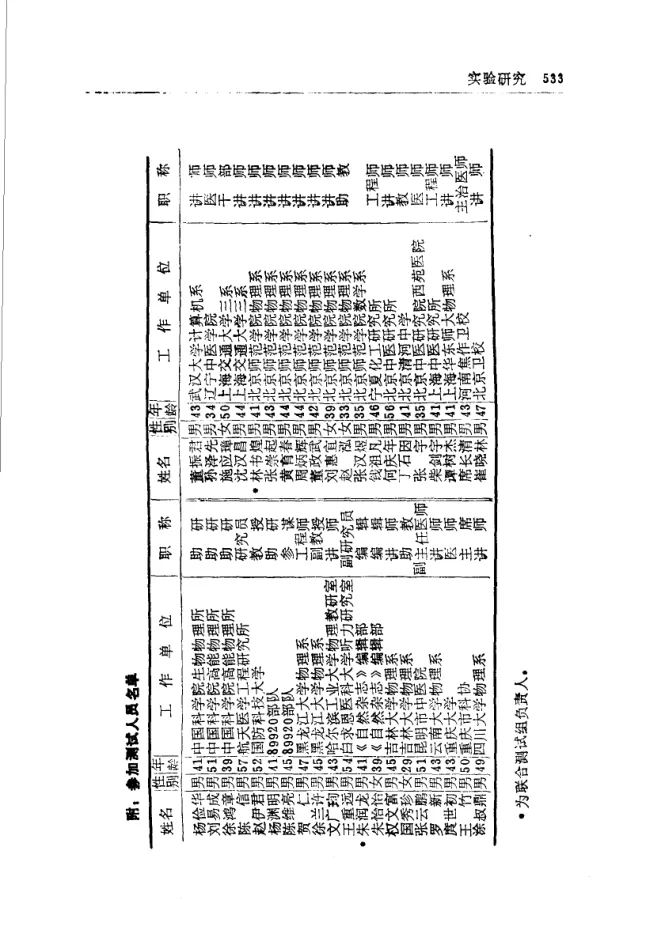
…in experimental research. Only by developing in depth and gradually mastering its laws can this discipline ultimately be established scientifically. This task is long-term and arduous, and we must have a clear understanding of this point.
Notes and References [1] Staff Reporter of this journal, Nature Journal, 2, 9 (1979) 575. [2] Chen Shouliang, He Muyan, Nature Journal, 2, 11 (1979) 715. [3] Human Extraordinary Functions Research Group, Yunnan University, Nature Journal, 4, 5 (1981) 348. [4] Lin Shuhuang et al., Nature Journal, 4, 9 (1981) 652.
Investigation Report on the Authenticity of Special Perceptual Functions of the Human Body
Chen Shouliang, He Muyan
[Editor’s Note]
The authors of this article are engaged in psychology and physiology research, respectively. In August 1978, when they first encountered the phenomenon of “armpit character recognition” by extraordinary-function subjects Wang × and Wang △, in order to conduct a rigorous scientific investigation into whether this phenomenon objectively exists, they designed [a method using non-] and reached the conclusion that the two extraordinary-function subjects tested did indeed possess the ability to recognize characters and figures using body parts such as the armpit and ears without using their eyes.
This is a highly valuable experimental report from the early stage of extraordinary-function research. Their design philosophy and the methods employed in the experiments played a positive role in subsequent extraordinary-function research.
Affiliation of the authors: Peking University.
The question of whether certain individuals possess a special perceptual function—that is, the ability to recognize characters and figures using body parts such as the armpits and ears—has attracted the attention of some scientists, and divergent views exist. We conducted investigations and tests on several children who were said to possess this function and obtained positive results. Among the subjects of the investigation and testing were two sisters from Beijing’s Xicheng District: Wang × and Wang △.
I. Testing Methods
(1) Non-sealed method. On a piece of white paper approximately one to two inches square, characters were written or figures were drawn with a fountain pen or ballpoint pen out of the subject’s view, or pre-printed characters were affixed to the white paper. After folding to conceal the characters or figures, the paper was handed to the subject. Upon receiving it with their hand, they immediately tucked it under their clothing into the armpit area. The hand holding the paper slip was not extended outside the clothing, nor did the other hand reach inside the clothing. On several occasions they placed the paper slip next to the ear or clamped it between the inner sides of the knee joints for recognition. After they believed they had identified the content, they returned the paper slip to the tester, wrote down the characters or figures they had recognized on the record sheet, and then opened the paper slip for verification. During the testing process, no cheating or peeking behavior was observed.
(2) Paper-sleeve sealed method. In order to completely eliminate the possibility of peeking, a paper-sleeve sealed method was adopted. Most of the paper sleeves were made by cutting white newsprint into a piece as shown in Figure 1, designated piece A. On piece A was placed piece B, onto which a small piece C bearing printed No. 3 type characters (with a smaller number of No. 1 and No. 2 characters) was affixed. Pieces A and B were folded along the dotted lines to cover piece C, and the sleeve was sealed with glue on three open edges. The sealed paper sleeve is shown in Figure 2. The character sheet sealed inside this type of paper sleeve was covered on both sides by two layers of white newsprint; even when held up to sunlight or strong lamplight, the characters or figures inside the sleeve could not be discerned by eye. Another portion of the paper sleeves contained handwritten individual characters measuring 1.5 cm square, folded at the center of the character, with three layers of white paper covering each side. One day or several days before the experiment, several dozen characters selected from among those familiar to third-grade elementary school students were randomly chosen and sealed inside paper sleeves. During the experiment, the subject randomly selected one paper sleeve and placed it under the armpit; in a few cases it was placed next to the ear for recognition. The tester also did not know the contents of the selected paper sleeve. After the subject completed the recognition, the paper sleeve was returned, and the recognized content was written down or dictated onto the record sheet. After the tester and observers examined it, the paper sleeve was cut open and the paper slip inside was removed for verification. All paper sleeves tested were intact when returned; there was no tearing or crushing. Most of the
A stopwatch was used to record the induction time (i.e., the time required from placing the paper sleeve at the recognition site until successful recognition).
Labels: 甲 (A), 乙 (B), 丙 (C), 人 (person)
Figure 1 Paper sleeve before sealing
Figure 2 Paper sleeve after sealing
II. Test Results
(1) Testing was conducted over 13 experimental days between August 13 and September 9. On each experimental day, the number of tests per subject ranged from a few to over 20. A total of 88 tests were conducted using the non-sealed method and 109 using the paper-sleeve sealing method; in addition, other modes of testing were carried out. The overall results are shown in Table 1.
Table 1 Statistics of Test Results
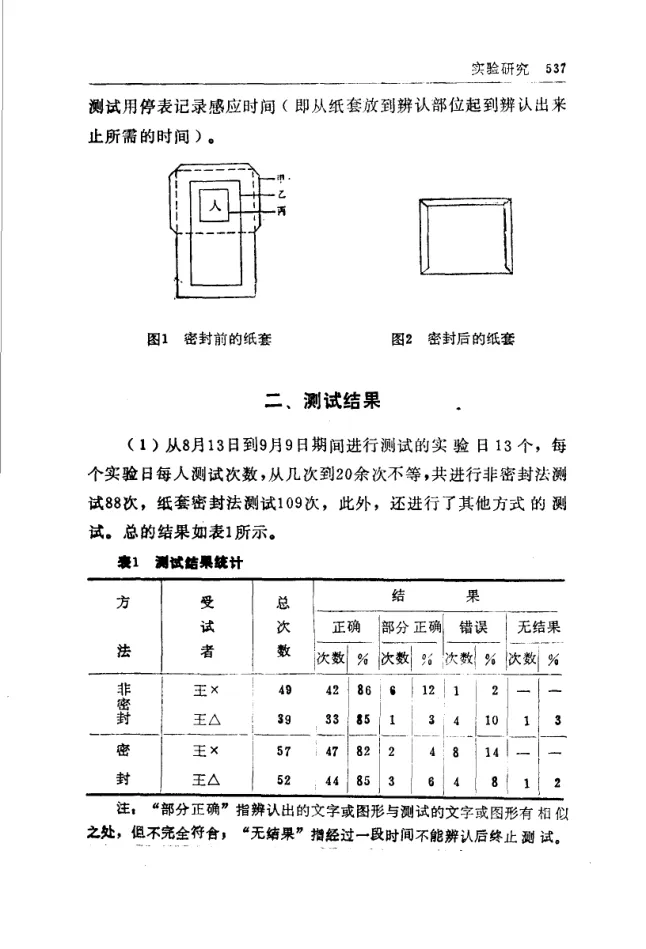
| Method | Subject | Total Tests | Correct | Partially Correct | Incorrect | No Result | ||||
|---|---|---|---|---|---|---|---|---|---|---|
| Count | % | Count | % | Count | % | Count | % | |||
| Non-sealed | Wang × | 49 | 42 | 86 | 6 | 12 | 1 | 2 | — | — |
| Wang △ | 39 | 33 | 85 | 1 | 3 | 4 | 10 | 1 | 3 | |
| Sealed | Wang × | 57 | 47 | 82 | 2 | 4 | 8 | 14 | — | — |
| Wang △ | 52 | 44 | 85 | 3 | 6 | 4 | 8 | 1 | 2 |
Note: “Partially correct” means that the recognized character or figure bears some similarity to the test character or figure but does not fully match. “No result” means the test was terminated after the subject was unable to recognize the item within a period of time.
(2) Relationship between induction time and accuracy rate. Among the 93 paper-sleeve sealing method tests timed with a stopwatch, 71 had induction times within 1 minute, accounting for 76%. Of these 71 instances, 68 were correct, yielding an accuracy rate of 96%. There were 21 instances with induction times within 10 seconds, the shortest being 2 seconds, all of which were correct. Conversely, there was 1 instance each with induction times of 10–15 minutes and 15–20 minutes, both of which were incorrect; of 3 instances with induction times exceeding 20 minutes, 2 were incorrect and 1 yielded no result. It can thus be seen that, within a certain range, shorter induction times correspond to higher accuracy rates (Table 2).
Table 2 Relationship between Induction Time and Accuracy Rate
| Induction Time | Number of Recognition Attempts | Number of Correct Recognitions | Accuracy Rate (%) |
|---|---|---|---|
| Within 10 seconds | 21 | 21 | 100 |
| Within 1 minute | 71 | 68 | 96 |
| 1–5 minutes | 10 | 8 | 80 |
| 5–10 minutes | 7 | 3 | 40 |
| 10–15 minutes | 1 | 0 | 0 |
| 15–20 minutes | 1 | 0 | 0 |
| Over 20 minutes | 3 | 0 | 0 |
(3) Instances of consecutive accurate recognition. During testing, the subjects often recognized the test characters and figures consecutively and accurately. Of the 109 tests using the paper-sleeve sealing method, 80 exhibited consecutiveness. For example, there were 3 instances of correctly recognizing 4 items in succession, 2 instances of 7 items, and 1 instance each of 10 and 11 items; the maximum was 14 consecutive correct recognitions.
III. Discussion
We believe that the first question to be resolved is whether these two youths genuinely possess the ability to recognize characters or figures using the armpit, ear, or other parts of the body—that is, the question of the authenticity of this
ability. To resolve this question, it is necessary to rule out the role of the eyes, and the paper-sleeve sealing method is a reliable testing approach. Since the subjects had never used this method before, they were initially reluctant to adopt it. With the support of the subjects’ parents, we helped them become familiar with this testing method and obtained a set of data. Every test was conducted under the testers’ direct observation. Except on the 2nd and 6th experimental days, on every experimental day observers were present in addition to the testers—no fewer than 1 and as many as over 40.
In either the non-sealed or the sealed method of testing, could such high recognition accuracy rates be achieved through guessing? From the standpoint of probability analysis, the likelihood is very small, and the probability of correctly guessing consecutively multiple times is even smaller. We conducted controlled tests on two girls of the same ages as Wang × and Wang △, respectively. They were asked to randomly draw paper sleeves and guess each one; as a result, the 13-year-old girl got all 50 wrong, and the 11-year-old girl guessed 2 out of 50 correctly.
From the testing situation, the subjects’ mental state was closely related to the test results. In unfamiliar surroundings with numerous observers, the induction time was often longer and errors more frequent during the initial period. On the 4th experimental day, over a dozen observers sat in a circle around the subject, causing emotional tension and constrained behavior. For Wang △, the induction times for the 1st and 2nd tests were as long as 19 minutes 34 seconds and 23 minutes 24 seconds, respectively, and both were entirely incorrect. From the 3rd test onward, the induction time shortened and the accuracy rate improved. In the later phase of testing, from the 11th through the 16th tests, the induction time was reduced to tens of seconds—down to as little as 6 seconds—and all were entirely correct.
When the subjects were in a cheerful mood and mentally excited, the induction time was greatly reduced and the accuracy rate was very high. On the morning of the 13th experimental day, because several unfamiliar observers were present, Wang × was reluctant to undergo the paper-sleeve sealing method and only reluctantly completed 3 tests, of which 1 recognition was incorrect. When testing resumed that afternoon, only the testers and familiar observers were present. Wang × sang and chatted with other children, and we recorded their singing and laughter with a tape recorder and played it back for them, which delighted them. At this point, testing with the sealing method began. Apart from an incorrect recognition on the 1st attempt, from 16:45 to 17:03, a total of 14 tests were conducted within 18 minutes; the longest induction time was 70 seconds and the shortest was 2 seconds,
all entirely correct.
When the subjects were hungry, fatigued, or had unfinished homework, the test results were affected.
Given that the subjects’ emotions had a considerable impact on the test results, we endeavored during testing to create a relatively warm and natural atmosphere, and we did not adopt certain testing methods that could easily make the subjects tense, such as blindfolding them or testing in darkness. Since our first priority was to resolve the question of the authenticity of this ability, rather than to determine the limits of this ability, the test content was selected to be readily recognizable by the subjects, without choosing difficult or complex content.
Based on the above preliminary investigation and testing, it can be concluded that these two female youths, during the testing period, possessed the ability to recognize characters and figures using the armpit, ears, and other parts of the body without using their eyes. The human body’s possession of such special perceptual ability is entirely authentic.
An Experiment Using Electroencephalography to Monitor the Authenticity of Extraordinary Visual Functions
Wei Shouzhang, Wang Aimin
[Editor’s Note]
The greatest divergence in the debate over extraordinary functions lies in the question of their authenticity. Opponents argue that since they cannot even tell when a magician produces an object from thin air right before their eyes, how can they distinguish genuine extraordinary abilities from fakery? Proponents maintain that extraordinary human functions constitute a functional state of the human body, which must exhibit many parameters different from the normal state; therefore, it is possible to identify differences between this and the normal state, and consequently it must also be possible to distinguish genuine from fake. As for magic tricks, as long as observers are given the time and authority to carefully inspect the props, the mechanisms of the trick can be exposed.
Guided by the above reasoning, the authors of this paper designed an experiment using electroencephalography (EEG) to monitor the authenticity of extraordinary visual functions, demonstrating that extraordinary visual functions do indeed exist.
Authors’ affiliations: Wei Shouzhang, Taiyuan Railway Central Hospital; Wang Aimin, Taiyuan Municipal Institute of Scientific and Technical Information.
In normal individuals, the α-type EEG pattern shows a marked difference between eyes-closed and eyes-open conditions. We utilized this widely recognized principle as an objective method for monitoring the normal visual channel, and conducted an authenticity investigation on a subject capable of performing extraordinary visual recognition with eyes closed and completely blindfolded.
During the experiment, the subject’s recognition of test samples involved two categories: one was non-contact recognition, and the other was
contact recognition. In non-contact recognition, the subject was not permitted any contact with the test sample (both arms were connected to ECG Lead I to monitor hand movement). The samples used were selected at random but were not double-blind. Recognizing this limitation of the samples, in order to prevent information about the sample from being transmitted to the subject through other normal channels, during non-contact recognition the two experimenters inside the shielded room were required to be positioned more than 30 centimeters away on either side of the subject. They were not permitted to speak to each other and were only responsible for presenting and changing the samples after the experiment began. They were monitored by the monitor(s) outside the shielded room, who issued signals accordingly. In contact recognition, the subject was permitted to touch the sample with their hands for extraordinary recognition. The samples used were double-blind, randomized, and bore unique identifying marks, so the subject could not obtain sample information through guessing, substitution, or other normal channels.
I. Experimental Methods
1. Instrumentation
This experiment used an ND-82B eight-channel electroencephalograph. Channels 1–6 recorded the EEG, with electrodes placed at symmetric positions on the left and right frontal poles FP1 and FP2, the central regions C3 and C4, and the occipital regions O1 and O2, using bipolar montage recording. Channels 7–8 recorded ECG Lead I.
2. Test Samples
(1) Contact recognition: “Human Extraordinary Vision Test Cards” [1] were used. A designated person cut out 100 black letterpress-printed Chinese characters according to randomized decorative borders. The randomized decorative border on the card paper served as a unique “tiger tally” verification mark for each sample. The base of the test card was sealed inside a brown kraft paper envelope and kept by a designated person (see Appendix Figure 1), and was verified after the experiment. The 100 cut-out Chinese characters were folded in half and mixed in a container, then randomly sampled and placed into five opaque brown kraft paper bags, 20 characters per bag. Each bag was sealed and stamped by the maker, with tamper-evident packaging (see Appendix Figure 2). To ensure “double-blind” conditions, the sample maker did not come into contact with the subject and did not participate
(2) Non-contact recognition: With the subject’s eyes blindfolded, under EEG monitoring and the supervision of monitors (two or more persons) outside the shielded room, and in a quiet environment, the experimenter inside the shielded room used randomly selected items (magazines, text, physical objects, etc.) for the subject to perform non-contact recognition.
3. Experiment
At the start of the experiment, the subject was instructed to enter the shielded room of the EEG room and take a seated position with both hands placed flat. The following observations were conducted under quiet conditions:
(1) Non-blindfolded control: Using the EEG lead method described above, the subject’s EEG was recorded during both eyes-closed and eyes-open conditions. Recordings were first made for 2 minutes each, and then each condition was repeatedly recorded several more times at unequal intervals. The EEG changes between eyes-open and eyes-closed conditions were observed, and motion artifacts during eye opening were analyzed.
(2) Blindfolded control: A 45-millimeter-wide, 1.5-millimeter-thick black elastic band was used to blindfold the subject’s eyes, and adhesive tape was used to seal the groove on the outer side of the nose (see Appendix Figure 3), ensuring a seamless fit. The above EEG recordings were repeated, and the EEG changes between eyes-open and eyes-closed conditions were observed, with analysis of motion artifacts during eye opening.
(3) Contact recognition: The experimenter and monitor jointly inspected the sample paper bag to confirm that it was intact and properly sealed. With the subject blindfolded, one paper bag was randomly selected, while the other bags were kept by a designated person. The experimenter exited the shielded room, and a designated person locked the shielded room to ensure that the experimenter could not know the content of the sample being recognized during the subject’s recognition process, thereby once again ensuring double-blind conditions. The subject was then instructed to close their eyes, and under EEG monitoring, the subject was allowed to tear open one end of the sealed sample paper bag (see Appendix Figure 4), randomly remove a sample, and perform extraordinary visual recognition by touch. After recognition, the result was written on prepared blank paper and placed together with the sample at a designated location. Throughout the recognition process, the open or closed state of the subject’s eyes was continuously monitored by EEG. After the subject reported completion of recognition, a designated person opened the shielded room, the experimenter collected the sample and results, EEG monitoring was discontinued, the blindfold was removed, and the recognition session was concluded.
(4) Non-contact recognition: The subject was asked to close her eyes and have them blindfolded. When the EEG and ECG recording baselines were stable, the experimenter randomly selected a sample and placed it 30–50 cm in front of the subject for her to recognize (outside the shielded room, two or more monitors were supervising). If eye-opening movement artifacts and changes in the alpha rhythm were observed on the EEG, or if ECG artifacts caused by hand movements were detected, the sample had to be replaced or the experiment stopped. (5) Sample verification: ① Contact recognition: After each recognition session, the experimenter collected the recognition results together with the remaining samples and sent them to the sample maker for joint inspection and verification against the “back of the card.” After confirming there were no errors, the recognized sample was stamped (see Appendix Figure 5); otherwise, it was not acknowledged. The remaining samples were sealed by a designated person and were not allowed to be reused. ② Non-contact recognition: Under EEG monitoring, after the subject recognized the sample randomly selected by the experimenter, the monitors present jointly confirmed it. If either party had an objection, it was not acknowledged. Recognition criteria: Under synchronous EEG and ECG recording with a stable baseline and no artifacts, if the subject recognized the sample without error, it was considered a correct recognition; if the subject could only recognize the shape but could not determine the name of the sample, it was considered a partial correct recognition. (6) Simulated control: Children or young adults of the same age without extraordinary visual recognition function were selected to observe the EEG and ECG changes and various movement artifacts during slight eye opening, eye opening, eye closure, and peeking at the sample under simulated recognition experimental conditions. (7) Subject: Xiao Zhao, female, 11 years old, in good health, possessing the ability to perform extraordinary visual recognition with her eyes closed.
II. Experimental Results
(1) Through the experiment, it was observed that the child’s brain wave was alpha-type. Without blindfolding, when the eyes were closed, alpha waves of 50–150 μV and 9 Hz appeared continuously in the parieto-occipital region; after opening the eyes, the alpha waves were significantly suppressed and replaced by low-voltage irregular fast activity and a small amount of slow activity. At the same time, obvious eye-opening movement artifacts appeared in the left and right frontal pole regions (see Figure 1). During prolonged eye opening, although alpha waves could be seen in the parieto-occipital region, they appeared in short runs, and the background waves were still dominated by low-voltage irregular fast activity.
The EEGs during eye closure with and without blindfolding were consistent. When opening the eyes after being blindfolded, the parieto-occipital region changed its original brainwave pattern; the background waves alternated between alpha waves and low-voltage fast activity, which differed from when the eyes were closed while blindfolded. At this time, the eye-opening movement artifacts appearing in the frontal pole regions became more obvious (see Figure 2). (2) Under EEG monitoring, 31 sessions of extraordinary visual recognition were conducted on the subject. Among them, contact recognition was conducted 6 times, with 5 correct recognitions and 1 failure to recognize. After statistical processing, the probability of guessing correctly did not exceed . This indicates that it is impossible to correctly guess 5 out of 6 Chinese characters selected from 100 characters (Figure 3 is the EEG record during contact recognition). Non-contact recognition was conducted 25 times, with 6 correct (24%), 6 partially correct (24%), 1 incorrect (4%), and 12 failures to recognize (48%) (Figure 4 is the EEG record during non-contact recognition). (3) Under EEG monitoring, when the subject and the children or young adults participating in the simulated control of the same age were blindfolded, as long as there was a slight eye opening, eye-opening movement artifacts and changes in the alpha rhythm in the parieto-occipital region would appear on the EEG (see Figure 5).
III. Discussion
(1) Results 1 and 3 show that because there is a significant difference on the EEG between opening and closing the eyes, using EEG to monitor the normal visual channel of the subject in this experiment is obviously effective.
Figure 1 Without blindfolding, the EEG during eye closure shows continuous alpha waves in the parieto-occipital region; after opening the eyes, the alpha waves in the parieto-occipital region disappear, and movement artifacts during eye opening and closure can be seen in channels 1–2. Channels 7–8 are ECG marker 1.
Figure 2
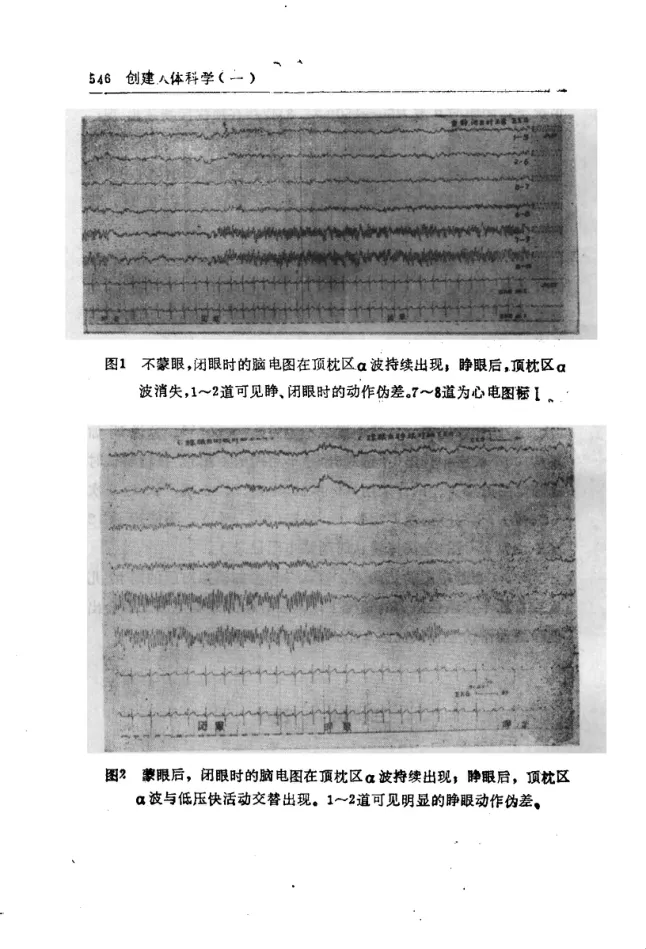 After blindfolding, the EEG during eye closure shows continuous alpha waves in the parieto-occipital region; after opening the eyes, alpha waves and low-voltage fast activity alternate in the parieto-occipital region. Obvious eye-opening movement artifacts can be seen in channels 1–2.
Figure 3 EEG record during contact recognition when the sample was recognized (Channels 7–8 are 7–11, 8–12).
Figure 4
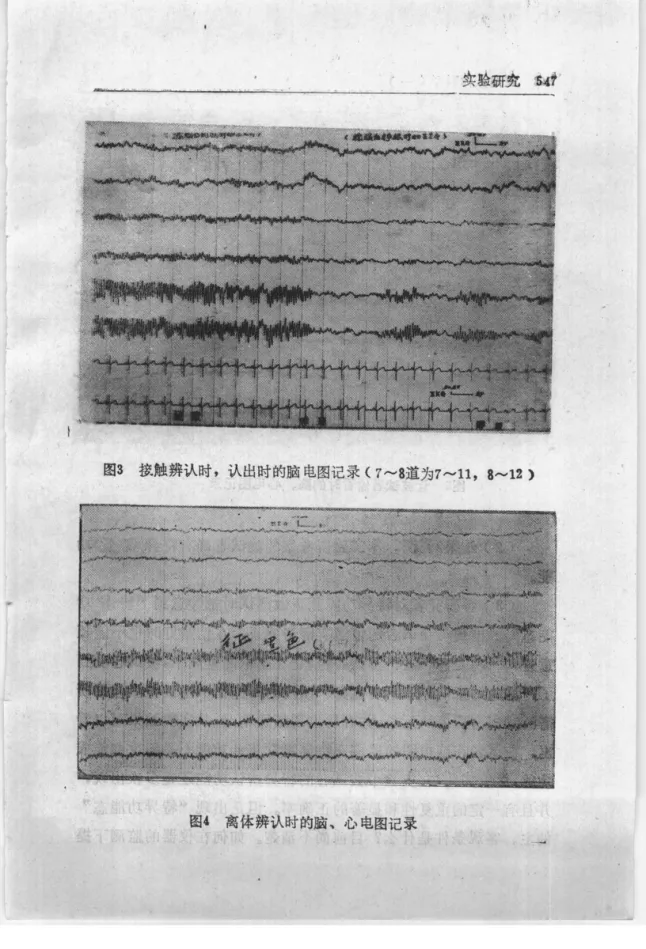 EEG and ECG records during non-contact recognition.
Figure 5. EEG and ECG recordings when the subject peeks.
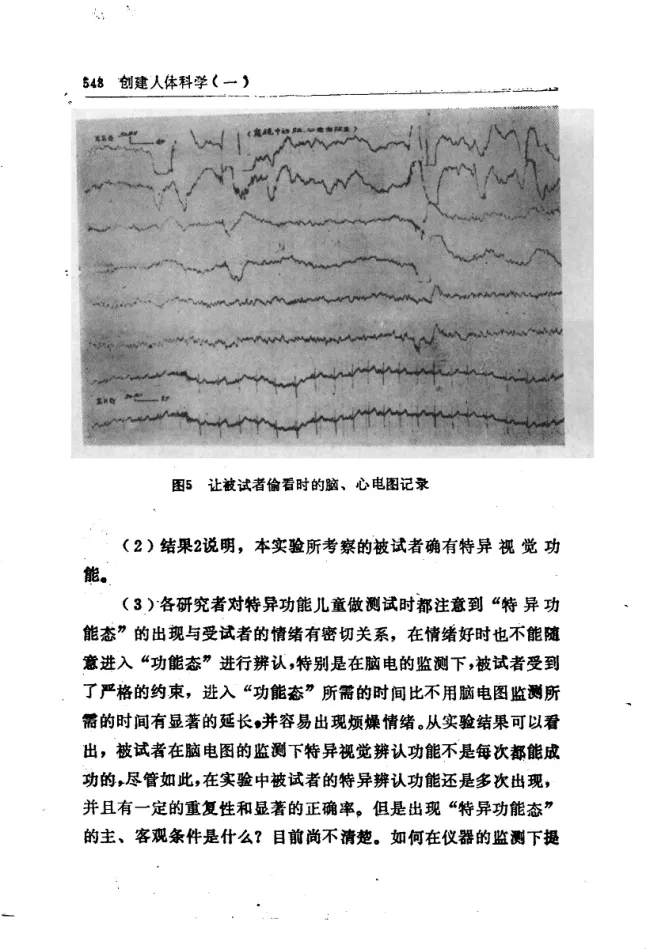
(2) Result 2 demonstrates that the subject examined in this experiment genuinely possesses extraordinary visual function.
(3) All researchers who have conducted tests on children with extraordinary functions have noted that the emergence of the “extraordinary functional state” is closely related to the emotional state of the subject. Even when in a good mood, the subject cannot enter the “functional state” at will to perform recognition. In particular, under EEG monitoring, the subject is subjected to strict constraints, and the time required to enter the “functional state” is significantly longer than when EEG monitoring is not used; irritability also tends to occur more readily. From the experimental results, it can be seen that the subject’s extraordinary visual recognition function under EEG monitoring does not succeed every time. Nevertheless, during the experiment, the subject’s extraordinary recognition function did appear on multiple occasions, with a certain degree of repeatability and a significant accuracy rate. However, what are the subjective and objective conditions that give rise to the “extraordinary functional state”? At present, this remains unclear. How, under instrumental monitoring, can one
improve the subject’s function and identify its patterns? This is precisely a topic that each of us researchers needs to continue exploring.
(4) The electroencephalogram (EEG) is currently one of the principal methods for examining the functional state of the brain and is also an important tool in modern psychological research. All changes occurring during the life process, especially those in the nervous system, can be reflected in the EEG [2]. This indicates that the “functional state” of children with extraordinary functions and the final recognition achieved through extraordinary vision are formed in the brain. While observing the entire process by which the subject performed extraordinary visual recognition under EEG monitoring, we recorded sustained EEG waves at 9–9.5 Hz/s in the parieto-occipital region; short-duration asymmetry of α waves on the left and right sides and occasional isolated slow waves were also observed. Before the sample was recognized, paroxysmal medium-voltage (30–50 μV), 4–6 Hz/s waves appeared in the frontopolar region, which bears similarities to the EEG of qigong masters during the state of “entering tranquility” [3]. Although these changes all fall within the range of variation permitted in the EEGs of normal children, what connection they may have with the “extraordinary functional state” warrants further observation and investigation.
We performed a macroscopic analysis of each EEG monitoring record. Aside from the findings described above, there were no significant changes in the distribution, frequency, voltage, or bandwidth of brain waves during the process of extraordinary visual recognition, nor did we discover any distinctly specific changes in brain waves when recognition was accurate. Because the instrument we used was insufficiently sensitive, our results cannot prove that the above indicators definitely underwent no change.
IV. Conclusion
Using EEG to monitor the authenticity of extraordinary vision is one of the effective physiological methods. Under EEG monitoring, the one subject examined was indeed able to achieve recognition with eyes closed and entirely
with a significant accuracy rate for the samples, thereby demonstrating that extraordinary visual function exists objectively.
This group of experiments received strong support from the leadership of Taiyuan Railway Central Hospital. We also express our gratitude to Sun Mengjia, Associate Professor at Shanxi University; Dong Shuxin, Lecturer at Shanxi Medical College; Wang Delei, Attending Physician at the Shanxi Provincial Institute of Traditional Chinese Medicine; Technician Li Shenying; Huang Qipei, Associate Chief Physician at Taiyuan Railway Central Hospital; and Wang Qiaoguang, Director of the Department of Neurology, for their guidance and assistance.
Notes and References
[1] Research on Extraordinary Human Abilities, 1 (1983) 9.
[2] Department of Electrophysiology, Beijing Neurosurgical Research Institute, ed.: Lecture Notes on Clinical Electroencephalography (1974).
[3] Mei Lei et al., Nature Journal, 9 (1981) 662.
[4] Wang Dekun et al., Nature Journal, 11 (1982) 803.
[5] Chen Xin, Mei Lei, Research on Extraordinary Human Abilities, 1 (1983) 28.
A Preliminary Investigation into Using Modern Medicine to Verify Extraordinary Human Abilities
Yang Junpeng, Liu Xing
[Editor’s Note]
Comrade Yang Junpeng, Vice President of the Urumqi General Hospital of the Lanzhou Military Region of the Chinese People’s Liberation Army, and colleagues began with tests on individuals with extraordinary abilities involving color recognition, character recognition, and the like. Combining this with clinical medical work, they carried out scientific, rigorous, and serious verification of the X-ray vision function of a person with extraordinary abilities named Xiao Long. This article reports not only the basic situation of their verification work across 117 clinical cases but also provides detailed descriptions of specific test instances—including both successes and failures. The report is therefore objective and of statistical significance. We trust that readers will form their own judgments on this issue.
From the perspective of their experimental design, the methods adopted, and the training and cultivation work they carried out with the person possessing extraordinary abilities, their efforts are well worth emulating by other colleagues engaged in human-body science research.
On June 6, 1981, during testing at the Autonomous Region Science and Technology Association of a youth named Xiao Long with extraordinary abilities—who could recognize characters, read characters by touch, distinguish colors, and identify images using her ear and hand—it was found that her accuracy rate was high. We therefore conceived the idea of whether this non-visual X-ray function could be applied in clinical medicine for the diagnostic examination of diseases. When we asked Xiao Long about this at the time, her answer was “I don’t know.” Accordingly, on June 10, 1981, she was specially invited to our hospital for testing.
Xiao Long, female, 16 years old, is a student at a certain middle school in Urumqi. In March 1981, she
After watching the movie “Do You Believe It or Not”, she discovered during self-testing that she could “hear” characters, and later her parents and sisters tested her and confirmed that she indeed possessed the extraordinary ability to “hear” characters and recognize characters by touch with her hands.
Testing in our hospital was conducted in different environments and among people of different professions. Those who participated in the testing included relevant leaders, hospital leaders, administrative cadres, doctors, cooks, and so on. The tests were conducted in unfamiliar environments, and there could be no possibility of suggestion. We successively conducted over 1,200 tests on Xiao Long’s non-visual recognition of characters, pictures, and color differentiation (over 3,800 characters and pictures, including Chinese, Uyghur, English, Japanese, self-created characters, and various patterns and colors). The complete accuracy rate reached 99.8%. These test results further indicate that Xiao Long truly possesses extraordinary abilities. Does this extraordinary ability have the capacity for clairvoyant diagnosis and the treatment of diseases in the human body? We had her conduct a test for the first time on a patient with gallstones, and achieved satisfactory results (see Typical Case 1). Based on this, we hypothesized that it is possible to use extraordinary abilities to diagnose diseases in clinical medicine, and therefore established an exploratory work focusing on applied research and supplemented by basic research.
In June 1981, our hospital established an extraordinary abilities research group and formulated a special training plan for Xiao Long. Using modern scientific examination techniques—such as X-rays, ultrasound, radioisotopes, as well as CT, clinical diagnosis, and surgical confirmations—as objective bases, we evaluated the accuracy of extraordinary ability clairvoyant diagnosis and explored its application value in clinical medical disease diagnosis. From June to November 1981, we investigated a total of 117 cases of disease diagnosis using extraordinary ability clairvoyance, covering 33 types of diseases. The accuracy rate and basic accuracy rate accounted for 89.8%, the inaccuracy rate accounted for 8.5%, and the uncertain rate accounted for 1.7%. In the experiments, inpatients were the main subjects of clairvoyance, and the clinical medical staff treating the patients served as authenticating witnesses to conduct the research together.
I. Induction and Training
Based on Xiao Long’s ability to recognize characters, pictures, and differentiate colors non-visually, we conducted induction and excitation training for her. We taught her some knowledge of anatomy, physiology, and pathology, and showed her anatomical models
and atlases. Combined with anatomical knowledge and atlases, we read X-ray films of relevant organs with her, such as the imaging of gallbladder angiography, fetal position, and intravenous pyelography, progressing from normal to normal variations and up to pathological changes. We also observed the dynamics of internal organs under X-ray television to improve her cognitive ability regarding diseases, and asked her to describe the images, brightness, and colors observed non-visually in order to master her clairvoyant ability. During the induction and excitation training process, we progressed from the shallow to the deep, from the easy to the difficult. We started with obvious lesions and space-occupying lesions, such as gallstones, fetal position, brain tumors, and cerebral hemorrhage, and then progressively moved to more subtle lesions, cerebrovascular diseases, congenital heart diseases, and liver diseases. We specifically required Xiao Long to seek truth from facts to ensure the objectivity and scientificity of her clairvoyant ability.
II. Observation Methods and Steps
In order to ensure objectivity, seriousness, and scientificity during the testing process, we adopted the following steps for testing and observation.
(1) Each time a test for diagnosing diseases using extraordinary ability clairvoyance is conducted, it must be witnessed by the department’s treating physicians, attending physicians, and the department director. For outpatient cases, at least three people are required to co-participate in the test. A strict blind method must be adopted regarding the subject’s condition, symptoms, and various special examination results: the person with extraordinary abilities (tester) does not know who is being examined, and the subject (patient) does not know what examination is being performed. The evaluator does not know the clinical condition. The tester, the subject, and the evaluator—the three parties—do not know the condition, whereas only the treating physician (attending physician or deputy chief physician) knows the patient’s condition and the results of various special examinations. This avoids creating false appearances.
The evaluation criteria are described as follows: (1) Completely accurate: The results of the extraordinary ability clairvoyance are completely consistent with the clinical condition, diagnosis, and various special examination results. The location, morphology, texture, color, and organs match completely. (2) Basically accurate: There are some omissions and discrepancies compared with the medical history and examination results.
(2) Establish complete data registration, design extraordinary ability clairvoyance medical records, including the name, gender, age, bed number, medical record number, and X-ray number of the subject patient, a summary of the medical history, the clinical diagnosis, the site and purpose of the required examination, and various special examinations such as X-ray, CT, radioisotope, electrocardiogram, electroencephalogram, fiber endoscopy, cardiac catheterization, surgical records, and pathological results. The test is conducted first, and the above items are recorded afterwards to ensure the objectivity of the test results.
(3) Record the test results in detail, and illustrate with drawings what is seen through extraordinary ability clairvoyance. Based on what is seen through extraordinary ability clairvoyance, the evaluation team uses medical scientific methods and terminology to provide diagnostic opinions on the extraordinary ability clairvoyance. Finally, the tester and the evaluator sign and fill in the year, month, and day to facilitate summary research.
The extraordinary-ability fluoroscopic examination group for craniocerebral diseases comprised 22 cases across 8 types of diseases; 17 cases were completely accurate, accounting for 77.2%; 4 cases were basically accurate, accounting for 18.2%, giving an accuracy rate of 95.46%; 1 case was inaccurate, accounting for 4.54%. The accuracy rate for this group was higher than that of the other groups; see Table 1, Cases 2–5, and Appendix Figures 6–9.
In extraordinary-ability fluoroscopic diagnosis of hepatobiliary diseases across 53 cases, accurate cases accounted for 90.53% (43 cases completely accurate, accounting for 81.1%; 5 cases basically accurate, accounting for 9.43%), 4 cases inaccurate accounting for 7.54%, and 1 case unclear accounting for 1.88% (see Table 2). Among the 23 cases of gallbladder stones in this group, 18 cases were completely accurate or basically accurate, accounting for 78.26%; see Case 1 and Figures 1–3; 5 cases were inaccurate or unclear, accounting for 21.7%; see Case 11. Whether the overlapping of gastrointestinal contents in the abdominal organs, which exhibits substantial mobility, affects the accuracy rate remains to be studied.
The extraordinary-ability “fluoroscopy” fetal-position group comprised 19 cases; 16 cases were accurate or basically accurate, accounting for 84.3%, and 3 cases were inaccurate, accounting for 15.7%. Due to limitations of field of view and medical knowledge, the accuracy rate was lower than that of the other groups; see Table 3 and Case Reports 9 and 10, Figures 7 and 8.
The “fluoroscopy” group for other diseases comprised 23 cases across 13 types of diseases; see Table 4. Case 6 and Figure 6 involve a case of central-type lung cancer; the “fluoroscopy” was consistent with X-ray and pathological diagnoses. Because this group comprises many disease types, few cases, and complex conditions, the diagnostic accuracy rate was comparatively low.
V. Case Descriptions
Case 1: Hai ××, female, age 42, case number 49016, X-ray number 47783. Right upper quadrant colic, intermittent episodes for over 6 years; admitted upon colic episode this time.
Examination: tenderness at the right upper quadrant below the costal margin; gallbladder palpable; Murphy’s sign positive.
Soft 86 Among them there were 6 hard masses, polygonal in shape, with smooth margins”; see Figure 1.
On June 10, 1981, cholecystography led to a diagnosis of cholelithiasis (the stone masses were poly-
| Disease Name | No. of Cases | Completely Accurate | Basically Accurate | Inaccurate | Remarks |
|---|---|---|---|---|---|
| Brain tumor | 6 | 4 | 1 | 1 | |
| Posterior cranial fossa tumor | 2 | 1 | 1 | ||
| Spinal canal tumor | 1 | 1 | |||
| Cerebrovascular embolism | 5 | 4 | 1 | ||
| Cerebral hemorrhage | 3 | 3 | |||
| Cerebrovascular malformation | 1 | 1 | |||
| Bilateral cerebral swelling; | |||||
| Forest encephalitis | 1 | 1 | Uneven, no tumor | ||
| Normal craniocerebrum | 3 | 3 | |||
| Total | 22 | 17 | 4 | 1 | |
| (77.2%) | (18.2%) | (4.54%) |
Table 2: Extraordinary-Ability Fluoroscopic Diagnosis of Hepatobiliary Diseases
| Disease Name | No. of Cases | Completely Accurate | Basically Accurate | Inaccurate | Unclear |
|---|---|---|---|---|---|
| Normal gallbladder | 6 | 6 | |||
| Gallbladder stones | 23 | 16 | 2 | 4 | 1 |
| Chronic cholecystitis | 11 | 11 | |||
| Postoperative gallbladder | 5 | 4 | 1 | ||
| Gallbladder and bile duct stones | 2 | 1 | 1 | ||
| Common bile duct stricture | 7 | 1 | |||
| Liver tumor | 4 | 3 | 1 | ||
| Total | 53 | 43 | 5 | 1 | |
| (81.1%) | (9.43%) | (7.54%) | (1.88%) |
Table 3: Extraordinary-Ability Fluoroscopic Diagnosis of Fetal Position
| Name | No. of Cases | Completely Accurate | Basically Accurate | Inaccurate |
|---|---|---|---|---|
| Head | 13 | 10 | 1 | 2 |
| Buttocks | 2 | 1 | 1 | |
| Transverse | 2 | 2 | ||
| Twins | 1 | 1 | ||
| Anencephaly | 1 | 1 | ||
| Total | 19 | 15 (78.9%) | 1 (5.2%) | 3 (15.7%) |
Table 4: Extraordinary-Ability Fluoroscopic Diagnosis of Other Diseases
| Disease Name | No. of Cases | Completely Accurate | Basically Accurate | Inaccurate | Unclear |
|---|---|---|---|---|---|
| Pulmonary malignant tumor | 4 | 4 | |||
| Hilar calcification | 1 | 1 | |||
| Kidney stone | 1 | 1 | |||
| Adrenal tumor | 1 | 1 | |||
| Normal kidney | 3 | 2 | 1 | ||
| Ventricular septal defect | 4 | 2 | 1 | 1 | |
| Clavicle fracture | 1 | 1 | |||
| Costal chondritis | 1 | 1 | |||
| Fallopian tube cyst | 1 | 1 | |||
| Abdominal wall tumor | 1 | 1 | |||
| Hydronephrosis | 1 | 1 | |||
| Thoracoabdominal scar | 3 | 2 | 1 | ||
| Knee meniscus cyst | 1 | 1 | |||
| Total | 23 | 15 (65.2%) | 5 (21.7%) | 2 (8.7%) | 1 (4.34%) |
gonal in shape); see Appendix Figure 13. On June 23, 1981, surgery confirmed this, and 6 polygonal stones were removed; see Appendix Figure 14.
Case 2: Liao ××, female, age 38, case number 171024, X-ray number 65479. Headache, dizziness, and memory decline for 10 months; symptoms worsened for 1 month; urinary incontinence for 8 days; intermittent epileptic seizures; lumbar puncture pressure 340 mmH₂O; drowsiness; bilateral optic disc edema with blurred margins.
On June 26, 1981, extraordinary-ability fluoroscopic examination indicated “a hard mass in the middle of the brain, approximately 4×4 cm,” diagnosed as a brain tumor; see Figure 2.
On June 26 and July 6, 1981, cerebral angiography and Conray angiography were performed respectively, diagnosing a tumor in the anterior part of the third ventricle on the frontal midline; see Appendix Figures 15 and 16. Surgery performed the same day confirmed a glioma in the anterior part of the frontal third ventricle.
Case 3: Du ××, female, age 40, case number 94971. The patient’s blood pressure was 130/110 mmHg. On June 4, 1981, she suddenly experienced headache, dysphagia, aphasia, and right lower-limb weakness, and fell to the ground. She was admitted to the outpatient department with right-sided [hemiplegia].
Examination: The right nasolabial fold was flattened; muscle strength in the right upper and lower limbs was grade 0; the right forearm had paroxysmal twitching; pain and touch sensation on the right side of the body disappeared; right Babinski sign was positive. Clinical
(0
Figure 1: Schematic diagram of extraordinary-ability fluoroscopy findings. Figure 2: Brain tumor location drawn by extraordinary-ability fluoroscopy. Figure 3: Extraordinary-ability fluoroscopy diagnosis of
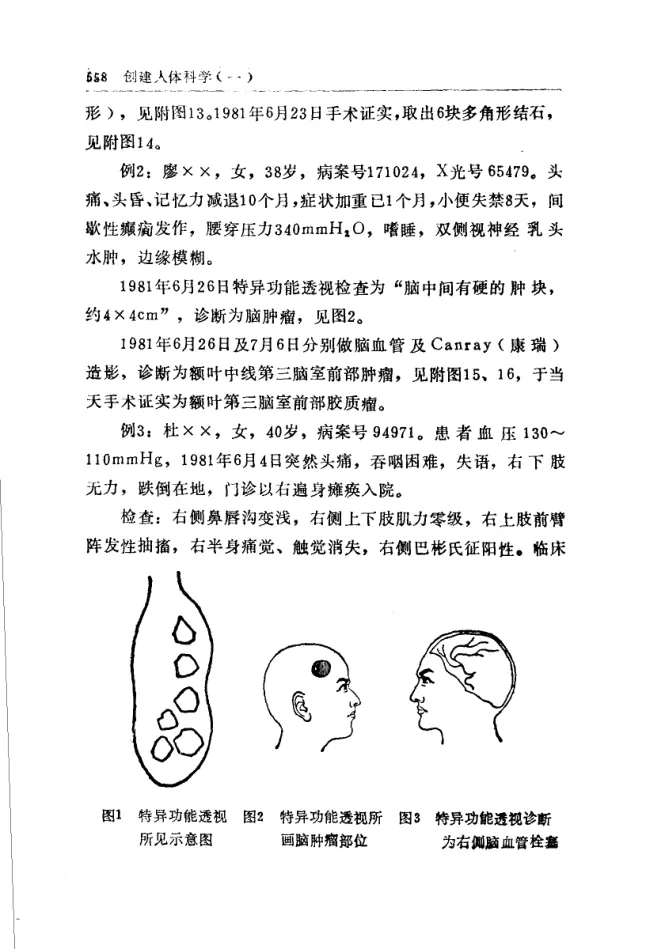
Initial diagnosis: cerebral thrombosis; condition worsened on June 5, with vomiting. At that time, an extraordinary-ability cranial fluoroscopy examination revealed “a 0.8 × 1 cm area of hemorrhage on the left side, with a small blood vessel squeezing and leaking blood outward.” Lumbar puncture yielded bloody cerebrospinal fluid, with a red blood cell count of 2800 cells/mm³, and the clinical treatment plan was changed to one for cerebral hemorrhage. On June 21, an extraordinary-ability fluoroscopy scan stated: “Bleeding has stopped and there is some absorption; the small blood vessel that bled has become somewhat thinner, and blood can flow through.” Subsequent lumbar puncture showed normal cerebrospinal fluid, muscle strength recovered to grade 4, and the patient was discharged on October 10. On November 10, 1981, the patient underwent a CT scan at the General Hospital of the Military Region. The brain scan showed a low-density area of about 1.3 × 1.3 cm in the left temporoparietal lobe, considered to be an old cerebral hematoma. CT number 001909.
Case 4: Yin XX, male, 65 years old, case number 171644, X-ray number 65891. At 9:00 a.m. on June 18, 1981, he suddenly felt a headache, generalized weakness on the left side making him unable to stand, a crooked right corner of the mouth, slurred speech, clear consciousness, shallow left nasolabial groove, and left-side muscle tone of grade zero. On September 2, 1981, extraordinary-ability fluoroscopy showed: “The right cerebral blood vessels are flat (poor vascular filling), blood flow is slow, and the brain tissue is soft and somewhat collapsed.” The diagnostic opinion of the extraordinary-ability fluoroscopy was: right cerebral vascular embolism. See Figure 3. Cerebral angiography examination diagnosed it as right middle cerebral artery embolism. See Appendix Figures 6 and 7.
Case 5: Che XX, male, 35 years old, case number 17100, X-ray number 45828. The patient was admitted on June 7, 1981, with a high fever accompanied by headache, convulsions, vomiting, and dullness for one day. He had frequently gone to the mountains to collect medicinal herbs recently. After being bitten by a tick a month before admission, he received an intramuscular injection of one dose of forest encephalitis vaccine on May 1 and May 20, respectively. Examination: body temperature 39.6°C, pulse 108 beats/min, respiration 22 breaths/min, blood pressure 130/80 mmHg, total white blood cell count 11800 cells/mm³, neutrophils 83%. On June 12, neck stiffness appeared, and the muscle strength of the right upper limb decreased. June 24 cerebrospinal fluid examination: Pandy’s test (+), protein 62 mg%, sugar 87 mg%, right upper limb paralysis. Clinically suspected of having an
intracranial space-occupying lesion. On June 26, 1981, extraordinary-ability fluoroscopy showed: “High tension in the left and right brain tissue (parietal lobe), swollen and appearing pink, with an uneven surface of the brain tissue (the lesion area on the left side is about 6 × 6 cm, and on the right side about 3 × 3 cm), but there is no space-occupying lesion on either side.” On July 28, 1981, left cerebral angiography showed no space-occupying lesion (see Appendix Figures 8 and 9). Cerebral ultrasound examination showed no midline shift, consistent with the geometric center. Diagnosed as forest encephalitis; basically cured and discharged after treatment with penicillin, interferon, and Banlangen (Isatis root).
Case 6: Liu XX, female, 49 years old, case number 171013, X-ray number 21348. The patient had experienced frequent right chest pain for over 4 months, radiating to the back, with hemoptysis, weight loss, and poor appetite. On June 19, 1981, extraordinary-ability fluoroscopy showed: “A mass in the medial right lung, about 3 × 3 cm, with an irregular edge.” The extraordinary-ability fluoroscopy opinion: right lung tumor. See Figure 4. X-ray plain film and tomography diagnosed it as central-type lung cancer of the right lung. See Appendix Figures 10, 17, and 18. On June 24, 1981, fiberoptic bronchoscopy examination indicated central-type lung cancer of the right lung. The pathology report on June 26 indicated undifferentiated lung cancer (pathology number 32120).
Case 7: Peng XX, female, 42 years old, case number 171468, X-ray number 65654. An upper abdominal mass had been found for over two years. Liver function was normal, the alpha-fetoprotein test was negative, and a hospital liver scan twice diagnosed a space-occupying lesion in the left lobe of the liver. Extraordinary-ability fluoroscopy revealed: “a round mass, about the size of a fist, not on the liver.” See Figure 5. On July 14, 1981, a barium meal fluoroscopy revealed a mass impression at the lesser curvature of the stomach, but it did not protrude into the gastric cavity. The X-ray diagnostic opinion was an extragastric mass. See Appendix Figure 11. A liver scan at our hospital showed no space-occupying lesion in the liver (radionuclide number 1994). Surgery on August 15, 1981, confirmed it as: a hemangioma of the lesser curvature of the stomach, about 15 × 12 × 6 cm.
Case 8: Zhu XX, male, 45 years old, outpatient. In January 1981, he contracted hepatitis B. In September, he went to Hospital 301, where a CT scan diagnosed a cystic lesion in the upper right part of the liver, about 4.3 × 4.7 cm in size. See Appendix Figure 19.
Figure 4: Extraordinary-ability fluoroscopy result showed a tumor shadow on the medial side of the lung. Figure 5: Extraordinary-ability fluoroscopy revealed a purplish-red tumor the size of a fist below the left lobe of the liver.
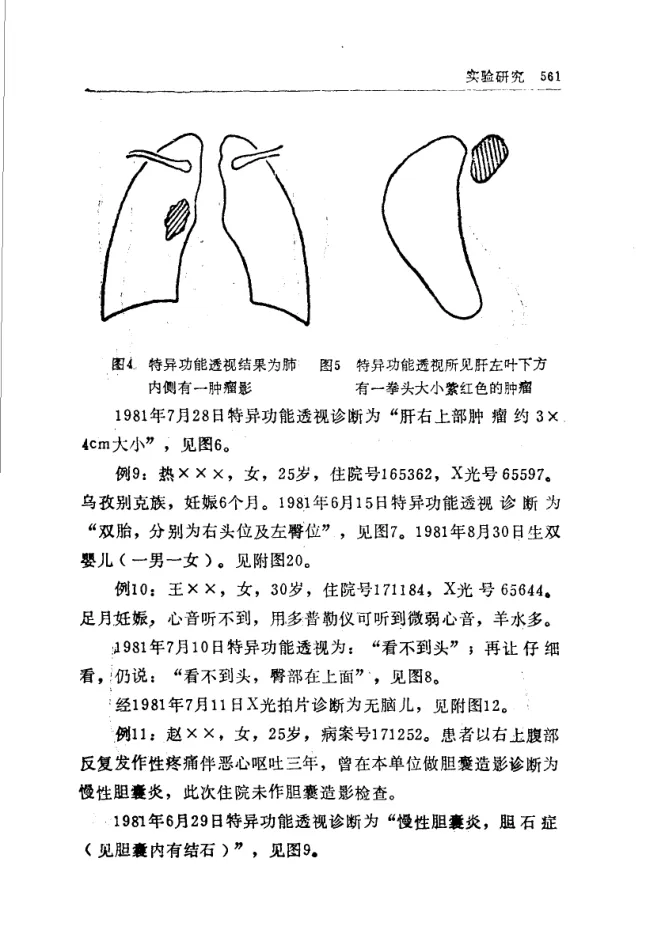
On July 28, 1981, extraordinary-ability fluoroscopy diagnosed “a tumor in the upper right part of the liver, about 3 × 4 cm in size.” See Figure 6.
Case 9: Re XXX, female, 25 years old, inpatient number 165362, X-ray number 65597. Uzbek ethnicity, 6 months pregnant. On June 15, 1981, extraordinary-ability fluoroscopy diagnosed “twins, presenting as right cephalic and left breech.” See Figure 7. On August 30, 1981, she gave birth to twin infants (one boy, one girl). See Appendix Figure 20.
Case 10: Wang XX, female, 30 years old, inpatient number 171184, X-ray number 65644. Full-term pregnancy, no heart sounds could be heard, weak heart sounds could be heard with a Doppler instrument, and there was polyhydramnios. On July 10, 1981, extraordinary-ability fluoroscopy showed: “Cannot see the head”; when asked to look carefully again, she still said: “Cannot see the head, the buttocks are on top.” See Figure 8. An X-ray film on July 11, 1981, diagnosed it as anencephaly. See Appendix Figure 12.
Case 11: Zhao XX, female, 25 years old, case number 171252. The patient had experienced recurrent paroxysmal pain in the right upper abdomen accompanied by nausea and vomiting for three years. She had been diagnosed with chronic cholecystitis by cholecystography at her previous work unit, and did not undergo cholecystography during this hospitalization. On June 29, 1981, extraordinary-ability fluoroscopy diagnosed “chronic cholecystitis, cholelithiasis (gallstones seen in the gallbladder).” See Figure 9.
Figure 6: Extraordinary-ability fluoroscopy diagnosed an upper liver tumor, about 3 × 4 cm. Figure 7: Extraordinary-ability fluoroscopy diagnosed twins. Figure 8: Extraordinary-ability fluoroscopy diagnosis: cannot see the head. Figure 9: Findings of extraordinary-ability fluoroscopy.
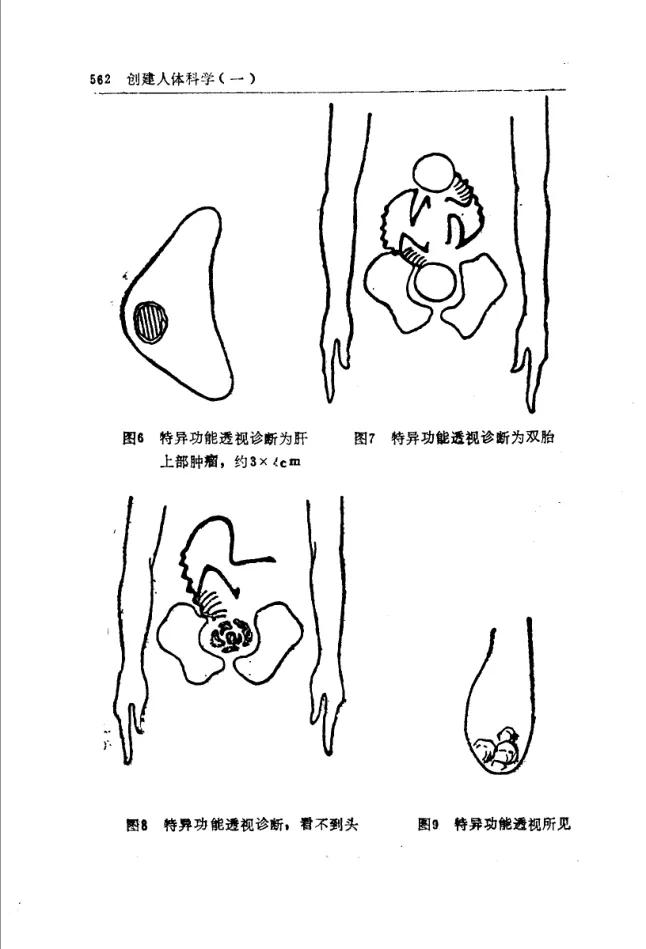
The surgery performed on July 2, 1981 revealed only peri-cholecystic adhesions and thickening of the gallbladder wall; the diagnosis was chronic cholecystitis, and no gallstones were found. The original diagnosis was erroneous: a fecal mass in the colon overlapping the lower portion of the gallbladder had been mistaken for a gallstone.
VI. Discussion
(1) We believe that using extrasensory perception to diagnose diseases is feasible and holds value for clinical medicine. The results of this experiment reflect the objectivity and scientific validity of diagnosing diseases through extrasensory perception. However, at present we have only verified the possibility and value of this method; it cannot yet serve as a standalone diagnostic tool. A great deal of further work remains to be done, using objective facts to demonstrate that it can indeed diagnose disease.
(2) We believe that diagnosing diseases through extrasensory perception is a non-invasive diagnostic method that does not cause suffering to patients. This is one respect in which it is superior to other examination methods. However, after “scanning” three to five patients, Xiao Long felt physically fatigued, which indicates that its use must not exceed certain limits and should be kept within appropriate bounds.
(3) Diagnosing diseases through extrasensory perception utilizes a natural endowment of humanity to serve humanity. Discovering such individuals to serve patients is a contribution to humankind and also represents intellectual development; allowing such individuals to go unrecognized is a waste of social resources. This method of examining disease is simple, convenient, economical, and practical.
(4) The training of individuals with extraordinary abilities possesses characteristics of inducibility and specificity. In the initial stage, Xiao Long’s extraordinary abilities were relatively weak and limited to “scanning” and diagnosing diseases using her ears. In order to free her hands, we conducted induction training on her hands. After a period of induction training, her hands were also able to “scan” and diagnose diseases, progressing from an inability to distinguish colors and textures to being able to do so, and from requiring a relatively long time (10–15 minutes) to only 2–3 minutes. However, not all individuals with extraordinary abilities are able to diagnose diseases. For example, Xiao Wang, female, age 14,
was able to recognize characters with both hands, but when she placed her hands on the patient’s affected area, she could not “see” anything at all. This shows that extraordinary abilities share common features but also have individual characteristics. Therefore, if individuals with extraordinary abilities are to be applied in clinical medicine, they must be selected.
(5) If individuals with extraordinary abilities are to be applied in clinical medicine, the contradiction between learning and application must be resolved. In general, they lack medical knowledge and need to learn essential medical knowledge, especially anatomy, pathophysiology, and diagnostics. At the same time, they must also engage in appropriate clinical application to consolidate their existing extraordinary abilities, and to induce, stimulate, and strengthen new extraordinary abilities, so that while their medical knowledge continuously grows, the extraordinary abilities they possess are maintained and enhanced. This requires scanning, training, and improving simultaneously. For this reason, we specifically arranged a schedule for Xiao Long’s extraordinary-ability work and training, strictly controlling her use to prevent improper application from causing suppression, fatigue, degeneration, or even disappearance of her extraordinary abilities.
(6) Factors affecting the diagnostic accuracy rate of individuals with extraordinary abilities. Through 1,200 instances of character recognition, image identification, and color discrimination, as well as observation of extrasensory diagnostic scanning of 117 patients, we believe that the factors affecting its accuracy are multifaceted. Mental state, illness, testing environment, and lighting conditions all have a noticeable impact on testing. For example, when Xiao Long was tested for character recognition, image identification, and color discrimination during a cold, the initial attempt took as long as 10–12 minutes, demonstrating that a cold has a clear impact on the expression of extraordinary abilities. Because individuals with extraordinary abilities lack medical knowledge, they sometimes cannot
accurately identify the gallbladder, mistaking a fecal mass within it for a gallstone (see Case 11), accounting for 4 such misdiagnoses. In another instance, because they could not distinguish the characteristics of the fetal head and buttocks, a breech-position expectant mother was seen as being in cephalic position, and two cephalic-position cases were mistaken for breech position, for a total of 3 misdiagnoses. The influence of light is even greater: in darkness, Xiao Long could not “scan” characters and shapes, nor could she perform “diagnostic scanning.” Xiao Long’s extrasensory “field of view” is limited, approximately 15 × 15 cm, and is also affected by the scanning angle and depth, so multi-angle scanning is necessary. Moreover, the penetrating ability has a certain limit: if the object is too thick, it cannot be penetrated. The transparency of the human body is greater than that of other substances; books can only be penetrated through a few pages, while the depth of “scanning” into the human body can reach approximately 10–15 cm.
On the Question of the Universality of Special Perceptual Abilities in the Human Body
Chen Shouliang He Muyan, Wang Chu Zheng Lemin Shao Shaoyuan Zhang Zuqi Liu Zhaoqian Wu Baogang
[Editor’s Note]
After personally conducting experiments and confirming the objective existence of extrasensory character recognition, Associate Professors Chen Shouliang and He Muyan carefully observed the physical condition, personality, academic performance, and other aspects of the individuals with extraordinary abilities. They felt that these individuals were not particularly unusual. Together with Associate Professor Wang Chu of the Department of Radio Electronics at Peking University and eight teachers from other departments, they formed an experimental group. Using their spare time, they conducted thorough discussions of these phenomena and carried out tests on the young daughters of Professors Chen Shouliang and He Muyan. After several trials, their young daughters also displayed extraordinary abilities. They then tested their daughters’ classmates and neighborhood children who volunteered to participate, and all obtained exciting results. When Comrade Chen Shouliang described these results to his classmate — Old Huang of the Shanghai Brain Research Institute — Old Huang remarked that perhaps this ability was not limited to only a small number of people. This remark greatly inspired Comrade Chen Shouliang and his colleagues. With the support of relevant units, they conducted induction experiments on children around ten years of age, and to their surprise, 40% of the children possessed this ability.
After this original experiment was published, it aroused an enormous response nationwide. Many people adopted this method one after another to conduct surveys among groups of children and obtained the same results. These results indicate that the ability to recognize characters and images using non-visual body parts such as the hands is not extraordinary; at the very least, it exists in a latent form universally among children and adolescents.
…It can be manifested simply through induction. The discovery of the universality of extraordinary human abilities in turn proves the objective authenticity of the phenomena of extraordinary human abilities.
The discovery that extraordinary human abilities possess universality is a major contribution of our country’s scientific and technological personnel; it provides a theoretical basis for cultivating subjects to deeply study this phenomenon.
At the same time, we would like to take this opportunity to express our respect to the parents of some individuals with extraordinary abilities and to researchers. In order to explore the mysteries of the human body, they bravely experimented with their own children. Although years of practice have proven that training in extraordinary abilities does not hinder the physical health and development of children and adolescents, at the time, they dared to conduct such exploration. This spirit is noble and highly commendable.
Author’s institution for this article: Peking University.
Is the human body’s special perceptual function possessed only by a very small number of people, or does it have a certain degree of universality among the population? From October 1979 to the end of December 1979, we successively tested 40 children around 10 years old, and the results showed that a considerable proportion of the subjects possessed varying degrees of special perceptual function.
Most of the children and adolescents who participated in the test came voluntarily, and we did not conduct any selection. All those who came were tested; subjects sent to us after pre-testing and screening by others were not included in the statistical data, even if they possessed this function.
The children and adolescents participating in the test generally first observed the testing process of others, allowing them to personally understand that some people indeed possessed this special perceptual function, arousing their interest in participating in the test. There were also some subjects who had not observed the tests of others but learned about this function through the introduction of the experimenter.
When we started testing, we followed the method by which this function was initially discovered, namely writing on a piece of paper and placing it in the subject’s ear for testing. Later, we discovered two other testing methods that made it easier to detect this special perceptual function, so we switched to the latter two methods. One method was to feel pictures by hand inside a cloth
sleeve. That is, a dark, thick square cloth about 50 cm on each side was folded in half and sewn into a sleeve, and cloth ribbons were inserted at both ends for tying. Test pictures were placed inside the cloth sleeve (generally using colored literacy pictures about 4 cm on each side). The subject extended their hands into the cloth sleeve from both ends respectively (tied with cloth ribbons) to touch the picture. After they stated the shape and color of the picture they touched, the cloth ribbons were untied, and the picture was taken out of the cloth sleeve for verification. Another testing method involved placing paper slips with written words or pictures into a black plastic ink box about 4 centimeters in diameter. After sealing the lid tightly, it was sealed with scaling wax. The subject was asked to hold it in their hands or place it on other parts of the body to identify it. After the subject stated their identification result, they returned the plastic box. After checking that the scaling wax seal was intact, the plastic box was opened for verification. Both methods could eliminate the role of the eyes. From the test results, the cloth sleeve picture-feeling method was relatively easier for discovering this special perceptual function. This might be because the hand was in direct contact with the picture in the cloth sleeve, and the amount of information on the picture was larger than that of the text on the paper slip, whereas the paper slips or pictures sealed in the black plastic ink box were more difficult to identify. Therefore, we considered any subject who could correctly identify 5 out of 10 pictures felt in the cloth sleeve as having an elementary special perceptual function, named Level I special perceptual function; any subject who could correctly identify 5 paper slips or pictures out of 10 sealed black plastic ink boxes was considered as having a Level II special perceptual function. The test results are shown in the appendix table at the end of the text.
Of the 40 subjects, 16 have now been tested as having special perceptual functions, accounting for 40%. Among them, 15 reached Level I, accounting for 38%, and 9 reached Level II, accounting for 23%. Subjects who reached Level II could generally reach Level I, with only 1 subject unable to meet the Level I testing standard. Currently, 24 subjects, accounting for 60%, have not yet been tested for special perceptual functions or have not met the testing standards.
We observed that the level of special perceptual function in children and adolescents can be gradually improved through testing activities. A small number of subjects had a quite high function level at the beginning of the test, reaching Level I or Level II (such as Xiao Lan), while most subjects gradually improved their function level during the testing process. For example, Xiao Wen initially had no response in the first test, but through guidance and induction, began to show some responses, and subsequently improved gradually, successively reaching Level I and Level II; Xiao Qi
had consistently low function levels and improved slowly during the two-month testing process. However, during the test on the 8th experimental day, they suddenly made great progress, successively reaching Level I and Level II.
Therefore, we believe that some of the aforementioned 60% of subjects who have not yet been tested for special perceptual functions (or have not met the testing standards) may potentially improve their special perceptual function levels through testing activities.
Based on the above test results, we believe that among children and adolescents, this special perceptual function carries a certain degree of universality. We conjecture that this function may be a physiological function in a latent state that has simply not been discovered yet.
Comrades Zhu Tan and Zhou Zengquan from Peking University participated in part of the work.
Appendix Table: Statistical Results of Tests
| Subject | Gender | Age | Test Days | Existing Function Level I | Existing Function Level II |
|---|---|---|---|---|---|
| Xiao Xin | Female | 11 | >10 | + | + |
| Xiao Lan | Female | 11 | >10 | + | + |
| Xiao Wen | Female | 12 | >10 | + | + |
| Xiao Qi | Female | 10 | >8 | + | + |
| Maomao | Female | 8 | 8 | + | + |
| Xiao Jing | Female | 11 | 7 | + | − |
| Xiao An | Male | 10 | 6 | + | + |
| Xiao En | Female | 10 | 6 | + | + |
| Xiao Dong | Female | 9 | 6 | − | + |
| Xiao Xu | Female | 10 | 5 | + | − |
| Xiao Jun | Male | 8 | 5 | + | − |
| Xiao Li | Female | 11 | 4 | + | − |
| Xiao Gang | Male | 7 | 4 | − | − |
| Xiao Qun | Female | 7 | 4 | + | − |
| Xiao Wei | Female | 12 | 4 | − | − |
| Xiao Hui | Female | 9 | 3 | + | + |
| Feifei | Female | 9 | 3 | + | − |
| Xiao Hua | Male | 11 | 3 | − | − |
| Xiao Huan | Female | 10 | 3 | + | − |
| Xiao Yue | Female | 6 | 3 | − | − |
| Xiao Liang | Female | 12 | 3 | − | − |
| Xiao Xiang | Male | 12 | 3 | − | − |
| Xiao Yun | Male | 10 | 3 | − | − |
| Xiao Qing | Female | 14 | 3 | − | − |
| Xiao Pei | Female | 14 | 3 | − | − |
| Xiao Jie | Male | 9 | 2 | − | − |
| Xiao Dong | Male | 11 | 2 | − | − |
| Xiao Song | Male | 11 | 2 | − | − |
| Xiao Lei | Male | 10 | 2 | − | − |
| Xiao Bing | Female | 12 | 1 | − | − |
| Xiao Dan | Female | 8 | 1 | − | − |
| Yadong | Male | 10 | 1 | − | − |
| Xiao Li | Male | 5 | 1 | − | − |
| Xiao Bing | Male | 8 | 1 | − | − |
| Xiao Ning | Female | 7 | 1 | − | − |
| Xiao Ju | Male | 12 | 1 | − | − |
| Xiao Jin | Female | 11 | 1 | − | − |
| Xiao Li | Female | 6 | 1 | − | − |
| Xiao Tian | Female | 11 | 1 | − | − |
| Xiao Zhou | Female | 10 | 1 | − | − |
The Image Display Process of Human Special Sensory Functions
Wang Chu, He Muyan, Chen Shouliang, Zheng Lemin, Shao Shaoyuan, Zhang Zuqi, Liu Zhaoqian, Wu Baogang, Luo Lin’er
[Note] The work of Associate Professors Chen Shouliang and He Muyan of Peking University attracted the attention of other teachers, and it quickly developed into a research group. In order to understand what sensations the subjects with extraordinary human abilities feel when using their abilities to recognize pictures or words, and how the characters or pictures are recognized, they conducted tests on “characters” and “pictures,” and asked the subjects to truthfully describe the intermediate process of recognizing pictures and characters. Based on this, they synthesized and analyzed the results and wrote this report. This work is very inspiring for exploring the mechanism of extraordinary character recognition.
Affiliation of the authors of this article: Peking University.
What subjective sensations do children and adolescents with special sensory functions experience during the testing process is an interesting question. We had more than a dozen children and adolescents with such functions independently describe their subjective sensations during the process of recognizing characters or graphics, and made recordings. When the subject’s sensory time is very short, the image display process is completed very quickly, and the subject is unable to describe it in detail; when the sensory time is longer, the subject can describe the process of image display in detail. By synthesizing their accounts, we have gained a preliminary understanding of the image display process of special sensory functions.
The subjects unanimously reported that during the test, regardless of whether the non-sealed method, the paper sleeve sealed method, or the cloth sleeve touch-graphic method was used, after receiving the sample, they subjectively felt a color image gradually appear in their minds, and the image gradually changed from blurry and unstable to clear and stable. This clear, stable image is often a correct reflection of the sample. The process is roughly as follows:
After receiving the sample, the subject first experiences a chaotic image of scattered dots or horizontal and vertical lines appearing in their mind. After a period of time, most subjects feel a large bright spot appear in their mind, while some subjects feel several small bright spots appear in their mind. Then, if the sample is a color picture, the background color of the picture appears very quickly; if the sample is text on white paper, the color of the writing appears. After this, a blurry image gradually appears; this image often flashes constantly, and part by part becomes a clear image. When the image is relatively clear and flashes little or not at all, the subject considers it to be the image of the sample.
Here is a detailed description of this process from one subject: Tonight, my mother put a paper ball into my ear, and I immediately closed my eyes. At that moment, my mind burst into bloom. At first, it was a mess, with horizontals and verticals, some blue and some white; after a while, my mind went completely black; then, a few silver stars slowly appeared in my mind, and these silver stars gradually expanded; shortly after, my mind went black again; subsequently, I only saw a blue character “方” (fang) flashing in my mind; after a while, the dot on the top of the character “方” (fang) turned into a small vertical stroke, and the character “方” (fang) became “才” (cai); I waited patiently for a while longer, and that “才” (cai) character seemed to be nailed into my mind, fixed there. At this point, I said to my mother: “It’s the blue character ‘才’ (cai).” My mother nodded and said: “That’s right.”
We also surveyed some children and adolescents who have not yet demonstrated this special function, asking them what they felt after receiving the sample. Some of them said: “There is nothing in my mind.” Some said: “My mind is very messy, various colors appear, there are no bright spots, and no clear graphics.”
From the descriptions of the children and adolescents with this special sensory function, it appears that their recognition process is similar to the process of “extracting weak signals from an interfering background.” In order to record this process, we asked the subjects to dictate or write (draw) out the characters and graphics appearing in their minds at any time during the test.
In most cases, the image appears part by part, finally forming a complete image. When the test content consists of characters, the sequence in which the various parts appear is often unrelated to the stroke order, as shown in Table 1.
Table 1
| No. | Subject | Test Method | Test Content | Subject’s Description |
|---|---|---|---|---|
| 1 | Xiao Fei | Paper slip placed in the outer ear canal | 年 | → 三 → 年 → 年 |
| 2 | Xiao Fei | Same as above | 学 | → 了 → 字 → 学 |
| 3 | Xiao Lan | Touching sealed paper sleeve | 位 | → 仁 → 仁 → 位 |
| 4 | Xiao Xin | Paper slip placed in the outer ear canal | 在 | → + → 才 → 在 |
| 5 | Xiao Xin | Paper slip clamped under armpit | 艾 | → + → 十 → 丈 → 艾 |
| 6 | Xiao Xin | Touching paper slip with hand in a dark room | 京 | → 京 → 京 |
| 7 | Mao Mao | Paper slip placed in the outer ear canal | ⊕ | ⊕ A ’+’ inside, and a dot. A rubber ball rolling around, and a… |
The above examples all show a partial image first, gradually increasing until the complete image appears. However, sometimes a part of the image is displayed first, and then this part disappears; then another part is displayed, and finally all parts appear simultaneously to form a complete image, as shown in Table 2.
Table 2
| No. | Subject | Test Method | Test Content | Subject’s Description |
|---|---|---|---|---|
| 1 | Xiao Lan | Touching paper slip in cloth sleeve | 和 | → 禾 → 和 |
| 2 | Xiao Xin | Holding a black plastic box encapsulating the paper slip next to the ear | 红 | → 丿 → 纟 → 红 |
There are also some records indicating that during the recognition process, the shapes of the various parts of the image, the relative…
The size and relative position are not fixed, but changeable, as shown in Table 3.
In Example 5 of Table 3, Xiao En relatively quickly sensed the patterns of each part of the test, but it was not until more than 20 minutes later that he perceived that the upper and lower parts combined to form a complete “apple.” In addition, there are other records indicating that the process from sensing the patterns of each part to composing a complete image is a very complex one, and sometimes a stable or correct image cannot be formed. For example, Mao Mao held a black plastic box containing a sealed paper slip in the back of his knee and sensed “a ‘十’ [cross], a big ‘口’ [square]; the ‘十’ jumps back and forth, I don’t know whether it’s inside or outside.” The character written on that paper slip was “甲,” which he could not recognize. A paper slip with ”∴” drawn on it was placed in Xiao Nan’s ear, and he sensed “a round rubber ball rolling back and forth in my head,” unable to form a stable image.
We also observed that during the testing process, even if a complete image appeared subjectively in the subject’s mind, if it was inconsistent with the test content, the image would continue to be revised until it correctly reflected the test content; however, there were also cases where the revision resulted in an incorrect image, as shown in Table 4.
The image-display process of the last example in Table 4, the character “欧,” is noteworthy. The character “欧” consists of two parts: “区” and “欠.” First “欠” appeared, then immediately disappeared; then the correct representation of “区” appeared; then “欠” and “凶” combined to form “妪.” Although “凶” was corrected to “区,” an error in overall composition occurred. After further
Table 3
| No. | Subject | Test Method | Test Content | Subject’s Account |
|---|---|---|---|---|
| 1 | Mao Mao | Paper slip placed in the outer ear canal | A | △ → A (“A triangle; a horizontal stroke ran up to the top again.”) |
| 2 | Xiao Xin | Same as above | [tiny solid dot-like mark] | [Five successively changing dot-like or branched marks connected by arrows.] |
| 3 | Xiao Xin | Hand touching black plastic box enclosing paper slip | ⊗ | ×× → × → [rounded triangular outline containing a small mark] → [crescent/open circular form] → ⊗ → [rounded triangular outline containing ×] |
| 4 | Xiao Jing | Paper slip placed in the outer ear canal | R | ○ → [Q-like circle with a short projecting stroke] → ⊙ → [looped R-forming shape] → R |
| 5 | Xiao En | Same as above | [complete apple outline with a short stem] | [separate lower apple section] → [separate upper and lower sections approaching alignment] → [sections joined into an apple outline] → [complete apple outline] (“apple”) |
revision, the correct image of “欧” was finally obtained.
Based on our survey data from more than ten children, we hypothesize that during the recognition process, after the subject receives the signal, there is also a process by which the central nervous system “processes” and “handles” the signal. This process must not only handle the signals from each part of the test sample but also process all the information of the sample as a whole. The processing process and its results may depend on the signal-to-noise ratio, and are also very likely related to the subject’s existing knowledge (i.e., information already stored in their brain). Whether this hypothesis is correct awaits further practical verification.
Table 4
| No. | Subject | Test Method | Test Content | Subject’s Account |
|---|---|---|---|---|
| 1 | Xiao Gu | Hand touching black plastic box enclosing paper slip | 反 | 友反 |
| 2 | Xiao Gu | Same as above | 代 | 代→伐 |
| 3 | Xiao En | Hand touching paper slip inside cloth sleeve | ||
| 4 | Xiao Xin | Hand touching sealed paper sleeve | 水 | 十→木→冰→米→水 |
| 5 | Xiao Xin | Same as above | 桌 | 泉→桌→泉 |
| 6 | Xiao Xin | Hand touching plastic pencil case containing paper slip | 欧 | 欠→×→凶→区→欧 |
The Recognition Process of Human Special Perceptual Abilities for Multi-Layered Samples
Luo Lin’er, Wang Chu, He Muyan Zhang Zuqi Shao Shaoyuan, Zheng Lemin Chen Shouliang
[Editor’s Note] In order to further understand the process by which individuals with extraordinary abilities recognize images and characters, the authors of this article conducted further experiments on the process of recognizing multi-layered overlapping samples as well as paper-wad and paper-roll samples. This provides excellent material for exploring the mechanism of extraordinary character and image recognition.
These experiments vividly demonstrate that human special perceptual abilities are not the same as seeing with the eyes; they indeed have their own characteristics. This article and the one that follows are reports on these experiments.
The institutional affiliation of the authors of these two articles: Peking University.
After studying the image-display process of human special perceptual abilities in recognizing single-layer samples, we further investigated the process by which subjects recognize multi-layered overlapping samples. We placed multi-layered overlapping samples in a black plastic box, screwed the lid tight, sealed it with sealing wax, and then handed it to the subject for recognition. The subject was asked to promptly write (draw) and verbally describe the image-display process in their mind. We conducted more than 50 experiments using this method, and the results are described below.
I. Multi-Layer Sample Tests
Multi-layer samples consisted of several sheets of paper with written characters or colored images placed in overlapping layers. When the subject
recognized such samples, the images of each layer were mostly displayed sequentially in layer order — that is, the image of the first layer was displayed first, then this image gradually blurred and disappeared, and then the image of the second layer was displayed, and so on until the last layer. Table 1 is a record of several experiments.
In the first four examples of Table 1, the subjects all sequentially displayed images of a certain layer of the sample in their minds; in Examples 5 and 6, not only were the images of a single layer displayed sequentially, but images of several layers were also displayed simultaneously. The same subject could exhibit both of these different situations in different experiments (see Examples 4 and 5).
In Example 7, after the image of “鸳鸯” (mandarin ducks) on the second layer appeared in Xiao Wen’s mind, she skipped the third layer and displayed “蝴蝶” (butterfly) on the fourth layer. In this experiment, she did not recognize the picture of “黄牛” (yellow ox) on the third layer. This situation aroused our interest. On one occasion, Xiao Hong also exhibited a similar situation (see Example 8): after displaying “根” on the second layer in her mind, she skipped the third layer and displayed “同” on the fourth layer. At that point, the experimenter asked: “Was there anything before the character ‘同’?” A few minutes later, Xiao Hong said: “Yes.” She then sequentially displayed the images of the other layers. She said: “After ‘根’ came out, I gave an effort and skipped past ‘知’ to get to ‘同.’ When you asked, I went back to recognize, and ‘知’ came out. After that, I carefully recognized layer by layer.” These experimental results indicate that subjects can regulate their own abilities and select which layer to recognize.
II. Folded Sample Tests
A folded sample was made by writing a character on a piece of paper, then folding it in half along the central axis of the character to form two layers, with half of the character on each layer. We called a fold where the character was on the outside an “outer fold” (Figure 1, left),
Table 1: Test results of multilayer samples
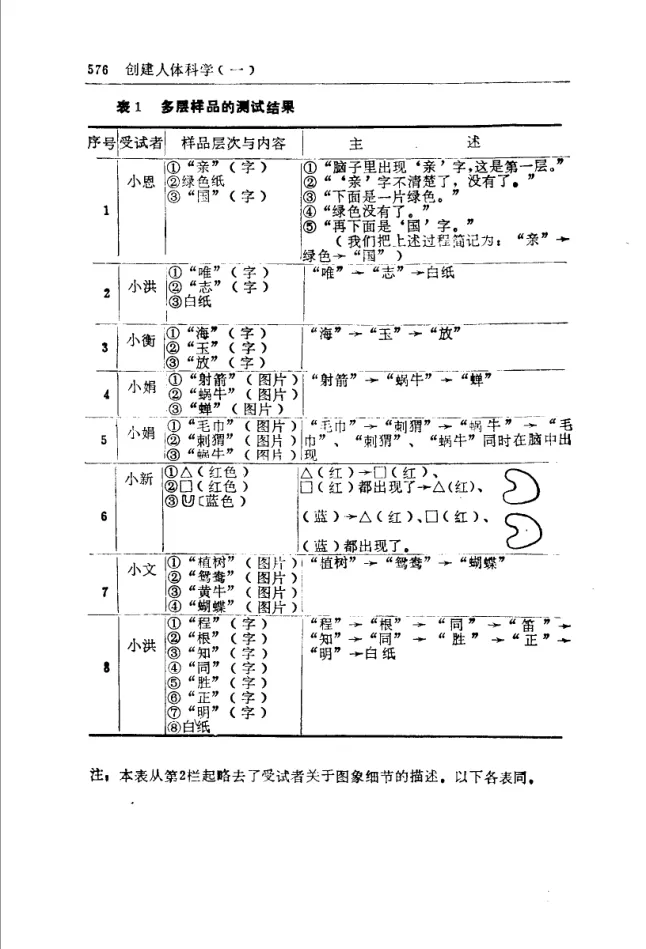
| No. | Subject | Sample Layers and Contents | Subject’s Description |
|---|---|---|---|
| 1 | Xiao En | ① “亲” (character) ② Green paper ③ “国” (character) | ① The character “亲” appeared in my mind; this is the first layer. ② The character “亲” is unclear, it’s gone. ③ The front is a piece of green paper. The green is gone. ④ ⑤ (We briefly record the above process as: “亲” → green → “国”) |
| 2 | Xiao Hong | (Characters “唯”, “志”) | “唯”, “志” → blank paper |
| 3 | Xiao Heng | (Characters “海”, “玉”, “放”, “射”, “蜗”, “蝉”) | “海”, “玉” → “放”, “射”, “蜗”, “蝉” |
| 4 | Xiao Juan | (Pictures “射箭”, “蜗牛”, “蝉”) | |
| 5 | Xiao Juan | (Pictures “毛巾”, “刺猬”, “蜗牛”) | “刺猬”, “蜗牛” appeared in the mind at the same time |
| 6 | Xiao Xin | ① △ (red) ② □ (red) ③ U (blue) | △(red) → □(red); □(red) all appeared → △(red); (blue) → △(red), □(red), (blue) all appeared. |
| 7 | Xiao Wen | (Pictures) “植树”, “鸳鸯”, “蝴蝶” | |
| 8 | Cheng Zhiming, Xiao Hong | (Characters) “根”, “同”, “胜”, “笛”, “正”, etc. |
Note: From the second column onwards, the subjects’ descriptions of image details are omitted in this table; the same applies to the following tables.
Characters on the inside are called inward folds (Figure 1 right). The samples are folded, flattened, and sealed in black plastic boxes, and handed to the subjects for identification. Table 2 lists some experimental results.
Figure 1 Schematic diagram of folded samples
Table 2: Test results of folded samples
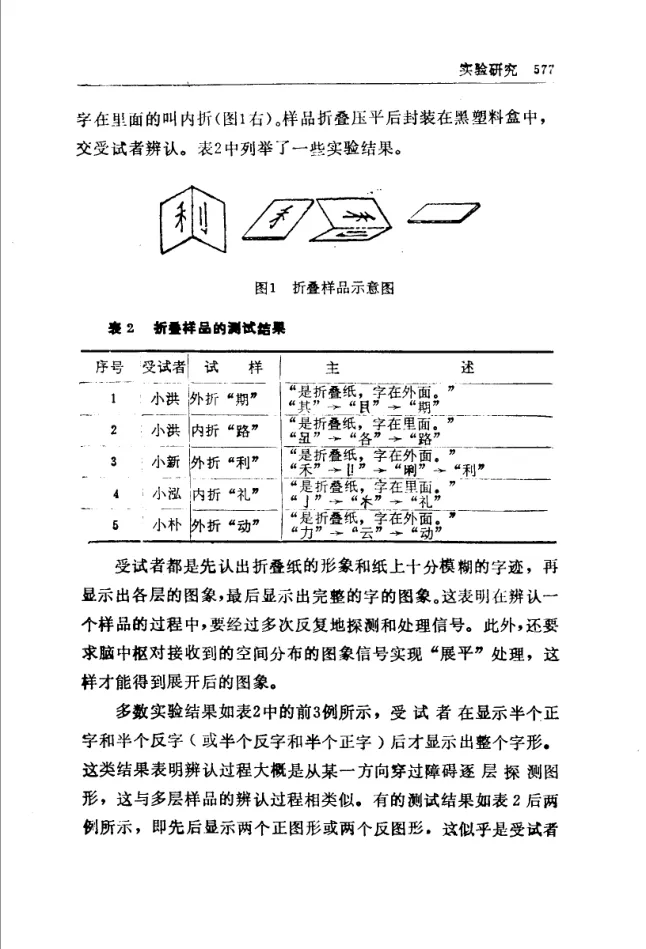
| No. | Subject | Sample | Subject’s Description |
|---|---|---|---|
| 1 | Xiao Hong | Outward fold “期" | "其” → “目” → “期”; “It is folded paper, the character is on the outside.” |
| 2 | Xiao Hong | Inward fold “路" | "且” → “各” → “路”; “It is folded paper, the character is on the inside.” |
| 3 | Xiao Xin | Outward fold “利" | "禾” → “U” → “利”; “It is folded paper, the character is on the outside.” |
| 4 | Xiao Hong | Inward fold “礼" | "]” → “木” → “礼”; “It is folded paper, the character is on the inside.” |
| 5 | Xiao Pu | Outward fold “动" | "力” → “云” → “动”; “It is folded paper, the character is on the outside.” |
The subjects all first recognized the image of the folded paper and the very blurry handwriting on the paper, then displayed the images of each layer, and finally displayed the image of the complete character. This shows that in the process of identifying a sample, it is necessary to repeatedly detect and process signals. In addition, it requires the brain center to realize a “flattening” process for the received spatially distributed image signals, so as to obtain the unfolded image.
Most experimental results are as shown in the first 3 examples in Table 2, where the subjects displayed the entire character only after displaying half of a normal character and half of a reversed character (or half of a reversed character and half of a normal character). Such results indicate that the identification process probably involves detecting the graphic layer by layer through obstacles from a certain direction, which is similar to the identification process of multilayer samples. Some test results, as shown in the last two examples in Table 2, display two normal graphics or two reversed graphics successively. This seems to be the result of the subject identifying the two layers of the sample from both the box lid and the box bottom directions respectively.
III. Tests on folded interlayer samples
To further explore the above issues, we proceeded to use folded interlayer samples for testing. This type of sample is composed of inserting or gluing another piece of paper into a double-folded or multi-folded paper layer. Table 3 lists some experimental results.
In the second and third examples, the characters on the interlayer paper were both written on the side close to the fold, and could be combined with half of the character on the folded paper to form a complete character, and the subjects were able to identify them accurately without error. This indicates that the subjects have the ability to clearly recognize the composition of the sample and to “flatten” the image according to the sample’s composition. The experimental results show that for this type of sample, there is still a characteristic of layer-by-layer identification in hierarchical order.
Table 3: Test results of folded interlayer samples
| No. | Subject | Sample | Subject’s Description |
|---|---|---|---|
| 1 | Xiao Hong | Outer fold “跟”; Interlayer “只" | "足” → “只 (inside)” → “ヨ”; “良” → “跟”, "" and “艮” on one piece of folded paper (The interlayer is glued to the folded paper; “只” is on another piece of paper, glued inside. Same below) |
| 2 | Xiao Hong | Outer fold “玲”; Interlayer “马" | "马” sandwiched in the middle. |
| 3 | Xiao Xin | Outer fold “材”; Interlayer “台" | "才” → “木” → “台” “怡”; “材”, “台” sandwiched in the middle. |
| 4 | Xiao Wang | ① Outer fold “明” (red); Interlayer “升” (blue) ② Outer fold “刘” (red); Interlayer “不” (blue) | “明”, “刘” are red, written on one piece of folded paper. These two characters were recognized half by half. “升”, “不” are blue, written on two other separate small pieces of paper, sandwiched inside “明” and “刘” respectively. |
Of particular note is the fourth case. At that time, Xiao Wang said: “I first recognized that the paper was folded, and then I recognized half of ‘明’; then I felt there was something below, but it was on another piece of paper, and the color was different, so I ignored it, and going further down I recognized the character ‘明’. … After recognizing ‘明’ and ‘刘’, I went back and recognized ‘升’ and ‘不’ in the interlayer.” This shows that during the layer-by-layer detection and identification, she was able to rely on her initial functional perception to select further identification layers and targets.
We preliminarily believe that the identification process for multi-layer folded samples has the characteristic of layer-by-layer identification in hierarchical order, but the subjects can consciously select the identification layers or targets. This is a relatively complex issue, and more in-depth experimental research is still needed.
Comrade Wu Baogang and Comrade Wang Zhong participated in part of the work for this article.
The Recognition Process of Paper Wads and Paper Rolls by Special Perceptual Abilities of the Human Body
Shao Shaoyuan, Wang Chu, He Muyan Luo Lin’er, Zhang Zuqi Chen Shouliang Zheng Lemin, Liu Zhaoqian
In our research on the image display process of the human body’s special perceptual abilities, we discovered some signs that might help in understanding the mechanism of recognizing paper wads. For example, during tests using folded samples, some subjects reported that their subjective image was flat and unfolded at one moment, and folded at another; in February 1980, when Xiao Lan was recognizing a paper wad with the character “大” (big) written on it, she first recognized a “大” with curvy strokes, and then the curvy strokes slowly straightened into the character “大”. In order to explore the mechanism of recognizing paper wads, we separately investigated the subjective image display process of 8 children and adolescents with different states of special perceptual abilities when recognizing paper wads and paper rolls, conducting a total of 62 experiments.
1. Test Results of Paper Wad Samples
Several sheets of paper of about 4 square centimeters were cut into different shapes, with characters or graphics written on them, and then randomly crumpled into small spheres with a diameter of about 4 millimeters to serve as test samples. The tests were conducted separately and individually. During the test, a paper wad was randomly selected and placed in the subject’s external auditory canal, after which it was not moved again, and the subject was not allowed to touch the paper wad with their hands. The subject was then asked to dictate or draw the subjective display process of the paper and the characters and graphics on it in the ear canal.
The following are descriptions from several subjects:
Xiao Li, female, 11 years old. A few minutes after the paper wad was placed in the external auditory canal, she felt an image of a crumpled paper wad in her mind. Then the paper wad unfolded slightly, and a few seconds later this unfolded image closed back into a wad. After another few minutes, her mind displayed the process of this closed paper wad unfolding and then closing again. In each test, the image of the paper wad in Xiao Li’s mind could unfold and close several times. Initially, it was partially unfolded, and then it gradually expanded until the image of the entire sheet of paper being completely unfolded finally appeared. With each unfolding, Xiao Li could recognize part of the content written on the paper wad. The strokes of these characters or the lines of the graphics were initially curvy and gradually straightened as the paper unfolded. When the paper was completely unfolded, Xiao Li could recognize the different shapes of the paper. After the image of the paper wad was unfolded and then closed for the last time, it could no longer be unfolded.
Xiao Pu, female, 11 years old. The image display process of the paper wad was similar to that of Xiao Li. Her characteristic was that the number of times the paper wad unfolded and closed was very high. At first, it would close a few seconds after unfolding, and unfold again a few seconds after closing. Later, the duration of each unfold gradually lengthened. When it increased to a dozen or dozens of seconds, the image of the paper wad completely unfolded, allowing the shape of the paper and the characters and graphics on it to be recognized. After the paper wad was unfolded for the last time, the clear image could be maintained in her mind for several minutes without closing or disappearing.
Xiao Hong, female, 13 years old. After the paper wad was placed in the external auditory canal, an image of a paper wad initially appeared, followed by an image of the “paper wad loosening” and the paper gradually unfolding. Once the paper unfolded, the image of the paper disappeared, leaving only the image of the character shapes.
Xiao Lan, female, 12 years old. The characteristic of her image display was that no paper wad image appeared; only character shapes that went from curved to stretched appeared. When writing on colored paper, the color of the paper could be displayed, but the shape of the paper was still not shown.
From the test results of the above subjects, the recognition process of paper wads all involved a process of unfolding a spatial image into a planar image. This unfolding process could be completed in one go, or it might require multiple repetitions to gradually flatten out. In other subjects, we
also observed similar situations. Table 1 shows some examples of the paper wad image display process.
Table 1: Image Display Process During Paper Wad Recognition
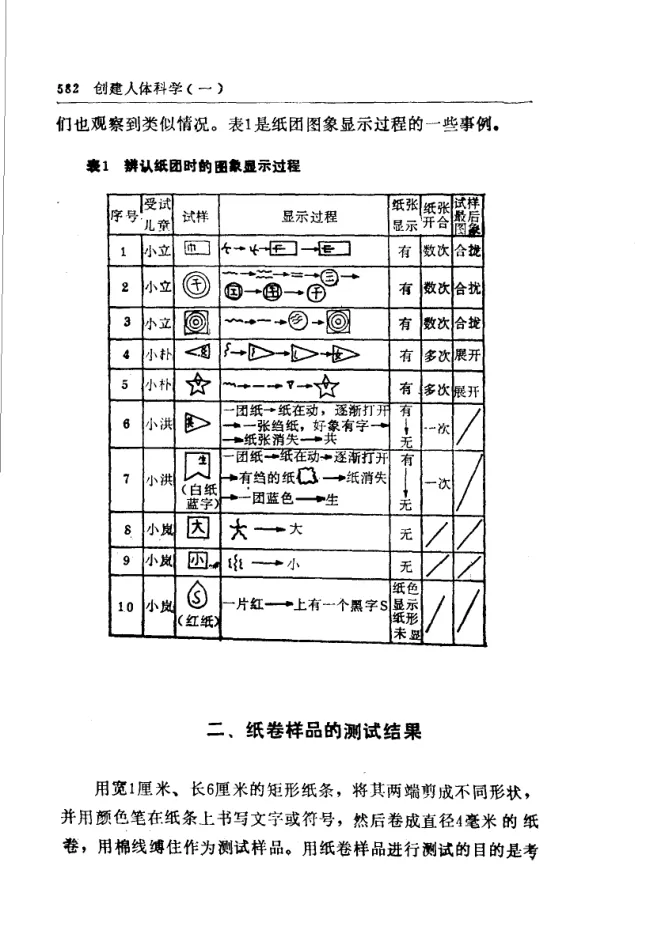
| Test subject | Paper sample | Paper display opening/closing | Display process |
|---|---|---|---|
| 1. Xiao Li | [市] | Yes | Closed multiple times |
| 2. Xiao Li | [国] | Yes | Closed multiple times |
| 3. Xiao Li | Yes | Closed multiple times | |
| 4. Xiao Pu | Yes | Unfolded multiple times | |
| 5. Xiao Pu | ☆ | Yes | Unfolded multiple times |
| 6. Xiao Hong | A ball of paper → paper moving, gradually opening → A sheet of paper, seems to have characters | Yes | Once |
| 7. Xiao Hong | A ball of paper → paper moving, gradually opening → Paper with characters disappears | Yes | Once |
| 8. Xiao Lan | (White paper) A ball of blue paper [国] | No | Blue characters |
| 9. Xiao Lan | Four [— small] | No | |
| 10. Xiao Lan | (Red paper) S A piece of red — with a black character S on it | Displayed (paper color) | Paper shape not displayed |
2. Test Results of Paper Roll Samples
Rectangular paper strips 1 centimeter wide and 6 centimeters long were used. Their two ends were cut into different shapes, and characters or symbols were written on the strips with colored pens. They were then rolled into paper rolls 4 millimeters in diameter and tied with cotton thread to serve as test samples. The purpose of testing with paper roll samples was to investig
ate whether the unfolding process of recognizing the paper roll was similar to the mechanical unfolding of a paper roll. Table 2 shows the results of several experiments.
Table 2: Image Display Process of Paper Roll Sample Recognition
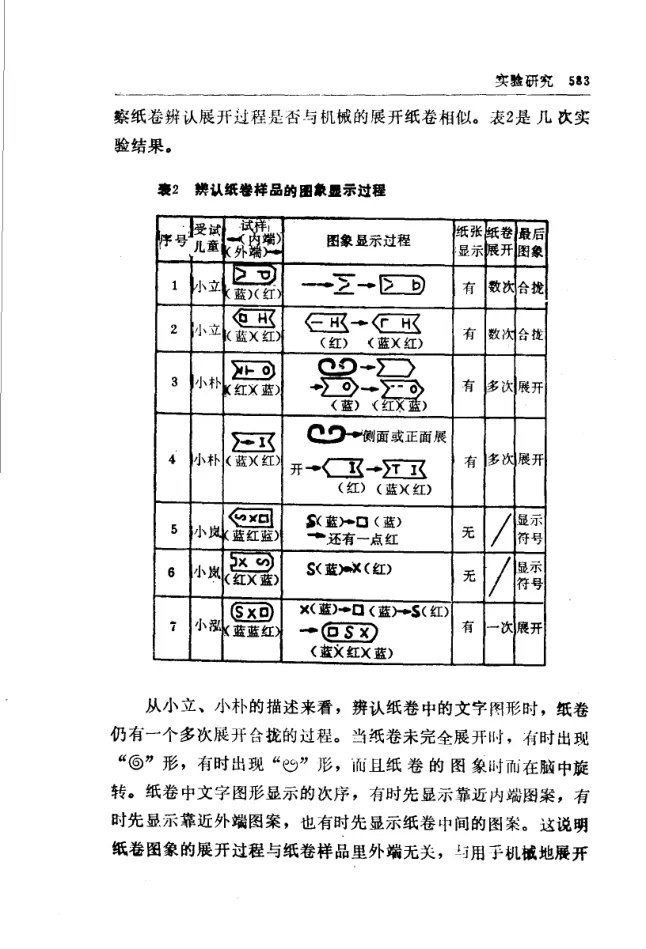
| Test subject | Sample (inner end, outer end) | Paper/paper roll finally displays unfolded image | Image display process |
|---|---|---|---|
| 1. Xiao Li | (Blue)(Red) White H | Yes | Closed multiple times |
| 2. Xiao Li | (Blue X Red) (Red) | Yes | Closed multiple times |
| 3. Xiao Pu | (Red X Blue) (Blue)(Red X Blue) | Yes, multiple openings | C unfolds from side or front |
| 4. Xiao Pu | (Blue) Red) B-T (Red)(Blue) Red) | Yes, multiple openings | B-T |
| 5. Xiao Lan | (Blue Red Blue) x S (Blue) [Box] (Blue) | No, symbols displayed | Still a bit of red 5xs |
| 6. Xiao Lan | (Red X Blue) S (Blue) X (Red) | No, symbols displayed | SxD |
| 7. Xiao Hong | (Blue Blue Red) X (Blue) → [Box] (Blue) → S (Red) | Yes, unfolded once | XSO |
From the descriptions of Xiao Li and Xiao Pu, when recognizing characters and graphics in a paper roll, the paper roll still underwent a process of unfolding and closing multiple times. When the paper roll was not fully unfolded, sometimes a "" shape appeared, and sometimes a "" shape appeared, and the image of the paper roll occasionally rotated in the mind. The order in which the characters and graphics in the paper roll were displayed sometimes showed the pattern near the inner end first, sometimes the pattern near the outer end first, and sometimes the pattern in the middle of the paper roll first. This indicates that the unfolding process of the paper roll image is independent of the inner and outer ends of the paper roll sample, and is related to the mechanical unfolding
…differed from the paper rolls.
Through the testing of identifying wadded paper and paper roll samples, we further realized that utilizing the extraordinary perceptual ability to identify samples is completely different from seeing things with the eyes. What one eye perceives is the projection of a spatial object onto a certain plane, and it cannot distinguish overlapping images in the projection. Utilizing the extraordinary perceptual ability allows one to perceive a three-dimensional spatial image and perform relatively complex processing. According to the subjects’ descriptions, their image expansion process is similar to a computer’s reconstruction of a spatial image. The differences in image display among several subjects may be related to the strength of their extraordinary perceptual abilities. Xiao Lan and Xiao Hong participated in tests multiple times and had stronger abilities; the sample image could be completely recognized clearly after just one expansion process. Xiao Li and Xiao Pu participated in tests later and had medium-level abilities; the sample image required multiple processing passes to be fully expanded. Sometimes Xiao Li had not yet managed to recognize it clearly when the image would no longer expand, and they had to stop the identification. This indicates that the degree and duration of the sample image expansion process may both be related to the level of the extraordinary perceptual ability.
Through a series of identification tests on samples including single-layer, multi-layer, folded, wadded paper, and paper rolls, it can be seen that the image display process of the human body’s extraordinary perceptual ability is not a mechanical copying of the sample. Rather, it involves a relatively complex process of extracting weak signals from an interfering background, selectively identifying by hierarchy, and expanding a spatial image into a planar image. Today, scientific technologies such as holography, tomography, CT, and spatial image reconstruction have been realized. Considering the principles of these scientific technologies may perhaps help us understand the mechanism of the human body’s extraordinary perceptual ability, and furthermore, the human body’s extraordinary perceptual ability may contain more profound content than these modern scientific and technological achievements.
The Human Body’s Extraordinary Perceptual Ability: Experiments on Direction Discrimination
Zhang Zuqi, Wu Baogang, Tong Litai Wang Chu Zheng Lemin Zi Muchan Chen Shouliang Shao Shaoyuan, Luo Lin’er Liu Zhaoqian
[Editor’s Note] When the person with extraordinary human abilities, Xiao Lan, was conducting experiments on recognizing characters and identifying pictures, she reported that a bright spot appeared in her brain, and this bright spot changed with the direction she faced. This subjective report caught the attention of the authors of this article. They immediately thought of whether this bright spot could be used to discriminate direction. Therefore, they conducted the series of experiments described in this article and obtained positive results. Subsequently, they also tested the person with extraordinary human abilities in different positions, in different latitudinal regions, and under conditions where the earth’s magnetic field was interfered with by an electromagnetic field applied to the subject’s head and face. As a result, the subject was still able to discriminate direction correctly.
In experiments on human extraordinary abilities, new phenomena frequently appear. By not letting go of these phenomena, proposing a new hypothesis, and designing a new experiment to get to the bottom of it—this is common in research on human extraordinary abilities. This article is one such example.
Author affiliations: Peking University.
It has been previously reported that among juvenile children, the human body’s extraordinary perceptual ability possesses universality . During the process of utilizing the extraordinary perceptual ability to identify characters and graphics, these children often subjectively feel a bright spot generated in their brain [2]. We discovered among some children that this subjectively displayed bright spot undergoes changes in brightness according to the direction the child faces. This
situation was most obvious in Xiao Lan (female, 11 years old). We wondered whether these juvenile children could rely on this extraordinary perceptual ability to discriminate directions. To this end, tests were conducted on Xiao Lan.
We covered Xiao Lan’s eyes with a cloth, placed a colored piece of paper in her hand, and after she reported that a bright spot appeared in her brain, we picked her up and spun her around several times. We then let her rotate in place, and she stopped when she reached the direction where the bright spot in her brain was the dimmest. As a result, she stopped while facing south, saying that the bright spot was the dimmest in this direction. Using this method, we conducted over forty tests in rooms at different locations near the school (including a darkroom). Every time Xiao Lan stopped, she was basically facing south.
On the afternoon of March 16, 1980, an experiment was conducted in the Optics Laboratory of the Physics Building at Peking University (area of about 70 square meters; after the doors and windows were tightly closed, the room was completely dark). A swivel chair was placed in the middle of the room. The subject sat on the chair, wearing a brimmed hat, with a wooden stick attached to the center of the brim to indicate direction. Her eyes were covered with red cloth folded into five layers, and a colored piece of paper was placed in her hand. After the subject reported a bright spot appearing in her brain, the lights were turned off. One person rotated the swivel chair several turns, alternating between clockwise and counterclockwise directions, and stopped at an arbitrary direction. Other experimental personnel stayed 4 to 5 meters away from the subject and swapped positions after the lights were turned off, maintaining silence. After the rotation stopped, the subject herself rotated the swivel chair until she felt the bright spot in her brain was at its dimmest, and then stopped. The lights were then turned on, and a pocket compass was used to measure the direction indicated by the wooden stick on the subject’s hat brim. This was done six times in total, and the results are shown in Table 1.
Table 1
| Number of times | Condition of the subject being passively rotated | Direction the subject ultimately faced |
|---|---|---|
| 1 | Clockwise over 3 revolutions, counterclockwise over 4 revolutions | Due south |
| 2 | Clockwise over 4 revolutions, counterclockwise over 3 revolutions | South 5° West |
| 3 | Clockwise over 2 revolutions, counterclockwise about 2 revolutions | South 7° West |
| 4 | Clockwise about 2 revolutions, counterclockwise over 2 revolutions | South 5° West |
| 5 | Clockwise over 3 revolutions, counterclockwise about 2 revolutions | Due south |
| 6 | Clockwise over 5 revolutions, counterclockwise over 3 revolutions | South 5° West |
On the afternoon of March 23, 1980, a test was conducted in the laboratory of the West Experimental Building of the Biology Department (area approximately 30 square meters, surrounded by black curtains). The method was the same as the test on March 16, and the results are shown in Table 2.
Table 2
| Number of times | Condition of subject being passively rotated | Final direction faced by subject |
|---|---|---|
| 1 | Clockwise over 2 turns, counterclockwise about 2 turns | Due south |
| 2 | Clockwise over 2 turns, counterclockwise over 2 turns | Due south |
| 3 | Clockwise about 3 turns, counterclockwise about 2 turns, clockwise about 1 turn | Due south |
| 4 | Clockwise over 2 turns, counterclockwise about 2 turns | Due south |
| 5 | Clockwise about 2 turns, counterclockwise over 1 turn, clockwise 1 turn | Due south |
| 8 | Clockwise about 3 turns, counterclockwise about 3 turns, clockwise over 1 turn | Due south |
From the above multiple tests, it can be seen that Xiaolan, who possesses a special sensory function, can accurately distinguish directions and point out south based on the degree of brightness of the light spot that appears subjectively.
When discriminating direction, even if Xiaolan does not move her torso and only turns her head, the light spot in her mind will also change in brightness. Generally, she would rotate her whole body about one turn to roughly face south, and then turn her head to accurately determine south. Therefore, we conjecture that the head is the site that receives certain external stimuli, causing the subjective light spot to change in brightness depending on the direction.
To test whether this function of Xiaolan was related to the geomagnetic field felt by her body, we used an external magnetic field to alter the static magnetic field in the space where Xiaolan was located for testing. The first test was conducted on the afternoon of April 8, 1980. In the Magnetism Laboratory of the Physics Building, a pair of Helmholtz coils with a diameter of one meter was used to generate a magnetic field in the opposite direction to the horizontal component of the geomagnetic field. The plane of the coils was oriented north-south. During the test, Xiaolan was located outside the coil, and a compass and a gaussmeter were used to discriminate and determine the direction and magnitude of the magnetic field in the space where the subject’s head and chest were located.
Test conditions:
- When the coil current was 80 milliamperes, the compass in the space where the subject’s head and chest were located
could no longer point north-south, meaning the horizontal component of the magnetic field here was already very weak.
-
When the coil current was 160 milliamperes, it was just enough to make the compass in the space where the subject’s head and chest were located indicate in the reverse direction.
-
When the coil current was 900 milliamperes, the magnetic field generated by the coil was about 8 times the horizontal component of the geomagnetic field.
-
When the coil current was 14 amperes, the magnetic induction intensity measured by a CT-5 type gaussmeter in the space where the subject’s head and chest were located was 25 Gauss. The horizontal component of the magnetic field at this location was opposite in direction to the horizontal component of the geomagnetic field, and its magnitude was about 100 times that of the horizontal component of the geomagnetic field.
During the test, black curtains were hung in the laboratory, the lights were turned off, and Xiaolan’s eyes were covered with a red cloth. After she reported subjectively that a bright spot appeared in her brain, she was picked up and rotated in place, as well as rotated while walking. After being carried to the space with the magnetic field, she was rotated several more times and then set down, allowing Xiaolan to rotate her own body to determine the direction. We conducted tests under the three conditions of 2, 3, and 4, and performed a control test (without the magnetic field) before and after each test. Xiaolan was able to accurately identify south in all cases.
On the evening of April 13, 1980, another test was conducted using the same method, with a total of five tests. First, a control test was conducted without the magnetic field of the coil. Then, one test was conducted under each of the three conditions of 1, 3, and 4. For the fifth test, two pieces of strontium ferrite with a surface field strength of 900 Gauss were placed in an east-west direction at Xiaolan’s head, with a distance of 30 centimeters between the two ferrite pieces. The field strength at the midpoint of this area was 30 Gauss (Figure 1). As a result, Xiaolan was still able to accurately identify south.
Because the location of Xiaolan’s sensory area on her body could not be strictly determined, we conducted a third test on the afternoon of April 26, 1980. After picking up and rotating Xiaolan, she was seated on a small stool so that her entire body was within the range of the magnetic field generated by the coil (Figure 2). At that time, the magnetic field intensities measured by the gaussmeter in the direction opposite to the horizontal geomagnetic field were: 6 Gauss at the tips of the toes (weakest) and 20 Gauss at the head (strongest). One experiment and one control were performed respectively. As a result, Xiaolan was still able to accurately identify south (see Appendix Figure 21).
Figure 1
Figure 2
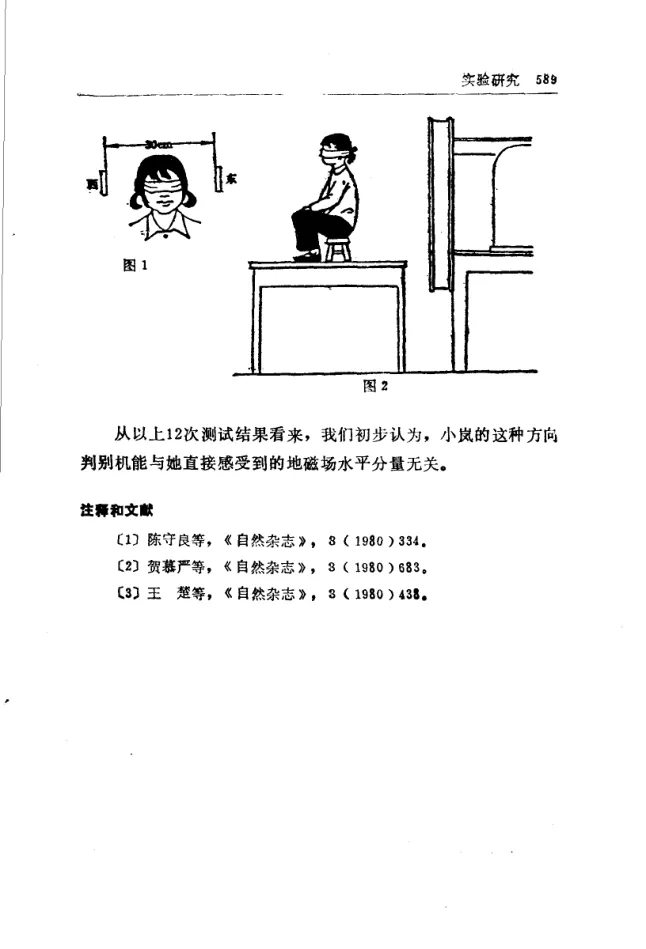
Based on the results of the above 12 tests, we preliminarily believe that this directional discrimination function of Xiaolan is unrelated to her direct perception of the horizontal component of the geomagnetic field.
Notes and References
[1] Chen Shouliang et al., Nature Journal, 8 (1980) 334.
[2] He Muyan et al., Nature Journal, 3 (1980) 683.
[3] Wang Chu et al., Nature Journal, 3 (1980) 438.
Preliminary Experimental Results on the Human Body’s Physical Object Magnification Function (I)
Chen Yi, Li Chunpu Hao Shucheng Cheng Shaohuan Ge Hongchen Li Shoucheng Liu Xingde Qi Yuhua Feng Chunfeng Zhang Tianhua Guan Tonglin Wang Zhiliang Gao Feng Gao Cuncheng Wang Zheyue Yue Peizhi Lu Fengqin
[Editor’s Note]
Individuals with extraordinary human abilities possess a magnification function when observing tiny objects, capable of magnifying up to about 100 times. The authors of this paper conducted experiments on this phenomenon. These are their experimental results of the extraordinary abilities subject Liu × using the naked eye to observe white blood cells and dust.
Affiliation of the authors of this paper: Changchun College of Traditional Chinese Medicine.
From August to September 1980, we cultivated and experimented with the human body’s magnification function on a youth named Liu ×, who possesses extraordinary human abilities. As a result, this function reached a magnification of 100 times. A total of 51 observations were conducted, all achieving success.
The experimental equipment included an optical microscope, a hemocytometer (blood counting chamber), a drop of blood from the ear of a healthy person, and glass rods and test tubes commonly used for testing white blood cells. The procedure was performed 3 times a day; each time, the white blood cells and dust on one hemocytometer were observed to determine the number of particles and their distribution positions.
The counting area was located in the upper right 1/4 of each slide (see Figure 1), observing the white blood cells and dust within 16 small squares. Each small square was 1/16 mm²; the diameter of white blood cells is generally 3–12 μm, and dust particles are 6–14 μm.
Four laboratory technicians used a microscope to observe the positions of the white blood cells and dust, using this as a bas
standards were compared with the results obtained by Liu × using the human-body magnification function without a microscope, examining the discrepancy rate in the positions of white blood cells and dust particles, and using this as the positional match rate.
In Figures 2 and 3, the circles indicate marked white blood cells, and the black dots with spikes indicate dust particles. These two figures show the comparison between Liu בs naked-eye observation of white blood cells and dust particles and the examiner’s microscopic observation on September 17.
Counting area
Figure 1
Figure 2
Microscopic marking
Figure 3
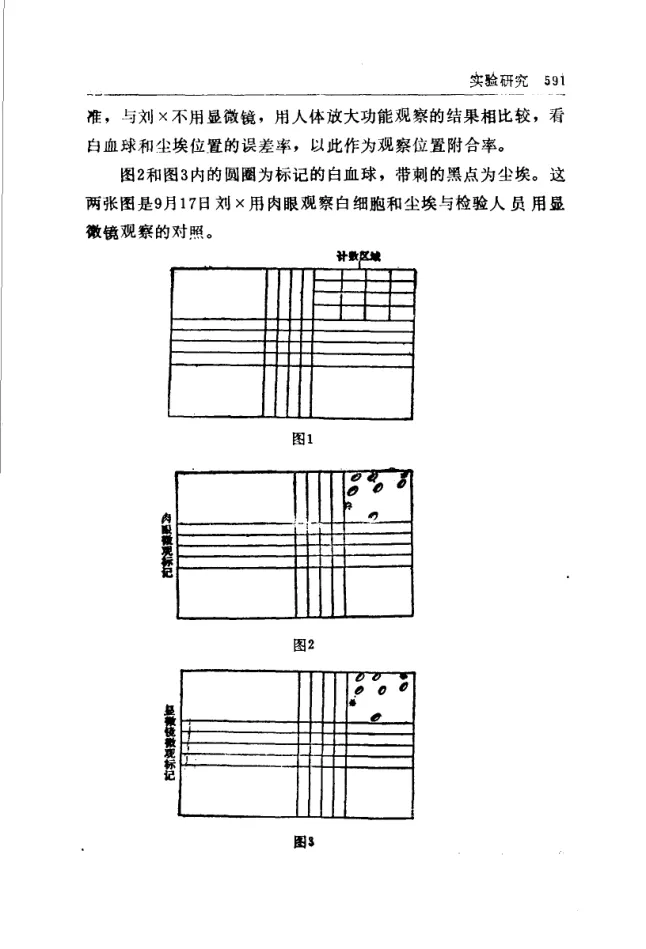
∴
Liu × observed 51 slides, and the results are shown in the table below.
Table 1: Liu × Test Results
| Slide No. | Liu × WBC count | Liu × dust count | Examiner WBC count | Examiner dust count | Difference in total particle count | Positional match rate (%) |
|---|---|---|---|---|---|---|
| 1 | 1 | 3 | 1 | 3 | 0 | 100 |
| 2 | 5 | 0 | 5 | 0 | 0 | 99 |
| 3 | 19 | 0 | 19 | 0 | 0 | 95 |
| 4 | 2 | 4 | 2 | 4 | 0 | 100 |
| 5 | 3 | 3 | 3 | 3 | 0 | 100 |
| 6 | 5 | 0 | 5 | 0 | 0 | 100 |
| 7 | 4 | 1 | 4 | 1 | 0 | 100 |
| 8 | 6 | 0 | 6 | 0 | 0 | 90 |
| 9 | 8 | 0 | 8 | 0 | 0 | 100 |
| 10 | 25 | 25 | 25 | 25 | 0 | 95 |
| 11 | 7 | 0 | 7 | 0 | 0 | 100 |
| 12 | 23 | 0 | 23 | 0 | 0 | 95 |
| 13 | 6 | 0 | 6 | 0 | 0 | 100 |
| 14 | 7 | 0 | 7 | 0 | 0 | 90 |
| 15 | 4 | 4 | 4 | 4 | 0 | 90 |
| 16 | 1 | 4 | 1 | 4 | 0 | 100 |
| 17 | 2 | 6 | 4 | 4 | 0 | 100 |
| 18 | 7 | 3 | 7 | 3 | 0 | 90 |
| 19 | 7 | 2 | 7 | 2 | 0 | 100 |
| 20 | 4 | 1 | 4 | 1 | 0 | 100 |
| 21 | 8 | 4 | 10 | 2 | 0 | 90 |
| 22 | 6 | 2 | 7 | 1 | 0 | 100 |
| 23 | full field | full field | 0 | 100 | ||
| 24 | 6 | 3 | 6 | 3 | 0 | 100 |
| 25 | 0 | 5 | 0 | 5 | 0 | 100 |
| 26 | full field | full field | 0 | 100 | ||
| 27 | 19 | 5 | 22 | 5 | −3 | 90 |
| 28 | 8 | 4 | 11 | 1 | 0 | 100 |
| 29 | 7 | 4 | 7 | 4 | 0 | 100 |
| 30 | 8 | 0 | 8 | 0 | 0 | 100 |
| 31 | 5 | 3 | 5 | 3 | 0 | 100 |
| 32 | 6 | 4 | 6 | 4 | 0 | 100 |
| 33 | 2 | 5 | 2 | 5 | 0 | 100 |
| 34 | 2 | 4 | 2 | 4 | 0 | 100 |
| 35 | 2 | 4 | 1 | 5 | 0 | 100 |
| 36 | 6 | 0 | 6 | 0 | 0 | 100 |
| 37 | 6 | 5 | 6 | 5 | 0 | 100 |
| 38 | 4 | 3 | 3 | 4 | 0 | 100 |
| 39 | 4 | 4 | 4 | 4 | 0 | 100 |
| 40 | 4 | 4 | 4 | 4 | 0 | 100 |
| 41 | 5 | 4 | 5 | 4 | 0 | 100 |
| 42 | 3 | 4 | 3 | 4 | 0 | 100 |
| 43 | 2 | 5 | 3 | 4 | 0 | 100 |
| 44 | 7 | 1 | 7 | 1 | 0 | 100 |
| 45 | 7 | 3 | 7 | 3 | 0 | 100 |
| 46 | 5 | 2 | 5 | 3 | −1 | 95 |
| 47 | 5 | 4 | 6 | 2 | +1 | 100 |
| 48 | 4 | 2 | 4 | 3 | −1 | 95 |
| 49 | 6 | 4 | 6 | 1 | +3 | 95 |
| 50 | 7 | 5 | 8 | 2 | +2 | 95 |
| 51 | 5 | 4 | 5 | 4 | 0 | 100 |
The above results showed no statistically significant difference after statistical processing (p > 0.05), indicating that the accuracy of counting white blood cells using the human-body object-magnification function is completely consistent with that of laboratory personnel counting white blood cells under a microscope.
During the course of the experiment, we received strong support from the Research Management Division of the Provincial Science and Technology Commission. Comrades Kang Xixiong and Li Shuying of the Norman Bethune University of Medical Sciences came to monitor the testing, and we also received assistance from Comrades Jia Guiru and Yang Xueqian of our own institute. We hereby express our gratitude to all of them.
Extraordinary Human-Body Functions: Shielding Effects
Shi Tianyuan
[Editor’s note]
Extraordinary character recognition can penetrate certain obstacles, yet which materials can provide shielding against this? The author of this article has conducted a series of experimental investigations. He employed both physically sealed and conventionally sealed test samples, broadly using various metallic and non-metallic materials. After arduous and extensive testing, he obtained some encouraging results. This article is a summary of those results.
The author’s affiliation: Nanjing Research Institute of Electronic Technology.
In our investigation of whether extraordinary human-ability phenomena are genuine, we discovered that samples sealed inside rigorously sealed metal tubes and thick kraft paper envelopes could not be recognized. This phenomenon prompted our reflection. We conjectured that the shielding properties of the test samples may have been one of the reasons they could not be recognized. In order to experimentally verify this, we conducted more than a thousand dedicated tests.
The experimental subjects we selected were children who were required to be capable of recognizing the test samples inside “dedicated test tubes.” At the same time, in order to eliminate psychological factors and to allow them to fully exercise their abilities, during the experiments we attended to the following aspects:
(1) The testers and subjects should establish a friendly relationship as much as possible, keeping the children in a state of freedom, comfort, and relaxed cheerfulness, and preventing the children from developing feelings of fear or mental fatigue.
(2) During testing, the selection of test samples proceeded from the simple to the complex, from the shallow to the deep, in a gradual and orderly manner. Only after the children entered the functional state did we progressively increase the difficulty of recognition, thereby enabling the children to build confi-
(3) Repeated, multiple large-scale tests must be conducted so that the measured data possess statistical significance.
(4) Specimens are divided into physically sealed and generally sealed (with gaps). Several specimens of the same material should be machined in the same manner, and the two types of sealed specimens should be made essentially indistinguishable to the test subjects based on outward appearance.
(5) When conducting individual and group tests, first use specimens with gaps, then use sealed ones, or mix them together. When testing sealed specimens, extend the testing time appropriately.
The encapsulation materials for the experimental specimens are made of various metallic and non-metallic materials; see Table 1 for details.
As can be seen from Table 1, the children were unable to correctly identify the specimens that had undergone strict inspection for physical sealing, as shown in Appendix Figure 22; whereas the generally sealed specimens were all correctly identified, as shown in Appendix Figure 23. However, this does not mean that physically sealed specimens can never be identified, but rather that the difficulty is higher.
To verify whether human extraordinary abilities possess a diffraction effect, we used 0.1 mm-thick copper sheeting and iron tubing with 3 mm wall thickness and 2.8 cm outer diameter to fabricate two types of tubes: one type was 1.8 cm and 2.8 cm in diameter, 34 cm long, with one end open and one end welded shut; the other was 1.8 cm and 2.8 cm in diameter, 4 cm long, with both ends welded shut. During testing with the long tubes, the specimen was placed at the bottom; the subject held the sealed end with the opening facing outward, perpendicular to the human body. The experimental results showed that the characters inside the open-ended long tube were correctly identified, while those inside the short tubes welded shut at both ends were not. Through repeated testing and comparison, the following conclusions can be drawn:
(1) Fully sealed (physical sealing) metallic and non-metallic materials (transparent or opaque) have a strong shielding and isolation effect on human extraordinary abilities. For the same material and the same person, the accuracy of identification at the same time is inversely proportional to the degree of sealing tightness.
(2) Human extraordinary abilities have a strong permeation effect on gaps — the gap effect.
(3) Human extraordinary abilities have a strong diffraction effect.
Below, we use radar detection theory to analyze the shielding and permeation phenomena.
Table 1
| Material, Name, Specification | Shape | Sealing Method | Person-times | Correctness | Remarks |
|---|---|---|---|---|---|
| Copper sheet, thickness 0.4–3 mm, various | Cylindrical copper can | Threaded cap screwed tight | >100 | Correct | Height 70 mm, cap depth 19 mm |
| Transparent plexiglass, thickness 4 mm | Same as above | Epoxy resin sealed | 80 | Correct | Diameter 40 mm, thickness 3 mm |
| Lead, thickness 0.4 mm–3 mm | Same as above | Same as above | 80 | Correct | |
| Opaque plastic, thickness 4 cm | Semicircular sheet | Welded shut with gap left | 40 | Correct | |
| Copper sheet, thickness 0.1 mm | Φ1.8 cm, L 5–8 cm | Fully welded shut | 10 | Correct | |
| Copper sheet, thickness 0.1 mm | Square sheet | Same as above | 4 | Correct | |
| Epoxy resin, thickness 3 mm | Cardboard-like | Paste fully sealed and dried | 3 | Blurred, incorrect | Residual information phenomenon appeared twice |
| Iron, thickness 3.5 mm | Same as above | Same as above | 3 | No reaction | |
| Brass, 3 mm | Tube-shaped | Paste sealed, characters cut and removed; solution poured into can | 2 | Incorrect | Due to processing into a translucent body |
| Thick kraft paper | Tube-shaped | Welded shut | 6 | Correct | |
| Thick kraft paper | Bag-shaped | Threaded cap screwed tight | 2 | Correct | |
| Cylindrical copper can | Tube-shaped | — | 4 | — | — |
Multiple
Table 1 (continued)
| Material, Name, Specification | Shape | Sealing Method | Person-times | Correctness | Remarks |
|---|---|---|---|---|---|
| Cylindrical iron can | — | — | — | — | — |
| Cylindrical aluminum can | Thermos bottle-shaped | Paste sealed | 80 | Correct | |
| Cylindrical silver-plated can | Flat plate-shaped | Poured and cast in copper can | 80 | Correct | |
| Cylindrical zinc-plated can | Same as above | Both ends heat-sealed | 80 | Correct | |
| Cylindrical chrome-plated can | Same as above | Poured over the character sample | 80 | Correct | |
| Opaque teacup | Same as above | One end welded shut, one end open or plugged | 70 | Correct | Two times, screwed very tight and not identified |
| Thick kraft paper | Ring-shaped | Natural seal, character sample inserted | 78 | Correct | |
| Long iron pipe | Cup-shaped | One end welded shut | 78 | Correct | |
| Long copper pipe 1.8 cm × 34 cm | Long tube | One end welded shut | 78 | Correct | |
| 2.8 cm × 34 cm | Bag-shaped | Opening or corner pressed shut | 2 | Correct | |
| 2.8 cm × 34 cm | — | — | 2 | Correct | |
| Ferrite, rare earth cobalt | — | — | — | — | |
| Gasoline, alcohol, water | — | — | — | — | |
| Lead pipe nested inside copper can | — | — | — | — | |
| Small thermos bottle | — | — | — | — | |
| Wax | — | — | — | — | |
| Stone | — | — | — | — |
Special test can
Figure 1 Model of character recognition by extraordinary abilities
Figure 1 is a simple model of character recognition through children’s extraordinary abilities. The extraordinary person transmits with power , concentrating their intention so that energy enters the test box, strikes the specimen, and produces a return signal that passes out of the box. At this point, the signal power , after being modulated by the specimen, is received by the extraordinary person. Since is related to multiple factors such as the degree of metallic isolation, the reflectivity of the specimen, and path loss, we define as the shielding isolation degree:
If expressed in decibels:
The extraordinary person receives not only but also noise and interference power generated by the environment, the testers, audience, and others, denoted by . Then can be defined as the ratio of signal power to noise power:
Each extraordinary ability possessor has a recognition threshold, i.e., a sensitivity , and , , and are all variables. They are seriously affected by the strength of the functional state itself, the degree of emotional pleasure, as well as pain, tension, fear, fatigue, hunger, external interference, and the like. When , the test subject can quickly identify the target; when , several attempts must be accumulated before identification; when , identification becomes very difficult. Substituting equation ① into equation ③:
We call equation ④ the “extraordinary ability” sensitivity formula.
Discussion: (1) Assuming , , and remain unchanged, when a completely sealed metal box is used, becomes very large, causing to drop sharply, such that , and therefore the sample cannot be recognized; when semi-sealed, decreases, , and thus the sample can be recognized; when the sample is identified directly, such as recognizing characters directly with the palm of the hand, is very small, causing to rise sharply, resulting in a very fast response. (2) If and remain unchanged, the surrounding environment, including the various activities of the people present, can cause to increase and to decrease, which also leads to an inability to recognize the sample. (3) If the functional state is very good, is very small, is large, and is also small, then even if is very large, will still satisfy the recognition condition and the sample can be recognized.
After over a thousand tests on nearly a hundred individuals with extraordinary human abilities, we believe that it is a normal phenomenon for them to sometimes recognize and sometimes fail to recognize the samples. To determine whether a certain child possesses extraordinary human abilities, prolonged and repeated tests should be conducted on them, even living together with them to obtain first-hand information. By fully utilizing the theoretical weapon of dialectical materialism and adhering to the principle that practice is the sole criterion for testing truth, the authenticity of the phenomenon will definitely be clarified.
Comrades Guan Tonglin from the Changchun College of Traditional Chinese Medicine, He Muyan from Peking University, and Liu Beisheng from the Chengdu Branch of the Chinese Academy of Sciences also found in their experiments that the recognition effectiveness between seamless and slotted samples differed greatly. They presented their respective reports and supplements during a special discussion at the Physics Professional Academic Symposium held by the Chinese Human-Body Science Research Association (Preparatory) in January 1982.
A Discussion on the Nature of the Human-Body Extraordinary Vision Information Carrier
Xu Lanxu, Liu Degong, Shi Yongming
[Editor’s Note] Based on a series of manifestations by individuals with extraordinary abilities, the authors of this article designed many very basic yet extremely ingenious experiments from the perspective of optical research. The results are simple and clear. The authors believe that human-body extraordinary vision possesses the characteristics of electromagnetic waves, and its frequency at least partially falls within the visible light region. This is also an article exploring the nature of the underlying mechanism.
Authors’ affiliation: Heilongjiang University.
What exactly is the human-body extraordinary vision information carrier, and what are its properties? This is a problem we must solve. To this end, we conducted many experiments. Experiments indicate that the human-body extraordinary vision information carrier obeys the laws of reflection and refraction, and obeys the law of total reflection; the carrier has the properties of a transverse wave and obeys the rules of polarization. We might as well make the following inference: the carrier is an electromagnetic wave, and its spectrum, at least in significant part, falls within the visible light region; or, the function of extraordinary vision has an inseparable dependence on visible light. Experiments show that individuals with extraordinary abilities can see covered objects, and one very important factor is that their receiving sensitivity to visible light is astonishingly different from that of ordinary people.
1. High Receiving Sensitivity
Many phenomena indicate that individuals with extraordinary abilities have a higher receiving sensitivity to light information than ordinary people. So, how much higher is it exactly? Can we make a basic quantitative estimate? For this purpose, we utilized multiple reflections and circular aperture diffraction experiments to conduct measurements.
A helium-neon laser beam was directed onto two parallel glass plates spaced about 4 cm apart (Figure 1), with an incident angle of about 30°. The laser beam reflected back and forth between the two plates; under these conditions, the reflection coefficient of the glass is about 0.04.
He-Ne laser Figure 1
The experiment was conducted in a darkroom that was not completely light-tight. First, ordinary people observed and determined the number and positions of the light spots they could see. Then, the individual with extraordinary abilities, Xu X, observed and stated the positions and number of the light spots. The experimental records are shown in the table below.
| Number of observable light spots | Relative intensity |
|---|---|
| Ordinary people (Shi, Liu) | 3 |
| Xu X | 3+5 |
Xu X saw 5 more light spots than we ordinary people did. From the positions of the light spots she pointed out, we confirmed that they were indeed the exact positions of the reflected light spots. That is to say, the individual with extraordinary abilities, Xu X, saw 5 more reflections of light than ordinary people. Under our experimental conditions, in a certain sense, her light receiving capability in terms of intensity ratio is times (order of magnitude) that of ordinary people. Here we should further point out that, in reality, after three or four reflections, the light spots had already weakened to be extremely close to the ambient light intensity in the room. Therefore, her high receiving sensitivity is manifested not only in intensity but also in modulation depth.
2. Is it X-rays?
Individuals with extraordinary abilities can use parts of their bodies such as their hands and eyes to perform human-body fluoroscopy. People often guess that what they receive during fluoroscopy might be X-rays, but further research shows that the nature of the received carrier does not possess the characteristics of X-rays. During fluoroscopy, we did not detect any X-ray components, and some phenomena that occur when viewing colored objects and other objects (such as the inversion phenomenon) cannot be explained by X-rays either.
We also conducted the following experiment. We took a spectrometer and placed a sodium vapor lamp in front of its slit. To enable individuals with extraordinary abilities to use their extraordinary vision to observe, the outside of the sodium vapor lamp’s cover was tightly sealed with a paper cover made of four layers of black paper. A total reflection prism was placed on the spectrometer so that its right-angle face DC was perpendicular to the parallel light emitted from the collimator; thus, the parallel light entering the prism was totally reflected by its hypotenuse face BC (as shown in Figure 2). A telescope was used to observe the image of the slit. If individuals with extraordinary abilities could see the slit or its image using their extraordinary vision within the MPN arc range, it would indicate that the information carrier does not obey the law of total reflection; if they could not see the slit, it means the information carrier underwent total reflection. If the individuals with extraordinary abilities were using X-rays, since X-rays barely refract in glass (the refractive index is close to 1), they would be able to see the slit. We conducted multiple experiments in the darkroom. The result was that the individual with extraordinary abilities, Xu X, could not see the slit (or its image), and the field of view was dark (even if the black paper cover of the sodium vapor lamp was removed, Xu X still could not see the slit or its image); however, Xu X observed the image of the slit in the direction perpendicular to BD (to verify whether her observation was true, we removed the black paper cover of the sodium lamp and observed, finding that it was indeed the crosshairs in the telescope falling within the image of the slit).
The following experiment is more persuasive. Comrade Shi Yongming placed a total-reflection prism in front of his chest, with the base edge facing his body (as shown in Figure 3). At this point, although Xu × could still see other parts of Shi’s lungs, the portion blocked by the triangular prism could not be seen at all. Why is it that Xu ×, who can normally see through metal sheets or very thick cotton-padded clothes, cannot see through a transparent triangular prism? This can only mean that the information carrier she receives obeys the law of total reflection.
Sodium lamp | Collimator | D | C | B | N | P | M | Prism | Observation telescope | Chest
Figure 2
Figure 3
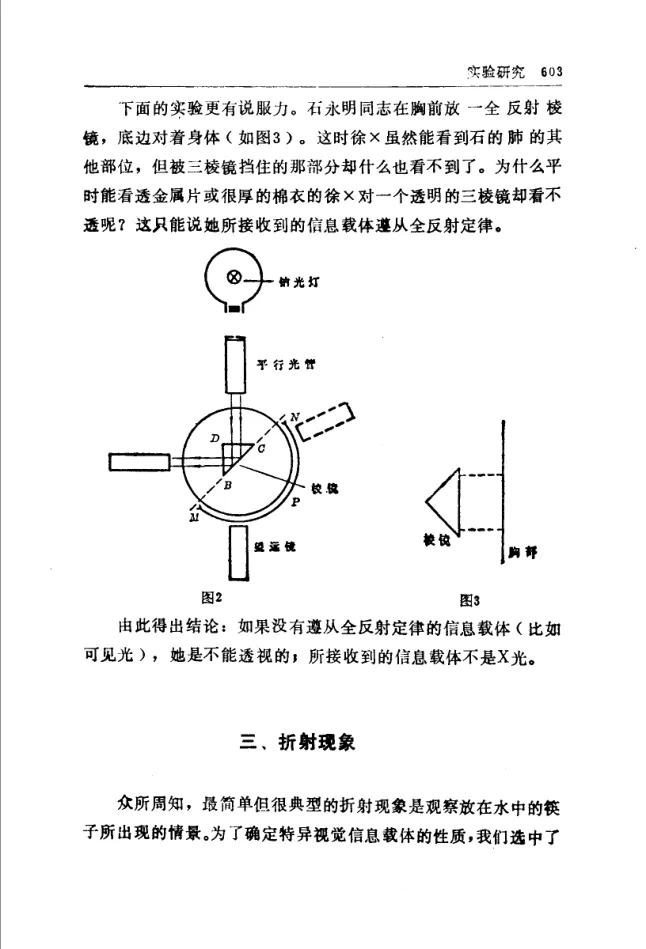
From this we conclude: without an information carrier that obeys the law of total reflection (such as visible light), she cannot see through; the information carrier received is not X-rays.
III. Refraction Phenomena
As is well known, one of the simplest yet most typical refraction phenomena is the scene observed when chopsticks are placed in water. To determine the properties of the extraordinary-visual information carrier, we selected
this simple and persuasive experiment.
An ordinary washbasin was filled halfway with water, and a bamboo chopstick was placed leaning diagonally against the edge of the basin, covered with six sheets of newspaper. Under normal lighting conditions, the extraordinary-ability subject Xu × was asked to look through the newspaper and describe what was in the basin and what shape it had. To ensure the reliability of the observation, she was given no prior hints whatsoever. After careful observation, she said: “There is a yellow chopstick; sometimes it is straight, sometimes bent, as if it were placed in water.” We noted that she observed from several different directions. Her observation results were entirely consistent with the results obtained by direct observation of ordinary people. The bending phenomenon she observed precisely demonstrates that the extraordinary-visual information carrier undergoes refraction in water.
IV. Polarization Phenomena
Using a Zeeman effect apparatus, we studied the ability of the extraordinary-ability subject to receive linearly polarized light and natural light. Xu × observed the 5461 Å green line emitted by a mercury discharge tube and used an analyzer to determine the polarization direction. The experimental results showed that, apart from being more sensitive than ordinary people, her observations of the properties of the π lines and σ lines were consistent with the observations of ordinary people.
The experimental apparatus is shown in Figure 4. When the external magnetic field strength is approximately 6000 gauss, the mercury 5461 Å green line splits into 9 lines: the middle 3 are π lines, with the electric vector parallel to the magnetic field direction; the remaining 6 are σ lines, with the electric vector perpendicular to the magnetic field direction. When the principal sections of both analyzers are parallel to the magnetic field direction, Xu × clearly sees the middle 3 lines; although the remaining 6 can also be seen, they are dimmed. When the principal sections of both analyzers are perpendicular to the magnetic field direction, Xu × clearly sees the outer 6 σ lines, while the middle 3 are dimmed. When the principal section of one analyzer is parallel to the magnetic field direction and the principal section of the other analyzer is perpendicular to the magnetic field direction, Xu × sees the entire field of view darken, with the 9 lines faintly visible. In principle, when the principal section of the analyzer is parallel to the magnetic field direction, Xu × should see only the 3 π
N/S | Mercury lamp | Filter | F–P | Lens | Analyzer | Spectrometer
Figure 4
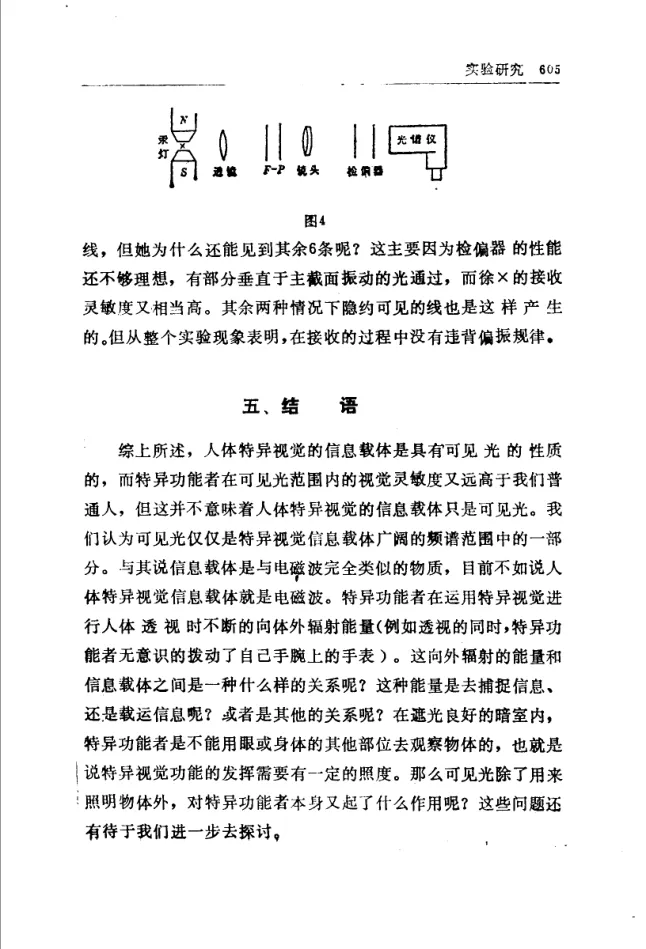
lines, but why can she still see the remaining 6? This is mainly because the performance of the analyzer is not yet ideal—some light vibrating perpendicular to the principal section passes through—and Xu בs reception sensitivity is quite high. The faintly visible lines in the other two cases are produced in the same way. However, the overall experimental phenomena indicate that the polarization laws are not violated during the reception process.
V. Concluding Remarks
In summary, the information carrier of extraordinary human vision possesses the properties of visible light, and the visual sensitivity of extraordinary-ability subjects within the visible light range is far higher than that of ordinary people. However, this does not mean that the information carrier of extraordinary human vision is only visible light. We believe that visible light is merely one part of the broad spectral range of the extraordinary-visual information carrier. Rather than saying the information carrier is a substance completely analogous to electromagnetic waves, it would presently be more accurate to say that the extraordinary-visual information carrier is electromagnetic waves. When extraordinary-ability subjects use extraordinary vision to perform body clairvoyance, they continuously radiate energy outward from the body (for example, while performing clairvoyance, the extraordinary-ability subject unconsciously moved the watch on her own wrist). What kind of relationship exists between this outward-radiated energy and the information carrier? Does this energy serve to capture information, or to carry information? Or is it some other relationship? In a darkroom with good light-shielding, extraordinary-ability subjects cannot use their eyes or other parts of their body to observe objects—that is, the exercise of extraordinary visual function requires a certain level of illumination. So, besides illuminating objects, what role does visible light play for the extraordinary-ability subject herself? These questions remain to be further explored.
Research on the Propagation in Space and Physical Properties of the Information Carrier of Clairvoyance
Ruan Yingchao, Xu Mei, Tang Jingqing
[Editor’s Note]
How does the information carrier of clairvoyance propagate in space, and what are its physical properties? Associate Professor Ruan Yingchao and colleagues have conducted research on this topic. Using a spectrometer together with prisms, gratings, and a polarizer set, the authors measured some properties of the carrier. This article is a summary of that experiment.
Authors’ affiliation: Heilongjiang University.
Clairvoyance is one of the most interesting and important functions among the latent functions of the human body. Since the first report in China on Tang Yu’s non-ocular vision, many extraordinary-ability subjects have been reported successively in various places (for example: Mou × ×, Xu ×, Liu ×, …). These subjects not only possess good non-ocular vision but, in particular, possess extraordinary (ocular or non-ocular) clairvoyance.
According to reports from various places as well as experiments personally conducted by the authors, including accounts from the subjects themselves, this clairvoyant function has the following series of characteristics: high penetrative ability, sense of color, very precise object-distance selectivity (capable of separately “seeing” characters on two thin sheets of paper pressed tightly together), relatively small …; only afterward does layered clairvoyance or a change of scene begin), and a thin, misty sensation during body clairvoyance, and so forth. Moreover, when scanning for hidden objects, there is a “gap effect” (i.e., sealed
when packaging items, if packaging gaps are left, the functioner’s scanning vision succeeds more easily.) Currently, the above-mentioned functions have begun to be applied in areas such as human-body fluoroscopy and soil-layer detection, and immediately yielded predictably excellent results (for example, fluoroscopy of the cranium won the admiration of experts). At present, in addition to the continuing development of visual functions (such as magnification functions), a situation of comprehensive functions has already emerged. This article is limited to the issue of “fluoroscopy function.” Clearly, in the face of the rapidly increasing body of facts, seeking to elucidate the mechanism of the fluoroscopy function has become a very important foundational issue that should be resolved. It encompasses two questions: the relevant mechanisms of the human body, and what the carrier of fluoroscopy information is. This has aroused broad interest and investigation among personnel in various disciplines; for example, phenomena such as reflection and refraction of non-ocular visual information have been reported, but few direct and rigorous measurement results have been published to date, and the question remains unsettled. This article attempts, through the measurement of the spatial propagation laws of the information carrier, to determine the attributes of the in-vitro carrier of the fluoroscopy function. Using a spectrometer together with prisms, gratings, and polarizer assemblies, the author measured a series of properties of the functional carrier. The results show that the color and form information perceived through fluoroscopy shares the same physical characteristics as light waves of the corresponding wavelengths in the color spectrum of the viewed object—that is, it obeys the same laws of geometric optics and wave optics. Thus, at least within the scope and precision of the experiments, the following statement is permissible: what the functioner sees is the viewed object’s thermal and — faint-light (extremely weak light) biological detection system, and it constitutes a stereo-detection array distributed across different parts of the human body.
I. Experimental Apparatus
The experiment used a spectrometer (JJY type) with a precision of ±1′ (Figure 1),
using Na light source (5893 Å) and Hg light source (5790, 5770, 5461, 4358, 4078, 4047 Å) respectively for the experiments. The slit width was 0.5–1 mm. On the central platform of the spectrometer, an equilateral triangular prism, a grating, and a serially connected polarizer assembly were placed respectively. First, using normal vision (performed by one of the authors, Ruan Yingchao), the exit angles of each spectral line of the light source were measured to determine the behavior of each wavelength component of the source. Then the light source was enclosed in a sealed cover to serve as a concealed object for the functioner (in this experiment, performed by Xu × using the eyes) to perform fluoroscopy. The functioner independently performed fluoroscopy through the spectrometer, rotating the exit light tube himself to search for any visible light traces. As a result, colored spectral lines were observed. The exit angles and color perceptions of the observed spectral lines were recorded, then cross-checked against the normal-vision records. During this process, a bystander randomly unsealed the light source to verify the spectral-line positions and color perceptions. There were two methods of sealed packaging for the light source: one was to place the entire light source (with a metal cover having an open window) into a black glossy artificial-leather bag, with an additional isolating paper layer on the outside; the other method was to place the light source into a finely crafted smooth-surfaced wooden instrument case, with the cover sealed and concealed, then wrapped from the outside in dark blue cloth. The case panels were 1 cm thick, painted on both the inside and outside. In terms of normal vision, all of the above light sources were completely and opaquely concealed. During the experiment, the slit aperture of the spectrometer’s entrance light tube was aligned with the center of the entire packaged wooden board or artificial-leather board, and the area of the light-tube slit aperture was very small (the maximum aperture did not exceed 3 mm). Normal vision through the spectrometer could not see any spectral lines at all. Therefore, the functioner’s observation through the spectrometer satisfies the meaning of “fluoroscopy.” The experiments were conducted in the laboratory after dark, and the results were independent of the indoor lighting (fluorescent lamps or flashlights). Measurements showed that, within the margin of error, the fluoroscopy results were completely consistent with the corresponding light-wave behavior recorded by normal vision. Moreover, the experimental items (reflection, refraction, dispersion, superposition, diffraction, interference, polarization, etc.) practically encompassed some of the most fundamental physical determinations of the nature of light waves.
II. Measurement Results
1. Laws of reflection and refraction at interfaces of homogeneous optical media (Figure 1)
“Reflected ray” Concealed light source a Prism “Incident ray” Entrance light tube β Polarizer assembly Platform Exit light tube Δ Fluoroscopy
Figure 1 Experimental apparatus diagram
Light source: Na yellow light (5893 Å), artificial-leather bag packaging type. Optical components: Equilateral triangular prism, polarizer assembly. Slit image width: ~0.7 mm.
Data table: Yellow spectral lines perceived through fluoroscopy, with angular distribution as shown in Table 1.
Table 1
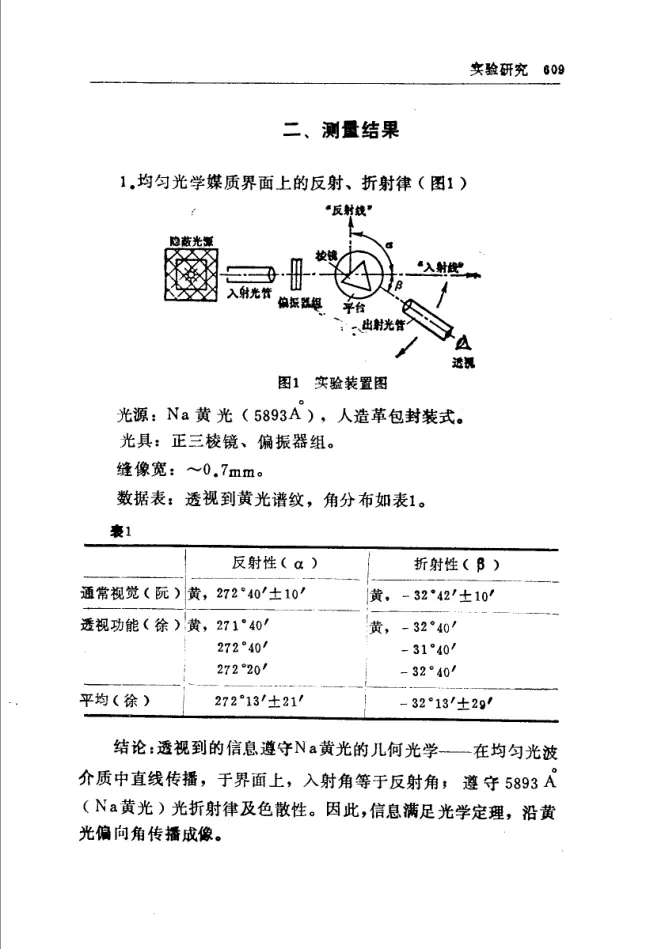
| Reflectivity (α) | Refractivity (β) | |
|---|---|---|
| Normal vision (Ruan) Yellow | 272°40′±10′ | −32°42′±10′ |
| Fluoroscopy function (Xu) Yellow | 271°40′ | −32°40′ |
| 272°40′ | −31°40′ | |
| 272°20′ | −32°40′ | |
| Average (Xu) | 272°13′±21′ | −32°13′±29′ |
Conclusion: The information perceived through fluoroscopy obeys the geometric optics of Na yellow light—propagating in straight lines in a homogeneous optical medium, where at the interface the angle of incidence equals the angle of reflection; it obeys the refraction law and dispersion properties of 5893 Å (Na yellow light). Therefore, the information satisfies optical theorems, propagating along the deflection angle of yellow light to form an image.
2. Wave nature of the carrier (Figure 2)
Grating (600/mm) Concealed light source “Incident ray” Polarizer assembly! Wooden case Fluoroscopy
Figure 2 Wave nature of the carrier
Light source: Na light source, Hg light source, both in finely crafted wooden case packaging. Optical components: Grating (grating constant 600/mm). Slit image width: ~0.5 mm (central 0th-order bright fringe).
Data table: Discrete spectral lines observed through fluoroscopy via the grating, with angular distribution as shown in Table 2 and Table 3.
Table 2 Na light first-order maximum diffraction angle (φ)
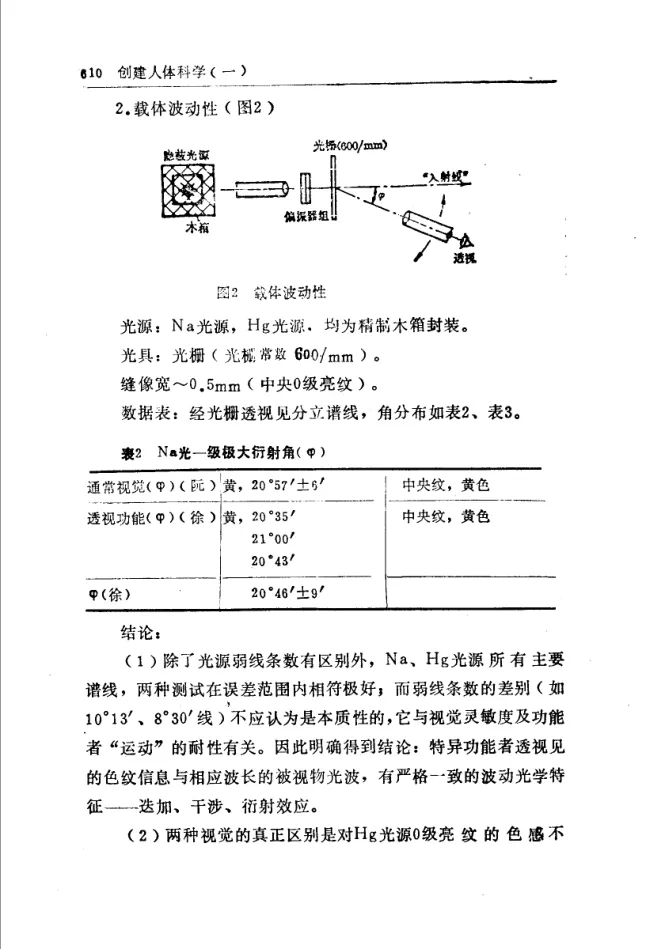
| Normal vision (φ) (Ruan) | Fluoroscopy function (φ) (Xu) | |
|---|---|---|
| Yellow, 20°57′±6′ | Yellow, 20°35′ | |
| Central fringe, yellow | Central fringe, yellow | |
| 21°00′ | ||
| 20°43′ | ||
| φ (Xu) | 20°46′±9′ |
Conclusion:
(1) Except for differences in the number of weak spectral lines, all major spectral lines of the Na and Hg light sources agree extremely well between the two types of tests within the margin of error; the differences in the number of weak lines (such as the 10°13′ and 8°30′ lines) should not be considered essential, as they are related to visual sensitivity and the “endurance” of the functioner’s “movement.” Therefore, a clear conclusion is drawn: the colored spectral-line information perceived through fluoroscopy by the extraordinary-function possessor has strictly consistent wave-optical characteristics—superposition, interference, and diffraction effects—with the light waves of the corresponding wavelengths from the viewed object.
(2) The real difference between the two types of vision is the color perception of the Hg light source’s 0th-order bright fringe, which is not
Central fringe Pale whitish-purple Dark red 0 0 8°30 8°08 8°30 8°30 Purple ±19±1′ ±2′ 10°39 99.0 10°10 10°13 Purple 4047 Blue-purple 14°13 Blue-purple 14°00′ 14°25′ 14°10′ 14°13′ 16 dry 15°20′ 15°20′ 15°30′ 15°20′ 15°23′ 4358 Blue Blue ±5′ 17°33 17°23 17°40′ 17°12 17°35 17°16 17°40 17°22 17°38 / 17°17 Dark green Dark green
Table 3 Angular distribution (φ) of the first-order diffraction maxima for each wavelength of the Hg light source
~4916 Dark green ±3′ 19°23 19°10′ 19°20′ 19°20′ 19°17′ 5461 Bright green Green ±6′ ±11 ±5′ 20°39 20°33 20°50 20°37 20°40′ 20°20 20°50 / 20°10 20°47 20°22 5770 Yellow Yellow 5790 Yellow Yellow
Representative wavelength of main spectral line Color Routine test (φ) (Å) Extrasensory vision (Xu) (φ)
…is the same. The original color of the light source is pale whitish-purple (this is the case for both normal vision and the color perception of the functioner themselves), yet the extrasensory color perception is decidedly dark red. This situation does not occur for the Na light source; for Na light, the extrasensory color perception of both the central fringe and the first-order fringe is yellow. We previously knew that Xu × possesses infrared vision, and Hg light contains infrared spectra such as 10140 Å and 16918 Å; therefore, the dark red should correspond to these waves. The reason these infrared waves are preferentially seen can be attributed to the fact that, after the mixed information passes through the blocking layer, their intensity is greatest, and subjective vision is also sensitive to them. Although the Na light source contains an infrared spectrum, after packaging, the yellow light intensity may still far exceed that of other wavelengths (the infrared vision sensitivity of the functioner has been confirmed by a series of institutions).
Therefore, the extrasensory color perception of individuals with extraordinary abilities has the following property: for single-colored concealed objects, the perceived color sensation reflects the original color; for mixed-wave colors, the perceived color sensation is the result of objective selection by the blocking layer and subjective selection by the functioner, and does not necessarily reflect the original color in the concealed environment where the viewed object is located.
-
Transverse wave nature of the carrier In the preceding experiments, the polarization of the information for each colored fringe was checked using an optical polarizer assembly. The results proved, without exception, that all perceived colored fringe information could be filtered to yield polarized waves in a specified direction (the polarization direction was determined based on the darkest intensity of the analyzer), which is completely consistent with the behavior of the corresponding light waves of a direct visual light source. Therefore, the perceived information carrier is a transverse wave, just like a light wave.
-
Attenuation of the carrier when blocked by a medium Light source: Na yellow light (5893 Å), packaged in artificial leather, with added paper layers for blocking. Optical apparatus: Equilateral triangular prism. Slit image width: The reflected slit image width of the direct visual light source is ~1 mm. Measurement: Extrasensory perception was conducted along the direction of the reflected light. Between the concealed light source and the incident light tube, different thicknesses of dictionary paper layers (printed with typeface) were used for blocking (Figure 3). The thickness of the paper layer was changed, and the extrasensory perception results were recorded. At this time, Xu × reported that both the width and brightness of the perceived yellow fringe changed. We plotted the relationship between the fringe width and the number of paper layers as the curve shown in Figure 4.
Concealed Na light Prism Dictionary paper layer Extrasensory perception Figure 3 Slit image width Direct visual light source 0.5
- Number of dictionary pages 111 Figure 4
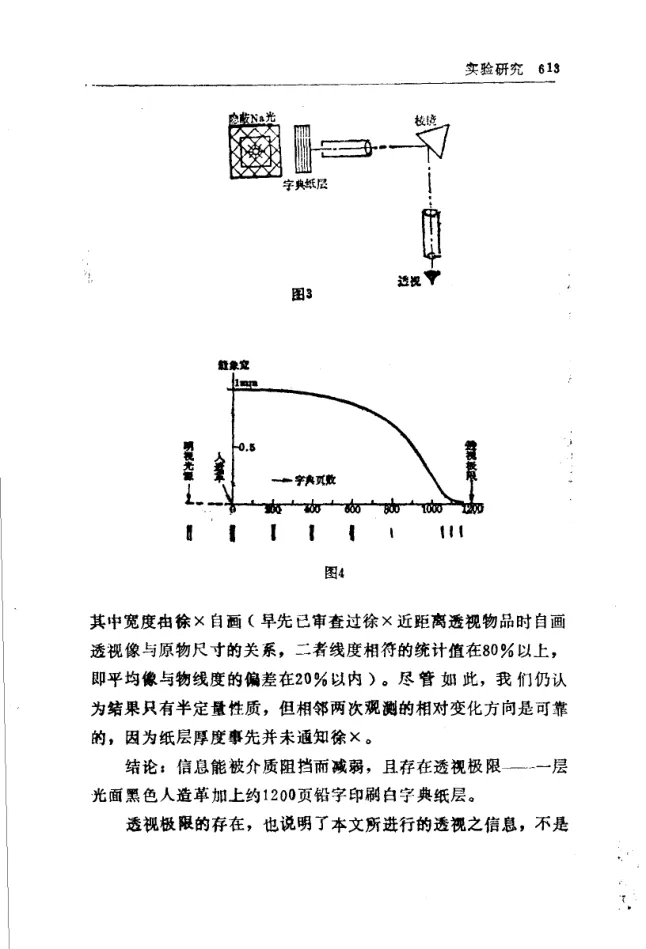
Here, the width was drawn by Xu × themselves (we had previously examined the relationship between the self-drawn extrasensory image and the original object’s size when Xu × performed close-range extrasensory perception of objects; the statistical value of the linear dimensional consistency between the two is over 80%, meaning the average deviation between the image and the object’s dimensions is within 20%). Nevertheless, we still consider the results to be only semi-quantitative, but the relative direction of change between two adjacent observations is reliable, because the thickness of the paper layer was not disclosed to Xu × in advance.
Conclusion: The information can be attenuated by being blocked by a medium, and there exists an extrasensory perception limit—a layer of black glossy artificial leather plus about 1,200 pages of white printed dictionary paper.
The existence of an extrasensory perception limit also demonstrates that the information of the extrasensory perception conducted in this paper did not
enter the spectrometer by bypassing the light source, but rather enters the spectrometer directly through the blocking layer, because the space between the paper layer and the entrance slit is not enclosed.
III. Discussion
(1) When an individual with extraordinary abilities perceives a concealed object (Na, Hg light sources), the colored fringe information they see propagates and forms an image inside the spectrometer according to optical laws. The information shares the following identical physical properties with the light wave of the corresponding wavelength of the object being perceived: ① straight-line propagation in an optically uniform medium, as well as the laws of reflection and refraction, and dispersion at the interface of media; ② the wave optics laws exhibiting the same wavelength through a diffraction grating; ③ a consistent transverse wave nature; ④ the same color sensation for monochromatic light; ⑤ both can be attenuated by being blocked by an optical medium. When the thickness of the blocking medium is reduced to 0 (direct visual light source), the observation results for Na light are primarily manifested as changes in intensity.
Therefore, within the scope of the experiments, the color and shape information perceived by individuals with human extraordinary abilities possesses strict electromagnetic wave attributes and is indistinguishable from the specific wavelength light wave of the viewed object. Thus, within the scope of the experiments, the following statement is permissible: what individuals with extraordinary abilities perceive is the light wave of the corresponding wavelength of the viewed object.
(2) The experiments rule out in principle any of the following conjectures: that the colored fringe information perceived by the functioner during the experiment consists of X-rays, microwaves, or optical-frequency amplitude-modulated waves.
Individuals with extraordinary abilities generally have a broader range of visual wavelengths, and it is even impossible to rule out that they have visual sensations for X-rays, microwaves, or other radiation fluxes; however, the colored fringes themselves perceived in this experiment are not these waves or fluxes. In fact, due to the diffraction grating (or prism dispersion) effect, any mixed electromagnetic wave will undergo component decomposition, and a specified wavelength will propagate independently along its unique direction after passing through the optical apparatus. Therefore, along the propagation direction of each colored fringe, other components are in principle excluded, including X-rays, microwaves, or amplitude-modulated waves, as well as other
other streams of ray particles (de Broglie waves having the same wavelength as light waves; for all particle streams except neutrinos, these are far too long, and neutrinos in any case ought not to possess so many of the aforementioned light-wave properties). Therefore, one should not vaguely imagine the information perceived through “X-ray vision” as X-rays or microwaves; rather, one should give a specific answer for each specific situation—namely, whatever is seen is what it is.
(3) If one attempts to attribute the information perceived through X-ray vision entirely to light waves, the following question must also be answered: In all cases where a gifted individual sees through to the viewed object, does light of the corresponding wavelength objectively and truly pass through the masking barrier layer for the gifted individual to perceive?
Clearly, according to the usual absorption law (where and are the transmitted and incident light intensities respectively, is the thickness of the absorbing layer, and is the absorption coefficient for the corresponding wavelength), there can only be two scenarios: light is transmitted, or no light is transmitted. We do not yet know how to define the absolute boundary between “light present” and “no light.” For the sake of definiteness, we may define a critical light intensity = 1 photon / (viewing time × area), calling “light present” and “no light.” Considering paper layers, is on the order of –/cm, corresponding to approximately 400–1000 sheets of paper. Therefore,
With regard to “no-light” vision. However, upon closer analysis, it is not difficult to find that the latter scenario derived from this reasoning is, at least for the present, not a definitive one, because the above judgment regarding “no light” is unsatisfactory both in theory and in practice: first, the aforementioned absorption law is statistical in nature and does not reflect reality for sufficiently weak light—even if one infers from it that , it cannot in practice guarantee that no light is transmitted; second, determining whether light exists ultimately requires objective instruments to make measurements in the specific environment, yet we are unaware of any highly satisfactory instrument, free from background interference at all other wavelengths, that has already provided a measurement result for extremely weak light of a specified wavelength (e.g., on the order of ).
From this it can be seen that, on the question of determining “light present” versus “no light,” we have neither obtained a satisfactory and comprehensive affirmative answer, nor a satisfactory negative answer. Hence our conclusion to date is: there is not yet conclusive evidence proving that persons with extraordinary abilities see through to the viewed object under no-light conditions, and therefore that the information perceived through X-ray vision is not light waves of the corresponding wavelength; on the other hand, in every case where a definitive judgment can be made, experimental results show that the information perceived through X-ray vision possesses the properties of light waves (electromagnetic waves), and it is even permissible to say that the information is light waves of the corresponding wavelength.
(4) Since the information perceived through X-ray vision can be attributed to light waves, the X-ray vision ability of a person with extraordinary abilities is then equivalent to a kind of “biological ultra-micro-light (extremely weak light) detector.” It possesses unprecedented photosensitivity and selective recognition capabilities, and since the functional region has multiple locations (for example, Xu × has good X-ray vision function in both the hand and the eye), the human body thus forms a three-dimensional “detector array.” Taking the detection limit of such a detector as the standard, the surrounding world becomes a world in which various extremely weak light objects—depending on selectivity—can directly or through curved optical channels reveal their forms. The visual world of persons with extraordinary abilities encompasses that portion of the micro-light world that is hidden from ordinary vision.
(5) Since non-eye regions of the human body also possess X-ray vision function, and since even when X-ray vision is performed through the eyes, the gifted individual clearly feels that X-ray vision and ordinary vision are two distinct visual states of the eye (for example, this article’s foreword has already enumerated a series of new characteristics of X-ray vision), when X-ray vision is not being performed, the eyes return to ordinary vision. Therefore, the mechanism of X-ray vision differs greatly from the ordinary visual process of eyeball imaging and retinal reception. In-depth study of this new mechanism of the human body’s latent X-ray vision ability is a topic to be resolved in the future. Current data have already begun to provide certain outlines.
(6) This article has in effect provided a class of convenient and effective methods for the quantitative detection of X-ray vision information from persons with extraordinary abilities, applicable to information measurement across all wavebands.
In summary, this article has obtained a series of rigorous, quantitative, and direct pieces of evidence proving that the information perceived through X-ray vision by persons with extraordinary human abilities is precisely the light waves (electromagnetic waves) of the viewed object—or, in other words, it is an X-ray vision information wave that strictly obeys the geometric propagation laws and wave theory of electromagnetic waves.
Pointing this out undoubtedly has clear significance for the complete revelation of the phenomenon and mechanism of “X-ray vision”—a type of latent human-body function. Here, the author’s actual meaning is that, apart from known physical existences such as visual electromagnetic waves, no new physical existence has yet been discovered.
Experimental Research on the Optical Phenomena of Extraordinary Human Abilities and Their Essential Nature
Shao Laisheng, Fang Linhu, Zhao Ziguang, Zhang Linchen, Zhang Ming, Zhou Yingqi
[Editor’s Note] As early as February 1980, at the First National Symposium on Extraordinary Human-Body Functions, it was already reported that persons with extraordinary human abilities could cause photosensitive materials such as photographic film, photographic paper, and nuclear emulsion to become exposed simultaneously while emitting their power. This phenomenon was subsequently verified by experimenters across the country and was confirmed to be genuine. This phenomenon attracted the attention of the present authors. In order to further investigate the phenomenon of extraordinary human-body functions, they adopted the same method but substituted enlarging paper, thereby increasing the area of the photosensitive material and thus obtaining more information; they also employed the principle of complementary colors, using color photographic paper and monochromatic light sources, among other techniques, and conducted a series of discriminative experiments in a completely dark environment. The experiments were not expensive, yet they clearly reveal the experimenters’ clear design thinking and convincing results.
The inspiration offered by this article is that a good design concept is far superior to many instances of blindly employing high-technology means for aimless testing.
Affiliations of the authors of this article: Shao Laisheng and two others, Fudan University; Zhang Linchen, Shanghai Chuneng Middle School; Zhang Ming, Shanghai Maritime Academy; Zhou Yingqi, Shanghai Fisheries College.
To date, the phenomenon of extraordinary human-body functions cannot yet be explained by modern scientific knowledge; however, through modern scientific experimental methods, a large body of experimental data can be accumulated, which will inevitably
It will certainly be possible to gradually approach and reveal the true face of this unknown domain. For example, during the process by which individuals with extraordinary human abilities use “mental intent” to recognize characters, there is an accompanying effect of exposing photographic film and producing responses in photosensitive elements; this has already attracted the attention and investigation of scientific researchers [1–4].
In our experiments, we employed both black-and-white and color photographic enlarging paper together with silicon photocells to study the optical phenomena of human-body extraordinary abilities. Through a series of experiments, we demonstrated that the visible light in the experimental environment, assisted by the action of extraordinary human abilities, enters the black plastic bags or containers used to package the specimens, thereby exposing the photographic enlarging paper. We also discovered that the subject Zhang × could perform various extraordinary abilities in a dark environment, thereby providing further verification of the experiments.
The experiments were carried out in three parts.
I. Enlarging Paper Exposure Experiments
1. Experimental Methods
Most of the experiments used a book-style specimen packaging. One to three sheets of ordinary Gongyuan No. 2 enlarging paper (305×254 mm²) were folded in half with the emulsion side facing inward. Tests showed that this enlarging paper is sensitive to visible light but insensitive to X-rays, including soft X-rays. Then, a semi-transparent paper slip bearing colored writing was affixed to the emulsion surface of the innermost sheet of enlarging paper (ESP experiment), or one end of a fine aluminum wire (1 mm in diameter) was fixed to the emulsion surface of the enlarging paper with adhesive tape (PK experiment). Among the layers of the book-style enlarging paper, monitor objects such as polarizers, color filters, color enlarging paper, black-and-white or color photographic negatives, and aluminum foil were placed, with the aim of determining the physical properties of this optical phenomenon. The entire stack of enlarging paper specimens was sealed inside a black plastic bag (the type used for packaging enlarging paper), then placed inside another identical black plastic bag, the edges rolled and sealed to ensure no light leakage, and at the opening several places were sewn with silk thread and
knotted. Both ends of the silk thread were affixed to cotton paper and signed, in order to satisfy the requirements of irreversible sealing. The complete specimen is shown in Appendix Figures 24 and 25.
In our initial experiments, we found that on the opposing emulsion surfaces of the folded enlarging paper, images of the characters appeared in both normal and reversed forms, but both were relatively dim; see Appendix Figure 26. We believe this may have been caused by some type of extraordinary radiation emitted by the human body entering from both the front and back of the specimen, with the two exposures superimposed. We also found that aluminum foil can effectively block or attenuate the energy of this extraordinary radiation. Therefore, in subsequent experiments, a sheet of aluminum foil was affixed to the back of the enlarging paper bearing the specimen, so that most of the energy entering from the back was blocked by the aluminum foil, thereby yielding an image with clear tonal gradations. Appendix Figure 27 shows two portions of the same sheet of enlarging paper, one with and one without aluminum foil shielding; the contrast in image clarity between the two is striking.
2. Experimental Results
(1) Experimental records show that extraordinary radiation from the human body, passing through photographic negatives, can form a clear positive image on enlarging paper; see Appendix Figure 27. It can also produce both normal and reversed images of text written on semi-transparent paper on enlarging paper; see Appendix Figure 26.
(2) After extraordinary radiation from the human body passes through red, green, blue, and yellow filters, the corresponding complementary colors are produced on color enlarging paper; see Appendix Figure 28.
(3) When extraordinary radiation from the human body passes through two cross-polarizers, the crossed portion produces a negative image on the enlarging paper exhibiting absorption properties identical to those of visible light; see Appendix Figure 29.
(4) In one experiment, a reflected image of the folded corner of an aluminum foil specimen was imprinted on the enlarging paper; see Appendix Figure 30.
(5) Extraordinary radiation from the human body, after passing through a red plastic film, like the red safelight in a photographic darkroom, could not expose black-and-white enlarging paper; see Appendix Figure 31.
The enlarging paper exposure experiments indicate that when individuals with extraordinary abilities perform image recognition, the process is accompanied by visible light within the electromagnetic spectrum around the specimen, with a frequency range covering the entire visible light
spectrum, and exhibiting phenomena such as refraction, reflection, and polarization. This result is identical to the experimental conclusion reached by Xu Lanxu et al.
II. Verification Experiments on the Participation of Visible Light in Extraordinary Radiation
Based on the above experimental results, we hypothesized that under monochromatic light illumination (e.g., a sodium lamp), still using the experimental methods described above, non-color-blind individuals with extraordinary abilities would be tested. If the experimental results showed complementary colors corresponding to the four color filters—red, green, yellow, and blue—on the color enlarging paper, then two possible situations were indicated: ① The visible light in the test environment did not participate in the action of extraordinary abilities, and the optical phenomena of human-body extraordinary abilities might be a secondary effect; ② The human brain is able to modulate the full-spectrum visible
light onto the extraordinary radiation. Conversely, if the four colors appearing on the color enlarging paper were difficult to distinguish and were merely the complementary color of sodium light, then this would indicate that the visible light in the test environment had directly or indirectly participated in the action of human-body extraordinary abilities.
1. Experimental Methods
This experiment still used book-style specimen packaging. On the emulsion surface of a folded sheet of Gongyuan No. 2 enlarging paper, two sheets of Sakura-brand color enlarging paper made in Japan (90×130 mm²) were placed side by side. One was covered with a filter composed of red, green, yellow, and blue color bars, and the other was covered with a semi-transparent paper slip bearing colored writing. The specimens were then sealed in a double-layer black plastic bag. In addition, a control specimen was prepared simultaneously. The control specimen was made by covering the emulsion surface of color enlarging paper with the above four color filters and placing it in a lightproof paper box.
The experiments were conducted in a darkroom. When the individual with extraordinary abilities was under sodium lamp or mercury lamp illumination
Below, when the subject used “mental intention” to recognize the text on the formal test sample inside a plastic bag, the comparison sample’s paper box was immediately opened and exposed under the same colored light. In this way, each experiment yielded three samples on color photographic enlarging paper: two were results of exposure to extraordinary radiation, and one was a comparison sample exposed normally under the same colored light. These three sheets of color enlarging paper were simultaneously immersed in the developer solution to ensure consistency of color.
2. Experimental Results
Figure 32 shows the color negative image obtained after development, when the extraordinary-function subject recognized four characters in the sample under sodium lamp illumination (model PNaD-20) in a darkroom, using “mental intention.” Figure 33 shows the corresponding color negative image from the comparison sample. Figure 34 shows the color negative image obtained under ordinary tungsten lamp illumination. Among the colors in these five negative images, only Figure 34 displays the normal one-to-one corresponding four complementary colors; all the others display only a monotonous complementary color (bluish-cyan) related to the monochromatic light of the sodium lamp. We conducted the same experiment using a mercury lamp, and the results were consistent with those of the sodium lamp experiment.
Although the above experimental results are qualitative, they strongly demonstrate that visible light in the environment directly or indirectly participates in the action of extraordinary human abilities.
III. Verification of the Mode of Participation
From the above experimental results, the following question inevitably arises: In what manner does visible light in the environment enter the black plastic bag to expose the photographic enlarging paper? We believe there are two possible answers: ① Extraordinary human radiation can open an invisible window in the black plastic bag, allowing visible light from the environment to shine directly in; or, in other words, there exists a state of matter that we do not yet understand (this is an indirect mode of participation, in which light and extraordinary human radiation have no intrinsic connection); ② Visible light, through the action of the brain, enters
the black plastic bag in the form of extraordinary radiation (this is a direct mode of participation, in which light and extraordinary human radiation are intrinsically connected). Since in subsequent tests it was discovered that the subject Zhang × could also exercise various extraordinary functions in a dark environment, this provided a route for verifying the question posed above.
We designed two experimental verification schemes. The first scheme still used a book-style sample equipped with monitoring items such as color enlarging paper and color filter strips, and extraordinary-function tests were conducted on Zhang × in a darkroom with good isolation from external light. If the test results failed to reveal any traces of exposure on the color photographic enlarging paper in the sample bag, then it could be considered that “light” had no intrinsic connection with extraordinary human functions, but rather participated in the radiation effect indirectly. The second scheme employed a photosensitive detector for extraordinary-function testing. If a corresponding signal pulse was produced on the recorder in a natural light environment, while no corresponding signal pulse appeared in a dark environment, then this would also indicate that the participation of “light” in extraordinary human functions was an indirect effect. The methods of these two experiments served to mutually verify each other.
1. Experimental Apparatus and Results
The sample apparatus for the first verification scheme still employed book-style sample packaging. The second verification scheme was inspired by the phenomenon that when extraordinary functions are tested using enlarging paper, the entire sheet of enlarging paper can be exposed, leading to the idea of using a large-area silicon photovoltaic cell to replace the point-like photosensitive diode[]. Therefore, we employed a polycrystalline silicon photovoltaic cell (area 20×20 mm², conversion efficiency 12%) developed by the Institute of Semiconductor Materials at Fudan University, mounted at the bottom of a 135 film plastic cassette, with its lead wires connected directly to the input terminal of a domestically produced IZ3-100 type XY recorder (Y-axis sensitivity 0.5 mV/cm, recording paper speed 1.0 mm/s). The probe structure is shown in Figure 1. When Zhang ×, in a natural light environment, held the probe in the palm of the hand and used extraordinary function to bend a straight lead wire (diameter 0.9 mm, length 40 mm) placed inside the probe into a circle, the corresponding signal pulse on the recorder reached a maximum value of approximately 11 millivolts.
Figure 35 shows that Zhang ×, in a darkroom, used extraordinary function to bend the lead wire in the book-style sample, but the color enlarging paper and the entire sheet of black-and-white enlarging paper covered by the four colored filter strips — red, green, yellow, and blue — showed no signs of exposure.
Figure 36 shows characters written by Zhang × using extraordinary function on the black-and-white enlarging paper in the book-style sample in a darkroom; two sheets of color enlarging paper and the entire sheet of black-and-white enlarging paper were both unexposed.
Figure 37 shows that Zhang ×, in a darkroom, used extraordinary function to remove from the plastic bag a paper strip sandwiched between black-and-white enlarging paper sheets in the book-style sample, and correctly read the characters on the paper strip, but the monitoring samples — two sheets of color enlarging paper and the black-and-white enlarging paper — were all unexposed.
Figure 2 is the recorded graph of the light signal picked up by the silicon photovoltaic cell when Zhang ×, in the natural light environment of the laboratory, bent the lead wire in the plastic cassette into a circle using extraordinary function.
Figure 3 is the recorded graph of the light signal picked up by the silicon photovoltaic cell when Zhang ×, in the natural light environment of the laboratory, read out four Chinese characters and colors from the sample inside the plastic cassette using extraordinary function.
Figure 4 is the recorded graph from the contrast experiment in which Zhang × performed the above extraordinary psychokinesis and extraordinary character recognition in a well-light-shielded darkroom; no obvious light signal waveform appeared.
For all the above tests or contrast experiments, the same photosensitive probe and recorder under the same conditions were used, and before and after each test the silicon photovoltaic cell was calibrated using a JT-1 type transistor characteristic curve tracer.
Insulating cardboard Silicon photovoltaic cell Transparent film Sample chamber XY recorder 135 film plastic cassette Figure 1 Schematic diagram of the silicon photovoltaic cell probe
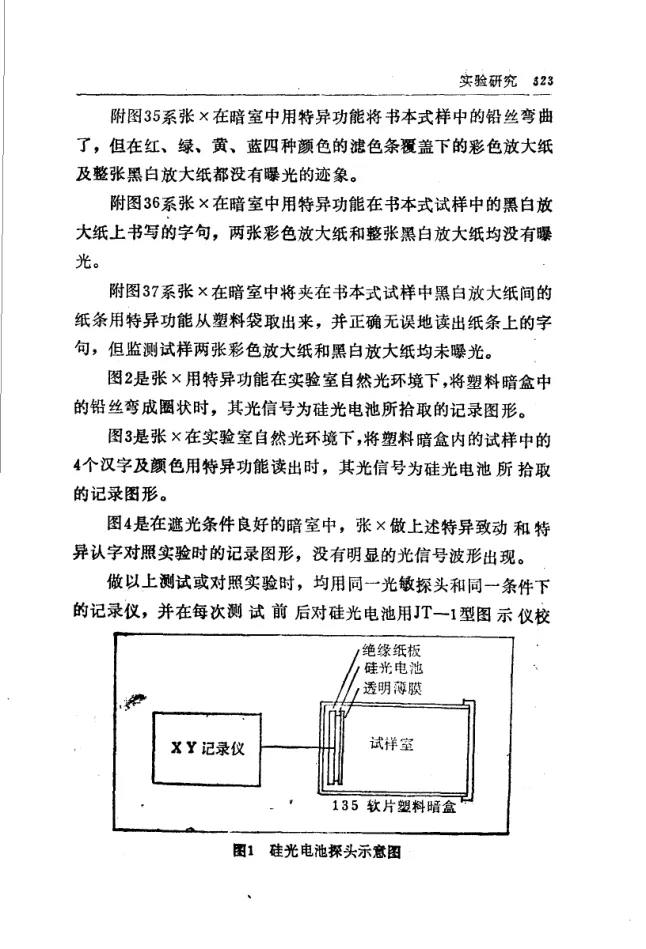
tested, and no changes whatsoever were found in its electrical performance.
For the above two experimental protocols, we conducted multiple repeated tests, and the experimental results were entirely consistent. This indicates that visible light in the testing environment indirectly participated in the action of extraordinary human abilities.
mv
14
12
(6)
10
.8
(4)
6
(5)
2
(1)
(1)
(3)
5
6
7
8
24
25
26 (min)
① A beam of light penetrated into the dark box ② A flash appeared at the forehead ③ Light shot from the forehead into the dark box; the lead wire did not bend ④ The light was very strong; the lead wire still did not bend ⑤ The lead wire appeared again at the forehead ⑥ The lead wire bent
Figure 2: The recorded waveform of the light signal during psychokinetic action, corresponding to the subject’s subjective report
mv
12
(4)
10
8
(3)
(1)
(2)
2
0
12
14
16
18
20
22
24
t (min)
① Many characters appeared at the forehead, but were blurred and unclear ② A red square frame was seen ③ The character “面” flashed at the forehead in green, “物” in brown or black, and “理” in red, inside the red square frame
Figure 3: The recorded waveform of the light signal during extraordinary character recognition, corresponding to the subject’s subjective report
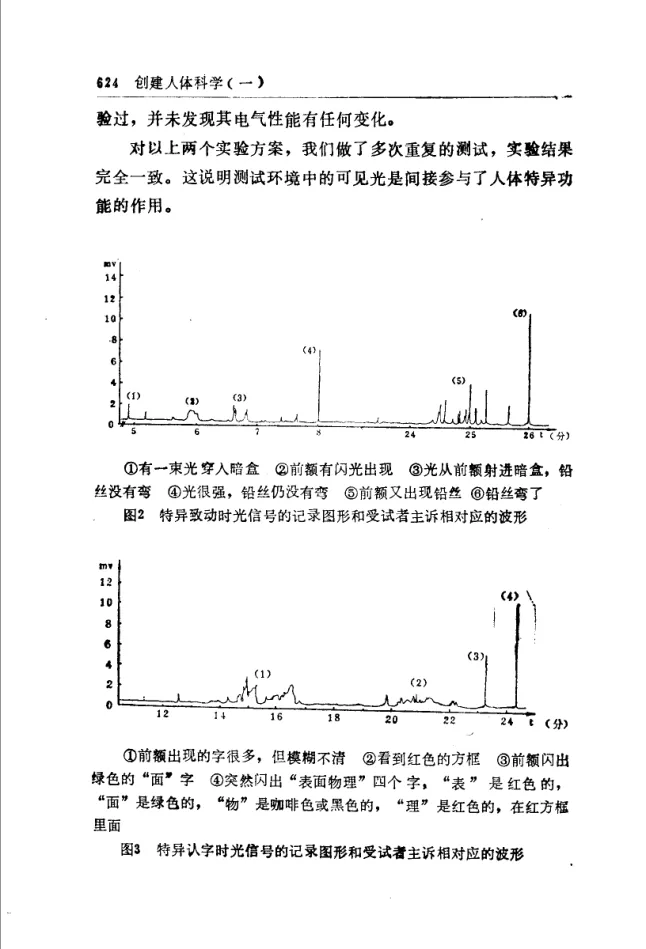
mv
10
8
2
(A)
(B)
0
2
6
8
12
14
16
18
20 (min)
Figure 4: Recorded waveform when subject Zhang ×, in a darkroom, used extraordinary abilities (A) to read the three characters “安眠曲” from the dark box of the silicon photocell probe, and (B) to bend a vertical lead wire into a ring shape
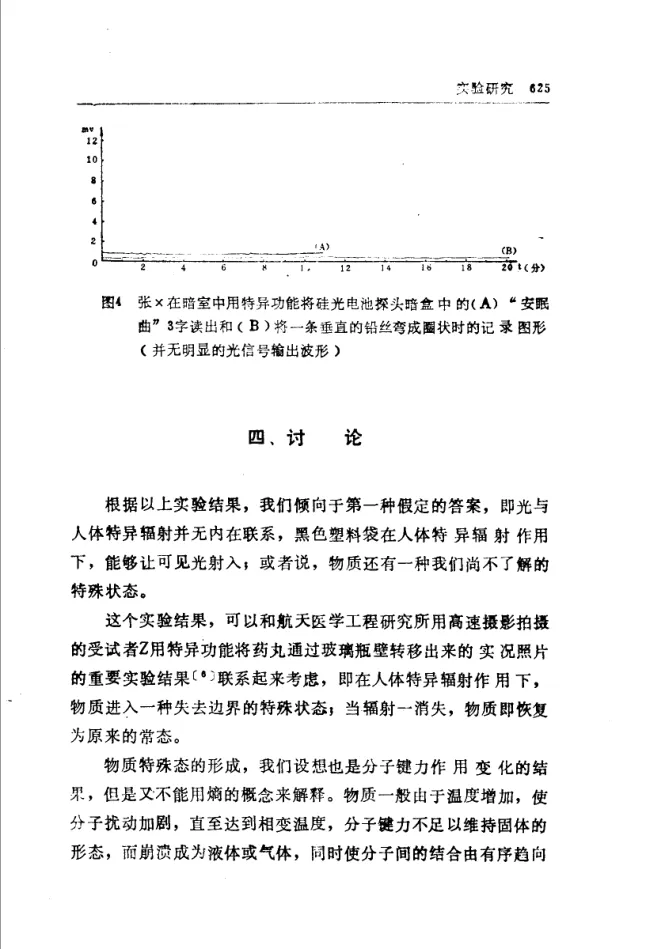
(No obvious light signal output waveform was present)
IV. Discussion
Based on the above experimental results, we are inclined toward the first hypothetical answer, namely that light has no intrinsic connection with extraordinary human radiation, and that black plastic bags, under the action of extraordinary human radiation, can allow visible light to pass through; in other words, matter may also possess a special state that we do not yet understand.
This experimental result can be considered in conjunction with an important experimental result from the Institute of Space Medico-Engineering, in which high-speed photography was used to capture real-time photographs of subject Z using extraordinary abilities to transfer pills through the wall of a glass bottle,[6] namely, that under the action of extraordinary human radiation, matter enters a special state in which it loses its boundaries; once the radiation disappears, matter immediately reverts to its original normal state.
We hypothesize that the formation of the special state of matter is also a result of changes in the action of molecular bond forces, yet it cannot be explained by the concept of entropy. For ordinary matter, as temperature increases, molecular agitation intensifies until the phase transition temperature is reached, at which point the molecular bond forces are insufficient to maintain the solid form, and the matter collapses into a liquid or gas, while the combination between molecules shifts from order toward
disorder; however, for the special state of matter, extraordinary human radiation can only weaken the molecular bond forces without destroying their orderliness. We can use the surface tension of a soap film as an analogy for the state of matter in its special state: if water droplets or small porcelain balls are sprinkled onto a soap film, they can pass right through while the film remains intact.
The molecular bond forces referred to above include ionic bonds, covalent bonds, and metallic bonds, and of course also include van der Waals forces between molecules — all of which are electrostatic-type bond forces. Thus, it can be stated briefly: extraordinary human radiation can weaken the electrostatic attraction between molecules of matter, but does not destroy the orderliness of its structure.
If this hypothesis approximates objective reality, then for non-conductive materials such as glass and plastics, their dielectric constant must inevitably change under the action of extraordinary human radiation; for transparent materials, their refractive index would also undergo changes. All of these can be verified experimentally.
For phenomena of extraordinary human abilities that thus far cannot be explained by modern scientific knowledge, it is very difficult to propose a relatively comprehensive hypothesis. However, based on reliable experimental results, it is still possible to put forward partial hypotheses — ones that can be accepted by modern scientific knowledge — to serve as the intellectual basis for future experimental designs.
The above represents only some of our preliminary views on the experimental results and several hypotheses that remain to be tested by future experiments. We believe that through extensive experimentation, the mysteries of extraordinary human ability phenomena can be gradually unveiled, promoting the advancement of science.
We wish to express our deep gratitude to our test subject, student Zhang ×, whose serious and conscientious attitude toward the experiments and excellent cooperation with the researchers enabled the successful completion of this study.
Notes and References
[1] Chai Jianyu, Zhao Yong, Nature Magazine, 4, 12 (1981) 892.
[2] Guan Shixu, Peng Wenjin, Harbin Institute of Technology “Scientific Research Reports,” No. 70,
(1981) 4.
[3] Zheng Tianmin et al., Nature Magazine, 4, 8 (1981) 563.
[4] Zhao Yongjie et al., Research on Extraordinary Human Abilities, 4 (1983) 154.
[5] Xu Lanxu et al., Research on Extraordinary Human Abilities, 4 (1983) 151.
[6] Internal exchange materials of the Institute of Space Medico-Engineering.
Experimental Study on the Effects of Human-Body Extraordinary Signals on Microorganisms
Ao Xizai, He Haiping, Zhou Jiuyuan, Dong Zhenjun, Gao Weimo
[Editor’s Note] The author has long been engaged in biological research and has been deeply attracted by the phenomenon of extraordinary human abilities. He applied research on extraordinary human abilities to microbiology and achieved gratifying results. Human-body extraordinary signals can inhibit the growth of certain microorganisms and even exert lethal effects; under other conditions, they can also exert inducing effects. He discovered that certain individuals with extraordinary abilities do indeed possess a “magnifying effect” and can directly observe the morphology of microorganisms such as viruses and bacteriophages. This article is a record of these experiments.
Affiliation of the authors: Wuhan University.
We began implementing this experimental program in January 1980. The experiment had two purposes in mind: First, we sought to find a biological method for testing human-body extraordinary signals. Previous experiments had fully confirmed that human-body extraordinary functions can cause electromagnetic testing instruments, which have extremely strong anti-interference capabilities, to malfunction during operation. The results measured by testing instruments designed on electromagnetic principles can hardly explain what the real signal actually is. This is especially the case when the tested subject possesses relatively strong “thought energy” (意念能); it is very difficult to prove that the working process of the testing instrument has not been interfered with by “thought energy.” Therefore, we envisioned applying the collective manifestations of certain effects produced by human-body extraordinary signals on microbial organisms to analyze the characteristics of human-body extraordinary signals.
The other idea was to explore why human-body extraordinary signals (including qigong) can treat certain diseases. Through nearly five months of experimentation and preliminary analysis, the following conclusions can be drawn: Human-body extraordinary signals can exert an inhibitory (even lethal) effect on the growth of certain microorganisms (including bacteria and viruses); under other conditions, they can also exert an inducing effect. In addition, during the course of the experiments, we also discovered that human-body extraordinary functions do indeed possess a “magnifying effect.” Below we present some of the results of our experiments.
I. The Magnifying Effect on Microbial Morphology
Test subject:
Wang ××, female, 39 years old, primary school physical education teacher, possessing the abilities of “non-ocular vision,” “X-ray perception” of the human body, perception of human meridians, and healing through human-body extraordinary signals.
Before the experiment, she knew nothing about our experimental intentions, nor did she know anything about the experimental materials we used. We only told her how to proceed: say whatever she saw, and report whatever she felt.
Materials and methods:
Seven 250 ml Erlenmeyer flasks were used, each loaded with one of seven observation subjects: ① silkworm polyhedra mixed with miscellaneous bacteria; ② castor silkworm polyhedra; ③ λC1857S7 strain (abbreviated 225); ④ the indicator strain corresponding to 225 (266); ⑤ λ-Phage (bacteriophage); ⑥ sterile distilled water; ⑦ sterile 0.85% physiological saline. In addition, there was one hemocytometer.
The above flasks were wrapped in paper, and inside the paper wrapping was another piece of paper with writing on it, which was given to the test subjects Wang ××, Du ×, and Du △ to identify. Our original purpose was to have the test subjects concentrate their attention on identifying the writing on the paper by hand, while simultaneously causing the “identification signal” to act upon the microorganisms inside the flask. After about 2–3 minutes, all of the more than ten characters were correctly identified. We then asked them to continue touching the bottom of the flask with their hands. Before long, Wang ×× said: “It seems like there is something inside the flask, and some of them are
moving” (Wang had absolutely no prior knowledge of what was inside the flask, nor did she know which department the laboratory belonged to). Her words surprised us greatly. We estimated that she possessed an “extraordinary magnifying” ability, so we asked her to draw the shapes of the things she “felt” in each of the seven flasks. The results are shown in Table 1:
Table 1: Results of Wang ×בs identification of microbial body morphology using hands and eyes
| Flask contents | Actual shape | Wang ×בs description |
|---|---|---|
| 1. Silkworm polyhedra mixed with miscellaneous bacteria | Triangular, quadrangular, pentagonal, with flagellated bacilli | Triangular, quadrilateral, and circular things inside. Also things about the size of cotton floss that are moving. |
| 2. Castor silkworm polyhedra | Triangular, quadrangular, circular | Only triangular and quadrilateral things. |
| 3. λC1857S7 strain (225) | Short rod-shaped | Things like short hairs, whitish gray. |
| 4. Indicator strain (226) | Short rod-shaped | Things like short hairs. |
| 5. λPhage (bacteriophage) | Tadpole-shaped under electron microscope | Only many small dots, seemingly moving, very slowly. |
| 6. Sterile distilled water | None | Only a few small particles, nothing swimming around. |
| 7. Physiological saline | ||
| 8. Egg yolk body section | Things arranged in rows like bananas. | |
| 9. Hemocytometer | 16 squares within a quadrilateral of double lines, with an area of 1/400 mm² | 18 small squares within a quadrilateral of double lines. |
In the above table, when viewing the hemocytometer, the squares drawn by Wang ×× were approximately 1 mm² in size, which indicates a magnification of about 400 times. Before she touched the flask with her hands, she could not clearly see what was inside the flask just by looking at the contents with her eyes. But after touching the bottom of the flask with her hands for a few minutes, through the coordination of hands and eyes, she could easily see the shapes of the contents inside the flask. Perhaps
…perhaps it is because the hand emits a certain signal, which is then received by the eyes. It may also be that when the hand continuously touches the bottom of the bottle, and attention is concentrated on the hand, the hand may emit some other “wave”; based on the principle of “ultrasonic amplification” or other non-optical amplification principles, what the eyes receive… its underlying mechanism remains unclear at present. Among our test subjects, five children with extraordinary abilities have been found to possess similar amplification functions, though their abilities are not as strong as those of Wang XX.
II. The Inhibitory and Bactericidal Effects of Special Human-Body Signals on Microorganisms
Subjects: Wang XX: female, 39 years old; Du X: female, 11 years old; Du △: male, 9 years old; Li X: female, 12 years old; Li XX: male, 9 years old.
Materials and Methods: Take a fresh agar slant of strain 266, wash it down with 4–5 mL of liquid culture medium, use a sterile pipette to draw 0.2–0.4 mL and place it into a 250 mL Erlenmeyer flask containing 50 mL of culture medium. Wrap it in paper, with a written slip of paper enclosed inside, and hand it to the subject to identify the writing inside by touching the bottle with their hand. This lasts for 30 minutes. Then, take 5 mL from the bottle; using distilled water as a control, perform colorimetry with a Model 721 spectrophotometer at a wavelength of 680 mμ. Afterwards, place it in a 37°C constant-temperature room and culture it with shaking on a Kahn oscillator. Samples are taken every 30 minutes for colorimetric measurement against distilled water. The control sample is measured simultaneously for colorimetry. The control sample is the sample that has not been subjected to the action of the special human-body signal. Three sets of test results are listed below:
Table 2(a)
| Time | No. | Wang XX | Du X | Du △ | Control sample |
|---|---|---|---|---|---|
| 0 o’clock | 1 | 0.225 | 0.170 | 0.222 | 0.105 |
| 2 | 0.226 | 0.170 | 0.210 | 0.105 | |
| 3 | 0.220 | 0.170 | 0.210 | 0.106 | |
| 30 minutes | 1 | 0.890 | 0.880 | 0.885 | 0.895 |
| 2 | 0.890 | 0.880 | 0.885 | 0.895 | |
| Constant temp 37°C | 3 | 0.890 | 0.880 | 0.885 | 0.895 |
| 60 minutes | 1 | 1.090 | 1.090 | 1.110 | 1.200 |
| 2 | 1.100 | 1.080 | 1.090 | 1.200 | |
| Constant temp 37°C | 3 | 1.100 | 1.080 | 1.100 | 1.200 |
| Total growth | 0.878 | 0.910 | 0.886 | 1.095 | |
| Growth multiple | 4.90 | 6.35 | 4.14 | 11.40 |
Table 2(b)
| Time | No. | Wang XX | Li X | Du △ | Control sample |
|---|---|---|---|---|---|
| 0 o’clock | 1 | 0.055 | 0.065 | 0.054 | |
| 2 | 0.056 | 0.065 | 0.051 | ||
| 3 | 0.053 | 0.065 | 0.052 | ||
| 60 minutes | 1 | 0.090 | 0.092 | 0.053 | |
| 2 | 0.079 | 0.090 | 0.080 | ||
| Constant temp 37°C | 3 | 0.080 | 0.089 | 0.090 | |
| Room temp | 1 | 0.516 | 0.525 | 0.527 | |
| 15 hours | 2 | 0.516 | 0.525 | 0.522 | |
| After | 3 | 0.516 | 0.520 | 0.528 | |
| Total growth | 0.461 | 0.458 | 0.473 | ||
| Growth multiple | 9.40 | 8.05 | 10.10 |
Table 2(e)
| Time | No. | Li X | Li XX | Control sample |
|---|---|---|---|---|
| 0 o’clock | 1 | 0.130 | 0.080 | 0.080 |
| 2 | 0.130 | 0.080 | 0.075 | |
| 3 | 0.130 | 0.075 | 0.070 | |
| 30 minutes | 1 | 0.150 | 0.090 | 0.090 |
| 2 | 0.150 | 0.092 | 0.095 | |
| 3 | 0.150 | 0.100 | 0.105 | |
| 60 minutes | 1 | 0.170 | 0.110 | 0.115 |
| 2 | 0.180 | 0.110 | 0.110 | |
| 3 | 0.175 | 0.105 | 0.100 | |
| Constant temp 37°C | 1 | 1.289 | 1.300 | 1.300 |
| 2 | 1.309 | 1.300 | 1.300 | |
| 3 hours | 3 | 1.200 | 1.250 | 1.250 |
| Total growth | 1.130 | 1.202 | 1.205 | |
| Growth multiple | 9.7 | 16.40 | 17.07 |
The microbial growth curve drawn according to Table 2(a) is shown in the figure below.
CD Control 1.3 Du Δ 1.2 1.1 Wang ×× 1.0 Du × 0.9 0.8 0.7 0.6 0.5 0.4 0.3 Figure 1. Microorganism growth curve
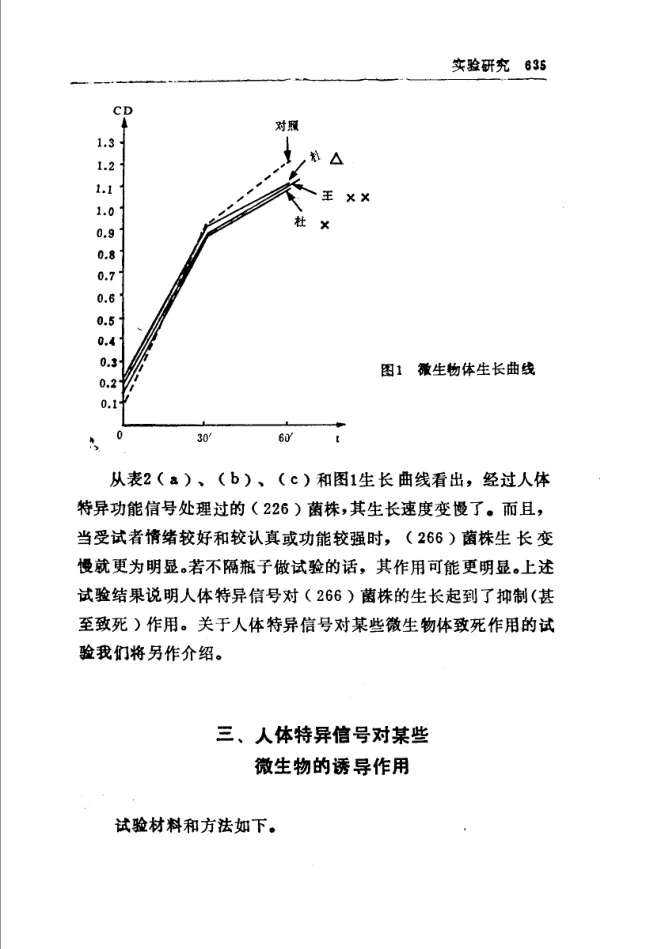 0.2
0.1
0
60
t
0.2
0.1
0
60
t
From Table 2 (a), (b), (c), and the growth curve in Figure 1, it can be seen that the (226) strain treated with human extraordinary ability signals exhibited a slower growth rate. Moreover, when the test subject was in better spirits, more focused, or had stronger abilities, the slowing of (266) strain growth was even more pronounced. If the experiment had been conducted without the bottle barrier, the effect might have been even more evident. The above experimental results indicate that the human extraordinary signal exerted an inhibitory (and even lethal) effect on the growth of the (226) strain. We will report separately on experiments regarding the lethal effect of human extraordinary signals on certain microorganisms.
III. The Inductive Effect of Human Extraordinary Signals on Certain Microorganisms
The experimental materials and methods were as follows.
Take one tube of λC1857S7 (abbreviated 225) bacteria, inoculate onto a slant (slant culture medium: peptone 1%, NaCl 0.5%, beef extract 0.5%, agar 2%, pH 7.5), and place in a 37°C constant-temperature room to culture overnight.
Take a fresh slant and wash it off with 4.5 mL of L·B liquid medium (Tryptone 1%, NaCl 0.5%, beef extract 0.5%, glucose 0.5%, yeast extract 0.5%, pH 8.0, autoclaved at 1 kg pressure for 20 minutes). Take 0.2–0.4 mL and inoculate into a 250 mL Erlenmeyer flask containing 50 mL of L·B medium, then place in a 37°C constant-temperature room on a rotary shaker and culture with shaking for 16 hours. The entire procedure for culturing the phage λ-Phage is as follows:
37°C 32°C 42°C 37°C Inoculate bacteria Culture Heat induction Expand propagation 37°C 37°C Pour plates Centrifuge to collect Add lysozyme Centrifuge to collect Assay Phage Lyse bacteria Bacteria
The temperature and time conditions for each step of the above process were as follows:
Inoculate bacteria: (37°C, constant-temperature culture overnight); Culture: 32°C constant temperature, 16 hours; Heat induction: 42°C, half an hour; Expand propagation: 37°C, 3 hours; Lyse bacteria: 37°C, half an hour; Pour plates: 37°C.
In our experiment, we used human extraordinary ability signals acting on the cultured bacterial strain in place of the “heat induction” step. The flask was wrapped in paper, with a slip of paper enclosed inside; the test subject held the Erlenmeyer flask containing the bacteria with both hands and attempted to recognize the writing on the slip inside the paper for half an hour. All subsequent steps remained unchanged. Finally, during the “plate assay” step, if many small clear zones appeared on the plate, this proved that “the phage had detached from the bacterial chromosome” (the bottom layer of the plate was solid culture medium, and the top layer was semi-solid culture medium plus the 266 strain and phage; the clear zones on the plate were produced by phage lysis, so if clear zones appeared on the plate,
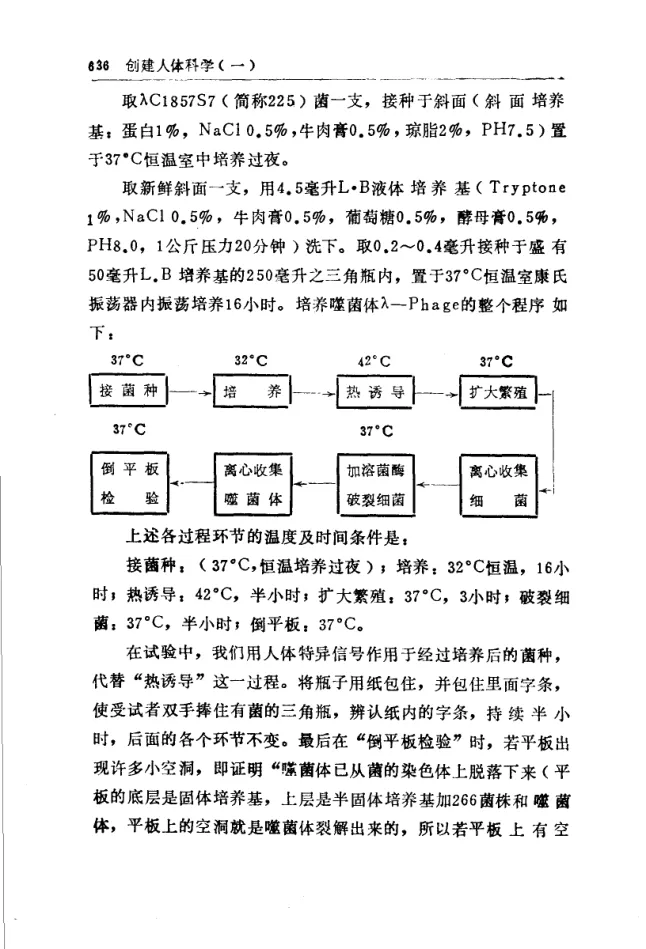
it indicated the presence of phage). In 14 person-times of experiments, we found “clear zones on plates” in 13 cases, indicating that the effect of human extraordinary signals on microorganisms can achieve the same result as heat induction. The number of plaques obtained ranged from a minimum of 10⁵ per mL to a maximum of 10¹¹ per mL. The relationship between plaque count and the strength of the extraordinary ability is currently difficult to determine. Generally speaking, when the ability was stronger and attention was more focused, the number of plaques that appeared was greater. Human extraordinary signals also have inhibitory and even lethal effects on certain bacteria. When the extraordinary ability was relatively strong and the actual duration of action was relatively long, it was also possible that, due to the bactericidal effect on bacteria, the number of plaques on the plates decreased or even disappeared entirely.
Is it due to human thermal radiation? Is it due to the human magnetic field or electric field? Or is it due to other forms of energy? This is a topic well worth exploring. The likelihood of human thermal radiation being responsible is extremely small, because the actual surface temperature of the test subject’s hands was below 37°C, far from reaching the 42°C temperature required for “heat induction.” We used magnetic fields, electrostatic fields, and alternating electromagnetic fields in place of “heat induction”; the experimental results showed that magnetic fields of a certain field strength, electric fields of a certain field strength, and alternating electromagnetic fields can all achieve the effect of “heat induction” and can also exert a bactericidal effect on bacteria. Detailed results will be reported in a separate paper.
The preliminary results of the above three types of experiments indicate: ① Human extraordinary signals have inhibitory and bactericidal effects on the growth of certain bacteria; ② They have an “inductive” effect on certain phages; ③ Persons with extraordinary abilities possess an “extraordinary magnification” ability and can perceive the morphology and movement of microscopic organisms. The above three points may provide some objective evidence or scientific explanation for why persons with extraordinary abilities (including qigong masters) can cure diseases. Our experiments are still preliminary, and the above conclusions await further verification.
Preliminary Testing of the Mechanical Effects of Human Extraordinary Abilities
Yunnan University Human Extraordinary Abilities Research Group
[Editor’s note] In the summer of 1980, Comrade Zhu Runlong of the Nature Journal editorial office went to Sihong County, Jiangsu Province, and discovered a young worker named Gao Shiqin who possessed spontaneous human extraordinary abilities that could disrupt the timekeeping of watches. This report attracted the attention of several teachers at Yunnan University, located far away on the southern frontier of the motherland. They began purposefully guiding persons with extraordinary abilities to mentally move watch hands, and achieved success. Immediately afterward, they designed experiments to conduct research. This article presents their experimental results on persons with extraordinary abilities moving a small desk clock that they had modified.
The publication of this article caused a great sensation. This was also China’s first experimental report studying psychokinesis using experimental methods.
Over the past year, the discovery, verification, and development of human extraordinary abilities have attracted the attention of a large number of scientific workers, who have carried out multifaceted observations and research. The development of human extraordinary abilities—from recognizing characters with the ear to remotely moving watch hands—may signify that human extraordinary abilities have progressed from information transmission, reception, and processing to a stage of macroscopic phenomena involving fairly strong radiation and the performance of mechanical work. This fully demonstrates the potential of the human brain and also represents an important advance and breakthrough in human extraordinary abilities. It may prove the objective existence of active radiation from human extraordinary abilities. Furthermore, it also proves that human extraordinary abilities can, through
developed through correct methods of induction and training. On October 5, 1980, we successfully induced Sun XX (female, 12 years old) to perform mental clock-hand manipulation. Using her extraordinary function, she controlled the clock hand, causing it to spin rapidly for several minutes to four or five hours within a matter of seconds. That same afternoon, we then successfully induced her to perform off-body remote manipulation of the clock hand at a distance of 30 centimeters. We conducted over a hundred observation experiments. Under off-body conditions, the manipulation of the clock hand exhibited a high degree of reproducibility, ensuring the authenticity and objectivity of the experiments. It is estimated that extraordinary functions possess a considerable energy radiation, which provides favorable conditions for our quantitative measurement of certain properties of the human body’s extraordinary functions, such as the duration of action, radiation power, the relationship between field strength and time, and so forth. On this basis, we carried out the same induction and training with Li XX (female, 11 years old) and Shao XX (female, 12 years old). By early November 1980, all three of them had attained the ability to remotely manipulate clock hands off-body and to move small table clocks. Accordingly, we conducted tests on them for over half a month, and through the testing apparatus took more than one hundred photographs, thereby carrying out preliminary quantitative measurement and analysis of mechanical properties.
I. Observation of Phenomena
(1) All three of them possess relatively strong functions such as recognizing characters and distinguishing colors, and seeing through the human body. Generally, when mentally manipulating clock hands, they sense the image of a clock appearing in the frontal region.
(2) A clock is a relatively complex mechanical device. Through repeated observation, we determined that the approximate location where force is applied is the gears of the auxiliary drive system.
If the force were applied to the hands, the correlation between the hour hand and minute hand would be disrupted, and the minute hand of the small clock would be bent and damaged. In fact, after more than a hundred instances of “mental clock-hand manipulation,” their correlation was strictly maintained. Furthermore, they could also advance the calendar of a calendar watch. In addition, a fully wound clock’s running time did not change its full running duration even after multiple manipulations, so it can be determined that mental clock-hand manipulation does not act upon the main drive system, but rather upon the gears of the auxiliary system.
(3) During mental clock-hand manipulation, the clock can be placed in any orientation; there is no fixed position.
(4) After several consecutive mental clock-hand manipulations, they felt quite strenuous effort was required, their ears and cheeks turned red, and they also felt some headache.
II. Experimental Principle and Apparatus
Making do with simple equipment, we selected a small table clock produced by the Shanghai Clock Factory in the 1950s and modified it to serve as the experimental apparatus, with a diameter of 8 cm. As described above, extraordinary functions have no effect on the main drive system of the clock. To eliminate interference caused by normal timekeeping, we removed the pendulum to stop the clock. At that point, only the auxiliary drive system could still rotate under the action of an external torque. Since the various gears are tightly meshed, a considerable amount of work must be done to overcome the frictional torque before the gears can rotate and drive the hands.
The auxiliary drive system consists of four mutually meshed gears (Figure 1). Rotating any one of them causes the other three to rotate as well; the correlation between the minute hand and the hour hand is established through this means. There are two locations in the system with relatively large frictional torque: one is the friction coupling device at the junction between the hand-setting wheel shaft and the main drive system, and the other is the friction plate between the hour wheel and the dial plate. Since the transmission ratio between the hour wheel and the hand-setting wheel is 1:12, the frictional torque on the hand-setting wheel shaft has a greater influence on the system.
To make the auxiliary drive system rotate, the applied torque must exceed the maximum static frictional torque, and work must be done to overcome the frictional torque. Taking the rotation angle θ of the hand-setting wheel as a measure of the magnitude of system rotation, the work done by the external force to overcome the frictional torque can be expressed as:
where M is the work done to rotate the system by a unit angle, or the frictional torque converted to the hand-setting wheel shaft. If the time over which the work is done is t, then the power is:
4
Figure 1 Auxiliary Drive System
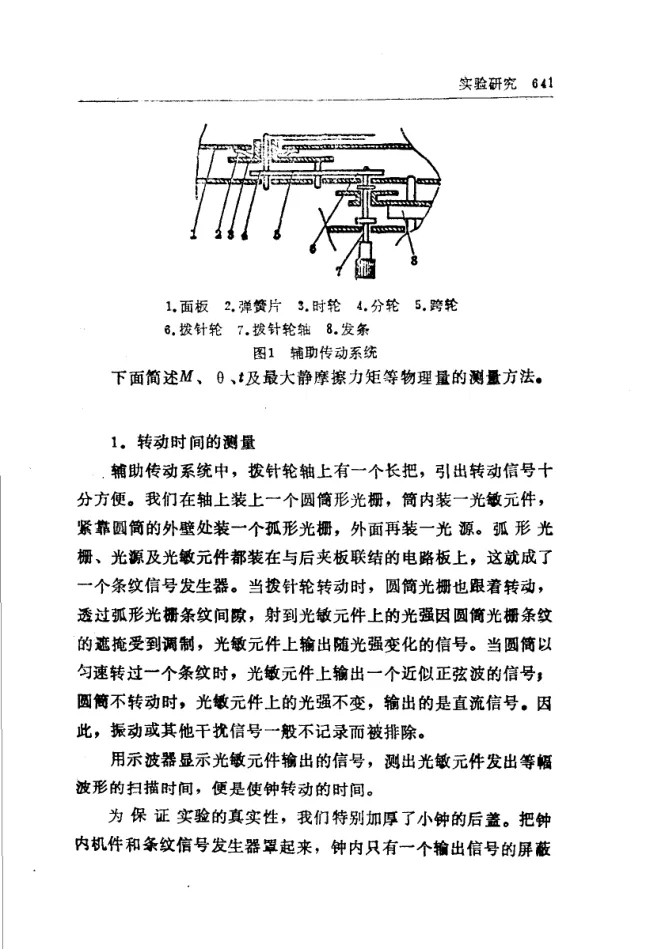
- Dial plate 2. Spring clip 3. Hour wheel 4. Minute wheel 5. Intermediate wheel
- Hand-setting wheel 7. Hand-setting wheel shaft 8. Mainspring
Below is a brief description of the measurement methods for the physical quantities M, θ, t, and the maximum static frictional torque.
1. Measurement of Rotation Time
In the auxiliary drive system, the hand-setting wheel shaft has a long handle, making it very convenient to extract a rotation signal. We mounted a cylindrical grating on the shaft, with a photosensitive element inside the cylinder. Close to the outer wall of the cylinder, we installed an arc-shaped grating, and outside that, a light source. The arc-shaped grating, the light source, and the photosensitive element were all mounted on a circuit board connected to the rear plate, thus forming a fringe signal generator. When the hand-setting wheel rotates, the cylindrical grating rotates along with it. Through the fringe gaps of the arc-shaped grating, the light intensity striking the photosensitive element is modulated by the shielding effect of the cylindrical grating fringes, and the photosensitive element outputs a signal that varies with the light intensity. When the cylinder rotates uniformly through one fringe, the photosensitive element outputs an approximately sinusoidal signal; when the cylinder is not rotating, the light intensity on the photosensitive element does not change, and the output is a DC signal. Therefore, vibration or other interference signals are generally not recorded and are excluded.
Using an oscilloscope to display the signal output from the photosensitive element, the sweep time over which the photosensitive element emits constant-amplitude waveforms is measured; this is the time during which the clock rotates.
To ensure the authenticity of the experiment, we specially thickened the back cover of the small clock. The internal mechanism and the fringe signal generator of the clock were enclosed, leaving inside the clock only a shielded [cable for outputting the signal]
line connected to the outside. To reduce thermal drift of the photosensitive element, several small holes were opened on the side of the back cover. The experimenter could not access any components inside the clock.
2. Measurement of rotation angle
Let the number of fringes on the cylindrical grating be . When it rotates through fringes, the rotation angle of the cylinder is:
Therefore, by counting the number of waves on the oscilloscope, the angle of rotation can be determined.
The cylindrical grating used in our experiment has , so each complete wave emitted corresponds to a rotation of 0.262 radians.
The transmission ratio between the setting wheel and the minute wheel is 1:1, so the angle through which the minute hand rotates should equal . However, due to backlash between the gears, when two consecutive rotations are in opposite directions, there is a return error between the setting wheel and the minute wheel, with a value of approximately 0.25 radians, i.e., close to one fringe of rotation.
When using the pointer to indicate the rotation angle, only the values before and after rotation can be recorded. If the pointer rotates in both directions during a single actuation, a relatively large deviation will result.
3. Measurement of friction torque
The cylindrical grating on the setting wheel shaft was removed and replaced with a metal lever. One end of the lever carried a weight of mass , and the other end was connected to a stopping device.
First, the height of the stopper was adjusted so that the lever was in a horizontal position, and the height of the weight was measured. Then the stopper was released, allowing the lever to rotate under the action of the weight. If the magnitude of the weight was appropriate, the lever rotated through an angle (<90°) and then stopped. The height of the weight at this point was then measured.
Based on the principle of conservation of energy, the decrease in the gravitational potential energy of the weight should equal the work done in overcoming the friction torque:
From Figure 2 it can be seen that:
Therefore:
In the experiment, kg, m, and the measured m, from which N·m was calculated.
It was found experimentally that the value of the friction torque is related to the position of the pointer. When the minute hand is in the same position and the hour hand is in different positions, the relative error is 2%; when the hour hand is in the same position and the minute hand is in different positions, the relative error is 7.5%.
To eliminate the influence of gear backlash, before each measurement we allowed the lever to rotate slightly beyond the starting point, then returned it and clamped it with the stopper before beginning the measurement.
Figure 2 Principle of friction torque measurement
Based on the above measurements, it can be calculated that the work done by the external force in overcoming friction for each complete wave emitted by the photosensitive element is:
If the time taken to emit this wave is seconds, then the instantaneous power is:
By measuring the period of each wave, a power–time curve can be plotted (as shown in Figure 4).
4. Measurement of maximum static friction torque
The apparatus and method are essentially the same as in section 3, except that a smaller value is first used,
so that after releasing the stopper, the lever does not rotate. The value is then gradually increased until the value that just causes the lever to rotate is found. At this point, the torque of the weight equals the maximum static friction torque on the setting wheel. The experimentally measured average value is:
with a relative error of 4.7%.
Figure 3 Oscilloscope recording photograph
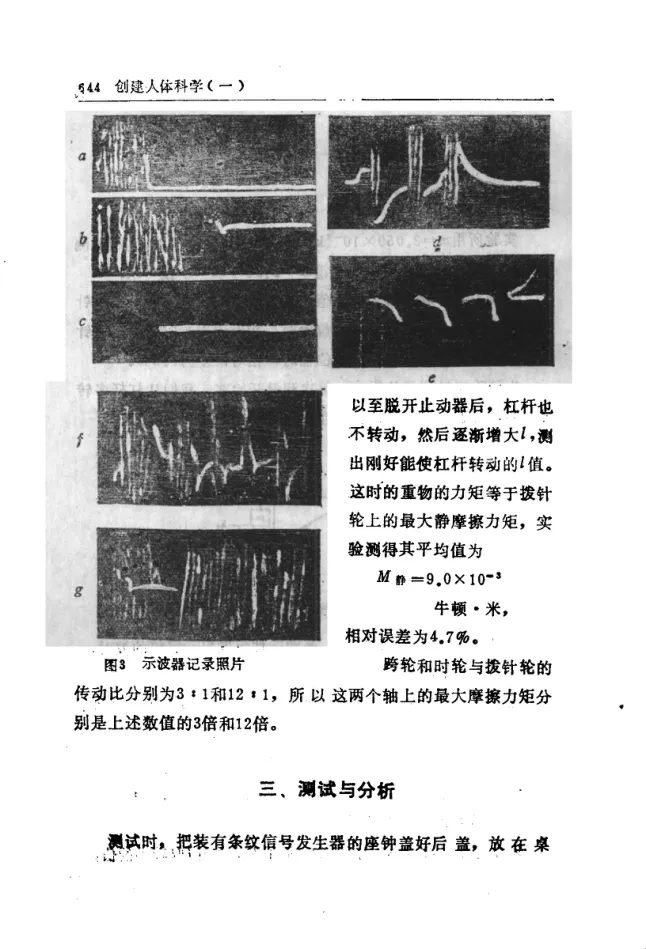
The transmission ratios of the intermediate wheel and the hour wheel to the setting wheel are 3:1 and 12:1, respectively, so the maximum friction torques on these two shafts are 3 times and 12 times the above value, respectively.
III. Testing and Analysis
During testing, the mantel clock equipped with the fringe signal generator was covered with its back cover and placed on a desk.
The shielded cable carrying the signal from the clock was connected to the inputs of two slow-scan oscilloscopes—one for observation and the other for photographic recording. The child being tested sat at the edge of the desk and could either not touch the clock or place their hand on the outer casing of the clock (the latter method could save testing time). Because of the isolation provided by the back cover, it was impossible for the hand to come into contact with any internal part of the clock, thus ensuring the authenticity of the experiment.
Figure 3 shows representative recording photographs selected from over one hundred test records conducted on Sun, Li, and Shao. The table below provides a brief description of the photographs.
| No. | Name | Test date | Clock casing to body distance (mm) | Pointer reading before test | Pointer reading after test | Sweep speed (s/div) |
|---|---|---|---|---|---|---|
| a | Li ×× | Dec. 6 | 0 | 7:04 | 6:43 | 0.2 |
| b | Sun ×× | Dec. 6 | 0 | 6:33 | 5:45 | 0.2 |
| c | Sun ×× | Dec. 7 | 0 | 4:55 | 4:10 | 0.2 |
| d | Li ×× | Dec. 14 | 200 | 9:10 | 9:45 | 0.2 |
| e | Shao ×× | Dec. 14 | 200 | 11:03 | 11:55 | 0.2 |
| f | Li ×× | Dec. 14 | 0 | 1:16 | 1:20 | 0.5 |
| g | Sun ×× | Dec. 14 | 0 | 8:53 | 5:23 | 0.5 |
Because extraordinary human abilities are influenced by various factors, we do not use average values for statistical purposes. Instead, we take typical values for calculation to obtain an order-of-magnitude concept.
From the photographs it can be seen that when actuating the clock, the human body radiates individual pulses. The pulse durations vary—some last more than 1 second, while others are shorter than 100 milliseconds. It is evident that the power varies in magnitude.
When they first acquired the ability to actuate the clock, they could only emit one or two pulses, and the power of each pulse was not very large; the entire process lasted from a fraction of a second to just over 1 second. By mid-December, the number of pulses they emitted had increased significantly, reaching a maximum of over ten pulses, with the duration increasing to 6–7 seconds, and the power had also increased. In addition, during one test, the pointer rotated in both directions (back and forth). Figure 3f is one such example.
0.4
0.6
0.8
Figure 4: P–t curve
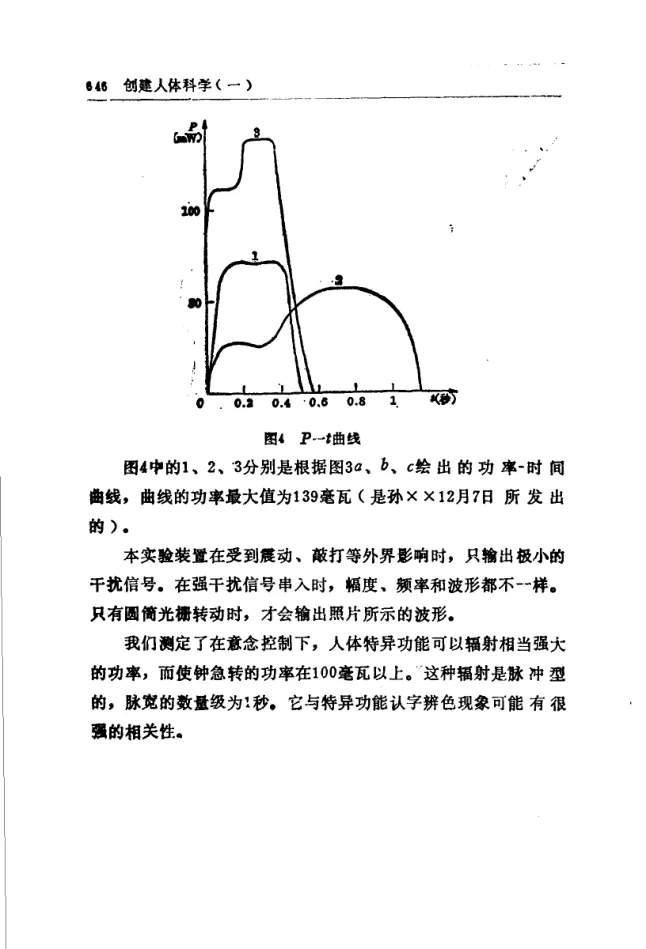
Curves 1, 2, and 3 in Figure 4 are the power–time curves plotted from Figures 3a, b, and c, respectively. The maximum power value of the curves is 139 milliwatts (emitted by Sun ×× on December 7).
When this experimental apparatus is subjected to external influences such as vibration or tapping, it outputs only extremely small interference signals. When strong interference signals intrude, the amplitude, frequency, and waveform are all different. Only when the cylindrical optical grating rotates does it output the waveform shown in the photograph.
We determined that under mental control, extraordinary human abilities can radiate considerable power, with the power required to rapidly spin the clock exceeding 100 milliwatts. This radiation is pulsed, with a pulse width on the order of seconds. It may have a strong correlation with the phenomenon of recognizing characters and distinguishing colors through extraordinary human abilities.
Several Experiments on Moving Objects through Extraordinary Human Abilities
Lin Shuhuang, Zhang Leqi, Liu Huiyi, Huang Yuchun, Tan Bingwu, Zhang Hanyu, Shen Xianjia, Dong Zhengwu, Ding Shiyin, Zhang Yu, Zhang Xuekai, Chen Fang, Zhuang Zexiang
[Editor’s note] The authors of this article have done extensive work in the study of extraordinary psychokinesis. This article reports on the object-moving experiments among their work. In their report, the authors propose a hypothesis regarding the “altered state.” This is an important article in extraordinary-ability research.
Affiliations of the authors: Lin Shuhuang and seven others, Beijing Teachers’ College; Ding Shiyin, Beijing Qinghe Middle School; Zhang Yu, Xiyuan Hospital, China Academy of Chinese Medical Sciences; Zhang Xuekai and two others, Institute of Space Medico-Engineering.
Certain children with extraordinary abilities can, without their limbs contacting the sample, transfer small objects from one location to another. During the transfer process, the sample sometimes “disappears” for as long as several tens of minutes, then “reappears,” seemingly undergoing a process from “presence” to “absence” (i.e., “disappearance”), and then from “absence” to “presence” (i.e., “reappearance”). The so-called “absence,” we believe, does not mean that matter has been annihilated; it is only that the sensory organs of ordinary people and conventional detection means are temporarily unable to perceive its existence. We provisionally term this peculiar “disappeared” state of matter the “altered state.”
In order to study the properties of the “altered state” (including the transformation process), we designed and conducted several experiments. The results are summarized as follows.
I. Experiments on Tracking Electromagnetic Wave Signals
The basic method of the experiments is: using a miniature radio transmitter as the sample, electronic instruments are used to monitor, track, and record changes in the transmitter’s electromagnetic wave signal during the transfer process, thereby revealing certain properties of the “altered state.”
From December 1980 to March 1981, a total of 15 experiments were conducted. During the transfer process, the monitored electromagnetic wave signal intensity exhibited large fluctuations; for periods of time, the signal completely “disappeared” or was extremely attenuated, to the point where the monitoring instruments could barely display it; the changes in monitored electromagnetic wave signal intensity showed a certain correlation with the transfer state of the sample; and several anomalous effects were discovered.
To facilitate understanding of the basic concept and specific procedures of the experiments, we describe a typical experiment, then provide a tabulated summary of the 15 experiments, and summarize the main experimental results.
(1) Miniature Transmitter and Monitoring Instruments
- Miniature transmitter (Figure 1)
(1) Main parameters
Table 1: Main parameters of the miniature transmitter
| Model | (MHz) | (Hz) | K | (V) | (mA) | (V) | (mA) | (V) | (mA) | g (g) |
|---|---|---|---|---|---|---|---|---|---|---|
| I | 4.1 | 800 | AM | 6 | 2.4 | 4.5 | 1.1 | Not measured | Not measured | 18.5 |
| I | 4.1 | 600 | AM | 6 | 5 | 4 | 1.4 | Not measured | Not measured | 32.5 |
| III | 4.6 | 700 | AM | 6 | 9 | 2 | 1 | Not measured | Not measured | 39.5 |
| IV | 15 | 1000 | — | 6 | 1.75 | 2.2 | 0.65 | Not measured | Not measured | 37.2 |
| V | 155 | 500 | FM | 4.5 | 5.5 | 3.5 | 4 | 2 | 0.8 | 24.0 |
| VI | 155 | 0 | CW | 4.5 | 12 | — | With memory switch | 2 | 4 | 24.5 |
Notes: ① The complete unit is encapsulated inside a matchbox, with a volume of approximately 45 × 38 × 18 cubic millimeters. ② The power supply uses a 100–120 mAh silver-zinc button battery. ③ The meanings of the symbols in the table are: carrier frequency , modulation audio frequency , modulation method ; power supply voltage and current at standard operating state; power supply voltage and current at which the modulation audio oscillator stops oscillating; power supply voltage and current at which the high-frequency oscillator stops oscillating; total weight . ④ To ensure circuit reliability, the transmitter has no adjustable components or power switch, and employs full welding, elastic fastening, printed circuit board, and other measures.
Figure 1: Miniature transmitter (Model V)
(2) Circuit schematic diagram
Type I (Figure 2):
3DG1
5.1K
BT31
R1
120K
56P
=1μ
1.8K
L1: φ0.3 mm × 20 turns, randomly wound on a short magnetic core.
L2: φ0.3 mm × 20 turns
C1: wound with φ0.1 mm enameled wire on the R1 lead, closely wound 2 cm in length.
Figure 2
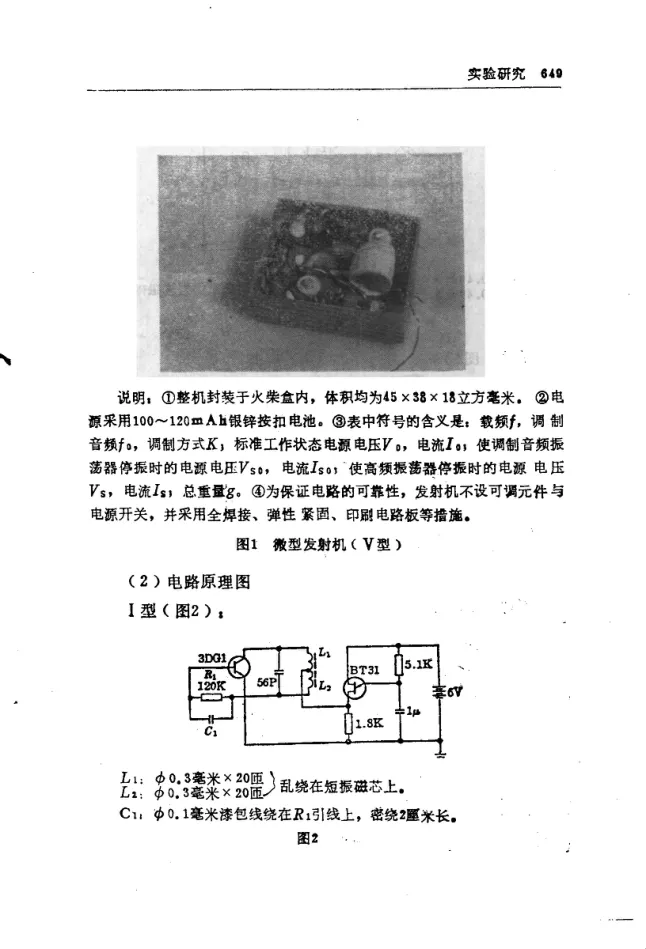
Type I (Figure 3): 3DG1 66P L2 BT31 10K 200K Ls 1μ 300 56P 6V 3DG1 L1: φ0.49 mm × 10 turns Wound on a short-wave magnetic rod of φ10 mm, length 43 mm. L2: φ0.49 mm × 10 turns Figure 3
Type III (Figure 4): 150K 5.1K 100P BT31 iLs 6V :27P 0.047μ L1: φ0.7 mm × 6 turns Wound on a short-wave magnetic rod of φ10 mm, length 60 mm. L2: φ0.7 mm × 6 turns Figure [4]
Type IV (Figure 5): 8DQ1 80K BT33 6V L 20P 300 10.033μ L1: φ1.2 mm × 2 turns L2: φ1.2 mm × 2 turns Wound on a short-wave magnetic rod of φ10 mm, length 60 mm. Figure 5
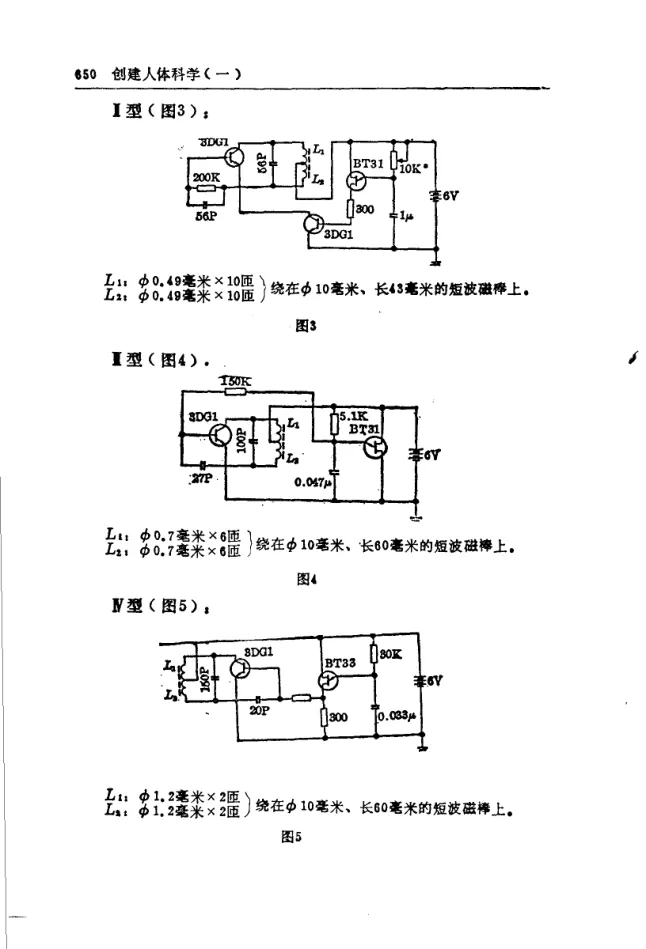
Type V (Figure 6): 75K 100 9μ11 BT31 8.2K G 1.8P 5.6P 15n 4.5V 80 3/L 300 1/2 3DG44 L: φ1.5 mm × 1 turn; coil dimensions approximately 25 × 30 mm. Figure 6
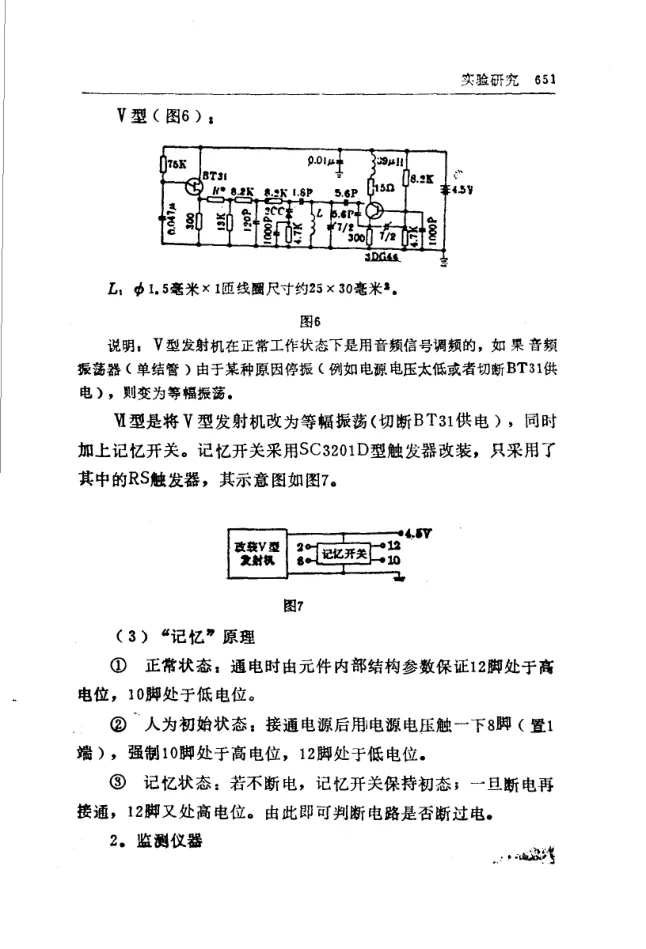
Note: Under normal operating conditions, the Type V transmitter is frequency-modulated by an audio signal. If the audio oscillator (unijunction transistor) stops oscillating for some reason (e.g., power supply voltage too low or BT31 power disconnected), it reverts to continuous-wave (unmodulated) oscillation.
The Modified Type V converts the Type V transmitter to continuous-wave oscillation (BT31 power disconnected) and simultaneously adds a memory switch. The memory switch is adapted from an SC3201D flip-flop, using only the RS flip-flop portion. Its schematic is shown in Figure 7. 4.5V Modified Type V 20 Memory switch 012 Transmitter 10 4.5V (3) “Memory” principle ① Normal state: Upon power-up, the internal structural parameters of the component ensure that pin 12 is at high potential and pin 10 is at low potential. ② Artificial initial state: After powering on, pin 8 (Set-1 terminal) is momentarily touched with the supply voltage, forcing pin 10 to high potential and pin 12 to low potential. ③ Memory state: As long as power is not interrupted, the memory switch maintains its initial state; once power is disconnected and reconnected, pin 12 returns to high potential. This makes it possible to determine whether the circuit has experienced a power interruption.
- Monitoring Instruments
(1) RR3 Interference Field Strength Meter (Figure 8) Serial numbers: 50395, 70598. Frequency range: 28–500 MHz. Field strength measurement range: 28 MHz: 9 dB–110 dB (S/N = 6 dB, 0 dB = 1 μV/m); 500 MHz: 35 dB–110 dB (S/N = 6 dB, 0 dB = 1 μV/m). Monitoring method: A dipole antenna is used. The strength of the monitored electromagnetic wave signal can be read from the RR3 field strength meter’s meter pointer and dial indication (when accurately tuned and the meter pointer is centered, the dB reading on the attenuation dial can represent the relative strength of the monitored signal). During the teleportation experiment, the monitor continuously reads out the relative signal strength (dB value) indicated by the instrument along with the corresponding time; a tape recorder is simultaneously used for audio recording. Monitoring range: Under accurately tuned conditions using a dipole antenna, the measured effective monitoring radius R of the RR3 field strength meter for electromagnetic wave signals from Type IV and Type V transmitters is R > 100 meters (the so-called “disappearance” of the signal means there is no indication above background noise on the 0 dB setting); frequency search range: 28–500 MHz. Note: When the transmitter is 3 meters from the dipole antenna, the signal is stable at approximately 40–50 dB.
(2) WH-771 Wireless Microphone VHF FM Receiver (Figure 9) Serial numbers: 30135, 30217. Frequency range: 155 ± 0.5 MHz (with 1 MHz fine-tuning and AFC circuit). Monitoring method: A telescoping antenna is used, and frequency tracking is performed by adjusting the fine-tuning (or together with AFC). ① The relative strength of the monitored electromagnetic wave signal (0–10⁴) can be read directly from the field strength meter on the instrument. ② Audio monitoring via loudspeaker. When the signal “disappears,” the field strength drops to zero and noise increases substantially; when the signal “appears,” either an audio signal appears (Type V FM) or the noise is greatly reduced (Type [III/IV] continuous wave); once the transmitter oscillates, a microphonic effect
Figure 8 Figure [9]
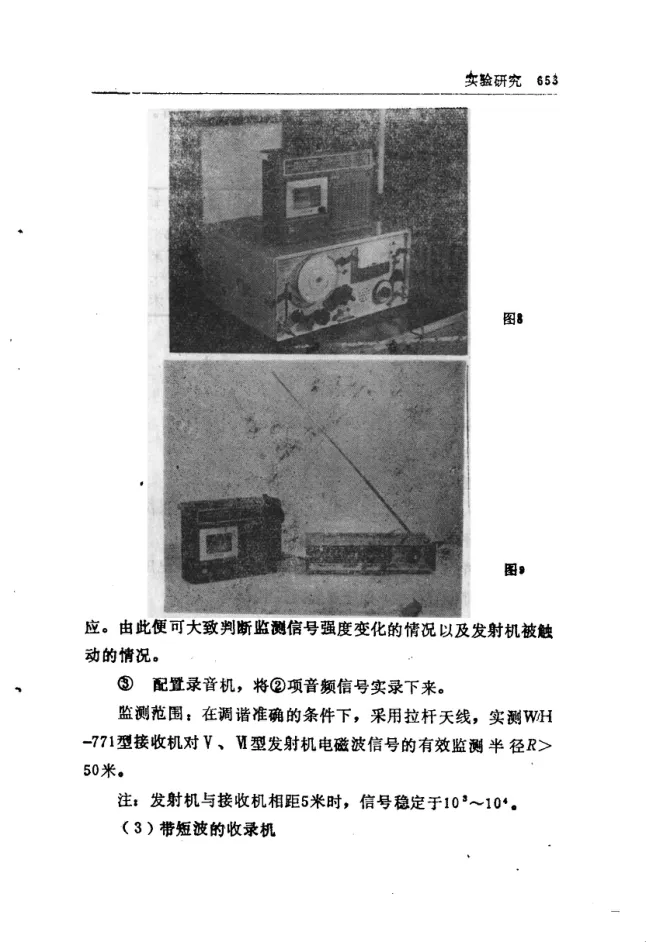 occurs. From this, the approximate variation in monitored signal strength and the status of the transmitter being disturbed can be judged.
A tape recorder is configured to make an actual recording of the audio signal in item ②.
Monitoring range: Under accurately tuned conditions using a telescoping antenna, the measured effective monitoring radius R of the WH-771 receiver for electromagnetic wave signals from Type IV and Type V transmitters is R > 50 meters.
Note: When the transmitter is 5 meters from the receiver, the signal is stable at 10³–10⁴.
occurs. From this, the approximate variation in monitored signal strength and the status of the transmitter being disturbed can be judged.
A tape recorder is configured to make an actual recording of the audio signal in item ②.
Monitoring range: Under accurately tuned conditions using a telescoping antenna, the measured effective monitoring radius R of the WH-771 receiver for electromagnetic wave signals from Type IV and Type V transmitters is R > 50 meters.
Note: When the transmitter is 5 meters from the receiver, the signal is stable at 10³–10⁴.
(3) Radio cassette recorder with short-wave band
Monitoring method: After accurate tuning, monitor the audio modulation signal and record it. Monitoring range: As shown in the table below.
Table 2 Receiver monitoring range
| Antenna | Transmitter model | Monitoring radius |
|---|---|---|
| Rod | 1 | >2.5 m |
| Telescopic | 1 | *s< |
| External | 1 | >40 m |
| External |
(ii) Description of a Typical Experiment
- Experiment Description
Experiment number: No. 12. Date: Evening of January 12, 1981. Location: Room 120, Yuejin Building, Beijing Teachers College. Subject: Xiao Bin. Persons present: Lin Shuhuang, Zhang Chongqi, Liu Huiyi, Huang Yuchun, Zhang Hanyu, Zhou Binghui, Wang Wenhua. Test sample: Type V miniature transmitter (in this experiment, due to battery voltage drop, the audio oscillator section had ceased oscillating; it belonged to the continuous-wave [unmodulated] type). Monitoring instruments: (1) One RR3-type interference field-strength meter (serial no.: 70598), equipped with one tape recorder. (2) Two WH-771-type wireless microphone VHF FM receivers (serial nos.: 30135, 30217), each equipped with one tape recorder. Layout shown in Figure 10.
Test method: The sample was placed in the right pocket of Xiao Bin’s coat, and she was asked to transport it using extraordinary abilities.
The experimental process is briefly summarized in the table below (Table 3).
Sample transport status: Transported from the right pocket of Xiao Bin’s coat to beneath a mop in the corner of the room.
Continued large-amplitude fluctuations. Intermittent unstable small frequency deviations (approx. 1 MHz) occurred; the monitoring instruments performed frequency tracking multiple times. A frequency search was conducted within the 90–200 MHz range; no new anomalous signals were found, but small frequency shifts occurred, with the center frequency still around 155 MHz. Stabilized at approximately 155 MHz. Stabilized at 155 MHz.
| Monitoring of electromagnetic signal changes | Unstable at first. | Same as above. | The signal “disappeared” multiple times, lasting approximately several seconds to tens of seconds. The signal reappeared with large-amplitude fluctuations, and also “disappeared” several times. | Peak value dropped to 18 dB (9:12); instrument monitor Lin Shuhuang issued a search-for-sample directive based on the stable signal characteristics. | Stabilized at 1 dB (RR3). |
|---|---|---|---|---|---|
| Frequency | Began large-amplitude fluctuations. | The signal remained “disappeared.” | Stabilized at 36 dB (RR3). | ||
| Amplitude | Around this value. | ||||
| Status | Upon inspection, the sample was already “lost.” | The sample continued to be “lost.” | At 9:13, Zhang Chongqi located the sample beneath the mop based on Xiao Bin’s subjective report. | In the right pocket of Xiao Bin’s coat. | Same as above. |
| Loss | |||||
| Subject’s subjective report | Felt the sample “enter the body,” traveling along “qi portal → shoulder → neck.” | Felt the sample had “left the brain.” Slightly felt it; head ached, irritable. | |||
| Feeling | Felt lighter, but pain at both “portals.” | ||||
| Experiment process time | 8:39–8:45 | 8:45–9:09 | 9:09–9:11/20″ | 9:11/20″–9:12 | 9:12–9:13 |
beneath the mop (see the position marked × in the layout diagram).
[Figure 10]
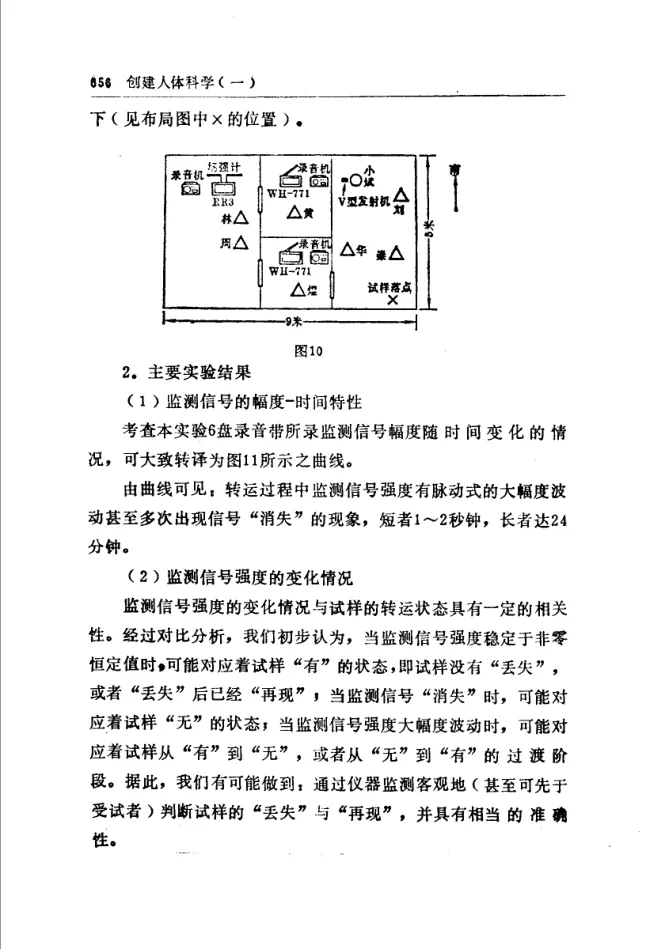
Layout:
- Tape recorder
- Field-strength meter
- Tape recorder
- Xiao [Bin]
- WH-771
- RR3
- Type V transmitter
- Lin
- 5 m
- Zhou
- Tape recorder
- Hua / Bai
- WH-771
- Yu
- Sample landing point ×
- –9 m–
- Main Experimental Results
(1) Amplitude–time characteristics of the monitored signal
Examining the variation of the monitored signal amplitude over time across the six cassette tapes recorded in this experiment, it can be roughly translated into the curve shown in Figure 11.
From the curve it can be seen that during the transport process, the monitored signal intensity exhibited pulsating large-amplitude fluctuations, with the signal “disappearing” multiple times—sometimes for as short as 1–2 seconds, and at other times for as long as 24 minutes.
(2) Changes in monitored signal intensity
The changes in monitored signal intensity bear a certain correlation with the transport status of the sample. Through comparative analysis, we tentatively conclude that when the monitored signal intensity stabilizes at a non-zero value, this corresponds to the “present” state of the sample; when the monitored signal intensity undergoes large-amplitude fluctuations, it may correspond to the transitional stage of the sample going from “present” to “absent,” or from “absent” to “present.” Based on this, it may be possible for us to objectively determine (and even anticipate the subject in) the “loss” and “reappearance” of the sample through instrumental monitoring, with considerable accuracy.
Time
We pay particular attention to examining the frequency stability of the monitored signal; one reason is that the monitoring instruments are tuned receivers—if the frequency shift is severe and the receiver cannot track it in time, this could equally cause large changes in the monitored signal intensity.
The results of frequency tracking using the RR3 field-strength meter and WH-771 receiver indicate:
① During the period 8:39–8:45, when the monitored signal amplitude was fluctuating, there was an unstable frequency drift of approximately 1 MHz.
② During the period 8:45–9:09, when the monitored signal “disappeared,” a frequency tracking search was conducted over the wide range of 90–200 MHz. Signals were found at frequencies of 91, 93, 95, 98, 102, 104, 116, 145, 149, 165, 179, 186, and 193 MHz, but these were later confirmed to be external interference signals—that is, no new anomalous signals were observed.
③ Before the sample was “lost” and after it “reappeared,” the monitored signal frequency was stable (excluding minor frequency shifts caused by battery voltage drop). In summary, the experimental results preliminarily indicate that the monitored signal does not exhibit severe frequency shifts.
[Figure 11]
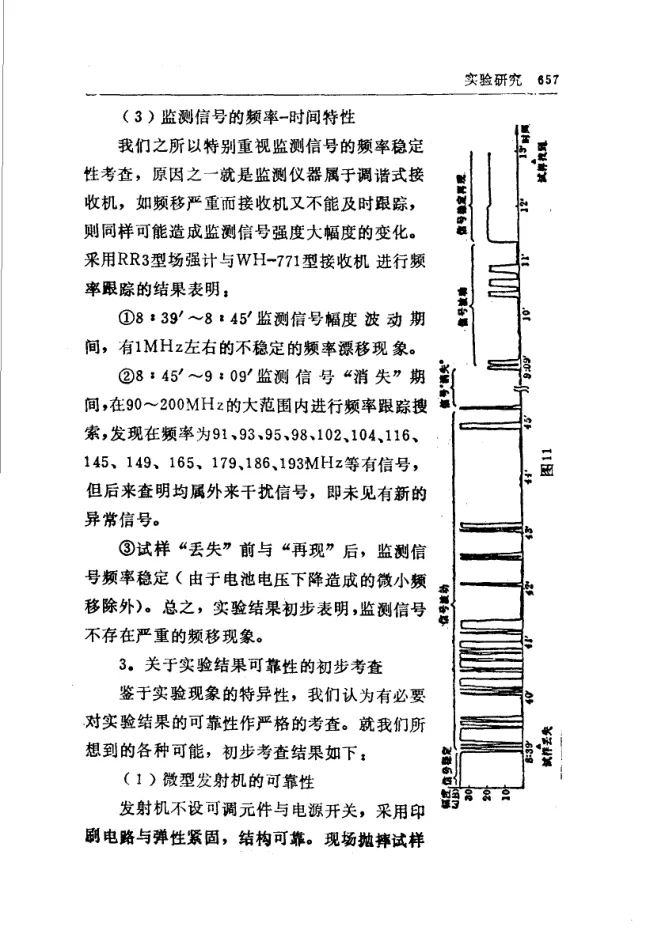
- Preliminary Examination of the Reliability of Experimental Results
Given the unusual nature of the experimental phenomena, we consider it necessary to conduct a rigorous examination of the reliability of the experimental results. Based on all the possibilities we could think of, the preliminary examination results are as follows:
(1) Reliability of the miniature transmitter
The transmitter has no adjustable components or power switches. It uses a printed circuit and elastic fastening, making its structure reliable. The sample was thrown and dropped at the site.
Signal stable reappear
Signal fluctuation
Disappearance
.87
Signal fluctuation
Sample lost
8:39
multiple times, with operation remaining normal, and no significant abnormalities in working performance were observed before and after the transfer; upon detailed inspection, no conventional causes that could have interrupted transmission were found (for example, power-supply open circuit or short circuit due to mechanical causes, poor electrical contact, etc.).
(2) Reliability of instrument monitoring
Comparative experiments showed that, before and after the transfer, the instrument’s monitoring of the transmitter signal was effective.
Frequency search experiments preliminarily showed that, during the transfer period, the electromagnetic wave signal did not exhibit serious frequency-shift phenomena; therefore, it should be considered that what the instrument recorded was the change in measured signal strength.
There is no sufficient reason to believe that the monitoring instrument happened to “malfunction” precisely during the transfer period (although this possibility cannot be entirely ruled out).
(3) “Ordinary person carrying” comparative simulation experiment
The experiment showed that the monitoring signal changes for “ordinary person carrying” and “extraordinary transfer” were completely different.
① At the experimental site, when the sample was tossed, rotated (approximately 5 revolutions per second), and its orientation changed, no significant changes in monitoring signal strength or frequency were observed (Note: three receivers were placed at different orientations to receive in a diversity mode. In this way, signal fluctuation phenomena caused by the directional characteristics of the transmitter antenna could be identified. The measurement results showed that the antenna directionality effect was not significant). Only when the sample was moved more than 100 meters away did the monitored signal strength gradually (rather than abruptly!) approach zero.
② When an ordinary person carried the sample by hand, the impact on the monitoring signal was manifested, on the one hand, as a slight frequency shift (approximately 1 MHz, possibly caused by human body induction and deformation, etc.), and on the other hand, as a noticeable microphonic effect. The former would not cause the signal to completely “disappear.”
(III) Summary Overview of Experiments
Due to space limitations, the experimental conditions can only be summarized in the table below (Table 4). To facilitate understanding of
the meanings of the symbols cited in the table, the following explanations are provided:
(1) Test methods. These are mainly divided into the following two types:
① Non-detachment transfer: The miniature transmitter is placed in the clothing pocket on the subject’s body, and the subject is asked to perform an extraordinary transfer without moving the sample.
② Detachment transfer: The miniature transmitter is placed inside a specially made wooden box apart from the body, with a lock and seal applied on one side of the subject, and a low-light video camera used to monitor the miniature transmitter awaiting transfer on the other side; then the subject is asked to transfer the transmitter while away from the wooden box.
(2) Layout. There are mainly three types (see Figure 12A, B, C).
(3) Sample transfer status:
① Transferred to the person of another individual present at the site, far from the subject.
② Transferred to an indoor or outdoor corner far from the subject.
③ Transferred back onto the subject’s body.
④ Transfer unsuccessful, but important effects occurred during the extraction process.
(4) “Extraction time” refers to the time from the start of the experiment to the discovery that the sample was missing. “Loss time” refers to the time from the discovery that the sample was missing to the time the sample was found.
Based on the above explanations and referring to the previously described typical experiments, the meaning of Table 4 should be readily understood.
(IV) Summary of Main Experimental Results
A comprehensive analysis of the above fifteen experiments yields the following preliminary results:
-
During the transfer process, large-amplitude fluctuations in the monitored signal strength occurred, and in some periods the signal completely “disappeared” or was extremely attenuated.
-
The changes in the monitored signal strength exhibit a certain correlation with the transfer status of the sample. Signal strength “stabilized” at zero and non-zero values may correspond to the sample being “absent” and “present,” respectively; signal amplitude fluctuations may correspond to some transitional
A
△ x 6 Δ Δ Δ 0 white
B
Δ Δ Δ Δ Δ Δ Δ
C
△ △ Δ Δ
Symbols: O Monitoring instrument △ Camera X Subject □ Monitor ◇ Sample A Transfer landing point
Figure 12
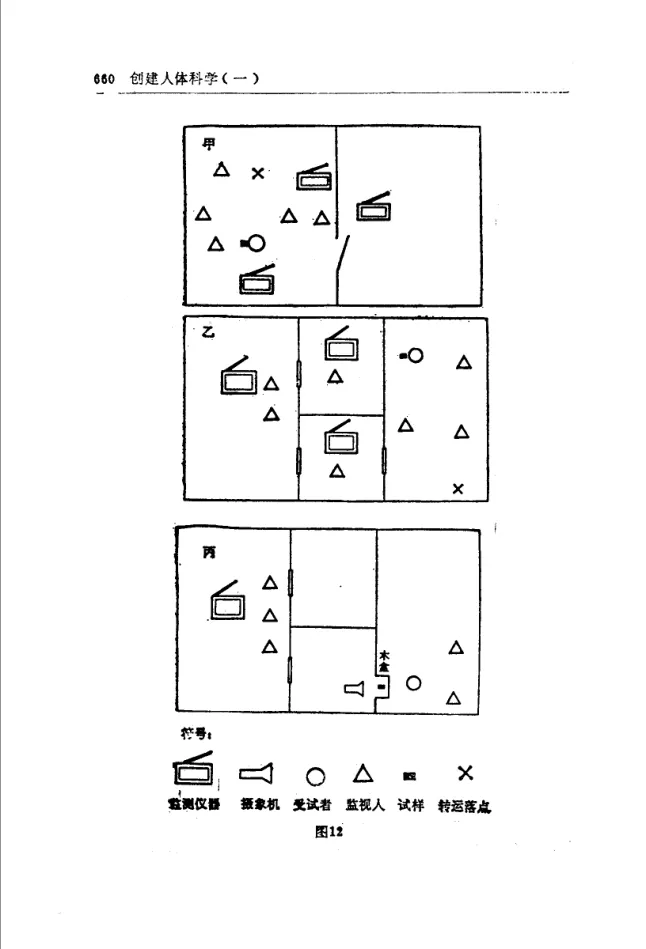
Table 4: Experimental Overview
| No. | Subject | Transmitter Model | No. of Units | Test Method | Layout | Transfer Status | Extraction Time | Loss Time | Monitoring Signal Change |
|---|---|---|---|---|---|---|---|---|---|
| 1 | Bin | I | 1 unit ③ | ① | A | ① | 1′ | 2″ | Signal fluctuated, disappeared |
| 2 | Bin | I | 3 units ③ | ① | A | ② | 7′25″ | 2′26″ | Signal uninterrupted |
| 3 | Bin | I | Same as above | ① | A | ② | 4′12″ | 2′28″ | Same as above |
| 4 | Bin | I | Same as above | ① | A | ② | 9′24″ | 30″ | Same as above |
| 5 | Qiang | I | Same as above | ① | A | ② | 2′ | 9′ | Signal fluctuated, disappeared |
| 6 | Bin | I | 2 units ③ | ① | A | ① | 13′ | 42′ | Audio oscillation rapidly stopped; at the same time, the sample was lost |
| 7 | Qiang | IV | 3 units ③ | ① | A | ③ | 56′ | 4′30″ | Signal fluctuated, disappeared |
| 8 | Bin | IV | Same as above | ① | A | ① | 1′ | 1′ | Signal uninterrupted |
| 9 | Qiang | V | 1 unit each ① and ② | ① | B | ② | 31′ | 1′30″ | Signal fluctuated, disappeared |
| 10 | Qiang | V | Same as above | ① | B | ④ | 24′ | After oscillation stopped for 45 minutes, audio oscillation resumed | |
| 11 | Qiang | V | 1 unit ①; 2 units ② | ① | B | ① | 35′ | 1′37″ | Signal fluctuated, disappeared |
| 12 | Bin | V | Same as above | ① | B | ② | 8′ | 34′ | Same as above |
| 13 | Bin | IV | Same as above | ① | B | ④ | 35′/20″ | — | Signal fluctuated; memory switch activated |
| 14 | Bin | IV | ① | B | ② | 26′/30″ | 61′ | Signal fluctuated, disappeared | |
| 15 | Bin | V | 1 unit ② | ② | C | ① | 30′ | — | Signal fluctuated |
status; although we cannot determine the sample’s “presence” or “absence” based on this, it can at least provide “precursory” information. It should be noted that during the transfer process, cases occurred in which the monitoring signal was not interrupted. Such transfers were very likely completed instantaneously, and the so-called “loss time” was actually the search time.
-
During the transfer process, the monitored signal exhibited small frequency shifts, but no large frequency-shift phenomena.
-
During the transfer process, the battery voltage of the miniature transmitter decreased at a faster rate than under normal conditions.
was faster. For example:
(1) In the 6th experiment, during the 13-minute period of extracting the specimen, the voltage of the new battery pack rapidly dropped from 6 V to 4 V (and most likely was concentrated within the final ten-plus seconds), causing the audio oscillator frequency to decrease and rapidly cease oscillation; at the same time, the specimen was “lost.” This kind of “synchrony” was by no means coincidental. On-site comparative experiments showed that under normal conditions, the battery pack operated continuously for 40 minutes with no obvious voltage drop observed.
(2) In the 14th experiment, during the 88-minute period in which the specimen was transferred, the voltage of the new battery pack dropped from 4.5 V to 0.2 V. Comparative experiments showed that under normal conditions, the new battery pack had to operate continuously for 5 hours before its voltage dropped from 4.5 V to 2.1 V.
There are many such examples, and they appear to be of a general nature.
- Thermal Effects During the “Extraction” Process
In the 10th experiment, it was found that after the audio oscillator circuit of the transmitter had already stopped oscillating for 45 minutes due to the battery voltage drop, it was caused to start oscillating again under the “action” of Xiao Qiang’s extraction of the transmitter, and the audio frequency became progressively higher.
Both on-site and subsequent comparative experiments demonstrated that this was a thermal effect. The heat primarily affected the parameter characteristics of the unijunction transistor oscillator circuit, enabling it to resume oscillation at a lower voltage; at the same time, heat also had a slight effect on the battery voltage.
Those present who touched Xiao Qiang’s trouser pocket (where the specimen was placed) also felt an obvious sensation of rising temperature.
- Examination of Transfer Conditions
(1) The shortest extraction time was 1 minute, the longest was 56 minutes; the shortest loss time (including search time) was 24 seconds, the longest was 61 minutes.
(2) The specimen transfer situation was, in the vast majority of cases, of Type ① or Type ② — that is, under conditions of on-site monitoring, the specimen after transfer appeared in a location far from the subject or on the person of someone present, and was even transferred into another room that the subject had not visited during the experiment.
II. Photosensitive Experiments
The basic method of the experiment was as follows: take photosensitive materials (photographic film, photographic printing paper, etc.) as the “transfer” specimens and place them in light-tight bags with good light-blocking properties. Have the extraordinary-ability children “extract” the specimens from the light-tight bags and cause them to “disappear” for a period of time, and then “directionally” cause the specimens to be “transferred” into another light-tight bag with good light-blocking properties. After development, examine the changes in the photosensitive properties of the specimens during the transfer process, so as to reveal certain properties of the “anomalous state.”
The experimental results from January 1981 showed that: under ordinary conditions in which visible light was present externally, for periods lasting several minutes, after development it was found that the specimens had not been exposed to light. This was a peculiar phenomenon. The experimental circumstances are briefly described below:
(I) Experimental Materials
- Target and Control Samples
The photosensitive material used was No. 2 photographic printing paper.
(1) Target samples
① 19 mm long, 16 mm wide.
② 21 mm long, 12 mm wide.
(2) Control samples
(A)-① 37 mm long, 17 mm wide.
(B)-① 42 mm long, 17 mm wide.
I-① 24 mm long, 20 mm wide.
(A)-② 25 mm long, 16 mm wide.
(B)-② 27 mm long, 17 mm wide.
②-2 24 mm long, 20 mm wide.
(A)
(B)
Figure 13
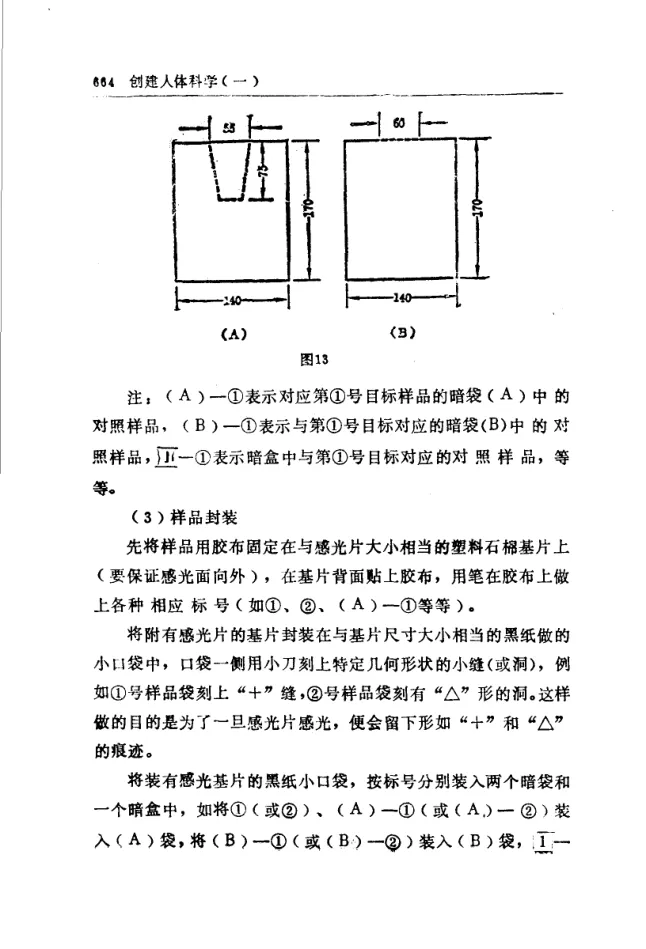
Note: (A)-① denotes the control sample in light-tight bag (A) corresponding to target sample No. ①; (B)-① denotes the control sample in light-tight bag (B) corresponding to target No. ①; I-① denotes the control sample in the light-tight cassette corresponding to target No. ①; and so on.
(3) Sample packaging
First, the samples were fixed with adhesive tape onto plastic-asbestos base plates of approximately the same size as the photosensitive sheets (ensuring that the photosensitive side faced outward). Adhesive tape was attached to the back of the base plate, and various corresponding labels (such as ①, ②, (A)-①, etc.) were written on the tape with a pen.
The base plates with attached photosensitive sheets were sealed in small pouches made of black paper, sized to match the base plates. On one side of each pouch, a small slit (or hole) of a specific geometric shape was cut with a knife — for example, a ”+” slit was cut on the pouch for sample No. ①, and a ”△“-shaped hole was cut on the pouch for sample No. ②. The purpose of this was so that once the photosensitive sheet was exposed to light, a trace in the shape of ”+” or ”△” would be left behind.
The small black paper pouches containing the photosensitive base plates were placed, according to their labels, into two light-tight bags and one light-tight cassette — for example, ① (or ②) and (A)-① (or (A)-②) were placed in bag (A); (B)-① (or (B)-②) was placed in bag (B); and I-
① (or 2-②) was placed in the light-tight cassette.
All of the above operations were carried out in a darkroom.
- Light-Tight Bags
First type: made of double-layer black plain-weave cloth, with an interlining of red light-blocking tin foil of the kind used for wrapping holographic plates, sewn into a pouch of the shape shown in Figure 13(A). The dashed line in the figure indicates a funnel-shaped small pouch whose upper opening is sewn together with the opening of the outer cloth bag, and whose lower opening hangs inside the light-tight bag. The large-top, narrow-bottom shape was adopted so that it would be easy to place a sample into the bag but relatively difficult to remove it.
Second type: made of double-layer blue twill cloth, sewn into a pouch of the shape shown in Figure 13(B).
(II) Experimental Method
The two light-tight bags (A) and (B), each loaded with samples, were separately pinned to the lower part of the garments of two extraordinary-ability children. The child wearing bag (A) was asked to transfer the target sample ① (or ②) out of bag (A) (the child wearing bag (B) assisted with the “extraction”). After the sample was “extracted,” it was caused to “disappear” for a period of time, and then the two children worked together to transfer the target sample into bag (B).
Throughout the entire experimental process, in addition to the experimenters being present to monitor, the extraordinary-ability children were required not to touch light-tight bags (A) and (B) with their hands, nor to shield the light-tight bags with any other part of their bodies.
When the child subjects reported that the target sample had been transferred out of bag (A), the experimenters immediately checked bags (A) and (B). After confirming that the target sample was in neither bag (A) nor bag (B), the experimenters immediately took out the control sample from the light-tight cassette and randomly waved it about for exposure in the same experimental environment.
When the child subjects reported that the target sample had entered bag (B), the experimenters again checked bags (A) and (B). After confirming that the target sample had entered bag (B), the randomly exposed sample was returned to the light-tight cassette, the time was recorded, and the experiment was declared ended. All sample bags and cassettes were wrapped in black paper and placed in a light-blocking paper box in preparation for development.
(III) Experimental Process
1. First Experiment
Date: Afternoon of January 10, 1981.
Location: The subjects’ home.
Subjects: Xiaoqiang, Xiaobin.
Persons present: Zhang Chongqi, Liu Huiyi, Zhu Meihua.
Conditions: The lights were already on — a 45-watt incandescent bulb suspended approximately 80 cm above the subjects’ heads. The room area was approximately 10 m².
Layout: As shown in Figure 14.
[Figure 14 / Figure 15 labels:] North | O | Bed | Bed | Qiang | Bin | —1.2=−1 | △ Zhang | △ Le | △ Liu | △ Lin | △ | Qigong practitioner | Bed | Bed
Figure 14
Figure 15
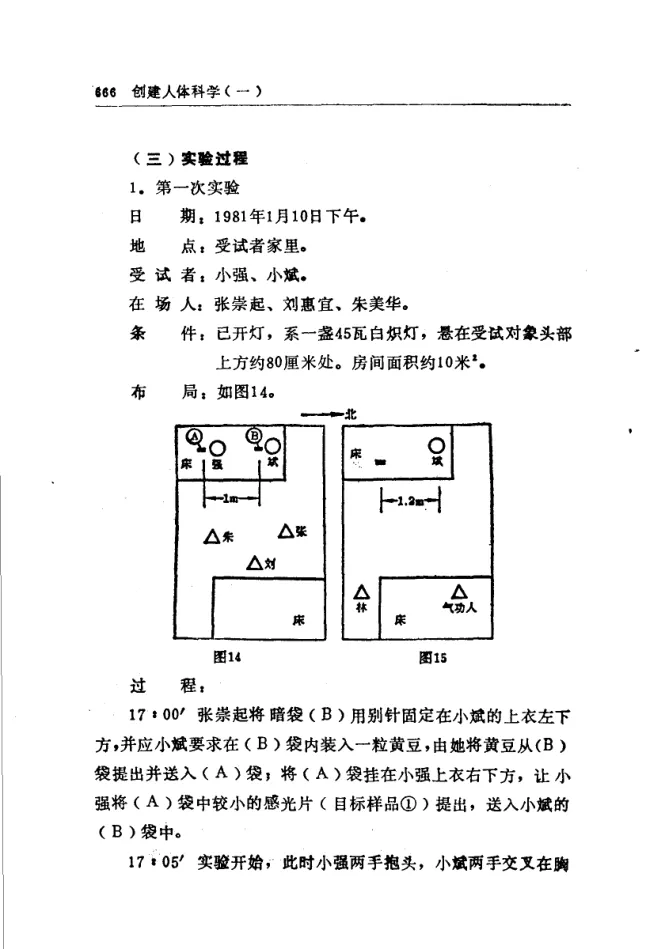
Process:
17:00′ Zhang Chongqi pinned the lightproof bag (B) to the lower left side of Xiaobin’s jacket, and at Xiaobin’s request placed one soybean inside bag (B), for her to extract the soybean from bag (B) and deliver it into bag (A); bag (A) was then hung on the lower right side of Xiaoqiang’s jacket, and Xiaoqiang was asked to extract the smaller photographic sheet (target sample ①) from bag (A) and deliver it into Xiaobin’s bag (B).
17:05′ The experiment began. At this point Xiaoqiang had both hands clasping her head, and Xiaobin sat with her arms crossed in front of her chest,
leaning against the wall.
17:05′15″ Xiaoqiang reported that target sample ① had already been extracted from bag (A) and had entered her own “brain.” Zhang immediately checked bags (A) and (B) and confirmed that target ① was not inside either bag (A) or (B). At this point the lightproof cassette was opened, and the control sample was taken out and casually waved under the room light.
17:07′ Xiaoqiang reported that the sample had flown out of her “brain” and was “floating” in the space between her and Xiaobin. Xiaobin likewise reported seeing the “sample” “floating” in space.
17:10′ Xiaoqiang and Xiaobin said almost simultaneously that target sample ① had already entered bag (B). Zhang immediately checked both lightproof bags and found that target ① had entered bag (B) to a depth of approximately 5 cm. Zhang collected the randomly exposed control sample into the lightproof cassette.
2. Second Experiment
Date: Evening of January 16, 1981.
Location: The subjects’ home.
Subjects: Xiaoqiang, Xiaobin.
Persons present: Zhang Chongqi, Liu Huiyi, Zhu Meihua.
Conditions: Same as the first experiment.
Layout: Same as before.
Process:
19:00′ Zhang hung the lightproof bag (B) on the lower right side of Xiaobin’s jacket and hung bag (A) on the lower right side of Xiaoqiang’s jacket, and additionally placed a sheet of black paper over the outside of bag (B). The experiment began.
19:45′ Xiaoqiang reported that the target sample had already been transferred out from bag (A) and had entered her own “brain.” Zhang immediately checked bags (A) and (B) and confirmed that the target sample (No. ②) had been transferred out from bag (A), and that there was also no target sample in bag (B). At this point the lightproof cassette was opened, and the control sample inside was taken out and casually waved under the light for exposure.
[19:50′ … swaying], Zhang again checked bags (A) and (B) and confirmed that the target sample had not yet entered bag (B).
19:51′ Xiaobin said she felt that the target sample had already entered bag (B). When Zhang checked, he found that target sample ② had not entered bag (B), but had instead fallen into the interlayer between bag (B) and the black paper covering it on the outside. Zhang quickly placed sample ② into bag (B) and simultaneously placed the control sample into the lightproof cassette.
(IV) Development Results
1. Development Conditions
Developer: D72. Developer temperature: 22 °C. Development time: 4 minutes. Rinse: tap water rinse for 6 minutes. Fixer: F5. Fixer temperature: 20 °C. Fixing time: 20 minutes. Rinse: tap water rinse for 5 minutes.
2. Results
(1) Target samples ① and ② were both unexposed.
(2) Control samples (A)—①, (B)—①, (A)—②, and (B)—② were all unexposed, indicating that the lightproof bags had good light-blocking performance.
(3) Control samples 1—① and 2—② both showed high-contrast exposure patterns, indicating that under conditions of identical illuminance and identical exposure time, the same type of photographic material should undergo exposure.
(4) Under the same illuminance conditions, an exposure time of only about 0.5 seconds was sufficient to produce a clearly observable exposure effect on photographic printing paper. It can thus be seen that it would be extremely difficult for a subject, under the given experimental conditions, to cheat while also ensuring that the printing paper remained completely unexposed.
3. Preliminary Analysis of the Results
Based on the above instances of “no exposure,” our preliminary view is: the effect of visible light on photographic materials in an “anomalous state” appears to be greatly attenuated, to the point that instances of “no exposure” occurred — at least for the type of photographic material we employed, namely No. 2 photographic printing paper, under the described experimental conditions,
no detectable exposure effect was produced.
III. Experiments on Breaking Through Spatial Physical Barriers
The basic method of the experiment was: a metal nut was placed inside a plastic 135-film lightproof cassette, and a small hole was punched in the center of the cassette lid, so that the subject could “transfer” the large object (the nut) out through the small hole.
In February 1981 we conducted three experiments, and the results showed that certain children with extraordinary abilities could indeed achieve extraordinary transfer involving the breakthrough of spatial physical barriers. A summary follows:
(I) First Experiment
Date: Afternoon of February 7, 1981.
Location: The subject’s home.
Subject: Xiaobin.
Persons present: Lin Shuhuang, qigong practitioner ×××.
Test sample: An M3 nut with a mark was placed inside a plastic 135-film lightproof cassette, with a hole of φ1.5 mm punched in the center of the cassette lid.
Layout: See Figure 15.
Experimental process:
(1) 4:59′ After both Xiaobin and the qigong practitioner ××× were seated, Lin Shuhuang placed the pre-inspected test sample on the bed at a distance of 1.2 meters from Xiaobin. The experiment began.
(2) 5:01′ Xiaobin asked ×××: “How do you feel now?” ××× said: “Almost.”
(3) 5:05′ Xiaobin said she felt that the nut had already come out. Lin Shuhuang immediately checked the sample cassette and confirmed that the M3 nut had indeed “disappeared.”
(4) At 5:06’, Xiaobin asked Lin Shuhuang: “Which pocket should I have the nut go into?” Lin said: “Anywhere is fine, just have it go into your own pocket!” At this moment, XXX said he felt the nut had already dropped and entered Xiaobin’s pocket. Lin immediately went to check Xiaobin’s right coat pocket, and XXX immediately said: “It’s not in the right pocket, it’s in the left.” When Lin checked Xiaobin’s left coat pocket, the specially marked M3 nut was indeed already inside.
Throughout the experimental process, under the strict surveillance of Lin Shuhuang and XXX, Xiaobin never moved from her position, much less touched the sample dark box.
Qigong practitioner XXX reported: (1) Around 5:05’, XXX felt multiple beams of white light emanating from Xiaobin’s brain obliquely upward (at about 45°), reaching far away. This was exactly the moment Xiaobin felt the nut was “lost.” (2) Around 5:06’, as soon as Lin asked Xiaobin to put the nut into her own pocket, XXX felt a beam of white light return from afar into Xiaobin’s left coat pocket.
The Second Experiment
Date: Evening of February 11, 1981. Location: Room 202, Guesthouse of Beijing Teachers College. Subject: Xiaohua. Sample: A matchstick (with special mark), a nail, and an M3 nut (with special mark) were placed into a plastic 135 film canister. A small hole with a diameter of φ3.5mm was punched in the center of the lid. After capping, it was sealed with thin paper strips and specially marked to ensure the reliability of the experiment. Persons present during sample sealing: Lin Shuhuang, Zhang Chongqi, Liu Huiyi, Wang Guanyou. Experimental process: (1) Around 9:30 p.m. on the 11th, Lin Shuhuang, Zhang Chongqi, Liu Huiyi, and Wang Guan
you handed the sample directly to Xiaohua, asking her to “transfer” it herself, and explained that as long as the seal and its markings were intact after the experiment succeeded, the experimental result would be recognized. (2) Around 10:30 p.m. on the 11th, Xiaohua lay on the bed holding the sample and began the experiment, but quickly fell asleep. (3) At 8:40 a.m. on the 12th, in Room 202 of the Beijing Teachers College Guesthouse, Lin Shuhuang and Wang Guanyou asked Xiaohua how the experiment went. She said: “When doing the experiment last night, the matchstick, nut, and nail all flashed in my mind, and they were flying all over the place, as if the nail had stuck into something.” Lin Shuhuang and Wang Guanyou immediately asked Xiaohua to bring the sample canister. They checked it face-to-face, and the seal and markings were completely intact, indicating that the experimental result was valid. After opening, they found: ① The M3 nut was “lost” (i.e., it had broken through a spatial physical barrier). ② The matchstick was broken. ③ The nail had pierced into the broken matchstick. They immediately asked Xiaohua to search for the “lost” nut, but it was not found.
The Third Experiment
Date: Noon of February 22, 1981. Location: The subject’s home. Subject: Xiaoqiang. Person present: Wang Wenhua. Sample: An M5 nut was placed into a plastic 135 film canister. A small hole with a diameter of φ1.5mm was punched in the center of the lid. After capping, it was sealed with thin paper strips and specially marked. Persons participating in the sample sealing: Lin Shuhuang, Liu Huiyi, Zhang Chongqi. Experimental process: (1) Around 1:00, Wang Wenhua placed the sample into Xiaoqiang’s right coat pocket, and the experiment began.
(2) Around 1:35’, Xiaoqiang felt a sinking sensation in his heart. Wang Wenhua took out the sample canister to check, and the M5 nut was gone; subsequently, the M5 nut was found in Xiaoqiang’s right coat pocket. Later, upon inspection by Lin Shuhuang, Zhang Chongqi, and Liu Huiyi, the seal on the sample canister was intact (Figure 16).
Figure 16
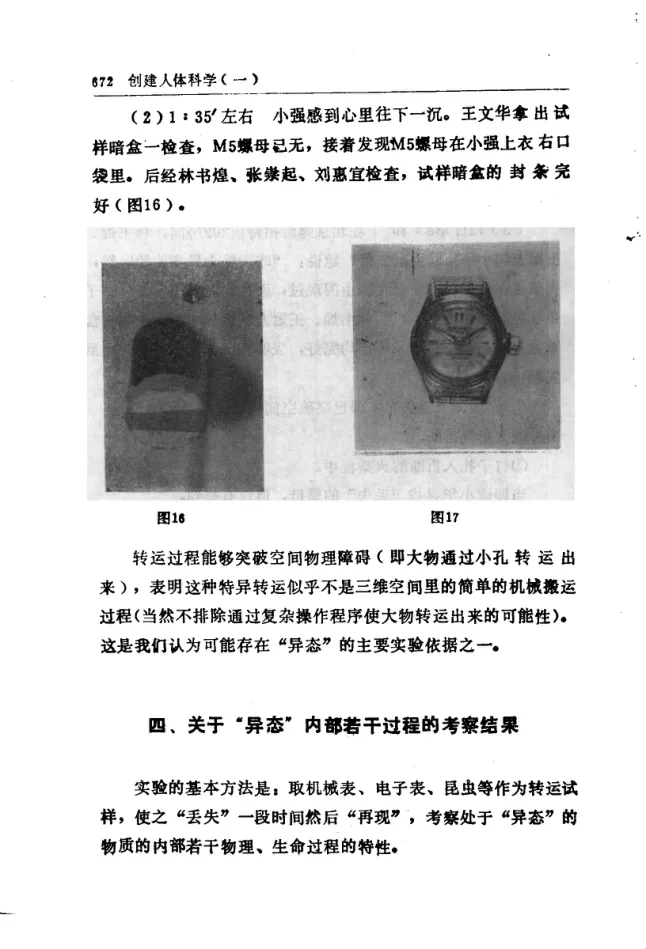
The fact that the transfer process can break through spatial physical barriers (i.e., a large object being transferred out through a small hole) indicates that this extraordinary transfer does not appear to be a simple mechanical transport process in three-dimensional space (of course, the possibility of transferring a large object out through a complex operational procedure cannot be ruled out). This is one of the main experimental bases for our belief that an “alternative state” may exist.
IV. Investigation Results on Certain Internal Processes of the “Alternative State”
The basic method of the experiment is: taking mechanical watches, electronic watches, insects, etc., as transfer samples to investigate the characteristics of certain internal physical and life processes of the transferred matter.
The experiments we conducted from December 1980 to March 1981 show that when matter is in an “alternative state,” its mechanical movement and life processes seem to still be ongoing and have not stopped. The experiments are briefly introduced as follows.
(1) Experiment on Transferring Mechanical Watches
This type of experiment has been conducted twice. The results show that for a mechanical watch that was “lost” for tens of minutes during the transfer process, when it “reappeared,” its timekeeping was still consistent with the control watch at the experimental site, and no time difference was observed.
North O O Bed Shen Zhang △ Qiang Δ O O △ Yu △ Lin Jian △ △ Lin ∇ △ Huang △ Chong Bed Bed Figure 18 Figure 19
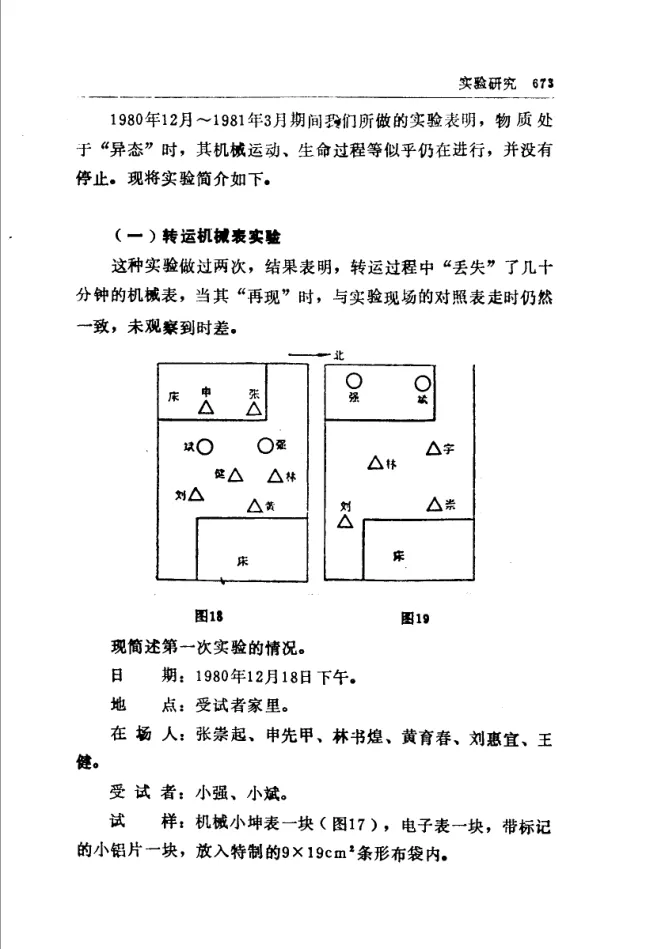
The situation of the first experiment is briefly described below. Date: Afternoon of December 18, 1980. Location: The subject’s home. Persons present: Zhang Chongqi, Shen Xianjia, Lin Shuhuang, Huang Yuchun, Liu Huiyi, Wang Jian. Subjects: Xiaoqiang, Xiaobin. Sample: One small mechanical women’s watch (Figure 17), one electronic watch, and one marked small aluminum piece were placed into a specially made 9×19 cm² rectangular cloth bag.
Arrangement: See Figure 18. Testing method: The sample cloth bag was pinned to the left chest pocket of Xiao Qiang’s jacket; a transparent empty plastic bag was pinned to the right chest pocket of Xiao Bin’s jacket. Xiao Qiang and Xiao Bin were asked to work together to transfer the sample out of the cloth bag. Experimental process: (1) 5:45′ — the experiment began (before starting, the mechanical watch and electronic watch had both been calibrated against the control watch). (2) 5:48′7″ — Xiao Bin said she sensed that the small aluminum piece had “entered” Xiao Qiang’s brain; Xiao Qiang also perceived this. Liu Huiyi checked Xiao Qiang’s cloth bag; the small aluminum piece was already gone. (3) 5:49′46″ — Xiao Qiang said the small aluminum piece had “exited” her brain, forming a white “qi-cluster” located between Xiao Qiang and Xiao Bin. However, the people present could not see or feel it. (4) 5:54′ — Xiao Qiang sensed that the small lady’s watch had “entered” her brain. Liu Huiyi immediately checked Xiao Qiang’s cloth bag; the lady’s watch was already gone. Lin Shuhuang took the electronic watch out of the cloth bag and compared it with the control watch, and found that the electronic watch had lost seven and a half minutes within nine minutes (Note: Lin Shuhuang continued to wear this electronic watch for twelve consecutive hours after this moment, and observed no further abnormality in timekeeping). (5) 6:19′ — Xiao Bin said she felt her pocket becoming “heavy.” Upon inspection by Lin Shuhuang, the small aluminum piece had already appeared in the right chest pocket of her jacket. (6) 6:24′43″ — Xiao Qiang sensed that the small lady’s watch had already entered her left pants pocket. Liu Huiyi immediately checked and confirmed this. The lady’s watch was taken out and compared with the control watch; it was found that although the lady’s watch had been “lost” for 30′43″, its timekeeping remained accurate. Reliability of the experimental results: (1) A specially made cloth bag was used, with a narrow opening (9 cm) and deep body (19 cm), and a pin in the middle of the opening. Under the condition of close surveillance by those present, it would be extremely difficult for the subjects to commit
(2) Given the complexity of the procedure for adjusting the electronic watch, the effect of “the electronic watch slowing down” carries considerable reliability. This effect has recurred, further confirming its reliability. Note: In the second experiment, the lady’s watch was “lost” for as long as 76 minutes; after “reappearing,” its timekeeping still remained accurate.
(II) Insect Transfer Experiments
This type of experiment was conducted twice. The results showed that insects that had been “lost” for a period of time during the transfer process remained alive after “reappearing,” and no abnormalities were observed. The circumstances of the first experiment are briefly described below. Date: Afternoon of December 27, 1980. Location: The subject’s home. Persons present: Zhang Chongqi, Lin Shuhuang, Zhang Yu, Liu Huiyi. Subjects: Xiao Bin, Xiao Qiang. Sample: Four live fruit flies were placed inside a small glass bottle, and then the small bottle and a large wild goose pin were placed inside a matchbox. Arrangement: See Figure 19. Experimental process: (1) 4:44′ — Lin Shuhuang placed the sample into the left chest pocket of Xiao Bin’s jacket, and the experiment began. (2) 4:59′12″ — Xiao Bin said she sensed that the sample had “entered” her brain. Lin Shuhuang and Zhang Yu immediately checked the pockets on Xiao Qiang and Xiao Bin respectively; the sample had indeed been “lost.” (3) 6:02′19″ — Xiao Qiang said she sensed that the matchbox had entered her right pants pocket; this was confirmed upon inspection. Lin Shuhuang immediately opened the matchbox; the large wild goose pin and the small glass bottle were both inside, and the small insects within the bottle were still alive (Figure 20). Upon observation, under conditions where no food was provided,
the fruit flies lived for another three days.
In the second experiment, two flies were used as the transfer samples; after being “lost” for 11 minutes, they “reappeared,” and the flies were still alive (see Appendix Figure 38). Upon observation, under conditions where no food was provided, the flies lived for another four days.
Figure 20
V. Concluding Remarks
Preliminary results from several experiments concerning the properties of the “anomalous state” indicate: (1) Certain extraordinary individuals can cause certain objects to enter a special state, which we call the “anomalous state.” When an object is in the “anomalous state,” the senses of ordinary people and conventional detection methods temporarily cannot detect its existence, yet extraordinary individuals and qigong practitioners do have some perception of it, and this perception possesses a certain degree of reliability. The transfer state of objects bears a certain correlation with the “mental activity” of extraordinary individuals, yet it is not entirely controlled by the mental intent of the extraordinary individual. (2) The fact that objects can overcome physical spatial barriers during the transfer process indicates that this kind of “transfer” does not appear to be a simple mechanical transportation process in three-dimensional space; the object may have transitioned into a special state. This is one of the main experimental bases for our belief that an “anomalous state” may exist. (3) When objects are in the “anomalous state,” their mechanical motion, life processes, and so on appear to continue and do not cease. (4) The experimental results from active tracking of electromagnetic wave signals and passive recording of visible light preliminarily indicate that when matter is in the “anomalous state,” the electromagnetic wave signals it emits appear to be extremely attenuated, to the extent that existing measurement methods are unable to display them; and the effect of visible light on photographic materials in the
“anomalous state” is also extremely attenuated, to the extent that instances of “no exposure” occur. We conjecture: when matter is in the “anomalous state,” there may be a certain degree of “isolation” of energy and information between it and the outside world.
We believe that providing a satisfactory explanation of these preliminary experimental results using existing scientific theories may be quite difficult. Further in-depth study of the properties of the “anomalous state” will be of major theoretical significance.
Finally, it should be emphasized that our work is still preliminary; the reproducibility and rigor of the experiments still have deficiencies, and the experimental research work awaits further deepening. We welcome everyone’s criticism and corrections.
Experiments on Extraordinary Human Abilities Causing Objects to Move Out of or Into Sealed Containers
Lin Shuhuang, Zhou Binghui, Liu Huiyi, Huang Yuchun, Zhang Hanyu, Rao Anli, Liu Guonan, Lin Lin, Liu Yicheng, Yang Jianhua, Sun Zexian, He Qingnian, Zhao Yijun, Zhang Ming, Ding Yizhong, Zhang Yu, Zhuang Ding, Li Zhichao, Ding Shiyin
[Editor’s Note] This article reports that, under strict experimental conditions, extraordinary human psychokinetic abilities can cause certain macroscopic objects (including biological and non-biological objects) to move out of or into sealed containers made of certain solid materials, without damaging either the object or the sealed container. An attempt was made to use chemical ion colorimetric reactions to observe the process of objects moving out of or into sealed containers; as a result, an anomalous phenomenon occurred where objects entered and exited the sealed containers without leaving colorimetric traces. When biological objects were moved out of sealed containers, no obvious effects on their life activity were observed. The aforementioned phenomena may involve fundamental properties of matter or space.
Author affiliations: Lin Shuhuang and seven others, Beijing Teachers’ College; Liu Yicheng, Institute of High Energy Physics, Chinese Academy of Sciences; Yang Jianhua, Institute of Biophysics, Chinese Academy of Sciences; Sun Zexian, Liaoning College of Traditional Chinese Medicine; He Qingnian, Beijing Institute of Traditional Chinese Medicine; Zhao Yijun, National University of Defense Technology; Zhang Ming and one other, Shanghai Maritime Institute; Zhang Yu and two others, Academy of Traditional Chinese Medicine; Ding Shiyin, Beijing Qinghe Middle School.
Regarding the phenomenon of extraordinary human psychokinetic abilities causing macroscopic objects to move out of or into sealed containers,
there have been several experimental research reports [1, 2]. This article will report further experimental results. The subject for all experiments was Z.
I. Experimental Design Principles
To eliminate artifacts and ensure the rigor of the experiment, our experimental design satisfies the following conditions:
- The specimens (including the target objects and sealed containers) possess several unique features to ensure that they cannot be replicated or swapped under the established experimental conditions.
- The sealed containers use an “irreversible” sealing method; that is, under the established experimental conditions, once the seal is broken, the packaging is destroyed to the extent that it cannot be completely restored. Without breaking the seal, the target object cannot be moved out of or into the sealed container by conventional means.
- Strict on-site monitoring. Experiments are conducted under the supervision of two or more examiners. Before the experiment, the subject is not allowed to touch the specimens; during the experiment, the subject is not allowed to take the specimens away from the site or leave the monitoring area.
- The experimental results are reproducible.
The following typical experiments will illustrate how the above experimental design principles are implemented and will specifically examine the reliability of the experimental results.
II. Typical Experiments
1. Non-biological Experiments This experiment further investigated the authenticity of the phenomenon in which certain macroscopic solid non-biological objects move out of or into sealed containers under the action of extraordinary human abilities.
[Example] Moving target characters out of a sealed kraft paper envelope.
(1) Experimental Overview Three recent tests were successful, as shown in the table below.
| Specimen | Experiment No. | Test Date | Monitors | Verifiers | Makers |
|---|---|---|---|---|---|
| 821101 | Nov 3, 1982 | Lin Shuhuang, Liu Yicheng | Liu Yicheng and 13 others | Huang Yuchun, Zhao Yijun | |
| 821202 | Dec 5, 1982 | Zhang Ming, Liu Yicheng | Zhao Yijun and 7 others | Ding Yizhong, Zhao Yijun | |
| 821203 | Dec 15, 1982 | Liu Huiyi, Zhuang Ding | He Qingnian and 7 others | Zhang Ming, He Qingnian, Zhang Hanyu, Chen Chuanchu, Lin Shuhuang, Li Zhichao |
(2) Specimen Preparation The preparation methods for the specimens in the above three cases are identical, as illustrated using cases 821101 and 821202. The “Tiger Tally” method 5 was used to create the target objects to ensure their uniqueness; the marking method and the inner/outer sealing strip method were used to ensure the uniqueness of the sealed container and the irreversibility of the seal. The specific process of specimen preparation is shown in Figure 1-I. 100 Chinese characters were randomly selected and printed to form a “Test Card” (Figure 2). The 100 printed Chinese characters were individually cut out using random curves to form the target characters. The remaining portion of the “Test Card” (abbreviated as the matrix), after being signed and marked by the maker, was kept for overall verification after the test. The first 55 target characters were sealed into the first kraft paper…
paper envelope.
Target characters Remaining target characters Outer sealing strip Inspection and verification process “Test Card” matrix Carbon-copy marked sealing strip First and third copy stubs Target characters Kraft paper Sulfuric acid paper
I. Specimen preparation process: a. Cut out characters using random curves; b. Place characters on surface 1 of the kraft paper; c. Cover with sulfuric acid paper and inner sealing strip; d. Apply glue to the shaded areas; e. Fold surfaces 2, 3, 4, and 5 onto surface 1 and glue; f. Attach outer sealing strip and sign. II. Inspection and verification process: g. Verify the extraordinarily moved target characters against the “Test Card” matrix; h. Cut open the sealed paper envelope along the dotted line on the front; i. Verify the first and third copy stubs against the inner sealing strip; j. Verify the remaining target characters against the “Test Card” matrix.
Figure 1
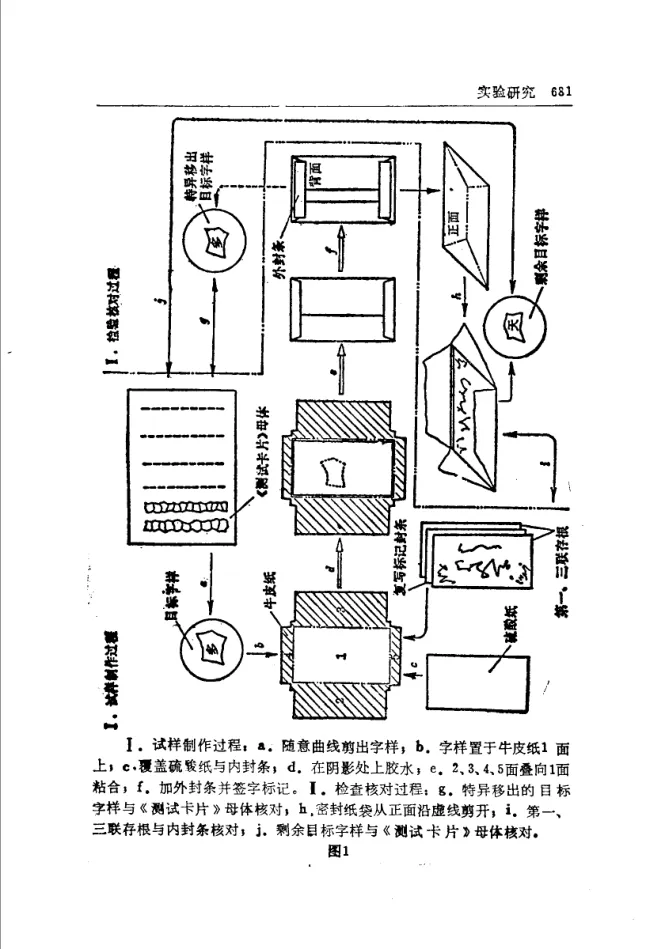
[Figure 2]
The target characters were sealed into a brown kraft paper envelope to create specimen 821101; the subsequent 45 target characters were sealed into a second brown kraft paper envelope to create specimen 821202 (see Figure 1–I).
(3) Test conditions (using 821202 as an example)
Time: Afternoon of December 5, 1982. Location: A certain work unit in the western suburbs of Beijing. Weather: Clear. Monitors: Zhang Ming, Ding Yizhong. Layout: As shown in Figure 3, Z sat at the desk, with the specimen placed on the desk surface. The monitors sat beside the desk to observe.
[Figure 3]
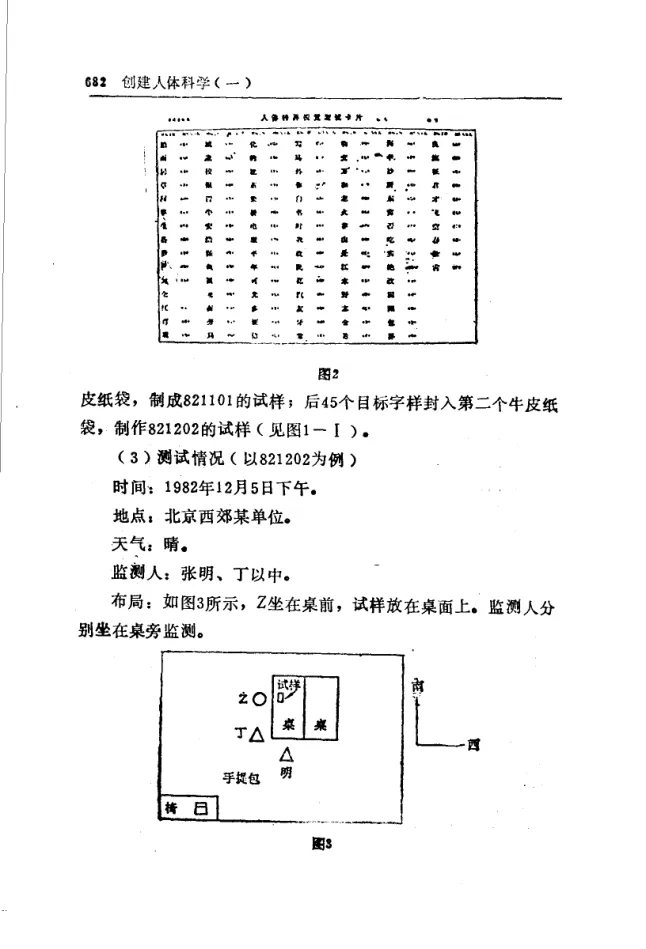
(4) Experimental procedure
At approximately 2:30 p.m., under on-site monitoring, Z began preparing for the test. Prior to the test, Z had not seen the specimen. At approximately 3:00 p.m., Z felt that his functional state was good, and on his own initiative picked up the specimen envelope from the desk surface and shook it. Very quickly, one target character was shaken out from the lower end of the specimen envelope, followed in succession by three more target characters. At this point Z became very excited and emotionally agitated; holding the specimen envelope, he rapidly shook it up and down above the palms of Zhang Ming and Ding Yizhong respectively, and seven target characters in succession fell into the palms of Zhang Ming and Ding Yizhong. Afterward, Z said: “Some of the small paper slips (i.e., target characters) are already inside Zhang Ming’s handbag.” Ding Yizhong kept watch over Z to prevent him from moving his position, while Zhang Ming went to inspect the black synthetic-leather handbag. As a result, four target characters were found inside the handbag. By this point, Zhang Ming and Ding Yizhong had found a total of 15 target characters that Z had transferred out of the sealed kraft paper envelope. The experiment concluded at approximately 3:05 p.m. It should be noted that the handbag was placed on a chair in the northeast corner of the room, approximately two meters from the monitors; no one approached this handbag during the experiment. During both the test and the search for target characters, Z did not move from his position.
(5) Verification and checking (as shown in Figure 1–)
① Before opening the envelope, the 15 target characters transferred out by Z were checked against the master copy of the “Test Card.” The results matched without error, confirming that the items removed were indeed the originally sealed target characters, and that they were undamaged.
② It was verified that the external seal and markings of the specimen envelope were intact and undamaged, confirming it was the original item. The envelope was then cut open from the front. Upon inspection, the internal seal of the envelope was intact and undamaged, with no damage to any of the four edges. The first and third carbon copy stubs were checked against the seal inside the envelope, and the results matched without error.
③ The number of target characters remaining inside the specimen envelope was 30. Adding the 15 target characters already transferred out, the total matched the number of target characters in the original sealed package. The remaining target characters were checked against the master copy of the “Test Card,” and the results matched without error.
Figure 39 provides relevant materials. Among these, (a) shows the external seal of the specimen envelope;
(b) shows the internal seal as seen upon cutting open the specimen envelope; (c) shows the first and third carbon copy stubs; (d) shows the overall verification of the target characters against the master copy of the “Test Card” after testing.
(II) Chemical Experiments
This experiment attempts to use the rapid ionic color reaction between potassium thiocyanate (or ammonium thiocyanate, potassium ferrocyanide) and ferric chloride solution to observe the situation of objects being moved out of or into sealed containers. This type of experiment was successfully conducted four times. A summary is shown in the table below.
| Experiment No. | Test Date | Monitors | Specimen | Specimen Description | Ionic Color Reaction | Producer | Verifiers |
|---|---|---|---|---|---|---|---|
| 821214 | 82.12.26 | Liu Huiyi, Hou Peizhuang | Test paper + FeCl₃ solution (soaked into cotton wool) + NH₄CNS (specimen) | Cotton wool sealed into paper-sealed glass test tube | Blood-red color | Hou Peizhuang | Huang Yuchun, Liu Mengyou, Zhang Yu, Rao Anli, et al. (four persons) |
| 830101 | 83.1.2. | Lin Shuhuang, Ding Shiying | FeCl₃ solution (soaked into sponge) + KCNS (test paper) → specimen | Sponge sealed into plastic bag, then sealed into test paper bag, with an additional outer sealed paper sleeve | Blood-red color | Lin Shuhuang | He Shuwen, Liu Guonan, et al. (nine persons), Liu Guonan, Lin Lin, Rao Anli |
| 830102 | 83.1.5 | Liu Huiyi, Ding Shiying | Same as above | Same as above | Same as above | Liu Huiyi | Lin Shuhuang, Liu Guonan, et al. (five persons), Rao Anli, Lin Lin |
| 830108 | 83.1.11 | Lin Shuhuang, Zhang Min | FeCl₃ solution (soaked into sponge) + K₄[Fe(CN)₆] (test paper) → blue color | Sponge sealed into a double-walled glass bottle, with an additional sealed test paper sleeve | Blue color | Zhang Min et al. (four persons) | Rao Anli |
The following uses 821214 and 830101 as examples to describe the experiments in detail.
[Example 1] Transferring test paper out of a paper-sealed glass test tube.
Experiment No.: 821214.
(1) Specimen preparation
The marking method was used to ensure the uniqueness of the specimen, and the seal-strip method was used to ensure the irreversibility of the sealing.
The specific process of specimen preparation is shown in Figure 4. Four NH₄CNS test papers with markings (C₁, C₂, C₃, C₄) were placed into a glass test tube, and the middle section of the tube was then drawn into a narrow neck (inner diameter approximately 3 mm). At this point, removing the test papers intact from the tube had already become extremely difficult. Then, defatted cotton wool soaked in FeCl₃ was used to plug the upper portion of the tube, and paper sealing was applied.
[Figure 4]
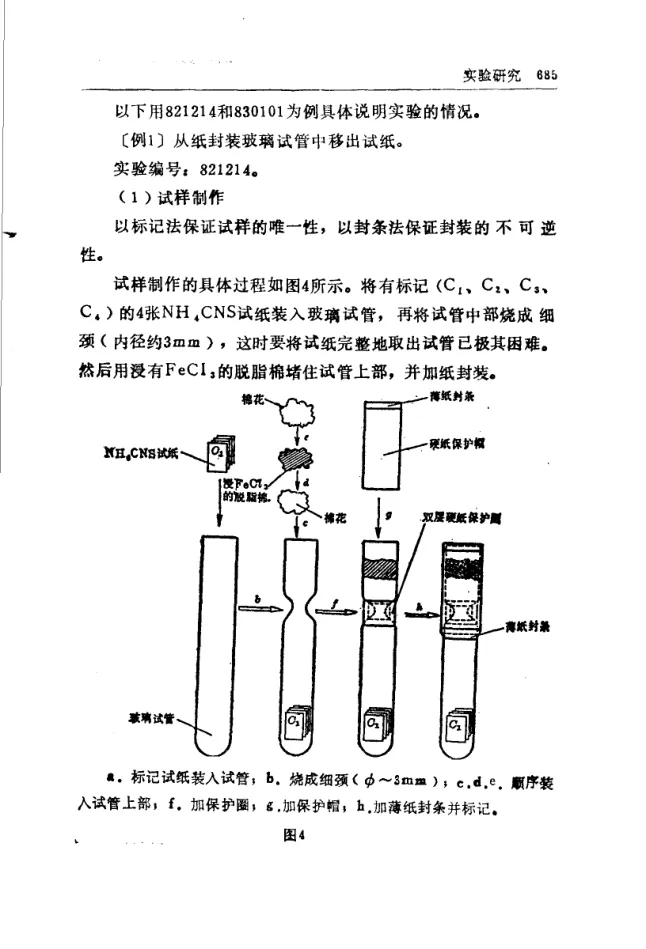
a. Marked test papers loaded into the test tube; b. Drawn into a narrow neck (φ ~ 3 mm); c, d, e. Sequential loading into the upper portion of the test tube; f. Protective ring added; g. Protective cap added; h. Thin paper seal strip applied and marked.
(2) Test conditions
Time: Morning of December 26, 1982. Location: Beijing Teachers’ College. Weather: Clear. Monitors: Liu Huiyi, Huang Yuchun, Zhang Yu, Rao Anli. Layout: As shown in Figure 5. Z held the sample and sat beside the table. Liu Huiyi sat in front of the table, while Huang Yuchun, Zhang Yu, and Rao Anli stood nearby to monitor.
(3) Experimental procedure
At approximately 9:20, after the monitors had verified the sample, Z began the experiment holding the sample in his hand. First, he shook one test paper out of the test tube and into Liu Huiyi’s palm. He then picked up a small tuft of purplish-red cotton thread from the tabletop and wiped the lower part of the glass tube (at this point the monitors could still see the remaining three test papers inside the test tube); he then moved the cotton thread into the test tube. At the same time, the monitors discovered that the test papers inside the test tube were already gone, and found the three test papers that had been moved out on the ground. None of the monitors saw the specific process by which the objects moved out of or into the test tube. The monitors verified on the spot: ① The glass test tube seal was intact and undamaged; it was indeed the original object. ② The four removed test papers had intact markings; they were indeed the originally packaged test papers. ③ None of the four removed test papers showed any perceptible color-development trace. The experiment ended at approximately 9:25.
East
Z
Desk
Sample
△ Zhang
△ Liu
△
Rao △
— South
Figure 5
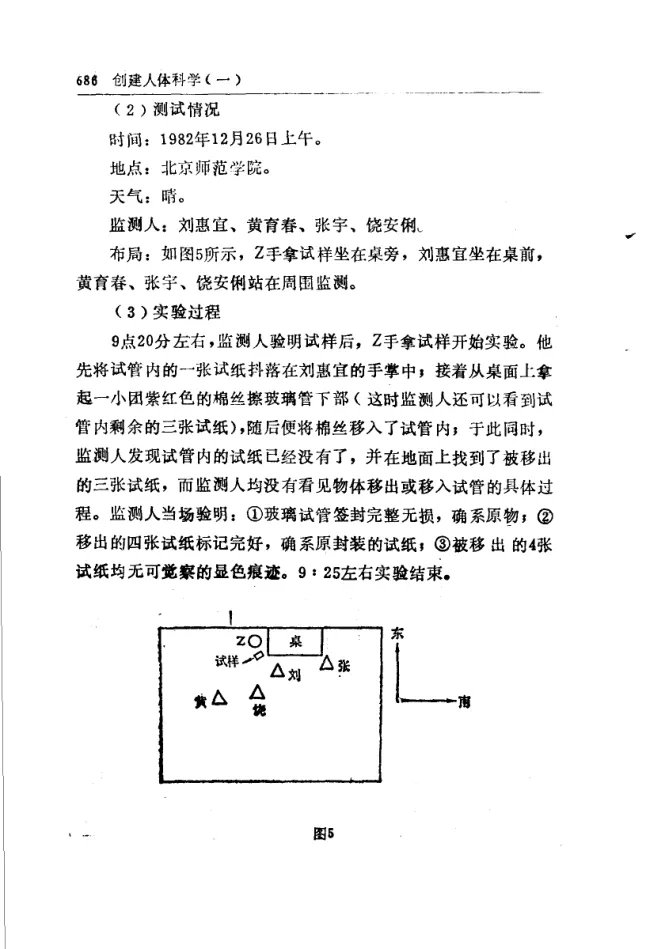
(4) Inspection and verification
① At 9:35 a.m. on December 26, 1982, ten minutes after the end of the experiment, Lin Shuhuang and Rao Anli re-examined the four removed test papers and found that two of them had developed small apricot-yellow spots, while the other two still showed no perceptible color-development trace.
② On the morning of December 28, 1982, Hou Peizhuang and Lin Shuhuang re-examined the sample glass test tube and the removed test papers, confirming that their packaging and markings were intact and undamaged and were indeed the original objects. They found that all four removed test papers had developed small apricot-yellow spots (see Appendix Figure 40); this may have been related to iron filings adhering to the cotton thread.
③ One of the removed test papers C was cut in half, and one half was brought into contact with a FeCl₂ solution; the result was an immediate blood-red coloration.
[Example 2] Moving a sponge soaked in ferric chloride solution out of a sealed test-paper pouch.
Experiment number: 830101.
(1) Sample preparation
The tiger-tally method was used to ensure the uniqueness of the target object (sponge), and the marking method together with the double-layer paper pouch sealing method were used to ensure the uniqueness of the sealed container and the irreversibility of the packaging. The specific process of sample preparation is shown in Figure 6–I.
(2) Test conditions
Time: Morning of January 2, 1983. Location: A certain work unit in the western suburbs of Beijing. Weather: Clear. Monitors: Lin Shuhuang, He Shuwen, Rao Anli, Liu Guonan, Lin Lin. Layout: As shown in Figure 7. Z held the sample and sat beside the table; five persons monitored on site.
(3) Experimental procedure
At approximately 9:00, Z felt that his functional state was good and took the initiative to request that the experiment be conducted. Lin Shuhuang immediately asked Lin Lin to fetch the chemical sample, and at approximately 9:20 Lin Lin brought the sample back. Lin Shuhuang first held the test-paper pouch up to the light to confirm that it contained the sponge (target object), then
Extraordinarily removed sponge
Control test paper
Parent sponge
KCNS test paper
Plastic bag
Sponge soaked in FeCl₃
Sample preparation process
I Sample preparation process: a. Cut the sponge with an arbitrary curved line, then soak in FeCl₃ solution; b. Place in plastic bag; c, d. Then place in test-paper pouch; e. Fold back and seal; f. Fold back the upper and lower ends again; g. Add a thin paper seal strip and sign/marking; h. Then seal into a sealed thin paper bag.
Ⅰ Inspection and verification process: i. Cut open the thin paper bag; j. Cut open the test-paper pouch from the front and check whether there are color-development traces; k. Cut a small piece of test paper from the test-paper pouch; l. Bring into contact with the extraordinarily removed sponge for color development; m. Sponge in contact with control test paper for color development; n. Verify sponge against the parent material.
Figure 6
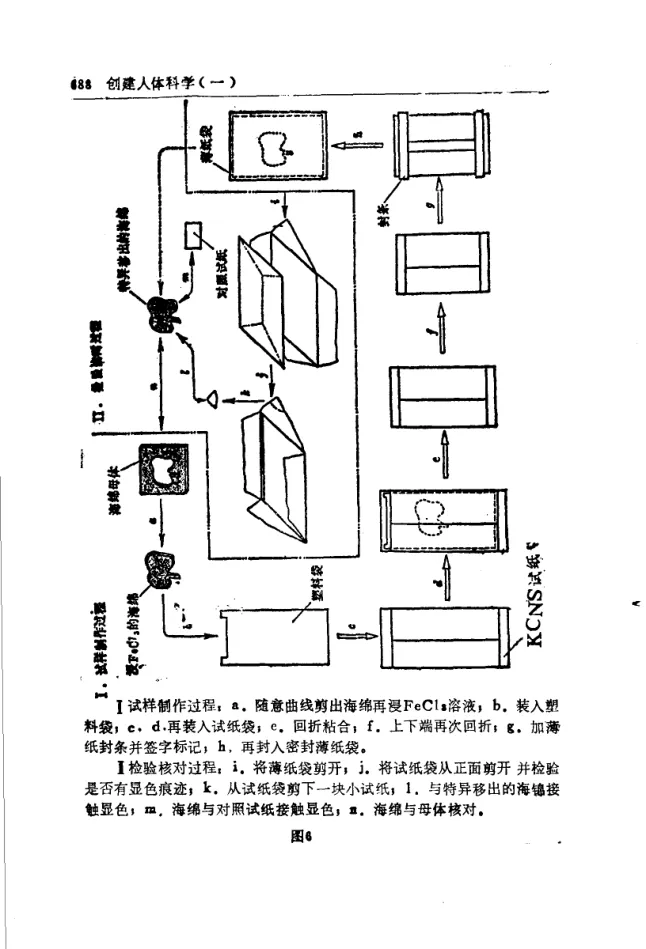
Sample
South
Desk
Z
△ Rao
△ Liu
West
△ Lin
△ △ He
Figure 7
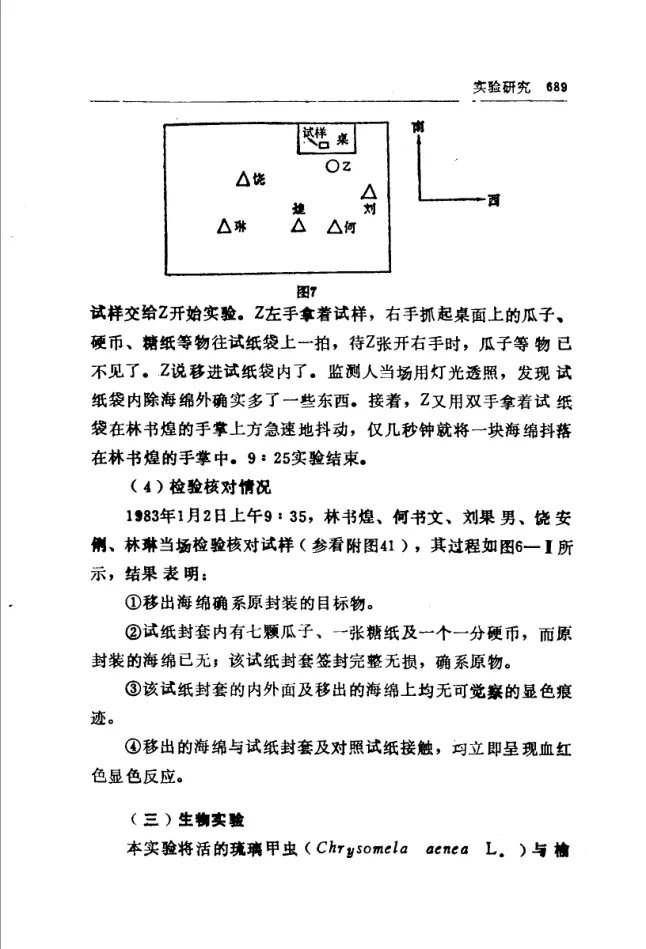
handed the sample to Z to begin the experiment. Z held the sample in his left hand; with his right hand he grabbed melon seeds, coins, candy wrappers, and other objects from the tabletop and slapped them against the test-paper pouch. When Z opened his right hand, the melon seeds and other objects were gone. Z said they had been moved inside the test-paper pouch. The monitors used a light to inspect by transillumination on the spot and found that, apart from the sponge, there were indeed additional objects inside the test-paper pouch. Next, Z held the test-paper pouch with both hands and shook it rapidly above Lin Shuhuang’s palm; in just a few seconds, a piece of sponge was shaken loose into Lin Shuhuang’s palm. The experiment ended at 9:25.
(4) Inspection and verification
At 9:35 a.m. on January 2, 1983, Lin Shuhuang, He Shuwen, Liu Guonan, Rao Anli, and Lin Lin inspected and verified the sample on the spot (see Appendix Figure 41); the process is shown in Figure 6–I. The results showed:
① The removed sponge was indeed the originally packaged target object.
② Inside the test-paper pouch there were seven melon seeds, one candy wrapper, and one one-cent coin, while the originally packaged sponge was no longer present. The pouch’s seal was intact and undamaged; it was indeed the original object.
③ Neither the inner nor outer surfaces of the test-paper pouch nor the removed sponge showed any perceptible color-development trace.
④ When the removed sponge was brought into contact with the test-paper pouch and with the control test paper, both immediately showed a blood-red color reaction.
(III) Biological experiments
This experiment placed a live leaf beetle (Chrysomela aenea L.) together with an elm
The elm leaf beetle (Ambrostoma quadriimpressum Motsch.) was moved out of a sealed container, and the insect remained alive. This type of experiment was successfully tested twice, summarized in the table below.
| Experiment No. | Test Date | Monitors | Specimen | Specimen Description | Inspection | Prepared by | Verified by |
|---|---|---|---|---|---|---|---|
| 830502 | 1983.5.25 | Rao Anli, Lin Shuhuang, Sun Zexian, et al. (six persons in total) | Two elm leaf beetles with antennae excised and one tortoise beetle placed inside a transparent sealed paper bag, with a seal and signature mark added | Han Zhiquan, Liu Huiyi, Lin Lin | |||
| 830503 | 1983.5.25 | Liu Huiyi, Lin Shuhuang, Lin Lin, et al. (six persons in total) | One elm leaf beetle with antennae excised sealed inside a marked glass tube sealed by three methods: paper, thread, and wax | Han Zhiquan, Liu Huiyi, Lin Lin |
[Example] Moving the elm leaf beetle out of the sealed glass test tube.
Experiment No.: 830503.
(1) Specimen Preparation
The “tiger tally” method was used to ensure the uniqueness of the target object (a live elm leaf beetle), and the tiger tally method together with a marking method were used to ensure the uniqueness of the sealed container. Thread, wax, and paper seals were used to ensure the irreversibility of the sealing. The specific process of specimen preparation is shown in Figure 8–I. The soft paper original, the hard paper original, and the excised antenna segment of the elm leaf beetle were all retained by the specimen preparer for verification after testing.
(2) Test Conditions
Time: Noon, May 25, 1983.
Location: Beijing Teachers’ College.
Weather: Clear.
Monitors: Liu Huiyi, Lin Lin.
Elm leaf beetle
Inspection and verification process
[Diagram showing the elm leaf beetle with left antenna cut, wax seal, soft paper original, hard paper original, kraft paper cap original, excised antenna segment]
I Specimen preparation process
[Diagram showing glass tube, paper pieces, thread, wax seal]
[Specimen preparation process: a. A marker soft paper piece cut along an arbitrary curve; b. After threading, sealed with wax and fixed to the inner wall of the glass tube; c. A marker hard paper piece cut along an arbitrary curve; d. Placed into the glass tube; e. The left antenna of the elm leaf beetle was cut off and the excised antenna segment retained; f. The beetle was placed into the glass tube; g. Thread passed through the center of the kraft paper cap; h. Glued; i. Sealed with marked thin tissue paper; j. Thread pulled taut, cut at the base, and sealed with wax. Inspection and verification process: k. The extraordinary-ability-removed elm leaf beetle was checked against its excised antenna segment; l. The soft paper piece was checked against its original; m. The hard paper piece was checked against its original.]
Figure 8
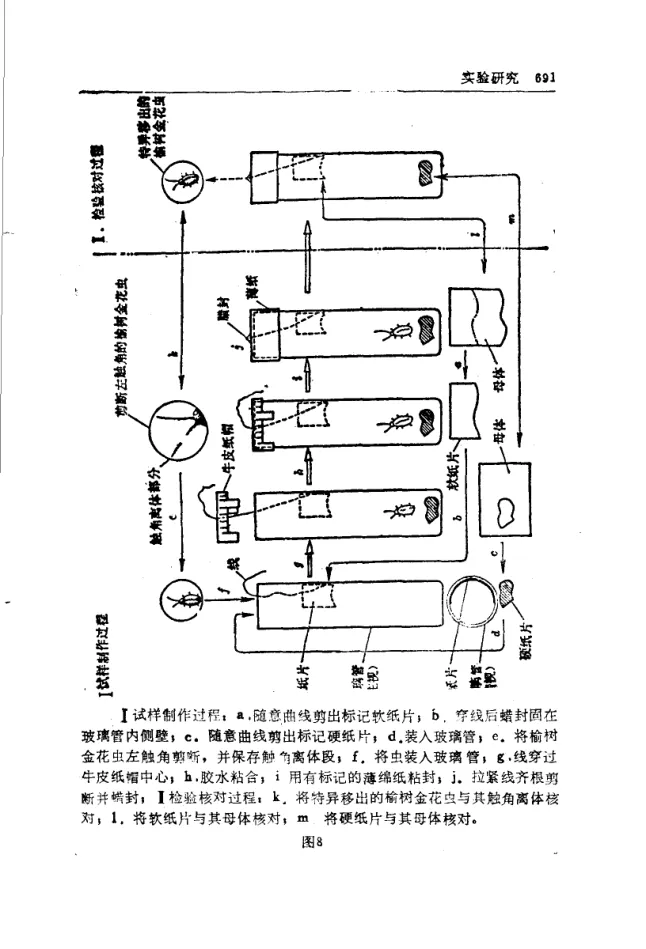
Arrangement: As shown in Figure 9.
Z sat beside a round table, with the specimen placed on the table surface. Liu Huiyi and Lin Lin sat beside the round table.
(3) Experimental Process
13:40 — The experiment began. Z held the specimen glass tube and showed it to Lin Lin, verifying on the spot that the elm leaf beetle was still sealed inside the glass tube and was crawling. At 13:48, Liu Huiyi said to Z: “It would be best if you shake the beetle into my hand.” At this point Z became excited, holding the specimen glass tube in his right hand and rapidly shaking it into Liu Huiyi’s left palm. Liu Huiyi suddenly felt a small insect crawling in her left palm. As soon as Z moved the specimen glass tube away, an elm leaf beetle was indeed found crawling in Liu Huiyi’s palm. The monitors verified on the spot that the seal of the specimen glass tube was intact and undamaged, and that the elm leaf beetle originally sealed inside the glass tube was gone. 13:49 — The experiment ended.
[Diagram: East — △ Lin — specimen — South — round table — Z — △ Liu]
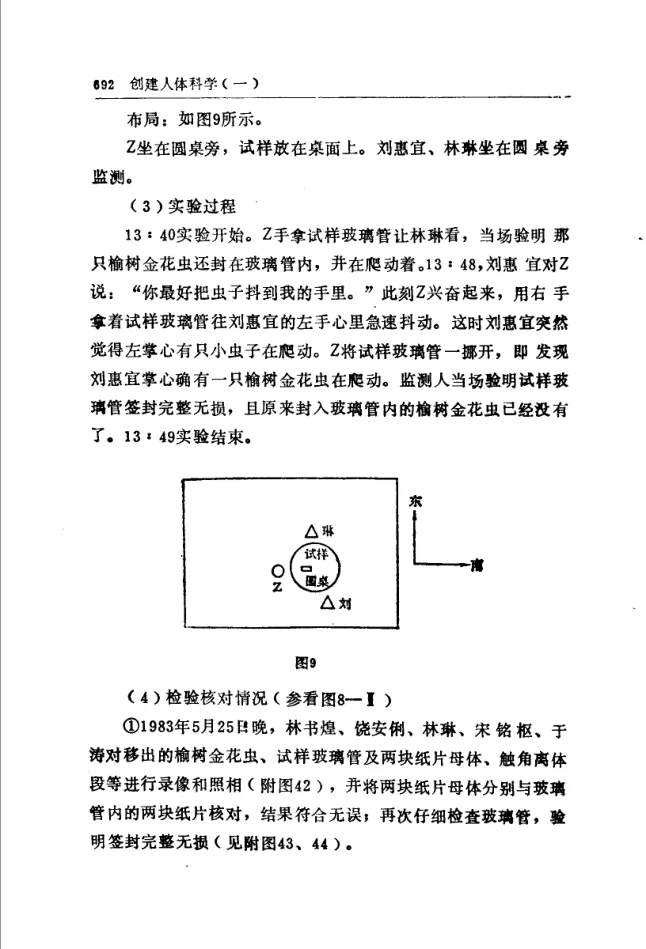
(4) Inspection and Verification (see Figure 8–I)
① On the evening of May 25, 1983, Lin Shuhuang, Rao Anli, Lin Lin, Song Mingshu, and Yu Tao recorded video and took photographs of the removed elm leaf beetle, the specimen glass tube, the two paper originals, and the excised antenna segment (Appendix Figure 42). They checked the two paper originals against the two paper pieces inside the glass tube respectively; the results matched without error. They again carefully inspected the glass tube and verified that the seal was intact and undamaged (see Appendix Figures 43 and 44).
② On the morning of May 26, 1983, Han Zhiquan and Lin Shuhuang together used a microscope to observe the removed elm leaf beetle and its excised antenna segment. The results showed: its right antenna had 11 segments in total; its left antenna retained 5.5 segments; the excised antenna segment also measured 5.5 segments, for a total count still of 11 segments. This demonstrates that the removed elm leaf beetle was indeed the originally sealed specimen (Appendix Figure 45).
③ The removed elm leaf beetle survived for 24 hours. On the evening of May 27, 1983, Guo You, Sun Zexian, and Lin Shuhuang took photomicrographs of the elm leaf beetle and its excised antenna segment, then made it into a specimen for preservation.
III. Concluding Remarks
This article provides a number of reproducible examples of objects being moved out of or into sealed containers. [The text notes] the “rigor” of monitoring, and therefore the results obtained are reliable.
It should be noted that such experiments are extremely difficult, the success rate is not high, and outcomes vary from person to person. Over the past two years, we have repeatedly conducted this type of experiment with several test subjects of different genders and ages, among whom Z had the highest success rate. We hold that within the conventional domain, this phenomenon should be regarded as an impossible event in statistical terms; therefore, no statistical processing has been applied to the experimental results.
The above experimental results indicate:
(1) Certain macroscopic solid inanimate objects (such as paper pieces, coins, etc.) can, under the influence of extraordinary human abilities, be moved out of or into sealed containers made of certain solid materials, without damage to either the objects or the sealed containers; the process of moving out or in is presently unknown.
(2) Living organisms such as insects can also, under the influence of extraordinary human abilities, be moved out of or into sealed containers made of certain solid materials, without any discernible effect on their life activities.
(3) An attempt was made to use the rapid ion color reaction of ferric chloride solution with potassium thiocyanate (or ammonium thiocyanate, potassium ferrocyanide) to observe the situation of objects being moved out of or into a sealed container. As a result, anomalous phenomena appeared in which objects entered and exited a sealed container without leaving color reaction traces.
The above phenomena may involve fundamental properties of matter or space.
Comrades Hou Peizhuang, Zhang Min, Cui Xiaolin, Han Zhiquan, Chen Chuanchu, Guo You, Song Mingshu, Shi Jun, Ma Jiulin, He Shuwen, Liu Mengyou, Yu Tao, and others participated in part of the research work; our gratitude is hereby expressed.
Notes and References
[1] Lin Shuhuang et al., Nature Magazine, 4, 9 (1981) 652.
[2] Joint Testing Group for Extraordinary Human Abilities, Research on Extraordinary Human Abilities, 1 (1983) 8.
Extraordinarily Activating a Pen Recorder
Lin Shuhuang, Zhang Hanyu, Huang Yuchun, Liu Huiyi, Rao Anli, Liu Guonan, Lin Lin, Yang Jianhua, Liu Yicheng, Ding Shiyin, Zhang Ming
[Editor’s Note] This article reports an important discovery. Experiments have found that some extraordinary-function individuals possess the ability to interfere with and control the movement of a pen recorder. This discovery poses a difficult problem for research on extraordinary human abilities, namely: how to determine to what extent the indications on an instrument can truly reflect the data to be measured, and whether they have been interfered with by the subject himself. This phenomenon deserves attention.
Affiliations of the authors of this article: Lin Shuhuang and six others, Beijing Teachers’ College; Yang Jianhua, Institute of Biophysics, Chinese Academy of Sciences; Liu Yicheng, Institute of High Energy Physics, Chinese Academy of Sciences; Ding Shiyin, Beijing Qinghe Middle School; Zhang Ming, Shanghai Maritime Institute.
This article reports the experimental results of extraordinary human abilities causing a pen recorder to operate under strict experimental conditions, and discusses the problem of measurement in human-body science.
In the experimental reports (1–8), such measurements involve the action of the human body on macroscopic measuring instruments. This article reports the extraordinary action of the extraordinary-function individual Z on a simple data recording system—the LM-6 pen recorder—and thereby examines the problem of measurement in human-body science.
I. Experimental Apparatus and Conditions
1. Experimental Apparatus
The LM-6 pen recorder can record six independent channels of electrical signal amplitude versus time relationship curves. Its working principle is shown in Figure 1. The input electrical signal, after being amplified by the amplifier, drives the magnetoelectric deflection-type recording pen (whose structure is shown in Figure 2), causing it to trace the relationship curve between signal amplitude and time on recording paper moving at a uniform speed.
Switch K₁ can short-circuit or open the amplifier input terminal; switch K₂ can disconnect or connect its output terminal; the recording paper transport speed is divided into 10 gears; the time-indicating pen records time once every 1 second or 10 seconds; the frequency characteristics are: when a sinusoidal wave of 0–70 Hz is input and the amplitude is 20 mm (peak-to-peak value), the error is within ±10%.
Figure 1
| Electrical Signal | Amplifier | Magnetoelectric Deflection System → Recording Pen → Recording Paper |
|---|---|---|
| K₁: Short / Open |
Figure 2
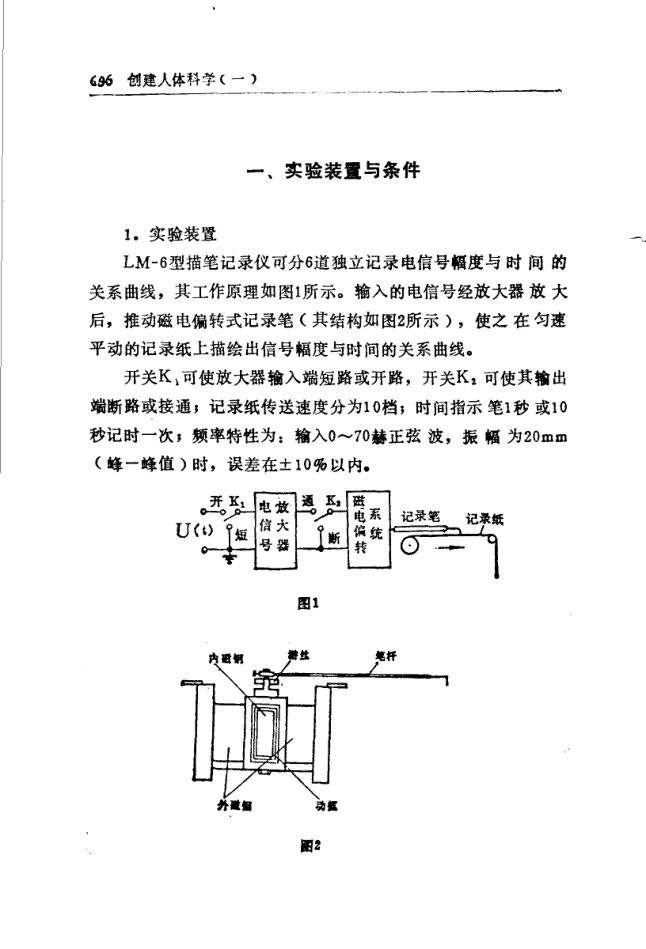
| Inner Magnet | Outer Magnet |
|---|---|
| Spring | Moving Coil |
| Pen Holder |
2. Experimental Conditions
The purpose of this experiment is to investigate the extraordinary action of Z on the pen recorder. In order to eliminate artifacts and ensure the rigor of the experiment, our experimental design satisfies the following conditions:
(1) Experiments were generally conducted under the close monitoring of two or more experimenters.
(2) A cover plate and baffle plate were added to the pen recorder, and during the experiment the subject did not come into contact with the recorder at all (as shown in Figure 3), to ensure that under the set experimental conditions the subject was unable to touch the recording pen and instrument knobs.
Table 1
| Experiment No. | Test Date | Monitors | Input Terminal | Output Terminal | Description of Recording Image |
|---|---|---|---|---|---|
| 821204 | 82.12.15 | Zhang Hanyu | Open circuit | Set to “On” | As shown at points ①–⑤ in Figure 4 |
| 821207 | 82.12.18 | Zhang Ming, Lin Shuhuang, Rao Anli, Lin Lin | Short circuit | Set to “On” | As shown in Figure 5; the ①–④ segment is an oscillation signal, ②–③ is a low-frequency square wave signal |
| 821211 | 82.12.24 | Lin Shuhuang, Rao Anli, Lin Lin | Short circuit | Set to “Off” | As shown at points ①–⑧ in Figure 6 |
| 821212 | 82.12.26 | Huang Yuchun, Lin Shuhuang, Rao Anli | Short circuit | Set to “Off” | As shown at points ①, ② in Figure 7 |
| 821213 | 82.12.26 | Liu Huiyi, Rao Anli, Lin Lin, Lin Shuhuang | Short circuit | Pen 1: “Off”; Pen 2: “On” | As shown at points ①–⑤ in Figure 8 |
| 830105 | 83.1.8 | Liu Huiyi, Liu Guonan, Lin Shuhuang | Continuous pulse signal input | Set to “On” | As shown at points ①, ② in Figure 9; the recorded pulse signal disappeared for approximately 30 seconds |
(3) Using an SG-1A teslameter to search and probe for magnetic fields around the subject and the experimental site, in order to rule out the possibility that the subject used a strong magnet to actuate the recorder.
(4) The experimental results can be reproduced.
Figure 3 [labels:] Subject | Baffle plate | Cover plate | Knob area | Recording paper
II. Experimental Methods
1. Overview
As shown in Table 1, and see Figures 4–9.
821204
① ②
No. 6 galvanometer pen recording
④ ⑤
No. 4 galvanometer pen recording
Figure 4
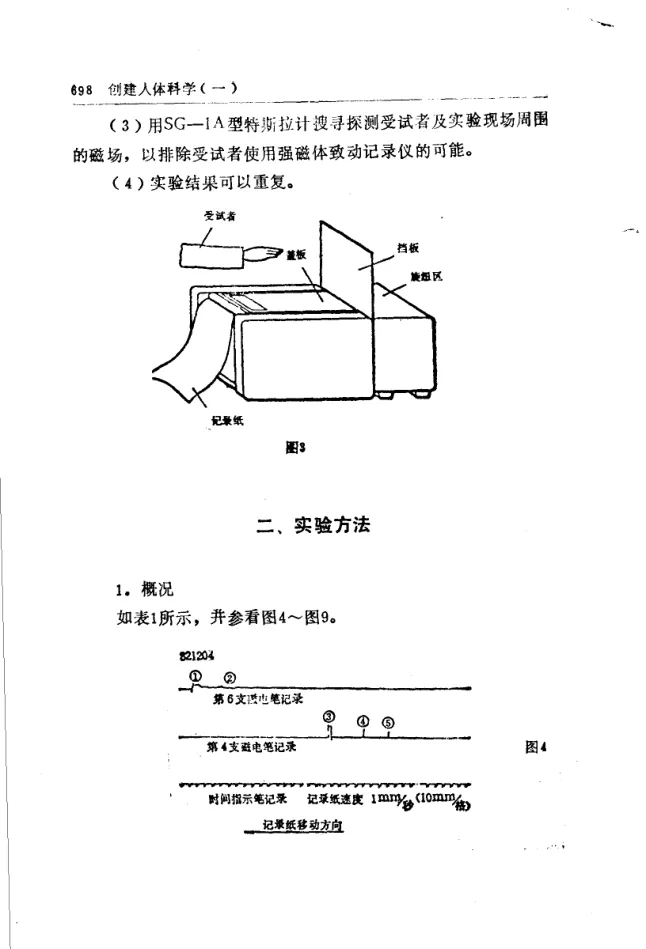
Time indicator pen recording
Recording paper speed 1 mm/grid
(10 mm/grid)
Recording paper movement direction
821207
Recording paper movement direction
②
Figure 5
No. 2 galvanometer pen recording (input short-circuited)
①
Off | On
No. 1 galvanometer pen recording (input short-circuited) oscillation signal
Time indicator pen recording
Recording paper speed
821211
Recording paper movement direction
Figure 6
①
⑥⑦ ⑧
(10 mm/grid)
Time indicator pen recording | Recording paper speed
821212
① ②
No. 1 galvanometer pen recording (input short-circuited, output set to “Off”)
Figure 7
(10 mm/grid)
Time indicator pen recording | Recording paper speed 1 mm
Recording paper movement direction
821213
② ①
No. 2 galvanometer pen recording (input short-circuited, output set to “On”)
Galvanometer pen lifted
③ ① ⑤
Figure 8
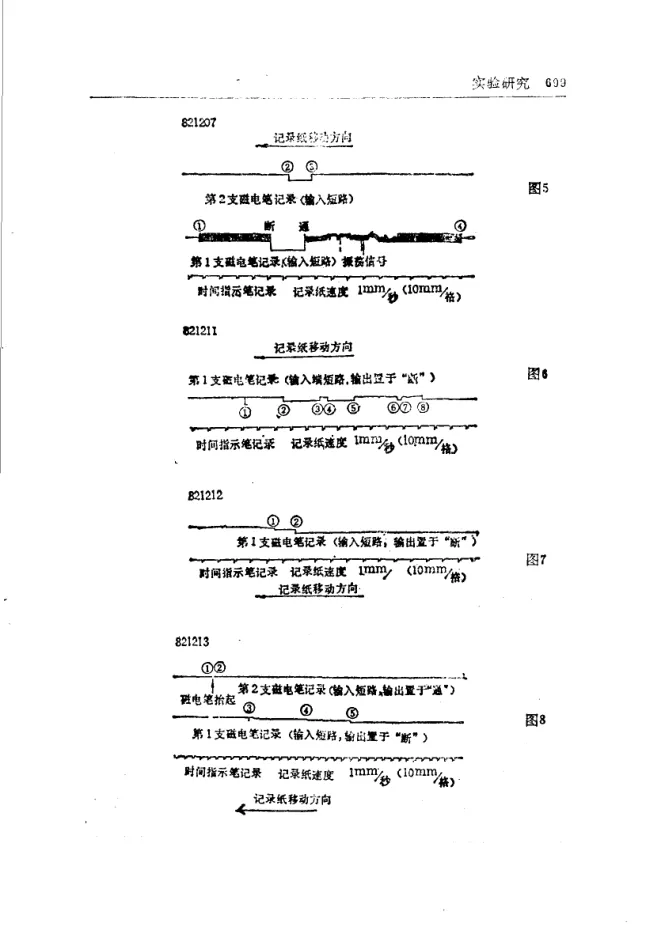
No. 1 galvanometer pen recording (input short-circuited, output set to “Off”)
Time indicator pen recording
Recording paper speed 1 mm
(seconds/grid)
Recording paper movement direction
830105
① ②
82922
No. 5 galvanometer pen recording
Miniature transmitter pulse modulation signal
No. 3 galvanometer pen recording
Signal disappears | Signal reappears
No. 2 galvanometer pen recording
Second pulse
Time indicator pen recording | Recording paper speed
Recording paper movement direction
Figure [9]
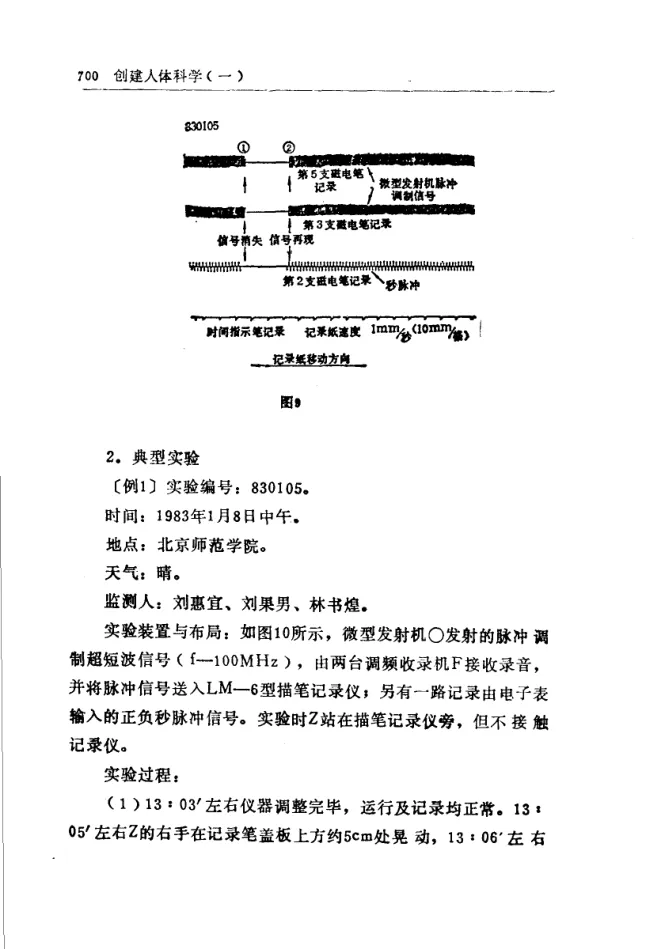
2. Typical Experiments
[Example 1] Experiment number: 830105.
Time: Noon, January 8, 1983.
Location: Beijing Teachers College.
Weather: Clear.
Monitors: Liu Huiyi, Liu Guonan, Lin Shuhuang.
Experimental apparatus and layout: As shown in Figure 10, the pulse-modulated ultrashort wave signal (f ≈ 100 MHz) emitted by a miniature transmitter was received and recorded by two FM radio-cassette recorders, and the pulse signal was fed into an LM-6 type pen recorder; another channel recorded the positive and negative second-pulse signals input from an electronic watch. During the experiment, Z stood beside the pen recorder but did not touch the recorder.
Experimental procedure:
(1) At approximately 13:03, the instruments had been adjusted, and both operation and recording were normal. At approximately 13:05, Z’s right hand waved about 5 cm above the cover plate of the recording pen. At approximately 13:06,
Figure 10 [layout labels:] △Yi | LM-6 | Radio-cassette recorder | North | Transmitter | O4 | △Nan | East | Desk
the second-pulse signals and electromagnetic-wave pulse-modulation signals recorded by pens Nos. 2, 3, and 5 suddenly disappeared simultaneously. About 30 seconds later, all three channels of recorded signals returned to normal simultaneously (see Figure 9).
(2) On the spot, Lin Shuhuang used an SG-1A teslameter to search and probe the magnetic field strength around Z’s body; its maximum reading did not exceed 0.56 millitesla, indicating that Z was not carrying a strong magnet.
(3) On the spot, the monitors replayed the tapes from both radio-cassette recorders. The results showed that the ultrashort-wave pulse-modulation signals received by the radio-cassette recorders had never disappeared. It is therefore evident that Z did not affect the performance of the transmitter and the radio-cassette recorders, but only exerted an effect on the pen recorder, the effect being equivalent to short-circuiting the recorder’s input or opening its output.
[Example 2] Experiment number: 821213.
Time: Morning, December 26, 1982.
Location: Beijing Teachers College.
Weather: Clear.
Monitors: Lin Shuhuang, Rao Anli, Liu Huiyi, Lin Lin.
Figure 11 [layout labels:]
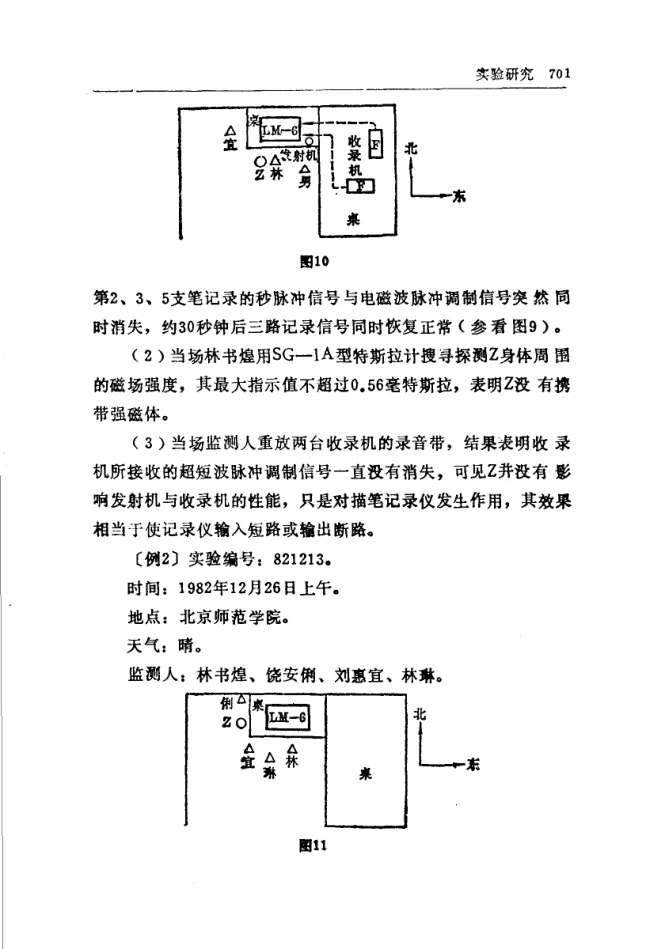 Li | Desk | Z ○ | LM-6 | North | △Yi | △Lin | △Xiao | East | Desk
Experimental setup and layout: As shown in Figure 11, the input terminals of the LM-6 stylus recorder were short-circuited, the output of the first pen was set to “off”, and the output of the second pen was set to “on”. During the experiment, Z stood beside the table but did not touch the recorder. Experimental process: (1) Under the condition that the stylus recorder was operating normally, the experiment began at 10:10’30”. Z stood beside the table, supporting himself with both hands on the edge of the table, and fixed his eyes on the recording pen, with no other actions. At 10:10’55”, the second pen suddenly lifted slightly (the possibility of ink blockage cannot be ruled out), and after about 6 seconds it was lowered and restored to its original state. At 10:11’43”, the first pen recorded a sharp pulse; at 10:12’52”, the first pen recorded a step signal; and at 10:13’49”, the first pen again recorded a step signal (see Figure 8). The experiment ended at 10:15’. (2) After an on-site search and detection, no strong magnets were found on Z (same as Example 1). 1 III. Discussion
- Preliminary Analysis of Experimental Results (1) This experiment mainly involves two types of phenomena: the first is that, in the case of an electrical signal input, the stylus recorder did not record a signal. Its effect is equivalent to a short circuit at the recorder’s input terminal or an open circuit at the output terminal, rendering the recorder ineffective; the second is that, in the absence of an external electrical signal input (in the conventional sense, of course), the stylus recorder recorded signals, including signals in the forms of steps, square waves, pulses, and oscillations. (2) The possible modes of action producing the above phenomena are, first, purely mechanical effects, such as toggling knobs and recording pens or lifting the recording pen; second, electromagnetic effects, such as the electromagnetic action on the magnetoelectric deflection system, electromagnetic interference on the amplifier, etc.; third, effects on the performance of electronic circuit components, which may involve material structures and microscopic processes. Of course, other possibilities cannot be ruled out. To determine the mode of action, further experimental
research. 2. On the Measurement Problem in Human-Body Science Experimental research in human-body science shows that there are multiple types of interactions between the human body and its surrounding environment, and there is an exchange of energy and information, including interactions between the human body and biological, physical, and chemical systems. What this experiment provides is an instance of the action of the human body on macroscopic measuring instruments. This raises at least the following question: in a measurement process involving the participation of a person such as Z and using a stylus recorder as the measurement data recording system, what exactly do the obtained measurement data reflect? When analyzing and judging measurement results, is it possible not to consider the complex interactions between the human body and the measuring instruments? This question may be of universal significance in the experimental research of human-body science. We believe that conducting scientific measurements using modern instruments is one of the fundamental means of experimental research in human-body science. However, when carrying out measurements and analyzing measurement results, the complex interactions between the human body and the measuring instruments must be carefully examined. For example, when the human body participates in measurement, it is necessary to consider not only the interaction between the measuring instrument and the measured target but also the interactions between the human body and the measuring instrument, as well as the measured target (as shown in Figure 12). Here, the measurement results can no longer be simply regarded as merely the interaction between the measured target and the measuring instrument; rather, it may be more reasonable in some cases to treat the three as a large system for study. For another example, when detecting human body radiation, it has been found that there are effects on various detectors such as magnetic, infrared, microwave, optical quantum, and neutron detectors. However, one cannot thereby immediately conclude that this effect is caused by the aforementioned substances, because in principle, when measuring a human body such as Z, various detectors and their data recording systems may all be activated, and which component of this complex measurement system the subject acts upon, and what the type of action is, requires careful identification. In the natural view of quantum mechanics, what is placed at the forefront is that the microscopic object and the instrument observing it are in an inseparable, unified connection; the large number of facts revealed by experimental research in human-body science
Measuring instrument Human body Measured target Figure 12
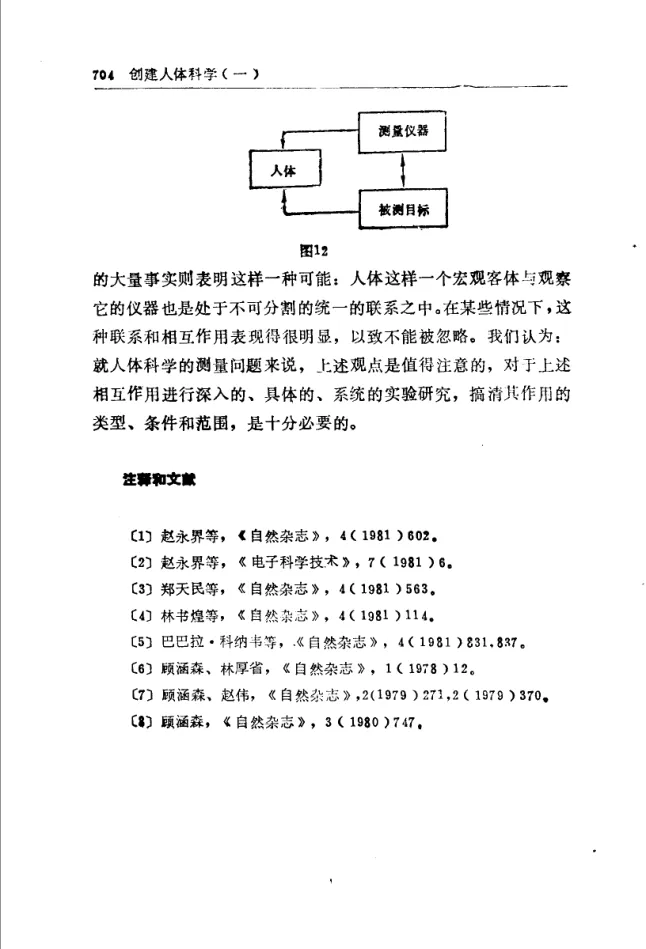 indicate a possibility: that a macroscopic object such as the human body is also in an inseparable, unified connection with the instrument observing it. In certain circumstances, this connection and interaction manifest so clearly that they cannot be ignored. We believe that regarding the measurement problem in human-body science, the aforementioned viewpoint is noteworthy, and it is highly necessary to conduct in-depth, specific, and systematic experimental research on the aforementioned interactions to clarify their types, conditions, and scope of action.
Notes and References
[1] Zhao Yongjie et al., Nature Journal, 4 (1981) 602.
[2] Zhao Yongjie et al., Electronic Science and Technology, 7 (1981) 6.
[3] Zheng Tianmin et al., Nature Journal, 4 (1981) 563.
[4] Lin Shuhuang et al., Nature Journal, 4 (1981) 114.
[5] Barbara Conway et al., Nature Journal, 4 (1981) 831, 837.
[6] Gu Hansen, Lin Housheng, Nature Journal, 1 (1978) 12.
[7] Gu Hansen, Zhao Wei, Nature Journal, 2 (1979) 271, 2 (1979) 370.
[8] Gu Hansen, Nature Journal, 3 (1980) 747.
indicate a possibility: that a macroscopic object such as the human body is also in an inseparable, unified connection with the instrument observing it. In certain circumstances, this connection and interaction manifest so clearly that they cannot be ignored. We believe that regarding the measurement problem in human-body science, the aforementioned viewpoint is noteworthy, and it is highly necessary to conduct in-depth, specific, and systematic experimental research on the aforementioned interactions to clarify their types, conditions, and scope of action.
Notes and References
[1] Zhao Yongjie et al., Nature Journal, 4 (1981) 602.
[2] Zhao Yongjie et al., Electronic Science and Technology, 7 (1981) 6.
[3] Zheng Tianmin et al., Nature Journal, 4 (1981) 563.
[4] Lin Shuhuang et al., Nature Journal, 4 (1981) 114.
[5] Barbara Conway et al., Nature Journal, 4 (1981) 831, 837.
[6] Gu Hansen, Lin Housheng, Nature Journal, 1 (1978) 12.
[7] Gu Hansen, Zhao Wei, Nature Journal, 2 (1979) 271, 2 (1979) 370.
[8] Gu Hansen, Nature Journal, 3 (1980) 747.
An Exploration of the Phenomenon of Extraordinary Human Abilities Breaking Through Spatial Barriers
Song Kongzhi, Lan Rongliang, Xianggao Li, Zhou Liangzhong
[Editor’s note] This article reports on explorations conducted into the extraordinary ability of breaking through spatial barriers. The experiments employed sealed devices including medicine bottles, saline bottles, and specially designed glass bottles; the samples selected included different materials such as tablets, plastic color blocks with hidden marks, copper wire, metal-shielded wire, and photographic paper wrapped in black paper; recording was carried out using modern means such as video recording and high-speed photography. The extremely precious experimental records obtained through long-term experimentation confirm with indisputable facts that the phenomenon of extraordinary human abilities breaking through spatial barriers does indeed exist.
This paper was first presented at the Symposium on Research Methods and Key Research Priorities for Extraordinary Human Abilities, convened by the Preparatory Committee of the China Human-Body Science Research Association. It was delivered by Comrade Song Kongzhi and received unanimous praise and acclaim from the attendees.
This paper is published here publicly for the first time. Many of the continuous photographs within it—especially the frames captured by high-speed photography showing tablets escaping through the bottom of a bottle—are extremely rare and hold significant scientific value. This paper is also an important marker that China’s research into extraordinary human abilities has entered the realm of science.
The authors’ affiliation: Institute of Space Medico-Engineering.
I. Foreword
Since the report on March 11, 1979, that Tang Yu of Sichuan Province could read characters with his ear,
many scientists in our country have already been engaged in research in this field. The abilities discovered range from extrasensory perception to psychokinesis, covering a very broad scope. At present, these abilities cannot yet be explained by modern science and are tentatively called extraordinary human abilities.
The ability to break through spatial barriers is one form of psychokinesis among extraordinary human abilities. Its characteristic feature is that a person with extraordinary abilities can remove an object previously placed inside a sealed or narrow-slit container out of that container without damaging the container’s seal or destroying the container itself.
Lin Shuhuang, Zhang Chongqi, [1] and 13 others discovered in 1981 that persons with extraordinary abilities could remove objects such as M3 nuts, nails, and matchsticks from a covered 135 film plastic cassette, which had a hole 1.5 millimeters in diameter on its lid, but the lid was not opened. Subsequently, the National Joint Testing Group for Extraordinary Human Abilities [2] further discovered that persons with extraordinary abilities could remove target character slips from kraft paper envelopes. After that, Lin Shuhuang, Zhou Binghui, and 19 others [3] conducted specialized experimental research on breaking through spatial barriers. They not only confirmed that persons with extraordinary abilities could remove slips of paper from sealed kraft paper envelopes, but could also remove insects from covered and sealed glass tubes, with no obvious effect on their vital activities. At the same time, in these experiments, they also observed sponges soaked in FeCl₃ solution being removed from double-layer sealed KCNS test paper bags, with no color change appearing on the test paper. These studies pioneered the research direction of the spatial barrier breakthrough ability and provided some preliminary physical evidence for the phenomenon.
On the basis of these experiments, we considered it necessary to further confirm the authenticity of this ability using more rigorous means, and moreover, to observe the breakthrough process and the breakthrough point, so as to verify whether or not there is in fact a process of a solid target object passing through a wall.
Therefore, the objectives of this experiment are:
- Using samples that cannot be restored once destroyed, combined with image recording, to further confirm the authenticity of this ability.
- Enlarging and lengthening the target objects, combined with video recording and especially high-speed photography, to observe exactly where the solid target object breaks through the three-dimensional spatial barrier, and whether there is a temporal process of wall penetration.
II. Experimental Materials and Methods
1. Samples
(1) To fully confirm the authenticity of the spatial barrier breakthrough ability, the following two types of samples were designed (see Appendix Figure 46).
① Sample I. Encapsulated in a transparent glass bottle, the bottle having a diameter of 4 centimeters and a length of 12–13 centimeters; there is a narrow slit at the top, with a maximum width not exceeding 0.4 millimeters and a length of about 1 centimeter. The bottle contains 30 tablets in three different colors: red, green, and purple. The tablets have a diameter of 5.5 millimeters and a thickness of 3 millimeters. The proportions of tablets of different colors vary among different sample bottles. Different sample types carry type designations, and several sample bottles of the same type each bear different serial numbers. The numbers of tablets of each color, the sample type designation, and the serial number of the sample bottle are all written on the label in binary coding. The tablets are first placed inside the sample bottle, and then the upper end is fused into a narrow slit; even if a tablet splits in two, it absolutely cannot be shaken out.
② Sample IV. The style of the transparent glass sample bottle used for encapsulation is identical to that of Sample I, but the tablets inside are replaced with 15 plexiglass pieces in three colors: red, yellow, and green. The pieces have dimensions of 5 × 5 × 1.5 mm³ and are square. The proportions of the variously colored pieces also vary among different sample bottles. Moreover, each piece bears a Russian letter, and the 15 letters form three Russian words, one word per color. There is also a serial number indicated by a dot in a different position. For example, if there are 4 pieces bearing the Russian letters c, o, g, α, forming the meaning of “soda.” Additionally, dots are added in different positions: c, o, g·, ·α, representing numbers 1, 2, 3, and 4 respectively. The proportions of plexiglass pieces of different colors in each sample bottle also vary. The pieces are likewise first placed inside the sample bottle, and then the upper slit is fused; the pieces absolutely cannot be shaken out.
Each sample is unique and cannot be replicated. Once the glass container is broken, it cannot
restored on the spot, and since the glass is transparent, it is favorable for observation.
(2) In order to observe exactly where the target object (i.e., the object first placed inside the container) breaks through the spatial barrier, and what behaviors the target object and the container wall exhibit during the breakthrough, the following several types of test samples were designed.
① Commercially packaged bottles of Ciwujia (Siberian ginseng) tablets and Xiaoyan Lidan tablets were used. Both types of medicine bottles are transparent glass bottles, sealed with cork stoppers coated in wax plus screw-on plastic caps. The tablets are oblate-round in shape, 1 cm in diameter, with a maximum thickness of 0.6 cm. The Ciwujia tablets have a yellow sugar coating, and the Xiaoyan Lidan tablets have a blue sugar coating. Each bottle contains 100 tablets (see Appendix Figure 47).
② 100 ml hypertonic glucose infusion bottle samples. These used clinically used 100 ml hypertonic glucose infusion bottles, washed and air-dried, then filled with 5 types of medicinal granules and tablets, 10 of each type, totaling 50 pieces. Among them, 3 types are oblate-round, 1 cm in diameter, with a maximum thickness of 0.6 cm, available in yellow, red, and light brown sugar coatings; the other two types are capsule granules, with capsules 1.5 cm long and 0.5 cm in diameter — one half red and half blue, the other entirely blue. Afterward, a rubber stopper was inserted, and an aluminum cap was applied using a capping machine (see Appendix Figure 48).
③ Sample V. Made by fabricating from transparent glass tubing, with a diameter of 4 cm and a length of 20–25 cm; both ends are fused shut, and the side wall is marked with a hole 3 mm in diameter to indicate the model number and a hole 1 mm in diameter to indicate the tube number. Inside the tube is a solenoid wound from enameled wire of 1 mm diameter and 2 m length; the solenoid has a diameter of 1 cm. One end of the enameled wire is fused to one end of the glass tube, and the other end is free and soldered to an M8 nut (see Appendix Figure 49).
④ Sample VI. This sample is also fabricated from transparent glass tubing, the same size as Sample V, with both ends fused shut. One end of the glass tube has a hole 1 mm in diameter, and there are no holes on the side wall. Inside the tube is a metal-shielded wire of 1 mm diameter and 1.5 m length; one end of the shielded wire is fused to one end of the test bottle (see Appendix Figure 50).
⑤ A 500 ml transparent infusion bottle, containing a package of unexposed photographic paper. The photographic paper package is connected by a 30 cm-long string to a label printed with the word “TEAC.” Sealed with a rubber cap
(see Appendix Figure 51).
Samples of the same type as this one also include a 500 ml transparent infusion bottle containing Fujian bag tea, and an iron tea tin containing a package of unexposed photographic paper.
In the experiments with the second category of samples, in addition to routine video recording, high-speed photography was also performed at speeds of 200 frames/second, 400 frames/second, and 1000 frames/second.
- Experimental Principles
(1) The entire experimental process must be subject to uninterrupted, rigorous observation and recording.
(2) Samples may only be handed to the person with extraordinary abilities during the experiment. Samples are absolutely not permitted to be taken away from the site. After the experiment concludes, regardless of success or failure, samples must be recovered and properly stored.
(3) The codes on the test pieces are kept double-blind with respect to both the experimenter and the subject before and during the experiment.
- Persons with Extraordinary Abilities
The person with extraordinary abilities, Z, male, 26 years old. He once had pulmonary tuberculosis, now fully cured. Normal physical development.
III. Results
We conducted a total of 50 experiments on the ability to break through spatial barriers. The brief results are listed in Table 1. Of the 50 experiments, 25 were successful; 17 were video-recorded, and 6 were captured with high-speed photography.
- Experiments Verifying Authenticity
Experiments with Type I samples: two bottles were successful and video-recorded. The results are listed in Table 2.
Table 1: Summary of 50 Experiments
| Item | Preparatory experiment | Formal experiment | Total |
|---|---|---|---|
| Total times | 2 | 48 | 50 |
| Successful times | 1 | 24 | 25 |
| Video recording times | 17 | 17 | |
| High-speed photography | 6 | 6 | |
| Number of successful specimens saved | 0 | 21 | 21 |
It should be noted that in both experiments, there were instances where half a tablet was moved out. This was caused by the subject with extraordinary abilities shaking the test bottle vigorously while emitting qi; however, even half a tablet is still 1.5 mm thick and could not have come out through the gap at the top. Furthermore, the sum of the number of tablets outside the bottle and the number of tablets remaining inside the bottle exactly matches the total number of tablets originally loaded, which is 30 tablets.
Table 2: Successful Results of Type I Specimen Experiments
| No. | Completion Date | Quantity of Tablets | Red | Green | Purple | Sum |
|---|---|---|---|---|---|---|
| 18 | 1983.11.16 | Original stored | 10 | 11 | 9 | 30 |
| Moved out | 1.5 | 1.5 | ||||
| 1 | 1983.11.18 | Original stored | 10 | 10 | 10 | 30 |
| Moved out | 1 | 2 | 0.5 | 3.5 |
After emitting qi, the sum of the number of tablets of each color outside the bottle and the number of tablets of the corresponding color remaining inside the bottle exactly equals the number of tablets of each color originally loaded. The bottle was not damaged.
Three Specimen IV experiments were completed, and the detailed results are listed in Table 3. As can be seen from the table, a total of 5 tablets were moved out of Bottle No. 1, which are u, m., ·r, ù, and τ; a total of 3 tablets were moved out of Bottle No. 4, which are o, e., and e•; and a total of 3 tablets were moved out of Bottle No. 8, which are g., o, and π.. The number, color, serial number, and code of the test tablets moved out of the bottles exactly matched those reduced from the glass bottles. The glass bottles were not damaged (see attached figure 52).
Table 3: Successful Results of Type IV Specimen Experiments
Bottle No. 1 — completed 1983.12.10; 15 tablets; 5 moved out.
| Color | Tablet No. | Specimen Code | Moved Out |
|---|---|---|---|
| Red | 1 | A | No |
| Red | 2 | [illegible] | Yes |
| Red | 3 | [illegible] | Yes |
| Red | 4 | α | No |
| Red | 5 | и | No |
| Yellow | 1 | ш | No |
| Yellow | 2 | о | Yes |
| Yellow | 3 | р | Yes |
| Yellow | 4 | [illegible] | No |
| Yellow | 5 | О | No |
| Yellow | 6 | е | No |
| Yellow | 7 | л | Yes |
| Yellow | 8 | [illegible] | No |
| Green | 1 | [illegible] | No |
| Green | 2 | [illegible] | No |
Bottle No. 4 — completed 1983.12.28; 15 tablets; 3 moved out.
| Color | Tablet No. | Specimen Code | Moved Out |
|---|---|---|---|
| Red | 1 | [illegible] | [assignment illegible] |
| Red | 2 | [illegible] | [assignment illegible] |
| Red | 3 | [illegible] | [assignment illegible] |
| Red | 4 | [illegible] | [assignment illegible] |
| Red | 5 | [illegible] | [assignment illegible] |
| Yellow | 1 | [illegible] | [assignment illegible] |
| Yellow | 2 | [illegible] | [assignment illegible] |
| Yellow | 3 | [illegible] | [assignment illegible] |
| Yellow | 4 | [illegible] | [assignment illegible] |
| Yellow | 5 | [illegible] | [assignment illegible] |
| Green | 1 | [illegible] | [assignment illegible] |
| Green | 2 | [illegible] | [assignment illegible] |
| Green | 3 | [illegible] | [assignment illegible] |
| Green | 4 | [illegible] | [assignment illegible] |
| Green | 5 | [illegible] | [assignment illegible] |
Bottle No. 8 — completed 1983.12.30; 15 tablets; 3 moved out.
| Color | Tablet No. | Specimen Code | Moved Out |
|---|---|---|---|
| Red | 1 | ·н | [assignment illegible] |
| Red | 2 | о· | [assignment illegible] |
| Red | 3 | г·· | [assignment illegible] |
| Red | 4 | ·а | [assignment illegible] |
| Yellow | 1 | ·п | [assignment illegible] |
| Yellow | 2 | о· | [assignment illegible] |
| Yellow | 3 | л·· | [assignment illegible] |
| Yellow | 4 | е | [assignment illegible] |
| Green | 1 | ·с | [assignment illegible] |
| Green | 2 | о· | [assignment illegible] |
| Green | 3 | р·· | [assignment illegible] |
| Green | 4 | и [uncertain] | [assignment illegible] |
| Green | 5 | н [uncertain] | [assignment illegible] |
| Green | 6 | к [uncertain] | [assignment illegible] |
| Green | 7 | а [uncertain] | [assignment illegible] |
The raster clearly preserves each bottle’s completion date, total tablet count, and total moved-out count. Fields explicitly marked illegible cannot be assigned defensibly from the surviving print and have not been reconstructed from sequence or context.
The above experiments ensured that specimens could not be prepared in advance, since specimen numbers and codes were guaranteed to be double-blind and specimens were only delivered at the experimental site. Continuous observation by the on-site experimenter and other experimental personnel, together with video recording measures, ruled out the possibility of switching. Moreover, since glass, once broken, cannot be restored on the spot, the possibility of opening the container was ruled out. The transparency of the glass ensured the observability of target objects both inside and outside the specimen bottle. Under the assurance of these conditions, the above results fully demonstrate that the target objects were indeed removed from the specimen bottles by a person with extraordinary abilities using extraordinary abilities—this constitutes the ability to break through spatial barriers.
- Experiments observing the breakthrough point
(1) Results of originally sealed medicine bottle experiments
The experimental results are listed in Table 4; a summary of the video-recorded results is shown in Appendix Figure 53. This experiment demonstrated that tablets were indeed removed under the condition that the original seal was unbroken. The Ciwujia (Siberian ginseng) bottle experiment, observed under high-speed photography at 400 frames/second, was particularly clear; Appendix Figure 54 presents this result. This is a sequence of continuous frames: in the first frame, no tablets are visible at the bottom or on top of the bottle; in the second frame, approximately two-thirds of a tablet appears slightly toward the outer-upper side of the bottle bottom, protruding outside the bottle, as shown in Figure 1; in the third frame, the tablet has already moved about 3 mm away from the bottle bottom; the diameter of the tablet is 1 cm.
Tablet | Tablet Front view | Side view
Figure 1. Schematic diagram of a tablet protruding
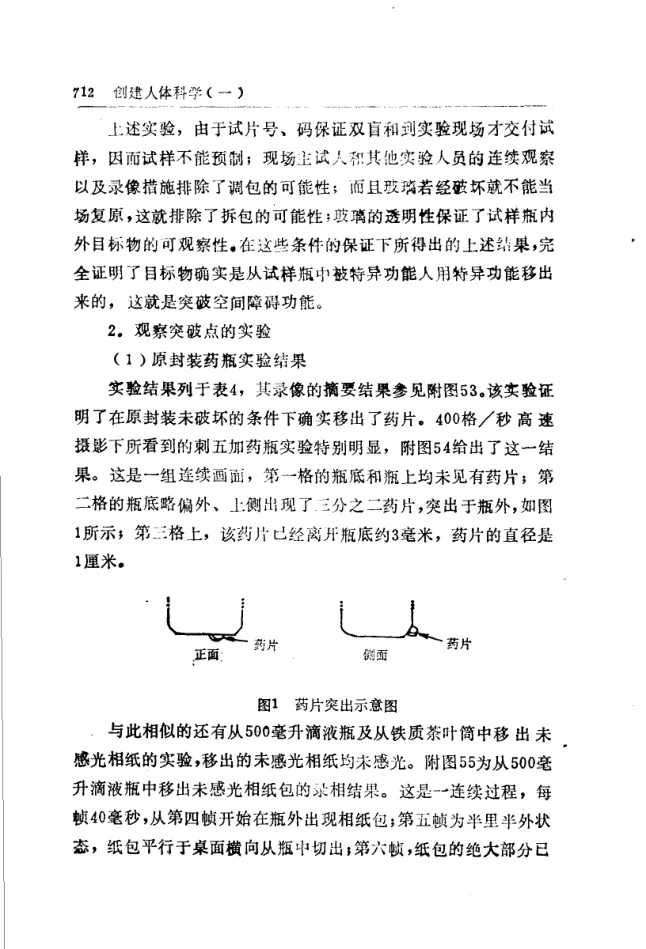
Similar to this were the experiments involving removing unexposed photographic paper from a 500 ml dropper bottle and from an iron tea canister; in both cases, the removed unexposed photographic paper was unexposed. Appendix Figure 55 shows the video-recorded result of removing a package of unexposed photographic paper from a 500 ml dropper bottle. This is a continuous process, with each frame at 40 milliseconds: from the fourth frame onward, the paper package begins to appear outside the bottle; the fifth frame shows a half-in, half-out state, with the paper package cutting through transversely parallel to the tabletop as it exits the bottle; in the sixth frame, the greater part of the paper package has already
Table: Successful results of medicine bottle experiments
Medicine name | Seal type | Tablet size | Original count | Removed count | Remaining count | Completion date Ciwujia (Siberian ginseng) | Originally sealed, cork stopper wax-sealed | Flat-round, diameter 10 mm | 100 | 62 | — | 1984.4.29 Xiaoyan Lidan tablets | Screw-cap plastic lid, same as above | Same as above | 100 | 44 | — | 1984.5.4 Hypertonic glucose | 100 ml dropper bottle, rubber stopper with machine-sealed aluminum cap | Yellow, diameter 10 mm, thickness 6 mm | 10 | 5 | 5 | 1984.5.7 Five-color mixture | 100 ml dropper bottle, rubber stopper with machine-sealed aluminum cap | Red, diameter 10 mm, thickness 6 mm | 10 | 1 | 9 | 1984.5.7 — | — | Light brown, diameter 10 mm, thickness 6 mm | 10 | 3 | 7 | 1984.5.7 — | — | Blue capsule, length 15 mm, diameter 5 mm | 10 | 5 | 5 | 1984.5.7 — | — | Red-and-blue capsule, length 15 mm, diameter 5 mm | 10 | 2 | 8 | —
been pulled out; by the seventh frame, the 2.5 × 3.5 cm flat paper package has been completely removed. This set of images records the entire process of a solid target object breaking through the container wall. This experimental result not only demonstrates that the breakthrough point is precisely at the wall, but also that there is a temporal process to breaking through the barrier.
(2) Results of continuous target object specimen experiments
The experimental results for V-type and II-type specimens are listed in Table 5. The II-type specimen bottle has only a single small hole 1 mm in diameter at one end; the fact that the iron washer and shielded wire inside were removed without any damage to the seal further proves the authenticity of the extraordinary abilities. In the video recording of this experiment, one can see the person with extraordinary abilities pinching one end of the wire with their fingers, causing the shielded wire inside the bottle to move in a cutting motion following the movement of the fingers outside the bottle, as shown in Appendix Figure 56. Frames 2 through 7 are a summary of the continuous video recording, with a gap of 1–4 frames between each pair of photographs. One can see the person with extraordinary abilities pinching one end of the shielded wire with the index finger and thumb of the right hand; as these two fingers move, the shielded wire inside the bottle shows corresponding movement. Interestingly, although a transverse cutting motion through the container wall was performed, no visually discernible trace was left on the wall—this is the same as with the tablet breaking through the medicine bottle.
Table 5. Results of removing enamel-coated wire or shielded wire from glass bottles
Model | Target object | Result | Record | Completion date V-type No. 12 | 2 m φ1 enamel-coated wire, spiral | Three segments pulled out | Video | 1984.4.2 V-type No. 13 | Same as above | Five segments pulled out | Video · photography | 1984.5.10 V-type A | 1.5 m φ1 shielded wire | Two segments pulled out | Video | 1984.4.25 V-type B | 1.5 m φ1 shielded wire | Four segments and one washer pulled out | Video · photography | 1984.4.28 — | Front end fixed with washer; wire inside bottle broken into three small segments | — | — | —
IV. Discussion
- The question of authenticity of the ability to break through spatial barriers
From the above results, it can be seen that, as one type of extraordinary human ability, the ability to break through spatial barriers genuinely exists. Taking the experiments with I-type and II-type specimen bottles as examples: the specimen bottles were temporarily made by sealing glass tubing, and once broken cannot be restored—they are irreversible. Moreover, each specimen had a special number, target objects had different colors, the number of pieces of target objects of each color varied, target objects also bore codes composed of Russian letters and numbers marked with dot codes, and each specimen had complete video materials from all angles, reflecting the unique pattern each one formed during sealing. Together, this information constituted the uniqueness of each specimen, making duplication impossible. Furthermore, the test subjects did not come into contact with the specimens at all before the experiment, let alone know the composition and coding of the target objects; they only received the specimens at the experimental site. Therefore: first, duplication was already impossible, so switching was meaningless; second, it was impossible to break the glass bottle to retrieve the target objects; third, the specimens could not leave the site—not only was there continuous on-site observation by personnel, but at critical moments there was also video or high-speed photography monitoring. Under such strict conditions, the number, color, serial number, and secret code of the tablets or Plexiglas pieces appearing on the experimental table were entirely consistent with those missing from the specimen bottles. This leads us
The only conclusion that can be drawn is that the tablets and the plexiglass pieces emerged from the glass bottle by breaking through the wall of the container.
For another example, in the Type II sample bottle experiment, there was only a small hole 1 millimeter in diameter at one end of the sample bottle, and the shielded wire inside also had a diameter of 1 millimeter, with its end point having many separated fine metal wires. Under normal circumstances, even if one were to directly pinch this end point by hand and pass it through the small hole, it would be a difficult task, let alone the fact that this shielded wire was placed inside the glass tube and was connected to a circular iron washer 7 millimeters in diameter. While keeping the sample bottle intact, 3 to 5 segments of the shielded wire were removed, and the washer also appeared outside; meanwhile, the shielded wire inside the tube was broken, and several wire segments 3–10 millimeters long as well as the washer were missing. This indisputably proves that the shielded wire and the washer were moved outside the bottle by breaking through the wall of the container without damaging the wall, and the effect can only be a kind of extraordinary ability. It should be noted that this type of sample also possesses a high degree of uniqueness, because the thickness, length, and method of fixing the shielded wire, as well as the method of fusing the two ends, each have their own characteristics and are extremely difficult to replicate; moreover, the sample is very long and not easily concealed or switched, and combined with video recording measures, the rigor of the experiment is further ensured.
2. On the Breakthrough Point
This experiment fairly clearly demonstrated the process by which a target object breaks through a container wall. It shows:
(1) The breakthrough point is not at a hole, seam, or interface between the lid and the wall of the container, but directly on the wall itself. In experiments where the container was transparent and the target object was relatively small, it was possible to observe the target object gradually enlarging outside the wall during the process of breaking through the wall; in experiments where the container was transparent and the target object was relatively large, one could observe the scene of the target object coexisting on both sides of the wall, changing and moving.
(2) The speed at which the target object breaks through the container wall varies. In the Ciwujia (Siberian ginseng) medicine bottle experiment,
for the two-thirds of the tablets 1 centimeter in diameter, breaking through the bottle wall required approximately 2.5 milliseconds, giving an average speed of:
This assumes it broke through at a uniform speed; the speed is roughly in this order of magnitude, somewhat slower than a middle-to-long-distance runner’s speed.
Moving an unexposed photographic paper packet out of a 500-milliliter dropper bottle took over 100 milliseconds, with a speed on the order of 30 centimeters per second.
Pulling shielded wire or enameled wire out of a glass tube was even slower, and could even pause for several seconds.
Therefore, as seen in this experiment, the speed at which a solid target object breaks through a spatial barrier can be very slow—slow enough to fall within a range observable by the naked eye—and this speed is mostly variable. We often cannot see the breakthrough process clearly because the time the target object takes to pass through the wall is extremely short, usually in the millisecond range. Through high-speed photography or slow-motion video playback, a discernible temporal process can be displayed, which even more clearly proves the objective reality of the extraordinary ability of breaking through spatial barriers.
(3) In past experiments, the container wall had to have a seam, a small hole, or a lid, etc., for the experiment to succeed, and the target object inside could not be removed from a seamless container. However, in this experiment, it was found that the breakthrough point at which the target object breaks through a spatial barrier is not at a seam, hole, or lid-wall interface, but rather on the wall itself. What, then, is the significance of the existence of a seam, hole, or lid-wall interface? Is it a psychological need or a physical need? This is a subject that requires further investigation.
V. Conclusion
Through 25 successful experiments on breaking through spatial barriers conducted with one young person with extraordinary abilities,
and through analysis of video recordings, high-speed photography, and other materials, it was demonstrated that one type of human extraordinary ability—the ability to break through spatial barriers—does indeed exist. The breakthrough point can be located on the container wall, and there is a temporal process of passing through the wall.
During the course of the experiments, we received the care of Director Zhang Zhenhuan and Comrade Qian Xuesen, as well as the guidance of Director Chen Xin and Associate Professor Wang Xiubi, and direct assistance from comrades Zhai Tingxiang, Wang Gongzhi, Chen Zhiming, Liu Yuezhi, Tian Huilai, Liu Min, Cheng Meiyue, Liu Hu, Li Zhenxiang, Han Yanfang, Yao Wenlan, and others. We hereby express our heartfelt thanks to all of them.
Notes and References
[1] Lin Shuhuang, Zhang Chongqi, et al., “Several Experiments on the Movement of Objects by Human Extraordinary Abilities,” Nature Magazine, 4(9) (1981) 652.
[2] Joint Testing Group for Human Extraordinary Abilities, “Joint Testing Report on the Authenticity of Human Extraordinary Abilities,” Research on Human Extraordinary Abilities, 1(1) (1983) 9.
[3] Lin Shuhuang, Zhou Binghui, et al., “Experiments on Extraordinary Psychokinesis: Objects Moving Out of or Into Sealed Containers,” Research on Human Extraordinary Abilities, 1(3) (1983) 110.
Observation Report on Extraordinary Writing and Sealing by Breaking Through Spatial Barriers
He Qingnian
[Editor’s note] In the course of research on extraordinary abilities, new phenomena of human extraordinary abilities are continually being discovered. This article reports on experiments involving extraordinary writing. The author of this article has long been engaged in qigong research and has considerable expertise in the field. This article raises a series of questions worthy of reflection.
The author’s affiliated institution: Beijing Institute of Traditional Chinese Medicine.
In the “Joint Testing Report on the Authenticity of Human Extraordinary Abilities” [1], the authenticity of the “extraordinary writing” ability of test subject Z was examined and documented. The author of this article participated in the preparation of the test samples. At that time, the sample consisted of a blank sheet of white paper; after the preparer signed it, the paper was used to tightly roll a ballpoint pen into a cylindrical shape, and both ends were folded back. This sample was placed on the table in front of the test subject and was simultaneously monitored by three people. Test subject Z was not permitted to change position; Z was only allowed to pick up the sample and sniff it once in front of the nose, then immediately set it down, and was not permitted to open the paper roll. At the same time, test subject Z was given a fountain pen and another sheet of blank paper. When Z used the fountain pen to write on the other sheet of blank paper, and stated that the same characters had also been written on the signed white paper that had been rolled into a cylinder, the monitors unrolled the cylindrical paper and found that the several characters that had been written with the fountain pen on the other sheet had also been written with a ballpoint pen on the signed paper, and the handwriting was similar in both cases. In order to further verify whether Z’s extraordinary writing ability could break through spatial barriers, this experiment sealed the test sample. The entire process was recorded as follows.
I. Method
Subject Z sat at a desk, and monitor Wang Pinshan (Director of the Acupuncture and Moxibustion Department, Liaoning College of Traditional Chinese Medicine) sat in front and to the left of Z. Three other monitors, Yu Shuzhuang (Deputy Director of the Acupuncture and Moxibustion Department, Beijing Hospital of Traditional Chinese Medicine), Yan Jiangzheng (researcher at the Institute of Atmospheric Physics, Chinese Academy of Sciences), and He Qingnian, sat beside and behind Z, respectively (Figure 1).
To compare sealed and unsealed samples, a sheet of ruled letter paper was first folded three times (with the ruled side facing inward) and placed on the desk in front of Z. Both sides of the letter paper were inspected and proven to be blank. At the same time, Z was given a ballpoint pen and another piece of paper, and Z wrote on this other piece of paper at 4:30 PM on January 22, 1983. Z wrote the words “Hello, thank you, teacher” and signed his name. At this point, monitor Wang Pinshan opened the folded letter paper in front of Z and saw that the ruled side of the letter paper had also been written on with a ballpoint pen with the words “Hello, thank you, teacher,” along with Z’s signature; the handwriting was similar to that written on the other piece of paper. The back of the ruled letter paper was then checked and proven to be blank and without writing. After He Qingnian and Yu Shuzhuang repeated the inspection, the ruled letter paper was folded again and placed into a kraft paper envelope. The bottom front of the envelope was printed with the red characters “Beijing Society for Dialectics of Nature.” After the letter paper was placed in the envelope, He Qingnian sealed the envelope with glue, temporarily took out his personal ivory seal from his bag, and stamped imprints on both the longitudinal and transverse sealing flaps of the envelope. After asking the other monitors to verify it, the sealed envelope was placed on the desk in front of Z. Under continuous observation without losing sight of him, Z used a ballpoint pen to write the words “Hello, thank you, teacher” on the front of the envelope. He then took the ivory seal from He Qingnian’s hand and pressed several imprints firmly on the back of the envelope (the positions of the imprints on the envelope are shown in Figure 2).
After all operations were completed, after waiting a short while, Z handed the sealed envelope to the
monitors at 5:15 PM.
Wang △ Zhu Oz He △ D Yan
Figure 1 Schematic diagram
1 5 6 Figure 2 1, 2, 3, 4: Positions of the imprints on the envelope surface (solid lines)
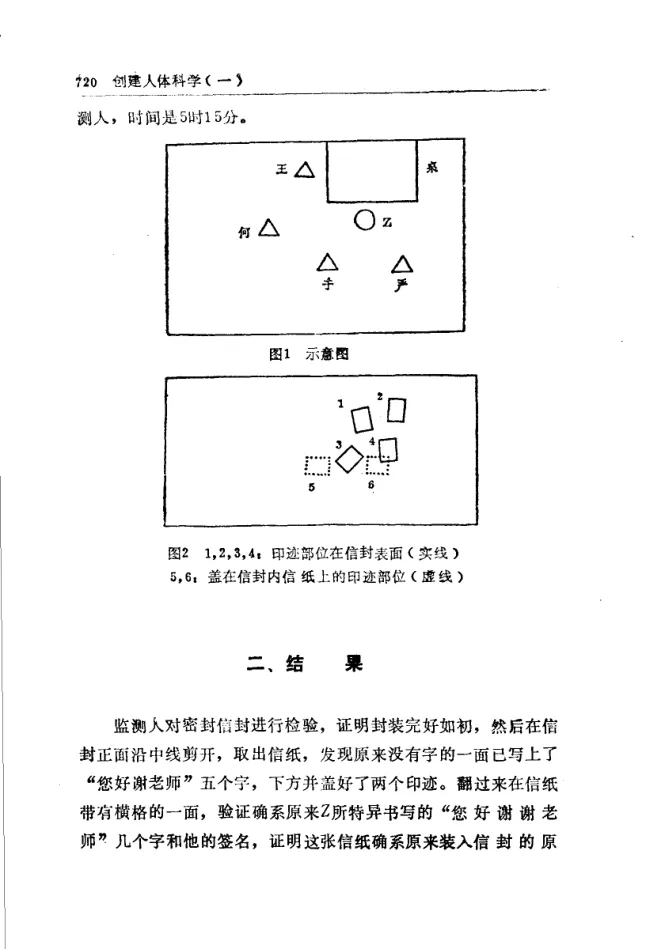 5, 6: Positions of the imprints stamped on the letter paper inside the envelope (dashed lines)
II. Results
The monitors inspected the sealed envelope and proved that the packaging was exactly as intact as the beginning. Then, it was cut open along the center line on the front of the envelope, and the letter paper was taken out. It was found that the side that was originally blank had been written with the five characters “Hello, thank you teacher”, and two imprints were stamped below it. Turning it over, on the ruled side of the letter paper, the words “Hello, thank you teacher” and his signature had been written, proving that this piece of letter paper was indeed the original piece placed into the envelope and
had not been replaced. Only on the ruled side of the letter paper, two imprints were also stamped (both were imprints of the ivory seal).
After checking the handwriting, it could be seen that the characters written on the originally blank side of the letter paper inside the sealed envelope were similar in font to the characters Z wrote directly on the outside of the envelope with a ballpoint pen (Figure 3), and both were Z’s handwriting. Examination of the seal imprints on the letter paper showed that their size and shape were exactly the same as the imprints stamped on the outside of the envelope, with no deformation. The positions of the imprints on the letter paper were somewhat different from the positions of the imprints on the envelope (as shown by the dashed lines in Figure 2).
Hello, thank you teacher Thank you teacher.
Figure 3 Enlarged partial view, comparing the handwriting written on the letter paper (top) and the handwriting originally written on the envelope (bottom)
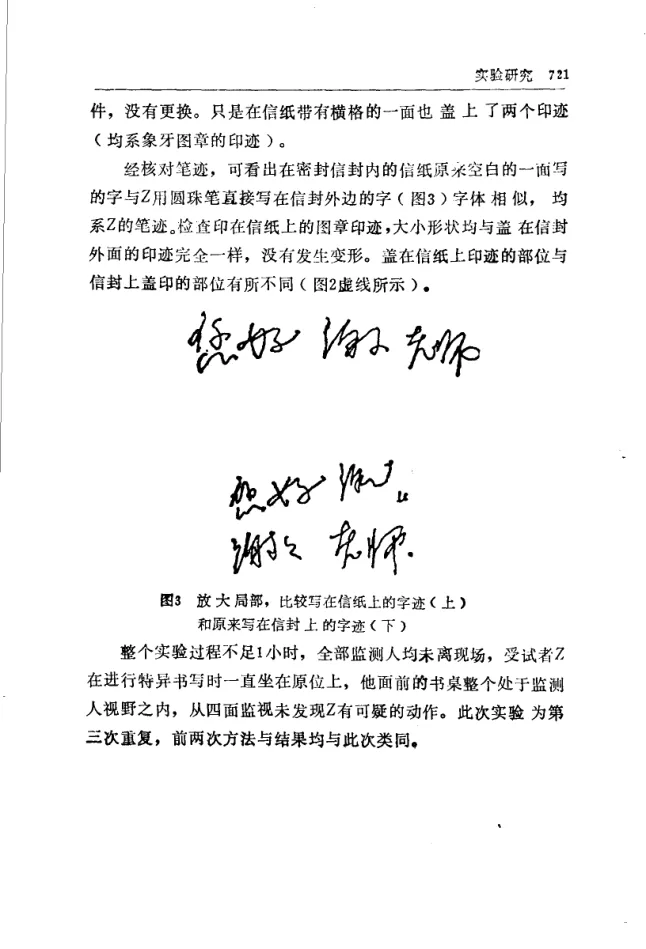
The entire experimental process took less than 1 hour. None of the monitors left the scene. Subject Z remained seated in his original position while performing the extraordinary writing, and the entire desk in front of him was within the field of vision of the monitors. Surveillance from all sides did not reveal any suspicious movements by Z. This experiment was a third repetition; the methods and results of the previous two times were similar to this one.
III. Discussion
The experimental results show: Z is not limited by sealed samples and can use the extraordinary writing ability to write characters and stamp seals on letter paper inside a sealed envelope. This experimental result suggests: whether extraordinary writing abilities can be performed outside our customary scope of time and space is a question worth investigating.
To investigate Z’s extraordinary ability to break through spatial barriers, we have repeatedly used sealed samples for observation, and found that Z can extract a whole sheet of letter paper sealed in an envelope with extremely simple movements under our direct monitoring (on-site monitoring always involved more than two people). For example, on one occasion, the author of this article folded a meeting notice twice and placed it into a kraft paper envelope, which was then sealed with glue. During sealing, Associate Professor Dai Zongshu from Harbin Institute of Technology and two others were present and verified that the seal was reliable, and then it was handed to Z. Z pinched the two ends of the envelope with the thumbs and forefingers of both hands, raised it above his head, and held it against the sunlight from the window. This lighting was excellent for monitoring conditions, and any slight movement by Z was under our direct observation. Because the sunlight could partially penetrate the kraft paper envelope, we could clearly see the outline of the letter paper inside the envelope. At this time, Z said: “Look, has the letter paper moved?” The three monitors present simultaneously saw the letter paper inside the sealed envelope slowly moving upward, while a careful look at Z’s fingers holding the envelope showed no movement at all. When the letter paper moved upward (against gravity) to the top of the envelope, Z separated his hands to the left and right, and instantly extracted the letter paper (his left hand was still pinching the envelope, while his right hand had already taken out the letter paper). The seal of the envelope was inspected on the spot and was exactly as intact as before. Against the sunlight, it could be seen that the letter paper inside the envelope was gone. Inspection of the meeting notice held in Z’s right hand confirmed that it was indeed the one originally sealed in the envelope. To observe the reverse process (putting a piece of paper into a sealed envelope), a researcher from the Institute of Biophysics, Chinese Academy of Sciences, sealed a kraft paper envelope with glue in public. After it dried
handed to Z. Under surveillance by monitors positioned in front, behind, to the left, and to the right of Z, Z held the envelope in his left hand, used his right hand to pick up a color photograph (which was unique) from the desk in front of him, then gently pressed the photograph against the underside of the sealed envelope, pinched it a few times with his fingers, and within a few seconds the photograph disappeared. At this point the seal of the envelope was inspected and found to be intact. When it was cut open, that unique color photograph was already inside the envelope. Throughout the entire process, Z’s movements were extremely simple. The envelope never left the monitors’ field of vision from the moment it was handed to Z. The entire process—from Z receiving the envelope, picking up the photograph, to the photograph entering the sealed envelope—took only a few minutes, ruling out the possibility of opening and resealing it. The only judgment that could be made was that Z used extraordinary abilities to transfer the photograph into the sealed envelope. This kind of direct perceptual understanding was repeated many times, compelling the monitors to consider: sealing under three-dimensional spatial conditions did not pose an obstacle to Z’s extraordinary abilities. Z could employ extraordinary abilities to break through this spatial barrier, very rapidly removing paper from inside a sealed envelope, or carrying out the reverse process—namely, sending an object into a sealed envelope, or writing characters on blank paper inside a sealed envelope. During these processes, Z exhibited an accelerated pulse and flushed complexion, indicating an increased consumption of energy within the body. What kind of intrinsic connection exists between this consumed energy and the realization of extraordinary abilities is not yet well understood. After completing the above extraordinary ability experiments, Z showed no particular signs of fatigue and conversed and laughed as usual. It can be inferred that the energy consumed in performing extraordinary abilities did not exceed the body’s capacity and was, overall, quite limited. Under normal circumstances, Z could not perform extraordinary ability experiments at any time and place. Sometimes, in order to complete an experiment that could be finished within a few minutes, it was necessary to wait several hours or longer, indicating that certain conditions must be met to transition from the normal state to the extraordinary functional state. Among these conditions, the subject’s subjective intention of “willingness or unwillingness to do it” often occupied a leading position. That is, when the subject was subjectively unwilling, the extraordinary functional state could not appear; when the subject was subjectively willing, after a period of preparation, the extraordinary functional state could often emerge. This point indicates that subjective intention (brain activity) is a key link in the emergence of the extraordinary functional state (though not the sole
link). Researchers at the Institute of Space Medico-Engineering once used an electroencephalograph to record marked changes in the EEG of extraordinary-ability children during the process of achieving extraordinary psychokinesis. Such changes were similar to the EEG changes observed when qigong masters enter the qigong functional state, indicating a certain regularity rather than being entirely random. Our current understanding of the regularities governing this transition from the ordinary state to the extraordinary functional state is very limited. The above experiments on extraordinary writing by breaking through spatial barriers indicate that after the human body enters the extraordinary functional state, it seems to be free from the constraints of three-dimensional space in the ordinary state. This is a question very much worthy of study.
Notes and References
〔1〕 Joint Testing Group for Human Extraordinary Abilities, Human Extraordinary Abilities Research, 1, 1 (1983) 9.
Experiments and Investigations on Extraordinary Writing
Xiao Guangda
[Editor’s note] The author of this article, Comrade Xiao Guangda, is a teacher at Wenshan Teachers’ College in Yunnan. He has trained many students who possess relatively strong extraordinary abilities. This article is an experimental report on extraordinary writing conducted by these extraordinary-ability individuals.
Over the past three years, we have conducted repeated observations and experiments on extraordinary writing through human extraordinary abilities. Beginning in 1981, five children with extraordinary abilities were selected for training and induction. At first, they could only “recognize characters with their ears.” After a little over a week, they developed the ability to recognize characters using various sensitive areas of the body (such as the inner elbow, armpit, back of the knee, and between the toes, etc.). After one month, they could use extraordinary abilities to move watch hands and cause flower buds to bloom, demonstrating that human extraordinary abilities can cause macroscopic external objects to move. Could extraordinary abilities then be used to direct a pen to write characters? Through practice, affirmative results were obtained for “extraordinary writing.”
I. Experimental Design
During the experiment, blank paper and a pen were placed inside a sealed test article. After the tester handed the test article to the test subject, the content to be written was specified on the spot. After completion, the subject returned the test article to the tester.
After inspection confirmed that the test article maintained its original sealed condition and there was no suspicion of tampering, it was opened in public, and the content of the extraordinary writing was checked against the specified content to determine whether the objective had been achieved.
II. Specimen Sealing Methods
Category A₁: Blank paper cards and a pen were placed inside a hard cardboard box. The pen could be a fountain pen (with the cap left on), a pencil, or a ballpoint pen (with the refill not extended). The hard cardboard box was sealed using string or adhesive tape.
Category A₂: No blank paper was placed inside the hard cardboard box, only a pen. The requirement was to write characters directly inside the box. Otherwise identical to Category A₁.
Category A₃: The pen was fixed inside the box with adhesive tape. Otherwise identical to Category A₁.
Category B₁: The hard cardboard box was sealed with white paper, then additionally secured with string. Otherwise identical to Category A₁.
Category C: A pen and paper were placed inside a metal box, sealed with string.
Category D: The pen was wrapped in white paper and inserted into a test tube, then the mouth of the tube was plugged with cotton.
Category E: The pen was placed inside a plastic loose-leaf folder, the zipper was closed, and it was tied securely.
Category F: A pen and paper were placed inside an envelope, and the envelope flap was additionally sealed with paper strips.
III. Experimental Requirements
(1) Throughout the entire experiment, neither the tester nor the test subject was permitted to leave the site. The subject held the test article in hand or pressed it under the back of the knee or elsewhere. The test article had to remain visible to the monitors at all times and was not to be concealed.
(2) Test specimens are sealed with string or paper. The sealing is reliable and bears special markings, making them impossible to be switched.
(3) The content to be written is proposed on site by the testers; the test subjects cannot guess, imitate, or reproduce it in advance.
(4) The pen sealed inside the box may be a fountain pen, pencil, ballpoint pen, etc. The color of the written characters must match the ink color of the pen sealed inside the box, so that it can be confirmed that the characters were written by the pen inside the specimen.
Four, Representative Experiments
[Example 1] Time: November 28, 1981.
Location: Headquarters of Yunnan No. 2 Geological Brigade.
Test subject: H.
Testers: Zhao Yun, Xu Zuling, Li Daming, Liu Wanlong, Jin Zhixi, Liu Ailian, Xiao Guangda.
Specimen: Category A1.
Experimental procedure: First trial, chief tester Zhao Yun sealed Xu Zuling’s fountain pen (containing blue ink, cap unopened) and blank paper inside the box. After H received the specimen, Zhao Yun requested writing the two characters “宝贝” (baobei, “treasure”). H placed the box under the bend of their foot, starting at 19:29′ and ending at 19:30′ (1 minute total). H handed the box to Zhao Yun and said the written characters were blue. Upon opening the seal for verification, the two characters “宝贝” were correctly written and the color matched.
Second trial, reusing the same hard cardboard box, Zhao Yun sealed a dual-color ballpoint pen (tip not extended) and blank paper inside the box, requesting that the two characters “宝贝” be written in red ballpoint pen. After H received the box, from 19:31′ to 19:33′ (2 minutes total), the seal was opened on the spot. The two characters “宝贝” in red were correctly written on the blank paper. Zhao Yun noticed that the indentation of the characters on the paper was very
deep, as if great force had been applied during the extraordinary writing, yet no marks were found on the box.
Third trial, Zhao Yun placed carbon paper beneath the blank paper and sealed them inside the box, requesting that the two characters “宝贝” be written again. Starting at 19:40′, H again held the specimen in the bend of their foot, ending at 19:41′ (1 minute total). Upon opening the seal for inspection, the two characters “宝贝” were correctly written, but there was no indentation on the carbon paper.
Fourth trial, only a pen was placed inside the box without any paper. Both ends of the pen were wedged against the two sides of the box so that it could not move. The request was to write the three characters “天安门” (Tiananmen) directly on the inside bottom of the box. H started at 19:45′30′′ and finished at 19:46′ (30 seconds total). After inspecting the specimen, the seal was opened, and the three characters “天安门” were correctly written in the middle of the bottom of the box.
Note: Zhao Yun, Xu Zuling, Li Daming, Liu Wanlong, Jin Zhixi, Liu Ailian, Xiao Guangda, and others participated in the testing.
[Example 2] Time: September 4, 1982.
Location: Wenshan Prefecture No. 1 Middle School.
Test subject: C.
Testers: Zhao Bixin, Xie Tingmo, Li Chenghua, Zhang Ye, Chen Guangxing, Xu Tu, and others, totaling 8 people.
Specimen: Category A₁.
Experimental procedure: The request was to write the three characters “十二大” (Twelfth Congress). C took the specimen, placed the box on the table, and pressed their right hand on the box without ever removing their hand. After 20 minutes, C said it was done. Li Chenghua opened the seal on the spot. The three red characters “十二大” were written on the blank paper. Upon inspection, the fountain pen cap was still unopened, containing red ink inside. The experimental result was correct.
Note: This experiment was an appraisal test arranged by the leadership of the Prefecture No. 1 Middle School for the purpose of formulating a future training plan for children with extraordinary abilities. Zhao Bixin, Xie Tingmo, Li Chenghua, Zhang Ye, Chen Guangxing, Xu Tu, and others participated in the testing.
[Example 3] Time: October 23, 1983.
Location: Headquarters of Yunnan No. 2 Geological Brigade.
Test subject: C. Testers: Wang Yanxi, Li Shibing, Sun Shuzhen, Xiao Guangda, and others, 6 people in total. Specimen: Type A₁. Experimental procedure: The subject was required to write the two characters “Kunming.” After receiving the specimen, C sat on the sofa, took off their shoes, placed the specimen (a cardboard box) on the sofa, and then stepped on the box with their feet. From 18:52′ to 19:12′, the writing was completed (20 minutes in total). On-the-spot inspection confirmed that the specimen was intact in its sealed packaging. Upon opening, the two characters “Kunming” were verified to have been written correctly.
Note: Additional participants in the testing included: Wang Yanxi, Li Shibing, Sun Shuzhen, and others.
[Example 4] Date: November 20, 1983. Location: Headquarters of the Second Geological Brigade of Yunnan. Test subject: H. Testers: Liu Wanlong, Liu Ailian, Xiao Guangda, Liu Hua. Specimen: Type C. Experimental procedure: The subject was required to write the two characters “Dahai” [Great Sea]. H held the box in their hands. Starting at 19:00′, at 19:25′ H said the writing had begun. By 19:30′ H said: “It’s done! Your pen leaks a little; there seems to be some ink on the paper.” Before opening, inspection confirmed that the specimen’s sealing was intact. After opening, the two characters “Dahai” were written quite well on the white paper, and indeed several drops of ink had stained the paper.
V. Discussion
(1) Observations and experiments have demonstrated that the phenomenon of “extraordinary writing” objectively exists. The experiments were rigorous, the specimens were reliably sealed and easy to monitor, and the possibility of specimen substitution was ruled out.
The experimental results are also easy to verify; once successful, they are beyond doubt and carry strong persuasive force.
Table 1
Partial Records of “Extraordinary Writing” Experiments
| Test Date | Subject | Number of Monitors | Specimen Sealing Method | Required Writing Content | Experiment Duration | Result | Notes |
|---|---|---|---|---|---|---|---|
| October 4, 1981 | Y | 2 | A₁ | ”Hawthorn pill” | 35 min | Successful | |
| ”My dad works at the Grain Bureau” | 35 min | Successful | |||||
| October 30 | H | 4 | A₁ | ”.“ | 5 min | Successful | Specimen placed under thigh |
| ”Liu” | 15 min | Successful | Specimen held in hand | ||||
| ”Da” [Great] | 12 min | Successful | Specimen held in hand | ||||
| ”Guang” | 2 min | Successful | Specimen held in hand | ||||
| November 1 | H | 2 | A₁ | ”Zhong” [Middle] | 9 min | Successful | |
| November 2 | H | 2 | A₁ | ”Hong” [Red] | 7 min | Successful | |
| November 4 | H | 4 | A₁ | ”Liu” | 2 min | Successful | |
| ”Liu Hong” | 2 min | Successful | Character size 5 cm × 6 cm | ||||
| ”Hello everyone” | 5 min 30 sec | Successful | Character size 6 cm × 6 cm | ||||
| November 18 | H | 3 | A₁ | ”The wind is howling, the horses are neighing” | 3 min | Successful | |
| ”Congratulations to the Chinese women’s volleyball team” | 2 min | Successful | |||||
| ”Wildfire cannot burn it all; spring breeze blows it back to life” | 2 min | Successful | |||||
| November 21 | H | 4 | A₁ | ”Liu Hong” | 2 min | Successful | |
| ”Yang Youli” | 4 min | Successful | |||||
| November 24 | H | 4 | A₁ | ”Hello everyone” | 2 min | Successful | |
| ”You have worked hard” | 2 min | Successful |
(Continued from preceding table)
| Date | Subject | Trial | Target | Time | Result | Notes |
|---|---|---|---|---|---|---|
| Nov. 25 | H₂ | A1 | ”Candy” | 3 min | Successful | |
| ”Test” | 3 min | Successful | ||||
| ”Jiangsu” | 3 min | Successful | ||||
| Nov. 26 | H | 3 | A1 | ”China” | 1 min | Successful |
| Nov. 28 | H | 7 | A1 | ”Baby” | 1 min | Successful |
| A1 | ”Baby” | 2 min | Successful | |||
| A1 | ”Baby” | 1 min | Successful | |||
| A2 | ”Tiananmen” | 30 sec | Successful | |||
| Dec. 3 | H | 5 | A1 | ”Dongfanghong” | 11 min | Successful |
| Dec. 6 | H | 4 | A3 | ”I’m off today” | 5 min | Successful |
| ”Liu Hong,” required | 29 min | Successful | One character in blue ink, one character in red ink | |||
| ”Uncle Cao is here” | 4 min | Successful | ||||
| Dec. 27 | H | 8 | A1 | ”New Year’s Day” | 15 min | Successful |
| Dec. 28 | H | A1 | ”Happy New Year” | 11 min | Successful | |
| ”Hello, Dr. Du” | 7 min | Successful | ||||
| Jan. 5, 1982 | H | 2 | A1 | ”Study for the revolution” | 34 min | Successful |
| Jan. 19 | H | 7 | B1 | ”Happy New Year” | Successful | |
| L | 7 | B1 | ”Happy New Year” | Successful |
(Continued from preceding table)
| Date | Subject | Trial | Target | Content | Time | Result | Notes |
|---|---|---|---|---|---|---|---|
| Feb. 4 | H | 13 | D | ”Spring” | 7 min | Successful | Writing inside a test tube |
| C | 13 | A₂ | ”Year of the Dog” | 21 min | Successful | ||
| Feb. 7 | H | 3 | F | ”Sunday” | 4 min | Successful | |
| Feb. 9 | H | 50 | A1 | ”Hello” | 60 min | Successful | |
| Feb. 14 | H | 50 | A1 | ”Long live” | 2 min | Successful | Four consecutive successes |
| C | ”Xu Chun” | 9 min | Successful | Characters written on a small notebook inside the box | |||
| ”Wang Liyun” | 12 min | Successful | |||||
| L | ”Wen Shan” | 12 min | Successful | ||||
| Feb. 16 | H | 2 | A1 | ”Lei” (蕾) | 2 min | Successful | |
| A1 | ”Lei” (蕾) | 2 min | Successful | ||||
| Sep. 4 | C | 8 | A1 | ”Twelfth Congress” | 20 min | Successful | |
| Jun. 17 | C | 20 | A1 | ”China” (中) | 14 min | Successful | |
| Oct. 10 | W | 6 | A1 | ”Wenshan Prefecture” | 5 min | Successful | Also plucked a large white chrysanthemum into the box |
| Oct. 25 | C | 12 | A1 | ”Wenshan” | 15 min | Successful | |
| Jan. 23, 1983 | H | 10 | A1 | ”Wan Yuanming” | 10 min | Successful | |
| ”Fact” | 7 min | Successful | |||||
| Aug. 20 | L | 2 | B1 | ”Guangzhou” | 18 min | Successful | |
| HL | 2 | B1 | ”Beijing” | 8 min | Successful | Two people writing together; both placed their hands on the box | |
| Oct. 3 | W | 3 | A1 | ”Up and down” | 15 min | Successful |
(Continued from preceding table)
| Date | Subject | Trial | Target | Content | Time | Result | Notes |
|---|---|---|---|---|---|---|---|
| Oct. 15 | Y | 2 | B1 | ”Shanghai” | 21 min | Successful | |
| Oct. 23 | C | 4 | A1 | ”Kunming” | 15 min | Successful | Written while stepping on the box with foot |
| Nov. 19 | L | 3 | A1 | ”Wenshan” | 15 min | Successful | |
| Nov. 20 | H | 4 | A1 | ”Ocean” | 30 min | Successful |
(2) “Extraordinary writing” possesses a strong degree of consciousness. As in the typical experimental Example 1, subject H wrote characters on a sheet of paper; although the impressions of the characters were very deep, not the slightest trace was left on the sheet of paper immediately beneath. When writing with a dual-color pen, the subject could control the pen to produce the required color. Whether the paper was rolled into a cylinder or folded, characters could still be written on the inside, as though the paper had been spread out flat for writing. Initially, extraordinary writing was thought to involve the pen moving; from the third trial of typical experimental Example 1, where no trace appeared on the carbon paper at all, it was then thought that the paper was moving; but in the fourth trial, when the pen was clamped inside the box, the characters were actually written on the bottom of the box, seemingly as though the pen was moving after all. Later, when the pen was fixed inside the box with adhesive tape, characters were still produced; and even when a pencil was wrapped in paper and placed inside a test tube, writing could still be accomplished. This demonstrates that extraordinary writing can be performed freely according to the consciousness of the subject, and that this kind of space possesses specific distinctive properties, making it difficult to understand the phenomena of extraordinary space using concepts of three-dimensional space. The description and explanation of extraordinary space constitutes a major topic in our research work. In-depth exploration is needed in the future, and it may be necessary to develop new theories before a satisfactory explanation can be achieved.
(3) The function of “extraordinary writing” can be cultivated and induced through training. We induced the writing function only after the subjects were able to move watch hands, open flowers, and break chalk. Subject Y was the first to master the writing function; one month later, H also mastered it, and subsequently L, C, and W all became able to write in succession. When Y used extraordinary abilities to write, writing a single character took roughly over an hour. Y’s account was as follows: the first step is to take apart the pen cap, the second step is to stand the pen upright, the third step…
gradually began to write. We asked how the pen could stand upright inside the box. Y said the box could not block the pen, as though there were no box at all. It is very likely that Y made an empirical error in the method of thinking about “writing”; in reality, the process went through three stages — dismantling the pen, standing the pen upright, and writing — so it is no wonder that writing a single character was so laborious for Y! At the peak of Y’s extraordinary writing ability, it took as much as 30 minutes to write one character. After summarizing the experience, the “writing” time was greatly reduced when inducing H’s ability. H described seeing paper appear in the mind and then directing the pen to “write.” At the peak, H achieved writing 10 characters in two minutes. Several test subjects — L, C, and W — recounted that as long as they could “see” the paper, pen, or pen tip in their minds, they could make it write characters.
(4) Repetition of extraordinary writing experiments. Among the five test subjects, H and C repeated best, and H had the highest success rate (see Table 1). In 1981 and 1982, extraordinary writing went through two peak periods. Later, when the training program shifted, extraordinary writing was practiced less often. In 1983, it could still be repeated, but the success rate was lower than before. We analyzed that there may be several reasons: ① In 1981, when the children had just acquired extraordinary writing ability, they were very interested in this experiment and competed to do it; children who could not yet write extraordinarily also actively volunteered for experiments. Later, after doing it many times, they became annoyed and irritable, treating it as a burden. ② As they grew older and advanced from elementary school to middle school, their study burden increased, and they felt pressed for time; doing extraordinary ability experiments took time, while other children could rest, they could not. Training time was also often not guaranteed. ③ Various social factors may have interfered with the children’s thinking, possibly affecting their ability
they would live no longer than thirty years at most,” “people who practice extraordinary abilities will become idiots later,” and so forth). Children have very low resistance to outside interference; once their thinking is affected, the decline of ability can be described as a straight-line drop. Restoring ability requires great effort; thorough ideological work must be done to resolve the child’s ideological problems. Furthermore, support from homeroom teachers and school leadership should be obtained to help children with extraordinary abilities resist outside interference. Only when their thinking is set right can the ability possibly recover. Additionally, training methods must be continuously improved. In experiments, it was found that when children were in high spirits, well-rested, and in good health, the success
rate was relatively high; moreover, successful experiments occurred more frequently in the second half of the year than in the first half, and the success rate was somewhat higher on days when the moon was visible than on moonless days. These are merely our impressions; no rigorous statistics have yet been conducted, and further investigation is needed.
A Preliminary Investigation of Extraordinary Writing Ability and Its Material Basis
Zhang Ming, Ding Yizhong, Zhu Yiyi, Zhu Runlong
[Editor’s note] The authors of this article transformed extraordinary writing into various simple forms and examined the phenomenon of extraordinary writing from multiple different angles, obtaining certain results. This article reports these results and offers a useful discussion.
Authors’ affiliations: Zhang Ming and one colleague, Shanghai Maritime Academy; Zhu Yiyi and one colleague, Shanghai Jiao Tong University.
Shortly after the discovery of the fact of non-ocular visual perception, individuals with extraordinary psychokinesis, extraordinary writing, and other extraordinary abilities emerged in various localities. We conducted some experiments and research on “extraordinary writing,” hoping thereby to make progress in studying the common essence of various extraordinary ability phenomena.
I. Experimental Objectives
(1) To further confirm the authenticity of extraordinary writing ability.
(2) To investigate the universality of subjects acquiring extraordinary writing ability through training.
(3) To provide writing instruments with distinctive characteristics and colored substances with special properties
“information,” or whether it was the “ink” substance itself.
(4) By not providing writing instruments at the site, to investigate the possibility of performing extraordinary writing, to explore the connections and distinctions between extraordinary writing ability and extraordinary psychokinesis, and to attempt to make certain progress or breakthroughs in the study of the common mechanism underlying various extraordinary phenomena by starting from the study of writing traces.
II. Experimental Content and Results
We trained young people who at the time no longer had extraordinary writing ability or had never had it. We first trained them to have “non-ocular visual” ability, then immediately began extraordinary writing training. After several sessions of extraordinary writing training, all were able to conduct experiments successfully.
On the basis of successful training, we conducted the following experiments, strictly adhering to the conditions of sample uniqueness and on-site monitoring by multiple persons.
(1) A red or blue water-based pen with its cap removed was placed flat together with white filter paper inside a flat filter paper box. The lid was closed, and the subject performed distance writing approximately 20 cm from the box. After about half an hour, when the subject reported completion, the box lid was opened, and red or blue characters were found to have appeared on the white filter paper (see Appendix Figure 57).
(2) A red water-based pen was clipped inside a small notebook (both ends of the pen were visible). The notebook and pen were placed on a table approximately 20 cm from the subject. After about half an hour, red characters appeared inside the notebook.
(3) A fountain pen filled with a pale yellow aqueous solution of ferric chloride (FeCl₃) and a sheet of white filter paper that had been soaked in a colorless, transparent aqueous solution of potassium thiocyanate (KSCN) and then dried,
placed together in a filter-paper box, and the lid was closed (before the experiment, the subject was first shown the “yellow” ink inside the pen barrel, and the yellow color was emphasized). The experiment was conducted at a distance. At that time, the subject rested their head on their hands, lying face-down on the desk, approximately 20 cm away from the aforementioned box. After 30 minutes, the subject reported that the task was complete. Upon opening the box lid, it was discovered that writing had appeared on the white filter paper—the writing was not yellow, but “blood-red,” and the writing also bore deep scoring marks made by a steel pen nib (see Appendix Figure 58).
(4) A fountain pen filled with a pale-yellow ferric chloride (FeCl₃) aqueous solution, together with a sheet of filter paper that had been soaked in a yellow potassium ferricyanide (K₃[Fe(CN)₆]) aqueous solution and then dried, were placed together inside an unsealed envelope, and the experiment was conducted at a distance of approximately 20 cm. This subject adopted the same posture as the subject in Experiment 3. After approximately 50 minutes, the experiment succeeded: blue writing appeared on the yellow filter paper (see Appendix Figure 59).
(5) Litmus test paper was placed inside a capped small test tube; a bowl of colorless, transparent alkaline water was placed on the desk. The subject held the test tube in their hand, approximately 50 cm from the alkaline water. After approximately 20 minutes, the subject reported having “written” the alkaline water onto the paper; as a result, the litmus test paper turned blue.
(6) Test paper was placed inside a capped small test tube; a bottle of blue ink was placed on the desk. The subject held the test tube in their hand, approximately 50 cm from the ink. After approximately 20 minutes, the test paper inside the test tube had been thoroughly soaked with ink.
(7) A capillary tube (10 cm in length) was placed inside a capped small test tube; a bottle of ink with its cap on was placed on the desk. The subject held the test tube in their hand, approximately 100 cm from the ink bottle. After approximately 20 minutes, the capillary tube inside the test tube had drawn in approximately half a tube of blue ink (see Appendix Figure 60).
(8) A bottle of blue ink in its original factory packaging was placed inside an ink box, and the ink box was clamped inside a hard-cover notebook. There was no pen. The notebook was approximately 20 cm from the subject and was never opened. After 20 minutes, numerous black fountain-pen impressions appeared on the downward-facing page of the notebook where the ink box was clamped. At that time, none of the more than ten people present had a black fountain pen, and the subject’s own fountain pen, which used black ink in everyday use, was in their dormitory room approximately 1 kilometer away from the experimental site. At that time, the subject
reported: the pen used for writing in their mental imagery very much resembled their own fountain pen filled with black ink that they ordinarily used.
III. Discussion
(1) The subjects undergoing extraordinary writing training had not been specially selected. On the basis of possessing functions such as “non-ocular vision,” they were able to successfully carry out experiments after only a few training sessions. We believe that after a period of training, subjects acquire this function, which demonstrates that extraordinary abilities have a certain universality.
(2) The experimental samples were unique, multiple people monitored the site, the experiments were conducted at a distance, and the results were reproducible (among the above experimental results, items 1–7 were each tested multiple times). Therefore, we hold that the extraordinary writing function is authentic and credible.
(3) In experimental results 1 and 2, when the subject was provided with a red water-based pen, red water-based writing was obtained; when a blue water-based pen was provided, blue water-based writing was obtained. This demonstrates that the red and blue water-based pens did indeed participate in the process (this is consistent with the subjects’ own reports—they used the red or blue water-based pen for writing in their mental imagery).
(4) Experimental results 3 and 4 further demonstrate that it was not the information of “color” that influenced the experimental outcome, but precisely the substance of “ink” itself that participated in the process. This is because we first emphasized to the subject that the ink was “yellow.” If the result had been yellow writing, it would have indicated that the information of “color” or “frequency of light” participated in the process. Yet the facts were exactly the opposite—the writing obtained was blood-red, demonstrating that it was the substance of ink (FeCl₃) itself that participated in the process:
FeCl₃ + 3KSCN → Fe(SCN)₃↓ + 3KCl
(pale yellow) (colorless) (blood red)
The writing from a fountain pen filled with ferric chloride ink, on white filter paper that had been soaked in a colorless potassium thiocyanate aqueous solution and then dried,
formed a blood-red precipitate (the writing).
Similarly, in Experiment 4:
FeCl₃ + K₃[Fe(CN)₆] = 3KCl + Fe[Fe(CN)₆]↓
(pale yellow) (yellow)
(blue)
Ferric chloride reacted with potassium ferricyanide, forming blue writing.
Furthermore, the filter paper bore deep scoring marks from the pen nib, demonstrating that the fountain pen filled with FeCl₃ used in the experiment was precisely the writing instrument that participated in the process.
(5) In experimental results 5–7, our original purpose was: first to train the trainees in the ability to move liquids, and then to see whether the “modulation” of a character shape could be added and projected onto paper, thereby exploring some connection between the extraordinary psychokinetic function and the extraordinary writing function. Based on the subjects’ reports and the results obtained, we can only tentatively conclude: ① the subject can move a designated liquid; ② what appeared at the subject’s forehead was a puddle of ink, not a bottle of ink; ③ the experiment was completed by immersing the paper and capillary tube into the liquid. It appears that the extraordinary writing function, in addition to encompassing the extraordinary psychokinetic function (of course, both of these also encompass the non-ocular vision function), also includes more refined motor actions.
(6) In experimental result 8, none of the more than ten people at the site had a fountain pen with black ink. At the time, only blue ink was provided (without a pen). The subject reported that a pen first appeared in their mind (very much resembling their own fountain pen with black ink, which at that moment was in their dormitory—approximately one kilometer from the site), and then, using mental intention, they made many strokes in the notebook, resulting in black fountain-pen writing being left in the notebook. Does this suggest that even when no writing instrument is provided at the site, the subject can “summon” a writing instrument from somewhere in order to complete the experiment?
(7) In Experiments 1 and 3, the filter-paper box was quite flat—its height was smaller than the length of the pen, so the pen could not stand upright to write—yet the results were successful. What form of the pen, then, participated in the experiment? In Experiment 2, the pen remained clamped inside the notebook the entire time; both ends of the pen were clearly visible, yet the writing succeeded. Through what channel did the pen and the paper inside the notebook
“contact” that resulted in successful writing? Resolving these questions will help us make certain progress or breakthroughs in the study of the common mechanisms underlying extraordinary phenomena.
IV. Recommendations
(1) We believe that, on the basis of the above experiments, it is necessary to invest more effort in the study of extraordinary writing, because it involves both the process of extraordinary psychokinesis and is more refined than the latter. The time required for completion is relatively longer, making it comparatively easier to track. At the same time, during the process of extraordinary writing, traces of the writing are continuously left behind, making observation, research, and analysis easier to carry out. We hope that units with the requisite capabilities will also conduct research on extraordinary writing in this area.
(2) We hope that qualified units can carry out video recording and high-speed photography of the entire process of extraordinary writing experiments. The observation by ordinary human eyes in three-dimensional space has limitations. Existing materials have already shown that the information captured in television and photographs is far richer than that observed by the human eye, which will help resolve the questions of “what form” and “what channel” raised in Discussion 7.
We firmly believe that continued in-depth exploration will yield progress in this area.
We gratefully acknowledge the enthusiastic assistance and guidance of Teacher Shao Laisheng in this work.
We also wish to express our gratitude to Comrades Ni Dexiang and Wu Maojun of Fudan University, and to the teachers of the Chemistry Teaching and Research Office of the Shanghai Maritime Institute, for their assistance in this work.
Piezoelectric Effect of Extraordinary Human Abilities
Ye Ziquan, Fan Liangzao
[Editor’s Note]
The authors of this article employed a desktop miniature calibration shock tube, successfully developed by the Institute of Mechanics of the Chinese Academy of Sciences, to conduct experiments on extraordinary human abilities. This instrument can be used to calibrate the dynamic performance of piezoelectric crystal pressure sensors or other types of pressure sensors. As a result, it was found that, under non-contact conditions, three children with extraordinary abilities used mental intention to generate piezoelectric signals on the sensor. This article is a report on the results of this experiment.
Affiliations of the authors: Ye Ziquan, Institute of Biophysics, Chinese Academy of Sciences; Fan Liangzao, Institute of Mechanics, Chinese Academy of Sciences.
The desktop miniature calibration shock tube (Figure 1), recently and successfully developed by the Basic Mechanics Research Office of the Institute of Mechanics, Chinese Academy of Sciences, can be used to calibrate the dynamic performance of piezoelectric crystal pressure sensors and other types of pressure sensors. Recorded on the oscilloscope screen in Figure 1 is a waveform diagram of shock-wave reflection pressure.
As is well known, a piezoelectric crystal pressure sensor generates a voltage signal only when it directly receives a mechanical force. We reasoned that if it were placed inside a vacuum container, then—because there would be no pressure-transmitting medium surrounding it capable of subjecting the sensor to a mechanical force—in such a vacuum environment, the sensor could not possibly generate any voltage signal on its own. To philosophers and scientists alike, this is obviously self-evident common sense. However, as experimental physics
researchers with a certain amount of practical experience, when we found that several children, right in our own laboratory, were able—without touching the instrument—to use their extraordinary abilities to activate our experimental apparatus and cause the shock-wave pressure sensor in the chamber to generate not just one but several types of pressure waveforms, we were compelled to conclude that common sense does not always represent truth. Below, we first provide a description of our experimental apparatus, so that the experimental facts we are publishing can be understood by more people.
Figure 1
Piezoelectric crystal → FDH-2 → A/D Sensor → Charge amplifier → Converter → Oscilloscope
Figure 2
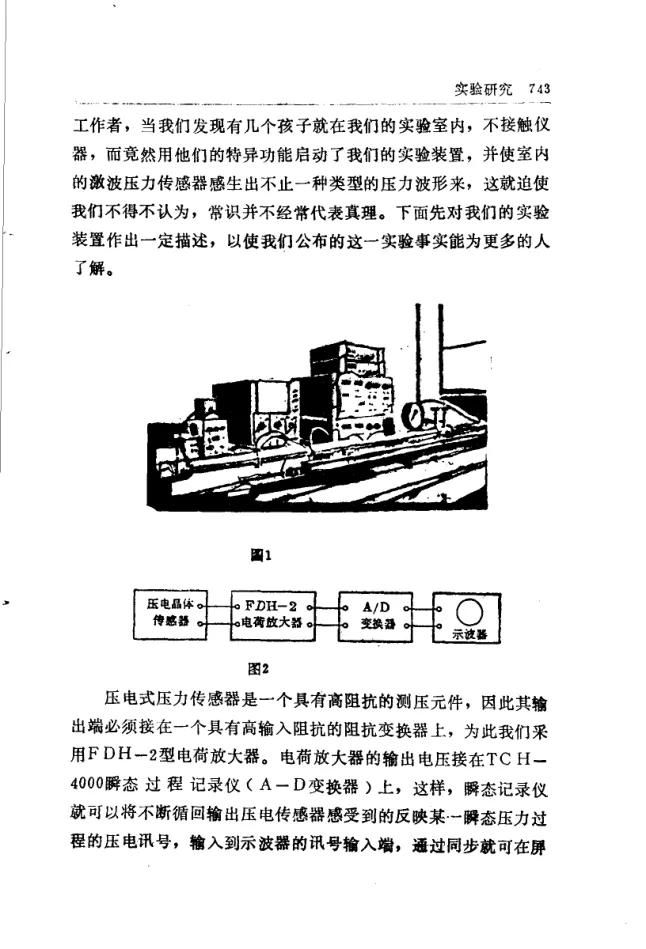
A piezoelectric pressure sensor is a pressure-measuring element with high impedance; therefore, its output terminal must be connected to an impedance converter with high input impedance. For this purpose, we used an FDH-2 charge amplifier. The output voltage of the charge amplifier was connected to a TCH-4000 transient process recorder (A-D converter), so that the transient recorder could continuously and cyclically feed the piezoelectric signals—reflecting a certain transient pressure process as sensed by the piezoelectric sensor—into the signal input terminal of the oscilloscope. Through synchronization, a stable waveform could then be displayed on the
screen (for example, the step pressure waveform of a shock wave flashing by in the shock tube, as displayed on the oscilloscope screen in Figure 1); see Figure 2.
The circumstances of the piezoelectric experiments conducted with three children possessing extraordinary abilities are briefly described as follows. According to their own accounts, all three children share a common ability: when
Figure 3
Figure 4
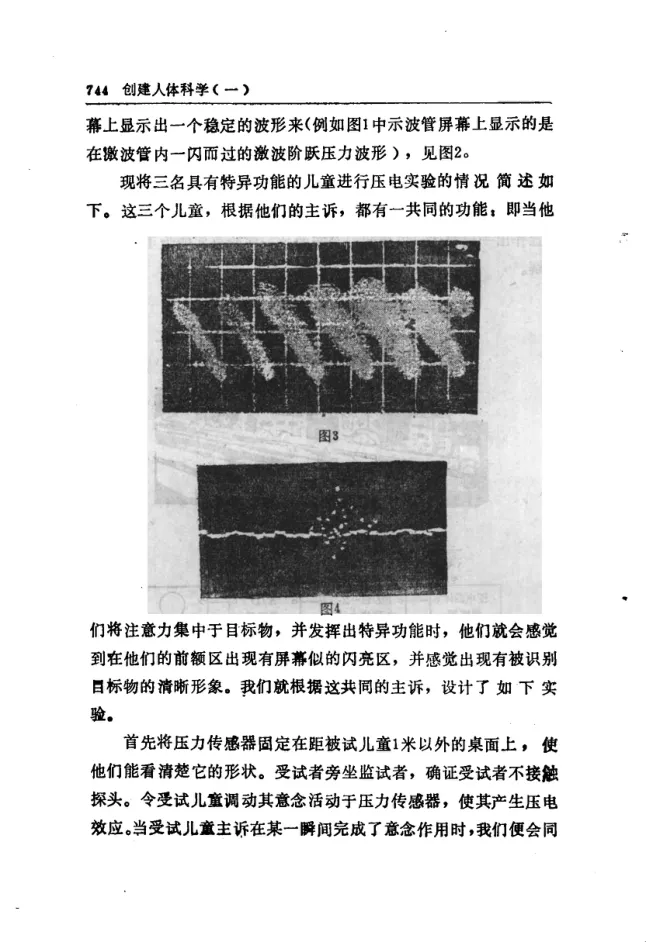
they focus their attention on a target object and exert their extraordinary abilities, they feel a screen-like flashing area appearing in their frontal region, and they perceive a clear image of the target object being identified. Based on this common account, we designed the following experiment.
First, the pressure sensor was fixed on a desktop more than 1 meter away from the tested children, so that they could clearly see its shape. A monitor sat beside the subject to verify that the subject did not touch the probe. The child subjects were instructed to direct their mental intention toward the pressure sensor to produce a piezoelectric effect. When a child subject reported that, at a certain moment, they had completed the mental action, we would then, together with
… when the indicator light for the recording signal of the A-D converter was observed to turn off. This indicates that, at this instant, the piezoelectric signal output by the piezoelectric sensor had already been recorded by the A-D converter.
Figures 3 and 4 are two different types of pressure waveforms. The pressure waveform reflected in Figure 3 is similar to the pressure waveform produced when a human finger lightly flicks the sensing surface of the pressure sensor; the order of magnitude of the pressure action time is 10^-1 seconds. The peak-to-peak value of the waveform is equivalent to an applied force of 300 grams. Figure 4 is a frame of a shock-oscillation type waveform; here the sampling time of the A-D converter is one point per 100 microseconds. Judging from the number of points reflected in Figure 4, this oscillation process lasted only about 1.5 milliseconds. Figure 4 reflects a much faster process; the peak-to-peak value of the pressure corresponding to the signal voltage reached an amplitude produced by an applied force of approximately 50 grams.
As a publicly released experimental fact, we should stop writing here and let more facts and the history of scientific development itself determine whether to accept or reject this report, but in order to express our unavoidable views, we hold the following two opinions regarding this experiment:
First, the piezoelectric signal produced by the pressure sensor under the influence of mental intention can only be considered a certain equivalent “piezoelectric signal”; it is not necessarily the case that an actual mechanical force is acting upon it.
Second, when a child with extraordinary human abilities focuses their mental intention on a certain object, it should be considered whether the properties of the space where the object is located, as well as the properties of the object itself, might undergo some sudden change, leading to the output of a certain piezoelectric signal. As for the cause of why such a change occurs, further and additional work remains to be done.
We thank Comrades Wang Yonghuai, Lin Guiyan, and Liu Weixian for participating in the test supervision work for one of the child experiments.
The Reed Switch Experiment on Extraordinary Energy
— Ye Jun, Wang Shanglin, Tuo Shichu
[Editor’s Note] This article is a summary report on the reed switch experiment regarding extraordinary energy. The experiment indicates that the extraordinary energy latent within individuals with strong extraordinary human abilities can be stimulated and released through specific methods. This experiment is of significant importance in exploring how to tap into human potential. The authors of this article are researchers in the Human-Body Extraordinary Human Abilities Research Group at Chongqing University.
In the second half of 1980, we discovered and verified that Xiao Tan’s body surface areas, such as his ears and hands, possessed the extraordinary human ability to read text and recognize images. Later, we further induced and cultivated Xiao Tan’s extraordinary kinetic ability to attract ferromagnetic objects via his body surface [1]. Subsequently, inspired by other comrades, we conducted reed switch experiments on “extraordinary energy” and obtained a batch of reliable experimental data. This research indicates that the extraordinary energy latent within individuals with strong extraordinary human abilities can be stimulated and released through certain methods. It goes without saying that experimental research on “extraordinary energy” holds important scientific significance.
I. Experimental Purpose and Principles
This experiment was conducted to achieve the following two purposes: First, to determine whether individuals with strong extraordinary human abilities possess a certain “extraordinary energy”; second, to provide a simple, objective stimulation and display method and apparatus for the display, release, and external work of “extraordinary energy.”
We hypothesized that once the “extraordinary energy” is stimulated, it might attract the two metal switch blades within the reed switch (a radio component made from a glass vacuum tube), thereby closing the series circuit and causing the display devices (a buzzer and a flash lamp) within it to emit sound and light.
II. Experimental Apparatus
Based on the above hypothesis, we constructed a simple test circuit using a reed switch, a buzzer, a flash lamp, and a set of dry batteries; we then secured and sealed them inside a hard plastic box, thereby forming the reed switch experimental apparatus for testing “extraordinary energy” (see Figure 1).
- Reed switch
- Sealed plastic box
- Wires
- Dry batteries
- Buzzer
- Flash lamp
Figure 1. Diagram of the reed switch experimental apparatus for “extraordinary energy”
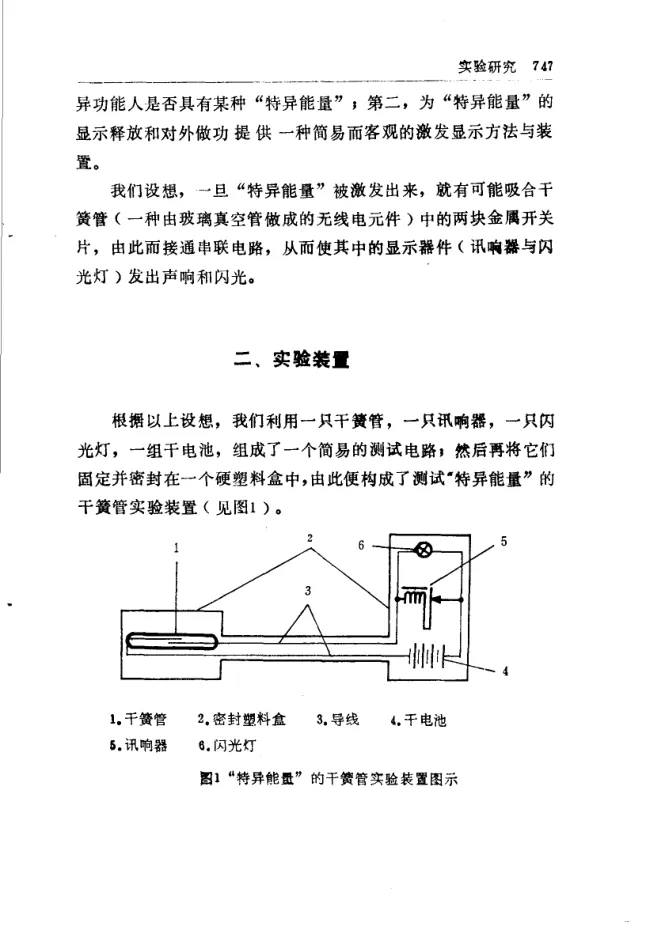
III. Experimental Subject
Xiao Tan, 11 years old, male, a fourth-grade student at Huangjin Primary School in Baishiyi Town, Chongqing. He is in good health and has average academic performance. He already has several experimental records of extraordinary human abilities, including “extraordinary kinetic ability” [1].
IV. Experimental Personnel
The primary scientific researchers participating in this experiment include our group members Ye Jun, Tuo Shichu, Wang Shanglin, and Zheng Erxin.
V. Experimental Results
The experimental results are shown in Table 1.
VI. Discussion and Analysis
(1) During the 6 days of experimentation (April 24, 25, and 26, and May 4, 5, and 15, 1981), the subject’s “extraordinary energy” was stimulated and displayed 11 times and failed to be stimulated and displayed 2 times; that is, the probability of stimulation and display was 85%.
(2) At the request of the subject, a full-body examination was conducted before each test in order to rule out…
| Whistle and flash light count | Body work location | On-site observers | Experimenters | Experiment location | Experiment time |
|---|---|---|---|---|---|
| 2 | Both hands, palms | Zheng Erxin, Ye Jun, Lei Ji, et al. | Ye Zhaoqi, Wang Zhu, et al., over 20 persons (continuously) | A meeting room in the main building of Baishiyi Airport, Chongqing | Night of Apr. 24, 19:00–22:00 |
| 3 | Palms and backs of both knees | Ye Jun | Tan Gang, Qiao Jinfeng, Zou Fuyun, et al. | Guest house of Baishiyi Airport, Chongqing | Morning of Apr. 25, 8:00–11:00 |
| 2 | Palms and backs of both knees | Tuo Shichu | Tan Gang, Qiao Jinfeng, Zou Fuyun, et al. | Staff dormitory of Baishiyi Aircraft Maintenance Yard, Chongqing, Baishiyi Town | Afternoon of Apr. 26, 13:00–15:00 |
| 3 | Both hands, palms | Tuo Shichu | Tan Gang, Qiao Jinfeng, Wang Zhu, Wang Yong, et al. | Home of the subject, Baishiyi Town, Chongqing | Night of May 4, 19:30–23:00 |
| — | — | Tuo Shichu; Wang Shanglin | Zou Fuyun, et al. | Home of the subject, Baishiyi Town, Chongqing | Morning of May 5, 7:30–10:30 |
| — | — | Tuo Shichu; Wang Shanglin | Qiao Jinfeng, Zou Fuyun, et al. | Yuzhou Hotel, Chongqing | Noon of May 5, 11:00–14:00 |
| 2 | Both hands, palms | Ye Jun; Tuo Shichu | Qiao Jinfeng, Zou Fuyun, et al. | Meeting room of Chongqing Municipal Association for Science and Technology | Night of May 15, 19:30–21:00 |
This testing activity took place during the Second National Scientific Symposium on Human Extraordinary Functions. In addition to the relevant leading comrades attending the conference who observed on-site, a number of journalists covering the conference were also present.
interference from ferromagnetic substances and the possibility of fakery; moreover, the experimental display apparatus was stable and reliable, and therefore the experimental results are credible.
(3) In the control experiments, only a permanent magnet could cause the display device to move and perform work. Based on this, we conjecture that the “extraordinary energy” excited and displayed by the subject is very likely analogous to biomagnetism.
(4) The two occasions on which the display function failed to be excited (each experiment lasting more than 3 hours) may have been related to the subject’s extremely poor mood and mental state. Conversely, in the experiment with the largest number of people present (the evening of May 15), the function was excited and displayed twice in succession within 15 minutes. This was evidently because the atmosphere at the venue was harmonious and the subject was in a comfortable mood and excellent spirits. It can thus be seen that the excitation and display of “extraordinary energy” are related to the psychological and mental state of the subject.
VII. Concluding Remarks
(1) Based on our current experimental results, we confirm that the subject does indeed possess the “extraordinary energy” to close reed switch contacts.
(2) We hold that the research and development of this “extraordinary energy”—that is, human latent potential—is of important scientific significance and has promising application prospects.[3]
(3) However, given the current state of experimentation, we cannot yet precisely determine the nature and metrology of this “extraordinary energy”—that is, exactly what kind of energy it is and how much power it possesses.
(4) We feel that it is necessary to further improve and perfect the experimental apparatus in order to continually deepen this line of experimental research.
(This article was reviewed and checked by Associate Professor Zheng Erxin, to whom we express our gratitude.)
Notes and References
[1] “Another Instance of ‘Psychokinesis’—First Successful Induction in Chongqing,” Human Extraordinary Functions Newsletter, April 20, 1981, p. 2.
[2] Guan Shixu et al.: “Major Breakthrough in Experiments on Human Extraordinary Functions—Research Enters the Domain of ‘Extraordinary Energy,’” Human Extraordinary Functions Newsletter, No. 5, December 20, 1980.
[3] Ye Jun: “The Miraculous Latent Potential of the Human Body—A Brief Introduction to Extraordinary Functions,” Science Enthusiast, 1981, No. 5, pp. 2–3.
The Negative Reading Phenomenon in Testing Human Extraordinary Radiation
Zheng Tianmin, Zhu Nianlin, Luo Xin, Mu Jun, Chen Guocai, Li Hongyi
[Editor’s note] The authors of this article used an infrared radiometer to record graphic descriptions of the process by which children with extraordinary functions emit qigong. The result was an astonishing “negative reading” phenomenon. This phenomenon has no physical meaning and cannot be simulated by electrical methods such as low temperature or shunt resistors.
On this basis, they advanced for the first time a viewpoint: the form of interaction between extraordinary radiation and the diode material inside the radiometer probe is fundamentally different from that during conventional measurement; it is another type of information-carrying substance. Consequently, they raised questions about past measurements of physical quantities in human extraordinary states—namely, whether the infrared, electrostatic, magnetic, and other effects and measured values previously obtained were relative mismeasurement results caused by non-conventional changes occurring in the probe itself under the action of extraordinary radiation, or whether they were true objective measurement results. This question merits renewed investigation and calibration. Their viewpoint is of extremely great significance for research in the fields of human extraordinary functions and qigong.
Authors’ affiliations: Zheng Tianmin and four others, Yunnan University; Li Hongyi, Wuhan University.
Over the past year, research on human extraordinary functions in China has progressed from the transmission and reception of information,
…processing, developing to the level of psychokinesis through extraordinary human abilities. Observations and experiments on the physical and physiological aspects of these extraordinary phenomena are being widely conducted. We believe that all of these are related to interactions. Recently, we conducted a set of experiments on the interaction between extraordinary radiation and matter. Utilizing this result, we graphically recorded and traced the “qi-emitting” process of children with extraordinary human abilities using a radiometer, obtaining some meaningful results. The experimental results are now organized and reported as follows.
We used a radiometer to measure the “qi-emitting” process of children with extraordinary human abilities—such as Little Sun, Little Shao, Little Yang, and Little Chen—while they were in extraordinary functional states such as recognizing characters, distinguishing colors, moving clock hands, and psychokinesis (while performing the aforementioned extraordinary functions, the radiometer probe was placed in the palm of the hand or under the armpit for measurement). During this process, it was discovered that the digital display of the radiometer showed negative readings (the radiometer is zeroed at room temperature with no radiation).
In order to find the cause of the negative readings, we discovered an extraordinary phenomenon: when children with extraordinary human abilities emit qi, they alter the physical properties of the instrument’s probe.
The radiometer probe is a photosensitive diode with a sensitivity of and an effective measurement response in the range of 190–1100 nm. Under light-shielded conditions (as in Figure 1), when using a JT-1 type transistor curve tracer to measure its reverse characteristic curve, with the Y-axis set to the collector current range of 0.01 mA/division, the X-axis set to the collector voltage range of 0.5 V/division, the peak voltage adjusted to around -6 V, and the current-limiting resistor set to 1 kΩ, a normal diode reverse characteristic curve as shown in Figure 2(a) appears on the oscilloscope screen. Before the experimental measurements, we used black paper to block the light and attached a 1-cm-high protective ring in front of the probe (as in Figure 1) to prevent the subject’s palm from directly touching the diode. Then, the probe was handed to the subject to hold in their hand, with the center of the palm (Laogong acupoint) facing the probe window. When they “emit qi”
(that is, when they are in a state of extraordinary human ability), the curve immediately changes shape, presenting the curve shown in Figure 2(b).
6 Protective ring 4 4 2 2 Black paper -6 -2 0 0 Photosensitive diode Figure 1 (a) Reverse characteristic curve of a diode under normal conditions (b) Reverse characteristic curve of the above diode under the action of extraordinary human abilities Figure 2
From Figure 2(b), several important results can be derived:
(1) From the scale reading of the curve tracer, it was found that at the original zero potential point, the right end of the curve rises. The magnitude of the rise is related to the strength of the extraordinary human ability, reaching a maximum of about five divisions, which is equivalent to generating an electromotive force of approximately 50 millivolts.
(2) At the same time, the curve slopes downward to the left, indicating an increase in leakage current, which is equivalent to connecting a linear resistor of several tens of kΩ in parallel (as in Figure 3).
-8 0 0 4 y (a) Reverse characteristics of the probe diode (b) Reverse characteristics of the probe diode when a 50kΩ resistor is connected in parallel Figure 3
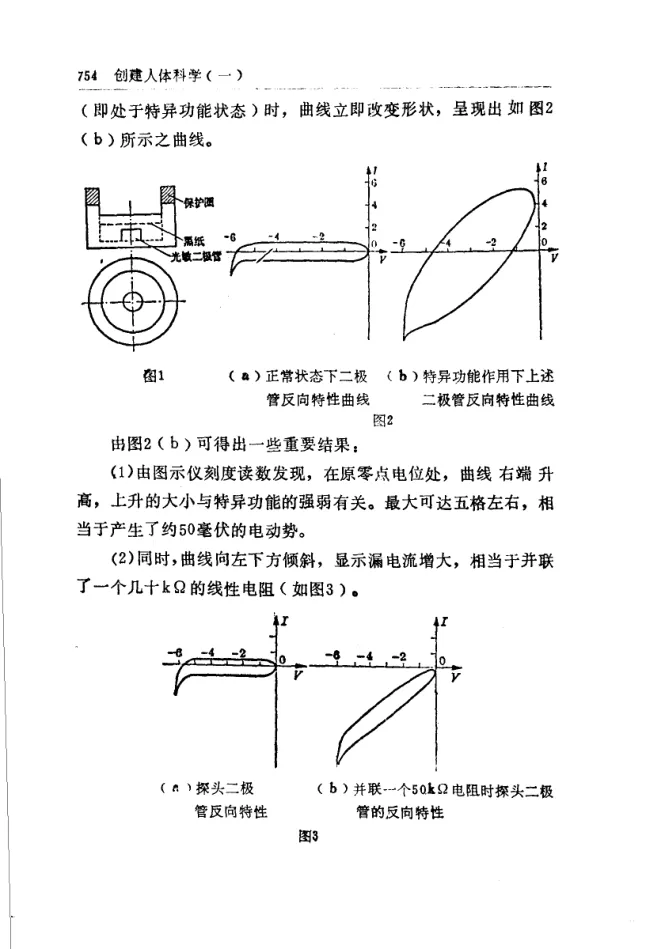
(3) Comparing Figure 2(b) with Figure 3(b), in addition to the curve rising on the Y-axis, the closed curve also appears to widen. This may be the result of a phase difference generated between the normal signal and the qi-emitting signal. During the qi-emitting process, the curve changes between “fat” and “thin”, indicating that the phase difference also changes accordingly during the process.
(4) To eliminate the interference of visible light, black paper was used to cover the probe. The measurement results were identical to those without the black paper, indicating that the addition of black paper seemingly has no effect on the extraordinary radiation.
To examine the influence of temperature, we placed the probe on an ice block; the instrument displayed zero instead of a negative reading.
Figure 4 Reverse characteristics of the probe diode under illumination
x10-14 x10-1 8 0 1 2 8 (Minutes) 0 1 2 (618 (a) (b) Figure 5
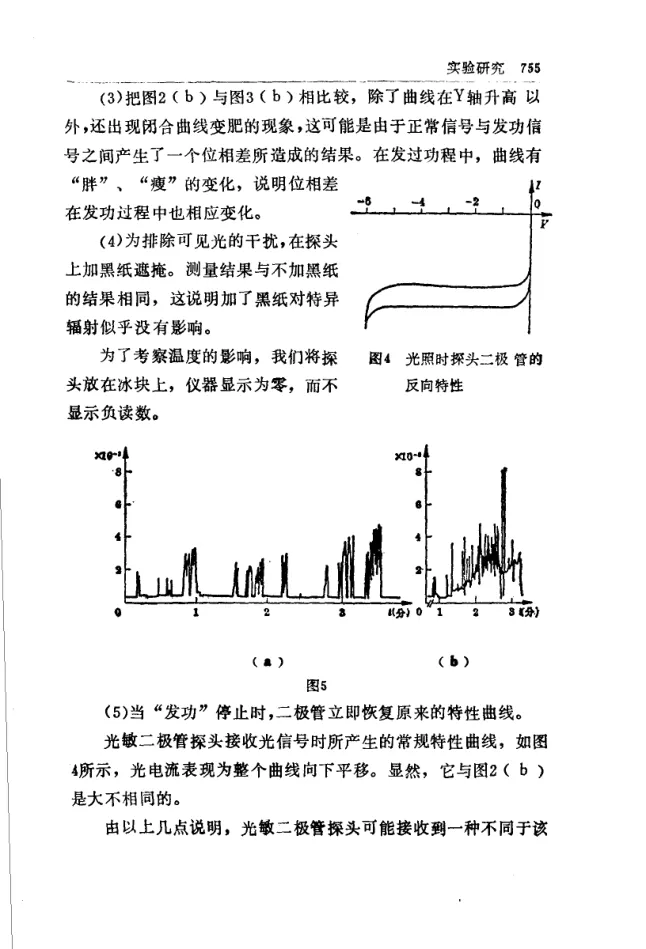
(5) When the “qi emission” stopped, the diode immediately reverted to its original characteristic curve.
The conventional characteristic curve produced when the photosensitive diode probe receives an optical signal is shown in Figure 4, where the photocurrent manifests as a downward parallel shift of the entire curve. Obviously, this is vastly different from Figure 2(b).
The above points indicate that the photosensitive diode probe may have received an unknown radiation different from the reception range to which this
tube responds; this radiation interacted with the probe and changed its characteristic curve, thereby forming this extraordinary phenomenon. At the same time, it also indicates that this type of photosensitive diode may be sensitive to “extraordinary radiation.”
II
Although what we measured using the radiometer is not necessarily conventional electromagnetic radiation in the 190–1100 nm (near-ultraviolet to near-infrared) band, the measurement results show that the variation pattern of the negative readings displayed by the instrument is closely related to the qi-emitting state of the children with extraordinary human abilities. In a sense, it can be said that a certain objective informational indicator capturing and recording the qi emission of children with extraordinary human abilities has been obtained. It demonstrates an obvious regularity in qi emission, and contrasts the difference between children with extraordinary human abilities and ordinary people concentrating their consciousness. At the same time, it also shows some valuable results, indicating that the qi emission of children with extraordinary human abilities is consistent with a certain type of qigong master, but different from another type of qigong master.
(1) There is a significant difference between the measured signals of children with extraordinary human abilities and those of ordinary people.
During multiple measurement processes, we found that when children with extraordinary human abilities and certain qigong masters emit qi, the measured negative readings can reach the order of magnitude of to (W/cm²) (Figure 5a); however,
Speaking
…
Emitting qi
…
Speaking
…
Emitting qi
…
-QIX 2 Figure 8
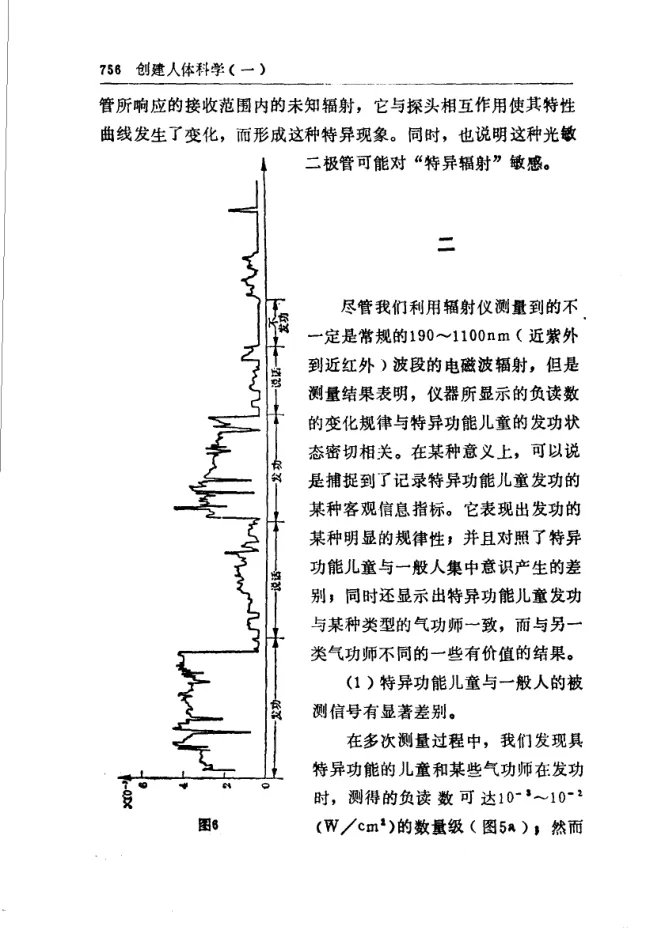
Ordinary people and another type of qigong master, although their consciousness is highly concentrated on the probe, still cannot produce negative readings. Some people, although they can also produce negative readings, their order of magnitude can at most only reach (W/cm) (Figure 5b). Comparing the two, the readings differ by two to three orders of magnitude.
(2) There is a clear difference between when extraordinary-ability children emit qi and when they do not. ① Exactly as the phenomenon we described in the article “Preliminary Tests on the Mechanical Effects of Extraordinary Human Abilities” [1], the graphic display instrument again recorded pulses related to extraordinary abilities one by one. ② During the measurement process of extraordinary-ability children, the state of consciousness occupies an extremely important position. When they concentrate their consciousness, the negative readings suddenly increase; whereas when their energy is scattered and they are talking, the negative readings immediately drop; when they do not emit qi, the readings quickly return to zero indication. Although ordinary people sometimes also show negative readings, the readings are not only just around , but they also lack an obvious consciousness modulation effect. The curve in Figure 6 is the measurement result of the extraordinary-ability child Xiao Sun under different states of consciousness.
6 0 1 2 (min) Figure 7
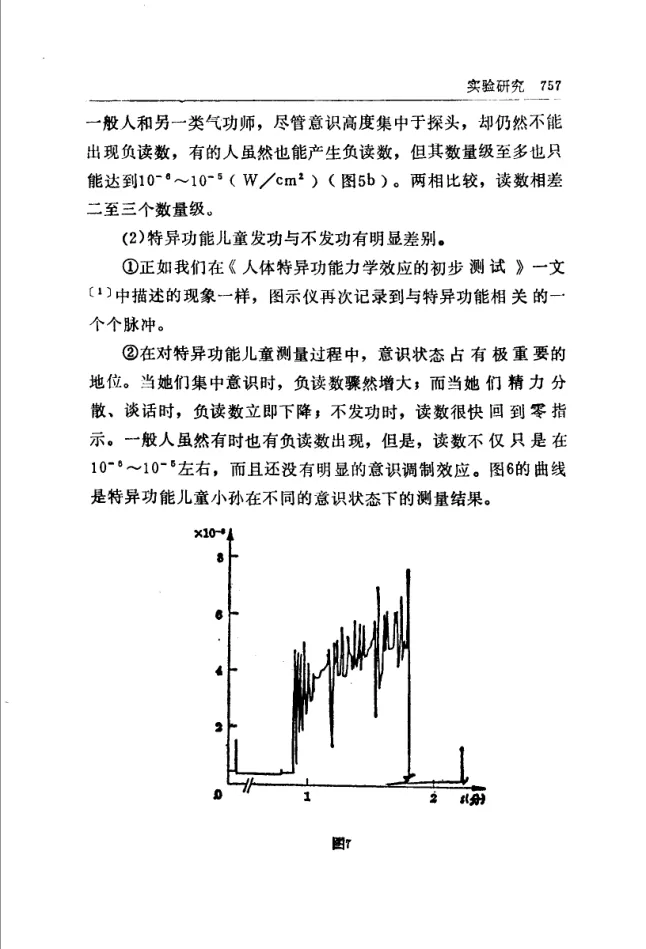
(3) When extraordinary-ability children perform tasks (recognizing characters, telepathy, turning clock hands, psychokinesis, etc.), the measured signal has an obvious and regular correlation with the qi-emission process. To study the correlation between the information recorded by us and when extraordinary-ability children receive information and perform psychokinesis, we had the extraordinary-ability children simultaneously perform character recognition, telepathic character recognition, turning clock hands, and psychokinesis while tracing their extraordinary radiation, obtaining a set of curves from Figure 7 to Figure 11. These curves show that when extraordinary-ability children perform tasks, there is a close correlation with the recorded information. When performing tasks, extraordinary-ability children generally undergo a process of energy storage and accumulation, which manifests on the curve as a continuous, pulse-like rise. After this necessary “preparation” time, the task yields results. Once the results are obtained, the extraordinary-ability children stop emitting qi, and the curve returns to zero.
Figure 7 is the measurement curve for Xiao Sun recognizing a character; she took less than a minute to recognize it. During this process, the curve continuously rose in a pulse-like manner, and when the character was recognized, the digital display was highest, with a reading of .
Figure 8 is the measurement curve for Xiao Shao and Xiao Sun performing telepathic character recognition. Xiao Shao held the probe in hand, and Xiao Sun held the slip of paper with the character in hand. After three and a half minutes, both accurately recognized it at the same time, and at this moment, the radiation meter’s digital display was highest, reaching .
8 0 1 2 3 (min) Figure 8
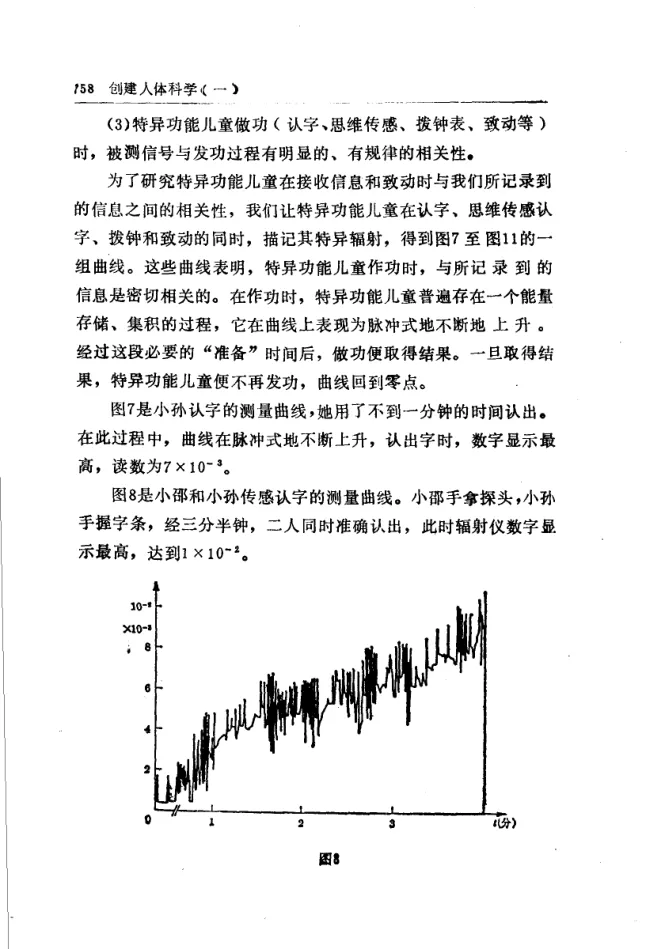
12 8 6 4 2 1 2 3 4 5 Figure 9
Figure 9 is the measurement curve for Xiao Sun turning a clock hand. She held the probe in one hand and touched a small table clock with the other (the table clock had been modified so that there were no movable parts externally [1]). After four and a half minutes, she turned the clock hand, and at this moment the digital display was highest, with a reading of .
Figure 10 is the experimental record of Xiao Sun retrieving an object using extraordinary abilities. She took over two minutes to retrieve
1.6 1.4 1.2 1 8 6 1 2 (min) Figure 10
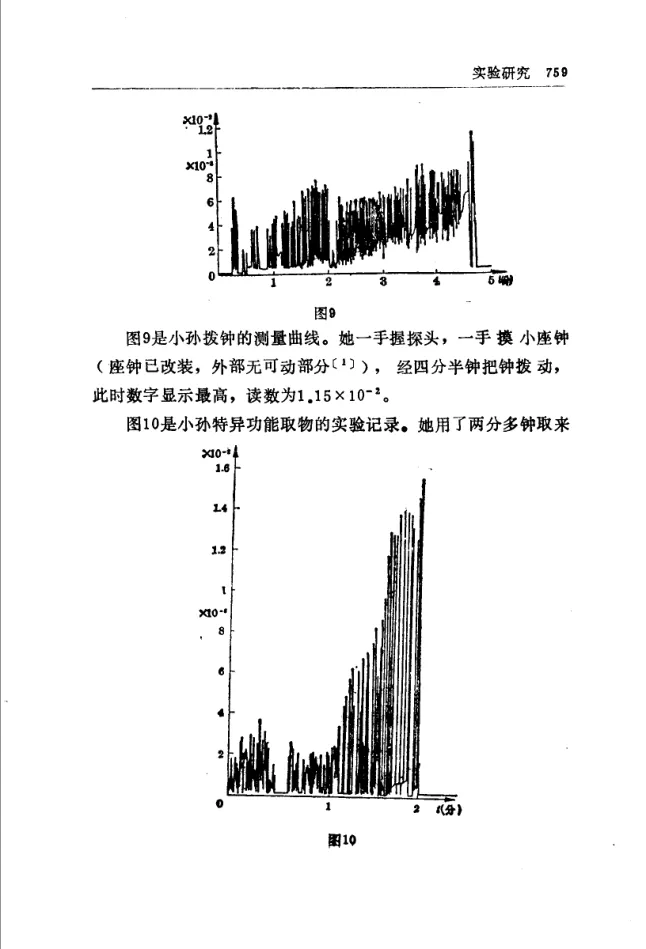
a small flower; the maximum digital display was . As completion approached, the pulse fluctuations of the ability were extremely large.
During the measurements, the vast majority of character recognition results were correct, but sometimes there were also cases of misrecognition. As shown in Figure 11, Xiao Shao reported after 2 minutes and 23 seconds that she had recognized the character, but the verification result was incorrect. However, during the character recognition process, the information on radiation changes was still received, indistinguishable from the result of correct recognition. From the comparison of the peak values of the curves from Figure 7 to Figure 11, it can be seen that the maximum peak value of the curve basically corresponds to the difficulty of the task; for example, it was during character recognition, and reached when retrieving the flower, with the intensity of the ability more than doubling.
8 6 1 (min) Figure 11
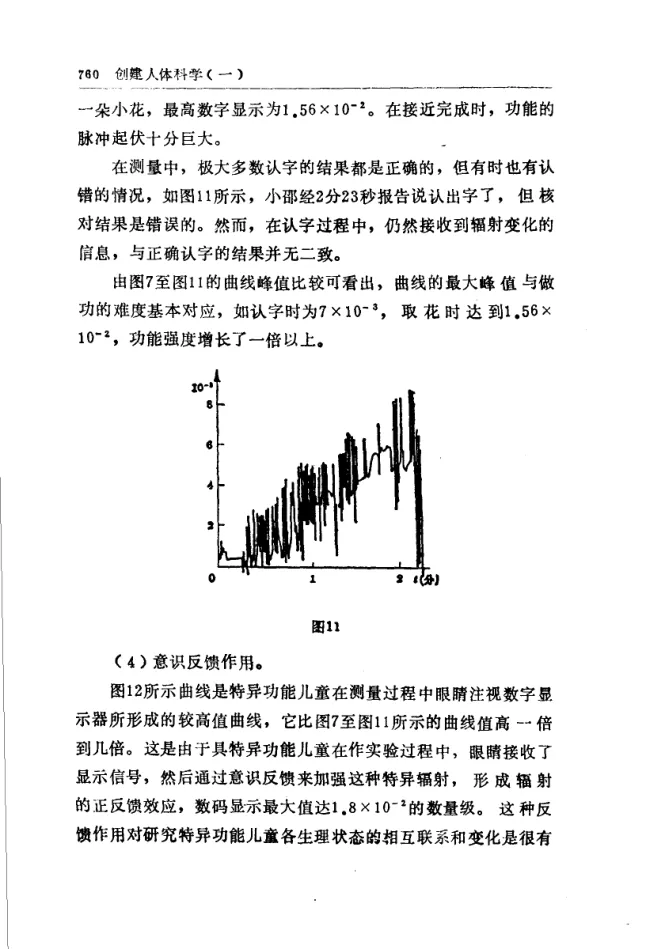
(4) Consciousness feedback effect. The curve shown in Figure 12 is a higher-value curve formed when the extraordinary-ability child visually focused on the digital display during the measurement process; it is one to several times higher than the curve values shown in Figure 7 to Figure 11. This is because during the experiment, the extraordinary-ability child’s eyes received the display signal, and then strengthened this extraordinary radiation through consciousness feedback, forming a positive feedback effect of radiation, with the digital display’s maximum value reaching the order of magnitude of . This feedback effect is very
It is meaningful, and at the same time extremely important for studying the psychological state of children. Based on this feedback effect, one can explain why the effectiveness of the extraordinary-ability children’s performance differs drastically between states of pleasant mood and displeasure or annoyance.
f.0rx 1.8 1G 1.4 1.2 x10- 8 6 4 2 1 2 3 4 5 6 7 1 Figure 12
(5) The information recorded among the extraordinary-ability children differs greatly from one another.
Figure 9 shows a series of very densely packed pulses displayed when Little Sun moved the clock hand, with a displayed time of approximately one second; Figures 5a and 13 show the experimental curves for Little Yang and Little Chen, appearing as a series of discrete pulses with rather wide time intervals, with a pulse width of approximately 0.2 seconds, a rising edge of less than 10⁻⁹ seconds, and a relatively large amplitude, roughly one order of magnitude greater than those of Little Sun and Little Shao. This is closely correlated with their performance in extraordinary-ability experiments: Little Sun’s extraordinary abilities are relatively more stable.
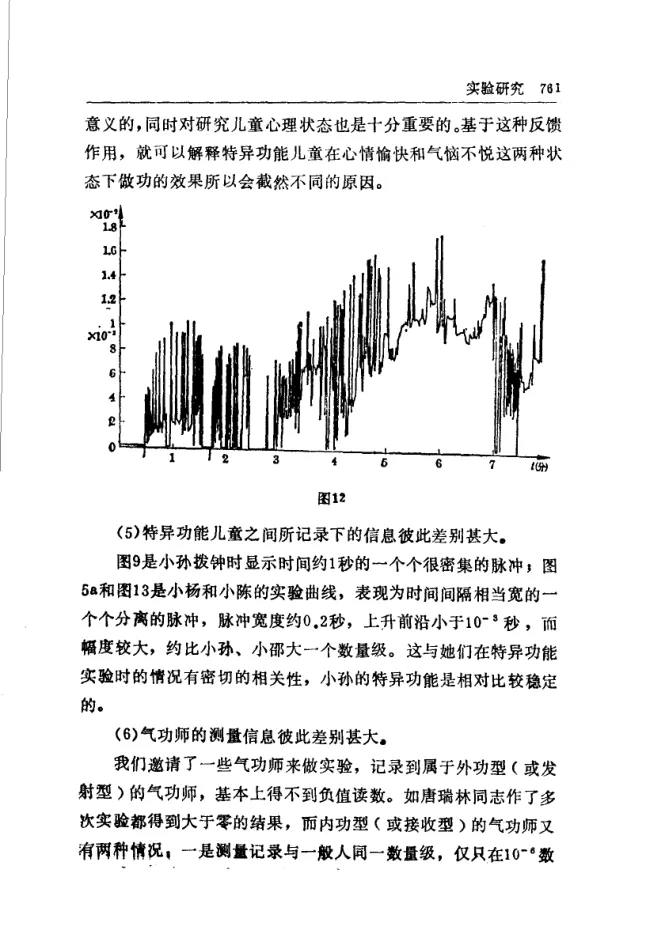
(6) The measurement information among qigong masters differs greatly.
We invited a number of qigong masters to participate in experiments, and found that for qigong masters of the external-gong type (or emissive type), negative readings were essentially unobtainable. For example, Comrade Tang Ruilin produced results greater than zero in multiple experiments, whereas qigong masters of the internal-gong type (or receptive type) fell into two categories. First, the measurements were of the same order of magnitude as those of ordinary persons, with negative-value results appearing only at the 10⁻⁶ order of
x10-1 1.6 1.4 1.2 1 -01X 8 6 2 0 “(min) Figure 13
magnitude (as shown in Figure 14). However, from the curve one can see the steady rise under the conscious control of qigong master Sun ××, which is quite different from the pulses displayed when the extraordinary-ability children emit their power, and also different from the fluctuations of ordinary persons. The second category consists of internally sensitive qigong masters, who, when emitting their power, can obtain results similar to those of the extraordinary-ability children, with the same order of magnitude,
x10 1.4 1.2 20 30120130 140 150 200 18 220 230 699 Figure 14
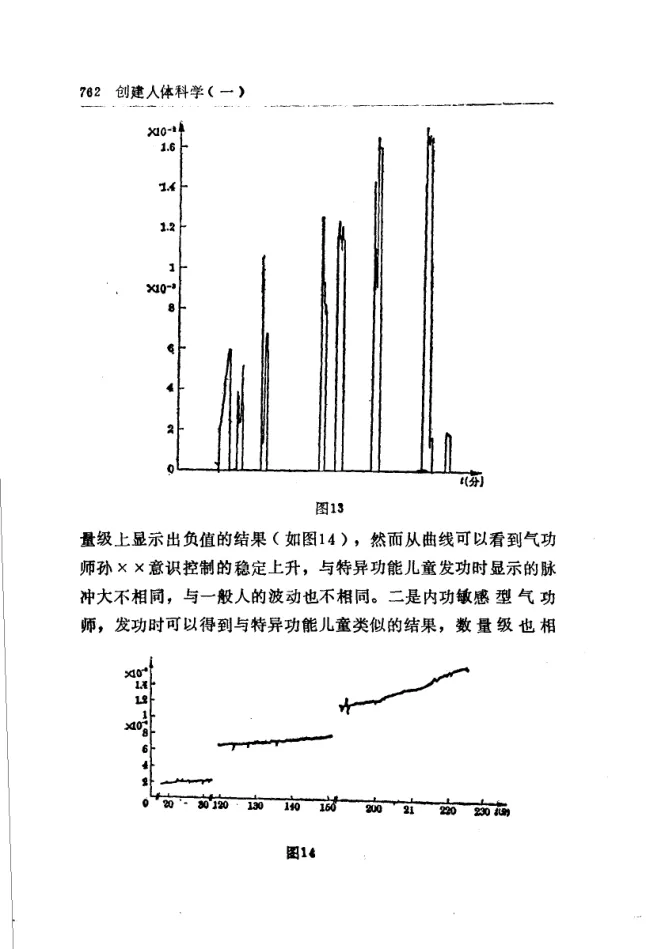
such as Comrade Fan ×× of a certain research institute. Therefore, although both qigong and extraordinary abilities may be a special state of the human body that emerges after a high degree of concentration of cerebral conscious activity, the types of information we have measured not only differ between qigong and extraordinary abilities, but also differ among the extraordinary-ability children individually, and there are clear differences among the various types of qigong masters as well. This is of great significance for our further research in human-body science.
III
(1) Through the above discussion it can be seen that the form of interaction between extraordinary abilities and the diode material inside the radiation instrument probe is completely different from that in conventional measurements. It is another type of information-carrying substance, which we provisionally call “special radiation.” Through a series of experiments, we have found that it is closely correlated with the various extraordinary phenomena produced when extraordinary-ability children perform their functions. Therefore, in-depth study of this phenomenon will help explore a series of essential questions, such as the physical mechanism and physiological mechanism of extraordinary abilities.
(2) This experiment provides us with favorable clues for explaining certain phenomena of extraordinary abilities. For example, phenomena such as extraordinary-ability children “moving” electronic watches and causing transmitter information to weaken and be interrupted can be explained as a possibility, because the characteristic curves of transistors change under the influence of extraordinary abilities.
(3) When we used some common diodes, such as the 2CU series and 2AP series, for testing, some showed no response at all, and although some did respond, the reproducibility rate was extremely low, and no “special electromotive force” appeared—only the phenomenon of increased leakage current. This indicates that the detection of special radiation requires the selection of appropriate devices; in other words, the detection of special radiation is related to the structural type and material of the device, and is also closely related to device sensitivity.
(4) Because of the discovery of this special interaction phenomenon, we have raised new questions about some of the physical-quantity measurements of the special human-body state that we conducted in the past. Just as
what we measured through the radiation instrument is not necessarily negative radiation, nor is it necessarily electromagnetic radiation in the 190–1100 nm range, so too the infrared, electrostatic, magnetic, and other effects and measured values obtained in the past—whether they are relative mismeasurement results caused by unconventional changes occurring in the probe itself under the action of special radiation, or genuine, correct objective measurement results—merit renewed study and calibration, because in human-body science there remain many unknown factors.
(5) Although we have captured a certain type of information about extraordinary abilities, we do not yet know the essential nature of this information and its carrier, and we cannot assert that this information is the essential information of extraordinary abilities. This is especially so with respect to the psychokinetic aspect of extraordinary abilities, because information with such weak energy can hardly accomplish macroscopic effects such as extraordinary psychokinesis on non-biological objects. Therefore, viewed from the various phenomena of extraordinary abilities, this “special radiation” may be merely an associated type of information or a secondary effect, and it is still necessary to further search for the carrier of the macroscopic effect of extraordinary-ability psychokinesis.
During the course of our experiments, we had meaningful discussions with Associate Professor Zheng Sumin, Deputy Chair of the Department of Radio Engineering at Yunnan University. Comrade Liu Peiwen, Deputy Chair of the Department of Physics at Yunnan University, and instructors Zhang Shiluan, Chen Xingkui, Wang Yongxi, and others participated in part of the observations and discussions. Yang Yulin and Zhang Zhenghua provided some of the equipment. We hereby express our heartfelt thanks.
Notes and References
[1] Yunnan University Research Group on Extraordinary Human Abilities, Nature Journal, 4 (1981) 348.
Repeated Detection of Anomalous Radiation from the Human Body
Luo Xin, Zhu Nianlin, Zheng Tianmin, Li Hongyi
[Editor’s Note] The authors of this paper used a radiometer to investigate anomalous radiation phenomena, once again confirming experiments conducted one year earlier. Although the physical significance of the measured results remains unclear, they can nonetheless provide a relative description of the strength of the ability. Another major finding of this experiment is that the qigong emission of individuals with extraordinary abilities has the anomalous property of being able to break down a diode, and then restore it, break it down again, and restore it again.
Affiliations of the authors: Luo Xin and two others, Yunnan University; Li Hongyi, Wuhan University.
Following our use of the IL-700 Research Radiometer during March and April 1981 to measure unconventional physical radiation (temporarily termed “anomalous radiation”) [1] during extraordinary-ability experiments with extraordinary-ability children, in July 1982 we again employed the IL-700 Radiometer to test extraordinary-ability children. In order to find and capture anomalous signals through diverse physical means, we replaced the original photosensitive probe with several different types of photosensitive detectors and used the IL-700 Radiometer’s built-in amplifier and recorder to make measurement records, further confirming the objective existence of anomalous radiation and obtaining some new, meaningful results.
Using the IL-700 Radiometer while extraordinary-ability children entered an extraordinary-ability state (qigong emission) to recognize characters, we again tested for anomalous radiation. The testing method was identical to that in reference [1]: the probe was entirely sealed with black paper so that it could not respond to light radiation. As in the results from one year ago, we received informational curve responses in the direction opposite to the probe’s normal response to light radiation, as shown in Figures 1, 2, and 3. Among these, Figure 1 shows the informational curve when Xiao Shao was recognizing characters: the first pulse appeared when she reported recognizing the color of the characters, and the second pulse appeared when she reported recognizing the written form; afterward, she directed a focused “burst of qigong” at the probe. Figure 2 shows the result of Xiao Sun emitting radiation toward the probe under conditions where a qigong master assisted with qigong emission. Figure 3 shows the result of Xiao Sun emitting qigong alone.
Figure 1: Curve of the IL-700 Radiometer probe response induced during Xiao Shao’s qigong-emission character recognition process
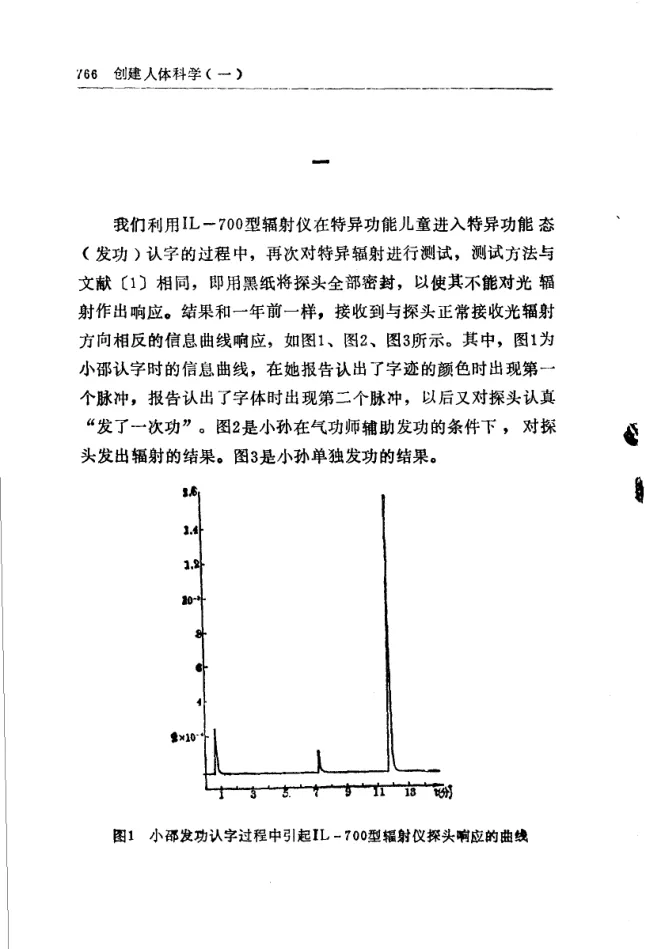
Figure 2: A qigong master emitted qigong toward Xiao Sun, and Xiao Sun emitted qigong toward the IL-700 Radiometer probe — response curve
Figure 3: Result of Xiao Sun emitting qigong alone
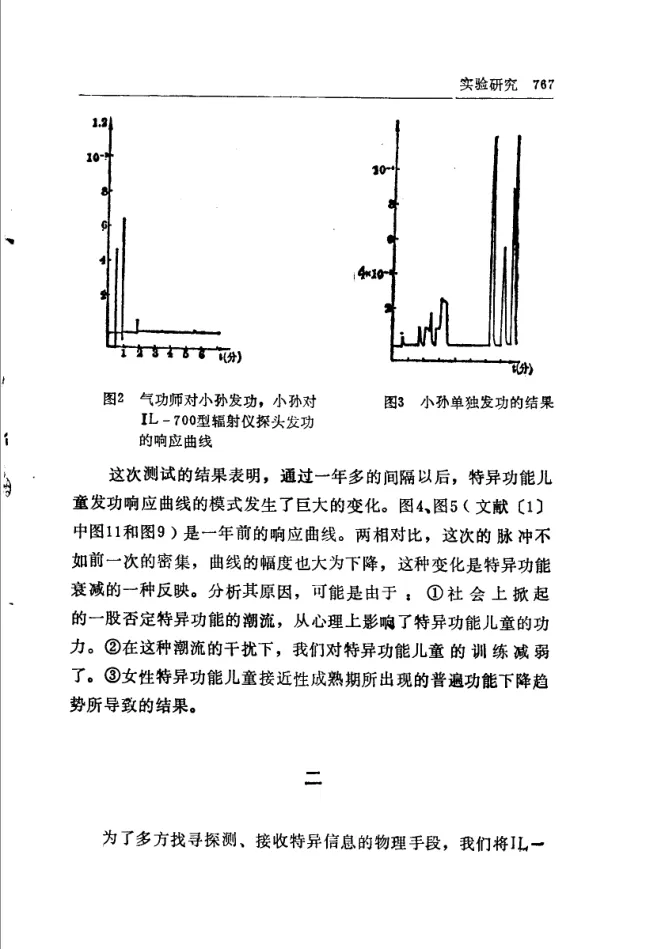
The results of this test indicate that after an interval of more than one year, the pattern of the qigong-emission response curves of the extraordinary-ability children had undergone a dramatic change. Figures 4 and 5 (Figures 11 and 9 in reference [1]) show the response curves from one year ago. Comparing the two, the pulses this time were not as densely packed as the previous time, and the amplitude of the curves had also decreased substantially. This change is a reflection of the attenuation of extraordinary abilities. Analyzing the causes, they may include: ① A societal trend denying extraordinary abilities had psychologically affected the abilities of the extraordinary-ability children. ② Under the interference of this trend, our training of the extraordinary-ability children had weakened. ③ The result of the general decline in ability that commonly occurs as female extraordinary-ability children approach sexual maturity.
In order to find diverse physical means of detecting and receiving anomalous signals, we replaced
the IL-700 Radiometer probe with several different types of photosensitive devices; as a result, three types of photosensitive elements produced responses. Figures 6 and 7 show the response curves produced by Xiao Shao and Xiao Sun on a 22PD18M-type photodiode. Figure 8 shows the response curve of a solar cell during Xiao Sun’s character recognition process. Figures 9, 10, and 11 show the response curves of Xiao Shao and Xiao Sun emitting qigong toward a 44PD5M photodiode.
Figure 4: Xiao Shao recognizing characters (incorrect)
Figure 5: Xiao Sun mentally moving a clock hand
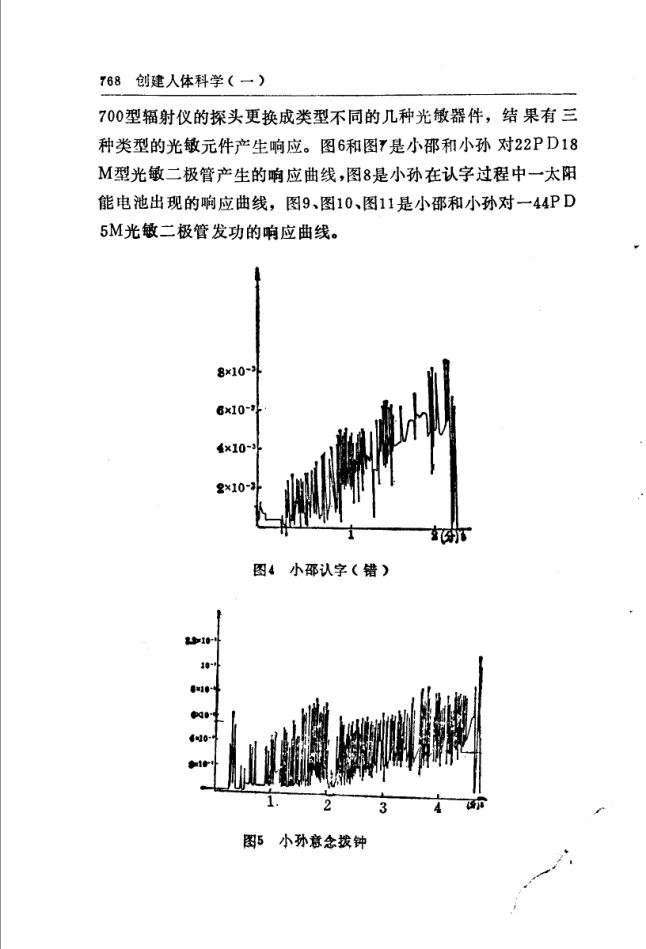
(min) -8 ×10⁻⁴
Figure 6 Response curve of 22PD18M caused by Xiao Sun emitting qi for character recognition
Figure 7 Response curve of 22PD18M caused by Xiao Shao emitting qi
6 6 6×10⁻⁸
-8×10⁻⁸
Figure 8 Response curve of a solar cell caused by Xiao Sun emitting qi
Figure 9 Response curve of the phototransistor 44PD05M when Xiao Shao and Xiao Sun emitted qi for character recognition
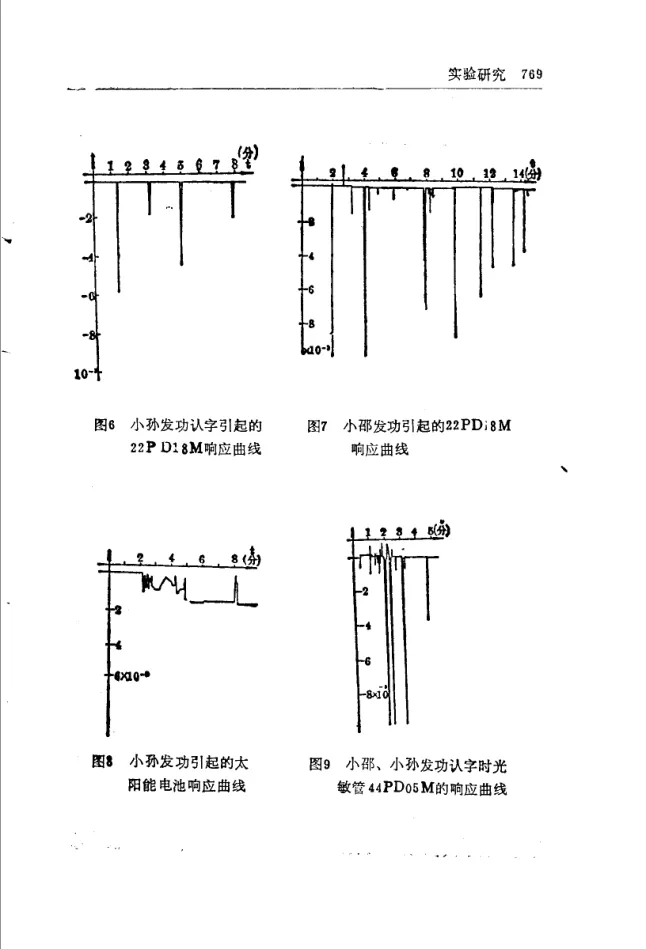
4 (min) -6 ~8 (a) (b)
Figure 11 Xiao Sun emitting qi for character recognition caused breakdown of the phototransistor 44PD05M, repeated seven times in total
Figure 10
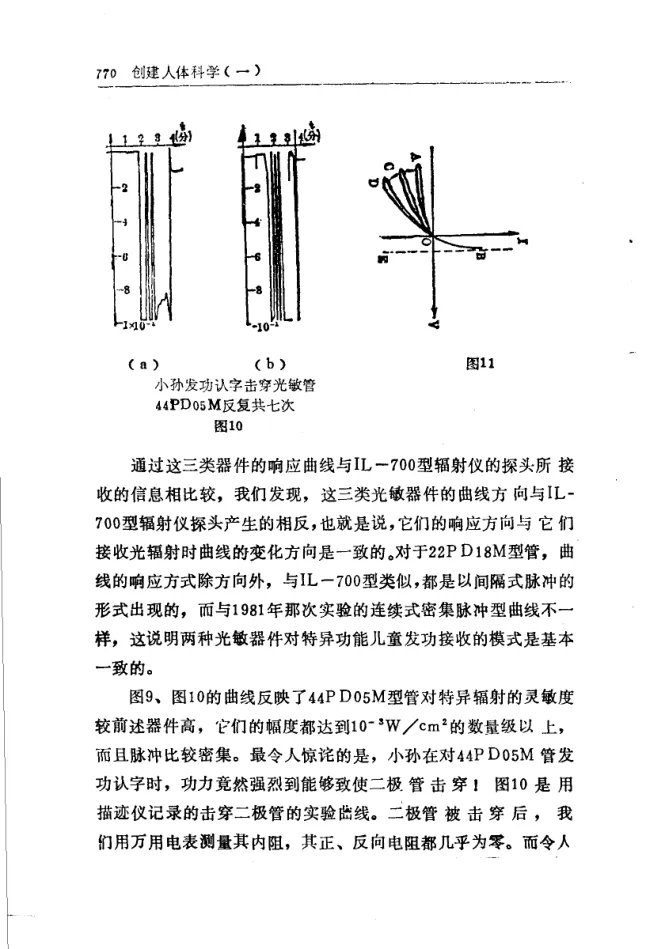
By comparing the response curves from these three types of devices with the information received by the probe of the IL-700 radiometer, we found that the directions of the curves for these three types of photosensitive devices are opposite to those produced by the probe of the IL-700 radiometer; in other words, their response directions are consistent with the directions of curve changes when they receive light radiation. For the 22PD18M-type tube, apart from direction, the mode of response of the curve is similar to that of the IL-700 type, both appearing in the form of intermittent pulses, which differs from the continuous, densely packed pulse-type curve obtained in the 1981 experiment. This indicates that the two types of photosensitive devices are basically consistent in their reception patterns when the children with extraordinary abilities emit qi.
The curves in Figures 9 and 10 reflect that the 44PD05M-type tube has higher sensitivity to extraordinary radiation than the aforementioned devices; their amplitudes all reach the order of 10⁻⁸ W/cm² or above, and the pulses are relatively dense. The most astonishing finding is that when Xiao Sun emitted qi for character recognition directed at the 44PD05M tube, the power was so strong that it caused the diode to break down! Figure 10 shows the experimental curve of the breakdown diode recorded by a tracing instrument. After the diode broke down, we measured its internal resistance with a multimeter, and both its forward and reverse resistances were nearly zero. Yet what is
puzzling is that after setting the diode aside for 20 minutes, it returned to normal. Even more significantly, after reconnecting the device into the circuit and again having Xiao Sun “emit qi” for character recognition, the diode broke down a second time; after being set aside, it recovered once more! At this point, we observed and compared the tube on a JT-1-type curve tracer and found that the sensitivity to indoor natural light had not noticeably deteriorated during the first three breakdown-recovery cycles.
To confirm the abrupt process of diode breakdown, we connected the 44PD05M photodiode to a JT-1-type curve tracer to observe the instantaneous changes in the I-V curve. The results showed that during the process of emitting qi, the ring-shaped domain of the diode’s characteristic curve did not become broader as described in reference [1]; however, its reverse resistance continuously decreased and then increased, swinging between points A, C, and D (see Figure 11). After several periodic changes, it became a straight line BE, indicating that the diode had broken down. After seven repeated breakdowns, this diode was permanently broken down. In addition, after Xiao Sun emitted qi for character recognition directed at the solar cell, we measured its characteristics using the JT-1-type curve tracer and found that the diode characteristics of the solar cell had significantly deteriorated, as shown in Figure 11, changing from curve AOB to curve COB, with a marked decrease in reverse resistance. Over four consecutive days of measurement, this characteristic remained constant and unchanged; on the fifth day, however, it suddenly short-circuited into the straight line BE, permanently losing its diode characteristics. This phenomenon has a certain similarity to the 44PD05M effect. The breakdown-recovery process of the photodiode may, to some extent, indicate that extraordinary radiation has a mechanism of sustained action. This is similar to the delayed effect of human extraordinary abilities on thermoluminescent dosimeter chips found at the University of Science and Technology of China [2]; its effect on certain physical devices may not be instantaneous in both onset and disappearance. This phenomenon is impossible to occur under overload high-voltage conditions of photosensitive devices; once a device undergoes normal breakdown, it cannot recover its original characteristics. The soft breakdown of a transistor lasts only on the order of nanoseconds. Therefore, the breakdown-recovery phenomenon of a photodiode caused by extraordinary radiation is highly extraordinary, and this phenomenon merits in-depth investigation.
III
In summary, we can draw the following conclusions: ① The above experiments once again reproduced the responses of certain photosensitive devices to extraordinary radiation. Although the modes of response to the received information differ, they confirm the objective existence of extraordinary radiation. ② Due to individual differences in the human body as well as factors of growth and change, the form and intensity of extraordinary radiation may vary accordingly with time and from person to person. Therefore, research work should involve multiple subjects and long-term experimental detection records to compare changes and developmental trends. ③ Human latent abilities not only possess astonishing energy but may also produce sustained action effects on the receiving body over a period of time. ④ Based on existing experiments and through repeated, in-depth experimentation, people will certainly be able to design instruments for detecting and receiving extraordinary radiation using modern scientific experimental methods, analyze and study their characteristics, and thereby open the door to extraordinary abilities and reveal their essential nature.
During the course of the experiments, Professor Fang Baoxian of Boston University, USA, provided us with a batch of photosensitive devices. Professor Fang also personally conducted the main portions of the experiments and observations together with us. Associate Professor Xu Wenyuan, Vice President of the Branch Campus of Nankai University, and Teacher Ji Binghou of the Department of Physics at Inner Mongolia University also participated in the main portions of the observation experiments and engaged in productive discussions. Professor Zheng Sumin, Chair of the Department of Radio Engineering at Yunnan University, also had fruitful discussions with us. Comrade Su Yin, Vice Chair of the Yunnan Provincial Association for Science and Technology, and Comrade Cai Zhongming also viewed the main portions of the experiments. We hereby express our deepest gratitude!
Notes and References
[1] Zheng Tianmin et al., Nature Magazine, 4 (1981) 563.
[2] Zhang Anqi et al., Research on Extraordinary Human Abilities, 1 (1983) 65.
Experimental Research on the Physics of Human Body Radiation Using Biological Detectors
Zhao Yongjie, Xu Hongzhang Shen Jing, Liu Aihua
[Editor’s Note] The authors of this article, Comrade Zhao Yongjie and colleagues, are scientific researchers at the Institute of High Energy Physics, Chinese Academy of Sciences. They have been engaged in high-energy physics research for many years and possess rich experience in capturing radiation information. This article describes their use of biological organisms as probes to form biological detectors for the detection of extraordinary human radiation. This peculiar concept may provide inspiration to people.
I. Detection of the Physical Mechanism of Human Body Radiation
Over the past year, we have carried out research work focusing on physical detection methods for extraordinary ability radiation. Using nuclear emulsion films and X-ray film detection methods, we have captured a large amount of radiation emitted by individuals with extraordinary abilities, including images of characters recognized by the extraordinary individuals, as well as the motion trajectories and special structures at the landing points of the extraordinary individuals’ radiated substances. Using photoelectric detectors, we directly and indirectly (through intervening layers) detected the radiation emitted by extraordinary individuals; we also successfully detected the radiation from individuals with extraordinary abilities and qigong practitioners using biological detectors. The results obtained from these different detection methods
are interconnected, and the radiation characteristics are consistent. This article focuses on the experimental situation regarding biological detectors. What exactly is the radiation carrier of human extraordinary abilities? This is a highly complex and far from resolved problem. There are two viewpoints on this issue: one viewpoint believes it is purely a known physical and chemical phenomenon, while the other believes it is by no means a simple known physical or chemical phenomenon, but an unknown state of matter (or even an unknown substance) closely linked to life phenomena. The radiation of extraordinary individuals possesses characteristics such as strong penetrability, controllability, directionality, expansibility, and integrity, which cannot be explained by ordinary physical phenomena. This situation supports the second viewpoint to a certain extent, but to thoroughly clarify these problems, a new type of detector must be developed. The biological detector is one of our attempts in this area.
II. Basic Structure of the Biological Detector
Biology, as the name implies, refers to living objects. A probe made from a living organism full of abundant vitality, combined with some electronic circuits, constitutes a biological detector (Figure 1). The entire experimental device consists of three parts: a probe, an amplifier, and a recorder.
Probe Amplifier X-Y Recorder Figure 1 Schematic diagram of the biological detector
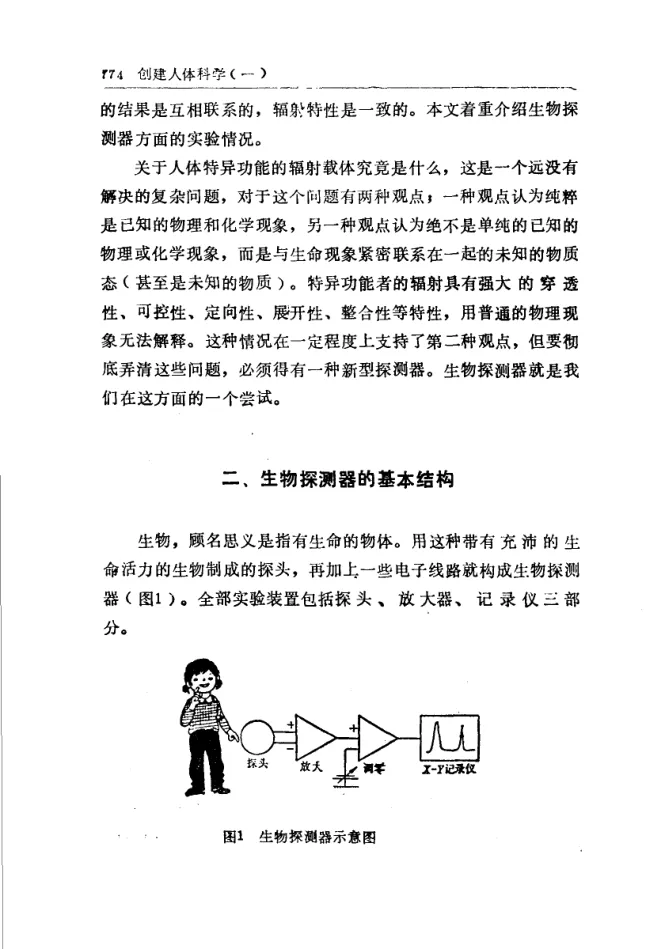
(1) Biological probe: Composed of a leaf of a floating morning glory plant, a sample box, and two probes. The two probes are carefully inserted into the main leaf vein, at a very shallow depth, with only the tip of the needle inserted. At this time, there should be an indication on the voltmeter. If the voltage points to between -1 V and -4 V, it indicates that the probe can be used (the voltage amplifier magnification is 10, meaning the potential at the two probe points on the leaf is -0.1 V to -0.4 V); otherwise, the position of the probes has not been correctly found. The peak value of background fluctuations on the recorder cannot exceed 0.1 V. Based on experience, it is not difficult to find a suitable position. The probes must be thin. We used two copper probes with a diameter of 0.1 mm, and the needle tips are sharp. The plant leaf is the key to the probe. It must have good stability, low inertia, and high sensitivity, and both the rise time and recovery time must be fast. Through our practice, the leaves of the floating morning glory basically meet the requirements, though the recovery time is still a bit long. After the probes are inserted, place the characters to be recognized into the box, close the lid, and route the probe lead wires to the amplifier; the probe is then ready. Closing the lid can avoid many external interferences. The sample box is an ordinary round ink box. (2) Amplifier: It is an SF-72 type data amplifier produced in Suzhou, with low noise and strong common-mode rejection capability. When in use, the magnification is generally 10 times. The input mode adopts two-terminal input, ungrounded, with external shielding added. (3) X-Y recorder: Imported from France, with a response speed of 10 times/second and a sensitivity of up to 200 μV/grid.
III. Experimental Results
Before the experiment, connect the instruments, power on for preheating, then pick the leaf from the main branch, fix it in the box, carefully insert the probes into the main vein, adjust the probe as required, and put in the characters to start the experiment. The individual with extraordinary abilities begins to recognize the characters inside the box and reports the flashing conditions in their mind at any time, so as to determine the correlation in the experiment.
This experimental device showed its first reaction when testing Xiao Yan from Beijing in March 1980. Later, by continuously improving the probe technology, successful experiments were conducted separately on extraordinary individuals such as Yu XX from Hebei, Xiao Jie from Wuhan, and Mu XX from Heilongjiang. Figure 2 shows the radiation waveform left when Yu XX recognized the characters “sheep” and “cow” last year. Many successful tests were conducted on the extraordinary individual Cao XX from Beijing and Liu X from Jilin, with very good correlations. The waveforms are shown in Figures 3 and 4. Qigong practitioners can also have their radiation waveforms detected by this detector when emitting qi (Figure 5).
Mojia Stop Figure 2: Waveform left by extraordinary individual Yu XX when recognizing characters (K=50000, characters: sheep, cow) 0.5 Flash exceptionally bright Fengshan Chu Feng 100 200 300 t (seconds) See the character “chu” (out) () Bright Speak See the character “shan” (mountain) Palm 0 100 200 300 400 t (seconds) See the character “zhong” (middle) (b) Figure 3: Radiation waveform left by extraordinary individual Cao XX when recognizing characters (K=10, characters: big, draw)
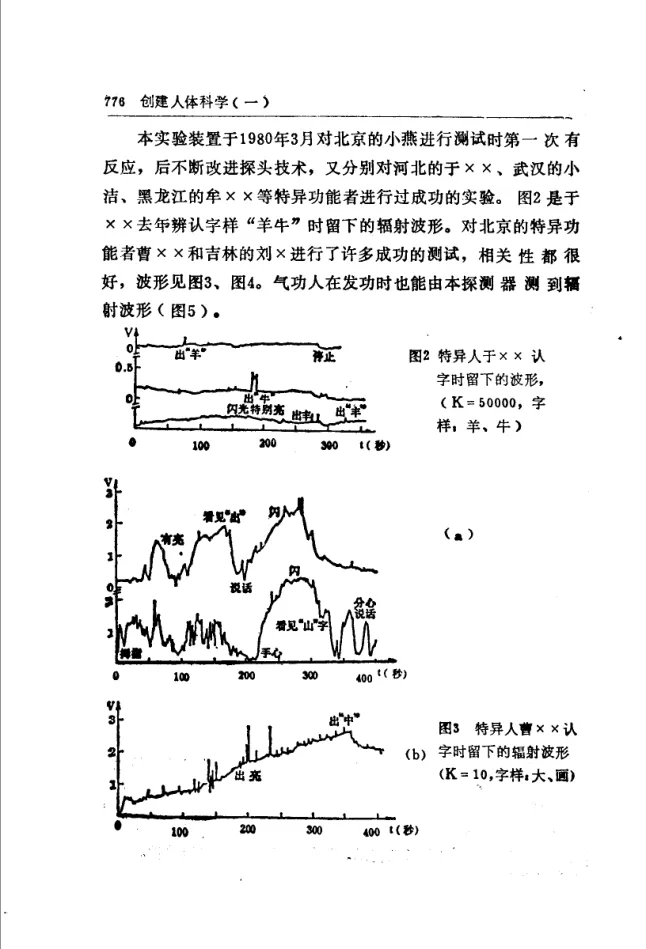 See “bright”
100
200
300
400 (t seconds)
See “bright”
100
200
300
400 (t seconds)
(6) (5) (2) (ε) (8) (1) 0 100 200 800 V (a) K = 50000 (1) Triggering one strong flash, continuously, then immediately ordered to stop; a leaf image was discovered; (2) drawing leaf veins, carried out continuously; (3), (4) continuing to draw leaf veins; (5), (6), (7), (8) remote viewing of the leaf. 0.5 producing the characters “中” and “田” producing the character “口” 0 100 200 300 400 t (s) (b) K = 10, characters: 田, 中 2.6 2.0 flash flash 1.5 “赵” after flashing 1.0 producing “徐” 0.5 0 100 200 400 (c) K = 10, characters: 徐, 赵
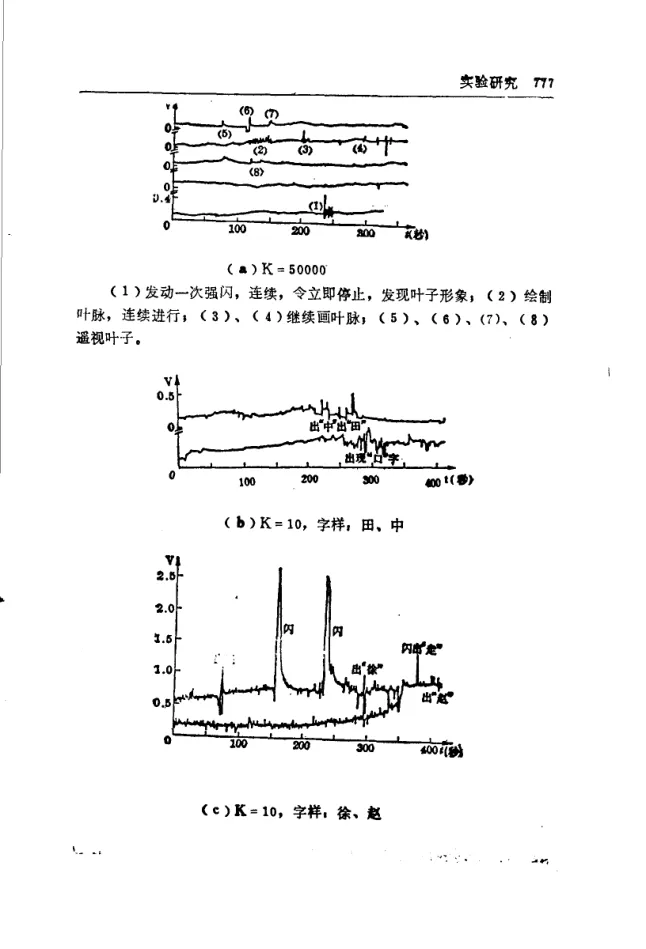
V 1.5 producing “高” LO 0.5 hand leaves while speaking 0 100 200 300 400 (d) K = 10, characters: 高, 川
Figure 4 Radiation waveforms produced when extraordinary individual Liu × recognizes characters
0.75 0.5 0.20 continuous beginning to emit qi, beginning to emit qi .0 100 200 0 100 200 300 t (s) (a) K = 50000 (b) K = 50000
Figure 5 Radiation waveforms produced when a qigong practitioner emits qi
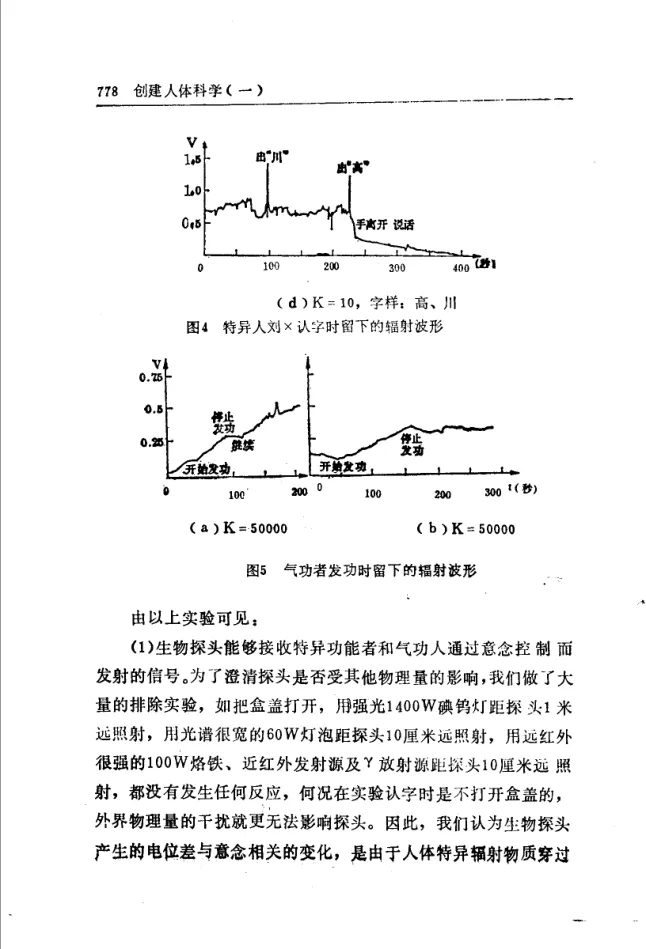
From the above experiments, it can be seen that:
(1) The biological probe was able to receive signals emitted through mental control by individuals with extraordinary abilities and qigong practitioners. To clarify whether the probe was affected by other physical quantities, we conducted a large number of exclusion experiments, such as opening the box lid and irradiating with intense light from a 1400 W iodine-tungsten lamp at a distance of 1 meter from the probe, irradiating with a broadband 60 W light bulb at 10 cm from the probe, and placing a 100 W soldering iron with strong far-infrared output, a near-infrared emission source, and a γ-ray radiation source at 10 cm from the probe — none of these produced any response. Moreover, during the character-recognition experiments the box lid was not opened, so interference from external physical quantities was even less able to affect the probe. Therefore, we believe that the mentally correlated changes in the potential difference generated by the biological probe resulted from the extraordinary human radiation substance penetrating through
the box lid and stimulating the leaf of the probe.
(2) The radiation from individuals with extraordinary abilities is episodic in nature, so the waveform appears pulse-shaped, with a relatively fast rising edge and a duration of less than 1 second. If the individual with extraordinary abilities continuously experiences flashes in the mind, the waveform can also merge into a continuous trace (Figure 3). When qigong practitioners emit qi, the waveform rises more slowly.
(3) In terms of waveform amplitude, individuals with extraordinary abilities produce much larger amplitudes per unit time than other individuals. The amplitude of the strongest radiation waveform from Liu × is on the order of several volts; the strongest radiation from Yu ×× can reach approximately 1 volt; and for both, the amplitude of the radiation waveform during flashes in the character-recognition process can reach several hundred millivolts. For qigong practitioners, however, the amplitude change within one second is at most on the millivolt level — this is probably also the main reason why the latter cannot recognize characters. But qigong practitioners can sustain their qi emission for long durations and accumulate effects, so the therapeutic results are effective. The therapeutic efficacy of individuals with extraordinary abilities remains to be studied.
(4) This experiment not only confirms the material nature of extraordinary human radiation, but also confirms that this substance may be closely linked to living tissue, and it furthermore provides a method for further studying the physics of human-body radiation.
IV. Precautions in the Experiments
In using the biological detector, we noted the following points:
(1) Although the leaves used for the probe were selected through repeated trials, the leaves we used still exhibited some inertial lag, which affected our ability to observe the fine structure of the extraordinary substance. This is one of the key problems to be improved in the future.
(2) Leaves should not be used for too long; generally two hours is appropriate, otherwise sensitivity declines.
(3) The position of the probe needle is very important; it is best inserted into the main vein of the leaf.
(4) Shielding of the detection system must be done properly. If interference is too great, testing cannot be carried out. In general, the interference ripple on the recorder should not exceed 100 millivolts.
V. Postscript
The experimental methods provided in this paper are not yet fully mature and still have many shortcomings requiring further research and improvement; we are merely proposing a new experimental approach here.
During the course of the experiments, experienced experimental physicists including Tang Xiaowei, Fang Cheng, and Zheng Zhipeng personally visited the laboratory to provide guidance. Wang Guanyou of the Cang County Science and Technology Commission in Hebei and subject Yu ××; Liu Xiankui of Hunjiang City, Jilin, and subject Liu ×; and Cao Wei of the Institute of High Energy Physics in Beijing and subject Cao ×× all gave strong support and assistance. We express our heartfelt gratitude here.
This paper was reviewed by scientists including Zhao Zhongyao, Xu Jianming, and Tang Xiaowei, who provided valuable revision comments. We also express our gratitude to them.
Experiment on Detecting Human Body Radiation Using Photomultiplier Tubes
Zhao Yongjie, Xu Hongzhang Shen Jing Zheng Zhicheng
[Note] This article reports an experiment using photomultiplier tubes to capture human body radiation under a qigong state or extraordinary human ability state. It corroborates other experimental results, verifying the authenticity of extraordinary human abilities from various different perspectives.
Affiliation of the authors: Institute of High Energy Physics, Chinese Academy of Sciences.
This article focuses on introducing our research on human body radiation using a detection system constructed with photomultiplier tubes as probes. When ordinary people and people with extraordinary abilities focus their minds on the probe, is there actually any radiation? What are the characteristics of the radiation? What is the distribution of the radiation pulse amplitude spectrum? What are the temporal and spatial distributions? Correct answers to these questions will be helpful for the study of extraordinary human abilities. This experimental apparatus intends to make some explorations in this area.
I. Brief Description of the Experimental Apparatus
We used nuclear instrument modules from the Beijing Comprehensive Instrument Factory and a 512-channel pulse analyzer,
components from the Sichuan Jian’an nuclear medicine electronic instrument series, a U.S. Textronic 465 oscilloscope, and components such as photomultiplier tubes and high-voltage power supplies from a West German spectrometer to form a detection system (Figure 1).
+1400V Ratemeter Character
- High Voltage Photomultiplier Tube Hand of extraordinary person Resistor Amplifier Amplitude GDB10 Analyzer Scaler Capacitor Outer shielding sleeve Oscilloscope Pulse Analyzer
Figure 1. Block diagram of the detection apparatus
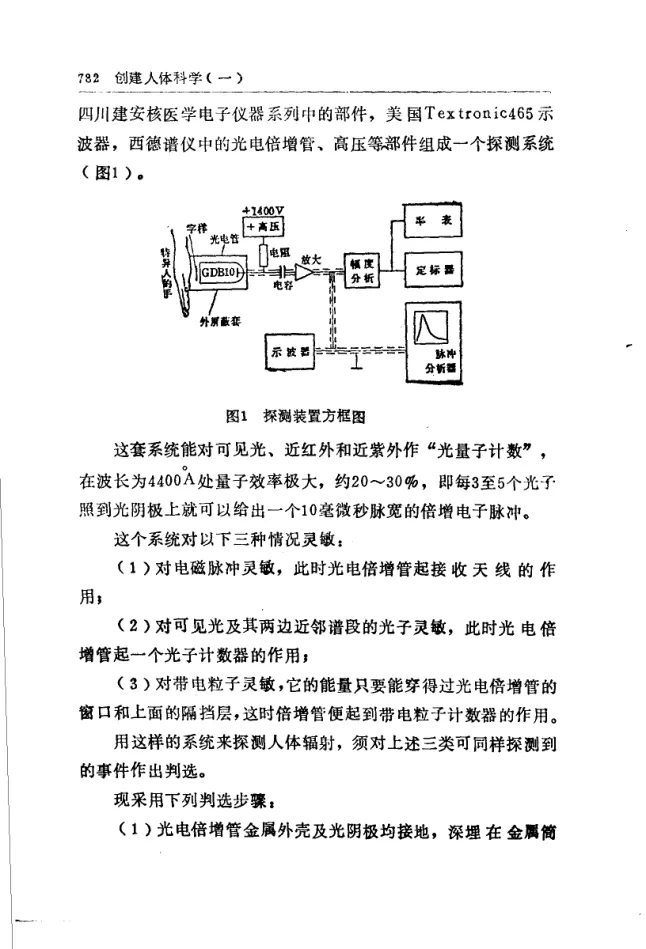
This system can perform “photon counting” for visible light, near-infrared, and near-ultraviolet. The quantum efficiency peaks at a wavelength of 4400 Å, at about 20–30%, meaning that for every 3 to 5 photons striking the photocathode, a multiplied electron pulse with a 10-nanosecond pulse width can be produced.
This system is sensitive to the following three situations: (1) Sensitive to electromagnetic pulses, in which case the photomultiplier tube acts as a receiving antenna; (2) Sensitive to photons in visible light and its adjacent spectral bands, in which case the photomultiplier tube acts as a photon counter; (3) Sensitive to charged particles; as long as their energy can penetrate the window of the photomultiplier tube and the barrier layer above it, the multiplier tube acts as a charged particle counter.
To use such a system to detect human body radiation, discrimination and selection must be made among the three types of events that can be similarly detected. The following discrimination and selection steps are currently adopted: (1) The metal shell and photocathode of the photomultiplier tube are both grounded, and the anode buried deep at the bottom of the metal cylinder is applied with positive high voltage, which can shield against electromagnetic pulse radiation. At the same time, an oscilloscope is used to monitor the waveform of the electron multiplication pulse output by the multiplier tube. It has a characteristic waveform as shown in Figure 2, which indicates that the event is not generated by electromagnetic pulse radiation.
(2) The multiplication pulse waveforms of photon counts and electron counts are identical at the output end of the photomultiplier tube. We placed a 5.6 keV X-ray source, a several-hundred-keV gamma source, and a 2 MeV beta source in the same position as the human body experiment to irradiate the probe, and found that the X-ray source produced no response, while both the gamma source and the beta source produced counts. However, we have used detectors specifically designed to measure X-ray, gamma, and beta sources to conduct experiments on people with extraordinary abilities, and so far no definitive results have been found; therefore, discrimination and selection in this regard still need to be continued.
Figure 2
The system in Figure 1 can record the following physical quantities of human body radiation by means of quantum counting: (1) Quantum count rate , monitored by nuclear instruments. (2) Quantum count rate variation curve over time , monitored by a ratemeter. (3) Quantum-electron multiplication spectrum distribution, monitored by a 512-channel multi-channel analyzer. The oscilloscope is used to monitor the characteristic waveform of the multiplication pulses.
II. Experimental Results and Preliminary Analysis
This apparatus was primarily used to test Liu ×, who possesses extraordinary abilities. The subject used the center of their palm, without touching the photocathode of the probe, to identify characters placed on the photocathode, at a distance of about 80 mm. The photomultiplier tube was placed in a light-tight dark bag; the experimental results were the same whether the subject placed their hand outside the dark bag or inside it. Tests on ordinary people practicing qigong only yielded records when their hands were placed inside the dark bag. When Liu × had a flash in their mind, the scaler, ratemeter, multi-channel analyzer, and oscilloscope produced corresponding records (Figures 3 and 4). The scaler was set to a 6-second sampling interval, and the background fluctuated between 60 and 80; when the ordinary person Shen Jing concentrated his mind, the maximum count
Waveform of an ordinary person emitting qigong 25 seconds Figure 3. Waveform displayed by the ratemeter when the person with extraordinary abilities recognized characters
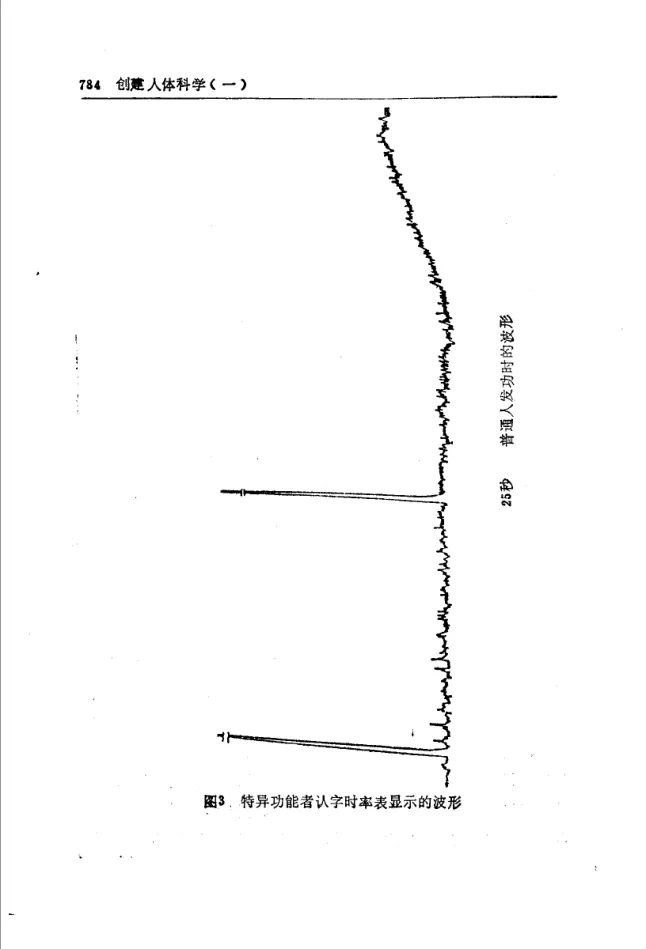
(a) (b) Figure 4 (a) Comparison of the spectral emission of an ordinary person practicing qigong with the background (photograph)
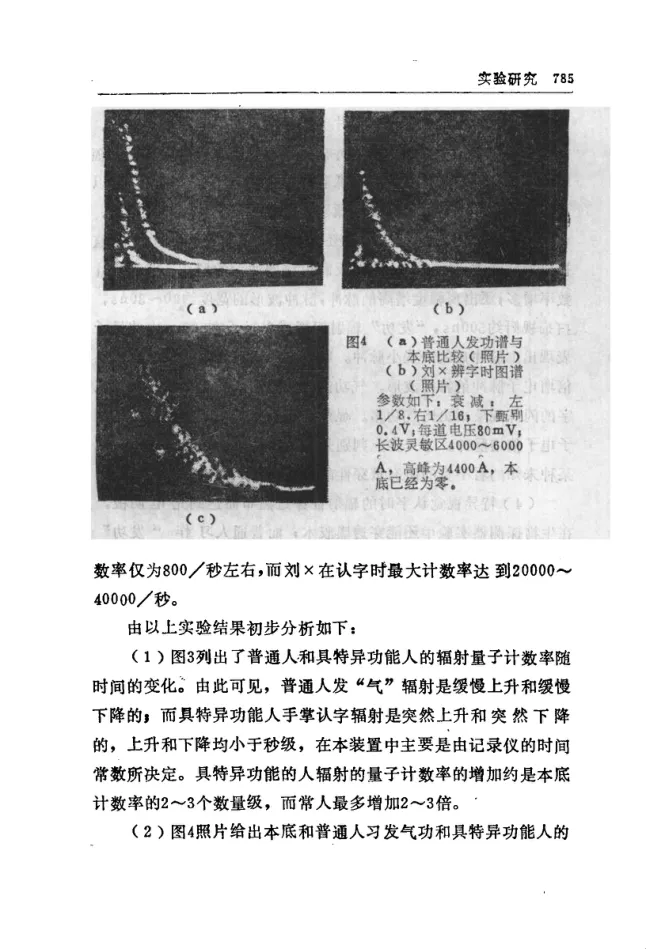 (b) Spectrum during character recognition by Liu × (photograph)
Parameters are as follows: attenuation: left 1/8, right 1/16; lower discriminator 0.4 V; voltage per channel 80 mV; long-wave sensitive region 4000–6000 Å, with a peak at 4400 Å; the background is already zero.
(c)
The count rate was only around 800 per second, whereas when Liu × was recognizing characters, the maximum count rate reached 20,000–40,000 counts/second.
A preliminary analysis of the above experimental results is as follows:
(1) Figure 3 lists the variation over time of the radiation quantum count rates of ordinary persons and persons with extraordinary functions. From this it can be seen that the radiation from an ordinary person emitting “qi” rises slowly and falls slowly, whereas the radiation from a person with extraordinary functions recognizing characters with the palm rises abruptly and falls abruptly; both the rise and fall are shorter than one second, and in this apparatus this is mainly determined by the time constant of the recorder. The increase in quantum count rate of the radiation from a person with extraordinary functions is approximately 2–3 orders of magnitude above the background count rate, whereas for an ordinary person the increase is at most 2–3 times.
(2) The photograph in Figure 4 shows the background and the radiation quantum multiplier pulse amplitude spectra of an ordinary person practicing qigong and of a person with extraordinary functions.
The radiation quantum multiplier pulse amplitude spectra. The photograph shows the actual shape of the spectrum on the multichannel analyzer during measurement. From the spectra it can be seen that the qigong spectrum has more high-pulse components than the background spectrum, and in the extrasensory vision radiation spectrum the high-pulse heights are even greater; its low-pulse components overloaded the 512-channel analyzer to the point of blocking. The spectral curve given in the figure is the high-pulse distribution spectrum obtained after discriminating out the low pulses.
(3) Whether an ordinary person is practicing qigong or a person with extraordinary functions is recognizing characters, the oscilloscope monitoring the multiplier pulse waveform mainly shows a brightening of the multiplier waveform, that is, an increase in the pulse count rate. Pulses with increased amplitude also appear; the width of the pulse waveform is approximately 20–30 ns, and some small pulses after the main pulse are exhibited. All of these indicate that what is being tested is indeed the characteristic waveform of multiplied electron pulses; the scintillation from qigong is higher than the background, while the scintillation phenomenon from extrasensory character recognition is even more frequent than that of qigong. Evidently, it does not appear to be an electromagnetic pulse but rather a quantum electron-multiplied pulse. The next step should be to determine whether these are photons or charged particles, or some other unknown, invisible, penetrating excited-state quantum.
(4) During extrasensory visual character recognition, the radiation can penetrate black cloth to reach the photocathode, and in the biological detector experiments it can also penetrate black Bakelite. When an ordinary person practices “emitting qi,” if the function is relatively strong (as with Shen Jing), it can only penetrate a single sheet of paper and shows significant attenuation, but after practicing for a while, the amplitude still increases.
(5) When Liu × was performing extrasensory visual character recognition, the recording terminal was in another room, and the action of the recorder was basically correlated with his reporting of flashes in his mind or his recognition of characters.
(6) This experiment is consistent with the results of the biological detector, the latter being more sensitive to human radiation. This experiment also corroborates the film experiment and the thermoluminescence experiment results.
From the very beginning of this work, Zhao Zhongyao showed concern and support, and provided in-depth guidance. Tang Xiaowei and Fang Cheng offered many valuable opinions on the experimental design and analysis of results. Deep gratitude is expressed to all of them!
Testing and Discussion of Human-Body Extraordinary Radiation Dosage
Zhang Anqi, Fan Longxiang
[Editor’s Note]
This article reports measurements of the dosage produced during the process of palm character recognition—a type of extraordinary human ability—using lithium fluoride and beryllium oxide thermoluminescent dosimeters. In the experiments, it was observed that the dosage produced during character recognition possesses its own specific characteristics when compared with the dosage produced by ordinary X-rays and γ-rays, and a “memory phenomenon” was discovered. After palm character recognition, the luminescence peak of LiF is broader than the luminescence peak produced by X-rays and γ-rays.
The authors’ affiliation: University of Science and Technology of China.
I. Introduction
The extensive research and application of thermoluminescence phenomena is a matter of only the last decade or so. In recent years, relatively rapid progress has been made in radiation dosimetry, and it has become a primary means of monitoring individual radiation doses.
The simple principle of thermoluminescent dosimeters is based on the fact that when certain substances—such as manganese-activated calcium fluoride (CaF₂:Mn), lithium fluoride (LiF), as well as CaSO₄:Mn, MgF₂:Mn, and BeO—are irradiated, the electrons within them gain sufficient energy to jump from their normal positions (in the forbidden band) to the conduction band and move until they are captured by traps, as
shown in Figure 1(a). If the trap depth is very large, at room temperature the electrons will remain in the
Visible light
Conduction band
Trap
Forbidden band
(a) Under irradiation
(b) Upon heating
Figure 1
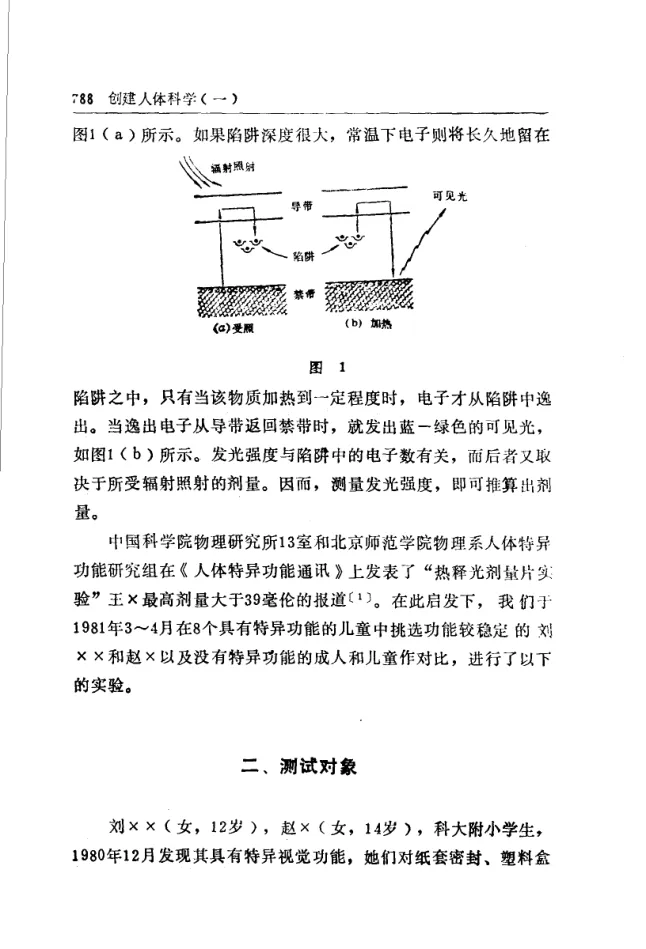
traps for a long time. Only when the substance is heated to a certain temperature do the electrons escape from the traps. When the escaping electrons return from the conduction band to the forbidden band, they emit blue-green visible light, as shown in Figure 1(b). The luminescence intensity is related to the number of electrons in the traps, which in turn depends on the radiation dose received. Therefore, by measuring the luminescence intensity, the dose can be inferred.
Laboratory 13 of the Institute of Physics, Chinese Academy of Sciences, and the Extraordinary Human Abilities Research Group of the Department of Physics, Beijing Normal College, published a report in Human-Body Extraordinary Abilities Newsletter on their “Thermoluminescent Dosimeter Film Experiment,” reporting that the highest dose for Wang × exceeded 39 milliroentgen [1]. Inspired by this, during March–April 1981, we selected from among eight children with extraordinary abilities those whose functions were relatively stable—Liu ×× and Zhao ×—along with adults and children without extraordinary abilities for comparison, and conducted the following experiments.
II. Test Subjects
Liu ×× (female, 12 years old) and Zhao × (female, 14 years old), students at the Affiliated Elementary School of the University of Science and Technology of China. In December 1980, they were found to possess extrasensory visual functions. They were able to recognize characters sealed in paper sleeves and plastic boxes
Sealed characters and figures, as well as those sealed in metal boxes, could all be correctly recognized, with an accuracy rate of 90%.
Control subjects: adult Zhang ×× (male, 48 years old), a teacher at USTC, without extraordinary abilities; child Fan ×, female, 12 years old, a student at the USTC-affiliated elementary school, without extraordinary abilities.
III. Test Equipment and Dose Calibration
This experiment used an FJ-369 thermoluminescent dosimeter reader (hereafter “TLD reader”) produced by Beijing Factory 261, and natural-abundance LiF (Mg, Ti) thermoluminescent dosimeter chips of 5 × 5 × 0.8 mm. To obtain a lower background, the LiF chips were annealed by heating in an electric furnace to 400 °C at constant temperature for one hour, then cooled for use [2].
Dose calibration: We used a ²²⁶Ra source (5.65 mg) to calibrate the LiF dosimeter chips on the FJ-369 TLD reader. Forty LiF chips were individually sealed in small black paper bags and irradiated at a distance of 40 cm from the ²²⁶Ra source for four hours, totaling 117 milliroentgens (theoretical calculated value).
The 40 irradiated LiF dosimeter chips were placed on the FJ-369 TLD reader for measurement, and each value was obtained individually. The average of the readings was found to be 287.1.
Standard deviation σx = 27.3,
Relative standard deviation σ/x̄ = 9.5%.
From this, the ratio of reading to dose was obtained as:
(287 − background) : 117 = 2.39.
To obtain reliable results, together with staff from the Protection Group of the Anhui Provincial Epidemic Prevention Station, we used a UD-502A TLD reader and beryllium oxide (BeO) dosimeters6 to measure the dose after extraordinary human ability palm-recognition of characters, and compared results with the LiF chips.
The BeO dosimeter calibration method was similar. Twenty BeO dosimeters were placed at a distance of 40 cm from the ²²⁶Ra source and irradiated for 103 minutes; by formula calculation this yielded 50 milliroentgens. Calibration was performed on the UD-502A TLD reader, with the high voltage adjusted so that the reading was 50 milliroentgens.
IV. Testing Methods
-
After annealing the LiF chips, their background was measured. Nine chips were arranged in a 3 × 3 square (15 × 15 mm), wrapped externally in black paper, with a character to be recognized placed inside the black paper layer. The package was then folded and sealed (stapled with a stapler), as shown in Figure 2. It was then handed to a child with extraordinary abilities to place at the Laogong acupoint for character recognition. After the character was recognized (approximately 1 hour), the reading of each chip was measured (the instrument was pre-warmed to a stable measurement state).
-
After annealing, the BeO dosimeters were measured and their background was zero. Three or six BeO glass rod-shaped dosimeters (φ1.5 mm × 10 mm) sheathed in plastic shells were aligned, and after a character to be recognized was placed on them, they were taped with adhesive tape to the Laogong acupoint and the Dazhui acupoint (no character was placed at the latter acupoint) for character recognition (approximately 1 hour), then measured (the instrument was in measurement-ready state).
Stapling ----- fold line Folding order
Figure 2
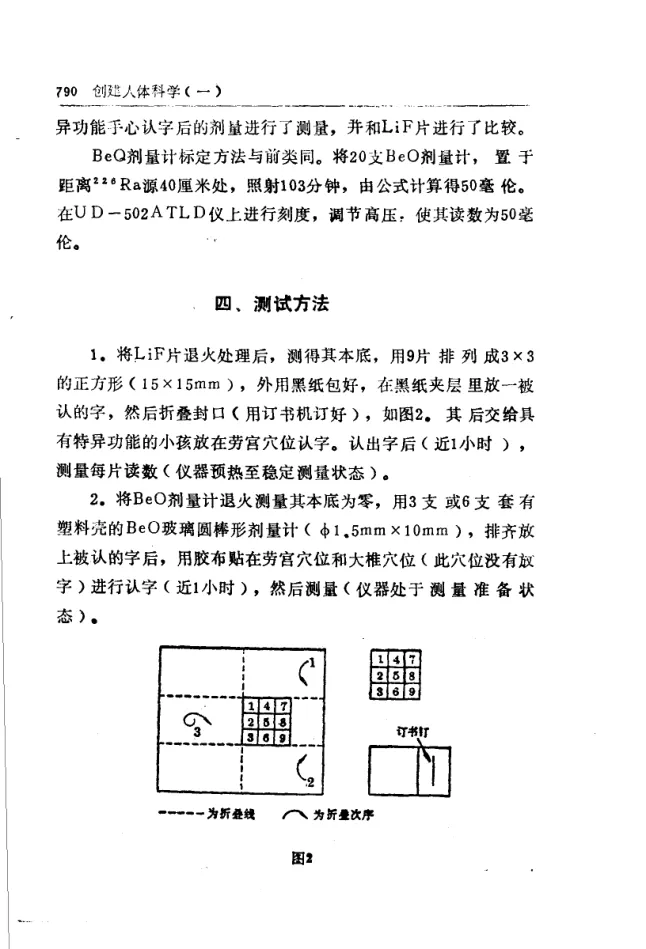
- Identical experiments at the Laogong acupoint were conducted with adults and children without extraordinary abilities.
V. Experimental Results
- Dose measurement after palm character recognition using LiF chips
Table 1 shows the dose measured at the Laogong acupoint of Liu ×× after one hour of character recognition. After an interval of time, the LiF chips that had already been measured and annealed after character recognition were measured again, and a considerable dose could still be detected. We call this phenomenon the “memory phenomenon.” This is different from doses caused by ordinary X-rays and γ-rays. For doses caused by ordinary radiation, after being measured and annealed, a measurement taken one day later is essentially close to background. This phenomenon awaits further investigation.
Table 1
| 1 | 2 | 3 | 4 | 5 | 6 | 7 | 8 | 9 | |
|---|---|---|---|---|---|---|---|---|---|
| LiF chip + instrument background | 6 | 6 | 5 | 5 | 5 | 6 | 5 | 5 | 6 |
| Measurement reading | 134 | 176 | 279 | 66 | 55 | 166 | 191 | 188 | 298 |
| Net count | 128 | 170 | 274 | 94 | 50 | 160 | 186 | 183 | 292 |
| Milliroentgens | 53.5 | 71 | 114.5 | 39 | 21 | 67 | 78 | 76 | 122 |
| Reading measured 18 hours later | 31 | 54 | 79 | 30 | 20 | 51 | 75 | 64 | 6 |
| ”Memory dose” (milliroentgens) | 13 | 22.5 | 33 | 12.5 | 8.3 | 21 | 31 | 27 | 37.5 |
Table 2 shows the dose measured after Zhao × used the Laogong acupoint for character recognition for one hour.
Table 3 shows the dose measured after Liu ×× used the Laogong acupoint for character recognition for one hour a second time.
Table 2
| 1 | 2 | 3 | 4 | 5 | 6 | 7 | 8 | 9 | |
|---|---|---|---|---|---|---|---|---|---|
| LiF chip + instrument background | 5 | 6 | 4 | 5 | 5 | 5 | 4 | 6 | 5 |
| Measurement reading | 61 | 27 | 23 | 47 | 14 | 29 | 34 | 17 | 19 |
| Net count | 56 | 22 | 19 | 42 | 9 | 24 | 30 | 11 | 14 |
| Dose (mR) | 23.9 | 9.2 | 8 | 17.6 | 3.8 | 10 | 12.5 | 4.8 | 5.9 |
Table 3
| 1 | 2 | 3 | 4 | 5 | 6 | 7 | 8 | 9 | |
|---|---|---|---|---|---|---|---|---|---|
| LiF chip + instrument background | 7 | 6 | 5 | 6 | 6 | 7 | 7 | 7 | 6 |
| Measurement reading | 116 | 57 | 81 | 101 | 133 | 133 | 51 | 54 | 71 |
| Net count | 109 | 51 | 76 | 95 | 127 | 127 | 44 | 47 | 65 |
| Dose (mR) | 45.5 | 21.3 | 31.8 | 40 | 53 | 53 | 18.4 | 19.6 | 27 |
Table 4
| 1 | 2 | 3 | 4 | 5 | 6 | 7 | 8 | 9 | |
|---|---|---|---|---|---|---|---|---|---|
| LiF chip + instrument background | 5 | 6 | 5 | 5 | 6 | 6 | 5 | 5 | 6 |
| Measurement reading | 53 | 113 | 48 | 68 | 51 | 124 | 48 | 44 | 37 |
| Net count | 48 | 107 | 43 | 69 | 45 | 118 | 43 | 39 | 31 |
| Dose (mR) | 20 | 44.7 | 18 | 26.3 | 18.8 | 49.3 | 18 | 16.3 | 13 |
Table 5
| Laogong acupoint 1 | Laogong acupoint 2 | Laogong acupoint 3 | Dazhui acupoint 1 | Dazhui acupoint 2 | Dazhui acupoint 3 | |
|---|---|---|---|---|---|---|
| BeO + instrument background | 0 | 0 | 0 | 0 | 0 | 0 |
| Dose (mR) | 116 | 18.4 | 20.3 | 57.3 | 0 | 0 |
| Re-measured dose after 10 min (mR) | 33 | 4.6 | 5.1 | 0 (not recognizing characters) | 0 | 0 |
Table 6
| Laogong acupoint 1 | Laogong acupoint 2 | Laogong acupoint 3 | Dazhui acupoint 1 | Dazhui acupoint 2 | Dazhui acupoint 3 | |
|---|---|---|---|---|---|---|
| BeO + instrument background | 0 | 0 | 0 | 0 | 0 | 0 |
| Dose (mR) | 0.3 | 6.2 | 24.1 | 4.1 | 0 |
Table 4 shows the dose measured after Zhao × performed character recognition using the Laogong acupoint for one hour for the second time.
- Measuring the dose after character recognition with the palm using BeO dosimeters
Table 5 shows the doses measured when Liu ×× performed character recognition using the Laogong acupoint, with dosimeters also placed at the Dazhui acupoint. When measuring with BeO dosimeters, the “memory phenomenon” was likewise observed. When the dosimeter was held in the hand without performing character recognition, the measured dose was “zero”; the maximum dose reached 116 mR.
Table 6 shows the doses measured when Zhao × performed character recognition using the Laogong acupoint, with dosimeters also placed at the Dazhui acupoint.
Table 7 shows the dose measured after Liu ×× performed character recognition for one hour using six BeO dosimeters at the Laogong acupoint. A significant “memory phenomenon” was observed.
Table 8 shows the dose measured after Zhao × performed character recognition for one hour using six BeO dosimeters at the Laogong acupoint.
- Comparative experiments with adults and children without extraordinary abilities
Table 9 shows the doses measured by placing six BeO dosimeters near the Laogong acupoint of adults and children without extraordinary abilities for approximately one hour. When BeO dosimeters were used to measure individuals without extraordinary abilities, all doses were “zero.”
Table 7
| Serial number | 1 | 2 | 3 | 4 | 5 | 6 |
|---|---|---|---|---|---|---|
| BeO + instrument background | 0 | 0 | 0 | 0 | 0 | 0 |
| Dose (mR) | 13.6 | 6.8 | 47 | 17.8 | 39.4 | 31.2 |
| Re-measured dose after half an hour (mR) | 11 | 5 | 45.7 | 24 | 30 | 24 |
Table 8
| Serial number | 1 | 2 | 3 | 4 | 5 | 6 |
|---|---|---|---|---|---|---|
| Background | 0 | 0 | 0 | 0 | 0 | 0 |
| Dose (mR) | 4.3 | 0 | 5.4 | 9.5 | 10.5 | 0 |
Table 9
| Serial number | 1 | 2 | 3 | 4 | 5 | 6 |
|---|---|---|---|---|---|---|
| Background | 0 | 0 | 0 | 0 | 0 | 0 |
| Adult Zhang ×× dose | 0 | 0 | 0 | 0 | 0 | 0 |
| Child Fan × dose | 0 | 0 | 0 | 0 | 0 | 0 |
VI. Results and Discussion
(1) The dose resulting from extraordinary-ability palm character recognition, as measured using LiF chips and an FJ-369 TLD reader, was consistent with the dose measured using BeO dosimeters on a UD-502A TLD reader. The maximum measured dose was approximately 120 mR.
(2) The observed “memory phenomenon” differs from the doses produced by ordinary X-rays and γ-rays. That is, doses produced by ordinary radiation drop to background levels after measurement, annealing, and re-measurement, whereas doses produced by human extraordinary abilities still yield appreciable readings upon re-measurement after annealing. This phenomenon requires further investigation. At the same time, it was observed that the glow peak broadens after extraordinary-ability character recognition, exhibiting its own distinctive characteristics.
(3) From the measurement data it can be seen that the radiation produced by character recognition through the Laogong acupoint is non-uniform, and its intensity is related to the state during the character recognition process. When not performing character recognition, doses are generally not produced. Individuals without extraordinary abilities generally show no appreciable dose. Whether the magnitude of the dose produced during the character recognition process can be used to determine the presence and strength of extraordinary abilities requires further study.
Others who participated in this work include Gao Shiwei, Wang Zhi, and Wen Jianyong, students of the 1978 class in the Sixth Department of USTC; Dr. Zhang Zi’an of the university hospital; and others. During the BeO dosimeter measurements, strong support was received from the Anhui Provincial Epidemic Prevention Station, and Comrade Tian Limang assisted in completing the measurement work. In dose calibration, assistance was provided by Comrade Zhao Bingxi of the Radiation Chemistry Teaching and Research Section of USTC. Our thanks to all of them.
Notes and References
[1] Human Extraordinary Abilities Newsletter, 1980.10.31, No. 2.
[2] Thermoluminescence Measurement Techniques, Atomic Energy Press, (1978), p. 105.
Observation and Analysis of High-Frequency Electromagnetic Waves from the Human Body and Their Biological Effects
Wang Xiubi, Mou Meiqin, Wang Gongzhi, Zhang Linfu, Hou Shuli
[Editor’s Note]
The authors of this paper are researchers at the Institute of Space Medico-Engineering. Comrade Wang Xiubi is an associate research fellow who was the first in China to openly recruit master’s degree graduate students in human potential research. In recent years she has devoted herself to the study of human potential with notable results. This paper is an experimental report on her research with qigong masters and individuals with extraordinary abilities. The experiments primarily involve physical testing and biological effect observations of qigong masters and individuals with extraordinary abilities, including the detection of electrical signals, cell electrophoresis, and measurement of cell membrane fluidity, among other aspects. The experimental results are encouraging.
I. Foreword
Qigong is an important component of traditional Chinese medicine,[1] and is the study of the role and patterns of “qi” in the life activities of the human body. Qigong is also an ancient method of physical and mental self-cultivation used by the Chinese people for strengthening the body, maintaining health, and preventing and treating illness. Although modern medicine—Western medicine—has studied the structure, function, pathology, and pharmacology of the human body in considerable detail, with scientifically sound conclusions and clinical efficacy, as an exploration of the mysteries of the human body,
There are some questions that cannot yet be answered at present. For example, certain patients considered by Western medicine to have “incurable” diseases have nevertheless recovered under the treatment of traditional Chinese medicine and qigong masters. Some long-term qigong practitioners retain youthful faces with white hair and rosy complexions. It appears that the human body still possesses certain latent potentials that have not yet been recognized, and qigong seems to have a uniquely effective role in mobilizing the body’s latent potentials and exerting self-regulatory functions.
In addition, research on extraordinary human abilities has also been gradually expanding in recent years, such as non-ocular vision, thought transmission, and psychokinesis. These reflect the existence of immense latent potentials within the human body that current scientific theory still has difficulty explaining.
In summary, it can be seen that although the achievements of medicine are remarkable, humanity’s understanding of itself remains quite insufficient. Comrade Qian Xuesen has proposed the creation of human-body science, using scientific means and theory to elucidate the latent potentials of the human body, so that people can attain a scientific understanding of them.
Comrade Chen Xin, in the article “Using the Achievements of Modern Science and Technology to Promote Research in Human-Body Science” [2], pointed out that research in human-body science has four basic tasks, one of which is “to determine the physical and biological effects correspondingly produced by various functional states of the human body.”
In recent years, various reports on research into human latent potentials have appeared both domestically and internationally. A majority of articles hold that human latent potentials belong to the light radiation band from red light to blue-violet light. Others have reported the existence of low-frequency electrical signals in the range of 10⁻²–10², infrasound, particle streams, and low-frequency mechanical vibration waves. A small number of articles have also reported the existence of “biological fields,” “bioelectric fields,” and “bio…”
We once observed that an individual with extraordinary abilities, Zhang ××, could interfere with television and fluorescent screens by blowing breath without physical contact. There have also been reports of certain qigong practitioners being capable of remote information sensing. Such phenomena suggest that the human body does indeed possess certain extraordinary effects, and these effects may be related to certain frequency bands of radio electromagnetic waves. However, the question of whether the human body emits electromagnetic waves ranging from short waves to microwaves has, to date, been answered in the negative [10–12]. Therefore, the electromagnetic effects of human latent potentials are worthy of further exploration.
At present, research on the biological effects of electromagnetic waves has progressed with the development of science and technology, moving gradually from
the macroscopic level toward the cellular and molecular levels. The literature reports [18–1] that certain thermal electromagnetic radiation, while unable to produce macroscopic changes, can elicit responses at the cellular and molecular levels. Some researchers believe [13] that in order to elucidate the degree of microwave damage, it is necessary to conduct research on the organism at different levels—from the whole organism, to organs, cells, subcellular structures, and all the way down to the molecular level. We believe that to conduct research on the biological effects of human latent potentials, it is also necessary to combine macroscopic and microscopic studies, exploring from different levels in order to elucidate the issues more profoundly.
The cell, as a subsystem within a giant system, has both close connections with the whole organism and, at the same time, possesses functional structures and laws of motion unique to its own level. The interior of the cell possesses automatic regulatory mechanisms, and many important life processes take place within the cell. Especially since the 1980s, it has been discovered that biological membranes are not the static structures previously described, but rather dynamic structures. This dynamic membrane structure is closely linked to cellular function and overall health status. At present, research on biological membranes has become a very important field of study in cell and molecular biology, and research on membrane fluidity has become one of the major research topics in membrane biology.
In summary, we believe that conducting research on the biological effects of human latent potentials should not only combine macroscopic and microscopic studies, but should also combine the monitoring of physical attributes with research on biological effects. Only by exploring from different levels and different perspectives can the issues be elucidated more profoundly. The objectives of this study are as follows:
(1) To conduct further exploration of the electromagnetic attributes of human latent potentials, to objectively monitor the process of emitting qigong, and to observe and analyze the material attributes of human latent potentials. Analysis
II. Methods
Test subjects: Qigong practitioners Xia ××, Song ××, Li ××, and Zhan ××; individual with extraordinary abilities Zhang ××; five persons in total.
Biological effect observation samples: Peripheral blood from humans or domestic rabbits.
Testing methods:
(1) Detection of electrical signals was performed primarily using a Model 8566A frequency analyzer for continuous scanning observation. The instrument’s frequency range spans from d.c. to 2500 MHz (up to a maximum of 22 GHz), with a sensitivity of 130 dBm (10⁻¹³ mV). Spectrum analysis was performed on the detected electrical signals. To verify the reliability of the obtained information, we conducted repetitions in different laboratories and under fully shielded conditions. In the experiments, in addition to self-controls performed before and after emitting qigong, control groups (10 persons, 11 person-times) were also established.
(2) Cell electrophoresis was performed on an XN3 model cell electrophoresis instrument. Sample preparation followed the method described by Liang Zijun. After applying current, the time required for red blood cells in the stationary layer to move a certain distance was recorded, and the electrophoretic mobility, electrokinetic potential (zeta potential), and cell surface charge density were calculated.
(3) Measurement of cell membrane fluidity was performed on a Model 650 fluorescence spectrophotometer. Sample preparation followed the method introduced by Lin Kechun [7], using DPH labeling of extracted lymphocytes. Then, based on the test results, the fluorescence polarization (P) and anisotropy (v) were calculated.
Control groups were established for all biological effect observations.
III. Results
1. Detection and Analysis of Human Ultra-Short Wave and Microwave Electrical Signals
The detection was conducted during experiments on breaking through spatial barriers performed by individuals with extraordinary abilities and during the process of qigong emission by qigong practitioners. The purpose of this experiment was not to investigate the mechanism of breaking through spatial barriers, but
As described above, this was done in order to conduct further exploration of the electromagnetic attributes of human potential and to carry out objective monitoring of the emission process.
Using a Model 8566A spectrum analyzer, we performed continuous scanning observations before, during, and after emission by individuals with extraordinary abilities and qigong practitioners. We found that during the emission process of both individuals with extraordinary abilities and qigong practitioners, electrical signals within a certain frequency and power range could be detected. The frequency and power ranges are shown in Table 1. These electrical signals exhibit the following characteristics.
(1) Objective specificity
This is mainly manifested in two aspects:
① Whether in self-comparison or in comparison with the control group, there is a clear difference. Figures 2–6 show the electrical signals detected when an individual with extraordinary abilities caused a tablet to pass through the wall of an originally sealed medicine bottle during two instances of breaking through spatial barriers. Figure 7 shows the electrical signal when the individual with extraordinary abilities blew breath. Figures 1 and 8 show the background controls before and after the experiment. The experimental results indicate that these electrical signals appeared with the onset of emission by the individual with extraordinary abilities and disappeared when emission ceased and the experiment ended. The self-comparison showed clear differences. Therefore, this electrical signal possesses objective specificity. The same phenomenon was also observed in qigong practitioners (Figures 9–14). Moreover, the electrical signals emitted by individuals with extraordinary abilities and qigong practitioners also showed significant differences compared with the control group. In the control group (10 persons, 11 person-times), during simulated emission, apart from Gao ×× showing a few small peaks in the second minute of simulated emission (Figure 20), the baselines in the remaining 10 control tests were all flat, identical to the background controls (Figures 15–20).
② Another aspect of objective specificity is that this electrical signal must be received via an antenna. When
Table 1 Electrical signals emitted by individuals with extraordinary abilities and qigong practitioners
| Frequency (MHz) | Power (dBm) |
|---|---|
| 10–360 (up to 1 GHz) | −30 to −65 |
the antenna was disconnected or its orientation was incorrect, no signal could be received. Furthermore, when emitting while facing away from the receiving apparatus toward an iron
plate, a reflection phenomenon was produced. The above experiments demonstrate that the electromagnetic waves detected during the emission process of individuals with extraordinary abilities and qigong practitioners possess objective specificity. According to the classification of electromagnetic waves, these electromagnetic waves fall within the short-wave, ultrashort-wave, and microwave bands (Table 2).
Table 2 Classification of radio frequency bands
| Frequency band name | Frequency range | Wave band name | Wavelength range |
|---|---|---|---|
| High frequency (HF) | 3–30 MHz | Short wave | 10–100 m |
| Very high frequency (VHF) | 30–300 MHz | Meter wave (ultrashort wave) | 1–10 m |
| Ultra-high frequency (UHF) | 300–3000 MHz | Decimeter wave (microwave) | 1–10 dm |
(2) Repeatability
Figures 2–6 show the results of repeated trials by the individual with extraordinary abilities in the same experiment. From the images it can be seen that although there was a certain time interval between the two instances, the instantaneous electromagnetic signals were very similar. In order to further verify their authenticity and reliability and to rule out the possibility of external interference, we conducted repeat experiments in two other laboratories (designated B and C), one of which was a fully shielded laboratory completely isolated from external interference. Figures 21–27 show the experimental results at site B. Due to poor matching between the antenna and the instrument, the baseline was not ideal, but the background image was basically stable. The experimental results show that the electromagnetic signals during emission showed significant differences compared with the subject’s own pre- and post-emission controls or with the control group. Figures 28 and 29 show the results obtained in the fully shielded laboratory. The results indicate that positive results were obtained in different laboratories; therefore, the appearance of electromagnetic signals during emission by individuals with extraordinary abilities is authentic and reproducible. Likewise, the reproducible phenomenon of electromagnetic signals was also observed in repeat experiments with qigong practitioners.
- Observation of Biological Effects of Human Potential
(1) The effect of external qi on cell electrophoresis
Cell electrophoresis involves determining the electrophoretic velocity of cells while maintaining their integrity, measuring the nature and density of surface charges on living cells, in order to detect and characterize cell surface
Table 3 Erythrocyte electrophoresis parameters of the same sample at the beginning and end of the experiment (n = 22)
| No. | Electrophoretic rate start | Electrophoretic rate end | Cell surface charge density start | Cell surface charge density end | Zeta potential start | Zeta potential end |
|---|---|---|---|---|---|---|
| (10⁻⁴ cm·sec⁻¹·V⁻¹·cm⁻¹) | (electrostatic units/cm) | (V) | ||||
| 1 | 1.04 | 1.10 | 0.0146 | 0.0154 | 3807 | 4015 |
| 2 | 1.13 | 1.10 | 0.0158 | 0.0154 | 4120 | 4015 |
| 3 | 1.06 | 1.00 | 0.0148 | 0.0140 | 3859 | 3650 |
| 4 | 1.07 | 1.04 | 0.0150 | 0.0146 | 3911 | 3807 |
| 5 | 1.07 | 1.12 | 0.0150 | 0.0157 | 3911 | 4094 |
| 6 | 1.12 | 1.13 | 0.0157 | 0.0158 | 4094 | 4120 |
| 7 | 1.06 | 1.08 | 0.0150 | 0.0151 | 3859 | 3937 |
| 8 | 1.05 | 1.10 | 0.0147 | 0.0154 | 3833 | 4015 |
| 9 | 1.07 | 1.11 | 0.0150 | 0.0155 | 3911 | 4015 |
| 10 | 1.21 | 1.24 | 0.0169 | 0.0174 | 4407 | 4537 |
| 11 | 1.24 | 1.24 | 0.0174 | 0.0174 | 4537 | 4537 |
| 12 | 1.14 | 1.18 | 0.0160 | 0.0165 | 4172 | 4302 |
| 13 | 1.12 | 1.12 | 0.0157 | 0.0157 | 4094 | 4094 |
| 14 | 1.26 | 1.23 | 0.0176 | 0.0172 | 4589 | 4283 |
| 15 | 1.13 | 1.11 | 0.0158 | 0.0155 | 4120 | 4062 |
| 16 | 1.18 | 1.19 | 0.0165 | 0.0167 | 4302 | 4364 |
| 17 | 1.07 | 1.10 | 0.0150 | 0.0154 | 3911 | 4015 |
| 18 | 1.17 | 1.18 | 0.0164 | 0.0165 | 4276 | 4302 |
| 19 | 1.06 | 1.03 | 0.0148 | 0.0144 | 3859 | 3650 |
| 20 | 1.08 | 1.03 | 0.0148 | 0.0144 | 3859 | 3735 |
(Table continued)
| No. | Electrophoresis Rate (Start) | Electrophoresis Rate (End) | Zeta Potential (Start) | Zeta Potential (End) | Cell Surface Charge Density (Start) | Cell Surface Charge Density (End) |
|---|---|---|---|---|---|---|
| 21 | 1.05 | 0.93 | 0.0147 | 0.0137 | 883 | 3572 |
| 22 | 1.15 | 1.16 | 0.0161 | 0.0162 | 4198 | 4224 |
| 1.11 ± 0.07 | 1.12 ± 0.07 | 0.0156 ± 0.009 | 0.01563 ± 0.001 | 4066 ± 238 | 4109 ± 287 | |
| NS | NS | NS | NS | NS | NS |
Table 4 Human Erythrocyte Electrophoresis Parameters at the Beginning and End of the Experiment (n=5)
| No. | Electrophoresis Rate (Start) | Electrophoresis Rate (End) | Zeta Potential (Start) | Zeta Potential (End) | Cell Surface Charge Density (Start) | Cell Surface Charge Density (End) |
|---|---|---|---|---|---|---|
| Unit | () | () | (V) | (V) | (esu·cm⁻²) | (esu·cm⁻²) |
| 1 | 0.92 | 0.97 | 0.0129 | 0.0136 | 3364 | 3546 |
| 2 | 1.05 | 1.00 | 0.0147 | 0.0140 | 3833 | 3650 |
| 3 | 1.08 | 1.08 | 0.0151 | 0.0151 | 3937 | 3937 |
| 4 | 1.08 | 1.07 | 0.0151 | 0.0150 | 3937 | 3911 |
| 5 | 1.21 | 1.24 | 0.0170 | 0.0174 | 4433 | 4537 |
| 1.07 ± 0.10 | 1.072 ± 0.10 | 0.0150 ± 0.0014 | 0.01502 ± 0.0014 | 3901 ± 380 | 3916 ± 385 | |
| NS | NS | NS | NS | NS | NS |
…changes in the composition of the surface.
To rule out human error during the experiment, we conducted observations and statistical analysis on samples from the same specimen or the same subject at the beginning and end of the experiment. The results are listed in Table 3 and Table 4. From the analytical results, it can be seen that at the beginning and end of the same experiment,
The electrophoretic parameters of the same sample or of samples taken from the same subject show no significant differences, which laid the foundation for subsequent controlled experiments.
The results of cell electrophoresis after the qigong practitioner emitted external qi to the sample for 15 minutes are shown in Table 5. The experimental results indicate that after 15 minutes of external qi action, the erythrocyte electrophoretic mobility increased, and the cell surface electrical—
Table 5 Changes in cell electrophoretic parameters under the action of external qi
| Electrophoretic mobility | Zeta potential | Cell surface charge density | ||||
|---|---|---|---|---|---|---|
| (10⁻⁴ cm·sec⁻¹·V⁻¹·cm⁻¹) | (V) | (electrostatic units/cm²) | ||||
| Experimental group | Control group | Experimental group | Control group | Experimental group | Control group | |
| (n = 12) | (n = 23) | (n = 12) | (n = 23) | (n = 12) | (n = 23) | |
| 1 | 0.76 | 0.56 | 0.0106 | 0.0078 | 2764 | 2034 |
| 2 | 0.74 | 0.57 | 0.0104 | 0.0080 | 2712 | 2086 |
| 3 | 0.78 | 0.51 | 0.0109 | 0.0071 | 2842 | 1851 |
| 4 | 0.71 | 0.64 | 0.0099 | 0.0089 | 2581 | 2321 |
| 5 | 0.83 | 0.59 | 0.0116 | 0.0083 | 3025 | 2164 |
| 6 | 0.82 | 0.56 | 0.0115 | 0.0078 | 2999 | 2034 |
| 7 | 0.77 | 0.59 | 0.0108 | 0.0083 | 2816 | 2164 |
| 8 | 0.77 | 0.70 | 0.0108 | 0.0098 | 2816 | 2555 |
| 9 | 0.60 | 0.54 | 0.0084 | 0.0076 | 2190 | 1982 |
| 10 | 0.57 | 0.58 | 0.0080 | 0.0081 | 2086 | 2112 |
| 11 | 0.75 | 0.54 | 0.0105 | 0.0076 | 2738 | 1982 |
| 12 | 0.75 | 0.55 | 0.0105 | 0.0077 | 2738 | 2007 |
| 13 | 0.77 | 0.0108 | 2816 | |||
| 14 | 0.84 | 0.0118* | 3077 | |||
| 15 | 0.80 | 0.0112 | 2920 | |||
| 16 | 0.81 | 0.0113 | 2946 |
(Continued from previous table)
| No. | Electrophoretic mobility (10⁻⁴ cm·sec⁻¹·V⁻¹·cm⁻¹) | Zeta potential (V) | Cell surface charge density (esu·cm⁻²) |
|---|---|---|---|
| 17 | 0.81 | 0.0113 | 2946 |
| 18 | 0.75 | 0.0105 | 2738 |
| 19 | 0.77 | 0.0108 | 2816 |
| 20 | 0.55 | 0.0077 | 2008 |
| 21 | 0.81 | 0.0113 | 2946 |
| 22 | 0.84 | 0.0118 | 3077 |
| 23 | 0.80 | 0.0112 | 2920 |
| X̄ | 0.76 | 0.0106 | 2762 |
| 0.58 | 0.0081 | 2108 | |
| ±σ | ±0.08 | ±0.0011 | ±292.6 |
| ±0.05 | ±0.0007 | ±183.6 | |
| P | <0.001 |
Table 6
Changes in Cell Electrophoresis Parameters Before and After Internal Nourishing Qigong Practice
(n = 5)
| No. | Electrophoretic mobility (10⁻⁴ cm·sec⁻¹·V⁻¹·cm⁻¹) | Zeta potential (V) | Cell surface charge density (esu·cm⁻²) | |||
|---|---|---|---|---|---|---|
| Before practice | After practice | Before practice | After practice | Before practice | After practice | |
| 1 | 1.09 | 1.10 | 0.0153 | 0.0154 | 3989 | 4015 |
| 2 | 0.99 | 1.08 | 0.0139 | 0.0151 | 3624 | 3937 |
| 3 | 0.85 | 1.24 | 0.0119 | 0.0174 | 3103 | 4537 |
| 4 | 1.10 | 1.24 | 0.0154 | 0.0174 | 4015 | 4537 |
| 5 | 1.08 | 1.20 | 0.0151 | 0.0168 | 3927 | 4380 |
| X̄ ± σ | 1.02 ± 0.106 | 1.17 ± 0.077 | 0.0143 ± 0.0015 | 0.0164 ± 0.001 | 3732 ± 385.8 | 4281 ± 287.2 |
| P | <0.05 | <0.05 |
charge density increased, showing a highly significant difference compared with the control group. Similar phenomena were also observed in qigong practitioners before and after training in the internal nourishing exercise (neiyang gong) (Table 6). The results of such changes are favorable for reducing blood viscosity and preventing thrombus formation.
(2) The effect of external qi on cell membrane fluidity
Cell membrane fluidity was measured under conditions that kept the cells intact and undamaged, using the fluorescent probe DPH (1,6-diphenyl-1,3,5-hexatriene) as a label and the fluorescence polarization method. The principle of this method is: DPH is a flat, elongated molecule that emits almost no fluorescence in water, but in a hydrophobic environment, such as the lipid bilayer of the cell membrane, its fluorescence can increase by as much as 1,000-fold. It embeds into the lipid bilayer aligned parallel to the phospholipid molecules. If the hydrocarbon chains are immobile, then the DPH molecules are orderly arranged and the degree of fluorescence polarization is high; if the DPH molecules tilt (or rotate) to different degrees, then the degree of fluorescence polarization and anisotropy both decrease.
Table 7 shows the changes in lymphocyte membrane fluidity after 15 minutes of external qi application.
Table 7. Effect of External Qi on Cell Membrane Fluidity
| Fluorescence Polarization (P) | Anisotropy (ν) | |||
|---|---|---|---|---|
| Experimental group | Control group | Experimental group | Control group | |
| 1 | 0.376 | 0.395 | 0.287 | 0.303 |
| 2 | 0.340 | 0.383 | 0.256 | 0.293 |
| 3 | 0.359 | 0.383 | 0.272 | 0.293 |
| 4 | 0.382 | 0.394 | 0.292 | 0.302 |
| 5 | 0.373 | 0.408 | 0.284 | 0.315 |
| 6 | 0.359 | 0.383 | 0.272 | 0.293 |
| 7 | 0.359 | 0.408 | 0.272 | 0.315 |
| 8 | 0.360 | 0.394 | 0.273 | 0.302 |
| X̄ | 0.360 | 0.394 | 0.276 | 0.302 |
| ±0.013 | ±0.01 | ±0.011 | ||
| P |
The results indicate that after external qi application, membrane fluidity increased, anisotropy decreased, and microviscosity declined.
Since reports on the physical properties of external qi are diverse, a question arises: can the observed biological effects be caused by this kind of weak electromagnetic wave? For this reason, we conducted a simulation experiment. Of course, it is difficult to precisely simulate the previously measured spectral line clusters. We adopted 41 MHz, which is close to the center frequency detected in testing, as the irradiation source (an ultrashort-wave therapeutic apparatus), with a power of 1 W/cm² at the irradiation point. Table 8 lists the changes in erythrocyte electrophoresis after 5 minutes of irradiation at 41 MHz, 1 μW/cm².
Table 8. Changes in Cell Electrophoresis Parameters under Ultrashort-Wave Radiation (25 °C, n = 14)
| Irradiation time (min) | Electrophoresis rate (10⁻⁴ sec⁻¹ V⁻¹ cm⁻¹) | Zeta potential (V) | Cell surface charge density (electrostatic units) | ||||
|---|---|---|---|---|---|---|---|
| Before irradiation | After irradiation | Before irradiation | After irradiation | Before irradiation | After irradiation | ||
| 1 | 5 | 1.25 | 1.31 | 0.0175 | 0.0183 | 4563 | 4772 |
| 2 | 5 | 1.12 | 1.61 | 0.0157 | 0.0197 | 4094 | 5137 |
| 3 | 5 | 1.03 | 1.18 | 0.0144 | 0.0165 | 3755 | 4302 |
| 4 | 5 | 1.23 | 1.39 | 0.0172 | 0.0185 | 4485 | 4850 |
| 5 | 5 | 1.14 | 1.28 | 0.0150 | 0.0179 | 4175 | 4667 |
| 6 | 5 | 1.21 | 1.22 | 0.0189 | 0.0171 | 4407 | 4459 |
| 7 | 5 | 1.07 | 1.17 | 0.0150 | 0.0164 | 3911 | 4276 |
| 8 | 5 | 1.06 | 1.23 | 0.0148 | 0.0172 | 3859 | 4485 |
| 9 | 5 | 0.96 | 1.18 | 0.0134 | 0.0165 | 3494 | 4302 |
| 10 | 5 | 1.14 | 1.23 | 0.0160 | 0.0172 | 4172 | 4485 |
| 11 | 5 | 1.31 | 1.31 | 0.0183 | 0.0183 | 4772 | 4772 |
| 12 | 5 | 1.23 | 1.31 | 0.0160 | 0.0183 | 4172 | 4772 |
| 13 | 5 | 1.08 | 1.20 | 0.0151 | 0.0168 | 3937 | 4380 |
| 14 | 5 | 1.15 | 1.18 | 0.0162 | 0.0165 | 4224 | 4302 |
| X̄ | 1.14 | 1.25 | 0.0159 | 0.0175 | 4141 | 4569 | |
| ±0.097 | ±0.072 | ±0.0013 | ±0.001 | ±341.8 | ±262.6 | ||
| P | <0.01 | <0.01 | <0.01 |
changes in parameters. The results showed that under ultra-short wave irradiation of this intensity, acceleration of erythrocyte electrophoretic mobility and an increase in cell surface charge density also occurred. This suggests to us that weak electromagnetic radiation can indeed induce changes at the cellular and molecular levels.
IV. Discussion
1. Discussion of ultra-short wave and microwave components in human-body radiation
Regarding the question of whether ultra-short wave and microwave radiation exist among the material attributes of latent human potential, L.L. Vasiliev (1976), E. Balanovski and J.G. Taylor et al. (1978, 1979)[10–12] denied their existence. E. Balanovski used electromagnetic detectors with frequency ranges of d.c.–1 MHz (10⁻⁴ V cm⁻¹), d.c.–1250 MHz (1 V cm⁻¹), 1 MHz–20 GHz (10⁻³ V cm⁻¹), and 60–140 GHz (1 V cm⁻¹), as well as a magnetometer with a range of 1 MHz–1 kHz (10⁻⁵ G), to conduct tests during the emission of extraordinary abilities by individuals with telepathic extraordinary abilities; no high-frequency electromagnetic components were observed, and thus the conclusion was negative. Domestically, there have been no reports concerning human emission of ultra-short wave or microwave radiation.
Our experimental results indicate that when individuals with extraordinary abilities or qigong practitioners emit their abilities, ultra-short wave, short wave, and microwave band electromagnetic waves with frequencies of 10 MHz–360 MHz and power ranging from −30 dBm to −60 dBm can be detected. This information possesses objective specificity and shows marked differences whether compared with self-controls or with control groups. The information also possesses reproducibility, not only within the same experiment but also under different experimental conditions, and even under fully shielded conditions completely isolated from external interference. The information possesses many characteristics of electromagnetic waves. Based on our test results, we believe that the latent potential of certain individuals with extraordinary abilities and qigong practitioners to emit ultra-short wave and microwave band electromagnetic waves exists objectively. These experimental results objectively confirm the prediction of Comrade Qian Xuesen, namely that there exists an intrinsic
connection between qigong and extraordinary abilities. Moreover, the experimental results also provide inspiration for the explanation of certain extraordinary phenomena. For example, the phenomenon of individuals with extraordinary abilities interfering with television screens is commonly seen, but no precise explanation could be made. Through experiments, it was observed that when individuals with extraordinary abilities emit their abilities, they can emit ultra-short wave and microwave band electromagnetic waves with a frequency range from 1×10⁷ to 3×10⁹ Hz, and China’s FM radio and television frequencies happen to fall within this range (Table 9). Therefore, the reason individuals with extraordinary abilities can interfere with television screens may be related to the interference produced by the frequency band of the electromagnetic waves they emit.
As for the failure of some authors to obtain positive results in their experiments, as mentioned earlier, we speculate that this may be related to the intensity of the abilities of the subjects tested, the sensitivity of the instruments, or the material attributes of the latent potential. Of course, as for the material attributes of latent potential, short wave, ultra-short wave, and microwave components can only be one of the material attributes; there are also various other attributes, and it appears that different qigong practitioners may emit substances with different attributes. Since this article focuses on short wave, ultra-short wave, and microwave components, other material attributes fall outside the scope of discussion in this paper.
As for the mechanism by which the human body produces high-frequency electromagnetic waves, it is still not very clear at present. It is believed that with the development of molecular biophysics, a gradual explanation can be achieved.
2. Research on the biological effects of weak electric fields on membranes
The energy of the high-frequency electromagnetic waves emitted by qigong practitioners is very low. Whether such low-intensity electromagnetic waves can produce biological effects, and at what level such effects are produced, is not only a question that must be explored in the study of latent biological effects of the human body, but also a concern in electromagnetic biological effects research as biological research has advanced to the cellular and molecular level in the 1980s. D.I. McRee[13] pointed out that in order to effectively utilize microwaves in fields such as medicine and biology, and to elucidate the degree of damage events, it is necessary to conduct research on the organism at different levels. E.J. Lerner pointed out that studying the potential hazards of electromagnetic radiation is one of the future directions of electromagnetic biological effects research, and believes that what changes occur in cell membranes after they are affected by weak electromagnetic fields will be a question well worth exploring.
Research on biological membranes has made rapid progress since Singer and Nicolson et al. proposed the “fluid mosaic model” of biological membranes. It has been found that biological membranes are dynamic structures, and virtually all cellular functions—substance transport, energy exchange, cell recognition, hormone action, and so forth—are closely related to membrane fluidity. The activity of enzymes on the cell membrane increases with increasing membrane fluidity. At present, the biological effects of weak electromagnetic radiation or its modulated signals on membranes have gradually attracted attention[14, 15].
Our experimental results indicate that the electromagnetic effects of external qi or internal qi can increase the cellular electrophoretic mobility and increase the cell surface charge density. The result of these changes is that blood cells become less prone to aggregation, preventing thrombus formation. Our experimental results also indicate that under the action of external qi, cell membrane fluidity can be increased, promoting the enhancement of cellular functions. Through observations of the biological effects of external qi and simulated external qi, we believe that the fact that low-intensity electromagnetic waves produce membrane biological effects exists objectively.
Regarding the observation of accelerated erythrocyte electrophoretic mobility under the action of external qi, Zheng Rongrong reported on this in 1980, which is consistent with our results. As for other changes such as membrane fluidity under the action of external qi, no reports have yet been seen domestically or abroad.
3. Preliminary exploration of qi-blood theory and qigong mechanisms
Traditional Chinese medicine contains considerable discussion of qi and blood, for example: “All diseases arise from qi,” “Qi is the commander of blood,” “When qi moves, blood moves; when qi stops, blood stops; when qi stagnates, blood stagnates; when qi reverses, blood reverses.” In syndrome differentiation and treatment, discussions of “disharmony of qi and blood” are also frequently seen. For example, in the traditional Chinese medicine syndrome differentiation and treatment of conditions such as coronary heart disease, angina pectoris, and myocardial infarction, it is held that “disharmony of yin-yang, qi, and blood is the root of the disease; qi stagnation and blood stasis, phlegm-turbidity obstruction constitute the manifestation of the disease,” and the treatment principle is “nourish qi and benefit blood, invigorate blood and resolve stasis.”
In 1985, Shi Yongde, Liang Zijun et al. reported[ ] that some patients with blood-stasis syndromes considered by traditional Chinese medicine to involve qi-blood disharmony and qi stagnation with blood stasis—such as patients with coronary heart disease, angina pectoris, hypertension, and the like—
all exhibited increased viscosity and slowed erythrocyte electrophoretic mobility. After treatment with drugs that invigorate blood circulation and resolve stasis, erythrocyte electrophoretic mobility accelerated and blood viscosity decreased as symptoms resolved. Nie Songqing and colleagues reported that in rats fed a high-cholesterol diet, as cholesterol levels rose, erythrocyte membrane fluidity decreased and microviscosity increased significantly. When medication was administered, erythrocyte membrane fluidity increased and microviscosity decreased as symptoms improved. This indicates that the changes associated with blood stasis or blood invigoration are reflected at the cellular or molecular level.
Our experimental results indicate that: ① Qi is material in nature, and the high-frequency electromagnetic waves we detected constitute one of its material properties — and shortwave, ultrashort wave, and microwave are precisely a means of clinical therapeutic treatment (Table 10). This is highly instructive for investigating the mechanism of qigong. Of course, the preceding measurement results indicate that the composition of qi is far more complex than the single-band electromagnetic waves of therapeutic equipment. We believe that research into the composition of qi and its modulating signals is a topic of great significance and worthy of further investigation. ② Qi can affect the function of blood cells. We observed that it can exert effects on the surface charge of erythrocytes, on cell membrane fluidity, and on blood viscosity; it can reduce the microviscosity of blood cells and can prevent thrombus formation. These experimental results suggest to us that the qi-blood theory contains a scientific core that awaits systematic, scientific research to promote the modernization of traditional Chinese medicine.
Of course, electromagnetic effects are only one of the material properties of external qi, and what is discussed here is one aspect of the biological effects on membranes. Other aspects of the mechanism of qigong remain to be explored further in the future.
4. Relationship Between Cellular and Molecular Level Research and Human-Machine-Environment Systems Engineering Research
The object of human-machine-environment system research is how to achieve optimal integration of the human-machine-environment system. Therefore, ensuring human safety is clearly also one of the important criteria. As reactions at the cellular and molecular level, they can sometimes be more sensitive than those of the whole organism. For example, in patients with acute lymphocytic leukemia, changes in cell membrane fluidity during the course of onset, improvement, or relapse
Table 9 Electromagnetic waves emitted by persons with extraordinary abilities and television channels
| Channel 2 | Channel 6 | Channel 8 | FM radio and television | |
|---|---|---|---|---|
| Electromagnetic waves emitted by persons with extraordinary abilities | 1×10⁷ ~ 3.6×10⁶ Hz | 4×10⁷ ~ 2×10⁸ Hz | 10~360 MHz | |
| 56.5~64.5 MHz | 167~175 MHz | 183~191 MHz |
Table 10 Classification of electromagnetic waves in clinical physiotherapy
| Frequency name | Low frequency | High frequency | Ultrahigh frequency | Extra-high frequency |
|---|---|---|---|---|
| Wavelength range | Long wave | Medium wave | Intermediate wave | Short wave |
| Ultrashort wave | ||||
| Microwave | ||||
| Frequency (Hz) | 10⁵ and below | 10⁵ ~ 1.5×10⁶ | 1.5×10⁶ ~ 6×10⁶ | 6×10⁶ ~ 3×10⁷ |
| 3×10⁷ ~ 3×10⁸ | ||||
| 3×10⁸ ~ 3×10¹¹ | ||||
| Wavelength | Above 3000 m | 3000~200 m | 200~50 m | 50~10 m |
| 10~1 m | ||||
| 1 m ~ 1 mm |
often precede other clinical symptoms, and are therefore used as a characteristic diagnostic indicator. There are, of course, more than one or two clinical diagnostic indicators at the cellular and molecular level.
In the human-machine-environment system, certain harsh special environments such as infrasound, microwave, and hypoxia can have adverse effects on the human body. We believe that there will also be regular responses at the cellular and molecular level, which can clarify the degree of damage. To some extent, these may be more sensitive than the whole organism. In 1984, Comrade Chu Zhongxiang observed a set of low-frequency noise experiments. During the experiments, it was observed that when the dose administered was not yet sufficient to produce significant differences at the physiological level, a response could already be detected at the cellular level. In 1985, an ultrashort-wave simulation experiment (1 μV/cm²) once again demonstrated that the cellular and molecular level is sensitive to environmental factors. Therefore, we believe it can be
applied in research on safety standards for the human-machine-environment system.
V. Summary
This paper observed the material properties and biological effects of human potential during the process of emitting qi by five qigong practitioners and persons with extraordinary abilities.
(1) When five qigong practitioners or persons with extraordinary abilities emitted qi, electromagnetic waves in the shortwave, ultrashort-wave, and microwave bands could be detected using an 8566A-type spectrum analyzer. The signals emitted exhibited objective specificity and reproducibility. There were clear differences between the emitting and non-emitting states and between the experimental and control groups. Therefore, the potential of certain qigong practitioners and persons with extraordinary abilities to emit such high-frequency electromagnetic waves exists objectively.
(2) …increased, electrophoretic mobility accelerated, cell membrane fluidity increased, and membrane microviscosity decreased.
(3) Preliminary analyses and discussions were conducted regarding explanations of certain extraordinary phenomena in persons with extraordinary abilities, the qi-blood theory, and the therapeutic mechanism of qigong.
This work was conducted under the guidance of Director Chen Xin. During the work, strong support was received from Comrades Jiang Chang and Zeng Lingru of the 450 Project Office, Comrade Liu Honghan of the Ministry of State Security, Comrades Liu Jierong and Zhou Xiangliang of the 501 Institute, and Comrades Zhai Tingxiang and Wen Zongyuan of our institute, as well as comrades of the First and Ninth Laboratories. We express our gratitude here.
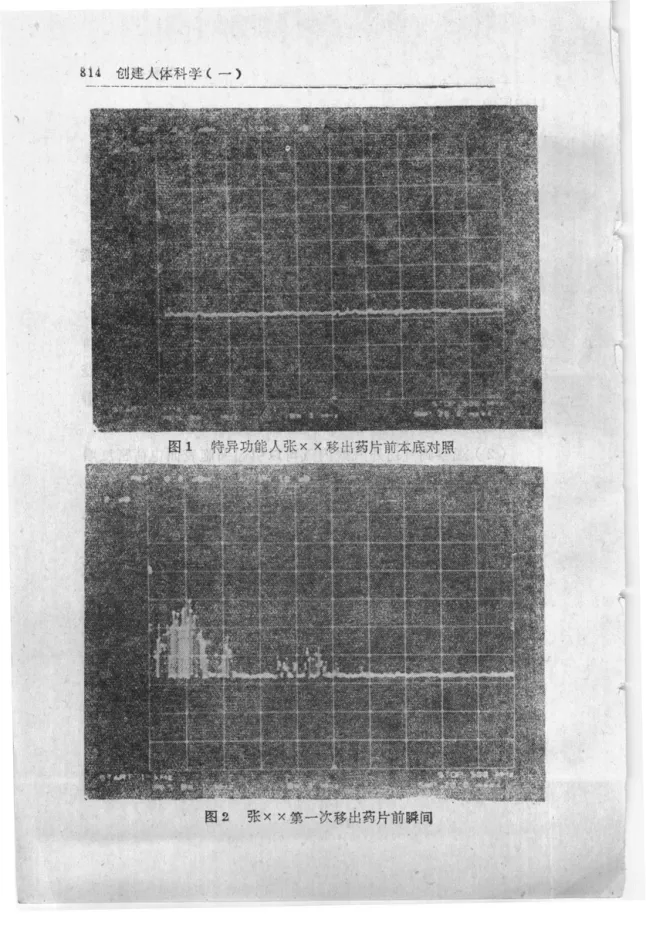
Figure 1 Background control of extraordinary-function subject Zhang ×× before removing the pill
Figure 2 Zhang ×× at the instant before removing the pill for the first time
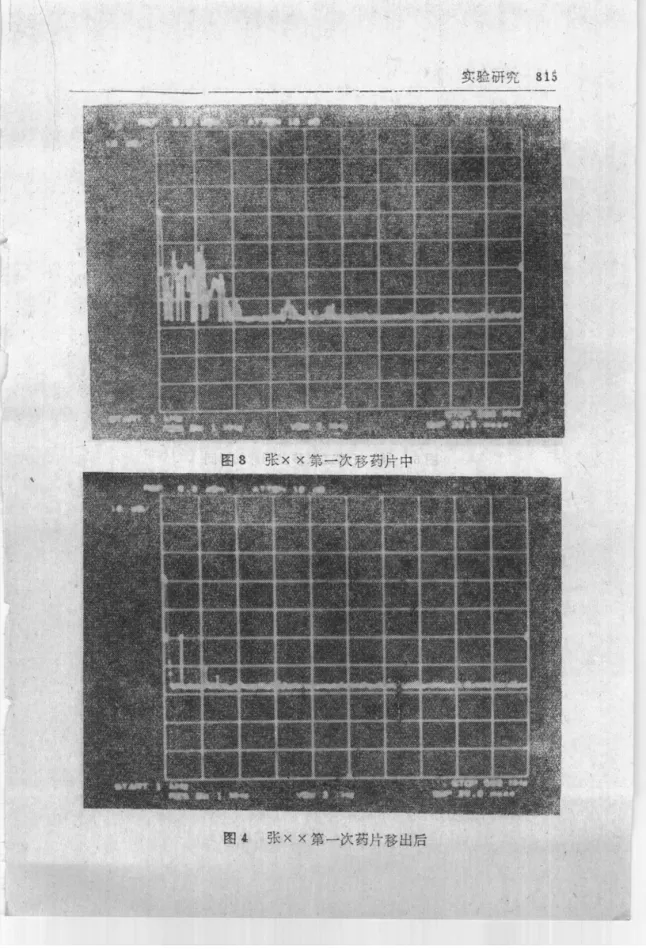
Figure 8 Zhang ×× during the first transfer of tablets
Figure 4 Zhang ×× after the first tablet transfer-out
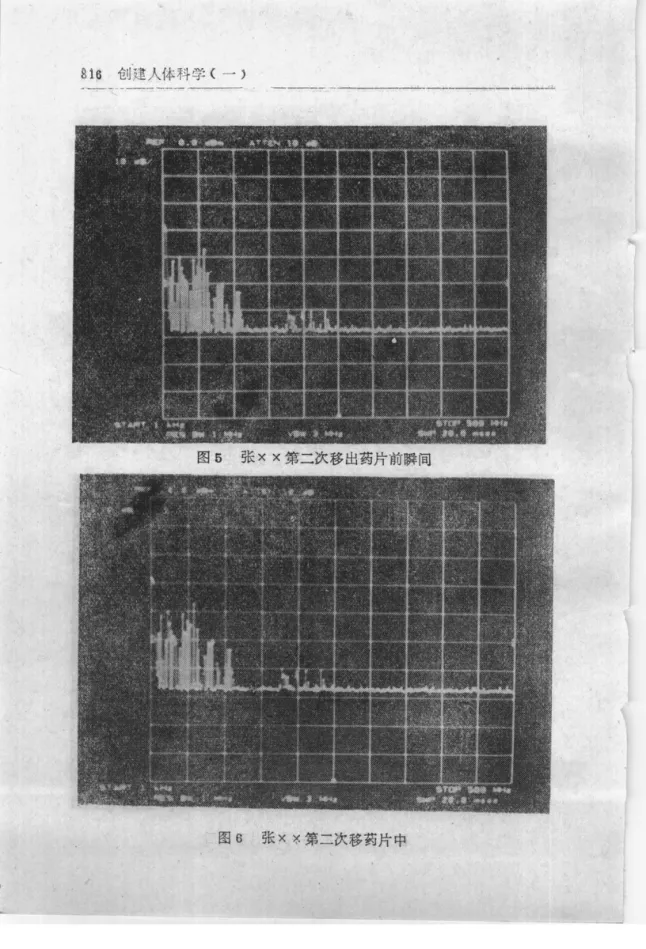
Figure 5 Zhang ×× in the instant before the second tablet transfer-out
Figure 6 Zhang ×× during the second transfer of tablets
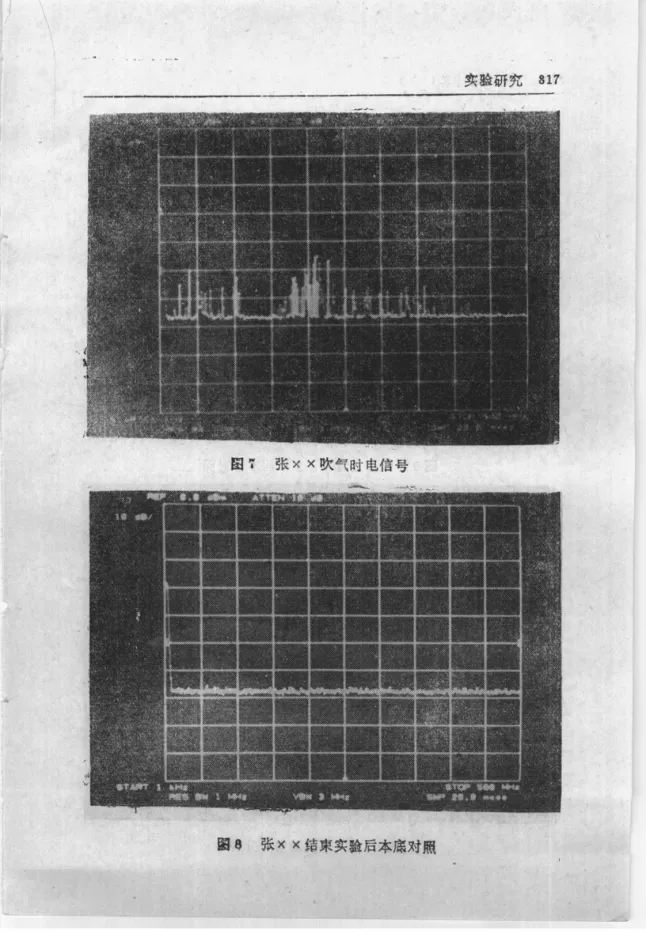
Figure 7 Electrical signal when Zhang ×× blows air
STOP 500 MHz
me06
Figure 8 Zhang ×× background control after the conclusion of the experiment
Figure 9 Background control of qigong practitioner Zhan ×× before emitting qi
Figure 10 Zhan ×× during the first minute of emitting qi
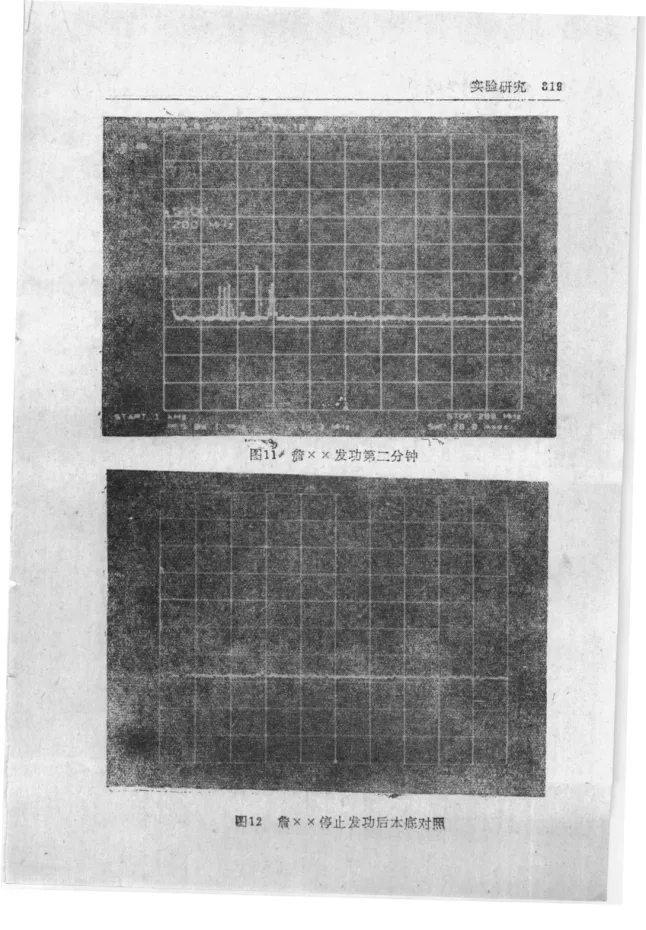
Figure 11 Zhan ×× emitting qigong, second minute Figure 12 Background control after Zhan ×× stopped emitting qigong
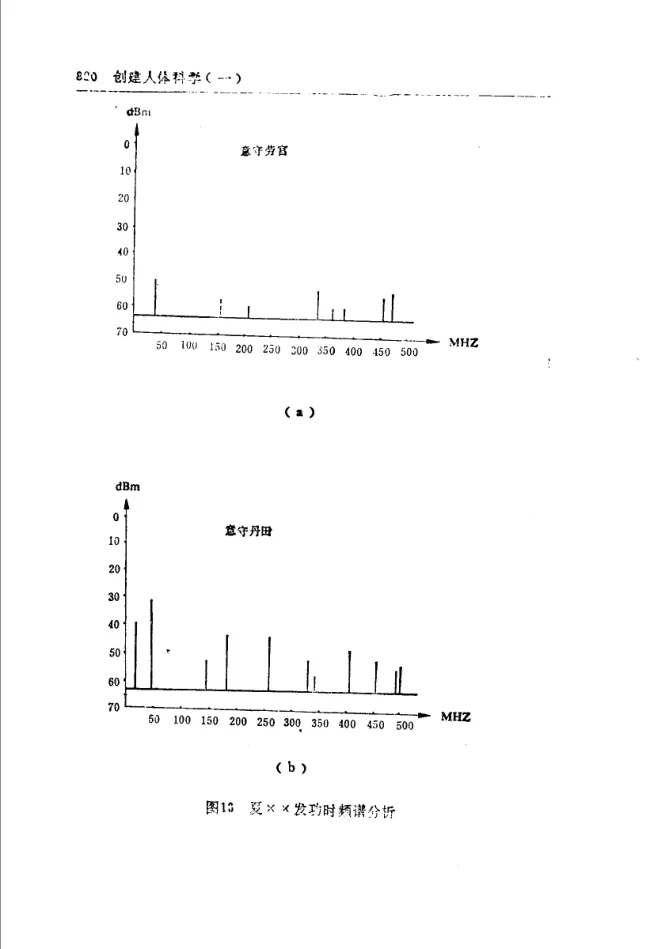
Focusing intention on Laogong 20 30 40 50 60 70 50 100 150 200 250 300 350 400 450 500 MHz (a) dBm 0 Focusing intention on Dantian 10 20 30 40 50 à 60 70 50 100 150 200 250 300 350 400 450 500 MHz (b) Figure 13 Spectrum analysis of Xia ×× during qigong emission
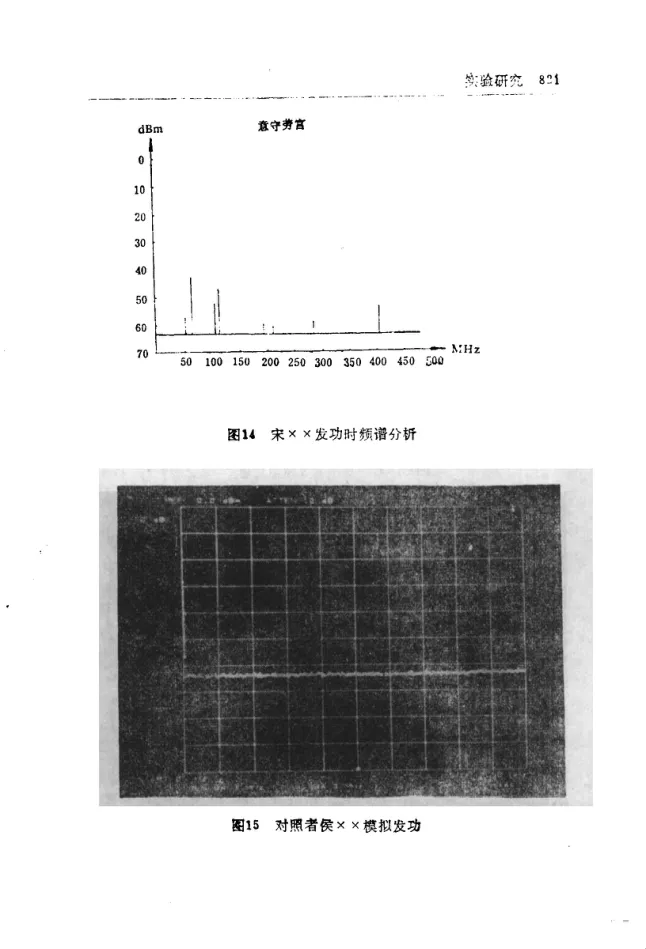
Focusing intention on Laogong dBm 10 20 30 40 50 60 1 MHz 70 50 100 150 200 250 300 350 400 450 003 Figure 14 Spectrum analysis of Song ×× during qigong emission Figure 15 Control subject Hou ×× simulating qigong emission
Figure 15 Control subject Wang ×× simulating qigong emission Figure 17 Control subject Wang × simulating qigong emission
Figure 18: Control subject Tong × simulating qigong emission
Figure 19: Control subject Gao ×× simulating qigong emission, first minute
Figure 20: Control subject Gao ×× simulating qigong emission, second minute
Figure 21: Repeated test background control in the shielding cage in the laboratory ([)
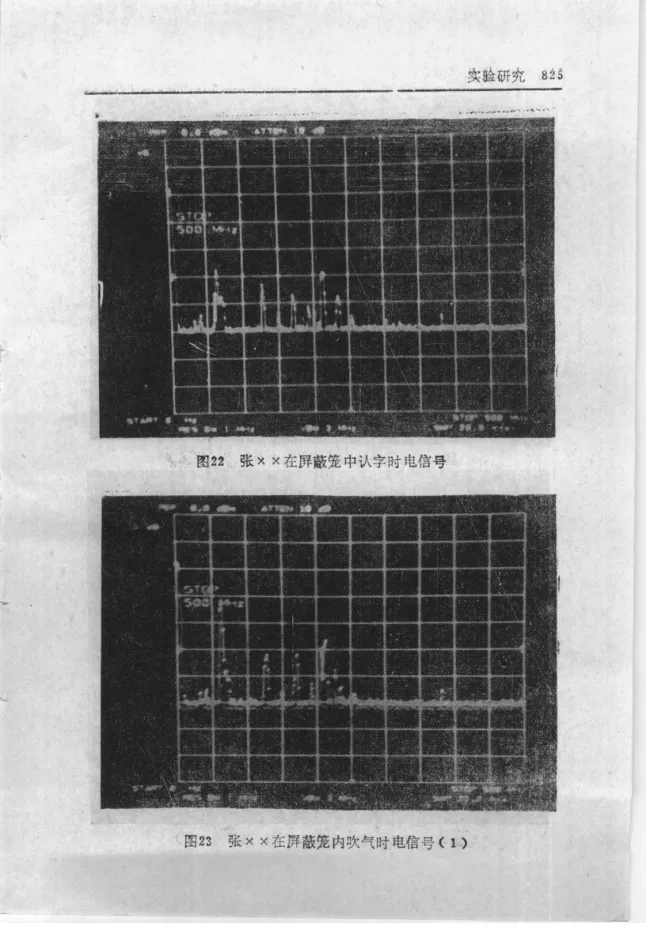
STO
500
M18
Figure 22: Electrical signal when Zhang ×× is recognizing characters inside the shielding cage
Figure 23: Electrical signal when Zhang ×× is blowing air inside the shielding cage (1)
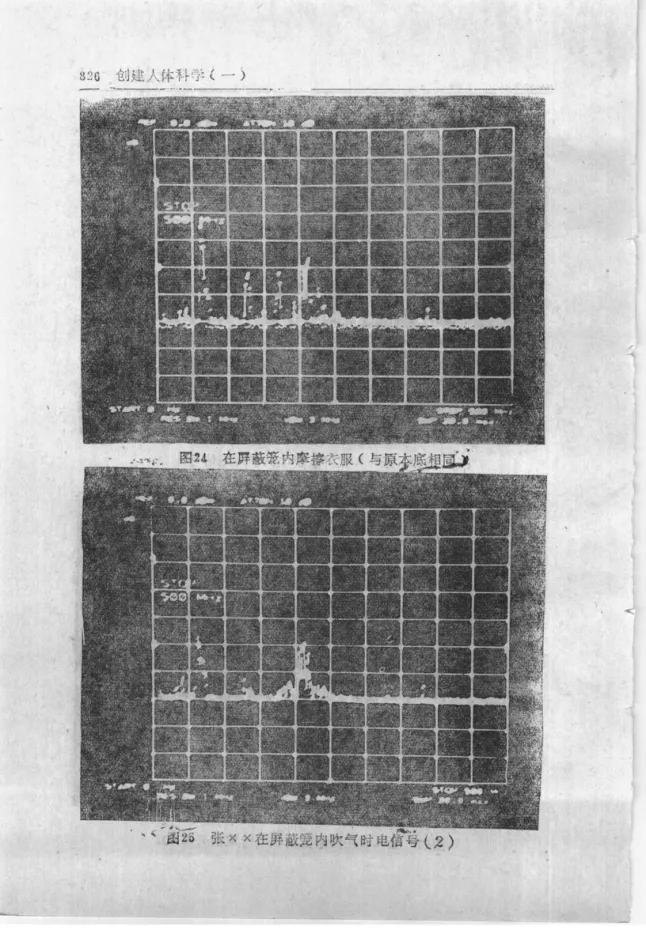
Figure 24: Rubbing clothing inside the shielding cage (same as original background)
Figure 25: Electrical signal when Zhang ×× is blowing air inside the shielding cage (2)
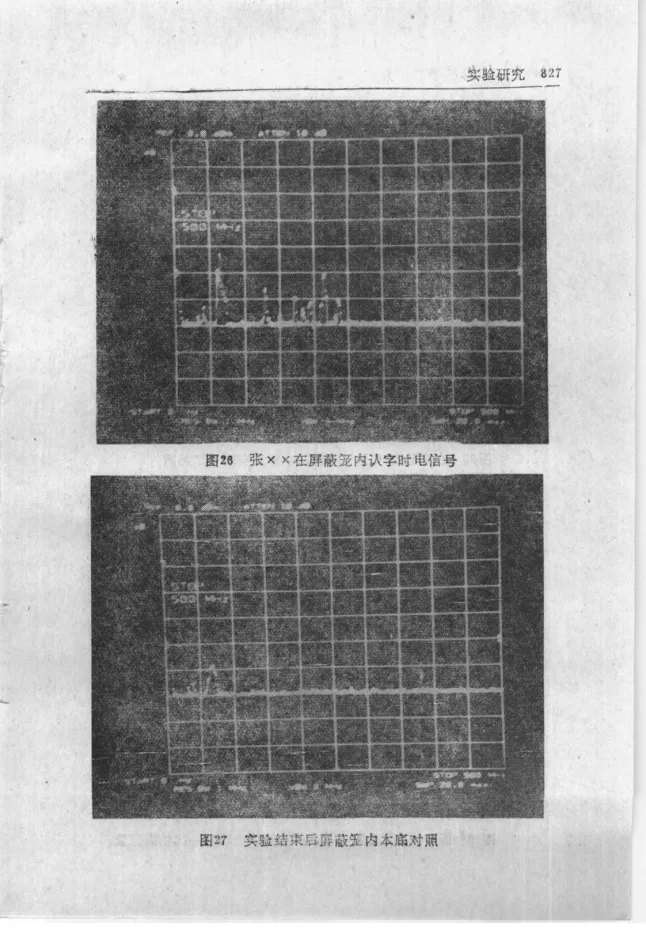
Figure 26: Electrical signal when Zhang ×× recognized characters inside the shielding cage
Figure 27: Background control inside the shielding cage after the experiment
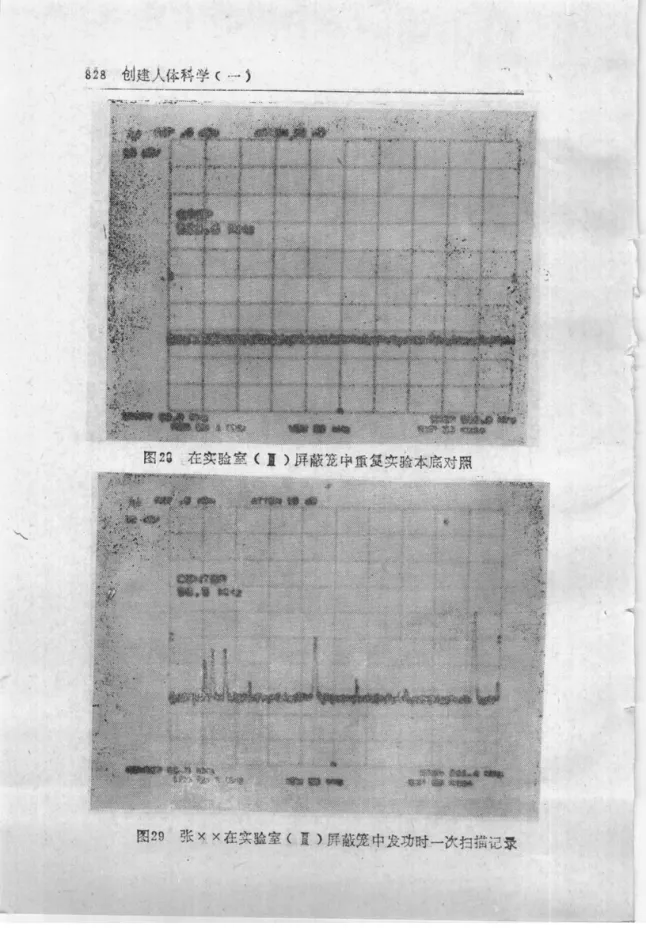
Figure 28: Background control for the repeated experiment inside the shielding cage in the laboratory ()
Figure 29: A single scanning record when Zhang ×× emitted qigong inside the shielding cage in the laboratory ()
Notes and References
[1] Ma Jiren, Zhongguo Qigongxue (Chinese Qigong Studies), Shaanxi Science and Technology Press, (1982). [2] B. Canaway, R. Dobzin (trans. Zhang Aixue, Zhang Huimin): “Historical Accounts of the Existence and Functions of the Human Energy Field”, Nature Journal, 4, 11 (1981) 831. [3] Qian Cunze: “Domestic and International Progress and Prospects of Research on the Human Energy Field”, paper presented at the Second Academic Symposium of the National Qigong Science Research Association, (1984). [4] Nie Songqing, Hui Qing et al.: “Effect of Royal Jelly on the Fluidity of Rat Erythrocyte Membranes”, Journal of Beijing Medical College, 15, 4 (1983) 249. [5] Shi Yongde, Liang Zijun et al.: “Biorheology and Medicine”, Biological Science Reference Materials, Vol. 19, (1985) 99. [6] Liang Zijun, Shi Yongde et al.: “Cell Electrophoresis Technique and Its Applications in Biology and Medicine”, Progress in Biochemistry and Biophysics, (1976) 54. [7] Lin Kechun et al.: “Study on the Fluidity of Ascites Cancer Cell Membranes Using the Fluorescent Probe DPH”, Progress in Biochemistry and Biophysics, 6 (1981) 32. [8] Beijing Medical College Writing Group: Foundations of Clinical Traditional Chinese Medicine, People’s Education Press (1975). [9] Chen Xin, Long Shengzhao: “Promoting Research in Human-Body Science by Utilizing the Achievements of Modern Science and Technology”, Collected Papers, Vol. 5, Institute of Space Medico-Engineering (1983). [10] L. L. Vasiliev. Experiments in Distant Influence (Ed. Gregory A) Wildwood House, London, (1976). [11] E. Balanovski & J. G. Taylor: Can electromagnetism account for extra-sensory phenomena? Nature Vol. 276, 2, P. 64, Nov. (1978). [12] Taylor, J. G, & E. Balanovski: Is there any Scientific explanation of the paranormal? Nature Vol. 279, 14, June (1979). [13] D. I. McRee: Soviet and Eastern European Research
on Biological Effects of Microwave Radiation. Proc. of the IEEE Vol. 68, No 1, p. 84. (1980). [14] E. J. Lerner: Biological effects of electromagnetic field, IEEE Spectrum Vol. 21, No 3, p. 57. (1984). [15] W. R. Adey: Frequency and Power Windowing. Proc. of the IEEE. Vol. 68, No 1, p. 119. (1980). [16] M. Inbar et al.: A Method for the quantitative detection of Human Lymphatic leukemia. Eur. J. Cancer. 13. 1231. (1977).
Appendix Figures
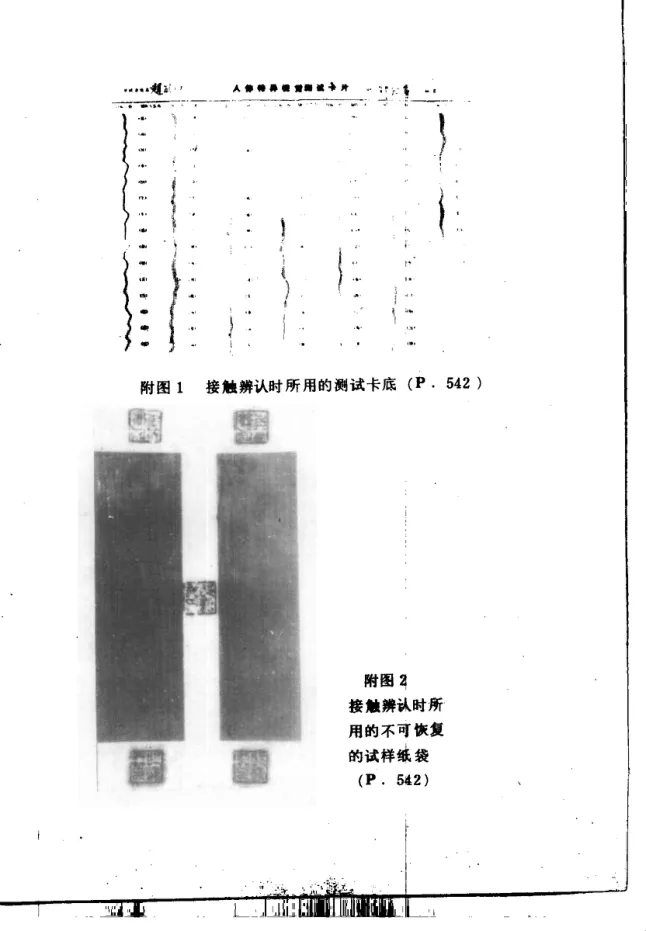
Extraordinary human abilities test cards Figure 1 Test card backs used in contact identification (P. 542) Figure 2 Non-recoverable sample paper bags used in contact identification (P. 542)
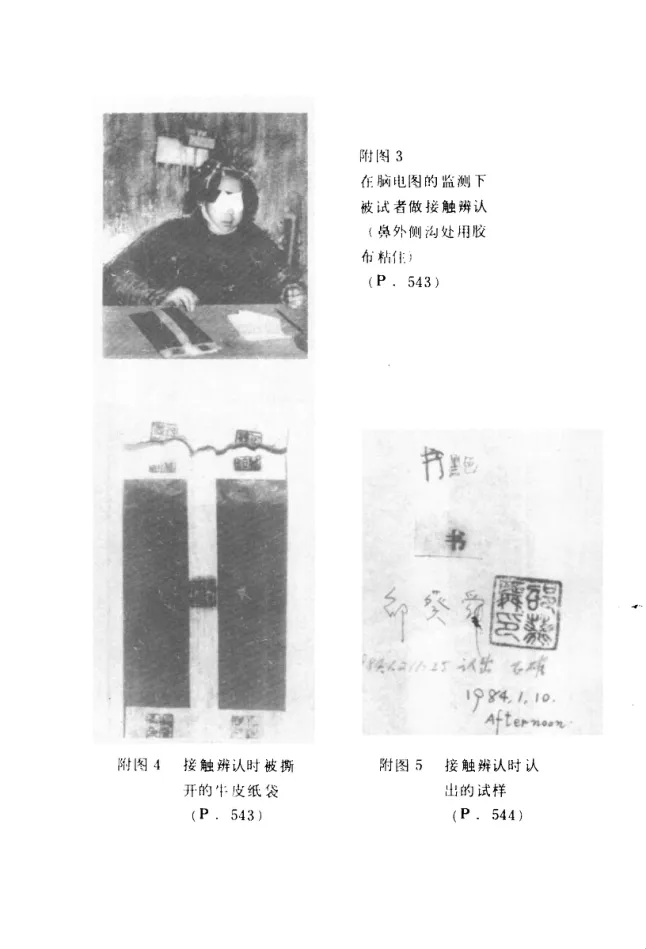
Figure 3 The subject performs contact identification under EEG monitoring (adhesive tape applied at the nasolabial sulcus) (P. 543) 1984, 1, 10. Afternoon Figure 4 Kraft paper bag torn open during contact identification Figure 5 Sample recognized during contact identification (P. 543) (P. 544)
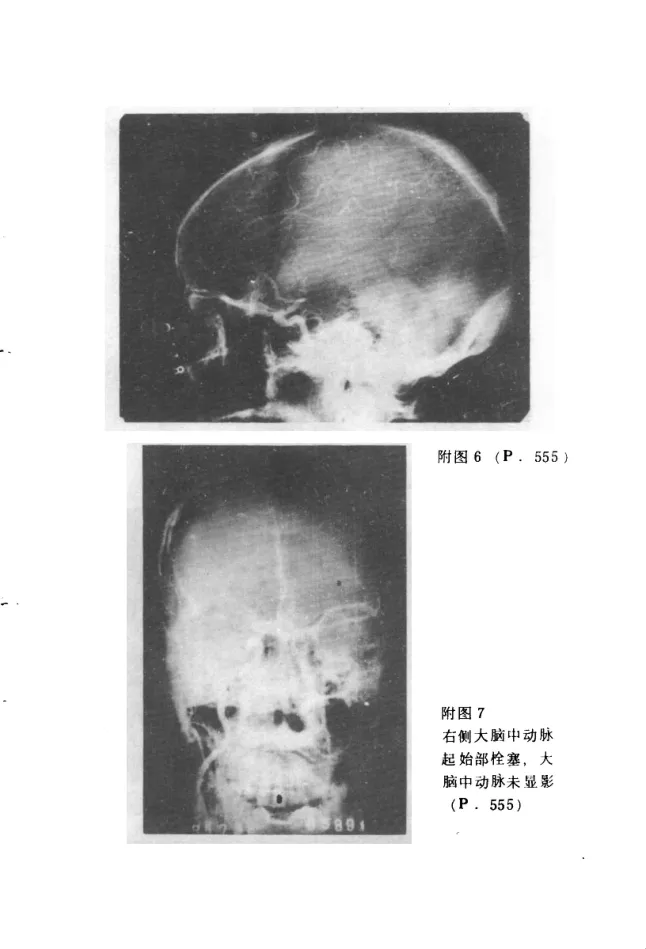
Figure 6 (P. 555) Figure 7 Embolism at the origin of the right middle cerebral artery; the middle cerebral artery is not visualized (P. 555) 891
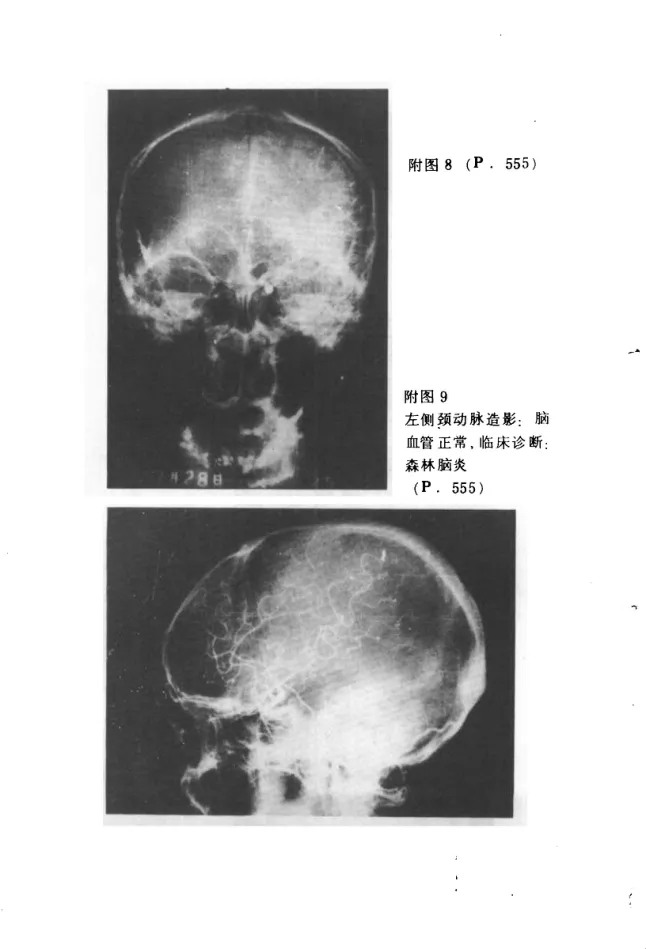
Figure 8 (P. 555) Figure 9 Left carotid angiography: cerebral vessels normal; clinical diagnosis: forest encephalitis April 28 (P. 555)
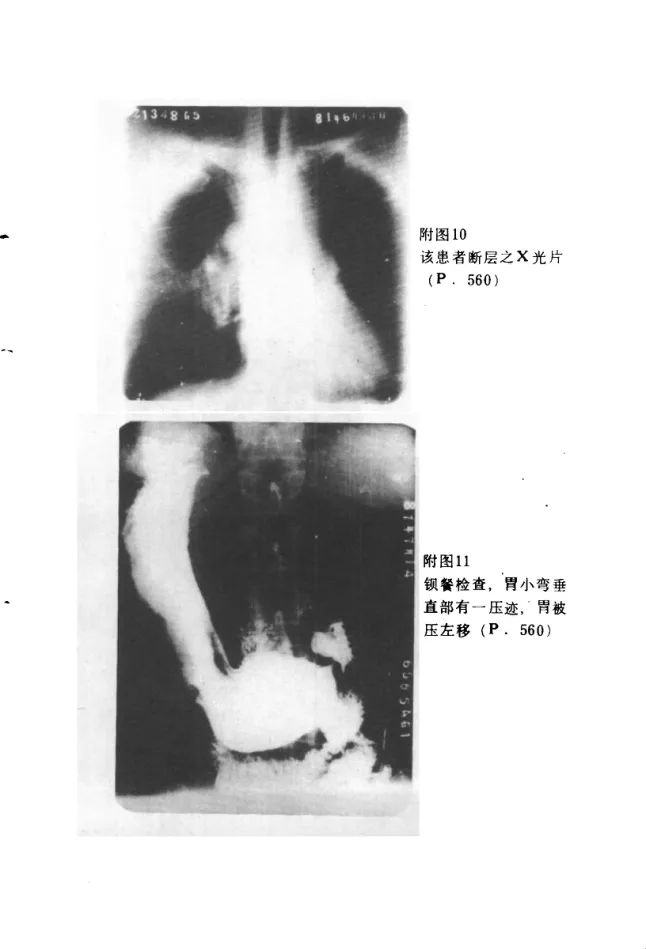
2134865 April 3, 1964 Figure 10 Tomographic X-ray film of this patient (P. 560) Figure 11 Barium meal examination: there is an indentation at the vertical portion of the lesser curvature of the stomach, and the stomach is compressed and shifted to the left (P. 560) 46
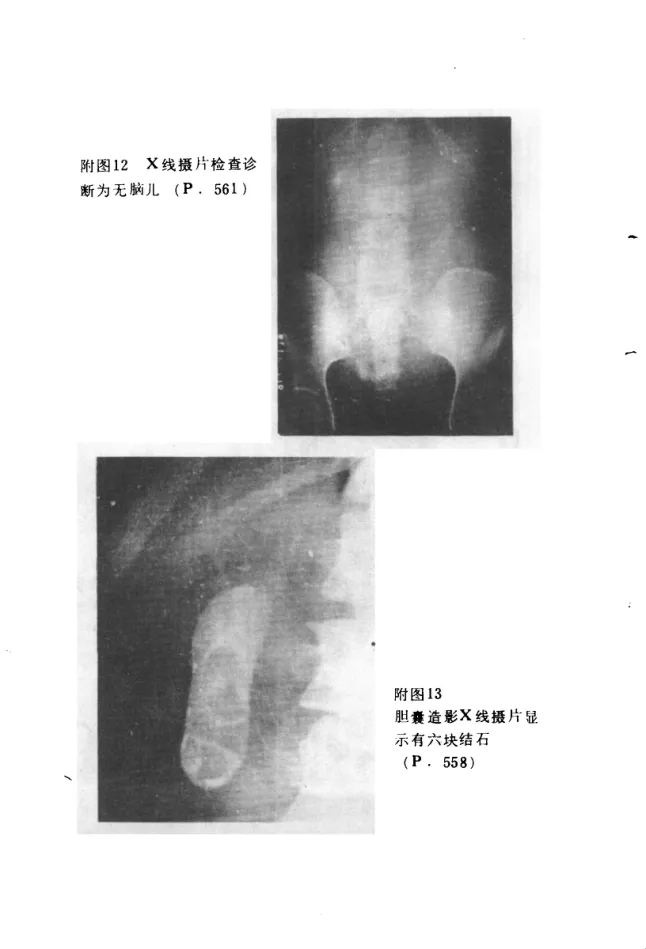
Figure 12 X-ray film examination diagnosed as anencephaly (P. 561) Figure 13 Cholecystography X-ray film shows six stones (P. 558)
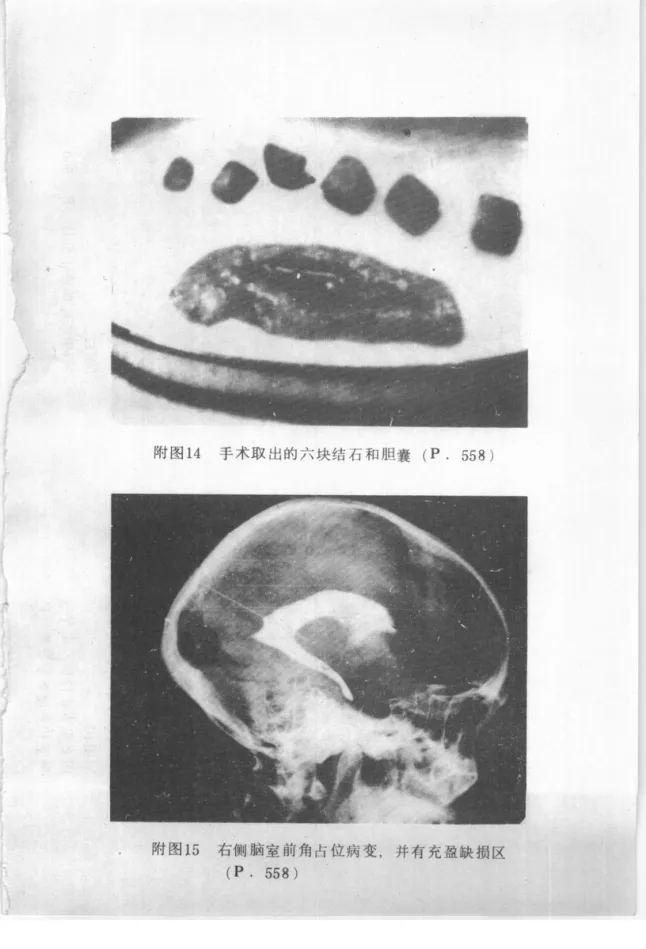
Figure 14 The six stones and gallbladder removed during surgery (P. 558) Figure 15 Space-occupying lesion in the anterior horn of the right lateral ventricle, with an area of filling defect (P. 558)
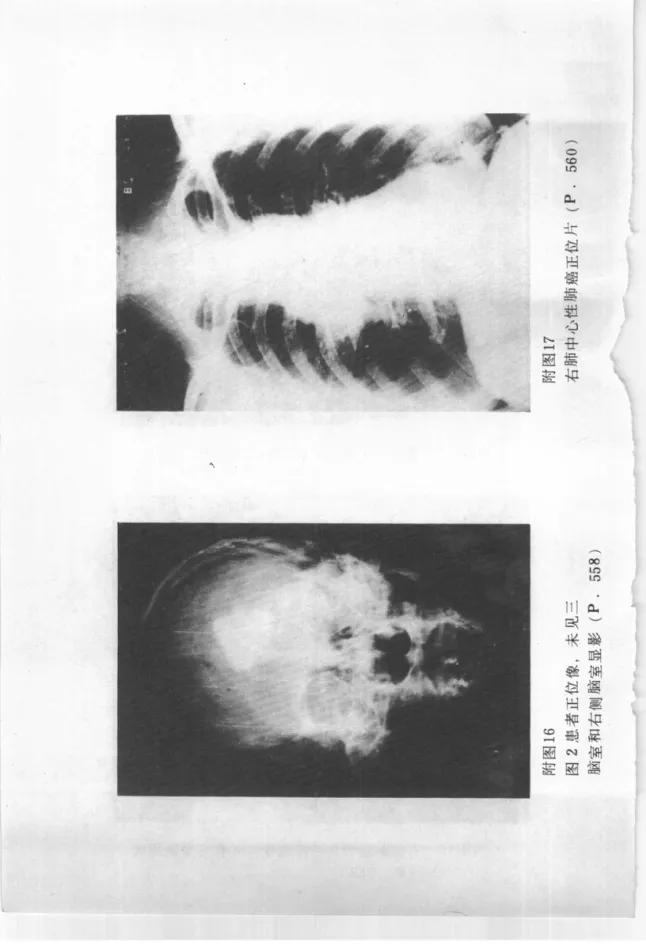
Appendix Figure 16 Figure 2: Frontal (AP) image of the patient; three not visualized
Appendix Figure 17 Visualization of the cerebral ventricles and right lateral ventricle (p. 558)
Frontal (AP) radiograph of central lung cancer of the right lung (p. 560)
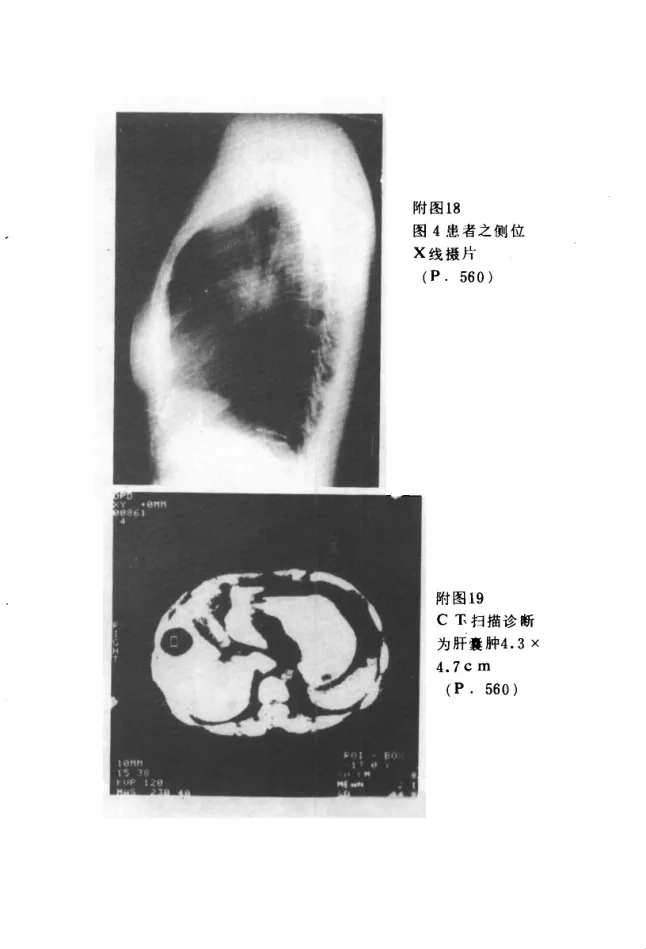
Appendix Figure 18 Figure 4: Lateral radiograph of the patient (p. 560) +0MM 08861
Appendix Figure 19 CT scan diagnosis: hepatic cyst, 4.3 × 4.7 cm (p. 560) 08 10MM 15 38 KUP 120 ME sefu
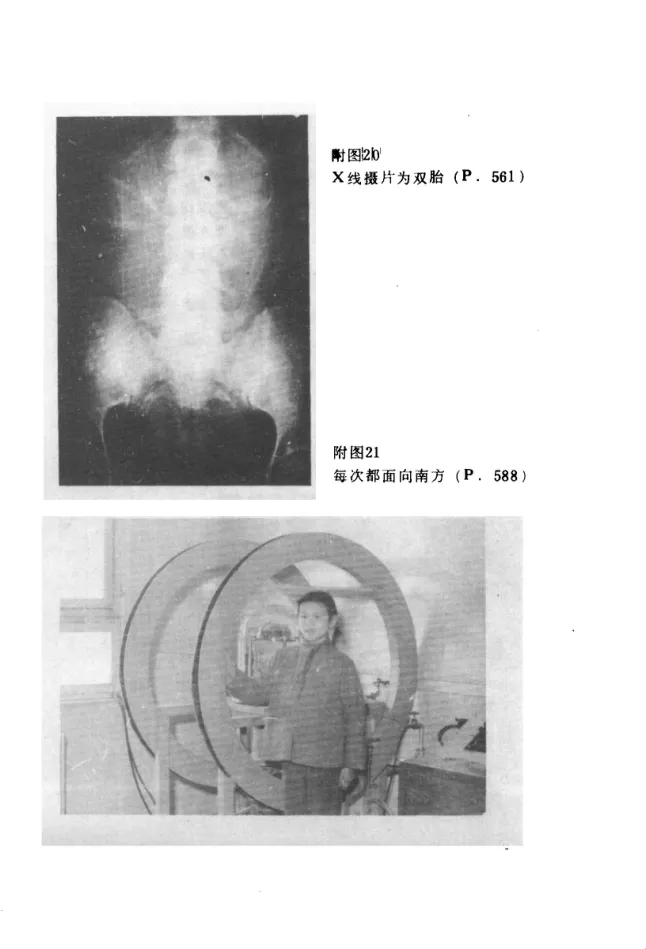
Appendix Figure 2·10 Radiograph showing twins (p. 561)
Appendix Figure 2·1 Facing south every time (p. 588)
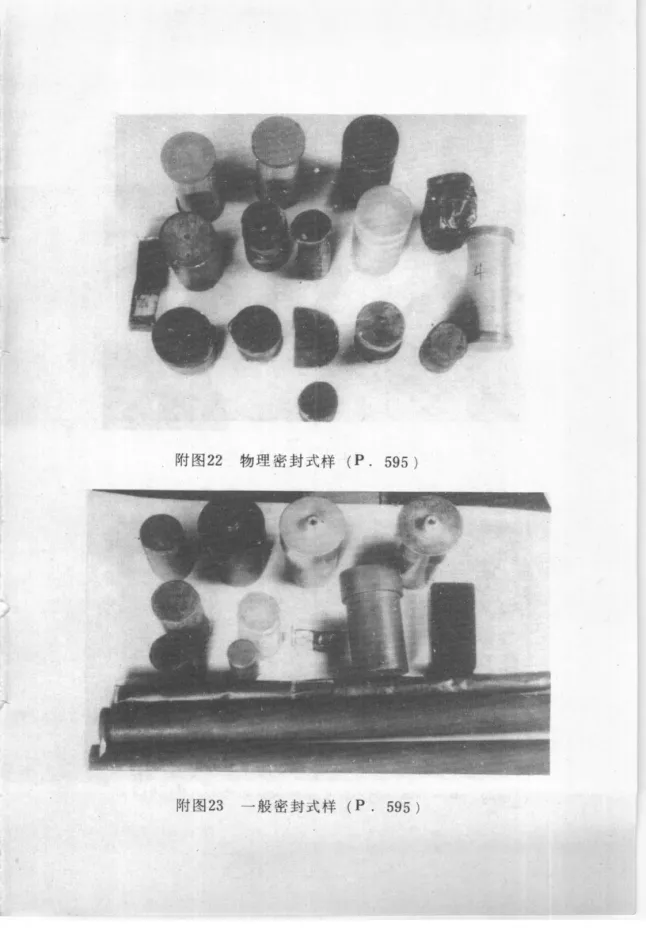
Appendix Figure 2·2 Physical seal specimen (p. 595)
Appendix Figure 2·3 General seal specimen (p. 595)
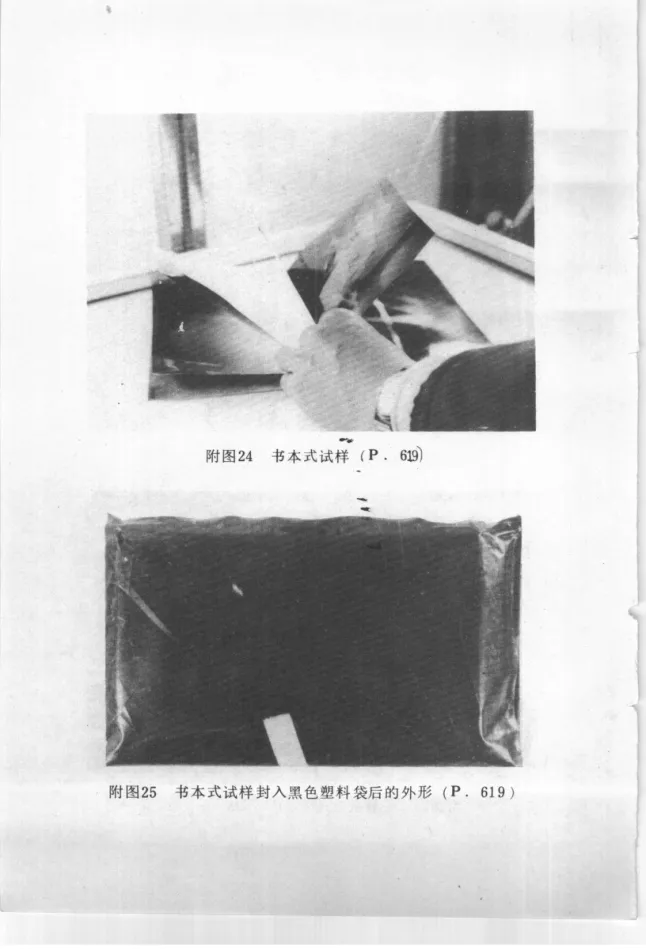
Figure 24 Book-style sample (P. 619)
Figure 25 Appearance of the book-style sample after being sealed in a black plastic bag (P. 619)
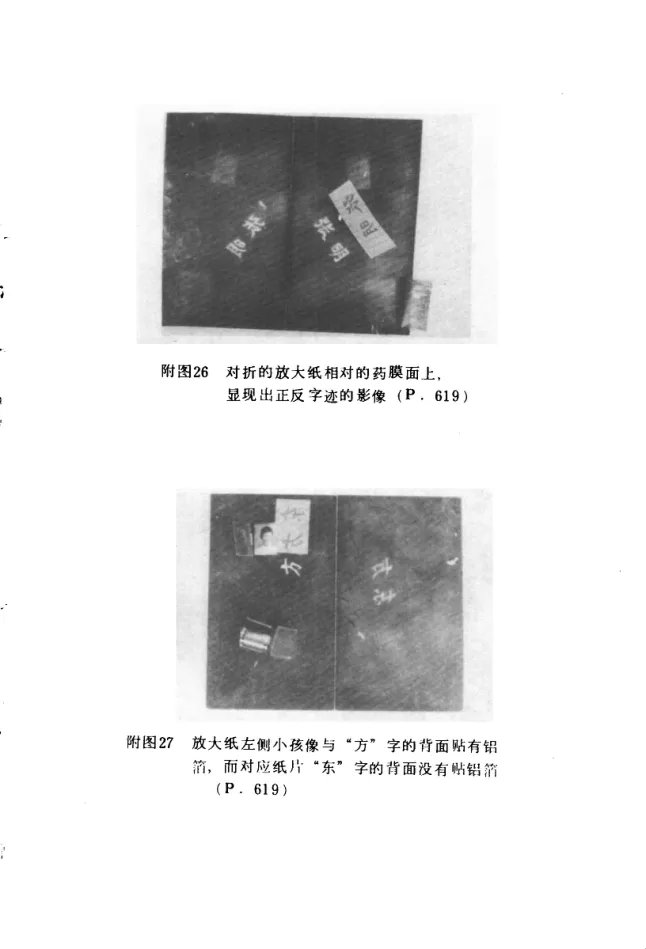
Yang Gong Zhang Ming Ji Figure 26 On the opposing emulsion surfaces of the folded enlargement paper, images of frontal and reversed characters appeared (P. 619)
Figure 27 The back of the child image on the left side of the enlargement paper and the character “Fang” were affixed with aluminum foil, while the back of the corresponding paper piece with the character “Dong” was not affixed with aluminum foil (P. 619)
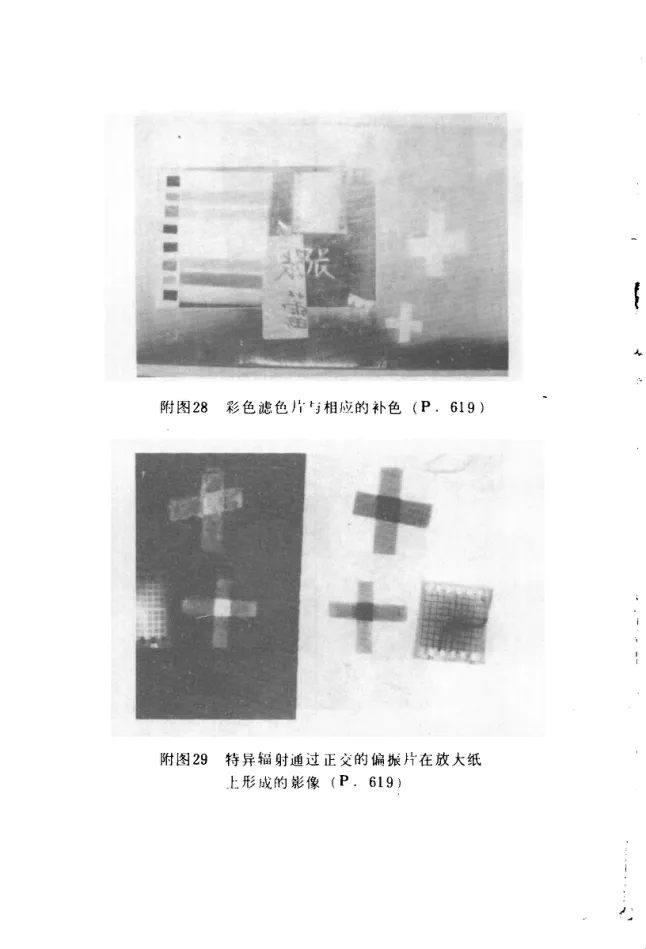
Zhang Figure 28 Complementary colors corresponding to the color filter (P. 619)
Figure 29 Image formed on the enlargement paper by extraordinary radiation passing through crossed polarizers (P. 619)
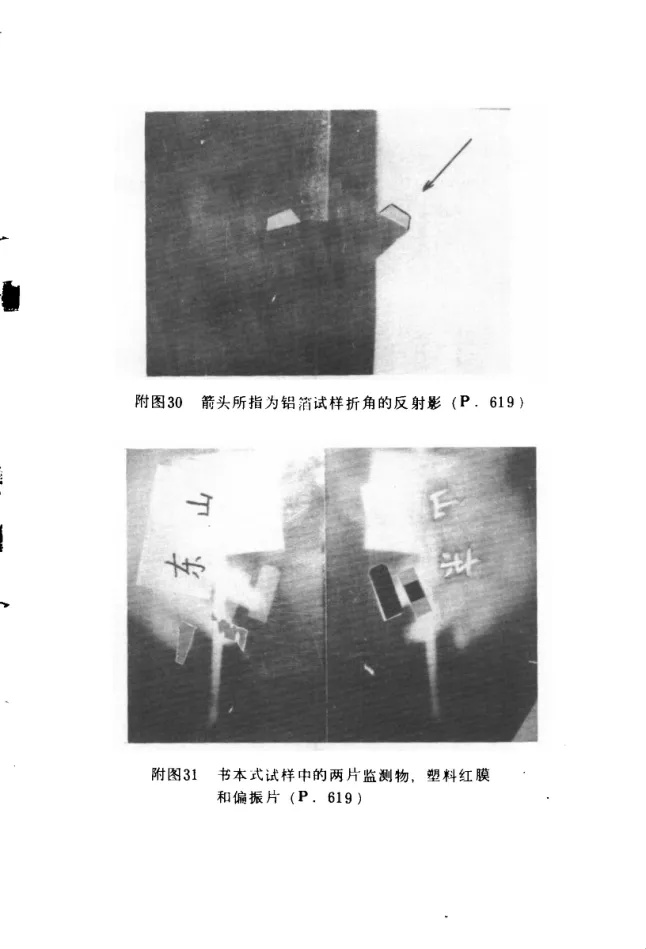
Figure 30 The arrow points to the reflection of the folded corner of the aluminum foil sample (P. 619)
Dongshan Shanjing Figure 31 Two monitoring objects in the book-style sample: red plastic film and polarizer (P. 619)
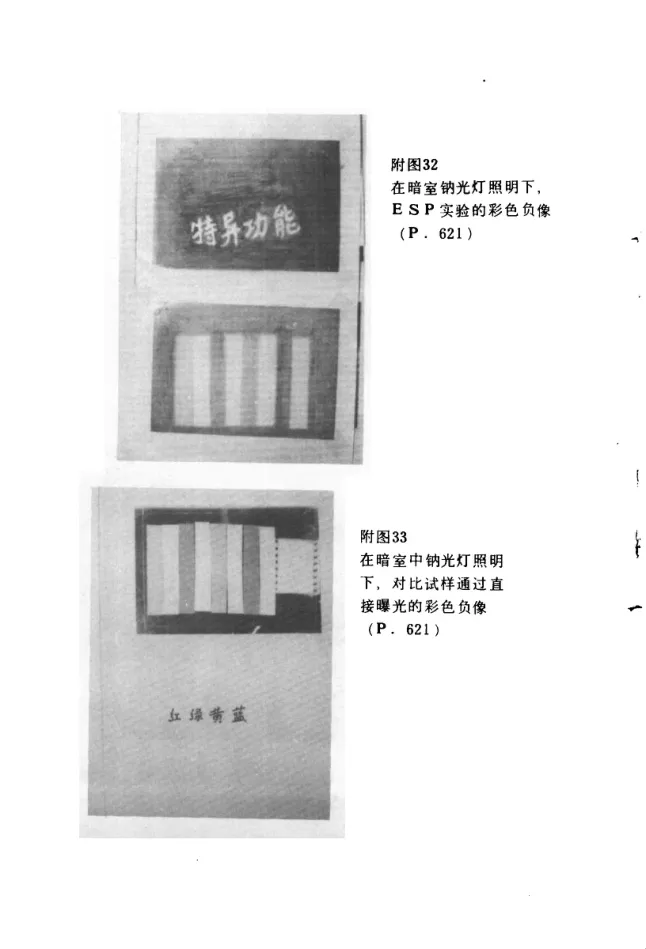
Appendix Figure 32 In a darkroom under sodium lamp illumination, color negative image of the ESP experiment extraordinary abilities (P. 621) Appendix Figure 33 In a darkroom under sodium lamp illumination, color negative image of the control sample through direct exposure (P. 621) Red, Green, Yellow, Blue
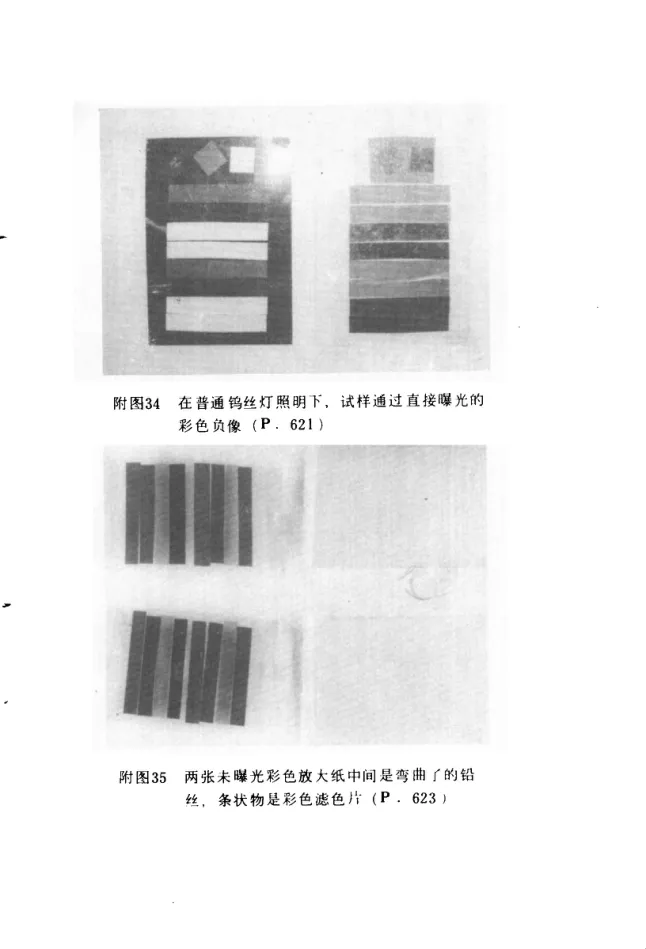
Appendix Figure 34 Under ordinary tungsten lamp illumination, color negative image of the sample through direct exposure (P. 621) Appendix Figure 35 Between two sheets of unexposed color enlargement paper is a bent lead wire; the strip-shaped object is a color filter (P. 623)
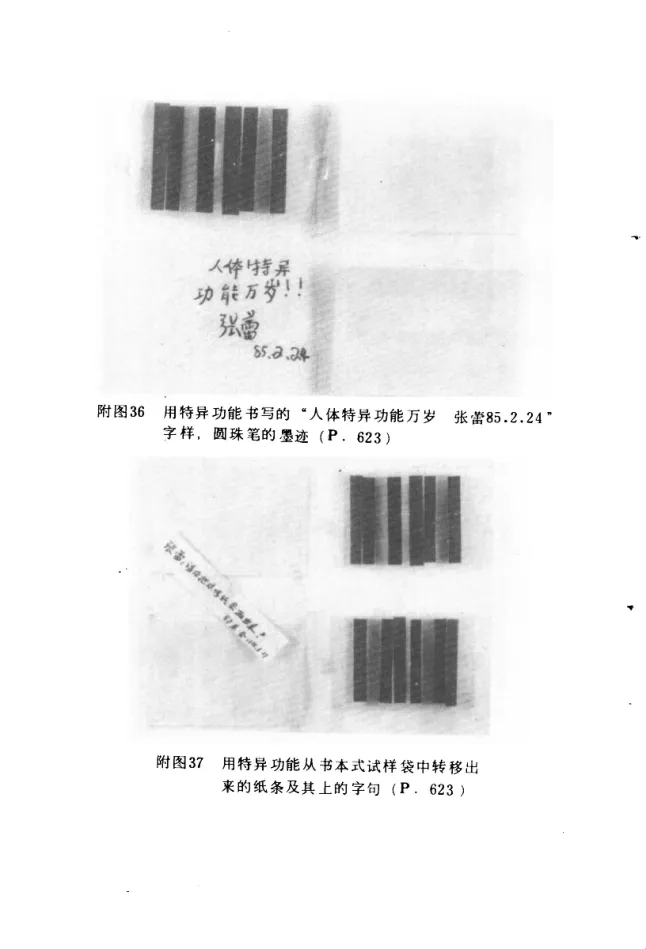
Long live human-body extraordinary abilities!! Zhang Lei 85.2.24 Appendix Figure 36 The text “Long live human-body extraordinary abilities!! Zhang Lei 85.2.24” written using extraordinary abilities, ballpoint pen ink trace (P. 623) Zhang Lei: Please take out the paper slip! 57 Table 10.19 Appendix Figure 37 A paper slip transferred out from a booklet-style sample bag using extraordinary abilities, and the words written on it (P. 623)
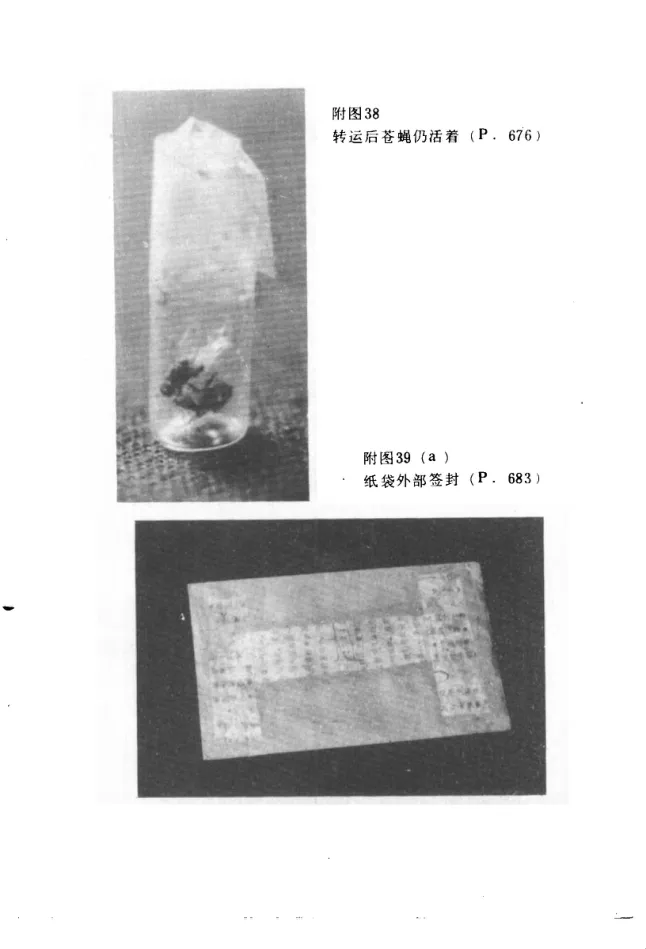
Appendix Figure 38 The fly was still alive after transfer (P. 676) Appendix Figure 39(a) External seal on the paper bag (P. 683)
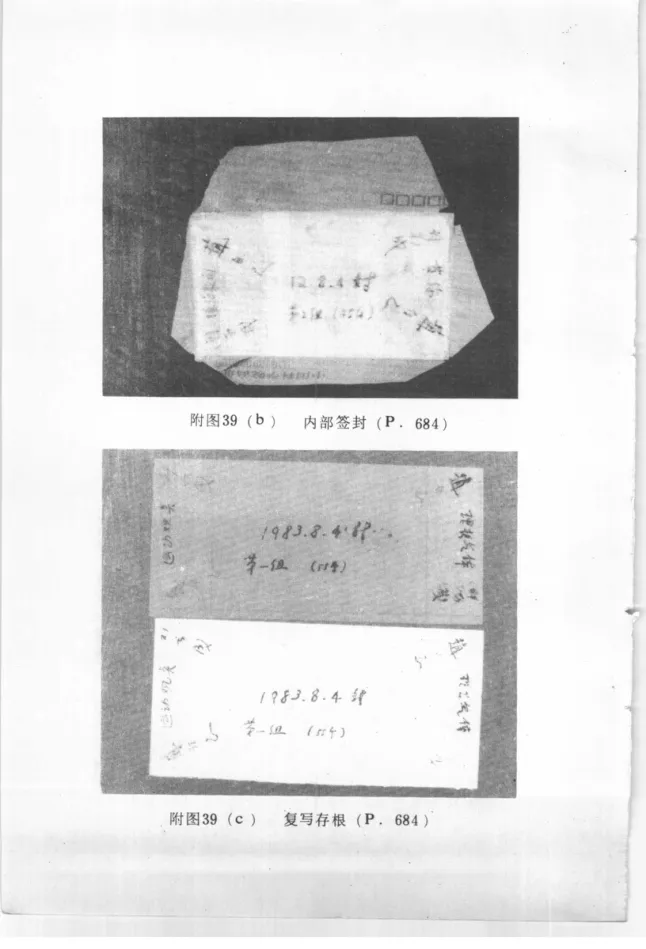
Figure 39(b) Internal seal (P.684) Visible seal metadata: 1983.8.4; Group 2 (054). Figure 39(c) Carbon-copy stub (P.684) Visible stub metadata: 1983.8.4; Group 1 (114); 1983.8.4; Group 2 (054).
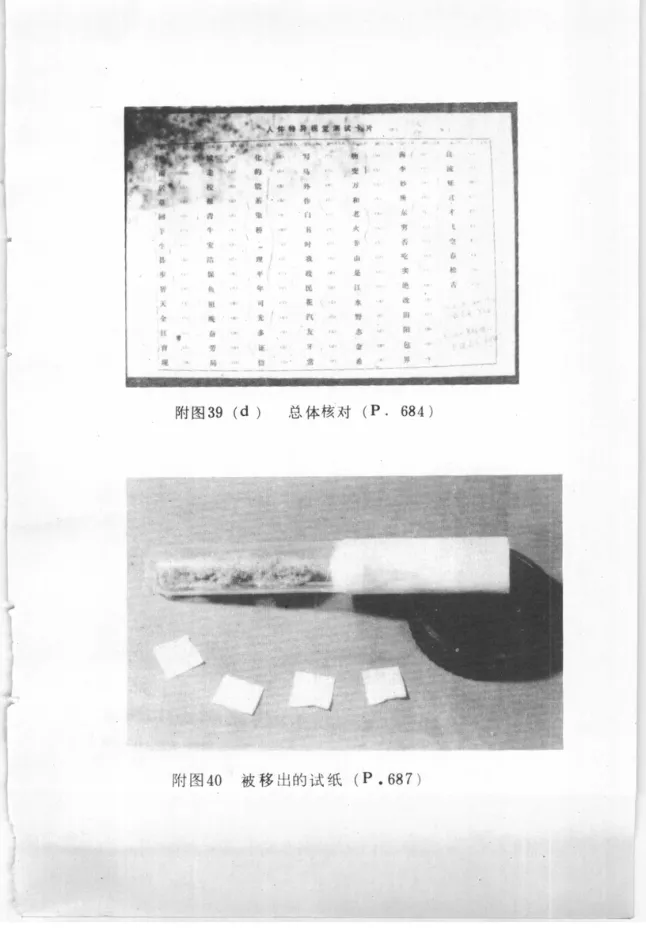
Human-body Extraordinary-vision test cards 化 写 物 变 李 外 万 妙 和 所 老 东 书 火 穷 时 县 我 吃 步 政 民 江 实 吉 花 水 改 全 光 汽 野 田 红 奋 多 友 阳 育 劳 证 牙 金 包 现 局 信 常 界 Figure 39(d) Overall verification (P.684) Figure 40 Removed test paper (P.687)
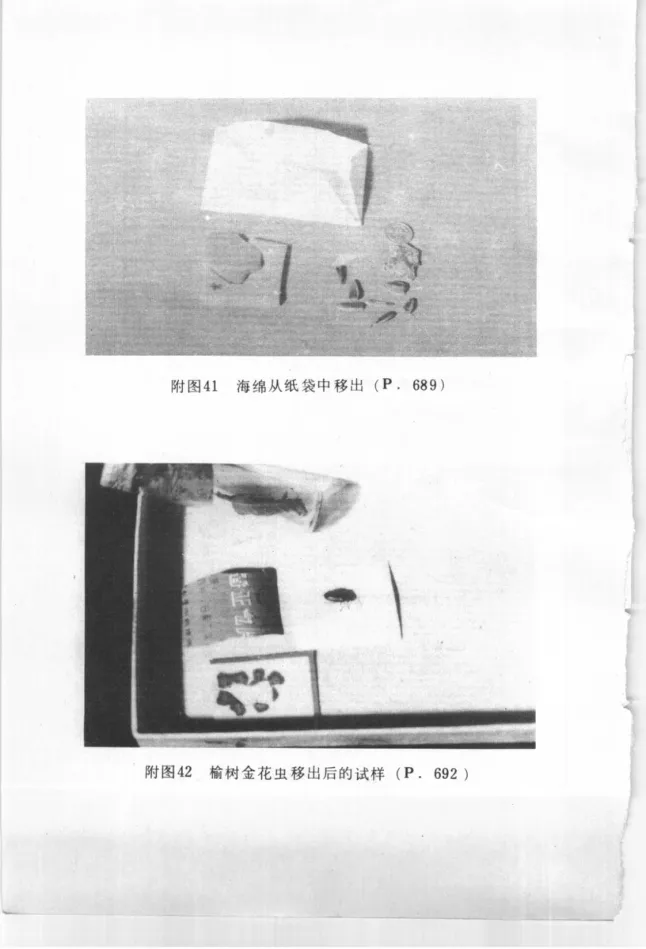
Figure 41 Sponge removed from paper bag (P. 689) Zheng-yi Figure 42 Sample after removal of elm-leaf beetle (P.692)
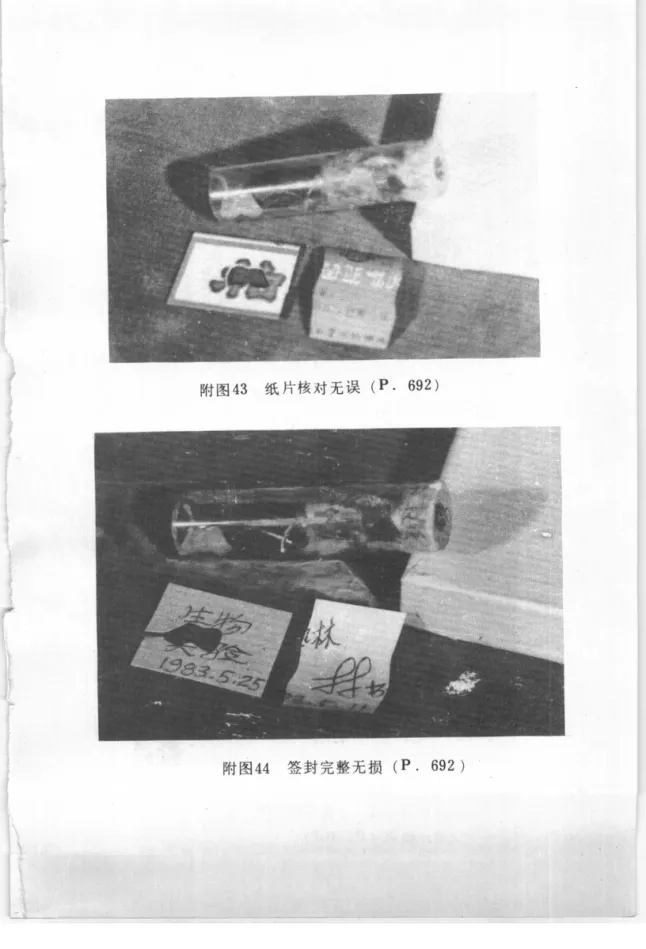
Figure 43 Paper slips verified without discrepancy (P.692) Biological sample 1983.5.25 Figure 44 Seal intact and undamaged (P.692)
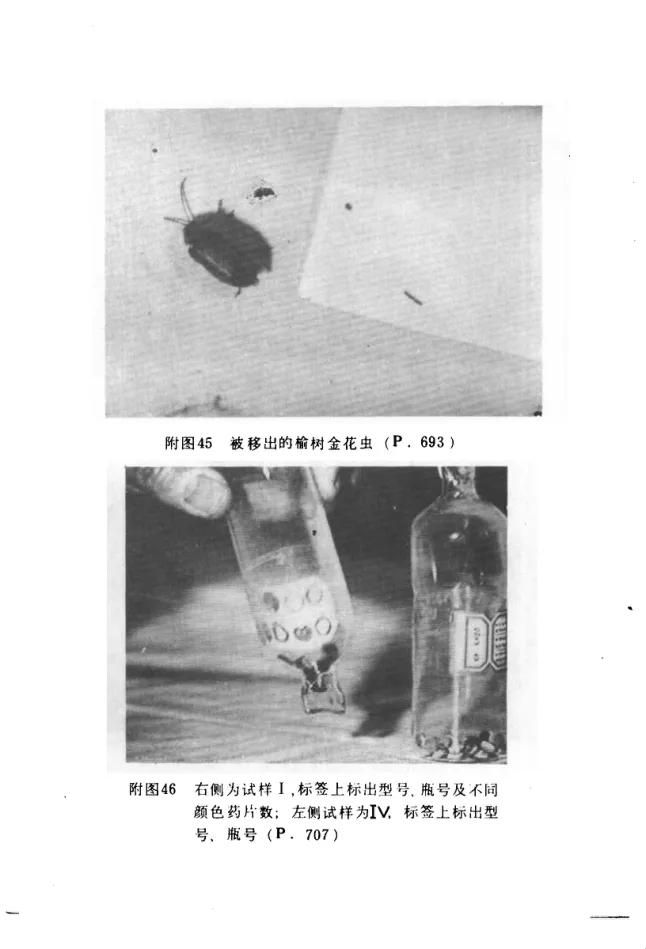
Appendix Figure 45 The removed elm leaf beetles (P. 693)
Appendix Figure 46 On the right is Sample I; the label indicates the model, bottle number, and the number of tablets of different colors; on the left is Sample IV; the label indicates the model and bottle number (P. 707)
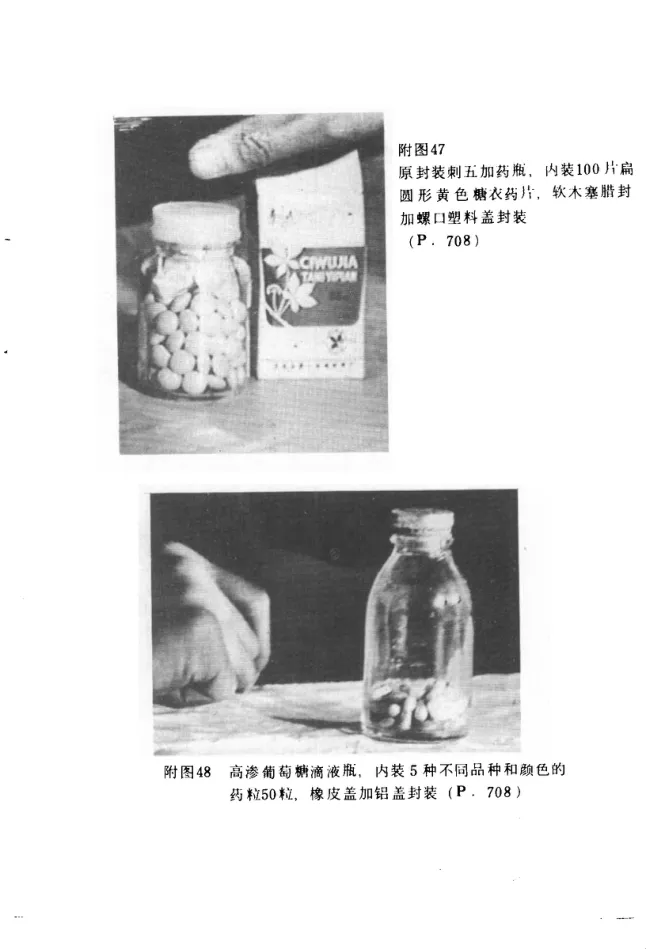
Appendix Figure 47 Originally sealed Ciwujia (Siberian ginseng) medicine bottle, containing 100 oblate yellow sugar-coated tablets, sealed with cork stopper wax seal plus screw-cap plastic closure (P. 708)
Appendix Figure 48 Hypertonic glucose infusion bottle, containing 50 pills of 5 different varieties and colors, sealed with rubber stopper plus aluminum cap (P. 708)
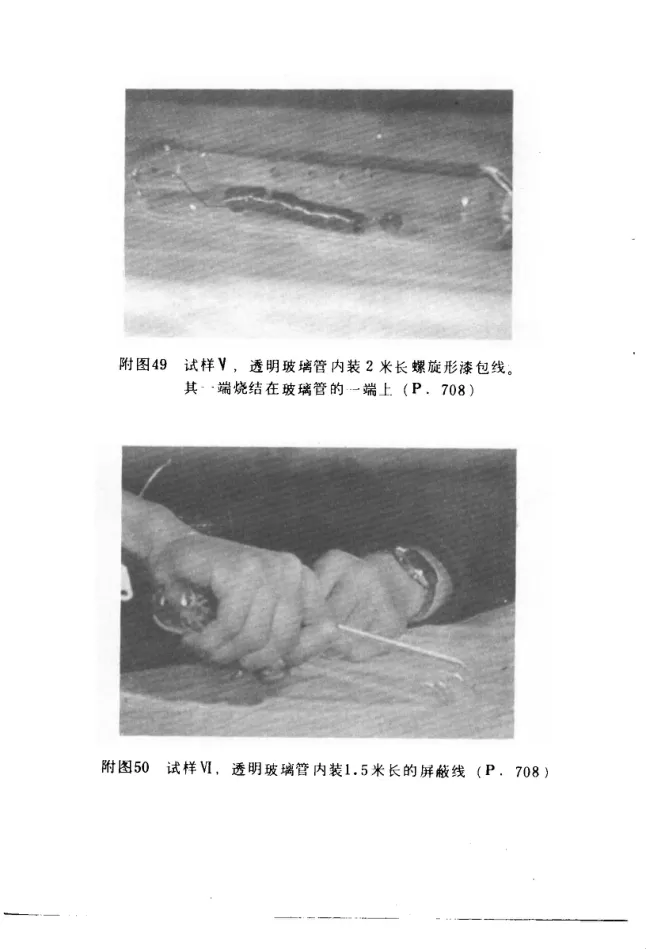
Appendix Figure 49 Sample V: transparent glass tube containing a 2-meter-long spiral enameled wire. One end is fused to an end of the glass tube (P. 708)
Appendix Figure 50 Sample VI: transparent glass tube containing a 1.5-meter-long shielded wire (P. 708)
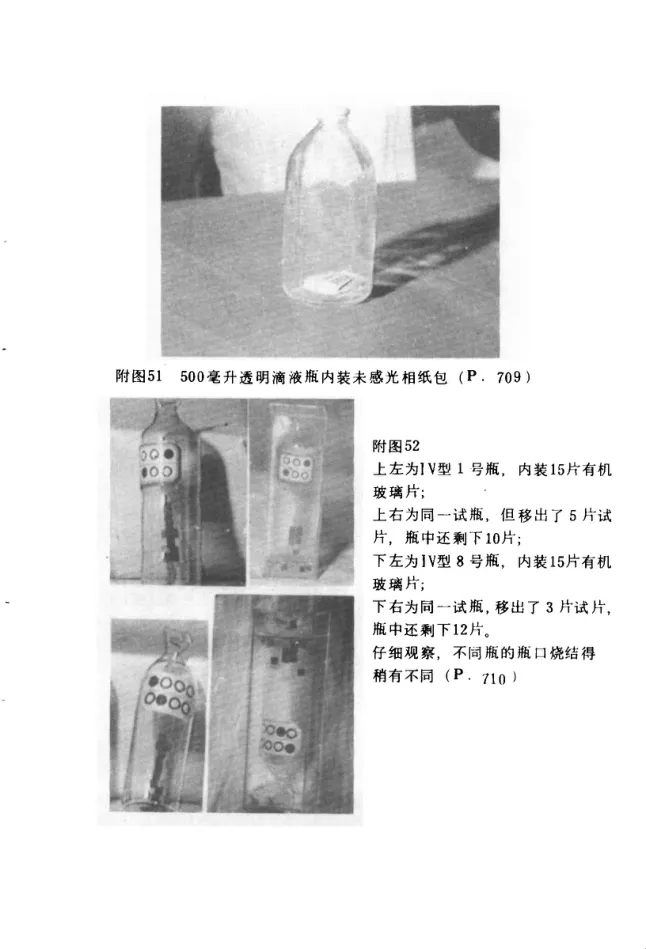
Appendix Figure 51 500 ml transparent infusion bottle containing a package of unexposed photographic paper (P. 709)
Appendix Figure 52 Upper left: Type IV, Bottle No. 1, containing 15 pieces of plexiglass; Upper right: the same test bottle, but 5 test pieces have been removed, leaving 10 pieces remaining in the bottle; Lower left: Type IV, Bottle No. 8, containing 15 pieces of plexiglass; Lower right: the same test bottle, with 3 test pieces removed, leaving 12 pieces remaining in the bottle. Upon careful observation, the mouths of different bottles are fused slightly differently (P. 710)
0000
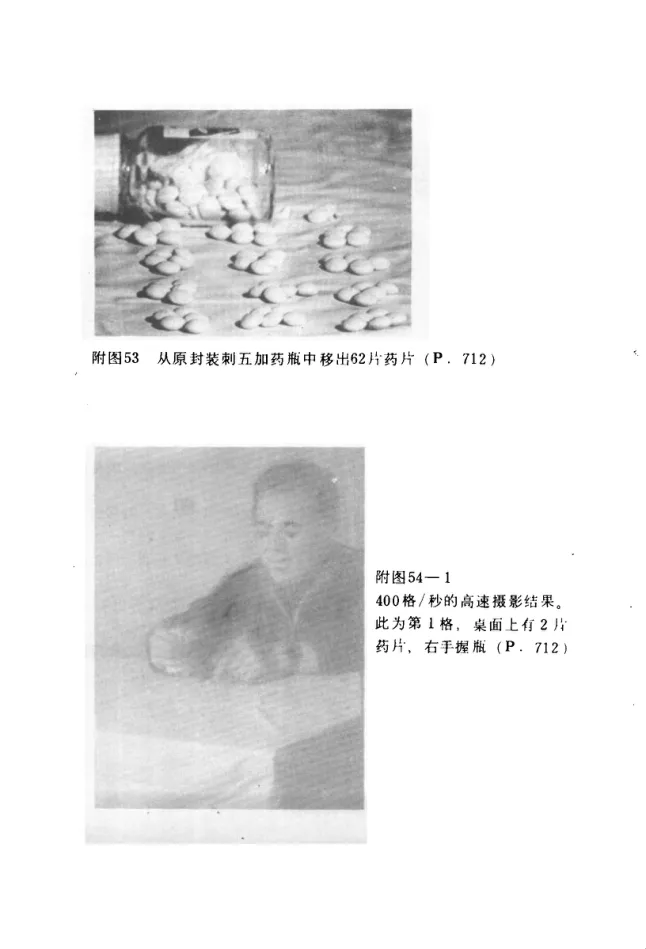
Figure 53 62 tablets removed from a factory-sealed Ciwujia medicine bottle (P. 712) Figure 54—1 Results of high-speed photography at 400 frames/second. This is frame 1, there are 2 tablets on the table, right hand holding the bottle (P. 712)
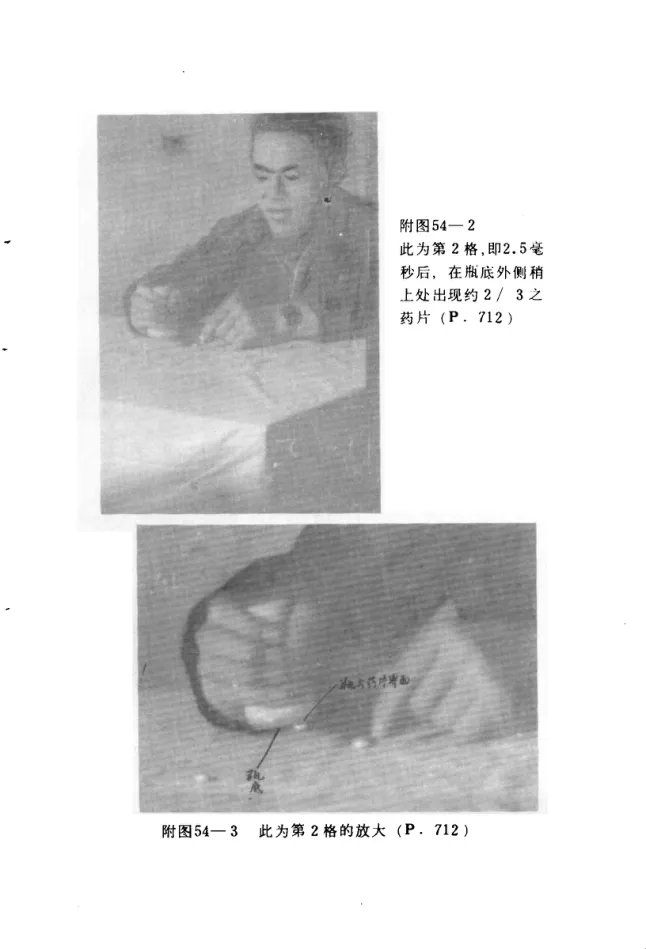
Figure 54—2 This is frame 2, that is, 2.5 milli- seconds later, about 2/3 of a tablet appears slightly above the outside of the bottle base (P. 712) Bottle and tablet interface Figure 54—3 Magnified view of frame 2 (P. 712)
Figure 54—4 This is frame 3, the tablet has already left the bottle base (P. 712) Figure 54—5 This is frame 4, the tablet continues to fall, but has not yet reached the table (P. 712)
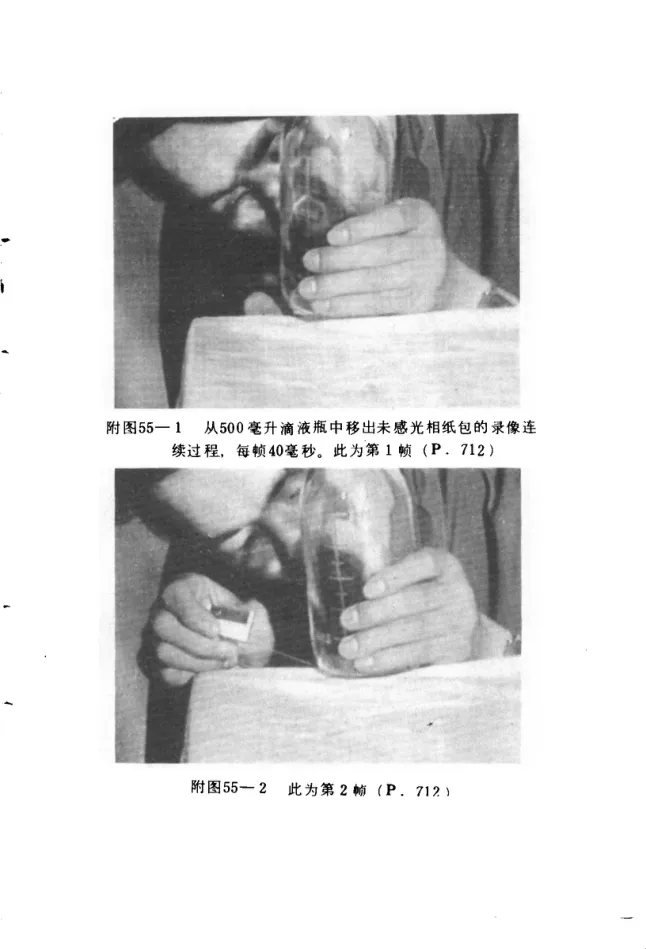
Figure 55—1 Continuous video recording process of removing an unexposed photographic paper packet from a 500 ml dropper bottle, 40 milliseconds per frame. This is frame 1 (P. 712) Figure 55-2 This is frame 2 (P. 712)
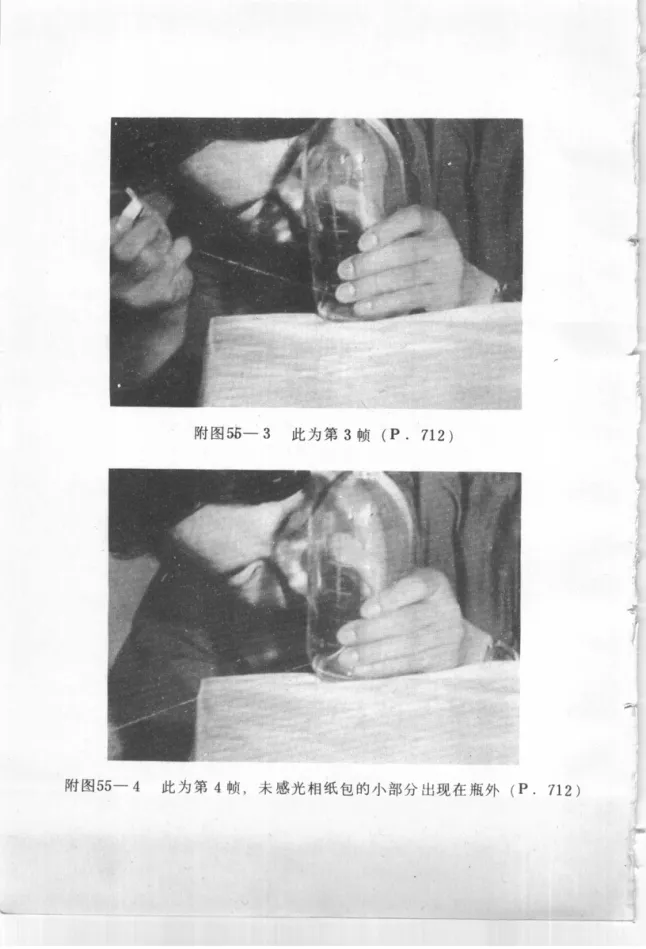
Figure 55–3 This is frame 3 (p. 712) Figure 55–4 This is frame 4; a small portion of the unexposed photographic paper packet has appeared outside the bottle (p. 712)
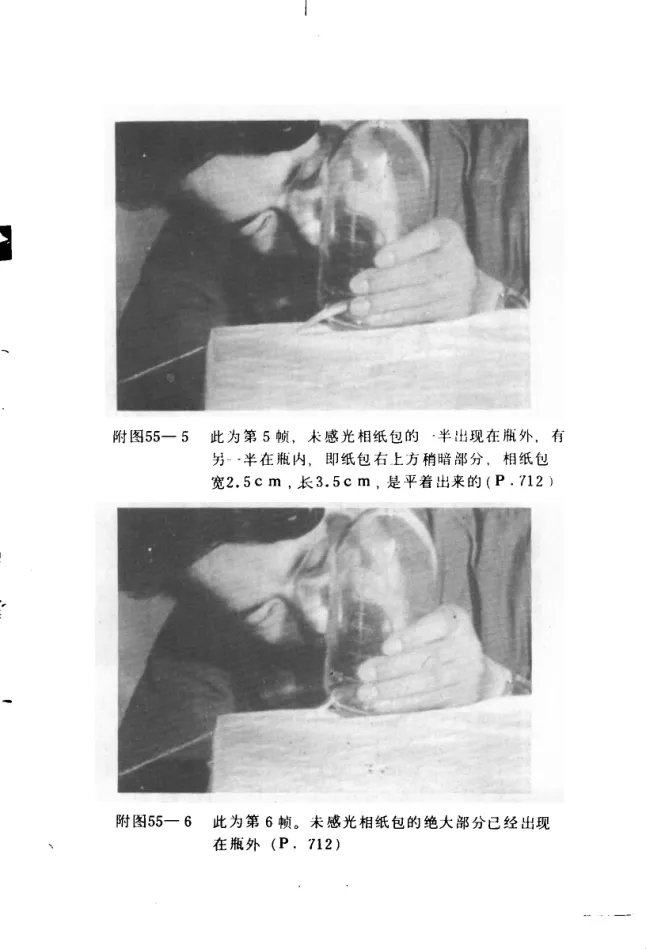
Figure 55–5 This is frame 5; half of the unexposed photographic paper packet has appeared outside the bottle, while the other half remains inside the bottle—that is, the slightly darker area at the upper right of the paper packet. The packet measures 2.5 cm wide and 3.5 cm long and came out flat (p. 712) Figure 55–6 This is frame 6; the vast majority of the unexposed photographic paper packet has already appeared outside the bottle (p. 712)
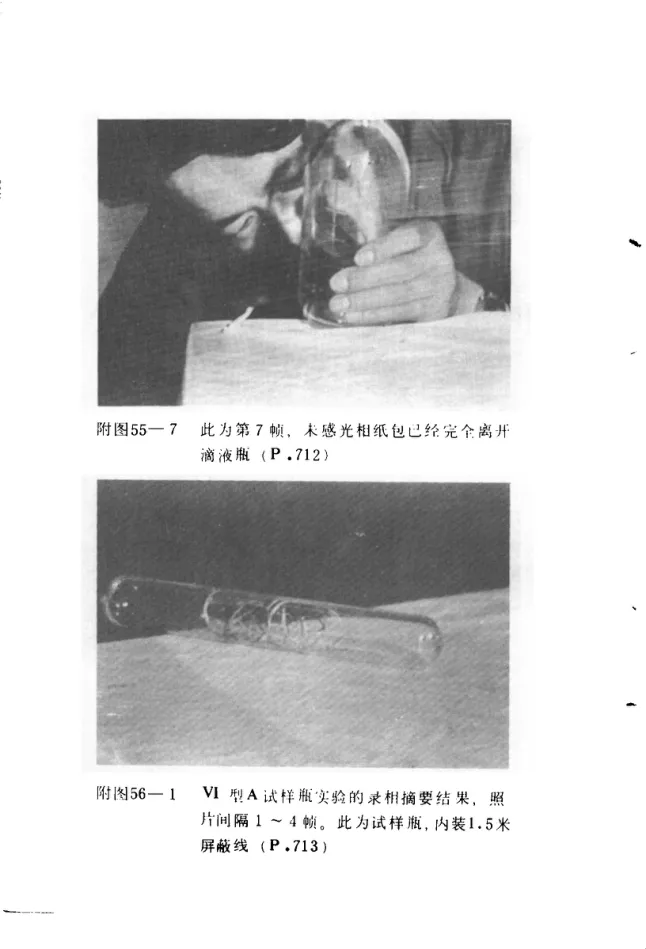
Figure 55–7 This is frame 7; the unexposed photographic paper packet has completely departed the dropper bottle (p. 712) Figure 56–1 Summary results of the video recording of the Type VI A sample-bottle experiment, with the photographs spaced at intervals of 1 to 4 frames. This is the sample bottle, containing 1.5 m of shielded wire (p. 713)
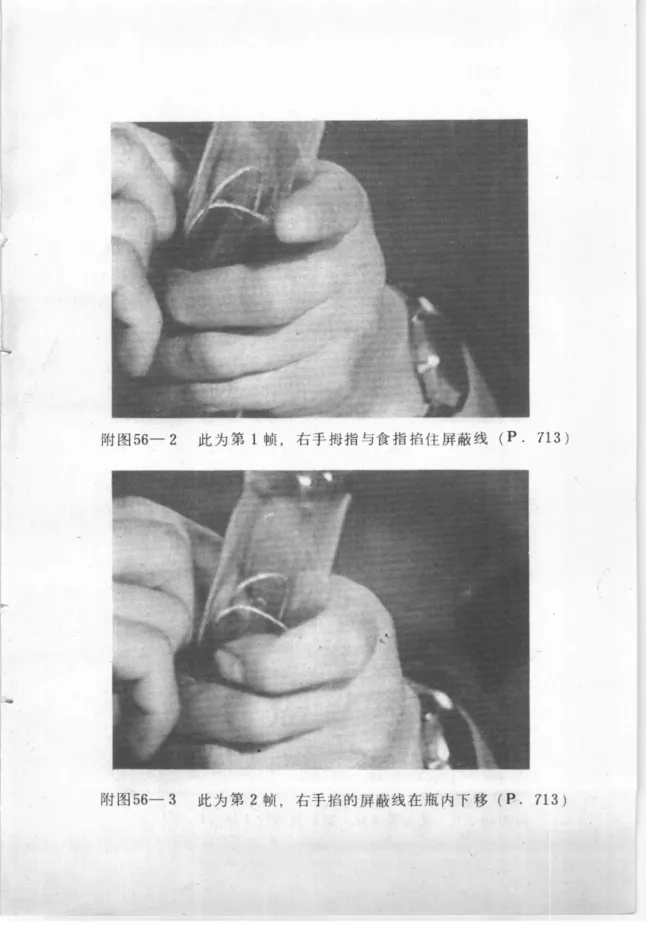
Figure 56–2 This is frame 1; the right thumb and index finger are gripping the shielded wire (p. 713) Figure 56–3 This is frame 2; the shielded wire held by the right hand has shifted downward inside the bottle (p. 713)
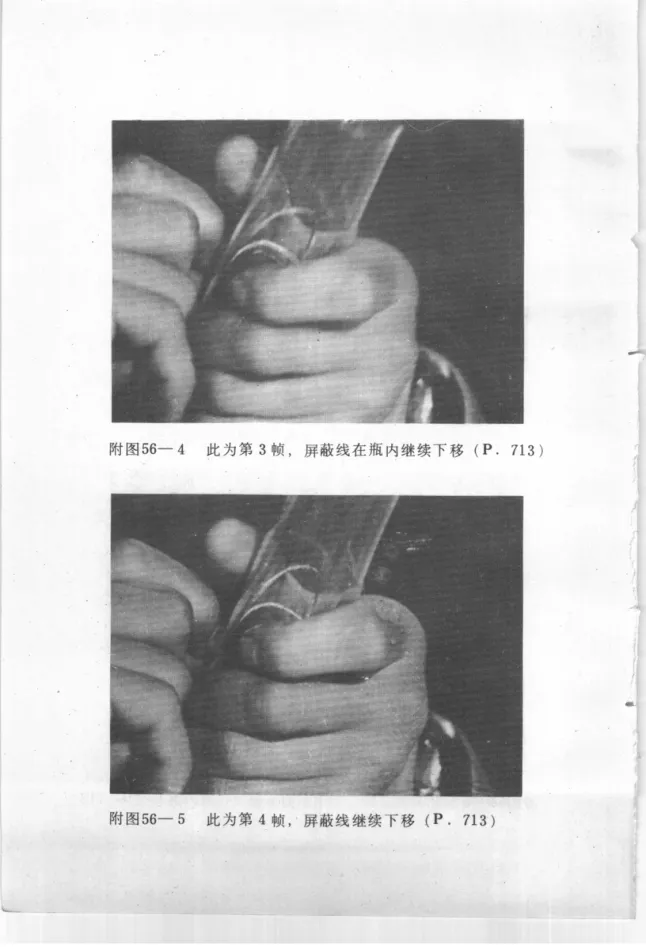
Appendix Figure 56–4 This is frame 3; the shielded wire continues to move downward inside the bottle (P. 713) Appendix Figure 56–5 This is frame 4; the shielded wire continues to move downward (P. 713)
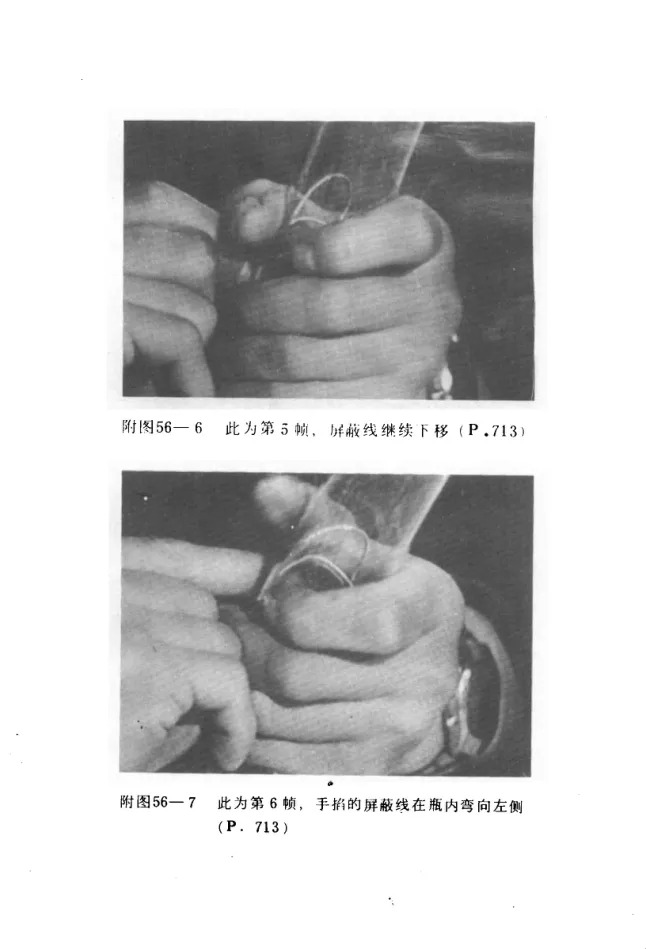
Appendix Figure 56–6 This is frame 5; the shielded wire continues to move downward (P. 713) Appendix Figure 56–7 This is frame 6; the hand-held shielded wire bends toward the left inside the bottle (P. 713)
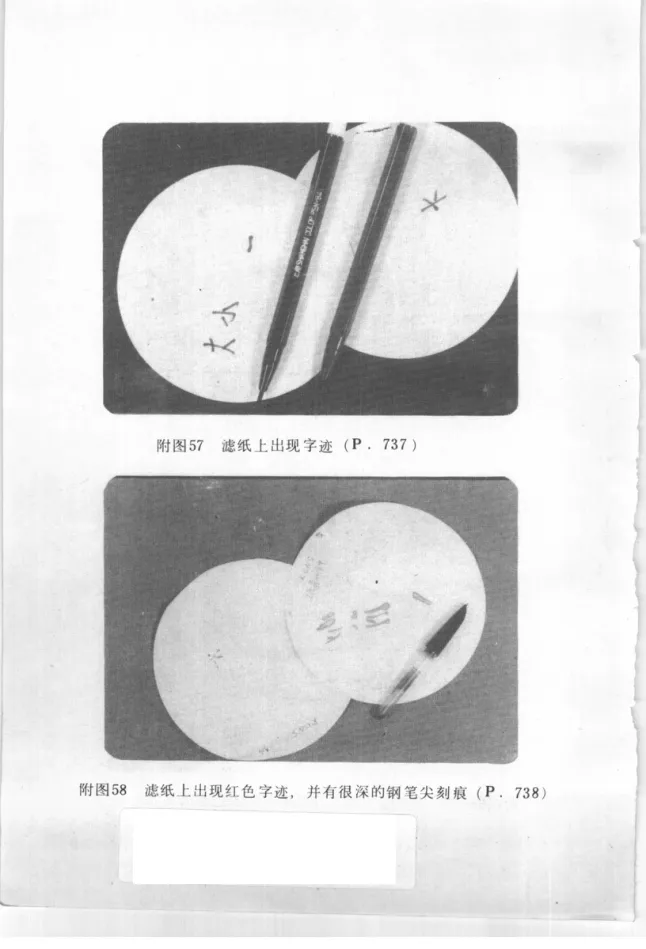
Appendix Figure 57 Writing appears on the filter paper (P. 737) Appendix Figure 58 Red writing appears on the filter paper, together with very deep pen-nib scratch marks (P. 738)
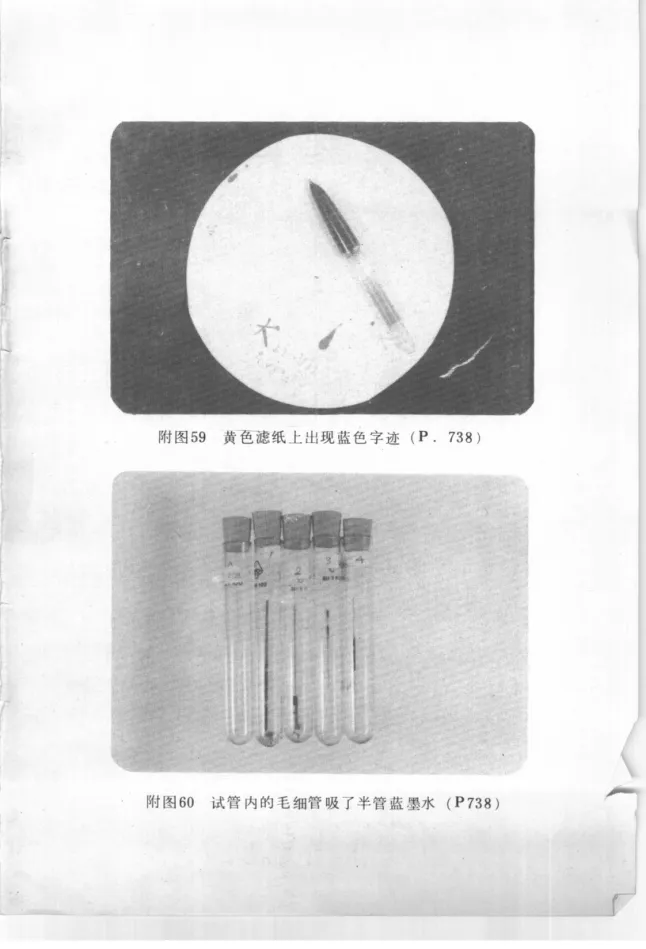
Appendix Figure 59 Blue writing appears on the yellow filter paper (P. 738) Appendix Figure 60 The capillary tube inside the test tube has drawn half a tube of blue ink (P. 738)
Footnotes
-
The experiment was conducted in a single room in Surgical Ward Three of the First Affiliated Hospital of Kunming Medical College. ↩
-
“This publication” refers to the Nature Magazine (Ziran Zazhi) editorial office. Editor’s note. ↩
-
During actual testing, the subject does not know the content of the 100 Chinese characters, so the probability of a lucky guess is much smaller than that listed in the table. ↩
-
The other 10 character samples were sealed in a kraft paper bag according to the [A/a2] method as identification samples. ↩
-
A Tiger Tally was a token used by ancient Chinese emperors to grant military authority and mobilize troops to vassal officials. It was cast in bronze in the shape of a tiger, with an inscription on its back, and split into two halves. The right half was kept in the central court, and the left half was given to local officials or commanding generals. When mobilizing troops, an envoy had to present the tally for the two halves to be matched and verified before it could take effect. Here, this concept is adapted for use as an effective method to ensure the uniqueness of the specimen. ↩
-
① Both models of instruments were imported from Japan and are currently the most standard dose-monitoring instruments in our country. ↩