Original publication
Original title: Lucidité et intuition: étude expérimentale
Author: Eugène Osty
Publication year: 1913
Original language: French
Source file MD5:b16da9e7a37485c424c620e39a76911b
Source edition: Internet Archive scan.

Digitized by the Internet Archive in 2011 with funding from the University of Toronto.
http://www.archive.org/details/luciditetintui00osty
Clairvoyance and Intuition
An Experimental Study
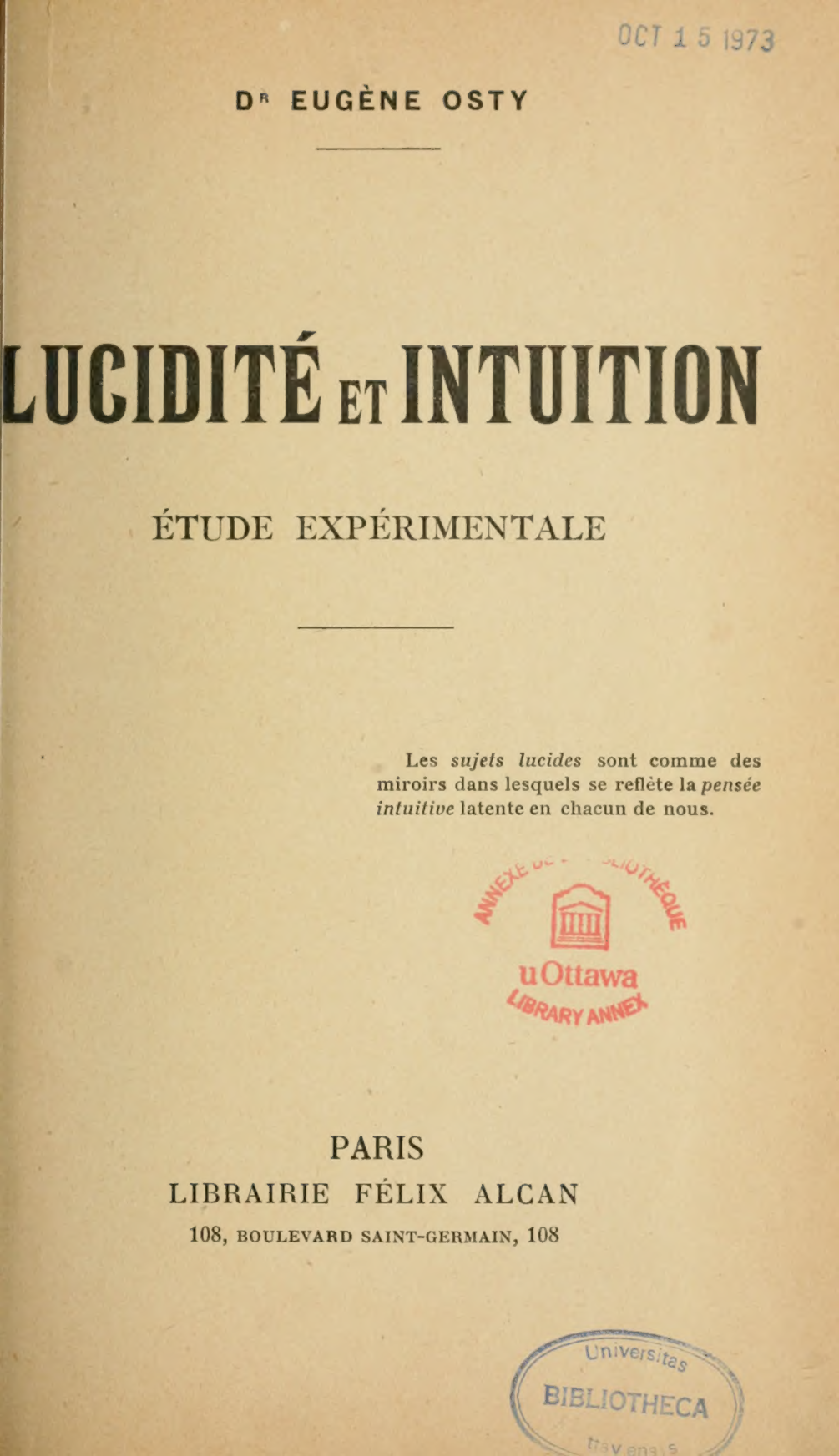
Dr. Eugène Osty
Clairvoyance and Intuition
An Experimental Study
Clairvoyant subjects are like mirrors in which the intuitive thought latent in each of us is reflected.
Paris
Librairie Félix Alcan
108, Boulevard Saint-Germain, 108
All rights reserved.
Introduction
As he makes his way along the endless road of knowledge, man can, if he looks back, readily take in the whole stretch already traveled, for in that direction all is clear. Before him, however, the opaque darkness of the unknown covers the immensity of what exists. And progress in that direction is slow, because the work is hard and the mind easily loses its way…
The knowledge of any age always consists of:
- Knowledge definitively acquired, or believed to be definitive: this is what has been explained, what is scientific.
- Facts that observation has already brought out of the unknown but that have not been scientifically classified, either because they have not been observed by sufficiently penetrating minds, or because the knowledge acquired in that age does not allow them to be explained.
Now, whatever period in human history we look back to, the facts in this latter group are always assessed differently according to the different mentalities judging them.
Mystical minds immediately attribute a supernatural origin to them.
Believers in science (that is, those for whom nothing counts but the small stock of data available in their own age), by the same mental process, reject them at first on the pretext that they contradict established positive knowledge. Read: the hypotheses prematurely and improperly erected upon that knowledge, which is quite another thing.
But there are always a few minds, free of all mystical or scientific prejudice, who regard every phenomenon manifested in our material sphere as a subject for science, and who are also convinced that, through the weakness of our intelligence, we reduce the universe to a schematic outline, and that its complexity is out of all proportion to the simplicity of our mental representation of it. Since nothing seems supernatural or impossible to them, they approach the reported phenomena, verify their reality, and then try to explain them. If they fail, they leave the task to future generations; but they never believe themselves entitled to regard as unreal or miraculous phenomena they cannot classify, even when these contradict the hypotheses of their age.
Such has been the history of the prescientific in every century.
Such, in our own day, is the position of that part of the modern prescientific domain known as the psychical sciences.
What should we understand by psychical sciences?
If we keep to the term’s etymology, it ought to mean the science of phenomena relating to the psyche, to the mind. The psychical sciences would be nothing other than the psychological sciences.
In practice, however, usage has grouped under this label the body of extra-normal phenomena that depend upon the human mind, although they appear to exceed the physiological possibilities of the brain: phenomena that M. Émile Boirac has called unknown psychology, and M. Charles Richet, metapsychics.
These sciences, whose subject is as old as humanity, really date only from the end of the eighteenth century. They were born with animal magnetism, which has already partly entered official science under the name of hypnotism. But it was in 1847 that they made their true entrance into the world, for that period inaugurated a new condition of mental activity, or rather made frequent a psychic condition that had until then been exceptional. It established the best procedure for dissociating the two levels of thought: the release of intellectual automatism and of the forces dependent upon it.
At that date, in Hydesville, a little village in New York State, Dr. Fox’s wife and two daughters manifested the first phenomena of mediumship.
And as soon as the hypothesis was put forward that certain people could serve as intermediaries between disembodied souls and living human beings, mediums appeared everywhere, of every kind and every degree of worth. It was the reign of the subconscious.
And the subconscious expressed itself in many ways, according to mental constitution and to the procedures used to release its activity: blows struck by table legs, raps sounding in walls, automatic speech and writing, various hallucinations, and so on…
Then, around 1868, the first instances of materialization began to appear…
And from that time onward phenomena of many kinds occurred, each medium seeming to have a specialty.
These unclassified facts were inevitably to undergo the fate that every century has reserved for analogous facts.
Mystically inclined minds would not wait for the distant moment when these facts would be rationally explained. Judging them inexplicable and beyond the psychophysiological possibilities of living human beings, they attributed their origin to disembodied spirits. The revelations, the invisible forces at work, were regarded as intentional manifestations of souls wishing to communicate with embodied humanity. And this hypothesis became the foundation upon which Spiritism was built. It also became the prism through which the facts were observed.
And scarcely had Spiritism been born before it laid claim to the whole of unknown psychology, which took the name of mediumship, the medium being the subject who mediated between occult thought and man.
This hasty and systematic interpretation of facts still poorly observed inevitably provoked violent opposition in the camp of professional positivists. Outraged by the mystics’ casual confidence, and inclined to reject phenomena that dealt a harsh blow to their conceptions of man, they decreed that there was practically nothing true in the facts of mediumship. And for many years it was not true…
A few men of science had the courage to expose their reputations to the attacks of mystical and scientific believers. They wanted to verify what was real in the phenomena reported on every side. They experienced one of the most unbearable torments there is: being accused of naïveté by the naïve!
For some years now, the prejudices of the learned world have begun to dissipate; the hour when they will vanish is near. Taken as a whole, the phenomena that are the subject of the psychical sciences now provoke smiles only from pathological deniers or the “vulgum pecus,” which has not yet had time to notice the evolution of those who manufacture its opinions.
It is clear that the officials of science, those charged with guarding the threshold, have become well disposed toward kinds of study whose underlying reality they are beginning to suspect. No doubt they would do better to act, to investigate. They encourage and wait: that is progress; not long ago they disdained…
Why this change in the opinion of the intellectual elite? Because the unprejudiced investigators I spoke of above have stubbornly continued their work. Drawing a great stretch of the unknown toward science, they have brought it right before the eyes of the ultra-positivists who once condemned their incursions into the domain of the marvelous.
“Look,” they say, “at what we have found in this marvelous domain!… These phenomena plainly exceed the limits our science had assigned to psychophysiology. Those limits were merely the limits of our knowledge. These phenomena have been discredited in your eyes by the mystical hypotheses hastily built upon them; but the hypotheses to which they have given rise do not change their real nature in any way. We are already convinced, and shall work to demonstrate it, that they are dynamic manifestations of thought under special conditions and in special individuals. Thus an immense new field of study opens before us, in which we shall be able to learn about man what would remain hidden under ordinary conditions. Why judge the immensity of the unknown by the infinitely narrow compass of our precarious knowledge?… Why not come to our aid and contribute to our investigations?… Why not collaborate in the discovery of a humanity different from our previous conception of it?”
Since clairvoyance, which this book will study, is one of the phenomena belonging to the psychical sciences, we should first establish its place among the diverse phenomena that form their subject.
These phenomena can be grouped into three classes, with every reservation as to the still unproved reality of certain of them, and while acknowledging that this classification is highly arbitrary, since some belong to several groups.
- A first class may bring together phenomena in which a human individual appears to act upon other people, and even upon inert matter, through a radiated force distinct from all the other forces we know so far.
This group would therefore comprise:
a) The effects that animal magnetism is said to produce in human beings, apart from hypnotism and suggestion.
b) The effects produced by this same radiating force upon dead organic matter: arresting putrefaction, sterilization, and mummification, by merely laying on a hand, as occurred in the experiments recently conducted with Mme X…, of Bordeaux, and in those of Dr. Gaston Durville.
c) The variety of phenomena produced by the class of people called physical-effect mediums, which make up a large part of Spiritist phenomena:
- Movements of objects by simple contact or at a distance, with or without the intention to produce them.
- Plastic modifications of matter: impressions made at a distance, apports, and so on…
- Luminous phenomena in the space around the medium.
- Phenomena of levitation.
- The creation of forms that can be touched, seen, and photographed, in accordance with the will of the medium or the participants, or independently of their will (materializations), and so on…
- A second class could consist of phenomena involving various differentiations of sensitivity, which establish in certain people a sense additional to the normal senses, specialized in registering certain impressions not perceived by ordinary brains.
Thus the sensitivity of certain people may be affected by atmospheric currents, by underground watercourses (dowsers), by underground spaces, by metals, by magnets, and so forth… These people feel the dynamic modalities radiating from certain states of matter.
Other sensitives receive impressions from the energetic form of thought coming from other human beings, whether that thought is conscious and intentional at its point of departure, or lies outside the attention of the brain from which it emanates. This is the phenomenon known as mental suggestion or thought-transference.
- Judging the facts only superficially, we may provisionally assemble, apart from the phenomena mentioned above, a third class comprising those psychic manifestations that seem to prove a supernormal extension of intelligence in those who produce them.
These phenomena, called clairvoyance, are the most anciently and universally known, because subjects capable of them are relatively common, provided one is not too exacting about their quality.
This category of phenomena is still very far from the threshold of official science.
My purpose is to wrest them from the marvelous, in which the superstitions of past centuries have kept them, in which Spiritism would still like to keep them, and from which the metapsychical researchers do not seem as yet to have sufficiently freed them, their efforts having chiefly been directed elsewhere.
If metapsychical researchers were asked to define the word clairvoyance, the explanations obtained would be extremely diverse. Nor should we be surprised that opinions differ about the nature of facts whose very phenomenal character is not agreed upon. For under the name of clairvoyance are assembled phenomena that have nothing in common except the term used to cover them.
I could, and indeed should, refrain from defining clairvoyance here, since this entire work will do so in the best possible way, namely through the study of the phenomenon itself.
But since it is important that a reader unfamiliar with the psychical sciences should have some initial guidance on this point, I shall say that clairvoyance means the sort of faculty through which certain people possess knowledge that comes into their minds independently of the exercise of the senses and reason, without the ordinary barriers of space and time presenting any obstacle: thus, without apparent support, outside all normal mental elaboration, without rational deductions, as though intuitively.
To be clairvoyant is to know by intuition, to perceive immediately, to know in the way that spiritualist philosophers believe a human soul separated from its body would know.
And this is indeed how clairvoyant subjects appear at first sight. They seem to derive from intuition what the reason of other people does not always acquire.
Clairvoyance and intuition seem to be two synonymous names for the same phenomenon.
But I may as well say at once, since I shall in any case demonstrate it, that this is only an appearance, and that, except where clairvoyant subjects perceive truths concerning themselves alone (which is exceptional), their minds are not the source of what they say. For the thought they express while exercising their special faculty is the reflection of an intuitive thought latent in every human being, which comes from outside to impress their extra-normal sense and manifest itself through the operation of their subconscious intellectual activity, released from the control and direction of the higher psychic centers.
Anyone in the presence of a clairvoyant subject can become acquainted with fragments of his own intuitive thought, just as he becomes acquainted with his face before a polished surface that reflects it.
Clairvoyance is a faculty reserved for a few exceptional beings. Intuitive thought exists latently in everyone; the clairvoyant subject reveals it. We may therefore say that what is most interesting in the study of clairvoyance is not the clairvoyant subject himself, but the ordinary human individual who consults him.
Clairvoyance and intuition are therefore not two equivalent psychic phenomena. But because of their appearance, and until I have brought out their precise and distinguishing characteristics, I shall use these two words as synonyms.
Certainly no age has seen the emergence of as many clairvoyant subjects as our own. The cause, as I said above, lies in the practice of Spiritism, which brings to light faculties that would otherwise remain hidden; and doubtless also in the fact that the progressive development of sensitivity tends to establish in more brains the sense capable of being affected by the dynamism of a particular modality of thought.
But however far back we go in history, it is easy to find indications revealing the existence of clairvoyance. Indeed, everything suggests that intuitive divination expressed its curious revelations at an early date; otherwise, how are we to understand why cultivated peoples endowed with common sense would have thought of creating methods of doctrinal divination, the augural sciences that flourished in ancient civilizations, especially among the Greeks?
As in our own day, there must have been subjects almost everywhere who possessed a particular sensitivity and who, by their ease in penetrating the mystery of individual lives and by their premonitions, established the belief that human beings could know intuitively, without any effort of reason, things that their intelligence, subject to the laws of space and time, should always remain ignorant of.
The explanation of this strange gift of the psyche was what it had to be in centuries when the mind was an entity impenetrable to analysis. The multitude regarded clairvoyance as direct communication between the human soul and the Deity.
And since highly gifted intuitive subjects were undoubtedly rare in those times, once the desire to investigate the unknown had awakened, people were led to satisfy it by every means that seemed capable of bringing human intelligence into contact with the divine will. Everything was suspected of being a heavenly warning. The play of the stars, meteorological signs, the flight of birds, the arrangement and color of sacrificial victims’ entrails, monsters, prodigies, and so on, acquired a meaning. The gods had a range of expression as vast as Nature. Thus the intuitive clairvoyance of a few must have been the starting point of an extraordinary superstition that for centuries was official and national among the Greeks as among the Romans. Nothing was undertaken without the god having given his advice through one of the augural methods.
The intellectual elite nevertheless rebelled against this symbolic interpretation of all the phenomena of Nature. After Socrates and Plato, Aristotle’s clear mind resolutely rejected the childish rites of divination, but he held intuitive divination in the highest esteem: that exaltation of the soul which enables a few privileged beings to go far beyond intellectual discernment.
Does the reader who knows how the Pythias of Delphi and elsewhere prophesied believe that cries uttered in epileptic trances and interpreted by the imagination of the priests of the Oracle could have given such conviction to minds as penetrating as those of Plato and Aristotle?
What we know of vanished humanity is drawn from the broad outlines of its history. But if the chronicle of humanity had been written from antiquity to our own day, we should find manifestations of the faculty of clairvoyance in abundance.
Very near our own time, since he died in 1859, Abbé Vianney, famous as the Curé of Ars, to cite only this one example, was a fine and well-known instance of a clairvoyant subject, already overlaid with legend.
Moreover, in every age, it is always in the marvelous that we must seek the manifestations of clairvoyance. In antiquity it lay hidden behind the appearance of the mantic sciences. In medieval times we can see it showing through, according to the people endowed with it, either in witchcraft regarded as demonic or in sanctity. Today it lurks behind the rites of Spiritism. It has always been steeped in the marvelous. And that is what has discredited it, and still discredits it, in the eyes of positive-minded people. In the marvelous domain in which it is steeped, it also lives indiscriminately alongside the most questionable psychic productions.
Although spirits have sometimes revealed very curious knowledge through mediums, the number of absurdities they have communicated to us may be regarded as immense. The practices of Spiritism have indeed facilitated the release of subconscious intellectual activity in predisposed individuals. The intellectual mechanisms have been able to elaborate thought outside the control of conscious attention. But this thought has almost always originated in the brain expressing it; and when it comes from elsewhere, it comes from another brain, which does not necessarily make it intuitive, suprarational thought. Most often, the productions of the subconscious are merely constructions of an imagination of varying organizing power. By regarding every dissociated mentality as a psychic medium, people have attributed to the beyond all the ravings of subconscious intellectual activity, more or less effectively disciplined by prevailing ideas. Yet among the great number of people who believe themselves mediums and are regarded as such, a few are endowed with the special sense that is the condition of clairvoyance. Through this faculty these subjects sometimes reveal truths that exceed the possibilities of normal intelligence, causing a supernatural origin to be attributed to a phenomenon of pure psychophysiology. It is these few clairvoyant subjects, mingled with the crowd of psychic mediums, who redeem the deplorable worthlessness of the whole. A Mrs. Piper gives mediumship solidity… The clairvoyance of a few subjects, a faculty that can be exercised apart from any Spiritist practice, creates belief in mediumship, just as it formerly created belief in the mantic sciences and divine inspiration.
Apart from the all too numerous charlatans who exploit every belief, clairvoyance also suffers from counterfeits arising from neurosis.
From time to time we suddenly hear that, in some place, a person, almost always a woman, claims to be in communication with the beyond: God, a saint, an angel… The town where the prodigy appears is in a stir. Reporters rush there. Newspapers comment and debate. Some disdain it; others are convinced. A credulous public crowds around the inspired woman. Practical jokers go too, and enjoy themselves. Then this flash in the pan dies away amid indifference… Mystical souls retain an unshakable belief in the inspired woman’s revelations, even when reality has contradicted them. And the descendants of M. Homais are more convinced than ever that everything beyond the known productions of reason is humbug. And these two poles of folly, having exercised themselves upon the imaginings of a hysterical woman in a fit of madness, will operate in precisely the same way and in the same direction when real extra-normal phenomena are at issue!
Charlatanism, pseudo-mediumship, neurotic simulation, doctrinal divination, and clairvoyance all aim at the same goal: revealing what lies outside the reach of ordinary discernment. Since the goal is the same, superficial minds think the means resemble one another and are of equal worth. But because clairvoyance alone is capable of attaining that goal, and because, moreover, it is a rare faculty while everything that simulates it abounds, a psychological capacity of certain brains, which can be studied experimentally, is denied because of the worthlessness of other things making the same claims. People contemptuously reject the lump of clay in which a diamond of the purest quality is buried…
Clairvoyance must be sought through an entire mass of parasitic growth that subsists only thanks to it. Once we have freed it from that growth, and also, it must be said, from the flimsy opinions of some of those who believe they know it and make it into something it is not, it presents a fine psychological problem to be solved.
Clairvoyance, a permanent faculty in most of those who possess it, has its professionals, who have popularized it by putting it within reach of everyone’s curiosity. Today they are more numerous than ever. Are we more attracted to diviners than our ancestors were? Despite the positivism of our age, that paradox is quite possible. But the most likely cause of the growth of this profession is that, clairvoyance having become a more widespread psychological possibility, many of those endowed with it try to make a living from it.
For anyone who has spent time among them, there is no doubt that, although professional diviners include a certain number of charlatans and quite a few mediocrities, one can nevertheless encounter some subjects of the very highest worth: rare, it is true, but whose mastery convinces even the most skeptical that there really are people in whom intuition is a faculty exercised as easily and regularly as intelligence is in everyone else.
And let us consider the difficulty of the task demanded of these sensitives and the conditions under which they perform it!
The physician questions his patient minutely about the symptoms he experiences, his medical history, and his hereditary antecedents; he examines him according to a method intended to leave nothing hidden. Sometimes he supports his investigations with subtler and more precise procedures: microscopic examinations, analyses of bodily fluids, radiography, and so forth. Only after this long and meticulous exploration does he formulate his diagnosis, and not always even then, and venture a judgment on the probable outcome of the illness. Do the facts not often contradict the prognosis? Is the diagnosis always correct?
The psychologist charged with examining a mind employs analogous procedures. Around the soul to be probed he establishes a whole series of small experiments; he gathers information and surrounds himself with every safeguard suggested by his cautious and skillful mind. Does he often arrive at even an approximate knowledge of the mind he is studying? The incredible errors made by eminent psychologists acting as experts in the courts answer that question.
Besides, do we possess accurate knowledge of ourselves? At every moment our actions contradict the opinion we held of ourselves. We are astonished by feelings of which we had thought ourselves incapable; we witness our ceaseless evolution in the emotional sphere as much as in the intellectual and moral spheres. Do we fully appreciate our present lives? Do we judge our individual situation as it really is in its relations with our surroundings? And do we know what tomorrow holds for us?
Yet it is before a skeptical stranger, resolutely closed, sometimes hostile and often even disposed to lead him astray, saying nothing and suppressing every gesture; and, moreover, within a very limited time, confronted with the utterly unknown, and without reflection, that the clairvoyant subject improvises a precise psychological analysis, probes the recesses of a soul to bring out the qualities and faults that together constitute its individual mental character; reveals important actions in the present and past, facts unknown to everyone, feelings imperfectly known even to the person experiencing them, and desires one dares not acknowledge to oneself; indicates with an assured word the weak point of the organism, the organ developing a disease or the established disease, sometimes thereby correcting an erroneous diagnosis. Before the astonished consulter, he brings into view all the people in his immediate surroundings: parents, brothers, children, wives, and so on, people bound to him by love or friendship. And he describes the physical appearance, analyzes the character, and reveals the state of health of all these people, who are as unknown to him as the stranger before him. And he explains to the latter what his present emotional and social life is, and sometimes lifts very high the thick veil drawn over the mystery of the future…
The fact that this prodigy exists, that it is available to every curious inquirer, while clairvoyance seems unknown to the vast majority of academic psychologists and is even denied by them; the fact that such a manifestation of the extension of human thought has so far provoked nothing but disdain from the official representatives of philosophy, in a century excessively proud of its science: does this not contain a certain measure of irony?
Yet Dr. Vaschide, deputy director of the psychology laboratory at the École des Hautes Études, while gathering information about palmistry from women palmists, soon encountered intuition behind the doctrine. He would undoubtedly have undertaken the study of this aspect of psychology that attracted him, had death not abruptly interrupted his consuming activity. His Essay on the Psychology of the Hand ended as follows:
“I have seen psychologists who had grown old in laboratories, authors of substantial memoirs on all sorts of psychological problems, appear before a woman palmist’s sensitivity as no more than poor beginners in the study of the human soul. The height of touching naïveté: they know how to trace on a plethysmographic recording the signs of an emotion produced by a clap of the hands in the peaceful atmosphere of a laboratory, while most often, despite the pride of erudition, academic titles, and a whole noisy display, being psychologically of an afflicting mediocrity.”
A few pages earlier, Dr. Vaschide said:
“We are not inclined to believe completely in prophecies. There are beings endowed with a unique, intuitive sensitivity, who may perhaps know the capricious laws of chance. It is therefore possible that subjects endowed with this mysterious faculty, intuition, apprehend unknown data, the data of the unknown…”
Yet, not daring to depart from the findings of official psychology, Dr. Vaschide tried in this work to explain fulfilled predictions by coincidences, just as in another book, Telepathic Hallucinations, he had likewise tried to explain telepathic manifestations by coincidences.
Through a disturbing intervention of Fate, the page on which he tried to convince himself and others of this became a permanent and terrible proof of the contrary. At the foot of that page, Mme Vaschide, his widow, had the painful and noble honesty to have the following note printed, which any commentary would diminish:
“… I shall cite as a simple coincidence the fact that Mme Fraya predicted to the author of this work, during the winter of 1904, that he would die of pneumonia at the age of thirty-three. Mme the Countess de Noailles, who was present at the conversation, Mme Fraya, and N. Vaschide himself confirmed this prediction to me. Unfortunately, it came true in every particular on October 13, 1907. A year before N. Vaschide’s death, in 1906, a Gypsy woman in Romania repeated this prediction to him, announcing his death for the following year.”1
Despite my conviction that in science facts alone count, and that the mental dispositions of those who bring a few materials to the centuries-old edifice can arouse no more than a little curiosity, I nevertheless think it may be useful to the reader if I explain my state of mind when I first approached the study of clairvoyance and the conditions under which I did so.
Those who have never had occasion to observe phenomena of clairvoyance, and to whom this curious extension of intelligence seems nonexistent or improbable, will thus see that only a few years ago clairvoyance was as foreign and indifferent to me as it is to them now, and that it was from a starting point of complete skepticism that I gradually became convinced of its reality.
Until 1909, like almost everyone, I had heard, with a rather inattentive ear, talk of palmistry, cartomancy, astrology, clairvoyants, readers of souls and of the future by various strange methods…
Some people had praised to me the astonishing accuracy of revelations made to them or the exact fulfillment of predictions concerning them. Whether because these people’s minds seemed to me inclined to mystical enthusiasms, or because such facts could find no place in a brain enslaved to the methods of the positive sciences, I must confess that the settled convictions I encountered in others had no power to awaken my curiosity. I could not understand how conscious reason and subconscious intellectual automatism, whose synergistic operation, according to modern psychology, constitutes the whole psyche, could explain the mystery of such phenomena. And I found with satisfaction confirmation of my a priori aversion in several books and articles by Professor Grasset, who, in discussing Spiritism and occultism, denied the existence of clairvoyance and explained its appearance by the activity of the subconscious imagination, by polygonal fantasy. I was therefore one of those who, out of prejudice, will neither accept nor study the subject matter of the psychical sciences.
I also had some less general reasons for denying intuitive divination. These were supplied each year by the publication of almanacs and accounts of interviews in which renowned prophetesses threatened some part of the world, the government of the day, or a particular tottering monarchy with inevitable cataclysms. Yet invariably none of the predictions that were at all precise and went beyond rational conjecture came true. On the other hand, the year brought events of great worldwide or national importance that had not been foreseen. This did not prevent the same augurs from exposing themselves each year, with the same assurance, to the same lamentable disappointments, nor the public from paying them its tireless attention…
Thus I would not have walked a hundred meters to see a fortune-teller, so convinced was I that everything issuing from a brain that believed itself clairvoyant must be either a pure construction of the imagination or shameless deception. It was therefore no mind inclined toward the marvelous that circumstances were about to bring face to face with a clairvoyant subject…
Yet she seems to me today to have been of very modest talent, this woman palmist who, one winter evening in 1909, in the drawing room of a friend of mine, merely by examining the palms of the hands, successively made psychological analyses of the six people present, completely unknown to her a few moments earlier but well known to me. I paid no attention to the few predictions she made for each of them. But I was deeply astonished to see this woman of limited education provide, in a few minutes and with sufficient accuracy, the mental formula of each. For my own part, I was obliged to concede that she defined the broad outlines of my character as clearly as I could have done myself.
From that day onward my mind knew no rest; a kind of fixed idea took root in it. I told myself that chance and coincidences could not explain the error-free revelation of six characters, each consisting of a complex interweaving of tendencies, feelings, qualities, and faults; and that if the palmist had achieved this feat by reading the symbols engraved in the hands, palmistry was a science truly worthy of study. If, on the contrary, she possessed a faculty independent of any science, then it was this capacity of the intelligence that needed to be studied.
I approached the enigma eagerly and with the keenest interest…
First I wanted to determine exactly what palmistry was worth, and resolved to make a serious theoretical study of it, so that I could then judge what the application of its doctrine would yield.
I do not think I shall surprise those who have undertaken the same study by stating that I did not encounter two books on palmistry assigning the same meanings to the same signs. The forms and directions of lines and the varieties of symbols can be interpreted in such different ways that, depending on the author, one can sometimes, and indeed quite often, say precisely opposite things about the same hand while remaining a faithful disciple of the masters of this science.
Among other works, I read with the greatest attention the two books by Desbarolles, which had been recommended to me as the most complete and clearest. While I was assimilating the theory, the mysteries inscribed in our hands did indeed seem easy to penetrate; but it was another matter when I tried to decipher strangers’ hands. Desbarolles’s doctrine seemed to me more full of holes than Diogenes’ cloak; substantial gaps and innumerable imprecisions made it practically almost unusable.
Yet Desbarolles was the restorer of palmistry in France; he lived among the intellectual elite of his time and was highly esteemed by it. Both Dumas, on several occasions, made it their duty to publicize and praise his rare clairvoyance. His fame even penetrated the Tuileries, which earned him the honor and credit of reading in Empress Eugénie’s hand the catastrophe that was to mark the end of her sovereignty and the beginning of a long and painful period of life. This made me think that perhaps, because of the drawbacks of popularizing a science with such formidable claims, he had deliberately omitted precise details in order to mislead the uninitiated and prevent butterflies too curious about the light from burning their wings in it, while confiding the realities to a small group of initiates, to be transmitted to future ages through the channel of Tradition.
This consideration, and also the thought that I might simply be a poor pupil, gave me the idea of approaching a skilled woman palmist to obtain the indispensable knowledge I lacked…
For this purpose I approached Mme de X…, whose very real talent for clairvoyance I had had occasion to test.
“To practice palmistry,” she told me, “one needs a great deal of intuition, but since you have a fine head line,” and so on…
My head, wishing to remain worthy of its symbol in the palm, devoted itself entirely to the explanations supplied…
Alas! Not only did these additional acquisitions fail to coordinate and clarify what I already knew, but the little accurate knowledge I believed I possessed was thrown into confusion! If the authors on palmistry did not agree among themselves, their pupils did not even carry on their doctrine! For a time my nights were peopled by haunting hieroglyphs. On the slopes of the Mounts of the Moon or Jupiter, or in the bloody Plain of Mars, I saw all the symbols of palmistry whirling about in a confusion less great, however, than the confusion in which they were maintained!
I then thought myself entitled to abandon a science so occult that its own adherents seemed ignorant of it, and to attribute its apparent revelations to pure intuition, when circumstances brought me into contact with Mme Passerieu-Desbarolles. A niece of Desbarolles, brought up in an atmosphere of palmistry and practicing it herself for nearly thirty years, she seemed a worthy subject for one last and conclusive attempt. To her long experience she added the complete inheritance of her uncle’s doctrine. The occasion seemed favorable for becoming a pupil again.
During an entire week of daily conversations, Mme Passerieu-Desbarolles generously imparted to me what she had learned from her uncle, along with the results of her personal observations.
At last I was able to distinguish between what the doctrine of palmistry can provide and what lies outside its domain.
What it can provide to a mind as exceptionally deductive as Mme P.-Desbarolles’s sufficiently shows that it deserves better than the indifference of the learned world.2
But I can state that the value of what the great majority of women palmists reveal comes almost entirely from their intuition. They are sometimes remarkable clairvoyant subjects, perpetual prodigies, as Mme Fraya is, but their actual science is virtually nil.
May they forgive the bluntness of this judgment; it expresses my sincere conviction.
The charming augurs will in no way be diminished by it, and the study of human thought will gain new horizons!
Having at last completed this first stage, I resolved to devote an entire year to seeing as many intuitive subjects as possible, to familiarize myself with the variety of clairvoyant phenomena and also with the different kinds of subjects.
I decided to let my observation wander as circumstances offered, without any predetermined method, believing that the experience I would acquire in this way would furnish the best method when the time for rigorous study arrived.
I then became the anonymous consulter of every fortune-teller recommended to me or drawing attention to herself through publicity that was often far from discreet. Strictly impenetrable, I presented the enigma of my person in turn to somnambulists, to seers using crystal, flame, or other no less strange things, to women palmists, card readers, astrologers, automatic writers, subjects using rapping tables or analogous procedures, and so on. Little by little I thus came to know a good part of the world that dispenses mystery in Paris. I entered modest lodgings, some so cramped that the augur and a consulter filled them, and one had either to come back or, while waiting, choose between an inhospitable kitchen and the staircase. Often I was received in small, simple but respectable apartments by the clairvoyant herself. None of these lodgings recalled the terror-dripping dens of the witches of old. Nothing in the apartment or in the augur’s dress was intended to strike the imagination. One might have been visiting anybody, but one was always before an agreeable person.
At times, too, I waited a long time in comfortable drawing rooms, among people of the best society, eager to learn a little of their destinies.
In this way I approached many clairvoyant subjects differing in background, type, and worth. From some I could obtain practically nothing. Perhaps these have only occasional flashes of clairvoyance, enough to attach to them a small clientele of people who know how to be satisfied with little and to make up in imagination for the vagueness of what they have been told?
Since these subjects nevertheless do not hesitate, in advertisements of a lyrical turn, to extol a faculty with which they are very scantily endowed, I warn the reader against the certain disappointment awaiting him if he tries to establish his personal conviction through subjects of such slight and unreliable worth!
But truth obliges me to say that among the clairvoyant subjects I have seen and consulted, a good many gave me indisputable proofs of their clairvoyance, more or less extensive and more or less acute. They supplied precise and characteristic revelations concerning my past, my present life, and what was then the near future and has since become the past. It would be ridiculous and contrary to common sense to try to explain these by coincidences, which would then become the rule instead of merely the exception.
The agreement in broad outline between the consultations given to me was so curious that several times I brought a friend to attend a consultation with a new augur, having told him on the way what others had said in earlier consultations and what would probably be repeated to me. This never failed to occur, with omissions or additions in the details. The correspondence was never exact: some emphasized events that others indicated more vaguely or did not mention. Most gave me, in fragments, the reality of my immediate or approaching life, while a few, more gifted, brought these fragments together and harmonized their relationships.
But although most of the clairvoyant subjects I saw were incomplete, I must say that, so far as I was concerned, in the important and well-defined facts of life I never encountered outright contradictions between two subjects of some worth; on the contrary, I observed a remarkable agreement among them all.
I wish to stress, however, that clairvoyant subjects of average worth display an irregularity of mental disposition against which one must be on guard. On some days they astonish you; on others they show evident mediocrity. You leave them sometimes admiring their talent, sometimes disappointed. In the end they leave your reason uneasy, as before a half-solved problem. Such subjects would therefore be deplorable subjects for study. Their capricious clairvoyance makes them beings whose development has stopped halfway between the intuition latent in everyone and the permanent, ample intuition of the great masters of clairvoyance.
For I was fortunately able to meet a few of those prodigious beings for whom our thought is an ever-open book that their penetrating gaze deciphers with ease. These beings have always impressed me deeply. Even today, though their minds have become familiar to me, I cannot resist a sort of philosophical vertigo as soon as I have left them. I have the anxious sensation of leaning over an abyss.
Their brains have reached so high a degree of sensitivity that they have become the reagent capable of detecting what other people’s brains contain. They are the intermediaries Nature has created between our total mind and our consciousness. They are the mirrors before which our thought, formerly unknown to itself, sees and knows itself!
For the psychology of tomorrow, for what may still, provisionally, be called mental metapsychics, these marvelous sensitives will be precious instruments, extending its field of study to an extent that I shall try to suggest at the end of this work, for the reader will then be better placed to understand me!
When my initial skepticism had bowed before the evidence of the facts, when I was absolutely certain that there really existed in certain beings a psychic sensitivity enabling them to perceive and translate the unknown forces that extend our thought beyond ourselves, then I judged that the time had come to undertake the study of clairvoyance…
In my opinion, the body of the best professional clairvoyant subjects constitutes an excellent laboratory for the experimental study of clairvoyance.
The results obtainable otherwise would be limited and, above all, less convincing. I shall explain why in a few lines.
First, it is hardly easy to secure for one’s exclusive use a group of excellent subjects comprising prototypes of each variety of mental mechanism involved in the intuitive act. There certainly exist, outside the professional ranks, remarkable sensitives who are clairvoyant in the waking state; but we may affirm that they are very rare, for those possessing such a faculty, unless they have private means, are led to make use of it, which is entirely legitimate and fortunate for others. Good intuitive subjects under hypnosis would be much more common, but apart from systematic searches, which are scarcely practicable, they reveal themselves only by chance. They do not know what they are.
Moreover, even if one could assemble enough of these excellent and varied subjects, being known to them would deprive a whole important part of the experimentation of its value.
Thus necessity and reason alike ultimately bring us back to the professionals.
With them, no time need be lost either in discovering subjects or in perfecting them; the selective test they have already undergone stamps them with a kind of guarantee. Intuitive subjects whose numerous clients are drawn from the educated classes, and who have succeeded in establishing the authority of their talent, may a priori be regarded as worthy of study. For in this order of things anyone with common sense is a sufficiently competent judge. The deeper the scientist’s learning, the more likely he is to be misunderstood by the crowd. Conversely, the more gifted the intuitive subject, the more readily he will win his client’s appreciation through the clarity, precision, and abundance of detail with which he lays out the intimacies of the client’s life.
As for myself, although I have sometimes proved an impenetrable enigma to subjects of secondary quality, and have often been deciphered incompletely and with varying difficulty by others, my life and that of those around me have, by contrast, always been explored with disconcerting ease by the intuitive subjects of high quality who have served me, willingly or not, as precious instruments of study.
These subjects’ faculty suffers no eclipses. Sometimes imprudent overwork causes it to falter a little, but even in these lapses it retains a power that always compels admiration. It is permanent and always at the experimenter’s disposal. I should therefore be tempted to say: “If you wish to avoid disappointment, if you want to settle your mind without having to drag along the uneasiness of those slight doubts that time one day transforms into skepticism, go to those besieged by a constantly renewed flood of intelligent curiosity; go to those who leave a broad wake of wonder behind them. You will often know long waits; sometimes you will even have to reserve your appointment several days in advance, but be certain that you will see a prodigy.”
The daily exercise of their faculty gives these subjects a psychic training that draws from their brains everything they are capable of giving. Through ceaseless contact with the highly varied mental organizations that pass before them, their sensitivity grows sharper and thereby acquires a remarkable ability to establish rapport almost instantaneously with any other brain.
This goes so far that, when someone known or unknown comes before her, Mme Fraya tries to perceive the preoccupation of the moment, the reason for the visit, so as to confine the exercise of her clairvoyance to that object, and she very often succeeds.
Other subjects, without specifically intending it, are also immediately drawn toward this state of preoccupation in the consulter, who is no little astonished to hear the augur’s voice answering his mental anxieties as though he had voiced a question.
Another advantage of the professional milieu is the number and variety of subjects. For although the phenomenon of clairvoyance depends on a mental mechanism that is always the same in its broad outlines, this mechanism nevertheless varies greatly in its details. This makes the particular study of each type indispensable. Moreover, the multiplicity of subjects of each type allows previously acquired opinions to be corrected or confirmed.
Finally, with professional intuitive subjects one can remain anonymous as long as one wishes, a condition of primary importance in a kind of investigation where the experimental instrument, through its own activity and the voluntary or involuntary use of its conscious intelligence, could supplement its intuition or distort its subconscious elaboration. A whole part of the experimentation must be conducted under these conditions. Nothing must be given to the subject’s reason; everything must be unknown and rationally unknowable to him, and even, if necessary, traps and snares. Otherwise it would no longer be a matter of experimental psychology, but of subjective observation, introspective for the subject, who is often a very poor psychologist in the conscious state, even though in the exercise of clairvoyance he is a remarkable prober of souls.
From a certain point of view, clairvoyant subjects can be divided into two broad categories: those who are clairvoyant in their normal state and those who are so only in hypnotic sleep.
The former are certainly the most impressive, because their clairvoyance seems to be the regular exercise of their intelligence. They give the impression of being superhuman, raised above our reason. To us they are a mystery, while we can hide nothing from them. But one must not begin the study of clairvoyance with them; that would be to attack the inexplicable head-on.
For there are two quite distinct parts in the experimental study of clairvoyance: first, the study of the facts, which can be undertaken with any subjects; second, the study of the subjects’ mental mechanism. It is for the latter that one should not initially use intuitive subjects in the waking state.
Ultimately, the question then is what happens in their brains while they reveal the contents of ours. For us to know, therefore, they would have to tell us. But they scarcely know, and indeed cannot know.
In general, they have no understanding of the process of their psychic activity; often it even seems to them that they have absolutely no part in producing what they say, and many are convinced that an external force dictates to them, makes them see or write what they express. From there to affirming that this force is an extraterrestrial entity is only an offense against logic, which they commit quite naturally!
Others, somewhat less mystical, are convinced that their clairvoyance is indeed personal to them and that they do not owe it to outside intervention. But if asked how they understand it, they reply that their clairvoyance arises from the ease with which their soul detaches itself from matter and perceives phenomena in a sphere where they are not governed by the relative laws of Space and Time. These find confirmation of their ideas in the hypotheses of occultism. With the fluidic double and the astral plane, nothing seems inexplicable to them!
Others, finally, are not far from believing, like their predecessors in Greek antiquity, that their clairvoyance is a gift from on high, that it is divinely inspired, and that they have certainly received a mission to enlighten the darkened reason of their contemporaries.
The most intelligent clairvoyant subjects, and some possess intelligence of the very highest order, find it difficult to resist a mystical explanation.
And how, indeed, could it be otherwise, since in the end they merely observe the manifestation of a psychic phenomenon that has been wholly elaborated within them, but without their knowledge?
It is ironic to ask them to analyze by introspection a phenomenon unconscious by nature! Since they witness only the phase in which it is registered by consciousness, they are almost inevitably inclined to attribute it to any cause other than their own brains.
That is why, when I wished to pass from studying the facts to studying their mental elaboration, I took care not to approach intuitive subjects in the waking state. It seemed to me that the best conditions for observing the operation of the subconscious were provided by subjects under hypnosis, a physiological state that frees it from the inhibition of the higher controlling centers.
I had already had many opportunities to appreciate Mme M…, clairvoyant only in induced sleep. I made her my instrument of study.
What is otherwise inaccessible becomes easy to observe in hypnosis, first because the activity of the subject’s brain is entirely at the observer’s disposal: he provokes the phenomenon of intuition as he wishes, arrests it at one of its phases, and renews it in as many different ways as he desires… Furthermore, the subject’s field of consciousness is empty of all ideas, admitting only those evoked by the exercise of clairvoyance. Thus the images that mentally represent it acquire all the distinctness of reality; their isolation in the field of consciousness gives them the greatest possible objectivity: they become exceedingly valuable hallucinations.
Under such conditions, and with a subject combining the qualities indispensable to the rapid and reliable formation of the phenomenon of intuition, one has the impression of working in a laboratory; and observations, continually checked by an infinite variety of experiments, acquire the value of investigations conducted with all the rigor of the strictest methods.
Afterward, catching the different phases of the subconscious process of waking intuitive subjects in action is mere child’s play. One can even then draw supplementary knowledge from their introspective observation, because it is no longer left to their personal impressions but is directed, guided, and checked by knowledge previously acquired.
Even the most mediocre subjects then offer interest. The caprices of their intuition, its fragmentary results, its missteps and errors, form an additional contribution of some importance. Just as disease enables us to understand an organ’s normal function better, so they contribute to completing the study of clairvoyance.
It is the knowledge acquired through the whole of my observations and experiments that I publish in this work. In writing it, I shall endeavor to present the study of clairvoyance while preserving in broad outline the succession of stages through which I myself passed and through which any experimenter would have to pass. This manner of exposition will have the advantage of starting from the simple phenomenon, the fact, and arriving at its psychophysiological explanation, which is the difficult part.
I shall present this study of intuition in two volumes. The first, the present volume, will contain an account of the phenomena of clairvoyance and the mental procedures through which the various clairvoyant subjects elaborate them.
In a second volume, to appear later, supported by the knowledge drawn from analysis, I shall approach the overall study of intuition, of which clairvoyance is only one manifestation.
In the lengthy exposition required for this demonstration, I wish to express my thought as clearly as possible and remain intelligible to everyone. To this end I shall endeavor to avoid excessive use of technical terms that would scarcely be understood outside the learned world, and whenever necessary I shall supply the few psychological notions required for a full understanding of what is said. For although my ambition is to awaken in scientific circles a curiosity capable of attracting investigators, always eager to clear new ground in the unknown, toward problems of the highest interest, I should also like to show everyone concerned with the enigma of human thought that the problem of the nature and extent of mind must, scientifically, be posed on far broader foundations than those officially assigned to it hitherto.
Let no one attribute to me the pretension of wishing to exhaust the experimental study of intuition. I am as well placed as anyone to know that such a study will probably never be exhausted. Many years will pass, and perhaps even many centuries, before psychophysiology has acquired enough knowledge to permit a solution to the whole problem…
The complexity of the psychic phenomenon of intuition has often called to my mind certain explorers’ descriptions of one of those immense virgin forests of the Amazon whose luxuriant vegetation jealously guards its secrets.
What I should like to do is trace, through the inextricable tangle of plants, broad avenues and also numerous little paths that would bring wholesome air and a little light where there had been only darkness and an unbreathable atmosphere. These paths, more or less well laid out, would allow investigators to venture in more easily and choose the sections they wished to clear…
The traveler about to enter the forest’s hostile mystery, if I may continue the metaphor, needs confidence in the person who is to guide his steps.
Now, the superstition of past ages and the mystical imagination of today have made clairvoyance into a dark place, peopled with bizarre things and strange beings. The anxious eye thinks it can dimly make out in the shadows: heavy flights of nocturnal birds, disquieting witches’ sabbaths, smoke from fires brewing potions, mocking silhouettes of demons, and silently fleeing spirits…
It seemed to me that the reader, who is this traveler, had the right to be informed about his guide and to know that with him he need not fear embarking upon the adventure…
Some Preliminary Considerations…
Allow me a few further considerations as we enter upon the substance of the study.
The aim I wish to achieve in this book is twofold: first, to convince the reader that clairvoyance exists as a permanent faculty in certain sensitive beings; second, to provide a psychological demonstration of this kind of faculty.
For this purpose, it would seem reasonable first to offer irrefutable proofs of the reality of the phenomenon of intuition, and only afterward to analyze it.
I shall nevertheless avoid the certain disappointment I should bring upon myself by proceeding in that way. For an account of the concrete facts that formed the subject matter of my experiments, besides amounting to a kind of public confession, would supply very little grounds for conviction.
We can understand why those wishing to establish the reality of telepathic phenomena accumulate as many facts as possible, judiciously chosen and rigorously verified. These are transient manifestations of clairvoyance that cannot be repeated and must necessarily be studied like historical facts, that is, by examining the various testimonies. The number of facts and the rigor of the critical documentation are the only means capable of securing general acceptance of phenomena of which only their witnesses can be convinced. Testimony is therefore the sole basis for assessment, and this explains why, despite so many collected examples, telepathy is still regarded with suspicion by most scientists, accustomed to yielding only before absolute evidence and determined in advance not to bow before relative evidence.
Now, if the thousands of facts presently contained in the dossier of telepathy, gathered in various places, supported by numerous converging testimonies, examined and selected by men of high scientific reputation, have not yet brought this psychic phenomenon into science, would it not be naïve for me to try, with the limited number of facts that have been the object of my observation, to impose an impossible conviction?
Besides, this would be quite unnecessary, for fortunately the permanence of intuition in clairvoyant subjects makes its study amenable to the experimental method. In the experimental sciences, once one has been informed of a phenomenon’s nature, causes, and the conditions of its genesis, is not the sole and sufficient means of becoming convinced of its reality to repeat the experiment oneself?
It is no longer a matter, as in telepathy, of studying phenomena through the mental or written traces they have left. The object of study is a present phenomenon, arising under the supervision of attention, reproducible as often as desired and under varied conditions.
It will suffice to bring any human individual, present or represented, into rapport with the sensitivity of an intuitive subject to witness manifestations of clairvoyance. These will vary at the experimenter’s will as he varies the two predominant causes: the perceiving subject and the human being perceived.
What, then, does it matter to recount the facts that provided the momentary subject matter of indefinitely repeatable phenomena? Psychologically, the facts have value only for their phenomenal aspect, their general characteristics, the conditions of their production, and the nature of the psychic activity that gave rise to them. That is why the reader will find no unnecessary narratives in this book, but only the examples needed to understand the demonstration.
Since the principal manifestation of clairvoyance is the revelation of a greater or lesser part of the human person, as I shall demonstrate later, there can be no better conditions for experiment than to submit one’s own personality to the clairvoyant subject’s perception.
Although one’s knowledge of oneself is entirely relative, everyone nevertheless knows himself more fully than he knows others. The events, actions, and states of mind of our past, stored in our memory, are judges always ready to verify what intuition may tell us about them. A large part of our present life is known to us. Moreover, as we follow the course of life, the moment will always come when we can assess the accuracy of premonitions concerning us.
For critical minds, the only indications to be retained in favor of a subject’s clairvoyance are precise statements about what is characteristic of our character, feelings, desires, tendencies, form of activity, actions, and social existence; what differentiates us from others, individualizes us, and clearly situates us in the surroundings in which we act. Now, a large part of the sort of crystallization represented by a personality is known only to individual consciousness; others know only what they have been allowed to see of it. Individual experimentation is therefore necessary because each person is evidently the best judge of the constituents of his own personality.
This does not mean that the field of observation must be strictly limited to our own individuality; but only then is verification easiest, surest, and quickest, and experimentation truly convincing, provided elementary precautions are taken to eliminate the possibility of conscious thought-transference, which, in any case, is hardly to be feared.
Because of this necessarily individual character of experimentation, and for another reason that will be indicated in the course of this work, I cannot understand what results some people have sought to obtain in public sessions. Experimenters and participants could have drawn nothing but disappointment from conditions of study so contrary to the nature of the phenomenon to be observed.
To depart from individual observation, I cannot stress this too strongly, is to abandon exact experiment for verification by testimony. Conviction must be achieved individually, not through collective experiments.
Only afterward, as a supplement to the study, may one use, and in every way, the perception of people more or less unconnected with one’s own existence.
But I have a duty to say that this necessity of individual experience, if one is to acquire an irreversible conviction, entails a serious disadvantage, for the successive experiments take place at the observer’s expense.
As regards the past, one runs no risk beyond feeling latent sorrows revive. Time has blunted their claws; a day of activity will bury them again in the crypts of memory.
As regards the present, things unknown to conscious thought may be spoken of that would better have been left unknown. But the present is already a very recent past upon which time has begun its work.
The future, by contrast, means waiting, apprehension all the keener because one has had previous proofs of the possibility of fulfillment; it means the imagination on guard against a fatal, inescapable event, and anguish increasing as the appointed time approaches! True or false, a prediction is torture to the mind when one knows that the future yields fragments of its enigma to certain beings! When what has been predicted is something happy, anticipated joy extends the joy that will arise later; it is additional happiness. But life dispenses sorrow more generously than joy; “it is a precarious state that has nothing good in store,” according to the anatomist Farabœuf’s humorous definition. For one joy there arise a hundred troubles, pains, or griefs of every kind. Can one imagine the torment of suffering before the hour of suffering has come, and, for example, of watching a loved one live, being the confidant of his plans and hopes, while believing one knows that his days are sparingly numbered?…
There lies the hateful side of this kind of research. Whoever undertakes it out of love of study, from the ancestral need to wrest something from mystery, knows that he exposes himself to the symbolic punishment of Prometheus.
But what are we to say of those who, driven by mere curiosity, not about the psychological phenomenon but about what Fate has in store for them, lightheartedly jeopardize their peace of mind?
I hesitated among several ways of presenting the results of my observations, all having certain advantages and still more disadvantages. Perhaps it would have been preferable first to study the phenomena of clairvoyance in themselves, and then to undertake the psychological analysis of clairvoyant subjects?
But I thought it better to take the reader through a progression analogous to the one I followed in educating myself: that is, first to present a subject under hypnosis exercising her clairvoyance. This point of comparison should subsequently make it easier to understand the psychology of other types of subjects.
Mme M…, a clairvoyant in induced sleep, is moreover capable of almost the entire range of clairvoyant phenomena, which will allow me to make known at the same time both the variety of these phenomena and the mental activity of the subject who produces them.
Part One: Clairvoyance Studied in a Subject Clairvoyant under Hypnosis
Book One: The Psychological Past of Mme M…, a Subject Clairvoyant under Hypnosis
It is not without interest to cast a brief glance at Mme M…‘s psychic past.
Until puberty, the dominant trait of her character was an emotional sensitivity that was not excessive, yet greater than that of other children. It was also in this earliest period of her life that the exceptional activity of her cerebral centers of psychic automatism revealed itself, one of the present causes of her clairvoyance. She never knew complete sleep, the repose of the whole mind; throughout the night dreams always and unceasingly made her relive the many incidents of life. And quite often the representational force of her mental images made her actually act out what ordinarily remains in thought: she would get up, while still fast asleep, to continue tasks reluctantly abandoned in the evening, or to write school exercises. Throughout this period the child had no illness except whooping cough. She was an impressionable child, a young sensitive, and nothing more.
With adolescence there also appeared and developed an unusual susceptibility to hypnotic sleep in Charcot’s sense of the term. When seated, if she fixed her eyes for a moment on a shining object, a kind of mental torpor isolated her from what was happening around her. She had to be shaken to bring her out of her stupor and back to reality.
For several years this peculiarity caused her the singular trouble of being attracted by people’s gazes as iron is by a magnet. If her eyes happened to meet those of a passerby, man, woman, or even child, she underwent an involuntary fascination and could not look away, however hard she tried to escape these unpleasant constraints, of whose ridiculous character she was fully aware. Her freedom of action returned only when the passerby released her from the attention of his gaze. Then she resumed her way, from which she had very often strayed.
She endured this variety of torment until the day when she received, so to speak, her ration of artificial sleep, through the hypnosis her profession required almost daily and for several hours at a time. At the same time she escaped the influence of shining objects, and the nocturnal attacks of somnambulism ceased.
The subconscious centers were using their vigor differently.
Despite this subject’s remarkable hypnotic dispositions, her faculty of clairvoyance remained unknown until about the age of eighteen. Had it already existed for a long time? Possibly, but the conditions for its production had not yet been realized; her spontaneous states of hypnosis were too superficial, and her dreams during natural sleep never displayed clairvoyance. To establish the existence of this faculty, someone around Mme M… would have had to think of it, place her in the necessary hypnotic state, and deliberately investigate the intuitive capacity of her mind under these favorable physiological conditions.
Now, one day, by chance and for amusement, someone in her family put her to sleep, questioned her, and was greatly astonished by the ease and nature of her replies. Successive experiments then made Mme M…‘s clairvoyance evident. She thought it best to make a profession of it. That was ten years ago…
Two characteristics may therefore be drawn from Mme M…‘s psychic life:
- Her great facility for mental dissociation.
- The exceptional activity of her lower psychic centers.
Because of her profession, three phases can be distinguished in her daily life.
In the waking state she is emotionally sensitive, without excess: an intelligent, balanced, very agreeable person with nothing of the neuropath about her. Her health has, moreover, always been good, and in particular she has never had a nervous disorder, unless one counts as such her very pronounced susceptibility to hypnotism. Awake, she is no more intuitive than the average woman; she has few presentiments, and they are worth no more than anyone else’s.
In natural sleep, as I have already said, although her brain knows no rest, the activity of her subconscious is wholly automatic. Dreams ceaselessly unfold the phantoms of imagination, which the subject even expresses aloud. But these dreams, a rather strange fact in a subject so gifted under other conditions, never go beyond the knowledge Mme M… possesses in the waking state.
We are going to study the third phase, that of clairvoyance, which exists exclusively in induced sleep.
Book Two: The Conditions of Mme M…‘s Clairvoyance
Chapter One: Her Hypnosis
The quickest way of placing Mme M… under hypnosis is fascination. One gazes steadily at her while holding her wrists, and in less than a minute her gaze grows vague; then her eyelids begin to flutter, their movements quickening until they close of their own accord. Her breathing, deep and distressed at first, soon becomes gentle and regular; her facial features relax, and the subject sleeps a sleep entirely resembling natural sleep. The total time needed to obtain this artificial sleep is about two minutes.
Here are the impressions that the induction of hypnosis gives the subject.
Scarcely does she feel the hypnotist’s eyes bearing upon hers before all the objects in the room where she is begin to turn around her, always in the same direction, from left to right. Their circling accelerates as her eyelids beat faster; then everything grows indistinct, becomes vaporous, and there is nothingness.
These sensations are, in short, identical to those of an ordinary faint.
Mme M… would doubtless sleep indefinitely if she were not brought out of her sleep. The command to wake, or a gentle current of air across her face produced with a fan, brings her back to the waking state in a few seconds. She retains no memory of her hypnotic state.
If one did not know of her clairvoyance, or did not deliberately evoke it, one would be faced with a subject in no way different from most good hypnotizable subjects. She sleeps with her brain entirely at rest; she is inert, passive, deprived of all spontaneous movement. Without the intervention of another intelligence, she would continue her vegetative life in psychic nothingness. She is an automaton that can be made to carry out almost the whole series of known suggestions, whether hypnotic or posthypnotic. She is under the absolute domination of her hypnotist, whose will has replaced her own. Her will, consciousness, and power of control seem completely absent; only the life of the psychic centers of automatism remains, provided they are aroused from their torpor by the experimenter’s suggestions. There is genuine mental dissociation; the intellectual faculties appear asleep.
In short, Mme M…‘s hypnosis resembles all states of artificial sleep characterized by the disappearance of consciousness, an extreme degree of suggestibility, and an absence of memory on waking.
Judged by the scale of the classical classifications, it would correspond to Charcot’s induced somnambulism; to the second degree of Ch. Richet’s classification, based on depth of sleep; to the ninth degree of Bernheim’s, based on the development of suggestibility; and to the fifth type of Grasset’s, which rests on the intensity of mental dissociation.
But if one leaves aside the classical experiments in suggestion and, holding the subject’s hand or wrist, says:
“Put yourself in communication with me and tell me what you see,”
then, as if through a magic word, one witnesses a transformation difficult to foresee. All the characteristics of the hypnotic state seem to disappear, and one might believe oneself in the presence of an awake person, were the subject’s eyes not closed and did she not speak with a distinctive slowness and gravity of voice.
One no longer has before one the automaton of a moment earlier, wholly subjected to her hypnotist. Mme M… has recovered her conscious intelligence; she is no longer subject to the experimenter’s suggestions. If what she expresses happens to contradict what he thinks, it is in vain that he says, even with the greatest conviction: “… What you see is false; here is the truth…” She will not yield to this suggestion, and will always return to the intuitive hallucination that has arisen spontaneously in her field of consciousness. The mental images we seek to impose on her mind by expressing our personal conviction have too little suggestive force, too weak a mental representation, to overcome the spontaneous images, which are always objectified.
At times she also shows spontaneity. At the very beginning of a session, after the observer’s request has brought about interpsychic communication, she often says:
“… What should I see?…”
And later, during the session:
“… Should I stay with the same subject? If I am to leave it, pass your hand over my forehead to drive away my visions…”
This tactile impression produces in her imagination the effect of a sponge wiping a blackboard. At other times, when the session is over, if other people wish to make use of her clairvoyance, she says:
“… Do not wake me; I am not tired, I can go on…”
Or:
“… Wake me; I have something to do. You can put me to sleep again afterward…”
I have very often held sustained conversations with her about facts and matters in her ordinary life. I have even discussed the severity of the weather and the likelihood of the sun’s return, just as I have had her make introspective analyses of her states of mind. Whether the theme of our conversations was profound or commonplace, I always obtained precise, complete replies displaying as much good sense and reason as if she had been awake. One difference nevertheless existed between the two states: under hypnosis, her mental activity never exceeded the bounds of the question asked. As soon as she had answered it strictly, she stopped and fell back into the torpor of sleep. Another question brought her out of it.
Even will reappears as soon as the state of clairvoyance has replaced psychomotor automatism. It manifests itself in two ways: either as a will to resist, as when she rejects the experimenter’s opinions and clings tenaciously to what she regards as the certainties of her intuition; or as an active will, free choice in its purest form.
If she sometimes describes her visions almost brutally when the ideomotor impulse is too strong, she more often exercises a tact surprising under such conditions. She spares the consulter’s feelings, conveying to him, with qualifications, the deliberately softened gravity of an adverse event.
If, for example, she has a vision of the imminent death of someone close to him, instead of simply translating her vision she will say:
“… I see someone closely connected with you [description of this person], whose health seems good… Have this person attended to… A serious illness threatens in the near future, which might perhaps prove fatal!”
Sometimes this delicacy goes so far in trying to soften the harshness of events that, faced with a hopeless situation, she leaves room for hope, whereas a checking experiment conducted by a third party on the same matter supplies the complete truth.
But because of the hypnotic state, this active will of Mme M… has little firmness. On an imperious demand, she is obliged, against her wishes, to describe exactly what she sees. Yet she will never accept a consulter’s preconceived and false idea, however firm his conviction and however forcefully he expresses it.
Since Mme M… is clairvoyant only under hypnosis, the study of the exercise of her clairvoyance in the following chapters will continue the study of her hypnotic sleep. We shall therefore see there, without needing to discuss it here, that in this state her intelligence possesses all the breadth and certainty of the waking state, with the addition of far more extensive means of information.
But, someone may ask, what sort of hypnosis is this that allows the subject’s psyche all the qualities of the waking state and removes it from suggestibility, which all psychologists nevertheless regard as the sole constant, specific characteristic of hypnosis?
To answer this objection, which has certainly already arisen in the reader’s mind, I must say at once that Mme M…‘s suggestibility during clairvoyance has disappeared only in appearance. In reality it still exists. It continues to assert itself as a physiological property of the brain, according to Professor Bernheim’s conception. But because she obeys suggestions of a special nature, not addressed as usual to her senses through voice, gesture, symbols, and so forth, her suggestibility remains latent, since the suggestions she receives seem nonexistent to our sensory observation. The subject appears to create her revelations, and her clairvoyance appears as a prodigious extension of her intelligence. This is not so: the subject has merely become sensitive to the suggestion of a special modality of our subconscious thought, as I shall demonstrate later.
What hypnosis creates that is extra-normal in Mme M… is, indeed, a special differentiation of sensitivity, a kind of new, intracerebral sense that enables her to perceive others’ thought, not in its fragmentary manifestations (conscious thought) or its indirect manifestations (expressed thought), but, so to speak, at its source. In the hypnosis upon which it depends, this sensitivity makes clairvoyance permanent, though liable to the temporary diminution caused by overlong sessions, for fatigue of the psychic neurons inevitably subjects the supernormal faculty to the decline that an analogous cause imposes on all other faculties.
Besides creating this exceptional psychic sensitivity, together with a paradoxical suggestibility, hypnosis produces in Mme M… another cerebral state highly favorable to the exercise of clairvoyance: limitation of the field of consciousness, or monoideation. For although the subject’s intelligence presides over part of her mental elaboration, its activity never strays beyond the limits within which the consulter’s question, acting as an oral suggestion, has confined it. A single image or a synthetic group of images appears isolated before the subject’s attention and thereby acquires powerful relief. Thus all the mental images through which Mme M… becomes conscious of the manifestations of her clairvoyance are always hallucinations; for her they are external realities perceived through her senses. This state of monoideation therefore brings a double advantage: increasing the distinctness of the subject’s perceptions and limiting them to the experimenter’s question.
To sum up, in artificial sleep Mme M… lives a complete psychic existence, composed of the whole memory of her waking state and the new world of sensations opened to her by the psychic sensitivity that replaces her normal senses. But since ideas have been stored in her brain in the forms imposed by her ordinary senses, her extra-normal perceptions must borrow ordinary sensory images to represent themselves mentally.
On waking, Mme M… retains no consciousness of her intellectual life during sleep. When hypnosis ceases, the special sensitivity born of it vanishes. She is once more an ordinary human being, confined to ordinary sensations and able to know another’s thought only within the relativity of common conditions.
Chapter Two: Establishing Interpsychic Communication
A law will emerge from the study of clairvoyant subjects and clairvoyant phenomena, but I must state it now: intuitive perception is possible only in relation to a human individual. The subject becomes aware of events only through their connection with a psychic entity; it is absolutely impossible for her to perceive an event in itself, or one concerning, for example, a community or public curiosity. Thus an earthquake or flood, whether already occurred or not yet accomplished, will be mentioned only because of the disturbance it may bring to the life of the person who is the object of perception.
The subject therefore perceives the universe only through the intermediary of human thought. Between her clairvoyance and the phenomena there must be another brain in which they are represented.
I state this law prematurely to make understandable why mental communication must be established between Mme M… and the person who is the object of intuition before clairvoyance can manifest itself.
But how is this inter-cerebral rapport established? In two different ways, according to whether the person who is to be perceived is beside the subject or not.
- When the experimenter himself is the object of perception, merely being near the subject is usually sufficient, provided she is roused from her hypnotic torpor by the stimulus of the following request:
“Put yourself in communication with me.”
Sometimes the subject asks to have her hand held; this seems to facilitate the adjustment of her psychic sensitivity. I recommend establishing this contact at least at the beginning of sessions, especially if the experimenter has never worked with the subject before.
Scarcely has the command to establish communication been given when Mme M… makes a genuine mental effort of adaptation, lasting nearly a minute. It culminates for her in a feeling of mental expansion. She has the impression of a brightness illuminating her brain, by means of which the hallucinations evoked by the consulter’s questions will be able to live before her attentive consciousness. It is like the white light that for an instant precedes the succession of cinematographic scenes on the screen!
The effort of adaptation varies with the consulter’s temperament. It is insignificant with energetic, sensitive, very lively people, but becomes more laborious with people who are listless, indecisive, and show little mental or physical responsiveness. With the latter, the subject must also maintain constant mental tension to sustain a difficult interpsychic rapport, and on waking she feels very tired.
After sessions of equal length but with different people, Mme M… emerges either entirely refreshed or unable to begin again without a long rest.
Repeated sessions with the same experimenter greatly increase the ease of establishing communication and make the clairvoyant perceptions fuller, quicker, and more precise.
- When an absent person is to be the object of intuition, an intermediary is indispensable between that person’s brain and the subject’s. This intermediary may, if necessary, be the experimenter himself, if he knows the absent person very well. But in every case the best and surest means is to place in Mme M…‘s hands an object habitually used by that person, or a letter written by them; letters are excellent intermediaries. Mental adaptation is then evoked by a request along these lines:
“Put yourself in communication with the person who wrote this letter or to whom this object belongs.”
Almost at once the subject sees, as though before her eyes, the person’s objectified image form and become distinct. This fact is of the greatest practical usefulness, for it provides a simple and reliable way of knowing whether the subject is indeed in communication with the intended individual. The physical description she gives, which must always be required, can establish with certainty that there is no mistake about the person.
Once the necessary interpsychic relations have been obtained by these various procedures, all that remains is to stimulate the subject’s mental activity through the questions one wishes to put to her. The questions must obviously be precise and clearly delimit the field of perception, but they must supply nothing beyond an indication of the kind of revelations desired. They must furnish nothing concrete to the subject’s intelligence, or one risks compromising the results and leaving clairvoyance to fall back upon ordinary discernment.
Book Three: The General Process of Mme M…‘s Psyche during Clairvoyance
The psychic stimulus produced by the experimenter’s questions brings mental images into Mme M…‘s field of consciousness whose representational force is approximately equal to that which their object would have if it directly affected her senses.
Under hypnosis Mme M… never has simple mental images: all have the appearance of present sensations; they are hallucinations. She therefore believes in the real, external existence of the objects of her perception.
The hallucinations spring into her brain without any spontaneity on her part. Once mental intercommunication is obtained, they are truly the psychic reaction to the stimulus of the question. The subject is intellectually passive. This first stage of the phenomenon of clairvoyance is automatic; it is the essential moment of clairvoyance.
The subject’s intelligence intervenes only afterward, to become conscious of the pseudo-sensations, judge them, interpret them, and express them. It acts as intermediary between the automatic clairvoyant hallucinations and ourselves. We must take great care not to distort the role of this interpreter of sensations in whose production it takes no part.
Let us define somewhat more precisely the relative value of these two stages of clairvoyance.
First Stage: Clairvoyant Hallucinations
All the subject’s senses may be hallucinated. Thus she will say:
“… I see a great expanse of water [visual hallucination]; this water is salty [hallucination of taste]; I hear the sound of waves [auditory hallucination]… It is the sea.”
Or, if she is perceiving an event taking place in winter, for example, she will say:
“… It is cold… [tactile hallucination]… I see snow; it is in winter…”
But by far the most frequent hallucinations are visual. Mme M… is truly a seer. In all her perceptions, whatever they may be, visual hallucination is present and precedes every other. Mme M… sees first, and her vision persists while other hallucinations follow, completing the perception but remaining transient.
The whole body of hallucinations may be divided into two categories:
-
Some are veridical: that is, they reproduce the object of perception almost exactly in its characteristics or even its details. Whether it is a place, a dwelling, a person, the subject describes it as though it were actually before her eyes. Mme M… perceives in this manner whatever is ordinarily capable of being perceived by sight. She witnesses the succession of movements, while at the same time being affected by the words, noises, smells, sensations of heat and cold, and so forth that complete the scene. Furthermore, her visions are colored.
-
Others are symbolic: that is, they do not correspond directly to the object of perception, although the subject’s intelligence can easily translate their allegorical meaning. In this way Mme M… perceives feelings, abstractions, and everything resulting from the mental elaboration of sensations that cannot normally be evoked except in the symbolic form of a word.
Mme M…‘s symbolic hallucinations are almost exclusively visual. Their number is unlimited; they arise as if instinctively, according to the needs of clairvoyance. In every experiment the subject presents new ones.
Here are two examples:
Causality sometimes gives her the vision of a circle enclosing the object that is the cause. If the effect is still pending, it will be visible to her outside the circle; but once contributory circumstances have allowed its realization, the cause and its effect will both be included in the allegory of the circle.
When Mme M… perceives the feeling of joy, the notion of this feeling may be supplied to her under many figures. Sometimes she sees the person himself manifesting joy with a child’s exuberance of movement. At other moments only the person’s facial expression conveys his emotion, through a caricatural grin. At still other times the face is natural, but very luminous and surrounded by a phosphorescent halo whose intensity increases with the inner satisfaction it expresses, and so forth.
These symbolic hallucinations occupy a very large place in the manifestation of clairvoyance. They are far more frequent than veridical ones. Some subjects have no others.
Second Stage: Perception and Translation of the Clairvoyant Hallucination by Conscious Intelligence
The subject’s intelligence perceives the sensations and interprets them. Sometimes she states the successive judgments through which she becomes conscious of them, allowing the experimenter to witness her synthetic reconstruction. Thus, in one of the examples quoted above, we hear her say:
“… I see a great expanse of water; this water is salty… I hear the sound of waves; it is the sea…”
The idea of the sea had been evoked in her brain in the form of these constituent sensations; she collected, grouped, and fused them to reconstruct the idea.
This is how her intelligence most often proceeds with veridical hallucinations. Since she seems to be witnessing the scene she describes, she need only enumerate and assess the many impressions she receives from it.
At other times, however, she does not state the various stages of her judgment, but expresses only their synthetic result. Then she simply says:
“… This person is at the seaside at this moment…”
And if asked the reasons for this assertion:
“It is the sea,” she will reply, “because I see an enormous expanse of water… This water tastes salty… And I hear the sound of waves.”
It is in this latter fashion that she most often proceeds when perceiving symbolic hallucinations. She does sometimes describe them first and then draw out their true meaning, but in most cases she expresses the meaning directly, without mentioning the hallucination behind it. The subject then speaks as though awake, no longer saying:
“… I see… I hear… I feel…”
She speaks like anyone else. It would then be easy to mistake the psychological formula of her clairvoyance and attribute it exclusively to the activity of her reason, endowed with the strange power of consciously and voluntarily penetrating people’s minds and reading, one knows not where, what lies beyond the reach of a human brain.
But for the informed observer, even at moments when the subject’s intelligence seems to be operating upon lofty abstractions, it is extremely easy to break through the intellectual shell and uncover, in the psychic depths, the succession of clairvoyant hallucinations that are the hidden driving forces of an entirely ordinary intellectual activity, presenting in itself absolutely nothing exceptional. One need only ask the subject the reason for her assertions, or cast doubt upon the truth of her revelations, for her intelligence at once to withdraw modestly and disclose the clairvoyant automatism to which it looks for justification.
If Mme M… were to say, for example:
“… All your efforts to succeed in this undertaking have been vain…” and were asked why she said it,
“… Well,” she would reply, “I say that because I see you going around it without being able to find a crack through which to enter.”
The idea of failure obviously cannot be seen except in symbolic form; but in different experiments this same idea can be perceived in endlessly varied symbolic forms, always sufficiently characteristic, however, to be readily understood by the subject’s intelligence.
In short, for the seer who perceives only through sensations, symbolic hallucinations are the equivalent of words for her intelligence in the waking state. Symbolic visions, like spoken or written words, are the necessary substrata of ideas, which, in the absence of more concrete images, must take an artificial form to represent themselves in the mind or remain in memory.
The role of intelligence, ultimately, is therefore to become conscious of clairvoyant hallucinations and translate them. Reason has no part in the genesis of clairvoyance.
In Mme M…, the objective representation of mental images persists relatively long. Since, moreover, the same hallucination can be brought back indefinitely by repeating the same question, one can exhaust an experimental theme in all its details, up to the limit of the subject’s clairvoyant power. This is a valuable quality for study that does not exist, or exists only to a very limited degree, in subjects clairvoyant in the waking state. Within a single session their hallucinations pass and cannot always be reproduced.
Mme M… translates her clairvoyant hallucinations only through speech, and while she speaks her body remains inert. At times, however, her visions follow one another so rapidly and with such force that her delivery, ordinarily slow and grave, quickens, while her body is shaken by muscular twitches that might be taken for a sign of fatigue but are merely the result of the strong excitation of the psychic neurons. I have good reasons for thinking that at these moments, when speech translates sensation almost automatically, the reliability of the clairvoyant revelation reaches its maximum.
The functioning of this subject’s psychic centers in producing the phenomenon of clairvoyance might therefore be summarized as follows: once she has attuned her psychic sensitivity to the experimenter’s mental dynamism, his question brings forceful images into her mind; these become objectified and she perceives them through the senses. Her intelligence then intervenes to describe her sensations or translate their meaning.
Let us add that in the waking state Mme M… is a visual type: that is, her brain registers and retains images and ideas in the optical mode. As long and precisely as she remembers a book she has read herself, so quickly does she forget the same reading if it has been read aloud to her. Sounds, smells, tastes, and tactile sensations leave only fleeting traces in her mind, but visual sensations are engraved there as with a burin. Her memory therefore contains images and ideas almost exclusively in visual form; before speaking, she represents to herself visually the words she is going to say, reading them mentally. This explains why the images and ideas evoked in her brain are almost exclusively visions.
I must confine myself to this brief account of the general characteristics of Mme M…‘s clairvoyant psychology, for this book is not a monograph about her but an overall study of clairvoyance. We should take from her only what is essential and useful for understanding the mental mechanism of other clairvoyant subjects.
I shall now show this subject’s psyche confronting the various circumstances in which it habitually operates.
Book Four: Clairvoyance and Its Field of Action: Human Individuality
Chapter One: The Components of Human Individuality
Human individuality is an aggregate that, artificially and for the particular purposes of this study, may be broken down into the following principal constituents:
- Psychic states, comprising two often intermingled but nevertheless quite distinct parts:
An intellectual part, bringing together all the functions of the psyche dependent on reason: consciousness, imagination, reflection, will, and so forth; in short, all the mechanisms through which thought is elaborated, from perception to the transformation of an idea into action.
An affective part, that is, the particular reactions of our personal sensitivity: our emotions, passions, and feelings, which form our individual formula, our distinguishing mark, our character.
Since everything is relative to our sensitivity, affectivity is the largest part of our personality. It is our principal constituent, and also one of those we know least, because it has its source in the depths of our unconscious and emerges before our consciousness only on the occasion of a circumstance or action that allows us to become aware of it.
-
Organic states, that is, our physical, bodily, vegetative life. We have a physical temperament just as we have a mental temperament (character), which we likewise learn to know only through its reactions to internal or external stimuli. Otherwise we have only a very vague consciousness of our organic condition, confusedly perceiving its overall harmony as an imprecise feeling of well-being or discomfort. But ordinarily we do not know the exact state of the whole or of its parts; the considerable disturbance of disease is required for us to perceive it.
-
States of relation to the world, that is, our external life, the manifestations of our activity, the influence of our physical and psychic individuality upon everything that is not ourselves, and also the modifications we receive from it in return.
Now, this life of action and reaction is itself conditioned by:
a) The preceding constituents of our personality: character, intellectual activity, organic states, and so forth; in other words, our personal activity.
b) Our surroundings, which supply most of the emotional, modifying, and transforming elements from which we derive almost exclusively pleasure and pain in their many forms.
c) Circumstances, which may be repercussions of our own activity at unforeseen intervals, or may be entirely independent of us and enter unexpectedly into the course of our existence. The latter constitute what we commonly call Fate or, very improperly, Chance.
- The process of development. Our individuality, composed of all the foregoing, cannot be stable, since all its elements vary through their reciprocal influences and through the succession of external influences. Changes in the details entail a modification of the whole. In this inevitable development, consciousness alone retains a certain stability, thanks to memory, which links all its states across the years.
Successions, in other words Time, therefore intervene as an important factor in our individuality.
This development of our constituents is very little our conscious work and very largely the work of circumstances, which we often call chance because we are ignorant of the innumerable reciprocal influences of phenomena. But in reality nothing can be fortuitous, since everything seems, on the contrary, to obey a rigorous system of laws, without which, indeed, there would be no science. The equilibria of the parts are disrupted: these are particular transformations, this is life. But the equilibrium of the whole persists.
In the universal transformation of contingencies, our individual existence can be nothing other than a succession of modifications, of which we become conscious only as they occur.
In short, our complete individuality is our psychic life, our organic life, and our life in relation to the world, but throughout the whole duration of their synthesis. It is not only the being we have been and have become, but also the being the past has prepared and that the great river of Time carries in its eddies, which are the innumerable phenomena.
Chapter Two: The Need to Direct the Subject’s Psychic Activity
Clairvoyant subjects are not exempt from the necessity of analyzing in order to know. Some, whose intelligence is highly cultivated, subject their clairvoyance to a rigorous method. They deliberately delimit the field in which it is to operate and, following an order that is always the same, successively exhaust all the knowledge their clairvoyance can provide. In this way they prevent mental images from arising haphazardly before their attention.
But because of the depth of her hypnosis, which deprives her of all spontaneity, Mme M… cannot do what subjects clairvoyant in the waking state do voluntarily. In her, the emergence of mental images is entirely independent of her will. Her conscious intelligence is not diminished under hypnosis, but it has no directing or predominant role; it serves clairvoyant automatism. Clairvoyant automatism comes first. The role of intelligence begins only after the subconscious work.
The reader knows that when asleep Mme M… is in a state of complete psychic repose, and would sleep indefinitely without any manifestation of clairvoyance if the experimenter’s question did not set the complex mechanism of her psychic centers in motion.
Before the question there is darkness, emptiness in the brain. With the stimulus of the question, the darkness slowly dissipates, and the subject witnesses the formation of the hallucinations that are her psyche’s response to the impulse received. The question is the command given to the subject to apply her clairvoyance to the point desired by the experimenter. Indeed, the subject often asks for this command herself. As soon as she is told:
“… Put yourself in communication with me…” she almost invariably replies:
“… I am… What am I to see?”
Or, if an object is used to ask the subject to see its owner, she will reply along these lines:
“… I see a tall man, with white hair, blue eyes, a very broad forehead, related to you by blood, and so forth… What am I to see in him?”
An excessively general question such as:
“Tell me about the person you have just described,”
or:
“Talk about me!”
will generally yield no result, for in that case either no image will present itself in the subject’s mind, or so many images will follow one another that the practical result will be the same, and the subject will say:
“… But tell me what you want me to talk about; too many things are passing before my eyes. I do not know what to talk about…”
If, on the contrary, the field of perception is clearly delimited by a precise question such as:
“Describe the character of the person you see,” or:
“Examine his state of health,”
then only the hallucinations connected with the command will follow one another in the subject’s mind. In the end, therefore, the question is merely a verbal suggestion obliging clairvoyant automatism to respond through the play of images and barring all images foreign to its object from the field of consciousness.
For anyone who knows how to use her, the sleeping clairvoyant subject soon becomes a marvelous psychic instrument. For the primary questions that successively confine clairvoyance to each of our constituents exhaust neither its power nor the experimenter’s role. Once the subject has been brought to bear upon one modality of an existence, secondary questions can then stimulate the acuity of her clairvoyance until no further mental image can be evoked, up to the present limit of her clairvoyance.
But under no circumstances must the question be anything other than a psychic stimulus and a means of direction: one must avoid supplying the subject’s mind with the slightest item of knowledge. It is, and must remain, a stimulus to mental vision and also a guide directing the subject’s clairvoyance through the individuality to be perceived. Since, ultimately, it is only an imperative suggestion, care must be taken that it arise from what the subject has just said; it should rather follow her mental work and accompany it through the elements of her investigations, stopping her at those that are chiefly to be the matter of clairvoyance.
In general, this is how one should proceed.
Once the initial question has confined the subject’s clairvoyance to one constituent, it is preferable to let her first say everything she perceives about it without interruption: this is the best and surest part of her clairvoyance.
Only afterward, through subsidiary questions and by considering every detail from different angles, should one try to exhaust all the perceptions of which the subject is capable. This method always yields a large amount of supplementary knowledge that develops and clarifies the first indications.
But as soon as the subject hesitates, as soon as her speech is no longer assured and she seems to make a mental effort and search, the hallucinations have become blurred, flat, inexpressive, difficult to perceive and consequently to translate. The limit of her clairvoyance has been reached, and it should not be pushed further. One should not rely on the interpretation her intelligence would give to insufficiently distinct mental images. In such a case the subject is working under poor conditions and tires very quickly for mediocre and uncertain results.
Nevertheless, one must distinguish between hesitations of perception caused by reaching the limit of the subject’s clairvoyance or by fatigue from a prolonged session, and hesitation arising merely from a delay in the formation of hallucinations. It very often happens that visions initially vague gradually become more precise and then perfectly clear under the stimulating insistence of the question. For example, after describing an event in broad outline, the subject may say:
“… That is all I see; nothing more is appearing…”
It then suffices to use other questions concerning the same matter but approaching it from different angles for the subject almost always to begin speaking abundantly again. The secondary descriptions obtained in this way crystallize around the principal description, amplifying and clarifying it.
No firm rule can therefore be given on this point; it is a matter of tact. In principle, the observer may insist a little when the visions become insufficient, especially by changing the angle of the questions; but if the subject’s hesitation continues despite this, he should stop there and be content with what has already been obtained, returning in a later session to the point he wishes to elucidate.
Clairvoyance is always more acute at the beginning of sessions, and, moreover, under the influence of hidden organic causes, the subject often displays great differences in clairvoyance from one session to the next, although the theme of perception has not changed.
In short, with subjects clairvoyant in a hypnotic state as deep as Mme M…‘s, one must know how to use the question as a good rider knows how to use spur and bit. Skillfully employed verbal suggestion will obtain excellent results from the clairvoyant subject without appreciable fatigue, in the same circumstances in which an uninstructed operator would exhaust the same subject for poor results.
The moment has now come to explain to the reader what Mme M… perceives of the states constituting our individualities, and how her active imagination presents them to her conscious reason.
But for ease of exposition, and also to avoid unnecessary repetition, I shall first approach the study through the clairvoyant perception of our life in succession: that is, I shall study clairvoyance in relation to Time.
Chapter Three: The Clairvoyant Perception of Our Development
Clairvoyance and Time
We customarily divide time into three modes: past, present, and future. In reality, one of these three modes does not exist. There is no present, for what we call the present is made up of the very recent past and the near future. The minute just elapsed is already beyond the reach of our activity, and the minute now begun may contain an unforeseen element. It is through the artifice of a formula that we make a mode of time out of this ceaseless passage of phenomena from becoming into realization. Phenomena follow one another while conditioning one another, and there is no moment when this succession ceases or even slows. There can therefore be no present.
Accordingly, in considering the relations of clairvoyance to time, I shall examine only two moments in the development of our individualities: past and future.
1. Does Prophetic Clairvoyance Exist?
Although clairvoyant subjects perceive the completed development of a human individuality under sometimes disconcerting conditions, our reason accepts this fairly readily because the events of our past life are in fact inscribed within us; they are at least in our retentive memory, even if they can no longer be evoked in our recall memory.
But what we shall have become in a day, six months, a year, ten years: is that not an insoluble enigma for our reason?
We need only glance back at a distant period of our past life and mentally return to our state of mind then to judge how mistaken we should have been if, relying only on discernment, we had tried to calculate the stage of development our individuality has now reached in the many elements of its constituents.
After ten years of existence, often only a few physical and emotional characteristics remain of a person, together with the memory of the successive changes that have produced his slow metamorphosis. Health, tastes, moral worth, opinions, beliefs, material situation, social role, passions: all have evolved, and without memory to link the succession of individual states, it would often seem that ten years of development had formed another individuality distinct from the first.
This development is the product of innumerable factors, foremost among them accidental or lasting external influences: circumstances.
Thus what a human being becomes is largely independent of his own activity, and must consequently escape the perception of intelligence. As soon as intelligence operates upon the future, even the nearest future, it must reckon with chance, even when it is itself preparing the object of its forecasts and working to bring them about.
Rational conjectures about the future development of a human individuality can have only an infinitesimal degree of probability, because we are ignorant of the innumerable direct and reflected influences exchanged between ourselves and our surroundings, which ceaselessly bring about our progressive metamorphosis.
To speak of prediction to our reason is to speak a language it cannot understand; one might as well speak of colors to someone blind from birth.
Yet each of us knows people, and I have personally met a certain number, who tell us that their bereavements, fluctuations of fortune, changes of feeling, accidents, illnesses, and so on, all now fixed in the past, had been predicted to them!3
And the people who speak thus are not always naïve, credulous, mystical, or shortsighted. I have met some
of eminent intelligence, even convinced materialists, who, confronted with an indisputable fact, said: “There is plainly a human faculty here that goes beyond what we know of physiology. It is unexplained today; perhaps it will be explained tomorrow. But facts are facts; reason must bow before them and admit once again that its role is always to come up against the unknown and lay siege to it.”
Is prophecy therefore possible? Are there beings whose intuition can penetrate the future and have a present perception of a fact whose immediate causes still lie ahead?
Prophecy is irrational: granted! But it is our reason that judges it so, a priori, measuring clairvoyance by its own stature. The reader now knows, however, that clairvoyance is the subconscious psychic elaboration of what clairvoyant subjects acquire through their supernormal sensitivity, and that reason merely registers the results of this elaboration without taking any active part in it. Is it not therefore ridiculous to judge contrary to reason a psychic phenomenon in whose production reason, by definition, has no part?
Here facts alone count, independently of all preliminary psychophilosophical speculation. And basing myself upon the impartiality of the facts, I shall say with complete sincerity exactly what I think about prophetic intuitive divination.
For three years, tirelessly, I conducted an uninterrupted series of experiments concerning people in my immediate surroundings and above all myself, with some twenty subjects of every kind. These experiments were as varied as possible: some long-term, covering periods of one or several years; others with nearer horizons, a few months or weeks; and others still, chiefly with Mme M…, concerning that dust of little events of which our daily life is made. Thus for three years there was no event of the slightest prominence in my life that was not a matter of observation, that did not supply its testimony for or against the possibility of prediction.
Given this experimentation at every moment, three years devoted entirely to this purpose seem to me to lend some weight to my opinion on predictions.
Well, I do not hesitate to state that all the facts that filled those three years of my existence, whether willed by me, independent of my will, or even entirely contrary to the direction of my activity, had always been predicted to me: not all by each clairvoyant subject, but all by one or another of them.
For no individual clairvoyant subject can reveal the whole future life of a human individuality. Each reveals fragments of greater or lesser extent and number, according to the quality of his clairvoyance. But experience readily establishes, and allows us to lay down as a principle, that future modifications of our individuality are ordinarily susceptible of clairvoyant perception, and that particularly gifted subjects can easily follow in the subsequent course of our life the principal applications of our affectivity, the development and various directions of our intellectual activity, the fluctuations of our social life, the vicissitudes of our organic states, and the unfolding of circumstances and events that at certain times will modify our being.
On the other hand, I have never, and I cannot repeat this too often, encountered a subject capable of prophesying without the substratum of a human individuality; and until the contrary is proved, I do not believe it possible.
Nor have I encountered subjects capable of describing our future in its entirety, of following the course of the reciprocal influences conditioning an event and thereby specifying it completely. Far from it.
What the subjects perceive are fragments of our future development: what will mark a stage, what will stand out above the multitude of innumerable phenomena through which a life unfolds. What they can give us of our future life may be compared to islands and islets that, emerging above the ocean, reveal the most important masses of the seabed, while the immensity of the waters conceals its innumerable irregularities.
But although clairvoyant subjects see our future in fragments, these fragments are landmarks that allow us to glimpse the general direction our life will take.
Because of the diversity of their psychic sensitivities and their image-generating automatism, each penetrates more or less far into the future and perceives a corresponding number of events. I have observed that the most important facts were invariably revealed, with disturbing agreement, by clairvoyant subjects of some worth, and that less prominent facts were indicated partly by some and partly by others, with great differences in the precision and abundance of detail. Sensitives whose intuition reaches far into the future generally provide only the great stages of existence. In one session they mark out the course of an entire life. Those whose range of divination is more limited, by contrast, readily provide a chronicle of life and, while revealing the major approaching events, can foretell many small events in the near future. Mme M… is among the latter.
I have measured the full extent of the psychophilosophical problem that will arise when the possibility of prophecy is recognized as indisputable and scientifically accepted. I have reflected at length upon the violent disturbance such a certainty would bring to opinions and consciences. I know what diverse and opposing beliefs the expression of my conviction may encounter. And with full knowledge of the gravity of my words, I say: prediction of the future is not a utopian fancy, not a product of credulity, naïveté, or mystical imagination; it is a fact independent of all prior theory, all belief, all philosophical doctrine. It is a phenomenon of the experimental order, indefinitely reproducible, just as an experiment in physics can be repeated indefinitely…
What would be gained by setting out here in detail some of the facts of my personal experimentation?… Would they dent the skepticism that has always stood against this variety of psychic phenomena?…
With a highly gifted clairvoyant subject and knowledge of the mental process of the prophesying intuitive subject, the reader interested in these matters will be able to obtain the only scientifically valid proof of the reality of clairvoyant premonition: that of personal and direct observation, that of fact.4
2. Mme M…‘s Psyche and the Modes of Time
At first sight it may seem that Mme M… makes no distinction between moments in time, for whether past or future facts are concerned, she speaks of them as though they were present… “I see…” she always says.
This is because, at whatever period these facts have appeared or will appear in the consulter’s life, Mme M… perceives them as though they were happening before her eyes. She describes or interprets her hallucinations, her present sensations, which reconstruct or anticipatorily translate the facts of which she thus acquires intuitive knowledge. Explaining a vision she believes to be before her eyes, she therefore always speaks in the present tense.
But if asked to place the fact she is discussing in time, she will immediately and without hesitation assign it to the appropriate mode. Likewise, if instructed, without further specification, to speak about our past or our future, she will never place a future fact in the past, or vice versa.
She displays a kind of orientation in time that I have never found at fault. Here we face one of those phenomena frequent in subconscious automatism: the psyche produces them with an impeccability all the more absolute because conscious intelligence does not intervene.
This peculiarity of Mme M…‘s psyche deserves notice because it is not a quality common to all other subjects.
Many of them indeed seem, in their clairvoyance, to have no notion of the modes of time, and very frequently describe a future fact as a completed or present event, to the great disappointment of the consulter, who immediately judges what is said to be a pure creation of the subject’s imagination. How often, in my wanderings among the augurs, have I heard my current existence described with every desirable detail but without the slightest correspondence to reality?
Had the same things not previously been told to me, but in the future tense, by other subjects, I should have considered them fanciful.
I therefore warn the reader against these apparent errors, which are errors only in relation to time.
With Mme M… it is otherwise. Like all subjects who have premonitions, she makes gross errors in dates, but she never confuses future and past. And when one frequently experiments with her on predictions concerning the same individuality, one remains astonished for a long time by the manifestations of this double condition of her psyche: an impeccable instinct for the modes of time and errors in dates. For her inability to fix the exact moment of realization often makes her predict as imminent an event that is sometimes very far off; yet her knowledge of the mode of time subsequently carries the vision of that event forward indefinitely until it has entered the past. Thus, in all the sessions between the first premonition and its fulfillment, she sees again facts that, according to her previous predictions, should long since have taken place.
In the early months of 1911, I asked a lady living in the provinces to send Mme M…, whom she did not know, an ordinary object belonging to me, and to request that, starting from the day her letter was received, Mme M… send a letter about every twenty days indicating the succession of the most prominent facts to occur in the owner’s life over the following twenty days, continuing until told to stop.
Mme M…‘s first letter soon arrived, enumerating in sequence the same characteristic and unforeseen premonitions that had been made to me by other subjects, and by Mme M… herself at her home two months earlier.
When the twenty days had elapsed, some of the announced events had occurred, but most had not. The lady received a second letter from Mme M…, still announcing as imminent the predictions that had not been fulfilled and no longer mentioning any of those that had.
Another twenty days passed, during which other predictions came true while most still remained possibilities. Mme M…‘s third letter arrived, again placing in the future the facts not yet produced and saying nothing of those that had occurred…
This was repeated for six consecutive periods of twenty days. Thus in her last letter most of the facts mentioned in the first were still announced as approaching, although, according to the approximate dates initially put forward, she ought to have believed them accomplished. And there was no further mention of any of those that, during the whole course of this prolonged experiment, had passed from future to past.
From the first day of the experiment to the last, there was no exchange of correspondence between the lady who had served as my cover and the subject.
I later resumed this kind of experiment, but under different conditions.
Approximately every month, I asked Mme M… to see the most important events concerning me in the very near future, and, as usual, I wrote at her dictation.
Between sessions some of the predicted events took place, but a greater number remained in the future. Yet at each subsequent session, without the slightest hesitation, the subject resumed the sequence of events exactly where the course of time had left it.
Recently I again resumed this kind of experiment, this time over a very limited period.
From Monday, March 4, to Sunday, March 10, 1912, having a study session with Mme M… around nine in the morning and three in the afternoon, I invariably asked her at the end of each session: “See, in their order of succession, the most prominent facts that will concern me today, from this moment onward.”
Since the sessions were close together, it was of great interest to witness the very reliable operation of her instinct for the modes of time, admitting exclusively facts whose realization lay in the future and never a single one already accomplished. Some facts predicted for that day did indeed occur that same day; others took place the following day or a few days later; some, among the most important, did not occur during the experiments, although in every session from first to last the subject perceived them as about to happen immediately.
Those curious enough to resume the experimental study of phenomena of this kind will often experience a state of mind that was mine for a long time, and against which I still sometimes struggle, so great is reason’s prejudice against the possibility of predictions.
For at any moment of the experimentation, the observer will have in his memory a past filled with the irrefutable testimony of facts, and beyond his intelligence the mystery of a future pregnant with predicted facts whose realization is uncertain. Reason seizes this pretext to doubt a psychic power that surpasses it, with the same eagerness as a shipwrecked man clings to wreckage!
3. Intuitive Premonition and Landmarks in Time
But although Mme M… is almost infallible in placing a fact in one of the modes of time, she is far from being so when asked when it will occur.
For her, as for all the other clairvoyant subjects I have observed, error in dates is the rule, and a rule so rarely contradicted by exceptions that I regard the fulfillment of a prediction at the announced time as the result of a purely chronological coincidence.
Clairvoyant subjects generally take care not to supply dates, even approximate ones, unless pressed to do so.
One might be surprised by this inability of clairvoyant subjects to place an event accurately in future time, considering the precision with which good hypnotic subjects carry out suggestions for actions given during sleep, even after long intervals.
Dr. J. Grasset observed the execution of suggestions given under hypnosis forty-three days earlier; Professor Bernheim, sixty-three days; M. Beaunis, 172 days; Liégeois, one year, and so forth.
Myers relates that Milne Bramwell ordered a hypnotized subject to draw a cross when 20,180 minutes had elapsed, and that the command was obeyed. (Quoted in J. Grasset, Le Psychisme inférieur, p. 201.)
This is because a subject used in experiments with posthypnotic suggestions and a clairvoyant subject are in entirely different psychic conditions.
The notion of the date was explicitly supplied by the experimenter to the subject receiving posthypnotic suggestions. On waking, this subject is conscious neither of the date nor of the action to perform; but these two suggestions coexist, associated, in the subconscious, which through a continuous process of temporal tracking brings about, at the desired moment, the onset of a hypnoid state permitting the automatic execution of the command.
It is otherwise with the clairvoyant subject. When the future is involved, any date given could only be a creation of the subject’s psyche, or of the experimenter’s psyche subconsciously transmitted to the subject. This would require the mind of one or the other to possess the power, which observation shows they do not possess, of subconsciously bringing together and comparing the respective successions of two very different series of phenomena: the unfolding of the phenomena of our individuality on the one hand, and the phases of the earth’s movements around the sun and upon its own axis on the other.
For time in itself is merely a virtuality, a relativity created by a necessity of our psychology. There is no time, only successions. To place a fact in time is to establish a relation between that fact and a cosmic phenomenon. Now, the mind’s ability to perceive phenomena belonging to the development, even future development, of a human individuality does not imply the ability to fix the relation, in the order of succession, between those phenomena and solar gravitation.
Dates belong to celestial mechanics. The perception of our individuality and of facts relating to it belongs to psychophysiology. These must be regarded as two orders of phenomena, different in nature, which the clairvoyant psyche cannot associate.
Indeed, one need only know the mental procedure by which Mme M… places a fact in time to understand why, though it is easy for her to assign it to a mode of time, it is impossible for her to fix its moment.
It is through a symbolic image of space that this subject’s psyche automatically acquires knowledge of the modes of time. I have already said that her mental images are always strongly objectified and hallucinatory, as though outside her, and express themselves through movement and especially through expressive gesture. Now, it is the place where her visions appear in space relative to herself that gives her the notion of the mode of time to which the things they represent belong.
Thus visions of the future always appear as though before her, and all the nearer as they represent things whose realization is more imminent.
Those of the past appear as though behind her, and all the farther away in space as they are more distant in time.
Present facts, that is, those of the very recent past, take their place close beside her, as though at her sides.
The subject compares herself to someone walking along a road. Before her eyes, at greater or lesser distances, are ranged visions of future events. Turning around, she would see the perspective of all events already lived through; meanwhile close beside her, at her sides, lies the zone of actuality, the moment when the step she takes into the future puts the nearest things into the past.
According to whether an event is future or past, its vision spontaneously takes its place in the spatial zone symbolizing its chronological value. This occurs automatically, without the slightest mental effort by the subject, through the subconscious activity of her imagination. It is the means by which her subconscious ideation brings the notion of the modes of time to the higher psyche.
This particular application of mental symbolism is evidently peculiar to Mme M… Other subjects who can likewise distinguish past from present do so through different but analogous devices of imagination.
Knowing this curious psychic procedure already helps us understand why clairvoyant subjects cannot fix a date.
For Mme M… in particular, visions of events are ranged in the symbolic space of the future according to a true optical perspective; the events appear all the more imminent as they seem closer to her. An event she sees as though within reach of her hand seems about to occur, and she then says: “… It is very soon… I can touch it… It is a matter of a few days…”
Yet sometimes it is not days but weeks, months, or even one or two years. For one must never rely on judgments indicating the moment of fulfillment. This judgment is not made by clairvoyance or by the subconscious, but by the perceiving intelligence, which improperly generalizes the sometimes true but very often false fact that a close, sharply defined vision of an event means it will soon occur.
Her valuable but also very rudimentary symbolism exposes Mme M…‘s mind to two kinds of causes of error in time, which I shall explain.
- Observation shows this: as the moment of fulfillment of a predicted event approaches, the subject, in successive sessions, supplies increasingly precise and abundant revelations about the conditions of its production, the place where it will occur, the people who will play a part in it, the consequences that will follow, and so on. One marvels at this kind of psychic crystallization, resulting in progressively increasing knowledge of an event that nevertheless remains merely potential, as unforeseen and unknown as ever to the experimenter’s reason. While its many causes, equally unknown, prepare its emergence outside all conscious attention, its representation in the subject’s mind organizes itself in parallel.
When the vision of a fact takes definite shape, when its circumstantial details appear numerous and sharply defined, the event seems to Mme M… near fulfillment, just as it seems spatially near her; and it is then that she announces it as imminent.
But the representational force of the hallucination depends upon other factors. I shall indicate the two principal ones emerging from the whole of my experiments.
The first and most important is that the greater the modifying effect an event is to have upon the consulter’s individuality in his future life, the more powerful the images it will borrow from the subconscious. This principle also explains why Mme M… perceives minor events only shortly before their occurrence, whereas highly prominent ones often impose themselves upon her clairvoyance several years before their realization, with an image-generating impulse far stronger than that of small events about to occur.
The second factor results from the quality of the attunement between the experimenter’s psyche and the subject’s psychic sensitivity. For the objectivity of mental images varies considerably according to the person being interpreted. With some people, the subject’s visions are always sharply outlined and expressive, and prolonged sessions cause no fatigue; with others, these images are blurred, cloudy, inexpressive, and very difficult to perceive.
In both cases the subject, unable and not knowing how to distinguish the reasons for the strength of her hallucinations, improperly interprets as temporal proximity something that often has an entirely different meaning.
- The vision of a fact rarely appears alone in Mme M…‘s field of consciousness. Whether the experimenter asks for it or it happens spontaneously, other visions almost always follow the first to indicate its consequences. Thus the subject witnesses the cinematographic procession of an entire lineage of phenomena linked by causality.
It is because of the influences through which they generate one another that the subject’s psyche perceives them successively and separated from all the intervening facts. But this is a second source of error for her perceiving intelligence, since it invariably groups within a short span of time a sequence of facts that her clairvoyance had grouped solely because of their causal relations.
Knowing this, the reader will no longer be surprised to see continually that, of two facts, one resulting from the other and both predicted for the same period, one occurs while the other, sometimes months later, has still not occurred. In truth the first will bring about the second, but after a long interval, during which many other different facts will have filled the life. In short, the subject has spoken of temporal relations where she should have seen only causal relations.
Psychologically, these two causes of error must therefore be attributed not to the activity of the clairvoyant imagination, which could be accused only of insufficient expression, but to the perceiving reason, which lacks caution in its interpretation. Its sometimes disruptive role should be borne in mind, because we shall see it assume greater importance in subjects clairvoyant in the waking state.
Let it therefore be clearly understood that clairvoyance does not give dates or precise indications of moments in time: it is the subject’s conscious intelligence that tries to extract them by empirical deductions. It is not clairvoyance but its interpretation that is mistaken.
Even when clairvoyant subjects confine themselves to broad approximations in time, no account should be taken of their indications. The discrepancy between the periods they give and the actual moment of fulfillment may well be a few days or a few months; I have seen discrepancies of several years.
But what chiefly interests the psychologist and philosopher, independently of any question of time, is surely that the human mind can know, before they occur, characteristic and unforeseen events concerning human individuals?
If it were predicted that in three months I should accidentally fall beneath a moving train and get up entirely unharmed, would the prediction lose its value if it came true only two years later? Provided the predicted fact is rare, well characterized, and independent of the experimenter’s conscious activity, I consider that, if it occurs, its evidential force is very little diminished by the subject’s inability to place it in time.
Moreover, Mme M… never spontaneously indicates a date, and rarely even an approximate period. She speaks of an event without concerning herself with the precise moment when it will happen. It is always the experimenter who intervenes here and almost invariably asks:
“… But when will the event you have just told me about take place?”
“… Soon,” she replies, “since I see it before me, quite close, since I can touch it…”
Now, in speaking thus she merely indicates the position of her vision in symbolic space. When she relies on this to speak of days or months, it is an arbitrary deduction of very little value.
Nevertheless, particularly as regards events of life in relation to the world, since she often sees them taking place with the characteristic features of their future setting, she sometimes uses these to infer the time of day or year, the season, and so forth, in which they will occur. This gives rise to further frequent chronological errors.
Thus, in response to a request for the period, she will say:
“… The event I have just told you about will take place this winter…”
“Why do you say that?”
“… Because I see snow… It is cold; it is winter.”
Or:
“… It will take place during next summer. I see a great deal of sunshine; it is very hot.”
The subconscious supplies the sensations that allow the ideas of winter and summer to be reconstructed, but reason abandons all logic when it concludes that this means this winter and next summer.
Observation always leads to this double finding: the reliable indications of clairvoyant hallucinations and the unjustified interpretation intelligence often makes of them.
I know nothing more curious to observe than the operation of this psychic dualism: on one side the subconscious, expressing itself as best it can; on the other, reason, interpreting the expression of the images.
Reason, spurred by the experimenter’s stimulating question, wants to extract the greatest possible amount of knowledge from the subconscious expression. But the imagination seems limited in creating its mimed images, seems not imaginative enough. Reason then tries to obtain by deduction what clairvoyance does not give directly, and error arises from this.
Here are a few examples of the devices of the one and the deductive process of the other, drawn from experiments in day-to-day premonitions:
“On what day will what you describe occur?”
“… I see light, then darkness, then another light; it will be tomorrow.”
“About what time?”
“… This light is beginning… It is still faint; it will be in the morning…”
Or:
“… It is very bright… The sun is at the zenith; it will be around noon.”
She once indicated to me in the following manner the moment when I would receive an unexpected telegram:
“Where shall I receive the telegram you mention?”
“… I see a large glass-walled hall. People pass, cross one another’s paths, do not speak to one another. It is not your usual home; it is like a hotel… You go up a few steps and an employee gives you a blue message…”
“What time will it be?”
“… It is broad daylight… I smell cooking… A meal is being prepared… It will be around noon…”
For events very near at hand, fulfillment sometimes occurs on the indicated day and at approximately the indicated hour.
A few months ago Mme M… announced the time of day when I would receive a letter whose arrival I could not suspect, gave me a physical and moral description of the person who would send it, revealed not its wording but its exact meaning, and the steps it would oblige me to take.
But as I have already said, fulfillment of a premonition at the appointed moment must be regarded as very exceptional, and only in cases where the announced fact is to occur the same day or the next.
From all I have just said, I can therefore conclude that Mme M…‘s clairvoyance knows nothing of precise temporal landmarks. It places a fact in relation to an individual’s present life by assigning it to the past or future. It can indicate it as the nearest of the events capable of notably modifying that individuality. But it cannot supply further precision. To ask more is to exceed her psyche’s possibilities, to leave clairvoyance and address intelligence, to abandon the supernormal faculty and expose oneself to the errors of the conscious faculties.
It would therefore be childish to introduce into any experiment in premonition, as favorable or unfavorable evidence, the notion of the time of fulfillment. To say to the subject:
“What shall I do on Sunday?”
is to commit a psychological misunderstanding. Temporal precision should not enter into clairvoyance. It is the experimenter or the subject’s reason that introduces it where it has no place.
I wish to insist strongly on this point, because ignorance of it would lead to failures and consequently to denying phenomena correct in themselves, solely through ignorance of their psychological conditions.
But then, someone will object, if time is to be disregarded in premonitions, must one wait until the end of one’s life before being entitled to deny a prediction whose fulfillment had nevertheless been announced as imminent?
Do not make me say that.
Although a clairvoyant subject cannot specify dates without almost certainly exposing himself to error, he is nevertheless capable of giving an approximate notion of the period when a fact will occur in an individual’s life, though this indication will be very approximate.
For subjects who penetrate far into the future, this notion is supplied by certain devices of subconscious imagination, of which Mme M…‘s psyche will later show us examples. These allow them to fix the moment within a few months for the nearest events, and within a few years for those farther off.
But for Mme M… in particular, the period of verification is limited by the condition of her psyche that it cannot perceive a person’s future much beyond four years. Every fulfillment of a prediction would therefore fall between the day it was made and this outer limit.
Events rarely occur before the announced time, although it is possible. Almost always they occur later.
But I repeat that the evidential value of precision in timing is very small if the predicted event is entirely unforeseen, perfectly characterized, and independent of the experimenter’s direct and intentional action.
Would not ten events of this kind, predicted as imminent but whose fulfillments were spread over, at worst, three years, provide irrefutable proof of premonition? Especially if this were repeated indefinitely and for thousands of individuals?
It would doubtless be more marvelous, and verification would be greatly facilitated, if clairvoyant subjects could date their predictions! But they cannot. We may regret it, but must know how to resign ourselves to this psychological necessity!
4. What Mme M… Perceives in the Future Development of a Human Individuality
Mme M…, as I have already said and deliberately repeat, since it is of the highest importance both for experimentation and for the psychophysiological demonstration of clairvoyance, has no answering hallucination if spoken to about an event unrelated to a human individual. She then always says:
“… I see nothing… Nothing appears before me…”
Her clairvoyance becomes active only under the influence of another human being. Outside this condition it remains latent and unused. Therefore, do not question her, as some naïve people do, about stock-exchange prices, the name of a winning horse, the winning number in the next lottery, and so forth. I agree that this would be a profitable application of clairvoyance, but it is useless to resort to it; clairvoyance does not respond to this manner of employment.
I can understand quite well why some subjects clairvoyant in the waking state have allowed themselves to be drawn into predictions of a general kind. Because they see the future of people who come to consult them, they have concluded that they can read the future without further qualification. It is therefore through ignorance of what their clairvoyance is that they make this faulty deduction. They leave clairvoyance without knowing it!
Unfortunately, the public, very impulsive in its judgments, assesses their genuine intuition by the manifestations of its poor counterfeit. Inevitably this results in wholesale denial of the truth hidden behind the error presented to it.
Because of her hypnotic state, Mme M… seems protected against this sophism, for as soon as one departs from conditions favorable to her clairvoyance, her subconscious gives no answer. And if the subject’s conscious intelligence should happen to express its own thought, the absence of any supporting hallucination would immediately inform the observer of the true source of her assertions.
Premonitory clairvoyance is therefore strictly limited to the perception of human individuality. This amounts to saying that the subject perceives nothing unrelated to a thinking entity, and the reader already knows that a link is always necessary between the subject and the person perceived.
I must recall here the necessity, for anyone wishing to study premonitory clairvoyance, of orienting it, directing it through all the components of the individuality to be interpreted, and exhausting everything it can reveal. Otherwise it is quite evident that an event, even of the greatest importance, occurring in the person’s life without having been predicted cannot be held against the subject’s premonitory ability.
If, for example, the questioning is limited to the material future, to the development of a social situation, very serious facts may occur in the emotional, intellectual, organic, or other domains without having been announced, because clairvoyance was not directed toward them.
But by making the best possible use of subjects clairvoyant under hypnosis, can we obtain a revelation of all the principal modifications of our individuality?
To answer this question, one would need to have experimented for many years with many subjects clairvoyant under hypnosis, concerning many people.
Relying upon my personal experience, particularly with Mme M…, I believe I can state that anyone able to use a subject of this quality at will would very rarely be surprised by the unexpected arrival of a major event in his life. I am convinced that, with greater or lesser precision, the unfolding of his existence would regularly be indicated to him in advance. Mme M…, as I said above, scarcely sees more than four years into the future; but as events approach she perceives their conditions, nature, and consequences better. Thus, with so sensitive a psychic instrument, we could foresee the future direction and result of our own action and of our surroundings’ action upon us, and through the subject participate, in an entirely relative way, in that ubiquity in time and space that spiritualist philosophers attribute above all to God, and also to the human soul freed from the servitude of the material body!
Nevertheless, even under the best experimental conditions, knowledge of future facts cannot be compared in precision with knowledge of a fact actually lived through. No comparison should even be made between these two ways of becoming conscious of the same fact.
I shall explain to the reader the quality of the knowledge he may hope to obtain from prophetic clairvoyance.
The whole of my experiments allows me to infer this law:
“The cognitive value of a prediction is all the greater when its object is an event that will modify the human individuality concerned more profoundly, and when that event is nearer fulfillment.”
This general law therefore contains the following subsidiary laws:
- Events that modify personality very little, if distant in the future, are practically beyond the reach of clairvoyance.
- These same events begin to become perceptible only shortly before they occur. The clairvoyant subject then announces them, characterizing them concisely.
- Events destined to influence human personality strongly are objects of perception long before their realization. The nearer that moment, the more completely the subject will characterize them.
- Each event is subject to this law in a kind of proportion depending upon the degree of its modifying influence and the distance of its appointed time.
To indicate the degree of precision to be expected from predictions, I can therefore confine myself to minor facts and those of high importance; from these the reader will readily judge the degree attainable for the others.
Here is an extract from my day-to-day experiments that gives a fairly good idea of the rough manner in which the subject indicates and characterizes facts of very small significance.
One morning around ten, when I asked her for the succession of the day’s events concerning me, she dictated this:
“… Leaving here, I see you going into a large business establishment.
“… Then I see you entering a dwelling that is not your usual setting; it is like a hotel… I see you in a room, near a table, writing a great deal…”
“… Around noon, I see you having your meal in a very large room among many people…”
“… In the afternoon you are beside a dark-haired lady, her hair arranged in smooth bands, and you are engaged in scientific work.”
“… Then I see you again in the same dwelling as in the morning… You write for a long, long time…”
“… Toward evening, it is almost dark, I see you in a large building, like a railway station… I see you meeting someone bound to you by friendship…”
“… Then I see you again, with this same person and among many people, spending the rest of the evening in a very large, very brightly lit hall, like a theater…”
Successive tableaux supply the subject with knowledge of the predictions, and she describes them as she sees them, as they appear to her. They allow her only to characterize the facts briefly; despite the spur of questions, one would obtain no more, because these facts, already of very little importance in themselves, have numerous circumstances that, being without interest, possess no stimulating power.
When, on the contrary, the subject’s clairvoyance operates upon an event that will greatly influence the subsequent course of the consulter’s life, then, by properly directing her mind, one may obtain, in a single session and especially in sessions at intervals, indications sufficiently clear and abundant to provide satisfactory knowledge of that event. The subject’s indications are often so clear as to allow easy recognition of the people and places concerned.
But I say recognition, not knowledge, because knowing is a far more substantial psychic operation than recognizing. To make the consulter know exactly an unfamiliar place or person, the subject would have to supply the name of the place, town, or person, which she cannot do. Recognition, by contrast, implies prior knowledge that needs only a statement of its distinctive features to be evoked in the field of consciousness.
The degree of knowledge of an unfamiliar person or place that the subject can give will therefore always lack absolute precision, although it will usually be sufficient to establish the truth of the prediction when fulfillment permits verification. If it is relatively easy to recognize a familiar person from a description, will even the fullest and most perfect description allow an exact advance mental representation of a person? I appeal to the reader’s experience to confirm this impossibility.
But although one must not expect to obtain through prediction knowledge of a fact equal to that acquired later, the subject nevertheless almost always gives indications so numerous and clear that no confusion will subsequently be possible, and there is no need to fear the accommodating adjustment that might later fit a prediction to just any fulfillment.
Suppose Mme M… says, for example:
“… I see this person setting off on a distant journey… He is obliged to leave France, to cross the sea… Then I see him in a very bright, very hot country… The vegetation is not that of our climate… The people living in this region have black skin… They wear ample garments, like robes… I see this person occupied there with an industry… I see him giving orders, directing,” and so forth…
Although the subject cannot specify the country, cannot describe the nature of the industry or the objects of its production, is this not nevertheless a well-characterized event, difficult to confuse with another, especially if, at the time of the prediction, the person concerned has never thought of leaving France and has no desire to do so?
Or suppose Mme M… says:
“… I see that this lady will soon leave, and permanently, the large city where she now lives… Then I see her in the open countryside, very near a village… A low house, without upper stories… Long… Large rooms… A large courtyard in front, with nothing planted in it… She is infinitely sad, and I see her complaining to another woman who appears to me and is related to her by blood… She is sad chiefly because of a sudden reversal of fortune that has abruptly transformed her existence,” and so forth.
Although the subject has not revealed the entire succession of numerous intervening events between the lady’s departure from the city and her settling in the country, and cannot say in what part of France or with whom she will take refuge, would anyone dare judge a prediction made in this manner too imprecise?
The clairvoyant subject’s subconscious groups the best images it can find to express the idea it wishes to transmit to consciousness, and makes no attempt to form complete tableaux. It strives to make itself understood, and nothing more. And it does so as concisely as possible.
Clairvoyance seeks to reveal a notable modification of our individuality, and for this purpose resorts to the device of mimed images that leads most directly to the best expression of the idea of that modification.
One should therefore ask the clairvoyant subject to characterize the events predicted very clearly, so that there may be no ambiguity afterward. This is legitimate and strictly necessary. But to demand a wealth of detail such as reason will give us when we later become conscious of the fact would be to ask a human faculty to be more than supernormal!
How often have I heard the following words from people leaving a clairvoyant subject!
“… You find me astonished beyond measure. What I have just heard about my past and present is rigorously accurate, and I think it prodigious that facts of such intimacy can be revealed, and so on; but I cannot believe the predictions made to me.”
“Why?”
“… Because what was predicted to me is utterly improbable!…”
This sentence regularly crowns augural sessions, so regularly that one might think it part of them. One can count on it almost as confidently as on the passage of a comet!
And how could a future event, if at all unforeseen, fail to seem improbable?
We know nothing of the succession of numerous facts that will prepare this event between the day it is predicted and the moment of its fulfillment. The intermediate circumstances escape us, and we are obliged to assess the possibility of the prediction according to our desires. If the event does not seem their outcome, we refuse to accept it as possible.
Will the newly married woman who worships her husband ardently, with a devotion she believes indestructible, find this prediction probable:
“… Within a period of no more than a few months, your present feelings will have changed into hatred… You will leave your husband voluntarily, despite his entreaties… And you will separate from him forever and without regret?”
Is there not an abyss between the present emotional state and what it will later become? With what can reason bridge it now?
Except, naturally, when the predictions were bad for others or for myself, I have taken real pleasure in watching for their fulfillment.
A clairvoyant subject has just revealed, for example, an event to occur in a few months, unforeseen and well characterized… and, as always, improbable!
If previous experience has convinced reason of premonition, it sets about filling the gap between present and future and linking our individuality today with what it will be then. It calculates the stages to be traversed in this march into the unknown. It creates the chain of probable facts that will prepare the maturation of the predicted event. Then, in an attitude of benevolent skepticism, it waits.
Time passes slowly; days, weeks, and months accumulate. The estimated time of fulfillment passes, and not one of the intermediate circumstances has even appeared. Doubt begins to dawn. Soon one wonders whether previous fulfillments of old predictions should not be attributed to coincidences. Perhaps, one thinks, conviction had been built a little hastily upon too few facts. Then the course of life occupies attention elsewhere, and reason regains confidence in its own power!
A day nevertheless comes when, unexpectedly, the predicted event occurs. One is astonished, and retracing the past in memory, realizes that one had indeed known the many causes one by one, but without suspecting their nature, while waiting for those imagined by our intelligence.
At other times, as life unfolds and our personality evolves, we see new circumstances arise one after another, gradually making probable events predicted months earlier and then judged so… utterly improbable!
I have experienced, for myself and those around me, this astonishment at the inexorable march of Fate so frequently that I believe, in this matter, the true future is almost always what is currently improbable.
In truth, the term improbable means nothing. It is merely a word implying a relation between our reason and a phenomenon; merely a relative formula of judgment.
A predicted fact has no need to seem probable or improbable. It will occur or it will not. That is all!
5. Psychic Procedures by Which Mme M… Becomes Aware of the Future States of a Human Individuality
The reader already knows that Mme M… owes her certainty in never confusing the modes of time to a symbolic mental image representing regions of space in which visions automatically appear. This distinction between present and future is made spontaneously and imposes itself upon her mind; but the knowledge of it was acquired empirically by her conscious faculties as they noticed that, according to whether a future or past fact was requested, its vision appeared in different places: future facts as though before her, past facts as though behind her.
“Before her” and “behind her” are expressions that initially seem scarcely comprehensible, since the subject, being under hypnosis, does not look with her visual sense. The object of the sensation of this nonexistent space is itself a pure creation of imagination, like that of the dreamer who, sleeping with eyes tightly closed, looks in every direction, before and behind, to become aware of his dream visions. Now, is not Mme M…‘s state of clairvoyance a dream? But a dream in which imagination does not work on its own account, at the mercy of associations of ideas, but serves exclusively to translate the subconscious thought of the communicating individuality. Thus, in her clairvoyant dreams, Mme M… has the vision of the space needed for the projection of her other hallucinations. Space is a mental image like all the others; one might even say that it is necessarily the first. And since the subject witnesses the spectacle of her dream, she sees herself as actually present in the space where it unfolds. Everything she sees before her belongs to the future. She becomes aware of it effortlessly, as one naturally looks ahead.
Everything behind her is the past, and to perceive it she experiences a sensation of effort corresponding to what she would feel if she actually had to turn her head.
It is therefore by means of an image of space, and by orienting herself within this dream space, that Mme M… distinguishes among her hallucinations those expressing an accomplished fact from those translating a fact yet to occur.
The consulter’s imperative suggestion will bring forth at a point in this space the hallucinations that form the subject matter presented to the conscious faculties by the subconscious.
To the information already given about this general process, I must add here some supplementary details indispensable to understanding the curious operation of subconscious imagination.
Despite the great objective force of the mental images, chiefly visual in Mme M…, one should not suppose that they possess the accuracy and vigor of representation that the objects themselves would provide. These images are indeed hallucinations, producing sensations that seem to come from outside and that the subject believes to be present; but in no case do they possess the emotional value of truly external sensations. For their varying degrees of objectivity, nothing compares with them better than the ordinary hallucinations of our dreams. Sometimes they are so distinct that they truly seem external realities. Sometimes they are imprecise, dissolved into the atmosphere in which they move, fleeting and eluding the attention that strives to perceive them. Generally, however, their objective value lies between these extremes and varies according to conditions of which the reader already knows some factors: degree of interpsychic attunement, importance of the subconscious thought to be translated, temporal distance of the fact that is the matter of clairvoyance, the subject’s fatigue, insufficient stimulation of the clairvoyant psyche by the question, and so on.
It may be said that the hallucinations never have the sharply defined and distinct outlines of the beings and things of which they are forceful mental representations. They form in a kind of more or less dense mist that softens their relief and sometimes blurs them so much that the subject has some difficulty translating them. Mme M… often indicates the objective quality of her hallucinations. The experimenter must strive to make them as strong as possible, for it is obvious that the quality of their interpretation will depend upon the quality of the visions.
Each of Mme M…‘s mental images remains only a brief instant in her field of consciousness: it forms, reaches its maximum intensity, then disappears and continues in memory. The image scarcely lives as a hallucination for more than a few seconds, but it reappears objectified before the subject’s attention if one wishes to evoke it again.
This brevity of the images’ mental representation, which might seem regrettable, is on the contrary what allows the subject to translate the manifestations of her clairvoyance as rapidly as speech translates the elaborations of reflection.
One can hardly imagine the quantity of images that must follow one another to supply even somewhat detailed knowledge of an event, or even of the simple transformation of a feeling! For, as I have said elsewhere, Mme M…‘s visions are not motionless tableaux; everything moves in them as in real life, and indeed far more than in real life, for movement and expressive gesture contribute a very large part of their expressive value.
The comparison between Mme M…‘s subconscious psyche and a cinematographic apparatus could be carried very far.
In both cases a prior thought has supplied the theme. Like actors, the subject’s imagination organizes the gestures and staging. Then the animated forms projected upon the screen reconstruct the original thought. The subject’s conscious reason watches the spectacle and, as the play of images reveals its meaning, recounts what it sees and restores the initial theme for someone outside the theater who has asked it to do so… for her consulter.
It is the uninterrupted succession of images and their contrasts that allows ideas to be reconstructed, and the devices employed by imagination for this purpose differ very little from those used in cinematography.
Suppose, for example, that Mme M… reveals a tragic accident and the various organic, psychic, and social consequences it will have in the future for the person present. First there appears the animated tableau of the accident, with the multitude of images required to set it in motion. Then the different aspects of this tableau are followed by the vision of the person alone, whose general attitude and gestures express the totality of the consequences. Immediately other tableaux follow, successively showing the affected organs; then the person’s face, considerably enlarged and occupying the entire field of attention, mimes his impressions in numerous tableaux presenting him at different periods of his life…
Does this not sound like the unrolling of a film made by ordinary methods and with knowledge of substitution tricks? Is the analogy not striking, especially with the technique of suspending the main scene to substitute the image of a single character, whose expression would have been insufficiently distinct at its size relative to the whole, but who, projected alone on the screen, loses nothing of his expression because of his gigantic proportions?
Mme M…, in clairvoyant hypnosis, is therefore as though in an actual cinema. Her imagination produces the mental images as it goes, and, always hallucinatory, they appear to her like genuine projections.
Thus, through the unfolding before her dreaming eyes of a succession of animated, colored images, chosen and combined to be highly expressive, she becomes aware of fragments of our future development.
At times her imagination uses simpler procedures to convey the perception of our modifications.
It shows, simultaneously or successively, two images concerning the same fact or person: one of the present, the other of the future. Their contrast allows her conscious perception a clear interpretation of the development accomplished.
Here are a few simple examples that will give an idea of how Mme M…‘s psyche applies these procedures, particularly the latter.
An example from emotional life:
“… The person whom the object I hold in my hand makes me see has a deep, exclusive love, amounting to enchantment, for a man whose face appears beside hers,” and so on…
“Why do you say that?”
“… Because I see them both before me. Their looks express the intense feeling of their mutual tenderness… I read in the lady’s eyes that sort of servitude, that happy submission which love imposes even upon the proudest beings…”
“Now look at the emotional future of these two people.”
“… I see these two people retaining this same mutual feeling for a few years… Their faces appear a little less young than a moment ago… Oh! How strange, now they have completely changed. It is as though their deep love had abruptly turned to hatred…”
“How do you perceive that?”
“… Because all at once, without transition, I see them changed. They now look at each other with eyes full of anger… The expression of their love has suddenly been replaced by that of their hostility… So for a certain time these two people will live happily through one another, then, in only a few years, since their faces do not seem greatly changed, their feeling will abruptly be entirely transformed,” and so on…
Another example, from organic life:
“… Let this person take good care of the lungs… A serious disease of that organ threatens, which will endanger this person’s life.
“… At present the person is not exactly ill. I examine the body… I see no diseased organ… But one lung appears smaller than the other, weaker, more fragile… It is certainly not a normal lung…”
“Follow this person into the future and see what becomes of their health.”
“… Now I see this person looking strong… Very lively… Then I see the person growing thinner, thinner… Oh! How thin… I hear coughing, a great deal of coughing, ceaseless coughing… Then I see the lung, the right one, shrinking, breaking down; now it appears very small and entirely black!
“Then I see the person lying down… Unable to leave the bed… Such coughing!… I feel a strong fever throughout the body… Breathing becomes distressed… There is great suffering in breathing… Now it is like someone suffocating… Oh, how pale now; the eyes no longer look… There is no movement… I see the person clearly now, there beside me… But dead…!”
Another example, from the perception of life in relation to the world:
“Give me the circumstances in which the person you are speaking of will leave her present home.”
“… I see the lady in her present surroundings, which I have just described… A telegram is handed to her, telling her of the death of someone dear, someone close to her… Related by blood… Like a brother…
“… Then I see her leave hurriedly… Next she appears in another setting… In a large city… Very busy, like Paris…
“… Then I see her again in her own home… And shortly afterward she leaves it for good… All the furniture I saw is no longer there… The house is empty now,” and so on.
Another example, unfortunately not very rare:
“… I see this person being good to the family… Presently occupied only with giving them pleasure, doing them good… Making them happy… Nothing else appears to me…”
“Come, make an effort; see the nearest events that will occur in this person’s life.”
“… But nothing appears to me… Nothing presents itself before me… There is no future for this person; there is nothing more… This person’s existence will soon end… This is someone for whom there is only the past…”
Or again:
“… Nothing presents itself to me… I see only darkness… This person has nothing more to await…”
The question may then grow insistent, but it will evoke no image beyond that black hue, that absence of light filling the space where the phantoms of imagination ordinarily live their vaporous, expressive, and brief existence with such intensity.
We have reached the end of the film; the scene has entirely unrolled; there are no more images to evoke!
6. Clairvoyance and the Past
Despite her tendency to direct her mind’s eye chiefly toward the future, Mme M…, unsurprisingly, makes more abundant revelations about our past, and above all revelations richer in detail, if asked to do so, than when the future is concerned. She often reconstructs the scene of an event by following step by step the unfolding of the small circumstances composing it and describing it in broad outline as though she had witnessed it.
Here again, perhaps more than when the future is concerned, it is indispensable for the experimenter to guide the subject through the past and clearly delimit the fragment of life to be perceived. For a general question such as “Tell me about my past” would provoke a veritable rush of hallucinations whose competition would lead to no result. Likewise, to ask:
“Tell me about one of the most important events of my past”
would bring about the vision of some fact chosen by the subject from those presenting themselves, from any period whatever. To obtain detail and precision, in the past as in the future, we must therefore clearly delimit the part of ourselves we wish to have perceived and exhaust it through the methodical use of questions.
To anyone who regards clairvoyance as real, it may at first seem that a clairvoyant subject’s reconstruction of fragments of our past is easy to explain and does not present the paradox of precognition, since everything we have lived through is preserved in our memory. Consequently the subject may draw rich material for revelations from there, and the only limit to the reconstructions possible would be the acuity of the faculty.
But this distinction between the support supplied by the inscription of the past in our brain and the absence of any basis where future things are concerned should not be made. In reality, for past and future alike, the clairvoyant subject never resorts to what our conscious thought could supply. Just as, regarding the future, the clairvoyant subject takes no account of our rational forecasts, whether mental or expressed, so regarding the past the subject does not accept facts as our reason judged them and as they were stored in memory. The subject pays no regard to the elaborations of our conscious intelligence, perceiving the facts not as we believe or believed them to have been, but as they really were. Thus, for past and future alike, clairvoyance constructs its revelations upon data coming from a thought other than conscious thought.
Mme M…, for example, will reconstruct a person’s exact role in a past event, a role the experimenter believed to be quite different or even entirely opposite. She will correct our erroneous belief concerning someone’s feelings or character, restore the real influence that person may have had in the past upon part of our developing life, and so forth. And truth obliges me to say that whenever I have been able to verify assertions of this kind, they have proved right against my beliefs. My conscious thought never initially accepted a judgment contrary to its own; but often, when verification in the past was impossible, subsequent facts confirmed the accuracy of the intuitive judgment.
Mme M… perceives reality in the past, whether or not it agrees, according to the case, with the knowledge we possess. This makes it necessary, when experimenting upon past facts, not to judge intuitive revelations by what we know, but to use the information supplied by clairvoyance to arrive at rigorous verification.
I would not make the clairvoyant subject a judge without appeal of the people submitted to intuition, for the sensitive’s intelligence may misinterpret the hallucinations, and we must not lose sight of the fact that clairvoyance is ultimately only a human faculty and therefore subject to error! Yet, despite this inevitable possibility of error, clairvoyant perception is so superior to the exercise of reason and so much less fallible that, for my part, I have far greater confidence in a clairvoyant subject’s judgment of someone unknown to him than in my own judgment of the same person whom I know! It goes without saying that I place such great confidence only in the psyches of clairvoyant subjects of the very first rank, who are exceedingly rare.
But, someone will object, if such a faculty became scientifically accepted, it would amount to breaking into human personality! Everyone would be delivered to anyone else’s curiosity! Every reputation would be abandoned to the imaginings of a clairvoyant mind offering no guarantee of its worth! And so on…
Let those who fear the loss of the inviolability of their conscience be reassured; they will still know many long days of security!
For although I am convinced that clairvoyance can very easily be established and demonstrated as exactly as any other physiological function, I am much less certain that it can easily be accepted.
This strange faculty will clash with so many deeply rooted preconceived opinions that too many people will believe themselves obliged to reject it without serious examination.
The human mind has a defect of which it seems unable to rid itself: it does not know how to learn from the lessons of the past.
From the history of science emerges a law that dominates all others: every opinion, every deductive certainty of an age has always been inexorably destroyed by the later appearance of new facts. Since I do not presume to transform human mentality, it will therefore be in the name of today’s certainties, tomorrow’s errors, that facts verifiable by any intelligence, even a mediocre one, will be rejected and perhaps denied!
But since the destiny of theories is to be born and die like ordinary human beings, while the destiny of real facts is to impose themselves sooner or later, because they are independent of what we think of them, because they are truth while our judgment is only what it is, the day will inevitably come when the facts of intuition are accepted and become part of established science!
Then, I cannot deny it, human personality will have ceased to be a kind of closed tower whose thick walls conceal from outside curiosity the thoughts of the mind inhabiting it. Plainly, anyone, friend or enemy, will be free, with the aid of any object or the smallest fragment of a letter, to penetrate the existence of any individual without that person’s knowledge and against their will!
And if that should be so?…
Must I concern myself with possible modifications of individual life resulting from such a state of affairs?… Must I weigh their consequences?…
I see truth and go straight toward it! Following many others, I seek, within my means, to lift a corner of the thick, heavy veil behind which it hides, and I say what I see in all conscience, persuaded that man advances toward psychic progress under the irresistible impulse of a natural law, and that what we regard with dread today will certainly later be judged a stage passed on the road toward improvement!…
Mme M… perceives past facts through the same mental procedure as future ones.
The reader now also knows the spatial fiction that tells her a fact belongs to the past.
What differentiates clairvoyant perception in these two modes of time is the greater abundance of mental images when an accomplished fact is concerned. The acuity of intuition then seems inexhaustible, especially if the fact to be reconstructed is well known to the experimenter. Facts unknown to him, simply because they belong to the past, acquire greater power to evoke images in the subject’s mind; but she translates them somewhat in the manner of future facts, contenting herself with characterizing their setting more briefly.
In the past, as in the future, the notion of a fact’s position in time will be vague. The subject will indicate a period in the person’s life very approximately, according to the appearance of the face supplied by her visions.
If an event of youth is concerned, she will say, for example:
“… This happened around your twentieth year… I see you with a very young face; your mustache is barely beginning,” and so on…
The contrast between the appearance of the two visions allows the interval of time to be judged.
Since Mme M… sees only a few years into the future, with her we scarcely encounter this simple procedure of estimating time by contrast except when experimenting upon the past.
Other subjects, whose perception reaches farther, ordinarily use it to ascertain the timing of future events.
But dates in the past: never!
Yet, particularly for very important facts, the dates often arise in the experimenter’s thought as the subject speaks of them; and in every case they are at least inscribed in his memory, they are subconscious.
If memory were the storehouse from which clairvoyance drew its sustenance, why would a vision of dates or fairly precise periods not be supplied? Does it not seem that this thought, which suggests to the clairvoyant subject what our conscious thought knows or does not know of the past, and the unknown future, disdains the fragmentation of time, the landmarks within the succession of phenomena, that we have created to assist the weakness of our memory and conscious intelligence?
7. Considerations on Using a Subject Clairvoyant under Hypnosis for Experiments on Clairvoyance in Time
The reader will excuse my dwelling so long upon the relations between the clairvoyant psyche and time if he considers their fundamental importance. For anyone interested in so serious a question, long series of experiments would end in certain failure if he were not informed of the psychological conditions under which they must be undertaken. Good observers would obviously discover and formulate these conditions very easily; but some, impatient and already inclined not to accept this kind of metapsychical phenomenon, might turn away too prematurely because of the errors in approximate dates that subjects always make as soon as any precision is demanded on this point.
Concerning the relations of the clairvoyant psyche to time, as I have already said and repeat, my intention has not been to try to convince by setting out concrete facts, narrating predictions and their verification. That would have yielded precarious results, because demonstration through testimony inevitably presupposes confidence in the experimenter and the witnesses. I thought it of far greater interest to explain the psychological laws governing the minds of clairvoyant subjects: what is useful to know, what alone can and should remain of all the experiments I instituted to obtain them. And I hope this way of studying clairvoyance will be better received by the learned world, for which isolated facts carry little weight but which, on the contrary, is always drawn to examining phenomena that experiment can reproduce indefinitely.
The purpose of this first volume is therefore chiefly to establish a kind of method allowing subsequent researchers to benefit from the outset from knowledge that, for me, is the result of several years of work and ceaseless observation.
Where time is concerned, experimentation is particularly delicate because clairvoyant subjects do not possess the reference points that ordinarily serve us as landmarks through the succession of phenomena. What they say about the unknown past requires verification that sometimes presents insurmountable difficulties. What they say about the future requires time and a favorable position from which to verify it. That is why, in the latter case, the most useful experiment, because the surest, is one in which we ourselves are the object of premonitions.
I have already said that this kind of experiment, which seems to me practically useless outside research, is not without many disadvantages; but that consideration will not stop someone seeking truth wherever it may be!
It might perhaps be objected that experiments involving predictions about oneself are, by that very fact, tainted by error. Knowing the prediction, the person concerned is subject to its suggestion; consciously and subconsciously obsessed by it, he tends to bring it about.
This might be possible when predictions concern desirable events, and in any case events depending chiefly upon the person’s own activity. But is it the same when they contradict his desires, when they will be a source of suffering, when they will burst suddenly into his life like a thunderclap, following the capricious course we attribute to fate? Will someone whose death in an express-train disaster has been predicted carry autosuggestion so far as to cause a train to derail?
In this line of thought there is scarcely any position other than denying premonition or accepting its possibility.
Moreover, the only facts to be retained as evidence for premonition are those that, while improbable, are independent of the interested person’s activity and clearly characterized. The ideal prediction would obviously concern an event so rare, so sudden and unexpected, so transformative of existence that the hypothesis of coincidence could not decently be advanced! But since not everyone, in the calm unfolding of life, faces the threat of such a perfectly evidential event, the clairvoyant subject cannot always reveal to the experimenting individual, for a relatively near date, one of those facts whose fulfillment would impose definitive conviction. An observer whose existence was rich in upheavals of every kind would be favored. So true is it that in this kind of study, where thought is the laboratory and the experimental field is the mental representation of all life’s shocks, good or bad, if we crawl toward truth it is not without frequent wounds…
The relations of clairvoyance to individual life in development may be summarized in a few paragraphs:
- Mme M…, a prototype of subjects clairvoyant under hypnosis, can reconstruct fragments of our past life independently of the knowledge of it preserved in our memory.
- Mme M… can reveal the most important future modifications of our personality, but over a period scarcely exceeding four years.
- She perceives causally linked facts in their order of succession, but cannot place facts belonging to different chains in their successive relations without exposing herself to error.
- Any precise period, and especially any date, obtained from the subject is not intuitive in origin and must deliberately be regarded as very probably false. The very rare exceptions to this rule are observed when experimenting upon very small facts due within a day.
- The greatest assurance in premonitory clairvoyance is obtained by substantiating interpretative judgments through descriptions of the hallucinations. For interpretation of the symbolism of mental images is the most frequent cause of the subject’s errors; yet how rare these errors are compared with those caused by the experimenter’s incompetence!
A fine example of the latter kind of error was once supplied to me by a faithful client of Mme M…, with whom I began a conversation while waiting very patiently for my turn to be admitted to the augur.
This gentleman, who had never been troubled by the contradiction between prophecy and free will, was one of those who, astonished by the accuracy of predictions, would have taken care not to undertake the slightest action without coming to ask the clairvoyant somnambulist’s advice.
“… I never go to a café,” he confided, “and I have become accustomed to spending the money others spend there on guiding my life. When I pass Mme M…‘s home, I go up to consult her, even without any immediate reason; which does not prevent me from doing so especially in serious circumstances. For quite a few years now I have been accustomed to deciding nothing without my seer’s advice, and, upon my word, it has served me well.”
Taking care not to disturb the serenity of this touching confidence in the possibility of directing destiny, I asked what he thought, after so long an experience, of the value of prophecies.
“… What Mme M… tells me,” he replied, “comes true sooner or later… With her I ascertain in advance everything that is going to happen to me. Recently, however, she was mistaken…”
“If it would not be indiscreet, may I ask you to tell me the circumstances of this error?”
“… Very willingly. I am a merchant, sir, and I run a flourishing business establishment with which I am very satisfied. I had never thought I might consider giving it up. Then, about two months ago, when I came, as today, to ask Mme M… for some information, she announced that I would very soon abandon my business, saying she saw me negotiating its transfer. This astonished me greatly, because my wife and children would not have accepted it, and it was entirely contrary to my intentions. Weeks passed, and one fine day circumstances did indeed bring me to the point of transferring my business; the negotiations were even very far advanced, and for a few days I could believe that what the seer had told me was coming true. Then the unexpected intervention of one of my sons broke off the negotiations. Today I am a merchant as before, yet Mme M… had told me I would sell my business.”
The good merchant was distressed by this error, which somewhat shook his confidence in the practical help afforded by clairvoyant warnings. The same candor that made him accept the seer as a spiritual adviser was now troubled by the misstep of a clairvoyance he had believed flawless.
Yet did the error not arise from a failure to direct the subject’s mind? Had this agreeable but unpsychological man sought confirmation of the first vision through visions of later states, the error would have been avoided.
He might, for example, have said to the subject:
“Now see my new situation afterward; tell me about my later occupations.”
The subject would not have failed to exclaim:
“… But how curious! I still see you in the same surroundings, in the same establishment…”
“But you told me a moment ago that I was selling it?”
“… Then you will be on the point of selling it, since I saw you negotiating to do so; but some cause will prevent the deal from being concluded…”
“Then see the circumstances of this break.”
Mme M… would probably then have indicated, with greater or lesser precision, the circumstances of the proposed transfer and the son’s intervention undoing everything.
I am obviously imagining the answers the subject would have given had the consulter known how to use her. But I have every reason to believe the continuation of the prediction would have taken a similar turn, because in several of my experiments I should have risked producing errors of this kind had I not deliberately obliged myself always to seek visions of stages of development subsequent to the prediction formulated.
More generally, every experiment on clairvoyance in time must follow these three rules:
- Through the device of questions, exhaust everything the subject’s clairvoyance can give, but know how to stop at the limit of that clairvoyance and also at the limit of fatigue. Once these are reached, change the matter of perception or end the session.
- Write literally at the subject’s dictation.
I cannot recommend too strongly that one avoid analogous phrases and even synonymous words. For almost always, as the subject begins her revelations, the consulter’s mind involuntarily applies them to circumstances he presumes or to people he knows and recognizes. From that moment onward, the subject’s words evoke images in the experimenter’s brain that he puts down on paper, believing in good faith that they are equivalent to the subject’s words, when in reality they correspond only to a creation of imagination under the suggestion of what has been said.
This initial distortion of the precise meaning of the intuitive subject’s statements is often more important than the successive distortions that the unreliability of memory, aided by imaginative reconstructions, can produce after some time if the subject’s words have been preserved only in recollection.
Therefore write at the subject’s dictation, verbatim, without feeling obliged to clarify the apparent imprecision of what is said. One must transcribe not the meaning of the words but the words themselves. Unless this rule is rigorously followed, every experiment is worthless, distorted by the more or less conscious intervention of the experimenter’s psyche.
- When the past is involved, verify, surrounding oneself with every safeguard afforded by the methods of historical criticism.
For premonitions, know how to wait, disregarding the predicted time of fulfillment entirely.
And in every case, do not use the term improbable. Suspend all judgment until after verification.
Chapter IV: Clairvoyant Perception of Our Mental Life
Like many subjects who are clairvoyant under hypnosis and whose imagery is visual, Mme M… is a mediocre psychologist. Not that what she supplies about a person’s mental state is inaccurate; but because of her particular mental procedure, because her clairvoyance always manifests itself almost exclusively through visual images, she is incapable of perceiving and expressing those thousand shades of feeling and intellect that fully characterize a person. Hers is no longer that subtlety of psychological analysis found in certain subjects who are clairvoyant in the waking state and possess a more varied and subtle imagination, such as Mme Fraya or Mr. de Fleurière.
Mme M…‘s clairvoyance, which makes scarcely any use of anything but visual images, is ill at ease when it must express precisely and copiously shades of feeling, more or less general ideas, complex intellectual tendencies, and so forth. These are abstractions, our knowledge of which is recorded in our minds much more in the conventional and symbolic form of words than in that of concrete images.
Mme M…‘s visions chiefly represent human beings expressing themselves through gesture and facial expression, and things.
She sees beings in the setting of their actions; but never does a word or a numeral appear on the screen where her hallucinations live so intensely. It is regrettable that her subconscious imagination does not imitate the cinematograph completely, and that, when moving images become insufficient, sentences are not projected to express what concrete images cannot express, which the subject would merely have to read mentally to communicate them to us.
And this regret is not fanciful, for other subjects sometimes mentally read words and sentences, while others hear them, which physiologically amounts to the same thing.
But since for the moment we are concerned only with Mme M…‘s psyche, I repeat that, because her visual hallucinations lack sufficient subtlety of expression, she excels when ideas can be reconstructed through the sight of acted-out scenes, but her faculty diminishes as the ideas to be expressed rise toward abstraction.
On the other hand, what Mme M… perceives very well are the particular applications of our feelings, the reactions of our sensibility to a fact, the adjustments of our intelligence to given circumstances, and so on. She perceives them because our activity is externalized, because they are materialized, one might say, in an event. Better than many subjects who are excellent psychologists, she will follow the fluctuations of our mental life, but within the succession of events in material life. For then she need only describe her visions, portray the expressive movements of a face revealing its emotions as the many visions of circumstances show their development. In this way she will see and state the conditions that gave birth to a feeling and those that will transform or destroy it. She will see a passion at work in material life and witness the effects of its activity through the stages of a person’s development, and so forth, all things of which subjects with greater analytical subtlety would be less capable.
But if one wishes to obtain only a purely psychological perception of a person, independently of any event, of any material fact, if one leaves the concrete to enter the abstract, then what just now constituted the value of Mme M…‘s psyche becomes a sort of defect. Her imagination, so rich in concrete images, is poorly equipped for abstraction; it lacks what many cinematographic films would lack if their projections of written sentences were removed. The suppression of this indispensable link between two acted-out scenes would make their relationship incomprehensible. Perceiving subconscious thought only in the form of acted-out tableaux, Mme M…‘s psyche is in practice limited in its clairvoyance by the expressive value of gesture and facial expression.
Thus, whenever she is confined exclusively to the mental domain, she limits herself to enumerating feelings, passions, type of emotionality, variety of intelligence, intellectual aptitudes, and so forth, but only in the broadest outline, never entering into an analysis of the relationships and respective influences of these various mental elements that would characterize a personality very precisely.
Knowledge of how her imagination works in expressing mental states sufficiently explains why this should be so.
Let us first see in what guise the various elements that form the fabric of our emotional life appear before the subject’s consciousness: feelings, emotions, passions…
These modes of reaction of our sensibility present themselves to the subject’s perception in a twofold sensory form.
First, and always, through the visual hallucination of a person expressing emotional states through changes of facial expression.
And also through a tactile-motor hallucination, through a very complex impression reproducing that confused pleasant or distressing sensation which accompanies the mental representation of an emotion within us. The subject feels the emotional state as though experiencing it herself.
Mme M… sees an enormously enlarged face, every part of which, especially the eyes, contributes to expressing the subconscious idea. Uprightness, moral clarity, wickedness, duplicity, anxiety, terror, suffering, resignation, ardor, mistrust, fear, prudence, and so forth, are readily expressed through the supremely expressive movements of the faces in her dreams. And each mask of each emotion is bathed in an atmosphere whose varying brightness itself assumes a complementary symbolic significance.
For example, the subject will acquire intuitive knowledge of the feeling of kindness through the vision of a clear, almost transparent human face, with gentle, compassionate eyes, while she herself is under the spell of this feeling and personally experiences its physical impression, as though she were herself the kind person.
Because emotional images are brought into activity, the strong emotions conveyed to her by the frenzied expressions of the hallucinated faces sometimes reproduce in her the organic disturbances that ordinarily accompany them. Thus her visions sometimes genuinely frighten her, and she then experiences this emotion fully and manifests its anguish in her facial expression, in changes to the rhythm of her breathing and heartbeat, and so on.
The passion for gambling will be conveyed to her through the vision of a gambler in action and the facial expressions revealing the feelings inherent in satisfying this passion: fear, joy, apprehension, anguish, hope, and so forth.
Anger will be expressed through its highly expressive mask, bathed in a dark atmosphere, while the subject feels herself in that particular state of excessive impulsiveness, and so forth, and so forth.
In short, it is always the same process allowing subconscious thought to become conscious. But since Mme M… generally does not describe her visions, which would take too long, and is content to translate them by expressing the idea they represent, without prior knowledge of the nature of her mental means it would be very difficult to know on what she bases the judgments she immediately produces about abstract things unknown to her. She speaks like everyone else, and her words express in general terms what her conscious intelligence perceives through concrete images. Before us is a person speaking the same language as ourselves; but behind this appearance is a clairvoyant drawing the substance of everything she says from the intensely animated life of her hallucinations, from her dream.
It is therefore through the cinematography of a human face acting out its various feelings that the subject learns a person’s mental characteristics, independently of any particular external influence.
But when the individual sensibility is being applied, when one wishes to know its reactions in relation to another given individual, a double image then appears to the subject as a hallucination: that of the person experiencing the feeling and that of the person who is its object. The first person’s image is large and stands out distinctly; the second’s is projected beside it, in the manner of those cloudy apparitions of reduced proportions used in cinematography to represent someone’s hallucinatory thought.
And it is the expressions of the two phantom faces that give the subject a notion of their feelings toward one another. This explains how she can make judgments of this sort:
“…The person I see feels a liking bordering on love for a young woman with fair hair, blue eyes, and a haughty, cold, imperious look… and it awakens in her only dislike, hardness, and even repulsion…”
Through a similar device of the imagination, Mme M… often sees, as though around the heads of the hallucinated people, projected images of their feelings or passions, or all their emotional preoccupations of the moment. It is by interpreting these that she conveys knowledge of them to us.
In the same way, a succession of animated tableaux will indicate the stages in the development of feelings. Facial expression will convey their changes, and the appearance of the faces, by comparison, will allow an approximate estimate of the intervals of time.
To show how Mme M… perceives intellectual life is to describe the same mental procedure again, but using different images.
Thus, a person’s degree of intelligence will be indicated by a bright, piercing, probing gaze, or by the image of a brain of greater or smaller size, which will appear to the subject all the more illuminated as the intelligence is more developed. Sometimes the subject will interpret her vision in these terms:
“…This person is highly intelligent.”
Or often in a manner similar to this:
“…It is a very great brain… a vast brain, very luminous…”
Thus directly describing what she sees.
By contrast, the unintelligent person will have a dull, clouded gaze, as though resigned to not understanding, and the image of the brain, following the facial expression, will be that of a small, contracted, dark-colored brain, without radiance, material.
More varied symbolic images give her knowledge of occupations or intellectual tendencies.
A brain as though haloed in light, and an idealist’s gaze, will lead her to say that the intelligence is artistic. And if at the same time she hears harmonious sounds, she will specify that the preferred art is music.
At other times, numerous images projected around the vision of the person give the subject indications of the nature of intellectual tendencies and of the ordinary subject matter of the mind’s activity. And the subject interprets these accessory images, which are like the person’s customary thoughts materialized around the head.
“…Around this man,” she will say, “I see people suffering… I see care being given… I see blood… illnesses… this man takes an interest in sick people, he treats them… he is a doctor.”
Or again:
“…I see a man thinking… writing a great deal; I see many ideas around him and in his brain.”
The sharper these images, the more precisely they stand out, the more clearly defined and readily perceptible they are, the more the person’s intelligence will seem positive and clear-sighted to her; and from the nature of these images she will often specify the usual kind of occupation and the profession.
When these satellite images are innumerable, blurred, misty, indistinct in outline, she judges them rather as products of imagination than of reflection, and thus receives this further notion: that the intellectual work of the person being perceived belongs chiefly to the imagination.
Fleeting images following one another impetuously, blurred, as though mingled and fused in the rapidity of their succession, will lead her to make this judgment:
“…This person lets herself be ruled by a disorderly imagination… she does not take time to reason… ideas rush into her mind, and she cannot choose or settle upon any of them…”
An analogous symbolism informs her of the degree of education, the intellectual equipment, the acquired knowledge.
The educated man appears to her surrounded by thousands of images, and in the midst of this ocean of ideas he is calm and satisfied. His eye seems to know.
The ignorant man, on the contrary, has few or no accessory images around him. His lifeless eyes do not know; they search, they are anxious, and they are astonished by things or indifferent to them, and so on, and so on.
For as many particular pieces of knowledge as are presented to the subject’s conscious perception, there are as many special constructions of symbolic images by the imagination.
And because of this mental procedure, when a mental state is not applied to a fact, her psychological analyses are fairly monotonous and simplistic. Here are a few samples of her manner of expression:
“…It is a great brain… I see much light within him… around him I see many numerals, drawings, plans of every kind… this man occupies himself a great deal with science, but with sciences of construction… he is something like an architect or an engineer…”
“…This person is generally sad… I see pain in the lines of her mouth… in her eyes… she suffers… she seems detached from everything… and her thoughts are always directed toward her sorrow… around her I see only causes of vexation and grief…”
“…It is an original brain that searches, probes… that is chiefly occupied intellectually… books pass before his eyes… he has a great deal of literature in his head… he is profound, he probes… he wants to make his brain shine in pages… he plans to write what he thinks…”
“…She is an intellectual… a woman of great intelligence… a very cultivated brain… a very elevated soul… she is highly sensitive… very artistic in her tastes… I see her surrounded by many motionless images representing inanimate things… they are paintings… it is painting above all that this woman loves…, etc…”
Although by these imaginative devices Mme M… succeeds in supplying notions quite sufficient to characterize an individual’s mental life, she remains very far from that mastery of psychological analysis possessed by certain other clairvoyant subjects, particularly waking ones. These have at their disposal the symbolic image of words seen, heard, or written, allowing them to describe the thousand nuances of a mentality formed from clashes of feelings with one another or with reason, to the utmost astonishment of the person in whom it resides.
Mme M… can express our mental life, isolated from the other components of our individuality, only to the extent permitted by her stock of acquired mental images and by the constructive capacity of her subconscious imagination.
Chapter V: Clairvoyant Perception of Our Organic Life
Here we enter a concrete domain, rich in external signs and capable, for the most part, of being represented by veridical images, or very readily by symbolic images. It should therefore be eminently favorable material for the exercise of clairvoyance.
And yet Mme M…‘s psyche moves no more easily among organic states than it did among abstractions. Just now its mental images were insufficient to express abstract notions; now it lacks images adequate to reconstruct notions that are concrete but too specialized.
The cause of this weakening of clairvoyance in material so well suited to Mme M…‘s mind lies in this psychological necessity: the subject’s imagination can employ its organizing power only within the limits assigned to it by its stock of mental images. Now, because she has no education in medical science, Mme M…‘s memory is poorly supplied with images of pathological anatomy; this considerably reduces the services that visual representation can render to the subconscious automatism of clairvoyance.
And we must see here further proof that this mental automatism does not exceed the physiological possibilities of a brain; that there are no creations on the part of the clairvoyant psyche; and that, if it expresses a thought received by a route other than the known senses, it expresses it in proportion to the value of its psychophysiological means. The more powerful these means were, the more acute clairvoyance would be.
Now, Mme M… knows almost nothing of medicine, or rather she has the usual vague notions of it. The stock of images peculiar to this kind of knowledge, though very considerable in a doctor’s brain, is reduced in hers to a very small number of images which do not correspond to reality and are merely her own very particular conception of organs and their disorders.
Thus, although her diagnosis is always correct, it is very general. She supplies the names of diseases she knows and says, for example: “…this person is diabetic… or rheumatic, or tuberculous in one lung, etc…” In other cases she reveals characteristic symptoms that allow the disease to be recognized. But she is incapable of going into diagnostic detail and indicating, for example, the variety of a disease of the liver or stomach. She identifies the diseased organ very easily, but cannot make precise distinctions among the various disorders of a single organ.
As for the value of the treatment Mme M… might recommend for a given disease, it is worth what her own medical knowledge, or that of her consultant, is worth.
But where she excels, and this cannot surprise the reader, is in prognosis; for then her psyche, having escaped the positive sciences, is no longer bound to use specialized images and technical terms unfamiliar to it. It returns to its true terrain, and imagination can use the cinematic play of visions quite at its ease; for prognosis, to her, is premonition.
We must therefore dismiss the hypothesis current among people who frequent clairvoyant subjects, which seeks to explain the perception of organic states by a kind of hyperesthesia of the sense of sight, allowing them to inspect the human body as an anatomist inspects it with his eyes after using his scalpel. I grant that the clairvoyant’s language seems to justify this conception; but it takes a certain naivety not to perceive at once that this is only an appearance arising from the psychological conditions of the perception of clairvoyant hallucinations, conditions with which the reader is now well acquainted.
One day Mme M… replied to a lady who asked for information about her state of health:
“…I am going through your body… I examine each organ in turn… none appears diseased to me… but I feel a strange weariness… ah! I see its cause: it is a pregnancy at its very beginning…”
The diagnosis was correct and seemed to result from an actual investigation inside the organism. Wishing to show the lady that this was not how clairvoyance worked, I needed only to make this objection to the subject to lay bare the indicative hallucination:
“…You are certainly mistaken; there is no pregnancy.”
“…But yes, it is indeed a pregnancy I saw… the person’s whole body appears to me again… I see it there, quite close… and I can see each organ clearly… none appears diseased to me… now I come to the ovary, which is as though swollen… I see it like a bunch of grapes in which one grape is much larger than the others… it is therefore, I affirm it absolutely, a pregnancy… but since this grape is still not very far developed, that indicates that the pregnancy is only at its beginning… I see nothing apart from that… but I feel the weariness I was speaking of just now… my lower back especially hurts…”
Does this example not make the subconscious work of the clairvoyant psyche evident?
In the waking state, Mme M… conceives of pregnancy as developing in the ovary, and from experience she knows the impression of lumbar weariness that generally accompanies this state. These are therefore the two images that imagination will use to reconstruct the idea of pregnancy before conscious intelligence. And what does it matter that the anatomical image is ridiculously inaccurate, if consciousness knows its meaning and it fulfills its role, which is to carry the idea of pregnancy from the subconscious into the conscious? What does the symbolism of the means matter, if the diagnosis is correct?
As soon as this evocative injunction is uttered, “See my state of health,” the subject witnesses the formation of the objectified image of a body whose internal organs can be seen through its transparency. She therefore surveys this symbolic image as though with her eyes, reviews the organs, and judges their health or illness from their shape and color, according to her personal conceptions of pathological appearances and of the anatomical form of organs, which, I repeat, never correspond to reality.
And since she is unaware even of the existence of many organs, one must not expect a diagnosis naming a disorder of the adrenal capsules, for example, or of the thyroid body, the pituitary gland, the thymus, the pancreas, the prostate, and so forth, any more than more general diseases unknown to her. Since Mme M… does not have the corresponding representative images in her mind, the perceiving intelligence cannot recognize what it does not know, and the subconscious will be poor in images adequate to express a thought that cannot find in this psyche the means to enter the field of consciousness. Mme M… then confines herself to indicating the location of the trouble in the region of the body corresponding to its actual seat. She says, for example, “…the person has a disease of the neck… of the chest… of the abdomen…, etc…” and further reveals whatever is characteristic in the patient’s appearance and in the morbid sensations the patient experiences, which she herself experiences.
I shall give a few examples of the way Mme M… mentally represents certain organic states; this will make the mental means by which she arrives at a diagnosis more readily understood.
First, here are the bizarre mental images that appear to her as hallucinations when she is asked to determine a physical temperament. Her notion of temperaments follows the old classification: sanguine, lymphatic, bilious, and nervous.
“…This person has a sanguine temperament, and excessively so… he must be told to beware of it and to have it treated…, etc…”
“…Are you certain that his temperament really is sanguine?”
Then, as always, she hastens to justify her interpretation by describing her visions.
“…But yes, this man is sanguine, and very sanguine indeed… I see the inside of his body as though through transparency… the blood seethes… collides violently, which is not its usual way of behaving…”
Of a lymphatic person she said:
“…I see the poverty of the blood… the blood lacks movement, strength… I see something like humor in the blood… the blood does not seem healthy… it is whitish… I see sores all over the body… instead of ardent, generous blood, I see blood that flows slowly and badly…”
The person to whom this applied really was lymphatic, but had never shown, and at the time of the sitting did not show, cutaneous manifestations of lymphatism. Moreover, Mme M…‘s description of the blood demonstrates abundantly that she sees the lymphatic person’s blood through notions widespread among the public: that lymphatic blood carries humor, and that eruptions of the skin should be regarded as outlets for discharge…
The nervous temperament is brought to her knowledge in the double form of visual and tactile hallucinations.
The visual images reveal manifestations that can be seen, such as the excitement of insanity, the mask of the neurasthenic face, spasmodic jerks or the inertia of a limb, and so on.
A tactile-motor image makes her feel a sort of contraction of the body that she believes inherent in the nervous temperament.
When this temperament is not accompanied by morbid manifestations, it is conveyed to her solely by this tactile impression. It is therefore through an inaccurate image, but it suffices for her.
And here is how her subconscious enables her to diagnose the bilious temperament:
“…I see the inside of this person’s body… it is yellowish everywhere… I reach the right side, and I see it as though filled with a yellow, thick, sticky liquid that spreads over the whole rest of the body… this person therefore has a bilious temperament…”
Equally fanciful images enable her to recognize general diseases and name them.
She will say, for example, that a person is very rheumatic because the joints of the hallucinated body appear to her as though filled with water, while she herself feels joint pains.
Again, she will say, “…this person is diabetic…” because she has a vision of a bladder whose walls are covered with sugar crystals, her knowledge of the sugar being supplied by a simultaneous sensation of sweet taste…, and so forth.
In an analogous way Mme M… will perceive and indicate diseases of organs, but on condition, I repeat, that these organs are known to her. The diseased organ first appears in its place in the transparent body, as a black mass. A subsequent vision then shows it alone, outside the body; according to the gravity of its lesions, its presumed shape will be more or less impaired and its color more or less dark. And often the subject then experiences pain at the corresponding point of her own body through an associated tactile image, even if the person whose disorder she is diagnosing has never experienced this pain.
Mme M… sees an open bladder whose inflamed walls are bloodstained, and she interprets: “…you have an inflammatory disease of the bladder…”
She sees a heart contracted, shriveled, or at other times limp as a sponge, while she feels distress in the precordial region, and says, “…you have a heart disease.”
Disabilities are revealed to her by the body’s appearance and its always exaggerated movements. A faulty walking rhythm will show which leg limps; the immobility of a limb while all other parts of the body are moving will tell her it is paralyzed, and so forth.
And she will infer the notion of good health by excluding every appearance of disease: “…I go through your body, I look at all the organs… I see nothing wrong anywhere…”
Here now, taken at random, are a few simple examples that will clearly show the ordinary manner in which conscious intelligence interprets sensory hallucinations, and also the procedure the subconscious employs to make the expression of the idea more precise through a succession of images.
“…Why! This lady has something abnormal in her head… she does not look at things as everyone else does… I see a black hole in her right eye… her right eye cannot see.”
In reality the person of whom this was said looked at things as everyone else did and had no black hole in her right eye, and her gaze seemed normal. But a year earlier she had permanently lost the sight of her right eye through the entry of a foreign body. Thus a series of non-veridical images enabled the subject to make this rigorously accurate diagnosis: “her right eye cannot see.”
The subconscious work had no other purpose!
Contact with a small photograph of someone unknown to me made her say:
“…I feel something like a nerve pain… something in the head… in a limb… I search the body… I see no diseased organ inside… but I feel fever in the brain… a sudden, violent fever… the body is suddenly burning hot.
“I cannot determine the disease exactly, because the object you have put in my hand has not been touched by this person… but I see a man standing and moving… and a moment later I see him dead… he passed very quickly from vigorous life to death through a rapid disease… in the head, in the brain…”
Very reliable verification by the person who had sent me this photograph subsequently informed me that it was a man of thirty-six, suddenly stricken while in full health by a disorder that his doctors, without being able to affirm it, believed to be acute meningitis, and whose predominant symptoms were severe headaches, high fever, and paralysis of a limb. Death ended this illness within a few days. This person, whose photograph I had not looked at until leaving Mme M…‘s, was unknown to me, and his death had occurred two years earlier.
Here is the swift and simple diagnosis of a state of nervousness:
“…Nothing wrong in this person’s health… but how easily she gets worked up!… What an irritable temperament!… She is a nervous woman with exaggerated sensations… I see no definite disease in her…”
As for prognosis, the subject obtains it easily through her usual procedure of successive images representing a person at times later than the illness.
When the vision of the sick person is followed by other images showing that person performing the acts of active life, the subject will predict complete recovery.
If, on the contrary, the unfolding images give her knowledge of persisting lesions or disabilities, the subject will warn of the aftereffects of the current disorder and provide some information about their nature, if the clarity of her visions permits it.
Here is an example of a succession of mental images that enabled her to predict the fatal outcome of an illness:
“…This sick woman’s face now appears pale to me, strangely pale… now it seems her eyes no longer shine… something has gone out of her gaze… yes, the gaze is extinguished… now I see something like a motionless body passing before my eyes, floating… without movements, without thoughts… now I see it nearer to me… but it is a dead body… the person will die.”
Better than clairvoyant perception of the other components of individuality, that of organic states makes evident the necessity for acquired images in quantity and variety for the elaboration of the phenomenon of clairvoyance.
Images are formed in our brain as our senses bring us from outside a relative notion of things, and the simplest consist of the association of numerous elementary sensations.
Thus, so long as ordinary phenomena of external life are to be expressed, Mme M…‘s subconscious finds in its recesses all the images it needs. But as soon as the material for clairvoyant perceptions belongs to specialized sciences unknown to the subject, the subconscious idea finds no sensory forms in memory capable of producing useful hallucinations for the conscious faculties. Under these conditions, moreover, the role of conscious intelligence, which is to interpret, would likewise be limited in its work of reconstructing the idea, because to recognize one must first know.
In the face of these results of observation alone, could the belief still persist that clairvoyant subjects really see and explore organisms?
To complete the destruction of this simplistic conception, it would suffice to point out that Mme M… expresses herself in the same way when the diseases in question belong to the past and have long since been cured, when they are future diseases in a person presently in excellent health, and, finally, when the clairvoyant perception concerns people who died many years ago!
It is hard to understand how this hypothesis of hyperesthesia of the sense of sight could have been discussed and taken into consideration, when the facts are against it and it can invoke no justification other than the subject’s language.
Before closing this chapter, I do not believe I have the right to evade a question that has certainly been in the reader’s mind for some moments: of what practical use can a clairvoyant subject be in medicine?
I confess that I am raising a question that embarrasses me.
First of all, I should be strongly tempted to answer that the clairvoyant subject’s only practical usefulness seems to me to lie in the experimental study of human thought, and that from other points of view I do not see how one can reconcile the determinism that seems to be the postulate of clairvoyance (as it is also that of science) with our free will.
But I object to myself that this antinomy may exist only in our feeble minds, and that it is imprudent and sterile to introduce metaphysical speculation into the sphere of action. I shall therefore speak as a man who acts, and who consequently believes himself free.
To assess rationally the practical advantages of clairvoyance applied to medicine, it would be absolutely necessary to have experimented with a clairvoyant subject who was a physician, and with people whose medical education ranged from absolute ignorance to the most complete knowledge.
Such experimentation would establish precisely what use a clairvoyant psyche could make of a great accumulation of technical images, and also the importance of the degree of education in the person who is the object of clairvoyant perception.
I can only express my deep regret at not having encountered these experimental conditions, so fertile in psychological results.
Under the less favorable conditions of my own experiments, that is, with subjects without medical education, the practical usefulness of clairvoyance can be inferred from the following propositions, which summarize this chapter:
-
The value of a clairvoyant subject’s therapeutic prescriptions can only be related to that subject’s knowledge of medical science.
-
In the present, the clairvoyant subject can alert a consultant to a latent disease. And where this might be useful, the subject can direct the physician, more or less approximately, to the seat of the trouble, like a hunting dog leading its master within range of the game.
The practical importance of clairvoyant diagnosis would seem considerable when it is premonitory, that is, when it gives warning of a future disease. But I fear that in this case we are faced with the alternative of choosing between the conviction that premonition exists and the futility of our efforts to alter its object.
- Clairvoyant subjects excel in prognosis: they can give information about the outcome of a disease. Those who think they can expect a practical application from an outcome that is, by definition, inevitable may rely on them for this.
But, I repeat, without experiments better suited to the study of clairvoyance as a means of combating disease, we cannot prejudge the services that intuitives educated in medicine might render in this sphere. Perhaps these privileged minds would raise the art of healing to a degree we cannot imagine?
Chapter VI: Clairvoyant Perception of Our Life in Relation to the World
What Is Meant by “Life in Relation to the World”
In the preceding chapters I have successively set out what Mme M… can perceive of our emotional life, our intellectual life, and our organic life, considered intrinsically, and I have stated the various reasons why her clairvoyance was limited with regard to these states of our individuality. But only as an artifice of study can the human being be divided in this way; for in reality at no moment do we have a wholly internal mental or physical life.
Our human life is indeed, according to contemporary conceptions, a perpetual struggle, a state of siege of our intelligence, always alert both to spare us collisions and to secure the best use of the surrounding energies. Life is permanent defense against physical and moral pain, and an effort to conquer whatever can increase our individual worth. In short, it is therefore our whole personality in its relationships with everything revolving around it: beings and things, which likewise act and react. Our existence mingles with everything, and we have to defend it against everything. At no moment are we entirely isolated from the rest of the universe. Even the state of meditation, which seems to be our mind’s withdrawal, its turning back upon itself, as though breaking its bonds with the outside, is only a momentary pause in its sensory acquisitions, during which it sets in order and organizes its previous acquisitions to transform them into better-developed judgments and more general ideas.
Life in relation to the world is therefore, in summary, an individual’s action within the environment in which that individual lives, and reactions to everything the sensibility draws from it. To make it a component of the human being is a necessity of study, for no independent individual life exists.
Every human existence is a whole conditioned first by causes preceding it, then by individual activity and by innumerable influences from outside. To speak of a human existence is to formulate the sum of this psychophysical gravitation, taking an individuality as its center.
And this is indeed how the clairvoyant subject’s psyche understands a man’s life, since, as the reader will shortly see, its clairvoyance operates with equal ease upon the being and his surroundings, and never separates the individual from the environment in which he develops.
But here too it is fitting to repeat that clairvoyant knowledge exists only for a human individuality, and solely within the limits of that individual’s relationships.
II. Life in Relation to the World Is the True Material for Clairvoyance in Mme M…‘s Particular Psyche
The incessant variations of human individuality resulting from the innumerable relationships between self and non-self, provided they have some importance, constitute what we call the fluctuations of life. These are indeed concrete phenomena that leave a perceptible trace in our brain and body and can readily be represented in the mind as visual images. That is why I said elsewhere that, although it was easy for Mme M… to acquire clairvoyant knowledge of the various applications of our mental and physical activity, because a potential is then externalized, it was far more difficult for her to perceive tendencies, powers, abstractions, of which we ordinarily become aware only through their manifestations. Her psyche, which uses scarcely anything but visual images, therefore chiefly expresses only the applications of our activity and of that of the beings whose influence we undergo in varying degrees. And this is truly her specialty; in it she excels. It is, moreover, characteristic of visually clairvoyant subjects to perceive human life chiefly through its material aspect.
Mme M…, whom I present as a very instructive subject for study and not as a subject of exceptional merit, truly finds the most favorable conditions for clairvoyance when her perceptions have as their object the many applications of our mental and physical energies.
III. Clairvoyance Expresses the Succession of Phenomena Constituting a State of Life in Relation to the World, Even If That Succession Extends into the Future
Several times I have pointed out this curious procedure of the clairvoyant psyche, which consists in expressing, through successive images, the future transformations of a state of present life revealed by an initial image. A current fact is under discussion, and very often, without any further request, the unfolding visions pass beyond the present to enter the future. One would say that, for the subject’s intuition, a fact is an indivisible whole, and that perception of a fragment must entail perception of its entirety. The present would be only one phase of it, and as soon as clairvoyance becomes aware of it, it follows the chain of phenomena without any regard for the barrier that time opposes to our normal faculties. In the subject’s familiar expression, she “sees the outcome,” meaning that she sees the fact in its complete accomplishment.
This almost instinctive mental tendency to complete the perception of a fact only a fragment of which belongs to the present, to escape at every moment from the present in order to follow the successive stages of a line of phenomena, should be set beside the observation that the subject goes back against the current of the past only when compelled by an explicit order.
IV. What Mme M… Perceives of Our Life in Relation to the World, and How She Perceives It
In principle, the subject’s clairvoyance perceives all manifestations of a human being’s psychophysical energy, active or passive, that is to say:
The applications of our mental activity: intellectual work, plans, desires, emotional preoccupations, actions, profession, and so forth, as well as the joys and disappointments arising from the results obtained…
Events modifying our personality that we have willed and prepared…
Events contrary to our will that we have unconsciously facilitated, without foreseeing their adverse or favorable repercussions…
Events entirely independent of our activity whose contact with our individuality seems fortuitous. These are the events we customarily attribute to chance…
The geographical places in which the various phases of our existence unfold…
The things amid which the moments of our life pass…
And finally, the beings whose lives touch ours at some point, all the beings revolving around our particular existence with influences varying in strength and duration, and especially those of our most immediate surroundings: family, friends, and so forth.
In short, it is the detail of the entire sum of our existence of which the clairvoyant subject is capable of acquiring knowledge and which she can reveal as soon as we place her in psychic communication with us.
But although in principle the entire succession of innumerable phenomena through which a life passes is material for clairvoyance, in practice, even with the best subjects I have been able to observe, the entire fabric of our life cannot be intuitively known. And although at times it is possible to obtain very small details about very small events, it is above all the events marking stages in our existence that the subject readily perceives and indicates, not with the absolute precision of direct observation, but by characterizing them satisfactorily. I regret that I have no right to present the reader with complete examples of clairvoyant representations of fragments of individual lives; other people’s personal lives do not belong to me. But I can very well select a few passages from my notes that will sufficiently indicate how Mme M… perceives and expresses herself.
Here is an example of clairvoyant perception of an emotional preoccupation:
“…I see a young woman, seemingly ill, sad, anxious, beset by all sorts of troubles… chestnut hair, a light, pale face… she is far from here, far from Paris; she is not in France, for I hear people speaking a foreign language… she lives near a large city…
“…Ah! How she suffers!… She is like a person who has been abandoned… there is great moral distress in her brain…
“…I hear children’s cries around her… how she suffers!… Her face is sad, pitiful… she breathes as though in pain… I suffer at seeing her…
“…I do not see her husband in her house… there is a separation between her and him, from which she suffers and which she desires… Ah! It is strange: she desires it and suffers from it…
“…She is afraid, as though there were a fear in her brain… she suffers as though from abandonment… from her solitude… I see her surrounded by walls and all alone… she goes to and fro with children… I see an immense house… she is as though alone in it… At the moment I am speaking, she is in a large room on an upper level; she is looking at what seem to be faces, near a furnishing cold to the touch: a fireplace… faces pass before my eyes as though I really saw them… but they are motionless, inanimate… they are like photographs… but photographs of people I have known, whom I have seen here, in my home…
“…The lady seems to have tears in her eyes… one would say she surrounds herself with these beings as though to fill the sadness in which she lives…
“…All these faces she is looking at, I have seen before… the same eyes, the same features, but animated…, etc.”
This revelation of an emotional crisis in a young woman was made to me by Mme M… under circumstances so curious and instructive that I believe I should report them in a few lines, although this material would belong rather to the following chapter.
One morning, on leaving Mme M…‘s, I was discussing clairvoyance with a few friends. Since in this particular case there was no indiscretion in doing so, I read them the very remarkable reconstruction of a fragment of existence I had just obtained with the aid of a piece of paper covered in words rendered meaningless by ingenious cuts with scissors. This scrap of paper was a lamentable remnant of a letter written by a man entirely unknown to me; that was why it had been entrusted to me.
One of those present asked to see it, and after making sure that there was no relationship between the words written on the paper and the subject’s revelations, returned it to me.
In the afternoon I decided to devote part of a sitting to completing the morning’s experiment, and placed the paper already used in one of Mme M…‘s hands, saying:
“See the person who wrote this letter?”
“…A woman and a man appear before my eyes,” she replied. “Which should I see?”
“See the woman.”
As I said this, I thought that, as so often happens, a woman from the unknown man’s surroundings, perhaps his wife, was being evoked in the subject’s mind.
Mme M… spoke, and I wrote down her words verbatim. They began with the description of the emotional state that I have just quoted.
Then, when I had obtained sufficiently characteristic revelations about this person to permit serious verification, pressed for time and by the needs of the principal experiment, I ordered the subject to concern herself no further with this woman and to speak to me now about the man.
Mme M… then described the man in her vision so quickly and so well that I immediately recognized the friend who, a few hours earlier, had touched the letter. At the same instant I realized that the woman upon whom the subject had just exercised her clairvoyance was, without a doubt, his wife, then staying more than 800 kilometers from Paris.
“Will the man you are telling me about marry soon?” I asked the subject.
“…But he is married,” she replied. “…I see his wife before my eyes… she is the same woman I have just been telling you about, etc…”
“In that case, leave this woman and this man, and see the person who wrote the letter…”
“…Another man appears to me… it is the one from this morning…, etc…”
And, Mme M… having returned to my unknown man of the morning, the sitting continued on the ground I desired.
The emotional crisis the young woman was undergoing was rigorously true, and for anyone who knew its causes, some of the subject’s judgments were astonishingly precise.
Furthermore, I could easily establish that, among the people represented by photographs in the young woman’s drawing room, six had, separately and at different times, visited Mme M… to consult her.
This quotation also affords me an opportunity, which I seize in passing, to warn the reader once again against appearances resulting from the subject’s language. When perceiving organic states, she said she was searching bodies and appeared to do so with the aid of hyperesthetic vision. Here the subject seems to be mentally present beside the person of whom she speaks.
“…I hear children’s cries around her… I do not see her husband in the house… she goes to and fro in her house with children… I see her surrounded by walls and all alone… at the moment I am speaking, she is in a room on an upper level, etc…”
Undoubtedly, at the moment she speaks, the subject really does see what she says; but what she sees are her hallucinatory mental images revealing the predominant emotional state of the time within its customary setting. It is not, however, the scene that the person concerned is living at that very minute. The subject’s intelligence describes and interprets her vision, but the vision very rarely corresponds to the reality of the instant.
If there is telepathy in this case, it is by no means as the subject’s expressions might lead one to believe. We shall return to this.
An example of the perception of a profession:
“…A dark-haired man stands before me, etc.; he is ill… there is something disturbed in him… I see a great deal of sadness in his face… he is ill… he suffers… there is something tired in his head, etc…”
“See his profession?”
“…He is doing nothing at the moment… he is resting… but I often see him surrounded by many men, many very young men… I see hundreds of faces flitting around him… I see many very young men in uniform…”
Here I stopped the subject, for this perception was incidental to another experiment, and as soon as I could judge that she was not speaking of the person I wanted represented, I led her toward other visions. But had I let her continue, she would certainly have characterized still more fully the profession of the person, who was the head of a boys’ school and had been compelled to suspend his duties for several months because of great cerebral fatigue following overwork. If I quote this example, incomplete though it is, it is because its simplicity clearly shows the succession and organization of mental images culminating in the reconstruction of these various items of knowledge: “cerebral fatigue,” “temporary rest,” and “headship of a school.”
I call particular attention to this curious device of the imagination, creating “hundreds of faces flitting around the person perceived,” then images of “young people in uniforms,” to signify the ceaseless movement of the numerous pupils of an institution around their headmaster and to begin specifying this category of people.
Perception of a place of residence:
“…I see this person; she is tall, dark-haired, etc… she lives in a hot country… I see a blazing sun… I feel intense heat… it is near the sea… the air is salty… the people wear light-colored clothes, like robes… the city is large, clear, luminous… the houses are not crowded together as in Paris… there are very broad thoroughfares… the city rises in tiers, as though on a hill…”
Through these images the subject’s imagination expressed the subconscious idea “Algiers,” for the person of whom she spoke lived in Algiers. But Mme M… did not name “Algiers,” because she knew that city only through engravings or reading, which enabled the subconscious idea to clothe itself in the most expressive images it could find, but obviously could not compel recognition.
In the reconstruction of places through images, it very often happens that, being already inaccurate in her mind, the hallucinatory images are not veridical in their details. This does not prevent the subject from supplying characteristics sometimes sufficient to enable the experimenter to recognize the places described, either immediately or subsequently. The subject’s imagination expresses itself through images of doubtful value. Through an assemblage of sensations different from those that reality would provide, she arrives at the revelation of truth by deduction, using as her materials the notions she acquired in the waking state. The procedure is the same, although here the images are less far removed from truth, as when in the preceding chapter she diagnosed diabetes through the vision of a bladder filled with crystallized sugar. All means are good to the subconscious, provided it succeeds in making itself understood by the conscious faculties. Mme M…‘s mind being poorly supplied, as regards geographical places, with images adequate to reality, it uses approximately accurate images, or images symbolic of some of their characteristics.
Examples clearly showing her manner of perceiving and interpreting:
“…I see a large house that is not an ordinary house… I smell a pharmaceutical odor… people are being cared for… it is a hospital…”
Clairvoyant perception of a temporary place of residence:
“…To see this person, I must leave France… I go north, I cross the sea… the crossing is short… I am in a country where a language different from ours is spoken… it is England!… I see the person among a great many people… beside the sea… like a beach… she is dressed entirely in white… I hear sounds around her… music is being played, etc…”
Thus it sometimes happens that the subject names a city or country, but it is rare, for this requires her mental images to present such distinctive peculiarities that they compel the evocation of the name previously associated with them in her mind.
But what she can sometimes do for a country she will never do for a person unknown to her. Mme M… will never give the name of a human individual, even if the experimenter knows it and represents it mentally to himself at the moment he asks for it.
One city that Mme M… indicates and names very easily is Paris. To this end her subconscious imagination gives her reason two supports.
First, through a succession of images, it represents to the subject long, broad streets, exaggeratedly swarming with people and vehicles. Sometimes the vision is even of a street known to the subject and easily recognized, but then it does not correspond to the place in Paris where a scene perceived by her clairvoyance might be taking place. As always, the vision is merely a means of reconstructing the idea of Paris.
Next, a symbolic image of space shows Mme M… the person concerned as though quite close to her if that person is in Paris, and the farther away the farther that person is from the city.
This spatial image is most often the first to appear to the subject’s mind, for she almost always expresses herself thus:
“…I see this person very well… but she is not far from me… I do not have to leave Paris to find her… yes, she is indeed in Paris… since I now see a large city, much movement in the streets… I recognize Paris very well…”
Or:
“…This person is far from me… I see her away from Paris, in the provinces… I do not leave France… I see her living very near a large city, etc…”
Or again:
“…This person is very far away… I go far, very far to see her… I go right to the end of France, toward the south… I cross the sea… and arrive in a country… oh! How hot it is there, etc…”
When the stretch of sea to be crossed seems narrow to her, with the aid of a few other particular images she infers that she is in England (and on three occasions during my experiments when she had to name this country, her deduction led her to reconstruct an accurate notion).
If, on the contrary, the mental image represents an immense expanse of sea to be crossed, depending on the characteristics supplied by the other images, she may name America, but without carrying precision further.
A broad sea, a very blue sky, a very hot country, the appearance of the native inhabitants, and so forth, and also, as I ought already to have said, a process of orientation as though the subject were finding her way on an imaginary map, will readily make her say that she is in Africa, and so forth.
But her reason does not often venture to identify a country by naming it. Generally she describes her vision, and nothing more.
The same symbolism of distance, on the other hand, very often allows Mme M… deductions of this kind:
“…But the person I am speaking of is quite close to me, so close indeed that I would affirm she is here, in my home… she is certainly in a room next door…”
“…This person is quite close to me… I touch him with my hand… it is you…”
“…But this person is right here… I see no separation… she surrounds me… she is as though within me… it is curious, it is as if I were seeing myself in a mirror… one would say it is a reflection of myself…”
This last example, obtained with a letter written in the past by Mme M… and placed in her hand, clearly shows the succession of mental images culminating in recognition. First, the initial image of distance tells the subject that the individuality in question is not distinct from her own. Then in another vision she sees herself as one sees oneself in a mirror, and recognizes herself.
On many occasions I have amused myself by provoking this self-vision, which suffices to destroy the hypothesis of perception through hyperesthesia of the ordinary senses.
Another symbolism gives Mme M… knowledge of the relationship between an individuality and the things in its surroundings.
When the person appears to her in the place where that person usually lives, person and place form a sort of solid whole; the tableau is continuous, as though all of one piece.
In the contrary case, between the image of the place and that of the person, the subject sees a space, a void; the being in her vision seems detached from its surroundings. In a comparison peculiar to her, “it is like a garment that does not fit the body.” Furthermore, as always, the person’s face expresses attachment to or lack of interest in these things.
And this rudimentary symbolic image enables her to make accurate judgments, but expressed in language that may seem strange if one does not know its reasons:
“…This person is not at home… I do not see her in her own setting…”
“…You will see this gentleman at his home, for I see him in his own setting…”
“…I do not see you in your own setting… you are in a house where you are only passing through…”
Space and other symbols also supply Mme M… with the notion of a person’s relationships with the beings in that person’s surroundings.
First, the extent of the distance separating two beings in her visions indicates the degree of their social relationship. She describes the spatial relationship and deduces the relationship of influence:
“…This person does not touch you,” she will say. “…She is a stranger to your life…”
“…This person touches you only very remotely… she will have only a very small influence upon your existence…”
“…This person touches you very closely… I see her very near you…”
Then, in subsequent images, other symbols will specify the nature of the bond and allow it to be determined, often with absolute accuracy.
Thus the images of two blood relatives will be connected by thousands of little red dots, a sort of shower of blood, and this symbolism first gives her knowledge of a bond of consanguinity.
The narrower the blood-filled space, the closer the kinship.
And comparison of the faces, as well as interpretation of the expressions acted out, will complete the diagnosis.
If the two faces seem to be of the same generation, the subject will infer that the ties are those of siblings.
If one of the faces is a generation older, she will conclude that the bond is paternal or filial.
If the contrast indicates an interval of two generations, the kinship will be that of grandchildren to grandparents, or the reverse.
Cousins are joined by blood ties that are looser and less deeply colored the more distant the kinship.
And in these same visions the faces will express a grandparent’s tenderness, paternal love, filial devotion, and so forth; furthermore, Mme M… will experience these various feelings as though on her own account.
As I said in a previous chapter, there is always in the subject’s visions a principal figure, of large dimensions and with a very distinct hallucinatory image; it corresponds to the individuality that is the object of clairvoyance. The other images are smaller and, as it were, accessory; they take their places beside the principal image to explain it. This predominant image therefore serves the subject as a fixed point of comparison, for all the secondary visions revolve around it, and everything perceived is perceived only in relation to it.
Husband and wife will obviously not appear connected by the blood tie; but the distance between their phantoms will be small, and above all their expression will convey quite sufficiently the emotional nature of their relationship.
Two brains close together, and faces of beings happy to be together, will reveal friendship to the subject, and so on, and so on.
We can therefore explain the unusual character of Mme M…‘s style.
“…I see two people, a man and a woman, who touch one another very closely… but I do not see them united by blood ties… it is cerebrally that they touch… their brains are in harmony… I see love in their eyes… one would say husband and wife…”
“…This man I see now seems to be the brother of the lady I have just told you about… I see them looking at one another as brothers and sisters do… yet no blood tie appears between them… he is therefore her brother by marriage, her brother-in-law…”
“…This person touches you… I see your two brains, which are on good terms… he is a friend you love very much…”
“…I see neither husband nor child around this person…”
And in response to this question, “Look closely at that, for I believe you are mistaken”:
“…I see nothing around this person… if she really has a husband and child, they must then be very far from her thoughts…”
“…This person lives alone… I do not see her surrounded.”
These last two examples make clear the ordinary procedure of the subconscious imagination, which is to project the image of the person perceived and, around this principal image, other images that are like the person’s thought.
All these bizarre expressions are therefore the translation of rudimentary symbolic images, which nevertheless suffice for the utterance of revelations that plunge the observer into continual astonishment.
The closer the beings in a person’s surroundings touch that person, the more easily Mme M… perceives them and the more copiously she speaks of them, which seems fairly logical. But she also more easily reveals about them what we do not know, and this is harder to understand.
Whether they are things, phenomena, or beings, the same can be said of everything that constitutes our surroundings. The better we know them, the more the subject’s clairvoyance brings us revelations different from what we know, and sometimes contrary to it. This confirms the rule I have already stated in several places:
“What we know, that is, what we have acquired through our conscious faculties, is not all that nourishes clairvoyance.”
In the course of this study of the clairvoyant perception of human individuality, I believe I have shown through sufficient examples how the subject’s imagination uses the images recorded in her mind and how it creates them; how, in short, it contrives to bring before consciousness the knowledge it has the task of expressing.
When necessary, other sensory images are added to the visual images: sounds, smells, tastes, and especially tactile-motor or emotional images. The subject hears a foreign language, the sound of waves, tastes sugar or salt water, distinguishes pharmaceutical odors, experiences feelings, and so forth.
But because of her mental temperament, Mme M… is above all a visual type. Her imagination transforms almost all her sensory acquisitions into visual images, or at least her memory chiefly retains those. And likewise, when her imagination creates, when it organizes images that do not yet exist, they are visual images and never any other kind. All her symbolic images are visual.
Through her memory and her imagination, Mme M… is therefore indeed a seer…
It goes without saying that the imaginative means I have described, like all those her clairvoyance employs, are strictly personal to her.
Other visual subjects employ different ones, which enable them just as well to express the thought hidden behind the symbolism. The details of the devices vary, but the general process is always the same.
In subjects of this kind, besides their psychic sensibility, which is impressed by the dynamic form of thought to which we generally remain insensible, the quality of imagination is therefore of very great importance. The richer, more ingenious, and more creative it is, the more copious and precise the subject will be in exercising clairvoyance. Hence the very great difference encountered in the language of clairvoyant subjects: some use clear terms, others always employ judgments too vague to satisfy the mind; some characterize perfectly what they reveal, while others give only confused knowledge that acquires some meaning only in the light of notions obtained from better subjects.
And I cannot repeat too often that this brilliant imagination of clairvoyant subjects is not left to itself, as in dreams or ordinary states of mental disaggregation. It is bent to the service of a precise thought, and manifests ideas corresponding to realities verifiable in the past, present, or future. It constructs nothing at random, but scarcely ever departs from its role as a humble slave submissive to a thought for which space, time, and the privacy of human individuality are merely concepts suited to our conscious thought.
We are not dealing here with pure creations of the imagination, with a romance of the subconscious, a “polygonal romance,” in Professor Grasset’s expression. For experiment is there to prove that what is said does not take place in the inaccessible sphere of disembodied spirits, or on the planet Mars… What is said finds its verification in the realities of a human being and of phenomena.
Book V: Telepsychic Clairvoyance: Clairvoyant Perception through Interpsychic Intermediaries: The Phenomena Called Psychometry
Chapter I: Preliminary Considerations on Clairvoyant Perception through Intermediary Persons or Objects
I. The Place of Psychometry among the Phenomena of Clairvoyance
In the chapters we have just left, my aim was to explain by what mental means Mme M… represented a human individuality and what she could reveal about it, under all conditions compatible with the activity of her clairvoyance. From this point of view, the present chapter will add nothing to the preceding one.
But if, instead of examining clairvoyance solely within the psyche of the clairvoyant subject, we observe it under certain of its conditions, other psychological laws emerge, created by the particular circumstances in which it operates. For the principles of clairvoyant psychology previously drawn from the study of facts to suffice to explain all clairvoyance, clairvoyance would have to be possible only when the human being to be represented is beside the subject. But when that being is distant in space or time, this new condition necessarily depends on additional, special laws.
As soon as its object is a being distant from the subject, clairvoyant perception must be considered under three quite distinct circumstances:
- This being forms part of the experimenter’s immediate surroundings. Then, as the reader knows, Mme M… speaks of that person in the same manner as if the person were present; and her clairvoyance, not being limited solely to the relationships between the distant being and the consulting person, seems to penetrate the distant being’s existence as though there were communication without an intermediary between her and that being.
This extension of clairvoyance to our surroundings is a truly strange thing, and I have never encountered better food for philosophical meditation. I shall retain an enduring memory of my first visit to Mlle de B…, a subject clairvoyant in the waking state. This wonderful intuitive, who had never seen me, whose house I reached unexpectedly, and with whom I exchanged only a few commonplace courtesies followed by absolute silence, spontaneously spoke to me of every member of my family: parents, parents-in-law, wife, children, brothers-in-law, sisters-in-law, and so forth. As she proceeded she supplied their physical, moral, and social characteristics and acted out their habitual attitudes, imitating at the same time the rhythm and timbre of their voices. Her clairvoyance even extended to my servants, and I was not a little surprised to hear her then adopt their strongly singsong southern accent.
- Mme M… also perceives beings at the outer limits of the consultant’s surroundings, beings barely known to him or often even unknown, sometimes beings of the future with whom he has as yet had no contact. But in these cases she can give only very general characteristics concerning their physical appearance, social position, intellectual worth, and so forth. What she perceives of them under these conditions is their action upon the consultant’s life, the repercussions of this outside activity that will impinge upon his existence and variously modify its course. But if, beyond stating this intervention of influence, one wishes this being to be better characterized, to obtain fuller details about him, to go beyond knowledge of his inducing action, the subject’s answer will invariably be:
“…I can say nothing more; I have nothing belonging to this person.”
- But if the being whose clairvoyant perception is desired is entirely unknown to the consultant and will always remain so, if the two existences never have had, do not have, and never will have points of contact, one may give the subject this being’s name, age, place of residence, profession, and so forth: the clairvoyant subject will perceive nothing, absolutely nothing, of him. Let those who discourse on the possibility of the subject’s mind traveling to the place of her perceptions enlighten themselves by this fact!…
All the most precise indications about a distant being, if he is unknown to Mme M… and does not form part of the consultant’s surroundings, will not set her clairvoyance in motion. As soon as one leaves the zone of individual gravitation, as soon as one steps outside the enclosure of a particular existence, there is no more clairvoyance. Or else one must resort to an intermediary. Any material object, strange to say, can play this role, provided it has been possessed or at least touched by the person one wishes to have perceived.
II. Definition of the Word “Psychometry”
It has long been known that many clairvoyant subjects, and Mme M… is among them, are impressed as soon as they come into contact with a fragment of matter (things or beings) by an unknown form of energy that another being’s contact has previously lodged in it, and that this enables them to perceive clairvoyantly the individuality thus represented, as though it were present.
This possibility of representing a human being with the aid of an intermediary has been called psychometry.
Most of those who have employed this term have criticized its etymological construction, and not without reason. Psuke metron can be translated as “measurement of the soul,” which could apply just as well to clairvoyant perception through direct communication as to perception through an intermediary. The expression does not contain the definition of the phenomenon it ought to characterize; it is not sufficiently comprehensive; it is a bad term. But bad as it is, and until it is replaced by a better one, I too shall use it, following all those who have used it while condemning it. What matters is knowing its meaning.
III. Limits of This Study of Psychometric Clairvoyance
As in the preceding chapters, I shall confine myself here to setting out the results of numerous psychometric experiments conducted with Mme M… The reader will understand that here again I cannot illustrate them with the facts on which they were based, since the material upon which I worked was nothing other than the inviolable privacy of the lives of living or deceased persons. But here again I must repeat: accounts of particular facts matter little in a field of knowledge that rests on experiment repeatable at will.
My aim is not to demonstrate the reality of clairvoyance, but to set out the knowledge that will allow this demonstration through experiment.
In the account of the clairvoyant perception of human individuality I gave a few fragmentary examples because they were indispensable to an understanding of Mme M…‘s manner of perceiving and interpreting. But in psychometry this necessity no longer exists; for whether the subject exercises her clairvoyance upon a person present or represented by an object, it is always, ultimately, a human individuality perceived in the multiplicity of its components, and the subject perceives and expresses herself in the manner already familiar to the reader. Only the condition of establishing communication between herself and the being to be revealed has changed. It is therefore the laws inherent in this particular condition that I must make known, and examples would merely be quotations identical to those I have already given, with the addition of the circumstances in which these revelations were obtained. Indeed, most of the fragments of individuality I have previously quoted are extracts from my psychometric experiments.
Knowing the psychological laws peculiar to psychometric conditions, the reader will provide himself through experiment with as many particular facts as he wishes. He should know, however, that clairvoyant subjects are not necessarily all psychometrists, although in general most are. Their ability in this case has always seemed to me proportionate to that of their clairvoyance.
There are two very distinct, though interdependent, aims in the experimental study of psychometry.
One may remain in the strictly psychological domain, that is, in the study of the intermediary object’s relationships with the being it allows to be represented and with the clairvoyant subject’s psyche; more simply, in the observation of relationships between the perceiving brain and the brain perceived, with an object as intermediary.
Or one may leave this exclusively psychological domain and inquire:
-
What is this force which, emanating from a human being, acts upon a fragment of matter without changing any of its form or apparent qualities?
-
What is the nature of this transformation undergone by matter?
-
How can this form of energy, latent in an object, excite a clairvoyant subject’s sensibility without diminishing, since the object indefinitely retains its evocative power?
That would be the complete analysis of the psychometric phenomenon. But is this study possible in the present state of physiology and physical chemistry?
Here we shall concern ourselves only with inferring the psychological laws governing the relationships of the perceiving and perceived psyches with their intermediaries.
IV. The Variety of Experiments Necessary for Inferring the Psychological Laws of Psychometric Clairvoyance
The psychometric experiments that led me to infer the general laws I shall shortly set out can be grouped into four series:
First series. In a first category of experiments, I was the individual psychometrically perceived.
Either I had various objects belonging to me sent to Mme M…, in which case the subject addressed her replies by letter to the intermediary persons;
Or I likewise entrusted objects to people visiting the subject;
Or, while experimenting with her myself, I placed some object belonging to me in her hands.
What first astonishes one during experiments conducted in these circumstances is the impeccable agreement of the subject’s revelations, whether they are compared with those obtained by psychometry under other conditions or with those made previously in direct consultation. Even if clairvoyance were invalidated by the falsity of its perceptions, the certainty of this agreement would still constitute a psychological problem of the highest interest, for an indisputable proof of the subconscious transmission of thought would remain.
It goes without saying that in these experiments, in which I was personally the object of clairvoyance, the intervening persons had no role other than sending or presenting some object and transmitting the subject’s words to me. Their particular psyches could not intervene, for the excellent reason that they knew nothing beforehand of what the subject was going to say. If, furthermore, one considers that in the experiments by correspondence the intervening person lived more than 200 kilometers from Paris, the usefulness of any contribution from that person’s thought is not open to discussion.
This series of experiments was a source of very useful knowledge, for in no other conditions could I hope for verification so easy, certain, and complete.
Second series. I then took as the objects of perception people from my surroundings who were perfectly well known to me, and I did so under two conditions:
Either with myself as intermediary, that is, by leading the subject to speak to me about a person and confining her clairvoyance to that person, thus with no support other than my presence;
Or with the aid of an object formerly possessed by the person to be perceived.
And naturally, under these two conditions, different people were involved, so that visions obtained by one means would not facilitate those permitted by the other.
Third series. I next limited the field of experiments to people little known to me, whose existence nevertheless had some points of contact with mine. Here again I proceeded either with the sole support of my thought or with that of objects.
Although verification is not always easy in this kind of experiment, I made arrangements to obtain it from the persons concerned or from someone in their circle. Events, through their occurrence, sometimes offered their impartial testimony.
Fourth series. Finally, I chose as material for clairvoyance people entirely unknown to me, whom I had never seen and whom I would probably never see. And the intermediaries who supplied me with the necessary object also guaranteed the indispensable verification.
Depending on the circumstances, these unknown elements were living beings or persons who had been dead for varying lengths of time.
Sometimes I knew beforehand that the individual was deceased, because I had specifically requested objects that would allow a reconstruction of such an existence. But most often an object was handed to me without any indication, and the clairvoyant subject exercised her faculty without the possibility of assistance from my subconscious.
This series of experiments has left me with the memory of painful moments for the subject and myself, nothing being more laborious than a psychometric experiment upon unknown persons.
Besides these series of experiments, which exhausted the general circumstances of clairvoyant perception of a human being through an intermediary, I instituted quite special ones in an effort to discover the psychometric importance of the nature of objects and their actual role in psychic intercommunication.
I venture to hope that the results of these investigations will be useful to researchers wishing to advance farther in the study of phenomena of great scientific interest.
I shall now set out the principles I believed myself justified in drawing, very rationally, from attentive observation of the facts. Some will confirm acquisitions already stated by others.
Some will give greater precision to notions long debated in metapsychical circles.
Most, as yet unpublished, will, at least I hope, shed some light upon a part of science that, despite everything, will still take a long time to shake off its darkness.
Chapter II: Psychological Laws of Psychometric Clairvoyance
§ I
If one places in one of Mme M…‘s hands any object that has been a human being’s particular possession and has often been touched by that person, and asks the subject to represent mentally the person to whom the object belonged, then, without any preliminary tactile sensation, images organize themselves in her mind, and the object’s possessor appears with a clarity that varies according to circumstances, but is always sufficient to enable her to give that person’s physical characteristics.
In experimental practice, however, very special precautions would be needed for things to happen thus, for almost always an object has undergone other human contacts since that of its possessor; and any contact prolonged even a little suffices to make the subject hallucinate first the person who had the last contact.
Thus, even when I unsealed objects enclosed in envelopes at the very moment of the experiments, I was always the first person evoked in Mme M…‘s mind. The very short instant during which I transferred an object from its envelope to the subject’s hand imposed the vision of my image upon her, although my question demanded the perception of the object’s true possessor.
If one then points out to the subject that one wishes to limit her clairvoyance exclusively to this possessor, another image representing another person appears as a hallucination; but this second evocation is that of the individual who touched the object immediately before the experimenter, and that is not often its possessor. Urged on by the consultant’s injunctions, Mme M… will thus work back, person by person, through the succession of contacts to the true owner of the experimental object.
In one’s first psychometric experiments, so long as one is unfamiliar with this procedure of her psyche, a considerable amount of time is lost when the aim is a particular person, especially if that person is unknown to the experimenter.
The sitting always proceeds in a manner resembling this:
“…See,” one says to the subject, “the person to whom the object I have just put in your hand belongs, or belonged?”
And Mme M… begins to describe a person, physically and morally, for whom one feels some sympathy because of the strange resemblance to oneself. Then she characterizes that person’s social position, and one says to oneself: “It is extraordinary that there should be another being whose existence is so perfectly patterned upon my own.” To make sure there is no misunderstanding, one asks the subject:
“…See, then, where the person you are speaking of is at this moment.”
“…But he is quite close to me,” she replies. “I am touching him… it is you…”
Several minutes have already been consumed in this useless perception.
“I am not asking you to see the people who have touched this object, but the person to whom it belongs.”
“…A second person appears to me,” the subject will then say. “What should I see in him?”
“First give me his physical description.”
And Mme M… begins the portrait of the friend who supplied the object and undertook the verification.
“…I point out once again,” one insists, “that I am asking you to speak only of the possessor of the object, and not of other people.”
“…Then a third person appears before my eyes,” Mme M… resumes, and describes that person. Since what the subject says cannot apply to any individual one knows, one rejoices at finally having reached the desired person; one presses the subject with skillful questions, exhausts everything of which her clairvoyance is capable, writes down her words as she speaks, and sends them to one’s friend for verification with a certain anxiety.
Quite often his answer is this:
“Your subject’s very curious revelations do not concern at all the person whose object I entrusted to you; on the other hand, and this is most bizarre, they would apply perfectly well to a cousin of his who regularly visits him.”
At other times the answer does not even contain this consolation; it is more depressing:
“…The revelations you send me can apply neither to the object’s possessor nor to anyone I know.”
If one does not wish in this case to lose the fruit of the experiment, one must institute a real investigation, which often leads to the satisfaction of discovering that the being of whom the subject spoke, though unknown to one’s friend, is very well known to the object’s possessor, and that the being perceived had indeed had occasion to hold the object since its true possessor had last touched it.
So long as the intermediaries are known, the difficulty of the experiment is small, for as one recognizes them from the subject’s descriptions, one eliminates them, and thus with little loss of time reaches the desired individuality. But if the intermediaries are numerous and mostly unknown, to secure perception of the true possessor of the object, for whom alone verification can be hoped for, one must exhaust everything the subject can say about each being unknown to oneself. In this case I leave the reader to judge the tribulations of subject and experimenter!
From this procedure of mental evocation it follows that possession of an object, and the duration of that possession, give it no quality imposing upon the subject an exclusive vision, or even the first vision, of its possessor. A contact of a few seconds, if more recent than a daily contact that has lasted for years, will always first provoke the vision of the being who last impressed it. I should be tempted to lay down as a rule that the duration of contact is a secondary psychometric element. What takes precedence over every other consideration is the fact that a human being has touched the object.
Anyone wishing to experiment in psychometry absolutely must know, almost to the point of obsession, how readily objects become impregnated with every human individuality that touches them. The example I quoted on page 117, concerning the perception of an emotional state, clearly shows, through the conditions in which it was obtained, how sensitive matter is to the particular energy with which we impregnate it.
For Mme M…, then, having written a letter or possessed an object creates no predominance in mental evocation. That is why asking her to speak of the writer of a letter or the possessor of an object does not specialize or limit her visions. It is to ignorance of this peculiarity of the clairvoyant psyche, difficult to analyze in waking subjects, that we must attribute the description as “errors of direction” of cases in which the subject spoke of a person other than the one the experimenter wished to have perceived.
Now, asking the subject, I cannot repeat this too often, to speak of the writer of a letter or the possessor of an object is to address her in language that has no meaning for her subconscious. She represents the first being evoked in her mind, that is, the last to have touched the object. The evocation is not subject to the will of her reason; it occurs automatically in response to the question, but not as an exact response. The subject is asked for the representation of a being determined by the experimenter’s desire, and her imagination answers with the representation of the being imposed by the predominance of the record of the excitatory force, of unknown nature, with which we impregnate things. Now this predominance is, so to speak, proportional to the recency of the contact.
In psychometry there can be no errors of direction, because that name should not be given to what is merely a lack of knowledge of the psychology of clairvoyant subjects.
But, someone will say, are there not cases in which the subject perceives, not one of the people who touched the object, but some being in their circle? Certainly, and I have very often observed this. Did not the example just quoted show how a letter touched for one minute by a friend of mine passing through Paris first provoked the perception of his wife, who was several hundred kilometers away that day?
I confess that my notes of psychometric experiments teem with facts of this kind. But why call this normal exercise of the faculty of clairvoyance an error of direction? I shall show further on that in such a case clairvoyance does not go beyond the limits of the individualities whose imprint the object retains.
What makes psychometric clairvoyance amenable to experiment is that the subject’s attention can be fixed upon each of the human individualities that the object as intermediary enables to be evoked, and she speaks of them in the same way as if they were present.
Moreover, from the moment the mental representation has occurred, the object that was its necessary condition is no longer useful; it may be removed from the subject’s hands, even destroyed by fire, and the subject nevertheless continues analyzing the individuality, without any apparent support, since the experimenter, when an unknown being is being perceived, can no longer lend the involuntary assistance of his subconscious.
Once the object has provided her with the mental evocation of a being, Mme M… no longer needs that contact in subsequent sittings to resume and pursue her clairvoyant representation. Likewise, very often, as soon as she has begun speaking of a person, she has the object removed from her hand so that her perceptions cannot be disturbed by the accidental evocation of another individuality.
Would one not be justified in deducing from all this that objects become impregnated with something received from each human being who has touched them, and that this something is distinct for each being, since each can be evoked and none of the parts of that individual’s individuality are fused with parts of the individualities coexisting there?
If Mme M…‘s clairvoyance were not rationally directed, it might sometimes happen that her mind would stop, as though spontaneously, at the perception of just one of the beings latent in an object, apparently paying no attention to chronological order. This is because the experimenter’s initial question will then have provoked not merely the vision of the being of last contact, but a rapid succession of images of all the beings recorded in the object. Instead of each evocation requiring a separate repeated injunction from the experimenter, imagination, through a rather rare caprice, has paraded the images of all the individualities through the subject’s field of consciousness. Under such conditions the subject has a free choice if asked to speak of the being the object makes her see. A feeling of sympathy will dictate that choice. For she avoids dwelling spontaneously upon visions that will be a source of painful sensations or distressing emotions. Her preference will go to those that rest her nerves and promise calm to her quivering sensibility. According to the law of seeking pleasure and apprehending pain, she will choose one of the individualities passing through her clairvoyant dream and stop at it. One cannot then say that the perception of a being is imposed upon subconscious automatism by the predominant influence of a fluidic affinity. In this case selection results from the intervention of the conscious faculties.
But I must say that this procedure, fairly frequent in other clairvoyant subjects, is very rare in Mme M… Ordinarily only one being is evoked in her mind, and the first evoked is the one of last contact. Under the spur of questions she then works back through the succession of individualities in reverse chronological order.
Since all beings who have touched an object can be evoked and are material for perception, I was sometimes curious to ascertain what would result from placing an object of her own in her hands.
Had I not thought of it, circumstances would in any case have suggested the idea, for the first experiment of this kind happened by chance.
At the end of a sitting one day, I happened to take a letter from among many others without choosing it or even looking at it. Placing it in one of the subject’s hands, I said:
“See the person who wrote this letter.”
As usual, Mme M… described a first person in whom I had no difficulty recognizing myself.
Then, when I pointed out that she should see not the letter’s recipient but its writer, she described another person whom I recognized from certain characteristics. Since there was indeed a letter from this person among my papers, I thought that was probably the one the subject held. But, wary of evocations of beings who had had intermediate contact or beings from their surroundings, I wanted to make sure that I had really reached the letter’s author, and said to the subject:
“The two people you have just told me about may only have touched this letter; go farther back, see clearly the person who wrote it.”
“…Then,” said the subject, “I go farther back… a woman appears to me now… a small, dark-haired woman, with her hair in bands… it is a strange brain… a sensitive like me…
“…But I am frightened! I am frightened! Take this paper away quickly… it is myself I see, myself!… You are hurting me… I am frightened!…”
I removed the paper and realized that I had placed in Mme M…‘s hand a letter she had written some months earlier to the person described second. I did not know that this letter was among my papers.
Since then I have reproduced this phenomenon of self-hallucination several times.
And each time, under these conditions, I tried to obtain from her, for herself, either premonitions or revelations of things unknown to her conscious thought. It was always without result. No hallucination then came in response to the stimulus of my questions.
She could very easily have told me about her past, but in the way each of us can speak of our own, that is, with the aid of memory and the judgments of the conscious faculties. But the activity of her subconscious imagination never would awaken to express the mysteries of her individuality.
The fundamental notions of psychometric psychology I have just set out can be condensed into the following three laws.
First law:
Things placed in contact with the sensibility of a clairvoyant psychometric subject enable that subject to reconstruct each of the human individualities that previously touched them.
Second law:
All individualities thus evoked are perceived distinctly, without any interposition or fusion of their parts ever occurring.
Third law:
As soon as the evocation of a being in the subject’s mind has been obtained, the object that was its condition may be removed from the subject’s hands and destroyed; the subject nevertheless continues
to represent the being as though that being were beside her, or at least as though she still held the object in her hand.
§ II
We already know that contact with an object enables the clairvoyant subject to form a visual mental representation of each of the personalities that have touched it, without any possible confusion of their respective details.
I shall now add that the subject can represent each of them completely, as though in direct communication with the distant individuality.
In the preceding chapters the reader has seen how Mme M…‘s clairvoyance extends not only to our person, in the restricted sense we ordinarily give that word, but to our entire existence, made up of all the active or passive relationships of the personality with what lives around it. Under psychometric conditions, the scope of clairvoyance’s perceptions is no smaller. Whatever the circumstances in which it operates, its aim is always the same: to represent human individuality.
As I have explained elsewhere, and as emerges from observation of the phenomena of clairvoyance, it is inaccurate to think that our individuality is the self opposed to the non-self. It is the self throughout the entire duration of its development and with all its relative non-self; in other words, it is the sum of all the phenomena that constitute a human existence.
Each human existence might be compared to a stellar system in which a particular personality was the central sun, and around it the beings of its surroundings revolved at various distances.
And just as the life of the sun cannot be understood when considered apart from the planets that gravitate around it, so each human life could be detached only artificially from the surroundings of which it is an integral part.
Is this way of understanding the human being not the one employed by the historian today, when, to explain the development of a personality, he precedes his account of its changes with a scrupulous study of the successive environments in which it lived, progressively disentangling the influences received and radiated?
The clairvoyant subject’s intuition sanctions this conception of rational logic. To it, things and beings in our surroundings are fragments of ourselves, since they are the motives or aims of our activity.
In studying the clairvoyant perception of our life in relation to the world, I stressed the fact that, when we are the object of the subject’s clairvoyance, she can perceive each of the principal beings who, at any moment and in any capacity, form part of our existence. It is for this reason that a psychometric object is capable of bringing about in the subject’s mind not only the evocation of the beings who have touched it, but also that of the individualities in those beings’ surroundings. Thus it may happen, and indeed not rarely, that through contact with an object the psychometric subject perceives a satellite being, although the experimenter asked her to speak of a person who directly touched the object.
This is how those alleged errors of direction occur, which are not errors but psychological necessities of clairvoyance. They are perceptions of a fragment of the surroundings of one of the people who touched the object, but this fragment of the surroundings is also a human being.
There is no more error here than an astronomer would commit if, intending to consider Jupiter, he allowed his attention to drift toward one of its satellites. The satellite is seen by chance because it forms part of Jupiter’s cosmic life. There would be error only if the astronomer took this satellite for the principal planet; but if he sees Jupiter and also its satellite, and above all judges their respective roles, I do not see where the error would lie, even though these two planets appear successively or simultaneously in the field of his telescope.
Likewise, in clairvoyant psychometry, when the subject, with the aid of an object, fixes her attention upon a person in the surroundings of one of the beings of contact, the error lies in the mind of the experimenter. Having asked the subject to speak of the object’s possessor, he mistakenly believes that possession is a psychometric factor and that his question can localize the subject’s perception. In this case the error is not the subject’s doing, since she obeys the laws of her psyche; it is an error of psychology!
One could legitimately assert that there had been an error of direction only if it were proved that the being evoked formed no part of the surroundings of any of the beings who had touched the object.
Now, in all the examples of errors of direction that have come to my attention, the person upon whom the subject’s clairvoyance had strayed was simply guilty of not being the requested possessor or writer of the letter. On the other hand, it was always either another person who had directly touched the object, or a person in the surroundings of one of those who had touched it.
Such a law, one will say, seriously complicates verification in psychometric experimentation. I quite agree, and for my part have very often regretted that it is so. But can we modify the laws of clairvoyance?…
Because our existence is a whole from which fragments can be detached only by an artifice of analysis, as soon as an object permits the mental evocation of a person, the clairvoyant subject is in a position to perceive that individuality throughout the entire duration of its existence, whatever the moment at which it touched the object.
An object, for example, that was touched twenty years ago, and never since, by a person now fifty years old will allow perception not only of the stretch of life contemporaneous with the contact, or even of the twenty years preceding it; it will allow equally well, and indeed better, perception of the thirty years elapsed since the contact.5 The subject will speak of this person’s present life as though proceeding with a freshly impregnated object, and will likewise make all the revelations ordinarily possible about that person’s future, considered from the moment of the experiment.
And this confirms what I said above: the human individuality represented through the intermediary of an object is perceived in the same way, and as completely, as if it were beside the subject, except, however, for an appreciable diminution of clairvoyant activity under these conditions.
All the psychometric experiments I have conducted with Mme M… have been so many proofs that what matters is that an object should produce the mental evocation of the being who touched it. The object’s role then seems to be finished.
Given this role of objects in relation to the psyches of clairvoyant subjects, one may wonder whether the experimenter’s role is not the same when, owing to his presence and without other support, the subject speaks to him of people he knows and reveals things about them contrary to, or different from, what he knows; or again when, in connection with a person in his surroundings, the subject perceives another individuality for that person and speaks of it, although it is never to have any connection with him.
The facts and their observation do not allow us to distinguish between what the experimenter’s psychometric role might supply and what the subject may receive from his subconscious thought, the extent of that thought being unknown.
However that may be, one can say that a great analogy is apparent between what the experimenter’s presence permits for beings in his surroundings and what an object influenced by contact with a human individuality permits.
Mme M… exhibits the mental peculiarity that, before any other vision, an object provokes the mental image of the person who will be the object of all her hallucinations. She first sees the being upon whom her clairvoyance will operate, as we habitually represent to ourselves the person of whom we are about to speak. All the revelations she subsequently makes will concern this initially evoked being; and the scenes she describes, the places, houses, scenes of action, groupings of things, and so forth, that her hallucinations cause her to perceive and represent will be imposed upon her clairvoyance because they form part of the existence of this being evoked through the object.
With Mme M…, it is entirely evident that all her clairvoyant perceptions converge upon the one individuality with which her psychic sensibility is occupied at the moment. Every object thus potentially contains a quantity of clairvoyant perceptions equal to the sum of what each of the individualities that touched the object, and are therefore evocable, might permit. Beyond what is contained in all these human existences represented in an object, Mme M… can obtain no other intuitive knowledge through that object.
But this limit of clairvoyance in psychometry, so evident when one observes Mme M…‘s psyche, is not evident in most other psychometric subjects.
Since the image of the individuality, the center of perceptions, is not evoked beforehand, it very often happens that an object causes a fragment of the existence of an unevoked being to spring into these subjects’ field of consciousness. This sometimes leads to descriptions of scenes and places that seem independent of any individuality.
Thus one might believe, and this is indeed an opinion frequently expressed by those who have observed these subjects, that all the kingdoms of nature, animals, plants, minerals, and human beings, equally impregnate every form of matter, impressing upon it their latent images, veritable plates superimposed but never composite, which the subjects’ sensibility reveals and interprets for us.
The entire universe would thus be represented for the clairvoyant psyche in the smallest aggregate of matter.
And thanks to this conception, psychometric clairvoyance comes to lend its name to experiments, or at least alleged experiments, disqualified by the mere fact that no verification is possible.
Here is a short example which seems to me to condense into a few lines the entire uselessness of experimentation with subjects whose psyches do not group their perceptions around a human individuality.
“Object for consultation: a tiny fragment of enamel detached from a mastodon’s tooth discovered in Wisconsin, near Hazel Green.
“…I have the impression,” says the medium, “of holding a particle of bone that belonged to a gigantic animal; its composition leads me to feel that this is probably a minute part of a tooth… I ascertain it!… Yes, it is indeed a veritable monster mounted on very fleshy, heavy legs; the head is extremely massive, and the body, in proportion, displays enormous development, etc…
“…Then shortly afterward Mrs Denton sees a whole herd of these monstrous animals surge tumultuously into view. She easily distinguishes the young among the older ones. At the same time she also sees plants whose tall panicles rise appreciably above these animals’ heads, etc., etc…
“In another sitting the percipient depicts the fossil monsters of the seas, the whales of the earliest ages, and other great cetaceans… Yes, she describes animals that were buried where they stood and petrified during the Silurian and Carboniferous periods… The medium sees, moving in the waters of the ancient oceans, certain great animals unknown to us whose type has vanished… Her eyes also perceive events and facts earlier than the lake dwellings, etc…”
(Annales des Sciences psychiques, August 1910. Translation of an article by Colonel Joseph Peter published in Die Uebersinnliche Welt, Munich.)
This conception of the memory of things is an error into which observers experimenting with subjects whose clairvoyant automatism operates at the mercy of image evocations were bound to fall. They describe the visions the object imposes upon their minds, but do not always perceive the human individuality to which those visions relate.
In reality the object holds no recorded force that, by itself alone, can cause the subject to hallucinate. The object is only a means of establishing communication between two human beings, between two thoughts; and it is the nonconscious thoughts of all the beings who have impressed an object that contain all the materials nourishing the clairvoyant subject’s visions.
Moreover, in many experiments whose reports I have read, this link between things and a particular individuality was almost always visible.
As for the pseudo-psychometric experiment I have just quoted, I do not recognize in it the mark of clairvoyance. This example, like all the others by the same author quoted in the Annales des Sciences Psychiques, however interesting to read, has no experimental significance.
What do the subject’s perceptions correspond to? Do they reproduce an unverifiable reality, or the experimenters’ subconscious ideas? In the latter case, we are no longer in the domain of intuition, but in that of simple subconscious thought-transmission.
Fourth law:
Each of the human individualities whose mental evocation an object permits is perceived in the totality of its existence, throughout its duration and extent, whatever the moment in that existence at which object and person were in contact.
Beings and things in our surroundings, being integral parts of our existence, are susceptible to clairvoyant perception at every moment of our life.
Fifth law:
The object supplies the clairvoyant subject with nothing that does not form part of the existence of the human beings who touched it or of those in their surroundings.
Psychometry is only a condition of clairvoyance; it adds nothing to it. Whether clairvoyance operates through the intermediary of an object or through a person’s presence, it does not pass beyond the psychological framework of its activity, which is the perception of human individuality.
§ III
In order to ascertain what importance the physical and chemical constitution of objects might have in psychometry, I used in my experiments a very large number of things of very different kinds, while nevertheless confining myself to matter in the solid state. And I did not find that, for Mme M…‘s sensibility, the various constitutions of things increased or diminished their psychometric value.
From all my observations only one certainty emerges: an object’s psychometric value resides in its previous contact with a human individuality. The more exclusive that contact has been, the fewer intermediaries there have been between the being to be perceived and the clairvoyant subject, the better the object will be for the experiment.
It is for this reason, whose practical usefulness empirical observation has taught them, that certain subjects particularly demand objects of the most intimate possible ownership, objects that have occasioned so much irony: locks of hair, gloves, linen, and so forth. All these things, because of their apparent strangeness, seem to be charlatanistic fancy, but they have the incontestable merit of coming directly from the being to be perceived. Thus there is often a truth hidden behind strange traditions that seem to persist only with the support of foolishness.
Although there are subjects, and I know several, who have a real predilection for handwriting as a means of psychometric clairvoyance, Mme M… shows no preference for written paper. A letter has evocative value for her only because of its previous contact with a person; any scrap of blank paper handled for the same length of time would fulfill the same office.
Indeed, the reader has already seen that the people who have had occasion to touch a letter since its writer are just as easily evocable as he is. The fact of having written, I repeat, gives no predominance, no prerogative, and not only does not impose the author’s vision first, but makes his clairvoyant perception neither clearer nor more extensive.
Having read somewhere that photographs permitted the clairvoyant representation of the people photographed, and that although objects of ordinary matter need to be touched to become impregnated, the sensitive plate could be impregnated at a distance; and that furthermore it had the power to give each positive image printed on paper a little of its impregnation without itself diminishing, in the manner of a magnet that retains approximately its magnetization while communicating it to every piece of steel that touches it, I subjected this possibility to experiment.
Now, having performed the experiments, I never found, even under such conditions, any departure from the fundamental rule of psychometry, according to which contact with an individuality is the exclusive condition of an object’s psychometric value.
When I proceeded with photographs of people unknown to me, photographs never touched either by the originals or by anyone in their surroundings, I could obtain nothing from Mme M…‘s clairvoyance. Never in these cases was the photographed being evoked in her mind. On the other hand, Mme M… perceived, as usual, the people who had touched the photograph, in reverse order of succession.
When I used photographs of people unknown to me, not touched by them but entrusted to me by someone who knew them, I succeeded in obtaining clairvoyant perception of the photographed beings, but with some difficulty and very limited revelations. It was evident in this case that the original of the photograph was perceived only through the thought of the person who knew him and had personally possessed, or at least touched, the photograph. It was under these conditions that I obtained the diagnosis, except for the term itself, of acute meningitis quoted in “The Perception of Organic Life.” And the reader remembers that the subject excused herself for being unable to be more precise because the object in her hand had not been touched by the person whose evocation I had nevertheless obtained.
When, finally, I used photographs of people unknown to me who had touched their photographs, the object had the psychometric value of any touched object, and no more. The image could be detached and destroyed; its cardboard backing enjoyed the same property.
It has never seemed to me that a person’s image has of itself supplied Mme M… with anything more than an ordinary object would. On the other hand, and I emphasize this, in cases where the photograph did not allow perception of the person thus represented, the possessor of that photograph and all the beings who had touched it, including the experimenter, were perceived very easily.
I likewise deny the object any increase of evocative power deriving from prolonged duration of contact, from possession. The fact that an object has long been possessed never imposes the exclusive, predominant vision of its possessor if other individualities have subsequently touched it.
What matters, if an object is to have substantial psychometric value, is that there should have been as few contacts as possible between the being whose clairvoyant perception is desired and the experimenter. Too many contacts would entail the vision of too many beings, and as verification would be impossible for a great many of them, no useful experiment could be undertaken in such conditions. An object so contaminated must be considered practically unusable in psychometry.
But does the age of a contact diminish an object’s psychometric value?
In other words, does an object’s impregnation through contact with a human being fade or disappear with time?
To answer this question would require the support of a series of experiments conducted under conditions I have never been able to encounter.
For one must not lose sight of the fact that, in this kind of phenomenon, an experiment has value only if perfect verification is possible. Judging from the difficulty of verifying facts concerning contemporary persons, I cannot envisage the possibility of obtaining serious verification of the actual correspondence of clairvoyant perceptions concerning beings who lived several centuries ago.
Especially since, on the other hand, the older an object, the more likely it is to have had contact with human beings, which makes any investigation impossible.
To possess an object that has come down directly to us from a person of an earlier age, protected from extraneous influences; to be able to verify what was said about that person through documents previously unknown and consulted only after the clairvoyant perceptions: that, especially if the result were positive, would be the true solution to the problem of the duration of objects’ psychometric value. But is such an experiment really possible?
In Occultism Yesterday and Today, Professor J. Grasset quotes the following case of retrospective psychometry, which I reproduce because it clearly shows the kind of certainty that, apart from exceedingly rare conditions, one may hope for once the being to be represented is very distant in time.
“…In July 1906 it was learned, not without some astonishment, through all the great daily newspapers (L’Éclair, Le Matin), that M. Gayet, ‘the tireless, ingenious scholar,’ director of the excavations at Antinoë, having brought back the gilded mummy of a favorite of Antinous, had entrusted to a psychometrist a ring found in the same tomb, in order to learn more about the life of this Bacchante, priestess of the Dionysian cult and great royal favorite.
“The psychometrist first gazed fixedly at the ring, then, closing his eyes, applied it to his forehead. After a few moments his face changed, furrowed by nervous contractions. Sometimes his features even became distorted when the spectacle was too terrifying, too tragic. He then described a sumptuous procession of Bacchantes, their dances, the objects they carried (which M. Gayet had found in the sarcophagus…). M. Gayet declared: ‘This man’s vision conforms in every respect to the documents of ancient manuscripts; it retraces minutely and with the most perfect accuracy the history told to me by the dead woman and by the objects and jewels I found in her coffin.’ The psychometrist, M. P…, described not only the Dionysian procession, but also ‘the orgy and the intimate life of the favorite, who, to amuse herself, pierced doves through the heart with the long gold needle from her hair…’ And, M. Gayet adds, ‘he told me her name, a charming name, Artéminisia…’”
Is this a truthful reconstruction of an individuality? Or a creation of the psychometrist’s imagination under M. Gayet’s subconscious suggestion?…
However curious they may be, such revelations are barren of results.
In clairvoyance an experiment consists of two stages: the use of the clairvoyant subject and the verification of the perceptions. When this latter part is lacking, one cannot speak of an experiment. It is then, at the least, only a serious argument in favor of unconscious thought-transmission; logically, however, nothing can be inferred from it in favor of clairvoyance.
And unfortunately this is increasingly the case as one moves away from the period in which one lives. The value of verification steadily diminishes until it disappears!
That is why, although I can say that my personal experiments, concerning various deceased individualities over a retrospective span of twenty years, have shown me that this interval seems to have no diminishing influence upon an object’s psychometric value, I can affirm nothing for more remote periods, because I have never been able to obtain good conditions for verification beyond that.
It would be desirable for well-conducted experiments to settle this point.
I shall conclude these considerations concerning the object by saying that I have never observed two or more objects intended for psychometric experiments, and left in contact for periods ranging from a few moments to several months, communicate anything of their respective psychometric contents to one another. Each of the objects, though long kept together, permitted only the mental evocation of the beings whose impregnation it retained, according to the laws previously stated.
From what I have just set out, the following principles may be inferred:
Sixth law:
The physical and chemical constitution of solid objects is not an appreciable factor in their psychometric value.
Seventh law:
The duration of contact between a human being and an object does not seem to give the latter a proportional psychometric value.
In practice, the object’s value in psychometry lies in the sole fact of its contact with a human being.
Eighth law:
Time does not seem to diminish an object’s psychometric value in relation to a given being, at least so far as one can judge from experiments permitting serious
verification, that is, when the being who is the object of perception is relatively little removed in time.
Ninth law:
Contacts between objects do not in any way modify their particular psychometric qualities. Objects do not communicate to one another that with which human beings impregnate them.
Chapter III: Some Considerations on Experimentation in Psychometry
§ I
1. The Principal Types of Experiment
An experiment in psychometry, I have said, consists of two parts of equal importance:
- The subject’s clairvoyant perception of a being.
- Verification of the revelations of clairvoyance.
I believe I have sufficiently explained Mme M…‘s mental procedures that there is no further need to return to the method of using her. For whether the subject has to represent a being who is present or represented by an object, the mental means are the same. It is therefore the aspect of verification that I shall consider here.
All psychometric experiments, viewed from a certain angle, can ultimately be reduced to these three types:
First type: The human individuality to be perceived is known to the experimenter, who will be able to carry out the verification personally and directly.
Second type: The individuality is unknown to the experimenter, and a third party will serve as intermediary for verification.
Third type: The individuality to be perceived lived in a period remote from that of the experimenter.
At first sight it is evident that in none of these three cases will verification have the value of that which each person can perform when he himself is the being to be perceived, whether clairvoyance occurs through presence beside the subject or through an intermediary object. That is why, from the beginning of this study, I insisted on this point: that the surest means of establishing one’s conviction, apart from the requirements of demonstration, was to experiment by taking oneself as the field of perception.
For verification loses value as one moves away from oneself, one’s intimates, or one’s period. One then falls into all the uncertainties of historical criticism. One places oneself at the mercy of others’ judgment, of possible errors in their conscious thought, and sometimes of their deliberately incomplete or falsified testimony, which should not surprise us in this kind of research whose object is a being’s private life.
By examining these three types of experiment in the light of the laws formulated in the preceding chapter, it is easy to derive a rational method of experimentation and to estimate the results one is entitled to expect from experiments conducted under these various conditions.
The first type of experiment is by far the simplest. Since the object can be obtained at first hand, the first image evoked in the subject’s mind will be that of the experimenter, and immediately afterward that of the possessor.
And it is in this kind of experiment that the most revelations and precise details can be obtained from clairvoyance, since the being to be represented is more or less known to the experimenter.
Moreover, verification can often be excellent, depending upon the confidence inspired by the person perceived and that person’s willingness to surrender the secrets of private life, if there are any secrets.
After the experiment in which one is oneself the material for perception, this is the most satisfying kind, because the best results can be expected with the minimum fatigue for the subject and her guide.
Hallucinations come to the subject more clearly outlined, more vivid, more varied and expressive, making her clairvoyance acute and rich.
This ease of clairvoyant perception under this condition is due, as I have already said, to the experimenter’s knowledge of the person upon whom clairvoyance operates. But, I repeat, one must not see here a phenomenon of subconscious thought-transmission in the ordinary sense of the term, since the knowledge rationally acquired by the experimenter is not taken into consideration by the subject’s subconscious, or rather does not reach it.
Indeed, one might object to this category of experiments that, because of the preexisting psychic relationships between the experimenter and the being perceived, they have the fault of leaving room for suspicion that involuntary thought-transmission may be involved.
This observation is quite correct, but does it constitute an objection?
In such a case the object cannot have exceptional psychometric value, and we must indeed accept that the extra extension of clairvoyance comes to the subject from the experimenter’s nonconscious thought, all the other factors being the same as in the other two types of experiment. One cannot therefore deny that this increase of clairvoyance is supported by the experimenter’s thought.
But since, on the other hand, it always happens in such cases that the subject’s revelations do not correspond to the experimenter’s preestablished judgments, are very often absolutely opposed to them, and sometimes teach him things he does not know, it follows that the thought-transmission raised as an objection, if it really exists, is an unconscious transmission of a thought that is subconscious and superior to reason. And I do not see that the resulting psychological problem is any less interesting for that.
To raise this kind of thought-transmission as an objection to a psychometric experiment would therefore be to oppose it with its own definition!
In this first kind of experiment, one can be inconvenienced only by the intrusion of one or more individualities from the surroundings of the object’s possessor; and one understands that this obstacle is not serious, since, knowing the possessor, nothing is easier than to have the visions of secondary beings abandoned and quickly bring the subject to the true object chosen for her clairvoyance.
The above objection, superfluous though it is, cannot be raised against the second type of experiment, that is, the type in which the person who is the object of clairvoyance is entirely unknown to the experimenter. What is revealed under this condition will evidently have its full significance, for the experimenter’s mind can no longer be considered a factor of mental suggestion. With the same object, anyone could obtain the same perceptions from the subject. Clairvoyance then seems to rest exclusively upon the object. This is pure psychometry, without fear of secondary psychic interference.
The advantage of these experiments is that they are particularly convincing as regards the psychometric condition of clairvoyance.
But two kinds of difficulty weigh heavily upon them; both result from the being to be perceived being entirely unknown to the observer.
First, even in the most favorable cases, verification is secondhand. It depends both on the third party who undertook the verification when entrusting the object to you and on the possessor of that object, to whom the investigator most often has to apply.
Now, although it is fairly difficult to obtain direct confirmation of sometimes unpleasant revelations when one addresses the person concerned, as in the first type of experiment, when an intermediary intervenes the difficulty is seriously increased. In general, people have little desire to admit two beings at once into the privacy of their lives, even under the guise of science.
And I am not speaking of the diminution in the value of verification arising from the simple fact that words pass through several mouths, exposing ideas to inevitable distortions.
What I chiefly have in view is the element of trust that enters into secondhand verification, which, beautiful though it is in itself, remains only a feeling. Reason would prefer a firmer support.
A second difficulty often arises in practice.
The intermediary who has entrusted the experimenter with an unknown person’s object has indeed undertaken to provide verification, either from personal knowledge of the possessor or, if necessary, by applying to that person. But it is rare for an object obtained under these conditions not to have been influenced by other people’s contact. In any event, it contains the possible evocation of beings in the possessor’s surroundings, so that the experimenter must make the subject work upon an unsuspected number of people unknown to him. Apart from the number of sittings necessary for an adequate clairvoyant perception of each of them, it may happen, because too many hours cannot be devoted to a single experiment, that one stops after the representation of one or two unknown persons. And then the following very often occurs: the person upon whom you relied for verification had indeed made that commitment as regards the object’s possessor, but for the other individualities whose mental evocation the object permitted according to psychometric laws, that person is no longer favorably placed to provide it.
How many sittings that have yielded precise and very curious intuitive revelations will, for this reason, never receive the sanction of verification!
To avoid a great loss of time and the invalidation of experiments that were nevertheless well conducted, it would be prudent to obtain from the intermediary a few vague identifying indications about the unknown being, indications revealing nothing that could vitiate the experiment, but often sufficient to let one arrive quickly at the mental evocation of the particular being for whom alone verification can be hoped for. The slightest indication may suffice: for example, knowing that the person is an elderly lady, a young and sick man, a deceased person, and so forth. This, one will agree, will scarcely feed possible thought-transmission, and sittings of great interest will thus be obtained under particularly ungrateful experimental conditions.
Therefore, when experimenting upon an unknown person, see that the object’s freedom from other contacts is carefully preserved; choose as the object of perception a person well known to the intermediary providing verification; and use an identifying indication, not for the clairvoyant subject, to whom it is not communicated, but so as to be able to stop her at the vision of the being presenting the characteristic one knows.
Nevertheless, although the experiment is greatly facilitated by such an indication, this support is not indispensable. For my part, I have used it only for objects that had passed through too many hands, preferring difficulty, which is always prodigal of instruction.
And if the difficulties are already great when experimenting upon an unknown contemporary, with an intermediary well placed to verify, what are we to say of those presented by experiments of the third type?
Verification becomes more restricted as the being to be represented recedes in time. For people dead for more than thirty years, one has no idea how little reliance should be placed on information obtained by inquiry. Often one can learn the great outward manifestations of a life, but what was private escapes. And the judge in the final instance is then most often the memory of someone in the deceased’s family and that person’s particular opinions, which do not always correspond to the truth.
Under very favorable circumstances, correspondence or other documents may permit a more serious criticism of clairvoyant revelations. This rare condition ought to be sought.
Here it is necessary to work with an object little touched, for the experimenter’s very valuable identifying indication, the knowledge that the possessor is deceased, would cease to exist if several of those who touched the object after the possessor might likewise be dead. If one considers that individualities from the surroundings of all these dead persons, themselves also dead, may additionally be evoked, one can judge the practical impossibility of such an experiment, further increased by the probable insufficiency of verification.
Now let us assess the value of an experiment upon a being who lived centuries ago! Imagine the fantastic ascent a subject would have to make to retrace the ages, through all the individualities that at various periods had impressed an object!
Was I not right to say above that an experiment with a mastodon’s tooth can aspire to nothing more than providing a pleasant pastime?
In psychometry, experimentation must be limited in time and within the experimenter’s surroundings if fruitful results are to be expected. As soon as one moves away from oneself and one’s own people, one leaves the precision of sound verification to enter approximation and uncertainty; one leaves the light to plunge into darkness.
§ II. Conditions for Using Psychometric Subjects
Psychometry being a psychic phenomenon resulting from an interaction between brains, whether considered direct or reflected, the experimenter’s first duty is to eliminate the intervention of extraneous influences, which would be so many elements introducing disturbance into the intuitives’ psychic sensibility. The clairvoyant subject is a receiver that vibrates to every excitation, wherever it comes from, as the Aeolian harp vibrates to every wind. Let her therefore be provided with a calm atmosphere, excluding every cause of excitation except the object.
The smaller the number of operators gathered for the same experiment, the better the results.
To conduct psychometric experiments in public is an absurdity of the same order as wishing to take photographs in full sunlight without a camera’s dark chamber. The sensitivity of the plate, like that of the clairvoyant subject, is unusable when too violently impressed.
§ III. Choice of Subject
For a given experiment, the psychometric object does not vary, nor does the being to be perceived, but the subjects employed may be of very unequal ability. There are very poor ones, mediocre ones, good ones, and above all unreliable, capricious ones.
Just as improved instrumentation has extended the field of knowledge in astronomy, so the ability of the clairvoyant subject, who is the instrument of perception, determines the importance of the knowledge that can be obtained about clairvoyance.
The clairvoyant subject must be chosen with the same scrupulousness with which the astronomer chooses his telescope. Psychologist and astronomer bring their powers of observation and intelligence to the experiment, but the results are proportional to the precision of the instrument that supplies the intelligence with material upon which to work.
Since man appeared on earth, psychometric clairvoyance has been a possibility of his brain, for presumably at all times man has impregnated things with this unknown mode of energy that is the condition of the psychometric phenomenon.
Then, when certain beings attained a degree of sensibility sufficient for their psychic centers to be impressed by this latent energy, and also by the radiation of thought, psychometry passed from possibility into reality.
But there are degrees in the acuity of this psychic sensibility, up to a limit that cannot be foreseen. The importance of the results to be expected necessarily increases with the quality of this sensibility.
A psychometric experiment cannot therefore be regarded as a basis for judging clairvoyance, and more particularly its psychometric condition;
it allows clairvoyance and psychometry to be judged only in relation to the individual sensibility of a given intuitive subject.
I therefore ask that this subject be well chosen.
§ IV. Assessment of Experimental Results after Verification
When the time comes to assess the results of an experiment, after verification of the revelations, the notions of psychology peculiar to clairvoyant psyches must govern the evaluation of intuitive perceptions.
One must then remember that clairvoyant subjects very rarely have veridical visual hallucinations, if by those words we mean that they must reproduce exactly the reality of which they are the mental representation.
When a subject describes a scene, a place, a person, and so forth, the characteristics given very often suffice to provide an adequate notion of the event, place, or person. But, at least as regards their external appearance, one must not believe that the subject has a vision matching the reality of beings and things. Because of the description of a place’s essential parts, one is inclined to think that the subject must also see, without mentioning them, the innumerable details its appearance would reveal to the eye. If, however, one happens to press the subject for a very minute description, one is often astonished by the quantity of errors made, although the overall revelation is perfectly correct.
The clairvoyant subject’s subconscious, I cannot repeat this too often, has the task of making conscious ideas that come from another brain, and does so by the easiest and most direct means. Any image serves, provided it expresses well the idea to be represented.
Nevertheless, we cannot estimate either the extent or the precision of the knowledge of this thought received through subconscious suggestion. Perhaps everything within it is represented in a manner corresponding to reality, whatever its moment in time? In that case there would be no other limit to the precision of clairvoyant revelations than the intuitive ability peculiar to each subject.
But in practice, at least with the subjects available to me, it would be faulty logic to assess a revelation by considering only the accuracy of each of its details. This would very often lead one to oppose to the true idea intuitively reconstructed the inevitable defects of its accessory images.
The report of the commission of inquiry into psychometry published in the July 1911 issue of the Annales des Sciences psychiques is a very demonstrative example of this mistaken conception of the evaluation of clairvoyant perceptions. I believe it useful to show the reader how ignorance of the psychology of clairvoyance, of which psychometry is only one condition, led highly cultivated persons, moreover very familiar with metapsychical studies, to a defective method of assessment.
M. Warcollier, the rapporteur, expressed himself as follows:
“…In order to form an exact idea of the proportion of truth and error encountered in the descriptions, tables were drawn up according to the method inaugurated by M. Hyslop for studying Mrs Piper’s phenomena. The visions were divided into factors: images, facts, actions, events, and so forth, and each factor was classified according to whether it was recognized as accurate, false, doubtful, or undetermined. For example, on touching a purse just entrusted to him, the psychometrist declares that he sees a man fall while descending the last three steps of a staircase outside a house. This description is divided into six factors.
| Factor | Assessment |
|---|---|
| A man | Recognized as accurate |
| falls | Accurate |
| while descending | Accurate |
| the last three steps | Undetermined |
| of a staircase | Accurate |
| outside a house | False |
“One then counts six factors, of which four are accurate and two false.6 Suppose the object’s possessor did not remember whether the accident happened to a man or a woman: this factor would have been judged doubtful but not undetermined, since a person is definitely involved. Suppose he did not remember whether the accident occurred at the top or bottom of the staircase: this factor would have been judged undetermined, as would the psychometrist’s prediction if he had added that the accident would have unfortunate consequences in the future. This method of analysis obviously does not claim the exactitude of a chemical analysis, but with its defects and difficulties it nevertheless provides sufficient information…”
Let us illustrate this method with an example that will judge it.
Suppose the psychometrist had made this revelation:
“…I see a man going down a staircase… outside a house… he is at the last three steps… he falls… breaks his right leg… his leg will take a long time to heal… he will limp for the rest of his life…”
The verification, let us continue to suppose, would yield this:
| Revelation | Assessment |
|---|---|
| I see a man | Recognized as accurate |
| going down a staircase | False (he was going up it) |
| outside a house | Undetermined (verification could not establish this detail) |
| he is at the last three steps | Undetermined |
| he falls | Accurate |
| breaks his right leg | Accurate |
| his leg will take a long time to heal | Undetermined |
| he will limp all his life | Undetermined |
Assessment of the experimental results according to M. Warcollier:
3 accurate factors.
4 undetermined factors.
1 false factor.
Thus, 37.5 percent accuracy.
Now, the subject’s clairvoyance revealed to his conscious faculties that the man possessing the psychometric object had broken his right leg on a staircase, and that is the truth.
But what constitutes the 62.5 percent set against clairvoyance?
50 percent represents a defect in verification: it could not establish the location of the staircase because the object’s possessor did not remember, and on the other hand it cannot judge the accuracy of predictions before they fall due.
12.5 percent is the false factor representing the error of perception concerning the direction in which the object’s possessor was moving on the staircase.
But if it is true that the possessor of the object used has just broken his right leg on a staircase, what do the useless details of the vision matter, since this essential knowledge is revealed? What do the number of the step or the location of the staircase matter?… It is the notion of a fractured leg that the subconscious imagination wishes to make conscious, and indeed it succeeds perfectly; but the visual image through which it expresses itself, representing the principal notion, concerns itself little with secondary notions. The hallucination as a whole reproduces a true idea, but the details considered in themselves may all be false.
When Mme M… sees the blood boiling in a sanguine person, her vision, physiologically erroneous, nevertheless makes a truth conscious. In the above example, can one reasonably weigh these accessories against what is characteristic and relatively rare in the very precise revelation of a fracture of the right leg?
This way of evaluating the results of an experiment moreover sets against clairvoyance factors that have nothing in common with it:
Defective memory in the object’s possessor…
The present and inevitable impossibility of verifying predictions…
The experimenter’s preconceived opinion attributing to things a memory they probably do not possess… and so forth.
At a stretch, I could understand opposing false factors to accurate ones. That would be to misunderstand clairvoyant psychology, but these are contrary factors and therefore capable of being opposed. But what is doubtful or undetermined arises from a defect in the experiment that the observer ought to shoulder, instead of burdening intuition with it when intuition is not to blame!
I consider this a misplaced application of mathematics. M. Warcollier is certainly too discerning a metapsychical researcher to cling to a method improvised in the haste of organizing experiments.
In his Unknown Psychology, M. E. Boirac has expended very great talent in demonstrating how much the so-called positive sciences differ from psychology, whose complexity overflows the simplicity of the experimental method inaugurated by Claude Bernard.
Chapter IV: The Role of Intermediaries between Clairvoyant Psychometric Subjects and the Individualities They Perceive
As I have just presented it, psychometry is therefore only a particular condition of clairvoyance. It is a relationship between the perceiving subject and the being perceived, with the necessity of an intermediary object or being created by their remoteness in time or space.
To avoid complicating the problem I wish to discuss, I shall consider here only the object as intermediary.
One point seems established and indisputable: through our contact we impart to objects something that remains included in them and enables the sensitives called psychometrists to represent our individuality as though we were beside them. It would be of the highest interest to know what we impart.
Exact knowledge of the physical and chemical nature of the modification things undergo under our influence is not what I wish to discuss here. That is a problem of general physics which is nowhere near resolution.
But by remaining within the strictly psychological domain, that is, the study of the psychic relationships between percipient and perceived, one might perhaps arrive at an assessment of the psychometric intermediary’s role. This is what I should like to attempt, relying upon observation of the phenomena of clairvoyance.
The problem, thus restricted, would be resolved by solving each of the following two questions:
a) Does every object we touch contain within itself the representation of our total individuality, as the sensitive plate contains the latent image of our body, the clairvoyant subject acting, on this hypothesis, as a developer?
b) Or, through our contact, do we impregnate each object with something that, by particularizing the clairvoyant subject’s sensibility, enables her to enter into communication with our psyche wherever we are in space?
In other words:
Are we integrally represented in the object? Or does the object serve the subject only to bring her receiving psyche into harmony with our radiating psyche?
Can the problem thus posed be resolved by a reasoned examination of the phenomena of clairvoyance, and more particularly of those obtained under psychometric conditions?
First, we should have to know whether Mme M…, who is a psychometrist, is capable of telepsychism; for if it were demonstrated that her psyche cannot be impressed at a distance by thought, the field of discussion would at once be singularly restricted, the second of the above questions disappearing.
Following M. E. Boirac, from whom I borrow the term, I shall divide telepsychism7 into two principal forms:
- Active telepsychism, in which the mind of the clairvoyant being would be the initiator of clairvoyance at a distance, and the being perceived would be its passive material.
- Passive telepsychism, in which, on the contrary, the clairvoyant being would truly be the subject undergoing the influence coming from another being.
In psychometric clairvoyance there would be active telepsychism on the intuitive’s part if the intuitive received nothing from the being represented, if she spontaneously searched the distant mentality herself, thus actively drawing upon it for the materials of her revelations. If this were so, the hypothesis of the subject’s mind traveling could be advanced without causing astonishment.
But the study of clairvoyance and its phenomena, expounded throughout the beginning of this work, easily destroys such a conception.
Everything proves, on the contrary, that the clairvoyant psyche is passive. Nothing seems to prove it active. The clairvoyant intuitive is indeed, in the proper sense of the word, a subject: she is subjected; she undergoes.
To refute the clairvoyant subject’s telepsychic activity would be to repeat all the preceding demonstrations, and thus insult the reader’s intelligence.
I shall simply recall that a clairvoyant subject can manifest clairvoyance only under the stimulus of a human being’s presence, or at least of the energy with which that being has impregnated an object.
I shall recall that the mental images through which clairvoyance expresses itself do not generally correspond to scenes taking place at that moment far away, never even correspond to the reality of things, and are merely the transformation, into symbolic form, of a thought seeking to reconstruct itself and become conscious.
I shall recall that one may supply the subject with all the most precise information about a distant person, giving that person’s address, name, social position, age, appearance, and so forth: she will be incapable of saying anything about that person, except, naturally, where the distant person is known to the subject or forms part of the experimenter’s surroundings. On the other hand, perceiving beings of whom she knows nothing is child’s play to her, provided she is under conditions in which her clairvoyant psyche can function.
And now, is Mme M… capable of passive telepsychism?
Before answering this question, I must explain, and shall try to do so briefly, what in this case the distant influence would have to be that impressed her sensibility and set the automatism of her subconscious in motion.
For a moment let us consider only the clairvoyant subject’s mental work when the being to be represented is beside her.
After what I have said previously, I do not believe any doubt can remain in the reader’s mind about the nature of the relationship between the clairvoyant subject and her consultant. It emerges from study of the facts that the clairvoyant subject constitutes a complex psychic apparatus of exceptional sensitivity, which begins functioning as soon as it is brought into contact with a human being. The consulting individualities that succeed one another obtain from it a representation of what particularly constitutes them, through the operation of an unvarying mental mechanism. Each clairvoyant psyche can function only under certain special physiological conditions, but remains inert unless it has to react to excitations coming from another psyche. The best clairvoyant subject, without communication with a human individuality, would remain unsuspected by herself and others.
The subject’s psyche being almost invariable in its operation, the value of clairvoyant perceptions nevertheless varies, but this is because of the succession of individualities to be represented.
The subject lends her psyche, which elaborates the forces emitted by the individualities present and transforms them into ideas. From each of us emanate modes of energy that are the material forms of thought, which the subjects’ psychic sensibility receives and reproduces in the form of thought.8
For clairvoyance through presence, through immediate contact, this is the only hypothesis reconcilable with a critical examination of the phenomena of clairvoyance.
But it remains to examine what this thought is that impresses the clairvoyant subject’s sensibility and sets the activity of her subconscious in motion.
For, contrary to what one might believe, our thought is not unitary.
Modern psychology has established that there are two kinds of thought, which I shall very briefly summarize and characterize:
- Conscious thought, that is, thought elaborated under the control of attention, preserved in the so-called memory of recall, and capable of reappearing at will or spontaneously in our field of consciousness.
This conscious thought is, in short, the whole stock of our knowledge. It is everything we know of self and non-self. It is sensory acquisition elaborated by our intelligence and capable at any moment of presenting itself again before our attention. It is thought born under the control of the so-called higher faculties and capable of being used by them.
- Subconscious thought, resulting from the activity of the automatism of the intellectual centers, which elaborate it outside the control of the higher faculties, using the
materials consciously acquired and buried in memory, and also all the sensations that have never solicited conscious attention.
This veritable mental rumination, through the play of associations of ideas or through its habitual activity, automatically and incessantly fashions ideas that will remain below the threshold of consciousness, buried in the recesses of memory. Sometimes, however, on the occasion of a state of mental disaggregation, such as dreaming, absentmindedness, alcoholic intoxication, feverish delirium, and so forth, they assume the form of an image strongly represented mentally and spring before consciousness.
The value of this subconscious thought is extremely variable. Most often it is worth almost nothing, as in delirium, dreams, and pathological dissociations, such as insanity, hysteria, and so forth. These are then fanciful constructions of imagination, associations of ideas abandoned to chance and the anarchy of psychic automatism.
Sometimes, however, it may be excellent thought, such as that which emerges from the subconscious in the states called inspiration.
But in this last case, the best subliminal thought never exceeds the possibilities of sensory acquisitions elaborated by reason. Its only superiority is the force of its expression. At its greatest value, therefore, subconscious thought has no other characteristic than having been organized outside conscious attention.
This distinction between the conscious and subconscious idea rests upon the organization of the idea. Ordinarily, however, when psychology speaks of a conscious or subconscious idea without further specification, it does not always consider the mental level at which the idea originated, but only its present situation.
An idea is called conscious when it is in the field of consciousness, the object of present attention. An idea is called subconscious when it is outside attention, whether or not it was previously conscious, but exists recorded in memory.
And if now, considering these classical states of thought, I am asked again, “Is Mme M… capable of telepsychism?”, I answer: no, she is not capable of telepsychism, whether the thought is conscious or subconscious according to the above definitions.
For I have very frequently experimented with her on conscious and subconscious thought-transmission, always in vain.
Either by asking her to indicate the images or ideas I was strongly representing to myself mentally; or by asking her to reveal a scene acted out in an adjoining room by a person who wished to suggest mentally to her the idea of the actions being performed.
Or by asking her to convey to me the contents of a letter I had read beforehand.
Or by putting her into communication, through a psychometric intermediary, with a distant person informed of the time of the sitting, and instructing her to describe that person’s specially selected actions and thoughts.
Or by being myself, at a distance, the suggester or the being perceived, noting my actions and thoughts throughout the time when the subject, directed by another person, was kept in communication with me and occupied solely with perceiving me.
Actions performed solely for the purpose of being transmitted to the subject’s perception, thoughts selected and noted, and so forth: none of this ever succeeded in stirring Mme M…‘s subconscious and setting her imagination in motion, whatever the distance separating the being to be perceived from her, whether very far away or beside her.
Conscious thought and subconscious thought, in the classical sense of these words, have no action upon this subject’s psychic sensibility.
On the other hand, in all the circumstances of these experiments in which Mme M… was placed in telepsychic communication with a particular person, either through the experimenter’s mental support or through contact with an intermediary object, though nothing of thought as classically divided into conscious and subconscious reached her, the same was not true of that thought of another level which clairvoyance makes so evident.
For the psyches of clairvoyant subjects reveal that there is in us a thought of a higher degree than that whose states are scientifically known, and it cannot be called conscious or subconscious according to current psychological conceptions. If it is unconscious in origin, it does not arise from the activity of the automatic psychic centers.
It is a thought that at every moment of our life embraces our whole individuality in its extension and duration, that sees our past and future with the same eye, and that always presides over the succession of phenomena constituting the moving fabric of our life.
This thought, while outside the field of consciousness, cannot simply be called subconscious, because it has nothing in common with the fantasy of the thought known by that name; and on the other hand it coincides with conscious thought in whatever is true in the latter.
For unless one denies clairvoyance entirely, one must admit that this extraconscious and suprarational thought is knowledge of the truth of our existence, outside space and time, and that its means of obtaining information are not exclusively the senses, since it corrects their errors.
Those who in the future accept clairvoyance will at the same time have to accept the indisputable existence of this thought latent in every human being, incomparably more extensive than what we call reason.
Now, every time I attempted with Mme M… experiments in transmitting thought in the classical sense over great distances, it was suprarational thought that was represented. I obtained only phenomena of clairvoyant perception, that is, representations of fragments of individualities, as though the beings represented were present.
The subject, who was supposed to reveal to me the conscious facts and thoughts of the distant person, whether voluntarily participating in the experiment or not, described that person’s present stretch of life, which extended far beyond the small facts of the moment.
And when the subject seemed really to see the person’s actions or the subject matter of that person’s thought, she depicted a state of mind or a scene forming part of that person’s present life, but often situated at another moment in time than that of the experiment.
It was always the same when I instructed someone, on fixed days and at fixed hours, to direct the subject’s psychic sensibility toward me.
The thought that in all these cases acted upon this sensibility and set the elaborating automatism in motion was invariably that thought which knows everything about us: what we accurately know and what we do not know, and for which the notion of time is not a logical necessity.
Mme M…, I shall now say, is capable of telepsychism, but only where the thought transmitted is the same as that which excites her clairvoyant psyche when one is beside her.
The hypothesis of this telepsychism moreover brings the phenomena of clairvoyance into unity, since the relationship between the being to be perceived and the subject is the same whatever the distance. It is, for the distant, what is possible for the near.
And this conception is strangely confirmed as soon as it is examined in the light of the facts.
It explains why the psychology of the clairvoyant psyche is the same whether the being to be perceived is near or distant, whether that being touches the subject or contact is indirectly provided by an object that being has touched.
It explains how the clairvoyant subject, psychically passive, can give indications about beings and things in the surroundings of the person psychometrically perceived.
It explains why all the individualities whose mental evocation an object permits do not merge their components; why each can be particularly chosen as material for perception; and why, once the perceiving psyche and the psyche to be perceived have been put into communication, the object that allowed this attunement can be removed from the subject’s hands and destroyed without thereby stopping clairvoyant perception.
It explains how each individuality can, under psychometric conditions, be perceived throughout its duration, whatever the period in which it touched the object.
It explains how the subject, through contact with the object, can perceive and represent the present moment of a person’s life, which would be inexplicable apart from the telepsychic relationship. For how could an object that held all the phenomena of an individuality recorded within it additionally indicate, at every instant, the current stretch of life? Would we therefore have to admit that the force impregnating the object develops in parallel with the individuality it represents?… Would things therefore contain our real presence, the double of our existence, developing in synchrony?…
It explains how the beings in the surroundings of the people who touched the object can likewise be perceived in the totality of their existences, independently of the often limited knowledge that the experimenter or the people of contact may have of them.
It explains why, once brought into relation with a human individuality through an object, the clairvoyant subject’s psyche no longer needs that support, which has become superfluous in subsequent sittings, and so on, and so on.
All experimentation therefore confirms the telepsychic nature of psychometric clairvoyance and shows that the object’s only role is to enable the subject’s sensibility to distinguish a particular force among the innumerable forces soliciting it.
But how can this hypothesis be reconciled with retrospective psychometry, if that is possible?
When the being of whom the clairvoyant subject speaks is remote in time, when that being’s entire development ended long ago, when the object evokes a person who died many years earlier, can there be any question of interpsychic communication between the annihilated being perceived9 and the intuitive subject?
When a clairvoyant subject, with the aid of an object, reconstructs a deceased person’s life; when, with an object touched by that person, for example at about the age of forty, the subject makes accurate revelations about life before that age, would this not furnish irrefutable proof that the object recorded and latently retains the entire vanished individuality?…
In retrospective psychometry there are two kinds of experiment:
those in which verification is impossible or doubtful, and which have nothing experimental about them except the label they illicitly assume; and those in which verification is possible.
The revelations made in this latter kind of experiment can be divided into two groups:
a) Revelations of facts from the deceased being’s private life that will escape all verification.
b) Revelations of facts known to the people from whom verification will be obtained.
It is therefore only upon the value of the revelations in this latter group that the experiment will be judged negative or positive.
But if one considers that almost always the objects belonging to deceased beings that are used in psychometry have been touched by the person to whom verification will fall, or at least perhaps by another person who will have known all or some of the verifiable revelations, it turns out that one is in the conditions of perception through the intermediary of a living person’s thought, and the deceased being is perceived through a mental representation. Consequently the experiment has no evidential value for the reality of retrospective psychometry, and therefore none for the object’s recording role.
The only category of experiments that would have value from this point of view would be that in which verification subsequently came from documents whose contents had been unknown to any living person until after the clairvoyant sitting. Then it could be proved that the object can latently record the human individualities that have touched it and that it alone suffices to permit their mental reconstruction through the agency of a clairvoyant psychometric subject.
It has been impossible for me to place myself under these experimental conditions.
That is why I leave this question of the object’s role without a definitive answer, while having acquired the provisional conviction that this role consists in permitting interpsychic communication. Psychometric clairvoyance differs from clairvoyance through contact with the subject only by reason of the space separating the two brains under these different conditions.
Book VI: General Considerations on Clairvoyance Derived from the Study of Mme M…‘s Particular Psyche
Before continuing our progress through clairvoyance, it would now be useful to look back and assess the ground already covered. We can thus group into a few lines the principal lessons emerging from observation of the psyche of Mme M…, a subject clairvoyant under hypnosis, and set clairvoyance within its real limits.
Chapter I: What Clairvoyance Is Not
If by clairvoyance one means an exceptional extension of the power of the classical senses, Mme M… does not have that kind of clairvoyance. During her hypnotic sleep her senses work as in the waking state, with perhaps the negligible increase of acuity given by the physiological calm of the brain, which necessarily amplifies sensation. In practice, however, she exhibits no appreciable increase of sensory acuity under hypnosis.
Thus, with her one must not think of obtaining, for example, the revelation of an object hidden in a box without the experimenter’s knowledge, or even with his knowledge of its nature. In the subject’s hands the box would act as a psychometric stimulus and bring about the evocation and clairvoyant perception of the various individualities that had previously impressed it.
If she sometimes specifies the location of a lost object, it is because of that object’s relationship to the consulting individuality and because the object forms part of that person’s surroundings. Mme M… does not really see the object, as is commonly believed; she represents it mentally in its setting, as she does everything connected with a being.
Still less is she capable of vision at a distance in the sense given to that phenomenon.
Just as she does not see what a box contains, so she does not see a scene taking place in an adjoining room, or events occurring at any distance, at the exact moment when she is questioned. Although Mme M… always says “I see,” it is not her eyes that see. She sees the phantoms of her vivid imagination, and the reader knows that they do not always correspond to a reality of the moment. They are actors miming an outside thought received from near or far. They represent a fragment of the individuality from which that thought emanates, but do not necessarily represent the fragment belonging to the very minute of the experiment, because the thought received is unconcerned with the divisions of time.
The reader, moreover, now clearly understands why Mme M…, like every clairvoyant subject, cannot perceive an event unconnected with a human individuality. We must regard as pure ingenuousness the periodically recurring predictions that have some chance of fulfillment only when they reveal inevitable facts, such as the fall of ministries or railway disasters…, which is equivalent to predicting the autumn fall of leaves.
Finally, Mme M… perceives neither conscious thought nor subconscious thought in the classical sense of the words. And this is valuable for experiment, for it thus eliminates a cause of error against which not all clairvoyant subjects are protected.
I have sometimes encountered, without any trickery being open to objection, nonclairvoyant subjects exhibiting perception of conscious thought to an astonishing degree. This mental disposition is not incompatible with clairvoyance, but when the two coincide, the latter cannot fail to be greatly disturbed by it.
Chapter II: What Clairvoyance Is
Mme M…‘s clairvoyance is the expression of this subconscious thought, superior to reason, through which human individuality reveals itself. Everything the subject can intuitively perceive is perceived under the stimulus of the energetic form of this thought. The beings and things of which she speaks are seen and described through this channel.
Clairvoyance is therefore not a monopsychic phenomenon. Its production requires the harmonious interplay of two brains, one supplying its psychic force, the other its exceptional sensibility, reacting to the excitation received and reconstructing it in its original form as thought. It is unconscious thought that departs from the being perceived. It is thought that is reconstructed on arrival and, thanks to the subject, becomes conscious.
Throughout the first part of this book, the reader has witnessed the mental procedures Mme M… employs to perform this reconstruction of thought.
To confine clairvoyance to the clairvoyant subject is to see only part of the phenomenon and render it incomprehensible.
Although the time has not come to study it, I can nevertheless condense into a few lines the notions one must know about the interpsychic relationship that is clairvoyance.
As regards the being perceived, it emerges clearly from the study of clairvoyant phenomena that the suprarational thought expressed by the subject is a thought embracing the entire individuality, throughout its duration and extension. Appearing freed from the laws of time and space, it is necessarily freed from servitude to the senses.
One cannot, however, say that it is extrasensory, since it feeds upon sensory acquisitions. But the use it makes of them does not run parallel to that of conscious thought, since they do not arrive at the same knowledge.
Reason sometimes leads to error, often to approximation, and fairly rarely to truth; whereas the thought inspiring the clairvoyant subject goes directly to the truth.
Conscious thought and suprarational thought seem to coincide at certain points, but this is because the organizing work of conscious thought has then led it to truth. For what proves that these two thoughts are never fused is that clairvoyance corrects the errors of conscious thought in the present as in the past, and precedes it into the future.
Contemporary psychology has made two levels in the human psyche:
Below, in the recesses, subconscious thought is elaborated by the automatic work of the intellectual centers.
Above, the exercise of the higher faculties produces conscious thought.
But above this thought bounded by time, space, and the infirmity of the senses, we must envisage the existence of another thought, vastly more powerful and extensive, of which clairvoyant subjects reveal a few fragments to us.
Viewed from the receiving side, clairvoyance appears as a special faculty of the brain, constituted by exceptional psychic sensibility and a particular activity of the centers of subconscious intellectual functioning.
Clairvoyance in the subject is the subconscious reception of the energetic form of thought and its transformation into the mental images best fitted to express it.
It then consists of two stages:
- The movement of the images, chiefly visual in Mme M…‘s case.
- Conscious perception of the hallucinations and their interpretation.
The true moment of clairvoyance is the work by which the subject’s subconscious presents to her conscious faculties the images best fitted to express what it has been charged to represent.
The second stage is merely the rational interpretation the subject makes of her visions.
Thus clairvoyance may be considered the bringing into consciousness, through clairvoyant subjects, of the suprarational thought latent in each of us.
Clairvoyant subjects would therefore be like mirrors which, by reflecting us, enable us to learn what we really are.
Everything I have said in this first part results from the particular observation of Mme M…‘s psyche.
But to study one subject clairvoyant under hypnosis is not to know them all.
Although all are subject to the general laws I have set out, there may not be two who resemble one another exactly in the details of their mentalities. That is why, to introduce the reader to the complexity of clairvoyant mentalities, I chose an intuitive subject under hypnosis, because of the opportunities this state of strong mental disaggregation offers for observation and analysis.
The study of the diversity of clairvoyant subjects will now be only a stroll of the mind through psyches whose hidden workings the reader already knows.
Part Two: The Diversity of Clairvoyant Subjects
Book One: Among the Diviners
Chapter One: Professional Clairvoyants and Their Parodists
I. The Pursuit of Happiness
Psychologists have summed up human activity when they have established that it leads to this twofold aim: to avoid physical or mental suffering and to strive for the fulfillment of one’s aspirations.
Thus, at whatever moment in his existence we consider him, man is never fully satisfied, for even if, exceptionally, the present hour were free from troubles, there are always aspirations within him laboriously struggling to unfold.
Whether because of suffering in its innumerable forms or because of the impossibility of satisfying desires forever renewed, the present never reaches the goal man sets himself, which is not the one nature imposes upon his activity. From cradle to grave he pursues elusive happiness, a shifting mirage retreating before the hand stretched out to grasp it.
Life is the impatient waiting for hope to turn into happiness, a word symbolizing the idea of an unknown reality!
I remember reading a tale long ago in which curiosity about tomorrow and its disastrous consequences were presented in the form of a fable. Its story was within a child’s understanding, but its moral rose to the level of an adult’s reason. Unable to give its original form, I shall relate its meaning.
…In a school filled with the hum of pupils busy learning, a child lamented the sadness of his life and reproached Providence for his long martyrdom in this sort of prison where the schoolmaster-jailer inflicted torture in a thousand forms. His eyes turned toward the distant horizon and the patch of blue sky framed by the large window, he dreamed of beautiful countryside and unknown worlds, and his dreaming fanned the bitterness of his thoughts and the fervor of his complaints.
So long and so loudly did the child moan that one of those fairies who still lived in the fair land of France in the fourteenth century appeared to him and inquired into the cause of so great and lasting a sorrow.
As soon as she had learned the reason, the fairy spoke thus to the unhappy child:
“…Since you are so impatient to have done with the monotonous existence of childhood, I shall please you by giving you a gift no man has ever received. Look at this spindle: it represents the thread of your life, spun long ago by the Fates. This wound thread is your whole existence and, judging by its bulk, it promises to be long. Very little thread has yet unwound.
“As you unwind this thread, so your life will pass. You will be master of the hours, shortening the duration of the painful ones and prolonging, as you choose, those moments that seem happy to you. If you know how to use such a gift, your life will be long and happy. Farewell!…”
Having spoken thus, the gentle fairy dissolved her bodily form into a ray of sunlight.
And the child, looking at the spindle he held in his hands, thought: “…What joy to have my life at the disposal of my will now! My present existence is unbearable; I shall unwind the length of thread corresponding to the duration of my studies. Good day, studious companions; work hard!”
No sooner said than done: as the light spindle turned between his fingers, a few ells of unwound thread brought him to his eighteenth year.
His first feeling was joy at being delivered from the interminable servitude of school. Then the occupations of his new life claimed him, and he scarcely had time to reflect upon his rapid change…
And the new hours brought him more trouble than joy. He was no longer the little schoolboy imprisoned in a little school. He had become a tall young man, master of his time and studying law at a university in a large city.
But other cares had come with this new condition: worries about the work he still had to do, worries about managing a modest budget, worries about examinations he dreaded, worries about his family, some of whose members were dangerously ill, worries created by the awakening of feelings peculiar to his age, meeting countless disappointments…
He no longer moaned aloud, because he was grown up, but he lamented in his heart…
Suddenly his face lit up with a joyful expression, for he remembered the fairy’s spindle. Rushing toward it, he pulled the thread…
He was now a man of twenty-five, of pleasing appearance and proud of his youth. University life was over. Real existence had now begun: that of a man free from all guardianship, free in his actions and responsible for his decisions…
He was a lawyer in a pretty provincial town, and the future seemed bright to him…
But the present scarcely was.
He lived alone in a large, silent house visited as yet by only a few litigants. Respectability prevented him from frequenting the usual gathering places where men of his age relaxed… And as many other reasons accumulated for dissatisfaction with this unsettled new existence, he opened the cupboard in which the spindle was locked away…
A few turns of the spindle… and his thirtieth year arrived… And his eyes gazed in astonishment at the spectacle of his life… His parents, grown old, were infirm and suffering, longing for death…
His much-loved wife was confined to bed by an ill-defined illness that was ruining her health and threatening her life… His two children were rather difficult to bring up… And the other lawyers in town, his colleagues, jealous of his unquestionable talent, were working to undermine his reputation…
Faced with all these professional and family worries, he had not the courage to stop his life there.
Once more he went to the spindle and, with an impatient gesture, made it turn several times.
And he was forty, and surveyed his life… His parents were dead. His wife was dead… His children, however, were alive, their health having grown stronger. But their education worried him. One was a lazy boy who discouraged his teachers’ devotion. The other had very mediocre intelligence and gave little promise for the future…
And his early widowhood had left an agonizing bitterness in his heart…
When, then, would he be delivered from all these sorrows? He reflected that time is the surest and best of comforters… and walked slowly toward the little chest containing the spindle.
He found it much diminished in bulk, but told himself: “…Whenever I wish, I shall be able to stop my life at the point I desire. When a moment comes when I consider myself happy, I shall leave the spindle alone…”
Thinking ten years necessary to forget his great sorrows and establish his children, he pulled the thread until his fiftieth year arrived… But happiness did not come with it…
The violent griefs of the past had indeed subsided, time having done its customary work. But new worries had arisen, on which he had not reckoned.
Part of his property was threatened by major lawsuits… His professional position was declining because of the arrival of young lawyers impatient to make their way and united against their older colleague. Part of the town’s bar had changed, grown younger, and the young men joined forces against him, wishing to destroy him and seize his clientele… And he suffered doubly from this unjust attack, because he had been kind to everyone and because his position was more necessary to him than ever… And since other troubles of other kinds also assailed him, he unwound another ten years of his life… and was sixty…
But peace had still not come.
His children were doing poorly in life and depended upon him.
His own struggle for existence was still very hard. And, in addition, various illnesses were making it harder still. Bitter disappointment pursed his lips. And he considered the spindle on which little thread remained, so little that the wood showed… And he reflected at length…
He congratulated himself on having shortened the time gone by. At no price would he wish to live it again. His present life was no happier, far from it!… Perhaps old age, praised by some, would be the harbor where his poor existence would finally find peace and serenity of mind. And he would linger long at that stage of wisdom where man, freed from every passion, has become a spirit that thinks and meditates…
And he unwound almost all the thread from the spindle…
He was now an old man of seventy-five, with a handsome white head… but, oh horror! Crippling infirmities had descended upon him. His heart suffered less, having become dry and insensitive, but physical pain left him little rest at night and kept him apprehensive by day…
Where was the vigorous body of former days that withstood mental suffering and knew nothing of physical pain?… His room is an apothecary’s branch shop… his eyes no longer seek repose on distant horizons… his thoughts are wholly concentrated upon illness and consist solely of this fixed idea: to suffer as little as possible and take care of himself…
With faltering steps he went to the cupboard containing the spindle and opened it with an effort.
For a few moments he gazed at the wood encircled by a few turns of thread… Then, suddenly, with a single pull, he unwound the little that remained!…
And this man of the fable had lived… eight days!
If there were still fairies able to give everyone so fatal a gift, how many human lives would last longer than eight days?
Man tirelessly pursues a happiness that eludes him. Never attaining it, he places it in the future, the receptacle of every possibility.
From this arises the eager curiosity to know what the life ahead has in store for our never-satisfied aspirations.
And here lies the powerful motive that drives the human multitude toward those who make a profession of satisfying this curiosity.
The present is always heavy with anxiety.
The future is the mirage toward which our hurrying, weary steps make their way!
II. The Parodists of Clairvoyance
Indeed, it is to learn what tomorrow holds, and not from love of science, that a whole humanity filled with hopes or distress rushes to the soothsayers, an easy field of exploitation for anyone who wishes to cultivate it.
Thus the indisputable clairvoyance of a few rare subjects and their deserved successes have brought forth a swarm of counterfeits who bear the same relation to intuition as cynical sellers of panaceas do to medicine.
To judge clairvoyance by these frauds would be equivalent to judging medicine by its quacks.
How many of these false diviners there must be, for whom human suffering can be converted into cash!
What pitiful odysseys are lived by poor, trusting beings who go from rapacious impostors to ignorant, grasping diviners, dragging their mental tortures, still just as acute, through a succession of greedy hands, despite the deceptive action of occult devices lavishly paid for!
Paris, above all, abounds in social outcasts ready for anything, who, crouching like cruel spiders in the web of their pretended sciences, lie in wait for the anguished creature and squeeze him until he perceives the deceit to which he has exposed himself. Court reports often reveal to us the endings of these little dramas between trusting suffering and rapacious cynicism.
To extract from other people’s mysticism the money they lack the courage to earn by work, the parodists of clairvoyance often deck themselves out in a resounding title: professors of the occult sciences, at the very least. They make a noisy display of advertising and, after practicing a few vague formulas, await a clientele that always comes but never returns.
These wretches, moreover, make a wretched living from their imposture, the divinatory sciences being less favorable to their parasites than medicine is to its quacks.
Since human naïveté, despite its depth, has a limit, which they reach at the very first attempt, false soothsayers cannot remain long in a fixed abode. They are therefore often nomads, going from village to village and town to town, levying upon curiosity enough to maintain their painful existence.
They are easily recognized by their works, which are grotesque, and by their appearance, which is most often shabby.
There are, however, other pseudo-diviners whose aim is not to exploit credulity but simply to entertain crowds. For these, clairvoyance is merely an additional means of enlivening their program, because they know it has great appeal. This pseudo-clairvoyance is most often combined with sound knowledge of conjuring, and the performances alternate between psychic exercises and sleight of hand.
These are entertainers whose deception should be forgiven because their purpose is not bad. But it is not to them that one should go to assess clairvoyance.
Sometimes, however, in one of these conjuring enterprises one encounters somnambulistic subjects who seem to exhibit the phenomenon of the transmission of conscious thought. But this mixture of psychic phenomena and conjuring inspires no confidence. The one must make us suspicious of the others!
III. Itinerant Professionals
We should not, however, include all itinerant soothsayers in the same condemnation.
Most are probably impostors or entertainers of crowds. But one sometimes encounters among them subjects who really possess a certain degree of intuition. Indeed, it was through one of these subjects that I was attracted first to the divinatory sciences and then to the study of intuition.
Those Gypsy women who pass through and reveal some scrap of the future by examining hands are not always shameless liars. Some, with the help of notions of palmistry handed down by tradition within their tribe, and also through fairly developed intuition, are capable of perceiving and indicating a few fragments of the subsequent development of our individuality.
One could easily gather many very convincing examples of predictions made by Gypsy girls and fulfilled. Historical chronicles abound in them, and so, by reflection, do novels!
There is no town of any importance that is not frequently visited by passing diviners. Most towns, moreover, have their resident soothsayer, to whom a clientele crowds that would undertake nothing without asking his advice.
But most often these diviners remain only a few months, rarely a few years. Before long they go elsewhere in search of more fertile ground, leaving behind them a little confidence and the memory of many disappointments.
Soothsayers particularly seek out gatherings of idle people, idleness allowing time to brood over one’s cares and to inquire whether they will soon cease.
What spa town of any importance does not have its diviners, just as it has its doctors?
Gambling resorts are particularly favorable to the soothsaying profession, for, whatever its nature, the anguish of the present moment longs to be transformed.
IV. Professionals of Mediocre Intuition and Great Publicity
Besides these clairvoyants who move about and glean wherever the opportunity is better, there are others who remain in one place, and for whom a change of location would even be very harmful because it would disorient their clientele.
Paris, in particular, has a relatively large number of them.
As a rule, they reinforce their talent with regular, clamorous advertising and unscrupulously sing the praises of their science and clairvoyance. The covers of certain journals and newspapers dealing with psychic phenomena are overloaded with the exceptional and invariably unique virtues of a number of these subjects.
Here are a few examples, taken at random, of these self-eulogies. The reader will see how rigorously modesty is banished from them.
“…Mme X…, the most astonishing palmist, the most renowned card-reader of modern times. Everyone wants to consult the marvelous seer with crystal, shells, glass of water, lines of the hand, Chaldean secrets, somnambulism, etc., etc., psychic sittings, evocations, communications… receives daily… correspondence for the provinces and abroad…”
“…Mme Y…, the famous card-reader, receives on… She works with the tarot cards of the ancient magi, which she alone possesses… Ask her for her marvelous Egyptian talismans that bring success in everything.”
“…Mme X de Z…, the famous waking seer. Professor of occult sciences. Consultations by every means of divination!!! Extraordinary clairvoyance!!! She tells the past free of charge. Whoever consults her goes straight to success. Major and minor consultations, etc…”
Elsewhere the same woman says:
“…Mme X de Z…, the famous seer, reminds you that she still receives at 192, rue N… and maintains her old prices despite the resounding successes that have made her famous throughout the world.
“Forty major daily newspapers have published her predictions this year. Secrets of success. Predictions for 1912 sent free in exchange for a ten-centime stamp…”
“…Mme V…, seer-medium, who cannot be confused with anyone else because she alone, to the exclusion of all others, possesses the art and natural gift of being able to inform, predict, and help everyone who appeals to her assistance. Fluidopathy, a new science, enables her to see and bring success at great distances to desperate affairs. Favored by nature and endowed with a profound intuition of the occult sciences, Mme V… astonishes all who consult her with her invariably accurate revelations and invariably confirmed predictions…, etc…”
“…Unique of its kind. The secret arcana unveiled by Mme W…, a method she herself created, based on Astra, Ana, and Arith, establishing the divine correlation between the planets, letters, and numbers, which, intimately linked and transposed, give interesting answers to questions asked by clients or by correspondence. Write to Mme W… (address) and visit her in the afternoon for a session of genuine somnambulism, palm-reading…”
Others advertise less extravagantly, but no less strangely:
“…Mme de Z…, seer and card-reader… secrets of love… talismans, planetary medals, lucky rings. Mandrake and lodestone…”
“…X…, the great seer with pins, reveals accurate things that are always true…”
“…Marvelous dice games. Writing. Information on the present and future. Mme Z…”
These soothsayers’ publicity even invades the mainstream press, where it appears in the classified advertisements (miscellaneous section), mingled with offers of service by discreet and helpful midwives and by investigative agencies for divorces… In a Saturday issue of a major newspaper, I have just counted thirty-two of these little pleas on their own behalf.
It has even forced open the door of a very serious and interesting journal of metapsychical studies, the Annales des Sciences psychiques. But it is curious to observe that on the cover where they appear, the soothsayers’ advertisements have lost their usual strangeness and extravagance. They have become sober and express only each subject’s divinatory methods. And the journal’s management prudently prefaces the list of subjects with this honest “without guarantee”:
“…We have always refused to publish advertisements for somnambulists and seers, considering them hardly compatible with the scientific and serious character of our journal. Since we believe it indisputable that there are genuine somnambulists and mediums even among professionals, the result was that good psychic subjects suffered from the abuses of false subjects.
“Now, since we continually receive letters from people asking for the addresses of mediums, we have decided to publish here, free of charge, a list of all psychic subjects who have registered with the Universal Society for Psychical Studies.
“It scarcely needs to be added that our intention is in no way to guarantee the faculties of these psychic subjects, any more than medical journals guarantee the excellence of the pharmaceutical products whose advertisements they publish.”
Reading such a jumble of terms lifted from the storehouses of old occultism makes one smile.
After each of these advertisements one seems to hear those strokes of cymbals and bass drum with which charlatans used to punctuate their enthusiastic speeches.
Should we see charlatans and exploiters in all these exceptional and unique persons? No.
I do not know them all. Perhaps some are merely jays decking themselves in peacock feathers? But I have approached enough of them to convince myself that most possess intuition in varying degrees.
To assess their clairvoyance by the vigor of their panegyrics would be to risk serious disappointments. I know subjects who advertise noisily and are endowed with capricious, yet real intuition. I know others whose invitations are humbler and who surpass them. But among the modest as among the conceited, I must also say that I have encountered a number so mediocre that I wonder what profit they can derive from a profession in which they supply so little.
The psychologist can nevertheless fruitfully direct his informed observation through the noisy mediocrity of these subjects of slight clairvoyance. There is always something to glean when one knows how to observe and there is material to study. But one must look elsewhere if one wishes to understand and study intuition.
V. The Elite of Professional Clairvoyants
Professional clairvoyant subjects of remarkable intuition disdain every kind of publicity, their incontestable talent being worth more than the most powerful advertising.
There are intuitive subjects’ consulting rooms where wounded souls crowd together as sick bodies do at the practices of renowned physicians. To gain admission to the celebrated soothsayer, one must often make an appointment for a particular day and hour and, moreover, defend one’s place against bold, unscrupulous latecomers too impatient to learn their destiny.
Women form the great majority of this clientele. Convinced of certain subjects’ gift of remarkable clairvoyance, many of them dare undertake nothing of any importance without first seeking advice. Would it be an exaggeration to say that a good many ladies of Parisian high society, as soon as sorrow threatens or befalls them, rush more readily to their usual soothsayer than to their spiritual director, who would nevertheless give both advice and absolution?
The soothsayer’s consulting room offers terrible competition to the confessional!…
What little stories, what petty intrigues, what burlesque comedies and poignant dramas are lived through by these confessors in reverse, before whom the penitent listens and says nothing! What miseries their intuition tears from the depths of hearts and brings up into the harsh light of consciousness! What splendid souls and what abject minds find expression on the subtle keyboard of their imagination! How beautiful at times, and how ugly very often, the human comedy must be when seen thus from behind the scenes!…
It is to these first-rate subjects, wonderfully intuitive and with no adornment beyond their real and reliable faculty, that one should turn, if one wishes, to assess the point currently reached by the special sensitivity of clairvoyant brains. Unless one has the good fortune to know among one’s acquaintances, and be able to make use of, persons possessing this rare faculty to a high degree.
For there are many eminently intuitive persons who are aware of their faculty and keep it secret for fear of being labeled neurotic, whereas, on the contrary, they represent not sick people but beings ahead of the rest of humanity, more evolved beings already possessing a faculty that will become the possession of most men only in a very distant future.
Indeed, the number of these unsuspected clairvoyant subjects must be fairly considerable, for I myself know several excellent subjects who became professionals only following reversals of fortune and under the necessity of making use of their exceptional talent. Their misfortune has made accessible to everyone a faculty that, in other circumstances, would have remained hidden or confined to a very small circle.
For these subjects of high intuitive worth, great moral distinction, and sound intellectual cultivation, we must have the greatest respect.
Because their professional status is most often the result of unhappy vicissitudes.
Because their profession makes them live through the suffering of all who approach them, living it not as an idea but by feeling and experiencing it as though it were their own.
Because they are infinitely compassionate beings, whose minds are perpetually bent over the human misery they comfort insofar as their powers permit. They are generally very good people who suffer from being unable to turn aside the inexorable course of the destiny whose secrets they partly discern.
And also because they are rare specimens of future humanity.
And finally because they are precious mirrors reflecting the unknown vastness of our thought.
In this last respect they ought to hold a place apart in society and be revered like the Vestals tending the sacred flame…
Life has inescapable demands. Everyone gives his activity, his talents, in exchange for the money that makes subsistence possible. Those spared this necessity owe it to earlier labors, to which they would do well to transfer the credit with which some naïvely adorn themselves.
Is it not therefore legitimate for intuitive subjects, conscious of what they give, to exchange the exercise of their magnificent faculty for indispensable money?
One can never feel too much aversion to the impostor soothsayer, mediocre and greedy for gain.
But excellent intuitives, whether professional or not, compel admiration. They must be surrounded with sympathy. This is the moral atmosphere suited to their exquisite sensitivity!
Chapter Two: Clairvoyant Subjects and Official Science
Why Clairvoyance Remains on the Threshold of Science
1. Intuitive Subjects of Worth Are Rare; Most Are Mediocre
These excellent clairvoyant subjects, whom I would like to have valued at their true worth, are rare. They are only a few compared with the multitude of those who make a profession of fairly rudimentary intuition. And this rarity of excellent subjects among the crowd of mediocre ones and impostors is one of the reasons why what is conventionally called “official science” has kept aloof from the experimental study of intuition.
For almost all subjects who advertise noisily really need to bring energetic attention to a clairvoyance that would have difficulty asserting itself on its own. They are subjects of halting and uneven intuition. What they perceive of a human existence most often lacks satisfactory precision, and their clairvoyance is subject to such marked fluctuations that, although it manifests clearly at certain times, there are days when it can no longer be discerned.
In general, their revelations, whatever aspect of time they concern, are a mixture of truths, and above all of approximations and errors.
And for this category of subjects, which includes the great majority of clairvoyant sensitives, the psychophysiological quality of the person consulting them assumes great importance. Some people obtain fairly good results with them; others can get absolutely nothing from them. I have thus experienced complete disappointments with subjects whose clairvoyance had been praised to me, and who themselves extolled it in advertisements of the kind I reproduced above.
Among other memories, I have retained that of a certain medium who diagnosed, healed, was clairvoyant, and was capable, she said, of second sight. I was ushered into a room where everything was white, and on the carpet, which bore the planetary signs of the Kabbalah, the subject, dressed entirely in white, invited me to sit on a seat placed above a zodiacal emblem. A long cord (of wool, I believe) ran from my hand to the subject’s. And during this scrupulous staging, I thought that if the lady’s clairvoyance matched the solemnity of the preparations, I was about to witness something out of the ordinary.
“…For what reason have you come to consult me?” I was asked gravely.
“…For no particular reason,” I replied. “I have simply come to appeal to your clairvoyance and ask you to tell me anything you wish. Speak to me, for example, about my state of health…”
The lady’s brow furrowed. An evident preoccupation gave her face an anxious look, and I could see the moment of inspiration approaching.
“…It is strange,” she said after a moment, “I have an impression of will, of strong will, of great energy… Are you very energetic? Or is there someone very energetic among those around you?…”
“Certainly, if I thought about it I should find what you mention, but please speak to me about my physical life…”
And the subject’s face contracted as though under the action of powerful thought. Silent minutes passed.
“…You magnetize,” she said suddenly. “You belong to the school of magnetizers; I feel that I shall be unable to tell you anything?…”
“…Do not worry; I belong to no school… Must I sit on another sign of the Zodiac?”
“…Then if you are not a magnetizer, you will be later. I feel great magnetic power in you. That is why I cannot tell you anything…”
The woolen cord fell from my hands… On the white mantelpiece stood a box for the poor; I dropped a gift into it and, most civilly, left the white soothsayer, thinking that a scientist unfortunate enough to begin his psychological investigations with such a subject would surely end his impartial research there, wishing to spend his time on more serious work.
And yet I knew this subject had fairly good intuition, since she had been tested by a commission investigating psychometry, with good results. She was one of those subjects whose clairvoyance oscillates between manifest clear-sightedness and nothingness.
Since, I repeat, this category constitutes the mass of professional intuitives commonly available, the psychologist curious to understand their mentality, if he has had no opportunity to encounter excellent subjects, turns away from a kind of research fertile in disappointments and in which experimentation eludes him.
2. Bizarre Divinatory Sciences and Fetishism
One must also consider that most professional clairvoyant subjects conceal their intuition behind a display of the most improbable divinatory sciences, unlimited in number, pseudo-sciences that seem designed to arouse curiosity by their air of occultism and appeal to that love of the marvelous which led our ancestors to the smoky retreats of ancient witches with their picturesque language. And competition among soothsayers makes each seek distinction through a stranger and more unexpected science. Thus they come to devise incredibly fanciful intermediaries as means of divination. It is the beat of the bass drum at the door of the house. It attracts the curious and drives away matter-of-fact minds.
And often, on the way out, there are little additional profits for the soothsayer: talismans.
On certain diviners’ tables one can see rows of small figures in carved stones or various metals, representing some sacred animal of the East or one of the signs of the Kabbalah. There are all qualities and all prices. With them, ill fortune is warded off, worries will no longer dare assail you, you will become a man of might among all men, and your contemporaries will have only to bow before you… unless, however, they too purchase an amulet!
The talisman complements the religious medal. The latter prepares a comfortable eternity; the former takes particular responsibility for life here below.
But against a good talisman there is a better talisman. Every soothsayer who sells them claims to possess the one whose virtue surpasses all others. Whoever wishes to triumph over adversity and dominate the rest of mankind irresistibly must possess and wear the best of all talismans. Elephant, ibis, crocodile… vie in worth!
Why was I never invited to acquire one of these fetishes of success? Did I look too unconcerned about my destiny? Was this an offer reserved for a few privileged persons?… In any case, only once did a soothsayer try to slip me a talisman.
“…Are you in favor of talismans?” she insinuated. “I have one I believe excellent…”
“Please, madam, not another word! For if you give me any confidence in your talisman, you will at the same stroke take away all my belief in the predictions you have just made.”
“…And how is that?…”
“Either your predictions are false or they are true. In the latter case, they must come to pass despite everything, and all the amulets in the world can do nothing about it!”
“Ah!…”
A warm expression of farewell closed the conversation.
I have seen cases of talismans even on the table of a truly gifted and serious intuitive subject. And when I expressed surprise, this charming person confided to me:
“I agree that this tinware is perfectly ridiculous, but what can one do? One has to meet one’s clientele on their own level. Many people asked me for them before I had thought of it, and I soon had to do as many others do.
“At first I felt some shame about trading in this bait for superstition. Now I no longer hesitate to satisfy people who want them, or even to offer them, for you cannot imagine the moral good I have been able to do with the help of these modest and childish symbols.
“Here is one example among many others.
“A few years ago, I very frequently received visits for consultation from a young woman suffering from a serious abdominal disorder, upon whom the surgeons wished to perform an indispensable operation that would bring relief.
“This young woman opposed it with all her strength, obsessed by the idea that an operation would kill her.
“In vain her family, seeing her slowly waste away, begged her to reconsider her unfortunate prejudice and tried to make her understand that every additional month would make the surgical intervention more serious and its results more uncertain. No argument shook her decision.
“Knowing the confidence his wife placed in me, her husband came to see me one day and asked me to use all my influence to persuade her to submit to the operation. I promised all the more readily to do everything I could in this direction because I had intuitive certainty that the operation would have a good outcome.
“A few days later, the young woman came. As in the previous sittings, I spoke to her of her illness, explaining that the disease was spreading, that there was barely time left to resort to surgery, whose outcome, moreover, would be excellent.
“My words had no better effect than before, and I was despairing of the efficacy of my supposed influence when my eyes fell on the row of talismans for which you reproach me. The idea came to me of trying the possible effect of superstition on this poor, obstinate creature.
“I skillfully began praising the virtue of talismans, and immediately saw evident interest shine in her eyes. I told her the origin of mine and cited a few examples of misfortunes avoided by many people who wore it. In short, I instilled in her the greatest faith in this variety of guardian angel.
“She left me convinced, radiant, equipped with the symbolic metal and ready for anything…
“A few days later I went to see the young woman at the nursing home where she had just undergone the operation, and found her happy at her deliverance. Most effusively, she thanked me for the great service I had rendered her, assuring me that if she recovered, it would indeed be thanks to the talisman I had been so kind as to give her.
“As I left the clinic I encountered her surgeon, whom the husband had informed of my suggestion. He said to me: ‘What a service you have done this poor woman! Would you believe that her confidence in your amulet was such that I had to promise to leave it hanging around her neck during the operation?…’”
The fetish had transformed the nature of the fixed idea.
That is what talismans represent for some of those who sell them.
Some professional clairvoyants perhaps genuinely believe in the efficacy of their talismans, and it is possible that they act from conviction when prescribing that their clients wear a particular precious stone and warning them against dates that would be unfavorable to them.
Apparently the ruby is supposed to be my lucky stone, and Wednesday my favorable day. I have not used the stone. And I dread Wednesday as much as the other days of the week.
It must be said, however, that most sellers of amulets see in them solely a means of increasing their earnings. They catch credulity unawares and profit from it, thereby departing from strict honesty.
It is curious to consider that people who are often excessively skeptical in other respects attribute a certain favorable influence to certain objects. If it were known, one would be astonished at the number, and also the standing, of men who, though they have not obtained lucky charms from a diviner, nonetheless regard some particular object or animal of their own choosing as a talisman from which they would dread being separated!
But, weighing the facts carefully, are we not all more or less fetishists? For do we not carry within ourselves a true amulet from which we seldom part: hope?
Now talismans are nothing but the symbols of hope. The sight of them evokes that faltering feeling which prior suggestion has associated with them. Understood in this way, the talisman really is a bearer of happiness. It gives hope of happiness, which is to say the happiest thing man can experience!
The poor human being, finding it hard to live without hope, is naturally avid for everything capable of strengthening this feeling!
It remains true nonetheless that all this assortment of trinkets, talismans, amulets, and fetishes of every nature, shape, and price is hardly designed to inspire confidence in matter-of-fact minds and attract them!
One can easily imagine the astonishment of a member of the Academy of Sciences received by a soothsayer in this fashion:
“…Would monsieur like the full spread?… I have marvelous Hindu tarot cards that I alone possess… Would you prefer seeing in the crystal, in the flame, or in pins?… Unless you would like the lines of your hand read or your horoscope cast?…”
And, on departure:
“…In view of the troubles of your present existence, I cannot recommend this talisman too highly… It is made by the firm X…, specially for me and according to information I obtained by reading an Egyptian parchment discovered in one of the pyramids a few years ago… It was the favorite talisman of Pharaoh XII… I sell it for five francs…”
That humanity needs to delude itself and attach its imperious need for hope to anything at all, so be it! It is an infinitely respectable feeling that must be allowed to flourish.
But, for pity’s sake, let intuitive subjects cease this comedy of their occult sciences, their secrets for making people love, for healing, for making people happy! And let them make their talismans disappear!…
I do not know whether this intensive cultivation of foolishness profits them greatly. The age of love potions and bewitchment is past. And the rites of magic can attract only simpletons now!
I implore clairvoyant subjects who feel they have some intuition to leave these ridiculous antics to the charlatans of their profession and simply use their clairvoyance.
By doing so they will bring their fine faculty into relief. They will become psychic subjects exclusively and cease to be the scarecrows that drive scientists away.
…Sellers of fetishes, false adepts of nonexistent sciences, you are responsible for the disrepute from which clairvoyance has not yet been able to free itself!…
3. Experimentation Vitiated by Ignorance of Clairvoyance’s Field of Perception
There are two other reasons that have kept the phenomenon of intuition outside science, and the scientists themselves are responsible for them.
The first of these reasons is that scientists who wished to study clairvoyance in complete impartiality devised for this purpose kinds of experiments that did not address this faculty at all, asking it to produce facts it could not supply and failing to ask for what it was capable of.
Ignorant of the real field of clairvoyant perception, they created it according to their prior, mistaken opinions and, failing to see in themselves the source of their errors, stigmatized a faculty that was nonetheless real, and past which they had walked without understanding it.
Some, for example, wished to obtain prophecies of a general kind from clairvoyant subjects, naturally without success, and denied the possibility of predictions.
Others asked them to reveal the nature of objects hidden in boxes, to read sentences inside envelopes, etc., confusing clairvoyance with a sort of hyperesthesia of sight or with the transmission of conscious thought.
A member of the Academy of Medicine, to whom I was speaking one day of Mme M…, a seer under hypnosis, said to me:
“…I should be pleased to see this subject. I am convinced, moreover, of the possibility of predictions, my entire scientific career having been foretold to me ten years in advance, including the direction it took, which was quite unexpected by me… I have a good means of testing the seer’s prophetic ability. During the week my use of time is more or less fixed, and if the subject prophesied about that, thought-transmission could be raised as an objection… But what I do on Sunday is unforeseen by me; even on Saturday evening I do not know it. I shall therefore conduct a simple, precise experiment, easy to verify, by asking the subject: What shall I do, or what will happen to me, next Sunday?”
Thus this remarkable scientist would have judged Mme M…‘s premonitory ability (and others in his place would have judged that of predictions) on results vitiated by the nature of the question. For, taking no account of astral revolutions and the conventional divisions of time, the subject would very probably have revealed to the learned academician a few important forthcoming events of his life, but with a timing bearing no relation to a precision that, in clairvoyance, is a psychological absurdity.
Another scientist, of the very first rank and entirely convinced of the reality of the facts of mental metapsychics, proposed to me this means of demonstrating clairvoyance mathematically:
“…You put a well-shuffled pack of thirty-two cards in a bag. Your hand, placed in the bag, takes a card at random, and before drawing it out to check, you ask the subject to identify the card held. According to the calculation of probabilities, there is one chance in thirty-two that the subject can hit upon the chosen card.
“By repeating this simple experiment thirty-two times, you will thus be able to compare the results obtained with the probable results, and the subject’s clairvoyance will be mathematically demonstrated or disproved.”
I had no difficulty persuading this highly intelligent man that such an experiment might allow one to judge the possibility of hyperesthesia of sight, but that it did not address the sensitivity of clairvoyant subjects, since the special sense of these sensitives might perfectly well be affected by the energetic form of subconscious thought while remaining wholly insensitive to the dynamic radiation of an ace of spades!
A few years ago, M. Pouchet, a professor at the Museum, offered a prize of 7,000 francs to the medium who could read three words he had placed in a sealed envelope.
No candidate came forward.
In sound logic, this abstention by subjects could give M. Pouchet the right (though only up to a point) to think:
Either that there probably existed no sensitive whose vision was sufficiently hyperesthetic to be capable of reading written words through one or more thicknesses of paper.
Or that there existed no subjects whose psychic sensitivity could be affected by the dynamic radiation of written words.
Or, if he knew the written words, that no subject felt capable of receiving a mental suggestion from the three words contained in M. Pouchet’s conscious thought as well as inside the envelope.
That is all M. Pouchet was rationally entitled to conclude.
But, confusing hyperesthesia of sight and the transmission of conscious thought with intuition, he did not hesitate to declare that clairvoyance was nothing but a myth!!!
Then let us wonder that men highly learned and otherwise remarkable have so resolutely denied a faculty that is nevertheless real!
They placed themselves in the same observational position as an improvised astronomer who, wishing to see and study the pole star, pointed his telescope toward the south pole.
“…But where is this heavenly body you tell me about? Look as I may, I cannot see it, and yet my eyes are good, my telescope a masterpiece of construction. Do you take me for a simpleton easily made to believe anything? Ten thousand francs for you if, with your eye to the lens, you find and then show me the star you describe…”
“Please, monsieur observer, turn your telescope this way, and you will see the star you have been looking for in the wrong place!”
4. The Prism of Scientific Beliefs
Still, these scientists, though experimenting beside the point, did at least attempt an experiment.
Their mistaken conception of clairvoyant intuition radically vitiated the results of their research, but they wished to observe and judge in complete impartiality.
Whereas there are other men of science who, seeing a priori no possible relation between clairvoyance and the classical faculties of the brain, regard intuition as a psychophysiological absurdity unworthy of a serious mind’s attention.
Like every other variety of belief, this scientific belief is firmly rooted in the subconscious. These mystics of science must be allowed time slowly to transform their belief!
Chapter Three: Clairvoyance and Sex
The profession of diviner seems nowadays almost exclusively reserved for the female sex, which can hardly be surprising. For is it not universally admitted that sensitivity is much more developed in woman than in man?
It is not only today that woman has been credited with a certain degree of intuition and judged a good counselor, centuries of experience having shown that she dimly senses the nature of the results of a decision. Where man laboriously analyzes and weighs the details of an action without being able to reckon its consequences, this vague intuition, latent in most women, often gives them a synthetic notion of what the forthcoming realization will be. Their instinct foresees under conditions in which man’s reflection hesitates.
This mental contrast between the sexes was the framework on which M. Jean Richepin developed his recent novel, L’Aile [The Wing].
Professor Gascuin lives with his daughter Geneviève and his sister-in-law, Aunt Line.
The man is the scientist, the scholar possessing the sum of his age’s scientific knowledge but powerless to create.
The women are two intuitives, but apply their clairvoyance differently.
Geneviève Gascuin had some difficulty assimilating the sciences her father taught her, but once their materials were in her brain, her fits of clairvoyance brought forth inventions of genius. At certain moments, which she even tried to induce, visions or sometimes automatic writing suddenly presented to her conscious intelligence a whole array of equations, numbers, and formulas that were the solution of a mechanical problem of the greatest interest.
Where the father’s relentless work was powerless, the young woman’s subconscious intellect elaborated brilliant mathematical constructions without effort and without the intervention of reason.
At times old Aunt Line was clairvoyant too, but her uncultivated brain exercised its intuition only in relation to the events in the lives of her family: the professor, and above all her niece Geneviève.
When inspiration suddenly asserted itself, she fell into a hypnotic trance: “…the whites of her eyes danced their dance from elsewhere, her mouth was contracted, its corners bubbling with light foam…” And her eyes saw things she explained in sententious and imprecise words, because her hallucinations must have been symbolic.
“…What Aunt Line lacked to give the reasons for them, to furnish plain proofs of her obscure feelings, and to bring their results to light in ordinary sentences instead of burying them in a clay of sibylline words, is the faculty the women of tomorrow will certainly possess. A reservoir of atavistic knowledge, supposedly instinctive, yet intellectual in essence, this profound intuition by which they ‘feel’ life can today be dispensed by them only in meager amounts. Tomorrow, doubtless having renounced competing with us through pure reason and giving all that their maternal treasure of unanalyzable acquisitions can and should give, they will speak the words of the secrets that we men have not known how to decipher.”10
It is because of this intuition innate in many women that greater clairvoyance can manifest in some and attain such acuity that it becomes a true and permanent faculty, functioning alongside conscious intelligence.
One does, however, encounter a few men endowed with clairvoyance. They are sensitives of truly feminine emotionality, whose sensitivity, sharpened to the extreme, does not belong to their sex. M. R. de Fleurière, whose curious mentality I shall analyze later, is an intuitive of the highest worth.
But in our time men are such rare exceptions among good clairvoyant subjects that clairvoyance can currently be considered the almost exclusive monopoly of the female sex.
And truth obliges me to say that our female diviners have not inherited the physical ugliness of the witches of former times. Some are delightful persons living in attractive surroundings, whom one approaches without any apprehension.
Everything becomes modern and seems to grow more beautiful. The faculty of intuition has dressed itself up and set itself off to undergo the methodical investigations of psychologists!
Just as the bright laboratory of the modern chemist has replaced the unsettling cellar of the medieval alchemist, so the soothsayer of former times who hid away has been succeeded by the broad-minded woman, often highly educated, living openly, much sought after, and simply uttering disconcerting revelations.
Today’s clairvoyant subject is no longer a person possessed by a demon. The faculty is the outcome of a perfective mental evolution whose beginnings go far back through the centuries. It is chiefly in the female sex that this evolution has taken place.
Men will certainly follow the same evolution, but later.
It is nevertheless comforting that some have already reached a degree of clairvoyance equal to that of the best intuitives of the other sex!
Chapter Four: The Apparent Diversity of Clairvoyant Subjects
If one kept to appearances, one might believe there were as many methods and means of divination as diviners.
Anyone going from soothsayer to soothsayer for the pleasure of observing would be astonished to consider how many different and often bizarre means are employed by subjects who all possess intuition in varying degrees, without which their pretended sciences would produce only delusions and disappointments.
I shall try to give as brief a survey as possible of the many guises under which professional clairvoyant subjects appear.
1. Card-Readers
The use of cards as a means of divination had its original cause in this belief of Eastern antiquity: that every soothsaying revelation was divinely inspired. Chance not existing in nature, every phenomenon seemingly attributable to it represented a providential intention, a response to the human preoccupations of the moment. It is understandable that, with such an interpretation of the genesis of natural phenomena, antiquity practiced an incredible number of forms of divination.
Cartomancy is one of those that have survived. Nowadays, among the few surviving divinatory sciences, it is by far the most widely used.
Cards, presenting indefinite combinations, indeed seem wonderfully suited to manifestations of the purest chance, giving the deity every opportunity to use the flexibility of their groupings to respond benevolently to human curiosity.
Man questions his destiny and, according to preestablished conventional meanings, summons the Most High to answer. It is pure magic.
Much philosophizing has been done about the divinatory role of cards, and fanciful origins have been assigned to this form of divination.
Scholarship, too, has led to no very precise results in this matter. It has shown only that the origin of cards is Eastern, very probably Hindustani, and that there is a real relationship between this game and an ancient Indian chess game played by four persons and consisting of four armies. From this it seems to follow that the primitive card game, like chess, must have been an allegory of the game of war. The figures on the cards, moreover, show this clearly enough.
Only rather late were cards used as a game of chance. But the peoples of the East doubtless had the idea early on of producing chance combinations and basing upon them a divinatory doctrine that put chance to use for the purpose of divination.
Thus it was from the ancients’ mania for seeking every means of communication with the deity, and through this channel obtaining knowledge beyond rational prediction, that cartomancy was born.
The primitive Hindu game consisted of ninety-six cards. But its passage through various countries brought changes in their number and figures.
Today card-readers use different packs: either the ordinary thirty-two-card pack or varieties of the seventy-eight-card packs called tarots, which seem to have served this purpose since cartomancy began.
The figures of the tarot being more numerous than those of our card packs, a prodigious complexity results. Upright or reversed, the seventy-eight cards have different meanings, and those of their encounters and combinations are so numerous that they form a formidable test of memory.
Tarots are fairly numerous and very diverse. The classical pack consists of seventy-eight cards, twenty-two of which each bear a symbolic figure and form the major arcana. The other fifty-six divide into four suits and correspond to those in ordinary packs of cards.
Each card-reader has her own tarot, of which she claims exclusive possession and which is supposed to be an exact reproduction of the primitive Indian tarot.
Most even use several tarots and ask the client which he prefers. Since the fees vary according to the value the soothsayer assigns to each, it is solely on the price that the client bases his preference.
In reality, most card-readers use Etteila’s tarot (an anagram of Aliette, a barber’s assistant during the Revolution).
The method of laying out the cards varies considerably from one card-reader to another. This should not surprise us, for the same holds true of all the other divinatory sciences. Different soothsayers, provided they are intuitive, arrive at the same results with the same pack and very dissimilar methods.
Books written on this pseudo-science have submerged it in philosophico-occult considerations intended to justify it rationally. But what trouble taken, and to what end! Philosophy lends itself to everything, just as readily to demonstrating the truth as its opposite. It gives whatever it approaches an appearance of seriousness, when in reality it gives nothing, things continuing to be what they are independently of the considerations with which the human mind has surrounded them.
Every consideration must, moreover, bow before this blunt fact: can the use of cards according to the methods of cartomancy, by itself and without the help of intuition, give precise knowledge about the existence, in the past or future, of a particular person?…
I wished to determine for myself, as I had done with palmistry, exactly what precise information cards could supply to card-readers. To this end, assisted by a book written by a specialist and armed with the famous tarot of Etteila, I embarked on this work.
Alas! I had overestimated my courage! After a few sittings I ceased this kind of occupation, for I was appalled when I measured the time I would need first to assimilate the meaning of every possible combination of cards and then to acquire the practice necessary for serious and conclusive verification.
I had too little time available to feel entitled to sacrifice so much of it. I was sparing of hours that I would have lacked elsewhere, and thus abandoned the best means of judging cartomancy.
But failing this direct and personal verification, I devoted all my efforts to observing what the cards supplied to those who practiced cartomancy, professionally or otherwise.
First of all, I easily convinced myself among my acquaintances that people who took up card-reading and possessed no intuition languished in lamentable impotence, never departing from vague revelations always capable of coming true for anyone. The events announced were almost always the same and varied within an unvarying cycle, because they were the commonest in existence. There was the postman bringing joy, bad news, or money. There was the duplicity of a dark-haired man or the dangerous jealousy of a wicked woman. There was a journey subject to delay, a visit from a man from the country or from a fair-haired, warmhearted lady, etc… and sometimes a sinister colony of spades descended upon the cloth like ill-omened ravens. And the amateur card-reader would announce in a compassionate tone the death of someone close to you… And all this was said without connections, without precision, without any additional explanation… and acquired authority from the possible fulfillment that such predictions always permit.11
I consoled myself for not persevering in the study of cards by reflecting that I would have lavished much time and attention on similar results!
Then, as I observed professional card-readers, I saw that the mediocre ones rose very little above the amateurs. The cards likewise furnished them no precise knowledge, only insubstantial banalities.
On the other hand, I have encountered a few card-readers making well-defined revelations whose verification in the present or future showed their accuracy, beyond any possibility of coincidence.
But for these women, what support is supplied by the device of the cards?…
One fact immediately strikes anyone who observes and studies card-readers: if asked, they willingly abandon cards for various other divinatory means, especially palmistry, sometimes astrology, and often direct, entirely pure clairvoyance.
I know several card-readers who, after laying out their cards and giving a few general indications about the consulting individual, spontaneously enter hypnosis and, with the help of visual hallucinations, make precise and develop what they had merely indicated while awake.
A number of card-readers, moreover, reserve appointments for sittings of clairvoyant somnambulism.
For these various subjects, then, the use of cards seems superfluous.
The first card-reader I approached, Mme F…, had this peculiarity: once the cards were laid out, she always waited a certain time before answering the various questions asked. Not that she was seeking their solution in the combinations of cards; rather, she seemed sunk in deep abstraction, as though she had not heard what she was being asked.
When I questioned her about the reason for this delay in answering:
“…I take a little time to answer you because I am obliged to wait until my spirit is willing to dictate it to me…”
“…What spirit do you mean?”
“…My guide, who arranges the cards and communicates to me the revelations I make to you, for I am not their author; he is…”
“…And how does your guide communicate with you?”
“…He speaks into my ear; I hear his voice as I hear yours, and I merely repeat the answer he gives to your questions…”
Very good! I was back on familiar ground and pleased to see the problem simplify as I learned from the subject’s own lips what I was already convinced of. The objectification of the auditory mental images through which her subconscious answered my question made the subject believe she heard a voice coming from outside, and at the same time she attributed this voice to the disembodied spirit by whom she believed herself inspired, without further worrying about the absurdity of thinking a pure spirit could speak!
Soon afterward, with Mme K…, I received confirmation in another way of the uselessness of cards in divination. Chance furnished it to me.
Following card-readers’ custom, Mme K… told me at the end of a sitting that she would consult her cards for the person of whom I would think. I therefore cut the pack ritually, that is, with my left hand, and from the heap of cards turned face down on the cloth I selected the required number while mentally picturing the person who was to be the target of the divination.
As soon as she had laid out the pack, Mme K… did indeed begin speaking to me about this person in a manner that was, I must say, very clear and very accurate. After a few minutes, judging her well on the right track, I stopped concentrating my thought on the person in question. Mme K… nevertheless continued to speak to me about that person…
Then suddenly I regretted not having had the soothsayer exercise her science instead upon a friend of mine whose current life was so eventful that it would have provided much better material for an experiment.
Now, scarcely had this thought occupied my attention when the card-reader ceased saying things about the first person and made revelations concerning the second exclusively. These two people’s lives were so different that the subject soon had to express her astonishment at the bizarre doubling that seemed to exist in the single individuality she believed she was interpreting.
And yet the combinations of cards had been formed as though in response to my first mental wish. Their purpose was clearly determined. It had been enough for my thought to change its object for the subject immediately to begin speaking of the new target, although she seemed to continue her symbolic reading of the cards.
And this happened with two beings so distinct that they had nothing in common: neither age, intellect, character, social milieu, profession, material position, nor the nature of their current preoccupations, etc. A comparison would have yielded only differences. Had I intended to, I should have found it difficult to select two men so entirely different.
Since then, I have observed among card-readers, as often as I wished, this influence of the client’s thought upon the direction of their clairvoyance, and I have accumulated so much evidence of the uselessness of cartomantic doctrine that I can state that, if cards have a role in divination, that role is certainly not to furnish knowledge directly.
Here is a justification of the divinatory value of cards that stands squarely against my assertions. I take it from a little book by one of Paris’s good card-readers.
“The cards I use daily raise a problem that it is interesting to discuss and elucidate.
“At first sight it seems needless to use cards and, to employ the accepted expression, to tell fortunes with cards, when one possesses this faculty of seeing which, by mere contact with a person, reveals the most secret particulars of that person’s being and life. What, we are asked, can cards add to this vision of things?12
“Before any other answer, let it be understood that I write these lines for people who believe in the mysterious language of cards, who have experienced their sometimes astonishing revelations and bowed before the incontestable value of this method of divination…
“…Now, if I were asked the philosophical reason for the language of cards, if someone wished to know how it happens that these little pieces of pasteboard, variously colored with familiar images, inert and passive matter, seem to take on a soul and arrange themselves in an intelligent, legible, comprehensible order, I would answer plainly that I know nothing about it and that the most learned member of the Institute is as ignorant of it as the common run of mortals…
“If I dared propose an explanatory hypothesis, I would say that perhaps there is here a magnetic influence of the person consulting us upon all the cards in the pack.
“Unknowingly, that person cuts the pack where it must be cut and selects the cards that will form the basis of the consultation.
“That person obviously imagines they are drawing at random, but every intelligent being knows that chance does not exist. Say that there are forces you do not know, laws of which you are ignorant, phenomena you cannot explain, coincidences you do not understand; do not speak of chance, an empty, hollow word concealing ignorance.
“No, one does not draw at random.
“A hidden force guides your hand here rather than there, makes you bring one card to light rather than another. And it is evidently in this force that the whole mystery of the cards resides…”
Thus, according to Mme D…, an intelligent card-reader whose genuine clairvoyance I have been able to appreciate, cards have an indisputable significance. She is a card-reader and a good clairvoyant. Her affirmation, contrary to mine, ought even to prevail in the reader’s mind, on the pretext that she must know better than I what takes place in her own mind. Yet Mme D… herself will furnish me proof to the contrary.
According to her, then, the cards impose their language, and it would seem that once their combinations have been arranged according to a rigorous method, the card-reader need only call upon her science and apply her doctrinal knowledge, her quality then being proportional to her knowledge and the power of her deductions.
But a little further on, Mme D… writes these lines, which completely destroy what she has just affirmed and fully confirm everything I have said:
“…But I hasten to say that here too a powerful intuition is needed to assist the material revelations of the cards.
“Suppose the spread is submitted to the interpretations of two card-readers: one will draw from it only a vague reading that illuminates nothing; the other, on the contrary, will know how to discover beneath the symbolism of the cards things of absolute clarity, capable of satisfying the most demanding…
“For my own part, I will not read in the same way the same spread produced by two different people.
“The cards, though the same, will speak to me a language I shall interpret differently, obeying that sort of visual instinct which creates an abyss between the occasional card-reader and the one who, through long and studious practice, has attained absolute mastery of her art…
“…This shows how senseless it is to wish to practice cartomancy by adhering to the particular meaning of each card as given in specialized treatises, while leaving personal intuition aside.
“Is it not evident that in this way one will never obtain anything but illusory results that satisfy no one?”
And a few pages later, concerning tarots:
“…And again, one must say of tarots what I said of ordinary cards in the preceding chapter. Without personal intuition, without native faculty, without an instinct for divination, in short, without the gift, one will arrive at nothing but countless errors or distressing insignificances.”
To please Mme D…, I would therefore willingly admit that cartomancy is an astonishing science, on condition that one possesses a powerful intuition allowing one to attach no particular meaning to the cards. In other words, cards are of so little importance in cartomancy that one might as well not mention them!
Entirely divided at first, Mme D… and I now find ourselves in perfect agreement.
There would, moreover, be only one possible explanation of cartomancy, if it existed. The client would unconsciously choose cards whose combinations could express, through their conventional symbolism, the knowledge present in him consciously and especially subconsciously.
But for this to happen, the client’s brain would have to be capable of reading the cards face down without the intermediary of the eyes.
His subconscious would have to know cartomantic science perfectly in order to supply the cards in the necessary order.
Knowledge of cartomancy would have to be innate in the subconscious, because the client is almost always wholly ignorant of this science.
Finally, this subconscious would have to know every cartomantic method and also foresee which one the particular soothsayer was going to employ.
If it is proved that cartomancy yields nothing worthwhile without intuition, I wonder why one should burden the client’s subconscious with this formidable power when the subject’s intuition, which must of necessity be admitted, suffices by itself to explain everything?…
Perhaps cards nevertheless have a role for card-readers, but it is not that of furnishing them with knowledge.
Since we impregnate things with an unknown fluid that helps clairvoyant psychometric subjects perceive our individualities better, one might conceivably think that their function is to act as an intermediary between the subject and the client.
More probably, as I shall show later, they are an obscure means for subjects to fix their conscious attention and thereby permit the liberation of the subconscious psyche that is the condition of clairvoyance.
2. Palmists
After the use of cards, palmistry is certainly the means of divination most employed by professional soothsayers.
But here we no longer have a science sharing the theosophical origin of the other forms of divination. Built up by contributions of observations from every period, it offers the guarantee of a purely anthropological basis, since it draws exclusively from a particular individual the elements for assessing that individual.
Born, it is believed, in ancient Hindu civilization, this science later spread throughout the civilized East: China, Tibet, Chaldea, Egypt, Judea, Greece…
The scholars of antiquity held it in high esteem: Ptolemy, Plato, Aristotle, Galen, Avicenna, Averroes, Albert the Great… studied and cultivated it.
But its passage through the beliefs of different peoples enveloped its accumulated empirical acquisitions in explanatory systems, astrological conceptions, and a terminology that still forms a thick matrix around it today, beneath which very serious and interesting knowledge lies hidden, like fragments of gold or diamonds buried by nature in worthless clods of earth.
Thus, as with intuition, the scholarly world has kept aloof from palmistry, the astrological trappings of the latter, like the magical appearance of the former, sheltering beneath the pomp of old beliefs knowledge that could become objects of science.
I have personally taken a great interest in palmistry, and I can affirm that, though it falls far short of allowing the revelations certain purely intuitive subjects appear to derive from it, it deserves much better than the suspicion in which it is currently held.
Obliged to speak of this science solely because of its apparent relations with the subject of this work, and consequently very superficially, I shall in a few pages, and as briefly as possible, explain the sources and nature of its knowledge, then examine whether they justify the possibility of the revelations palmists ordinarily make.
Etymologically, palmistry may be defined as divination by the hand.
In reality, palmistic science uses data other than those the hand can supply.
The sum of palmistry’s empirical acquisitions consists of four groups of elements, which the adherents of this science use exclusively as the starting points of their deductions.
- The dominant human type, that is, each human being’s physical and moral temperament, corresponding to a well-defined individual morphology. For, by means of observations transmitted from one century to another, the ancients had come to divide humanity into seven categories of absolutely distinct individual types, each having a physical appearance, character, intellectual tendencies, temperament, and predispositions to disease peculiar to its particular type and sharply defined.
These seven pure human types are relatively rare; nevertheless, one encounters them. Through their various associations in each individual they produce the indefinite diversity of bodies and mentalities, just as the seven fundamental colors of the solar spectrum, through the variety of their mixtures, give rise to all the colors our eyes can distinguish.
Those wishing an outline of this psychophysical correspondence of human morphology as established by the observations of the scholars of antiquity will find it expounded in two works on palmistry by Ad. Desbarolles: Les Mystères de la main, published by Garnier, and Les Révélations complètes des mystères de la main, published by Vigot, and in a very clear article by M. Émile Magnin that appeared in December 1911 in the Journal du Magnétisme et du Psychisme expérimental.
But they will find this very interesting knowledge set forth enveloped in terminology and explanatory conceptions that have accompanied palmistry since its passage through Greece.
Each of the seven primordial human types bears the name of a god: Jupiter, Saturn, Mercury, Mars, Moon (Artemis), Venus, Sun (Apollo).
Readers who turn to the descriptions of human types as Desbarolles reproduced them from palmistic doctrine and his own observations will have no difficulty recognizing in them the seven Greek gods named above, with their characters and bodily forms as we know them through Greek sculpture and literature. And in reality these seven human types are nothing other than the physical and moral canons that the Greeks, profound observers, had clearly differentiated and then deified, thus making exceptional anthropological realities permanent.
The names of the Greek gods having subsequently been used to name the planets of the solar system, the Kabbalists, without troubling about the origin of planetary terminology, made each of the seven planets the determining cause of the seven human types. This is why books of palmistry speak of these anthropological distinctions under the names of planetary types, astral signatures, etc.
If one disregards their mythological or astrological appearance, these primordial human types truly deserve the attention of biologists, for the problem of their cause, their ethnographic distribution, and the laws governing the production of innumerable mixed types still remains.
Each primordial type is so sharply defined and possesses such particular physical and moral properties that the appearance of any person, because it reveals the type predominant in that person, is enough for the palmist already to disclose the broad outlines of his tendencies, predispositions, and temperament.
Here, then, is a source of knowledge entirely independent of the hand, yet one that will form the basis and guide of all the palmist’s deductions.
- The general shape of the hand (chirognomy). If knowledge of the dominant type in each individual gives the psycho-organic characteristics proper to that type, the shape of the hand then supplies more intimate meanings, setting against tendencies and predispositions the particular moral and emotional reactions that accentuate or modify them.
This notion of psychic correspondences according to the general shape of the hand is a relatively recent acquisition. It was Captain d’Arpentigny who, around 1857, enriched palmistic science with it. At that time he published the results of twenty years of observation and research in La Science de la main, “a clear, precise book having the great advantage of being within everyone’s reach, of calling things by their names, and of not aiming at the marvelous,”13 a book difficult to obtain nowadays and much appreciated in its time.
Adherents of palmistry made use of these new data through which the human being reveals a little more of himself to the practiced eye.
- The shape of the regions of the palm. All the features of the palm of the hand—protuberances, flat areas, depressions, principal lines, areas bounded
by lines, etc.—have a codified psychological meaning, this regional morphology depending, according to palmistic doctrine, upon each individual’s physical and mental characteristics.
And what the above elements revealed to the palmist in broad outline, these last data confirm and complete, allowing him to set forth in greater detail the particular forms taken, within a given being, by the conflict of his feelings, reason, and activity; his synthetic formula of reaction results from analyzing the mutual influences of these forces: thought that desires, will that decides, and bodily activity that executes.
The morphology of the human body, and particularly of the hand, could therefore, up to a point, give serious indications concerning the best possible use of its physical and moral potential.
The speculative and practical interest of these anthropological acquisitions had attracted the attention of two eminent psychologists.
M. Alfred Binet became convinced of the value of palmistic notions, limited to psychological analysis, by experimenting on series of children’s hands with the aid of a remarkable palmist. But this subject’s profound intuition deprives those experiments of all evidentiary force, because in such a case it is impossible to separate the respective contributions of clairvoyance and doctrine.
In collaboration with M. Binet and also on his own account, Dr Vaschide devoted himself to studying the psychological meanings of the hand. The results of his experiments and research were published in a book, La Psychologie de la main, from which I extract the following sentences to acquaint the reader with the conclusions of this author’s investigations:
“…In the other chapters we have specified how the physiognomy of the hand may be capable of revealing an individual’s character and nature to us and of vaguely giving us a few indications about the future. There are many remarkable observations in the literature of the occult sciences; one encounters a great many judicious and precise observations there, despite the pedantry and obscurantism veiling the judgment of all these authors! The lines and their topography have not been determined at random…”
“…We have seen that illnesses and physical disorders essentially alter the physiognomy of the hand, and that these alterations do not escape a practiced eye, even that of an awkward, inexperienced clinician. Why not admit, then, that psychic factors leave traces and give an individual character to this whole essentially sensitive organ?…”
“…Without fear of exceeding the limits of our scientific knowledge, we can say that the hand can furnish sufficient notions of individual character. Is it not known that, even in sleep and subconscious states, the hand can gesticulate, change, and live, in other words, our states of mind and sensitivity?…”
“…If, on the other hand, one takes into account the variety of movements and the very different nature of the innervated territories, one comes to understand what an alphabet the hand constitutes, what a key it is to human thought, what a language it mimes without our knowledge…”
“…There is a motor adaptation of all our psychic shocks, of all our mental rumination, and traces remain, must necessarily be impressed, in all the aponeurotic, articular, tendinous, and muscular tissues, sensitive tissues rich in blood vessels and sensory nerve fibers.”
In the preface to the book from which I take Dr Vaschide’s judgment, Professor Charles Richet wrote:
“…Certainly, one must not fall into the error of palmists who believe that by studying the lines of the hand they can penetrate the most subtle refinements of character, even foresee future events and recover the most insignificant past events. I strongly doubt that one could ever, by looking at an individual’s hand, predict that he will be struck by lightning in two years, or that until now he has put two lumps of sugar in his coffee. These are childish notions that, not without reason, provoke laughter and should be left to fairground booths.
“Nevertheless, let us acknowledge that each hand has a clearly defined individuality that will reveal itself to all who are perceptive.
“There are no two similar leaves among all the leaves of the forest; still less would one find two identical hands among all human hands. There are bold hands and timid hands, sensual hands and mystical hands, hands of action and hands of dreams. There can be no doubt that the form of thought exerts its influence upon the form of the body. The soul is reflected in the structure of our being, in our physiognomy, facial features, and the configuration of our hands…”
Psychologists and physiologists agree on the principle of the hand’s psychological significance. And concerning these three sources of information I have just cited, palmists profess the same doctrine. The same will no longer hold for the last source of their revelations.
- The various signs inscribed in the palm (chirography). Here we enter palmistry properly speaking, divination. For it is with the help of the signs inscribed in the palms that palmists claim to reveal the manifold events of our lives, thus leaving simple psychological analysis for the interpretation of life’s vicissitudes in the manner of clairvoyant subjects.
All of chirography contributes to divination: the lines, according to their length, the depth of their tracing, direction, points of origin and termination, etc.; and every variety of sign—crosses, stars, islands, points, squares, etc.—with their different meanings according to the regions they occupy and the lines they interrupt.
But it is in interpreting all these symbols that the authors of books on palmistry and practicing palmists diverge. Here agreement is so far from being reached, and doctrine remains so unsettled, that it is not uncommon to see two absolutely contrary meanings given to the same signs.
So that, judging palmistry by this appearance, one would be entitled to divide it into two parts of very unequal value:
One would constitute a chapter of anthropology, and its established elements would seem indisputable.
The other would be a deceptive science offering no support for rational deductions and having nothing divinatory about it beyond its pretensions.
Yet I have had occasion to observe, concerning good palmists, that despite the very variable meanings assigned to signs, despite differences of method extending as far as reading the principal lines in opposite directions to interpret the course of existence, their revelations, in their entirety and sequence, nevertheless agreed in a very satisfactory way.
Why this conformity in results with such an inconsistent doctrine?
Because, with very rare exceptions, palmists are clairvoyant subjects who believe they draw from examining hands the mental images that come to them through intuition.
And thus it is explained why it matters little whether palm symbols have a precise meaning, since they are really of no use to them.
Thus it is explained why these subjects never reach the end of their revelations, and why at every new sitting they can make others, sometimes concerning matters so minute that, if the whole course of existence had to be marked upon us in this way, the surface of all the body’s skin would not suffice.
Thus it is explained why most of these subjects have other divinatory means at their disposal: cards, horoscopes, and even somnambulism. What does the procedure matter, since it is always intuitive clairvoyance that supplies the divination!
Thus it is explained why authors of books on palmistry are as divided in doctrine as its practitioners. Obtaining their information from palmists, sometimes astonishing in their intuition, they receive from them a conscientious but very fanciful assessment of the meaning of palm symbols, which they then set forth with great authority.
Do these signs that populate the insides of our hands, then, really have no meaning?
Or, if they have one, has its key been lost across peoples and centuries?…
I would have denied all divinatory meaning to the signs engraved in the hands had I not, as I have said elsewhere, met Mlle Passerieu-Desbarolles, who, without intuition but with knowledge drawn from a good source and long practice, furnished me proof that through pure deduction it is possible to learn the development of a human existence in the broad outlines of its components.
But it must be clearly understood that the divinatory indications of which palmistry is capable bear no resemblance to those supplied by clairvoyant subjects.
In a single sitting, a strictly and genuinely doctrinal palmist exhausts everything a hand can contain by way of indications about the general course of a life.
Those claiming to draw from it the day-to-day chronicle of existence are either impostors or intuitive subjects who believe they draw from the hand the ideas springing from their subconscious.
Mme Fraya, palmist and graphologist, is a perfect example of the latter.
All those who have resorted to her remarkable clairvoyance know that she uses two procedures to support her revelations: either the client’s hand, which she holds in her own and examines with a magnifying glass, or, in the case of an absent person (or even one present), a piece of paper covered with that person’s handwriting, a letter.
And under these conditions she is indeed a prodigious palmist and graphologist! The use she makes of these two sciences astonishes those who know them best.
The principle of graphology is true; it rests on a solid, scientific, unassailable basis, definitively established by physiologists in demonstrating the effects of emotions upon gestures. The experiments of Ch. Richet and Héricourt on changes in handwriting under hypnosis according to suggested changes of personality provided experimental confirmation of the influence of thought upon handwriting. Graphology is a genuine science.
But those who established it, like those who have simply learned it, can at most, by examining handwriting according to its general appearance and analyzing its details, indicate a few of the outstanding features of a character.
Now Mme Fraya reads in it not only the writer’s psychology in great depth, but also certain events of his past life, those preoccupying his present life, and some of his future life. She finds in it descriptions of people, places, and scenes; and, member by member, the writer’s whole family often emerges from the lines.
That Mme Fraya knows graphology, granted! But between what this science permits others and what it permits her, there is an abyss!
Besides the abundant evidence of the facts that the form of handwriting can be of no use to her for what she finds in it, I have assured myself of this through a few subterfuges for which she will forgive me. The most recent is this:
One day I wrote four lines with my left hand while striving to alter every detail that has a psychological meaning. And I asked a lady unknown to Mme Fraya to ask her to be kind enough to speak about the author of the written lines.
It should be understood that I was writing with my left hand for the first time. The conscientious falsification of every letter, added to the crudity of the whole, produced a scrawl from which the best graphologist would have fled.
As soon as this bizarre handwriting was presented to her, Mme Fraya began to laugh and declared that she could not perform an analysis on handwriting so intentionally distorted.
But as the lady insisted, Mme Fraya said to her: “To please you, I am willing to try to tell you something about the person whose handwriting you bring me, but what I can say under such conditions will necessarily be incomplete.”
And immediately she began to speak abundantly, without any effort or the slightest hesitation, while the lady wrote at her dictation, word for word, as I had recommended.
The result was a little masterpiece of psychology, as usual, and also very clear revelations about my present life and a few about my forthcoming life, which had been made to me at other times by her and by other subjects.
And since this occurred at the beginning of a sitting, the lady then asked Mme Fraya for a consultation for herself and held out her hands.
The latter, after indicating and specifying her client’s present life, next began speaking to her about various members of her family. When the husband’s turn came, and she sketched his psychology and described his present and forthcoming existence, it was, in summary and in miniature, a reproduction of the graphological consultation given a few minutes earlier… The lady’s husband was I.
If a few lines of distorted and shapeless handwriting allow Mme Fraya to perceive an absent human individuality, is it really necessary to discuss what she draws from palmistic doctrine when that individuality directly touches the person to be interpreted?14
Is it not evident that the written paper serves her as a psychometric object, and that the hand she holds is the best means of establishing interpsychic communication?
In different sittings I have also observed that the same palm sign served her for different revelations, and her palmistic science appeared to me subject to very considerable modifications. She has her own palmistry, like most other palmists.
Very often she speaks without looking at the hands, or looks at them in a very distracted manner.
If one gave her a hand palm downward, or merely had her touch a letter without being able to see the handwriting, her perception of the person concerned would not be diminished in the least.
I also think that her magnifying glass closely resembles the crystal ball, a world of light favorable to evoking the phantoms of the imagination.
May Mme Fraya kindly forgive this picking of the lock of her mind!
I have only very little confidence in her knowledge of palmistry.
By contrast, I have great admiration for her magnificent intuition.
And for psychology’s sake, I prefer it to be so.
It can be affirmed that the same is true of the very great majority of palmists. Few really know palmistry. They are intuitive subjects.
They are worth what their intuition is worth.
3. Astrologers
Astrology is a divinatory science founded upon observation of the heavenly bodies and celestial phenomena. Its principle holds that at the hour when a child comes into the world, it undergoes the influence of the heavenly bodies.
To determine this sidereal influence upon the human being, astrologers had to endow the heavenly bodies with qualities specific to their particular influences. And since this influence was necessarily complex, establishing its effect required codifying the divinatory meanings of every possible combination.
Two categories of heavenly bodies were used by astromancy:
The constellations of fixed stars traversed annually by the sun. They were symbolized by the twelve signs of the zodiac.
And, in addition to the sun itself, six planets of its system: the Moon, Venus, Mercury, Saturn, Jupiter, and Mars.
One understands that, the relations between fixed stars and wandering planets varying at every instant, an indefinite number of combinations, and consequently of influences, follows.
It is the state of the heavens determined at the decisive moment (that of the influence) that would permit one to predict a human being’s destiny, to cast his horoscope: to know the length of his life, his aptitudes, qualities, passions, the events of his existence, his favorable and unfavorable days, etc.
Astromancy postulates the fleeting character of astral influence, for if this influence operated at every moment of life, no divination would be possible.
It was therefore necessary to admit that there was a precise moment in life when the human being received from the heavenly bodies, all at once and forever, the impetus of his entire destiny.
But what was this moment?
Though the foundation of astrology, it was nevertheless not immutable. For centuries it was considered to be the moment of birth. But one must suppose that predictions by the stars piled up disappointments, since this fateful instant was moved back as far as conception.
This wavering in the foundation should have inspired a poor opinion of the solidity of the monument.
Among the divinatory sciences of antiquity, sidereal divination held the largest place.
In France its prestige was great, despite the Church’s persecutions, until the sixteenth century, when it reached its height. Every prince had an astrologer at his court. Louis XI had Galeotti, and Catherine de’ Medici the famous Côme Ruggiéri.
But with the eighteenth century, belief in the influence of the stars disappearing, this divinatory art, incapable of sustaining itself by its own means, lost its age-old splendor, and its decline was complete and rapid.
Adherents of astrology are rare nowadays. Some nevertheless remain.
They are either professional horoscope-makers, direct descendants of the old astrologers.
Or, most often, clairvoyant subjects convinced that they draw from the practice of this science revelations coming exclusively from their intuition.
Or tricksters concerned only with exploiting the last believers in this science.
Or a very few amateurs practicing astromancy for their personal satisfaction and managing to convince themselves of the legitimacy of this divinatory art…
However deeply I plunge into the most rigorous reflection, I cannot reconcile the astronomical exactitude that the complexity of astral influences would require with the absolute uncertainty of astrologers about the precise moment when this influence is capable of determining a being’s individuality and destiny!
For it is first of all perfectly evident that the minute of birth cannot be this decisive moment, the child already possessing the physical qualities of its body and particularly of its brain, all its inherited characteristics, its temperament, even hereditary illnesses and congenital malformations perhaps determining an imminent death, etc.
Nothing, moreover, is less precise than the moment of birth. It is most often a quarter of an hour or more after the child has arrived that those attending the woman in labor think of looking at the clock, which never shows astronomical time.
Given the uncertainty surrounding the decisive minute, two children born at the same moment, two twins for example, ought to have an almost identical existence. Yet this is not so, and I myself have been able to observe among children born at the same instant an inequality of destiny expressed in the death of one while the other continued to live; and I do not believe two fates could be more different!
Astrologers understood so well the necessity of fixing the moment of astral influence at conception that they resorted to it in the hope of obtaining more robust predictions. But how to fix the moment of conception? To do so they had to calculate it from the moment of birth, and the imprecision of the timing increased.
A strange science, whose adherents have had to abandon the very principle that presided over the establishment of its doctrine! To consider themselves entitled to disregard the stellar relations of the hour of birth and prefer those of nine months earlier! Was this not treating both heavens and doctrine a little lightly?
Instead of merely disputing the foundations, would it not be appropriate to concern oneself above all with the worth of what has been built upon them?
But what exceeds the limit of what reason can hear without wavering is that, according to certain astrologers, sidereal relationships at any moment are capable of answering each of our diverse concerns. Such were the claims of many ancient astrologers; such are still those of some modern astrologers. They call this the “horary horoscope”!
Disregarding the state of the heavens at birth, they base their revelations on the position of the planets and the zodiac at the precise minute when a question is asked!
This is excessive!… The natal horoscope already strained common sense; this one strikes it a decisive blow.
I am willing to accept that the heavenly bodies—all the heavenly bodies—have upon the constitution of our being an influence of unknown nature and importance, an influence working together with that of the earth, which cannot be small, and that of our parents, about whom astrologers seem little concerned, etc. But to have the presumption to assert that, at one and the same moment, examination of the sky allows them to answer all the different concerns of all men exceeds every measure and reaches the confines of fantasy!
My horoscope has been cast. It was not incoherent; the broad outlines of my past life were well indicated. An astrologer who regularly obtained so good a result would soon demonstrate the accuracy of his science.
But I could easily ascertain that the authors of my horoscope were purely clairvoyant subjects and that the heavens had nothing to do with their revelations!
4. Other Soothsayers and Other Divinatory Procedures
Other divinatory means than the sciences I have just discussed, though less brilliant in the past, still have a few faithful adherents. Thus one can still find female diviners prophesying through egg white or coffee grounds.
…Coffee grounds of the witches of former days, humble intermediary between man’s curiosity and the secret of his destiny, I fear an imminent end for you, for young soothsayers disdain you!
Your existence will have lasted only a few centuries, and you will have caused its brevity, for while divination as a whole grew more beautiful, you failed to raise yourself above your condition, which was always too modest.
Your associations always left something to be desired, and your predilection for hovels and disreputable dwellings is still remembered by everyone; this sordid taste has stayed with you. Nowhere else than through old, foul-smelling courtyards, up perilous staircases, and in some unsettling retreat must one seek you, if one wishes to know you or see you again! The few devotees who still practice you are growing very old!
It is a pity you compromised yourself so much, for you were fully the equal of your other divinatory sisters.
But you scorned their pomp and wished to be the confidant of the humble.
It is of your modesty that you die today. Our age of snobbery wants you no more, and indifference will be your shroud!
As a curiosity, here is how the divinatory field of these dying coffee grounds is prepared.
The professional practitioner of this procedure always has her supply of coffee ready, so as not to be taken unawares if a client arrives.
At the time of the consultation, she pours a glass of water over the grounds contained in a coffeepot and sets it all on the fire, letting it heat until the grounds are thoroughly dispersed in the water.
While the mixture is forming, she prepares a spotless white plate, meticulously wiped and dried.
Then, taking the coffeepot off the fire, she stirs its contents, pours them into the plate, and shakes it in every direction for a minute.
This is the moment when the symbolism of destiny begins to take shape!
The diviner then very gently pours off the liquid contents of the plate, in which eventually only particles of coffee grounds remain, arranged in every fashion and forming a host of hieroglyphs.
Then the soothsayer studies them and, interpreting them, gravely begins her revelations.
Crosses, squares, angles, triangles, ovals, lines, circles, crowns… figures representing animals, human faces, plants, objects, numbers, letters… everything there takes on a meaning. And this meaning closely resembles the symbolism of the tarot figures, although tradition has gradually overlaid it with other meanings.
Need it be said that a strict application of the doctrine of this bizarre science would lead to burlesque results?
But let the coffee-ground soothsayer be a seer whose hallucinations become objectified in the black field or are favored by the aroma rising from it, and then the client will be convinced that, despite its appearance, such a science does not deserve disdain.
This, moreover, is how all divinatory procedures are judged. Thus they are simultaneously ridiculed by those who assess them with common sense and held in high esteem by people who have had occasion to test them; the latter do not trouble to distinguish the contribution of the doctrine from that of the diviner.
That is why so many divinatory sciences have been able to reach us across so many centuries. I wager that if one searched carefully, one would still find almost all the soothsaying methods of antiquity in contemporary Europe!
They have survived, I cannot repeat it too often, because clairvoyant subjects, ignorant of the source of their intuitive knowledge, locate it in the sciences they practice.
Hence the indefinite number of divinatory sciences and the ease with which subjects practice one or several of them.
So that, psychologically, one need not concern oneself with the superiority of one of these sciences, but only with the subject’s degree of intuition.
Excepting palmistry, whose basis is physiological, all the other divinatory sciences are constructions of doctrines sustained only through the clairvoyance of some of the subjects who have employed them. As soon as intuition’s support fails, their scaffolding collapses, and even the most deductive of men could expect from them only inevitable disappointments!
5. Intuitive Diviners Without Doctrinal Divinatory Procedures
If we now turn our observation to exclusively intuitive diviners, that is, those not claiming to draw their revelations from any divinatory science whatever, we shall also find among them very marked differences in the conditions under which they exercise their clairvoyance.
Certain subjects are clairvoyant only under hypnosis. They are ordinarily designated clairvoyant somnambulists.15 Mme M… is the prototype of subjects in this category.
Naturally, they are of every degree of worth. Leaving aside charlatans, who always trail behind every seemingly lucrative profession, I have seen them of every quality, from the most doubtful to the most astonishing.
Some are in a fairly superficial sleep and retain all their spontaneity. These differ little from certain subjects who are clairvoyant while awake. Others are plunged into fairly deep hypnosis, at the same level as classical somnambulism. The latter require more delicate handling because they are more at the mercy of their client’s direction, and through ignorance of the psychic instrument he employs, the client may either disturb its functions or fail to obtain all they are capable of.
Many clairvoyant subjects are so while awake. They appear to be of two kinds.
Some require a stimulus for their clairvoyance to come into play, and this means varies. Fixing the gaze upon a crystal ball, a candle flame, any shining object, etc., upon cards, hands… suffices for their subconscious to become active and for strong mental images to bring intuitive perception.
Others, more rarely, need no psychic stimulus; the client’s presence or contact is sufficient stimulation. Apparently they speak under the same conditions as everyone else, and intuition seems for them to be one of the forms of intelligence. These subjects astonish the most, because they seem to possess their strange gift in the same state in which each of us exercises reflection.
There is another category of waking clairvoyant subjects who are clairvoyant without any interference by the conscious faculties: they are automatons of clairvoyance. Their subconscious expresses its thought directly, and they learn it only at the same time as their client.
Such are clairvoyant subjects using rapping tables, planchettes, automatic writing, etc.
Clairvoyant subjects using rapping tables place their hands upon a small round table, as is done in Spiritist sittings, and it is the table that answers the questions asked, raising one of its legs and striking the floor a number of times corresponding to the position of letters: one rap, a; two raps, b; etc.
To shorten this lengthy procedure, the subject sometimes pronounces the letters of the alphabet aloud in succession, and the table rises and raps precisely when the required letter is spoken.
The planchette is an analogous device. On a board laid flat, the letters of the alphabet and the numbers are written in a fan shape, and above it is a pivot-mounted planchette, a hand’s breadth wide, ending in a point that serves as an indicating arrow. The clairvoyant subject holds a hand against the planchette, which begins to move as soon as a question is asked. One need only note the letters before which the point stops.
Thus words and sentences form that can constitute excellent revelations if, in this condition, the subject is a good intuitive.
Clairvoyant subjects using automatic writing have over the latter the advantage of a more direct use of the signs of thought, since these trace themselves spontaneously as words seem to write themselves at the receiver of a telegraph apparatus.
Instead of using the conventional and very crude means employed by subjects using raps or planchettes, automatic-writing intuitives need only let their hand rest freely on a sheet of white paper, holding a pencil. As soon as a question is asked, the hand automatically writes the answer.
Some of these subjects have such violent writing movements that it is practically impossible for them to use a penholder or even a pencil. They would consume them at a terrible rate. To get around this difficulty, they place their hand on a table with the fingers in the position for writing, and as the graphic gestures mime the words, the subject becomes aware of them and expresses them in speech. Intuitive thought thus sometimes manifests quickly enough that one has some difficulty writing at its dictation.
If one wished to exhaust everything that could be said about the diversity of clairvoyant subjects, a whole work would scarcely suffice, and such a labor would add nothing to the psychological problem of clairvoyance.
I shall therefore stop this account of their apparent diversity here.
What I have wished to do in the preceding pages is indicate each subject’s particular mode of divination and begin grouping these scattered intuitive units, so dissimilar at first sight.
This chapter will have achieved its purpose if the reader now knows that there are, apparently, two classes of intuitive diviners:
-
Those believing they draw their revelations from divinatory sciences.
-
Those aware that the revelations emanate from their own psyche (wholly or through inspiration), and that in reality these two classes of subjects must, psychologically, be merged into a single one: intuitives, whose means of psychic stimulation and beliefs alone vary.
As the reader accompanies me further into the intimacy of their mentalities, this notion will grow firmer in his mind.
Chapter Five: Method of Analytical Study and Bases for Classifying Clairvoyant Subjects
There are many different angles from which clairvoyant subjects may be examined with regard to their particular psychology.
Certain subjects are clairvoyant while awake, others under hypnosis, and many in states intermediate between these extremes.
Study may therefore already concern the depth of their mental dissociation.
Not every subject is capable of clairvoyance throughout the entire field theoretically open to this faculty. Some intuitives are confined exclusively to perceiving a single component of human individuality and thus possess a true specialty outside which they are not clairvoyant. Others can perceive, indifferently, everything forming part of an existence. Furthermore, the number of states of existence perceptible to each is extremely variable.
Subjects must therefore also be considered according to the extent of the range of their intuition.
For most subjects, the presence of the person to be interpreted is indispensable to setting clairvoyance in action. For some, on the contrary, the person’s remoteness is no obstacle, provided that person is represented by an object. The conditions for establishing interpsychic communication may therefore also be considered.
If the mental process of all clairvoyant subjects is the same in broad outline, it varies very considerably when considered in detail.
Mme M…, as we have seen, is a seer whose subconscious employs visual images almost exclusively to bring intuitive thought before consciousness. But other subjects, for the same purpose, use all the other sensory images, or one or another variety of them.
These images may be simple mental representations or may produce hallucinations in the subjects.
They may reproduce facts and things or convey the notion of them through symbolism.
The forms of the imagination’s activity are therefore another subject of study.
Since, moreover, some subjects express intuitive thought through speech, others through automatic writing, others through gesture associated with voice, and others through coordinated movements adapted to the conventional language of tables, planchettes, etc., subjects must also be considered according to their manner of expression.
Finally, it is necessary to determine the moment at which the conscious faculties intervene in relation to the elaboration of the psychic phenomenon of intuition, and to determine their action.
If one did not take account of all these elements of psychic activity peculiar to intuitives, one would be tempted to classify clairvoyant subjects into categories headed by as many prototypes, whose particular mentalities would serve as banners rallying subjects with mentalities resembling their own.
Such a classification would group them by only one similarity, without taking account of marked differences.
And since the elements listed above are assembled so differently in each subject that no two subjects are alike, none would fit his model, and it would be as legitimate to admit him to one category as to another.
To avoid the excessive simplicity and artificiality of such a basis of classification, I think we should study successively the various phases of psychic activity in subjects exercising clairvoyance. Once knowledge of all the possibilities has thus been acquired, nothing will be easier than to draw up the formula characterizing each particular subject’s mentality.
The analytical study that follows will remain within the limits permitted by pure observation.
Book Two: The Psychophysiological Conditions of Clairvoyance
Chapter One: Hypnosis and Hypnoid States in Clairvoyant Subjects
1. Mental Dissociation in Clairvoyant Subjects and Its Effects
How does a hypnotized brain differ physiologically from a normal brain or a brain sleeping naturally? We do not know.
Hypnosis is known to us only through the psychological changes and a few reactive symptoms it brings about.
Analytically, it is one of the most thoroughly explored parts of psychology. Its study has contributed greatly to modern conceptions of psychic functions and to the progress of psychotherapy.
Synthetically, we do not know what to do with all the knowledge furnished by analytical study. Combining it leads to no general notion that would allow us to infer what hypnosis is and define it.
Thus we see this term, which means “sleep” and is accepted as distinguishing induced from natural sleep, serving as a label for physiological, extra-physiological, and even pathological states that do not always include sleep as an element.
And not only is the physiological nature of hypnosis unknown to us, but none of its psychological manifestations is peculiar to it or characterizes it. For there are hypnotic states with or without sleep, with or without loss of consciousness or memory, with or without sensory-motor modifications, and even with or without disappearance of psychic spontaneity.16
Suggestibility itself, which nevertheless seems to be the only permanent characteristic of hypnosis, is not its exclusive property, since it is possible in the waking state, in natural sleep, in certain pathological states, etc.
It is therefore inappropriate to regard hypnosis, an ill-defined cerebral state, as the condition of clairvoyance, most subjects being clairvoyant while awake.
The true psychophysiological condition of clairvoyance is the dissociation of psychic functions, the state known as mental dissociation. It exists in all subjects during the exercise of their special faculty, whether they are under hypnosis or in normal physiological states.
It is the separation between what contemporary psychology calls the two psyches17 that is the necessary condition for activating intuition in subjects capable of it.
Whether awake, in hypnoid trances, or in somnambulism, the psyche of subjects functioning clairvoyantly is always dissociated. The liberated lower psyche functions on its own; the centers of supervision intervene only to register, judge, and comment on the results of its autonomous elaborations. Hypnosis has no other role than to permit mental dissociation in subjects unable to achieve it in other states.
But whatever means obtains psychic dissociation, its primordial effect in so-called clairvoyant subjects is to give rise to a differentiation of sensitivity, or at least to permit the functioning of the genuine special sense that can be affected by the dynamic substratum of a certain level of thought, which I have called suprarational because of the preeminence of its knowledge over that of reason.
It is this sense of the mental fluid that is the primordial cause of clairvoyance, and it comes into play, I repeat, only if the psyche is dissociated.
Mental dissociation is the rupture of synergy between the intellectual centers of elaboration and the higher center of conscious spontaneity and supervision. The ordinary harmony of these two levels of the psyche is thereby broken. Normally the lower psyche functions under the presidency of the other, which directs its activity, gives it a purpose, judges its elaborations, accepts or rejects them, decides upon an act or rejects its execution, etc. After the functions separate, the higher psyche ceases to concern itself with directing its intelligent servant.
The latter, depending on the depth of dissociation or on the person, can then act in two different ways.
Either it spontaneously constructs sequences of ideas according to the discipline of habit, the chance of associations, or the sureness of its constructive power; and thus subconscious intellectual creations of very different worth arise and may be expressed, as seen in dreams, delirium, and the hypnosis of certain persons, Mme Hélène Smith for example…
Or the lower psyche, losing its spontaneity, exposes itself to the sway of another master. It has freed itself from its higher psyche only to fall under another yoke. And the new master will be either the experimenter’s suggestive will, in the case of a subject of ordinary hypnotic experiments, or suprarational thought, in the case of a clairvoyant subject.
For intuitive subjects are like ordinary hypnotized subjects. In both cases, emancipation of the lower psyche makes it easy prey to the first master who asserts himself. A complete psyche is reconstituted by substituting a directing thought from outside for the usual directing centers, now disengaged.
The subject is then said to be “in a state of suggestibility,” his conscious will abandoning the centers of intellectual elaboration to the impetus of the foreign thought.
In the condition of mental dissociation, the lower psyche of clairvoyant subjects acquires precisely this double quality: absence of spontaneity and suggestibility.
If, moreover, one considers that the liberated lower psyche is always endowed with greater-than-normal activity, and that it is also demonstrated that external thought, substituting itself for the ordinary will, uses the intellectual centers down to mechanisms normally removed from the action of the higher psyche, then one will understand what an active and eager servant the lower psyche may become as soon as an external force employs it.
Thus the functional separation of the two classical psyches creates in the clairvoyant subject’s brain:
- The appearance of a new sense capable of being affected by the dynamic form of a higher level of thought.
- The state of suggestibility of the subconscious intellect.
- Its heightened activity.
The analogy between clairvoyant subjects and subjects of simple hypnotic experiments is complete.
They differ only in the quality of the suggestion and their manner of receiving it. Their psychic reactions to suggestion coincide.
The lower psyche of a merely hypnotized subject perceives the various suggestions coming from the experimenter through one of the normal sensory channels and obeys the injunction received, while the conscious will allows intellectual automatism to act. If sleep is the disengagement of the conscious will, these subjects certainly seem to be asleep.18
Similarly, the clairvoyant subject’s lower psyche perceives the mental suggestions coming from an unknown level of the experimenter’s thought through a special sense, and reacts by carrying out the injunction received, that is, it answers the question asked by interpreting through
the device of mental images the knowledge of the suggesting thought.
And when the conscious faculties are not necessary to interpret this knowledge, they passively witness the outward manifestations of its results, as occurs with subjects using automatic writing or speech who, though awake, represent the highest degree of mental dissociation, since they become conscious of intuitive thought only after its expression, that is, at the same time as their client.
But when the higher psyche must perform a role, we see it emerge from its apparent torpor and act with exceptional sureness of intelligence and supervision, doubtless because of the objectivity of the mental images representing thought more forcefully. We then see the higher psyche, even in the somnambulistic state, perceive, interpret, explain, and express the results of subconscious work.19
2. Varieties of Clairvoyant Subjects According to the Conditions of Their Mental Dissociation
Subjects clairvoyant in the waking state. The psychophysiological conditions of the break between the two psyches vary considerably from one subject to another.
There are subjects in whom emancipation of the lower psyche takes place while awake. They speak as everyone speaks, and what they say seems to result from admirable intellectual perspicacity. This is because in them a state of abstraction develops, an imperceptible separation between conscious direction and the centers of the lower intellect. And these centers, liberated, function while the higher psyche, disengaged from their activity, contents itself with becoming conscious of the results of their elaborations and expressing them if it judges this useful.
Though it is not apparent, mental dissociation does indeed exist in these subjects; but this break in psychic synergy is so easily obtained that there is apparently no appreciable difference between the true waking state and this state of heightened activity in the centers of intellectual automatism.
In some subjects, indeed, nothing of this emancipation of psychic automatism is apparent. They alone could become aware of it through the force of the mental images that cause them hallucinations, and through their meaning, which, if they knew how to observe themselves, they ought to judge not to be the result of their reflection.
In most waking intuitives, however, mental dissociation is more or less manifest.
Mme Fraya, for example, as soon as she leaves ordinary conversation and enters clairvoyance, adopts a more hurried rhythm of speech, and her thought is expressed so impetuously that at certain moments she becomes conscious of it only after its expression. This proves both the heightened activity of her intellectual automatism and the temporary disengagement of the supervisory centers.
This liberation of the lower psyche is still more evident in automatic-writing subjects, who learn the results of their subconscious elaboration only after writing them. And it is remarkable that this kind of subject attains so absolute a mental dissociation in the physiological waking state, that is, in full consciousness of everything happening around them.
For certain intuitives it is enough to will that their attention withdraw from the activity of their lower intellectual centers for these immediately to begin working, if the ordinary conditions for communication with another human brain are fulfilled.
Others, and these are the majority, achieve psychic dissociation less easily. They are obliged to occupy their attention elsewhere so that the unsupervised lower psyche can begin autonomous activity, like a mischievous child taking advantage of the moment when no one is looking to romp about.
This is why one sees certain subjects making an effort to distract their attention, although they appear to concentrate their thought, or fixing their gaze on a point in the room, a picture, a piece of furniture, or even the client, to succeed in freeing the subconscious intellect.
And this explains why so many clairvoyant subjects look at so many disparate things: hands, cards, crystal balls, coffee grounds, egg white, candle flames, heaps of pins, dice, handwriting, etc., etc.; why they use indifferently one or several of these means; and why some, to obtain more extensive knowledge, spontaneously enter hypnosis or have themselves hypnotized, for mental dissociation then being better and more complete, their lower psyche reacts better to the subtle suggestions of the client’s radiating thought.
But, it will be said, why do all these diviners with more or less bizarre divinatory doctrines claim that their means are accurate and serve at least as the basis of their revelations?
Most of them are in good faith.
The palmist who examines the palm with her magnifying glass possesses a certain quantity of palmistic knowledge drawn from specialized books and varying, I repeat, considerably from one book to another. Before the client’s outstretched hand, her attention is occupied by the shapes of the regions and lines. Each palmist has her method, which she follows scrupulously so as not to forget to speak of an important part of the personality. The life line represents organic life to her; the head line, intellectual life; the heart line, emotional life; the Saturn and Sun lines, material life and life in relation to the world.
In considering these lines one after another, she is therefore following a program that makes her review all the components of human individuality. Thus as her eye rests on a new line, it is as though her attention were putting a question to the subconscious. She looks at the life line where, she believes, the body’s vicissitudes are inscribed, and the subconscious answers the eyes’ inquiry by causing mental images to spring into the field of consciousness, hallucinatory for some, simple for others. In the latter case, an entire clairvoyant elaboration thus becomes conscious, seeming to the subject to be the response of reflection to inquiries into health.
Unless hallucinating, the subject is most often incapable, through introspection, of appreciating the exclusively subconscious source of the knowledge coming to mind while examining hands; consequently the subject attributes to the palm’s hieroglyphs the meaning of what is said. This does not prevent readily admitting that signs have different meanings according to the person, which can hardly surprise us since in reality they have none for the subject.
And what I say of palmists is also true of the soothsayers of other divinatory sciences. They take for results of doctrinal deductions, that is, rational elaborations, what comes to them from pure intuition, that is, through subconscious elaboration.
But although one must be convinced that intuition is always behind all these means favorable to liberating the subconscious intellect, in experimental practice it would be prudent to respect these devices, for without them most subjects would not attain the condition necessary for their clairvoyance to emerge.
Subjects clairvoyant under hypnosis. There are subjects whose psyche cannot be dissociated easily and completely enough while awake for their latent faculty of intuition to become active. They are obliged to resort to the ordinary practices that induce hypnosis. These subjects constitute the category of clairvoyant somnambulists.
Among them are some who are also clairvoyant while awake, though always to a much lesser degree, and who exercise their faculty in both states.
Certain subjects are intuitive exclusively in induced sleep. To discover their special faculty, they must have been put to sleep for some reason and someone must have thought of detecting their hidden gift. There are therefore many unsuspected excellent clairvoyant subjects. It should nevertheless be observed that good intuitive somnambulists are ordinarily found among people who either fall into hypnosis spontaneously or do so very easily if one wishes to induce it. But this observation cannot claim to constitute a rule.
The depth of hypnosis compatible with exercising clairvoyance varies.
Most subjects clairvoyant in artificial sleep are in a fairly superficial state of sleep. If their eyes were not closed, one might think them awake; they retain all their spontaneity, concern themselves with what is happening around them, and if necessary help the client specify the exact object of his curiosity. They answer objections made to them, refute the conscious knowledge one tries to oppose to what intuition gives them, etc. In short, they converse and behave as though awake, but it would be impossible for them to open their eyelids, and upon waking they retain no conscious memory of their hallucinations.
It is among these lightly hypnotized subjects that some are seen to fall asleep spontaneously through autosuggestion. Their thought concentrates upon the wish to sleep, and immediately their eyelids close and twitch, their arms and upper bodies give a few jerks, their breathing, at first panting, becomes regular, and they tell you: “…I am there. You may question me…” Then, the consultation ended, they themselves ask to be awakened: “…Please be kind enough to take the fan on my table and make a slight current of air over my face…” A few shudders, a few flutterings of the eyelids; the subject rubs her eyes, looks in every direction somewhat bewildered, and wakes.
This is how most subjects clairvoyant in induced sleep present themselves to the public.
Given the spontaneity of this entry into hypnosis and the subjects’ manner of behaving, which is that of their waking state, one might think it a performance designed to strike the imagination. If the subject is serious, it is nothing of the kind. This superficial hypnosis is not an appearance but a reality, and suggestibility is so developed by this state that it is very easy, through a simple suggestive command, to plunge them into a deeper sleep in which they lose all clairvoyance and become automatons subservient to the experimenter’s will. But the slight degree of sleep into which they put themselves or have themselves put is the one best suited to the mental dissociation necessary for their clairvoyance to emerge. Without this moderate sleep, their lower psyche would not obtain its freedom. With deeper sleep, conscious intelligence would grow numb and the elaborations of intuition would not be perceived.
Each subject has the degree of hypnosis best suited to his particular psyche.
There are other subjects, much rarer, for whom clairvoyance appears only in deep sleep. Mme M… is one of these. She is put to sleep by fascination and falls at once into a sleep so deep that all intellectual life seems extinguished in her brain.
I have said elsewhere that in this state she represents a perfect automaton obeying every suggestion. Nothing would be easier than to push her hypnosis to catalepsy; she borders upon it. But if one addresses her intellect alone, it does not seem that the automaton coexists; her entire psyche functions. She becomes conscious of her visions, describes or explains them, interprets them, and sometimes attenuates their significance or refuses to express them. Alongside the heightened activity of the lower psyche, then, the supervisory centers and the will function fully; they resign themselves to serving only as intelligent intermediaries between the intuitive subconscious and the client.
Unlike subjects in light sleep, who reinforce their words with gestures, Mme M… and subjects at her degree of hypnosis remain motionless in their armchairs, their muscles half relaxed yet hyperexcitable, and after a few minutes of work by their brains their skin generally becomes cold, remarkably cold.
Clairvoyance does not seem possible beyond Mme M…‘s degree of hypnosis, for in sleep there is a limit beyond which all intellectual life ceases and nothing manifests but pure automatism, even in clairvoyant subjects.
For clairvoyance to occur, it is necessary that the dissociated parts of the psyche should nevertheless have retained their activity.
Beyond Mme M…‘s state, however, conscious intelligence would enter torpor, and soon afterward the lower psyche itself would no longer show activity; only the centers of vegetative life would continue to function. According to Professor Grasset’s scheme, there would be subpolygonal dissociation. All psychic life would temporarily be extinguished.
It is in the deepest state of hypnosis still compatible with clairvoyance that the best condition for intuitive work is obtained, for none of the ordinary stimuli comes to provoke mental images that might form the starting point of a sequence of associated ideas. The brain is a blank slate; the subject’s attention is entirely directed toward the hallucinations that will present themselves before it.
Subjects clairvoyant in states intermediate between sleep and waking. Between well-defined hypnosis and the waking state, other subjects occupy intermediate stages varying with each individual, sometimes very close to sleep, sometimes very close to waking. These subjects obtain their hypnoid state through the effect of their will alone, if they are simultaneously in conditions of interpsychic communication.
Here is how a middle state very often encountered in this category of intuitives presents itself.
As soon as the subject, who has just been conversing about ordinary things, wishes to exercise clairvoyance, one sees the gaze become fixed or the eyes close; the eyelids stir a little and the hands give a few jerks. Immediately the hallucinations the subject interprets arise from the depths of the subconscious.
This genuine little hypnotic trance has brought a whole batch of intuitive knowledge before the subject’s conscious faculties. But as soon as its interpretation is finished, the subject must provoke another trance to continue the course of revelations in the order desired or imposed by the client’s questions. Thus, within the waking state, one witnesses the production of a series of successive trances momentarily liberating the lower psyche, while conscious attention awaits the moment to perceive and interpret its elaborations.
One might easily take these subjects for waking intuitives, when in reality they differ from subjects in superficial hypnosis only through the brevity of their hypnotic states scattered through the waking state. Clairvoyance manifests in them as though in bursts, instead of remaining permanent in a condition of lasting mental dissociation.
For an equal number of perceptions, it is easy to see that clairvoyant sittings are prolonged for this kind of subject, the brevity of the moments when the subconscious psyche is liberated obliging them to repeat the trances a great many times.
According to their disposition at the time, these hypnotic trances are more or less easy to obtain, and the duration and quality of the trance also vary. The stronger and more prolonged the mental dissociation, the more abundant and precise the intuitive perceptions. Among first-rate subjects, Mlle de Berly represents this variety of intuitive in serial hypnoid trances.
Each clairvoyant subject thus seems to acquire the indispensable mental dissociation and special sense only under determined conditions. For some this is possible fully awake, at will. Others must create a sort of state of abstraction. For some, the effort of will must be more energetic and prolonged, and their state of mental dissociation is apparent. Finally, others must place themselves or be placed in genuine hypnotic sleep.
Considering those clairvoyant subjects who possess their faculty of intuition both awake and asleep, one would be led to think that deep hypnosis is the most favorable state for exercising clairvoyance, for these subjects’ intuitive acuity increases considerably in artificial sleep. Rare and faint mental images become hallucinatory for them, and they succeed in making well-defined revelations of which they would be incapable in the waking state.
But although this is true of certain subjects, one should not conclude that intuitives under hypnosis are necessarily better than waking ones. A subject’s worth does not depend on the state in which the faculty can function. I know excellent and mediocre intuitives in every condition of mental dissociation.
With these reservations concerning the relative intuitive worth of subjects in relation to the physiological conditions of their mental dissociation, I shall simply point out here a sort of psychological law that I believe myself entitled to derive from all my observations.
-
Examining, for clairvoyant subjects as a whole, the effects upon intuition of the conditions generating their clairvoyance, one quickly perceives that those exercising it while awake reveal knowledge distributed over the whole existence of a human individuality, whereas the field of perception of sleeping subjects is reduced to a portion of existence, especially concerning the future. But what the latter’s clairvoyance loses in extent, it gains in acuity and depth. It is indeed only from this category of subjects that one can obtain indications of very small facts having no prominence in life, approximate reconstructions of scenes, descriptions of places, people, etc.
-
Nothing is easier than to witness, in a particular subject, this variation in the field of perception if the subject is capable of clairvoyance in both states, waking and hypnosis. Hypnosis always narrows this field, but always also increases the number and precision of intuitive items of knowledge.
There would be great psychological interest in studying from this standpoint the changes in intuitive acuity of a subject already remarkably clairvoyant while awake, as the subject was placed in progressively deeper hypnosis.
I am convinced that future experimentation will chiefly use clairvoyant subjects in deep sleep to study the qualities of suprarational thought.
3. Clairvoyant Psyches and Mediumship
Rare among our contemporary intuitive subjects are those who truly possess the fluidic sense in the waking state and who can easily, without outward manifestations, dissociate the two classical levels of their psyche.
These beings represent an advanced degree in the evolution of this mental faculty based on possession of a new sense.
As clairvoyance becomes established in the human species, it will probably tend to be exercised, like all other faculties, in the normal physiological state, which is the waking state. And as the centers of subconscious intellectual activity improve the harmony of their functioning while the special sense grows sharper, clairvoyant perceptions in the normal state will come to equal in breadth and precision those of the best subjects clairvoyant under hypnosis. And no limit could be assigned to clairvoyant perception other than the unsuspected sum of the knowledge of human suprarational thought.
One is therefore entitled to regard the hypnotic states currently necessary for clairvoyance to emerge as extra-physiological and provisional conditions, as devices to which the brain must still resort in order to use a latent faculty and employ a particular form of sensitivity not yet sufficiently differentiated to function in the normal state and add itself to the activity of conscious thought.
If a history of intuitive clairvoyance were attempted, I have no doubt that the farther back through the centuries one went, the cruder clairvoyance would appear, exercised only in states whose nature was then unsuspected and which are now known as hypnosis.
The emancipation of the subconscious intellectual centers, which seems so easy in some, is, on the contrary, all the more manifest when the subject must resort for this purpose to a more advanced phase of hypnosis.
And it is perfectly evident that in these moments when the subject’s consciousness is eclipsed, the intellect functions under an impetus other than that of reason. The subject says things the most perceptive intelligence could not suspect. The subject says things unknown even to the client’s conscious thought and yet forming integral parts of that client’s existence. And the deduction forced upon us by this double observation—of the subject’s secondary state and revelations of a supranormal nature—is:
-
That a foreign thought, during the secondary state, replaces the subject’s higher psyche and uses the brain’s intellectual mechanism in its place.
-
That this foreign thought is superior to known human thought, since the knowledge coming from it far exceeds what reason could supply.
This evidence has therefore asserted itself at all times. In every period, intuitive diviners have been considered inspired beings. But the source of the inspiring thought has been conceived differently according to philosophical or theological opinions.
Antiquity believed in divine inspiration. The clairvoyant subject was considered an intermediary between gods and men, and the hypnotic trance in which the subject became clairvoyant was called “the divine malady.” For a god could suddenly, as need arose, seize the brain of a favored being, announce his possession through the convulsive excitation of the trance, plunge the subject’s reason into torpor, and speak through the subject’s mouth.
Christianity came, and clairvoyant subjects were regarded as compromised by the pagan source of their inspiration. God was considered too far removed from men, too distinguished, to amuse himself by using the first passing Gypsy woman to satisfy individual curiosities. But the demon who had reigned on earth in the form of gods was quite capable of coming to haunt the bodies of seers and diviners of every kind. This was the age of demonic possession.
There were two categories of the possessed:
The bodily possessed: convulsionaries, epileptics, etc.
The psychically possessed, themselves of two kinds:
-
Those whom the devil drove mad: the variety of agitated insane persons.
-
Those whom the devil inspired to display his power: our clairvoyant subjects.
Clairvoyance was thus confused with magic, and intuitives with sorcerers. And until the seventeenth century, Christian mysticism was harsh toward them. Believing it was annihilating servants of the devil, the stake destroyed some fine faculties of intuition.
Can one contemplate without shuddering that our gracious Mme Fraya would then have been roasted for us?
What a spectacle: man destroying, to please his God, the manifestations of the most marvelous human faculty!
Nowadays the Gods are less thirsty. Man has grown somewhat wiser, or at least is temporarily less cruel in the forms of his beliefs. But intuitive clairvoyance has merely changed its marvelous explanation.
The human mind resists the lessons of experience; it wishes to take from history only what confirms its preconceived opinions. Instead of thinking that facts are independent of hypotheses claiming to explain them, it welcomes facts only by first forging a theory capable of encompassing them. Instead of judging that everything manifesting in our material sphere is susceptible to science, instead of considering that everything marvelous in former days has largely become science today, that from astrology, alchemy, and medicine of divine inspiration have emerged astronomy, chemistry, and the rational application of positive sciences, etc., it must, despite the permanent lesson of the past, always see the supernatural in everything not yet scientifically explained!
The diviner of antiquity and the witch of the Middle Ages have in our time become psychic mediums. This means that the clairvoyant subject is no longer an intermediary between man and God or the Devil, but between living humanity and deceased humanity.
Spiritism, the modern marvelous, a sort of religion with scientific pretensions, has laid hold of the faculty of intuition and strives to maintain it within this new form of the supernatural.
Astonished by their gift and fully conscious that it is independent of their reason, clairvoyant subjects, under the impetus of Spiritist beliefs, inevitably tend toward the conviction that their revelations are inspired by a disembodied spirit, their guide, as they call it.
The words their ears believe they hear are not objectified auditory mental images, hallucinations. They are the spirit’s voice dictating the answer: “…My guide tells me this…”
The vision of a scene or an event is not the visual hallucination through which the subconscious instructs reason. It is a picture the inspiring spirit passes before the privileged being’s eyes: “…My guide shows me that…”
It is not through graphic and articulatory motor images that intuitive thought sets in motion the writing hand or speaking muscles. No, it is the spirit using the hand and voice yielded to it to express its omniscience concerning all human lives!
It must also be said that, in general, the client lends himself very willingly to this marvelous interpretation of facts of simple psychology; he accepts it and would even reinforce it if necessary. The revelations made to him unveil things unknown to everyone and sometimes to himself, and he thinks only an unincarnated intelligence could be capable of such knowledge.
Moreover, this appearance of experimental certainty of the spiritual, which he thus acquires, is all the more precious to him because it confirms intimate aspirations. Most welcome is this proof that a spiritual entity exists within him and that the death of his body will be the rebirth of his soul through its liberation.
And yet this same clairvoyant subject who makes revelations concerning known, forgotten, or unknown fragments of the lives of deceased and much-loved beings; this subject who reconstructs their attitudes, the rhythm of their voices, their familiar thoughts, etc., will make absolutely analogous revelations to you if the clairvoyance, instead of being exercised upon the dead, is exercised upon the living!
How well I understand, O Spiritists, this idealistic force that draws you into mysticism and rivets you to the marvelous!
It is all the dear departed whom you love to feel present around you; it is the certainty of being able to find them again one day, and also your desire to survive, for nothing is more painful to man than apprehension of his annihilation. It is through all this that your belief has taken shape!
And these feelings are infinitely respectable; they testify to souls far more beautiful than those for whom only material pleasures count. But alas, it is only feelings that lead you to Spiritism!
For your aspirations do not have the power to impose a meaning upon facts!
Rational logic is the irreconcilable enemy of feelings, and among all the facts you have patiently and religiously accumulated, it will wish to extract only what is fundamental, what has value in itself, without concern for your hypotheses and the disturbance brought to your beliefs.
Science is cold and brutal. It lacks the attraction of the marvelous; but for reason it is a safer and more lasting shelter. It supplies less to imagination and more to intelligence!
Where you see a writing medium interposed between humanity still struggling through life and disembodied humanity, the psychophysiologist sees only a more acute psychic sensitivity, sensing and reproducing in perceptible form some of the knowledge of suprarational thought.
Where you see the temporary incarnation of a liberated spirit, he sees only a mental suggestion coming subconsciously from an unknown level of thought in a living being, present or distant, and considers it a phenomenon analogous to ordinary suggestion, but mysterious in appearance because of the dynamic subtlety of the suggesting thought.
While you continue ancestral mysticism in another mode, he claims to bring forth a fourth period in the history of clairvoyance. After divine, diabolical, and Spiritist conceptions, he wishes to establish a physiological era and make this fragment of metaphysics psychological.
And I fear your new religion will undergo the usual conclusion of adventures in the marvelous!
No school has succeeded in scaling the heavens. The legend of the Titans is one of the wise symbols antiquity has bequeathed to us.
I know well that you have accumulated heaps of facts and performed innumerable experiments; that through testimony and photography you have already shaken your contemporaries’ disbelief concerning the possibility of materializations.
I know well that you have recorded, verified, and identified quantities of revelations dictated by disembodied spirits.
I know well that you have accumulated thousands of telepathic manifestations, a certain number of which cannot be contested without denying all historical evidence.
But although I admire your immense and tireless labor, I also feel the moment approaching when your work will split into two parts: experiments and facts on one side, and on the other your hypotheses, which will collapse as all explanations of earthly facts through the marvelous have regularly collapsed.
The moment is very near when it will be proved that certain exceptional beings, your mediums producing physical effects or materializations, are endowed with the physiological power to concretize outside themselves actinic and even visible forms, capable of being registered on a sensitive plate and seen by the human eye, by virtue of these subjects’ conscious or subconscious idea of those forms. For several years I have followed with attentive and greatly interested eyes the work pursued by a remarkable observer, Dr Ochorowitz, with the help of a subject producing physical effects, Mlle Tomcyk, whom favorable circumstances placed in the path of a scientist so well prepared to employ her. And this researcher, as patient as he is astute, is on the point of demonstrating experimentally that mediums’ materializations, mediumistic and telepathic phantoms, etc., are ideoplasms, concretions of ideas, in cases where they are not simple hallucinations.20
And if, in another but parallel line of research, it is likewise experimentally demonstrated that within each of us there is a thought having means of knowledge other than the senses, and that it is this thought that affects and activates the subconscious intellect of clairvoyant subjects, then of your scientific religion, O Spiritists, nothing will remain but the facts upon which your hypothesis was too hastily built! For the sole criterion you possessed—the identification of spirits through their revelations and the appearance of their materializations—will no longer be a criterion. And your reason will have to bow before facts that psychophysiology can reproduce experimentally and at will.
When these relations of living beings to living beings have been definitively established, I do not quite see what can remain of your edifice, except beliefs ineradicable from the hearts of some.
On the day when these new physiological possibilities are demonstrated, you will then be obliged to learn and investigate what the human body and thought are really capable of, something you seem to have forgotten to do. For to be entitled to decree that this is humanly possible and that can only be the effect of a spirit, one must know everything a human organism is capable of, psychically and physically!
Now so much new material for research concerning living humanity will present itself before your eyes that you will have to leave deceased humanity aside indefinitely.
Your work will nonetheless have been of the greatest use.
May those who need support for their idealism forgive me this assault upon beliefs that made their lives bearable. May they forgive the necessary brutality of these lines, reflecting that the moment always comes when the marvelous, woven by human imagination, vanishes, because it is not the true supernatural!
May they forgive me, considering that the “Biology of Spirits,” as established by Spiritist research, reveals a beyond as sad as Christian limbo. These souls wandering around tables and mediums, eager to communicate with our imperfect individualities, afflicted with their bodily faults and impatient to reincarnate, must live a very paltry existence to prefer earthly life to it, a life few of us would agree to begin again identically!
Psychology, through its new acquisitions, will therefore merely demolish a poor paradise for them. But on the other hand it will open immense horizons upon the latent worth of the human spirit. And perhaps a thorough study of living man’s thought will permit us, in an undetermined future, to hope for something better concerning the ultimate fate of our spirit?…
But why always wish to penetrate the mystery of the beyond?
Would it not be better to humble our powerless reason before the enigma that philosophies have never breached?…
Better the uncertainty of our subsequent destiny than the certainty of the mediocre survival the Spiritists have constructed for us!…
Chapter Two: Establishing Interpsychic Communication According to the Various Clairvoyant Subjects
1. Means of Establishing Interpsychic Communication
Clairvoyance can sometimes be a single-brain phenomenon, as when a subject perceives knowledge concerning his own existence intuitively and under conditions in which reflection could not do so. But this is so rare—I shall return to it in another chapter—that this exception need not be taken into account, and clairvoyance can generally be considered a psychic phenomenon resulting from the synergistic activity of two brains.
The experimenter’s brain emits, in a dynamic form not yet physically recorded, ideas coming from a higher level of thought.
The subject’s brain possesses a differentiation of sensitivity allowing it to be affected by some of the psychic radiations coming from the other brain and to transform them into mental images adequate to reconstruct the mentally suggested ideas.
Without a radiating, suggesting brain there would be no clairvoyance. The sensitive subject would be unaware of his faculty, as one would be unaware of the fluorescence of barium platinocyanide if rays did not strike it.
For the faculty of clairvoyance to function, then, it is absolutely necessary that the conditions be present in which the psychic radiations of one brain that emits them are capable of affecting a subject’s fluidic sense.
In the preceding chapter I explained under what physiological circumstances the clairvoyant brain could come into possession of its special sense and react to psychic stimuli.
In this chapter I should like to indicate the various means by which intuitive subjects can be brought into interbrain communication. For it is perfectly evident that if there were no means of selecting among exogenous psychic influences, a clairvoyant subject’s brain would be a receiver vibrating under all the stimuli coming from everywhere. When fluidic selection does not occur, it does not in fact function. One would say that the external forces assailing it neutralize one another, none gaining preponderant influence and being able to manifest. When the subject’s will and conscious or subconscious attention do not direct sensitivity toward a determined psychic force, the faculty of clairvoyance remains at rest.
The subject must will to employ it for a purpose and for the benefit of a being for it immediately to become active.
But the means of selecting the radiations coming from a single being vary according to subjects’ different sensitivities, though within very narrow limits.
Wishing here to explain in only a few pages the ways of entering into relation with the suggesting thought, I shall consider for this purpose the cases where the individuality to be perceived is near the subject and those where it is distant.
1. The radiating individuality is near the clairvoyant subject. Most subjects’ intuitive faculty can be influenced and function only if the person about whom they are to speak is near them.
This is not to say these subjects are incapable of making revelations about absent persons, but in that case the revelations remain within the framework of the client’s conscious or subconscious knowledge. There is no perception of the distant being as though present.
Among these subjects whose clairvoyance comes into operation only for an individuality present, some establish interpsychic communication through direct contact: they touch the client throughout the sitting or at least at its beginning. All intuitive palmists proceed thus, contact of the hands providing them an excellent means of establishing and maintaining good communication.
For some other subjects, immediate contact is unnecessary. It is enough for the client to be near them and for them to will that the influence take place, thus requiring their sensitivity to let itself be affected by the individuality present. The reader knows that at the beginning of sittings Mme M… sometimes asks to have her hand held; then she dispenses with this contact as soon as fluidic selection has been obtained. Most often, moreover, provided the client is near her, communication is established without contact.
Contact at the beginning of sittings nevertheless allows this category of subjects more rapid communication and easier perceptions, even if it is subsequently broken.
Mme Fraya, and especially M. de Fleurière, use permanent contact.
There are other subjects who, with the client before them, neglect immediate contact and prefer indirect communication. Thus Mlle de Berly has her clients write a few lines on a sheet of paper, which she then holds in her hands throughout the functioning of her clairvoyance, without concerning herself with the written sentences or graphological indications.
Mme L… uses for the same purpose any paper written by the client present. She convulsively grips this paper in her hands or presses it against her forehead to provoke inspiration, preferring this procedure because, she claims, it protects her from the suggestion of conscious thought.
It also very often happens that Mme Fraya continues by contact with a letter a consultation begun by reading the hands. In her case, graphology and palmistry should be seen as nothing but two different conditions for establishing interpsychic communication.
Moreover, all subjects who, for a nearby client, prefer contact with an object touched by that client could equally well, if they wished, proceed by immediate contact. If they resort to an intermediary object, it is because experience has taught them that under this condition their sensitivity is more effectively affected.
They thus practice psychometry at close range. Touching the object enables them to recognize the fluidic force with which their sensitivity is going to communicate.
With certain people, the special sense of some clairvoyant subjects, if contact is direct, can be shaken to the point of producing a kind of inhibition of subconscious intellectual activity. In this case the intermediary object provides a means of favoring communication between the two brains without continuity of the nerves, across a small space, and this doubtless attenuates an affecting force too violent for certain sensitivities.
This limited-range psychometry confirms the conception that the object’s role is to set the subject’s sensitivity on the track of a particular psychic force. For if objects contained, in any dynamic forms whatsoever, the material of clairvoyant subjects’ revelations, it would become absurd that a great many intuitives could be clairvoyant for a person present with the help of an object touched by that person, yet could not be so when the same person was distant. There is indeed an entire category of subjects who are psychometrists only for an individuality near them.21
2. The radiating individuality is distant from the clairvoyant subject. When the person who is the material of perception is not near the subject, the distance separating the two brains does not seem to be a factor modifying the value of intuitive perceptions very appreciably.
Whether the being to be perceived is in the very town inhabited by the subject or anywhere on earth, communication can be established.
Clairvoyance under psychometric conditions is therefore pure experimental telepathy, but a telepathy originating in a very special quality of thought. Once the quality of this thought is established, psychometric subjects appear as psychic instruments analogous to those who can receive mental suggestion at a distance from conscious will, like the subject who served in M. Pierre Janet’s celebrated experiments at Le Havre; analogous also to those who can receive suggestions from a subconscious idea or the influence of an obscure magnetic force, like some of the subjects observed by MM. de Rochas, J. Bois, E. Boirac, etc.
In the present state of our knowledge, this conception of psychometry may seem audacious. Yet the radiations of thought are the sole explanation of the facts of mental suggestion at close range and at a distance, whatever the nature of the suggestion. Our reason may be astonished at the formidable entanglement of lines of force that would be implied by the incalculable number
of cerebral radiations permanently traversing space. But it is our excessively simplistic interpretation of physics that causes this astonishment; we simplify Nature to bring it within the reach of our intelligence. Until very recently, were we not in complete ignorance of the inextricable network of radiating forces emanating from all forms of matter recognized as radioactive? Do Hertzian waves not experimentally demonstrate the possibility of latent forces traversing space without losing their dynamic characteristics? All these radiations, whose existence we now know through their effects, are a few modalities of energy among all the modalities of energy that elude us.
A day will certainly come when cerebral radiations, and psychic radiations in particular, will be known and recorded as those emanating from radium salts are today. But whether that moment is near or far from us, it is no less indisputable that, since an effect permits us to affirm the existence of its simple or complex cause, observation of the reactions of clairvoyant sensitives proves the existence of thought’s radiation.
And if the human brain projects its ideas, I see no reason to be astonished that space is traversed by the dynamism of thought emanating from every man, and that any object impregnated with the forces released by a particular individuality can enable the sensitive subject to recognize the characteristic quality of the thought by which he wishes to be affected and select it from among the others.
Be that as it may, pure observation shows that the clairvoyant subject communicates mentally with a distant person under the psychological conditions set forth in the special chapter on psychometry.
Sometimes, however, clairvoyant perception of a distant being seems to occur outside any psychometric condition. For example, when the subject makes revelations concerning an absent person and indicates facts that do not enter into the cycle of the client’s existence. But in reality the client then fulfills the same function as an object, permitting fluidic selection and communication at a distance, either through mere contact with his body or through the mental representation he forms, consciously or subconsciously, of the distant person. Card-readers customarily “lay the cards” for an absent person provided the person present thinks of that person, and in another chapter I discussed variations in the application of their intuition parallel to variations in the client’s mental representations.
Those wishing to observe experimentally this psychometric quality of the human body or thought will find in M. R. de Fleurière a remarkable subject for study.
As soon as this sensitive touches the hand of his unknown client, he immediately distinguishes, among the client’s personal fluidic emanations, those of other persons the client may have touched previously, and recognizes and names them if they are known to him. And it is always profoundly astonishing to hear him say: “…I sense in you the fluid of someone who has already come to see me… it is M. X…”
To a friend of mine who approached him one day for the first time, he said without any preliminary conversation: “…I recognize Dr Osty’s fluid in your hand; you come on his behalf…”
The first day I saw him, and without its being possible for him to know who I was, I was somewhat surprised to hear him say as I was leaving: “…While speaking to you just now, I forgot to point out that I sensed in you the fluid of a person I recognized in this way; he is a man of about thirty, dark-haired, tall… an engineer, engaged in industry in northern France… a factory producing a liquid product… it is M. G… and furthermore I see that he is passing through Paris today and that when you leave here you are going to join him.”
This recognition of the dynamic emanations of human bodies is as easy for this subject as distinguishing and recognizing the scent of a perfume among many others is for us.
But although the human body can play a psychometric role, the procedure most used in practice to obtain communication between distant brains is for subjects to touch an object possessed by the being to be perceived, or at least one that has been in contact with that being. Subjects capable of clairvoyance at a distance under this condition constitute the variety of psychometrists, psychometry being the possibility of exercising clairvoyance upon an absent being, using as a support for fluidic selection that unknown force with which each person’s contact impregnates things.
Psychometrists, and especially good psychometrists, form only a very small proportion of clairvoyant subjects, not all possessing a sense of fluids sufficiently refined to be affected at a distance by the dynamic radiation of thought.
The acuity of this special sense also varies greatly in quality among psychometric subjects.
Some can effectively use only bodily appendages: hair, for example.
Others require objects that have been in contact with a person for a long time and very recently.
Still others can successfully use only objects that have had no contact with anyone other than the person for whom their intuition is to function.
Only a few, like Mme M…, are affected by objects of any kind, touched at any time and by a number of individuals, provided, however, that the experimenter knows the laws governing the exercise of the subject’s clairvoyant psyche under this condition and knows how to guide the sensitivity.
It should also be mentioned that although some subjects can discard the object once interpsychic communication has been established and never use it again in later sittings devoted to the same person, others need to hold it constantly in their hands, even grip it convulsively as though better to draw from it what it contains, and sometimes apply it to their forehead, all clairvoyance ceasing as soon as they let it go.
Is it not therefore evident that each subject resorts to the means best suited to his particular sensitivity? If a rare few have so developed a fluidic scent that, once pointing toward a particular psychic dynamism, they can thereafter distinguish it as a painter’s trained eye distinguishes one shade among a thousand, others, to maintain interbrain communication, must keep in their hands throughout the functioning of their clairvoyance the object that is to their sense of fluids the same reference point a tuning fork is to the ear.
2. Sensation and Duration of the Establishment of Mental Communication. Influence of the Quality of the Suggesting Thought
Some subjects feel themselves in interpsychic communication with their client before any mental image has appeared. The manner in which they become conscious of it varies according to the particular reactions of each sensitivity.
Mme M…, as I said in the first part of this work, as soon as rapport is established between the brain of a person present and her own, has the impression of a kind of inner luminosity, which she compares to the sensation a sudden light can give when it flashes out in complete darkness with the eyes closed. If communication is to be established with a distant person, the sensation of luminosity is accompanied by a hallucination of the person’s bodily form. And it is then that she says, as many subjects do: “…There, now I am properly with you… (or: I am properly with the person)… you may question me… what must I see?…”
Certain subjects are alerted to the establishment of communication by muscular jerks in the hand touching the client, by slight convulsions of the eyelids, or even by a kind of shudder through the whole body, which are reflex responses to the exciting force.
M. de Fleurière feels tactually the fluids penetrating him like a gentle electric current rising from his hand, placed on one of the client’s hands, toward his brain…
Most clairvoyant subjects, especially those clairvoyant while awake, experience no sensory-motor manifestation capable of making them conscious of the establishment of communication. They are informed of it only by their intuition becoming active. The hand of automatic-writing subjects suddenly begins to move, visions produce hallucinations in seers, etc.; and in many subjects synthetic sensations of sadness, anxiety, sympathy, antipathy, etc., summarize in advance what various mental images will subsequently explain in detail.
Whether the subjects are conscious of it or not, the establishment of mental communication varies in duration from a few seconds to a few minutes, according to their sensitivities and also to the quality of the dynamism of the suggesting thought.
For a subject’s sensitivity is very unequally affected by the thought of different clients. This is a fact of very great importance, of which physicists studying cerebral radiations will have to take the fullest account.
I have never seen an excellent clairvoyant subject unable to perceive certain persons intuitively; nevertheless, the acuity of their intuition is very unequal for different clients. This commonly observed fact is expressed by soothsayers’ clients in judgments of this kind:
“…Mme X… is truly extraordinary… nothing in my existence is hidden from her… she reads my life as in an open book… I am always astonished by the precision of the revelations she makes to me…”
Another will say:
“…It is curious that this subject you judge excellent, and whom several acquaintances of mine who visit her also esteem highly, is mediocre for me… what Mme X… tells me certainly shows incontestable intuition in her… but she tells me very little, and it is generally rather vague… one can see that it does not come…”
In reality it happens fairly often that, for certain people, the best subjects tire themselves greatly interpreting mental images that are poorly objectified, slow to form, fleeting, and present themselves badly before the conscious intelligence, which hesitates to interpret them.
This proves that differences exist either in the intensity or in the quality of the radiating force of each of our thoughts, and that each thought does not affect the sense of intuitives equally well. I should nevertheless be inclined to believe that its suggestive value resides chiefly in the quality of this force rather than in its intensity, for one can observe to satiety that a client difficult for one subject to perceive is not necessarily so for all, and may even be very easy for other subjects to interpret.
The phenomenon of clairvoyance therefore occurs best when these two conditions are combined: a highly developed sense of the mental fluid in the subject, and a dynamism of the suggesting thought in harmony with that sensitivity. Here there is a physicochemical relationship whose existence it is legitimate to infer.
Thus, in the practice of experiments, one sees that although excellent intuitives with very refined sensitivity are always clairvoyant, though to a variable degree, for every individuality, the same no longer holds for the very great majority of subjects whose sensitivity is less developed. These indeed display a disconcerting inequality according to the experimenter, and also according to the day for the same person.
I know subjects of this kind who, in a person’s presence, suddenly have the impression of being unable to communicate with that person, and this impression rarely deceives them, although they are ignorant of its cause and nature.
I have experienced complete disappointment with subjects nevertheless appreciated by competent experimenters. Although these subjects can display adequate clairvoyance for some people, this total collapse of their faculty, and its caprices as well, prove in them a sensitivity incompletely developed and limited in its impressions, as would be an organ of vision sensitive only to part of the solar spectrum and reacting to only some luminous vibrations.
3. The Psychophysiology of Tomorrow
Viewed from this angle, clairvoyance is therefore an immense field open to the research of tomorrow’s physicists and physiologists. It will be the object of particularly difficult studies, but how fruitful in discoveries of every kind!
In what modality of energy does our thought radiate?
What are the different energetic forms of the different levels of thought—conscious thought, subconscious thought, and suprarational thought—each of which can be sensed and interpreted only by a special category of sensitives?
How do the psychic dynamisms of each brain differ?
What is the particular physiology of this differentiation of sensitivity peculiar to clairvoyant subjects?
How does this sense differ from that of subjects receiving transmission of conscious or unconscious thought?
What laws of physical chemistry govern the relations between radiating and receiving brains?
In this relationship, what is the physical role of the psychometric intermediary?…
So many problems that, for centuries, will be submitted to the curiosity of scientists. The research they provoke, even without their complete solution, will be for the physiology of the brain a source of knowledge whose scope we cannot assess.
Book III: The Diversity of Clairvoyant Subjects According to the Processes of Their Imagination
Chapter I: Consciousness and the Subconscious
I think I should remind the reader that the aim of this first volume is to acquaint him with the manifestations of clairvoyance as they appear in experiment and pure observation. But this constantly obliges me to enter into general considerations of psychology, in order to explain and put into perspective certain appearances that must be cleared away as the study of clairvoyance proceeds. If we are to see clearly and find our way through its complexity, we can save a great deal of time beforehand by destroying the parasitic growth of ill-founded hypotheses, beliefs, fanciful interpretations, and so forth that has sprung up thickly around phenomena of pure psychology.
I must also warn the reader that my obligation to limit this book to knowledge warranted by observation alone puts me in the position, if I am to avoid all premature and digressive discussion, of provisionally accepting and taking as correct the findings of classical psychology: for example, distinguishing a higher and a lower psyche in the human mind, and treating subconsciousness as automatic intellectual activity, since we are taught that everything that is not willed and freely accepted is psychic automatism. That is why I have provisionally presented the phenomenon of clairvoyance as the automatic working-out of a subconscious mental suggestion, a kind of reflex intellectual response to the dynamic stimulus of an exogenous thought. Yet I am convinced, on the contrary, that this intellectual and subconscious elaboration, although unwilled in its nature and not free, is only apparently psychic automatism, and that, although subconsciousness displays phenomena of automatic activity under certain conditions, it is not synonymous with automatism. For although this conception could be developed under circumstances of observation (neuroses, hypnotic and hypnoid states, and so forth) in which the association of ideas and the mind’s habitual activity could explain everything, there are facts, including those of clairvoyance, that cannot be accommodated by this hypothesis. On the contrary, they demonstrate that within the subconscious there is a complete intelligence, displaying the greatest ingenuity, masterly virtuosity in its use of mental images, and sure direction in its elaborations.
Professor Grasset, moreover, in his very thoroughly documented study of the lower psyche, could not avoid attributing to it all the qualities of the so-called higher psyche: a will of its own, spontaneity, sensibility, creative constructive power, and so on. He implies, in short, that when it was separated from the higher psyche, its elaborations lacked only consciousness: that is, being willed, known, and accepted by the “synthetic self.” And this seems to go considerably beyond his explanatory diagram of functional associations between psychic centers. Between O and its polygon, one ought to insert a kind of O′, resembling it like a brother and yet capable of becoming dissociated from it. The center O, the seat of attention, control, and will, is still so much an unknown!
Psychological consciousness, in which resides the principle that wills, freely accepts, and controls, is a very small opening onto the immensity of the intellectual work carried on beyond the reach of its perception.
This enormous storehouse of images of every kind, this strange activity that uses all sensory elements, works upon them incessantly, turns them into ideas arranged in ascending degrees of abstraction, and groups their meanings toward a definite end, sometimes so successfully that a work of genius suddenly springs up before astonished reason: can we call this automatism, and believe in coincidences and chance combinations in mental rumination, when faced with results bearing the stamp of the highest intelligence? Is it automatism when intuitive work, outside all conscious attention, culminates in the construction of bold hypotheses that experiment subsequently confirms?…
To study the human mind in hysterical subjects, neurotics, the sick, the hypnotized, and so forth is a means of learning certain modes of its operation, but modes conditioned by those particular states. It is not by this means that one can claim to have acquired complete knowledge of it.
Psychological observation in the various states of mental dissociation has, admittedly, been a source of knowledge of the greatest interest. But those who believed that this knowledge constituted the sum total of the psychology of the mind were strangely deluded.
Taine’s illuminating studies of intelligence will, in the near future, be regarded as an inventory of the knowledge acquired in his time alone, as the history of experimental psychology’s first conquest. But the true inventory of human intelligence is nowhere near being drawn up, and no age should make the excessive claim that it can accomplish this!
Is not science the perpetual recasting of hypotheses thought definitive, imposed by new facts? In the advance toward knowledge, truth vanishes at the very moment when the hand thinks it has grasped it!
The reader must also understand that when I speak of suprarational thought, I wish only to distinguish from thought as classically understood this body of knowledge latent in each of us. It must have been elaborated there by an intelligence wider-ranging and surer than our apparent intelligence, using data quite different from those we successively acquire through the exercise of our known senses. This thought, which clairvoyant brains reflect, forms part of the subconscious, and its existence would not even be suspected without the sensitivity of intuitive subjects.
What is called the subconscious is therefore, in reality, the whole human mind minus conscious attention. This cannot exclude intelligent direction, even direction of the highest order. Since subconsciousness is merely a state of thought in relation to the “synthetic self,” and nothing more, an intellectual phenomenon is not necessarily inferior in quality because it has been elaborated outside the attention of the “self.”
Only in recent years have we begun to know a little of the mind’s subliminal work, and psychology has reached this knowledge through the objective, experimental method. But different manifestations of subconscious activity appear according to the conditions under which we experiment.
When we observe it in certain states of mental dissociation, whether physiological (dreaming, distraction…), pathological (certain neuroses, delirium…), or extra-physiological (hypnosis…), the mind does indeed seem to present two separate portions, and its nonconscious part seems capable only of intellectual acts left to the chance operation of the psychic centers or to the uncertain guidance of habit.
Those, on the contrary, who have observed subliminal psychic activity in subjects in whom release from the guardianship of conscious attention increases its idea-producing and creative value have been led to think that subconscious intelligence is of an entirely different scope from intelligence exercised under the control and direction of consciousness. The so-called lower psyche is so far from being lower that it is within it that creative intuitive intelligence, genius, resides. It is indeed in the mysterious depths of subconsciousness that the creations of artists, poets, scientific innovators, and so forth are born and organized. The intuitive thought that springs from it has been deified in the form of the inspiring Muse.
The experimental study of clairvoyance provides another condition of observation, revealing the existence of an elaboration of thought unknown to the synthetic self and entirely different from that of reason, and especially from the ordinary constructions of psychic automatism, as well as from those of the finest states of inspiration. For the thought that clairvoyant subjects express surpasses all known manifestations of thought in the breadth of its knowledge, its certainty, and its extension through time. It seems, moreover, to escape sensory illusions and the missteps of rational logic.
But if I have called this form of human thought “suprarational,” it is solely to distinguish it from manifestations known hitherto. Apart from its comparative meaning, I attach no particular importance to the term.
“Suprarational thought” must therefore not be regarded as synonymous with extra-cerebral, extra-physiological, or spiritual thought, or with the soul.
We must take great care not to allow imagination to exceed the deductions strictly warranted by examination of the facts.
Do we know what the material organization of our brain is capable of?
Perhaps the principles of time and space exist only for our conscious logic and our known senses?
Here is an enigma that, in the present state of our knowledge, we could not attempt to solve except by constructing hypotheses without solid foundations. The only things that are certain, since the facts of clairvoyance demonstrate them, are:
- That in each of us, from the most ignorant to the most learned, there exists a thought whose means of knowledge exceed sensory possibilities.
- That this thought radiates from brains in a still unknown form of energy, since it crosses space to affect the exquisite sensitivity of certain brains, which react to this stimulus by intellectual work culminating in the reconstruction of some of the ideas.
For me, therefore, suprarational thought and subconscious intellectual activity are provisional expressions, which should represent in the reader’s mind only different manifestations of subconscious intelligence.
Having established these points, I shall now endeavor to set out as clearly as possible the whole part of the phenomenon of clairvoyance that falls within pure observation, whether subjective or experimental.
In the subject, the phenomenon of clairvoyance begins at the moment when his sensitivity is affected by the dynamism of the suggesting thought, and culminates in the result of subconscious elaboration: the mental image.
There the work of clairvoyance properly speaking ends, and the role of the conscious faculties, which is to perceive and interpret, begins.
The whole subconscious elaboration is therefore, by definition, unknown to the subject, who becomes conscious only of its result: the mental image, the hallucination.
And it is only at this moment, when intuitive knowledge enters the field of consciousness, that pure observation can begin studying the phenomenon of clairvoyance.
But although the mental process of clairvoyant subjects is unvarying as a whole, the same does not hold for the details of its parts.
The procedures of the subconscious vary according to particular psychic tendencies. The use of mental images differs from subject to subject and determines the multiplicity of their appearances.
Chapter II: Mental Images and Their Use by the Psyche of Clairvoyant Subjects
1. Thought and Imagination (Ideas and Mental Imagery)
The simple idea and the concrete mental image. — The external world enters our brain in the form of sensations differentiated by the senses we possess. Everything that can affect these senses is capable of being reflected in our mind.
The sensation, or set of sensations, that our brain perceives in the presence of an object constitutes the mental image or simple idea, which is imprinted in its substance, preserved there, and can live again through the phenomenon of recollection.
Thus everything our senses have perceived is kept in the storehouses of the subconscious in the form of concrete images, capable of reproducing more or less exactly the sensations originally supplied by the external world. In the crypts of memory there exists, latent, an indefinite number of images, residues of earlier sensations, which may or may not reappear in the field of consciousness.
These mental images are called concrete because they reflect the objects that impressed them upon our brain. They represent these objects within us, but with all the relativity of knowledge inherent in sensory reactions.
If, therefore, our brain were capable only of sensing and remembering, the mind’s role would be limited to direct perceptions of the external world and their reproduction. It would possess only passive images.
The abstract idea and the symbolic mental image. — But the human mind also has an activity of its own, which leads it to compare sensations or groups of sensations and judge in what respects they resemble or differ from one another. In doing so, beyond sensation, it creates notions of relationships between concrete images. Thus abstract ideas arise.
This mental work takes place in the brain whether we will it or not. All images are compared, associated, grouped, then compared in groups, and so on; and in this way an indefinite number of notions of relationships are created, ideas ranging from the concept of a simple relationship between two sensations to general ideas, which are almost completely detached from the sensations that supplied their fundamental elements.
These conceptions of relationships are therefore creations of our mental activity and correspond to nothing in nature, for a relationship does not exist in itself, but only in the psychic act of judgment.
As it functions, our brain can thus create ideas whenever it is confronted with concrete images. But the psychic act of judgment that perceives relationships would have to be indefinitely repeated before the same images if, after each comparison, the notion of their relationships did not itself remain fixed in memory.
Here the organizing role of the mind comes into play: it fixes abstract ideas and associates them with sensory images artificially and conventionally devised.
The idea can be joined to any sign or symbol whatsoever, since the association is arbitrary; the history of human language would be the history of the varieties and variations of this association.
It is because man has been capable of organizing symbols as sensory supports for mental representations of ideas that he has risen so far above the rest of the animal world. For our thought is so constituted that it cannot operate without the aid of images. Human intelligence cannot possess pure ideas. Thus we see that it has progressed alongside language.
The quality of a language is a measure of the psychic development of the people who speak it.
Mental imagery. — From the concrete idea to the most abstract, all thought is therefore linked to images buried in the depths of memory, which may or may not be called forth from it and appear before conscious attention.
Simple ideas exist there in the form of concrete images reflecting the external objects that gave rise to them.
Abstract ideas exist there in the conventional forms of signs, and commonly of words. Thus our memory contains raw materials, sensations, and materials worked upon by the mind’s own activity: concepts of relationships, or ideas, labeled with signs.
In this storehouse of images intelligence works unceasingly, using as it needs them the formidable stock of representative elements to reconstruct previously acquired ideas or create others in new sensory forms.
The endpoint of intuitive elaboration is the mental image. — Since, in practice, we cannot think without images, every idea, in order to appear in the field of consciousness, must necessarily assume a sensory form. Thus we have seen that in clairvoyant subjects intuitive knowledge always manifests itself in the mind as mental images, most often hallucinatory ones. And this is the endpoint of the elaboration of the psychic phenomenon of intuition.
Concrete mental images or symbols: all images already existing in subjects’ minds, or capable of being created there, bear the marks of their common sensory origin. All depend equally on one of the differentiations of sensibility.
Thus Mme M…‘s psyche chiefly employs visual mental images. But if we observe subjects as a whole, we see that each, according to his mental constitution, prefers to use one or another category of sensory images, and that through one subject or another the entire variety of mental images is capable of being employed.
For readers unfamiliar with this somewhat specialized psychological knowledge, I shall devote a few pages to explaining the origin and nature of these images. This will enable them subsequently to understand with ease how clairvoyant subjects use them according to their psyches.
2. Categories of Mental Images
The senses and sensory images. — For knowledge of mental images to be useful in the study of clairvoyance, we must now relate them to the senses on which they depend. Symbolic images, like concrete images, depend on the same senses: a word and a scene can be represented visually, a word and a noise can be represented aurally, and so forth.
All mental images fall into groups corresponding to each differentiation of sensibility. And what distinguishes individual imaginations, apart from their organizing capacity, is the predominance assumed in each by a particular category of images.
There are evidently as many senses as there are specifically distinct kinds of sensations we are capable of experiencing, for the sensory image is produced by the brain; the sense organ is merely an intermediary between external forces and the cerebral centers of sensation.
Now, since our sensations are differentiated into visual, auditory, tactile, olfactory, gustatory, and movement sensations, our brain contains visual, auditory, tactile, olfactory, gustatory, and motor mental images.
As I explain how clairvoyant subjects use these images, I shall give the reader certain indispensable explanations concerning the images corresponding to the five senses known from time immemorial.
But I think it necessary to acquaint readers who may not know it, from this point onward, with what is meant by motor images.
The kinesthetic sense and motor images. — The child offers an excellent field for psychological observation, for although his brain already has its tendencies, its particular activity, and its individual coefficient of sensitivity and response from birth, it is without materials. We need only observe how it works upon the impressions that stimulate it to learn a great deal.
The formation of the motor image is most clearly manifested in the child.
The few movements a child makes immediately after birth are of two kinds:
Some are uncoordinated and purposeless.
Others are instinctive and arise from mental representations of coordinated movements, from innate motor images transmitted by atavism, like everything instinctive. The earliest of these movements adapted to a very definite purpose is sucking.
Then, as the days pass, the child gives his gestures an aim.
But his hand carries out the orders of his will badly. If he wants to throw an object, he throws it onto his head and hurts himself. If he merely wants to hold it, he either grips it convulsively or lets it fall and is astonished, not knowing how to adapt the useful and sufficient muscular contraction to the act of holding. Mental representations of the coordinated movements appropriate to each gesture have not yet become organized in his brain. His brain is not supplied with motor images.
Experience, however, the ceaseless repetition of the same movements for the same purposes, will bring about the formation of a number of motor representations large enough to suffice for most muscular acts. Habit will eventually even eliminate the intervention of attention; the subconscious mental image of a movement will suffice for its precise reproduction.
This acquisition of motor images becomes most evident when the child learns to walk.
Leaving aside all considerations of insufficient muscular strength and balance, we can then see how poorly the movements of his legs are adapted to the purpose his imitative intelligence has set itself. His legs are flung about at the mercy of muscular action. Only gradually, through prolonged practice lasting months, are the exact representations of the movements, the motor images of walking, organized in his brain.
The training of movements is not a direct training of muscle groups, but of the brain. When the brain knows, it commands and the muscles obey.
This is just as evident in the acquisition of the coordinated movements necessary for speech and writing.
“We know how much hesitation and trial and error a child must go through before he can speak and then write correctly. Education and practice must bring about, in the nervous centers, a coordination of the movements necessary for speech and writing, or, as M. Ribot says, more or less stable secondary dynamic associations, added to the primitive and permanent anatomical associations. Once these associations have been established, the child speaks and writes in a reflex and wholly automatic manner…
“But automatic, coordinated movement is not the only physiological element involved in the act of speaking and writing. It is constantly accompanied by a phenomenon of sensibility, through which we are conscious of the movements performed by the tongue, lips, and larynx for speech, and by the hand for writing. The sensation we thus perceive is deposited in the brain in the form of an image or memory. This memory constitutes the memory of the coordinated movements of speech and of the coordinated movements of writing; each of these memories comprises a collection of images or motor representations, the motor representations of articulation and the graphic motor representations.”22
Whether the genesis of these motor images is connected with the still-debated existence of a sixth sense (the muscular sense), or whether the images are merely tactile in origin, matters little to us here. All I wish to bring out is that our brain contains motor images, and that imagination is able not only to use those already acquired but also to create new ones as it needs them, just as it creates new visual, tactile, or auditory images.
Thus our brain thinks with six categories of images corresponding to six forms of sensibility, and all these categories represent concrete and abstract ideas equally.
With these psychological principles established, we shall now see in what ways the subconscious intelligence of clairvoyant subjects uses the different kinds of images.
3. The Use of Mental Images by the Psyche of Different Clairvoyant Subjects
Each person has his particular form of imagination. In other words, each psyche, according to its predispositions, remembers, reflects, and imagines by preferentially using one or a few of the categories of sensory mental images.
In general, the mind uses its entire store of images according to its needs. But some brains have so marked a preference for one category of images that they think almost exclusively with it.
Intuitive thought does not escape psychological necessities.
And we shall see later that the category of images employed by subjects is not psychologically indifferent, but often creates genuine specialties within clairvoyance, and also determines the channels through which subconscious thought is expressed.
a) Accessory and Complementary Mental Images (Hallucinations of Taste and Smell)
Since we think with all mental images, any image, whatever its sensory nature, is capable of being used to reconstruct ideas of intuitive origin. And sometimes the least intellectual sensations can supply perception with accessory details that nevertheless confirm a piece of knowledge.
Thus we have seen Mme M…‘s chiefly visual imagination employ gustatory and olfactory sensations as complementary images. The vision of a great expanse of water, the sound of waves, and a salty taste enabled her to become conscious of the idea of the sea.
Similarly, the vision of a hotel entrance hall in full daylight, accompanied by the smell of a meal being prepared, led her to place the occurrence of an event at about noon…
But although hallucinations of taste and smell sometimes play a relatively important part in reconstructing certain ideas, they are most often very accessory and merely complementary.
Sensations of this order are indeed particularly affective: that is, they chiefly provide impressions of pleasure or pain, attraction or repulsion. They serve rather the functions of purely animal life. Their contribution is therefore very limited in intuitive elaboration, which is entirely intellectual.
Given how little knowledge these images can supply, there are no purely gustatory or olfactory imaginative types.
I therefore confine myself to noting the entirely complementary use of these two categories of images, and shall say no more about them; I also exclude them in establishing types of clairvoyant subjects considered in terms of the characteristics of their imagination.
There remain, then, four categories of mental images (visual, tactile, auditory, and motor), which are the materials commonly employed by subjects’ subconscious intelligence. These images are chiefly intellectual. Instinct does use them too, but they are the representative elements of ideas upon which intelligence chiefly works.
Let us therefore consider in turn each category of these images that are the vehicles of intuitive thought, and examine their role in its conscious reconstruction.
b) Visual Mental Images
Visual hallucinations and seers. — Are there clairvoyant subjects whose psyche employs visual images alone, to the absolute exclusion of every other sensory image?
I have not encountered any, but it is possible. For, owing to the exceptional activity and creative ingenuity of imagination in subjects of the visual type, visual hallucination is capable of reconstructing most ideas.
I have shown elsewhere that Mme M… always became conscious of the states of our various components through visual images. Affective and intellectual states were represented by mime or allegorical images; organic states by images of an ultra-fanciful pathological anatomy; states of life in relation to the world by visions of events, acts, scenes, or again by allegories, and so forth.
But although every piece of intuitive knowledge appeared in her field of consciousness in the sensory form of a visual image, other sensory images would contribute as needed to a more complete reconstruction of the ideas. These images, however, were merely accessory, and the visual image always formed the basis of the knowledge.
Perhaps there are subjects whose hallucinations are exclusively those of the sense of sight. This is psychologically possible.
We may nevertheless consider as visual types, as seers, subjects who, like Mme M…, perceive everything through visual images, in whom this image is always present whenever clairvoyant thought becomes conscious, even if other kinds of images are at times added to it. For what characterizes this type is that visual hallucination is never absent and is always predominant, whatever component of individuality is being expressed.
It is therefore wrong to call clairvoyant subjects in general “seers,” or clairvoyants. These terms deprive the phenomena of the precise meaning they ought to have.
For the uninitiated, a seer is someone who perceives what everyone else does not perceive. Yet seeing and perceiving are two words representing two entirely different phenomena. Seeing is certainly perceiving, but the converse is not true. We shall soon see that there are varieties of subjects who perceive intuitive knowledge without visual images and through other sensory representations.
The expression “visual clairvoyance” (voyance) should therefore, in sound psychological terminology, be reserved solely for intuitive perceptions through visual images.
Visual images in multisensory imaginative subjects. — But although some subjects are genuine seers, of Mme M…‘s type, there are also those whose imagination, while more readily using other images, nevertheless employs visual images.
We must then note that these subjects, for whom visions are only one mode of perception, use visual images only to express one or two of our components, and always the same ones.
In this connection I repeat that it was not arbitrarily or without serious reason that I divided human existence, as regards its perceptibility, into organic states, psychic states, states of relation to the world, and evolutionary life. I was led to this division, and indeed compelled to it, by the mentality of clairvoyant subjects, whose imagination behaves entirely differently according to whether it seeks to signify states belonging to one or another of our components.
Mme M…, a genuine seer, had visual images for all the states of human individuality. In most other subjects these images are reserved for certain states.
Mme Fraya, for example, will rarely perceive a feeling, a passion, or an intellectual state through visual images; these notions come to her through other images dependent on other senses. Conversely, however, she will perceive disorders of organic life visually, and very often the states of life in relation to the world. Similarly, many subjects who learn of our psychic and even organic states through images other than visual ones will experience hallucinatory visions representing events of life in relation to the world.
Strictly speaking, none of these subjects are seers, since there is no visual predominance in their imagination. They are multisensory imaginative subjects, mixed types; almost pure visual types are relatively rare outside clairvoyance under hypnosis.
Characteristics of visual images according to the psyche. — The representative power of the visual image varies according to the quality of the subject’s imagination or the degree of his mental dissociation. We may say that it is generally hallucinatory. The subject believes he perceives its object; he has the present sensation of it.
Genuine seers have the peculiarity of experiencing cinematic hallucinations in color. Their visions approach objective life. Movement is a device by which their imagination adds to the expressive value of images.
In some, the animated visions unfold in a three-dimensional space, as in nature itself.
In others, they seem to be projected onto a white screen, square or rounded in shape, across which scenes rapidly succeed one another, their individual meanings revealing subconscious thought.
And, as I noted when studying Mme M…‘s particular psyche, there is a complete similarity between the devices employed by the subconscious and those used by makers of motion-picture films. There is nothing surprising in this, for as soon as imagination seeks to express itself without the aid of speech, its procedures are the same, whether it is creating inner vision or devising ways of making that vision perceptible outwardly. Are not the images unrolled by films reproductions of scenes first imagined and then acted out?
Normally, recollection reproduces movement very well. Why should the objectivity of images not reproduce it? There is nothing extraordinary in clairvoyant subjects seeing in motion what moves in nature. For in our brain the representation of the movement of things exists on the same footing as that of their other qualities: shape, consistency, color, and so forth.
Visual hallucinations are not always animated, however. Some subjects, especially multisensory ones, have motionless visions that succeed one another like so many flat pictures. Even in pure seers, moreover, images representing organic states are almost always stereotyped.
The distance at which subjects’ visions are projected varies.
Those who induce them through a crystal ball, mirrors, a magnifying glass, and so forth perceive them within the luminous field of these objects, as one might see a landscape in a spheroidal mirror; beings and things are seen in miniature, on a reduced scale.
Those in whom hallucinations arise without devices, without special stimulation of sight, perceive them at varying but always short distances.
M. de Fleurière sees his one or two meters away.
Mme M… perceives them nearer or farther away according to their representative strength. When they concern events far off in time or of little importance, the visions seem distant and indistinct because of that distance. If, on the contrary, they concern contemporary and salient events in life, it seems to her that they are taking place before her eyes, within reach of her hand, and that she can touch the phantoms of her mind, as though with her finger.
This projection of visual images into space, which is quite naturally explained by their hallucinatory character, has nevertheless given rise to interpretations invoking the marvelous.
When her clairvoyance is exercised upon someone present, Mme M…, as we have seen elsewhere, experiences a hallucination of that person’s bodily form, miming his own feelings and actions. She sees her consultant acting in a dream, but she does not see his real body, since her eyes are closed.
Similarly, waking visual subjects may see, not far from themselves and close to their consultant, an objectified mental representation of him, whose expression dictates, so to speak, the revelations the subject is about to make. Thus two appearances of the same person may stand before the waking subject at once: the real body, which he sees with his eyes, and its phantom, constructed in its entirety by imagination and merely a simple mental representation.
If clairvoyance concerns someone at a distance, for the same psychological reason the mental representation of that person will be projected in hallucination, and the subject will describe it as far as the clarity of the vision’s morphological features allows.
It is no different if, instead of a living but absent person, the person concerned is dead. Beside the consultant, the waking subject sees the form of the being of whom he must speak, because of family or other relationships with the person present.
Clearly, nothing ought to seem marvelous in this psychological necessity for intuitive thought to enter the field of consciousness in the sensory form of visual images. Yet certain adherents of Spiritism do not hesitate to confuse the creations of intuitive subjects’ imaginations with objective realities perceived, according to them, by the extra-normal sensitivity of mediums. Simple mental representations are thus transformed, without further ado, into occult entities.
In the first case, it is supposedly the consulting person and his etheric double that the subject sees simultaneously…
In the second, the question is debated whether, on the contrary, the subject’s astral double has traveled to the distant person’s vicinity.
Finally, when the hallucinated being is dead, it is his soul, not yet entirely stripped of material substance, that stands beside the consulting person out of sympathy and with the aim of protecting him. Subjects see this fluidic form because of their hypernormal sense of vision, and they are indeed mediums, intermediaries between the other life and ours…
Here is an exemplary application of mystical logic. Everything ends in the marvelous!
Yet even without psychological analysis, a very simple observation would show that the same clairvoyant subject will speak of the same deceased beings to all the members of a single family who come to consult him in succession, because he will experience their mental representation. To each he will say, “…I see beside you a person of such-and-such an appearance, such-and-such a mentality and character… this person is no longer alive, but accompanies you with his solicitude, and so forth…”
So if the Spiritist hypothesis wishes to draw this category of facts into its realm of marvels, it must accept these logical consequences:
Either each deceased entity possesses at least as many etheric bodies as there are living people in its family, etheric bodies playing the role of guardian angels.
Or the deceased entity has only one etheric body, whose specialty is to drop every other occupation and come to accompany whichever family member suddenly takes it into his head to consult a clairvoyant subject.
To avoid an improbable plurality of fluidic forms, this last consideration must necessarily seem the better one to Spiritists.
But then what would happen if several members of the same family arranged to consult, at the same time and in different places, an equal number of good clairvoyant subjects?
Inevitably, this would happen: to each of them the subject would reveal that he had very recently lost someone dear, a father for example, and would depict his material form, mentality, and the characteristics of his life, whether known or unknown to the consultant.
And since the subject would see the being who was the object of his revelations, it would appear that the same father stood at the same moment beside four or six of his living children, in six different places!
A strange multiplication of etheric bodies proportionate to the number of living people consulting mediums! The mystery of multiple entities in a single one!
Nesting souls, never caught unprepared, affectionately riveted to the sides of living people often poorly appreciated during earthly life!
What a burlesque hereafter!
To mistake intuitive ideas clothed in passing images for permanent realities is to sacrifice too much to the instinct that leads man toward the marvelous unless reason intervenes! And believe me, this belief will not be easy to eradicate from the minds of certain clairvoyant subjects, or from those of many of their consultants!
The relativity of mental representation through visual images.
The reader will remember the important role of symbolism in the reconstruction of intuitive ideas for Mme M…, a subject of the visual type, whose psyche uses every device to make thought elaborated subconsciously known to consciousness.
When the knowledge concerns objective realities, this subject’s imagination represents them in the form of sensations that, in broad outline, would be those her brain perceived in the presence of the realities themselves.
But if the ideas coming through intuition are abstract notions, feelings, emotions, intellectual tendencies, and so forth, then (apart from visual images of words, which this subject does not use) her imagination, finding no images in its stores capable of representing them, resorts to devices, to actual tricks of remarkable ingenuity. The two principal ones are the mime of hallucinated human forms and allegorical images.
The psyches of all clairvoyant subjects proceed in a similar way. When concrete images are powerless, they create symbolic images.
When intuitive knowledge reflects external realities, is there always, or sometimes, a correspondence between the visual image and reality?
I have already explained myself on this point. Nevertheless, I think it useful to repeat that this does indeed seem to be the case, since subjects often indicate the characteristics of a place, an event, a scene, a thing… but that this is an appearance which, if taken as true, would lead to countless disappointments in experimentation.
The clairvoyant subject does not have before his eyes a photographic record of the object he describes. Astral records exist only in the minds of those who invented them for the purposes of their demonstrations. Meticulous observation of the various facts of clairvoyance yields this genuine psychological law: mental images reconstruct ideas, not things in themselves. This principle must govern experimentation if the experimenter wishes to avoid attributing his mistaken preconceptions to intuition.
Where ideas correspond to existing things, the clairvoyant subject will obviously be able to indicate a certain number of their qualities, sufficient to characterize them. But once his imagination has succeeded in conveying the intuitive thought, it would run counter to psychology to try to obtain from him the same descriptive details he could supply if he truly had before him a vision of a photographic record of the events he discusses.
Suppose, for example, that a seer says, “…I see in your very recent past a terrible accident, a real catastrophe from which you escaped by the greatest of chances…” If the person addressed has indeed just emerged uninjured from a railway catastrophe, his survival owing only to one of those favorable circumstances termed providential (presumably in contrast to unfortunate circumstances), the subject’s subconscious intellectual activity has presented this intuitive knowledge in the field of consciousness as visual images reconstructing only the idea of a serious accident and preservation from it. And this knowledge is true, although the images that helped express it may bear no relation to the actual scene of the accident.
I am well aware that some seers are capable of greater precision and could reconstruct such an event in broad outline and give an overall description of it, especially if the person present had experienced it. But this is not so for all visual intuitive subjects. Moreover, even with those capable of it, one would have no difficulty, by pressing them to describe the details of their vision, in establishing that although the general indications are accurate, the supplementary ones are almost all false. This would not occur if the subject were describing an exact photographic record of the accident.
It is therefore advisable to concentrate on reconstructing intuitive thought in its principal meaning, and to regard accessory images with suspicion. In outstanding subjects these may sometimes correspond to reality, but most often they are merely makeshift means employed by imagination to bring subconscious knowledge before attention.
A mental vision false in its details can bring to consciousness the true idea of an event that nevertheless exists in the external world.
Thus Mme M…, as the reader knows, perceives diseases of organs through grotesquely inaccurate visual images.
When Mme Fraya says to someone, “…You have just undergone a major abdominal operation…,” the actual scene of the operation is not before her eyes. She sees neither the operating surgeon, nor his assistants, nor the room… She simply has the mental representation of an opened abdomen. And when she speaks of diseases of the kidney, bladder, liver, brain, and so forth, images of these organs show them to her in a reddish color, a tint that for her is the visual characteristic of disease. But the configuration of the organs she pictures bears only a very remote relation to their exact anatomical shape.
We are therefore justified in asserting that veridical hallucination, that is, one exactly superimposable upon the appearance of an external reality, is merely an appearance.
Subjects’ psyches, knowing things through ideas, clothe those ideas in images reproducing the features suited to facilitating their perception. Hence the predominant role of symbolism in the imagination of visual intuitive subjects.
It already employs symbolism for concrete ideas. We must therefore not be surprised that it uses it exclusively for abstract ideas.
The subconscious idea may happen to clothe itself in the symbolism of written words, which the subject then seems to read in space. Mme M… never has visual images of words. But other visual subjects sometimes have them and can thus specify names of places, things, and even people. This is exceptional, at least among the subjects I have observed.
The hallucinatory mime of the beings who are the objects of clairvoyance is a device far more often used by subjects’ imaginations. The phantoms of the people concerned reveal the knowledge relating to them through the play of their facial expressions. In this way Mme M… becomes conscious even of affective and intellectual states.
Still more frequently than mime, subjects’ psyches employ allegory, which the creative ingenuity of imagination varies from representative images of things and beings, more or less distorted, more or less caricatural, to symbols whose meaning is so conventional that they would remain completely unintelligible if the subject merely described them instead of interpreting them.
Allegory is so often employed by clairvoyant subjects’ imaginations that it appears at every moment and is reflected in most of their revelations.
There are no limits to the allegorical constructions of imagination. I shall cite only a few examples, chosen at random from my notes:
“…Everything is black in this person’s life, fate is relentlessly pursuing her… yet in the very near future I see something like a glimmer piercing this darkness… then a greater and very gentle light slowly dispels it… better days are close at hand…”
“…This person appears to me as though climbing a slope… she climbs, she climbs, she strives to rise high; the end of the year has come, and I still see her at the foot of the slope she was trying to climb.”
“And that means?”
“…It means that despite all her efforts, she is no further advanced materially at the end of the year than at the beginning…”
“…This gentleman’s entire past life appears to me in a vision… I see him surrounded by bonds that constrict him and hold him motionless… he strains all his muscles to break them… in vain… nothing he has attempted until now has ever succeeded… he is now at a moment when, under a greater exertion of his energy, the bonds imprisoning him are about to break… circumstances will favor what he undertakes…”
“…I see a lady some distance from Paris… I see her very sad in a large house… today she receives something like a ray of sunshine, a joy. A very dear friend is coming to be with her…”
“…This person appears to me like a spring that divides and goes to feed different reservoirs… her kindness supports lives around her that would founder without her…”
“…I see a general wearing a colonial helmet speaking to this gentleman; he protects him… for above the gentleman’s head I see a star, a sign of protection…”
Sometimes allegory is reduced to symbols of extreme simplicity. M. de Fleurière, for example, learns of one of our components as a whole through the vision of simple lines which, through their directions, shades, dimensions, irregularities, and so forth, provide him with synthetic indications subsequently supplemented by other, more concrete visions.
At times this subject will express himself as follows:
“…From this day onward, this person’s life appears to me as a luminous line that rises, rises steadily while widening… it rises without any irregularity, without depressions, without pauses… her life will blossom and will know no fluctuations…”
“…This gentleman’s life appears to me as a dark line, a line that has been growing thinner for several years… it dwindles still further in the future… suddenly I hear it break… that is death within a very short time…”
For this subject, each of our components, affectivity, intellectual activity, organic life, social life… all of it can be revealed to him as a whole through allegories of lines or rays of light.
Without symbolism, the intuition of visual subjects would be limited to the representation of concrete things alone, for imagination would find no images in which to clothe its ideas.
One encounters seers whose imagination uses only allegorical images and who, moreover, simply describe their visions. Their language naturally bears the marks of their thought’s particular symbolism: they speak in a shimmer of images, often as if in parables, in the manner of Orientals. Anyone unaware of the psychological necessity to which their psyche is subject would be tempted to judge them unfairly, thinking that they deliberately confine themselves to allegory in order to avoid the danger of precise statements and leave their revelations favorably vague.
This category of subjects is nevertheless disappointing and unusable for experimentation.
c) Tactile Hallucinations
The varieties of tactile mental images. — The sense of touch, which seems to be the primitive sense and the simplest in its mechanism, presents, on the contrary, a real complexity. Whether we consider it in the skin or in the mucous membranes, it acquaints us with the external world through sensations that observation long ago differentiated and that pathological anatomy, and also histology, have for some time begun to separate and assign to apparatuses proper and specific to each differentiation.
Stimulations of the nerves of touch, according to their kind, the regions involved, and the nerves affected, give rise to four modes of tactile sensation and consequently to four varieties of tactile mental images.
- When we run our fingers over an object to perceive its contours, dimensions, consistency, and so forth exactly, we acquire perceptions of it through touch properly speaking. The sensations thus reaching us are those of active and voluntary touch, whose proper organ is the hand. We thereby acquire tactile mental representations reflecting the shapes, extent, and consistency of external realities.
- If an object presses against our body anywhere, the tactile impression thus produced evokes a sensation of pressure. This is passive touch, through which tactile images of weight reach us.
- When stimuli agitate our nerves too strongly, or act upon a particular category of sensory nerve fibers distributed throughout the body, sensations of pain arise, creating special images in our brain, wholly distinct from the preceding ones.
- Finally, certain nerve fibers are affected exclusively by the thermal modality of the stimulating energy, producing sensations of variations in temperature.
Our memory therefore contains tactile mental images dependent on these four differentiations of the same sense. And the mind’s own activity, by associating them ceaselessly and in every manner, has constructed complex tactile images that represent within us tactile knowledge of things.
But besides these tactile images properly speaking, elaborated with impressions from the various nerves of touch as their elementary materials, our memory contains more complex tactile images resulting from an earlier elaboration by the mind: sensations of the repercussions upon the whole organism of associated multisensory images. This category of complex images must be clearly established, because the imaginations of almost all clairvoyant subjects use them extremely extensively. I mean the images representing emotions.
Emotion, understood in the widest sense of the term, is a psychic excitation, a disturbance that, through its repercussions, provokes a motor reaction in the organism. When the cause is external, it is emotion properly speaking: pain, disgust, fright, pleasure, and so forth; the characteristic of this kind of emotion is then its fleeting nature.
When the cause of excitation is internal, an idea, emotion is a more lasting affective state. It is called a feeling (joy, sadness, benevolence, desire, and so forth), or a passion if feelings have acquired such intensity that they predominate over all others (hatred, love).
Now, whatever its variety, emotion always entails physiological changes in our organism, functional disturbances.
We become conscious of only some of its effects, but, remarkably, these effects as a whole vary with each emotion and are always the same for that emotion.
Thus, for example, sadness is accompanied by a kind of cardiac anguish, epigastric constriction, intellectual weariness, diminished energy, physical depression, a general impression of malaise, and so forth.
Anger, on the contrary, provokes contraction of the entire musculature, as though the brain were mobilizing all energy for combativeness, while at the same time one feels a kind of cerebral boiling, a dizziness of reason, a mental chaos in which ideas whirl about and lose all distinctness. And reactive vasomotor phenomena make the face turn pale or red. The heart quickens its movements. An entire state of strong motor impulsiveness is thus produced by the inward excitation of an idea.
Taking all the varieties of emotion one after another, we could easily establish that each differs from all the others in the overall nature of its motor repercussions upon the organism; that each emotion is accompanied by a complex motor response whose totality is peculiar to a particular psychic excitation.
Since this response is strong in sudden emotion and passion, it is then easy to analyze. Since it is weak in lasting emotion, in feeling, analysis is then subtler.
But the brain, having experienced all emotions, would have no difficulty recognizing the corresponding emotion if, by some device, the complex sensation of a physiological emotional reaction were reproduced in the organism.
Is it not a familiar principle that attitudes awaken emotions, and that, for example, merely miming anger suffices to feel anger awakening within oneself, through the reversibility of the stages of the emotional phenomenon?
This is because the organism’s complex reaction to each emotion has created a corresponding set of tactile images associated with motor images, and reproduction of the latter necessarily evokes the emotion that generated them.
Now, for most clairvoyant subjects, these emotional images are the ones their imagination employs most, either alone or simultaneously with other sensory images.
The use of the various tactile images by clairvoyant subjects’ imaginations. — In relation to the use clairvoyant subjects make of them, tactile images may be classified in three groups:
- Tactile images of touch properly speaking, of weight, and of thermal variation, representing the qualities of things in relation to the sense of touch (shape, consistency, extent, weight, heat…).
- Tactile images of pain.
- Emotional tactile images.
And, curiously, whatever the nature of the imagination of subjects employing these different kinds of tactile images, all use each group of images to express the same states of an individuality.
Images of touch (touch proper, pressure, heat) serve exclusively to supply knowledge of the states of life in relation to the world.
Unpleasant sensations, mental images of pain, are particularly employed to express organic states.
Emotional images serve to express the states of psychic life, affective or intellectual, either in themselves or in their manifold applications.
Thus the psychic activity of intuitive subjects once again confirms the division of our individuality into the components I have set out.
Let us now see how these various tactile images are used by subjects’ imaginations, according to the components to be perceived.
Tactile hallucinations properly speaking and perception of the states of life in relation to the world. — The amount of knowledge that hallucinations of touch can supply about beings and things is limited. This variety of images is therefore chiefly complementary and most often assists the expression of visual images.
Mme M… recognized an Oriental city in this way: “…I see all-white houses, exotic vegetation, a very bright sun, and I feel an oppressive heat…”
The idea of winter was given to her in this way: “…I see snow, it is cold… it is winter…”
She perceived a change in industrial production as follows: “…This gentleman is going to take over the management of a different factory… he is now engaged in an industry whose products are liquids… I soon see him in another establishment where they make objects I cannot identify, but which are flat, hard, and cold to the touch…”
Mme Fraya, by the same procedure, often places events in time with the aid of thermal sensations giving her the notion of a season. “…I feel that it was cold when this event occurred; it was in winter or in a very cool season…”
More frequent than olfactory and gustatory hallucinations because they are more intellectual, images of touch can nevertheless only be complementary, being incapable on their own of wholly reconstructing ideas. They merely contribute to their reconstruction. They are used almost exclusively in perceiving the states of life in relation to the world.
Hallucinations of pain and organic states. — Pain is the perception of an unpleasant sensation whose causes, nature, and degrees are infinitely variable.
The impression can originate in any tissue or organ, and the resulting sensory image ranges from the simple sensation of vague malaise to an acute, rending, unbearable sensation that powerfully shakes the nervous centers.
It is through the sensation of pain that disease becomes conscious to us, and experience has created tactile images of this order in our memory, just as the mind is also capable of imagining them.
Mme M…, Mme Fraya, and many other subjects perceive diseases through visions of the diseased organs. But many other sensitives, owing to a predisposition of their imagination, do so exclusively through tactile images of pain. And, remarkably, the subjects whose imagination uses this kind of image to reveal organic states are the best specialists in diagnosis.
Since these sensory images are associated in the mind with tactile-motor images of the organism’s reactions in various morbid states, some tactile clairvoyant subjects experience both the sensation of an organ’s discomfort and that organ’s ordinary reactions when diseased. By analyzing what they experience, they learn of their consultants’ pathological states.
If they recognize the illness through clearly characteristic symptoms, they name it. But very often they simply describe the symptoms they feel without being able to specify further, for this kind of image lends itself rather poorly to precision.
This temporary possession of the subject by disease is truly curious to observe. The subject experiences the disease as though genuinely ill, and acts it out.
“…Oh, how tired my lower back feels,” exclaimed Mlle de Berly one day, “how weary I am, how painful my abdomen is… Ah, how good it is to sit down!… Whew…! What a relief!… I advise you to examine this person’s abdomen; there is certainly something abnormal about it…”
“This person,” I replied, “is in the fifth month of pregnancy.”
“…Then everything is explained…”
Touching a letter written by another person, Mlle de Berly is suddenly seized with nausea and stomach discomfort…
“Do rest,” I advised her, “you seem very tired…”
“…There is no need; there is nothing wrong with me. It is the person who wrote the letter whose stomach is completely upset…”
She has scarcely taken into her hand an object belonging to a third person when she begins sneezing violently and blowing her nose copiously, like someone catching a cold.
“…Are you catching a cold?” I asked.
“…Don’t worry, it will pass. But the lady who wrote this letter will recover less quickly than I shall; she has chronic coryza, and she is the one making me blow my nose…”
Mme P…, having asked a consultant to sit down, prepares to do the same, when she suddenly stops, cries out, and puts her hand to one knee…
“What is the matter?” the person asks her. “Have you hurt yourself?”
“…No… it is your rheumatism that is hurting me…”
The notion of bronchitis becomes conscious to her because she begins coughing and spitting while experiencing a sensation of oppression in breathing.
When her heart begins beating violently, she diagnoses palpitations, or heart disease if she feels a painful constriction in the precordial region.
She feels a severe migraine in the presence of someone who suffers from migraine. Beside an asthmatic or someone with emphysema, her lungs exaggerate their rhythm, and she hears bronchial wheezing.
Coryza likewise makes her sneeze and blow her nose. And sometimes she experiences the objectivity of the mental images reconstructing the idea of disease so completely that she develops colic and even diarrhea if the person concerned has diarrheal enteritis, or vomiting in the case of a dyspeptic…
At first sight this seems very strange, but why?… Is it not a familiar fact that diarrhea and vomiting can be induced in a hypnotized person merely by suggesting them?
Now, clairvoyant subjects are eminently suggestible, and their subconscious psychic centers are entirely subject to exogenous thought. Must it always be repeated?
In some subjects the tactile image is sometimes even so violent, so hallucinatory, that it brings about the complex reactions peculiar to each particular affection. Sometimes the organic disturbance even persists for a while instead of ceasing abruptly as usual.
One day M. de Fleurière experienced this prolongation of functional disturbances in a particularly marked way. A man came to consult him, and as soon as the subject touched him, he immediately felt a strong impression of discomfort and something like fullness in the liver region. Other mental images enabling him to do so, he warned his consultant of the gravity of his illness, while softening the prognosis.
The patient died shortly afterward of a cancerous tumor that had spread to the liver.
But the sensations through which M. de Fleurière had become conscious of this disease persisted. His liver remained enlarged, congested, and painful for more than ten days, and he had to undergo treatment.
Not all subjects who perceive diseases through tactile images, however, experience such complete objectivity of their mental images. Most become conscious of an affection and its location solely through a more or less marked sensation of pain.
Here again the relativity of the images used by subjects’ imaginations manifests itself. For just as visual images with no anatomical or pathological accuracy give seers correct notions of diseases, so false tactile images enable tactile sensitives to reveal diseases that really exist.
The sensation of pain revealing the organic disorder to the subject is, in fact, most often not felt by the patient, or, if it is, differs greatly in nature, extent, intensity, and even location. Sometimes the patient is even entirely unaware that he is ill.
The subject’s imagination, simplistic in its ingenuity, uses the mental representation of a pain in the region of the diseased organ, and this suffices for intelligence to recognize the idea. A non-veridical hallucination reproduces true knowledge.
This psychological procedure, so easy to detect if one observes without preconceived opinions, has nevertheless given rise to the bizarre conception of the transfer of diseases: the consultant’s illness supposedly leaves him and passes into the subject.
Now, transfer understood in this way does not exist.
Tactile imagination presents the notion of disease in the field of consciousness through images of pain, associated or not with tactile-motor images of reaction, thus proceeding in the manner of visual psyches, which do so through visions.
Among the many experiments in clairvoyance, this coincidence may occur: the consultant, through conscious or subconscious autosuggestion, recovers from his affection, while the sensation through which the subject became conscious of the morbid state persists in the subject. We then witness the appearance of a case of transfer.
The cases of transferred disease that are cited, moreover, always concern affections in which pain is the predominant symptom: neuralgias, pseudo-rheumatic conditions, and so forth, or at least conditions that a subconscious fixed idea can produce. Had M. de Fleurière’s consultant suffered only from a benign liver affection and recovered a few days after the sitting, this case would have been cited as an indisputable example of transfer!
Faced with a fractured leg, the tactile subject will suffer violently in one of his legs, but rest assured that he will not take the fracture upon himself!
If the transfer of diseases existed, clairvoyant subjects would become scapegoats for all their consultants’ illnesses, and their professional lives would be short!
Let them rejoice, then, that they are affected only by the idea and not by the reality of diseases. There is indeed a transfer, but a transfer of an idea through subconscious mental suggestion.
Emotional hallucinations and states of psychic life. — There is a close analogy between tactile-motor hallucinations representing the idea of disease and the emotional hallucination representing the idea of emotion. For whether a simple emotion, a feeling, or a passion is involved, the clairvoyant subject in whose mind these psychic phenomena are evoked experiences them as though on his own account; he is “in the skin of the person he expresses.”
Through this class of mental images, affective and intellectual states are brought to the knowledge of many subjects.
The consultant’s mere approach often suffices for Mme Fraya and M. de Fleurière to experience his dominant feeling. This, moreover, is how they perceive the present preoccupation of whoever comes to them.
These subjects feel the whole complexity of feelings of joy, discouragement, sadness, dejection, energy, combativeness, and so forth. They feel the organic repercussions within themselves and have no difficulty recognizing the nature of the feelings to which their hallucinatory sensations correspond.
As soon as she opens her drawing-room door to an unknown consultant, Mme Fraya often immediately says to the newcomer, “…I am going to tell you unpleasant things…,” or, “…I feel that what I am going to tell you will please you…” These are confused sensations of mental distress or satisfaction that synthesize at a stroke what the succession of more precise sensory hallucinations will explain in detail.
When emotional hallucinations represent very strong affective states, they often persist throughout a sitting and even beyond it.
For this reason some people’s presence is exceedingly distressing to clairvoyant sensitives.
When Mme Fraya receives one of those people upon whom all life’s sorrows descend, who are like a target at which ill fortune always aims and always hits, she experiences such a feeling of mental oppression, such anguish, that the sensation is intolerable. Her heart contracts, her breathing becomes labored, and an imperative need for air sometimes makes her open the window or door of her consulting room on some pretext.
M. de Fleurière said to me one day, “…You see, I have scarcely kept you waiting… the poor man I have just shown out, who came to appeal to my intuition, is so unhappy, so overwhelmed with misery, that I did not have the strength to bear the physical and mental oppression that such unfortunate beings make me experience… I shortened the consultation as much as I could to escape this genuine mental torture…”
These sensitives often reach the end of a day with their peace of mind impaired because they have experienced distressing feelings coming from others, whose bitterness remains and lingers in their brain.
Conversely, they are heartened and feel themselves in a pleasant atmosphere when the person they must express is someone upon whom destiny smiles, or whose upright inclinations evoke only sympathetic images within them.
Their instinct draws them toward pleasure and makes them dread mental pain, even when fleeting.
Simple reflection cannot convey the diversity of knowledge in the domain of psychic life that emotional images can provide, whether associated with other sensory images or to the exclusion of all others.
In analyzing Mme M…‘s psyche, I showed how, when expressing affective or intellectual states, this subject did so through a double hallucination: the mime of phantoms and tactile sensations. Now, many subjects have only emotional images through which to learn of the psychic states of the individuality to be expressed. They experience all the emotions, feel them, analyze them, and their conscious intelligence finds it child’s play to recognize even apparently unanalyzable feelings representing intellectual states such as cerebral activity, the quality of memory, the feeling of easy understanding or laborious understanding, the vigor of imagination, its specialty, and so forth.
It must be said that in clairvoyant subjects emotional images are far stronger than in the normal state of recollection. When we try to picture from memory the sensations produced by feelings, they are evoked so vaguely, and are so difficult to feel and differentiate, that we cannot understand how, isolated from the idea of an emotion, they could make that emotion recognizable. But let us consider that every mental image in clairvoyant subjects becomes objectified, and that in them the emotional image is as strong as when a feeling arises in the mind under the stimulus of an idea.
Emotional hallucinations are perhaps the most widely used of all mental images. For in many subjects they alone are employed to express affective and intellectual states, while seers almost always associate them with visual images in a complementary capacity to reconstruct states of life in relation to the world.
We remember that Mme M… experienced the feelings of all the characters whose mime she perceived.
In this case, the emotional image is most often evoked by association.
Are there pure tactile types among clairvoyant subjects, that is, subjects who use only this variety of images?
I have indeed observed subjects in whom the tactile image, especially the emotional image, is always present, whatever other sensory images are used, but I know none in whom these are exclusive.
The case is nevertheless quite possible and should be found chiefly among that variety of subjects whose intuition is strictly limited to the perception of diseases; the absence of all other hallucinations would prevent them from becoming conscious of the other components (except psychic life), and especially of the states of life in relation to the world.
d) Auditory Hallucinations
A clairvoyant subject whose subconscious thought manifested itself exclusively through auditory mental images would learn of that thought by hearing a voice whisper in his ear the terms he would merely have to repeat.
Auditory images represent noises, sounds, or conventional combinations of sounds: spoken words.
Representations of noises and sounds other than speech are elements of minor importance for imagination, which uses them, like tactile, olfactory, and gustatory sensations, only as accessories, to complete the reconstruction of ideas presented in the field of consciousness in the form of more expressive images.
In an example cited above, Mme M… heard the sound of waves while seeing a great expanse of water, with a salty taste, and thus the idea of the sea was brought to her knowledge.
M. de Fleurière, revealing a serious event, heard five loud reports through his ear while a vision enabled him to specify the circumstances of a criminal attack…
As a complement to other hallucinations, especially visual ones, most subjects with multisensory imaginations thus perceive sensations of noises and sounds that help reproduce external life as fully as possible.
But the genuinely expressive auditory hallucination is that of heard words.
The subject who learned of his intuitive thought in this way would possess these two qualities, never combined in other cases: 1. Exact expression of subconscious thought; 2. Freedom to express it outwardly or not to express it.
Under such conditions, the subconscious psyche would itself clothe its ideas in the appropriate words, and do so with the certainty characteristic of subliminal psychic acts. The conscious faculties would then need only to perceive and express without interpreting, and an important cause of error would thus be eliminated.
I have likewise not observed clairvoyant subjects who could be regarded as pure auditory types. But subjects with eclectic imaginations frequently experience hallucinations of words.
Sometimes they believe their ears hear entire sentences. They repeat them verbatim or interpret their meaning if it is allegorical. These sentences seem either to be uttered by phantoms present before their eyes at the same time, or suddenly follow other kinds of sensory hallucinations, imagination abruptly resorting to this simpler means of expression.
Indeed, when the clairvoyant subject’s mind is intent upon perceiving a fragment of our existence, his conscious attention does not know which sense will be hallucinated. One or another will be, or several at once. Imagination is opportunistic; it takes its cue from the needs of the moment and, despite its incredible speed of action, chooses the variety of images that seem to it most capable of bringing successive ideas to consciousness.
It is often through verbal auditory hallucination that subjects come to name a town, a region, or even a person. These indications are rare. It is already very curious that they are possible.
A few months ago I observed a subject of mediocre clairvoyance, but wonderfully responsive to conscious mental suggestion, who found it child’s play to reveal the first name of anyone known to the experimenter, provided the latter knew it. The suggester’s verbal image was reconstructed in the subject’s brain; he heard it and repeated it.
Other observers will doubtless encounter subjects in whom the auditory type of memory predominates, and for whom verbal auditory images are the principal materials of their particular imaginations.
As regards the certainty with which their intuitive thought is expressed, these subjects would resemble those with automatic speech or writing, whom we shall now consider.
e) Motor Hallucinations
Varieties of motor mental images. — In principle, any movement whose purpose is to express thought can be used by the imagination of clairvoyant subjects.
In practice, however, the coordinated movements capable of enabling ideas to become conscious have been specialized by habit, and mental images representing these movements may be reduced to two groups:
- Motor images of expressive gestures (mime).
- Verbal motor images.
Motor images and expressive gestures. — Motor images of expressive gestures are so rarely employed that I have encountered only one subject, Mlle de Berly, whose imagination uses them. I shall therefore explain what this kind of image consists of, and say no more about it.
Mlle de Berly is a clairvoyant subject with a multisensory imagination. She sees, hears, and feels her intuitive thought, but her tactile, visual, auditory, and other hallucinations are most often associated with images representing coordinated movements that likewise tend to express their meaning through gesture. Thus, at the same time as she verbally expresses her visual or tactile images, she acts out their meaning, living her intuitive thought as an actor on the stage lives his inward thought.
As we have seen, she suffers from the illness of the sick. At times she readily leaves her chair to act out a situation theatrically.
I have seen her embody in succession some ten members of my family, adopting their habitual attitudes and the rhythm of their voices, caricaturing their bearing in the manner of virtuosos of the pencil who permanently capture a face’s expression by exaggerating one of its characteristics. Whether the being who is the object of clairvoyant perception is alive or dead, Mlle de Berly always seems to embody him, as an actor embodies the character he brings to life or back to life.
If the original is alive, one is astonished that intuition can enable a being to be reproduced so well, especially since the subject often acts out dialogues, changing her attitude and the rhythm of her voice according to who is supposed to be speaking. But one does not think for a moment that there is anything here other than clairvoyance.
Judgments take an entirely different direction when the original is dead. The intuitive copy given by the subject is regarded as a real incarnation: the soul has come to possess the medium’s body, and it is the soul that speaks through the fleshly brain and mouth.
The subject is firmly convinced of this, as are a good many of her consultants.
Always the marvelous, where there is only pure physiology!
Verbal motor images. — It is verbal images that almost always serve motor imaginations. In motor subjects, the intuitive idea clothes itself in the motor image representing words.
Now, verbal motor images are manifold, and subjects employ one or another variety according to the particular tendencies of their imaginations.
Some use images representing the coordinated movements of spoken language: motor images of articulation.
Others exclusively use images representing the coordinated movements of written words: graphic motor images.
Others, finally, and quite numerous, use images representing coordinated hand movements that reproduce words by prior conventions: verbal motor images associated with hand movements other than those of writing.
There are therefore three categories of motor subjects, very distinct and seemingly unrelated if we confine ourselves to appearances, but in reality dependent on the same mental procedure, as I shall explain.
Varieties of Subjects with Motor Imagination
Subjects with automatic speech. — The various verbal motor images share the quality of mentally representing ideas while not falling directly within the perception of conscious attention. They escape subjective observation and have, indeed, been known only for a short time, thanks to the new methods of experimental psychology, particularly the clinical study of aphasias. Thus, although these mental images serve to represent intuitive thought in a sensory form, they nevertheless remain subconscious.
And since they are objectified, just like all the other varieties of images, their representative force immediately brings about the performance of the movements they depict. Subconscious thought expresses itself through words without passing through the field of consciousness.
Subjects with verbal motor images of articulation therefore speak as though moved by an inward force, and learn of their revelations only when the spoken words manifest them. In this phenomenon the conscious faculties have no role other than to let the subject speak. Indeed, the impulsive force of the images is sometimes such that the subject speaks without having first willed it.
It is through an analogous psychic procedure that certain neurotics speak impulsively, without wishing to and without knowing what they are about to say. The effervescence of their subconscious intellectual centers directly brings their elaborations to light through the sole intermediary of images of the articulation of words. The only difference between these two cases is that the neurotic expresses the elaboration of a delirious subconscious constructive activity, whereas the clairvoyant subconscious functions under the stimulus of another person’s thought, of a higher quality.
Mme Fraya is a subject whose mixed imagination constantly uses motor images of articulation. It is through these that her intuition expresses the states of psychic life in particular, and it is because of the words’ supple and precise symbolism that she produces complete and concise analyses characterizing and defining a being’s mentality.
Those who have consulted this subject’s clairvoyance must have noticed that as soon as she begins the psychological description of her consultant, the rhythm of her speech becomes rapid. She speaks with evident volubility, and words spring from her lips, astonishingly precise and perfectly adapted to indicating the slightest contrasts, the slightest nuances of character. Even the best-trained reflection, with all materials acquired in advance, would be incapable of coordinating, comparing, and associating such exact judgments concerning subtle affective and intellectual peculiarities.
Give her a fragment of an absent person’s handwriting and immediately, even abruptly, without any time for reflection, she describes the writer’s mentality in a style at once clear and elegant. To write down her words verbatim, one is constantly obliged to ask her to stop, which she does most graciously; then, without any mental effort, she resumes her analysis at the point where she was stopped, as easily as if she had not been interrupted.
But as soon as, having exhausted the states of psychic life, she comes to expressing organic states or those of life in relation to the world, visual, tactile, or auditory images then reveal intuitive thought to her, and her speech returns to the pace of reflective language. For between the mental image and its expression, conscious intelligence now intervenes to perceive and explain.
This is why some clairvoyant subjects, if asked what they base their statements on, reply, “…I don’t know… I speak as it comes to me…”
Under what circumstances, I asked Mme Fraya one day, did you first discover your faculty of clairvoyance?
“…At times I would say certain things to people despite myself, and immediately regret having said them because I had no reason to do so. And invariably the people were astonished and looked at me anxiously, wondering how I could know the things I was telling them. Experience having proved to me that my words were not incoherent but expressed hidden realities, I gradually became bolder, and then readily used this faculty. And now I have complete confidence in what comes to me in this way.”
There are few excellent waking clairvoyant subjects in whom intuitive thought does not at certain moments spring forth directly through speech in this way, and it is then that their revelations bear the strongest stamp of accuracy.
Clairvoyant subjects with automatic writing. — The verbal motor image most often employed by clairvoyant psyches is the graphic motor image, the mental representation of the hand movements used to trace words. The subconscious idea then seems to write itself upon the paper like a telegraphic message at the receiving apparatus.
Through this motor representation, imagination directly sets the motor centers of writing to work without first calling upon conscious attention.
Automatic writing and automatic speech are therefore two psychic procedures differing only in the kind of verbal motor image used and the mode of expressing the word. But automatic speech is generally only one of the means employed by mixed imaginations, whereas automatic writing serves exclusively a sharply defined category of clairvoyant subjects.
What their hand writes bears no relation to the mental images that, during the same time, succeed one another in their field of consciousness.
Here is how these motor subjects generally proceed.
The consultant, seated not far from the subject, asks a question concerning some point in his own existence or that of someone around him, and immediately the subject’s hand begins to write the answer to the question asked.
Some subjects write with a pencil, which allows graphic gestures more freedom than a pen, and afterward read the automatically written answer. Others must content themselves with tracing the signs of words with their fingers on a smooth surface, because neither pens nor pencils would withstand the abruptness of their hand movements. As the graphic gestures are made, they verbally express the words their hand traces.
The pace of the writing hand’s movements varies greatly. Sometimes it is hesitant, words are inscribed quite slowly, and sentences are occasionally left unfinished. At other times, on the contrary, the hand moves so rapidly that the subject’s flow of words approaches ordinary speech.
The faster the hand movements, the more precise the words and the better constructed the sentences.
Revelations through automatic writing generally have the quality of concision. Subconscious imagination does not trouble itself with everything that gives a sentence flexibility; it wants to make itself understood, and no more. It dispenses with unnecessary conjunctions, articles, and verbs.
At times, however, series of sentences in a very correct style are constructed.
And while his hand writes, the subject does not perceive his intuitive thought through other mental images. His conscious attention is, moreover, occupied in translating graphic gestures into words when the hand merely mimes them. When a pencil traces the words on paper, the subject endeavors to distract his attention by some device.
It is commonly observed that someone reading or listening to speech need not run his eyes over or hear the entire unfolding of sentences to understand their meaning. Most often one completes them mentally, using approximately the words the writer or speaker is about to employ. Now the same phenomenon occurs in the mind of the clairvoyant subject whose attention follows the graphic expression of subconscious thought. As soon as a sentence is nearly finished, he mentally completes it with the words that seem inevitably destined to express the idea. But the words traced by the subconscious are not always those; most often they are synonyms.
This greatly astonishes subjects, who scarcely understand how their hand, ordinarily so docile in carrying out the will’s wishes, seems to make a duty of evading them. They nevertheless explain the phenomenon as follows: “…My guide does not want me to think about what he is going to make me write, and when I do, he shows his displeasure by using other terms.” Disembodied spirits are authoritarian and touchy!
Need it be repeated that the state of psychic dissociation makes the centers of intellectual activity autonomous; that under this condition the subconscious psyche temporarily possesses exclusive use of the centers of graphic expression; and that the motor image of the word then has no relation to the verbal auditory or visual images through which conscious intelligence simultaneously represents the same ideas to itself?
Yet it is this antagonism between their conscious thought and their intuitive thought that makes subjects believe their hand no longer obeys them and is moved by a force independent of their will (which is true), a force that, because of the supra-normal nature of the revelations, is superior to their reason (which is also true), and therefore can only be attributed to supernatural entities (an unjustified leap into the marvelous!).
Thus it is chiefly among clairvoyant automatic writers that convinced believers in mediumship are found. Under the name of psychic mediums, these subjects are the ones Spiritists chiefly use to communicate with deceased humanity.
In principle, the extent of intuitive knowledge supplied by automatic writing is necessarily the same as that made available to multisensory subjects through the diversity of their mental images. But if I consider as a whole the clairvoyant subjects I have observed, and they are numerous, it seems to me that the best among them are those whose mixed imagination, freely employing all categories of images, appears best equipped to express subconscious thought.
Words, however, seem to be the best representatives of ideas and sufficient to express them all, and the automatic nature of the expression is a safeguard against the defects of conscious interpretation. I therefore do not believe the preceding consideration has any real value. It is probable that the difference in intuitive value between the automatic writers I know and multisensory subjects rests solely on the acuity of their fluidic sense, not on the nature of their imagination.
This is presumably why the revelations of subjects with automatic writing have generally seemed to me scanty, and why it was necessary to confine their intuition to a very precise question of limited scope. They answer it in a few lines.
But since the use of word images allows the most abstract ideas to be expressed, these subjects can sometimes perceive knowledge that other sensory subjects’ imaginations could not make perceptible, because they would find no images suited to doing so.
In December 1911 I put this simple question to Mme D…: “Tell me about my nonprofessional occupations.”
This subject, who had never seen me and knew nothing whatever about me, gave me a precise account of the nature of my researches in psychology, with a clarity of expression that astonished me and astonished her still more. At every moment she looked at me in dismay and said, “…Should I stop?… What my guide says makes no sense; he has never made me write such bizarre things… everything I am telling you is absurd, isn’t it…?”
“No! Go on,” I constantly had to answer.
That day especially, I witnessed the strange spectacle of the artificial and indirect ascent of my subconscious thought toward my consciousness. The subject was indeed the intermediary between them who brought them into communication. Through concise sentences, very clear to me, I was informed of psychological truths I had already drawn from long series of experiments, and of a few other truths whose evidence was confirmed only later. According to my usual rule of conduct, I wrote this consultation down word for word at the subject’s dictation; and today, even more than last year, I marvel at how difficult notions of psychophysiology, incomprehensible to the subject, could have been reflected in her little-educated brain, answering so well the investigations of my curiosity!
So true is it that verbal images, the conventional labels of ideas, are the best symbols of thought, spoken or written language being able to express them all.
There is another kind of motor image closely resembling verbal graphic images: motor images representing the coordinated movements proper to drawing.
I hasten to say that I know no subjects whose imaginations express intuitive knowledge in this way. But I point out the possibility of clairvoyance manifesting through automatic drawing, since the subconscious could use this expressive symbolism just as well as that of words.
In this case the drawing would presumably be either an approximate reproduction of realities or allegorical forms.
Judging by the relatively considerable number of people who, with special training, succeed in writing automatically, we are justified in presuming that this offers a means of detecting the intuitive sense latent in most who possess it. For with perseverance and a few fairly widespread personal predispositions, one reaches this condition of liberation of subconscious intellectual activity; women especially do so. To achieve it, one need only hold one’s hand equipped with a pencil over a sheet of white paper while striving to distract one’s attention, yet still desiring to see one’s hand write. A few tentative movements often favor the activation of the graphic motor centers.
According to the ease of mental dissociation and the motor quality of imagination, the result appears more or less quickly. Some people succeed in writing automatically after a few hours of trying; others require several sittings; most never succeed.
Then, by placing the automatic writer in a condition of psychic intercommunication, nothing is easier than establishing, from the quality of the answers, the existence or nonexistence of the special sense under this condition.
For one is intuitive or one is not; what practice acquires is not intuition, but the conditions of mental dissociation that allow it to manifest. Those who are intuitive without knowing it take advantage of graphic automaticity to express the subconscious elaborations of their clairvoyance. Non-clairvoyant automatic writers bring to light only the inventions of their imagination.
Intuitive thought expressed through automatic writing represents the simplest form of the psychic phenomenon of clairvoyance. It is, so to speak, its schematic outline. Strictly speaking, the subject’s conscious attention need never intervene at any moment, not even after expression, if the experimenter so wished. Under these circumstances it is clear that the clairvoyant brain is a receiver, subconsciously transforming exogenous thought and manifesting it outwardly by the shortest routes: a subtle psychic instrument in which all human individualities placed in a position to affect it are reflected.
Typtological clairvoyant subjects.23 — Owing to its particular tendencies or to the conditions in which it is placed, a clairvoyant subject’s imagination can employ any other motor image representing words besides verbal images of articulation or graphic images.
Suppose, for example, it is agreed that each knock made by a table leg corresponds numerically to the letters of the alphabet; or that, as each letter is pronounced in succession, the table should rise and knock its leg at the required letter; or that the rotating planchette on which the hand rests will stop its pointer at the letters needed to form words. In all these cases, if the subject has a motor imagination, his subconscious will use mental representations of the movements corresponding to the words suited to clothing his thought, and the images’ power of objectivity will bring about their realization. Unconsciously and impulsively, the subject will impart to the table or planchette the conventional movements of the words to be expressed.
With this kind of expression, letters follow one another quite slowly, being distilled, so to speak. One senses that imagination is laboriously organizing images less
familiar to it than those of written or spoken words. It would be much the same with a clairvoyant subject using automatic writing who scarcely knew how to write: the letters would be traced laboriously.
And why, one may ask, resort to so inconvenient a means of expression?
There are many causes; I shall mention the two principal ones.
First, it must be said that clairvoyant subjects who employ this procedure alone perhaps do so because it is the only one that permits the liberation of their subconscious psyche, or that, under this condition, favors the motor quality of their imagination.
Second, it is through this very widespread procedure that some have had occasion to discover their intuition.
Many people would be clairvoyant to varying degrees if they perseveringly sought the means favorable to their mental dissociation, but no one thinks of it. Now, Spiritism has spread the practice of rapping tables throughout the world. The smallest town has its Spiritist sittings, bringing together a number of people delighted to frequent the supernatural. They form a chain, all hands joined and gently resting upon a table. And when the moment is judged favorable, that is, when a sort of impulsiveness begins to be felt in the hands, the authorized and competent person questions the spirit in a moved and solemn voice. And the table answers by knocking with one leg.
This condition, so favorable to the autonomous action of the subconscious intellectual centers, brings to light the intuition of those in whom it then manifests. And Spiritist groups empirically come to identify a medium among them, in whose absence the spirits say nothing worthwhile. Separated from the others and placing his hands on a light pedestal table, this privileged person would, moreover, obtain better results than when imprisoned in the chain.
I shall not linger over demolishing this wholly gratuitous hypothesis of spiritual entities’ motor action upon tables. Others have done so very well.
Tables move only when a living being is present who is capable of imparting movement to them, either directly through unconscious motor impulsiveness or, in cases where a table were demonstrated to have moved without contact, through the externalization of a force producing at a short distance the movement muscles produce when hands touch the table.
For tables, or objects, move only under two conditions: if living beings touch them, or if those very rare subjects known as physical-effects mediums are present and consciously or subconsciously will it.
Since the living are capable of what is attributed to the dead, in dynamic phenomena as well as in psychic phenomena, we ought to limit our investigations to the sphere of the natural and not always cling to the insurmountable walls of mystery!
The analogy between automatic speech, automatic writing, and typtological phenomena is complete. In all these cases the subconscious is using verbal motor images. Only the coordinated movements performed for the purpose differ.
Any other conventional verbal motor representations would create corresponding new kinds of clairvoyant subjects as regards the expression of their intuitive thought.
It is as easy to become a typtologist as an automatic writer. A great many people succeed in moving tables unconsciously.
But here again I insist upon this point: making a table move implies no supra-normal psychic quality.
The overwhelming majority of people who dissociate their psyche by this means obtain nothing good from it; the table expresses only the pure creations of their subconscious.
But a few manifest genuine mediumship: that is, they plainly appear as intermediaries between the thought of a living person, present or absent, and the conscious attention of those attending.
These mediums are of different kinds according to the level of thought they are capable of expressing.
I know some who, through tables, readily reproduce my ideas on every question. These are subjects mentally suggestible, in this state of psychic dissociation, by thought available to conscious use, even if it is subliminal at the time of the sitting.
M. Camille Flammarion in one of his works, and M. Jules Bois in Le Miracle moderne, report a remarkable example of this kind of mediumship in recounting the history of the talking tables of Jersey, through which Victor Hugo believed he was communicating with disembodied spirits. These authors had no difficulty demonstrating that, quite evidently, it was the great poet’s subconscious that answered the questions of his conscious mind in sublime verse or prose. At these historic sittings Victor Hugo acted as secretary and remained at a distance from the table; one of those present was the unconscious intermediary between the two levels of his thought.
But when the intermediary brain possesses the differentiated sense affected by suprarational thought, mediumship is then clairvoyant, and what the subject reveals exceeds the possibilities of reason. Consciousness is brought into rapport with the noble part of the subconscious, with the thought that does not suffer the repercussions of sensory illusions or the missteps of rational logic.
Chapter III: The Category of Hallucination Determines the Mode of Expression and the Moment When Intuitive Thought Becomes Conscious
The heightened activity of the subconscious psyche created by the state of mental dissociation, I have said, has the effect of giving the mental image the maximum representative power. An image organized under this condition produces the same present sensations as the sensations that generated it. Every vision seems the reflection of external realities; every pain is genuinely felt; every emotion is perceived in the entirety of the organic disturbance accompanying it; every noise, sound, and word is heard as though through the ear. Sensations directly evoked in the brain are judged to be external in origin; the mental representation becomes objectified; there is hallucination.
And necessarily the same holds for representations of expressive movements: the motor image brings about the performance of the movement, hallucination of the muscular sense being the realization of the movements represented.
If we consider clairvoyant subjects in relation to the nature of their imagination, these two categories of mental images, ordinary sensory images and images of the muscular sense, divide them into two quite distinct groups. For according to whether their hallucinations involve the muscular sense or the five commonly known senses, intuitive thought appears in the field of consciousness at different moments and is expressed differently.
I return here to this psychological point to define it definitively.
Let us first examine the mental mechanism of subjects who think through hallucinations of the five senses known and accepted from time immemorial. For them the psychic act of clairvoyance comprises these three successive phases:
- Perception of mental images: that is, conscious intelligence begins to operate as soon as the subconscious reconstruction of exogenous thought in the form of images is completed.
- Interpretation of the devices of imagination. A period of reflection in which the subject becomes more fully conscious of the subconscious thought, judges it, and decides what he will say of it and in what literary form he will clothe it.
For we must not lose sight of the fact that these subjects, who perceive their intuitive thought before expressing it, do not always convey their perceptions to their consultants as they receive them. They often conceal or soften the meaning of knowledge it is better not to possess.
- Expression of intuitive thought through speech, or through writing if the consultant is absent. The subject speaks and writes his thought as he ordinarily does his conscious thought.
For this class of subjects there is a strong analogy between the conscious use of their intuitive and rational thoughts. They think both in the same way, which is why their clairvoyance appears to be the normal exercise of a superior intelligence. Only the psychic level of elaboration and the source of its elements differ in the two cases. This difference is essential.
The psychic process of motor-type subjects is quite different.
Their images are dynamogenic associations incapable by their nature of attracting the attention of the conscious faculties. Although their objectivity is equal in force to that of other sensory images, they remain subconscious, but impose upon the motor centers of expression the performance of the movements they represent. They hallucinate the muscles, and this changes the succession of phases in the mental mechanism.
First phase: Organization of motor images representing the words or gestures that are to make intuitive thought perceptible.
Second phase: Through its force of objectivity, the motor image brings about expressive manifestation through coordinated muscular movements corresponding to the varieties of motor mental images.
Third phase: The subject becomes conscious of his intuitive thought after it has been expressed.
Thus, whether mental images depend on the muscular sense or on the other senses is sufficient to make the psychology of clairvoyant subjects entirely different in appearance.
Those who learn of their intuitive thought before expressing it seem to proceed through reflection and the exercise of a prodigious intelligence; motor subjects, on the other hand, appear as unquestionable psychic automata.
Ultimately, their mental mechanism is the same. Only the expressive channels of emission chosen by subconscious intelligence differ: it manifests its clairvoyant thought either directly through the centers of expression themselves, or by preferring a momentary or lasting pause before conscious attention.
Book IV: The Diversity of Clairvoyant Subjects According to the Range of Their Clairvoyance
Chapter I: The Theoretical Field of Clairvoyance
Whether the psychic phenomenon of clairvoyance in the subject is pure automatism, as it appears, or a supremely intelligent elaboration, it is indisputable that the facts of clairvoyance demonstrate that subconscious intuitive work is not spontaneous and cannot be so. It occurs only when inter-cerebral communication is established, and intuitive perceptions never extend beyond the cycle of existence of the suggesting psyche.
The aim of a volume to follow this one will, moreover, be to attempt a demonstration of this phenomenon. It will obviously not lead to knowledge of the dynamic nature of radiating thought, but it will prove its existence through its many and varied effects. And this certainty will be equivalent to that which we possess concerning the unknown force the nervous centers incessantly send through our nerves, or the modalities of energy we know not in themselves but through their effects on matter: radioactive emanations, electricity, heat, light, and so forth.
Although I have not yet begun this demonstration, because the time has not come, I nevertheless think that the simple analysis of the phenomena of clairvoyance and of the psychic mechanism through which the phenomenon is elaborated has already established in the reader’s mind the conviction that intuitive elaboration is possible for clairvoyant brains only under stimulation coming from a suggesting brain; that the ideas forming the fabric of intuitive revelations necessarily come from the psyche of the being whom they particularly and exclusively concern; and that, ultimately, this is a transmission of thought unconscious for both transmitter and receiver, since the former does not will it and the latter is entirely unaware of the influence under which his intellectual activity functions.
I have also endeavored to draw out from observation of the facts how greatly the thought that suggests to clairvoyant subjects differs from thought as we know it through the teachings of contemporary psychology. This has, moreover, emerged as the conclusion of every chapter in which I have submitted the facts to close analysis.
For if, indeed, the expression given to it by clairvoyant subjects proves that this higher thought escapes the influence of conscious thought; that it possesses means of knowledge other than the senses through which conscious thought is nourished and rational logic, which so often leads to error; if it is proved that it is not subject to the dialectical necessities of the ideas of time and space; if it is entirely evident that this thought knows what conscious thought could have known in the past but does not know; if it is demonstrated that it knows in the present what conscious thought cannot know because the senses informing it are limited by distance and their imperfection; if it is likewise proved that in the future it can know what is rigorously closed to the investigations of the most brilliant intelligence; then, unless we deny facts that can nevertheless be reproduced indefinitely through experiment, we must accept that our mind possesses a scope and a body of knowledge we should never have suspected had it not found a reflection in those psychic instruments of marvelous delicacy that are clairvoyant brains.
Now, the theoretical field open to clairvoyant perceptions is precisely the sum of the knowledge of our subconscious intuitive thought.
Chapter II: The Experimental Field of Clairvoyance
The practical field of clairvoyance is the amount of suprarational thought’s knowledge that subjects’ intuition is capable of revealing to us.
What are the cognitive possibilities of this thought? Perhaps we shall never know.
We shall know of it only what is reflected in the psyche of intuitive subjects.
Thus, although it is legitimate to think that the clairvoyant subjects available to us in our time, however marvelous some may seem, will necessarily be surpassed in the future, we must now, in order to remain prudently within the bounds of pure observation, confine ourselves to the possibilities of our contemporary subjects and the facts of which they are capable. It is therefore not the hypothetical limits of suprarational thought that we must consider, but what our clairvoyant subjects’ intuitive sense can bring to light of its knowledge.
Now, from all the series of experiments I have instituted, it clearly emerges that clairvoyance is strictly limited to the perception of human personality, influences received or influences exerted; in other words, the sum of the countless relationships that ultimately constitute a human existence, in the full breadth that must be given to this term.
If, therefore, we wish to judge the extent of suprarational thought’s knowledge by what our best contemporary clairvoyant subjects perceive of it, we shall say that this thought knows the multiplicity of states composing our entire existence throughout its duration, and knows them at every moment of our development.
Beyond and above the thought we know, there would therefore be another, latent thought, knowing everything about us at any moment of our life.
Materialists will say: this proves that we are no exception to the general laws of matter, and that, determinism being the postulate of science, our lives are as fully determined in their entirety and details as the movements and relationships of the heavenly bodies. The microcosms we are cannot claim to escape the necessity that subjects all matter. If our brain knows our whole existence, it is because that existence, being wholly determined, is entirely represented within it.
Spiritualists will say: this suprarational thought, which knows what the senses cannot teach conscious thought, which is flawless in its knowledge, which is limited by neither space nor time, why should it not be a thinking principle temporarily bound to the body, true thought while sensory thought is the work of the brain, the soul, in a word? This suprarational thought reflected by clairvoyant subjects supplies experimental proof of a spiritual principle whose existence we conceived many centuries ago through other deductive paths! When the senses have been destroyed, when reason has been annihilated by the death of the brain, why should this thought not survive as a thinking entity, when during life it needed neither senses nor reason to operate?
Those who, freed from all preconceived opinions, simply endeavor to advance toward truth will say: let us leave aside the problems of the necessity of matter and the spontaneity of thought; they are mysteries still impenetrable to us, metaphysics concerning facts.
Let us keep to pure observation of the phenomena, and not hasten to build upon them hypotheses whose only mission is to give reason an easy and deceptive satisfaction.
Let us seek, and wait for certainty to impose itself upon our legitimate philosophical doubt, which accommodates itself very well to research and to problems not completely solved!
Chapter III: The Relativity of Intuitive Acuity
This field open to the acuity of clairvoyance, comprising everything that makes up a human individuality throughout its existence, is only a possibility never fully attained. For the best clairvoyant subjects we possess today are far from capable of perceiving in its entirety the unfolding through time of all the parts constituting our personality. Their intuition, as I said concerning Mme M…‘s particular psyche, acquires only fragmentary knowledge of a being’s development. It knows only certain states in the various modes of time, more or less numerous and precise according to the acuity of the subject’s sensitivity and the dynamic quality of the suggesting thought. The fineness of the intuitive sense determines the value of clairvoyant knowledge, but imagination’s tendencies to employ one category of images or another create genuine psychic predispositions toward perceiving one or another of our components.
It is entirely evident that the quality of clairvoyant subjects’ special sense proportionately determines its suggestibility. The better a subject’s sensitivity, the better his subconscious psyche will be affected by the energetic modalities of exogenous thought, which will present itself more easily before his conscious faculties through the mysterious elaboration of his subconscious.
Thus very great differences in perceptive value are seen from one subject to another.
But we must indeed admit that our clairvoyant subjects’ special sense is still far from having reached perfect development, since all, to varying degrees, share this defect: the fragmentary nature of their clairvoyant perceptions. This proves that the external thought inspiring them does not find in them a sensitivity keen enough to feel all the stimuli with which it must act upon it. And we must never lose sight of this notion, lest we improperly demand of a human faculty what we would be entitled to require of a supernatural inspiring spirit.
This is why even the most remarkable subjects are ordinarily observed to reveal events, happenings, pieces of existence, and fragments of thought that are very accurate, but are often indicated individually rather than grouped in their causal relationships.
When one experiments on one’s own behalf over a period of time with the same subject, one notices that at each sitting the subject reveals new knowledge which, added to what was previously given, completes and explains it. Thus, after several successive sittings, states of existence at first scattered and unconnected come together in groups, whether they concern things past, present, or future.
It is especially for prediction that repeated sittings are necessary if one wishes to conduct serious experiments. One would say that by making the clairvoyant psyche function repeatedly upon the same portion of a being’s existence, the dynamic harmony improves between the transmitting brain and the one receiving and reconstructing.
For this reason professional practice diminishes the value of clairvoyant perceptions. For the subject before whom, every day and for several hours, there passes a succession of very different people never previously encountered has neither time to adapt his sensitivity to their various psychic dynamisms nor time to perceive for each everything that can be perceived of him at that moment. Better results would obviously be obtained by an experimenter who had the exclusive use of very gifted subjects.
Not long ago, one of our best intuitive women confided to me the disappointments these gaps in clairvoyant perception often caused her, giving this example with an air of distress:
“…A year ago, among other things, I made this prediction to a gentleman who came to consult me for the first time: ‘…I see you about to set out on a journey across the seas… to America, very probably… I see you on the liner, sad and isolated… yet you are not leaving immediately… several ships bound for the same destination will leave the port where you embark before yours does…’
“And this gentleman immediately objected:
“‘I am indeed going to leave France, and it is perfectly correct that I am going to America… in this I admire your astonishing clairvoyance. But you tell me two perfectly improbable things: first, that I shall not take the first liner; yet I have my ticket in my pocket, and everything is ready for me to leave the day after tomorrow. And then you see me sad and isolated. Sad is possible, but isolated? Do you mean alone by that word?… Yes?… Then I can deny the truth of your prophecy in advance, for I am leaving with my wife, and if anything kept her in France, my journey would necessarily be canceled…’
“Naturally I answered the gentleman that I was telling him what I saw…
“He returned yesterday, which is why I am citing this incident, still so vivid in my memory. And this is what he told me:
“‘…Your prediction, alas, was only too well confirmed. The day after I came to consult you, my wife was suddenly taken ill with pneumonia, of which she died a few days later. Then, distraught, and as much to distract myself from my grief as for certain financial advantages, I left France. And on the ship carrying me away I was indeed a sad passenger, very isolated in my sorrow… I thank you for having concealed from me the cause that justified your prediction!’
“…I had not concealed that cause from him; I had not known it. And I am distressed that so often I can grasp only part of things…”
And I had to console the admirable intuitive woman by pointing out that clairvoyance is only a human faculty, and that she should consider herself satisfied to wrest fragments of the future hidden from reason.
There are limits to intuition even within the field assigned to it.
When the intuition of several subjects is tested concerning the same period of an existence, the revelations made by each may be divided into two parts: 1. Revelations agreeing with those already made by subjects consulted previously; and 2. New revelations.
And if the revelations as a whole are organized, larger pieces of existence may thus be reconstructed than through the use of a single subject. Repeated sittings with each would make the knowledge more precise and more firmly connected, especially if one took care to ask each subject only for perceptions of those of our components that constitute his specialty.
In relation to the intuition of clairvoyant subjects, our existence may fairly accurately be compared to a vast and very complex jigsaw puzzle, whose picture is divided into a multitude of tiny fragments.
Each subject, according to his ability, puts a few pieces in their places and forms a few groups, connected or unconnected with one another.
Then, in repeated sittings, different subjects add a few more pieces here and there, some of which join previously isolated groups.
And gradually larger fragments form, revealing important parts of the overall picture and making it possible to determine its general meaning.
The number and extent of the fragments of our individuality, throughout the whole duration of its development, that a subject’s clairvoyance can reconstruct constitute the breadth of his perceptual range.
Chapter IV: Specialties in Clairvoyance
The value of intuitive knowledge is unquestionably directly related to the quality of subjects’ psychic sensitivity. But for each clairvoyant subject, the nature of the knowledge is determined by the particular activity of his imagination. For although the intuitive sense is the first and necessary condition of clairvoyance, it is the tendencies of imagination that subsequently determine the field of perception in which intuition will preferentially operate.
The reader knows, indeed, that clairvoyant subjects use the six categories of mental images differently according to their imaginative temperament. Some exclusively use a single category of these images, others several, and others all of them. He also knows that each category of images cannot represent every idea, and that subconscious thought, to bring knowledge concerning all our components to consciousness, must resort to all varieties of sensory images, except, naturally, verbal images, which can represent all ideas fixed in language.
A subject, for example, who had only tactile images at his disposal could not describe an event of life in relation to the world and could at most perceive only its emotional result; conversely, however, he would readily learn of the states of organic life.
Even among subjects using several categories of mental images, it is fairly rare for their imagination not to prefer the images of one of those categories, which it employs more skillfully. And this preference suffices for each subject to excel particularly in expressing one of the components of human individuality. For, I repeat, if we leave aside accessory images (gustatory, olfactory, and even auditory), each category of images is adapted to expressing the states of one of our components.
Visual images provide the mental representation of all states of life in relation to the world; they alone permit detailed perception and description of them.
Tactile images give the notion of disease with the greatest possible precision, since they temporarily reproduce certain symptoms sufficient to disclose its existence and sometimes its approximate nature. This is the category of images best suited to bringing the states of organic life to consciousness in minds lacking medical instruction.
Verbal motor images lend themselves to expressing all our components, but particularly the states of psychic life, words being symbols capable of expressing the most abstract ideas.
The result is that genuine specialties are thus imposed upon most clairvoyant subjects by the predominance of the representative elements most effectively employed by their imagination.
A superficial consideration of clairvoyant subjects’ psychology might lead one to attribute their specialties to differences in their sensitivity; to believe that those who perceive almost exclusively the states of material life, psychic life, or organic life do so because they are sensitive only to one or another of these different states. This would be to stop at mere appearances and remain in error.
If, in the first part of this work, I endeavored to analyze the particular mentality of Mme M…, a visual-type subject, it was because I considered that a detailed study of her psychic activity should provide very useful instruction and give the key to the more confused psychic procedures of all other subjects. Now, in examining how this subject perceived each of our components, I showed how, despite her virtuosity in expressing the states of life in relation to the world, her clairvoyance faltered in expressing the other components. For her imagination could not, with visual images alone, present other states in the field of consciousness as completely, especially those of psychic life, which, corresponding to abstractions, must be mentally represented in images suited to making them recognizable. Each chapter in which I showed the subject’s visual imagination grappling with the various subconscious ideas to be expressed contributed to establishing this psychological principle: only those intuitive ideas that can be represented by the mental images available to its imagination reach the field of consciousness of a clairvoyant psyche.
This amounts to saying that the form of each subject’s imagination determines the kinds of intuitive knowledge to be expected from him.
Visual subjects will more particularly express the events of our external life.
Tactile subjects will chiefly perceive changes in our organic life.
Subjects using motor images will excel especially in describing our affective and intellectual states.
I shall consider in turn each of these three types, specialized in perceiving one of our components by the category of mental images employed.
To them we must add a fourth type, the mixed type, comprising subjects who use all varieties of images indiscriminately and, for that reason, can perceive the states of all our components without marked predispositions toward any one of them.
And, quite arbitrarily, I shall add to the preceding types that of predictive clairvoyant subjects, the prophets, for premonition seems so easy for certain clairvoyant subjects that it appears to constitute a kind of specialty in them.
Specialists in psychology. — A child is born with a mental potential.
Man, considered at any moment of his life, represents a definite moment in the development of this affective and intellectual potential, a development taking place under the ceaseless influences of upbringing, instruction, and all life’s circumstances, which amplify, modify, increase, diminish, perfect, or divert the original tendencies, predispositions, and powers.
Thus the psychological analysis of a human being is a work of the greatest complexity, for it consists in extracting from occasional applications what is fundamental in a character and an intelligence, in fixing, so to speak, the reaction coefficient of a sensitivity, and in explaining, through what is permanent in each being, the successive applications occurring according to the variety of influences received or circumstances encountered.
The psychologist who wishes to probe a soul and determine its springs faces an arduous problem that he cannot hope to solve adequately. His investigations rest upon the manifestations of the individuality studied; the material of his analysis is that being’s external life, his acts, his words… From outside, he assaults the hidden mentality. He penetrates it very indirectly, retracing the path from acts to the psychic motives that generated them. But the nature, force, and degree of contribution of the exogenous or endogenous influences conditioning those acts remain unknown. Owing to this ignorance, the results of objective observation are vitiated and can aspire only to approximation, and even to a fairly uncertain probability.
The variations of history highlight the difficulty of psychological analysis. Do we not witness, particularly in our own day, the transformation of judgments formerly pronounced by eminent historians upon illustrious men who, nevertheless, because of the notoriety of their lives and the repercussions of their actions, seemed destined to be known and assessed better than all others? This collapse of judgments that seemed definitive occurs as their true mentalities are reconstructed with the help of letters and memoirs brought before the public, corresponding to more or less sincere confidences. Even the psychological studies thus constituted possess only a value proportionate to the frankness and accuracy of observation of those who thus reveal the intimacy of their thought!
For a clairvoyant subject to dissect unexpectedly, within a few minutes, a mentality made up of affective and intellectual dispositions and of slow transformations through the unfolding of an existence; for him to set out a being’s psychic life at a given moment of its development and draw up its inventory, his intuitive thought must employ the only category of images capable of enabling this: verbal images, whether the words are read or heard, which is exceptional, or expressed automatically under the impulse of graphic verbal images or images of articulation. Words alone can serve as flexible and sufficient symbols for the abstract ideas that constitute our knowledge of everything concerning the life of feeling and intelligence.
By other means, subjects’ imaginations can indeed present knowledge of this order to their consciousness, but it is then more synthetic, confined to indications of dominant traits. There is no longer an analysis setting out the interplay of psychic elements; the subject defines a mentality poorly because he cannot show its activity, formed by the influences that reason and affectivity exchange in varying proportions.
A subject using mental images other than those representing words to express psychic life will not possess the form of imagination that permits preeminence in psychology.
Thanks to the eclecticism of her imagination, which resorts to verbal motor images as soon as it must express the life of mind and heart, Mme Fraya, as I have said elsewhere, is a remarkable example of an intuitive psychological subject.
In this application of clairvoyance, verification is immediate and excellent, since its object is the psychic life of the person present, who, although he does not always know himself very well, nevertheless knows himself best.
Curious is the contrast between the insurmountable difficulty of an exact psychological analysis by all ordinary means and the ease with which Mme Fraya, in a few minutes, without any time for prior reflection, probes and sets out the mentality of a person entirely unknown to her, with the examination of the hands as her sole apparent support.
“…I shall not forget,” wrote Dr. Vaschide, “the surprise of my friend Dr. Von Schreck Notzing, the well-known Munich psychologist, when Mme Fraya drew his psychological portrait at my home with an exuberant wealth of detail. For my part, I did not know these details, and it was absolutely impossible for Mme Fraya not only to know them before her consultation but even to have thought of obtaining information in any way: I had asked her by telegram to come at a moment’s notice. Examples of this kind are not lacking. What is still more complex to analyze is that she outlined the characters and the events in the lives of members of his family…”24
What makes Mme Fraya a psychological subject of the first rank, I repeat, is that her imagination, which uses all varieties of mental images according to the states to be expressed, employs verbal motor images as soon as it undertakes to reveal the complexity of our psychic life. It is the nature of her mental images employed for this purpose that gives this subject a specialty rare among intuitive people; the acuity of her psychic sensitivity merely first lends its delicacy to the suggestive solicitations of the consultant’s subconscious thought.
Psychical researchers who in the future take an interest in educating clairvoyant subjects and wish to direct each mentality toward its best use must take the fullest account of the predisposition toward psychological analysis created by motor imagination.
At present intuitive subjects remarkable in psychology are rare because verbal motor imaginations are rare.
Specialists in diagnosis. — I believe I have explained sufficiently, in an earlier chapter, the use of tactile images in expressing the states
of bodily life for the reader already to know that the true specialists in clairvoyant perceptions of organic states are those whose imagination presents those states in the field of consciousness as more or less complex and associated sensory images. These subjects live the disease as if they temporarily possessed it, or are symbolically informed of its existence and location; and I recall that the organism’s reactions under the centrifugal stimulus of the subconscious idea sometimes persist for a while.
It is easy to understand that the tactile nature of the mental images supplying these sensitives with knowledge of their consultants’ affections is not always capable, and indeed fairly rarely capable, of enabling them to formulate a diagnosis by name.
Either by feeling what patients experience, or especially through often inaccurate symptoms, through sensations not corresponding to those of their consultants, they indicate the existence and location of the disease, whether or not the person concerned knew of it beforehand.
A clairvoyant subject educated in medicine would quite often succeed, through the exercise of an ingenious imagination well supplied with images, in recognizing more explicitly and naming a certain number of diseases. But the great majority of intuitive subjects’ ignorance of medical science scarcely allows them to do more than detect the illness and locate it in the body, with variable but sometimes truly astonishing precision.
Thus the statement of their diagnoses bears the marks of the manner in which they are formed.
One must not expect from clairvoyant subjects diagnosis more medico, in the physician’s manner, with technical terms specifying the nature and pathogenesis of lesions. They state the location of the illness, its approximate nature, and readily its importance, for prognosis is prediction, which is a possibility for every clairvoyant psyche; perception of a phenomenon at any moment of its development entails perception of it as a whole, in its extensions into both past and future.
The clairvoyant subject will not say to someone, “…You have hypertrophic cirrhosis of the liver…” He will express himself more vaguely: “…I feel a pain, a swelling, in the liver… your liver is very diseased, very enlarged…”
He will not say, “…You have gouty arthritis in one knee…” “…How one of my knees hurts!” he will exclaim. “…I feel that you have an inflammation in this joint that must cause you much suffering, that has lasted a long time and will persist for a long time yet, for I continue to feel this pain; it is strong and does not disappear immediately, as it does with affections of little importance and short duration…”
Having discussed this point at some length in treating tactile images, I do not wish to linger over it further here. And I think the reader now knows what, in general, to expect from clairvoyant subjects concerning revelations of organic affections. They are capable of indicating the existence of a disease even unknown to the consultant, and in this respect they can be of service by arousing attention.
Sometimes what they experience enables them to name the affection, but then the name of the disease is supplied through the recognitive work of conscious intelligence, which judges and determines on the basis of the tactile images it perceives. There inevitably lies a possible source of errors, especially since clairvoyant subjects are most often little versed in medical science.
It is better to accept from them only what bears the exclusive stamp of intuition: that is, the indication of the disease’s existence, its location, and its present and future importance for the body. This, moreover, is not without interest!
Only if the clairvoyant subject were educated in medicine could the revelations approach the medical manner while possessing the certainty of knowledge coming through intuition.
But what I have just said applies chiefly to subjects whose tactile imagination specializes them in perceptions of the states of organic life, because this kind of imagination scarcely permits awareness of anything but those states.
Obviously, those who, besides tactile images, could use visual images for the same purpose would thereby be capable of recognizing and diagnosing by name a good many other diseases whose existence tactile subjects merely indicate. Thus we have seen Mme M… reveal diabetes, cystitis, a temperament, and so forth.
Visual images would here contribute valuable knowledge very effectively. And although, in the current state of intuitive subjects’ education, those with tactile imaginations are the best interpreters of organic states because they can feel and reveal the slightest disorder, serious medical instruction would place in the first rank of diagnostic specialists visual subjects whose imaginations could use images of pathological anatomy, or even express themselves through symbolism sufficient to bring knowledge of pathological disturbances before an informed intelligence.
Although it is indisputable that certain clairvoyant subjects, owing to the form and activity of their imaginations, are genuine specialists in revealing disease, one must also know that this does not make them therapists, and that although they indicate the illness, there are no psychological grounds for their being able to cure it.
For the apparently marvelous nature of this faculty of sensitives, immediately revealing an affection known or presently unknown to their consultants, seems to authorize every other hope. From the fact that a clairvoyant subject reveals their diseases through pure intuition and without any examination, patients deduce that it is entirely legitimate to think the subject can just as well reveal their treatment. Emerging from mystery, the therapeutic indication obtained under these conditions will foster in them, to the highest degree, the flowering of the faith that heals.
We do indeed see clairvoyant subjects specializing in the perception of diseases maintain genuine clienteles like physicians, receiving patients for consultations or visiting them at home. Astonished that every change in their ailments is indicated through pure intuition, these patients have a confidence in the sensitive that the most highly qualified doctor could not hope to inspire.
This ardent faith in the occult power of healing subjects is indeed very necessary for curing diseases. For since their intuition does not extend beyond expressing the states of the communicating individuality, their therapeutics suffers from the paucity of their scientific knowledge. Their mystical tendencies naturally draw them away from medicinal treatment and lead them to use one or another of those occult or obscure methods of healing that leave everything to curative faith.
Some confine themselves to applying amulets whose symbolism and material differ according to the nature of the illness to be cured.
Others, consistent with their conception of the source of their clairvoyance, think that the supernatural power inspiring their knowledge of the disease will certainly undertake the cure if only asked. They pray.
Some promise their clients a cure through transfer. This procedure never goes beyond the possibilities of cure through the various forms of suggestion.
Since recent experiments and publications attempted to demonstrate man’s radiation of a fluidic force known as animal magnetism, many healing mediums act upon disease through passes, the laying on of hands, and so forth. Their clientele believes that a vital energy emanates from them more than from anyone else, infusing the weakened body with the amount of strength it lacks.
The nature of the means intuitive healers employ should make it evident that nothing here can be referred to their faculty of intuition. But the mystical understanding of clairvoyance opens the door to every belief in occult virtues. Those, moreover, who entrust the care of their failing bodies to healing mediums are not always simple-minded or humble folk. The most convinced and faithful clientele of clairvoyant subjects who believe they possess the faculty of healing is recruited from the best society… because they often do heal.
For subjects who thus exceed the limits of their intuition are neither charlatans nor cynical impostors exploiting credulity.
Belief in their power to heal has formed within them at the same time as in the minds of their clients. These subjects do not know the psychology of their clairvoyance, which they call their gift. They are unaware of its limits and cross them unknowingly. Possessing the instinct to search out disease, they believe they also possess that of healing, and for this purpose use the means best suited to their mentality; it is always the same for each subject, whatever disease is to be cured.
Those who consult them likewise think they will necessarily find a cure for their ailments with the supra-normal being who reveals them so easily; and their conviction, returning to the subject, confirms and reinforces his own through the familiar process of repetition and mental contagion.
And if we add that patients who turn to intuitive healers often recover, even when their affections had sometimes been judged incurable by medical means and abandoned to their hopeless chronicity, should we be surprised that sensitives specializing in disease have belief and confidence in their therapeutic mission?
They are unconscious agents of the faith that heals, and it must be admitted that although in certain cases their action is harmful because they delay useful intervention, in many cases they are the last resort of those whom medicine has not relieved. By mobilizing all the energies of a brain in the hope of recovery, they sometimes obtain complete and lasting results where learned and skillful physicians had entirely failed.
They are the priests of a special sanctuary of healing, whose god is faith.
Specialists in external life. — I shall merely mention this specialty of intuitive perception here, for my study of Mme M…‘s particular psyche was that of a prototype of subjects perceiving the states of life in relation to the world.
These subjects excel in expressing active life, thanks to their visual imagination, which readily represents everything occurring in external life, everything capable of being seen. They dream what has been, what is, and what will be, and describe or interpret their visions according to whether these approximate reality or have a symbolic meaning.
It is especially from seers in deep hypnosis that we are entitled to expect the best psychologically possible reconstruction of facts, actions, scenes, events… For this condition of the brain is eminently favorable to the strength of hallucinations and, by narrowing the field of clairvoyance, also increases its acuity for the fragment of existence to be expressed.
The category of subjects known as “clairvoyant somnambulists,” composed almost exclusively of seers, chiefly confines its intuition to the perception of events in active life.
From the woman seer of great clairvoyance to the modest and mediocre fairground somnambulist, each visual subject, according to the value of his intuition, brings fragments of life in relation to the world to the light of consciousness. What mediocre subjects reveal is most often too vague to be of any interest.
In the provinces, in small towns and even tiny villages, one encounters somnambulistic seers whose clairvoyance, curiously, is almost entirely specialized in finding lost objects.
Rural populations call them sorcerers or sleepers. People consult them for information about mislaid things, and quite often these subjects supply indications precise enough for the objects to be found. Visions enable them to do so.
Some seers thus acquire reputations founded on real merits. They are held in high esteem by those who, having resorted to their visual clairvoyance within the limits of its possibilities, have been able to appreciate the accuracy of their intuition. Most others, however, ridicule them.
But villagers inevitably extend the “sleeper’s” power. Thinking him endowed with second sight and a mysterious power, they turn to him to be healed, to be rid of spells cast by spiteful neighbors… and the unscrupulous, shrewd sorcerer endeavors to make money from all the stupidities that come fluttering around his enigma.
Minds that consider themselves superior laugh at the “sleeper” and his clients’ credulity without knowing how to distinguish what is true from what is artificial in this bizarre character.
Examine these village somnambulists carefully and with a few psychological notions, and beneath the jumble of beliefs in spells, healing formulas, and magical procedures for success, one will quite often find a certain basis of genuine intuition, a more or less acute clairvoyance applied to some point of material life, and especially specialized in lost objects. This has been the nucleus securing confidence, around which simple minds inclined toward the marvelous have crystallized all those remnants of occultism that tradition still leaves drifting in the depths of the countryside.
The prophets. — I shall say a few words about prophets, not because they constitute a separate class, since intuition in all clairvoyant subjects readily operates in the future, but because all varieties of clairvoyant subjects are unequally disposed toward premonition.
In principle, it is correct that all clairvoyant subjects perceive the future fairly easily. It is a quality of intuition not to be stopped by the barriers of time that form an insurmountable obstacle to our reason; this is precisely because clairvoyance is only the expression of a thought that knows without the intermediary of the senses known to physiological science.
In practice, we encounter great differences from one subject to another in their dispositions toward prediction. Some subjects perceive only small and vague fragments of existence beyond the present. Others succeed a little better, but the scraps of life they reveal are poorly characterized and unconnected. Prediction is chiefly the province of great intuitive subjects, virtuosos of clairvoyance. Apart from these, premonition offers very little interest.
If we consider prediction only in excellent clairvoyant subjects who possess this intuitive quality to a degree permitting serious experimentation, we soon arrive at this observation, which I have already noted and think it useful to revisit: being clairvoyant in the waking state or under hypnosis gives subjects, according to these two psychic conditions, a field of premonition differing in extent and acuity.
Waking clairvoyant subjects, such as Mme Fraya or M. de Fleurière, make predictions concerning the entire future development of the consulting individuality. They perceive the important stages of life and mark out existence with landmarks clearly indicating its meaning and direction. In addition, at each subsequent sitting they intuitively learn of a few other approaching events of some importance. Thus their clairvoyance of the future operates simultaneously upon the whole existence in its very broad outlines and upon the near future for less salient events that nevertheless concern the personality involved to a sufficient degree. An event must count in life for them to perceive it if it lies in the future.
The premonitory faculty of subjects clairvoyant in somnambulism is very different.
The intra-hypnotic condition of their clairvoyance reduces its reach through time. They perceive the development of a human individuality only up to a few years ahead. But during the few years their intuition can probe, they are capable of revealing a greater quantity of events and in far more detail. For a limited span of time, one can obtain from them knowledge of very small events.
They are excellent subjects for experimentation because it can concern events due in the near future. But how much more frequent errors of date are in them than in the preceding subjects!!
Waking intuitive subjects make, so to speak, the general history of life.
Intuitive subjects under hypnosis make its chronicle.
If, from the standpoint of prediction, we observe a category of subjects intermediate between the two psychic conditions above, we notice that they partake both of the somnambulists’ more detailed premonitory perception and of the waking clairvoyants’ perception extending farther through time.
Mlle de Berly, a subject with successive hypnoid trances during the waking state, provides an example of this participation in the differing qualities of the two extremes.
Whether their imagination is monosensory or mixed, clairvoyant subjects learn of future events either through verbal images, chiefly motor ones, or, most often, through visual hallucinations, through visions.
Seers are predisposed toward prediction.
Visual images give Mme Fraya, Mlle de Berly, M. de Fleurière, and others knowledge of our subsequent development.
It is because of her visual imagination that Mme M… represents the type of predictive subject. Her psyche seems more inclined to concern itself with the future than with the past; it takes human personality at the point it has reached in its existence and follows it in its subsequent development. Perceptions of what is to come, although allowing less precise descriptions, attract her more than those of development already accomplished.
This question of prediction is of great importance, not because of the warnings one can obtain, for if the prediction is true, the predicted events will occur despite our wishes, but because of the supra-normal quality thereby assumed by the suggesting thought.
For if this thought knows things not yet fully conditioned, if it can reveal events the senses have not yet recorded, this proves that it knows through procedures of information other than those of conscious thought. And this would also prove that the idea of time is merely a necessity of our rational logic and does not exist for our higher, subconscious thought.
It is the gravity of the psycho-philosophical problem posed by the reality of predictions that has prompted me to formulate the rules under which experimentation must be conducted, and outside which disappointments would far outnumber positive results.
Clairvoyant subjects without specialties. — Considering clairvoyant subjects as a whole in terms of the extent of their field of clairvoyance, we could divide them as follows:
- Exclusively specialized clairvoyant subjects, limited by the nature of the sole category of mental images they possess to perceiving only one of our components.
Such exclusiveness is found scarcely anywhere except among a few rare subjects whose intuitive thought uses tactile images alone and is thus limited to perceptions of organic states.
- Mixed subjects with specialties, employing several categories of mental images and consequently capable of expressing all our components. Nevertheless, owing to the predominance of one category of mental images, their revelations have particularly great value for one of our components, making them genuine specialists in the subject matter best expressed by their preferred images.
Thus Mme Fraya, a subject with multisensory images, is a psychological specialist through her motor images of articulation; and Mlle de Berly, whose imagination is likewise multisensory, is a remarkable diagnostic subject thanks to the richness of her tactile images.
- Mixed subjects without specialties, using most mental images without any category being employed better than the others so as to give their psyches a particular excellence and specialization.
These are subjects who perceive all the components of human individuality indifferently. This does not mean that they are of lesser value. Their value is that of their intuition. M. de Fleurière represents one of these mixed subjects. His imagination employs almost every variety of image according to its needs. And since his intuition is of the highest quality, he has no specialty but excels in everything.
Chapter V: Intuitive Self-Perception25
But, one must think, nature has given intuitive people a dreadful gift. Given the remarkable clairvoyance of some, all the misfortunes of their lives are known to them beforehand, and in the present they must suffer future calamities that ordinary people endure only as these successively occur!
This is not so. And this is of great psychological interest.
As far as I have been able to satisfy myself, either by experimenting with clairvoyant subjects under hypnosis or by questioning subjects clairvoyant in the waking state, intuitive people, whatever the acuity of their clairvoyance for others, perceive nothing concerning themselves, or rather, concerning themselves directly and exclusively.
For it is quite evident that they are as clairvoyant for the people in their own surroundings as for any other
person; and, psychological conditions being the same as in professional practice, they can perceive telepathically or through direct contact events and happenings concerning those close to them which, returning to their own sensitivity, affect them by repercussion.
But for themselves they perceive nothing. The serious accident that will injure them tomorrow, the dangerous illness from which they will soon suffer, evoke in them no vision, no precise warning; perhaps, however, sometimes one of those obscure forebodings that many non-clairvoyant people experience before certain fateful hours of life.
Yet outside the moments of the ordinary exercise of their clairvoyance, outside sittings specially devoted to it, certain clairvoyant subjects, without willing or desiring it, learn of events occurring or destined to occur to people around them or even to strangers. This occurs suddenly during moments of distraction and especially during sleep, states of mental dissociation favorable to the liberation of subconscious psyche. According to the form of their imagination, intuitive knowledge arriving under these circumstances appears in their field of consciousness as various mental images. They see, hear, speak, or write what comes to solicit their clairvoyance.
Mme D…, a clairvoyant subject with automatic writing, was astonished at one period of her life to see her hand occasionally trace spontaneously the word R…, a name she had never heard and which seemed to have no meaning for her. For months, in the midst of her occupations, whether her hand was resting on a table or she was preparing to write a letter, the same word was traced. She eventually regarded it as a psychic tic and paid no further attention… One evening her husband told her that he had just unexpectedly signed an engagement as an engineer at R…, a small locality in the province of Oran.
Later her hand began to trace June. Mme D… then tried through automatic writing to obtain an explanation of this date. The sole answer to her questions was always June. June arrived, and Mme D… suffered the grief of seeing her husband die.
Then, soon afterward, her hand obstinately traced another date: March. One can understand the panic of this unfortunate intuitive woman, who wondered what other terrible blow destiny was about to strike her with. Believing that in automatic writing her hand was the slave of a disembodied spirit, she addressed the most urgent supplications to the occult entity, imploring it to spare her the anguish of the mysterious threat. And in answer to her heart’s torment, her hand had only this one word: March. The fateful, dreaded time came. In the same month Mme D… lost her daughter and her mother…
Having gone to bed late one night, Mme F… had a dream toward morning in which she believed herself fully engaged in her profession.
…Opening the door connecting her consulting room with the drawing room, she saw a lady approach whose face was weary with suffering. She asked her to sit down, took her hands, and began explaining the sorrows of her present life: “…One sorrow now dominates your whole life, and it is atrocious… you have been struck in what is dearest to you, your son… without apparent cause, very recently, he was afflicted by mental disturbances so pronounced that his confinement was judged indispensable… at this moment he is in a special establishment where the insane are kept and treated…”
At this point in the dream, Mme F… was awakened by her maid, who came to tell her that the postman required her signature. She rose, dressed hastily, went to sign, then returned to bed and fell asleep again. And the dream continued: “…The doctors who advised confinement, like those at the asylum where he is shut away, judge his illness incurable… and the resulting grief plunges you into the blackest despair… yet I am going to lessen it by revealing to you that in a few months your son will be restored to you, entirely cured… you will be notified of his recovery and will go to fetch him yourself… the doctors will not be able to explain this return to normal thought, which they considered improbable, and so forth…”
When she awoke, the memory of this professional dream remained so vivid that Mme F… could have repeated its words almost verbatim. She marveled at the creative force of imagination, which organizes such precise and plausible scenes. Then the days passed, and her overflowing occupations made her forget the dream.
A week later, during one of her very busy afternoons, as she opened her drawing-room door to admit one of the people waiting, the lady from the dream came toward her. And Mme F…, astonished, without resorting to her intuition, without the intermediary of any hallucination, needed only to repeat from memory the consultation given in the dream to plunge the sorrowing lady into complete stupefaction.
Telepathic phenomena of this kind are so customary for M. de Fleurière that he always has a sheet of white paper and a pencil on his bedside table to note the intuitive knowledge that comes to him despite himself, whether in dreams or during sleeplessness, concerning people known or unknown to him, previously encountered or never seen. And it is not rare for this prodigious intuitive man to approach someone in his drawing room who has come to him for the first time and, without further preamble, place before him the written answer to the preoccupations motivating his visit.
This chapter would never end if I chose to spend time recounting phenomena of this order.
Is it not interesting to point out that these same subjects, whose intuitive sense is so keen that it even brings them into communication with the brains of strangers, never receive precise indications concerning themselves personally, and that their intuition becomes active only for others?
This notion is a powerful argument against the hypothesis that clairvoyant subjects see events in their reality because events supposedly preexist the perceptions of our senses, limited to the three dimensions of our geometry. If this were so, why would intuitive people be clairvoyant only for others?
Between their higher subconscious thought and their field of consciousness, as with ordinary brains, there is no communication. Nothing reaches their attention intuitively. Their suprarational thought is incapable of setting the machinery of intellectual activity in motion on its own account. To manifest itself, it would have to employ the intermediary of another clairvoyant brain.
Does this mean that the direct passage of higher thought into the field of consciousness is a psychological impossibility? No.
But if a clairvoyant subject should have an intuitive perception, precise and through hallucinations as when exercising intuition for another, of an event concerning himself individually and exclusively, this may be regarded as an exception, a psychological rarity analogous to the cases of which metapsychical researchers have collected a certain number among people ordinarily devoid of intuition.
This is then not telepathic clairvoyance, but a direct, single-brain manifestation of higher thought. And it seems that the human brain is not yet sufficiently developed functionally for this.
Chapter VI. The Range of Clairvoyant Perceptions and Experimentation
One rule is imperative in experimentation: first ascertain the range of clairvoyance of the subject being used, so as to know exactly what the subject is capable of and where he or she excels.
It would be childish to judge the possibilities of clairvoyance using a single subject as an experimental instrument.
There are, indeed, two aims in experimentation: either the experiment seeks to assess the facts of clairvoyance in relation to a given subject, or it is concerned solely with intuition itself.
Now, in the second case, if one wishes to obtain the greatest possible quantity and quality of intuitive knowledge concerning a particular human individual, the rational course is to turn, for the perception of each of that person’s components, to subjects whose particular imagination excels in translating it, and, furthermore, to proceed through successive sittings.
Those who have never approached clairvoyant subjects of great worth will be astonished, if they experiment methodically and patiently, at the amount of knowledge clairvoyance can provide about a human being.
This is not to say that the revelations of clairvoyant subjects must be regarded as faultless.
In discussing Mme M…, I showed how errors arise in the phenomenon of clairvoyance, which is truly intuitive only up to the formation of mental images; what follows is the responsibility of the conscious intelligence.
To judge the source of an error, one must naturally consider the phenomenon at each of these two stages. Most often, one will find that the error lies in a faulty interpretation of the images that have come from the subconscious.
This, indeed, is why errors of dates, of placing events in time, are so frequent: they are due to the efforts of conscious thought to establish points of reference, whereas intuitive thought does not concern itself with this, since time does not exist for it.
But is clairvoyance itself infallible, apart from the added work of conscious intelligence?
To this I shall reply that the question, put in that way, cannot hope for an answer. For the psychologist knows intuition only through the intuitive phenomena that come under observation. Now, these phenomena are the fruit of collaboration between two brains: the brain that subconsciously suggests and the clairvoyant brain; and it is the qualities peculiar to each of these brains, and those of their dynamo-psychic relations, that determine the value and reliability of the resulting phenomenon of clairvoyance. Thus it is not intuition that is at issue, but the various brains that produce it.
It would therefore be more appropriate to ask whether clairvoyant subjects are infallible.
To this I shall give a twofold answer.
Logically, we must consider that clairvoyance is merely a phenomenon of psychic elaboration under the influence of a mental suggestion, and that disturbances with multiple and elusive causes may consequently enter the workings of subconscious intellectual activity and vitiate its results. If clairvoyance were divinely inspired, or at least a manifestation of spirits, if the subject were an intermediary between humanity and the supernatural, one would be entitled to demand the absolute infallibility of the revelations. Since what is involved here is a kind of faculty linked to the existence of an extra-normal sense, error is possible, because the mind can be mistaken about the exact nature of sensory impressions, the human brain not being a faultless organization.
But if I leave the speculative standpoint and consider only the lessons of experience, I shall say that, in a very few clairvoyant subjects, errors of intuition are exceptional when the knowledge obtained concerns important states of a personality, especially if one attends to the revelation of facts rather than to the correspondence of mental images with reality.
What matters, surely, is that error should be exceptional in an order of phenomena in which the clairvoyant subject’s brain works in utter mystery, without any of the ordinary supports of reason, and upon material that is often unknown even to the person whom it concerns!
For a subject to be able, for several consecutive hours, to speak about a person and that person’s entire surroundings, as Mlle de Berly once did about me; for the multitude of revelations about the past, the present, and the near future, which has since become the past, to be true rather than an incoherent and ill-fitting mixture; for there to have been no misinterpretation, no false step, in this moral, physical, intellectual, and social reconstruction of an individual: must intuition not possess the accuracy and faultlessness of an instinct?
The contrast is so great between the difficulty of translating the states that make up a human personality at any period of life and the abundance and precision of the revelations made that, even if a few secondary errors were mingled with them, there could be no question of wishing to apply to these psychological phenomena the calculus of probabilities that people nowadays want to introduce everywhere. For is there one chance in a billion that a non-intuitive person, unexpectedly placed before a stranger, will proceed to tell that stranger the story of his life?
I am willing to admit, though I do not believe it, that an individual’s appearance might enable one to portray his mentality. But the multiplicity of the facts of an existence, forgotten, misunderstood, or lying distorted in memory, the whole surrounding world of places, things, and beings… that enormous sum of facts, feelings, desires, aspirations, circumstances, outside influences, and so on, which, succeeding one another in the past, constitute the present of a life and prepare its future: could any sufficiently marvelous coincidence enable just anyone to group them as they actually were grouped and apply them exactly, in their complex entanglement, to the very person whose life they constitute?…
Book V. Classification of Clairvoyant Subjects
Chapter I. Bases for Classifying Clairvoyant Subjects and Synoptic Table
The reader now knows why a classification of clairvoyant subjects is difficult to establish: their intuitive faculty consists of too many psychological elements combined in different ways.
Every attempt at classification in the biological sciences encounters the same obstacles. Thus we find in zoology and botany very diverse classifications, all defective and each excellent, because their authors have necessarily based them on differences or similarities in one or more qualities.
In this kind of study, a classification never corresponds to the real differences separating things; it is artificial. We leave the concrete behind in order to abstract qualities, and then group beings and things according to those qualities, which are above all conceptions of our own minds.
This, moreover, matters little, since classification does not aspire to arrange things in Nature, but to make them easier to retain in our memory.
As regards clairvoyant subjects, however, it would be scarcely rational to divide and group them according to a single classification, because this would leave in the shadows psychological factors whose loss would deprive clairvoyant psyches of most of their characteristics.
I think that, rather than group them in relation to only one quality of their psyches, it is better to establish as many classifications as there are fundamental characteristics of their intuition, since these characteristics are few in number; each clairvoyant mentality can then be assessed with the greatest possible accuracy.
The following synoptic table presents as many classifications of clairvoyant subjects as there are standpoints from which to consider them.
Various Classifications of Clairvoyant Subjects
I. Varieties of intuitive subjects according to the apparent means of their clairvoyance:
A. Subjects clairvoyant through the mantic sciences.
Card readers,
Palmists,
Astrologers and all other diviners using mantic sciences.
B. Subjects clairvoyant through pure intuition.
II. Varieties of clairvoyant subjects according to the conditions of mental dissociation in which their intuition appears:
A. Subjects clairvoyant in the hypnotic state.
B. Subjects clairvoyant in the waking state.
C. Subjects clairvoyant in hypnoid states intermediate between hypnosis and waking.
III. Varieties of clairvoyant subjects according to the conditions for establishing interpsychic communication:
-
Subjects whose clairvoyance operates only upon persons who are nearby and touched.
-
Subjects whose clairvoyance operates only upon persons who are nearby, but without direct contact being necessary.
-
Clairvoyant subjects whose intuition operates equally upon persons nearby or distant, provided that the latter are represented by an object they have touched (subjects called psychometrists).
IV. Varieties of clairvoyant subjects according to the form of their imagination:
I. Subjects with mental images dependent upon the five classical senses:
(a) Subjects with visual imagination.
(b) Subjects with tactile imagination.
(c) Subjects with auditory imagination, etc.
II. Subjects with mental images dependent upon the kinesthetic sense.
(a) Subjects with verbal motor images:
-
Subjects with verbal motor images of articulation (automatic speakers).
-
Subjects with graphic motor images (automatic writers).
-
Subjects with motor images representing various conventional movements associated with words (clairvoyant subjects using rapping tables, planchettes, etc.).
(b) Subjects with motor images representing forms:
Clairvoyant subjects using automatic drawing.
(c) Subjects with motor images of expressive gestures:
Clairvoyant subjects using mime.
III. Mixed subjects with multisensory imagination.
V. Varieties of clairvoyant subjects according to the range of their clairvoyance:
A. Exclusively specialized subjects.
-
Perceivers of states of psychic life (psychologists).
-
Perceivers of states of life in relation to the world.
-
Perceivers of states of organic life.
B. Mixed subjects: translating equally all the components of human individuality.
C. Mixed subjects with particular excellence in perceiving the states of one of our components, owing to predispositions of their imagination.
Examining clairvoyant subjects in relation to each of these five psychological characteristics will readily enable us to draw up an identifying record, a psychic formula, for each, and to classify the subject by determining the fundamental elements of his or her particular mentality.
To bring the outline in this table somewhat to life in the reader’s mind, I shall present a few clairvoyant subjects of high worth, well known in Parisian society.
Chapter II. Psychological Analysis of Some Well-Known Clairvoyant Subjects
Mlle de Berly
Mlle de Berly is a pure intuitive, seeking support from no mantic science. Her clairvoyance comes into operation provided that the human being to be translated is near her or that she holds an object touched by that person.
She proceeds seated at her desk, like a doctor giving a consultation. But here it is not the client who analyzes himself while the doctor listens and gathers information; the client says nothing. His role is to learn, in silence, what he already knows but has not expressed, and also what he does not know.
Mlle de Berly prefers a psychometric intermediary to direct contact. She has the person consulting her write a few lines on a sheet of paper; what has been written matters no more to her than the shape of the characters. She does not look at the handwriting, but merely presses the sheet of paper in her hands.
Following a method that is always the same, she then undertakes an account of the consulting personality, applying her clairvoyance successively to psychic life, organic life, life in relation to the world, and the life of development. Her desire to proceed in this order is equivalent to the questions the experimenter must put to hypnotized subjects to set their intuition in motion.
At the moment when she places her hands on the written sheet to evoke inspiration, her eyelids close, then immediately flutter, revealing slightly convulsed eyes, while her upper limbs are gently shaken by small jerks. This lasts a few seconds, and intuitive thought invades the field of consciousness with a rapid succession of hallucinatory images.
This moment of trance corresponds to the effort of mental disaggregation and the release of the subconscious psyche. During her consultations, Mlle de Berly displays many of these little trances, scattered throughout a continuous waking state. Each trance is the starting point of perceptions concerning the same group of intuitive items of knowledge.
Thus her psyche proceeds in visible intermittences, and this makes her consultations somewhat laborious and lengthy.
At moments when her intuition is very active, one observes in this subject a curious phenomenon of vasoconstriction: her skin becomes remarkably cold. The same is true, moreover, of most clairvoyant subjects under hypnosis. After a few minutes of clairvoyant activity, Mme M… feels to the hand like an ice-cold body.
Mlle de Berly’s imagination uses every variety of sensory image to bring thought arising from intuition into consciousness.
But what gives this subject a very distinctive character is, as I have explained elsewhere, that her psyche often, indeed almost always, associates the various sensory images with motor images representing gestures, which make her mime in bodily attitudes what she simultaneously expresses in speech. She can act out a fragment of someone’s existence and live, as though on her own account, what other subjects are content merely to state.
Nevertheless, when she wishes, she resists the impulsive force of the motor images and confines herself to translating into speech what her various sensory hallucinations reveal.
Through tactile images she learns of bodily disorders.
She perceives states of external life with the aid of visual images whose meaning is completed, as needed, by the addition of all the other varieties of images.
Emotional images, and visual ones too, acquaint her with intellectual and affective states.
At the same time, motor images of expressive gestures are always ready to make her express her clairvoyant dreams more fully.
According to the classification table, Mlle de Berly’s psyche might be defined by this formula:
Pure intuitive subject. Psychometrist. Clairvoyant in the waking state, but through hypnoid trances. Multisensory imagination, distinguished by associations of motor images representing mime with the various mental images. Perceives all the states of an individual. Marked predisposition toward perceiving the states of organic life.
Mme Fraya
Mme Fraya is regarded as a palmist and graphologist, reading in the hands the vicissitudes of a human existence and seeing new events there at every new sitting, although no alteration has occurred in the palm lines, and discovering in the characters of handwriting the very things least contained in them, such as the imminent loss of a relative or a motor-car accident…
She does indeed appear to use these two mantic means: ancient palmistry and very recent graphology. It is all the same to her whether she resorts to the appearance of the hands or of the handwriting. With some people, she readily dispenses with the information they provide and speaks from intuition simply through proximity.
When she holds the client’s hands in hers, she places herself in the same conditions of interpsychic communication as Mme M… asking to be held, or M. de Fleurière laying his left hand upon the hand of the person for whom he wishes to be clairvoyant.
When she holds a sheet of paper covered with handwriting, she proceeds in Mlle de Berly’s manner. Like her, Mme Fraya is rather fond of this procedure, since she quite often abandons hand contact to continue her clairvoyant revelations with the aid of a written paper, whether the handwriting is disguised or not, or even when the sheet is positioned so that the writing cannot be seen.
When she proceeds without any contact, direct or indirect, interpsychic communication takes place from brain to brain over a short distance, as happens with many clairvoyant subjects. But for this, the person who subconsciously suggests must be a “very alive” being, active and radiating psychic force. With people who are listless, tired, or depressed, hand contact is indispensable.
But why, then, does Mme Fraya apparently practice palmistry and graphology?
Hands and written papers are the ordinary means that, for her as for others, establish communication between two brains.
Moreover, looking at hands and the letters of a piece of handwriting creates a state of distraction, which the subconscious psyche exploits to win its functional autonomy and place itself at the disposal of intuitive thought.
If Mme Fraya really believes she draws some indications from palmistry and graphology, this is because the subconscious source of her revelations misleads her, making her take what comes from pure intuition for the results of reflection. Judging her palmistry directly, I have found it entirely personal, bearing only confused relations to traditional palmistry. I am convinced that one could construct a palmistry corresponding to no previous doctrine by asking her to justify her revelations through the signs she appears to interpret.
In any case, Mme Fraya knows very well that she is above all intuitive.
There are nevertheless moments when she may believe herself entitled to attribute her divinatory knowledge to reason. The reader knows, indeed, that her imagination employs two kinds of mental images as required: images referring to the five classical senses and verbal motor images of articulation.
When the former come to her, she readily realizes that they arise unexpectedly before her attention and are imposed upon her by a thought other than conscious thought. But when, on the contrary, it is the latter, her consciousness witnesses only the expression of judgments that spring forth fully formed. She looks at a hand or a piece of handwriting and speaks; and since the verbal motor images mentally representing what she says are by their nature beyond the reach of perception, she can scarcely assess the origin of the knowledge she expresses. It is precisely at these moments, when she would be entitled to believe she is reflecting, that her conscious faculties play no part.
Her remarkable psychological analyses thus emanate directly from her intuitive thought.
Organic disorders are brought before her conscious attention by two sorts of images, independent or associated: visual images representing the diseased organ, and tactile images making her experience the illness through localized sensations of discomfort or pain. I repeat here once again that the visual images through which she learns of organic disorders are those stored in her memory or those her imagination is capable of creating, but that they are devoid of all anatomical and pathological accuracy.
It is through visual images and other complementary sensory images that she perceives the facts of external life. She sees them as in a slightly veiled picture. Sometimes sentences spoken in her ears come to clarify in words whatever might be ambiguous in the visions.
The flexibility and resources of her imagination, while making Mme Fraya a subject with psychological insight of the very first order, thus also open the entire human personality to her clairvoyance.
For her, intuition is a faculty exercised as easily as normal intelligence. The formation of images, their interpretation, and their translation all take place with the speed of the most active thought. With the same ease with which one might relate an event just witnessed, Mme Fraya recounts an individual unknown to her, with no more effort than the most commonplace conversation would require.
One can interrupt her in the course of her account of intuitive knowledge; intuition then ceases to function and reason enters the scene, after which intuitive activity immediately resumes. In a single sitting, moments of clairvoyance and moments of reflection succeed one another without its being outwardly possible to distinguish them, as the subject always appears to be conversing normally.
Mme Fraya represents a being with a highly evolved brain, in which the function of clairvoyance has become organized on the same footing as conscious intelligence. This enables her to compel her intuition to perform an amount of work that many people would not dare ask of their reason.
Her psychic formula may be established as follows:
Subject clairvoyant in the waking state. Apparently a palmist and graphologist, in reality a pure intuitive. Clairvoyant through direct contact and also under psychometric conditions. Multisensory imagination, but particularly excellent at perceiving states of psychic life because of the use of motor images of articulation.
M. de Fleurière
Anyone who wished to begin by deciphering a mentality as complex as M. de Fleurière’s would risk losing a great deal of time for very small psychological gains. For, unless one approaches them with firmly established specialized knowledge, such mentalities present such varied and strange aspects that, just when one believes one has grasped something about them, the next moment contradicts what one thought one knew.
This is why I was anxious to present first an analysis of clairvoyance in the condition of deep hypnosis, psychic functions then lending themselves better to observation and experimentation. Any other method of exposition would have given little satisfaction to the reader’s mind, ill prepared to disentangle the psychological elements of intuition fused within each clairvoyant psyche.
The now-established concepts concerning the procedures of imagination in elaborating intuitive knowledge will enable me to set out here, clearly and in a few pages, the very special psychology of M. de Fleurière’s clairvoyance.
Conditions of mental dissociation and the establishment of interpsychic communication. Like Mme Fraya, M. de Fleurière is clairvoyant in the waking state, and nothing outwardly manifests the state of mental disaggregation necessary for the indispensable release of the subconscious psyche. During the exercise of his intuition, he himself experiences only the kind of psychic intoxication ordinarily felt during deeply absorbing intellectual work, so familiar to artists and poets at moments when the Muse inspires them. Mental dissociation therefore demands of him neither a special device nor any real or apparent psychic effort. Quite naturally, as soon as the psychological conditions of clairvoyance exist, his subconscious intellectual centers begin to function, and intuitive thought appears in the field of consciousness in the form of hallucinations.
For M. de Fleurière, the condition of clairvoyance is immediate contact. He must touch the person whose states he is to translate. And, whether through habit or because one of his cerebral hemispheres really is more sensitive than the other, it is always his left hand that he keeps resting upon one of the client’s hands throughout the sitting.
The sense that receives the dynamic forms of thought. Scarcely has continuity of the nervous pathway been established between the two brains when M. de Fleurière has the sensation of his left hand being invaded by a force like a slight electric current, varying in intensity according to the person touched and remaining perceptible throughout the contact. This current begins by causing a sort of tingling in the fingers, then becomes very noticeable throughout the hand and part of the forearm.
Very soon, moreover, the observer’s eye notices twitchings, contractions, and even a swelling of the wrist in the subject’s hand. These sometimes persist for a considerable time after the end of the sitting and oblige him to dip his hand in cold water and massage it to make them disappear, restoring to the nerve fibers the calm they need to convey other people’s psychic dynamism.
Through these sensations of an electric-like current, contractions, and muscular jerks, M. de Fleurière becomes conscious of the existence within him of that differentiated sense which all clairvoyant subjects possess unconsciously, and of the passage through his nerves of energy coming from another individual, something of which most other subjects are not conscious.26
Distinguishing individual dynamic emanations. These sensations are so precise and distinctive that they allow him very easily to distinguish individual radiating forces. No two people produce the same impressions in him through touch. M. de Fleurière would recognize people whom he had already touched merely by bringing his left hand into renewed contact with one of theirs. Indeed, he habitually uses this procedure to distinguish, within a single individual, that person’s own radiating fluid from that of other people in the same surroundings who have already come to consult him.
“…Why!” he will say, “I feel a fluid emanating from you other than your own, and I recognize it… it belongs to someone who came to see me about a month ago…
someone of such-and-such a physical appearance, in such-and-such a social position, and moreover connected to you by such-and-such a family relationship…,” etc.
And if M. de Fleurière knows the person’s name, he will give it.
This is as easy for him as it is for everyone to distinguish smells, sounds, and colors, or heat from cold.
One must not think of explaining these phenomena by ordinary thought-transference, for the conditions in which they occur are often such that the person touched is completely unaware that someone from his circle came to the subject before him, whether a short or a long time earlier.
An experimental demonstration of the recognition of individual fluids is so easy to obtain with this subject that I do not wish to dwell here upon the facts, and shall merely draw them to the attention of psychologists and physiologists whom this question may interest.
But through what category of sensations does M. de Fleurière become conscious of individual dynamisms?
No mental images appear in his field of consciousness other than those of the senses common to everyone. Tactile images and visual images of colors arise in his brain as soon as he is placed in a position to communicate with another. The diversity of associations of images corresponds to the diversity of individuals, the same associations of sensations recurring only for the same person.
The differentiation of sensitivity that constitutes an additional sense for clairvoyant subjects therefore possesses no images capable of being perceived by consciousness. This sense remains wholly subconscious, and that is why the psyche of most subjects functions without their knowing the origin of the thought they reconstruct.
In M. de Fleurière, on the contrary, stimulation of the sense receiving the suggesting thought evokes, by association, sensory images ordinarily employed by his conscious intelligence. Consequently, he feels and knows that the forces acting upon his brain come from outside; he retains a memory of them and distinguishes them.
Here, then, is a fact easy to establish experimentally, which already throws some light upon the psychometric quality that objects and beings possess for clairvoyant subjects.
Since, for a given individual, M. de Fleurière feels both the fluid proper to that individual and the fluid of others in contact with him, are we not entitled to deduce that we impregnate beings, like things, with a force we unconsciously radiate, and that this force has highly distinctive physical qualities, since it produces sensations by which it can be recognized?
Moreover, to the subject’s sensitivity, this impregnating force has the same characteristics as when it emanates directly from an individual, since it is recognized. It is preserved in beings and things, merely diminished.
These deductions confirm other deductions I drew from the facts of psychometry in the first part of this work.
Psychometric subjects who are clairvoyant for the many people who have touched an object are so because contact with that object gives their special sense, whose impressions are subconscious, the physical characteristics of the forces with which it is impregnated. With this point of reference, their sensitivity selects a means of communication across space with the distant brain, which remains radiantly active.27 They
undergo its suggesting thought at a distance, just as they would if hand contact or mere proximity made the passage and selectivity of psychic dynamism more plausible.
This is, of course, only a hypothesis lacking physical demonstration; but it explains the whole body of psychometric facts so well that I am inclined to regard it as the closest to the truth.
Analytical dissociation of individual fluids. The forms of energy we call fluids, such as electricity and light, are complex dynamic states that we synthesize, although they can affect our senses in very diverse ways.
To consider light alone, for example, our eye can be affected by a great many of its forms. The brain’s optical centers register a multitude of varied luminous stimuli, differing either in the strength of the stimulation, from dim to dazzling light, or in its vibratory quality, from dark red to violet. The sense of sight distinguishes and differentiates a great many dynamic states of light.
Similarly, for the other senses, there is not merely one possible impression but innumerable impressions, through which the dynamic shades of a single form of energy are differentiated.
Now, just as our senses analyze, distinguish, and recognize the dynamic subdivisions of a fluid, so M. de Fleurière distinguishes the principal dynamic elements composing the fluidic force radiated by each person. And according as he intuitively translates states of organic, intellectual, affective, or external life, under stimulation from the external suggesting thought, the tactile and color sensations he simultaneously experiences vary. Psychic force manifests itself in his consciousness under different appearances.
This gives the subject a strange procedure for establishing the best interpsychic communication, according to the nature of the component to be translated.
Through practice, each finger of his left hand has seemed to him to have a special aptitude for serving as a channel of communication in exercising clairvoyance upon each of our components.
If he touches the client’s hand with his thumb alone, this would facilitate intuition of our organic life.
If he touches with his index finger, it is intellectual life that he would then readily perceive.
Through the middle finger, our life in relation to the world would preferentially reach him.
Through the ring finger: the whole of family life, the immediate surroundings, blood ties, the outward application of affectivity.
Finally, through the little finger: our entire affectivity in itself, passions, feelings, emotionality… in short, character.
What are we to think of this specialization of the centripetal pathways of suggesting thought?
Physiologically, it seems implausible that the dynamic forms of thought, in traveling from brain to brain, should prefer particular nerve fibers, which, moreover, considered in terms of the regions from which they collect impressions, are passive and indifferent conductors of peripheral stimulation. Each of our fingers has sensory fibers that join farther on in the principal nerve trunks of the arm.
Nevertheless, M. de Fleurière sets the results of his experience against the physiological facts; for him, this specialization is indisputable.
Here is the explanation I would give.
From the earliest days of exercising his intuition, M. de Fleurière, as a methodical psychologist, compelled himself to divide the states of the human personality in order to analyze them. He divided it into five parts, as indicated above; and to follow his classification rigorously and not forget to deal with any division, as he passed from one to another he successively pressed down each finger in its natural order, to give himself a point of reference. Thus an association will have been created in his mind, vaguely conscious at first and then subconscious, between the divisions of a personality to be translated and the finger making contact. So that, through convention and then habit, placing a particular finger on a person’s hand soon became equivalent to indicating the field in which clairvoyance was to operate. This is analogous to the question that must be put to clairvoyant subjects under hypnosis to confine their intuition to one of our components.
It happens quite often that, when M. de Fleurière places his thumb upon a person’s hand, what presents itself to perception is not knowledge concerning organic life, as he would be entitled to expect, but revelations belonging to any of the other components, apparently predominating because of their present importance to the client.
Moreover, other clairvoyant subjects for whom intermental communication is obtained through immediate contact, whether somnambulists or not, never manifest preferences concerning the route by which fluidic emanations enter. Provided they are touched, by holding their hand, wrist, or any finger, intuition begins to function.
The brain’s response to stimulation produced by external psychic force. The sensations I have just discussed, through which M. de Fleurière becomes conscious of the relative characteristics of forces emanating from those he touches, occur at the same time as the exercise of his clairvoyance but form no part of it. Tactile-motor images and visual images of colors enable him to assess and distinguish what ordinary people do not feel and therefore judge nonexistent. But other sensitives, who are not clairvoyant, can likewise feel and differentiate the magnetic forces of magnets and also those radiated by human beings, solely through hyperesthesia of touch or sight.
Intuition begins only at the moment when the subject’s intellectual centers react to stimulation coming from the very thought of the person in contact.
Like Mme M…, M. de Fleurière first has the sensation of a kind of intracerebral luminosity; then immediately hallucinatory mental images make the suggesting thought conscious to him. At the same time, motor phenomena appear in his left hand that are very curious to observe and whose significance is connected and parallel to that of the accompanying mental images.
M. de Fleurière’s brain reacts to stimulation by external psychic force with a double response:
-
A purely intellectual response, consisting of the activity of imagination as it reconstructs, through the device of mental imagery, the knowledge transmitted to subconscious sensitivity.
-
A motor response simultaneous with the first, entailing the representation of special movements that are carried out in the subject’s left hand, before the eyes of the person being touched.
I shall examine these two forms of cerebral response in succession. The first is common to all clairvoyant subjects. The second is peculiar to M. de Fleurière.
1. Mental response analogous to that of all clairvoyant subjects.
Like Mlle de Berly and Mme Fraya, M. de Fleurière is an intuitive with multisensory mental images; his imagination employs the various categories of images separately or in association. As with other clairvoyant subjects, each category is used to translate the same components.
States of external life become known to him through visual hallucinations.
His intuition almost always proceeds from synthesis to analysis. First, visual images of a very abstract symbolism appear in the field of consciousness, giving him preliminary overall notions for each subdivision of our life.
Thus a kind of dark-colored beam of light will be the staff upon which our bereavements are inscribed. His eye, running along it, stops at breaks signifying separations through death; the approximate period is given by the position of the breaks along the luminous band. Other, less abstract images will then explain the nature and circumstances of what has already been known as a whole.
But even when it strives to specify states of existence in detail, this subject’s imagination almost always employs allegorical symbolism, which never prevents a clear awareness of intuitive thought.
Sometimes it organizes the visual image of a word, a name, or a written sentence. And the subject names a place, a town, or a person.
Trying to discover a client’s previous place of residence, for example, M. de Fleurière hallucinates a map of Africa’s Atlantic coast; he follows it with his eyes, and his gaze stops upon the word Senegal, written in prominent letters that reveal the place sought.
Hallucinations of other senses are added to the visual hallucinations. M. de Fleurière hears sentences he repeats, sounds he interprets, and noises that complete the meaning of his visions.
He lives a dream while wide awake. He dreams his client’s subconscious thought.
The visual images do not impose themselves suddenly upon his attention. A little time, a few seconds, is needed for the forms of his visions to acquire relief. At first they are confused and misty; then they gradually take shape and stand out vividly, as on the stage one sees ghostly apparitions emerge from the luminous plasma that precedes them.
Tactile images also play a very large part in M. de Fleurière’s imagination; they serve to translate states of psychic and organic life, whether associated with allegorical visual images or not.
It is through hallucinations of emotions that he learns of our affective states, experiencing the feelings and passions and analyzing himself in order to portray them. Our intellectual states likewise become known to him through emotional images.
Sensations of pain and discomfort, localized or diffuse, reveal to him the existence and location of organic ailments.
In short, the subject learns what is in his client’s subconscious thought through a genuine subjective analysis, facilitated by the objectivity of the mental images.
Here, by way of example, is how this subject’s imagination brings the notion of a nervous temperament into consciousness.
It does so through two simultaneous varieties of hallucination.
M. de Fleurière experiences in his hand, his arm, and then his entire body a kind of fine, rapid tremor, like that produced by an electrical apparatus with interrupted currents. Depending upon the degree of the temperament, this sensation is sometimes so strong that it becomes unbearable. At the same time, his eyes seem to perceive a vibration of a golden-white hue, resembling the impression of vibratory movement produced in summer by vapors rising from the ground above fields overheated by the sun.
It must seem implausible that images as symbolic and diverse as those ordinarily employed by intuitives should enable them to speak so copiously!
It is the requirements of analysis that arrest our thought as observers upon one mental image or another, immobilizing what is essentially mobile in the subjects’ minds in order to give our intelligence time to understand. In them, mental images, almost always hallucinatory, succeed one another with the same rapidity as the images that, for us, are the substrata of conscious thought. They think intuitively as quickly as we think reflectively. Feelings, ideas, desires, events, and so on are thus translated in their natural interweaving. Subjects think and express our subconscious thought as we think and express the elaborations of our reason. Their state of intuitive inspiration is equivalent to the ordinary state of inspiration, in which associations of ideas, choices of images, words intended to express them, and speech or the writing gesture follow one another with such rapidity that, on analysis, one is astonished that so many psychic phenomena could have succeeded one another in so tiny an interval.
As I write this brief account of M. de Fleurière’s clairvoyance, I receive a letter from him replying to my request for confirmatory information about certain peculiarities of his special sensitivity and the particular activity of his imagination. With the permission of this very learned and judicious psychologist, I present his letter to the reader, not doubting that it will afford the same interest it gave me. The reader will see the results of my psychological investigations among various clairvoyant subjects confirmed by a discerning subjective analysis; most of those subjects do not know how to observe themselves and understand absolutely nothing of the procedures of their own psyches.
“…Sleeping relatively little, and having few dreams during the night that I remember, it is rather in the waking or drowsy state that I would have certain premonitions, in the form of visions or presentiments.
Generally they do not concern me directly, but rather certain people involved in my life through its telepathic side, or destined by circumstances to come into contact with me.
For example, I often have an intuition that someone of a particular appearance and position is going to come to see me, brought by a particular concern of the heart, mind, or business. And when the person appears at my home that very day, or sometimes the next, I recognize the person of whom I thus had a premonitory vision. It is as though the fluidic radioactivity of the person thinking of coming to see me were thereby projected toward me, bringing me in advance a little of that person’s image and concerns.
Nevertheless, the images thus drawn upon the psychic mirror, the presentiments that come to impress my soul, most often refer to people I already know, who have consequently left within me, mingled with my own, more or less of their personal fluid.
This fluid, for that is the most rational explanation to me, this fluid remaining in me continues its intimate action when the person who brought it has long since left me and is often very far away.
One might compare this fluid to a physicopsychic element with a retroactive effect. So that through it, afterward, I often have something like a supplementary vision concerning the person from whom the fluid comes; and through it I see and feel certain things I had no time to analyze or translate in the haste of a first telepathic interview.
That is why, particularly in the silence of the night, through a latent and persistent reaction of the fluid, I often have what amounts to a complementary or supplementary vision of some existing situation or some event in preparation. Hence I have several times written to people who left me their address: ‘Be so good as to come back; I omitted to give you such-and-such a detail or to warn you of such-and-such an event…’
It is to the persistence of this fluidic action, which is intermittent and revives under conditions still unexplored, that I attribute most of the subsequent images resulting from it in the depths of the soul and brain. And this phenomenon of retroaction seems to me among the most curious of the fluidic reactions sometimes produced in ultrasensitive natures or those of a special constitution.
What most often happens to me at night is that I suddenly and seemingly irresistibly think of people whom my memory has no reason to evoke; and then, whether asleep or awake, I have the inner certainty that the person will come to see me on a particular day, at about a particular hour, troubled by a particular moral or material concern.
As a precaution, I have formed the habit of always keeping paper and pencil beside me on my bedside table, to note the more interesting things I would fear forgetting. Consequently, it has often happened that during the day, with my sheet in hand, I have gone to fetch from my drawing room the visitor thus designated in advance, shown him the passage in which his visit and sometimes its object were announced beforehand, and found that people were generally very taken aback by this.
Something else is even more frequent. Often, even when I am very busy, even in the midst of a consultation, I sense at that very moment that a particular person is setting out to see me, is climbing my stairs, or is waiting in my drawing room, alone or surrounded by strangers, as though a kind of telepathic-fluidic communication were established between us at a distance through that person’s thought or radioactivity acting upon me. When this happens, as soon as I am free I leave my study and go to the drawing room to fetch the person thus sensed, certain that he or she is there; and I have almost never been disappointed.
Many people are convinced, rightly or wrongly, that my fluid benefits them, not only nearby but at a distance.
In keeping with this conviction, many have come to my home or written to ask me to send them some of my fluid, confident that it would come to help them, sustain them, and do them good at a given moment, at some more difficult hour. Often I have tried to fulfill this wish and have bent all the forces of my will in that direction. Is it reality or autosuggestion in the people desiring my fluidic assistance? I do not know. The fact remains that they have often told me they felt my fluid, something of me reaching them and comforting them at a precise moment. And that was the exact moment when, at home, often a great distance away, I had projected toward them, as intensely as possible, all the power of my thought and will. This would lead me to believe that a fluidic bond can exist or be established, often from very far away, especially between people who know one another.
A more curious fact is that several times I have felt myself being called by a particular person. Sometimes this call was merely an inward sensation corresponding to a real fact, subsequently verified. At other times my ear perceived an external sound, as one physically hears a person’s voice. This recalls a very special incident a few years ago.
I was on friendly terms with a highly distinguished lady, very prominent and well known in Paris, Mme S…, who was herself endowed with rare sensitivity.
One morning, at about ten o’clock, I heard her call me three times in succession, so distinctly that I started and mechanically turned around. The lady in question was then in her apartment near the Val de Grâce, but it was the precise hour when she was leaving it to come to see me, and she had deliberately called me to see whether I would hear her.
I heard her so well that, shortly afterward, sensing her approaching my residence, I myself left my desk to meet her on the stairs.
For me, this is another proof among a thousand that there are bonds, fluidic or otherwise, between certain individuals, mysterious bonds through which one person’s radioactivity can act at a distance upon another person’s psychic, perhaps even physical being. I even consider that two fluidic radioactivities can act reciprocally and simultaneously upon each other, as the following incident testifies.
To make an experiment, it had been agreed with the same lady, who was then leaving to spend a holiday on her property in the Jura, that we would write to each other on the exact day and at the exact hour when either of us felt impelled to do so, as though determined to it by the other’s thought or call. Now, one Thursday in September, at four in the afternoon, something irresistible drove me to take up my pen and write of the fact to Mme S…
The strangest thing is that, on the same day, at the same minute, a mysterious impulse drove the lady to sit down at her writing desk and write to me about the fact. Thus the next day each of us was astonished to receive from the other a letter dated at precisely the same hour, written under the same impulse, recording the same phenomenon, and expressed in almost the same terms.
Thus telepathy had acted at a distance; its action had been reciprocal and simultaneous. According to what laws and by what route? I do not undertake to explain it.
One of your questions asks whether, in my case, expression through speech sometimes precedes the mental image, visual or otherwise.
Usually not, yet very often it does. Then I do not always know, at the time, what drives me to say a particular thing or make a particular prophecy: I am astonished, sometimes frightened, by what I say, especially when it concerns painful matters. But I have the feeling that my psyche, my entire inner being, is in a supranormal or at least paranormal state; and as I hear the sound of my own voice, there are cases in which it seems that there is within me another person, mysterious and hidden in the depths of my being, who then reveals himself, and that it is he who speaks through my lips, feeling, seeing, and saying things my normal consciousness does not grasp at once.
I say ‘not at once,’ for it is very rare that subsequently, sooner or later, I fail to realize, on examining the facts with my normal consciousness, what provoked the impulsive words that escaped from the spontaneity of some subconscious mind or of a paranormal consciousness different from the other.
Let us take two examples out of a thousand.
One day an unknown gentleman, then living in the rue Demours in Paris, came to see me. During my investigations into the domain of his future, I was as surprised as he was to hear myself say something like: ‘My God, what a bereavement for you soon!… The cruel loss of a child so dearly loved, so young and so charming…’ I stopped there, overcome, for almost immediately my conscious mind had understood the import of these words translating a more rapid perception of an unknown subconscious mind. I tried to explain, to put things right, to soften them; but in vain: the blow had fallen. Whether he believed in the prophetic vision or not, the father went away dismayed. I had somewhat forgotten the incident when, fifteen days later, a female friend of this gentleman, sent by him, came to tell me that his little boy of fourteen had died unexpectedly in the night, apparently in perfect health.
Recently, while receiving a lady, I noticed that I was saying to her impulsively: ‘Why, you who look so calm, drama in your past! One, two, three revolver shots at a lady enemy who serves as your target! Fortunately, little harm, only a little scandal and prison…’
Fearing I had offended her by this evocation, I wished I had said nothing or had expressed myself differently. But the lady simply said: ‘You are astounding; how could you have seen that?’ And she told me that, indeed, having discovered an affair of her husband’s, she had watched him, and that one day, seeing him leave a rendezvous with his mistress, mad with anger and jealousy, she had fired three revolver shots at the latter, wounding her slightly in the nape of the neck. Hence a few weeks of detention pending trial, and soon afterward a unanimous acquittal.
In these exceptional cases where speech precedes the conscious image, or, if one prefers, normal and present consciousness, I nevertheless consider that fundamentally nothing is spontaneous or absolutely involuntary. Beneath the normal consciousness that does not grasp, or grasps only later, there is certainly a faster subconscious mind that has a particular vision or sensation, grasps a particular relationship between things or circumstances, and causes the lips to speak before direct consciousness has been able to discern the reason. For there can be no effect without a cause; and this cause, in my view, must lie in the quickness of a mysterious subconscious mind, immediately perceiving certain things that normal consciousness perceives only afterward, upon hearing the spoken words.
This brings me to speak to you of intuitive mental images and the manner in which they present themselves. Sometimes, in my case, they correspond to the objective reality of what exists or is to happen. Thus the vision of a cradle in which a child smiles, of a person stretched upon a deathbed, of a ship sinking beneath the waves, or of a building surrounded by flames: these are so many natural images drawing upon the screen of the soul the actual facts of the past, present, or future, according to the plane of the vision.
At other times the images are figurative, if I may say so; that is, they take on a symbolic character. Thus in everyday language and traditional usage, the evocation of an olive branch signifies not a branch of a tree but suggests the idea of peace; a dove, not a bird but the idea of gentleness; a lily, not a flower but the idea of innocence and purity. These are, fundamentally, genuine metaphors, and such devices are among those to which clairvoyance must, it seems to me, frequently resort.
In my own case, at least, I find them at every moment when I take the trouble to analyze the visual, auditory, tactile, olfactory, or other images that are one of the forms of direct vision or telepathic intuition. Symbolism therefore occupies a very large place in it.
Thus, instead of presenting itself to me in the form of a rigid body enclosed in a coffin, a natural image, the vision of a death may appear in twenty different forms. Sometimes I have something like the sensation of a branch cracking, breaking off, and falling, especially in the case of a sudden, rapid death; then there is both the vision of the fact and something like the sound of a crack, the whole referring not to the material object but to the event signified.
Sometimes I have this same vision of death in the form of a black line making a fissure in a grayish crystal or stretching across a darkened sky. Sometimes I have something like the vision or sensation of a light slowly going out, or of a meteor suddenly disappearing on the horizon. Or again, I have the same intuition in the form of a gaping hole opening beside a person, into which someone dear to that person disappears, and so on and so on.
These examples alone show how greatly images can differ while referring to the same fact and the same intuition.
In another order of ideas: when a person’s life is deeply disturbed morally and materially, and that person is destined to know the peace of a better future, the situation is often translated for me, in clairvoyance, by a very expressive image: that of a sea with tumultuous waves, or of a lake stirred by the winds, where very gently I see the storm subside and the surface of the waves become a calm mirror reflecting the blue of the sky and the brilliance of the sun. Or I have before me something like the image of a stormy sky streaked with lightning, where heavy clouds race and clash, gradually disappearing and leaving behind them in the atmosphere the calm of silence and the serenity of light.
In a somewhat different form, when a future is to unfold peacefully and gently, I often see it stretching before the person like the panorama of a verdant, peaceful meadow, all dotted with flowers, extending far into the distance, graceful and smiling, as though rippled by a breath of spring.
Is it a matter of a great material and financial future, the fruit of plans and personal efforts crowned with very great success? Here the inward sensation is one of swelling, fullness, and very pronounced relief, and the corresponding image is that of waves swelling, hillocks rounding out, or a fertile hillside marked, as it were, with golden heaps resembling piles of gold or heaps of ripe wheat. (The most curious thing in these cases is that the swellings more especially peculiar to my left hand, over the metacarpals and toward the forearm, just before the inner wrist joint, always correspond to this kind of future, to this intuition of material expansion.)
If it is an unexpected fortune, due to chance and falling upon one like a roof tile, an inheritance, a grand prize, the discovery of treasure, and so on, the sensation is likewise one of fullness, extension, and swelling, but the image is usually different: that of a golden shower or sparkling rays falling upon the person.
We may now consider another kind of success: moral success, for example, a future of some social prominence, notoriety, celebrity, or greater or lesser glory. Here I more usually have something like a sensation of light, and the image presents a kind of more or less brilliant halo radiating upon and around the person. Its color, according to the case, is white, gold, pink, or very harmonious combinations of these colors, such as pink-white, golden-white, pale pink, or golden-pink. (I note in passing that in these cases I have never seen blue or green.)
If the glory or fame is or is to be connected with literary successes, intellectual efforts, or work of the brain, then I have noticed in my vision that the halo tends to intensify toward red, more or less mixed with violet. Moreover, in my experiments I have observed that a more or less red hue is the color peculiar to cerebral energy, as though this red were the product of its seething, just as a particular color belongs to a particular molten metal or burning substance.
I do not claim that this is so. I mean that it is under this color that I have the vision or sensation of its activity and of the kind of luminous vapor that escapes from it, as one sees flames of such remarkable white and green emerge above molten silver or copper.
In my visions or sensations of colors, this red becomes strongly violet; it even turns to pure violet when a person’s cerebral activity is wholly or more exclusively directed toward the transcendental: the occult, higher psychic questions, investigation of the beyond, the solution of great problems, and everything that used to be conventionally called ‘the domain of the marvelous.’
If I were permitted to give you names, I would cite very well-known people in whom this color or sensation of color struck me, notably Mme de V., M. Max…, Léon D., Mme Ag., Mme Dr. J.-L., and others. In any event, I have noted it, more or less characteristically, in priests, doctors, scholars, highly cultured Spiritists, and a few enlightened mystics.
Let us now consider success in the sentimental sphere:
When a life already includes, or holds in store for someone, sweeter joys and special advantages in the domain of the heart and love, this state of affairs presents itself to my intuition more particularly as an azure nimbus, sometimes a vast blue or blue-green atmosphere above and around the person predestined to this happiness.
(Moreover, light blue or blue mixed with green, the color ‘sea-green,’ have always appeared to me, in the exercise of my humble faculty, as the colors more especially belonging to the activity of the heart and its outward radiation.)
On the other hand, if a life is or is to be agitated by a great and profound but unhappy love, interrupted by shocks and dramas, then upon the blue background of the atmosphere I often see the image of gray, dark, fiery-red, or red-black streaks which, like broad stains, appear bizarre and violently clashing. In this case the vision has often given me a sensation at once sweet, grandiose, and painful.
Is a person running great physical or moral dangers? I could cite numerous cases in which this situation has engendered in me an image of pits and abysses opening beneath the person’s feet or surrounding the person on all sides.
Are treachery, falsehoods, betrayals, or shady maneuvers directed against someone and threatening that person? How often, too, I have had an intuition of them through the image of snakes that I saw crawling and, so to speak, heard hissing, insidious and threatening, around the endangered person.
Here now is an example of a symbolic image drawn from a mixed domain, the physical-moral domain, relating to a passion such as anger.
It has often happened that I have been in intuitive contact with people who are irascible, violent by nature, or currently in a state of anger. The image revealing this state was sometimes very striking: through it I saw what seemed like projections of effluvia or smoking vapors springing from the person’s brain and chest, black or grayish, almost always tinged with a special yellow, bilious yellow. Principally around the skull and thorax, there were dark, concentric sprays recalling a fireworks display in unpleasant colors.
Conversely, gentleness compounded of calm and goodness quite often manifests itself through the image of a kind of rosy transparency, a visual image, slightly warm, a tactile image or sensation, with something magnetized and attractive that draws and holds one: a physical and moral sensation one hardly knows how to classify, though it seems to me fluidic in nature.
Regarding this magnetized quality I have just mentioned, I have observed that some men, but far more women, possess, particularly in the domain of passion, this indefinable property, akin to magnetization, that simultaneously attracts, captivates, and holds. Thus, in intuitively viewing certain of these women, at once charming and fatal, I have several times had something like the sensation of seeing, at the very bottom of their being, an enveloping and fascinating eye, and also of perceiving behind the forehead and heart something like a magnetized center, some magnetic radiation released by their whole being, drawing, as though irresistibly, everything moving within their sphere, as magnetized iron attracts certain metals. And through this image or sensation of a magnet, of magnetic force, I have had the clear intuition that I had beside me one of those vampires of the heart who burn and devour every affection coming toward them, without any being able to escape their power of attraction.
I could multiply indefinitely these examples of symbolic images in direct or telepathic intuition. I think those I have just related will suffice to give you an idea.
These images are a fact. From where and how do they come? Why are they thus and not otherwise? Why do they vary, for the same object, according to cases, persons, constitutions, and situations? Why are the images visual, auditory, olfactory, tactile? Why are they simple or composite, animated or motionless, successive or simultaneous? Up to now it is a mystery, and I hope that science may one day succeed in explaining it.”
2. Centrifugal motor response peculiar to M. de Fleurière’s psyche.
At the same time as it reacts by reconstructing the suggesting thought in the perceptible form of sensory images ordinarily used by clairvoyant subjects, M. de Fleurière’s brain organizes motor images representing movements that are carried out in his left hand when in contact with a person. These muscular manifestations constitute the last phase of a kind of psychic reflex, since they are the centrifugal response to the centripetal stimulation received.
They vary in nature, intensity, and location according to their meaning. For they have a meaning, and that is why I speak of them; by that fact they present a psychophysiological interest that I shall bring out.
These motor manifestations are produced by a centrifugal stimulation of the muscles of the hand and also of the vasomotor nerves. Their characteristic feature is that the movements agitating or deforming the skin are limited to very small areas, ranging from a few millimeters to a few centimeters.
To the observer’s eye they appear in the form of muscular contractions or static deformations of a region.
The muscular contractions are tonic contractions, kinds of tetanization localized in fibers and never involving a whole muscle; or fibrillary clonic spasms, actual rapid, fine jerks making the skin twitch rhythmically as though a slight interrupted electric current were passing through a few fibers of a muscle.
The static deformations appear as swellings, elevations of the skin, or depressions, sometimes producing very considerable differences in level.
These motor manifestations are distributed chiefly over the palmar surface of the hand, and also in certain places on the dorsal surface and wrist, beyond which they never extend. They are independent of the sensations of the passage of the fluidic current discussed above.
Their nature and locations are not arbitrary. These manifestations have an intellectual origin and purpose; they form part of the psychic act of intuition.
In the early period when he put his clairvoyance to the test, which dates back to his eighteenth year, M. de Fleurière noticed that his left hand displayed seemingly spontaneous little movements and deformations in varying places while his hallucinated senses revealed intuitive knowledge to him. He soon realized that these phenomena were similar in appearance, intensity, and location for similar intuitive notions. Gradually, through comparisons, he discovered the meaning of most of these motor reactions.
Their meanings are merely synthetic, and the subject can obtain intuitively from them only general knowledge, overall notions; this is nevertheless psychologically curious.
Suppose, for example, M. de Fleurière has to speak about his client’s social position. First, before the succession of numerous visual images furnishing circumstantial knowledge, an allegorical image will provide a synthetic notion, assessing the importance of that position. At that very moment, in a certain place on the left hand, a swelling or depression of varying relief will form, which alone would suffice to inform the subject, the synthetic visual image then duplicating it. Throughout the time M. de Fleurière speaks about the social position with the aid of successive mental images, the deformation of the skin surface persists.
Possessing the key to the meaning of the motor phenomena occurring in his hand, M. de Fleurière could therefore, without any inner vision and without any of the sensations that ordinarily inform him, acquire an overall knowledge of the broad present outlines of a human existence.
Through M. de Fleurière’s kindness I obtained a brief summary of the principal motor manifestations in his hand. Here it is:
“…I had long noticed movements in my left hand as soon as it came into contact with the fluid of certain people, so that the general relief of the hand then displayed more or less appreciable modifications.
In analyzing this phenomenon, numerous observations, comparisons, and deductions led me to conclude that its different forms corresponded to particular states of the physical or psychic being whose fluid was then radiating upon mine.
Insofar as I may refer to my humble faculty, I draw your attention to this point: the incidental modifications in the normal condition or appearance of the left hand have no influence upon psychic vision, whatever name one gives it. The latter is wholly independent of them. What is interesting here is their close correlation, established by hundreds of experiments.
Among the physiological alterations or movements in question, some are slow and progressive, such as certain more or less noticeable swellings or sinkings; others appear as more or less rapid pulsations. Some are more superficial, others more or less deep. As for their location, they may occur simultaneously or successively in the carpal region or at the top of the metacarpals, on the inner surface of the wrist, in the palmar region, and more especially on the thenar and hypothenar eminences.
Sometimes, in the thenar eminence, running from the base of the thumb toward the wrist joint, a deep furrow forms, generally motionless, and I have observed empirically that it corresponds to serious alterations of the heart, with the threat of a sudden and violent end through endocarditis, a ruptured aneurysm, arteriosclerosis, embolism, etc.
At other times, beside this furrow, which then becomes less pronounced, a longitudinal movement arises in the fibromuscular cords. This movement, more or less lively, may be spasmodic or simply vibratory.
When spasmodic, it refers to defective functioning of the heart; when vibratory, that is, with superficial undulations, it indicates rather a morbid, abnormal condition in the nervous and fibromuscular tissues of the pericardial envelope.
When brisk, jerky, deeply hollowed contractions occur at the very base of the thenar eminence, almost at the wrist joint, the manifestation is connected with general exhaustion, especially of the blood and nervous system; and it is almost always the indication of an approaching, premature, or sudden end, as though the lifeline were breaking against these jolting, sinuous contractions.
On the other hand, when a series of small, superficial, parallel, generally trembling wrinkles forms transversely upon the thenar eminence, running from the middle toward the line of the hand called the lifeline, I have found that the organ involved here is the liver.
When these wrinkles seem violently drawn inward and are completely or almost motionless, they indicate serious alterations in the organ itself, lesions, tumors, or stones. But if they are less deeply hollowed and stirred by a slight quivering, they denote rather excessive hepatic activity, almost always an excess of secretion and consequently an overabundant invasion of the blood, stomach, and intestines by the bilious element.
When they affect the hypothenar eminence, the physiological manifestations, obviously arising from a different cause, also supply different indications. Here, indeed, we encounter the domain of the heart from the moral or affective standpoint.
The absence of any neuromuscular or fibromuscular agitation there coincides with a relatively calm and serene life of the heart.
The formation of certain contractions moving slightly at the surface reveals an uneven life of the heart, interrupted by more or less passing incidents and shocks.
It is more serious when, on the side of the hypothenar eminence, at the boundary between the palm and the back of the hand, a deeper hollow forms, as though ravined and furrowed along its edges, with more or less convulsive muscular twitchings. This then manifests a life of the heart or a family life violently shaken by storms and dramas, already marked by painful ruptures and predestined to more or less imminent moral catastrophes.
This phenomenon is quite often accompanied by a more or less pronounced small hollow appearing at the inner base of the wrist, directly above the joint, in line with the little finger. In it one must see the announcement of a death that will affect the person present within his or her affectionate or family circle, generally the loss of someone who has played an eventful role in that person’s life, and almost always a rapid, brutal, even tragic death.
If the neuromuscular movements and furrows come noticeably closer to the little finger, I have observed that they refer rather to the conjugal or family sphere, that is, to home life with its alternations of happiness and anguish.
If they move away from it, they are more connected with passionate love properly so called, in its possible mixture of peace or storms, joys or sufferings.
Among the more or less abrupt twitchings I have observed and drawn to the attention of the people concerned, perhaps the most curious, because rarer, is the kind of jerk sometimes produced in the neuromuscular cord that, on the back of the hand, starts at the base of the index finger’s phalanx and follows the corresponding metacarpal along the right side. Experience, agreeing with psychic vision, has confirmed that I was then in the presence of a brain fevered by grave concerns, upset by violent shocks, excited by grief or excessive work, predestined to sink into derangement, madness, or some painful drama.
Moreover, in this connection, it has always seemed to me that, when I am in more immediate contact with a person, that person’s cerebral fluid particularly affects the index finger; and I have often noted that the sensation of a more or less strong current in this finger corresponded, in psychic vision, to more or less intense cerebral activity, served by more or less numerous and developed faculties.
It has happened several times that this kind of fluidic current, deriving, according to my sensation, from a richer and more intensive cerebral life, has produced in my index finger a rigidity somewhat like a contracture. The indications furnished here would therefore concern a subject’s intrinsic worth from the cerebral standpoint.
If it is a matter of relative worth, that is, outward influence or prestige, my observations lead me elsewhere. Quite often, indeed, I have seen certain sinuosities, generally trembling little, form inside the palm above the phalanx of the ring finger; and then there was agreement with the present or imminent existence of more or less considerable social prominence, according to the rank occupied, distinctions or honors gained, brilliance of qualities, or impact of deeds.
The physiological indications relating to an individual’s present or future material prestige are located and presented quite differently: that is, the greater or lesser success of his affairs, the more or less brilliant condition of his fortune, or the greater or lesser financial results produced by his efforts.
I have the sensation that a fluidic current corresponding to the material success life holds in store for each person passes more
particularly through the middle finger and the metacarpal line continuing it toward the arm.
In any event, in many cases a more or less marked swelling forms in the carpal region or on the inner surface of the wrist, sometimes in only one of these places, sometimes in both simultaneously.
In certain circumstances this kind of mound has assumed unusual proportions, and then I have found, through subsequent facts as well as psychic vision, that I had before me people predestined to extraordinary, sometimes insolent luck in the domain of money, business, and enterprises: people often inept, foolishly and smugly infatuated with their successes, with no merit other than their fantastic and idiotic good fortune.
If the swelling on the hand originates rather at the base of the middle finger, it accords with financial successes born solely of the whims of chance.
If it originates more at the root of the ring finger, it reveals material development produced by outside assistance and collaboration from others.
If it rises rather from the neighborhood of the index finger, it would then indicate an increase in fortune due principally to personal intelligence, initiative, and planning.
If a similar swelling appears more or less clearly on the inner surface of the wrist, it has always seemed to me to coincide with an increase in fortune originating in a person or circumstance belonging to the domain of family or the heart.
I have sometimes noticed other movements with changes in the appearance of the muscular tissues, notably at the inner base of the fingers; but either because their appearance was not sufficiently constant or regular, or because verification was too difficult, I have never dared draw conclusions from them, still less make assertions. That is why I confine myself to the general indications I have just summarized…”
By a strange coincidence, the zones of motor manifestations in M. de Fleurière’s hand correspond to the regions of palmistry bearing the same meaning!
It is in the thenar eminence, encircled by the famous lifeline, that palmistic doctrine places the symbols of states of organic life. Upon a line running from the root of the middle finger to the wrist, the so-called Saturnian line, the vicissitudes of material life are supposedly inscribed. Upon another line running from the base of the ring finger toward the wrist, the brilliant, honorific side of life is supposedly also engraved in hieroglyphs. Between the hypothenar eminence and the base of the little finger, one would supposedly read everything concerning the application of affectivity, unions, offspring, and so on.
And this coincidence becomes stranger if one considers that it cannot be explained by autosuggestion, since M. de Fleurière empirically acquired the meaning of the motor manifestations without knowing anything about palmistry, whose doctrine he still does not know today!
Is not such a topographical correspondence between the reflex response of a clairvoyant brain and ancient palmistry of a kind to provoke, though not justify, the following reasoning:
“Since intuitive thought, a temporary guest in the brain of a clairvoyant subject, is capable, through its mental representation, of bringing about passing, visible modifications in determined places on the hand, why should suprarational thought, whose influence within each person is permanently subconscious, not produce lasting modifications with an equally synthetic meaning?”
Through a slow comparison between the shapes of hands and the signs engraved upon them on the one hand, and individual existences on the other, had the ancients perhaps solved the riddle of the psychological correspondences of the hand, our most intellectual organ, a true prolongation of the brain?
Upon the solid foundation of observation, the fancy of fortune-tellers has constructed a whole edifice of illegitimate pretensions and gross errors, seeking to make the hand a symbolic map in which all the many vicissitudes of a life could be read.
But whatever the interest inherent in these considerations, one is not entitled to establish physiologically the anthropological value of chirology through observation of M. de Fleurière’s motor reactions alone, remarkable though the parallelism is.
If scientific prejudices and beliefs were less unyielding, physiologists would surely find in this direction a very useful employment for the resources of their intellects, eager to wrest Nature’s secrets from her!
One would build a portrait gallery of intuitives representing every kind of type if one wished to examine successively a number of subjects of indisputable clairvoyance. As many as one studied, in as many different combinations would one see the psychic elements I have artificially dissociated for the necessities of study.
I must and wish to confine myself to the rapid sketch I have just made of a few intuitive mentalities. The distance still to travel to reach the goal I have set myself is far too great to permit me to linger where I would like.
Conclusions
At the end of this book, before all other considerations, I wish to return to one of those with which I began it, desiring, insofar as I can, to spare the psychology of clairvoyance the unjustified attacks of opinions of every sort that lie concealed in most brains, always ready to raise before whatever clashes with them their intolerant hordes, exempt from the discipline of reason while claiming its authority.
When I see what obstacles so long kept other psychic phenomena, equally matters of pure experimentation, outside official science, among them hypnosis, which a commission of the Academy of Medicine in 1837 decreed as chimerical as squaring the circle and perpetual motion, I cannot contemplate without apprehension the immediate fate reserved for phenomena of clairvoyance. Their more distant fate troubles me less; truth always ends by imposing itself.
For a short time I did consider trying to secure the attention of the learned world by presenting facts established with all the guarantees that testimony allows. But I soon abandoned this project, considering that such a method, the only one available for isolated, unrepeatable facts such as those of history, chance telepathy, and so forth, could not aspire to bring about definitive convictions.
Reading facts supported by my personal assertions and those of people involved in the experiments might have aroused some curiosity and made some say: ‘Well, these are very strange things!… After all, they may be possible’; but much more often it would have made others say: ‘…All this seems altogether too extraordinary to me. To believe such things one must have witnessed them oneself.’
Those, surely, are the results to which my efforts along this path of demonstration would have led? And so I wished to avoid this sterile labor.
Moreover, why should I have resorted to the method of testimony, which is merely a last resort, when dealing with phenomena that can be reproduced at will?
Would it occur to a chemist wishing to make known the means of obtaining a little-known substance to cite the testimony of people present at his experiments? He sets out the qualities of the substance, indicates the rules to follow to obtain it and the operations to perform, and that suffices for his assertions to be checked and confirmed in every laboratory.
Now, it is as easy to bring about a phenomenon of clairvoyance as a chemical reaction. Place any human being in conditions of psychic communication with a clairvoyant subject, and you will immediately obtain manifestations of clairvoyance, verifiable at once and reproducible to your heart’s content.
The important thing is to comply with psychological laws, to place oneself in rational conditions of experimentation, and also to know the qualities of the phenomenon to be obtained, so as not to expect from intuition what it cannot give.
That has been my aim: to put the reader in a position to observe fruitfully. Thus this work, containing the essence of several years of experiments, claims above all to be a method of experimentation, a guide for the experimenter.
Despite the purely experimental character of this branch of psychology, a long time will doubtless be needed before phenomena of clairvoyance are universally regarded as indisputable.
Like all facts that find no place within the frameworks of an era’s hypotheses, they will encounter scientific beliefs just as opposed to reason as any other belief, because, born of intellectual speculation, they have taken up residence in the subconscious and remain strongly entrenched there.
There are two varieties of enemies of clairvoyance: those who, without prejudice, have had occasion to concern themselves with it and withdrawn after disappointments; and the immortal, age-old ‘a priori skeptics,’ determined deniers of everything that is not a corollary of the official acquisitions of their time.
The first include all those who, without prejudice, have been drawn toward clairvoyance by the importance of the psychological horizons such a subject of study would open. But their love of research was quickly disappointed, either because, having no serious notion of what intuition is, they demanded phenomena it cannot produce, or because, having only clairvoyant subjects of mediocre worth at their disposal, the results of their experiments necessarily suffered from the defectiveness of their instruments.
And it is likely that these conditions have most often occurred together, intuitives suitable for experimentation being rare.
But if they obligingly attributed to clairvoyance the error they themselves brought to its study, one must acknowledge of this category of deniers that they at least attempted to know it before judging it.
It is otherwise with the ‘a priori skeptics,’ recruited from almost every level of educated humanity.
In every age they have thought that the science of their own time encompassed the sum of possible general knowledge, and that nothing remained to discover but its applications.
As though it were not ridiculous to claim that humanity could ever, even in the most distant future, possess a considerable sum of knowledge in comparison with what it will not know of Nature!
As though the few wholly relative notions that come to us through our few senses had any right to aspire to extensive knowledge!
So there exist educated men endowed with reflection who dare, deliberately and without examination, to deny facts on the sole pretext that their reason cannot explain them? So much pride and so much stupidity can coexist with minds that are nevertheless discerning in other respects?
Is not the mark of intelligence profound humility before the immense mystery?
All the scientific acquisitions that have become familiar to our modern minds were almost always initially denied and opposed.
The history of science is the same as that of the ‘a priori skeptic.’
This class disdains and does not verify. It knows everything. And solemnly, within the unknown, it distinguishes the possible from the impossible.
The ‘a priori skeptic’ judges with a smile; he is the fop of science!…
Let us imagine one of us transported to another planet like our own, likewise inhabited by human beings who have reached the same stage of evolution and resemble us in every respect, but lack just one of our senses: sight, for example.
What agitation, what exclamations among the hosts of this man emigrated from Earth!
I am inclined to believe that one of them, particularly perplexed, would soon run to a celebrated scholar and speak to him somewhat as follows:
‘…Master, I have been delegated to come to you so that you may enlighten our astonished minds.
Some time ago a prodigious man came to our town, who strikes everyone who knows him with amazement.
I could not recount to you all the astonishing things he does.
Here are a few examples out of a thousand.
From more than two hundred paces away he recognizes me, indicates where I am, and calls me, without my making any movement or uttering a single word, under conditions in which we would be absolutely unaware of a man’s presence.
The other day I had injured myself in a fall and was returning home. I still had at least twenty paces to go before crossing the threshold when I heard this man exclaim: “But you are seriously injured! Your cheek is cut and bleeding, your forehead is all bruised, and your right arm hangs lifeless; could it be broken?”
Now I assure you, Master, and my entire family could bear witness, that this man was at least twenty paces away from me. None of my family yet suspected my approach; I had said nothing, and naturally the prodigious man had not touched me, nor indeed did he touch me afterward, so sure is he of what he says!
Moreover, he knows almost everything without touching; it is incomprehensible!
Thus he will give you the names of our acquaintances passing far away in the street; with his hands tied, he will tell you the entire contents of a room, with bewildering detail and incredible speed. I have often made this simple and convincing experiment: I tie the man to a chair fixed to the floor, and furthermore have him held by someone I can trust completely; then I place myself ten paces away and ask him to indicate successively either each of my gestures or the nature of the objects I shall hold in my hand. This is child’s play for him.
He senses things happening far away that we learn of only much later.
He even foretells events that are soon to occur.
Through him we are warned of storms in advance. He even announces each thunderclap a little before it occurs; he tells us whether it will be faint or loud, near or distant.
But at certain moments he has a strange way of speaking: “The weather is overcast today; the clouds are low”; and I have observed that it then rained, or at least that the temperature grew noticeably cooler.
Long before I hear the footsteps or voices of people coming to see me, he tells me their sex, approximate age, and details of clothing, which I subsequently verify and which are always accurate, even in their smallest details…
It would take me many hours to recount the diversity of strange phenomena of which this prodigious man is capable.
My friends and I have examined him a great deal and minutely, and we have settled upon this sole hypothesis: he must necessarily be in communication with spirits, and it can only be from them that he obtains what he tells us.
Is that not your opinion, illustrious Master?
Perhaps you would be pleased to see and examine this exceptional man?’
‘I think you are the dupe of a skillful hoaxer and that your imagination is embroidering upon absurdity.
If I believed your words, only a disembodied soul could indeed perform these prodigies. But our science has definitively demonstrated that everything has entered our brain through sensory acquisitions, and that the soul, as a spiritual entity, is an erroneous conception built upon the mistake of making a distinct principle out of certain manifestations of the brain’s physicochemical activity: thought.
What you tell me about your man is an insult to reason. We know, and can know, only what falls directly or indirectly within our senses.
And I conclude as I began: your prodigy is a trickster whom you dress up in your beliefs. I truly do not understand how people with some education can concern themselves with such nonsense.
There is my thought, in all bluntness and candor!’
‘Yet, dear Master, facts are facts. More than one person has already spoken as you do, and afterward yielded to the evidence. Why should you not make a few experiments?’
‘Very well, I agree, so as not to be accused of prejudice. I shall make one experiment, only one, and a very simple one, so simple indeed that if the result is not positive, it will mean the downfall of your celebrated subject. It will consist in first enclosing twelve objects in twelve boxes; and if the subject, with his hands tied, indicates the nature of each object contained in each box, I confess that your man will begin to interest me.’
‘Forgive me, dear Master, but I have tried this kind of experiment several times without success; but if you would kindly…’
‘What? What did you say?… Are we having a serious conversation? If this is a joke, let us stop!
You come to speak to me of a man who perceives implausible things across space and time without the aid of the senses. And if it is a question of testing his marvelous faculty at a very short distance, then it no longer exists?… You see perfectly well that there is nothing serious beneath all this, and that the slightest precise and simple experiment is enough to deflate this puffed-up affair.
Come now, good day, and let us occupy ourselves with better work!’
And the illustrious master of another planet, showing his visitor out, would have some difficulty suppressing a great burst of laughter.
The blind man knows nothing of light, but he can laugh at it. This gives him, at least, a wholly subjective superiority.
The laughter of the ‘a priori skeptic’ has resounded throughout the history of science. It is the audible caricature of intelligence.
It is also the signal slavishly obeyed by the crowd, for whom prestige is an imperative suggestion…
The man of science who denies clairvoyance a priori because it presupposes an exceptional sense displays the same reasoning as a blind man would in denying the possibility of visual sensations because, lacking the sense of sight, he has not the slightest notion of what they may be!
It must be admitted, and I have missed no opportunity to say and repeat it, that the scientific world’s skepticism toward clairvoyance is not entirely without grounds.
It is explained in part by the proliferation of diviners of every appearance who, vaguely endowed with intuition and often not at all, maintain their usurped reputation only through deception and through the credulity of those who frequent them.
But does this entitle one to deny the psychological possibility of clairvoyance?
Must a counterfeit lead us to deny what it simulates?
False diviners, doubtful intuitives, mediocre clairvoyant subjects: I have met as many as anyone could meet. But I have never thought myself entitled to judge a faculty by those who barely possess it or even lack it altogether. Is it in a rudimentary Bushman or in the late mathematician H. Poincaré that one should assess the possibilities of human intelligence?
Every scientific acquisition has known two periods: that of establishing the facts and that of interpreting them.
It would be desirable for a learned assembly to appoint a commission with the purpose of verifying the reality of clairvoyant phenomena, with no bias other than the desire to move toward truth. For, once the facts were regarded as real, curiosity and research would be passionately directed along a path at whose end stands the enigma of the human mind.
Clairvoyance indeed sheds an entirely new light upon the depths of the human mind, disclosing an unsuspected and latent power of thought beyond the little we knew of it.
It is not mere curiosity about their revelations that drew me to intuitive subjects, and my aim is not to popularize the means of satisfying the desire to know a little of what life holds in store for us or the hidden motives of the events we undergo.
Anatole France makes the citizen-gentleman M. de Brotteaux, doubtless a disciple of the Abbé Jérôme Coignard and a spiritual forebear of M. Bergeret, speak thus:
‘…It is rare for those who make a profession of predicting the future to grow rich. Their deceptions are discovered too quickly. Their imposture makes them hateful. But one would have to detest them far more if they truly announced the future. For a man’s life would be intolerable if he knew what must happen to him. He would discover future evils, from which he would suffer in advance, and no longer enjoy present blessings, whose end he would see. Ignorance is the necessary condition of human happiness, and one must acknowledge that most often people fulfill it well. Of ourselves we know almost nothing; of others, nothing. Ignorance gives us our tranquility; falsehood, our bliss.’28
M. de Brotteaux was a subtle logician. I fully subscribe to his logic, while not accepting the generalization of the premises from which it starts here.
The interest of clairvoyance does not lie in satisfying curiosity. It lies higher, in knowledge of a worth of the human mind greater than we had attributed to it.
Ad majorem hominis gloriam29, Jules Bois inscribed as the epigraph to his Modern Miracle. This phrase sums up the future opening before psychology.
Consciousness and subconsciousness: thus we have divided
our mind. But what exactly do these two words represent?
The devices of experimental psychology were needed to demonstrate that, beyond the field of consciousness, outside its influence and perceptions, the mind extends still farther and intelligence continues to function.
Now, the study of intuition makes it evident that this division of the mind is an unequal partition, with reason, the exercise of the mind’s conscious activity, on one side, and on the other everything the mind really is and of which we are ignorant.
Consciously, we are human beings as we know ourselves, whose intelligence is limited to elaborating the data of our senses.
Subconsciously, it is manifest that our thought surpasses reason in accuracy and extent, and possesses other means of information. And does not the clairvoyant subject, reflecting the suprarational thought of the uncultivated person as well as of the most educated, prove that, while the value of conscious thought differs in each individual according to cerebral aptitudes and education, latent and higher thought knows no differences of that nature?
…Shall we witness the spectacle of humanity discovering the unsuspected magnificence of its mind through clairvoyant brains, and striving, by means still unknown, to use, indirectly at first and perhaps directly later, the extension of its thought’s knowledge?… Shall we see ingenious but infirm conscious intelligence assault the great latent thought?…
To know that a thought exists within us for which the senses are not the only means of knowing: is that not a little hope shining upon the horizon of our aspirations, like a very small light in the depths of the hostile night?…
Table of Contents
Introduction. Pages iv–xl30
Part One. Clairvoyance Studied in a Subject Clairvoyant under Hypnosis
Book One
The psychological past of Mme M…, a subject clairvoyant under hypnosis. Pages 9–11
Book Two
The conditions of Mme M…‘s clairvoyance
Chapter I. Her hypnosis.
Means of obtaining it. Its degree. Its characteristics. Hypnotic suggestibility and clairvoyant suggestibility. Differentiated extra-normal sense. Autonomy of subconscious intellectual activity. Pages 13–19
Chapter II. Establishing interpsychic communication.
Clairvoyance is a two-brain psychic phenomenon. Necessity of establishing communication between the perceiving brain and the suggesting brain. Various procedures for establishing intercerebral communication. Subjective and objective effects upon the clairvoyant subject. Pages 20–22
Book Three
General process of Mme M…‘s psyche when clairvoyant
Means of provoking clairvoyance. The psychic stimulus. Mental images and hallucinations. The two stages of the phenomenon of clairvoyance: intuitive hallucination and the role of conscious intelligence. Sensory nature of hallucinations. Pages 23–29
Book Four
Clairvoyance and its field of action: human individuality
Chapter I. The components of human individuality. Pages 31–33
Chapter II. The necessity of directing the subject’s psychic activity. Pages 34–38
Chapter III. Clairvoyant perception of our development (Clairvoyance and time).
-
Does prophetic clairvoyance exist? What reason thinks of it a priori. What an intelligence acquainted with subconscious phenomena thinks of it a priori. The verdict of experience. Pages 39–45
-
Mme M…‘s psyche and the modes of time. Intuitive orientation in time. Observations and experiments. Pages 46–50
-
Intuitive premonition and points of reference in time. Pages 50–61
-
What Mme M… perceives in a person’s future development. Pages 62–71
-
Psychic procedures by which Mme M… learns of the future states of a human individual. Pages 71–79
-
Clairvoyance and the past. Pages 79–84
-
Considerations on using a clairvoyant subject under hypnosis in experiments in clairvoyance through time. Pages 84–91
Chapter IV. Clairvoyant perception of our psychic life.
What Mme M… perceives of it. How she perceives it. Pages 92–100
Chapter V. Clairvoyant perception of our organic life.
Intellectual acquisitions and the possibilities of clairvoyance. Intuitive diagnosis: its limits, its form, the value of its indications. Intuitive prognosis. The practical use a clairvoyant subject might have in medicine. Pages 101–112
Chapter VI. Clairvoyant perception of our life in relation to the world.
What our external life is. What Mme M… perceives of it. How she perceives it. Pages 113–131
Book Five
Clairvoyance in space. Intuitive telepsychism. (Clairvoyant perception with interpsychic intermediaries. Psychometry.)
Chapter I. Preliminary considerations on clairvoyant perception through the intermediary of beings or objects.
-
The position of psychometric phenomena among phenomena of clairvoyance. Pages 133–135
-
Definition of the term psychometry. Pages 135–136
-
Limits of this study of psychometry. Pages 136–138
-
Varieties of experiments necessary to infer the psychological laws of psychometric clairvoyance. Pages 138–141
Chapter II. Psychological laws of psychometric clairvoyance. Pages 142–165
Chapter III. Some considerations on experimentation in psychometric clairvoyance.
-
The principal types of experiments. Pages 166–173
-
Conditions for using psychometric subjects. Page 173
-
Choosing subjects. Pages 174–175
-
Assessing the results of the experiment. Pages 175–179
Chapter IV. The role of intermediaries between psychometric subjects and the individuals they perceive. Pages 180–192
Book Six
General considerations on clairvoyance drawn from the study of Mme M…‘s particular psyche
Chapter I. What clairvoyance is not. Pages 193–195
Chapter II. What clairvoyance is. Pages 196–198
Part Two. The Diversity of Clairvoyant Mentalities
Book One
Among the Diviners
Chapter I. Professionals and parodists of clairvoyance.
The race for happiness. Parodists of clairvoyance. Itinerant professionals. Clairvoyant subjects with mediocre intuition and noisy publicity. The elite of professional clairvoyants. Pages 201–216
Chapter II. Why clairvoyance remains on the threshold of science.
Rarity of valuable intuitive subjects, mediocrity of most. Bizarre mantic sciences and fetishism. Experimentation vitiated by ignorance of clairvoyance’s field of perception. The prism of scientific beliefs. Pages 217–229
Chapter III. Clairvoyance and sex. Pages 230–233
Chapter IV. The apparent diversity of clairvoyant subjects.
Diviners using mantic sciences: card readers, palmists, astrologers, and others. Intuitive diviners without mantic procedures: clairvoyant subjects under hypnosis, waking clairvoyant subjects, clairvoyant subjects using automatic writing, rapping tables, etc. Pages 234–268
Chapter V. Method of analytical study and bases for classifying clairvoyant subjects. Pages 269–272
Book Two
The psychological conditions of clairvoyance
Chapter I. Hypnosis and hypnoid states in clairvoyant subjects.
Mental disaggregation in clairvoyant subjects and its psychic results. Diversity of clairvoyant subjects according to the conditions necessary for the autonomy of their subconscious intellectual activity. States of mental dissociation and acuity of intuition. Clairvoyant psyches and Spiritist mediumship. Pages 273–297
Chapter II. Establishing interpsychic communication in different subjects.
Means of establishing intercerebral communication. Sensations and duration of establishing communication. Influence of the quality of suggesting thought. Tomorrow’s psychophysiology. Pages 298–310
Book Three
The diversity of clairvoyant subjects according to the procedures of their imaginations
Chapter I. Consciousness and subconsciousness.
Apparent thought and latent thought. Total thought and its modes: conscious thought, automatic subconscious thought, mental rumination, suprarational subconscious thought. Pages 311–317
Chapter II. Mental images and their use by the psyches of different clairvoyant subjects.
-
Thought and imagination: Ideas and mental imagery. Mental images and hallucinations. The conscious endpoint of subconscious intuitive elaboration. Pages 318–321
-
Categories of mental images: Bases for classifying mental images. Sensory images dependent upon the five classical senses. The kinesthetic sense and motor images. Pages 321–325
-
The use of mental images by the imagination of different clairvoyant subjects:
Accessory and complementary hallucinations. Pages 326–327
Visual hallucinations: Characteristics of visual images according to different psyches. Relativity of their mental representation. Symbolism and allegory. Pages 327–340
Tactile hallucinations: Their varieties, their use. Pages 340–353
Auditory hallucinations. Pages 354–356
Motor hallucinations: Varieties of motor mental images. Varieties of clairvoyant subjects with motor imagination. Automatists of speech, writing, expressive gestures… Those who communicate by raps. Pages 356–371
Chapter III. Various modes of expression and of becoming conscious of intuitive thought. Pages 372–374
Book Four
The diversity of clairvoyant subjects according to the range of their clairvoyance
Chapter I. The theoretical field of clairvoyance. Pages 375–377
Chapter II. The experimental field of clairvoyance. Pages 378–380
Chapter III. Relativity of the acuity of clairvoyance. Pages 381–385
Chapter IV. Specializations in clairvoyance.
Psychologists. Diagnostic subjects. Translators of external life. Prophets. Mixed subjects. Pages 386–404
Chapter V. Intuitive self-perception. Pages 405–410
Chapter VI. Ranges of clairvoyant perceptions and experimentation. Pages 411–414
Book Five
Classification of clairvoyant subjects and overview
Chapter I. Bases for classifying clairvoyant subjects.
Elements of classification. Synoptic table. Pages 415–418
Chapter II. Psychological portraits of a few Parisian virtuosos of clairvoyance.
Mlle de Berly. Mme Fraya. M. R. de Fleurière. Pages 419–457
Conclusions
Historical method and experimental method. Scientific mysticism and clairvoyance. The necessity of judging an experimental branch of psychology by experiment. New psychophilosophical horizons. Pages 459–470
Nevers, Mazeron Brothers, Printers.

The Library — University of Ottawa — Date Due.
Library label: Osty, Eugène. Clairvoyance and Intuition. 1913.
Barcode: a39003 000614841b. Accession number: 1335398.

COLL — ROW — MODULE — SHELF — BOX — POS — C
333 — 02 — 04 — 08 — 19 — 02 — 2
Footnotes
-
Essai sur la psychologie de la main, by Dr. Vaschide, p. 472 (Rivière, publisher), 1909. Posthumous work. ↩
-
More generally, Dr. Vaschide expressed the same opinion in the first chapter of his Essay on the Psychology of the Hand: “I wish,” he says, “to declare that it is wrong to despise the occult sciences as a whole. In the writings of their adherents one finds documents of real value, and all contain some data that are distorted and exaggerated but genuinely true. Let us not forget that individual life is the richest source of truth. Before criticizing these sciences, let us reflect that they synthesize innumerable experiences, experiences extending over thousands of years, with which human life is imprinted consciously and, above all, subconsciously. In short, it is an ancestral experience.” ↩
-
I am convinced that an inquiry on this subject would soon produce a monumental dossier. This very evening, as I write this page, while reading the latest reports on the disaster of the British liner Titanic, my eyes fall upon these lines: “New York, April 17 (by cable from our special correspondent). Concerning Major Archibald Butt, M. Talft’s military aide, of whom there is no news, it is said that he had received a warning of his approaching death as he was about to embark on his journey to Europe six weeks ago. The major, determined nevertheless to go to Europe to restore his health, was nonetheless sufficiently struck by the prediction that he would not return alive. This concern led him to summon his notary to dictate his will and put all his affairs in order… President Talft and other friends of Major Archibald Butt still hope that the cruiser Salem, sent to meet the Carpathia, will bring them news of the missing officer, but the general conviction is that he will have insisted on remaining aboard the Titanic beside the liner’s officers and will have gone down with them” (Le Journal, April 18, 1912). I do not offer this as an argument in favor of premonitions; the telegram is vague and supplies neither precision nor evidence of verification. But how many similar reports could one collect from the press alone?… ↩
-
The psychological possibility of prediction is, moreover, a truth accepted by all scientists who have seriously concerned themselves with metapsychics. At the Second Congress of Experimental Psychology (March 25–30, 1913), Dr. Gaston Durville answered in the affirmative the question: Can the future be predicted? Here, moreover, is the opinion that the eminent astronomer Camille Flammarion based upon some forty years of observation: “… Future events can be seen beforehand, very exactly and incontestably… To deny these facts, most of which have received attestations of authenticity leaving no doubt concerning them, amounts to denying all human testimony. I do not feel I have the courage to do so, and it seems to me that no one has the right…”
“We must continue studying the facts without yet concerning ourselves with philosophical or social consequences, explanations, the problem of free will, or the nature of time.
“These facts are so extraordinary, so paradoxical, so incredible, so inexplicable, so inadmissible within our customary conception of things, that it is absolutely indispensable for us to be convinced of their reality before basing any theory upon them. We must first establish their irrefutable authenticity; no doubt must remain in our minds. Afterward, we shall manage as best we can to reconcile them with our general ideas about life, and modify those ideas if they conflict…
“No doubt the blind do not see and the deaf do not hear, but let us leave them aside and instruct ourselves honestly, freely, impartially. Let us fix and strengthen ever more firmly our certainty of the truth of this proposition: the future can be seen beforehand, and has been seen in diverse, extremely varied circumstances that suggest the existence within us of a subliminal faculty…
“We are not speaking here of presentiments like those vague sensations that do not come true and are forgotten, nor of prophecies in the manner of Nostradamus that can be interpreted in a hundred different ways, nor of the obscure oracles of the Pythia of Delphi or the Sibyl of Cumae, but of evident, precise, circumstantial previsions, like photographs taken in advance. Let us be rigorous in our selection…”
(Quoted from the Journal du Magnétisme et du Psychisme expérimental, March 1913.) ↩
-
Translator’s note: The source’s inconsistent intervals, twenty years since contact and thirty years since contact, are retained as printed. ↩
-
Translator’s note: The quoted source counts two factors as false, although its preceding list labels one false and one undetermined. The inconsistency is retained. ↩
-
Here I shall use the term telepsychism only in the sense of transmission of thought at a distance, without considering magnetic or other actions, which cannot be examined here. ↩
-
A second volume will study the relative roles of the perceiving and perceived psyches. The reader will therefore excuse my provisionally advancing this hypothesis without going into the details of its demonstration. ↩
-
Annihilated in the human sense. ↩
-
Jean Richepin, L’Aile, p. 335. ↩
-
“I have studied the tarot myself,” Dr Bonaymé wrote recently, “which is very difficult work. I have not managed to make a single correct prediction.” (Journal du Magnétisme et du Psychisme expérimental, August 1912.) ↩
-
The question is very well put. The reader will see how this intelligent woman answers it. ↩
-
Preface to this book by H. Gourdon de Genouillac. ↩
-
The French reads “lorsque cette individualité touche directement l’être à traduire.” The wording appears to reverse the roles of the person perceived and the clairvoyant; it has been retained here. ↩
-
And even “extra-clairvoyant somnambulists” when they are of poor quality; for one must not forget that in this profession the value of subjects is inversely proportional to the good opinion they display of themselves. ↩
-
An example is furnished by Mme Hélène Smith, the subject studied by Professor Flournoy of Geneva, who paints pictures and writes under hypnosis without the impetus of external suggestion. ↩
-
Higher psyche: attention, conscious direction, free will. Lower psyche: all the mechanisms of intellectual activity, apart from conscious attention and voluntary direction. ↩
-
In reality they are not asleep, if by sleep one means the disappearance of conscious attention.
The case of Mme M… proves this, since alongside her somnambulistic automatism there coexists, latent, her faculty of intuition, in which both psyches are involved.
It is, moreover, a classical fact that hypnotized subjects remember in later sittings suggestions made to them and actions performed in apparent automatism. They were therefore conscious of the suggestions and their actions, since they remember them. ↩
-
I have therefore been wrong thus far to use these two expressions, clairvoyance and intuition, as synonyms.
Intuition really exists only in the client’s suprarational thought.
The subject’s clairvoyance, on the contrary, is intuitive only in appearance, because he seems to draw from his own resources what is in truth suggested to him.
I shall nevertheless continue to preserve the synonymy of these two terms until, having to study the various forms of intuition, I am led to assign the terms clairvoyance and intuition their true psychological meaning. ↩
-
See the Annales des Sciences psychiques, 1908–1912. ↩
-
Cartomancy is, in all probability, the unconscious application of this close-range psychometry. ↩
-
G. Ballet, Le langage intérieur et les diverses formes de l’aphasie [Inner Speech and the Various Forms of Aphasia], p. 46. ↩
-
Etymologically, “those who express themselves by knocks.” ↩
-
Essai sur la psychologie de la main [Essay on the Psychology of the Hand], p. 485. ↩
-
By self-perception I mean clairvoyant subjects’ intuitive acquisition of knowledge of their own existence, as they do for others. I caution the reader against the confusion he might be tempted to make with phenomena of autoscopy, in which a person visually perceives a pathological state located within his body. Such was the case of a patient who stated that his affection was due to a number of worms in his intestine, specifying their number; this was subsequently recognized as true.
I shall later establish the psychophysiological difference separating these two varieties of phenomena. ↩
-
M. de Fleurière is also sensitive to magnets in the waking state. ↩
-
Since every object our hands touch, at whatever moment, is impregnated with our fluidic radiation. ↩
-
The Gods Are Athirst. ↩
-
“To the greater glory of man.” ↩
-
The original contents print iv–xl here. In the scanned volume, the introduction begins with an unnumbered page (conventionally V) and ends at XXXIX. The original contents reference is retained as printed. ↩