Original publication
Original title: 佛家念力气功——特异气功修持法
Author: Liu Zheng (刘正)
Publication year: 1989
Original language: Chinese (Simplified; source metadata zh-CN)
Source file MD5:a5ecef71910b3b3ec6e33b639cc8ff93
Liu Zheng
China International Broadcasting Press
Buddhist Mental-Power Qigong
— A Practice Method for Extraordinary Qigong
Liu Zheng
China International Broadcasting Press
Beijing, 1989
Liu Zheng, a young Yixue scholar and qigong practitioner. Native of Beijing.
Graduated from the Chinese Department of a branch of Beijing Normal University. He has subsequently been appointed at the Graduate School of the Chinese Academy of Social Sciences, the Chinese Numerology Society, the Zhonghua Zigu Cultural Garden, and the Beijing Haida Qigong Academy as a visiting associate professor of Yixue and qigong studies. He has published nearly twenty papers in domestic academic journals and has authored two monographs. Newspapers and television stations in Hong Kong and Japan have also featured introductions to his qigong performances and qigong medical practices.
Friend Mr. Liu Zheng invited me to inscribe a title and write a preface for his book Buddhist Mental‑Power Qigong; this is an unavoidable responsibility.
First, we must clarify the concept of “mental power.” Is there such a thing as intentional mental power? This question has not yet been definitively answered. From the perspective of qigong, intention seems to possess a certain energy. However, this is not the ordinary kind of mental effort that ordinary people engage in. The intention discussed here involves categories of the sixth, seventh, and eighth levels of consciousness. If we speak from the standpoint of qigong, the subtle intention present in a qigong state carries a subtle energy; or, one might call it a force‑like energy. Then we must first consider whether the practitioner has entered a qigong state, whether there is something generated synchronously with this consciousness, or whether there is a mutual coordination, or whether the energy is attached to the intention, or the intention is attached to the energy, or whether they mutually encompass each other; only then can we discuss the issue of mental power. Purely talking about mental power, people easily label it as idealistic.
Since the notion of mental power has gradually attracted some people’s interest, it is possible that during mental activity there is some material that supports the intention in motion. Or, one could say that mental activity simultaneously consumes material, and the material does work. Could this be an inner view akin to simple physical concepts, or perhaps concepts from advanced physics, chemistry, or other scholarly fields—some form of energy that appears alongside intention? If so, then qigong intention might be plausible. When one enters a qigong state, or a state of extraordinary abilities, it appears together with intention,
Only then can it be called mental power. This mental power allows a practitioner, through the process of cultivation, to gradually contemplate, gradually experience, and gradually master it. Even individuals with extraordinary abilities do not easily manifest mental power when using intention to do work; they also need to enter a certain state. Even after entering such a state, sufficient energy is still required.
I believe that the issue of intention energy in this qigong state is likely that a high‑energy substance within the human body is transformed into a relatively higher energy during the body’s work state. Its manifestation often appears together with the intention in the qigong state. This situation may also correspond with some external substance or substance‑energy that appears simultaneously; or it may mutually promote each other; or it may resonate together. If such mutual adaptation, promotion, and resonance can occur, then the high‑energy substance inside the body releases energy during the body’s work process—or transforms into energy; the energy then appears synchronously with the intention in this work state, and also generates a corresponding, responsive, resonant reflection with certain high‑energy external substances. In that case, the energy or effect manifested by this mental power may become even deeper.
Some people consider mental power to be idealistic, perhaps because they have not noticed that mental power differs from ordinary people’s mental activity, differs from ordinary people’s energy forces. One cannot forcefully equate intention with simple force. It must be understood in connection with the functional state at every point.
L
Yan Xin
July 29, 1989
2 a.m. in Beijing
Table of Contents
(1) Introduction (1)
Lecture 1: Impure‑View Qigong (16)
Lecture 2: White‑Bone View Qigong (28)
Lecture 3: Light‑Qi Qigong (Part I) (35)
Lecture 4: Light‑Void Qigong (Part II) (42)
Lecture 5: Trial Practice (48)
Appendix I: Introductory Exercises of Spiritual‑Power Qigong (58)
Appendix II:
China’s Extraordinary Abilities and Qigong (Part I, 61)
China’s Extraordinary Abilities and Qigong (Part II, 96)
Introduction
I was originally a researcher of the orthodox Confucian doctrine, and I never imagined that I would achieve anything in the fields of qigong and extraordinary abilities. Regarding the latter, I have always adhered to the founder of Confucianism—Confucius’s view: “The Master does not speak of the strange, the forceful, the chaotic, the divine.” I recall that when the qigong and extraordinary‑ability craze swept China, I was still wandering in the labyrinth of the Zhou Yi (Book of Changes). It was not a strong, robust body but rather my own frailty that led me to the door of studying qigong and extraordinary abilities.
To strengthen the body, I became enamored with seated meditation, and functions began to appear, leading to an insight into meditation. From childhood I studied the Zhou Yi with my grandfather, taking the promotion of Yi studies as my mission. While researching the Zhou Yi, I often experienced dizziness, blurred vision, and lower‑back pain. With the rise of the qigong fever, I began to sit in meditation and practice qi, exercising the body. After a few months, not only did my body gradually become stronger, but I also felt that I frequently gained something during meditation—especially an intuitive premonition of upcoming events. I found the human brain fascinating and developed a special interest in the Buddha’s “five eyes and six spiritual powers” abilities. Thus I became a qigong enthusiast. I have read hundreds of Buddhist and Daoist manuals on qigong practice, from which I have distilled the following insights:
- Profound skill arises from seated meditation, not from external techniques or routines.
- During practice, intention and hand gestures are the most important; they are the key.
- A method is suitable for only one person; when learning a method transmitted by another, it must be adapted to one’s own actual condition.
- Practice must be grounded in some belief; among all beliefs, the belief in the Buddha is the most important.
- Practicing the large or small “micro‑cosmic orbit” and certain guiding exercises cannot develop extraordinary abilities and must be abandoned.
There are three seated postures: san‑pan (scattered), dan‑pan (single), and shuang‑pan (double). To cultivate profound skill, one must adopt the double‑pan posture.
According to Buddhist practice theory, human extraordinary abilities are divided into five types: ordinary eye perception, heavenly eye perception, wisdom eye perception, dharma eye perception, and Buddha eye perception. Correspondingly, there are six spiritual powers: miraculous mobility, knowledge of others’ minds, divine hearing, extinction of outflows, recollection of past lives, and divine vision. When I read Buddhist and Daoist manuals, I felt that the “five eyes and six spiritual powers” are merely markers for measuring the level of qigong cultivation—more precise than Daoist standards, and that is all.
My meditation time is from ten p.m. to two a.m., sometimes extending to three or four in the morning. In the first few weeks of meditation I felt severe pain in the ankles, knees, and hips, almost to the point of being unable to continue. Moreover, my feet went numb, the soles lost sensation, the left foot felt cold while the right was hot, and the skin turned purple, among other symptoms. Each session was excruciating, often bringing tears to my eyes. I began to wonder: am I suitable material for practicing qigong? Are my legs unsuited for the double‑pan posture? Daoist qigong mostly uses the “five‑heart‑to‑the‑ground” upright sitting, so perhaps the double‑pan is the wrong path?
Just when I was about to give up, I read many domestic reports on qigong and extraordinary abilities. The myriad stories of immortal-like figures in ancient texts have today been largely verified one by one. Determined, I resolved to sit in meditation for three to four hours each day, enduring the pain through tears. Gradually, I no longer had foot
numbness or pain.
After a few months, sitting for several hours became as easy as child’s play. At some point, during meditation I entered a quiet, self‑forgetting state, feeling as if I were placed in a pitch‑black yet vibrant world.
I cannot recall the exact day of enlightenment, but while meditating I suddenly noticed a bright, sparkling white sphere near my yin‑tang (the third‑eye point). It would appear, disappear, and drift up, down, left, and right. I found it amusing, but when I tried to examine it closely, it vanished instantly. After a while it re‑emerged from nowhere. At that moment I felt heat in my dantian, and a ball‑shaped qi mass rolled within my abdomen. I guided this qi mass to the yin‑tang to open the “heavenly eye.” Quickly, the white sphere in the yin‑tang turned pink, then yellow, then purple. Soon these spheres flew from my eyes outward, appearing one after another and then disappearing. Eventually they coalesced into a Taiji diagram composed of yellow and purple, surrounded clearly by the eight trigrams. I initially thought this was a psychological image formed by my long‑term study of the Bagua and Taiji diagram.
Later, after exchanging practice experiences with other individuals possessing extraordinary abilities, I learned that this is a human‑wide phenomenon that remains unexplained to this day (according to Professor Mei Lei of the 57th Institute of the Aerospace Department, the human brain‑frequency spectrum forms a Taiji image, which must have some intrinsic connection). This Bagua‑Taiji image remained in my yin‑tang for a full sixty‑four days. On the sixty‑fifth day, a deafening roar resonated from the dantian to the brain; after a flash of white light, I saw a human skeleton within the yin‑tang. For the first time in my life, with my eyes closed, I visualized my entire skeletal structure—a gray‑white skeleton.
The skeleton of that is my skeleton. A few days later, when I closed my eyes and looked inward, I could again see the five viscera and six bowels. I knew I had attained the abilities of the ordinary eye and the heavenly eye.
After Sheng Hui opened the heavenly eye, I thought with my mind, “Let my master appear quickly!” On the night of April 7, 1987, while I was meditating, I suddenly saw a monk, naked above the waist, appear in my heavenly eye: he sat in double lotus, his eyes fixed on me, eight clear precept marks on the top of his head. His forehead protruded forward; I estimated his height to be no more than 1.65 m.
I was practicing Taoist methods, yet a Buddhist image appeared. For several consecutive days, whenever I meditated, he appeared in my heavenly eye. From then on, I received from him an advanced practice: the Balamon Gong. Consequently, I became a devoted follower of Buddhist teachings and a Buddhist disciple. Within a few short months I possessed a variety of extraordinary abilities.
Later I successively studied under many well‑known qigong masters in China. Although I learned many other methods, during practice I always felt that they were not as effective or as profound as the method transmitted by my master.
In order to accelerate others’ progress, I also learned from my master a Buddhist method for transmitting qigong power to others. Students throughout the country have now received this transmission from me, and many have already manifested one or more extraordinary abilities.
In the months after I found my master, I did not know his name or background. One day he told me that he would travel abroad and that his junior sister would teach me thereafter. When my second master later found me, I asked her whether she could tell me the name of my first master. Thus I learned his name: Yuan Mingyan. His background and whereabouts remain unknown to this day.
In October 1988, in Qingdao, I met Professor Ma Jiannan, a renowned physicist and qigong scholar from the Chinese University of Hong Kong. When I told Professor Ma all the methods my master had transmitted to me and asked him to study them, I learned that what I had received was a seven‑thousand‑year‑old practice—Balamon Yoga—little known even in India.
After completing the teachings of the two masters (I still do not know the name of the second master), I began to consider how to publish this advanced method quickly for the benefit of humanity. To make it accessible to the many qigong enthusiasts, I reconstructed the system using the philosophy of the Zhou Yi (I‑Ching) and named it: Buddhist Mental‑Power Qigong. This is the origin of this practice.
In reconstructing it, I also incorporated features from contemporary advanced methods, striving to make it simpler, easier to learn, and faster to achieve results.
Below I present some of my own insights on the relationship between qigong and the following aspects:
1. Qigong and Religion:
For thousands of years, religion has been an important breeding ground for qigong. Today, people categorize qigong into major groups such as Buddhist, Taoist, Zang, secular, shamanic, etc., which essentially are divisions formed according to religious traditions. Therefore, any discussion of qigong inevitably involves religion.
The most common religious rituals, such as kowtowing and burning incense, actually originated from qigong. In other words, these actions originally had no religious meaning. First, these actions are a form of practice: burning incense helps open the body’s meridians; kowtowing helps activate dormant functions of the brain.
Second, in the historical development of qigong and religion, these actions were human‑made into acts of worship and ceremony toward religious and famous qigong figures—thus becoming completely detached from the qigong state and losing their qigong effect. However, when a qigong practitioner or religious believer, after completing the ritual, unconsciously repeats the actions while in the qigong state, they regain their qigong effect.
Practicing qigong already includes a high degree of mental training. Consequently, one needs a fixed religious outlook as a psychological support. Once one reaches the stage of huiyan tong (wisdom‑eye communication), the internal role and effect of the religious outlook become evident. Thus the qigong nature of religion is fully exposed. The quasi‑immortal figures in religion are the same as the enlightened persons in qigong. Faith in religion is a daily practice: it cultivates both heart and mind.
In ordinary practice, one should try to avoid interacting with people of different religions. Among all the world’s religions, the strongest qi field belongs to Catholicism, followed by Buddhism. The methods in this book belong to Buddhist qigong. Many of the Buddhist precepts and regulations have originated from qigong practice. For example, when qigong is practiced to a certain level, the practitioner no longer desires to eat meat. This is not a deliberate abstention or a rule‑keeping measure; rather, after eating meat one feels nausea and discomfort and vomits. At the same time, a preference for fresh vegetables and fruits emerges, thereby complying with the Buddhist prohibition against meat. This has nothing to do with whether one believes in Buddhism; it is a normal physiological and practice‑state response. From the Zhou Yi philosophical perspective, this is an expression of the unity of heaven and humanity.
Of course, we oppose any precepts that do not aid qigong or are unrelated to qigong. All artificial behaviors that do not arise from the qigong state must be completely discarded.
2. Qigong and Special Sound
Special Sound
Specifically, there are three kinds of special sound:
-
A class of special sound that is a phonetic transcription of non‑Chinese languages. For example, rendering Sanskrit, Tibetan, and other languages into Chinese characters belongs to this class.
-
A special sound that has a particular meaning within the Chinese language itself.
-
A language that no existing ethnic group on Earth currently uses.
I have taught the Buddhist Dharma practice to many people; many of them have absolutely no background in Buddhist studies, qigong, or foreign languages. Yet, while in the qigong state they continuously speak in another language. This language possesses fixed phonetics, grammar, and vocabulary. Their proficiency in speaking this language while in the qigong state is comparable to anyone speaking their native tongue.
As you know, language is an important channel for obtaining information. So, what content can this language (special sound) convey to us? Dozens of people I have instructed speak this language accompanied by Buddhist hand gestures and bowing motions. Some even speak while performing graceful or vigorous dances—what culture do those dances belong to? Why do they dance while in the qigong state? Moreover, many people spontaneously exhibit yoga movements when I treat them, even though they have never seen any yoga material. Humanity lacks sufficient self‑research. If linguists and qigong scholars could decipher this language that no current Earth ethnicity uses, humanity might obtain an entirely new world! Perhaps the secrets of a future world, an ancient world, or even an extraterrestrial world are hidden here.
3. Qigong and Physics
One reason many people do not believe in qigong is that numerous qigong phenomena appear to be anti‑physical. Examples include qigong “transportation” techniques, clairvoyance, levitation, remote activation of power, and so forth. With present‑day physics these phenomena are indeed difficult to explain, yet they may be resolved by future physical knowledge.
Among the current explanations, I most endorse the theory of Professor Ma Jiannan of the Chinese University of Hong Kong: biological magnetic resonance.
According to Professor Ma’s research, the magnetic field strength in the human body ranges from 1 × 10 to 1 × 10 gauss. Using the nuclear magnetic resonance formula, we have
H V = r 2π 0
where V is frequency, r is a constant, and H is the magnetic field strength. The resonance frequency induced is around 0.5 Hz. However, the strongest human “qi” sensation occurs at 0.3 – 0.7 Hz, and the sensation suddenly disappears when the frequency exceeds 0.8 Hz or drops below 0.2 Hz. Hence, this “qi” sensation does not arise from electric current or magnetic field alone, but from a magnetic resonance phenomenon of the living body.
From this, I have discovered:
-
The issue of the constant value of intention.
A normal person’s intention acts inwardly and hardly affects others. In contrast, the constant value of intention for a qigong master or a person with extraordinary abilities is clearly higher than that of an ordinary person. When an ordinary person tries to control another person or an object with intention, they generally fail because their intentional force is insufficient—i.e., their “gong‑fu” is not strong enough. A qigong master, through years of meditation and stillness, generates a very high level of concentration, thereby strengthening the magnetic resonance phenomenon within the body. -
The relationship between Earth’s magnetic pole reversal and the human magnetic field.
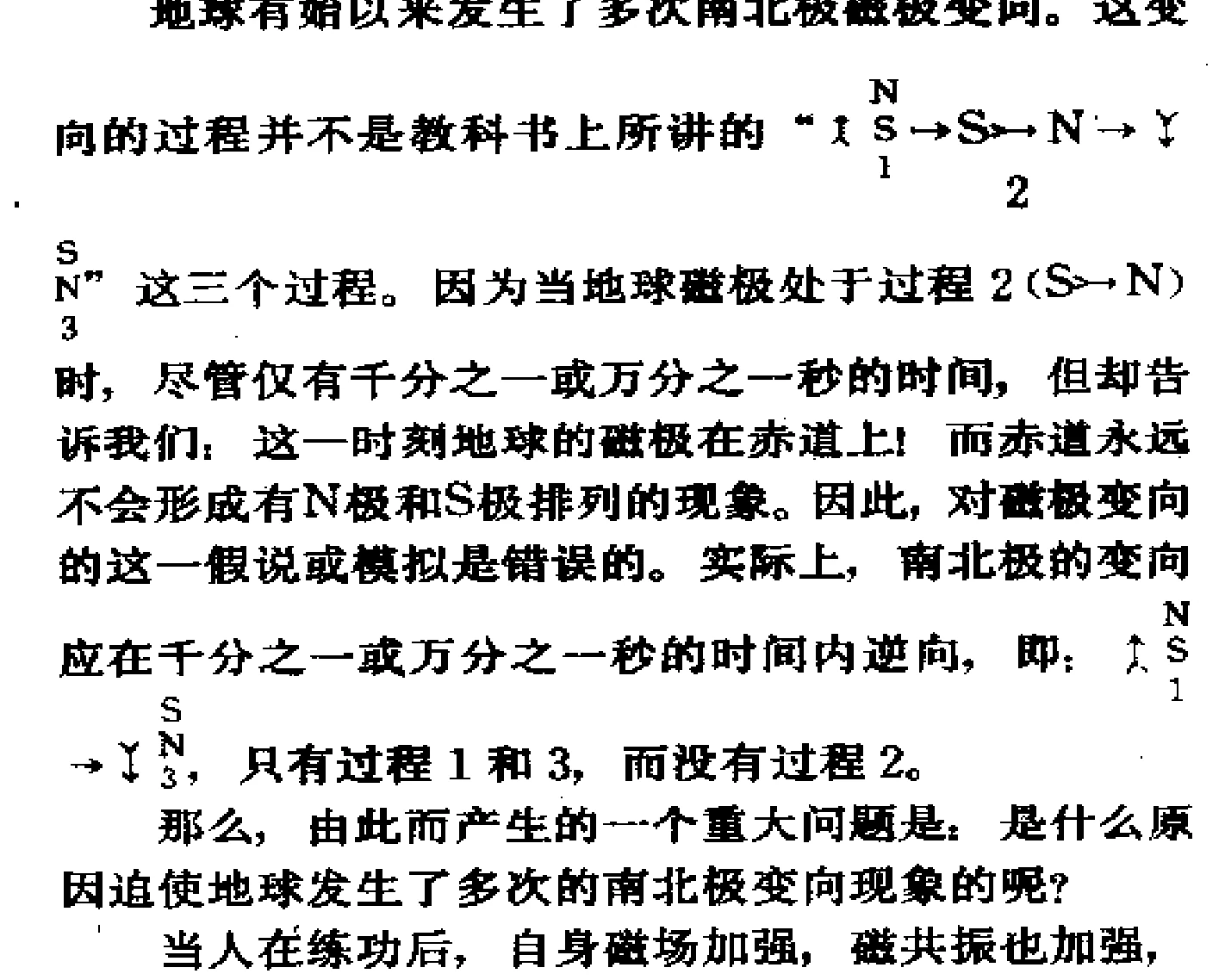
Since the beginning of the Earth, there have been multiple reversals of the north and south magnetic poles. This reversal process is not the textbook sequence of “1 S → S → N → 2 S” (three stages). When the Earth’s magnetic poles are in stage 2 (S → N), even though this stage lasts only a thousandth or ten‑thousandth of a second, it tells us that at that instant the Earth’s magnetic poles are located on the equator! The equator never forms a configuration where both N and S poles are aligned. Therefore, the hypothesis or model that assumes a gradual pole shift (process 1) is incorrect. In reality, the north‑south pole reversal should occur in a reverse direction within a thousandth or ten‑thousandth of a second, i.e., only processes 1 and 3 exist, and process 2 does not.
This raises a major question: What causes the Earth to undergo multiple north‑south magnetic pole reversals?
When a person practices qigong, their own magnetic field strengthens, and the magnetic resonance is amplified. Moreover, this can be completely controlled by the individual—people can control their own magnetic resonance. Consequently, when a qigong master emits power, the magnetic poles around the body reverse (opposing the Earth’s magnetic field), creating a repulsive interaction between the person’s magnetic field and the Earth’s magnetic field. This explains the levitation phenomenon observed in qigong.
When a person directs power toward an object (e.g., a medicine bottle), the bottle’s north and south poles reverse. At the instant of reversal there is a moment when the magnetic field is zero, allowing the pill to become precisely lodged in the bottle according to the practitioner’s intention. When the poles reverse again, the pill is released from the bottle. This constitutes the physical basis for the qigong “transportation” and “wall‑passing” techniques.
Advanced qigong masters…
These actions are always completed in an instant. A qigong practitioner may not understand physics, but the moving intention of the practitioner is precisely a physical process of magnetic‑pole reversal. The energy of a person’s magnetic‑pole reversal comes from the person themselves, i.e., the settled force formed by qigong training. As for why the Earth’s magnetic poles reverse, what is the cause?
Third, the energy of the cosmic wave and human extraordinary abilities.
The Earth’s magnetic‑pole reversal is never without reason; it is influenced by the great cosmic system. In the universe there exists an enormously energetic field (the cosmic wave); every few million years its peak value visits the Earth once. Because its magnetic field is many, many times stronger than Earth’s magnetic field, the pole reversal can be completed instantly under its influence.
Once a qigong practitioner or a normal person receives the frequency of this energy field, even though it is not at its maximum, it is still tenfold, hundredfold… stronger than Earth’s magnetic field and the human magnetic field. Thus, they can achieve a leap in their own energy: by relying on the celestial field, they attain various advanced qigong effects.
Four — Qigong and Extraordinary Abilities
To a large extent, qigong and extraordinary abilities are unified. When practice reaches a certain stage, extraordinary abilities naturally arise. However, some extraordinary abilities have nothing to do with qigong, such as innate prophets, wand mining, pendulum measurement, etc.
Undoubtedly, practicing qigong to acquire profound skill and thereby produce extraordinary abilities is the only shortcut with a method. This is also the purpose of 80‑90 % of today’s qigong practitioners. Regarding human extraordinary abilities, there are two views: the atavistic theory and the evolutionary theory; we advocate the stage theory. That is,
When human society reaches a certain stage, coinciding with the peak of the cosmic wave visiting Earth, humanity will manifest this function. In other words, the development of human extraordinary abilities—or the unlocking of human potential—usually occurs during the phase when the Earth’s magnetic north and south poles are undergoing reversal. This is a manifestation of the “unity of heaven and humanity” thought in the philosophy of the I Ching.
Setting aside the era (because before and after a magnetic reversal there is a process where a pole shrinks and then expands again; this process may take decades, centuries, or millennia, and can be roughly ignored—we are living in that era), it can be said that human potential is possessed by every individual. That is, what is called human extraordinary ability is actually a normal function that everyone has. Because the normal magnetic‑field strength of a person who can receive the cosmic wave and increase his own magnetic resonance is roughly the same for everyone, each person can realize the development of human potential.
Practicing qigong to generate extraordinary abilities, or directly practicing some non‑qigong spell to obtain extraordinary abilities, must heed moral issues. All immoral qigong actions will bring serious non‑beneficial consequences to the practitioner.
F
Five — Qigong and the I Ching
The origin of the I Ching is also a puzzling mystery. At first, the I Ching had no obvious effect on qigong; before the Han dynasty there were no records proving any direct or indirect relationship between the two; in the Eastern Han, Wei Boyang authored the I Ching Can Tong Qi, completing the integration of the I Ching and qigong.
The medium that links the I Ching and qigong is the Nei Jing. The book’s theory of hidden images (combining the eight trigrams with the organs) laid the foundation for the specific application of the I Ching Can Tong Qi to I Ching philosophy.
The I Ching Can Tong Qi laid the foundation for the concrete application of I Ching philosophy. The I Ching uses the eight trigrams—Qian (Heaven) three, Kun (Earth) three, Kan (Water) three, Li (Fire) three, Zhen (Thunder) three, Xun (Wind) three, Dui (Lake) three, Gen (Mountain) three—to explain the composition and transformation of all things in the universe. Within this are the three modes of movement: the unity, opposition, and complementarity of Yin and Yang.
How did such a worldview arise? It is said that the eight trigrams of the I Ching originated six or seven thousand years ago, when society was still in its primitive stage and people’s thinking was still primitive; it seems impossible for such an advanced mode of thought and worldview to have emerged then. Does this indicate that primitive‑society qigong masters or extraordinary‑ability practitioners (who would have been shamans at the time) performed qigong? Or perhaps it is a product of an interstellar civilization?
As an advanced methodology of human science, I Ching philosophy has an incalculable influence on qigong practice. Those who do not understand the I Ching cannot become a senior qigong master nor attain profound skill. The I Ching philosophy’s concepts of the Taiji diagram, the directional meanings of the eight trigrams, and Yin‑Yang directly provide the theoretical basis for qigong practice.
The physiological manifestation of qigong may be the intention’s effect on the heart and kidneys, i.e., on fire and water. The I Ching’s water‑fire Ji Ji hexagram and fire‑water Wei Ji hexagram can directly explain the physiological changes in qigong. Likewise, the Qian hexagram gives specific guidance for alchemical practice, the Gen hexagram gives precise description of qi circulation, and so on; all can become solid theoretical pillars and methods for qigong.
Ancient qigong texts often used this as their theoretical framework, such as Qimen Dunjia, Wu Liu Xian Zong, Xing Ming Gui Zhi, Zhou Yi Chan Zhen, etc. In ancient times, three schools studied the I Ching: the Xiangshu (image‑number) school, the Yili (principle) school, and the Tushu (text) school. I consider all of these to be approaches to I Ching philosophy.
Research – that is, the study of the Zhou Yi (I Ching) hexagram‑and‑line statements. We should also undertake research on the eight‑trigram symbols: this research is not about their written forms in the Xia‑Shang periods, but about the intrinsic relationship between their emergence and human‑body science, especially their origin in relation to the shamans (qigong masters and individuals with extraordinary abilities) of primitive societies! This is precisely where the philosophy of the Zhou Yi is most closely linked to qigong. For an understanding of Yijing knowledge, see my own work Comprehensive Explanation of the Zhou Yi, also known as Record of Hexagram Interpretation.
The above hot‑topic questions are each so extensive that even a large book could not fully cover them. Here I merely raise them for everyone’s reference.
In addition, the following kinds of people are fundamentally unsuitable for practicing this method:
- Persons suffering from mental illness or epilepsy, or who have a history of such conditions.
- Persons with serious heart disease.
- Persons unable to sit in meditation for more than two hours.
- Those who do not believe in this method or its principles.
- Those who do not possess benevolent thoughts and a kind heart.
- Charlatans and individuals whose cultural level is below high‑school graduation.
These points are not empty talk. Such individuals are respectfully excluded from practicing this method.
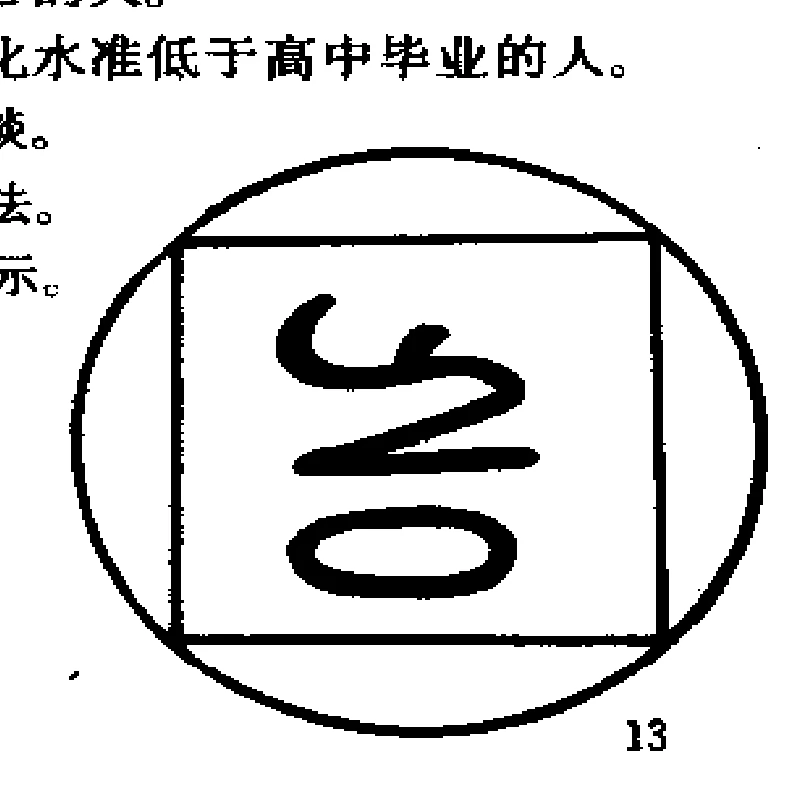
The symbol of this method is shown in the figure below.
This book is honored to have the inscription and preface personally written by Master Yan Xin (the preface was organized from the audio recording of his conversation with me). I express my deep gratitude here!
A
Preface
To practice a form of qigong without deviation, the most important factor is your own steadiness—that is, the length of your meditation sessions and the resulting internal power you develop. Secondly, the ability to analyze your own practice responses and promptly adjust them with intention is a crucial guarantee of your progress. If you possess these, then it comes down to your own insight—it is not determined merely by how long you practice.
Lecture 7 – Impure Observation Qigong
Practitioners of Buddhist mental‑power qigong must discard two concepts, otherwise entry into this path is difficult:
1. The notion of “mind guarding the dantian.”
Most contemporary practices emphasize a basic point: keeping the mind focused on the dantian. This dantian refers to the lower dantian, located about one and a half cun below the navel. As everyone knows, dialectical materialism and historical materialism contain a fundamental principle: consciousness exerts a tremendous reciprocal effect on matter. This is an unassailable truth and the materialist theoretical foundation upon which all qigong is built. Yet, from ancient times to the present, popular methods have largely taken “mind guarding the dantian” as their core. Philosophically, this reduces the vast reciprocal power of consciousness to the limited effect of guarding the dantian. From the standpoint of qigong practice, this is certainly not a “shortcut through Zhongnan” but rather a “Shu‑dao difficulty.” Therefore, in practicing this method one must abandon this notion, liberate the mind, and allow one’s consciousness to become free.
2. The notion of “meridians.”
A distinguished contribution of traditional qigong is its understanding of meridian theory.
Practice. This is also the method of moving energy employed by most contemporary qigong methods. However, Buddhism teaches that all forms are illusory, and Taoism says the great image is formless and the great way is simple. Therefore, theories such as the large and small microcosmic circuits (Da Zhou Tian and Xiao Zhou Tian) and meridian studies serve as the basis and method for qigong cultivation, but they are not the methods used in mental‑intention qigong (i.e., the practice of extraordinary abilities).
Consequently, this method has two distinctive features: no mental guarding of the dantian and no cultivation of the large or small microcosmic circuits.
So, what concepts must one establish when practicing this method? Two points.
-
The sole purpose of cultivating this method is to develop the human body’s latent potential.
In ancient times, the phenomenon of extraordinary human abilities was often called yi shu (heterodox arts), yao shu (demonic arts), or fa shu (magical arts), and those who possessed such abilities were referred to as yi ren (heterodox persons), yao ren (demonic persons), or fa ren (magical persons). What is the physiological mechanism behind these extraordinary abilities? Perhaps that is the very question! No one has formally proposed an answer yet. We consider that the body’s latent potential resides in six specific locations; by cultivating these six points, the potential can be realized. The six points are:- The circular “Yin Tang” point (the upper dantian) located at the center between the eyebrows.
- The pentagonal throat.
- The hexagonal “Zhong” acupoint (central swelling point).
- The crescent‑shaped navel, with the curve opening downward.
- The lotus‑shaped genitalia, an eight‑petaled lotus.
- The triangular “Chang Qiang” point, an inverted triangle.
Practitioners must memorize the shape and exact location of each point; this is the basis for cultivation. When all six points are fully opened, eighteen distinct functions can emerge, corresponding to the I‑Ching concept of “ten plus eight transformations” that form a hexagram. Moreover, the six points correspond to a hexagram’s six lines. Therefore, extensive study of the I Ching and the I Ching Can Tong Qi (the “Mysterious Agreement”) is helpful for enhancing power and deepening theoretical understanding. Examine the methods you have previously practiced—are they markedly different?
-
The second principle is to adopt a holistic cosmic view, namely the tian ren he yi (Heaven‑Human Unity) philosophy of the I Ching.
The tian ren he yi principle guides us in cultivation to align the self with universal information—that is, to harmonize Heaven and humanity as the ultimate aim. In this view, the universe is not a solitary external object but a “great self” intimately linked to human life; the individual self becomes a microcosm of the cosmos. When this principle is truly applied to mental intention cultivation, remarkable effects arise (such as dispersing clouds, gathering clouds, calling winds, and dispelling winds, recreating past events, retrieving information, etc.). In the past, the author referred to these concepts as “communication with the spirit realm” or “heaven‑human resonance”; the nature is the same, only the terminology differs. This requires clarification of two key ideas:
- Throughout the universe lie information fields spanning ancient and modern, Eastern and Western traditions. When the self’s intention merges with these fields, information can be reproduced.
Specifically, four viewpoints are proposed:
- Treat light as a conscious, red energy source.
- Treat qi (air, true qi, pathological qi, etc.) as a conscious carrier that receives and transmits all information. If qi is regarded as another invisible, conscious “self” existing throughout the universe, the effect is even greater.
- View all objects and all human activities as a continuous process of emitting informational waves into the universe. The conduit through which the self communicates with objects and activities is the self’s own mental‑intention power.
The wave of the self’s intention and the aforementioned informational waves can connect without restriction of time or place.
- View the physical body as capable of instantaneously breaking down into infinitely small particles and instantly recombining into an infinitely large, expanding‑contracting consciousness.
Having established the above two overarching concepts and ten specific conscious insights, one may commence the Impure Observation Qigong, the preparatory practice for advanced mental‑intention qigong.
Before delving into Impure Observation Qigong, the preceding material must be studied meticulously; otherwise, insight will not arise and the cultivation will not advance.
“Impure Observation” means regarding the self as a vessel that has gathered all worldly evils and diseases—an impure body that must be re‑created through the elements of heaven and earth, undergoing trials of water and fire, to forge a clear, penetrating foundation.
No matter what method you have practiced before learning this, you must start here. Otherwise, after reaching a certain level (such as the “wisdom‑eye” level), your power will stagnate or even be completely lost.
Impure Observation Qigong requires ten days of practice: once at midnight and once at midday each day, each session lasting one “shi‑chen”. The method includes four practices: Water‑Cleansing, Fire‑Scorching, Earth‑Descending, and Heaven‑Ascending. The schedule is four days of Water‑Cleansing, three days of Fire‑Scorching, two days of Earth‑Descending, and one day of Heaven‑Ascending. The purpose of each practice is as follows:
- Water‑Cleansing.
Sit with the back to the north and face south, in the double‑lotus posture. If double‑lotus is not possible, a single‑lotus may be used. One essential point to note: regardless of gender, this practice must be performed with the left leg (and left …)
Place the hands stacked on the right leg and the right hand. Because in this practice the qi moves downward. The left hand rests on the right hand in a hand‑seal that was traditionally called the Vajra Seal. In this textbook we uniformly use the hand‑seal names of our lineage.
Both hands are stacked in front of the lower abdomen, the left hand on top of the right, palms facing upward. While seated in the lotus position the left leg rests on the right leg. This is the physiological requirement and the foundation for the downward flow of qi. This hand‑seal is called the Fire‑Water Seal.
Then close the eyes, press the tip of the tongue upward, and meditate:
- First, meditate that all the evils and diseases of the world reside within oneself, feel the suffering this causes, and begin to repent in the heart. Sincerity is essential!
- When the mind is filled with the above awareness, begin to visualize at the top of the head (the Baihui point) a symbol: “”. The symbol is white. It transforms at the Baihui point into white sweet dew that fills the whole body. The evils and diseases on the body are washed away, flowing from the perineum (Huiyin point) down into the deep layers of the earth.
- Continue the meditation as described, feeling the body gradually become clean and pure, increasingly sacred and healthy. Then, in a feeling of self‑purity and whiteness, conclude the practice.
General practical requirements:
- The belt should be loose, the back straight, the head upright.
- If saliva accumulates, swallow it slowly.
- Do not allow wind to blow on you; do not be startled.
- If you pass gas, direct it downward from the Huiyin point into the ground.
- Relax the whole body; do not exert force.
- Begin practice at least half an hour after a meal.
The purpose of this practice is to purify the body, removing harmful factors from mind and flesh, and to lay the foundation for cultivating intentional qigong.
II. Fire‑Burning Practice
With your back toward the north and facing south, sit in a lotus posture. Either a double lotus or a single lotus may be used.
One point must be observed: regardless of gender, this practice requires the right leg and right hand to be stacked on the left leg and left hand, because the qi in this practice moves upward. The right hand rests on the left hand in a hand‑seal that was traditionally called the Dharma Seal. We call it the Water‑Fire Seal.
Then close the eyes, press the tip of the tongue upward, and meditate:
- First, visualize yourself as a dead tree or a pile of dry firewood, covered with all kinds of filth. Feel sorrow for this condition and begin to repent in the heart. Sincerity is essential!
- When the mind is filled with the above awareness, visualize at the perineum (Huiyin point) a symbol: “”. The symbol is red. It transforms at the Huiyin point into red flames that burn through the entire body, incinerating all decay and aging.
- Continue the meditation, feeling the body gradually revitalized, increasingly full of vigor. Then, in an unusually excited sense of regeneration or youthful renewal, conclude the practice.
General practical requirements:
- If you pass gas, imagine it being consumed by fire.
- Other requirements are the same as those for the Water‑Washing practice.
The purpose of this practice is to prepare the development of human potential, calling forth all dormant functions and consciousness in mind and body.
III. Earth‑Descending Practice
The movement requirements are the same as for the Fire‑Burning Practice.
Then close the eyes, press the tip of the tongue against the roof of the mouth, and meditate:
- First, visualize your own legs becoming larger and longer. The seated posture remains unchanged, but the “base” (the platform formed by the legs) expands continuously, becoming infinite. Imagine the legs extending infinitely, so the base also becomes infinitely large.
- Visualize the legs becoming increasingly heavy, sinking into an infinite depth of weight.
- Visualize yourself, still in the seated posture, rapidly descending into a bottomless, immeasurably deep black hole. The speed of descent increases, and the hole grows ever deeper and darker, never ending. Conclude the practice when you feel merged with the black hole.
General practical requirements:
- Do not allow fear to arise.
- Although the legs are imagined as infinitely long and large, they must never exceed the width of the hole.
- Other requirements are the same as those for the Water‑Washing practice.
The purpose of this practice is to enlarge the human magnetic field and to train entering stillness through intention.
IV. Heaven‑Ascending Practice
The movement requirements are the same as for the Fire‑Burning Practice.
Then close the eyes, press the tip of the tongue upward, and meditate:
- First, divide yourself into two parts: the external body and the internal “ham”. Visualize the external body as being covered with the many diseases and evils of the mundane world.
- The internal “ham” begins to rise, ascending infinitely through the Baihui point.
- Visualize an auspicious, gentle white light high in the limitless sky, and see the internal “ham” moving toward that white light, leaving behind the external body. Conclude the practice when the internal “ham” merges with the white light.
General practical requirements:
- Do not become overly joyous; maintain a tranquil mind.
- Other requirements are the same as those for the Water‑Washing practice.
After ten days of cultivation, once the basic body‑purifying skill has been attained, one may study other methods.
When practicing the “Impure Observation” qigong, sincerity is the most important factor. Without sincere heart, no effect can be obtained and the goal cannot be reached. This is the concrete embodiment of the Buddhist teaching of precepts, concentration, and wisdom. Without sincerity, even the precepts are useless; with sincerity, even without strict precepts one can generate concentration. In substance, if all the above requirements are fully implemented, one can acquire the ability to manipulate qi. Examples include altering the taste of tobacco, alcohol, and other beverages; expelling pathogenic qi; healing illnesses with intention, and so on.
Before beginning practice, read the theory carefully. This is the foundation of awakening. Without awakening, true fruit is hard to achieve. If you can discern meanings that I have not explicitly expressed, you have already awakened.
Below is an article by the author on the relationship between mental‑force qigong and the I Ching, for reference:
Explanation of Mental Power Yijing Study
The Yijing (Book of Changes) has four uses, as it has since antiquity. In addition to the external alchemical furnace, it is now especially flourishing. Practice first follows the pre‑heaven and post‑heaven arrangements, forming the great method of internal and external elixirs. It returns to qi and the Way, arriving at the Yijing. The Yijing establishes the eight trigrams between heaven and earth, opening the way to create things; the myriad things flow, therefore the endless generation of the Yijing is in harmony with heaven and earth. Qi, as a substance, pervades the universe. Cultivation through the dantian, if prolonged, yields the elixir and the Way. Hence there is the doctrine of threefold cultivation: cultivation of mind, breath, and body.
The Yijing distinguishes Qian (Heaven) and Kun (Earth), and qi is likewise. Thus qi is of two kinds:
One is li (force), roughly corresponding. Qi has an internal–external distinction; force has a yin–yang distinction. The two kinds are divided into four, and only the Shakyamuni secret school takes yin‑force as the basis of practice. Yin‑force is mental power, spiritual power. Thought is born in the heart, force is formed within; when released it becomes qi. I think this is a shortcut.
The human dantian has three parts; according to the Yijing the head represents Qian, the abdomen Kun, so the upper dantian is Qian, while the middle and lower dantian are Kun. The Yijing emphasizes yang strength and governs Qian, therefore practice should place the upper dantian as the ruler, that is, make mental power the ruler. Yet practitioners of past and present often violate this, so many practice but few attain the Way. Those who attain the Way—ancient texts speak of ascension, becoming an immortal, longevity. But people disappear, the Yellow Crane no longer returns, so Confucians do not speak of strange powers and chaotic spirits, for good reason. In terms of gain and loss, what modern people call “extraordinary abilities” are what the ancients called those who have attained the Way.
Modern practitioners also base themselves on the Yijing. Yet the Yijing’s Way is hard to understand; speculative associations arise, even to the point of treating the Yijing as the pinnacle of science. Is this so? Are modern people inferior to the ancients? Does primitive thinking surpass modern thinking? The Yijing’s four uses were clearly stated by the first three generations. By the Eastern Han, the notion of an external alchemical furnace appeared, forming five uses. Thus, while the Yijing is taken as the foundation, in fact the Cantong Qi (Seal of the Unity of the Turning) is the true foundation—this is the true Yijing. Yet the Boya book can be sought for both internal and external elixirs.
Regarding the excavation of human potential, it is rarely discussed. Regrettably, once this book is completed and regarded as a classic, the methods of Central‑Plain cultivation become fixed. Only the method of visualization remains, echoing the meditation of Brahman yoga, complementing each other.
The teachings of Shakyamuni spread across the Central Plains, and Chinese and Indian qigong finally began to intermingle. Hand seals and mantras arose; the power of meditation opened the gate of mental power. The sinicization of yoga brought forth esoteric practices. The teachings of Buddhism and Daoism complemented each other, forming a magnificent panorama.
Shakyamuni’s three‑secret teachings have particular achievement in mental power. Compared with guarding the dantian with intention, there is a clear distinction. There are four correspondences between mental power and Yijing symbols:
-
Form (体) – The six lines of the Yijing are symbols of all things; they change into sixty‑four, thus the vast universe can be sought through Yijing symbols. Mental power, relying on the heart to direct intention, can attain the three‑thousand views. Both employ simplicity to govern complexity.
-
Change (变) – Change in the Yijing lies in position, yet does not exceed the form. Change of mental power lies in the three secrets, yet does not leave the heart. Both possess change that is unchanging.
-
Communication – The visualization of Yijing symbols and the cultivation of mental power are mutually connected. Therefore mental‑power practice can be seen as the qigong transformation of Yijing symbols.
-
Use – The application of Yijing symbols has the same wonderful effect as the five-eye and six-power abilities of mental power.
The Yijing·Xi says: “One yin and one yang is called the Way; the unfathomable yin‑yang is called the spirit.” Mental power is the unknowable yin‑yang; those who know are only the three secrets, thus mental power that connects with spirit is the ultimate discussion. Broadly speaking, the Western pendulum and the Chinese fu qi are both driven by mental power. When it moves there is existence; when there is existence there is spirit, and spirit aligns with the Way. Extraordinary abilities are already prepared. These are the ancient eccentrics. In the eyes of the foolish, the intermediary between qigong and extraordinary abilities is none other than mental power. When mental power is great, many functions are developed; this cannot be achieved merely by elixir work.
Mental power is not a single thought at a single time and place. Lao‑zi says: “Embrace the origin and guard the one.” The “one” is the single, persistent thought. This is an ancient saying about meditation.
In terms of the Yijing, its three meanings are: Bu Yi (unchanging), Bian Yi (changing), and Yi Jian (simplified). Guarding the one is the unchanging. The unchanging endures; the changing arises naturally. Shakyamuni’s so‑called fixed‑born wisdom is largely sufficient to explain it.
Regarding the practice of mental power, hand seals adjust the interior, mantras cleanse internal objects of the heart, meditation unites intention with inner force, thus the qi of mental power encompasses the interior. The qi of mental power, I think, can be spoken of as having a tangible quality.
Wave – Mental‑power transportation, mental‑power diagnosis, and similar are all waves. Two waves interpenetrate without obstructing each other, therefore transportation, diagnosis, etc., are possible. All things in the world have their own waves, each with faint vibrations. When the wave of mental power resonates with the wave of the transported or diagnosed object and surpasses it, extraordinary reports of transportation and diagnosis arise. I do not dare to fully endorse the four‑dimensional theory or the theory of material qi returning.
Particle – When mental power focuses on a single object, the wave becomes a straight‑line wave, i.e., a particle. Healing with mental power and directional experiments all rely on this. Because mental power has wave‑particle form, one can diagnose disease a thousand li away, transport objects ten thousand li away, and also heal, emit qi, and transmit mind. The wave‑particle of mental power resonates with the waves of past phenomena and with the waves of future phenomena, thus the doctrine of the five eyes and six spiritual powers. Resonant reception functions like a time‑reversing or forward‑propelling device. It could connect all martial arts of past and present, or reveal all future events and scenes. The state of qigong merges past, present, and future into one, and by means of mental power one roams it; the mind roams beyond material things. Mental power makes Yijing study concrete.
The Yijing·Xi says: “When you look up, observe the symbols in the heavens; when you look down, observe the patterns on the earth; observe the markings of birds and beasts and the suitability of the land.” Observing and creating the Yijing, the observation of qigong is the storage of imagination and meditation. Thus observing and forming intention, forming mental power, forming spiritual power are all one.
The rise of the Yijing is like the rise of mental power. With the sinicization of yoga, Shakyamuni’s secret school and Yijing theory become unified, forming a convergence of Yang and Mo. Thus Daoism emphasizes stored imagination, while Buddhism’s essence is meditation; their aims are the same. In ancient Confucian learning, “the Master did not
speak of strange phenomena” was the guiding principle; thus visualization and meditation became the study of investigating things to acquire knowledge. Hence half a day was devoted to Bodhidharma and half a day to Confucius, and ultimately one returns to exhaust the principle and nature. Once the method is fixed, those who attain the Way are few. This is not strange.
Read this article carefully; it will be helpful for your future cultivation.
Lecture Two – White Bone Observation Qigong
Having attained the principles and skill described above, we now study White‑Bone Observation Qigong. This is also the preparatory practice for Buddhist mental‑power Qigong.
The purpose of White‑Bone Observation Qigong is to regard the human body as a set of white bones during practice, thereby opening the “Heaven’s Eye” (Tian‑mu) and preparing for the development of human potential.
Today many Qigong masters claim that opening the Heaven’s Eye equates to possessing extraordinary abilities. Some even profit from this claim. In fact, opening the Heaven’s Eye is merely a prerequisite for practicing advanced methods and for unlocking human potential.
White‑Bone Observation Qigong consists of four techniques: Wind‑Shadow (Feng‑Ying) Gong, Thunder‑Strike (Lei‑Ji) Gong, Mountain‑Roar (Shan‑Ming) Gong, and Marsh‑Ripple (Ze‑Dang) Gong. Each is performed once at midnight (Zi) and once at midday (Wu), each session lasting one “shi‑chen” (two modern hours). The entire set requires roughly one hundred days of practice:
- Wind‑Shadow Gong – 49 days
- Thunder‑Strike Gong – 24 days
- Mountain‑Roar Gong – 18 days
- Marsh‑Ripple Gong – 9 days
The practice methods and purposes for each technique are as follows:
Wind‑Shadow Gong
Sit with your back to the north, facing south, in the double‑lotus posture. If you cannot sit in double lotus, a single‑lotus posture is acceptable. Place the right leg atop the left leg. Overlap both hands in front of the lower abdomen, forming the “water‑fire” seal. Then close the eyes, press the tip of the tongue against the palate, and begin meditation.
-
First, meditate on a white skeleton appearing in the Yintang (the “third eye”) point. Once this image appears, the major work is accomplished. At that moment, look outward from the Heaven’s Eye to observe your own white skeleton. If it does not appear, intensify the intention and think: “All of my bones appear within the Heaven’s Eye.” Strengthen this intention, keep the eyes closed, and search carefully within the Heaven’s Eye until the image emerges, then continue the practice.
-
Meditate on the skeleton gradually enlarging until it matches your own size.
-
Meditate on the skeleton becoming increasingly clear, with each bone joint discernible. When you have fully visualized all of your bones, conclude the practice.
Key practical guidelines:
- Do not be startled, frightened, or emotionally agitated upon seeing the bones, lest shock cause illness.
- When the Heaven’s Eye opens, the Yintang point may feel pressure, pain, or a sense of heaviness. This is not illness but a positive sign indicating that the Yintang is being opened. If you cease practice because of headache, pressure, or heaviness, you will have abandoned the path halfway, which is a great loss.
- You may also simply meditate on your skull appearing within the Heaven’s Eye. If only the skull is seen, the Heaven’s Eye will still open.
- Do not over‑concentrate the mind on the crown of the head, which can cause dizziness or a feeling of brain swelling; instead, focus the intention on the Yintang point.
- Those whose Heaven’s Eye has not yet opened must not practice the subsequent techniques.
- Practice this method without impatience. Once desire-realm concentration is established, the Heaven’s Eye will naturally open.
2. Thunder‑Strike Gong
Sit with your back to the north, facing south, in the double‑lotus posture; if double lotus is not possible, a single‑lotus posture is acceptable. Place the right leg atop the left leg. Interlace the hands, clasping the thumbs together and resting them on the index fingers—this forms the “Mountain‑Thunder Seal.”
Then close the eyes, press the tip of the tongue against the palate, and begin meditation:
-
First, imagine a tremendous thunderclap coming from the distant sky, striking the Yintang point and emitting a strong, non‑glare white light. Strengthen the intention to make this white light brighter.
-
Visualize the white light entering the body through the Yintang. Internally observe your skeleton illuminated clearly by the white light.
-
Continue this meditation. When all of your bones have become fully visible, conclude the practice while feeling as though you are a heap of white bones.
Key practical guidelines:
- If, within the white light, you see deceased relatives, scenes from your past, or images of the future, do not fear or become excited.
- If, within the white light, you see someone teaching you the practice or speaking to you, follow the instructions given. Note that you must not disclose what you have learned to third parties. If such images appear in your mind, it indicates communication with your teacher; thereafter, there is no need to continue learning further methods. You will gradually acquire various abilities.
- If you encounter frightening images of the spirit realm, immediately recite silently in your heart: “君子终日乾乾,夕惕若厉,无咎。” (The virtuous man works diligently all day, remains vigilant in the evening; if he is severe, there is no fault.) Repeat this eighteen times, then conclude the practice.
- Other guidelines are the same as those for the Wind‑Shadow Gong.
3. Mountain‑Roar Gong
Sit with your back to the north, facing south, in the double‑lotus posture; if double lotus is not possible, a single‑lotus posture is acceptable. Place the right leg atop the left leg. Rest both hands on the knees, palms touching the knees.
Then close the eyes, press the tip of the tongue against the palate, and begin meditation:
-
First, meditate that your throat is a pentagonal window. As you inhale, all the red‑light matter of the universe rushes into this window, forming a single, red, hot, large “Dan” (elixir). As you exhale, this Dan rises upward to the Yintang Dan. Visualize this Dan igniting the Heaven’s Eye, causing it to swell and heat, and opening a circular window in the Yintang Dan. As the Dan ascends, internally observe your throat and skull.
-
Repeat this sixty‑four times.
-
Next, meditate that your Shanzhong point, at the center of the chest, is a hexagonal window. The remaining meditation is the same as above. As the Dan rises, also internally observe your chest cavity, throat, and skull.
-
Repeat this sixty‑four times.
-
Then, meditate that your navel is a crescent‑shaped window. The remaining meditation follows the same pattern. As the Dan rises, also internally observe your internal organs, chest cavity, throat, and skull.
-
Repeat this sixty‑four times.
-
Next, meditate that your genital region is a lotus‑shaped window. The remaining meditation is the same as above. As the Dan rises, also internally observe your pelvic bones, internal organs, throat, and skull.
-
Repeat this sixty‑four times.
-
Finally, meditate that your “Changqiang” point is a triangular window.
The external meditation is as described above. As the elixir (dan) rises, simultaneously turn your inner gaze to your spine, shoulder blades, throat, and skull. Perform this sixty‑four times, then conclude the practice.
A few basic requirements:
- The ascent of the elixir should be slow, and the inner gaze should be slow as well.
- If you cannot imagine all the red‑light substance of the universe rushing into the window, you may instead picture the sun in the sky coming to the window and becoming a red, hot, large elixir.
IV. Ze Dang Gong
With your back toward the north and facing south and sit in double‑lotus. If you cannot sit in double‑lotus, a single‑lotus is acceptable. Place the right leg on top of the left leg. Bring the palms together in front of the chest.
Then close your eyes, tip the tongue upward, and meditate:
- First, choose any four characters, for example: “Amitabha”, “one‑two‑three‑four”, “Thus I have heard”, “Hu Na Ha Yi”, etc. The choice is up to personal preference. The author has used characters such as “Hu Na Ha Yi”, “Na Ma Si De”, “Hao Xu Hai Xi”, and so on.
- After selecting the four characters, assign them as follows: when reciting the first character, focus on the navel; when reciting the second, focus on the Shanzhong point at the center of the chest; when reciting the third, focus on the throat; when reciting the fourth, focus on the Yintang point (the “third eye” between the eyebrows). As you chant, visualize the images that appear in the inner eye.
- The chant should be slow, lingering, light, even, and fine, emanating from the dantian.
- To finish, simply lower your hands.
Additional basic requirements:
- The four chosen characters should not be disclosed to other practitioners.
- When chanting, the sound should be audible to yourself.
- Other miscellaneous requirements, such as those for the Thunder‑Strike Gong.
Only after practicing the White‑Bone Observation Qigong may you proceed to the next practices; otherwise later practices will be ineffective. The four methods described here must be performed in their prescribed order; do not rearrange them.
If your inner eye (Tianmu) is already opened but you have not yet attained the level of open‑eye clairvoyance, you should return to the beginning of the practice. If you have already achieved open‑eye clairvoyance, you may begin with the Thunder‑Strike Gong.
Ancient practitioners typically studied the I Ching, the Zhouyi Cantong Qi (The Kinship of the Three), as well as Buddhist and Taoist scriptures. Consequently, the sounds they emitted possessed a strong qi‑field. As this field formed, successive generations of practitioners amplified it. By regularly reading the aforementioned texts you can communicate with the qi‑fields of both ancient and modern masters. When you recite while seated with eyes closed, if the frequency of your voice matches that of a high‑level practitioner from any era, his image will appear in your inner eye. This is a manifestation of the Dharma‑body. Our lineage regards such an image as your spiritual teacher. Therefore, even when you are not actively practicing a method, you should continue reading those texts.
Because this method belongs to the “mental‑power” category, before your skill reaches the stage of “wisdom‑eye clairvoyance” you need not worry about whether you are vegetarian, a Buddhist, or living a life of purity. Nevertheless, you must still observe the requirements explicitly stated in these methods; the purpose is to enlarge mental power.
The human brain normally operates within a regime of control and inhibition, so most people do not realize that intention can possess energy comparable to muscular energy. After cultivating this method, your mental power can increase, allowing you to realize whatever your mind envisions. Across all schools of qigong, the magnitude of mental power is the standard by which a qigong master—or a person with extraordinary abilities—is measured.
In China, qigong can be physiologically categorized
into three types: refining essence (Jing), refining qi, and refining spirit (Shen). Although each type emphasizes the cultivation of the other two, they differ in focus. Refining essence relies mainly on external martial arts and health‑preserving exercises; refining qi centers on internal martial arts and common dynamic or static internal cultivation, primarily working the lower dantian; refining spirit draws on Tibetan esoteric Buddhist qigong and advanced Buddhist and Daoist mental-power practices, primarily working the upper dantian. Among these, only the latter provides a shortcut to developing one’s extraordinary abilities. This is now collectively referred to as “special‑ability qigong.” The Buddhist concept of the “five eyes and six supernatural powers” also originates from this.
When practicing the Impure‑Observation Qigong and the White‑Bone Observation Qigong, avoid hostile confrontations and cultivate humility. Those who previously practiced martial arts should pay particular attention to the Impure‑Observation practice to dispel fire‑like aggression and murderous intent. While practicing the White‑Bone Observation Qigong, refrain from reckless or insulting behavior toward others; truly base your practice on virtue. Some individuals with a previously unkind heart must undergo thorough inner cultivation to achieve the state required by the Impure‑Observation practice. Once achieved, you will possess the powers of clairvoyance, retro‑vision, and wisdom‑eye. The specific way you employ these abilities depends on the size of your mental power.
Lecture Three – Light‑Qi Qigong (Part I)
The preparatory practices for Buddhist Mental‑Power Qigong are the Impure‑Observation Qigong and the White‑Bone Observation Qigong. Only after mastering these two can one formally begin Buddhist Mental‑Power Qigong.
Buddhist Mental‑Power Qigong consists of two complementary sets: a yang (active) set called Light‑Qi Gong and a yin (receptive) set called Spiritual‑Power Gong. The yang set comprises nine methods: Wu‑Ji Gong, Qian‑Xiang Gong, Kun‑Xiang Gong, Kan‑Xiang Gong, Li‑Xiang Gong, Xun‑Xiang Gong, Zhen‑Xiang Gong, Gen‑Xiang Gong, and Dui‑Xiang Gong. The yin set comprises six methods: A‑Xiang Gong, Wei‑Xiang Gong, Na‑Xiang Gong, Ma‑Xiang Gong, Si‑Xiang Gong, and Mu‑Xiang Gong.
Light‑Qi Gong focuses on the absorption of light and harmony; Spiritual‑Power Gong focuses on the absorption of spirit and force. Together they constitute the yin‑yang practice of mental‑power cultivation. In this book we can only provide the complete methods for Light‑Qi Gong. Because the practice of Spiritual‑Power Gong is extremely dangerous and prone to deviation, I will not disclose it. I ask fellow practitioners who intend to advance to Spiritual‑Power Gong to consider the safety and health of others and refrain from publishing such an ancient yet hazardous method.
Basic knowledge required for Light‑Qi Gong:
Light‑Qi Gong is a yang method based on the I Ching number of Old Yang; therefore, it comprises nine distinct practices. Its characteristic is the absorption of all natural light, especially sunlight. By drawing this light into the body one seeks the formation of a rainbow‑colored Dharma‑body and, after death, the transformation of the physical corpse into a rainbow form. In ordinary application, the practice involves the release of this absorbed light.
Main principle. When practiced on oneself, my body becomes like light—transparent, bright, forming a seven‑colored light wheel; when practiced on others, my qi becomes light, and the light removes disease, surpassing the seventh level of a stupa. This reaches the state where I, light, and qi are one. Therefore, Guang‑Qi Gong actually treats Heaven and Earth as a great dantian, with the person as the dantian of Heaven and Earth. Consequently, all the essence of the universe can be taken in by me. The link between the great dantian of Heaven‑Earth and the human dantian is the mind. All human actions should use the mind as the vehicle for transporting the dantian, achieving constant unity with Heaven and Earth. At the same time, the person is regarded as a great dantian, and conversely Heaven‑Earth becomes the person’s dantian, integrating the whole universe within the body. This process is effected by the mind. The internal foundation of this forward‑and‑backward process is the mind; the external foundation is light and qi. The mind here differs from ordinary thought; it is a higher‑level mind, namely “thought‑power.” Ordinary human thought is primarily inward‑directed, whereas the higher mind (thought‑power) is primarily outward‑directed. Outward‑directed thought‑power, aided by external light and qi, externalizes or actualizes a person’s ordinary inward thought. Thus, light, in the practitioner’s view, is a conscious red source of energy; qi is a conscious carrier that receives and transmits all information. Each practice of Guang‑Qi Gong should be cultivated for one hundred days, performed once at each of the two daily meridians (midnight and noon), each session lasting one shichen (two modern hours). Two different practices may be cultivated simultaneously, but no more.
I. Wu‑Ji Gong (Limitless Skill).
This practice is performed in a standing posture.
With the back to the north, face south; the left middle finger is slightly bent, the right middle finger is slightly straight; the whole body…
…relaxes, eyes closed, tongue tip pressed against the palate, toes relaxed as if walking on water, hands placed at the sides, shoulders dropped, elbows hanging, legs slightly bent.
1️⃣ Focus the mind on the left and right Yongquan (Kidney Fountain) points, breathing eighty‑one times.
2️⃣ Visualize: I am enveloped by an infinite red light sphere, and I am at its center. Feel this sensation, breathing eighty‑one times.
3️⃣ Visualize: On inhalation, a red light beam enters the left side of the body through the Tian‑mu point, gradually descending, passing the left Yongquan point, and entering the ground. At this moment, the internal view of my skeleton is very clear. On exhalation, the red beam enters the right side of the body through the right Yongquan point, gradually ascending, and exits through the Tian‑mu point. The internal view of my skeleton is also very clear. After one hundred eighty‑two breaths, inhale again; the red beam now descends through the right side of the body; on exhalation, it ascends through the left side. All other steps are as described above.
Breath count: two hundred and four times.
General requirements:
- Breathing and intention must be slow; do not rush.
- If the practitioner’s Tian‑mu is already open, this practice may be omitted.
- Maintain an awareness of unity between Heaven‑Earth and self.
II. Qian‑Trigram Form Skill.
This practice is performed in a double‑lotus posture.
With the back to the north, face south; palms rest on the knees; shoulders dropped, elbows hanging, tongue tip pressed against the palate, eyes closed.
1️⃣ First meditation: on inhalation, a red light beam enters the body through the navel. As the red beam rises, the internal view of my five organs and six viscerabecomes very
clear.
2️⃣ On exhalation, this red beam shoots directly out of the Tian‑mu, preparing for the next inhalation.
3️⃣ Repeat this cycle, forming a closed semicircular loop.
4️⃣ Breath count: three hundred eighty‑four times.
5️⃣ On the next inhalation, the red beam re‑enters through the Tian‑mu; as the beam descends, the internal view of my five organs and six viscera remains very clear.
6️⃣ Meditation: on exhalation, the red beam shoots directly out of the navel, preparing for the next inhalation.
7️⃣ Repeat this cycle, forming a closed semicircular loop.
8️⃣ Breath count: three hundred eighty‑four times.
General requirements:
- This practice is not for opening the Tian‑mu, but for using the Tian‑mu after it has been opened.
- The amount of light expelled must be taken back in; no loss is allowed.
- The expelled light beam must be fine, straight, fierce, red, and then form a circular arc.
- All other general requirements are the same as for Wu‑Ji Gong.
III. Dui‑Trigram Form Skill.
This practice is performed in a double‑lotus posture.
With the back to the north, face south. Interlace the hands, tightening the grip; the thumbs lie parallel and pressed against the crossed index fingers—this hand seal is called the “Mountain‑Thunder Seal.” Place the hands on the folded lower legs while seated. Shoulders dropped, elbows hanging, tongue tip pressed against the palate, eyes closed.
1️⃣ First meditation: on inhalation,eighty‑four thousand samādhi
true‑fire fireballs from the universe enter the body through the eighty‑four thousand hair pores, gathering in the lower dantian to form a large fireball.
2️⃣ On exhalation, this large, red, hot, bright fireball, centered in the dantian, emits an intense red light and heat, accompanied by a thunderous roar. Visualize this blazing fireball and listen to its resonant sound.
3️⃣ Breath count: three hundred eighty‑four times.
General requirements:
- If the practitioner feels the throat becoming overly hot, a strong nasal sound may be emitted on exhalation.
- If the abdomen feels unbearably hot, the intention may be reduced.
- After completing the practice, check the room for any increase or decrease of objects. If something suddenly appears, look for anything that may have disappeared. Whether objects appear or disappear, do not use them privately or search for them elsewhere.
- If the practitioner sees a beloved person or object in the Tian‑mu, do not develop possessive thoughts (do not continue looking). Otherwise, the cultivated skill will be completely nullified.
- If, during practice, the practitioner sees an elderly man with a long white beard assisting or moving things for them, do not become overly nervous or fearful.
- Do not use this skill for personal gain; doing so will incur double punishment.
- Do not perform “moving‑object” demonstrations for others, as this harms the development of one’s own ability.
- All other requirements are the same as those of the Wuji (Limitless) Practice.
IV. Li‑Xiang (Departing Image) Practice
This practice is performed in a standing posture.
With the back to the north and the front toward the south; the left hand holds the right wrist, the right hand is extended as a sword‑point. The whole body is relaxed, the tongue tip pressed against the upper palate, the toes grip the ground, shoulders are dropped, elbows are hanging.
-
While inhaling, visualize the Yongquan points on both feet and the navel simultaneously drawing in a red beam of light; while exhaling, visualize the sword‑point and the Tian‑mu point simultaneously projecting a red beam of light forward. The two beams merge into one. In meditation, imagine the sword‑point growing from within the Tian‑mu point, emitting a red beam.
-
While exhaling, imagine that in front of you there are sixty‑four iron rods. Using the red beam of light you have just emitted, thrust each iron rod individually into a stone wall. When thrusting, keep a fierce gaze, concentrate the mind, clench the teeth, and apply force. Each breath thrusts one iron rod.
-
Breathe sixty‑four times.
A few common‑sense requirements:
- When thrusting, the hands should not exert physical force; the effort is in the power of thought.
- This practice must not be used as a game with others, lest injury occurs.
- The sixty‑four iron rods are arranged in an 8‑by‑8 square formation.
- All other requirements are the same as those of the Wuji Practice.
All of the above methods must be practiced earnestly and without selective omission, because they are linked to intrinsic symbolic‑numerical principles of Yi‑Jing study. If this practice is performed diligently up to this point, the practitioner will have attained a relatively advanced level of mental‑power (念力).
When practicing the above methods, one may also adopt a flowing direction, namely:
Use the direction of the sun as the guiding direction, and absorb the sun’s light and qi. These lights and qi are conscious sources of energy, not the ordinary lights and qi perceived by most people. When the practitioner can communicate with the universal light and “non‑energy,” they will enter a subtle, indescribable, high‑level qigong state. Of course, the initial sitting and meditation may feel dull, but perseverance is essential. Stability (定) gives rise to wisdom (慧); without stability, wisdom cannot arise. Those who have only stability without wisdom, or wisdom without stability, cannot achieve profound skill.
Regarding discipline (戒), the “impure‑view” qigong in this method transforms the precepts into a practice, making the precepts themselves a method rather than a set of rigid rules.
In short, the three components—precept, stability, and wisdom—are all indispensable. Practitioners must avoid a restless mood or anxious expression, as these obstruct the arising of wisdom.
A fundamental reason why some have never cultivated the “opening of Tian‑mu” is poor stability. Only by working on stability can one reach the realm of wisdom.
Lecture Four
Light‑Qi Qigong (Part Two)
Having completed the practices described above, we now proceed to the remaining five methods.
V. Zhen‑Xiang (Shaking Image) Practice
This practice is performed in a double‑lotus posture.
With the back to the north and the front toward the south; bring both hands together in front of the chest, palms touching. Shoulders are dropped, elbows hang, tongue tip pressed against the upper palate, eyes closed.
- Meditation: while inhaling, imagine a certain organ inside the body filling with qi; while exhaling, imagine that organ flying out of the body.
- On the next inhalation, imagine another organ filling with qi; on exhalation, that organ also flies out.
- Continue as far as possible—each organ present in the body draws in a breath and then flies out.
- When the self feels completely reduced to an empty shell, with nothing inside, meditate: the sky is filled with white, milky‑like “characters” that pour straight from above into the practitioner’s Baihui point, flow through the body, and reach the feet. (Pronounced “Lin,” sound “ham”).
- With each breath, inhale a stream of this Z‑shaped milky‑white sweet dew.
- Continue to pour as much of this milky‑white sweet dew into the body as possible, until it can no longer be filled, allowing it to saturate the body from bottom to top.
- The number of breaths is at the practitioner’s discretion. One complete session of this practice takes about one shichen (two hours).
A few common‑sense requirements:
- Any organ that is externally visible must not be filled with qi, nor allowed to fly out.
- Organs that fly out disappear into the distant sky and do not return.
- As the internal organs fly away, the self gradually experiences a feeling of emptiness, cleanliness, and a purification that merges with the qi of heaven and earth.
- All other requirements are the same as those of the Wuji Practice.
VI. Xun‑Xiang (Gentle Image) Practice
This practice is performed in a double‑lotus posture.
With the back to the north and the front toward the south. Interlace the thumb and index finger of the left hand, keeping the remaining three fingers extended; place the left hand in front of the dantian, palm upward. Extend only the index finger of the right hand, bend the remaining four fingers and clasp them tightly, and hold the right hand vertically in front of the chest. This hand configuration is called the “Heaven‑and‑Earth Seal.” Shoulders are dropped, elbows hang, tongue tip pressed against the upper palate, then close the eyes.
- Meditation: the big toes of both feet inhale the red light of the universe, which then rises into the index finger of the right hand. This is the inhalation phase. When exhaling, imagine a red fireball emerging from the tip of the right index finger.
- Further meditation: on inhalation, red universal light enters the body through the Huiyin (meeting‑of‑the‑waters) point and rises to the right index finger. On exhalation, again imagine a red fireball issuing from the tip of the right index finger.
③ Meditation again: on inhalation, red light from the universe enters the body through the Mingmen point and rises into the right index finger. On exhalation, visualize another red fireball emerging from the tip of the right index finger.
④ Meditation again: on inhalation, red light from the universe enters the body through the Baihui point, descends and then rises into the right index finger. On exhalation, visualize another red fireball emerging from the tip of the right index finger.
⑤ Continue this cycle repeatedly until the red fireballs become so numerous that they completely cover the self.
⑥ At that moment, draw a surge of angry fire from the lower dantian through the Tianmu (Heavenly Eye) and cause all the fireballs to explode. In a feeling that is red, large, hot, and scorching, sense the self being surrounded by clusters of great fireballs.
⑦ Inhale this great fireball through the Tianmu back into the body and store it in the lower dantian.
A few common‑sense requirements:
1. If the body becomes too hot, reduce the intensity of the intention.
2. If phenomena such as floating in the air or the outflow of the Yuan‑shen occur, do not fear; use intention to set them down or withdraw them.
3. All other common‑sense requirements are the same as those for the Dui phase practice.
7. Kan-Phase Practice
This practice is performed in the double‑cross‑legged (雙盤式) posture.
Back faces north, front faces south. Both palms face upward and rest on the inner sides of the knees; the five fingers are naturally spread. This hand sign is called the Thunder‑Fire Mudra. Sink the shoulders, drop the elbows, tip the tongue to the roof of the mouth, and close the eyes.
① Meditation: the sun in the sky emits red‑hot light. On inhalation, the sun enters the abdomen directly from the Baihui point at the top of the head.
② On exhalation, the sun draws an ∞‑shaped figure within the abdomen. Each ∞‑figure passes through both kidneys.
③ From then on, every breath traces an ∞‑figure through the left and right kidneys.
Repeat this three hundred and eighty‑four times. With each movement, imagine the sun inside the body becoming increasingly red and hot, and the kidneys becoming hotter and more scorching.
A few common‑sense requirements:
1. Move slowly.
2. Perform the meditation described in step ① only during the first cultivation; thereafter, each breath directly visualizes the contents of steps ② and ③.
3. The drawn figure should be smooth; the order may be arbitrary. It can be ∞, or it can be ∞, but it must pass through both kidneys.
4. Center the movement on the sun, keep the eyes closed, and observe the process internally.
5. All other common‑sense requirements are the same as those for the Kun phase practice.
8. Gen-Phase Practice
This practice is performed in the double‑cross‑legged (雙盤式) posture.
Back faces north, front faces south. The left palm covers the navel, and the right hand rests on top of the left hand. This hand sign is called the Mountain‑Fire Mudra. Sink the shoulders, drop the elbows, tip the tongue to the roof of the mouth, and close the eyes.
① Meditation: the seated self flies toward the sun, then sits within the sun. Experience this sensation.
② Meditation: the self expands infinitely, completely encompassing the sun. Experience this sensation.
③ Meditation: on inhalation, feel the self inside the sun, the sun infinitely large and the self infinitely small; on exhalation, feel the sun inside the abdomen, the self infinitely large and the sun infinitely small.
④ Repeat this breathing sixty‑four times.
A few common‑sense requirements:
1. Observe carefully inwardly and experience the sun’s transition from large to small and from small to large.
2. Observe carefully inwardly and experience the transparent feeling and the rainbow‑like Dharma‑body sensation when the sun and the self’s body intersect.
3. All other common‑sense requirements are the same as those for the Wu‑ji (Limitless) practice.
9. Kun-Phase Practice
This practice is performed in the lying‑down (卧式) posture.
Lie flat on a bed, elevate the shoulders and head, palms face downward. Relax the whole body, loosen the belt, tip the tongue to the roof of the mouth, and close the eyes.
① Meditation: the self’s body gradually vaporizes, turning into a stream of qi that disappears, leaving only consciousness.
② Meditation: the consciousness flies toward the sun and merges with light, forming a self‑body composed of light.
③ Meditation: the luminous body merges with light to become the self in reality. At this point, let the consciousness, carrying the light‑formed body, travel to a neighboring room or an upstairs room to observe what others are doing or to visit a friend.
④ Then return and conclude the practice.
A few common‑sense requirements:
1. Before practicing, the room must contain only the practitioner; no one may cause fright or disturbance.
2. Before beginning, set a mental schedule indicating the start and end times for practice, and be sure to finish at the appointed hour before resuming.
3. Initially focus on observing or visiting nearby neighbors; do not aim for distant locations. Gradually increase the distance, and speed up the round‑trip time.
4. When the consciousness, together with light and the void, visits another’s home, do not take anything or leave any evidence of your presence. Only observe; absolutely do not act.
When the nine practices above are mastered, the practitioner will have attained a considerable degree of mental‑power (意念功力).
Further improvement and consolidation of this power depend on the practitioner’s perseverance and insight.
However, one must avoid fanciful delusions and neglecting the merit of the practice. The practitioner should study the I Ching and the Zhouyi Cantong Qi (The Seal of the Unity of the Three in Accordance with the Book of Changes), and also cultivate impure-view qigong, so that the level of power can advance rapidly.
Lecture Five – Testing the Practice
This lecture is the key to cultivating mental‑power. Only after completing this stage can one fully master the “Light‑without‑effort” technique. The testing practice (shì gōng) must be performed daily, with special attention to protecting the body. Each day you may try a different exercise. After each session, or after sending energy to heal another person, you should immediately protect yourself. At that point you practice the Solar Exercise. It is a health exercise that protects the body and restores one’s power.
Solar Exercise:
Stand with feet shoulder‑width apart, facing the sun. When the sun is not available, face a bright lamp of high wattage. Keep the tip of the tongue raised, shoulders relaxed, elbows hanging, and gaze straight at the sun (but do not open the eyes too wide). Raise both hands from the sides of the body upward, inhaling, and visualize: All the heat, energy, light and qi of the universe are being drawn into my body. When the hands meet overhead, bring them together in a prayer‑like position and then lower them vertically; exhale, and visualize: I have absorbed the universe’s light and qi; I now possess great heat and energy; I am a luminous being of extremely strong field energy. Carefully feel the sensations of that breath in and out, allowing the visualization and the feeling to become one.
Repeat this sixty‑four times, then conclude the practice. Throughout, the practitioner’s eyes should remain fixed on the sun without moving.
The methods of testing the practice were formerly called “methods,” “spells,” “Dao techniques,” etc. You may start with one method; once you succeed, move on to another.
1. Joining Method
Break a matchstick in half, then re‑join the pieces as they were. Stare at the broken joint. Begin the test: after a few deep breaths, direct mental‑power toward the joint. Silently chant in the mind: “Join, join, join—hum.” As the mental‑power grows, the chanting becomes louder, continuing until the joint is re‑joined. In practice this means pulling the two ends of the matchstick from opposite sides; the stick should not snap immediately but require effort to pull apart. When the practitioner reaches this level, he can, within minutes, re‑join a broken bone for a patient and promote recovery.
2. Transformation Methods
Take a cup of strong liquor (e.g., er guo tou). Fix the eyes on the liquid and begin the test.
-
Make Sweet – After a few deep breaths, project mental‑power into the liquor while silently chanting: “Add sugar. Sweet, sweet, sweet—hum.” Increase the chant as the mental‑power intensifies, continuing until the liquor becomes sweet.
-
Make Dilute – After a few deep breaths, project mental‑power into the liquor while silently chanting: “Extract the alcohol. Dilute, dilute, dilute—hum.” Increase the chant as the mental‑power intensifies, continuing until the liquor becomes dilute.
-
Make Concentrated
After a few deep breaths, project mental‑power into the liquor while silently chanting: “Add alcohol. Concentrate, concentrate, concentrate—hum.” Increase the chant as the mental‑power intensifies, continuing until the liquor becomes more concentrated.
Obtain a cigarette, with or without a filter. Fix the eyes on it and begin the test.
-
Make Milder – Choose a cigarette that is strong and harsh. After a few deep breaths, direct mental‑power toward the cigarette. Interlock the index finger and thumb around the cigarette, moving from the filter end toward the tip. While moving, silently chant: “Extract the toxin from the smoke. Dilute, dilute, dilute—hum.” Move slowly. As the mental‑power grows, the chant becomes louder, continuing until the smoke feels diluted.
-
Make Stronger – Choose a cigarette that is mild and smooth. After a few deep breaths, direct mental‑power toward the cigarette. Interlock the index finger and thumb around the cigarette, moving from the tip toward the filter end. While moving, silently chant: “Increase the cigarette’s density. Strong, strong, strong—hum.” Move slowly. As the mental‑power grows, the chant becomes louder, continuing until the smoke feels more concentrated.
3. Raising‑Qi Method
Select two or three balloons, inflate them, and place a glass plate or plywood on top. Alternatively, use two or three paper rings to suspend a fluorescent tube. After a few deep breaths, begin the test: use mental‑power to raise
the body—lift the entire body weight with mental‑power starting from the “Yongquan” (Kidney 1) point upward through the head, loading the weight into the mental‑field. Then place the hands on a table or chair, keep the feet parallel and steady on the plate, slowly release the hands, and stand upright. The mind continues to hold the sensation of the whole body weight residing in the brain’s mental‑field. You may also grasp a fluorescent tube lightly (without squeezing) and, maintaining the same mental focus, lift the feet off the ground (you can also stand on a light bulb or an egg).
4. Divine‑Pen Method
Place two sheets of paper one above the other; using an oil‑based pen is preferable. Begin the test: write slowly on the upper sheet with the oil pen, while simultaneously projecting mental‑power onto the lower sheet as if a carbon copy sheet were sandwiched between them. As the mental‑power intensifies, the characters appear on the lower sheet.
5. Rejuvenation Method
Select a bud that is about to bloom. Pinch the base of the flower with the index finger and thumb. Begin the test: project mental‑power and light into the flower while silently chanting: “Bloom, bloom, bloom—hum.” As the mental‑power grows, the chant becomes louder, continuing until the flower opens.
6. Wall‑Sticker Method
Choose one or several five‑fen (0.05‑yuan) coins or copper cash. Place the five‑fen coin on the “Yintang” (third‑eye) point—at this moment the practitioner lies flat on a bed. Do not press or stick the coin with any force. Begin the test: use mental‑power to attract the five‑fen coin…
5‑cent coin. Silently repeat in the mind: “Suck, suck, suck. Ham.” As the power of intention increases, the volume of the inner chant also increases. Continue until you stand up from the bed and the 5‑cent coin is adhered to the Yintang point. Then add another coin and repeat the same actions. Continue until you can place four 5‑cent coins on the Tianmu point (the coins are stacked on top of each other).
7. Discharge Method
Choose an 8‑watt fluorescent lamp, or a 20‑watt one. The practitioner holds both ends of the lamp tube with both hands. Begin the practice: direct the power of intention into the tube to discharge, silently repeating: “Bright, bright, bright. Ham.” As the power of intention grows, the inner chant becomes louder. Continue until the tube lights up or a flash of light flickers.
8. Polarity‑Switching Method
Select a small magnetic needle. The practitioner places the index finger opposite one pole of the needle or beside it. Begin the practice:
① Attraction.
4 The power of intention opposes this pole, silently repeating: “Suck, suck, suck. Ham.” As the power of intention grows, the inner chant becomes louder. Continue until this pole of the magnetic needle moves toward the practitioner’s finger.
② Repulsion.
The power of intention aligns with this pole, silently repeating: “Go, go, go. Ham.” As the power of intention grows, the inner chant becomes louder. Continue until this pole of the magnetic needle moves away from the practitioner’s finger.
9. Speed‑Changing Method
Choose a mechanical watch. Wear it on the hand or attach it to the Yintang point or the lower dantian. Select another watch as a reference standard. Synchronize the two watches, then begin the practice:
① Accelerate.
Use the power of intention to make the watch worn on the hand or attached to the Yintang point/lower dantian run faster, silently repeating: “Fast, fast, fast. Ham.” As the power of intention grows, the inner chant becomes louder. After half an hour, compare the two watches to see whether they still keep the same time. Continue until the watch on the hand or at the Yintang point/lower dantian has become faster.
② Decelerate.
Use the power of intention to make the watch worn on the hand or attached to the Yintang point/lower dantian run slower, silently repeating: “Slow, slow, slow. Ham.” As the power of intention grows, the inner chant becomes louder. After half an hour, compare the two watches to see whether they still keep the same time. Continue until the watch on the hand or at the Yintang point/lower dantian has become slower.
10. Mineral‑Locating Method
Obtain a large‑scale map. Prepare a specimen of the mineral you wish to locate. First, relax the hand and place the palm about three cun (≈ three inches) above the mineral specimen. Meditate, allowing the palm to absorb the information field emitted by the mineral specimen. The hand may feel cold, hot, numb, tingling, or any other sensation. Remember this sensation, then blow or shake off the information from the hand. Close the eyes, turn the palm downward.
Place the palm about three cun above the map and move the hand, gradually sweeping over the entire map while meditating on the name of the mineral you are seeking. Gradually increase the intensity of intention. The same sensation that appeared earlier will manifest on the palm. By judging the size and strength of this sensation, you can determine where the mineral is hidden, as well as its extent and depth. The same method can be used to locate underground water sources, ancient artifacts, and to solve cases.
11. Diagnosis Method
After the patient sits relaxed with the whole body at ease, the practitioner may use the left hand to diagnose. Extend the left hand, palm upward, keeping the left shoulder, elbow, and hand relaxed. Meditate, drawing the patient’s whole‑body information into the hand, continuously thinking of the patient. In this way, the patient’s information fully enters the practitioner’s hand. By observing the various reactions in the hand to the patient’s information, the practitioner can determine what illness the patient has. Using this method, diagnosis requires only memorizing a hand‑diagnosis chart, which maps organs and body parts to the patient one‑to‑one. Generally, the hand may exhibit sensations of cold, heat, numbness, or tingling. Cold corresponds to cold‑type ailments, heat to inflammatory conditions, numbness to malignant lesions, and tingling to meridian or nervous‑system disorders. One hand‑diagnosis chart can diagnose roughly a hundred diseases. Afterwards, blow away the information field from the hand with qi, or shake it off, or rub it away—any method will do. Do not let the information remain on the hand, lest it plant a disease root. The hand‑diagnosis chart is shown below:
This is an on‑site diagnosis. Remote diagnosis is also possible. The practitioner imagines the likeness of a known person, then extends the left hand, using the same method as above. Another remote‑diagnosis technique involves having a third party concentrate and imagine a patient they are familiar with (even though the practitioner does not know this patient). At that moment, the practitioner extends the left hand.
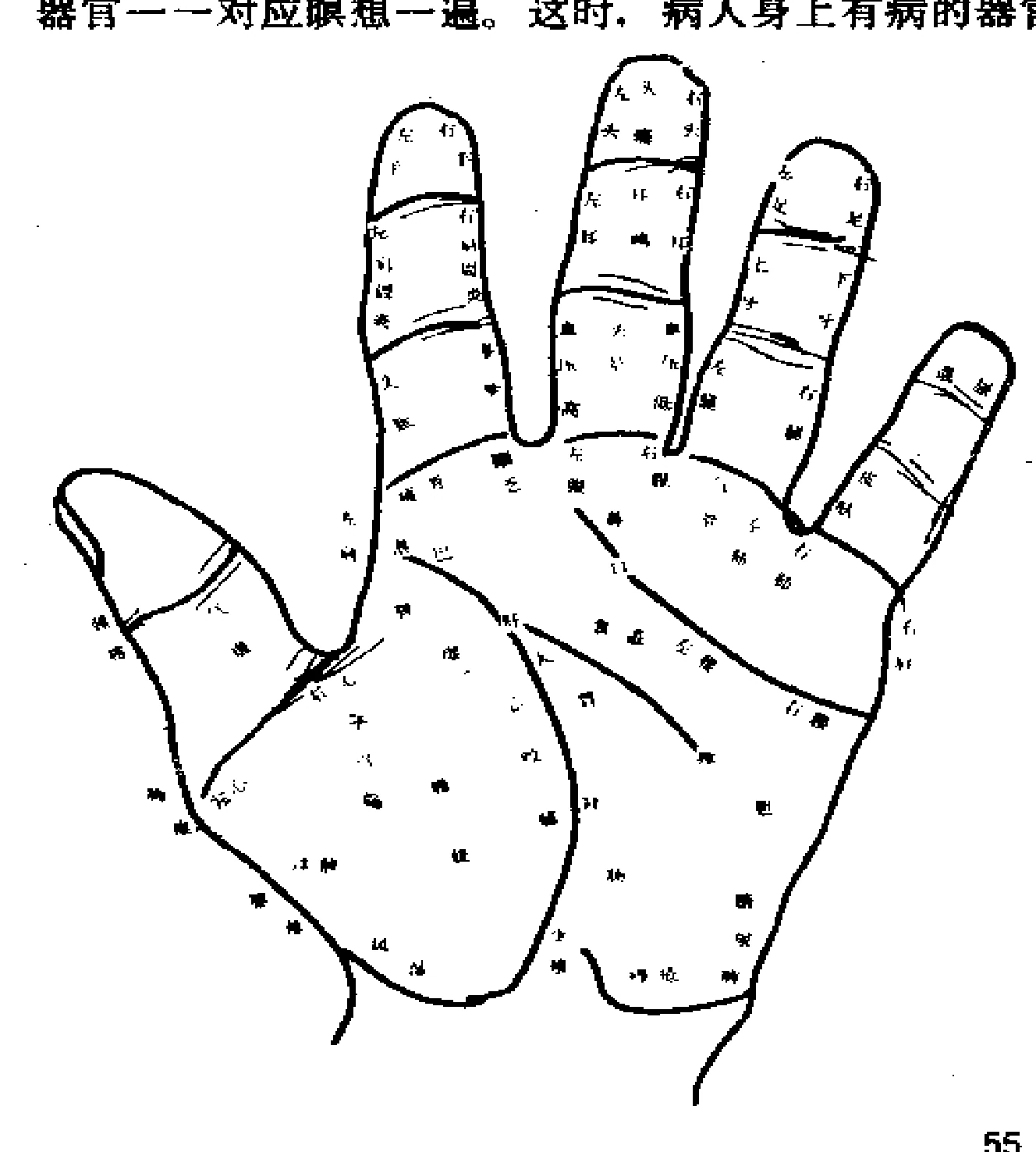
Imagine that in the third party’s mind is the patient you wish to assess. Silently repeat in the mind: “Do not let the third party’s own information come to me; let only the patient’s information flow into my hand.” It is best to know the names of both individuals, although with proficiency the names are unnecessary. Other methods are as described earlier.
Another technique is Body‑Diagnosis Method.
The practitioner relaxes the whole body, then, from head to toe, mentally aligns each of the patient’s organs with the practitioner’s own organs, visualizing them one by one. At this point, the diseased organs in the patient’s body—
It will inevitably be reflected on one’s own body, allowing the practitioner to determine the patient’s diseased area. Then, using intention, the practitioner expels the pathogenic qi from the upper body downwards, ultimately discharging it from the Yongquan point into the earth.
12. Branch‑Cutting Method
The practitioner gazes straight ahead at a branch, thin and thick like a bicycle spoke, positioned to the left and right. Visualize a hand extending from the inner eye (tianmu) to sever it. Increase the power of intention, making the hand’s force greater. Silently repeat in the mind: “Ham, cut the branch. Ham, cut the branch.” First visualize a living branch on a tree. Each attempt should be focused, without impatience. Using sound to assist is even better. After intensifying the intention, shout suddenly, “Ha!” or “Open!” while projecting the intention together with the voice, so that the sound, the intention, and the hand in the inner eye act on the branch simultaneously, causing it to break.
13. Fish‑Burning Method
The practitioner fixes the gaze on a goldfish in a tank, extends the right hand into the air, forming a tiger‑claw shape with an empty palm. At the moment of exertion, visualize a samadhi true fire rising from the dantian, emerging from the Laogong point; imagine the goldfish being burned to death by this fire within the palm, continuing until the fish in the tank is completely incinerated. Note that, when practicing this method, first imagine one’s own sinful self transforming into that goldfish, while the fish’s spirit attains enlightenment. After contemplating this several times, begin the practice.
There are many practice methods, each suitable for demonstration, but it must be remembered that…
Preserving energy is far more important than emitting energy!
Note: This book was originally used in December 1988 by Anhui Medical University as a correspondence teaching material for nationwide enrollment. Based on that teaching material, I have made some revisions. This version shall be taken as authoritative.
Appendix One: Introductory Practices of Spiritual‑Power Qigong
After completing the foregoing yang (positive) practices, many of my teachers and friends asked me to disclose some of the Spiritual‑Power Qigong methods here. After much consideration, I have decided to introduce a few introductory practices, hoping they will serve as a “jade‑attracting brick,” and that the nation’s fourteen first‑rate qigong masters will soon emerge from the mountains to magnify the might of our Chinese divine arts!
One who has not properly cultivated the yang practices cannot practice this method.
The main practices of Spiritual‑Power Qigong are A‑Xiang Gong, Wei‑Xiang Gong, Na‑Xiang Gong, Ma‑Xiang Gong, Si‑Xiang Gong, and Mu‑Xiang Gong. There are also several auxiliary practices that are highly effective for medical purposes and for increasing one’s power.
Breath‑Holding Method
The Breath‑Holding Method is a very important breathing technique. Those who have never practiced breath‑holding find it difficult to attain extraordinary power, so great emphasis must be placed on training this breathing method.
When practicing breath‑holding, adopt the double‑cross‑legged (shuangpan) posture. There are two ways to position the hands: one is to place the palms against the left and right knees; the other is to use the “fire‑water seal.” Of course, the hands may also be placed together in front of the chest (hands in prayer). Relax the shoulders, let the elbows hang, press the tongue tip against the palate, keep the eyes slightly closed, and guard the meeting point with the mind.
Yin Point
- Inhale fully, taking about twenty‑two seconds, without adding intention.
- Hold the breath—neither inhaling nor exhaling. “Absorb the abdomen”: lift the abdominal qi up to the chest, creating a concave abdomen and a convex chest. At this moment, visualize a sealed tube extending from the Huiyin point to the Baihui point, filled with the most refined qi of the universe. Maintain this for approximately sixty‑four seconds.
- Relax the chest, contract the abdomen, and exhale over about twenty‑two seconds, without adding intention.
- Repeat this cycle a total of one hundred and eight times.
Notes:
- The main aim of this practice is to empty the abdomen, creating a pressure differential between the upper and lower abdominal cavities. The chest should not be forced to expand; excessive chest expansion can cause chest pain.
- Progress should be gradual; do not rush to achieve the full duration.
- If a sensation of floating in the air occurs while holding the breath, do not be afraid; continue holding the breath and use intention to rise upward.
- Remember that breath‑holding and abdominal absorption are a single, complete movement; one must not hold the breath without absorbing the abdomen.
- Dizziness must not occur during breath‑holding. If it does, it indicates the breath‑holding time is too long; start with shorter intervals and do not force a sixty‑four‑second hold.
- This is a very dangerous method, prone to deviation. Those without a foundation in qigong, or who have not properly cultivated the Guangxian method, must not practice it.
Round Light Method
Select a clean sheet of white paper, free of creases or markings. It is best to use a glossy sheet.
Paper or drawing paper. Glue this sheet to the wall so that there is no trace; it should remain smooth and white. A size of about a 32‑fold sheet is appropriate. Stand facing the paper, take three deep breaths, then open your eyes wide and stare at the surface: with your mind, imagine your own skeletal shape appearing on the paper. Continue until you can see it. At this point the breathing should be light, fine, and gentle. Then continue the practice.
① Meditate that on this white paper there is a bodily self. Intensify the intention, keep the eyes steady, until you can see it on the paper. Then select another organ (one at a time) and continue until you can see it. This is the Round‑Light Perspective Method. Then practice further.
① Meditate that the clear image of a distant friend appears on this white paper. Intensify the intention until you can see this friend.
② Meditate that the nude image of this friend appears on the white paper. Then, intensify the intention and imagine that you can see this friend’s five viscera and six hollow organs on the paper. Continue until you can see them. This is the Round‑Light Remote‑Viewing Method. Then practice further.
① Enter a room and take out a white sheet of paper. Hold the left and right edges of the paper with both hands. Stand in the middle of the room, turn around once, and imagine that all the scenes inside the room are captured by the paper.
② Then place the paper in front of your eyes, looking at the paper. From the paper, identify each scene of the room one by one. This is the Round‑Light Pursuit‑Viewing Method.
The three practices above are to be trained one at a time, or master one before moving on to the next.
Appendix Two: China’s Extraordinary Abilities and Qigong Power
Compiled by Liu Qun, Liu Yansheng, Xu Ziqiang, Liu Zheng
People’s interest in extraordinary abilities and the wave of research into human science that has already formed have had an extremely profound impact on modern society. Qigong has become a sport loved by the old, middle, and young generations alike. Moreover, interest in martial‑based extraordinary abilities—such as Chinese “hard” qigong that involves head‑butting stone tablets and spear‑thrusting the throat; Shaolin fist techniques where the fists are like blazing cannons and the legs like dragons; and Tai‑chi styles that hide needles within softness to overcome hardness—has begun to shift toward developing high‑level, high‑energy extraordinary abilities such as remote sensing, remote control, X‑ray vision, telekinesis, prediction, flight, and weather control. Consequently, a large number of qigong masters who are well‑versed in the cultivation of extraordinary abilities and who possess strong such abilities have left their mountain retreats to teach their methods. For example, Wang Liping and Quan Guanliang, who can control the weather; Zhang Baosheng and Yan Xin, who can perform telekinesis; Liu Zhen and Li Yan, who can predict; Zhang Xiangyu and Xu Yifan, who can remote‑sense… Their methods differ, and the extraordinary abilities they develop range from one to several. These individuals are the “异人” (people of unusual abilities) mentioned in ancient Chinese texts. By today’s standards, these “异人” are simply people who possess certain extraordinary abilities. Ancient books often record that a certain person met an “异人” who bestowed upon them a particular skill. That skill is what we now recognize as a specific extraordinary ability.
w
When these individuals cooperated with the feudal rulers and served them, they were honored with titles such as “Guardian of the Nation Advisor” or “National Patriarch.” For instance, Changchunzi Qiu Chuji was one of them. However, once they used these extraordinary abilities to inspire the masses or to resist the court, the rulers immediately labeled them “demonic ways” or “demonic persons.” Their extraordinary abilities were then regarded as “demonic arts,” “heterodox arts,” or “unorthodox paths.” For example, in the Han dynasty Zhang Jiao used talismanic water (water containing external qi information) to heal people and employed it as a religion to oppose the Han ruling class. In the Three Kingdoms period, Wu’s Yu Ji; and even in the Qing dynasty, the White Lotus Sect and the Boxer Rebellion served as representatives.
Because ancient science and technology were underdeveloped, it was impossible to give a correct explanation of extraordinary‑ability phenomena; they could only be recorded faithfully and shrouded with a layer of mystery or religious coloration. Whether ancient or modern historians confront these records, they often deem them superstition, witchcraft, or illusion. Some avoid them with an attitude of “do not speak of the strange, the force, the chaos, the spirit,” while others discard them with a “purge the dross” approach. Consequently, when extraordinary abilities are verified by modern science today, an inevitable clash between superstition and science arises: one camp sees it as a challenge to modern science, heralding an upcoming technological revolution; the other camp regards it as feudal superstition or witchcraft.
In fact, whether called superstition or witchcraft, the phenomenon of extraordinary abilities is fundamentally not something that magic or circus tricks can reproduce. Therefore, it warrants deep study. It must be approached with a scientific attitude, introduced and researched faithfully. If feudal superstition or witchcraft contain phenomena that modern science cannot explain—especially physical phenomena—this indicates that they are themselves scientific, merely held by superstition or witchcraft. We should not avoid them, but should restore their true nature from a scientific perspective.
Let us return to the source and take a tour of the common extraordinary abilities recorded in Chinese classics!
Transvision Ability
The development of modern medicine can be likened to using X‑rays to diagnose internal diseases of the body. Yet this is a phenomenon of only the past hundred‑plus years. For the several thousand years before X‑ray diagnosis, the clever physicians of ancient China invented four diagnostic methods: inspection, listening, inquiry, and palpation. In particular, inspection of the face and pulse‑taking were emphasized. By observing a person’s facial complexion and analyzing the beat of the pulse, a physician could locate the source of disease. Thus arose the brilliant doctors who could “see and know” and “feel and know.” The saying “a good physician does not ask about the disease” refers to a doctor who can discern everything with a single glance or touch. Even more remarkable were those physicians who, with a single glance, could perceive the five organs, the six viscera, the bones, and the blood vessels—seeing the pathological qi of every organ as if through X‑ray vision. This is essentially what the phrase “to see and know is divine” means.
The Records of the Grand Historian records a story like this:
One day, Bian Que of the State of Zheng passed through the State of Qi. Duke Huan of Qi received him with great hospitality. Bian Que looked at the duke once and said, “Your Majesty, you already have an illness; it is still lingering on the surface of the skin. If it is not treated, it will soon penetrate deeper into the body.” Duke Huan, unconvinced, replied, “I have no illness.” After Bian Que left the palace, the duke told some of his ministers and aides, “Doctors are too eager for fame and profit; treating a person who has no disease is absurd.” Five days later, Bian Que returned to the palace. He glanced at Duke Huan and then said, “Your Majesty,
your illness has now progressed to the stomach and intestines. If it is not treated soon, it will advance even deeper.” Duke Huan was displeased, for he still felt no discomfort. Five days later Bian Que met the duke again. He gave the duke a single look, turned his head, and left. Puzzled, the duke sent his men to ask Bian Que for an explanation. Bian Que sighed and said, “I can see a person’s internal organs with my eyes and locate the pathological qi. If the disease is only on the surface of the skin, it can be treated with decoctions or cupping. If it has entered the blood vessels, acupuncture can be used. If it has reached the stomach and intestines, medicinal wine can be employed. But the duke’s illness has now advanced into the bone marrow, and I have no remedy.” Five more days passed, and the duke felt ill all over his body and hurriedly sent people to find Bian Que, but the physician had vanished. Within a few days, Duke Huan died.
The reason Bian Que could discern the duke’s illness at a glance was that he possessed the ability to see internal organs with the naked eye. This extraordinary ability was neither innate nor acquired through cultivation; it was developed by taking a special medicine. According to the Records of the Grand Historian, when Bian Que was a youth he served as a ren she zhang (innkeeper). At that inn lived an “extraordinary person” named Chang Sang‑jun. The text records:
“Bian Que found him peculiar and always approached him with caution. Chang Sang‑jun also recognized that Bian Que was no ordinary man. After more than ten years, he summoned Bian Que for a private meeting and said, ‘I have a secret formula; now that I am old, I wish to pass it on to you. Do not …’”
Bian Que followed the instructions, took the medicine for thirty days, and then could see a person’s internal organs. Using this vision, he could perceive all five zang (solid organs) and the points of disease. Because Bian Que treated Chang Sang‑jun with great respect, after more than a decade of interaction he finally obtained a medicinal formula that could endow the human eye with transvision, and after taking it he acquired a vision like that of Chang Sang‑jun.
Today, the number of people with transvision ability is estimated at roughly a thousand in the whole of Beijing. These individuals also possess the “see‑and‑know” diagnostic skill. For example, the extraordinary‑ability master Zhang Xiangyu and her student Cai Zheng, when treating patients, can see the pathological qi within the body as black, blue, or other colored gases, and then remove those gases to complete the cure. Their method follows the same principle as Bian Que’s diagnosis of Duke Huan, differing only in that Bian Que’s ability came from taking medicine, whereas theirs arises from qigong practice. This raises an intriguing point: if a certain medicine can unlock transvision, it would provide a more scientific and intuitive way to develop human extraordinary abilities, offering mathematical and model‑based foundations for studying the origin of transvision. Understanding the relationship between medicinal properties, the body’s meridians, and the organs could bring about a revolutionary shift in medical theory.
In fact, in antiquity many people possessed transvision ability. The History of the Song Dynasty records a story of a physician named Pang Anshi who performed transvision on a pregnant woman. Once, while treating patients in Tongcheng County, Pang Anshi encountered a woman in prolonged labor; after seven days the baby had not been delivered, and all obstetric methods had failed. Looking into the woman’s abdomen, he said, “The fetus has grasped the mother’s intestine with its hand; inserting a needle into the fetus’s hand will make it release.” He then, through the mother’s abdomen, inserted a needle into the fetal hand’s webbing. The woman soon gave birth.
From this account we can see that Pang Anshi’s transvision ability was highly developed. How he acquired this ability is not recorded in the History of the Song Dynasty; it is only known that he came from a medical family and received instruction from his father.
Ancient historical records rarely give detailed descriptions of these practices. For example, the Song‑dynasty figure Zhang Ji is said to have “received a secret formula from a stranger,” after which he possessed the ability to see the meridians running through a person’s body. He applied this ability to acupuncture treatment, and the result was that “every needle insertion produced an immediate effect.” The phrase “received a secret formula from a stranger” clearly indicates that he learned from a person with extraordinary powers and obtained the “formula” that enabled him to develop the sight‑through ability.
There are also people who possessed the sight‑through ability but did not understand medicine, using it instead to see through the ground. The Jiangxi Tongzhi records:
“Deng Junshan, a native of Gao’an. His uncle Xiangxian was a Taoist at Zhenyuan Temple. A certain Jiangxi patient was ill at the temple and could not rise. Junshan came to visit his uncle and looked after the patient attentively. After recovering, the patient taught Junshan the ‘Xingjia technique,’ which allowed Junshan to see five chi beneath the ground and discern its texture and color.”
Here the sight‑through ability is said to come from a Jiangxi patient. This patient’s extraordinary ability is called the Xingjia technique. From an application standpoint, it belongs to the art of geomancy. The same ability is also recorded in the Taiping Yulan. A man who had come from the western side of Dunhuang to Luoyang, named Qian Tuole, told people the exact location of a temple on Mount Panchi to the southeast of Luoyang that had long since collapsed and whose site could not be found. Guided by his information, the people began to excavate and indeed uncovered the stone foundation of the temple, after which a new temple was rebuilt on the original site.
Whether the ancient Xingjia technique and similar sight‑through abilities have survived to the present day is uncertain, but there are comparable practices. For instance, the Yunqi Qiqian records:
“Always keep in the heart an image of the sun, as large as a coin, red in color. Also keep nine rays of the sun, which emerge from the heart, pass through the throat, reach between the teeth, and then return to the stomach. After maintaining this for a long time, keep the eyes neither fully closed nor fully open and continue the visualization; one will naturally see the heart and stomach clearly within.”
This is the so‑called “Swallowing Sun and Moon Rays” method, and after cultivation
one can “see one’s own heart and stomach.”
People who have acquired this sight‑through ability are said to have “opened the Tian‑mu (Heavenly Eye).” Once the Tian‑mu point is opened, one can directly see through the human body. Today many qigong practitioners hope to open their Tian‑mu themselves or have it opened by a master, which is certainly an intriguing pursuit.
Beyond medical and geomantic applications, sight‑through ability can be used in many other fields. One of the most common ancient uses was shefu (guessing objects hidden in a box). On one occasion, Emperor Gaozong of Tang summoned the famous Yijing scholar and diviner Yuan Tiangang’s son Yuan Keshī and several others. He placed a mouse inside a box and asked them to guess what was inside. Everyone else said it was a single mouse, but Yuan Keshī said there were four mice. When the box was opened, indeed there were four. The emperor had actually placed a pregnant female mouse in the box. In this respect, Yuan Keshī’s sight‑through ability was remarkably precise. Yet there were even more skilled individuals: the Song‑dynasty figure Cai Qian. General Liu Yixuan ordered a large white mouse to be shot, placed it in a box, and asked Cai Qian to guess. At a glance Cai Qian identified it as a white mouse, further discerning that three male mice and two female mice were inside its abdomen, and that the white mouse’s left leg had been struck. Liu Yixuan was astonished and had the mouse’s abdomen dissected, confirming Cai Qian’s description.
In ancient times, people with sight‑through ability were often mistaken for masters of divination, and thus they frequently became champions of shefu. Today we should recognize them for what they truly were.
2. Remote Viewing and Remote Sensing Abilities
In Journey to the West it is written that after the Stone Monkey was born, his two eyes emitted two strong beams of light toward the Heavenly Palace. The Jade Emperor, startled, immediately dispatched “Thousand‑Li Eyes” and “Wind‑Following Ears” to investigate. These two celestial beings could see and hear everything instantly. The “Thousand‑Li Eye” has since become one of the deities admired by people. Individuals possessing this extraordinary ability are today referred to as having remote‑viewing abilities.
People with remote‑viewing abilities are not confined to literary works. For example, the qigong master Ma Chun could see the tip of a gun located dozens of li away. During the War of Resistance against Japan he used this ability to accomplish numerous reconnaissance missions with great success. In ancient times, there were even more such individuals.
The Qing-dynasty scholar Ji Yun recorded in his Yuewei Caotang Biji a monk who possessed this extraordinary ability. One day the monk boarded Fan Hengzhou’s boat to cross the Qiantang River. While conversing with the monk, Fan noticed that the monk’s mind seemed elsewhere and that his demeanor carried an arrogant air, so Fan stopped speaking to him. At that moment a strong west wind swept across the river. Feeling something, Fan spontaneously recited two lines:
“White waves toss the bow of the boat, travelers fear the adverse headwind.”
He could only produce these two lines and could not think of the continuation, so he repeated them. At that time the monk, gently closing his eyes, softly uttered the matching couplet:
“How does the red‑sleeved woman still lean on the highest tower?”
Fan Hengzhou did not understand what the monk was reciting and asked him, but the monk gave no further answer. When the boat finally reached the shore…
Looking up the rope, Fan Hengzhou saw a young woman in a red‑sleeved garment standing on the upper floor, and he suddenly understood that the monk’s verse was describing the scene before his eyes. Yet when the boat was still on the water, the river was shrouded in faint mist, the air was heavy with vapor, and the thatched houses on the bank were hidden by trees—nothing of this could possibly be seen with the naked eye! Fan asked the monk again and again; the monk only replied, “I just happened to see it.” When Fan tried to meet the monk again to exchange greetings, the monk had already left. Thus Fan began to suspect that the monk possessed a remote‑viewing ability.
Later people invented the telescope to overcome the difficulty of seeing distant objects, and the microscope to compensate for the inability of the human eye to discern minute details. A person with remote‑viewing ability seems to have eyes that already contain a telescope and a microscope. Of course, such extraordinary powers are sometimes innate, sometimes cultivated through practice, and sometimes induced by taking a certain “medicine.” The Collected Explanations of Liezi records an example of a practitioner who, through cultivation, developed “microscopic amplification” of visual and auditory perception.
The book relates that in Nanjing (anciently called Jiangpu) there is a tiny insect called the Jiaoming that gathers in swarms on a mosquito’s eyelashes, or nests within the mosquito’s lashes, yet the mosquito does not feel it at all—demonstrating the insect’s minute size. Even the famous blind musician Shi Kuang of the Jin state in the Spring‑and‑Autumn period, with his extraordinary ability to discern sounds, could not hear the Jiaoming on a quiet night. The Yellow Emperor Huangdi and the scholar Ke Chengzi went to the empty Kongtong Mountain, isolated from the world, and lived in seclusion for three months, eliminating all distracting thoughts, observing fasts, and practicing severe cultivation. By focusing their minds on the silence, they developed a special ability: they could see the tiny Jiaoming as if it were a towering cliff of Mount Song, and they could hear the insect’s sound as if it were the roar of thunder—immense
in scale.
People who acquire such extraordinary abilities through arduous cultivation or by learning from others appear frequently in historical records. The Taiping Yulan recounts the story of Hua Niansi, governor of Lujiang, who studied a “microscopic vision” technique from a Taoist priest. After less than one hundred days of study, the governor gained remote‑viewing powers; at night he could look at the sky and see events occurring far away in the heavens.
Similar to remote viewing, there is also a phenomenon called remote sensing. Those who possess it have senses that are exceptionally acute; like remote viewers, they can perceive events happening at great distances. Their bodies function like highly sensitive receivers capable of picking up signals across various frequency bands, allowing them to receive all kinds of information. This ability is said to manifest most often among close relatives—parents, lovers, and twins.
According to tradition, Confucius’s disciple Zeng Shen was a very filial person. One day, while gathering firewood in the fields, a guest arrived at his home. His mother, unable to summon Zeng back, pinched her own arm. At that moment, Zeng, still in the field, instantly sensed the signal, rushed home, and asked his mother, “Does your arm hurt?” His mother replied, “A guest has come, so I pinched my arm to call you back!” The remote‑sensing between Zeng and his mother is an example of a special perceptual ability that occurs among blood‑related family members. Many similar cases are recorded. For instance, the Tang dynasty compilation Youyang Zazu tells of Wu Niang of Yining Fang in the capital and her brother Xin Fu, who lived far away in Jinling, exchanging remote sensations with each other. The Book of Jin records that Yan Han, because of a remote‑sensing connection with his brother, was able to rescue his elder brother, who had been presumed dead and sealed in a coffin.
Naturally, remote sensing can also occur among non‑blood relatives when an unusually close bond exists. Both the Taiping Guangji and the Qing Shi Gao contain accounts of wives
or husbands who, after long separation, sensed that the other had died. The Jiangsu Provincial Gazetteer records another case: in the Qing‑era county of Xinyang, a man named Huang Zhiyu died and was buried. His widow, a newly widowed woman of twenty‑two, intended to commit suicide on the beam of her house to become a “loyal and heroic widow.” Just as she was about to hang herself, the deceased husband’s aunt dreamed that the dead man urged her to rise quickly and rescue the woman. The aunt hurriedly got up, saved the woman—who had been deeply poisoned by feudal‑era patriarchal thinking.
Recently, Soviet scientists discovered that a microwave‑particle field exists around the human body. This field can transmit personal information thousands of miles away, which could explain why some people experience ominous signs when misfortune befalls a relative far away.
Perhaps the most interesting, most famous, yet most easily overlooked example of information remote‑sensing involves the Tang‑dynasty poets Bai Juyi and Yuan Zhen. Everyone knows that Bai Juyi and Yuan Zhen are celebrated figures in the history of poetry, and their friendship was extraordinary—more like kin than mere comrades—so later generations often refer to them together as “Yuan‑Bai.”
In the fourth year of the Yuanhe era (809 AD), Yuan Zhen, serving as an Imperial Censor, was dispatched on a mission to Jianwai. After traveling for more than ten days, Bai Juyi set out with friends such as Li Shaozhi and Bai Xingjian to tour Qujiang. While drinking at the Ci’en Temple in Xi’an, Bai was in high spirits when a sudden insight struck him. He paused, focused his mind, and after a long contemplation said, “Yuan Zhen has already arrived in Liangzhou.” Liangzhou corresponds to today’s Nanzheng area of Shaanxi Province, about five hundred li (≈250 km) from Xi’an. Buoyed by his wine‑induced enthusiasm, Bai wrote on a wall the famous poem “Recalling Yuan Jiu While Drunk with Li Shi”:
Spring comes, yet there is no way to dispel the spring‑time melancholy;
Drunk, I snap off a flower branch to use as a wine‑chopping stick.
Suddenly I recall an old friend who has gone beyond the horizon,
And calculate that today he should reach Liangzhou.
At the same time, far away in Liangzhou, Yuan Zhen dreamed that his soul roamed at night, joining Li Shaozhi and Bai Juyi on a leisurely cruise along Qujiang, and that they together entered Ci’en Temple. Thus Yuan…
Zhen also wrote another poem that has been celebrated through the ages:
“Dreaming of your brother at Qujiang’s head, also entering Cienyuan Temple for a stroll.
The officials called people to line up the horses to depart, and when I awoke I found myself in ancient Liangzhou.”
Being in a foreign place, because the two were as close as brothers, an interesting remote‑sensing phenomenon arose, and they both composed poems in remembrance of each other. This is not only a literary legend sung through the ages, but also a rare piece of remote‑sensing data. Its authenticity and credibility are beyond doubt.
Of course, this kind of remote sensing is not limited only to relatives, lovers, mother‑in‑law and daughter‑in‑law, or close friends. If there is a remote‑sensing ability cultivated or induced, its scope can be much larger.
According to the History of Yuan, the former Grand Protector Liu Bingzhong had a friend named Tian Zhongliang, styled Zhengqing, who was very studious, well‑versed in Confucian classics, and also researched the various schools of thought. Liu Bingzhong thought he might be useful to Kublai Khan, the Yuan Emperor, and recommended him. When the Emperor saw Tian Zhongliang, he examined Tian’s appearance, clothing, and gait, and said to the ministers on his sides, “Although Tian Zhongliang is a yin‑yang practitioner, he will certainly be useful to the state.”
The Yuan Emperor pointed to the second person standing on the western side (the Emperor’s right) and asked Tian Zhongliang, “What is the object in his hand?” Tian replied, “An egg.” Indeed it was correct, and the Emperor was very pleased, then asked, “I have a matter on my mind; can you guess what it is?” Tian answered, “By my art, I calculate that a monk is ill.” The Emperor said, “Correct, the sick person is my national teacher.”
Once, while hunting in Liulin and resting in the tent, the Emperor said to Tian Zhongliang, “Now I wish to send a great general to take Jiangnan; I have already decided who it is, can you guess who this person is?” At that time many ministers surrounded the Emperor. Tian looked around and fixed his eyes on one
person and answered, “This person is a great man who can accomplish great deeds for you!” The Emperor laughed and said, “His name is Boyan. You truly know my thoughts!”
Such individuals who possess remote‑viewing and remote‑sensing abilities can truly be called “immortals.” In ancient times, when scientific and technological development was limited, the reverence and superstition toward people with extraordinary abilities were understandable. Even in the late 1980s, we had not yet uncovered the secrets of these abilities. The fact that something is unknown does not mean it does not exist. These phenomena, which appear to run counter to common sense and reason, are precisely what people label as “extraordinary.”
Extraordinary abilities also have a distinctive feature: “thought‑induced motion.”
III. Thought‑Induced Motion Function
Anyone who has learned a little natural science knows that to move an object one must apply a force to it. If a person does not touch the object and does not use any intermediary device, moving the object seems impossible. Yet the world contains a phenomenon whereby individuals with extraordinary abilities can cause an object to move solely by the power of their mind.
Is this idealism?
Someone once performed a very simple experiment to demonstrate that people often become confused over seemingly simple questions. A university professor stood in front of the blackboard and wrote “迷信” (superstition) and “科学” (science), these four
characters, and then asked the students, “Between superstition and science, which do you choose?” The students answered in unison, “Science!”
The professor then looked at the students and continued, “Between science and fact, which do you choose?”
This seemingly most elementary question stumped the college students present. Some answered “science,” others answered “fact.”
Superstition and science are clearly distinct; that is self‑evident. But science and fact do not appear to be so easily chosen.
In fact, science is derived from facts. Once we understand this, we will no longer be confused about whether to choose science or fact.
So, is thought‑induced motion idealist or materialist? Let us first look at the facts. Since this section discusses ancient extraordinary abilities, we will begin with ancient times.
This is an interesting story.
According to the Chronicle of Kaifeng Prefecture, during the reign of Emperor Renzong of Song (the Qingli era, 1041–1048), in the capital Kaifeng lived a peculiar man named Zhang Jiugo. One day, Zhang Jiugo prepared to travel far away and came before Prince Yan to bid farewell. He said, “I am about to journey to a distant place, so I come to say goodbye. I have a small skill to demonstrate, hoping the prince will be pleased.”
Having said that, he fetched layers of silk, cut them with scissors into the shapes of bees and butterflies. Strangely, the silk pieces fashioned into bees and butterflies began to fly. After a while, Zhang Jiugo called out, and those bees and butterflies flew back one by one. In reality, the tiny fragments of silk were being driven by Zhang Jiugo’s thoughts, dancing gracefully in the air.
Since intention can cause objects to move, there is naturally a distinction between near and far movement. The method of Zhang Jiugē described above only makes silk flutter around the practitioner; people with extraordinary abilities can also cause objects to shift according to their intention to other places. Such examples also existed in antiquity.
In the Qing dynasty, Mr. Ji Xiaolan recorded some stories of ancient people with extraordinary abilities in his book Yuewei Caotang Biji. One entry tells that when the author was a child staying at his maternal grandfather Xuefeng’s house, he personally witnessed a sorcerer performing a moving‑object trick. At the dining table the sorcerer placed a cup of wine on the table, raised his palm and slapped; the cup immediately sank into the table. The rim of the cup was flush with the tabletop, yet when one reached under the table the bottom of the cup could not be felt. After a while the cup was taken out, and the tabletop looked exactly as before, with no visible indentation. This skill may have been a “blind‑eye” trick. It could be called a stage trick, but stage tricks rely on the performer’s speed, whereas this moving‑object trick was real.
The sorcerer then performed another moving‑object feat. He lifted a large bowl of sliced fish (fish meat), threw it into the air, and the bowl vanished. When people asked him to bring the bowl back, he said it could not be retrieved; the bowl was now in a drawer of the painting-and-calligraphy cabinet in the study, and they should fetch it themselves! At that time there were many guests, the room was crowded and chaotic, and the study contained many antiques; to prevent loss, the study door had been locked tightly. Moreover, the drawer was only two inches deep, while the bowl was three or four inches high, making it impossible to place the bowl inside. Yet when everyone opened the study’s lock and entered, they found the bowl placed on the table, with five “Buddha’s hands” inside the bowl, while the plate that originally held the Buddha’s hands now contained the sliced fish, and was placed in the drawer.
The sorcerer’s method was to transport objects near him to other places. Some people can also bring distant objects to themselves by a “scattering‑transport” method. By consulting the Tongzhi edition of Yunyang Zhi (Chronicle of Yunyang), volume 8 of the collection, such stories can be seen.
Fuxi Rock in Fangzhou had a hermit named Li. Locally there were two or three elderly men who often roamed with him; in their leisure they would agree to go into town together to drink. Whenever this happened, the hermit Li would always say, “You go ahead; I’ll follow shortly.” By the time his old friends arrived in the town, Li had already arrived there in advance. In the tavern, if the money ran out before the wine was finished, Li would take money from a small bamboo basket hanging at his waist to buy more wine, continuing until his friends were all drunk before he stopped. His friends secretly inspected his bamboo basket; it was empty, containing nothing, yet when Li himself reached for it, money appeared in his hand, a handful at a time. This went on for a long time, and then Li suddenly bid farewell to the elders, and no one knew where he had gone.
In the Three Kingdoms period there was also a person with such extraordinary ability, named Zuo Ci, also known as Yuanfang, who once served Cao Cao by instantly producing Songjiang carp, Sichuan ginger, and silk brocade. The speed of his procurement was astonishing; as soon as he spoke, the requested items appeared. Although he was very capable, Cao Cao did not like him and even wanted to kill him. Zuo Ci suddenly vanished into a wall, and his whereabouts became unknown.
Although Cao Cao could not tolerate people like Zuo Ci with extraordinary abilities, history records many such individuals serving princes and emperors, using their abilities to benefit the ruling class. According to the History of the Yuan (Yuan Shi), the teacher of Kublai Khan, Ba Si Ba, recommended a man named Danba to Kublai as a national teacher. This Danba, also called Gong Jiage Cisi, was from a place transcribed as Tugan Sidama in the western Tibetan region. At that time, a severe drought struck Huaimeng, and Kublai ordered the national teacher Danba to pray to heaven for rain. Danba, with a single thought, caused rain to fall immediately. He also recited a mantra to throw food into a dragon pool; after a while, various exotic flowers and fruits surged up from beneath the pool’s surface. He presented these exotic flowers and fruits to Kublai, who was very pleased.
The New Tang History records a man named Ming Chongyan, from Yanshi, Luoyang, a fifth‑generation descendant of the Liang dynasty’s national scholar Ming Shanbin. When he was young, he learned magical arts from an official subordinate of his father, who was a county magistrate. In the early reign of Emperor Gaozong of Tang, Ming Chongyan was recommended and appointed as a county assistant in Huang’an County. His magical arts were outstanding and became famous in the vicinity, prompting Emperor Gaozong to summon him and appoint him as a literary official of the Prince of Ji’s residence.
In summer, the emperor thought of snow; Ming Chongyan sat there and within a short time produced snow to present to the emperor, saying the snow was taken from Yinshan. In April, the emperor desired melons; Ming Chongyan asked the emperor for a hundred qian (a monetary unit), and quickly presented the melons, telling Gaozong that the melons were taken from the garden of an old man named Bin. The emperor called the old man to inquire about the reason; the old man said, “The melon I buried in the soil disappeared, yet I received a hundred qian.”
Up to the present, humanity’s understanding of extraordinary abilities remains only at the level of surface phenomena. Newspapers introduce various performers’ extraordinary abilities; high‑speed cameras capture minute motions that the naked eye easily overlooks; scientists are puzzled and amazed before such abilities, and they study them diligently. The conclusion is merely “we know that it happens, but we do not know why.” Even this book, at most, lists some phenomena of extraordinary abilities, giving examples from ancient and modern times, so that those who are not very familiar with or are skeptical of such abilities can obtain a general understanding. If one or two readers, from this, develop an interest in extraordinary abilities and resolve to uncover the mystery, that would be our greatest hope.
IV. The Strange Hypnosis Technique
When readers see the three characters “催眠术” (hypnosis technique), many may misunderstand it as merely a method for making a person quickly fall into a sleep‑like state even when they are not sleepy. In fact, the two characters “催眠” (to induce hypnosis) truly mean that the subject is given a certain suggestion and loses their primary consciousness, so that their speech and actions fall under the influence of the hypnotist within a certain range.
Freud once applied hypnosis to his patients, allowing them, in a half‑sleep state, to recall past experiences and thereby help them release the trauma left in their hearts by some childhood frustration.
The famous Chinese writer Lin Jinlan, in his novella “催眠” (published in Zhongshan, 1988, Issue 3), includes a particularly vivid description of hypnosis.
One night, amid a buzzing sound, a restrained sob emerged, turning into a cry. Liu Ao turned his eyes and found a tear‑streaked face. The person was named Dong Youmeng, nicknamed “Mong‑dong,” outwardly proper and healthy—a fine young man.
Liu Ao spoke, and the buzzing stopped.
“I will tell you to do something, and you will do it. Agree?”
“Agree.”
“Do you believe me …?”
“I believe.”
“Whether you believe it or not doesn’t matter. As long as I tell you to do something, you do it sincerely. If you act outwardly but your heart is elsewhere, I can see it …”
“I can see it.”
“I also promise not to touch your privacy.”
“No privacy.”
“Rest assured.”
Liu Ao pulled a broken rattan chair in front of Dong Youmeng; the two sat facing each other while the people nearby stepped back a few paces, calming their hearts and minds.
Liu raised his right hand, palm out, held it five cun (about 16.7 centimeters) in front of Dong Youmeng’s eyes, and moved it slowly in a counterclockwise circle. He gave commands without opening his mouth; from a distance they could not be heard, while up close they sounded as though spoken through gritted teeth. This was called speaking “under the tongue.” This is also a skill, though not extraordinary. A famous physician may feel a pulse while an assistant records the prescription; a commander at a banquet may similarly instruct a secretary. These are different levels of the same subtle technique.
“Let your eyes follow the hand.”
“Mm.”
After three or five circles, the palm moved forward an inch, changing the circle into a left‑right sweep; the breathing grew heavy. Who? Dong Youmeng.
The palm moved another inch, now close to the tip of the nose; the left‑right motion turned into up‑and‑down, as if trying to close the eyelids, and the breathing sounded like snoring. Who? Our breath is also heavy, but the words are not about you or me—they are about Dong Youmeng.
Liu lifted his left hand, extended the palm, and with both palms separated, brought them back to Dong Youmeng’s shoulder, about an inch from the shoulder, moving from top to bottom in a soothing motion, repeating the “under‑the‑tongue” speech:
“I will take you to ride a horse, ride out of the city to fight the enemy. Do not be afraid; follow behind me. We all have guns …”
Liu stood up. Dong Youmeng’s eyes were half‑closed; he rose slowly, dazed. Liu Ao leaned forward, and Dong Youmeng’s steps followed as if in a dream. The platform was only a small square, yet it seemed to circle the streets and alleys of a great city. There lay a long bench, and Liu and Dong continued the “under‑the‑tongue” dialogue.
“This is your horse, get on …”
Dong Youmeng placed his legs on the horse, his feet touching the ground, but his stance was as if he were stepping on a horse incorrectly.
“Go …”
The left hand stretched forward, the right hand reached back, as if pulling a rein and then whipping.
“Run …”
Whenever the “under‑the‑tongue” speech occurs, the observers hear only a word or two, perhaps nothing at all, yet they can intuit the meaning. Because the visual is clear: they see Dong Youmeng’s feet planted firmly on the ground, his body rocking on the long bench, a great jolt.
“Look, the enemy is coming … two of them, don’t panic. I’ll take the front; you take the rear, here’s a gun …”
A rifle of the type used by school militias was handed to him.
Dong Youmeng kept his eyes tightly closed, but his expression was fixed forward; his two hands gripped the rifle’s stock, steady and unmoving.
“… bayonet thrust, they’re coming, left front, thrust …”
Dong Youmeng thrust the gun leftward, then three more thrusts; his mouth seemed about to split, as if he were about to shout the military drill command “Kill,” yet we only heard a guttural croak, a miserable sound.
“Alright, they’re dead, rest now …”
The onlookers also breathed a sigh of relief, finally understanding that Dong Youmeng’s chest rose and fell heavily, like the upper and lower stones of a mill. He closed his eyes, clenched his teeth, and sweat beads as large as glass marbles formed, not dripping.
… Dong Youmeng opened his eyes, bewildered. When asked how he felt, he mumbled that it was just a dream. He looked tired, his limbs unwilling to move.
Hypnosis is so powerful! A good person can use it to do good, while a bad person can use it to commit evil. No wonder that throughout history, masters of hypnosis have been extremely cautious when teaching it, fearing they might pass it to the wrong people.
Hypnosis has existed since ancient times. In the previous section we mentioned that the New Tang History records Ming Chongyan, who possessed a “transportation” ability and was also a strange man who could use hypnosis. When Emperor Gaozong of Tang learned of his extraordinary skills, he appointed him as a literary official in Prince Ji’s Mansion. To test his powers, the emperor had palace maidens play music in an underground chamber, then brought Chong‑yan in and asked, “Is this sound an auspicious tone? Make it stop!” Chong‑yan drew two talismans with peach‑wood and stuck a knife into the room; the music ceased immediately. The palace maidens claimed they had seen a monstrous dragon, were terrified, and stopped playing. In this story, hypnosis caused the maidens to experience an illusion and altered their behavior.
The Notes from the Grass Hut of Observing the Subtle also contains two passages about the marvelous uses of hypnosis.
The first tells of a Taoist priest named Lü, whose origin is unknown but who was adept at illusion. He once stayed as a guest at the home of Minister of Agriculture Tian Shan. When the wisteria vines were in full bloom, Tian Shan invited many guests to enjoy the flowers. Among the guests was a vulgar scholar whose speech was obscene, vulgar, and who chattered incessantly, ruining the atmosphere for the visitors. Another young man, light‑hearted and frivolous, detested this vulgar scholar and rebuked him, and the two were on the verge of fighting. An elderly Confucian scholar stepped forward to mediate, but neither side listened, and the old scholar grew angry, his face showing his irritation. The other visitors were displeased with the scene. Seeing this, the Taoist priest whispered a few words to a child, who was ordered to fetch paper and a brush. The priest drew three talismans on the paper and burned them. At that moment, the vulgar scholar, the frivolous youth, and the old Confucian scholar suddenly stood up together
and spun around the courtyard several times. They then each took a corner of the garden: the vulgar scholar hurried to the southeast corner and sat down, muttering to himself. Listening to his words, it became clear he was having a domestic conversation with his wife and concubines—sometimes recalling reconciliations, sometimes smugly defending himself, sometimes appearing to beg for forgiveness, sometimes kneeling, sometimes pressing both knees to the ground, and repeatedly bowing his head. The frivolous youth sat on the flower railing at the southwest corner, casting lingering glances, speaking in soft, coquettish tones, laughing at times, apologizing at others, and then quietly singing “The Tale of Washing Silk,” humming incessantly while clapping his hands, his lewd and decadent demeanor displayed in full. The elderly Confucian scholar sat on a stone step, lecturing on a chapter from Mencius concerning the affairs of Qi Huan and Jin Wen, explaining each character, analyzing each sentence as if conversing with four or five people. Suddenly he shook his head and said, “No, that’s not right,” then widened his eyes and asked, “Don’t you understand?” followed by a bout of uncontrollable coughing. The onlookers were both frightened and amused; the Taoist priest waved his hand to stop the spectacle. When the revelry subsided, the priest burned three more talismans, and the three individuals, as if having lost something, sat dazed. After a while they came to themselves, claiming they had unknowingly become drunk and behaved improperly, and apologized. The guests, seeing this, slipped away with quiet laughter.
Another story recorded by Ji Xiaolan concerns a private‑school teacher in Su‑ning who was stung by bees. This teacher spent his days lecturing his students in the Cheng‑Zhu school of thought. One day a wandering monk begged for alms outside the school gate; the sound of his wooden fish rang continuously from morning until noon without pause. Irritated, the teacher went out, drove the monk away, and scolded him: “You are a heretical charlatan; your deceit may mislead the ignorant masses, but this place is full of Confucian scholars—why do you entertain such delusions?”
The monk bowed and replied, “We monks wander in scant clothing seeking food, just as you scholars study to gain wealth and status; both have lost our human nature,”
“why then, sir, must you treat us so harshly?” The teacher, enraged, seized a disciplinary implement to strike him. The monk shook his robes, stood up, and said, “What a vile prank!” He tossed a cloth bag onto the ground and left, implying he would return. As dusk fell, he had not come back. The teacher felt the bag; it was filled with loose coins. Many students wanted to take the money, but the teacher said, “If he does not return, we will deal with it later, but first we must count the money carefully and avoid quarrels.” When they opened the bag, a swarm of bees poured out, stinging the teacher’s and the students’ faces. Chaos erupted—shouts, attempts to swat the bees, and neighbors were alarmed. At that moment the monk suddenly pushed the door open and said, “Do the sages also plot to conceal others’ property?” He then lifted the bag and left.
In this story, an important point is that before the bag was opened, the teacher felt solid, hard coins—not soft, moving bees. Yet after opening, the coins turned into bees. This is not a magic trick but an illusion, or what could be called hypnosis. Perhaps the monk employed hypnosis together with a transportation technique.
Ancient literature contains many more records of hypnosis. Some are intertwined with illusion, some are exaggerated or imaginative, and many carry strong superstitious overtones. This makes it difficult for us to categorize hypnosis—or, more broadly, the “extraordinary abilities” covered in this book. While we must criticize feudal superstition, we must also adopt a pragmatic, factual attitude, distinguishing the good from the bad, without making unfounded assumptions or discarding valuable insights along with the “dirty water.” This is the Marxist approach.
Since ancient extraordinary abilities possessed so many incredible divine powers, the question arises: how do these abilities affect the human body itself and people’s…
In the realms of conquering disease, eliminating illness, and extending longevity, extraordinary achievements are inevitably displayed.
Thus, consider the following—
V. The Divine Doctor’s Skillful Hands
Using extraordinary abilities to treat various difficult ailments is, to onlookers, nothing short of incredible. Yet for those fortunate enough to be cured of previously incurable conditions by such abilities, it is an undeniable fact.
The author once knew an elderly man surnamed Zhang, in his fifties. According to his own account, from birth until the age of five he could not speak, and his family thought he was mute. In the year he turned five, one day he suddenly began to speak. While his grandmother was leading him to play in an apple orchard, she said to him, “Call out ‘Grandma’!” He shouted “Grandma,” and, unexpectedly, the grandmother died instantly beneath the apple tree. When his mother asked him to call “Mom,” he did, and three days later his mother suddenly went blind and died; when his father asked him to call “Dad,” he called, and his father also died.
Is there any causal relationship between his calls and his relatives’ deaths? We do not yet know. At the time, the villagers simply said he had a hard fate.
At thirteen, he left his hometown—Penglai in Shandong—to escape disaster. He wore a tattered pair of shorts and boarded a ship from Penglai to Dalian. The vessel drifted at sea for half a month. Upon landing in Dalian, his stomach was very empty, and he had no money. He then noticed a notice on a wall seeking medical help. The notice resembled an ancient imperial plea for a physician, yet it was posted by a merchant. The merchant’s daughter suffered from a mysterious illness that resisted treatment. The notice read that whoever could cure her would either receive half the merchant’s property or be given the daughter in marriage.
The young, wandering Zhang tore off the notice and set off.
He was seized by the notice‑holder and taken back to the merchant’s shop. The owner, seeing that he was just a child, paid him no mind and let him eat with the shop’s workers at the big pot. The next day, while squatting in the latrine, he devised a cure for the merchant’s daughter. As he thought, he casually took three clumps of mud from the broken shoe he wore on his foot, wrapped each in the tin foil of a “San Pao Tai” brand cigarette, forming three small packets.
When he saw the merchant’s daughter, he was startled. She was as thin as a reed, her face pale and frightening. He solemnly presented the three packets of mud, instructing the family to dissolve one in a tael of yellow wine and give it to her daily. Remarkably, after taking this “medicine,” the girl’s appetite increased dramatically on the first day, she could get out of bed on the second, and by the third day the serious illness had vanished. The merchant later offered a tray of silver dollars as a gift; Zhang took twenty silver dollars for travel expenses.
According to his own words, his “medicine” was simple but had a basis. The mud from his foot was “thousand‑mile earth”—earth from a thousand miles, which can cure a thousand diseases. The sole of his broken cloth shoe was made of hemp thread; hemp is a Chinese medicinal herb. The cloth was cotton, also a Chinese medicinal material. Having spent half a month at sea, the sea wind and seawater, both salty, are also medicinal.
He diagnosed the girl’s ailment as a failure of the blood‑forming function, likening it to dough without leavening—without “bread‑fertilizer,” the dough cannot rise. His medicine acted as that “bread‑fertilizer,” restoring her hematopoietic function, and she recovered naturally.
This episode may contain a hint of the legendary Ji Gong, yet the later chapters of his life become even more legendary.
At twenty‑one, he was traveling with a young companion. When they were still a little over one li short of the next village, he told his companion, “There’s a dead woman ahead, a young bride.” The companion did not believe him. He muttered to himself, “Should I save her life or not?” The fellow travelers were even more astonished and asked, “Can you really bring the dead back to life?” He replied, “Yes, I’ll show you today.”
Entering the village, they indeed found a young bride who had died in childbirth; people were standing on stools, about to nail the coffin lid shut. He stepped forward and said, “Wait, let me try to rescue her.” The head of the household replied, “Don’t interfere; a tragedy like this has already happened in my family!”
He repeatedly begged the master to let him see the deceased. As the saying goes, “A monk from afar knows how to chant the sutras.” The master consented. After lifting the coffin lid, he took a needle from under his hat brim and inserted it into the woman’s abdomen. Immediately a baby’s wail sounded; the child was born! The mother also gasped and came back to life.
At that moment the father, overjoyed, forgot all decorum, lifted the young bride, and ran upstairs. Because the grandson was born inside the coffin, they named him “Coffin.”
The author once recounted the story of the old man surnamed Zhang to others, only to be interrupted halfway through with the question, “Is this old man mentally ill?” One should not blame the questioner; indeed, such events sound like pure fantasy, prompting listeners to doubt.
Consider this: if the extraordinary behaviors displayed by those with special abilities did not exist, how can we explain the abundant ancient, modern, Chinese, and foreign records of such abilities?
According to the Jiaqing edition of the Hunan Tongzhi, there was a scholar in Yiyang named Xia Zepei, styled Wo Hou, who loved reading medical texts and was especially skilled in pulse diagnosis. He once examined a woman who was only three days pregnant; later it was confirmed that his statement “she is three days pregnant” was accurate. He also examined another woman and said, “Your pulse is strange and abnormal; you are carrying twins, but the children will not survive.” Soon after, that woman gave birth to three boys, all of whom died quickly. Later she became pregnant again; Xia examined her and said, “This time they are twins and will survive.” Indeed, she gave birth to two boys who lived. When Xia Zepei was thirty‑nine, his friends…
Friend Xue Shengzu said, “I am certain I will die this summer, because my heart meridian has already scattered.” In May of that year, he indeed died.
This skill of pulse diagnosis—determining the number and sex of a fetus in a pregnant woman’s womb, as well as judging a person’s life or death—may seem miraculous to ordinary people, but among the many practitioners of extraordinary abilities it is merely a trivial trick.
Of course, historical records contain many accounts of such “trivial tricks.” For example, late in the Jiayou reign of the Northern Song, the monk Zhiyuan could discern a person’s rank, fortune, and misfortune from the pulse, and could even examine a father’s pulse to learn the son’s destiny. It is no wonder that the great writer Wang Anshi remarked, “In the past, a physician examined the pulse of the Jin Marquis and knew that his loyal minister would die. Since the lifespan of a loyal minister can be detected in the ruler’s pulse, there is nothing strange about diagnosing a father’s pulse to learn the son’s fate.”
Similarly, the Taiping Yulan records that Long Shu asked Wen Zhi to diagnose his illness; Wen Zhi asked Long Shu to turn his back toward the light, stand still, and look toward the bright spot. After looking, he said, “I see your heart; the heart qi is deficient!”
The Guangdong Tongzhi records a man named Liu Bangyong who, as a child, lived in the mountains, met a mysterious teacher, and learned diagnostic and prescription techniques. He later practiced medicine in his hometown. An elderly woman surnamed Chen asked him to treat her and inquired how many years she had left. Liu Bangyong placed a bamboo strip in a clay jar as a token and told her, “Each year you remove one token; when the tokens are gone, your life ends.” The prediction proved true.
Beyond these “trivial tricks,” what is intriguing are the spells that transfer disease. Using such a therapeutic method, one can move a certain illness from Person A to Person B, or shift a disease focus from a person onto an object. This sounds more like a fanciful tale. Yet, since we have an interest in it, let us continue reading to see how far these romantically colored extraordinary abilities can go!
According to the Jiangxi Tongzhi, in Anfu County, Jiangxi Province, a man named Yan had a critically ill son. One day a Taoist knocked on his door and said to Yan, “Give me a thousand pieces of reward money, and I can cure your son.” Yan handed over the money for the Taoist to use. That day the Taoist took a hundred pieces to a tavern, drank until he was drunk, and returned home in the evening. The next morning, the Taoist instructed Yan to fetch a dog, bring the dog before the ailing child, and find a strong man to support the patient. The Taoist then sat behind the patient and silently treated the illness. The patient suffered great pain and tried to get up, but the Taoist would not allow movement, continuing the treatment until evening. The following day the Taoist repeated the same procedure, and the patient miraculously recovered. However, the dog was left on the brink of death. An onlooker remarked, “What a strange spell, but what about the dog?” The Taoist, pleased, replied, “What a compassionate remark!” He then had a new brick placed in front of the dog and treated the dog in the same way he had treated the patient. The dog recovered quickly, while the brick cracked.
The Taiping Yulan also records a similar case. A man named Xue Bozong was adept at transferring painful boils. When a man named Gongsun Tai suffered from back pain, Xue Bozong used qi to seal the pain and transferred it onto a willow tree in front of the meditation hall. The next day Gongsun Tai’s ulcer vanished, but the willow sprouted a tumor the size of a fist, which grew larger over the next twenty‑plus days. The tumor eventually rotted, exuding more than a liter of yellow‑red fluid, and the tree withered away.
The true nature of these extraordinary abilities remains unresolved. Yet many patients treated by qigong masters report a distinct sensation of qi. Since qigong and these abilities share a close lineage, one might infer that the extraordinary powers employed in healing also emit a form of qi.
What kind of qi is it?
Consider an ancient record.
According to the Gansu Xin Tongzhi, there was a man in Ningzhou named Jin Shen. He mastered incantations and could employ spells to prevent sores, poisons, and the harm of snakes and insects. Every morning he carried water and sprayed it in all directions while chanting, wishing that people and livestock within ten li would be free from sores, poisons, and vermin. Over the years his protective range expanded to a hundred li. Anyone who sought his incantations for curing sores—even if separated by mountains—could be healed as long as they sensed the external qi he emitted.
This is an excellent example of using extraordinary abilities to prevent disease. Moreover, the records indicate that Jin Shen’s power was not innate; it grew stronger through continual practice, extending from a ten‑li radius to a hundred‑li radius, showing that his outward qi became increasingly potent.
Even more remarkable is the account of Du Fashun in the Shaanxi Tongzhi. He lived during the reign of Emperor Wen of Sui and earned his living from a stipend. Anyone who sat facing him would recover after a short time. Even those with mental disorders regained normalcy after a quiet sitting opposite him.
Naturally, ancient uses of extraordinary abilities to treat illness are found only in historical texts. Yet today many masters of such abilities have healed numerous difficult cases with their miraculous spells—documented not only in writing but also in photographs and videos, with healers and patients living among us. Observing the present allows us to infer the past; the logic is self‑evident.
Of course, the practical value of extraordinary abilities extends far beyond healing. For instance, employing them to solve criminal cases offers even more fascinating possibilities!
VI. Pursuing Criminals and Solving Cases
The famous Sherlock Holmes used his solid medical knowledge, rigorous logical reasoning, and extraordinary intellect to solve one baffling case after another, becoming an idol for countless youths. Yet in modern society, where criminal activities have become increasingly complex and the techniques of crime ever more sophisticated, Holmes might find himself outmatched. He can only be a product of his own era.
If extraordinary abilities are applied to criminal investigation, they would compensate for Holmes’s shortcomings—indeed, they could not only compensate but potentially replace them. If you doubt this, look to history.
The Draft History of Qing records that a man from Hunan named Dai Shangwen went to Changsha for the imperial examinations. A fellow dormitory resident lost some money, and Dai performed a divination, saying: “You have lost a certain amount of money; the thief is wearing blue clothing, carrying fish meat in front, and is followed by a person in white clothing who bears a heavy load on his shoulder. If you go to the post‑station gate at a certain time and wait there, you will catch the thief.” The examinee followed Dai’s instructions and indeed captured the thief.
The Book of Jin also records a case solved by extraordinary powers. A man named Bu Xiong, who in his youth was fond of divination and had many disciples, was implicated when a person near his study was burned to death. The local officials assumed that one of Bu’s students had caused the fire and arrested the disciples. Bu said, “I have already divined the person responsible for the fire. Walk south along this road;
if you meet someone asking whether you have found the person who caused the fire, arrest him.” The officials followed his advice and indeed apprehended a farmer. It turned out the farmer had set fire to clear land for farming, unaware that a person was hidden in the grass.
From many historical records of case‑solving, the results are largely attributed to divination. Whether the outcome was obtained through the divination itself or because the divinator possessed genuine extraordinary abilities is hard to discern—perhaps both.
Some recorded divination‑based solutions are astonishingly coincidental. For example, the Taiping Yulan recounts:
In Yingchuan, a man named Ga Jiade was skilled in divination. When a household’s maid went missing, Ga divined: “You should wait outside the east tomb gate. If a man named Cao passes by in a carriage, whether you know him or not, board his carriage.” The man, half‑believing, waited outside the city the next morning. A man named Cao indeed came to pay respects at a grave. The man leapt onto the carriage; Cao shouted in fright, the ox bolted, and the carriage was hurriedly pulled into a roadside thicket. There, lying in the grass, was a dead body—his missing maid.
A similar story appears in the New History of the Tang:
In Xuzhou (now Xuchang, Henan), a scholar named Du, adept at the I‑Ching, was consulted about a runaway slave. Du said, “Walk forward from here; when you meet an envoy, ask him for a horsewhip. If he refuses, explain your reason.” The man followed Du’s guidance and indeed met an envoy. The envoy, surprised, replied, “Give you a whip? How shall I drive my horse? Use a branch from the roadside instead!” The owner then broke a branch,
and there, under the tree, was his escaped slave.
Later, another master‑of‑the‑lost‑slave approached Du. Du instructed the master to bring five hundred cash and wait by the road. When a messenger who delivered hawks appeared, the master should buy him a hawk; this would guarantee the slave’s return. The messenger arrived, the master explained his situation, and the messenger gave him a hawk. The hawk suddenly flew into a thicket; when the master pursued the hawk, he found his slave.
Because ancient practitioners of extraordinary abilities could foresee events, they could prevent many crimes from occurring. The Jiaqing-era Sichuan Tongzhi records that during the Dali period of the Tang dynasty, a monk foresaw a robbery that night and instructed his disciples to prepare food and money to welcome the thieves. The robbers came, seized the provisions, but could not leave the monk’s residence and eventually fled, abandoning the loot.
The Daoguang‑era Yunnan Tongzhi tells an even more striking tale: In Baoshan, a man surnamed Ma’s son became a monk at a hermitage outside Longquan Gate, taking the dharma name Zhì Dēng. One night twelve robbers broke into his room. Seeing Zhì Dēng seated calmly, with a table laden with freshly prepared dishes and twelve sets of bowls and chopsticks, the robbers were both startled and frightened. Zhì Dēng slowly said, “I knew you would come tonight; I had my disciples prepare this specially for you.”
Because modern society is far more complex in form, structure, and composition than ancient societies, contemporary criminals employ more advanced, concealed, and intricate techniques. From the perspective of case solving, the extraordinary abilities of ancient practitioners appear modest compared with those of today’s masters. Could we then say that, as society advances and human potential is further cultivated, contemporary masters of extraordinary abilities are far more powerful than their ancient counterparts?
VII. Bringing Ancient Words to the Present
The existence of extraordinary abilities is a fact.
They exist today, and they existed in ancient times.
Although the ancient records of extraordinary abilities are not very complete or detailed, and they often classified such matters under alchemy and immortal legends—unlike modern people who have recordings, videos, and other materials that allow researchers to see clearly at a glance—we can still glimpse, in the long river of history, the brilliant light radiated by those who possessed extraordinary abilities.
In the feudal society where cultural science was underdeveloped, these individuals with extraordinary abilities inevitably were surrounded by various mysterious halos and appeared in the literature with the face of feudal superstition. Yet, by extracting the essence and discarding the dross, can we not also appreciate the fascinating scenery presented before us by the mysteries of the human body itself?
When we stand at today’s window and look back at history, analyzing and reviewing the vast sea of ancient books with a historical‑materialist perspective; when we lift the heavy fog and trace the faint clues, the stories that have slept for thousands of years come alive, pouring out their heartfelt songs, narrating the mysteries of nature and of the human body.
For example, some now wonder whether Liu Bang, the founder of the Han dynasty, possessed extraordinary abilities. Opening the Records of the Grand Historian – Annals of the Founder, we can see two passages concerning Liu Bang.
“[He] served as the pavilion chief of Si River; officials in the court treated him with no respect. He liked wine and women. He often drank with the old lady Wang and the martial woman Wu, and when drunk he would lie down. Wu and Wang saw a dragon constantly appearing on his body and were amazed.”
“Emperor Qin Shi Huang often said, ‘There is the aura of a Son of Heaven in the southeast,’ and therefore he traveled east to suppress it. The Founder (Liu Bang) doubted himself, fled, and hid among the rocks and marshes of Mang and Dang Mountains. Empress Lü, together with others, searched for him and often found him. The Founder, puzzled, asked her, and Empress Lü replied, ‘The place where Ji (Liu Bang) resides is always shrouded in cloud‑like qi, so I have always been able to locate him.’ The Founder was delighted.”
From these two records, some suspect that Liu Bang possessed a very strong human‑field ability. The “dragon” that appeared on his body while he lay drunk, and the “cloud‑like qi” that was always present where he lived, might have been the intense external qi emitted unconsciously when he was in a functional state. The two people who, after seeing the “dragon,” gave Liu Bang great respect, the ones who were willing to extend credit and treat him lavishly, and Empress Lü, who could track him by seeing the “cloud‑like qi,” may all have been individuals with the extraordinary ability to perceive Liu Bang’s external human field.
Today, with the progress of the times and the liberation of thought, the existence of extraordinary abilities is being accepted by more and more people. Countless practitioners display astonishing techniques in folk performances; countless extraordinary‑ability masters relieve various ailments for people. The magical power of extraordinary abilities has permeated every field.
What can we do in the face of all this?
It should be said that extraordinary abilities are a discipline that is both ancient and young.
It is ancient because it has existed since antiquity; it is young because only in the modern era has it truly shed the colors of feudal superstition and entered the hall of science. It is a fertile world that humanity has not yet fully understood. In today’s world, every discipline is advancing into ever greater depth. We seem nearly to have—
—exhausted every field, when suddenly we discover another vast and fertile world that humanity has yet to understand. How could we not be moved?
The new continent lies ahead.
We are Columbus.
Note: Most of the material in this chapter is excerpted from Xie Yuyu’s edited collection Compendium of Human Functions (Affiliated Hospital of Hubei College of Traditional Chinese Medicine). Here we acknowledge the editor and publisher.
China’s Extraordinary Abilities and Qigong (Part II)
In 1979, China reported for the first time the phenomenon of a person who could read characters with his ears—a human extraordinary ability. The study of human science and human extraordinary abilities entered a brand‑new soaring phase. Across the vast land of China, individuals possessing extraordinary abilities have successively emerged, and each strange yet genuine phenomenon has prompted people to wonder: Is this traditional astrology‑type superstition, or is it the opening of a vast, uncharted scientific desert? Is it the modern Sphinx’s riddle, or is a four‑dimensional world, incomprehensible to our three‑dimensional worldview, beginning to present itself to us?
In February 1982, spurred by enthusiasts of the mysteries of human extraordinary abilities, Shanghai held the first symposium on human extraordinary abilities. Several associate professors from Peking University employed scientific methods that eliminated peeking and magical misdirection, confirming the reality of “non‑visual sight.” Through extensive observation, they discovered that a large proportion of children around ten years old possessed this latent ability to varying degrees.
At a national key‑university scientific research conference in 1983, an official from the Ministry of Education explicitly stated that universities could conduct research on human extraordinary abilities. Since then, research on human extraordinary abilities has been widely and eagerly undertaken across the nation, and masters of extraordinary abilities have displayed their skills like the Eight Immortals crossing the sea.
In May 1987, the State Science and Technology Commission officially approved the establishment of the Chinese Society of Human Science, merging qigong, human extraordinary abilities, and the systematic theory of Chinese medicine into a single stream.
Below, the author recounts recent true and interesting stories that occurred during the practice of extraordinary abilities by qigong masters.
1. Information Chain
The human body is a strange and complex organism; not only does it coordinate internally, but among blood relatives and certain special relationships there can be information transmission that transcends space, producing unusual effects. Thus, some Chinese physicians, when treating a child, prescribe a remedy for the parents; when treating a mother, they convey information through the children.
On one occasion, qigong master Yan Xin treated a sick child in Chongqing; the child’s illness was strange, and Yan Xin’s method of treatment was even stranger.
The infant, only a few months old, was the child of a secretary of the Chongqing Municipal Physical‑Reform Committee. From the symptoms, the sick child appeared to have a common gastrointestinal dysfunction: water and medicine would not go in, and after eating he would vomit, with the condition worsening day by day. Yan Xin arrived at the child’s location, and through his practice discovered that the pathological qi on the child was very complex, and concluded that the child had been seen by a practitioner who mixed superstition with qigong. After repeated questioning, the parents admitted that not long ago they had invited an elderly woman surnamed Tan to see the child. Mrs. Tan knew some qigong but also practiced superstitious methods; when she initiated her work, her whole body became rigid. Mrs. Tan said the child could not be saved, but that within three days a divine doctor might appear, etc. When Mrs. Tan concluded her session, she employed superstitious practices, taking the child’s and the child’s mother’s birth‑eight‑characters (bazi), the mother’s clothing and some cloth pieces, firecrackers, etc., and wrapped them in a large red cloth and took them away.
Yan Xin found Mrs. Tan and patiently explained that her method of “closing” the session was problematic; taking the patient’s belongings made things even worse, especially using the superstitious “red” form, because red has a special effect on people. Yan Xin told Mrs. Tan that if a single method could cure the child, it would be fine; otherwise it would be troublesome. Mrs. Tan, clinging to superstition, refused to leave, saying “once I go, I won’t be able to return.” She then took out a bowl of water and, by projecting her qi, displayed the child’s condition in the water; the image indeed showed the child’s situation to be very serious.
Unable to do otherwise, Yan Xin rushed to the child’s home that evening. Through his practice he discovered that the primary pathogenic qi afflicting the child originated from his mother. It was a qi formed from a desire to commit suicide. Yan Xin immediately called the child’s parents into the room, cut straight to the point and exposed the issue, asking for their cooperation. At first the child’s mother vehemently denied it, but after Yan Xin applied a little of his practice to her, the mother knelt down, sobbing loudly, and admitted she had such thoughts.
It turned out that the child’s mother, because her brother and parents treated her poorly and her lover also treated her badly, had had suicidal thoughts during her pregnancy. After the child was born, his health was poor, and she worried about the child, so the suicidal thoughts never ceased. Upon hearing this, the child’s father immediately knelt down and admitted his fault, resulting in the “qi” between the parents becoming connected. The child’s maternal uncle, hearing from next door that his sister contemplated suicide and that it was linked to the child’s illness, hurried over, bowing his head and beating himself; the child’s maternal grandparents also came to apologize and admit fault. Seeing the whole family’s transformation, the child’s mother felt her mood improve and declared on the spot that she no longer had thoughts of ending her life. Before she could finish speaking, the child on the bed immediately squirmed and began wailing loudly. At Yan Xin’s suggestion, the parents fetched milk to feed the child; the child drank the milk and recovered.
However, that very night, the witch Mrs. Tan could no longer function. Her whole body became rigid and spastic, her teeth clenched so she could not speak, and she kept crying uncontrollably. When taken to the hospital, needles could not be inserted, and medication could not be administered because her teeth would not open.
Mrs. Tan’s uncle and aunt, also practitioners of qigong, examined the information on Mrs. Tan and said that her whole body was bound, her soul was about to leave, and they quickly found Yan Xin. When Yan Xin arrived at Mrs. Tan’s home, he retrieved from under her pillow the “red” cloth bundle that she had used to conclude the treatment for the child. As soon as the red cloth bundle was opened, Mrs. Tan could speak immediately. Later, according to Yan Xin, when he was extracting the pathological qi from the child, because Mrs. Tan refused to leave and also kept the patient’s belongings, the disease qi concentrated in the patient’s items and transferred to Mrs. Tan, thereby activating her own power. This shows that taking the patient’s belongings is extremely harmful.
On another occasion, the spouse of a doctor from the National Defense Science and Technology Committee experienced a sudden rise in blood pressure: systolic pressure jumped from 120 mm Hg to 178 mm Hg, diastolic from 80 mm Hg to 98 mm Hg, accompanied by severe headache. The doctor dared not prescribe medication lightly and had to observe slowly. The doctor and his daughter, Xiao Yu, went to Yan Xin for help. Yan Xin first asked Xiao Yu to remove her watch, then filled a bowl with tap water and asked, “Do you dare to drink this bowl of water?” Xiao Yu answered without hesitation that she did, and gulped the water in one go. Yan Xin said to quickly go home with her father to check her mother’s blood pressure and then call back. The father and daughter returned home immediately; after measuring, the mother’s blood pressure had dropped from 178/98 mm Hg to 100/80 mm Hg, and the headache disappeared.
Later Yan Xin explained: “When the daughter drank the water, she transmitted to the mother …”
The information, and having her remove the watch was to eliminate the magnetic interference from the metal band. Moreover, the watch contained the daughter’s information as well as her mother’s. Anyone who has attended a lecture by Yan Xin with Qigong will have a special feeling. According to Yan Xin, the venue where the lecture is held generates a qi field; this field is not only related to the lecturer’s power transmission, but also activates the latent qigong abilities of all listeners. Interestingly, not only do the listeners benefit, but also their relatives.
For example, at the Liaoning Provincial Sports Hall there was a driver surnamed Li whose wife suffered from acute non‑lymphocytic leukemia. Hospital treatment could no longer control her steadily declining blood counts. On April 15, 1987, Yan Xin gave a lecture at the Liaoning Sports Hall, and the driver also attended. While listening, he carefully followed the instructions of Qigong master Yan Xin, “thinking of curing his wife.” After the lecture he returned home and told his wife about the experience. She said, “Today I feel much more spirited than before.” The next day the driver accompanied his wife to a hospital check‑up, and the results were astonishing: the blood counts rose markedly, with white blood cells increasing from 2,100 to 5,800 (essentially normal); platelets rising from 81,000 to 124,000 (also essentially normal); and hemoglobin climbing from 6 g to over 7 g.
On September 23, 1987, Yan Xin lectured in Inner Mongolia. A medical worker named Wu Guīlán (吴挂兰) from the outpatient department of the Inner Mongolia Psychiatric Hospital also attended. Wu Guīlán’s father, 85 years old, had in recent years suffered from cerebral dysfunction, slurred speech, incontinence, and difficulty walking. On September 22 he felt he could no longer go on and asked his family to bathe him and dress him in burial clothes. On that same day Wu Guīlán found a ticket for Yan Xin’s lecture, went to listen, and hoped to cure her father. At three o’clock that afternoon her father…
… unexpectedly got out of bed on his own. Supporting himself with a cane, he walked from one room to another, his mind clear. That evening he read the newspaper and watched television, and his incontinence disappeared. Wu Guīlán happily wrote a letter to Yan Xin, reporting that this was the first positive sign her father had shown in many years.
II. Strange and Unusual Healing Methods
“Scolding” the Disease Away
Qigong master Yan Xin has a rule when treating patients: never speak the disease aloud. Once, a patient with nasopharyngeal cancer came to Yan Xin’s home seeking treatment. As soon as they met, the patient babbled on about his condition. Yan Xin quickly intervened and said, “Your illness is no problem; don’t worry.” He indicated that the patient should not describe the disease in detail, but the patient’s comprehension was poor and he insisted on explaining his condition. Yan Xin had to interrupt him and asked him to bring his medical record. In fact, Yan Xin does not look at medical records; he merely pretended to examine the chart and pretended to take the pulse, saying, “There is not much problem; just follow my instructions when you go home.” The patient still wanted to describe his illness, so Yan Xin, unable to tolerate it, sternly said, “Stop talking. I have already taken your pulse and reviewed your record; that is enough.” The patient left Yan Xin’s house angry, thinking the doctor was terrible. After a period of time the patient felt increasingly better; a hospital check‑up revealed that the cancer had vanished.
Diabetics and Sweetened Milk
It is well known that people with diabetes are generally advised not to consume much sugar, yet Qigong master Yan Xin, when treating diabetes, took a completely different route: he had diabetic patients drink sweetened milk to achieve therapeutic effect.
One diabetic patient, a laboratory technician surnamed Liu from the Beijing Tractor Company, came to Yan Xin for treatment. Upon meeting, Yan Xin scolded him, “Why are you hospitalized for such a minor illness?” The patient gave no response; the signal was not added. Yan Xin then tried another method, saying, “Go home and drink three pounds of sweetened milk; see how it works.” The patient stared wide‑eyed, thinking: “Diabetics have dietary restrictions, especially sugar; now you ask me to drink sweetened milk—are you joking?” He was confused and still gave no response. Yan Xin added, “If you won’t respond, drink six bottles of sweetened milk continuously for a week.” The patient’s spouse, standing nearby, immediately tugged at his sleeve and said, “You still won’t respond?” The patient, trembling, replied, “Alright, alright.” That night, after the patient returned to the hospital where he was staying, he slipped the six bottles of sweetened milk his spouse had brought him and drank them while the doctors and nurses were away and the other patients in the ward were asleep. The next day, a urine‑glucose test changed from three “+” signs to normal. Moreover, among the seven patients sharing the ward, two also returned to normal, and the other four reduced from four “+” signs to one or two “+” signs. After a week’s observation, the laboratory technician was discharged; the doctors could not understand his recovery and did not consent to discharge, but after a further year of observation he remained normal. His hemoglobin, previously low, rose to over 16 g.
The Lawless Method of Treatment
A 57‑year‑old veteran worker named Master Song from the Beijing Tractor Manufacturing Plant suffered a fracture of his right ankle. Because the bone had not healed properly, his entire foot swelled, parts of the tissue became congested and necrotic, and for more than four years he could not walk. One day he heard that Qigong master Yan Xin had a cure, and he sought Yan Xin by any means. That afternoon Yan Xin agreed to treat him, first explaining his case for a while, then using a washbasin to collect some tap water and adding hot water, asking Master Song to put his swollen
foot into the water to soak it. Yan Xin said, “You stay here while I go to the restroom,” and left the room.
Half an hour passed. Master Song did not see Yan Xin return, and after another hour he still had not come back. The people who were accompanying him began to feel uneasy, wondering whether they had encountered a charlatan. After another hour or so, Yan Xin came back as if nothing had happened. He patted the drowsy Master Song, who still sat there as though sound asleep, and said, “I have already treated you.” Master Song suddenly woke up. Someone in the crowd snorted, turned his face away, and thought, If this wandering “doctor” asks for money, the most I’ll give is a dime for registration.
Yan Xin said to Master Song, “When I treat people, I never talk about the results; the effect is in your mind. How do you feel?”
Instinctively, Master Song replied, “Ah, I feel better.”
“Now I will take the energy back,” Yan Xin said, but before the words finished, Master Song quickly pulled his foot out of the water, wiped it, put on his shoes, and stood up. Because he had not walked for four years, his first few steps were unsteady. Someone in the audience let out a “Ouch!” and moved to help, but Yan Xin immediately stopped them.
After a few more steps, Master Song’s gait returned to normal, and he performed a few squats. Overcome with emotion, he burst into tears, sobbing, “Doctor Yan, I almost wronged you just now, thinking you were a fraud.” Yan Xin replied calmly, “Take a walk outside to consolidate the effect.” He gestured for the two young men to accompany him, adding that they could chat and take photographs, but they must not touch him.
About half an hour later, Master Song returned. The two young men took several photos of him—some walking, some running, some climbing stairs. Unfortunately, at that moment someone said the wrong thing: “Master Song, sit down for a while, don’t overexert yourself.” Yan Xin had to add a bit more work and asked Master Song to go out again, saying that the longer he walked, the better, even running was fine.
After Master Song went out, Yan Xin reminded everyone not to speak casually, lest they interfere with the signal and affect the treatment. An hour and a bit later, Master Song returned, sweating profusely. Yan Xin asked, “How do you feel?”
“Very good.”
Yan Xin humorously added, “The only precaution is that you have to go to work tomorrow.”
The next day Master Song really did go to work. His supervisor was reluctant to let him, so he asked for an X‑ray. The X‑ray showed that the fracture had healed.
III. Remote Diagnosis Across Mountains and Water
She, Forty Kilometers Away
On a day in May 1986, qigong master Yan Xin visited the home of an elderly cadre on Wanshou Road in Beijing. The cadre had a relative, Mr. Li, who was a manager at a Beijing company. Manager Li asked Yan Xin to treat him and demanded that Yan Xin state his ailment. Yan Xin was reluctant to speak, but some people won’t believe you unless you say something, so he obliged and described the condition perfectly.
Later, Manager Li asked Yan Xin to diagnose his wife who was 40 kilometers away. Yan Xin thought for a moment and said, “Your wife is on the fifth day of her menstrual cycle.” Upon hearing this, Manager Li jumped up and asked, “Do you know my wife? She wouldn’t normally tell anyone such details!” Yan Xin replied, “I have never seen your wife; I don’t know her at all. Her period started on the 11th, today is the 15th, so it should be the fifth day. Today is the last day of the heavy flow, only a little remains, and it will be clean tomorrow.”
Manager Li hurriedly said, “You’re right; her period usually lasts four or five days.” Yan Xin added, “During her period she suffers severe headaches, which are also present at other times.” Manager Li nodded.
“Also,
your wife has some minor issues in her uterus, but it’s hard to describe; saying it outright would make treatment difficult.”
Manager Li insisted that Yan Xin speak plainly, even if the condition could not be cured. Yan Xin said, “It seems your wife has uterine fibroids.”
“Is it one or two?”
“Two.”
Yan Xin then drew the shape of the fibroids on a piece of paper and listed her symptoms. Manager Li said, “You got 99 % of it right.”
Three days later, Manager Li and his wife came to see Yan Xin and said, “The remote diagnosis from the night of the 15th was 100 % accurate.” On the 16th his wife went to a hospital for an X‑ray, which revealed two uterine fibroids, whereas the previous scan had shown only one.
Crossing the Pacific
A professor named Lu from the former Tsinghua University was conducting scientific research together with qigong master Yan Xin. One day Professor Lu suffered a sudden cerebrovascular accident and fell into a coma. His wife immediately called Yan Xin for help. Yan Xin instructed her to place the telephone receiver against Professor Lu’s ear so that Lu could listen to Yan Xin’s voice—effectively delivering treatment through the phone.
Three minutes later Professor Lu could speak; a quarter‑hour later he could stand and walk. A short while after, Professor Lu asked over the phone, “Doctor Yan, will you be able to work tomorrow?” Yan Xin replied, “I’ll be at work as usual.”
Professor Lu’s son was studying in the United States and suffered from severe gastric ulcers among other ailments. Convinced by Yan Xin’s abilities, Professor Lu asked, “Can you treat my son in the United States?” Yan Xin gave Professor Lu a handwritten note to send to his son, adding the instruction, “Tell me the latest time you will enter your room at night, using U.S. time.” In effect, Yan Xin used that sentence to transmit qigong information to Professor Lu’s son.
After some time, Professor Lu sent a message back to Yan Xin: “My son’s stomach truly no longer hurts.” Later, Professor Lu’s son returned to Beijing. At that time Yan Xin was in Shenyang, and Professor Lu’s
Professor Lu’s son made a long‑distance call to Dr. Yan and said: “After receiving your letter, I thought carefully about your question, and, strangely enough, the stomach pain improved immediately. Now it has been more than a year without stomach pain, my appetite has increased, and my academic performance has gone up.”
Bai Lin and Her Palm‑Reading Diagnostic Skill
In Shenyang there are three members of the Bai family who are hereditary qigong masters. The elder sister, Bai Lin, is now in her fifties; her younger brother, Bai Lu, is approaching fifty; and Bai Lin’s daughter, Liu Junqing, is twenty‑four. They possess a peculiar diagnostic skill—qigong pulse diagnosis. Its diagnostic accuracy exceeds 70 %, and people seeking their help come in a steady stream, including some compatriots from Hong Kong and Macau who come by reputation.
In 1982, Bai Lin, Bai Lu, and Liu Junqing were invited to Beijing to shoot a film. A female comrade at the film studio asked Bai Lu to examine her. Bai Lu immediately said, “You have a lump on your neck.” The woman denied it, saying her neck was perfectly fine, neither painful nor itchy. Bai Lu persisted, so the woman unfastened her collar and, upon a careful touch, indeed a hard mass about the size of an egg yolk was found. The woman became frightened. Bai Lu promptly reassured her: “It’s nothing serious; it’s a thyroid lipoma.”
The elder sister Bai Lin’s diagnostic skill is even more impressive. Once, a Hong Kong guest asked Bai Lin to diagnose his father’s illness. Bai Lin sat steadily, opened her left hand, and after observing for a while felt the information on the palm was chaotic, so she asked, “Which father are you seeing?” The visitor was startled and hurriedly replied, “I have two fathers, a biological father and an adoptive father.” The visitor then asked Bai Lin to examine his mother; after scrutinizing the left palm, Bai Lin bluntly asked, “You have a biological mother, an adoptive mother, and a godmother— which one should I see?” The visitor was astonished, because indeed he had three mothers. He said, “Now look at what illness my sister‑in‑law has.” After observing the palm information, Bai Lin said:
“The doctor is not polite in his speech; your younger brother’s wife has a congenital brain-development deficiency.” The visitor, convinced, replied, “Yes.” His interest piqued, he again asked Bai Lin to diagnose his younger brother. Bai Lin blurted out, “He is still wetting the bed despite being not that young.” At the end, the visitor involuntarily asked, “How did you know that?” Bai Lin replied in kind, “Then how did you know to come to me for a diagnosis?”
A certain Mr. Chen from Beijing Aviation College wrote on a card: “Yang Suzhen asks Bai Lin to see what illness this person has.” Bai Lin stared at the right hand holding the card, thought for a moment and said, “This person’s illness is serious; both the lungs and stomach have severe disease, the bone marrow has fungus, the skin also shows lesions… there is little practical significance to treatment.” Mr. Chen conveyed the actual situation to Bai Lin: Yang Suzhen was 80 years old and hospitalized with a serious illness. A week later, Ms. Yang indeed passed away, and the cause of death was close to Bai Lin’s diagnosis.
Bai Lin’s palm‑reading diagnosis comes from a family‑inherited qigong method; it is already the ninth generation, and Bai Lin is the first female heir. She could diagnose people at the age of twelve, but to avoid controversy she never made it public, turning away anyone who came for treatment.
Later, after watching the qigong film Believe It or Not, Bai Lin’s heart was stirred; wasn’t her method a special ability? She began writing letters to relevant Beijing authorities. A photographer from the Central News Film Studio replied, presenting a challenge: to treat this photographer. By examining the handwriting on the letter, Bai Lin diagnosed the photographer. The photographer was convinced.
Subsequently, the Central News Film Studio produced a short film Marvelous Skills especially for Bai Lin and Bai Lu. During filming, news editor Wang Chen posed another test on the spot: she said, “My husband is on a business trip in Hangzhou; please examine him from a thousand miles away.”Bai Lu extended her left hand, meditated for two or three minutes, and then said, “Your husband’s left kidney is not
well, his spleen and stomach are disharmonious, and his right foot has three gray nail infections.” Editor Wang acknowledged that the kidney and spleen issues were indeed true, but he was unsure about the gray nails. A few days later, when her husband returned to Beijing, an examination confirmed that he indeed had three gray nail infections.
What do Bai Lin and Bai Lu rely on for diagnosis? It turns out they observe information on the palm. When they channel their energy, information manifests on different parts of the hand. For terminal patients with incurable diseases, the moisture at the tip of Dr. Bai Lin’s little finger drops sharply, and the palm feels cool. To explore the mystery of palm‑reading diagnosis, the Remote Sensing Center of the Ministry of Geology once measured Bai Lin’s special ability during a diagnosis and found that the moisture of her palm changes in accordance with the patient’s condition.
IV. Mental Function—A Miraculous Mystery
Seamless Copper‑Welding Bone‑Setting Technique
In an ordinary middle school in Ganqika, Inner Mongolia, there is an eighteen‑year‑old Mongolian girl named Si Qin. Though she appears shy and slightly bashful, she possesses a strange special ability: “mind‑to‑object interaction.”
One day, Si Qin performed again in public, demonstrating the welding of two copper plates. The staff placed the two copper plates inside a plastic box, closed the lid, and handed it to Si Qin. She gently placed one hand over the lid, closed her eyes, and after a minute—then two minutes… half an hour passed, and Si Qin suddenly said, “Done,” handed the box back to the staff, and, in full view of everyone, opened the lid. Astonishingly, the original two copper plates had become a single piece, seamless and without any joint marks.
The audience erupted in cheers and chatter. People began discussing and asking questions.
The defense… “Truly marvelous!” was the praise, “the seam is invisible” was the astonishment, “is this magic?” was the question. An attending welding expert frowned and shook his head without giving a verdict. To prevent any “fraud,” the staff stamped a steel mark on each of two copper plates. After half an hour the plates were “welded” together again. There were no welding marks, yet the steel stamps on both sides were clearly visible. Everyone present was stunned. “Could you perform the demonstration again and leave some trace at the joint?” someone suggested. “Sure,” Sīqín complied, and indeed a distinct mark remained at the weld. Although people could not understand how it was possible, the facts forced them to believe it. The welding expert said, “As far as we know, only atomic welding or molecular welding could achieve a seamless, fully fused state, and current technology is far from reaching that level.”
Sīqín’s mind‑power can also reconnect objects. She can break the leg bone of a live rabbit or chicken on the spot, then, using her mind, rejoin it so that the animal can walk immediately.
One day an enthusiastic reporter of paranormal abilities interviewed Miss Sīqín, hoping to verify her “secret skill” in person. The test involved smashing a chicken’s foot with a hammer to produce a “comminuted fracture.” Sīqín held the chicken foot, gently stroked it, and after half an hour the foot had restored itself; its shape showed no sign of the break. “May I try breaking it again?” the reporter asked. “Be careful, the bone isn’t fully rejoined yet,” Sīqín replied, and continued to “add power.” After an hour the chicken bone was completely healed. The curious reporter gently bent the foot again and found it could not be broken. “What else can you reconnect?” the reporter wondered, looking for a new subject. An attendee suggested a paper‑pulp restoration demonstration. The reporter could not find a suitable newspaper, so he tore a sheet of draft paper and drew a tic‑tac‑toe grid on it.
He then tore another piece; the tic‑tac‑toe pattern was split in two, one half remaining on the original sheet, the other half torn apart and handed to Sīqín. Seeing that the paper piece was relatively large, Sīqín tore it further, placed it in her mouth, chewed it into pulp, spat it out, squeezed out the saliva, and rubbed the moist pulp between her palms. After seven or eight minutes she handed the reporter a slightly damp small piece of paper. When the reporter examined it, the shredded, chewed paper had completely restored itself, matching the original piece perfectly. The audience burst into applause, exclaiming, “Ah, Sīqín truly is a marvelous young woman.”
Mind‑Directed Voltage Raising and Lowering
It is well known that “electricity” cannot be handled arbitrarily. Yet the qigong master Yán Xīn can not only control electricity but also subdue it. He can, at a friend’s request, transfer electricity to another person and can raise or lower voltage at will to treat patients. In one public demonstration of voltage manipulation, he connected two wires to a power source, lit a bulb, and measured 270 V with a multimeter. Yán Xīn then rubbed his hands together, began to circulate his internal energy, and grasped the positive and negative terminals of the power source with his left and right hands respectively. Normally, touching the terminals together would cause a short circuit, destroying equipment or killing a person, but in Yán Xīn’s hands time passed second by second while he remained calm and conversational.
A spectator attached one probe of a multimeter to the power line and the other probe to Yán Xīn’s hand. As Yán Xīn said “lower,” the voltage reading dropped: 240, 220, 180, 80, 40, 20, finally reaching 0. Yán Xīn then shouted “raise,” and the voltage climbed back up: 20, 60, 80, 180, 240, 280, even reaching a peak of 320 V. After the performance, Yán Xīn pointed to the audience and said, “You all have electricity on you; try measuring it with a meter.” When the audience did so, each person’s multimeter displayed a different electric charge, and even the air itself showed a charge.
Continuing, Yán Xīn began treating a patient with “electrified therapy.” He had the patient grasp the negative terminal while he held the positive terminal, and with his other hand he began to press acupuncture points on the patient’s body. At first the patient felt nothing; after a while the points became tingling and even uncomfortable. Yán Xīn said, “It’s fine,” and when he reached the forehead, the patient felt as if the inside of the forehead were discharging, producing a “zzzz” sound like an electric weld.
Mind‑Directed Object Translocation
Zhāng Bǎoshèng: a person endowed with astonishing paranormal abilities. Those who accompany him often suffer the consequences of his small pranks. He might suddenly grab a companion’s shoe, give it a tap, and the shoe flies away; a partner’s keys may suddenly leap out of a bag and land in his hand. He can make a coin instantly disappear into a sealed bottle, and can cause pills sealed inside a bottle to emerge.
One day in Zhuhai, Zhāng Bǎoshèng was invited to perform a paranormal show. Important attendees included Comrade Fāng Bāo of the Guangdong Provincial Party Committee, Comrade Liáng Guǎngdà, Mayor of Zhuhai, and Mr. Kē Zhèngpíng, manager of Nanguang Company, among others. The program focused on object translocation, interspersed with two short acts: (1) restoration of a business card, and (2) reading a banknote’s serial number through a chicken‑skin paper bag.
The performance began. Zhāng Bǎoshèng, dignified and composed, sat at the center of the stage. Staff borrowed a banknote from the guests. A well‑known figure from Macau, Hé Qìng, took a stack of HK$1,000 notes from his wallet and presented one to the stage. The staff handed a Hong Kong “Golden Ox” banknote to Comrade Fāng Bāo, asking him to note its serial number, and then had Fāng Bāo place the “Golden Ox” into a chicken‑skin paper bag. Simultaneously, Liáng Guǎngdà wrote something on a piece of paper nearby.
A slip of paper was placed together into the bag. The bag was then sealed with paste‑adhesive tape.
While making these preparations, Zhang Baosheng stepped down from the stage to avoid any suspicion, and returned to the stage once the preparations were complete. Zhang Baosheng stared down at the stage, then vigorously rubbed his hands for six or seven minutes, after which he wiped his hands with a stack of tissue paper, leaving the tissue damp with sweat. He repeated the hand‑rubbing, sweat‑wiping, and deep‑breathing many times.
Zhang Baosheng then took a piece of coconut candy from the stage, placed it inside a tube made from a roll of rice‑paper bag, gave it a few squeezes, and handed it to Fang Bao, saying, “In twenty minutes the coconut candy will enter the paper bag.” Fang Bao held the bag and examined it carefully.
Zhang Baosheng began another performance: he asked Liang Guangda to take out a business card and sign the back of it, then asked an audience member to chew the card in his mouth, crush it, and spit the mush into a plate. Zhang Baosheng took the mushy material from the plate, kneaded it in his hands for several minutes, blew on it a few times, kneaded it again, and said, “It’s still a little short.” The audience quickly searched around and found a small piece of torn paper on the stage. Zhang Baosheng continued kneading for a while and said, “One more character is missing.” The person who had chewed the card then found a tiny fragment lodged in his teeth. Zhang Baosheng kneaded again, then pressed his palms together to flatten the paper fragment, blew on it, placed it on the stage, and focused his gaze, slowly pushing it with his finger. Under his finger the business card gradually reappeared, and Liang Guangda’s signature also re‑materialized on the card. The audience was astonished, amazed by this restoration ability, and gave a warm round of applause.
Next, Zhang Baosheng performed the “pill‑through‑wall” act. An ordinary glass bottle containing yellow pills was inspected by General Manager Ke Zhengping, who signed the bottle, sealed its mouth, and handed it to Zhang Baosheng. Zhang Baosheng concentrated on the bottle for a few minutes, then…
…blew into the bottle and pressed the bottom with his thumb. After a moment, he shook the bottle a few times, and the yellow pills jumped out from the bottom, landing in the hands of Fang Bao, Liang Guangda, and others. After the pills emerged, Ke Zhengping examined the bottle bottom and exclaimed, “It didn’t penetrate!” Zhang Baosheng caused the pills to “flow out” of the sealed bottle, puzzling many observers.
Zhang Baosheng could not only make pills “flow out” of a sealed bottle, but also send a handwritten note or flower petals into it. After completing the object‑transfer performance, he resumed the coconut‑candy‑into‑rice‑paper‑bag act. He sighed deeply, took the rolled rice‑paper bag containing the coconut candy from Fang Bao, gave it a few squeezes, blew into the roll a few times, then slowly unrolled it; the coconut candy entered the bag without any opening appearing.
He then took a pen and wrote on the rice‑paper bag: “Hello, Mayor, Secretary, and all leaders, thank you for your attention, please give me more guidance, Baosheng.” He set the pen down, lifted the bag, and lightly tapped it a few times. Suddenly a “Golden Ox” banknote appeared in Zhang Baosheng’s hand. A staff member took the banknote and handed it to Fang Bao; the number on the note matched the one that had been placed inside the bag. Zhang Baosheng also told Liang Guangda, “Mayor Liang, the note you inserted said: ‘Warmly welcome Comrade Zhang Baosheng.’” Before he finished speaking, applause erupted. To verify the effect on the spot, staff immediately tore open the rice‑paper bag; the “Golden Ox” banknote had vanished, and a piece of coconut candy was found instead. With that, Zhang Baosheng’s performance concluded, and the audience praised and marveled, calling it an incredible demonstration.
Xiao Zhu Mei and Her Mind‑Power Feats
Speaking of mind‑power object transfer and other extraordinary abilities, there is also a young girl whose skill is astonishing. Her name is Zhu Mei, and even in the third grade of elementary school she could recognize characters with her hands and possessed remarkable powers.
She could, by thought alone, cause a locked lock to open automatically; she could make red beans sealed inside a bottle “walk” out.
She publicly performed automatic unlocking: under the watchful eyes of the audience, she asked people to place a locked lock and its key separately inside a cardboard box, seal the box tightly with tape, and then she held the box in her hand, silently exerted her internal power, and after a moment a faint “click” sound was heard from inside the box while the tape remained untouched. Inspectors opened the box and saw the key still inserted in the lock’s keyhole, the lock having opened.
In another demonstration, people placed some red beans in a plastic bottle, sealed it with a stopper, put the bottle inside a taped box, and handed it to Zhu Mei. After about five minutes of her holding the box, she announced, “It’s done.” Inspectors opened the sealed box in front of everyone; the stopper was still firmly in place, yet the red beans inside had obediently escaped through the bottle wall. While she was exerting her power, someone measured a positive pulse‑wave signal emanating from her hand. Zhu Mei could also cause a flower bud held in her hand to bloom instantly; at that moment, the hand‑wave monitor registered a strong signal.
Five. Records of Extraordinary‑Ability Healing
Injuries to Muscles and Bones Do Not Require a Hundred Days
In March 1987, Liu Laotai, the wife of the president of Liaoning College of Traditional Chinese Medicine, suffered a complete fracture of the neck of the radius in her right forearm. On March 18, after reduction at a hospital, an X‑ray showed good alignment. On March 31, qigong master Yan Xin gave a lecture and demonstration at the auditorium of the Liaoning Electronics Research Institute; Liu Laotai heard the news and came to attend.
It is strange; the more she listened, the more the pain at the forearm fracture site lessened, becoming increasingly comfortable, and when she got home it was completely painless. So she removed the bandage and splint, tried washing clothes, and nothing happened. The next day, Yan Xin gave a lecture at the provincial party committee hall; Grandma Liu attended again and wrote a note to the meeting host: she said that after listening to the lecture yesterday, her fracture had healed and the hand’s function had basically recovered. She told the listeners: the more earnestly you listen, the better the result. The chairman of the Liaoning Province Qigong Research Association, who was hosting the meeting, read this note aloud. To accurately assess Grandma Liu’s fracture recovery, Coach Huang of the Qigong Science Research Association immediately found Grandma Liu and asked her to go to the hospital for another X‑ray. On April 7, Grandma Liu brought the new film; the conclusion was: callus formation, fracture healed.
There is a Chinese saying: a broken tendon or bone takes a hundred days to heal, and the older you are, the longer the healing time. This Grandma Liu is in her sixties; in less than twenty days her fracture healed. If not for the effect of qigong information, how else can it be explained?
“True Qi” Shows Miraculous Power, Avoiding a Knife’s Suffering
In early summer of 1987, the activity hall of a retirement home under the Beijing National Defense Science and Technology Commission was unusually lively; a performance of extraordinary‑ability stone‑crushing was taking place. In the center of the hall stood a man over fifty, a deputy minister of a certain department. Since early 1986 he had frequently experienced right‑abdominal pain; an ultrasound diagnosed a gallbladder stone measuring 2 × 2.3 mm. If it could not pass naturally, surgery would be required. Otherwise the stone could block the gallbladder, cause inflammation, and in severe cases lead to pus accumulation, necrosis, and perforation. For more than a year he had anxiously visited every major hospital in Beijing—traditional Chinese medicine, Western medicine, even folk remedies—but the stone “sat firmly like a fishing platform” and kept growing. The doctors finally told him: “Surgery is the only option.”
At that moment he heard that a retired cadre named Li Yong from the National Defense Science and Technology Commission would emit “true qi” to break stones through the abdomen. It seemed that heaven had not abandoned him. In that instant his expression became dazed, his face wax‑yellow, and he stood there instinctively straightening his posture, expressionless, facing the audience, waiting for the arrival of that single ray of hope. Qigong physician Li Yong arrived. He was not the hulking, broad‑shouldered, martial‑arts type who claps his hands and gathers qi; instead he was a thin old man with a flushed face, vigorous spirit, and scholarly demeanor.
Dr. Li greeted the patient with a smile and said, “It’s all right.” While chatting, he extended his right hand, spread his five fingers about 20–50 cm above the patient’s right upper abdomen, and gave a slight tremor. The patient reported a feeling of heat in the gallbladder area. The onlookers, realizing the doctor had begun to work, widened their eyes to see what would happen. Then Dr. Li shifted his stance, bent down, steadied himself, and opened his other hand, bringing the palms together and thrusting forcefully toward a point diagonally below the patient—once, twice, three times… The hall fell silent. The patient closed his eyes slightly and, after dozens of motions, Dr. Li said, “All right, come back tomorrow.” The patient moved his limbs a bit, seemed normal, and after less than five minutes he left the hall, half‑believing and half‑doubting. To test the effect, he immediately went to a hospital for an ultrasound. The diagnostic conclusion astonished both him and the doctors: the stone had been shattered into four small pieces, two of which had already passed through the gallbladder, and the other two were free from their original position. This was truly an incredible true qi, a divine energy.
“Enlightenment”
In Chongqing there was a driver named Wang Yunde who, because of illness, could not drive and was afraid to drive. He said his stomach and liver had been in poor condition for more than ten years, that he was near death, and even wanted to leave a farewell note for his beloved. With the help of kind people,
he found Yan Xin.
Yan Xin looked at him briefly and said, “Your main problem is the heart; the liver and stomach issues are not serious.” Disappointed, Wang replied, “Everyone says you diagnose very accurately, but how could you say I have a heart problem? I’ve been ill for over ten years and no doctor has ever told me I have a heart disease.” Yan Xin said, “You don’t need to argue; go have an electrocardiogram (ECG) and see.” He did the ECG, and the result showed a severely abnormal heart condition. The doctor who performed the ECG immediately supported him and said, “Such a serious heart disease requires hospitalization.” At that point Wang Yunde believed him and begged Yan Xin to have him hospitalized. Yan Xin replied, “You don’t need to be hospitalized, and you must go to work tomorrow.” The patient stared, puzzled, and asked, “What does that mean?” Yan Xin said, “I am a strange and extraordinary doctor; if you come to me for treatment you must follow my instructions.” Because Yan Xin had correctly diagnosed his illness, Wang trusted him and said, “Okay, I’ll do as you say.” Yan Xin then added, “I require you to go to work tomorrow; only after you agree will I write the prescription.” The patient agreed. Yan Xin wrote two prescriptions, a total of six doses, one dose per day, to be reviewed after a week. After a week the patient returned for a follow‑up; Yan Xin again asked him to do an ECG. The patient said, “Forget it, I just had an ECG last week; the doctor said such a severe heart disease cannot be cured, only controlled. I came again a week later, it’s no big deal.” Yan Xin sternly replied, “You always refuse to listen; if you won’t listen, don’t come to me for treatment.” The patient thought for a moment and agreed. The subsequent hospital ECG was normal. Both the attending doctors and the patient were astonished—how could this be? Later Yan Xin explained: when I treat a patient, the most important thing is that the patient cooperates and synchronizes with my thinking, resonating together. This heart‑disease patient was not completely obedient, but at the crucial point he followed my instructions; he has a relatively high level of insight, and once I pointed it out he understood immediately.
And he could follow the instructions, so the therapeutic effect was remarkable. Moreover, according to Yan Xin, when he was learning martial arts from his master, his master emphasized hard work, bravery, and a lifetime of enduring hardship. If a patient is always thinking about taking sick leave, he cannot synchronize his thinking with the doctor’s, so the patient must try to do something and be full of confidence.
During the conversation, the fracture healed.
One time a Xinhua News Agency reporter heard that qigong master Yan Xin was going to treat a patient with a fracture and was very interested. He decided to interview Yan Xin in person and shoot some footage. That day the reporter arrived early at Yan Xin’s residence and waited. A little after eight o’clock, a young man whose arm was wrapped in bandages and a plaster cast arrived at the door of Yan Xin’s home. The reporter went to ask him what was going on. It turned out the young man’s surname was Yin; he had suffered a comminuted fracture of his arm. After reduction in a hospital, the bone became stuck, and the hospital said surgery was required, but they could not guarantee success; failure could still result in permanent disability.
The young man saw that many people were inside Yan Xin’s house and did not dare to go in. When Yan Xin heard that the young man had arrived, he opened the door and greeted him: “Come in, come in quickly.” Young Yin entered the room with his plaster cast. The reporter followed him inside and found a suitable spot to film. Yan Xin knowingly asked, “What have you got wrapped on your hand?” “Plaster.” “What does the plaster do?” Young Yin had heard a little about Yan Xin’s healing method, so he was very sensitive to the question and hurriedly replied, “I don’t want this thing any more, I don’t want it.” He then sat down, untied the straps, and removed the plaster. Those present tried to stop him, but Yan Xin immediately gestured for everyone not to interfere.
After the bandages were removed and the plaster taken off, Yan Xin said to the young man, “Move your arm a bit—does it still hurt?” The young man moved it and said, “It doesn’t hurt any more, ah! It really doesn’t hurt.” Yan Xin ignored his comment and continued, “Do you dare to do a push‑up?” “I dare,” the young man replied and immediately dropped to the floor to do push‑ups. Normally he could only do four; after doing four, he asked, “Doctor Yan, can I keep going?”
Yan Xin replied, “Can you still do it? Do you want to keep going?” The young man said, “I can keep going,” and then proceeded to do ten push‑ups in a row. After getting up, Yan Xin said, “That’s it, go to work tomorrow.” The reporter then realized that the fracture had been healed within those few minutes of conversation, and no footage had even been taken.
Patients who do not obey
In the qigong community there is a saying: “If you do not believe, nature will already be clear.” It means that for people who do not believe in qigong, you should not let them understand or experience the effect; if you force a good deed on them, you will be punished.
In 1986, Yan Xin was in Miyun, Beijing, treating a primary‑school teacher named Zhu Guizhen. She suffered severe thoracic vertebral disease and other bodily ailments; she could not turn over in bed. Yan Xin was invited to treat her and used a conversational approach. After several hours of chatting, he let her sleep for a few hours; when she woke up, she was cured. The next day she happily saw Yan Xin off, and as they parting, Yan Xin reminded her, “You must go to work tomorrow.” She replied, “Definitely, definitely.”
The following day Yan Xin’s group arrived in Chengde and felt an unusually strong reaction in himself. He had used “strong qigong” to treat Teacher Zhu; after using strong qigong, if the patient does not follow the instructions, the practitioner feels a great, uncomfortable reaction. Yan Xin immediately said to his companion Master Li, “We’re traveling from Chengde to Beijing via Miyun; I need to get off at Miyun and go to Teacher Zhu’s house.” Master Li asked, “Why?” “My lower back hurts badly; Teacher Zhu must not have gone to work.” “She must have gone to work—her therapeutic effect was that good, why wouldn’t she follow your orders?” Yan Xin said, “You don’t believe? Go see for yourself.” Yan Xin and Master Li hurried to the station; the tickets were sold out, so they bought standing tickets and traveled from Chengde to Miyun. After several hours on the road,
Yan Xin’s lower‑back pain did not ease. When they got off the train it was the middle of the night. Master Li wanted to find a hotel, but Yan Xin said, “No, I need to find a pine tree and climb up; I have to press my lumbar spine against the tree trunk, otherwise it won’t work, and I must stay like that for a few hours.” Master Li did not want to leave Yan Xin alone, so he squatted under the tree to keep watch. As dawn approached, Yan Xin told Master Li to quickly find a vehicle and go to Teacher Zhu’s house first, “Check whether she has gone to work.” Master Li arrived at Teacher Zhu’s home and, just as Yan Xin had said, she had not gone to work. It turned out that, because of her long‑term illness, many household chores were unattended, and she wanted to spend a day washing dirty bedding. Previously she was allergic to cold water and could only use hot water; this time she used cool water without any problem, so she was extremely pleased and planned a thorough wash, intending to return to work on the third day. Yan Xin arrived at Teacher Zhu’s house at that moment and said to her directly, “You did not follow my instructions, and now I am having problems because of it.” Teacher Zhu felt deep remorse, quickly set aside her chores, and went back to work. Yan Xin’s lower‑back pain vanished immediately.
The Spiritual Palm Skill
There have been reports that in the Soviet Union a woman could heal patients simply by touching them with her palm. In China there is also a doctor with a “spiritual palm” skill, named Sun Shiyuan. From the age of fourteen he studied Chinese medicine together with his sister Sun Bowen and his maternal grandfather. Later his sister developed a unique approach to qigong acupuncture and became a well‑known professor‑level physician. Sun Shiyuan pursued Chinese medical research with meticulous dedication; to this day he can still recite the medical classics he memorized decades ago, such as the Huangdi Neijing. He also studied Western medicine, loved qigong, and especially practiced Tai Chi, Five‑Form Palm, eventually synthesizing the “Five‑Form Skill.” On a day in 1976, while practicing the Five‑Form Skill indoors, he suddenly felt white vapor emanating from both hands. The hands could not be pulled apart, the arms could not be opened, and white vapor filled his whole body. He immediately realized that…
It is a phenomenon of deepening and sublimation of the practice. A few days later a worker developed a half‑cun‑long bone spur on the palm of his hand, which caused great pain. When he unintentionally massaged it, the spur miraculously disappeared. Another female worker had a subcutaneous tumor in her breast; after his palm touched it, the tumor also vanished. From then on he devoted himself to treating people with his hands. As time passed, the clinic of Dr. Sun became adorned with countless banners and congratulatory messages from patients. Dr. Sun’s “spiritual palm” therapy achieved remarkable results. For example, an accountant named Wang from the Beijing Advance Shoe Factory had his bladder removed for cancer 14 years earlier; his left kidney had lost function and his right kidney was swollen. He had visited many hospitals, all of which declared his condition incurable. After a few sessions of palm treatment by Dr. Sun, his symptoms began to improve. Continued treatment and a later CT scan showed that he had fully recovered. Another case involved a 61‑year‑old veteran who had suffered from rheumatic arthritis since the Yan’an period; after more than forty years of unsuccessful treatments, a few palm examinations by Dr. Sun cured him. He was then able to run a lap around Beijing’s Longtan Lake.
According to Dr. Sun, his healing relies on a natural qi that resides in his hands. When he touches a patient’s head, the soles of the feet become cold, the toes emit a white vapor, and the back becomes warm—this qi is said to exert a mysterious effect.
Challenge to the Silent World
Both ancient and modern medicine regard deafness and muteness as untouchable. Yet two qigong masters chose to confront this silent realm.
They are Li Zhaosheng and Li Shuzhen from Jilin City, Jilin Province. Senior brother Li Zhaosheng began studying under the qigong master Ge Zhengchang at the age of thirteen. Under his master’s careful cultivation, his technique became refined, delicate, and bold, earning him the reputation of “a generation’s outstanding talent” within the martial‑arts community. Both senior brother and junior sister are authentic disciples of the traditional Wudang “Tie Song” branch. Li Zhaosheng is this school’s
thirteenth‑generation head. Junior sister Li Shuzhen is five years older than Li Zhaosheng, but because she entered the school later, she holds the title of junior sister. The two masters honed their abilities, and, spurred by the nationwide qigong craze, resolved in 1984 that they could not merely learn skills in isolation; they must contribute to society. Through several years of practice they successfully treated many conditions that large hospitals deemed difficult, such as congenital idiocy, neonatal intracranial hemorrhage, post‑traumatic brain injury syndrome, sequelae of cerebral thrombosis, and poliomyelitis. Not content with these results, they set their sights on a new summit: confronting deafness and muteness. In April 1985, a woman from Jilin City brought her 27‑year‑old daughter, who had been born both deaf and mute, to them. Li Shuzhen decisively accepted the mute girl and began to channel qigong for her treatment. After one day, two days, three days, and on the fourth day, a miracle occurred: the young woman uttered her first words in life, “I want medicine,” to her parents. Thus the first “cannon” of the campaign against deafness and muteness was fired. On May 29, 1985, the Jiangcheng Daily, Beijing Science and Technology News, and other outlets reported the Li siblings’ qigong treatment of deaf‑mute patients, and people with such conditions from across the country began to come seeking them by name.
Six. Qigong Merit
Emphasizing merit is a fundamental principle in the qigong community. When a practitioner of high‑level qigong transmits essential points to disciples, he invariably reiterates a core tenet: profound skill may be used only for self‑defense, never to harm others; it may be employed for benevolence, never for malevolent purposes.
Qigong Evil Arts and the “Beautiful Woman Undressing” Tale
There is a story that has been passed down: in ancient times a man entered the mountains to study Daoist cultivation and learned a “wall‑passing” technique. As he prepared to descend, his master warned him, “Do not entertain evil thoughts, or the skill will fail.” The practitioner tested the technique outside his home; indeed, he passed through the wall and entered the house, startling his wife while she was working. Seeing that the skill worked, he entertained a wicked thought: to pass through walls into a neighbor’s house to steal gold and silver. To please his wife, he even planned to demonstrate the wall‑passing for her. The technique failed, and he suffered a head injury with profuse bleeding. This story is not merely a fanciful rumor.
According to practitioners, there once existed an illicit qigong technique called “Beautiful Woman Undressing.” It is said that when a practitioner’s skill reaches a certain level, he can, through his practice, cause a distant woman to strip off her clothes piece by piece and walk into the practitioner’s room. However, if the practitioner’s heart is not pure, the technique will turn against his own relatives, and a single use will ruin the skill entirely. Although the warning is clear, some people still entertain the evil thought of trying it. Qigong master Yan Xin recounted that while lecturing in Chongqing, a man surnamed Jiang confessed that he once harbored a malicious thought and employed the “Beautiful Woman Undressing” technique. As a result, the women who entered his room were all female relatives—his lover, daughter, niece, and so on. Jiang was deeply shocked, and his qigong practice collapsed completely. Therefore, practitioners should remember the admonition: using the art to harm others inevitably harms oneself.
Kindness to Others Brings Fortune
On a visit to Japan with a delegation, qigong master Yan Xin encountered a Japanese gentleman named Mr. Kobayashi who insisted on comparing qigong abilities with Yan Xin. Out of respect for protocol, Yan Xin…
One cannot act without a sense of proportion, yet one also cannot display a “no‑fight” sign; thus a single resolving technique must be employed. We see Mr. Xiao Lin shouting while emitting qi, attempting to use a levitation technique to lift Yan Xin away. After exerting effort for a long time, he is drenched in sweat and shows no response. He then switches to another move, pushing forcefully from behind, but cannot move Yan Xin. He changes tactics again, striking Yan Xin’s “lily” point, yet Yan Xin still shows no reaction, so Xiao Lin has to concede and express admiration. While speaking, he suddenly clamps Yan Xin’s carotid artery with his hand—a dangerous little maneuver that startles the onlookers, but Yan Xin remains unfazed, prompting Xiao Lin to concede once more. It turns out Yan Xin was using a “body‑sealing technique,” whereby he seals his entire body with internal power; any strong qi sent by the opponent is absorbed and then expelled. The saying that “a single slap cannot make a sound” illustrates this principle.
A New Interpretation of Bowing and Burning Incense
When one mentions bowing and burning incense, images of temples, Buddhist halls, and curling blue smoke instantly appear, giving a sense of mystery. People often automatically associate these phenomena with feudal superstition. In fact, ancient practitioners also performed bowing and incense‑burning, but with an entirely different meaning. For example, bowing, according to qigong theory, is a training movement that works the bones that develop fully only after later growth. From a physiological perspective, a person who can walk uphill demonstrates that the patella is still healthy and the bones have not aged. If someone in their eighties, nineties, or even a hundred years old can still chew food well, that also indicates that the bones are still functional and the body remains healthy. Bowing is therefore a very effective cultivation method. The ancient practice of bowing involved striking the forehead to the ground and kneeling with a “thud” of the knees—training the patella; the forehead is slammed down, training the frontal bone. Consequently, when a disciple makes a mistake in practice, the master may punish him with bowing, sometimes requiring thousands
or even tens of thousands of repetitions. Only after many repetitions can one grasp the subtlety within. In religious contexts bowing is called “worship”; using punishment to compel bowing avoids idle “worship” talk, reflecting the master’s careful intention in teaching disciples.
Incense, in qigong, has specific purposes. In the south, where insects are abundant, the first purpose is to repel them. Second, before clocks existed, incense served as a timing device. Third, incense can create a special environment that enhances the effectiveness of practice—for instance, a master teaching in a cave may burn several sticks of incense to lower the oxygen consumption of movement while increasing the lungs’ oxygen uptake, storage, and energy reserves. This trains the disciple’s breathing and is an important method for improving skill.
There is a practice called “fetal breathing” (胎息), which places the body in a low‑oxygen state; at a certain level, a practitioner can be buried in the earth for a long time without dying. Burning incense during practice aids this low‑oxygen training. Good incense contains woody aromatics that open the meridians, awaken the mind, calm and invigorate the spirit, and assist both cultivation and healing. Speaking of burning paper, its earliest form also derived from pure qigong phenomena.
Modern science has confirmed that the environment in which a person lives or works retains certain informational images for a period of time. For example, after a person commits a crime at a location, residual “gray light,” infrared radiation, and other traces may remain on the scene. In Japan this is called “Aura.” Residual‑information cameras can capture these traces and display them on a screen. Law‑enforcement agencies can use such devices to reconstruct a suspect’s appearance and the general course of the crime.
Long ago, when practitioners reached a certain level, they began to exhibit extraordinary
phenomena, allowing those with such abilities to see the residual informational images—such as the living likeness of a deceased person or to hear secondary waves—what is termed “brain imagery.” At that time, because science could not explain these phenomena, people assumed the dead were asking for money, prompting the offering of cash. Since money was not readily available, paper money was used as a substitute to fulfill the dead’s “wish.” Over time, burning paper became increasingly associated with superstition, evolving into a superstitious practice.
The Strange Paradox — Giving and Receiving
Anyone familiar with qigong knows that, from a qigong perspective, the concept of “giving up” (舍) is heavily emphasized. In the qigong cross, there is the phrase “life and death are hindered by giving up.” If you carefully peruse the many qigong books, you will find the character “舍” woven throughout the text from beginning to end. To obtain “gain” (得), one must first “give up”; to achieve rapid healing, one must also give up. If one does not understand the notion of “giving up,” or stubbornly refuses to let go, then consider the following story to experience the subtlety of giving and receiving.
This incident occurred in Chongqing. Qigong master Yan Xin had previously used his qigong abilities to solve several cases. One night, after nine o’clock, a young couple arrived at Yan Xin’s home in a frantic, fiery state seeking help. The woman was a classmate of Yan Xin’s partner. That day she accidentally lost a fully‑stamped blank check. Such a check could be used in any department store in Chongqing to purchase goods worth tens of thousands of yuan. After losing the check, she rushed to a newspaper office to post a loss notice, but the paper said the layout had already been set and could not accommodate a new notice; she then went to a radio station, but because it was New Year’s Day, the station could not broadcast her announcement; finally she went to a bank, but the bank said that during the holiday they would not process a loss report. With no other options, she came to Yan Xin for assistance.
In order to facilitate cooperation, Yan Xin took the couple with him to visit one of Yan Xin’s students. The student was an eight‑year‑old girl, a child Yan Xin had discovered during his healing work to possess remote‑viewing abilities.
When they arrived at the girl’s home it was already midnight. Yan Xin woke the girl’s parents, then asked them to wake the girl as well, but to keep the lights off. He said to the girl, “Use the method I taught you before; tell me whatever you see.” After a while the girl said, “Ah, Uncle Yan, I see a lady in the bathroom taking four notes out of her pocket; they are held together with a paperclip.” She then described the shape of the bathroom. At that moment the woman who had been in the outer house and had lost a check recalled, “It was four checks, held together with a clip; I took them in the bathroom.” Yan Xin asked the little girl to continue watching. A short time later the girl added, “After the lady took out the four notes she put them back in her pocket, then got into a car. Once in the car, a young man wearing a leather jacket took them from her pocket.” Yan Xin asked, “Where did that young man go afterward?” The girl replied, “He got out of the car and walked toward the riverbank, then disappeared. Because the child is afraid of water, the riverbank function stopped working.”
Yan Xin said, “If you believe, it will be easy. Within a week I will find it out, but you must cooperate fully.” He continued, “Now you need to solve this big problem, and that will require spending a little money.” The woman gave no response. Yan Xin added, “Your household savings book may be lost.” Hearing this, the woman became anxious and immediately said, “Teacher Yan, what should we do? You must think of a way for us.”
Yan Xin frowned, because she did not want to “give up” at all. He therefore changed tactics and said, “Go home and fill a basin with water, and hide it in a place in your house where it will not be easily seen. At night burn mosquito coils to ‘improve’ the air in the house. In fact it is not for improving the air; it has another purpose, because she was unwilling”
to lose money, so it could possibly hurt someone. Yan Xin told the woman, “Within seven days you must take good care of the child and your mother.” She replied immediately, “That’s no problem; I can take care of them.” Yan Xin then instructed her, “Tomorrow do not speak of this matter, and do not go looking for it. The day after tomorrow, after 8 a.m., when people have gone to work, get up. After getting up, open the drawer by your bedside or the drawer in your bookshelf; the check will be there. If you miss that opportunity, on the fourth morning you must get up earlier than anyone else who goes to work and open the office drawer; the check will be there. If you miss both of these chances, you will have to use the second method. That second method depends on me; I will think of a way to destroy the check.”
Regarding how to destroy it, Yan Xin said, “Both water and fire can be used; there are many ways to ruin it. For example, a thief doing laundry might wash away a blank check that is in his pocket, or it could be dropped into a river, or unintentionally burned while smoking, etc. In short, use water or fire. The basin of water I asked you to prepare earlier is precisely for sending a signal.” He added, “If the above methods cannot be carried out, you must resort to other means to render the check unusable, such as having a thief go shopping; once the check appears, it will be easy to deal with.”
The third morning did not go smoothly. The husband accidentally broke a glass mirror, and she lost her temper with him. After he left, she lay her head on the pillow and slept; even after eight o’clock she did not get up, thinking that someone else would solve the problem anyway, so the first opportunity was lost. She finally got up only around noon when her sister came home and woke her to go eat hot‑pot. She ate until about three or four in the afternoon, when guests arrived. She was busy entertaining them and did not watch the child, who then stood on the table, fell, and suffered a skull‑top fracture. Intracranial bleeding posed a life‑threatening risk, and the child was hospitalized. That night, in the middle of the night, she again sought Yan Xin to treat the child, but Yan Xin was not at home. The next morning she came to see Yan Xin again,
only to miss the chance to open the office drawer. Because the hospital was crowded and the treatment was too disruptive, she asked someone to cover the child and carry him out. The child’s head was severely swollen, and the hospital had no special treatment method. After Yan Xin examined the child’s head, he instructed the child to sleep. After a little more than an hour of sleep, the child woke up and was fine. Yan Xin also gave the child’s mother a white hat, telling her to wear it for a week, day and night, without removing it. After a week the child was completely normal. However, just as the child recovered, the child’s grandmother fell ill again and was hospitalized for more than a year without recovery. On the sixth day, newspapers and radio stations reported that the unit’s official seal had been voided and the check issue was finally resolved, but because the woman refused to “give up,” many unexpected troubles arose.
Thus the character “舍” (to give up, to sacrifice) holds great significance; if you do not believe it, experience it for yourself.
VII. The Inconceivable “Bigu” (Fasting to Subside Hunger)
There have been foreign reports claiming that in India a monk once buried himself deep in a cave and did not die. Upon hearing such news, people inevitably ask: is it true, or merely a myth?
In fact, when qigong is practiced to a certain level, a state can appear in which a person eats no food yet remains very energetic. This is the phenomenon known in the qigong community as “bigu.”
In Liaoning Province there is a 71‑year‑old woman named Jiang Qiongqin who, after listening to Yan Xin’s teaching, exhibited the “bigu” phenomenon. More than twenty years ago this elder was in very poor health, suffering from cavitary pulmonary tuberculosis, heart disease, rheumatoid arthritis, hypertension, bronchitis, and many other ailments. Because conventional medicine was ineffective, she turned to qigong. She later became a disciple of a master…
An elderly master who studied the “Nine‑Turn Skill” for more than twenty years gradually recovered his health.
On April 4, 1987, Yan Xin gave a lecture at the Liaoning Provincial Party Committee Hall. Mrs. Jiang attended, listened very attentively, and deepened her “awakening” to the principles of qigong. She especially gained a deeper insight into “Bigu” (the practice of fasting). That morning she skipped breakfast to attend the lecture; at noon she continued listening without eating lunch; that evening, after returning home, she naturally stopped eating and began a fast. On May 5, Yan Xin managed, through the Shenyang Public Security Sub‑branch, to locate Mrs. Jiang and asked her about her fasting. Mrs. Jiang said, “I do not eat anything and feel my spirit improving day by day.”
Another example: while Yan Xin was in Beijing, he stayed at the home of a political commissar in a certain department of the General Staff. The commissar had a 21‑year‑old relative named Xu Xiaosheng. After hearing Yan Xin’s lecture at the Central Party School in 1987, Xu no longer wanted to eat. She later called Yan Xin and asked, “Why don’t I feel hungry even though I’m not eating?” Yan Xin replied, “Then you should try a Bigu experiment.” Under Yan Xin’s guidance, Xiaosheng began fasting. After seven or eight days, the political commissar called Yan Xin: “Xiaosheng has been without food for seven or eight days and is still doing housework. What should we do?” In the phone call, Xiaosheng told Yan Xin, “After seven or eight days without food, my strength is even greater; my two hands have inexhaustible power.” Later, Yan Xin consulted professors from the Chinese Academy of Sciences and arranged multiple examinations for Xiaosheng, confirming that her gastrointestinal tract contained no food—she was indeed fasting. Even more puzzling, Xiaosheng weighed 97 jin (approximately 48 kg) before the fast, still weighed 97 jin after 15 days, after 25 days, and even after 60 days.
According to Yan Xin’s understanding, Bigu is a phenomenon of deepening one’s practice and also a method for increasing qigong skill. From a qigong theoretical perspective, “Bigu” is a purification process of the body’s internal substances.The matter within the human body
is extremely complex; some of it is normally unused. Bigu can serve as a “clear‑out inventory,” adjusting internal functions in an orderly way, mobilizing idle substances to act, especially high‑energy substances, which when mobilized cause certain bodily functions to manifest. Of course, with today’s scientific knowledge, the “Bigu” phenomenon cannot be fully explained. The mystery of how a person can remain alive buried deep in the earth also awaits further research and understanding.
VIII. The “Five Powers” of Extraordinary Qigong
Ordinarily, people observe the world with their eyes. When qigong practice reaches a certain level, one can observe without the physical eye, using the subconscious and non‑visual faculties. Certain points on the human body can “flash.” Every person has a “Tian‑Mu” (Heavenly Eye) point; when this point is opened, it flashes, displaying images and text. Modern natural science calls these special body sites “cold‑light emitters.” Let us, from a qigong perspective, examine the various latent abilities of humans.
Physical‑Eye Power
Normal vision relies on the eyes. As people age, the eyes may become farsighted; improper use can cause nearsightedness. “Physical‑Eye Power” refers to the ability, cultivated through practice, to keep the eyes youthful and free from myopia. It is the foundation; only after achieving Physical‑Eye Power can one develop non‑visual functions.
Tian‑Yan‑Tong (Heaven‑Eye Communication)
“Tian‑Yan‑Tong” means the Tian‑Mu point has been opened. People with an opened Tian‑Mu can possess remote‑viewing and X‑ray‑like perception—these are the initial non‑visual abilities. In the late 1970s, Chinese reports documented children who could recognize characters by ear, which falls under non‑visual functions. Some children could also X‑ray the human body, identifying others’ internal organs or shapes; these abilities belong to an opened Tian‑Mu, i.e., “Heaven‑Eye is open.”
Hui‑Yan‑Tong (Wisdom‑Eye Communication)
“Hui‑Yan‑Tong” builds upon Tian‑Yan‑Tong, representing a higher level of cultivated skill. Upon attaining Hui‑Yan‑Tong, a person can exhibit four special functions:
- Multi‑Eye Function – the ability to perceive an object from multiple angles simultaneously, viewing it in three dimensions rather than from a single flat perspective.
- “Zhe‑Yan” (Fold‑Eye) Function – not only can one view an object from many angles, but one can also comprehend it. This requires mobilizing the genetic‑code information stored within one’s body. The “Fold‑Eye” function allows one to draw upon the accumulated knowledge, experience, lessons, and wisdom inherited from hundreds of generations of ancestors to judge a matter. For example, when encountering an ancient artifact never seen before, the Fold‑Eye function can quickly retrieve relevant ancestral genetic information, enabling rapid recognition and assessment, because one’s forebears have seen similar items and retain sensory impressions.
- “Zhui‑Yan” (Pursue‑Eye) Function – the ability to trace the process of past events. One can retrieve residual information about a person’s past actions and display it as images.
- “Yu‑Yan” (Fore‑Eye) Function – the ability to see not only the past but also future possibilities.
Now one can still see the future, see the development trend and future condition of things. This is done by predicting what will happen from the past and present of things and from the laws governing them. A practitioner can achieve the skill of having power without using it; having it but using it sparingly and cautiously, and thus, on the basis of layered accumulation, attain multiple “follow‑eye,” “fold‑eye,” “chase‑eye,” and “pre‑eye” functions, thereby possessing a complete wisdom‑eye ability. With wisdom‑eye ability one can see a thing relatively accurately.
Dharma‑Eye Power
Dharma‑Eye Power is a deeper level of qigong skill; reaching this level not only provides higher energy, but also allows one to move things. For example, a qigong master (a student of Yan Xin) bought a car and asked Yan Xin to take a look. Yan Xin generally does not make predictions for others, but after the student begged several times, Yan Xin looked at the car and told him, “This car will have several accidents,” and each minor accident indeed occurred. Yan Xin also warned him to watch out for brake failure, which also came true. Once the car was parked on the road, the brakes failed and the car rolled away on its own. Another time Yan Xin sensed that this car would have a major accident in May, and he informed the student and his hired driver. At that moment student Xiao Chen’s wife was present and hurriedly said, “Teacher Yan, you must correct it for us.” Yan Xin thought for a moment and said, “Correction is possible, but I can only protect people, not the car.” She replied, “What do you mean protect people but not the car? If the car hits someone, that’s better.” Although she was speaking casually, Yan Xin was in the process of sending out power; this mistaken remark disrupted the original intention and resulted in trouble.
Yan Xin’s student’s hired driver believed Yan Xin’s words and dared not drive, taking a month off in May. Student Xiao Chen then found another driver.
Driving, this person was very skilled, and on May 1 and May 2 gave the car careful maintenance. On the afternoon of May 2 the driver hauled a load of candy and pastries from Chongqing to an outer county. On May 3, while the car was halfway, it suddenly fell down a 13‑meter‑deep cliff, and as a result the driver and Xiao Chen, who were in the car, flipped but were unharmed. Xiao Chen’s first words were to ask the driver, “How did this happen?” The driver said, “I swerved to avoid a cyclist, that’s why we fell.” Xiao Chen said, “There was no cyclist on the road at all.”
Buddha‑Eye Power
Buddha‑Eye Power is the highest realm of the Five Powers. If a person can attain Buddha‑Eye Power, the radiance surrounding his body can be captured by instruments. Without deliberately sending out power, this non‑bodily radiance can treat patients. Anyone close to him can benefit from the bio‑electromagnetic field around him. At this level, if someone armed attempts to harm him, as soon as they enter his light‑circle or wavelength range, he will sense a danger to his life and can make a judgment and timely defense.
9. Novel Experiments
When one mentions experiments, people think of laboratories, measuring cups, Bunsen burners, etc., but what this article refers to are experiments of qigong and paranormal abilities, a field that is vast and full of the extraordinary. Below the author recounts only a few examples; after reading, perhaps they will give you a glimpse into the mysteries of qigong and paranormal powers, a glimpse of a leopard through a pipe.
Pain “contagion”
A hospital director once did not believe in qigong at all. To let him experience it personally, qigong master Yan Xin performed an interesting and terrifying experiment:
A comrade from the safety department suffering from liver cancer was admitted to a hospital; Yan Xin took the opportunity to conduct a pain “contagion” experiment. As a result, anyone who entered the ward where that comrade stayed—whether the hospital director, doctors, nurses—experienced pain in the liver region; patients in adjacent wards, and even some of their relatives, also felt liver‑area pain. The pain suddenly “contagioned” dozens of people, some of whom went for liver function tests several times, all normal. The director and doctors were very nervous; they asked Yan Xin what was happening. Yan Xin humorously said, “You don’t believe something you haven’t felt, so I am transmitting the pain to you; please feel it yourself.”
Water “transfer”
According to scientific understanding, the simplest molecular structures in the world are the hardest to alter, and water molecules are no exception. Sixty‑five percent of the human body’s various nutrients are water. Therefore, the qigong community has imagined treating certain diseases by altering some structures of water molecules. For this, qigong master Yan Xin once collaborated with some professors from Tsinghua University on experiments to change water‑molecule structures. On one occasion at the home of a certain political commissar of a certain department of the General Staff, five or six Tsinghua professors were gathered. An associate professor named Zhu suffered from edema; when he pressed his calf with a finger, a dent would appear. Professor Zhu asked Yan Xin to first treat his illness, then conduct the experiment. Yan Xin agreed, but spent half a day not discussing the illness, instead chatting with the professors and bragging about the stories of Ji Gong. Among the professors was a young man, and after a while
He had gone to the bathroom five or six times. The young man said shyly, “Dr. Yan, could you first check whether there’s something wrong with my internal organs? I’ve been to the bathroom five or six times already. My kidneys were fine before.” Yan Xin just smiled, turned to Professor Zhu and said, “Professor Zhu, roll up your pant legs and look at your calves—what changes do you see?” Professor Zhu pressed his calf and exclaimed, “Strange, the swelling in my leg has gone away.” Yan Xin replied, “All the water that was in your leg has transferred to the young man’s body.”
“Erasing” Memory
Qigong, by altering the structure of cell membranes, can enhance a person’s memory power, can erase the traces of memory, can correct one’s thinking, and can change one’s temperament. This is one of the research topics pursued by qigong master Yan Xin.
Qigong master Yan Xin was invited by the Shenyang Military Region and the Liaoning Province Qigong Scientific Research Association to Shenyang to take part in certain experiments. At that time Yan Xin was staying at the home of a commander in the Shenyang Military Region. Because the experiment could not tolerate interference, Yan Xin told the commander’s family, “For the next two days no strangers may come, even people you have already met are not allowed.”
The next day the commander’s son called Yan Xin and said, “Someone at the military‑region gate is looking for me.” Yan Xin replied, “Didn’t I tell you that strangers cannot come while I’m conducting the experiment?” He insisted, “It’s my foreign‑language teacher from Dalian who came to deliver something to me; a student has no reason not to see his teacher.” Yan Xin firmly said, “I’m in the middle of an experiment; you cannot bring the teacher into the house.” The commander’s son stubbornly answered, “No, no,” hung up, and went downstairs.
The commander’s son could reach the gate’s dispatch office from the house in only two minutes
, but when he arrived at the gate he saw nothing. He asked the duty personnel, who said, “No one has come looking for you.” He then asked the dispatch‑office staff, who said, “No one called or came looking for you.” He searched everywhere, found nothing, and after returning home began to argue with Yan Xin, saying, “Dr. Yan, you’re causing me trouble; where have you taken my teacher?” Yan Xin said, “I don’t know, but perhaps we’ll see a result this evening.” That night his teacher called, and the two talked for a long time on the phone:
Teacher: “Hey, I was waiting for you at the gate; why didn’t you come out to meet me?”
Student: “I went there. I looked for you at the gate, but there was no one. I looked everywhere and couldn’t see you, not even your shadow. In the blink of an eye, where did you go?”
Teacher: “When did you arrive at the gate? I’ve been waiting for you for over an hour!”
Student: “I definitely went to find you; the gate duty staff and the dispatch‑office staff can testify.”
Teacher: “What’s wrong with you today? Your speech is completely off‑track.”
Student: “Teacher, I’m really confused; how could a grown adult stand there and I search for such a long time without seeing you?”
Teacher: “Put down your phone. My head hurts; I wanted you to come and take me to see a doctor, but you just won’t come…”
The two never clarified who was right. However, logical analysis of the incident reveals several inconsistencies. For example, the teacher claimed to have waited more than an hour; he is a university professor, not a…
“Granny Liu entering the Grand View Garden.” Why did the teacher make the first phone call to locate the person but not a second or third call, and then wait more than an hour at the gate? The teacher was looking for someone from the commander’s household, not an ordinary soldier. He waited at the dispatch office for over an hour, even though the dispatch office is only a two‑minute walk from the commander’s house; the duty staff could have escorted him there. How could he have been made to sit there for over an hour? The teacher had come to deliver something to the student; since he waited more than an hour and also called to ask for directions, why did he not simply go? Of course, the true cause is probably known only to Yan Xin—whether it was his external‑qigong experiment that alters DNA and RNA structures, or his “erasing memory” experiment that was at work.
Responsible Editor: Yu Hong
Cover Design: Li Gang
Buddhist Mental‑Power Qigong
Compiled by Liu Zheng
Published and distributed by China International Broadcasting Press (within the Broadcast Film and Television Department outside Fuxingmen, Beijing)
Printed by Huali International Joint Printing Co., Ltd.; distributed by Xinhua Bookstore
Format: 787 × 965 mm, 1/32; 75,000 characters; 4.75 printer’s sheets
First edition December 1989; first Beijing printing December 1989
Print run: 21 001–36 000 copies
ISBN 7‑80035‑354‑0 / G‑121
Price: ¥2.50