Original publication
Original title: 生命特异现象考察
Author: Ke Yunlu (柯云路)
Publication year: 1994
Original language: Chinese
Original publication: Ke Yunlu, An Investigation of Extraordinary Phenomena of Life, China Today Press, October 1994, first edition and first printing. The work comprises three volumes: Planning Exploring Life Science, Filming Exploring Life Science, and Completing Exploring Life Science. The cover also bears the title Testimony Before All Humanity.
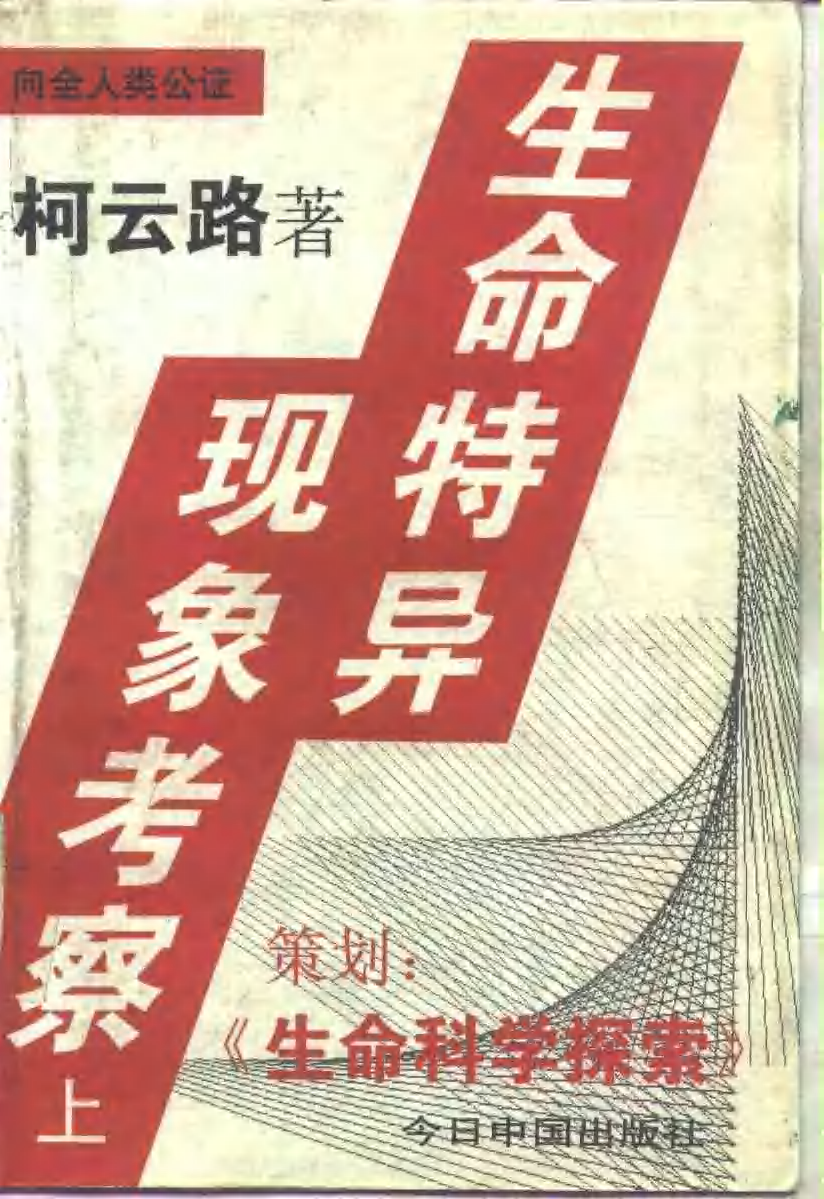
About this translation: This English edition follows the complete supplied scan in its original sequence: front matter, twenty-one upper-volume investigation chapters, twelve preparatory episode scripts, forty middle-volume chapters, the filming journal, twenty-four completed lower-volume episode scripts, and the afterword. It was translated directly from the supplied Chinese with language models, without an external translation service. Every source page was compared with its image, and the translation underwent independent bilingual review. Source-page comments preserve the PDF-to-printed-page mapping. The original cover is retained, and both body diagrams are reproduced with English labels. Editorial navigation below is separate from the translated original contents.
Source gaps and textual condition: Although the uploaded filename refers to the lower volume, the scan contains all three volumes. PDF pages 593–594 consist of explicit “pages missing from the original book” notices in place of printed pages 569–570; those missing passages cannot be translated and have not been reconstructed. The colophon advertises sixteen pages of color illustrations that appear to be absent from this scan. An opaque black block below the filming journal’s complete closing paragraph on PDF page 942 makes any underlying material unrecoverable; nothing has been reconstructed beneath it. Blank leaves are recorded. Damaged wording, uncertain names, and selected internal discrepancies are identified in translator’s notes. Dates, figures, experimental outcomes, and degrees of certainty have not been silently corrected or harmonized.
Historical text and health warning: The author’s and participants’ paranormal, scientific, religious, and medical assertions are reproduced in their own voices. Their inclusion does not endorse or independently establish the claimed results. Descriptions include prolonged deprivation of food, water, or sleep; stopping medication; direct sun-gazing; breath restraint; physical restraint; extreme temperatures; and unsterile or invasive procedures. They are historical material, not instructions certified as safe or effective. This book is not medical guidance and should not replace qualified medical care. Claims that illness reflects a person’s thoughts or moral state are the source’s views, not a judgment about people who are ill. Failed experiments, dissent, limitations, and contradictory accounts are retained alongside claimed successes.
Reading guide
This linked guide is editorial navigation. The translated original contents is preserved below.
Front matter
Upper Volume · First Part: Investigation Chapters
- Upper Volume: Planning Exploring Life Science
- Chapter 1. Beginning with the Great Resolve of Huike’s Severed Arm
- Chapter 2. A Comprehensive Investigation of Qigong and Extraordinary-Abilities Phenomena
- Chapter 3. Extraordinary Human Abilities Are a Microcosm of the Extraordinary Abilities of the Universe
- Chapter 4. People with Extraordinary Abilities Must Establish Their Place in Life
- Chapter 5. Thought Transmission Arises from the Qigong State of “True Stillness”
- Chapter 6. Supernormal Powers Are One of the Expedient Paths to Enlightenment
- Chapter 7. An Investigation of the Theory and Techniques of Master of Extraordinary Abilities Shen Chang
- Chapter 8. A Great, Earth-Shattering Challenge
- Chapter 9. The Human Body’s Supernormal Abilities Reflect the Universe’s Supernormal Energy
- Chapter 10. A Mysterious Master from Another Universe
- Chapter 11. A Great Challenge to Modern Medicine
- Chapter 12. The Ethereal Realms of Qigong and Art
- Chapter 13. Three Outstanding People with Extraordinary Abilities
- Chapter 14. Bigu Is One of the Advanced Techniques of Qigong Cultivation
- Chapter 15. The Girl Who Has Practiced Bigu for Six Years
- Chapter 16. Do Not Lose Your Own Composure
- Chapter 17. Establishing and Deciphering Humanity’s Mysterious Phenomena
- Chapter 18. An Investigation of Master of Extraordinary Abilities Chen Zhu
- Chapter 19. Chen Linfeng and Predictions of the Australian Satellite Launch
- Chapter 20. Shao Weihua, an Expert in Prediction through the Book of Changes
- Chapter 21. The True Face of Mysterious Power
Upper Volume · Second Part: Preparatory Episode Scripts
- Second Part: Introduction
- Episode One. A Question Spanning the Centuries
- Episode Two. Comprehensive Attestation
- Episode Three. Wondrous Extrasensory Perception
- Episode Four. The Mysteries of Thought Transmission
- Episode Five. The Challenge on the Summit of Mount Tai
- Episode Six. The Limits of Life
- Episode Seven. Black Lightning Pierces the Earth
- Episode Eight. Modern Medicine, Open Your Eyes Wide
- Episode Nine. The Supernormal Powers of Psychokinesis
- Episode Ten. A Preliminary Exploration of Mysterious Phenomena
- Episode Eleven. The Spiritual World of Those with Supernormal Powers
- Episode Twelve. The Mysterious World of Water
Middle Volume · Filming Exploring Life Science
- Middle Volume: Filming Exploring Life Science
- Chapter 1: A Record of Investigating and Filming the Mount Tai Bigu Class
- Chapter 2: Only When I Turn the Wheel of the Dharma Can I Be Free
- Chapter 3: A Record of Investigating and Filming Wang Qiang’s and Wang Bin’s Extraordinary Abilities
- Chapter 4: Life’s Universality Is Its Interconnection with the Universe
- Chapter 5: Only One Who Bears the Nation’s Disgrace Can Be Lord of Its Altars
- Chapter 6: There Is Still a World of Which We Know Absolutely Nothing
- Chapter 7: A Record of Investigating Extraordinary Tooth Extraction Through Qigong
- Chapter 8: Discovering Limits by Crossing Them
- Chapter 9: Facing a Greater Universe and Space
- Chapter 10: A Record of Investigating Sun Chulin, Master of Extraordinary Abilities
- Chapter 11: Reports on the Investigation of Sun Chulin’s Extraordinary Human Abilities
- Chapter 12: Extraordinary Human Abilities and Biological Fields
- Chapter 13: A Record of Investigating Yuqi, Practitioner of Dazang Qigong
- Chapter 14: Huang Runtian, Inheritor of Secretly Transmitted Medical Qigong
- Chapter 15: Establishing a Rigorous System of Scientific Investigation
- Chapter 16: Information in All Things
- Chapter 17: Investigation Report on Extraordinary Survival and Physical Capacity in the Qigong State
- Chapter 18: Our Original Scientific and Philosophical Vision
- Chapter 19: Jesus’s Voice Is Not Kindly
- Chapter 20: A Record of Investigating Qigong Master Liu Xinyu
- Chapter 21: Qigong Master Ji Lianyuan
- Chapter 22: A Record of Investigating Qigong Master Ji Lianyuan
- Chapter 23: A Record of Investigating Wei Tianbo’s Extraordinary Treatment
- Chapter 24. Developing Human Potential through Daoist Bright Mirror Qigong
- Chapter 25. A Documentary Record of an Experiment to Develop Supernormal Vision in Blind Children
- Chapter 26. An Overview of Experiments to Develop Supernormal Vision in Healthy Children
- Chapter 27. The First Stage of Experiments to Develop Supernormal Vision in Healthy Children
- Chapter 28. The Second Stage of Experiments to Develop Supernormal Vision in Healthy Children
- Chapter 29. Renewing Human Thought
- Chapter 30. A Documentary Record of the Investigation of Colonel Fu Songshan’s Extraordinary-Information Lectures
- Chapter 31. Launching an Investigation into Chen Linfeng’s Satellite-Launch Predictions
- Chapter 32. A Tabulation of Chen Linfeng’s Predictions of Five Satellite Launches in 1992
- Chapter 33. Chen Linfeng’s Predictions Concerning Flight Safety
- Chapter 34. A Chronicle of Filming Master of Extraordinary Abilities Shen Chang
- Chapter 35. Lin Lin, the Qigong Practitioner Who Will Not Come Out of Seclusion
- Chapter 36. Mobilizing the Primordial Spirit to Communicate with Heaven and Earth
- Chapter 37. Asking the Stars and Moon for Medicine
- Chapter 38. The Medicine King’s Alchemy in Daoist Qigong
- Chapter 39. A Documentary Record of Master Wang Youcheng’s Extraordinary-Ability Demonstrations
- Chapter 40. Placing an Enormous Question Mark before All Humanity
- Filming Journal
Lower Volume · Completed Episode Scripts
- Lower Volume: Completing Exploring Life Science
- Episode 1. Living Without Earthly Food
- Episode 2. The Challenge on the Summit of Mount Tai
- Episode 3. Comprehensive Attestation
- Episode 4. Wondrous Thought Transmission
- Episode 5. Extraordinary Tooth Extraction through Qigong
- Episode 6. The Contest of Fields of Mental Intention
- Episode 7. The Appearance of Mysterious Power
- Episode 8. The Difficult Task of Demonstration
- Episode 9. The Extraordinary Practitioner of Dazang Qigong
- Episode 10. Mysterious Miaofeng Mountain
- Episode 11. The Mysteries of Information
- Episode 12. The Deity Is Me, and I Am the Deity
- Episode 13. The Personified Cigarette Butt
- Episode 14. Striking an Ox through a Mountain
- Episode 15. Wondrous Hands
- Episode 16. Hua Tuo Reborn
- Episode 17. Developing Children’s Potential
- Episode 18. Opening the Third Eye
- Episode 19. Emitting Extraordinary Information
- Episode 20. All Things Are Interconnected
- Episode 21. The Master of Prediction
- Episode 22. The Blue Sky Bears Witness
- Episode 23. Black Lightning
- Episode 24. A Question Spanning the Centuries
- Afterword
An Investigation of Extraordinary Phenomena of Life
Testimony Before All Humanity
Ke Yunlu
Upper Volume
Planning Exploring Life Science
China Today Press
An Investigation of Extraordinary Phenomena of Life
By Ke Yunlu
(Beijing) New Registration No. 132
Responsible editor: Wang Gong
Cover and book design: Zhu Li
An Investigation of Extraordinary Phenomena of Life
Upper volume: Planning Exploring Life Science
Middle volume: Filming Exploring Life Science
Lower volume: Completing Exploring Life Science
By Ke Yunlu
Published by China Today Press
24 Baiwanzhuang Road, Beijing; postal code 100037
Printed by Beijing Baihua Color Printing Co., Ltd.
Distributed by Xinhua Bookstores throughout China
Paper size: 850 × 1168 mm; 1/32 format
Printing sheets: 44.75; color illustrations: 16 pages; text: 1,100,000 Chinese characters
First edition, first printing, October 1994
ISBN 7-5072-0403-0/Z·176
Price for the complete three-volume set: 39.80 yuan
Preface
I
There are many mysterious phenomena in human life, and at their core are extraordinary phenomena of life. The most vivid, typical manifestations of these extraordinary phenomena are advanced qigong skills and extraordinary human abilities.
To establish the existence of advanced qigong skills and extraordinary human abilities, reveal their mysteries, and thereby decipher the whole range of humanity’s mysterious phenomena, I have successively written four books: The Great Qigong Master, The New Century, Deciphering Humanity’s Mysterious Phenomena, and Facing the Qigong World. Several million copies of these four works have now been distributed in mainland China, and they have also begun to be published and circulated overseas. The response has been enthusiastic.
Yet we are still very far from having the whole world understand and accept the facts and principles set out in these books.
Leaving aside human society as a whole, even in scientific and intellectual circles the majority still fundamentally refuse to acknowledge the existence of extraordinary human abilities.
Extraordinary human abilities, which include advanced qigong skills, are also known internationally as psychic phenomena or parapsychological phenomena. Open any of the authoritative encyclopedias and dictionaries to the subject of extraordinary human abilities, and they all say that this is an unresolved question on which no conclusion has been reached. Moreover, the negative view is decidedly in the ascendant.
Both in China and throughout the world, a small number of scientists are investigating and studying extraordinary human abilities. Yet to this day they have been unable to make the scientific and intellectual communities as a whole accept the fact of their existence. This cannot be called anything but deplorable.
What is deplorable is not primarily that the work of researchers into extraordinary human abilities has progressed slowly.
What is deplorable is primarily the sluggishness of the scientific and intellectual communities as a whole, their complacent refusal to move forward, bound as they are by old theories.
The twentieth century is about to pass, and the twenty-first century is approaching. Humanity must have new discoveries and inventions on a considerable scale if it is to be worthy of history’s advance.
The prerequisite for new discoveries and inventions is to break through old patterns of thought and systems of logic.
The reason extraordinary human abilities are not accepted by scientific and intellectual circles or by society as a whole is precisely that they do not accord with old experience, old thinking, and old logic.
This is why it is difficult to establish the reality of extraordinary human abilities. For the very same reason, establishing their reality will set off a transformation of thought as a whole and of the logic of time and space, thereby renewing scientific and philosophical civilization.
In this sense, I look down on all of humanity’s existing science.
I express the utmost contempt for the arrogance, complacency, and self-satisfaction of scientific and intellectual circles.
Humanity is sometimes very foolish.
Unless human beings learn to let go, at any time, of the various attachments that bind them, attachment to interests, to ideas, to experience, to status, they have no freedom to speak of.
When we use the expression “spinning a cocoon around oneself” to describe some of the most foolish acts of self-imprisonment, we fail to realize that our scientific and intellectual communities as a whole are often, indeed, one might say most of the time, in precisely this state.
They wrap themselves in every scientific and philosophical theory already in existence and can see no light whatsoever outside this “cocoon.”
Scientists and thinkers of genius are skilled at piercing this cocoon, glimpsing the light and splendor beyond it, and making discoveries.
Humanity then moves forward again.
Once the new discoveries have been woven into another new cocoon, scientific and intellectual circles once again gasp for breath inside it, starved of oxygen.
Without such pointed language, it is difficult to stir the scientific and intellectual elite of human society as a whole.
In a certain sense, the scientific and intellectual communities, the whole world of knowledge, are both the wisest and the most foolish part of human society.
Someone who has attained thorough enlightenment can let go of every attachment and be entirely free.
Yet there is also considerable truth in the saying that one cannot finally liberate oneself without liberating all humanity.
What one person understands need not necessarily be forced upon everyone else. And yet it seems that one should, and can, help more people to understand.
And so I decided to undertake work that was both fundamental and epoch-making: to demonstrate the existence of extraordinary human abilities to all humanity.
II
Establishing the existence of extraordinary human abilities is exceedingly difficult. Otherwise, we could not explain why the investigations of some scientists over the past one or two hundred years have never won recognition.
The first difficulty in establishing the reality of extraordinary human abilities is that they lie beyond the present experience and theories of the great majority of human beings. They run completely counter to their perceptions and ideas. Consequently, in any experiment involving extraordinary human abilities, only those who observe it directly on the spot are likely to believe it. Once they have signed an experimental report in their capacity as scientists, however, neither the scientific nor the intellectual community as a whole believes them. People consider such things utterly impossible; they even believe that the few scientists conducting these experiments are mentally unbalanced.
This negative attitude on the part of scientific and intellectual circles as a whole makes it difficult for scientific experiments involving extraordinary human abilities to gain general recognition.
Many conclusive experiments involving extraordinary human abilities have already been pronounced dead the moment they leave the laboratory.
In China in recent years, quite a number of scientific researchers have also worked with people possessing extraordinary abilities and with qigong masters, conducted a considerable number of experiments on extraordinary human abilities, and written many experimental reports. Yet these results forever remain the concern of a small number of experimenters.
They go on believing what they believe.
Everyone else goes on doubting what they doubt.
Extraordinary abilities are possessed by only a small number of people. The scientists who conduct experimental investigations of them are also few. When a minority cannot persuade the majority to believe the facts they have recorded, they are powerless to do anything about it.
Eventually, researchers and ability-holders alike have almost entirely lost their enthusiasm for doing further experiments to establish the existence of extraordinary human abilities.
The second difficulty in establishing their reality is that, as a function of the human body, extraordinary human abilities are to a large extent affected by psychological and physiological conditions and are therefore highly unstable.
The abilities of those who possess them are not unconditional; they cannot be demonstrated repeatedly at will, regardless of time, place, or environment. Their extraordinary abilities are something responsive, lively, and sensitive, arising from the depths of the ability-holder’s mind, that is, from the depths of consciousness. In a certain sense, therefore, they are supersensitive. An ability-holder possesses the ability, but a slight worsening of the environment may disrupt the ability-state.
Many people with extraordinary abilities can give numerous demonstrations in a relaxed setting. Once the setting changes, however, and they find themselves surrounded by scrutinizing eyes, monitoring instruments, and authoritative figures, they immediately feel psychological pressure, and the ability will not come forth.
This is one important reason why demonstrations of extraordinary abilities find it difficult to convince more people.
To establish the reality of extraordinary human abilities, phenomena so difficult to believe in, one can only rely on investigative experiments as rigorous as possible. Yet as soon as the investigation becomes rigorous, ability-holders have difficulty manifesting their abilities.
Unless these two problems are solved, demonstrating the existence of extraordinary human abilities to all humanity is inconceivable.
III
I decided to solve these two problems.
I decided to undertake a large, systematic project to accomplish the task I had set myself.
This project was to conduct a comprehensive, documentary investigation of the abilities of China’s leading contemporary qigong masters and masters of extraordinary abilities, record the investigation faithfully on video, and then turn it into the first major television series in human history to depict qigong and extraordinary human phenomena, for broadcast throughout the world.
It was an unprecedented subject and an unprecedented plan. It involved many difficulties and many dangers. But our objective was set, and we were unwavering.
It was in the course of preparing this project that I developed and proposed the idea of “comprehensive attestation” as a way of demonstrating extraordinary human abilities to all humanity.
It is not that human beings are incapable of accepting events that occur when most of them are absent. Not everything has to be “seen to be believed.”
In a sporting competition, for example, when a world record is set, only a minority are there to watch it. Those who watch at close range and take measurements, as the officials do, are an even smaller handful. Yet people can accept and believe the world record.
This is because there is a system of officiating, and officials act as attesting witnesses.
Sporting achievements have a certain quality of unrepeatability. An athlete who breaks a world record here and now may never be able to repeat that record at another time and place. Yet humanity as a whole still accepts the record.
Here again it is the system of officiating that counts. What the officials have attested remains valid forever.
People also believe in lottery drawings, for example. It is not because everyone is present at the drawing, but because lawyers from the notarial office are there. People believe in legal notarization.
What counts here is the authority of the law and the institutional character of legal notarization.
To establish something before humanity, one must draw upon some authoritative rule of attestation within human society.
To establish something as difficult to establish as extraordinary human abilities, one might draw upon rules from several fields.
And so I proposed the idea of comprehensive attestation.
This may be regarded as an invention patented by the author.
The idea of comprehensive attestation before humanity is to place demonstrations of extraordinary abilities under the scrutiny of authoritative figures from every field, who jointly observe and attest to them.
Scientists, including physicists, chemists, biologists, and others, should be present to provide “scientific attestation” of demonstrations of extraordinary human abilities.
Lawyers should be present to provide “legal attestation” of demonstrations of extraordinary human abilities.
Renowned sports officials should be present to provide “sporting attestation” of demonstrations of extraordinary human abilities. Psychologists should be present to determine whether psychological suggestion has entered into the proceedings and thereby provide “psychological attestation.”
Medical specialists should be present to provide “medical attestation.”
Magicians should be present to rule out every kind of conjuring technique and provide magicians’ attestation.
Educational specialists should be present; the credibility of their professional ethical standing can provide attestation from the field of education.
Philosophers should be present to provide philosophers’ attestation informed by philosophical scrutiny.
Well-known figures from all walks of life should be present to lend their renown and credibility to “celebrity attestation.”
As many ordinary spectators from as many walks of life as possible should be present to provide collective audience attestation.
Finally, the video camera records the entire process, itself becoming another means of attestation.
Under such conditions, demonstrations of extraordinary abilities may be accepted and acknowledged by human society as a whole.
The broadcast of such a television series may enable the facts of extraordinary human abilities to gain a certain degree of recognition within this century.
The idea and methods of comprehensive attestation can do much to solve the first major difficulty in establishing extraordinary human abilities that we have just discussed.
Yet the second difficulty now confronts us as an even more insurmountable barrier.
Such extensive scrutiny through comprehensive attestation intimidates almost the overwhelming majority of ability-holders.
To many people, one might say, there is no possibility of success here whatsoever.
But I resolved to tackle this long-standing difficulty by drawing upon my comprehensive familiarity with China’s qigong masters and masters of extraordinary abilities, and upon my grasp of the laws governing qigong and extraordinary human abilities.
IV
I began to plan carefully, step by step.
First, I undertook another comprehensive investigation of several hundred leading qigong masters and masters of extraordinary abilities throughout the country, repeatedly selecting from among them the people I wanted to film. My first selection criterion was that their abilities be genuine and reliable. The second was that their abilities be exceptional and powerful. The third was that their abilities be stable and repeatable.
Naturally, anyone whose abilities were not genuine was eliminated first. Ordinary abilities would also be difficult to present to the world. Stability was especially important here. Some qigong masters and masters of extraordinary abilities possessed very strong abilities. But if their resistance to interference was poor and their adaptability to their surroundings weak, they too could not become subjects for investigation and filming in this series.
Second, my fourth criterion for selecting qigong masters and masters of extraordinary abilities was representativeness. I wanted the abilities of the people investigated and filmed not to duplicate one another. I hoped that, taken together, the abilities of those carefully selected would reflect the various types of extraordinary human ability.
Accordingly, from among qigong masters and masters of extraordinary abilities with similar kinds of abilities, I selected only one.
Third, my fifth criterion for selecting qigong masters and masters of extraordinary abilities was that they should have a certain level of education and some capacity to adapt to life in modern society.
For I believed that once the television series was broadcast, every ability-holder filmed in it was bound to become a “star,” enthusiastically besieged by the world. Without sufficient self-possession, they might well produce adverse consequences for the cause of human-body science.
Fourth, once the preliminary selection had been made, I invited them to Beijing one by one for lengthy conversations. This was to examine their abilities further, assess their recent ability-states, and communicate with them so that they would understand and appreciate the significance and methods of this investigation and filming.
It was in these conversations that I gradually worked out the specific methods of investigating and filming each ability-holder.
I also made sure each person fully understood these specific ideas.
I enabled each person to understand why all of this was necessary and feasible.
In this way they became relatively well prepared psychologically.
Fifth, to relieve the selected qigong masters and masters of extraordinary abilities of any anticipatory nervousness, I carried out various informal filming sessions with the great majority of them during the early planning stage.
This was to allow them and the members of the production crew to “settle in” together emotionally.
It was to help them adapt to a filming environment under lights and before cameras.
In this way it would be easier to move on to the formal filming later.
Sixth, scientific experiments were at the heart of investigating and filming the qigong masters and masters of extraordinary abilities.
We began designing and preparing these experiments several months in advance.
We had to work out who would conduct the experiments, their subjects, tasks, aims, and methods, including methods of testing, demonstration, and attestation, and determine their times, places, and personnel arrangements.
We also began designing and printing the investigative and observational report forms and the various corresponding tables required for each experiment.
Preparations concerning personnel, materials, venues, and contacts were all put in hand.
For many large-scale group experiments, such as Xu Jiehe’s bigu experiment on Mount Tai, Huang Runtian’s intensive qigong training experiment in overcoming sleepiness and walking away a hundred ailments, Shen Chang’s group experiment treating breast tumors, and Chen Linfeng’s experiment predicting Air Force flights, we spent dozens of days or even several months making thorough preparations.
Seventh, demonstrations of qigong and extraordinary abilities are highly spontaneous, flexible, and variable. Nevertheless, so that everyone concerned, and the production crew in particular, would be sufficiently prepared psychologically for the investigation and filming as a whole, I first wrote shooting scripts for twelve episodes during the planning stage.
These twelve scripts were not to serve as prescriptions for filming.
They were to serve as “suppositions” for filming.
In other words, the filming that followed would both have to follow the scripts and not follow them.
Following the scripts would give the demonstrations and experiments involving extraordinary abilities a certain degree of order.
Not following the scripts emphasized that everything must depend on changes and developments on the spot. Everything must proceed in accordance with the actual course of life. Any forced or rigid prescription might cause an experiment involving extraordinary human abilities to fail.
This television series was given the title Exploring Life Science.
V
Beginning on June 9, 1993, and ending on October 4, the four-month preliminary planning stage fulfilled its mission.
On October 5, a grand opening ceremony on a scale rarely seen in the history of Chinese television was held in Beijing. Several hundred well-known figures from all walks of life attended to offer their congratulations. Their shared purpose formed an impregnable wall, and enthusiasm ran high. The production crew then traveled to Wuhan, Xuzhou, Mount Tai, Beijing, Tianjin, Suzhou and Wuxi in Jiangsu, Shanghai, Huizhou in Guangdong, and other places to carry out large-scale investigation and filming unprecedented in the history of life science.
Although we had made thorough preparations during the preliminary planning stage, the complexity, difficulty, and unpredictability inherent in investigating extraordinary human abilities filled the entire investigation and filming with suspense and dramatic turns.
Some qigong masters and masters of extraordinary abilities whom we had decided to film during the early planning period could not be filmed because timing, location, and other circumstances failed to come together.
Some demonstrations by qigong masters and masters of extraordinary abilities were filmed, but for various reasons the demonstrations were not especially rigorous and thus could not be included in Exploring Life Science as established cases.
Some demonstrations and experiments by qigong masters and masters of extraordinary abilities went through several attempts before finally being filmed successfully.
Difficulties and suspense were everywhere.
At the same time, however, unexpected new opportunities arose.
New qigong masters and masters of extraordinary abilities came to our attention as possible subjects, and some of these newly chosen subjects were of considerable value for filming.
New projects, new topics, new contacts, and new support flowed continuously toward us.
On one hand difficulties seemed to pile up; on the other, help was available at every turn. God took very good care of us. Although many matters were full of twists and turns, in the end danger always gave way to safety, and we achieved unexpected successes.
The process of investigation and filming was full of drama.
Throughout, we adhered to the principle of comprehensive attestation.
Putting this principle into practice also encountered many difficulties. When we conducted the first investigation and filming of an extraordinary-ability demonstration in Wuhan after shooting for Exploring Life Science had begun, not a single one of the scientists invited attended.
They did not attend because they did not believe in extraordinary human abilities. They were unwilling to reserve judgment until after observing on the spot.
For similar reasons of various kinds, some demonstrations of extraordinary abilities did not fully achieve the broad, high-level “comprehensive attestation” we had intended.
Yet when the entire investigation and filming were over, we found that, taken as a whole, our investigation of extraordinary human abilities had truly achieved comprehensive attestation.
And it was comprehensive attestation of considerable force.
As a record of this large-scale investigation, the television series Exploring Life Science possesses tremendous authenticity and persuasive power.
We had received advice from many quarters that it was relatively difficult to use television to establish the authenticity and credibility of extraordinary human abilities. Because of television’s special effects and editing techniques, television itself was a medium capable of creating illusions.
Yet in the course of its filming and production, Exploring Life Science displayed a power that won every battle and overcame every obstacle.
Many of the early production-crew members had not believed in extraordinary human abilities; some had been extremely stubborn opponents. Over several months of filming, they were won over one after another by ironclad facts.
Editors who joined the production crew at a later stage had not observed events on the spot. Yet as soon as they encountered the vast quantity of material we had filmed, they affirmed the authenticity of all the demonstrations.
Those who subsequently joined from other fields, including musicians and studio technicians, were without exception won over by the unadorned, truthful images.
We had once worried whether the series could convince most viewers of its authenticity. When we finished producing it, however, our concern was the opposite: had we made our case for the authenticity of extraordinary abilities too concise and effective?
Would it not have been more artistic had the path been more roundabout?
Looking back, we truly discovered that the thorough preparations and efforts we had made had laid the foundation of authenticity.
Take, for example, demonstrations of extraordinary treatment through qigong and extraordinary human abilities.
All patients receiving treatment had to provide a personal account bearing their own signature.
There had to be mutual corroboration of identities within the group of patients.
Each person had to have a hospital diagnosis and laboratory reports.
Before treatment, each person had to undergo an on-site diagnosis by a doctor, who also examined the various diagnostic documents brought from the hospital.
After treatment, examinations and diagnoses were carried out again for comparison.
An attestation panel made up of well-known figures from different fields had to be present to observe and attest.
A substantial number of spectators also had to be present, forming an “attestation group” to carry out “collective attestation.”
Throughout the investigation, treated patients, members of the attestation panel, and doctors present all had to complete various forms.
Statistics from the forms were combined with rigorous on-site counts.
The camera’s recording of the proceedings provided another means of monitoring and attestation.
The entire production crew were also investigators.
These investigations and attestations from every direction made the television series Exploring Life Science shine with the radiance of authenticity.
VI
The television series Exploring Life Science, a documentary record of this large-scale investigation of qigong and extraordinary human abilities, is about to appear.
At the same time, I have decided to publish all the written materials relating to this investigation and filming.
The first part consists of: 1. Various documents from the early planning period, including records of my lengthy conversations with the qigong masters and masters of extraordinary abilities, and various plans and arrangements. 2. The twelve episode scripts completed during the early planning period.
The second part consists of the various plans made during filming, conversations with qigong practitioners, and documentary accounts of the filming.
The third part is the final script of the completed television series.
These three parts will each form a separate volume.
They are the upper, middle, and lower volumes of Testimony Before All Humanity: A Documentary Investigation of Extraordinary Phenomena of Life.
Concerning these three volumes, I wish to make the following points.
First, everything here consists of authentic, original records. The circumstances they disclose can serve as a reference for scientific and intellectual circles. Concerning qigong and extraordinary human abilities, this book provides a great deal of vivid, little-known “inside information.”
Second, for the many enthusiasts of qigong, the various writings concerning the many qigong masters and masters of extraordinary abilities who appear in this book should, I imagine, offer something of the greatest substance.
What, ultimately, are the mysteries of qigong? What are the mysteries of extraordinary human abilities? Nothing could be more enlightening than original records of this kind.
In intimate conversations with me, these qigong masters and masters of extraordinary abilities truthfully described the histories of their individual abilities and the characteristics of their ability-states.
For example, a mysterious claim frequently heard in qigong circles is that many qigong practitioners have not only living masters but also immortal masters in the unseen world. Is this fanciful talk? Read the conversation between Sun Chulin, the Wuhan master of extraordinary abilities, and the author, and you will discover the actual circumstances. Every night at midnight, when she practices, a master appears before her.
Or again, what kind of state is involved in extraordinary abilities such as extrasensory perception and psychokinesis? What is the ability-holder’s subjective experience? How does one enter this state? By reading the conversation between Wang Youcheng, the Jilin master of extraordinary abilities, and the author, we can learn about the actual situation.
Or again, what is the special transport skill of obtaining medicine from thin air? How does one acquire this ability? When you read the relevant passages in this book, the answer will suddenly become clear.
These are only a few small examples. Many of the materials in this book disclose the deepest mysteries of qigong and extraordinary human abilities.
Third, in his conversations with qigong masters and masters of extraordinary abilities, in his remarks during various planning activities, and in writing the scripts and commentary, the author carried out extensive research, analysis, and decipherment of qigong and extraordinary human abilities.
In this work, the author has also offered many new explanations in his decipherment of humanity’s mysterious phenomena.
In this work, the author has also elaborated many new ideas concerning the mysteries of the human body and the universe, the mysteries of life, and the destiny of humanity.
Together, the book Testimony Before All Humanity: A Documentary Investigation of Extraordinary Phenomena of Life and the television series Exploring Life Science constitute a major undertaking to investigate, substantiate, and decipher qigong and extraordinary human abilities.
Fourth, if The Great Qigong Master, The New Century, Deciphering Humanity’s Mysterious Phenomena, and other works represent the first stage of the author’s research into qigong, extraordinary abilities, and other mysterious human phenomena, then the undertaking we now see may be regarded as the unfolding of the second stage of his research.
VII
The author firmly believes that the book Testimony Before All Humanity: A Documentary Investigation of Extraordinary Phenomena of Life and the television series Exploring Life Science are among the more important works in the intellectual and cultural history of this century.
The author firmly believes that this work will leave a solemn page in the history of life science.
The author firmly believes that, in the history of qigong, this work will be a chapter of great weight, whether measured against the thousands of years before it or the thousands of years after it. In a manner most closely attuned to life in modern society, it substantiates and promotes qigong culture and qigong practice on a large scale.
The author is in no hurry to argue all of this.
Time will prove these predictions.
What the author wishes to say now is that, with this large-scale investigation and filming of qigong and extraordinary human abilities, with the book Testimony Before All Humanity and the television series Exploring Life Science, our research in life science has gained another solid point of departure. At the same time, we have gained a fulcrum with which to move the force of entrenched habits in contemporary thought.
We shall advance without hesitation.
Farewell to the old century; welcome to the new.
Break through old thinking; establish new ideas.
We intend to shock all humanity, awaken it, and give it a fresh way of seeing.
The author’s plans for what comes next are these:
- Further develop Ke Yunlu’s Human-Body–Cosmology, and further propose and develop the associated and subsidiary theories of this doctrine.
- Further study and decipher ancient culture. Undertake more thorough research and interpretation of the Book of Changes, the Dao De Jing, the Yellow Emperor’s Inner Canon, and Buddhist scriptures.
- Bring together support from China and overseas to establish an international “Life Science Research Center.”
- Conduct more comprehensive, larger-scale investigations and studies of qigong and extraordinary human abilities. Prepare to extend these investigations and studies throughout the world.
- Carry out various large-scale experiments in the application of qigong and extraordinary human abilities, organizing qigong masters and masters of extraordinary abilities to conquer AIDS, cancer, and other incurable diseases.
- Prepare to conduct various large-scale scientific experiments to develop human potential.
We hope that all friends who aspire to this great undertaking will come together.
We hope that more people from scientific and intellectual circles will come together.
We hope that more qigong masters and masters of extraordinary abilities will come together.
We hope that people from all walks of life, in China and overseas, who care about this undertaking will come together.
Einstein’s wisdom and Laozi’s wisdom are interconnected.
The spiritual nature of all humanity is interconnected.
Let us step together onto the horizon of a new civilization and paint the splendor of a new century.
Contents
Preface — 1
Upper Volume
Planning Exploring Life Science
First Part — 1
Chapter 1. Beginning with the Great Resolve of Huike’s Severed Arm: Ke Yunlu’s First Conversation with the Exploring Life Science Production Crew — 3
Chapter 2. A Comprehensive Investigation of Qigong and Extraordinary-Abilities Phenomena: Ke Yunlu’s Initial Plan for the Major Television Series Exploring Life Science — 11
Chapter 3. Extraordinary Human Abilities Are a Microcosm of the Extraordinary Abilities of the Universe: A Conversation with Sun Chulin, the Hubei Master of Extraordinary Abilities, on the Mysteries of Extraordinary Abilities and Their Development — 19
Chapter 4. People with Extraordinary Abilities Must Establish Their Place in Life: A Conversation with Master of Extraordinary Abilities Wang Youcheng and an Investigation of His Demonstrations — 32
Chapter 5. Thought Transmission Arises from the Qigong State of “True Stillness”:
Exploring the Mysteries of Thought Transmission with Master of Extraordinary Abilities Wang Youcheng — 58
Chapter 6. Supernormal Powers Are One of the Expedient Paths to Enlightenment — 68
Chapter 7. An Investigation of the Theory and Techniques of Master of Extraordinary Abilities Shen Chang — 73
Chapter 8. A Great, Earth-Shattering Challenge — 92
Chapter 9. The Human Body’s Supernormal Abilities Reflect the Universe’s Supernormal Energy: Exploring the Mysteries of Human Supernormal Abilities with the Renowned Qigong Master Liu Xinyu — 103
Chapter 10. A Mysterious Master from Another Universe: Investigating the Origins of the Abilities of the Renowned Master of Extraordinary Abilities Sun Chulin — 123
Chapter 11. A Great Challenge to Modern Medicine: Planning Another Experiment in Extraordinary Treatment with Mr. Shen Chang, Master of Extraordinary Abilities — 130
Chapter 12. The Ethereal Realms of Qigong and Art — 139
Chapter 13. Three Outstanding People with Extraordinary Abilities: An On-Site Investigation of Zou Huiping, Tianliang, and Tianxiu — 146
Chapter 14. Bigu Is One of the Advanced Techniques of Qigong Cultivation — 153
Chapter 15. The Girl Who Has Practiced Bigu for Six Years — 160
Chapter 16. Do Not Lose Your Own Composure — 168
Chapter 17. Establishing and Deciphering Humanity’s Mysterious Phenomena: Planning the Entire Exploring Life Science Project — 173
Chapter 18. An Investigation of Master of Extraordinary Abilities Chen Zhu — 179
Chapter 19. Chen Linfeng and Predictions of the Australian Satellite Launch — 194
Chapter 20. Shao Weihua, Expert in Book of Changes Prediction — 205
Chapter 21. The True Face of Mysterious Power: Further Investigation of the Jin Quyi Phenomenon — 211
Second Part — 217
Episode 1. A Question Spanning the Centuries — 221
Episode 2. Comprehensive Attestation — 238
Episode 3. Wondrous Extrasensory Perception — 252
Episode 4. The Mysteries of Thought Transmission — 262
Episode 5. The Challenge on the Summit of Mount Tai — 276
Episode 6. The Limits of Life — 297
Episode 7. Black Lightning Pierces the Earth — 318
Episode 8. Let Modern Medicine Open Its Eyes Wide — 333
Episode 9. The Supernormal Powers of Psychokinesis — 347
Episode 10. A Preliminary Exploration of Mysterious Phenomena — 359
Episode 11. The Spiritual World of Those with Supernormal Powers — 377
Episode 12. The Mysterious World of Water — 396
Middle Volume
Filming Exploring Life Science
An Investigation Unprecedented in the History of Human-Body Science and Technology — 417
Chapter 1. A Documentary Account of Investigating and Filming the Mount Tai Bigu Class — 421
Chapter 2. Only When I Turn the Dharma Wheel Am I Free — 435
Chapter 3. A Documentary Account of Investigating and Filming Wang Qiang’s and Wang Bin’s Extraordinary Abilities — 442
Chapter 4. The General Nature of Life Is Its Interconnection with the Universe — 468
Chapter 5. Only One Who Bears the Nation’s Disgrace Can Be Lord of Its Altars — 476
Chapter 6. Worlds of Which We Know Absolutely Nothing Still Exist — 480
Chapter 7. A Documentary Investigation of Extraordinary Tooth Extraction through Qigong — 487
Chapter 8. Discovering Boundaries by Going Beyond Them: The Contest between Qigong Extraordinary Abilities and Fields of Mental Intention — 502
Chapter 9. Facing a Vaster Cosmic Space — 516
Chapter 10. A Documentary Investigation of Master of Extraordinary Abilities Sun Chulin — 527
Chapter 11. Investigative Report on Sun Chulin’s Extraordinary Human Abilities — 545
Chapter 12. Extraordinary Human Abilities and Biological Fields — 558
Chapter 13. A Documentary Investigation of Yu Qi, Practitioner of Dazang Qigong — 568
Chapter 14. Huang Runtian, Heir to a Secret Medical Qigong Tradition — 577
Chapter 15. Establishing a Rigorous System of Scientific Investigation — 588
Chapter 16. Information and the Ten Thousand Things — 596
Chapter 17. Investigative Report on Extraordinary Survival Phenomena and Extraordinary Physical-Abilities Phenomena in the Qigong State — 606
Chapter 18. Initial Scientific and Philosophical Perspectives — 621
Chapter 19. The Voice of Jesus Is Not Benevolent — 626
Chapter 20. A Documentary Investigation of Qigong Master Liu Xinyu — 630
Chapter 21. Qigong Master Ji Lianyuan — 640
Chapter 22. A Documentary Investigation of Qigong Master Ji Lianyuan — 649
Chapter 23. A Documentary Investigation of Wei Tianbo’s Extraordinary Treatment Phenomena — 660
Chapter 24. Developing Human Potential through Daoist Bright Mirror Qigong — 671
Chapter 25. A Documentary Account of Experiments to Develop Extrasensory Vision in Blind Children — 678
Chapter 26. Overview of Experiments to Develop Extrasensory Vision in Healthy Children — 685
Chapter 27. The First Stage of Experiments to Develop Extrasensory Vision in Healthy Children — 691
Chapter 28. The Second Stage of Experiments to Develop Extrasensory Vision in Healthy Children — 704
Chapter 29. Renewing Human Thought — 713
Chapter 30. A Documentary Investigation of Colonel Fu Songshan’s Lectures on Extraordinary Information in Beijing — 717
Chapter 31. Investigating Chen Linfeng’s Predictions of Satellite Launches — 731
Chapter 32. Statistics on Chen Linfeng’s Predictions of Five Satellite Launches in 1992 — 742
Chapter 33. Chen Linfeng’s Predictions of Flight Safety — 748
Chapter 34. A Chronicle of Filming Master of Extraordinary Abilities Shen Chang — 751
Chapter 35. Lin Lin, the Qigong Master Who Does Not Come Out into the World — 760
Chapter 36. Mobilizing the Primordial Spirit to Communicate with Heaven and Earth — 768
Chapter 37. Seeking Medicine from the Stars and Moon — 779
Chapter 38. The Medicine King’s Alchemy in Daoist Qigong — 785
Chapter 39. A Documentary Account of Master Wang Youcheng’s Demonstrations of Extraordinary Abilities — 790
Chapter 40. Posing an Enormous Question Mark to All Humanity: A Discussion Held by the Exploring Life Science Production Crew as Filming of the Entire Series Neared Its End — 794
Filming Journal, September 30, 1993–April 6, 1994 — 807
Lower Volume
Completing Exploring Life Science
China’s First Major Television Series on Qigong and Extraordinary Human Abilities — 919
Episode 1. Living Without Earthly Food — 928
Episode 2. The Challenge on the Summit of Mount Tai — 949
Episode 3. Comprehensive Attestation — 973
Episode 4. Wondrous Thought Transmission — 997
Episode 5. Extraordinary Tooth Extraction through Qigong — 1015
Episode 6. The Contest of Fields of Mental Intention — 1035
Episode 7. The Appearance of Mysterious Power — 1051
Episode 8. The Difficult Task of Demonstration — 1068
Episode 9. The Extraordinary Practitioner of Dazang Qigong — 1084
Episode 10. Mysterious Miaofeng Mountain — 1106
Episode 11. The Mysteries of Information — 1123
Episode 12. The Deity Is Me, and I Am the Deity — 1136
Episode 13. The Personified Cigarette Butt — 1155
Episode 14. Striking an Ox through a Mountain — 1173
Episode 15. Wondrous Hands — 1192
Episode 16. Hua Tuo Reborn — 1219
Episode 17. Developing Children’s Potential — 1242
Episode 18. Opening the Third Eye — 1263
Episode 19. Emitting Extraordinary Information — 1284
Episode 20. All Things Are Interconnected — 1301
Episode 21. The Master of Prediction — 1317
Episode 22. The Blue Sky Bears Witness — 1338
Episode 23. Black Lightning — 1354
Episode 24. A Question Spanning the Centuries — 1375
Afterword — 1397
Upper Volume: Planning Exploring Life Science
First Part
During the preliminary planning period, the author conducted focused investigations of several dozen qigong masters and masters of extraordinary abilities. All had been carefully selected from among China’s leading qigong masters and masters of extraordinary abilities.
Detailed records were made of the investigations of fourteen of them.
They were Wang Youcheng, Liu Xinyu, Shen Chang, Chen Linfeng, Sun Chulin, Wang Qiang, Wang Bin, Zou Huiping, Tianliang, Tianxiu, Chen Zhu, Xu Jiehe, Ding Jing, and Shao Weihua.
Chapter 1. Beginning with the Great Resolve of Huike’s Severed Arm
Ke Yunlu’s First Conversation with the Exploring Life Science Production Crew
May 29, 1993, 10:00 a.m.; Room 3218, Huadu Hotel, Beijing
I. Huike Severs His Arm: Grasping the Meaning and Forgetting the Form
Today is May 29, 1993. I wish to state very solemnly that, after a period of contact with you and getting to know you, I, Ke Yunlu, have reached a decision: I am prepared to work with you to make what I regard as the first television production in human history to serve as a scientific model in the study of qigong, extraordinary human abilities, and humanity’s various mysterious phenomena.
Since this is the relationship we are entering into, the relationship between us has changed.
First, I regard you as my friends.
Second, of course, I also regard you as my teachers. I shall learn a great deal from you and from the production crew.
Third, however, I also regard all of you as my students. According to each person’s circumstances, I shall say certain things that you could not possibly hear on other occasions, in other times and places.
There is one guiding principle with which I very much agree: everyone joining this production crew should have some understanding of qigong and extraordinary human abilities, and a certain interest in them. When we work together as a team, especially on this particular undertaking, my requirements will be different from the usual ones.
I hope we can all do this work within a very good atmospheric field.
Many people are interested in Chan Buddhism. You must all know the following story.
Bodhidharma came to China and sat facing a wall at Shaolin Monastery for nine years without finding a suitable disciple. Without a suitable disciple, the teaching cannot be transmitted. Huike, the second patriarch of our Chan tradition, went to Shaolin Monastery to seek him as his teacher. The historical account says that Bodhidharma “always sat upright facing the wall; no teaching or encouragement was heard from him.” What does this mean? Huike sought him as his teacher and wanted to receive Bodhidharma’s instruction, but Bodhidharma would not teach him. What did Huike do? The book says that Huike sighed: “Those of old who sought the Way broke their bones to extract the marrow, shed their blood to relieve hunger, spread their hair over the mud, and threw themselves from cliffs to feed tigers. If the ancients did such things, who am I?” On the night of the ninth day of the twelfth month that year, heavy rain and snow fell. Huike stood firmly without moving in the rain and snow, and by morning the accumulated snow was above his knees. Bodhidharma then took pity and asked, “You have stood in the snow for so long. What do you seek?” Huike wept as he spoke, asking Bodhidharma to bring him to enlightenment. Bodhidharma replied: “The unsurpassed wondrous Way of the Buddhas requires diligent exertion through boundless ages: doing what is difficult to do and enduring what cannot be endured. How could one hope for the true vehicle with little virtue and little wisdom, with a careless and arrogant mind? It would be only wasted toil.” Only after Huike had stood firm in the heavy snow all night did Bodhidharma “take pity and question him.” He was moved a little, and that was all. Then Bodhidharma told Huike that someone seeking the Way and enlightenment must do what cannot be done and endure what cannot be endured; to seek great wisdom with little virtue and little wisdom would produce only fruitless labor. On hearing Bodhidharma’s instruction, Huike “secretly took a sharp blade, severed his own arm, and placed it before Bodhidharma.” Bodhidharma asked Huike what he sought. Huike said, “My mind is not at peace. I beg you, Master, to put it at peace.” Bodhidharma said, “Bring me your mind, and I shall put it at peace.” After a long while Huike said, “I have searched for my mind and cannot find it at all.” Bodhidharma said, “I have finished putting your mind at peace.” At these words Huike attained great enlightenment.
This is a famous gong’an, or encounter story, in the history of Chan. Who knows how many books have discussed it, or how many people on how many occasions? Yet most of what I have read can be said to miss the point entirely.
A person does not become enlightened simply because he wants to. When many people talk about so-called “subtle Chan sayings,” they are merely affecting refinement and are ten thousand miles from genuine Chan.
We should first examine what Huike had been doing before he became enlightened. Everyone thinks it wonderful that a single sentence could bring “great enlightenment at those words,” and everyone wants to become enlightened. How could it be so easy?
A person cannot be brought to enlightenment simply by having one clever remark pointed out to him.
Huike’s severing of his arm showed the immense strength of his resolve in seeking truth. Could an ordinary person do that?
When he placed his severed arm before Bodhidharma, this act expressed his great resolve to lay down every worldly burden, and showed that he had already done so. This was no false resolve. Anyone can profess false resolve, but only when a person truly makes a great vow will his body and mind enter a state of tremendous energy. Only with this state can a hint from an enlightened teacher bring enlightenment.
There is a Chinese expression, “grasp the meaning and forget the form.” It was originally a very good expression: grasp the meaning and forget the form. Now it has become a phrase describing arrogance and complacency. To grasp the meaning and forget the form is a state of attainment. In that instant Huike forgot his physical body and abandoned every worldly thought. Without encountering such a person, even Bodhidharma’s transmission of the Way would have been useless. However much he said, the other person could not have been awakened.
I tell this story because I hope that, in undertaking this work, we too will have that kind of sincere, great resolve. If I cannot bring you into such a state, it will be impossible to make this series well.
When we first met, I said something that probably none of you noticed. I said: as to whether I choose to work with you or not, at present only one thing stands on the side of supporting you, and that is my intuition. All my judgments based on experience stand against you. In the ordinary sense, the resources you have in various respects cannot compare with those of the people I first selected as collaborators. Yet my intuition is on your side, and I trust my intuition.
It is people like you whom I value. There is a saying: things are often started by little people.
Let us do this together.
II. Broadening Humanity’s Vision of Itself and the Universe
Now I shall speak more specifically about this television series.
First, its purpose and significance.
To express its purpose in the conventional scientific and philosophical language of today, this series will demonstrate to all humanity the abundant phenomena of qigong and extraordinary human abilities, and the various mysterious phenomena that have existed throughout recorded history, in the most fact-seeking, scientific, and generally acceptable way, including the most preliminary analysis.
Humanity’s present scientific, philosophical, and artistic thinking are all very limited. Through a large number of indisputable examples, this series will deliver a great shock to the thinking of humanity as a whole. It will strive to step outside humanity’s existing modes of thought and, from a higher standpoint, offer new philosophical perspectives and understanding of human thought and the environment in which humanity lives.
This series should become one of the most important events of this century in the history of thought, culture, and science. It should exert a major influence on the civilization of the next century, whether in science, philosophy, or art.
The appearance of this work will, for a time, become a subject of conversation, discussion, and stories among people in many fields. It will trigger scientific research and artistic creation in many fields, and vastly broaden humanity’s vision of itself and the universe.
Second, the style of the series.
With an attitude of absolute earnestness, this series will pursue authenticity, scientific rigor, and seriousness. This must be true not only of its effect when broadcast. Throughout the production process, every member of the staff must adopt a scientific and serious attitude. We would rather lose something in other respects than be at all equivocal about its authenticity, scientific rigor, or seriousness.
Great authenticity, scientific rigor, and seriousness are the prerequisites for this series to establish itself and radiate an eye-catching brilliance in a world so richly colored by cultural phenomena.
Here lies the principal style of the series.
Everyone who watches it must come away with this impression: the entire staff, whether Ke Yunlu, the director, the camera crew, or the qigong masters and people with extraordinary abilities whom we film, must display trustworthy character at every stage. Reckless claims and falsification are forbidden.
Our rigorous and serious scientific attitude must run through every aspect of the work. Our work must withstand scrutiny. If the work itself is to become a model, our working attitude must also become a model.
There is a very good expression, “a whole body of upright qi.” This does not merely describe a person’s political integrity; in qigong it is a very high state. A whole body of upright qi, no ulterior motives in the mind, no guilt or shame over reckless statements. Only wishes formed in this state can truly achieve “what the mind desires comes to pass.”
Since we are doing something so great and valuable for humanity, we must first put our own state of mind in order. If I cannot bring everyone into this state, our work will encounter unexpected deviations in many respects.
Ke Yunlu has devoted so much energy to research in this field not because he considers it fashionable. I have conducted extremely serious and painstaking investigations of a great many qigong phenomena and extraordinary-ability phenomena. There are many false qigong phenomena and many false “extraordinary abilities” in society today. That is not at all surprising. Our counterfeit and shoddy goods generally imitate famous brands. Only good things are worth counterfeiting!
What, then, is the first thing Ke Yunlu must do in this series? Distinguish the genuine from the false, discard the false, and retain the genuine. When we eliminate all false abilities and false phenomena, when we pursue authenticity as a style and carry that style to its utmost limit, this series will display an exceedingly distinctive artistic character.
The series must constantly display captions giving the year, month, day, hour, and minute; the names of the on-site attesting witnesses; the name of the demonstrator; and the extraordinary phenomenon produced. The time should even be recorded to the second. We must be rigorous. On-site records must be extremely accurate. Whether making video recordings, audio recordings, or written notes, we must work with the utmost seriousness, just as scientists observe particles splitting in an accelerator. It happens in an instant, but the entire process must be tracked rigorously. We must be extremely precise. This series must display the unmistakable character of science on a grand scale.
It requires thoroughgoing authenticity, inside and out. We must eliminate every possible doubt that might occur to viewers at any stage. We must anticipate the doubts that different people, including the most hostile opponents, might have after watching it, and do all we can through our work to eliminate them.
This is an especially important source of the series’ power.
Think about it: if people all over the world watch this series, whether ordinary people, scientists, or politicians, and first believe in the seriousness and authenticity of what we have filmed, then, to put it absolutely, we need do nothing else. The series will quite naturally become the most important event of this century.
At the same time, it must possess very high artistic quality. Artistic quality and authenticity are in no way incompatible. We must be serious, but seriousness can be lively or dull. The series must be very serious, very truthful, and at the same time enthralling.
We should make the greatest possible use of our artistic talent and imagination, arranging our subjects coherently through the language of the camera to give the viewing experience a sense of freshness. Against meticulously serious scientific images, the presenter may offer bold scientific conjectures in voice-over, inspiring viewers to let their thought and philosophy roam freely amid convincing demonstrations. On one side there is a rigorous scientific laboratory; on the other, perhaps, a brilliant starry sky that sets the imagination wandering. We must appreciate the atmosphere involved. Achieving this will place high demands on every member of the crew.
We must unite great scientific rigor, seriousness, and authenticity with the artistic bearing of a master. I myself shall work in a dual capacity. As a scientist, thinker, philosopher, and researcher, I shall explain the mysteries involved and conduct rigorous scientific verification. At the same time, I must draw upon my qualities as an artist to lay the groundwork for filming this series.
Thus, on the basis of a style combining seriousness, scientific rigor, and artistry, we must also explore how the series can be enjoyable, accessible, and engrossing while also being searching and profound, so that knowledgeable specialists too will marvel at it; and how it can both create an immediate sensation and endure for a long time. All these things must be explored step by step.
Third, the scale of the series.
The provisional plan is for approximately sixteen episodes, each fifty minutes long.
Fourth, the working schedule and progress of the series.
Filming is provisionally set to begin in September. Everything must be prepared before then. Progress may be faster than we imagine, or it may be slower. This does not depend on us alone. There are many limiting factors, including the condition of the people we film. We need not become too attached to the schedule.
Before then, I hope we can begin planning and writing as soon as possible.
I hope everyone will make a sufficient allowance for the difficulty of the work.
Filming this series requires a major investment in many areas: great wisdom, insight, human resources, funds, and also our patience. Yet once the series achieves its intended effect, frankly, its distribution and worldwide dissemination will need no publicity. The work will make its own way through its tremendous appeal. Wherever it is shown, whether on a university campus, in an academy of sciences conference room, in a factory, or in the countryside, it will spread of its own accord. Of course, the prerequisite for this effect is that the series be made so that everyone wants to watch it and everyone passes it on for others to see.
III. Entering Where There Is an Opening: The Three Impulses Act Together, and Heaven and Earth Are Overturned
Now let me speak of my hopes for my friends in this production crew.
First, I hope that making this series will deepen everyone’s understanding of qigong and extraordinary human abilities, increase your insight into life, and ultimately enable you to grasp many questions in this field at a glance and gain a great deal.
Second, as people of different ages and professions, I hope that in this great undertaking each of you will also find and accomplish a life’s work of your own.
There is an expression, “enter where there is an opening.” Many things in this world are accomplished by entering where there is an opening. Let us do so. Don’t laugh. Here with Teacher Ke, every term is redefined and used anew. “Enter where there is an opening” is a very good expression. Take doing business: the weather turns hot, everyone wants watermelon, but there is none on the market. Isn’t that an opening? You bring in watermelons, and you have entered where there is an opening. Your business succeeds. How could you enter where it is already full? If watermelons are everywhere and you come to sell more, who will buy them?
The same question of entering where there is an opening arises in doing things. At present, nowhere in the world is there an organization investigating qigong and extraordinary human abilities with this degree of rigor. We enter this opening and undertake this work, and that is very meaningful. If television series on similar subjects were everywhere, would there still be any point in our making another?
To put it plainly, qigong practice also requires entering where there is an opening.
When I write, I have often been developing a work for a long time. While writing that work, I begin preparing the next one. Yet when I finish the current work, suddenly a new idea presses its way in and pushes aside the one that has been maturing for so long. Then this new idea gets going in a rush.
This often happens in my writing.
This is what the Scripture of the Hidden Talisman means by “the impulse of Heaven, the impulse of Earth, and the impulse of humanity: when the three impulses act together, Heaven and Earth are overturned.” This is the mystery of qigong, and it is also the mystery of accomplishing things. Without the impulse of Heaven, with only the human impulse, one cannot accomplish great things, only a small ability at most. Often one expends twice the effort for half the result: enormous exertion with little effect. Great undertakings require the three impulses to act together, with the various conditions relatively mature.
Now that we have come together, we must have a great resolve. That resolve is to do the work well. When we make this great vow as a collective, many external difficulties will be dispelled by us. The combined power of our thought will make our undertaking invincible.
Without this great resolve, if there are still many conflicts and knots among us, if ten thousand thoughts cross our minds, then we are like a person whose qi does not flow smoothly during practice: we cannot accomplish great things.
When our collective makes a common great vow, it is like a person practicing qigong who replaces ten thousand thoughts with one. What is this called? It is called “When hearts are united, Mount Tai can be moved.”
Chapter 2. A Comprehensive Investigation of Qigong and Extraordinary-Abilities Phenomena
Ke Yunlu’s Initial Plan for the Major Television Series Exploring Life Science
Morning of June 14, 1993; Shengtang Hotel, Beijing
I. Entering the Halls of Science through Combined Strength
Last week I resolved a very important problem concerning this television series.
In filming it, we should attend to variation in four areas.
First, variation in exterior locations. We must never film over and over in just one place. The exterior locations should be as rich and varied as possible.
Second, variation in interiors. Much of the filming cannot conveniently be done outdoors, and because of the large-scale attestation we will have to rent venues for indoor filming. Even at the same venue, however, the background and interior arrangement should vary. The colors should feel fresh and stimulating. Pay particular attention to the clothing of those being filmed on site, especially the audience’s clothing.
Third, variation in the people filmed and their abilities. Film as many different abilities as possible.
Fourth, variation in the people providing attestation, whether well-known individuals or the massed ranks of corroborating witnesses.
These four kinds of variation alone, however, are far from sufficient to make a successful television series. Like a dramatic film, this series should hold viewers firmly in front of their televisions from the outset, with suspense, rhythm, and climaxes. After each episode, people should be talking excitedly about it and impatiently awaiting the next.
How can we give the series this power?
Its first source of power is absolute truth in the scientific sense, together with freshness and wonder in the viewing experience. On a foundation of tremendous authenticity, it must achieve a novelty that millions of people have never seen before. Novelty without truth will not do; truth that is not worth watching will not do either. To achieve this, every specific aspect of the filming must be solidly grounded and faithful to the facts, producing an effect in which even the most exacting viewer feels that fabrication is impossible.
Its second source of power is its documentary character. The appearance of a large number of well-known people and well-known groups will also create a distinctive appeal.
Its third source of power is strong narrative and suspense. We must arouse viewers’ intense concern and enthusiasm. The entire process of analysis must be full of suspense; the production crew’s fortunes must be full of suspense. Various doubts, unsatisfactory results, the inability to find good methods, failures, and so forth must fully express how difficult this series is to make.
Here we are using the methods of an ordinary artistic film. It must be emphasized that this series is not a documentary in the ordinary sense. On its documentary foundation, it should also possess the qualities of a major artistic film.
Its fourth source of power is profound analytical commentary on public affairs. There must be penetrating analysis of science, everyday life, and human life. Profound commentary is one of the series’ most important methods and sources of appeal.
Depth is the power of the “refined”; suspense is the power of the “popular.” This series must combine the refined and the popular and appeal to both.
Its fifth source of power is that it will present China’s local customs, cultural landscapes, and natural scenery on a large scale. We should film as many scenic and historic sites and remains of ancient culture as possible. We should fully display the appeal of local customs and ways of life.
These are the five levels of the series’ overall power.
The series will present the attestation and study of extraordinary abilities in the most effective way, ultimately enabling research into mysterious phenomena to enter the halls of science openly and with full dignity.
II. The Process of Analyzing Mysterious Phenomena Is Full of Suspense
How, then, specifically, do we create a sense of forward movement across more than a dozen television episodes?
We must always be clear that attestation is only the series’ minimum program; its highest program is decipherment. The analytical process should be full of suspense, and the filming process should itself be a process of research.
The great driving force of this series is not merely the movement from failure to success, not merely the process of getting things done, and not merely a horizontal succession of different people being filmed and different difficulties encountered in filming. That is not it. This process alone is insufficient. Research into extraordinary phenomena must make tremendous advances.
From no attestation to attestation; from failure to success; from small-scale to large-scale attestation; from lower-level to higher-level participants in attestation; from attestors drawn from a few fields to those drawn from many; from simple to complex items for attestation, from lower to higher degrees of difficulty; from inability to withstand questioning to being able to be questioned.
In fact, attestation is precisely the most difficult thing to achieve with extraordinary abilities. Many ability-holders can perform in relatively relaxed settings, yet once they enter that solemn, weighty atmosphere, they often fail.
This is because what ability-holders use is precisely the power of the mind, the power of mental intention. When their minds and intentions are disturbed by some outside interference and become tense and unsettled, there is no question of awakening the power of their minds. The settings required for filming this series are usually precisely those in which ability-holders cannot enter a good state: tightly prescribed, solemn, and serious. Such an atmosphere often puts the people being filmed under great mental pressure. Unless arrangements and preparation are made in advance, one can say with certainty that the demonstration will fail.
The ability-holder’s capacities also adapt gradually. Success once may make a second success possible. Only after succeeding in a small setting may the person be able to perform normally in a large one.
For an ability-holder, the level of ability is not expressed only in the difficulty of the ability itself. For instance, breaking a matchstick is relatively easy, whereas breaking an iron rod is harder and undoubtedly requires a higher level of ability.
Similarly, in diagnosis, diagnosing someone face to face is easier than diagnosing at a distance. In treatment, too, treating at a distance is more difficult.
Yet these are only distinctions within the abilities themselves. More important in determining an ability-holder’s level is the capacity to adapt to the environment and perform within it. Some people succeed only under especially favorable, smooth conditions; others can demonstrate successfully under relatively difficult conditions, in an environment with outside interference. This latter kind of ability-holder often has an extremely stable mental state.
When we watch sporting competitions, no athlete can say: I can perform and set records only under certain conditions; I am in a bad mood today, or the weather is bad, or the spectators in the stands are not friendly enough, so I cannot perform. That will not do. Athletes are required to compete and perform under equal conditions. If you cannot achieve a result in competition, however well you ordinarily do in training does not count.
Of course, conditions can be divided into many categories: weather, season, space, time, the environment during the demonstration, the personal circumstances surrounding the venue, the audience’s psychological state, the demonstrator’s physiological condition and mental state, and so forth.
Only major sporting competitions record athletes’ levels of performance. This is the significance of attestation. Humanity recognizes only the achievements athletes produce in major competitions.
Thus, the ability-holders filmed in this series will gain practice through a succession of filming sessions and gradually improve their adaptability. As chief planner, chief writer, and presenter, one major task of coordination I must accomplish is to lead them toward increasing confidence, little by little.
The whole art of helping ability-holders remain mentally relaxed and free and enter a good state in the face of rigorous attestation is therefore itself a fine subject.
At the end, the series will film a large-scale demonstration and attestation. We shall try to bring in every ability-holder we can mobilize for demonstrations of the highest order. This will not be an episode devoted to one individual, but an overall gathering and culmination of the extraordinary abilities currently found in our country. Examples include restoring business cards, restoring photographs, and shaking living organisms out of sealed containers, and so forth.
For a demonstration of this kind, the series will invite attestation at the highest level. The most renowned scientists, artists, and entrepreneurs will be invited to attend in person and attest.
At that time I shall issue an invitation to that “committee for the scientific investigation of claimed anomalous phenomena,” asking them to come to China and investigate.
III. Cast Yourself into a Place of Death, and Only Then Find Life
The Exploring Life Science series will assemble as much as possible of the existing Chinese footage of extraordinary abilities, qigong, and similar demonstrations at various evening performances: body-shrinking techniques, lightness skills, stepping on eggs, pushing targets, and so forth. We will put these shots into the first episode. We will also bring together scenes from famous martial-arts and mythological films, such as flying into the air and leaping about. Let people discuss and question the sense of falsity that modern film and television create. We ourselves must expose the technical methods through which film and television fabricate things. What is this called?
Cast yourself into a place of death, and only then find life. We must force ourselves into a desperate position and place ourselves in difficult circumstances.
The series will also show large numbers of qigong books, qigong magazines, and news reports.
Yet even with all this, extraordinary-ability phenomena have still failed to attract the attention of society as a whole or receive serious consideration from the scientific community. Many people treat them as nothing more than an amusing topic for idle conversation.
From this, the series introduces the idea of attestation, accompanied by images of Zhu Jianhua’s high jump, Lewis’s running, and the setting of records in various sporting competitions, and so on. Though such major competitions involve many people and vast scenes, those who can witness them with their own eyes are, after all, only a tiny minority. The overwhelming majority cannot possibly be there. What modern people see is merely “footage”: film, television, video recordings, and the like. Yet people have no doubt about the results of competitions or the records set. Why?
Because the officials attest to them. Because of the authority of attestation itself.
The extraordinary-ability footage shown at the beginning of this series may lack attestation and may also include failed demonstrations.
The attestation procedures designed for the series must be authoritative, like those of sporting competitions. They must be rigorous and leave no opening for attack.
Beforehand, we should make a special point of consulting sports officials.
IV. Freedom within Order, Flexibility under Overall Control
Many of the conjectures and arguments in Deciphering Humanity’s Mysterious Phenomena are extremely valuable.
The overall filming concept should follow the direction of research into extraordinary abilities.
The approximate filming sequence is as follows:
- Raising the question.
- Proposing the idea of attestation.
- Extrasensory perception. Zou Huiping, Wang Youcheng, and others.
- Bigu. Xu Jiehe and Ding Jing. One or two episodes.
- Extraordinary treatment. Shen Chang. One or two episodes.
- A series of psychokinetic phenomena. Individual episodes on Wang Youcheng, Liu Xinyu, Sun Chulin, Zhang Baosheng, Hou Xigui, Zou Huiping, and others. Each person may be given one or two episodes.
Finally, the series’ climax: one or two episodes of large-scale attestation and large-scale demonstrations.
While each subject is in Beijing, we must discuss the state of their abilities in detail: how the abilities were first discovered, how they have evolved, and their present condition. We must discuss previous materials and watch videos already made. We must discuss the filming details carefully, arrange the filming time and location, and agree with the subject on the settings most conducive to performing.
Wang Youcheng’s institute and Shen Chang’s institute should be introduced. For example, Shen Chang’s extraordinary-abilities institute is in Suzhou, and we may well need to go to Suzhou for location filming.
Sun Chulin’s research institute in Wuhan may also need to be introduced.
Each person’s birthplace and the place where they grew up should also be introduced.
The filming process is like launching a rocket: erecting the gantry, transporting the missile, installing it, and a series of other operations, tense but orderly; finally comes the countdown, and with a roar the rocket rises into the sky.
The most crucial shot lasts only a few dozen seconds, so there must be ample buildup beforehand. It must be full of suspense.
Take Wang Youcheng, for example.
Opening: images of Wang Youcheng playing the piano, music, a close-up of his face, the listeners; a brush in the act of painting, Wang Youcheng painting, a scan across his paintings and calligraphy. At the same time, captions appear: Wang Youcheng, date of birth, identity-card number, position, employer, professional title, and so on.
A summary of Wang Youcheng’s background, accompanied by images of the Jilin Museum, shots of Wang Youcheng beneath the sign for the Youcheng Research Center, and shots of him with Jilin City leaders.
An introduction to Wang Youcheng’s abilities, accompanied by shots of the prison in which he once lived; his resonance with meteorites, accompanied by images of the Jilin Museum.
Experiments Wang Youcheng has previously carried out, edited archival material, photographs from his visit to Japan, Japanese press reports, photographs with Japanese political figures, inscriptions, and domestic news reports.
Wang Youcheng visiting the Temple of the Reclining Buddha and demonstrating in front of the reclining Buddha. Coins attached to his forehead. A conversation with the presenter. An explanation of the inspiration he received before the reclining Buddha.
Wang Youcheng in the Jilin Museum, experiencing resonance between humanity and Heaven through a meteorite. The meteorite attracts coins. Others present are asked to try, but there is no attractive force. Wang Youcheng holds the meteorite and demonstrates.
Wang Youcheng writes with his hand in front of a glass display case in the museum. Meteorite dust is drawn up by resonance and adheres in the form of the characters he has written.
Wang Youcheng attaches coins to his clothing, and the coins move over it. Two overlapping coins separate and move apart. On-site attestation; he can change clothes on the spot.
Wang Youcheng’s thought transmission. This extraordinary-ability demonstration must be designed properly, eliminating every doubtful point so that viewers have full confidence in it.
Wang Youcheng attaches coins to the presenter’s forehead. A slip of paper is placed between each coin; pulling the paper causes the coin above it to rotate.
Wang Youcheng takes a coin out of a sealed envelope.
Wang Youcheng demonstrates a coin passing through a tabletop.
A conversation between the presenter and Wang Youcheng. Discussion of his feelings while carrying out each ability demonstration. The demonstrator’s own experiences. The presenter’s conjectures.
The series’ content must be tightly organized, with so much to see that the eye can scarcely take it all in. It must not be loose or rambling.
Filming should be spontaneous and responsive to the occasion. We must be skilled at seizing opportunities and capturing the most vivid shots. I believe this kind of spontaneous performance and creation will occur frequently during filming. But beforehand, we must design as much as possible. There must be freedom within order, flexibility under overall control.
Chapter 3. Extraordinary Human Abilities Are a Microcosm of the Extraordinary Abilities of the Universe
A Conversation with Sun Chulin, the Hubei Master of Extraordinary Abilities, on the Mysteries of Extraordinary Abilities and Their Development
Morning of June 16, 1993; Shengtang Hotel, Beijing
[Sun Chulin is an outstanding qigong practitioner and person with extraordinary abilities from Hubei, China. Her extraordinary abilities were discovered in childhood. After developing herself through qigong cultivation, she manifested as many as several dozen supernormal human abilities. Through the power of mental intention she can transport objects, alter substances, and treat illness. In hundreds of scientific experiments, she has used her extraordinary human abilities to create many world-class miracles.
On June 16, 1993, the author made further inquiries into and investigations of her abilities in Beijing.
The author watched Sun Chulin give on-the-spot demonstrations of extraordinary human abilities: causing a coin to pass through the glass top of a coffee table by mental intention; placing a coin in her palm and bending it to a ninety-degree angle by mental intention; and attaching several coins to her forehead by mental intention.
The author then held an in-depth conversation with her.
In this conversation, Sun Chulin spoke of an extraordinarily difficult experiment in extraordinary human abilities that she had recently completed: using her qigong power to turn a bottle of water into gasoline. Several people were present at the experiment.
The author questioned her closely and analyzed and interpreted the matter.
This was an important conversation of great significance. It was precisely in this conversation, through examining Sun Chulin’s extraordinary abilities, that the author further developed an idea he had long held: to reveal the mysteries of extraordinary human abilities is, to a certain extent, to reveal the mysteries of the formation of the universe and life.
How did the universe form? How did life form? How did all things in nature form?
Humanity already has many patterns of thought. Yet all these patterns are very limited.
Extraordinary human phenomena can greatly change our way of thinking. When we see extraordinary abilities turning water into oil, we develop not only new ideas about the formation of petroleum but entirely new ways of thinking about the formation and transformation of every substance under Heaven.
The author believes that the ideas he formed and developed in this conversation are of great significance for the science of the future.]
I. The State of Forgetting the Self Is an Extraordinary State
The conversation began with such subjects as the filming of the television series and Sun Chulin’s recent condition.
Ke Yunlu: You possess extraordinary abilities. You have many extraordinary human abilities. You also frequently review your own abilities, hoping to understand their mysteries. All this requires various kinds of exploration. As a researcher, I have been studying the mysteries of extraordinary human abilities, including the mysteries of how to activate them. Activating extraordinary human abilities includes both developing abilities where none existed before and enabling people who already possess them to enter the appropriate state and use them more effectively.
Our series is a challenge to the world. You ability-holders are like outstanding athletes, each of you, and in the course of filming this series you are to set many world records. One of the roles I may play is that of coach. One of the subjects I must study and explore is how, through a series of training sessions and on-the-spot direction, to enable you to demonstrate extraordinary abilities at a high level in “competition.” Set your mind at ease. We shall be very successful. Don’t have any misgivings.
Sun Chulin: I do have misgivings. I’m afraid the filming won’t go well. I’m afraid I won’t be able to do it when the time comes. I’m afraid I won’t complete the task.
Ke Yunlu: Those worries are unnecessary. If we can’t film it well, can’t we film it badly? If we can’t film it quickly, can’t we film it slowly? Besides, I am the chief planner and chief writer of this series. You can think of it this way: if Teacher Ke isn’t afraid of failure, what are you afraid of?
Sun Chulin: I’m thinking of you too. You bring all of us ability-holders together, and if we can’t perform, Teacher Ke will be in a very awkward position.
Ke Yunlu: Chulin, then I must speak frankly. You shouldn’t have this worry on my behalf either. These are all distracting thoughts, and they will all affect your ability-state. The ability-state is a state of forgetting the self, a state without distracting thoughts or selfish motives, a state without any misgivings. You know China’s ability-holders fairly well. You should have noticed a pattern: the less an ability-holder fears failure, the less likely they are to fail. The more they fear failure, the more often they fail. In extrasensory perception, for example, the more you fear saying the wrong thing, the more likely you are to be wrong. You must understand this principle.
Sun Chulin: I do.
Ke Yunlu: So I am saying that both I and you ability-holders must train ourselves in the course of filming this series. Train what? Train that free state of mind which fears nothing, worries about nothing, and takes nothing too seriously. You must not mind anything. You must put everything down. You must be free and at ease. Fear nothing. Let nothing become a burden. Once you have set down all the burdens, the abilities will manifest.
Your abilities are very strong. But you are excessively sensitive to your surroundings. As an ordinary person, you carry rather too much on your mind. You have too many considerations and worries of every kind. This is unfavorable to the manifestation of extraordinary abilities. I hope that, in the course of filming this series, you will train your mind. You must not be concerned about anything. You must be able to come and go so freely, so spontaneously.
I am confident that through the process of making the series you can enter your optimal ability-state. You will perform extraordinary abilities above your usual level. This is not a mere word of encouragement. I say it because it is grounded in a series of experiences. I believe that when the time comes we shall activate your abilities very effectively. I understand the laws involved.
Sun Chulin: Sometimes I do have a lot of worries. I’m afraid I won’t do well, afraid of disappointing others, afraid of this and that. A woman has even more worries: afraid of looking bad on camera, of having an awkward posture, all sorts of considerations.
Ke Yunlu: Those worries are even less necessary. Let them go. You should trust that the production crew will film everything well.
There is something else you should understand. Ordinarily, when you go to give a particular extraordinary-ability demonstration, you have only one chance at that occasion. If you do it, you have won. If you cannot, you have failed. But making this series is a serious process of scientific research, a scientific experiment. Failure is allowed. Even if an extraordinary-ability experiment is attempted ten times and fails nine times, if it succeeds once, that is a success. It is enough to prove the existence of extraordinary abilities, provided that this one success has sufficient means of attestation. Doesn’t thinking about it this way make you feel much more relaxed?
Sun Chulin [smiling]: Yes.
Ke Yunlu: Furthermore, we shall arrange the filming in two stages. In the first stage, we shall begin by filming some ordinary daily life: your living environment in Wuhan; you aboard a boat on the Yangtze; you at home in Wuhan; scenes of your life with your children and parents; scenes of you engaged in scientific research. These are all ordinary shots, not demonstrations of extraordinary abilities. You certainly won’t feel too much pressure. Besides, these shots can all the more readily be filmed again and again. Now you won’t feel any pressure, will you?
Sun Chulin: I wouldn’t feel any about that.
Ke Yunlu: During the first stage, while we are filming scenes of your life, you will become familiar with the crew, and also familiar and comfortable with filming, the camera, and the lights. Then sometimes you may suddenly get a feeling and want to give some extraordinary-ability demonstration. We shall arrange it immediately. You do it spontaneously, and the crew films spontaneously. In this way we shall begin filming extraordinary abilities. Surely that won’t put you under any pressure either.
Sun Chulin: No, it wouldn’t. I often suddenly feel like giving some extraordinary-ability demonstration, and at those times it is easy to succeed. Sometimes, when everything is formally arranged, I can’t perform after all.
Ke Yunlu: Once we have filmed many of these spontaneous, casual demonstrations, you will be accustomed to filming. Then we can enter the second stage. This second stage involves demonstrating and filming extraordinary abilities in larger settings, under strict conditions of comprehensive attestation. Everything should follow naturally, like a channel forming where the water flows. Having explained it this way, don’t you feel much more relaxed?
Sun Chulin: Yes.
Ke Yunlu: You must enter a state of forgetting the self.
Sun Chulin: Yes. I remember an example you once gave. An ability-holder was talking with a friend in a hotel and became completely absorbed, forgetting himself. As he went through a glass door, he was utterly convinced that there was no glass in front of him, that it was empty space. He simply stepped through, and as a result he passed through the glass in an instant and was outside.
Ke Yunlu: That is a very interesting example. Under ordinary circumstances it is very difficult for people to forget themselves. To attain self-forgetfulness is to enter a special state.
II. The Origins of the Universe, Life, and Humanity All Need to Be Explained Anew
As the conversation continued, Sun Chulin spoke of several recent successful experiments in extraordinary human abilities that turned water into gasoline and diesel fuel.
Water can turn into oil? To modern people this seems utterly impossible. Moreover, this transformation does not use any conventional scientific means, chemical, physical, or otherwise, but relies only on the abilities of the human body.
This lies absolutely beyond ordinary people’s experience and theories. Yet it is indeed a fact.
The conversation went as follows.
Ke Yunlu: Have you recently conducted any further experiments or demonstrations of extraordinary abilities?
Sun Chulin: I’ve done several experiments turning water into oil. Just yesterday I did one at the teachers’ college. Yu Ruihua, an ability-holder from Hebei, gave a demonstration of producing medicine “out of nothing.” I became interested and said, “Bring some water. I want to do an experiment turning water into oil.” They brought a bottle of tap water, and I did it on the spot.
Ke Yunlu: Did it succeed?
Sun Chulin: At first, while they were filming with a video camera, it hadn’t changed yet. But the smell of gasoline and diesel came out. Everyone smelled it, and the water became cloudy. It still hadn’t really turned into oil, though. Later, after the filming stopped, the water turned into oil.
Ke Yunlu: I know you have already done several experiments turning water into oil. Let us now look back at the first one. The first one is especially important. How did you do it?
Sun Chulin: I heard that Wang Hongcheng in Harbin could turn water into oil, and I kept thinking about it. I felt as though I could do it too. One day my master in the unseen world said to me, “You can do it too. You too can turn water into oil.” I asked him how. He told me there were two ways of turning water into oil. One was to emit qigong power and turn the water directly into oil. The other was to find a formula, which could also turn water into oil.
Ke Yunlu: The first method, using emitted qigong power to turn water into oil, can work only on small quantities. The second can transform large quantities. The second obviously has greater practical value. But either method is valuable to humanity’s understanding of itself and of the universe.
Sun Chulin: Yes.
Ke Yunlu: How did you complete your first experiment turning water into oil?
Sun Chulin: One day I heard a voice by my ear. Without thinking, and unable to help myself, I went to get a bottle and fill it with water for an experiment. I held the bottle in both hands, with the mental intention “water into oil, water into oil.” A thought also flashed through my mind that it would be even better if there were both alcohol and oil. As a result, what was produced that time contained both oil and alcohol. There was also water in it. Water, alcohol, and oil formed three layers, each taking up one third. Later they were spun out separately in a centrifuge.
Ke Yunlu: Were they analyzed?
Sun Chulin: Yes. They were oil, alcohol, and water.
Ke Yunlu: What about the second time?
Sun Chulin: The second time I learned from the experience. I didn’t let my thoughts wander. Just “water into oil, water into oil,” a single intention. I held a glass bottle in both hands. It contained water and had its cap on. As I held it, I felt oil rising from the bottom of the bottle, bubbling as though it were boiling, with many little bubbles rising and floating to the top. In the end, the lower half was water and the upper half oil. It was diesel fuel. That was the second time.
Ke Yunlu: Was it strenuous?
Sun Chulin: Thinking “turn into oil, turn into oil” in my mind took some effort.
Ke Yunlu: Was it more strenuous than shaking out medicinal tablets?
Sun Chulin: About the same.
Ke Yunlu: It should be about the same. In a certain sense, many extraordinary abilities are much the same. Have you explored the method of turning water into oil with a formula?
Sun Chulin: I’ve thought about it. I believe I can definitely do that too.
Ke Yunlu: That would be even more significant.
Sun Chulin: Yes. My master in the unseen world has told me about it. I didn’t remember the formula he gave me. I retained only a partial, hazy memory. I feel he will tell me again later.
Ke Yunlu: I believe water can be turned into oil on a large scale. I also believe that the way water is turned into oil contains the true answer to how petroleum formed on Earth.
Sun Chulin: Really?
Ke Yunlu: Yes. Whether water is turned directly into oil through extraordinary abilities or through a special formula, neither can be explained by our present science. Water is a compound of hydrogen and oxygen. Oil is a compound of carbon and oxygen. There is no carbon element in water. In terms of modern science, such a transformation has no basis whatsoever. Yet I believe it contains a scientific invention ahead of its time. I believe in Wang Hongcheng’s miracle in the Northeast, and I also believe in yours. These miracles, these two extraordinary methods of turning water into oil, can truly explain the cause of petroleum’s formation. The explanation that petroleum formed from animal corpses buried underground may well be untenable. I would rather attribute petroleum’s formation to a transformation of the Wang Hongcheng kind.
[Note: Wang Hongcheng of Harbin, China, invented a most unusual liquid. Mixed into water at a ratio of one to one hundred thousand, or even one to several hundred thousand, it turns the water into combustible oils such as gasoline and diesel fuel. This mystery is also one of those the author intends to decipher.]
Sun Chulin: Yes.
Ke Yunlu: The cause of petroleum’s formation must be different from the explanations offered by our traditional theories. I even feel that many scientific doctrines we now regard as settled will probably have to be explained anew: the origin of life, for example; the origin of humanity; the formation of various substances; the formation of planets; the origin of the universe. In short, the origin, formation, development, and transformation of the universe, of everything in it, of all its matter and all its life, and of humanity, will all have to be explained anew.
The reason humanity so strongly rejects and refuses to accept the facts of extraordinary human abilities is precisely that they contradict its entire existing cosmology, worldview, and scientific and philosophical theories. This contradiction reveals the limitations of all our previous theories. It shows that establishing and deciphering the facts of extraordinary human abilities will transform the entire world of human thought.
If water can be turned into oil through mental intention, that shows that matter has laws of transformation which our present scientific theories are fundamentally unable to understand. It shows that various substances have origins we have never even imagined.
Extraordinary human abilities, the wondrous powers of mental intention, are merely a microcosm of certain laws of material motion in the universe.
All human abilities reflect forms of motion in the universe in miniature.
Human mental intention and its physical capacities are merely manifestations of a kind of motion, a kind of force, a kind of energy in the universe.
Mental intention is a special kind of matter.
Mental intention is a special kind of field.
The force of mental intention is a special kind of force.
The energy of mental intention is a special kind of energy.
I once said that all human science and technology are externalizations of extraordinary human abilities. Many people now share this understanding.
Yet I consider this only the second statement. The first statement, which precedes it, is this: all extraordinary human abilities are microcosms of forms of material motion in the universe.
Together, these two statements constitute a complete truth, a complete formula.
When we truly regard human beings as the universe’s vital spirits, as microcosms of the universe, our study of extraordinary human abilities truly acquires broad possibilities of thought and significance.
On one hand, this allows us genuinely to examine extraordinary human abilities from a cosmological perspective. On the other, it enables us to extend our understanding from extraordinary human abilities to the universe as a whole.
I believe that mental intention is by no means unique to human beings. Human mental intention is merely a microcosm of cosmic mental intention. Ultimately, all extraordinary abilities achieved through the power of human mental intention must be microcosms of the various “extraordinary abilities” performed by the universe’s power of mental intention.
We can therefore understand it this way: the various human extrasensory abilities reflect in miniature extraordinary modes of information transmission in the universe. The various human psychokinetic abilities, meanwhile, reflect in miniature extraordinary modes of material motion in the universe.
What we call extraordinary is what our current human scientific theories cannot yet explain, what is outside the ordinary.
I am very willing to consider these questions: What is the universe’s brain like? What are its consciousness and mental intention like? What “extraordinary abilities” can the universe’s power of mental intention perform? Which extraordinary phenomena in the universe involve “bringing something out of nothing”? Did the universe itself come into being “out of nothing”?
In this respect, we must break through traditional scientific thinking and enter the universe’s thinking. We must experience the universe’s consciousness and mental intention and enter into the universe’s role. We must experience how it governs, controls, and transforms all things within it.
If we grasp the truth that human beings are microcosms of the universe, truly give human mental intention a cosmic dimension, and truly regard it as a microcosm of cosmic mental intention, we shall have found the most powerful line of thought.
Thus, if we continue along the path of research into extraordinary human abilities, it will inevitably develop into various applied sciences and technologies. If we trace backward, we shall inevitably penetrate the most fundamental study of the universe.
Sun Chulin: Yes.
III. The Methods and Mysteries of Developing Extraordinary Human Abilities
Next, the author turned the conversation to the development and activation of extraordinary human abilities.
Ke Yunlu: Please now recall carefully once more the process by which you turned water into oil. Don’t think about what language or concepts to use. Don’t think about how to tell the story. Hold on to your memories and impressions and faithfully recall what actually happened at the time.
Sun Chulin: Whenever I decide to do an experiment turning water into oil, it feels as though someone is directing me. I can’t help wanting to do it.
I tell the people around me to hurry and bring a bottle, hurry and bring water. Then I begin. As I do it, my mental intention is to turn the water into oil. In my mind I think, “Water into oil, water into oil,” with my whole attention. Then I feel bubbles rising through the water from the bottom of the bottle.
Ke Yunlu: Beforehand, you wouldn’t have thought that this bubbling sensation would occur.
Sun Chulin: That’s right.
Ke Yunlu: But once the sensation comes, you follow it, don’t you?
Sun Chulin: Usually when I reach this point, when I have the sensation of bubbles rising as though the water were boiling, I feel reassured. I know I can do it.
Ke Yunlu: May I draw together from your simple account the mysteries of activating extraordinary human abilities?
Sun Chulin: That would be wonderful. It will give me insights too.
Ke Yunlu: The emergence, manifestation, and use of one person’s extraordinary abilities contain general laws that apply to all ability-holders. It is from this perspective that I am identifying the regularities in your process of turning water into oil.
First, before carrying out your experiment in turning water into oil, you received inspiration from the ability-holder Wang Hongcheng. He had done it, and you naturally wondered, “Could I do it?” This was the initial starting point of your ability to turn water into oil. I have found that many extraordinary abilities in many ability-holders emerge after inspiration from someone else. Ability-holders inspiring and activating one another is almost an important law of the development of their abilities. Some people manifest abilities through another person’s inspiration from the very beginning. For example: others can read characters with their ears; can I? They try, the ability emerges, and they discover that they can. Others already possess a certain ability and then see another ability-holder doing something they cannot. This gives them an idea, and they wonder whether they too could do it. As a result, they do.
Mutual inspiration through extraordinary abilities is an important factor in developing and extending ability-holders’ capacities. There is a mystery behind its particular effectiveness.
First, extraordinary human abilities are potentially possessed by everyone, and everyone’s fundamental nature is interconnected. If another person has them, you must have them too. This is ordained by Heaven. There is an underlying unity.
Next comes the establishment of psychological confidence in the ability-holder. It is very difficult to develop an extraordinary human ability that you have never heard of or seen.
For, first of all, you will doubt its possibility in your own mind. You will wonder, “Can I do it?” But when an extraordinary ability has already manifested in someone else, you think, “If he can do it, I may be able to do it.” This psychological response is inevitable. The first mental preparation a person needs in developing a particular extraordinary ability is to break down the notion of “impossibility.”
One can say that “If others can, so can I” is an important formula for developing and extending a person’s extraordinary abilities.
Furthermore, ability-holders inspire one another through communication between their ability-states. There may be some input of ability-state information. When someone else performs an extraordinary ability, it contains information specific to a certain state. If you suddenly resonate with it and experience it, you grasp the mystery involved.
This is the first point I have discussed concerning the emergence of your ability to turn water into oil: inspiration from another ability-holder.
Second, you received instructions from your master in the unseen world, saying, “You can do it too.” During your practice you saw a master with a definite form and appearance. He taught you to practice, gave you instructions, and answered your questions. We shall decipher the deeper significance of this master later. Today, we can simply regard his instructions as a reply from your own inner spirit, or as intuitive thinking welling up from your subconscious.
In other words, after you had repeatedly thought about Wang Hongcheng’s water-to-oil experiments for a while, one day your intuition, the spirit deep in your subconscious, gave you this judgment.
In modern language, this is inspiration.
In ancient language, this is guidance from a spirit.
In the language of ancient qigong, this is “true intention” arising from the heart and mind.
For anyone to accomplish an extraordinary ability, there must be guidance from inspiration, activity of the spirit, and the emergence of “true intention.”
This is a general and absolute condition.
Your “master” is its particular manifestation in your case.
Third, one day you suddenly felt an irresistible, unpremeditated urge to perform the experiment of turning water into oil. You then completed your first successful water-to-oil experiment. This irresistible, unpremeditated “impulse,” or desire to act, or hard-to-describe consciousness of action, is another mystery.
Extraordinary abilities are not produced by rational thought. They are not squeezed out by straining at logical thinking.
Extraordinary abilities have to be performed in a state between intention and non-intention.
Thus, when an impulse wells up spontaneously from within, when you cannot help wanting to perform an extraordinary ability, that is when it can succeed naturally of itself.
You must become skilled at finding this feeling.
People with extraordinary abilities all have some experience of this, to a greater or lesser degree. They can probably all feel whether they can perform an extraordinary ability at this particular moment.
It is a feeling deep within the mind.
It is not a conclusion reached through logical deduction.
It depends entirely on one’s own experience.
The ability to experience one’s own feelings and grasp them is very important for an ability-holder.
In psychokinesis, when this feeling comes, the act can succeed. Sometimes a false feeling also comes. One must be skilled at distinguishing them.
In extrasensory perception, distinguishing between genuine and false feelings often directly takes the form of distinguishing between genuine and false information, and directly determines whether the extrasensory perception is correct.
Fourth, when you begin the extraordinary-ability experiment of turning water into oil, there is mental intention at the outset, and a very single-minded intention: “Water into oil, water into oil.” This process of single-minded intention can even be described as a very “tense” process. At this stage you replace ten thousand thoughts with one. All other distracting thoughts disappear. This one thought is focused and concentrated. This process of concentration and focus, or of emitting qigong power, consumes something in the person. The dizziness, fatigue, and sleepiness you often feel after an ability demonstration all indicate this.
This process is very important. Speaking vaguely about relaxation or entering a state misses the point. There must be a stage and process of single-minded, concentrated, intense mental intention.
Without this single-minded intensity, there is no quietude in which ten thousand thoughts are laid aside, no state.
Fifth, when this process of concentration has continued for a certain time, you feel bubbles rising from the bottom of the bottle as though the water were boiling. You did not know about this sensation beforehand. It comes naturally of itself. At this point you enter a stage of relaxation. You may still be within the single intention of “water into oil,” faintly present and faintly absent, but it is indeed only faintly there. You are no longer manufacturing a feeling or guiding it; you are experiencing it and following it. The subsequent process becomes even more natural and spontaneous. You proceed entirely according to your own state, your intuition, your trance-like vagueness, your involuntary drifting, and your feelings. At this point any rational thought, any unnatural thought or intention that appears, will disrupt your state.
Sixth comes the final success. All at once you relax. At this moment you may feel a kind of expenditure, a kind of fatigue.
To sum up these six points, one could say that throughout the development and successful demonstration of an extraordinary ability there is an inner mystery: “happening naturally of itself,” “as though directed by ghosts and spirits,” “unable to help oneself,” and “non-action that leaves nothing undone.”
That is my summation.
Sun Chulin: Teacher Ke, you must have extraordinary abilities too.
Ke Yunlu: I told you long ago that I am a researcher of extraordinary abilities. Occasionally I have some slight personal experience as well.
Chapter 4. People with Extraordinary Abilities Must Establish Their Place in Life
A Conversation with Master of Extraordinary Abilities Wang Youcheng and an Investigation of His Demonstrations
Morning of June 21, 1993; Foreign Affairs Building, Capital Normal University
[Wang Youcheng, a native of Jilin Province, is a renowned Chinese master of extraordinary human abilities. The fall of the exceptionally large Jilin meteorite in 1976 awakened his supernormal human abilities and astonished the world around him. In the years that followed, his abilities developed further and further, attracting ever wider attention in China, Japan, and throughout the world. His abilities are stable and comprehensive. In both extrasensory perception and psychokinesis, Wang Youcheng gives outstanding performances. In thought transmission in particular, his abilities demonstrate a world-class level.
The author previously wrote about him in Deciphering Humanity’s Mysterious Phenomena.
The author’s present conversation with Wang Youcheng may be said to touch upon the fundamental mysteries of extraordinary human abilities and Chan enlightenment.]
Viewing Video Materials about Wang Youcheng
In the morning, we first watched video materials Wang Youcheng had brought from Jilin.
The main content was material about Wang Youcheng: Wang Youcheng playing the piano and painting, interspersed with introductions to his abilities.
Ability demonstrations:
Shaking medicinal tablets out of a sealed medicine bottle.
Removing a coin from a sealed envelope. The envelope is examined under strong light, becoming translucent; Wang Youcheng explains the ability.
Attaching coins to the forehead.
Attaching coins to clothing. Passing paper between them. Several coins moving about on the paper. Two coins overlapping and separating. Wang Youcheng explains: “This demonstration is called ‘One mind can serve two purposes.’”
Demonstrating thought transmission. Characters are written on paper, and Wang Youcheng receives them.
Extraordinary painting. Wang Youcheng paints watercolors on unsized xuan paper.
Playing the piano. Wang Youcheng in a sports arena in Shenyang. More than ten thousand listeners. Wang Youcheng improvises. Qigong effects within the arena.
Wang Youcheng attaches coins to the program presenter’s forehead, six altogether. Slips of paper are passed between each coin.
Video of Wang Youcheng’s extraordinary-ability demonstrations on March 8, 1992.
Wang Youcheng attaches several coins to the forehead of Qian Xuesen’s wife.
Wang Youcheng has Mrs. Qian hold a sealed envelope. Mrs. Qian successfully removes the coin sealed inside it.
[Question: If you were not present, could Mrs. Qian take the coin out of the envelope?
Wang Youcheng says: No. But everyone has this ability. Ordinary people simply do not know the right degree of readiness. They do not know when it will emerge. I do.]
Japanese press coverage of Wang Youcheng during his visit to Japan.
Press coverage in the former Soviet Union during Wang Youcheng’s visit there.
Wang Youcheng is writing Who Am I?
Video materials:
A banner at the venue: “Professor Wang Youcheng’s Lecture on Human-Body Science.”
Playing the piano before the lecture to enter stillness. Wang Youcheng explains: “The state is entirely in the sound.”
Wang Youcheng improvises, expressing his experience of life.
Wang Youcheng explains his playing: he enters the state before playing, plays in an extraordinary state, and uses that state to control the sound waves. “People always say one mind cannot serve two purposes. In fact, one mind can serve two purposes. The piano is merely a vehicle for the spontaneous expression of feeling. Whenever my state of mind is out of balance, I play for a long time and find peace of mind. The five fingers connect to the heart. Through playing, one ‘illuminates the mind and sees one’s true nature.’”
Performing Reincarnation in the former Soviet Union.
A Soviet ability-holder who has never learned the piano improvises The Voice of the Universe.
[Wang Youcheng speaks about his feelings toward life:
I very much like the sun, the moon, and trees. Trees grow in the earth. If you paint year after year, you connect with nature. I like painting forests and trees. I often converse with trees. I think trees are like people: they have life and language.
I have liked painting since childhood, and by the age of five or six I painted fairly well.
Painting with extraordinary abilities, using the ability to control the moisture in the pigments.
For an extraordinary-ability demonstration, oil or sweat on the hands will not do; neither will sensations of numbness or swelling in the body. All of these must be eliminated.
Understanding extraordinary abilities must include the level of resonance between humanity and Heaven. It must be integrated with an understanding of the universe and nature. This kind of understanding is by no means within the reach of pure physics.
Physics studies matter: for example, how does a coin pass through a tabletop and fall to the ground? But unless one studies the person, it is useless. Science cannot study the human being; extraordinary abilities are performed by human beings. Without the person, research will not go deeply enough.
Illness has causes at many levels: social, ecological, and cultural causes, as well as physiological ones, of course. Treatment through extraordinary abilities can act only at a particular level. It cannot resolve many of the deeper causes of illness. We must be objective in our understanding of this question.
Scientific investigation of extraordinary human abilities must ultimately achieve numerical precision; only then will it be convincing.]
Video materials:
Wang Youcheng explains the theory and sensations of extraordinary abilities.
Demonstrates a coin passing through a tabletop.
A discussion with field-theory specialists.
A discussion of painting with people from the art world.
Wang Youcheng hopes that Yu Guangyuan will come to watch his extraordinary-ability demonstrations and proposes personally giving him three demonstrations of thought transmission.
Wang Youcheng’s thought-transmission demonstrations operate in both directions: controlling the other person’s thoughts and receiving the other person’s thoughts.
Wang Youcheng demonstrates controlling another person’s mental intention.
First he writes “Learning has no limits” on a piece of paper and places it face down on the table. The other person then writes. When the writing is finished and opened, it reads “Learning has no limits.” Wang Youcheng’s writing is then revealed. Everyone applauds.
Wang Youcheng describes his experience during thought transmission: his mind is completely blank, and he does not know what he will write. When receiving numbers written by the other person, he often still does not know what he has written on the paper even after he has finished.
With his palm upward and several fingers supporting several coins, Wang Youcheng demonstrates the coins jumping upward, overcoming gravity.
Wang Youcheng stands in front of the Jilin Museum, his hand resting over his jacket pocket. After a while, as the hand moves upward, money is drawn out by his palm.
Wang Youcheng clasps a renminbi banknote in both hands. When he opens them again, the money has vanished.
Video materials:
Wang Youcheng uses mental intention to restore a damaged leaf.
One side of the leaf is cut with scissors, and a label is attached to establish the unique identity of the specimen. Wang Youcheng holds the leaf in both hands, repeatedly patting and stroking it. The leaf is restored.
A renminbi banknote: its serial number is recorded, and a mark is made. Wang Youcheng holds it in his hand. After a while he opens his hand, and the money is gone. It is subsequently found in a book on the table.
Video materials:
A discussion with professors and specialists at Beijing Normal University.
A large blackboard indoors. Wang Youcheng asks the group to select one person for him to diagnose. A man in his fifties walks to the blackboard and sits with his back to it. Wang Youcheng also asks everyone to sense this person’s illness together.
[Wang Youcheng explains: There are several methods of diagnosis. The first is intuition. Second, the human body has a kind of inner light; one looks at the light inside the body, as though seeing through it. Third, one uses one’s own body to feel the other person’s illness qi, and after sensing it, removes it. Generally speaking, as long as you can accurately sense the person’s illness, you can treat it.]
Wang Youcheng writes the results of the others’ perceptions in the upper left corner of the blackboard, then writes “stomach cancer,” “elderly woman,” and “relative” in sequence on the right.
Then Wang Youcheng asks, “Is the person you are thinking of male or female?”
Answer: “Female.” Everyone applauds.
Question: “How old?”
Answer: “In her seventies.”
Question: “Who is she?”
Answer: “My mother-in-law.”
Question: “What illness?”
Answer: “Stomach cancer.”
The person whose thoughts are being perceived turns to look at the blackboard. Everything is correct.
Everyone applauds enthusiastically.
Another person’s thoughts are perceived.
As above.
Wang Youcheng first writes down what everyone has perceived, then writes his own judgment: thinking of two people; over seventy years old; man: left foot, residual effects of illness; woman: heart disease.
Everything proves correct.
Next he perceives the thoughts of the elderly calligrapher Qi Gong. Mr. Qi Gong first writes his chosen words on paper. After perceiving them, Wang Youcheng writes them on the blackboard in chalk. Mr. Qi Gong then opens his slip of paper and reads it aloud. Compared with the writing on the blackboard, it is entirely correct. Mr. Qi Gong wrote: 1. “Heaven is dark, Earth is yellow.” 2. “I have practiced qigong.”
The whole audience applauds enthusiastically.
[Wang Youcheng says: The perception becomes clear gradually.
Wang Youcheng explains the four dhyānas and eight absorptions to the group.
- Health depends on oneself.
- Perception becomes wisdom.
- In the four dhyānas the body exists; in the eight absorptions the body no longer exists, and awareness is faintly present and faintly absent.]
Video materials:
Wang Youcheng demonstrates thought transmission.
Wang Youcheng demonstrates passing beyond spatial barriers.
Images: frost-covered trees in Jilin. The meteorite shower of 1976.
Wang Youcheng painting and playing the piano.
Wang Youcheng attaches several coins to a sweater. Cotton thread is passed between each coin.
Wang Youcheng demonstrates coins moving over his clothing along the meridians.
An envelope is held up to a bright light, and a coin is placed inside it.
A vitamin C bottle. The seal on the cap is unique and irreversible. Wang Youcheng holds the bottle in both hands and shakes tablets out. Wang Youcheng explains: “Tablets shaken out of the bottle do not dissolve when soaked in water. If healthy people take them they get diarrhea; if sick people take them they can treat illness.”
After the video materials had been viewed, Ke Yunlu and Wang Youcheng held a sincere conversation.
I. Only Without Fixation Can Humanity Develop and Become Wise
Ke Yunlu: As someone with extraordinary abilities, you must find your proper place in everyday life and in the course of your life. You must understand your mission and take your proper position. As a writer and a researcher into mysterious phenomena, I will not regard you with awe simply because you are vice-president of the Academy of Human-Body Science. I will not. Yet seeing your paintings and hearing your piano playing today moved me deeply. In this sense, I can say without the slightest exaggeration that you are an outstanding artist.
When I heard the music you played, I was powerfully affected. At that moment I very much wanted a large table, with my large manuscript paper spread over it, so that amid your piano music I could begin writing page after page, setting down my experiences and insights concerning the world and humanity. In a completely natural state, I would pour out what was in my mind. At such a time I would feel that my readers and I were so close, so united, so sincere, and without suspicion. Your art awakened my creative passion.
Your possession of abilities has a great deal to do with your childhood love of art, your innate love of music and painting, and your innate love of nature and trees.
Together with the long periods you spent sitting in meditation while persecuted during the Cultural Revolution, all these arrangements of fate repeatedly brought you into stillness and ultimately gave you a very high capacity to command the power of your own mind.
Many things in life run counter to the mind and our original nature: the numerous attachments of ordinary social life, and the many logical principles that the scientific community has established as theorems. All become fixed patterns of human thought, burdens that bind us. When such things accumulate, they are undoubtedly things of a “non-state.”
I remember very clearly something you once said to me. You said that in demonstrating abilities, one should not remain stuck on one problem. If one item cannot be accomplished, do not dwell on it; go on to another. This is a high degree of insight, a spiritual understanding you have grasped intuitively through your experience of abilities. In the language of Chan, it is non-fixation: one must not become stuck, for to be stuck is to be unenlightened. Yet how much fixation there is in our lives, how many people remain stuck!
Scientists clinging rigidly to existing doctrines is a tremendous kind of fixation. I have studied Newton, so I remain fixed on Newton’s doctrines. I have studied Einstein, so I remain fixed on Einstein’s conclusions in modern physics. This fixation also appears as a rigid attachment to one’s own preconceptions: I have mastered this doctrine, I have acquired these experiences, and so I remain here for a long time.
With these fixations, thought does not flow. On a smaller scale, when thought does not flow, people cannot manifest extraordinary abilities, because such abilities can be attained only in the flow of body and mind. On a larger scale, humanity as a whole can make no new discoveries.
I firmly believe that all great discoveries in human history, whether those of Einstein or Copernicus, were made when life was free of fixation, at a flashing moment of thought, producing the great discovery that inspired all humanity.
More broadly, human wisdom is what those brains of genius discovered in an instant of “communion with spirit” or “communion with Heaven.” But once the discovery has been made, later generations stop at it and remain fixed there for a long time. Humanity cannot advance like this. It is like your demonstrating an extraordinary ability: you cannot accomplish it for the moment, yet if you cling to it painfully and insist on continuing, the result will often be to disrupt your ability.
When we met two years ago, I noticed that during ability demonstrations you often made involuntary movements. These are subconscious movements free of fixation. If you were now forbidden to move at all, made to sit bolt upright, and someone shouted “Begin!”, you might be unable to complete your demonstration without those seemingly superfluous movements.
[Wang Youcheng: Only after watching the video did I realize it myself: oh, so I make all these other movements, sometimes putting something by my ear to listen, sometimes bringing it beneath my nose to smell. Some people take this seriously and study its relationship to my demonstrations: is Wang Youcheng smelling with his nose? Is he listening with his ears? There is nothing of the sort. Once they start investigating like that, I hardly dare move my hands freely during a demonstration. As soon as I move, I think, “Don’t put it by your ear again.” The result is that I feel very uncomfortable.]
Some researchers will even wonder whether this is conjuring.
What, then, are these extra movements doing? In fact, I discovered the mystery involved two years ago. This is something ordinary people cannot understand. I understand it.
While demonstrating, you often need those involuntary, subconscious movements to keep your mind from stopping. Once it stops, all kinds of logic and worries arise, and worry is a kind of logic too! Don’t get it wrong; don’t fail; a video camera is pointed at me; there are so many spectators. These are all psychological obstacles. What can be done? Through subconscious movements, you shift away from fixation on the surrounding environment and place yourself in a flowing state. To put it plainly, these subconscious movements are the same thing as spontaneous qigong in a certain practice-state, or your own piano playing in a completely spontaneous state.
Only when one’s mind is in an unpremeditated state free of fixation can one discover something.
In Chan language, this is called neither coming nor going, neither fixation nor obstruction. The mental state is wholly lively and responsive. In this sense, the most intelligent essence of humanity as a whole is that unfixed, flowing something. Only with freedom from fixation within humanity as a whole can humanity develop. Fixing those flashes of insight is merely an outward appearance. Anyone who stops at those fixed flashes and does not penetrate the flow at the bottom of life will make no new discoveries. His thought is lifeless.
Most of what the majority of humanity clutches tightly and gnaws at obstinately consists of lifeless things. It is as though, in your process of non-fixation, you produce a result through thought transmission. For you that result is already complete, but others seize upon it: ah, when demonstrating, all he has to do is put it by his ear and listen, and out comes the result. The two things have nothing whatsoever to do with one another. Your ability has no connection with these particular movements. Yet some people become stuck here. How could they achieve anything?
[Wang Youcheng: Human knowledge is often like that. It is like a well: the deeper you dig, the smaller the patch of sky you can see. Sometimes, when I make a coin pass through an envelope, in the state beforehand I am not deliberately doing anything, just unconsciously listening, smelling, and looking. Some people even want to investigate that: why listen three times and smell twice? But next time I might listen six times and smell four times. Such research is meaningless. When I do not want to demonstrate but have to, after the demonstration I often feel so awful that I even want to die. By then all the spectators have left, and I don’t know what to do with myself. I pick up a cup, but not because I want to drink. I don’t know what I want to do. I feel empty inside.]
That is quite natural. When you play the piano, for instance, there must be a process of entering a state. You have to enter it naturally. You are absorbed in playing, forgetting yourself, and suddenly someone tells you, “Time’s up. Stop.” How uncomfortable would that be? You can’t stop. Demonstrating an ability is also a state, and that state is something whose beginning must be free. Its beginning and ending must be determined by you, by that state of yours. Once artificial rules are imposed, you are bound to feel extremely uncomfortable.
If you are uncomfortable at the beginning of this demonstration, you will also be uncomfortable at the beginning of the next. If you are unsuccessful this time, your feelings next time will be affected. The mystery lies in that state between intention and non-intention while you demonstrate.
II. Realizing the Self of One’s Life across Several Disciplines
As I feel it, your present position and the various things surrounding you, whether viewed in terms of your insight, your experience, your abilities, or your own research, form a field whose encirclement is harmful to you.
It is just like the materials we have seen: many researchers are trying hard to cram your phenomena into their own theories. In doing so, each of them appears very forced. You should not force yourself to fit these things. You must follow your own line of thought in experiencing your abilities, whether recalling your past or engaging in artistic creation, painting, or piano playing. You must keep your life in a state free of fixation. Only then will your state be good and your life joyful.
This is absolutely the mystery.
Have you noticed? During a demonstration, you sometimes blow on the envelope, sometimes look at it, and you ask the other person to cooperate: “Hurry, my ability-state will pass.” If at that moment the procedures have to be particularly rigid, with repeated inspections, that is an obstacle.
[Wang Youcheng: In recent years I have demonstrated coins passing through sealed envelopes no fewer than tens of thousands of times. Having done it so often, I can command it myself. In many settings an ordinary ability-holder would already have failed. When I demonstrate, the coin has been put in, yet some people still want to shake it and inspect it repeatedly. Under ordinary circumstances the state would be gone.]
And so, to recover your state, you make many more subconscious movements: looking, listening, smelling. This is a process of eliminating interference.
The so-called state free of fixation, the state of grasping true knowing and true awareness, is, in concrete and narrower terms, the ability-state. More broadly, it is the spirit of Chan. More generally, and in more modern terms, it is the fundamental state underlying all human intelligence, wisdom, and discovery, and humanity’s continuing advance. While most people cling to flashes of insight that have become outward forms, fixed formulations, and logical structures, remaining stuck there, truly wise people have already strode far ahead.
In writing, I often confront extremely complex phenomena. What do I do? I very seldom brood or rack my brains. Often, when my state is good, a flash of inspiration resolves the matter. The same is true of humanity as a whole. Truth is discovered in a stir of inspiration, an awakening of spiritual insight. Later generations recognize the discovery as truth and formulate it, then may cling to this great discovery forever without changing. They do not realize that humanity’s brain as a whole is one brain, and its activity is a process of flowing. The brain must discover truth through continuous flow. Humanity’s collective brain also has an ability-state, the ability-state of discovering truth.
At the same time, like an individual person, humanity’s collective brain has many burdens and many logical constraints. Our purpose in studying humanity itself is to make humanity more intelligent and wiser.
In recent years the scientific community has done a great deal of work investigating extraordinary phenomena and has preliminarily demonstrated the existence of extraordinary human abilities. Yet this demonstration remains far from thorough; its scope can be said to be very limited.
[Wang Youcheng: Up to now, this research still seems very superficial, very pale, and very weak.]
Direct experience of extraordinary abilities is even more lacking. You must follow your own path. There is no need to tie your unique experiences and unique abilities to a procedure of little significance.
Know yourself. What is of greatest value in your life? Doing business? Many others will be better at it than you and will do it better. Even if you succeed, the world will merely have one more businessman. For you personally, what unique value will your life have expressed?
Merely being a demonstrator of abilities? At present there may not be many people with abilities, but there are certainly more than one or two. Are you then to perform at the same level as they do in the field of ability demonstrations? I do not deny that your abilities are strong and very stable, but must that necessarily be very meaningful?
You must know yourself with great clarity.
As a writer and a serious researcher in human-body science, why does Ke Yunlu value you so highly? Because of your unique advantages.
First, you possess extraordinary abilities. They are very strong, and at the same time very stable.
Second, you are good at reflecting upon and experiencing these abilities from a relatively high level of cultural cultivation. Your cultural cultivation enables your reflection, experience, and contemplation of extraordinary abilities to reach a very high level. Most ability-holders cannot do this. You should communicate your insights to humanity as fully as possible.
Third, your innate artistic gifts. The talent you show in music, painting, and other areas is outstanding.
You have your own unique experiences and creations in the world of art.
Fourth, your overall grasp of human culture. Many people study culture today. What distinguishes you? Your distinctive quality is your unique experience of the extraordinary world.
Ultimately, the experience of abilities is an experience of life, an experience of the mysteries of the universe. Only when this experience runs through your conception of culture as a whole will that culture cease to remain at the level of verbal appearances and cease to be dry. How dry so much culture and so many cultural studies have been, ancient and modern, Chinese and foreign! Have many cultural studies truly experienced those profound things? Not necessarily. When you speak of bringing together the finest elements of Eastern and Western culture, you express an understanding of your own unique historical mission and mission in life. This is an especially important asset of yours.
When you say you are an ability-holder, you stand alongside many others, and the only comparison among you is whose abilities are a little stronger. But when you bring out your paintings, people immediately see you in a new light. This is more than just an ability.
Likewise, in the field of painting, when the works of many painters are displayed and people see your paintings, with their distinctive atmosphere, distinctive artistic conception, and distinctive method, they gain a special feeling and understanding of you from the artistic perspective.
Even considering abilities and art alone, your span across these two fields is an enormous advantage.
There are many books in China today about qigong and extraordinary human abilities. Why do Ke Yunlu’s books sell relatively well? Why are people more willing to read them? Is there some mystery? It is very simple. First, I speak in language that people in both East and West can understand. What is the language of the West? The subconscious, psychology, the study of thinking, physics, and so on. And the language of the East? The Book of Changes, the Dao De Jing, Buddhist scriptures, and Confucius. I understand both languages and bring them together. People can understand and accept what I write.
Second, I am an artist. In my research I combine art and science, and also combine my own experiences, though I have far fewer than you, with all these theories. That is how I win people’s shared understanding.
Furthermore, my profession is writing. Using words is my strength. I am skilled at expressing the results of my research in written form. I know how to write so that my meaning comes across.
And you, Wang Youcheng, are precisely someone whose range spans many fields. You must learn to free yourself from the interference and constraints of the worldly field, and you must know where your roots lie. The worldly field often imposes enormous constraints and interference upon a person. Frankly, in freeing yourself from it, you do not have as much resolve as Ke Yunlu. There are rather too many things you feel you must accommodate.
You are kind-hearted and hope not to hurt others. I understand all that. But you must explore how to find a good intersection between your kind heart and finding your own self. A person cannot act against his moral feelings and human affections; that sense of guilt can also be very burdensome. Yet a person should make a clear assessment of the value of his life, finding a good point of intersection between that value and his moral feelings. Without such an intersection, he is bound to fall into one of two conflicts.
In one, he does what he wants and fulfills the expression of his life, yet feels morally uneasy, believing he has wronged this friend or let that one down. In the other, he makes everyone around him happy, fulfills everyone’s wishes, and is unwilling to hurt any friend. As a result, he feels his life slipping away in vain, wasted on meaningless things, and he too is uneasy. Frankly, this latter unease is the greater one.
How, then, can this conflict be resolved? I think you must weigh whether you should do right by those who cherish you in the long term and in a fundamental sense, or only in the short term and within a narrow scope. If in your life you truly do something of great value for humanity, make a major contribution, fulfill what is hoped of an ability-holder such as yourself, and thereby win broad understanding and respect from people and society, I think there is no doubt that every friend who has supported you will be sincerely delighted.
If through your research people finally understand that those mysterious abilities are the human spiritual faculty, and that this faculty is a manifestation of humanity’s universal wisdom, then you will have made an indelible contribution to humanity.
Some people with abilities are often very unwise in many respects. On what grounds, then, can we say that these abilities are supernormal powers leading to spiritual nature, and part of humanity’s universal wisdom?
Without someone like you, this manifestation would be difficult to imagine. You are a very good model.
We study science, philosophy, and art; we study humanity’s mysterious phenomena. We try to reveal what is universally interconnected behind these things, what may be called spiritual insight and inspiration. In this research you have advantages incomparable to those of ordinary people. For you, the combination of four things is your advantage: your abilities, your art, your cultural cultivation, and your overall conception of Eastern and Western culture. If your work cannot bring all four advantages into play together, you will essentially lose the self of your life. You will take a wrong path.
Only with all four combined are you truly Wang Youcheng.
III. Letting an Instant’s Flash of Buddha-Nature Run through an Entire Life
I remember that two years ago you spoke to me about Chan and the Chan state. At that time we discussed the eight characters: “Let the mind go, and that is true enlightenment.”
I want to tell you that this is your insight.
When you demonstrate an ability, at the instant it manifests, you must have let your mind go. At that instant, the more worries you have, the more likely you are to go wrong. The less you fear going wrong, the better your state, and the more likely you are to succeed.
Thus, in the instant of the ability-state, a person has let the mind go. Yet, Youcheng, I must also tell you that you are not yet a Buddha. In the instant of demonstrating an ability, you display a flash of Buddha-nature. But in much of daily life, in your life as a whole, you still often cannot let go. You even frequently appear entangled in a thousand threads, hesitant and indecisive.
In the Dao De Jing, Laozi makes it very clear: “When the Way is lost, there is virtue; when virtue is lost, there is benevolence; when benevolence is lost, there is righteousness; when righteousness is lost, there is ritual.” Someone who has truly attained the Way need not even speak of virtue. With the Great Way embodied, one need not even consider whether one is virtuous. Without attaining the Way, or when not on the Way, one must repeatedly cultivate virtue in order to reach it. When virtue is lost, there is benevolence; when benevolence is lost, there is righteousness. Without the Great Way, without great virtue, one must work on benevolence and righteousness. If one cannot even achieve benevolence and righteousness, then one has no choice but to work on ritual, making sure every courtesy is properly observed.
Your present considerations remain only at the levels of benevolence, righteousness, and ritual, far from the levels of the Way and virtue. If you feel that you truly stand within a great law of conduct, the Great Way of life, the Great Way under Heaven, with the Great Way embodied in you, why place such importance on ritual etiquette? That is only the fourth or fifth level of attainment in life.
You spoke of what you feel when your abilities emerge: at the instant of an ability demonstration, it is the same as the state of letting the mind go in Chan enlightenment. Here you have grasped the truth. “Let the mind go, and that is true enlightenment” is a very common saying in Chan. When we let the mind go for an instant, a flash of spiritual insight appears for an instant. If we let the mind go throughout our lives, our lives will exist in a flowing state, and we shall make the right choices concerning everything.
When someone faces all the things of the world and has various worries that prevent him from dedicating himself to truth, that is a state of fixation: fixed on yesterday, fixed on the past. What, after all, should one do today? Life itself should flow; it should operate subconsciously. We must follow our original mind. The original mind will make the right choice. The original mind is one’s own nature. One’s own nature will flash forth.
How a person can, through experiencing abilities, find a path of thorough enlightenment leading to the Chan state and to humanity’s great wisdom and great attainment still requires exploration. A person’s transformation depends on environment and conditions, and on the gradual maturing of personal resolve. Everyone is surrounded by countless factors of interest, one’s own or others’, noble or ignoble. Hold fast to your original mind, or you will become very weary.
If you could have three years to devote yourself to research, you would accomplish a great deal. In a free state, even leaving everything else aside, simply expressing the experiences you have gained over the years in reasonably satisfactory writing, giving a unified account of your painting, piano art, and ability-state, and winning general understanding within the atmosphere of that unified account, would be an act of immeasurable merit.
Moreover, your piano playing in the ability-state alone has a value far exceeding everything that currently keeps you busy.
If, through your research and work, your music became a new genre of modern piano performance, let us provisionally call it “completely spontaneous piano playing in a state of freedom,” imagine what kind of artistic transformation it would bring about.
[Wang Youcheng: Spontaneous piano playing can awaken people’s potential. The five fingers connect to the heart. My playing is the outpouring and manifestation of my mind. In a word, it is life itself.
I often use the piano to express my feelings about life. I came into this world to the sound of my own crying, and will leave it to the sound of others’ crying. Life turns and wanders.
Painting is for seeing; music is for hearing. Before painting I often think of nothing. If I think it all out before painting, what I paint will no longer be that thing. Likewise, when I play the piano, I must enter a state. If everything is designed beforehand, a triplet here, a press of the pedal there, how exhausting! That is certainly not music, nor is it art.
In fact, great musicians also often improvise and write down the score afterward. Later generations frequently fail to understand this. They practice from the score section by section, fitting everything precisely, and seem quite absorbed while playing. But that is not what it is about. How many years has the Italian song My Sun been around? I am not saying it is a bad song, but it has been so many years, and it is always Italy’s sun. There must be China’s sun, Jilin’s sun, my own sun.
I place great importance on loyalty. If someone does me one part of kindness, I want to repay it tenfold. I shall think seriously about what you have said, because you speak differently from others. In Deciphering Humanity’s Mysterious Phenomena, you wrote about my extraordinary-ability demonstrations. I remember that at the end you also wrote this: “I pledge my personal integrity to guarantee the truth of the facts I have described.” I regard this as the greatest support you could give me.
In future I must study culture, with humanity’s boundlessly tolerant state of mind.
Human beings are alive. They were not made by science. How can lifeless instruments measure human beings?
Science can bring convenience, but it cannot point out a direction or goal for people.
Science cannot solve human problems. Science is concerned only with knowledge, not with people, and it cannot resolve human suffering. Scientists’ greatest limitation is their blind faith in predecessors who made creative contributions in science.
Looking back on the road I have traveled all these years, it is as though I have been climbing a rugged mountain track, with no road at all ahead. You make your way step by step. When you look back, ah, the tracks you have left twist and turn behind you, and only then do you know that this is the road.]
As a person with a special insight into art, a living person seeking the experience of life, as long as you are not polluted by worldly concerns, boldly study music and painting, and enter ever more deeply into a spontaneous state, you will create an exceptionally distinctive form of art.
I too love music very much. Many of my works, especially my poems, have often flowed forth amid soft, gentle music.
Without your cultural knowledge and your insight into life, without your artistic cultivation in music and painting and that creativity, if all you could do were take coins from sealed envelopes, I am not saying that this would be bad or unimportant, but it would amount only to minor magic and minor skills. Yet when your understanding reaches a certain level, when you experience the level experienced by humanity’s truly inspired masters, your abilities acquire real value. Only at this level can you connect with the most inspired inventors and thinkers in art, science, and philosophy throughout human history, with Einstein and with Debussy. Otherwise, with extraordinary abilities alone, you might end up as a wandering practitioner of tricks.
IV. Exploring the Source of Life
Now I would like to tell you about the concept for the television series Exploring Life Science.
The episode devoted to Wang Youcheng will focus on art and life.
In introducing the art, we should express as much as possible rather than describe. There is no need for very concrete things in the images accompanying the music. The sea, the sky, even flying birds should be insubstantial. There should be the insubstantial and the substantial, each moving into the other.
It should be ethereal. Turn concrete things into abstraction. A faithfully realistic sculpture is not necessarily good, but one with an abstract quality may be very beautiful.
A bird’s flight may begin as something concrete, then dissolve into a pattern, like a painting we have seen: life flying through the universe. It should be patterned, half abstract and half representational.
Make extensive use of written introductions. The music should have accompanying images. Amid the piano music, show forests painted by Wang Youcheng, and real forests. Caption: This painting was made on such-and-such a day, month, and year. It was an overcast, rainy morning.
Commentary: Life lies in that truly inward place which connects with the universe. Accompanied by gentle music.
The Wang Youcheng episode will use his own piano music throughout.
[Wang Youcheng: I once played a piece expressing my thoughts about life and death as I stood before Tchaikovsky’s grave in Moscow. As a great artist, Tchaikovsky’s bodily form has vanished. But his soul: where has it ascended?]
Moved by Wang Youcheng’s music and paintings, the author will write in his own way. When Ke Yunlu’s creation in language and Wang Youcheng’s artistic creation come together, they will form a unified artistic whole. For Wang Youcheng’s playing and painting, he need only offer a sentence or two of guidance, such as when the work was made, the circumstances at the time, and any theme it had.
As I listen to your piano, I must draw on my own emotional response to awaken my artistic inspiration. I shall write the best language. The effect should be this: the music’s resonance lingers, and the meaning of the words can never be fully exhausted.
[Wang Youcheng: My playing often has no theme. I sit there with my mind completely blank. I do not know what I will play.
Playing and painting are about the process, not the result. The process is the greatest happiness.
I like walking among trees. The wind comes through with a rustling sound. Every leaf is alive. The sound of flowing water and falling leaves in nature always moves me deeply.
I have also visited primeval forests in the former Soviet Union, and seen the world-famous paintings collected in Moscow. So beautiful.]
Living in society, a person is constrained by reason, restricted by society, and suppressed by civilization. We must cast these things off. I want to bring you into the best state, into the realm of greatest spiritual responsiveness. At the same time, this is an advanced exploration of qigong and extraordinary human abilities.
No restrictions will be placed on your musical creation. You must enter a state of completely free creation.
The shots should be vivid and flowing. The images unfold, and the music unfolds too.
The use of the camera must have artistic feeling.
The commentary must possess the qualities of poetry, aphorisms, and maxims.
What does it mean to experience life’s source? Without maxims, aphorisms, and poetry, mere rambling chatter will have no artistic impact.
Poetic music. Poetic painting. Poetic natural scenery. The concrete must become abstract. Add poetic maxims, poetic aphorisms, and poetic voice-over, blending them together.
I work in art. As we speak, all kinds of images keep flashing before my eyes.
We must explore the source of life and the mysteries between life and the universe.
Use symbolism: film an anatomical diagram of a fertilized egg.
A vividly alive pattern of the universe, the one unique point in space, the one unique instant in time.
No attachment. Do not become stuck on filming extraordinary abilities. Extraordinary abilities are only physical phenomena. What we want to explore is that which leads to the source of life. This may be filming from a higher perspective.
Humanity as a whole must utter a question: Who am I?
Shot: a universe in primordial chaos, long-drawn-out music, bells, and an immense cry from the multitude: “Who… am… I…?”
From a chaotic, burning, fiery-red universe steps a naked little boy. Dreamlike red ribbons flutter around him, like a valiant little Nezha. Music rises. There must be a sense of life.
The little boy’s small penis. Life is naked to begin with. Ardent, innocent life.
A young girl bathing naked, chasing the waves. Symbolizing an embrace of life, an embrace of the universe. No mundane images, none of a woman pushing a little cart around a market.
Children of different ages, childhood, adolescence, boys and girls. Beautiful forms. Indistinct nudity. Soften the images, partly concealing them with waves and tree shadows. Naked, moving toward life, toward the universe.
Pure music rises.
After the meteorite has been broken down, jewel-like flashes under the microscope.
[Wang Youcheng: Noise is a kind of dissonance, expressing the mind’s agitation and imbalance. At this point the music is dissonant.
It is like going to Wangfujing on a Sunday. The weather is hot, the crowds are thick, you are drenched in sweat, and however you try to squeeze out, you cannot. You feel extremely restless. Suddenly you break free of the crowd and leave the clamor behind. In a flash you relax completely and feel as though you are floating. If an ability were to manifest, the ability-state at that moment would be the best.
So one leaps out of restlessness. Restlessness is not a bad thing. Expressed in music, a passage of noise is followed immediately by very bright, beautiful colors.
Without suffering, without reflection on nature, one cannot paint well. Without experiencing suffering, one cannot play good music either. After suffering comes extraordinary sweetness and brightness. Otherwise it is merely something cloyingly sweet, with no vitality, incapable of amounting to anything great.]
Youcheng, you really have insight. In Chan this is a very high degree of insight. I once said at a discussion that sometimes, when we are extremely agitated, agitated to the utmost, we suddenly see our way through and let go of whatever has been making us agitated. The state at that moment, that comfort, relaxation, and freedom, may be something one cannot capture in any qigong state.
Restlessness, distress, heaviness, and weariness are not good things. But when you suddenly put down all these worldly burdens, you feel a tremendous liberation. The feeling at that moment is especially good. In truth, without the earlier burden, you could not experience the liberation that follows. This is what is meant by “affliction itself is enlightenment.”
Youcheng can be called an excellent subject for filming.
[Wang Youcheng: Camera work is very important. The artistic skill must be high, solid, and profound. A sense of artistic measure is especially difficult to grasp. It is like controlling the heat in cooking. The seasonings are the same, and it seems as though anyone can cook. But if the heat is not handled properly, the dish will not taste right. Controlling the heat is the hardest thing.
Even a slight excess in the sense of measure will spoil it.]
Insufficient artistic expression will of course not do. But too much is no good either. We must grasp the artistic sense of measure precisely.
V. An On-Site Investigation of Wang Youcheng’s Extraordinary Abilities
After the conversation, in the afternoon, Wang Youcheng became excited and, at the author’s suggestion, began demonstrating extraordinary abilities.
First he asked Xue Ke whether she had any one-fen coins. Xue Ke found several in her wallet. He looked at them, said they were not very clean, and repeatedly wiped them with a paper napkin. Wang Youcheng explained that it was best for the coins to have no dirt or grease on them. Asked why, he was not very sure himself. He said only that it was a regularity he had discovered through repeated demonstrations.
Wang Youcheng further explained that during extraordinary-ability demonstrations there must be no sweat or grease on the hands either. This made demonstrations difficult in hot weather; cooler weather made them easier.
As he handled the coins, he generally first placed them against the center of his forehead between the eyebrows, as though establishing a resonance.
He had six coins. He placed them between his two palms and shook them back and forth. When he opened his hands, five faced up and one down. He shook again: five faced down and one up. Wang Youcheng said, “The state isn’t good enough yet. When the state is good, as soon as I open my hands all the coins show the same side.”
His explanation of this ability was: “As I shake the coins in my hands, I look for that feeling of a ‘moment of stillness.’ Once I have that stillness, the coins do whatever I want. In fact, everyone has extraordinary states. Ordinary people simply haven’t mastered the laws involved and don’t know when that ‘stillness’ is there. I happen to know, that’s all.”
Ke Yunlu took the six coins from Wang Youcheng and shook them between his palms. Wang Youcheng watched him. Suddenly he quickly wrote a few words on a sheet of white paper on the table and turned it face down. At this point Ke Yunlu stopped shaking and opened his hands. Of the six coins, three faced up and three down.
Wang Youcheng turned over the paper. It read: “Up: three; down: three.”
The three of them laughed happily.
Wang Youcheng said, “As I watched Teacher Ke shaking the coins, I had a feeling in my mind and knew that this would definitely be the result, so I wrote it on the paper. How can I describe that feeling? It is like drinking or eating. We know what a drink tastes like and can describe it. When we put food in our mouths and chew it, we also know its taste. But we cannot describe how we swallow it. Bitter melon, coptis root, coffee, and tea are all bitter, but they are different. You cannot sum them all up with the single word ‘bitter,’ nor describe them with that one word. This feeling is rather like the Chan state. It is like clouds drifting in the sky. They flow with the wind; when the wind moves, the clouds move too, and as they flow they continually change color and shape.
“In short, it is very hard to express this feeling precisely. Once you make it precise, it is no longer itself.”
Wang Youcheng took a few steps around the room and stopped. He held out his hand toward Xue Ke. “Give me your watch.”
Xue Ke removed her wristwatch and handed it to him. Holding it, he looked at it and said, “I can make your watch stop. Look at the time now.”
The dial showed 3:35.
Wang Youcheng continued, “Now look at the second hand. Choose any time, and I can make the second hand stop there. But it would be best to choose fifteen to twenty seconds from now.”
Xue Ke looked at the moving second hand. It was at twenty-five seconds. She said, “Forty seconds, then.”
Wang Youcheng supported the watch in one palm and raised his other hand, watching the second hand and waiting. Suddenly he swept the raised arm downward and shouted, “Stop!” He showed us the watch. The second hand had obediently stopped at forty seconds and was motionless.
[Note: This was a quartz watch. With a battery in it, one normally cannot make it stop.]
Ke Yunlu now removed his own watch and said, “Youcheng, try mine and see whether you can make it stop.”
Wang Youcheng looked at Ke Yunlu’s watch and said, “I can, but it will take more effort.”
Xue Ke asked, “Why? Is it because Ke Yunlu’s watch is bigger?”
Wang Youcheng said, “That’s one reason. The one just now was a quartz watch, which is easier to deal with. Mechanical watches are generally harder, and easily damaged. Let’s try; it may not work.”
Wang Youcheng had Ke Yunlu check the time. It was 3:48:10.
As before, Wang Youcheng directed his qigong power at the watch, then handed it to Ke Yunlu. “Look, it’s stopped.” Ke Yunlu looked: it was still running. He gave it back. Wang Youcheng said, “It had clearly stopped just now. How did it start again as soon as it reached your hand? Let’s do it once more.”
This time the dial showed 3:50:04. Ke Yunlu said, “Stop it at twenty seconds.”
When Wang Youcheng called out “Stop!” and showed us the watch, the second hand had again obediently stopped at twenty seconds, almost overlapping the hour hand.
Meanwhile the quartz watch was still stopped at the earlier forty-second position. Xue Ke said to Wang Youcheng, “Please make my watch go again quickly. Don’t break it.”
Taking the watch, Wang Youcheng said, “How could I? I’ll make it go right away.”
Wang Youcheng directed his qigong power at the two watches in turn, and they began ticking again.
This successful demonstration made him still more excited. He brought three hundred-yuan renminbi notes from the inner room, placed them on the table, and asked Xue Ke to record each serial number. The three numbers were:
- EX85704168
- EY31920473
- EW79765857
For the moment we could not tell what Wang Youcheng intended. He placed the three hundred-yuan notes on the table. They were somewhat worn and had quite a few creases. He smoothed them one by one as much as possible, saying, “These notes are a little soft. New notes would be best, without creases and a little stiffer. They’re easier to use. We’ll make do.”
He then asked, “Which of these three do you want? Pick any one. Just tell me the last digits.”
Xue Ke looked at the three numbers she had recorded and said, “The one ending in 473.”
“All right.” As he spoke, Wang Youcheng put the “473” note between the other two and placed them in his shirt pocket. He held his hand outside the pocket and waited. After a while he said, “No good.” He tried again. Still no good. He explained: “I haven’t done this demonstration for a long time. I used to do it often. Later someone at work lost money, and others told me about it. I perceived that a newly arrived young man had done it. Then I thought I shouldn’t do this kind of thing, or if someone lost money they might suspect me of some trick. Besides, the shirt I’m wearing today is too soft and won’t hold its shape.” Wang Youcheng was wearing a short-sleeved washed-silk shirt. He turned the pocket out to look. There was a button on it, and the turned-over edge was loose, not stitched down. These two things obstructed the objects and made them difficult to bring out.
“Let’s do it this way.” He went into the inner room again and brought out one of his credentials: a member’s inspection pass for the Jilin Municipal Committee of the Chinese People’s Political Consultative Conference.
Wang Youcheng put the pass in his shirt pocket. Within only a few seconds, as his palm moved, the pass emerged as though drawn by suction.
He then put the three renminbi notes into his shirt pocket again and held his palm outside it. This time he succeeded. As his palm moved, one banknote was drawn out. We unfolded it and looked: correct, it was the “473” note!
Next Wang Youcheng picked up the four coins that had been laid on the table. He first placed each against his forehead, then stacked the four together, palm upward, supporting them with several fingers. Suddenly the top coin began to jump, once, then again. Wang Youcheng said, “This is called overcoming gravity.”
Once again he supported the coins upward with his fingers and remained still. Suddenly the coins seemed to come to life. One, two, three floated and jumped down.
Ke Yunlu applauded Wang Youcheng’s successful demonstration.
To activate Wang Youcheng’s ability-state and develop it to a higher level, Ke Yunlu followed the momentum and began suggesting new ability demonstrations one after another.
At Ke Yunlu’s suggestion, Wang Youcheng placed one coin on the glass of the coffee table. With one hand he held another coin beneath the thick glass, opposite the coin above. Then the hand below began to move. The coin on the tabletop moved in synchrony with the coin below, as though being guided by it.
At Ke Yunlu’s suggestion, he then placed the coin from the coffee table inside a teacup and performed the same psychokinetic demonstration, again guiding it to move in synchrony.
The coin was placed on a thermos flask’s metal lid, then on two layers of plastic sheeting. Finally, a sheet of paper was placed on the glass, and another coin was still used underneath to guide it. Every demonstration succeeded.
[After watching this demonstration, Ke Yunlu said: The filming design must be rigorous. It could be enclosed with glass on all four sides, with small squares of multicolored glass marked out on the bottom, so that the coin’s movements are clearly visible.]
Wang Youcheng explained that he had once placed a sheet of paper over a teacup filled with water, then put a coin on the paper and directed his qigong power at it. Afterward the coin passed through the paper, through the teacup, and through the tabletop, falling below. At that moment a very strange sight appeared: a clear space of about eight centimeters around the base of the cup, followed by a circular spread of water droplets, diminishing very evenly from large to small until they disappeared.
[Ke Yunlu added: There should be more materials at the demonstration site during filming. Additional phenomena may inspire more lines of thought.]
VI. Inspiration from Haideng and the Reclining Buddha
Wang Youcheng said, “At first I saw some people shake medicinal tablets out of bottles, so I tried shaking them myself, but the tablets never came out. It was summer, and very hot. One evening I fell asleep on the sofa. I rarely dream, but that night I had a dream. I dreamed of an old man who looked very much like Master Haideng. He came toward me and opened and closed his hands up and down several times. I woke immediately and recalled the scene in the dream. Before, I had only known to grip the medicine bottle tightly with both hands facing upward. This time I opened and closed my hands up and down, and the tablets came pouring out.”
Ke Yunlu continued, “This should lead us to think about inspiration from dreams. What are dreams about?”
Wang Youcheng went on: “That year when I went to the Temple of the Reclining Buddha, I saw a cylindrical object projecting from the center of the reclining Buddha’s forehead. I pondered it, took out a coin, and placed it against my own forehead. It stuck. That time I attached twenty-seven coins to my forehead altogether.
“After going down the mountain, I was still thinking about it. But when I tried attaching coins to my forehead again, they would not stick. That wouldn’t do. I returned to the Temple of the Reclining Buddha alone to recover the original feeling. Once I found it, the coins would stick again.”
As he spoke, he began demonstrating the attachment of coins to the forehead.
First he asked Xue Ke to try attaching them herself. She tried. The first coin stuck. She added a second, and that stuck too. When she tried a third, not only did it fail to stick, but the second coin that had already stuck fell off as well.
The three of them found the sight amusing and laughed.
Wang Youcheng now attached them for Xue Ke himself.
First he attached one coin. Then he cut a strip from a sheet of paper already used on the table, pressed it over the first coin, and attached a second coin over the strip. It worked. He then pulled out the strip between the two coins. In this way, pressing in the paper strip, attaching a coin, and then pulling the strip out, he attached four coins altogether. He was delighted.
Wang Youcheng asked Xue Ke to cooperate with him. He would attach the coins, and Xue Ke would pull the paper strip. Each time he attached a coin, he had her pull out the strip beneath it. She faithfully did as instructed. Xue Ke said that as she pulled the paper, she could feel the attraction between the two coins separated by it. In this way, the paper was pulled three times and four coins were attached.
After this demonstration, Wang Youcheng said, “I use many methods in extraordinary abilities. Sometimes I hit the mark by accident. Those who do not understand will not grasp the mysteries involved. Everyone has extraordinary perception, but ordinary people cannot find the method. Before human beings had language, everyone could ‘know another’s mind.’ Later this perception gradually degenerated, since people could speak. It is like a blind person’s sense of touch or a mute person’s vision: necessity brings them out.
“A few years ago I also did an experiment. I had someone lie face down with a coin placed on his back. I emitted qigong power, and the coin passed through his chest and fell to the ground. But I stopped doing experiments like that afterward. What if it got stuck inside the body? Someone could die.
“When I perform thought transmission, I think of nothing; my mind is blank. When remotely controlling another person’s thoughts, I simply write characters on paper, turn it face down, and then ask you to write. At the end the two are compared. There can be absolutely no mistake. I have done it so many times that I have mastered the laws involved.”
Chapter 5. Thought Transmission Arises from the Qigong State of “True Stillness”
Exploring the Mysteries of Thought Transmission in Conversation with Master of Extraordinary Abilities Wang Youcheng
[Morning of June 28, 1993; Foreign Affairs Building, Capital Normal University.
This was another conversation between the author and Wang Youcheng, exploring the mysteries of thought transmission.]
I. Removing Attachment to the Self: The Field of Consciousness Enters Deep Stillness
The conversation began with concerts imbued with qigong power.
Wang Youcheng’s qigong lectures generally last three hours: two hours of a lecture on human-body science, and one hour of piano playing.
His state is generally good in the morning, and the more people at the venue, the better.
Wang Youcheng: In so-called lectures imbued with qigong power, whether one is organizing a field or transmitting information, neither works as well as music. Music makes no distinction of race, skin color, or language. Even people who do not practice qigong can experience it. So music has the widest audience.
Ke Yunlu: If we invite Youcheng to give a lecture in future, once it is decided we should first hold a press conference. Ke Yunlu will personally write an introduction to Wang Youcheng’s piano art. The organizational work must be done properly.
Wang Youcheng: I am extremely sensitive. Often, if the other person has a cold, I get a cold too. If the other person has a heart problem, after sitting opposite them for a while, my own heart also feels uncomfortable.
I am also very sensitive to nature, woods, and birds. I often talk with birds. Once you have talked with a bird, it recognizes you and follows you wherever you go.
Also, I can treat other people’s illnesses but cannot treat my own. I do not understand why.
Ke Yunlu: There is a mystery here. In treating others, there is less attachment; it happens without deliberate intention. With your own illness, the “image of self” is very strong, and you cannot activate the subconscious. I have met many qigong practitioners with very good abilities who are unfailingly successful in treating others, yet cannot treat their own family members. It is actually very simple, like surgeons generally not operating on their own relatives. In operating on oneself or one’s family, one is not emotionally relaxed, so poor results are hard to avoid. Once explained, the mystery is very simple.
Wang Youcheng: I have specifically studied residual information. A person lies on the floor, then goes out after a while. Let me come in within ten minutes, and I can tell very clearly the posture in which the person was lying: which direction the head faced, how the arms were positioned, where the feet were. I can know all of it.
With telephone calls, no matter how far away you are, if you have just finished speaking and dial my number within ten minutes, you need not say anything. I can generally know the content of your previous call. But the information is transmitted backward. A name, for example: Wang Youcheng, I hear as “Cheng You Wang”; Zhang Baosheng, I hear as “Sheng Bao Zhang.” The other person’s words are the same, all backward. You have to put them the right way around.
It is the same as some mental illnesses. Some mentally ill people speak entirely backward. Ordinary people think it is incoherent. At such times you have to listen carefully and listen in reverse.
Ke Yunlu: That remark catches my attention. It suggests so-called “negative time” and “negative space.” Our vision is originally reversed too. It is gradually adjusted in the course of our lives.
Wang Youcheng: In thought transmission, time is reversed, and sound is transmitted backward too.
At this point Wang Youcheng tore off a small piece of paper, wrote the character hua (华, “splendor”) on it, folded it into a small square, and put it in his palm. He said, “In sensing characters or images, front and back do not matter. You can sense the front or the back. Nor does folding matter; even chewing it to pieces is all right. It is enough that you have written the characters on the paper. Extraordinary abilities are interconnected. When I demonstrate, I often use several abilities at once.
“The so-called ‘mind’ is a whole, without form or location. The ability-state is an integrated, highly healthy state, and it is dynamic. When emitting qigong power, the field of consciousness enters deep stillness.”
II. Experience Is Important in Awakening Extraordinary Abilities
Wang Youcheng casually picked up a deck of cards from the television cabinet and shuffled it in his hands. Commenting on the cards’ patterned backs, he said, “Cards with patterns all over the back are difficult to handle. They are easily confused during thought transmission. The kind with a white border on the back is best; it is easier to sense.
“To perceive, first you must enter stillness. Once in stillness, the heavenly eye is the bright point, the principal point, and the hand is the dark point. There is an old saying, ‘The ten fingers connect to the heart.’ How well put. This is a typical example of the essence of Chinese language. Once the palm becomes warm, you can demonstrate.”
As he spoke, Wang Youcheng took out a fountain pen and scribbled on paper. Asked what he was doing, he replied, “Looking for the feeling.”
Wang Youcheng then handed the cards to Ke Yunlu, asked him to shuffle them repeatedly, draw any card, and place it on the table.
Wang Youcheng took a sheet of paper, wrote a few words, and placed it face down on the coffee table. He also asked Ke Yunlu to sense which card it was. After a circuitous process, Ke Yunlu finally perceived the five of spades. Wang Youcheng turned over the paper he had placed on the coffee table. It said “five of spades.” The card was then turned over. Correct.
Next Xue Ke held a card horizontally facing Ke Yunlu, who could not perceive it. Wang Youcheng wrote “ten of hearts” on paper. When the card was turned over, it was correct.
Wang Youcheng then asked Xue Ke to shuffle and draw any card. He turned his back and put his hand behind him to receive it, with its value facing downward. Holding the card in one hand, he sensed it with the other. He pinched it, rubbed it between his fingers, then brought forward the hand that had rubbed the card and looked at it. Still turned away, he handed the card to Xue Ke and asked her to look at its value. It was then returned to the deck and shuffled repeatedly.
Wang Youcheng searched through the deck, turning the cards one by one. Finally he took out a card and said, “This is it.” Turned over, it was the three of diamonds.
Correct.
Wang Youcheng explained, “When I turned my back just now, I had already sensed the card’s value and suit. I asked Xue Ke to look. Once she took the card and looked at it, I felt sure and knew that my perception was right.” He continued, “There is a part of the human brain specifically devoted to perceiving the mysterious realm. Once developed, it is extraordinarily powerful.”
Ke Yunlu said, “When a playing card is identified, the probability is one in fifty-four. It seems impossible to calculate it by conventional methods. Of course, the process of repeatedly shuffling a deck can also be transformed into complex logical reasoning. But at least within present-day mathematics and physics, it cannot be done.
“Demonstrating extraordinary abilities is also a kind of grasping of mental intention. Distinguishing genuine from false intentions is, strictly speaking, a skill and a technique. Here experience and feeling are especially important.
“In this sense, some scientific research interferes with the experience of extraordinary abilities.”
Wang Youcheng handed the cards to Xue Ke again, indicating that she should shuffle freely and for a while. Xue Ke returned the reshuffled deck. Holding it in one hand, Wang Youcheng pinched the bottom card with the other, sensed it briefly, and said, “This is a ten.” He placed it face down on the coffee table, then pinched what had been the second card from the bottom between thumb and forefinger, sensed it briefly, and said, “This is a three.” Xue Ke recorded the results beside him. He then announced the following card values in order, at intervals of one or two seconds: four, four, king, queen, seven, nine.
Wang Youcheng then turned over in sequence the cards he had perceived and placed on the coffee table. The others checked them one by one against the record. There were eight cards altogether, revealed in the order nine, seven, queen, king, four, four, three, ten. All eight were correct.
Everyone happily applauded him.
Wang Youcheng said, “With fifty-four cards in my hands, I rely entirely on perception. In the past, the people around me liked watching me play cards, not to play themselves, but for the spectacle. Once the cards were in my hand, I could see perfectly clearly what everyone else held. Sometimes, as soon as the deal was over, I would say, ‘No need to play. You’ve got both jokers. I’m bound to lose.’ Everyone would laugh.”
“That year I went to Japan, the people receiving us took us out for some fun. There was something they called a horse-racing game: an inclined wooden board with rows of nails, and small round holes at the bottom. Little balls slid down from above, and the closer they got to the middle, the higher the score. That was what we played. I won quite a bit of money that time. You could see a ball about to roll off to one side, then it would wind around and return to the middle. As I kept winning, a large crowd gathered to watch.
“A few years earlier, when people had just learned that I had abilities, I went to a park one day. There was a game with a rotating wheel, many arrows drawn on it, and sweets, cigarettes, and liquor placed around it. You spun the wheel yourself, and whatever the arrow pointed to when it stopped was what you won.
“That morning I ended up winning everything the old woman had. You could see the wheel about to stop, but if the arrow had not reached the carton of cigarettes, it would move a little more and stop only when it pointed exactly at the cigarettes. A whole group of people had gone with me. The old woman said, ‘Well, that’s it. I can’t do business now.’ I thought she was right. But the friends with me had already smoked the cigarettes. I returned everything else to the old woman. Only later did I discover the joke: this old woman was the mother of a colleague at my workplace.
“There were many amusing incidents like that then. At first it was fun, but later I stopped doing such things.
“Experience is very important in awakening extraordinary abilities. With experience, the more you practice, the more accurate you become. Also, you must be accurate at the beginning. If the beginning is inaccurate, the state that follows will not be good.”
III. A Sincere Mind Is Efficacious: Myself, Yet Not Myself
Ke Yunlu: First you must believe that the card can definitely be identified, even though this is inconceivable to reason.
Wang Youcheng: We always say, “A sincere mind is efficacious.” “Sincerity of mind” is the mystery. Where does the mystery lie? It is difficult to explain in one sentence. Before entering the state, first you must quiet the mind. If the mind is not sincere, it cannot become quiet; the brain is a jumble, full of many thoughts.
When I lecture elsewhere about the stillness spoken of in qigong, I sometimes express my own views, which some people may not like hearing. I regard that stillness as a half-dead state. After entering it, one can improve one’s health, temporarily escape a few worries, and beyond that there is simply a blank.
What about the stillness in which my abilities appear? It is an experience. I am myself, yet not myself. It is me, yet it is not me. If there is no self at all, that ability-state does not exist. I also know the stillness in which one is aware of nothing: close the eyes and everything becomes hazy. If I am asked to perceive a black skirt, I close my eyes and it becomes a white skirt. A red blouse becomes green when I close my eyes. If that is the feeling, it is wrong.
Only when you are yourself, yet not yourself, can you demonstrate thought transmission. First you must know what you are doing. I know I am trying to identify these cards, while at the same time I can remain still. That is the state. While we talk, I can hear what you say, yet at the same time I remain still. I know what you say, but I am in a state of knowing without listening.
To describe it, it is being yourself, yet not yourself.
If you are no longer yourself at all, it is not that state of extrasensory perception. If there is nothing whatsoever, that is removing the self-centered mind, having no worries or troubles. It belongs to the category of “being able to let go.”
Extrasensory perception requires both the rational and the nonrational. My painting and piano playing can both represent this state. So-called entering the state does not mean playing randomly, banging about on the keyboard; even a fool can do that. I know I am playing the piano and expressing my understanding of the universe and life. Yet at the same time my mind is not thinking about it. My hands naturally settle on the keys, and once the first note comes out, the basic tone is set. A hum… with the piano’s first resonance comes a sense of life’s oppression, the constraints of reason, the alienation of the mind. A crash… the helplessness of life, a state of not knowing where to turn. A crash… adjustment, and gradually bright, beautiful tones emerge. Myself, yet not myself. Back and forth.
It is difficult to explain the state in one sentence.
[For an instant Wang Youcheng appears entranced.] As I was speaking just now, I returned to a state. When I enter it, I often do not know what I have said. Sometimes, after a demonstration, everyone has gone and the room is empty. I pick up a teacup and have to think: what am I going to do? Oh, next I must drink some water; I need to drink. After drinking, I pick up the lid and must think again: ah, the cup needs its lid put on.
In this way I gradually return to reason.
From the rational self to being myself yet not myself, and then from being myself yet not myself back to the rational self. I must exclude all nonrational intuition before I can return to the ordinary state. Then I can talk about society, economics, and life again.
So what exactly is the feeling of being myself yet not myself?
IV. Thought Transmission Is an Instantaneous Flash of Spiritual Light
Wang Youcheng: First, thought transmission is accomplished in an instant. At that moment one does not think about the other person at all. As I said just now, don’t concern yourself with what this card is. Likewise, in thought transmission, don’t think about what the other person is thinking. Simply become quiet very naturally. Be still for a moment. It is best not to close your eyes, because closing them easily produces images, and images arising then are certainly false. With the eyes open, one still feels there is nothing solid. It is very important to hold on to this.
Because I have worked in art for so long, I have a habit of looking at things as a whole. When I look at someone, I never look specifically at each hair on his head. Everything is hazy, a broad outline, before I concentrate on one point. The state of becoming still during thought transmission is close to a feeling that can sometimes be quite uncomfortable. We have all had this experience: someone very, very familiar, but suddenly you cannot remember their name. It feels uncomfortable. What are they called? At first you still know you are trying to think of their name, but as you keep thinking you no longer even know what you are thinking about, and your mind becomes blank. Suddenly two characters jump out: “Zhang San!” It is just such a process. You have forgotten something, then, snap, it comes out. It is close to that feeling-state, which I have amplified.
[At this point five people were in the room, seated around a square coffee table: Wang Youcheng facing east; Ke Yunlu and Xue Ke facing north; physics professor Liu Huiyi facing west; and Wang Youcheng’s assistant Jiang Wei facing south.]
Let me give another example. For the first time in our lives, the five of us are sitting in this arrangement. Yet suddenly you seem to feel you have seen it somewhere, as though you have experienced this scene before. That is an extraordinary state. Capture that feeling. So-called residual information and so-called prediction are both connected with it.
Ke Yunlu: One often has that feeling in life, that an event has happened before, even wondering whether one saw it in a dream, when in fact no such earlier event exists.
To return to what you were saying: ordinarily we try to recall a name, a telephone number, or a figure, something we once knew but have suddenly forgotten. However hard we think, we get nowhere. At first the thinking is logical; later we no longer know what we are thinking about. Perhaps suddenly something pops up, and it is the answer we wanted. The stillness you describe is being oneself yet not oneself, not a blank stillness.
Wang Youcheng: Stillness is very hard to describe. Before playing the piano, I first have to bring the audience into stillness. I raise my hand and sound any note, “dong,” spontaneously. The sound’s perspective moves from near to far and gradually disappears. The ears can no longer hear it, but one can still feel the sound traveling, continuing without end. I ask everyone to follow my sound, farther and farther away. It leaves oneself, leaves Earth, leaves the solar system, leaves the Milky Way, and reaches the boundless universe. One feels the sound merging into the universe’s entire space. It is a pity there is no piano here, or I could let you hear my playing.
When I use the piano to guide listeners into stillness, the sound is gone, but I want them to feel that it is still there, still traveling far away, very far away. At this point sounds you ordinarily cannot hear become audible: rustling leaves, birdsong, footsteps, bicycle bells, bowls and spoons knocking together in the dining hall. Gradually the perception reaches farther and farther. I live beside the Songhua River, and often I can hear wild animals calling on the opposite bank.
Before the performance I then play again. I play the note “3…” The note is gone, has disappeared, and the next note has not yet been played. I ask everyone to experience that interval of blankness. What I call entering stillness is very close to that state.
Ke Yunlu: Listening to the piano, one’s train of thought follows the sound, onward and onward, until the sound is gone: an instant’s blankness, including one’s feeling for life, the various intuitions of everyday life, inadvertent judgments and guesses about things.
This intuition, inspiration, the extrasensory perception of genius, emerges in a genuinely unintentional state that is almost entirely uncontrolled.
It is like the unpremeditated state in writing.
What ordinary people call and experience as entering stillness still involves rather a lot of mental tension.
Wang Youcheng: We listen to someone speaking and seem very attentive, but in fact our “mind has wandered.” We are aware that we ought to listen, but we are not listening; we remember not a single sentence of what the other person said. Sometimes you sit alone and someone asks, “What are you thinking about?” You say, “Nothing.” Most people will not believe it. But it really is thinking about nothing. In daily life there are many times when we are not thinking about anything. The times when we do think are actually few. Most people, for most of the time, are in fact thinking of nothing. That state, too, is connected with the extraordinary state.
People often ask me to help awaken their abilities. Awakening extraordinary abilities must be based on different people’s different circumstances. It is impossible to awaken abilities in thousands upon thousands of people all at once. Each person’s family background, cultural cultivation, structure of knowledge, and character has its own particular qualities. I can only awaken them one by one. Also, when someone comes to see me, I first look at their belly. If the person is very fat, with a thick layer of abdominal fat, I tell them to exercise their belly flat before coming back. With so much fat on the belly, the hot spot is gone. After meals I often like to walk along a tree-lined path. If my stomach and intestines feel bloated, if I have eaten too much and feel greasy and heavy, there will be no ability. As soon as there is bloating, the hot spot is gone. Eating light, simple food until seventy percent full gives the best state.
Your mind seems not to be resting, yet you are not thinking about anything. Nor should you think that you are using an ability. It is simply a very natural state, as though you are listening attentively to something while your mind has wandered. That is the best state for an ability. At such a time one can perform thought transmission.
What is stillness? It has many levels, just as a person progresses from primary school to secondary school, from secondary school to university, then to postgraduate study, doctoral study, and on to being a university professor, an expert, or a scholar. There are many levels of learning. Greater stillness does not necessarily mean a greater capacity to manifest extraordinary abilities. Extraordinary abilities have a particular point. Art requires a sense of measure, and stillness also has a sense of measure. One must grasp the right degree. In the so-called four dhyānas and eight absorptions, when this state approaches the “true stillness” in the middle, “true stillness” being in the middle of the many levels of stillness, abilities emerge most easily at this level. Beyond it, abilities disappear again. Beyond it lies liberation from birth and death. When one becomes completely still, there is no extrasensory perception. Complete stillness is a kind of empty stillness.
It is the realm pursued by Buddhists, a sublimation of one’s state in life. Once someone reaches that realm, he does not engage in extraordinary abilities. Perception, psychokinesis, all these are little playthings. The higher realm does not pursue them. Some monks in monasteries who have very high attainment can enter extremely deep stillness but have no thought transmission.
The so-called powers of knowing others’ minds, the Buddha-eye, the ending of defilements, and so forth are not things that constitute attainment of the Great Way. They are an intermediate state. Advance further and they are gone; one passes beyond them and is sublimated. Abilities are only a by-product of cultivation, neither pursued nor attended to.
Extraordinary abilities are an intermediate state. Before it there is the self; beyond it, cultivation has progressed until even the self is gone. Only this middle state is the state in which abilities emerge: being yourself yet not yourself. If one does not reach it, they cannot emerge; if one goes beyond it, they are gone again.
In the state of true stillness, truth and falsehood, the insubstantial and the substantial intermingle. This is the state in which deviations arise most easily; the point of intersection is here. If it is not handled properly, truth and falsehood cannot be distinguished.
Ke Yunlu: This world contains truth and falsehood; this world also contains neither truth nor falsehood.
Chapter 6. Supernormal Powers Are One of the Expedient Paths to Enlightenment
[Morning of July 12, 1993; Beijing International Hotel.
Deciphering humanity’s mysterious culture for friends from Taiwan.]
I. Revealing Humanity’s Mysterious Phenomena and Understanding Jesus’s Miracles Anew
What ordinary people usually call qigong employs the narrowest conception of qigong. If we give the word a broad definition, qigong includes not only the cultivation methods ordinarily described as regulating the body and mind, but also the extraordinary phenomena called supernormal abilities.
These so-called supernormal abilities are generally called extraordinary abilities in China today; internationally, they are also called psychic or superpsychic phenomena. Such phenomena inevitably appear when qigong cultivation reaches a relatively advanced state.
Chinese history contains many myths and religious legends, and these stories display a great many wondrous phenomena. In the almost universally familiar Journey to the West, Sun Wukong has seventy-two transformations, while the Tathagata Buddha possesses many abilities of boundless power. Were these stories invented by humanity for no reason at all? Are the abilities and phenomena in them merely groundless fantasies created out of nothing?
Look also at the Western Bible, filled with the miracles of Jesus. Are those great miracles merely the fervent religious fantasies of generation after generation of kind-hearted people?
Humanity has lived in such a culture for thousands of years, yet has seldom thought seriously about these traditions.
In recent years, as I connected contemporary Chinese qigong phenomena with the wondrous phenomena recorded in ancient Chinese culture, and connected the wondrous phenomena recorded in Eastern and Western cultures, I discovered behind all these mysterious phenomena a unified universe and world not yet understood by humanity today.
As a modern person, whether studying modern science or modern philosophy, one should not ignore the existence of these phenomena. This is a major question humanity must face at the end of the twentieth century. With the television series I am now planning, I hope to present these most genuine things to humanity by the most truthful means, while also deciphering and analyzing these truthful presentations as profoundly as possible, in the hope of provoking new thought throughout humanity.
In the narrowest sense, insight into mysterious phenomena can benefit people’s physical and mental health. From the broader perspective of a worldview, this research will advance modern science beyond its present stage.
Daoxin, the fourth patriarch of Chan, once used these eight characters concerning a person after enlightenment: “Supernormal powers and transformations are all fully present within oneself.” What does this mean? It means that once a person is enlightened, supernormal powers and transformations are necessarily present. Conversely, someone with supernormal powers is not necessarily enlightened or wise, because supernormal powers still belong to the level of magical arts. It is entirely conceivable that Shakyamuni could know thousands of years into the past and thousands of years into the future.
How, then, should we regard supernormal powers? First, they are one of the paths to enlightenment. Merely remaining at the stage of worshiping them cannot bring one to enlightenment. But if one is skilled at climbing upward from this stage, supernormal powers are one of the expedient gateways to enlightenment.
Through this we can also truly understand the essential meaning of many religions.
II. Bodhidharma Crossing the Sea on a Single Leaf Is No Fantasy
Frankly, if a television series had no significance that would endure, I would not come forward to make it. As a writer, I attach special importance to my words. I am certain that some of what I write will circulate for ten, twenty, fifty, a hundred years, or even longer.
I would not put aside the writing I am working on merely to create a passing sensation or do something for the occasion. A few years ago, China broadcast a twelve-episode television drama adapted from my novel New Star. It caused a great sensation. Several hundred million people watched, setting the highest audience rating for a mainland television drama. Yet apart from two brief meetings with the television station’s leadership and the director before filming, I never once visited the set. At the time I lived in Shanxi, and the drama was also filmed in Shanxi. Sometimes the crew stayed nearby, but I never went. Why? I am intensely focused on my own work. Ordinary matters cannot distract me.
In other words, I would not make such a great investment in an ordinary television production. At present, one could say I am investing myself in every respect in this series. I believe its filming will become one of the more important events in the development of human thought, culture, and science in this century.
Open the Encyclopaedia Britannica and look up the entry on psychic phenomena. It says, “Whether these phenomena exist is still disputed.” If our television series could cause that entry to be rewritten, it would be an extraordinary achievement.
Just now I told you about Master Liu Xinyu. He has an ability that allows him to sit in meditation underwater without oxygen for tens of minutes, relying on embryonic breathing. He can also sit in meditation on the surface of the water for a long time without the support of any object. What a wondrous phenomenon! We open the four Gospels and find Jesus walking on the sea. Our own traditions record Bodhidharma crossing the sea on a single leaf. Now they all appear to be true. The leaf is merely a symbol. If one can sit on the surface of the water, it is entirely possible to do without that leaf. The mystery lies not in the leaf but in Bodhidharma’s advanced attainment. Jesus walking on water and Bodhidharma crossing the sea on a leaf are no fantasies. Many of our traditions are in fact very responsible accounts. Bodhidharma’s disciples had no need whatsoever to invent a false story and attach it to him.
Once we successfully film this ability and accompany it with suitable commentary, surely it is easy to imagine the effect of its broadcast?
The key is to film these extraordinary phenomena with the most rigorous, fact-seeking methods.
If made well, the series will have very high viewing figures. It is fresh and true, and what it presents will touch the deepest reaches of the human mind. It will help people understand that extraordinary abilities are not visitors from beyond the sky. These abilities exist potentially in everyone.
According to experiments by the Chinese scientific community, special training can awaken extraordinary abilities of varying degrees in sixty or seventy percent of children around ten years old. As I said just now, this is a human potential. In Chan language, the human being is a lamp that was originally very bright, but over the years of life it has been obscured by all kinds of attachments and burdens, losing its light and wisdom and becoming foolish. What we must do is wipe away the various kinds of grime covering the lamp and make it bright again.
III. Rules for Officiating Extraordinary Human Abilities
This work is very meaningful, but it is difficult. Generally speaking, ability-holders can often demonstrate successfully in a relaxed state. But this series requires the most rigorous investigation and the most serious attestation. Many strangers present, many scrutinizing eyes, strong lights, and several cameras pointed at the ability-holder will make that person tense and unsettled, making successful demonstration difficult. If the person cannot perform, some will call them a fraud and say the abilities are false. Our scientific community also often uses such testing methods today. If there is a failure, it arbitrarily concludes that all extraordinary abilities are false.
Under these circumstances, an ordinary production crew will find it difficult both to ensure the seriousness of the filming environment and to bring the ability-holder into the best state for demonstrating.
Ke Yunlu dares to undertake this precisely because, after years of investigation and research, I have mastered the mysteries involved. No matter how complicated the surroundings, through a certain degree of coordination I can enable ability-holders beside me to perform their abilities relatively well. I have an experiential understanding of the mysteries of abilities.
A few days ago I met Master Wang Youcheng from Jilin. There was one ability he had not used for many years. He took out several hundred-yuan renminbi notes and asked us to copy their serial numbers. Then he folded them and put them in his shirt pocket.
You could then tell him any number you wanted, and as his hand passed outside his shirt pocket, the note you wanted would emerge following his hand, as though flying out. He had not performed this ability for many years. Seeing me that day, he became very excited and proposed doing it. Beforehand he was not very confident. In the end he succeeded.
There is a mystery here, and I have mastered it. Suppose we arrange and design a large event, invite many friends and scientific authorities, and create a solemn atmosphere and an impressive scene, only to have the extraordinary-ability demonstration fail. What effect would that have? Overall, we cannot permit such a failure. Of course, limited, small failures are permissible and inevitable.
Demonstrations of extraordinary abilities are like sporting competitions: they require authoritative attestation. In sport, that authoritative attestation is provided by officials. Officials must act according to rules. In recording athletes’ results, they must be fair and impartial. Along with rigor there must be great objectivity. When an athlete starts running, an official is not allowed to block the way; while the athlete runs, the official is not allowed to frighten them from the sidelines. These are the most basic rules. Likewise, at an extraordinary-ability demonstration, while ensuring objective and rigorous observation, the atmosphere must also be friendly.
If we film according to these requirements, we can say that completing the series will open an epoch-making page in the work of attesting extraordinary abilities before all humanity. For a long time, people will repeatedly watch its images, discuss its written and photographic records, and explore the ideas it sets out.
Not only must the content filmed be serious; all the production crew’s work must display meticulous seriousness. No treatment of a single shot should give rise to suspicion. The filming process is a process of verification, of research, of discarding the false and preserving the true, of continually questioning and continually affirming facts. With this serious, fact-seeking style, we shall win over curious humanity and those filled with misgivings, doubt, and questioning.
When we demonstrate to humanity entering the twenty-first century that human beings really do possess a latent capacity which we do not yet understand, humanity will examine the culture and civilization in which we live with new eyes.
Chapter 7. An Investigation of the Theory and Techniques of Master of Extraordinary Abilities Shen Chang
Afternoon of June 29, 1993; Beijing
[On June 29, 1993, to plan the filming of Shen Chang’s extraordinary abilities, the author held a lengthy conversation with him in Beijing. Mr. Shen Chang may be described as one of China’s foremost masters of extraordinary abilities today. His demonstrations can make tumors in more than a hundred people disappear on the spot. Before this, the author had already watched his extraordinary-treatment demonstrations many times. In this conversation, in addition to continuing the investigation of his practical techniques, the author also explored his theory of extraordinary abilities in depth. The text edited and published here consists essentially of Mr. Shen Chang’s remarks. Many of the author’s own remarks involve interpretations of the mysteries of extraordinary abilities and are intended for publication in a future monograph.]
I. The Theory of the Central Point of Spinal Misalignment
[Unless otherwise annotated, the following text consists of Mr. Shen Chang’s remarks.]
I only arrived from Shenzhen this morning. In Shenzhen, a radio station invited me to do a live interview lasting two hours. Throughout the interview, listeners could telephone directly into the studio. One young woman said on the phone that a few years earlier she had developed a breast tumor and had it removed. Now another had appeared in the other breast, and she was very frightened. She hoped I could help. I told her to hold the telephone, and on my end I said, “Gone!” The young woman immediately told me that the lump had disappeared. Then another young woman called and said, “Teacher Shen, while you were treating that lady just now, I followed your instructions too, and now the lump in my breast has disappeared as well.”
According to my research, the root of a breast tumor is not in the breast but in the body’s thoracic spine. Misalignment of the corresponding spinal region causes the tumor to grow. All we have to do is align the spine, and the tumor disappears.
Extending this by analogy, I believe that from top to bottom and inside to outside, the roots of the great majority of human illnesses lie in the spine, apart from injuries caused by accidents.
We have now clinically observed many cases and examined their X-rays. Reading the films according to our standards, we consider the spine to have a problem, while doctors regard it as within the normal range. This disagreement arises mainly from different standards of measurement. It is like a very small wooden splinter embedded in flesh, which an X-ray often cannot easily detect. But you cannot say the situation is normal. You must remove the splinter.
If we set aside an X-ray that a doctor considers normal, treat the patient, and then compare the post-treatment film with the earlier one, we discover a clear difference. This shows that medicine’s standards are too broad. By those standards, many pathological changes are already at an advanced stage when detected, and treatment no longer has much significance. We require early discovery and early treatment.
The theory of the central point of spinal misalignment may trigger a revolution in medicine.
In the development of disease, then, which comes first, spinal misalignment or the illness?
Clearly, misalignment comes first and illness follows.
First, what causes misalignment?
Consciousness can be divided into positive and negative consciousness, corresponding to the yang soul and yin soul. The body’s outer soul is conscious; its inner soul is unconscious. The spine can be aligned or misaligned. Every part of the body can be regulated through consciousness. As the saying goes, there is no part of the human body that does not harbor spirit. Positive consciousness determines alignment; conversely, negative consciousness determines misalignment. Both alignment and misalignment are determined by consciousness.
Whether aligned or misaligned, everyone has sensations. Sensations can in turn be divided into good and bad. When the spine is aligned, the body has positive sensations; misalignment necessarily produces negative sensations.
When a person experiences a negative sensation, it indicates that the spine is already misaligned.
The essential thing acting here is consciousness. An invisible force is at work. In modern language it is called psychological pathology. Psychological pathology often leads to physiological pathology.
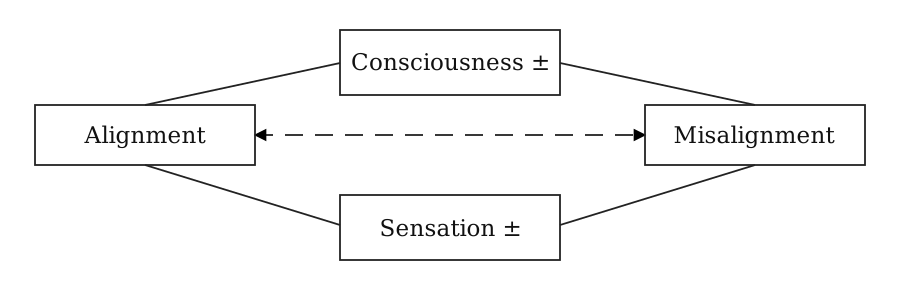
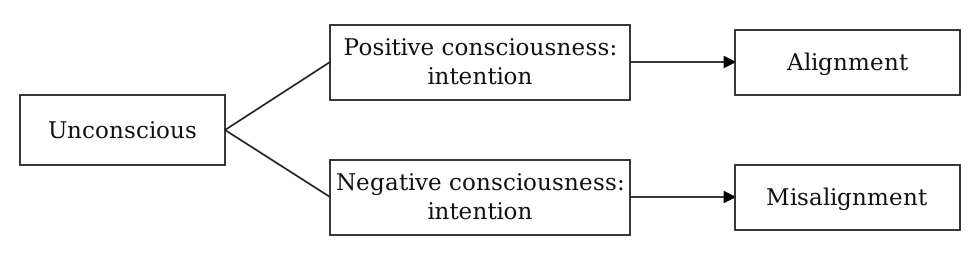
Thus we arrive at this conclusion: negative consciousness causes psychological pathology, and psychological pathology leads to physiological pathology. To take it further, negative consciousness determines spinal misalignment, and spinal misalignment then leads to disease in the corresponding organ. This is a chain reaction.
How do we classify positive and negative consciousness?
We must begin with yin and yang. As I said earlier, the soul is divided into a yang soul and a yin soul. In ordinary terms, intention and non-intention, consciousness and unconsciousness, are dialectical. We divide them into positive and negative.
The so-called unconscious is unconscious intention.
The unconscious is further divided into positive and negative consciousness.
The positive consciousness of the unconscious intentionally determines alignment.
Conversely, the negative consciousness of the unconscious intentionally determines misalignment.
Whether alignment or misalignment, it is the unconscious at work.
Whether conscious or unconscious, both involve intention: on one side, conscious intention; on the other, unconscious intention.
For example, I step on your foot and say, “Sorry, I didn’t mean to.” Is that correct? No. It is unconscious intention, though from the standpoint of consciousness it is unintentional.
The body’s internal metabolic physiological activities are unconscious. Our conversation now is conscious. Daytime is the yang world: the body’s conscious yang soul and overt consciousness. Nighttime is the yin world: the unconscious yin soul and subconscious.
The world of the living is the space of yang consciousness activity.
The world of the dead is the space of yin consciousness activity. Sleep is the most typical unconscious activity.
Reason governs the conscious and unconscious.
Reason governs the yin soul and yang soul of the two worlds of yin and yang.
When you use reason actively and positively to bring the unconscious’s positive consciousness into play to regulate your body, once the spine is aligned, the illness is cured.
Generally speaking, many disorders of the head arise from cervical misalignment: deafness, tinnitus, rhinitis, glaucoma, myopia, toothache, insomnia, cerebrovascular disease, and so forth.
We divide the human spine into upper, middle, and lower sections.
Broadly speaking, the roots of internal and external diseases of the head and upper limbs lie in the cervical spine.
The roots of internal and external diseases of the chest lie in the thoracic spine.
The roots of internal and external diseases of the abdomen and lower limbs lie in the lumbar spine; this concept of the lumbar spine extends all the way down to the coccyx.
If someone has gallstones, for example, an examination will inevitably show misalignment of the thoracic spine. After diagnosis we realign it, and the illness is cured.
Let me first explain a little theory.
The speed of a person’s heartbeat is an effect of the sympathetic nerves. A rapid heartbeat means the parasympathetic nerves are compressed and the sympathetic nerves excited. A slow heartbeat means the sympathetic nerves are compressed and the parasympathetic nerves excited. When the sympathetic and parasympathetic nerves act equally, the heartbeat is normal.
Let us extend this step by step and reason by analogy.
When the nerves in the spine that inhibit tumor growth are compressed and those promoting tumor growth are excited, a tumor grows. Conversely, when the nerves promoting tumor growth are compressed and those inhibiting it are excited, the tumor disappears.
If we realign this nerve in the spine, make it unobstructed, equalize its action, and place the body in dynamic balance, the illness is cured.
[Question: When adjusting through reason, does the unconscious’s positive consciousness expand in an instant, or does its negative consciousness diminish?]
Nerves are a carrier, transmitting the information of the body’s unconscious thinking. Thinking contains information.
Nerves, too, are divided into positive and negative. The body’s unconscious thinking can also be called information, and is likewise divided into positive and negative. One kind of information is active and positive; the other is passive and negative.
The human nervous system is the body’s unconscious communications system. Wherever a nerve is obstructed, the corresponding organ will develop disease.
It is like a light bulb that is on. Two wires are at work, a neutral wire and a live wire, one positive pole and one negative pole. The wires are merely carriers; the electricity is information. When the yin and yang electricity completes its circuit, the bulb functions normally and lights up. Otherwise it will not light. Every part of our body functions like the bulb, through electrical action. Electrical action requires a carrier, as with voltage. When the voltage is very high, electricity can pass even if the circuit is shorted. The most typical example is the starter of a fluorescent lamp, which works entirely through high-voltage electrical breakdown.
Since the nervous system carries unconscious information, it is the communications system of unconscious information.
Of course, this generally refers to ordinary people. An ability-holder is different: information can be transmitted without nerves as a carrier. The ability-holder can interrupt and leap across; the moment he feels a gallstone has come down, it comes down.
The theory of spinal misalignment is a more popular way of describing the theory and technique of imagination.
II. The Technique of Spinal Alignment
What is misalignment? We define it as the existence and functioning of a thing departing from its inherent position in time and space.
According to this definition, all contradictions in the universe are caused by misalignment. You go out today and have a traffic accident. Why? Misalignment. People and people, people and vehicles, vehicles and vehicles: the inherent positions of these things in time and space have become misaligned. A married couple is at odds: their relationship is misaligned. They divorce, and alignment is restored.
What is alignment? It means moving things out of an incorrect position in time and space and back to their inherent position.
It is difficult for most people to master the technique of interrupting thought. Therefore I explain my researched theory of spinal misalignment to them, making it simple and easy to master. Any ordinary person can do it.
First, examine the spine by pressing with the fingers to see whether it is misaligned.
There are generally three directions of misalignment: directly backward, backward to the left, and backward to the right. The basic direction is always backward.
How is misalignment determined? Medicine regards it as disc misalignment. We disagree. We regard it as vertebral-body misalignment, which causes the disc misalignment.
Normally, a certain space is maintained between the vertebral bodies. Because of misalignment, a disc extends beyond its own space, protrudes, and compresses a spinal nerve, producing disease.
During examination, press the spine with the fingers. Under pressure, an aligned position does not hurt; a misaligned position does. In traditional Chinese medical pathology this is called “Pain means obstruction; unobstructed flow means no pain.”
When a person has a breast lump, examine by pressing the vertebral bodies one by one. Several thoracic joints will hurt. This is called consecutive misalignment. Among several misaligned positions there must be a center of misalignment. How is that center identified? Again, by the sensation of pain. Whichever position hurts most under pressure is the center.
We give it a scientific definition: during an examination for tenderness, the place with the highest energy of pressure-pain is the center of misalignment within the consecutive misalignments. The lower pressure-pain energy above and below this point is caused by the holographic distribution of the misalignment center. It belongs to that center’s peripheral influence.
When alignment is restored with the fingers, the center returns to normal in an instant, the consecutive misalignments above and below return to normal, the tumor disappears, and the illness is cured.
In this sense, fingers can treat illness.
There are many methods of alignment, and they are simple.
Because the misalignment is backward, one need only strike the spinal column, giving it a forward force. One press, and it is corrected.
Spinal misalignment causes misalignment of the discs, ligaments, and muscles. One cause of misalignment brings about misalignment of the whole. Conversely, one alignment brings about a series of alignments. It is all holistic.
Since a backward force causes misalignment, all we need do is give the spine a forward aligning force, and it is aligned.
When the spine is pressed forward by hand, this is called indirect alignment through consciousness. The mind achieves alignment through the intermediary process of the body.
An ability-holder can align directly through consciousness.
In one case, consciousness directs a particular organ, and through that part’s activity and action achieves alignment. In the terminology of human-body science, this is mental energy aligning through an intermediary process.
The ability-holder’s direct alignment is direct alignment by mental energy.
Alignment by hand pressure involves both bodily force and the action of the mind. Its essence is the mind’s action, using consciousness, the mind, to direct and regulate the body.
[Interjection: Even in an ordinary person without extraordinary abilities, mental intention is at work; only its magnitude differs.]
I generally use imagination rather than mental intention. Imagination is thinking in images.
When I press with my hand, I simultaneously imagine alignment. The posture of the hand helps the imagination.
Posture is behavioral language. Behavioral language in turn helps psychological language, or, one could say, further expresses psychological language.
Language can generally be divided into three levels:
The first is psychological language.
The second is the language of thought.
The third level is physiological language.
Psychological language is transferred into the language of thought, which is then transferred into physiological language. Physiological language can in turn be divided into written language, spoken language, the language of facial expression, behavioral language, pictorial language, and so forth. Pictorial language is the most directly apprehensible. In essence, all are successive transfers of psychological language.
There are also many methods for diagnosing misalignment.
First, diagnosis according to sensation. This method is very simple: wherever the patient has an illness, tell them that the corresponding region is misaligned.
Second, spinal diagnosis.
- Cervical misalignment: difficulty turning the head left, right, forward, and backward.
- Lumbar misalignment: (1) heaviness, stiffness, and coldness in the lower back; (2) difficulty straightening after bending for a long time; (3) lower-back pain at night and discomfort turning over during the night.
Third, diagnosis from the upper “umbilical cord.”
The two “umbilical cords” of the upper and lower lips represent the two pillars at the front and back of the human body. According to the holographic law, wherever disease occurs, there will be a mark.
- The normal color of the “umbilical cord” is pink.
- A normal “umbilical cord” has uniform thickness.
After disease develops, the “umbilical cord” changes color and becomes enlarged. The enlargement is caused by misalignment. After spinal misalignment, the center of gravity is unstable; enlargement increases the contact area, lowering and stabilizing the center of gravity.
These are all indirect diagnoses.
The key is direct diagnosis.
The method is to press the spine with the fingers. First place one hand on the front of the chest between the two collarbones and push backward. With the other hand, feel the middle of the spine and determine its center. Then press inward with the fingers close to one side of the spine. There is normal tenderness, pathological tenderness, and tenderness as disease recedes. They must be clearly distinguished.
Unobstructed flow without pain is the healthy state; pain and obstruction are the diseased state.
According to our observations, almost no one is entirely free of misalignment. Only its degree and location differ.
Western medicine considers diseases to arise from viruses, bacteria, and fungi.
We take a different view. The primary cause is spinal misalignment. Once the spine is misaligned, nerves are compressed, unconscious information cannot be transmitted normally, and the vitality of the corresponding organ declines. Only after one has become ill can bacteria enter through the weakness. We call this saprophytic growth of pathogens.
Chinese culture is remarkable. Think carefully about it, and you can discover the great store of wisdom our ancestors placed within it. The two characters for “disease-demon,” in particular, reward reflection. Disease is caused by demons. The disease-demon is possession by a ghost or spirit. Heaven has its demons, Earth has its demons, human beings have human demons, ghosts have ghost-demons, plants have plant demons, and animals have animal demons. This is a broad way of speaking.
How do demons invade? Only the decline of one’s own vitality allows the demon of an external illness to attach itself to the corresponding part of the body. We call this possession.
Among demons, human ghosts have the greatest influence on people. Human ghosts are divided into human demons in the world of the living and ghost-demons in the world of the dead. Most illnesses in human society are caused by human demons. Animal and plant demons have very low energy.
A person is divided into two parts, the human body and the spirit or ghost; human demons may therefore also be called ghost-demons.
Human demons can also be understood as the action of consciousness.
Mild spinal misalignment produces aging; severe misalignment produces disease. With mild misalignment, external demons cannot yet easily possess the body. There remains a force of considerable energy to resist the various external demons, and the result is only premature aging in an otherwise normal person. With severe misalignment, the energy level of vitality can no longer resist invasion. Demons then take advantage of the opening and attach themselves to the body.
Disease is the product of a combination between the body’s own unconscious subconscious and an external unconscious subconscious. When conditions are ripe, the inner and outer join forces and collude. The primary cause lies within oneself. There are two sayings: “If I am not ill, who can make me ill?” and “Flies do not alight on an egg without a crack.”
Psychological change causes spinal misalignment, and spinal misalignment in turn causes physiological change.
Methods of alignment: self-alignment and alignment by another person.
Methods of alignment by another person: pressing with the fingers, and striking with the heel of the palm.
Alignment is also divided into confirmed alignment and unconfirmed alignment. Unconfirmed alignment may also be called vague alignment or indiscriminate alignment.
Anyone can master unconfirmed alignment. It does not matter if they have never studied medicine.
There is a series of essentials in alignment. In unconfirmed alignment, use the heel of the palm to tap the spine vertebra by vertebra from top to bottom. When striking, draw the arm back and rely on the hand’s momentum, striking forward perpendicular to the spine. This is called skillful force. Hitting with brute force is rigid hitting and will injure people.
While striking, imagine alignment. The hand is the intermediary process of imagination. Use the hand’s action to activate mental intention. The result of striking is to turn severe misalignment into mild misalignment, and mild misalignment into complete alignment.
What is applied here is both the direct and indirect action of consciousness.
III. The Theory and Technique of Imagination
In my classes and lectures I mainly teach three subjects:
- The theory and technique of imagination.
- The theory of the center of spinal misalignment and the techniques of alignment.
- The theory and technique of not eating.
The theory of not eating is different from bigu. Qigong bigu requires practice, and practice to a certain level. We require no practice. I lecture for twelve hours without eating or drinking, standing all day, speaking all day, and demonstrating as I speak.
[Ke Yunlu: Shen Chang places particular importance on technique. His theories have been distilled and elaborated from his special techniques.
Shen Chang: All my theories describe the mental state in the process of applying techniques.
Ke Yunlu: Theory develops continually. The mystery lies in technique.]
The theory and technique of imagination.
Chinese writing was created by our ancestors. When they created the characters, they stored their wisdom within them. Every stroke of Chinese writing is information.
As their descendants, if we correctly understand and decipher the characters our ancestors created, we may obtain the information of their wisdom.
If this hypothesis holds, let us look at the character 想, xiang, “to think.”
As I understand it, “thinking” has two functions:
- A method and capacity for knowing the world.
- A method and capacity for transforming the world.
Why, when someone has a gallstone and thinks of bringing it down, can they not think it down?
The reason is simple: they have misunderstood the character for “think” and used it incorrectly. That is why they cannot think it down.
If its meaning is correctly understood and properly used, then with one “thought” the gallstone is “thought” down.
First, 想 has an upper-and-lower structure: 相 above and 心 below.
相, xiang, can be interpreted as a noun, as in appearance, photography, camera, and so on; or as a verb, as in meeting a prospective spouse, loving one another, being intimate, reading a face, examining feng shui, and so forth. As a verb, 相 means “to look.”
Here our ancestors tell us that to understand things, we must look with the “heart-mind,” 心. That is, “the heart-mind looks,” 心相.
想 is a subject-predicate construction arranged vertically.
Looking with the heart-mind: 相 can in turn be divided into 木 and 目. 木 means trees and forests, and more broadly things. 目 means eyes. Observe things with the eyes of the heart-mind. Does the heart-mind have eyes? Words handed down from our ancestors tell us that it does. Common expressions include bad “heart-eyes,” good “heart-eyes,” small “heart-eyes,” careless “heart-eyes,” and having no “heart-eyes,” and so forth: bad intentions, good intentions, narrow-mindedness, heedlessness, and lack of guile.
The “eye” is further divided into yang eyes and yin eyes.
The two physical eyes are yang eyes, the sensory organs of the body’s life system. Their characteristics are these: too far away and they cannot see clearly; too close and they cannot see. Too large and they cannot see the whole; too small and they cannot see it truly. Too dark and they cannot see; too bright and the light hurts them.
In a phrase, yang eyes are short-sighted as a mouse, shallow and superficial. They see only the outward appearance of things. In the language of physics, they see only visible light, not infrared or ultraviolet, and are not even as good as a cat’s eyes. The world observed through yang eyes is very limited.
As for yin eyes, every part of the body has them, and all can perceive extraordinarily. The principal yin eye, however, is between the eyebrows. It is generally called the “heavenly eye”; modern medicine calls it the “pineal gland,” with a degenerated retina. The ancients used two descriptive expressions in their study of the yin eye: “thousand-mile eye,” its capacity for distant vision; and “clear at a single glance,” seeing through appearances to the essence.
Mind and body are two systems, each with a corresponding set of organs. Yang eyes are the sensory organs of the body’s physical system, while yin eyes are those of its mental system.
Use the yin eyes of the mental system to look at things. This can have two effects: 1. Seeing through appearances to the essence. 2. Changing the nature of things by looking with the mind.
There is a saying: when one is unwell, ask a doctor to “look at the illness.” This expression is used in both northern and southern China. When someone is ill, they do not ask the doctor to “treat the illness,” but to “look at the illness.” What does this mean? It means letting the doctor look with the yin eye, and the illness is cured.
What are the functions of the yin eye? It has two: 1. Knowing the world. 2. Transforming the world.
To change modern people’s mistaken understanding of the character 想, first rearrange its vertical structure into a horizontal one: 心相, “heart-mind” and “look.” What does this mean? There is a Chinese popular saying, “What the heart-mind thinks, comes to pass.” Things may be good or bad. Think of good things, and good things come to pass. Think of bad things, and bad things come to pass.
Psychological action exists objectively and has both positive and negative effects.
Many people know a simple experiment. Put both hands together and direct mental intention at the left hand, telling it to “grow.” This is a positive effect on the left hand, and the left hand really becomes longer than the right. Then tell the left hand to “shorten.” This is a negative effect, and the left hand really becomes shorter than the right.
This experiment tells us that psychological action can cause physiological change. The yin information of psychological action in a person’s spiritual world can be visibly transferred into the yang information of physiological change. Through that yang information, we in turn verify the existence of the yin information of psychological action in the spiritual world.
This phenomenon has several meanings:
- Psychological action exists objectively.
- Energy becomes matter; psychological action has a material basis.
- Psychological action has capacities, both positive and negative. This is what is meant by “what the heart-mind thinks, comes to pass.”
But many people think something in their minds and still cannot make it happen. What then?
There must be a technique of imagination.
When the mental system thinks in images of the object acted upon, and also thinks in images of the direction in which that object is to develop, what the mind thinks comes to pass.
The key here is the point at which the power of imagination acts. Why does the thinking fail to work? Because no point of action for the power of imagination has been formed. However many years one thinks, it remains empty imagining and never becomes effective imagining. Certain postures are used to assist and test imagistic thinking. First comes the communication of information; second, its testing. Unsuccessful imagination is an interruption of imaginative power, also caused by failure to form its point of action.
Let me introduce a very simple method.
With a stomach ulcer, imagine reaching your hand inside the stomach. Pull a little and see whether there is an attractive force. There is? Good. Raise your arm, sweep it forcefully, and shout, “Heal!” The stomach ulcer heals.
With gallstones, imagine reaching your hand inside the gallbladder. Pull a little and see whether there is an attractive force. There is? Good. Raise your arm, sweep it forcefully, and shout, “Come down!” The gallstone comes down.
This is called testing imagination, using posture to assist the test. Imagine your hand reaching inside a lump. Pull a little. Is there an attractive force? There is. Then, if you say “Gone,” it is gone. The technique is very simple.
Why use the word “imagination”? Because imagination is better than an image. Imaginative thinking is a more precise expression than imagistic thinking.
Imaginative thinking is further divided into curved-path thinking and straight-line thinking.
Curved-path thinking is transformed through the eyes into straight-line thinking. This transformation simplifies imaginative thinking.
The shortest line between two points is a straight line. For example, in treating gallstones with curved-path thinking, follow the anatomical diagram of the bile duct. Imagine reaching into the gallbladder and pulling. Is there an attractive force? There is. Good. Imagine the gallstone coming up, then moving left, through the bile duct to the duodenum, and then down. After a lengthy process, the gallstone comes down.
The disadvantages are a long period of imagining, great energy expenditure, low efficacy, and weak resistance to interference.
By resistance to interference I mean that at a treatment site there are often people who do not believe. Disbelief also has energy. Because curved-path thinking takes a long time, there are relatively more opportunities for interference.
We transform curved-path thinking into straight-line thinking. First imagine the gallbladder turned upside down, so that everything forms a straight line, like an inverted bottle of saline solution. After inverting it in an instant, pull a little and see whether there is an attractive force. There is? Good. “Come down!” And the gallstone comes down.
Straight-line thinking has the characteristics of high ability, great efficacy, and strong resistance to interference. Because the time is short, disbelievers have relatively fewer opportunities. It avoids the defects of curved-path thinking.
This example can be extended by analogy.
Your friend is in America and asks you to treat an illness. The distance is half the Earth. What do you do? You do the same thing. Imagine the friend standing before you. If your friend is behind you, likewise bring them around in front, using the method just described. This is a key technique.
The technique contains these mysteries:
- A sincere mind is efficacious.
- Turn long-distance thinking into short-distance thinking.
Imagine a friend far away in America right before your eyes. In an instant, long-distance thinking becomes short-distance thinking. Reach out and pull a little. Is there an attractive force? There is. Good. Say “Gone!” and it is gone. “Heal!” and it heals. “Come down!” and it comes down.
To me, so-called remote treatment in qigong is not mysterious at all. Simplifying thought can improve efficacy and prevent interference.
Once the technical problem of imagination is solved, all my students can treat illness like immortals.
IV. A Sincere Mind Is Efficacious; What the Mind Thinks Comes to Pass
I have two favorite activities. The first is sleeping; the second is debating. Debate is a form of mental labor that can stimulate inspiration. My distinctive trait is reverse thinking. Forward thinking can never discover problems or truth. It is like checking a mathematical calculation backward.
I remember when I was Youth League committee secretary at university, joking with a fellow student. I asked him what he would do first after graduation. He said the first thing would be to buy an old hen and give himself a good nourishing meal. I told him that my first act after graduation would be to have a good sleep. On the first Sunday after graduating, I really did sleep for thirty-two hours,1 interrupted only by two hours out of seclusion to eat something, after which I went back to sleep.
I am still like that. Whenever I have free time, I sleep. Sleep is unconscious activity, the activity of the yin soul.
I conjecture that all inspiration comes from the unconscious, from another world.
An important reason I like sleeping is that I like dream thinking. Dreams think in images. I often go to sleep carrying questions from the world of the living, and seek answers in the world of the dead. I conjecture that everything in our living world comes through from the world of the dead. There is a word tongsu (通俗), “accessible to ordinary people.” What is tong, 通? It is transfer. “Reaching the ordinary,” 通俗, is a predicate-object construction without a subject. In full it should be “the spirit reaches the ordinary,” 神通俗. “Speak a little more accessibly.” What does that mean? Let ordinary mortals understand. “The spirit reaches the ordinary” means that all culture comes through from the spirit.
If we truly understand the meaning of 通俗, then when we encounter a question in the world of the living, we should sleep. Sleep is unconscious activity. Conscious activity belongs to the living world; unconscious activity belongs to the world of the dead. Take the question into unconscious activity and seek its answer in another world. That other world has every answer. The problem is that no one translates them, no one can bring them through. We shall do the work of “bringing through.”
Carrying questions from the living world, the ordinary communicates with the spirit. Through unconscious activity, communicate human information, transferring the yin information of the world of the dead into the yang information of the world of the living, so that ordinary mortals can understand and accept it.
Before one is skilled in the technique, intermediary behavioral language is needed to express the imaginative thinking of psychological language more effectively. Once skilled, one can dispense with postures and intermediary behavioral language and achieve treatment directly.
The foregoing is the simplest method. Anything more would be superfluous and divert people’s attention.
Qigong emphasizes cultivation, while extraordinary abilities are not practiced. Extraordinary abilities are human innate capacities. An innate capacity is an ability one originally possesses, abbreviated as “innate capacity.” Qigong is acquired culture: one learns and then knows, comes later to knowledge and awareness. Extraordinary abilities are innate culture: one knows from birth, knowing and awakening beforehand.
Static qigong emphasizes mental intention and keeping intention fixed, placing thought in a static state. Its effect is like waiting by a tree stump for a hare: passive waiting. Dynamic qigong is practiced section by section, through elementary, intermediate, and advanced levels, level after level, often late into the night. What is that called? Curved-path thinking, roundabout and tortuous. Its disadvantages are the ease of losing direction and the weakening of ability. Take a tumor: if one practices section after section, when will one practice it away? Thought in extraordinary abilities is dynamic; it is straight-line thinking. Tell a tumor “Gone!” and it is gone. Tell a gallstone “Come down!” and it comes down. Tell a stomach ulcer “Heal!” and it heals.
Qigong therefore cannot compare with the speed of extraordinary abilities’ effects. They allow everyone to dispense with the long intermediary process.
Psychological sensation and practical technique are especially important here.
But if this is an innate capacity possessed by everyone, if “one thought heals” and “what the mind thinks comes to pass,” yet poor handling easily leads one astray, how can it be mastered?
First there is a prerequisite: only under certain conditions can what the mind thinks come to pass.
These conditions are the laws governing the motion of things. When a person’s imaginative power is greater than the object acted upon, one thought can make the desired thing happen. When the imaginative power and the object are evenly matched, repeated thought is needed. When the imaginative power is less than the object acted upon, however one thinks, the desired thing does not happen.
Only this is an objective account. “What the mind thinks comes to pass” is not omnipotence. Apart from the laws of the movement of things, things cannot change simply according to human will.
Overemphasizing human will while disregarding the necessary conditions is superstition. Earth rotates as it does. If you insist on wanting it to rotate backward, however hard you think, it is useless. Your energy is too low. You cannot change the laws of Earth’s motion. Yet with low-energy things, such as physiological illnesses in the human body, you can certainly make what the mind thinks come to pass. Why?
First, a person consists of two parts, body and mind. The mind is the soul; the body is the flesh. The body is the mind’s dwelling. How did the body come into being? It is the ideal dwelling designed and constructed according to the mind’s needs and preferences, and according to the soul’s level of design and construction. Who is the builder? The body’s unconscious, that is, the yin soul.
The conscious cannot explain how a person grows; the unconscious knows clearly.
The conscious merely uses the human dwelling, abuses the bodily dwelling, and neglects its inspection and repair.
When a person is ill, the dwelling leaks or is damaged. Since the body was designed and built according to the mind’s needs and preferences, why cannot the mind repair its own dwelling? It is entirely capable of doing so.
What is the present situation? The dwelling is damaged, but the owner does not repair it. Lazy and passive, he spends money hiring inexpert bricklayers and temporary workers to fix it. Naturally, the result will not suit the preferences and needs of the owner’s consciousness.
Why does someone wear this garment or like that color? These are the soul’s needs and preferences. The soul is the owner. How does someone grow, and why so tall, so short, so ugly, or so beautiful? All are the soul’s needs and preferences, built according to its level of design and construction.
The physical body is a living organism, a biological body. To make an analogy, if someone’s skin is damaged and an electric welder is hired to weld it, can it be repaired?
Physical methods cannot restore a living organism. Only biological methods appropriately matched to it can be effective. This is called biological therapy. Human beings are the most spiritually vital of all things, the highest of living beings. Strictly speaking, only the human mind, consciousness, and soul can truly cure human illness. Only that is the proper match.
You have a lump. You want it cured, and I want it cured. My intention accords with the conscious requirements of the owner’s soul. Together we make what the mind thinks come to pass, working with one heart and one effort, combining the consciousness of form and spirit, looking with our minds in one direction and applying our strength in one direction. “Gone!” And it is gone.
We can also combine methods of regulation: 1. Regulation through consciousness. 2. Psychological action. 3. Imaginative thinking.
If you work in philosophy or science, I tell you to regulate through consciousness. If you study psychology, I activate your psychological action. If you are an artist, I ask you to use imaginative thinking. This depends on each person’s particular characteristics.
Imaginative thinking is further divided into diseased-state thinking and healthy-state thinking. All physiological illnesses are the result of the unconscious subconscious within the conscious structure of the body’s mental system. One can say that all human illnesses are products of psychological action.
Once an illness is cured, can it be produced again? Possibly, because illness also arises in response to each person’s needs. Why do you develop a lump? Because of the needs of your unconscious subconscious. It therefore deliberately designs and constructs the illness. When you feel that you no longer need the lump and activate the unconscious’s positive consciousness to counter its negative consciousness, and the positive exceeds the negative, the lump disappears.
Concerning the earlier saying “a sincere mind is efficacious,” many people who say they “believe” say one thing with their mouths and mean another in their minds. This has no positive effect.
The human body resonates with the universe. At first we must become skilled at turning empty imagining into reality. This is the technique of imagination, that is, imagistic thinking.
Accomplishment rests with Heaven; planning rests with humanity. Human effort makes things happen; what the mind thinks comes to pass. Where utmost sincerity reaches, metal and stone open.
Where, then, does the soul come from? Let us verify it through the theory of algebra and geometry.
Chinese medicine has a saying: “The heart stores ling, the liver stores hun, the lungs store po, the spleen stores will, and the kidneys store essence.”
Thus the tangible organ “heart” contains an intangible spiritual substance, ling.
The tangible organ “liver” contains an intangible spiritual substance, hun.
The algebraic sum of the intangible spiritual substances contained within the two tangible organs, heart and liver, equals linghun, the “soul.”
Let us also use geometry to determine the soul’s location. The midpoint of a line joining the heart and liver is the location of the soul. Our ancestors had many names for this place: the mouth of the heart, the field of the heart, the hollow of the heart, inside the heart, the inner heart, and so forth. This is common knowledge. Whatever one’s education or age, everyone knows that the “heart-mind” is located here.
So-called “belief” and “disbelief” refer to this place, called “the depths of the soul.”
Inspiration “wells up naturally” from here; with a sudden stirring, words from the heart emerge. This is unconscious activity. Wisdom born of urgency is a particularly evident form of unconscious activity.
When a relative dies in the countryside, mourners often cry out “heart and liver.” They are calling to the soul. The heart stores ling; the liver stores hun. “Heart and liver” is the common name; its learned name is “soul,” linghun.
[The author remained in dialogue with Shen Chang throughout. In addition to further developing his own various views on extraordinary human abilities, he specifically discussed the following:
- The essence of concepts is consciousness; concepts are products of consciousness. How many generations’ consciousness has accumulated within concepts.
- He hoped attention would be paid to the way ideas were expressed. There are various ways to negate old things. The objective should be to overcome the other side, rather than gain a moment’s satisfaction from one’s words.
- What can demonstrate Shen Chang’s theory is technique. What can demonstrate technique, in turn, is fact.
- Planned locations for filming the Shen Chang episodes: Beijing, Shanghai, and Suzhou.
- Hold a large gathering for Shen Chang’s students to exchange experiences, requiring each participant to bring a personal account.
- Arrange one or two directly observable demonstration sessions. Select the subjects carefully: surface tumors, complete baldness, fractures, and so forth.
- Film Shen Chang’s tea rooms and hold discussions with their patrons. There are four tea rooms in Beijing. They are places for exchanging information, where thought-information can be stored.
- Film Shen Chang’s classes and lectures.]
Chapter 8. A Great, Earth-Shattering Challenge
I. Presenting the Various Wondrous Phenomena in the Field of Qigong
Afternoon of June 26, 1993; Shengtang Hotel, Beijing
Over the past few days I have been planning intensively. Contact has been established with the principal subjects to be filmed, and they will arrive in Beijing one after another from late June through early July.
Among the intended subjects, I have already made a preliminary investigation of Zou Huiping.
I have not only spoken with Xu Jiehe himself, but personally attended the bigu health-cultivation class he organized and experienced bigu. Without that personal experience I would not yet have dared decide to film him. Having had it, I feel secure and will be confident in the filming.
In general, my principal work until mid-July will still be planning. After mid-July I shall concentrate on the writing at my desk. Relatively speaking, although the writing is extensive, I am confident of doing it well. The preliminary planning is the most crucial part.
A substantial portion of the series will present the various wondrous phenomena in qigong. Within a unified atmosphere, on one hand we shall have the most advanced scientific ideas and discoveries; on the other, we shall display on a large scale the ancient cultural origins of the East. The series will show as much as possible of China’s natural and cultural landscapes.
Avoid monotonous interiors and monotonous exteriors. I emphasize again that we must strengthen our camera capabilities. The camera work must be first-rate: truthful, with a good sense of the shot. Alongside extreme authenticity there must be fine artistic feeling.
Let me give a simple example.
A qigong practitioner demonstrates extraordinary treatment. Through mental intention he cures a woman’s breast tumor on the spot, making it disappear. The scene seems very simple. Yet think carefully: what an extraordinary event this is in human medical history. How should it be presented?
When our space shuttle lifts off, when humanity launches an artificial satellite, before the launch there is the tense work of many scientific workers, the precise operation of large scientific instruments and gauges, the suspenseful anticipation of hundreds of thousands of spectators, and journalists’ activities ranging from filming to interviews. Finally there is the ticking of the countdown from the instruments. The whole scene is filmed with tremendous force, while the shuttle’s ascent takes only an instant, a few seconds or a dozen or so. Without a proper buildup beforehand, that instant of liftoff will not have the desired effect.
The extraordinary treatment we film may take place in a very ordinary setting among a very ordinary group of people. There are no flashing swords, no flying flesh and blood. Yet these too are events full of suspense. In one respect extraordinary abilities are very ordinary and the events seem small. But even the phenomenon of taking medicinal tablets out of a sealed glass bottle cannot be explained by the whole of our present physics. The movement is small, only an ability-holder demonstrating an ability, seemingly incomparable with a space shuttle’s ascent. Yet its significance is immense: a great challenge to existing science. On this basis alone, we are doing something highly unusual for all humanity. The effect of the series should be earth-shattering. How, then, can our filming be both very truthful and expressive of an extraordinarily unusual atmosphere?
As chief writer, I shall give specific shot-by-shot directions in the script. In many places, however, I can only indicate what ability will be demonstrated, without more specific directions. Everything will depend on my on-site coordination with the ability-holder, as when a coin is taken from a sealed envelope. We cannot prescribe the ability-holder’s movements in any detail, since that would interfere with entering a good demonstration state. This requires the camera to adapt quickly to the subject, with several possible approaches prepared in advance and arrangements for responding to changes on the spot.
Of course, I shall set out my ideas and suggestions as fully as possible, while hoping that the director and camera operators will contribute creative invention and imagination.
Before every on-site filming session, I shall notify the crew of the specific filming concept in advance and require preparations beforehand, including rehearsing the filming. In many ability demonstrations, the ability manifests in only an instant and cannot be repeated over and over. The person being filmed cannot behave like an actor: this take was unsatisfactory, so do it again. That is impossible. The crew must leave nothing to chance. It is like Zhu Jianhua clearing 2.40 meters in the high jump, and your saying, “I didn’t see it clearly. Please jump again.” That would be a joke.
Every member of this crew must work with meticulous seriousness.
More than ten years ago I visited Mount Emei. Many elderly people climbed it every year carrying lamp oil as an offering. Some even went up bowing their heads to the ground on every step. It was very difficult. They said that one such ascent could add a year to one’s life and could also cure illness.
This is no joke.
We may go to Mount Emei during this filming. Some of our crew have only a fairly elementary understanding of qigong, and that does not matter. It is like climbing Mount Emei. Without the first step, without the initial ascent step by step, you cannot reach the Golden Summit and cannot see the Buddha’s light. The ideal state of life is like Mount Emei’s Golden Summit. It too must be approached one step at a time, climbed one step at a time, without stopping. The quest is devout. Sometimes one must even bow one’s way up step by step. When you stand on the Golden Summit, you need not be ashamed of the immaturity of your first steps. That first step was part of the necessary road to your ideal state in life. One must come this way.
I hope every member of the crew will advance step by step and gradually raise their spiritual attainment.
II. Planning the Mount Tai Bigu Health-Cultivation Class
Afternoon of June 26, 1993; Shengtang Hotel, Beijing
Concerning bigu.
First, the series will give a very brief overview of bigu phenomena in China since ancient times. Following my brief written indications, relevant material should be edited together, and relevant documents and objects filmed in museums to provide images for the words.
The series will then outline the situation of bigu during the more than ten years of the contemporary qigong boom. Following the indications, film different qigong practitioners conducting bigu classes: the class venues, practitioners, people practicing bigu, medical testing relating to bigu, staff members, and interviews with participants.
From October 2 to 9 this year, we shall hold a nationwide bigu health-cultivation class on Mount Tai. The class will conclude with an ascent of Mount Tai. This is very good material for filming.
Seven days without food is a forbidden area in present-day human medicine, a dangerous critical point. Anywhere in the world, if a group of people went without food for seven days, the International Red Cross would intervene. Yet the group we film will not only go without food for seven days, but remain mentally full of energy and vigor, and also treat illness. The final test of their physical strength will be to climb Mount Tai successfully after seven days on an empty stomach.
Do not underestimate such an act: going seven days without food and still successfully climbing Mount Tai. This is a great challenge to the whole of modern medicine, modern health science, and modern anthropology. Filmed well, it will cause an enormous sensation.
If we have no imagination and merely make an ordinary record, what is there to film? A group of people not eating and practicing qigong will make for very dull images. How should we deploy our cameras?
First, we shall invite authoritative medical institutions and figures from within Jiangsu to carry out various physical and medical tests on the bigu class. Medical staff must accompany the group from beginning to end, reporting at any time on participants’ mental and physical condition. During this period, centering on bigu, we shall conduct wide-ranging interviews with Jiangsu’s medical, qigong, scientific, and educational communities, as well as the participants themselves and their families. During the climb, we shall also interview tourists traveling alongside them. We shall also report on and analyze in depth the psychological and cultural phenomena produced by bigu.
For thousands of years of human culture, “food has been the people’s Heaven.” Much of humanity’s daily activity, mental activity, and cultural phenomena cannot be separated from the word “eating.” The most concentrated expression of “the smoke and fire of the human world” is eating.
When a person ceases to eat, their relationship with this world changes greatly. When humanity as a whole obtains energy from sources other than food, human consciousness will also change greatly. This is a major subject well worth studying.
The Mount Tai bigu class is merely a phenomenon we will follow, from which we must draw important scientific conjectures.
Combining an ascent of Mount Tai with bigu carries strong symbolic meaning.
Since ancient times, Mount Tai, like the Yellow River and the Yangtze, has symbolized our nation. Climbing Mount Tai is a pursuit of our national culture, civilization, and spirit. There is no essential difference between climbing Mount Tai and climbing Mount Everest. Both express humanity’s longing and striving for higher attainment. “I shall ascend the highest summit and see all other mountains as small.” When the group we film reaches Mount Tai’s summit after seven days on an empty stomach, we must ask all humanity loudly from the mountain: What are we human beings? What is humanity? What is this group going to do? What will they demonstrate to humanity? From Mount Tai’s summit we shall issue this challenge to climbers and climbing teams around the world: can they successfully climb Mount Tai after seven days without food, some even without a drop of water for those seven days?
This is a great miracle, a successful exploration of humanity’s own mysteries, a challenge posed to humanity itself, to modern science, medicine, health science, nutrition, and anthropology. Bigu is ancient, yet also modern and ahead of its time. In humanity’s exploration of its own life, many unknown and mysterious realms remain. The script for this episode will develop that perspective.
We require first-rate commentary, first-rate photography, and first-rate music.
Filming ability demonstrations is like filming precise medical or scientific experiments. The shots must be accurate, as when filming eye microsurgery. Along with precision, we must fully employ filming methods and angles. The shots must convey the meaning clearly and faithfully. This series should be a major artistic work, a major documentary, a major news film, and also a most outstanding advertisement. It must be thoroughly worth watching.
The series requires directors and camera operators with many kinds of talent. Do not think this is merely a science-education film. Science education is only part of its content. There must be an overall sense of a vast, ambitious work.
I only state the requirements. For example, I require images of the chaotic stellar scene after the universe’s Big Bang. The finished series must be able to produce them.
Shot content: coverage of the crew’s work; the rally and send-off before the ascent; inviting a band and spectators; every person a hero; scenes of climbing; the final person reaching the summit; the victorious gathering.
Conquering oneself, conquering illness, conquering traditional medicine, conquering traditional ideas.
Bigu is only one result. We do not want to film someone lecturing at the front while the audience below fidgets. What would be the point? The images would be monotonous and uninteresting.
With Mount Tai as its background, our crew could make the filming of this bigu event shake Heaven and Earth. The power would come from its substantive significance, not artistic exaggeration. We would merely give it artistic and visual form. If the phenomenon itself had no value, no amount of embellishment would mean anything. But if it has value and we fail to express it, that is failure.
Bigu has existed since ancient times, yet has never truly attracted the world’s attention. It has been no more than a rumor circulating in the folk world. Filming this series can acquaint the whole world with this ancient and wondrous phenomenon. We must demonstrate that, apart from eating, human beings have other ways of taking in energy. This alone will cause a sensation in the scientific community.
III. Presenting the Challenge to Humanity against a Broad Background
[On June 20, 1993, from 10:00 a.m. to 6:00 p.m., the Exploring Life Science crew filmed a bigu health-cultivation class conducted by qigong master Xu Jiehe in the auditorium of the Beijing Installation Company. This was an experimental filming session before the official start of production.
On the afternoon of July 1, the crew watched the resulting video material, ninety minutes in all.
The following is Ke Yunlu’s conversation with the crew after the screening.]
It seems that most people in this crew are still not very familiar with qigong. In future I shall talk with you as much as possible, so that crew members understand what the eventual series will be like. Then, in filming each segment, we may be able to grasp it more accurately.
We plan two episodes on bigu, each fifty minutes long.
Their basic content will be as follows.
An overview of the history of bigu, introducing the long history of this health-cultivation technique in Chinese culture since ancient times, while also introducing its contemporary history in China: from Yan Xin to Chen Letian, Shen Chang, and Xu Jiehe. This will be accompanied by appropriate images and material.
We are giving Xu Jiehe particular attention because, among the many qigong practitioners, his specialty is bigu. It is relatively simple, concentrated, and easy to present. Xu Jiehe himself has a relatively high level of cultural cultivation and is an emerging young talent.
The second bigu episode will film the little girl who has not eaten for five years.
This episode must demonstrate a miracle to all humanity: human beings can break through the definitions of modern medicine and physiology and go without food for a long time. Generally speaking, seven days without eating can kill a person, and eleven days of fasting is an absolute boundary of death. Yet our subjects will go seven days without eating, continue their normal lives and studies, and then climb Mount Tai in a grand procession. This is a heroic feat in the history of human life and a great challenge to modern science. While attesting it before humanity, the series must also explain the mysteries involved and the scientific conjectures it inspires in depth.
Shots of Xu Jiehe’s class need not strive for exhaustive coverage. They must capture the outstanding, distinctive moments. Of the ninety minutes we watched today, perhaps only a few will appear in the final series. But those few minutes must contain startling, extraordinary shots. There must be shots of the lectures, piano playing, and participants’ spontaneous movements in the hall. The shots must be expressive. Select a succession of more than a dozen shots of spontaneous movements to build the atmosphere. Do not linger too long on any one shot. Seek a sense of atmosphere in individual shots, with rich variation. There should be plenty of excellent close-ups. The most exciting action in the episode is the ascent of Mount Tai, presenting our challenge to humanity against that great background.
In a fifty-minute episode, Xu Jiehe’s bigu class will occupy only the greater part. Besides a general overview of bigu’s history, there will be interviews with prominent figures in medicine and science, asking for their views. We must grasp the place of each sequence in the whole series. We are not simply introducing a qigong practitioner’s lecture. That lecture is only a small part of a large production. Select the shots carefully.
For ordinary scenes, the camera need not follow the action for a long time. Better to spend more time moving the camera and finding the right position.
The specific planning for this episode:
When we attest such a fact before all humanity, the event is itself unprecedented. Its inner rhythm is tense and full of suspense.
That suspense must be expressed well.
Film it like a great historical event: solemn, grand, tense, and rhythmic. There must be a sense of time advancing, like the ticking of a clock.
An introduction to Xu Jiehe requires a highly expressive sequence of shots, as though creating a character, making viewers interested in him.
Year ×, month ×, day ×: a large-scale bigu health-cultivation class is held in Xuzhou. Convey its scale.
Year ×, month ×, day ×: the Exploring Life Science crew arrives in Xuzhou and begins intensive preparations before filming.
Year ×, month ×, day ×: bigu participants arrive to register in batches.
Year ×, month ×, day ×: the bigu class begins. Opening ceremony.
Year ×, month ×, day ×: the first day of bigu is successfully completed.
Of the participants:
- Complete bigu: ___%; average age ___
- Partial bigu: ___%; average age ___
- Male: ___%; female: ___%
- Those practicing bigu constitute ___% of all class members
Statistics on participants’ physical condition: healthy, ___%; various illnesses, ___%.
At midnight on the first day of bigu, the presenter and Xu Jiehe inspect the participants’ accommodation together. No abnormalities are found.
Year ×, month ×, day ×: the second day’s activities of the bigu class begin.
Coverage of participants’ activities: reading, exercise, recreation, and so forth. Organize some lively and interesting activities.
Individual interviews with participants: occupation, age, education, physical condition.
Year ×, month ×, day ×: after successfully completing seven days of bigu, preparations are made to climb Mount Tai. The participants’ busy preparations. The accompanying medical staff.
The rally before the ascent. The crowd seeing them off. An enthusiastic scene.
The convoy sets out.
Year ×, month ×, day ×: after × hours and a journey of ×× kilometers, the bigu participants reach the foot of Mount Tai.
Year ×, month ×, day ×: the bigu advance party reaches Mount Tai’s summit. The first person to arrive is ×××: age, physical condition, education. The second is ×××: age, physical condition, education. The presenter’s on-site interviews.
Camera tracking shots during the ascent.
Interviews with participants during the ascent.
Throughout the episode, intercut shots of the camera crew at work.
IV. Experimental Filming of Shen Chang
[On July 4, 1993, Shen Chang was to hold a large class in Beijing on his extraordinary abilities. The Exploring Life Science crew was preparing to film it. On the afternoon of July 1, the author made arrangements for the filming three days later.]
Shen Chang’s class on July 4 is an indispensable scene for this series, an essential component in introducing the qigong practitioner. Perhaps only a few minutes from the class will be used in the episodes devoted to him, but that sequence must be highly expressive.
We must be especially clear about each filmed segment’s place in the whole series. Each segment does not need a complete conception of its own; it is only one part of a complete conception.
Shen Chang’s July 4 lecture will last ten hours, from eight in the morning to six in the evening. The class’s rhythm is arranged around three principal subjects:
- The theory and technique of imagination.
- The theory of the central point of spinal misalignment and the technique of spinal alignment.
- The theory and technique of not eating.
Before 10:30, Shen Chang will mainly explain his basic theories, and the venue will be relatively quiet. Then, before the midday meal, he will move into bigu. Before both mealtimes, twelve noon and six in the evening, he will discuss bigu, chiefly guiding everyone to overcome the habit of eating.
When he discusses the technique of imagination, the diagnosis of spinal misalignment, and methods of alignment, he will give on-site demonstrations. He will invite students with lumps to the front, select the most typical cases, and treat them on the spot, making the lumps disappear.
There will be more than one such demonstration during the lecture.
Shen Chang will also invite students to demonstrate. During the lecture, some students suddenly feel they can treat other people’s illnesses. Shen Chang will then ask them to come on stage and invite patients up as well. A student who dares walk onto the platform under everyone’s gaze can be said at that moment to have “courage enough to cover Heaven.” Once up there, the student too can cure people’s illnesses.
There will also be two sessions of unconscious adjustment during the lecture, with music accompanied by commentary. Generally, spontaneous movement qigong will appear among the audience at these times.
What shots do we need?
First, shots of the qigong practitioner’s lecture. This task is relatively easy. As already said, the camera need not follow it for long periods.
Second, shots of participants’ spontaneous movements during unconscious adjustment. There must be close-ups, expressiveness, variation, and wide shots.
Third, shots of on-site demonstrations. These are more difficult, because many people will surge toward the front during a demonstration. We must plan in advance how to get the camera into position in the crush. Someone must be assigned specifically to protect the camera operator. We must ensure that the outstanding moments are captured.
Fourth, on-site interviews before and after the gathering with participants of different ages, educational levels, and social backgrounds.
Filming this series sometimes requires the way of thinking used in still photography: seize the right instant, while the intervening process may be disregarded. Do not make it a running chronicle. In candid close-ups, every shot should be scientific, artistic, and dynamically unfolding. Camera operators and directors also need an eye for shaping character. Every moving shot can reveal a particular psychological, personal, or cultural quality. How to express this requires serious study.
This is a major work spanning the centuries. Every shot must be both outstanding and authentic.
We must work in this solid, practical way, one step at a time.
[Note 1: On July 4, 1993, the Exploring Life Science crew filmed Shen Chang’s extraordinary-ability lecture imbued with qigong power at the General Logistics Department auditorium on Wanshou Road, Beijing. It ran from 8:00 a.m. to 8:00 p.m., lasting twelve hours.]
[Note 2: On the evening of July 4, 1993, at the New Century Hotel in Beijing, Ke Yunlu dined with Lin Shuhuang, president of the China Institute of Human-Body Scientific Research, and Wang Qiang and Wang Bin, two of China’s earliest people known for extraordinary abilities.
That evening, Ke Yunlu made detailed inquiries into and investigations of Wang Qiang’s and Wang Bin’s extraordinary abilities.]
Chapter 9. The Human Body’s Supernormal Abilities Reflect the Universe’s Supernormal Energy
Exploring the Mysteries of Human Supernormal Abilities with the Renowned Qigong Master Liu Xinyu
July 5, 1993, 9:00 a.m.; Yanjing Hotel, Beijing
[Liu Xinyu is a renowned qigong master. Born in 1965 into a martial-arts family in Hubei, he received the authentic transmission of the Praying Mantis school and inherited the Six Harmonies Traceless Skill from his grandfather, “Divine Finger Zhang,” while still a child. At about ten, he became a disciple of Mo Yi, the “Wandering Knight of Jiangnan,” and the sole inheritor of China’s Sanbao Yishou Internal-Alchemy Qigong. Over the years Liu Xinyu studied diligently without interruption, seeking teachers and visiting friends throughout China and overseas. Guided by experts of the Xingyi school and masters of Wudang boxing, he drew on the strengths of many schools to form “Xinyu” qigong, combining internal and external cultivation, martial refinement and gentle nurturing, the strange and extraordinary, and a complete unity of intention and form. His qigong attainments display astonishing extraordinary human abilities. He can remain underwater for seventy minutes without breathing and can use mental intention to move a brush across paper to write.]
I. A Faithful Record of Research and Exploration
First, Ke Yunlu spoke with Liu Xinyu about the proposed television series. Liu Xinyu expressed great pleasure and hoped their cooperation would succeed. At the same time, however, he also mentioned some misgivings about filming it.
His overall feeling was that the prospects were very good and the difficulties considerable.
Liu Xinyu had previously worked in film and television, cooperating with television stations in China and overseas and with Chinese film studios. The results had not been very satisfactory. He repeatedly spoke of some of his concerns.
In the film Chinese Superman, there was a scene on the Golden Summit of Mount Wudang. The director asked Liu Xinyu to jump from the Golden Hall’s roof, more than ten meters high, with his legs crossed, maintaining the cross-legged posture as he came down. The film was then played backward, producing the effect of a qigong master flying cross-legged from the ground onto the roof. This involved a certain danger. A person’s instinct is to extend the legs to land at the last instant, so the first two takes were unsatisfactory. Heavy snow had fallen, the weather was very cold, and Liu Xinyu was bare-chested. On the third take he sprained his foot. He said he did not want to do such things again.
Ke Yunlu said: Ordinary commercial pursuits, or concocting a few legendary stories as many television productions do, are not things I would undertake. As I said just now, I want to make a major scientific series. Yet its methods cannot be crude, like a laboratory record. I require high artistic quality in the overall conception, the methods of expression, and the arrangement of shots. But there is one prerequisite: every image must be grounded in the utmost truthfulness. Frankly, if filming fails and has to be repeated for some objective reason, such as the ability-holder’s poor state, inadequate preparation on our part, or unsuitable weather, we may explain that failure to the audience and record it in the series. In this sense, the entire filming process is a process of research and exploration; in other words, a faithful record of our process of research and exploration.
This is exceedingly serious work. Its completion will eclipse many other filmed accounts of extraordinary phenomena. The series will become a relatively important event in the scientific and cultural history of this century, an important work capable of enduring.
Recently I have been looking fairly intensively at materials about you: reports of your demonstrations in Hong Kong, some of your activities in China, and your video materials. I want to say that the filming of demonstrations of this kind, whether yours or those of other ability-holders, still uses relatively crude and elementary forms of presentation. Such videos are made, shown, and watched, and that is that. They have not produced, and cannot produce, an effect of attestation before the whole world and all humanity. Why? First, because their guiding ideas, artistic style, and arrangement of shots have not reached the level envisaged for this series.
Last night I met the sisters Wang Qiang and Wang Bin, among China’s earliest people known for extraordinary abilities. From childhood to adulthood, they have appeared in many videos: Chinese and foreign, laboratory recordings and spontaneous play. Wang Qiang herself works on the production of programs about supernormal abilities for a Japanese broadcasting station. Yet after all this filming, the result is no more than an amusing item, a diverting feature intended to boost ratings. Those who believe go on believing, and those who do not still do not. Many people gain one more interesting subject for after-dinner conversation. I would not do that kind of thing. Similarly, you, Liu Xinyu, have no need to keep repeating such filming. Repeating filming at this level is meaningless.
What kind of undertaking do we want? Something like scientists discovering atomic energy, or Einstein proposing relativity. Making a special contribution to such an epoch-making work would undoubtedly be especially important for you, Xinyu.
As for the sort of shot you just mentioned, this series will have none of it. We will use no special effects, because any use of them could damage the sense of authenticity. I have repeatedly told the crew: should the shots be beautiful? Yes. Fluid? Yes. Vivid? Yes. Artistically filmed? Absolutely. But all of this must rest on truth. Otherwise, however beautiful a shot may be, if its beauty is flimsy and false and destroys the sense of authenticity, we do not want it. We emphasize artistry only on a foundation of authenticity.
This series will win people over through its distinctive and exceptionally pronounced authenticity.
II. The Idea of Comprehensive Attestation
Ke Yunlu: How can we achieve this?
I already have a clear plan. Why is the crew beginning now to film small segments continually, even though very little of them may eventually enter the series? It is training, a process of “settling in”: between the crew and the chief planner, and between the crew and the ability-holders. We must come to understand one another.
You said just now that in recent years you have appeared in many films and television productions, in China, Japan, and Hong Kong. Many ability-holders have had similar experiences. Yet the influence of this field throughout the world remains extremely limited. Open the most authoritative scientific and technical works: how do they explain extraordinary abilities, psychical research, or what are called psychic phenomena? They tell people there are two views, and that whether extraordinary phenomena exist remains under investigation. The authorities in science, the scientists who occupy dominant positions in the halls of modern science, mostly refuse to recognize mysterious phenomena. Only a very small number express belief, and fewer still conduct research. These voices have an exceedingly weak influence within modern science as a whole.
Why?
When an ability-holder demonstrates in a solemn, exacting setting, the psychological pressure is often impossible to overcome and failure looms. Even if the demonstration succeeds, only a tiny minority can witness it. And a demonstration that looks like play often leaves even eyewitnesses half-convinced, let alone those who have had no opportunity to see genuine extraordinary phenomena. Moreover, an ability-holder’s powers often do not remain throughout life. If they disappear one day, people will say they were false, a trick, and the person a fraud.
There is a magician in Japan who practiced for ten years and can bend a metal spoon with his gaze. He has mastered this ability, yet because people do not understand, he has always called it “magic.”
I have investigated a great many extraordinary phenomena. I have seen them with my own eyes, and I believe. But someone who has not seen them may remain unconvinced even by video of the demonstration. Modern film and television can readily distort and conceal the truth through special effects and editing. A problem must therefore be solved: how can we make the countless people who cannot personally witness extraordinary-ability demonstrations believe in their authenticity? How can we achieve that effect?
You once used mental intention in front of me to make a cigarette butt stand upright on a glass plate, and then made it move and jump.
That ability of yours is absolutely genuine. But how can we convince viewers that no special effect was used to make the cigarette butt stand before the camera? Without viewers’ confidence in its authenticity, however clear the footage and however brilliant the scene, it is meaningless.
This led me to propose an idea. No one before me had thought of it, yet once I put it forward it seemed very simple.
When we watch competitions in a stadium, athletes set records in the hundred meters, high jump, long jump, shot put, discus, swimming, and so forth. How many people are present at the moment a record is set? At most, no more than a hundred thousand. Those hundred thousand spectators cannot each hold a stopwatch to time the event, nor go onto the field with a measuring tape. Yet they believe the records announced. What do they believe in? They believe in rules generally recognized by humanity: the rules of competition, the system of attestation by officials. An international competition of a particular level requires officials of a particular level, a specified number of officials, officials of different nationalities, and of course a series of other requirements. These establish the objectivity and attestational authority of the officiating. The people at the venue believe, and the viewers in front of their televisions believe.
You told me Jin Yong watched your demonstration. He said that in the many martial-arts novels he had written, much of the martial skill was his own invention. After watching you, he said, “This is truly advanced skill.” He may then write an article, and the press may report it. This increases the sense of authenticity of your ability, because a writer like Jin Yong has no need to lie in order to flatter you. What is this called? Celebrity attestation.
Another example: organizers of the various prize competitions held in society nowadays generally hire lawyers to certify that the competition has followed its established rules and regulations, that all related activities conform to prescribed procedures, and that the results are valid. What is this called? Legal attestation.
Through such attestations, the public believes the results of the competition.
Thus, to believe in something, human beings do not necessarily need to be present themselves, which would be very difficult. How many people can personally watch a satellite launch? Yet no one doubts the authenticity of the television broadcast.
Hundreds of millions can never be present at an extraordinary-ability demonstration. For most demonstrations, even ten thousand or a few thousand spectators would be impossible. What is to be done? How can the authenticity of the event be established? We must still rely on the procedural character of all these rules and systems established by human society.
Here I propose an idea: comprehensive attestation.
What is comprehensive attestation? It means employing the powers of attestation and authoritative methods available in every sphere of human society.
When we organize an extraordinary-ability demonstration, I require authoritative scientists to be present. After watching, the scientist should sign my experimental report. Then people who believe in science will believe that everything the scientist witnessed was real. This is scientific attestation.
I also require authoritative lawyers. In their professional capacity they will attest that the entire process they saw and the procedures of the experimental design were rigorous, and that the demonstration was genuine. I require them to sign my experimental report. This is legal attestation.
I also require authoritative international-level sports officials. They must approach the demonstration as they would a major international competition. Once convinced of the facts before them, I shall again ask them to sign my experimental report. Then those who believe in sporting competitions will believe in the demonstration’s authenticity.
Doctors embody society’s moral conscience. I shall also invite authoritative doctors to attest on site.
In addition, I shall invite renowned writers, entrepreneurs, singers, and film stars, asking these celebrities to attest.
All attestors will not only sign the experimental report. Their professions, ages, identities, times of signing, and so forth will also appear on screen. Every attestor will bear responsibility for the truthfulness of their attestation.
When we combine all humanity’s major rules and authoritative methods of attestation, the completed series will cause the overwhelming majority to believe in the authenticity of the extraordinary abilities they see on screen.
III. Reflecting the Mysteries Connecting the Human Body and the Universe
Yet in filming truthfully, such a solemn and grand setting often places considerable psychological pressure on the ability-holder. The more dignified and serious the attestation, the more easily the person becomes tense, causing the demonstration to fail.
What is to be done?
Let Ke Yunlu take responsibility.
I shall coordinate the event.
Why? After years of research, I understand ability-holders’ psychology and ability-states exceptionally well. I know exactly how to work with them in different settings, how to coordinate the observers and ability-holders, and how to bring the latter into their best ability-state. I am fully confident.
Being filmed in this series will be your special contribution to human civilization. Your role is irreplaceable. I hope you will regard it as a major event in your life and commit yourself wholeheartedly, accepting the responsibility without hesitation. I find it hard to imagine anything of greater value for you. If this series is made well, it will change the entire scientific community’s attitude toward extraordinary abilities.
How shall we accomplish this? First, the series must be true. Second, it must be true. Third, it must still be true. We must attest this before all humanity through extraordinary truthfulness. It is not only the content that must be genuine. The crew’s entire working attitude must show meticulous truthfulness. No handling of a shot or detail may create a sense of falsity. The filming process is a process of verifying extraordinary abilities, discarding the false and retaining the true, conducting research, continually questioning, and continually affirming facts.
With this fact-seeking character we shall win over curious humanity, and also those filled with misgivings, doubt, and questions about extraordinary phenomena.
The making of this series will lead humanity entering the twenty-first century to look at modern scientific civilization and its future development with a new understanding. It will open an epoch-making page in the work of attesting extraordinary abilities before all humanity. For a considerable time, people will repeatedly watch the demonstrations recorded in this series, discuss its written and photographic records, and ponder the theories and conjectures it presents. This will be an exceptional television series.
There are many specific problems to handle in filming. For example, an ability-holder demonstrating the shaking of tablets from a sealed medicine bottle may take a long time, half an hour or even longer. Our camera will remain trained on the person throughout. But we cannot broadcast it that way. Viewers could not endure such dull treatment and would stop watching. Necessary editing must be done. What viewers see will be edited footage.
We shall explain in writing: the ability-holder’s demonstration began at 3:10 p.m. on August 28, 1993, and at 3:45 the tablets were successfully shaken out of the sealed bottle, a duration of thirty-five minutes. A complete video record of the entire process of emitting qigong power is preserved in the archive. On-site attesting witnesses: ×××, ×××, ×××, with signatures.
We may even use fast-forward on screen to scan quickly through the entire process, reinforcing the footage’s authenticity.
Recording an ability demonstration should be like recording a space-shuttle launch, Apollo’s landing on the Moon, or the launch of an artificial satellite, with a grand sense of history. Every minute and second goes on record. The countdown, the launch, flames shooting into the sky, tracking through data, cameras, and radio. When we speak of the series’ artistic character, we mean conveying this awe-inspiring scientific atmosphere, winning people over through a powerful sense of authenticity and the artistic appeal inherent in authenticity itself.
Take a simple example: so-called extraordinary writing, making a brush stand upright and write through mental intention. Visually, the scene is a small matter. To call it simple, it is only one little brush. People may say, “Ah, he can make it stand up. How amazing.” And that is all. Yet we say it is not simple. This single phenomenon cannot be explained by the whole of our science. When you make a brush stand up through mental intention and write characters on paper, the power of that act far exceeds a large crane lifting tens of tons of steel. It is obviously much more valuable and remarkable for human understanding.
Behind this phenomenon there are clearly far more complex mysteries.
How can such a simple shot display its great scientific significance? That is one of the tasks facing this series.
Is the sun great? Undoubtedly. When sunlight falls on a huge reflector, that reflector cannot compare with the sun. When the reflector focuses the light on a single point, that point is smaller still. Yet high energy can be concentrated there. In an experiment it may burn through something or weld something, all using solar energy.
The focal point brings together the rays from the whole reflector, while the reflector reflects a part of the sun. Extraordinary abilities are like that focal point. The demonstration itself is a small matter: it can neither move mountains nor overturn seas. Yet its significance is immense. It comes from a supernormal human energy, from human potential, which is a vast reflector. What does this reflector reflect? The mysteries connecting humanity as a whole, the human body, and the universe. To the eye, the brush simply moves by itself without the hand operating it. We must investigate: where is the mystery? What force drives the brush?
The camera records only that focal point: nothing more than a hole burned in metal. What is there to see? Oh, there is a huge reflector. But even the reflector is still small. What is there to see? We want people to start here and look toward the enormous reflector. Even that is not enough. That enormous reflector is still very small; it has merely captured a portion of the sunlight. We must look toward the magnificent sun.
IV. Communing with Spirit and the Divine: Humanity and Heaven as One
Ke Yunlu: The ability of extraordinary writing comes first from one particular member of humanity, Liu Xinyu: from your inspiration, your spiritual vitality, and that latent all-knowing, all-capable spirit within you. Why can a real body of flesh and blood display such miracles?
Starting from this, we must introduce you comprehensively and vividly in the television series.
I shall present your calligraphy, and also your martial skills, which are your three-dimensional calligraphy. Martial arts are calligraphy in space; calligraphy is martial arts on a plane. I shall also present your ideals and interests, including your worthy wish to establish the “Xinyu Rehabilitation Center,” so that people truly understand you and support your undertaking.
We must show not only your visible movement and flow in space, that spatial calligraphy, but also the roaming and movement of your ideas in the spaces of thought and culture. In this way our investigation of you is placed against the great background of Eastern culture.
Eastern culture, however, is not isolated. It is interwoven with Western civilization and with the modern civilization of all humanity. Thus our investigation of you is also placed against the broad background of human civilization as a whole. I want to say, Xinyu, that you are not isolated. You are connected with so many things. You are part of humanity. Living in the same environment as you, humanity is bound to gain inspiration in its understanding of itself.
So-called communion with spirit and the divine, so-called unity of humanity and Heaven, are states humanity has not yet understood. All scientific discoveries are connected with human intuition and inspiration, and with extraordinary abilities. Einstein’s relativity, Li Bai’s immortal poems, and the wondrous phenomena displayed by extraordinary abilities all occur as though directed by ghosts and spirits; they share connections.
To see into this truth, we must bring together all humanity’s existing wisdom and insight in philosophy, art, science, and religion. Only then may our understanding make a leap.
Many contemporary physicists are also perplexed. Their theories cannot explain the various wondrous extraordinary phenomena. Some use electrical principles, some mechanical principles, some chemistry, some biology; none can explain them. The field of extraordinary abilities transcends existing scientific categories. We must employ all human wisdom, turn it into expedient paths, and examine the matter from every side. Only then can we “grasp it in mind and spirit” and make discoveries ahead of our time. Only by explaining it from this angle can we keep our ability demonstrations from remaining at the level of so-called advanced variety tricks.
Otherwise they are merely a higher kind of variety act, a display of abilities for curiosity and amusement: “Oh, he can make a brush stand up. How interesting!”
We are not presenting advanced conjuring or variety-show games. Our demonstrations must awaken humanity with a thunderous shock and make it reconsider the question “Who am I?”
That is the perspective from which I conceive this work.
V. The Freest Unconscious State
Ke Yunlu: Why do I place particular importance on filming you? Because you can embody especially well the series of ideas I have just explained.
Your abilities will be classified as follows:
- Psychokinesis: influence upon the physical world across space.
- The underwater world and the world on the water’s surface: sitting in meditation underwater and on the water.
- Thought transmission.
These are the broad categories. I shall present the worlds of water, ordinary space, and the mind within your abilities from many angles, then integrate them. In this way, on a truthful foundation, we gain a certain depth. When people see these demonstrations, they will exclaim: this is Apollo landing on the Moon; this is a Mars probe approaching Mars; this is humanity’s discovery of atomic energy; this is Einstein’s relativity. I am not joking. Our attestation and discoveries are not in the least inferior to those discoveries.
I want to achieve this: when people speak of Liu Xinyu in future, they will say that here is a person with extraordinary abilities, a broad understanding and appreciation of Chinese culture and art, and serious thought about humanity’s destiny and future. He has made an outstanding contribution to the great undertaking of attesting extraordinary human abilities.
The series must accomplish three things: first, extremely serious comprehensive attestation; second, revealing the mysteries of an individual and of humanity as a whole; third, revealing the relationship between human culture and the universe. In this way it will display the depth of its thought.
You also said this series will have very high viewing figures. Its intellectual content is first-rate, while also being something people enjoy, appealing to both refined and popular tastes.
Let us return to your extraordinary calligraphy. In ordinary writing, when rational rules are strongly in force, reason is doing the writing. Beyond that, one seems to write unconsciously; one can bring oneself into an unconscious state. This is the calligraphy of Huaisu and Zhang Xu in history. These two great calligraphers wrote after drinking simply to use alcohol to enter a state, a quasi-qigong state: hazy and elusive, a free state as though directed by ghosts and spirits, calligraphy like spontaneous qigong. If this state develops to its utmost, it becomes the freest unconscious state. Then there is no need to hold the brush by hand. This is writing through mental intention, an ability that emerges between intention and non-intention.
During filming, I may hang up your calligraphy. Some people sensitive to qigong may dance before it. From among those with special responses, I shall select dancers who have undergone physical training and film their spontaneous movements. Thus your calligraphy on a plane will become three-dimensional calligraphy in their movements through space.
This brings forth the relationship between art and “spirit.”
This whole sequence must be presented under the guidance of truthful commentary. I shall explain the meaning of the poses in so-called Dunhuang dance: why are there flying celestial beings? Why is there the pipa played behind the back? These are all bodily movements in a free state. What does playing the pipa behind the back mean? There is no pipa in the hands; it is merely an enlarged hand gesture. From this we shall offer new interpretations of Buddhist culture. Only then can people look beyond minor magical arts and techniques when considering these phenomena. Without a broad perspective, extraordinary abilities can easily sink into mere sorcery, the domain of wandering practitioners.
In Eastern culture, whether Buddhist, Daoist, or Confucian, and also in modern Western science, we must elevate the focal points it has gathered, return to the reflector, then return to the sun, showing this seamless whole.
VI. Where Mental Intention Reaches, All Things Move
At this point Ke Yunlu paused briefly. Liu Xinyu picked up a filter-tipped cigarette butt from the ashtray and flicked it toward a porcelain teacup more than a foot away. The butt flew over, and the small round knob on the teacup’s lid was sheared off.
Ke Yunlu: It seems that many legendary stories have a basis. Liu Xinyu’s father smokes a pipe; holding it in his mouth, he can breathe outward and make the tobacco in the bowl strike and injure someone.
From this, we can imagine what ancient Chinese martial arts and their legends were about. They all have a basis and background.
Ke Yunlu: How should we film this demonstration of yours? First, a shot at the Wangfujing Department Store, or a porcelain factory, purchasing several teacups on the spot: the buyer, the salesperson, the invoice. Then the camera moves to the demonstration venue, where authoritative people inspect the cups and establish that they are genuine, followed by on-site attestation. They can try flicking and breaking them, number them on the spot, and have celebrities sign.
When you are in good spirits and want to do it, give the demonstration.
Because it is so fast, it should be shown in slow motion. At the instant the cigarette butt strikes and the little knob flies off, freeze the frame.
Why does a cigarette butt produce such force? In that instant it is truly mental intention at work. The butt is merely an extension of mental intention, an object through which it acts, striking with the force of your thought. At a certain level of attainment, without a cigarette butt, a flick of the empty hand could likewise shear the little knob from the teacup’s lid.
The highly accomplished Daoists in our legends always hold ancient pinewood swords and possess boundless powers. It is not the wood they rely on, but the same power of mental intention. With that power, a wooden sword surpasses an iron sword. One could even have no sword!
Attestation of extraordinary calligraphy is similar. After you successfully demonstrate it, we shall seal and display the brush used, inviting a seal-carver to engrave it on the spot: “On year ×, month ×, day ×, Master Liu Xinyu used this brush to give a successful demonstration of extraordinary writing.”
VII. Various Wondrous Human Supernormal Abilities
Over lunch, Liu Xinyu told Ke Yunlu that in Japan he had performed thought transmission in different languages with Japanese and American people. Even when he did not understand the language at all, he could perceive the general meaning. First he perceived the thought-waves, then translated them into Chinese according to their patterns.
Ke Yunlu: That is very interesting. It could reveal laws of thought and language common to humanity.
Liu Xinyu hoped that a broad framework could first be drawn up for future demonstrations, while leaving the details to develop freely according to his state at the time. For extraordinary writing, for instance, brushes, balls of cotton, and other materials could be prepared in advance to provide more choices.
More routines should also be prepared for the martial-arts demonstrations. For Praying Mantis boxing, a plum-blossom formation should be arranged, with objects hung around it: sandbags, containers, iron objects, and so forth, which could be struck through one by one.
Liu Xinyu: The selected items should be representative, convincing, and visually effective. Design movements that are relatively easy to film. The form of a qigong demonstration can vary: moving a cigarette butt, a brush, or a teacup is all the same. Where possible, design some situations for the demonstrations, so they feel natural rather than being purely about props. Martial arts are martial arts; do not combine martial arts and qigong. Genuine supernormal-ability demonstrations must be things magicians cannot imitate. Anything a magician can do, we should avoid, so the false does not become confused with the true.
Ke Yunlu: Superimpose a sequence of martial-arts shots, handling various weapons briefly, with emphasis on spear work and bracing against a vehicle, then move into Praying Mantis boxing.
Liu Xinyu: Besides calligraphy through mental intention, there can be miniature carving through mental intention. Put down a sliver of ivory and a miniature carving knife, and the knife will stand up by itself and carve characters. Then there is filming on and under the water. These are the two worlds of yin and yang.
Ke Yunlu: This is how I envisage the underwater filming.
First film in a swimming pool, then on the river. The swimming-pool filming is for seriousness, scientific rigor, and credibility; the river filming is for grandeur and visual appeal. The two must be combined.
At the swimming pool, we shall film as follows.
Once we decide to film in the pool of a particular sports facility, the first shot will show the water drained away, proving that it is an ordinary swimming pool.
Year ×, month ×, day ×, hour ×: filling begins. The filling takes ×× hours. Attesting witnesses present: ××× and ×××, confirming that nothing has been concealed underwater. At × hours × minutes the pool is full.
Before the formal demonstration, athletes can first swim in the pool and look around.
During the demonstration, the camera can film underwater. You sit in meditation underwater, and we time you from the poolside.
Ten minutes have passed. No movement underwater.
Eleven minutes have passed. Liu Xinyu is still seated peacefully in the water.
×× minutes have passed. The limit of life underwater without breathing has long since been exceeded.
Those at the poolside hold their breath and wait in suspense.
Underwater, Liu Xinyu sits serenely in meditation.
The Guinness world record for remaining underwater without breathing is ×× minutes. Medicine holds that ×× minutes without breathing causes death. Liu Xinyu has now been meditating underwater for ×× minutes.
Then film him sitting in meditation on the surface of the water.
Xinyu, how long can you sit on the surface?
Liu Xinyu: When the ability is good, a very long time. Even half a day, sitting on the water’s surface.
Ke Yunlu: Wonderful! Most of your abilities, like extraordinary calligraphy, involve visible psychokinesis. [Note: In visible psychokinesis, the process can be seen. In hidden psychokinesis, the process cannot be seen, only the result.] They are both extraordinary and visible, the easiest to film and the most authentic.
Once we have finished at the pool, the camera must move to the river. We should find an ideal stretch of river. To reinforce the reality of the river water, more people can get in and swim. Since the pool filming will have been meticulous, so flawlessly truthful that no doubt remains, the river filming can be grander and convey the greatness of the Yangtze.
At the same time, we must take absolute care of Liu Xinyu’s safety and never allow him to take any risk.
Liu Xinyu: In 1988 I gave a demonstration in a sports arena organized by Japan’s Matsushita Group. They paid ten thousand yuan. The demonstration involved pushing a car with my eyes. The arena floor was wooden. The driver brought the car over, and I pressed my eye against a red-tasseled spear to test it. The car rolled backward a little and felt easy to push. But when I really applied my power, the car moved backward and then came back. It would not move. I pushed harder; the rear wheels even lifted, but it still would not move. It turned out that the driver had applied the handbrake. He had not done it deliberately; it was a professional habit. In the end I emitted qigong power and pushed the car away. But it was a close call! If I had tried once more, my eye would have burst. It was very dangerous.
Ke Yunlu: If there is no problem with the car, there will be no danger, will there?
Liu Xinyu: No. I can feel it.
Ke Yunlu: Let’s use a smaller car. Would a Xiali do?
Liu Xinyu: Absolutely no problem. But if the car is too small, it will lack atmosphere. We could use a larger one.
Ke Yunlu: My principle is that there must be no danger at all. The safety margin must be greater. During this demonstration, captions should give the car’s make and model, dimensions, and weight. Commentary: As the saying goes, the eye cannot tolerate even a grain of sand. Now our Liu Xinyu will use the force of his eyeball to push a car away.
Liu Xinyu: Extraordinary-ability demonstrations can begin with small things. There should be a progression. Do not start with something too large; that would be too abrupt.
Ke Yunlu: In extraordinary writing, is a cotton ball easier to succeed with than a brush?
Liu Xinyu: It is still a question of the ability-state. When the state is good, size does not matter. Generally, small demonstrations succeed more easily. Instead of standing a brush upright, one can stand a business card. Let one of the scientists present produce a card, and make it stand up and move along the table. In short, the form can change. We must be flexible.
Ke Yunlu: That would be even better. Where do human supernormal abilities come from? What comes first, what follows: discover it little by little, finally reaching a climax. We must study that process too. The process of filming is the process of research.
VIII. The Marvel of Thought Transmission
At 8:00 p.m. on July 6, 1993, Ke Yunlu brought several members of the crew to Liu Xinyu’s room at Beijing’s Yanjing Hotel to record some material on site.
Liu Xinyu first asked what thrilling extraordinary-ability demonstrations Ke Yunlu had seen.
Ke Yunlu: I have seen many, and it is hard to say which was more thrilling. Let me mention a small incident. Wang Youcheng told me that he originally could not shake tablets out of a medicine bottle. He held the bottle, but the tablets would not come out. One day he fell asleep on a sofa and dreamed of an old man who looked like Haideng. The old man stood before him and made opening and closing movements with both hands. He woke at once and knew that a master was awakening his ability to shake out tablets. Previously he had simply held the bottom of the bottle tightly closed, so of course they could not come out. He followed the old man’s method, opening and closing his hands, and the tablets came out immediately.
That was Wang Youcheng’s experience.
Some ability-holders, while shaking out tablets, feel that a hole has opened in the bottom of the bottle and the tablets are leaking through it. Others feel the glass bottle become soft, and the tablets come out.
In other words, different people have different subjective experiences when demonstrating the same ability.
Liu Xinyu: How do you view the relative difficulty of demonstration items?
Ke Yunlu: I analyze it this way. Take shaking tablets from a sealed bottle.
First, using both hands is undoubtedly easier than using one. One hand is more difficult.
Second, some people enclose the entire bottle in their hands. We ask them to expose the cap, because showing it gives a stronger sense of authenticity. But exposing the cap is harder than enclosing the whole bottle.
Third, if the bottom of the bottle is also exposed, the difficulty is clearly greater.
Fourth, separation from the body: placing the medicine bottle on the table without touching it and making the tablets come out. This is harder still.
At 8:30, Liu Xinyu became excited. He took the stainless-steel knife sticking in a watermelon and rapidly twisted it several times in his hands. The steel obediently developed undulating bends. As he did so, he said, “Look, look! Let it separate, let it slowly separate.” In no more than a few seconds, he “tore” the stainless-steel fruit knife apart bit by bit, as though it were a piece of stiff paper. He casually tossed it onto the coffee table. Everyone was so astonished that for a moment they could scarcely respond. Then they cheered and applauded Master Liu Xinyu’s wondrous power. The knife, which had just been acted upon, was cool. The separated handle and blade exerted magnetic attraction on one another.
Liu Xinyu: I once watched a demonstration in Japan. A knife was tossed upward, and somehow, when it fell, it was already twisted like a fried dough twist. I don’t favor constantly using coins. Like playing cards, they make people think of conjuring. What you do is real, but others will call it false. It is thankless work.
Liu Xinyu then asked one person present to enter the inner room of the suite, while everyone else withdrew to the sitting room. He told the person to close the door and said to Ke Yunlu, “This experiment is to show why some demonstrations are difficult to film. We’ll do the experiment first and discuss the process afterward.”
From the sitting room, Liu Xinyu called loudly, “Are you thinking?” Receiving an affirmative reply, he said, “Once you’ve decided, don’t change it.” He instructed the person to write down what he had chosen and hold the paper in his palm. Then he asked him to leave the inner room and spend a little time in the bathroom, repeatedly apologizing and explaining that there was nowhere else, so he had to inconvenience him.
Liu Xinyu entered the inner room alone for a moment, came out, and had the person leave the bathroom so that he could enter it himself. Liu Xinyu repeatedly instructed him to keep the paper in his palm and tell no one. He then withdrew into the corridor and asked everyone to chat freely in the room.
The participant reported that since Liu Xinyu had left, his palm had been throbbing continuously.
A minute later Liu Xinyu returned, his face slightly flushed and looking excited. He sat cross-legged on a chair beside the person, his eyes half closed. Suddenly he picked up a pen and drew some incomprehensible curves on paper.
He entered stillness again, then opened his eyes after a few seconds and began writing and explaining.
Liu Xinyu: What he is thinking is Chinese, no more than twelve strokes. More than thirteen strokes would not suit his character. It concerns something at home. You first decided, then paused; the thought broke off, then resumed. You are probably thinking of the next generation. You are thinking of a child.
As he spoke, Liu Xinyu wrote both haizi (孩子, “child”) and hai’er (孩儿, “child”). He added, “That is the whole process. I don’t know whether it’s right.” He drew a rectangular border around 孩子.
The other person unfolded the paper in his hand, raised both thumbs, and exclaimed repeatedly, “Incredible! Incredible!”
There, plainly written on the paper, were the two characters 孩子, “child”!
Liu Xinyu asked, “Did you tell Teacher Ke?”
Everyone answered together, “No! He didn’t tell him or even hint at it.”
The man said, “I really did pause. At first I thought for a moment, and he asked, ‘Have you decided? Decide quickly.’ Then I wrote these two characters.” He exclaimed again, “Oh, it’s truly amazing.”
Everyone again applauded Liu Xinyu’s successful demonstration.
Liu Xinyu: For this experiment I must choose a stranger. If I do it with Teacher Ke, people may think we arranged it together. With a stranger, there is no such suspicion.
Ke Yunlu: Master Liu Xinyu’s demonstration this time ruled out the possibility of extraordinary vision. In such an experiment, an ability-holder might use extraordinary vision to see the paper held in the subject’s hand, unfold it, and directly see the two characters written on it. That would of course also be wondrous, but it would not be thought transmission. In Liu Xinyu’s process of perception, he first interpreted thought-waves, then established that the writing was Chinese, then the number of strokes, then the range of intention, and finally which two characters. The distinctive feature of his perception is that he received not only the result of the thought but the entire thought process.
Many in our crew were watching for the first time. Having seen it with your own eyes, you cannot help believing. Even when eyewitnesses tell others, many remain half-convinced. When those people pass it on to a third person, the listener finds it harder still to believe, because extraordinary abilities lie completely outside human experience.
When we film these genuine demonstrations for television, ordinary people may think they are merely special effects. Our series is intended to make those who have no opportunity to witness them believe these facts. Everyone must consider what methods will accomplish that.
An important task of this series is to announce to the whole world, and especially to the world’s scientific and cultural communities, the real existence of humanity’s various latent abilities, letting them know that this is a major, undiscovered, unproven field. On this basis, we shall undertake deeper conjecture and decipherment.
Chapter 10. A Mysterious Master from Another Universe
Investigating the Origins of the Abilities of the Renowned Master of Extraordinary Abilities Sun Chulin
Afternoon of July 7, 1993; Shengtang Hotel, Beijing
[This was the author’s second conversation with Sun Chulin. Ke Yunlu first obtained a comprehensive understanding of her ability-state and explained the content and filming methods of Exploring Life Science.]
I. Activating the Ability-State of People with Extraordinary Abilities
Ke Yunlu: In this sixteen-episode television series, I plan to devote two episodes to you. One idea is very clear in my mind: I would rather film fewer people and choose them carefully. Extraordinary-ability demonstrations must be filmed precisely, in detail, and vividly. At the same time, the subjects must be portrayed from many angles, making the whole presentation truthful, natural, and lively. If we show fifty or a hundred people but film them all crudely, we may end up with an ordinary videotape of ability demonstrations.
Of course, as one of the principal figures, footage of your demonstrations may also appear in other episodes of the sixteen-part series.
Some episodes will be organized by ability; where major figures are involved, episodes will be organized around those individuals. Under the present plan, one episode will specifically introduce thought transmission, and may include demonstrations by several ability-holders.
Your abilities include burning coins, making holes in coins, bending coins, and so on. I think burning a coin in your own hand is acceptable, and making a hole in a coin may also be done in your own hand. For bending a coin, however, it is best not to hold it yourself. Best of all would be succeeding while it is in someone else’s hand. If you grip a coin and bend it, people may think it is extraordinary grip strength, something martial artists can sometimes achieve, rather than an extraordinary ability.
As for shaking tablets from a sealed medicine bottle, could you perform it away from your body, without holding the bottle? Eliminate every point that might arouse doubt. That would be more convincing. I know you can succeed, but I do not want to put you under pressure.
Your more difficult, principal, and distinctive demonstrations should all go into the episodes devoted to you.
Frankly, the films made of you so far lack a scientific atmosphere. They resemble an advanced variety act at a Spring Festival gala. Popping corn with your hands is very distinctive. Under ordinary circumstances, what temperature and pressure are needed to turn corn kernels into popcorn? Yet you achieve it simply by directing qigong power from your hands toward corn on a plate. Do not underestimate this phenomenon. This small fact alone exposes the impotence of all our modern science. Present science cannot explain it. How great is the power of human mental intention? How great is human potential?
I want to film your demonstrations vividly, combining them with many forms of attestation.
Of course, before burning a coin, the hands must first be washed clean. Many conjurers put red phosphorus under their fingernails and can also produce burning. So we must first attest to the condition of your hands. All such details must be anticipated and designed in advance.
You have many other abilities: restoring torn banknotes, restoring coins with holes in them, placing large things in containers with small openings, making a pocket calculator display numbers through mental intention. These are all fine demonstrations. Every item must be carefully designed, with several preparations before the demonstration, but no rigid prescription of what must be done. We must follow the state and performance on the spot. Whichever item feels right is the one to do.
In our last conversation, I felt that you were under some pressure about demonstrating, afraid of failing in such a large setting. In fact, properly coordinated, a large audience and large occasion can help an ability-holder perform by creating an excited state. Poorly coordinated, they will of course put you under pressure.
What I want to tell you is: you need feel no pressure. The real pressure rests on me. Provided your abilities are genuine, a failed demonstration is my problem. I am capable of coordinating the setting properly. Your task is to become truly relaxed. You must understand that before making this series, Ke Yunlu first has to solve this problem. Without solving it, there can be no large-scale attestation of ability-holders.
So do not worry about performing poorly on site. That is my concern. I shall gradually make arrangements that keep you truly relaxed during the demonstration. As far as possible I shall make the people watching familiar to you, ideally familiar enough for joking and casual conversation, so that you are lively and spontaneous while demonstrating.
You told me just now that you want to write a book about your experiences with abilities over the years and your explorations in human-body science. Ke Yunlu supports you. It is a good thing.
Besides filming your demonstrations, this series must present Sun Chulin comprehensively: an ability-holder, a young woman, a mother, a wife, and a researcher in human-body science. Where were you born and raised? What school did you attend? What are your aspirations and your explorations in life? Let viewers see a living person, a respectable, intelligent, and endearing woman.
Why did your abilities appear? First, heredity.
Sun Chulin: My maternal grandfather had abilities, and my mother has them.
Ke Yunlu: It seems your mother’s family line has abilities.
Sun Chulin: My younger brother had extraordinary abilities as a child, but he never used them, and later they disappeared. I resemble my father in appearance and inherited my mother’s physiology. As a child I could often see things underground. Sitting in a classroom at school, I could clearly perceive everything happening in the next classroom. I did not understand then. I thought it was abnormal, that something was wrong with my eyes. I went to many hospitals for examinations, but no one could explain it. Later, newspapers reported Tang Yu in Sichuan recognizing characters with his ears, and only then did I begin to understand that these were extraordinary abilities. Afterward I transferred to a research institution. Through experimental research, my abilities became stronger and the range of things I could do increased, right up to the present.
Ke Yunlu: You are kind, gentle, and considerate of others. In life you never forget your responsibilities and obligations, caring for your child and being dutiful to your parents. You are attentive and thoughtful toward your family, teachers, and friends.
Now I would like to ask a few questions.
What colors do you like?
Black and red.
Which art do you enjoy?
Music.
Which season do you like best?
Spring.
What time of day do you like best?
Morning.
What hobbies do you have?
My hobby is dancing, but not ballroom dancing. I studied dance formally in the past and was admitted to a ballet company.
Good. Now we know that you like black and red, music, spring, mornings, and dancing. You like reading literature and have a certain degree of artistic cultivation and accomplishment.
I shall design your screen presentation according to these qualities and interests.
You grew up beside the Yangtze and have long lived and worked in Wuhan, so our introduction to you will be connected with the Yangtze and Wuhan.
Among the principal figures in the series, you are the only woman, so we must film you especially well and find a feminine quality. The same material can be filmed brilliantly or very flatly.
On one hand, there should be the beauty of an Eastern woman; on the other, a modern feeling, easy and spontaneous.
Your abilities are stable. In this sense you have considerable value as a filming subject, easy to introduce and easy to attest.
I hope you will find some more childhood photographs and materials.
Shot: a quiet entrance, an entirely natural entrance.
Gentle dance movements. Morning. Sun Chulin, dressed in red, walks slowly toward the audience.
II. Extraordinary Perception of Residual Information
Sun Chulin: Last night I visited a friend’s home. By the time I arrived it was already six, and the family had finished dinner. I had been busy all day and had not eaten, but I was embarrassed to say so. I was painfully hungry. I kept thinking, “Rice porridge, pickles; rice porridge, pickles…” Before long, his mother, who is over eighty, went into the kitchen and cooked a large pot of porridge. When the old lady’s daughter came home, she asked, “Why are you cooking porridge so late?” The old lady said she did not know why, but she had gone into the kitchen and made a large pot of mung-bean porridge. Her daughter said to me, “You must not have eaten yet.” So I comfortably enjoyed two bowls.
After dinner my friend said he wanted to ask me a favor. His family was involved in a lawsuit over a house. He showed me two photographs, one of the outside and one of the interior. The house was very dilapidated, like a thatched cottage. They wanted me to take a look at it.
I looked at the photographs and told them there was something in the house. An old woman had once lived there and had been killed by a man and a woman. They said, “Oh, what you see is exactly what we have learned.”
Ke Yunlu: Did you see it at the time?
Sun Chulin: I saw images of the old woman being killed, the scene of a man and woman murdering her. I could see both their faces very clearly. They said this matched their investigation of the house. Local villagers had inadvertently mentioned the old woman’s murder and said she had died a terrible, unjust death.
III. A Master in the Unseen World
Ke Yunlu: Can you remove the residual information inside?
Sun Chulin: Removing it requires particular methods. Some can be removed and some cannot. Mostly it takes magical techniques. My master can resolve it. I generally have to ask his instructions. He taught me the abilities, and if I do not consult him, they may be difficult to perform.
Ke Yunlu: When you consult him, can the master appear at any time?
Sun Chulin: Yes, at any time.
Ke Yunlu: If you want to consult him now, can he appear? You need not wait for a particular time?
Sun Chulin: No. He can appear now. Enter stillness and think of him, and he appears. He sits in front of you and asks what the matter is. You tell him, “Master, today I met a certain kind of person. This person is such-and-such.” The master may say, “This person is no good. Be careful when dealing with him.” If something should not be done, and doing it would have consequences, the master generally tells me the consequences he foresees.
Ke Yunlu: Are his predictions accurate?
Sun Chulin: I find them very accurate. In demonstrating abilities, as long as I follow his words, there is nothing I cannot do.
Ke Yunlu: What is curious is that your master’s appearance has changed. Last time you told me your original master was a woman, but now the master has become a man. How old is he?
Sun Chulin: Not very old.
Ke Yunlu: Is he a modern person or an ancient one?
Sun Chulin: The original one wore ancient clothing, a long robe. This man now seems bald, like an extraterrestrial. His facial features differ from ours, and he seems about 1.80 meters tall. He feels very young, not like an old man. I cannot identify the accent in his voice.
Ke Yunlu: Is the master strict with you?
Sun Chulin: Strict.
Ke Yunlu: If you disobey, is he severe?
Sun Chulin: Then he punishes you. He hits you with things, with a stick. When I first practiced with him, I was often beaten black and blue.
Ke Yunlu: Does he still beat you?
Sun Chulin: Not now. I am more obedient now. The master is very serious and never jokes. I want to ask where he comes from and what his name is, but he will not tell me. He says, “Why do you ask that? Don’t ask. Just learn the practice well. Do exactly as you are told.” He is particularly severe with me.
Now I ask his instructions about anything relatively important.
Chapter 11. A Great Challenge to Modern Medicine
Planning Another Experiment in Extraordinary Treatment with Mr. Shen Chang, Master of Extraordinary Abilities
[On the afternoon of July 8, 1993, the author held another important conversation with Mr. Shen Chang, who had come to Beijing. This conversation chiefly concerned planning the content of the two episodes about him in Exploring Life Science.]
I. Issuing a Challenge to Modern Medicine
Ke Yunlu: The two, the two episodes about Shen Chang will contain the following:
- Classes and lectures on Shen Chang’s extraordinary abilities.
- Shen Chang’s information tea rooms.
- Demonstration sessions of Shen Chang’s extraordinary abilities.
- Gatherings for Shen Chang’s students to exchange experiences.
- Shen Chang’s bigu class, which he calls “the theory and technique of not eating.”
The students’ gathering on August 20 will be a large-scale event and must be well prepared. Sometimes a large event cannot be matched by innumerable small matters and fragmentary interviews. Collecting such interviews and cases often produces a scattered effect without sufficient grandeur. An event of this scale will be our own innovation. Let us cooperate in organizing it. I hope you will draw on your inspiration and help us design it without superficiality or carelessness. It will be a gathering to disseminate Shen Chang culture, a conference reviewing extraordinary treatment, and an exchange of many students’ experiences and insights. By looking back at the development of Shen Chang culture in recent years, we must provide comprehensive coverage of the Shen Chang phenomenon. Make this exchange vivid and lively.
Such a grand event is an enormous challenge to modern medicine. It is a major undertaking, of equal value to your demonstration sessions.
Shen Chang: The gathering will be an exhibition of the achievements of Shen Chang culture. A preparatory meeting will be held on July 14 to determine the principal and supporting organizers and settle the venue and funding. At present, the Xicheng District Association for Science and Technology has been designated as organizer. Its chairman is himself a doctor and also head of the health bureau. After the preparatory meeting, a special team will be formed to carry out the work. It includes personnel from the Commission for Science, Technology and Industry for National Defense, mostly middle- and senior-level intellectuals, who will help collect and organize the materials.
If this event succeeds, we can organize another gathering for ten thousand people.
Ke Yunlu: Classes and lectures demonstrate Shen Chang’s extraordinary-treatment process, while an even more representative expression of that process is the students’ exchange. Many vivid, typical cases are bound to emerge: their personal accounts, the suffering of illness, the joy of recovery, presentations of embroidered banners, and so on. Through editing, show the achievements one by one.
Filming this event will produce a sensational effect.
First, design the forms properly. Count how many are received and classify them statistically.
Film some of the process of collecting the materials.
Shots: forms stacked in order; mountains of forms.
I shall follow the preparations throughout and assign crew members to participate.
Shen Chang: There is a prerequisite for attendance: every participant must provide a written report, as detailed as possible, and use it to arrange admission.
In the extraordinary-treatment demonstrations, we need more scenes of students applying the methods. Let students treat illnesses on the spot, thereby establishing that everyone possesses extraordinary abilities and that people should not place blind faith in me personally.
The demonstration session could contain these items:
First, breast tumors and lumps in women, and lumps on skin surfaces that can be exposed. There must be a doctor’s diagnosis, and designated doctors should examine patients at the demonstration site.
Second, new hair growing on bald heads. Ideally find cases of so-called “ghost-shaved head,” completely bare like a light bulb.
But a technical filming problem must be solved: newly grown hair is generally very soft and fine, and difficult to show on camera. Some well-known people should be found to attest.
Third, restoring the heartbeat to normal in cases where it is too slow or too fast. An electrocardiograph must be present.
Fourth, making light bulbs dim.
There can also be an outdoor demonstration of directing qigong power at the sun. Originally round, after the power is emitted the sun becomes a flattened ellipse. One sun becomes several, a string of suns. Film in natural light, and take still photographs as well. This demonstration is very directly visible on camera. A clear morning without fog is best. Find a level hillside without tall vegetation and with a view of the horizon. Several dozen people can participate. Generally, anyone without an eye disorder can see it. Invite some well-known people. This can lead us to reflect on the great capacities of human consciousness.
Ke Yunlu: Besides showing your abilities, we should show as much as possible of the richness of your life: your birthplace, the schools you attended, your everyday interests, your reading and writing. You must be portrayed from several sides.
I already know that your favorite activity is sleeping. I shall not show that on camera.
Shen Chang: My family was very poor when I was little, so I often went fishing. I could sell the fish and use the money to attend school. Later fishing became a hobby. Most of my photographs were taken after I grew up. We were poor in childhood and could not often afford photographs.
Ke Yunlu: Good. We shall film you fishing and let you revisit that interest.
This many-sided account of your life is simply to enrich the atmosphere of the series and help people understand Shen Chang as a real human being, his development and living environment. All of it is supplementary. The central thread I want to emphasize is your extraordinary treatment, stressing its unusual character and thereby attracting humanity’s curiosity and attention. Unusual methods and effects of treatment are the most prominent, greatest theme and atmosphere of the Shen Chang phenomenon. The whole series should have an atmosphere of mystery and the investigation of mystery.
II. Shaking Humanity’s Habitual Thinking
Ke Yunlu: Frankly, my decision to film you required considerable resolve. As I understand it, Shen Chang is an especially controversial figure today. On one hand your achievements are conspicuous; on the other, your remarks are extremely “uninhibited” and have provoked opposition from many quarters.
When I decided to film you, there were differing opinions around me. Some friends expressed concern and felt there was a risk. But once I have decided, I do not care how others see it or what they say. The only thing I value is fact, and I shall let facts speak. Whatever else may be said, the treatment results you have achieved in recent years present humanity with an enormous mystery. Humanity must take this wealth seriously. I am determined to present these extraordinary human phenomena fearlessly, without considering the associated so-called “sociological” issues.
Here I recall a saying of Marx: at the entrance to science and to hell, all fear and cowardice must be rooted out.
People are writing books about you, making instructional videotapes, and producing audio tapes imbued with qigong power. All are necessary and valuable, and someone must do them. But that is not Ke Yunlu’s mission. What I want is this: when I present the Shen Chang phenomenon before all humanity, it must have the force of a thunderous awakening. This series must win over viewers through an utterly truthful style, truthful images, language, materials, and methods. Only truth can stand undefeated.
These two episodes will provide authoritative attestation of you. I shall choose representative cases, treatments, and demonstration settings, and film them on site with the utmost truthfulness.
We could envisage a special demonstration for women with breast tumors: five hundred, a thousand, the more the better. Women attending must bring a copy of their hospital diagnosis and complete a form beforehand with name, age, employer, and mailing address. Before the demonstration ends, they must also record the treatment result. At the same time, professors, doctors, and attending physicians from several major Beijing hospitals should conduct examinations and attest on site.
To demonstrate the objectivity of the treatment, we particularly welcome medical workers. We could add a condition: among those coming for tumor treatment, doctors have priority. They can attest to their own cases.
At such an on-site demonstration, if lumps disappear from several hundred people, that is a medical miracle.
Everything the camera shows must provoke thought in scientific and medical circles and awaken people, like an enormous exclamation mark. Humanity sometimes needs such a violent impact. Only a powerful impact can awaken it, broaden its vision, and change its thinking. Otherwise habitual thinking is too strong.
Shot: a bolt of black lightning shoots straight down from the sky and pierces the earth.
Shen Chang: As we welcome the dawn of the twenty-first century, many people are still asleep in the night-dreams of the twentieth.
There is a typical case at the tea room in Zhihua Temple. An old woman had spent more than twenty years crawling about on her bed. In the twelve years since her daughter-in-law married into the family, she had never seen the old woman walk. Yet after being wheeled there to drink tea a few times, she stood up and walked. When the news spread back in her village, the whole village chartered three minibuses and took turns going to drink tea.
Ke Yunlu: We could go to the old woman’s village to film this case, interview those involved, and organize a discussion.
Shen Chang: The defense science commission and the Ministry of Aerospace both work in advanced science. My students in these two institutions are essentially all middle- and senior-level intellectuals. Why does Director Zhang support me? He says Teacher Shen is different from other qigong practitioners: Teacher Shen produces a harvest on a large scale. Among the several hundred students at the defense science commission, no one thinks that studying my method has had no effect. We are promoting the high technology of human-body science within high-technology institutions. This is a test of strength against strength. There are even more students in the Ministry of Aerospace than at the commission. We have established ourselves in these institutions.
Ke Yunlu: Film the Ministry of Aerospace entrance. Cut together space images, satellites going up, rockets launching, students working in scientific laboratories, computers, and various instruments and gauges.
At the space command center and the atomic-bomb command-and-launch center, symbols of advanced technology. Scenes of students exchanging experiences.
The filming as a whole will center on Beijing. To show activities over a broader area, additional shots will be needed: Shen Chang in Shanghai, in Suzhou, in Xi’an, in Shenzhen. They need not show an event. Shen Chang stepping off an airplane, riding into Shanghai by car.
Through a documentary work of high artistic quality, we shall arouse tremendous excitement in many people and throw quite a few others into great confusion of thought. A question mark plus an exclamation mark.
I hope to present you on a grand scale.
The atmosphere and scale of the filming must grow continually, rising to higher levels.
Begin with the classes, which themselves contain demonstrations and representative cases.
Then film the tea rooms, large-scale tea tasting combined with interviews about typical cases.
Raise the level again and move into specifically arranged demonstrations: more than a thousand women seeking treatment for breast tumors, and over a hundred doctors attesting on site. The two groups must be planned in advance.
The camera passes over rows of doctors, white coats, work badges worn on their chests. Close-ups of each badge: ×× Hospital, name, age, professional title, and so forth. The dense crowd in the hall, rows of women, the feeling of a flood.
Then the atmosphere relaxes. Morning, a poetic and picturesque sunrise.
A demonstration of directing qigong power at the sun.
Earlier comes the ten-thousand-person exchange, drawn from society at large. Then film some people without formal education, like the old woman who drank tea. Finally, at China’s centers of science and technology, among its mainstays, we shall see how this extraordinary cultural phenomenon is recognized by people in that field.
One voice must run throughout the Shen Chang episodes: What are we seeing? Why? What shall we do?
Shen Chang: By publicizing the cultural phenomenon of Shen Chang, inspire people to recognize the body’s innate capacities. Those innate capacities are extraordinary abilities, something people possess from the beginning. Do not promote me in a way that creates blind faith in an individual, a personality cult, or a personal myth.
Ke Yunlu: Over the coming half-year we must remain in close contact. You must organize the activities well, and we must film the series well. For each activity’s arrangements, we may make specific requests at any time according to filming needs.
I hope, first, that you take care of your health and do not overwork. Second, pay attention to every detail and protect yourself so that this major undertaking is done well. When a tree is small, the wind can easily blow it down. As it grows, thickens, and puts down deep roots, its resistance to harm grows stronger. Finally, when it is very tall and large, it has nothing to fear. People are the same.
Although you have cured many illnesses in recent years, you lack a concentrated presentation, a representative and authoritative demonstration. Those who know about it still consider cases individually. Our perspective is different. We look toward the civilization of the next century, using a great mass of indisputable facts to awaken people, startle their conventional thinking, and break through intellectual inertia, fixed patterns, and traditions.
In describing the cultural phenomenon of Shen Chang’s extraordinary abilities, I will not merely display your achievements and the facts from an external perspective. Is presenting facts necessary? Yes. But that is only the first step. I must also explain this culture’s theoretical system from within, through expressive images and commentary.
Without entering the inner substance, one loses profound penetrating power. To give external facts that power, to turn them into an awakening black exclamation mark, requires an inner process of intellectual analysis and explanation.
It is entirely possible that, in presenting something new, our interest might remain only in describing spectacular scenes. The scenes need to be spectacular, but spectacle alone is insufficient. There must be an inward, profound force.
Why can Shen Chang’s extraordinary abilities produce these effects? You have your own theory and explanation. As Ke Yunlu, I must also have an explanation of your explanation. I see your facts and hear your account. First I must tell my readers those facts and that account; at the same time I shall have my own account of both. I shall enter as fully as possible into the thinking behind your methods and explanations, then express my own experience, feelings, and analysis in language everyone understands.
First, my commentary will give people a sense of my objectivity. Second, in the process of analysis, I must find a way to connect with viewers, discover their mental activity, and appreciate readers’ psychology of understanding and acceptance. I stand between you and the reader, becoming a bridge through which you can communicate. That is what gives me enthusiasm. Merely introducing and describing facts is something any ordinary writer can do. What Ke Yunlu must do, while describing facts, is penetrate their inner essence. I hope the entire filming process will be a process of analysis, in which I continually discover something new.
III. Communication between the Divine Powers of the Human Body and the Universe
Shen Chang: Shen Chang’s information tea rooms are chiefly for tasting tea; drinking is not essential. You can chew a little in your mouth, or place it on the affected part of the body and experience it.
Compared with ordinary tea, tea from Shen Chang’s information tea rooms can soak in water for a week without changing flavor, whereas ordinary tea has gone sour by the next day. Information tea can generally remain steeped for a week. Its color gradually becomes paler, but the fragrant, sweet taste does not change. Different people experience different flavors according to their physical condition, because different illnesses select different information. Even for the same person, the flavor of selected information changes continually. Changes in tea flavor also reflect changes in the illness. As you gradually recover, the tea’s flavor naturally adjusts accordingly.
When tasting the tea, experience whatever you need.
Some other qigong practitioners now also make information tea. People ask me which kind works best. That is difficult for me to answer. Generally, the key is the amount of energy put into it. If that energy exceeds the energy of the information being adjusted, drinking it is effective; otherwise it is not.
I have now established Shen Chang information tea rooms in many places throughout the country. Some people worry that opening more will, first, increase my fatigue, and second, affect the tea’s efficacy. In fact, no such problem exists.
It is like the transmitter on a television tower. Within a certain area, increasing the number of television sets does not increase the burden on the transmitter. When it operates normally, if one set receives a clear picture, a hundred or a thousand sets will receive equally clearly.
With information tea, if you believe, the information is in the tea; if you do not, it is outside the tea.
As for how my extraordinary abilities were discovered, if asked to explain, I would say mainly through laziness: wanting to save effort and find shortcuts. Laziness is an ability, and a natural gift.
As a child I was physically weak and often ill. Illness meant injections and medicine, and I suffered a great deal. I kept wondering how wonderful it would be never to fall ill, or, once ill, to recover without injections or medicine.
Later I dreamed of treatment that omitted the intermediary process. I followed the dream, and extraordinary abilities emerged.
I have already told you that I am rather lazy and like pondering questions. Laziness is also an ability; one cannot simply be lazy because one wants to. So-called “laziness” is achieved through ingenuity. The development of science and technology arose from laziness. People originally had to walk on their own feet, but became lazy and invented horse-drawn carriages. Using a carriage means human consciousness regulating the horse’s consciousness. Yet many people insist on doing things laboriously and taking a roundabout path. There is nothing to be done about that.
I am lazy and dislike hardship. All my inspiration comes from pondering.
I believe in human inspiration, but not in ghosts and gods.
So-called “vast supernormal powers” means communication between the divine powers of the human body and the universe. “Communicating with divinity,” 通神, means the human body actively communicating with the divine. “Supernormal powers,” 神通, means the divine actively communicating with human beings.
So-called “the workmanship of gods and the axe of ghosts” means accomplishing, through divine power, superior skills beyond what human beings can accomplish.
I like these sayings: accomplishment rests with Heaven; planning rests with humanity; human effort makes things happen.
Once extraordinary abilities are mastered, they respond readily to one’s intentions.
Chapter 12. The Ethereal Realms of Qigong and Art
[On the evening of July 10, 1993, at Beijing’s Shengtang Hotel, Ke Yunlu spoke with several members of the production crew. Because several camera operators were present, much of the conversation concerned shots and images.]
I. Entering a Role of High Artistic Quality
Ke Yunlu: In artistic work, whether we are old, middle-aged, or young, we must have a completely fresh state and find our creative passion.
Take a very simple example.
One episode will be devoted to bigu. Several hundred people, after special bigu training, will go seven days without food and then climb Mount Tai on empty stomachs, full of energy. This is a heroic human undertaking. Let me set you a problem: as camera operators, where will you find the grandeur you must express? Where is your visual language? What kind of visual language can keep pace with the verbal language of my commentary and truthfully present so vast a theme to all humanity? A large group, including old people, women, young people, retired officials, workers, and peasants, carrying all kinds of problems in life, climbs toward Mount Tai. Among them there are bound to be many suffering from various illnesses. Even very healthy people, according to ordinary medical theory and common knowledge, generally become extremely weak after seven days without eating, even facing danger to life. Yet the group our cameras follow will show no abnormality, will treat illness, and will climb Mount Tai in high spirits. When they gather victoriously at the summit, how shall our cameras express this mystery of human culture that they announce to the whole world?
Here Mount Tai becomes a symbol. How shall we film this group’s act of conquering it?
We must find creative passion and a creative angle in filming. This requires cooperation among all crew members, the director, camera operators, and others. Otherwise we will film a great event in a mediocre way.
A few days ago many crew members met Master Liu Xinyu. He has a skill that allows him to sit in meditation on the Yangtze’s surface for a long time, overcoming Earth’s gravity and remaining seated on the water. This is China’s advanced skill! Filmed well, what breathtaking images it would make. The key is how to film it. Poorly handled, the shots will be very ordinary. Filmed like a conventional dramatic story, it would seem false; filmed like an ordinary news item, it would become commonplace. It is not easy.
In filming this sequence, the camera operators and the entire crew must undoubtedly study the whole natural setting: terrain, landforms, currents, weather, the person to be filmed, and vessels that might pass. They must seek special camera positions, on the water, on the shore, on boats, and determine how several cameras will divide the work and cooperate.
The demands this series makes on camera work are formidable, and the scope for expression is ample. An excellent actor may have trained for years, yet without a good script cannot advance artistically. Directors know that to make a good film, the first thing they seek with all their might is a good script. Once they find it, their artistic talent, years of experience, and creative inspiration gain a sound foundation, and a new leap becomes possible.
Frankly, our crew, our director, our camera operators, and all our creative personnel have now encountered such an opportunity for elevation and creation. Such opportunities are rare. They require the coming together of favorable timing, place, people, and many other factors.
I hope you truly recognize this and enter as soon as possible the high-quality creative roles this series has prepared for each of you.
II. The Ethereal Artistic State of Forgetting Both Self and Things
Ke Yunlu: Your past experience is the foundation of your artistic creation. But on entering this production, while relying on that foundation, it is even more important to discard it. You must bring a completely fresh spirit of exploration to the art ahead. Think: the Yangtze will enter our shots, Mount Tai will enter our shots, and Mount Emei, Mount Wutai, Mount Putuo, and other famous natural and cultural landscapes must appear as much as possible. We are not making an ordinary travel or scenery film. The photography must be suffused with a distinctive cultural atmosphere. This places high demands on the camera work.
I have said more than once that I shall guarantee a first-rate script. I will not permit this: the project reaches the director and loses fifty percent of its quality, then reaches the camera operators and loses another fifty percent. Layer after layer of work strips away all artistic character and intellectual content. That is unacceptable. Each person must add luster through their work.
This is a fascinating undertaking. In future I shall gradually share my thoughts so that everyone can enter their proper creative role, gradually entering a state of self-forgetfulness.
I often speak to you of “forgetting the self” and “forgetting both self and things.” Self-forgetfulness is a very high qigong state and a very high artistic state. If, in following me through the making of this series, you gain nothing in this respect, you lack insight.
The state of “forgetting the self,” of “forgetting both self and things,” is like a great calligrapher entering an especially good state before writing. In that instant he forgets himself and also what he is writing. That is the state.
What is a poor state? A person begins creating while continually thinking: Who am I? What have I done before? How famous am I? What do I personally stand to gain or lose? Entering the work with so many personal intentions, he cannot attain a good creative state. My writing also depends on inspiration. What solves many complex problems? Inspiration, a good state. If in future you find the mystery of artistic creation, it will be entering that state of forgetting both self and things.
Everyone joining this crew has experience of one kind or another. That is good. But past achievements may also become burdens. I want to tell you that when facing new artistic creation, we must approach it with a blank mind. This blankness means not being burdened by earlier achievements. If a writer continually remembers how many books he has written and his previous writing patterns, those so-called experiences become restraints. Such a writer has no future.
When a person rises above ordinary, worldly mental conflicts and enters genuine creation, a feeling arises called “sudden inspiration.” Seek the right feeling. That means an instantaneous correct judgment and the best approach to a particular matter.
Both directors and camera operators must be intensely critical of their previous artistic practice. Be dissatisfied with your past and compel yourselves to make a great artistic leap. This series offers an exceptionally broad field. Make full use of such a precious opportunity and bring your intelligence and talent into play.
III. Examining through Shots from Many Angles
Ke Yunlu: During filming there will be many further opportunities for creation. Much of what we film will be wondrous, and wondrous things must be expressed through wondrous methods. Take Master Liu Xinyu’s demonstration the other day. In his hands a small stainless-steel knife broke into two within seconds, as though he were tearing paper. A flick of a cigarette butt less than an inch long sheared the little knob from a teacup lid. These demonstrations are “small dishes” to him, but most people could never believe them without seeing them. We must communicate these facts through filming that is both utterly truthful and breathtaking. This involves many difficulties.
I ordinarily have little time to watch television. In recent months, since deciding to make this series, I have occasionally switched it on and often scanned every channel while watching. I look at the director’s and camera operator’s visual language.
What enormous differences there are! The same event, the same simple indoor conversation, can have entirely different effects under different treatment. Some may be beautiful and artistic, others crude and mediocre.
Camera operators know that the camera is a special expression of the visual images seen by human eyes. People generally use their eyes to see things, but few ponder the mysteries of how eyes observe.
Any shot we see on screen, whether pushing in, pulling back, or moving sideways, expresses the rhythm of inner human feeling through the speed, duration, and direction of movement. Why say this? Think carefully and it becomes clear. In daily life our vision adjusts vividly according to the needs of our mood, feelings, and emotions as we observe.
“The lone sail’s distant shadow vanishes into the blue sky; only the Yangtze is seen flowing at heaven’s edge.” When Li Bai bade farewell to his friend Meng Haoran at Yellow Crane Tower, there was a particular emotional setting. His gaze into the distance, following the receding lone sail, accorded with his feelings at the time. His poetic lines simply recreate the rhythm of human vision.
As camera operators, how would we film these two lines? How film the “lone sail,” the vanishing into “blue sky,” and the “Yangtze flowing at heaven’s edge”? How can your visual language fully express their poetic realm? Never mind adding to it: merely avoiding a loss would be difficult enough.
To go further, when someone enters an unfamiliar house and looks around, there is necessarily a particular rhythm in observing that environment. When the person distrusts it, what is the gaze like? Alert, scrutinizing, perhaps darting. The camera must then adopt the way of seeing of an alert person stepping into unfamiliar surroundings.
When the camera expresses itself in this visual language, the distinctive atmosphere immediately emerges. Our shots must continually grasp the true rhythm of a real person observing things.
But when someone returns to a former home after more than ten years, or several decades, and opens the dust-covered door, consider the gaze with which they will examine it.
It will be weighty, nostalgic, reflective, scanning slowly. It must pause and linger on once-beloved objects. Bring in a close-up of the eyes and of the object contemplated. After a pause, the gaze moves and touches a yellowing photograph in a corner: another lingering look. The survey of the surroundings is filled with the emotional rhythm of entering a long-abandoned home. The shots cannot be darting, hurried, or flustered. The accompanying musical language must likewise be wistful and deeply felt.
Yet in a mediocre camera operator’s hands, such a fine atmosphere can lose everything and become dull.
Everyone has distinctive ways of observing life. In detective films we often see shots through a crack in a door, out through a window, out of a cave, upward between spread legs, or upward from a low camera position. Why seek such angles? Because a person in danger in real life naturally observes from such positions. In dangerous activity, a person cannot remain for long in an open space observing from standing height. They often lie down, take cover, turn sideways, peer, investigate, watch, and observe secretly. The camera operator must find unusual angles that seem dangerous, special visual angles arising from special actions, and appropriate camera positions to create the characteristic visual atmosphere of a thriller.
Anyone who can shoot such a thriller only with conventional shots is an unqualified camera operator.
These are a few small themes. Following the same line of thought, when we film the bigu episode, a group of people not eating and climbing Mount Tai, how can our camera stand in for the gaze of all humanity? What would that gaze be like? This is a very large theme. How shall we portray this human ascent? How shall we portray its object, Mount Tai? What special perspective does the series take on Mount Tai and climbing it? What is the governing idea behind our shots? Under that overall idea, what should each individual shot in each part be like?
Using the camera is unquestionably an art. For a good camera operator, the same environment, given situation, landscape, or person will produce entirely different effects depending on the angle of treatment. I hope everyone will bring out their creative passion and find the right feeling.
I have said that the series’ most important purpose is authenticity. But what kind of authenticity do we want? Is an unchanging, stupidly static, lengthy shot of something necessarily truthful? Not necessarily.
Besides the gaze of a long take, there are many other means of representing something truthfully. To determine whether a gemstone is genuine, we turn it over and over, look at it in natural light and artificial light, and use a magnifying glass. How can we express its beauty, texture, and radiance? A long, rigid gaze is only the most ordinary method. Examine it from as many angles as possible.
All the extraordinary abilities demonstrated in this series are glittering gemstones. They require us to examine them from many angles. Only then can the series be both truthful and artistic.
Our work is, first, very demanding, and second, very interesting. You are all artists. I know that when you encounter a good subject, you do not fear hard work. What matters is finding an opportunity to express your artistic creativity. This is such an opportunity.
I hope each of you will display your abilities in the world of art.
Chapter 13. Three Outstanding People with Extraordinary Abilities
An On-Site Investigation of Zou Huiping, Tianliang, and Tianxiu
[On the morning of July 22, 1993, in the ninth-floor lounge of Beijing’s Shengtang Hotel, the Exploring Life Science crew conducted an on-site investigation and filming of three people with extraordinary abilities. All of this was preparation for the later formal investigation and filming.
Zou Huiping: female, born in Xi’an, Shaanxi, in March 1969; graduated from Xidian University in 1991. Her extraordinary abilities began to be discovered in 1979. Starting with recognizing characters inside the ear, they gradually developed into seeing through the human body, distant vision, psychokinesis, and other extraordinary human abilities. The Shaanxi Science and Technology Commission, Xi’an Association for Science and Technology, Shaanxi Normal University, Northwest University, Academy of Traditional Chinese Medicine, State Science and Technology Commission, and other research institutions have tested her abilities, all producing experimental reports confirming their genuine existence.
Tianxiu: female, from Emei Qigong University in Sichuan, possessing extrasensory perception.
Tianliang: male, from Shaanxi, a Daoist qigong practitioner. He possesses the ability of “obtaining medicine from thin air,” “bringing something out of nothing,” extraordinary treatment abilities, and the supernormal ability to walk on water. His master was an elderly, highly accomplished head of a Daoist temple, able to perform great feats of transport, bringing large lingzhi mushrooms from distant mountain forests.]
I. Zou Huiping’s Extraordinary Treatment
The lounge could accommodate twenty or thirty people. Sofas formed a circle around a large coffee table, with crew members around the outside.
Once everyone was seated, Ms. Zhang Jianying said that her left knee hurt and she could not squat, and hoped Zou Huiping could treat it. Zou looked and said it was a meniscus injury. She grasped and felt the knee a few times, then asked Zhang to try squatting. Zhang cautiously squatted down. It no longer hurt. She squatted several more times and said in surprise, “It doesn’t hurt. It really doesn’t hurt.”
Not content with that, Zhang Jianying made another request. She said she had strained her right leg during dance training and could not lift it. Even raising it slightly was very painful. Many qigong practitioners had treated her in Shenzhen without effect. Even now she could not turn over in bed at night.
Zou Huiping looked and began grasping and feeling the area with her hands. Zhang was wearing tights; Zou asked her to remove them so her hands could touch the patient’s skin directly. After working a few times, she asked Zhang to lift the leg. Zhang could raise it only gently and halfway, saying there was still slight pain; lifting it higher was impossible. Zou continued treatment and again asked her to raise it. Because many men were in the room, the camera operator followed Zhang into another room and filmed her alone, standing on her left leg with the right raised above her head. She had been unable to perform this movement for a long time. Returning to the lounge, Zhang Jianying excitedly thanked Zou Huiping.
Next Hu Mengqing, chairman of the Dayou Group, asked Zou to examine and treat him. He reported lower-back pain and an inability to bend, demonstrating by bending forward with great effort while his hands remained some distance from the floor. Zou beckoned him over and lightly grasped his knee joints twice, then asked him to bend again. He bent easily and touched the floor with both hands. Everyone applauded Zou Huiping’s remarkable powers enthusiastically.
II. The Villagers Call Tianxiu a “Little Immortal”
At about 10:30, Tianxiu and Tianliang arrived with two staff members from Emei Qigong University.
The air conditioning was on, two cameras were set up, and the lights were dazzling. The two ability-holders felt rather uncomfortable.
Ke Yunlu first introduced their abilities to the group.
Tianxiu said: I had little schooling as a child. When my abilities appeared, I did not know it myself. Pregnant women in the village came to me to look. If I said they would have a boy, they certainly had a boy; if I said a girl, they certainly had a girl. Many people came. Later family-planning workers found me and warned me not to look for people anymore, and especially not to tell them. They said it was against the law. That frightened me so much I no longer dared do it.
But sometimes I cannot help myself. Information comes, sometimes as images, sometimes as sound waves. At those times I cannot control it and have to speak. Often it is very accurate. The villagers all call me a little immortal.
Many people say what I see and hear is false, that I am abnormal and something is wrong with my nerves. I have had examinations at many hospitals: nerves in the brain, internal organs, and so forth. Nothing is wrong.
My abilities are also often unstable. I used to have transport abilities, but no longer. And when I am in a good mood, I am often accurate. When I feel depressed, the results are generally poor.
Recently I have been upset because I miss home. They originally said I should demonstrate well in Beijing and could go home after succeeding. I gave four demonstrations, all successful, but then they still would not let me leave. I am very upset.
I also feel awkward in this room. The lights hurt my eyes, and the air is poor. I feel oppressed. If I demonstrate now, the results will not be good.
III. Tianliang’s Wondrous Ability to Obtain Medicine from Thin Air
Ke Yunlu: This space really is unsuitable: enclosed and too grand, far removed from the ability-holders’ ordinary natural way of life. We must take care in selecting and arranging settings in future. An ordinary meeting room, warm and natural, would be best, allowing them to relax.
When Tianliang obtains medicine, draw the curtains open, let air circulate, and turn off the air conditioning.
On the other hand, ability-holders must improve their adaptability to the environment, regarding everything around them as faintly present and faintly absent. Once in the extraordinary state, everything nearby should be of no concern. Whether quiet or joking and conversation, see without seeing and hear without hearing. Anything short of an unexpected shock must be bearable. Only with such adaptability can we demonstrate the existence of extraordinary abilities to people from every sphere of the world.
Tianliang: I cannot explain clearly what abilities I have. I know only what has happened before. I cannot command whatever changes may come next, but the abilities always change. Sometimes, if you insist on accomplishing something, you cannot. Perhaps you had no intention of doing it, and it happens. It seems unintentional.
Ke Yunlu: The first mystery of abilities is believing in yourself. This includes those of us here. Sometimes during practice you suddenly feel that you too could perform a certain ability. You might try it then. Do not lightly discard such a feeling.
Tianliang: When I gather medicine, I generally need paper, leaves, flowers, or grass in my hands. Grass and flowers make success easier; paper is harder.
Ke Yunlu: The paper, grass, flowers, and leaves you mention are really catalysts. Whether you succeed in gathering medicine has little to do with the things themselves. Yet without them you cannot rub a medicinal pill into being. Why? Take a simple example: ordinary people practicing qigong need particular postures, gestures, and movements. The posture merely works with one’s mental intention to strengthen information, that is, the force of intention. At a certain point, when attainment is high, one can practice just as well without adopting the posture. The mystery lies in mental intention and spirit.
Obtaining medicine from thin air has long been recorded in history. It may also be called bringing something out of nothing. Tianliang, do you have a habit of drinking a lot of water?
Tianliang: I drink a great deal every evening. Even after eating a whole watermelon at night, I still feel thirsty.
Ke Yunlu: As soon as I saw you, I knew you needed to drink a lot of water.
Tianliang: When my master obtained medicine, he used a suspended bronze sounding bowl. He put dried cypress leaves in it as a medicinal catalyst, covered it with three layers of thick paper, and lit a candle beneath. He began meditating at midnight and usually continued until two. The next morning, after getting up, he meditated a little more. Then there would be medicine in the bowl. The quantity obtained by this method was generally large.
This medicine was called shengyao, “ascending medicine,” and could be obtained only once a month. A tiny amount of the medicine he obtained, placed in the mouth, would leave the mouth numb all day.
My master had another ability. When hunting, he first selected a place in the woods and propped his gun against a tree. He went nowhere else, simply meditating there. Sometimes he waited in the woods all day. Roe deer and other deer gradually came. Once there, they did not run away. When he fired, the animal would jump, but even if he missed, it did not flee. It waited until he killed it.
Ke Yunlu: This is summoning animals through mental intention, also called magic. He “compelled” the animals to come.
Tianliang: Whenever my master went hunting, no one else could expect to get anything for those two or three days.
He died in 1985. He was very famous in our area and presided over a well-known Daoist establishment. During the Cultural Revolution he was forced to return to secular life. He contracted more than a hundred mu of land on the mountain and tended cattle with a mute man. Later, when religion was permitted again, he returned to the temple and often treated people’s illnesses.
Daoism flourishes where we live. My skills were taught by my master, not inborn. He told me that when rubbing medicine for a woman, the right hand generally goes above and the left below; for a man, the left above and the right below. In terms of the five phases, Heaven and Earth must first unite. Quiet the mind and think of nothing. The eyes look forward, yet it is as though they are not looking. Sometimes, as I rub, the medicinal smell comes. Then I must intensify it and rub quickly. Sometimes, once the smell arrives, the whole room fills with medicinal fragrance. The stronger the smell, the more medicine is produced.
For me, the best time to rub medicine is generally the noon period, from eleven in the morning to one in the afternoon.
Ke Yunlu: Tianliang, is it easier when you have a particular recipient?
Tianliang: Yes, generally it is better with a recipient.
One must concentrate wholeheartedly while rubbing. Where we live, people often come from far away seeking treatment. With some, a feeling comes as soon as I meet them, and before I have thought of rubbing medicine, it arrives. At other times I very much want to produce it, but simply cannot.
Ke Yunlu: This is an inward matter, between intention and non-intention. So-called “true intention” is a feeling arising from the subconscious, including the accompanying bodily sensations, burning in the hands, tears, and so forth. This may also be called the right moment.
Tianliang, let me ask: when you have no particular recipient, does the medicine you produce differ?
Tianliang: The medicine is different every time. I do not understand it myself.
Ke Yunlu: The day before yesterday I watched you rub medicine at the broadcasting station. Afterward many people asked whether the medicine was transported there or transformed from the grass and flowers. I told them, first, not to look from only one angle, but to consider several. The pill might have been transported; it might have changed from flower petals; it might have been drawn from vegetation; it might be a direct synthesis of medicinal components in the world; it might have been seized directly. Any of these interpretations is possible. There is no need to cling to one concept. What I saw that day, however, was a pill gradually forming during your rubbing.
It was already noon. Several times Tianliang picked up the fresh flowers on the coffee table, enclosed them in his palms, closed his eyes to feel, then returned them to the table. He had not yet found the feeling.
Someone suggested not forcing it and eating first. Tianliang would not agree.
Tianliang: At home, if someone comes seeking medicine and you do not want to rub it, saying you are busy and do not want to attend to it, that will not do. However busy you are, you must produce the medicine. If you fail this time, you will be unable to produce it next time. So you must make the effort and produce it. In this way the results improve more and more.
At 12:40, Tianliang told the camera operators to switch on the lights, saying he was ready.
Under the strong lights, he entered his ability-state. After showing a flower to everyone, he placed it in his palms and began rubbing. Those beside him first smelled an unusual fragrance, then a strong medicinal odor. His hands moved faster and faster. At first they were tightly pressed together, then gradually separated. Both palms were covered in powdered Chinese medicine. After about two or three minutes he opened his hands, revealing an oval medicinal pill approximately two centimeters in diameter, with remnants of the flower still visible at its top.
The pill gave off a strong smell of ox-bezoar medicine. Those present passed it around and were convinced that it was a pill of Chinese medicine.
The pill was given to a woman seated beside Ke Yunlu.
Tianliang specifically instructed her: “With this medicine, taking more does not make it more effective. Take it once each evening, only a little at a time. Soak it apart in boiled water that has cooled, then drink it. It can treat any illness. If this medicine meets boiling water, it loses its effect.”
Tianliang apologized, saying his ability-state was poor that day and he was not very accustomed to the lights. Given another opportunity, he would certainly produce larger pills for everyone.
His companion said that when Tianliang’s state was good, he could produce a pill weighing half a jin in one attempt.
IV. Do Not Disturb an Ability-Holder’s Ability-State
Ke Yunlu’s summation of the filming was:
Today’s filming basically accomplished its task, but there were two violations. One was the camera operator calling out when Tianliang began rubbing the medicine, asking him to lower his hands. The concern is understandable: with all that rubbing, viewers could not see what was happening. The other was someone telling the camera operator, “Give us a close-up.” Taken separately, were these requests correct? Yes. But in our filming they are not permitted.
Today Tianliang overcame these disturbances and still produced the medicine. But with abilities of this kind, unexpected voices and commotion often disrupt the ability-state after the person has entered it, making further demonstration impossible. Our crew must take care. Today’s requests were reasonable, but they must be arranged beforehand. Once the ability-holder has entered the state, no further disturbance is allowed. We must learn from this experience.
Chapter 14. Bigu Is One of the Advanced Techniques of Qigong Cultivation
[On the morning of August 1, 1993, a discussion was held at the Beijing Eastern Bigu Health-Cultivation Class. Heavy rain had fallen since early morning, yet several hundred participants arrived on time. The crew sent one camera to record the discussion.]
I. The Technique of Health Cultivation through Bigu
Ke Yunlu: As everyone knows, bigu is a relatively advanced health-cultivation technique that has existed in China since ancient times. It occupies a prominent page in our long history of civilization and national culture.
There are many records of bigu, including some materials among cultural relics unearthed in recent years. Yet things often turn out this way: believers believe, while those who do not, even after reading many materials and hearing many stories, remain doubtful or refuse to believe at all.
In the 1980s a wave of enthusiasm for qigong arose in China. Many qigong practitioners and organizers undertook something remarkable: bringing this ancient cultural phenomenon of bigu into a new historical setting. Leading thousands upon thousands of people, they put this relatively advanced ancient health-cultivation technique into practice in a new age.
In everyday language, this is making the ancient serve the present.
As a way for modern people to cultivate body and character, what significance does bigu have that merits discussion?
First, the practice of bigu offers an entirely new line of thought to modern anthropology, nutrition, health care, medicine, and the various other disciplines concerning humanity. Apart from the familiar way of sustaining life by taking in energy through food and drink, are there other ways to obtain energy from the universe and nature? Apart from injections, medicine, and other modern and traditional medical methods, are there other ways to treat illness and regulate body and mind?
Second, as a form of qigong practice and cultivation for modern people, bigu undoubtedly deserves attention.
First of all, entering the bigu state means entering a relatively advanced realm of qigong cultivation. For many people, treating illness through bigu can produce effects that certain other methods of qigong cultivation cannot achieve.
The broader vision and new lines of thought opened by bigu are of immense significance to humanity’s understanding of the universe and itself.
In Facing the Qigong World, I discussed five methods of transmitting qigong skills. The first is hands-on practical instruction. The second is explaining principles. The third is the master giving a formula, transmitting an oral mnemonic. The fourth is bestowing the skill itself. The fifth is mind answering mind, one mind impressing itself upon another.
When we attend Xu Jiehe’s bigu class, we discover this: you join the class and enter the bigu state. Often something even simpler happens. You wish to practice bigu and meet Teacher Xu Jiehe. He says, “Good, you can practice bigu now.” The person returns home and really can no longer eat. What does this mean? In the space of a sentence, Xu Jiehe has already given you the skill of bigu.
Thus we know that the skill can be bestowed, through a class or through the information communicated in a single sentence between master and student. This transmission and communication of information gives the skill to the other person. We can therefore imagine that other qigong skills can also be transmitted. This helps us understand further the saying “bestowing skill.”
Bigu gives us a special angle from which to examine the mysteries of qigong as a whole.
I have investigated Xu Jiehe’s bigu classes many times. A great many facts demonstrate that this health-cultivation technique is simple, practicable, and effective. In recent years our qigong practitioners and researchers have done much work, gradually making this wondrous, seemingly inconceivable phenomenon understood and accepted, and benefiting humanity by treating illness and improving health through its practice. This is a very good thing. All of you have many experiences in qigong cultivation worth discussing and studying.
In recent years I have investigated the great majority of the more representative and important contemporary Chinese qigong practitioners and phenomena. I have repeatedly come to investigate Xu Jiehe’s classes precisely because, to my understanding, his bigu health-cultivation technique is an effective form of qigong practice worth promoting. It deserves a place in the histories of contemporary medicine, health care, and qigong cultivation.
Here I solemnly recommend to you this young qigong practitioner I know, Mr. Xu Jiehe. His practice demonstrates that the extraordinary ability of bigu genuinely exists and that its cultivation has good effects.
II. The Mysteries of Qigong within Bigu Health Cultivation
Ke Yunlu: Next, starting from bigu, I would like to say something about the mysteries of qigong.
Today I do not intend to emphasize its significance in the various spheres of contemporary society. I may express that in writing. Most of those present have come with very specific aims in qigong practice and bigu health cultivation, so I shall begin with the questions that most interest you and offer a few personal views.
Bigu, as a qigong phenomenon, is more mysterious and more worthy of exploration than most people think. You have already had some experience of it: some for a few days, some for more than ten days, some for dozens of days or several months, gaining good results.
Faced with such facts, ordinary people may regard short-term bigu as entirely conceivable and readily understandable. I would therefore like to give a few examples of longer periods. I have written several times about a young girl surnamed Ding. She began bigu in October 1987. Almost six years have passed, more than two thousand days, without her eating a single meal. She naturally entered the state after hearing a qigong lecture by Mr. Yan Xin. I know both her and her family well. Recently she and her whole family have been in contact with me, and I am conducting stricter observation and further research into her bigu state.
You all have experience of bigu, of not eating for days, more than ten days, or dozens of days. But consider someone who has not eaten for more than two thousand days, yet remains healthy, attends school, continues developing, and grows in both height and weight. Would you not find that difficult to conceive? What sustains this girl? Can the whole of our present medicine, nutrition, health science, physiology, and all theories about humanity explain it? We pose this question to scientists throughout the world: who can answer? Our nutritionists continually calculate how many kilocalories a person takes in daily and how many are contained in a given quantity of food. Where, then, does the energy in young Ding’s body come from, and how is it synthesized? No one can answer.
We may therefore conjecture that, apart from eating, human beings must have other ways of obtaining and synthesizing energy in this world.
Recently I saw another newspaper report about a nun in a temple in Jiangdu County, Jiangxi. By the time the report appeared in June, she had practiced bigu for more than eight hundred days. Throughout that period she had not eaten, yet still performed fairly heavy labor: growing vegetables, cutting grass, carrying manure, firewood, and water, and so forth, while feeling well. According to those who investigated, she drank only a little water daily. Apart from perspiration, the urine she passed was several times the volume of water she drank. Leaving aside the energy needed to sustain her life, where did even that large amount of water leaving her body come from? I have not yet investigated this case on site. I intend to study and investigate it in depth at a suitable time.
Can the whole of modern science explain this phenomenon?
Again, it cannot.
One could say that all of you have successfully entered a vast and special field that the whole of present science cannot explain. It seems ordinary, nothing remarkable: merely not eating for a few days, a dozen days, or dozens of days. We should think further beneath this commonplace appearance. Your personally experienced facts of bigu have at least opened our understanding of the universe, humanity itself, and the relationship between humanity and the universe. Connected with this, cultivating bigu can also benefit each person’s physical and mental health.
From your remarks just now, I learned that quite a few have practiced bigu more than once: twice, three times, or almost once a month. The phenomenon moves from fresh to less fresh, unfamiliar to fairly familiar. Through this process you gradually acquire experience and insight, but some may also find it less mysterious and even become numb to it. I would say that experience is good, numbness is not. Even in an individual’s qigong cultivation, every feeling and experience should remain fresh. Only thus can one continue to improve.
According to my investigations and experience, once a person enters bigu, they enter a special state:
First, bigu is a special method and state of obtaining nutritional energy in the process of human survival.
Second, the person in bigu consequently also occupies a very special physiological state.
Third, the person in bigu occupies a very special psychological state.
Fourth, entering bigu often creates a great sense of distance and separation from society as a whole, from what we ordinarily call the world of “human smoke and fire.” Walking down the street, the person no longer identifies with food advertisements, food culture, or all the work associated with eating, and may even feel aversion.
Fifth, the person’s relationship with nature also enters a special state.
In general, after entering bigu, the person’s relationship with the entire universe enters a particular qigong state marked by the characteristics of bigu.
Thus, during the dozens of days spent in bigu, a person is actually in a continuous state of qigong cultivation. As long as you remain in bigu, you are practicing even when you do not practice. At this time, any beneficial, confident intention to regulate physical and mental health will produce good effects.
There are several ways to enter bigu.
The first is transmission from master to student. The second is indirect, with an intermediary conveying bigu information to a third person. The third uses an information-bearing medium, such as listening to recordings or reading books. The fourth builds upon those three: once a connection with certain information has been established, any properly directed and effective self-induction may bring one into bigu.
Xu Jiehe just said that anyone who has attended this class can subsequently enter bigu again by themselves. This was a thoroughly sound, selfless, and meritorious statement. In Chinese history, bigu was an advanced cultivation technique kept secret rather than transmitted. Through his own practice, Xu Jiehe has developed a set of effective methods and taught them to many qigong enthusiasts in classes. More than that, he says that once you have attended a bigu class and entered the state there, as long as your mind is sincere, you can enter it whenever and wherever you need.
In saying this, Xu Jiehe gives the “skill” to everyone.
This reflects a very high attainment and breadth of mind.
How can one enter bigu more effectively? There is a common saying, “A sincere mind is efficacious.” It is used so often and so indiscriminately now that in many settings its four characters have lost their original meaning.
First, “sincerity” means what we ordinarily call belief. This includes belief in the qigong practitioner, in bigu, in its functional effects, and in oneself.
Second, the other side of “belief” is the absence of doubt, hesitation, wavering, fear, and any psychological obstacle.
Do not keep wondering, “Will bigu starve me? Will it harm my body?” and so on. When some people’s results are poor, the reason ultimately is a psychological obstacle. During your exchange just now, many people described different reactions during bigu, yet they remained calm, confident, and determined, without hesitation or wavering, persisted, and obtained very good results.
Finally, an environmental explanation of sincerity is the understanding and cooperation of one’s family.
Bigu is an unconventional state. A person stops eating. One day may be acceptable, two may pass, but after longer, especially if the person is ill, physically weak, or older, family members may not understand and may worry that something will go wrong. Their interference can disrupt the practitioner’s mental state. It is therefore best to prepare one’s family beforehand and minimize unnecessary interference. Of course, if such interference cannot be avoided, as long as one can maintain a mind free of impediments, calm, natural, at ease, spontaneous, and devout, bigu will proceed smoothly without any adverse reaction. Penetrating this special field, we shall realize that its mysteries are inexhaustible.
Your coming through heavy rain to attend this exchange today amply demonstrates our sincerity.
I wish you genuine benefits from qigong cultivation: health, longevity, joy, and happiness.
Thank you all.
Chapter 15. The Girl Who Has Practiced Bigu for Six Years
August 1, 1993, 3:00 p.m.; Shengtang Hotel, Beijing
[Ding Jing, female, is a student in the final year of senior high school at a leading Beijing secondary school. In October 1987, after first hearing a lecture by the renowned qigong master Yan Xin, she entered a bigu state in which she ate no food. During the six years up to the present, most days she has drunk only a little plain boiled water. She has had no bowel movements. After so many years without eating, she has virtually forgotten how to use chopsticks. In the summer of 1990, China’s Academy of Military Medical Sciences conducted a relatively rigorous thirty-day observational experiment, confirming that she was indeed in a bigu state without taking any food.
Her father, Ding Changsheng, was formerly the political commissar of a military unit. He has now transferred to civilian life and become a qigong organizer, serving as secretary-general of the Yan Xin Qigong Enthusiasts’ Association.
On the afternoon of August 1, Ding Jing and her father came to Beijing’s Shengtang Hotel.]
I. She Joins the Conversation from Outside the Frame
After lunch the crew set up a camera and arranged the lighting in Room 804, preparing to film some shots of the conversation and record several passages of dialogue.
At three o’clock Ding Jing and her father arrived punctually. As soon as the lights were switched on, Ding Jing asked anxiously, “What is this for?”
Ke Yunlu explained that the crew intended to film a little of the conversation as material for the finished series, allowing ordinary viewers to understand some of the planning process.
Unexpectedly, Ding Jing immediately jumped up from the sofa. “No, that won’t do. First, I haven’t brought my glasses today. Second, without Uncle Yan’s consent, I cannot do anything. So you cannot film me today.”
Ke Yunlu smiled. “All right, we won’t film you. We’ll just take a few shots of Uncle Ke talking with your father.”
The camera began filming Ke Yunlu and Ding Changsheng. Ding Jing joined the conversation from a corner outside the frame. The whole arrangement was very amusing.
Ke Yunlu took out a newspaper reporting on the bigu of a nun in Jiangdu County, Jiangxi, who had gone more than eight hundred days. He told Ding Jing, “The author of this article certainly doesn’t know about you. The newspaper says the depth and duration of this nun’s bigu, even if not unrepeatable, are probably unprecedented.”
Ding Jing interjected with some excitement: “That’s incorrect. Xiong Zaiding has practiced bigu for fourteen years. I’ve also heard of someone called Yang Mei who has gone more than ten years. Since Uncle Yan went to America, there have also been people there practicing bigu for over two years.”
Ke Yunlu: Now I want to investigate and film you rigorously. Does our young Jing have the courage to accept this challenge?
Ding Jing: Personally, I have no conditions or requests. But there is one major prerequisite: without Uncle Yan Xin’s consent, I cannot participate.
Ke Yunlu: I have to make a choice now. If you can take part, I shall formally include you in the work plan and begin designing immediately: how to conduct stricter observational experiments and make all the arrangements. But if there are difficulties now, I shall have to choose someone else. I will contact Yan Xin.
The lights were then switched off and the crew withdrew. With a little leap, Jing sprang from the corner and settled on the sofa.
Ding Jing: Uncle Ke, as I said, I have no personal requirements, but you must contact Uncle Yan. That is the most important thing. I can do it only if he agrees.
Ke Yunlu: Good. What I want to say now is that bigu is a phenomenon in Chinese qigong especially worthy of research.
Many people now practice short-term bigu, and many qigong practitioners have held various kinds of classes: Yan Xin, Chen Letian, Shen Chang, Wang Liping, Zhang Rongtang, Xu Jiehe, and others. These are practitioners with considerable influence in bigu practice. As a cultivation method for regulating body and mind, bigu is understood, accepted, and practiced by increasing numbers. It has gradually become a mass activity. Through classes, dozens or hundreds enter the state together, with very evident benefits. Many achieve treatment and improved health after a period of bigu.
I want to present bigu in two ways. One is the mass, collective, class-based approach, achieving good results after a few days. The other is to select particularly representative individuals, like you, who do not eat for long periods, even years. I hope to film a special study of such a case.
At present I know of three cases of such long-term bigu. One is you. The period is long, the history clear, and a research institution has made a special investigation. You are a secondary-school student with excellent conduct and grades, a person well suited to presentation on screen. Of the other two, one is the nun just mentioned, and the other is a woman in Zhejiang. She has practiced bigu for many years. Interestingly, she has also married and had a child. I have not yet seen more rigorous investigative material on that case.
I particularly favor filming you, first because I know you fairly well, and second because I have a very good relationship with Yan Xin.
II. Scientific Experiments Must Be Rigorous
Ding Jing: If you film me, what exactly do you intend?
Ke Yunlu: The series will show not only your ordinary studies and life. If you agree, the camera will also enter your home. You are a secondary-school student growing up healthily, a good child in a happy family. Viewers should feel truth and naturalness in every respect.
Of course, I also want to arrange an observational experiment. It will be stricter than the one you underwent at the Academy of Military Medical Sciences a few years ago. I am very confident of its success. I understand the mysteries involved and will keep you in the best state.
Ding Jing: Uncle Ke, can you tell me exactly how it will be designed?
Ke Yunlu: In general, I want to isolate and monitor you more strictly than the Academy did.
Ding Jing: For example…?
Ke Yunlu: For example, not leaving the indoors…
Ding Jing: Then how am I to study?
Ke Yunlu: I shall engage tutors, and the conditions will be better than at school.
Ding Jing: I can’t guarantee that. Why? I am about to enter my final year of senior high school and take the university entrance examination. If I cannot attend school, I am staking too much. I can guarantee the experiment’s rigor and make no personal demands about it, but first my academic results must be assured. This concerns my whole life. To have a future, I must attend a good university.
Ke Yunlu: Your bigu practice is itself an opportunity, a challenge you pose to conventional medicine.
Ding Jing: Uncle Ke, I think differently about that. If I promote it only from a qigong perspective, it may not have much effect. Uncle Yan has done so much, but what has it achieved? I want to base myself on conventional methods, start from modern science, and further establish the mysteries within qigong. So I don’t want to be like a traveling performer, doing nothing but bigu. I also want to concentrate on study and attend a good university.
Ke Yunlu: I understand your feelings and agree with your approach. But the starting point in designing our experiment is to establish that your bigu is genuine. That is the most fundamental, the most important, and the most difficult thing. Scientific attestation rests on rules, not personal morality. We would rather be thorough, make the effort, accept the inconvenience, and do it properly. I hope you understand.
Ding Jing: Wouldn’t it be enough for someone accompanying me never to leave my side?
Ke Yunlu: The attestation committee would have doubts, and so would television viewers. Does having someone follow you necessarily guarantee such strict observation?
Ding Jing: If so, there’s no way to argue it. Others will say I know the people invited.
Ke Yunlu: Exactly. I must establish that those invited were previously unknown to you and could not have known you. Every aspect of the investigation must be beyond doubt.
Ding Jing: Yes, scientific experiments should be rigorous.
Ke Yunlu: Can you see outsiders while isolated? Of course. But visits must follow rules. Your father can visit, and so can I. But I must guarantee that I carry no food. I must undergo inspection too. That is not an insult to my character; it simply demonstrates my sincerity in cooperating. Classmates and teachers can all come, but nothing must arouse doubt.
Ding Jing: Uncle Ke, I still have a question. Why can’t I go outside for activities?
Ke Yunlu: Because indoors is rigorous. Think about it and you will understand.
Ding Jing: It can be just as rigorous outdoors!
Ke Yunlu: If you truly need to be outside, I must make a series of very complicated arrangements.
Ding Jing: It’s not that. Mainly I want to play. Being cooped up for so long would be miserable.
Ke Yunlu: If you really need outdoor activities, I must employ many measures to remove possible doubts. You must understand that an enclosed space is absolutely necessary for experimental rigor.
Ding Jing: If I go somewhere completely unfamiliar, where there cannot be any food around, with someone beside me, food can’t simply fall from the sky!
Ke Yunlu: But others will object. Jing, for me this needs no proof. Even without the experiment, I am certain your six years of bigu are genuine and worthy of serious scientific study. The purpose of the experiment is to demonstrate this miracle in the history of life to the world.
What I can tell you now is that I shall make the indoor space as large as possible.
You can watch television, telephone, chat, sing, and study. Parents, friends, and classmates can visit and play with you. We will enclose you without making you feel enclosed. But everything must follow rules to ensure the experiment’s rigor.
Ding Jing: I am approaching the university entrance examination and personally need a certain study environment. Leaving school will affect my state of mind. Also, tutors need more than specialist subject knowledge. They must have experience preparing students for the entrance examination and tutor me from that perspective.
Ke Yunlu: We must discuss all these details. Which final-year subjects definitely require a tutor? Physical education, for example, probably does not. We shall settle each subject one by one. I am not afraid of trouble in filming you rigorously. Filming you will be the most troublesome part of this series: investment, funding, care staff, security personnel, a relaxed environment, and attention to your studies. All the coordination and arrangements are to establish genuine bigu.
Jing, I am glad you do not fear difficulty and are confident in your state. That is good. What you need to overcome a little is the wish to play. Let me give a small example: when my writing reaches its height, I often stay shut at home day after day, not knowing what the outside world is like.
I don’t want to confine you for a year. Let us agree on a suitable period. Too short, a week, would not be convincing; too long is unnecessary. Would twenty days be all right?
Ding Jing: Yes. As long as the details are discussed with Uncle Yan and he agrees, you can bring me over and do it. Even longer would not matter.
Ke Yunlu: If we decide to film, the crew will discuss details with you, such as clothing and so forth, to make our Jing even prettier on screen.
Ding Jing: I don’t want to change my clothes. I want to live in my own way. Changing would make it untruthful. I always wear black and blue, in winter and summer. That is how I really am.
Ke Yunlu: You can also think of ways to make the presentation more convincing. Even some very good friends of ours generally do not believe Jing’s story when I tell them. They regard it as a tale from the Arabian Nights.
Once it is on television, there are even more opportunities for fakery. So establishing this is very difficult. The experiment must be designed with great rigor.
Ding Jing: Scientific experiments should be rigorous.
Ke Yunlu: Jing, during the twenty days of confinement, try to learn how to enjoy yourself indoors.
Ding Jing: My only personal concern is my studies. I have no other requirements.
Ke Yunlu: Only when the reality of bigu has been demonstrated one hundred and twenty percent and is generally believed can we begin exploring its value, mysteries, and physiological mechanisms. At lunch I told one of the friends who filmed you just now about your situation. He did not believe it at all. He said, “I believe only facts that science can explain.” He graduated from Peking University’s physics department. I asked him, “If someone shook tablets out of a sealed medicine bottle in front of you now, would you believe it?” He shook his head and said, “I still wouldn’t, because science cannot explain it. Similarly, science cannot explain someone going six years without food, so I cannot believe that.”
[Note: The camera operator mentioned here later became one of the series’ camera operators. During production he accompanied the crew from one ability to another, all the way to the end. When he left the crew, he said: “My view of the universe has changed fundamentally. I shall examine this world anew.”]
All I could tell him was: you are a faithful believer in existing scientific achievements, but lack creativity. How does every new scientific achievement arise? When an unexplained problem is encountered, the old scientific model breaks down and a new theory emerges. That is how human civilization develops.
Ding Jing: Uncle Ke, don’t worry. As long as Uncle Yan agrees, I have no problem. I can be brought in for an experiment at any time.
Ke Yunlu: Wonderful. Let us cooperate and together demonstrate this seemingly inconceivable thing to humanity.
III. Authenticity through Responding to the Unexpected
After the conversation, Ke Yunlu told the crew: It seems many unforeseeable “plot developments” will arise during filming. We originally intended to record some discussion with Ding Jing and her father about presenting her six years of bigu, incorporating this planning work into the finished series. But as soon as the lights came on, Jing jumped up and said, “No, I can’t be filmed. First, I’m not wearing my glasses. Second, I haven’t obtained Yan Xin’s permission.”
So instead she spoke with us from outside the frame: voice without image. Once the camera withdrew, she sprang over and sat among us.
On the surface, our plan was frustrated. On the other hand, this is a fine piece of action, and a very genuine one. Accompanied by appropriate commentary, these images will make the series highly engaging.
Many such “plot developments” will emerge throughout filming. We must be skilled at capturing these interesting events and responding to circumstances, making the eventual series both truthful and vivid.
Chapter 16. Do Not Lose Your Own Composure
Exploring Life Science suffered a major setback in raising funds. A Beijing company that had promised to finance the entire project informed the crew on August 17, without giving any reason, that it was withdrawing its intention to cooperate. The crew, originally scheduled to be formally established and begin work on August 28, could no longer be assembled. Would the series still be made? How? When? For the moment, all were unresolved. Its future faced a tremendous test.
On the afternoon of August 19, at the Shengtang Hotel, the author held a very serious conversation with the early preparatory team.
They first discussed the difficulties encountered recently in raising money.
Ke Yunlu: First I want to ask you something. Think seriously now. There is no need to answer in a hurry; speak after you have thought. Do you still have the determination to do this? Great determination? Answer that first, and then we can discuss other things.
Reply: We decided this long ago. We are certainly going to continue. Giving up would not only let down the friends who have helped us; personally, it would be a complete fall. There is nothing more to say about it.
Ke Yunlu: Yet sometimes a person cannot think it through.
Reply: To be honest, when we first heard that the other party had broken its agreement, we were somewhat panicked. That is true. But our determination to do this will never waver. Isn’t there a saying that, often when success is close, victory lies in the effort of persisting a little longer? We must hold on through the final effort.
Ke Yunlu: It is no great matter. Yesterday you telephoned and said you wanted to give up the rooms at the Shengtang. That shows insufficient spirit. Once I withdraw from the Shengtang Hotel, even in terms of practical planning alone, all the connections with ability-holders I have established over two months will be lost. That loss would be irreparable.
You have never understood that the hardest part is making contact with ability-holders, because many in China simply cannot be filmed. Which people can be filmed, and whether they can be invited, is very difficult. Now Ke Yunlu has completed the hardest work. As producers, raising funds is the most elementary task. You cannot even accomplish something so simple, and instead want to retreat. Frankly, I would be entirely justified in ceasing to work with you now.
Several ability-holders wanted to go to Shenzhen or Hong Kong. Because we were making the series, I insisted on keeping them here. For two months they have been tied to Beijing, unable to go anywhere. Even yesterday someone called with great concern to ask whether Teacher Ke was still going to make the television series.
Liu Xinyu originally intended to go to Japan. Because of filming, he is staying in China. I must continue contacting them and adjusting their states of mind, so that once the money arrives we can begin immediately.
Sun Chulin, Fan Tianliang, the Mount Tai bigu class: I have arranged all these activities and their timing. The Mount Tai class has already begun recruiting participants. Xu Jiehe is preparing to go to Xuzhou for the first time. What will happen if filming cannot begin as scheduled?
If I withdraw from the Shengtang now and lose contact, even when the funds arrive, who knows where these people will have gone? Whom will you film then?
Yesterday’s call about leaving the Shengtang made me feel that you were retreating. Now I ask this very solemnly: are you going to do it or not?
Reply: We certainly are.
Ke Yunlu: Then there is the question of resolve. How will you do it? On a large scale or a small one? Keeping a way out, or burning your boats? Think before answering. Let me know your thoughts, and then I will tell you mine.
I said on the telephone yesterday that if the funds are not available in September, strictly speaking you will have broken your agreement. You promised me filming would begin in September. All my preliminary planning has followed that timetable. If we cannot start then, you will have lost the opportunity.
Now we have encountered difficulty. Are we going to proceed? Think from the heart, as in qigong practice. It cannot be merely a rational weighing of gains and losses. Ask your original mind whether you have this determination.
As for me, my own spirit is very clear. Sooner or later, whoever Ke Yunlu works with, I will ultimately accomplish this. I am determined to do it. No difficulty can stop me. It is imperative and must be done. Its merit is immeasurable; why not do it? So many ability-holders have been brought to Beijing, all enthusiastic and cooperative. Where else could we find such favorable timing, place, and people?
It would be easy for me to travel around the country interviewing ability-holders one by one. I would only need to arrange my own time and slowly write my books. But gathering so many of China’s best and most outstanding ability-holders around one crew and arranging everything is truly not easy.
Great undertakings require the capacity to bear risk. Besides, how much risk is there here? Not much! Never discourage yourselves. Do not lose your composure.
This is certainly a good undertaking. Good things take many trials. If you cannot get through even this barrier, what can you do?
Over these years I have done so much and written so much. None has been wasted labor; none has failed. I shall not labor in vain. But whether I accomplish this with you is another question.
Something this good certainly will not come too easily. What entitles you to it?
Many people in China want to do this but cannot find the opportunity. You have obtained it easily. You must pay a price and make some expenditure to balance such a great undertaking. If you do not put yourselves into it to be repeatedly boiled, refined, and ground down, but accomplish this remarkable thing at once, then good things in this world would be far too easy. Would the chance still fall to you?
Besides, we have not encountered any great adversity. Isn’t it merely that fundraising is not going smoothly? We are far from a thousand difficulties and ten thousand dangers.
Withstand the test. Do the work cheerfully.
To make an analogy: if someone has ten units of strength and the task requires two or three, even without great determination, with only two or three tenths of resolve and two or three units of strength, it will be done. But if you possess only two or three units and the task itself requires two or three, or even a little more, you must have complete determination, bring out all your strength, unite more people, and add more strength to do it well. When your strength is evenly matched with the task, insufficient determination or effort means failure. That is the role of resolve. If you bring only eighty percent determination at that point, what happens? The task is not completed, and everything you have expended is lost in fruitless labor.
It is like war. In the decisive battle, all reserves must be committed. If they are not, the whole army collapses. There are only two outcomes, victory or defeat. Several large army groups may be fighting, yet a shortage of just one battalion at the end may cause defeat.
Think this through clearly.
First, do not collapse yourselves. Imagine a bank short of funds and afraid of a run. Should it stop construction of its new building? Absolutely not. Stopping at that moment would certainly cause panic, and a run would bring it down.
What we intend is remarkable. It will stir the thought of all humanity. It is like a great pile of logs on a mountain, tilted downhill. A small wedge may hold them on the slope, yet they already have a powerful tendency to slide. Move that wedge and a tremendous effect follows. Conversely, if the logs are not tilted downhill but lie on a level platform, you must expend great effort moving them one by one. The two situations are very different. At present, many people’s understanding is like those logs, piled high on a mountain and inclined downward, full of potential movement. Once we explain the truth and remove the wedge obstructing their understanding, a great effect will follow.
In making this series, we are drawing upon that momentum and upon the achievements of many predecessors.
For you, then, the task now is to climb to the wedge and try to move it. There must be a period of hard travel. How could it be so convenient that the wedge is lying at your feet, waiting for you to pull it out? Do not expect pies to fall from the sky. Having understood this, you must still climb to that position. You must get there.
I hope everyone will work with one heart and united effort. We must do this well.
Chapter 17. Establishing and Deciphering Humanity’s Mysterious Phenomena
Planning the Entire Exploring Life Science Project
August 15, 1993; Room 804, Shengtang Hotel, Beijing
The television series we are making can be regarded only as one part of a larger undertaking. We must broaden our thinking.
Filming will certainly encounter many difficulties. A faithful record of how they are resolved would itself make a substantial book. The script I am now writing can serve only as a supposition. The actual filming is bound to differ greatly from the advance plans. The finished series is like a magnificent building. We must show the world not only the completed building, but also record its construction, the difficulties encountered, and how we overcame them.
Yet that would still be a book in the original sense. It would be large, but limited to the series and the various processes of realizing it. We must expand our thinking and break out of the original approach. The habitual approach is simply how to finish the series and make it well.
The large book we now envisage, then, should include not merely the various explorations during filming. Within the period of production, it should bring together all the research, including academic reports and lectures, even everything that appears unrelated to television but belongs to my research, making it a systematic undertaking, a grand and immense whole.
Why make it a large book?
First, I do not want to work piecemeal. Around the theme of deciphering humanity’s mysterious phenomena, filming will on one hand provide attestation before all humanity. On the other, during this period I must also advance my own research in great strides. My thought and work must become an immense work.
The series will have an episode on the Mount Tai bigu class. At its base in Xuzhou, some academic activities may be held. Starting from my research as a whole, I shall therefore go beyond the series to offer theoretical explanation and exploration.
Existing research into bigu is insufficient. I have not yet seen a relatively systematic theory. At Xu Jiehe’s class I may accordingly arrange a planned series of lectures, an hour or half an hour daily, discussing bigu with people practicing it. On the surface this has no direct relationship to the series, yet within my research it is indispensable and very important.
Similarly, in filming Shen Chang’s extraordinary treatment, the presenter’s speaking time is limited. How, then, can my research be expressed during the filming?
First I must talk with the crew, explaining the planning for filming Shen Chang. I shall also discuss with the attestation panel my understanding of the Shen Chang phenomenon and the significance of filming his extraordinary treatment for the international medical community and the history of medicine. Of course, this still serves the series. During filming I shall have ample time for in-depth interviews with the subjects, using the opportunity to decipher the phenomena one by one.
Complete attestation is certainly important, with many difficulties to overcome. We must find methods and means of proof; that is where the creativity lies. But attestation has no significance for me personally. I do not need further proof that extraordinary abilities exist. I established long ago that they are facts. My task is to demonstrate those facts to humanity. Attestation alone will not arouse great creative passion in me. On that foundation, I must decipher. That is what interests me most.
Decipherment on this scale is neither required by the series nor something it can accomplish. Yet I can do it outside the series. Neither planning nor filming is likely to allow much room for decipherment. I need to find a solution that advances my research and displays my developing thought.
If the series establishes the reality of Liu Xinyu, Sun Chulin, Zou Huiping, Shen Chang, Wang Youcheng, Xu Jiehe, and Ding Jing, that will be a tremendous victory.
After I complete the task of demonstration, my decipherment will go far beyond my previous intellectual achievements. It will become more scientific, more empirical, and more closely joined to human practice in life, medicine, health, qigong cultivation, and the development of extraordinary abilities. Only facing this task will awaken my creative passion.
This will be a great, integrated book, as though I were writing a new Deciphering Humanity’s Mysterious Phenomena. Its first part will present numerous, extremely detailed scientific investigations on a scale not found in my earlier works. For various objective reasons, my previous works often avoided real names, and sometimes I even had to alter certain facts in some way. This book is different. First, the series itself will faithfully record many facts of extraordinary abilities, accompanied by precise experimental reports that withstand scrutiny. The filming process, its many difficulties, and the twists and turns in overcoming them can also serve as documentary means.
The first chapter will systematically argue, against the broad background of human scientific discovery and invention, the inevitability of life science’s birth in the new century.
The second chapter: the emergence of comprehensive attestation, and how to present and demonstrate genuine things to humanity.
The third chapter: how to conduct investigations under this guiding idea.
- Investigation of extraordinary diagnosis. Record the entire investigation of Zou Huiping: initial planning, conversations with her, writing the shooting script, consultations during filming, failure, and subsequent success. In this way the whole investigation is placed before readers intact. That is the process of composing the account.
- Investigation of thought transmission. First, how to demonstrate its reality to humanity. Wang Youcheng’s abilities, jointly planning filmed demonstrations with him, and the script written for filming. Explain at the same time that every prescription in the script should be regarded as a supposition, providing only a creative basis and a line of thought. The actual investigation will differ greatly from advance planning.
Record the investigation in detail: time, place, participants, methods, and results. It may fail or be quite successful. Why did it fail, and how did it succeed? Everything must be recorded truthfully and in detail. This will be an exceedingly valuable record in humanity’s exploration of life science.
After Deciphering Humanity’s Mysterious Phenomena appeared, many people did not quite believe its facts, or at least doubted some. This book is different. Using an entirely documentary method, it will present the subjects, processes, methods, prescribed scripts, and results of investigation, including failures, one by one. The method is especially distinctive: investigation during filming. Even the design process of the television series can be regarded as a means of investigation, greatly strengthening its credibility.
Once we have investigated and established all these genuine things, the material surrounding the filming will, in this sense, form the first part of the large book: the part devoted to demonstration and investigation.
When its authenticity is beyond doubt, how should these facts be understood? We shall begin decipherment on an even larger scale.
I have specifically designed a section in the experimental report called “Discussion.” After presenting this series of mysterious phenomena and setting out my own thought, we can also “discuss” all the related cultural phenomena, such as “qi” and “spirit.”
If this exploration differs from my earlier research, the first distinction is that it must stand absolutely on a solid factual foundation. Deciphering Humanity’s Mysterious Phenomena also described many facts concerning Wang Youcheng, Yan Xin, and Zhang Baosheng, but I did not undertake rigorous attestation. This investigation is different, with abundant rigorous, scientific attestation.
The second part of the book will decipher chapter by chapter and person by person. The power of Deciphering Humanity’s Mysterious Phenomena lay in explaining matters as thoroughly as possible without concealment, so that people could feel the force of truth.
Preparations for the framework of the whole book must begin now.
First, classify the research subjects.
I have long wanted to study “extraordinary psychophysiology.” In researching extraordinary treatment, I can organize the material into a system, such as specialized studies of individual ability phenomena. For bigu: its principles and mysteries, and the differences between Xu Jiehe’s bigu and Ding Jing’s. Film and decipher at the same time.
The book should have two major parts: Scientific Empirical Verification and Metaphysical Decipherment. The scientific part will include many vivid, exciting demonstrations and many twists, setbacks, and failures during filming.
Do not make television merely for television’s sake.
Each ability-holder’s special experience is more important than the documentary record. How did the abilities arise and develop? In what state do they manifest? Filming itself cannot contain all this, still less my assessments of it.
What questions shall I study in depth?
First, the regularities reflected in the process by which the person acquired abilities.
Second, how the abilities were awakened and gradually developed.
Third, how the person develops abilities independently and learns from others.
Fourth, the person’s special experience in each ability, and the state of that experience deep within the psychological mechanism.
Fifth, whether the person has a master; how the master appeared and guides the awakening and development of abilities; how instructions are sought; and representative cases of consulting the master. Record these faithfully.
Sixth, the scientific experiments the person has conducted, and the lines of thought inspired by successful experiments.
Only with conclusive facts in the first part will the decipherment in the second make sense, be credible, and have the force of awakening. Carry forward the fearless spirit of Deciphering Humanity’s Mysterious Phenomena. Dare to enter and break through every forbidden zone.
The scientific investigation in the first part should be as solid and truthful as possible. The decipherment in the second must not hold back. Because of the television format, the commentary attesting before humanity must restrain much of its sharpness. But in the second part, language must be bold. No other account of a master has given me as vivid a sense of reality as Sun Chulin’s.
I want to penetrate further from this, discussing consciousness-entities, souls, and so-called transformations of energy, the positive and negative universes, the worlds of the dead and the living, including possession and reincarnation.
These ideas for the whole book should also be regarded as suppositions. Their implementation will certainly change. Yet having a supposition and not having one are different. As in filming, much that happens cannot be imagined during planning, but a preliminary script gives confidence, clarity, and initiative. The book is the same.
In this way I can find a suitable place for every action and thought. For me, general, unfocused talk is no longer needed; one might as well read my existing works. What is needed is deeper research and investigation.
Take Sun Chulin. She has little confidence or assurance about filming. How can this be resolved? Such a conversation need not occur in public or before a camera, yet it may become exceptionally deep and valuable.
This is a large-scale scientific investigation, a remarkable and great undertaking in human history. For me, it is a major work. During this stage, unrelated work, such as medical research and literary creation, can be set aside while I concentrate fully on this.
The whole exceeds the sum of its parts. Do not do small things. It is like the Yangtze: every tributary may be small, yet when they join into one main stream, it can become immense. Only when united do all the small tributaries have significance and value as parts of the Yangtze. Without a main channel, they are merely little streams arising and disappearing on their own.
Chapter 18. An Investigation of Master of Extraordinary Abilities Chen Zhu
[Chen Zhu, from Sichuan, is one of contemporary China’s earliest people known for extraordinary abilities. Born in 1969, he possesses many such abilities. As a teenager, his demonstration of moving an alarm clock through mental intention astonished the human-body science community. At 3:00 p.m. on September 4, 1993, the author investigated Chen Zhu, who had just returned from America, at his residence in the Overseas Chinese Apartments in the Asian Games Village.]
I. Looking at the Human Body’s Vast, Unrecognized Supernormal Energy
Ke Yunlu: Let us begin with your extraordinary abilities. That is our first subject today.
Chen Zhu: My abilities were discovered when I was very young. Over the years I have worked with scientific research institutions on countless experiments. I have never counted them and could not count them all, so I no longer bother.
My present ability-state is very good. You ask how many kinds of abilities I have: perhaps several dozen.
Restoring business cards and shaking out medicinal tablets have basically never failed.
When I first went to America, I faced great difficulties. American society did not much believe in extraordinary abilities. That is understandable. Over the years, genuine and false qigong practitioners, genuine and false extraordinary abilities, truth and falsehood mixed together, have damaged the whole undertaking. When I went, America’s World Journal carried reports every day about Chinese qigong fraud.
I am not afraid of opposition. I like a wager by nature. The less you believe, the more energy I have. I demonstrated everywhere.
Ke Yunlu: Chen Zhu, I came today to discuss something. I am planning a television series to film the most representative extraordinary phenomena in China today. I have heard many accounts of you, but never formally investigated you. In my investigations, you are a big fish that slipped through the net, which should never have happened. Now let us close that gap. I ask for your cooperation.
Chen Zhu: Can you explain how to cooperate?
Ke Yunlu: No hurry. First listen to my thinking.
Over these years I have done extensive research into extraordinary abilities and understand this special state. Entering the best state for a demonstration requires an appropriate environment, mental state, and even the arrangement of the so-called eight trigrams. Some abilities may be relatively easy at one time and more strenuous at another. Some you performed well in childhood may no longer come as smoothly. Some you demonstrate often, so you feel fairly confident. Others you have not used for a long time; you can still perform them, but without one hundred percent confidence, you hesitate to show them. Worldly people mostly do not understand the mysteries involved. They permit ability-holders only one hundred percent success. They do not realize that even sporting results cannot be repeated with absolute certainty. An athlete may set a world record yet never again reproduce that glorious instant.
People generally do not understand the complex process by which extraordinary human abilities recur.
Suppose one day I have written your script and filming is decided. We choose suitable time and space, natural surroundings, and setting. As we film, you can be assured of one thing: you will find that you can perform not only abilities you are confident of now, but also some you have rarely used in recent years. Filming can bring an overall display of your abilities, from small to great, creating, as they say, a personal historical best.
If, as a planner and writer filming extraordinary abilities, I cannot bring ability-holders into their best state, the filming cannot be called successful.
Rigidly telling you to perform without considering the environment and atmosphere is the work of an outsider who does not understand the mysteries involved.
Many ability-holders become excited in my company. Some have not performed particular abilities for years and think they can no longer do them. Yet in conversation I find ways to bring them out. This is a result of my research. It is like a coach who may be unable to set a world record himself but can guide an athlete to do so, having mastered scientific training methods.
You have demonstrated for many years and many people. Yet even if you keep demonstrating, how many can see it personally? Eyewitnesses are only a tiny minority. The overwhelming majority cannot see it, and those who have not still do not believe. What can we do? Let us use the special means of filming to acquaint more people with this immense human mystery and show them the body’s vast, unrecognized energy.
Of course, filming someone well involves more than abilities. I shall portray you as a person from many sides: character, life, interests, career, ideals, ambitions, and wide social contacts in China and abroad. Through this, your whole person will be shown vividly and truthfully.
I am not going to undertake something ordinary now. That would have no meaning. I study qigong and extraordinary abilities as science ahead of humanity’s time. My writing is this research. I would make the series only if I believed it could become an important work in human cultural history. I will certainly not, like some people, calculate how much it can sell for, its commercial value, or whether it can produce a temporary ratings effect. Honestly, once completed, it should have considerable commercial value and high viewing figures. But that is only the foundation. It must be enjoyable and create a sensation, yet more importantly it must be an enduring, valuable work, an authoritative version. Only that makes it worth my doing.
Accomplishing this requires cooperation from both sides.
Chen Zhu: When do you intend to start filming?
Ke Yunlu: Probably quite soon. We need to arrange your filming time in advance.
Chen Zhu: If you make this series, I shall produce the most convincing items in the world. I do not mean to say my abilities are the world’s finest. But I do mean that what I, Chen Zhu, present should be excellent. My abilities are in a very vigorous phase lately.
Let me tell you now: if I cooperate with you, I shall certainly bring out my best. People can scrutinize it repeatedly and find nothing doubtful. Quantity does not matter. Demonstrating dozens of abilities has little significance. Two or three are enough, provided each withstands scrutiny.
When I went to America, society there was completely unfamiliar with extraordinary abilities. After seeing my demonstration, people said, “For Mr. Chen to do this today can only be God’s work.” They believe only in God; only God could do it. I said extraordinary abilities are something human beings should inherently possess. Everyone has them, though circumstances differ.
I am willing to cooperate, but I want the highest standard. We must not work hard only to end with an unsatisfactory result. I want my part to be separate: separately designed, filmed, and written. I only want to do my own work, not be mixed up with others. We can plan the specific time, method, and content and see how to do it well.
Before a demonstration, the first thing is designing the specimens. There must be no loophole. I do not want viewers to doubt any specimen used. Otherwise we may all work for nothing. Why do that?
I often appear on television, and many foreign reporters interview me. Television easily arouses suspicion because it can use trick photography. What it shows is readily doubted. Eliminating doubts and persuading viewers is a major subject.
Your design has to appear on television through the camera and make people believe. That is difficult.
Ke Yunlu: There are ways.
Chen Zhu: I know there are ways, but it is difficult. As soon as viewers see television, they may think it is false. Why? America’s David Copperfield uses television’s effects to make things seem even more real than at a live performance.
So making viewers believe what is on television is hard. Many people are discussing it now. When I demonstrate, I don’t expect a hundred percent of viewers to believe. I don’t concern myself with that. But at least I require that seventy-five to eighty-five percent accept the specimens you have designed. First, therefore, specimen design must have no loopholes. Anticipate every possible question.
For instance, putting things into a vacuum tube or taking things out. First we must design the tube. Viewers may ask whether it was switched during the demonstration. We must leave nothing to chance.
It is like my inserting a coin into a crystal ball. Everyone who sees it on the spot believes, but on television people immediately say the specimen was changed.
Ke Yunlu: Then let me tell you that I already have methods for these problems. Set your mind at ease. All I need is for you to have your abilities when the time comes.
Chen Zhu: That is no problem.
Ke Yunlu: In filming you, I must first ensure that these matters do not distract you. If I still leave you to consider how to persuade viewers, I am not competent as a filmmaker. Provided your abilities are genuine, proving them is the filmmaker’s job. The filmmaker must design it properly. If you are distracted, can you enter a good ability-state? If you keep wondering during the demonstration whether viewers will believe, can your abilities reach their highest level? This problem must be solved, and certainly can be. Without solving it, I would not make the series. If the result still leaves everyone doubtful, I might as well write my books. Their authenticity would be stronger, with at least my character as a writer to vouch for them. Television can easily fake things. I decided to undertake this only after extensive research and gaining real confidence. Otherwise I would not dare.
If you agree to filming, I must now collect your written materials.
Chen Zhu: There is a great deal, but I can provide only photocopies. I’ll gather them. No problem.
I never sleep more than four hours a day. So many people come for treatment that I cannot sleep until three in the morning, and by five the telephone wakes me. Nothing can be done.
II. Commanding the Scientific Community’s Respect
Ke Yunlu: How are your healing abilities now?
Chen Zhu: I would say fairly good.
Ke Yunlu: What method do you use?
Chen Zhu: Mental intention, of course!
Ke Yunlu: The process…?
Chen Zhu: There is no process.
Ke Yunlu: Approximately how long does a treatment take?
Chen Zhu: A minute, perhaps. Less than two.
Ke Yunlu: Do your hands move?
Chen Zhu: They have to move.
Ke Yunlu: Do you touch the body?
Chen Zhu: Yes. Without touching the body, I wouldn’t believe it myself. Some qigong practitioners boast abroad that there are two ability-holders in China, Zhang Baosheng and Chen Zhu, and that merely by applying mental intention they can prevent either of us from performing. What boasting!
Ke Yunlu: I can tell you that there are many stories about you now. Some portray you as miraculous; others are doubtful and wonder whether it is true. You are very controversial. First, establish that your abilities are genuine, and let people say the rest. This series demands such strong authenticity that ordinary people and scientists, even great Nobel Prize-winning scientists, will feel profound respect and say everything they see is real. In a special atmosphere, on a large scale, under rigorous investigation, it must feel authoritative and credible, establishing itself at a glance. I must achieve this, even if it takes longer. If the same item is unsatisfactory today, do it again; film it again in a few days. It must be convincing and outstanding. Otherwise, if viewers remain doubtful, it is useless.
I am a writer, a scholar, and a researcher. I study many subjects: physics, physiology, psychology, medicine, Chinese medicine, Western medicine, and also the Book of Changes and the eight trigrams.
I have no need to film things merely for entertainment or curiosity. If I film, it must be an authoritative version.
Now I ask you to consider this seriously. If you decide to take part, commit yourself seriously. Better to go to some trouble. This is not an ordinary ability show, doing a whole lot at once, filming it and finishing, merely for spectacle and entertainment. That will not do. When the series is finished, you yourself must feel assured on watching it. You must know at once that no one, including your opponents, can find a flaw. In this way we shall provide ironclad proof of Chen Zhu’s extraordinary abilities.
Of course, during actual filming we must consider your circumstances. If your state is poor today, your abilities are not working well, and you lack confidence, I understand and believe in you. Success is only a matter of time, setting, and mental state. We can do it another time; all that matters is that it is eventually done. I will never make things difficult for you in this respect. Anyone filming extraordinary abilities must fully understand them, or is not qualified. None of these matters need be your concern.
Chen Zhu: I’ve been filmed many times, yet afterward people still doubted my demonstrations. First they doubted the specimens. Isn’t it humiliating to have demonstrated for nothing?
Ke Yunlu: Precisely because they doubt the specimens, they inevitably doubt your abilities too, don’t they?
Chen Zhu: Exactly. If that opening isn’t closed at the start, there will be even more talk afterward.
Ke Yunlu: It is not only a question of specimens, but the arrangement of the whole environment. I am undertaking this as an important event in this century’s scientific and cultural history. Your state is good now; we must seize the opportunity. States fluctuate and do not remain unchanged. Something displeases you today and the state is gone; you are excited today and it is good. I particularly understand this law of extraordinary abilities. I shall ensure that during filming you enter the best state and produce your finest, most impressive work, truthfully and convincingly.
III. Demonstrating Truth through Facts without a Trace of Doubt
[At this point Chen Zhu became somewhat excited.]
Chen Zhu: Did you bring playing cards?
Ke Yunlu: No.
Chen Zhu: No? If you had, I could give you a demonstration. Like an experimental specimen, if you were here in person I would leave you nothing to say. But through television others could still refute it. Bring cards next time, and I’ll show you.
Ke Yunlu: Don’t you have any here?
Chen Zhu: No.
Ke Yunlu: Could something else be substituted?
Chen Zhu: With cards, I mean simply a gambling game. If I did it for you here, you certainly could not refute it.
Ke Yunlu: Tell me. Let me get a sense of it.
Chen Zhu: What do I mean? How many cards are there?
Ke Yunlu: Fifty-four.
Chen Zhu: OK. Now draw any three cards. Good. Three to a pile; draw six piles and place them on the table. I won’t touch the cards. You turn them over. Each pile totals twenty-one.
Ke Yunlu: So you are controlling the cards’ values?
Chen Zhu [nodding]: If I did that here, could you refute it? You could not. You hold and draw them yourself. But television shots can be switched. Even if you film truthfully, people will still call it false.
Ke Yunlu: Chen Zhu’s thinking about demonstrations for filming is quite mature.
Chen Zhu: I have experienced too much of this. There is plenty of talk about me and Zhang Baosheng in society, all kinds of opinions. If I paid too much attention, I couldn’t live.
What I meant just now was that, with demonstrations of this kind, if you are not there in person and only hear someone describe them or see them on television, you will never believe them.
When you see someone on television draw six piles of cards totaling twenty-one points each, your first reaction is suspicion. Is there something fishy here? Could it be a trick? Are the cards marked? And so on. But if you are there, you know that you brought the cards yourself, drew them yourself, and turned them over yourself. Then you will have no doubts. It is a very simple principle.
Ke Yunlu: I know. I have a way to establish that for you on television.
Chen Zhu: Have you heard people say how good I am with cards? As we get to know each other better, you will find out. Actually, I am often exhausted to death. I am different from Baosheng. Baosheng drives around all day, while I really cannot get away. I am constantly busy, pulled along by circumstances. My own kidneys show four “+” signs. I even have to go into hospital!
Ke Yunlu: I understand completely. That is entirely possible. You really must take care of yourself from now on, or you may well not live very long! You must listen to me on this point. Your present state is very good. Because you are in a busy social environment, you are different from some other ability-holders. You have experienced gatherings with many people and have become psychologically accustomed to large occasions. Some people have very strong abilities, but once there are lots of people and bright lights, they develop a psychological barrier. You have fewer obstacles of that kind. Your ability to adapt is an advantage. In that sense, you are a relatively easy subject to film.
Failure is allowed when filming. You are allowed to have a bad day. If your state is poor, we simply do not do it. That is all right. You need have no worries on that score.
Chen Zhu: If you really are making a film, I will cooperate with you. Demonstrations of these abilities are actually very quick. If they drag on for more than an hour, that means the person’s state is poor. For me, after twenty minutes my state deteriorates, and I get more and more tired. Sometimes a demonstration goes quickly and succeeds in a few minutes. Everything is over in ten-odd minutes.
Ke Yunlu: First I would like to know how you have scheduled your activities between now and the end of the year.
Chen Zhu: There are too many activities! … I will leave you my telephone number. (He writes his telephone number on a piece of paper.)
Ke Yunlu: There are a lot of nines in your number!
Chen Zhu: I like nine. Nine is a good number! Nine is the best. I do not like eight. I feel that eight will not last.
Ke Yunlu: Everyone likes different numbers. Hou Xigui likes seven. Chen Zhu, you are a warm, lively young man who enjoys socializing. But you also need to know how to keep control of yourself. Many people with abilities become involved in too many different aspects of society and get themselves into a terrible state. Their health suffers, and their abilities deteriorate too. You must be careful about this. I believe that even when doing good, doing good for society and humanity, you should start with the important things. I hope you will be in good condition both before and after filming.
Chen Zhu: That is no problem. You can be absolutely confident about my state.
Ke Yunlu: What I need now is more material about you.
Chen Zhu: I will prepare that for you. The videotape from this trip to America includes a scene like this: a major Taiwanese entrepreneur’s father-in-law had suffered a stroke, a cerebral hemorrhage, and a cerebral thrombosis. The hospital said he had only one month to live. I treated him six times, and he stood up and walked. When you have time, come over more often for a chat. I will show you something out of the ordinary. I pay no attention at all to the people who talk about me behind my back.
Ke Yunlu: Let us ignore the people who reject and attack you. Just let your genuine abilities speak for themselves. As a serious researcher, I approach things objectively. Most of what people hear about your abilities consists of stories circulating among the public. Such stories tend in two directions. One makes them sound utterly miraculous; the other is skeptical and disbelieving. There really is controversy about you.
Chen Zhu: Actually, I came onto the scene very early. I was only in my teens, and I have been engaged in research all along.
Ke Yunlu: I know. I saw your videotapes back then: stopping an alarm clock through mental intention.
Chen Zhu: Among people with extraordinary abilities, I really can be counted as one of the veterans. I came onto the scene the day after Tang Yu did. Now there are all sorts of things being said about me. Some of the stories are so miraculous that I do not believe them myself.
Ke Yunlu: Now we need to get back to the facts and let people truly understand you. Let us return to what we were discussing. When you ask someone to draw cards, you do not concern yourself with what each of those three cards looks like or what its value is.
Chen Zhu: Right.
Ke Yunlu: You only want the result of twenty-one points. As long as the three cards add up to twenty-one, that is enough. Is that right?
Chen Zhu: Usually I change only one of them. Since the other two cannot add up to twenty-one, I only have to change one card.
Ke Yunlu: When you change it, do you do so before the cards are turned over, by telling him which one to draw, or after he has drawn them?
Chen Zhu: It is very quick. By the time he turns it over, it has already changed.
Ke Yunlu: But you do not give a specific command, such as changing a three into a four. You only want the result of twenty-one points, right?
Chen Zhu: Right. Actually, first I let you turn over two cards. If a three is needed at that point, I make the remaining card become a three.
Ke Yunlu: The change takes place as the cards are turned over. For example, someone turns over a king, then a five, and needs a six. At the instant the third card is turned over, it changes. This is actually an extraordinary exchange. It is the same as transporting objects.
Chen Zhu: Theoretically, many people with extraordinary abilities can do it, but you very seldom see anyone demonstrate it.
Ke Yunlu: It is not something many people can do. There is a certain degree of difficulty.
Chen Zhu: Playing cards are like brush calligraphy. Writing the single character yong, “eternity,” encompasses a great deal. This includes seeing through objects and moving objects. All the different categories are involved. Up to now, among my friends and among the people with extraordinary abilities whom I know, nobody else has performed this demonstration.
Ke Yunlu: They are all extraordinary abilities, but they manifest themselves in different ways and differ in difficulty. Some people can only shake pills out of bottles. Some can only work with playing cards. Some can only treat illness.
Chen Zhu: I know some people talk about me behind my back. They say Chen Zhu is too arrogant.
Ke Yunlu (laughing): So you know that people say that about you!
Chen Zhu: I think that if you have ability, you need not worry that people will disregard you. If you have ability, everyone will take you seriously. In this world, you have to earn your living through your ability.
To speak frankly today, I, Chen Zhu, have these methods and these abilities, so I will not be poor. If someone is said to have tremendous ability but ends up without enough to eat, what sort of ability is that? I think there is no point in disunity. I often go to gatherings where several people with extraordinary abilities stop demonstrating as soon as they see me. They say, “Since you have even invited Chen Zhu, why ask us to demonstrate?” I say, “Oh, how strange! Go ahead with your demonstrations. What have they got to do with me?” There is too much jealousy among Chinese people. I pay no attention to it. I only want to win some credit for the Chinese people. Our country’s medicine and culture deserve to be promoted. When we come together, we should get more done. What is the point of fighting and competing with one another? As for faking, sometimes a person is in a poor state and cannot produce a result just then, but other people insist that he do it, so he fakes it. Such things happen. But you cannot deny everything genuine because of one fake result or one person who fakes something. I am very confident. If we have come together today on the same path for a common undertaking, then we had better put our abilities to use in that undertaking.
Ke Yunlu: Our Chen Zhu has quite a head on his shoulders.
Chen Zhu: Just remember one thing: people with extraordinary abilities are not fools. They are not people who cannot even understand that three plus two equals five. You do not believe me? Give me a book, and after a few hours I can recite the entire thing. What do extraordinary abilities mean? I have said that extraordinary abilities must not be used to do bad things, but that does not mean they cannot do bad things. OK, on that point alone, I could walk out into the street and take things from someone else’s pocket. But I would not do it. I do not boast about things I cannot do. For example, I do not believe in things like treating illness remotely through extrasensory perception, nor will I claim I can do them. At least, I cannot. In my own field, I will keep breaking through my limitations and surpassing myself. I will not keep saying this or that about other people. I have been like this since childhood. I want abilities that other people do not have, and I want all the more to possess those that they do have.
I am an especially competitive person. I was born fond of gambling. In the world of extraordinary abilities in China today, nothing genuinely convincing has yet been demonstrated, nothing that can truly persuade the world’s scientific community. Minister Cui Yueli came to my home and said that there had still not been a single genuine medical case proved to have been cured by extraordinary abilities. The same applies to China’s extraordinary abilities themselves. To this day, no genuine extraordinary ability has been acknowledged by the world. Bring a deck of cards next time you come. I can show you ten different variations. The woman who just came in to pour water had an elder sister with a uterine tumor.
I cured her. I emitted qigong power three times.
Ke Yunlu: Does emitting qigong power deplete you?
Chen Zhu: Of course it does. The depletion is considerable. With extraordinary abilities, do not boast. One good experiment is worth more than a hundred boasts. If you have ability, the whole world is open to you.
I gave a demonstration in Shenzhen. The editor-in-chief of the Shenzhen Special Zone Daily prepared the medicine bottle. I shook the pills out, and everyone in the audience believed it. But one person stood up to object. He did not believe it and said the newspaper was collaborating with me in a fraud. I said, “All right, I have a metal coin in my hand. Shall I put this coin into your belly?” He ran away. Is it genuine? Isn’t it supposed to be fake? What are you afraid of?
Ke Yunlu: There are many reasons people deny these things.
Chen Zhu: Good. It is settled. I will cooperate with you to conduct an experiment that has never been done in China or anywhere else in the world. We will challenge the whole world.
Ke Yunlu: We must be rigorous, and more rigorous still. We must establish the truth with facts that leave no room for doubt.
IV. Rigorous Scientific Experiments Must Form the Central Framework
(September 7, 1993, at Chen Zhu’s residence. The second conversation with Chen Zhu.)
Chen Zhu: I originally planned to go to America on the tenth, but now that has been postponed a few days. I wanted to invite you over for a more detailed discussion. As for the experiments, I think two or three genuine, scientific experiments will be enough. These three demonstrations must be unique. I absolutely will not repeat what others have done. I would like to hear your ideas and plans.
Concerning the experiments, I require advance notice of the sort of experiment you want to conduct. The experimental specimens must be beyond challenge. You can also set out two or three specimens and let me choose which one to work with. As for exactly how and on what occasion we do it, I will follow your arrangements. But I do not want to be left alone in a laboratory.
Ke Yunlu: There needs to be an occasion and an audience.
Chen Zhu: Right. Sitting alone in a laboratory is too dull. I cannot get into the mood. On this matter, you can rest assured that I will go all out and strive to make the best possible film. You decide how it should be done, and I will cooperate. What you need to accommodate is my mood. If I feel I am in the best possible state that day, we should begin immediately. If I do not feel good, we should wait. I do not want to produce poor-quality work. When something is forced, the results are generally poor.
Ke Yunlu: If you work with me, which demonstrations do you consider the most spectacular, the most reliable, and the best able to withstand scrutiny? Choose a few possibilities.
Chen Zhu: Restoring a business card. Restoring a banknote. Then something involving the movement of objects. Last time I did an experiment with a crystal ball, putting something inside a sealed crystal ball. You could design something with a vacuum inside, completely sealed, and then I would put an object into it. This object must be unique and inspected on the spot. The thing put inside, such as a coin, should also be unique. That is what makes it convincing.
The vacuum vessel could be a transparent vacuum tube or something else. I would put a coin into it. The glass tube must have a vacuum inside; there is no need to leave a hole. The crystal ball should be completely sealed on the outside and have a hollow space inside.
Ke Yunlu: We can design several kinds of specimens for the demonstration. They should be sealed, transparent, and visually attractive. When the time comes, you can choose whichever you want.
Chen Zhu: There absolutely must not be duplicates of the specimens. A fountain pen, for instance: if you can buy an identical one elsewhere, do not use it. People will say you switched it at the last moment and that we had colluded beforehand. For a coin, say, whatever number it has, there should not be a second one with that number in China. Then I put it inside. I must tell you one thing in advance: during filming, it will be difficult for you to capture the instant when I put it inside, because it is very fast. You only need to see the result, with the object inside.
It is like a banknote. You may not necessarily see it being restored in my hands, but what I take out is a complete banknote.
Ke Yunlu: In your past filming, has this ever happened: when you demonstrate and emit qigong power, the camera suffers interference? Has that happened? Can the filming take place without interference?
Chen Zhu: I can cause interference if I want to.
Ke Yunlu: But you can also prevent it from suffering interference.
Chen Zhu: Right. It can be controlled.
Ke Yunlu: Exactly. If there is interference, all our work will be wasted. Nothing will be visible on camera.
Chen Zhu: Other experiments do not mean much to me. Things like shaking pills out of bottles may already have been done by everyone else. I do not need to repeat them. But you can film a levitation experiment: rising several tens of centimeters off the ground and remaining in the air for only a few seconds. It cannot last too long. But getting up takes longer. It is different from a conjuring trick.
If you film the restoration of a banknote, it will definitely create a sensation.
Ke Yunlu: Good. Let us settle on three demonstrations: first, restoring a banknote; second, putting an object into a sealed container; third, levitation of the human body.
Chen Zhu: OK. You prepare the banknote. It must be cut apart on the spot. Do not tear it by hand. You must use scissors. If it is torn by hand, I cannot restore it.
Ke Yunlu: All right.
Chen Zhu: The banknote must be brand-new. It is easy for me to restore a brand-new note.
Ke Yunlu: Once the experiment succeeds, we will preserve it for the long term as a permanent record.
Chen Zhu: These two experiments represent science. Playing cards can be filmed too. They are very entertaining and fun. But they have a flavor of gambling and are not very scientific.
Ke Yunlu: Our film must be structured around extremely rigorous experiments. Chen Zhu, you must be prepared for this: if your demonstration of extraordinary human abilities does not meet an absolutely rigorous standard, we will certainly not use it in our film merely to get by. You must be ready to undergo the most stringent examination and monitoring. We must be responsible to all humanity. That is also the purpose of my film.
Chapter 19. Chen Linfeng and Predictions of the Australian Satellite Launch
[On September 14, 1993, while planning the television series Exploring Life Science, the author had a long conversation with Chen Linfeng at his home. The main subject was Chen Linfeng’s predictions of satellite launches. The following was written by the author after that conversation.]
To uncover the mysteries of the many kinds of mysterious phenomena in human history, I have devoted a considerable amount of energy in recent years to researching qigong and extraordinary human abilities. Uncovering the secrets of qigong and extraordinary human abilities is the key to solving the mysteries of the many mysterious phenomena in human history.
Precisely in order to establish before all humanity the remarkable achievements of qigong and extraordinary human abilities, and to reveal their secrets, I have placed many of China’s most representative, first-rate qigong practitioners and people with extraordinary abilities on my list of subjects for intensive investigation and research. I hope, as far as possible, to leave no one out.
Qigong master Chen Linfeng is on my list. He is the founder of Huilian Qigong, one of China’s influential qigong methods. Over the years he has taught this method to many people through face-to-face teaching, correspondence courses, and other means. It has shown clear benefits in regulating physical and mental health and developing intelligence.
I first met Chen Linfeng in 1987 at Comrade Zhang Zhenhuan’s home. At that time, he had only recently arrived in Beijing from Jiangsu. Ever since then, I have followed the development of his career. He is a young, lively, imaginative qigong practitioner. In the years since, he has personally founded the Human-Body Science News, organized an international Chinese dragon-boat competition, arranged martial-arts exhibition competitions, and engaged in extensive social contacts at home and abroad. He has used Huilian Qigong to relieve the suffering of a great many sick people. All this makes me genuinely happy for him. What has attracted more people’s attention, however, is Chen Linfeng’s succession of relatively accurate predictions of Chinese satellite launches. These have made him something of a news figure recently.
For a person with no specialized knowledge of aerospace technology, and no knowledge of how the satellites and launch vehicles are manufactured or launched, to make fairly accurate and detailed predictions about a satellite launch solely through his qigong attainment should be called a miracle.
To those who adhere strictly to established scientific theories, this miracle is inconceivable and unbelievable. They will turn up their noses at it all, or turn a deaf ear.
Unfortunately for them, it is indeed a fact. I have fairly detailed documentation in hand demonstrating the existence of this predictive event.
As a researcher, my work is: first, to publicize, introduce, and substantiate for the whole world the reality of this extraordinary human predictive ability; second, to uncover the physiological and psychological mechanisms that make such prediction possible, together with the entire physical mechanism linking the human body with the universe.
According to the view of “human-body cosmology” that I proposed in Deciphering Humanity’s Mysterious Phenomena, in a certain sense human physiological mechanisms, psychological mechanisms, and the physical mechanisms of the entire universe are fundamentally one and the same thing. A human being is a microcosm of the universe. A human being is a special part of the universe. There is no humanity isolated from the universe, nor a universe that does not include humanity. Many of the limitations and errors of modern science are manifested in its frequent separation of humanity from the universe and of human society from the universe. Sometimes this separation is conscious; more often it is unconscious. When human beings need to understand the world by dividing it into categories for analysis, they both advance and retreat; they become both clever and foolish; they gain something and lose something. They have invented countless disciplines, but lost the fundamental truth that the universe is an undivided whole and humanity is part of that undivided whole.
In a conversation with Chen Linfeng on September 14, 1993, I spoke of my plan to investigate and research him. I also told him that I was beginning a new, larger-scale round of scientific investigation and research into qigong and extraordinary human phenomena throughout China. Investigating and researching him was one part of that major undertaking.
Chen Linfeng described several occasions on which he had predicted satellite launches.
He spoke entirely about the results of his predictions. As for the process of prediction, his state of thought while predicting, and the subtleties of the technique, his explanations were usually very simple.
He said, “It is a very simple matter. Nothing more than ‘turning the gaze inward and reflecting back; wisdom arises in meditative concentration.’”
He gave no more specific explanation.
I smiled.
I understood everything involved.
First, it really is “simple.” The results of human predictive ability are marvelous, difficult for ordinary people to imagine, and profoundly mysterious. Yet for the ability-holder who makes the prediction, the predictive process is indeed often “simple.” Frequently it is a flash of inspiration, accomplished in an instant. That makes it difficult to describe in greater detail.
Second, precisely because it is simple, some ability-holders are often unwilling truly to explain this simple matter clearly. The real secret is frequently very simple. Explain it clearly, and it becomes all too obvious. Better, then, to remain a little vague and say a little less. That helps preserve the mystery. People with extraordinary abilities sometimes need that mystery. This is an easily understood psychological attitude that is not mysterious at all.
Over the years I have investigated many highly accomplished qigong practitioners and masters of extraordinary human abilities. Most are kind, unassuming, honest people. Yet when society turns their “miracles” into all sorts of legends and myths, they themselves often unconsciously adapt to the atmosphere of those legends and myths. Consciously or unconsciously, they also “remodel” their past and present so as not to disrupt the coherence of the mythology. In particular, the various myths and mysterious halos surrounding them may exert a suggestive power over others that assists the exercise of their abilities. For example, this may help them treat patients through extraordinary means: the patients’ devout belief produces autosuggestion, a favorable supporting condition for treatment. In such cases, qigong practitioners and masters of extraordinary abilities are sometimes unwilling to disturb any of this.
Of course, most of what qigong practitioners and masters of extraordinary abilities say is, after all, truthful and sincere.
Moreover, in the beginning, or on certain occasions, it is always possible for qigong practitioners and masters of extraordinary abilities to describe their most mysterious experiences with complete truthfulness.
This is especially true of children with extraordinary human abilities. They are innocent, untainted, and free of any of the complicated considerations adults have. They always call a spade a spade and recount their experiences of extraordinary abilities truthfully.
As a researcher, when I enter the appropriate state, I occasionally conduct experiments in extraordinary prediction myself. Sometimes I too obtain accurate, effective results and experiences.
All this enables me to see through the words and explanations and perceive the actual situation behind the various extraordinary human predictive abilities.
Now, drawing on the materials in my possession about Chen Linfeng’s several predictions of satellite launches, including the Australian satellite, on the impressions I gained in speaking with him, and on my overall knowledge of him from the past, I will summarize the characteristics of his predictions and use them as a starting point for discussing the secrets of extraordinary prediction.
1. Ultimately, extraordinary human predictive ability means mobilizing one’s own “spirit,” or, in other words, mobilizing the functions of the subconscious. According to the theory of “human-body cosmology,” the human subconscious is in fact connected with the entire universe and knows everything. Yet this “all-knowing” ability is latent and often fails to manifest itself. That is to say, it often remains beyond the grasp of the conscious mind. The key is how to mobilize this latent ability and bring it into manifestation.
There are many different methods of mobilizing and manifesting it.
Many ancient Chinese divinatory arts, represented by yarrow-stalk divination, are techniques for mobilizing and manifesting this latent human ability.
Qigong is also such a technique.
Chen Linfeng uses the qigong method.
2. Qigong cultivation can make a person adept at dispelling distracting thoughts at any time and entering a state of inspiration, a predictive state. What qigong trains is relaxation, stillness, and a natural state. It trains the elimination of all thoughts. It trains the letting go of attachments.
When practice reaches a certain level, one can rapidly enter this extraordinary state. It is a state in which all thoughts disappear in an instant and only one remains. That one thought is the thought of making a prediction, and even that thought is itself barely present, as though both there and not there. At this point the spirit goes into action, inspiration arrives, and the subconscious manifests its all-knowing ability.
The results of prediction often appear in various forms.
As sound: a voice in the mind conveys the information.
As images: images appear on the screen of inner vision.
As intuition: results appear directly in thought in linguistic or “prelinguistic” form.
Sometimes they also take the form of smell, skin sensation, or taste.
Chen Linfeng relies mainly on images and intuition.
2. When Chen Linfeng predicts a satellite launch, his prediction often contains seven or eight points, or even a dozen or more. Yet these points are often not completed in a single session. This merely shows that his predictive ability shares something with the extrasensory-perception abilities of other ability-holders: everything comes from a state between intention and non-intention.2
When he is about to predict and the feeling comes, he speaks some points without reflection and records some points. He goes only as far as the flow takes him. When the feeling is gone, he does not force himself to continue. The next time the feeling comes, he resumes the prediction.
Extraordinary predictive ability must be allowed to follow its natural course and respond to the occasion. It flows naturally from a person in an extraordinary state. It cannot be forced.
4. This “letting nature take its course” is expressed in the following ways:
Proceed when in the ability-state; do not proceed when outside it.
Proceed when the state is good; do not proceed when it is poor.
Whatever result comes, open your mouth and say it. Never hesitate, never deliberate, never be timid.
If there is no feeling, never force yourself to say something. Never strain.
If a prediction cannot be completed in one session, put it aside and predict again next time.
Wait for the moment when it comes “involuntarily.”
Be free of misgivings, unafraid of failure or of saying something wrong.
None of it matters.
Chen Linfeng understands and has mastered this secret.
5. “Letting nature take its course” also means speaking only to the degree that one senses something.
If the feeling is approximate, give an approximate account. Never force it into specificity.
If the feeling is general, keep it general. Never force it into detail.
If the feeling is partial, keep it partial. Never force it into completeness.
Do not seek to arrive at the answer all at once, to finish it fully in one session, or to make its form perfect.
If the feeling is fragmentary, keep it fragmentary. There is no need to systematize it.
Let everything follow its own freedom.
This is what Chen Linfeng does.
6. “Letting nature take its course” also means imposing no fixed sequence on the process of prediction. In predicting the condition of a rocket, one might first see the rocket’s body tilting, then see a ball of fire at launch. There is no logical sequence here. Do not seek one. Allow the feelings to arise naturally. Let them leap when they leap; let time and space be reversed when they are reversed. Let everything go as it will.
Whether consciously or not, this is how Chen Linfeng predicts.
7. In extraordinary prediction, one must be adept at “turning the difficult into the easy.”
That is, one must be adept at transforming and varying the question to be predicted in different ways.
For example, to predict whether the seven o’clock train will arrive on time, you can transform the question into “taking a look,” through extrasensory perception, at the station at seven o’clock. If there is no scene of a train pulling into the platform then, a delay is certain.
There are many similar ways of transforming a question.
Breaking a whole into parts is one way.
Turning the abstract into the concrete is another.
Magnifying one part is another.
Shifting the time is another.
Linking cause and effect and substituting one for the other is another.
Substituting one parallel event for another is another.
And so on and so forth.
There are many methods.
They simply transform the question to be predicted into one that is as simple, directly perceptible, and clear as possible, and easy to determine qualitatively and quantitatively.
I distilled this method of turning the difficult into the easy from many phenomena of extrasensory perception.
I have found that Chen Linfeng, too, consciously or unconsciously uses this method when making predictions.
If someone with extraordinary predictive ability masters a rich variety of methods for “turning the difficult into the easy,” then predictive questions cease to differ in difficulty for that person.
This is an important secret of improving predictive ability.
8. When making predictions, Chen Linfeng often also performs the movements of “calculating on his fingers.” There is no need to make this mysterious. It is like a yarrow-stalk diviner counting stalks. It can be regarded as calculation, but more simply as an “operation.” The sole purpose of the operation is to help the person enter the extraordinary state.
Every ability-holder has a distinctive way of entering the state. One must be adept at finding a method suited to oneself. If playing the piano helps you enter an extraordinary state, you may play the piano. There is no single prescribed pattern.
To enter the ability-state, one must not cling or become fixed. One must be free of fixation and obstruction.
There are various ways to place oneself in a state free of fixation and obstruction.
There are ten thousand expedient paths within this.
8. Chen Linfeng also made predictions in the past. A few years ago, when I had just met him, I noticed that he often attempted predictions, but his skill was not as great then as it is now. In other words, his predictive ability has continually developed and improved over these years. This actually illustrates a rule: extraordinary predictive ability “develops through use.” For an ordinary person who wishes to acquire extraordinary predictive ability, a very simple method is: first, practice some qigong. Any kind of qigong will do. Practice to the point where you can readily enter a relaxed, still, natural qigong state at any time. Second, frequently attempt extraordinary predictions, gradually coming to understand their subtleties.3
Just these two simple points.
The more specific, further subtleties must be understood through the practice of prediction.
In short, make many attempts and many predictions. By making extraordinary predictions regularly, one can keep oneself frequently in a relatively good extraordinary-ability state.
9. If I am to “disclose” a little more of the secret of extraordinary predictive ability, it comes down to this sentence: be adept at distinguishing true information from false information.
When we enter a qigong state to predict a change in heaven, earth, or human affairs, one of two situations often occurs. In one, the mind is completely blank, with no information at all. In the other, two or more pieces of information, such as images or judgments in thought, are superimposed in a single instant.
The first situation, a completely blank mind, is easy to handle: do not be impatient; wait longer. While waiting in a hazy, indistinct state, lightly give yourself the intention to predict once more. Then hold that intention as though it were both present and absent.
The second situation is more difficult. Here one must learn to distinguish true information from false through repeated experience in predictive practice. It is like trying to predict the weather ten days from now. The weather before your eyes, the weather you hope for, your memories of the past couple of days’ weather, all your experience-based reasoning about weather, the landscape picture in front of you, and the weather in the television program you are watching can all produce information that interferes with you. You must distinguish which information is genuinely predictive.
Distinguishing true from false information and eliminating interference from false information frequently remains quite a difficult task even for people with a high level of predictive ability.
False information generally arises from the intrusion of various “distracting thoughts.”
Desires, wishes, feelings, experience, knowledge, external sensory stimulation, and the influence of other people: in extraordinary prediction, all these factors are uniformly regarded as “distracting thoughts.” The images and “judgments” produced by these distracting thoughts are all false information.
They must all be resolutely identified and excluded.
10. By developing the discussion from the distinction between true and false information, we enter the genuinely profound secrets of extraordinary predictive technique.
(1) Extraordinary prediction means entering, in an instant, a state in which one thought replaces all thoughts. The one thought means holding the predictive intention as though it were both present and absent. This is not holding it rigidly. It is holding it as though present and absent, being within the thought and yet not within it. Precisely this one thought, seemingly present yet absent, seemingly focused yet unfocused, clears every thought from the mind and brings it into a state of genuine emptiness. The mind is like empty space, yet is not attached to the notion of emptiness: a truly natural state of non-striving.
Replacing all thoughts with one thought simultaneously means letting go of all thoughts.
All kinds of distracting thoughts will come to interfere.
First comes interference from desires, wishes, inclinations, objectives, pursuits, calculations of advantage and disadvantage, gain and loss, and attachments, anxieties, and concerns about those gains and losses.
Second comes interference from feelings and emotions.
Third comes interference from all manner of theories, doctrines, knowledge, experience, and logic.
Fourth comes interference from all kinds of sensory-stimulation signals.
All these interferences must be eliminated. All thoughts must be let go.
These things must be relinquished at their roots.
They must be let go before making a prediction.
If you cannot let them go, it is better not to predict.
Generally speaking, an ability-holder is best advised not to predict matters too closely connected with personal interests, feelings, experience, or life, because interference can easily arise.
If an ability-holder must predict something closely connected with himself, he must be even more capable of letting go. He must have the insight and strength to relinquish every attachment.
(2) One thought replaces all thoughts, while that one thought is itself seemingly present and absent: neither being nor nonbeing. This is an advanced qigong state. If thoughtlessness means a dark blank in which there is nothing, a thoughtlessness in which no inspiration comes, that is “stubborn emptiness,” “barren sitting.” It is of no use whatsoever. If many thoughts intermingle and truth and falsehood arise together, that is a delusive manifestation, a mistaken path.
How to place oneself in a genuinely clear, still, natural state; how to replace all thoughts with one and bring that one thought back into thoughtlessness; how to remain in a lively, responsive state in which true qi follows, true intention arrives, and true spirit manifests: these are the secrets of qigong and of extraordinary prediction.
Precisely because of profound relaxation, stillness, and naturalness, the mind becomes extraordinarily sensitive and can perceive information from the super-vacuum.
Precisely because the barely present thought provides orientation, selection, and filtering, the information truly needed can manifest itself alone.
The clear, still, responsive mind receives true information.
The clear, still, responsive mind remains untainted by false information.
These are two interconnected aspects of the extraordinary-prediction ability-state.
(3) To eliminate interference and improve resistance to it, prediction should seize the instant of inspiration’s flash whenever possible. The prediction must be completed quickly. The longer it takes, the greater, undoubtedly, the possibility that interfering factors will enter.
A state of inspiration is often fleeting.
The moment you enter ordinary language and thought, the state has already been interrupted.
Be sensitive to the flash of inspiration in the mind.
Know when “inspiration has arrived.”
(4) The chief way to sustain a state of inspiration longer is not to disrupt it, not to step outside it.
Do not become fixed. Follow the state of inspiration. Do not interrupt its flow. Do not use subjective mental intention to control inspiration. Instead, follow and experience its natural flow.
It is the host; I am the guest.
That is what this means.
(5) If mutually superimposed, contradictory information appears, one must begin the procedure of “skillfully distinguishing true information from false.”
The distinction relies chiefly on experiential understanding.
That is, it still depends on the state of inspiration and intuition.
It does not rely on logic or experience-based knowledge.
Our inspiration can distinguish true from false information.
When there are two pieces of information, one true and one false, the predictive task has in fact become a choice between these two results.
It is the simplest question of yes or no.
(6) True information comes from what qigong terminology calls “true intention.” Through repeated experience of true intention, one can find the feeling of it. It really is something that arises naturally and spontaneously.
It differs from false information and false intention.
The difference lies beyond the reach of words.
One must experience it oneself.
(7) Once the predictive result has emerged, throughout the period of waiting for verification by events, the predictor may continue to revise it.
This is permissible.
However, one must guard against turning a correct prediction into an incorrect one through revision.
(8) Extraordinary prediction relies on an open, responsive state of relaxation, stillness, and naturalness. All kinds of attachment must be let go.
One attachment, in particular, may often persist from beginning to end.
It is the attachment to making a successful prediction, the attachment of fearing failure.
Sometimes it comes from vanity in a social setting; sometimes from a sense of responsibility.
Sometimes it comes simply from wanting to prove one’s predictive ability. Even when experimenting with predictions alone, people are often afraid of being wrong and strive for a high success rate.
These are all attachments, and all affect predictive accuracy.
They must all be let go.
11. Thus, considered more broadly, the secret of extraordinary predictive ability is in fact the secret of qigong cultivation as a whole, the secret of Chan enlightenment.
The true essence of Chan is to live one’s entire life without attachment, contamination, abiding, fixation, or obstruction; to come and go freely, without fear or concern, standing utterly bare between heaven and earth.
A person awakened through Chan naturally possesses an open, responsive mind at all times. Naturally, “supernormal powers and transformations are all fully present within oneself.”
12. As for the physiological, psychological, and physical mechanisms of extraordinary predictive ability, ultimately they are the physiological, psychological, and physical mechanisms of extrasensory perception as a whole. I have discussed the most preliminary lines of theoretical inquiry into this subject in Deciphering Humanity’s Mysterious Phenomena.
Research can continue to deepen.
One thing is certain: existing scientific theories cannot explain it.
We must break through the limitations of existing theories.
Uncovering the secrets of extraordinary human abilities will open a new century of scientific civilization for humanity.
Chapter 20. Shao Weihua, an Expert in Prediction through the Book of Changes
[Shao Weihua is an outstanding contemporary Chinese expert in prediction through the Book of Changes. Such prediction is a mysterious phenomenon that has existed since antiquity. In today’s language, it is also a human-body science technique. While planning comprehensive documentary investigation and filming of extraordinary phenomena of life in contemporary China, the author considered making several of China’s most famous experts in Book of Changes prediction principal subjects.
Zhang Yansheng, for example.
Shao Weihua, for example.
And several others.
During this period, Mr. Zhang Zhichun wrote a manuscript entitled The Door to the Unknown and had someone deliver it to me. It assembled detailed material about Shao Weihua. Combined with Shao Weihua’s own earlier writings on Book of Changes prediction, this material provided fairly comprehensive research value.
After studying these materials, the author wrote this essay both as a preface to The Door to the Unknown and as a preliminary conclusion and record of his own investigation and research into Mr. Shao Weihua.
Later, Mr. Shao Weihua came to Beijing to visit me, but I was away leading the Exploring Life Science film crew on location, so we did not meet.
I think separate arrangements will still have to be made to investigate, research, decipher, and introduce prediction through the Book of Changes.]
Analyzing Ancient Predictive Arts Offers a Unique Perspective on the Mysteries of Humanity and the Universe
Since I wrote The Great Qigong Master, The New Century, and Deciphering Humanity’s Mysterious Phenomena, information about explorations into mysterious human phenomena has reached me in a steady stream. Enthusiastic friends told me quite early about Shao Weihua and his book The Zhouyi and the Study of Prediction. Today the manuscript of Zhang Zhichun’s The Door to the Unknown: Shao Weihua and the Secrets of Zhouyi Prediction lies on my desk as well. Honored by the author’s trust, I now take up my pen to write its preface.
For more than two thousand years, the ancient classic Zhouyi, the Changes of Zhou, has overshadowed traditional Chinese culture with its distinctive, profound fascination. Who knows how many eminent figures and scholars have said how much about its deeper meaning?
Yet anything becomes simple once it is understood clearly. The origin of the Zhouyi is undoubtedly yarrow-stalk divination. That is, it is ancient China’s study of prediction. People in antiquity did not possess today’s advanced scientific and technological means, but their intuition was more responsive and still than that of people today. In using this responsive, still intuition to predict matters of heaven, earth, and human affairs, they developed various predictive arts. Yarrow-stalk divination was one of the most effective and systematic.
It was precisely in the process of divining and predicting that the ancients not only discovered predictive techniques but also, inevitably, grasped with genius certain secrets of the workings of the universe and all things within it. Many philosophers and thinkers of that time and later developed from these insights an entire body of philosophical and ethical thought. This was true of the Ten Wings written by Confucius, as well as a series of other works.
A clear matter has been argued into obscurity over several thousand years. Since antiquity, Chinese research into the Book of Changes has had two major schools. One is the images-and-numbers school. As for “images and numbers,” the Zuo Commentary says: “The tortoise gives images; the yarrow stalks give numbers. After things arise, there are images; after images, proliferation; after proliferation, numbers.” “Images” originally meant the patterns of cracks in tortoise shells, then developed into the images of all phenomena. Thus: “The Changes consist of images; images are likenesses.” And: “In heaven they become images; on earth they become forms.” In yarrow-stalk divination, hexagrams likewise have their images. “Numbers” refers to the numbers of yarrow stalks: “The stalks make their announcement through numbers.” Later, it referred more broadly to mathematical numbers. What the images-and-numbers school actually studies is the Book of Changes as a system of yarrow-stalk divination.
The other school is that of meaning and principle, which expounds the Book of Changes from philosophical and ethical perspectives. This is in fact the Confucian study of the Book of Changes. Permeated by Confucian views, broad and imposing, it gradually became the mainstream of Chinese Changes scholarship. This is chiefly what is meant by China’s Book of Changes culture.
The two schools have argued endlessly, and those voices can still be heard today. In particular, the mainstream meaning-and-principle school continues its torrent of disparagement against the images-and-numbers school.
The argument even remains stuck on this question: what sort of book is the Book of Changes, after all? Some call it a history book, some a philosophical book, some a book of yarrow-stalk divination, some a book of ritual or astronomy, and so forth.
In Deciphering Humanity’s Mysterious Phenomena, I pointed out:
“Actually, this dispute has little significance. Insisting on a narrow definition of the Book of Changes is not, in the first place, the correct approach to studying it.
“In terms of the original impulse, purpose, and significance of its creation, the Book of Changes is undoubtedly a work of yarrow-stalk divination, an ancient work on prediction. It was formed through the accumulated thought and experience of many sages and divination officials. At every stage of history, when confronted with major questions concerning their own survival, human beings have had to solve the problem of predicting changes in natural phenomena. At the same time, in social struggles, they have had to predict changes in society in order to pursue their own interests. And at the various turning points of life, they have had to predict all sorts of good and bad fortune, advantages and dangers. All these needs for prediction nourished the earliest study of prediction.
“To say that the Book of Changes is not a book of yarrow-stalk divination is to deny the most basic fact. To efface its divinatory significance is to efface its most important content. To regard calling it a divination book as a slander against it is an even more unnecessary display of righteous indignation that departs from historical fact.
“Yet is the Book of Changes merely a book of divination? To use the definitions of modern scholarship, is it merely an ancient work on prediction?
“Of course not. To divine changes in the universe, nature, and human life, to make predictions, one must deeply study the many laws governing the universe, nature, society, and life and explore the secrets of their structure.
In the Book of Changes, this exploration is accomplished in a uniquely concise and subtle way, integrating many aspects of ancient wisdom.
“Thus, it answers many questions of philosophy and may be called a philosophical book.
“Thus, it answers many questions of cosmology and may be called a cosmological work.
“Thus, it answers many questions of sociology and may be called a sociological work.
“Because it contains and accommodates abundant historical knowledge and experience, it may be called a history book.
“Because it includes much knowledge of astronomy and weather, it may also be called a book of astronomy and meteorology.
“Of course, it is also a unique book on the philosophy of life.
“It may also be called a book of strategy. It is full of strategic wisdom.
“Finally, something that must not be overlooked: it is also a qigong book, containing advanced guidance for qigong cultivation.
“These are our answers to the question of what sort of book the Book of Changes is.”
I believe that our understanding of the Book of Changes will ultimately also “return to simplicity and truth.” Once its bewildering, mysterious outward appearance is stripped away, its true face is clear and natural.
Mr. Shao Weihua’s practice of divination and prediction based on the principles of the Book of Changes re-creates the remarkable predictive techniques of the ancients. It undoubtedly provides extremely vivid examples that help us recognize the book’s true face.
Mr. Shao Weihua’s predictive skill is undoubtedly relatively high and deserves readers’ confidence. I also believe that, if he continues along this path, he will make beneficial contributions to human society. In particular, if he can accurately predict natural disasters such as earthquakes, his merit would be immeasurable.
I further believe that other people, if they study Book of Changes prediction as deeply and assiduously as Mr. Shao Weihua and possess a certain natural aptitude, may also acquire predictive abilities like his. In a certain sense, everyone can attain this. For the secret of ancient predictive arts lies in the “spirit,” in the all-knowing supernormal power of the deep human subconscious.
This is shared by humanity as a whole.
At the same time, I state frankly that, in practice, the vast majority of us neither need nor are able to attain Mr. Shao Weihua’s level of prediction. Today, when modern science and technology are highly developed, our study of ancient predictive arts should not attempt to revive them on a large scale. That would be unrealistic and contrary to the underlying laws.
Today, anyone who wishes to replace modern scientific predictive techniques wholesale with ancient predictive arts is being ridiculous. The predictive ability possessed by the human subconscious has long since begun, in our era, to be “externalized” in various scientific and technological means. This is historically inevitable. It is the course taken by the “Dao.”
What, then, is the significance of studying ancient predictive arts for human society as a whole?
First, they can supplement modern scientific prediction. Modern science has long been able to predict precisely the movements of bodies in the solar system. Yarrow-stalk divination would not only take effort but also have a very low accuracy rate; it can be said to serve no purpose. Modern weather forecasting is becoming increasingly accurate and covers the entire globe. Generally, there is little need to expend further effort on yarrow-stalk divination. But what about earthquakes? What about aviation accidents? In such cases, modern science can hardly yet be said to offer accurate predictions. Here divinatory prediction can have a role. As for predicting human affairs, ancient predictive arts can display their “gap-filling” function even more clearly.
Second, studying ancient predictive arts helps deepen our understanding of the structure of the human body and mind and of the relationship between humanity and the universe. All such achievements will inevitably be transformed into developments in science and technology for society as a whole. The prospects are extremely broad. We may say that analyzing ancient predictive arts offers a unique perspective on the mysteries of humanity and the universe. The theories derived from it will renew many disciplines.
I therefore suggest that readers take an interest in the remarkable predictive arts of antiquity and read books such as The Door to the Unknown. This will certainly broaden your thinking and give you some inspiration.
Of course, wherever there is something genuine, there is also something false. Where there is genuine lingzhi, there is counterfeit lingzhi. Where there is genuine predictive skill, there is also false predictive skill. The fact that Mr. Shao Weihua’s predictive skill is genuine does not guarantee that everyone displaying that signboard possesses the real ability. Nowadays, swindlers abound everywhere, and all sorts of fortune-tellers pass the false off as genuine. It is therefore right to guard against counterfeits and avoid being deceived.
I am deeply interested in all kinds of ancient predictive arts. In Deciphering Humanity’s Mysterious Phenomena, I studied and deciphered yarrow-stalk divination and various other ancient Chinese predictive arts: divination by images, stars, dreams, and drawn lots; interpreting split written characters; invoking spirits; oracle-bone divination; Liuren, Taiyi, Qimen Dunjia, and so forth. Yet, frankly, I also feel a strong aversion to all these “fortune-telling arts.” I even detest the various forms of itinerant fortune-telling. What I want to say is that, if a person wishes to live freely and at ease, he should not become absorbed in endlessly having his fortune told. Anyone who reaches the point of wanting to consult a fortune-teller every day has truly strayed into a mistaken way of living.
People should be broad-minded. They should be at ease. They should be free of attachment. They should be open and unselfconscious. Ten thousand words of advice about pursuing advantage and avoiding harm are worth less than giving someone a genuine realization of how to “put the mind at rest.”
This is what is meant by “the sage has no predetermined fate.”
It is not “being outside cause and effect,” but “not being in the dark about cause and effect.”
To take an interest in ancient predictive arts out of concern for humanity’s destiny as a whole and the development of human civilization as a whole: that is the great Way. I think Mr. Shao Weihua will certainly share my view.
Chapter 21. The True Face of Mysterious Power
Further Investigation of the Jin Quyi Phenomenon
[If extraordinary human abilities are extraordinary phenomena of life, then the various other extraordinary human states are also extraordinary phenomena of life.
Behind these extraordinary phenomena, a mysterious power is at work. This power lies hidden deep within the inner layers of human consciousness.
In researching the true face of mysterious power, the author investigated not only many phenomena of extraordinary abilities but also many other phenomena separated from them by no more than a sheet of paper.
One is the “Jin Quyi” phenomenon.
This is a representative case analyzed in detail in the author’s Deciphering Humanity’s Mysterious Phenomena.
Jin Quyi’s real name is Ou Wenwei. He was preparing to publish his mysterious experiences and wrote asking me to provide a preface. Accordingly, during planning for the television series Exploring Life Science, I wrote the following passage.4
Whether an investigation of extraordinary phenomena of life such as those involving Jin Quyi, or Ou Wenwei, could be included in Exploring Life Science was still unknown.]
In Deciphering Humanity’s Mysterious Phenomena, I analyzed many mysterious phenomena. One representative case was the “Jin Quyi case.”
In the upper volume of Deciphering Humanity’s Mysterious Phenomena, I devoted three entire chapters specifically to deciphering the “Jin Quyi case”: Chapter 7, “Split Personality”; Chapter 8, “Invoking Gods,
Creating Gods”; and Chapter 9, “Ordinary People’s Dreams and Myths.”
I once summarized Jin Quyi’s situation as follows:
“The subject of the author’s present research is a friend in Guangdong named Jin Quyi. During China’s ten years of turmoil, he suffered the misfortune of imprisonment. While he was confined, a mysterious power, first calling itself the Jade Emperor and later the Great Emperor Pangu, took control of him. From that time on, it never left him. This mysterious power frequently produced visual and auditory hallucinations in his mind, showing him the entire course of events since the formation of the universe and explaining all sorts of mysteries concerning the universe and humanity. As if playing color television videotapes, it displayed, scene by scene, the history of the universe and images of the future. At the same time, a solemn voice resembling a voice-over provided explanations. The scenes shown and the issues explained encompassed religion, morality, ethics, history, physics, biology, anthropology, cosmology, and other fields. Whenever Jin Quyi doubted this mysterious power, it controlled his body, his organs, his speech, and his thoughts, and displayed various miracles resembling extraordinary abilities to prove its existence. The mysterious power declared that Jin Quyi was an incarnation of the Great Emperor Pangu and would be tempered through painful experiences. My friend Jin Quyi was indeed subjected to much torment, tormented by this mysterious power. For the following ten-odd years, he remained under its control. He had no freedom and suffered unbearably. Its control even extended to his wife. It was terrifying. Yet he had a profound love for humanity and an extremely kind heart. He decided to write down his ‘extraordinary encounters’ truthfully for others to study. The mysterious power then controlled his pen, making him unable to write. After repeated reversals over quite a long time, it finally approved his writing. Another miracle appeared: all his writing took place involuntarily. He completed a documentary work of four hundred thousand Chinese characters, Who Am I?, without a single revision. Its prose was beautiful, far surpassing the author’s original writing ability.
“This work is a true and remarkable record. It may be called a profoundly revealing ‘case.’ It provides an extremely revealing example for research into psychology, psychiatry, extraordinary human abilities, and qigong. Beyond that, it also offers unusual reference material for research into cosmology, anthropology, and history.”
What I can now tell readers is this: Jin Quyi is Ou Wenwei. The book that Jin Quyi wrote as Who Am I? is the book readers now see before them as The Road of Life.
This book can indeed be called a profoundly revealing case. It can indeed be said to provide an extremely revealing example for research into psychology, psychiatry, extraordinary human abilities, and qigong.
By examining Ou Wenwei’s actual experiences, we can recognize the following:
1. The human subconscious is ordinarily in a state of repression, influencing the conscious mind as a latent force. Once the conscious mind’s control relaxes or even collapses, the subconscious lays itself bare to varying degrees and in various forms.
What matters now is no longer acknowledging this general principle. What matters is studying precisely how the subconscious lays itself bare, and the rules and methods by which it does so.
2. The subconscious has a certain mysterious quality. Sometimes it manifests as mysterious visions, sometimes as a mysterious controlling force, and sometimes as mysterious extraordinary abilities. When we attribute all this to a “mysterious power,” researching that power becomes a major undertaking.
3. This mysterious power has existed throughout the history of human society. Many unsolved mysteries of human history are connected with it. Revealing its secrets can dispel much of the mysterious fog surrounding human history.
4. This “mysterious power” exists in the depths of everyone’s consciousness. It lies deeply concealed, spreads widely, persists over time, and is interconnected in many ways, producing episodes and stories in every aspect of human life. Each time it appears, it has been “invited” out.
The ways of “inviting” it are many: conscious and unconscious, voluntary and compelled. In short, whenever its appearance is needed, it appears.
5. When this mysterious power influences a person as an irresistible dominating force, that person manifests some form of mental disorder or mental illness. When it controls a person as an independent personality, that person manifests a split personality.
Fully revealing the true face of this mysterious power and the entire mechanism of its emergence, development, and activity is essential groundwork for recognizing the roots of all mental illness.
6. By studying Jin Quyi, or Ou Wenwei, and similar cases, we can also see clearly:
Artistic genius and mental illness are separated by a mere sheet of paper.
Extraordinary human abilities and mental illness are likewise separated by a mere sheet of paper.
The turning of the yin-yang fish is mysterious beyond mystery. They support and generate each other; as one arises, the other grows. Everything lies between being and nonbeing.
In modern language, the relationship between the conscious mind and the subconscious must be understood clearly.
The relationship must be put in order.
If it is not ordered, if the two conflict, trouble results.
7. Amid the present qigong fervor and the pursuit of mysterious cultures in different parts of the world, I have already encountered many cases like Jin Quyi’s, or Ou Wenwei’s. Many people exhibit the condition of being controlled by some mysterious power.
Some suffer, even greatly; others do not, and may even be deeply absorbed in it and pleased with themselves.
Some of these mysterious powers manifest as voices in the mind and as images; others seem to have neither voices nor images.
All this deserves readers’ full attention.
Many people controlled by mysterious powers suffer almost to the point of no longer wanting to live. This is a warning to humanity as a whole.
Human beings must pay attention to adjusting their mental state and to their own psychological health.
We must take proper charge of our own destinies and settle our minds in the right place.
8. Accordingly, in everyday life we should be broad-minded and cheerful, steadfast and calm, upright and open, filled with integrity, able both to take things up and to let them go. We should keep our original mind clear and still and hold fast to our true self.
In qigong cultivation, all the more, we should seek the great Way of openness and uprightness. We should regard any mysterious extraordinary ability calmly, never becoming attached to it or pursuing it. Refuse nothing that comes; pursue nothing that goes. Whatever mysterious visions appear, whether delightful realms of immortals or evil realms of demons, remain unmoved and unafraid. Meet them calmly. If you do not regard the strange as strange, its strangeness will defeat itself.
Whether people encounter various visions in exceptional life circumstances, such as suffering a devastating blow and a mental breakdown, or during qigong cultivation, those visions are ultimately reflections of their previous life experiences.
10. Therefore, each of us must learn to analyze our various mental phenomena and present condition in the light of our entire life experience. Humanity, in turn, must learn to analyze its various mental phenomena in the light of the entire experience of human existence.5
This includes virtually the greater part of human culture, including mythology.
In short, The Road of Life deserves to be read. In particular, it deserves to be read with an analytical and investigative eye.
We human beings should understand ourselves clearly. We should clearly understand the structure of both our bodies and our minds, especially our minds. We need wisdom. We must no longer struggle in the fog of ignorance. We must uncover the riddles of the various unexplained mysterious phenomena.
Readers interested in a fuller, more detailed analysis of Jin Quyi may consult Deciphering Humanity’s Mysterious Phenomena. I will say no more here.
Having received Mr. Ou Wenwei’s letter and accepted his request to write this preface, I do so first to offer heartfelt congratulations on the publication of his book, and second to commend it earnestly to readers.
Second Part
Here are the twelve episode scripts the author wrote at an early stage for the television series Exploring Life Science.
None of the arrangements for filming qigong and extraordinary human abilities, or the procedures designed in these scripts, should be regarded as “prescriptions.”
They are only “suppositions.”
They merely provide an approach around which concrete preparations can be made for filming qigong and extraordinary human abilities.
In reality, the eventual filming must respond entirely to circumstances and document what actually happens.
It must be adjusted to the specific changes in conditions at the time, in the place, and on the spot.
These twelve scripts contain general accounts of the facts of qigong and extraordinary abilities;
general accounts of many of the laws governing qigong and extraordinary abilities;
and explanations that decipher the mysteries of qigong and extraordinary abilities.
They are therefore published here for everyone’s reference.
They also give our friends a relatively direct view of the process of conceiving, planning, and preparing to film the immense undertaking that is the television series Exploring Life Science.
Exploring Life Science
Voice-over and subtitles, against a solemn black background:
Human beings are the spirits of the universe.
This series aims to reveal the mysteries of the human body itself and the mysteries of the relationship between humanity and the universe. While unrevealed, these mysteries manifest themselves as the countless mysterious phenomena of human society. Once revealed, they will open a new century of scientific, philosophical, and artistic civilization.
With a serious sense of responsibility to humanity, this series will record and display everything with meticulous care. Here all cowardice will be eliminated, and all falsehood, too.
What we require is the conscience of science.
What we require is certainty, truth, honesty, and not the slightest affectation.
We ask our friends to watch this series with the most serious, exacting, questioning eyes.
We shall attest to everything under the searching, serious scrutiny shared by all humanity.
With our wisdom, our honesty, our selflessness, our fearlessness, and our open hearts, we shall reveal a world that was once mysterious, secret, and hidden.
At last we shall say: the curtain of mystery has been lifted, and a new, bright realm of science stands revealed before us.
In this new realm, humanity’s many fields of science, philosophy, and art will find the freedom to range widely and develop.
Human civilization will be renewed.
[The bells of a new civilization have begun to ring.]
[Bells.]
[Bells in the dark universe.]
[Darkness. Bells.]
[Light gradually appears.]
[The vast, clear universe.]
[The universe is the entirety of truth.]
[The Milky Way appears in the vast universe.]
[The solar system appears in the vast universe.]
[The slowly rotating blue Earth. (A sequence of shots. Footage taken from satellites and space shuttles.)]
Bells.
The production credits are superimposed in red over the blue Earth and outer space.
The bells swell to a resounding peal, building at last to their full intensity, as the title of Episode One appears:
Episode One. A Question Spanning the Centuries
[Something must be explained to all our friends on the production team: this television script will be written in a special literary form. In a free and extraordinary state, the writer will set down everything relevant. The writing here will range freely, unrestricted and spontaneous, and will include every aspect that should appear in the eventual television series:
- Concrete descriptions and explicit directions for the content and shots to be filmed. For example: “The vast, clear, flawless universe.”
- Nonconcrete descriptions and less explicit directions for content and shots. For example: “The universe is the entirety of truth.” This requires digging into the words. Or, to put it another way, it requires “interpretation.” Some apparently abstract statements must be “translated” into the concrete language of images.
- A substantial amount of the script’s text belongs to the eventual series’ voice-over, narration, or the presenter’s discussions.
Such passages often also imply content and shots to be filmed.
This is connected with the principle discussed in item 2.
- Some language in the script may constitute an “inspirational” kind of “narrative,” intended to guide members of the production team into the proper way of thinking as they read it.
Although this script was written specifically for filming this television series, it is itself a serious work of science, philosophy, and art. All its narrative and argument will therefore have significance.
For the writer, writing this series is itself a special process of research.
We are not merely displaying existing material and ideas.
We shall also discover new material and ideas.
This is true of the writing process.
It is true of the filming process as well.
The entire filming of this series will be regarded as an immense scientific research project.
It must be undertaken in the spirit of tunneling forward into a world of new civilization.
And therefore:
- A substantial amount of this series’ language and writing is addressed to all our reader friends as well.
We invite you to join us in this immense undertaking.
An undertaking spanning the centuries.
Here the writing of a television script will concentrate the radiance of our shared wisdom.]
I
[Continuing from above. The vast universe. The slowly rotating Earth.]
Voice-over narration:
Human history is the history of invention and of discovering truth. Humanity’s most precious spirit is its indomitable spirit in the pursuit of truth. Without this precious spirit, humanity would not be humanity. Without it, all the radiance of human civilization would be extinguished. Humanity would remain forever in the pitiful condition of wild animals.
Humanity is courageous on the road to discovering truth.
[Look at the long historical scroll of our science.]
[Museums. Pictures. Film and television archives. All kinds of archaeological material. Books of every kind. Biographies. Statues of historical figures. Actual locations of various kinds, such as the caves of ancient ape-men and ancient buildings.]
Millions of years ago, humanity’s ancestors invented the use of naturally occurring fire. [Museum pictures or other visual material.]
Later came the Chinese legend of Suiren drilling wood to make fire.
Legends often record real history. Legends are history’s special inscriptions.
The use of fire was humanity’s earliest and greatest scientific invention. Humanity opened the first page of civilization.
Peking Man. [Original site. Skull.]
The Paleolithic Age. [Museum exhibits.]
The Neolithic Age. [Museum exhibits.]
China’s Yangshao culture (painted pottery). Farming. Herding. [Museum.]
Bronzes. [Museum.]
Iron implements. [Museum.]
[The foregoing images advance in succinct superimpositions, together with the voice-over.]
[The following is voice-over, accompanied wherever possible by corresponding images. Where none are available, use buildings or landscapes that demonstrate the achievements of human culture, such as Egypt’s pyramids.]
Humanity emerged from savagery, advancing ever more rapidly through its history of discovering civilization. Before 1000 BCE, techniques for smelting copper and iron and making glass had already been invented, and ancient Babylonian mathematics had already developed. Between 1000 BCE and the year zero, the widespread use of iron implements in China had become established; China had the loom; the teachings of Mozi put forward the concept of the duan, the limit of matter’s divisibility; and China’s great medical book, the Yellow Emperor’s Inner Canon, came into being. In the West, Zeno’s On Nature appeared, and Plato and Aristotle’s Elements of Geometry was completed. In the Middle East, the Nile–Red Sea Canal was excavated. In China, the Great Wall was built.
With firm steps, humanity entered the Common Era.
The history that followed was an even more courageous history of discovery and invention.
[The following shots, matched to the narration, need to overlap and advance even more rapidly.]
Cai Lun makes paper. [Museum.]
The birth of printing in China. [Museum.]
Zhang Heng makes an armillary sphere and a wind-observing seismoscope. [Beijing Planetarium.]
The south-pointing chariot. [Museum.]
The use and invention of gunpowder.
Zu Chongzhi calculates pi.
Ptolemy’s Almagest.
Roger Bacon.
Columbus discovers magnetic declination.
The publication of Copernicus’s On the Revolutions of the Heavenly Spheres embodies the courage of humanity’s spirit of discovery and invention. Who now still objects to saying that Earth is round? Who still objects to saying that Earth revolves around the Sun?
Without the spirit of Copernicus, what an ignorant species humanity would be!
The great Copernicus.
And then the great:
Kepler. (New Astronomy.)
Galileo. (The Leaning Tower.)
Descartes. (Meditations on First Philosophy and other works.)
Boyle.
Then the supremely great Newton. With his classical mechanics he demolished the barrier between the heavenly bodies and Earth, bringing them together and unifying them into a single, integrated universe.
[Statue of Newton.]
Then came Leibniz.
Lomonosov.
Diderot.
Kant.
Watt.
Darwin.
Planck. (The Law of Conservation of Energy.)
Pierre and Marie Curie.
And a whole succession of other great scientific inventors and thinkers.
Then came Einstein, still more courageous, more daring, and younger. His theoretical discoveries once again renewed humanity’s scientific civilization. [Statue of Einstein.]
Newton’s century was replaced by Einstein’s.
The pace of humanity’s history of scientific discovery and invention grew still faster.
[The following shots are superimposed:]
A high-energy accelerator.
A high-magnification electron microscope.
A nuclear reactor.
Missiles. Rockets.
Satellites.
Humanity lands on the Moon.
A supercomputer.
The United States launches a Mars probe.
A Mars probe.
A Saturn probe.
A space shuttle takes off and lands.
The slowly rotating Earth filmed from a space shuttle. The gentle curve of Earth passing across the frame.
Dissolve to the human world on Earth.
(The camera pushes in. Earth grows larger and larger.)
A modern airport. Aircraft. Ships. High-speed trains. Expressways. Interchanges.
A modern city. Clusters of buildings. Grand, imposing streets running in every direction.
The presenter, Ke Yunlu, appears.
On an aircraft.
On a ship.
On a speedboat.
On a high-speed train.
In a fast-moving car.
The shots should flash past one after another, with a strong modern rhythm.
Images passing outside the car window: clusters of buildings. Interchanges. Grand, sweeping streets, crossing and encircling one another, bustling with traffic. Close-ups of streams of cars.
The presenter’s voice-over accompanies them:
We must ask: without the discovery and invention of using fire, what would humanity be like? Without Copernicus’s discoveries and inventions, what would we human beings be like? Without the discoveries and inventions of Newton and Einstein, what would we be like? If humanity abandoned all its courageous exploration in search of scientific truth, what would happen then?
A coach drives up and stops at the History Museum. The presenter and members of the production team get out.
The History Museum’s sign and pillars.
They climb the steps. Footsteps.
The coach drives up and stops at the Peking Man site. The presenter and production team get out.
They walk toward the cave.
Climbing footsteps.
[All six shots must be short and end abruptly.]
The cave of primitive humans. [Upper Cave Man. Peking Man.]
The presenter points toward the primitive humans’ cave and asks: Are we human beings to remain here?
A close-up of the cave.
“No, of course not,” the presenter answers calmly. A shot of the presenter.
“No, of course not!” The voice-over resounds through the universe.
[Note:
The most important qualities of this series’ style are its scientific character, authenticity, factual approach, seriousness, and rigor.
All artistic aims in the filming must follow the principle of preserving these qualities.
Liveliness is appropriate, fluency is appropriate, all kinds of artistic aims are appropriate, and all kinds of beauty are appropriate.
But if they undermine the sense of truth, they are inappropriate.
Authenticity must therefore be the first consideration in filming every shot and in every artistic and technical treatment.
There must be a modern feel, but it must have an unpretentious modern character.
No showiness without substance.
No frivolity.
There must be dignity, gravity, solemnity, and majesty.
Within concise, swift, crisp images, maintain an underlying steadiness.
The bearing of a master.
Nothing airy or frivolous.
The series must have the character of a major science documentary.]
II
[The second section approaches the series’ actual subject directly and on a grand scale. It needs enough concrete shots and specific narration to create sufficient atmosphere and intellectual momentum, and enough “dramatic development in scientific decipherment.”]
[The second section is the key to entering the central subject both of this episode and of the series as a whole.]
[There must be no loss of momentum in the second section after an impressive first section.]
The presenter’s voice-over:
Yes, humanity will certainly not remain in the condition of wild animals. Humanity will never replay the story of the savage, remote past. It will never return to its age of ignorance. Humanity is determined enough to move forward step by step. No torment of hell can frighten people into stopping. They have no further reason to retreat, and no path of retreat. Bidding farewell to one historical stage after another, they display the courage and spirit of people who never look back. The spirit and will of fearless exploration, inherited from generation upon generation, are already concentrated in their blood. They have also acquired ample experience and confidence for continuing exploration and discovery. Can any difficulty stop them? No. Humanity is bound to open new eras of scientific civilization, each more brilliant than the last.
Their steps are firm. They never stop.
Their exploration is comprehensive and multidisciplinary.
The wisdom of all humanity shines in every sphere, probing the universe’s mysteries from every angle.
Images to accompany the foregoing voice-over:
Opening ceremonies of scientific conferences around the world.
Scientists streaming like a tide up the high steps of meeting halls of every kind.
Multiple shots.
The great stream of scientists; a dense mass of legs and feet climbing the steps.
Countless people ascending.
A party climbing a mountain. Their closely packed legs and feet.
Shots of scientific research of every kind.
Scientists in laboratories. Beside microscopes. Beside astronomical telescopes. Beside high-energy accelerators. In research settings of every kind. Scientists and technicians before a space-shuttle launch. Astronauts and scientists aboard spacecraft. Scientific research activities being carried out aboard spacecraft and space shuttles. (There is much excellent archival footage here.) Medical scientists conducting research and surgery; new diagnostic instruments. Outstanding research footage from physics, chemistry, biology, and other disciplines. Moving archival footage from Nobel Prize ceremonies. Ideally, film and television records of recent ceremonies awarding all three prizes in physics, chemistry, and physiology or medicine should appear. Subtitles should identify which ceremony it is, the year, month, and day, the prize, and the recipient.
In short, use a series of images [even relevant illustrated magazines or photographs, such as albums from scientific pictorials around the world] to convey contemporary humanity’s comprehensive scientific exploration, concisely and on a magnificent scale.
Finally, as the presenter’s voice-over continues, a series of Beijing shots appears.
Beijing’s research institutions: the Chinese Academy of Sciences, Chinese Academy of Social Sciences, Chinese Academy of Medical Sciences, China Science and Technology Museum, Natural History Museum, Peking University, Tsinghua University, and so on.
Scenes of scientific conferences held in Beijing.
Next, the camera brings an auditorium, assembly hall, or theater into view.
A conspicuous banner above the theater entrance reads: “Establishing Life Science for the New Century.”
The presenter speaks to the camera:
As the twentieth century draws to a close and the twenty-first century approaches, with what new explorations and discoveries will humanity welcome the new century and bid farewell to the old? What historically significant advances will our scientific civilization make?
I believe that the subject we are discussing today, establishing life science for the new century, may have just such significance.
To the accompaniment of music, the camera once more pushes forcefully toward the backdrop: “Establishing Life Science for the New Century”!
The presenter’s voice-over continues:
What is life science for the new century? It means an entirely new understanding of the human being’s physical and mental structures, an entirely new understanding of the interrelationship between body and mind, and an entirely new understanding of the relationship between the human body and the universe. We may say that life science for the new century is a wholly new “human-body cosmology.”
[While this voice-over plays, film close-ups of different people from different angles. Show the reflection and concern of people of different kinds. Their visual characterization must be successful and convey depth of personality. These are different “Thinkers.” Each person is a bronze sculpture by Rodin, expressing the profound thought and foresight of all humanity.]
The presenter’s voice-over:
Ever since humanity became humanity, it has probably been studying life and the universe, consciously or unconsciously. Scientific research into life, the human body, and the universe has certainly never ceased, especially over the past century or two. What, exactly, is new in the life science for the new century, the “human-body cosmology,” that we propose today? Or what is its new starting point?
Its new meaning and new starting point lie in our large-scale investigation and research, over recent years, into the many novel phenomena brought to light by China’s qigong boom and extraordinary human abilities.
The extraordinary human abilities manifested in advanced qigong attainments, together with certain extraordinary abilities that are innate or activated by unexpected events, display a great many miraculous facts that modern physics, physiology, psychology, biology, and medicine cannot explain.
First, they manifest as exceptional sensory abilities and exceptional intelligence.
Second, as exceptional physiological abilities.
Third, bigu: while practicing qigong, a person goes without food for dozens of days, more than a hundred days, or even years, yet lives normally.
Fourth, extrasensory perception, also called extraordinary perception. This includes X-ray vision, microscopic magnification, remote sensing, remote viewing, remote hearing, the ability to “hear” written characters with different parts of the body, such as the ears, palms, and armpits, the ability to see into the past and predict the future, thought transmission, and so on.
Fifth, controlling other people’s thoughts.
Sixth, conversing with animals and plants through thought transmission and controlling their thoughts.
Seventh, influencing human physiology through extraordinary means: extraordinary human abilities directly affect another person’s physiology without any conventional method. There are more examples in this category than any other. A great many qigong treatments for difficult illnesses belong here.
Eighth, influencing the “physiology” of all living things through extraordinary means. Extraordinary human abilities can affect not only human physiology but also the “physiology” of animals, plants, and microorganisms. This entirely rules out the possibility of psychological suggestion.
Ninth, influencing nonliving things through extraordinary means, influencing all matter. A series of rigorous scientific experiments already provides proof of this.
Tenth, psychokinesis, also called movement through mental intention. In a broad sense, this too belongs to “influencing nonliving things through extraordinary means, influencing all matter.” The various qigong transport skills, for example, are typical manifestations of this ability.
Eleventh, drawing upon the various energies of the universe through mental intention.
Twelfth, overcoming Earth’s gravity.
None of these phenomena can be explained by the entirety of existing modern science. The question now is: will humanity boldly acknowledge these facts, renew its thinking and science, and move forward, or cling to existing theoretical models and refuse to acknowledge these facts?
[Images to accompany this long passage of voice-over include:
A thousand people practicing Soaring Crane Standing Qigong.
Several thousand people practicing Fragrant Qigong (Xi’an).
A thousand people practicing Zhineng Qigong (on the seashore at Qinhuangdao).
A thousand people practicing tai chi (Asian Games archival film).
Other large-scale qigong practice scenes. Select fine scenic and historic locations for filming.
Then a compilation, a montage, of many outstanding demonstrations of extraordinary abilities from this series.
This sequence must be superbly edited and tremendously impressive.
Create an intense atmosphere and momentum.
Every shot must be authentic. The superimposed images must have a strong rhythm.]
[This sequence is the focus of the section.]
[The preceding two sections should last no more than fifteen minutes.]
III
A shot of the presenter.
He says: I believe we should acknowledge the facts, renew our thinking and science, and move forward. Our demonstration today is intended to show some of those facts.
The demonstration venue. The event’s banner: “Exploring the Mysteries of Life.”
This demonstration must be large in scale and lively. It must have many spectators and many prominent people. It should be a tremendous occasion, like a Spring Festival gala. There must be a substantial number of “opponents.”
On the left of the great backdrop is a huge blue Earth with exaggeratedly large satellites orbiting it. On the right is a huge yin-yang “fish” symbol.
One modern, one ancient; one Western, one Eastern.
More than one qigong practitioner or practitioner of extraordinary abilities will demonstrate.
The event must be vivid and lively, but rigorous attestation is not required.
The demonstration must include the following groups: scientists, specifically physicists, physiologists, psychologists, medical scientists, and so on; philosophers; artists; university students; celebrities; prominent people from every walk of life; entrepreneurs; workers; officials; performers from song-and-dance troupes; and
…
In short, there must be prominent people from every walk of life.
The venue’s arrangement should be novel, with a strong visual design.
It should have a “formation”: an overall sense of formation.
The event’s banner, within the great backdrop.
[Another option for arranging the venue is simply an auditorium or conference hall with a platform. Natural and authentic.]
The demonstration’s program must be designed.
Broadly, it includes opening remarks, introductions of the demonstrators, introductions of the guests, playing videos of ability demonstrations, live demonstrations, plenary discussion, small-group discussion, presentations of flowers, and so on.
This is the first episode, the first demonstration for viewers. The items demonstrated must be outstanding, and “good to watch.”
The whole demonstration should be lively and vivid.
The “dramatic developments” that have already appeared in this section are:
- Suspense over whether the demonstration will succeed. The production team’s advance meeting. The presenter explains the difficulties. Prepare for failure.
- Conflicting viewpoints and arguments have already emerged. Those who believe in extraordinary abilities and those who do not. Supporters and opponents.
- At the production team’s preparatory meeting before the demonstration, and in the opening remarks before the demonstration itself, state the purpose of this television series unequivocally and with tremendous force. Making this series is itself an immense scientific research project. We shall display the genuine phenomena of extraordinary human abilities to the entire world, and, in displaying them, seek to reveal something of their mysteries. We are undertaking scientific research that spans the centuries. Today’s demonstration is the prologue about to unfold.
This demonstration is the series’ first large-scale event to display and reveal qigong and extraordinary human abilities to all humanity.
Hold fast to this central principle.
With this demonstration comes a storyline that carries us forward.
This is the first step at the beginning.
The approximate “storyline” is as follows:
△ The presenter appears before the demonstration’s enormous backdrop and speaks: I believe we should acknowledge facts, renew humanity’s thinking and scientific theories, and move forward. Today’s demonstration is intended to display real things to the whole world.
△ The presenter gestures with his hand. The demonstration banner.
[The two preceding shots may be regarded as the presenter speaking to television viewers. The demonstration has not yet begun.]
△ The demonstration banner is brought dramatically into view against the background of the universe and Earth.
△ Then shots of an unbroken stream of different groups of people entering the venue.
Group after group, stream after stream, surging and lively, discussing and conversing: there must be force and scale.
An unbroken stream of people from every direction.
A forest of legs mounting the steps, a multitude of footsteps.
Faces talking and arguing as they walk.
Many prominent people should be identified in subtitles, accompanied by close-ups of them energetically entering the venue. They may briefly be held in freeze-frame.
△ Be sure to film some arguments before the meeting.
△ Film pre-meeting interviews of this kind:
The assistant presenter appears among the streams of people.
Holding a microphone, the assistant presenter asks: Do you believe in qigong?
Someone nods: Yes.
Someone shakes their head: No. I do not believe in it at all.
[Question: Then why have you come to watch?
Answer: I want to see how they deceive people.]
Someone hesitates, thinks for a moment, slowly shakes their head, and smiles without speaking.
Someone says: I want to see facts.
Someone says: This is pure idealism.
And so on. Shoot a large amount of authentic footage, then edit it.
These shots must be extremely concise and superimposed. Against the backdrop of the moving crowd, images should jump and flash, truthfully conveying the camera being jostled as it captures moments among the crowd.
△ An urgent production-team meeting just before the demonstration begins.
An animated, tense discussion of the many pressing problems.
The presenter speaks.
[Turn the third “dramatic development” already listed in this section into the presenter’s remarks.]
The presenter continues: This is our first battle in this series. We must win; we cannot fail. Yet we must also prepare for failure. As in every scientific experiment, both success and failure are necessarily possible.
[The preceding shots take place before the demonstration. They must be concise, swift, and lively, never dragging. Move quickly into the demonstration. Only then may the pace ease a little.]
△ What follows is the demonstration itself.
△ The planned program.
△ Arrange demonstrations by the various ability-holders. The types of ability form a small series.
△ The atmosphere rises and falls. Let everything proceed in its natural, authentic way.
△ Truly animated, vivid, and grand in scale.
Perhaps not everyone attending can understand the demonstration’s true significance. Whether thought transmission, extraordinary diagnosis, shaking out medicinal tablets, or breaking and rejoining steel needles through mental intention, every demonstration here contains the power to overturn the entirety of our existing science.
Can all our existing science explain these phenomena?
We must understand that every apparently small demonstration contains an immense truth.
It is the mystery of the entire human body, of the entire universe, of the relationship between the human body and the universe.
The demonstration must never be filmed in a commonplace way. Maintain the momentum and tension of a major historical event.
First, the language of the shots must embody this rhythm, as though filming the Apollo Moon landing or an even greater scientific event. Film the demonstration’s progress from many angles.
Use multiple camera positions.
Make it more gripping than any sporting competition.
The platform, the floor, the demonstrator, the demonstrator’s eyes, the demonstrator’s hands, the object being demonstrated upon, the presenter’s expression, the many kinds of faces in the audience: men and women, old and young, intellectuals, workers, officials, students, and so on. Varied images of prominent people from every walk of life; camera operators and directors at work; staff recording events intently; the atmosphere of the venue; the “formation” of the entire scene. Dissolve from the backdrop’s yin-yang symbol, rotating universe, and Earth to the actual universe and Earth filmed from a space shuttle.
As a rule, avoid overly long shots.
Alternate long-take close-ups of the demonstrations with rapid superimpositions of varied shots of the whole scene, creating contrast and tension.
Every aspect, and a single focal point.
Movement and stillness.
The rapidly superimposed shots of every aspect convey breadth, bustle, movement, and sound (music). The long-take close-up of the hand demonstrating the shaking out of tablets is, by contrast, a focal point, singular, still, and silent. Here silence surpasses sound, filled with suspense and tension.
A close-up of the hand shaking out tablets.
Dissolve to a rotating yin-yang symbol.
Dissolve again from the backdrop’s yin-yang symbol to the entire audience gazing at the demonstrator.
Use a two-picture screen treatment where necessary.
At times, the whole screen consists of superimposed shots of every aspect of the scene, with a small picture in one corner showing a long-take close-up of the demonstration.
At times, reverse them: the main picture is the long take of the demonstrator, while the small picture contains rapidly superimposed shots of the various aspects. This rapidly changing small picture can also carry a timer showing the minutes and seconds of the demonstration, conveying a rhythm of tense anticipation.
Second, the narration should comment succinctly on the demonstration as it unfolds. Throughout, the narration must vividly and forcefully sustain an atmosphere of forward momentum. This is commentary on a major event.
This is a war against ignorance.
Third, the music must help accomplish the task.
IV
The scene after the meeting. People stream out of the venue and down the steps, dispersing in every direction.
Film from above as the crowds radiate outward in all directions.
The demonstration venue. The immense hall is almost deserted, like an empty, boundless world.
(The feeling of the shot: film from the last row, across an expanse of empty seats.)
Shoot across the vacant seats toward the platform. The presenter sits there alone.
Behind him are still the huge yin-yang symbol and the images of the universe and Earth.
The camera pushes in.
The presenter is watching a video.
The assistant presenter appears quietly: Are you satisfied with today’s demonstration? Surely it will convince many people who do not believe in qigong and extraordinary human abilities?
The presenter shakes his head slightly: Not necessarily.
Members of the production team are busy tidying up the venue. The director notices something and spontaneously signals for the camera operators to start filming, capturing the conversation between the presenter and his assistant.
Assistant: Really? Why?
Presenter: This follows a law. When something new appears whose characteristics conflict with every old theory, it is not easily accepted. For humanity, accepting facts is often a painful process. Without a crisis threatening our survival, we are always more accustomed to accepting the status quo, always reluctant to reject it and accept facts that cause us pain.
[During their conversation the camera gradually pulls back again, looking across rows of empty seats. The yin-yang symbol; the rotating Earth. The presenter and assistant grow more distant and smaller, until the camera finally stops. Stillness. Their voices become distant voice-over, steadily resounding in the vast space.]
[The two are conversing before the world.]
Assistant: What we are doing faces enormous difficulties, doesn’t it? What should we do?
Presenter: There is only one way: move resolutely forward. Marx put it well: at the entrance to science, as at the entrance to hell, all fear and cowardice must be eradicated.
Episode Two. Comprehensive Attestation
I
[Following the series’ opening titles. The vast universe. The slowly rotating Earth.]
[Dissolve to the demonstration venue at the end of Episode One. The universe and Earth depicted on its backdrop. From the last row, the camera looks across the empty seats toward the platform. The enormous backdrop of the yin-yang symbol, universe, and Earth. The presenter and his assistant appear very distant and small.]
[Hold this stationary shot for a relatively long time.]
[Then superimpose a sequence: the end of the demonstration in Episode One, people streaming out and dispersing in all directions.
Amid the crowds, shots of many kinds of animated discussion and argument. These shots must have strong visual composition, intensity, a fast pace, intensity.
An overhead view of the crowds radiating outward suggests the arguments after the demonstration spreading through society.]
Narration, synchronized with all the foregoing images:
Establishing life science for the new century on the basis of research into qigong and extraordinary human abilities is an undertaking spanning the centuries. Such an undertaking not only spans centuries in its scale and definition, but is bound to produce scholarly and intellectual controversies spanning the centuries as well.
We should say that extraordinary human abilities transcend all our conventional experience and conventional scientific theories. They conflict with all existing knowledge and ideas. Quite apart from the immense resistance and difficulty involved in revealing their mysteries, merely acknowledging and documenting the facts is itself a formidable task.
Acknowledging facts means abandoning old ways of thinking, old experience, and old knowledge. Documenting the facts requires an even more decisive break with old thinking, experience, and knowledge. The conflict here is sharp and immense: a conflict of ways of thinking, ideas, experience, and understanding. It reaches into the many fields of human science, philosophy, and art. Sometimes it also involves conflicts of interest of various kinds.
Since we have taken our stand on discovering facts and preparing to demonstrate them to the world, we are ready to face this controversy spanning the centuries. We shall examine and test the facts we have discovered with the most exacting seriousness. At the same time, we shall treat every voice in the debate with the utmost candor, generosity, gravity, and care. In this series we shall present all opposing views seriously, objectively, truthfully, representatively, and without the slightest disparagement.
This includes presenting the many kinds of doubt about qigong and extraordinary human abilities.
For example, contemporary people’s concerns that superstitious thinking may spread unchecked.
We shall examine the relevant scholarly discussions and controversies in a serious spirit of love for humanity, the world, civilization, and science.
Here our friends will see voices from academic forums, both Chinese and international, given visual form.
△ The debate in physics.
[Shots: the entrance and sign of a physics research institute; its laboratories, equipment, and research scenes; a discussion of extraordinary human abilities.]
Narration: The sharpest, most authoritative, and most widely noticed controversy over qigong and extraordinary human abilities comes first of all from physics. Physics is also foremost in its ability to provide the strongest support and the strongest criticism of these phenomena. Here we see the intensity and sharpness of the controversy. We see the vivid conflict preceding the birth of new physical theories.
[Film representative remarks by prominent participants at the discussion, identifying their names and positions in subtitles.]
△ The debate in physiology.
Narration: Since advanced qigong attainments and extraordinary human abilities are products of the human body, they naturally constitute a major physiological question. Are extraordinary human abilities physiologically possible? What exactly is their physiological mechanism? How do our physiologists view them?
[Use the physics sequence as a reference for the shots. There must, of course, be variation; do not simply copy the “procedure.” Finally, after the narration ends, show a prominent physiologist speaking with synchronized sound. Identify his name and position in subtitles.]
△ The debate in psychology.
What, then, of psychology, so closely related to physiology? Every phenomenon of the human body concerns both human physiology and human psychology. All physiological questions are simultaneously psychological questions, and all psychological questions often also manifest as physiological questions. This is a law. All the more so since advanced qigong attainments and extraordinary human abilities arise from human mental intention and deep consciousness: they should be quintessential psychological questions. How do our psychologists see them?
[Arrange accompanying shots.]
△ And what of medicine, most closely related to physiology and psychology? Medicine may be described as their synthesis and application. It is the discipline that studies human phenomena most deeply, comprehensively, minutely, synthetically, and analytically. It overlooks no normal or abnormal phenomenon of the body and must give its own authoritative, responsible answer to each. How does it explain extraordinary human abilities?
[Arrange accompanying shots: a major hospital, an atmosphere of pure white, Western medicine, extremely prominent doctors, authorities. Authoritative opposing voices.]
△ And our traditional Chinese medicine? This should embody the essence of ancient Chinese culture. How does our Chinese medical community approach qigong and extraordinary human abilities?
[Shots: Beijing Hospital of Traditional Chinese Medicine. Prominent, authoritative Chinese physicians.]
△ And biology? Human beings are one of biology’s principal subjects. What voices, then, does our biological community contribute concerning extraordinary human abilities?
[Shots.]
△ Extraordinary human abilities touch virtually every field of our science. How, then, do all these scientific fields respond? Let us look at the attitudes and views of scientists in still more disciplines.
[Arrange shots passing over multiple units and institutions, scenes of discussions of extraordinary human abilities. Identify prominent scientists’ names and positions in subtitles. There must be forceful voices.]
△ How do our philosophers and social scientists view qigong and extraordinary human abilities? How do they use their powers of synthetic thought to explain the phenomena confronting them? Philosophers should be the highest representatives of a generation’s wisdom. How do they deliver their authoritative judgments?
[Arrange accompanying shots. This symposium should be larger in scale. Include more representative figures, such as prominent sociologists, historians, economists, and so forth. The opinions should be more diverse. There must be particularly sharp critical voices.]
△ What of our writers and artists? They create through genius and inspiration. Perhaps they have a more distinctive feeling and judgment about qigong and extraordinary human abilities?
First, let us hear the writers’ considered views.
[Arrange accompanying shots.]
Then listen to the musicians’ opinions.
[Arrange accompanying shots.]
And the dancers?
[Shots of Yang Liping and others, either backstage or in a practice hall.]
And our film stars? What do they make of it?
[The location of a film production. Director, actors, stars. Subtitles.]
And the singing stars adored by young people?
[Shots: singers coming off the stage and being interviewed.]
△ And our sporting community? Their field draws comprehensively upon research findings from all disciplines concerning the human body. How do they evaluate this so-called subject spanning the centuries?
[The entrance of a physical education institute. The broad area in front of its buildings. Rapidly superimposed shots inside: playing fields, gymnastics halls, swimming pools.… Then a group discussing beside a sports ground or inside a training hall. Show representative figures with subtitles, for example, “XXX, National Grade-One Gymnastics Coach.” His representative remarks.]
[For example, after taking a shot, a football star tells the interviewer: “I don’t believe in any extraordinary human abilities. I’ve never seen them.”]
[The authoritative voices of prominent people. Concentrate especially on opposing voices.]
△ And our business community? They are people with the strongest spirit of realism and pragmatism. How do they approach research into extraordinary human abilities? What views do they hold concerning the undertaking we describe as spanning the centuries?
[A major company: for example, Stone, Xiangyun, Zhongchuang, or.… An atmosphere of luxury and modern business. Show high-class hotels and the rhythm of the modern economy. Their office buildings, offices, conference rooms. Prominent figures.]
△ And our younger generation? We care most about their voices. They will create humanity’s spiritual and material civilization tomorrow. How do they view the direction life science will take in the next century? What is their attitude toward extraordinary human abilities and research into them? We care very deeply indeed.
[Capital Library. Tsinghua University. Or a university elsewhere. Interview university students. The campus.]
[A secondary school. Interview senior high-school students.]
[There must be young people’s bold critical voices.]
△ How do our entire society, every occupation, every social stratum, and every generation understand the subject spanning the centuries that we are strenuously advocating and committing ourselves to with all our strength?
[Interview readers at a Xinhua Bookstore.]
[Interview customers or sales staff at a department store.]
[Interview scholars at academic activities of various kinds.]
[Interview people about their views on the making of this series.]
[Interview the best-known, sharpest critical voices.]
[Interview the various people concerned.]
[Use many settings. Identify everyone in subtitles, one person after another, each making one forceful statement. This sequence must create an intense atmosphere.]
△ How do our friends from around the world view this question?
[Interview foreign friends at the Great Wall, Forbidden City, Summer Palace, foreign languages institutes, and other places throughout China. Foreigners working in various fields in China. Include friends from many countries: America, Japan, Germany, Britain, France.…
Identify them by name.
Include as many prominent figures as possible.
In particular, interview scientists from different countries, especially prominent scientists. This is the most important priority of all.]
The voices of scientists from around the world should be the most representative and authoritative.
△ From interviews with friends and scientists of different countries, our outlook naturally extends to the whole world. On the worldwide, international level, what is the position of our subject, extraordinary human abilities?
We might open the Encyclopaedia Britannica and look up the entry “Theory of Psychic Phenomena.” What are called psychic phenomena here are extraordinary human abilities. The entry says: “Psychic phenomena (that is, extraordinary human abilities) are a field in which charlatans operate, but some outstanding scholars also believe in their existence. Although many well-known scholars in European and American universities are currently studying them, whether psychic phenomena exist remains disputed.” In other words, whether extraordinary human abilities are factual remains a disputed question throughout the world’s scientific community.
Now look at the entry immediately below, “Psychical Research.” This entry says: “Although increasing numbers of people regard psychic or parapsychological phenomena as unproven possibilities rather than absolute impossibilities, most scientists continue to take a negative attitude toward the methods and findings of psychical researchers.” This is very clear: most scientists, the mainstream of the scientific community, continue to deny the existence of extraordinary human abilities and reject their study. The scientific proposition we describe as spanning the centuries remains at the lowest level of debate, the most fundamental dispute over whether its object of study exists at all. We should say that research into extraordinary human abilities has still not been recognized by the scientific community as a whole. It remains in a very lowly, rejected position.
The subject spanning the centuries is not only embroiled in a scientific controversy spanning the centuries; it occupies a weak position, hopelessly outnumbered and barely able to debate on equal terms.
[Images: dissolve from superimposed interviews with scholars from around the world. Superimpose shots of scientific conferences and activities worldwide.]
[Superimpose the original encyclopedia entries line by line over the images.]
[Whether this section is filmed well is the key to the second episode’s success. Indeed, its effect on the series as a whole is extremely important.
- In this section, the debate in no field may be allowed to drag. Be concise, while conveying richness and liveliness within the swift progression. There must not be the slightest perfunctory treatment.
The debate in every field must be vivid, authentic, full of life, outstanding, witty, intense, and representative.
Every dispute and every person’s remarks must be vivid and colorful.
They must grip the heart and engross the viewer.
- Choose prominent people, and capture remarks that strongly reveal their individuality. Make full use of the “star effect” in this section.
- The progression of this section is:
- An ever-expanding scope.
- An ever-sharper debate. Critical voices must carry increasing weight and force. They must be extremely powerful. Show the resistance of the entire body of traditional ideas and traditional ways of thinking to extraordinary human abilities. This is a conflict inherent in humanity as a whole.
- In short, this section must display the theme: “A Controversy Spanning the Centuries.”
It must have the force appropriate to that theme.
There must be tremendous creative passion in this section.]
[The presenter conducts the more important of the foregoing interviews.
Some interviews are conducted by the assistant presenter alone.]
[At some discussions, first show a shot of people watching a recording of the extraordinary-abilities demonstration, indicating that the discussion responds to that event.]
II
[The presenter and assistant appear, still against the enormous yin-yang symbol, universe, and Earth.
The camera moves from distant to close.
Then pulls back from close to distant. Stillness.]
[The conversation between them again echoes in the vast space. This is a conversation before the world.]
Presenter: People are extremely reluctant to accept anything that conflicts with their established position or existing system of thought. For many scientists, acknowledging the many facts of qigong and extraordinary human abilities amounts to abandoning the theoretical system on which their existence depends. Instinctively, and therefore often unconsciously, they adopt an attitude of denying new facts. By now, many facts concerning extraordinary human abilities have been confirmed. In China, scientific experiments conducted by many qigong practitioners in cooperation with research institutions have been measured using the most precise technical means. In the words of certain prominent scientists, every one of these experimental findings could win a Nobel Prize. Yet, strangely, so many astonishing discoveries have not been recognized by the world’s scientific community. The whole world remains silent about all these discoveries. Even the world’s most outstanding scientists turn a blind eye. This demands profound reflection. The scientific community as a whole recognizes new phenomena within the traditional meaning of science, discovered through traditional ways of thinking and traditional methods, such as yet another new particle, and so on. Yet it looks straight past discoveries as significant as extraordinary human abilities. How extraordinarily slow to perceive!
Assistant: What should we do? Criticize their slowness?
Presenter: No. On the contrary, we must adopt a strategy of questioning toward our own research into extraordinary human abilities.
Assistant: A strategy of questioning?
Presenter: Yes. A strategy of questioning.
[During this conversation, the images may dissolve to shots of scientific activities, such as scientists working beside microscopes, beside high-energy accelerators, and so on. Finally return to the presenter and assistant.]
III
Narration:
What we call a strategy of questioning may also be described as a strategy for strengthening the sense of authenticity. In other words, to make the whole world believe these hard-to-believe facts of extraordinary human abilities, we must subject them to rigorous, questioning scrutiny. We must repeatedly examine, repeatedly test, repeatedly discard the false and preserve the true, presenting the world with absolutely reliable facts.
This series will work in that spirit. At the production team’s first preparatory meeting on May 29, 1993, we set out the series’ purpose and standards of style:
“The purpose of this series. Concerning the abundant phenomena of qigong and extraordinary human abilities among humanity, and the many mysterious phenomena throughout recorded history, this series will demonstrate the facts to all humanity and offer the most preliminary analysis, using the most factual, most scientific approach and the methods most acceptable to the public. Humanity’s current scientific, philosophical, and artistic thinking is very limited. Through a wealth of irrefutable examples, this series will give the thinking of all humanity a great jolt. It will strive to step outside humanity’s existing ways of thinking and, from a higher standpoint, provide a new philosophical perspective and understanding of human thought and humanity’s living environment.
“The style of this series. What this series will pursue with absolute seriousness is authenticity, scientific character, and seriousness. It must embody the most scientific and serious attitude not only in its effect when broadcast, but throughout the entire production process. We would rather suffer losses in other respects than be equivocal about its authenticity, scientific character, and seriousness. An overwhelming degree of authenticity, scientific character, and seriousness is the prerequisite for this series to establish itself and shine conspicuously in a world so richly varied in cultural phenomena. Every member of the team must show trustworthy character in every aspect of the work. Reckless claims and fabrication are forbidden. Our rigorous, serious scientific attitude must run through every part of the work. Our work must stand up to close scrutiny. The work itself must become a model, and so must our working attitude. There is an excellent idiom, ‘filled with uprightness.’ We must be filled with uprightness, free from the guilt and shame of reckless claims. Only the great aspirations we form in this state can truly achieve ‘what the mind thinks comes to pass.’ This series demands thoroughgoing authenticity, inside and out. We must eliminate every doubt that viewers might develop over any detail. Together with our viewers, we must distinguish truth from falsehood, discard the false, and preserve the true. When we have removed every false element, when we pursue authenticity as a thoroughgoing style and character, and carry that style and character to the utmost, then this series may truly win the trust of viewers throughout the world.”
But a possibility is only a possibility. However authentically television is filmed, people may still consider it false, because television as an art possesses many means of fabrication through editing and special effects. It is very difficult to make people believe completely in the authenticity of extraordinary abilities shown on television.
It was precisely at that first preparatory meeting on May 29 that Mr. Ke Yunlu emphatically proposed his long-considered “idea of comprehensive attestation.”
This idea later became one of the fundamental guiding principles in filming the series.
Images to accompany the foregoing long passage of narration:
△ The production team’s various working meetings.
△ The production team carrying out trial filming.
△ Shots of the production team filming on location.
△ For example, filming the mountain-climbing activities of a bigu class.
△ For example, filming an ability-holder floating down a river.
△ Demonstrations of abilities being filmed.
△ And so on. Shots of all kinds of filming work: indoors, outdoors, in many regions and locations, involving many abilities, characteristics, and aspects.
△ This sequence must show the vast scale, tremendous force, and serious atmosphere of the series’ production.
△ Finally, a large discussion including every member of the production team, on how to publicize and introduce qigong and extraordinary human abilities to the entire world through television.
IV
[Continuing from above: the large discussion.]
Many people will voice doubts.
For example:
—Some people remain unconvinced even after watching a live demonstration. A television recording will be harder still to believe.
—People believe when they see it in person. On television, however, it is hard to convince them. Some will say that the footage we broadcast was edited using special effects.
—Some extraordinary abilities are difficult to film clearly. Shaking out medicinal tablets, for example: however close the close-up, it is not easy to let people see very clearly.
—Even when the image is very clear, some people will still disbelieve, because television can be faked.
And so forth. Various genuine views and opinions.
Everyone’s real name and position appear in subtitles.
Representative remarks from each person.
Among them are statements by people with extraordinary abilities.
The discussion must be large in scale and include sharp, genuine, practical questions of every kind.
Finally, the presenter puts forward his “idea of comprehensive attestation.”
Begin with sporting competitions.
Then discuss the legal notarization of prize drawings.
Then other means of proof and rules of proof.
Here there are rules, authority, trustworthy moral standards, belief, reverence, trustworthy methods, and forces of various kinds.
Comprehensive attestation:
Scientific attestation.
Sports attestation.
Legal attestation.
Attestation by doctors.
Attestation by teachers.
Attestation by psychologists.
Attestation by magicians.
Attestation by prominent people. (From every field: film, music, dance, calligraphy, literature, sports, business, academia.)
Group attestation.
And so on.
As the presenter explains the idea of comprehensive attestation, images can continually dissolve in and out, half-visible.
For example, when discussing sports attestation and using Lewis as an example, show Lewis competing and receiving an award. When using Zhu Jianhua as an example, show him high-jumping, and perhaps receiving an award as well.
Similarly, when discussing the legal notarization of prize drawings, show lawyers attesting to a drawing.
And so on.
V
Narration:
On × month × day, 1993, the production team solemnly invited people from all quarters and formally established the Attestation Committee for the television series Exploring Life Science.
Meeting banner: “Attestation Committee for the Television Series Exploring Life Science.”
There must be an extremely solemn ceremony.
Draw upon the most solemn ceremonies of human society.
Everyone takes their place, with a card giving their name and position in front of their seat. A serious backdrop for the meeting. Subtitles introduce each person in greater detail. Show each person’s credentials and identity card.
There must be a solemn ceremony of presenting and receiving certificates.
There should be banners and slogans such as: Attest for All Humanity. Seek Truth from Facts. Resolutely Combat Every Kind of Falsehood. Be Utterly Serious and Conscientious Before Science.
The venue’s arrangement must create an exceptionally strong atmosphere: attesting for humanity!
The attestation committee will include prominent physicists, physiologists, psychologists, biologists, national-level referees, lawyers, doctors, teachers, magicians, and prominent people from every walk of life.
The committee will have “documents.”
Throughout the subsequent filming, committee members from each field will either attend in person or recommend other comparably qualified people from their field to rotate in, strengthening the attestation.
The venue, ceremony, speeches, and music must all be extremely solemn and grand.
VI
Looking at the solemn, grand inaugural meeting of the attestation committee.
The assistant presenter asks: From here on, you should feel somewhat more at ease, shouldn’t you?
Presenter: An even harder problem arises along with it.
Assistant: What problem?
Presenter: As soon as we establish so solemn and grand an arrangement for comprehensive attestation, our ability-holders will feel tremendous pressure. Research into extraordinary human abilities has a history of one or two hundred years worldwide. Why has even their reality still not gained general recognition? Is it because there are no facts of extraordinary abilities? No. When most of our ability-holders face strict, serious tests, especially rigid testing permeated by intense doubt and distrust, they often become unable to manifest their abilities. Extraordinary human abilities are a special kind of psychic phenomenon, closely connected with a person’s psychological state. Yet modern science stresses repeatability. If you cannot repeat it this time, everything you have done in the past is also dismissed, and you are simply branded a fraud.
Assistant: Aren’t many world records in sport also unrepeatable? Zhu Jianhua can no longer clear 2.39 meters. Who can deny that he once set that world record?
Presenter: Yes. Sporting records can remain recognized after they cease to be repeatable because there are referees and sports attestation. Today we are introducing attestation for extraordinary abilities too. Yet under such solemn conditions of attestation, ability-holders often feel various pressures. Extraordinary abilities are a human phenomenon far more sensitive to the environment than competitive sports. In the vast majority of cases, ability-holders will perform below their normal level and may very well fail altogether.
Assistant: Is it that difficult? What should we do?
Presenter: Grasp the laws for bringing extraordinary abilities into play as fully as possible. Let us advance despite the difficulties.
Episode Three. Wondrous Extrasensory Perception
[Episode Three is this series’ first implementation of comprehensive attestation. It must be filmed solemnly and grandly, conveying the force of attestation before all humanity.]
[Following the main titles. The rotating Earth dissolves into a yin-yang symbol. The symbol dissolves into an enormous pair of eyes. A close-up of the eyes. They belong to ability-holder Z, and are very deep. Look through them, enter them, and a mysterious world appears. In this elusive, bewildering world, various shots of ability-holder Z appear, half-hidden and half-visible.
She is undergoing testing.
She looks up at the golden full moon in the night sky; her silhouette gazing upward.
A profile of her face as she listens with intense concentration.
In the morning light, her “black silhouette” seated beneath a tree.
She gazes at distant mountains on the horizon, where a hazy sun is rising.]
[These shots all have an abstract significance and a silhouetted quality. She symbolizes the whole of humanity.]
Accompanying narration:
We humans possess conventional sense organs and the corresponding sensory abilities. Seeing with the eyes is vision; hearing with the ears is hearing; smelling with the nose is smell; tasting with the tongue is taste. The skin’s sensing of heat, cold, dryness, and wetness is cutaneous sensation, or touch. We can also sense movements and changes within the body: bodily sensation. If touch and cutaneous sensation are collectively called bodily sensation, then vision, hearing, smell, taste, and bodily sensation are our five principal conventional sensory abilities: eyes, ears, nose, tongue, and body. Do we human beings possess a sixth sense, then, or even a seventh, eighth, or ninth sense?
We say that we do. These sixth and seventh, even eighth and ninth senses transcend our conventional senses. We call them extrasensory perception, or extraordinary perception.
The most elementary manifestations of extrasensory perception include non-ocular vision: seeing without the eyes. For example, “hearing” written characters with the ears, recognizing characters with the armpits, with the nose, or with the hands. Taking an overall view from elementary to advanced levels, the forms of extrasensory perception we have now discovered and can verify broadly include: X-ray vision, vision that transcends screening barriers; microscopic magnification, the ability to magnify objects as a microscope does; remote perception, including remote hearing and remote viewing, transcending considerable spatial distances; seeing into the past and predicting the future, which transcend time; and thought transmission, the so-called knowledge of others’ minds, directly sensing another person’s mental activity without language. Thought transmission even extends beyond human beings to sensing the thoughts of animals and plants.
When we know only that we possess conventional senses, we regard instruments such as microscopes, telescopes, and X-ray machines, and methods such as scientific prediction, as extensions of our sensory abilities. Once we know that we possess extrasensory perception, we recognize with great clarity that many scientific and technological methods are ultimately only externalizations of our extrasensory abilities. Humans have X-ray vision, and thus we have X-ray machines. Humans have microscopic magnification, and therefore we have microscopes. Humans have remote perception, and therefore humanity has all kinds of telescopes and remote-sensing technologies. Humans have predictive abilities, and so we have various scientific and technological means of prediction.
None of this is in any way accidental.
Later we shall learn that human extraordinary abilities are not limited to extrasensory perception. We shall also learn that, ultimately, all the science and technology of human society is the externalization of humanity’s various extraordinary abilities.
[Images accompanying the narration: the elusive, bewildering universe and Z’s black silhouette form a faint background. Against it, the following real-world images appear in the foreground: a microscope, electron microscope, optical astronomical telescope, radio telescope, radar, weather station, observatory, and so on.]
[Ability-holder Z gradually emerges from an abstract black silhouette into a real, concrete person, walking toward us from the mysterious world. Various shots of her.]
Narration:
To verify and analyze extrasensory perception, this episode will focus on ability-holder Z, one of the people with extraordinary abilities who have emerged in contemporary China. Z is female, of Han ethnicity, born on March ×, 1969, and from Xi’an, Shaanxi Province. She graduated from Xidian University in 1991 and now works in research at an institute. Identity card number: … Her extraordinary abilities first began to be discovered in 1979. Beginning with recognizing characters through her ears, she gradually developed extraordinary human abilities including seeing through the human body, remote viewing, thought transmission, and psychokinesis. Research institutions including the Shaanxi Science and Technology Commission, Xi’an Association for Science and Technology, Shaanxi Normal University, Northwest University, Academy of Traditional Chinese Medicine, Xidian University, Beijing Normal College, and State Science and Technology Commission have all tested her extraordinary abilities, and all have experimental records and reports confirming their real existence.
Narration:
The ability she is now demonstrating is extraordinary diagnosis, a form of extrasensory perception: diagnosing a person’s physiological condition without relying on any medical means. She has used this extraordinary diagnostic ability in outpatient work at hospitals including Xi’an Fourth People’s Hospital, the Fourth Military Medical University, and Zhongshanmen Hospital.
The demonstration takes place under strict conditions of comprehensive attestation. The date is × month × day, 1993.
[The demonstration venue appears. “Attest for All Humanity.” A solemn, grand arrangement. Seats for the presenter, attestors, demonstrator, attesting groups (that is, organized groups of spectators), and test subjects. The attestors’ seats should be divided among separate tables for legal, sports, scientific, and other attestation. The whole venue forms an orderly, powerful “formation.”]
The atmosphere at the demonstration appears both solemn and harmonious.
Seated among the attestors are prominent physicists XXX and XXX; prominent physiologists XXX and XXX; prominent professors of medicine XXX and XXX; prominent lawyers XXX and XXX, heads of Beijing’s XX law firms; prominent national special-grade teachers XXX and XXX; famous singers XXX and XXX; familiar film stars XXX and XXX; and prominent gymnasts XXX and XXX. Some are members of the series’ attestation committee, while others are temporary attestation committee members solemnly recommended by its members.
Their identities are both familiar to everyone and formally verified. They make up the attestation panel for this demonstration.
We also have organized groups of spectators. They are an audience, but may simultaneously be regarded as a large attesting body: one hundred employees of XX work unit, every student in class XX of XX University, one hundred students from XX physical education institute, …
At the beginning of the demonstration, the presenter first announces its task and program.
He then introduces every member of the attestation panel.…
[Narration may run throughout the demonstration, providing a continuous voice and allowing condensation and editing. Whenever the actual scene needs to be faithfully reproduced, pause the narration and use synchronized on-site sound.]
The demonstration, or testing session, proceeds roughly as follows:
△ The presenter announces the start of the demonstration, or “demonstration and test of extraordinary diagnostic ability.” First explain its task, purpose, significance, methods, and rules. Explain the practice of comprehensive attestation.
△ Introduce every member of the attestation panel.
△ Introduce the organized spectator groups.
△ The attestation panel’s oath: “Attest for All Humanity.” The panel’s principles. The attestation rules for this demonstration.
△ The chief attestor explains how today’s diagnostic subjects were selected. Each attestor has introduced one subject. None of those to be diagnosed knows the ability-holder or any member of the production team. Even the attestors who introduced them do not know their physiological or medical conditions. Indeed, those attestors do not even know them personally. This eliminates any possibility of collusion, fabrication, or on-site suggestion.
△ The presenter explains: We ask everyone to observe the rules. Please be serious but relaxed, and do not disturb the ability-holder.
Announce the ability-holder’s entrance.
△ Until now, the ability-holder has remained in another space. Show this on screen.
She now walks across the intervening distance and enters the demonstration venue. [Film this well. Multiple camera positions. Atmosphere.]
Everyone applauds warmly.
Z takes her seat at the front.
△ The presenter speaks and coordinates the scene, making the atmosphere as relaxed, peaceful, and natural as possible. He explains what naturalness means. He tells the joke about “walking.” [This process is important.]
Testing begins.
△ Invite diagnostic subject number one to come forward.
The subject sits down.
Face to face with Z.
Z enters stillness and perceives. [Film this moment well. Here silence surpasses sound. Extreme stillness.]
She writes her diagnostic findings on a prepared form.
Then hands it to the attestation panel.
The panel circulates it.
△ The subject stands and announces their name, work unit, age, and physiological and medical condition. At the same time, the subject presents and reads aloud the hospital case record and diagnostic report.
The attestation panel records this self-declaration on the spot.
The subject hands the case record and diagnostic report to the panel.
△ The panel compares the patient’s account, the hospital diagnosis, and the ability-holder’s extraordinary diagnosis to see whether they agree. [Extreme stillness and suspense at this moment. The attestors’ seats, the ability-holder, the test subject, the audience seats, the presenter’s seat.]
A panel member stands and reads Z’s diagnostic findings aloud. The member announces that the diagnosis is entirely correct. (Of course, it may also be incorrect.)
Everyone applauds warmly.
△ The subject explains on the spot how they were invited for testing, and that none of those present, including the attestor who invited them, knew anything about their condition.
△ The attestation panel questions the subject.
Panel: Do you take responsibility for everything you have said?
Subject: I do.
The relevant panel member explains how test subject number one was invited.
△ After a brief consultation, the panel announces that the test result is correct and the testing process complies with the rules. It declares the correctness of this diagnosis fully conclusive, reliable, and valid.
Everyone applauds warmly.
△ The subject signs. [Close-up of the signature.]
△ Invite subjects two, three, and so on through ten to come forward in sequence for testing.
To avoid interrupting the ability-holder’s state, she now diagnoses them one after another. Once she has completed one diagnostic report, she proceeds to the next person.
She diagnoses all nine in sequence.
△ Then each person, in turn, completes the same procedure as subject number one: the subject makes a self-declaration, presents case records and hospital diagnostic reports, and hands them to the attestation panel. The panel reads out the ability-holder’s diagnosis. The subject states that they have had no dealings with anyone present. The panel asks questions. The panel announces its attestation findings.
△ Invite questions from all organized spectator groups present. They may challenge or express doubts.
Invite those who wish to experience it personally to come onstage for testing.
Ability-holder Z gives them an extraordinary diagnosis.
An animated atmosphere.
△ Someone present may raise this objection: Doesn’t Chinese medicine have “diagnosis by inspection”? Some highly skilled Chinese physicians can diagnose a person’s illness simply by looking at their face. Could that also be extraordinary diagnosis?
We answer, either in narration or through the presenter on site: This brings us to the definition of extraordinary abilities. When a Chinese physician follows the principles of “diagnosis by inspection,” looks at someone’s face, and diagnoses some principal illnesses and basic physiological conditions, you may classify all this as conventional medical ability. But if a single glance at someone gives you an extremely detailed, concrete, even vivid understanding of their condition, this must be classified as an extraordinary ability.
Ordinary Chinese medical diagnosis by inspection relies primarily on reason, experience, and logical thought. It requires extensive study and the accumulation of clinical experience. Extrasensory perception and extraordinary diagnosis, however, are intuitive and unpremeditated. They can be attained without study: what is called knowing from birth. Z has never studied medicine, including Chinese medicine. This is because extrasensory perception comes from latent human instinct.
Yet there is not always an absolutely rigid boundary between the two. While diagnosing by inspection, an experienced Chinese physician may sometimes enter an intuitive mode of thought and diagnose someone’s illness without deliberation. At that point, the physician’s judgment comes very close to extrasensory perception.
To rule out “diagnosis by inspection” altogether, we shall now demonstrate extraordinary remote diagnosis.
The test subject need not appear before the ability-holder. As long as someone familiar with the subject writes down their name and gives it to the ability-holder, she can perceive and diagnose their illness.
△ A remote-diagnosis demonstration.
Invite an attestor or spectator to “set the question” by writing down a relative’s name.
Z enters the ability-state and perceives.
She writes down the diagnosis she has perceived and hands it to the attestation panel.
Then ask the “question-setter” to announce their relative’s illness.
The panel reads the diagnosis just written by the ability-holder. They agree.
Warm applause.
[The procedure for the remote-diagnosis demonstration may be designed with reference to the preceding extraordinary-diagnosis procedure.]
Narration: What we have just seen may be called extrasensory perception without any doubt. In fact, this kind of perception has existed since ancient times. This is what expressions such as “taking a pulse from a thousand li away” and “diagnosis by inspection from a thousand li away” mean. Our verification and dissection of contemporary extraordinary abilities will also help us understand the many relevant records in ancient culture. Much of what our ancestors wrote was quite responsible. The key is to find the key that unlocks the mysteries of mysterious phenomena in ancient culture.
If the foregoing demonstration is entirely successful, proceed as follows:
△ At the demonstration, the presenter asks ability-holder Z: Everyone must be very curious about your extrasensory perception. Can you describe your specific experience at the instant when you perceive something?
Z describes her experience of extrasensory perception.
The presenter’s voice-over:
When were your abilities discovered, and how did they begin? Can you tell everyone?
Z’s account.
△ The night sky, stars, and moon. On the roof of a tall building.
The presenter and his assistant.
Assistant: Was this comprehensive attestation very successful?
Presenter: This was only an initial attempt. Later attestations must be larger in scale and more authoritative, and the methods stricter.
Assistant: Extrasensory perception really is miraculous. What exactly is its secret?
Presenter: The secret is that our minds originally know everything. Like a lamp, the light of our minds shines in every direction, illuminating everything clearly. But the contamination of all our attachments and prejudices has obscured the light. If we train ourselves well, wipe away the contamination of preconceptions and prejudices, and eliminate interference from subjective tendencies that lack objectivity, every one of us can acquire extrasensory perception. What we ordinarily call inspiration, whether the inspiration of scientific discovery or of artistic creation, is connected with the inspiration of extrasensory perception. Extrasensory perception depends on inspiration. It is the light of wisdom latent in us all.
Assistant: Do you mean that everyone possesses extrasensory perception in latent form?
Presenter: Yes. Not just extrasensory perception, but the other extraordinary abilities too: all are potential abilities possessed by everyone. For example, if we give children a little training and development, sometimes over sixty or seventy percent can be induced to manifest extraordinary abilities to differing degrees. Many people develop extraordinary abilities while practicing qigong, which illustrates the same principle.
Assistant: Recognizing this is very significant, isn’t it?
Presenter: Yes. Humanity should know itself and understand the mysteries of itself and the universe.
Assistant: I find remote diagnosis particularly miraculous: knowing what illness someone has without seeing the person.
Presenter: Extrasensory perception essentially transcends time and space. Moreover, it has many types and methods. Remote diagnosis, for instance, may work through X-ray vision at a distance, or through remote perception, meaning direct sensing, or it may be accomplished through thought transmission.
Assistant: Thought transmission?
Presenter: Yes. Thought transmission.
The foregoing describes a successful demonstration. If it fails, that too should be recorded truthfully and become part of the “storyline.” More commonly, it may be “fairly successful” or “not very satisfactory.”
In that case, the following development is needed:
△ The entire production team meets with the ability-holder to discuss and review the experience. A wholly documentary process.
They stroll through a park, talking and reviewing as they go.
The presenter’s conversation with the production team and ability-holder Z.
△ One possibility is that the subject’s own account is incorrect. It may even be that the hospital diagnosis is incorrect or incomplete.
Ask them to return to the hospital for examination and diagnosis.
△ If the examination shows that the original hospital diagnosis was mistaken and the extraordinary diagnosis correct, report this result on screen.
△ If the ability-holder’s extraordinary diagnosis was indeed wrong, review the lessons and demonstrate again.
△ This demonstration should be presented through voice-over narration with accompanying images, explaining it clearly, briefly, and concisely.
Narration: × days later, at × p.m. on × month × day, 1993, we again held a demonstration of Z’s extraordinary diagnosis. The comprehensive attestation for this demonstration was stricter and more solemn than the previous one. The attending attestation-panel members included XXX, XXX, … (their names, positions, subtitles). Diagnostic subjects included XXX (sex, age, identity card number, hospital diagnostic-report number, case-record number), XXX, … Among them, XXX and XXX were diagnosed remotely. After rigorous attestation, the results of this extraordinary diagnosis were entirely correct. Only × subjects showed slight discrepancies. (Report those discrepancies truthfully: for example, a slight difference between the extraordinary diagnosis and the hospital diagnosis regarding the severity of an illness.) All attestors and every diagnostic subject responsibly signed their names to the report. None of the organized groups watching on site raised any objection.
[Images: accompanying shots synchronized with the narration.]
[Finally, a close-up of a signed report.]
△ Then consider returning to the night sky, the rooftop, and the conversation between presenter and assistant.
[The entire attestation process must be orderly and well-paced, vivid and colorful. It must be extremely earnest, dignified, and grand.]
[The attestation report for the extrasensory-perception test must be designed separately.]
Episode Four. The Mysteries of Thought Transmission
[Thought transmission is a form of extrasensory perception. Through extrasensory perception, one directly perceives what another person is thinking. Thus in ancient times it was also called “knowledge of others’ minds.” “Knowledge of others’ minds” means “access to another mind,” knowing another person’s mind. People ordinarily communicate through speech. Now, without speaking, they know each other’s thoughts completely. This is a deeply suggestive matter. It makes us wonder: how many ways are there for members of humanity to understand one another?
We firmly believe that every extraordinary ability is a potential ability people possess from the outset. If knowledge of others’ minds is such an original potential ability, then we may perfectly well suppose that verbal communication is, instead, an externalization of that ability!
Is it not?
We may then imagine further: before humans had language, before speech and writing arose, was the ability to know others’ minds universally present? We may ask: the knowledge of others’ minds and thought transmission now manifested in extraordinary human abilities take a linguistic form. That is, the other person’s thoughts that one perceives are expressed through language. Did this knowledge of others’ minds, this thought transmission, exist before language was born?
The answer seems to be this. Before language arose, humans already possessed knowledge of others’ minds, the ability to sense one another directly. After language arose, this ability was externalized into communication through speech and writing, while the ability of direct sensing itself became latent. When it is developed once again, the content sensed between people naturally includes language, that principal vehicle.
In any case, thought transmission as an extrasensory ability prompts deep reflection. It inspires rich imaginings about the relationships among members of humanity. A person living in human society exists within its field. That field is filled with influences, information, and energy of every kind. Every individual has many channels of connection with other members of humanity.]
[In this episode we shall investigate thought transmission. Our aims are, first, to demonstrate the real existence of this extraordinary ability to all humanity through comprehensive attestation. In this respect, fulfill the task as thoroughly as possible. Find ways to eliminate every doubt. Every arrangement, setting, and coordination must give viewers unquestioning certainty. Second, we should also attempt to explain the mysteries of thought transmission, stimulating the vigorous development of people’s thinking and breaking through existing scientific, philosophical, and artistic theories.
Comprehensive attestation is the foundational task. It must be earnest, dignified, and grand. Make people genuinely feel the authenticity of the live demonstration. In this respect, we clearly need to surpass Episode Three. We undoubtedly need unfailing creative enthusiasm in conveying the seriousness, scientific character, and authority of comprehensive attestation. By creativity here, we mean finding every possible way to enrich, develop, and improve the standard of our comprehensive attestation.
At the same time, our thinking must not be satisfied with, or stop at, attesting to facts. On that foundation, we must also decipher and analyze these initial facts. Such decipherment and analysis may be far from the final answer in the history of human science, but they should offer valuable new approaches that enlighten humanity.
Attested facts are the solid edifice erected by this series; decipherment and analysis will make that edifice radiate light.]
[In fact, extraordinary human abilities exist in many countries. There are also various attempts and intentions to apply them. Yet in theory they have never become facts generally acknowledged by the scientific community. This is deeply thought-provoking. If a truth is not easily accepted by society and meets great resistance to general recognition, that may precisely indicate its greatness and epoch-making significance, because it must overturn and dispel so many old ideas.
We must make a genuinely powerful, major contribution to attesting to extraordinary abilities.]
[The foregoing text is for reading.]
I
Narration:
As we film this series for the entire world, the greatest problem we face first of all is whether extraordinary human abilities exist: the question of their reality. The first question asked by friends concerned with our undertaking is often: “How can you make people genuinely believe that the extraordinary human abilities you film are real?”
Extraordinary human abilities have existed since ancient times. Yet throughout the thousands of years since human civilization began, their reality has remained a subject of endless controversy. Today, when science and technology are more advanced than ever, some scientists in every country are engaged in this research, and certain cutting-edge departments in many countries are also attempting applications. Nevertheless, extraordinary human abilities have never become facts generally acknowledged by the world’s scientific community. This deserves deep reflection.
When a truth lies too far beyond people’s existing experience, theories, and doctrines, especially when it must overturn too much of that experience, those theories, and those doctrines too completely, gaining recognition is inevitably extremely difficult.
At present, many scientists worldwide are studying extraordinary human abilities. They seem to have sufficient evidence to demonstrate their reality, and quite a few of these scientists possess considerable authority and academic standing. Yet their voices appear extremely weak.
Beyond the scientific community, quite a few people from every walk of life also advocate and proclaim the reality of extraordinary human abilities. Yet before humanity’s immense inertia of thought, they are still like tiny torches hurled at an iceberg: a few faint flickers, then extinction.
Whether extraordinary human abilities exist remains disputed. Indeed, they often cannot even win the status of being disputed. The scientific community as a whole has no time even to attend to them. In everyday life, they become merely an entertaining topic for idle conversation after meals. Some people simply pass them on as stories. A seeming belief that is not quite belief, half-belief and half-doubt, are common attitudes. After enough repetition, even the novelty disappears, and the subject becomes numbing.
Now our television series will, with great courage, attest before all humanity to the reality of extraordinary human abilities. We shall tell all humanity that all of this is real. All our scientific, philosophical, and artistic thinking should begin from this real existence.
[Accompanying images:
Following the main titles, the rotating Earth.
Earth rushes toward us, growing larger and larger. We enter modern life.
△ People talking on a train.
△ People talking on an aircraft.
△ People talking on a pleasure boat on the Yangtze.
△ People discussing in many settings: hotels, conference rooms, homes, research institutes, laboratories, and so on.
△ Scientists conducting scientific research. Various equipment, instruments, and experimental conditions.
△ The solemn establishment of the series’ attestation committee.
△ The production team filming the establishment of the attestation committee.]
Narration, continuing:
We shall use comprehensive attestation to demonstrate the reality of extraordinary human abilities to all humanity. We shall employ the authoritative rules, methods, moral standards, and people already present in human society to accomplish this task. We must use every honest, truthful, authoritative means of proof to eliminate every doubt in viewers’ minds. Throughout production, we shall make extremely serious, unrelenting efforts to establish and attest to the facts.
[Images:
△ Scientists authoritatively announcing new scientific discoveries to the world.
△ A court solemnly delivering judgment.
△ At a major sporting competition, international referees announce the setting of a new world record.
△ At a modern major hospital, a doctor steps away from diagnostic equipment and authoritatively signs a diagnostic report.
△ Shots of prominent people signing: politicians, writers, musicians, dancers, sports stars, film stars, and prominent entrepreneurs.
△ A respected, trusted teacher leads a group of students toward us.
△ Shots of the series’ attestation committee carrying out attestation throughout the series. The banner “Attest Before All Humanity.”]
Narration, continuing:
In this episode we proceed to investigate one form of extrasensory perception: thought transmission. Through extrasensory perception, it directly perceives what another person is thinking. Thus in ancient times it was also called “knowledge of others’ minds.” “Knowledge of others’ minds” means “access to another mind,” knowing another person’s mind. People ordinarily communicate through language. Now, without speech, they know one another’s thoughts. This should be a deeply suggestive matter. It makes us wonder: just how many ways are there for members of humanity to understand one another?
[Images:
△ An elusive, bewildering superimposition of shots of ability-holder L (or W). Then his indistinct figure approaches us.
△ A close-up of L’s (or W’s) head in profile.
△ Dissolve into an anatomical image of the human brain. The brain is alive and pulsating.]
Filmed with special techniques, the brain “rotates” in alternating red and green in the form of a yin-yang symbol. This is called the brain’s taiji diagram. [See the book Brain Thinking and the Taiji Diagram.]
II
Narration:
The first subject we have chosen for our investigation of thought transmission is L. Since he will appear again in a dedicated later episode, we shall introduce his detailed background then.
Thought transmission concerns two people. I perceive what you are thinking. Therefore, if I perceive it correctly, only you can be certain. How can others be convinced as well? Various tests must be designed. To convince the hundreds of millions watching television requires a whole series of meticulous arrangements for comprehensive attestation.
We hope our viewer friends will join us in designing, examining, scrutinizing, and questioning. Let us eliminate every doubt as far as possible.
This demonstration and attestation of thought transmission takes place in the XXXX demonstration hall, on × month × day, ×× year.
[The demonstration venue.
The arrangement should be wondrous and lively, with a pictorial quality carrying some symbolic meaning.
The backdrop should include a brain taiji diagram, made of countless small, closely spaced lightbulbs. The yin “fish” uses green lights, and the yang “fish” red. The brain taiji diagram’s lights leap, flow, and change, expressing the brain’s miraculous movements of thought. But when the ability-holder begins thought transmission, the lights must suddenly become still, quiet, and peaceful.
The large characters “Thought-Transmission Demonstration and Attestation” stand conspicuously and solemnly against the backdrop.
The venue again has a strong sense of “formation.”
A “formation” of scientific investigation, exploration of truth, and reflection.
The whole venue is a brain.
Various shots of the venue:
The presenter’s seat.
The attestors’ seats, divided into: scientists, lawyers, referees, doctors, psychologists, magicians, teachers, philosophers, writers and artists, other prominent people, and foreign friends.
Each of these eleven attestation tables must have at least two people. The cloth hanging down the front of each table should be labeled “Scientists’ Attestation Table,” “XX Attestation Table,” and so on.
On each table, place a card before each attestor giving their position and name. For example: “Wang Dali, Aeronautical University, Professor of Physics.”
Number the backs of their chairs: 1, 2, 3, 4, …
The organized spectators’ seats. The back of each seat should likewise carry a sequential number: 1, 2, 3, 4, …
The demonstrator’s seat is between the attestation tables and the organized spectators.
Opposite it is the seat for the person whose thoughts will be perceived.
Both seats are empty for now.
Beside the subject’s seat is a school desk and a small chair. Several plain, clean wooden panels stand nearby, able to enclose the little desk like a screen. This is the “isolation area” where the subject will write during the demonstration.
A shot of the entire venue.]
Narration: The demonstration and attestation begins punctually at × p.m.
[Image: the presenter announces that the thought-transmission demonstration and attestation will now begin.]
[During the demonstration that follows, narration sometimes guides the images. At other times, interrupt the narration and “enter fully into the scene” with synchronized sound.
The former provides concision and fluency.
The latter provides immediacy, authenticity, and detail.]
△ First procedure: the presenter explains the task and purpose of this demonstration and attestation. Explain that, to secure worldwide recognition of thought transmission as an extraordinary human ability, comprehensive attestation will be used more fully.
The task is naturally to investigate thought transmission on the spot, distinguish truth from falsehood, and establish the facts.
The purpose is to take responsibility for all humanity and the development of its civilization. We must be extremely conscientious, serious, and responsible. Any false element in the demonstration will be meticulously exposed and eliminated. If thought transmission genuinely exists, we shall fearlessly announce it to the world, however it conflicts with existing scientific theories. Practice is the sole criterion for testing truth.
The methods of comprehensive attestation will be applied more effectively: more rigorously, more responsibly, and more convincingly.
△ Second procedure: the presenter introduces all the distinguished attestation guests attending today’s thought-transmission demonstration.
At the scientific attestation table sit the prominent physicist XXX and the prominent biochemist XXX. [At the bottom of the image, display subtitles such as: XXX, identity card number XXXXXX.]
At the legal attestation table, …
At the sports referees’ attestation table, …
At the psychologists’ attestation table, …
At the doctors’ attestation table, …
At the teachers’ attestation table, …
At the magicians’ attestation table, …
At the philosophers’ attestation table, …
At the artists’ attestation table, …
At the attestation table for prominent people from various fields, …
At the foreign friends’ attestation table, …
△ Introduce the organized spectators seated in the group-attestation area.
The groups participating in attestation on site today include all teachers and students of class XX at Beijing XXX Secondary School, a total of XX people.
Also …
Also …
Also …
△ Third procedure: invite XXX, chief attestor of the panel for this demonstration and attestation, to announce the attestation principles.
The principle is responsibility to all humanity. Attestation for all humanity. Seek truth from facts. Eliminate every doubt. Discard the false and preserve the true. Resolutely exclude false phenomena, and dare to affirm genuine facts, to testify to them and vouch for them. Our signatures must answer to history and to the history of scientific development; they must stand the test of time. If we are deceived by appearances, that is our disgrace. If we fail to attest to a genuine discovery, that too is our disgrace. Our entire attestation panel and every attestation table must uphold the spirit of seeking truth from facts. Scientists must judge the facts with a scientist’s authoritative eye; lawyers with the authority of law; referees must take responsibility before the whole world as though officiating at a major international competition; doctors must answer for every diagnostic result; psychologists must determine whether suggestion, illusions, or other psychological methods incompatible with the demonstration rules are being used; magicians must act here as scouts who expose every means of fabrication; teachers must attest with the moral standing of their profession; philosophers must display the depth and seriousness most characteristic of philosophy; artists must use the prestige they enjoy among millions to state what they have genuinely seen. The presence of friends from different countries demonstrates that our attestation crosses national boundaries and is international. Prominent people from every field will provide authoritative attestation from many perspectives. Our slogan is: truth, truth, and yet more truth; rigor, rigor, and yet more rigor. In matters of science, there must not be the slightest ambiguity or carelessness. We hope that the members of every attesting group here today, and the viewers who will later watch on television, will join us in this serious undertaking with honest and exacting eyes.
[At this point, a scrolling subtitle should appear at the bottom of the screen, like a television station’s occasional announcements of important news or unscheduled programs: “Any television viewer who questions any fact in this series is invited to write to the series’ attestation committee and identify it. We will certainly reply.”]
△ The chief attestor continues: The first thing we must attest to is the rules of this thought-transmission demonstration.
(Read the rules.)
Every member of our attestation panel has reviewed them beforehand. We consider the complete set of rules rigorous, and approve them. Next, we shall examine whether the entire demonstration complies with those rules.
△ Fourth procedure: the presenter speaks. He says: Everything will proceed strictly according to the rules. We hope everyone will participate in attestation: comprehensive attestation, including our organized spectators, our “attesting groups.” In addition, I should explain that we hope everyone will maintain a light, relaxed, friendly, enthusiastic atmosphere throughout. Such an atmosphere helps the ability-holder enter the appropriate state more effectively.
Now let us invite master of extraordinary abilities L to enter.
△ Ability-holder L enters the venue. Everyone applauds warmly. L sits beside the presenter.
△ Fifth procedure: select the first thought-transmission subject by the previously stipulated method.
The assistant presenter helps conduct this procedure.
Beside the attestation tables stands a large clock-like spinning dial, facing the organized spectators. A light push sends the dial spinning freely. When it stops, an arrow points to one of the ten Arabic numerals, 0–9, around the circumference of its base.
Three attestors each spin it once, producing three Arabic numerals. Together they form a three-digit number between 000 and 999. If there are four hundred organized spectators in total, a number below 400 necessarily identifies a corresponding spectator, since the seats are numbered. If the number is above 400, subtract 400, or subtract 400 × 2; the remainder again identifies a spectator.
That spectator comes forward as the thought-transmission subject.
Everyone applauds the lucky person.
The subject takes their designated seat.
Ability-holder L moves to the demonstrator’s seat opposite.
△ Sixth procedure: the subject silently thinks of any one thing, or three things. Then, to facilitate attestation, the subject writes what they have thought on paper, crumples the paper into a ball, and holds it in their palm.
The presenter personally conducts this procedure.
He explains the method to the subject.
The presenter asks where and by what method the subject wishes to write down their silent thoughts without anyone discovering what they are.
If the subject is satisfied with the isolation area arranged in the venue, they may write there, enclosed by the screens.
△ At this point, a designated attestor rises to certify that the school desk in the isolation area was brought in shortly before the demonstration from class XX, grade XX, at XX Secondary School. The screens have also undergone rigorous inspection, and there is absolutely no possibility of concealed instruments.
△ The presenter continues to the subject: It is entirely up to you. Inside, you may shield your writing with your hand or write inside a schoolbag. Either is fine.
△ The subject explains their chosen method of writing privately.
The presenter asks the panel: Is that acceptable?
The panel approves.
△ The subject silently writes down what they have been thinking. [Use a thick pen to make filming easier.]
Then sits opposite ability-holder L.
The presenter asks the subject to relax and silently think about what is written on the slip held in their hand.
“Let us see whether your thoughts connect.”
△ Seventh procedure: thought transmission.
The entire venue is extremely quiet. The ability-holder may smoke or drink water, entering the perceptive state.
[Ability-holder L may stand and walk about, including exchanging places with the subject.]
The presenter explains to everyone: At this point, ability-holders often make subconscious movements, such as smoking, drinking water, or other actions, all to dispel tension and enter the state. We hope everyone will be at ease too. Do not tense up. As everyone knows, walking is an ability we all possess. But if thousands upon thousands of people on either side stare at you with all kinds of looks, instruments, and camera lenses, watching how you walk and whether you can walk, you may become unable to walk properly, moving the arm and leg on the same side together!
[The atmosphere at the venue must be relaxed. The effect of the filming, however, is “tense.”
Enormous suspense.]
[Various shots and expressions at this instant.
Especially the many watchful eyes at the attestation tables.]
[Close-up of ability-holder L.]
△ Eighth procedure: L finishes perceiving and begins recording the information he has perceived on paper. He also begins analyzing the other person’s thinking process and its characteristics.
The two exchange a little dialogue.
△ Ninth procedure: ability-holder L writes the transmitted thought content on paper.
[Use a thick pen for ease of filming.]
He hands the paper to the attestation panel.
△ Tenth procedure: the presenter asks the subject to stand and read aloud what they wrote on the crumpled paper in their hand. Unfold it and read.
Then hand it to the panel.
△ Eleventh procedure: the chief attestor and all panel members compare and circulate the two sheets. The chief attestor then rises to announce what L wrote.
Result: exactly the same, entirely correct.
The chief attestor raises the two sheets high with both hands for everyone to see.
[Close-up of the two sheets.]
Everyone applauds warmly.
△ Twelfth procedure: the presenter asks the subject to introduce their name, position, and identity card number and describe their preceding thought process.
Question: Was it exactly as L described?
Answer: …
△ Thirteenth procedure: invite questions from the panel. The panel questions the subject.
Question: Do you have any doubts about the authenticity or accuracy of the thought transmission just now?
Answer: No. (Or yes.)
Panel: Please sign the demonstration report.
Subject: Certainly.
Signing. [Close-up of the signature.]
△ Fourteenth procedure: the chief attestor asks for each attestor’s final opinion.
No one has any doubts. Ask every attestor to sign.
[Close-up of signatures.]
△ Fifteenth procedure: the chief attestor asks each attesting group: Does anyone still have any doubts? [Once again, a subtitle scrolls across the bottom of the screen: “Any television viewer who has doubts about any fact in this series is welcome to write to the series’ attestation committee and identify it. We will certainly reply.”]
If there are doubts, discuss them.
If there are none, approve unanimously. Applause.
△ Sixteenth procedure: the chief attestor finally signs their own name and joins everyone in applause.
△ The presenter then announces a second thought-transmission demonstration. This time, the subject will be selected from the attestation panel.
△ The assistant presenter helps. Choose any two spectators to come forward and spin the dial once each, establishing a two-digit number.
Using the same method, identify the corresponding person among the several dozen attestors.
That person becomes the subject.
△ All procedures are as above.
[Some adjustments may be made in response to questions from the organized attesting spectators.]
△ Finally, the chief attestor rises and announces: Every procedure in this thought-transmission demonstration and attestation has complied with the rules. The demonstration was accurate and authentic. There are no doubts. Every member of this panel is willing to attest to it. We declare to the entire world that the extraordinary ability of thought transmission we have witnessed in master L is genuine.
This attestation certificate is issued in five copies. One will be held by a person designated by the panel, one by the series’ chief planner, … The time of delivery is ×:× p.m., × month × day, 1993.
Solemnly present the certificate to the presenter.
The ceremony of receiving the certificate. Applause. [Close-up.]
III
A conversation between the presenter and his assistant.
The conversation may take place in the empty thought-transmission demonstration venue.
The backdrop is the brain taiji diagram, now a quiet image.
The conversation is genuine and unscripted.
Its approximate content is as follows:
△ Did people genuinely believe today’s thought-transmission demonstration? Will television viewers be able to believe in the reality of thought transmission? How can comprehensive attestation be used more fully and forcefully? What doubts remain in the present attestation? We are truly deeply concerned about this result.
△ What exactly is the secret of thought transmission? It is “putting the mind at ease, and there is true enlightenment”; it is “holographic resonance.” How can ordinary people also develop thought transmission? Would that not be the most powerful proof? Viewers will find the answer to this mystery only after watching the whole series.
Presenter: When you have participated in filming the entire series, perhaps you will be able to answer this question yourself.
△ In today’s demonstration, could thought transmission have become confused with, or transformed into, other extrasensory abilities?
Of course it could. Extraordinary vision, for instance.
But these can be distinguished: the subject need not write anything down, but simply think silently. The problem is that this would make attestation impossible.
△ The mysteries of extraordinary human abilities are profound. We shall not only continue comprehensive, forceful attestation to establish the facts, but also reveal their mysteries as far as possible.
Friends, let us advance courageously together, to reveal the mysteries of the human body and the universe!
Episode Five. The Challenge on the Summit of Mount Tai
I
[Following the main titles. A yellow landscape rushes toward us, closer and closer. The Yellow River basin unfolds before us.
The Yellow River curves through the vast, desolate land toward the horizon. The Loess Plateau lies rugged and bare, rising and falling, blending with the sky. Like a primordial, empty, peaceful painting.
The presenter and assistant enter the shot. A dusty yellow wind blows through their hair and clothing.
They gaze, converse, and walk away.
They are distant and small between the yellow earth and sky.]
The voice-over seems to summarize the subject of their conversation:
When, in order to establish life science for the new century, we study the phenomena of qigong and extraordinary human abilities that have existed since ancient times, we must draw on all the achievements and thinking of modern science. Once we examine those phenomena through modern scientific thinking, we inevitably enter ancient Eastern culture and discover there the mystery of the unity of humanity and heaven. As we move from the modern into the ancient, then from the ancient back into the modern, repeating this movement until past and present communicate freely, we shall discover that humanity’s great wisdom is interconnected. We shall also discover that, to renew humanity’s scientific civilization and resolve the many crises of survival confronting modern humanity, we must reinterpret the essence of ancient culture from the standpoint of modern science, then use our broadened vision to reexamine humanity’s present living environment. We live in a world of highly developed science, but also in a world of worsening pollution and an increasingly deteriorating ecological environment. Cancer, AIDS, and all kinds of disastrous diseases warn us that humanity’s present condition must change. These are also problems that our life science for the new century must help resolve!
Here bigu, the ancient Chinese qigong skill and extraordinary human ability, has an extremely important significance.
II
[Before us unfold the landscapes of ancient Chinese culture in the Yellow River basin and still wider regions:
The Dunhuang caves and murals.
Ancient cultural sites in Ningxia.
Xi’an’s Great Wild Goose Pagoda, Small Wild Goose Pagoda, Famen Temple, and terracotta warriors.
Ancient cultural sites in Luoyang and Kaifeng.
Ancient cultural sites in Zhengzhou.
As these landscapes connect from west to east, images of the Yellow River and its basin repeatedly flash between them.
The Yellow River provides the continuous backdrop to this sequence.]
Narration, also appearing line by line in subtitles at the bottom of the screen:
“Bigu” has been spoken of in China since ancient times. The character bi means “avoid” or “reject,” while gu means the five grains, grain as food. Thus bigu means not eating the five grains, not eating grain, not eating meals. More broadly, it means partaking of none of the food of the human world. Bigu is therefore also called “rejecting grain,” “severing grain,” “rejecting food,” “severing food,” “cutting off grain,” “resting from food,” and so on.
[End of subtitles.]
Bigu is not abstention from food in the ordinary sense in which we speak of it today. In ancient times it was an advanced attainment of qigong cultivation. Practitioners of bigu could not only live normally, but also regulate the body, treat illness, eliminate hidden dangers, develop abilities, and prolong life. To reach this level, bigu mostly relied on qigong’s “taking qi” and “eating qi.” In other words: I no longer eat grain, but I am taking and eating qi. Thus bigu, taking qi, and eating qi acquired the same meaning.
Of course, qi here means the qi of qigong, not air in the ordinary sense. For modern people unfamiliar with qigong’s mysteries, this is indeed somewhat difficult to understand.
Ancient Chinese books contain many records of bigu and eating qi. Especially in Daoist qigong and the various classics, it is a common cultivation method. Are all these merely absurd claims and legends? In our myths and legends, immortals often partake of none of the food of the human world. Is this nothing more than baseless imagination and invention handed down for thousands of years? We say that myths and legends are often extensions of life’s realities. For the countless supernormal powers of those immortals, we can find some correspondence in modern extraordinary human abilities. What, then, of bigu?
First let us examine the most reliable historical records.
The Treatise on Rejecting Grain and Eating Qi, excavated from Tomb Three at Mawangdui in Hunan in 1973, may be described as a Chinese treatise on qigong from two thousand years ago. It may also be the earliest silk manuscript recording bigu so far discovered. It also calls bigu “removing grain” and “cleansing the intestines.” Its complete text of three hundred characters shows us simply and plainly that bigu techniques were already widely practiced in society and at court.
[For all quotations from ancient books below, consider subtitles at the bottom of the screen.]
The “Hereditary House of the Marquis of Liu” in the Records of the Grand Historian states: “The Marquis of Liu was prone to illness, and so practiced guiding and stretching and did not eat grain.” The Marquis of Liu was Zhang Liang, Liu Bang’s celebrated adviser. Ge Hong of the Jin dynasty adds this explanation in “Ultimate Principles” in The Master Who Embraces Simplicity: “Zhang Liang then practiced guiding and stretching, abstained from grain for a year, and sought the Way of lightness and ascent.” This shows that Zhang Liang began bigu health cultivation because of frequent illness, and from preserving health through bigu went on to develop extraordinary human abilities. This resembles the experience of many contemporary Chinese qigong practitioners.
For the Three Kingdoms period, the Book of the Later Han and Records of the Three Kingdoms record that Cao Cao and his son originally feared that practitioners of the occult arts would “work marvels and delude the people,” and therefore “gathered them together and prohibited” bigu. Later, Cao Cao “confined Zuo Ci to test him, ordering him to abstain from grain for nearly a month, yet his complexion did not deteriorate and his vigor remained unchanged.” Cao Zhi, meanwhile, “personally tested Xi Jian, having him abstain from grain for a hundred days; he himself slept and lived with him, and his walking and daily activity remained normal.” From then on, father and son could not but believe.
In the Tang dynasty, Prime Minister Li Mi practiced bigu and also possessed the extraordinary ability of extinguishing candles through mental intention.
For the Song dynasty, the “Biography of Liu Tingshi” in “Biographies of Exemplary Conduct” in the History of the Song records: “Tingshi later supervised Taiping Temple and grew old on Mount Lu. He ate not a grain; his eyes shone brightly with a purple radiance; he ascended and descended steep slopes as though flying, and died at an advanced age.”
These are only a few relatively well-known historical records of bigu. Such accounts are everywhere in the historical books, especially in the Daoist Canon.
How should humanity treat these records? Most modern people merely dismiss them with a smile as legends. Precisely in that casual smile, we discard an advanced health-preservation technology and theory bequeathed by the ancients. We also discard an opportunity for modern physiology, biology, and medicine to renew themselves.
Today, people in many countries, especially developed countries, experiment with “hunger therapy,” “abstention-from-food therapy,” and “fasting therapy” to regulate body and mind and treat illness. In a certain sense, they have come somewhat close, without a teacher, to China’s ancient bigu techniques.
Of course, only close.
For the genuine inheritance of ancient Chinese bigu, we must look in contemporary China.
This series will introduce to the entire world, and attest to, the contemporary Chinese embodiment of this outstanding health-preservation technology that has existed in China since antiquity. We solemnly recommend its miraculous benefits to all humanity.
[The accompanying images should also include:
The exhibition hall of artifacts excavated at Mawangdui. Pictures concerning the Three Kingdoms in a history museum. Against this background, books such as the Book of the Later Han and Records of the Three Kingdoms appear.
The cover of the History of the Song. Open it and turn to “Biographies of Exemplary Conduct: Biography of Liu Tingshi.”
Shots of countries around the world: the United States, Japan, France, Germany.
Then return to Chinese scenery: Beijing appears. Tiananmen Square.]
III
Narration:
Our camera now turns toward Beijing, toward a small auditorium outside Fuxingmen. On June 20, 1993, while this series’ production team was still being organized, its first advance filming began here. Today an information-bigu qigong class is being held here. This is one small scene in the contemporary Chinese practice of bigu health-preservation technology.
The young qigong practitioner speaking onstage is Xu Jiehe. He comes from Yongjia, Wenzhou, Zhejiang, graduated from the chemistry department of Zhejiang Normal University, and is twenty-five this year. We should say he is a young man oriented toward modern scientific thinking. Physical frailty since childhood led him onto the path of qigong cultivation. He not only benefited himself, but mastered and systematized a complete, effective set of qigong bigu health-preservation techniques. Based on personal experience, inheriting traditional bigu methods and incorporating the strengths of many contemporary qigong schools, he developed a simple information-bigu method with broad therapeutic effectiveness. During a ten-hour, one-day bigu class, he guides students into the bigu state through lectures, music, spontaneous movement qigong, qigong language, and other methods. He has held such classes many times in Jilin, Beijing, Siping, and Xuzhou. The effective rate of entering bigu reaches 98 percent. The duration is generally seven days; a minority continue for ten or more days, dozens of days, or several months. The effective rate for various chronic illnesses exceeds 90 percent. Results are particularly marked for obesity, diabetes, hypertension, high blood lipids, high cholesterol, gastrointestinal illnesses, and certain difficult conditions. It is therefore warmly welcomed. The China Qigong Scientific Research Society has designated the project for specialized research and promotion.
[Images:
The auditorium exterior: a single concise shot.
Xu Jiehe lecturing.
Xu Jiehe performing guiding exercises.
Playing the pipa.
Xu Jiehe leading everyone in song.
Xu Jiehe speaking qigong-state language.
Spontaneous dancing in the hall.
Closing movements in the hall.
And so on. Be concise and selective.]
IV
Narration:
Is bigu really so effective? On August 1, 1993, we attended a meeting at which bigu students shared their experiences, adopting an attitude of rigorous scrutiny. For this event, the production team specially invited several medical experts to question and investigate each representative case with great care.
This is XXX from the XX Department of XX Hospital. (As the person appears, display the subtitle: “XXX, identity card number …”)
This is …
[Introduce the attending doctors one by one.]
At that time, the production team had not yet been formally established, nor had the series’ attestation committee. The methods of attestation available to us were: first, attestation by doctors; second, by the patients themselves; third, through various written documents, including case records and diagnostic reports; fourth, inviting journalists wherever possible to provide press attestation.
This is reporter XXX from XX newspaper.
This is reporter XXX from XX newspaper.
[Introduce the journalists one by one. Show identity card numbers in subtitles.]
We required every participant to bring an identity card or other valid identification, complete a questionnaire distributed beforehand, and bring documents certifying medical examinations before and after bigu, such as case records, diagnostic reports, and laboratory results.
There were XXX participants in total. Among them, XX had their diabetes cured through bigu, XX had gastrointestinal illnesses cured, XX had fatty liver cured, … (statistics).
This student is called XXX and holds the position XXXX at XX work unit. [Identity card number in subtitles.] He … (briefly describe his representative case).
This student is called …
…
[Select between six or seven and a dozen or so representative cases.]
They all take full responsibility for the facts they describe. Each solemnly signs their name on the questionnaire.
[Close-ups of the signatures, one after another.]
The doctors and journalists present as attestors also sign, expressing their serious, responsible judgments.
V
Editorial safety note: The fasting and treatment claims below are historical source material, not instructions to imitate. Do not use this account to stop eating, restrict fluids, or change prescribed treatment. Fasting while taking insulin or certain other diabetes medicines can cause dangerously low blood glucose; see NIDDK’s guidance on hypoglycemia.
Narration:
To demonstrate the significance and reality of bigu to all humanity, the production team and the Bigu Health-Preservation Research Institute led by Xu Jiehe jointly planned a nationwide Mount Tai bigu class. Through it, we would demonstrate this miracle to all humanity: human beings can break through the settled conclusions of modern medicine and physiology and go without food for an extended period. Generally speaking, seven days without food is fatal. Eleven days without food is the absolute death line. Yet our subjects will not only go seven days without eating; they will also live and study normally, cure the illnesses in their bodies, and, beyond that, set off in a mighty procession to climb Mount Tai. This is truly a great feat in the history of human life, a great challenge to modern science. While attesting to it before humanity, this series will also explore its mysteries in depth and the scientific conjectures they inspire.
[Mount Tai appears majestically, standing in the world. It is a symbol of China and a symbol of awe-inspiring authority.]
VI
[From this section onward, all narration also serves as visual design.]
Narration:
On × month × day, 1993, our production team arrives in Xuzhou and begins intensive preparations for filming.
[The foregoing narration must also appear as subtitles superimposed on the images.
All similar reports of dates and progress below should likewise appear in subtitles.]
[Getting off the train, boarding a vehicle, entering the city. Hurried movements in the night.]
On × month × day, 1993, Xu Jiehe, his assistants, and the bigu students arrive in groups.
The students check in.
[Shots of Xu Jiehe and of the students.]
VII
The production team meets and talks with people from Xuzhou’s scientific, public-health, medical, qigong, and press communities, discussing matters concerning the filming of this series.
On × month × day, 1993, members of the series’ attestation committee who have arrived in Xuzhou, together with specially invited representatives from various fields in Xuzhou, formally constitute the attestation panel for this Mount Tai bigu health-preservation class.
The meeting announcing the panel’s establishment.
The panel consists of twenty people.
They are …
[Introduce them individually by name and position. As each appears, subtitles give the person’s identity card number.]
They solemnly declare that they will attest to all the facts of the Mount Tai bigu class with a sense of responsibility to all humanity.
VIII
On October 15, 1993, the Mount Tai bigu class holds its grand opening ceremony in XX auditorium.
[The foregoing narration appears in subtitles.]
A total of 1,200 people, for example, attend the opening ceremony.
Of these, three hundred belong to the nationwide intensive class. For eight days, they will live together and undertake full-time bigu away from their regular work.
The local Xuzhou general class has nine hundred participants. For eight days, they will live separately and undertake bigu while continuing their work.
The opening ceremony is also a session for transmitting bigu information. After × hours of teaching and guiding exercises, the vast majority of the 1,200 participants enter the bigu state that same day.
IX
After the opening ceremony, all students in the Mount Tai intensive bigu class go to the class’s residential base, the Xuzhou Workers’ Sanatorium, to live together.
The sanatorium is on the shore of Yunlong Lake in Xuzhou’s southwestern suburbs. The scenery is graceful and tranquil.
The three hundred students from around the country have eaten no breakfast, no lunch, and then no dinner. Most enter the bigu state naturally.
The class’s attestation panel and medical-monitoring team move into the Workers’ Sanatorium at the same time.
That very day, they conduct a full survey of all the students and compile statistics.
The total is three hundred people: XX male and XX female. The oldest is XX years old, the youngest XX, and the average age XX. Among the three hundred, XX have chronic conditions such as fatty liver, diabetes, gastrointestinal disease, neurasthenia, or rheumatism; XX have cancer; and XX have other illnesses. Together these account for XX percent of the students.
By ten o’clock that evening, the survey statistics show that XX people have eaten not a single grain of rice all day, and some have not even drunk a drop of water. They have all entered complete bigu.
XX people have eaten only a very small quantity of fruit during the day, entering partial bigu.
The total bigu rate reaches XX percent.
Only XX people have not entered the bigu state.
X
At midnight, the presenter and qigong practitioner Xu Jiehe together inspect the students’ accommodations and find nothing abnormal.
Some are already sleeping peacefully; some are practicing qigong; some are talking and laughing.
The lake is dreamlike. The moonlight is like water.
XI
October 16, 1993. Bigu enters its second day.
[The foregoing narration appears in subtitles.]
On this day, the sun rises as usual. The morning is tranquil and mysterious.
Students wash their faces, stroll, move about, exercise, and read, beginning a new day. Everything is normal. There is simply no sign of breakfast.
Some people do eat breakfast: the sanatorium staff. They watch these several hundred non-eating “convalescents” with curiosity and doubt. Can it still be called convalescence if you do not eat?
In the morning, all students attend a theory class on qigong bigu for health preservation. Everyone present seems full of energy, not at all as though they have gone thirty-six hours without food.
Remember, the expression of hunger has always been among humanity’s most painful expressions.
Theory class ends. It is noon, ordinarily the time for lunch, an essential activity for most people in the world.
Yet here at the Xuzhou Workers’ Sanatorium, this activity is omitted, and omitted willingly.
As the saying goes, “Food is the people’s heaven.” Every member of humanity has always pursued the many pleasures and happinesses of eating. Yet they do not know that many of the sufferings of aging, illness, and death are also eaten into existence.
Now the people here are seeking the happiness and pleasure of not eating. Look how comfortable and happy they are.
Every member of the attestation panel and medical-monitoring team continually makes rounds and conducts checks throughout the sanatorium. Their attestation and medical-care principles require all three hundred people to remain within their field of supervision at all times.
They look, ask, and listen, using every method to understand the authentic, living circumstances of the bigu class.
A monitoring report is completed every two hours.
Ordinarily, they naturally trust every student. Many have traveled great distances from all over the country and gathered here at their own expense, hoping to remove illness and strengthen their health through the bigu class. To gain these benefits, they must be truthful; there is no need to lie. When every student solemnly signs a medical report, this serious procedure further requires truthful words and actions on moral and psychological grounds.
Of course, the attestation panel and monitoring team cannot confine themselves to trusting the students’ reports. They must also use a variety of investigative methods.
Their eyes observe everything, their questions and investigations cover everything, and their minds analyze everything. They also verify each student’s account through questioning from multiple directions and mutual corroboration.
That is, each student’s account of their bigu experience must also receive “supporting testimony” from other students around them.
To attest before all humanity, we can only employ methods this rigorous.
The students all understand what responsibility to all humanity means and willingly accept this scrutiny. They do not feel the humiliation of having their honesty questioned.
They may even say with a smile: I truly do not want to eat. Why would I need to lie about that?
The attestation panel and medical-monitoring team rely not only on every “human” method, but also on modern medical instruments.
They perform various physical examinations on every person every day.
This is medical monitoring and attestation monitoring alike. It is, of course, also a medical research project.
Someone who does not eat should have an empty stomach. This is not especially difficult for modern medicine to detect.
Instruments are objective.
The afternoon brings a qigong practice class. Xu Jiehe leads everyone in practice.
The students are all very attentive.
Concentration on one thing is itself one of qigong cultivation’s mysteries. Qigong speaks of replacing ten thousand thoughts with a single thought.
Evening comes, and once again it is time for humanity to feed its belly. Since ancient times, ten thousand strands of cooking smoke have been among the most evocative scenes of human life.
Here, however, there is a different scene. No image or sound has anything to do with dinner.
At the time when dinner should be eaten, people discuss not the subject of eating, but of not eating: its benefits, its happiness, its sensations, its techniques, its theories, its experience, and its significance for the world.
If there is a body of knowledge about eating, there really ought now to be one about not eating.
According to the day’s rigorous, accurate statistics, several more people have joined the ranks of complete and partial bigu.
These people say that they began bigu today.
The bigu rate for the entire class has now reached XX percent.
Members of the attestation panel and medical-monitoring team sign the day’s observation reports.
The presenter and relevant panel members inspect various parts of the sanatorium, talking cordially with students and asking how they feel.
Most reply that they feel very well, comfortable, relaxed, and happy. Look how cheerful they are!
A few feel slightly unwell. Here they are. [Show these individuals on screen.]
They feel somewhat fatigued and weak. Some are a little dizzy.
Yet they know these are normal reactions in bigu’s early stages and that they will pass through them smoothly.
Their confidence reassures us too.
At midnight, the final entries in today’s attestation observation report and medical-monitoring report read:
“…”
“…”
Signed XXX and XXX, midnight, October XX, 1993.
[The foregoing wording and signatures appear as subtitles alongside the narration.]
XII
October XX, 1993. Bigu enters its third day.
[The foregoing narration appears in subtitles.]
In the modern world, any group of people collectively entering a third day without food would be treated as a serious situation.
Here, however, morning beside Yunlong Lake remains mysterious and tranquil. There is none of the agitation and tension of a scene of collective food refusal. Instead there is the quiet and peace of the unity of heaven and humanity.
Once again it is breakfast time with breakfast omitted, and people carry out activities unrelated to eating.
Once again there is a morning qigong theory class. Everyone remains full of energy, without a trace of weakness.
Once again lunch time contains no lunch, and the conversation still concerns the knowledge and practice of not eating.
Once again there is afternoon qigong practice, embodying the simplicity and harmony of unity between humanity and heaven, teacher and students, inner and outer.
The slight difference is that today’s attestation and medical monitoring are further strengthened. This is already the third day of bigu abstention from food. Both attestation and medical supervision now require even closer attention.
Every member of the attestation panel and medical-monitoring team makes rounds and conducts checks throughout the sanatorium. Everything must remain within sight and under monitoring.
For the sake of responsibility to all humanity, and responsibility for these three hundred people’s lives and health, every circumstance must be grasped truthfully and without falsehood.
The production team remains at the bigu class throughout. They miss no scene worth filming.
Indeed, in a certain sense, documentary filming itself is an extremely powerful means of attestation.
Record everything.
After a dinner time without dinner, perhaps to demonstrate the miraculous benefits of bigu health preservation, all the students gather for an unusual entertainment evening.
[A bonfire party beside Yunlong Lake.]
These students, who have “fasted” for three days, seventy-two hours, sing and dance to their hearts’ content around the bonfire.
[Scenes of the students enjoying themselves.]
This is qigong-state dancing. By qigong-state dancing we mean spontaneous dance arising naturally with music as soon as someone enters the qigong state, without any dance training.
How beautiful their dancing is. Could you tell that these people have never been trained in dance?
[Late at night. The bonfire party is over. The tranquil lakeshore. A heap of dark red embers.]
Late that night, when the production team leaves the scene and returns to its lodgings, we already know that today’s bigu rate has reached XX percent.
We also know that some people have not only eaten not a grain of rice for three days, but have not drunk a drop of water either.
In the hazy night, the assistant presenter asks anxiously: Isn’t there a risk to life in going three days without a single sip of water?
Presenter: Of course not.
XIII
October ×, 1993. Bigu enters its fourth day.
[The foregoing narration appears in subtitles.]
On this day, as usual, no breakfast, lunch, or dinner is eaten. The XX people in complete bigu maintain their state of neither eating nor drinking, taking neither a grain of rice nor a drop of water. Some among them drink only a little mineral water. Those in partial bigu eat only tiny quantities of fresh fruit and vegetables: for example, one tomato, one cucumber, or a few peanuts in a day.
On this day, as usual, there are qigong theory classes and cultivation practice. Everyone remains full of energy and single-mindedly focused.
On this day, the attestation panel and medical-monitoring team further strengthen both attestation and medical monitoring.
On this day, we invite many authoritative figures from Jiangsu’s medical community, as well as authorities from Xuzhou’s medical community, to investigate the intensive bigu health-preservation class at the sanatorium in depth.
They meet with students, ask questions, and investigate.
Using various medical methods and instruments, they give students physical examinations and physiological tests.
They examine the work, observation records, and monitoring reports of the attestation panel and medical-monitoring team.
They raise all kinds of questions about the practice and theory of bigu.
Qigong practitioner Xu Jiehe answers them one by one.
This is a relatively large-scale on-site investigation of bigu health preservation by the medical community in contemporary Chinese history. It will leave a valuable page in medical history.
Among the medical visitors, some are willing to try the effects of information bigu on the spot.
This is Dr. XXX from the XX Department of XX Hospital.
Qigong practitioner Xu Jiehe transmits bigu information to him there and then.
The production team later learns that, beginning that day, Dr. XXX remained in the bigu state for × consecutive days. He ate nothing for × days, yet was full of energy and worked normally. Remarkable physiological effects also occurred.…
XIV
October 6, 1993. Bigu enters its fifth day.6
[The foregoing narration appears in subtitles.]
On this day, everything continues as usual in the intensive bigu class at the Xuzhou Workers’ Sanatorium.
No breakfast. No lunch. No dinner.
Instead, there is discussion of qigong theory and cultivation practice. The autumn light beside Yunlong Lake remains peaceful. The students remain healthy and normal. Some play basketball, some sing, some practice boxing, and some read.
Attestation and medical monitoring are further strengthened. After all, these are three hundred people in their fifth day without food! Utmost caution is essential!
In Xuzhou city, students in the general bigu class, which began with the opening ceremony on October ×, 1993, come to XX auditorium today to share their experiences of bigu.
These people, dispersed throughout society and “fighting their own battles,” arrive one after another at XX auditorium. The atmosphere could hardly be more enthusiastic.
[The meeting. Xu Jiehe leads bigu guiding exercises.]
[Participants conscientiously complete bigu-status registration forms.]
According to statistics compiled that same day, XX of the general class’s nine hundred participants submitted forms. Among them, XX have spent four days in complete bigu without a grain of rice, while XX have, for four days, eaten only tiny quantities of fresh fruit and vegetables, entering partial bigu.
The general class’s bigu rate reaches XX percent.
Three days from now, on October ×, when bigu enters its eighth day, the class will climb Mount Tai.
[Students enthusiastically sign up.]
The general and intensive classes’ students will carry out this demonstration of life’s potential together.
Enrollment is extremely enthusiastic. (Signing up should involve a solemn ceremony. Design it well. It must be lively and festive.) It is truly hard to imagine that these eager crowds have all gone without food for more than four days.
What becomes of “People are iron, food is steel; miss one meal and hunger makes you reel”?
The human body truly is an extremely complex system.
XV
October ×, 1993. Bigu enters its sixth day.
[The foregoing narration appears in subtitles.]
As we follow the camera into every aspect of the Xuzhou Workers’ Sanatorium, we cannot help wondering: the world has seen many events in which refusing food was used as an extraordinary measure. What is the scene when those fasting enter their sixth day? Naturally, lives hang in the balance; naturally, some people die; naturally, every effort is made to save them; naturally, the whole world is shaken.
Here, however, they resemble a tour group, chatting and laughing. The students relish their lives. Their smiles reflect the shimmering waves of Yunlong Lake.
[A sequence of close-ups of students’ expressions and smiles.]
On this day, we invite prominent people from medicine, science, education, sports, and public health in the Xuzhou region and even from across Jiangsu Province.
[Introduce them in subtitles as the activities proceed.]
First, ask them to conduct an in-depth, detailed investigation of the bigu site and subject the attestation panel’s and medical-monitoring team’s monitoring and observation reports to rigorous scrutiny.
Second, invite them to explore together the technology and theory of bigu health preservation, and its mysteries.
At midnight that day, looking through the day’s attestation monitoring and observation reports, we read these words: “To prepare for the Mount Tai climb the day after tomorrow, the final day of the bigu class, every student has begun intensive preparations.”
XVI
October 8, 1993. The bigu class has entered its seventh day.
[The foregoing narration appears in subtitles.]
Everything is normal. Everything remains under the attestation panel’s monitoring and under the medical-monitoring team’s supervision.
In the morning, all the intensive class’s students and some of the general class’s students form the large Mount Tai climbing party.
The total number is XX, for example six hundred.
Tomorrow they will climb Mount Tai.
Today they depart from Xuzhou for Tai’an.
[A grand rally to pledge their resolve.
Banners suspended from large balloons: “A Warm Send-Off to the Bigu Heroes Climbing Mount Tai!” “Wishing You a Victorious Return!”
Enthusiastic crowds seeing them off.
A convoy decorated with red and colorful ribbons.
The mighty convoy departs amid the cheering crowds.]
At × p.m. on October ×, 1993, XX students from the Mount Tai bigu class arrive in Tai’an, at Mount Tai’s foot, after traveling XX kilometers over × hours.
[The preceding paragraph appears in subtitles.]
They lodge here that day.
In the hazy night, towering Mount Tai is their guardian spirit.
XVII
October ×, 1993. History opens this page.
[The foregoing narration appears in subtitles.]
On this day, many important things may be happening around the world. We say that, on this day, something of a little importance is taking place at Mount Tai in China.
A group of Chinese people is preparing to climb Mount Tai.
These are not ordinary tourists, not an ordinary group. They come from all over the country, of different ages, occupations, and cultural backgrounds. Many have different illnesses. It is this group who, after seven days of bigu abstention from food, ambitiously begin climbing Mount Tai on the morning of the eighth day.
Seven days without food is probably a forbidden zone in present-day human medicine, a dangerous threshold. Anywhere in the world, if a large group went seven days without food, the International Red Cross might intervene. Yet the group we are filming has not only gone seven days without food, but maintained abundant energy and vitality. They also seek to overcome and cure illness, and finally, as a test of physical strength, to climb Mount Tai successfully after seven days on empty stomachs.
Do not underestimate this. Going seven days without food and successfully climbing Mount Tai on the eighth is a great challenge to the entirety of modern medicine, health science, nutrition, physiology, and anthropology.
[Images: various shots of the bigu class beginning the Mount Tai climb.]
On the ascent, we interview many students and some tourists climbing alongside them. We tell the tourists that we are filming a group who have gone eight days without food.
[Shots interviewing students, asking them to describe their experience of bigu and of climbing the mountain.
Shots interviewing tourists, asking their views of the bigu students’ climb.]
This makes us think: for thousands of years, human culture has revered the maxim “Food is the people’s heaven.” So much of our productive activity, mental activity, and culture is inseparable from the word “eat.” The most concentrated expression of the “smoke and fire of the human world” is precisely this word, “eat.”
When a person does not eat, their relationship with this world changes greatly. When all humanity obtains energy from sources other than food, human consciousness will also undergo a major change. This is a major subject very much worth studying.
The Mount Tai bigu class is a phenomenon we must follow, and from it we shall draw important scientific conjectures.
Combining the ascent of Mount Tai with bigu has strong symbolic meaning. Since ancient times, Mount Tai, like the Yellow River and Yangtze, has symbolized the Chinese nation. Climbing Mount Tai expresses an aspiration of our national culture, civilization, and spirit. There is no essential difference between climbing Mount Tai and climbing Mount Everest. Both embody humanity’s longing for and pursuit of higher realms. “I shall ascend the highest peak, and see all other mountains small.” When this group we film successfully reaches Mount Tai’s summit after seven days on empty stomachs, we ask humanity aloud: What, ultimately, are we human beings? How great is our potential? We can even issue this challenge to the world’s mountaineering heroes: Which of you can successfully climb Mount Tai after seven days on an empty stomach? Not to mention that many members of the climbing party we are filming also suffer from various illnesses.
This is a miracle. A successful exploration of humanity’s own mysteries. A challenge to humanity’s own limits. A challenge to modern science. Bigu is ancient, yet modern and ahead of its time. In humanity’s exploration of its own life, many unknown, mysterious realms remain. Many of our established ideas need to change.
[Images: various shots of the ascent.]
[Include shots of the production team filming.]
At ×:×, bigu student XXX is the first to reach the summit at the Southern Gate of Heaven.
[Subtitle: identity card number XXXXXX.]
Next, the second student to arrive is XXX.
[Subtitle: identity card number.]
The third student to arrive is XXX.
[Subtitle: identity card number.]
Then people arrive one after another.
At ×:×, the last student climbs to the Southern Gate of Heaven amid everyone’s applause and encouragement.
The bigu heroes triumphantly reunite at the summit.
[All other mountains seem small. A broad vista.]
Finally, superimpose the narration as subtitles:
According to rigorous medical diagnosis, testing, follow-up, investigation, and statistics conducted several days later, with comprehensive attestation, among the three hundred students in the intensive Mount Tai bigu class, XX had diabetes cured through bigu, XX had fatty liver cured, XX had breast hyperplasia cured, and XX had high blood pressure return to normal. Among the general class’s nine hundred students, XX …
[These are the statistical figures for the class’s medical benefits.]
[Finally, signatures from the attestation committee are required. Explain in narration.]
Episode Six. The Limits of Life
Editorial safety note: The following historical script makes unverified claims about surviving without food or water and about the causes of death from starvation or cancer. These claims are not medical guidance. Do not attempt prolonged fasting or fluid deprivation; dehydration can be life-threatening. See NHS guidance on dehydration.
I
Narration:
We have triumphantly climbed Mount Tai. Our friends may ask: how long can bigu last? We say that eight days is a very ordinary figure. Going eight days in bigu, living and working normally and climbing Mount Tai, may be something of a miracle, but it is not, after all, very hard to conceive. Doesn’t the body have stored fat? For eight days, one need only mobilize those reserves. There is some reason in this argument. For many people, surviving seven or eight days on the body’s reserves is entirely possible.
Yet someone may ask: why, then, are cases of people starving to death after five or six, seven or eight days not uncommon?
Our answer is that, logically, people ordinarily should not starve to death after five or six, seven or eight days without food. Provided that you adjust yourself well and enter an emergency period of drawing on the body’s strategic reserves, you can endure seven or eight days of hunger. Why, then, do some people starve to death? We should say that they are principally frightened to death by hunger. As soon as they stop eating, they enter a state of fear, believing they may starve to death. At that point, all the body’s functions become disordered and the mind collapses. Thus they really do starve to death.
In a certain sense, this is like the many cancer patients who are frightened to death. Some patients can live, even for a considerable time, while unaware that they have cancer. Once they learn that they have an incurable illness, they almost immediately enter the process of dying.
Thus we can perfectly well explain the mystery of short-term bigu of seven or eight days in terms of mobilizing the body’s nutritional reserves. Moreover, the weight loss experienced by quite a few people during bigu readily corroborates this.
But, friends, please do not stop at this explanation. We believe that mobilizing the body’s nutritional reserves is one of bigu’s mysteries. First, however, it is the most superficial level; bigu has deeper mysteries. Second, this superficial explanation applies only to short-term bigu.
If you are now told that someone can neither eat nor drink, yet live normally for dozens of days or several months, what will you think and say? You are a physiologist, a nutritionist, a medical scientist: can you explain it? Can modern science explain it? Everyone knows that, according to ordinary scientific theory and ordinary calculations of calories, the nutritional reserves of any human body could scarcely sustain normal life for dozens of days or several months without eating or drinking.
And if you are now told that some people live normally and healthily for hundreds of days, even years, without eating, will you believe it?
Very possibly not. It is too inconceivable.
Now this series will attest to just such an inconceivable fact before all humanity.
[Images:
Following the main titles, a yellow landscape rushes toward us, growing larger and larger. The Yellow River basin appears.
The Yellow River, the Loess Plateau, a vast, desolate world. Shots of the presenter and assistant beside the Yellow River.
These shots are somewhat briefer than in the preceding episode. Seen from above, the Yellow River slowly slips backward beneath the camera. Aerial footage.
Hazy scenery. Passing several cities beside the Yellow River.
Mount Tai appears.
The Mount Tai bigu students climb the mountain.
The bigu class triumphantly reaches the summit.]
II
[The camera enters Beijing again.]
[A family of four approaches us. On the Great Wall, or inside the Forbidden City, perhaps in the Summer Palace or another park.]
Do you see this family of four? Father, mother, and two daughters. Among the millions of Chinese people, they are an ordinary, happy family. As they walk through the crowd, they attract no unusual glances.
This is the father, Ding Changsheng. Formerly political commissar of a Chinese military academy, he has now transferred to civilian work. He is active in China’s qigong community.
[Subtitle: Ding Changsheng, identity card number …]
This is the mother, XXX, now an employee of XX work unit.
[Subtitle: XXX, identity card number …]
This is their elder daughter, Ding Jing, currently in her third year of senior high school at Beijing XX Secondary School.
This is her younger sister, Ding Ding, in grade XX at XX Secondary School.
This is an honest family. Now this honest family will join us in establishing a miracle capable of astonishing the world.
Please focus your eyes and attention on the elder sister. As we have just introduced her, she is Ding Jing, nineteen this year. Do you see anything unusual about her? Anything that sets her apart? Probably not. This young woman, after attending her first qigong lecture by the prominent Chinese master Yan Xin on October ×, 1987, began entering the bigu state of not eating. Up to today, the day of this filming, she has spent XXXX days in bigu. An astonishing four-digit figure.
During these approximately six years, she has advanced from the first year of junior high school to the third year of senior high school, with excellent grades. Her height has increased from XX meters to XX meters and her weight from XX kilograms to
XX kilograms, with normal development. She is a healthy, lively, intelligent girl. Most of the time, she drinks only a small amount of plain boiled water each day. For six years, she has had no bowel movement. Now she has even forgotten how to use chopsticks. She has already moved far away from our human culture connected with eating.
III
The camera pushes toward Ding Jing. She stops. As the interview subject, she faces our camera and speaks to all television viewers.
My name is Ding Jing. I am a third-year senior-high student at Beijing XX Secondary School. I began bigu on × month × day, ×× year. That day I went to XX gymnasium to hear Uncle Yan Xin’s qigong lecture. When I came home, I did not want to eat. For several days in a row I did not want food. At first, Mum and Dad did not understand; they thought I was ill and were very worried. Later they learned that this was bigu, and the whole family felt reassured. From then until now, I have not eaten for XXXX days. Every day I drink only a little plain boiled water. I do not feel hungry. I have always felt very well.
IV
Ding Jing nods and walks away with her family, out of our shot.
The presenter and assistant stand amid the moving crowd, watching the family gradually disappear among the people.
The presenter’s voice-over:
I heard about Ding Jing’s bigu in 1987, when she had been practicing it for only several dozen days. An elderly retired military cadre, Political Commissar Li, told me the news. Later, in 1990, while talking with Master Yan Xin at Beijing’s Shengtang Hotel, I met Ding Jing’s father, Ding Changsheng. At that time, a production team was following Master Yan Xin to film his qigong skills. A few more years passed. On January 26, 1993, the fourth day of that year’s Lunar New Year, I met Ding Jing’s entire family when they came to offer New Year greetings at the home of General Zhang Zhenhuan, chairman of the China Qigong Scientific Research Society.
Ding Jing’s bigu has now lasted six years. For the modern world, we should say, this is an inconceivable miracle. Yet humanity habitually refuses to accept such miracles. News of Ding Jing’s bigu has appeared from time to time in newspapers and magazines, without attracting any attention.
The assistant’s voice-over: Six years have passed. How can we prove facts that are already in the past?
V
Narration:
On the afternoon of August ×, 1993, we meet Ding Changsheng and his daughter Ding Jing in Room 804 of Beijing’s Shengtang Hotel to discuss the filming.
[Simultaneous subtitle: × p.m., August ×, 1993.]
How can we make people genuinely believe in Ding Jing’s bigu after watching television?
Ding Jing has her own courage and determination. To make people throughout the world believe in Chinese qigong, she is willing to cooperate in many ways and undergo rigorous tests of various kinds.
Old Ding has his own experience. As an enthusiastic activist and researcher in qigong, he naturally has observations and reflections on his daughter’s more than five years of bigu.
Having decided to make Ding Jing’s bigu a principal subject of the series, we naturally have a well-formed plan. Our “well-formed plan” is a complete set of methods for comprehensive attestation.
Our discussion is animated.
There are many difficult things in this world. One is to make people generally acknowledge an inconceivable fact, to believe a truth.
[Record several passages of their conversation as they occur.]
VI
First we shall use family attestation. Ding Jing lives in a family made up of several kind and upright people. When this family describes everything that has genuinely happened over the years with complete honesty and candor, people will naturally form their own impressions and judgments.
We arrive at Ding Jing’s home. Let us first look around. This is the entrance hall. This is the kitchen. This is the bathroom. This is a bedroom, and here is another room. And this one? Its door is mysteriously closed. This is Ding Jing’s room. Because she practices bigu, she returns to her room alone and shuts the door when the family eats. Because her habits differ from others’, she enjoys a freedom at home to “come and go on her own.”
We would like to visit her room. We may, but must obtain her agreement. She seems to understand the viewers’ feelings and accommodatingly nods. Only then can our camera and lights enter her room.
This is the room of a girl who has not eaten for six years. It has a distinctive atmosphere: quiet, simple, warm, filled with the dreamlike air of a young girl’s kindness and purity.
We, the presenter, stand in the room for a while, looking around. We are sensing.
Almost the entire true record is here.
The presenter asks: Ding Jing, have you kept a diary during these six years?
Ding Jing nods: Yes. Sometimes I wrote, sometimes I didn’t.
Presenter: May we see your diary?
Ding Jing thinks, troubled, and does not answer.
We do not press her. Yet it has already occurred to us that a genuine diary is itself a means of proof.
We then wonder whether her father, mother, or sister keeps a diary. If there are records of Ding Jing’s bigu in them, those too would provide good evidence.
We sit in the living room. It is not spacious, and with everyone inside it seems quite full. Here we hold a family inquiry. A family’s truthful recollections, accounts, and discussion of Ding Jing’s bigu will have evidentiary force.
True things can always account coherently for themselves. Falsehoods inevitably display many flaws and contradictions.
We record everything with our camera and synchronized sound. Any scientist wishing to examine this phenomenon in depth can consult all the relevant original material with us. Every important recording in this series will be transferred to laserdisc and preserved permanently as rigorous and valuable scientific material.
[The following are authentic excerpts from this family inquiry.]
[The presenter and Ding Jing’s family talk, ask questions, and answer with conversation and laughter.]
VII
Attentive friends will notice that our family inquiry has not stopped at proving whether bigu is true or false. We are also exploring its mysteries and laws.
How did bigu arise? What patterns govern its stages? What changes occur in the practitioner’s life, moods, and personality? Where does the practitioner’s energy come from? What, ultimately, do more than two thousand days of bigu prove, reveal, and suggest? Does our life have limits, and where are they? In what ways can humans obtain energy? What specific meaning does the unity of humanity and heaven have here? Can humanity generally master bigu techniques? Must practitioners possess special qualities? Could bigu become a widely used means of health and life preservation in the next century?
In general, once we acknowledge the fact before us, that an adolescent Chinese girl has eaten nothing for six years while living and developing normally, our thinking can range freely across every discipline.
What imaginings this single fact will inspire!
What, ultimately, is a human being? We may raise fresh doubts even about this most fundamental question.
At last, we can quote diary material.
This is Ding Jing’s diary.
She writes: …
These are written records by her father, Ding Changsheng.
He writes: …
These are relevant letters from Ding Jing’s family.
In this letter, …
We film all this written material in close-up. It is undoubtedly genuine corroborating evidence.
VIII
Ding Jing’s six years of bigu have remained partly secret. To avoid affecting her normal study and life, her parents were careful from the outset to limit publicity to a certain degree.
Most classmates did not know she was practicing bigu. They knew only that she never ate lunch at school. In their impression, Ding Jing was simply someone who did not eat lunch. Whether she ate breakfast and dinner was not even a question: surely she ate her fill at home.
Her school’s principal and homeroom teacher knew her secret.
This is XXX, principal of XX School, which she attended for junior high.
This is XXX, her homeroom teacher at that time.
This is XXX, principal of XX Secondary School, where she now studies.
This is XXX, her current homeroom teacher.
Perhaps hearing their accounts will give our friends some sense of the matter.
The simplest experience of life tells us that no girl’s parents have any need to invent, for no reason, an outlandish story about not eating and create trouble for their daughter!
Ding Jing’s principals and teachers are not the only people who can provide evidence. This is Li XX, who is XXX in a unit of the People’s Liberation Army. This is his family. His wife, Qian XXX, formerly manager of the Fragrant Hill Hotel, is now retired at home. This is his elder son, Li Xinsheng. He is … This is his second son, Li Xinyuan, a lecturer in the philosophy department of the Central Party School. This is …
[Identity card numbers appear as these people are shown.]
It was in this household that we first heard about Ding Jing’s bigu in 1987.
Please listen to their account.
…
IX
Friends, do you now believe the fact we have introduced, that Ding Jing has practiced bigu for six years? Some may already have accepted it intuitively. Others may still half-believe and half-doubt, or doubt more than they believe. Never mind. We shall provide more powerful facts to convince you!
In the summer of 1990, China’s Academy of Military Medical Sciences carried out a relatively rigorous experimental monitoring of Ding Jing’s bigu. This is some footage recorded at the time.
[Use that footage below. If no video is available, substitute photographs from the time.]
For a full thirty days, she was monitored around the clock without being left alone. While she slept in the inner room, someone remained awake on watch in the outer room throughout the night. During the day, whether she studied indoors or went outdoors, someone always accompanied her. Everything she said and did remained within scientific monitoring’s field of vision. She ate not a single meal. Every day she drank only a small amount of water, and all of that water was measured in a measuring cup. All her urine was also collected in measuring cups for testing. The Academy of Military Medical Sciences used various instruments to examine her as well.
[Rewrite the foregoing narration on the basis of the experimental report.]
[The following begins the present-day filming.]
This is the room where Ding Jing stayed during the experiment. She slept on this bed.
The outer room was used for monitoring. The monitors had to ensure that the subject remained within their sight at all times.
This is Dr. XXX, who directed the experiment.
[Subtitle: XXX, identity card number …]
This is Dr. XXX, who participated in the experiment.
[Subtitle: XXX, identity card number …]
This is XXX, the laboratory technician at that time.
[Subtitle: XXX, identity card number …]
This is …
[Introduce several people in succession.]
They say …
[Each of these people receives one shot and one sentence.]
This is the experimental report from that time. [Close-up.]
The report states: “…”
[Quote several passages verbatim from the report. As the narration reads them, highlight the quoted wording with red lines on screen.]
Report signed by: XXX, XXX.
Date of signature: September ×, 1990.
[Show all the foregoing originals in close-up.]
X
Are these investigations and verifications sufficient to establish the facts? We screen the complete footage recorded in Ding Jing’s home, her school, and the medical academy for the members of the series’ attestation committee, the entire production team, and some scientists and qigong researchers.
An animated discussion follows.
Its subject is questioning the footage.
We must eliminate every doubt that viewers around the world may later develop.
The attestation committee members attending this review include:
Physicists XXX and XXX.
Lawyers XXX and XXX.
[Introduce them one by one. In the images, each has an identification card on the table before them. At the same time, subtitles appear at the bottom: XXX, identity card number … And so on.]
Other prominent people attending include XXX, XXX, …
Ding Jing’s father, Ding Changsheng, also attends the discussion.
[Introduce them individually.]
[There should be many doctors.]
[There should be biologists and physiologists.]
This is a serious, solemn discussion. Everyone understands the immense significance of what we are about to attest to before the entire world. It practically requires us to understand humanity anew, and to reconsider human origins and development.
The discussion is therefore extremely conscientious and thorough, and the questions very sharp.
Participants believe the matter clearly requires two steps. First, demonstrate Ding Jing’s bigu to the world through more effective methods. Second, coordinate the efforts of different disciplines to study phenomena of this kind.
They believe the existing investigative and filmed material is still insufficient to convince viewers at every level around the world, because many doubts remain. For example, was the Academy of Military Medical Sciences’ thirty-day test rigorous enough? Was the subject truly without any possibility of activity outside the monitoring? We are not saying we disbelieve Ding Jing. She is an honest girl. But scientific demonstration should not rest on moral assessment; it should rely on flawless logic.
Physicist XXX says: …
Biologist XXX says: …
…
[Shots of several people speaking, with synchronized sound. One sentence from each.]
At the meeting, the presenter proposes a plan for comprehensive attestation of Ding Jing’s bigu:
The plan has several steps. The attestation committee members and distinguished guests attending today will form an investigation and attestation panel for Ding Jing’s bigu.
First, concerning her existing history of bigu, the panel may investigate and question from many angles, using all material now available, and finally issue its attestation. Questions may be put to Ding Jing, her family, or any relevant person investigated and filmed for this series.
After that, we intend to carry out another, stricter period of isolated monitoring of Ding Jing, under the rigorous scrutiny of comprehensive attestation.
[Participants discuss the comprehensive-attestation plan.]
Concerning Ding Jing’s six-year history of bigu, the panel considers the existing investigations and footage considerably authentic and persuasive. Their conclusion is …
The panel members sign their conclusion.
Then everyone discusses the experimental plan for monitoring Ding Jing’s bigu under comprehensive-attestation conditions. Its basic idea is strict indoor isolation of the subject, using various rules and methods to rule out absolutely any possibility of her eating beyond observation. All rules, methods, and the entire implementation must come under multiple layers of supervision: scientific, medical, legal, sports referees’, psychologists’, magicians’, teachers’, philosophers’, artists’, foreign friends’, and prominent people’s attestation.
The presenter listens carefully to everyone’s views. He says: The experimental measures we formulate are intended to ensure rigorous scientific monitoring. At the same time, in implementing them, we must avoid increasing the subject’s psychological pressure. Once placed in isolation, the subject’s mind is already in an unfamiliar condition of restricted freedom. At that point, while maintaining rigor, our entire procedure must also accommodate her psychological capacity as far as possible. It should be as straightforward and natural as possible.
XI
On × month × day, 1993, the experiment formally begins: XX days of isolated monitoring of Ding Jing’s bigu under comprehensive-attestation conditions.
[The foregoing narration appears in subtitles.]
The location is Room XX at XX Sanatorium in Beijing. The room has undergone rigorous inspection inside and out. Every fitting has been examined, externally and internally. There is no food or drink. All fittings have been registered and inventoried. The windows have been appropriately sealed. Every attestation-panel member is present to supervise the entire inspection. Each solemnly signs the inspection report. The room is then sealed. From now on, all people and objects entering the room must first pass strict inspection.
[Film the inspection, application of seals, and signing.]
These nine young women are all medical personnel. They will form the monitoring team, working in three shifts of three people each, morning, afternoon, and night, rotating duty here and keeping Ding Jing within their sight at all times. They are medical-college students and graduates.
This is XXX, aged XX, … [Introduce each individually; show identity card numbers in subtitles.]
They will also tutor Ding Jing in her third-year senior-high coursework. Of course, they may also play with her. Their rules stipulate that no one may bring any food or drink into the room. They will take turns going out to eat and rest. Any clothes or other belongings subsequently brought by Ding Jing’s family must undergo their strict inspection, then be registered and signed for to demonstrate full responsibility for the inspection.
They have all made solemn commitments before the attestation panel to fulfill their duties conscientiously.
These are Dr. XXX and Dr. XXX of XX Hospital. [Identity card numbers appear in subtitles.] They direct all medical observation during this experiment.
They will give Ding Jing a comprehensive physical examination every day.
They may also carry out spot checks whenever necessary.
These observations both monitor the reality of bigu, as one method of comprehensive attestation, and serve medical research.
These six people are security personnel: XXX, XXX, XXX, XXX, XXX, and XXX. [Identity card numbers in subtitles.] They are responsible for order and security during the experiment. As one aspect of comprehensive attestation, they will also be witnesses to this isolated-monitoring bigu experiment. They will stand guard outside the door day and night in three shifts. They will register and inspect all visitors. They will refuse entry to anyone outside the categories authorized by the attestation panel.
Only attestation-panel members and production-team members needing to inspect or film may come here. Of course, Ding Jing’s family may also visit.
The security team will also answer to the experiment’s attestation panel, objectively recording and reporting everything.
At ×:XX p.m., Ding Jing arrives at the experimental observation site accompanied by her family.
[Simultaneous subtitle.]
Everyone welcomes her warmly. They sit in the conference room and introduce themselves: attestation-panel members, production-team members, the medical-monitoring team, doctors, and other relevant personnel.
At ×:XX p.m., Ding Jing enters the isolation observation room. [Simultaneous subtitle.]
It is a two-room suite. The inner room is her bedroom, with a bed, desk, telephone, and books.
The outer room is a sitting room, with a television, sofa, telephone, radio-cassette recorder, and so forth. She may move freely between the two rooms. The monitoring team will remain on duty in the sitting room around the clock.
There is also a bathroom. She goes in, looks around, and looks in the mirror. Seeing the seals on the taps and flush toilet, she smiles. The young women on the monitoring team tell her they will bring her water for washing. She nods understandingly.
To help Ding Jing overcome the unfamiliarity of the surroundings, an exception is made allowing her parents to enter with her. They pat their clothes and turn out their pockets to show that they carry no concealed food or drink.
They walk through both rooms, inspect them, and express satisfaction.
They talk to Ding Jing, hoping to put her at ease.
Some attestation-panel members, the doctors responsible for medical testing, monitoring-team members, the presenter, Ding Jing, and her parents converse in the sitting room.
Then they leave one after another.
The presenter tells the young medical monitors: From today, you are responsible to the attestation panel. Treat our production-team members and Ding Jing’s parents alike. Inspect everyone who needs inspection. Everyone must obey the rules.
The inner room is inspected minutely once more. From this moment onward, no one is permitted to enter it.
After the medical-monitoring team and panel members inspect Ding Jing’s clothes and belongings item by item, they are taken into the inner room.
After the visitors leave, the outer sitting room must also receive a detailed inspection.
From today, the observation rules are as follows:
- Visitors to the isolation observation room are limited to attestation-panel members, production-team members, Ding Jing’s family, and doctors conducting medical tests. No one outside these categories may enter.
- Authorized visitors must undergo double inspection outside the door by the security and medical personnel on duty, ensuring that they carry no food, drink, or other ingestible items.
- Authorized visitors entering to speak with Ding Jing must do so in the outer sitting room, accompanied by the medical-monitoring team.
- Give the subject a daily physical examination to ensure medical attestation and observation of bigu.7 Spot checks may also be performed.
- The medical-monitoring team will remain on duty day and night, ensuring that the subject stays within its field of observation. The team must record all relevant circumstances in the observation log at all times, including
all the subject’s daily activities, as well as visits, telephone calls, filming, and so on.
- Throughout the experiment, attestation-panel members may, and should, visit to make spot checks and investigations. They may employ a variety of rigorous, exacting, and unexpected inspection methods.
- Throughout the observation period, the production team will keep camera operators and cameras following events on site, filming all relevant activities and phenomena. This may also be regarded as an effective means of observation and monitoring within comprehensive attestation. Inspections of visitors, their conversations with Ding Jing in the sitting room, and so forth should all be filmed. Before entering the isolation observation room to film, camera operators themselves must also undergo strict inspection.
XII
The rigorous isolated observation of bigu begins.
[The foregoing narration appears in subtitles.]
These XX days of isolated observation must be flawless, eliminating every doubt. Only then can they provide sufficiently powerful corroboration of Ding Jing’s six-year history of bigu: using rigorous investigation in the present to prove the record of the past.
[The foregoing is narration.]
[The following is a filming outline.]
In this section, all filming demonstrates the authenticity, rigor, and credibility of the isolated observation.
Film the medical-monitoring team working meticulously: inspecting visitors, observing their conversations with Ding Jing, studying and playing with her, watching from the outer room while she sleeps, and recording the observation diary. And so on.
Film Ding Jing’s daily life.
Film medical examinations.
Film her parents’ visits.
Film the various panel members’ spot checks.
Film the production team filming.
Film discussions concerning the observation activities.
Film lively incidental moments of every kind.
Film unexpected situations that cause concern.
Film the entire progress of the isolated-observation bigu experiment: its developments and suspense.
The various related discussions and developments.
As the final days draw closer, a countdown. A tense atmosphere.
There is a possibility that we may prepare to extend the isolated observation beyond the originally planned period. In short, film all this rigorous work with a rigorous attitude.
Make it vivid and colorful. Follow the truth of life completely.
Finally, one theme grows ever stronger: challenging the limits of life.]
Does life have limits? Yes, and no. If there are limits, they are defined in a certain sense. Perhaps a person can go eleven days without food and not die: that is a limit. But for a bigu practitioner, such a limit does not exist.
Bigu itself is a nonordinary state. Consequently, many limits of the ordinary state lose their defining force.
In the ordinary state, we must use our eyes to see and our ears to hear. In a nonordinary state, however, through extrasensory perception we can see without eyes and hear without ears, and even remotely perceive, see through, and foreknow things far beyond the visual and auditory capacities of our eyes and ears.
Thus we understand that, ultimately, humans have two states. One is the ordinary state, which modern science can broadly explain, or whose explanation it continues to deepen. The other is the extraordinary state. In this extraordinary state, bigu, extrasensory perception, and psychokinesis belong to the same world: the extraordinary world.
When we truly view bigu together with extrasensory perception, psychokinesis, and other extraordinary human abilities as a unified whole, we can not only genuinely sense bigu’s mysterious significance, but also experience the meaning of the body’s extraordinary state more fully and comprehensively.
Every manifestation of ability in the extraordinary state is beyond the ordinary. All transcend our present concepts of time and space. All transcend our present logic of time and space. All transcend our logical thinking. All transcend our conventional abilities. All transcend this world that we see plainly before our eyes.
It is another world. Another state. Another universe. Another way of thinking. Another language.
Only in this way can we gain the inspiration and insight truly to penetrate all these mysteries.
Some friends, however, find such thinking rather too abstruse. They insistently ask: how can someone practice bigu for six years? Where does life’s nourishment come from?
Clearly, the explanation of drawing on the body’s nutritional reserves ceased to hold long ago. At most, those could cover only a few days’ expenditure.
Here we might suggest the following approach. Leguminous plants such as soybeans have nitrogen-fixing bacteria in their root systems that directly fix atmospheric nitrogen into ammonia. Then, through a series of transformations, they ultimately synthesize the proteins the plants require. What about the human body? Is it entirely possible that, in a certain state, humans possess abilities like those of nitrogen-fixing bacteria: directly fixing organic components in the air, such as nitrogen, synthesizing various amino acids and then a variety of proteins, thus supplying the nutrients and energy life needs?
Modern science has already confirmed that such nitrogen-fixing bacteria exist in the human digestive tract. Does this encourage us still further along this line of thought?
Along this line, we see connections between human beings, a higher animal, and plants. Everything in the world is originally interconnected. Rigidly separating things is an error of our subjective logic.
We thought humans had thought, while animals and plants did not. Now we discover that this is not so. Animals and plants also have thought.
We thought humans could sustain life only by directly eating, unable to synthesize nutrients from air and moisture as plants do. This may very well be mistaken.
In this sense, so-called extraordinary abilities are simply abilities not yet recognized by our existing conventional scientific theories.
[This section is the episode’s filming focus.]
[Film all kinds of lively content.]
[There must be genuinely gripping, authentic “dramatic developments.”]
[We are attesting to something remarkable before the entire world.]
[Pay special attention to filming all kinds of “unexpected” occurrences.]
XIII
On × month × day, 1993, the isolated-observation experiment on Ding Jing’s bigu concludes triumphantly.
On this day, every attestation-panel member comes to the monitoring site and takes a seat in the conference room. The entire production team attends. Ding Jing’s parents and younger sister also come. All nine members of the medical-monitoring team attend except the three on normal duty, and all security personnel except the two on duty. The doctors responsible for medical testing also arrive.
This is the final “acceptance inspection” meeting.
The panel members hear detailed reports from every party one last time. Each member also reports on their own work.
One last time, panel members examine the observation records, relevant footage, and various medical-test reports.
They ask questions and make inquiries of every kind.
This is an acceptance inspection conducted with responsibility to all humanity. Every review is extremely conscientious and detailed.
Finally, they read the complete report of the isolated-observation experiment.
Discussion.
At last, the chief attestor asks each attestor’s position.
Physicists XXX and XXX, providing scientific attestation, say: …
Lawyers XXX and XXX, providing legal attestation, say: …
…
[Each speaks and takes a position.]
Then ask the relevant people to sign in their respective sections.
All nine members of the medical-monitoring team sign.
The security personnel sign.
The doctors responsible for medical testing sign.
The parents sign.
The document is taken into the isolation observation room for Ding Jing to sign.
Ke Yunlu, chief planner of the series, signs as the experiment’s designer.
Finally, ask every attestation-panel member to sign.
Next, the chief attestor signs and records the time of signature.
The chief attestor announces the complete success of this isolated-observation bigu experiment. The bigu period ran from × month × day, 1993, to × month × day, 1993, a total of XX days, or XX hours. This attestation panel takes full responsibility for the reality and reliability of the bigu.
Five copies of the attestation certificate are issued: one retained by Ding Jing’s parents on her behalf, one by the series’ chief planner, one by the television station, one by the legal notarial office, and one by the chief attestor.
The chief attestor solemnly presents the certificates to the other four recipients.
Everyone applauds warmly.
At ×:× on × month × day, 1993, people come to the isolation observation room to welcome Ding Jing out.
[The foregoing narration appears in subtitles.]
Ding Jing emerges and warmly embraces her parents.
The chief attestor for this scientific experiment shakes her hand warmly!
The presenter shakes her hand warmly!
The assistant presenter gives her a bouquet of flowers.
The atmosphere is extremely enthusiastic.
Everyone surrounds Ding Jing and escorts her outside.
She stands on the high steps.
In brilliant sunlight, a row of brightly dressed primary-school pupils welcomes her, holding bouquets aloft.
A band strikes up joyful music.
Bouquet after bouquet is tossed toward Ding Jing.
People lift her high.
Ding Jing waves excitedly to everyone.
Against the blue sky, she triumphantly embodies a challenge to the limits of human life.
The medical monitor responsible for the final shift writes the last page in the monitoring and observation log.
[A shot of her writing.]
[A close-up of her record.]
Over the enthusiastic scene of everyone lifting Ding Jing, superimpose the wording of the final page of the monitoring and observation log:
“At ×:XX p.m. on × month × day, 1993, Ding Jing left the isolation observation room and was warmly reunited with the parents and friends who welcomed her. Every member of the monitoring team pledges to all humanity, on our integrity and sense of responsibility, that everything we have recorded is truthful and rigorous.
XXX
×:×, × month × day, 1993.”
Episode Seven. Black Lightning Pierces the Earth
Editorial medical note: This historical script makes unverified claims about curing cancer and other diseases through thought or qigong. It is not evidence that these methods work. Do not delay or replace medical diagnosis or treatment on the basis of these claims. See NCCIH guidance on evaluating health information.
I
[Following the main titles. A yellow landscape.
The yellow landscape rushes toward us, growing larger and larger. Shots of the Yellow River basin.
The presenter and assistant stand on high ground beside the Yellow River. For a long time they gaze into the distance.
As their eyes move, shots of the Yellow River slowly shift before us: a vast, rugged, unfolding yellow curve.
They look ahead. Images of the Yellow River rush toward us in succession. Finally, the camera enters a city.
The presenter and assistant ride in a speeding car.
On both sides, images of several modern cities sweep past. It is now “today,” at the close of the twentieth century.]
Voice-over narration: Friends, we should now put our thoughts in order a little before continuing forward. To demonstrate scientific facts to all humanity, under the rigorous monitoring and attestation conditions of comprehensive attestation, we have displayed the body’s extrasensory abilities, including thought transmission. Extrasensory perception is an extraordinary ability through which people perceive the world by extrasensory means.
We then investigated bigu. The ability to live normally for days, dozens of days, hundreds of days, or thousands of days without eating shows an extraordinary ability to obtain nourishment and energy beyond conventional means. Next we shall investigate the ability to influence and alter human physiology through extraordinary means.
More specifically, the ability to treat human illnesses through extraordinary means.
Several thousand years of civilization constitute a history of human scientific and technological development, including the development of medical technology. Yet as our medicine advances, while human diseases also develop, have we ever considered that humanity may possess the ability to treat its own illnesses without medical methods?
In a certain sense, this is an ability innate in everyone. It simply has not manifested.
Perhaps because it has degenerated.
Perhaps because it has not yet been developed.
If someone now stands up and says that a sick person can cure themselves without medicine, injections, surgery, doctors, or hospitals, what will modern people think?
If someone says that even cancer can be cured simply by sincerely wishing to recover and applying a technique of imagination, thinking it well until the cancer disappears, will our modern medical community consider this nothing more than an outrageous lie deceiving innocent people?
In China, quite a few people have now seen or heard of extraordinary treatment through qigong and extraordinary abilities. For most people, however, treatment without medicine, injections, or hospitals is undoubtedly still hard to conceive. Worldwide, such extraordinary treatment is probably even less familiar than it is in China.
People believe in medicine: modern medicine and traditional medicine.
If someone now issues a challenge, seeking to change people’s understanding of medicine and of techniques for treating illness, how will the world respond? How will it treat this “madman”?
[A bolt of lightning splits the sky above the city.]
II
Narration:
We now investigate ability-holder Shen Chang. Born in February 1956 into a poor farming family in Qidong, Jiangsu Province, he was frail and frequently ill from childhood, lived in hardship, and grew up in the countryside. After finishing high school in 1975, he returned to his village and worked for nearly four years. He then studied plant protection at Jiangsu Agricultural College. After graduating in 1982, he was assigned to the agricultural section of the state-owned Jiangxinsha Farm in Jiangsu. In 1990, he was promoted to agronomist. In 1991, he transferred to Zhongchuang Company to work full-time on researching and promoting Shen Chang’s extraordinary abilities.
Fate always perfects a person through hardship. Precisely because he was frail and sickly from childhood, treating illness was a subject he liked to ponder from an early age. Precisely because his childhood was difficult, he often imagined how wonderful it would be to cure illness without medicines or injections. He concentrated on this line of thought for many years, repeatedly bringing it into contact with ancient Chinese culture and modern scientific theory, and repeatedly integrating it with Chinese qigong and extraordinary human abilities. At last it bore abundant technical and theoretical fruit. These technical and theoretical achievements may be called “Shen Chang Extraordinary Qigong,” or, more broadly, “Shen Chang culture.”
Its most striking characteristic is its clear effectiveness in regulating the human body and its outstanding, exceptional ability in extraordinary treatment. Over the past few years, the patients cured in various ways through Shen Chang Extraordinary Qigong number in the hundreds of thousands.
In April 1991, Shen Chang Extraordinary Qigong was evaluated and approved by the Suzhou Science and Technology Commission. That same year, approval was given to establish the Shen Chang Extraordinary Qigong Truth-Seekers Association.
Mr. Shen Chang believes that many human abilities have not been recognized, developed, or utilized, and much information in the universe has not been recognized or used. A phenomenon’s being inexplicable by science does not mean that it does not exist. Science undertakes new exploration precisely to explain phenomena that exist but remain unexplained. If science and technology are the primary productive force, then human-body science and technology are the productive force of the primary productive force. Traditional Chinese culture contains China’s distinctive advanced technology.
Mr. Shen Chang devotes himself to teaching and disseminating ideas, theories, and techniques concerning humanity’s return to nature and natural recovery, seeking thereby to advance human research and development in various fields. He believes that, through extraordinary human abilities and communication with the universe’s information, it may be possible to solve global problems that modern science finds difficult: population explosion, energy crises, environmental pollution, ecological imbalance, and human illness. This would provide a major impetus for transforming human production and ways of life.
We need not yet conclude whether future events will bear this out, nor linger over debate about it. Shen Chang’s grand vision rests on his confidence in the human-body science and technology he has mastered.
Let us put theoretical discussion aside and first investigate the actual practical effects of “Shen Chang Extraordinary Qigong.” Practice is the sole criterion for testing truth. Everything begins with practice.
[Images, with all place names appearing in subtitles, such as “Suzhou” and “Shanghai”:
Shen Chang approaches us.
△ Shen Chang at his birthplace in Jiangsu.
△ Shen Chang in Suzhou.
△ Shen Chang boarding and leaving aircraft.
△ Shen Chang riding into Shanghai in a car.
△ Shen Chang riding into Suzhou in a car.
△ Shen Chang in Beijing.
△ Shen Chang in Xi’an.
△ Shen Chang in Shenzhen.
△ Shen Chang lecturing at a large gathering.
△ Shen Chang demonstrating extraordinary treatment of illness.
△ Shen Chang in an information tea room.
△ Enthusiastic scenes of people gathering around and surrounding him in different places.
△ Shots of patients weeping with emotion after he has saved them.
△ The many embroidered banners presented to Shen Chang.
△ Various shots of Shen Chang’s activities, lectures, demonstrations, social occasions, visits, and sightseeing.
△ Finally, shots of his drive to the demonstration venue where this series will film.
Traveling through Beijing. A close-up of him inside the car window. The city passing by. Arrival. Getting out.]
III
Narration:
Awaiting him is an extremely unusual and rigorous investigation of an extraordinary-treatment demonstration under comprehensive attestation.
[The demonstration venue appears. Subtitle at the bottom: × month × day, 1993.]
[The venue must embody a theme of naturalness and simplicity. The backdrop might simply be a red velvet curtain, a single plain color, or a yellow curtain, or something else. The event banner reads “Shen Chang Extraordinary-Treatment Demonstration.” The overall banner should still read “Attest Before All Humanity.”]
[The entire venue is again an orderly, powerful formation. Refer to Episodes Three and Four.]
[The organized spectators are different this time. Today they fall into two main groups: breast-tumor patients and doctors, in a ratio of 4:1. For example, four blocks of 100 people each are patients, and one block of 100 are doctors. All doctors wear white coats and hospital identification cards on their chests. Every chair back is numbered. Every patient and doctor carries an identity card and work identification; patients also bring hospital diagnostic reports or other medical documentation, or copies.
Each patient must complete a form beforehand: name, age, date of birth, identity card number, work unit, work-card number, correspondence address, postal code, telephone, history of the breast tumor, treatment history, and present condition. The same form must contain designated sections for post-treatment effects, the doctor’s on-site diagnosis, signature, identity card number, professional title, work unit, work-card number, time of signature, and so on.]
The demonstration venue is solemn and peaceful.
The attestation tables. All members of this demonstration’s panel.
We notice that group attestation differs from previous occasions. Four blocks consist entirely of women. We do not yet know their work units. From their colorful clothing, it is hard to describe them as a uniformly organized group. The camera sweeps across a dense crowd. The fifth block is conspicuous: pure white throughout, all doctors. This is the sacred company that saves lives and heals the wounded.
The production crew has already begun intensive filming.
The demonstration begins punctually at × p.m.
[The presenter announces: The extraordinary-treatment demonstration and attestation now begins!]
△ First procedure: the presenter explains the task and purpose of this demonstration and attestation. Explain that comprehensive attestation will be fully employed to secure worldwide recognition of extraordinary treatment as an extraordinary human ability.
Task: investigate extraordinary treatment on the spot, distinguish truth from falsehood, and establish the facts.
Purpose: responsibility to all humanity and the development of human civilization. Be extremely conscientious, serious, and responsible. Any false element discovered in the demonstration will be meticulously exposed and eliminated. Once the reality of extraordinary treatment is established, announce it fearlessly to the world, however it conflicts with existing scientific theories. Practice is the sole criterion for testing truth.
△ Second procedure: the presenter introduces all distinguished attestation guests attending the extraordinary-treatment demonstration.
Seated at the scientific attestation table are prominent physicists XXX and XXX. [The identification cards on the small tables before them specify their positions: XXX, professor in XX Department, XX University. Subtitles at the bottom read: XXX, identity card number …]
At the legal attestation table are …
At the sports referees’ attestation table are …
At the psychologists’ attestation table are …
At the doctors’ attestation table are …
At the teachers’ attestation table are …
At the magicians’ attestation table are …
At the philosophers’ attestation table are …
At the artists’ attestation table are …
At the attestation table for prominent people from various fields are …
At the foreign friends’ attestation table are …
[The assistant presenter helps complete this procedure. The presenter says: Next we introduce all distinguished attestation guests attending this extraordinary-abilities demonstration. The assistant then introduces them individually.]
△ Third procedure: introduce the organized spectators in the group-attestation seats.
Today’s organized spectators differ from those at our other extraordinary-abilities demonstrations. Today they are genuinely fully participating group attestors. As you can see, the five seating blocks divide into two categories, two main groups. This block consists entirely of doctors. Those four blocks consist entirely of women. More specifically, all the women in those four blocks are breast-tumor patients. The doctors in this block come from various hospitals and have specialized experience in diagnosing breast tumors. Thus today’s extraordinary-treatment demonstration has a very clear subject: it is a demonstration and attestation of treatment of women’s breast tumors specifically by extraordinary means.
Why focus on women’s breast tumors? Because this condition is relatively directly observable: it can be examined and diagnosed on the spot to demonstrate treatment effects. In fact, Shen Chang’s extraordinary treatment is effective for the great majority of illnesses.
△ Fourth procedure: invite XXX, chief attestor for this demonstration, to announce the attestation principles.
The principle is responsibility to all humanity, attestation for all humanity. Seek truth from facts. Eliminate every doubt. Discard the false and preserve the true. Resolutely exclude false phenomena, and dare to affirm genuine facts, to testify to them and vouch for them. Our signatures must answer to history and the history of scientific development, and stand the test of time. If we are deceived by appearances, that is our disgrace. If we fail to attest to a genuine discovery, that too is our disgrace. Our whole panel and every attestation table must uphold the spirit of seeking truth from facts. Scientists must judge facts with a scientist’s authoritative eye; lawyers with the authority of law; sports referees must answer to the entire world as though officiating at a major international competition; doctors must answer for their diagnoses; psychologists must determine whether suggestion, illusions, or other psychological methods incompatible with the rules are used; magicians act here as scouts exposing every means of fabrication; teachers attest with the moral standing respected by society; philosophers display their distinctive depth and seriousness; artists use their prestige and influence among millions to state what they have truly seen; prominent people from every field provide authoritative attestation from various perspectives; and the presence of international friends demonstrates that our attestation crosses national boundaries and is international. Our slogan is truth, truth, and yet more truth; rigor, rigor, and yet more rigor. There must be no ambiguity or carelessness in matters of science. We hope today’s group attestors and future television viewers will join us in this serious work with honest, exacting eyes.
[A scrolling subtitle appears below, like a television announcement of a last-minute program change: “Any television viewer questioning any fact in this series is invited to write to any member of its attestation committee and identify it. We will certainly reply.”]
△ Fifth procedure: the presenter explains the process and rules for today’s demonstration and attestation of extraordinary treatment of women’s breast tumors.
- Every woman with a breast tumor carries a hospital diagnostic certificate and her identity card or other valid identification.
- Every tumor is clearly apparent and can be palpated and examined with a definite result.
- Doctors are provided at a ratio of one to four patients. All have specialized experience and skill in diagnosing breast tumors. Each carries an identity card and a medical work card certifying their professional title.
- The effect of extraordinary treatment must be tested by comparison before and after treatment: a tumor present before treatment disappears afterward; a large tumor before treatment becomes smaller afterward.
- The first method of testing and attestation is performed by the patients themselves. Almost all breast-tumor patients know their condition well. They frequently feel their own lumps and are very clear about their size, shape, and related symptoms. If a tumor disappears or shrinks on the spot, the patient herself is undoubtedly the first witness.
- The second method is performed on the spot by doctors experienced in diagnosing breast tumors. Each doctor is responsible for comparative examinations and diagnoses of four patients before and after extraordinary treatment, providing responsible testing and attestation.
- The third method consists of the hospital diagnostic reports that all patients bring, recording previous examinations.
- The fourth method allows panel members to question, spot-check, and challenge the foregoing on-site testing and attestation from every angle.
- It must be explained that every breast-tumor patient present voluntarily registered and qualified for this demonstration after review by the attestation panel. Not one was introduced or arranged by Shen Chang himself. This rules out the possibility of collusion in false testimony from the outset.
All patients will solemnly sign the demonstration and attestation report.
- It must also be explained that every doctor experienced in breast-tumor diagnosis participates at the panel’s invitation and following its review. Not one was arranged by Shen Chang himself. This fundamentally excludes the possibility of any doctor colluding with Shen Chang in fabrication. All doctors will examine and attest to everything with a straightforward, serious, objective, purely medical eye.
They will solemnly sign the demonstration and attestation report.
- False testimony at a demonstration like this would require not only a patient cooperating with Shen Chang and a doctor cooperating with him, but also prior understanding and cooperation between a particular patient and a particular doctor.
Today all breast-tumor patients have taken seats in their order of arrival. The arrangement is random.
The doctors have also taken seats in their order of arrival. Their arrangement is random too.
Therefore, when we shortly make the on-site assignments, everyone will certainly recognize that each doctor’s pairing with the patients under their responsibility is also random.
This completely rules out any possibility of collusion between a doctor and patient in false testimony.
△ Sixth procedure: the chief attestor speaks: The first thing we must attest to is the rules of this demonstration that the presenter has just explained. We consider them rigorous and beyond doubt. What we shall next examine is whether the entire demonstration follows them.
△ Seventh procedure: the presenter speaks: Everything will proceed strictly according to the rules. We hope everyone will join in comprehensive attestation, including future television viewers.
Now let us warmly welcome Mr. Shen Chang with applause.
△ Shen Chang enters the venue. Everyone applauds warmly. Children present flowers. The presenter shakes Shen Chang’s hand. Shen Chang shakes hands with the attestors at their tables.
Shen Chang sits down.
△ Eighth procedure: rearrange the seating to pair one doctor with four patients.
Use vertical columns of seats as the units of adjustment.
The fifth column of patients from the left exchanges places, as a whole, with the first column of doctors from the left.
Thus the breast-tumor patients in columns one through four are paired with the doctors now in column five. Each doctor is responsible for the four patients in the same horizontal row.
Next, the tenth column of patients from the left exchanges places with the second column from the left in the doctors’ block.
Continue in sequence.
This forms a pattern of four patient columns alternating with one doctor column.
Each doctor is responsible for four patients in the same row.
[The assistant presenter helps conduct this procedure. The presenter announces: “Next we rearrange the seating to pair one doctor with four patients.” The assistant then coordinates the movements.]
△ Ninth procedure: each doctor completes on-site diagnoses of the four assigned patients, including examining their hospital diagnostic reports. The doctor then records the pretreatment condition of each breast tumor, including location, shape, size, and pain, in the report, signs, and enters their identity card number, type of medical credential, issuing authority’s official seal, and credential number.
The patient also writes her own “diagnosis” in the report and signs.
△ Tenth procedure: invite Shen Chang to begin lecturing, then demonstrate extraordinary treatment.
This is the central procedure.
First he lectures, activating everyone’s consciousness.
Then the demonstration begins. He asks all patients and doctors to stand.
Shen Chang waves his hand and emits qigong power: “Gone!”
A thunderclap.
Then invite the patients to examine themselves and the doctors to examine them on the spot. Those whose tumors have disappeared are asked to sit.
The first group whose breast tumors have disappeared sits down.
Again he waves his hand and emits qigong power: “Gone!”
Ask the patients to examine themselves and the doctors to examine them.
The second group whose tumors have disappeared also sits down.
A third emission of power, a wave of the hand: “Gone!”
Ask the patients to examine themselves and the doctors to examine them.
The third group whose tumors have disappeared sits down.
Those still standing are patients whose tumors have not disappeared. Count them.
First ask those whose tumors have become markedly smaller to raise their hands; count them and ask them to sit. Then ask those whose tumors have shrunk somewhat to raise their hands; count them and ask them to sit. Finally, count those whose tumors have not changed at all, and ask them to sit as well.
△ Eleventh procedure: the presenter speaks: According to the preliminary on-site count, among the four hundred breast-tumor patients treated by Mr. Shen Chang, tumors have completely disappeared in XX cases, markedly shrunk in XX, shrunk somewhat in XX, and remained unchanged in XX. We should say that the extraordinary treatment has been highly successful. But please do not applaud yet. The rigorous procedures of comprehensive attestation are not complete. These cannot yet be considered final results.
△ Twelfth procedure: ask the doctors to reexamine their assigned patients once more. Then have them definitively record the post-treatment diagnoses in the reports, compare them with the pretreatment diagnoses, and draw their individual conclusions about the effects of Mr. Shen Chang’s extraordinary treatment. Then solemnly sign their names again.
Ask patients also to sign in their designated sections of the reports.
While doctors reexamine, diagnose, complete reports, and sign, ask all panel members to leave the platform and move among the audience to investigate, question, scrutinize, and challenge, eliminating every doubt.
During this process, play a recording of Shen Chang Extraordinary Qigong for regulating body and mind.
Narration synchronized with these images:
The doctors examine the breast-tumor patients once more. They verify repeatedly. They must again confirm the facts they have seen with their own eyes and touched with their own hands. They must sign their names responsibly on the reports.
We should say that in a demonstration of extraordinary treatment like this, even if only one tumor completely disappears, provided that disappearance is established beyond doubt, it is a miracle, worthy of humanity’s attention and research.
Such a medical fact is inexplicable to existing modern medicine. It may be called inconceivable. Yet many human inventions and discoveries have appeared only after inconceivable facts emerged. Intelligent people established those facts and produced them, then demonstrated them to the world. Only gradually did others believe. This gradual acceptance often takes a long time to move from a minority to a majority. Throughout those long years, the inventor repeatedly demonstrates the facts and explains the truth.
Truth is often established only through repeated repetition.
Friends, open your eyes wide, and with an objective, wholly unprejudiced gaze join us in investigating and attesting to this extraordinary treatment.
△ Thirteenth procedure: collect the reports and hand them to the panel for comprehensive examination and approval. This is an extremely rigorous review. The panel will discuss reports that raise doubts and may call patients and their diagnosing doctors forward for questioning.
While the panel reviews the reports, staff compile and process their statistical data on site.
During this relatively lengthy process, continue playing the Shen Chang Extraordinary Qigong recording.
The large electric timepiece at one side of the hall advances interval by interval.
The panel conducts its final consultations.
The panel discusses.
Some people are called over for questioning, investigation, and verification.
[Once again, a scrolling subtitle appears below: “Any television viewer with doubts about any fact in this series is invited to write to the members of its attestation committee and identify it. We will certainly reply.”]
△ Fourteenth procedure: the music stops and the venue falls quiet. Everyone sits still. In the silence, we see the panel making its final deliberations and decisions.
Here silence surpasses sound.
Suspense.
Waiting for the panel to announce the result.
△ Fifteenth procedure: invite the chief attestor to announce the attestation findings.
The chief attestor rises solemnly and declares: The entire process of this extraordinary-treatment demonstration complied with the rules. All four hundred participating breast-tumor patients and all one hundred diagnosing doctors satisfied its prescribed eligibility review. After Mr. Shen Chang’s extraordinary treatment, XX of the four hundred patients were completely cured on the spot, and XX showed clear therapeutic benefit. These figures have been repeatedly reviewed and are correct. Every attestor at every table considers the demonstration successful and its diagnoses and records authentic and reliable. Now, on behalf of this panel, I ask everyone once more: all breast-tumor patients here, all doctors responsible for diagnosis, is there anything you wish to change in what you have just written? Do you have any doubt or uncertainty about the facts you have signed to confirm?
The entire hall is silent.
If so, please raise your hand and speak now.
[A subtitle appears below: “In a spirit of responsibility to all humanity, any television viewer with doubts about any fact in this series is invited to write to its attestation committee and identify it. We will certainly reply.”]
No one raises a hand.
Very well. We therefore consider that every patient and doctor has reaffirmed their report.
Now I would once more ask all attestors: is there anything you wish to change in the attestation decision you have just made?
Silence. No one proposes a change.
Very well. On behalf of every attestor on this panel, I now announce: this demonstration of Shen Chang’s extraordinary treatment has been highly successful. The diagnoses and statistics concerning its effects on breast tumors are completely true and reliable, without any doubt. Every panel member is willing to attest to this. We declare to the entire world that we take full responsibility for the facts to which we have attested today.
[Applause.]
Chief attestor: The panel members signing this certificate are XXX, XXX, XXX, …
[As the chief attestor reads the names, the camera turns to each signatory. Subtitles below show: XXX, identity card number … XXX, …]
[Finally, a close-up of the signed document.]
Chief attestor: This certificate is issued in five copies. One is retained by the chief attestor, one by the legal attestor, one by the television station, one by the series’ chief planner, and one by Shen Chang himself.
△ Sixteenth procedure: presentation of the certificates.
The chief attestor solemnly presents a certificate to the series’ chief planner.
Presents one to Shen Chang.
…
Applause.
IV
Narration in subtitles:
After Mr. Shen Chang’s extraordinary-treatment demonstration, more detailed processing of all reports and follow-up investigations showed that, among the participating breast-tumor patients, XX had previously been diagnosed with cancer. XX had been definitively diagnosed with …
[Compose this from the actual statistics obtained after the demonstration.]
[Continuing, still narration in subtitles.]
Such miraculous effects of extraordinary treatment are hard to conceive not only for people with modern scientific thinking, but even for those familiar with qigong and extraordinary human abilities. We cannot help asking: what exactly is the mystery of Shen Chang’s extraordinary treatment?
[The narration appears as white subtitles on black.]
Episode Eight. Modern Medicine, Open Your Eyes Wide
I
[Following the main titles. A yellow landscape rushes toward us and the Yellow River basin appears. Images of the basin rush toward us in succession. We enter Beijing. Images of Beijing rush toward us, and we return to the preceding episode’s demonstration venue.
We are still at the extraordinary-treatment demonstration and attestation.]
Narration: We are still at Shen Chang’s extraordinary-treatment demonstration and attestation. In the previous episode, we invited you to watch Mr. Shen Chang demonstrate extraordinary treatment of breast tumors, with great success. Now we invite you to watch an even more directly observable demonstration.
We again ask this event’s panel to provide attestation, and all the women and doctors in the group-attestation seats to participate as attesting groups. We will investigate Mr. Shen Chang’s extraordinary treatment still more rigorously and minutely.
△ First procedure: the presenter explains the plan described in the foregoing narration.
△ Second procedure: the presenter invites patient XXX, who will receive extraordinary treatment from Shen Chang, to come forward.
△ Third procedure: a panel member explains on the panel’s behalf this patient’s background: XXX’s name, position, how he was selected for extraordinary treatment, and the reliability of that entire process. There is absolutely no possibility of prior conspiracy between patient and Shen Chang to fabricate the result.
△ Fourth procedure: patient XXX briefly introduces himself and his illness. On his body, whether leg, arm, shoulder and back, face, or neck, there is an obvious raised tumor that can be seen and felt. He presents the hospital’s diagnostic documentation.
△ Fifth procedure: the camera films a close-up of the tumor on his body. This is also one method of attestation.
△ Sixth procedure: the presenter asks attestors at every table, especially the doctors, to view and examine the tumor on patient XXX on the spot, and review his hospital diagnosis and supporting documentation.
△ Seventh procedure: invite patient XXX to move among the audience so that more people, namely the women just treated for breast tumors and the doctors who examined them, can directly inspect and view his obvious tumor.
△ Eighth procedure: ask the chief attestor to verify the tumor’s reality once more. The chief attestor asks the entire gathering: Does anyone still doubt the reality of XXX’s tumor? Especially our doctor friends here?
[A scrolling subtitle appears below: “Any television viewer with questions about any fact in this series is invited to write to its attestation committee members and identify it. We will certainly reply.”]
△ Ninth procedure: invite Shen Chang to demonstrate extraordinary treatment.
[Use multiple cameras simultaneously: close-ups and atmosphere. Close-up of the patient’s affected area, Shen Chang emitting power, the venue. An atmosphere of suspense.]
[Shots:
△ Invite Shen Chang to demonstrate extraordinary treatment.
△ Shen Chang rises. Everyone watches him.
△ He walks to the front of the platform and stands ready.
△ The patient stands before him, waiting.
△ Silence at the attestation tables. Waiting.
△ Silence among the organized spectators. Waiting.
△ Shen Chang speaks, engaging the patient’s mind and bringing him into a cooperative state.
△ The presenter says one or two brief sentences to coordinate the entire gathering’s mental state.
△ Shen Chang raises his hand and emits power with a wave: “Gone!”
△ He signals the patient to check whether it is still there.
△ It may have disappeared.
△ It may have become much smaller. Shen Chang emits power a second and third time.
△ The tumor disappears.]
△ Tenth procedure: ask all panel members to examine the treatment’s effect, table by table. The extraordinary treatment is successful.
△ Eleventh procedure: ask XXX to go down from the platform so more people in the group-attestation seats can view and examine the effect of his treatment.
△ Twelfth procedure: the chief attestor asks everyone: Does anyone still doubt that XXX’s tumor has disappeared?
No one does.
[Again, a scrolling subtitle invites television viewers to write with doubts or questions.]
△ Thirteenth procedure: panel members sign and announce the success of this extraordinary treatment!
II
Invite the completely bald person arranged beforehand to come forward.
Shen Chang begins demonstrating extraordinary treatment to make hair grow on a bald head.
The person must be entirely bald, with a smooth scalp, ideally like complete patchy hair loss, leaving the head shiny, so that the contrast after hair grows is clear.
The entire procedure is the same as for treating XXX’s tumor above.
Pay attention to close-ups before and after hair growth.
Pay attention to detailed close-ups of the process of hair growing. This requires trial filming beforehand to find the right filming method.
[In composing the attestation panel for this demonstration, strengthen the doctors’ table. Several prominent tumor specialists are needed, along with one or two medical specialists in baldness and hair loss.]
III
[Shots of the presenter and Shen Chang traveling by car to the information tea room.
Shots of them talking in the car.
Others may also be in the car.
Scenes passing outside the windows.]
Voice-over narration:
Using extraordinary abilities to make breast tumors disappear on the spot and hair instantly grow on bald heads: everything our camera shows cannot but be called a miracle. All this should prompt reflection in science and medicine. We must awaken. Shen Chang’s extraordinary treatment stands before us as an enormous question mark and exclamation mark, a bolt of black lightning piercing our habitual traditional thinking. Our minds should accept this impact. Humanity sometimes needs so violent a jolt, a violent jolt to astonish and invigorate us, broaden our vision, and change our thinking. Otherwise, habitual thinking is too stubborn. One remark of Shen Chang’s is deeply meaningful: “As we welcome the dawn of the twenty-first century, many people still sleep in the night dreams of the twentieth.” (Consider displaying this inscription in subtitles.)
We are already at the end of the twentieth century. We should consider what scientific inventions will welcome the twenty-first. We need the new century’s vision, discoveries, and standpoint. With an entirely new scientific civilization, we must cut the ribbon for the arrival of the twenty-first century.
[The car stops at Beijing’s Zhihua Temple.
We enter the Shen Chang Information Tea Room at Zhihua Temple for filming.]
Narration:
We arrive at Beijing’s Zhihua Temple, located in Lumicang Hutong near Yabao Road. Though not very large, it is relatively well preserved and quite distinctive.… [Add a few brief introductory sentences based on information about the temple.]
These features are not why we have come today. Within Zhihua Temple is the Shen Chang Information Tea Room, established by Mr. Shen Chang.
A tea room, as its name suggests, is a place to drink tea. But “information tea room” will probably puzzle some people. Is there really such a thing as information in a tea room?
In fact, according to theories commonly used in contemporary Chinese qigong, the meaning of information is very clear. When using advanced qigong skills to treat illness or conduct extrasensory-perception experiments, we readily employ this category from modern science: information. It means that information passes between people, between people and the natural world, and between people and the universe. Yet this information has a far richer and deeper meaning than modern science can recognize.
Like contemporary Chinese qigong generally, Shen Chang Extraordinary Qigong borrows the category of information. He believes extraordinary treatment works through special information. Further, Shen Chang’s information theory of extraordinary abilities not only runs throughout his theory, but extends into his practice of extraordinary treatment.
His information tea rooms are an extension of this practice of extraordinary treatment through information.
You can see this information tea room, can’t you? It is not complicated, nor does it look particularly mysterious.
First there is its name, “Shen Chang Information Tea Room.”
Second, there are banners bearing Shen Chang’s words, such as “Call upon the master,” “A tranquil mind and peaceful spirit,” “What the mind thinks comes to pass,” “A sincere mind is efficacious,” “Be serious, but not too serious,” and “Pure stillness.”
Then there are recordings of Shen Chang Extraordinary Qigong information playing here. These “information recordings” are recitations, accompanied by music, of guidance written by Shen Chang for regulating body and mind.
Finally, there is the tea: bags of tea leaves printed with the words “Shen Chang Information Tea” in his handwriting.
Together, these constitute the tea room’s informational environment and information sources.
Simply drink tea here and regulate your body and mind according to the words on the surrounding banners and in the recordings, and you can receive the information of Shen Chang’s extraordinary abilities. You may miraculously cure your illness.
Many will find this inconceivable. If Shen Chang’s treating illness by emitting power in person is already hard to believe, the information tea room’s method is harder still.
Emitting power to treat illness at least involves a face-to-face encounter between Shen Chang and patient. Even remote treatment still has a direction and a particular target. People who have heard something about Chinese qigong and extraordinary abilities can, to some degree, imagine this. But in the information tea rooms before us, Shen Chang himself is absent in the great majority of cases. Can they nevertheless treat illness?
We reiterate that the firm starting point of our thinking is facts. Shen Chang information tea rooms exist in Suzhou, Shanghai, Beijing, Xi’an, and many other cities around China. Beijing alone has five, including Zhihua Temple’s. They are frequently overcrowded after opening. Zhihua Temple’s tea room receives over a thousand people daily, sometimes as many as four or five thousand. Without exceptional therapeutic effects, why would so many people come to drink information tea?
Sometimes several thousand people crowd in here. There are not merely no seats; even standing room is crowded. Under these conditions, “drinking information tea” does not involve brewing it in water. People “drink it dry,” putting some leaves in their mouths, chewing them, and experiencing the effect. Friends, consider: without exceptional therapeutic effects, who would be foolish enough to pay several yuan merely to stand here for a while?
Contemporary people believe in science and facts. Deceptive falsehoods cannot endure or gain ever-wider acceptance.
According to our investigations, across several dozen cities nationwide, the number of people who have benefited in differing ways from Shen Chang Information Tea runs into the hundreds of thousands.
Zhang Xiufeng, an employee of the Wuxi County Arts and Crafts Factory, is forty-four and lives at No. 14, Yangshujing, Zhuangqiao Village, Dongting Township, Wuxi County. Beginning in 1987, she suffered abdominal bloating and pain for more than four years and sought treatment everywhere. Wuxi County Hospital and Wuxi Army Hospital No. 101 successively diagnosed “waterfall-type gastritis” and “superficial antral gastritis, moderate to severe,” among other conditions. Her abdominal pain became so severe that she could not sleep by day or night, and her weight fell from 61 to 44 kilograms. After drinking tea at a Shen Chang information tea room, her four-year illness was cured.
Miracles like this are everywhere in Shen Chang’s information tea rooms.
This tea drinker seeking treatment before us is called XXX …
Look at this person next. His name is XXX, identity card number …, …
[Film three or four representative cases on site, for example the elderly woman who has lain in bed for more than twenty years.
Give advance notice and prepare.]
[Be authentic. Film actual events.]
Many people benefit in this way at the information tea rooms. We welcome friends from medicine and public health, and from the international medical community, to undertake more meticulous and rigorous investigation with us.
We respect facts. We shall expose every false appearance. We shall also have the courage to announce and verify every existing truth.
Some friends may say that, even if the information tea rooms do treat illness, their effects can only be attributed to psychological autosuggestion.
We say: if they have treated many illnesses through suggestion, that too is a good thing and an innovation. Their conception and design could then be promoted worldwide and submitted for all kinds of medical and health-care awards.
If we wish not merely to affirm facts but also explore and reveal their secrets, we would tell our friends that information tea rooms, like many qigong and extraordinary-ability treatments, may include effects of suggestion, yet cannot possibly be explained entirely by suggestion.
To explain tumors disappearing and gallstones being expelled after drinking information tea solely through suggestion or autosuggestion is far too strained.
The secret of treatment through information tea is connected with, and is the same as, the secret of Shen Chang emitting power to treat breast tumors that we have witnessed.
Can suggestion make hundreds of people’s breast tumors disappear all at once?
Of course not.
Nor can drinking information tea depend on suggestion alone.
The shared secret here is Mr. Shen Chang’s extraordinary ability.
Extraordinary human abilities work through the ability-holder’s mental intention.
Shen Chang’s information tea rooms are a special way for him to project mental intention to treat others through extraordinary means. In a sense, this is extraordinary remote treatment over a wide area, on a broad scale, with many targets.
If you believe in face-to-face extraordinary treatment, you should believe in remote treatment, because extraordinary human abilities in fact transcend time and space.
If you believe in remote treatment, you may then be able to accept information tea rooms as a broad-scale form of it. The secret lies entirely in the ability-holder’s mental intention.
When Mr. Shen Chang decides to establish an information tea room, deep in his consciousness he already possesses the determination and responsibility to emit power to treat every tea drinker. A person’s coming to drink there indicates that they have entered the receptive state in which a sincere mind is efficacious.
One is determined to emit power for treatment, the other to receive it. Naturally, the information communicates between them.
The tea room’s name, banners, recordings, and leaves are all forms. The information they store and communicate, consciousness, is the true content, substance, and mystery.
This also explains why some people who buy information tea and drink it at home obtain therapeutic effects as well.
It also explains why counterfeit information tea has no therapeutic effect: Shen Chang’s own mental intention has not reached it. When a patient drinks counterfeit information tea, they receive only psychological autosuggestion. Suggestion may have slight effects, but cannot, after all, compare with extraordinary abilities.
[Images accompanying the foregoing narration, without requiring exact correspondence between sound and image:
△ Views of Zhihua Temple.
△ Shen Chang entering the information tea room and being surrounded by crowds.
△ Shen Chang answering people’s questions.
△ Banners on the tea room’s walls.
△ Shen Chang making his rounds through the tea room.
△ Tea drinkers regulating body and mind in various ways to the information music, some moving and others still, in countless different postures.
△ Close-up of the cassette player playing the recording.
△ Bags of Shen Chang Information Tea.
△ Volunteer staff distributing tea leaves.
△ People receiving bags of information tea.
△ The presenter interviewing and investigating.
△ Accounts from different interviewees.
△ Faces showing many kinds of emotion and gratitude.
△ Shots of the production team working intently.
△ An overhead view of the entire scene, in the outdoor courtyard.
△ Other shots.]
[Filming in the information tea room must convey the crowd’s enthusiasm and people’s love of this form of Shen Chang’s extraordinary treatment. This is a densely packed scene of “mountains and seas of people.”]
IV
Narration:
Throughout our investigation and filming of Shen Chang’s extraordinary abilities, the questions running through our minds are: What are the phenomena we see? What are their mysteries?
Through investigating and filming Shen Chang Extraordinary Qigong, we seek to help contemporary people recognize the body’s innate capacities. Extraordinary abilities are latent innate capacities that people possess from the outset. We do not wish to create personal superstition, a personality cult, or a myth around an individual.
This is, in fact, a view Mr. Shen Chang himself has expressed many times. He believes that anyone who trusts themselves and their latent abilities, and masters the techniques and theory of imagination, can possess abilities like his. It is these techniques and theories he wishes to promote to all humanity.
On July 4, 1993, at a Shen Chang Extraordinary Qigong lecture held in an auditorium of a Beijing ministry, some people mastered the technique of extraordinary treatment on the spot.
First, an obvious, representative breast-tumor patient had to be selected.
This young woman was chosen.
Shen Chang asked: Which student would like to come up and try treating someone else?
Two people boldly came forward. Both were women.
Both were courageous. This woman seemed bolder still, brimming with confidence.
Shen Chang asked her to demonstrate.
Facing the patient from four or five meters away, she raised her hand, chopped it downward, and shouted:
“Go down!”
The patient’s breast tumor became smaller by a noticeable margin.
The courageous woman chopped her hand down a second time: “Go down.”
The patient felt her breast again and said: It has clearly become smaller again, but it has not disappeared completely.
The third time, Shen Chang emitted power. Smiling, he said softly: “Gone!”
The patient felt it and said: I can’t feel it anymore.
Shen Chang humorously corrected her: Gone means gone. Don’t say you can’t feel it anymore.
Friendly laughter filled the hall. The demonstration’s atmosphere was very enthusiastic. Shen Chang had arranged this example spontaneously during his lecture, with no time for attestation. Our production team was present carrying out experimental advance filming before formal production began. We immediately went backstage to interview the patient.
Her name was Zhang Yanling, aged thirty-seven, a warehouse custodian in the commercial department of the Switching Equipment Plant of Beijing Wired Telecommunications Factory. She gave birth in 1982 and developed a tumor in her right breast in 1983. It was surgically removed at Jiuxianqiao Workers’ Hospital in 1984, but soon grew back, so she underwent no further surgery. She was very excited about receiving extraordinary treatment in today’s Shen Chang class. She said she completely trusted Teacher Shen Chang’s power.
As we write this narration, we cannot help wondering: can everyone activate and develop extraordinary human abilities in this way? How can they be activated and developed?
One thing is certain: Shen Chang’s extraordinary-treatment techniques and theories are undoubtedly an immense stimulus and challenge to contemporary medicine, health care, rehabilitation, and hygiene.
[Images: footage recorded on July 4, 1993.]
V
Narration:
Some highly educated people may still view all this with great suspicion. They believe such myths deceive mostly people with little education.
Now we shall investigate the credibility of Shen Chang’s extraordinary abilities at one of China’s high-technology centers: the Ministry of Aerospace Industry.
[△ The ministry’s entrance.
△ Edit in spectacular aerospace footage of satellites entering space and rockets launching.
△ People working in scientific laboratories. Computers, instruments, gauges.
△ A spaceflight command center, an atomic-bomb launch command center.
△ Various symbols of advanced technology.]
Precisely in this high-technology center, many technical specialists are devoted students of Shen Chang Extraordinary Qigong. Their statements, accounts, and arguments may be more persuasive than ours.
It is no exaggeration to say that virtually none of the ministry personnel who attended Shen Chang’s classes believes they gained nothing.
To show these gains to the world, and to demonstrate to all humanity that extraordinary-treatment techniques are genuine and can and should first be accepted and recognized by humanity’s high-technology sectors, we specially join relevant ministry units and individuals to hold a grand meeting for sharing experiences of studying Shen Chang Extraordinary Qigong.
On × month × day, 1993, we discuss the practical arrangements for the meeting.
We require everyone attending to complete a “Survey and Statistical Form on the Benefits of Studying Shen Chang
Extraordinary Qigong.” Representative speakers at the meeting must also provide a written text.
Everyone participating must submit the survey form when collecting their admission ticket. There are three copies: one for the individual to retain, and two to submit, one held by the relevant ministry department and one by our production team.
We discuss the form’s design and the meeting’s program in detail.
[Images: the discussions.]
On × month × day, 1993, the meeting for sharing experiences of studying Shen Chang Extraordinary Qigong takes place grandly in a ministry auditorium.
People enthusiastically enter the venue. [Images.]
A hall filled to capacity.
[The venue’s arrangement must be grand, impressive, and powerful, with a scientific atmosphere.]
Shen Chang appears on the platform to a warm welcome of applause.
The program is roughly as follows:
△ First announce the meeting’s opening. The ministry’s chair gives opening remarks and introduces the guests and program.
△ A brief address by the series’ presenter.
△ Representative accounts of experience, limited to three minutes and a six-hundred-character script each. If a speaker overruns, the chair interrupts. Twenty representative speeches in an hour and a half, or possibly somewhat longer.
△ Invite Shen Chang to imbue the gathering with qigong power, give guidance, speak, and demonstrate.
△ Present embroidered banners to Shen Chang.
△ A brief summing-up by the chair.
This section is the episode’s focus. Capture the atmosphere of a “science and technology center”: modern and cutting-edge.
The narration mainly provides brief introductions and commentary on the speakers and their remarks.
In such a high-technology center, so many technical specialists filling out survey forms and speaking to attest to the benefits of Shen Chang Extraordinary Qigong itself carries great authenticity. It is itself a special means of comprehensive “attestation.”
When a large group of technical specialists in such a high-technology center accepts the phenomena of Shen Chang Extraordinary Qigong, what question should prompt our reflection?
When will our entire world and scientific community accept the facts of qigong and extraordinary human abilities? When will research, discoveries, and inventions concerning these abilities enable us to open a new page in the many fields of science?
VI
Editorial safety note, not part of the source: Do not imitate the solar-viewing scene below. Looking directly at the Sun can permanently damage eyesight; ordinary sunglasses do not provide protection. See the National Eye Institute’s eye-safety guidance.
It is a morning full of poetry and beauty.
We, the entire production team, every attestation-panel member, and some enthusiastic prominent people, come together to fields outside Beijing, or elsewhere.
[The production team arrives on location.]
Shen Chang will give us one final demonstration here. He will emit power toward the Sun. The Sun is originally round; after he emits power, it will become flattened and elliptical. One sun may also turn into several, a string of suns. According to him, anyone whose eyes are healthy can generally see it, and video and still cameras can record this remarkable sight.
[Shots of Shen Chang pointing east and speaking to the presenter and entire crew.]
Naturally, this is fresh and exciting. With intense curiosity, we wait to watch this “human-made wonder.”
Someone may ask: emitting power toward the Sun, changing the Sun, is that possible? How ridiculous.
Someone else may retort: why not? Can’t the Sun change?
[Shots of the assistant presenter asking the presenter a question and his answering her.]
We all smile. What we await is the result that will appear shortly.
On the basis of our previous investigations of Shen Chang’s abilities and what we have learned, we believe he can make people see extraordinary changes in the Sun.
Yet in our analysis, he certainly cannot affect the Sun itself. That lies beyond the reach of his power. What he changes is only what we see.
What does this mean?
There are two possibilities. In the first, the Sun becomes elliptical or a string of several suns, and our naked eyes, still cameras, and video cameras all confirm it. The cause would then be that Shen Chang’s emission of power changed the optical properties of the air near us. In this special atmospheric condition, the Sun undergoes an appearance change resembling a mirage.
In the second, our naked eyes see the Sun change, but still and video cameras record no change. The cause would then be that his emission of power altered only our vision, since his extraordinary abilities have a strong power to influence human physiology.
Either case would be remarkable.
The fields are flat, with no tall plants or buildings, and the horizon is visible. The sky is clear. We wait for sunrise on a low, gentle slope, as quiet and reverent as a group waiting for sunrise in Mount Huang’s sea of mist, or for the Buddha’s light at Mount Emei’s Golden Summit.
The east grows brighter and redder. The Sun rises serenely, very red and very round.
The video cameras begin filming, and the still cameras begin shooting: the fields, the horizon, the red morning Sun, and this group of people.
Shen Chang begins emitting power.
The air seems to tremble and sway. The round Sun seems to change. Everyone watches.
Yes, the Sun flattens, becomes elliptical, becomes a string of several suns.
People shout, talk, and laugh in delighted surprise.
On the video monitor, too, the Sun has become elliptical and a string of several suns.
In the photographs developed afterward, the Sun is round before Shen Chang emits power, and afterward flattened, elliptical, and a string of several suns!
This poetic morning, this human-made wonder of sunrise, truly sends our thoughts wandering far. Humanity, modern science, and modern medicine really should open their eyes wide and look at the mysterious world we are still so far from fully understanding!
Episode Nine. The Supernormal Powers of Psychokinesis
[Bells.]
[Bells in the dark universe.]
[Darkness. Bells.]
[Gradually, the Milky Way and the universe’s countless galaxies flow out from deep darkness toward us, growing ever brighter. The cosmic river of life is quiet and mysterious.
The blue Earth rotates and drifts toward us like a vessel in the river of stars.
Earth grows larger and fills our entire view. Its landscapes rotate and flow past before our eyes.
The landscape grows larger. Finally, what appears before us is the green Yangtze, surging with waves.]
The production credits are superimposed in red over the green Yangtze.
The bells swell to a resounding peal, building to their full intensity, as the title of Episode Nine appears.
I
[Continuing from the main titles. Yangtze waters.]
[The Wuhan Yangtze River Bridge.]
[Turtle Hill and Snake Hill. Yellow Crane Tower. Wuhan Television Tower.]
[The Wuhan Yangtze River Bridge draws ever closer ahead. Surging river waters. Aboard a boat.]
[Ability-holder S stands alone at the bow, gazing at the approaching Wuhan Yangtze River Bridge.]
Narration:
Her name is S. She was born in 1957 into a cadre’s family in Wuhan, China. During the ten-year Cultural Revolution, her father sent her to her grandmother’s home in Nanjing to escape the turmoil. She stayed there for five years. Once, while helping her grandmother dig wild vegetables in the fields, she felt a spell of dizziness. Then a bright light led her to a small earthen slope. Looking down intently, she saw a jar appear before her, seemingly filled with copper coins. Very puzzled, she told her young friends. None believed her; they said she was imagining things. An argument followed, and the two sides made a bet. When they found a spade and dug, they did indeed discover a jar, truly filled with copper coins.
Looking back now, this was the first time she discovered her extraordinary abilities. At the time, however, neither she nor those around her knew that such abilities existed.
[The presenter also walks to the bow and begins talking with S. The surging water, other boats passing on either side, and the bridge drawing closer ahead seem deep, tranquil, and mysterious. A mist-shrouded world, dreamlike and picturesque. A world that sends our minds wandering, elusive and baffling however much we think about it. Everything is mysterious.]
Narration:
Extraordinary human abilities are originally latent capacities possessed by everyone. Anyone may encounter a moment in life when such an ability manifests, as when S discovered the jar. We simply fail to recognize it, while the world around us disbelieves or overlooks it. Thus the latent ability remains buried. Just like the jar of copper coins: without someone to discover it, it stays buried beneath the slope. It exists but has not been discovered; undiscovered, it nevertheless truly exists.
S’s abilities might likewise have remained buried. Yet they were finally discovered because the world had acquired a new sensitivity.
In 1979, while she was undertaking further studies at Wuhan’s Second Normal School, several perceptive people in China’s scientific and journalistic communities discovered, reported, and verified the extraordinary ability of a little boy named Tang Yu in Sichuan to hear written characters with his ears. The light radiating from this discovery, although obscured by clouds of doubt and denial, displayed the distinctive power of truth.
Inspired by the news, S immediately discovered that she too could recognize characters with her ears. This was followed by various forms of extrasensory perception, including seeing through the human body. On hearing the news, Hubei Television specially filmed her recognizing characters through her ears. In 1981, at Beijing’s 301 Hospital, S used her extraordinary abilities to see into patients’ bodies. Later she was transferred to a research institution, and through qigong practice developed a series of increasingly advanced extraordinary abilities. Step by step, she embarked on the winding road of researching extraordinary human abilities.
[The assistant presenter also comes to the bow and joins them. Conversation.
More crew members gather at the bow. They converse and gaze at the Wuhan Yangtze River Bridge approaching through the mist.
This is a team united in the struggle to explore the world’s mysterious, unresolved riddles.]
Narration:
When we resolved to investigate and film S’s extraordinary abilities and came to Wuhan, the person before us was a gentle, refined young woman. An ordinary observer would never detect any astonishing supernormal power in her, seeing only a typical Eastern woman.
[The Yangtze River Bridge rushes toward us. Dissolve.]
[S with her husband and son. Indoors, a family portrait. She embraces her son. She warmly welcomes guests. She works in the kitchen. A simple, warm little household. The family strolls and plays on a lawn, throwing a flying disc and playing badminton.]
Narration:
This is her little family.
[S walks slowly with her parents across a park lawn, holding their arms. Her parents sit on a bench. She stands behind it, massaging their backs.]
Narration:
This is S with her parents. She is kind, gentle, and considerate, never forgetting her responsibilities and obligations in life. Caring for her child and honoring her parents, she is thoughtful and attentive toward family, teachers, and friends alike.
[Morning. S walks toward us, her figure and red-and-black dance dress gradually becoming clear.
A gentle song of praise begins, celebrating morning and spring, describing life’s youth.
S dances to the beautiful music. Red-and-black curves of many kinds.]
S’s quiet, confiding voice-over:
My favorite color is black. My favorite time of day is morning. You ask my favorite season? Spring. My favorite arts? Music and dance. Dancing is my leisure interest. I studied dance formally in the past and once gained admission to a ballet company. What matters most to me now? Well … cooperating with you to make this television series well and demonstrate the reality of extraordinary human abilities to all humanity. I also want to write a book about my experiences and explorations of these abilities over the years.…
[Various shots of S conducting human-body science research.
Shots of her reading a scientific paper at a lectern.]
S’s voice-over continues:
I want to tell everyone that science and technology have developed rapidly since the twentieth century began, yet existing scientific theories still cannot explain many extraordinary-ability phenomena. Major breakthroughs are essential. Humanity must continually discover, invent, create, and advance. Some people do indeed fabricate extraordinary-ability demonstrations. But because some people cheat, one cannot arbitrarily declare that all extraordinary abilities are false, stage magic, or superstition. This is no longer the age of Copernicus and Bruno. Facts speak louder than eloquence. Many major scientific discoveries in history were preceded by anomalous empirical facts.…
Narration:
Speaking of research into extraordinary human abilities, S displays the seriousness and fearless courage of a scientist.
II
[The extraordinary-abilities demonstration venue appears.]
[A subtitle appears at the bottom: × month × day, 1993. (Do not show it too early.
Wait until the narration has explained the situation.)]
[The venue has a thoroughly scientific atmosphere, from its backdrop to its overall arrangement.
Again, attend to the “formation.”
The camera captures its force and shape.
The overall banner remains “Attest Before All Humanity.”
The presenter’s seat.
The attestors’ seats.
The demonstrator’s seat.
The group-attestation seats.]
Narration: We have arranged an extraordinary-abilities demonstration for her that is as rigorous and comprehensive as possible. We intend to provide the world’s scientific fields with anomalous yet conclusive facts. Whether these become precursors to new discoveries depends on scientists’ sensitivity and their courage to break with the old and establish the new.
[Various shots of the venue. Faces, expressions, atmosphere, anticipation, suspense.
The production crew is busily preparing to film.]
Narration: The extraordinary abilities S will demonstrate today are stranger and more inconceivable than those we have seen in previous episodes. In the first eight episodes we investigated: first, extrasensory perception; second, extraordinary acquisition of nourishment and energy, or bigu; third, extraordinary influence on human physiology, or extraordinary treatment. Today’s subject is the ability to affect nonliving matter through extraordinary means. Here the object of the ability’s action is not a human being, nor even a living organism. It is a “purely physical” object or substance. This ability most thoroughly excludes any factor of psychological suggestion, most directly establishes the reality of extraordinary phenomena, and most powerfully stimulates reflection in modern physics.
The demonstration begins punctually at × a.m. (or p.m.).
[Image: the presenter announces that S’s psychokinesis demonstration now begins!]
△ First procedure: the presenter explains the task, purpose, and methods of this demonstration and attestation.
Task: rigorous on-site investigation of extraordinary human abilities affecting nonliving matter, distinguishing truth from falsehood to demonstrate facts to the entire world.
Purpose: responsibility to all humanity and the development of human civilization. Uphold practice as the sole criterion for testing truth.
Methods: full use of comprehensive attestation.
What is comprehensive attestation? Explain.
How can it be used more fully? Elaborate.
△ Second procedure: the presenter introduces all distinguished attestation guests at the demonstration.
△ Third procedure: again with the assistant’s help, the presenter introduces the organized spectators in the group-attestation seats.
△ Fourth procedure: invite XXX, chief attestor for this demonstration, to announce the attestation principles.
△ Fifth procedure: the presenter introduces today’s demonstration, psychokinesis. This is the simplest, purest, and most directly observable manifestation of extraordinary human abilities affecting nonliving matter.
Psychokinesis means directly moving objects through mental intention. It is an extraordinary phenomenon completely inexplicable to present-day physics.
Psychokinesis divides into hidden and visible forms. Hidden psychokinesis means that, through mental intention, an object disappears from its original position and is found elsewhere, while its intervening trajectory cannot be directly observed by our eyes or modern scientific instruments.
Visible psychokinesis means an object is directly moved through mental intention while remaining visible to our eyes and instruments. This is the most directly observable form. It is what we shall demonstrate today.
Today’s psychokinesis demonstration consists of two items:
- Making an object, glass or a button, pass from outside through the wall of a closed container into its interior.
- Moving an object inside a closed container through mental intention without bodily contact.
The specific procedures and rules are detailed in the demonstration experiment’s attestation report and were also presented to the panel before the meeting.
△ Sixth procedure: the chief attestor announces: The first thing we must attest to is the demonstration’s design, including its procedures, rules, and monitoring methods. We consider it rigorous, beyond doubt, without loopholes, and acceptable. Next we shall examine whether the entire demonstration complies with its provisions.
△ Seventh procedure: … The presenter speaks: Everything will proceed strictly according to the rules. We hope everyone will join in comprehensive attestation, including future television viewers.
[A scrolling subtitle appears below: “Any television viewer with doubts about any fact in this series is invited to write to any member of its attestation committee. We will certainly reply.”]
Now let us welcome Miss S with warm applause.
△ S enters the venue. Everyone applauds warmly. Children present flowers. The presenter shakes her hand. S shakes hands with the distinguished guests at the attestation tables.
She goes to her place and sits down.
△ Eighth procedure: the presenter announces that, as stipulated, the objects involved in the demonstration will be inspected and attested to.
The assistant presenter conducts this process.
Two people emerge from the first attesting group’s block, carrying a large low tea table, and place it in the demonstration area. They announce that they are from Dongfanghong Wooden Furniture Factory, hypothetically. This table is the factory’s latest mass-produced model. All the factory employees attending today can testify to this. The two ask their block: Isn’t that right?
The first group’s spectators all wear matching Dongfanghong factory uniforms. They raise their hands high and shout: Yes!
The two workers continue: Attestors came to our factory and selected this table at random from a batch of products. There is absolutely no possibility that we specially made a table under Miss S’s instructions and installed some mechanism inside it.
[Everyone will certainly laugh.]
An attestor rises from the attestation table and declares: We confirm that we selected this table from the Dongfanghong factory’s mass-produced stock. We immediately labeled it, loaded it onto a vehicle, and transported it here. The entire process was videotaped.
[The projection television plays footage of the attestors selecting the table at the factory.
Factory entrance. Factory management. Workshop. Selecting the table. Applying a label. Attestors and factory managers signing the label. Loading it onto the vehicle. Transporting it to the venue.]
Next, people from the second spectator group bring a white glass plate marked with a grid like a Go board. Its squares are sequentially numbered 1–100. Others bring a transparent glass dome.
They announce that they are from Jingjing Glassware Factory, hypothetically. The plate and dome are not only their factory’s products, but were made at the attestors’ request and under their supervision. All Jingjing employees present and the relevant panel members can confirm this.
The second group’s members all wear matching Jingjing Glassware Factory uniforms. Raising their hands, they call out: We can confirm it!
The relevant attestors rise and explain and attest to the origins of the plate and dome.
[The projection television now plays relevant footage: factory entrance, management, workshop, manufacture, labels applied to the plate and dome, factory director signing, attestors signing.]
The assistant presenter invites the attestation guests to come forward and inspect the table, plate, and dome one by one, confirming that each is normal.
Then place the glass plate on the table.
Place the glass dome over the plate.
△ The presenter announces the ninth procedure: random selection and inspection of the demonstration object.
The assistant presenter conducts it.
Three attestors rise. The first holds up a kraft-paper envelope and says: The packet of buttons in my hand was bought at Beijing No. 1 Department Store, hypothetically.
I asked the store manager to accompany me to the counter. After buying them, I immediately sealed the envelope with glue and applied a seal bearing both our signatures. The receipt is also attached to the envelope.
The third spectator group all wear matching No. 1 Department Store uniforms. The manager and the salesperson who handled the sale stand in the front row and confirm this.
[The television projector simultaneously shows footage of the purchase: buying, payment, acrylic buttons placed in the envelope, sealing, manager and attestor signing, attaching the receipt.]
The second attestor also holds up an envelope containing acrylic buttons, purchased at No. 2 Department Store.
The fourth block consists of No. 2 Department Store employees in matching uniforms. They similarly explain and verify the buttons’ origin.
The third attestor and the fifth group follow the same procedure. The fifth block consists of No. 3 Department Store employees.
[Footage shows each purchase.]
Finally, the chief attestor makes three lots bearing the three stores’ names. Any attestor is invited to draw a lot to determine which store’s buttons will be used.
Once selected, open the envelope, pour out the red buttons, and invite S to choose any one.
This button will be used in the demonstration.
Ask the chief attestor to mark it with a pen. The attestor writes the first Latin letter of their surname, for example Z, ensuring that the experimental specimen can be uniquely identified.
△ Tenth procedure: the chief attestor places the button on top of the glass dome. S will demonstrate making this acrylic button pass through the dome and fall onto the glass plate.
The presenter asks the panel to inspect the dome once more. It is empty inside. On top is the button, sparkling like a jewel.
[Close-up: the red button on the dome.]
S goes to the table and sits down.
She raises her palm.
[Close-up.]
[Here silence surpasses sound. In an instant the whole venue becomes utterly still. Suspense. Close-ups of different people’s expressions.]
One slap may send the button through the glass into the dome.
Or she may need to cover it briefly with her hand and slap a second time.
Even a third.
The acrylic button falls inside the glass dome.
On the white glass marked with the board grid rests the ruby-like acrylic button.
△ Eleventh procedure: the panel inspects. It is the same button. It has fallen inside the dome.
The camera filming vertically from above displays the red button on the white glass plate to the organized spectators through the projection television.
It also displays it to future television viewers.
The chief attestor announces the first demonstration’s success.
The entire hall applauds warmly.
△ Twelfth procedure: S begins demonstrating “movement of an object inside a closed container without bodily contact.”
She sits upright two meters from the table.
Emits power.
The venue is silent.
The presenter asks everyone to relax.
Several cameras film simultaneously.
One captures a close-up of S.
One films the dome and the button inside.
One fixed camera films the dome on the table vertically from above, clearly displaying any movement of the red button across the white glass plate to the organized spectators through the projection television.
Another camera films the entire venue.
△ The red button inside the dome begins moving across the gridded white glass, winding along. Moving and stopping, stopping and moving again. As though guided by ghosts and spirits. A strange force, a strange atmosphere, awes every spectator present.
Panel members can see this movement directly with their own eyes. They stare intently.
S remains seated, continuing to emit power.
The red button follows a twisting path across the white glass plate, displaying the wonder of extraordinary human abilities.
It is truly another world.
Something that all the existing knowledge and theory of our world cannot explain.
△ Finally, S stands.
The demonstration ends.
Warm applause.
△ Thirteenth procedure: invite all attestors to approach the table and inspect.
△ Fourteenth procedure: panel members return to their seats. The chief attestor asks for their final opinions.
Particular emphasis is placed on the magicians’ opinions.
No one has any doubt. Ask each attestor to sign.
[Close-up of signing.]
△ Fifteenth procedure: the chief attestor asks the attesting groups: Does anyone still have doubts?
If so, discuss them.
If not, approve unanimously. Applause.
△ Sixteenth procedure: the chief attestor finally signs, rises, and declares: Every procedure of this psychokinesis demonstration and attestation complied with the design. The demonstration was authentic and successful. There are no doubts. Every panel member is willing to attest to it. We declare to the whole world that the psychokinetic ability we have witnessed in master of extraordinary abilities S is genuine. Five copies of this experimental-demonstration attestation certificate are issued: one held by a panel-designated person, one by the legal attestor, one by the series’ presenter, one by the television station, and one by S herself.
All physical objects used in the demonstration, the button, glass plate, glass dome, and tea table, will receive permanent identifying marks and be preserved for inspection at any time by the world’s scientific community.
The demonstration footage will also be properly archived as a permanent record.
△ Seventeenth procedure: the ceremony presenting the five certificates.
Applause.
III
Full-screen subtitles:
We sincerely address our future television viewers and scientists in every discipline worldwide. If you have doubts about any fact in this series, please write to its attestation committee and production team and identify them. We will certainly reply.
We hope our friends will reflect with us: what are the physiological, psychological, and physical mechanisms of S’s psychokinesis? Where does its mystery lie?
Let us continue deeper into the mysterious world of extraordinary human abilities.…
Episode Ten. A Preliminary Exploration of Mysterious Phenomena
I
[Following the main titles. The green Yangtze. Its mighty waters are vast and mysterious.
Boats near and far rise, fall, and follow one another. Open sky and broad water, dreamlike and picturesque.
One boat, filled with wondrous stories, enters our view, its thoughtful brow held high.
At the bow, a group sits in a circle, talking animatedly and exploring the mysteries of humanity.
As the camera moves closer, we see the entire production team and friends from many walks of life. Some sit hugging their knees, others cross-legged, discussing in a circle.
Miss S is among them.
The presenter is there too.
At this moment, he is speaking.]
Voice-over narration, or the presenter’s voice-over:
To demonstrate qigong and extraordinary human abilities to all humanity, we have held many large-scale demonstrations with attestation: from extrasensory perception to bigu, from bigu to extraordinary treatment, and from treatment to psychokinesis. Now our large-scale demonstration and attestation of S’s psychokinesis has also concluded successfully. Next we shall continue investigating S’s ability to affect nonliving matter through extraordinary means. Psychokinesis is merely its simplest form. S has many abilities. Holding a large-scale demonstration for every one would inevitably make the filming excessively prolonged. Large events, though impressive and possessing distinctive attesting and persuasive power, also have disadvantages: they make close observation inconvenient, and discussion during demonstrations difficult. In our further investigations of S, we plan to replace large-scale demonstrations with smaller ones. We no longer need a large venue or so many attesting groups. Distinguished guests from various fields will still form a comprehensive-attestation panel, which may even be larger. In a more compact setting and at closer range, we shall observe and investigate S’s abilities. Our attestation remains comprehensive and our demonstrations rigorous. The smaller scene and absence of organized spectator groups simply make everything easier and more direct.
In these more flexible, small-scale demonstrations, we hope: first, S can display her various abilities more fully and comprehensively; second, our distinguished attestors can examine and establish their reality more directly; third, all of us, the crew, panel, friends from various fields, and S together, will have more opportunities to explore their mysteries.
This series will continue firmly applying comprehensive attestation to demonstrate to humanity the existence of qigong’s mysteries and extraordinary human abilities. On that foundation, we will also turn our searching gaze toward their secrets.
Friends, have we not yet realized that verifying any extraordinary human ability implies the limitations of all modern science? Should we not change our thinking and understand anew the world before us?
[Note: This episode must fully embody the lively creative spirit of spontaneous filming on the spot.
In a certain sense, demonstrations of extraordinary human abilities can reach their full potential only under entirely spontaneous conditions.
We believe that this episode’s lively, spontaneous filming will create many vivid miracles.
Every advance “prescription” in the script must, in this episode, truly be treated as a “supposition.”
In other words, only one thing is prescribed: we are investigating S’s extraordinary human abilities.
Everything else is hypothetical.
- Which abilities she demonstrates is hypothetical. She may fail to perform something “prescribed” in the script, yet successfully perform something not prescribed.
- What abilities she possesses is also hypothetical. We know only what she has done in the past. Even that can only form a “supposition,” because lively, spontaneous filming and investigation may enable her to attain a new level and demonstrate abilities she has never performed before.
- The specific method and process of any demonstration are still more “hypothetical.” Spontaneous, improvised performance will bring the ability-holder into a more responsive state, and she will continually produce new ways of demonstrating her abilities.
- Therefore, any advance “prescriptions” for filming a particular ability are even more hypothetical.
- Even the narration written into our script belongs to these “suppositions.”
We are lively; we are authentic; we seize every opportunity; we create miracles.
Investigating, verifying, and filming wondrous human abilities also requires entering a wondrous state of creative inspiration.]
II
In this section, the demonstration we plan to film is:
“Objects passing through the wall of a sealed, suspended bottle without bodily contact.”
A sealed, suspended bottle means a sealed glass bottle hanging in the air.
Objects passing through the wall without bodily contact means using mental intention, without the body touching the bottle, to “shake” its contents, such as tablets, beads, or buttons, out of it.
Remember, “shaking out tablets” has almost become the representative demonstration of extraordinary human abilities. Many ability-holders can grasp a sealed medicine bottle and shake out the tablets without damaging either bottle or seal. To this day, it is a powerful demonstration through which we establish extraordinary abilities on many occasions.
To strengthen authenticity and eliminate doubts, various requirements are imposed on the bottle: placing a seal over its cap, signing witnesses’ names on it, and so on, to establish the bottle’s “unique identity” and the sealed packaging’s “irreversibility.”
Further, each tablet may be numbered, establishing its own unique identity.
Yet people may still view the demonstration with the suspicion used to scrutinize stage magic. Its designer and presenter often therefore ask the ability-holder not to enclose the bottle completely in the palm, but to keep the cap as far outside the gripping hand as possible, visible to observers.
All this is to dispel doubt.
Other methods are used as well.
With her spirit of exploration and progress, S has finally developed the ability to shake out tablets without bodily contact. The bottle need not be held, but hangs in the air. Every observer can clearly see tablets fall through the glass bottle. This cannot but be called a miracle beyond doubt. No suspicion of conjuring can be laid upon the demonstrator.
This demonstration is of great value.
Its approximate design is as follows:
△ 1. Attestors prepare various medicine bottles beforehand. Sometimes the demonstrator should be allowed to choose a bottle that “feels right,” because this relates to the ability-holder’s psychology and sensations.
△ 2. Besides vitamin C bottles, prepare bottles containing other small tablets. An attestor may supply a relatively uncommon medicine, making doubts easier to eliminate.
△ 3. The tablets may first be poured out, counted precisely, and individually marked with Arabic numerals. Then, before all attestors and under the camera’s observation, put the tablets back into the bottle. Insert a cork and seal it with wax. Screw on the cap and apply adhesive tape. Sign the tape.
△ 4. Suspend the bottle within sight of all attestors and cameras.
△ 5. Place a dish below to catch the tablets. It should be black or red so that the white tablets stand out clearly.
△ 6. During the demonstration, S and all attestors must remain a considerable distance from the suspended bottle and dish, for example two meters.
△ 7. The ceiling above the suspended bottle must, of course, also be inspected to eliminate doubts.
△ 8. The demonstration begins. S emits power.
△ 9. Tablets emerge one by one through the bottom of the bottle and fall into the dish.
Every attestor watches this process, and cameras record it closely.
Naturally, use multiple camera positions:
- Film S.
- Film a close-up of the bottle.
- Film the arrangement of bottle and dish.
- Film the entire scene.
△ 10. Attestors count the tablets in the dish and record their numbers.
Then inspect the suspended bottle. It is undamaged. The signed adhesive-tape seal has not moved at all.
Remove the tape and open the cap. The cork’s wax seal is intact.
Remove the cork.
Pour out the remaining tablets and record their numbers.
Finally establish that the tablets that emerged truly came from this bottle.
△ 11. The panel announces the demonstration’s success and compliance with all design rules, declaring its willingness to attest to it.
Members sign the certificate one by one.
Five copies: one each for the chief attestor, legal attestor, presenter, television station, and S.
△ 12. Ask S to describe her experience of the ability.
General discussion.
The presenter offers brief analytical commentary deciphering the phenomenon.
It should be explained that, although such demonstrations are smaller in scale and setting, the seriousness, authority, and solemnity of attestation must not be weakened.
Therefore, to some extent, the complete procedure of a large demonstration should be carried over.
For example, there must be an arranged setting, an event banner, and a certain formation.
There must be solemn procedures such as “explaining the demonstration’s task, purpose, and methods,” “introducing the panel,” and “asking the chief attestor to announce attestation principles.”
Only then will the event have genuine attesting significance and atmosphere.
With reduced scale, authenticity should be strengthened still further.
Every rigorous element of large-scale demonstrations should be reproduced in smaller ones.
Doubts must be eliminated even more meticulously.
In a sense, a small demonstration can eliminate doubts more completely.
The key is conscientious preparation.
A small demonstration’s relaxed, flexible atmosphere helps the ability-holder perform. Yet relaxation and flexibility may also cause us to relax our pursuit of rigorous attestation. Guard against this.
Within brevity, efficiency, flexibility, and liveliness, convey still more serious and rigorous comprehensive attestation.
There must be no laxity.
Everyone watching, except crew members, should be an attestor, with a name and position card on the table before them. Identity card numbers should appear on screen.
Stage great drama in a “small venue.”
At the same time, remain concise.
[Every demonstration below should follow these principles.]
The second point to explain is that, precisely in these small-scale demonstrations:
because they are lively and spontaneous;
because we still pursue rigorous comprehensive attestation;
because stricter comprehensive attestation requires closer observation and more thorough elimination of doubts;
because demonstrators, observers, and attestors conduct everything more directly face to face;
because the venue and other conditions may change more spontaneously;
because unexpected factors enter;
because new abilities may be induced in the ability-holder;
because observers and attestors may raise questions at any moment;
because the ability-holder may respond to those questions with new ways of demonstrating;
and because of every lively circumstance that may arise;
many vivid, even gripping “dramatic developments” will emerge during filming. Be skilled at capturing them. They will make the series livelier, more interesting, and more absorbing. These authentic developments will give every demonstration greater authenticity.
We must never forget how difficult our task is: to establish the reality of extraordinary abilities before the entire world.
If this one series makes the whole world generally believe in qigong’s mysteries and extraordinary human abilities, that will be remarkable indeed.
We must scrutinize the series on behalf of every pair of eyes in the world, bringing every method into play to establish that everything is real.
Everyone present in this episode must give the most natural and authentic “performance,” revealing themselves entirely to viewers worldwide.
This episode’s more flexible, spontaneous filming offers new creative room for establishing extraordinary abilities.
Impose no limitations.
Break through every prescription.
The third point is that discussion after each demonstration will be an important narrative thread and “story.” S will describe her special experiences, which interest both the public and researchers. Distinguished attestors will ask questions and discuss. The presenter will decipher mysterious phenomena. All this, first, strengthens authenticity; second, provides momentum, suspense, and “story.”
Beginning with this episode, this becomes an important, strengthened thread of progression.
On the foundation of attested facts, we add a voice exploring mysteries.
The fourth point is that this script “prescribes” many demonstrations. Film each completely and in detail. Every demonstration and attestation should resemble a major event.
Later, there are possible treatments:
First, expand this episode into two, or even several.
Second, vary the level of detail. For example, show the first demonstration’s entire process, but in later ones pass briefly over the routine opening procedures: the presenter explaining the task, purpose, and methods, introducing the panel, announcing attestation principles, and so forth.
In short, from this episode onward, enter a more responsive creative state. We have become reasonably proficient in various filming methods. Now we must make still more outstanding discoveries.
When we speak of exploring and deciphering extraordinary abilities, we are not “acting” for the sake of making a film. We genuinely enter into exploration and decipherment, interested in the work itself. In this episode we shall make new discoveries about extraordinary abilities’ mysteries. On a foundation of fact-seeking attestation, we display the theme of wisdom.
Truth, solid truth;
wisdom, forward-looking wisdom.
These are the two great qualities this series will possess.
They are its radiance.
[All demonstrations in the following sections have the filming requirements described above.
The script’s “prescriptions” for the demonstrations themselves will grow increasingly brief.]
III
A demonstration of the extraordinary magnetic ability to attract pins with the hand.
When S emits power, her hand becomes magnetic and can pick up many pins.
For this demonstration:
△ 1. Scientifically examine S’s entire body beforehand to establish that she carries no electromagnetic objects or devices. Female attestors may monitor her while she dresses. Instruments may monitor the dressing process and scan her entire body, especially her hands. She must wash her hands on the spot.
Preferably she should wear short sleeves, leaving her arms bare.
△ 2. Explain and attest to the pins’ origin, establishing that this is an ordinary box of pins.
[As with buying buttons in the preceding episode, the store can also confirm the purchase. There may be footage. After purchase, the box must be sealed, labeled, signed, and so on.]
Someone should also inspect the pins on site.
△ 3. Before S emits power, the instruments show nothing abnormal about her hands.
△ 4. When she emits power, the instruments respond to her hand’s magnetization.
Her hand simultaneously attracts many pins from the tabletop.
The camera image often flickers and jumps at this point, suffering interference.
△ 5. When she stops emitting power, the pins fall. The instrument returns to zero, and the camera image becomes clear again.
△ 6. Repeat several times if possible.
△ 7. Attestors again examine S’s hand and the pins. Finally, establish that there are no doubts and sign to attest.
△ 8. S describes her experience; everyone discusses; the presenter comments.
IV
Popping corn.
S can emit power from her hands to turn corn kernels into popcorn.
Place a handful of kernels on a table, plate, or glass sheet. She brings her palm near and emits power. After a while, all the kernels pop.
△ 1. The kernels’ origin must be rigorously explained and attested to: which attestor bought them, where, and so forth. At least two people should jointly attest.
[Video may verify the purchase, sealing, and application of seals, as with the buttons in the preceding episode.]
More people may inspect them on site.
△ 2. Examine S’s hands. She washes them on the spot.
△ 3. Eliminate doubts about whatever holds the kernels. If using a plate, establish where it was made and bought. Wash and dry it on site.
Various vessels may be used at will.
The kernels may even be placed directly on a table or tea table.
△ 4. Conduct another comprehensive review: are there any doubts?
△ 5. With no doubts remaining, S begins emitting power toward the kernels with her palm.
Film simultaneously from multiple positions.
△ 6. The corn has successfully popped. Invite the attestors present to taste it.
△ 7. The panel attests and signs.
△ 8. S describes her experience; everyone explores; the presenter comments.
V
Demonstration: burning written characters through conscious control with the palm.
S brings her palm close to paper without touching it, emits power, and uses mental intention to burn yellow-brown lettering into the paper.
This shows:
- As in the popcorn demonstration, her hand can emit thermal radiation that raises objects to high temperatures.
- The physical nature of this thermal radiation remains to be studied.
- She can also distribute it precisely. Her mental intention can accurately “command” and control the radiation.
This demonstration is of the same nature as popping corn, but at a higher level.
The demonstration and attestation should particularly attend to the following:
1. Eliminate doubts about the paper’s origin and attest to it. Attestors should supply it, with random selection added to exclude any possibility of an individual attestor cooperating in fraud.
2. Whether the paper is placed on a table, tea table, or elsewhere, inspect and attest to that location too.
3. Inspect S’s hands. Wash them. Attest.
4. Closely monitor the distance between the hands and the paper, ensuring that they do not touch.
5. If possible, the character to be burned may be selected by attestors, combining their choices with random selection by a spinning dial.
For example, each attestor proposes a simple Chinese character. Then use a rotating dial, as in Episode Four, “The Mysteries of Thought Transmission,” to select one.
This completely excludes the possibility of prior preparation for fraud.
Perhaps S needs to determine the character herself, depending on whether it “feels right.” In that case, consider allowing her to choose freely among the attestors’ proposed characters.
7. Repeating the experiment many times can further strengthen its authenticity. Change the location, paper, and character.
8. Comprehensive attestation and signing must all be meticulously arranged.
9. Its mysteries also need exploration.
As we investigate more extraordinary abilities, we realize that remaining within existing theories of physics, physiology, and biology, especially one particular theory, makes it difficult to analyze and decipher their mysteries.
Popping corn and burning characters, for example, readily confine us to thermal-radiation theory. But what when we see power emitted from the hand also bend a metal spoon? Or an ability-holder flick a cigarette butt that flies through a drinking glass? Into which theory should our thoughts then burrow? Does the flying cigarette butt also carry thermal radiation? Is it like a bullet?
All this is difficult to say.
We discover that the true secret is “mental intention.” Mental intention follows a doctrine of “purpose alone.” It performs the miracle solely according to the ability-holder’s “requirement.” The means need not occupy the ability-holder’s thoughts. Indeed, thinking too much only brings failure.
Extraordinary abilities operate between intention and non-intention. They are a matter of thinking and not thinking.
That is why a banner in Shen Chang’s information tea room reads: “Be serious, but not too serious.” It is all the same principle.
In the language of ancient Chinese qigong, all these extraordinary abilities are accomplished through “qi.” Emitting power means emitting qi.
Once emitted, qi can treat illness, burn characters, and make cigarette butts, cotton, or leaves pierce hard walls.
What are qi’s physical properties?
That question alone is enough for modern physics to study.
VI
Drilling a hole in a coin through mental intention.
S can hold a coin and emit power toward it with a finger, ultimately drilling a hole through it.
She can also place the coin in someone else’s hand, emit power through that person’s hand, and drill the coin.
This demonstration particularly requires:
- Inspect and attest to the coin’s origin. An attestor must provide it, with random
selection added to exclude any possibility of collusion in fraud.
The coin must also be marked to establish its unique identity and prevent a conjuring substitution. Mark it on site.
- Examine S’s hands. Wash them.
- During the demonstration, ask S to wear a white short-sleeved garment with bare arms. Spread black glossy paper on the table, emphasizing the solemn and scientific character of the procedure, like a serious scientific experiment. Place a balance and other instruments nearby. Film from multiple camera positions.
- Repeat with a different coin.
- If the coin is placed in someone else’s hand, that hand must be inspected. Selection of the other person must be rigorous. The person should be an attestor and chosen as randomly as possible, by a spinning dial or drawing lots among the attestors.
- The hole finally appearing in the coin is conical. Film it in close-up, held by S or placed on the paper.
- After drilling, check whether the coin is hot. It is quite possible, only possible, that it will not be hot to the touch.
- Check for metal filings in her hand or on the black paper beneath it. [Close-up.]
- Weigh the coin on the balance before and after drilling to see whether it has lost weight.
- Review again and invite further questions. Finally attest and sign.
[On-screen subtitle: “Any television viewer with doubts about any fact in this series is invited to write to its attestation committee members and identify it. We will certainly reply.”]
- S describes her experience; everyone explores; the presenter comments.
Before every demonstration, explain its procedures and complete design to the panel. Members must examine, question, and scrutinize it, particularly seeking the magicians’ opinions. First make the plan unassailable.
Approval of the plan may combine three parties: designer, attestors, and demonstrator.
Following modern physics, one would certainly list every modern scientific and technological means of drilling metal, then choose one.
Yet when S places a coin in another person’s hand and drills it through extraordinary ability, can modern physics continue along that line?
If it is laser drilling, whose hand emits the laser beam?
In fact, mental intention doing work, extraordinary human abilities, transcends our existing logic of time and space. It belongs to another “universe.” Otherwise, how do tablets emerge through a bottle’s bottom? Can present-day physical thinking resolve that?
We need a pioneering spirit more courageous than Einstein’s. When existing theory conflicts with facts, we must have the courage to expose that contradiction.
If the theory is thoroughgoing and the facts weak, we may reject the facts.
If the facts are strong, we must dare to reject rigid theory.
Theory is always a kind of preconception, reflecting a conventionally accepted explanation of the world at a particular time. It is not immutable.
Life advances, and explanations of life must advance too. Some manifestations of extraordinary abilities occur at levels modern physics can measure. Burning characters or popping corn may involve something like thermal or microwave radiation. Yet we must never confine ourselves to this. These are merely certain properties of extraordinary abilities. Even demonstrations of popping corn and burning characters must contain something more mysterious.
Only then can we approach drilling a coin with new ways of thinking.
VII
Controlling a calculator.
S can “remotely control” a pocket electronic calculator through mental intention, making characters or numerals appear on its display.
This demonstration requires:
- Explain and attest rigorously to the pocket calculator’s origin.
Where it was bought.
Its manufacturer and brand.
Who bought it.
The receipt.
Use various methods to establish that it is an ordinary pocket calculator.
- There may be more than one calculator.
- Ask panel members to inspect the calculator and receipt on site.
- There may even be footage of its purchase. Review it. The footage should include a close-up of this calculator, marked immediately after purchase.
- Place it at some distance from the demonstrator and attestors.
- The place where it rests may also be inspected to eliminate doubt.
- Ask everyone again whether they have questions.
- S begins emitting power, remotely controlling the calculator through mental intention.
[Film this process from multiple camera positions.]
[Film solemnly, as though recording the world’s most important scientific discovery.]
[This is, in fact, a major scientific discovery.]
Characters or numerals appear on the calculator’s display.
- Attestors may specify what is to appear, and S then remotely controls the calculator to display it.
- Success. Completion.
- Discussion: are there doubts? What doubts might future television viewers have? Think on their behalf and ask their questions.
- Attestation and signing, in five copies.
- Describe the experience, explore through questions, and comment.
What is the secret of this demonstration? Naturally there will be many approaches. Modern physical thinking can consider many aspects. From the standpoint of extraordinary abilities, we offer just one distinctive suggestion: doesn’t S possess psychokinesis? Wouldn’t moving the calculator’s number keys through psychokinesis accomplish the purpose?
Here our friends will discover an interesting fact: different extraordinary human abilities can transform into one another.
VIII
Restoring a torn banknote.
This is undoubtedly a more “advanced” extraordinary ability.
The demonstrations in this episode are arranged roughly from lower to higher levels. These supposed levels are merely distinctions made by conventional thinking. To us, the harder modern science finds an ability to explain, the higher its level.
In the world of extraordinary abilities itself, however, there is no such division into high and low.
There are only easier and harder abilities.
And what is easy or hard differs entirely between ability-holders. One person may excel at extrasensory perception but find psychokinesis difficult. Others perform psychokinesis readily yet find extrasensory perception very difficult.
Restoring a torn banknote is probably harder to explain from the standpoint of modern science. We shall see once we examine the demonstration.
The specific process:
△ Find a banknote, supplied by an attestor. Record its serial number. Every attestor signs it. This establishes its “unique identity.”
△ Then ask an attestor to tear it up.
Or the ability-holder may tear it.
△ Ask attestors to inspect the resulting fragments.
△ From this point, ask everyone not to interrupt or introduce extraneous complications.
△ S wraps the banknote fragments in a towel and puts her hand inside to work on them.
△ From time to time, a little water must be poured onto the towel. Someone else pours it when S requests.
△ She finishes.
△ Remove the banknote and examine the serial number, signatures, and so on.
△ Close-up of the banknote.
△ Further questioning and inspection. Attestation. Signing.
△ Describe the experience; explore and ask questions; comment.
Friends, please go beyond the thinking of existing modern science in considering this fact. Otherwise, it is very difficult to conceive.
IX
Putting a hard object of large diameter into a narrow-necked bottle.
For example, emitting power to put an egg inside a glass wine bottle.
And similar cases.
This is another extraordinary ability.
The experiment sometimes takes a long time.
It may even be performed outside a live demonstration.
Find a glass bottle whose unique identity can be established absolutely, and put various marks on it that cannot be reproduced or altered.
There are many ways to establish its unique identity. It might even be a very rare antique.
The glass bottle should be transparent.
Then find an object whose diameter is clearly much larger than the bottle’s mouth, such as an egg, table-tennis ball, or crystal ball. Establish that object’s unique identity too.
Then give them to S.
However long she takes, for example a day or two, placing the object inside counts as success.
Then inspect whether the bottle is intact.
Review again and attest.
Of course, completing it on site is best.
Describe the experience; discuss; comment.
X
Our investigation of S has reached a stopping point, and her cooperation with our investigation and filming is drawing to a close. We part on × month × day, 1993. As she says goodbye, she tells us she is going to browse a department store and buy a few things.
A prosperous shopping district, busy streets crowded with people. She waves goodbye, turns, and walks away, growing more distant among the crowds. We watch her for a long time. At this moment we recall something she once told us:
S’s voice-over:
When some people learn I have extraordinary abilities, they examine me with astonishment, thinking I am different from everyone else. In fact, like everyone, I have my joys, anger, sorrows, and happiness, and I love life. Besides work, I spend a great deal of time cooking, washing clothes, and helping my child study. I also enjoy popular songs and watching television. I especially like browsing fashion shops. When in high spirits, my close women friends and I do each other’s makeup for fun.…
[S gradually recedes along the busy street and disappears.
Shots of the presenter, assistant presenter, and some crew members standing shoulder to shoulder, watching her go.]
[The image fades, and solemn subtitles fill the screen.]
Narration in subtitles:
People with extraordinary abilities are ordinary people. And all ordinary people possess latent extraordinary abilities. We shall continue investigating in depth to demonstrate this fact to all humanity and reveal its mysteries.
Astonishing discoveries still lie ahead.
Episode Eleven. The Spiritual World of Those with Supernormal Powers
I
[Following the main titles. The blue, rotating Earth.
Slowly rotating satellites, space stations, and other spacecraft appear.
They turn and move gradually.
The images grow larger, rush toward us, and enter Earth.
An enormous parabolic reflector concentrating solar energy appears against a clear blue sky. The filming angle circles it. The reflector fills the screen.
The reflector’s focal point.
Close-up of the focus. An ingenious device absorbs the Sun’s heat energy there.
The view expands from the focus to encompass the entire clean, shining paraboloid.
As narration continues to guide us, we turn from the reflector toward the Sun.
Against this vast background, an enormous pair of eyes begins faintly to appear.
The eyes stare at a tiny moving object.
The enormous eyes correspond to the enormous parabolic reflector.
The tiny moving object, a cigarette or business card, corresponds to the energy-absorbing device at its focus.
As the solar reflector disappears, the enormous eyes and the moving object they watch fill the screen.
Again, eyes and a moving cigarette, or match, or business card.
The eyes are enormous. The cigarette butt is tiny, as though a giant were watching a little person from a land of miniature people walking about.]
Narration:
When we observe the high temperature at a solar reflector’s focus, we recognize a miracle and concentrate our observation and investigation there.
[The image is now a close-up of the focus.]
Yet our gaze cannot remain only here. We must consider where the focal point’s energy comes from, broadening our view to encompass the enormous reflector.
[The image expands and moves across the whole paraboloid.]
But the reflector is not the energy source either: it reflects the Sun’s light. So our thoughtful gaze expands again, toward the immense Sun.
[From reflector to Sun.]
We move from the focus to the huge reflector, then to the still greater Sun, and back from Sun to reflector to the concentrated focus. Only within this vast system can we understand the miracle of high temperature at the focus.
[Meanwhile, the enormous eyes and reflector have begun fading in and out, replacing each other.]
Our investigative gaze is now concentrated on extraordinary abilities as a focal point. We have established their high-energy miracles. Yet we must not stop at the phenomena or demonstrations. We must trace their roots and sources, consider the mysteries of the entire human body, the whole physical being and its spiritual world, the mysteries of all humanity, and humanity as the spirit of the universe, a cell of the universe. From there, we must explore the mysteries of the entire universe.
II
[The image shows a moving cigarette butt, or business card or match.
Close-up.
Those eyes again.
From the eyes we see a resolute face, a face gazing at the world with single-minded concentration.
This is ability-holder and qigong master L.
He is demonstrating psychokinesis. A hazy view of the venue begins appearing in the background.
Again, a close-up of the cigarette or business card moving.
Edit this sequence according to the following narration.]
Narration:
What we now see is qigong master L demonstrating psychokinesis. His specific demonstration uses mental intention to make a cigarette butt stand upright and walk.
As you can see, the cigarette stands by itself as though bewitched, trembling like a little person pulled by some force. Then it begins to move in little hops.
This is the morning or afternoon of × month × day, 1993, at the XXXX demonstration venue in Beijing.
Under L’s mental intention, the cigarette inside the glass dome begins moving at ×:×. After × minutes, it begins to stand, walk, and move about. At ×:× it falls and stops moving, a total of XX minutes.
[It may also fall once and rise again, with various movements. Everything depends on the actual live demonstration.]
[The entire psychokinetic process should appear on screen in close-up.]
This demonstration is likewise a rigorous, large-scale comprehensive attestation.
All procedures resemble those in the demonstrations already seen.
[Guided by narration, now show the event’s process and circumstances in flashback, with an appropriate balance of detail and brevity.]
The first procedure is again the presenter’s explanation of the task, purpose, and methods. The task is naturally to investigate master L’s psychokinesis, distinguish truth from falsehood, and establish facts. The purpose remains responsibility to all humanity, with practice as the sole criterion for testing truth. The method remains comprehensive attestation.
The second procedure again introduces all distinguished attestation guests attending the demonstration.
…
The organized spectators in today’s group-attestation seats include, introducing each block:
…
Then, third, invite chief attestor XXX to announce the attestation principles.
Next, the panel first declares that the planned demonstration procedures and rules have undergone rigorous review.
Then qigong master L enters.
Before his demonstration, the origins of the table, glass dome, and cigarette butts receive the strictest examination.
At least two attestors have participated in investigating the origin of each object.
Manufacturers or retail stores provide confirmation. Their employees naturally constitute today’s organized spectator groups.
There is footage of the entire chain: purchase, collection, payment, receipt issuance, labels, seals, signatures, and so on.
There are further inspections to eliminate doubts.
Rigorous on-site examination.
The cigarettes in particular must be scrutinized exceptionally closely.
Cigarettes are also obtained by randomly selecting smokers among the organized spectators and used in the demonstration experiment.
In short, leave absolutely no doubts.
Then master L begins emitting power.
The hall is very quiet. Everyone watches the few cigarettes under the dome.
Through the projection television, the camera displays close-ups for everyone.
The presenter asks everyone to remain quiet yet relaxed.
We now see L adjusting his state. He smokes and drinks water, moving from the unnatural condition of being watched into a natural state.
He sits and gazes at the cigarettes.
These cigarettes bear signed identifying marks. He intends to move them through mental intention, displaying a miracle to the world.
[Film from multiple camera positions.]
Those cigarettes he watches.
Those cigarettes watched by hundreds here, and later by hundreds of millions on television.
At this moment they lie quietly, like a few complacent idlers.
Suddenly, “one” seems startled and begins raising itself to look around. Then, driven by a miraculous force, it rises in little jerks. It is the puppet of that invisible, miraculous force, drawn along by it.
Thus we see a miracle.
The cigarette moves and walks in little hops.
Please watch closely. This is the complete process of a cigarette being moved psychokinetically.
Please consider: what kind of miraculous force is here? How does it relate to you? Are you connected with it? What is a human being? Who are we ourselves? What is our relationship to the universe? Through what channels are we connected with its myriad things? Faced with extraordinary abilities inexplicable to modern physics and physiology, how should we change our thinking and suddenly find our own distinctive understanding and new approach?
On our integrity, we attest to friends throughout the world that the phenomena we witness are genuine.
The entire demonstration follows rigorous procedures. Several cameras film the whole event simultaneously. We shall offer its complete process to the world as documentary material. Any interested viewer or researcher will have the opportunity to see the entire attested demonstration of any extraordinary ability in this series. We shall record everything faithfully.
The demonstration ends successfully. Everyone applauds warmly.
Master L also rises and applauds with them.
[A relatively long shot of him.]
L was born in 1965 into a martial-arts family in Hubei. As a child, he received authentic Praying Mantis-school teachings and the inheritance of Six Harmonies Traceless Skill from his grandfather, Divine Finger Zhang. At about ten, he became a disciple of Mo Yi, the “Wandering Knight of Jiangnan,” and the sole inheritor of China’s Sanbao Yishou Internal-Alchemy Qigong. Over the years he studied tirelessly, seeking teachers and friends everywhere, receiving careful guidance from masters of the Xingyi school and Wudang boxing. Drawing on many schools, he formed “Xinyu” qigong: internal and external cultivation, martial training and gentle refinement, strange and extraordinary, with intention, qi, and form integrated as one. We shall display, one by one, the astonishing extraordinary abilities manifested in his qigong attainments.
The panel reviews and examines the demonstration again, joins the entire gathering in repeated questioning, and eliminates every doubt.
It issues comprehensive attestation, announcing to the world that L’s psychokinesis demonstration is authentic and reliable.
Here we also solemnly invite the world’s scientific community: any serious, suitably qualified scientist or institution willing objectively to investigate this series’ authenticity, or genuinely to learn whether extraordinary human abilities are real, will receive our sincere cooperation. We shall work with you to make your scientific investigation successful.
Science belongs to all humanity.
[Film this section’s attestation in full. Use the narration and image directions above to determine how to edit it concisely into the episode.
Following Episodes Four and Nine as models, make the entire process into a complete documentary record for permanent preservation.
Also refer to those episodes for the venue’s arrangement.]
III
[This section films a “Calligraphy and Extraordinary Calligraphy Demonstration.”]
[The setting is naturally a hall where calligraphers exchange ideas, learn from one another, and improvise. Provide several long tables and all four treasures of the scholar’s studio. To make on-screen introductions easier, provide identification cards for each calligrapher, to stand on the table during writing, or cards pinned to their chests.]
[This is a gathering of talent in a joyful, animated atmosphere.]
[The presenter arrives with qigong master L.]
[The following visual directions are incorporated into the narration.]
Narration:
Our investigation of master L continues.
Before us is a calligraphic gathering rare in ancient or modern times. Its name shows why: “Calligraphy and Extraordinary Calligraphy Demonstration.” Conventional and extraordinary calligraphy will be performed together.
When the presenter enters the hall with L, everyone welcomes them warmly. He introduces L to everyone, then individually introduces the prominent calligraphers to L.
L is excited. Humbly and respectfully, he shakes each calligrapher’s hand and says he hopes to learn from them.
The calligraphers are excited too. They have heard something of the many miracles of this qigong master, famous in China and abroad.
Many paintings and calligraphic works hang on the walls, all by today’s participating artists. L talks with them, circling the room, appreciating the works and seeking guidance. The calligraphers discuss their art.
The “Calligraphy and Extraordinary Calligraphy Demonstration” formally begins at ×:× p.m.
Everyone sits on sofas and chairs arranged in a circle.
After announcing the opening, the presenter explains the demonstration’s task, purpose, and methods.
To introduce the miracle of extraordinary calligraphy to the entire world.
Next, he introduces the distinguished attestation guests.
First he introduces the calligraphers one by one, saying: All calligraphers here today will naturally serve as attestors for this extraordinary-calligraphy demonstration.
Then he introduces the other panel members.
He explains that this event should proceed as vividly, naturally, and spontaneously as possible.
First he invites L to say a few words. To enliven the atmosphere, he also suggests that L give an entirely informal, spontaneous demonstration of an extraordinary ability.
L is very modest, repeatedly saying that he has come to learn from the senior calligraphers and teachers.
After polite but lively conversation, L finally becomes somewhat excited.
He picks up a steel fruit knife, grips it, and kneads it slightly with his fingers. Holding the handle, he bends the blade downward ninety degrees, then sideways ninety degrees. The knife breaks.
Everyone exclaims in admiration.
People eagerly pass the broken knife around. They discover that the two pieces have become magnetic and attract one another.
L then gives another spontaneous demonstration.
He picks up a filter-tip cigarette butt and flicks it. Flying out, it shears off the little knob on a porcelain teacup lid.
Again, everyone exclaims in amazement.
The atmosphere grows still livelier.
The presenter now announces the next procedure, inviting the calligraphers to improvise calligraphy and painting.
He says that Chinese calligraphy, too, speaks of qi and spirit. Here lies its connection with Chinese qigong. Essence, qi, and spirit are common to qigong, martial arts, calligraphy and painting, music, and many other Chinese arts. Today we shall explore these connections.
Qi issuing from the hand can break a steel knife or shear off a porcelain lid’s knob. Qi issuing through brush and ink likewise has power.
Where intention arrives, qi arrives; where qi arrives, force arrives. This is the mystery of qigong, martial arts, and calligraphy alike.
Since ancient times, qigong has spoken of refining essence into qi, refining qi into spirit, and refining spirit back into emptiness. This is the Way of qigong and also the Way of calligraphy.
Today we shall explore the mystery here.
For today’s performance, let the calligraphers come forward one by one.
Each will write before everyone’s eyes.
Thus we can concentrate the atmosphere, mental intention, and qi.
The entire demonstration must maintain the continuity of “qi,” one qi and one spirit running through from beginning to end.
When we write a scroll, its qi must not be broken.
A demonstration is likewise a scroll being written. Its qi must run through to the end. Perceptive friends will understand why the calligraphers do not all begin simultaneously, each working independently at separate tables and displaying their brilliance.
This is one of the mysteries of today’s “Calligraphy and Extraordinary Calligraphy Demonstration.”
It is to maintain the single-minded concentration of essence, qi, and spirit throughout.
Replace ten thousand thoughts with one.
This applies to an individual and to a group alike.
Our shared aim today is to explore the Way of calligraphy and qigong, the Way of essence, qi, and spirit. This theme will pervade the hall throughout.
Everyone contributes an art and expresses an artistic individuality. Yet the qi of the entire demonstration remains gathered together.
Accomplished in a single flow, crowned by the finishing touch that dots the dragon’s eyes, it finally becomes a work of the highest order.
From now on, qigong and extraordinary human abilities will be linked not only with scientific and philosophical exploration, but with exploration of art’s mysteries as well.
Integrating science, philosophy, and art; integrating ancient and modern civilization, Eastern and Western civilization: this is the fundamental starting point of our exploration of life science for the new century.
We study qigong and extraordinary abilities without wishing to stop at certain supernormal powers or at the abilities themselves. If we did, that would indeed amount to mere trifling skill.
What we seek to comprehend is humanity’s future scientific civilization.
What we seek to explore is the mystery connecting science, philosophy, and art, and the mystery connecting humanity with the universe.
Let us focus our eyes and cameras on the calligraphers, one after another.
Look at their writing and their expressions.
Close-ups of their hands, brushes, and emerging characters.
The onlookers surrounding them.
Naturally, there will be much for us to comment on.
We hope each calligrapher, after writing, will briefly discuss their experience, especially their state of mind while writing.
Speak about qi and spirit.
The state of qi and the state of spirit.
We shall also offer on-site commentary.
This is the expression of the series’ exploratory voice.
We seek the mysteries of the human body and the universe.
Calligrapher after calligrapher comes forward, creating animated developments and atmosphere.
Here our exploration advances into the Way of essence, qi, and spirit, the Way of calligraphy, and the Way of qigong.
Our commentary connects and advances all of this.
The calligraphers will certainly feel the difference between writing under everyone’s gaze and writing alone in a quiet room.
We say: “As though entering a realm with no one in it.”
We say: “Forgetting both self and things.”
We say: “Moved by ghosts and spirits.”
We say: “Unknown to gods and unnoticed by ghosts.”
We say: “Entering the divine and attaining transformation.”
To discuss the highest realm of calligraphy is also to discuss the highest realm of qigong.
That pure stillness and transcendence of concentrating on one thing, gathering ten thousand thoughts into one.
The true intention born in this transcendent state.
Or true spirit, true qi.
Only then comes creation through nonaction that leaves nothing undone, or, one might say, creation that enters the divine and attains transformation.
Qigong’s mystery lies in the potential powers deep within human consciousness, in what may be called the divine spirit. This is also the mystery of all invention and creation.
The mystery is that inspiration.
That spiritual sensitivity.
That flash of spiritual light.
The true light of wisdom.
A genuinely divine work of calligraphy is the product of this spiritual sensitivity, which flashes forth between intention and non-intention in the state of forgetting both self and things.
A thousand days of arduous practice are devoted to cultivating this sensitivity.
In what is called “empty and numinous,” emptiness means forgetting self and things, removing all distracting thoughts; the numinous means spiritual sensitivity.
If you cannot enter emptiness amid complicated surroundings, no spiritual light will flash forth.
This is the Way of calligraphy and the Way of qigong.
Yes, as our exploration deepens toward this point, the qi field of the entire calligraphy hall grows better and better. Everyone present is like a single person. This “one person” increasingly enters an empty, numinous state.
This is a very good state.
A state especially capable of nurturing creations of genius.
A miracle may now occur.
All crew members should attend to the atmosphere and to the presenter’s coordination as he follows its natural development.
Very possibly, we discover that L has entered a state of practicing and emitting qigong power. He sits gazing at the large calligraphy table in the middle of the hall.
The presenter may signal for other procedures to pause, and alert the camera operators.
Attending, yet not attending too intensely, people realize that L’s extraordinary-calligraphy demonstration has begun.
Once everyone falls silent naturally and comfortably, L has already entered a genuine power-emitting state.
In this momentary silence, neither rigid nor strained, but responsive, lively, and spontaneous, we see a miracle occur.
At the center of the onlookers, on the large table used for calligraphy, a brush begins trembling and standing upright by itself, as though possessed.
Everyone is a considerable distance away.
Now the hall truly falls silent. A mysterious air pervades it.
People stare wordlessly at the miraculous brush.
If we speak of being moved by ghosts and spirits, this is that phenomenon truly carried to its utmost.
This is something human discriminating consciousness and logical thought cannot control.
The onlookers holding their breath.
L’s expression.
L’s eyes.
The brush begins moving and walking across the xuan paper.
Written strokes begin appearing.
People watch intently.
L continues driving the brush with qigong mental intention.
Close-up.
History needs a close-up of this instant.
How wondrous humanity is. We have not yet recognized our own wonder.
No music. Here silence surpasses sound.
Humanity must reconsider its existing experience and scientific theories.
Artists must also reconsider art’s mysteries.
We ask: when we hold a brush and write, do we write with the hand or with the mind?
If with the hand, how do we explain writing at this moment without using a hand?
If with the mind, where is the mind? What is it?
The brush trembles and writes stroke after stroke. At last it stops, and like someone who has finished heavy labor, topples askew.
Extraordinary writing has succeeded.
Extraordinary writing is complete.
The brush is available for everyone present to examine.
It is simply any one of the many brushes prepared for this demonstration.
Its origin can be explained and attested to with complete clarity.
It can undergo every kind of on-site examination.
Words can be engraved on it and everyone’s names signed, and it can be preserved for inspection at any time by the world’s scientific community.
This is a glorious brush.
The panel naturally follows the attestation procedure.
The excited calligraphers take up their brushes one after another and write scrolls commemorating this wonder. This is a special attestation of the demonstration.
XXX writes: “L’s extraordinary calligraphy is miraculous and outstanding.”
XXX writes: “…”
…
[Introduce each by name, showing them writing and close-ups of the completed scrolls.]
IV
[L’s home, his painting and calligraphy studio. Its walls are covered with his calligraphy.]
△ We are in L’s home, in his study. All the works on the walls are his calligraphy.
L accompanies us as we view them.
Having witnessed his miraculous calligraphy through mental intention, we now experience his conventional works differently.
These vigorous brush works are filled with spirit and qi emitted by L himself.
We deeply understand that the true value of any painting or calligraphic work lies in its spirit and qi.
Without spirit and qi, all methods and techniques are dry and lifeless.
What matters is abundant, lively, responsive qi.
An outstanding work is a vehicle for true qi.
Without qi, painting and calligraphy lose their true content.
In conversation, we learn that in May 1989, at the invitation of the prominent German psychologist Du Thomas, L participated in disseminating and exchanging Eastern human-body science. His demonstrations of “calligraphy and painting through mental intention” astonished many circles, and his activities were recorded in the Duisburg Chronicle of Major Events.
We also learn that L can demonstrate miniature carving through mental intention.
Driving a carving knife through mental intention is a still more miraculous feat.
Perhaps we shall have an opportunity to see it.
We discuss how, since ancient times, the work of China’s truly great painters and calligraphers has been filled with qi. In a sense, they too are qigong masters.
L agrees.
We also say that these works externalize L’s lingqi, numinous qi. Ling means the spiritual or divine;
qi is the qi of qigong.
Spirit-qi and numinous qi can not only be externalized from within an individual, but also resonate between different people.
Accompanying us is the prominent dancer XXX, who is also a qigong enthusiast.
Standing before L’s calligraphy, she senses it briefly and immediately enters the state, beginning spontaneous qigong dance.
[Dance.]
This is her communication of information with L.
Watching her dance, L concentrates for a moment, walks to the table, spreads out xuan paper, and writes with sweeping, uninhibited strokes.
Two large characters: “Numinous Qi.”
V
Narration:
When we enter Chinese qigong culture’s concept of numinous qi, we seem to find a relatively understandable approach to deciphering extraordinary human abilities: the numinous generates qi, and qi does work.
Qigong, qigong: qi doing work.
Let us review L’s small demonstration of flicking a cigarette butt.
[L concentrates, facing the teacup.
Close-up of his two fingers.8
His face.
The porcelain teacup before him.
The little knob on the lid.
He bends his finger, preparing to flick the cigarette butt.
His finger releases its force. The butt flies out.
The lid’s knob is sheared off and falls with a clink onto the glass tea table.
The filter-tip cigarette butt lands beside the cup.
Close-up.
The presenter picks up the lid and its severed knob, examines the broken surfaces, and fits them together.
Then he picks up the soft cigarette butt and squeezes it.]
Narration:
L says this is a relatively ordinary skill in ancient Chinese martial qigong. His father used to smoke a long-stemmed pipe. When emitting qi, he needed only to blow into the mouthpiece: the tobacco flying from the other end could knock an opponent down. That was more powerful than shearing the small round knob from a teacup lid.
This is precisely: where intention arrives, qi arrives; where qi arrives, force arrives.
Intention means consciousness and mental intention, spirit, the numinous, what lies hidden deep in our minds. These mobilize and generate qi. Qi manifests force and performs work.
From the standpoint of modern science, we must study the physiological and psychological mechanisms by which the numinous generates qi, and the physical mechanism by which qi does work.
The numinous and qi themselves require deep investigation and analysis.
Here we may say that advanced attainments of ancient Chinese qigong manifest as various extraordinary human abilities, while ancient Chinese qigong theory provides a distinctively effective path for studying these abilities and deciphering their mysteries.
[A large group follows L onto a lawn.
Green grass like a carpet.]
We arrive at L’s martial-arts practice ground.
Various objects hang suspended there.
Sandbags.
Iron cans.
Steel plates.
And …
L will demonstrate his inherited Praying Mantis boxing. First he asks us to inspect the hanging objects individually, taking a careful look.
Crew members and the accompanying attestors look at, squeeze, and inspect each object.
The sandbags are sturdy cowhide. We punch them, hurt our hands, and stick out our tongues.
The iron cans and steel plates are hard and ring when struck with a hammer.
…
Several people who arranged the site say: These are all genuine objects. You may inspect them repeatedly.
Among them are panel members for this martial-arts demonstration. They describe the entire setup and the origin and attestation of every suspended object.
They hand us wooden mallets and iron rods, inviting us to inspect freely.
Everyone takes up the mallets and rods and pounds away. Iron cans, steel plates, cowhide bags: a clanging, banging din.
Inspecting each again, we find all the hanging objects undamaged.
Question: All intact, aren’t they?
Everyone: Yes.
[Close-ups of each hanging object.]
They are solid and resistant to blows.
L now removes his outer garment, revealing his practice clothes.
Opening posture: a vigorous Praying Mantis boxing performance. He leaps and springs, feinting east and striking west, hands and feet working together in a dazzling display.
The hanging objects clang under his punches, palm strikes, finger jabs, and kicks, swinging incessantly.
Vitality that shakes heaven and earth.
His fingers puncture the cowhide bags, and streams of sand pour out.
Steel plates and iron cans swing so wildly under his blows that their condition cannot be made out.
Closing posture. The boxing routine ends.
Everyone applauds.
Again we inspect each hanging object.
The cowhide sandbags are naturally still leaking. His fingers have also pierced holes in the iron cans. The steel plates are bent and deformed.
Remembering that he can flick a cigarette butt through glass or shear the knob from a porcelain lid, we can conceive of this miracle too.
The presenter tells L: The real mystery lies in your numinous power and your qi. Your extraordinary writing and your shearing a lid’s knob with a cigarette butt both involve the numinous generating qi and qi doing work. When you hold a brush to write, the characters externalize your numinous qi. Today’s boxing routine is your three-dimensional calligraphy, your calligraphy in space. If the paths left by your fists and feet could be preserved through a special scientific method, they would form a three-dimensional painting or calligraphic work: a still higher externalization of your numinous qi.
L understands deeply. He walks to a weapons rack on the lawn and takes down a long red-tasseled spear.
He begins a spear routine.
The sequence is another three-dimensional calligraphic work.
Another externalization of numinous qi.
We watch and film, dazzled.
As he performs, he advances to the lawn’s edge, where the production team’s car is parked.
The car is an XX, weighing XX tonnes.
L ends his spear routine.
He says: Let me give a demonstration.
He says: First, try pushing this car.
We push with difficulty. The car moves slightly.
Editorial safety note, not part of the source: Do not attempt the eye-and-spear stunt described below. Sharp objects and pressure can cause devastating eye injury and loss of vision. See MedlinePlus on eye emergencies.
L takes the red-tasseled spear and flourishes it a few more times. Then he places its point against his left or right eyeball, slightly closing the eyelid, holding the spear steadily against the eye.
He braces the butt end against the car.
He intends to push the car with his eyeball.
We know he has given such demonstrations before. We also know that, when he visited Japan with a Chinese qigong delegation in March 1992, he similarly held a spear point against his eye and gave the butt end to a Japanese karate practitioner. Gripping the spear with both hands, the other man pushed against him with all his strength until the red-tasseled spear broke, astonishing everyone present.
Yet at this moment we still feel anxious for him. After all, this is the human body’s most delicate eyeball.
He leans forward and pushes hard.
[Close-up of the eye against the spear point.
The car.
The long spear beginning to bend slightly.]
The car is heavy.
The spear begins to bend.
This is a contest between eyeball and car.
This is a test of human potential. We recall: “Where intention arrives, qi arrives; where qi arrives, force arrives.” Has L directed qi into his eye, then into the spear, and finally into the car? Is he pushing the car with qi?
Where lies the mystery of qi?
Where lies the mystery of the human body?
Where lies the mystery of the universe?
[Freeze-frame.]
Episode Twelve. The Mysterious World of Water
Editorial safety note, not part of the source: Do not imitate this episode’s eye-pressure or underwater stunts. Prolonged underwater breath-holding can cause unconsciousness and fatal drowning; the claimed abilities do not establish safety. See the CDC’s drowning-prevention guidance and eye-injury guidance from MedlinePlus.
I
[Following the main titles. The blue, rotating Earth.
Edit in the following shots from the preceding episode:
Satellites, space stations, and other spacecraft.
Rushing toward us, entering Earth.
The enormous solar reflector. Its focus.
Master L’s enormous eyes, gazing at the cigarette “standing and walking.”
Shots of his extraordinary writing; the brush “moving by itself.”
L holding a brush and writing conventional calligraphy.
Two large, exuberantly written characters: “Numinous Qi.”
L performing Praying Mantis boxing.
L performing a spear routine.
L bracing the red-tasseled spear’s point against his eye, its butt against the vehicle.
(Continuing the preceding episode’s final image.)
He pushes against the vehicle. The spear shaft bends slightly. A momentary standoff. He continues exerting force.
The watching crowd forms the background.
A heart-stopping moment of silence.
At last the vehicle moves. It begins rolling backward.
He advances.
The vehicle retreats.
He advances.
In one continuous effort, he moves forward, pushing the vehicle along.
Finally he straightens and withdraws the spear.
Everyone applauds warmly.]
Narration, appearing simultaneously line by line in subtitles:
On × month × day, 1993, from ×:× to ×:×, at location × in Shashi, Hubei, China, qigong master L of Hubei pushed a vehicle × meters and XX centimeters by the unusual method of bracing his eyeball against the point of a red-tasseled spear while its other end pressed against the vehicle.
Vehicle registration: XXXXXX. Model: Dongfeng truck. Manufactured at China’s Second Automobile Works in Shiyan, Hubei. Unladen weight: × tonnes. Load at the time: × tonnes. Total weight: × tonnes. The demonstration took place on level concrete ground, coefficient of friction XX, with no wind. Moving the vehicle from rest required XX kilograms of pushing force. Contact area between spear point and eyeball: XX square micrometers. Pressure on the eyeball: XX kilograms per centimeter.9
Attestors’ signatures:
XXX, identity card number …
XXX, identity card number …
…
[Name every attestor. Identity card numbers appear only in subtitles and are not read aloud.]
[Images accompanying this narration:
Attestors measuring the vehicle’s travel with a tape measure.
Attestors copying its registration number.
Taking photographs on site.
Signing the attestation certificate.
Include a traffic police officer among the attestors.]
[Like an opening sequence, this section should be concise, moving quickly without embellishment.]
II
[The mighty Yangtze.
The production team, attestation panel, representatives of various fields, and L aboard a boat.
The boat approaches the camera. The people standing at the bow resemble a marble sculptural group, majestic and full of vitality.
L is surrounded by everyone.
He is talking with the presenter.
The presenter is introducing something to the group.]
Narration:
Now let us investigate still stranger facts of extraordinary human abilities through scientific eyes.
If we tell you that the biblical miracle of Jesus walking on water is a conceivable human ability, what will you think? If we say that many immortals in ancient legends could live underwater, you will say this is only mythology, invention. Now, however, if we tell you that real people today can remain underwater for long periods without relying on air, what will you think?
Here on the Yangtze, in its swift-flowing Three Gorges, master L will demonstrate the extraordinary human abilities of underwater embryonic breathing and drifting on the water’s surface.
Underwater embryonic breathing means remaining underwater for dozens of minutes without pulmonary breathing or needing air.
Drifting on the surface means sitting cross-legged upon the water without any floating aid.
Friends with modern scientific thinking may ask: how is this possible?
III
[The inaugural meeting of the attestation panel for L’s underwater and surface-water demonstrations.]
[The venue.]
[Shots of the meeting.]
Narration:
When we first announced this demonstration plan, everyone present indeed found it inconceivable. On × month × day, 1993, at XX, we held the inaugural meeting of the attestation panel for L’s underwater and surface-water demonstrations.
First we announced the task, purpose, and methods.
[Shots of the presenter speaking.]
The task is to demonstrate to the whole world that people can remain underwater for dozens of minutes, even several hours, without conventional pulmonary breathing; that they can defy the laws of terrestrial gravitation and water buoyancy, sitting cross-legged on the surface without any floating aid. With these unprecedented facts, we intend to challenge the scientific community’s habitual thinking. Practice is the sole criterion for testing truth. Humanity must discover, invent, create, and advance.
We solemnly invited authorities from various fields to serve as attestors and form the panel.
They are:
…
[Introduce individually, as in preceding episodes.]
[Invite several physiologists and medical specialists in respiration, along with specialists in fluid mechanics, vessels, diving, and underwater photography, and so on.]
The attestation principles are those of all previous demonstrations: responsibility to all humanity, attestation before all humanity, seeking truth from facts, discarding the false and preserving the true, daring to expose false appearances and uphold facts.
At the inaugural meeting, we invited everyone to speak freely and discuss whether L’s underwater embryonic breathing and surface-water meditation were possible and conceivable. What did each person think?
The presenter asks our friends to speak candidly.
Participants include panel members and people from various fields, with the scientific community especially strongly represented. Their discussion is very animated.
[Film this actual discussion.
Present it truthfully.
Concisely convey representative attitudes and viewpoints of every kind.
Its controversy contains the liveliest “storyline” running through this episode.
Capture that development spontaneously.
Create in this way.]
We see not only animated discussion, but fierce argument.
This makes us think of the entire scientific community and the whole world. How will they treat these facts?
Habitual experience and established theories always unconsciously, even consciously, deny any new facts that contradict them.
Humanity is constantly caught in this conflict between new facts and old theories. Practice is the sole road to opening up truth.
The facts of extraordinary human abilities conflict with all existing scientific doctrines, and therefore encounter still greater doubt and denial. Yet through the power of their reality, they will break every constraint and ultimately trigger a series of scientific revolutions.
We believe this series will fulfill its special mission in setting those revolutions in motion.
IV
Narration:
According to existing scientific theories, both L’s underwater embryonic breathing and meditation on the water’s surface are impossible. Now let us look at the facts.
Carrying all the controversy and the challenge to the scientific community with us, we begin investigating L’s underwater and
surface-water skills.
This is rigorous attestation:
Underwater embryonic breathing.
We arrive at the site.
[The setting should resemble an art gallery or small gym, with bright, welcoming light. It should not be too large or empty. It needs a scientific and sporting atmosphere, but also the luxurious air of a hotel lobby. Arrange it carefully. There may be a limited number of organized spectators, and there must be attestors’ seats.
The demonstration takes place in a large transparent glass tank. Surrounding seats, whether for attestors, presenter, or spectator groups, should be tiered to facilitate viewing. They must not be too close, to reduce psychological pressure on the ability-holder, nor too distant, which would dissipate and loosen the atmosphere.
Lighting must remain unchanged and stable throughout, so as not to disturb the ability-holder’s underwater state.
Therefore design the filming light carefully.
The tank should be as transparent as possible, enabling everyone around it to see everything happening in the water clearly.
Film from multiple camera positions.
Provide a large timer, an especially important facility.
Seating and all other arrangements must account for the requirement of absolute quiet.
No one must knock a table or chair during the demonstration. Select chairs carefully, pad their four feet, and take every measure to silence them.
Therefore, spectator groups must not be too numerous, or complete silence will be difficult to ensure.
The surroundings should also be absolutely quiet. All of this is for the demonstration’s success.]
△ The demonstration will take place in this large glass tank, sponsored and manufactured by Huaxing Glass Products Factory, hypothetically. Today’s first organized spectator group consists of its employees. This is factory director XXX, who describes the tank’s manufacture.
Then panel members XXX and XXX, responsible for supervising its construction, introduce and attest to the tank’s “origin.”
△ Ask all panel members to inspect the tank on site.
Everyone may climb the ladder and enter it for direct examination.
The tank is entirely normal, with no problems or doubts.
Any organized spectator with doubts may also come down and inspect.
△ Prepare to fill the tank. Ask the panel to inspect the tap.
To eliminate any doubt about filling, ask the panel to trace the tap, piping, and water source.
Also inspect the gauze filter beneath the tap.
All this prevents anything other than water entering the tank during filling.
△ Filling begins.
It starts at ×:× and finishes at ×:×.
A total of XX cubic meters of water.
The entire filling process is monitored by the panel and attesting groups.
△ Ask the panel to examine the ballast required for L’s demonstration. It may be a large stone, a steel plate, or an iron ingot.
Explain its origin. Attest.
Inspect on site. Attest.
△ The presenter invites L to enter. Everyone welcomes him with warm applause.
L enters wearing a dressing gown.
He shakes hands with the distinguished attestors individually.
Everyone wishes him success.
The atmosphere is joyful.
△ L removes the gown, revealing swimming trunks. He raises both arms to greet everyone, then climbs the ladder and slowly enters the glass tank.
The water reaches his neck, or deeper.
He stands quietly for a moment.
Then he takes the ballast handed to him by the chief attestor, slowly crouches, and sinks to the bottom.
[The instant his mouth and nose submerge, the chief attestor signals with a hand and timing begins.
Present this procedure forcefully, without disturbing L.]
Everyone watching can see his every movement clearly.
L sits cross-legged on the tank’s bottom.
The ballast rests on his legs.
He settles into the meditative realm of qigong embryonic breathing.
△ The demonstration formally begins.
Timing has already begun at the instant his mouth and nose submerged: ×:×:×, × month × day, 1993.
The entire hall is silent.
Under the presenter’s coordination, everyone enters stillness.
Observing this demonstration requires patience and quiet.
Everyone must remain seated and silent.
True quiet.
△ Ten minutes pass.
People look up at the timer and raise their wrists to check their watches.
We should say that ten minutes is already a miracle.
We continue observing.
L sits quietly in the water, submitting to this transparent observation.
Modern society often speaks of transparency in politics and economics. Here we display transparency in scientific investigation of extraordinary human abilities.
People around the world often set records for submerging without breathing apparatus. Yet however such records are set, they frequently remain only legends or anecdotes.
Today, master L’s diving demonstration undergoes scientific scrutiny with the utmost transparency.
Only thus can it become something the scientific community recognizes and faces squarely.
There is an interesting institution called Guinness World Records.
Today’s transparent diving demonstration will undoubtedly establish a new Guinness record.
Many demonstrations in this series could enter the Guinness book.
[The production team should seriously consider how to establish contact with Guinness.
For this series also to become the creator of numerous Guinness records would be highly meaningful, helping its serious scientific facts become more widely known and accepted worldwide.
Connect filming with the creation of Guinness records.
Learn the relevant details.]
[To reiterate: learn the entire application procedure for setting Guinness World Records.]
Another ten minutes pass.
All observers may now feel the length of this time. Everyone can hold their breath and experience what one minute without breathing feels like.
Twenty minutes is inconceivable.
Our doctors and physiologists sit quietly. They trust their years of knowledge, experience, and theory, while also respecting the facts before them. This rigorous scientific investigation compels them to reconsider all our existing doctrines.
Friends watching television, please observe with the same curiosity and seriousness. Every on-site arrangement is intended to convince you of this demonstration’s authenticity. We should tell you that several cameras have continuously filmed L’s entire underwater meditation without interruption. To avoid boring viewers, we have edited the footage appropriately here.
All attestors present confirm the continuity of the demonstration and filming.
Modern people know film and television have many special-effects techniques that can create false appearances. This series will exclude and eliminate all such methods.
We should also explain that the complete, uninterrupted footage of L’s underwater embryonic breathing will be transferred to laserdisc for permanent preservation.
We are willing to facilitate investigation by every serious, suitably qualified scientist and research institution in the world.
In showing the world so many extraordinary human abilities, we do so with honest and courageous hearts.
[A scrolling subtitle below: “Any scientist or research institution interested in studying or discussing the facts and arguments presented in this series is welcome to contact us.”]
Another ten minutes pass. It has now been thirty minutes.
L remains seated upright in the water.
May we now exclaim: this is Apollo landing on the Moon, a Mars probe approaching Mars, humanity inventing atomic energy, Einstein discovering relativity. We are not joking. Our discovery and attestation are in no way inferior to those discoveries.
History will prove this.
We hope the series’ discoveries will stimulate a succession of scientific inventions and creations.
If our friends ask where master L obtains the oxygen sustaining his life during thirty minutes underwater without breathing, we say the answer very possibly lies outside existing theories.
Where does the schoolgirl who has practiced bigu for six years obtain nourishment and energy?
Aren’t these similar questions?
Humans have various ways of exchanging energy, matter, and information with the outside world.
Some have not yet been grasped by human science.
L has told us that underwater embryonic breathing is a qigong state. Once he enters that state and stillness, any duration is possible.
As far as we know, yoga also manifests this ability.
Indeed, yoga has features connected with, and identical to, qigong.
L, now meditating underwater, has entered the qigong realm of forgetting both self and things.
This same realm enables his psychokinesis and extraordinary writing.
At last, L begins moving underwater.
He slowly stands.
He gradually emerges above the surface.
Everyone applauds warmly.
He hands the ballast to the panel members coming to greet him.
The ballast will be reexamined.
Dripping with water, he leaves the tank and stands on the high platform at its rim.
Long, sustained applause.
He raises both arms to greet the surrounding spectators.
The presenter and chief attestor climb to the top platform and warmly shake his hand.
Children run up and present a large bouquet.
He raises the flowers in greeting.
△ L goes to change clothes.
Attestors accompany him for a final inspection of his swimming trunks.
The panel will also rigorously reexamine the tank.
Drain and inspect it. Inspect both the removed water and the emptied tank.
Ask everyone present for their views again.
Are there any remaining doubts?
△ Sign and attest.
Narration in subtitles:
On × month × day, 1993, from ×:×:× to ×:×:×, L submerged to demonstrate the extraordinary ability of suspending pulmonary breathing, for a total of × minutes and × seconds. Every factor at the demonstration site underwent rigorous examination, leaving no doubts. This is hereby attested to before the entire world.
Attestors’ signatures:
XXX, identity card number …
…
[Identity card numbers appear only in subtitles, not in narration.]
V
[A demonstration of meditating on the water’s surface.]
[Or, a demonstration of the extraordinary ability to float on the surface.]
[In a swimming pool.]
Narration:
Let us continue by investigating L’s ability to meditate, or float, on the water’s surface.
If L can sit on the surface without any floating aid, then Jesus walking on water becomes conceivable too.
Our conjecture is that Jesus may well have been an ancient sage possessing highly developed extraordinary abilities.
Friends, continue investigating with us through serious, scientific eyes.
The more miraculous the ability, the more rigorously we must test it. Every doubt must be eliminated.
△ On × month × day, 1993, we visit the swimming facility at XX sports center.
We reach an agreement to use its pool for a scientific investigation of extraordinary human abilities.
Here we are discussing arrangements with managers XXX and XXX.
△ On × month × day, 1993, the pool is emptied. We invite panel members, sports referees XXX and XXX, and legal attestors XXX and XXX to inspect the pool on site.
The entire pool is clean, containing no extraneous objects.
[They walk around the pool, inspecting.]
They attest and sign.
△ At ×:× on × month × day, 1993, filling begins. By ×:× on × month × day, it is complete.
Duration: × hours and × minutes.
Total water: XX cubic meters.
Dedicated personnel remain on site monitoring the entire filling process.
They are attestors XXX, XXX, and XXX;
pool staff XXX, XXX, and XXX;
and specially engaged security personnel XXX, XXX, and XXX.
They form three shifts, each with one attestor, one pool employee, and one security officer.
Their monitoring must ensure that no unauthorized person approaches the pool, and no one places any object in it.
They sign the attestation certificate.
△ At ×:× on × month × day, 1993, the demonstration and attestation begins.
We arrive at the pool.
The entire panel.
[Introductions.]
Organized spectators.
[Introductions.]
No one may approach the pool without permission.
To eliminate every doubt.
[The venue’s overall arrangement.]
[The seating layout.]
Everyone sits down.
△ Inspect the ballast. Before surface-water meditation, L will first demonstrate underwater embryonic breathing, combining the two demonstrations.
The main focus is surface-water meditation.
△ Welcome L into the venue. Everyone applauds warmly.
L shakes hands individually with the presenter and panel members.
Everyone wishes him a successful performance.
There is music and there are flowers in the hall.
The atmosphere is harmonious.
Children present him with a red scarf and salute.
He bends down to kiss them.
△ L removes his outer clothes, revealing swimming trunks.
He walks around the pool, greeting everyone.
He invites attestors to inspect him.
Apart from his swimming trunks, he carries nothing.
△ Before this, show footage explaining the inspection of his trunks.
Attestors XXX and XXX are present as he changes into them.
Place this inspection scene after the ballast check and before L enters.
The atmosphere should be relaxed.
In the pool’s changing room.
△ L takes the ballast handed to him by an attestor and enters the pool.
He sinks to the bottom.
Timing begins.
△ Everyone watches the flat water in utter silence.
Absolute quiet is required during the demonstration, as explained beforehand.
The pool water is clear. From certain angles, we can see L meditating below.
Cameras film from changing angles and multiple positions.
△ An underwater camera films simultaneously.
To exclude any possibility of underwater filming personnel or equipment cooperating with L in fabrication, every aspect of underwater filming must undergo still stricter inspection before L enters.
If that possibility cannot be entirely excluded, underwater filming may be omitted.
△ Ten minutes pass.
△ Another ten minutes pass.
△ The hall remains silent. Underwater embryonic breathing astonishes everyone present.
△ Gradually the surface ripples and glints. The clear pool changes like a crystal world.
L rises little by little.
His head emerges.
Timing of embryonic breathing ends.
His shoulders emerge.
His chest emerges.
His whole body emerges.
He sits on the surface in the full-lotus posture.
It is now ×:× on × month × day, 1993. Timing of surface-water meditation begins.
People watch this great wonder.
No sound.
No change in lighting.
No still photography.
No getting up or moving about.
Only the cameras positioned beforehand are filming.
Operation must be absolutely silent!
△ XX minutes pass. The timer.
△ Another XX minutes pass. The timer.
△ We see L still sitting quietly on the surface.
The water is clearly visible beneath his buttocks.
We can also clearly see that no flotation device supports him.
How does L accomplish this?
Has universal gravitation ceased to exist? Does the theory of buoyancy no longer hold?
Existing scientific theories inevitably find themselves in difficulty.
At this point, two responses are possible.
One is to oppose and deny the facts, obtaining psychological peace and stability thereby.
Without realizing it, one thereby abandons an important opportunity to renew theory.
The other response first affirms the facts, then seeks a new theoretical explanation.
At this point, we urge our friends to open their thinking and allow sudden, unexpected ideas to arise.
Einstein’s innovative spirit is precious.
We suggest considering L’s various extraordinary abilities together, developing thought from the words “numinous qi.”
The numinous can generate qi; qi can do work.
Think of it this way: if qi can do work, it is a special substance, capable of manifesting a special force.
Might the qi emitted from L’s body form a “qi cushion”?
If qi from his finger can accompany a cigarette butt through glass and shear the knob from a teacup lid, couldn’t qi emitted beneath his entire body possess still greater material force?
If this broad “qi cushion” presses upon a large area of water, wouldn’t surface tension support him?
Or perhaps the cushion is pressed beneath the surface, and its own buoyancy supports L?
Friends, once you consider that L’s qigong qi can produce so many extraordinary abilities and manifest such tangible material force, everything becomes easier to imagine.
△ At ×:×, L ends his surface-water meditation.
Timing ends.
He swims to the edge and climbs the ladder out.
Everyone applauds warmly.
He shakes hands with the presenter and chief attestor who greet him.
Children present flowers.
△ Inspect the pool once again.
Question and eliminate doubts once again.
△ The chief attestor announces the attestation findings.
Subtitle: On × month × day, 1993, from ×:× to ×:×, L demonstrated the extraordinary ability of suspending pulmonary breathing underwater in the pool at XX swimming facility, for XX minutes.
Then, from ×:× to ×:×, L demonstrated meditation on the water’s surface without any floating object, for XX minutes.
Attestors’ signatures.
XXX, identity card number …
…
[Name each person. Identity card numbers appear only in subtitles, not narration.]
VI
[Return to the Yangtze and the boat from Section Two.]
Narration:
Now we return to the Yangtze’s Three Gorges. It is × month × day, 1993. Master L will demonstrate underwater embryonic breathing and surface-water meditation here.
The tank and pool demonstrations allowed precise investigation and monitoring. Repeating them in the Three Gorges conveys difficulty and grandeur.
Demonstrating at the most precipitous section of China’s largest river shows the courage and daring with which master L and this production team proclaim a new science to the world.
The current here is swift. Everyone is worried.
L, however, is very calm.
He removes his outer clothing, revealing swimwear.
The boat drops anchor and stops in the river.
L prepares to enter the water.
Everyone shakes L’s hand and wishes him success.
They repeatedly tell him to follow what is natural and not force it. If water conditions are poor or the riverbed terrain complicated, he should omit underwater embryonic breathing.
On the broad, treacherous Yangtze, today’s principal demonstration is floating on the surface.
[The script makes no further prescriptions for the process below.
This section, drifting on the Yangtze, is the episode’s filming focus.
It is also one of the series’ major sequences.
Design it according to the actual conditions at the time.
Even with a design, spontaneous filming should remain primary.
Capture its grandeur.
There must be close-range filming from the boat.
Also position cameras onshore, or aboard another boat, for long shots.
Capture the Yangtze’s grandeur and the grandeur of L drifting upon it.
Do not forget rigor. Film L’s surface-water meditation as clearly as possible.
Provided that we choose this stretch of river spontaneously rather than letting L select it beforehand, and provided that his swimming trunks clearly contain no concealed objects when he enters, there should be no doubts about the river-meditation demonstration.
Panel members and representatives of various fields must watch from the boat.
This too contributes to the grandeur.
Include foreign friends.]
[While L performs underwater embryonic breathing, the boat remains anchored.
While he drifts down the Yangtze, the boat must follow closely.
Provide a lifeboat.
Provide rescue equipment of every kind.
Skilled swimmers may also accompany him.
This will further strengthen authenticity.
Provided they do not disturb L, their close observation is itself excellent attestation.]
[Tang and Song poetry concerning the Yangtze.]
[The Yangtze’s overall grandeur, natural and cultural.]
Mount Tai, foremost of China’s Five Sacred Mountains.
The Yangtze, China’s greatest river.
On Mount Tai’s summit, we questioned humanity through the miracle following bigu. On the Yangtze, through extraordinary drifting, we question the world again.
How great is human potential?
How many mysteries of the human body and universe remain unrevealed?
Humanity must not become complacent and closed-minded.
Humanity must have the courage to face things and worlds it does not yet understand.
Without advancing, humanity has no way forward.
Subtitle: On × month × day, 1993, at XX in the Yangtze’s Three Gorges, qigong master L of Hubei, China, performed two extraordinary-ability demonstrations. First, suspension of pulmonary breathing underwater, from ×:× to ×:×, lasting XX minutes. Second, seated meditation while drifting on the water’s surface, from ×:× to ×:×, lasting XX minutes. Distance drifted: XX meters. Water depth in this stretch of the Three Gorges: × meters. Current speed: × meters per second.
Attestors’ signatures:
XXX, identity card number …
…
VII
[At L’s home.]
Narration: The deeper we investigate the essence of L’s qigong and extraordinary human abilities, the more we encounter ancient Chinese culture and the question of how it intersects with modern science.
Whether psychokinesis, extraordinary calligraphy, underwater embryonic breathing, or surface-water meditation, ultimately all are a special human ability-state.
In ancient Chinese culture, this special ability-state is connected with one’s level of qigong, self-cultivation, and cultural and artistic attainment.
L is deeply interested in ancient Chinese culture.
Besides a particular love of Chinese painting and calligraphy, he especially enjoys collecting and appreciating Chinese porcelain. He says porcelain connoisseurship is his original profession. He formerly worked at the Cultural Relics Administration Office in Shashi, Hubei.
L shows us the porcelain in his personal collection.
As he explains, every exquisite piece emanates the simple, rich atmosphere of ancient Chinese culture.
We may say that ancient Chinese culture contains many tunnels leading directly to the mysteries of extraordinary human abilities.
We ask what else L enjoys.
He says he also likes funeral music from different peoples around the world.
Funeral music? On first hearing this answer, people inevitably find it strange.
Yes, funeral music, he replies. In it, he tells us, he senses something especially primordial in life, something that moves him and also brings him peace.
Listening to the funeral music of the XX people that he is playing, we suddenly understand its mystery.
Funeral music bids farewell to the end of one person’s life and, at the same time, implies welcoming a new life about to arrive.
Where life’s coming and going meet, where life and death, this and that, being and nonbeing meet, lie life’s true mysteries, the mysteries connecting humanity with the universe, the mysteries by which being and nonbeing generate one another.
Where logical thought breaks off, inspired thought appears; where conventional abilities break off, extraordinary abilities appear; where conventional perception breaks off, extrasensory perception appears; where worldly life breaks off, another kind of life appears.
He demonstrates thought transmission for us.
That is: when ordinary mutual perception between people breaks off, extraordinary thought transmission appears.
[The specific thought-transmission demonstration.]
Thought transmission is highly successful. He tells us that people can communicate directly with one another.
We may also conceive that people can communicate directly with the universe and all things.
Extraordinary abilities reproduce this connection.
To reveal its mysteries, we must continue onward.
Middle Volume: Filming Exploring Life Science
An Investigation Unprecedented in the History of Human-Body Science and Technology
With the support of people from many walks of life in China and overseas, and after more than six months of preliminary planning in 1993, filming of the television series Exploring Life Science began with a grand ceremony on October 5 of that year. The production team then traveled to Wuhan, Xuzhou, Mount Tai, Beijing, Jiangsu, Shanghai, Tianjin, Guangdong, Cangzhou, and other places to undertake a large-scale investigation and filming project unprecedented in the history of human-body science and technology.
The investigation and filming lasted six months, ending on April 6, 1994.
The investigation and filming involved several dozen of China’s foremost qigong practitioners and practitioners of extraordinary human abilities.
In a spirit of responsibility toward all humanity, Exploring Life Science presents everything with the utmost seriousness. Everything filmed in this series is real. To substantiate a particular extraordinary ability, the team would often repeat its demonstrations, investigations, and filming several dozen times. At every demonstration of an ability, eminent scientists, medical specialists, lawyers, public figures, businesspeople, journalists, and distinguished people from various fields were invited to observe and attest to it on the spot.
A total of 301 authoritative witnesses signed attestation reports for the various demonstrations of extraordinary abilities filmed for the series. The number of people who provided different forms of corroborating evidence for the facts recorded in the series was 1,180.
The series investigated and filmed several hundred qigong activities, experiments in extraordinary human abilities, and demonstrations.
Nearly fifty thousand people from various walks of life attended the demonstrations of abilities organized for the series and observed them directly.
More than ten thousand patients received qigong or extraordinary-ability treatment and were investigated in the course of filming. Of these, 760 representative cases were selected for focused investigation.
Several dozen kinds of extraordinary human abilities were rigorously substantiated and will enter the annals of human-body science and technology.
This was a record-breaking investigation and filming project.
The entire process of investigation and filming has been recorded in the most concise language possible.
That record forms the middle volume of An Investigation of Extraordinary Phenomena of Life.
In this middle volume, we can see the real background, the real inside story, the real process, and the real results of every investigation.
Here everything is presented in its original, unprocessed form.
Nothing is mysterious or embellished. The actual histories, actual abilities, actual personalities, and actual states of mind of the various qigong masters and masters of extraordinary abilities are all revealed as they truly are.
Any qigong enthusiast wishing to explore qigong and extraordinary human abilities will find here the most direct, vivid, and authentic material. Among it will be a great many inside details capable of stirring your spiritual perception, bringing you sudden enlightenment and an understanding of heaven’s secrets.
And every researcher in human-body science will surely find specific new approaches and perspectives for their own research.
On one point the author is entirely at ease: although this book contains many “secrets of heaven” concerning qigong cultivation and extraordinary human abilities, heaven’s secrets have their own time for being imparted to people.
If many people of virtue understand those secrets, it will probably do humanity as a whole no harm.
As for the small number of people without virtue, heaven’s secrets may not fall into their hands at all.
This is what is meant by freedom to come and go, each arriving at their own conclusion.
Chapter 1: A Record of Investigating and Filming the Mount Tai Bigu Class
1. Taking Stock in Wuhan and Planning for Mount Tai
[After filming began on October 5, 1993, the production team immediately traveled to Wuhan. We had originally planned to investigate and film Liu Xinyu’s abilities underwater and on the surface of the water, but the water temperature was rather low, and Liu Xinyu was also entangled in other matters, so filming could not go ahead. The team also planned to film Sun Chulin’s extraordinary human abilities under comprehensive attestation. This could be described as the Exploring Life Science team’s first filming of a demonstration of extraordinary human abilities since production began, but it ran into difficulties. Not one of the scientists we invited in the Wuhan area attended, and the demonstration ended in failure.
It was now October 12, and the Mount Tai bigu class in the Xuzhou area was due to begin on the fourteenth. Before the major move from Wuhan to Xuzhou, the author convened a working meeting of the principal creative staff of Exploring Life Science at one o’clock that afternoon in Wuhan’s Zhongsheng Hotel.]
(1) Demonstrating Extraordinary Abilities Requires Particular Conditions
Ke Yunlu: Today we will leave Wuhan for Xuzhou. During our time in Wuhan our preparations were rather hurried, and time was short. In addition, the special circumstances Liu Xinyu himself encountered forced us to set aside filming him for the moment. At present it is neither possible, nor do we have time, to review these past few days’ filming in detail. I will simply make a few brief comments.
Here in Wuhan the team has shot a great deal of conventional footage: location shots and scenes from Sun Chulin’s life. These are unquestionably meaningful. If there is anything unsatisfactory about this stage of filming, it is not an ordinary question of filmmaking, but of how our guiding approach can give greater prominence to the theme of “Testimony Before All Humanity.” For if we compete in story or imagery, there are bound to be specialist scenic films on which more effort and meticulous craftsmanship have been lavished; if we compete in story, feature films will certainly have more gripping plots. So where does this series’ great advantage lie? In a word, in filming mysterious phenomena.
For example, why is the conventional footage we are now shooting useful? From the standpoint of attestation, one could say it is all useless. If Sun Chulin were not a person with extraordinary abilities, the scenes of her daily life would have no significance. As an ordinary person, there is nothing particularly distinctive about her that sets her apart from other people. So how should we handle this material when we edit the footage? I think we should use precisely those shots in which she looks somewhat unnatural before the camera, those slightly unnatural responses.
The narration would run as follows: When we set out to attest to Sun Chulin’s extraordinary abilities before all humanity, the first problem we encountered was our discovery that an ability-holder’s capacity to adapt to the surroundings is a very important prerequisite. Extensive laboratory statistics indicate that Sun Chulin’s abilities are numerous, comprehensive, varied, and astonishing. But could we film her within a large-scale framework of attestation and attest to her demonstration before all humanity? We found that we had run into difficulties and could not be sure.
The camera then moves toward her. Even in the simplest scenes of everyday life, we find that she is not at ease with this kind of filming. “Look, she seems a little constrained and unnatural in front of the camera.”
Only when we approach the large quantity of material filmed for the series from this perspective does all its content come alive within this suspense and exploration.
Next, when we explain that none of the several scientists invited by the production team attended the demonstration, the narration should say: We invited several eminent scientists from Hubei Province, but not one attended. These scientists themselves did not believe in extraordinary abilities, and therefore refused to come and attest to this event.
We must organize all the footage we have shot around this theme of exploring humanity’s mysterious phenomena. Only then will we remain faithful to the theme, handle the relative emphasis properly, and be able to edit and use ordinary scenes of daily life very concisely.
We are not displaying everyday life merely for the sake of displaying it, nor are we introducing an ordinary person in the usual sense. In exploring the great mysteries of humanity, we have encountered a person like this: on the one hand, she has very powerful extraordinary abilities; on the other, as an ordinary person going about her daily life, she likes beauty and elegance, thinks about the various effects she will produce on camera, fears failure and other people’s comments, and so forth.
Humanity’s mysterious phenomena have been studied by the scientific community for one or two hundred years, yet still have not gained recognition. This is because, when most ability-holders face a serious scientific investigation, they often cannot display their extraordinary abilities; their demonstrations often fail. Several years ago an international investigating organization made a special trip to China to examine them, and not a single case succeeded. Why? Precisely because extraordinary abilities are not conjuring tricks. They require not only the performer’s supernormal ability, but also the right combination of surroundings, people, and emotions.
Therefore, in filming this series, we must hold firmly to scientific rigor as our main thread and create the work from that perspective, using the process of exploration to provide the story and suspense. Strictly speaking, without rigorous, comprehensive attestation, filming a demonstration is meaningless. It proves nothing. We cannot provide our own proof of ourselves. Ke Yunlu has long been convinced of the reality of extraordinary abilities; he has no need to prove anything to himself. What he needs is to substantiate them before all humanity. Many ordinary demonstrations have been filmed in countries around the world, but none of them can compare with this series. By adopting comprehensive attestation as our approach to filming it, we have placed ourselves on very difficult ground in undertaking an exceedingly great task.
What we ultimately have to achieve in filming Sun Chulin is to bring her abilities into play so that she succeeds in a large-scale scientific demonstration. Only if that demonstration succeeds will all our earlier filming come alive. Without that success, none of our efforts can serve as a model, and none of this material can be incorporated, because it lacks scientific validity.
(2) Record Every Unusual Occurrence, Moment by Moment
Ke Yunlu: Next, let us discuss filming at Mount Tai.
In terms of our shooting schedule, the Mount Tai bigu class is our second subject. But in terms of completing a subject in a single operation, it will be the production team’s first.
We have completed only part of the filming of Sun Chulin; one might even say only a small part. The Mount Tai bigu class will make a complete episode. I hope the filming succeeds.
The Mount Tai bigu class has been in preparation for a long time. Its content is also relatively independent within the series as a whole, with no need to interweave it with other episodes.
This episode must succeed; failure is not an option. The production team must prepare with exceptional thoroughness.
The attestation panel must be well organized, must meet a certain standard, and must fulfill its function of attestation. The venue for the opening ceremony must be arranged on a grand scale. The filming must convey atmosphere and momentum, and arrangements for the bigu class must be meticulous and considerate. The medical team and the monitoring team must be in position on time. None of these things can be arranged again, and none of this footage can be reshot. All creative staff must be at their posts. We cannot be as casual as we were while filming in Wuhan.
Filming the Mount Tai bigu class must be like a tightly organized military operation, with a demanding and meticulous timetable. At twenty-four hours, forty-eight hours, and seventy-two hours of bigu, every unusual occurrence must be recorded at every moment: someone fainting, someone vomiting, and so on. Everything must be recorded with complete truthfulness, right up to reaching the summit of Mount Tai. It should have the atmosphere of launching an atomic bomb or moving a large body of troops: wherever we arrive, headquarters makes decisions and issues orders. As soon as the production team gets off the train, it must film a sequence of work in progress.
2. Bigu Is One Qigong Phenomenon Especially Worth Studying
[The author’s remarks on October 14, 1993, at the preparatory meeting to establish the attestation panel for the Mount Tai bigu class, held at the Xuzhou Workers’ Sanatorium.]
(1) Bigu Is a Qigong Skill
All the friends present here appear to be fairly knowledgeable about qigong, so our discussion can go into some depth.
I have investigated Xu Jiehe’s bigu classes before. Chinese qigong encompasses many phenomena, one of which is bigu, abstention from food. Bigu is one of the qigong phenomena particularly worthy of study.
Among the first modern instances of bigu reported in newspapers and periodicals were those associated with Yan Xin’s qigong, Chen Letian’s qigong, Shen Chang’s extraordinary qigong, and Zhang Rongtang’s qigong. Xu Jiehe is a young qigong practitioner. His abilities in other respects are not especially outstanding; comparatively speaking, his ability is rather concentrated, manifesting itself in bigu. Just how powerful is his ability? Suppose you want to practice bigu. He simply tells you, “You can give it a try.” When you go home, you enter bigu. It is quite miraculous.
According to my investigations, the bigu rate in Xu Jiehe’s classes can exceed ninety percent. The great majority can enter the bigu state. Its subsequent effects in regulating body and mind are also fairly marked.
What merits your attention and investigation here is: why does this happen?
Many of you present are qigong enthusiasts. You can approach the study of this phenomenon from two directions. One is to investigate the mysteries of bigu scientifically, from the perspectives of medicine, physiology, and biology, including such branches of medicine in the broad sense as rehabilitation medicine, sports science, and immunology, and from the perspectives of both Chinese and Western medicine. We can also investigate its mysteries from the standpoint of our own qigong cultivation and practice.
In Facing the Qigong World, I discussed several ways of acquiring qigong power. One is called “the master bestows the power”: the master says a single sentence, and the disciple acquires an ability. Ordinary people find this incomprehensible. They generally think it understandable that abilities can be developed through practice, but incomprehensible that abilities can be given.
Let me give a few examples. What is treating illness? It is regulating another person’s body and mind. Often, a mental intention is sent across, and the other person’s illness is cured. In fact, if we pay attention to developing it, we can also develop another ability: transmitting the ability to treat illness to the other person through mental intention. We can not only treat that person’s illness, but also give them the ability to treat illness. Essentially, the two are interconnected.
Someone is ill and you treat them. Consider it carefully: the treatment is accomplished jointly by both parties. This differs from transporting an object. A stone has no feelings. A person is different. When you treat an illness, the power of your mental intention is at work. At the same time, you have also activated the other person, so that in an instant they acquire the capacity to regulate their own body and mind. If you turn that momentary ability to regulate themselves into something they possess at all times, they will have acquired the ability to treat illness.
Thus Xu Jiehe’s bigu often amounts to a single question: “Would you like to practice bigu?” The answer is, “Yes.” “Good, then you can go home and begin bigu immediately.” They stop eating. Yet without eating, they remain quite healthy and normal, and can even recover from illness. Many friends around me have experienced bigu.
Bigu is a qigong skill, a qigong state. If Xu Jiehe can bring everyone in his class into the bigu state, that is equivalent to giving them a qigong skill. Many qigong skills can therefore be bestowed. Why do the more advanced skills have to be passed on personally by a master? Because they cannot be cultivated in the ordinary sense; this is not an ordinary procedure, but a bestowal of skill. In Buddhist language, it is called “empowerment.”
(2) Where There Is a Feeling, There Is a Mystery
I am interested in every kind of qigong phenomenon. You are not only qigong enthusiasts, but also, to a greater or lesser extent, beneficiaries. We held a grand ceremony in Beijing to mark the start of filming this series. Many people attended, including distinguished figures from many fields. People in the entertainment industry called it the grandest launch ceremony in Beijing’s film and television world for several years. What made it possible? The unifying power of qigong itself.
By filming this series, we hope to use film and television to substantiate and publicize qigong on a large scale. Our qigong activities in recent years have yielded much experience, but also many lessons. What attitude, then, should we take toward qigong?
I believe that in our time our attitude to qigong should above all be scientific: scientific language, a scientific voice, and scientific methods. This is an attitude of responsibility toward human civilization, human development, and scientific progress. We must be scientific, not superstitious. What is true is true; what is false is false. Do not water anything down.
In filming this Mount Tai bigu class, too, we must seek truth from facts, conducting a truthful, scientific investigation. I hope you will undertake your research and observations with a sense of responsibility toward history, science, and the development of human civilization.
To say something a little lighter, I am now in an infant-like state. When I am with people in their twenties, I feel they are not young enough. This has to do with my research into qigong.
Last year I attended a discussion meeting, and a journalist was sitting opposite me. At the time I said, “There is a saying that when people age, their legs age first. That is wrong. What really makes people age is that the mind ages first. If the mind does not age, the person will not age.” I said, “Everyone here, please feel that for a moment; experience it. Where there is a feeling, there is a mystery.” The journalist opposite me had suffered from arthritis for many years. Normally, if she sat for more than ten minutes, she could not straighten her back afterward. When she heard this sentence, something stirred in her mind: this is what I call having a feeling. By the end of the discussion she had sat for two whole hours, and her legs were better, with no pain at all. Why? We must find the psychological mechanism at work here.
Our lives resemble a long journey on foot. After traveling a long way, we feel tired and begin to feel old. This aging of our state of mind is transmitted to our physiology and to our legs. When people become tired, the first things they cannot do are climb stairs and walk. Thus, when someone feels weary on life’s journey, they transmit that weariness to their own body. When you recognize this, in that instant there is a secret to be found.
These have just been a few informal remarks. Thank you all for cooperating with us.
3. Observation Report on the “Eight Days of Bigu, Then Climbing Mount Tai” Activity
(1) Observation Plan Designed by Ke Yunlu
Phenomenon observed: group bigu under the guidance of qigong practitioner Xu Jiehe. (Definition of bigu: complete bigu means taking no food at all each day apart from a small quantity of tap water or mineral water; partial bigu means eating only a small quantity of fruit each day, generally no more than 200 grams.)
Subjects observed: 260 voluntary, self-funded students in the bigu class, from twenty-three provinces, municipalities, and regions throughout China.
Observation period: October 15–22, 1993. After seven days of bigu, they climbed Mount Tai on the eighth day while still in the bigu state.
Matters observed:
- The range and nature of all students’ activities.
- Basic information on every student, including brief personal histories, medical histories, and the simplest physical measurements before and after bigu: height, weight, abdominal circumference, blood pressure, and so forth.
- Every student’s daily food and water intake.
- All students’ purchases; sales at the sanatorium’s only small shop; sales at the bigu class’s own sales outlet; and the operation of the sanatorium dining hall.
- All students’ physical sensations.
- Medical-scientific observation and monitoring.
- The “aftereffects of bigu” following the end of the class.
Methods of observation:
- All medical and nursing staff of the Xuzhou Workers’ Sanatorium nursing department observed, monitored, investigated, and recorded the students’ basic circumstances.
- The 260 students truthfully completed forms recording their basic circumstances and daily food intake. They were divided into groups of six to ten, whose members provided mutual attestation within the group.
- The Xuzhou Medical Research Institute conducted more rigorous medical tests and analyses on thirty randomly selected students, independently designing and carrying out this work.
- Medical workers, members of the scientific community, journalists, and distinguished people from other fields in Beijing and Xuzhou were invited to form an attestation panel. They investigated on site every day and attested to the entire process.
- The Exploring Life Science production team filmed the entire process.
Observation site: Xuzhou Workers’ Sanatorium, Jiangsu Province. (Far from the urban area, with no shopping or activity venues nearby, it was a comparatively strict, fully enclosed site.)
(2) Records of Observations and Assessment of Results
Observation records:
- “Student files” for all participants.
- Individual students’ daily food intake.
- Relevant media interviews and reports.
- Reports on medical monitoring, testing, and analysis independently designed by the Xuzhou Medical Research Institute.
- The attestation panel’s various on-site observation and investigation records and forms.
- The Exploring Life Science production team’s various on-site video and audio recordings.
Results: Of the 260 students in this bigu class, 91 practiced complete bigu, 86 partial bigu, and 83 a lesser degree of partial bigu, giving a total bigu rate of 100 percent. The students’ physical condition and daily lives were normal. Quite a few recovered from illnesses. A total of 222 took part in climbing Mount Tai: 218 reached its highest summit, while 4 completed part of the ascent.
This activity of practicing bigu and climbing Mount Tai was successful.
(3) Signatures of Attesting Witnesses
- Duan Cunhou: male; deputy director, Scientific Research Department, Xuzhou Qigong Scientific Research Association.
- Jiang Xibin: male; deputy secretary-general, Xuzhou Qigong Scientific Research Association.
- Zhu Baiqing: male; associate professor, Geography Department, Xuzhou Teachers College.
- Zhou Daoqi: male; chief physician, Xuzhou Medical Research Institute.
- Han Yuting: female; National People’s Congress deputy; National Model Worker; general manager, Xuzhou Pengcheng Hardware, Electrical Goods and Chemicals Company.
- Chen Gang: male; deputy director and senior editor, Hong Kong, Taiwan and Overseas Department, China News Service, Beijing.
- Ma Yaozeng: male; director of photography and reporter, China Press and Publishing Journal.
- Ding Bo: male; reporter, China Radio International.
- Qin Yongxian: male; director and associate professor, Xuzhou Engineering Command College.
- Zhou Chun: male; associate professor, Xuzhou Teachers College.
- Xia Jisheng: male; research officer, Quanshan Sub-bureau, Xuzhou Public Security Bureau.
- Yan Shushu: male; secretary-general, Xuzhou Association of Chinese Medicine.
- Wang Huaiyin: male; chief instructor with deputy-division rank, Xuzhou Air Force Logistics College.
- Wang Fangmei: female; director and associate chief physician, Beijing Rongqiang Institute of Nutritional Medicine.
- Teng Junfeng: male; director, Science and Technology Commission, Xuanwu District, Beijing.
- Cheng Jingping: female; reporter, Guangming Daily.
- Zhou Bin: male; research fellow, Xuzhou Institute of Medical Sciences.
- Liu Dayue: male; deputy director and assistant research fellow, Xuzhou Institute of Medical Sciences.
Chief attesting witness:
- Guan Qian: male; former political commissar of the General Staff Department’s Signal Corps.
4. Statistical Information on the Mount Tai Bigu Class
(1) Geographical Distribution of Students
The students came from twenty-three provinces, municipalities, and autonomous regions throughout China, with a total of 268 registered participants.
Of these, 93 were from Jiangsu (including 66 from Xuzhou), 43 from Shandong, 30 from Beijing, 15 from Anhui, 10 from Liaoning, 11 from Heilongjiang, 9 from Shanxi, 7 from Henan, 6 from Shanghai, 4 from Shaanxi, 4 from Fujian, 4 from Xinjiang, 4 from Hunan, 3 from Jiangxi, 3 from Tianjin, 2 from Sichuan, 2 from Guizhou, 2 from Inner Mongolia, 2 from Hubei, and 1 each from Jilin, Guangdong, and Zhejiang.
(2) Age Distribution of Students
- Ages 20 and under: 3.
- Ages 21–30: 19.
- Ages 31–40: 65.
- Ages 41–50: 62.
- Ages 51–60: 60.
- Ages 61–70: 42.
- Ages 71 and over: 8.
- Age unknown: 9.
(3) Educational Attainment of Students
Those holding professional titles at assistant-engineer or economist level or above: 140.
Those without professional titles: 128.
(4) Students’ Health Conditions
- Heart disease: 25, or 9.3 percent of all students.
- Digestive-system diseases: 27, or 10 percent.
- Diabetes: 17, or 6.3 percent.
- Musculoskeletal-system diseases: 29, or 11.9 percent.
Some students also had other illnesses, such as high blood pressure, low blood pressure, asthma, nephritis, blood disorders, obesity, hyperlipidemia, neurasthenia, emphysema, fatty liver, pharyngitis, bronchitis, prostatitis, and so forth.
(5) Representative Cases in This Bigu Class
- Feng Dianzhen: female, 40; worker, Jiusan Agricultural Administration Bureau, Heilongjiang.
She had suffered from high-level paraplegia for eighteen years. She arrived at Xuzhou Workers’ Sanatorium on September 30, 1993, and entered the bigu state. On October 18, 1993, the fourth day of bigu, she discarded her crutches at the exercise ground and walked independently for more than twenty meters. On October 22 she took part in the Mount Tai ascent, taking the cable car from the Midway Gate to Heaven to the Southern Gate to Heaven. Beginning her climb there, she walked several li along mountain paths to the Jade Emperor Summit.
- Zhang Yanqiu: female, 47; Production Section, Xuzhou Coal Mine Machinery Factory.
X-rays and a CT examination in March 1993 confirmed a 2 × 2 malignant cancerous tumor in her lung. In May 1993 she joined a bigu class, began bigu, and learned and practiced the associated exercises. On reexamination on July 10, 1993, the doctor confirmed that her condition had improved. She had used no medication during this period.
- Liu Huaying: female, 61; retired teacher, Chezhan Road Kindergarten, Nanshi District, Shanghai.
She had suffered from hyperthyroidism for twenty-five years, as well as tracheitis, chronic rhinitis, and other conditions. She attended two bigu classes, on June 20 and July 25, 1993, and her hyperthyroidism was completely cured. During this activity, she practiced bigu for eight days and successfully climbed Mount Tai.
- Liu Aihua: female, 41; physician in maternal and child medicine, Xuzhou.
She had severe type 2 diabetes. After attending a bigu class in March 1993, she lost thirty jin [15 kilograms] and her diabetes was completely cured.
- Gao Peng: female, 45; statistician, Sales Section, Yangzhou Transistor Factory.
She had suffered from allergic asthma for eleven years and was completely cured after attending the bigu class. After eight days of bigu, she climbed Mount Tai.
(6) Statistics on the Mount Tai Bigu Class’s Mountain Ascent
Total number taking part in the ascent: 222.
Those beginning at the Red Gate at the foot of Mount Tai: 56.
Those beginning at the Midway Gate to Heaven on Mount Tai: 162.
Those taking the cable car from the Midway Gate to Heaven to the Southern Gate to Heaven and then walking to the Jade Emperor Summit: 4.
All 222 students successfully reached Mount Tai’s highest summit.
5. The Stillness After Emptiness Gives Rise to Insight
[On the day after the Mount Tai bigu investigation was completed, the author went sightseeing in Qufu. There he met two groups of students from the bigu class, who told him what had happened at that morning’s graduation ceremony. They said Xu Jiehe had spoken of the hardships of practicing qigong from childhood and the many difficulties and setbacks he had faced since entering the qigong world, and announced that from now on he was leaving it. He spoke with tears streaming down his face, and the entire audience wept.
After dinner, the author visited Xu Jiehe. Xu’s assistants, Xiao Ma and Xiao Chen, were also in his room, and the atmosphere was rather heavy. The author had a searching conversation with them.]
[Saturday evening, October 23, 1993. Tai’an Construction Workers’ Sanatorium.]
Ke Yunlu: What’s this, young Xu? I hear you put on a tragedy today. You’re leaving the qigong world? Tell me, what’s going on?
All three looked a little embarrassed.
Xu Jiehe said: This thought had already occurred to me while we were running the class. Announcing it this morning was simply its natural outcome. Although a certain amount of emotion entered into it at the time, inwardly I was still calm.
Ke Yunlu: Then I should like to hear what plans our young Xu has for the future after leaving the qigong world.
Xu Jiehe: To be precise, I don’t have any plans yet. My mind is completely blank. But one thing is certain: I cannot go back to the way things were.
Ke Yunlu: All right, young Xu. Now Teacher Ke is talking with you. During a conversation like this, you are not a qigong master; you are simply a young man. In your qigong bigu classes you are a master, and you possess power. I acknowledge all of that. But in terms of experience of life, you are still, after all, a young man.
As a writer, I understand your present state of mind. Many successful people have experienced this kind of emptiness. When they have accomplished something remarkable, they often feel at a loss. Take Tolstoy: for several years after completing War and Peace, he had almost nothing to do. Ordinary little matters did not interest him, while he could not find something major, meaning a suitable subject, or it had not yet matured sufficiently in his mind. Many successes in life depend on the right opportunity; they cannot simply be conjured up out of nowhere. What did he do? He just stayed there, sitting about, until his wife became very worried that he would sink into despondency. Yet a few years later he wrote Anna Karenina, and even at seventy he wrote Resurrection. Between these immortal masterpieces there were periods of emptiness. Having such a period is a good thing.
The stillness that emptiness brings can lead people to many insights. For Chan enlightenment, this emptiness is particularly important. Emptiness is bound to lead to an outcome.
In qigong cultivation, true spiritual perception and insight both arise after emptiness. The crucial question is what kind of emptiness yours is. If it is an emptiness containing nothing whatsoever, that is merely inert emptiness and is useless. What we want is the spiritual perception and insight that follow emptiness. Often, after such a period, both a person’s insight and their qigong power make a leap forward.
So, young Xu, what Teacher Ke wants to discuss with you today is precisely this emptiness. Since June, you and your assistants have devoted yourselves entirely to preparing and organizing the Mount Tai bigu class. For several months you have been working continually for the success of this undertaking. Yesterday all the students climbed Mount Tai. I understand you did not return until very late, and you brought every student back down the mountain, without leaving a single one behind.
The ceremony last night at which the attestation panel signed its statement was extremely enthusiastic. Our friends on the panel were all deeply moved. Some had originally been nonbelievers. But the facts of bigu and of climbing Mount Tai compelled them to believe. They all signed the attestation very proactively and entirely of their own free will. You should feel proud.
You stood up to examination by the attestation panel, and also by a production team of more than thirty people. You are remarkable. Several hundred students came here from all over the country at their own expense to learn qigong from you. We organized such a large attestation panel, and a large production team was also filming your bigu class at all times. This is a remarkable thing. You have done wonderfully. I dare say that, worldwide, this is the only comprehensive attestation and investigation of group bigu on such a scale.
You have never before run a bigu class on this scale. Naturally, after an event of such magnitude, it is perfectly understandable to feel a kind of emptiness inside. Could an ordinary class surpass the Mount Tai class in scale? No. There would not be such a large attestation panel or such a large production team. Repeating it would make you lose enthusiasm; but if you do not run classes, what will you do next? For the moment you cannot think it through, and you feel perplexed. That does not matter. Young Xu, the Mount Tai bigu class is unquestionably a high point in your life so far. But set against the broad background of all humanity, it is also a very small point, one that does not attract all that much attention. Our horizons must be broader. You still have a long life ahead of you, and your undertaking is only just beginning. Make the Mount Tai bigu class a new starting point in your life, and from there discover a new meaning in life. I believe you will take that step. Even in bigu alone, there is a great deal to be done. We have only demonstrated the reality and effects of bigu at the level of phenomena. What, then, are its medical principles? What does it mean for the human body? Why does bigu have particular efficacy against diseases of the urinary and digestive systems? What are its principles and mechanisms? How does a person obtain nourishment in the bigu state? What physiological changes occur? How is the information of bigu transmitted? Why do some people succeed and others fail? There are many, many subjects for research. Next, you should cooperate with medical-scientific institutions on deeper research and exploration. You can accumulate more cases, establish a bigu research center, and so on. There is still an enormous amount to do. Teacher Ke is not at all worried about how our young Xu will fare in the future. Teacher Ke admires you very much. I believe you will do better and better, and your qigong undertaking will continue to grow.
For now, just let it remain empty. When it is no longer empty, we can talk again. All right?
Chapter 2: Only When I Turn the Wheel of the Dharma Can I Be Free
[Eight o’clock in the evening, December 6, 1993. Room 1433, Jimen Hotel, Beijing. The author’s conversation with qigong practitioner Xu Jiehe.]
1. Seeking a Higher Level
Xu Jiehe first spoke of his reflections since the Mount Tai bigu class ended. He repeated the theme he had raised at the Tai’an Workers’ Sanatorium: going back to the past was impossible, but for the moment he could not work out what his next step should be. There were two possibilities. One was to “walk away from it all”; the other was to devote himself more actively to the cause of qigong. During the past month he had often reflected on this, viewing the vast world with the detached eye of a spectator. He felt that everything was natural and entirely normal. If he intervened to change things, it would instead seem less natural. Moreover, although the bigu he taught relieved some people’s suffering, “it can heal illness, but cannot heal the mind.” He longed for a life on a higher level.
Ke Yunlu: It is certainly right to seek a higher level. Different people should continually set themselves new goals in life. This question exists both within and outside the qigong world. It concerns all humanity.
I admire the perspective from which you have just raised these questions. It shows that Xu Jiehe’s way of thinking really does differ from that of some qigong practitioners. Of course, this perspective is not unique to you, Xu Jiehe.
I know other qigong practitioners are also thinking about these questions.
Now I would like to share my thoughts.
First, Xu Jiehe raises this question because the activities of a considerable number of qigong practitioners in China today, their ambitions, and their various operations amid the economic tide show a mingling with the existing social world. Some are establishing enterprises, making money, obtaining certain benefits or status, employing the same materially driven methods as entrepreneurs, and contributing their skills to commercial ventures in their capacity as qigong practitioners. Xu Jiehe considers this less than ideal, and not a particularly elevated spiritual state. His assessment of the matter also contains an unspoken criticism.
Xu Jiehe also raises another question: having brought his classes to this point, he believes he should pursue something on a higher level. I find this thought neither unfamiliar nor surprising. But I want to ask: what does this higher-level thing consist of? Where does it exist? Does it actually exist at all?
I know you want to deepen your research and advance another level in cultivation. You want to establish a temple that is not a temple, an academy that is not an academy. Or perhaps you want to devote yourself entirely to theoretical research and the dissemination of scholarship.
Everyone in the world should seek a higher level. But the level a person can pursue is inseparable from their own circumstances. Xu Jiehe’s awareness of this comes from his particular qualities and strengths: his familiarity with ancient culture, the methods he cultivates, and so on. I think this line of thought is worthwhile.
Xu Jiehe has set himself this goal simply because it is possible for him to realize such an ambition. Something completely impossible is a desert mirage, a castle in the air; it cannot be put into practice.
People always think desire comes first and possibility afterward: without a desire, how could one possibly realize it? But in fact the emergence of a desire is not accidental. It arises precisely because some possibility is contained within it. An eighty-year-old man, for example, cannot still be thinking of becoming an athlete, nor can a woman over fifty make any effort that would turn her into a singing star. Before putting a desire into practice, each person must first examine their own circumstances. Once a fine aspiration has been put forward, the next step is to draw up a concrete plan of action. One concrete action plan is worth a dozen truths, just as one actual orange is worth more than many theories about oranges.
For you, once you have a plan for your life, if that plan also benefits human progress, it contains a measure of soundness.
2. Deliver All Sentient Beings Through Skillful Means
Ke Yunlu: While affirming this way of thinking on Xu Jiehe’s part, I also want to add one small qualification.
Although I disapprove of the muddleheaded ways some qigong practitioners go about their worldly activities, I must also point out that, to help the world and save people, one must find various “expedient” means. Otherwise there can be no talk of delivering all sentient beings. However fine a truth may be, if it can only be put on a high shelf for one’s private enjoyment, one would do better to treat the public’s illnesses and offer a few useful words to people who need spiritual help.
Among Chinese qigong practitioners, one I particularly like is Yan Xin. His thinking is that of a modern person, continually changing. His practice has also produced results. Yet not all his activities are on the highest level.
Truth must always be spread through “skillful means.”
It is useless to talk about the Buddha to someone whose face is full of greed. But if he has gallstones and you use qigong to help him expel them, while telling him how to regulate his body and mind, that is a manifestation of Buddha-nature.
In this world, truth requires all kinds of means to spread it.
Faced with a world awash in material desires, if you plunge headlong into it and turn qigong into nothing more than a means of making money, you are no different from an ordinary property developer. But if you are wholly unfamiliar with how modern society works, then, while people in every social stratum are using modern economic levers and means of communication, you, believing yourself to possess the truth, cannot find a point of contact with society. That is undoubtedly very sad. Just consider: in the present age, without a certain amount of economic strength, could you carry out any kind of publicity or organizational work in society? You could not.
Attitudes toward economic matters remind me of Huineng. To a disciple who could do nothing but recite scripture from memory, he said: It is useless however many scriptures you memorize. You may recite them, but the crucial question is whether the wheel of the Dharma turns you or you turn the wheel of the Dharma. If the wheel turns you, and you plunge headlong into Buddhist scripture, even reading about the Buddha may turn you into a demon. Likewise, if a qigong practitioner plunges headlong into society and is turned by the wheels of the economy, he has lost himself. I am now making a television series precisely to use the expedient means available in modern society. Otherwise no one would hear my voice.
You said just now that at the summit of Mount Tai you saw the four characters “Reach the summit, attain the utmost,” and were deeply moved. What should you do next, and by what means? You must find specific opportunities and methods. I believe a higher-level state of mind must face society and the world, making you a powerful teacher who truly delivers all sentient beings.
There are two mistaken approaches here. In one, the so-called qigong enterprise expands continually but loses its distinctive character of cultivation. In the other, one considers oneself lofty and pure, like a recluse. I respect the latter, but do not admire it. Frankly, such conduct has both an elevated aspect and an aspect of insufficient virtue. It is very difficult for a cultivator to enter society while preserving the original mind. So he has no choice but to retreat.
Xu Jiehe, then, hopes to place himself in a clearheaded and refined environment at some distance from the conflicts of actual society. That is good. I understand and respect it. For the present, one possible means is writing books.
Objectively speaking, Xu Jiehe already has a certain influence in the qigong world, but that influence is quite straightforward. To sum up in a few words, the impression left by Xu Jiehe and his qigong is one of intellectual character, tranquility, and a certain scientific coloring. My sense is that you are unwilling to return entirely to the past, repeating the old methods with nothing new; but it is also unrealistic to break completely with the past, because that would be very “inexpedient.”
3. Deepen the Level of Your Dialogue with the World
Ke Yunlu: Regarding your qigong activities, I believe:
- You must continue qigong activities connected with bigu; you cannot abandon them.
- In future bigu activities, consider changing your approach. Rather than scattering seed over a vast area for a meager harvest, raise the standard and give the activities a more scientific character.
- Through this higher-level practice, pursue the relevant theoretical and scholarly research further.
- Starting from this question, engage with the many related fields of ancient culture.
For you, Xu Jiehe, abandoning bigu to talk about Chan would mean abandoning the foothold through which you engage with society. You would have nothing left.
If the television series is broadcast sometime next year, I think at least one effect is predictable: there will be public demand for Xu Jiehe. I want to ask, what will you do then? What means will you bring forward at that moment to engage in dialogue with the world?
At least two approaches are worth considering: conducting classes and undertaking scholarly exchanges. You could conduct bigu classes for overseas students. As for scholarly exchanges with people overseas, of course, you have already written one book.
But is that alone enough?
You must deepen the level of your dialogue with the world. Although bigu is your specialty, one day Teacher Ke will also touch on this subject. I hope you can produce results before I do. Since you have already conducted so much research in this field and accumulated so much experience, why not make a contribution to humanity?
For a person to pursue one thing in depth is often far more meaningful than doing many things superficially. It is very difficult to seize upon something worth doing. What is near always seems less appealing than what is far away. People often let their most precious things slip by. “Begin well and end well” is a qigong expression. Without a good ending, there can be no complete integration.
Without being tempered, one cannot become a Buddha. A person with a genuine understanding of life must have experienced the most beautiful feelings and suffered the ugliest injuries. In this way, he can experience that most thoroughgoing state of mind and become a Buddha on the spot.
4. Bigu Is Itself a State of Transcending the World
Ke Yunlu: I believe there are different circumstances in which bigu occurs.
The first kind has nothing to do with practicing qigong. It is unintentional and unrelated to practice. For example, when people encounter particular natural or geographical conditions, a certain climate, environment, or season, they resonate with a natural landscape, a cultural landscape, or a particular configuration of feng shui. When this environment’s influence on them becomes great enough to compare with that of a qigong practitioner, the phenomenon of bigu may occur. This is also what is meant by taking all things as one’s teachers. Of course, this unconscious state outside formal practice is related to the person’s innate factors.
The second kind of bigu is a natural phenomenon that arises during qigong practice without any guidance or pursuit of it. Simply because someone practices qigong, or listens to a qigong lecture, they enter bigu. There is no specific master. But this phenomenon is certainly beneficial to cultivation.
The third kind is deliberate bigu, of the kind Xu Jiehe produces in his classes. This occurs through the master’s transmission of information.
Of course, if we insist on exact conceptual distinctions, we can say that bigu is originally a special state, something difficult to communicate in words and accessible only to intuitive understanding. Without transmission from a master, bigu is impossible. A qigong practitioner can bring others into bigu because he himself is in a bigu state. Even if he is not abstaining from food at that moment, because his cultivation has reached a certain level he can summon his experience and state of bigu at any time. In an instant he grasps this experience and transmits it outward. This information may then bring about a corresponding bigu state in certain people.
Sometimes a single sentence from a qigong practitioner can bring someone into the bigu state. That is because, before speaking, he already has a feeling for whether the other person can enter bigu. At this point the primordial spirit goes into action; what receives the information in the other person is not the discriminating spirit. The best way to give someone bigu is to enter the state oneself. The better and more thorough one’s own state, the better the effect on the other person.
First of all, a person practicing bigu is not afraid of starving to death. Psychologically, that fear is absent. One can say that bigu is one of the products of the qigong state, and also one of the states of qigong. Bigu is a part, and bigu is also the whole.
Bigu is itself a state of transcending the world. When someone enters bigu, the first thing they experience is an immense sense of distance from secular society. Looking at the brightly lit hotels and restaurants lining the streets, they feel no affinity with them at all.
The author and Xu Jiehe next discussed their plans for further work. Xu Jiehe said he had long wanted to cooperate with medical research institutions on medical studies of bigu: long-term tracking of its effects in patient groups and patients with particular conditions, investigating which diseases it treated particularly effectively and what the mechanisms were, and so forth. A rough calculation suggested that such an experiment would cost at least 100,000 yuan. But he could not currently raise the money, so the plan had remained on hold.
The author said he would issue an appeal for public support for the project. If circumstances permitted, he would himself sponsor the research. This was an undertaking of exceptional significance, and it must be accomplished.
[Note: Six months later, when this book was finalized, Xu Jiehe had emerged entirely from his state of gloomy reflection. He had established a qigong enterprise and was vigorously pursuing his practice of health cultivation through bigu, operating entirely according to the methods of the modern economy.
The author was very pleased to see him so enterprising and active in his use of “skillful means.”
Of course, whether it is now you who turn the wheel of the Dharma or the wheel of the Dharma that turns you is something you must keep firmly in hand.
—The author, August 1994]
Chapter 3: A Record of Investigating and Filming Wang Qiang’s and Wang Bin’s Extraordinary Abilities
1. Brief Introductions to Wang Bin and Wang Qiang
Wang Bin: born in Beijing on July 14, 1968; Manchu; graduated from the Beijing Medical Assistants’ School in 1989. She is currently a specially appointed researcher at an institution studying the human body. Her ability to identify written characters with her ears was first discovered in April 1979. Over more than a decade, she has cooperated with relevant research organizations in hundreds of scientific experiments and has visited Russia, Japan, and Hong Kong. Her confirmed extraordinary abilities include extraordinary character recognition, extraordinary writing, restoring business cards, restoring old paintings and antiques, restoring shattered drinking glasses, psychokinesis, transport through spatial barriers, and seeing inside the human body. She has successfully treated cancer, gallstones, lumbar disc herniation, and other conditions.
Wang Qiang: born in Beijing on December 27, 1966; Manchu; Wang Bin’s elder sister. She graduated from the Music Department of Beijing Teachers College in 1989. Her extraordinary ability to identify written characters with her armpit was first discovered in June 1979. Over more than ten years, she has cooperated with relevant research institutions in numerous scientific experiments on extraordinary human abilities. She went to Japan in October 1990 and now works with Japan’s TBS television network on developing supernormal abilities in young children.
Wang Bin’s own account: As early as 1979, I discovered I could recognize written characters with my ears. At the time I did not think I was anything particularly special. I thought everyone could identify characters and colors with their ears, hands, and armpits. After reading reports about Tang Yu in Sichuan, I said, “What’s so extraordinary about that? I can do it too!” My family then wrote a character and put it in my ear. I immediately recognized it as 都, and I was right. They thought I was guessing or peeking. My father blindfolded me, tied my hands, and turned off the light, but even then I correctly identified every character they wrote. After that there was no stopping it. Word spread from one person to ten, from ten to a hundred, through the compound where I lived and the school I attended. Soon people from the education bureau and the academy of sciences came to test me. In calligraphy class, the teacher simply let everyone else practice on their own and concentrated on me, writing characters for me to identify. Once he drew a little human head for me to recognize. I put it in my ear and closed my eyes, and the little head flashed into my mind. Afterward, Beijing Teachers College and Peking University established research groups and subjected me to all kinds of strict tests. In February 1980, Shanghai hosted the first conference on research into extraordinary human abilities, and my sister and I went as representatives of Beijing. On the train, two uncles, a Xinhua News Agency reporter from Beijing and someone from the Air Force’s Fourth Research Institute, Han Xiaohua and Luo Dongsu, kept testing us. By then we no longer used our ears to recognize characters, but our hands. They sealed the written characters in kraft paper, and we identified them by hand. The results were very successful too.
At the time my sister and I were only about ten and twelve. We had never been on a train before and were especially happy to be traveling to Shanghai. Uncle Han and Uncle Luo saw how excited we were and set us another difficult problem. They tore a written character into four or five pieces, sealed them in a kraft-paper bag, and asked us to identify it. My sister was on the upper bunk and I was on the lower. They gave me the test sample first, and my sister said she was going to sleep. After two minutes she began laughing on her bunk. Mother worried that she would distract me and told her to rest. Meanwhile, I felt that the character in this paper bag was different from usual and very hard to recognize. But my sister said, “I can’t sleep now. As soon as I close my eyes, little scraps of paper from the bag jump about in my head. One moment the character 中 flashes up; the next it is 日. I don’t know what’s happening or what the character is.” Uncle Luo and Uncle Han were very surprised and asked what I felt. After hearing my sister, I also began to have a feeling, basically the same as Wang Qiang’s. Uncle Luo took the test sample from my hand and called Wang Qiang down, saying, “I’ll open the sample, and you’ll both understand as soon as you see it.” We thought our perceptions must have been wrong. Our eyes followed Uncle Luo’s hand as he opened the sample and shook it onto the bed. Five little scraps of paper fell out, with a horizontal stroke here and a vertical stroke there; we could not tell what they were. Uncle Luo asked us to assemble the pieces into a square. After about five minutes we completed it, and in the middle was the character 中. We had recognized it correctly. Mother, Uncle Luo, and Uncle Han were even happier. They said, “Wang Qiang and Wang Bin can recognize characters that have been torn apart. This really is a new discovery. And Wang Qiang wasn’t even holding the sample. How strange! Here is another new research subject.”
That was how, on our way to Shanghai, we discovered another new ability.
2. A Demonstration at Beijing’s Grand Hotel
[October 27, 1993. Room 7148, Grand Hotel Beijing.]
(1) Learning Skills from a Daoist Master on Mount Lao
Mr. Lubao from Canada had come to China hoping for a chance to see a genuine demonstration of extraordinary abilities. He had seen many magic tricks before and believed that so-called extraordinary abilities were merely a more sophisticated kind of conjuring. For this reason Ke Yunlu made a special point of bringing Wang Qiang and Wang Bin to meet him.
Mr. Lubao was delighted to see the two beautifully dressed young women. He said they were completely different from his idea of people with extraordinary abilities; he had thought two models were walking in. Mr. Lubao was witty, humorous, and eager to talk. The atmosphere was very congenial. Wang Bin recounted the “history” of her discovery of her extraordinary abilities.
Wang Bin: When I was little, in kindergarten, I noticed that one teacher’s belly was big, while everyone else’s was small. Looking closely, I saw a little boy inside her belly. I told Mother when I got home. Of course she didn’t believe me and scolded me: “You’re a child. Don’t talk nonsense.”
In kindergarten, when the teacher stood up to teach, I often knew what she was going to do before she opened her mouth.
We didn’t have much money when I was little. If we had fruit, two apples had to be shared among three children. We were greedy for treats then, and whoever got home first always ate them. Later Mother hid the fruit.
But my sister and I could always find where it was hidden.
In a second-grade primary-school examination, the questions were difficult, but for some reason every word I wrote was identical to the teacher’s answers. I did not yet recognize that many characters in second grade, but I copied their shapes all the same. Whatever was written on the teacher’s answer sheet, I wrote it exactly that way. For example, if the teacher’s standard answer sheet included the word “Answer,” I also wrote “Answer” on my paper; if the teacher didn’t write it, neither did I. Afterward the teacher summoned my parents to school and said I had peeked at his examination paper. Mother asked whether he had any evidence. He had none. Mother defended me strongly over this, saying that without evidence he must not casually suspect a child. In the end the matter was dropped.
There were many such incidents then. Mother still remembers quite a few. No one paid much attention, and only later did we realize these were extraordinary abilities.
When I was little, we lived in a single-story house, and the toilet was a long way away. One night Mother went outside to use the toilet. I felt a headache and palpitations, and there was a huge fireball over my head. I was very frightened and hurriedly pulled a quilt over my head. Then the fireball went into my head and spun around. When Mother came back, she found that the quilt had caught fire, with holes burned through it one after another. We still have that quilt. The cotton filling was taken out, and the cover was scorched in patches.
Only after this did we learn that I could burn things with mental intention.
All three sisters in my family have extraordinary abilities. My eldest sister is now in the United States. She can predict things, perceive at a distance, diagnose illnesses, and treat them. Wang Qiang is my second sister. She now lives in Japan.
My parents don’t have extraordinary abilities, but there is something strange about them. For example, when my father’s blood pressure is high and he takes medicine to lower it, his own pressure doesn’t fall, but Mother’s does. If he is constipated and takes a laxative, Mother invariably gets diarrhea. The medicine Father takes never works on him; it always ends up affecting Mother. So now, when Father is ill, only I can treat him. Medicine has no effect.
I sit in meditation and practice every day now to learn to pass through walls. A few years ago I successfully demonstrated passing through a wall, but fainted after coming through. Among the people watching were the wives of national leaders.
A few years ago I went to Mount Lao and met a Daoist master. It happened to be a day of rain and snow, and when I came inside my shoes were covered in mud. The master spread a sheet of paper on a table and told me to walk over it. After I did, the paper was covered with muddy footprints. He spread another sheet and walked on it himself; it remained perfectly clean, with nothing on it. He then told me to walk on it again. I did as he said, and again it remained perfectly clean, without a single footprint.
He pointed toward a corner of the room and asked, “Look, isn’t that person your master?” I looked, and it really was my master. Of course, other people could not see my master.
Now I keep seeing the Mount Lao Daoist master in my dreams.
Recently I have been helping relevant state agencies prospect for gold deposits. They spread out a map, and I look to see where the gold is. In general, what I find agrees with the actual information they possess.
In July 1989 I cooperated with the Eastern South China Sea Oil Company on oil-prospecting experiments. My results reached accuracy rates of 90 percent and 100 percent respectively. The company issued a special certificate for those experiments.
(2) Extrasensory Perception of RJN
At 11:45, Wang Qiang suggested giving Mr. Lubao a brief impromptu demonstration so that he could see extraordinary abilities with his own eyes. Ke Yunlu asked what would be best. Wang Qiang said they should identify writing. The sisters believed that identifying writing was more persuasive. Such a demonstration was extremely rigorous, with no possibility of deception.
Mr. Lubao took stationery and an envelope bearing the Grand Hotel’s name from the hotel’s folder. Wang Bin cut off the printed letterhead, leaving a completely blank sheet, and indicated that Mr. Lubao should go into the inner room. A friend wanted to follow him in to see what he would write, but Wang Qiang stopped him: “You mustn’t go in. If you do, the test sample will no longer be known to just one person. We never permit that in our demonstrations; otherwise people might say there could have been collusion between us.”
Mr. Lubao asked what he could write.
The sisters replied, “Anything. Chinese characters would be best. Don’t join the strokes together.”
Mr. Lubao said he could not write Chinese. Wang Qiang said, “English is fine too, but use printed letters. Again, don’t join them up.”
After a little while Mr. Lubao finished writing, sealed the envelope with glue in the inner room, and brought it out.
Wang Bin held the envelope in her hand for a few seconds, then returned it to Mr. Lubao. At the same time she asked us to continue talking and keep the atmosphere relaxed. Both sisters entered stillness. Throughout this time Wang Qiang never touched the envelope. After perhaps a few minutes she went to a round table at the side and wrote down the answer she had perceived. Wang Bin then wrote her answer on the coffee table before her. They asked Mr. Lubao to look.
Without revealing his reaction, Mr. Lubao tore open the envelope, pulled out the sheet of paper, and compared it with the sisters’ answers.
Wang Bin had written three English letters: RIN. But the vertical stroke of the I was rather long, with no short horizontal stroke at the bottom. Wang Bin said that the R she saw seemed double, so she too had drawn her R with a double outline.
Wang Qiang had also written three English letters: RJV.
We then looked at Mr. Lubao’s paper. There were three English letters: RJN. The R had indeed been traced twice. He explained that when he first wrote the letter he felt it was not clear enough, so he went over it again with his ballpoint pen. He was astonished that even this double line had been perceived. Looking at the J, we found that his J was not standard in form: the hook at the bottom was too short. He smiled and said, “That’s my poor handwriting.” Then came the N: its first vertical stroke was indeed a little short.
Liu Qing explained that the three letters “RJN” were the English initials of Mr. Lubao’s name. Since this was our first meeting, there was no way we could have guessed them. Mr. Lubao raised his thumb in praise and said this was one of the greatest gifts he had received on this visit to China. He would treasure the paper and envelope used in the demonstration. He added that from now on no one could change his view of this matter, “because I have seen it with my own eyes.”
Mr. Lubao was visibly excited. He asked Liu Qing to produce a plan for the sisters to examine for him.
It showed an apple estate he had just bought in Canada. Wang Bin put her hand on the plan and examined it carefully. She indicated where a group of people would cause Mr. Lubao trouble, which road was currently inadequate, and what the personalities of two neighbors were like. Mr. Lubao repeatedly expressed astonishment and said her observations were very accurate. Yet there was nothing on the plan apart from a few lines in a two-dimensional drawing.
3. The First Arrangements for Filming Wang Qiang and Wang Bin
On the afternoon of November 1, 1993, the production team held a meeting to discuss the first filming of Wang Qiang and Wang Bin.
At the meeting, the author made arrangements for how the filming should be carried out.
Ke Yunlu: In demonstrations by Wang Qiang and Wang Bin, to what extent should we aim for a large and impressive event, and to what extent should we accommodate their psychological capacity? A smaller occasion is easier to make successful, but the element of attestation is less strong. Should we therefore make it larger? What if it becomes too large and fails? We must judge the balance correctly.
Demonstrating and filming abilities should begin with things we are completely confident of. Once they succeed and gain confidence, the production team will gain confidence too.
Maintaining an undefeated record for ability-holders when they are with me is an excellent condition for building confidence. I will not abruptly raise the level of either the abilities or the occasion.
The demonstrations must be designed to be scientific, lively, and capable of gradually advancing to a higher level.
The sisters’ connection with Japanese culture gives this episode a particularly distinctive character.
In introducing an ability-holder, it is meaningless merely to assemble a series of ordinary shots. If the subject were not an ability-holder but simply an ordinary person, these scenes of everyday life would not interest people. We must bring out this thread: “This is a marvelous person with extraordinary abilities, yet she leads an ordinary life.”
In filming ability-holders, we must never simply combine demonstrations with scenes from their lives. Then there would be no difference between one episode and another.
This episode has two distinctive features: first, the two sisters; second, their connection with Japanese culture. Grasp those two features and the difference from the other episodes will emerge. We must find this episode’s unique flavor, a feeling of serenity and harmony.
It would be very good if several foreigners were among the guests invited. Chinese people generally believe in Chinese medicine, but foreigners may regard it as no more than a bunch of weeds used to fool people. The other day Mr. Lubao said that Indigenous people in Latin America also treat illness with herbs. As soon as I heard that, I didn’t believe it. What do I mean? If an Indigenous person gave me a herbal prescription, I certainly wouldn’t take it; I would think their methods very primitive. But don’t other people look at our Chinese medicine in just the same way?
Since we are distributing this series to the world, we must take that reaction into account.
4. Procedure for Wang Qiang’s and Wang Bin’s Demonstration of Extraordinary Abilities
[Morning of November 11, 1993. Room 402, Jinqiao Hotel.
The author makes detailed arrangements for filming on November 12.]
This is one “act” in a restaurant’s opening ceremony. The entire filming must take account of the festive atmosphere of that ceremony.
We must film the atmosphere and the scene at the Chaofuyuan Restaurant’s opening ceremony: the arrangements inside and out, the mood of the guests, the lights and decorations, and the grandeur of the ceremony. All of it must be filmed, and filmed “comprehensively.”
An activity and an occasion of this kind will themselves become the attesting “background” for our demonstration of extraordinary abilities: a background that establishes authenticity.
In that sense, we must film the scale and progress of the whole opening ceremony, including shots of each person.
It must, of course, be concise.
But it must also be “complete.”
The demonstration is one item in the opening ceremony.
It begins with an announcement by the master of ceremonies.
The master of ceremonies can announce: “Now we invite our guests to watch an exciting demonstration of qigong and extraordinary human abilities.”
(1)
A demonstration of the extraordinary ability to identify written characters.
- The host introduces Wang Qiang and Wang Bin.
- Shot of the host.
- Shots of Wang Qiang and Wang Bin, including close-up portraits.
- Superimposed footage of other scenes from their lives.
-
The host introduces the extraordinary-ability demonstration Wang Qiang and Wang Bin will perform.
- Shot of the host explaining while holding an envelope and blank paper.
- Shots of Wang Qiang and Wang Bin. Watch for changes in their expressions; these will be described in the later narration.
- Shots of the audience.
-
Hand the envelopes, several dozen of them, and the blank paper to the guests for inspection. Ask these guests, preferably distinguished people, to examine them one by one and establish that the envelopes and writing paper are normal and ordinary.
Fold a sheet into several layers and put it into an envelope. Ask the guests to establish that it is opaque and that the writing on the paper inside cannot be seen.
- Shot of the envelopes and writing paper being ceremoniously brought out on a tray.
- Shot of the envelopes and blank paper being placed on a table, which must have a tablecloth. Close-up.
- The host folds a sheet several times, inserts it into an envelope, and explains.
- Distinguished guests inspect the envelopes and paper one by one. Identify each person with an on-screen caption. Film each person’s inspection individually. Ask them to examine the materials one at a time; the tray can be carried to each person for inspection.
The continuity recorder must note each person’s name and identity.
-
The host explains that envelopes and paper brought by the guests themselves may also be used in the demonstration.
-
Ask the guests to nominate a distinguished person to write.
- Shots of people making their nomination.
- Shot of approval by applause.
- Shots of Wang Qiang and Wang Bin: whether their faces are flushed, whether they look excited, whether they drink water.
-
Ask the nominated person to select any envelope and sheet of blank paper. The host
explains: Please use a ballpoint pen and write clearly. Do not join strokes or use cursive script. Do not write too much.
-
Ask this person to go into a secluded space where absolutely no second person is present, write whatever they choose, fold the paper several times, and put it into the envelope.
- Shot of the distinguished guest entering the secluded room.
- After the guest enters, shots of the mood and activity among those present. Shots of Wang Qiang and Wang Bin.
-
The distinguished guest comes out of the room and, in everyone’s presence, seals the envelope with glue.
- Shot of the glue being handed over.
- Shot of the guest sealing the envelope with glue.
- Shot of the guest holding the envelope up to the light to inspect it.
-
Ask several other guests to inspect the envelope again.
The host asks: “You confirm that the envelope is sealed and opaque?”
Answer: “Yes.”
- Ask the distinguished person who wrote the characters to hand the envelope to Wang Qiang and Wang Bin for testing.
- The scene and the expressions of those present.
- Close-ups of the various guests.
- Close-up of the distinguished guest who wrote the characters.
- Close-up of the host.
- The production team’s cameras.
- All the eyes, gazes, and cameras mentioned above are directed at Wang Qiang and Wang Bin.
- Each sister writes the result she has perceived on paper.
Show the paper to everyone. Read it out.
Close-up.
- Open the envelope. The distinguished guest must open it personally, unfold the writing inside, and read it out.
- Correct. The whole audience applauds enthusiastically.
- Shots of Wang Qiang and Wang Bin.
- Shots of everyone present.
- Shots of the various guests.
- Shot of the distinguished person who wrote the characters.
- Present Wang Qiang and Wang Bin with a garland each.
(2)
Demonstration of restoring a business card (shots).
- The host explains the method of demonstration.
- Ask guests to volunteer their business cards. Obtain cards from a number of people.
- Gather the cards together, then ask everyone to select four attesting witnesses.
- The first witness shuffles the business cards like playing cards and selects one at will, ensuring that the selection is random.
- The second witness uses scissors to cut off one corner along an irregular line, establishing the principle of matching a “tiger tally.” This witness keeps the corner and hands the card, now missing a corner, to the third witness.
- The third witness signs their name on it and passes it to the fourth.
- The fourth witness tears the card into pieces and gives the pieces to Wang Qiang and Wang Bin.
- Wang Qiang and Wang Bin restore the card.
- Ask the third witness to verify their signature.
- Ask the second witness to check it using the “tiger-tally” method of matching the torn corner.
- Ask the owner of the card to examine it.
- The host announces success. Everyone applauds enthusiastically.
- Present flowers and small gifts to Wang Qiang and Wang Bin.
5. Shaking Tablets Through a Glass Bottle into Mr. Wang Guangying’s Hand
[Morning of November 12, 1993. Chaofuyuan Grand Restaurant, Beijing.
The production team’s first filming of Wang Qiang and Wang Bin.]
The weather had been poor for several days, either cloudy or rainy. Today bright sunshine appeared early in the morning. At 8:30 we went to the Media Center Hotel to collect the sisters Wang Qiang and Wang Bin. Both young women were in excellent spirits.
After nine we arrived at the newly opening Chaofuyuan Grand Restaurant in the Asian Games Village. From a distance we could see balloons rising high in front of it, with more than a hundred flower baskets by the entrance. Some guests had already begun arriving.
At 10:30 the restaurant’s grand opening ceremony began. Mr. Wang Guangying, Mr. Ma Wenrui, Mr. Hu Mengqing, and Ke Yunlu jointly cut the ribbon.
Afterward, the author hosted the two young women’s demonstration of extraordinary abilities.
First the guests were asked to nominate one representative to write on a sheet of paper. They immediately recommended Mr. Wang Guangying. The tray held stationery and envelopes bought earlier from a shop. Miss Zhang Yan from the restaurant showed the tray to the guests in turn and asked them to check for any possibility of trickery. Once they had approved, she placed the tray before Mr. Wang Guangying and asked him to select freely. He took a sheet and an envelope, but declined to go to the secluded room specially arranged for him at some distance. Instead he merely turned around, shielding the paper with his body and arm, quickly wrote a few characters, sealed it with glue, and placed it on the tray. Miss Zhang Yan handed the sealed envelope to Wang Qiang and Wang Bin. On receiving it, the sisters indicated that the guests could prepare several more for them to choose from. Several guests then wrote and sealed samples in the same way.
Because of the high standing of the guests, the large number of people, and the scale of the event, as well as the three cameras following everything from different angles, Wang Bin was already somewhat nervous before the demonstration and looked particularly flustered.
Twenty minutes later, neither young woman had yet had any sensation. Someone among the guests suggested that Mr. Zhou Derong from Sichuan first demonstrate the extraordinary ability of extracting teeth. Wang Qiang and Wang Bin agreed.
Mr. Zhou Derong’s successful tooth-extraction demonstration relaxed the atmosphere somewhat.
At 11:10 Wang Bin told the author she wished to try shaking tablets out of a bottle. Ke Yunlu quickly asked the guests to inspect the sealed medicine bottle, then handed it to her. Under everyone’s gaze she began directing her power at it. At 11:30 Mr. Wang Guangying, who was sitting opposite her, worried that his presence was putting psychological pressure on the sisters and rose to leave. Wang Bin stopped him. She asked Mr. Wang
Guangying to come around the dais and sit beside her, then asked him to hold out his hand. She placed the medicine bottle she was holding in his hand and shook it vigorously, instantly succeeding in shaking four tablets into his palm. She then motioned to Miss Zhang Yan, who was standing nearby, to hold out her hand, and shook one tablet into it. Miss Zhang Yan immediately swallowed this tablet to which qigong power had been applied.
Wang Qiang subsequently identified the characters written in an envelope by Ma Wenrui’s wife. Using extraordinary writing, she also pressed a sentence she had written on the envelope into the sheet of paper sealed inside.
At 12:10 the demonstration ended, and the guests began moving about freely. Wang Bin suddenly stood up, placed the medicine bottle in the hand of a foreign friend sitting in the front row, and once again succeeded in shaking out several tablets.
That day the sisters Wang Qiang and Wang Bin successfully performed extraordinary character recognition, extraordinary writing, and shaking tablets through mental intention. But because of the crowd and the scale of the occasion, the filming was not very rigorous.
6. Substantiating Human “Supernormal Abilities” for Japanese Friends
[Evening of November 13, 1993. Chaofuyuan Grand Restaurant, Beijing.
The second filming of Wang Qiang’s and Wang Bin’s extraordinary-ability demonstrations.]
At 5:30 in the afternoon, Wang Qiang and Wang Bin demonstrated their abilities in a private room upstairs at the Chaofuyuan Restaurant.
Those present to attest to the demonstration were Mr. Luo Qingchang, former secretary-general of the State Council; Mr. Katsuhiko Yazaki of Japan’s “For the Next Generation”; Mr. Xi Yuezhi (细越直; Japanese reading unconfirmed); Mr. Seiichi Nishino of Japan, producer of the well-known Japanese animated series Ikkyu-san and Astro Boy; Mr. Guo Zhongqi, chairman of Taiwan’s Shenglong Company; the well-known actors Pang Min and her husband Zhao Gang; and Mr. Qi Shichuan, chairman of Guangzhou Taiqi Food Enterprise Co., Ltd. Wang Qiang and Wang Bin’s mother was also present.
At 5:55 envelopes and writing paper were distributed to the guests. Nine guests went separately to places where no one else was present: a restroom, a wardrobe, or a corner. They wrote their characters, sealed them individually, and placed them before the two young women.
At 6:05 Wang Qiang first identified the contents of Guo Zhongqi’s envelope. She said, “There are five characters inside. But I can’t see one clearly. It looks very much like 死 [death]. I don’t know what it means.” She wrote 狗死食人食 on the envelope. When it was opened, the character 死 proved wrong; it should have been 彘 [pig]. Mr. Guo’s paper read 狗彘食人食, “Dogs and pigs eat people’s food.” Virtually no one present recognized this character. Mr. Guo explained the source of the quotation, knowledge Wang Bin obviously could not possess. Extraordinary character recognition to this degree was “correct”! Everyone applauded enthusiastically.
At 6:07 Wang Bin identified Mr. Xi Yuezhi’s envelope, writing 口平 on it. When the envelope was opened, the paper read 和平, “peace.” But because it had been folded in half, the 禾 component of 和 had been hidden.
Next Wang Bin identified Pang Min’s envelope, writing 文字, “writing,” on it. The paper inside had been folded into quarters and read 汉字, “Chinese characters.”
At 6:15 Wang Bin identified Mr. Qi Shichuan’s envelope, writing 泰奇, “Taiqi,” on it. Inside were two sheets of paper, both bearing the two characters 泰奇. Correct.
At 6:16 Wang Qiang identified Mr. Seiichi Nishino’s envelope, writing 超能力, “supernormal ability,” on it. She simultaneously added a line of her own: “Thank you all for your cooperation. Wang Qiang, Wang Bin. 93.11.16.” When the envelope was opened, the writing paper inside had been folded into quarters. Mr. Nishino’s characters 超能力 were entirely correct. The words Wang Qiang had written on the envelope had simultaneously been imprinted on the folded paper, with only slight differences in handwriting. The “93” had been imprinted on the reverse of the sheet. During the extraordinary writing, after signing her name, the younger sister Wang Bin put her hand on her elder sister’s, and the two applied their power together. It succeeded. Everyone applauded enthusiastically.
At 6:20 Wang Qiang and Wang Bin identified Mr. Yazaki’s envelope, but not very clearly. They wrote “将世行” and “世军” respectively on the envelope. When it was opened, the writing inside was 将来世代, “future generations.”
Thus, from six o’clock until 6:20, a total of twenty minutes, the sisters identified six envelopes: two entirely correctly and four basically correctly. They also successfully performed writing through mental intention.
All the guests applauded warmly for the sisters’ marvelous and genuine demonstration of extraordinary abilities.
After the demonstration, Wang Bin felt abdominal pain and dizziness.
The filming on the thirteenth was extremely successful. Wang Qiang and Wang Bin were in an excellent ability-state. The production team was exhilarated, and the guests’ mood was harmonious, enthusiastic, and excited.
7. A Demonstration of Extraordinary Abilities on an Unprecedented Scale in the History of Human-Body Science
[Afternoon of November 16, 1993. Yangcheng Restaurant at the Taoranting Hotel, Beijing.
The third filming of Wang Qiang’s and Wang Bin’s extraordinary-ability demonstrations.]
Several hundred people from various fields were present to watch, including eminent scientists, artists, professors, holders of doctoral and master’s degrees, and others.
The demonstration formally began at four in the afternoon.
First Ke Yunlu announced the demonstrations to be given and the methods to be used, and assembled the attestation panel.
He stated the principles of attestation: Our principle is responsibility toward all humanity and attestation before all humanity. We will seek truth from facts, reject the false and preserve the true, and rigorously investigate phenomena in human-body science. We will attest to extraordinary human abilities that are conclusively established.
The production team filmed with three cameras.
This was the sisters’ second demonstration before the cameras in collaboration with the “Life Science Production Team.”
Before the demonstration Wang Bin still appeared somewhat nervous. Ke Yunlu spoke with her and eased her anxiety, but she was not very comfortable psychologically with such a large occasion and such a numerous audience, nor was she very confident about rigorous filming under the cameras.
Ke Yunlu, Wang Qiang, and Wang Bin took their seats at the front. The sisters said they would again begin with extraordinary character recognition.
The procedure was as before. Several guests were asked to write characters without anyone else participating and seal them in envelopes. These were brought on a tray to Wang Qiang and Wang Bin for them to identify by extraordinary means. The two ability-holders held the envelopes in their hands, now squeezing them a little, now pressing them against their foreheads. The people in the hall watched attentively, while the three cameras kept running without a break, awaiting the result.
At 4:45 Wang Qiang and Wang Bin said they could not find the feeling. The demonstration had encountered a setback. Ke Yunlu announced a break. The two ability-holders withdrew from their seats in great embarrassment. The test envelopes remained lying quietly on the dais. All the attesting witnesses sat in the first row, keeping those envelopes under observation.
At five the ability-holders returned to their seats and told Ke Yunlu they felt information coming. He immediately announced that the demonstration would continue.
At 5:10 Wang Bin perceived the contents of Mr. Wang Futang’s envelope and wrote the result, 造福人类, “Benefit humanity,” on it. The envelope was opened in front of everyone. On a white sheet folded into quarters were the words 造福人类. Result: correct.
At the same time, Wang Qiang, in a seating area at one side of the hall, simultaneously perceived her younger sister Wang Bin’s mental activity and wrote 造福人类 on paper.
The sisters had now succeeded in extraordinary character recognition and thought transmission. Everyone applauded enthusiastically in approval. The attesting witnesses in the front row were deeply excited. Eminent scientists including Zhao Yufen said that a demonstration on such a scale, under such strict conditions of attestation, had never before been so successful.
Next Wang Bin said she would like to try restoring a business card.
The guests were first asked to volunteer business cards. Nearly twenty were collected from the witnesses’ and audience’s seats. These were gathered into a pile like a deck of cards, and the witness Cao Peisheng was asked to select one at random. Another witness, Li Lingyu, was asked to cut off a corner along an irregular line and keep it. The card, now missing one corner, was passed to a third witness, Wang Futang, who signed his name at two corners on the back. It was then passed to Hang Tianqi to tear up. But the card was plastic, and even with considerable force she could not tear it. Ke Yunlu therefore proposed choosing another card, printed on paper. Cao Peisheng again selected one at random from the pile. It was a yellow paper card belonging to Mr. Guan Liangdong of the China Railway Art Troupe. Li Lingyu was asked to cut off a corner irregularly and keep it. The next steps were reversed: Hang Tianqi first tore it in half, then Wang Futang signed his name. Ke Yunlu then handed the torn business card to Wang Bin and Wang Qiang. He explained to everyone that, because Cao Peisheng had selected this card at random from many cards, because Li Lingyu had cut off and retained one corner as evidence, and because Wang Futang had signed the back, this series of measures ensured the card’s unique identity. Once it was restored, Wang Futang would be asked to verify his own signature and Li Lingyu to fit the corner she was holding against it.
This demonstration did not succeed.
The production team retained the card.
After the failed demonstration, the crowd dispersed, talking in twos and threes. Ke Yunlu sat alone on the dais. Someone urged him to rest in the adjoining room, but he would not leave. He said the problem they had encountered was precisely the predicament facing “comprehensive attestation” in the second episode of the series. In a relaxed, free environment and atmosphere, ability-holders could often demonstrate a variety of abilities successfully. Yet once such a solemn occasion was assembled and such rigorous procedures designed, their state would be disturbed and successful demonstrations would often become difficult. He said scenes like this would probably recur frequently during production.
And so Ke Yunlu sat there quietly, alone. The camera recorded this desolate scene.
The attestation panel attested to the demonstration.
Wang Qiang and Wang Bin’s extraordinary character recognition: (1) The process followed the design, with a brief pause, and ultimately identified the four characters written by Mr. Wang Futang, 造福人类, “Benefit humanity.” (2) There were no questionable points in the entire process.
Experimental result: successful.
One of the witnesses, the famous singer Li Lingyu, had to attend an event at five o’clock. After watching this demonstration she left the venue, without having time to attest to the activity.
The chief witness, Mr. Cao Peisheng, wrote on the attestation and assessment document: “Everything accords with the facts. Successful.”
After the event, the production team reviewed the filming.
Ke Yunlu said: Is the television series we are making a feature film? No. Is it purely a documentary? Not that either. Is it a special-topic program in the ordinary sense? Still no. What do we rely on to move the audience? Our spirit of exploring truth, the process of exploring truth, and the twists and turns of that exploration. Sometimes these can attract people more strongly than the demonstrations themselves.
Throughout filming, we must always look with a creative eye. We must be good at capturing shots of genuine value. I hope everyone can gradually adapt to the unique creative atmosphere and demands this series requires.
8. Report on the Investigation of Wang Qiang’s and Wang Bin’s Extraordinary Human Abilities
Investigation designer: Ke Yunlu.
Investigation organizer: Ke Yunlu.
Ability-holders: Wang Qiang and Wang Bin.
1. Summary of Experimental Design
Experimental subject: extraordinary character recognition.
Experimental task: investigate and assess the extraordinary phenomenon of character recognition.
Purpose: responsibility toward all humanity, taking experiment as the sole criterion for testing truth.
Experimental methods, including testing, demonstration, and attestation:
- Invite distinguished people from various fields to form an attestation panel.
- Invite members of the public from various walks of life to form the audience.
- Conduct the demonstration under strict conditions of attestation and monitoring.
- Ask the panel and audience to examine the kraft-paper envelopes.
- Ask several panel members to go separately to secluded rooms, write characters, and place them in envelopes, then seal them with glue in front of everyone. Confirm that conventional methods cannot determine the characters inside.
- Ask the ability-holders to perform extraordinary character recognition on the dais, in everyone’s presence.
- Have the production team film the entire process.
2. Time, Place, and Human Setting of the Experiment
Time: afternoon of November 16, 1993.
Place: Yangcheng Restaurant, Taoran Hotel, Beijing.
Human setting: approximately 150 attesting guests and other guests from various fields, Wang Qiang, Wang Bin, and the entire production team.
3. Assessment of the Experimental Process and Results
- The entire experiment proceeded as designed, with a brief pause. Wang Bin identified the words 造福人类, “Benefit humanity,” written by Wang Futang. At the same time, Wang Qiang correctly perceived these four characters in a seating area to one side.
- There were no questionable points in the entire process.
- It was successful.
4. Signatures of Attesting Witnesses, Including Assessors
- Zhao Yufen: female; member of the Chinese Academy of Sciences; professor, Chemistry Department, Tsinghua University; member of the National Committee of the Chinese People’s Political Consultative Conference (CPPCC).
- Wang Wenyi: male; senior engineer, State Information Center.
- Su Xiuzhen: female; division director, State Science and Technology Commission.
- Wan Min: female; first-grade lawyer, Beijing Second Law Office.
- Bai Xiangchun: male; master’s degree, Peking University.
- Zhen Jinming: male; doctorate, Peking University.
- Zhang Wenjian: male; doctorate, Peking University.
- Wang Futang: male; executive vice president, China Population Culture Promotion Association.
- Geng Lianfeng: female; first-grade performer, Beijing Military Region.
- Yi Mingchen: male; singer, Radio Art Troupe.
- Hang Tianqi: female; renowned singer, Air Force Political Department Art Troupe.
- Chen Shangzi: male; police officer with the rank of major, Tenth Detachment, People’s Armed Police.
- Hu Hekang: male; general manager, Yangcheng Restaurant, Taoran Hotel, Beijing.
Chief attesting witness:
- Cao Peisheng: male; vice president, China Invention Technology Association; member of the National Committee of the CPPCC.
9. Novel Cases of Extrasensory Perception
[Evening of November 19, 1993. Beijing Stone Company’s headquarters at the Nanhai Hotel, Beijing.
The fourth filming of Wang Qiang’s and Wang Bin’s extraordinary-ability demonstrations.]
On getting up in the morning, we saw a vast whiteness of snow outside. It snowed all day and still had not stopped by evening. Few pedestrians were on the roads. The thick snow had frozen into ice, and vehicles struggled along, their wheels slipping, at a crawling pace. Because of the snow, many guests could not attend the attested demonstration already arranged at Stone Company. We could not even buy the flowers needed to decorate the venue.
This was the fourth filming of Wang Qiang’s and Wang Bin’s extraordinary-ability demonstrations.
The author hoped they would demonstrate new abilities this time. But such things cannot be forced.
At 8:08 the demonstration began at Stone Company’s headquarters in Beijing’s Hainan Hotel.
At 8:33 the guests went outside the hall to write and seal their papers in envelopes. Character recognition began at 8:40.
At nine Wang Qiang identified the envelope of Mr. Li Wenjun, vice chairman and executive vice president of the Stone Group. She wrote 大团结, “Great unity,” on it. When it was opened, the paper was folded in half, and the three characters 大团结 were correct. But a very small 祁, “Qi,” was also written above them, and Wang Qiang had not identified it. Mr. Li smiled and said he had first decided to write the three characters 大团结. He had not intended to write 祁; his secretary had asked him to add it. Thus the only characters in his mind were 大团结.
Next Wang Bin identified the envelope of Mr. Ni Zhiwei, president of Haihua Group. She said the writing inside was English and wrote her result on the envelope: “HHZZV.” When opened, it contained “HHNZW.” Mr. Ni was astonished. He said that if the Z after the H were laid on its side, it could be recognized as N, while W and V were very similar. He considered the recognition very successful.
Wang Bin also identified the envelope written by Mr. Zhang Jialin, general manager and senior engineer of China Daheng Company. She wrote 龚茜华女儿, “Gong Qianhua, daughter.” When the envelope was opened, the paper inside was folded into quarters. On unfolding it, they found that Mr. Zhang had written those five characters in traditional script. He said Gong Qianhua was the daughter of a colleague at his workplace. She had gone missing on November 1, and her whereabouts were still unknown. He had thought of it on the spur of the moment and written it down. No one present could possibly know about this, nor could they know the girl’s name. He also hoped Wang Bin could perceive the girl’s present situation. Wang Bin thought for a moment and said she guessed there was no major problem and that the girl might return soon.
Lastly Wang Bin identified Mr. Zhang Pingfan’s envelope. She wrote “四通 WELL,” “Stone WELL,” on it. When the envelope was opened, the paper inside was folded into quarters and read 欢迎到四通来, “Welcome to Stone.” Everyone wondered why the perception had come through in English. Zhang Pingfan then excitedly explained that he had originally intended to write in English, but after writing “WELL” he had crumpled up the sheet and written another. “That paper is still lying on the floor outside.” He ran out and soon returned with the crumpled paper, showing it to everyone and provoking a burst of laughter.
The author paid particular attention to this extraordinary character recognition and thought transmission. He said: First, the 祁 written on the paper was not perceived; immediately afterward, the discarded “WELL” was perceived. This allows us to broaden our thinking about the laws of thought, how thought is perceived, and by what means and through what channels so-called extraordinary character recognition identifies its objects.
The executives present were all very satisfied with the demonstration and expressed the hope of cooperating again.
10. Arranging Building Blocks Through Thought Transmission
On February 20, 1994, the fifth filming of Wang Qiang and Wang Bin took place at the Beijing Modern Information Development Center. The demonstration was arranging building blocks through thought transmission. This was a game the sisters had often played as small children: one would first arrange the blocks in a particular pattern, while the other, in a separate space, used thought transmission to reproduce the same arrangement. That day we reenacted this “game.” The sisters were separated into two spaces, with the area between them filled with attesting witnesses. People at the scene were not permitted to move between the areas, and no information could be passed. Two identical sets of blocks were placed before the sisters. The witnesses beside Wang Qiang assigned arbitrary numbers to her nine block patterns. Wang Bin’s patterns were not numbered, and neither she nor the witnesses beside her knew that Wang Qiang’s patterns had been numbered. The witnesses beside Wang Qiang then drew lots to select a pattern at random, directing her to assemble pattern “7.” Using thought transmission, Wang Bin ultimately assembled the same pattern correctly.
Report on an Experimental Investigation of Extraordinary Human Abilities
Investigation designer: Ke Yunlu.
Investigation organizer: Ke Yunlu.
Ability-holders: Wang Qiang and Wang Bin.
(1) Outline of the Investigation’s Organization
Subjects: Wang Qiang and Wang Bin.
Phenomenon: thought transmission.
Content: using thought transmission, Wang Qiang and Wang Bin were to assemble identical block patterns without prior agreement.
Methods of experimental investigation, including demonstration, testing, and attestation:
- Sixteen attesting witnesses supervised and observed on site.
- Wang Qiang and Wang Bin separately assembled block patterns in two semi-enclosed spaces under the witnesses’ supervision.
- After panel members selected a pattern at random, Wang Qiang assembled it and transmitted her thought; Wang Bin assembled hers after receiving the impression.
- The production team filmed the entire process.
(2) Activity, Location, and Human Setting
Time: February 20, 1994, 3:05–3:40 p.m.
Place: second-floor workroom, Beijing Modern Information Center, Huayuan East Road, Haidian District, Beijing.
Natural and human setting: Wang Qiang, Wang Bin, sixteen attesting witnesses, and the entire production team.
(3) Experimental and Investigative Process and Conclusions
Organization and implementation:
- The blocks used were model WB275 “Little Angel Blocks,” manufactured by Shanghai No. 9 Toy Factory on February 10, 1993.
- Including the arrangement shown on the packaging, the set had nine standard patterns.
- Production staff randomly numbered the nine unnumbered patterns for Wang Qiang to use. The patterns for Wang Bin’s blocks were not numbered.
- The witness Xu Yongmao, professor in Tsinghua University’s Department of Automation, drew a lot. The number drawn was “7.”
- Wang Qiang assembled pattern 7.
- On her first attempt, Wang Bin assembled the first half of pattern 7, then rearranged it.
On her second attempt, she assembled part of pattern 3, then rearranged it.
On her third attempt, she assembled part of pattern 4, then rearranged it.
On her final attempt, Wang Bin assembled pattern 7 and confirmed to the witnesses that it should be pattern 7.
- After checking, the witnesses on site concluded that Wang Qiang and Wang Bin had completed the assembly of pattern 7 without any normal form of information transmission.
Conclusions:
- There were no questionable points in the entire process.
- Throughout the process, Wang Qiang, Wang Bin, and those present engaged in no conventional communication of information.
- The experimental demonstration was successful.
- The demonstration indicates that the human body may possess a means of transmitting biological
information that people do not yet understand or command.
(4) Attesting Witnesses, Including Assessors
- Hua Pinglan: chief engineer, Beijing Electronics Revitalization Office.
- Xia Qun: chief engineer and senior engineer, First Bureau, Central General Office.
- Ge Ruijin: deputy director, Production Scheduling Bureau, Aviation Industry Corporation.
- Qi Daoquan: former deputy institute director, Aviation Industry Corporation.
- Xu Yongmao: professor, Department of Automation, Tsinghua University.
- Sun Fengyun: senior engineer, Sixth Research Institute, Ministry of Electronics Industry.
- Peng Jing: designer, Beijing Advertising Art Company.
- Jin Zhong: student, Beijing Foreign Languages Institute.
- Sun Ruping: engineer, Information Institute, Ministry of Electronics Industry.
- Zhang Xiuying: engineer, Computerworld newspaper.
- Su Jie: assistant engineer, Second Artillery Headquarters.
- Tian Youchen: senior editor, Computerworld newspaper.
- Jiang Wenxin: reporter, China Materials News.
Chief attesting witness:
- Zheng Yuan: executive deputy general manager and senior engineer, Beijing Modern Information Development Center.
11. Damaging Computer Floppy Disks Through Mental Intention
[On February 20, 1994, at the Beijing Modern Information Development Center, immediately after successfully demonstrating thought transmission, Wang Qiang and Wang Bin conducted an experiment in altering computer floppy disks by directing qigong power at them. They made several attempts. Finally, Wang Qiang successfully damaged a floppy disk. Because this demonstration had not used a “noncontact” method, meaning that the ability-holders’ hands touched the disks, repeated examination, review, and discussion by the experts did not produce a unanimous affirmative conclusion.
This was a demonstration on which “no conclusion was reached.”]
Report on an Experimental Investigation of Extraordinary Human Abilities
Investigation designer: Ke Yunlu.
Investigation organizer: Ke Yunlu.
Ability-holders: Wang Qiang and Wang Bin.
(1) Outline of the Investigation’s Organization
Subjects: the extraordinary-ability phenomena of Wang Qiang and Wang Bin.
Phenomenon: Wang Qiang and Wang Bin use their own abilities to alter the normal functioning of floppy disks.
Methods of experimental investigation, including demonstration, testing, and attestation:
- An attestation panel was formed from sixteen witnesses.
- The experimental computer was a model 488/33 manufactured by Shenzhen Aviation Computer Company.
- Three brand-new 3-inch floppy disks were used.
- One disk was selected as the control, and the other two were given respectively to Wang Qiang and Wang Bin for treatment.
- The entire process was supervised and carried out by members of the attestation panel.
- The production team filmed the entire process.
(2) Activity, Location, Natural and Human Setting
Time: February 20, 1994, 4:15–6:00 p.m.
Place: first-floor office, Beijing Modern Information Development Center, Haidian District, Beijing.
Natural and human setting: Wang Qiang, Wang Bin, sixteen attesting witnesses, and production-team members.
(3) Experimental and Investigative Process and Conclusions
Organization and implementation:
- Liao Rixin, software engineer in the Technical Services Department of the Beijing Modern Information Development Center,
saved identical data on three disks, A, B, and C.
- Witnesses signed each of the three disks.
Disk A was signed by Hua Pinglan, senior engineer in the Office of the Beijing Electronics Revitalization Leading Group.
Disk B was signed by Jin Guojun, director and senior engineer, Beijing Cable Television.
Disk C was signed by Xia Qun, chief engineer, First Bureau, Central General Office.
- Computer 1 was operated by Liao Rixin and computer 2 by Chen Hongmei. First, the three disks containing identical data were inserted into the same computer to check file recognition and display the image information.
- Disk C was selected as the reference disk.
- Disk B was given to Wang Qiang and disk A to Wang Bin, for separate extraordinary-ability treatment.
- On the first three occasions Wang Qiang asked for disk B to be tested, its functioning was unaffected. On the fourth occasion, the computer could no longer recognize the disk’s information.
- When Wang Bin finally asked for disk A to be tested, the operators confirmed that it had not been affected in any way.
Conclusions:
- Wang Qiang’s experimental result was successful; Wang Bin’s was unsuccessful.
- The demonstration indicates that Wang Qiang possesses extraordinary abilities, while Wang Bin’s extraordinary abilities were not manifested in this experiment.
No signing ceremony was held for this report.
Chapter 4: Life’s Universality Is Its Interconnection with the Universe
[November 1, 1993. Room 1101, Changfugong Hotel, Beijing.
The author spoke with Wen Zhongshen, his wife Wang Qiang, and Wang Bin.
Wen Zhongshen was born in Beijing in 1950. He graduated from Beijing Institute of Physical Education and completed postgraduate study at Shanghai Institute of Physical Education, receiving a master’s degree. In 1987 he went to Japan, where he researched extraordinary human abilities and taught qigong at the University of Tsukuba. In 1990 he founded the Japan International Qigong Research Institute and became its director. He has fairly powerful abilities of remote perception, remote detection, and remote healing.
The conversation began with views on whether there would be a great catastrophe at the end of this century.
The author expounded his views of the universe, life, and humanity.]
1. Beginning with the Question of a Great Catastrophe at the End of the Century
Ke Yunlu: Why do predictions of catastrophe spread so readily through society? Leaving aside whether such predictions are correct or reasonable, people generally experience a spontaneous stirring and a spontaneous fear in response to them. Of course the degree varies. Taken as a whole, humanity is one great brain, and no individual is a fool. Nothing in the world happens for no reason. There is always a cause. When the cause has not been clearly explained, people merely understand it from different perspectives.
For example, you get up today and suddenly feel in a particularly bad mood. You think about it for ages but cannot work out why. In fact there must be a reason. You simply do not know it. You are not aware of it; you have not consciously perceived it.
What we ordinarily call awareness is awareness at the level of ideas. True “awareness” was originally a Buddhist term, while “perception” is a qigong term. “Perception” is a kind of true intention. True intention is not false; it is not deduced through reason and logic. For example, I say there is something odd about this and sense something strange. This “perception” is a stirring of inspiration. Many human feelings are reasonable. I think predictions of catastrophe may likewise reflect humanity’s collective sensing of something dimly perceived, which nevertheless cannot be expressed or explained clearly.
Life is very brief, and we often fail to see things clearly. A person frequently worries and frets about a particular matter at a particular moment, agonizing over it. Afterward, looking back, it seems such a small thing, hardly worth it. Human society is the same.
For example, developing the economy or fighting wars: after humanity has passed through a great historical span, a hundred years, a thousand years, it says, “Ah, now we understand. So that was what was going on.”
2. Life’s Interconnection Is Its Universality
Ke Yunlu: From this I would also like to discuss the relationship between the concrete and the abstract.
Philosophically, the individual and the whole, the concrete and the abstract: the universal exists within the concrete. Fruit, for example: pears, apples, and oranges are concrete. Apart from pears, bananas, and apples, there is no fruit. Yet the general concept “fruit” exists within particular apples and oranges. In Chan Buddhism, there is no banana in the general sense, only this banana or that banana. Apart from this particular banana and that particular banana, there can be no talk of a banana in general.
When we discuss these philosophical categories in general, philosophers may think them remarkably subtle categories and laws. Yet philosophical categories exist because the world itself is this way.
When we explore the essence of life philosophically, what is universal in life, what is truly interconnected, is precisely what we call the universal. What we were just discussing, whether the vibrations of the great brain, spiritual sensitivity, or latent precognition, is all interconnected. Why, then, are people so often unable to connect in everyday life?
When you become a person, your external shell, your whole system of logical thought, your whole sphere and consideration of interests, and the determinate nature of your entire set of social relationships, all this so-called particularity, concreteness, and individuality, has as its main feature the severing of your relationship with the universal.
It is like a country. To become an independent country it must have its borders, its territory, its sphere of interests, its resources, its national system, military affairs, politics, culture, and so forth. This entire set of institutions ensures that it establishes and defines itself separately from humanity’s universality. Once defined, it becomes an individual entity. Once defined, it necessarily shuts itself off from interconnection with its universality.
When we speak of the universal and the individual, abstraction and concreteness, every philosopher will say this is a law of the universe. Yet they do not realize that for life, this individuality, particularity, and concreteness manifest themselves in shutting off the universal.
But the universal, the so-called realm of interconnection, truly exists. This is the world as it is. For example, are we not sitting together now in search of that interconnection in the world?
What does the resonance between heaven and humanity mean? When a person becomes “human,” this particular concept, it is not that the concept exists first; rather, something as concrete as a human being emerges and particularizes the person out of the universe. What, then, is that process of particularization? It severs the relationship between the person and the universe. Before that severing there is undifferentiated unity. But within that undifferentiated unity everything is interconnected!
The mystery and wisdom of qigong simply tell people that, although your human shell has closed you off, what truly lies within you, the universal element, remains interconnected with the universe. You may call that interconnected thing spirit, God, the king of the universe, or heaven’s intention. In that sense, the supreme ultimate, the so-called undifferentiated state of the universe, is interconnected throughout. When an individual is defined out of that undifferentiated unity, it necessarily acquires concreteness and individuality. The more stubborn and concrete it becomes, the more conservative it is.
It is like a country: if it cuts off its ties with the world, that country becomes particularly conservative. By the same principle, a person entirely without resonance between heaven and humanity has closed their doors!
Concrete life, on one side, manifests itself in separation from heaven. At birth there is still some connection with heaven, but gradually one closes oneself off more and more, forming a particular individual. At death one returns again to another world.
Life on earth manifests a state of separation from birth. But what of other planets and worlds?
Broadly speaking, as soon as a thing, including the earth or the solar system, takes form, it possesses many specific, determinate, and defining qualities. It precipitates and condenses out of undifferentiated unity. Gradually forming its own boundaries, this life itself acquires its own enclosed character. At the same time, however, life remains essentially interconnected; that is, interconnected at the level of the universal. This is not interconnection in the ordinary conceptual sense. It means that it is originally interconnected.
3. Heaven’s Intention: The Universe’s State of Nonaction
Try to experience what “heaven’s intention” means. Heaven has intention. There really is heaven’s intention, and it can be experienced. Why can all things under heaven grow on their own? No one raises them, and no one manages them, yet they flourish and grow. This is what is meant by the great nonaction, the universe’s nonaction.
Some people think the universe’s nonaction is a metaphor. In fact it is real. When the whole universe is in a state of nonaction, all things truly can grow by themselves. Qigong speaks of nonaction and noninterference. The so-called state of nonaction is not something proposed or devised; it is the universe’s original state.
Tell me: over what storm has the universe ever fretted? For what animal’s death has it mourned? Over what disaster has it grieved? None. Does the universe manage all things in minute detail like the premier of a country? No. Nor could it possibly manage them all. Yet all things grow harmoniously. Why? Because the universe itself is in a harmonious state: open, at ease, spontaneous, allowing all things freedom, imposing no restraint, relying entirely on a flowing movement of true intention. As a result, all things are very orderly.
A leader attending to countless affairs each day wants to manage this and constrain that, but may end up unable to manage anything. Why? His management does not accord with the universe’s state of nonaction. It is attachment and only increases confusion. When we discuss the qigong state of nonaction, we are merely experiencing the universe’s original appearance. When you experience that state, you enter the universal. You lose or relinquish many of the concrete definitions imposed on you: for example, I am Ke Yunlu, a writer; what I write, whether readers will understand, and all the many other specific definitions. These definitions are not definitions imposed by the universe. This is not merely a concept or a set of explanations I have devised for cultivating body and mind. Life itself is like this; the universe is like this. When you experience the universal, you know where spirit is, where God is, and whose son you are. You are no longer yourself; you are another person. This is a question that many qigong practitioners can easily bring forward in the qigong state: who am I? In a special state, the concept of “I” changes. Ordinarily we say “I” [gesturing toward his hands, arms, and legs]: this is me. I have to pay for today’s taxi; that is my wallet, in my pocket; that is me. In reality, the self in different states of being is different.
4. Ten Thousand Methods, Each Suited to the Person
The principles of qigong are interconnected with the mysteries of heaven and the universe. The so-called universal is that interconnected thing.
How, then, can we attain it? Through deep thought, or must we use some particular method?
One sentence answers the question: the method is called ten thousand methods, each suited to the person. If someone teaches the same method to everyone, that person is said to lack Buddha-nature. Shakyamuni spoke ten thousand sentences and then declared that he had not said a word. Anyone who said that he had preached scripture was slandering the Buddha. Every sentence he spoke was directed to a particular person and adapted to that person. This sentence, spoken to Wang Bin, is useful to Wang Bin.
That sentence, spoken to Wang Qiang, is useful to Wang Qiang. What you say to a scientist and what you say to an uneducated elderly woman must certainly differ. If you memorize everything indiscriminately, it will have no effect. Truth in the general sense is both useful and useless. What matters is who uses it and how.
What does it mean to enlighten someone? If what you say raises that person’s state by one level, even just a little, even a single step, it counts as wisdom. You may speak at a very lofty level, talking about matters on the eleventh floor of the Changfugong Hotel, but if the other person has not climbed even one step, your words show no insight; they are empty talk. Therefore, never cling to a single method. The method of nonaction means not being attached to methods of deliberate action. Adapting to the individual is the method of skillful means.
Chan Buddhism repeatedly speaks of skillful means. Skillful means are in fact a fundamental principle. Always speak in terms of expedient means, expedient means at different levels. If one sentence you speak brings the other person enlightenment, you have grasped the great Dharma.
I once described an incident in one of my books. I went to Inner Mongolia to talk with some friends. A young woman told me she was very distressed by her reading of Buddhist scripture; others said she grew more muddled the more she read. What should she do? She was very kindhearted. I told her that reading scripture in this way was “demonic.” Whether a person attains enlightenment does not depend on how much scripture they have read, or whether they read it at all. I taught her the simplest possible method: face life with a smile every day. Smile when you go out in the morning; smile when you arrive at work. That was all. A month later she wrote to me and seemed very happy.
But that method was directed only at her. It was useful to her. If someone lifted that sentence and told everyone they met not to read scripture, that would be wrong. A method must suit the person. It depends on feeling: a sentence that fits exactly with the other person’s opening to understanding.
5. Using Supernormal Powers to Shake Humanity’s Existing Thought
Whatever else happens, I hope the series I am now filming will cause at least a slight tremor in human thought and open up at least a little new thinking for humanity.
Why have the books on qigong I have written in recent years been comparatively popular with readers? Because they accord with people’s present state of thought. They are directed toward something specific. Writing is like speaking to a large group. When I told that young woman in Inner Mongolia not to read Buddhist scripture, I was speaking to one person. I might advise another person to read some scripture. I might ask a third to remember and experience the four characters “subdue without subduing.” When you write a book or make a television series, you must consider that you are speaking in one voice to a large audience in China and around the world, so as to stir as many people as possible in their thinking.
Mr. Lubao from Canada originally did not believe in extraordinary abilities. He thought they were merely more sophisticated conjuring. At that point, it would have been useless to discuss cultivation with him; the two things were worlds apart. After Wang Qiang and Wang Bin gave him a successful demonstration of extraordinary character recognition, he became deeply excited and said no one could change his opinion, because he had seen something real. Only then did you have a good starting point from which to discuss principles with him.
The degree of insight you possess today also came layer by layer. Were you like this from the beginning? Certainly not. Other people are the same.
The purpose of making this television series is to introduce humanity to China’s genuine, representative, and influential qigong skills. In my eyes, qigong skills and extraordinary abilities are the same thing. Some of these abilities come naturally and some through arduous cultivation, but they are fundamentally the same, all manifestations of humanity’s spiritual sensitivity.
Daoxin, the fourth patriarch of Chan, said, “Supernormal transformations are all complete within oneself.” After enlightenment, a person inevitably possesses supernormal powers. Possessing supernormal powers does not necessarily mean one is enlightened, but an enlightened person must possess them. Whether one uses them, pursues them, or displays them is another matter. It is impossible not to have them. Did Shakyamuni possess supernormal powers? He knew a thousand years into the past and a thousand years into the future; of course he did. Such powers are great wisdom. Many of his disciples also possessed them.
Supernormal powers are a particularly important means of winning people’s trust and enabling them to understand. How did Jesus make people believe in him? He healed blindness and paralysis, transformed fish and food, and walked on the sea. Read through the Four Gospels: one part is miracles, the other preaching. These are their two contents.
So, if we now wish to spread a truth that enables people to move beyond the limitations of many conventional appearances and recognize humanity’s original nature, we must first take one step: let humanity see that within itself are many marvelous phenomena the conventional world cannot recognize or adequately understand. We must explain them in scientific language that contemporary people can understand and accept. From a modern standpoint, this benefits the development of human scientific civilization. From the standpoint of cultivation, it can also shake thought: beyond the world we know, there is a universe we do not know.
The material world is a world in equilibrium. It has its own laws. Some people say, “If you really have supernormal powers, why not use them to generate electricity?” That is both impossible and unnecessary. It is like saying that when we shake out tablets, we should simply never open a bottle cap again, or that when reading letters we should never open envelopes. Wouldn’t that spare so much trouble? There is no need for that. When is it necessary? When I shake a medicine bottle and change your worldview: ah, there is a world beyond three-dimensional space! In this sense, making the series is extremely valuable. A few demonstrations of abilities can educate and enlighten hundreds of millions of viewers.
With regard to extraordinary abilities, I am in a state of understanding one thing through another. Once I have seen one, I understand the others. To explain a truth to the world, one must find a powerful means. Writing books is one way; giving talks is another. But the audience for talks is limited. One must still turn to books and television.
Chapter 5: Only One Who Bears the Nation’s Disgrace Can Be Lord of Its Altars
[In social life, people are frequently troubled by all kinds of complex circumstances. To solve problems and adapt to life calmly and freely, from a commanding perspective, is an important realm of spiritual insight.
On the afternoon of November 11, 1993, in Room 402 of Beijing’s Jinqiao Hotel, the author addressed the production team about the various difficulties facing Exploring Life Science, explaining the subtleties of adjusting one’s own state of mind.]
1. In All Things, Be Able Both to Take Up and to Let Go
It has been almost half a year since we met in May. Half a year is not a very short period in our lives. But for the undertaking in which we are engaged, it is time worth investing. We must understand the great significance of what we are doing. Perhaps, as time has passed, some people’s minds have grown a little tired. Please think back: how does our present state of mind differ from when we first came together to plan the television series? On the one hand, we had not yet been tempered by so many difficulties. We were more optimistic about the future, thought things would be easier, and were mentally insufficiently prepared. That was a weakness. On the other hand, everyone then understood that what we were about to do was meaningful and remarkable. It felt new and great. That, we should say, was a strength. Yet after a period of work, both sides have changed. In the ordeal of one difficulty after another, that blind optimism and naive enthusiasm have disappeared; our original weakness is gone. But does our initial fresh, simple aspiration in life still exist? At the very least it has been greatly diminished, polluted by many things in reality.
Over these months, as we have put that grand conception into practice step by step, we have encountered great difficulties, which have in turn produced many conflicts among us. What occupies our minds all the time? These relatively concrete difficulties: funds, personnel, and so forth. Many people no longer think about our original intention in undertaking this work or the great goal we set out to pursue. To put it kindly, they feel at a loss.
Living in this world, people are often very easily confused. Let me give a small example. When a prospective partner we once approached first encountered this field, it seemed fresh to them, and their thinking was simple. They thought the subject was excellent and very much wanted to join us. At that point they thought little about so-called “benefits.” But as negotiations deepened, they gradually began considering more things, and their thinking grew complicated: how to make more money, secure more benefits, and gain more control. They devised a whole scheme based on their own subjective wishes. What I want to say is that, if these calculations prevent them from becoming our partner, they will have lost an excellent opportunity. Later they will undoubtedly feel the enormous loss this has caused them.
I often remember a story. Three hunters saw a wild duck flying overhead. One said that once they shot it, they should boil it; another said steam it; the third said fry it. None used the arrows in their hands to shoot the duck. Before they had reached agreement, while they were still arguing endlessly over how to divide the benefits, the duck had flown away.
When a person undertakes something relatively important, they often need to abandon conventional ways of thinking. Conventional thinking means maintaining and enlarging one’s own small interests as much as possible in the course of an undertaking, while often remaining a complete fool about the overall situation.
I do not know how many people will one day look back on this period of negotiation with us, or how many will have passed us by. Whatever the reason, I think these people will eventually regret losing such a rare opportunity.
How does an opportunity come to be lost? There is a Chinese character, 贪: “greed.” Through greed, your earlier efforts and all the benefits you wanted to secure for yourself come to nothing. Why? Because you consider your interests in too much detail, too cleverly, too comprehensively, unwilling to “relinquish” anything, and in the end you get nothing.
Sometimes people cannot see themselves clearly. A friend did very well working abroad in recent years and earned a great deal of money. Recently, a car accident left him with high-level paraplegia. Think about it: without a healthy body, what meaning do all that money, those cars, and those houses have for him?
In all things, be able both to take up and to let go.
2. Only One Who Bears the Nation’s Disgrace Can Be Lord of Its Altars
Now I ask everyone here to look at your own face, at everyone else’s face, at the expression on each person’s face. Frankly, the production team’s faces are not radiant. One might even say some people’s faces carry an air of ill fortune. What nonsense! We cannot say we are doing something especially good, yet let the result be an unhealthy state of mind, unhealthy relationships, and faces full of worry, anxiety, and exhaustion. If this continues, we really may fail to accomplish our undertaking.
“Only one who bears the nation’s disgrace can be lord of its altars”: only by being able to bear even the greatest matters, taking no grievance to heart, can we accomplish something real. We must have that aspiration and that strength. I said long ago that when hearts are united, Mount Tai can be moved. Everyone was excited when they heard it, but as time passed they forgot that inner resolve.
What has been tormenting you these past months? The difficulties of raising funds, the difficulties of filming, and, in this commercialized world, the sense of lowly status and humiliation we often feel because fundraising has not gone smoothly. What has all this aroused?
Your worldly emotions. Perhaps you think, “Hmph! Once we succeed, then we’ll show them.” That is still a conventional emotional response. Instead you should say: Whatever hardships we encounter, we can take them up and let them go. Because what we want to accomplish is especially good, we feel particularly grounded and at ease. We are not tormented by it; our hearts are not weary. That is the unconventional response we ought to have.
How many unexpected things have happened lately? Organizations that promised to cooperate have withdrawn without giving any reason. Funds that seemed certain to arrive have slipped away from us one after another. To be honest, Ke Yunlu never engages in social entertainment for anyone’s sake. That has been my dignity and habit for years. Yet in these past few months, to raise money, I have attended more social dinners than at any other time in my life! But that is nothing. It is perfectly normal. My heart is not weary. It is necessary at this stage of our undertaking. I am at ease. We acknowledge that we have encountered difficulties and many setbacks, but our state of mind must remain good. Everyone must put down the heavy burden in their heart and think things through. Only by putting down the various burdens in our hearts can we be peaceful and free. Let us adjust our spirits to a more harmonious state and reach a higher level. I hope you will bring your hearts into accord with mine in this sense.
Frankly, this is a great undertaking. But with our present team, unless everyone performs at their highest level, we cannot fulfill this mission.
Each of us joined this undertaking sooner or later. If we are not clearheaded, if we allow ordinary worldly matters to trouble us and thereby prevent it from being accomplished, that will be a failure in life even in the conventional sense. We must understand this. Both the process and the outcome of our work should make everyone radiant, young, and happy.
I hope you will all be radiant and accomplish something meritorious in your lives, using it as a foundation from which to open broader paths for yourselves. When you look back many years from now, may you have no regret about this choice.
Chapter 6: There Is Still a World of Which We Know Absolutely Nothing
[November 13, 1993. Scitech Hotel, Beijing. The author met and spoke with Mr. Katsuhiko Yazaki and Mr. Xi Yuezhi (细越直; Japanese reading unconfirmed) from Japan. Mr. Yazaki was director of Japan’s “For the Next Generation” Comprehensive Research Institute.]
1. Humanity Is Sometimes Very Muddleheaded
Ke Yunlu: I often think that humanity is very intelligent, the ruler of this planet, yet at the same time is sometimes very muddleheaded. Many people understand a little of life’s true meaning only when they are about to die.
An elderly woman selling ice lollies hopes only for hot, sunny weather so she can sell a few more; the head of a large company thinks of nothing but making more money; a singing star hopes to keep receiving flowers and applause. Everyone is busy with what lies immediately before them.
In recent years, observing these phenomena has given me many insights. First, I have discovered much of value in the world’s traditional cultures, including China’s: for example, Laozi’s Daodejing, the Book of Changes, and Chan thought, as well as many ideas from other regions of the world. At a very high level, these ideas converge by different paths with our most modern civilization. When Einstein entered a higher realm of insight, he became interconnected with the cultural phenomena I have just mentioned. This is one aspect of how I observe things.
Second, it is precisely in the ordinary lives of countless people that we see great truths. One especially important point is the mental suffering faced by modern people. Poor people have the sufferings of poverty, and wealthy people have the sufferings of wealth. Most people are mentally tense. China has its tensions, Japan its own. One important part of daily life is constantly dispelling and overcoming one’s mental suffering. In modern life, much of this suffering takes the form of psychological illness: all kinds of neuroses, obsessive-compulsive disorder, insomnia, and insecurity. Few modern people, especially intellectuals, are completely healthy psychologically. Large numbers live under pressure. Most of this sense of crisis in life does not arise from a lack of clothing and food, but from an inner pressure.
On the basis of my research, I believe most physiological illnesses are caused by psychological illnesses. To give an example, someone unable to bear life’s burdens often develops various disorders in the shoulders, back, and cervical spine. When your body cannot shoulder a heavy object, the first things to hurt are your shoulders and back. Intellectuals carry mental burdens, and when they find them unbearable they develop the illnesses I have described.
Similarly, when we eat too much, indigestion can cause gastrointestinal disease. Through observing many illnesses, I have found that when a person bears something mentally that they cannot digest, even if they pay close attention to food hygiene, it will still turn into gastrointestinal illness. When someone’s daily rhythm is too fast, that tense life often leads directly to cardiovascular disease. Without removing these mental pressures, conventional drug treatment cannot eradicate the physical illnesses.
Third, I have also observed numerous mysterious phenomena in China and abroad, past and present, including all kinds of extraordinary human abilities. Only a few days ago, two ability-holders I know, the sisters Wang Qiang and Wang Bin, demonstrated extraordinary character recognition for a Canadian friend. They asked this Canadian, Mr. Lubao, to go into the inner room, write any few characters he liked on blank paper, and seal it with glue. He then returned to the living room and handed the sealed envelope to Miss Wang Bin. In less than two minutes the sisters separately identified the letters inside, “RJN.” What was especially remarkable was that Mr. Lubao, worried that his strokes were not clear enough, had traced over the R as he wrote it. In her perception, Miss Wang Bin also traced over the R. Mr. Lubao, who had never seen an extraordinary-ability demonstration before, was deeply excited. He said this was a very great gift and he would take the items home. He added, “Today I have seen the facts with my own eyes. No one can ever change my view of this.” Yet only a day earlier he had still believed there were no extraordinary abilities at all, only “conjuring tricks.”
Think about it: when Mr. Lubao went into the inner room to write, there was no probability rule determining what or how many letters he would write. Starting from this, if we look again at the many written records from antiquity, we will feel that much recorded in them is understandable and conceivable. This includes many miracles of Jesus in the Bible: restoring sight to the blind, making the paralyzed stand, and walking on the sea. None of these is fabricated.
Fourth, I have sought wide understanding of, and drawn upon, many modern disciplines: physics, psychology, medicine, linguistics, the study of thought, aesthetics, and so forth. Examining these disciplines has deepened our understanding of humanity’s mental and spiritual phenomena.
The four aspects I have mentioned are:
- Traditional cultures of China and other countries, past and present.
- The realities of life for millions of contemporary people, including their perplexities and suffering.
- Investigation of humanity’s mysterious phenomena, that is, extraordinary human abilities.
- Drawing upon the achievements of modern science.
Combining the insights these four aspects have given me produces a kind of thought that is both very ancient and very modern. I try to explain it to the world in language modern people can accept, so that modern humanity may better understand itself, humanity, and the relationship between human beings and the universe.
In brief, my present research and writing revolve around this theme. Being able to do this work is a great happiness. I have a very good feeling about it.
2. There Is Still a World of Which We Know Absolutely Nothing
Ke Yunlu: I particularly hope to find genuine friends in this undertaking throughout the world. Chinese Buddhism speaks of “delivering all sentient beings,” awakening millions of people. It is particularly good to have such a great aspiration. Personally, I have firmly resolved to devote my life to it: cooperating in various ways throughout the world to spread a truth.
Modern truth must be connected with modern people’s most everyday lives. It cannot be confined to temples or to the studies of a few thinkers. One’s own understanding and communicating it to the world are two things, yet also one thing. As a person communicates a truth to others, they themselves continually enter and explore it, often experiencing a feeling of interconnection with heaven and earth and with humanity. When I write, it is as though I am conversing with millions of people. I often experience a Chan atmosphere and state of mind: a feeling of freedom and peace, of serenity, like the morning sunlight.
Recently I have begun making a television series called Exploring Life Science. I want to use film and television to explain the truths of life science.
I hope that filming various extraordinary phenomena will give humanity something of a mental shock when people see them, allowing more people to know that beyond the world our senses now perceive, there is another world of which we know absolutely nothing.
My approach is this: first use facts to shake people, then use the voice of truth to lead them into higher levels and realms.
I believe the world today should have a universal truth that brings things together and transcends nations, religions, and different cultures.
3. There Is Something Important to Announce
Mr. Yazaki: Humanity urgently needs this kind of transcendent culture. “For the Next Generation” is establishing a worldwide network. Our work is currently at the stage of awakening awareness and putting things into practice. We have three million members in Japan.
Ke Yunlu: I greatly admire your approach. In doing this work, we must transcend, but at the same time consider the characteristic thinking of different peoples and cultural traditions. To lead someone out of a room, one must first enter that room. When everyone emerges from their respective rooms, they can gather in that spacious, bright hall.
Mr. Yazaki: It is like plants: northern plants have difficulty growing in the south. With humanity, we must respect each people’s cultural and psychological characteristics, view every culture from the highest perspective, and discover the value in each. Your idea of first entering a room and then going out has something very distinctive about it.
Ke Yunlu: The end of this century and the beginning of the next form an important historical period. This undertaking is a great project, an extremely important one, requiring different people to work from different perspectives. I myself will continue writing and researching, expressing the truths I have experienced from many angles. At the same time, we need people to do practical work around the world: liaison, publicity, organization, and so on.
Historically, Confucius had his methods, Laozi his, Shakyamuni his, and Jesus his. For us to spread a truth today, we must make full use of modern methods, with artistry, technical skill, and practical experience, forming a powerful working rhythm. We must use the mechanisms already present in modern society. Incidentally, I would like to add that, although I do not know Japanese, I feel communication between Chinese and Japanese is much more intimate than communication between Chinese and English. The rhythm of the language and the expressions are closer.
Mr. Yazaki: Yes. Communication between China and Japan is easy, but with Europe and America it is very difficult. Japanese karate greatly astonishes Europeans. European wrestling, by contrast, requires bodily contact.
Ke Yunlu: At present, cultural exchange is even more important than specific liaison and organization. Organizational work must be led by the spread of culture and ideas. A group of people are chatting and eating casually. Then one person stands and says loudly, “There is something important to announce.” Immediately everyone’s attention turns to him. We need a strong, fresh voice to ring out across the world, rather than going from table to table and saying softly, “Sir, there is something we would like to discuss.”
Once that voice emerges, the situation will be this: instead of us looking for like-minded people, like-minded people will gather from all directions. Otherwise, getting to know friends one by one and making contacts country by country is extremely difficult. In fact, cultures in different countries reject one another very strongly. Only by enabling everyone’s gaze to transcend themselves can we draw more people toward truth.
4. Humanity Always Faces One Theme: Resisting Aging
[Morning of April 27, 1994. Capital Hotel, Beijing.
The author spoke with Mr. Katsuhiko Yazaki, who was visiting China again. Mr. Yazaki was very interested in the Exploring Life Science television series the author was then filming.]
Ke Yunlu: When I take this step, such as actually making a television series, it is only one project I undertake. What interests me is what extends from that project. If I can offer some guidance to contemporary humanity’s mental and cultural phenomena that meets the need of the moment, it is especially important to address the greatest perplexities, sufferings, and crises people encounter in their actual lives. In the past I wrote books, and books were my platform. Now I make a television series, and that too is a platform. Whether writing or filming, I want to raise a voice, hoping that humanity today can discard all superstition and begin truly to understand, “Who am I?”
How many restraints people face in living in the world! All their reason and concepts confine them in a cage. To use a vivid comparison, it is like walking: the significance of each step lies only in moving forward a few dozen centimeters. If someone has taken hundreds or thousands of steps and then stops to obsessively recall and imitate a particular earlier step, that is foolish. The value of many human theories, religions, and viewpoints lies only in their initially raising a question and solving it. If they still have meaning today, it is because they remain fresh today. In that sense, I would boldly say that taking a step and forgetting it is the most correct approach. Clinging desperately to old things is a sin.
I believe there is only one eternal thing under heaven: “change.” Many things change; what changes is what is eternal. Chan Buddhism says that even preaching scripture means sweeping it away as one speaks. Once spoken, it is swept away. Everything depends on time, place, and person; everything addresses a particular need. Once spoken, it has passed.
To embody the spirit I have just described and truly break down our various attachments, I will very frankly point out in this television series the constraints and limitations of modern medicine, physiology, physics, and other disciplines. The inability of modern humanity to explain the various phenomena of extraordinary human abilities gives me the opportunity to speak in this way.
When a theoretical framework cannot contain new facts, those facts must break through the old framework. Qigong and extraordinary human abilities are the most ancient things, yet my theory may be the newest. In short, first I want to give humanity a shock, to give the scientific community a shock, to provide a fairly powerful stimulus.
The intellectual stratum of humanity is its bravest and most intelligent sphere, and also its most conservative and ignorant. Inventions and creations come from this sphere. It has produced many voices that awaken people, but also many spells that tighten the constricting headband.
During the filming of Exploring Life Science, many of the staff around me have gradually accepted numerous facts in this field. I have observed this phenomenon: what prevents people from accepting new facts is often old scientific concepts. To have much knowledge without treating it as knowledge or becoming attached to it is wisdom; to have much knowledge, treat it as knowledge, and become attached to it is foolishness. Thus, how all humanity can abandon attachment to old concepts is a major subject. The same applies to an individual: how to abandon attachment to old concepts is a major subject in life.
Once we leave infancy, life forever confronts one theme: resisting aging.
The same is true of humanity as a whole.
Of course, for these ideas of mine to gain general acceptance will probably take time.
Chapter 7: A Record of Investigating Extraordinary Tooth Extraction Through Qigong
1. The Initial Investigation
Zhou Derong is a doctor of Chinese medicine from Sichuan. He, his wife Zheng Chunhua, and their son Ququ all possess the extraordinary ability to extract teeth. They also have a range of other abilities.
At seven on the evening of November 8, 1993, in Beijing’s Jimen Hotel, Ke Yunlu and the Exploring Life Science production team made their first observation of Zhou Derong’s extraordinary tooth-extraction ability.
(1) Extracting Whichever Tooth One Wishes
Ke Yunlu: I have heard people talk about you for a long time, Doctor Zhou, and it sounded marvelous. Could you give us a general account of yourself?
Zhou Derong: There isn’t much to say. Over the years I have simply kept extracting teeth. Altogether, I have extracted more than a million. Piled up, they would be as tall as I am. Sometimes I travel around demonstrating extraordinary tooth extraction. When I extract a tooth, I ask the person to think about which tooth it is, then cough once, and the tooth comes out. In August or September this year I was demonstrating in Guangxi. An old woman thought of the wrong one, and her front tooth came out. The audience rocked with laughter.
Ke Yunlu: Does that mean you do not apply mental intention when extracting teeth?
Zhou Derong: Of course I apply mental intention. My intention is to extract his tooth.
Ke Yunlu: But the patient must think about which tooth?
Zhou Derong: Yes. To make a comparison, the patient is CCTV Channel One, and I am the television set. He is broadcasting to me, and my television receives the Channel One program.
Ke Yunlu: If the patient does not want any tooth extracted, can you still take one out?
Zhou Derong: If he doesn’t want one extracted, naturally I don’t want to extract it.
Ke Yunlu: But could you do it forcibly?
Zhou Derong: Forcibly extract it? Not really. Extraction requires the patient’s consent. If he doesn’t want it and I force it out, I’d be held responsible if something went wrong. [Everyone laughs.]
Ke Yunlu: I am asking only to investigate this phenomenon. So if a person wants a particular tooth removed, they need only think about it?
Zhou Derong: When you watch me actually extract one someday, you’ll understand. Standing or sitting, either is fine; I can take it out either way. But if I’m overtired, my power is a little weaker. When my mind is clear, the patient suffers less.
Ke Yunlu: Today Zhang Junmin from our production team wants a tooth removed. It is a root that has troubled him for many years, and the hospital can do nothing. There is also a woman named Zhang Jianying who spent a year trying to get one tooth extracted. At the hospital, whenever they inject an anesthetic she goes into shock, and she is still suffering greatly. Doctor Zhou, when you extract teeth, does the patient’s state have no bearing on it?
Zhou Derong: It does have some bearing. Being mentally tense isn’t very good. It goes better when the person is relaxed.
Ke Yunlu: What is the greatest number of teeth you have extracted in one day?
Zhou Derong: I haven’t kept an exact count. Probably two or three hundred.
[Everyone exclaims in amazement.]
Zhou Derong: In demonstrations I extract teeth from a group. I did that in Kunming this year. Many people formed a long line and held hands. Men use their left foot and women their right: men left, women right. Each person thinks about which tooth they want removed. The last person raises a hand, and I call, “One, two, three!” Everyone stamps together, and the teeth come out. One man made a funny mistake. He should have stamped his left foot, but stamped his right, and a molar fell out. So I stress over and over: think it through carefully, and don’t stamp the wrong foot. If you do, a good tooth will fall out. Think clearly. You know which tooth has a problem. You know how many people live in your house, don’t you?
Ke Yunlu: How do you diagnose the patient’s dental problem?
Zhou Derong: First their own account, then questions, then examination. Several methods.
[Central broadcasting announcer Liu Mingliang explained: I went to Sichuan this year to interview Doctor Zhou and had a tooth removed. There was not a drop of blood and no pain at all. One cough, and the tooth came out. Half an hour later Doctor Zhou said I could go and eat; it was all right. Mr. Zhang Peilin, who went with me, had a tooth extracted and a new one fitted. An hour later he went to eat. It was very firmly attached, with no pain or discomfort. Doctor Zhou calls fitting teeth “planting teeth.”]
Zhou Derong: Not one of the teeth I have planted has needed redoing. The success rate is one hundred percent. People say I have two unsurpassed skills: extracting teeth and planting teeth. My hometown, to use qigong language, has a very strong magnetic field. The wound contracts very quickly after extraction. Generally a tooth can be planted two or three days afterward.
(2) The First Display of Power
By now the production staff had gradually all arrived. Doctor Zhou began examining everyone’s teeth.
At about 7:40 he examined Zhang Junmin. A molar on Zhang’s right side had already fallen out; examination showed that two or more roots remained inside. Doctor Zhou made a few hand movements in front of Zhang’s face and told him to “cough once.” Zhang coughed lightly and spat out a root. More than ten minutes later he again had Zhang sit beside him and gave his shoulder another light tap. Zhang coughed up another root. The lights and camera were directed into his mouth. There was only a trace of blood. Two minutes later, he fitted Zhang with a new tooth.
Next he examined Liu Guoliang’s teeth. One of Liu’s front teeth projected outward irregularly. Liu said he had visited hospitals many times, hoping to have it removed, but the doctors said two teeth were crowded together and that removing it would require extracting all three front teeth in that area. It had therefore remained a source of distress. This time Doctor Zhou used surgical forceps, without any medication, to extract it. There was a little bleeding, but no pain.
At about 8:30 Zhang Jianying arrived. She described the suffering caused by her dental problem. She had sought doctors everywhere, but whenever she received an anesthetic for extraction she went into shock. After waking, she would be given anesthetic again. This had gone on for a year. She dreaded each hospital visit, and her family had to persuade her repeatedly. Finally she found a hospital’s head of dentistry who extracted the tooth. But the root area kept becoming inflamed; her face swelled badly, and she had headaches, dizziness, and insomnia. The hospital diagnosed Ménière’s syndrome.
Doctor Zhou first examined her mouth and found a root remaining where the tooth had been extracted. He explained that this root was causing her recurring oral inflammation and dizziness. He had her sit down, made a few light movements in front of her face, and she gave a gentle cough. A round root fell out. Doctor Zhou squeezed some pus from the root area. He then found another unremoved root in her mouth and invited everyone to look; it was very clearly visible. He tapped her shoulder and said the root had come out, then motioned for her husband to remove it. Her husband put his hand into her mouth and easily took out the already loosened root.
Everyone was very excited throughout and found it incredible.
The production team selectively filmed the cases described above.
(3) Recording a Great Undertaking for All Humanity
Ke Yunlu: Today everyone on our production team has seen it. Doctor Zhou has won us over with his superb medical skill. These are absolutely true facts. Publicizing and attesting to such facts is a great undertaking that benefits humanity. However many difficulties our production team may still encounter, we must get this work going, keep it going, and do it well.
We plan to devote an episode to Doctor Zhou’s abilities. It must be carefully designed. Ideally we should film in a hospital, with live demonstrations. Zhang Jianying’s case today is very persuasive: no anesthetic and no pain. We must find more cases like this. How persuasive one representative case can be! Such cases are certainly not rare among dental patients. We must film this episode; the key is to prepare properly: what setting, which people, and how to organize it. Ideally it should be a large modern hospital. Find some eminent doctors to attest, and extract teeth for distinguished people, perhaps even for doctors. If a doctor’s tooth is extracted, the person’s own identity adds an element of attestation. Organize it well. We can imagine the climax of the episode as group extraction: dozens or even a hundred people line up, hold hands, and at “One, two, three!” stamp their feet, and all their diseased teeth come out. That would be astonishing. What a remarkable episode it would be.
Today our production team has seen it and believes it. But when we tell other people, they still do not believe.
Zhou Derong: Because they haven’t seen it. Naturally they won’t believe.
Ke Yunlu: Our filming is intended to make people who have never seen these things believe the facts we record. That is the mission of this series. The key is good organization and finding the right patients.
Zhou Derong: There are plenty of patients. Many dentists won’t acknowledge me.
Ke Yunlu: The present difficulty is whether doctors will understand and cooperate with us if we film in a hospital. We must work on that. Doctor Zhou, I would also like to know what other abilities you have besides tooth extraction.
Zhou Derong: Tooth extraction is my foremost ability. Then there is treating red-eye disease. I see that someone’s eyes are red, tell them to stop being red, and immediately they aren’t red anymore. That is an ability you can see. I also know something of acupuncture, massage, acupoint work, tuina, and delivering babies. I delivered my own children. I used to be a barefoot doctor in the countryside, an “all-purpose remedy,” so to speak. I had to do everything: give this person an injection, that person an infusion. You’d just boiled the water when someone came to call you away for medicine. At home, if someone’s belly hurts, I press and touch a point and worms immediately come out of their backside. If there is no relationship of mutual generation and overcoming between the person and me, I can even make an extracted tooth grow back. I tell it to grow, and it grows at once. In Guilin, a woman over sixty wanted an intrauterine device removed. The doctors said they would have to remove her uterus. They opened her abdomen, but her family objected, so they stitched her up again. With no other solution, the family came to me. I said, “Bring her here.” I touched a few acupoints, and the device came out at once. The whole family knelt and kowtowed to me. Normally I don’t “interfere” in family-planning matters, but I saw how much pain she was in, so I did it. I don’t want people to kowtow, but it also shows a patient’s respect and affection for you. I charged this patient nothing. Even when she offered me money, I wouldn’t take it. If it were for money, there would be no merit in it. My fees are reasonable; I charge only a little. For those without money, I often give them some of what I have earned. In my area, many peasants sell eggs or sweet potatoes and bring that money to see me. I don’t want to overcharge them. Seeing these patients can bring me to tears. A doctor is someone whose particular task is to lessen other people’s suffering. At home I have many “signboards,” all given by patients. One teacher gave me a plaque saying, “Truly a fine doctor.” There are also many saying things like “Miraculous physician, marvelous hands.” Back home in Nanchong, Sichuan, patients crowd my doorway until it is worn out. If you want to film, you can come there.
Ke Yunlu: We certainly will.
Zhou Derong: I have three children. The eldest is ten, the second seven, and the youngest four. Their names are Zelin, Zenan, and Zequ, all names of Chinese medicinal herbs. All three have abilities and can extract teeth. They also have some ability to see inside things and to see at a distance. Ququ began staying by my side after he turned two. His abilities are a little stronger. The youngest can see inside things, extract teeth, and shake tablets out of bottles. I very seldom let him do it. I am strict at home. Whatever happens, I first have to “straighten them out” and make them behave. Otherwise, if someone annoys you and you pull out their teeth, what would that lead to?
There was another man in our area who has since died. One of his abilities was this: if there were many rats in a house, he would make a “gu-gu-gu” sound, and soon all the rats would come. If he gave them steamed buns, they ate; if he did not, they dared not move. When he meowed, the rats would fall over with their feet in the air. This man was also a National Model Worker.
Ke Yunlu: I would also like to know how both you and your wife came to have these abilities.
Zhou Derong: I taught her after we married. She fits teeth better than I do, more than fifty percent better. She is not as good at extraction, but otherwise we are much the same.
Ke Yunlu: So this ability is not innate? Is yours innate?
Zhou Derong: I only acquired it in 1987.
Ke Yunlu: How did you discover it?
Zhou Derong: I’m a doctor; I study things. I also learned from masters, and some things were passed down in the family. I combined them. My grandmother had extraordinary abilities. I was born in 1956; to be exact, I’m thirty-seven this year. I also use Chinese herbs to treat illness, prescriptions to expel gallstones. They can be expelled after a few courses of treatment. I have also demonstrated “making a broken mirror whole again.”
Ke Yunlu: How do you demonstrate that?
Zhou Derong: Break a mirror, put it on the table, and I make it return to its original state.
Ke Yunlu: Do you cover it with paper?
Zhou Derong: You mustn’t cover it. If you do, people will say it’s a magic trick. You simply break it and put it on the table, with everyone watching. I make a few gestures and recite an incantation, and the mirror becomes whole again.
Ke Yunlu: Is that strenuous?
Zhou Derong: It takes a lot of power. I have to rest for several days. But the demonstration has little medical significance; people simply find it interesting. I think extracting teeth and treating red-eye disease are more valuable. They relieve people’s suffering.
Ke Yunlu: Doctor Zhou, let us work together to film your abilities properly and substantiate this great thing before all humanity. All right?
2. Arrangements for the First Large-Scale Filming of Extraordinary Tooth Extraction Through Qigong
Extraordinary tooth-extraction demonstration.
- The host introduces Zhou Derong.
- Introduce his extraordinary tooth-extraction ability.
- Ask anyone present who needs a diseased tooth or root extracted to identify themselves.
- Then proceed one person at a time.
- First ask each person to introduce themselves, giving their name, workplace, dental condition, and medical history. The continuity recorder must note these clearly.
Film all these people.
Captions can be added later.
- Begin extraction. Zhou Derong examines the diseased tooth in the mouth.
Film from several angles.
- Extract. Tap the shoulder.
Cough. Spit.
The tooth resting in the hand: close-up.
These shots must be clear and forceful, with close-ups.
Combine them with shots of the onlookers.
-
The crowd rejoices.
-
The patient holds the tooth in their palm for everyone to see.
- Zhou Derong.
- The host.
- Various shots of astonishment.
-
The whole audience applauds enthusiastically.
-
Group extraction.
First each person introduces themselves. Then they hold hands for group extraction.
One, two, three!
Men stamp the left foot, women the right.
Spit.
- Shots of each person individually.
Each in turn holds up the tooth and describes the experience.
3. Successful Demonstrations One After Another
Friday, November 12, 1993. Guests thronged the opening of the Chaofuyuan Grand Restaurant.
Ke Yunlu decided to bring Zhou Derong and his family to this event for demonstration and filming.
As soon as Doctor Zhou appeared, he first examined Ma Wenrui’s wife’s teeth. A root was clearly visible in her upper left jaw. She said the hospital had long advised having it removed, but she feared the pain and had refused. Today she was very willing to cooperate with Doctor Zhou’s demonstration by having it extracted.
Doctor Zhou asked Ma Wenrui’s wife to stand comfortably and relax, then lightly tapped her shoulder and told her to “cough.” She coughed gently, and the root fell into her hand. The whole audience applauded warmly.
Next he extracted a wisdom tooth for Beijing Television host Yu Sheng and two diseased teeth for Fan Yongjun from Shenzhen.
At 12:20 Doctor Zhou’s youngest son, four-year-old Ququ, stood on a long table on the dais and directed his power at a distance to extract a diseased tooth for a guest. This was little Ququ’s first public appearance.
At 5:30 on the afternoon of November 13, 1993, Zhou Derong, Zheng Chunhua, and little Ququ gave their third extraordinary tooth-extraction demonstration in a private room at the Chaofuyuan Grand Restaurant.
They successfully extracted diseased teeth for the Japanese visitor Katsuhiko Yazaki, the well-known actor Han Shanxu, the flight attendant Yao Chenjie, and others.
On November 16, at the Yangcheng Restaurant in the Taoranting Hotel, the three members of Zhou Derong’s family gave their fourth demonstration of extraordinary qigong tooth extraction on a large scale under comprehensive attestation. It was a great success and met with an enthusiastic response.
On the evening of November 19, the family’s extraordinary tooth-extraction abilities were investigated and filmed for a fifth time, at Beijing Stone Company.
The first patient was Mr. Cui Xiongji, father of the famous rock singer Cui Jian. At 8:45 Doctor Zhou first asked him to decide which tooth he wanted removed, then had Ququ stand on the circular table about three meters away and direct power toward him. Ququ first asked him to enter stillness, then waved a hand and told him to “cough” and spit the tooth out. Mr. Cui did not immediately respond, so Ququ’s mother went forward and gently removed the already extracted root from his mouth.
Doctor Zhou said several roots remained inside. At 8:55 his wife, Doctor Zheng Chunhua, directed her power to remove a second root. At nine Doctor Zhou removed a third.
During this demonstration Doctor Zhou suddenly became interested in a guest suffering from red-eye disease and invited him up for treatment. Amid joking and conversation, he directed his power at the guest. Within two or three minutes, the guest’s red eyes became white and clear.
After the event, Mr. Zhang Jialin invited the production team to Daheng Company, offering to have the company invite high-technology professionals for an extraordinary tooth-extraction demonstration.
4. Bringing a News Story Before the Whole World
Sunday, November 21, 1993.
In the morning the production team met at Beijing’s Jinqiao Hotel to review the previous stage of filming and arrange the next filming of Doctor Zhou Derong.
Ke Yunlu said: We have recently filmed several large-scale demonstrations by Wang Qiang and Wang Bin successfully. Now the team’s focus will shift to Doctor Zhou Derong and his family. Doctor Zhou may become a very important figure in the series. Our filming will be grounded in a large body of irrefutable facts and conducted under comprehensive attestation. The episode on Doctor Zhou may cause a sensation in the medical world internationally.
The aim of this episode is to present an explosive news story to the medical community worldwide.
The general situation of dental patients around the world; how many teeth are extracted annually worldwide and in China; the process and pain of extraction; and the limitations of modern medicine in tooth extraction. Many people cannot undergo extraction because of heart disease, high blood pressure, or allergy to anesthetics. Now Doctor Zhou is relieving their suffering through his extraordinary abilities.
The production team will film his extraordinary tooth extraction in the following settings:
- At Daheng Company. Ask Mr. Zhang Jialin to invite high-technology executives, senior employees, and senior intellectuals from the academy of sciences.
- Extracting teeth for foreigners at a large hotel. Aim to include people from every United Nations member state among those whose diseased teeth are removed.
- Patients of every age, from children to the elderly.
- People of different educational and cultural backgrounds.
- Extracting teeth for doctors and dental patients in a large hospital.
The overall idea is “comprehensive tooth extraction.”
Our guiding approach to Doctor Zhou’s extractions is to have not only eyewitness testimony but also physical evidence. By physical evidence we mean the teeth removed at the filming site.
5. Conflict with the Medical Community at the Public Security Bureau Kindergarten
On the afternoon of November 26, 1993, at the Beijing Public Security Bureau Kindergarten, Doctor Zhou Derong, Doctor Zheng Chunhua, and Ququ gave their sixth tooth-extraction demonstration.
Those present to watch included:
- Mr. Yu Zhijie, professor and head of oral surgery, School of Stomatology, Beijing Medical University.
- Mr. Liu Shiying, Party committee secretary, Beijing No. 6 Hospital.
- Mr. Yu Bingchang, head of dentistry, Beijing No. 6 Hospital.
- Mr. Liu Shuyuan, associate chief surgeon, Beijing No. 6 Hospital.
Also present were the kindergarten’s principal, Party secretary, and some teachers, together with more than a hundred children.
The demonstration began with Ququ performing extraordinary tooth extraction.
He asked two children who were to have teeth removed to stand in position, asked all the children present to relax in their seats, then began directing his power to extract the two children’s teeth.
Both were boys aged five and a half. One was named Cui He, the other Ren Ren. The demonstration succeeded.
At this point, Doctor Zhou felt the doctors present doubted his medical skill. He was very displeased and did not intend to continue extracting teeth. After persuasion by the production team, he agreed to extract teeth for the kindergarten principal, Li Jiaxu.
Li Jiaxu, a woman of about fifty, had watched the family’s demonstration at the Yangcheng Restaurant a few days earlier and trusted them deeply. She therefore very much wanted Doctor Zhou to extract her teeth. In separate extractions, he removed three diseased teeth for her.
Next he removed a diseased tooth for the kindergarten’s electrician, Zhang Wenyi.
After every extraction he invited the doctors present to examine the result carefully. But because he sensed a certain suspicion and rejection from them, he was quite agitated.
After examining the elderly Zhu Mingzhi’s mouth, Doctor Zhou said, “Your root is inflamed. In principle it should not be extracted. First ask those doctors to examine it. If they say it can be extracted, I’ll say it can’t; if they say it can’t, I’ll say it can.” This left the elderly man somewhat at a loss.
After Zhu Mingzhi had the doctors examine his mouth, Doctor Zhou removed two diseased teeth for him in succession. One was inflamed.
Afterward, several of our friends from the medical community offered their comments. Doctor Yu Zhijie said it would be imprudent to draw a conclusion and promote this method on the basis of only the few cases seen that day. A large number of cases needed to be accumulated, and more rigorous observations and experiments conducted. He thought Doctor Zhou’s methods contained elements of psychology and of the itinerant quack, rather than the action of mental intention. Often he even used his hands, first twisting the diseased tooth loose while examining the mouth, then distracting the patient so that the already loosened tooth came out. Doctor Zhou also generally did not extract firmly rooted teeth because he could not remove them. If he could extract firmer teeth by the method used that day, Yu would be convinced. He hoped to see more authentic demonstrations.
Mr. Yu Bingchang, head of dentistry at Beijing No. 6 Hospital, said that whatever method Doctor Zhou used to remove teeth, that day’s demonstration deserved attention. Ordinary doctors would generally find the diseased teeth extracted that day difficult to handle without anesthetics and surgical instruments. He also believed much more work was needed to study the phenomenon and that no assessment should be made hastily. They hoped to observe more demonstrations of this extraordinary tooth extraction.
6. A Secret of Mental Intention in the Story of a Snake Becoming a Dragon
Saturday, November 27, 1993.
In the morning Ke Yunlu had an in-depth conversation with Doctor Zhou, who described his previous demonstrations and his main abilities. By now the author had a general idea of what to expect.
Doctor Zhou placed great emphasis on the qi field during his demonstrations. He wanted as many people as possible and as large an occasion as possible, preferably with participants who all believed in qigong. Only then, he said, “can I perform well and my power be strong.”
Doctor Zhou told this story: A snake must cultivate for a thousand years to become a dragon. It has already cultivated for a thousand years on the mountain. One day someone flying a kite sees it from a distance and says, “What a huge snake!” Hearing this, it must cultivate for another thousand years. But if someone else sees the same snake and says, “Ah, what a beautiful dragon!” it really becomes a dragon. At the same time, the person who said this has done a good deed, cultivated virtue, and will receive a reward. Generally, people who often do good deeds live a little longer.
By the same principle, yesterday I extracted a tooth for an elderly woman whose tooth was inflamed and in principle should not have been removed. But I learned she was a teacher. My family was poor, and I have respected teachers since childhood, so I extracted it for her. That way it would not hurt when she went to sleep. As she lay in bed she would think of me and perhaps thank me. That mental intention is very good for me. My power will grow too.
On an occasion where everyone believes in qigong, I am in an excellent state and can demonstrate many abilities I do not ordinarily display.
At five in the afternoon, members of the production team came to the Jimen Hotel to discuss further filming plans with Ke Yunlu. The production office had promptly sent people to contact many of the locations proposed the previous Sunday, but most approaches had produced no result. Some large hotels dared not host Doctor Zhou’s demonstrations, saying there was too much fakery in qigong activities and the consequences of failure would be unthinkable. The tooth-extraction footage originally planned for the China-Japan Friendship Hospital also had to be moved elsewhere for various reasons. In short, neither the filming locations nor the scale of filming looked as promising as originally imagined.
Ke Yunlu said: It seems the problem now is not the technical question of how to film, but where to film. Different settings will produce entirely different effects. Our first task is to work out how to get Doctor Zhou into the right setting. Since that is so, let us change the plan and reverse the order a little, bringing the large-scale qigong demonstration forward. Also, be sure to pay attention to the stories contained within the demonstrations. Through persistent, meticulous work, we must gradually complete our attestation of Doctor Zhou’s extraordinary tooth-extraction phenomenon.
It was decided to contact the Shenzhou Qigong Research Association and have it organize a qigong event for a thousand people. Ke Yunlu would first discuss the mysteries of treating illness through qigong and extraordinary abilities, followed by Doctor Zhou demonstrating his extraordinary tooth extraction. This event would drive the other filming forward.
The association was contacted that evening, and arrangements were made to meet on Sunday morning to plan the event jointly. It was scheduled for Friday afternoon in the auditorium of the Beijing Military Region General Hospital.
Ke Yunlu’s requirements for the event:
- Publicize the meeting well so that people genuinely interested in qigong attend.
- Invite as many distinguished people of high standing from various fields as possible.
- Invite leaders of the qigong community.
- Fill the venue with a full, lively atmosphere. Everyone should attend; there should be no empty seats.
- Decorate the venue grandly and festively.
7. The Extraordinary Tooth-Extraction Demonstration at the Great Wall Hotel
Monday, November 29, 1993.
At three in the afternoon, in a second-floor conference room of the Great Wall Hotel, the production team filmed Doctor Zhou’s extraordinary tooth extraction on a relatively large scale for the seventh time.
Many hotels had been contacted beforehand, but none dared host it. Some feared a failed demonstration would make a bad impression; others feared that if he proved a fraud, the hotel’s reputation would suffer. The Great Wall Hotel was the most cooperative. Its trade union organized the event.
There were not many people present, and many were skeptical. When Ke Yunlu introduced little Ququ, a chorus of astonishment arose.
The event began with Ququ’s demonstration. The first to come forward was Zhang Fucai of the hotel’s Engineering Department. He said his root was decayed, going to the hospital was troublesome, and he feared pain. Ququ asked him to stand in an open space one meter from the conference table, partly closed his eyes, and directed his power to remove the tooth. It succeeded.
Little Ququ’s success caused a sensation. Many people began gathering around, asking Doctor Zhou and Doctor Zheng to examine their teeth. The two doctors successively removed diseased teeth for Du Hong of the hotel’s Laundry Department, Han Dazheng of the Engineering Department, and Lu Rong, secretary to the hotel’s deputy general manager.
Finally, the hotel’s Chinese-side deputy general manager, Lu Desheng, arrived. He first called Miss Lu Rong, who had just had a tooth extracted, outside and asked about the extraction: had it hurt, and what did it feel like? Only then did he decide to ask Doctor Zhou to remove a tooth. Recently he had bitten something that split one tooth into two. He hoped Doctor Zhou could remove the smaller piece and leave the larger.
Doctor Zhou said, “Think it through. If you say remove the small part, I’ll remove the small part. If you say one quarter, I’ll remove one quarter.”
Manager Lu then said, “Just take the whole thing out.”
Doctor Zhou replied, “You already reached your conclusion. It cannot be changed. Today I can only remove that small part.”
He began directing power to extract the tooth. After the patient coughed once, the small piece he had wanted removed did indeed come out. Enthusiastic applause filled the room. Many people had witnessed the process and found it incredible.
Several hotel managers said, “Originally we didn’t believe. But since you were here, we organized it to see what would happen. Inwardly we were very skeptical. Now we believe. We cannot help being convinced.”
That evening the Great Wall Hotel treated the production team to Doctor Zhou’s favorite Sichuan food at Yuntai on the twenty-first floor.
During dinner Doctor Zhou said to Ke Yunlu: “Teacher Ke, when you write a book in the future, after a passage of maxims about tooth extraction, you can add this: ‘After reading the maxims above, your teeth will no longer hurt.’ That is how information is generated and communicated. Your words will become an information-bearing text.”
Chapter 8: Discovering Limits by Crossing Them
The Clash Between Qigong Extraordinary Abilities and Fields of Mental Intention
Friday, December 3, 1993.
At two in the afternoon we filmed Zhou Derong and his wife’s tooth-extraction demonstration in the dental department of Beijing No. 6 Hospital.
As soon as he entered the department, Doctor Zhou seemed very constrained. The doctors asked the couple to put on gloves. Their sense of inferiority before modern medical technology was clearly visible. For a long time they could not get the gloves on and did not know how to wear them. Asked to use the hospital’s instruments, they became flustered. Instruments kept falling on the floor, and they did not know where to put the cotton balls.
To an outsider, the extractions looked “too distressing to watch.” The hospital would not allow them to remove the teeth they wanted to extract, for fear of danger, while the teeth the hospital arranged for them were genuinely difficult. The final tooth would not come out despite considerable force.
The spectators offered a running stream of comments.
Afterward Doctor Zhou was deeply dejected, feeling that “so many days of effort have been ruined in a single day.”
He said that the previous day he had gone to collect the young auntie who had come from Sichuan to Beijing to look after Ququ and had slept only two hours that night. He had not rested properly. During filming the lights were too hot, and his head felt dizzy. His very first sentence had been wrong: he said the tooth should be “torn apart by five horses,” and as a result it really did come out piece by piece.
The dentists at No. 6 Hospital were basically negative about the demonstration.
The production team generally felt frustrated by the filming, believing Doctor Zhou had been placed in a humiliating position extracting teeth in the hospital. Some even thought they should never have arranged for him to go there. “They are two different approaches, after all!”
The next day, on the afternoon of December 4, 1993, in Room 3202 of Beijing’s Jinqiao Hotel, the author convened a production-team meeting and offered a summing-up.
1. An Exploration of Life Science Worth Remembering
Just before the meeting I asked everyone what their strongest feeling had been over these months, from preparations to filming. Someone said they felt more and more tired.
It was a joke, and yet not a joke. Our work really is arduous. I now have one request for the production office: whenever there is a little free time in the shooting schedule, arrange for everyone to go somewhere and have a proper outing, to relax.
Now, back to the subject.
This morning I read an article by my friend Mai Tianshu. A group of young people had chosen an ordinary village in southeastern Shanxi. Just before the Spring Festival, they left their wives and children and went there in a large group to film how people celebrated the New Year, conducted weddings and funerals, worshipped deities, and understood clan culture and ethics, and so forth. They chose this location because, after thousands of years of human social evolution, it still retained a relatively original way of life. It could be called a living fossil of ancient culture.
First, I found the subject fresh, with a certain value for understanding the development of human culture. The article said it was very cold when they arrived. Because it was New Year, the peasants did not want outsiders in their homes, and the team could not even find suitable accommodation. All the shops in the county town had closed for the holiday, so they often had to work hungry. In their rush, many things were done carelessly. Often they would choose a location, but the equipment was not in position. After all this hard work they filmed more than a dozen tapes, only to find on returning that just a few shots were usable.
I have not seen the film yet, but my present feeling is that it could turn out very well. At the end of the twentieth century, filming a living fossil that preserves thousands of years of cultural tradition will attract considerable attention. What is fashionable in our film and television world now? Big cities, dance halls, all kinds of amusement, surfing at the seaside. But these young people chose the countryside and hardship.
After several months of work, our production team generally feels a certain fatigue. Why? Because what we do every day is filming that seems extremely monotonous. Frankly, extraordinary abilities are fascinating when first encountered. I remember how excited everyone was when our team first filmed Liu Xinyu’s demonstration. But as time passes and we film more and watch it repeatedly, the novelty wears off and we become numb. Unless we then raise our thinking to another level, we will have no idea how remarkable our present work is. However great a film may be, each individual shoot will be ordinary, even tedious.
In these circumstances, it is especially important to preserve our original creative purpose, hold onto our enthusiasm and sense of discovery, and recognize the great significance of this work. Without that recognition, we will be submerged by filming that seems ordinary, trivial, and even repetitive. Our repeated shoots may become a campaign of exhaustion.
Looking back over human history, including my own more than ten years of creative work, I have learned that truly valuable discoveries often depend on a very fine margin. It is like the two sides in a tug-of-war: both have worked hard and are holding on with all their strength. What matters then is whose resolve is firmer. If one person on one side relaxes their effort and the middle of the rope shifts a little, the whole side may collapse. Once you fail, all your earlier effort goes to waste. A person or a fighting team must maintain creative enthusiasm even when very tired, when morale is scattered, even when their own spirits are not at their fullest. Only by refusing to let go of artistic sensitivity can they obtain what they ought to obtain.
Creative work is the same. A vast amount of work may already have been done, but if we lose cohesion, the truly outstanding and valuable things, the things ordinary people cannot grasp, may pass us by.
We say our subject is great. Where does its greatness lie? We say it is important. Where does its importance lie? In the fact that these extraordinary human phenomena have existed for thousands of years. In the history of modern science, their study has also gone on for one or two hundred years, yet they have still not been recognized by the scientific community. Open any reference book or dictionary and it says that so-called extraordinary phenomena remain disputed. Modern science has never truly acknowledged the existence of extraordinary human abilities. For that very reason, bringing the study of extraordinary phenomena into the halls of science is extremely difficult. Conversely, if this work were easy and yielded immense returns for little effort, someone would already have done and completed it. It would not have waited until now or been left to us. In that sense, it is virgin territory in human science.
It is like the article I mentioned. Those villages resembling ancient culture have lain quietly there for thousands of years, but thinkers studying cultural phenomena never thought to point a camera at them and reveal and analyze them in this way. Now someone is doing it. Their work will undoubtedly receive a response, because of the value inherent in the work itself.
I hope everyone will be full of creative enthusiasm and discover what is remarkable in this field. Because you have seen so much, the ordinary sense of mystery, novelty, and curiosity gradually disappears. Unless we understand the work’s true greatness, our enthusiasm cannot last. Work without creativity can turn something great into something mediocre.
Two hundred years from now, when people look back on the history of twentieth-century culture, our bodies will long since have turned to dust. But our work, our creations, and our unyielding efforts will be remembered. There was such a group of people: when the world’s scientific community and the great majority of humanity did not yet understand or acknowledge the mysterious realm of extraordinary abilities, they quietly explored life science. Frankly, however many specific conflicts and disagreements our production team has now, once the series is finished we will be a fighting collective worth remembering.
2. The Difficulty of Bringing Extraordinary Abilities into the Halls of Science
Yesterday’s filming of Doctor Zhou and his family at No. 6 Hospital showed precisely the exceptionally difficult reality that our extraordinary abilities must encounter on their way into the halls of science.
The equipment the ability-holders faced at No. 6 Hospital was not even the most advanced. Merely asking Doctor Zhou to wear gloves and use instruments revealed his fluster and unease. He could not get the gloves on for ages; instruments fell to the floor as soon as he picked them up; he did not know where to put used cotton. Amid this confusion, he even seemed somewhat inferior. Why? Because the entire set of modern scientific achievements embodied by the hospital has an inherently overwhelming presence for an ability-holder. When we place one against this background to film them and have them tested by the achievements of modern science, the full difficulty of the process emerges. Only by understanding the problem from this angle can we appreciate how remarkable our work is. People in the future will watch this series for its uniqueness and scientific value. Study successful film and television works: they do not merely portray the culture with which people are ordinarily familiar. Their strength lies precisely in showing something distinctive. Why have China’s Daodejing and The Art of War attracted Western attention? There are reasons.
If someone now filmed Shenzhen and the rise of a large company there, it would create no international stir. The world has plenty of larger and more successful companies; people would not find it unusual. Yet a small extraordinary ability, a small demonstration of character recognition, a small tooth extraction, may cause a sensation.
Our present subject is therefore extremely valuable, a work that challenges culture, science, religion, and art worldwide. We must not sink into routine technical filming, recording only one successful or unsuccessful demonstration after another.
Frankly, Doctor Zhou’s demonstration yesterday was far from ideal; it could even be called a failure. His fluster and embarrassment before the cameras, his use of instruments to extract teeth, his forceful tapping on a patient’s head, his inability to remove a tooth after directing power at it, and so forth: in all the footage we have shot of him, he had never behaved as he did yesterday. We were all surprised. In the past he sometimes used forceps and there was sometimes bleeding after extraction, but never as yesterday. The spectators did not know how to assess it.
Faced with this situation, what should we do next?
Looking back, we have already filmed Doctor Zhou so many times. Tomorrow we will film him for the ninth time. If we bring him before the world’s viewers on screen, how will they be moved or stimulated? Does the footage we have already made possess power? Where does that power lie? Have we explored deeply enough?
3. Qigong, Extraordinary Abilities, and the Clash of Fields of Mental Intention
Reviewing our recent filming of Doctor Zhou, first we need to find the episode’s narrative rhythm and structure. Second, we need to find a system of narration to accompany that structure. This is both an artistic summing-up and a way to recover creative enthusiasm for future filming.
This is the story we want to tell: modern medicine has developed over many years. Every medical discipline has become highly refined. Its theories, drugs, treatments, and equipment are all very advanced. In dentistry specifically, the world has countless hospitals, theories, drugs, instruments, and methods devoted to treating dental disease. Every day many people worldwide suffer from dental problems and have teeth extracted. Others cannot have diseased teeth removed because of heart disease, high blood pressure, or allergy to anesthetics. How many major research institutes specialize in studying and preventing dental disease? How many medical experts develop drugs for it? How many equipment specialists rack their brains to create more advanced dental surgical instruments? Now, from the remote Sichuan countryside in China, a folk practitioner who began as a barefoot doctor has come to Beijing. He possesses an exceptional skill. He, his wife, and their four-year-old son can, without anesthetics or surgical instruments, make diseased teeth fall out of their own accord between a stamp of the foot and a cough, bringing good news to people tormented by dental disease. This sounds more like an ancient Chinese myth, a beautiful legend passed among uneducated villagers living in a primitive state. Some people will automatically class it among China’s so-called itinerant folk culture. When we introduce such a person and such a fact to humanity, the great majority will shrug dismissively and think we are lying. Some may think we are engaging in publicity more exaggerated than advertising. Yet this man is beside us, walking toward us, relieving the pain of many, many dental patients. He is Zhou Derong, a young Chinese doctor with the bearing of a peasant.
I first heard about Doctor Zhou this summer. A friend in the qigong world recommended him to me, describing him as marvelous and hoping our series would film him. I found it interesting but could not yet decide whether to include him. In November his family came to Beijing, and friends again told me about him. At first I still paid little attention. But my willingness to listen helped me. Once I set aside my preconceptions and examined the information in depth, I felt it was well worth both researching and filming.
Our production team reached agreement on this.
On the evening of November 8, we invited Doctor Zhou to the Jimen Hotel. In a very serious spirit we investigated and filmed his extraordinary tooth extraction. This was also a rehearsal for filming his abilities. That evening he removed a root that had remained for more than ten years in the gum of our team member Zhang Junmin. He then removed a very healthy but malformed front tooth for Liu Guoliang. Because it affected his appearance, Liu had repeatedly asked hospitals to remove it, but doctors said the roots of three healthy teeth were crowded together, so all three would have to come out. No anesthetic was used for this extraction, although forceps were used at the end. Zhang Jianying arrived after hearing the news. Doctor Zhou found a root hidden in her gum at the site of a previous extraction, something even she had not known. Her gum simply kept becoming inflamed, and when it hurt, half her face would swell. Doctor Zhou lightly tapped her shoulder, and almost before she knew it the tooth was spat out. He also immediately squeezed some pus and blood from the newly cleared root area with a cotton ball.
It must be said that, on the evening of November 8, Doctor Zhou’s astonishing extraction technique won over the entire production team. The initial demonstration and comparatively rudimentary filming convinced us that his extraordinary tooth-extraction ability was genuine and deserved to be introduced to people and scientists throughout the world. Only then did the production team undertake its subsequent large-scale mobilization and filming.
Doctor Zhou’s subject could be described as a late arrival that moved to the front. Of all the qigong practitioners we encountered after planning began in June, he was the last, yet he entered our cameras’ view faster than anyone. We formally added an episode devoted to him to the series.
The November 8 investigation was serious and conscientious, and its results were solid.
On the morning of November 12, at the opening ceremony of the Chaofuyuan Restaurant, we filmed him for the second time. This shoot combined two subjects, with Wang Qiang and Wang Bin as the main thread and Doctor Zhou’s family as the secondary one. The purposes were: (1) to use one setting to film two kinds of ability; (2) to enliven the atmosphere of the sisters’ demonstration so they would not be too tense; and (3) because Doctor Zhou’s abilities were very stable, to provide a practical safeguard for an event of such scale.
His demonstration was again successful. When Wang Qiang and Wang Bin were most nervous, he came forward to demonstrate extraordinary tooth extraction and successfully removed a remaining root for Ma Wenrui’s wife. This made the atmosphere livelier than ever. In these circumstances, the sisters successfully demonstrated three abilities: extraordinary character recognition, extraordinary writing, and shaking out tablets through mental intention.
Doctor Zhou seems the nemesis of dental disease. The moment he sees a diseased tooth, to use a comparison, he becomes “like a wolf or tiger,” unable to restrain himself. When talking in unfamiliar surroundings he may be reserved, but as soon as teeth are mentioned he lights up and becomes extremely excited. Then it makes no difference who you are or how high your status is. At that moment he forgets himself. I have noticed that whenever he asks someone to open their mouth, he habitually bares his own teeth a little. It is very vivid.
The November 12 demonstration put the production team completely at ease. Doctor Zhou’s abilities were very stable. We felt secure.
On the evening of November 13, we filmed his extraordinary tooth extraction for the third time, in a private room on the second floor of the Chaofuyuan Restaurant. That day he successfully extracted and fitted a tooth for Mr. Yazaki from Japan. When we followed up several days later, Mr. Yazaki reported feeling well. Doctor Zhou also successfully removed diseased teeth for several restaurant guests. This filming went a step further in detail than that of the twelfth and was again successful.
On the afternoon of November 16, we filmed Doctor Zhou’s family for the fourth time. The shoot at the Yangcheng Restaurant in the Taoran Hotel was the most solemn and grand occasion since our series began demonstrating extraordinary abilities. During that shoot, the Exploring Life Science team faced a test. The sisters’ abilities should be considered quite stable, but placed in that setting, with so many scientists, distinguished people, and spectators, three cameras arrayed before them, and dazzling lights switched on, they still felt ill at ease. That day’s demonstration could be called nerve-racking. Its course was full of twists and turns, successes and failures. The filming itself seemed ordinary. But when people in the future see our series, they will surely admire our courage in exploring scientific truth. We repeatedly tested the same ability in different settings. This was already the third filming of Wang Qiang and Wang Bin’s character recognition alone, and the fourth of Doctor Zhou’s tooth extraction.
On November 19, we went to Stone Company’s headquarters to film his family for the fifth time. Again it succeeded. There was nothing unexpected about his success; everything was as it should be.
On November 26, we filmed the family for the sixth time at the Beijing Public Security Bureau Kindergarten. The most distinctive feature of this shoot was the opposition of mental intentions. We had specifically invited the head of dentistry from the stomatology hospital, the head of dentistry and other dentists from No. 6 Hospital, and its Party committee secretary. The stomatology hospital’s department head clearly questioned and distrusted Doctor Zhou’s extraction ability. Both Zhou and his wife became very agitated and initially refused to demonstrate. After the team persuaded them to agree, they performed in a spirit of considerable defiance, but still succeeded.
Qigong depends on mental intention and on its cooperation. Whenever intentions are opposed, failure becomes particularly likely. This is an enormous scientific subject worthy of study, and one of the secrets behind science’s continuing refusal to recognize investigations and demonstrations of extraordinary abilities. When an investigator approaches with great doubt, criticism, and questioning, an ability-holder’s powers often cannot function normally. This situation places immense obstacles in the way of exploring life science and substantiating extraordinary human abilities. At the kindergarten, we saw this clash of fields of mental intention. Of course, that day’s confrontation ended in our success.
Why did we succeed? Because that day the overall balance of mental-intention power favored us. Where was this power manifested? First, in the family’s abilities and their capacity to resist interference. Second, in the psychological support the surrounding environment gave them, including the production team, which fully trusted their extraordinary abilities, some doctors who believed in them, and kindergarten employees who also believed.
After this success, one tendency deepened: our confidence in the stability of Doctor Zhou’s abilities. Could he handle a large occasion? Yes. Could he succeed in a solemn attested demonstration? Yes. Could a demonstration proceed amid opposing mental intentions? Yes. But we overlooked another side of the issue. Before long, we would pay for it.
On November 29, the Great Wall Hotel’s trade union organized tooth extractions for staff. The only problem was that Doctor Zhou initially felt too few spectators were present and was not sufficiently excited. When the production team first contacted the hotel, its managers had been skeptical. Establishments dealing with foreign guests are very afraid of risks. Even so, the Great Wall Hotel was the most cooperative of the major hotels. At first we contacted many of them, but their distrust prevented demonstrations and filming. Our original hope had been to extract teeth for foreigners at several major hotels, including internationally well-known business leaders. All those efforts met a wall. The Great Wall demonstration astonished the hotel’s leaders so much that they even proposed inviting us back for another large-scale event organized by them.
Even before that demonstration, the team had developed this idea: since Doctor Zhou’s abilities were stable, resistant to interference, and repeatable like ordinary techniques, we hoped to break down his extraction movements for clearer and more rigorous filming. Extraction is extremely fast, often taking only seconds, as swift as a thunderclap. Before the camera is properly aimed, the tooth has already fallen out. At the Great Wall shoot, he did seem capable of responding to direction. We asked him to slow down or turn slightly, and he cooperated. It did not greatly affect his ability-state.
Thus, on December 3, we went to No. 6 Hospital’s dental outpatient department to film on location. In this shoot, our investigation of the stability of his abilities reached its utmost limit and, in a sense, went beyond it. We must acknowledge that his extractions were not very successful that day. Afterward he said dejectedly, “So many days of effort, ruined in one day. I have never failed like this before.”
4. Systemic Opposition Between Modern Medicine and Extraordinary Treatment
Today, as we look back on that filming and study life science, several factors should be remembered.
First, a strong systemic opposition naturally exists between modern hospitals and extraordinary treatment. It arises from the complete difference between two medical approaches and two systems of thought, logic, science, and psychology. The extraordinary is contrary to convention; it is contrary to “science,” otherwise it would not be extraordinary. Thus, when we insist on using conventional science to prove the extraordinary, we encounter a contradiction, a paradox: the conventional itself opposes the extraordinary. When we have no choice but to use modern medicine to establish the existence of an extraordinary world, we are inherently placed in an awkward and often helpless position.
Doctor Zhou has always been unwilling to go to hospitals. He says their “qi field” is bad and unfavorable to him. In his many years of practicing medicine through extraordinary abilities, who knows how often he has felt rejected by hospitals, doctors, and modern medicine? One can imagine the psychological sediment left by this prolonged accumulation. I think that even if every doctor present that day believed in qigong, the whole background of modern medicine on which their work rests would already have made him feel a certain isolation when he entered a consulting room filled with modern medical equipment.
Second, many of the doctors and spectators present did in fact distrust him. Their gazes openly revealed a critical scrutiny.
Third, according to Doctor Zhou himself, he had gone to the station the previous night to collect the young auntie who had come from Sichuan to Beijing to look after Ququ. He had slept only two hours and was therefore low in energy. This reminds us that ability-holders’ states are in fact connected with their physical and mental health and emotions as ordinary people.
Fourth, Doctor Zheng felt that someone among the spectators was directly interfering with them through mental intention. This point has not yet been confirmed.
Fifth, the demonstration on the third took place in a small, crowded space with strong, closely positioned lights and surrounding modern medical equipment. This environment was entirely different from practicing qigong in a grove of trees. Earlier shoots had also used lights, but their larger spaces made conditions relatively better. Lighting affects demonstrations of extraordinary abilities. A few months ago I visited a CCTV studio. The moment I entered, hundreds of large multicolored lamps created an oppressive effect. I said then that our ability-holders absolutely could not demonstrate there.
5. Discovering Limits by Crossing Them
As mentioned earlier, this demonstration took Doctor Zhou’s ability to adapt to his surroundings to its utmost limit, and beyond it. Because we thought he adapted well and that we could repeatedly break down his movements for filming, we kept interrupting his enthusiasm for demonstrating. Again and again he prepared to extract a tooth; again and again we stopped him. To put it jokingly, holding him back was like a policeman restraining a police dog confronting an enemy. Those repeated interruptions destroyed his ability. Imagine the high jumper Zhu Jianhua sprinting toward the bar and, just as he is about to take off, being told, “Stop!” He has to go back and begin again. He runs toward the bar again, and again someone calls, “Stop!” Back he goes. After this happens three times, can he still jump well? On the third we held Doctor Zhou back not merely a few times, but more than a dozen! He wanted to remove a tooth for a patient with high blood pressure, and the doctors would not allow it. He followed the patient outside, but they still would not let him. Whenever he wanted to extract a tooth, either the camera was not ready or our shot was not right. After more than a dozen such interruptions, the state was gone. Afterward he said, “My very first sentence was wrong: torn apart by five horses. As a result, the tooth came out piece by piece. Once I said it, it could not be changed. I was muddled.”
This time we crossed the limit. What is a limit? A table’s limit is its edge. People often say, “Neither too far left nor too far right; don’t exceed the limit.” Yet according to my research, a limit becomes known only when one crosses it. Without crossing it, you cannot know where it is. You may say, “There is a cliff ahead. I don’t have to jump off it to know the boundary.” Quite right. Your body has not crossed it, but your gaze has. You have seen the space beyond the cliff. Otherwise you would never know where the cliff was. A limit is known only after one goes a little beyond it.
In filming on the third, we crossed the limit of the stability of Doctor Zhou’s abilities. In this sense, the day’s filming was both a failure and a success. Through the investigation we returned once more to a truth: the manifestation of extraordinary abilities really does require many conditions. Their stability in Doctor Zhou had made us temporarily forget this. Looking back and seeing this truth again, we find it especially precious.
6. Spontaneous Performance in a Free State
Tomorrow, December 5, Doctor Zhou will give a large-scale demonstration. To ensure success, we must not direct him arbitrarily. We must let him perform in a relatively free state.
What was truly valuable in the December 3 filming was his lack of success under hospital conditions and the many accusations and criticisms raised by the doctors. Such filming is especially important artistically and in showing the twists and turns of scientific exploration. I do not want every extraction to go perfectly and end in complete success. That would be uninteresting.
In nearly a month we have filmed Doctor Zhou eight times. Tomorrow will be the ninth, and the largest. Do not say we are tired of repeatedly filming tooth extraction. The repeated verification of his extraordinary extraction ability, and the scientific character embodied in it, will be very meaningful in postproduction.
What we will produce is a major series with a special value for understanding in the history of science and culture. I hope everyone can recover enthusiasm for the creative work ahead. As for the December 3 filming, we will portray it truthfully: for various reasons, Doctor Zhou’s tooth-extraction demonstration at Beijing No. 6 Hospital failed. Dejectedly, he said, “So many days of effort, ruined in one day.”
Although filming him has not gone as smoothly as we first imagined, and the comprehensive tooth-extraction plan we designed has not been realized, through our work the footage we have already shot has still reached a very high standard.
Everyone in artistic creation knows the saying “Paint the dragon and dot its eyes.” We must find the finishing stroke that brings it to life.
Chapter 9: Facing a Greater Universe and Space
1. Filming Outline for the Thousand-Person Demonstration
December 5, 1993. Auditorium of the Beijing Military Region General Hospital. Filming outline for Zhou Derong’s extraordinary tooth-extraction demonstration.
(1)
- The main entrance.
- The event sign outside.
- The stream of people entering.
- Several shots of the assistant host interviewing participants.
- A wide view inside the hall.
- The event sign above the dais.
- Shots of Doctor Zhou, Doctor Zheng, and Ququ getting out of their vehicle and entering the hall.
- Shots of the production team preparing to film inside.
- Shot of the host entering.
Note 1: These shots will appear superimposed as the narration proceeds. The narration will say, in substance:
“On December 5, 1993, at the auditorium of the Beijing Military Region General Hospital, the Exploring Life Science production team and the Shenzhou Qigong Research Association jointly held a large lecture and demonstration on qigong and extraordinary human abilities. At this thousand-person gathering, we undertook a large-scale scientific investigation of the extraordinary tooth-extraction abilities and other extraordinary abilities of Zhou Derong, Zheng Chunhua, and Zhou Ququ. Not only was a serious scientific attestation panel formed to monitor and attest on site, but nearly a thousand spectators from different social strata, fields, and age groups formed a ‘collective audience’ to observe. What would be the outcome of this three-person family’s demonstration of extraordinary human abilities on such a large occasion? Success or failure? A low-level or high-level performance? Acceptance or rejection by the panel and the collective witnesses?
“This was an enormous question hanging in the air.
“Our production team shared that enormous suspense.
“Before the event, the assistant host interviewed several audience members. Let us hear their views.”
Note 2: The assistant host should interview three or four participants. Questions must be concise; do not talk too much, and listen to the interviewee. Possible questions: (1) Do you believe in extraordinary human abilities? (2) What are your views on qigong and extraordinary human abilities? (3) Do you think today’s demonstration will succeed? (4) Have you seen extraordinary tooth extraction by qigong methods?
Ask for a “one-sentence answer” or a “three-sentence answer.”
(2)
- The event begins: shot of the chair announcing the opening.
- The dais.
- A high-angle view of the hall.
- Introduction of the guests, with a close-up of each.
- Ke Yunlu gives his lecture.
- Shots of Doctor Zhou’s three-person family on the dais.
Note: All these shots will be rapidly superimposed in the series. We need every shot, but none should be too long. Richness, fluidity, and a rapid sense of progression are essential to the finished television series.
(3)
- Extraordinary tooth extraction.
- Group tooth extraction.
- Paranormal transport of a tooth.
Note: This is the focus of this shoot. It is documentary filming; there must be no off-camera direction, apart from at most a few brief prompts to the host and assistant host. Maintain full creative energy. Be sure to film every “story” within the actual demonstration process.
Do not forget to film what happens in the witnesses’ seats and their expressions.
Do not forget to film the whole audience.
Do not forget to film the host managing the occasion.
Film the three members of Zhou Derong’s family performing within this entire setting.
(4)
Film the witnesses’ signing ceremony after the event.
Shots: (1) The host speaking. (2) The solemn atmosphere at the attestation. (3) Close-ups of each witness signing. (4) Applause in approval. (5) The host receiving the attestation report from the chief witness. (6) The two shaking hands.
Note: Do not film the signing ceremony in dull long takes. Use quick superimpositions of concise shots. Create a sense of rhythm.
(5)
After signing, the attestation panel holds a brief discussion.
Note: Film as in section (4).
2. Substantiating the Phenomenon of Extraordinary Human Abilities
[On the afternoon of December 5, 1993, at the auditorium of the Beijing Military Region General Hospital, the author hosted the extraordinary tooth-extraction demonstration by Zhou Derong, Zheng Chunhua, and Zhou Ququ. Before it, he gave a lecture on qigong theory to an audience of nearly a thousand.]
(1) The Dao Follows Nature; What the Mind Thinks Comes to Pass
Today’s event can be called a special qigong lecture, or a large-scale scientific experiment in qigong and extraordinary human abilities. The experiment includes Ke Yunlu’s theoretical account and demonstrations by Master Zhou Derong and Master Zheng Chunhua. Our
Exploring Life Science production team will make a documentary record of the event. This precious footage will long be remembered by people at the end of this century and the beginning of the next.
You are all qigong enthusiasts. Drawing on my summing-up of different forms of qigong, ancient and modern, I offer you four lines as the basic guiding principles of today’s event:
Set the mind at rest; let the body be empty and void.
With head reaching heaven and feet planted on earth, let upright qi flow harmoniously.
Humanity and heaven become one; all channels open.
The Dao follows nature; what the mind thinks comes to pass.
When we say the four characters 空, 融, 通, 成, “empty,” “harmonious,” “open,” and “accomplished,” it is not only their meaning but their sound that matters. Why does 空 end in ONG, 融 in ONG, 通 in ONG? Why does the Buddhist mantra “Om mani padme hum” likewise have this ONG sound? Here lies the mystery of incantations and mantras in qigong practice.
Let us explore the mysteries of qigong and extraordinary human abilities together in this realm.
When we speak of gong, or qigong power, we must give it a correct scientific principle and definition. It is a special means by which a person and humanity absorb, use, and transfer special energies of the universe. There are many ways of acquiring energy. Eating, for example, is the most ordinary means, but it is not the qigong method. Qigong is a special, unconventional means. Practicing it means developing the technique of absorbing, using, and transferring special energies of the universe. When we emit or use power, we are simply putting that technique into practice in our lives. Where does qigong’s mystery lie? First, power comes from our mind and spirit, from our mental intention. This is not intention in the ordinary sense, the intention of someone drifting through worldly life amid the turmoil of the seven emotions and six desires. It is the intention that remains alone when all other thoughts have died away. It is the intention that flashes like a spiritual light between deliberateness and nondeliberateness. Only when such a thought flashes forth can what the mind thinks come to pass, and all kinds of extraordinary phenomena appear.
When we say 人定胜天, “human determination overcomes heaven,” does the usual saying mean that people are certain to overcome heaven? No. It means that once the human mind is settled, all thoughts vanish and one alone remains. The power arising then can move mountains and overturn seas.
(2) Substantiating Special Human Energies That Modern Science Cannot Explain
A few days ago I spoke with a young qigong practitioner. He described studying with a master from childhood and gave one small example. His master could strike a large vat of water with one fist, sending the water bursting several feet upward and leaving only an inch at the bottom. That is an ability: a special energy of the human body that modern science cannot explain.
There are many similar phenomena. Yet when we tell contemporary people about these marvels, we find that many have unsettled minds and no flash of spiritual insight. They adopt an attitude of disbelief and denial, saying, “All this is impossible.”
Today we mean to demonstrate this truth to the whole world through scientific testing and methods. If we use only ancient examples, people say they are mere legends; when we use written records, they say these are inventions by individuals. So, to establish this truth, we are preparing to present utterly conclusive facts step by step to the world, proving that the various written records and oral traditions passed down since antiquity are genuine facts.
That is the mission of the Exploring Life Science production team. Our first step is to trace and record the most representative phenomena of extraordinary human abilities.
What I can tell you, friends, is that these efforts have taken a very winding course. In October this year we went to Wuhan to film an ability-holder. Her abilities are powerful. For more than a decade she has cooperated with research institutions on experiments involving several dozen kinds of extraordinary abilities. She once successfully turned a bottle of water into gasoline. Even believers in qigong find such a fact hard to conceive, and many may not be able to accept it. When we invited scientists in Wuhan to observe and substantiate such abilities on site, regrettably not one of our invited guests appeared. Many scientists considered it merely conjuring, not fact, and disdained coming to watch.
Attesting to such a truth before all humanity has certainly not been plain sailing. Nevertheless, we have taken solid steps one after another. In mid-
October the team reached Xuzhou and Tai’an, where we filmed a group bigu class of more than two hundred people. The investigation found that more than two hundred went without meals for eight days, some in complete bigu and some in partial bigu. They tended to be older, and many were ill, yet of 222 people, 218 successfully climbed Mount Tai. The other four took the cable car to the Southern Gate to Heaven, then walked to the Jade Emperor Summit. This astonished the medical observers on site.
What does this show? Friends, you are all qigong enthusiasts. Unless someone truly believes they will not starve to death, that they can continue living without food and even cure illness, it is impossible to go eight days without eating and still climb Mount Tai. Anyone deprived of food for several days first collapses psychologically and then physiologically. Qigong’s art of bigu is precisely the technique of directing psychology and physiology. When body and mind are interconnected and humanity and heaven are one, you enter bigu and overcome the appearance of hunger. Going a step further, you can overcome the appearance of illness in the same way. If body and mind are interconnected, you can remove illness when you wish and produce power when you wish. Is that not the mystery?
Our exploration has proceeded in this solid, step-by-step way. As our work has progressed, the qigong practitioners and ability-holders we film have changed one after another. Now I would like solemnly to introduce these two practitioners, Doctor Zhou Derong and Doctor Zheng Chunhua, and their four-year-old son Ququ.
On November 12 the family first showed their abilities at the Chaofuyuan Restaurant’s opening ceremony and caused a small sensation. We immediately followed with a series of extraordinary tooth-extraction shoots on different scales. Today’s is the largest. In declaring this truth to the world, we have not fallen into factless fantasy. What we first see is a mass of facts that can be checked against evidence.
(3) Set the Mind at Rest, and Spiritual Light Flashes
When we humans see ants busily moving about on the ground, we find their intelligence low and rather laughable. But have you considered that, within a greater universe and space, human intelligence is far from high enough?
When such facts lie before us, how should those of us studying science, psychology, physiology, physics, cosmology, and all these disciplines understand them? If you practice qigong, ask yourself why this is so. Do not become mentally numb because you have heard too much. Hold onto the fresh feeling of your first inspiration when you entered the qigong field. I spoke just now of “what the mind thinks comes to pass.” What, then, is an ability? Could you possess the same extraordinary abilities?
What the mind thinks comes to pass. When you have no hesitation or doubt about something, you accomplish it. One ability-holder I know is cultivating the ability to pass through walls. This is no myth. A qigong practitioner can transport tablets out of a bottle through mental intention. If that ability increases tens or hundreds of times, he may be able to “shake” a drinking glass, a tablet enlarged a hundredfold, out of this auditorium. If he can shake out a glass, he may also shake out a table. If he can shake out a table, he may transport a living person. Transporting a living person means passing through walls. There is no difference in nature here, only in the strength of the ability. Only when you truly believe, when your way of thinking truly changes, can you break through conventional thought and enter that realm. Then understanding one thing opens a hundred others.
I hope you will experience this with the “heart-mind,” not through logic. “Sincerity of heart” has now been used so excessively that it has lost its real meaning. This “sincerity” is a subtle state, one people commonly say they have entered when they have not. Modern people wear so many costumes, put on so many smiling faces, and manage so many relationships that it is difficult for their hearts to be sincere. When you ordinarily say “a sincere mind is efficacious,” your mind has not yet become still. You have not even found that heart-mind.
When you put aside life’s social obligations and plunge into a warm spring to bathe, stripping off the heavy clothes weighing you down, you bathe in its warm water alone. Only heaven and earth and you remain. In this special state, look back over your life: middle age, youth, adolescence, childhood, back to infancy, to your mother’s delivery, to the instant you emerged from her womb. Not imagining it, but truly feeling the ease and naturalness of floating in the amniotic fluid. In the instant when heaven, earth, and nature gestated you, you were a spirit of the universe. Think again:
remove your mother’s hereditary factors and your father’s. What remains that is uniquely yours? Illuminate the mind and see one’s true nature: where is that nature? When you strip off worldly clothing and turn back the years to the moment of birth, that is the flash of spiritual light in life, the “nature” of illuminating the mind and seeing one’s nature that one wishes to speak of but cannot express. Without that flash, how can there be enlightenment or true sincerity of heart?
The gong of qigong is a special means of absorbing, using, and transferring special energies of the universe. Even that is merely a tentative modern way of putting it. When you see nonbelievers in qigong gesticulating and distorting its truths, we who practice it should be all the more free of distracting thoughts.
Let me repeat the four lines:
Set the mind at rest; let the body be empty and void.
With head reaching heaven and feet planted on earth, let upright qi flow harmoniously.
Humanity and heaven become one; all channels open.
The Dao follows nature; what the mind thinks comes to pass.
Maintain a good state of mind: no weariness in life, no illness in life, no suffering in life, no death in life.
I wish everyone health in body and mind.
3. Record and Report of the Thousand-Person Demonstration of Extraordinary Qigong Tooth Extraction
On December 5, 1993, Doctor Zhou Derong, Doctor Zheng Chunhua, and their four-year-old son Ququ demonstrated extraordinary tooth extraction before nearly a thousand spectators in the auditorium of the Beijing Military Region General Hospital. The Exploring Life Science team filmed on site.
Experimental Report on Extraordinary Human Abilities
Investigation designer: Ke Yunlu.
Investigation organizer: Ke Yunlu.
Ability-holders: Zhou Derong, Zheng Chunhua, and Zhou Ququ.
Experimental subjects: extraordinary qigong tooth extraction for individuals; extraordinary qigong group tooth extraction.
Task: investigate and attest to this extraordinary human ability.
Purpose: seek truth from facts, taking practice as the sole criterion for testing truth.
Methods:
- A thousand spectators observe on site.
- Distinguished people form an attestation panel to investigate the entire process rigorously.
- Dental patients volunteer from among the guests, and doctors examine their teeth on the spot.
- Without any modern dental methods, no anesthetic injections or medical instruments, the demonstrators cause diseased teeth to fall out instantly or simultaneously from one person, in individual extraction, or as many as several dozen, in group extraction.
- The team films the whole process. All teeth removed before the cameras are to be retained in the records.
Time: December 5, 1993.
Place: auditorium, Beijing Military Region General Hospital.
Human setting: nearly a thousand spectators below the stage, with the panel observing at close range onstage.
Ability-holders demonstrating: Zhou Derong, Zheng Chunhua, Zhou Ququ.
Experimental result: successful.
Signatures of attesting witnesses:
- Zuo Lin: former editor-in-chief, China Sports Daily; vice president, International Qigong Federation.
- Zhang Jian: secretary-general, China Qigong Scientific Research Association.
- Zhang Pengyao: editor-in-chief of the China Qigong Scientific Research Association’s journal.
- Liu Shiyi: department director, Folk Literature magazine.
- Liang Yue: chairman, Beijing Taite New Materials Technology Company.
- Wen Xigeng: senior engineer, North China University of Technology.
- Wang Fucheng: president, Beijing Shenzhou Qigong Research Association.
- Ren Yu: publicity director, Cancer Research Foundation of China.
- Zhang Zhimin: director, Miyuege Art Services Department, Guilin.
- Quan Fuyou: doctor, Beijing Badge Factory clinic; vice president, Shenzhou Qigong Research Association.
- Zhang Manyou: associate professor, Dongcheng Branch, Beijing Institute of Education.
- Liu Shuyuan: associate chief surgeon, Beijing No. 6 Hospital; vice president, Shenzhou Qigong Research Association.
- Liu Mingliang: program host, China National Radio.
- Wang Yaoting: senior lawyer, Beijing Second Law Office.
- Wang Longlu: attending physician, Beijing Military Region General Hospital.
- Zou Xinyan: deputy director, General Office, Ministry of Radio, Film and Television.
- Dong Hai: director, Dongcheng District Library, Beijing.
Chief attesting witness:
- Wu Zuguang: renowned writer.
At the start of the event, Ququ first demonstrated extraordinary tooth extraction for Wen Xigeng, senior engineer at North China University of Technology. It succeeded.
Next Doctor Zhou Derong and Doctor Zheng Chunhua demonstrated for everyone.
While Doctor Zhou performed extractions, Doctor Zheng examined patients crowding toward the stage and invited them up one at a time.
Doctor Zhou had Huang Wenliang, Tian Baoxiang, Guo Xiuying, You Fengfeng, Gao Shijie, and Guo Fengyi stand in position and hold hands. After directing his power, he asked them to stamp together, men with the left foot and women with the right, repeatedly warning them to be certain of their intention. Then he called, “Stamp! Cough!” The six people’s diseased teeth fell out simultaneously.
Before and after this, diseased teeth were also removed for patients with high blood pressure: Li Shuzhen, female, 75; Zhang Shuqing, female, 56; Guo Wanchang, male, 65; and Qu Mengchun, male, 59. Everyone named here had the extraction filmed. A considerable number of other people crowded backstage, where Doctor Zheng extracted their teeth individually. Because these were not captured on camera, they were not entered in the records.
At nearly four o’clock, Doctor Zhou began demonstrating the transport of a tooth.
During group extraction he had already removed a diseased tooth for fifty-six-year-old Zhang Shuqing. He then demonstrated transporting the root of another diseased tooth. When he said “Go,” the diseased tooth in Zhang
Shuqing’s mouth disappeared. Doctor Zhou said it had been transported into the pocket of someone in the audience. For nearly ten minutes no one found it. After about fifteen minutes, a sixty-year-old woman in the back rows called out that she had found a tooth in her pocket.
Her name was Li Hualan. She came onstage and explained: she had initially crowded toward the front hoping to have a tooth removed. After the tooth was transported, she felt in her pocket twice but found nothing. Seeing how many people wanted extractions and thinking she would never get a turn, she returned to her original seat in row twenty-six. Feeling in her pocket again, she immediately found it. Doctors at the scene examined the tooth and found that it resembled the root from the affected area in patient Zhang Shuzhen’s mouth.
Zhang Shuqing: female, 56; retired worker, Beijing Light Bulb Factory. Address: No. 20, Fangcaodi North Lane, outside Chaoyangmen. Her son, Cheng Tao, can be reached in the evening at 4931521.
Li Hualan: female, 60; formerly a worker at the Wulu Business Office of the Haibin District Timber Company; now living at No. 69, Wulu Dormitories, Landianchang.
After the event, many people reported feeling physically well: those with dizziness no longer felt dizzy; tinnitus disappeared; people with bleeding in the fundus of the eye reported their eyes returning to normal; a tumor on the left tip of the Dazhui point [the location wording in the source is unclear] became smaller on the spot; arthritis sufferers felt the cold sensation disappear immediately; lower-back and stomach pain improved; lumbar muscle strain and conjunctivitis were completely cured; and so forth.
Chapter 10: A Record of Investigating Sun Chulin, Master of Extraordinary Abilities
1
Sun Chulin was born in Wuhan in 1957 and is now an assistant research fellow at the Institute of Human-Body Science, China University of Geosciences.
Her extraordinary abilities were first discovered in 1967. During the turmoil of the Cultural Revolution, her father sent her to her grandmother’s home in the countryside near Nanjing. One day, while cutting grass for pigs in the fields with other children, a white light suddenly flashed before her eyes and she felt dizzy. When she focused her gaze on the ground, something like a fluorescent screen appeared before her forehead, on which she clearly saw a jar filled with copper coins. She found this very strange and told the other children. They did not believe her, and eventually they wagered a basket of pig fodder. The children found a spade and dug. At a depth of more than a meter, a jar appeared before them. Just as Sun Chulin had said, it was filled with copper coins.
After she began school, the writing on the blackboard often looked blurred or doubled. She even frequently saw a teacher teaching another class on the other side of the wall. Her parents often took her to hospital for examinations, thinking she had an eye disorder. Naturally, the examinations found nothing.
In 1979, while Sun Chulin was pursuing further study at Wuhan Second Teachers College, a teacher became interested in the extraordinary character recognition then appearing in society and asked the class to see who could hear writing with their ears. Sun Chulin put the ball of paper supplied by the teacher into her ear and closed her eyes. A patch of light shaped like a fluorescent screen immediately appeared before her forehead, and she saw rotating circles. She confidently told the teacher that what her ear had identified was 圆圈, “circle,” accurately recognizing the characters used in the test.
A jar of copper coins and two written characters gradually made her aware that she possessed abilities different from those of ordinary people.
In 1981 the Institute of Human-Body Science at China University of Geosciences was established. Professor Shen Jinchuan of that university performed numerous tests on Sun Chulin, completing many valuable scientific experiments and studies. She now commands more than fifty extraordinary abilities, including transport, writing through mental intention, restoring severed leaves, making holes in coins through intention, popping corn through intention, thought transmission, and prospecting for minerals through extraordinary abilities.
During the planning of this series, Ke Yunlu personally investigated some of her abilities, including bending coins through mental intention, attaching multiple coins to the forehead, and passing coins through glass. On the basis of what it had learned and investigated about her in various respects, the Exploring Life Science team decided to make her one of its principal subjects for investigation and filming.
On October 10, 1993, a twenty-person production team traveled from Beijing to Wuhan. Following chief planner Ke Yunlu’s guiding concept of comprehensive attestation, the team prepared an investigation and shoot attended by people from various Wuhan fields, chiefly scientists. For various reasons, not one of the invited guests came. Moreover, because preparation time was insufficient, the experiment was ultimately held aboard a workboat belonging to the Yangtze River Shipping Bureau.
The experiment was shaking tablets out through mental intention: breaking through the limitations of three-dimensional space to shake tablets out of a sealed medicine bottle. The demonstration lasted twenty minutes, and Sun Chulin did not succeed.
Because the team had to leave Wuhan on the twelfth for Xuzhou to film another subject, there was no opportunity to prepare another demonstration for her. The Wuhan filming ended in failure.
2
At noon on February 25, 1994, at the invitation of the Exploring Life Science production team, Sun Chulin flew from Wuhan to Beijing to assist with the relevant investigation and filming.
Having spent many years doing laboratory research and experiments, she had seldom given large-scale public demonstrations. Like most ability-holders, she was not very comfortable with cameras and lights, especially the many guests necessarily invited to every demonstration in this series for attestation. To help her gradually adapt psychologically to the filming, the team decided to begin with small-scale acclimatization shoots.
On the evening of February 25, the day she arrived, the team invited eight guests to dine with her in the VIP room of Beijing’s Tianhua Restaurant. They included Wang Fuzhou, chairman of the Chinese Mountaineering Association; Fang Xiao, specially invited researcher of the State Science and Technology Commission; Zhang Shouqing, chairman of the Beijing Entrepreneurs’ Association; and Huang Yiping, its secretary-general.
The production team entered the venue at 16:00 to prepare.
The event began at 18:00. Three experimental subjects were prepared, allowing Sun Chulin to choose freely according to her state at the time:
- Shaking out a button: a red plastic button sealed inside a transparent plastic box.
- Popping corn.
- Scorching a coin or making a hole in one.
At 21:30 Sun Chulin began attempting demonstrations. She repeatedly tried to shake the button out of its plastic box and to make corn kernels pop, without success.
At 23:00 she took two one-yuan renminbi coins, placed one in Zhang Shouqing’s palm and the other on the back of his hand, and began directing her power.
She pressed the coin on the back of his hand with her fingers, occasionally turning it, while the hand pressing the coin rotated up and down.
At 23:30 she asked Zhang whether his palm felt hot. He replied, “No.”
A few seconds later she picked up the coin on the back of his hand and said, “It’s burned.”
When shown to everyone, the coin had obvious scorch marks. Some areas were deep black, with clear patches and no appearance of flaking. Much of it showed the discoloration of metal exposed to fire.
Sun Chulin explained that she had intended to burn both coins, on his palm and the back of his hand. But when she learned his palm was not warming, she knew that coin could not be burned, so she concentrated her intention on the other.
Describing the process, Zhang Shouqing said his palm had felt cool and the back of his hand hot, but the heat felt only around 50 degrees.
The experiment took more than five hours to succeed. It undoubtedly laid a foundation of confidence for her later demonstrations.
As a scientific investigation, one point should be noted: although the guests supplied the coins, Sun Chulin never left the site during the experiment, and under everyone’s observation she did not substitute coins, no measures had been taken before the experiment to establish their unique identity.
3
The success of Sun Chulin’s acclimatization filming strengthened the confidence of both her and the team, while also raising the demands on filming and experimental procedures.
Taking into account the psychological characteristics formed by her many years in laboratories, the team prepared materials for four experiments for this shoot, allowing her to choose according to her interest and state at the scene. This would ensure rigor and authenticity without creating a rigid atmosphere.
Two criteria were emphasized in selecting the attesting guests:
- A certain level of scientific and cultural knowledge.
- A certain interest in and understanding of extraordinary phenomena.
After less than two days of preparation, at 19:00 on February 27, in the fifth-floor conference room of Beijing Tiancheng Group headquarters, the third investigation and filming of Sun Chulin began. The invited witnesses present were:
- Cui Guangzhi: professor, Department of Environmental Engineering, Tsinghua University.
- Wu Mengyao: associate professor, Mathematics Department, Tsinghua University.
- Yuan Wenru: senior engineer, Software Development Center, Tsinghua University.
- Chen Changjian: senior systems engineer in enterprise modernization and general manager, Beijing Zhonglian.
- Gao Jialing: associate research fellow, Population Institute, Chinese Academy of Sciences.
- Li Yongcun: associate professor, Central Academy of Arts and Crafts.
- Cui Kezhi: director, International Department, China National Radio.
- Thirteen Tiancheng Group staff members.
The witnesses first verified the experimental samples and applied measures to ensure their unique identity and irreversible sealing.
- A factory-sealed bottle of one hundred royal-jelly tablets. Li Yongcun added an adhesive-tape seal over its mouth, then eight people, including Fu Guowei and Cui Kezhi, signed it.
- Coins supplied by the witnesses: two one-yuan coins, ten one-fen coins, and five one-jiao coins.
- A children’s magnetic writing board.
- A plate of raw corn kernels purchased at the Beitaipingzhuang department store.
After inspection, the witnesses fully approved the samples.
At 21:45 Sun Chulin picked up the medicine bottle, holding and rubbing it in her hands and pressing its base. She seemed to enter a particular state, then began shaking the bottle, increasing the speed and picking at the bottom with her fingers.
At this point Fu Guowei, Wu Mengyao, and others were heard saying they could smell the medicine.
The host, Ke Yunlu, said, “I feel it is about to come out.”
Under the strong lights, their brightness and heat combined with the silent waiting of those present to create an atmosphere of gravity.
Sun Chulin coughed several times, shook her head slightly, and said, “I can’t do it. They won’t come out.”
From 21:45 to 22:50, 23:00 to 23:15, 23:25 to 23:40, and 23:45 to 23:55, she tried again and again, but never managed to shake the tablets out. Occasionally she handled the corn kernels or rubbed coins a few times. Judging from her responses, she continued working very hard to complete the tablet experiment.
At 00:05 on February 28, she asked Li Yongcun beside her what time it was. Learning that midnight had passed, she exclaimed in surprise and expressed guilt at keeping everyone waiting so long. She also worried about how they would get transport home so late.
Ke Yunlu reassured her: “It’s all right. Everyone here is a scientific worker and has patience. The team has vehicles and can take them home.”
At 00:15 Sun Chulin proposed an experiment in magnetic-induction imaging.
She asked Li Yongcun to cooperate.
She had him relax, enter stillness, and sit quietly. First she applied power through acupoint work to his cervical, thoracic, and lumbar spine, while guiding the flow along his entire Du meridian.
As she worked, she said, “His heart isn’t very good, and there are problems with his circulation.” After holding the magnetic writing board against the Mingmen point at his lower back for about five minutes, she said, “No, his channels aren’t open.” No image or mark appeared on the board.
At 00:35 Wu Mengyao, associate professor at Tsinghua, came forward and asked to try inducing an image through her body. Sun Chulin had her relax and sit still, then place her Laogong point against the board. Sun directed guiding movements toward the Baihui point and Ren meridian system, asking Wu to concentrate her intention on Laogong.
Five minutes later Sun said, “No, the energy isn’t concentrated.”
Again, no magnetic pattern or mark appeared.
At 01:00 Ke Yunlu asked, “Shall we continue?”
Sun Chulin asked in return, “What do you think?”
At 02:00 on February 28, Ke Yunlu decided to suspend the experiment and let the team rest.
The experiment had lasted nearly seven hours. All witnesses had waited patiently; none left early. Sun Chulin mainly attempted tablet transport and magnetic-induction imaging. Throughout, she coughed frequently, with more than twenty bouts of repeated coughing. Each ability-state disappeared amid the coughing.
Whether the cough had a psychological cause in nervousness or a physiological cause in a cold, the coughing itself unquestionably had a major effect on the experiment.
4
On March 1, 1994, in the fifth-floor conference room of the Jinqiao Hotel in Beitaipingzhuang, Beijing, the Exploring Life Science team began its third investigation and filming since Sun Chulin’s arrival in Beijing, starting at 20:00.
Eleven people from various fields took part, including Lin Xingzhi, chairman of Germany’s TAN GmbH; Hu Zushu, visiting professor at Ulm Institute of Technology in Germany; Chen Yuexun, a German-national overseas student; the well-known actor Zhao Erkang; Li Yongcun, associate professor at the Central Academy of Arts and Crafts; and Gao Jialing, associate research fellow at the Population Institute, Chinese Academy of Social Sciences. All eleven remained on site throughout, participating in inspecting samples, setting experimental methods, and monitoring the entire process.
Filming began with an extrasensory-perception experiment by primary-school student Lai Beibei. After this relaxed, natural activity with its almost family-like atmosphere, Sun Chulin was visibly more at ease. Formal filming of her then began.
(1) Magnetic-Induction Imaging from Human Acupoints
At 22:00 Sun Chulin proposed an experiment in magnetic-induction imaging from human acupoints.
The witnesses first inspected and verified the materials.
- A magnetic writing board of the kind commonly used by primary-school children, manufactured by the Shanghai Baoshan Sifang Stationery Factory.
- Lai Beibei scratched the surface with a hard object and pressed it with a palm. Neither produced an image.
- Lai wrote on the board with its magnetic pen. The writing was clear, showing that the board’s magnetic response was normal.
- The host used the internal erasing slider to remove all existing magnetic marks completely.
- The witnesses confirmed that the board responded normally and its surface contained no magnetic marks.
At 22:05 the host handed the verified magnetic board to Sun Chulin for the experiment.
She held it in her left hand and pressed her right palm against its surface. She was evidently trying to direct power from her own Laogong point to produce a magnetically induced image in the qigong state. But at 22:25 the surface was still unchanged.
She then proposed trying other experiments.
At 23:25, after unsuccessful attempts at tablet transport, popping corn, and other experiments, she made a second attempt at magnetic-induction imaging from acupoints.
She asked witness Li Yongcun to cooperate.
She had him sit in a chair and relax, and observed him for a while.
She chose the Mingmen point at his lower back as the experimental site.
While directing power, she told everyone that Li’s heart was not healthy, that his lumbar spine had problems, and that his internal qi pathways were blocked. These had to be regulated and opened before the experiment could proceed.
Through qigong acupoint work and guiding movements, she adjusted his Du meridian system for about ten minutes.
During this process she said the filming lights were too strong, as though a powerful pressure of light were bearing down on her. At her request, the lighting technician reduced the illumination by half.
After two rounds of treatment, she used her left hand to press the board against Li’s Mingmen point. Her right hand intermittently continued acupoint work and guiding movements along his Du meridian, but the main focus of her power was clearly the Mingmen area covered by the board.
At 23:45, when she showed the board that had been pressed against Li’s lower back to the witnesses and team, two connected circular patterns, each about 2 centimeters in diameter, had appeared near the upper edge, 10 centimeters from the right frame. The patterns were clear and natural.
Sun Chulin explained that different acupoints and people in different states of health produced entirely different patterns when stimulated in the qigong state. Ordinary people’s acupoints did not possess this magnetic-imaging capacity without activation through extraordinary abilities.
All witnesses unanimously confirmed that her experiment in inducing magnetic images from another person’s acupoints while in the qigong state had succeeded.
(2) Breaking Through a Three-Dimensional Enclosed Space in the Ability-State
This kind of experiment uses mental intention to transfer an object, such as a tablet, from inside a sealed container to outside the enclosed space without breaking its seal. A common experiment shakes tablets out of a sealed medicine bottle and is generally called “shaking out tablets.”
Preparation began at 22:30.
- Production staff inscribed serial numbers 1–20 on twenty red sugar-coated tablets.
- The twenty consecutively numbered tablets were arranged on the coffee table.
- Witness Zhao Erkang counted them in order and confirmed that the numbers matched the quantity, with no missing or additional numbers from 1 through 20.
- He immediately put the counted tablets into a transparent plastic box.
- After its lid was closed, white adhesive tape was added as a further seal.
- Witnesses Li Yongcun and Lin Xingzhi signed across the seal to ensure the sample’s irreversible sealing and unique identity.
- The witnesses again confirmed that twenty tablets remained in the box.
- The box was kept within the witnesses’ sight and the cameras’ field of view.
At 22:50 Sun Chulin began the tablet-shaking experiment.
She first held the box in both hands, then in one, with the base downward and the lid upward, shaking it vertically. Her right hand picked, tapped, rubbed, pushed, and pressed at the bottom. She blew gently toward the base. Coughing briefly interrupted her state. She rolled and rubbed the box between both palms, increased the shaking speed, and blew gently toward it. She held it in her hand, manipulating it while staring intently. Again she blew toward it. She coughed.
While emitting power, she sometimes stopped to chat, then picked up the box and worked for a while again. Coughing often interrupted the attempts.
We noticed that her coughing was more pronounced whenever she applied power and less pronounced when she did not. This probably also related to her mental tension.
At 23:20 she said she had no feeling at all, put down the box, and proposed the magnetic-imaging experiment.
At 02:26 on March 2, she again picked up the box and tried shaking out the tablets. The attempt lasted thirty minutes, still without success.
At 04:25 on March 2, Sun Chulin picked up the plastic box again, holding it in her left hand while rubbing and pressing a coin against its base with her right. She blew gently toward the bottom for about a minute, coughed, and shook her head slightly without conscious intent. She stared intently at the box, forcefully pressing the coin against its base. She blew toward the bottom, then toward her hand, pressed hard again, and again shook her head slightly.
She then straightened and told everyone, “It won’t work. I meant to shake it out and move it into another bottle.”
From 20:00 on March 1 until 05:30 the following morning, the whole experiment lasted nine and a half hours. Sun Chulin attempted tablet transport during three periods: 22:50–23:20 on March 1, and 02:20–02:50 and 04:25–04:40 on March 2. None succeeded.
(3) Popping Corn Kernels Through Extraordinary Abilities
In this experiment, the ability-holder selects raw corn kernels that have undergone no processing and uses extraordinary abilities to make them burst into light, crisp popcorn.
At 01:10 on March 2, the witnesses inspected the corn and confirmed that it consisted of plump, raw yellow kernels without any processing. The container was an enameled bowl lid 13 centimeters in diameter and 1.5 centimeters deep.
At 01:10 Sun Chulin picked up the lid and began handling the kernels. Holding the dish in her right hand, she shook it slightly up and down and rotated it gently in a horizontal plane, like a farm woman winnowing grain.
She stared at the corn, blew gently, and covered the dish with her left palm while continuing to shake it slightly, at a fairly rapid pace.
She stopped shaking and told everyone, “I entered the state just now, but it felt uncomfortable. My hands are sticky; I need to wash them.”
She then stopped applying power for fifteen minutes.
At 02:00 she brought the dish close to her mouth and blew gently, partly closed her eyes for a few seconds, then brought it to her nose and sniffed. She continued applying power and blowing. At this point she said, “There isn’t enough energy, but it seems one has popped at the Yintang point.”
While speaking, she did not stop shaking her hand.
After another sequence of blowing and shaking, she said, “They’ve come out.”
Her hand still covered the kernels, but several popped pieces of corn were clearly visible beside it.
Her friend Hu Geqing, sitting nearby, said she had heard “pop, pop” sounds. Several people present smelled the aroma of popcorn.
On inspection, eleven kernels had popped.
Chen Yuexun, a German student of Chinese descent, was curious and, without permission while others were not looking, ate one of the popped kernels. For the entire following day he felt no hunger and ate nothing.
The March 2 corn-popping experiment succeeded in a single attempt and was one of the smoother experiments.
(4) Producing Mechanical Deformation in Metal Through Extraordinary Abilities
The selected samples were coins. Sun Chulin would use her own abilities either to make holes in their surfaces or bend them.
At 00:35 on March 2, the witnesses began preparations.
Hu Zushu, visiting professor at Ulm Institute of Technology in Germany, supplied the only two East German coins at the site. He personally marked both with scissors.
- First, the one-mark coin was marked.
A triangular mark, △, was cut at the upper-right corner of the numeral 1.
A circular mark was cut in the left-middle area of the wheat-ear design, corresponding to the letters IS in DEMOKRATISC.
A cross-shaped mark, 十, was cut on the rim opposite the letters SCH.
Apart from these three marks made on site, the coin’s color and shape were normal and intact.
- The East German ten-pfennig coin was marked.
A cross-shaped mark, 十, was cut at the upper-left corner of the numeral 10.
A triangular mark, △, was cut beside the wheat-ear design at the letters MO in DEMOKRATISC.
A cross-shaped mark, 十, was cut on the rim opposite CHE.
Apart from these three marks made on site, the coin’s color and shape were normal and intact.
While the witnesses examined the two experimental coins, Sun Chulin had already successfully made a small pit in a one-yuan renminbi coin supplied by staff member Xue Ke.
At 00:45 she began the coin-perforation experiment.
She concentrated and held her breath. Her right hand held the coins; her left made empty grasping motions and seemed to tremble slightly.
She laid the coins flat in her right palm and used the middle and index fingers of her left hand to press one coin each, rotating and pressing them in her palm.
After ten minutes she said, “I haven’t entered the state. My head feels a little heavy.” She stopped the coin experiment and switched to popping corn.
At 03:56, after completing the corn experiment, she resumed working on the coins.
She laid both coins flat in her right palm and pressed one with each of her left middle and index fingers. “My hand is trembling. He has come, but hasn’t helped yet,” she said. After a while she added, “He’s gone again. We have to wait a little longer.”
Her left hand holding the coins trembled slightly, while her right hand pressed and rotated over them. She explained that working on Chinese coins did not give her this feeling, but working on foreign coins made her hand tremble like this.
She blew gently toward the coins and shook her head unconsciously, while continually stroking and pressing them with two fingers. These movements recurred. Finally she blew two long breaths toward the coins and said, “Done.”
At 04:15 the witnesses took the East German coins after her application of power and found:
The ten-pfennig coin was unchanged.
At the upper-right corner of the numeral 1 on the one-mark coin was a circular hole about 1 millimeter in diameter and 1 millimeter deep. It did not appear to penetrate the coin. The edge was slightly raised and looked scorched.
Sun Chulin explained, “I aimed the focus wrongly. I meant to work on both coins at once, but it all went into one.”
According to her account, a fluorescent screen appears at her heavenly eye in the extraordinary state. When making a hole, a hexagonal crystal rod appears on the screen, a six-sided rod pointed at both ends, and a little tongue extends and strikes repeatedly. She uses mental intention to direct the rod at the place where the hole is to be made, and the hole forms. But strictly speaking, what she calls a “hole” is only a “pit”: the coin is not pierced through. She says that, because the work takes place on the fluorescent screen at her heavenly eye and the rod is very powerful, “I’m afraid it will pierce my forehead, so I never dare make the hole go all the way through.”
There were two attempts in this hole-making experiment, totaling about thirty minutes. In the second, Sun Chulin successfully completed the experiment.
5
At 14:00 on March 3, 1994, in the Party secretary’s office at China National Arts and Crafts Import and Export Corporation, the team conducted its fourth investigation and filming since Sun Chulin came to Beijing.
Participants were:
- Liu Peijin: general manager, China National Arts and Crafts Import and Export Corporation.
- Ren Yuzhan: deputy director, Audio and Video Department, Ministry of Radio, Film and Television.
- Yang Zijiang: president, China Qigong Science magazine.
- Chen Zu’en: former division director, Science and Technology Department, Ministry of Radio, Film and Television.
- Zhao Zhibi: former senior engineer in the same department.
- Kong Jianqing: senior reporter, Beijing Radio.
Two experiments were prepared for Sun Chulin: shaking out tablets and shaking out a metal chain.
Yang Zijiang sealed thirty tablets, inscribed with numbers 1–30 and inspected by those present, inside a glass bottle. Liu Peijin and Ren Yuzhan signed across the sealed opening to ensure the sample’s unique identity and irreversible sealing.
Thirty-six paper clips were linked together, each labeled with white adhesive tape and consecutively numbered 1–36, then sealed inside a glass bottle. Liu Peijin and Ren Yuzhan signed across the tape sealing the opening to ensure unique identity and irreversible sealing.
Sun Chulin picked up the medicine bottle. Despite repeatedly picking, rubbing, stroking, pushing, pressing, gripping the base, rolling and rubbing the walls, and shaking it again and again, not a single tablet emerged.
She described her sensations during tablet transport. As she rubbed, pushed, and pressed, she felt the bottle’s base become soft. At the same time, her heavenly eye seemed to see something like a kaleidoscope. She could then see a tablet half outside and half inside, like a bubble, and a pick with her hand would bring it out.
At 17:00 she said she would stop trying to shake out tablets.
At 17:30 Ke Yunlu proposed an experiment in attaching coins to the Yintang point.
People present supplied six two-fen coins with clean surfaces and no adhesive. Sun Chulin first placed two coins, then one, then another at her Yintang point, stacking four with their faces parallel to her forehead. Without counter-support or pressure perpendicular to the forehead, the four coins remained attached there for about five seconds.
At 18:00 the event ended.
At 18:30 all the guests and production staff went to Xingfu Mansion for dinner, planning another shoot there.
Before dinner Sun Chulin suddenly said the feeling had come. She took a silver spoon in her hand and broke it through mental intention. The whole process lasted about two minutes, witnessed by all the guests. Because it happened so abruptly, the camera did not record it.
After dinner she repeated an experiment of the same kind.
She picked up a silver spoon from the table and held it, moving her right hand up and down the handle. Her eyes were partly closed and both hands trembled slightly. In less than five minutes, she bent the spoon to a right angle at the curve between handle and bowl.
During the entire application of power there was no obvious exertion. Her fingers moved parallel to the handle’s surface and could not have produced a force to bend it.
She explained that, as she silently thought “bend” and felt the handle soften, the slight force of her hand moving up and down bent it. It did not break this time because she added the intention, “Don’t break, don’t break.”
Ke Yunlu then suggested that everyone try the method associated with the Israeli Uri Geller together.
Each took a spoon and began silently reciting Geller’s poem:
In our minds, this miracle or that appears.
Let us take keys, spoons, knives, forks, or something of the kind, any one we choose.
Stroke it gently with our hands: bend, bend; break, break…
As a result, a spoon held by Lin Qiang of the corporation’s office bent during this experience.
Lin Qiang later said he had simply thought of Master Sun’s feeling while bending. Suddenly his hand began trembling, as though qi were pressing uncomfortably against it. It became hot and sweaty, and all at once he felt the spoon moving like a noodle. He thought that with a little more force it would break. He pushed with his hand, and the handle bent.
At 20:00 the entire event ended.
6
Could the magnetic effect of Sun Chulin’s bodily acupoints in the qigong state affect magnetic materials to some degree?
Not long before, we had designed an experiment for Wang Qiang and Wang Bin to alter floppy disks by emitting power. Because the procedures were insufficiently rigorous, that demonstration did not obtain strong attestation.
After discussion, Sun Chulin agreed to cooperate with the relevant parties on an experiment in altering floppy disks through qigong power.
On March 4, the team discussed its ideas with Ms. Zheng Yuan, senior computer engineer at the Beijing Modern Information Development Center, and provisionally established conditions, procedures, and methods.
On the afternoon of March 6, 1994, in the center’s computer room, to conduct an objective and scientific experiment, we first formed an expert panel for assessment, investigation, and attestation. It was led by Chen Xinqun, chief engineer of the Beijing Economic Commission, senior computer engineer, and holder of a doctorate earned in the United States.
Its members were:
- Xu Yongmao: professor, Department of Automation, Tsinghua University.
- Sun Fengyun: senior computer engineer, Sixth Research Institute, Ministry of Electronics Industry.
- Zheng Yuan: computer engineer, Beijing Modern Information Development Center.
- Ge Ruijin: senior engineer, Aerospace Industry Corporation.
- Ouyang Liang: engineer, Beijing Modern Information Development Center.
- Liang Tongliang: lecturer, Beijing Xianfeng Computerized Accounting Company.
- Chen Hongmei: engineer, Beijing Modern Information Development Center.
- Zhang Qiang: engineer, Beijing Kehai Electronics Company.
Also attesting were:
- Huang Jingbo: former Party secretary of Qinghai Province.
- Guan Qian: former political commissar of the General Staff Department’s Signal Corps; deputy secretary-general, China Qigong Scientific Research Association.
Through joint discussion, the experts clarified and established the methods and procedures. The experiment formally began at 15:00. Chen Hongmei and Ouyang Liang operated the computers.
- Disks 1 and 3 were selected as originals and copied to disks 2 and 4.
- Witnesses Ge Ruijin and Zhang Qiang signed the label on disk 2.
- Disk 2 was put in a floppy-disk case.
- White adhesive tape sealed the case opening.
- The sealed disk 2 was placed on the computer workstation.
- Sun Chulin directed power toward it from one meter away.
She sat quietly in a chair, gazing at the disk. Her left hand rotated at the Laogong point of her right for a moment, then she interlaced her fingers, brought the fingertips opposite one another, and opened and closed her hands. She drank water. With palms facing, she rotated them vertically before her chest and made a motion of drawing qi apart. She drank water.
She rubbed her fingertips with both hands, stared at the disk for about ten seconds, and shook her head unconsciously.
At 15:15 she stopped the first round.
At 16:45 she settled in her chair again.
She stared at the disk and moved her right index finger over her left palm as though writing.
She joined her palms, facing the disk, then expanded and contracted them. With her left palm flat and fingertips toward the disk, she again traced writing on the palm with her right hand, her expression calm.
She joined thumbs and index fingers, fanning her palms outward, and pushed qi toward the disk three times. Her right fingers again traced writing, while her mouth seemed to murmur words.
She rubbed her hands, drew qi between her facing palms, joined them, and after a quiet moment said, “Done. It worked. I feel it has succeeded.”
Pointing to her Yintang point, she said, “Here, it seems to have changed.”
At 17:00 Chen Xinqun opened the seal and handed disk 2 to operator Chen Hongmei. The experts proposed a disk comparison. When she inserted the treated disk into the drive, the result showed no change.
Seeing this, Sun Chulin said, “I felt I had changed two files.”
The experts suggested reading disk 2’s files under DOS.
The result again showed that none of the six copied files had changed.
Asked where she had mainly directed her power, she said she had concentrated all her intention on the disk’s central spindle. But the main area storing information was precisely not there.
The experts explained the disk’s basic structure and clarified that the target area should be outside the hub.
At 18:25 the witnesses again signed and sealed disk 2 and placed it on the workstation. Sun Chulin began her second application of power to it.
Her movements were much as before. After several minutes she said, “Done.”
At 18:32 Chen Xinqun opened the seal and gave disk 2 to Chen Hongmei. Testing again showed no change.
At 18:40 the experts proposed another set of experiments using 5-inch disks.
- A 5-inch disk numbered 1 was selected as the original, and all its information copied to a 5-inch disk numbered 2.
- Disk 2 was selected as the experimental disk, and witnesses Zhang Qiang and Ge Ruijin signed its label.
- The signed disk was reinserted into the drive for testing.
- Testing showed that the pressure and strokes of signing had not affected the disk’s information.
- Disk 2 was placed on the workstation for Sun Chulin to direct power at it.
She worked on the 5-inch disk 2 from a closer distance. With both hands clenched, she rotated her fists about 10 centimeters from it, occasionally blowing a few breaths. The experiment continued for about an hour without her declaring it complete.
At 19:45 the first application of power to the 5-inch disk stopped.
At 20:00 she began the second.
First, at her request, Chen Xinqun positioned the disk spanning the gap between two chairs. The experts and production staff, after their long wait, seemed to be losing patience and suggested that she simply finish by burning it or making a hole. She did not respond. With both fists clenched, one above and one below, each more than 5 centimeters from the disk, she made rotating power-emission movements.
At 20:05 she stopped and told everyone, “Look. If it works, it works; if not, it won’t work today.”
Chen Hongmei inserted the treated disk into the drive and read its files under DOS. As lines of information appeared, Sun Chulin was heard saying, “It’s over. That’s it for today.”
Computer test result: the directory displayed normally.
The experts proposed a disk comparison.
The result showed: side 1, tracks 25–29 damaged.
Side 0, tracks 29–39 damaged.
This aroused great interest among the experts. After repeated comparative tests, they confirmed these results without doubt.
Their conclusion was that, after two applications of power by Sun Chulin without physical contact, slightly more than one-third of the magnetic medium of the 5-inch disk 2 had been damaged. They confirmed that the damage could not have been mechanically inflicted by human action.
The entire assessment and investigation ended at 20:45.
The demonstration lasted more than six hours. After two ineffective applications of power to a 3-inch disk, Sun Chulin changed to a 5-inch disk and, after applying power, achieved a success confirmed by the experts.
Chapter 11: Reports on the Investigation of Sun Chulin’s Extraordinary Human Abilities
1. Making a Hole in a Coin Through Mental Intention
Experimental Investigation Report on Sun Chulin’s Extraordinary Human Abilities (1)
Investigation designer: Ke Yunlu.
Investigation organizer: Ke Yunlu.
Ability-holder: Sun Chulin.
(1) Outline of the Investigation’s Organization
Subject: Sun Chulin’s extraordinary-ability phenomena.
Phenomenon: Sun Chulin uses her own ability to make a hole in a coin.
Methods, including demonstration, testing, and attestation:
- Eleven guests form an attestation panel.
- Sixteen production-team members design the procedures, prepare the materials, supervise the entire process, and film the investigation.
- One intact standard one-yuan renminbi coin is used.
- Sun Chulin holds the coin in her hand and treats it with her own ability.
- Witnesses assess the treated coin on site.
(2) Activity, Place, Natural and Human Setting
Time: early morning of March 2, 1994.
Place: fifth-floor conference room, Jinqiao Hotel, No. 38 North Third Ring Middle Road, Beijing.
Natural and human setting: eleven witnesses, sixteen production-team members, and Sun Chulin.
(3) Experimental and Investigative Process and Conclusions
Implementation:
- Xue Ke supplies a one-yuan coin she has brought with her.
- Sun Chulin holds it and applies her ability.
- When she shows it to the witnesses, a small hole about 1 millimeter across has appeared near its center. The edge is slightly raised, the hole does not penetrate the coin, and the coin is slightly deformed.
- Throughout, she uses no mechanical or chemical method, and the coin remains in her hand.
Conclusions:
- The entire experimental process is authentic and rigorous.
- The result is successful.
(4) Signatures of Attesting Witnesses, Including Assessors
- Lin Xingzhi: female, 56; chairman, TAN GmbH, Germany.
[In late December 1992, Sun Chulin cured her lumbar spinal disorder. She had used a wheelchair but could walk immediately after Sun applied power.]
- Chen Yuexun: male, 21; German-national overseas student.
- Hu Zushu: male, 45; visiting professor, Ulm Institute of Technology, Germany.
- Feng Wei: female, 47; supervising accountant, Beijing Xuehua Group.
- Gao Jialing: female, 50; associate research fellow, Population Institute, Chinese Academy of Social Sciences.
- Meng Huirong: female, 44; manager, Defeng Company, Australia.
- Li Yongcun: male, 45; associate professor, Central Academy of Arts and Crafts.
- Chen Changjian: male, 50; general manager and senior engineer, Beijing Zhonglian Company.
- Liu Mingliang: male, 36; first-grade announcer, China National Radio.
- Hu Geqing: female, 12; student, primary school affiliated with Beijing Foreign Studies University.
Chief attesting witness:
- Zhao Erkang: male, 54; actor, Beijing Film Studio.
2. Perforating Coins Through Mental Intention
Experimental Investigation Report on Sun Chulin’s Extraordinary Human Abilities (2)
Investigation designer: Ke Yunlu.
Investigation organizer: Ke Yunlu.
Ability-holder: Sun Chulin.
(1) Outline of the Investigation’s Organization
Subject: Sun Chulin’s extraordinary-ability phenomena.
Phenomenon: she uses her own ability to make holes in coins.
Methods, including demonstration, testing, and attestation:
- Eleven guests form an attestation panel.
- Sixteen production-team members design procedures, supervise the entire process, and film the investigation.
- Witnesses supply the experimental coins.
- Witnesses mark the coins to establish their unique identity.
- Without mechanical or chemical treatment, Sun Chulin uses her own ability to treat the coins.
- Witnesses verify their unique identity and then assess them on site.
(2) Activity, Place, Natural and Human Setting
Time: March 2, 1994, 04:00–04:15.
Place: fifth-floor conference room, Jinqiao Hotel, No. 38 North Third Ring Middle Road, Beijing.
Natural and human setting: eleven witnesses, sixteen production-team members, and Sun Chulin.
(3) Experimental and Investigative Process and Conclusions
Implementation:
-
Hu Zushu supplies two former East German coins, one of one mark and one of ten pfennigs.
-
He first makes three identifying marks on the one-mark coin to ensure its unique identity:
a. A small △ at the upper-right corner of the numeral 1.
b. An O-shaped mark in the left-middle area of the wheat-ear design corresponding to IS in DEMOKRTISCHE.
c. A 十 on the coin’s rim opposite SCH.
-
Hu marks the ten-pfennig coin in the same way:
a. A 十 at the upper-right corner.
b. A △ beside the wheat ear at MO.
c. A 十 on the rim opposite CHE.
-
From 04:00 to 04:15 Sun Chulin treats both coins with her ability. Without using any mechanical or chemical method, she successfully makes a hole about 1 millimeter across below and to the right of the numeral 1 on the one-mark coin. It does not penetrate the coin; its edge is raised and appears scorched. The ten-pfennig coin is unchanged. Neither coin leaves her hands.
-
The entire experiment remains under the observation of the team and witnesses. The coin in which the hole is made is rigorously verified by everyone before and after the experiment.
Conclusion: The experimental process is complete and rigorous; the result is successful.
(4) Signatures of Attesting Witnesses, Including Assessors
- Lin Xingzhi: female, 56; chairman, TAN GmbH, Germany.
- Chen Yuexun: male, 21; student, German-national overseas student.
- Feng Wei: female, 47; supervising accountant, Beijing Xuehua Group.
- Gao Jialing: female, 50; associate research fellow, Population Institute, Chinese Academy of Social Sciences.
- Zhao Erkang: male, 54; actor, Beijing Film Studio.
- Meng Huirong: female, 44; manager, Defeng Company, Australia.
- Li Yongcun: male, 45; associate professor, Central Academy of Arts and Crafts.
- Chen Changjian: male, 50; general manager and senior engineer, Beijing Zhonglian Company.
- Liu Mingliang: male, 36; first-grade announcer, China National Radio.
- Hu Geqing: female, 12; student, primary school affiliated with Beijing Foreign Studies University.
Chief attesting witness:
- Hu Zushu: male, 45; visiting professor, Ulm Institute of Technology, Germany.
3. Human Magnetic-Induction Phenomena Under the Action of Extraordinary Abilities
Experimental Investigation Report on Sun Chulin’s Extraordinary Human Abilities (3)
Investigation designer: Ke Yunlu.
Investigation organizer: Ke Yunlu.
Ability-holder: Sun Chulin.
(1) Outline of the Investigation’s Organization
Subject: Sun Chulin’s extraordinary-ability phenomena.
Phenomenon: human magnetic induction under the action of extraordinary abilities.
Content: formation of images on a magnetic writing board.
Methods, including demonstration, testing, and attestation:
- Eleven guests form an attestation panel.
- Sixteen production-team members design procedures, supervise the entire process, and film the investigation.
- A magnetic writing board is used.
- Sun Chulin uses her ability to transmit power to a witness present, causing a magnetic-induction phenomenon on a board placed against a particular part of the subject’s body.
(2) Activity, Place, Natural and Human Setting
Time: 20:00 on March 1, 1994, to the early morning of March 2.
Place: fifth-floor conference room, Jinqiao Hotel, No. 38 North Third Ring Middle Road, Beijing.
Natural and human setting: eleven witnesses and assessors, Sun Chulin, and sixteen production-team members.
(3) Experiment, Investigation, and Conclusions
Implementation:
- Those present confirm the use of a “Zhili” brand magnetic writing board manufactured by Shanghai Baoshan Sifang Stationery Factory.
- Before use, the board contains no image or magnetic marks.
- Sun Chulin selects Li Yongcun as the subject.
- She regulates him with her ability, judging that he has disorders in the cervical spine and lower back. She adjusts his Du meridian for ten minutes.
- She places the board’s front against the region of his Mingmen point, intermittently making power-emission movements. After twelve minutes she shows everyone the board. Near its upper edge, 10 centimeters from the right end, a pattern of two connected circles about 2 centimeters in diameter has appeared.
- The pattern is clear and natural.
Conclusions:
- The experimental process is rigorous, authentic, and successful.
- The result is evident.
- The experiment shows that magnetic-induction phenomena exist in the human body under the action of extraordinary abilities.
(4) Signatures of Attesting Witnesses, Including Assessors
- Lin Xingzhi: female, 56; chairman, TAN GmbH, Germany.
- Chen Yuexun: male, 21; German-national overseas student.
- Hu Zushu: male, 45; visiting professor, Ulm Institute of Technology, Germany.
- Zhao Erkang: male, 54; actor, Beijing Film Studio.
- Feng Wei: female, 47; supervising accountant, Beijing Xuehua Group.
- Gao Jialing: female, 50; associate research fellow, Population Institute, Chinese Academy of Social Sciences.
- Meng Huirong: female, 44; manager, Defeng Company, Australia.
- Chen Changjian: male, 50; general manager and senior engineer, Beijing Zhonglian Company.
- Liu Mingliang: male, 36; first-grade announcer, China National Radio.
- Hu Geqing: female, 12; student, primary school affiliated with Beijing Foreign Studies University.
Chief attesting witness:
- Li Yongcun: male, 45; associate professor, Central Academy of Arts and Crafts.
4. Popping Corn Through Extraordinary Abilities
Experimental Investigation Report on Sun Chulin’s Extraordinary Human Abilities (4)
Investigation designer: Ke Yunlu.
Investigation organizer: Ke Yunlu.
Ability-holder: Sun Chulin.
(1) Outline of the Investigation’s Organization
Subject: Sun Chulin’s extraordinary-ability phenomena.
Phenomenon: popping corn through extraordinary abilities.
Methods:
- Eleven guests form an attestation panel.
- Sixteen production-team members design procedures and prepare demonstration materials, while supervising the entire process and filming the investigation.
- Corn kernels that have received no physical or chemical treatment are used.
- An ordinary household flat-bottomed enamel bowl lid is used, circular and about 10 centimeters in diameter.
- Sun Chulin uses her ability to treat the kernels in the lid.
- Witnesses assess how fully the kernels have popped and count them.
(2) Activity, Place, Natural and Human Setting
Time: early morning of March 2, 1994.
Place: fifth-floor conference room, Jinqiao Hotel, No. 38 North Third Ring Middle Road, Beijing.
Natural and human setting: eleven witnesses, sixteen production-team members, and Sun Chulin.
(3) Experimental and Investigative Process and Conclusions
Implementation:
- Raw corn kernels of the kind used by the popcorn stall at the Beitaipingzhuang food shop are selected.
- The kernels are placed in the bowl lid.
- Witnesses verify and inspect both kernels and lid.
- Sun Chulin treats the kernels in the lid with her ability.
- From 01:10 to 02:05 she continually handles the corn and shakes and rotates the lid. At about 02:05, as she blows, sniffs, and shakes, popped corn appears in the lid.
- Eleven kernels pop, all fully.
- Chen Yuexun eats one, leaving ten.
- When the popcorn appears, Hu Geqing and Chen Yuexun, sitting beside Sun Chulin, hear a sound.
Conclusions:
- The entire process is rigorous and authentic.
- There are no questionable points in the process.
- The experiment is successful.
(4) Signatures of Attesting Witnesses, Including Assessors
- Li Yongcun: male, 45; associate professor, Central Academy of Arts and Crafts.
- Chen Yuexun: male, 21; German-national overseas student.
- Hu Zushu: male, 45; visiting professor, Ulm Institute of Technology, Germany.
- Zhao Erkang: male, 54; actor, Beijing Film Studio.
- Feng Wei: female, 47; supervising accountant, Beijing Xuehua Group.
- Gao Jialing: female, 50; associate research fellow, Population Institute, Chinese Academy of Social Sciences.
- Meng Huirong: female, 44; manager, Defeng Company, Australia.
- Chen Changjian: male, 50; general manager and senior engineer, Beijing Zhonglian Company.
- Liu Mingliang: male, 36; first-grade announcer, China National Radio.
- Hu Geqing: female, 12; student, primary school affiliated with Beijing Foreign Studies University.
Chief attesting witness:
- Lin Xingzhi: female, 56; chairman, TAN GmbH, Germany.
5. Damaging Floppy-Disk Information Through Extraordinary Human Abilities
Experimental Investigation Report on Sun Chulin’s Extraordinary Human Abilities (5)
Investigation designer: Ke Yunlu.
Investigation organizer: Ke Yunlu.
Ability-holder: Sun Chulin.
(1) Outline of the Investigation’s Organization
Subject: Sun Chulin.
Phenomenon: an experiment in which Sun Chulin uses extraordinary abilities to damage information on a floppy disk.
Methods, including demonstration, testing, and attestation:
- Thirteen witnesses form an attestation panel.
- The panel supplies the procedures and assesses the results.
- Beijing Modern Information Development Center supplies equipment and materials.
- The ability-holder must not touch the experimental materials while treating them with her ability.
- The production team films the entire process.
(2) Activity, Place, Natural and Human Setting
Time: March 6, 1994, 14:00–20:30.
Place: first-floor office, Beijing Modern Information Development Center, Huayuan East Road, Beijing.
Natural and human setting: thirteen witnesses, Sun Chulin, and seventeen production-team members.
(3) Experimental and Investigative Process and Conclusions
Implementation:
- Disk 1 is selected as the original.
- All its information is copied to disk 2 on site.
- The two disks are compared on site, confirming that their information is identical.
- Disk 1 is retained; disk 2 is given to Sun Chulin for treatment.
- Witnesses sign and verify both disks.
- Sun Chulin treats disk 2 twice, without touching it on either occasion. After the first application of power, it is unchanged. After the second, a directory check reveals no abnormality. Comparing disks 1 and 2, however, reveals errors on disk 2’s side 1, tracks 25–39, and side 0, tracks 29–29. The computer displays “LOICA ERROR,” a read error, and also indicates an “unrecoverable error.”
Conclusion: The experts present jointly assess and confirm that the experimental process is rigorous and the result authentic and credible.
(4) Signatures of Attesting Witnesses, Including Assessors
- Chen Hongmei: female, 31; manager, Beijing Modern Information Development Center; engineer with a master’s degree.
- Ge Ruijin: male, 55; deputy director, Production Scheduling Bureau, Aviation Industry Corporation; research fellow.
- Zhang Qiang: male, 27; computer engineer, Electrical Appliances Department, Beijing Kehai Company.
- Liang Guoguang: male; lecturer, Beijing Xianfeng Computerized Accounting Company.
- Xu Yongmao: female, 58; professor, Tsinghua University; standing member, Process Control Committee, Chinese Association of Automation; deputy chair, Industrial Control Computer Committee, China Computer Federation; member, Chemical Automation and Instrumentation Committee, Chemical Industry and Engineering Society of China.
- Sun Fengyun: female, 52; executive general manager and senior engineer, Beijing Huasheng Industrial Control Engineering Company, Sixth Research Institute, Ministry of Electronics Industry; standing member, Industrial Control Computer Committee, China Computer Federation; secretary-general of STDMG/PRIC, China Computer Industry Association; member, Technical Committee, China Association of Plant Engineering.
- Ouyang Liang: male, 39; engineer, Beijing Modern Information Development Center.
- Ma Yansheng: male, 39; office director, Beijing Modern Information Development Center.
- Fu Hua: male; assistant engineer, Beijing Modern Information Development Center.
- Tian Yu: employee, Beijing Modern Information Development Center.
- Guan Qian: male, 68; former political commissar, Communications Department, General Staff Department; deputy secretary-general, China Qigong Scientific Research Association.
- Zheng Yuan: female, 51; executive deputy general manager and senior engineer, Beijing Modern Information Development Center; secretary-general, Industrial Control Committee, Beijing Software Industry Association.
Chief attesting witness:
- Chen Xinqun: male, 51; chief engineer, Beijing Economic Commission; senior engineer; doctorate; vice president of the Chinese Association of Automation, Beijing Standardization Association, Beijing Mechatronics Association, and other organizations.
6. Bending and Breaking Silver Spoons Through Mental Intention
Experimental Investigation Report on Sun Chulin’s Extraordinary Human Abilities (6)
Investigation designer: Ke Yunlu.
Investigation organizer: Ke Yunlu.
Ability-holder: Sun Chulin.
(1) Outline of the Investigation’s Organization
Subject: Sun Chulin’s extraordinary abilities.
Phenomenon: bending or breaking silver spoons through mental intention.
Methods, including demonstration, testing, and attestation:
- Seven guests form the investigation’s attestation panel.
- Silver spoons in everyday use at the restaurant are the experimental objects.
- Conventional methods of bending or breaking must not be used.
- The production team films the entire process.
(2) Activity, Place, Natural and Human Setting
Time: March 3, 1994, 18:30.
Place: Xingfu Restaurant, second floor of the Ocean Shipping Company building, East Third Ring North Road, Beijing, at Harbour City in Xingfu Mansion.
Natural and human setting: seven assessors, ten production-team members, and Sun Chulin.
(3) Experimental and Investigative Process and Conclusions
Implementation:
- A silver spoon from Xingfu Restaurant is used.
- Sun Chulin holds its handle and breaks it without applying any bending or breaking force.
- Using the same method, she bends another silver spoon from the restaurant to 90 degrees.
- Lin Qiang, one of those present, experiences the method and similarly bends two silver spoons to 90 degrees.
Conclusions:
- In Sun Chulin’s experiment bending and breaking metal spoons through mental power, there is no bending action or forceful action.
- Throughout, she makes only slight horizontal movements.
- It can be affirmed that the entire process is completed through extraordinary methods and extraordinary energy.
(4) Signatures of Attesting Witnesses, Including Assessors
- Zhao Zhibi: male, 68; former research officer and senior engineer, Science and Technology Department, Ministry of Radio, Film and Television; deputy division director, Secretariat, Broadcasting and Television Technology Branch, Chinese Institute of Electronics.
- Yu Zeqi: male, 40; division director, China National Arts and Crafts Import and Export Corporation.
- Lin Qiang: male; deputy division director of the same corporation.
- Ren Yuzhan: male; deputy director, Audio and Video Department, Press and Publication Administration of China. (Agrees with the conclusion concerning attaching coins.)
- Kong Jianqing: female, 50; senior reporter, Beijing Radio; member, China Broadcasting Society and Beijing Women Journalists Association.
- Chen Zu’en: male, 65; former division director, Science and Technology Department, Ministry of Radio, Film and Television; secretary-general, Broadcasting and Television Technology Branch, Chinese Institute of Electronics; professor-level senior engineer.
Chief attesting witness:
- Yang Zijiang: male, 71; president, China Qigong Science magazine; senior editor.
Appendix: Report on Sun Chulin’s Extraordinary Human Abilities
-
Subject: Sun Chulin’s extraordinary-ability phenomena.
-
Experimental subject: attaching coins to Sun Chulin’s Yintang point.
-
Process:
- Sun Chulin uses coins supplied by production staff.
- She selects one-fen coins. They carry no adhesive.
- She successfully attaches four one-fen coins to her own Yintang point.
- During their own experience of the method, Lu Gang, Luo Xueke, Kong Jianqing, and Yang Zijiang also successfully attach three one-fen coins to their Yintang points.
- The subjects sit upright while attaching the coins, which are stacked with their faces parallel to the forehead.
- After stacking, no ordinary external force or object supports or presses the coins.
- There are no questionable points in the entire process; it is authentic and credible.
- The result is successful.
-
This material is an appendix to the investigation report of March 3, 1994.
-
Signatures of witnesses and assessors present:
Yu Zeqi, Zhao Zhibi, Yang Zijiang, Chen Zu’en, Kong Jianqing, Ren Yuzhan, Lin Qiang.
March 3, 1994.
Chapter 12: Extraordinary Human Abilities and Biological Fields
[December 7, 1993. Room 1433, Jimen Hotel, Beijing. The author discussed the mysteries of qigong and feng shui with Yuqi, founder of Dazang Qigong and director of the Qingdao Biological Field Research Institute.
This was also the author’s first investigation of Yuqi’s Dazang Qigong. Present were Yuqi’s wife Li Hong, Beijing Daily reporter Ling Huan, the well-known announcer Pan Jie, and others.]
1. Yuqi’s Own Account
I was born on the second day of the second lunar month in 1962. I am Tibetan, but grew up in a Han Chinese family. I left Tibet several years ago. While there, I opened a restaurant beside the Potala Palace called the Gangdise Restaurant. It had one rule: anyone with a special skill who could demonstrate it could eat free. I lost quite a lot of money. Mainly I wanted to learn some skills, and I did gain a great deal.
What I studied was Tibetan Huajiao esotericism. Of its five stages, I learned only three. I grew up in Qinghai and attended school in Xining. As a teenager I learned qigong from an old scrap collector, and learned many strange techniques from beggars too. Although I did not take everyone I met as a master, I never dared casually judge people as good or bad. At the time I wanted only to cultivate myself into someone like Jigong, coming in clouds and departing in mist. Some people said I practiced like a fool during my time in Tibet.
Cultivation is a way of connecting human beings with the energy of nature. Of course, natural talent also has a great deal to do with it.
When I teach, I explain the mysteries as I go, never making it sound so obscure. Many explanations of mudras are deceptive. Why does the Buddha form hand seals? Not for beauty, only to receive energy. I once sat in meditation for more than a year, receiving and experiencing many mysterious things. There is energy left by human thought and advanced masters, which cultivation can connect with. Only those who hear the serene Buddhist music will know and believe. It is not false or an illusion. I also visited many monasteries. Wherever I went, I encountered many so-called yin spirits and could call them forth. I saw strange feng shui phenomena as well. Feng shui has a rationale. The material field of a place can be measured with instruments. I now specialize in biological qi fields, biological fields. The formation of mountains and rivers is related to the movement of the entire universe. A monastery’s location has much to do with whether it later flourishes. The sites on Mount Wutai are very good, places where favorable feng shui readily arises. Why do some mountains and rivers seem graceful, while another landscape seems less good? It all relates to feng shui. Whether traveling by car, train, or plane, I always like to observe it. On the road, I can tell at a glance where accidents are likely, because different feng shui produces different electrical discharges.
I met many people, including many writers, at large monasteries such as Sera, the Jokhang, and Norbulingka. At a large monastery in Qinghai I encountered a lama who could not get enough to eat, and I often fed him. Later he passed much true knowledge to me. He was a skilled master. He predicted that I would develop greatly after thirty. Later I learned what “nirvana” was. After entering stillness, a person can undertake arduous cultivation without eating. In monasteries I saw dried bodies hundreds of years old whose bodies were still in an active state. Perhaps one day they will suddenly revive.
I believe everyone has extraordinary abilities. The key is that ordinary people have not developed them and do not know how. I teach qigong and hand seals; form one, and the effect appears immediately.
I never kowtow or join my palms when entering a monastery. At the very least, the tapes of my exercises carry energy. Fans I have signed, treasure vases to which I have applied power, and information water can all treat illness, markedly relieving the condition of seriously ill people. Without false modesty, I have received the true transmission of Treasure Vase Qigong. In Tianjin someone challenged me to make flowers open through mental intention. The first time, I placed a flower in my palm and it opened in thirty minutes. The second demonstration took only ten.
The highest Buddhist cultivation is esoteric Buddhism. Huajiao esotericism cultivates the Buddha. Twelve sets of exercises are compulsory; only through them can one study the esoteric teaching. No one can learn all of it. Entering “nirvana” enables one to understand it. Illness is qi and water. Through patting and the body’s electrical field, it can be expelled and the diseased qi made to disappear. I have many methods of treatment: shaking hands, clapping, grasping tumors, transferring objects, dissolving, summoning souls, driving out souls, hypnosis, fanning, burning paper, and fire qigong. All can remove illness. I can also turn white hair black and make fat people thin.
Many current explanations of hand seals are wrong. The Buddha seal, for example, is the seal Shakyamuni formed when becoming a Buddha. To make it, let the body be natural, shoulders sinking, body and head growing upward. Once you do it, you really grow larger. Why does this seal exist? Because it was the hand seal the Buddha formed at enlightenment. While forming it, one must also visualize the Buddha. The one-handed salutation is the mind-settling seal. As soon as I teach it, your whole body grows hot. For the lotus seal, join the palms and spread the fingers into a lotus. Soon you yourself leap onto the lotus.
There is a saying, “Sitting, lying, walking, all are Chan.” Any normal person can practice my qigong. A skill can teach and deliver people, but can also injure and harm them. When a qigong practitioner uses talismans and incantations, the emitted energy can be measured with instruments.
True transmission is one sentence. Once you have been taught, it is very simple. We must uncover the original qigong skills. Many speak of leaving home to become monastics. I think cultivation within the world is best. People usually have two faces. When they do something bad, their psychological balance is lost, and over time this settles into illness. Conversely, after doing good they feel at ease and naturally do not become ill. Why do some people’s bad deeds bring retribution on their children? Because the electrical field carries memory and radiates in a particular direction. Flesh and soul together make a living person. When the flesh disappears, the yin soul gradually degenerates. Graveyards are absolutely different from other places. I once took a photograph, and beneath it were nothing but skulls.
Qigong is an advanced, cutting-edge human-body science. Opening the heavenly eye is simple. Imagine standing on a snowy mountain and visualize a transparent human body. Give it a brain, a skeleton, and internal organs; gradually add muscles, channels, and skin. Practice repeatedly, and the heavenly eye opens. This is the so-called third eye. Once it is open, one can teach the “pursuing eye,” then the Dharma eye.
A person’s name is absolutely connected with their fate. A name is a talisman; spoken aloud, it is an incantation. If someone with power calls another person’s name, wishing them to come, the other person will certainly sense it.
Daoist and Buddhist talismans differ fundamentally. Daoist talismans have set forms. One placed on a door to treat something, for example, is the simplest kind, connecting with the shallowest level of universal energy. Buddhist talismans connect with natural energy. Every talisman must have an incantation. Without one, it is not a talisman.
There is an incantation for expelling ghosts. When yin energy wants to possess a body, one generally draws an energy-bearing Sanskrit character, adds energy, and burns it to transform it. The yin energy is driven away. Why use talismans and incantations? Because yin matter fears yang energy; once expelled, it is forced to leave.
Practicing in the mountains of Tibet and Qinghai, one can hear Buddhist music. Those empty, still, pure places contain energy fields with memory.
2. A Dialogue on Bigu and Extraordinary Qigong Tooth Extraction
Ke Yunlu: I hope relatively many people can learn of a good skill. My work is simple. First, I investigate genuine mysterious phenomena, ancient and modern, rejecting the false and preserving the true. Second, through my works and other means of communication, I tell contemporary people about them. Third, in that telling, I may also explain some of their mysteries according to my understanding.
The Great Qigong Master, The New Century, and Deciphering Humanity’s Mysterious Phenomena represent my previous stage of research. What I am doing now is documentary investigation.
Its effect should be this: if I introduce a qigong practitioner or method, the introduction should achieve its purpose in one step. In my earlier books, much depended on the reader’s insight. If you understood, you believed; if not, you thought it abstruse or even superstitious. This time I want to use a method whereby, through my presentation, most people believe even though they have not seen it with their own eyes.
Since this spring I have been planning a television series. One after another I have invited powerful qigong practitioners and ability-holders to Beijing to investigate their abilities and develop specific filming plans with them. I hope to conduct large-scale documentary investigations of their qigong activities and abilities. In October we filmed a group bigu event.
Yuqi: I can also bring others into bigu. Whoever wants it can enter it.
Ke Yunlu: Bigu is something any qigong practitioner should be able to achieve once their power reaches a certain level. Xu Jiehe, whose Mount Tai class we filmed, is very young, in his twenties, and a university graduate. His method is simple: bigu, used for treating illness and maintaining health. Although he is not especially famous, he seeks truth from facts. Our team used every means to support his ability.
Yuqi: With such large-scale activities, stable emotions are enough to avoid problems. If you are emitting power here and someone below disrupts things, leaving you in a bad mood, the effect is often affected.
Ke Yunlu: Recently we also filmed an episode about two doctors from Sichuan. They extract teeth without anesthetics. After applying power, a tap of the hand and a stamp of the foot make the tooth fall out.
Yuqi: Ah, I understand. If the other person wants the fourth tooth removed, the practitioner inputs information. The strength and energy of both people combine, with certain extraordinary parts of the body cooperating with thought, and it succeeds. Anyone who has cultivated understanding and attained the Dao should be able to do this.
Some say practitioners can grasp medicine out of the air. I believe in the transport of medicine. Whatever medicine it is, it must be produced somewhere and come from somewhere. Even immortal medicine comes from some monastery. I have seen medicine transported. But to say one reaches into the air, medicine appears, and it came from heaven is misleading. I once challenged a qigong practitioner. He produced a pill, and I said it was a magic trick. I clapped my hand and a hundred yuan appeared, because I already had a hundred yuan on me. He could not perform according to my requirements. One of my masters could transport medicine extraordinarily. He reached into the air and Chinese medicines appeared, all sorts. But they all had a source. This was transport, like Zhang Baosheng’s, which cannot be denied.
I have transported liquids. Put enough fuel in a car to get it moving, and I can transfer fuel from another car into mine. I have done it several times, though demonstrations are generally not permitted. In Qinghai it is called “mushroom technique,” and many folk performers know it. There are also many conjurers who know a little qigong but mainly perform magic tricks. Ordinary people simply cannot see through them. If you could see through it, it would not be magic. A magician can separate someone’s hand and even let you touch it. That is conjuring, designed to deceive people.
With many healing abilities, once I know the underlying principle, a word of explanation is enough. Take tooth extraction: if I practiced, I would certainly succeed in fewer than a hundred trials. Once successful, the next time would be easy. Extraction requires cooperation. You are repeatedly told to think of the diseased tooth. Suppose it is the third diseased tooth from the back of the lower jaw: the brain begins responding and calculating. Here it is, the third from the back below. When the signal is sent and the ability used, it is that third tooth. Of course the practitioner must possess the ability; without it, it will not work. This ability depends on tapping the back or the back of the head. The back is particularly powerful. Without tapping the head or back it has no effect.
Ke Yunlu: But sometimes there is no contact. The person merely stamps and coughs, and the tooth is still extracted.
Yuqi: Those teeth are relatively loose. If a tooth is firm, it absolutely will not come out without tapping. From my general “look” at the phenomenon, that is how it should work. One expert looks at another and sees through it immediately.
Ke Yunlu: But the ability is essential. Without it, it does not work.
3. Various Extraordinary Human Abilities
Yuqi: Put it this way: you and I have a common language. With others I boast for a while and leave when I lose interest. I know many people but do not want to talk much. Half a year ago the thought came to me that I would meet Ke Yunlu. I told my wife so: Ke Yunlu would write about me. Returning to bigu, it does not mean nothing has been consumed. The stomach may be empty, but the person has absorbed the energy a human needs. People habitually doubt themselves and feel pressure if they do not eat. In fact they can practice bigu and go without eating. Even nonbelievers can do it. Liquid transport, which I mentioned, is related. If you are not full, you can transport nourishment! Of course this transport is invisible. I have seen masters far more skilled than I. Once, while traveling, we drove on with only a little fuel. At our destination we opened the tank and found it full. Originally I did not know I had this ability either. Once in Nanning, up in the mountains, we ran out of fuel. Seeing a car coming behind us, I let ours rock along forward. When we got back and opened the tank, it was full. I do not generally do this. It is unethical. If this car has the fuel, will the other still have it?
Ke Yunlu: How many times has this happened?
Yuqi: Three or four, perhaps. I can also turn white spirits into sweet wine, reducing the alcohol content. I have demonstrated it in classes. I hope you all have a chance to drink my liquor. Even someone who cannot drink can take half a jin without trouble.
Ke Yunlu: I imagine you cannot transport liquids whenever you wish.
Yuqi: Correct. It has much to do with one’s performance state. If I maintain a good mood, I think I can do it. It is like the environment you keep mentioning. But with liquor or water, I can do it at any time, regardless of mood. Spirits become sweet, very low in alcohol and mild, as though diluted. Someone who normally flushes after a drink can have more than a dozen cups of liquor I have treated without trouble. I have demonstrated this many times, with witnesses and physical evidence. Turning water into information water does not depend on mood; a touch is enough. I want to try making information water and giving it to athletes to improve their performance. I can also perform “bone-setting through another object.” The leg is over there, and I set it over here; after a while, it is joined. Of course, I cannot necessarily set every person’s bones. This is also called the borrowed-object method. It is best if the leg has just broken. A pinch, and it is joined. The longer the delay, the harder it is. Generally it takes about ten minutes, and the person can stand and walk. When I enter the state and the other person does too, illness is relatively easy to treat. But ordinary people do not want to expend so much effort. Group tooth extraction involves laying down a qigong field. I need not do that. I get up and talk, boasting, scolding, joking, and laughing. One listener is enough; two are the same. It is something inherently present. It manifests this way for one person and the same way for two. With more people, more energy and greater care are needed. One must not be casual. If it fails for one person, it concerns only that person. With many people, a poor performance has a large impact. I have grasped tumors away. Hospital examinations show recurrence only in a small minority, isolated cases. Some ask, “Master, I’m cured. How can I thank you?” I say, “If you’re well, you’re well. You deserve it. Don’t bring it up again.” People later nicknamed me “You Deserve to Be Well.” I demonstrate bone-setting less now. Before I came into public life, I did it often.
Once I failed and could not join the bone however I tried. I told the patient, “I’m afraid even a hospital can do nothing for this leg.” After going to hospital, he had the leg amputated at the hip. Entering the state produces a powerful energy that joins broken bones. This energy exceeds a person’s own energy and can hasten flowers to open and seedlings to grow, but it consumes a great deal of the practitioner’s strength. That is why ordinary people do not want to do it.
Ke Yunlu: When the conditions are ready, let us cooperate on a medical experiment of this kind, assembling a group of tumor patients or a group with blood disorders.
Yuqi: I would like it larger, with more people. Give two lectures. There is no such thing as an unsuccessful lecture for me. I am confident even with foreigners; it succeeds just the same. With too few people it is hard to get excited. In a good mood I perform well. Many of my students are young. In Baotou, Hohhot, Guangzhou, Nanning, wherever I go, however much resistance there is, I can open things up. Genuine things are learned at once. People who know nothing about qigong feel something as soon as they practice mine.
Ke Yunlu: As I said, my current work is my second stage: genuine, serious, scientific, large-scale documentary investigation, presenting abilities truthfully. Successes are recorded, and failures too. Tooth extraction, for example, sometimes fails. In investigating you now, I want to know which illnesses you are particularly confident about.
Yuqi: Any kind. I mentioned tumors and blood disorders because those two are relatively hard to treat.
Ke Yunlu: What if people with several kinds of illness are present together?
Yuqi: That is possible, but the information is no longer uniform. I emit different information for different patients, and all can receive power. My information is always beneficial. I do not emit harmful information, though if I did, it really could hurt people. Why do some people feel uncomfortable if they do not come forward when I summon their souls? Because they do not obey. If you do not obey, it hurts you and makes you uncomfortable. Of course this discomfort does not constitute fundamental harm. It is still a form of regulation, like biological transmission. Like the two ends of a telephone line, I transmit here and the other end receives very strong information, not something weak and limp. The moment I send the soul-summoning information, the other person’s heart gives a sudden leap.
Ke Yunlu: The best way to introduce you is to describe your method’s actual effects. What will make people believe in Dazang Qigong? They must see facts. There are many books on methods now; yours must have distinctive features. Modern society calls for skillful means, drawing on the media it provides. We can study together how best to introduce you.
Yuqi: Mine is simple. Whenever it suits you, I can cooperate. Tumors can be adjusted on the spot, with immediate results. The next day patients can return to hospital for examinations and tests: how many have improved, how many have not? The next day we grasp again, for three days running. Blood disorders can be handled the same way; for example, a low platelet count can rise immediately.
Ke Yunlu: If you are very confident about this large-scale medical demonstration, a tentatively feasible time would be January.
4. Material Fields Are Feng Shui
Yuqi: Cancer can in fact be cured. I treated a stomach-cancer patient in Inner Mongolia, Wulan. It has been five years now. She simply followed my method and miraculously recovered. Most cancer patients have bottled up a humiliating grievance. Unable to get out, it becomes a lump. How can it be prevented or treated? Be broad-minded and do not get angry. Someone who does not get angry will not fall ill. What is a material field? You enter a place and immediately feel distressed and uncomfortable. If entering feels very comfortable, its material field is good.
Ke Yunlu: Some workplaces have many cancer cases because their material fields are bad. People with strong self-regulation do not get it, but those whose ability to regulate themselves is weak are in danger.
Yuqi: I am preparing more experiments. In the past, didn’t people die after entering pyramids? Their construction creates a special material field. When the sites were chosen and the structures built, perhaps it involved human beings’ own supernormal phenomena, or perhaps space people helped. Why did people mysteriously die soon after entering? Their internal biological fields were disrupted and could not operate normally. A disturbed biological field causes illness; total disruption finishes a person.
Ke Yunlu: Would a cat be affected if it went in?
Yuqi: Of course. A cat would die too.
Ke Yunlu: Then is there a way for a person not to die?
Yuqi: Yes. Change it. What I mean is regulate it and change it.
Ke Yunlu: Not regulating the environment, but oneself.
Yuqi: A person entering in the qigong state will not die; it cannot affect them. An ability-holder, for example, cannot be damaged there because they possess a strong energy field. Wherever I go, whether by plane or train, I especially like quietly observing and finding my own feeling. Every building has a field. Have you ever had this experience? You visit a friend’s home in high spirits, but as soon as you enter, everything suddenly cools. No one seems able to get interested, and soon everyone leaves. Nothing particular has happened, but it feels uncomfortable. That is because the home’s qi field and feng shui are bad. You want to open your mouth but cannot; you want to talk but have no mood for it. Some people do not want to go home because they argue as soon as they return, for no apparent reason. The field is bad, what is called bad feng shui. Now we call it a biological field. Bad feng shui can make residents mad or ill. Some people do not understand how to arrange their environment and geography. This is scientific. If we mastered these arrangements, people could avoid illness or become ill less often. Buildings should not be constructed casually. Where they stand, what shape they have, and what energy they produce all have a rationale. Matter produces effects. People used to say a badly built house would harm its occupants. In fact, the material field is wrong and injures them. There are also haunted houses abroad. Why do occupants become withdrawn and ill, or get driven mad? They are at points of particularly bad feng shui. Or the location happens to align with a planet exerting strong attraction on the earth, disrupting people’s biological fields. Someone riding or walking may suddenly get a headache that soon passes. Why? They happened to connect with some place in the universe, which struck them once without their knowing. Through extensive testing and perception, I have seen these things. They are particularly evident on grasslands, in deserts, and among ice-covered mountains.
Why do people believe in the Buddha? There really is an energy in nature, and people regard it as Buddha. Could we call it God instead? I think so. Whatever religious circles think, there really is a wise energy with spiritual sensitivity in the universe. We humans possess this spiritually sensitive wisdom. In cultivation I have also seen mirages. All these are the memory and reappearance of energy fields. The earth has memory too.
Chapter 13: A Record of Investigating Yuqi, Practitioner of Dazang Qigong
1. Planning the Investigation and Filming of Yuqi
[January 9, 1994, 9 a.m. Room 30201, Friendship Hotel, Beijing.]
Yuqi had just held a training class from January 5 to January 8. According to participants, the response on the last day was extremely enthusiastic, and many people had recovered from illnesses. Some had tumors grasped away; others’ hemoglobin levels rose. People generally benefited.
Yuqi looked somewhat tired.
The author first discussed with him a demonstration of lowering the alcoholic strength of liquor.
Yuqi: To the person tasting it, the change is certainly obvious. But that is not scientific enough. It needs instrumental measurement.
Ke Yunlu: There are two ways liquor might be changed. One directly alters it, lowering its alcohol content; the other changes people’s sense of taste. The liquor itself is unchanged, but their perception changes. At a deeper level, either kind of change is well worth studying. For now, however, directly changing the alcohol content is most persuasive, because we have not yet found a good way to establish a change in taste perception.
Also, when qigong practitioners teach outside, they must pay attention to their methods. Abilities often work in both directions. But
[Source gap: The supplied scan replaces printed page 569 with the notice “Page missing from the original book.” Its text is unavailable and has not been reconstructed.]
[Source gap: The supplied scan likewise replaces printed page 570 with “Page missing from the original book.” The text resumes below at printed page 571, partway through a filming plan.]
The relevant laboratories and testing instruments.
After power has been directed at the patients, the precise examination process and results. Each person’s name, age, and condition.
Shots show a full set of precision testing equipment.
A scientific atmosphere.
A quiet expanse of white. Patients’ hospital clothing. Doctors’ white coats. Yuqi should also wear a white coat when entering the hospital.
This should create a vivid contrast in color with the training march on Miaofeng Mountain.
When our series is finished, doctors around the world should open their eyes wide.
2. An Experiment in Changing Liquor’s Alcoholic Strength Through Extraordinary Abilities
On the evening of January 12, 1994, the Exploring Life Science production team organized an experiment for Mr. Yuqi to change liquor’s alcoholic strength in the “Old Great Wall” private room of Beijing’s Chaofuyuan Grand Restaurant.
Guests participating were:
- Ren Keda: deputy general manager and senior engineer, Beijing Red Star Distilling Group; vice president and secretary-general, Beijing Distilling Association.
- Ji Shengyin: deputy manager and economist, Baijiu Division, Beijing Red Star Distilling Group; council member, Beijing Anti-Counterfeiting Technology Association.
- Liu Xiurong: economist, Beijing General Distillery.
- Gao Jingyan: professor-level senior engineer, China Alcoholic Drinks Industry Association; standing council member, Chinese Institute of Food Science and Technology; secretary-general, China Distilling Association; president, Beijing Distilling Association.
- Gao Baobao: actor, Central Experimental Theatre.
- Zhang Yongshou: deputy to the Fourth National People’s Congress; member, China Film Association; director, August First Film Studio; national first-grade actor.
- Gao Baocheng: national first-grade actor, August First Film Studio.
Mr. Gao Jingyan and others from Beijing Red Star Distilling Group brought from their factory’s production line six bottles of Erguotou of different grades: two regular, two special, and two premium.
The demonstration formally began at seven.
Ke Yunlu first explained the procedures and rules for attestation, then asked the distilling group’s representatives to present their six bottles. All had been rigorously tested before leaving the factory. Their strengths were respectively 56, 55, and 56 degrees.
Before power was applied, the distillery representatives took one bottle of each grade, three in total, and put them in the restroom beside the private room. Power would be applied to the remaining three.
They began with regular Erguotou.
At 7:15 Yuqi remained seated, holding a bottle of regular 56-degree Erguotou by its base, eyes closed, and directed power at it. After about two or three minutes he said he had finished and the liquor had changed.
The distillery experts then poured it into the measuring vessel they had brought, first measuring its temperature and then its alcoholic strength. Its temperature was 22 degrees, and its strength 55.3 degrees, a reduction of 0.7 from before treatment.
At 7:25 the treated liquor was poured into cups for tasting.
Expert Ren Keda thought its taste had clearly improved: unwanted flavors from auxiliary ingredients were markedly reduced, while fullness, mellowness, and soft sweetness had increased.
Ji Shengyin agreed: “That is so. In production terms, it is like an increase in storage time. It has a mature quality.”
Gao Jingyan said the changes could be summarized as follows: first, it tasted better; second, its harsh pungency had diminished.
Yuqi said he had added sugar while emitting power, making the liquor sweeter.
The experts said Erguotou was distilled entirely from grain and never had sugar added. The present soft sweetness was evidently the result of the power application.
The witnesses then began tasting.
Gao Baocheng said, “The flavor is lighter.”
Zhang Yongshou said, “I think the liquor tastes better.”
Ren Keda added, “Originally it was harsh and pungent; now it is soft and smooth. People therefore find it nicer to drink and milder.”
Ke Yunlu said, “Today, under scientific testing, Master Yuqi’s application of power to liquor has succeeded even if the change is only 0.7 degrees. The auxiliary-ingredient flavor is markedly reduced. The experts’ taste judgments tell us a great deal.”
At 7:40 Yuqi, still seated, held a bottle of special Erguotou and directed power at it.
Afterward, measurements were taken by the same method. The 55-degree special Erguotou had fallen by 0.5 degrees. The experts tasted it on site.
Ren Keda judged that its aroma had improved. Its principal aroma was a complex one based on what he called “ethanol ethyl ester.” This aroma was cleaner and stronger, with extraneous notes removed. Fullness and sweetness on the palate had increased, as had harsh pungency and astringent numbness in the finish.
Erguotou consists of 98 percent water plus alcohol and 2 percent various trace elements. The experts believed that power treatment had changed the proportions of its trace substances.
Everyone began tasting, and the guests also clearly perceived a change.
Ke Yunlu said, “This demonstration proves that applying power has indeed changed the liquor.”
Yuqi was dissatisfied with his results that day, saying, “Today I can’t get the water in. I’ll put in more the third time.”
At eight Ke Yunlu indicated that he should stand to emit power.
Standing, Yuqi raised an already opened bottle of premium Erguotou high in his right hand and applied power.
It was immediately measured. Originally 56 degrees, it had fallen by 1.1 to 54.9 degrees. The temperature was 23 degrees.
After tasting, the experts unanimously thought this change more evident.
Gao Jingyan said, “This liquor has a light aroma, now noticeably clean and pure. Its body is softly sweet and gentle. The strength is lower and it is a little milder.”
Ren Keda said, “Before treatment its aroma was relatively thin; after Yuqi’s treatment it is fuller. The original taste was rather rough, pungent, and astringent. The treated liquor is gentler, softly sweet, and mellow. But the finish is light and short, and the taste a little milder.”
After the demonstration, the guests gladly signed the attestation document, bearing witness to it.
Ke Yunlu concluded: “I am very satisfied with today’s results. Expert assessment, tasting on site, and comparison with untreated liquor all show a clear change. We can conclude that Yuqi’s experiment in changing liquor has succeeded.”
3. Experimental Investigation Report on Changing Liquor’s Alcoholic Strength and Sensory Properties Through Extraordinary Human Abilities
Investigation designer: Ke Yunlu.
Investigation organizer: Ke Yunlu.
Ability-holder: Yuqi.
(1) Outline of the Investigation’s Organization
Subject: Yuqi’s extraordinary abilities.
Phenomenon: he emits power to change liquor’s alcoholic strength and sensory properties.
Content: changes in alcohol content and sensory properties.
Methods, including demonstration, testing, and attestation:
-
Form an eight-member attestation panel, including four liquor-tasting experts.
-
Representatives of Beijing General Distillery bring six bottles of Red Star Erguotou:
- Two regular Erguotou, standard GB10781.2–89 (grade II).
- Two special Erguotou, standard GB10781.2–89 (grade I).
- Two premium Erguotou, standard GB10781.2–89 (superior grade).
-
Combine instrumental measurement with taste assessment, using:
- A 500-milliliter glass measuring cylinder bearing the national inspection MC mark.
- An alcoholmeter from Shijingshan Glass Instrument Factory.
- The factory’s matching alcoholmeter temperature–concentration conversion table.
-
Testing procedure:
- Yuqi first directs power at the liquor.
- Instruments measure the alcohol content.
- Four tasting experts assess the taste.
- The production team observes and films the entire demonstration.
- The permitted error in the alcohol content of the sample and experimental liquor is 0.5 degrees.
(2) Activity, Place, Natural and Human Setting
Time: January 12, 1994, 18:00–23:00.
Place: “Old Great Wall” private room, Chaofuyuan Grand Restaurant, Beijing.
Natural and human setting: witnesses, experimental designer, Yuqi, and production staff.
(3) Experimental and Investigative Process and Conclusions
Implementation:
- The first experiment uses one unopened bottle of regular Erguotou. Another bottle is placed outside the experimental area as a control.
Numerical result: original strength 56 degrees; after treatment, 55.3; reduction, 0.7 degrees.
Taste result: auxiliary-ingredient flavor reduced; greater mellowness and soft sweetness.
- The second experiment uses one unopened bottle of special Erguotou. Another is placed outside as a control.
Numerical result: original strength 55 degrees; after treatment, 54.5; reduction, 0.5 degrees.
Taste result: improved aroma, extraneous notes removed, stronger and richer complex aroma based on “ethanol ethyl ester,” increased fullness and sweetness, and increased harshness, pungency, astringency, and numbness in the finish.
- The third experiment uses one bottle of premium Erguotou, opened on site. Another is placed outside as a control.
Numerical result: original strength 56 degrees; after treatment, 54.9; reduction, 1.1 degrees.
Taste result: noticeably cleaner and purer aroma; soft sweetness and gentleness; fuller body; a light, short finish.
Conclusions:
- There are no questionable points in the entire course of the three experiments.
- The process is rigorous and authentic, the methods scientific, and the changes significant.
- The results of the two experiments show that Yuqi’s application of extraordinary human abilities to the liquor changed the proportions of its trace constituents and its sensory properties.
- The results show the experiment was successful.
(4) Signatures of Attesting Witnesses, Including Assessors
- Ren Keda: deputy general manager and senior engineer, Beijing Red Star Distilling Group; vice president and secretary-general, Beijing Distilling Association.
- Ji Shengyin: deputy manager and economist, Baijiu Division, Beijing Red Star Distilling Group; council member, Beijing Anti-Counterfeiting Technology Association.
- Liu Xiurong: economist, Beijing General Distillery.
- Jin Weixing: general manager, Beijing Dayou Group.
- Gao Baobao: actor, Central Experimental Theatre.
- Zhang Yongshou: deputy to the Fourth National People’s Congress; member, China Film Association; director, August First Film Studio; national first-grade actor.
Chief attesting witnesses:
- Gao Jingyan: professor-level senior engineer, China Alcoholic Drinks Industry Association; standing council member, Chinese Institute of Food Science and Technology; secretary-general, China Distilling Association; president, Beijing Distilling Association.
- Gao Baocheng: national first-grade actor, August First Film Studio.
Chapter 14: Huang Runtian, Inheritor of Secretly Transmitted Medical Qigong
[Morning of November 4, 1993. Room 1433, Jimen Hotel, Beijing.
The author discusses the mysteries of qigong in depth with Huang Runtian, sole inheritor of secretly transmitted medical qigong.]
1. Huang Runtian’s Secretly Transmitted Medical Qigong
Huang Runtian: I am thirty-six and an inheritor of secretly transmitted medical qigong. I began practicing before school age. Several years ago I started transmitting it through classes. Walking away a hundred illnesses, overcoming the demon of sleep, and the art of night walking form a system of medical qigong. Some disciples go without sleep for years, or sleep very little, with excellent results.
I once held a class at the Naval General Hospital for about two hundred students. Every day they went without sleep and walked the streets. Among them were believers and nonbelievers, but judging by the results, it worked whether they were sincere or not. For seven days they walked every night. Morning practice took them to the Fragrant Hills, midday practice to the Summer Palace, evening practice to Beihai. Before evening practice I lectured, trained core participants, and treated difficult illnesses. After nine they bathed and ate fruit; at ten we met; at eleven they went out walking until morning. When the group was nearly back, I went out to meet them and then walked with them to the Fragrant Hills again.
On the Double Ninth Festival, after five days of classes, I took them out for half a day’s walking, from Badachu to Wulituo and then the Fragrant Hills, more than seventy li altogether. No one could bring food or eat along the way. Everyone remained full of energy throughout.
The six-day course includes daytime training and bestowing power, letting students treat local people. I also add the information for walking away a hundred illnesses. Within minutes people believe, and we set out, as near as the Fragrant Hills or as far as the Ming Tombs. The nighttime assignment is night walking. I give the students information for overcoming the sleep demon. No one may sleep. The locations and activities vary with the season. Sometimes we visit graveyards; sometimes we search for mung beans.
In Xingcheng in the northeast, with several hundred students from all over China, we practiced morning, noon, and evening, and walked 160 li each night. An assistant led while I emitted power at midnight to support them. Sometimes I led; sometimes I might suddenly appear among them. No one could predict it. Several assistants followed behind to collect stragglers. You couldn’t slack off. My course is twenty-four-hour, all-weather qigong. When the group leaves, attendants lock every room. No one can get in; even if they could, there are no beds, only stools. In short, we keep you going until you are no longer sleepy, with no time to sleep. At first many find it unfamiliar and frightening. But this class is about defeating the sleep demon. People do not originally need so much sleep, though without guidance it is hard to achieve this.
Walking away a hundred illnesses makes many diseases disappear. Particularly those with joint problems or difficulty walking can walk normally.
2. The Remarkable Techniques of Defeating Sleep and Walking Away Illness
Ke Yunlu: Participants practice morning, noon, and evening, then walk at night. Does that mean they do not sleep during the six or seven days?
Huang Runtian: They have no opportunity to sleep.
Ke Yunlu: How many practice bigu?
Huang Runtian: You could say everyone, because there is no time to eat. But earlier classes did not emphasize bigu. They still ate at first. Once I added bigu information, they began. I control it. If I add it on day one, they begin then. Usually I add it on the third day, because they need a period of adjustment in their thinking. If they neither eat nor sleep from day one, they may feel apprehensive. After three or four days they see that not sleeping is fine. More importantly, their old illnesses have been exercised away, and they believe. Then I say stop eating, add bigu information, and give them no opportunity to eat. No one says their stomach is empty or that hunger makes their heart race or leaves them tired. That does not happen.
Ke Yunlu: Does anyone begin bigu on the first day?
Huang Runtian: Without my adding information, very few. Generally, if many want bigu, they can stop eating from day one.
Ke Yunlu: In a class of two hundred, how many practice complete and how many partial bigu?
Huang Runtian: In a class devoted to bigu, several dozen practice partial bigu and over a hundred complete bigu. If it is not emphasized, fewer do it, perhaps forty or fifty out of over two hundred.
Ke Yunlu: They still do not sleep during bigu?
Huang Runtian: Of course. My Beijing classes do not work as well as those elsewhere. People are lazy. Once they go home, how can you control whether they eat or sleep? It is not genuine need or desire, but pressure in their minds and surroundings: “I’ve never lived like this, without food or sleep. Better eat something.” People around them urge them to eat: “You must! You’ve only just made progress in qigong; you still need food.” This destroys the qigong state. Holding a class in an independent location cuts off that situation. Normal bigu is a state, an ability-state. Once these complicated negative suggestions and inducements appear, people think, although they are not hungry, that they could still eat. “Have a little.” Then it is ruined. Without this, conservatively, more than seventy percent could practice complete bigu.
Ke Yunlu: If bigu is not emphasized, is overcoming sleep the emphasis?
Huang Runtian: Not sleeping is always emphasized in my classes.
Ke Yunlu: So overcoming sleep is primary and bigu secondary?
Huang Runtian: If we set overcoming sleep aside and concentrate on bigu, I can bring practically everyone into complete bigu. Those concentrating on bigu can also go without sleep.
Ke Yunlu: How do their effects on regulating the body differ?
Huang Runtian: Defeating sleep goes deeper than bigu. Tradition names three obstacles to union with nature, also called three demons: sleep, food, and lust. In fighting demons, defeat sleep first; that is cultivation’s first principle. Once sleep is defeated, food and lust can be defeated too.
What does qigong train? Sitting with thoughts swirling looks no different outwardly from my practice. The difference is chiefly mental. Mental activity is a state. Defeating sleep takes hold of the mind, making its regulation the breakthrough for removing sleep. This teaching comes from our ancestors.
I read an item in Overseas Nebula (Haiwai Xingyun) saying that, after years of research, American scientists considered sleep a kind of poisoning in a cyclical process: the brain secretes a toxin that produces fatigue and drowsiness. If a drug could inhibit or eliminate it, people could do without sleep, resting briefly when tired and then continuing work.
Of course this is only a theory. During the Gulf War, the Americans reportedly used a drug for soldiers on standby. Combined with massage, physiotherapy, simple exercises, and so on, it let them remain normal for seventy-two hours without sleep, rather than merely forcing themselves to stay awake.
The drug reportedly achieved preliminary success, but compared with our ancestors it is very inferior. Never mind seventy-two hours: some of my students have not slept for more than four years. Their many illnesses have all disappeared without supplementary exercises or massage. And the method can be taught to groups.
Ke Yunlu: Which illnesses does your class generally help most clearly?
Huang Runtian: That is difficult to summarize. I am a doctor. Some illnesses leave both Chinese and Western medicine without confidence or effective methods. The more methods there are, the less there is a real method. Cancer, for example: every drug has an anticancer effect, which shows there is no solution. What does having a solution mean? Appendicitis: Western medicine uses surgery and solves it. Do you need dozens of drugs for appendicitis? No. Ask the doctor to operate. That is confidence.
Take a common cold. Who can be certain? Who can set a definite recovery time? They cannot. My class can: results in six days. Most people’s symptoms and disease sites disappear. Within three months after attending, this includes cholecystitis, gallstones, heart disease, and so forth. [Pointing to Ms. Zhu Rulan of the ministry’s international radio station, sitting opposite.] Her obstructive emphysema has complete diagnostic records. Now it is entirely gone.
Ke Yunlu: Are there age restrictions?
Huang Runtian: My oldest student was eighty-three, the youngest six.
[Someone interjects: What if their legs are bad?]
Huang Runtian: We treat precisely bone spurs and disability. My classes emphasize two-way regulation. Those deprived of sleep are normal people who are not sleep-deprived, or basically not. I have also held a class of about two hundred insomniacs who could not sleep at all. Through night walking, all could sleep.
Ke Yunlu: After the class, is everyone normal?
Huang Runtian: It varies. Those who truly want to cultivate gradually cease sleeping after returning home. A student recently visited from Shandong. There are dozens, even a hundred practitioners there, with twenty or thirty particularly steadfast. They simply walk at night and work by day, without even time for daytime practice. Most walk for over half the night and go home to sleep three or four hours, but they are completely different from ordinary people. I have broken the pattern entirely.
The Yellow Court Scripture says, “For seven days and nights, think not to sleep; if you can do this, you may endure.” Some call it harmful to health and longevity. “For seven days and nights, think not to sleep”: remain awake for seven days, still thinking “do not sleep.” “If you can do this, you may endure”: only by doing this can you endure.
Ke Yunlu: During those seven days, you do not walk with them, only join morning practice?
Huang Runtian: I may appear suddenly, make surprise inspections. Even I cannot easily predict my movements. This is a conceptual issue. The Yellow Court Scripture says, “Sleepless day and night, one attains the true.” To attain the true requires sleeplessness. Modern people reverse it, thinking one first attains the true and then does without sleep. It is wrong to wait until practice produces power before ceasing sleep. Try that and you will never stop sleeping. Practice can reduce sleep and drowsiness, but it is extremely difficult. Some people improve after twenty or thirty years. Our method improves you within two or three days.
From the perspective of bionics, how much do cattle, horses, and fish sleep? We can learn from them. Many animals sleep only briefly. Humans returning to simplicity and truth, in an innocent state, the true person, perfected person, and sage, the higher human states in medical qigong, need little sleep. Ancient people had undeveloped productive forces and struggled with nature. Floods or fierce beasts could require long struggles, allowing only brief sleep. Where were the spring mattresses or regular eight hours? On the contrary, as society developed, people’s ability-state gradually vanished. An important way back to simplicity is defeating sleep. That alone is insufficient: extraordinary walking, the art of night walking, is also required. That begins to resemble returning to nature. But without medical qigong methods, night walking would make you ill within three days. Let an ordinary person try walking to Changping and back. Never mind Changping: give him a night shift moving boxes downstairs, no sleep for half the night, and more work afterward. He will collapse the next day. Even without food or drink, he must sleep and rest.
Defeating sleep is therefore our special technique. Teaching it requires thorough preparation on my part.
I cannot simply start a class immediately. I must visit remarkable places and undertake unusual activities. Once I impart this to a group, everyone’s spirits change completely, becoming better than normal, without knowing fatigue.
Practicing from my book can also raise the spirits, but not to the level achieved in class.
3. Preparing a Class at Miaofeng Mountain
Ke Yunlu: If hotel attendants encounter students without joining the class, are they affected?
Huang Runtian: No. They must participate. I plan a class at Miaofeng Mountain. Its scenery is excellent. There is a Goddess Temple, particularly efficacious. There were over a hundred principal sights, all destroyed. Indoor and outdoor filming would be no problem.
Ke Yunlu: Have you held classes there?
Huang Runtian: No, but I know many people and have great influence there. Seeing us run over the mountains without eating, every local admires us. Mention my name, and even ten thousand could enter without tickets, because I have treated their illnesses and solved many problems.
The class need not be huge. Too many people are difficult to manage. Two or three hundred are enough. Walking dozens of li through mountains is spectacular. Miaofeng is most beautiful when roses bloom in spring and summer, with red leaves in autumn; heavy winter snow is even better. Once in winter I led more than thirty people there, over a hundred li. The day before New Year’s Day, everyone stopped eating. My birthday is New Year’s Day. We walked nearly two hundred li, covering the whole area.
Ke Yunlu: Can cars use your mountain routes?
Huang Runtian: They can drive all the way up.
Ke Yunlu: The team must carry equipment and keep up with the walkers.
Huang Runtian: Fine. The roads are excellent. Often the information has already been transmitted as soon as students arrive. Some are utterly puzzled, wondering how to practice, not realizing this requires no practice. With traditional methods of pulling, brushing, blowing, tapping, circling, squeezing, or turning away illness, a wave of the hand gives them healing ability before they have even begun. These phenomena are remarkable.
I practiced from childhood. My master forbade sleep, leaving ample time for training. Masters held things back then, giving one thing at one stage and another later. If they judged you unsuitable, transmission stopped. It was not like now, when anyone qualifies. There was sole-disciple transmission and transmission that skipped a generation, under strict constraints.
Recently several people walked from Tianjin to Beijing, 270 Chinese li, in seventeen hours. It was tedious: straight roads all the way. We were not allowed on the expressway, so followed the path beside the railway, with no lights, feeling our way through darkness. Outsiders saw us as supernatural beings, marching swiftly, clack-clack-clack. Many students are soldiers. They say even the military’s most intensive training cannot match it: no food or sleep, forced marching, no recovery break, continuous operations.
Ke Yunlu: What condition are students in after leaving?
Huang Runtian: Completely transformed from before. They are no longer exhausted, weak, listless, or dispirited.
Ke Yunlu: Can they keep going without sleep at home?
Huang Runtian: Cultivation depends on the individual. It is not whether you can enter the state, but whether you want to. At home, warmth, comfort, spring mattresses, and surrounding informational temptations defeat some people. But many in Beijing have not slept for years. A Ministry of Commerce couple, Wang Xuezeng, have no beds at all. They dismantled them and substituted cushions. They simply sit.
Ke Yunlu: What are your own habits?
Huang Runtian: Hard to describe briefly. In class we often handle matters together. When several hundred letters are answered, it is only two in the morning. What then? We cannot go home to sleep. We climb a mountain or circle the Second Ring Road. At first police wondered what our group was doing at night, grew suspicious, and checked identity cards. Later the Gongzhufen police knew us: “You again, the qigong people.” No problem.
Ke Yunlu: We should hold the class somewhere quiet where people cannot go home. Otherwise, who can prove they did not sleep?
Huang Runtian: No one may go home. No bicycles either; everyone walks. There are many splendid sights around Miaofeng Mountain. In some places students can carry equipment. Other places are inaccessible to film crews; even walking is impossible. Miaofeng and Dripping Water Cave are magnificent. At 1,280 meters, it is a high mountain near Beijing, particularly impressive. Before electricity, people came from everywhere to worship. After dark, their torches lit everything around.
Ke Yunlu: I must design the filming carefully. We should film properly and truthfully, not casually. Explain the setting and background clearly, and invite distinguished witnesses from sport and medicine. Let us try to finish before Spring Festival.
We need complete forms recording student numbers, origins, health, age, and effects of practice. Registration should include photographs, full addresses, and identity-card numbers. We need representative students and cases, with detailed records. Draw participants from as many social groups as possible; foreigners would be even better. Scientists, doctors, soldiers, teachers. Representative cases need hospital diagnoses. I need about ten reliable, conclusive case files, preferably for people who will attend the filmed class. We can then introduce them specifically among the walkers, using captions. Viewers must believe the filming is rigorous, not that a few people were brought to cooperate with Teacher Huang. Narration must be objective; the finished series should leave viewers with nothing to dispute. Everything must be real. You can find students beforehand with difficulty walking, frozen shoulders, or arthritis.
Huang Runtian: No need to search; there will be many in the class. Some cannot stand at first; others struggle to walk. After a few days’ walking they are completely normal. Then nothing needs saying. This class will produce plenty of material worth developing.
4. Undergoing Rigorous Scientific Investigation
Ke Yunlu: Several things must be settled.
First, the time. Tentatively around New Year, depending on our other filming and both sides’ preparations.
Second, the location. We favor somewhere like Miaofeng Mountain: convenient for holding a class and assembling students, while its remoteness keeps them in a relatively semi-enclosed setting, facilitating investigation.
Third, please form a preparatory group: a few enthusiastic, capable organizers. Preparations for the Mount Tai class began in June. You do not need many people, but they must be competent and coordinate well with the relevant parties around Miaofeng Mountain.
Huang Runtian: I would like to know the shortcomings of the Mount Tai bigu class.
Ke Yunlu: We can discuss that gradually. In any case, you must undergo rigorous investigation. We set the scientific requirements, and you carry them out; that establishes objectivity. You cannot design the plan yourselves. Filming itself is rigorous investigation. Its outcome is to substantiate before the world, through the series and its attestation system, the uniqueness, effects, usefulness, and characteristics of Huang Runtian’s medical qigong. Those results must be genuine and reliable. This is no ordinary class. Why require relative enclosure? If students go home and say they did not sleep, it cannot be proved. Someone says he practiced bigu, but went shopping where there are many food shops: how can you prove he ate nothing? We filmed the Mount Tai class at Xuzhou Workers’ Sanatorium, far outside town, with one gate and a small shop under our observation. Another outlet sold mineral water and peanuts; we monitored it too and knew its sales. We closed the dining hall, formed a panel whose members rotated on daily duty, and conducted blood and urine tests. [An elderly former participant interjects: I carried half a jin of peanuts and two mooncakes from Beijing to Xuzhou, ate none, and brought them back intact as information-bearing objects.] Of the 222 students on the Mount Tai ascent, 218 climbed themselves and four used the cable car, then walked from the Southern Gate to Heaven to the Jade Emperor Summit. We have exact figures. That evening twenty-one panel members solemnly signed, each providing an identity-card number.
I impose equally strict requirements on your class, preferably stricter than Xu Jiehe’s. We have experience now and can do better.
Huang Runtian: We will keep one copy of every form and give you another, a complete record. Investigate however you wish.
Ke Yunlu: Give me your previous forms to examine. I will add requirements where necessary, and you can redesign them accordingly. Students’ circumstances must be confirmed by fellow students as well as self-reported. We can add roll calls and counting off, morning and evening. Design the whole event vividly.
Huang Runtian: Activities can be varied: climbing, strolling, discussion, practice. Most persuasive is sending students into ordinary homes to treat local people. Results can be seen immediately.
Miaofeng Mountain is most beautiful now, with red and green leaves reflecting each other. Winter brings bare trees, but its distinctive pines are lovely. Dripping Water Cave is a huge natural limestone cavern, little known around Beijing. Eight thousand people can sit inside.
Ke Yunlu: Night walking is one of your most important features. We must solve the problem of night filming.
Huang Runtian: That is easy to show. One shot: the group sets out. Another: the red sun rises, with mud on the students’ feet and twigs and grass on their bodies. Easy to prove.
Ke Yunlu: I fear it is not that simple. It is a technical question. The shots must be truthful. The production team will solve it.
Chapter 15: Establishing a Rigorous System of Scientific Investigation
[November 7, 1993. Room 1433, Jimen Hotel, Beijing.
The author’s second conversation with Huang Runtian.
Production staff and several of Huang’s students also participated.]
1. A Judging System Under Scientific Scrutiny
Ke Yunlu: We choose the methods filmed in this series cautiously. They must withstand prolonged examination and investigation. China has many methods, each with strengths, but not all are suitable for filming. How to concentrate the most valuable qigong and extraordinary-ability phenomena in a major television series deserves serious consideration.
After careful research, I can now tell you we have formally decided to include the medical-qigong class in our shooting plan.
You must understand that this is a large series introducing Chinese qigong to audiences at home and abroad, perhaps the largest screen presentation yet. Several months of planning and preparation have already gone into it, and we have notified people in qigong circles. Every important shoot must be representative, substantial, and valuable. First recognize the significance of this work, then prepare wholeheartedly.
Once filming begins, understand your role. You are a Chinese qigong school, and medical qigong is distinctive. You are our subject, presented under the scrutiny of modern scientific achievements. This differs from your earlier classes. Investigation proceeds within a very rigorous system. What is this method like? Your statements alone do not establish it; your actual practical performance does. We present the resulting evidence to the world. That gives objectivity and authenticity. The investigation must withstand questioning and every skeptical procedural design.
You have established a preparatory group. Good. But we must set the requirements. You can offer preliminary ideas: medical qigong’s features, what each of the six days contains, and which activities to arrange. Ultimately, however, we must determine how to investigate you. That alone gives objectivity.
I will set requirements based on your method’s characteristics. You organize and arrange the activities accordingly and carry them out. In that sense you are sincere, confident subjects willing to undergo investigation. Keep an open mind and be understanding and cooperative about whatever scientific tests our team conducts. Emotionally, we are friendly and well-intentioned; otherwise we would not select you. But in presenting you to the world, our scrutiny will be almost faultfinding. Be prepared for that. If affection led us to exaggerate your strengths and hide your shortcomings, the presentation would not withstand time.
Unlike earlier written accounts and filming, this series insists on rigorous truth. Its force lies in examining contemporary qigong through modern scientific reasoning and introducing it to the world with utmost seriousness. In a sense, this presentation may endure through the ages.
Some believe in Teacher Huang’s medical qigong, others doubt it. Our preparation is meticulous, our investigation rigorous, and we hope the filmed results will convince everyone. We therefore cannot avoid strict requirements.
The Exploring Life Science team designs the entire investigation. As the qigong school being examined, prepare with confidence, honesty, and effective work. Like athletes, we organize the venue and judging system, but you must perform, run, jump, and throw. Prepare thoroughly and perform at your best.
I have read your plan; basically it is sound. From my research and investigations, I believe Teacher Huang has ample confidence in the class’s success. It will succeed.
The presence of the team and witnesses may even arouse enthusiasm and produce an exceptional performance. Qigong often works that way: a large occasion sometimes creates psychological pressure, while an enthusiastic one may stimulate a good state. Help the students respond to this atmosphere and mobilize their responsibility and sense of mission. They will perform better.
2. The Attestation Panel Must Rotate on Duty
Ke Yunlu: The investigation requires the following.
First, clear records of every student’s psychological and physiological condition before class and their personal history. Physical illnesses need a doctor’s diagnosis. Whether the person is healthy, how active they become after joining, and the effects cannot rest on self-report alone. There must be corroboration from several sides. Otherwise people will say Huang’s students wrote it deliberately to prove his power. We need medical objectivity; a doctor’s diagnosis is essential.
Age, sex, ethnicity, education, workplace, identity-card number, and so on must be filled in conscientiously.
Second, include genuinely ill participants. Overcoming sleep is one component, and healthy people have that issue too. But walking away a hundred illnesses requires illness to begin with, preferably obvious symptoms. A Mount Tai participant arrived in a wheelchair and stood up after bigu training. Although she took the cable car to the Southern Gate to Heaven, she walked every step from there to the Jade Emperor Summit.
A person marching without food or sleep has military significance today. Otherwise ordinary people need not do it; we can eat and sleep. But going without both and curing illness deserves attention. We must film representative cases.
Third, record bigu, overcoming sleep, and walking away illness in detail every day. Of two hundred students, how many on day one practice complete or partial bigu? How many do not sleep, sleep less, or sleep normally? Make precise counts. Overcoming sleep includes no sleep or less sleep. On the first night, how many remain entirely awake, how many sleep, and what is the average number of minutes? Put these figures in captions for rigor and objectivity, both subject to attestation.
In short, our action must be systematic.
Both overcoming sleep and walking away illness require panel attestation. Members must rotate on duty every few hours. That makes it meaningful and watchable. “They really don’t sleep! Look at all those distinguished people monitoring. Their attestation is credible.”
Never mind ordinary people: chatting with friends recently, I encouraged them to join. First they found it incredible, then frightening. “Six or seven days without food or sleep, walking continually every day? Is that possible? Too hard. We couldn’t last.”
I said it was not just walking without eating or sleeping; it also treated illness. Can people believe that? Our task now is to make them believe.
Record every morning and midday practice and night walk: distance and route. For example, tonight we walk from Deshengmen to the Ming Tombs. How many kilometers, how many hours, how many participants, when did the fastest arrive, and how many dropped out because they could not continue? All need rigorous statistics.
These are my strict requirements, and meeting them requires coordinated work from you.
What are the effects of bigu, daytime practice, night walking, and walking away illness? Record them.
The records need several aspects: (1) clinical condition during class. Someone arrives with severe leg pain or arthritis, yet keeps walking throughout all six days. (2) Subsequent medical follow-up and diagnosis. (3) Doctors should observe and record the effects during class.
To ensure rigor, besides staffing we need rules and appropriate forms. I set their design requirements; designated team members will work with you to finalize them.
As chief planner, these are my requirements for the medical-qigong class. If you are confident, participate. If you feel your method contains too much exaggeration to withstand scrutiny, withdraw. Every qigong activity investigated in this series must be entirely genuine.
People worldwide should see our investigation and presentation and say, “OK! It’s real.”
Forms must be specific about bigu, sleep, and walking. Do not force the outcome. Let things happen naturally and record them truthfully. The team will accompany night walks by car, recording final distances and participation. Every aspect needs a form, and each student a case-record-style registration.
It is hard to imagine over two hundred people traveling at their own expense from across China merely to create a false appearance. Each has authenticity. Conscientious completion of the forms is itself evidence. But that is insufficient; we must add attestation.
This is the first introduction of Chinese qigong phenomena to the world by this method, an invention, an innovation of the series. The class will have an attestation panel of suitable size, authority, and representativeness, about twenty people. Overseas Chinese and foreigners would be especially welcome, strengthening authenticity from several directions. Our demand for the class is high standards, strict requirements, and no questionable flaws.
The series’ eventual success will, to some extent, be proportional to the witnesses’ authority and public standing.
Finally, investigating and filming medical qigong will be arduous: cold weather, heavy workloads, late December in the bitterest winter, in the mountains. An ordinary team would not undertake it. Ours will work seriously and scientifically to overcome the difficulties.
3. Winter Makes Bigu Several Dozen Times Harder
The author and Huang Runtian then discussed practical arrangements.
Ke Yunlu: For the Mount Tai class, each student wore a blue sunhat marked “Climb Mount Tai in Bigu.” On the mountain they were clearly distinguished from ordinary climbers and prominent on camera. Tourists recognized them instantly, and the scattered blue hats were easy for cameras to follow. How should we portray night walking? I have heard of hats with two small lights. Hundreds walking through darkness would make a beautiful, dense array of light.
Huang Runtian: If their bodies reflected a constellation effect, with seven stars each, it would look like stars moving in the night sky. I have heard of reflective or luminous markers.
Ke Yunlu: What else identifies the walkers? Flags. Your group needs flags and banners. On Mount Tai there was a red flag and a banner opened at the summit: “Eight Days of Bigu, Then Climb Mount Tai.” Very impressive. Design your flag. Do not overlook these details. Our filming must combine rigor and visual appeal.
Give the class a good name, immediately memorable.
Prepared this way, the resulting series will be unique in the world. People will raise their thumbs and say “OK!”
Set the class for December 29. During New Year we can film interesting activities. Narration: “New Year’s Day, 1994. While humanity everywhere enters a new year amid festivities, this group on Miaofeng Mountain is…” Various New Year activities. Winter is cold, and the mountain colder.
Huang Runtian: Bigu usually avoids winter because its difficulty increases several dozen times. Summer disperses less heat and consumes relatively little. In winter, amid bare branches, heavy snow, hunger, and cold, even qigong experts admire such bigu. Emphasizing winter bigu is itself distinctive, with overcoming sleep and night walking added.
For filming we cannot train as usual, walking from Tianjin to Beijing. You couldn’t film that: some ahead, others behind, some fat, some thin. Which shots would you get? We need relative concentration, but that creates a problem: speed is limited. If we walk fast, even troops cannot keep up. We can select some people to demonstrate speed. The question is whether the team can follow, since these walks go where there are no paths, through thorns and weeds that tear clothing and often scratch faces. We take untrodden routes through high mountains and ravines.
Ke Yunlu: Sometimes film the main body, sometimes a small elite contingent. We must capture the speed of night walking.
Huang Runtian: Night walking and walking away illness are different. The latter accommodates even wheelchair users and disabled people. Night walkers are our best students, all in complete bigu. Slower ones generally practice partial bigu. The faster and more agile they are, the less they eat.
Ke Yunlu: We can split into two groups and film night walking separately. Filming truthfully will reveal much worth exploring.
Huang Runtian: Beijing’s highest mountain is Lingshan, 2,303 meters. We walked from there to Longmen Cave in half a night. Ordinary people need two or three days for Lingshan. We took a vehicle at 10:30, got off at 4:30 p.m., and reached Lingshan Temple before sunset. At sunset the group began descending, eating snacks and drinking spring water. By midnight we reached Longmen Cave, entering its west opening and emerging from the east.
Ke Yunlu: We need a detailed topographic map.
Huang Runtian: For filming, we could expand beyond Miaofeng Mountain. If necessary, Lingshan or the Great Wall. The Great Wall is a symbol. We could also race volunteers: we neither eat nor sleep; they eat and sleep fully. See who walks faster and farther. Volunteers could be university students, workers, or soldiers. The final race need not involve everyone. Take a busload to Badaling. In half a day, cover both the eastern and western ridges. Ordinary people cannot climb a second after the first, but we do both. Then compare the control group.
Today’s plan is only an outline. During class there will be spontaneous changes. Suppose a particular mountain is steepest: on the fifth or sixth day without food, when my ability-state arrives, I must go there, and everyone must go.
Ke Yunlu: This episode will be seven parts preparation, three parts filming. Poor preparation inevitably means poor results. Starting now, we have a little over a month to prepare; the schedule is demanding but ample. If your preparations for investigation are inadequate, that is your failure. If you meet our requirements but we film badly, that is the team’s failure. If my requirements are insufficiently detailed, thorough, or rigorous and leave you poorly prepared, I am responsible.
Exploring life science is scientific exploration. We hope this episode will be even better than the Mount Tai bigu class.
Chapter 16: Information in All Things
Morning of December 22, 1993. Room 3223, Jinqiao Hotel, Beijing.
The author and Huang Runtian explore the mystery of actions seemingly guided by ghosts and spirits.
Huang first describes the medical-qigong class’s arrangements and preparations. He and his disciples have prepared for nearly two months to cooperate with filming. More than two hundred students will come to Miaofeng Mountain from across China. Some sold their newly harvested apples to attend; others sold grain to cover travel and fees. Core students who arrived early in Beijing have received no wages during preparations and live in considerable hardship, but say they gladly do so “to promote Teacher Huang’s qigong.”
The oldest participant is eighty-one. The class will run for six days, from before dawn on December 29 to the afternoon of January 3, 1994. Special New Year activities will include a long trek on empty stomachs, forming a climax.
Some invited witnesses will join the class; others will only attest to it.
1. Phenomena Modern Medicine Cannot Explain
Ke Yunlu: Frankly, I am making this series to establish a record of representative qigong practitioners of our time. In choosing subjects, I chiefly consider their abilities, not their present influence. I do not even fear opposition. I speak through facts. When I decided to film Shen Chang, longtime friends said he had made too many enemies, spoken too casually, and offended many people. Certainly I do not entirely share some of his views. But I believe his abilities as a qigong practitioner are real. Over the years he has treated countless patients and relieved innumerable people’s suffering. That is the essence of understanding him. So I decided to film him and have no regrets.
The same applies to Huang Runtian. His medical qigong currently has limited social influence, but very distinctive features: not eating, not sleeping, overcoming sleep, walking away illness, and night walking. Excellent. I immediately chose this method.
What we film at Miaofeng Mountain will be a major scientific film, also requiring high artistic quality.
Beijing, a modern metropolis.
Chang’an Avenue, Tiananmen Square, traffic circling overpasses, high-rise buildings on both sides of broad streets.
Shots looking down from tall buildings.
Panoramas from several commanding heights.
Dissolve to mysterious Miaofeng Mountain.
Its beautiful scenery.
Against the mountain as it constantly appears, Huang Runtian emerges. A brief narration introduces him.
Superimpose a sequence of Huang Runtian.
He meditates in different postures.
He walks briskly through trees.
He reads and writes.
Begin the film’s prologue in a mysterious atmosphere.
In Beijing, a modern metropolis, while people live and whirl through its noisy bustle, a remarkable training class is taking place on quiet Miaofeng Mountain.
The mountain looks down silently upon them.
All daytime and nighttime activities need organization that is both scientific and artistic. Practicing and teaching are simple scenes. Merely walking continuously before the camera without special treatment would be uninteresting. Past experience shows that good handling can enhance the atmosphere and students’ spirits rather than interfere with practice. Every student has a registration form, every witness an identity card. Show identity-card numbers in captions.
The students’ walking: for example, on December 31, 1993, thirty members of the medical-qigong night-walking group depart No. 268 Hospital at X hours X minutes, reach X place at X hours X minutes, and return at X hours X minutes before dawn on New Year’s Day. Total distance XX kilometers; gradient XX; road conditions described. “A route even wolves do not take.” Each student averages XX kilometers daily, XX over six days; X hours daily, XX over six days.
Students covering these distances and exerting themselves so much without eating or sleeping cannot be explained by modern medicine. Where is the mystery? What profound insight does medical qigong offer?
During the narration, Huang walks thoughtfully past the camera, with winter trees and slopes behind him.
2. The Intriguing “Information Pot”
At this point Huang opens a magazine he has brought. The inside front cover shows students wearing cooking pots on their heads. He points to it and asks whether something like this is necessary, or whether people might misunderstand.
Ke Yunlu: Excellent. Precisely the distinctive, interesting material we need.
Huang Runtian: Then I won’t run the class conventionally. I will arrange any demonstration you find interesting and worth filming. If you think something will not film well, we can omit it or film less.
Ke Yunlu: Give special interviews to key students and representative cases, perhaps before night walking or walking away illness, after practice, or in the still of night. Interweave them with the activities. Be very serious: name, workplace, age, identity-card number, a recorded statement, followed by narration and captions.
The attestation panel: name, workplace, identity-card number. Members appear and walk past one by one, like in successful historical films. “This is XXX,” says the caption. The atmosphere must be solemn; shots must never be mediocre.
The assignment you mentioned, each student lighting a candle, would make an interesting shot. Film it well.
Huang Runtian: Many people are interested in paranormal transport. I can cause it in several students. Put level rice in a bowl and insert a candle. Keep the camera still. Before it, hollows appear in some bowls while rice rises above others. An individual demonstration is good. The tooth extraction and tablet transport you described are good, but appearing across a group is even more meaningful. Stick needles into the rice and watch: their angles and changes can all be observed. This is collective psychokinesis. Treat every student individually, comparing before and after. The camera must capture representative cases. I will explain my arrangements beforehand. New Year’s Day will have a climax; at eleven that night this activity will begin punctually.
Ke Yunlu: For night walking, film the capital late at night: quiet, peaceful, brilliantly lit, then lights extinguishing one by one as people fall asleep. Close-up: a girl doing homework by a lamp, her silhouette visible from outside. The desk lamp goes out. Lights die one after another. Against the sleeping capital, Miaofeng Mountain appears. Points of light on our night walkers’ chests emerge.
As the camera advances, narration: “Late tonight, Huang Runtian’s secretly transmitted medical qigong begins a new scientific demonstration. Chief planner Ke Yunlu and witnesses XXX and XXX investigate on site.”
We can also interview the student who sold apples and traveled so far.
Huang Runtian: Like a waterfall, the greater the drop, the more captivating. Choose interviewees with a striking contrast: someone formerly bedridden, now in a fast-moving night-walking group; someone whose hypertension prevented stair climbing, now climbing a mountain; someone whose stomach trouble prevented eating, now walking rapidly away from illness while in bigu.
Qin Yafang: New Year’s Day is Teacher Huang’s birthday. We plan to make it lively.
Ke Yunlu: We can make it very interesting: a special birthday. Naturally this class cannot give him a birthday cake.
Huang Runtian: Xu Jiehe had “Eight Days of Bigu, Then Climb Mount Tai.” Ours is bigu, defeating sleep, walking away illness, night walking, and winter ascent of Miaofeng Mountain. Concise, striking, and immediately clear.
Ke Yunlu: Give me several proposals and I can help choose.
Huang Runtian: Since the information pot interests you, I can arrange it. Once charged with information on the head, its remarkable function is storing water that heals. Many illnesses can be treated with water from it. A student used it to cure his intellectually disabled son. During a Qinhuangdao class, he bought a pot and put it straight on his head. The salesperson asked what was wrong, thinking him mentally ill. Back home, he gave his son water from it, and the boy gradually became mentally clear.
Medical qigong has too much content to take in at once.
Ke Yunlu: We have nighttime and daytime activities, indoor and outdoor sections. Generally, daytime instruction is indoors?
Huang Runtian: Morning, midday, and evening practice are outdoors; formal lessons indoors. New Year’s Day is an exception: outdoors, with elements of adventure and novelty.
Ke Yunlu: Are night walking and walking away illness separated outdoors?
Qin Yafang: Only a minority in this class are reasonably healthy. Most are ill, some seriously. People who limp cannot immediately undertake night walking.
Huang Runtian: For truthful filming, I will select ill students for long-distance night walks. Then Teacher Ke and I are both honest: check everyone on camera and they are patients. Very real. The healthy practice night walking; the ill walk away illness.
Ke Yunlu: We should organize a control group of several dozen to walk alongside your night walkers. They should sleep fully, and we should film them well fed and rested.
Huang Runtian: Excellent. Local militiamen, young, strong, healthy, fully fed and rested: organize several dozen. My students are ill and do not eat. Soldiers would be even better, though they may think it looks bad, as if we were challenging the army.
Ke Yunlu: The army should indeed take notice: this technique should enter military training. This time use local militia, a squad of twenty. Film their exhausted, bedraggled state at the end.
Huang Runtian: They absolutely cannot keep up. Our group will disappear like smoke. One night’s comparison is enough.
Ke Yunlu: I have great confidence in this class. The finished episode will have character and distinction.
Huang Runtian: Traditionally there are small arts within the great Dao. I do not belittle others; I can do them too. But these are minor arts, not high-level. Bringing a whole group to that state is better than highlighting myself: the whole group displaying supernormal, extraordinary abilities.
Ke Yunlu: Usually we should integrate your activities with the group’s.
Having many abilities is no problem; overlooking something is. There will be no time to make it up. Capture as much richness as possible in these few days.
Huang Runtian: Could we visit prominent people to interview them about their understanding of medical qigong?
Ke Yunlu: Those shots can be added afterward, following the class. They provide further attestation and testimony. We could also film you discussing it with them. First, however, obtain enough mountain footage.
Huang Runtian: We should invite an orthopedic specialist, someone who understands exercise physiology. People going days without eating or sleeping while walking long distances at night cannot be explained by ordinary sports medicine.
Ke Yunlu: Your attitude pleases me greatly. Your preparations are thorough too. When we proposed lights on hats, you changed them to chest lights: excellent. I am satisfied. We asked for flags, and you have prepared them. Mountain climbing needs flags.
Huang Runtian: A tricolor, red, yellow, and white, designed by me.
Ke Yunlu: Clothing matters greatly. We suggested hats for Mount Tai so tourists could recognize the bigu students immediately. China has many qigong schools, known in different ways at home and abroad. I want to present medical qigong’s uniqueness. Every distinctive feature, including wearing pots, interests me.
3. Information Animals
Huang Runtian: Do you want other activities?
Ke Yunlu: Of course.
Huang Runtian: Then more information vegetables and information animals: fish, insects, flowers, birds, everything.
Ke Yunlu: All the better.
Huang Runtian: Students who want birds, turtles, or rabbits can bring them. I guarantee results. Their healing effects will be no weaker than a practitioner’s emitted qi. A patient arrives, and I can emit qi to treat him. But if a bird can stop his pain and remove a lesion, isn’t that more impressive?
Ke Yunlu: How exactly?
Huang Runtian: After I charge them with power, all these information animals, turtles included, can heal. Apply them to a patient and see results on the spot.
Ke Yunlu: How are they used?
Huang Runtian: Put a turtle on the head, hold a cat, or play with a bird, and the pain stops. If you want all this, the class will have two-thirds more content than planned. To remove diseased qi, for example, each person waves a bunch of chives over the whole body. Most feel a response. Witnesses can investigate on the spot. Apples and radishes can also expel diseased qi. There is information flour too: carry a sack on your back, and after power is applied it can improve your appearance.
Ke Yunlu: We need all these activities. Frankly, I selected you immediately because your characteristics are so strong. There are many Chinese schools, but your techniques are exceptional and will look good. Doing this well is historically meaningful. Only such work excites me.
Huang Runtian: I never tire of it. Otherwise I would not expend so much effort.
4. As If Guided by Spirits: The Primordial Spirit in Action
Ke Yunlu: Let us all enter a good state and use our imagination to handle this well, finding the feeling and vivid things within that state. Many methods teach sitting meditation. Only yours makes people walk desperately, by day and night.
Huang Runtian: Not always walking. Sometimes I suddenly take everyone out, and two or three hundred lie on the ground making strange movements.
Ke Yunlu: Like a practitioner treating illness, sometimes grasping, sometimes tapping, entirely through feeling. You apply that feeling to running a class. This is what is called being guided by ghosts and spirits.
Huang Runtian: The primordial spirit is set in motion.
Ke Yunlu: I would accompany that with narration: “Why does the group suddenly go out? This is not programmed behavior. They were returning to their lodging, then suddenly decided to walk farther. It is not going mad; it is needed. Everyone had returned and should have reached the lodging, but unexpectedly Master Huang orders another XX kilometers, and they set out again. What is the mystery? A tactic to exhaust them? An attempt to show the camera how much and how far they can walk? No. The mystery lies in the practitioner’s primordial spirit acting between intention and nonintention, applying this seemingly spirit-directed action to group activity.”
People familiar with ancient culture understand terms like “primordial spirit” and “guided by spirits.” How can modern science express the mystery? We then discuss the internal structure of the mind to guide understanding. Otherwise people see a pot on someone’s head and a sack of flour on someone’s back and think it backward folk custom.
Huang Runtian: Insert interviews here. Older students have worn pots before. What effects did they have? That substantiates our point: this is neither deliberate mystification nor backward custom, but something practically meaningful and worth investigating.
Ke Yunlu: Finding the feeling is vital. Rigid arrangements without improvisation will not work. We will cooperate with your activities, film as many wonderful, vivid moments as possible, and avoid hindering you.
Huang Runtian: Sometimes a whispered word lets someone climb a mountain without fatigue. Psychological suggestion cannot achieve that.
Ke Yunlu: Why is qigong filming hard? With you, first we must understand and discuss, then set filming requirements. You prepare. Now we are discussing the deeper details. On site I will give the team an overall shooting plan, reviewing each day’s work nightly and arranging the next day. Because you keep changing, a detailed daily outline is needed. Only after all the material is filmed can narration be written. You cannot work to narration I write beforehand.
Huang Runtian: Could running a class this way have a large negative impact?
Ke Yunlu: I understand: you mean social acceptance. First I will record the truth. After many years of writing, I have a strong sense of what Chinese society accepts and how. Some of my books are rather unconventional in content, aren’t they? Yet all have been published. The key is finding the feeling. I will present as much of Huang Runtian as possible within society’s capacity to accept it. If particular shots are difficult for society, I will be briefer or make them less explicit. “Soul,” for example, is sensitive, so we can say “consciousness.” Where you say a soul enters, I can say information is transmitted. All to help people accept it.
On your birthday we will also talk sincerely about life. As you said, you seek neither fame nor profit, only to deliver sentient beings and heal more people. I will use every means to create an overall appeal on screen, helping people understand and respect Huang Runtian.
Chapter 17: Investigation Report on Extraordinary Survival and Physical Capacity in the Qigong State
1. Outline of the Investigation’s Organization
Before selecting Secretly Transmitted Medical Qigong, one of China’s many schools, for investigation and filming, relevant production-team members made preliminary inquiries into its practice. They concluded that its principal activities, overcoming sleep, bigu, night walking, and walking away a hundred illnesses, had a beneficial social influence, genuine health effects, and methods that withstood prolonged examination.
On November 4 and 7, 1993, at Beijing’s Jimen Hotel, chief planner Ke Yunlu discussed matters extensively with its sole inheritor, Huang Runtian. They decided to hold a national advanced training class for two hundred students in Miaofengshan Township, Mentougou District, Beijing, from December 28, 1993, to January 3, 1994. Its principal subjects were overcoming sleep, bigu, and night walking. Huang’s goals were seven days without sleep, or with reduced sleep; bigu, no food or little food; and day-and-night climbing of Miaofeng Mountain, with a daily target of fifty li.
Ke Yunlu proposed comprehensive investigation of these extraordinary survival and physical-capacity phenomena in the qigong state:
- Form an attestation panel to conduct all investigative work jointly with the production team.
- About twenty authoritative or distinguished members from medicine, law, education, business, science, sport, and the arts.
- With a medical institution’s agreement, select a sample of students for comprehensive medical monitoring throughout.
- Quantitative daily measurement and records of sleep, food, and exercise by the panel and medical observers.
- Physical illnesses supported by diagnoses from hospitals at county level or above.
- Personal histories accompanied by identity-card numbers.
- The medical observation group should judge the healing effects of “walking away a hundred illnesses” by comparing diagnoses before and after training against the students’ preexisting illnesses.
Within a week, Huang established an advanced medical-qigong class preparatory group. Given the event’s complexity and difficulty, it created seven divisions, including secretarial work, liaison, publicity, logistics, legal affairs, and security, to coordinate the undertaking.
Twenty volunteers from Shandong, Liaoning, Gansu, and elsewhere prepared full-time, with over forty Beijing volunteers organizing part-time. Most were former students or beneficiaries of medical qigong.
The group worked from a basement at Beijing No. 1 Machine Tool Factory.
Beginning November 25, it mailed publicity nationwide, planning to recruit two hundred students including staff.
On December 20, Miaofengshan Township government approved activities within the township. The local PLA No. 268 Hospital also agreed to provide teaching and rest premises.
By December 25, preliminary work was basically complete and students began registering.
On December 27, the production team arrived and surveyed the terrain and surroundings throughout the filming area.
On December 28, students arrived at No. 268 Hospital in six batches: 365 in total, 165 above the planned two hundred. Unable to provide basic living and teaching space, the organizers worked hard to persuade people to withdraw. Only twenty-three ultimately did so, leaving 342 participants.
2. Basic Student Statistics
The following figures derive from questionnaires designed and printed by the production team.
Geographical Distribution
Liaoning, 116; Shandong, 81; Beijing, 76; Gansu, 36; Hunan, 10; Jilin, 3; Hebei, 5; Jiangsu, Zhejiang, Heilongjiang, and Tianjin, 2 each, totaling 8; Shaanxi, Anhui, Inner Mongolia, Fujian, Shanxi, Henan, and Xinjiang, 1 each, totaling 7.
Total: 342 students.
Age Distribution
- Twenty and under: 4, youngest thirteen, 1.17 percent.
- 21–30: 30, 8.71 percent.
- 31–40: 85, 24.85 percent.
- 41–50: 80, 23.39 percent.
- 51–60: 100, 29.24 percent.
- 61–70: 40, 11.7 percent.
- Seventy-one and over: 3, oldest eighty-one, 0.88 percent.
Thus ages 13–40 accounted for 34.73 percent, and ages 41–81 for 65.21 percent.
Educational Attainment
- Junior college and above, including intermediate and senior professional titles: 99, 28.66 percent.
- Senior secondary or specialized secondary education: 111, 32.46 percent.
- Junior secondary education: 84, 24.56 percent.
- Primary education and below: 49, 14.32 percent.
Senior-secondary and college-level students, including professional-title holders, accounted for 61.12 percent.
Health
-
Healthy: 84, 24.56 percent. Most were former students who had recovered from various illnesses through medical qigong.
-
Unhealthy: 258, 75.44 percent, including:
- Heart disease: 20.
- Liver disease: 14.
- Stomach disease: 29.
- Arthritis: 22.
- Diabetes: 9.
- Other multiple disorders: 163. These patients had various illnesses, including the five above, but were grouped together because precise classification was difficult. Conditions included bronchitis, tuberculosis, emphysema, asthma, nephritis, hypertension, frozen shoulder, bone spurs, lumbar disc herniation, lumbar muscle strain, fatty liver, neurosis, rheumatism, duodenal ulcers, breast tumors, uterine fibroids, Ménière’s syndrome, and others.
The information shows that our subjects were predominantly old, weak, and ill. Seventy-five percent had illnesses uncured for years. They spent an average of 320 yuan, took leave from work, and traveled in a cold season from eighteen provinces and municipalities to a remote Beijing mountain area, to premises providing neither meals nor sleeping facilities, for training without sleep or food and with marches day and night. They were not merely curious or treating their bodies lightly. Of the students, ninety percent sought treatment and consolidation of its effects, and ten percent sought greater power and activation of abilities.
3. How the Attestation Panel Worked
This class, predominantly patients, faced what ordinary people consider hunger, fatigue, drowsiness, cold, and illness. Given the many diseases among its 258 patients, could modern medicine explain their even completing such training, let alone being treated through it?
Could the program of seven sleepless days, bigu, and day-and-night marching be completed?
Who could verify its actual progress?
To keep students awake for seven days, Huang had to organize marches unpredictably, often on mountain paths inaccessible to vehicles. The original plan for a medical institution to monitor the whole process proved impossible.
The team adjusted its observation methods:
- Split into two teams on twelve-hour shifts to observe and film continuously.
- Form an accompanying observation group from panel volunteers or selected students to investigate throughout.
At 22:00 on December 28, 1993, Ke Yunlu convened an investigation and attestation panel for the advanced class, composed of eighteen people from various fields. The list follows:
- Lü Bingkui: male; former director of the Ministry of Health’s Chinese Medicine Bureau; now president, Guangming Correspondence University of Chinese Medicine.
- Guan Qian: male; former political commissar, General Staff Signal Corps.
- Qian Chaochen: male; professor, Beijing University of Chinese Medicine.
- Li Yi: male; chief physician, Guangming Correspondence University of Chinese Medicine.
- Wang Ruiting: male; senior reporter, Central Radio.
- Jin Rong: female; senior reporter, China Radio International.
- Chen Guangman: female; senior reporter, Guangming Daily.
- Xiang Xuemin: female; associate professor, Beijing University of Political Science and Law.
- Mo Ming: male; painter, China Artists Association.
- Liu Yiqing: male; deputy director, Hunan Provincial Sports Specialty Hospital.
- Dai Yulian: female; staff member, Second Affiliated Hospital, Hunan Medical University.
- Zhen Guoqing: female; Japanese translator, Science and Technology Trade Office, Beijing Glass Research Institute.
- Zhu Rulan: female; senior editor, China Radio International.
- Si Xiulian: female; section chief, Jiaozuo Sports Commission.
- Zhang Lu: male; staff member, China Radio International.
- Feng Zhizhong: male; deputy director, Jiaozuo Science and Technology Commission.
- Han Fang: male; trainee researcher, Beijing Institute of Nutrition.
Mo Ming, Xiang Xuemin, Zhen Guoqing, Liu Yiqing, Jin Rong, Dai Yulian, and Han Fang accompanied the class as witnesses. Zhang Yong accompanied it representing Lü Bingkui, Qian Chaochen, Wang Ruiting, and Li Yong.
Accompanying witnesses chiefly observed and recorded eating, sleeping, and completion of daily marches.
Forms were valid only with students’ own confirmation, mutual confirmation by group members, and a witness’s signature.
Distances were measured by the team’s vehicle odometers and students’ pedometers.
The actual record of overcoming sleep should begin at eight o’clock on December 28, 1993.
With preparations completed by the team, panel, and organizers, all teaching and training formally began at midnight on December 29.
The main teaching venue was No. 268 Hospital’s auditorium.
The principal marching area comprised mountain terrain and roads between the hospital, at 182 meters elevation, and the Goddess Temple on Miaofeng Mountain, at 1,280 meters.
3. Organization and Implementation of Class Activities
The record of activities from December 29, 1993, to December 3, 1994, follows.
December 29, 1993: Clear, −6 to +2 Degrees
- 00:00–01:10: Mobilization meeting for “Bigu, Defeating Sleep, and Night Walking Away Illness.” Huang requires six days without sleep or food and fifty li of marching daily, asking anyone lacking confidence to withdraw. Twenty-three students withdraw because they cannot accept the living conditions and training plan.
- 01:30–08:30: Except thirty-two students, including the twenty-three withdrawing, the remaining 334 night-walk to Miaofeng Mountain’s Goddess Temple, an eighty-li round trip.
- 09:26–11:30: Opening ceremony for 342 students. Huang imparts bigu information; cultivation of essence throughout the day; strong information for walking away illness and night walking.
- 12:00–14:00: Huang leads 330 students from the hospital to Yaxi Bridge and back, eight li. Most remove shoes and socks and walk barefoot on ice; a few enter the icy river.
- 14:10–17:00: Huang leads the Nine Training Secret Arts, spirit training, and the light-body walking formula; imparts sleeplessness and sleep-demon-overcoming information; makes information flour for skin care and beauty.
- 17:00–19:00: Teaching staff lead 335 students on five li of mountain paths.
- 19:10–21:00: Assignments, Tongyuan Jiji Qigong, and compiling statistics.
- 21:00–24:00: Huang lectures and transmits power.
December 30, 1993: Clear, −6 to +2 Degrees
- 00:00–01:35: Huang transmits power and empowerment.
- 01:40–07:30: 332 students walk from the hospital to the lime works and back, thirty-four
li.
- 08:00–11:30: Huang leads the Nine Training Secret Arts, hun-soul training, and night-walking clear-sight techniques; makes information pots.
- 12:00–14:00: Student assignments and staff meeting.
- 14:00–17:00: Huang transmits power, creates information animals, and leads the Nine Training Secret Arts, po-soul training, Grotto-Heaven Treasure-Bestowal Qigong, and Knowing-When-to-Stop Invisibility Technique.
- 16:00–20:00: 335 students perform evening practice, walking four li of mountain paths.
- 20:00–23:00: Review and “heng-ha” qi-gathering practice.
- 23:00–24:00: Huang transmits power and empowerment.
December 31, 1993: Clear, −5 to +3 Degrees
- 00:00–03:00: Huang leads the Great Method of Entering Mountains and Communing with Spirits, and advanced secret qi-gathering techniques.
- 03:00–05:30: Assignments and practice of various methods.
- 05:30–07:00: Morning “heng-ha” qi gathering.
- 07:15–11:30: 331 students walk from the hospital to Dishuiyan, twenty-five li of mountain paths.
- 12:10–16:30: The 331 continue to the Goddess Temple, twenty-eight li.
- 16:30–18:00: Free time on the summit; panel counts participants.
- 18:00–20:00: Huang leads practice in the temple square and organizes a New Year’s night-walking group; 110 students volunteer.
- 20:00–22:00: Free time on the summit.
- 22:00–24:00: Seventy selected night walkers depart. Twenty-one night-practice students descend to Jiangou brigade to treat villagers free; the others practice on the summit. From 23:00 they gather in the temple square to welcome 1994.
New Year’s Day, 1994: Clear, −6 to +2 Degrees
- 00:00–01:30: The night-practice group exercises inside the temple and in the square.
- 05:30: The night walkers depart the Goddess Temple via Luobudi and Danli Village and return to it, covering
sixty-eight li of mountain terrain.
- 06:00–09:00: All students greet the first sunrise of 1994 on the summit. Huang teaches gathering the sun’s essence.
- 09:30–15:30: All return by road to No. 268 Hospital, forty-one li.
- 16:00–22:00: Huang’s birthday activities; specialized Water-and-Fire Jiji practice, One Finger Worth a Thousand Gold Pieces technique, and Heaven-and-Earth Unification Qigong.
- 23:00–24:00: Night-walking relay, 120 participants, four li of mountain paths.
January 2, 1994: Clear, −4 to +3 Degrees
- 00:00–07:30: Night-walking relay.
- 08:00–12:00: Huang establishes a field; students treat illness with information radishes. Tumors in a group of patients disappear, shrink, or soften on site.
- 12:00–14:00: Students practice.
- 14:10–16:00: Students walk to a river bend for collective practice.
- 17:00–19:40: Assignments.
- 20:00–24:00: Ke Yunlu organizes panel surveys and on-site statistics.
January 3, 1994: Clear
- 00:00–05:00: Huang leads thought training, wisdom training, and purification of the internal organs.
- 05:00–08:00: Packing and free time.
- 08:00–10:00: Graduation ceremony.
- 10:00–12:00: Panel review meeting.
4. Statistics on Food, Sleep, and Exercise
Medical-Qigong Students’ Food Intake
- Complete bigu throughout: 10, 3 percent.
- Partial bigu throughout: 290, 85 percent.
- Reduced eating: 30, 8 percent.
- Normal eating: 12, 4 percent.
Sleep
- No sleep throughout: 55, 16 percent.
- No sleep for five days or more: 200, 57.5 percent.
- Reduced sleep, averaging no more than two hours daily: 55, 16 percent.
- Normal sleep: 2, 0.5 percent.
Some students in the first category, complete bigu for three days or more and partial bigu otherwise:
- Zhao Shuling: four days complete bigu, one hour’s sleep, completed every march.
- Jin Daoxuan: four days complete bigu, no sleep, completed every march.
- Chen Yuanding: three days complete bigu, two hours’ sleep, completed every march.
- Li Daiying: three days complete bigu, two and a half hours’ sleep, completed every march.
- Miao Wenrong: three days complete bigu, one and a half hours’ sleep, completed every march.
- Yu Naizhen: three days complete bigu, no sleep, completed every march.
- Liu Rongqing: three days complete bigu, no sleep, completed every march.
- Fei Qingxin: three days complete bigu, no sleep, completed every march.
New and Returning Students
New: 120, 35 percent.
Returning: 222, 65 percent.
Effectiveness
Marked effects: 274, 80 percent.
Ordinary effects: 68, 20 percent.
Students attending to treat illness: 210, 61 percent.
Daily Exercise
December 29, 1993:
- 01:30–08:30: Hospital to Goddess Temple and back, eighty li; 327 participants.
- 12:00–14:00: Hospital to Yaxi Bridge and back, eight li; 330 participants.
December 30, 1993:
- 01:40–07:30: Hospital to lime works and back, thirty-four li; 332 participants.
- 16:00–20:00: Climb the small hill opposite the hospital and return, four li.
December 31, 1993:
- 07:15–11:30: Hospital to Dishuiyan, 12.5 li of mountain paths.
- 12:10–16:30: Dishuiyan to the Goddess Temple, twenty-eight li of paths and roads.
December 31, 1993:
- 11 p.m. to 5:30 a.m. on New Year’s Day: Seventy night walkers travel from the temple via Luobudi and Danli Village and return, thirty-four kilometers total.
January 1, 1994:
- 09:00–15:00: Temple via lime works to hospital, forty-five li.
January 2, 1994:
- From 01:30: Night-walking relay in groups, ten li.
Totals:
- 73 completed 302 li.
- 249 completed 234 li.
- 17 completed 112 li.
- 5 did not participate in marches.
5. Findings and Conclusions
Chief planner Ke Yunlu specified the investigation’s methods, content, and requirements. Huang Runtian and his preparatory group organized and conducted all qigong training. The 342-student “Medical Qigong Intensive Training Class” completed the full program. Meanwhile, the production team and an eighteen-member panel supervised, observed, investigated, and attested throughout.
By imparting information for sleeplessness, bigu, and walking away illness and teaching his various methods, Huang brought students into states of no or reduced sleep, complete or near-complete bigu, and repeated day-and-night mountain exercise, while achieving treatment and increased power and abilities.
Through continuous teaching, walking, practice, and creation of information objects, Huang kept students unable to sleep. Teaching and practice teams cooperated in organizing spontaneous exercises and marches to overcome sleep.
The statistics are given above.
In conclusion, comprehensive investigation led the team and panel to judge that Huang Runtian’s Secretly Transmitted Medical Qigong class displayed extremely extraordinary survival and physical-capacity phenomena.
6. Witness Signatures
- Wang Ruiting: senior reporter, Central Radio.
- Chen Guangman: senior reporter, Guangming Daily.
- Zhen Guoqing: Japanese translator, Science and Technology Trade Office, Beijing Glass Research Institute.
- Han Fang: trainee researcher, Beijing Institute of Nutrition.
- Mo Ming: painter, China Artists Association.
- Zhu Rulan: senior editor, China Radio International.
- Si Xiulian: section chief, Jiaozuo Sports Commission.
- Zhang Lu: staff member, China Radio International.
- Dai Yulian: staff member, Second Affiliated Hospital, Hunan Medical University.
- Jin Rong: senior reporter, China Radio International.
- Liu Yiqing: deputy director, Hunan Provincial Sports Specialty Hospital.
- Feng Zhizhong: deputy director, Jiaozuo Science and Technology Commission.
- Qian Chaochen: professor, Beijing University of Chinese Medicine.
- Li Yi: chief physician, Guangming Correspondence University of Chinese Medicine.
- Xie Yongjian: president, Shenzhen Qigong Society.
- Xie Yuming: translation reviewer, China Radio International.
Chief witnesses:
- Lü Bingkui: former director, Chinese Medicine Bureau, Ministry of Health; now president, Guangming Correspondence University of Chinese Medicine.
- Guan Qian: former political commissar, General Staff Signal Corps.
Appendix: Ke Yunlu’s Address at the Medical-Qigong Class Graduation
Morning of January 3, 1994, No. 268 Hospital, Beijing.
Friends:
Last night the panel and production team conducted rigorous, serious, conscientious on-site statistical work. The resulting figures are encouraging. Many students came with clear goals: regulating body and mind, treating illness, and advancing their level. But one figure remains uncounted. Please help us now.
How many joined this medical-qigong class to treat illness and improve health? Please stand.
[A large group rises together.]
Let the panel count them now.
[Several panel members repeatedly count together: 210 students seek treatment.]
Coming here ill for treatment is itself an assessment of this class.
Thank you. Please sit.
Beginning December 28, 1993, over three hundred students traveled at their own expense to the foot of Miaofeng Mountain and No. 268 Hospital for this class. They tend to be older, and many have various illnesses. In this bitterly cold, off-season period, they have spent six days without eating or sleeping, walking like wild wolves through high mountains each day. It is a remarkable feat.
Exploring Life Science is a major series introducing Chinese qigong and the state of human-body science and technology comprehensively to audiences at home and abroad. Huang Runtian’s method entered it through its distinctive appeal and became a principal filming subject. After nearly two months’ preparation and continuous filming of these days’ classes, we feel fortunate in our original choice. His medical qigong has withstood rigorous examination and deserves promotion.
The students, participants from various fields and social strata, authorities, distinguished witnesses, and even Miaofeng Mountain’s favorable time and place have supported us, enabling successful completion of the large-scale filming and scientific investigation.
Our attestation to the world rests chiefly on these methods:
- Every student’s self-assessment and personal class records.
- Students’ mutual supervision and attestation. All were “isolated” at the hospital, with difficult transport and tightly arranged days. Dormitories had no beds, and every room was crowded. Thus every student’s activities were under public observation. Marching, learning, and practice were concentrated.
- A rigorous attestation system, with witnesses present at every activity. Some were students themselves; others came specifically to observe and attest.
- Our production team’s documentary investigation and filming of the entire class.
I hope that when this series is broadcast, viewers worldwide will say, “Everything it records is genuine and credible.” Everything shown on screen should be recognized not only today, but by generation after generation.
We are about to part… [A long pause. Ke Yunlu cannot restrain his tears. The hall is silent.] How wonderful.
I do not know how often I have said “How wonderful” these past days. This activity has been wonderful! Our students are wonderful!
Together we passed the last evening of 1993 and welcomed New Year’s Day 1994. Together we stood on Miaofeng Mountain to greet its first dawn and watch its first sunrise. When the sun leapt above the clouds, we fully experienced the universe’s peace and serenity. Now, as we part, Ke Yunlu wishes you complete attainment of merit in the new year, bringing good fortune to yourselves, your families, and humanity.
Goodbye!
Chapter 18: Our Original Scientific and Philosophical Vision
[January 15, 1994. Production-team meeting, Friendship Hotel, Beijing.]
1. The Inner World of Seeking Truth
At the start, Ke Yunlu said he wanted to “interview” everyone, asking each for one sentence about their feelings.
Hao Jingwu: Going from strength to strength.
Li Gang: Inadequate planning.
Zhang Junmin: Too much unpredictability.
Peng Tong: Not enough big names.
Guo Yingjiang: I’ve only just joined; I can’t comment yet.
Zhang Wei: I’m half convinced and half doubtful about what we’re filming [developing extraordinary vision in blind children].
Hu Junhong: I think everything is going smoothly and well.
Lu Gang: Only just getting started.
Wu Ruixiang: Not deep enough yet.
Zhao Jingdou: We work harder than the qigong masters.
Ke Yunlu concluded: My feeling is four characters: “Hard to express in a sentence.”
He then discussed various regrets from investigating and filming extraordinary abilities.
Ke Yunlu: Recently I reread the twelve scripts written during planning. I felt that, after several months, some of our team had lost the freshness that first moved us. The grand, dignified, scientific, epic style we sought has been worn away by endless planning, arrangements, securing a successful demonstration, finding a practitioner, and other trivial matters. We have forgotten our original scientific and philosophical vision.
Yes, successive successful demonstrations support the series’ structure. But they alone do not fulfill our purpose. We particularly want to express the process of presenting and attesting extraordinary abilities, the twists and richness of practice, and our breadth of spirit along that path.
Of course we must attest to these facts before all humanity with ironclad evidence. That is a relatively independent, complete aspect of the series. But we cannot limit our vision there. Set it against the whole background of human culture: why do this, what breadth of spirit animates us, what indomitable exploration, what obstacles and setbacks? All this must be recorded truthfully through visual language rather than logical exposition. It requires cooperation throughout the team.
We have produced successful demonstrations, but not every one succeeded. Throughout the attestation process, the series should convey a truth-seeking inner world and the difficulties of verification. Such shots are especially precious to our scientific exploration.
2. The Twists and Turns of Attestation
Film and television are arts of regret. This series even more so. We are not making an ordinary feature film; many shots cannot be salvaged by retakes. During filming I have had two major regrets, both arising from unsuccessful demonstrations.
The first was at Yangcheng Restaurant. Wang Qiang and Wang Bin’s thought-transmission demonstration produced no result for nearly fifty minutes. I announced a break, and they left the dais in some embarrassment. We did not capture that. Later, business-card restoration failed, the audience dispersed, and I sat alone on the dais. We should have filmed that moment. A faltering demonstration, embarrassed ability-holders, a lonely host: filming this scene was especially important.
It reveals the difficulties of our practice and breadth of our inner world in exploration: our seriousness, our solemnity, our hardship. I remember someone on the team saying, “Attesting before all humanity is really hard!”
That may become the central idea of this sequence.
The second major regret was Shen Chang’s Shanghai demonstration, the first serious setback of his life. His Beijing demonstration had been very successful. In Shanghai, however, from after one until after five in the afternoon, some spectators grew impatient, whispering among themselves. A quarter of those at the back gradually left. Some endured the wait, some checked their watches. The tumor patient no longer cooperated, and the demonstration had to end. As host, I inherited a scattered, disappointed, frustrated, cold audience. I spoke at length, stressing that although our goal had not been reached, we had no regrets. No participant would doubt our honesty, fearlessness, or candor. A century from now, when human-body science illuminates civilization and wisdom, people will remember today: Shen Chang cooperated with medicine with immense courage and sacrifice to substantiate extraordinary abilities under rigorous testing. History will remember this…
As I spoke, the hall grew quieter until perfectly silent. Witnesses sat solemnly in the front row, and Shen Chang stood silently onstage. But our lights and cameras were off. We did not film that memorable moment, nor record its sound: the changing atmosphere and expressions, the host’s actions, Shen Chang’s appearance. Perhaps we would not use much of that material, but the host’s speech might become voice-over at the episode’s conclusion, with related images superimposed. We filmed too little.
My point is that an unsuccessful demonstration can be immensely meaningful in showing our exploration of life science. I often recall a scene in The Story of the Yangtze: an expedition crosses mountains and rivers seeking the river’s source, eventually finding a dripping pool and confirming it. The source itself is visually slight: a little pool and falling drops. What attracts us is the search. With that process, discovery becomes deeply moving. Life-science exploration resembles seeking the Yangtze’s source: a vast undertaking, a scientific proposition. The process of approaching it step by step is meaningful.
Let us look at every current demonstration with this vision and recover creative passion.
3. Everything Must Be Genuine
We are now filming Yuqi and young Liang. Frankly, neither’s demonstrations have been clearly successful so far.
Yet isn’t Liang’s development of blind children thought-provoking? Perhaps there are no immediate results or clear-cut distinctions, no definitive conclusion that their extraordinary vision has developed. Will the team consequently lose enthusiasm? That is my question today.
Yuqi’s changes to alcohol content are not obvious. But tasting experts acknowledge changed flavor and consider their senses superior to measuring instruments. Even so, this differs greatly from our original expectations. How should we respond?
This morning Zhang and Peng again accompanied Yuqi to People’s Hospital to treat a blood disorder. There was change, but experts said it lacked medical significance. Should we keep filming him?
Our approach should be to continue investigating both Yuqi and Liang and prepare for every outcome. We hope for success, but for this series failure may matter more. Shen Chang’s Shanghai result was very thought-provoking. Would a series of nothing but successes have meaning? Exploration inevitably involves ups and downs, surprises, and difficulties. Portraying them truthfully will make it both engaging and more credible.
We will record everything truthfully. I have told my friends in qigong circles: call things what they are. Ke Yunlu will never manufacture even the slightest falsehood. Everything must be genuine.
Our first attempt at developing extraordinary vision in blind children failed to achieve expectations. Developing healthy children remains to be tested; personally, I am optimistic. Liang Guangxiang is not yet a “big name,” but his subject is unusual. Not only does he have abilities; he trains others to develop them. That is persuasive. After our publicity he will become a big name. Film this episode with care.
Chapter 19: Jesus’s Voice Is Not Kindly
[Morning of February 13, 1994. Friendship Hotel, Beijing.
It is the fourth day of the lunar New Year. Team members involved in postproduction meet. The author speaks specifically about shaking the human soul.]
1. Jesus’s Voice Is Not Kindly
Today’s meeting chiefly arranges work after Spring Festival and discusses postproduction, beginning to enter that stage mentally.
What most distinguishes Exploring Life Science? Spring Festival has just passed, and many watched the gala. If we had ten minutes there, what would we say or show to give people an entirely fresh feeling and shake their souls? Find that feeling. Not popular songs, urban prosperity, modern technological civilization, nor simply returning to simplicity or a primitive state. What voice will we give humanity? We must show our breadth of spirit.
I want us to issue a warning to humanity. Many have read the Bible. Jesus’s voice is not kindly, not kind in a coaxing-child way. To a great extent it is stern, a mysterious and solemn awakening. This will be the true voice running throughout the series. It should not be ordinary qigong-state inducement, but point out one error in human understanding after another and guide people into unknown realms.
Take Mount Tai bigu: hundreds go without food for seven days and climb on the eighth. We are not announcing a miracle, but enabling humanity through this event to understand itself and its limits. Before such facts, scientific arrogance is ridiculous. Humanity’s inability to escape its own limitations is tragic.
I find existing scientific thought laughable, yet also respect it.
Everyone knows Nostradamus’s great prophecies. I will not judge what will happen in 1999. I only mean that if we issued a voice of this kind in our series, foretelling what would happen in 1996 or 1998, things humanity cannot now understand, it would astonish people and shake their souls.
Our voice is like the world’s most powerful bell. We lift a great hammer and strike it to awaken humanity. It strips off the sentimental veil and dissects humanity nakedly. Its voice will be direct, stern, and wise.
2. When the Flesh Decays, the Soul Departs
I do not know how you spent New Year or how you see the world now. On New Year’s Day, walking Beijing’s streets amid crowds, I felt both close to this world and estranged, at a great distance. Frankly, although it was New Year and people filled the streets shopping or visiting relatives, I saw few truly radiant, peaceful faces. Only the children’s expressions were genuinely bright. Every adult was completing tasks, rushing about. Those crowded at shop counters were buying the last gift before a visit, selecting, anxious, hurried, with a year’s weariness written on their faces. Their tidy clothes could not conceal mental exhaustion. I thought of the Buddhist phrase “the multitude of sentient beings.” Only children smiled innocently. Suddenly I understood: from childhood to adulthood, people are worn to death. With age they acquire more burdens, until they cannot bear them and die of exhaustion.
Ancient India has a scripture called the Bhagavad Gita. I will not discuss its contents, only a picture that moved me deeply. It depicts a person’s life from birth to death: a fresh, lively newborn, an innocent child, a teenager, a young person of seventeen or eighteen, an adult in their twenties, a mature person in their thirties… then aging and decline, bent waist, hunched back, death’s approaching pain, finally death and a pile of white bones. The soul rises away, finds a new resting place, and new life begins. The picture shows life’s whole process: life joins soul and flesh; when flesh decays, the soul leaves.
I believe that process is real.
3. Giving Humanity a Distinctive Voice
For years I have enjoyed walking, music, and travel. Yet once I enter a field of research, I often look down upon the world from above. During production, I hope everyone can break free of ordinary philosophical thinking and find a feeling beyond this world. A small matter may contain a great truth. Humanity is often foolish and confused. A stern voice should repeatedly sound through the series.
I can also speak of medicine.
Have you noticed how widespread shoulder and back pain is among modern people? There are profound reasons. Comparing sufferers with healthy people reveals a principal cause: they share a tendency summed up in four Chinese characters, “unable to bear the burden.” Physical laborers’ physiological pain from prolonged overburdening is understandable. Yet many modern sufferers are mental workers who need not carry physical loads. Their burdens are psychological but produce effects converging with physical overloading. Study a sufferer’s history, severity, and fluctuations, and all are proportional to experiences of unbearable burdens in life.
This is what I particularly wish to study and explain about human illness.
The series must open a new field of discussion in philosophy, science, medicine, ancient culture, religion, and psychology, giving humanity a distinctive voice. We must carry that voice through the entire work as fully as possible.
Chapter 20: A Record of Investigating Qigong Master Liu Xinyu
Liu Xinyu possesses many extraordinary human abilities. During early planning for Exploring Life Science, the author and team investigated and watched his demonstrations of thought transmission, psychokinesis, and other abilities.
On March 15, 1994, he flew from Hubei to Wuhan to assist our investigation and filming, demonstrating:
Stopping watches through intention.
Sightless, blindfolded calligraphy.
“Flying flowers piercing stone”: turning paper into a blade to sever a porcelain spoon.
Moving cigarette ends through intention.
All succeeded.
With experts at Nankai University, he also successfully conducted instrumentally tested experiments altering matter through intention.
These demonstrations showed the exceptional strength and stability of his abilities.
He also plans to demonstrate seventy minutes underwater without pulmonary breathing and sitting in meditation on the water’s surface.
These require suitable climate, water temperature, and other conditions.
He has granted the author exclusive rights to investigate and film the underwater and water-surface demonstrations.
1. Stopping Watches Through Intention
Experimental Investigation Report on Liu Xinyu’s Extraordinary Human Abilities (1)
Designer: Ke Yunlu.
Organizer: Ke Yunlu.
Ability-holder: Liu Xinyu.
(1) Organization
Subject: Liu’s extraordinary abilities.
Phenomenon: noncontact control through intention of normally running Chinese quartz watches.
Methods:
- Nine guests form an attestation panel.
- The private-room attendant provides experimental material, assessed by everyone present.
- The team films throughout.
(2) Setting
Time: evening of March 15, 1994.
Place: Windsor Palace private room, second floor, Chaofuyuan Grand Restaurant, Beijing.
Participants: Liu Xinyu, nine guests, one attendant, and the entire team.
(3) Process and Conclusions
- At 20:10 Liu asks Duan Xiaoqiao, a guest he has just met, and attendant Huang Weiqun to remove their wristwatches.
- Witnesses confirm neither woman knows him and both watches run normally.
- He places them on the table for everyone to watch. Duan’s watch has no seconds hand, so he asks Huang, standing behind him, where she wishes hers to
stop. She chooses the 15-second mark.
- At approximately forty seconds, Liu gazes at the watch and emits power. The hand reaches fifteen and stops firmly for about twenty-five seconds. It resumes, stops again a few seconds later, then runs normally after another brief pause.
- The other watch on the table is subsequently turned backward to seven o’clock.
- Throughout, Liu touches neither watch with any body part or by any means.
Conclusions:
- No contact with the samples occurred.
- The design was scientific and rigorous.
- The demonstration of extraordinary watch psychokinesis succeeded.
(4) Witnesses and Assessors
- Wang Ping: male, 47; deputy director, Haidian Administration for Industry and Commerce.
- Mi Nanyang: male, 48; vice president, Qi Baishi Art Research Association.
- Duan Xiaoqiao: female, 47; employee, Phoenix Co., Ltd., Japan.
- Liu Tiefeng: male, 47; deputy department director, State Administration of Foreign Experts Affairs; deputy director, Multinational Corporation Research Institute, Chinese Academy of Management Sciences; deputy secretary-general, Chinese Behavioral Society.
- Jin Weixing: male, 40; general manager and engineer, Beijing Dayou Group.
- Liang Jing: male, 37; assistant to the head of Haidian District Government.
- Gou Yijun: male, 39; chief economist, Beijing Dayou Group; master’s degree.
- Hu Mengqing: male, 30; chairman, Beijing Dayou Group.
Chief witness:
- Wang Jiping: male, 46; director, Beijing Administration for Industry and Commerce.
2. Sightless, Blindfolded Calligraphy
Experimental Investigation Report (2)
Designer: Ke Yunlu.
Organizer: Ke Yunlu.
Ability-holder: Liu Xinyu.
(1) Organization
Subject: Liu’s extraordinary abilities.
Phenomenon: calligraphy without normal vision.
Methods:
- Nine guests form the panel.
- Two witnesses test a folded pink square scarf and confirm they cannot see when blindfolded with it.
- Witnesses blindfold Liu and tie the scarf securely behind his head.
- The entire extrasensory-perception process is filmed.
(2) Setting
Time: evening of March 15, 1994.
Place: Windsor Palace private room, second floor, Chaofuyuan Grand Restaurant, Beijing.
Participants: Liu, nine guests, and the entire team.
(3) Process and Conclusions
- At 21:20 Liu folds an ordinary pink restaurant scarf into several layers and personally blindfolds Mi Nanyang and Wang Jiping in turn. Both report being unable to see.
- At 21:25 he asks Wang to blindfold him identically with the same scarf, repeatedly requesting tightness and securing it behind his head with a pin.
- Without normal vision, Liu asks witnesses to move the brush and ink. After emitting power, he accurately grasps the brush, locates the ink, and dips it into the small cup.
- He writes 格外求法, “Seek the Dharma beyond established forms,” senses the ink’s position again, dips the brush, then continues alongside the earlier writing with 得大自在, “Attain great freedom,” signing “Wu-
men.”
- Following Liu’s guidance, renowned calligrapher Mi Nanyang again tries to locate brush and ink by this method, but fails, indirectly corroborating Liu’s extraordinary perception.
Conclusions:
- Liu’s accurate location of brush and ink through extraordinary perception was authentic throughout.
- It occurred entirely without normal vision.
- The process was genuine and the result successful.
- The investigation establishes unconventional human perceptual ability.
(4) Witnesses and Assessors
- Wang Ping: male, 47; deputy director, Haidian Administration for Industry and Commerce.
- Mi Nanyang: male, 48; vice president, Qi Baishi Art Research Association.
- Duan Xiaoqiao: female, 47; employee, Phoenix Co., Ltd., Japan.
- Liu Tiefeng: male, 47; deputy department director, State Administration of Foreign Experts Affairs; deputy director, Multinational Corporation Research Institute, Chinese Academy of Management Sciences; deputy secretary-general, Chinese Behavioral Society.
- Jin Weixing: male, 40; general manager and engineer, Beijing Dayou Group.
- Liang Jing: male, 37; assistant to the head of Haidian District Government.
- Gou Yijun: male, 39; chief economist, Beijing Dayou Group; master’s degree.
- Hu Mengqing: male, 30; chairman, Beijing Dayou Group.
Chief witness:
- Wang Jiping: male, 46; director, Beijing Administration for Industry and Commerce.
3. Turning Paper into a Blade: “Flying Flowers Piercing Stone”
Experimental Investigation Report (3)
Designer: Ke Yunlu.
Organizer: Ke Yunlu.
Ability-holder: Liu Xinyu.
(1) Organization
Subject: Liu’s extraordinary abilities.
Phenomenon: using extraordinary abilities to turn paper into a blade and sever a porcelain spoon.
Methods:
- Ten guests form the panel.
- Witnesses supply a banknote and porcelain spoon.
- Several witnesses carefully check the note’s authenticity and spoon’s quality.
- After confirming the spoon is intact, the ability-holder applies power.
- The team films throughout.
(2) Setting
Time: evening of March 16, 1994.
Place: second-floor private room, Likang Roast Duck Restaurant, Asian Games Village, Beijing.
Participants: ten guests, Liu, and the whole team.
(3) Process and Conclusions
- At 21:05 witness Wang Xia supplies a fifty-yuan renminbi note, serial IS40400993.
- Witnesses Hang Tianqi and Huang Yiping repeatedly verify it as an ordinary genuine note.
- Huang picks up a blue-and-white porcelain spoon before her. Repeated inspection confirms no cracks or damage.
- Several witnesses try cutting it with the note, unsuccessfully, tearing the note in two places.
- At 21:10 Liu applies power and uses the same fifty-yuan note to strike the spoon, instantly severing its handle.
Conclusions:
- The experiment concerned breaking a spoon handle through extraordinary ability. Its design was scientific and the performance
authentic.
- There were no questionable points. “Turning paper into a blade” succeeded.
(4) Witnesses and Assessors
- Wang Junqiao: female, 48; deputy division chief, Beijing court.
- Ou Guiying: female; Ministry of Supervision employee.
- Huang Yiping: female, 47; secretary-general, Beijing Entrepreneurs’ Association.
- Zhang Jimin: male, 35; deputy director, Air Force Lanlan Company.
- Wang Xia: male, 41; deputy general manager, Beijing Hotel Management Company; master’s degree; vice president, Beijing Entrepreneurs’ Association.
- Zhang Jianmin: male, 44; general manager and economist, Beijing Tongtu High-Technology Development Company; vice president, Beijing Entrepreneurs’ Association.
- Lu Linsha: male, 42; manager, Hong Kong Whampoa (China) Co., Ltd.
- Tao Jianzhong: male, 36; business manager, Shashi General Daily-Chemicals Factory.
- Zhang Shouqing: male, 43; director and economist, Beijing Industrial Control Computer Factory; chairman, Beijing Entrepreneurs’ Association.
- Li Ruifang: female, 29; actor, China International Advertising Company.
- Ji Jianjun: male, 42; staff member, Beijing Tongtu High-Technology Development Company.
- Hao Yaozhong: male; deputy general manager, Ailite Technology Center.
Chief witness:
- Hang Tianqi: female, 27; first-grade performer, Air Force Political Department Art Troupe, Beijing; All-China Youth Federation member; council member, Beijing Light Music Society.
4. Moving a Cigarette End Through Intention
Experimental Investigation Report (4)
Designer: Ke Yunlu.
Organizer: Ke Yunlu.
Ability-holder: Liu Xinyu.
(1) Organization
Subject: Liu’s extraordinary abilities.
Phenomena:
- Intentionally moving a petal and coriander leaf under an inverted glass, and making a cigarette end move and dance.
- Sightless, blindfolded calligraphy.
Methods:
- Seventeen guests form the panel.
- Materials: restaurant flowers, coriander, and a smoked cigarette end.
- The subject is physically separate from the samples, touching none with any body part.
- Blindfolded calligraphy follows the first demonstration.
(2) Setting
Time: evening of March 17, 1994.
Place: Orchid Room, Friendship Hotel, Beijing.
Participants: seventeen witnesses, Liu, and the whole team.
(3) Process and Conclusions
A:
- At 19:50 Liu plucks a coriander leaf from the table and asks an attendant to bring a flower basket standing beside the screen behind it.
- He randomly takes a petal, covers it and the leaf with an inverted glass, and adds a freshly smoked cigarette end.
- Several witnesses blow at the samples inside the glass; none is affected.
- Liu directs power toward them. The petal and leaf begin dancing under his mental intention.
- He removes the glass, sets the leaf and petal aside, and covers only the cigarette end. Under his intention it stands and jumps.
- He removes the glass and continues controlling it, making it bow in particular directions toward the witnesses.
B:
- At 20:45 he requests a white napkin, folds it, and blindfolds Qi Zilai, granddaughter of Qi Baishi. She reports being unable to see.
- Witnesses blindfold Liu in the same way. Through extraordinary perception he accurately dips his brush into a small ink dish. Without normal vision, he writes nine characters in the lower-left corner of Qi Zilai’s painting: 白石老人之后为我画了, “Old Man Baishi’s descendant painted it for me.”
- Qi Zilai then tries writing the same way but cannot locate the ink, indirectly corroborating Liu’s extraordinary perception.
Conclusions:
A:
- Liu touched none of the samples while controlling the petal, leaf, and cigarette end through intention.
- The samples could not move by themselves.
- The design was rigorous and the result successful.
- The experiment establishes extraordinary human psychokinesis.
B:
- Liu’s extrasensory writing was completed without normal vision.
- The design was rigorous.
- The performance was authentic and successful.
(4) Witnesses and Assessors
- Song Duojing: male, 60; department director, State Administration of Foreign Experts Affairs; professor; adviser, Western Returned Scholars Association; council member, China International Friendship Research Association.
- Jin Lili: female, 29; actor, China Experimental Theatre.
- Shi Ke: female, 29; actor, China Experimental Theatre; member, China Film Association.
- Wang Hong: female, 25; host, Air Force Political Department Art Troupe.
- Li Lisheng: male, 58; art editor and senior editor, pictorial editorial department, PLA Daily; council member, China Calligraphers Association.
- Yao Shaohua: male, 52; painter and professor, Chinese Famous Calligraphers and Painters Federation.
- Li Chen: female, 35; staff member, Beijing Jinqiu Communications Co., Ltd.
- Mi Pai: male, 13; first-year junior-secondary student, High School Affiliated to Renmin University.
- Wang Yulong: male, 35; staff member, Friendship Hotel, Beijing.
- Zhang Peiwen: female, 58; retired associate professor.
- Qi Zilai: female, 52; staff member, Chinese Elderly Cultural Exchange Promotion Association; standing member, Chinese Calligraphers and Painters Art Committee; executive council member, Chinese Painting Research Association; council member, Qi Baishi Art Research Association.
- Liu Tiefeng: male, 47; deputy department director, State Administration of Foreign Experts Affairs.
- Mi Nanyang: male; staff member and vice president, Beijing Qi Baishi Art Research Association; professor; deputy director, Beijing Oriental Literature Museum.
- Liu Lina: female, 40; editor, China Agricultural Film Studio; member, China Science and Education Film and Television Association; director, Public Relations and Advertising Department, Beijing Modern Advertising Art Troupe.
- Li Xiuying: female, 42; childcare worker, Friendship Hotel Kindergarten, Beijing.
Chief witnesses:
- Zhao Ziyue: male, 85; actor, Beijing Film Studio; deputy director, Senior Artists Committee, China Working Committee for Caring for the Next Generation.
- Zhang Yujie: male, 55; deputy director, State Administration of Foreign Experts Affairs; senior engineer; vice president, China Industrial Design Association.
Chapter 21: Qigong Master Ji Lianyuan
[Evening of January 7, 1994. Room 1015, International Hotel, Beijing.
The author explores the secrets of qigong and extraordinary human abilities with Master Ji Lianyuan.
Ji is building the five-star Sun City Health-Cultivation Resort in Huizhou, Guangdong, and has a very busy schedule. The conversation begins at eleven at night. They greet each other warmly and talk until two the next morning.]
1. Establishing the Reality and Scientific Character of Abilities
Ke Yunlu: I am making the large television series Exploring Life Science, selecting China’s most representative practitioners and ability-holders and presenting them from a higher perspective.
Formal filming began in October and has continued three months. We now enter a busier stage, and I very much want to make you a principal subject. I have already worked on the series for over six months, or over a year counting preparation. Every practitioner included must withstand history’s scrutiny. I am not pursuing commercial value, but respect from scientists and intellectuals.
When Ji Lianyuan appears on screen, how will he face our viewers? With his past and his current ambitions. You have strong abilities and want to do something beneficial for humanity. Accomplishing it contributes to humanity. As a living person, you also have a distinctive character, likes and enthusiasms. Bring that richness before viewers.
As a sequence of shots introduces you, I will naturally present your life, then arrange filming of your abilities in good conditions that lessen psychological pressure.
Ji Lianyuan: Psychological pressure itself interferes with intention functioning normally.
Ke Yunlu: You can be at ease. I have studied this for years and have confidence both theoretically and intuitively. I know which conditions produce the best performance: relaxation, happiness, no pressure or fear of failure, and genuine eagerness to act. Then abilities emerge continually. If someone is forced when unwilling, fears failure yet dares not fail, the performance often suffers.
I will therefore create conditions in which you feel no pressure and perform beautifully. At the same time, those easiest conditions must also substantiate the scientific reality of your skill. Not every setting can do that.
Those present may believe, but viewers may think the film is faked. What proves it? A complete set of methods and procedures.
Ji Lianyuan: Famous witnesses, audiences, venues, and so on. If several thousand spectators were hired by the television station at ten yuan each, one event would cost tens of thousands. Could you afford it? So fakery is impossible.
Ke Yunlu: My sense is that filming you in the south is more likely to succeed. You have lived there for years. In Beijing, at least some familiar faces should be present; an audience entirely of strangers would make you uncomfortable.
Ji Lianyuan: People inevitably wonder whether it is real or fake, whether it can succeed, and so on.
Ke Yunlu: The best audience is well-intentioned and curious. Some are sympathetic but have seen so many demonstrations they are no longer impressed; that is no good either. Curious expectation stimulates and excites you.
Your demonstration is the core. Only when it stands up does presenting your other work mean anything. Proving your abilities also substantiates your resort. Without abilities, claims that a health resort cures illness and prolongs life lack credibility. Would an ordinary architect’s health-cultivation design convince anyone? No. Only under extraordinary-ability master Ji Lianyuan’s management can this resort have special effects. Otherwise it is meaningless. Proving your abilities proves your undertaking.
Ji Lianyuan: It creates momentum.
Ke Yunlu: Why would people invest in your resort? Without abilities, you could not achieve that.
2. Transport Skills
Ji Lianyuan: What abilities have you already filmed? Some I can perform too, but cannot demonstrate again if already covered. Demonstrations depend on time, occasion, environment, mental qualities, nutrition, mood, fatigue, and so on. Ordinary people find these conditions hard to understand. I am busy, but your series is our shared undertaking and can advance human-body science.
I can demonstrate everything described in my book. [He had earlier given Ke a book about himself written by others.] Transporting liquor, cigarettes, live chickens, and ducks, for example, is possible. I can look at a stainless-steel spoon and make it break or melt. I can emit qi by hand and break a brick fixed on a stand more than five meters away. I can diagnose, eliminate tumors through intention, control blood pressure, and so forth. With a suitable venue, I have some confidence in all these, though not one hundred percent.
Ke Yunlu: Scientific experiments differ from performances. If you try breaking a brick at a distance a hundred times and fail ninety-nine, one genuine success establishes that the ability exists. With proper filming, I think you may exceed your usual level. I am very confident of success.
Ji Lianyuan: I have eighty or ninety thousand disciples nationwide. I do not drag demonstrations out; things happen cleanly and efficiently, as gracefully as possible, without anguished faces. Look at a spoon, tell it to break, and it snaps. Call for a transported object, and it appears with a bang.
A practitioner’s image matters. The same power emission looks bad with a worried face. Some footage I have made was less than ideal. I understand the artistry and authenticity of filming; the whole needs design. People need not make many movements to explain themselves. Sitting quietly without speaking can reveal their education and experience. Some women put on lipstick, draw eyebrows, and dress elaborately, yet still reveal vulgarity, shallowness, and no inner substance. Conversely, someone without adornment may be understood through their inner qualities.
For this series I will offer my best skills and cooperate at the highest level.
Is it a television drama or documentary? Are there lights, props, makeup?
Ke Yunlu: Drama relies heavily on story and invention. Ours is entirely real, but unusual; China has no series like it yet. Demonstrations must be genuine, and the filming must be scientific, engaging, and splendid.
Ji Lianyuan: Do not give viewers false impressions. Help everyone understand. Reduce doubt, increase authenticity: that matters most. Attend to every detail.
Ke Yunlu: We must fix your filming dates, because considerable organization and mobilization are involved. My schedule with the team and ability-holders must be coordinated. Once yours is arranged, I can arrange other subjects.
Ji Lianyuan: How many guests usually?
Ke Yunlu: Dozens or hundreds.
[Ji asks detailed questions about other ability-holders’ demonstrations and filming.]
Ke Yunlu: Of all demonstrations, I am least willing to use playing cards; they readily suggest conjuring. But they can serve as light entertainment.
3. Breaking Bricks and Spoons Through Intention
Ji Lianyuan: Have you filmed vapor or smoke coming from hands?
Ke Yunlu: No. Is it obvious?
Ji Lianyuan: Of course.
Ke Yunlu: Tell me everything you can do, and we will prepare as much as possible. Then perform whatever pleases you.
Ji Lianyuan [growing excited, intending to demonstrate hand-emitted qi; he lights a cigarette and blows continuously curling smoke]: My fingers emit qi like this smoke. People may suspect chemicals on the hands. Those determined not to believe will have an explanation.
Ke Yunlu: Wash your hands first and dry them with a towel.
Ji Lianyuan: After drying, I can sit another three or five minutes and demonstrate when you ask, rather than initiating it myself. Then my hands will emit qi like this cigarette. Under those conditions, ask whether external qi exists and can be perceived. Seeing emitted energy will make people believe. [He washes his hands.] Dry them for me now.
Ke Yunlu: Perhaps not today?
Ji Lianyuan: Let me show you first.
[Ke repeatedly dries his hands with a towel.]
Ji Lianyuan: Each finger, the palms, the backs. [Several dots on his palm resemble the Big Dipper.] Those are ballpoint marks. I have seven black moles like them on my back, the Big Dipper, not even an eighth.
[He drinks water continually while talking. He asks Xue Ke to close the curtains because outside lights distract him. Beneath the desk lamp, he extends his hand, circulates qi, and demonstrates finger-emitted qi. After a while the fingers produce a faint light.]
Ji Lianyuan: It is not obvious today. I am too tired tonight. At dinner I demonstrated several things: transporting U.S. dollars through the air and drawing diseased blood from someone’s head. Qi resembles a thread or beam of light. It is an energy-bearing field of intention. Projected outward, it affects people and objects. It can break bricks or slowly melt metal.
Ke Yunlu: Those are particularly direct demonstrations. I am especially interested in both experiments.
Ji Lianyuan: I can melt a stainless-steel spoon someone else supplies.
Ke Yunlu: Let distinguished people bring it, and guests prepare the bricks too.
Ji Lianyuan: Yes. First let them try bending the spoon by hand to see whether they can break it. Then I emit power. Let them stand on the brick, then fix it on a stand. If that is unconvincing, a distinguished person can hold it and watch me break it from meters away. The upper half must fly five meters. I can also transport chickens, ducks, and fish. Find an open space beforehand.
Ke Yunlu: Could they arrive on a table?
Ji Lianyuan: That depends on circumstances. They may arrive on the table [words damaged in the scan] or fall to the ground. But I am confident they will appear with a bang at the designated place. I did not bring photographs today. Many distinguished people, hundreds and thousands, have watched me. If only you and I were present, people would not believe your account. I have much supporting material.
4. Opening the Heavenly Eye
Ji Lianyuan: People speak of opening the heavenly eye: a bright point on the forehead. Have you seen it?
Ke Yunlu: I have heard of yours, a bright point there.
Ji Lianyuan: That is the heavenly eye, black in the middle and white on both sides, flashing very brightly.
Ke Yunlu: The lights must be off?
Ji Lianyuan: Of course.
Ke Yunlu: Which ability is easiest?
Ji Lianyuan: Emitting qi from the fingers.
Ke Yunlu: Breaking bricks?
Ji Lianyuan: Relatively difficult.
Ke Yunlu: At what distance?
Ji Lianyuan: Three or five meters.
Ke Yunlu: Bending and melting stainless-steel spoons?
Ji Lianyuan: Harder still. Usually from half a meter away, without holding them.
Ke Yunlu: Do you specify transported objects beforehand?
Ji Lianyuan: Either way.
Ke Yunlu: What method do you use?
Ji Lianyuan: Incantations, talismans, directing mental intention.
Ke Yunlu: Are the incantations and talismans prepared beforehand?
Ji Lianyuan: Yes, written on paper. Some are held, some burned; some require recitation. Reciting is actually emitting power, mobilizing the heavenly body’s magnetic field.
Ke Yunlu: Buddhist or Daoist?
Ji Lianyuan: Both. I can also transport tumors and make a paralyzed person’s legs move. I was very excited in Hong Kong recently: through two walls I emitted power at someone paralyzed for six years and made his legs spring up.
Ke Yunlu: How many demonstrations tonight?
Ji Lianyuan: Transport. A friend wanted U.S. dollars. I asked how much: ten thousand. Too much, I said. He reduced it tenfold to one thousand. That was possible. He wanted consecutive serial numbers. I stripped my upper body and wore only underpants, asking him also to remove his shirt and hold it. After emitting power I said, “Arrived.” He opened the shirt: a neat thousand dollars, ten consecutive hundred-dollar notes.
Ke Yunlu: Why remove the clothes and catch it in a shirt?
Ji Lianyuan [not answering]: I also drew blood from someone’s head tonight.
Ke Yunlu: How?
Ji Lianyuan: Place my hand there and the blood comes out. I cannot do that often; it is exhausting. Before your filming I need rest. When my ability is poor I break bricks within one meter; better, beyond two; better still, beyond three. At five meters I can break a brick through two walls.
Ke Yunlu: I know it happens suddenly.
Ji Lianyuan: Cleanly and decisively.
Ke Yunlu: A slow break would be no good. Bring the brick and inspect it first. Once ready, Master Ji appears and breaks it in one stroke. We must convey your state during demonstrations, also filming conversation, sightseeing, walking, and qi emission. Countless things can succeed.
Ji Lianyuan: Most of a person’s spirit is expressed through the eyes.
Ke Yunlu: Transporting dollars is excellent too. Which objects require greater effort?
Ji Lianyuan: Money and animals can all be transported. The date matters: metal, wood, water, fire, earth, which things must not be moved on particular days. The place matters too. When time and place are right, success is more likely. I will keep my best state and best demonstrations for our cooperation.
Chapter 22: A Record of Investigating Qigong Master Ji Lianyuan
1. Breaking a Steel Fork: Softness Overcomes Hardness
Ji Lianyuan was born in 1965 in an ordinary home near Nantong, Jiangsu. He began qigong with his father at five, mastered hard and light-body skills by fourteen, and in 1981 voluntarily abandoned university prospects to study under Monk Zhihe, abbot of the local Zhaoyin Temple, devoting himself to cultivation.
His abilities, including psychokinesis, transport through intention, remote diagnosis, seeing inside objects, and extrasensory perception, have been demonstrated widely in China and abroad and extensively reported.
He spoke with Ke Yunlu in Beijing two years earlier, and Ke investigated some abilities. After filming began, people who had repeatedly watched Ji, including Shenzhen Special Zone Daily reporter Zhang Jin, Shenzhen Dianxian Company’s general manager Chen Yichun, and China Arts and Crafts Import and Export Corporation’s general manager Liu Peijin, warmly recommended him.
In January 1994 Ji went to Beijing to arrange a detailed filming plan and dates with Ke. But as president of the Huizhou Institute of Human Supernormal Science, he remained busy preparing the institute and Sun Health-Cultivation Resort. After repeated consultation, Ke would lead the team to Huizhou and film during Ji’s spare time.
The team arrived on March 19, 1994, staying at Nantan Grand Hotel, and agreed on preliminary plans that evening.
At three the next afternoon, Ji and the team were scheduled to go to West Lake for an extraordinary fish-transport experiment.
At 3:30 Ji excitedly entered Ke’s room: “Quick, let’s go downstairs and do it.”
“Do what?”
“A demonstration. Whatever we can.”
“Not catching fish?” Ke asked.
“Another day. Something else today.”
Staff said the room was too small and filming lights had not reached Huizhou, leaving only natural light. They suggested following the location plan.
Ji urged them onward: “Downstairs is fine. Some Taiwan and Liaoning friends are visiting. They can participate.”
Ke decided:
- Summon the team’s invited witnesses immediately.
- Invite Ji’s Taiwan and Liaoning friends.
- Treat this as acclimatization filming.
- Prepare stainless-steel spoons, medicine bottles, and other materials.
Room 710 was simply arranged, and preparations were largely complete before four.
Over twenty people watched, including Huizhou Agricultural Commission deputy director Zhou Xingcheng; Yao Jiangbo and Zhou Yuchen of Guangdong Overseas Chinese Real Estate Company; Chen Yichun, Zhang Jin, Shi Daojia, Cai Fengru, and Liu Binqin.
Ji asked an attendant for two fruit platters, specifying watermelon only. About ten minutes later they arrived, with watermelon and more than ten stainless-steel forks.
Staff suggested experimenting with those utensils. Ji readily agreed, proposing to break a fork without directly touching it. Those present approved.
Staff randomly selected two forks and gave them to Ji, who handed them to Ke for further inspection.
Ke examined their appearance, struck and tapped them together, and judged them ordinary, intact household stainless-steel utensils of normal strength.
The witnesses then inspected them.
At 4:18 Ji picked up a checked fork, returned it to Ke, and casually selected a watermelon rind. He began rubbing it gently and horizontally over the handle Ke held.
Ji stared at the fork. Everyone watched closely. Relaxed conversation gave way to intense concentration on the demonstrator and experiment.
Watermelon juice dripped on the table; the rind moved back and forth; the steel shone… The room filled with suspense.
After two minutes Ji paused briefly, then resumed.
At 4:20 he put down the rind, said he felt hot, drank water, and asked nearby witnesses to open a window. Rubbing the fork lightly again with the rind, he suddenly blew toward it three times. On the third breath a crack sounded, and the fork’s upper part fell onto the table.
Inspection showed a break at the curve joining handle and head, with a clearly brittle fracture. The rind and fork bore obvious rubbing marks.
Throughout, he performed only three actions: staring at the fork, blowing toward it, and rubbing its surface horizontally with watermelon rind.
Was the fork “rubbed apart” or “blown apart”?
Consider another demonstration he gave at Shanghai’s Jiading Workers’ Club on August 21, 1993.
Over eight hundred people attended. Ma Yiliang, chairman of Jiading District’s science association, supplied a stainless-steel spoon, which those present inspected.
Ji held the lower end of the spoon handle in his right hand, gazing at the small steel dining fork held upright an arm’s length in front of him. Within three minutes its upper quarter seemed to soften. As his wrist moved, that quarter flexed elastically.
After several seconds, a click sounded. The spoon’s head separated from the handle and fell to the floor.
No special treatment had been applied beforehand.
No substitution occurred.
No instruments were used.
Where did the energy originate, and how was it transmitted?
2. “Breaking a Brick Through a Borrowed Hand”
After the successful fork demonstration, Ji proposed teaching everyone some skills and asked for a brick. Agricultural Commission official Zhou Xingcheng and staff member Zhang Junmin found discarded red bricks beside seventh-floor renovations at the hotel and selected one. Though discarded, tapping two bricks together suggested intact bricks of some strength.
Ji asked Chen Yichun and Li Guorong, chairman of Anshan Ange Electromechanical Co., Ltd., to hold the brick together. Cai Fengru, a Taiwanese visitor who had never practiced qigong, would perform the experiment. He told her to think of breaking it and believe it could break, put his right hand against her back, and instructed her to follow his movement with a downward chop while saying “Break!” The instant her raised hand touched it, the brick fractured at the point of contact.
Excited and astonished, Cai told us she had exerted no force and felt no pain in her palm. She did not understand why it broke.
This was “breaking a brick through a borrowed hand.”
On March 24, while the team and Ji relaxed at a Daya Bay beach amusement ground, they saw a pile of bricks. Ji excitedly offered a demonstration of breaking one at a distance or by blowing, repeatedly insisting it not be filmed because it was a trivial skill. Despite his objections, the cameraman skillfully captured this:
Ji picked up a red brick, held its lower end with both hands, and blew sharply. It broke. The whole process took under ten seconds.
He had given another brick-breaking experiment at Jiading Workers’ Club on August 20, 1993.
Four spectators, including Xie Mingtong, general manager of the Sino-foreign Shanghai Xiangxin Food Additives Industry Co., Ltd., held an inspected brick. From more than four meters away, Ji conducted a through-the-wall breaking experiment. Once ready, he roared and emitted power with his right palm, instantly breaking the brick four meters away.
Ji explained that whether breaking at a distance or through another’s hand, internal qi is emitted outward. At a distance it leaves through the palm’s Laogong point and its high energy cuts the brick. Blowing transmits internal qi through the breath, producing the same break.
3. Treating Lung Cancer and Cerebral Thrombosis
On the evening of March 20, five team members visited Room 712 of Huizhou’s West Lake Grand Hotel to follow up a patient Ji had treated.
Shi Daojia, thirty-five, was a reporter for Taiwan’s China Times.
In June 1992, Taiwan’s Veterans General Hospital and China Medical College in Taichung diagnosed a 3 × 1-centimeter right-lung tumor. Doctors advised surgery, which he could not accept. On February 19, 1993, Hong Kong friend Cai Silang introduced Ji at Cai’s Shenzhen residence and requested treatment. Ji had Shi remove his coat, wiped the right back over the lung area with a towel, and emitted power. Before long, muddy, dark-red diseased tissue appeared in Ji’s hand. Everyone smelled a foul odor. Another China Times correspondent, Liu Chao, wiped blood from Shi’s back and found a tiny opening still oozing blood.
Nearly ten others witnessed this, including Shenzhen Garrison commander Li Youlie and Cai’s family and friends.
One month after returning to Taiwan, Shi was reexamined at Veterans General Hospital, confirming the tumor had disappeared. He had since completely recovered.
We also learned that Ji had repeatedly used this method to relieve suffering.
On February 11, 1993, accompanying the China Medical and Health-Care Association to an international medical and health-care academic exchange conference in Bangkok, he reportedly used the same method to draw out a brain tumor. Experts were astonished as an egg-sized tumor left the patient’s head.
At nine on the evening of March 20, Ji proposed treating cerebral thrombosis in Yang Binqin of Wuri Township, Taichung, Taiwan. Yang said he had suffered a stroke years earlier, with right-brain thrombosis, numbness on the left, headaches, and a sensation of an iron band tightly gripping his head. Ji seated and relaxed him, then circulated qi. As it reached his palm, bluish smoke emerged between thumb and index finger, as dense as ordinary incense smoke, for about five seconds.
Ji described this as cultivated internal qi emitted outward.
The team requested filming. He agreed but asked the lighting technician to turn the lights off after three unsuccessful attempts, since their intensity interfered with power emission.
Ji pulled with both hands; his right arm reddened visibly. He pressed both hands over the patient’s thrombosis site and pulled forcefully outward, uttering a strained sound, “chi.”
First round: three applications, no change.
Second round: three more, still no change. He asked people near the restroom to move, saying he would transport the clot directly there. He asked Shi Daojia for a towel, dried his hands, drank water, rolled up both sleeves, circulated qi again, and began round three.
Again three applications produced no unusual change, only obvious perspiration on his palms.
In round four he pressed both hands to Yang’s head and instructed him to breathe in. On Yang’s third deep breath, a large quantity of earthy-red blood appeared between his head and Ji’s hands. Ji lifted them, and blood flowed down Yang’s head, face, and body and dripped onto the carpet. It looked different from normal blood, noticeably earthy red. Ji’s cuffs and collar were also stained.
Seeing blood on Yang’s head and face, Ji seemed slightly uncomfortable and asked Shi to wipe it away. Once cleaned, Yang’s head showed no injury.
The witnesses were momentarily unable to react or believe their eyes. Liu Jinlian of Hanyang Customs Brokerage in Taichung repeatedly called him “Living Bodhisattva!”
Lighting technician Yang Zonghao could not contain his excitement: “I’m convinced, convinced, truly convinced now!”
Everyone present was overwhelmed.
Without witnessing it, one could not believe it. Even those there seemed to doubt their own senses.
Throughout, apart from initially removing his jacket and rolling his sleeves, Ji only emitted power and pulled. More than ten people closely watched every movement.
Yang said it felt as though blood spurted from inside his head, as if some force were drawing it out. His constantly tight head felt much lighter. His numb right side felt distinctly better and more responsive.
Ji explained that he had used internal qi to draw blood from the cerebral thrombosis site; the earthy-red blood came from brain vessels.
In their excitement, the team and witnesses failed to collect a blood sample.
The next day, when they proposed preserving the towel, it had already been washed. Ji’s bloodstained shirt remained the only physical evidence.
He personally gave it to Ke as a permanent memento of the filming.
4. Experimental Investigation Report on Ji Lianyuan’s Extraordinary Human Abilities
Designer: Ke Yunlu.
Organizer: Ke Yunlu.
Ability-holder: Ji Lianyuan.
(1) Organization
Subject: Ji’s extraordinary abilities.
Phenomenon: mental intention acting on objects.
Methods:
- Seventeen witnesses observe the entire experiment and verify the
results.
- Ji uses no method capable of generating or transmitting mechanical force or energy.
- Samples are randomly selected and receive no treatment from him beforehand.
- The team observes and films throughout.
(2) Setting
Time: March 20, 1994, 15:00.
Place: Room 710, Nantan Grand Hotel, Huizhou, Guangdong.
Participants: seventeen witnesses, Master Ji, and eight team members.
(3) Process and Conclusions
A:
- Several stainless-steel forks supplied by the hotel, undamaged, uncracked, and normal.
- Watermelon supplied by the hotel.
- Ji rubs a fork with watermelon rind. Within ten minutes its head breaks at the curve, leaving an uneven fracture.
B:
- Agricultural Commission deputy director Zhou Xingcheng and team members select discarded red bricks from inside the building, intact and normal.
- Chen Yichun and Li Guorong hold one together.
- Cai Fengru, a visitor from Taichung, makes a chopping movement.
- Ji places a hand against her waist, asks her to think “It can break,” then asks her to strike. The brick breaks when she chops it lightly.
Conclusions:
- Both samples are normal and entirely randomly selected.
- No ordinary mechanical force is used throughout.
- The physical destruction in both experiments can be confirmed as the effect of mental intention.
- The experiments are authentic and rigorous, without questionable points.
(4) Witnesses and Assessors
- Liu Ruiji: male, 54; No. 56 Guanghui Rear Lane, Wuri Township, Taichung County, Taiwan; township representative.
- Liu Shi: male; same address.
- Liu Jialiang: male; same address.
- Yang Binqin: male, 61; retired secretary, Wuri Township Office, Taichung County, Taiwan.
- Cai Fengru: female, 25; No. 9, Alley 8, Lane 33, Section 2, Xing’an Road, Taichung, Taiwan.
- Liu Jinlian: female, 53; Anshun East Street, Beitun District, Taichung.
- Lin Bowen: male, 57; pharmacist; Lane 151, Section 2, Fuxing Road, Taichung.
- He Meihui: female; same Fuxing Road address.
- Zhou Xingcheng: male; deputy director, Huizhou Agricultural Commission.
- Li Guoying: male, 40; deputy division director, Policy Research Office, Anshan Party Committee.
- Yang Yuchuan: male, 33; assistant to district head, Tiedong District Government, Anshan, Liaoning.
- Ma Yulan: female, 46; deputy section chief, employee secondary technical school of Anshan Iron and Steel’s affiliated enterprises, Liaoning.
- Li Guorong: male, 51; chairman and general manager, Anshan Ange Electromechanical Co., Ltd., Liaoning.
- Yao Jiangbo: male, 31; deputy manager and engineer, Huizhou Branch, Guangdong Overseas Chinese Real Estate Development Company.
- Chang Haiyi: male, 50; general manager, Dalian Da’an Aoge Real Estate Development Co., Ltd.; chairman, Dalian Da’an Group; council member, Liaoning Charity Association; senior engineer.
- Xu Pingfang: female, 50; actor, Anshan Drama Troupe, Liaoning.
- Li Guojuan: female, 48; council member, Shanghai Jiading Qigong Scientific Research Association; deputy head, Huizhou Institute of Human Supernormal Life Science.
- Zhu Linong: male, 63; practitioner, Shanghai Qigong Scientific Research Association.
- Li De: male, 68; expert executive council member, Shenzhen Health-Cultivation Association; qigong practitioner.
- Zhang Jin: male, 41; editor, Shenzhen Special Zone Daily.
Chief witnesses:
- Shi Daojia: male, 35; reporter, Taiwan’s China Times.
- Wang Zhenlun: male, 38; vice president, Anshan Medical Qigong Research Association; senior qigong practitioner.
- Chen Yichun: male, 55; general manager, Shenzhen Dianxian Co., Ltd.; senior economist.
Chapter 23: A Record of Investigating Wei Tianbo’s Extraordinary Treatment
In the 1980s and 1990s, China saw the emergence of Wei Tianbo, a remarkable master of qigong and extraordinary healing. He truly embodies the old saying, “The hand arrives and illness disappears.” A grasp of his hand cures many difficult conditions, attracting growing attention at home and abroad. To demonstrate extraordinary treatment before humanity and stimulate serious scientific study, the Exploring Life Science team repeatedly screened China’s many reported cases and selected him as a principal subject.
We resolved to give scientists and doctors a body of conclusive extraordinary-treatment cases capable of withstanding research.
Preliminary inquiries indicated he had cured nearly sixty thousand difficult cases.
For our investigation, we organized treatment demonstrations with immediate verification, choosing patients with obvious symptoms, such as pain or impaired movement, so effects could be seen on the spot.
1
At 14:00 on January 24, 1994, we held Wei’s first live extraordinary-treatment demonstration in the fifth-floor conference room of Beijing’s Jinqiao Hotel.
Principal cases are recorded below.
Sun Ninghui: female, 40; staff member, China National Chemical Supply and Marketing Corporation.
Lower-back pain for twenty-four years, disc herniation for one year; unable to sit longer than half an hour, difficulty squatting and rising.
Note: Marked immediate improvement, lasting two weeks, followed by some recurrence.
Ma Shufeng: female, 40; accountant, Jinqiao Hotel, China Tiancheng Group.
Cervical pain and lower-back pain.
Note: Marked immediate improvement. Follow-up two months later found the pain and illness completely gone.
Xu Zhuye: female, 47; staff member at the same hotel.
Sixteen years of intercostal pain, headaches, and cervical pain.
Note: Marked immediate improvement. Follow-up after two months found complete disappearance of pain and illness.
Shen Yuelan: female, 42; accountant, Beijing Jinghua Medical Equipment Company.
Shoulder numbness and pain following surgery for a thyroid tumor and shoulder lump in December 1993.
Note: Marked immediate improvement. Follow-up after two months found complete disappearance of pain and illness.
Liu Jiang: male, 68; renowned actor, August First Film Studio.
Frozen shoulder; unable to raise the left arm.
Note: Clear immediate benefit, with some recurrence after three days.
Qu Gangsheng: male, 74; former trade-union chairman, Beijing Institute of Iron and Steel.
Concussions from car accidents in 1969 and 1972, with lightheadedness, dizziness, and lower-back pain.
Note: Marked immediate improvement; benefit sustained.
Liu Wenjun: female, 62; retired staff member, Liaoyang Textile Factory, Liaoning.
Left-sided paralysis following cerebral hemorrhage.
Note: Clear immediate improvement; benefit stable.
Gao Cunxin: male, 80; former deputy commander, Military Commission Artillery.
Blast-induced deafness in the left ear, mild cerebrovascular impairment, and cervical pain.
Note: Clear immediate improvement, but left-ear deafness recurred somewhat.
On January 24 Wei treated twenty-eight people; four showed no clear effect.
He particularly excels in treating pain, cervical and lumbar disorders, frozen shoulder, gynecological conditions, postoperative aftereffects, some paralysis caused by cerebral thrombosis, and digestive disorders, with immediate results. His extraordinary method often consists of grasping the diseased site, after which the illness is cured.
The ancient saying “The hand arrives and illness disappears” originally referred specifically to this extraordinary medicine: the hand arrives, and illness vanishes. Over time it broadened into a general term for excellent medical skill.
2
At 14:00 on February 19, 1994, we held the second demonstration at Kuailu Weaving Co., Ltd., Liangxiang, Fangshan District, Beijing.
Qiang Huanwen: male, 59; deputy director of the General Office, Commission of Science, Technology and Industry for National Defense; major general.
Lower-back pain.
Note: Clear immediate improvement; sustained benefit.
Li Guozhu: female, 60; deputy division director, Education Department, Ministry of Radio, Film and Television.
Cervical and lumbar pain from bone spurs in both regions.
Note: Marked immediate improvement; multiple illnesses completely cured.
He Dazhong: male, 65; former chief engineer of the same ministry.
Arm numbness.
Note: Marked immediate improvement; sustained benefit.
Ding Ke: male, 65; director, Research Office, China Senior Citizens’ Newspaper.
Right-knee pain.
Note: Marked immediate improvement, followed by some recurrence.
Tian Zhaoli: male, 55; communications-station chief and senior engineer, China Academy of Space Science and Technology.
Cervical spondylotic myelopathy; mixed lumbar spinal stenosis; disc degeneration; bone spurs; muscular atrophy; unstable gait; extreme difficulty with stairs.
Tian’s account: My cervical condition is among the hardest to treat. My neck does not hurt, but it makes both legs numb, causes muscular atrophy and unstable walking, and makes stairs extremely difficult. I simply cannot climb them. Getting into a car is hard too. My lumbar spine is also diseased. Carrying artillery shells as a soldier in the sixties exhausted me; I lay on a villager’s heated bed for over a month before recovering. Now I have disc herniation, spinal stenosis, and mixed bone-spur growth, also in the knees. My main symptoms now are numbness in two fingers of the two hands from the cervical problem, and difficulty walking. I am only fifty-five but need a stick. These two muscles have both wasted away.
This difficult case attracted intense attention.
Note: Marked immediate improvement; sustained benefit.
Afterward we interviewed him.
Tian Zhaoli: After Master Wei treated me, I tried the stairs again. Previously I could climb slowly but could not descend. Now I can discard the stick and move freely both ways. Before, if I squatted I could not rise; after a while I would fall to the ground. Now I can squat steadily and slowly stand up myself. I can show you.
[He squats, stands, and performs several movements previously impossible.]
Tian Zhaoli: Before I had no strength when walking. Now, when my feet touch the ground, they feel strong. That is one thing. Another is squatting. Before I could not squat and stand again; now I can squat steadily. Previously I could not hold it and would fall sitting to the ground. Now I can slowly stand.
Tian arrived with a walking stick. After treatment he discarded the stick used for years on his way home. Even surgery offered only a fifty-percent chance of success for his condition. From February 19 until filming neared completion, over four months, Wang Liping carefully checked his condition every one or two weeks. The benefit has continued to the present.
Dong Lin: male, 78; former deputy minister, Ministry of Radio, Film and Television.
Cerebral thrombosis and insufficient blood supply, diabetes, impaired left-leg movement, deafness.
Note: Marked immediate improvement; stable benefit.
We interviewed him afterward.
Dong Lin: I developed this problem after joining the army in 1938 and doing communications work, constantly exposed to vibrating earphones. Before, I could barely hear, especially at meetings. At home we sounded as if we were arguing, because neither could hear quiet speech. We are both deaf. Now I hear much better; I can hear everything.
Ye Zuzhi: male, 65; senior engineer, Science and Technology Department of the ministry.
Cerebral atrophy, difficulty moving, speech impairment, atrophic gastritis.
Note: No clear immediate effect.
Chen Zu’en: male, 65; senior engineer in the same department.
Leg fracture.
Note: Marked immediate improvement; sustained benefit.
Zhang Junqing: male, 61; retired staff member, Beijing Fangshan Feed Company.
Lumbar, cervical, and knee bone spurs; unable to walk without a stick for one year; three-year history.
His account: I have bone spurs in all three places and spinal-canal narrowing, particularly severe these past three years. I have tried every size of hospital, physiotherapy, physical treatments, acupuncture, and plasters. Major hospitals insisted on surgery, but I refused.
Note: Marked immediate improvement; stable benefit.
Liu Quanjia: male, 47; general manager, Beijing Zhenbao Knitwear Fashion Co., Ltd.
Twenty-four years of blast-induced tinnitus and traumatic lower-back pain.
Note: Clear immediate improvement.
These patients are absolutely responsible toward themselves. None lies. Anyone who speaks vaguely will not receive a complete cure, so no one will miss this precious opportunity.
Afterward we interviewed Zheng Jundong, head of the ministry’s Retired Cadres Division.
Question: Director Zheng, if viewers say today’s treatments are not genuine after seeing our series, how would you answer?
Zheng Jundong: Refute them with facts. We are all difficult cases, from ministers to ordinary division-level officials. Some are representative people and cases: Deputy Minister Dong Lin, Chief Engineer He Dazhong, and other departmental leaders. They improved immediately. Some did not believe in qigong at all. We organized this in a spirit of trying it, and the results exceeded expectations. Everyone feels good. Both the social and economic benefits are excellent.
Wei treated thirty cases at this demonstration; three showed no clear effect.
3
With his remarkable hands, Wei Tianbo has embodied “The hand arrives and illness disappears,” grasping away nearly sixty thousand varied conditions. How should modern medicine and science investigate such extraordinary treatment?
During demonstrations, he repeatedly asked people to speak truthfully rather than spare his feelings.
His serious, fact-seeking medical attitude won everyone’s respect and trust.
Tsinghua University and other Beijing research institutions have tested his abilities. He conducted experiments altering water’s molecular structure through extraordinary abilities and various extraordinary medical experiments.
Statistics indicate he possesses some remarkable extraordinary ability. Yet scientific investigation seems currently limited to observing phenomena.
Nankai University attempted further research, asking him to alter genetic material, water’s molecular structure, and hemoglobin through emitted power. These experiments may likewise establish some supernormal capacity, offering a scientific foundation for his treatment. But this merely substitutes confirmation of one phenomenon for another: because he can alter genes, water structure, and hemoglobin, it is inferred that he possesses extraordinary healing abilities.
How, then, are genes, water structure, and hemoglobin altered?
Within existing scientific frameworks and methods, research into human supernormal powers seems unable to advance further.
Science does not seek explanations for unconfirmed facts; first we must confirm them.
Yet if confirmed facts never acquire theoretical explanations, people often doubt and deny that confirmation.
We must therefore seek theoretical explanation promptly too.
Exploration of life science must continually advance in both confirming facts and seeking explanations.
4
At 14:00 on February 24, 1994, we held the third demonstration in the twentieth-floor conference room of Huaneng Group headquarters, Beijing.
Hu Chongyao: male, 51; head of School Education Division, Education Department, Ministry of Posts and Telecommunications.
Disc herniation and pain.
Note: Marked immediate improvement.
We interviewed him afterward.
Question: You seemed to be suffering when you arrived. What is your strongest feeling after treatment?
Hu Chongyao: My lower back feels much easier. I am very grateful to Master Wei and fortunate to have come for help. I became ill in 1988, had treatments and massage, and was said to have improved, but still had to be very careful, dress warmly, and avoid exertion when lifting.
Question: Yet today you seemed to improve instantly. You said you cannot lie down at home?
Hu Chongyao: I cannot get up after lying down. I was very ill on arrival. I had spent the previous two days lying at home and could not sit like this for long. This afternoon I have already sat quite a while.
Interviewer: You feel much better now?
Hu Chongyao: Yes, yes, yes.
Sun Xiaomei: female, 44; engineer, Institute of Software, Chinese Academy of Sciences.
Cervical, thoracic, and lumbar bone spurs, pain, inability to turn the head or bend.
Note: Marked immediate improvement; sustained benefit.
Interview afterward:
Question: As a patient, what can you tell us of your own experience?
Sun Xiaomei: Years of pain suddenly eased. I had almost lost half my capacity to work. It felt all day as though I carried a huge “pain board” on my back. Just now it eased instantly. Such sudden relief makes me immensely happy.
Xiao Han: male, 66; former deputy minister of Coal Industry; chairman, Huaneng Fine Coal Company.
Left facial paralysis, left-knee pain, bone spurs.
Note: Marked immediate pain relief; effect on facial spasms unstable.
Xing Yun: female, 12; student, Chunshuguan Primary School, Beijing.
Leg-muscle atrophy, mild flaccid weakness of the left lower limb, inability to rise from a squat.
Her father said: From infancy, when she was a few months old, we thought one leg looked longer than the other, though actually they seemed almost equal. Hip dislocation was suspected, but several hospitals never fully confirmed a diagnosis. From over one year to two years old we sought examinations. They said it might be cerebral hemiplegia. Her left leg has been operated on.
Note: Marked immediate improvement, with subsequent recurrence.
Pan Xiufang: female, 56; family member associated with the Beijing Entrepreneurs’ Association; worker.
Left-leg bone spurs and pain, uncured after five years’ treatment.
Note: Marked immediate improvement.
Song Changqi: male, 58; deputy director, General Staff Political Department; major general.
Left subclavian artery blockage, left-shoulder pain, numb thumb, inability to raise the left shoulder.
Note: Clear immediate improvement.
Wu Fengde: male, 69.
Hemiplegia after a 1983 stroke; current difficulty walking.
Note: Marked immediate improvement.
Yin Fatang: male, 70; former Party secretary, Tibet Autonomous Region; member, National People’s Congress Standing Committee.
Tinnitus and frequent urination following surgery for prostate enlargement, preventing normal participation in public activities.
Note: On April 2, 1994, described here as two months later, the team followed up. Yin said frequent urination had prevented major public activities for years, even important Standing Committee meetings. Wei’s treatment at Huaneng had worked well: frequency disappeared, and soon afterward he attended the full 1994 Standing Committee session without difficulty.
Zhao Wenguang: male, 29; staff member, Cadres Division, Personnel Department, Huaneng Group.
Headache, aftereffects of tuberculous meningitis, neurasthenia.
Note: Marked immediate improvement; sustained benefit.
Wang Shirui: male, 69; retired Beijing Railway Bureau employee.
Cerebral thrombosis, stroke, hemiplegia, unclear speech, no sensation in either leg.
Note: Ordinary immediate effect.
Wei treated twenty-six people at this demonstration; five showed no clear effect.
5
At 15:00 on March 13, 1994, we cooperated with the State Administration of Foreign Experts Affairs at Beijing’s Friendship Hotel to organize his fourth live demonstration, inviting several foreign experts specifically for treatment.
Preliminary study suggests these characteristics of his ability. First, heredity: earlier family members possessed it, and his son and daughter have similar abilities. Second, developability: practice increasingly brings self-discovery, development, and expansion. Third, emotional dependence: like all ability-holders, he performs better in a good mood and worse in a poor one. Fourth, connection to personality: his competitive determination often strengthens his power. Fifth, self-forgetfulness: while healing he often forgets both himself and the external world. In his words, for an instant he does not know who he is. Sixth, “altruism”: he can heal others but not himself, often being helpless before his own illnesses.
All this prompts reflection: what kind of state is the extraordinary-ability state?
Asked why he could not heal himself, he said treating others felt like a voltage difference between them; upon contact, energy passed across. In self-treatment, the voltage difference seemed zero, leaving him powerless.
That too merits reflection.
Illness is a major human problem: physiological, psychological, and ultimately cultural and social, as well as natural. Studying illness and its treatment is an important subject in life science.
Studying extraordinary treatment such as Wei’s has several purposes. First, wider understanding and better use of it. Second, discovering methods to develop the ability in more people. Third and most importantly, discovering human-body mysteries and renewing and advancing science as a whole.
The team organized four large-scale live demonstrations for Wei Tianbo. In years of practice he treated tens of thousands of varied illnesses, including many difficult conditions. Because of filming’s particular requirements, most selected cases involved pain that could show immediate improvement. This does not imply that his medical skill is limited to those conditions.
The camera truthfully recorded treatment, but we remain far from deciphering the mystery of those remarkable hands.
Wei now works at a research institution, undertaking numerous human-body experiments alongside clinical treatment. We await further understanding of his remarkable hands.
Chapter 24. Developing Human Potential through Daoist Bright Mirror Qigong
[The Daoist qigong practitioner Liang Guangxiang was born in Xiuwen County, Guizhou Province, in 1968. In 1990 he graduated from Guizhou Normal University with a bachelor’s degree in education. At fourteen, he became a master’s disciple and began practicing in the Daoist Golden Lotus lineage. In 1991, in Guizhou, he began using the methods of “Bright Mirror Qigong” to develop “human supernormal vision.” The results of several hundred experiments indicate a success rate of more than 90 percent among children aged six to fourteen.
At 7 p.m. on January 6, 1994, at the Friendship Hotel in Beijing, the author discussed scientific experiments to develop human potential with Liang Guangxiang. Other members of the film crew were also present.]
I. The Universe Is Not the Four-Dimensional Space-Time That Humanity Now Sees
Ke Yunlu: Today, young Liang brought a plan for experiments with Bright Mirror Qigong and for filming them. This plan is still too rudimentary. First, I want to explain that what you should concentrate on now is the experiment itself, submitting to investigation in a calm, confident state. The Exploring Life Science film crew will propose a complete set of rigorous investigative procedures. Your task is to devise the corresponding plan for carrying them out.
The theme of the large-scale documentary series we are now making is very clear: the exploration of life science. Specifically, we will investigate and substantiate those qigong phenomena and extraordinary human abilities that are real. From this starting point, we will reveal the human body’s many unrecognized potentials and mysteries, and the various unrecognized mysteries linking the human body and the universe, provoking a shake-up in ways of thinking in science, philosophy, and the cultural and artistic world.
For this series, we want to select the qigong methods and extraordinary-ability practices in China that are most representative, most influential, most genuine and reliable, most typical, and most worth introducing, and subject them to scientific investigation, documentary filming, and detailed exposition. We chose Liang Guangxiang’s Bright Mirror Qigong because its distinguishing features are so striking.
Through a repeatable training method with a fairly high success rate, you can develop other people’s extraordinary abilities relatively quickly. In a sense, you can even develop them in groups. The significance of this should not be underestimated. When we introduce you to the entire world in an episode of our investigation of life science in China, you must understand that this gives you a very prominent share of the series. China has many qigong methods. Our selection of Bright Mirror Qigong shows the importance we attach to its distinguishing and representative qualities.
Therefore, filming this episode is not a matter of your introducing yourself, as many qigong practitioners do when they conduct classes and lectures. That is a form of self-publicity and self-introduction. This time, a system of scientific investigation will examine and introduce you. Only this gives it authenticity.
Exploring Life Science has a systematic investigative approach as a whole, but for your particular episode we must also design a specific method suited to you. The entire purpose comes down to two words: dispel doubt. We must ensure that anyone who watches has no grounds for doubt whatsoever. If we can achieve this in the television film, so that people no longer doubt Liang Guangxiang’s ability to develop extraordinary human abilities, and all humanity no longer doubts qigong and extraordinary-ability phenomena, then we will have solved the fundamental problem. That would be a tremendous accomplishment. At that point, you can explain the mysteries of Bright Mirror Qigong and how good your method is to your heart’s content. But without this step, nothing you say will do. Not many people will believe you.
I once wrote in a book that extraordinary abilities themselves are only arts of magic. Such arts are a path to the Great Way, and also a means of winning people’s confidence. When we demonstrate the mysteries of the human body to humanity, we must first change people’s thinking: the universe is not the three-dimensional world, the four-dimensional space-time, that you see. But you cannot simply say this. You must let people see for themselves those facts that may astonish them. For this purpose, we have a complete set of rigorous attestation methods.
Filming the development of extraordinary visual abilities in blind children is an excellent idea. Blind children cannot see to begin with, especially those unequivocally blind children who have no eyeballs. If your training can develop their extraordinary visual abilities, it will be extremely convincing.
First, we must attest to the blind children’s identities and the histories of their blindness, with conclusive medical records. Their class teachers, parents, and the principal of the school for the blind can all verify this. We can also invite an authority on ophthalmology to examine them and provide attestation on the spot.
Liang Guangxiang also intends to conduct a set of experiments developing extraordinary abilities in healthy children. Generally speaking, we do not need to prove that the children have no extraordinary abilities, because humanity does not believe in extraordinary abilities to begin with. The complication here is that if we develop children’s extraordinary ability to see through things, we must explain something about their knowledge of anatomy. Does this child understand anatomy? How do you prove that the child genuinely does not? Scientists must talk to the child on the spot: Do you know how many ribs a person has? Do you know where the heart is? Where the kidneys are? They must ask several questions and establish that the child did not know beforehand. Of course, there is another way to demonstrate it. If the child sees an abnormal condition inside the human body, such as seeing the wound of someone who has undergone surgery, or detecting someone’s tumor while looking inside them, that is equally convincing. In this respect, it does not matter even if they are a little older, eighteen or nineteen. For example, how can you prove that the ability to see through things has been developed in an eighteen- or nineteen-year-old? They must see disease inside the body, because someone of that age is bound to have at least a little anatomical knowledge.
Of course, it would be even better if the trained children could see material things other than the human body. For example, they might see physical objects through a barrier, or with their line of sight completely blocked. This must be rigorously designed. First, the viewers must trust the setting we have devised and know that everything we do is honest.
So Liang Guangxiang’s main concern should be how to bring out extraordinary human abilities in his students. You can make requests of the film crew. For example, if you need quiet while teaching, if the lighting affects your state, or if it is inconvenient to film a particular part, you can tell us. What we want to substantiate is the effect of your training.
Much of what we are filming now is extremely serious. We are not using ordinary methods. Ordinary filming makes viewers curious; it can be called an entertaining feature. Everyone enjoys watching it, but it cannot truly dispel doubt and establish the facts once and for all. To dispel doubt and establish the facts once and for all, we must design the process meticulously. I have repeatedly worked out these principles of design during my many years of researching qigong and extraordinary human abilities. Why work them out? Because this is also the method for distinguishing the genuine from the false!
You need not distract yourself with the investigative methods. Teacher Ke will design a set of procedures that the audience will find absolutely convincing. You need only consider how to bring out your students’ abilities. We will cooperate as fully as possible with your requirements.
Finally, we will hold a meeting of the attesting witnesses. Following the investigation, they will substantiate the results of Liang Guangxiang’s development of extraordinary visual abilities in children.
For example, in the first group, six blind children were trained, of whom × developed extraordinary vision.
In the second group, ten youngsters were trained, of whom × developed differing degrees of extrasensory perception, × could see through other objects, and × could see inside the human body. The verification process can be recorded faithfully and signed by the attesting witnesses.
I have to consider the effect on film while avoiding any interference with your ability-state. Teacher Ke will have a good feel for this.
Some people do not understand this. While an ability-holder is demonstrating, they stand to one side giving orders: sit a little farther this way, then stand a little farther that way. After all this disruption, the ability-holder cannot do anything at all.
You can be assured that, within this rigorous system of scientific investigation and this scientifically systematic documentary filming, we will conduct experiments to elicit extraordinary human abilities in accordance with your requirements and characteristics, and will have a way of substantiating their process and results.
II. Developing Extraordinary Human Visual Abilities
Ke Yunlu: The content of this film falls into three main parts:
First, training and development for blind children; training and development for healthy youngsters; training and development for university students.
Second, the necessary footage of Liang Guangxiang’s own practices, with explanations in the narration.
Third, placing our investigation of Liang Guangxiang within the wider context of qigong culture and research into extraordinary human abilities, including the scientific and cultural background of humanity as a whole. At that point, we will find other ways of presenting it.
The opening can begin with an ability demonstration, offering a fresh angle right from the start. It will be very compelling. For now, the most important thing is to make these three demonstrations succeed. Everything else will be easy to film.
Liang Guangxiang: My main concerns now are, first, the requirements for the people to be trained, and second, some suggestions about the testing methods. The blind children I select must be completely blind.
Ke Yunlu: Are you developing ordinary vision or extraordinary vision?
Liang Guangxiang: Extraordinary vision, of course.
Ke Yunlu: If it is extraordinary vision, how can we prove it?
Liang Guangxiang: One child I worked with had no eyeballs. His visual receptors could no longer perceive anything at all.
Ke Yunlu: Find children like that. Otherwise, if both eyeballs are still present, it is difficult to prove. Find such children and invite an ophthalmologist from Tongren Hospital to verify it. Also, we should film this episode at the school for the blind. The school itself provides good evidence.
Liang Guangxiang: I do not select the trainees merely to make training easy. I hope to choose children who enjoy exercise because such children are bold and good at expressing themselves. In addition, I want to see whether a child matches my feeling. Training often works a little better that way.
Ke Yunlu: Then let us find some young athletes.
Liang Guangxiang: That would certainly be good. For example, if I want nine, perhaps twenty to thirty children will apply. I will choose nine whom I like from among them.
Ke Yunlu: We do need to prove that the children are completely blind. We do not need to prove that the healthy children have no extraordinary abilities. We will make an initial selection of children in the right age range who have these characteristics: lively, outgoing, and fond of sports. We can go specifically to a junior sports school to find some lively, outgoing children. We will cooperate with you as fully as possible in this. Children aged ten or eleven. Both boys and girls, with a few more girls, although an all-girl group would not be good either. For the blind children, choose those who are completely blind, meaning that they lack visual sensory organs.
Liang Guangxiang: Select a larger number of blind children as well, so I can choose among them. At the school, the completely blind children number more than thirty. After they apply, medical specialists can confirm their condition again.
Ke Yunlu: There is also the group of eighteen- and nineteen-year-olds.
Liang Guangxiang: I hope they can be selected from a medical college. That would be better. My experience and training results mainly demonstrate the role of extraordinary vision in medicine. I think seeing through the human body is easiest. Why? I have not thought it through clearly yet. Seeing a slip of paper placed in a cup is actually a little harder than seeing inside the human body. I worry that the people conducting the tests will not understand the different levels of ability. When someone’s ability to see through things is still limited to the human body, they absolutely cannot see a slip of paper inside a cup if you ask them to. But that is no reason to deny their ability to see through the human body. My experiments show that if a person’s whole body is covered so that no light gets through, even their hands wrapped up, asking them to see through things becomes considerably more difficult. Perhaps this is because they come into contact with less information. If you remove all those coverings and simply blindfold their eyes, it is easier. With details of this kind, I worry that the people doing the testing will not understand, make such a mistake, and consequently dismiss this ability.
Ke Yunlu: Our first step will be to begin with the blind children, in a five-day unit, two hours each day.
Liang Guangxiang: Some quite remarkable scenes may occur partway through training the blind children. It is not quite the same as training sighted people. So it would be best to follow the whole five days of training.
Ke Yunlu: Should the sessions generally be scheduled for morning or afternoon?
Liang Guangxiang: Afternoon, I think.
Ke Yunlu: From what time to what time?
Liang Guangxiang: After school.
Ke Yunlu: Fine, then we will arrange it at the school. The room will need to be set up. Let us film the blind children’s training first and go from there. Once we have filmed this class, we will have experience for the future.
Liang Guangxiang: We must settle the filming arrangements for the youngsters under fourteen before the holiday, so we do not lose track of them once school is out.
Ke Yunlu: Once we have fixed the dates, we will contact the junior sports school and the medical college. When filming the blind children, we must invite several ophthalmology specialists to act as attesting witnesses. We will also invite the principal and class teachers to be our witnesses. The students’ parents can all serve as witnesses. Before that, we must first decide which students will be trained. The selection process must also be filmed.
Liang Guangxiang: The first training session with the blind children is very important. It will be our first meeting, and we cannot anticipate what situations may arise.
Ke Yunlu: Our filming could be called a comprehensive documentary record. This is a process of exploration. We will film the discussions. We will film the search for participants and the explanations of the circumstances. Finally, we will film young Liang’s selection of six blind children.
It would be very interesting to make this succeed. There are more than ten million blind people in the world. We cannot restore their normal sight, but we can develop their extraordinary vision.
You must also give us detailed information about the specific timing of the classes, the schedule, what the process will be, and so forth.
Liang Guangxiang: The process is very long. After I have trained them for five minutes, the children begin describing what they see. Some keep describing it for thirty-five minutes. It is best not to interrupt this process. They describe it as they are being trained.
Ke Yunlu: Are there any points when we can stop the cameras? Otherwise, we will shoot too much footage, the shooting ratio will be too high, and the subsequent editing will be an enormous task.
Liang Guangxiang: Above all, the first session is the most important. Why? Because it is their first contact with me. What occurs then will be relatively new and relatively important.
Ke Yunlu: The emphasis will be on the first session and the final testing. Another thing I would like to ask: having experts present will not affect your abilities, will it?
Liang Guangxiang: It would be best if they did not ask questions or interrupt. When I answer questions, my thoughts are easily disrupted and my power of mental intention loses focus.
Ke Yunlu: We will film all day on the tenth. In the morning, we will form the attestation panel, select the students on the spot, and talk to the principal. The important thing is to make one instance count for a hundred. Accumulating a great heap of material is useless. We must be rigorous. Under rigorous conditions, a single success can establish the point.
For this documentary record, be ready to film from the moment I enter the school. Lighting and cameras must be prepared.
Young Liang, as soon as you enter the room, you can choose the children freely. Over the next two days, please provide a document setting out the sequence of your five-day course and each day’s activities. Even a hypothetical plan that you may not actually follow will do. The main thing is to familiarize the film crew with it and let them make some preparations. When the time comes, you can proceed as you please.
Chapter 25. A Documentary Record of an Experiment to Develop Supernormal Vision in Blind Children
I
According to Liang Guangxiang’s own account, he mainly uses the methods of “Bright Mirror Qigong” to develop supernormal human vision. Together with Liang Guangxiang, we selected the experimental method and determined the participants.
The entire experimental plan was to be conducted with two groups.
First, blind children aged six to fourteen.
Second, sighted children aged six to fourteen.
The experimental period was five days. Its principal aim was to develop the ability to see through the human body or extrasensory perception.
On January 10, 1994, at the Beijing School for the Blind, the Exploring Life Science film crew began organizing, investigating, and filming the first group of experiments.
Ke Yunlu, the film’s chief planner, joined qigong practitioner Liang Guangxiang and Hai Yusen, principal of the Beijing School for the Blind, in selecting students from the school’s various classes to undergo training.
The selection criteria were: 1. Between six and fourteen years old; 2. Completely blind; 3. In good physical health. After nearly two hours of selection, only three students who largely met the conditions had been chosen: Tang Na and Huang Pingping from the first grade, and Huang Xiaoran from the third grade.
II
At 3 p.m. on January 10, the experiment officially began. Those participating as observers were:
Fu Baoyin: male; former deputy director of Beijing Tongren Hospital, chief physician.
Chen Xiaofen: female; chief physician in ophthalmology, Beijing Xuanwu Hospital.
Jin Chonghua: male; deputy head of ophthalmology, Beijing Tiantan Hospital, associate chief physician.
Wang Wanmei: female; formerly an associate chief physician at Beijing Children’s Hospital.
Zhang Jianqiang: male; attending ophthalmologist, Beijing Tiantan Hospital.
Zhang Jian: male; secretary-general of the China Qigong Scientific Research Association, former president of Forestry University.
Zhang Pengyao: male; head of the magazine China Qigong Science.
Mr. Hai Yusen, the school principal, first introduced the basic circumstances of the three blind children:
Huang Xiaoran: male; age ten; third grade; congenital eye disease; completely blind from the age of one and a half.
Tang Na: female; age eight; first grade; completely blind from birth.
Huang Pingping: female; age twelve; first grade; blindness caused by congenital eye disease; grade-one blindness.
To make the investigation more rigorous, the three specialists Cheng Xiaofen,10 Jin Chonghua, and Zhang Jianqiang conducted another ophthalmic examination of these three children. Their conclusions were that Huang Xiaoran and Tang Na had no light perception in either eye and no form vision; Huang Pingping had light perception in her left eye but no form vision in either eye.
After the eye examinations, Liang Guangxiang began training and developing extraordinary vision.
First, he had the children relax, sit properly, and gently close their eyes. With his hands, he pressed each child’s Yintang and Baihui points and had them remember these points. Then he again directed qigong power toward the children’s Yintang and Baihui points, while asking them to look inward at the Baihui point.
He told the children that a ball of light would appear at Yintang and that they should make it shine. When the children said they had seen this ball of light, Liang Guangxiang asked them to keep looking at it. As he emitted qigong power, he said: Let this ball of light brighten and slowly rotate. Its energy is growing stronger and stronger, and the light is becoming brighter and brighter.
After eight minutes, Liang Guangxiang asked whether the children had seen the light. All three answered affirmatively:
“Yes. There is a very bright light in front of our eyes.”
Liang Guangxiang asked the children to use this light to observe the structures inside their own bodies. Although the blind children said that they could see them, their faces also showed that they did not know how to express what they saw.
Huang Xiaoran said, “Teacher, I can see it, but I don’t know how to say it.”
Only then did Liang Guangxiang realize that the children before him had no conception at all of the body’s internal organs. They had never seen the world’s brilliant colors, and still less did they have any conception of the colors and shapes of internal organs.
The original teaching plan had to be adjusted accordingly. In developing supernormal vision in these three children, the first step should be to name and remember colors.
While continuing to emit qigong power, Liang Guangxiang took out cards in three colors, red, yellow, and blue. He asked the children to use that ball of light to look at the cards in his hand and to remember their colors. After repeatedly having them perceive and memorize the colors, he gave the blind children a simple test.
First, Liang Guangxiang took out two red cards and asked, “How many cards do I have in my hand?”
Huang Xiaoran and Huang Pingping answered, “We can see them. Two.”
Liang Guangxiang asked again, “What colors are these two?”
Huang Xiaoran said, “The one on the left is red. I can’t see the one on the right clearly.”
Huang Pingping said, “I don’t recognize this color.”
Tang Na gave no answer to either question.
For the second test, Liang Guangxiang took out one red card and one yellow card and asked, “Are the two cards in my hand the same color?”
Huang Xiaoran and Huang Pingping both answered, “No.”
Tang Na still gave no response.
These test results aroused great interest among the ophthalmology specialists present. During the break, Dr. Zhang Jianqiang of Tiantan Hospital picked up the little green flashlight he used for eye examinations and asked Huang Xiaoran, “What color is the flashlight in my hand?”
Huang Xiaoran said, “I don’t know. But I know this isn’t one of the colors the teacher just taught us.”
Wang Wanmei, director of the Beijing Rongqiang Nutrition Research Institute, pointed to the red scarf on her shoulders
and asked Xiaoran what color it was.
Huang Xiaoran became quiet for a moment, then said, “It’s red.”
Everyone applauded warmly for Huang Xiaoran’s correct answer.
After the break, Liang Guangxiang continued the training. Ten minutes later, he took out a green card for the children to identify.
Huang Xiaoran said, “This color is very unfamiliar.”
Huang Pingping said, “I can see it, but I don’t know what color it is.”
For some unknown reason, as this training session proceeded in the form of tests, the children’s accuracy in identifying colors became lower and lower. Only the verbal exchanges between teacher and students gave people the impression that the three blind children had begun to acquire the ability to perceive light.
One also seemed able to sense that the blind children perceived a particular color through some form of discrimination, rather than guessing without any sensation at all.
III
At 3 p.m. on January 11, 1994, Liang Guangxiang conducted the second session to develop supernormal vision in the three blind children. Observing on the spot were ophthalmologist Cheng Xiaofen and school personnel including Qiao Ruiming, Qi Yuda, Jin Wanzhi, Li Qingzhong, and Cao Suyan.
First, Liang Guangxiang guided the blind children with qigong power for ten minutes. They then continued identifying the three colors red, yellow, and blue. Twenty minutes later, Liang Guangxiang began testing their perceptual abilities.
In sixteen tests of their perception of differences in color:
Huang Xiaoran made eleven correct judgments, an accuracy rate of 68.7 percent.
Huang Pingping made nine correct judgments, an accuracy rate of 56.3 percent.
Tang Na made four correct judgments, an accuracy rate of 25 percent.
In ten tests of their memory for color names:
Huang Xiaoran made two correct judgments, an accuracy rate of 20 percent.
Huang Pingping made three correct judgments, an accuracy rate of 30 percent.
Tang Na made no correct judgments.
The second training session ended at 4:40 p.m. By this point, we had discovered that establishing an understanding of colors in blind children who had been born without color perception was a difficult problem. The children said that the red they imagined was not the red they now saw using this ball of light.
How, then, did the red they imagined differ from the red they perceived?
Clearly, when blind children use this supernormal visual ability to perceive, distinguish, recognize, and remember colors, each of these stages requires a considerable period of time to accomplish.
IV
At 2 p.m. on January 12, 1994, Liang Guangxiang conducted the third session to develop supernormal vision in the three blind children. Observing on the spot were ophthalmologist Jin Chonghua and school personnel Qiao Ruiming and Qi Yuda.
Again, the children were trained to distinguish and remember colors using the ball of light in the heavenly eye.
Twenty minutes later, Liang Guangxiang took out cards in three different colors and continued testing the three children’s extrasensory perception.
In eleven tests of color perception:
Huang Xiaoran made eight correct judgments, an accuracy rate of 72.7 percent.
Huang Pingping made five correct judgments, an accuracy rate of 45.5 percent.
Tang Na made three correct judgments, an accuracy rate of 27.3 percent.
In eight tests of their memory for color names:
Huang Xiaoran made six correct judgments, an accuracy rate of 75 percent.
Huang Pingping made three correct judgments, an accuracy rate of 37.5 percent.
Tang Na made two correct judgments, an accuracy rate of 25 percent.
This session ended at 4:30 p.m.
V
At 3:10 p.m. on January 13, 1994, Liang Guangxiang conducted the fourth session to develop supernormal vision in the blind children. Observing on the spot were Dr. Zhang Jianqiang of Beijing Tiantan Hospital and Dr. Wang Wanmei. School personnel present were Cao Zhiyan11 and Hai Yusen.
Liang Guangxiang first led the children in qigong practice and had the blind children review their memory of colors. Twenty minutes later, he began testing their extrasensory perception.
In eleven tests of their perception of differences in color:
Huang Xiaoran made six correct judgments, an accuracy rate of 54.5 percent.
Huang Pingping made four correct judgments, an accuracy rate of 36.4 percent.
Tang Na made six correct judgments, an accuracy rate of 54.5 percent.
In eleven tests of their memory for color names:
Huang Xiaoran made three correct judgments, an accuracy rate of 27.3 percent.
Huang Pingping made one correct judgment, an accuracy rate of 9.1 percent.
Tang Na made four correct judgments, an accuracy rate of 36.4 percent.
That day’s test results showed a decline in the three blind children’s performance in both color perception and color memory.
That day, the film crew interviewed Huang Xiaoran, asking him to talk about distinguishing colors.
Huang Xiaoran said that, in distinguishing the three colors, red was neither dark nor light, yellow seemed a little dark, and blue seemed a little mottled. When distinguishing whether the cards were the same, Huang Xiaoran also said that he put the two cards together at the front and apart at the back, looked toward one side, and slowly shifted his gaze to the other. If the image changed, they were different; if it did not change, they were the same.
This gave the film crew a direct sense that the children were also “color-blind” in their extraordinary vision. Just as when we watch black-and-white television, they could distinguish different colors only by gradations of black and white. Yet distinguishing colors solely by gradations of black and white is indeed a difficult problem. This task was undoubtedly all the more difficult for children who had never experienced light perception.
VI
At 2 p.m. on January 14, 1994, the film crew first convened a discussion with the attestation panel. Participants included Fu Baoyin, Zhang Jianqiang, Jin Chonghua, Wang Wanmei, and Liu Di, head of neurology at People’s Hospital, among several ophthalmology and neurology specialists. Also taking part were Zhang Jian, secretary-general of the Qigong Association, and Zhang Pengyao of the qigong magazine.
The doctors expressed differing opinions about the four days of work to develop supernormal vision in the blind children. One view was that, judging by these days of development, a claim that such supernormal vision had been developed faced the following problems: 1. There was a lack of conclusive facts; 2. There should be greater testability and repeatability; 3. How could a method be found that went beyond individual subjective judgment? 4. How much difference was there between guessing and error?
Another view among the doctors was that, considered as a phenomenon, this undoubtedly showed that Liang Guangxiang’s development of extraordinary vision in blind children had produced in them an ability to judge colors by a special means. But for completely blind children without any perception of light or vision of form and color, expecting them to remember and distinguish these few simple colors in just a few days was clearly unrealistic. Yet from the children’s talk about colors, one could sense that a new perceptual ability had emerged in them.
At 3:30 p.m., the results of the fifth day of development in the blind children were assessed.
In nine trials of their perception of differences in color:
Huang Xiaoran made three correct judgments, an accuracy rate of 30 percent.12
Huang Pingping made five correct judgments, an accuracy rate of 55 percent.
Tang Na made no correct judgments.
In nine tests of their memory for color names:
Huang Xiaoran made two correct judgments, an accuracy rate of 22.2 percent.
Huang Pingping made two correct judgments, an accuracy rate of 22.2 percent.
Tang Na made no correct judgments.
This was the poorest result of the five days.
In light of the test results, both the doctors observing on the spot and the film crew members felt unable to reach an affirmative conclusion about Mr. Liang Guangxiang’s experiment to develop supernormal vision.
The exploration of life science would continue. We decided to proceed with developing supernormal vision in healthy children.
Chapter 26. An Overview of Experiments to Develop Supernormal Vision in Healthy Children
I
Liang Guangxiang’s work to develop supernormal vision in blind children had achieved no clear results. At the outset of those experiments, Ke Yunlu had already believed that our series of experiments would bear abundant fruit with healthy children.
Accordingly, the Exploring Life Science film crew continued the developmental experiments with healthy children.
On the morning of January 16, 1994, at Beijing’s Guanyuan Children’s Activity Center, we held an experimental course to develop supernormal vision in healthy children.
Teacher Hao Jinglan of Beijing’s Dongsi Shitiao Primary School assembled thirty pupils from the second through fifth grades at that school. Liang Guangxiang personally selected the following eleven children for training:
Li Nan: male, age twelve.
Li Chao: female, age eleven.
Jiao Yu: male, age twelve.
Wang Jing: female, age ten.
Yan Menghui: female, age ten.
Hao Minhong: female, age nine.
Liu Sha: female, age eleven.
Tian Siwen: female, age eight.
Wen Lin:13 male, age ten.
Wei Kai: male, age nine.
Cai Xiaolu: female, age ten.
Liang Guangxiang had the children sit relaxed on stone benches, then guided them with qigong power, asking them to visualize the ball of light inside the heavenly eye and make it gradually brighten. Ten minutes later, the children looked inward at their own bodies. One after another, they said that they could see their blood vessels, their bones, their internal organs, and so on.
In his diary that day, Wei Kai wrote that he had seen two worms inside his belly, moving about.
Out of curiosity during class, Hao Minhong looked inside an older person’s body. She actually saw a fracture in the person’s lower back.
Many of the children sketched the hearts, stomachs, and other things they had seen.
Beginning on January 17, the classes moved to the Beijing Xicheng District Teaching Research Center.
At 3 p.m., after guiding the class with qigong power for ten minutes, Liang Guangxiang had the children imitate their teacher’s movements with their eyes closed. From what was observed on the spot, 50 percent of the children imitated them correctly.
Next, Liang Guangxiang had the children cover their eyes with paper and identify objects placed on the tables in front of them. Only Wen Yilin, Jiao Yu, and Cai Xiaolu identified them correctly.
Liang Guangxiang then placed written slips of paper in the children’s hands and asked them to identify the writing. Tian Siwen read “study” as “school”; Wen Yilin read “Wang Jing” as “Wang Lei”; Jiao Yu identified the character “immortal” in “immortal arts.” Only Wei Kai correctly identified both characters of the word “first” in his hand.
At 3 p.m. on January 18, after the usual ten minutes of guidance with qigong power, Liang Guangxiang again had the children imitate his movements with their eyes closed. According to the statistics recorded on the spot, the accuracy rate had now reached 60 percent.
At 3:40, after qigong practice, Liang Guangxiang hid a red apple and a pencil knife in his jacket pockets. He had the children close their eyes and use the ball of light in the heavenly eye to search for and judge the positions of the concealed objects. Among the children questioned, 70 percent of the judgments were correct.
On January 21, after five consecutive days of training, the Exploring Life Science film crew invited attesting witnesses to verify the results of Liang Guangxiang’s five days of teaching.
The testing method was to have the children identify objects after their eyes had been covered with opaque towels.
They first practiced qigong for five minutes.
Sun Xixia of the Xicheng District Education Center held up a book for the children to identify. Its cover had a white background with diagonal red, yellow, and blue lines in a lower corner.
Tian Siwen, Wen Yilin, and Wei Kai correctly described the object’s shape, but their descriptions of its colors could be judged incorrect. Our analysis was that this might have been due to the cover’s many colors.
The test was then changed: attesting witness Sun Xixia held a red thermos flask with a five-pound capacity for the children to identify.
The method used this time was for each child to tell two witnesses present what they had identified in private, rather than saying it aloud and influencing one another.
Wen Yilin said, “It’s a red, round thermos flask.” His judgment was completely correct.
Tian Siwen said, “It’s red and square.” Her judgment of the color was correct; her judgment of the shape was wrong.
Jiao Yu said that he saw a thermos flask, red and cylindrical.
Wei Kai said, “It’s a red apple.” His judgment of the color was correct; his judgment of the shape was wrong.
After testing ended, the film crew convened a discussion. The witnesses present and the children explored the children’s experiences and understanding during the development of supernormal vision.
After the meeting, they signed the investigation and attestation report.
When this course of training ended, Ke Yunlu asked Liang Guangxiang to continue developing these children’s supernormal vision, believing that it would be a scientific research topic of great significance.
Because some parents did not understand this training, and because most of the children were staying with relatives during the holiday, only Wen Yilin, Tian Siwen, and Wei Kai continued through the next stage of training.
II
On February 6, 1994, the Exploring Life Science film crew filmed the three pupils, Wen Yilin and the others, at the Jinqiao Hotel in Beijing.
Under Liang Guangxiang’s training, these three children had developed the ability to read while blindfolded. This filming session was relatively small in scale. Apart from the film crew, those present included Teng Chun, former deputy director of the Education Commission’s Institute of Educational Science, and others.
Wei Kai used a homemade cloth eye mask. Wen Yilin and Tian Siwen used scarves supplied by people at the scene.
During this investigative filming session, Wei Kai, Wen Yilin, and Tian Siwen identified, while blindfolded, a total of eight business cards and passages from three books supplied at the scene. They read entirely at a normal reading speed, with 100 percent accuracy. This astonishing fact thoroughly won over the film crew. Some crew members had originally been skeptical about this subject, believing that such development would not yield definite results. The children’s innocent performances and candid manner led everyone who had previously doubted extraordinary abilities to declare themselves convinced.
To make verification and demonstrations easier, Ke Yunlu asked the children to use eye masks in all their subsequent training.
III
On February 17, 1994, the Exploring Life Science film crew held an attested demonstration of the development of extrasensory perception in the VIP room at the Beijing Film Academy. More than thirty people from various walks of life attended, including Zhang Zhenhuan, chairman of the China Qigong Scientific Research Association; Ren Yuzhan, deputy director of the Audio-Visual Department of the Press and Publication Administration; Wang Dongling, vice president of the Beijing Police Academy; the renowned writer Wu Zuguang; the renowned composer Wang Liping; the renowned theater artist Mei Qian; Tong Wei, vice chairman of the Chinese Calligraphers Association; and Wang Yaoting, senior lawyer at Beijing No. 2 Law Firm.
The three children each took out the eye masks they had made and asked the witnesses present to inspect whether they admitted light. After passing them around and examining them, the witnesses confirmed that they did not.
While the three children practiced qigong wearing the masks, the witnesses wrote the words they wanted the children to perceive and left them with the host.
After qigong practice, the children began reading the writing supplied at the scene. The results of the first round of demonstrations were entirely correct.
At this point, some witnesses present questioned the angle at which the children were reading. Their main concerns were that the demonstration material was too close to the body and held at too low an angle, so the possibility of light entering around the nose could not be ruled out. They also asked for the reading angle to be changed.
All three children said that this was the angle they ordinarily used in training and that they were not accustomed to changing it.
Some witnesses then proposed that, while the children read, another person should hold paper below their noses as a screen, to verify that the vision used in reading was indeed extraordinary vision.
The children still objected.
In these circumstances, the Taiwanese director Liu Weibin said that if they could not read from a different angle, this was plainly a question of technique rather than extraordinary ability.
The atmosphere in the room grew somewhat tense.
In a challenging manner, the children proposed that the witnesses hide things on their persons or hold them in their hands: they could identify those just as well.
Witness Wang Liping tightly clasped an object in his hand and asked the children to identify it. They identified it incorrectly.
Because the tense atmosphere was having a considerable effect on the children’s emotions, Ke Yunlu suggested a ten-minute break. During the break, the children cried outside, feeling wronged. They said, “They can believe it or not. We really did see it.” They also said that they did not want to perform again.
After repeated efforts to persuade the children, the demonstration resumed.
This time, after Wei Kai put on his mask, balls of cotton wool were inserted into the gaps between the mask and the bridge of his nose. In less than two seconds, Wei Kai read the slip supplied by witness Guo Xiangmei: “Small in size, great in ability.”
Tian Siwen changed her reading angle as the witnesses requested. With the reading material held level with her eyes, she identified “Study well and make progress every day.”
Only Wen Yilin’s reading angle remained unchanged.
After the demonstration, most witnesses believed that the three children’s abilities were genuine and that unrecognized extraordinary abilities did indeed exist in the human body. They signed the attestation report.
IV
How could we eliminate the doubts that people might develop during the demonstrations? Ke Yunlu asked Liang Guangxiang to use adhesive strips to seal any possible light leaks around the nose in the children’s subsequent training. When the children first used the adhesive strips, they found them very unfamiliar, but over about a week they gradually became accustomed to them.
At 10 a.m. on March 13, we conducted our final filming of Liang Guangxiang’s development of children’s potential, at the Chinese Literature Foundation in Beijing’s Wencai Pavilion.
Participants in this event included Chen Haosu, vice president of the Chinese People’s Association for Friendship with Foreign Countries; Liu Naiqiang, a member of the Hong Kong Basic Law Consultative Committee and of the Chinese People’s Political Consultative Conference; lyricist Wang Jian; Meng Fanhua, a reporter for the taxation newspaper; and Zheng Yingchen, a reporter for China Women’s Movement.
At the start of the demonstration, Ke Yunlu requested that, once the children had put on their eye masks, the witnesses present seal the lower edges with adhesive strips. Testing then began.
At a fairly rapid pace, Wei Kai read the magazines, business cards, and handwritten text supplied by the witnesses completely correctly.
Because Tian Siwen knew a limited number of characters, her reading was slightly slower, but what she read was entirely correct.
In this demonstration, Wen Yilin seemed somewhat unable to do as much as he wished. Of the words “Beijing, Guiyang” written by a witness, he identified only “jing” and “yang.”
Because this kind of demonstration was lively, people crowded around the children, making the scene somewhat disorderly. Ke Yunlu suggested isolating the children for the next tests. When a child was demonstrating, no one should be standing nearby, to avoid any suspicion of information being passed.
Wei Kai took the slips written by the witnesses and read three in one go, still reluctant to stop.
Zheng Chenying14 tore open a film carton she had with her and had Wei Kai read it. The lettering on the carton was extremely small, requiring some effort even with normal vision, but Wei Kai still read it accurately without any difficulty.
This demonstration was lively and brilliant, leaving no grounds for doubt. Afterward, the witnesses signed the attestation report.
From January 10 to March 13, 1994, the Exploring Life Science film crew worked with Mr. Liang Guangxiang to train and develop extraordinary vision in children. The development of extraordinary vision in healthy children achieved astonishing results. Once again, this eloquently demonstrated that unrecognized extraordinary abilities not only exist in the human body, but may also be widely developed and utilized through certain methods. Establishing this fact will have a profound influence on the life science of the future.
Chapter 27. The First Stage of Experiments to Develop Supernormal Vision in Healthy Children
I. The Children’s Diaries
Early on January 16, the children came to Guanyuan with their parents. Following the training at the school for the blind, every one of these more than twenty children seemed so bright and lovable. Liang Guangxiang chose this one and that one, reluctant to part with any of them. Finally, he selected more than ten to remain.
The children were eager to learn and worked hard. Their daily diaries have great research value for the development of extraordinary human vision.
1. The Children’s Diaries from the First Day
Li Ang, male, age ten, fourth grade
When we learned qigong on January 16, the teacher had us use the heavenly eye to look at our internal organs. I didn’t see anything.
On the morning of January 17, I practiced for half an hour at seven o’clock and didn’t see anything.
Cai Xiaolu, female, age ten, Class Two of the fourth grade
This morning, when I practiced qigong, I saw a green point of light. The point of light was turning.
Gradually, I saw things inside the human body. I mainly looked at blood vessels. They were round, thin, and long. I didn’t know where these blood vessels led. They were like branches of a tree. Then I looked at the heart. I can’t describe its shape. There were some red threads and green threads on it. It was beating, too.
Liu Sha, female, age eleven
This morning, I learned qigong with the teacher. Using the “heavenly eye,” I saw my own blood vessels, like lots of threadlike things crisscrossing together. I also saw the teacher’s skeleton. When qigong power was being emitted, a ball of green light was going around in circles in front of my eyes. I thought it was especially fun.
January 16, 1994. Li Chao, age eleven
Today, I learned qigong with the teacher. Using the “third eye,” I saw my kneecap, just like an X-ray of a leg bone taken at the hospital. I also saw my heart. It was brownish red and was going thump-thump. I thought it was quite interesting! After practicing qigong, my eyes felt very comfortable. I also felt that I had grown up a lot.
Xisi Beisitiao Primary School, Class Three of the fifth grade. Wang Jing. January 16, ‘94
First lesson:
This morning, I studied qigong and learned that we humans also have a third eye. I saw my own blood vessels.
January 16. Wei Kai, male, age nine
Today, we had our first qigong lesson at the activity center. Master Liang taught us how to practice. With Master Liang’s guidance, I saw a ball of light while my eyes were closed. This ball of light was bright one moment and dark the next. Later, the master had us look at the organs inside our own bodies. I saw intestines, the stomach, the heart, the liver, blood vessels, worms, thick blood, and other things. Following Master Liang’s instructions, I practiced for half an hour after going home and saw the ball of light then, too.
Name: Jiao Yu. Sex: male. Age: eleven. Class: Five (3)
Using my third eye, I saw my blood vessels and intestines. The blood in the vessels was still flowing. The intestines were as thick as a little finger. I felt a red ball in front of my eyes, turning between them. When I opened my eyes and did the reverse face-washing movement, I saw green and red light in front of me.
January 16, 1994. Yan Menghui, female, age ten and a half
Today, after I went home, I practiced the qigong the teacher taught us. I closed my eyes. The first thing I saw was a ball of red light. Next I saw my intestines, all red. Then I saw my throat and heart.
Hao Minhong, female, age nine and a half, fourth grade. Sunday
At 7:35 on the evening of January 16, I emitted qigong power. I saw blood vessels, the heart, and the skeleton. The blood vessels were reddish and winding, like tree branches with lots of forks. The heart was pale red tending toward white. It contracted and expanded, with a tube above and another below. The color of the skeleton was rather blurry, something like grayish white. After practicing, my whole body felt very hot and I broke out in a cold sweat. The things I saw frightened me.
(A parent’s additional note:
Hello, Teacher Liang:
After emitting qigong power, my daughter felt hot all over and found what she had seen novel. She said to me, “Mom, it would be wonderful if I could see what a real human skeleton looks like. Can you get one for me?” The color of the skeleton she saw was very blurry to her. She said it seemed to be gray, black, and white.
Thank you, Teacher! Please look after her.)
January 16, 1994. Class Five (3). Wen Yilin, male, age ten
Today, Teacher Liang taught us to use the third eye to look at our five internal organs. I used my third eye to see my blood vessels. They were thin and long and wound around my whole body. Later, I want to learn other skills from Teacher Liang, too.
January 16. Tian Siwen, female, age eight. Dewai No. 2 Primary School
Today, I joined the extraordinary-abilities class. I practiced qigong with the teacher. I saw intestines and also blood vessels.
In the evening, I practiced for forty minutes. I saw intestines and blood vessels again. I also saw one on each side of my belly. (Here the child drew a shape resembling a kidney.)
2. The Children’s Diaries from the Second Day
January 17, 1994. Li Chao, age eleven
Today, I learned to imitate the teacher’s movements with my eyes closed. Because I hadn’t seen clearly, I didn’t dare raise my hand. I only saw a little person standing in front, imitating a rabbit. Then the teacher had us cover our eyes and use the “heavenly eye” to look at things placed in front of us. At first I saw a white thing, very blurry. Later, I took it for a piece of paper. But when I opened my eyes, what was in front of me turned out to be a white plastic bowl. The third task was to close our eyes and look at the writing on a little slip of paper held in our hand. I didn’t get that right either. I didn’t win the traveling red flag, which I felt very sorry about, but I’ll practice well in the future. At home, I tried watching television with the “heavenly eye.” Although it wasn’t very clear, I could make out the general story. I thought it was very interesting.
Tian Siwen, female, age eight. Dewai No. 2 Primary School. January 17
I practiced qigong under Teacher Liang’s guidance. I saw the desks and Teacher Liang. In the evening, I practiced for an hour. I saw blood vessels. Later, my dad brought three bottles of liquor for me to look at, and I saw the colors and the writing. Then Dad took out a piece of paper with writing on it. There were three lines altogether, and I read them all.
Hao Minhong, female, age nine and a half, fourth grade. Monday
I practiced at 8:40 on the evening of January 17. In class, I didn’t see anything and kept feeling dizzy and sick. When I practiced at home, I still couldn’t see clearly.
January 18. Wei Kai, Class Four (1), male
Today, the teacher gave us our second qigong lesson. He had us look at things with our eyes covered. I saw the two characters for “first.”
Jiao Yu, male, Class Five (3). 1/18/94
I saw that the piece of paper was white, with a green circle on it. I also saw the teacher’s movements and what was written inside the paper. At home, I saw a person’s outline in the opening theme of My Wife Is an Immortal.
Xisi Beisitiao Primary School, Class Five (3). Liu Sha
Today in class, we covered our eyes with paper and used the “heavenly eye” to see what the teacher had handed us. We also used the third eye to see what movements the teacher was making and to guess the writing on a slip of paper held in our hands. At home, I tried watching television with my eyes closed. First, I made that ball of light spin until it was very bright, then watched the television program, but I couldn’t see anything clearly. When my mom put a finger in front of my eyes, though, I noticed very quickly, because I saw a finger inside that green light.
Class Five (3). Wen Yilin. January 17, 1994
Today, Teacher Liang had us cover our eyes with a sheet of paper and look at an object, and also close our eyes to watch his movements. Although I came first, I must keep studying hard in the future.
Xisi Beisitiao Primary School, Class Three of the fifth grade. Wang Jing. ‘94, January 17
Second lesson:
In this lesson we learned to guess writing and things placed before us by looking through paper or with our eyes closed. I only guessed one correctly.
Practicing at home:
When I practiced at home in the morning and evening, I saw that ball of light the size of a table-tennis ball again. I also saw a person’s outline.
3. The Children’s Diaries from the Third Day
January 19, 1994. Li Chao, age eleven
This afternoon in class, I imitated the teacher’s movements correctly, and I was very happy. Then the teacher asked us to see what he was holding. I found this difficult, but I still wanted to try. What if I could do it? So I closed my eyes and began emitting qigong power. I made that ball of light bright and really did see a white ring. I couldn’t say exactly what it was, though. I was about to raise my hand but lowered it again. Later, when I opened my eyes, it turned out to be transparent adhesive tape. Finally, the teacher had us look for things hidden on his body. I got that more or less right, too. I won the third-place traveling red flag and was very happy. The teacher told us to read with our eyes covered at home, but unfortunately I could only see the strokes of the characters, not clearly enough to tell what the characters were.
January 18. Tian Siwen, female, age eight. Dewai No. 2 Primary School
Today, under Teacher Liang’s guidance, I saw his movements. They all looked like surrendering (referring to the teacher’s movements). He also made a bow to the Buddha and lowered both hands. In the evening, I practiced for another forty minutes. With my eyes covered, I saw a pen cap and a round lid.
Hao Minhong, female, age nine and a half, fourth grade. Tuesday
Today was the third lesson. Teacher Liang had us cover our eyes with paper and use the heavenly eye to look at things. First, he put an apple-shaped pencil sharpener inside his clothing for us to look at. Almost all of us got it right. Near the end of class, we were choosing who was first, who was second, and who was third. Although I didn’t make the top three, I was still just as happy. I also practiced at 8:35 in the evening.
January 19, 1994. Yan Menghui, female, age ten and a half
In class this afternoon, the teacher told us to read or watch television at home with our eyes covered. In the evening, I covered my eyes with my red scarf, picked up a newspaper, and began looking at the bold characters on it.
The next day, I went to Mom’s workplace. A man there picked up a book, covered the numbers with his hand, and had me guess. I guessed fourteen times altogether, but only six were right.
Xisi Beisitiao Primary School, Class Five (3). Liu Sha
This afternoon, we learned to see through things with the teacher, looking at what he was holding. I thought, Oh dear, I’m sure I won’t get it right, but I’ll try anyway. I closed my eyes and began emitting qigong power. The ball of light in front of my eyes grew brighter and brighter. Inside it, I dimly saw something round. Only after I opened my eyes did I learn that it was transparent adhesive tape. The teacher also put an object somewhere on his body. The first time he put it in his pocket, and I got it right. The second time he put it inside his trouser leg, and I got it wrong. I was very disappointed. At home, I tried watching television with my eyes closed, but I could only see human outlines moving about.
January 18, 1994. Wen Yilin
Today, I learned from the teacher how to read with a sheet of paper covering my eyes. After I went home, I covered my eyes and read an old poem. But watching television with paper over my eyes still wasn’t very clear.
The poem had thirty-five characters. It took me five minutes to see them clearly.
Jiao Yu, male, age eleven, Class Five (3)
In class today, the teacher taught us to see through things with the heavenly eye. First, we looked at his movements. Second, a red apple was hidden on his body and we used the heavenly eye to look at it. Finally, we used the heavenly eye to look at the title of a book in front of us. In the early evening, I used the heavenly eye to read. I could see the first few lines very clearly, but the last few weren’t so clear. I read forty characters, which took about thirty minutes.
Wei Kai, Class Four (1)
Today in class, under the teacher’s guidance, I saw the apple hidden on his body. At home, my dad took a lighter and had me close my eyes and look at it with the heavenly eye. I looked.
4. The Children’s Diaries from the Fourth Day
January 20, 1994, Thursday. Class Five (3). Liu Sha
Yesterday, we learned to see through the human body’s skeleton and internal organs and so on. When I got home, I covered my eyes and watched television. I could see people’s outlines moving about, but couldn’t see other things very clearly. I also tried to read a slip of paper in my hand, but only got half a character right. I saw something very shiny in Mom’s hand, too. When I opened my eyes, it turned out to be a key.
Hao Minhong, female, age nine and a half, fourth grade
Today, Master Liang put an apple-shaped pencil sharpener on a woman’s body. We didn’t know where it was hidden and became so anxious that we sweated all over. Finally, the woman took the apple-shaped sharpener out. Ah! It had been hidden in her sleeve. Although none of us got it right, we were still very happy. I practiced at 8:50 in the evening.
January 20, 1994. Yan Menghui, age ten and a half
This afternoon in class, the teacher had us close our eyes and look at the movements he was making. At first I was very frightened, afraid of getting them wrong, so my movements were very slow. Gradually I grew bolder, and as soon as I saw something I copied it immediately. I got almost all of them right. Then the teacher had us use the “heavenly eye” to guess where the apple was hidden on the woman’s body. I got it right once again. When I got home, I sat on the bed and asked Dad to make some movements for me to guess. I got five or six right altogether. After a while, Mom had me cover my eyes and watch television. I could only see whether the people on television were male or female. I couldn’t see clearly what they were doing.
January 19, 1994. Li Chao, age eleven
Today, the teacher had us imitate lots more of his movements. Unfortunately, I only got one right. After the break, the teacher had a woman hide a red ball on her body, twice altogether. The first time, at first I seemed to see the ball on her foot. Later, I saw it in her clothes. Looking more carefully, what I saw the second time was clearer, so I raised my hand and said it. I really was right. The second time it was hidden in her sleeve, and I saw that correctly too. Then the teacher divided us into two groups. I was in the first group. We looked at what was written on a slip of paper covered by a bowl, but none of us got it right. Later, the teacher had us look for a red pencil hidden on his body. I got that right, but I failed several times to find playing cards. Finally, the teacher had us diagnose our own illnesses, and we all found exactly where the illness was. At home, I covered my eyes and looked at large headings in a book. I got half right and half wrong. Watching television, I could still only see an outline. I even diagnosed Grandpa’s illness.
January 20. Wei Kai, Class Four (1), male
Today, under the teacher’s guidance, I closed my eyes and saw his movements on the teaching platform and the apple hidden on his body. When I practiced at home, I saw chopsticks.
Wen Yilin
Today, I learned from Teacher Liang to see writing inside a bowl. At home, I practiced several more times. I also read a book very quickly with my eyes covered.
II. The Testing Session at Beijing’s Xicheng District Education Center
At 3 p.m. on January 21, 1994, at Beijing’s Xicheng District Educational Research Center, children who had undergone five days of developmental training were tested for the extraordinary perceptual ability of supernormal vision.
Ke Yunlu: One means of proving that humanity possesses extraordinary abilities is to prove that a relatively large number of people possess them. Guided precisely by this idea, we selected the young qigong practitioner Liang Guangxiang. In the course of learning and teaching qigong, Liang Guangxiang discovered that extraordinary human abilities are a frequently encountered fact.
We have now filmed Liang Guangxiang twice. Once was at the Beijing School for the Blind, developing extraordinary vision in blind children, and once here, developing extraordinary vision in healthy children. Some very interesting phenomena emerged during these two activities. Today, we have invited our friends here to join us in investigating Mr. Liang Guangxiang’s development of extraordinary visual abilities in these children.
At 3:15, Liang Guangxiang asked the children to look inward at their own skeletons. Several children raised their hands in succession to say that they had seen their bones.
At 3:20, the first round of practice began: finding an object hidden on another person’s body.
The object was a red plastic apple.
Witness Zhang Yufu stood behind the children and hid the red plastic apple in his left trouser pocket. He then walked to the front of the teaching platform and let the children look with their “third eye.” All the children answered correctly except one, who reversed the direction.
At 3:25, the witnesses folded scarves and red neckerchiefs supplied at the scene into several layers and tightly wrapped them around the eyes of the children being tested, so that not even light could penetrate. One of the witnesses present then held a book with a multicolored cover in his hand for the children to “identify,” without any hints.
Again, five children were tested.
The first child said, “It seems to be a schoolbag, a big blue schoolbag.”
The second child said, “It seems to be a rectangular box, whitish.”
The third child said, “It’s quite a small leather bag, roughly rectangular, yellow and green.”
The fourth child said, “It seems to be a schoolbag, rectangular.”
The fifth child said, “I see a schoolbag, rectangular, a little greenish.”
The five children’s descriptions of the shape were basically correct, but their descriptions of the color and identification of the object were incorrect.
To prevent the children from being influenced by other people’s answers, it was decided that, in the next test, each child would quietly give an answer to a witness, and the witnesses would announce them together at the end.
The scarves remained tightly wrapped over their eyes.
At 4:45, a red plastic thermos flask was placed on the teaching platform.
The children were led one at a time to the witnesses and quietly gave their answers. Their scarves were then untied, and they returned to their seats.
The witnesses assigned to the five children reported their answers in turn:
The first child answered, “I see a red, long, round bottle.” (Correct.)
The second child answered, “I see a red, long bag, not very big.”
The third child answered, “I see a thermos flask. It’s a red cylinder.” (Correct.)
The fourth child answered, “I see a red apple.”
The fifth child answered, “I see a rectangular white schoolbag.”
Of the five children’s answers to this test, four described the shape correctly, four described the color correctly, and two were completely correct in shape, color, and identification of the object.
That evening, Ke Yunlu said, “The success of this project will cause a sensation throughout the world.”
III. Report on the Experimental Investigation of Liang Guangxiang’s Extraordinary Human Abilities
Designer of the investigation: Ke Yunlu
Organizer of the investigation: Ke Yunlu
Person with extraordinary abilities: Liang Guangxiang
1. Brief Outline of the Organization of the Investigation
Subjects investigated: Liang Guangxiang and eleven students undergoing training in “supernormal vision.”
Phenomenon investigated: extraordinary human perception (extraordinary vision).
Content investigated: students’ identification of the shape and color of objects without using vision through their two eyes.
Methods of experimental investigation, including demonstration, testing, and attestation:
-
Form an attestation panel.
-
Have panel members test the students directly.
-
Have the Exploring Life Science film crew film the entire process.
-
Blindfold the students being tested with scarves used by panel members themselves, and have them identify test objects selected by panel members.
2. The Activity, Location, and Physical and Personnel Environment
Time: afternoon of January 21, 1994.
Location: Classroom Four, fourth floor, Xicheng District Educational Research Center, Beijing.
Physical and personnel environment: eleven trainees, attestation panel members, Teacher Liang Guangxiang, and the film crew.
3. Experimental and Investigative Circumstances and Conclusions
The organization and implementation of the experiment and investigation:
-
Beginning on January 16, 1994, Teacher Liang Guangxiang stimulated supernormal vision in all the students while teaching them Bright Mirror Qigong. All eleven students were able to look inward at the structures of their own bodies that day.
-
During five days of development and training, January 16–20, the students all manifested extraordinary perceptual abilities to varying degrees.
-
On January 21, an attestation panel composed of eleven people from various fields conducted the following tests on the students:
(1) Five students were selected for testing.
(2) Witness Zhang Yufu placed a red plastic apple in his left trouser pocket outside the testing area.
(3) All five students judged the apple’s location correctly.15
(4) Panel members used scarves they had brought themselves to blindfold the five subjects. All panel members agreed that the subjects could not identify objects using vision through their two eyes.
(5) Panel members used a book with a multicolored cover as the object to be identified. All five students correctly identified its shape, but their identification of its colors and the name of the object was inaccurate.
(6) Panel members used a red thermos flask as the object to be identified. All five students correctly identified its shape, all five correctly named its color, and two students correctly named the object.
Conclusions of the investigation:
-
The entire process was genuine and credible.
-
The entire process contained no grounds for doubt.
-
The test results show that extraordinary perceptual abilities exist in the human body and that these abilities can be developed and utilized through qigong methods.
4. Signatures of Attesting Witnesses, Including Assessors
Xu Yan: female, age thirty-four; associate professor, Department of Psychology, Beijing Normal University.
Zhang Yufu: male, age forty-four; reporter, Domestic News Department, Guangming Daily.
Wei Huiliang: male, age thirty-eight; staff member, Beijing Song and Dance Ensemble.
Song Lin: accountant, Youth Film Studio, Beijing Film Academy.
Zhao Hui: female, age thirty-four; costume designer, Youth Film Studio, Beijing Film Academy.
Ma Lingmei: female, age twenty-six; master’s student, Department of Education, Beijing Normal University.
Zhang Hong: female, age thirty-five; staff member, Youth Film Studio, Beijing Film Academy.
Meng Ruiling: female, age forty; teaching researcher, Xicheng District Teaching Research Center, Beijing.
Sun Xixia: male, age forty-seven; first-grade teacher, Xicheng District Teaching Research Center, Beijing.
Hao Jinglan: female; senior teacher, Sitiao Primary School, Xicheng District, Beijing.
Chief attesting witness:
Cheng Xiaofen: female, age sixty-three; chief physician in ophthalmology, Xuanwu Hospital, Capital Medical College.
Chapter 28. The Second Stage of Experiments to Develop Supernormal Vision in Healthy Children
I. Breaking Down the Dam of the Old System of Thought
After filming at Beijing’s Jinqiao Hotel ended, Liang Guangxiang continued training several children in extraordinary visual abilities. One child could read with his eyes covered, one could see inside the human body, and one could accurately find objects hidden on other people’s bodies.
On the evening of January 31, 1994,16 at the film crew’s base in Beijing’s Friendship Hotel, the author and Mr. Liang Guangxiang made further arrangements for their continuing collaboration.
We planned to continue filming these three children.
The author said to Liang Guangxiang: In the television film Exploring Life Science, we have filmed different qigong practitioners and different qigong methods. But all of those show the individual practitioner’s abilities. Only in your case, Liang Guangxiang, are we filming how you train other people to develop extraordinary abilities. This is what is unique about you, your particular strength.
In Teacher Ke’s view, humanity does not need everyone to develop extraordinary abilities. That is something that should take its natural course. But why have we chosen you as a subject for filming? Why do we want to make a special point of introducing your method to humanity? Because the results of developing such extraordinary abilities will profoundly shake humanity and make people understand themselves anew.
I will find a suitable occasion and invite some distinguished guests, and under their scrutiny we will continue and complete the filming of you and those children. This may seem a small matter: a little training class, a few very innocent and immature children seeing things through unconventional vision. It may seem nothing very remarkable. But we must be able to see the larger significance in small things. As long as these children’s abilities are genuine and withstand testing, they are extraordinarily important. Breaking down the dam of an old system of thought does not always require a mighty movement. Particles are such tiny things, yet the discovery of a new particle can sometimes shake the entire world. So I would say that young Liang’s experiment has particularly important value in the undertaking of breaking down the dam of the old system of thought.
The television film Exploring Life Science must represent the highest level of qigong activity in China. It should be the authoritative presentation of contemporary Chinese qigong activity to the world.
Be confident in your own strengths. Once you grasp the truth, do not let go. Young Liang, you are a qigong practitioner, and as a qigong practitioner you also have your own direction in life. I always like to use Zhu Jianhua as an example. Zhu Jianhua set a world record in the high jump. What would have happened if, while growing up, he had not recognized and developed his strengths? “Ah, my writing is not good enough yet. I should learn to write. Oh, my mathematical knowledge is still insufficient. I should put more effort into that.” If he had acted that way, would Zhu Jianhua still have become Zhu Jianhua? No. When Zhu Jianhua set the world high-jump record, one could say that he had essentially fulfilled his contribution to humanity.
In the major choice you have made in your life so far, you have chosen qigong. But within the field of qigong, you also need to concentrate on your strengths. Beijing’s qigong market is a market for treating illness. How many people really consider matters from the perspective of the person with extraordinary abilities? Here, I would say that treating illness must also be analyzed. If treatment helps a person attain enlightenment, treating the illness is good. If someone’s illness is cured and that person continues doing bad things, then such a person is not worth treating.
We filmed you developing extraordinary vision in three blind children at the school for the blind. Although the results were not very clear-cut, we must grasp the indicative signs that emerged during training. We can gain many valuable things from training blind children.
I am very glad to see you. Congratulations on your success. You are so young. Just as you entered the qigong world, the television film Exploring Life Science happened to be under way, and a friend recommended you. You entered this film very naturally and calmly. This is a rare opportunity. The film’s attention to you has immediately brought you to a very high level. In terms of bringing qigong culture into the contemporary age, you have suddenly gained a very high vantage point.
II. The Demonstration at the Jinqiao Hotel
9 a.m., February 6, 1994. Fifth-floor meeting room, Jinqiao Hotel, Beijing.
This was an event involving the film crew, Liang Guangxiang, and the children whose abilities he had developed. We filmed the event.
Some film crew members had remained doubtful about extraordinary abilities all along. On this day, everyone approached the investigation of the children’s abilities honestly and with integrity.
Joining the film crew were Teng Chun, former deputy director of the State Education Commission’s Institute of Educational Science, and Guo Shuzhen, senior engineer at the Ministry of Posts and Telecommunications’ Data Institute.
Before filming had even begun, the children started performing for the guests. They covered both eyes and instantly read the business cards people presented. Some, concerned that their masks might not be sealed tightly enough, deliberately tucked cotton wool underneath. Seeing the ordinary children we had personally selected develop such marvelous abilities one after another, even a crew specializing in filming extraordinary phenomena could not suppress its excitement and amazement.
At 9:55, the author announced the start of the event.
Ke Yunlu: Today, we are having a get-together with these young friends before the Spring Festival. Just now, they showed us a few of their skills and, as we say in Beijing, left everyone stunned. Terrific.
Over the past few months, the Exploring Life Science film crew has investigated a great many extraordinary human abilities. The young qigong practitioner Liang Guangxiang not only possesses extraordinary abilities himself, but can also develop them in other people. He has a complete set of methods for doing so. This has particularly great significance for humanity’s understanding of itself and its own abilities. The Exploring Life Science crew has made filming Liang Guangxiang a central focus of our work.
Since the beginning of January this year, we have worked with Liang Guangxiang on experiments to develop extraordinary vision. First, we selected a school for the blind and worked with three children who had been completely blind from birth. Objectively speaking, the results were not very satisfactory, but we can still draw many useful insights from them.
After that experiment, we did not abandon filming Liang Guangxiang because of the setback in developing abilities in blind children.
After six days of filming the healthy children, we saw initial results. By then, it could already be said that the children possessed extrasensory perception and vision beyond the eyes.
We still did not stop filming. We hoped Liang Guangxiang would continue developing the children’s abilities. During the winter holiday, only three children persisted. Their abilities improved greatly. From January 16, the first day of work with the children, to now is only twenty days. For the children to achieve such results is something that should astonish the entire world. Our development and filming of this project will inevitably influence humanity’s scientific civilization. There is a great deal to be made of this. Without exaggeration, this project could win a Nobel Prize. Now, let us examine these children in a natural, relaxed frame of mind.
At 10:04, Liang Guangxiang led the children in qigong practice.
Five minutes later, he asked them, “Would you like to play a game?”
The children all answered, “Yes.”
Liang Guangxiang asked, “What would you like to do?”
The three children rushed to answer, “Read books.”
So we began with reading.
A book was chosen at random and opened to a page. The three children covered their eyes and read in turn, all correctly. Business cards were then brought over, and the children again read them correctly. Next they looked inside the human body and searched for objects hidden on people’s bodies.
At 10:55, filming ended. The children were in extremely high spirits and still not satisfied. They wanted further testing.
Teng Chun, the former deputy director of the Institute of Educational Science, who was present, said: In the past, I knew something about life science and personally believed in it, but lacked more empirical evidence. What I saw today is very convincing and very real. I am delighted to have participated. Before the formal event began, I took out my business card and had Wei Kai cover his eyes, with cotton wool additionally tucked into the mask. His eyes absolutely could not see anything at all, yet he identified it very quickly. It was truly astonishing.
In the future, scientists could measure the children’s IQs and examine how they change before and after this development. That would be very beneficial for educational science. After I return, I intend to bring some experts specifically to watch the children’s demonstrations and hold a discussion.
Ke Yunlu: Now I would like to ask all our friends present, including every member of our film crew and the children’s parents: when we see such astonishing extraordinary abilities emerge in these children, we are particularly delighted, but at the same time I hope everyone will treat them with an ordinary attitude and protect them. Let the children live and study in a healthy, normal way. Do not disrupt their lives with all kinds of demonstrations and performances. Apart from the normal filming, I hope parents will protect the children and not take them to perform. We will follow these children’s ability-states over the long term. Through them, we will demonstrate a new scientific truth to humanity, hoping to attract the attention of society as a whole, stimulate widespread reflection in the scientific community, and renew our existing science.
III. Report on the Experimental Investigation of Extraordinary Human Abilities at the Film Academy Demonstration
Designer of the investigation: Ke Yunlu
Organizer of the investigation: Ke Yunlu
Person with extraordinary abilities: Liang Guangxiang
1. Brief Outline of the Organization of the Investigation
Subjects investigated: Wei Kai, Tian Siwen, and Wen Yilin, students undergoing Liang Guangxiang’s “supernormal vision” training.
Phenomenon investigated: extraordinary human perception.
Content investigated: students’ recognition of writing without using vision through their two eyes.
Methods of experimental investigation, including demonstration, testing, and attestation:
-
An attestation panel is formed from twenty-two invited guests.
-
Panel members test the students directly.
-
Wearing homemade eye masks approved by panel members, students identify panel members’ business cards and handwritten text.
-
The entire process is filmed by the Exploring Life Science crew.
2. The Activity, Location, and Physical and Personnel Environment
Time: 2–5 p.m., February 17, 1994.
Location: VIP room, Beijing Film Academy, 4 Xitucheng Road, Haidian District, Beijing.
Physical and personnel environment: twenty-two witnesses, Liang Guangxiang and three students, and members of the film crew.
3. Experimental and Investigative Circumstances and Conclusions
The organization and implementation of the experiment and investigation:
-
All three students put on eye masks before formal testing.
-
Before testing, Wei Kai plugged the gaps between the eye mask and his nose with cotton balls.
-
The attesting personnel and witnesses confirmed that the three students had no conditions allowing normal vision.
-
The students identified the business cards accurately.
-
The students accurately identified the words written by the witnesses.
-
Tian Siwen and Wen Yilin used the power of mental intention to bend No. 40 lead wire; the result was not evident.
Conclusions of the investigation:
-
The entire process was genuine and credible.
-
The test results show that extraordinary perceptual abilities exist in the human body.
4. Attesting Witnesses, Including Assessors
Mei Qian: male, age seventy-eight; first-grade director at the Beijing People’s Art Theatre; formerly a member of the National Committee of the Chinese People’s Political Consultative Conference; recipient of a first prize for scriptwriting and a directing award; receives a lifetime state allowance.
You Benchang: male; actor, Central Experimental Drama Theatre.
Guo Xiumin: female, age forty-two; general manager, Beijing Kuailu Weaving Co., Ltd.
Tong Sheng: male, age sixty-four; vice chairman, Chinese Calligraphers Association.
Li Peizhen: female, age fifty-four; associate chief physician, China Federation of Literary and Art Circles.
Wang Liping: male; composer, China Film Orchestra.
Ren Yuzhan: male, age fifty-two; deputy director, Audio-Visual Department, Press and Publication Administration.
Wang Shu: male, age sixty-six; actor, China Children’s Film Studio; vice president, China Children’s and Youth Film Society; secretary-general, China International Youth Film and Television Association.
Qi Zilai: female, age fifty-two; council member, Qi Baishi Art Research Association; standing committee member, Chinese Painting and Calligraphy Art Committee; executive council member, Beijing Painting and Calligraphy Fine Arts Research Association; winner of special-selection top prizes at the fifty-second and fifty-fourth International Calligraphy Exhibitions in Japan.
Ji Huaichang: male; chief of the Beijing central reporting station of China Geology and Mineral Resources News; senior reporter; member, Chinese Calligraphers Association; vice chairman, China Geological Calligraphers Association; executive vice president, Beijing Workers’ Artists Association; three-time first-prize winner in national calligraphy competitions.
Zheng Yuan: female, age fifty; executive deputy general manager, Beijing Modern Information Development Center; senior engineer; secretary-general, Industrial Control Professional Committee, Beijing Software Industry Society; member, Industrial Control Professional Committee, China–Japan Computer Society; recipient of a second prize for scientific and technological achievements from the Ministry of Machinery and Electronics Industry.
Liang Ping: female, age thirty-nine; editor-in-chief of Youth Reference, China Youth Daily; senior editor.
Li Zhiqiang: male, age thirty-nine; deputy office director, China Youth Daily; senior editor.
Zhao Decheng: male, age sixty; first-grade actor, Central Experimental Drama Theatre.
Li Yongxin: male, age fifty-eight; professor, Beijing Film Academy.
Chief attesting witness:
Zhang Zhenhuan: male, age seventy-eight; former director of the Science and Technology Committee of the Commission of Science, Technology and Industry for National Defense; chairman, Chinese Society of Human-Body Science; chairman, China Qigong Scientific Research Association.
IV. Report on the Experimental Investigation of Extraordinary Human Abilities at the Wencai Pavilion Demonstration
Designer of the investigation: Ke Yunlu
Organizer of the investigation: Ke Yunlu
Person with extraordinary abilities: Liang Guangxiang
1. Brief Outline of the Organization of the Investigation
Subjects investigated: Liang Guangxiang, Tian Siwen, Wei Kai, and Wen Yilin.
Phenomenon investigated: extraordinary human perception.
Content investigated: subjects’ recognition of writing without using vision through their two eyes.
Methods of experimental investigation, including demonstration, testing, and attestation:
-
An attestation panel is formed from the twelve invited guests present.
-
The witnesses observe and test throughout the entire process.
-
Subjects use homemade eye masks. The witnesses confirm that the masks completely exclude light, making it impossible for subjects wearing them to use the form-perception and visual functions of their two eyes.
-
During testing, the subjects may not communicate information concerning the content of the tests with people present.
-
The entire testing process is filmed by the crew.
2. The Activity, Location, and Physical and Personnel Environment
Time: 8:30–11 a.m., March 13, 1994.
Location: third floor of “Wencai Pavilion,” 67 Di’anmen West Street, Beijing.
Physical and personnel environment: twelve attesting witnesses, four people with extraordinary abilities, and the entire film crew.
3. Experimental and Investigative Circumstances and Conclusions
The organization and implementation of the experiment and investigation:
- Before testing Tian Siwen, Wei Kai, and Wen Yilin, the witnesses present, after the subjects had properly put on their eye masks
to cover both eyes, additionally used adhesive strips to stick down and seal any potential light leaks caused by the projection of the bridge of the nose.
-
The witnesses confirmed that, under these conditions, the three subjects could not use the ordinary visual functions of their two eyes.
-
Tian Siwen identified the writing on a business card supplied by Shi Youwen. The identification process was clear, her identification was accurate, and she correctly wrote down characters she did not know.
-
Wei Kai accurately identified the writing on an invitation card presented by Zheng Yuan. He successfully read a passage from an article on page 38 of issue No. 1, 1994, of Global Entrepreneur at a normal reading speed.
-
Wen Yilin identified the words “Beijing, Guiyang,” written on the spot by a witness, recognizing “jing” and “yang.”
Conclusions of the investigation:
-
The entire process was rigorous and genuine.
-
There were no grounds for doubt in the experimental process.
-
The experiment can demonstrate that extraordinary perceptual abilities exist in the human body and that these abilities can be developed.
4. Attesting Witnesses, Including Assessors
Huang Yiping: female, age forty-seven; secretary-general, Beijing Entrepreneurs’ Friendship Association.
Meng Fanhua: male, age fifty; reporter, China Taxation News.
Zhang Fengshan: male, age thirty-one; general manager, Beijing Gujin Fashion and Apparel Company.
Wang Jian: female; lyricist, Chinese Musicians Association.
Gu Yalin: male, age fifty-seven; chief engineer and senior engineer, Beijing Xicheng No. 4 Construction Company.
Ding Dong: male, age forty-three; editor, Shanxi Academy of Social Sciences.
Zhang Xiaodi: male; deputy publisher, Global Entrepreneur magazine.
Zheng Chenying: reporter, China Women’s Movement.
Zheng Yuan: female; executive deputy general manager, Beijing Modern Information Development Center.
Chief attesting witness:
Chen Haosu: male, age fifty-two; vice president, Chinese People’s Association for Friendship with Foreign Countries.
Chapter 29. Renewing Human Thought
[On the evening of February 13, 1994, at Beijing’s Friendship Hotel, the author discussed the grand blueprint for life science with Liang Guangxiang.]
I. Preparing to Establish a Life Science Research Center
Ke Yunlu: One reason I invited young Liang here tonight is to discuss the film we are making. We hope that all the footage we shoot is genuine. There is therefore something we must do in post-production: examine the material already filmed with an even more rigorous eye, eliminate the false and retain the true, raise doubts, and remove content that still cannot withstand testing. This requires conclusive facts and profound theoretical analysis in the film.
Next, I also want to discuss something beyond the film.
Our film crew has been collaborating with young Liang for more than a month. Looking back over that month of filming, I am very proud of my original choice. (Young Liang says, “Thank you, Teacher Ke.”) No need to thank me. I am praising myself. This is a compliment to myself. If our filming of young Liang succeeds, we can “hold the emperor to command the feudal lords.” When we possess certain means of publicity, one good topic can command the whole realm.
There are now many qigong practitioners and many qigong phenomena in society. Some make a great commotion; some make terrifying claims, saying that even the Buddha’s teacher and the Jade Emperor must obey them, and so on. There is no need to bother with them. There is a very apt saying: “Good wine need not fear a deep alley.” As long as what you establish has substance, its influence will arise naturally.
Our initial filming at the school for the blind did not achieve the desired results. Even people within our own crew began doubting the subject: Was Teacher Ke’s choice correct? Was it worth organizing another class for Liang Guangxiang? If we continued, what would the outcome be? Now most of our friends in the film crew understand. The children trained by Liang Guangxiang have displayed convincing extraordinary abilities.
In inviting young Liang today, I have not treated him simply as an ordinary qigong practitioner whom I want to investigate. I want to use this opportunity to discuss my personal thoughts on exploring life science.
Since The Great Qigong Master, I have written several more works investigating qigong. Many readers are very interested in why, after several novels, I turned to qigong research. It is genuinely difficult to explain in a few words. In terms of time, I had been preparing for this for twenty years. As far back as secondary school, I read through and studied the principal philosophical works of East and West, including the Bible, the Yellow Emperor’s Inner Canon, the Dao De Jing, the Book of Changes, and others. Only in the 1980s and 1990s did these philosophical ideas find material for research. I changed direction in my writing. At first, I wanted to express my ideas through the literary form of The Great Qigong Master, hoping that a wide readership would find them easier to accept. As my research deepened, my works increasingly examined these mysterious phenomena, which humanity cannot yet understand, with a genuinely philosophical, scientific, and even religious attitude. During my investigations, I often wondered: apart from writing books, what other forms of research might we draw upon?
In 1992, I considered two things at the same time. One was the television film we are now making; the other was establishing a research center of our own. The latter has remained unrealized because of the broader economic situation, but I have never abandoned the plan.
Research into extraordinary human abilities has been going on for many years, but after reaching a certain stage it stagnated. It demonstrated the existence of extraordinary abilities only to a small number of people. Our friends in the scientific community feel very puzzled about how to continue the research. This is a limitation of contemporary human thought. Our purpose is precisely to renew human thought.
II. Studying the Many Qigong Phenomena One Topic at a Time
For many years, I have worked as an individual. At the same time, I have had an extravagant hope, a well-intentioned extravagant hope, one I hope to realize: to find a few relatively ideal people in the contemporary world and do this work together. I do not entertain excessively optimistic expectations about this, but I am certainly not excessively pessimistic either. I will do my utmost to bring it about.
In future research, I hope to find people of the following kinds. On the one hand, people with extraordinary abilities who possess modern scientific thinking and also some understanding and intuitive grasp of ancient culture. On the other, experts in scientific research and ancient culture who have some initial experience of extraordinary abilities. Ability-holders are experts in qigong cultivation, but that alone is insufficient. It merely makes them objects of research. Yet if a great scientist or scholar has absolutely no experience of these abilities, that person’s research will also remain remote from them. People of these two kinds are few, but they can play a major role.
In undertaking anything, do not begin by drawing up a fixed blueprint. Begin doing it first. As for its future mechanisms of development and organizational forms, let them gradually mature, little by little, through practice.
Techniques for developing extraordinary human abilities exist in China and abroad. Some are more mature than young Liang’s. I have been wondering: what kind of development of extraordinary human abilities could genuinely influence all humanity? I am determined to make this a fairly large scientific research project, examining it from the perspectives of philosophy, science, physiology, psychology, medicine, and so forth. From the standpoint of modern basic theoretical science, and from a standpoint connected with ancient culture, we will explore the mysteries of both the human body and mind. Only in this sense can such exploration transcend current levels of thinking in China and abroad. Only from this vantage point can we turn one topic after another into substantial work, challenging the traditional thinking already established among contemporary people, that is, traditional thinking that has become settled scientific conclusions. This is an enormous subject.
I invited you today in the hope that you can join me in researching this subject. I hope young Liang will become not only a practitioner of qigong but also a researcher.
In my understanding, pursuing research deeply in any field of extraordinary human abilities can lead to the outcome in which all methods return to one source. In revealing the mysteries of the human body, different paths lead to the same destination. This is the mystery of qigong practice, and also the mystery of scientific research.
In Facing the Qigong World, published in 1993, I said that Deciphering Humanity’s Mysterious Phenomena marked the end of my first stage of research. In the second stage, I would analyze and explain one special topic after another in depth.
At the Chinese qigong community’s Spring Festival gathering in 1994, I issued a “declaration.” This is the television film we are now making. Following the line of thought already opened up, I will study the bewildering variety of qigong phenomena one subject at a time. An undertaking of this size requires a group of like-minded people.
I do not believe humanity universally needs to develop extraordinary abilities. But using this as a starting point to understand the mysteries of the universe and the human body, and the mysteries of the structures of both mind and body, is very valuable.
To find wisdom in life, we must cut away complications and keep things simple. We must arrive in a single step.
Chapter 30. A Documentary Record of the Investigation of Colonel Fu Songshan’s Extraordinary-Information Lectures
I
Colonel Fu Songshan was formerly a military writer and worked on the team writing Marshal Nie Rongzhen’s biography. Before leaving the army, he served as director of the Party History Office of the Fujian Military Region. He began studying extraordinary information in 1988. From 1991 onward, he held various types of extraordinary-information lectures in many parts of China, while also promoting the extraordinary-information tapes he had developed. Through discussion lectures and these information tapes, he relieved the physical and mental illnesses and suffering of many patients.
Many newspapers and magazines, including Hong Kong’s World Economy series, PLA Daily, Fujian Daily, Guangxi Senior Citizens’ News, and Huasheng News, reported in various ways on his extraordinary-information lectures in different regions and on the therapeutic effects of his extraordinary-information tapes on various diseases.
Professors Zhang Wengong, Chen Tianyou, Ye Zhonghua, and others from Fujian Normal University’s Polymer Research Institute and Laser Research Institute discovered in scientific tests of the extraordinary-information tapes that the tapes “possess some kind of extraordinary radiation as yet unknown to modern science,” and that they affected the infrared spectra of ethanol, water, and heavy water, as well as laser output performance.
Chen Hongzhang, a senior engineer at the Shanghai Testing Center, China, and Hu Qingyu, an associate researcher at the Chinese Academy of Sciences’ Institute of Chemistry, found that after Colonel Fu transmitted extraordinary information to ethanol over a distance using wired and wireless telephones, the ethanol’s nuclear magnetic resonance spectrum changed markedly. The previously broad hydroxyl peak became a sharp, narrow peak. This indicates that, over a distance, Colonel Fu’s extraordinary information affected the molecular structure of ethanol.
Experiments by dozens of scientific workers unanimously recognized that Colonel Fu’s extraordinary information and extraordinary-information tapes possess radiant energy. The form of this energy and its mode of transmission are not understood through modern scientific and technological means, and this energy contains no rays harmful to the human body.
The extraordinary-information lectures Fu Songshan gave in Shenzhen in January 1994, featuring weight loss, accelerated flower opening, tumor elimination, and treatment of illness, aroused great interest in the Exploring Life Science film crew. Following an introduction by Zhang Jin, a reporter for the Shenzhen Special Zone Daily, and full consultation with Colonel Fu Songshan, it was decided that Colonel Fu would come to Beijing to organize extraordinary-information lectures.
On the afternoon of February 22, 1994, at Beijing’s Friendship Hotel, Ke Yunlu and the Exploring Life Science film crew discussed the specific filming arrangements with Colonel Fu Songshan.
Ke Yunlu explained the procedural principles for selecting subjects to film and the basic filming methods. The first step was to distinguish the genuine from the false. On that basis, they selected representative phenomena showing conspicuous abilities and having value for presentation and research. The moral character of the ability-holder also had to be judged. Once selected as a subject for this film, the ability-holder was required to submit to an objective, rigorous investigation, within an investigative system designed by the film crew that was both rigorous and acceptable to the ability-holder. The crew’s filming recorded the investigative process and its results while also serving as a means of monitoring.
Colonel Fu Songshan gave the crew an overview of his activities in recent years, particularly the marvelous efficacy of his extraordinary information in treating people’s illnesses, reducing weight, and other matters. He expressed confidence that, through collaboration with Mr. Ke Yunlu and the Exploring Life Science crew, he could give full play to his abilities. He also decided to make on-the-spot weight reduction, height increase, accelerated flower opening, hypnosis, bigu, tumor elimination, and regulation of illness through extraordinary information the main contents of these lectures. He hoped to collaborate again with the scientific community during this event on experiments using extraordinary information to alter ethanol’s molecular structure at a distance, and on experiments involving photographic exposure.
The Exploring Life Science crew solemnly decided to film Colonel Fu Songshan’s extraordinary-information lectures as a dedicated episode. By agreement, the event was initially planned for March 6–10, 1994, at Beijing’s Cultural Palace of Nationalities. Later, various unforeseeable circumstances forced us to postpone it to March 27–April 3 and hold it at the General Staff Department’s Signal Corps Auditorium.
II
As the central content to be filmed in this unit, experimental investigations of extraordinary-information weight reduction, height increase, accelerated flower opening, and other phenomena were to be carried out by experts in the relevant fields. The film crew defined three areas and organized specialists in those three areas to cooperate with the film and complete all the investigative tasks.
First, experiments on extraordinary information changing body shape, eliminating various tumors inside the body, and treating various illnesses would be conducted by medical investigators. Medical professionals would be responsible for measuring the relevant data and making assessments. Following contact, Beijing No. 6 Hospital agreed to assist with this task. [For the experimental reports, see Appendices 1 and 2.]
Second, experiments on extraordinary information changing the molecular structure of chemical substances and on photographic exposure would be organized by associate researcher Hu Qingyu of the Chinese Academy of Sciences’ Institute of Photographic Chemistry, and carried out jointly by senior engineers Wang Yuzhen, Xu Guozhen, Ding Xianmin, and others of the Academy’s Institute of Chemistry. [For the experimental report, see Appendix 1.]
Third, experiments on extraordinary information changing the growth state of fresh flowers would be organized and carried out by Professor Zhu Xiuzhen of the Academy of Agricultural Sciences. [For the experimental report, see Appendix 3.]
All organizational work for this large-scale investigation of extraordinary-information lectures was successfully completed on March 26. Preparations for experimental designs and testing methods followed the intentions of the preliminary planning.
For the experiment on extraordinary information changing body shape, suitable medical examination scales first had to be selected and numbered in sequence beforehand. Before and after the tests, the same doctor had to use the same scale to measure the height and weight of the same subject, to avoid nonsystematic errors.
For the experiment on extraordinary information changing the molecular structure of a chemical substance, Professor Hu Qingyu selected anhydrous ethanol. Before information treatment was applied to the experimental sample, a blank test had to be conducted on that same sample, to ensure that extraordinary information was the sole factor determining the experimental result.
Professor Hu Qingyu chose an experiment in which extraordinary information would change the hydroxyl peak of anhydrous ethanol. At the transmitting end, Colonel Fu would use wireless and wired telephones from a distance of more than ten kilometers to apply extraordinary-information treatment for about ten minutes to a sample of anhydrous ethanol at the Chinese Academy of Sciences’ Institute of Chemistry. Immediately after treatment, a nuclear magnetic oscillation experiment would be performed.
For the extraordinary-information photographic-exposure experiment, Professor Ding Xianmin selected four sheets of Kodak X-ray film. The first was shielded with lead plate and the second wrapped in lightproof black paper. They were placed on Colonel Fu’s lectern so that he could apply information treatment with or without direct contact. The third was wrapped in lightproof black paper and placed in front of Professor Ding’s desk, with the intention of capturing the extraordinary information when Colonel Fu emitted qigong power toward the entire audience.
For the experiment on extraordinary information changing the growth state of fresh flowers, Professor Zhu Xiuzhen proposed using primarily China roses from the Academy of Agricultural Sciences’ flower garden. The selected flowers were mainly buds at stages two, three, and four of opening. They would be picked on the morning of the experiment and brought to the site for observation of changes before and after extraordinary-information treatment.
III
At 3 p.m. on March 27, 1994, Colonel Fu Songshan’s extraordinary-information lecture took place as scheduled at Beijing’s Signal Corps Auditorium.
Those participating in the attestation activities for this filming included Yin Fatang, a member of the Standing Committee of the National People’s Congress; Huang Jingbo, a member of the Standing Committee of the Chinese People’s Political Consultative Conference; Ma Yang, head of the Academic Department of the China Association for Science and Technology; Zhang Jian, secretary-general of the China Qigong Scientific Research Association, and Guan Qian, its deputy secretary-general; Yang Zijiang, editor-in-chief of China Qigong Science; Chinese Academy of Sciences researcher Yan Haike, associate researchers Hu Qingyu, Ding Xianmin, Bai Naibin, and Lu Daohui, and senior engineers Wang Yuzhen and Xu Guozhen; the renowned writer Zhang Jie; renowned composer Wang Liping; renowned director Ling Zifeng; renowned singer Guan Guimin; Professor Gao Ge of Beijing University of Aeronautics and Astronautics; and seven medical workers responsible for the medical investigation, including Liu Shiying and Liu Shuyuan of Beijing No. 6 Hospital.
The March 27 activities were held in two sessions:
Afternoon, 3–5:45 p.m.
Evening, 7–9:45 p.m.
Colonel Fu Songshan began the event by changing people’s pulse rates with a military salute. He then conducted the weight-loss experiment.
At 5:07 p.m., Colonel Fu asked those wanting to lose weight to stand on his left and those wanting to gain weight to stand on his right.
At this point, several hundred people below the stage who wanted to lose weight stood as requested on Colonel Fu’s right, while those on the stage who wanted to lose weight stood on his left. After twenty minutes of extraordinary-information music ended, Fu Songshan continued conveying and reinforcing his extraordinary information through singing, blowing, and other methods.
Thirty minutes later, the measurements of the twenty people sampled by the attestation panel’s medical personnel showed no change whatsoever. Measurements taken by other people on both sides of the foyer indicated that some participants had lost more than two kilograms.
The film crew interviewed the following people:
-
Wang Xiufen: female, age fifty-five, residing at No. 14, Entrance 4, Building 7, East Section of the Navy Compound. Wang Xiufen stated that from the age of thirty-five until taking part in this event, her weight had remained at 150 jin for twenty years. (She had a scale at home.) After receiving extraordinary information, her weight was 142 jin. She felt a contraction in her abdomen, and a yellow liquid flowed out.
-
Li Daping: female, age fifty-seven; retired worker at the Beijing Synthetic Fiber Factory. Before receiving extraordinary information, she weighed 126 jin; afterward, her weight fell to 119 jin. She felt a contraction in her stomach, as though her abdomen had sunk inward.
-
Gao Guiying: female, age fifty; retired worker at Beijing Housing Management No. 1 Company. Before receiving extraordinary information, she weighed 142 jin; afterward, 136 jin. She felt tightness in her abdomen and hips.
-
Chen Ruiqin: female, age fifty-four; worker at the Datong Garment Factory in Beijing’s Chongwen District. Before receiving extraordinary information, she weighed 148 jin; afterward, 144 jin. She felt a contraction in her abdomen.
If the attesting doctors’ measurements are taken as valid, this weight-loss experiment can only be regarded as a failure. Measurements taken by others and the participants’ own accounts serve merely as reference material.
During the March 27 lecture, Colonel Fu also issued bigu information, information to help people recover unpaid debts, and information to help them realize three good wishes.
The day’s activities ended at 9:45 p.m.
IV
At 7 p.m. on March 29, 1994, the principal experiments in Colonel Fu Songshan’s lecture concerned increasing height and extraordinary photographic exposure.
Mr. Ding Xianmin, associate researcher at the Chinese Academy of Sciences’ Institute of Photographic Chemistry, selected four sheets of Kodak X-ray film, numbered them, and sealed them individually in lightproof black paper. Samples 1, 2, and 3 were placed on Colonel Fu’s lectern. Sample 1 was additionally shielded with lead plate. Colonel Fu was permitted to touch samples 1 and 2 while emitting qigong power, but was required to emit power toward sample 3 without contact. Sample 4 was placed on Ding Xianmin’s seat in the witnesses’ area.
The lecture officially began at 7 p.m. At 7:10, Colonel Fu used an “extraordinary-information rod” to transmit information toward the three samples on the lectern for about three minutes. After the lecture, Professor Xu Ying took them away. When they were developed the next day, no photographic exposure was found. Mr. Ding Xianmin explained: The fact that Fu Songshan’s unconventional extraordinary information failed to produce a perceptual effect in this experiment can only show that extraordinary information did not have an X-ray effect in this experiment. It cannot establish whether extraordinary information exists.
After the photographic-exposure experiment, Colonel Fu began an experiment in increasing height through extraordinary information. [For the experimental report, see Appendix 2.]
Dozens of medically sampled subjects and students wishing to grow taller lay flat on the stage with their heads toward the stage front. Amid the music, the colonel entered stillness for a moment, then held the extraordinary-information rod and occasionally applied individual information treatment to certain people in the reclining crowd. Thirty minutes later, among the nineteen subjects measured by the attestation panel’s doctors, nine showed no change and nine showed changes of more than 0.5 but less than 1.2 centimeters.17
V
On the evening of March 30, 1994, the main experiment in this session was Colonel Fu’s long-distance transmission of extraordinary information to change the molecular structure of anhydrous ethanol.
At 7:55 p.m., Colonel Fu used a wireless telephone to contact Xu Guozhen in the nuclear magnetic oscillation laboratory at the Chinese Academy of Sciences’ Institute of Chemistry. Senior engineers Wang Yuzhen and Xu Guozhen had already fully prepared the sample and its blank test.
After the call connected, Colonel Fu asked the people at the other end to place the sample beside the telephone receiver. By “blowing,” he treated the sample for about ten minutes. Immediately after the information treatment, the people at the other end placed it in the instrument for testing. Ten minutes later, word arrived from the Institute of Chemistry that the nuclear magnetic oscillation spectrum of the anhydrous ethanol treated with Colonel Fu’s information was identical to the blank test, with no change. This showed that, in this experiment, Colonel Fu’s extraordinary information had no measurable effect on the sample.
VI
During the lecture on April 1, 1994, Colonel Fu conducted an experiment using extraordinary information to accelerate flower opening. [For the experimental report, see Appendix 3.]
Ninety percent of the audience held fresh flowers whose buds had not yet opened.
The experiment officially began at 9:05 p.m. Colonel Fu asked everyone to hold the flowers in their right hands, close their eyes, and enter stillness. Music was then played. During this time, Colonel Fu sang “In the Place Where Peach Blossoms Bloom.” After completing his customary “blowing” method, the extraordinary-information treatment ended. It lasted about thirty minutes. When everyone opened their eyes, 90 percent believed that the degree of opening of the flowers in their hands had changed markedly.
Before the experiment, Zhu Xiuzhen, a professor at the Chinese Academy of Agricultural Sciences and president of the China Rose and Flower Association, had described to everyone the state of opening of the flowers in her hands. She now returned to the stage to describe their changed condition.
The tulip in her hand should normally have been closed at night, even under artificial lighting. But after Colonel Fu issued flower-opening information, its petals opened slightly, allowing its stamens and pistil to be seen clearly. The other three China roses, which had been open to stages one, two, and three before the information was issued, all showed clear changes of more than one stage. According to Zhu Xiuzhen, a change of more than one stage would normally require at least two days.
Judging from information gathered from various sources among the thousand people at the scene, the extraordinary-information flower-opening experiment undoubtedly achieved great success.
VII
On April 2–3, 1994, Professor Fu Songshan conducted the second round of extraordinary-information lectures. In this round, extraordinary information achieved marked therapeutic effects.
Fu Songshan conducted three experiments to eliminate tumors inside the human body. His method was to lead the singing of several military songs against extraordinary-information music. After the entire audience had sung, he had everyone send tumors and foreign growths away with enthusiastic applause. At the same time, those who were not themselves ill could transmit remote-healing information.
Statistics gathered at the scene showed that on March 29, after less than half an hour of adjustment, among 324 people, sixty believed that a previously palpable tumor or foreign growth had disappeared; eighty believed it had become smaller or softer; forty believed the pain had eased; and the remaining 140 showed no obvious change or were awaiting examination of changes.
On April 1, after 120 people at the scene received treatment using the same method, fifty believed that previously palpable tumors, hyperplastic growths, or lumps had disappeared; fifty believed they had softened, become smaller, or become less painful; and the remaining twenty believed there had been no change or that the result required examination.
The film crew followed up on the spot with some students whose tumors had disappeared immediately and compiled a brief record of their information.
-
Xiu Derong: female, age fifty-six; retired veteran cadre, China Metallurgical Import and Export Corporation. A 2 × 1 cm lump on her chest disappeared on the spot.
-
Yan Yan: female, age forty-one; teacher, Beijing Yuetan Primary School. Mammary hyperplasia diagnosed by Peking University Hospital disappeared on the spot.
-
Cao Fengying: female, age twenty-nine; Prosthetic Technology Department, Beijing Stomatological Hospital. A 1 × 1 cm area of mammary hyperplasia diagnosed by Friendship Hospital disappeared on the spot.
-
Gong Xiaoxin: female, age nineteen; Research Institute of Beijing Feed Company. A 2 × 2 cm axillary lymphatic tumor diagnosed by Haidian Hospital disappeared on the spot.
-
Zhang Jie: female, age fifty-five; renowned Chinese writer. On March 29, a lipoma on her leg
disappeared, as did pain from bone hyperplasia in her right foot. On April 1, mammary hyperplasia disappeared on the spot.
-
Zhao Yuexiang: female, age fifty-one; accountant, Beijing Chaoyang Hospital. Mammary hyperplasia of ten years’ duration disappeared on the spot.
-
Liang Shujun: female, age sixty-six; retired worker, Chongwen District Housing Management Office, Beijing. A thyroid adenoma of ten years’ duration disappeared on the spot.
-
Geng Fenglan: female, age thirty-eight; employee of the Muchengjian Mine store, Mentougou District, Beijing. A 3 × 2 cm abdominal lump disappeared completely after she attended two lectures.
-
Li Huijun: female, age thirty-seven; employee, Beijing Zoo. There were several dozen sebaceous cysts beneath the skin of her lower abdomen. The cysts in the left-hand area disappeared on the spot.
-
Li Sen: male, age thirty-three; deputy general manager, Beijing Zhongheng Group. A year and a half earlier, gallbladder polyps and scattered vascular tumors had caused pain in the liver region. The pain disappeared after he attended the lecture on the twenty-seventh.
-
Liu Zezhi: female. On the twenty-ninth, she used Colonel Fu’s remote-healing information in an attempt to treat her younger brother Liu Zexin at a distance. On the thirtieth, when contacting him about another matter, Liu Zezhi asked whether there had been any change. Liu Zexin, who had not known about the treatment, suddenly discovered that a lump at the top of his upper arm, originally 5 × 2 cm, had shrunk to 1.5 × 1 cm.
In its follow-up investigation, the Exploring Life Science film crew found that Colonel Fu’s extraordinary-information lectures, employing his distinctive methods and group treatment, had conspicuous therapeutic effects on those present, with more than 70 percent benefiting.
After its comprehensive investigation of Colonel Fu Songshan, the Exploring Life Science crew considered this course a success.
Appendices
1. Experimental Report on Fu Songshan’s Extraordinary Information Changing Human Body Weight
Test subjects: Twenty people were selected from more than 320 people wishing to lose weight through extraordinary information as the principal subjects for testing.
Experimental time: 5–5:30 p.m., March 27, 1994.
Experimental location: General Staff Department’s Signal Corps Auditorium.
Testers: Seven medical personnel from Beijing No. 6 Hospital were responsible for measuring and recording the sampled participants. They were associate chief physician Liu Shuyuan; attending physicians Chen Qingshan, Mai Huijie, Chen Fangjin, and Liu Chunxiang; and nurse Zhao Yuhua.18
Testing equipment: Five standard medical body scales manufactured by the Wuxi Weighing Instrument Factory, supplied by Beijing No. 6 People’s Hospital and Longfu Hospital.
Testing method:
-
Number the scales in sequence from 1 to 5.
-
Assign fixed medical personnel to each numbered scale, responsible for comparative measurements before and after the experiment.
-
Each subject must be measured before and after the experiment by the same doctor on the same numbered scale.
Method and process of extraordinary-information adjustment:
-
Before information was received, the medical personnel completed and recorded the pre-experiment weights of the twenty subjects.
-
Colonel Fu asked those wishing to lose weight to stand on his left, and those wishing to gain weight to stand on his right. The subjects below the stage followed this instruction, taking Colonel Fu as the central dividing line, with those wishing to lose weight on the left and those wishing to gain weight on the right. In contrast, the sampled participants on the stage stood on Colonel Fu’s right.
-
Colonel Fu issued weight-loss and weight-gain information by asking the entire audience to enter stillness. He then sang and blew into the microphone, while asking those wishing to lose weight to breathe deeply and making driving-away gestures with the “extraordinary-information rod.”
-
The entire process lasted about thirty minutes, after which Colonel Fu announced that the extraordinary-information treatment was complete.
-
Test result: None of the twenty subjects showed any change in body weight.
Colonel Fu Songshan was deeply surprised by this experimental result. In his subsequent analysis, he said that perhaps the people on the stage wishing to lose weight had happened to stand in the wrong position and therefore could not receive the information.
2. Experimental Observation Report on Colonel Fu Songshan’s Extraordinary Information Changing Human Height
Test subjects: Nineteen people were selected from sixty who wished to increase their height through extraordinary information, to serve as the principal subjects for testing.
Experimental time: 7:40–8:10 p.m., March 29, 1994.
Experimental location: General Staff Department’s Signal Corps Auditorium.
Testers: Seven medical personnel from Beijing No. 6 Hospital were responsible for measuring and recording the sampled participants. They were associate chief physician Liu Shuyuan; attending physicians Chen Qingshan, Mai Huijie, Chen Fangjin, and Liu Chunxiang; and nurse Zhao Yuhua.
Testing equipment: Five standard medical body scales manufactured by the Wuxi Weighing Instrument Factory, supplied by Beijing No. 6 People’s Hospital and Longfu Hospital.
Testing method:
-
Number the scales in sequence from 1 to 5.
-
Assign fixed medical personnel to each numbered scale, responsible for comparative measurements before and after the experiment.
-
Each subject must be measured before and after the experiment by the same doctor on the same numbered scale.
Method and process of extraordinary-information adjustment:
-
Before information was received, the medical personnel completed and recorded the pre-experiment measurements of the nineteen subjects.
-
Colonel Fu asked the sixty subjects to lie flat on the stage facing in the same direction, close their eyes, enter stillness, and relax.
-
Fu Songshan began issuing extraordinary information in his customary manner: “Colonel Fu orders: pituitary gland normal, normal! Body grow taller, taller!”
-
Fu Songshan sat upright amid the music, entered stillness for a moment, then took the “extraordinary-information rod”
and walked among the reclining crowd, passing the “extraordinary-information rod” over certain people’s bodies without touching them.
-
The entire process lasted about thirty minutes. After blowing three breaths, Fu Songshan announced that the extraordinary-information treatment was complete.
-
The medical personnel measured the heights of the nineteen subjects after they had received the information.
Test results:
- Increases between the pre- and post-test measurements:
+0.4 cm: one person.
+0.5 cm: three people.
+0.6 cm: one person.
+0.9 cm: one person.
+1.0 cm: three people.
+1.2 cm: one person.
- Nine subjects showed no change in height.
Test conclusions:
-
Fifty-two percent of the subjects showed a small change.
-
Forty-eight percent of the subjects showed no change.
The doctors present as attesting witnesses considered that if the change resulted only from physical relaxation, it should not exceed 0.5 cm. If systematic measurement error did not exceed 0.5 cm, it could be considered that extraordinary information might have affected human height. However, the above data alone were insufficient to establish this conclusion fully.
3. Experimental Report on the Influence of Fu Songshan’s Extraordinary Information on the Growth State of Fresh Flowers
8–10 a.m., April 1, 1994. Institute of Vegetables and Flowers, Chinese Academy of Agricultural Sciences.
The outdoor temperature was 15 degrees, and the greenhouse temperature was 18 degrees.
Staff at the Flower Research Institute gathered eight hundred China rose buds in the greenhouse, with stages one through four each accounting for 25 percent of the total. The collected buds were then stored in a cold room at 5 degrees.
At about 4 p.m., staff delivered these buds to the General Staff Department’s Signal Corps Auditorium. Within approximately an hour, all eight hundred had been sold to students attending the lecture.
There were more than fourteen hundred people at the venue. According to the count, about 90 percent held one or more flower buds. Some students had purchased other kinds of buds elsewhere.
The temperature inside was 19 degrees. Except for the front rows downstairs, where filming lights raised the temperature, the average temperature of the hall was essentially close to that of the greenhouse.
The lecture officially began at 7 p.m.
At 9:05, Colonel Fu began the flower-opening experiment.
Before the experiment, Professor Zhu Xiuzhen of the Chinese Academy of Agricultural Sciences, president of the China Rose and Flower Association, held five flower buds she had prepared for experimental use and introduced some basic knowledge about flowers.
Professor Zhu explained that she held four China roses and one tulip. The four roses were at stages one through four of opening respectively. Stage one meant a bud that could open in five days; stage two, one that could open in four days; stage three, one that could open in three days; and stage four, one that could open in two days. A principal characteristic of the tulip was that, during its flowering period, it opened like a wineglass in daytime and closed completely at night. Even under artificial lighting, tulips remained closed at night.
After Professor Zhu’s introduction, Colonel Fu asked everyone to hold the flowers in their right hands and gently close their eyes. He played extraordinary-information music, sang, and blew. About thirty minutes later, he announced the end of the flower-opening experiment and asked everyone to open their eyes and look at the buds in their hands.
The hall immediately erupted in a commotion. According to the count, the buds held by more than 90 percent of those present had changed markedly. Many buds previously at stage four had even opened to the point of fading.
Professor Zhu again displayed her experimental flowers. The tulip was visibly loosened, and its stamens and pistil could be seen. The rose bud originally at stage four had now opened to the point of fading. The three buds originally at stages one through three had loosened considerably, all changing by more than one stage.
Professor Zhu’s observations led her to conclude that a large number of buds in the hall had indeed opened, including those held by the renowned writer Zhang Jie and renowned singer Guan Guimin.
Associate researcher Huang Shanwu of the Academy of Agricultural Sciences’ Flower Research Institute, who observed this phenomenon on the spot, considered that the room temperature, music from the loudspeakers, Colonel Fu’s singing, and other factors all had a considerable influence on the flower-opening phenomenon.
There was general agreement on the fact that the thirty-minute flower-opening experiment was equivalent to bringing the opening time forward by one to two days.
Discussions with several experts, while affirming the phenomenon, raised questions from different perspectives. One view was:
-
The auditorium temperature was higher than the greenhouse temperature and might have influenced this change.
-
The warmth of the hands holding the flowers also affected them.
-
Audio-frequency oscillations and vibrational effects increased the loosening of the buds.
Another view was:
-
These three influences were insufficient to produce so great an effect on the buds.
-
Between 7 p.m. and 9:05 p.m., the buds had likewise been subject to almost the same hand temperature, room temperature, and audio-frequency oscillations as during the flower-opening experiment. Why was there no change during those nearly two hours, with changes occurring only in the half-hour experiment?
-
The influence of the venue’s temperature and audio-frequency oscillations could not be ruled out, but it was negligible. Perhaps, under the action of Colonel Fu’s extraordinary information, these influences produced incomparable effects unlike those of normal conditions.
-
Extraordinary information could be considered to play a very substantial role in changing the degree to which buds opened.
-
During the flower-opening experiment, Colonel Fu repeatedly reminded future television viewers that they could hold flower buds and receive the information in the same way, producing effects identical to those at the venue. This experiment has not yet been conducted. Its result awaits further observation.
Chapter 31. Launching an Investigation into Chen Linfeng’s Satellite-Launch Predictions
I. A Brief Introduction to Chen Linfeng
Chen Linfeng was born on September 19, 1962, in Nantong, Jiangsu. At five, he began cultivation with his father. He also received guidance from a master, cultivating meditative concentration to develop wisdom. At fourteen, he practiced medicine to help the people. In 1981, he founded Huilian Qigong. In the high-technology field, Mr. Chen Linfeng has repeatedly made accurate predictions about problems in China’s launch vehicles and satellite-launch processes, opening a new avenue for the development of human-body science. He is known as a “contemporary predictor.”
Mr. Chen Linfeng is currently vice chairman of the World Chinese Association and a senior consultant on intellectual abilities to the Air Force’s Aviation Technology Reliability Office, the Beijing Overseas Radio, Film and Television Exchange Center, and many research departments and groups.
II. The Origin of the News about Chen Linfeng’s Satellite Predictions
On the last day of 1992, China Central Television carried a report on its evening news that Hong Kong’s Fajing International Group and the World Chinese Association had made a donation to the China Academy of Launch Vehicle Technology to reward those who had made meritorious contributions to the space program.
At the donation ceremony, Mr. Shen Taidong, president of Fajing International Group, paid tribute to those directly involved in launching the Australian satellite. He also made special mention that “Mr. Chen Linfeng cares about the development of China’s space program and, using special wisdom, has made important predictions about satellite launches.”
In his response, Liu Jiyuan, vice minister of Aerospace Industry, expressed thanks for this donation from Fajing International Group and the World Chinese Association. He also thanked Mr. Chen Linfeng for his special contributions to satellite launches.
At the ceremony, Mr. Chen Linfeng proposed establishing a China Academy of Launch Vehicle Technology Foundation and personally donated 50,000 yuan. Chen Weiguang, chairman of Shenzhen Optoelectronics Co., Ltd., and Chen Xingui, chairman of Hong Kong Jiaxuan Development Co., Ltd., immediately responded, each donating 20,000 yuan.
Wang Guangying, vice chairman of the Chinese People’s Political Consultative Conference, also attended the donation ceremony.
On December 31, China Youth Daily published this news on page six.
According to confirmation from relevant state bodies, Master Chen Linfeng made accurate predictions concerning all five of China’s satellite launches in 1992. The five were the two launches of the first Australian satellite, China’s scientific experimental satellite, the Swedish satellite, and the second Australian satellite.
The predictions covered such matters as whether a launch would succeed; what problems would exist in the rocket and satellite before and after launch and where those problems would be located; and the launch date and weather conditions.
Detailed predictions and results were reported to the relevant central departments by the General Office of the Chinese Academy of Social Sciences and the editorial office of the Academy’s Important Reports.
These predictions were all made several thousand li from the launch site.
Master Chen Linfeng’s satellite-launch predictions received attention and rewards from the relevant departments, organizations, and leaders.
III. Conducting a Large-Scale Investigation into Chen Linfeng’s Satellite Predictions
On the morning of January 25, film crew members visited Chen Linfeng on Ke Yunlu’s behalf to discuss the specific filming arrangements.
Over the years, Chen Linfeng had collaborated with research departments on numerous experiments in human-body science.
He had emitted qigong power toward an atomic clock at the Dahua Radio Factory. (Video materials are held by the Publishing House of Electronics Industry.)
He had emitted qigong power toward millimeter waves. (The Ministry of Electronics Industry’s No. 12 Institute made a video recording.)
He had conducted an experiment to change laser output power at Xi’an Medical University. (Recorded on video by the relevant university laboratory.)
He had conducted an experiment at the Academy of Sciences in which his fingers emitted light after he emitted qigong power. (Video materials are held by the relevant Academy unit.)
He had conducted experiments emitting qigong power toward pressure sensors at the Ministry of Aerospace Industry’s No. 304 Institute.
He had collaborated with Academy of Sciences member Zhao Yufen in scientific experiments.
Materials required for this film were:
The Ministry of Aerospace Industry’s award ceremony in early 1993. (Videotape.)
Scenes of the launches into space of satellites whose launches Chen Linfeng had predicted. (Videotape.)
Newspaper and magazine articles and materials relating to Chen Linfeng’s predictions; the various letters of appointment, certificates, and donation certificates he had received; his students’ medical records; and photographs of him.
The following week, we would interview Li Qian, the person responsible for the Chinese Academy of Social Sciences’ Important Reports, at the Academy. Each of Chen Linfeng’s satellite predictions had been reported to the State Council and relevant leaders through Li Qian’s publication.
At noon, Li Qian came especially to Chen Linfeng’s residence for this matter. Li Qian believed that some leaders’ change of attitude toward the qigong field was closely connected with Chen Linfeng’s successful satellite-launch predictions. Materials submitted through Li Qian had attracted great attention from relevant central leaders. All the predictions were submitted in advance and checked afterward. They proved basically accurate. Humanity’s understanding of this field remained quite superficial.
The film crew asked Mr. Yang Ming, executive vice president and secretary-general of the China Association for the Promotion of International Economic and Technical Cooperation and a senior economist, to organize a discussion. Relevant scholars and experts would be invited to discuss Chen Linfeng and the study of prediction. It was scheduled for the end of that week.
Around the tenth day of the first lunar month, led by Lü Zhigang, director of the Air Force Technical Equipment Reliability Office, we would go together to the Cangzhou flight-training base to film Chen Linfeng’s predictions concerning aircraft machinery and flight conditions.
IV. The Investigative Discussion at the Diplomatic Apartments
On January 29, 1994, the Exploring Life Science film crew held a large-scale investigative discussion of Chen Linfeng’s predictive abilities at the Human Electricity Research Association in Beijing’s Diplomatic Apartments.
Yang Ming, president of the Human Electricity Research Association, provided extensive assistance for this filming. The association invited most of the guests on our behalf and prepared the meeting room. The invited guests were relatively high-ranking, also revealing Chen Linfeng’s influence in various circles.
The guests present included:
Jia Yibin, vice chairman of the Central Committee of the Revolutionary Committee of the Chinese Kuomintang;
Yang Weiguang, director of China Central Television;
Lu Guang, president of the Sports Publishing House;
Liu Shu, secretary of the Secretariat of the China Association for Science and Technology;
Wang Zhiguo, secretary of the Secretariat of the China Association for Science and Technology and vice chairman of the All-China Federation of Industry and Commerce;
Chen Hong, executive deputy director of the State Ethnic Affairs Commission;
Li Jinyou, executive deputy director of the State Ethnic Affairs Commission;
Yang Houdi, director of the Policy and Law Department of the State Ethnic Affairs Commission;
Hu Haichang, researcher at China’s General Headquarters for Aircraft Design and member of the Chinese Academy of Sciences;
Zhao Yufen, professor at Tsinghua University and member of the Chinese Academy of Sciences;
Cao Peisheng, vice president of the China Association of Inventions and member of the Chinese People’s Political Consultative Conference;
Cheng Lu, vice chairman of the National Agricultural Trade Union;
Miao Jingliang, professor at the branch campus of Peking University;
Liu Zhengwei, executive secretary of the State Organs Working Committee;
Zhou Xiaofei, director of the office of the director of the State Planning Commission;
Bai Hua, director of the Information Division of the Secretariat Bureau, General Office of the State Council;
Li Qian, director of the Research Division, General Office of the Chinese Academy of Social Sciences;
Colonel Lü Zhigang, director of the Air Force Technical Equipment Reliability Office;
Yang Tongxiang, deputy director of the State Administration of Religious Affairs and secretary of its institutional Party committee;
Bao Yujun, deputy editor-in-chief of People’s Daily;
Li Xiangming, editorial committee member of China National Radio;
Senior Colonel Wang Yiwen, chief of staff of the First Division of the Beijing Garrison;
Li Zhiqiang, deputy office director of China Youth Daily;
Yang Rongmin, section chief at deputy-divisional rank, Beijing Railway Station Branch of the Municipal Public Security Bureau;
Senior Colonel Dong Zhixiang, captain of the People’s Liberation Army’s Bayi Table Tennis Team;
Senior Colonel Ding Rongjin, director of the Political Division of the Logistics Department, Armed Police Headquarters;
Lieutenant Colonel Zhang Guomin, director of Beijing Anhua Automobile Repair Factory;
Colonel Fu Li, reporter in the Military Department of China National Radio;
Guan Qian, deputy secretary-general of the China Qigong Scientific Research Association;
Tan Qingge, deputy director of the Beijing Journalists Association;
Kong Jianqing, deputy director of Beijing Radio’s news station;
Su Ming, director of the editor-in-chief’s office at Beijing Radio;
Li Shu, singer with the All-China Federation of Trade Unions’ Art Troupe;
Cai Mingzhao, secretary-general of Xinhua News Agency;
Qin Weiguo, head of the Special Trades Section, Chaoyang Branch of the Municipal Public Security Bureau;
Shi Lei, head of the Important News Department of China Space News;
Zhao Xiaoqin, head of the Correspondence and Reporting Department of China Space News;
Professor Zhang Shunjiang, president of the Oriental Advanced Decision-Making and Management Institute;
Tan Zhigang, director of the Third Bureau of the United Front Work Department;
Qiu Yucai, director of the Mass Sports Department of the State Physical Culture and Sports Commission;
Zhao Qingyun, deputy editor-in-chief of China Human-Body Science News;
Gu Xuelin, head of the China Audio-Visual Products Evaluation and Production Center;
Chang Aiqiong, deputy director of the Beijing Taxi Administration;
Yang Baohua, general manager of the Beijing Science and Technology Development and Exchange Center;
Bai Shizao, Zhonghui council member and practitioner of Chinese medicine;
Li Ping, executive deputy general manager of China Anhua Development Corporation;
Wang Jingzhong, reporter for Bimonthly Talk;
Chen Jinshi, counselor at the Singapore Embassy in China;
Li Ruihua, calligrapher and professor;
Senior Colonel Zhang Jiagui, office director at the Headquarters of the Commission of Science, Technology and Industry for National Defense;
Yu Gongbao, head of the Qigong Division of the National Human-Body Science Leading Group;
Qiao Shenqian, head of the Social Organizations Division of the Ministry of Civil Affairs;
Yin Guang, deputy division chief in the General Affairs Department of the State Science and Technology Commission;
Zhao Liyun, Zhonghui researcher and dental orthodontic technician;
Pan Zhi, Licensing and Quota Bureau, Ministry of Foreign Economic Relations and Trade;
Liu Shilong, deputy secretary-general of the Central Organization Department;
Chen Linqi, Zhonghui vice president;
Ji Cuiying, Zhonghui deputy secretary-general;
Zhang Shutian, political commissar of Armed Police Headquarters;
Zhang Lijun, deputy division chief in the Local Affairs Bureau of the Central Organization Department;
Lu Renfa, deputy director of the State Administration of Taxation;
Chen Hanyuan, deputy director of the China Television Drama Production Center;
Man Lixin, general manager of Capital Industrial Company;
Song Jun, Hong Kong resident director of the China Foundation for Acts of Justice and Courage;
Dong Yuchang, president of the China Association for the Promotion of International Economic and Technical Cooperation;
Zhang Lianyang, vice president of the China Association for the Promotion of International Economic and Technical Cooperation;
Yang Ming, executive vice president and secretary-general of the China Association for the Promotion of International Economic and Technical Cooperation;
Hu Shigang, director of the Beijing Acupuncture Institute, known as “Divine Needle Hu”;
Duanmu Fang, senior lawyer with the Beijing Justice Bureau;
Liu Guozhen, senior lawyer with the Beijing Justice Bureau;
Zhou Longgeng, senior work specialist at the State Education Commission;
Zheng Yuan, executive deputy general manager of the Beijing Modern Information Development Center;
Duan Zhengfa, director at the Diplomatic Personnel Service Bureau;
Liu Zhiming, executive director and deputy general manager of Beichen Group;
Jia Yi, Encyclopedia of China Publishing House;
Shan Yongfu, general manager of China Petroleum Engineering Company;
Liu Diyi, editor-in-chief and director of Beijing Television;
Yu Zhifeng, editor-in-chief and deputy director of Beijing Television.
There were also many guests who did not sign in and could not be counted. The entire meeting room was packed, so much so that considerable effort was needed to leave a narrow passage for the cameras.
The meeting began at 7:55 p.m., chaired by Ke Yunlu.
Ke Yunlu said: Master Chen Linfeng is a good friend whom I have known for many years. Through his personal practice, teaching qigong, and treating illness, he has had a great influence on society over the years. Since 1992, he has repeatedly and successfully predicted China’s satellite launches, achieving results that attract attention. We can say that Chen Linfeng’s abilities are genuine and beyond doubt.
Next, the friends present spoke in turn, freely discussing their experiences of qigong and prediction.
Shi Lei, head of the Important News Department of China Space News; Li Qian, head of the Research Division in the General Office of the Chinese Academy of Social Sciences; and Bai Hua, head of the Information Division in the Secretariat Bureau of the General Office of the State Council, spoke first. They described several of Chen Linfeng’s inconceivably successful predictions of Australian-satellite launches in 1992 and gave their views.
Wang Zhiguo, a secretary of the Secretariat of the Association for Science and Technology, said that he had not believed much in qigong in the past. Now, however, he considered it a new field worth studying. Science and technology explore the unknown. Research into human beings themselves constituted a new discipline. The many facts in this field should neither be readily affirmed nor readily denied.
At 9 p.m., during the discussion, Yang Weiguang asked: Central Television is now preparing this year’s Spring Festival galas. We plan three programs: one variety show, one traditional-opera show, and one music-and-dance show. Which of the three will be most successful and most popular?
Chen Linfeng answered: All three can succeed. Overall, there are no major problems, but the third, music and dance, will be best. Music and dance will have the highest ratings. A little extra attention should be paid to the opera program.
Another friend asked: Master Chen Linfeng, when can China’s participation in the General Agreement on Tariffs and Trade be restored?
Chen Linfeng answered: First, you need to ask whether this matter can succeed. Only on the premise of success can there be a time. I believe it can succeed. There will be an initial plan in October 1994. The specific circumstances are another matter.
Another reporter stood and said that she had once asked Master Chen Linfeng whether the qigong column she had founded, “Treasures of the Generations,” could succeed. At one point she had felt hopeless, believing success would be difficult under such circumstances. The master had clearly told her that it could succeed, and afterward it indeed had. Now she hoped to found a column devoted specifically to promoting the Buddhist teaching. Could it succeed, and when?
Chen Linfeng replied: There will be an opportunity in the second half of this year. Make another effort. There is hope for the second half of the year.
Zhao Yufen asked: I come from Taiwan and care very much about exchanges across the strait. My question is, when will there be direct flights from Beijing to Taiwan? If direct flights become possible, I will invite you to take the first flight to Taiwan with me.
Chen Linfeng answered: For flights from Beijing to Taipei, there will be an initial answer next year, in May 1995. If things go smoothly, there may be hope of this on November 5, 1995.
A friend from Beijing University of Aeronautics and Astronautics asked: A few days ago, the head of a Hong Kong financial group came to our university. Her younger brother is doing postgraduate study at our university…
Before he had asked his question, Chen Linfeng said: This cooperation will not come about for the time being.
The man continued: At the time, this businesswoman said she would give a large sum of money. I want to ask whether this money will arrive.
Chen Linfeng indicated that there were difficulties with this matter.
The man asked further: Will she give nothing at all, or will she give a little?
Answer: She can give a little, but it will not arrive for the time being either.
At this point, Ke Yunlu said: The questions our friends are putting forward for prediction are all very interesting. There are questions about the Spring Festival programs, the trade agreement, and direct cross-strait flights. Everyone can continue asking questions as we discuss.
Lu Guang, president of the Sports Publishing House, then asked: Last year, our Olympic bid lost by two votes.
So I would like to ask: will China bid for the 2004 Olympics?
Chen Linfeng did not answer this question.
Someone then brought up Chen Linfeng’s prediction the previous year that the Olympic bid would succeed, and asked what he thought now.
Chen Linfeng answered: I still maintain my view. I believe the 2000 Olympics will be held in Beijing. There will be a turning point in this matter in May 1995.
A friend from the Ministry of Aerospace Industry asked: We are about to launch another satellite. I would like to ask you when would be the best time to launch it.
Chen Linfeng answered: You are asking when would be best, not when it will be launched. I think this satellite should be launched before the tenth. The third would do, the seventh would do, and the tenth would do. The tenth is Spring Festival, and I think a launch on the tenth is impossible. The third is not very likely either. I think the seventh is most suitable.
The questioner then asked whether that meant the morning or afternoon of the seventh.
Chen Linfeng answered: It should be the afternoon of the seventh.
Cheng Lu, vice chairman of the National Agricultural Trade Union, said: In 1993, according to statistical information, agricultural production was going to decline and the harvest be poor. We consulted the master then, and he believed agricultural output would remain level and even increase slightly. We did not understand his prediction at the time because it differed so greatly from the information we had. But the facts proved that the master’s prediction was extremely accurate and corresponded completely to that year’s agricultural situation. Now I would like to ask: will China’s economy pass smoothly through 1994? Will anything occur that the public or social organizations cannot bear?
Chen Linfeng answered very decisively: There will be no major problems with macroeconomic regulation in 1994. We will pass through smoothly.
Guan Qian put the final question: The Qigong Scientific Research Association is preparing to build a qigong building. Will this building project succeed?
Chen Linfeng said: This matter will begin to show results in 1996.
Guan Qian nodded: That agrees exactly with our expectations.
The meeting was extremely animated, with people competing to speak. Ke Yunlu concluded: This has been an excellent meeting. We should not hold such a meeting only once. We will meet again.
Ke Yunlu continued: Everyone can feel that the atmosphere in this room is quite harmonious. I think this sense of harmony is the same whether for humanity as a whole or for a small meeting room. This communication and harmony among people can sometimes create miracles. On the last day of 1993, my Exploring Life Science crew and I spent an unforgettable night seeing out the old year and welcoming the new on the summit of Mount Miaofeng outside Beijing. The mountain was high, it was very cold, and the sky was clear. A Medical School Qigong training class of several hundred people, after several days without food or sleep and much long-distance walking, climbed together to the summit of Mount Miaofeng. That night, as we and the Medical School Qigong students welcomed midnight and the beginning of January 1, 1994, I said that China has spoken of making vows since ancient times. When a person’s heart is clear and still, the vow they make can bring benefit to family, friends, and humanity, because the heart can generate marvelous power. I said, why not make a vow now? People then went one after another to light candles before the Goddess Temple and began making their vows. What moved me deeply was that the first vow many people made that night was: “May the filming of Exploring Life Science succeed, and may this undertaking of life science develop smoothly.”
That night, I experienced an exceptionally good state of mind. I have carried that state of mind with me to this day.
Today, our friends present have asked many questions. When we ask these questions, when we investigate and explore Mr. Chen Linfeng’s predictive abilities, what we want to ask is a far larger question: How should we human beings understand ourselves? What is a human being? What is the universe? I dare assert that the findings of life science will illuminate every field of human science in the twenty-first century. When people then look back on today’s discussion, they will certainly say: In such a setting, there was such a group of people; the voices they raised were pertinent, scientific, possessed human conscience, and deserved respect. Of course, many people still do not understand research in this field. That is hardly surprising. What is prediction? What is the study of prediction? What are prediction’s mysteries? Do people possess wisdom that flashes into illumination? Understanding this question will require a process. I have said on many occasions that human beings are precisely the last to understand themselves.
Let us join hands and become pioneers in humanity’s understanding of truth.
V. The Film Crew’s Follow-Up Interviews
After the investigative discussion at the Diplomatic Apartments, we conducted many more individual interviews.
Our principal interview subjects were:
Wang Zizhu: male; senior engineer at the China Academy of Launch Vehicles; head of an engineering group at the rocket-launch base.
Ji Cuiying: female; Wang Zizhu’s wife.
Wang Yuefeng: female; Wang Zizhu’s daughter.
Ma Haisong: male; secretary-general, Beijing Martial Arts and Combat Techniques Association.
Li Qian: male; deputy director of the Research Division, General Office of the Chinese Academy of Social Sciences; head of Important News Reports.
Bai Hua: male; head of the Information Division, Secretariat Bureau, General Office of the State Council.
Shi Lei: female; head of the Important News Department, China Space News.
Wang Dechen: male; vice president, China Academy of Launch Vehicles; chief designer of the Long March 2 strap-on-booster rocket.
Yu Longhuai: male; vice president, China Academy of Launch Vehicle Technology.
Chen Guangli: male; head of the Support Department, China Satellite Launch and Tracking and Control Systems Department.
Xu Ruixin: male; deputy director, General Office of the Central Committee.
Zhang Yaoting: male; president, Beijing Martial Arts Research Institute; office director, Human-Body Science Leading Group.
Zhang Zhenhuan: male; chairman, China Qigong Scientific Research Association.
For details of the investigation, see Episode 21, “Master of Prediction,” in the lower part of this book.
The total results of our investigative interviews substantiated the accuracy of Mr. Chen Linfeng’s predictions of China’s five satellite launches in 1992.
Chapter 32. A Tabulation of Chen Linfeng’s Predictions of Five Satellite Launches in 1992
I. Prediction Concerning the Launch of Australian Satellite B1
Date of prediction: January 10, 1992.
Date of launch: March 22, 1992.
Witnesses to the predictive conclusions: Wang Zizhu, Ji Cuiying, Zheng Deming, Xu Ruixin, Qin Weiguo, Ma Haisong, and Li Qian.
Core content of the predictive conclusion: It will not go smoothly. It will not work. The problem is at the top. The launch may fail.
Supplement: At 6:35 p.m. on March 22, when China Central Television was broadcasting the launch live and the presenter began introducing the broadcast, Chen Linfeng shouted to Ji Cuiying, Wang Yuefeng, and others watching television at Wang Zizhu’s home: “No, it will fail! Quickly telephone the General Office of the State Council and tell them to postpone the launch.”
Prediction correct: At 6:40 p.m. on March 22, the rocket ignited and an explosion occurred. The on-site commander-in-chief ordered an emergency engine shutdown. The launch failed.
II. Prediction Concerning the Launch of a Chinese Satellite
Date of prediction: July 15, 1992.
Date of launch: August 9, 1992.
Core content of the predictive conclusion: There is a problem with the satellite this time. It cannot be recovered on schedule.
Predictive conclusions:
-
There is a problem with the satellite this time. (Correct. There was indeed a problem during launch.)
-
The satellite’s outer-cover apparatus and its own functions need to be checked.
-
The satellite may cease functioning after launch. (Correct. The camera film was sticking together. If it had not been replaced, it would inevitably have ceased functioning after launch.)
-
It cannot be recovered on schedule. (Correct. Recovery was originally scheduled for August 24, but the satellite’s signal was too weak for it to be recovered. It was recovered on the afternoon of August 25, one day later than planned.)
-
It will encounter resistance from forces in nature. (May be considered unverifiable.)
III. Prediction Concerning the Relaunch of Australian Satellite B1
Date of prediction: July 9, 1992.
Date of launch: August 14, 1992.
Witnesses to the predictive conclusions: Wang Zizhu, Wang Dechen, Yu Longhuai, Liang Ziyuan, Jiao Kaimin, and Li Qian.
Core content of the predictive conclusion: The launch can succeed, but there are some small problems.
Predictive conclusions:
- There are oil and gas leaks. (Correct. Inspection revealed that the rocket’s servo mechanism had indeed leaked oil. During an airtightness check of the entire rocket system on August 11, it was confirmed that gas
leakage existed.)
-
There is insufficient thrust in the satellite’s middle section. There may be a problem at the connection where the satellite meets the ground, or the satellite itself may have insufficient thrust.
-
The apparatus at the joint between the first and second sections beneath the satellite is not precise enough and tilts slightly to the right. After launch, viewed facing the television, it tilts to the right. (Correct. During the rocket’s vertical alignment and aiming adjustments, the second stage was offset to the right by about 200 mm.)
-
There are some small quality problems with the left wing of the American-made Australian satellite.
IV. Prediction Concerning the Launch of the Swedish Satellite
Date of prediction: August 16, 1992.
Date of launch: October 6, 1992.
Witnesses to the predictive conclusions: Wang Zizhu and Wang Dechen.
Core content of the prediction: There are problems, but it can succeed. After the satellite goes into space, it will be a little higher than the original distance. Please take precautions.
Predictive conclusions:
-
There are problems this time, but it can succeed. (Correct.)
-
There is a problem with the thick cable leading directly from the rocket to the control console. (Correct. Electrical leakage was found in the thick cable leading directly to the control console, and it was subsequently replaced.)
-
Please check the quality of the fuel.
-
Taking the television screen as the front and looking straight at it, there is a problem with the circuit board one-third of the way behind the rocket platform and two-fifths of the way to the left. (Correct. During September testing, a problem was found with the 1K42-5A circuit board, which was then replaced.)
-
After the satellite goes into space, it will be a little higher than the originally planned distance. Please take precautions. (Can be considered correct. It is correct in terms of the “perigee” of the satellite’s entry into its intended orbit.)
V. Supplement to the Prediction Concerning the Swedish Satellite Launch
Date of prediction: September 13, 1992.
Date of launch: October 6, 1992.
Supplementary predictive conclusions:
-
There is a problem at the satellite’s middle interface. The interface opens; is it symmetrical? The two pieces of material differ slightly. (Correct.)
-
Looking at the satellite from the front, there is a problem in the middle-to-lower area on the left. (Correct. There was a problem with the planning-marker unit [uncertain source equipment term].)
-
Something has been left on the platform and forgotten, not taken away. (The platform, the brain of the gyrostabilized platform: a leveling and testing tool required during horizontal test matching and the overall inspection, a right-angle spirit level, remained on it throughout testing in the technical building and was removed only at the very end, after testing finished.)
-
Looking at the satellite from the front, its head tilts backward slightly.
VI. Prediction Concerning the Launch of Australian Satellite B2
Date of prediction: August 22, 1992.
Date of launch: December 21, 1992.
Core content of the predictive conclusion: After the satellite is launched, there is a danger of it falling. Please guard against the various causes that could make the rocket suddenly drop during launch. I see a ball of fire appear in the sky. The launch can succeed, but can only count as 70 percent.
Predictive conclusions:
-
There are problems with this launch. (Correct. There were indeed problems.)
-
Guard against the various causes that could make the rocket suddenly drop during launch. (Correct. After an explosion occurred in the front half of the satellite, that half was destroyed, causing the rocket’s nose suddenly to become
lighter, upsetting its balance and causing it to drop for a time.)
-
Repeatedly check whether there are problems with the apparatus in the rocket’s first-stage system.
-
Check whether there are quality problems with the rocking regulator, the fuel-intake switch.
VII. Supplementary Prediction Concerning the Launch of Australian Satellite B2
Date of prediction: November 13, 1992.
Date of launch: December 2, 1992.19
Supplementary predictive conclusion: “I looked carefully twice, and both times a ball of fire appeared in the sky.”
Actual circumstances: Forty-eight seconds after the rocket’s launch, people at the Xichang launch site saw another ball of fire suddenly appear at the rocket’s neck, the front end of the fairing, as it flew through the air trailing flame.
VIII. Further Supplementary Prediction Concerning the Launch of Australian Satellite B2
Date of prediction: November 14, 1992.
Date of launch: December 21, 1992.
Supplementary predictive conclusions:
-
The launch can succeed. (Can be regarded as correct.)
-
After erection, the rocket body leans a little to the right. (Correct. Lifting and erection were completed on November 25. During vertical alignment and aiming measurements on the twenty-sixth, the rocket body was found to lean about 190 mm to the right.)
-
After launch, the first stage will separate slightly early, but without a major effect. (Correct. Forty-eight seconds after liftoff, the satellite exploded, making the rocket’s nose lighter. This caused the engine to shut down early before the fuel was fully consumed, resulting in slightly premature separation of the first stage.)
-
At present, checks need to be strengthened in every area. There are still small problems. (Correct. Subsequent checks found electrical leakage in a solenoid valve on the gas-distribution console, among other things.)
-
One of the four small rockets has a problem. A component may need replacement. (Entirely correct. A problem arose in a booster-rocket sensor.)
-
Carefully inspect the solder joints. One of them is a dry joint. (This prediction is considered not very precise. The system has one million solder joints. One dry joint was indeed found in the telemetry system.)
Chapter 33. Chen Linfeng’s Predictions Concerning Flight Safety
Improving the flight-safety factor is an urgent practical problem facing the Air Force. The traditional approach to flight safety is to adopt conventional accident-prevention measures. Using methods of prediction through extraordinary human perception, Chen Linfeng created a new concept for improving flight safety.
On April 5–6, 1994, the Exploring Life Science film crew and Chen Linfeng, accompanied by Li Liren, an assistant in the Air Force Technical Reliability Office, were invited to the Air Force Flight Test and Training Center to conduct an on-site experiment in predicting flight safety. On the night before the flights, Chen Linfeng made very definite predictions about which aircraft participating the next day would develop what problems, on which takeoff-and-landing cycle, and in which components, as well as about the weather. During the flight operations, the center’s leadership and relevant departments carefully, seriously, and scientifically checked each of his predictions, confirming an accuracy rate of more than 86 percent.
Below are the Flight Test and Training Center’s conclusions concerning these predictions. (Chen Linfeng is a safety-prediction consultant for the reliability of Air Force aviation technical equipment.)
Report on Consultant Chen’s Predictions Concerning Aircraft Flight Safety
To the Air Force Equipment Technical Reliability Office:
Reliability Office consultant Chen Linfeng, accompanied by office assistant Li Liren, came to the center on April 5, 1994, to make reliability predictions concerning flight safety.
I. Predictions
At about 9 p.m. on April 5, while discussing the April 6 flying schedule, consultant Chen Linfeng predicted the condition of the aircraft taking part that day. He said: “The seventh aircraft parked on the flight line has a control problem; the ninth aircraft has an overheating phenomenon; the twelfth aircraft has an abnormality beside a small square box in the forward lower equipment bay; the fourteenth aircraft may have a problem.” He also said that the eleventh and 111th sorties the next day would have small problems, but the four aircraft mentioned above must not undertake the eleventh or 111th sorties, otherwise larger problems would occur. When the center’s leaders asked whether flying would be possible the next day, he said definitely that it would.
II. Verification
-
On April 6, the center’s Second Regiment organized daytime training under simple weather conditions. Because visibility was poor, flying was on standby. The center’s leaders asked whether flying would be possible that day, and he again said definitely that it would. At 10 a.m., the Second Regiment sent up two successive sorties to inspect the weather, and both reported inadequate visibility. When the center’s leaders again asked whether flying would be possible that day, he replied that the weather would improve immediately and flying could begin after a short wait. At 11 a.m., the weather improved and the planned schedule was carried out.
-
As an aircraft taxied out, consultant Chen Linfeng, standing about one hundred meters away, said: “The aircraft that has just taxied out [J-7B, No. 103] has a problem with its nose wheel. You should inspect it after the aircraft comes down.” After it landed and taxied back to the flight line, maintenance personnel inspected it and found a fairly badly worn area on the nose wheel, though not beyond service limits. After preparation, the aircraft was sent up again. Once it taxied out, Consultant Chen said in the control tower: “The problem with that aircraft’s nose wheel is still there.” The maintenance personnel present immediately explained the condition of the nose-wheel tire to him.
-
The seventh aircraft identified in Consultant Chen’s prediction was a Q-5C. On its first takeoff-and-landing cycle, while the landing gear was being lowered before landing, the main hydraulic warning light came on and the gear took longer than normal to extend fully. After landing, maintenance personnel conducted a ground engine-run inspection and found that the hydraulic pump’s regulating mechanism had failed, causing insufficient pressure. The pump was replaced.
-
During the ninth aircraft’s flight, the pilot reported that the cockpit temperature was somewhat high.
-
During the twelfth aircraft’s flight, the aircrew reported no abnormalities. In the post-flight inspection, the onboard battery was removed and examined. A heating wire on the battery’s left side was found disconnected, which was normal.
-
The fourteenth aircraft had no adverse reports during flight.
-
The eleventh sortie was flown by a JJ-6. After returning and landing, the aircrew reported a somewhat low temperature in the left engine, 480 degrees.
-
Because flying began relatively late and one aircrew member was unwell, the 111th sortie was not flown.
III. Conclusion
Responses to Consultant Chen’s predictions were favorable, and their accuracy rate was above 86 percent.
Air Force Flight Test and Training Center
May 7, 1994
Chapter 34. A Chronicle of Filming Master of Extraordinary Abilities Shen Chang
I. This Event Should Be Organized Confidentially
At 3 p.m. on November 3, 1993, at the Engineering Design Institute of the Commission of Science, Technology and Industry for National Defense in Zuojiazhuang, Beijing, the Exploring Life Science crew held a discussion with Shen Chang and some of his core students. First, we investigated the results of applying Shen Chang’s human-body science and technology. Nine beneficiaries of Shen Chang’s extraordinary abilities, including Yun Hui and Tian Yulan, described their recovery after receiving his extraordinary treatment. Second, we arranged the specific matters involved in investigating and filming master of extraordinary abilities Shen Chang.
After hearing the students’ reports, Ke Yunlu explained the basic principles for arranging the investigation:
First, given Shen Chang’s immense influence in Beijing, this event should be organized confidentially.
Second, select about two hundred patients and provide doctors for on-site examinations at a ratio of one to three or one to four.
Third, patients must have clear symptoms and detailed medical records.
Fourth, conduct investigations and filming in Beijing, Suzhou, and Shanghai between December 10 and December 20. The Beijing filming is set for December 10.
Fifth, make treatment of women’s breast tumors and alopecia areata the principal subjects of investigation.
II. Breast Imaging Examinations
On December 2–3, 1993, at the outpatient department of the General Staff Department Administrative Bureau Hospital in Beijing, nearly two hundred patients with mammary hyperplasia and breast tumors underwent breast imaging examinations in succession, and their diagnoses were confirmed.
III. The Thousand-Person Demonstration in Beijing
At 2 p.m. on December 10, 1993, in the auditorium of the Engineering Design Institute of the Commission of Science, Technology and Industry for National Defense in Beijing, Shen Chang’s extraordinary-treatment demonstration took place as scheduled.
Ke Yunlu first assembled fifty-six doctors and twenty prominent people from various fields to form an attestation panel for the demonstration.
Those attending as witnesses included:
Shuke’er: counselor, Swiss Embassy.
Fenke’er: chief economic representative, Swiss Embassy.
Haierman: chief representative in China of German television.
Yao Xiaoyong: deputy director, People’s Liberation Army General Staff Hospital.
Dou Xiumin: deputy director, People’s Liberation Army General Staff Hospital.
Sheng Baozhu: head of surgery, Beijing Haidian Hospital.
Xiao Yuqun: head of gynecology, Beijing Haidian Hospital.
Zhao Guirong: deputy head of gynecology, Beijing Haidian Hospital.
Zhang Zhiyong: professor of surgery, Peking Union Medical College Hospital.
Lü Yingfan: specially appointed professor of Qing history and the history of ancient medicine, Graduate School of the Chinese Academy of Social Sciences.
Liang Huixing: department head and researcher, Institute of Law, Chinese Academy of Social Sciences.
Gao Zongze: chief reviewing lawyer, China Legal Affairs Center.
Lou Xingyi: associate professor of medical physics, Graduate School of the Chinese Academy of Social Sciences.
Hu Fuchen: associate researcher, Institute of Philosophy, Graduate School of the Chinese Academy of Social Sciences.
Liu Junhai: doctor of law and lawyer, Graduate School of the Chinese Academy of Social Sciences.
Chen Bingyi: deputy director and editor-in-chief, Institute of Foreign Literature, Chinese Academy of Social Sciences.
Li Yong: secretary-general, Beijing Qigong Research Association.
Yin Yizhi: writer, Chinese Writers Association.
Song Lidao: chief associate editor, China Social Sciences Press.
Zhang Wenjie: associate researcher, Institute of Philosophy, Chinese Academy of Social Sciences.
Zhong Yaojie: chief surgeon, General Staff Department Administrative Bureau Hospital.
Hu Mengqing: chairman, Beijing Dayou Group.
The fifty-six doctors separately reviewed the medical records of more than one hundred patients with mammary hyperplasia and breast tumors, examined them on the spot, reconfirmed their conditions, and filled in forms there.
At 3 p.m., Shen Chang’s extraordinary-treatment demonstration began.
Mr. Shen Chang first conducted slow individual treatment.
The first patient was Liu Yibing of the Beijing International Convention Center, age twenty-six. She had lumps in both breasts, the largest measuring 4 × 2 cm.
During Liu Yibing’s treatment, Dr. Zhang Xiaoping of the Academy of Social Sciences’ outpatient clinic repeatedly examined her by palpation. Three lumps on the left disappeared on the spot, and the lump on the right shrank to 1.2 cm. When the film crew followed up a month and a half later, all five lumps had disappeared.
Next, Mr. Shen Chang conducted rapid individual treatment.
The patient was Zhang Baojian, age thirty-six, a villager from Wali Township in Beijing’s Chaoyang District, who had a 4-by-4 lump in her left breast.
During Zhang Baojian’s treatment, Dr. Guo Lanying of the Commission of Science, Technology and Industry for National Defense’s Yuanwang Building and Dr. Jia Qibi of the General Staff Department Administrative Bureau Hospital repeatedly examined her by palpation. The immediate treatment result was that the 4-by-4 lump in the upper outer part of the left breast became noticeably softer and shrank to 1 × 1 cm.
Mr. Shen Chang also treated Sun Hongkui, a senior makeup artist at Beijing Film Studio who was attending as an attesting witness.
Sun Hongkui had had a 2.5 × 2 cm hemangioma on his neck for twenty years.
Because the affected area lay close to an arterial blood vessel, he had never dared undergo surgery at a hospital. During this demonstration, his hemangioma essentially disappeared. At follow-up a month and a half later, it had disappeared completely.
Group treatment followed.
In the demonstration of hair regrowth on bald areas, close observation revealed clear changes, with fine downy hairs visible in areas of alopecia areata. But because the camera’s images under strong lighting were unclear, this was not included among the demonstration’s formal subjects of investigation.
In this demonstration of Shen Chang’s extraordinary treatment, statistics from seventy-nine valid forms, based on on-site diagnoses by fifty-six doctors, showed that forty-nine people’s tumors disappeared completely, twenty-four people’s tumors became noticeably smaller, and six showed no marked therapeutic effect.
The medical professionals and people from other fields attending the demonstration solemnly signed the attestation report.
The demonstration achieved tremendous success.
IV. Shen Chang Culture in Suzhou
After successfully conducting the large-scale demonstration, investigation, and filming in Beijing, the Exploring Life Science film crew traveled to Suzhou on December 14, 1993, for a deeper investigation of Mr. Shen Chang’s extraordinary-treatment phenomena.
In Suzhou, we filmed many scenes of large-scale group qigong practice and group treatment. Thousands upon thousands of beneficiaries of Shen Chang’s extraordinary abilities provided our investigation with abundant fresh and highly convincing corroboration.
We filmed the Shen Chang Consciousness-Regulation Field at Suzhou’s Xiyuan, the tea room in Suzhou’s Grand Park, the Shen Chang Culture Application Center in Mudu Town, and the Shen Chang Tea Room at the Hengtang Home for the Elderly. We also went to Meicun in Wuxi to investigate Shen Chang culture’s influence in the countryside on a large scale. Ten thousand farmers who had benefited from Shen Chang’s extraordinary abilities arrived early at the filming site on a cold winter day, waiting to meet Mr. Shen Chang. We filmed the Shen Chang Tea Room at Meicun’s Taibo Temple and the Meicun Shen Chang Extraordinary-Abilities Rehabilitation Center. We then hurried to Wu County, Jiangsu, where we filmed a thousand-person exchange meeting for students of Shen Chang’s extraordinary abilities.
In the past few years, Mr. Shen Chang had treated tens of thousands of cases in the Suzhou area alone, including many difficult and complicated illnesses.
V. A High-Level Attested Demonstration in Shanghai
On December 18, 1993, the film crew traveled to Shanghai as scheduled to prepare for another investigative filming session concerning Shen Chang’s extraordinary treatment.
On December 19, an assessment meeting for Shen Chang’s achievements in human-body science and technology was held at Shanghai’s Huadong Hospital.
The attestation panel consisted of twenty experts of associate-professor rank or above and ten attending physicians. Before the meeting, all the patients underwent a unified general examination at Shanghai’s Changhai Hospital, after which thirty patients with confirmed breast-tumor diagnoses were selected for Shen Chang’s extraordinary treatment. On average, each doctor was responsible for observing changes in one patient’s condition on the spot.
The doctors observing at the scene were:
Xie Daye: professor of thoracic surgery, Cancer Hospital of Shanghai Medical University.
Xu Houxin: head of surgery and professor, Shanghai No. 3 Textile Hospital; secretary, Shanghai Breast Cancer Collaborative Group.
Zhu Jianxin: professor of surgery, Shanghai Ruijin Hospital.
Liu Baoyao: deputy head of surgery, Shanghai No. 3 Textile Hospital.
Wang Taidong: chief physician, Shanghai Hospital of Traditional Chinese Medicine.
Zhang Yibin: associate professor of surgery, Zhongshan Hospital of Shanghai Medical University.
Huang Minli: director and professor, Obstetrics and Gynecology Hospital of Shanghai Medical University.
Zhang Xiyin: professor, Obstetrics and Gynecology Hospital of Shanghai Medical University.
Zhu Meizhen: associate professor, Obstetrics and Gynecology Hospital of Shanghai Medical University.
Pan Mingming: associate professor, Obstetrics and Gynecology Hospital of Shanghai Medical University.
Pan Fulou: associate professor, Obstetrics and Gynecology Hospital of Shanghai Medical University.
Jiang Zhenxiang: director and professor, Changhai Hospital of the Second Military Medical University, Shanghai.
Shen Gong’en: associate professor, Changhai Hospital of the Second Military Medical University, Shanghai.
Zhang Wuyang: professor, Changhai Hospital of the Second Military Medical University, Shanghai.
Muhammad: Pakistani postgraduate student, Graduate School of Shanghai Medical University.
…
In this demonstration, Shen Chang used rapid individual treatment, slow individual treatment, and group imagination to treat thirty patients with breast tumors, including one case of thyroid adenoma.
Faced with a powerful, high-level medical investigation, Mr. Shen Chang displayed tenacious, unyielding spirit. Because of interference from opposing fields of mental intention, not a single patient’s tumor disappeared completely on the spot. The demonstration did not achieve the complete success seen in Beijing. Nevertheless, during Mr. Shen Chang’s treatment, most tumors softened, some became smaller, and the pain from all tumors disappeared.
This was a great experiment in human-body science and technology. Its process, phenomena, and results will become a precious asset in the history of human-body science and technology, with enduring research value.
On the afternoon of December 20, we filmed an exchange meeting attended by 2,800 students of Shen Chang’s extraordinary abilities at Shanghai’s Jing’an Gymnasium.
VI. Some Representative Cases from the Investigation
Over several years of extraordinary-treatment practice, Mr. Shen Chang used his extraordinary abilities to cure a great many illnesses and relieve the suffering of many ordinary people. Wherever the crew went, such representative cases were everywhere. Here are selected cases from some of the material we filmed.
- Xue Yongnan: male, age nine; pupil at Lixi Primary School, Qidong, Jiangsu.
On April 26, 1992, the Affiliated Hospital of Nantong Medical College diagnosed a brain tumor and hydrocephalus. He underwent surgery there on May 20 and was discharged on June 1. In early October, the surgical site on the right side of his skull was found gradually bulging outward. An examination at the Affiliated Hospital of Nantong Medical College then diagnosed residual craniopharyngioma and severe hydrocephalus. Beginning on January 13, 1993, he began drinking tea in Meicun, Wuxi, and his condition improved markedly.
- Zhang Ruihua: female, age forty-four; worker, Suzhou Sulun Textile Factory.
In 1985, Suzhou No. 1 People’s Hospital diagnosed a brain tumor. After surgery on September 12, 1985, she developed hemianopia. Subsequent treatment caused all her hair to fall out, and she rested at home for six years. In August 1991, she attended a lecture on Shen Chang’s extraordinary abilities. Her hair grew back after half a month, and on September 30, 1991, her vision returned to normal. She has now recovered completely.
- Xu Weishan: female, age forty-seven; Xiaoyaojin Park, Hefei, Anhui.
In 1984, Hefei People’s Hospital diagnosed a breast tumor. On November 16, 1993, during a special Shen Chang program on Suzhou Radio, she received remote treatment through the telephone hotline, and the tumor disappeared on the spot.
- Zuo Shuchun: male, age fifty-nine; employee in the Academic Affairs Section, Suzhou Electric Power Technical School.
In 1974, Suzhou No. 2 Hospital diagnosed antral gastritis and hemorrhoids. Medication was ineffective. On April 6, 1991, he attended a course in Shen Chang’s extraordinary abilities. Both illnesses were cured within three days, and he could also regulate and treat other people’s illnesses.
- Chen Haoxiang: male, age forty-one; carpenter, Wuyi Village, Dayi Town, Changshu.
In June 1993, Changshu City Hospital diagnosed leukemia. After attending a course in Shen Chang’s extraordinary abilities in July 1993, he returned to the hospital for examination. The leukemia was cured.
- Jin Peiqin: female, age forty-nine; worker, No. 34 Branch of Changfeng Machinery, Ministry of Aerospace Industry.
In August 1992, the Second Affiliated Hospital of Suzhou People’s Hospital diagnosed cerebral thrombosis and left hemiplegia. In September 1992, she practiced Shen Chang’s methods. After adjustment by Shen Chang student Feng Baoqi, she was able to walk.
- Tang Yan: female, age ten; second-grade pupil, Daicheng Primary School, Suzhou.
In 1989, Suzhou No. 2 Hospital diagnosed an ischemic lesion in the right occipital region of the brain. In August 1991, she went to the tea room to drink tea. On September 14, she attended an instructional class in Shen Chang’s extraordinary abilities. A month later, she experienced phenomena of illness retreating and subsequently recovered completely.
- Jiang Yeguang: female; professor, Laser Research Laboratory, Soochow University.
Suzhou No. 1 Hospital diagnosed gallstones, fatty liver, and hemorrhoids. After she went to the Shen Chang Information Tea Room to drink tea on November 17, 1993, the illnesses disappeared within one week.
- Hu Guihua: female, age forty-one; Suzhou Towel Factory.
In 1981, Suzhou No. 1 People’s Hospital diagnosed bronchiectasis, coughing up blood, and cholecystitis. She attended a course in Shen Chang’s extraordinary abilities on September 12, 1991, and recovered completely after sixteen days.
- Hua Fengdi: female, age fifty-two; director, Suzhou Hengtang Home for the Elderly.
In June 1991, Suzhou No. 2 Hospital diagnosed gallstones. Taking medication caused deafness. She attended a course in Shen Chang’s extraordinary abilities on April 5, 1992, and recovered completely after twenty days.
- Sun Yazhen: female, age thirty-two; Huaxing Village, Wangting, Wu County, Suzhou.
Chengguan Hospital diagnosed an inguinal hernia, adnexitis, and colitis. After drinking tea at a Shen Chang Tea Room in November 1993, she recovered completely.
- Wang Ruizhong: male, age forty-seven; Mechanical and Electrical Industry Management Department, Wu County, Suzhou.
All four members of his family were nearsighted. After studying Shen Chang’s extraordinary abilities, their vision became normal.
- Zhang Xiaoxing: female, age forty-three; worker, Suzhou Jingda Electrical Appliance Company.
She had a 3 × 3 cm breast lump. At an exchange meeting in the Wu County assembly hall on December 17, 1993, Shen Chang used a gua sha scraping method to make the lump disappear on the spot.
- Guo Yuzhang: male, age forty-nine; horticulturist, Horticultural Company of Yuejin Farm, Shanghai.
After an examination at Shanghai Cancer Hospital in August 1991, he was classified as a suspected liver-cancer case. Blood-test indicators were dozens of times above normal. He had a gastric ulcer, gastric bleeding, and acute ascites, and underwent emergency treatment for 124 days. After attending a Shen Chang extraordinary-abilities lecture on November 23, 1991, he gradually recovered.
- Yu Ruihua: male, age fifty-six; Xuhui Public Works Office, Shanghai.
From 1976 onward, he suffered from hepatitis A, hepatitis B, cirrhosis, and high blood pressure. Various treatments were ineffective. He attended two lectures on Shen Chang’s extraordinary abilities in October 1992 and subsequently recovered completely.
- Liu Zhongqiao: male, age sixty-one; senior engineer, Process Department, Shanghai Power Station Auxiliary Equipment Factory.
From 1964 to September 1993, he suffered from a duodenal ulcer, hepatitis B, rapidly progressive hepatic necrosis, and hyperthyroidism. After treatment with the isotope iodine-131, he developed hypothyroidism and an enlarged heart. He recovered after attending a teaching course in Shen Chang’s extraordinary abilities on September 20, 1993.
- Ji Dehui: female, age fifty-eight; associate professor, Shanghai University of Engineering Science.
On January 8, 1992, the health department of China Textile University diagnosed antral gastritis, sinus bradycardia, low blood pressure, and pain in the liver region. After attending a Shen Chang extraordinary-abilities lecture on December 19, 1992, she recovered completely within half a month.
- Feng Jianhua: female, age fifty-three; senior engineer, Taihu Basin Authority, Ministry of Water Resources.
From 1960, she suffered from edema and hepatitis; from 1988, cervical spondylosis, frozen shoulder, and lumbar and thoracic vertebral hyperplasia. She attended a Shen Chang culture course on April 4, 1993, and recovered completely after about half a year.
- Yao Meiqiu: male, age fifty-seven; political commissar, Chinese-Polish Joint Shipping Company.
From 1973, he suffered from heart disease, a duodenal ulcer, high blood pressure, chronic colitis, and otitis media. After attending a teaching course on November 9, 1993, he drank tea and gradually recovered from the illnesses.
- Zhang Yuying: female, age sixty-four; senior engineer, Shanghai Academy of Textile Sciences.
On July 31, 1993, she was a strongly suspected liver-cancer case. Surgery at Changhai Hospital found that the liver cancer had already spread. After listening to a report on Shen Chang’s extraordinary abilities on September 27, 1993, she gradually recovered.
- Zhang Hongwei: female, age forty-two; head of the outpatient department, Shanghai Changhai Hospital.
A breast tumor disappeared on the spot during a Shen Chang extraordinary-abilities course in April 1992.
- Jiang Hua: male, age eighteen.
A traffic accident during the 1992 Spring Festival caused severe bodily injuries and loss of brain function, leaving him in a vegetative state. The hospital had declared him critically ill. After treatment by Shen Chang, he was immediately out of danger. Most brain function later returned, and he could move normally.
Chapter 35. Lin Lin, the Qigong Practitioner Who Will Not Come Out of Seclusion
[On the evenings of October 17 and October 19, 1993, during breaks in filming the Mount Tai bigu class, the author held two private meetings with qigong practitioner Lin Lin in a small garden in Xuzhou.
What follows is Lin Lin’s own account.]
I. My Master Died at the Age of 112
There were three brothers and four sisters in my family. I was the seventh child. I have read Teacher Ke’s books. When I heard you were coming to Xuzhou to film, I hadn’t made up my mind. I didn’t want to be filmed.
I rarely tell people about my background. When I was in primary school, I suddenly encountered an old man who called my name from behind, though I did not know him. I was eight then. My family was poor, and I had only one set of outer clothes. Coming home from school, I carried a little yellow schoolbag. This old man became my revered master. Although we were strangers, I felt no fear. He told me to come to his home, which was also very poor. He asked whether I wanted to buy pencils and exercise books. I asked, “Uncle, how did you know?” He did not answer, only told me he would buy them for me. Then he told me to look inside a large chest in his room and see whether there were pencils and exercise books.
I looked. It was empty. I said he was lying. He had me close it, then chatted with me again. After a while he told me to look once more. The chest was filled with pencils and rulers. He promised to fill my schoolbag, but when I went to take them, the chest was empty again. I cried. Later, I worked it out: the old man was performing magic tricks. He asked whether I wanted to learn. I said yes.
When I left, he gave me five yuan. My master said, “Your old uncle’s things aren’t good to use,” and had me use the five yuan to buy paper and pencils. Money then was not like money now. Five yuan could buy quite a lot.
In this way, going back and forth, I began skipping school. I spent one-third of my time at school and two-thirds with my master. I fooled both my parents. No matter how long I stayed at my master’s, as long as he told me to go home, there would certainly be no trouble when I got there. But the school would not accept this. The teacher came to our home and said I was frequently absent. The school found it strange, though: I was always missing lessons, yet I got full marks on homework and examinations. At the time, I did not understand where this intelligence came from. My father often beat me over it. My older brother would not let him and often got angry with him about it. Because of qigong practice, I began lying to my family. More than ten years passed like that.
Several leaders at my work unit met my master. He has now passed on, dying at the age of 112. My master practiced Buddhist qigong. There were five fellow disciples in his generation. Neither their names nor my master’s name can be disclosed.
Many people cannot understand our affairs. My “sons” and my “parents” do not know my background.
My experiences have been very difficult, but my resolve has not changed. I must continue along this path.
II. I Remain a Virgin to This Day
I now raise fish, ornamental fish, and the financial returns are quite good. I feel very much at peace with my present life.
You ask whether I have disciples. I cannot say I absolutely refuse to accept any. Everyone speaks of the hardship of searching ten years for a master, but they do not know how difficult it is to find a disciple. You can seek a teacher because of his reputation, but a disciple is not so easy to find. I have seventy or eighty godsons at my work unit, yet not one is fit to be my disciple. My eldest son is only one year younger than I am.
When I first came here, I was competitive and eager to be strong, and often performed acts of paranormal transport. These things cannot be taught casually. Once taught to someone else, they may create karmic wrongdoing. Not one of the sons I take under my wing is someone society considers a truly good child. Some are very mischievous in society. The one you saw today is my third son. (He looked to be in his thirties.)
Society does not understand my way of life. I am now in my forties and have no children. My family does not understand either. People often say loyalty and filial duty cannot both be fulfilled. If not for filial duty, I would not have married. My mother once said that if I did not marry, she would go to the company and hang herself. She said our ancestors had done nothing immoral, so why could I not even take a wife?
In the end, I had no choice and married, but to this day I remain a virgin.
When I predict things, it is not because I rack my brains trying to know. But when an image comes, it is often very accurate. Sometimes I predict a calamity for someone, and they are unhappy and curse me. Afterward, some even think I was causing trouble deliberately. So I generally do not make predictions for people.
When I help ordinary people and do something beneficial, I am genuinely happy. But not being understood is also very hurtful.
When treating someone, if there is a destined connection, even if they are carried in, and I believe they are someone I should treat, I can cure them. But with someone who has no destined connection, even a common cold may not be curable, even if you sincerely want to cure it. Some people talk about someone’s great medical skill and “miraculous hands restoring life.” That is pure boasting.
Let everything follow its destined connections. However serious the illness, if it is meant to get better, it naturally will.
I generally do not charge for treatment. A couple of days ago, someone brought five hundred yuan. It was difficult to return it, but I insisted. All I accept is perhaps a carton of cigarettes, or a kowtow thanking me for saving a life. I do not touch a drop of alcohol. My greatest sin is smoking.
III. Men Practice at Zi and Wu, Women at Chou and Mao
Editorial safety note: The following is Lin Lin’s historical account, not medical guidance or evidence that sexual contact can treat illness. Do not imitate the purported treatment or the neck-restraint practice described below.
Qigong practice is not understood either. Although I am a Buddhist disciple, I also read Confucian and Daoist works and study politics and economics. Many people think qigong is marvelous. At the beginning of a class, the place is packed, but by the end perhaps only a few remain.
Some things you write in your books do not necessarily agree with my views. I can understand
85 percent of your books; my godsons can understand 30 percent. Frankly, I think some things in your books have not yet been fully explained.
The unity of heaven and humanity: where does the union take place? Can it be put into words? What is your surname? Why is your surname that character?
For someone who practices qigong, qigong is everywhere. Even a cabinet has its function.
What is meant by the unity of heaven and humanity? First, timing is crucial. Men practice at the zi and wu hours, women at chou and mao. When gathering the sun’s essence in the morning, some say it is best when the sun is a pole’s length above the horizon; others say the noon sun is best. I believe the star essence on the thirteenth and fourteenth is best. From the moonlight on the fifteenth, one can gather only yin qi.
People, heaven, things, and the hours must be properly arranged, but that is still not enough. Daoist qigong requires oral formulas, and these are not passed on to outsiders.
That is why it is difficult for your books to include the oral formulas.
Many people work very hard at movement qigong. Of course, only knowing how to sit quietly is not enough either. Many people begin moving but cannot bring the practice to a close. Without the oral formula for concluding practice, this is called “fire running wild and demons entering.”
Many people find sexual qigong very marvelous. If it is not practiced well, worldly people regard it as very low. My third son was hospitalized after vomiting large amounts of blood. They inserted a stomach tube. When they were inserting it for the eighth time, his father came to find me. He was already barely breathing. To save him then, I had to reveal the most secret things. I had no choice but to send all the women out. In full view of everyone, I took my son’s genitals into my mouth and drove true qi into him. Only then did I save his life.
Without the skill, even ten people emitting qi would not have solved his problem.
Only great accomplishment and great virtue can lead to the Great Way. Without enduring frost and hardship, it is hard to obtain the plum blossom’s penetrating fragrance. Qigong does not succeed the moment you practice it. When I practiced seated meditation as a child, my master bound me with a broad strap and hung it around my neck. It was very hard. If you cannot achieve the full-lotus posture, your power is limited. The purpose of sitting cross-legged is to control breathing and the flow of blood.
Life is very interesting. We are all players on this stage. Those who leap high and jump far do not necessarily end better than we do. I do not want fame. Fame is exhausting. There are 365 days in a year. On at least 250 days I have patients, and another fifty go to worldly affairs. How much time is left for me? I still want to practice qigong in that remaining time.
My master did not permit me to perform. Because I was competitive, I performed outside. On Lunar New Year’s Eve, I went to see him. As soon as I entered, he stood with his hands behind his back and shouted, “Kneel!” I knelt from seven-thirty until eleven. My master often disciplined me over this.
Your books discuss the empty body and the substantial body, but do not discuss the compound body.
Apart from movement and stillness practices, Buddhist methods include initial practice, slaying the dragon and subduing the tiger, matching like with like, yang complementing yang, and yin complementing yang.
Some people say that entering stillness immediately brings high attainment. Forcing yourself into stillness is not good. Entering it naturally is good. Hearing outside sounds while in stillness is not necessarily bad.
Treating people also involves struggle. If it is your own son, will you save him or not? Treating someone seriously ill even once consumes energy. Physical strength is always being depleted. It must grow as it is depleted. In qigong practice, you cannot simply keep consuming it.
I always want to contribute quietly to society with my sincere heart, without becoming known.
IV. Seeking Survival through Yielding to One Another
For many years, I have felt a sense of oppression. When I first entered my master’s school, I had no great ambitions, but I knew to do good. Although society has treated me unfairly, I still feel love for humanity. Even when I see excrement piled up in a toilet, I wash it away with tap water. If I see a tap not properly turned off, I immediately tighten it.
I thought you would come. Today, a disciple came to repair my generator and asked, “Teacher, I heard the television station came to interview you.” He asked whether they would come again. I said, “If they don’t come today, they’ll certainly come tomorrow.”
There is a destined connection between us. I rarely say to others the things I have told you.
From my work to my very existence, one could say that I seek nothing politically and need nothing economically. Speaking truly from my private heart, however great the pressure, my cultivation and aspirations cannot be changed.
I will always be myself. I never attack other people. I very much want us to become kindred spirits along the path.
There is a saying: seek survival through competition. I cannot agree with it. Conflicts between husband and wife always require one side to yield. Between fathers and sons, and in wars between countries, we cannot speak only of competition. There must also be yielding. For example, if a sheep encounters a tiger and does not run, it will end up in the tiger’s jaws. Only through yielding can it survive. The same is true of an eagle and the other birds. So I have a theory: seeking survival through yielding to one another.
V. The Heir to This School’s Practice Must Be an Unbroken Virgin
I want to write a book next. The system my teacher taught me must not be lost in my hands. The book will be an autobiography. From age six to forty will be the first half of my life; from forty until I enter the grave will be the second half. It will describe how I studied under my master as a child, how many people I helped, which people turned from evil to good through my help, and which repaid kindness with enmity. Generally, when I save someone, I record it in the form of a poem.
I can find only one disciple to inherit my methods. The disciple must be taught from childhood. The heir to this school’s practice must be an unbroken virgin.
Few people practice this method. A person is born with five hundred years of qigong power, but after entering the world it is buried, let alone developed. I have found several children with exceptionally fine and unusual bone structure whom I wanted to accept as disciples, but their parents simply would not agree. Twelve or thirteen is all right, as long as it is before marriage. At twelve, the heavenly eye present at birth has not yet closed completely. In the past it was called the ghost eye. When children are born, the Baihui point is not closed, and they all have the heavenly eye.
There is a saying: great when little, little when grown; as one grows and grows, it disappears.
Before twelve, it is easier to guide its emergence: first, their thinking has no selfish or distracting thoughts; second, they are not greedy; third, they are not complicated. Adulthood is different. Desire has appeared, and eliciting the ability becomes more difficult.
Only one disciple can be chosen. Choosing two easily produces conflict.
My feelings for my master are deeper than those for my father. As a child I often asked him, “I’m so ugly. Why did you accept me as your disciple?”
My master said, “Your appearance is very unusual. Your two eyes are yin and yang, and your ears are not the same either.” I have the face of two people, a yin-yang face. My master said that my bone structure was excellent, that I had roots of wisdom, something very rare. (Lin Lin’s eyes are unequal in size. His ears are not only unequal in size, but seem not to belong to the same person at all. One is larger and sticks outward; the other is smaller and lies close against his head.)
When my mother died, I knew beforehand. When I went home in 1987, I told the family to prepare for her funeral. My mother said to me, “When I was carrying you, I knew I was pregnant, but insisted on treating you as an illness. I underwent fire-needle treatment seven times. The doctor struck my belly, but you did not come out.” My mother cried and said, “Your second sister told you. You must hate me, don’t you?” I said, “I did.” At the time I thought I was ugly and believed I had been beaten ugly in my mother’s womb.
VI. Without the Oral Formulas of the Mind Method, Stillness Practice Is Impossible
With my master, I began by cultivating the mind, discussing ethics and morality. One’s intentions must be upright. Then I began seated meditation. Finally came oral formulas and scriptures. The formulas were the scriptures, and the purpose of memorizing them was to clear the mind.
After fifteen, I began movement qigong. One exercise was “The Dragonfly Touches the Water Three Times,” rather like the opening posture of Soaring Crane Standing Qigong. Extreme movement becomes stillness; extreme stillness becomes movement, returning again to seated meditation.
The final key is mental intention: following the lesser and greater heavenly circuits by means of mental intention.
When I was twenty-six, my teacher said that nowhere is without qigong; qigong is everywhere. You can gather qi while walking. Go to a clean place and, when the weather is clear, mentally open the Baihui point and mentally gather starlight, moonlight, and sunlight. Use Baihui to gather qi and Laogong to gather light.
Once you truly reach a certain level, you stop doing movement qigong. Movement qigong exercises the physical body; otherwise, the heavenly circuit cannot be opened.
Without an enlightened teacher, there is only intuitive understanding. Even when you lie down in bed, your teacher watches over you with mental intention. So many people manifest spontaneous qigong and then cannot bring it to a close. Without the formulas, it will not work. Once the mind becomes still, results often appear.
The lesser heavenly circuit is the Ren and Du channels; the greater heavenly circuit is the Du and Ren channels. At a certain stage of practice, you must row against the current. Without sufficient attainment, it is easy for “fire to run wild and demons to enter.”
Treating illness by reversing the blood flow has extraordinarily better effects than treating it by following the blood flow.
I now have a nine-year-old disciple. He is good-looking, with clearly defined bones. I am teaching him a movement practice. Without three years’ work, you cannot select a disciple. It is like your coming to Xuzhou: by airplane, car, or train, the purpose is the same, to get here.
When practicing movement qigong, add no mental intention. Adding intention makes it complicated. My teacher does not allow me to transmit the mind-method formulas, but without them it is impossible to practice stillness qigong. A formula generally has sixteen characters, four phrases of four characters each. There are fourteen formulas altogether, with two formulas for each level, from elementary to advanced. After teaching the formula for one stage, absolutely do not teach the next, or you will divide the student’s attention. When practicing the first stage, do not tell him about the second.
When I say one, do not think of two.
Each stage is practiced for four months. In this way, one spends twenty-eight months continuously practicing seated meditation. Full lotus is best when sitting.
At each stage, one initially feels very tired. After finishing the second, one feels very relaxed, with inexhaustible energy.
Proceeding this way takes five years altogether, completing both movement and stillness practice. Whatever you practice today, you are never told tomorrow’s content.
My transport ability appeared when I was twenty-one. I went home for the New Year, and the house was lively. My eldest nephew told the second nephew, “I’ll show you a magic trick.” I thought that my teacher had taught me so many tricks, and I wanted to show a few skills too. My nephew brought a cup and covered it with a red cloth. I thought how wonderful it would be if, without manipulating anything, I could obtain water in an empty cup. When the cloth was lifted, there was water in the cup. The whole family was stunned.
When I returned and told my master, he said, “You have had this ability for a long time. You simply never thought of it.” My teacher forbade me to use it often, saying it consumed internal power.
In those years I was young and competitive. I transported playing cards, changed cards into the big joker, transported flowerpots, and conjured renminbi.
A person’s abilities are like water in a vat. When it is half full, you can see clearly. When the vat is filled to the brim, you can no longer see it.
Being able to talk with you today has made me very happy. We have a destined connection. We will meet again.
Chapter 36. Mobilizing the Primordial Spirit to Communicate with Heaven and Earth
[Evening of December 1, 1993, Room 1433, Jimen Hotel, Beijing. An investigation of the young qigong practitioner Liu Renbo.]
I. My First Master Came Naturally
Editorial safety note: These are historical martial-arts and healing claims, not safe practices to imitate. The poison preparation, burning-coal stunts and purported emergency treatments described below can cause serious harm; they do not establish effective medical treatment.
Ke Yunlu: When we met at Sitong last time, I gained an initial understanding of your qigong abilities. In today’s conversation, I would like to understand them more deeply. The television film Exploring Life Science will select the finest factual examples of qigong and extraordinary human abilities from across the country. Could you begin by talking about your history of practice?
Liu Renbo: I come from Qiqihar in the Northeast. I was born in 1968, the Year of the Monkey. I completed an undergraduate qualification in Chinese medicine through self-study. Now I want to continue studying: three years of Western medicine first, then three years of Chinese language and literature.
I began practicing at eight. There were four children in our family, two older sisters, an older brother, and me. Both parents worked, and no one was at home to look after us. Not far away was a fishpond. There were fish in the pond, and children often went there to play and swim. We were poor then and had no swimsuits, only little undershirts. After we came ashore, there were elm trees all along the bank, with strings of elm seeds hanging from them. We picked them to eat. I was very mischievous and always climbed trees to reach the seeds. One day, I climbed nearly two stories high, holding my undershirt in my mouth, gripping a branch with one hand and standing on a twig as thick as a finger. Looking into the distance, I saw an old man practicing boxing nearby. As I swayed in the tree, the branch broke. I was so frightened that I shut my eyes and cried out. I happened to land right in the old man’s arms. This was my first master.
Holding me, my master said, “This child is quite interesting.” He asked whether I wanted to go fishing, and I followed him. At his home, there were fish in vats and basins. A gourd hung from the light-pull cord. With a gentle drawing motion of his hand, my master drew the cord toward him. I ran around him all over the room but could never catch the cord.
My master was somewhat renowned. His name was Li Yuezhu, and he was a thirty-seventh-generation Shaolin inheritor. His family had been landowners when he was a child and owned a great deal of land, but bandits kept taking the grain from their fields. His family found many people to teach him martial arts, but their skills were inadequate. Finally, his father sent him to a temple to learn. Once he had mastered the arts, no one dared bully him again.
My master had exceptional skills. One was called “Northern-Step Striking.” A jar of water would be set out. He struck downward with his palm, and the water splashed very high with a sound, leaving only about an inch in the jar. This practice should be done at midnight, when roosters are not crowing and dogs are not barking. Hold your breath, strike three times, and leave without even turning your head. After three years of such practice, when you strike the water, it will cry. You can injure a person within one meter.
I also saw my master’s Five-Poison Plum-Blossom Palm. The so-called five poisons were scorpions, snakes, toads, and centipedes, with lime added. These were pounded together, sealed in kraft paper with wax, covered with a thin layer of earth, and left in the sun for one hundred days. Then one used one’s internal qi to draw the poison into the hands. While drawing it in, the channels and vessels had to be closed. Otherwise, if it reached the arm, the arm would rot; if it reached the heart, the person would die. After one hundred days of practice, a black spot the size of a button appeared on the palm. My master said, “Don’t learn this. If you learn it badly, this arm will rot first when you die.” I saw him use this skill only once. From far away he swept his palm toward a chicken as if fanning it, and blood immediately flowed from its nose and mouth, all black.
When my master was young, a practitioner of Xingyi boxing came to challenge him. My master let him strike first. He punched my master several times, but my master did not move at all. The man became anxious and struck wildly at his body and kicked at his groin. After a while my master said, “Have you finished?” Standing seven or eight meters away, he raised his hand. The other man immediately collapsed, bleeding from all seven orifices. At the time, my master kept a flock of pigeons. He caught one, tore it open with his hands, and placed it on the man’s chest. After a while it was soaked with black blood. Without a word, the man got up and became his disciple.
Once my master encountered an itinerant martial artist who wanted to compete with him. The man squeezed fragments of a bowl with his hand and crushed them. My master turned, took a bamboo pole from a roadside swill bucket, and gripped only one end. The pole split from end to end. Bamboo has softness within hardness and hardness within softness; pottery fragments are simply hard. My master said the man’s attainment was not yet sufficient. The man was thoroughly convinced.
My master guarded a grove of trees in our area. Before him, no one could guard it successfully; people were always stealing trees. Once he came, there was no more trouble.
That year, my master was nearly eighty and had not accepted disciples for many years. Before me, he had taken forty disciples altogether. One learned his skills and used them to take revenge, killing several enemies. The police found my master and imprisoned him for three months, during which he ate coarse cornmeal buns. When he returned home, all his weapons were gone, taken by his disciples. He was very saddened and said, “It’s just as well they’ve taken them. I will never teach these arts again.” My master died at eighty-nine. In the year he died, he could still carry five loads of water in one stretch. When I was eight, he asked whether I wanted to learn martial skills or medical skills. I said martial skills, so that I could open a martial-arts school when I grew up. He said it was better to learn more healing skills and not self-defense skills. Being young and hot-blooded, one would inevitably get into trouble on seeing injustice. Only shortly before his death did he pass his medicine books to me, urging me to treat more people in the world. After meeting this master, by the time I was nine my hair had become curly. It had been straight before. You can see it in photographs. No one in my family had curly hair. My hair changed, and even my temperament changed.
This was my first master.
II. Small Hong Boxing
Liu Renbo: I was only sixteen when my master died. I worked for another two years, feeling bored and stifled. One day an old junk dealer came by. Some young people made trouble and smashed all the bottles he had collected. I couldn’t stand it and intervened, which brought a group of people to attack me. I knew martial arts and scattered them. Then I returned and gave the old man two yuan, telling him to leave quickly. He looked at me without speaking. He drew out the several-foot-long saber I used and played with it, circling it under his armpit. Then he turned it around and played with it again, circling it several times around his neck. There was a flash, and he was gone. I quickly called a classmate to chase after him. He only looked at me again and remained silent. I thought he wanted me to speak to him alone, so I went after him by myself. Seeing that I was alone, my master told me to meet him at a certain place the next day.
Early the next morning, I went. Looking through a crack in the gate, I saw an old woman in the courtyard. Not knowing what was going on, I did not dare enter. I went again on the third and fourth days, but still did not dare go in. On the fifth day, before I reached the gate, my master came out. He brushed his hair back and said, “Come in.” So we went in.
First, he felt my shoulders, then had me kick my legs. I swung a leg up over my head at once. The two of us saw that the courtyard was piled with bottles and jars, so we hurried to help put them in order. Once everything was tidied, we practiced.
In this way, every day we went to my master’s home to help with the work, put things in order, pushed them to the street stall to sell, and came back to practice. My master taught us for two years, just leg-stretching exercises and one set of boxing movements. The classmate who came with me thought we had been cheated. He said, “We’ve worked for the master for two years for nothing, and he doesn’t teach us anything.” He stopped coming. I continued alone and kept practicing. Another three months passed. My master asked why my classmate no longer came, and I told him honestly. He said, “Don’t look down on leg stretching and boxing. These are the fundamentals. If you learn to circulate qi well, every step can defend you and every step can strike someone. When my own master fought in the ring, an opponent could kick him in the genitals without injuring him. My master could put burning coals on his legs or on his tongue.”
This master was called Li Zhen. He also knew my first master, Li Yuezhu. Master Li Yuezhu practiced Great Hong Boxing and Praying Mantis Boxing and could uproot a willow tree by pulling it backward. Master Li Zhen practiced Small Hong Boxing. After meeting him, I became respectful toward everyone.
Practice was very hard then. Squatting on the ground, I had five bowls placed on my head and arms, filled with water. Incense was lit beneath my buttocks. I had to maintain that one posture without moving. At first I could not endure even ten minutes. Later I managed longer and longer: ten minutes, twenty, thirty, forty. Once, while practicing in the courtyard, I saw that my master was absent and secretly sat down. He stepped out of the inner room and whipped me with a cane. We practiced striking paper: paper was stood on a table, and we struck from one step away, two steps away, three steps away… We had to make the paper sway and fall. We practiced walking around incense: seven sticks were lit, and we walked bagua steps, striking every seven steps to knock the ash from the incense. We practiced inverted balances, first on the elbows, then on the fists, and finally on the fingers.
Striking paper trains qi; boxing requires force. Before he died, my master said, “Your internal skill is sufficient now, but you must still seek another master.”
III. Mobilizing the Primordial Spirit to Communicate with Heaven and Earth
Liu Renbo: In 1984, there was a heavy snowfall in my hometown. I borrowed some money from a friend. Together with what I had myself, it came to nearly three hundred yuan, and I set off for Beijing. On the road, I ate only biscuits and drank cold water. I failed to find a master in Beijing and had to return home. But at Jinzhou, I was thrown off the train. This actually turned out to be a good thing.
In a park in Jinzhou, I encountered a man in his forties who kept following me. I went to Guanyin Cave to sit in meditation. When I turned around, he was sitting behind me. I struck back with my palm and knocked him down, because he had been behind me absorbing my qi. There are bad people like that in the martial-arts world. After years of practice, my body was full of pure yang qi.
I got up to leave, but someone called me back. He told me that nearby was Mount Bijia, with a religious training place on it. There was an accomplished master there, and he told me to seek him out. When I was nearly there, I took a drink of water and fainted. Perhaps I had fainted from hunger.
After I woke, a Daoist priest took me in. His name was Xuanzhenzi. I stayed there studying for nearly a year, and he taught me many things. There I understood the saying, “False transmission gives ten thousand volumes of scripture; true transmission gives a single sentence.” What I had learned before was treatment using the hands, at the level of the Eighteen Arhats. True skill does not require moving the hands.
The key is to mobilize one’s own primordial spirit. At the instant a person’s sperm and egg unite, the introduction of certain information determines the destiny of that person’s whole life. Many people now study the Book of Changes. But first and foremost, it is divination. One cannot truly understand it by remaining at the level of theoretical research. Ordinarily, casting a hexagram with the Book of Changes is not very accurate. Add information, however, and it becomes exceptionally accurate.
When practicing, enter a state of “emptiness.” Set aside firewood, rice, oil, and salt; set aside life’s sweetness and bitterness and the warmth and coldness of the world. Let the “human mind” die. Once it dies, the mind of the Dao comes alive. At that point, a moment of stillness can equal ten years of strenuous practice. Sink the true mind into the lower dantian and mobilize the primordial spirit, connecting with heaven, earth, and the universe. A ray of spiritual light, endlessly generating life, circulating without cease, reaches the realm of true emptiness.
I recite spells and form hand seals. There are One-Star, Four-Star, Five-Star, and Seven-Star seals. A seal is a key and also a sharp sword. Form it incorrectly, and the lesser consequence is serious illness; the greater is premature death.
The highest methods are called “inviting the sacred.” You must be able not only to invite but also to send away. Otherwise, you will be troubled for life. Daoist empowerment involves forty-nine days seated at the altar and bestows a great method on you, with far more energy than an ordinary qigong practitioner can give. Daoist empowerment is very fast. When methods are transmitted, “the teaching does not reach six ears.” Once passed to you, it works immediately.
Several of my disciples have very strong extraordinary abilities. One is Tong Xiaoli. Her level is very high. Leaves can become larger or smaller. She can perform directed transport. If there is a row of snap fasteners on a table, she emits power and they all spring open. Shaking out medicinal tablets, reading with her ears, she can do all of these. A couple of days ago, I went to see her and told her about Teacher Ke’s television filming. At first she did not agree. She is very troubled and has no peace for even a moment. People are always coming to find her, asking her to perform or treat illness. She said, “One day, take my abilities away. I’ll settle down properly, be a good wife and mother, and simply be an ordinary person. I don’t want to do anything with extraordinary abilities.” I said, “Could you do it as a favor to your teacher?” She agreed, but said the television film must not make her famous. A false name would be all right; if her real name was used, it must not say where she worked.
My older sister Liu Li also has strong abilities. She can transport medicinal tablets. When she does, they appear all over the venue. This can be verified on the spot.
My paternal cousin’s child is called Wang Laoda and is nine this year. I empowered him, and his abilities are the strongest. Water in a mug can instantly move into an empty vat. But he can only come during the school holiday.
I know someone in Morin Dawa Banner who can rub medicine into being. Incense must be burned and the master invited. Then he can rub out pill after pill, as large as Chinese medicinal pills, producing many of them. He can also take steel needles from his mouth, one after another, a handful at a time, and use them to treat people with acupuncture.
My wife Zhang Jing can perform light-body skill. With an eight-meter strip of kraft paper suspended and held down at both ends, she can walk on it. This is absolutely light-body skill. The theory of gravity cannot explain it.
We can also demonstrate thought transmission.
When the time comes, I can first give a lecture imbued with qigong power, treating illness during the lecture, removing tumors and curing paralysis. Then my disciples can demonstrate extraordinary abilities.
IV. Dreams Reflect Destiny Indirectly
Liu Renbo: Teacher Ke, there is something I can never work out. My dreams are always exceptionally accurate. Whatever I dream tends to happen some time later. For a period, I liked to ask for guidance about everything I did and act according to the information’s instructions. As a result, everything went especially smoothly. But I don’t want that. I feel I should make my own decisions and rely on my own efforts. I would like to hear your view of this.
Ke Yunlu: First, I will answer your question about dreams. In ancient China, people spoke of the arts of calculation and divination. These were one form of the esoteric arts. The esoteric arts include qigong, various methods of nourishing life, and various methods of expelling evil and averting calamity. Within them, the arts of calculation and divination chiefly concern different methods of prediction and divining.
Among ancient predictive and divinatory arts was one called “dream divination.” By analyzing dreams, one predicted the future and explained the past. In fact, anyone’s dreams are predicting something. Ordinary people’s dreams simply tend to be more indirect, making them difficult to understand.
I will not discuss an ancient example now, only something that happened recently.
A woman did not love her husband and had an extramarital affair. One day, she dreamed that she was at home, using an iron shovel to demolish the stove platform. Then, in the dream, she left her home and saw her lover. She followed him and saw him climb to the summit of a mountain. She hurried after him, but when she reached the top, he had disappeared. Looking all around, she saw him on the summit of another mountain. When she climbed there, she still could not see him.
She told this dream to a friend of mine. My friend asked me to analyze what it meant and how things would end between the woman, her husband, and her lover.
An ordinary person might not know what this dream meant or foretold. To me, however, it could not have been clearer. First, what is a “stove platform”? The stove, firewood, rice, oil, and salt symbolize family life. Demolishing the stove platform signifies this woman’s wish for divorce. Why use an iron shovel to demolish it instead of taking it apart brick by brick? This not only shows that her wish to divorce is very strong, but also that her methods will be very violent. Some women having extramarital affairs suffer inwardly, but do not necessarily behave violently. A woman may hesitate, wanting a divorce yet unable to let go. If a stove platform appears in her dream, perhaps one corner has collapsed and she hesitates: should she repair it or keep removing bricks?
That was the first point in my analysis.
Second, this woman found her lover twice on mountaintops, and twice he disappeared as she pursued him. This shows that she was very afraid of losing him. At the same time, she wished to keep this man under her control and within her field of vision.
On the basis of this analysis, I predicted that the woman’s relationship with her lover would not end well. She was not a very gentle woman. Even if they were deeply in love now, and even if she ultimately broke up her own family, treating her lover by trying to control him would not have good results. They would not marry or become good friends and might even turn into enemies.
The outcome proved my analysis correct.
What does this example show? Everyone’s dreams reflect their destiny indirectly. Most people are simply unaware of it. Likewise, thought, like dreams, indirectly reflects the outcome of a matter. Such indirect thinking is difficult to understand and constantly leads people astray. When you reach a conclusion through superficial logic, it is often wrong, because you cannot find the result directly. It is not that ordinary people lack foresight, or that their latent minds have no capacity to foresee. It is merely that their mundane minds do not know how to decipher those dreamlike thoughts.
A person dreams while sleeping at night, but daytime thinking is actually like dreaming too. You imagine that today you will do something, buy an item of clothing, or meet a friend. But if it is only imagination and has not become reality, is it not the same as dreaming? Why do I say this? Dreams provide illusory images, but behind those images is a real existence perceived by your spirit. That existence can be seen only through interpreting the dream. Human intelligence lies in being able to decipher the real things contained in dreams.
When predicting something, if your thought is correct, this dream directly represents the result.
The person then possesses premonitory ability. When your dream directly represents the result, dreaming is simply one form of premonition. Generally, if someone practices qigong regularly and can enter a relaxed, still state fairly well, premonitions will appear either intentionally or unintentionally. Intentional appearance means that you specifically wish to predict something; after entering stillness, information appears. Unintentional appearance means that you are not trying to predict anything, but suddenly a voice, an image, or some kind of information arrives.
Unintentional predictions are again of two kinds. One occurs in the waking state, when you are ordinarily not asleep. The other occurs in sleep, in the form of a dream. When someone enters dreamland, they may be in a relatively relaxed and still state. The conscious spirit is completely interrupted then, and the primordial spirit goes wandering.
That answers your first question.
V. Making Extrasensory Perception Ordinary, Letting Ordinary Life Communicate with the Spirit
Ke Yunlu: As for the second question, you said that for a time you always consulted the spirit when something arose, and the answers often gave you correct directions. These answers often differed from normal judgment and were difficult to understand, yet the matter still succeeded.
Now, however, you are dissatisfied with this state of consulting the spirit. You feel it would be better to be like an ordinary person and make all your own decisions.
That is your conflict. When you consult the spirit, whether you understand it or not, rationally speaking it often points you toward a correct judgment that serves your interests. Yet it makes you feel that life lacks the enjoyment of making your own decisions. The latter, however, does not necessarily let you choose correctly every time. Is that right?
Liu Renbo: Yes.
Ke Yunlu: This conflict is easily resolved. Develop your ability to consult the spirit one step further, turning it into everyday, normal, ordinary thinking. That is, one day you reach a state in which you are not intentionally consulting any spirit. You simply think and act ordinarily, yet naturally arrive at all kinds of correct judgments and choices. Extrasensory perception becomes ordinary; ordinary life communicates with the spirit. This is a truly high state. This is also Chan.
Editorial safety note: The following reported treatments are unsafe to imitate. Do not apply burning oil to a person or force an injured or paralyzed person to walk; these anecdotes do not demonstrate safe or effective care.
Liu Renbo: I studied Chinese medicine. I treated a patient who was carried in on a stretcher and had been paralyzed for four years. After he came into the room, although it was winter, I opened the window and brought a basin of cold water. An ordinary person would think, isn’t this freezing him? But I did it just like that. I began reciting formulas and stirring the water, then splashed it over him. He shuddered and sat up. Sensation returned to his body, and he could walk, dragging his legs. I told him to hurry downstairs and run. I did this without the slightest hesitation. Someone asked, “Can he run? Don’t let him fall.” I did not listen and pushed him out. Tell me, could an ordinary person do this? Could an ordinary person act this way? You might call it abnormal, but my reason was still clear. In the end, he walked around the building again and again, five times.
Another patient had a comminuted fracture, with a stiff joint that could no longer move. After he came, I touched a point on his leg. There was a crack, and he could walk. I had him go up and down the stairs repeatedly. Then I brought a bucket of oil, heated it, set it alight, and splashed it onto his leg. Flames burned all around the leg, but could not burn it. Tell me, could an ordinary person do that without burning him? It was too mysterious. I practice Chinese medicine. There is no rationale or logic for doing this. But at the time, I did it without thinking at all.
Ke Yunlu: The two cases you have described arose from inspiration that appeared at the moment. With a different patient, you might use a different method. You would not use the same method a second time. The key here is not the method. You must ponder it. With questions of this kind, either do not think about them or, if you do, think them through completely.
In this world, speech is only a means of expression. A principle can be expressed in ancient language or modern language; in Chinese, Japanese, or English. The meaning is the same. But it must be fully explained. For example, with qigong and extraordinary human abilities, you may use ancient language if you wish. If you use modern language, do not stop at the concepts that currently exist. Speaking of a flash of spiritual light or the primordial spirit is ancient language. In modern language, it amounts simply to speaking of a special kind of matter beyond the concepts and categories we currently understand. First, then, we must abandon existing concepts of matter, because they are extremely narrow. Forcing these concepts onto the phenomena may end up forcing the abilities out of existence. That is a kind of scholastic philosophy.
The Yellow Emperor’s Inner Canon speaks entirely of qi, channels, and the unity of heaven and humanity, the unity of seasons, heaven and earth, and hours. “When essence and spirit are guarded within, how can illness enter?” Starting from the Inner Canon, one finds that Chinese medicine and our qigong cultivation are interconnected. The various theories developed today are intended to make it more practical. The essential mysteries remain there. The divine physician Hua Tuo certainly had the ability to see through the body. This is very easy to understand using present-day qigong theory.
Chapter 37. Asking the Stars and Moon for Medicine
Editorial safety note: The following accounts do not establish that unidentified substances are safe or medicinal. Do not ingest them or give them to others. See MedlinePlus guidance on poisoning.
[Evening of December 8, 1993, Room 1433, Jimen Hotel, Beijing. Qigong practitioner Liu Renbo brought his older sister Liu Li. Liu Li has a strong transport ability for obtaining medicine from thin air. The marvelous origin of this ability has great research value.]
I. Marvelous Symbols, Stars, and a Cross-Shaped Sword in the Snow
Liu Li: I work in public security. Generally, I do not dare talk about my own experiences. The people around me all work in the public security, procuratorial, and judicial systems, and they could not understand. Over the past two years, I have often seen a kind of image, as though watching television. First, a blue light appears, like light beneath a mirror, arranged from right to left. The reflected light is the bluish light of a fluorescent lamp: three straight beams shining down from the sky. Only after the light appears do things appear, sometimes people, sometimes images. In the past month, another extraordinary phenomenon has appeared, like a musical staff, shining. Row after row comes out from the right, black in color.
Ke Yunlu: Do they look like tadpoles?
Liu Li: Yes, exactly. How did you know? At first, I thought it was ash from poking the stove, so I tried to catch it with my hands, but I couldn’t. These things fall onto my shoulders and return again. Sometimes they give off blue light. Then I thought they were English letters and wanted to write them down. These symbols are like typewriter characters, jumping one by one. I can’t make them out. I only feel that they are especially good. It lasts just an instant, and then it is gone.
(Liu Li draws the shapes of the symbols on paper. After drawing a few, she finds it difficult and begins coughing. This happens whenever she forces herself to do this sort of thing.)
Ke Yunlu: Now let Teacher Ke decipher these symbols for you. They must be some kind of information.
Liu Li: If they are information, why can’t I understand them?
Ke Yunlu: Put it this way. If I write you a letter, you can see it. If I speak, you can hear me. If what I want to say has no sound, you can still see my expression. If you can neither see nor hear me, how can we communicate? There is another means: thought transmission.
Thought is something humanity still understands little about. It cannot be seen or touched. Radio waves cannot be seen with the naked eye either, but instruments can detect them. We can now detect brain electricity, but thought is still difficult to measure with instruments. Between people, beyond speech and movement, things inaccessible to ordinary vision and hearing are also transmitted as information. Our left brain governs logical thinking, while the right governs imaginative and artistic thinking. Qigong often approaches artistic imaginative thinking. In a state of extrasensory perception, a person often senses something like a shadow standing behind someone, usually on the right rather than the left. This is related to the distribution of thought.
Liu Li: I see these images fairly clearly. But when I don’t want to see them, they disappear at once. When this phenomenon occurs, my body feels very relaxed. There is something else I want to tell Teacher Ke. These things have been buried in my heart for years. I haven’t dared tell people, fearing they would not understand. A few years ago, I attended university part-time. I still had to work during the day and could only go to lectures at night. It was very late when I got home after class. One day, cycling home, I happened to look up and saw a beam of light in the sky that kept following me. A star was blinking to my southeast. It was very low and seemed to have a handle. I stopped to look. It kept swaying and moving in a rotation. Wherever we went, the star followed. I said to my daughter, “Nannan, can you see the star in the sky?” She followed my hand and said yes. I thought, then this isn’t just my hallucination. Something even my daughter can see can’t be false. When we reached our doorway, the star swept away. I took my daughter out into the courtyard again. The star, which had already moved far away, suddenly returned as if pulled by a string. I added a mental intention, and the star left again. Since then, I have often seen it moving back and forth above my head. It is red and yellow, with a handle, and moves in a rotation. I saw it again early this month, in the southeast. I happened to look up without intending to. Teacher Ke, now as I speak to you, light is flashing before my eyes again, like little mirrors.
There is another thing I want to tell you. This year, about a month ago, we had our first heavy snowfall. It had not begun when I went to bed. In the morning, the courtyard was covered with thick snow, about half a chi deep. When I opened the door, the snow was especially fine. I estimated that it had fallen between one and four in the morning. I picked up a shovel and began clearing it. As I shoveled, I saw images on the ground, as if something had been pressed face down into the snow, leaving deep impressions, deliberately carved there.
(Liu Li draws on paper the images she saw in the courtyard: three bent forms neatly arranged like the Chinese character 众, “crowd.” In one corner of the courtyard was an impressed sword pattern. The sword was cross-shaped, with a patterned hilt.)
Teacher Ke, I haven’t dared tell anyone about this, and I can’t explain it myself. Seeing you today makes me especially happy. I want to tell you everything and have you help me analyze it.
II. Asking the Stars and Moon for Medicine
Ke Yunlu: Tell me about obtaining medicine.
Liu Li: When I was little, my family was very poor. When Mom was in her thirties, she became ill with facial paralysis. Many hospitals could not cure her. I heard then that if you sincerely appealed to the stars and moon, you could obtain medicine. Since childhood, I have felt a special affection for the sky, the stars, and the moon. I like watching them and revering them in my heart. At that time, I went into the courtyard, faced the sky, and held a cup of water with a lid. Later, many little granules appeared in the water, like throat-medicine pills. There were also two tiny goldfish about one centimeter long, with bulging eyes, still blowing bubbles. The first time medicine appeared, I was very excited. I hurried home, put it into a bottle, screwed it shut, and took it to the hospital for Mom to drink. I didn’t tell her what was in it, only that it was medicine. Later, I sought medicine for her many more times this way. Sometimes, in daylight at noon, I could obtain it by appealing to the sun. Mom’s illness gradually improved. I also sought medicine for my maternal uncle. When my younger brother was eight and kept wetting the bed, I sought medicine for him once too. There were two little goldfish in that medicine as well. After he drank it, there was no immediate effect, but after about three or four months he stopped wetting the bed. Apart from family, I generally do not seek medicine for other people, and I don’t want others to know about it. When my daughter is ill or has a cold, I pour a cup of water for her to drink. Sometimes there is nothing visible in the cup but water, yet as soon as she drinks it she says, “Mom, why does this water taste of medicine?” Sometimes red, black, or white tablets come into the water, or the little goldfish I mentioned.
I have demonstrated seeking medicine outside the family only once.
Renbo opened a qigong tea room in Qiqihar. One day he asked me to come, without telling me why. When I arrived, he said he would show everyone a performance and asked me to seek medicine. That put me on the spot. I had to do it, whether I wanted to or not. There were about eighty people in the tea room. Everyone was asked to pour a cup of boiled water and cover it with a sheet of paper. The cups were transparent. I began emitting power and seeking medicine. Medicine appeared in about 80 percent of the cups, different medicine for each person. Quite a few people were so excited that they jumped up.
But I don’t want to do this sort of thing. Forcing myself makes it very difficult. Tonight, Renbo hoped I would demonstrate for Teacher Ke. Seeing you, I am too excited. I want to talk about everything I have kept in my heart for so many years. I may not be able to perform. I hope you will understand. When seeking medicine, I must enter a very still state, as if I am thinking of nothing, as if I am not there.
Deciphering the Mystery of Seeking Medicine from the Stars and Moon
Ke Yunlu: Liu Li, now I will explain my views on these phenomena of yours.
Your first experience of seeking medicine is particularly important. Christianity emphasizes prayer, though most people do not know its mysteries. We human beings pray to mountain gods, to the sea, to the sun, and to the moon. Prayer is a particularly important means. It can be used to connect with the universe’s energy. In qigong language, true prayer contains an exceptionally great sincerity. As the saying goes, a sincere mind is efficacious. Whether you appeal specifically to the Buddha, a bodhisattva, God, the sun, or the moon, it is all the same, as long as you believe. What matters is your true heart in prayer. Heaven or earth, either will do. Where is God? Where is the Buddha? Both are in heaven. When you appeal to the sun and moon, they are your God, the Buddha in your heart. From the depths of our hearts, we develop an irresistible reverence for heaven, the sun, and the moon, believing in heaven, heaven’s mandate, and ourselves as heaven’s children. When you obtained medicine for the first time, you prayed to heaven in a state of profound sincerity. For an instant, there were no distracting thoughts, only the plea that heaven save your mother. There was only this one thought; you did not know where you were. At that moment, all thoughts were extinguished and one alone remained. It was a genuinely pure thought, not one held rigidly. A rigid thought is held for fear of forgetting. A true single thought is a state of indistinct awareness. At that time, you reached a state many people attain only through qigong practice. Ability appeared in that instant. This is called “what the mind thinks comes to pass.” This is called “heaven follows human wishes.”
A person who wants truly great accomplishment and virtue must have a great vow. You wanted to save your mother, and you obtained medicine for her. If you want to save all beings, your wish must be as simple and intense as the wish to save your mother. This is an exceptionally simple single thought. You must especially experience that original feeling. If you came here today and saw that Teacher Ke was ill, you would naturally obtain medicine.
Praying to heaven, making a great vow, saving your mother: this is also called becoming a Buddha on the spot. You had never practiced qigong, yet the ability you attained in an instant is beyond an ordinary qigong practitioner’s reach. Heaven above, earth below, and a very simple heart. This state of mind is extremely precious: it is what is called “sincerity.” Why did people in ancient times burn incense and worship the sun and moon in quiet surroundings? Could one obtain medicine in a garishly lit dance hall or a noisy, crowded open market?
When a person’s mental intention is devout, it can act upon heaven, earth, and the sea, regardless of the immediate object of prayer. Ancient practices also used mirrors. As long as the devout heart is completely clear and regards the object of prayer as the sole “Lord,” the sole unquestionable power able to help, a connection is made. That is why I say your first experience is extremely important. Many mysteries can be found within it.
“What the mind thinks comes to pass” does not mean the distracting thoughts ordinary people have. It means a thought that mobilizes the true mind. This is extremely important.
Liu Li: Sometimes, when I seek medicine, nothing appears in the water, but it tastes medicinal, very astringent. Sometimes it is Chinese medicine, cloves, jasmine, and the like.
Ke Yunlu: Why are there little goldfish in the medicine you obtain? That is very thought-provoking. If people were clever, this would be an especially effective way to treat illness. Our pharmacopoeia speaks of “guiding ingredients.” Some Chinese medicines require scorpions, centipedes, red dates, and so on, all serving as guiding ingredients. If humanity had the conditions to conduct truly scientific research on the medicine you obtain, it would certainly discover many effective prescriptions.
Next, the stars and patterns you see can be understood as extraterrestrial intelligence, extraterrestrials, flying saucers, and so forth. Why do human beings worship heaven? Is it only because the wind blows, rain falls, and the sun shines? At present, it is difficult to draw a conclusion. It can be studied. Are more advanced forms of life in the universe visible to the naked eye? The three forms like the character 人, “person,” may be some kind of hint, or the landing gear of a flying craft. A sword can also be understood as a cross. That low “star,” if only you saw it, might be a hallucination. But your daughter saw it at the same time. This phenomenon is very interesting.
The correct attitude toward some of the things happening to you is: do not reject what comes, do not chase what goes, and remain calm. Be well disposed toward the world and toward things beyond the world. Be open and untroubled. To communicate with advanced intelligent life, first eliminate your own fear. If you do not regard the strange as strange, its strangeness defeats itself. Draw from it all useful, beneficial information.
Chapter 38. The Medicine King’s Alchemy in Daoist Qigong
Editorial safety note: Do not ingest the ash-derived or unidentified preparations described in this historical account. The demonstrations do not establish their composition, safety or medicinal effectiveness. See MedlinePlus guidance on poisoning.
[Fan Tianliang, a native of Shaanxi, is an inheritor of Daoist qigong. For details, see the upper part of this book.]
I. Fan Tianliang Demonstrates Obtaining Medicine through Mental Intention
January 19, 1994. Friendship Hotel, Beijing. A documentary record of filming Fan Tianliang producing medicine through mental intention.
At 3:30 p.m., Fan Tianliang entered the filming location at the Friendship Hotel. Accompanying him were Cao Peisheng, Wen Yugeng, Zhang Yufu, Wang Danyan, Cui Kezhi, Lu Baoyun, Li Hongwen, Zhao Yufen, and others.
At around four o’clock, Tianliang checked his watch twice. At 4:20, he signaled for the lights to be turned on, casually plucked a yellow chrysanthemum from a bouquet, and distributed petals to the witnesses present. Keeping a few petals in his own hands, he began rubbing them to make medicine. Two minutes later, Tianliang said the petals in his hands would not dissolve. They had to dissolve before the medicinal scent could emerge. Having become very tired performing “Medicine King Alchemy” the previous night, he had not intended to demonstrate again today. But with so many friends present and such a good atmosphere, he would try.
At 4:26, Tianliang requested a cup of cold water on the tea table. A staff member immediately fetched a cup from the bathroom tap and placed it there. Tianliang resumed rubbing medicine into being. While doing so, he told Ke Yunlu, seated beside him, that he wanted a sip of cool water. Ke Yunlu lifted the cup, and Tianliang quickly drank a mouthful. A few minutes later, at 4:35, a medicinal pill 2.5 centimeters across was formed under the witnesses’ visual observation. At 4:40, Tianliang continued rubbing it, saying that he was giving the pill more medicinal properties. The entire process remained under the observation of the witnesses and the film crew.
All the witnesses and crew members present were very excited and praised this successful demonstration by Tianliang.
Appendix. Report on the Experimental Investigation of the Extraordinary Human Ability to Produce Medicine through Mental Intention
Designer of the investigation: Ke Yunlu
Organizer of the investigation: Ke Yunlu
Person with extraordinary abilities: Fan Tianliang
1. Brief Outline of the Organization of the Investigation
Subject investigated: Fan Tianliang’s extraordinary human abilities.
Phenomenon investigated: producing medicine through mental intention.
Methods of experimental investigation, including demonstration, testing, and attestation:
-
Invite several scientists and journalists to form an attestation panel and investigate on the spot.
-
Have the film crew make a documentary recording of the entire process.
-
Finally, discuss, examine, ask questions, and raise doubts.
-
Approve only if no grounds for doubt remain.
2. The Activity, Location, and Physical and Personnel Environment
Time: afternoon of January 19, 1994.
Location: Room 30666, Friendship Hotel, Beijing.
Physical and personnel environment: eight attesting witnesses, Tianliang, and the entire film crew.
3. Experimental and Investigative Circumstances and Conclusions
The organization and implementation of the experiment and investigation:
-
See the “Methods of experimental investigation” section.
-
Several petals from fresh flowers purchased at a flower shop were given to Fan Tianliang. He placed them between his palms, rubbing while emitting qigong power to produce medicine.
-
At the same time, the witnesses present took identical petals and rubbed them in their own hands as a “comparison.”
-
Beginning at 4:25 p.m. on January 19, 1994, and lasting ten minutes until 4:35, a Chinese medicinal pill 2.5 cm in diameter appeared in Fan Tianliang’s hands. Both his hands were covered in medicinal paste, and the whole room smelled of medicine.
-
The petals in the hands of the others, the witnesses present, were crushed by rubbing but remained the original petals.
Conclusions of the investigation:
-
Throughout the entire process of producing medicine through mental intention, Fan Tianliang never left the scene.
-
Fan Tianliang’s hands never left the witnesses’ sight or the cameras’ monitoring.
-
The entire process presented no grounds for doubt. Producing medicine through mental intention was successful.
-
This demonstrates that human beings possess the ability to transport matter.
4. Attesting Witnesses, Including Assessors
Cao Peisheng: male, age forty-eight; senior engineer and researcher, Shanghai Huaneng Institute of New Mechanical Technology; vice president, China Association of Inventions; member, National Committee of the Chinese People’s Political Consultative Conference; state-level expert. Awarded a second-class National Invention Prize in 1982 and the World Young Inventors Gold Award in 1985.
Wen Yugeng: male, age fifty-six; associate researcher, Reference Room, China National Radio.
Zhang Yufu: male, age forty-four; reporter, Domestic News Department, Guangming Daily.
Wang Danyan: female, age thirty-six; deputy head, Theory Department, China National Radio; member, China Human-Body Science Research Association.
Cui Kezhi: male, age forty-nine; head, International Department, China National Radio.
Lu Baoyun: male, age fifty-seven; head, Welfare Section, Administration Department, China National Radio.
Li Hongwen: male, age thirty; driver, Transportation Department, Central Party School.
Chief attesting witness:
Zhao Yufen: female, age forty-five; member of the Chinese Academy of Sciences; PhD; professor, Department of Chemistry, Tsinghua University.
II. Fan Tianliang Demonstrates the Medicine King’s Alchemy
Time: 9 p.m.–midnight, January 18, 1994, the seventh day of the twelfth lunar month.
Location: small rehearsal hall of the Central Broadcasting Art Troupe, Beiertiao off Nanlishi Road, Beijing.
Participants:
Lu Baoyun: head of the Welfare Section, China National Radio.
Ma Yongsheng: deputy leader, China National Radio Art Troupe.
Wang Guangsheng: deputy head, Administration Department, China National Radio.
Li Baoping: staff member, Administration Department, China National Radio.
Kong Jianqing: senior reporter, Beijing News Radio.
Ren Yuzhan: deputy director, Audio-Visual Administration Department, Central Press and Publication Administration.
Wang Yujun’s wife: staff member, Beijing Broadcasting Institute.
Wang Tao, Wang Yujun’s daughter: sixth-grade primary-school pupil.
Zhao Deming, a friend of Lu Baoyun.
Wen Yugeng: associate researcher, Library and Reference Room, Ministry of Radio, Film and Television.
Elder Liu Zuoxian: caretaker of the rehearsal hall.
Experimental equipment: one aluminum washbasin, three candles, three empty liquor bottles, one wooden chair, some paper ash or plant ash, and three sheets of discarded newspaper.
Experimental procedure: Ordinary manuscript paper was burned in the basin, eighteen sheets at first. Tianliang felt this was insufficient and burned ten more, twenty-eight sheets altogether, reducing them to ash. A sheet of discarded newspaper was used to seal the basin completely, pasted around the edges. Three empty liquor bottles supported the basin, and a candle was lit between the bottles.
Standing two meters from the basin and facing it, Fan Tianliang emitted qigong power, silently reciting a mantra and forming hand seals for three to five minutes. Everyone left the rehearsal hall and returned to a small room within it, the caretaker’s bedroom, to rest and chat. Fan Tianliang casually picked four or five leaves from a spider plant in the hall and rubbed them in his hands while talking. Everyone watched closely: Fan Tianliang was performing a new demonstration. In about three minutes, he rubbed a medicinal pill larger than a glass marble into being. He said it was for Wang Yujun’s daughter, the youngest person in the room. The little girl clapped and jumped with delight. Everyone eagerly passed around the miraculous medicine. The room was full of its fragrance, and even the water Fan Tianliang used to wash his hands turned black.
Fan Tianliang went to the hall a second time. Sitting cross-legged two meters from the basin, he formed three or four kinds of hand seals and recited mantras. Then he returned to the small room to chat with everyone. After a while, he went to the hall again, and people followed to watch. Facing the basin directly, Fan Tianliang rotated his right hand above it while emitting power and reciting a mantra. By then, the entire hall smelled of Chinese medicine.
The candle was half burned. Fan Tianliang blew it out and carried the basin back to the small room. Everyone followed to watch. He tore open part of the sealing paper, reached his right hand inside, and felt around, taking out scraps of paper that had not burned completely. Then he repeatedly kneaded inside the basin with his right hand, as if making dough, for about three minutes. When he removed the sealing paper, everyone saw a kneaded mass of black medicine inside, apparently weighing about one jin. He placed this mass on a cooking board and kneaded it repeatedly with both hands, like dough for noodles or dumplings. He rolled it into a strip about two chi long. Everyone eagerly pinched off a small piece and put it into their mouths. It tasted like Niuhuang Shangqing pills.
After everyone had tasted it, Fan Tianliang rolled the medicine into about one hundred broad-bean-sized pills, giving more than twenty to Lu Baoyun, ten to Kong Jianqing, eighteen to Wen Yugeng, and three to five each to the others. Some still remained, and everyone put another pill into their mouth.
Fan Tianliang said that the timing of making this medicine was very important. It could only be done on odd-numbered lunar-calendar days.
The entire Medicine King Alchemy process lasted about an hour and a half.
Chapter 39. A Documentary Record of Master Wang Youcheng’s Extraordinary-Ability Demonstrations
[6 p.m., November 23, 1993. Chaofuyuan Restaurant, Beijing.]
I. Thought Transmission
This evening, Mr. Hu Mengqing, chairman of Dayou Group, hosted a banquet for master of extraordinary abilities Mr. Wang Youcheng and master of extraordinary abilities Mr. Zhou Derong and his family. Several of Mr. Hu’s friends joined them.
Mr. Wang Youcheng felt an instant affinity with Mr. Hu Mengqing. As soon as he sat down, he seemed somewhat excited and volunteered to give his friends a few small demonstrations of extraordinary abilities.
He first proposed a thought-transmission demonstration.
He asked Miss Zhang Yan, who worked at Chaofuyuan, to assist. First, he asked her to leave the private dining room and go somewhere outside where no one was present to write down three things. These could be a person’s name, a telephone number, or an event.
Wang Youcheng then accompanied Zhang Yan out of the room, taught her how to enter stillness, and immediately returned.
About ten minutes later, Zhang Yan returned to the private room and sat behind Mr. Wang Youcheng.
He told her to remain in stillness and think of the three things she had written.
After several dozen seconds, Wang Youcheng began asking a series of questions: “You thought of a person’s name, and also a six-digit telephone number.”
Zhang Yan answered, “Yes.”
Wang Youcheng asked, “Is the last digit of the telephone number 2?”
Answer: “No.”
Question: “Then 2 is the first digit. The last digit is 3.”
Answer: “Correct.”
Wang Youcheng continued, “You also thought of a person’s name, two characters.”
“Correct.”
Wang Youcheng: “But it doesn’t quite look like a person’s name. There is a 0 in your number.”
“Correct.”
Wang Youcheng quickly wrote down what he had perceived and handed the slip to Mr. Hu Mengqing, who placed it face down on the table before him. Miss Zhang Yan was asked to read aloud the writing on the slip clenched in her palm.
Zhang Yan read what she had written: “Zhang Zai; 202253; Chaofuyuan Restaurant.”
Mr. Wang Youcheng then signaled for Hu Mengqing to turn over the slip before him and show everyone the result of the transmission: “Chaofuyuan Restaurant; 202253; Zhang Zai.”
Everyone warmly applauded Mr. Wang Youcheng’s splendid performance.
II. Attaching Coins to the Heavenly-Eye Point
At 6:55 p.m., Mr. Wang Youcheng proposed trying to attach coins to Miss Zhang Yan’s forehead.
Someone found several coins in a wallet and handed them to him. Wang Youcheng asked everyone to take turns holding them, checking whether there was any stickiness or attraction between them, and then shook them repeatedly in his hands. He asked Miss Zhang Yan to sit properly and enter stillness, then began attaching coins to her forehead. First, he attached four coins in succession. It succeeded.
He then gave Zhang Yan a strip of paper that had already been cut. After first attaching two coins to her forehead, he asked her to place the paper strip over them. Wang Youcheng then attached two more coins over the paper, while asking Zhang Yan to pull the strip between the coins. As she pulled it, the coins could clearly be seen rotating, but they did not fall.
Next, Mr. Wang Youcheng placed two coins on his chest for another demonstration. His sweater was very loose and could not possibly produce any force that would hold the coins. He placed the two coins on the sweater. First they moved together, then separated, one moving while the other remained still. They separated left and right and moved in different directions. Wang Youcheng explained, “This is called one mind serving two purposes.”
At 7:03 p.m., Wang Youcheng began attaching coins to Mr. Hu Mengqing’s forehead. First, he attached five in succession. On the second attempt, he rubbed seven coins together, intending to attach them all at once. Two fell, while five attached successfully.
Wang Youcheng tried again, attaching them one at a time to Mr. Hu Mengqing: one, two, three, four, five, six, all successful. The seventh would not attach. Next, he conducted an experiment pulling paper strips between the coins on Hu’s forehead. Three strips were placed between four coins, and all four coins remained successfully attached.
Success after success made Wang Youcheng very excited, and the people present even more so.
III. Passing through a Barrier in Three-Dimensional Space
At 7:40 p.m., Wang Youcheng asked Miss Zhang Yan to find some envelopes and glue. He wanted to demonstrate a coin passing through an envelope. He told her, “The envelopes shouldn’t be too thick. Find ones as thin as possible; that makes it easier.” She immediately went to look in the restaurant’s main hall.
Meanwhile, Wang Youcheng turned a small dish about three cun across upside down and took out several coins. He brought one coin near another to attract it. With a snap, the other coin was drawn up. He then brought these two near a third, which moved away as though repelled.
At eight o’clock, Miss Zhang Yan returned with several envelopes. Wang Youcheng examined them and felt they were somewhat thick and not easy to work with. He said, “Let’s try. It may succeed, or it may not.” He blew an envelope open and had those around him check whether it was intact and had any openings. Once it passed inspection, he placed a coin inside and had Mr. Hu Mengqing pinch the coin through the envelope to confirm its position. He now seemed somewhat hurried and told Zhang Yan to seal the envelope with glue: “Quickly, as quickly as possible.” After it was sealed, Wang Youcheng held the envelope in one hand and pinched the place containing the coin with the other. Within seconds, he raised the hand holding the envelope, and the coin remained firmly pinched in his other hand. Everyone examined the envelope and found it completely undamaged.
IV. Stopping a Watch through Mental Intention and Overcoming Gravity
At 8:03 p.m., Wang Youcheng asked for a quartz watch belonging to one of the women present and began a demonstration of stopping it through mental intention. He asked everyone to choose the number at which they wanted the watch to stop. Together they chose 6. The watch then read 8:03:15, meaning the second hand was at 3. Wang Youcheng held it in his hand and, a moment later, called “Stop!” All the hands immediately stopped moving, with the second hand firmly at 6.
At 9:05 p.m., Wang Youcheng successfully attached five coins to the forehead of Dr. Zhou Derong’s four-year-old youngest son, Ququ.
At 9:10, Dr. Zhou Derong went to another private dining room to extract a friend’s tooth. Wang Youcheng went along to watch Dr. Zhou’s extraordinary-ability demonstration. After the extraction, Wang Youcheng demonstrated overcoming gravity for those friends. He gathered five coins together and supported them from below with his fingers. Under everyone’s gaze, one coin suddenly jumped upward. He then performed it in slow motion, reducing the tempo three times, making a coin jump, turn over in the air, and fall back down.
Next, Wang Youcheng attached four coins to his chest and made the four gathered coins move together. Then, as each coin was attached, a strip of paper was inserted, leaving three strips between the four coins. He repeatedly pulled them back and forth. The coins seemed firmly attracted and did not fall.
That evening, Mr. Wang Youcheng demonstrated attaching coins to foreheads, attaching coins to the sweater on his chest, passing paper between coins, thought transmission, stopping a watch through mental intention, overcoming gravity, and passing a coin through a sealed envelope, among other abilities. All succeeded.
Chapter 40. Placing an Enormous Question Mark before All Humanity
A Discussion Held by the Exploring Life Science Crew as Filming of the Entire Series Nears Completion
[3 p.m., March 31, 1994. Friendship Hotel, Beijing.]
Ke Yunlu: Just now, everyone spoke about some phenomena we encountered during filming. If what we filmed is false, we should be the least likely to believe it. If the phenomena we filmed are real, we should also be the most convinced. Today, we hope everyone will talk about their own understanding and experience during filming. Future television viewers will certainly care about this. They will ask: Are the things we see on television real? How do the film crew members understand them?
This morning, I received a visitor from Hong Kong who also works in film and television. I only briefly described some of what we had filmed, and he found it very fresh and compelling. He told me that short television programs about qigong and extraordinary abilities can often be seen in Hong Kong, Taiwan, Japan, and Southeast Asia. Viewers who believe them believe them; those who do not still do not. They eat and chat while watching and find it entertaining. Even the extraordinary-ability demonstrations we filmed are things people merely watch. I briefly described bigu on Mount Tai and going without food or sleep on Mount Miaofeng. He felt that our exploratory spirit and what we had filmed were extremely valuable.
I hope that, in looking back today, everyone will take stock of what they have gained and how they have grown. I believe these gains and improvements will benefit us throughout our lives.
Zhang Junmin, special assistant to the chief planner: I do not work in television. This film is what brought me together with everyone. Looking back over the whole course of filming, at the outset Teacher Ke’s basic requirement was comprehensive attestation of what people today recognize as extraordinary abilities, with filming based on that foundation. This set high standards and strict requirements. From every preliminary organizational and filming process I participated in, I feel that those original high standards and strict requirements could not be guaranteed in every respect. Judging by the filming procedures we designed and our methods of collaborating with ability-holders, our attitude was scientific and rigorous. Yet throughout the process, we failed to establish a close connection with modern science. I consider that a regret about this film. It could not be helped, because the habitual thinking of modern people, and the structures of knowledge and habitual thought of scientists and medical workers, cannot accept the facts in this field. This made it difficult to coordinate our filming of Exploring Life Science with the pace of modern science. What satisfies me most is that we have been doing our utmost to work in that direction.
I personally believed in qigong and extraordinary abilities before filming. My basic view is that the universe, the world, and even we ourselves will always remain a question mark. Exploration of these mysteries differs only in scope. Initially, I felt considerable curiosity about these mysterious phenomena. Through filming and meeting several qigong masters, that curiosity disappeared. I feel that the material we assembled during filming is sufficient to astonish modern science, philosophy, and medicine. They cannot explain these phenomena. Our footage fully possesses this value. So how can observing these phenomena lead people in society to insight and reflection?
During filming, we also saw some states of “fire running wild and demons entering,” as well as some anti-qigong phenomena, meaning stubborn rejection of qigong and extraordinary abilities. How can these two kinds of people watch our film with an ordinary frame of mind and benefit in different ways? That is another question we should attend to.
Wen Yugeng, assistant to the chief planner: Although I have worked in the Ministry of Radio, Film and Television for many years, I had never participated in a film crew’s activities and knew nothing about filming. Joining the Exploring Life Science crew has felt deeply honorable to me. That is not official rhetoric, but a feeling from my heart. Yet sometimes I also feel conflicted. The honor lies in having, as a qigong enthusiast, the opportunity to watch many genuine qigong demonstrations directly. That is very fortunate. Of China’s 1.2 billion people, more than fifty million practice qigong, but those who can directly witness extraordinary-ability demonstrations are a tiny minority of a minority. That is one aspect. Another is that any scientific exploration is difficult, especially exploration of life science. Though we are only beginning, this filming makes me feel that it is a great beginning. Through each member’s work, our crew has become a strong collective. Under Mr. Ke Yunlu’s leadership, we have shown humanity mysterious phenomena that the great majority of people cannot witness directly, thereby profoundly shaking the scientific community and the wider public. That is a great honor.
I said that I also feel conflicted. Sometimes I want to watch more demonstrations, but seeing even one successful demonstration is no easy matter. For example, we filmed Sun Chulin from eight in the evening until 5:15 the following morning. Of course we became very tired, but I remained excited. When the corn in Sun Chulin’s hands burst into popcorn, my feelings at that moment were hard to put into words. I felt it was the greatest satisfaction of my life. First, her ability was absolutely real. I saw it with my own eyes. Although I have often seen ability demonstrations, I had never before seen anything so profound, genuine, and marvelous. I was deeply moved.
Throughout filming, we genuinely felt the difficulty. It was not only a matter of time. Even bringing an ability-holder into the necessary state was far from easy. The spontaneity and suddenness of the abilities were difficult to control. Sometimes we made enormous efforts and still did not succeed. After our crew began filming, we went to Wuhan to film Liu Xinyu but failed to obtain the footage. This was a great regret, yet also conformed to the laws of extraordinary abilities. If the person’s mood is poor or the objective environment is unsuitable, filming simply cannot succeed. Nothing can be done about it.
With extraordinary phenomena, one moves from affirmation to denial, then affirmation again and denial, until final confirmation. This is a process of rising to a higher understanding. There are many levels of reflection on extraordinary human phenomena, developing layer by layer. Whether something is right or wrong, is or is not, cannot be decided lightly. In short, I believe the filming of Exploring Life Science is a great beginning.
Hao Jingwu, deputy production director: It has been more than three months since we went to Suzhou at the end of last year to film Shen Chang, and I have met many ability-holders. My deepest realization is that these extraordinary phenomena of human life exist, that everyone possesses them, and especially that things imagined in an unconscious state can become reality. Everyone can do this; ordinary people simply do not usually pay attention to it.
Extraordinary phenomena of life are not understood by ordinary people. I believe Teacher Ke’s film is extremely significant. In just a few months, every member of the crew, myself included, has benefited to differing degrees, with different ability-holders benefiting different people. Also, after more than three months of filming, I feel that we have filmed only some outward phenomena and still lack something theoretically and scientifically. I hope filming can continue. How do the abilities emerge? Why do many fail to appear under filming lights? How do they come about? An in-depth analysis of each person would make the work meaningful.
Xue Ke, chief producer: I think we have done something remarkable over these months. I have often felt this recently. In past years I saw a great many qigong performances and extraordinary phenomena. When we began, I thought filming would not be particularly difficult. Once we actually did it, it proved far harder than I had imagined.
Our crew is remarkable. Even now, it is hard to imagine how we could have undertaken this subject and carried it through at the beginning. Everyone on the crew has made the greatest possible effort. Although some parts of what we have done have not reached our initially very high ambitions, I believe there are not many meaningful events in a person’s life worth looking back on. Participating in this filming with the Exploring Life Science crew is a valuable experience in one’s life, worth remembering, something one will never regret. Throughout filming, everyone worked earnestly and hard, whether they understood it, did not understand it, or initially did not understand and gradually came to. Everyone approached the work with a sense of historical responsibility and mission. Thinking about it today, including when I recently watched some of our early footage, I feel very proud of what we have done.
Shen Wenhai, driver: Because we are filming qigong and extraordinary abilities, I think this crew is different from others. In other crews, the longer filming goes on, the more strained people’s relationships become. In this crew, the longer we film, the closer we become. These qigong and extraordinary-ability phenomena make everyone direct their hearts toward the same goal. Why does that happen? I think it is because these qigong practitioners and masters of extraordinary abilities all emphasize “virtue.” Everyone tries to reduce selfish and distracting thoughts, thinking not about how this or that person treats them, but about exploring life science and mysterious phenomena. Joining this crew has taught me a great deal. If there is another crew like this in the future, I hope to join it and encounter more mysterious phenomena.
Sun Lianzhuang, camera operator: I remember that when I first joined, I heard young Peng, the assistant to the chief planner, talking about extraordinary phenomena. He said, “I ask for nothing else. By the time I die, if I can understand what a human being actually is, that will be enough.” Looking back on those words now, I feel them deeply. In Huizhou, I met Master Li Lianyuan20 and heard his assessment of me, which gave me a new understanding of extraordinary phenomena. When I first heard Teacher Ke say our film would influence twenty-first-century science, I thought, isn’t that nonsense? Especially when I saw the activities on Mount Miaofeng, I thought the whole thing was a witchcraft performance: balancing cooking pots, carrying flour. I thought those people foolish and ignorant. But after returning from Huizhou and seeing Master Li Lianyuan’s abilities, my way of looking at present-day things changed.
Hu Junhong, script supervisor: When I first took part in filming on Mount Miaofeng, I found it laughable. Later, on one occasion while practicing qigong, I also experienced spontaneous qigong and came to understand everything people do in that state. This film really is very successful. Those who believe will believe however they watch it. Those who do not, whatever scientific methods are used, will still raise questions about the footage. I would advise them: if you don’t believe, read more books on the subject and learn more about the field.
Tang Yanhua, script supervisor: I knew a little about qigong before, but did not understand it well. Joining this crew seemed a good opportunity to experience it myself. After seeing many phenomena in the crew, I especially wanted personal experience. On Mount Miaofeng, I also practiced for a while with “beauty flour” on my back. But there was little change in myself, no basis to convince me, and I remained somewhat doubtful. Later I met Liang Guangxiang, and my child also attended. His heavenly eye really did open. He could look inside the human body with his eyes covered. But he is timid and did not want to look, so I did not force him. When asked to read writing or newspapers blindfolded, he could see things he had never encountered before. This is real and credible. But what exactly is happening? At present it cannot be measured or explained. With phenomena like this, only a minority have seen them. Chinese people are accustomed to believing something is real only after seeing it. Though we have filmed many real and credible things, television and its technical means can be used to fabricate things, so persuading people that our images are genuine remains difficult. If someone believes, they will believe however you film it. If they do not, no way of filming will convince them.
Wu Yaoyu, art director: We have indeed done something great, if not for humanity, then at least for the country. Human beings really do possess extraordinary abilities, which still await development and understanding. In the past, I knew something about qigong and extraordinary abilities, but never quite believed. Believe it or not, as they say. This time I saw it with my own eyes, and there is nothing more to say. What young Tang just said is right. These are real things, but if you still do not believe them, nothing can be done. These phenomena require further scientific and theoretical exploration. This is very great, very remarkable.
Lu Gang, director: If, after the film is finished, a friend asks whether the qigong and extraordinary phenomena I saw were real or false, I will answer this way: the qigong and extraordinary-abilities worlds are like a small society. There are genuine things, false things, and things partly genuine and partly false. There is a great deal that is genuine. Before joining the crew, I also had a “seeing is believing” attitude. After joining, I truly saw a great many vivid, genuine extraordinary phenomena that made disbelief impossible. Things such as Liang Guangxiang opening the children’s third eye, and Liu Xinyu’s extraordinary ability to move cigarette ends, left me amazed. Modern science’s inability to explain them does not mean they do not exist. Modern science is much more enlightened and developed than in the past, but seen from a hundred or a thousand years hence, today’s science will still be very immature in the history of human understanding. It is therefore normal that today’s science cannot explain many phenomena. There is no need to make a fuss. Recording these phenomena that current science cannot explain is itself a deed of immeasurable merit.
We also saw some false qigong phenomena, and everyone despised these false things. Toward them, too, we maintained a scientific, truth-seeking attitude and did not embellish them. Of course, we also saw things partly true and partly false, hard to distinguish, plausible but questionable. We might as well present these objectively, without hastening to affirm or deny them, leaving them for a future of more developed science to verify and analyze. In any case, participating in such work is extremely meaningful. Filming qigong and extraordinary abilities with this scientific, truth-seeking, earnest attitude takes them beyond variety-show performances to a relatively profound level of scientific exploration. Under Teacher Ke Yunlu’s leadership, we have done something very meaningful. I am happy to have worked with everyone in the crew and served as executive director.
Yang Zonghao, lighting technician: During filming, many people asked me, “Old master, do you believe?” At first I always answered, “This is like reading an account book while riding a donkey: we’ll see as we go. I don’t quite believe, and neither do you. Let’s watch today’s demonstration.” From joining last June, to the start of filming on October 5, to the Wuhan trip and onward to today, we have filmed sixteen or seventeen qigong masters. After seeing their large and small demonstrations and talking with them informally, I truly feel that extraordinary human phenomena exist and are very mysterious. Conversations with some qigong enthusiasts in particular were vivid and meaningful. Through this film’s full presentation of extraordinary phenomena, the work has reached this point. After months of wind and rain, it really has not been easy. We have experienced darkness, high mountains, and bitter winter. Our crew members have nurtured twenty episodes with the sweat of their hard work. This film is unlike a television drama: it includes everything. I have said several times that its distinguishing feature is the full range of work, including film, television drama, special features, and advertising. It has them all. Under Teacher Ke’s leadership, after months of hardships, achieving this result has not been easy. Some colleagues have watched the rushes: all our sweat and hard work are in them. When the film is released and we look back on this period, we will feel inspired.
We all work in film and television. When the film is shown and our names appear, people will certainly ask, “Do you believe that part? Is that thing real?” That is the significance of today’s meeting. We were the witnesses and participants. We must use our own words and the mysterious phenomena we saw to present them to people. By filming Mount Miaofeng and Mount Tai, we also showed our country’s magnificent landscapes and saw qigong enthusiasts, men and women, old and young, in vast crowds. We recorded these large scenes in images. This also advances the qigong cause. For some, it gives older people something worthwhile to do after retirement. When the film is broadcast, they will recognize qigong as a good companion in later life, regulating the body and physical and mental health. It will be a good encouragement in older comrades’ work and lives. I hope we can be even more rigorous in post-production. There is no problem with the material we filmed. Over months of wind and rain, everyone’s sweat nurtured it. Many people did unrecognized work. What struck me most was that, whichever qigong practitioner came, Teacher Ke’s mouth had to keep moving. It was more than merely talking. It was anxiety, fear that the extraordinary-ability master’s qi field would not emerge. If the ability did not emerge, what could we film? So he talked with all his strength, on all sorts of occasions, at meetings of every kind. I remember him talking all night at Sun Chulin’s demonstration. In a television drama, there would not be so much trouble: begin filming, finish, and pack up. This film is different. Everyone in the crew, more than twenty people, has developed patience and tremendous endurance. I used to have a very explosive temper. Everyone knew Brother Yang had the worst temper. Now it has been worn smooth. The work itself requires patience. Rushing will not do. If you are anxious, the ability will not emerge; if it does not emerge, that material cannot be completed. This is also a film that cultivates people’s character.
Wu Ruixiang, cinematographer: After working in this crew so long, I have held to one spirit. Teacher Ke’s conception is excellent. The regret is that many things remain unfilmed. This cannot be made entirely as a science-education film, but neither can it be entirely a documentary. Of course, young Hao thinks the exploration is insufficient, and that is true, because qigong and extraordinary abilities are two different things. I encountered extraordinary abilities twenty years ago. I do not understand why they have become lively again in recent years after a quiet period. Perhaps people did not understand them then and are beginning to now. If this were a pure science-education film explaining scientific principles, we could not explain them. I think everything we filmed is real. I disagree with Lu Gang’s statement that there are fakes and tricks. I disagree. I think they are all genuine; all the people we found are genuine. I did not understand before that an ability manifests in an instant. When the environment is especially good, it suddenly appears; otherwise it cannot. Sometimes, when it cannot appear, they may fool you a little, but the ability is originally genuine: they simply have not entered the state. I also think that the scientific community is studying it, but we may not live to see the mysteries revealed. Why do humans have these extraordinary phenomena? What benefit do they bring humanity? Scientists must study that. At present, I am convinced by using qigong to treat illness. Although my frozen shoulder has been treated several times and my arm still hurts just as before, perhaps I lack intuitive understanding. But young Tang’s mother: Master Wei made a grasping motion with his hand, and she was cured! Believe it or not? You have to believe. We have one principle, called benefiting the people. That is indeed what we are doing. We are not promoting superstition. We are simply presenting these phenomena for people to understand.
Li Gang, production director: First, it is true that Teacher Ke’s choice of this subject for a large-scale series was far from easy, both in conception and selection of material. As for belief or disbelief, I approach every qigong practitioner with goodwill. I feel that they should all be genuine and should be believed. So during demonstrations, even when present, I never have the heart to watch closely. I feel that so many people in the crew have seen it, it must be real, so it is real. I do not necessarily require seeing for myself. Frankly, up to now I have seen successful demonstrations only on the footage shot by the crew. I have not personally witnessed a single successful extraordinary-ability demonstration at the scene. I feel this film is still insufficient. In the future, we will face not only ordinary viewers but the scientific community as well. Before science, eyewitness testimony is often powerless. We still lack physical evidence. I think it is necessary, under suitable conditions, to combine this with modern scientific testing methods. Some things can yield results. The experiments Colonel Fu Songshan intends to conduct, for example, also require certain scientific and technological means. I feel the scientific substantiation remains insufficient. Belief or disbelief is not the central issue for our film. We should find ways to test these things scientifically.
Zhang Wei, cinematographer: I have worked here for six months. Several times during that period, I might have left the crew for other work, but in the end I never did and stayed throughout. Now that filming is nearing its end, I am especially glad I persisted. Before joining, I was particularly interested in this subject and very curious about extraordinary abilities. Filming them has given me a great deal.
Guo Jiangxi, assistant to the chief planner: “Qigong practitioner” is now a derogatory expression in people’s minds. I believe that in a few years, under the influence of the broader climate, some people will believe. I have gained a great deal in this crew.
Zhou Yanbing, lighting assistant: Our film is a nongovernmental effort, not an official one, and the publicity has not been good. Personally, I still do not believe in this. The more I see, the less I believe. In my case, the effect has been the opposite. I think some things are false, some are techniques, and some are secret family remedies. Do people have hidden potential? Yes. In my mind, qigong is a vague image. What do flying saucers actually look like? There are photographs and people have seen them, but they are still not accepted. Extraordinary abilities exist, but in my eyes they remain vague. I am not a qigong enthusiast, but I do not oppose qigong either. I cannot get a clear grasp of it. They tried to make Ge You grow hair for ages, but none grew. Liu Xinyu making a cigarette end dance seemed to me a strange movement. It is not a metal object, but when the footage comes out, it often looks like a special effect. I think gaining people’s acceptance requires official publicity. If Teacher Ke films again in future, official people must participate. There is too little official involvement in this film. If Li Peng could attend our demonstration, the effect would be entirely different.
Zhao Jingdou, production assistant: I said long ago that I believe in these phenomena and these ability-holders. Our film can only make people believe in these phenomena and in humanity’s potential. If it is edited poorly and looks fake, it may instead have a harmful effect. We certainly cannot explain its mysteries clearly, because we have not experienced them. Only experience allows explanation.
Guo Yingjiang, sound recordist: I joined the crew relatively late. My mother practiced qigong, and I was extremely skeptical. She was always treating me, emitting power, trying to lengthen my fingers, but I felt no response at all and often mocked her. Joining this crew, I have been fortunate to see many qigong masters demonstrate their abilities and hear Teacher Ke’s deeper explanations. I feel that humanity has many latent abilities awaiting exploration, not yet valued or recognized. Just now, someone said we are almost at the reunion of forces in Yan’an. We have not reached that point! At most, we are at the Four Crossings of the Chishui, darting back and forth. We have not crossed the snowy mountains and grasslands yet. There is still a heavy post-production task. Even after the film is made and presented to society, only then, from society’s views and its influence, can we see what the film really amounts to. We have used methods as rigorous and scientific as possible, but there are things you may fail to capture, which will certainly affect the film’s authenticity and impact. When I first joined, I heard Teacher Ke discussing how to film convincingly. But now that we have reached this point, I feel: believe it or not, it’s up to you. However rigorous the filming, some people simply will not believe and insist on seeing it themselves. Nothing can be done. As long as we are as rigorous and scientific as possible and have a clear conscience, that is enough. People at our level of education cannot understand Teacher Ke’s books about the Book of Changes, bagua, and such things. I prefer listening to Teacher Ke explain directly. When you express many deeper theories simply, we can understand them instead.
Li Jiang, driver: I had never encountered qigong before. After joining the crew, I found it marvelous, somewhat profound and unfathomable. An ordinary mortal like me cannot explain why. In any case, I feel it is truly worth exploring.
Yan Dongsheng, cinematographer: I graduated from Peking University’s Physics Department. From childhood, I studied rigorous Western scientific knowledge. In examining any question, I have always followed an old model, always demanding scientific experimental data. At university, I performed many extremely rigorous experiments. When I joined this crew, my initial attitude was skeptical, not very believing, and uncomprehending. Yet in the course of work, many phenomena we filmed truly were facts, objective things that had to be acknowledged. During filming, Master Liu Xinyu could casually take a waitress’s watch and make it stop. One cannot help being convinced. In any case, I now believe all of it. Although many phenomena still cannot be explained, they are indeed facts. I think that when I leave this crew, my worldview will change. I will examine the world anew.
Ke Yunlu: Exploring Life Science is indeed China’s first large-scale, comprehensive television series reflecting research into Chinese qigong and extraordinary human abilities.
We have been filming for half a year since production began. Looking back on this work, we can say: although the undertaking was difficult and the workload enormous, we have carried it through. In the future, those most satisfied and most dissatisfied with the film may both be members of our crew. We have, after all, carried it through. I firmly believe that many years from now, we and people in society will remember this film. It is certainly no casual production. If the facts we substantiate do not themselves stand up, then however attractive the film, ingenious the conception, beautiful the images, or incisive the narration, it will all be useless, passing clouds and smoke. Human cultural history is full of such things, blown over by a gust of wind. If the abilities we substantiate and film are indeed genuine and can stand up, and if humanity as a whole has not truly recognized them, then what we are doing is very remarkable. Like everyone here, I am unwilling to believe casually in the facts we see. As a researcher and writer, I must repeatedly examine whether the work I undertake can stand its ground in the history of science and whether it deserves the effort. Think about it: if what we film
is something we ourselves cannot be certain of, something we ourselves doubt, where would we find the determination and courage to overcome every difficulty? This film has often been very difficult. Yet every one of us has found, in at least one or several factual instances, a foundation on which to stand. We clearly recognize that when we present a view to humanity today, we have a solid base. We firmly believe in the facts we have seen as surely as we trust our own heels.
So my first point is that we have, after all, done something remarkable.
My second point is that our coming together in this undertaking shows a deep affinity among us.
I feel affection for every member of the crew. Frankly, throughout filming, there was not one person who made no mistakes. In one matter or another, everyone was careless somewhere in their work. Nevertheless, we carried it through. Our crew truly is a very good crew, and everyone has done what they could. If we have not done well enough in some respects, it is because the undertaking is complex, because we came from many different backgrounds, and because learning to work together takes time. I thank everyone for collaborating with me and doing this work so well.
That is my second point.
My third point is that I agree with what many friends said just now: the filming of Exploring Life Science should continue and gradually be taken deeper.
The breadth of phenomena should continue to expand. We can film more qigong practitioners and people with extraordinary abilities. The authenticity of the phenomena can be further substantiated. This requires us to apply the idea of comprehensive attestation still further and mobilize scientific methods from every field to establish it. Moreover, once we broaden the range of phenomena and strengthen their authenticity, and on that foundation gradually bring most of the world’s people and all sectors of science to accept these enormous facts that conflict with humanity’s existing scientific knowledge, our filming and exploration must undoubtedly deepen. Broadly speaking, this means exploring the psychological, physiological, and physical mechanisms of mysterious phenomena. In terms of the questions we must inevitably confront, it will certainly have to expand into academic inquiry. When we lay the facts before the world, and humanity is intellectually shaken by the facts we have established, the first result will be debate, discussion, and exchange among different ideas. Then, in the course of worldwide cultural and scientific exchange, we may film all kinds of things more vividly, recording the substantiation of ability phenomena and the exploration of scientific exchange as a cultural phenomenon. We can imagine inviting authorities representing every kind of view in the world during the filming of a second and third series, having them confront together the phenomena and facts we have filmed, and engage in academic discussion and debate. We might substantiate something further through experiment; they might challenge it; we would substantiate something again. When we reveal its mysteries, differing explanations and theories may arise. Let us continue to follow and explore them. Such exploration will certainly touch every aspect of philosophy and science. When we say that today’s filming has significance for the next century, I do not mean that this film has already solved the problems the next century will face. It merely raises sharply today the questions the next century must solve, making them questions recognized by all humanity and the entire scientific community. In other words, at the end of this century and the beginning of the next, humanity must answer the questions raised by the television film Exploring Life Science. If we can accomplish that task, our hard work will not have been in vain.
We have filmed so many phenomena, materials, images, people, and aspects of life. With the systematic narration to be added in post-production, I believe we can accomplish this task. As we confront these images and develop our initial arguments from them, we will certainly place an enormous question mark before science and before all humanity. That question mark is what we will develop in the future.
On Mount Miaofeng, I said that Exploring Life Science must welcome the dawn of the next century’s civilization. Young Sun said just now that while filming on the mountain, he always felt it was a backward cultural phenomenon, an entertaining folk custom, and only later gradually gained a new understanding. I believe that, after some time, when you look back on what I have said today, you will have new feelings about it again. Future television viewers, like some members of our crew on first arriving at Mount Miaofeng, will go through a process of assimilation, reflection, and discussion, and may eventually undergo the same change. Our crew members’ process of understanding the people and phenomena we filmed may well be a miniature of the process by which the entire future television audience comes to understand this subject.
Filming Journal
September 30, 1993–April 6, 1994
Thursday, September 30, 1993
Today is the Mid-Autumn Festival.
Today I begin keeping a filming journal, so that later there will be a truthful, concise chronicle of major events.
The television film Exploring Life Science is, in fact, a special systematic scientific research project. Through the making of a television film, it investigates representative qigong and extraordinary human abilities.
The funding is still not in place.
Preparations for Xu Jiehe’s Mount Tai bigu class on October 15 began months ago. The date was fixed long ago, and it must open on time. If Liu Xinyu’s demonstration on water cannot be filmed in October and is postponed until November, the water will be too cold and filming will be impossible. Ke Yunlu therefore notified Liu Xinyu to come to Beijing as soon as possible to settle the filming arrangements. Under these circumstances, after discussion, Ke Yunlu and the crew decided to begin filming and hold as grand an opening ceremony as possible.
The entire crew immediately plunged into intensive work: inviting people, inspecting venues, and finding equipment. Ke Yunlu required that the guests be as distinguished as possible. Many should be invited, on the principle that ten invitations would bring three guests.
Tuesday, October 5, 1993
The ninth floor of the Shengtang Hotel. A grand opening ceremony. Lights and decorations in front of the building. Brilliantly colored baskets of fresh flowers. Beautiful hostesses. The invitations specified three-thirty. We thought guests would begin arriving gradually after four, but unexpectedly they started coming before three. By four, the hall was bustling.
Almost all the invited guests arrived, so tables and seats had to be added again and again. The tables extended right to the elevators. At 4:20, the opening ceremony formally began.
Distinguished guests crowded the Exploring Life Science opening. People in the capital’s entertainment world called it the grandest production-opening ceremony in recent years.
During the ceremony, several actors pulled Liu Xinyu into a private dining room for amusement. Some friends deliberately teased him, asking him to explain the difference between extraordinary abilities and magic tricks, and describing many instances of fakery. Singer Hang Tianqi, who was present, was eager to see a demonstration of extraordinary abilities. Hou Yaohua kept provoking Liu from the side. Annoyed, Liu Xinyu decided to give a small demonstration. Hou Yaohua produced a hundred-yuan note in fairly good condition. Xinyu straightened it in his hand, held a porcelain spoon in his left, and chopped down with the banknote in his right. One corner of the note tore. The attempt failed. Hou produced another hundred-yuan note. Xinyu again emitted power as before and chopped. The spoon handle broke about one cun from the end. Everyone applauded. Hou Yaohua took the note and said, “Even the money has become stiff.” He immediately put it away to keep.
Wednesday, October 6, 1993
At five in the evening, we ate Sichuan food at Yibinlou in Zhongguancun with Liu Xinyu and more than ten others. During the meal, Xinyu called over two waitresses. One wore a quartz watch. He asked her to take it off and place it on the table before him, explaining that this kind of performance could only be done with strangers, otherwise people would think it was staged.
Liu Xinyu asked the waitress where she wanted the second hand to stop. She chose 6, considering it auspicious. He stared at the watch, began drinking water and rubbing his face. The second hand ticked around twice. As it approached 6, he suddenly exerted power, making a sound in his throat. At once, the quartz watch’s second and hour hands both settled firmly at 6 and stopped. Everyone applauded warmly. Liu Xinyu said that for the formal filming, he hoped a large quartz clock could be hung on the wall so he could demonstrate “stopping a watch through mental intention.”
After dinner, Ke Yunlu looked at the watch. Its date display read 6. He said, “What a good time: the sixth day, and both the hour and second hands pointing at 6. This is ‘double-six smooth sailing.’”
After dinner, Liu Xinyu left for Wuhan. The crew sent Old Wen with him.
Friday, October 8, 1993
The 9:30 a.m. flight was delayed and took off at 10:20. Young Peng met us in Wuhan. Crew members who had arrived earlier had already begun work, preparing to film Sun Chulin.
Ke Yunlu said: As a literary character, Sun Chulin has nothing particularly worth describing. What makes her attract attention is precisely her special abilities. Our creative work must also revolve around filming and investigating those abilities. Apart from that theme, loose footage of everyday life has no meaning.
We decided to film the next day at Sun Chulin’s home at the University of Geosciences.
At eleven that night, Liu Xinyu called, and Ke Yunlu spoke with him at length. Since returning, Liu Xinyu had been in a poor state of mind. By attending this film’s opening ceremony, he had become unable to go to a performance in Vietnam to which he had previously agreed. The other party would not accept this and demanded compensation. He had also just learned that one of the partners in a company he had founded with friends in Hainan had fled with 800,000 yuan. Under these circumstances, Liu Xinyu felt unable to continue filming and decided to withdraw from Exploring Life Science.
Our crew of nearly twenty had arrived in Wuhan in full force primarily to film Liu Xinyu floating on water. This was a major setback after production began.
Saturday, October 9, 1993
The small boat originally intended for filming Liu Xinyu meditating on the river was reassigned at short notice for Sun Chulin’s demonstrations after his withdrawal. The attesting personnel remained unchanged.
Sun Chulin said that the next day she could demonstrate shaking out medicinal tablets, burning characters through mental intention, making a hole in a coin, and other abilities.
Sunday, October 10, 1993
After we got up, a strong wind arose. The temperature dropped several degrees, and many people felt cold.
We reached the Yangtze River Shipping Administration building at eight-thirty and waited. For various reasons, not a single invited witness arrived. In some cases the notice was too rushed to reach them in time. Several scientists were notified, but regarded the so-called extraordinary abilities as mere magic tricks and refused to provide attestation. The scene was rather desolate.
We did not board until ten. We filmed many miscellaneous shots on the river. Sun Chulin became somewhat seasick. Only at noon did we turn to the demonstration. The small boat rocked badly, so we moved to a steel vessel used as an office. By the time lights and cameras were set up, it was nearly one.
Under very makeshift conditions, the crew had to form a temporary attestation panel from workers and staff on duty aboard the vessel. Liu Wei of the Shipping Administration was designated chief witness.
Sun Chulin attempted to shake out medicinal tablets through mental intention. After twenty minutes, the demonstration was declared a failure.
Following the failure, Ke Yunlu signaled for the lights to be switched on and summarized the demonstration: Its failure also demonstrates, from the opposite side, the difficulty of our exploration of life science. We must film this failure too, examining its experience and lessons and taking stock of gains and losses.
One worker serving as a witness said: Although we did not see a successful performance, we believe extraordinary abilities really exist. If it were magic, it could not fail. Otherwise, Teacher Ke and the crew would not bring so many people to film it so solemnly.
His words were moving.
The crew’s morale suffered another setback.
Monday, October 11, 1993
After breakfast, we urgently discussed how to leave Wuhan as soon as possible.
Ke Yunlu’s guiding thought was that no further large demonstration could be held on this trip to Wuhan, so we should go to Xuzhou earlier. The opening date of the bigu class was fixed. If it was delayed, the consequences would be unthinkable.
In the afternoon, Ke Yunlu discussed the filming, speaking of the Tang Monk’s journey for scriptures and Huike’s severing of his arm.
On this Wuhan trip, first Liu Xinyu withdrew from filming, then Sun Chulin’s performance before the cameras failed. Having spent many years in scientific research, Sun Chulin had given numerous demonstrations in laboratories and was therefore unaccustomed to filming. In front of the camera, she was nervous and unnatural.
Ke Yunlu said that the finished film should be edited according to the course of filming itself. The filming process was the process of exploring science and truth. Every setback and element of suspense could become material and narrative for the film. He said humorously, “It will be very interesting.”
Tuesday, October 12, 1993
At one in the afternoon, Ke Yunlu convened a meeting of the principal creative staff, reviewing the Wuhan filming and discussing its gains and losses. He then arranged the filming of the Xuzhou bigu class.
Before five in the afternoon, the crew left the Zhongsheng Hotel.
Behind the Zhongsheng Hotel, where the crew stayed, was a primary school. Its loudspeakers were deafening during the day, allowing not a moment of peace. At night, mosquitoes made sleep impossible. Rats ran about the rooms, corridors, and stairs. They did not hide when they saw people but played about brazenly. The rats here were good-looking, describable as “spirited and handsome,” without the slightest furtive look. They raised their heads to watch people, looking like little squirrels. When they passed in formation, they had quite a valiant, high-spirited air.
I hope our friends in Wuhan will not be angry when they read the above.
Wednesday, October 13, 1993
The train arrived in Xuzhou after nine in the morning. A light rain was falling. When we left Wuhan yesterday, many people on the streets were still wearing undershirts. Arriving in Xuzhou felt like entering a different season, in sharp contrast to Wuhan’s heat. We felt cold at once.
Young Zhang met us at the station. In the car, he told Ke Yunlu that everything had been going smoothly, but something had happened just yesterday. Several young people from the bigu class had failed to coordinate properly with the local qigong organizations. The local organizations had reported to the city authorities. On hearing that several hundred people from around the country would go without food or drink for several days and then climb Mount Tai, city leaders asked, “What if someone dies?” They had formally stated that the class would not be permitted in Xuzhou.
The Xuzhou Workers’ Sanatorium is on the outskirts of the city. The surroundings are beautiful, but the accommodations are poor.
For many reasons difficult to explain, the crew was unsettled.
Ke Yunlu spent most of the day dealing with this problem. Only toward evening did the crew settle in.
At 1:40 p.m., Liu Dayue, deputy director of the Xuzhou Institute of Medical Sciences, came to visit.
Mr. Liu Dayue is very young. He said frankly: I have heard something about qigong and extraordinary abilities and know of some strange phenomena, but overall I maintain an objective, truth-seeking attitude toward qigong. I consider investigative documentation through television meaningful. As an institute of medical sciences, we are willing to cooperate with the crew on medical testing. Of course, because of funding and equipment limitations, our observations will be very elementary. We will do as much as possible. I know little about bigu. I do not particularly believe in qigong, and I am not involved in mystical speculation. My attitude is to seek truth from facts. If anyone falsifies anything, I will turn around and leave. Naturally, we will carefully test various measurements. It is also impossible to understand everything in one attempt. I believe that when a phenomenon cannot be explained clearly, we can only describe it and then use that description as a basis for research. Health is not simply the absence of illness, but a state of balance in body and mind.
Ke Yunlu expressed appreciation for Liu Dayue’s attitude. He said: We invited you precisely because we hope you will bring the serious gaze of science and medicine to objective observation and testing. I believe you will make new discoveries.
Thursday, October 14, 1993
We have been away from Beijing only a few days, but it feels very long.
The entire day passed under pressure. A preparatory meeting for the attestation panel was held in the morning, and the panel was established in the afternoon. The various filming-related tasks proceeded normally.
At the panel’s inauguration, Ke Yunlu gave a short address: Just now, the camera recorded a historic page, a page challenging humanity’s existing civilization, a meaningful page. I hope that over the coming days, our friends will actively participate, investigate this event, take an interest in it, and bear witness before all humanity.
Comrade Guan Qian arrived at noon. When told of the difficulties and complex circumstances facing this bigu class, he immediately wrote a guarantee stating that he personally would take responsibility for any problems arising from it. Since retiring, General Guan Qian has remained devoted to the qigong cause. He is a man of exceptional integrity. After the panel’s inauguration, we accompanied him and general manager Han Yuting, a renowned local model worker, to see the mayor, hoping to obtain the city’s understanding and support.
At seven, Liu Dayue came. Having heard that the city would not permit the class in Xuzhou, he was worried that medical testing could not proceed normally. After Ke Yunlu explained the situation, the Xuzhou Institute of Medical Sciences decided to begin a series of medical tests that same evening.
To ensure that the seven days of bigu could be spent safely in Xuzhou without moving early to Tai’an, at eleven that night Ke Yunlu consulted the director and Party secretary of the Xuzhou Workers’ Sanatorium and resolved to move the opening ceremony, originally planned for the city, to the sanatorium.
Late at night, Ke Yunlu spoke with Xu Jiehe. Xu said that moving the opening ceremony would greatly affect his abilities, and therefore insisted it be held in the city.
Concerned about disturbing Xu Jiehe’s qigong state, Ke Yunlu could not decide. The conversation reached no conclusion.
After one in the morning, we returned to our lodging. From the car, Yunlong Lake shimmered darkly. A beautiful string of colored lights on the distant embankment glowed cold and lonely, giving an unsettled feeling. The night was beautiful and cool. Looking out of the window, I felt despair.
If we held it in the city, the Public Security Bureau might intervene. Even if the opening ceremony went ahead, what about the following seven days? Worrying every day about being driven out would be unbearable.
It was nearly two when we returned. I felt miserable.
Friday, October 15, 1993
After five in the morning, Ke Yunlu again intervened to coordinate matters. The whole morning passed, until at eight-thirty the final decision was made: move the opening ceremony to the Xuzhou Workers’ Sanatorium.
A weight lifted, and the prospects brightened again.
A grand, enthusiastic opening ceremony. Coaches brought people from the city to the sanatorium load after load. Beside the flowerbeds and along the paths in front of the building were bigu students wearing blue caps.
Ke Yunlu said: The most difficult stage is past. What follows is detailed, thorough work.
After the ceremony, the great majority of the three hundred students entered the bigu state. Organizational arrangements were made. The thirty selected for intensive medical monitoring were housed together, with food supplied centrally. As far as possible, the thirty were to move about and practice together, monitored by members of the attestation panel.
The food currently held by all three hundred people was to be registered. Each person’s intake was to be recorded. Self-monitoring would be primary, monitoring by others secondary. Self-assessments would be confirmed by others. The little shop’s daily food sales were to be recorded.
In short, the work must be carried out as meticulously as possible.
Sunday, October 17, 1993
The sanatorium’s surroundings are beautiful, with green trees and grass. In the early morning, birds chirp softly outside the windows, bringing delight rather than disturbance. A few dozen meters uphill from the main gate lies mist-wreathed Yunlong Lake. Across the lake are towers and pavilions and tall modern buildings. To the east stretches a range of green hills, graceful and welcoming. It is a good place for convalescence.
After breakfast, Ke Yunlu walked along the lakeside embankment outside the sanatorium. The wind was cold, the water hazy, and distant mountains in white mist had an immortal air. Below the embankment, people fished in twos and threes. Their catches were generally good, making an engaging scene.
At 1:30 p.m., we drove eighty li with several journalists from the Beijing press group to see a woman surnamed Liu. The woman who guided us also had healing abilities. From observation, hers were of the same type as Liu’s, only much weaker.
Our guide explained that seven years earlier her husband had developed nasal cancer that the hospital could not treat. She sought out this woman Liu and received a packet of medicine. Her husband took it and recovered. Since then, they had often visited and become close.
Liu’s husband had died only recently, and she seldom went out. When we arrived, it was already after three. She had just gone to the fields and was called back. Her expression was very kind, and at a glance one could see that she was a simple rural woman. She led us into the courtyard. Dogs and cats were tethered there, and a puppy roamed freely around a larger dog.
There was little in the house, and it was not very clean. After exchanging greetings, we entered a side room to the west. It was dimly lit. At the far end, a bed stood against the wall, with straw matting around the wall. Beside it was a wooden table bearing an incense burner. A padded mat lay on the floor. She sat beside the bed and lit a handful of incense. A person would kneel on the mat and place a little incense money on the table. She yawned twice, entered her state, and asked what the person sought, their age in traditional reckoning, and their name. Then she stared at the incense sticks, murmuring words. Finally, she asked whether they wanted medicine. On receiving an affirmative answer, she casually took a palm-sized piece of red paper from the bed, folded it into a triangular funnel, and held it over the burning incense tips. After a moment, clicking sounds could be heard. Within seconds, medicine arrived, usually small black pills, occasionally slightly larger yellowish-white ones. She explained that this medicine was gathered by “Miss Bai” and was very efficacious. The yellowish-white pills were more precious than the black ones.
The gathering itself could not be seen; only sounds were heard. Then there was medicine in the paper packet. The process was clear and could not have been faked.
She could also hold her hand over the incense tips, lightly rolling her thumb and index finger with a gap between them, as if rolling a pill. Suddenly she brought the fingers together and handed over a larger pill.
Each of those accompanying us “sought” several packets of medicine.
Finally, our guide asked “Miss Bai” to treat her dizziness. Liu held her hand over the incense tips and twirled her fingers as if grasping a needle. She then made a needling motion at the patient’s temples, twirling gently. The woman being “needled” cried out that she felt aching and numbness. Liu withdrew the “needle” and pressed with both hands at the points just “needled.” Fresh blood welled from two round spots, exactly the effect of needle punctures.
At twenty, Liu had experienced a period of madness, climbing onto roofs, eating earth, and gnawing mud. She later acquired this ability. None of her children had abilities.
Monday, October 18, 1993
A young woman who arrived in a wheelchair had been unable to stand or walk for twenty years because of high-level paraplegia.
She has been improving day by day. Today, she walked to the meeting place by herself with a stick. With the entire assembly in stillness, she stood and walked independently for the first time. The atmosphere was tremendously enthusiastic.
Toward evening, a grand bonfire celebration was held. The scene was magnificent. People crowded around the fire and danced joyfully. They had now been practicing bigu for four days.
That night, Ke Yunlu visited Lin Lin, accompanied by Huang Jinsong.
Tuesday, October 19, 1993
In the morning, the crew went to film at Liu’s home. She and her family were very nervous, fearing trouble. Despite lengthy persuasion, she still refused to come into the courtyard, saying “Miss Bai” would not let her go into sunlight. We had to make do by moving the table near the window. The light was still very dim. We managed to shoot a little footage, but on reviewing it found the results poor and essentially unusable.
In the evening, Zhang Qing’e visited.
Zhang Qing’e was born in 1947. She has practiced bigu since March 19, 1990, and has lost more than forty jin compared with her weight before it.
Zhang Qing’e’s account: After listening to Yan Xin’s lecture, on March 17, 1990, I ate a cornmeal bun and got up to practice. My belly swelled. Then the information asked me, “Can you stop eating meat?” I said, “I could stop eating altogether, as long as I can contribute to humanity.”
For the first twenty-odd days, I couldn’t even drink water. Seeing food made my stomach swell, and thinking of eating made me vomit. That was how bigu began. Since this year, I have eaten a little cucumber and drunk a little tap water. In winter, I need cold soda. Since beginning bigu, however cold it is in winter, I dare bathe in the courtyard. I fear neither cold nor heat.
Before bigu, I had a bad heart, high blood pressure, cervical and lumbar vertebral hyperplasia, and a large tumor on my shoulder. After bigu, my health improved day by day, and even the tumor gradually disappeared.
When practicing, I often don’t breathe through my nose. The pores all over my body open, and I breathe through my skin. It is so comfortable.
After beginning bigu, I might eat an ice lolly one day and drink a bottle of soda the next. My stomach always feels hot. While practicing, I cover myself only with a toweling blanket and feel I am not myself, as if I have risen into the sky and am floating. It is especially beautiful. If I intend to practice for half an hour, I wake after half an hour; if I say fifteen minutes, it is fifteen minutes. Practice time passes particularly quickly. Two and a half hours go in the blink of an eye.
Our family is self-employed. I get up at five every morning and often work until nine or ten at night without feeling tired. I practice only at night.
There are six people in the family, three children and one elderly person as well.
Ke Yunlu asked: Could you go a month without eating?
Zhang Qing’e: Yes. On Mid-Autumn Festival, I sold more than five hundred yuan’s worth of side dishes. I was busy all day and did not feel tired at all.
Zhang Qing’e brought several photographs. Compared with before bigu, her appearance had changed greatly. Although she had lost more than forty jin, her skin was smooth, elastic, and lustrous, and she looked much younger.
Ke Yunlu discussed the mysteries of bigu with her.
Ke Yunlu said: Illness has many causes. Worldly life is a net woven from the seven emotions and six desires. What do people generally toil and struggle for? Nothing more than food, drink, and clothing, and the associated affairs of worldly life. At a deeper level, they compete for their places in worldly society, what we call fame and profit. If these things are not handled properly, they become burdens and troubles. As troubles accumulate, illness naturally arises. Illness taken to its extreme is death.
When a person stops eating, the stomach, intestines, and internal organs enter an extremely clean, peaceful state. Each day, on the one hand, we replenish nutrition by eating; on the other, much of our fatigue comes from expending great energy to digest this food. Failure to digest it brings illness. Thus eating is beneficial in one respect but often harmful in another.
When a person reaches bigu through cultivation, first the body and mind are in a good, clear, still state. The internal organs and digestive system can rest fully. Illnesses of the organs naturally disappear little by little, and the body becomes healthy. A person’s illness is caused not only by the past but also by its continuing creation in the present. It must have a present-tense cause. A person remains ill not only because they were ill before, but because they are still being ill now. Once they are no longer ill in the present, the previous illness has no foundation on which to exist.
How, then, can a person cease to be ill? That depends on whether you have abandoned all your illnesses. As long as you do not want to be ill, you will not be ill.
The instant of entering the state during qigong cultivation can be called an immortal state, as opposed to the ordinary mortal state. Developed to its utmost, the immortal state means neither eating nor drinking, transcending the ordinary world. Likewise, the qigong state developed to its utmost necessarily means neither eating nor drinking, with a great sense of distance from so-called worldly life.
All illnesses are records of suffering in the ordinary mortal state.
For practice, first there must be a destined connection, second simplicity, and third complete sincerity. There is another point: many people also need to be ill. Only after illness and the experience of its suffering will they practice and become sincere.
Late at night, we walked onto the great embankment. All was dark. The lake stretched boundlessly like the sea, its waves glimmering. The lights on the opposite shore were like an immortal realm.
At nine in the evening, we visited Lin Lin again. Ke Yunlu spoke with him at length, until after one in the morning.
Wednesday, October 20, 1993
Bigu entered its sixth day.
In the afternoon, Ke Yunlu led the crew to Weishan Lake to film Zhang Liang’s tomb.
The tomb lies on Weishan Island in the lake, a low, gently rising mound covered with wild grass. Children played on the slope. The burial ground was open and spacious, yet lonely. Seeing it made two thousand years seem very close. The tomb’s occupant lay just beneath our feet, which also felt inconceivable. After all, few people leave such a trace in history. Standing there, one could see far into the distance. Cooking smoke, houses, children’s voices, car engines: a strange feeling of both closeness to and distance from the bustle of human life.
Zhang Liang, the famous statesman of history, also practiced bigu. We had not expected to discover a connection with him while filming the bigu class.
Ke Yunlu had several photographs taken at Zhang Liang’s tomb. He likes such places.
Thursday, October 21, 1993
Early this morning, we left Xuzhou for Tai’an. The large party moved in a very orderly manner. As the vehicles drove out of the sanatorium, I felt some relief. At last, we were leaving Xuzhou safely. It seemed there would be no problem completing this episode successfully.
We arrived in Tai’an at noon. The advance preparations were already made. The accommodations were somewhat better. The crew seized the chance to rest briefly and prepare to climb Mount Tai the next day.
Friday, October 22, 1993
We got up at five-thirty and left at six, driving to the Middle Gate to Heaven to climb Mount Tai.
From below, Mount Tai does not reveal much. But on reaching the summit, the impression is entirely different. It truly lives up to its reputation: steep and imposing, magnificent in spirit. Indeed, “from here all the other mountains look small.” Ke Yunlu was deeply captivated. At Jade Emperor Peak, we all paid respects to the mountain god.
The students, in blue climbing caps, stood out on the mountain, some in orderly groups and others in clusters of three or five. Many tourists, hearing that these blue-capped people had not eaten for eight days, found it unbelievable. Even vendors of candied hawthorns could not help grumbling: such a large group, eating nothing, not even buying a single skewer, ruining our business.
After two hours, we reached the Southern Gate to Heaven. A camera was already set up to welcome successive groups of bigu students climbing up.
At one o’clock, all the students gathered at Jade Emperor Peak, elevation 1,545 meters, to celebrate the victory of climbing the mountain while practicing bigu. Many shed tears of excitement.
A total of 222 people reached Mount Tai’s summit. Four took the cable car to the Southern Gate to Heaven and continued from there to Jade Emperor Peak. Among the climbers were people with heart disease, high blood pressure, diabetes, and gastric ulcers. Many said at the gathering that, for years, they had never even dreamed they would climb Mount Tai.
The original plan was for the crew to descend by cable car. But maintenance had suspended its operation, so we had to walk down.
All the bigu students also walked down the mountain.
After dinner, the Mount Tai bigu class’s attestation panel held a signing ceremony.
At the discussion afterward, witness Zhou Bin said excitedly that he had originally intended to return to Xuzhou that afternoon. But after seeing the students climb, “I couldn’t leave. I had to stay and sign.” He had brought several medical personnel and plenty of emergency supplies up the mountain. “What if something happened? We are doctors, after all. Saving lives and helping the injured is our duty. But once we were up the mountain, we did not use any of the emergency supplies. Frankly, I did not believe these people could climb Mount Tai after seven days without eating. I remained skeptical of the bigu class throughout. At the summit, I was deeply moved. I believe this is a great innovation that humanity should study carefully.”
Liu Dayue of the medical institute said: A few days ago, the crew wanted to film us working, and I refused. I have participated in this attestation with an objective attitude throughout. At the summit of Mount Tai, my thinking was profoundly affected. Frankly, I went from doubting bigu to being astonished by it. This climb cannot be explained from the perspective of medicine or nutrition. For eight days, most people ate virtually nothing. Even if they ate an apple or a banana, those calories would not suffice to climb Mount Tai. The reasoning behind this probably cannot be explained soon, but climbing Mount Tai after eight days of bigu was undoubtedly a success.
The friends on the attestation panel spoke one after another about their feelings. The discussion ended very late, with everyone still wanting to say more.
Saturday, October 23, 1993
Thanks to heaven for cooperating. Throughout the bigu class, the weather was especially favorable: clear and windless. One cannot help calling it a form of heaven’s will.
In the morning, we drove to Qufu, Confucius’s hometown. Street vendors were flourishing. Ke Yunlu remarked: Even the birthplace of Confucianism has been invaded by commercial culture. That shows commercial culture’s power.
We visited the Confucius Cemetery, Temple, and Family Mansion in succession and bought some black-sesame brittle. Every product bore Confucius’s mark. Two thousand years later, his descendants and fellow townspeople still enjoy his blessing and prosper through him, showing how profound and great his influence is.
While sightseeing, we met two groups of bigu students who told us about the class’s closing ceremony that morning. Xu Jiehe had spoken of how hard his practice had been since childhood and how many difficulties and setbacks he had encountered after entering the qigong world. He said he would now withdraw from it. He spoke through tears, and the entire gathering wept.
After dinner, Ke Yunlu visited Xu Jiehe. Young Ma and young Chen were also in Xu’s room. The atmosphere was somewhat heavy.
As soon as he entered, Ke Yunlu said, “What’s this, young Xu? I hear you staged a tragedy today. You’re withdrawing from the qigong world? Tell me, what’s going on?”
All three seemed a little embarrassed.
Ke Yunlu spoke with them sincerely, expressing the hope that after the Mount Tai bigu class, Xu Jiehe’s work could develop much further.
Sunday, October 24, 1993
We left for Jinan at nine in the morning. Military vehicles blocked the road, and it was noon when we arrived. After a simple meal, we went to the station. The crew had so much equipment that entering the station was very awkward. This was my first visit to Jinan. Driving through the middle of the city left me with no impression of it at all.
We had soft seats on the train. Dinner was a twenty-yuan boxed meal. Both the rice and soup were cold, and the dishes tasted terrible.
Thinking back over this filming trip, many things were unsatisfactory.
We reached Beijing at nine that evening.
The Mount Tai filming was finally complete. But how should we proceed next?
Thursday, October 28, 1993
Ke Yunlu went with Wang Qiang and Wang Bin to visit Mr. Lu Bao at the Grand Hotel Beijing.
Mr. Lu Bao was delighted to see the two beautifully dressed young women. He said they were completely unlike the extraordinary-ability holders he had imagined; he thought two models had come in. Mr. Lu Bao was witty, humorous, and full of conversation. The atmosphere was very congenial. Wang Bin recounted the “history” of her discovery of her extraordinary abilities.
At 11:45, Wang Qiang suggested giving Mr. Lu Bao a spontaneous demonstration so he could see for himself. Ke Yunlu asked what would be best. Wang Qiang proposed reading characters. They considered this more convincing. Such a demonstration was very strict and impossible to fake.
The performance was very successful.
Monday, November 1, 1993
In the morning, Ke Yunlu went to the Changfugong Hotel to discuss filming arrangements with Wang Qiang, her husband, and Wang Bin.
The filming content was settled in detail. Ability demonstrations could include shaking out medicinal tablets through mental intention, extraordinary reading, extraordinary writing, and restoration of a business card. The sisters could also demonstrate thought transmission between themselves.
Since Wang Qiang would go to Shanghai on the third, return to Beijing on the ninth, and go back to Japan on the twentieth, filming could only use the ten days between the ninth and twentieth.
Ke Yunlu hoped that after Wen Zhongshen and his wife returned to Japan, they could shoot some everyday-life footage there for inclusion in the film.
Wang Qiang and Wang Bin explained their requirements for the demonstration setting: not too many people, preferably a dozen or so, curious, well-intentioned, and friendly.
Wednesday, November 3, 1993
The crew went to the Changfugong Hotel to film everyday-life footage of Wang Qiang, her husband, and Wang Bin.
Thursday, November 4, 1993
In the morning, qigong practitioner Mr. Huang Runtian came to the Jimen Hotel to discuss his Medical School Qigong.
Mr. Huang Runtian, thirty-six, began practicing before school age. His Medical School Qigong system can be summarized in nine Chinese characters: “Battle the sleep demon; walk away a hundred illnesses; the art of night walking.”
His courses usually last six days, with about two hundred people in each. Among his students are both believers and nonbelievers. In his words, “Sincere or not, it works for everyone.” On this year’s Double Ninth Festival, he led many students from Badachu to Wulituo, back to Badachu, and then to Fragrant Hills, walking more than seventy li in half a day. They were not allowed to bring food or eat along the way.
During the six-day course, daytime training and empowerment are followed by sending students out to treat ordinary people’s illnesses. Information for “walking away a hundred illnesses” is also added. Within minutes, people are convinced. Short walks go to Fragrant Hills; longer ones reach the Ming Tombs.
Walking is not simply walking. They must also treat illness, hence “walking away a hundred illnesses.”
The next course could go to Mount Miaofeng. The scenery is very good. If there is heavy snow, even better: footprints across the snow.
The crew expressed great interest in Huang Runtian’s Medical School Qigong.
Ke Yunlu considered it very worth filming.
Friday, November 5, 1993
In the afternoon, at the Design Institute of the Commission of Science, Technology and Industry for National Defense in Zuojiazhuang, Beijing, Ke Yunlu and Shen Chang discussed arrangements for the December 10 demonstration.
Because Shen Chang’s activities in Beijing were somewhat sensitive, this demonstration would be organized discreetly. On the one hand, its scale should be as large as possible; on the other, it should not attract public attention, to prevent disruption by certain people.
Most attendees were beneficiaries of Shen Chang’s extraordinary abilities or organizers of related activities.
It was decided to hold the demonstration in the Design Institute’s auditorium.
Ke Yunlu said at the meeting: Gaining a broad understanding of Chinese qigong and extraordinary abilities and publicizing them truthfully is meaningful from every standpoint. Research into qigong should, on the one hand, draw upon the brilliant ideas in traditional culture, a treasure we have possessed since antiquity. On the other, modern scientific development provides many new approaches for our research.
Shen Chang culture and Shen Chang’s extraordinary abilities are an influential qigong phenomenon that has emerged in recent years. They have conspicuous effects in regulating body and mind and developing wisdom.
Over the past two years, I have had many long conversations with Shen Chang and conducted in-depth investigations of the Shen Chang phenomenon. Shen Chang culture undoubtedly deserves broad attention from modern society. Just now, people mentioned that some high-technology departments had greatly reduced their medical expenses by promoting Shen Chang’s extraordinary abilities. First, people do not become ill; if they do, they take no medicine or less medicine. Many intellectuals work beyond their capacity for years and become ill from accumulated exhaustion. Among us writers, for example, the middle-aged writers Lu Yao and Zou Zhi’an died one after another. Large numbers of intellectuals become seriously ill in the prime of life. This cannot fail to concern us deeply. Comrade Tian Yulan, present today, retired at home because of illness at forty-five. For more than twenty years, illness afflicted her from head to foot: heart disease, fatty liver, rheumatoid arthritis, breast tumors, chronic anemia, tuberculous peritonitis, cervical and lumbar bone spurs, and blood in the urine for more than two years. Medication alone cost more than seven hundred yuan a month. After studying Shen Chang’s extraordinary abilities, her illnesses gradually improved and she became younger. She is now an enthusiastic participant in qigong activities.
I do not know what medicine could cure Tian Yulan’s illnesses. Modern medicine shows great limitations before such patients. Without practicing qigong, her illnesses were unlikely to improve. She would have remained ill, suffering herself, causing her family suffering, and increasing society’s burden. Now there is a qigong method that restores health without medicine or medical treatment. This is a deed of great merit. As people with conscience, we must tell the world the facts and mysteries we have discovered.
Filming Shen Chang’s extraordinary abilities for television aims to acquaint more people with such a good practice and method through scientific, truthful, serious demonstrations. Arrangements and preparation for the demonstration must be especially thorough: seven parts preparation, three parts filming. Preparatory work must be done well.
Patients with breast tumors must bring hospital diagnostic records. The venue must be well chosen and prepared.
Saturday, November 6, 1993
Mr. Xie Yongjian, chairman of Shenzhen Nanya Group, returned to Beijing from Japan.
We spoke with him in the morning. He described his impressions of Japan, saying that he sensed a widespread apprehension among the Japanese people. “Is there food? Yes. Clothes? Yes. Are their lives impoverished? No. Yet there is still a sense of crisis.” Beyond basic material needs, this was bewilderment about life’s origin and destination: “Not knowing where to place one’s soul.”
Mr. Xie proposed establishing a “Ke Yunlu International Cultural Communication Center.”
Sunday, November 7, 1993
In the morning, at the Jimen Hotel, we made detailed filming arrangements for the Medical School Qigong class with Huang Runtian and others. The opening date was fixed for December 29, at Mount Miaofeng outside Beijing. Huang Runtian had already organized a team specifically to prepare the course. The crew was excited and full of enthusiasm about filming this episode.
Monday, November 8, 1993
Ke Yunlu planned the filming of the two sisters with Wang Bin.
Because the filming of Sun Chulin had failed, some crew members worried that placing Wang Bin and her sister in a large demonstration setting might make success difficult, and discussed this with Ke Yunlu. He felt that Wang Bin was currently relaxed and that there would be no major problem. The key lay in ourselves: the previous setbacks had put us under too much negative pressure. We were somewhat inhibited and not mentally relaxed. We still had to be confident. We must avoid both blind optimism divorced from reality and excessive caution. Wang Bin and Wang Qiang had given many successful demonstrations. Provided we arranged things properly, successful filming should present no problem.
At 7:40 p.m., Liu Mingliang brought Dr. Zhou Derong to the Jimen Hotel. The crew conducted a concrete investigation of Dr. Zhou’s extraordinary tooth extraction. That evening, he removed three teeth from crew members and also fitted a tooth back into the place where young Zhang’s tooth had just been extracted, telling him he could eat after ten minutes.
Everyone was greatly encouraged.
Thursday, November 11, 1993
In the morning, a crew meeting was held in Room 1402 of Beijing’s Jinqiao Hotel to make specific arrangements for filming Wang Qiang and Wang Bin. Ke Yunlu discussed the points requiring attention during the filming on the twelfth and the shots that should be obtained.
At five in the afternoon, the production department met. Ke Yunlu hoped everyone would be encouraged and throw themselves into the work with full energy.
Friday, November 12, 1993
After several days of poor weather, overcast or rainy, the sun came out early this morning.
At ten-thirty, Chaofuyuan Restaurant held its grand opening. Mr. Wang Guangying, Mr. Ma Wenrui, Mr. Hu Mengqing, and Ke Yunlu jointly cut the ribbon.
Afterward, Ke Yunlu hosted the two young women’s extraordinary-ability demonstrations.
Extraordinary reading came first. Guests wrote characters and sealed them in envelopes for Wang Qiang and Wang Bin to identify.
That day, the sisters successfully demonstrated extraordinary reading, extraordinary writing, and shaking out medicinal tablets through mental intention. But the filming was not very rigorous.
Zhou Derong, his wife Zheng Chunhua, and their son Ququ demonstrated extraordinary tooth extraction.
Saturday, November 13, 1993
In the morning, Ke Yunlu went to the Scitech Hotel to meet Mr. Katsuhiko Yazaki, director of Japan’s Comprehensive Research Institute for the Next Generation, and deputy director Mr. Xi Yuezhi.21 Miss Ru Yang was also present.
Mr. Yazaki hoped to translate Ke Yunlu’s works in Japan. He also expressed a wish to experience extraordinary abilities personally. They had always believed, but had never witnessed them themselves. Since Wang Qiang and Wang Bin were to be filmed again that evening, Ke Yunlu invited them to Chaofuyuan Restaurant to watch.
At noon, at the Jinqiao Hotel, we reviewed the previous day’s filming with the crew and arranged that day’s work.
The venue remained Chaofuyuan Restaurant, continuing the filming of Wang Qiang and Wang Bin’s demonstrations.
At five-thirty, their demonstration took place in a private dining room upstairs.
Those attending as witnesses included Mr. Luo Qingchang; Mr. Katsuhiko Yazaki and Mr. Xi Yuezhi of Japan; Mr. Seiichi Nishino of Japan, producer of the famous Japanese animated series Ikkyū-san and Astro Boy; Mr. Guo Zhongqi, chairman of Taiwan’s Shenglong Company; the well-known actors Pang Min and her husband Zhao Gang; Mr. Qi Shichuan of Guangzhou; and Wang Qiang and Wang Bin’s mother.
After the demonstration, Wang Bin felt abdominal pain and dizziness.
The filming on the thirteenth was very successful. Wang Qiang and Wang Bin were in excellent ability-states. The crew was encouraged, and the guests were harmonious, enthusiastic, and excited. After filming, little Ququ offered a toast to each crew member.
Tuesday, November 16, 1993
In the afternoon, a grand attested demonstration for Wang Qiang and Wang Bin was held at the Yangcheng Restaurant in Beijing’s Taoran Hotel.
Several scientists and prominent people attended. Wang Qiang and Wang Bin successfully demonstrated extraordinary reading.
Friday, November 19, 1993
When we got up, everything outside was white with heavy snow. It snowed all day and was still falling in the evening. Snow on the roads froze into ice. Vehicles struggled, wheels slipping, moving at a crawl. Many guests could not attend the attested demonstration already scheduled at Sitong Company because of the snow. Even fresh flowers for decorating the venue were impossible to buy.
This was the fourth filming of Wang Qiang and Wang Bin’s extraordinary abilities.
Ke Yunlu hoped that this time they could demonstrate new abilities, but such things could not be forced.
Both young women were in good ability-states and performed normally. Some amusing little incidents also occurred.
Several company heads present were satisfied and expressed a wish to collaborate again.
Dr. Zhou Derong demonstrated extraordinary tooth extraction on the spot.
First, he extracted a tooth for Mr. Cui Xiongji, father of the famous rock singer Cui Jian.
After the meeting, Mr. Zhang Jialin invited the crew to Daheng Company, where the company would invite high-technology professionals to watch extraordinary tooth extraction.
Sunday, November 21, 1993
A meeting was held at Beijing’s Jinqiao Hotel in the morning. The crew reviewed the preceding filming and arranged the next filming of Dr. Zhou Derong.
Tuesday, November 23, 1993
Tonight, Ke Yunlu invited Wang Youcheng to dinner at Chaofuyuan Restaurant. During the meal, Wang demonstrated many extraordinary abilities for Mr. Hu Mengqing’s friends, personally attaching six coins to Hu’s forehead.
The abilities Wang Youcheng demonstrated tonight included attaching coins to his own forehead and other people’s foreheads, thought transmission, psychokinesis overcoming gravity, attaching coins to the sweater on his chest, passing paper between coins, and moving coins in different directions through mental intention. Everyone was astonished.
Wang Youcheng said, “It is easier to succeed when I am with Teacher Ke.”
This was a destined affinity: the two got along very well. Even his assistant Jiang Wei said that Teacher Wang rarely demonstrated so many abilities at once.
After the guests left, Ke Yunlu and Mr. Hu Mengqing talked late into the night.
Mr. Hu told Ke Yunlu not to worry. He would fully support the film and do everything possible to solve the funding problem. With that, there would be no lingering concern.
Friday, November 26, 1993
At three-thirty in the afternoon, we went to the Beijing Municipal Public Security Bureau Kindergarten to film.
This was the crew’s fifth large-scale filming of Dr. Zhou’s family.
The kindergarten principal had seen Dr. Zhou’s tooth-extraction demonstration at Yangcheng Restaurant a few days earlier and was convinced, so agreed to cooperate. Since the crew also needed footage of Dr. Zhou extracting teeth in a hospital, we specially invited Mr. Liu Shiying, Party secretary of Beijing No. 6 Hospital; Mr. Yu Bingchang, head of its dental department; Mr. Liu Shuyuan, associate chief surgeon there; and Professor Yu Zhijie, head of oral surgery at Beijing Medical University’s School of Stomatology.
Liu Shuyuan, who practiced qigong himself, greatly admired Dr. Zhou’s medical skill. Yu Bingchang and Liu Shiying were somewhat reserved but felt it deserved attention and research. Yu Zhijie said that observations of this kind alone could not support a conclusion and that there were many grounds for doubt.
The participation of these medical professionals, and the skepticism some expressed, made Dr. Zhou and his wife somewhat agitated. The entire filming process was full of “stories.”
Ke Yunlu said: This is precisely the kind of filming we want. It cannot be scripted in advance. We can only ensure that every crew member fully understands our intentions and captures valuable shots whenever they occur. Then, in post-production, we can make the film vivid and compelling.
Saturday, November 27, 1993
In the morning, Ke Yunlu had an in-depth conversation with Zhou Derong, who described his past demonstrations and principal abilities. Ke Yunlu had probably formed a clear picture in his mind.
Monday, November 29, 1993
At 3 p.m., in a second-floor meeting room at the Great Wall Hotel, the crew conducted the second relatively large-scale filming of Dr. Zhou’s extraordinary tooth extraction.
Wednesday, December 1, 1993
In the morning, the crew met at the Jinqiao Hotel to settle technical questions for filming Dr. Zhou. Three large filming sessions remained that week: Friday at No. 6 Hospital, Saturday at Peking University, and Sunday at the Military Region General Hospital.
The previous evening, Zhou Derong had called and refused to be filmed at the hospital, considering it too unfriendly. More persuasion would apparently be needed.
In the afternoon, we visited Dr. Zhou. He had moved to the Jiulongkou Rehabilitation Center outside Beijing.
Its conditions were plainly beyond comparison with the crew’s. Little Ququ was playing happily.
Ke Yunlu’s main task was to persuade Dr. Zhou to agree to demonstrate tooth extraction at No. 6 Hospital. Dr. Zhou agreed.
We then discussed details of Sunday’s thousand-person demonstration with him.
In the evening, qigong practitioner Liu Renbo and his wife Zhang Jing visited. We talked late into the night.
Friday, December 3, 1993
At two in the afternoon, we filmed Dr. Zhou Derong demonstrating tooth extraction in the dental department of Beijing No. 6 Hospital.
Sunday, December 5, 1993
This afternoon, a large demonstration of extraordinary tooth extraction by Dr. Zhou Derong and Dr. Zheng Chunhua was held in the auditorium of the Beijing Military Region General Hospital.
Many people were invited, and the auditorium was full. Because Dr. Zhou had only recently come to Beijing and was not yet well known, Ke Yunlu spoke for forty minutes before his demonstration.
Dr. Zhou’s family was in a good state of mind today. They had gone to bed early the previous night and planned to demonstrate more items.
There were indeed many: extraordinary extraction for individuals, group extraction, and extraordinary transport of teeth. All succeeded. But the tooth-transport experiment was not rigorous enough.
We deeply felt the difficulty of attestation.
How hard it is to attain sincerity! Crawling through a tunnel of difficulty, you always think you can see the light. You feel you have traveled a very, very long way and passed the hardest stretch. But when you stand up, the light is still so far away.
Monday, December 6, 1993
At eight in the evening, Xu Jiehe and his assistant Chen Mingjun visited. They discussed their thoughts since the Mount Tai bigu class and their plans. Since that class, Xu Jiehe had shown a strong inclination to withdraw from worldly affairs: “Once one has seen the vast sea, other waters are no longer enough.” He had his own ideas and views about many people and events in the qigong world and did not want to continue holding classes as before. Ke Yunlu understood this mood very well.
Ke Yunlu asked in detail about his present circumstances. Finally, they discussed a bigu experiment Xu had previously considered conducting in collaboration with medical professionals. Ke considered it extremely meaningful. Once money was raised, they would begin immediately. When Xu Jiehe left, his steps seemed a little lighter.
Tuesday, December 7, 1993
In the evening, Yuqi, a Tibetan qigong practitioner who grew up in Qinghai, visited with his wife. They were accompanied by Pan Jie, a veteran China National Radio announcer, and Ling Huan, a senior reporter for Beijing Daily.
Wednesday, December 8, 1993
In the afternoon, the crew continued filming Dr. Zhou Derong’s tooth extraction at the island pavilion on Peking University’s campus.
Thursday, December 9, 1993
In the morning, Ke Yunlu went to Beijing’s Science Hall to attend the founding meeting of the Yan Xin Qigong Scientific Society under the China Qigong Scientific Research Association. The crew sent one camera. Ding Jing, who had practiced bigu for six years, appeared before the press for the first time. The meeting was grand and enthusiastic. Director Zhang Zhenhuan personally became president. Ke Yunlu made a short speech.
In the afternoon, we discussed specific arrangements for going to Jiangsu to film Shen Chang.
The general plan was for all crew members to leave Beijing by the thirteenth, arrive in Xuzhou on the fourteenth, shoot location footage on the fifteenth, and on the sixteenth film Shen Chang’s Natural Rehabilitation Center and the Taibo Tea Room in Meicun, Wuxi. On the seventeenth, we would film a student exchange meeting for Shen Chang’s extraordinary abilities in Suzhou, including speeches by a dozen or so people, representative cases, singing and dancing in the qigong state, and qigong-state boxing. We would go to Shanghai on the eighteenth and film Shen Chang’s demonstration at the Shanghai Education Auditorium on the nineteenth. Participants would include foreign consuls and foreign medical students. On the twenty-first, an exchange meeting for more than four thousand people would be held at Shanghai’s Jing’an Gymnasium.
Ke Yunlu made general arrangements for the Suzhou filming.
Friday, December 10, 1993
This afternoon, a thousand-person demonstration of Shen Chang’s extraordinary abilities was held at the Engineering Design Institute of the Commission of Science, Technology and Industry for National Defense, 12 Zuojiazhuang, Beijing.
A meeting of the attestation panel was held first.
Then the demonstration began.
Ke Yunlu opened with these words: December 10, 1993, 3:35 p.m. Beijing time. History will remember this moment. We will attest before all humanity to a great scientific fact: Mr. Shen Chang’s extraordinary-ability healing techniques. This event will create a scientific miracle. We hope all participants will cooperate with us in a scientific, serious, earnest, truth-seeking spirit.
Shen Chang happily interjected: Add one more phrase: with one heart and purpose, united effort, and concentrated attention, we will create a miracle of truth.
Ke Yunlu: Good. Let us warmly applaud and wish Mr. Shen Chang success in his extraordinary-ability demonstration.
Saturday, December 11, 1993
In the evening, Huang Ke called to say that Mr. Xie had arrived. As soon as I put down the phone, I hurried to the Asian Games Village and briefly explained the crew’s current situation. Mr. Xie immediately began dealing with it.
Sunday, December 12, 1993
A new crew was formed at once. Filming in Jiangsu was immediately arranged.
Wednesday, December 15, 1993
We set off for the airport early. The flight scheduled for 8:40 was delayed nearly an hour, and we did not arrive in Shanghai until eleven. Taking a Zhongchuang Company vehicle, we reached Suzhou at one-thirty.
Young Zhang had already been sent specifically to Suzhou and Shanghai to prepare the filming in advance, so everything here seemed orderly on this trip.
Ke Yunlu said: On December 10, our Exploring Life Science crew conducted large-scale filming of Shen Chang’s abilities in the auditorium of the Commission of Science, Technology and Industry for National Defense’s Design Institute in Beijing. There were 150 tumor patients and fifty-six doctors assisting with on-site examinations. We also assembled a large attestation panel of nearly twenty people.
Mr. Shen Chang gave a successful demonstration during that filming.
Frankly, participating in such filming is an honor, but doing it well is far from easy. We began preparations a month before those three hours of filming, first setting requirements and designing the plan.
Preparations for Suzhou and Shanghai also began more than a month ago. Zhang Junmin came here earlier specifically to prepare the way. I am very satisfied with his work.
Because of special circumstances before our departure, we have arrived in the south two days late. But the filming content is already fixed and cannot be changed. We must therefore work quickly.
The specific schedule is:
Two full filming days in Suzhou, the sixteenth and seventeenth.
On the eighteenth, one team transfers to Shanghai while another shoots additional Suzhou footage.
Two large events will be held in Shanghai on the nineteenth and twentieth. Both must be filmed.
The crew will then split into two groups: one filming Shanghai exteriors, the other Shen Chang’s everyday life in Shanghai and scenes in his hometown.
On the sixteenth, the two cameras will form two teams, departing at six-thirty in the morning.
One team will go to Meicun, forty kilometers from here, for a full day of filming.
Meicun is rural. The focus will be qigong activity’s influence in the countryside.
At nine in the morning, film at the Meicun Shen Chang Extraordinary-Abilities Rehabilitation Center.
In the afternoon, at Meicun Middle School’s sports ground, Shen Chang will meet local people.
In between, we may also shoot footage of the Shen Chang Tea Room in Taibo Temple.
The other team will begin filming morning exercises at Xiyuan at seven. Pay attention to close-ups of the various practice postures.
Different bodies and human forms. Close-ups of people of different ages and educational backgrounds. The people are especially important.
Tomorrow morning, Shen Chang will arrive at the filming site at seven and leave Xiyuan for Meicun about ten minutes later.
After filming morning practice at Xiyuan, shoot some of Suzhou’s famous sights: Tiger Hill, Hanshan Temple, and the Twin Pagodas.
In the afternoon, film the Shen Chang Tea Room in the Grand Park.
On the seventeenth, the two cameras will again split into two teams.
In the morning, one team films the Mudu Town tea room, which is relatively large, covering two hundred square meters.
The other goes to Lake Tai to film a conversation between Shen Chang and Ke Yunlu on the water.
Meet at Hengtang at noon and film the tea room at the home for the elderly.
Eat information noodles there.
At one in the afternoon, film the exchange meeting for Shen Chang extraordinary-abilities students.
Ke Yunlu: Interview questions should be concise. Try to prompt one-sentence answers. Choose different kinds of people, men and women, old and young.
Suzhou is the birthplace of Shen Chang culture, where his influence is greatest. Our cameras must capture its influence in every area. Film practice scenes in different regions and cultural settings, with strong characteristics of scenery and people.
We must be as meticulous as when shooting an advertisement or an illustrated magazine. Have a passion for artistic creation. Rural filming may look rustic. That does not matter, provided we capture what is distinctive. Distinctive things need not be splendid and luxurious.
For instance, filming Shen Chang returning home might mean having him sit on an earthen mound or stand beneath a tree, lost in thought. We must portray the person’s inner life.
I hope everyone’s work will increase the film’s artistic appeal. If my design and conception score fifty points, I hope the director adds ten, the lighting adds another ten, and the camera another ten. It must never diminish. Do not let a fifty-point script become forty with the director, thirty with lighting, and only twenty by the time it reaches the camera. Everyone must work together and bring out their highest level.
Thursday, December 16, 1993
The crew left at six-thirty in the morning, going together to Xiyuan. Shen Chang and Ke Yunlu then accompanied one team to Meicun.
Winter in the south feels very cold. The sky was overcast.
Meicun, the foremost ancient town south of the Yangtze, is recorded in the Records of the Grand Historian. A typical southern town, with Taibo Temple in it.
In filming Meicun, emphasize this foremost ancient town south of the Yangtze: narrow streets, farmers.
After several years of dissemination, Shen Chang’s extraordinary abilities have influenced many of China’s major cities, from Beijing to Shanghai, Shenzhen, and Tianjin. He gives lectures and opens tea rooms in these cities, with students numbering in the millions.
Shen Chang established his first tea room in Suzhou and has a very broad popular base.
Meicun, the Taibo Temple tea room, the Shen Chang Natural Rehabilitation Clinic: Shen Chang culture has formed a small center here.
Wherever Shen Chang goes, he is welcomed like a deity. Without scientific language to analyze Shen Chang culture and the Shen Chang phenomenon, another temple and another superstition might arise here. Because modern science exists, we may understand these phenomena from a scientific perspective.
At seven-thirty in the evening, the crew met and watched the playback.
Ke Yunlu: Many shots we filmed today are not beautiful in the conventional aesthetic sense; they may even be called ugly. What our images show is poverty, suffering, and oppression.
At Taibo Temple, incense burns and people worship the Buddha. So many people, with so many wishes, come to burn incense, protect themselves, pray to spirits, and bless their descendants. Candles are lit and extinguished, but suffering remains and illness is not cured. Hundreds and thousands of farmers come here seeking another person: Shen Chang.
An elderly cadre who was seriously ill left home to become a monk and spent all his savings building a temple. His illness did not improve but grew worse until he was paralyzed throughout his body. He went to the Shen Chang Natural Rehabilitation
Clinic for treatment with Shen Chang’s extraordinary abilities. After several sessions, he recovered and stood up again. Deeply moved, he donated all his money to the development and research of Shen Chang culture.
At the Shen Chang Natural Rehabilitation Center, a woman came from Shanghai two days early after hearing that Shen Chang would visit. When she arrived at a quarter to five in the morning, the venue was already full, and she could only find a corner seat. Why? She had suffered from a breast tumor for thirty-two years. Shen Chang pushed her spine into alignment, and the tumor disappeared immediately.
We have filmed many scenes of Shen Chang being warmly welcomed by crowds. We are not trying to “create a god,” only to use these images to show his extraordinary abilities’ influence among the people. Without a special power, it would be impossible in modern society to win over so many millions so quickly.
We must draw people’s attention through these distinctive images, depicting human physical and mental suffering and methods of relieving it.
In the afternoon, the whole crew hurried to the Wu County People’s Assembly Hall to film the Shen Chang extraordinary-abilities exchange meeting.
Friday, December 17, 1993
In the morning, we went to Mudu Town, met Shen Chang, and went to Lake Tai to film.
The mayor of Mudu accompanied us. Mudu is also a thousand-year-old town. Xi Shi lived on Lingyan Mountain for several years and helped Yue defeat Wu. Mudu’s four famous figures are Fan Zhongyan, Han Shizhong, Yan Jiaqian, and Xi Shi.
Our driver was from Shanghai, with gold all over his fingers and wrists. Ke Yunlu said: Gold has three functions. It displays wealth, attracts attention, and wards off evil.
Lake Tai’s scenery was exceptionally beautiful, its surface vast. The wind was strong and cold. Shen Chang still wore only two light layers, sitting in a small boat with Ke Yunlu.
In this little boat, the two explored together the mysteries of the universe and the human body.
This is a very serious undertaking, a subject spanning centuries. This segment should be quiet and thought-provoking.
At noon, we met at the Hengtang Home for the Elderly and ate information noodles.
Then we went to the Wu County People’s Assembly Hall to film the student exchange meeting for Shen Chang’s extraordinary abilities.
Ke Yunlu gave a short speech.
Ke Yunlu said: Humanity and heaven correspond; humanity and heaven are one. However many mysteries the universe holds, human beings hold just as many. Humans are the universe’s spirits. Whoever realizes this truth will benefit for life.
Here in Suzhou is a very ordinary man named Shen Chang. Many, many people understand and support him. Gathering here for an exchange meeting about his extraordinary abilities, we have found a common voice. We will announce this truth to the whole world: human beings communicate with the universe, and humanity’s mysteries can be understood. Let us join hands and devote ourselves, body and mind, to the practice of this great undertaking.
The world is vast, with universes and spaces we have not yet understood. Yet it is also very small, really just one person. Let us experience this universe that is both very large and very small.
The exchange meeting, Mudu Town, and the old people’s home tea room continue to reveal Shen Chang culture’s influence among the public.
Saturday, December 18, 1993
The crew left Suzhou for Shanghai in three groups early in the morning. We stayed at the Jinxueyuan Hotel of the Second Military Medical University.
In the afternoon, we inspected the venue at Huadong Hospital.
At eight-thirty in the evening, the crew met to study and arrange the next day’s filming.
Young Zhang described preparations for the demonstration on the nineteenth.
Thirty patients with relatively hard tumors were selected from more than one hundred patients, with doctors invited to provide on-site attestation. The panel included medical authorities, tumor specialists, and foreigners.
Several hundred people would be in the audience.
Procedure:
First, film before and after the meeting. Beforehand, conduct brief, individual interviews with doctors, panel members, and guests. Seek concise, representative answers.
For example: Do you believe extraordinary abilities can make breast tumors disappear?
How do you assess or predict the results of this demonstration?
We need not only supportive voices but skeptical and opposing ones.
Nonbelievers are welcome too. They show the difficulties and complications of attesting facts.
Capture the interview subjects’ expressions and personalities.
The shots should be appropriately detailed or brief.
For every interview, record the name and organization, followed by one question.
Afterward, interview the same people again.
Second, the spatial atmosphere of the meeting.
The venue’s exterior; participants flowing continuously through the entrance; Shen Chang entering.
The moments before the meeting. Multiple angles, each shot brief.
Use this demonstration to support the presentation of Shen Chang’s abilities and social influence. The filming on the nineteenth comes closest to the script’s design.
This Shanghai demonstration by Shen Chang must be filmed as a major science film, grand in scale, like an Apollo rocket launch, with the sense of a countdown and momentum before war breaks out. As though introducing important figures at a great historical moment, introduce our witnesses, our host, and our ability-holder one by one.
Time freezes in this instant.
Today, we are conducting a large scientific experimental project here. We thank all the relevant parties for their support and cooperation in making it possible.
One month later, we will reexamine the thirty-two tumor patients treated by Mr. Shen Chang’s emitted power on this occasion. The circumstances are as follows:
…
Sunday, December 19, 1993
Bright sunshine when we got up.
The entire crew went to the venue early to prepare for the afternoon’s filming.
Work has been intense on this trip.
In the morning, Ke Yunlu said he thought some people’s “worldly” minds were too strong, meaning excessive worldly utilitarianism. If we could treat filming as cultivation or play, he said, we would not feel tired, and only then could we do it well in essence. He spoke of spontaneous qigong. Even with a large amount of movement, it does not produce fatigue. Forced exercise is different: even a little extra brings a large expenditure.
He said his state was best in three circumstances.
First, walking and daydreaming alone. This is even better than listening to music: more thorough, quieter, and more detached.
Second, reading books about Chan or writing about it. Words and wisdom then flow endlessly like a stream.
Third, having deep, engaging conversations with people who understand one another. This is a Chan state, with no need to humor anyone.
After the Dao is lost comes virtue. Those who do not lack virtue do not need to accumulate it. Do not add so many burdens to yourself.
At two in the afternoon, Shen Chang’s extraordinary-ability demonstration began.
First, doctors examined patients’ tumors and filled out report forms.
Ke Yunlu gave a short speech.
Ke Yunlu: The final preparations for our great scientific experiment are nearly complete. A few doctors are still filling out case records.
Since June this year, Mr. Shen Chang and I have had detailed discussions about such a demonstration. Going further back, one could say we conceived it a year ago.
Nine days ago, on December 10, our Exploring Life Science crew successfully filmed Mr. Shen Chang’s extraordinary abilities in the auditorium of the Commission of Science, Technology and Industry for National Defense’s Design Institute in Beijing. That day, too, we invited many doctors to examine and attest, as well as prominent people. A thousand people watched on site. One hundred forty-two patients with breast tumors received Mr. Shen Chang’s treatment in that demonstration, and one could say the benefit rate was 100 percent. Of the seventy-nine case reports we received bearing doctors’ signatures, forty-nine people’s breast tumors disappeared completely and twenty-four became markedly smaller. Think about it: what kind of miracle is this? We have invited so many authorities, prominent people, and friends concerned with this undertaking because we hope everyone will investigate human-body science and technology on the spot. Let us approach everything that occurs today with a very serious, truth-seeking attitude, investigating and verifying it.
I hope that from now on we will share information and jointly study those mysterious fields humanity has not yet understood. Let us make a decisive, great discovery for human history that can withstand the test of time. I believe its significance will be no less than that of any great discovery by our predecessors. This too is a kind of Copernican spirit.
Good. Everything is ready. The hall is very quiet now. With sincere hearts, let us burst into warm applause and welcome Mr. Shen Chang to demonstrate for us.
Shen Chang: Our meeting here today means we have a destined connection. This event does not attest to my personal technique, but to the wisdom and abilities of humanity as a whole.
Shen Chang culture has three components: the theory and techniques of imagination; the theory and techniques of not eating; and the theory and techniques of unblocking.
At 2:35, Shen Chang invited a patient with a 5 × 5 cm tumor onto the stage and treated her by emitting power. After the first emission, the tumor shrank; after the second, there was no tenderness on pressure. But the tumor was not completely eliminated.
At 3:10, he asked the patients in the front row to stand for group treatment. The effects were not evident.
Often, patients felt that their tumors had shrunk, but clinical examination by the doctors found no obvious change. After repeated instances, many patients were at a loss, bewildered and not cooperating at all.
They no longer had their own feelings or judgments.
Ke Yunlu: It is 5:30 p.m. on December 19, 1993, and the demonstration continues. No great scientific creation proceeds smoothly throughout. We prepared for this demonstration for a long time, with cooperation from many quarters of Shanghai’s medical community. I believe the results of this experiment will be recorded in medical history.
Shen Chang: I am not someone who accepts defeat. Next spring, I will come again to conduct this experiment. I have confidence. In recent years, I have given dozens of similar demonstrations each year. Today’s demonstration has not been very successful. One reason is that I have been tired from cooperating with the filming. On the tenth, I gave a large-scale extraordinary-treatment demonstration in Beijing, and my arm still hurts badly. Even getting dressed is difficult. Filming is emotionally and mentally exhausting. If I rest well, I believe the demonstration can succeed completely.
At six, the demonstration ended.
Shen Chang stood alone on the stage. Below it, things were somewhat disorderly.
Ke Yunlu gave concluding remarks: Years from now, when more of us understand extraordinary abilities and more mysteries of the human body and universe, looking back at the record of today’s demonstration will surely feel especially moving. This is the first time an ability-holder and a film crew exploring life’s mysteries have cooperated with the medical community under such rigorous conditions, at such a high level and on such a large scale. This is a historic collaboration. We admire Mr. Shen Chang’s great courage and spirit of sacrifice. Although this demonstration did not achieve the expected results, I still sincerely feel its significance. Like any great scientific experiment, demonstrations and experiments in extraordinary abilities will not proceed without difficulty. The very reason substantiating human potential is hard is that it requires coordination among conditions, atmosphere, the experimenter’s state, the participants’ psychology, and other factors. Our demonstration ends here today. Frankly, it did not achieve the effect we expected. But I do not regret it in the slightest. Our crew will truthfully record this experiment’s process and results as valuable material for people today and in the future to study life’s mysteries.
To the medical friends and experts attending today: thank you for your active cooperation and your serious, conscientious attitude. We have met here because we share one belief: we all care about humanity’s fate. I believe we will collaborate again.
Finally, please give warm applause to thank Mr. Shen Chang for the tremendous effort he has made today.
In the evening, the crew met to discuss the day’s filming.
Someone said the result was to be expected. Everything requires a process. If a tumor vanished the instant someone said it was gone, that would instead make it hard to believe.
Someone said the demonstration had achieved results and should not be called a failure. In our statistical material, the great majority of tumors softened and had no tenderness, and some became smaller. That should be considered no small miracle. Besides, scientific experiments must allow failure. Failure, another experiment, another failure. Failure is the mother of success; failure determines the meaning of success. Eventually, one gradually approaches success.
Others raised the uncertainty principle in scientific experiments, that is, the human factor.
Finally, Old Yang offered his view: this filming and the filming of Dr. Zhou Derong at Beijing No. 6 Hospital were twins. The qi field was poor. The scientists did not believe.
Ke Yunlu: I am very glad to hear everyone’s remarks. I have always hoped we could find common ground in filming extraordinary abilities.
Today’s demonstration was a difficult one for Shen Chang. He himself acknowledged: 1. Physical exhaustion. After the December 10 demonstration, his right arm hurt as though strained. Consecutive days of filming added to his fatigue. All this morning he wanted to sleep. 2. The opposing mental intention encountered in this demonstration was also relatively strong.
My initial thought was to find an opportunity to turn a setback in the demonstration into success. But the balance of forces did not produce the expected effect.
Yet today’s filming was very successful. The footage we obtained is more valuable than everyone estimates.
The later dispersal of attention in the hall, people moving about, Shen Chang’s fatigue, the host’s isolation, the patients’ bewilderment: filming these things is sometimes more important than success.
Today’s filming shows our serious, scientific attitude to work. It is certainly not faked. If Shen Chang did not have genuine skill, we would not design such rigorous procedures or invite such authoritative professors to attest on site.
We are making a documentary of scientific exploration. Today’s demonstration contains the narrative of genuine scientific exploration. Faithfully filming everything that happened will make every viewer care about the crew’s exploration and worry on our behalf. I think today’s footage could even be edited into an entire episode.
We prepared meticulously, conducted many interviews beforehand, and the professors performed serious examinations. The twists and turns throughout, the rises and falls, were gripping.
In handling the footage from this demonstration, first we must show scientific seriousness; second, we must have the bearing of people of stature. Handled properly, it will certainly be excellent.
Monday, December 20, 1993
In the morning, the crew met and watched the playback.
Ke Yunlu: If there is a lesson from yesterday’s filming, it is precisely that we had too few shots of the dispersal toward the end.
On the one hand, we film successful demonstrations. On the other, our process of exploration is also very meaningful. Our camera must truthfully record each step we take.
In the afternoon, an exchange meeting for students of Shen Chang’s extraordinary abilities was held at Shanghai’s Jing’an Gymnasium, attended by several thousand people.
Ke Yunlu arranged the afternoon’s filming.
He said: This afternoon’s filming is certainly less important than yesterday’s. In nature, it resembles the exchange meeting we filmed in Suzhou, but that does not mean the content is repetitive.
I hope to film this meeting as a major news event for domestic and international broadcast: a compelling five- to ten-minute news program.
A major news event to be announced internationally. It needs atmosphere and momentum, with its content emphasized. Like filming a Nobel Prize ceremony: shots of the city, distinguished guests, and the prizewinning project.
When filming the exchange meeting, establish the overall atmosphere: the crowds, the full venue. Do not miss any principal speaker. What truly demonstrates the meeting’s achievements is successful treatment through Shen Chang’s extraordinary abilities. Every speaker must be filmed. Capture fleeting expressions and things we cannot now anticipate.
Ke Yunlu’s short speech at the meeting:
Friends in Shanghai, our gathering here today may be called a meeting brought about by affinity across a thousand li. As we meet at this special location and in this special space in the universe, we explore one subject: the mysteries of the universe and of humanity.
More specifically, our subject is Mr. Shen Chang’s extraordinary abilities and the special cultural phenomenon they have produced. Everyone here has, to some degree, benefited directly or indirectly from Shen Chang culture.
What we have seen and experienced is a very unusual fact: Mr. Shen Chang’s extraordinary healing abilities. Recently, in Beijing, we conducted a large-scale filming of his extraordinary-treatment demonstration. It was very successful. In a thousand-person venue, 150 patients with breast tumors received treatment, observed and examined on the spot by fifty-six doctors. Of the seventy-nine medical reports we received, forty-nine people’s tumors disappeared completely and twenty-four showed marked disappearance of their tumors.
In bringing this fact and this achievement of extraordinary abilities into this space, I want you to consider: Why is this? Where is the mystery? What does establishing the existence of this mystery mean for humanity? In a moment, as beneficiaries of Shen Chang’s extraordinary abilities speak on stage, you can find communicating hearts and shared information. Through that experience, you too can gain benefits for physical and mental health.
The road to substantiating and publicizing this extraordinary phenomenon to humanity is winding. Yet as each of us enters the field of human-body science and technology, we carry a sacred sense of mission: responsibility to humanity, to the next century’s civilization, and to the next, second-next, and third-next generations.
I am very glad to be here and introduce Mr. Shen Chang’s abilities to everyone.
After the meeting, Ke Yunlu and Shen Chang went to Changhai Hospital and dined with Director Jiang and outpatient department head Zhang Hongwei.
Changhai Hospital is one of the largest hospitals in Shanghai and Asia. Director Jiang is an exceptionally open-minded, scholarly leader. His son had been in a traffic accident in 1992 and spent a period in a vegetative state. Mr. Shen Chang saved him. As a result, Director Jiang became an active advocate and practitioner of Shen Chang’s extraordinary abilities.
During dinner, Director Jiang described his son’s experience.
Director Jiang has a university education in Western medicine and also understands Chinese medicine. In 1992, his son Jiang Hua was a third-year senior-high-school student at Shanghai’s Tongji Middle School, class monitor, and deputy secretary of the Youth League committee.
On February 6, 1992, the third day of the Lunar New Year, Jiang Hua went out in the morning and was involved in a traffic accident. He was rushed to the hospital for emergency treatment and remained unconscious. The following evening, Director Jiang telephoned Suzhou to ask Mr. Shen Chang about his son’s condition.
Mr. Shen Chang had never met either father or son. During this call, he said: First, Director Jiang’s son would not die. Second, there was a blood clot in Jiang Hua’s brain.
His father repeatedly said over the phone that there was no clot, that a CT examination had shown none in the brain.
Nine days after this call, a CT report found a clot in the brain.
Why had it not been detectable nine days earlier? Mr. Shen Chang believed that nine days before, it had been dispersed liquid, which concentrated into a clot nine days later.
Western medicine held that pressure from the clot on brainstem nerves had put Jiang Hua into a vegetative state. Surgery was immediately performed.
On April 4, 1992, Jiang Hua’s underarm temperature was 41.8 degrees, his blood count over 15,000, and his blood pressure 50/80. The hospital used every means and piece of equipment to rescue him, bringing together brain and thoracic surgeons, but they were helpless. A critical-condition notice was issued.
Medical authorities predicted a 99 percent chance of death. Even if he survived the remaining 1 percent chance, the vegetative outcome could not be changed.
After repeated pleas, Mr. Shen Chang came late that night to the hospital’s neurosurgery department and discussed with the neurosurgeons why Jiang Hua had become vegetative.
Mr. Shen Chang reasoned: If pressure from a blood clot on brainstem nerves had caused his current condition, removing the clot should restore normality. This showed the diagnosis was wrong. Why had he become vegetative? In Shen Chang’s view, the accident frightened him, “shocking the heart and stirring the soul,” so he lost his soul and spirit and became vegetative. If his soul and spirit could be found and reunited with his physical body, he could become normal again.
Around midnight on April 5, Mr. Shen Chang entered the ward with the neurosurgeons and Jiang Hua’s parents. Before the neurosurgeons, he retrieved the lost soul and spirit and reunited them. Jiang Hua immediately emerged from danger: his heart rate and blood pressure rose, and his temperature fell.
Thereafter, his condition improved day by day. Functions returned one by one, and he became a normal person.
This experiment by Mr. Shen Chang overcame the doctors’ doubts.
Zhang Hongwei: head of the outpatient department of a large Shanghai hospital, attending physician and lecturer, forty-three years old.
A 1991 physical examination found a broad-bean-sized lump in her left breast, moderately hard, swollen, and painful. Several professors confirmed the diagnosis and recommended surgery. Admission papers were issued, but she did not undergo it.
Zhang Hongwei’s account: On April 4, 1992, I attended Teacher Shen Chang’s class in the auditorium of Shanghai’s Huaihai Middle School. At first I did not believe qigong could treat illness, and I disliked some students’ singing and dancing during his lecture. When Teacher Shen Chang asked students with tumors to stand, I still did not understand what was happening. He told everyone to feel their lumps and see whether there was any change. I felt mine and thought it was gone. I shouted happily, “Wonderful!” and sat down. The two medical people who had come with me, one doctor and one head nurse, asked, “Is it really gone?” I thought, how could it be gone? I felt again, and it had grown back. Teacher Shen Chang then said he would continue using his power to consolidate the effects. The two beside me urged me to stand. I stood in a daze. Teacher Shen Chang shouted, “Gone!” and startled me. I felt again, and the tumor was gone once more. When the two asked whether it was still there, I said, “Don’t ask. It’s gone! If I say it’s gone, it’s gone.” It has now been one year and eight months, and no tumor has grown again.
Tuesday, December 21, 1993
We parted from Shen Chang in the morning. He went to his hometown with a small crew team. Another group remained in Shanghai to shoot additional footage.
Wednesday, December 22, 1993
We hurried to the Jinqiao Hotel early. In Room 3223, Ke Yunlu and Huang Runtian discussed further arrangements for the Mount Miaofeng training class. The oldest student in this course would be eighty-one. Extraordinary amounts of exercise, extraordinary energy.
Huang Runtian had prepared thoroughly for this course.
Thursday, December 23, 1993
In the morning, we went to No. 268 Hospital at Mount Miaofeng.
We made detailed arrangements for accommodation and expenses after the crew and class moved in.
The crew would stay in the hospital guesthouse. Students would occupy more than ten unused wards. No meals were arranged for the more than two hundred students, and there were no beds or quilts. Rooms intended for four beds would hold more than ten people. They could only sit briefly, put down their luggage, drink water, and lean against something. The great majority of their time would be spent outside, either learning the practice or walking continuously.
The harshness of these conditions was unimaginable not only to ordinary people but even to someone like me who believes in qigong.
This brought home the difficulty and enormity of attesting extraordinary-ability facts.
We are doing something almost impossible.
Friday, December 24, 1993
Liang Guangxiang visited in the morning.
Liang Guangxiang, twenty-five, is from Xiuwen County, Guizhou. He attended school in his hometown from childhood, entered Guizhou Normal University after high school, and worked in an ethnic-minority region for two or three years after university. He came to Beijing hoping to undertake research into extraordinary human abilities.
The following is Liang Guangxiang’s account.
Liang Guangxiang: I met my master at fourteen, in my second year of junior high school. That year, Shaolin Temple was showing everywhere, and I greatly admired martial arts. One day, in a state of seeming to understand and yet not understand, I was walking along the street with several classmates. The others seemed oblivious to everything around them. I saw an old man by the roadside, with two boys of six or seven wearing little braids. They sat naturally cross-legged, saying nothing. An inexplicable thought suddenly arose in me: I very much wanted to learn from him. I went over and said, “Master, I want to learn from you.”
He looked at me and asked, “What do you want to learn?”
I did not actually know, but said, “I just want to become your disciple,” and knelt down.
My master seemed especially pleased.
From that day, he began teaching me the simplest knowledge and has continued to this day. He was in his seventies then. He must be in his eighties now. When I left, he laid down strict rules: I could teach qigong, but not treat illness or perform. What could I do? Without treating or performing, it was difficult to convince people. I could only train others to perform, letting the audience demonstrate for themselves and showing the method’s credibility, scientific nature, and practical use.
Generally, people should be able to demonstrate after half an hour of my training. If it takes an hour before they can perform, that is a failure. I once held an experimental class in Beijing for about two hundred people, but the results were not as good as in Guizhou.
Why? When I asked those who could see through things to raise their hands, the scientists, leaders, and people with qigong skills would not raise theirs. Only twenty or thirty did. Some who had not raised their hands later asked me about phenomena, such as why bones would move. That showed they had seen something.
I believe everyone has had extraordinary abilities from ancient times to now. Ordinary people simply do not know the training methods. Only by mastering them can research into extraordinary abilities truly move to the practical stage.
The ancients said, “The Dao gives birth to one; one to two; two to three; three to the myriad things.” Who has paid attention to “one”? Starting from “one,” we grasp the root of yin and yang. Everything consists of yin and yang, whose root is one. One is not the underlying why. Knowing and grasping one allows us to grasp yin and yang and transcend space and time, because “one” is neither in yin nor in yang, but a state between them.
In alchemical practice, one sees the instant before the initial fertilization of one’s life. What is that? Many people do not explain it, making cultivation difficult. The classics say that pre-heaven primordial yang comes from emptiness, and the method of seeking it is returning to emptiness.
Pre-heaven unified qi. At the instant the parents’ yin and yang unite: spiritual light, spiritual qi. The technique for seeking it is to keep body and mind unmoving. After body and mind become empty, it comes from emptiness. Spirit and qi embrace as one mass, intermingling as a ball of spiritual light.
Gathering the medicine requires forgetting emotion and form. With not a single thought arising, this is called emptiness. When body and mind are empty, the universe’s energy will naturally beckon.
The experience of spirit and qi intermingling is one of extraordinary emptiness. Suddenly, everything brightens. Body and mind cannot be felt and do not move. Inside is great coolness and clarity. Everything around is bright, like being illuminated by moonlight.
In demonstrating extraordinary abilities, the more anxious you are, the more disturbed the mind becomes. It is best to have a wish without apprehension.
If you want to move an object, do not think of the process; directly seek the result. Take opening a lock. There are two sealed boxes, one holding a lock and the other a key. Do not think of first taking out the key, inserting it into the lock, and opening it. Think directly that the lock is already open. Then, when you open the box, the key is already in the lock and the lock is open. If you think of taking out the key first and then opening the lock, when you open the box perhaps the key has only just passed through its bottom and has not entered the lock. Changing playing cards is the same. To change the three of spades into the five of clubs, do not think of the process, only the result, and it will appear. When I give such demonstrations, I generally put my hand over the card, because this is an exchange in the yin world and must avoid the eyes of the yang world. In short, different thoughts produce different results.
I want to hold several kinds of class: one for children around eight, perhaps seven or eight of them; another for students around eighteen, perhaps thirty.
Then there would be adults over twenty-five.
The older the participants, the lower the success rate.
Through my training, I can bring out extraordinary through-vision in quite a number of people. I consider this the most convincing approach.
Ke Yunlu planned to include young Liang’s abilities in the film.
In the afternoon, the crew met at the Jinqiao Hotel.
We reviewed the filming in Shanghai and Jiangsu. Morale was high.
Ke Yunlu discussed the next arrangements for Mount Miaofeng. The production department immediately began dividing up the work.
Sunday, December 26, 1993
I had a dream last night. An ability-holder came to our crew and demonstrated obtaining medicinal tablets. Under everyone’s gaze, he put two fingers through the glass into a cup and took out tablets, astonishing those present. As he inserted his fingers, someone asked me, “When he takes his hand out, will there be a hole in the glass?” I said, “There cannot be.” The person asked, “Without a hole, how can his hand go in?” I quoted a Buddhist scripture: “All appearances under heaven are like dreams, illusions, bubbles, and shadows, like dew and lightning; they should be viewed thus.” Everything our physical eyes see is merely dreams, illusions, bubbles, and shadows, all false appearances. In higher spaces and universes beyond three dimensions, everything has another form. Even our lives are only illusions. We cannot see true reality, only gain insight through this.
Next, in a dimly lit theater, the ability-holder shook several dozen tablets in succession from a bottle into an old man’s hand. Excitedly, the old man carried them around the theater for people to see. I too quietly picked up a medicine bottle, placed my hand beneath it, and rubbed continuously, hoping to shake tablets out. After a while, I felt one place on the bottom swell. Turning it over, I saw a round protrusion the size of a pill clearly raised from the base. But no tablet came out. Somewhat puzzled, I rubbed the bottom a few times, and it became smooth as before. I tried again, and the same thing happened, but in the end I could not shake a tablet out.
On waking, I found the dream meaningful. The dream seemed very real, and the real world seemed illusory. Life is an illusion: if this is not understood negatively, it is a reasonable statement. What we ordinarily see, pursue, and cling to are merely mundane things.
We must seek the great truths in life.
Monday, December 27, 1993
In the morning, Ke Yunlu and Huang Runtian held further detailed discussions in Room 1429 of the Jimen Hotel about the course’s arrangements and filming.
Ke Yunlu considered Teacher Huang’s method unique and the course content rich. Filming must pay particular attention to an artistic conception and scientific idea running through it from beginning to end.
Under the guidance of an overall conception, various artistic methods should be used to organize the different aspects, including seemingly fragmentary content, to achieve scientific attestation.
Here, two possible mistakes must be avoided:
-
Focusing only on the overall view and losing many precious details.
-
Filming many splendid details but lacking overall momentum.
When introducing this unique, secretly transmitted Medical School Qigong to domestic and overseas audiences, we must combine ancient culture with modern science. Draw on the essence of ancient culture while explaining it through modern scientific concepts. Show Medical School Qigong’s activities and effects on camera. Both methods and effects deserve equal attention.
The overall filming will follow the chronology. For example: At 3:10 on December 27, 1993, the Exploring Life Science crew arrives at the filming location.
At 5:40 on December 27, 1993, chief planner Ke Yunlu arrives at the filming location.
At × hours × minutes on December 28, 1993, Huang Runtian, inheritor of secretly transmitted Medical School Qigong, and his assistants arrive.
On the afternoon of December 28, 1993, students arrive at their quarters in several groups.
On the evening of December 28, 1993, the attestation panel for this scientific experiment holds its first meeting. Quick shots of each person. Announce that the panel has begun work and establish its declaration of purpose.
At midnight on the twenty-ninth, the course holds its general mobilization. All students receive information for abstention from food and sleep and enter those states.
Images of Beijing at midnight. Interchanges blaze with lights, quiet and desolate. Beneath the dark slopes of Mount Miaofeng, a great scientific experiment is beginning.
One day without food or sleep is still imaginable and achievable for many. But a day without food or sleep while walking continuously would frighten many people. What, then, would happen over seven days without food or sleep and with heavy physical activity? Could people persevere?
Place such activity against the broad background of modern science.
In the afternoon, the entire crew set out in force. Mr. Hu Mengqing drove along to see us off, leaving only after dinner.
At eight in the evening, the crew met to discuss filming content. In short, this was our best-prepared filming session, with the fullest complement of personnel. Morale was high. We believed it would certainly go well.
Tuesday, December 28, 1993
The crew has begun normal work.
The weather is clear. For the first time in a long while, this filming brings the fewest worries. May everything go smoothly, with no new complications.
In the afternoon, filming proceeded normally: interviewing students and shooting exteriors.
At seven in the evening, the crew met to make detailed arrangements for that night and the first day’s filming.
At midnight tonight, the start of the twenty-ninth, the Medical School Qigong course will hold a mobilization meeting. At one afterward, students will begin a warm-up walking exercise. All will go out and walk to the summit of Mount Miaofeng. For this walk, Huang Runtian has not added night-walking information, but along the way he will empower the students and lay out formations. It will be a test for them. We must film some of this first walk. Some students will be exhausted and unable to continue. All of it must be filmed truthfully.
At 10:12 p.m., the first meeting of the event’s attestation panel was held in the second-floor meeting room of No. 268 Hospital.
Present were:
Lü Bingkui: former head of the Ministry of Health’s Bureau of Chinese Medicine; now president of Guangming Chinese Medicine Correspondence University.
Guan Qian: former political commissar of the General Staff Department’s Communications Department; deputy secretary-general of the China Qigong Scientific Research Association.
Mo Ming: president of the Chinese Calligraphers Association; painter.
Chen Hengguan: chairman of the Lanzhou Qigong Scientific Research Association.
Liu Yiqing: deputy director and chief physician, Hunan Provincial Sports Specialty Hospital.
Tan Shurong: doctor, Provincial Construction No. 2 Company Hospital, Yanjiaping, Gansu.
Xiang Xuemin: professor, China Training Center for Senior Lawyers and Senior Notaries.
Zhen Guoqing: Japanese translator, Science and Technology Trade Office, Beijing Glass Research Institute.
Zhang Lu: staff member, Administration Department, China Radio International.
Xu Yuqin: worker, Beijing Xicheng District Automobile Seat-Cushion Factory.
Zhu Rulan: senior editor, International Radio, Ministry of Radio, Film and Television.
Dai Yulian: staff member, Second Affiliated Hospital of Hunan Medical University.
Han Fang: research trainee, Beijing Institute of Nutritional Sources.
Jin Rong: senior reporter, Domestic News Center, China Radio International.
The panel established its principle: responsibility to all humanity, attestation for all humanity. Using the professional authority and moral standing of all its members, it would attest this major scientific experiment.
Our cameras must record abundant, rich documentary activity, with a sense of history advancing.
Wednesday, December 29, 1993
At one in the morning, the crew drove alongside the students’ walking procession, following and filming it on site.
Another camera subsequently inspected the students’ quarters and found only three to five who had not gone. The dormitory doors were locked. In the one or two open rooms, a few students lay down.
Only toward dawn did students begin returning from Mount Miaofeng. Most had reached the summit.
The mountain-road round trip was several dozen kilometers.
Mr. Guan Qian walked all the way to the summit and did not return until seven-thirty in the morning. He was very tired, but in good spirits.
The course opening ceremony took place in the morning.
Grand and enthusiastic.
We accompanied the midday practice to a frozen stream five li from the quarters. Huang Runtian suddenly proposed that everyone “take a carefree walk.” After emitting power, he had all the students remove their shoes and socks and step onto the ice. Some went straight into the water. We resolved to remove our shoes and socks too. When our bare feet first touched the ice, we were genuinely startled by its piercing cold. Only because people surrounded us and we were embarrassed to put our shoes and socks back on did we steel ourselves and step forward. A large piece of ice cracked beneath our feet, and I fell, cutting my hand. Slipping with every step, we went down into the water. It was cold, but not as frightening as imagined. After coming out, we quickly put our shoes on. Our legs and feet felt very comfortable.
We experienced a kind of contact with nature and a test of ourselves.
In the afternoon, information flour was made.
Thursday, December 30, 1993
At two in the morning, we filmed the attestation panel inspecting the students’ quarters. A few individuals had not gone out and were resting in the dormitories.
The crew then filmed the students’ night walk. At four, the sky was dark, the mountains silent, the wind cold. Dogs barked throughout the villages they passed.
Within the embrace of the quiet mountains, a group carrying banners walked silently. At the filming location, the banners snapped in the wind. It was moving: people bearing a devout belief, walking through dark night and silent mountains to prove something to humanity.
Without ideals and faith, these things could not be done.
There were some young people, but most were older, ill, or physically weak. They ate virtually nothing and did not sleep at all. An occasional lean against a chair counted as rest.
When the crew first arrived, several people wanted to experience battling the sleep demon and night walking. But after two days, none still had the courage. Seven days with virtually no food and no sleep at all is no simple matter.
The suspense now is: can these people persevere? How many will last?
At the filming site, the lights shone brilliantly, casting a harsh blue glow. The wind was strong. A light stand swayed and nearly struck cinematographer Zhang Wei.
Every stage of filming is full of hardship. Everyone feels it is almost impossible to continue.
Yet, whatever we say, we must continue.
Filming lasted until five in the morning.
In the morning, we filmed the information pots made by the class.
The weather changed. A strong wind rose, and the temperature fell.
Living conditions for the class and working conditions for the crew became even harsher.
At four-thirty in the afternoon, the crew held an urgent meeting to discuss the next two days’ filming.
Huang Runtian first described the course schedule. On the thirty-first, all students would leave at seven in the morning for Dripping-Water Cave. After about an hour of activities there, they would descend, circle onto the road, and head for Mount Miaofeng. Some would stop in a village to treat local people’s illnesses; most would go directly to the mountain. They would spend the night practicing on its Golden Summit and welcome the New Year’s morning light there. After a morning of activities, they would descend and return to No. 268 Hospital.
The crew therefore had to prepare to climb with the Medical School Qigong class and spend the night on the mountain. Part of the route to Dripping-Water Cave was difficult, requiring equipment to be carried on shoulders and backs. Both cameras would work overnight on the summit, a heavy task.
Everyone was excited and quickly worked out a plan of action, like a combat unit preparing to depart.
Ke Yunlu said: You have all worked hard for several days. Over the next two, we must continue, and it will be harder still. Huang Runtian has arranged large activities for tomorrow and the following day. How good our eventual film is depends on these two days’ work. Prepare yourselves for hardship.
To ensure tomorrow’s work, we decided not to film night walking tonight and to let everyone rest early. The crew borrowed sixteen military overcoats and prepared food for the mountain. Since arriving, the lighting technicians had slept only five hours, and more hard work still lay ahead.
The weather is cold and conditions poor. We must not let anyone become ill.
The Medical School Qigong class has now gone two full days and two nights without sleep.
Without seeing and experiencing it personally, one cannot grasp the hardship of this training.
Huang Runtian still looks vigorous, his eyes bright.
Friday, December 31, 1993
This morning, the weather was clear. The wind that had blown all day stopped peacefully. A good omen.
At seven, all students in the Medical School Qigong class left No. 268 Hospital under Huang Runtian’s leadership. The crew followed, filming portions of the procession, then drove to Nanzhuang and walked to Dripping-Water Crag. The mountain path was remote and rugged, covered with dead branches and fallen leaves. Carrying equipment and lights, the crew remained enthusiastic all the way. After more than an hour’s trek, we reached the crag at 9:25.
Dripping-Water Crag was once called Ma Wu Crag. According to legend, Ma Wu of the Han dynasty established a mountain stronghold here, killing the rich to aid the poor. Because of its magnificent dripping-water scene, it was also called the world’s wondrous spring. A temple was built here in the sixth year of Chongzhen, 1633, and named Dabei Temple. After rebuilding in the Qing dynasty, it became Tianquan Temple on Plum Blossom Mountain.
The crew rested here to await the others, choosing views and setting camera positions.
Windless and clear. The sky was so blue it seemed unreal. Such a sky can never be seen in the city. It felt like a transparent blue curtain.
At 10:15, Huang Runtian and his advance group reached Dripping-Water Crag. The group consisted mostly of his core students. They had not slept for three nights and two days, and most were also practicing bigu.
The main body of students gradually climbed up behind them.
At 10:40, Huang Runtian enthusiastically emitted power and distributed qi to the students at the crag.
He said: Looking into the distance from Dripping-Water Crag, this is a beautiful place embraced by mountains. Mountain flowers bloom through spring, summer, and autumn; autumn brings abundant fruit. It is one of the good places for Medical School Qigong practice and gathering qi.
At 11:45, Huang Runtian led the students into Dripping-Water Cave to practice.
The cave was dark, with a blazing bonfire. Students sat on the ground and listened to his lecture.
Huang Runtian often practices here alone. He said it was an excellent place for practice.
A mysterious and sacred atmosphere filled the cave.
At 12:45, Huang Runtian led his students along another fork toward Mount Miaofeng.
The crew returned by the original route.
We walked with ease, as though wind had sprung beneath our feet.
It was one-thirty when we reached the guesthouse. Mr. Xie and Mr. Guan Qian had arrived.
Mr. Xie had come from Shenzhen specifically to visit Ke Yunlu at Mount Miaofeng. Learning that we would leave again that afternoon, he decided to accompany the crew to the summit, spend the night, and return the next day. Ke Yunlu was delighted.
At 2:30 p.m., the crew drove up the mountain. Along the way, we occasionally saw scattered elderly and frail students walking step by step, slowly and with difficulty. As our vehicles passed, most did not even lift their eyelids, showing no desire to ask for help. They stubbornly continued one step at a time. Their spirit commanded respect.
At Jiangou, one camera team got out to film students treating villagers after learning the practice. The others continued uphill.
When we reached the top, Huang Runtian’s main group had already arrived. We immediately discussed the mountain activities with him.
At 5:20, all students assembled in an open space before the Mount Miaofeng guesthouse. The arrangements for that day and the next were announced.
Ke Yunlu said: Since the class opened on December 28, our students have gone three days and nights without sleep. Today we climbed first to Dripping-Water Cave and then to Mount Miaofeng. This is no small victory.
Only a few hours remain of 1993. Tomorrow is New Year’s Day, 1994, an auspicious occasion. We will welcome the sunrise together on Mount Miaofeng.
Over the following period, the elderly and frail students also gradually reached the summit. After dusk, although the weather was fine, the temperature was low and the wind pierced through us. The summit bustled with people, lively yet cold.
At seven in the evening, all students gathered before the Goddess Temple at the summit, more than three hundred people. A small group remained below treating villagers.
All the lights were turned on. The students sat cross-legged on the ground in the cold wind: solemn, heroic, and orderly.
Ke Yunlu said: Tonight is the final night of 1993. On Mount Miaofeng, we will welcome New Year’s Day, 1994. At this moment, in Beijing several dozen kilometers away, many people are sitting around tables laden with food, eating their last meal of 1993. Many are gathered on warm sofas watching colorful New Year’s gala programs on television. Yet here, all the students of our Medical School Qigong class, all the Exploring Life Science crew, and Mr. Huang Runtian have climbed to the summit of Mount Miaofeng, 1,291 meters above sea level. Beneath the blue sky and the stars, several hundred of us are together like one large family. One could say no family is as cold as ours. Yet I would also say that no family is as warm.
Standing here now, I am deeply moved by you.
For days, you have gone without food and drink while walking, walking at night, and battling the sleep demon. Today we first conquered Dripping-Water Crag and then climbed Mount Miaofeng. This is a great miracle. Through practice involving our whole bodies and minds, we are demonstrating a fact to all humanity: what limits a person can reach in a special state, and how much undeveloped, unrecognized potential lies in a person’s spirit and physical strength.
It is dark now. The summit wind blows coldly upon us. These are the final day and final hours of 1993. Together, we will welcome New Year’s Day, 1994, here. It is a meaningful holiday, one everyone present will remember.
Tomorrow morning, we will welcome the sunrise together at the summit. Heaven, earth, and humanity unite. With the blue sky above our heads and lofty Mount Miaofeng beneath our feet, embraced by mountains, we merge with the universe.
At eleven tonight, some of us will go night walking to conquer several surrounding peaks. Let those remaining bless them, wishing them success and a triumphant return. Those who remain should continue practicing on the mountain. The night walkers should also bless those staying at the summit, wishing them a safe passage through the final night of 1993.
At eleven, the night-walking group departed, seventy-eight people. Because of the conditions, the crew could not follow and film on the pitch-dark mountain paths, so we filmed only their departure.
We then went before the Goddess Temple to film the students practicing.
They had gathered of their own accord around the white pagoda before the temple, led in learning and practice by Mr. Huang Runtian’s assistants.
Then they went into the temple to burn incense and pray.
Ke Yunlu said: Making a vow on the mountain now will have good effects, because this moment is special. After days without food and drink, the students’ hearts are relatively pure and still. A vow made now comes from the true heart, moves heaven and earth, and releases great energy.
Among the students’ vows, many wished success for the filming of Exploring Life Science.
This filming lasted nearly two hours, so the planned one-o’clock filming was canceled.
Saturday, New Year’s Day, 1994
Midnight has passed.
New Year’s Day. A day worth remembering.
The crew worked all night on location.
Between filming, we rested in the work van.
It was very cold.
For days, the crew had worked overtime. Everyone was exhausted.
At three, we filmed students practicing and resting in their rooms.
There were few rooms on the mountain and no heating fires. Many of those who remained were elderly or unwell. Every room was packed, some without even standing space. They had walked mountain roads all day, but morale was generally good. In some rooms there were animated discussions; in others, group practice. Some sat on beds or leaned in corners, quietly resting their minds.
Without being there, one could neither imagine nor understand this scene.
These people had paid their own money, some traveling far, to come here and go days without food or sleep. On the surface, it was considerable suffering. Why? Many answered: because illness had tormented them too much. They knew this practice was difficult, but by enduring this hardship they could overcome illness. Otherwise, “Why would we come here to suffer?”
Filming from the courtyard through the windows, the scenes inside were moving. On such a night, we were deeply moved many times.
At five-thirty, the night walkers returned triumphantly. Their bodies were icy cold, but everyone was spirited. The students came out together to welcome them.
The group had left at eleven the previous night and returned at five-thirty, six and a half hours later, having walked more than seventy li.
At six-thirty, all students gathered on the summit to welcome the sunrise.
First came a pale red glow at the horizon. Slowly, a dazzling streak of gold appeared in distant clouds. The sun emerged little by little, rose, and leaped out. A solemn, magnificent sunrise. How quiet, bright, and peaceful. People gazed upward, standing respectfully. As the sun leaped above the clouds, everyone cheered.
Facing the newly risen sun, Huang Runtian led everyone in gathering its essence.
At nine-thirty, those on the summit began walking down. The exhausted crew returned to No. 268 Hospital’s guesthouse.
At three in the afternoon, the entire class assembled again in the auditorium to continue the long-planned activities.
After a brief rest, the crew plunged back into intense work.
An “assignment” toward evening was especially interesting.
Everyone lit a candle, placed it in a cup containing water, and raised it overhead. All the lights were then extinguished, leaving only the shining candle flames.
Holy and mysterious.
After dinner, the crew watched the playback. Everyone was excited by the images from these two days. The first results of our hard work were visible.
Sunday, January 2, 1994
At 8:45 a.m., the crew met to discuss the final two days of filming.
Ke Yunlu said: Completing the tasks today and tomorrow is crucial to the success of these two episodes.
Our filming must first attest the course’s achievements. At the same time, we need abundant precious footage and material. Without scientific substance to support it, however, what we show viewers is merely an entertaining winter camp, far from a large scientific research project or a serious subject spanning centuries.
Yesterday, we watched playback from these two days and were all excited. At such a time, we may overlook something, thinking there is nothing much left to film and that the footage already obtained is rich enough. Under these circumstances, creative enthusiasm is especially easily lost.
What should we film?
First, continue fulfilling the task of attesting the course’s scientific character.
We should interview at least twenty people. The script supervisor must clearly record each person’s name, work unit, and identity-card number. These seemingly dry details may become precisely the most compelling content in the finished film.
Also, monitoring of abstention from food and sleep must not be relaxed.
Selection of interview subjects:
-
Many panel members are also students. How should this dual role be explained?
-
The short-term effects of this course: new students.
-
Long-term effects in veteran students: formerly seriously ill patients.
-
Young qigong enthusiasts.
After the meeting, the crew immediately went to the location to film.
As we entered, gentle Medical School Qigong music was playing. People stood or sat, each holding a radish imbued with qigong power to treat themselves or others.
For six days, people had gone without food and sleep, or eaten and slept little, and walked for long periods. With devout faith, they did all this calmly and peacefully.
Many people’s tumors disappeared at the scene. The camera kept recording interviews.
From an aesthetic standpoint, this scene was not beautiful: many elderly people, ill people, rural people, and people with little education. Yet their faces shared a longing for life and health.
After practice, Huang Runtian instructed all students to throw the radishes just used for treatment forcefully into a secluded corner outside, smash them, and leave without looking back.
In the afternoon, everyone went to the riverbank, where the crew continued interviewing.
That evening, with Ke Yunlu presiding and the attestation panel conducting the work, fairly precise numerical statistics were compiled on the course’s participants, bigu, walking, battling the sleep demon, effects, and other matters.
Afterward, Huang Runtian performed for all the students: full lotus, inverted full lotus, writing in inverted full lotus, drinking water in that posture, and lifting himself off the ground in full lotus supported on two fingers. Enthusiastic cheers followed.
Filming continued until after one in the morning.
Huang Runtian asked the crew to continue filming after three.
Monday, January 3, 1994
Not daring to sleep again, we returned to the location at two-thirty. One camera remained on duty for monitoring footage.
We left the location after four.
There was still much to do in the morning.
At ten, the course’s closing ceremony.
Ke Yunlu spoke with great emotion. So many people’s efforts, so many days of work, had finally shown their success.
After the closing ceremony, the panel held its signing ceremony.
After lunch, the crew left No. 268 Hospital.
As the vehicles traveled the mountain road, I suddenly felt melancholy. This period of life on Mount Miaofeng would be deeply embedded in memory. The end of 1993 and New Year’s Day 1994 were worth remembering.
It was noon, and the weather warm, warmer even than when we first came. Some more of the river ice had melted. The scene of stepping barefoot onto the ice that day returned irresistibly to mind. Life had seemed vivid and young at that moment.
When would we return to Mount Miaofeng?
Wednesday, January 5, 1994
We hurried to Lishi Road to hear Yuqi lecture. He chiefly discussed drawing talismans on a flat surface and the method of borrowing objects, and demonstrated the art of summoning a soul.
He believed that a person’s name, written down, was a talisman; spoken aloud, it was a spell. To treat illness, first draw a pictorial representation of the affected body part, then vigorously fill it with horizontal, vertical, and circular strokes until the painful area responds. Ordinary people generally feel a response. He said this was a minor technique in esoteric Buddhism: the simpler the movement, the more mysterious it was.
Yuqi told this story. A man sought a master to learn high-level skills. The master asked, “Can you burn your thigh?” The disciple did not understand. The master asked again, “Would you dare put your thigh into a fire?” The disciple said, “Whatever the master tells me to do, I will do.” The master said, “Having the spirit to burn your thigh is enough.”
What does this mean? Whatever the teacher tells you to do, do it. Do not keep asking for the underlying reason.
As for the method of borrowing objects, when treating someone you can regard a matchbox as that person’s head. Striking the matchbox can then treat the person’s headache. This is the principle that “it is him.”
Also, why do someone’s closest family and friends sometimes sense it when that person is dying? Because in misfortune, the desire to live is extremely strong. They hope loved ones can save them. Their mental intention becomes very simple, concentrating the entire electric field of mental power and transmitting it outward. Loved ones often sense it.
After class, we went together to the Inner Mongolia Hotel, where he was staying, to plan specific ability demonstrations for filming.
Yuqi originally hoped the crew would film how he treated illness and held classes. We explained that we had already filmed four consecutive episodes about treatment and many large-scale scenes. We now hoped to film clear, straightforward extraordinary-ability demonstrations. Even a simple demonstration is meaningful if it is clear.
For example, reducing the alcohol content of liquor may be simple, but from the standpoint of physics we do not underestimate its value in the slightest.
We provisionally agreed with Yuqi on demonstrations of reducing alcohol content, treating blood diseases, moving objects through walls, and setting bones through mental intention. A final decision would come in two days, after he consulted his master.
Thursday, January 6, 1994
At nine in the morning, we met in Room 201, Building 3, of the Friendship Hotel to discuss the crew’s next work. It had been three days since our return.
At seven in the evening, Old Wen accompanied Liang Guangxiang to discuss filming him in detail.
It was decided that the crew would begin work immediately and start filming Liang Guangxiang’s development of extraordinary vision in blind people on the tenth.
Friday, January 7, 1994
In the morning, we went to Chen Zhu’s home. Ke Yunlu and Chen Zhu settled the filming arrangements for his episode. Chen Zhu spontaneously demonstrated extraordinary psychokinesis with playing cards. He was in a very good state and happy. The performance was highly successful.
At seven-thirty in the evening, we went to the Jinqiao Hotel to discuss outstanding matters following Shen Chang’s December 10 demonstration with Director Li of the Shen Chang Tea Room and Jia Qibi.
All tumor patients treated by Shen Chang at the scene should undergo hospital reexamination, and the results should be compiled. This should include two attestation-panel members whose tumors had also disappeared after Shen Chang emitted power that day.
Additional filming was scheduled for January 23 at the Shen Chang Tea Room on Huayuan Road.
This is important for winning people’s trust in the film and must not be neglected.
At eleven that night, Ke Yunlu visited Ji Lianyuan in Room 1015 of the International Hotel. They talked until one in the morning.
Ji Lianyuan was preparing a large health-cultivation mountain retreat and was extremely busy. He said he would certainly cooperate with Ke Yunlu and make time for filming however busy he was. February, after Spring Festival, was provisionally chosen.
Saturday, January 8, 1994
At nine in the morning, the crew arrived in force at the Beijing School for the Blind.
The school is the capital region’s only school for the blind and China’s earliest special-education school. It provides basic and junior- and intermediate-level education for blind students and serves as the city’s center for research and professional guidance in blind education.
On arrival, we first inspected locations and filmed relevant footage. A parents’ meeting happened to be under way. Hearing about our experiment, many parents were eager. Their urgent expectations aroused sympathy. Looking at the blind children, some sights were almost unbearable for crew members. Approaching the subject from this angle should produce a powerful effect. How fortunate it would be if the children could gain even a little vision of the outside world through some method.
Back at the hotel, the crew met and decided everyone should immediately throw themselves into intensive work on every front.
Young Liang sent his training plan and timetable.
At ten in the evening, Jing Guozhong of the Pinggu County Party Committee Office and several friends visited. They spoke of an elderly woman in Xianghe County. It was said that she had been vegetarian, practiced qigong, and treated people. Before dying, she instructed her family not to cremate her. More than a year after her death, except for some drying of the flesh on her hands, the flesh elsewhere remained elastic. Kept indoors at normal temperature without any embalming, her body was well preserved. Truly a miracle.
Sunday, January 9, 1994
At nine in the morning, Yuqi and his wife Li Hong came to the Friendship Hotel to settle filming details.
Yuqi had just held a qigong course with very good results, treating many people. Some people’s hemoglobin increased; some lumps disappeared. The response was strong.
The provisionally selected demonstrations were:
- An experiment in changing blood. Emit power toward patients with various blood diseases to change relevant blood indices.
The specific method: emit power toward blood in test tubes and measure changes in its indices; emit power toward patients and examine direct effects on their bodies.
- An experiment in changing the alcohol content of liquor.
Conduct it in two stages. First, a social demonstration in a hotel; if successful, a serious scientific experiment at a distillery.
- Transport through mental intention.
Yuqi had not given such a demonstration for four years and was not very confident of success.
Place marked objects in one room, with witnesses attesting on site.
In another room, place a table covered with a white tablecloth and remove everything else. Everyone present must be rigorously searched and allowed to carry nothing in. Yuqi can emit power from a third room, with the camera monitoring throughout.
Monday, January 10, 1994
The entire crew reached the Beijing School for the Blind early. Everyone was working well. In the morning, we filmed everyday-life scenes: the blind children’s studies, their surroundings, and Ke Yunlu’s conversation with the principal.
Mr. Liang Guangxiang arrived at two in the afternoon.
Four ophthalmology specialists were invited. They and school representatives jointly formed an attestation panel.
Witnesses present were:
Jin Chonghua: male, age fifty-four; deputy head of ophthalmology and associate professor, Beijing Tiantan Hospital. Received a Beijing Municipal Health Bureau achievement award for diagnosis and surgical treatment of orbital tumors.
Cheng Xiaofen: female, age sixty-three; chief ophthalmologist, Beijing Xuanwu Hospital.
Zhang Jianqiang: male, age thirty-one; attending ophthalmologist, Beijing Tiantan Hospital.
Zhang Jian: male, age sixty-nine; secretary-general, China Qigong Scientific Research Association; member of the China Association for Science and
Technology; vice president of Beijing Forestry University; council member, China Oriental Culture Research Association.
Zhang Pengyao: male, age sixty-five; deputy secretary-general, China Qigong Scientific Research Association; editor-in-chief of China Qigong Science.
Shan Meihua: female, age fifty-five; senior engineer, Beijing Institute of Power Economics. Received an outstanding-paper award from the Beijing Higher-Education Materials and Technology Society.
Hai Yusen: male, age fifty-two; principal, Beijing School for the Blind; council member, China Special Education Association; vice chairman, Beijing Special Education Association. Received a third prize in Beijing educational research during the Sixth Five-Year Plan.
Wang Wanmei: female, age fifty-six; director, Beijing Rongqiang Institute of Nutritional Medical Science and Technology; associate chief physician. Received a third prize for Beijing scientific and technological achievements and a first-prize achievement award from the Beijing Municipal Health Bureau.
Qi Yuda: male, age fifty-six; dean of instruction, Beijing School for the Blind; researcher, Blind Children’s Education Research Center; editorial board member for tactile maps for the blind. Published Braille works include Giving a Golden Key and Tactile Atlas for the Blind: A, China; B, the World.
Jin Wanzhi: male, age twenty-five; language teacher, Beijing School for the Blind.
Li Qingzhong: male, age twenty-eight; staff member, Beijing School for the Blind; Master of Science.
Fu Baoyin: male, age fifty-nine; chief ophthalmologist and former deputy director, Beijing Tongren Hospital; committee member of the Beijing branch of the Chinese Medical Association’s ophthalmology society.
First, the panel was established and its declaration of purpose announced.
Young Liang selected completely blind children from among the pupils. Unexpectedly, there were not many such children in the school. Most had slight light perception. Because completely blind children had lived in darkness from infancy, their intellectual development was below that of sighted children. After much selection, only three were chosen: Huang Xiaoran, Tang Na, and Huang Pingping.
The doctors separately tested the three children’s vision. Except for one with slight light perception, the three were completely blind.
At 3:45, Mr. Liang Guangxiang began training.
First he empowered the children and taught them to look inward at their bodies. He then had them identify three differently colored pictures: red, blue, and yellow.
After training, the children reported bright points appearing at their foreheads. They began identifying the colors of the pictures, sometimes correctly and sometimes incorrectly. Huang Xiaoran performed best.
After forty minutes, a short break.
During the break, Xiaoran clearly identified the red in a doctor’s scarf and sang the Peking opera Shajiabang for everyone.
The second training period began at five.
When young Liang showed a green flashlight, Xiaoran said the color was “very unfamiliar.” His eyeballs had atrophied when he was just over a year old, and he had long since lost his memory of colors.
At 5:20, training ended. Young Liang assigned homework, asking the children to set aside time to keep practicing after returning to their dormitories.
Ke Yunlu summarized: Today is the first and a relatively important day of Mr. Liang Guangxiang’s development of extraordinary vision in blind children. We have gained something today. His work will continue for five days. The first is sowing; the fifth is harvesting. We hope the witnesses present will return on the fifth day, the harvest day, to attest again.
Today’s training and development have shown us hope. But the children were clearly tired at the end. It is like an ordinary person repeatedly thinking about something while fatigued: the more they think, the less clear it may become, and forcing it makes it still more obscure. Some rest is needed. Let us continue tomorrow.
At eight in the evening, Dr. Jin Huaijian, head of hematology at Xuanwu Hospital, and Director Wang Wanmei of the Beijing Rongqiang Institute of Nutritional Medical Science and Technology came to the Friendship Hotel to discuss the diagnosis and treatment of blood diseases.
Professor Jin said that blood diseases were diseases of the bone marrow. Ordinary large hospitals could test for them. Photographs under magnification would have to be accepted by anyone in the world. Relatively typical cases should be selected, especially those for which hospitals had few solutions. If qigong treatment were tried, neither families nor hospitals would object. But arrangements must be made with the hospital beforehand.
Ke Yunlu said: Once arrangements are made with the hospital, we will film discussions with the doctors. We will tell them our ideas and experimental design in full to gain their understanding and cooperation. Extraordinary abilities are only one form of treatment. Today, most human illnesses depend on Chinese and Western medicine. Conducting such experiments is not intended to undermine modern medicine’s authority. We even hope to use modern diagnostic methods to obtain modern medicine’s recognition of this extraordinary treatment. At the same time, the experiment itself can broaden our thinking and lay a good foundation for medical development.
Tuesday, January 11, 1994
The crew filmed for the second time at the school for the blind.
At 3:10, young Liang began the second training session. The location had moved to the foreign-guests’ reception room on the first floor.
At first, progress was smooth. The children repeatedly identified the pictures on the table correctly. Everyone was encouraged.
During the break, Xiaoran felt the brown tea table and asked what color it was. We asked him to look for himself. After a while he said, “Like the color of earth.” Quite right.
After the break, the second training period began at four. The children seemed somewhat tired, and their color discrimination became less clear.
Training must proceed step by step. These children have lived in darkness since infancy and have never known what color is.
This session nevertheless achieved results.
After filming, the whole crew returned to the Friendship Hotel for a meeting to discuss the next day’s plan.
Ke Yunlu said: Tomorrow, apart from continuing to follow young Liang’s training to develop extraordinary vision, our filming priority will be Yuqi at Chaofuyuan Restaurant.
Frankly, I have not yet personally seen a demonstration changing the alcohol content of liquor. There are two possibilities: one actually changes the alcohol content; the other changes only your sense of taste. Of course, the latter is also valuable. But what we intend to film is a change in alcohol content.
Our filming should be like a suspense thriller. This is our first investigative filming of Master Yuqi. On the surface, cheerful; underneath, full of suspense. Changing a substance is sometimes harder than transporting an object. If liquor can be changed, so can water; if water can be changed, so can blood. Tomorrow, distillery experts and a distillery director will bring precise instruments to participate.
Can such a demonstration succeed?
We must prepare several filming plans.
The emission of power will be very brief, a few seconds or a dozen or so. Watch the practitioner’s expression. Each participant can describe their own sensation. Then measurements will be taken with instruments.
My starting point is first to ensure the ability-holder’s experiment succeeds. First, ensure success; second, be as truthful as possible; third, on that truthful foundation, make it as vivid and attractive as possible. We must control the inner sequence and rhythm and eliminate possible audience doubts. With liquor, faking is very easy. At many banquets, leaders’ wineglasses often contain water. How can we guarantee the experimental sample’s identity and exclusivity? We must find a way.
Wednesday, January 12, 1994
In the afternoon, we hurried to the location to continue observing Liang Guangxiang’s extraordinary-vision training for blind children.
Training began at 2:40 and seemed very difficult.
The participants remained Huang Xiaoran, Tang Na, and Huang Pingping.
Young Liang first had the three practice together while empowering them to strengthen the bright points at their foreheads.
Liang Guangxiang asked, “Is it brighter than yesterday?”
The children answered, “Brighter than yesterday.”
He said, “Good. Let this ball of light get brighter. Bright, brighter.”
He empowered each child separately, placing his hand on the crown of the head and rotating it before the forehead to increase the brightness.
At 2:55, Liang Guangxiang took out pictures for the children to identify.
During the first period, all the children identified them incorrectly.
At 3:05, the children continued practicing. At 3:10, they were again asked to identify the pictures.
The results were still poor.
Young Liang let them rest briefly.
At 3:50, he distributed several pictures to the children. Rectangles, triangles, and circles had been drawn in pencil. He asked them to copy what they saw onto the pictures. None of the three recognized them, and they did not know how to use a pencil.
Next, he took out two yellow pictures for them to identify.
Xiaoran raised his hand: “I’ll say it. They’re the same, both yellow.”
At 4:05, young Liang took out one red and one blue picture.
Xiaoran raised his hand: “I’ll say it. This time they’re different, blue and red.”
At 4:10, young Liang took out two red pictures.
Huang Pingping said, “These two are the same, red.”
Xiaoran said, “I say they’re different, one blue and one red.” (This time he was wrong.)
Tang Na said, “They’re the same, red.”
Young Liang had the three continue increasing their bright points.
He placed a small red comb on the table for them to identify. They did not identify it.
He put one yellow and one red picture on the table.
Xiaoran and Huang Pingping both identified them correctly.
Xiaoran now said he wanted to use a different location, above and to the left of his forehead, to identify them.
Young Liang took out one red and one yellow picture.
Xiaoran raised his hand and said, “I say they’re different. One is red and one is yellow.” Correct again.
At 4:25, young Liang gave the children a final exercise, taking out two red pictures.
Xiaoran and Huang Pingping both answered correctly: “The colors are the same, red.”
After class, Xiaoran was asked how he distinguished whether the two pictures were the same or different.
He answered: “First I stare at one. Once I see it clearly, I suddenly look at the other. If it’s the same, they’re the same; if it isn’t, they’re different.”
He also said that red was relatively easy to identify, but blue was difficult.
In the vehicle, the crew discussed the filming and all felt this training was difficult. “The children lost visual function from infancy and cannot distinguish colors at all. They rely on differences in light and dark to distinguish these colors, often making mistakes. It is like black-and-white television: even a person with normal vision sometimes cannot distinguish its different colors.” In any case, it was a useful attempt.
After training at the school for the blind ended, the crew immediately drove to Chaofuyuan Restaurant to prepare for filming Yuqi that evening.
That night, Yuqi demonstrated changing liquor. It should be called successful. The alcohol-content change was small, but the change in taste was very clear and unanimously affirmed by tasting experts.
Thursday, January 13, 1994
Today was the fourth day of training the blind children.
The results were not very satisfactory. The children were busy with examinations each day and somewhat tired. At first they did well, but later said the bright points at their foreheads were gone.
At 3:10, young Liang showed two pictures, one blue and one red, asking the children to look using the ball of light.
Xiaoran identified them immediately: “They’re different, one blue and one red.” Correct.
Tang Na answered, “They’re different,” but did not know the colors.
Huang Pingping did not identify them.
At 3:16, young Liang placed two red pictures on the tea table.
Huang Pingping said, “They’re the same, both red.” Correct.
Huang Xiaoran said, “They’re different, red and blue.”
Tang Na said, “I can’t see clearly.”
Two blue pictures were put out for the children to see.
Xiaoran was wrong again.
Huang Pingping: “They’re the same.” Correct. “They’re yellow.” Wrong.
Tang Na: “They’re different, red and blue.” Wrong.
Two yellow pictures were put out.
Xiaoran said, “This time it seems to be another kind. The two are the same, both yellow.” Correct.
Two yellow ones were set out.
Xiaoran said, “They seem blue.”
Young Liang took out blue pictures for the children to see.
Xiaoran said, “The two colors are different.”
Young Liang then brought out red and asked which color was easiest to recognize.
The children all answered: red was easiest, blue hardest. Xiaoran said yellow was easier than blue, and blue seemed a little mottled.
Two red pictures were set out.
All three children got them wrong.
At 3:25, young Liang tested the children three times with two pictures that were either the same or different. Tang Na was correct all three times.
After a twenty-minute break, training resumed at 4:05.
This time the method changed. Each child held two pictures and identified their own pair. They only needed to say whether they were the same or different, without naming the colors. Three correct answers would earn a prize.
Xiaoran received two red pictures. He carefully “looked” with his forehead and quickly identified them.
Tang Na held one blue and one yellow. She recognized that they were “different” but could not name the colors.
Huang Pingping did not identify her pictures.
In the next trial, Xiaoran again held two red pictures. He answered, “They’re the same.” Correct. “They’re blue.” That was wrong. But immediately afterward, without prompting, he identified them as red.
Tang Na and Huang Pingping were both wrong.
In the third trial, Xiaoran recognized that his red and blue pictures were different, but again named the colors incorrectly.
Huang Pingping correctly recognized that her pictures were different but also named the colors incorrectly.
Tang Na was wrong on all counts.
The children now said they were somewhat tired. Xiaoran said there was no bright point left in his head.
It was already 4:30, so we decided to stop training and let them rest.
There was little progress in today’s training. Filming at the distillery that day also went poorly. After Yuqi emitted power, the liquor’s taste changed noticeably, but its alcohol content did not change.
Was this a setback?
At 9:10 p.m., after watching some playback, the crew met. The lighting at the distillery was very unsatisfactory, and many shots would be unusable.
At this meeting, Ke Yunlu formally introduced director Lu Gang to the crew and asked everyone to cooperate fully with his work.
Ke Yunlu: I love this crew. Our work is now well organized.
As the writer, I will provide the filming outline and artistic ideas. I have said that in filming this work, you must understand Ke Yunlu’s thinking. I say this objectively. Without understanding my ideas, departures will arise in the actual filming.
What exactly is this film doing? Exploring life science. Hold firmly to that. One slogan repeatedly appears: “Testimony Before All Humanity.” When television conveys to the majority facts seen by a minority, authenticity and the means of expressing authenticity are especially important.
If we can substantiate even one extraordinary-ability demonstration in the film and convince people, that will be remarkable.
At present, the mainstream of every discipline denies extraordinary phenomena. Supporting voices are very weak. People are still debating whether these are facts or magic tricks. Here, a Copernican spirit is necessary, as are certain means of presentation.
When substantiating this fact before all humanity, we must find the means and rules of substantiation.
Why do people believe a world record in sport? Because of the rules of sport. Then those rules are the result of many years of accumulated sporting civilization.
Why do people believe a declaration of death? Because of the authority of medicine and doctors.
Why does the Nobel Prize enjoy such lofty prestige in science? Because many scientists and scientific procedures assess it.
Why should we not be adept at using humanity’s existing rules?
The film’s real strength is to substantiate such a truth for humanity through comprehensive attestation. The idea of comprehensively attesting extraordinary phenomena is a creation of Ke Yunlu’s. After completing the film, I will apply to the Patent Office for a knowledge patent.
Although we have already done a great deal of work, the standing and breadth of the attestation panels have not yet met my original requirements. Our attestation involves both eyewitness testimony and material evidence. We must work in a spirit of challenge.
Now, specifically, tomorrow’s work.
Tomorrow is the final day of Mr. Liang Guangxiang’s training at the school for the blind.
The witnesses should be in place at one-thirty. First, ask them to discuss methods of investigating and assessing this experiment.
For these three children who have lived in darkness since infancy, our experiment asks them to skip infancy, enter school directly, and converse with us. This is extremely difficult. The world is both kind and cruel to these blind children.
After training, Xiaoran was interviewed:
“Xiaoran, when you say you see something, do you really see it?”
“I really see it.”
“How do you distinguish those colors?”
“I think red is easiest. Red is brightest. Yellow is bright too, but different from red. Blue is a little mottled.”
“How do you judge whether two pictures are the same or different?”
“I use that ball of light to look at one first. Once I see it clearly, I suddenly turn to the other. If it’s like the first, they’re the same. If not, they’re different. Each time I look back and forth three or four times. Only when I’m sure do I raise my hand.”
“How do you distinguish the three colors?”
“When the teacher first taught me to recognize red, I remembered it. After that, each time I compare what appears with that first time.”
When the children learned that tomorrow would be the last session, they seemed very disappointed. Xiaoran said, “How good it would be if we could always train like this.”
Ke Yunlu said: Tomorrow’s training is not a repetition of the first four sessions’ results. It is the fifth training and development session. To comfort the children, I will not especially emphasize that it is the last. The attestation’s conclusion will not be abrupt or rigid. This feature will have an ending with lingering resonance, more an artistic ending than a scientific one.
Everything should proceed as usual, without adding examination pressure for the children. It is the final development session for the film and also a test of results.
The footage of the attestation panel should stop abruptly. Its report will appear as a report through voice-over and subtitles.
Friday, January 14, 1994
At two in the afternoon, we arrived at the Beijing School for the Blind.
The fifth filming of Liang Guangxiang.
First, a panel meeting was held, asking everyone to discuss their understanding of this scientific experiment.
So-called extraordinary vision means vision produced without using the eyes.
The doctors present said that abundant facts had already demonstrated qigong’s role in medicine. Qigong could mobilize and regulate immune function, thereby bringing recovery.
But this experiment had not yet yielded a scientifically testable result. How to study and understand it was probably not something that could be explained in a short time.
Science requires conclusive facts, testability, and repeatability. These could not yet be achieved.
Everyone agreed that our exploration and efforts were valuable.
Ke Yunlu gave a short summary:
One practical task in this activity is to develop extraordinary human abilities, specifically nonocular vision as opposed to ordinary vision.
We selected different participants for three comparison groups: blind children, healthy children, and first-year medical students. According to Liang Guangxiang’s feeling and my experience, I think development in healthy children will be easiest to achieve. Extraordinary vision is completely different from ordinary vision. Our first task is to prove that the phenomenon exists.
Scientific and medical research is the second step.
Several medical friends mentioned repeatability. It has two aspects. If one person or a group shows the ability today, they can show it again tomorrow, even with a different tester. On the other hand, after developing it in one person or group, you can develop the same extraordinary ability in different people.
Young Liang has undoubtedly chosen a very difficult subject.
A few days ago, I selected children at the school one by one. Even there, few children in this age range were completely blind. Because of total blindness, these children’s intellectual development and physical constitution are below average. Human potential is related to normal ability. Being blind from infancy, their intellectual ability is generally poorer. This is understandable.
Today is the crew’s final day filming the blind children’s development. We do not expect a dramatic result. Even if our development and exploration in this field have achieved only slight progress, they can at least prompt people to think about and attend to the question medically and sociologically. Over these days, Mr. Liang Guangxiang has trained the children meticulously, and the crew has worked diligently. Everyone can see at least one thing: our scientific, truth-seeking spirit. One is one; two is two. There is not the slightest falsification.
As the film’s planner, I naturally hope for a dramatic outcome, but science often does not proceed that way. Over these days, we filmed the children’s various responses during testing, many of them moving.
Xue Ke had this conversation with Huang Xiaoran:
She asked, “Can you see Auntie?”
The child answered, “No.”
She asked, “Do you think Auntie is pretty?”
The child answered, “You must be.”
“Would you like to see more of the world with Auntie?”
“Yes.”
Xiaoran longs for the world of light. These children live in darkness and have no idea what the bright world looks like. Things we see through ordinary vision, such as red, yellow, and blue, the simplest and most immediately apparent colors, are incomprehensible to them.
For them, seeing light will undoubtedly require a long period and the persevering efforts of many people.
For today’s experiment, we do not want a judgment contrary to the facts, but neither do we want a cold, seemingly objective rejection. Throughout the experiment, many phenomena deserve attention and many changes merit study. Many great scientific discoveries arise precisely from such tiny changes.
As we lead these unfortunate children step by step out of darkness, each of us can experience a sacred sense of mission. Thank you for your sincere cooperation.
At four, filming of the three children’s extraordinary-vision development continued.
First, practice to increase brightness.
Have the children identify three different colors.
Blue, red, yellow.
Huang Pingping said red was easiest to recognize.
Liang Guangxiang placed one red and one blue picture on the table and asked whether they were the same or different.
Huang Xiaoran said, “Different. One yellow, one red.”
Tang Na said, “The same. Red.”
Huang Pingping said, “Different. One red, one yellow.”
Liang Guangxiang asked them to look again.
Xiaoran said, “Both are red.” This time he was wrong instead.
At 4:10, Liang Guangxiang again had the children identify three colors.
When he took out red, Huang Pingping said, “Red is especially smooth.” Huang Xiaoran said, “Red is neither dark nor light.”
Liang Guangxiang took out two yellow pictures and asked whether they were the same or different.
Only Huang Pingping answered correctly. Asked whether she could sense it, she said she could: she remembered, but could not express it well.
At 4:15, Liang Guangxiang held two red pictures and asked whether they were the same or different.
Xiaoran and Huang Pingping both answered correctly.
Tang Na said, “Different,” but could not name the colors.
At 4:20, one red and one blue picture were displayed. The children were asked only whether they were the same or different.
Huang Pingping said, “I feel they’re different, but I can’t name the colors.”
Xiaoran said, “Different. One red, one blue.”
But after a while, when young Liang asked again, each rejected the conclusion just given.
Xiaoran said, “Red doesn’t count as bright or dark.”
As training continued, the children made more errors.
At 5:15, Xiaoran correctly identified the two red pictures on the table.
Ke Yunlu asked, “Xiaoran, can you see clearly?”
He answered, “Half clearly, half with imagination. At first the imagination wasn’t accurate, so I looked carefully. Later, it was half with imagination.”
People now gathered in a circle to discuss things with the children. The atmosphere was enthusiastic and serious.
Saturday, January 15, 1994
This afternoon, the crew met to discuss the next day’s filming.
At the start, Ke Yunlu said he wanted to interview everyone, asking each person to describe their feelings in one sentence.
Young Hao: “Improving day by day.”
Li Gang: “Inadequate planning.”
Zhang Junmin: “Too much unpredictability.”
Young Peng: “Not enough big names.”
Guo Yingjiang: “I’ve only just joined and am not yet entitled to comment.”
Zhang Wei: “Half believing, half doubting what we filmed,” referring to the development of extraordinary vision in blind children.
Young Hu: “I think everything is going smoothly and well.”
Director Lu: “Only just entering the field.”
Old Wu: “Still not deep enough.”
Doudou: “We work harder than the qigong practitioners.”
Ke Yunlu: “My feelings come down to four characters: too much to say in one sentence.”
Sunday, January 16, 1994
In the morning, we went to Guanyuan to film the opening of Liang Guangxiang’s course training and developing extraordinary vision in healthy children. After a week of training blind children, every healthy child seemed so lively, bright, and lovable.
In the afternoon, we went to the Ministry of Machinery and Electronics Industry’s auditorium in Sanlihe to film Yuqi’s lecture imbued with qigong power.
The lecture was rich and interesting, and we captured many vivid scenes.
In the evening, we visited Fan Tianliang at Old Wen’s home.
Tianliang was born in 1961 in Long County, Shaanxi. He began practicing at sixteen or seventeen and developed extraordinary abilities in 1984. His principal methods include Medicine King Alchemy, transforming flowers and plants into medicine, the Medicine King’s elixir fragrance, and Medicine King Alchemy. Flowers and plants placed in his hands can be rubbed into medicine after a short time. Apples, sweets, paper ash, and leaves placed on a table can also become medicine. Another method, Medicine King Alchemy, has a more complex procedure and is not generally performed lightly. During demonstrations, Tianliang can also have others hold flowers and plants and similarly rub medicine into being. Mantras must be recited while rubbing.
At midnight, Chen Zhu called. He was ill in bed with a cold. Ke Yunlu urged him to rest well and prepare to film after the twentieth.
Monday, January 17, 1994
In the morning, Fan Tianliang came to the Friendship Hotel, and we talked until noon. We decided to film his Medicine King Alchemy on the nineteenth. Paper ash, leaf ash, fruit-pit ash, and so forth would be placed in a washbasin and sealed with three layers of paper. Tianliang would emit power. Two hours later, the paper would be removed to reveal half a basin of medicinal paste, ready to be rolled into honey pills.
He recited a mantra for treating heart disease:
Heaven, be numinous; earth, be numinous.
Ten thousand streams of essential qi, swiftly reveal the perfected one.
Mysterious Lady of the Nine Heavens, hurry down from the celestial palace.
One spoken command, ten thousand rays of golden light.
I obey the Supreme Lord’s commanding decree.
Swiftly, swiftly, in accordance with the command.
But after returning, Tianliang wavered again, saying he did not want fame. In fact, he was still afraid of failure. We later discussed having him first demonstrate rubbing medicine into being, which was relatively easy for him. He agreed.
It seems that in extraordinary-ability demonstrations, we must pay attention to the practitioners’ environment, psychological adaptability, and how they can perform.
In the afternoon, the crew met and watched footage from Mount Miaofeng. Everyone was excited and full of confidence in the future film.
In the evening, we visited Yuqi at the Inner Mongolia Hotel and recorded many interesting things, returning only at one in the morning.
We reached Sun Chulin by telephone and arranged for her to come to Beijing before the end of the month.
Tuesday, January 18, 1994
The weather was very cold. Early in the morning, the crew set out to film Yuqi.
We went to the Inner Mongolia Hotel.
First, we interviewed Lieutenant Colonel Zang Ming of the Satellite Launch and Tracking and Control Systems Department of the Commission of Science, Technology and Industry for National Defense.
At the Great Tibetan Qigong lecture on January 9, Yuqi had empowered Zang Ming through his eyes and had him treat several hundred headache sufferers present. Another student had initially come forward, but the audience felt that person did not meet the requirements, so Zang Ming replaced him.
Zang Ming said he had never met Yuqi before. He had heard a little about qigong treatment but did not particularly believe in it. “I very much want to understand qigong and related phenomena. If it is true, I will believe; if not, I certainly will not be superstitious. I think my attitude is objective.” Yuqi asked, “If I give you power today, you must treat people in the future. Can you do that?” Zang Ming said he was willing whenever he had time. Everyone agreed to have him treat them.
Yuqi proposed several methods of empowerment: shaking hands, touching the crown of the head, or looking through the eyes. He asked which everyone preferred.
Most preferred a method without bodily contact.
Yuqi had Zang Ming stand properly, looked at him for a moment, and said the power had been given. He could now treat people.
Yuqi then had him clap his hands one hundred times to treat everyone’s headaches.
He next had him continue by striking a fan.
Most headache sufferers present felt the treatment was effective.
Ke Yunlu asked Zang Ming, “What did you feel when Yuqi empowered you?”
Zang Ming: “Nothing in particular.”
Yuqi said, “He is honest. That is good.”
Ke Yunlu asked again, “Do you believe now?”
Zang Ming: “If so many people present think my treatment worked, I think I should believe.”
During that event, Yuqi also grasped away more than ten confirmed tumors on the spot. Some did not disappear completely but became visibly smaller and softer.
On the night of the seventeenth, Yuqi described the changes in Zang Ming after empowerment.
Early on the eighteenth, we telephoned Zang Ming and invited him to the Inner Mongolia Hotel for an interview.
As soon as he went to work on the seventeenth, Zang Ming received many calls. Some asked whether he believed, some whether he could treat illness, and others directly sought treatment.
He tried treating several people over the telephone, and they reported good sensations. He too found this inconceivable. On the morning of the eighteenth, he was interviewed by the crew.
That morning, Bao Guanghe, general manager of the Communications Department of China’s Satellite Launch and Tracking and Control Systems Department, came to see Yuqi.
A few days earlier, Yuqi had visited Zhang Zhenhuan. When Chen Linfeng’s predictions of Australian-satellite launches came up, Yuqi said, “I can predict too.”
He immediately made a prediction about a satellite soon to be launched, identifying a problem and its location. Zhang Zhenhuan promptly contacted the relevant parties. Preliminary examination did reveal serious problems, and an order had been issued to postpone the launch.
We interviewed Bao Guanghe.
Hu Zhenmin, sixty, works in Inner Mongolia and came to Beijing with Yuqi. His hair had been snow-white. He had heard Yuqi lecture twice in Inner Mongolia without receiving power. On January 7, Yuqi held a Beijing class and issued information to turn hair black. Hu Zhenmin felt tightness, numbness, and swelling in his scalp, sensations absent on the previous two occasions. Afterward, his hair darkened day by day and was now gray rather than white.
After hearing Yuqi’s lecture, our crew’s driver Old Shen also showed a clear darkening of the hair around his forehead and the back of his head.
Very strange indeed.
In the afternoon, one camera remained to continue filming Yuqi.
We went together to young Liang’s class to watch the development of extraordinary abilities in healthy children.
The situation was quite promising.
There should be a good result.
Many children’s homework accounts were very vivid.
Ke Yunlu remained busy late into the night arranging the next day’s filming.
It was still uncertain whether Tianliang would demonstrate. That evening, he successfully performed “Medicine King Alchemy,” producing more than one hundred pills by rubbing.
Wednesday, January 19, 1994
At 3:30, Fan Tianliang entered Room 30666 of the Friendship Hotel. Others entering the filming location with him included Cao Peisheng, Wen Yugeng, Zhang Yufu, Wang Danyan, Cui Kezhi, Lu Baoyun, Li Hongwen, and Zhao Yufen.
At about four, Tianliang checked his watch twice. At 4:20, he signaled for the lights, casually plucked a yellow chrysanthemum from a bouquet, and distributed petals to the witnesses. Keeping a few in his hands, he began rubbing medicine into being. Two minutes later, he said the petals would not dissolve. They had to dissolve before a medicinal scent could emerge. He was very tired from performing Medicine King Alchemy the previous night and had not intended to demonstrate again today. But with so many friends present and such a good atmosphere, he would try.
At 4:26, Tianliang requested a cup of cold water on the tea table. Staff immediately fetched one from the bathroom tap. He continued rubbing, then signaled to Ke Yunlu that he wanted a sip. Ke Yunlu lifted the cup, and Tianliang quickly drank. A few minutes later, at 4:35, a 2.5-centimeter medicinal pill was formed under the witnesses’ observation. At 4:40, he continued rubbing, saying he was giving it more medicinal properties.
All the witnesses and crew present were excited and praised this successful demonstration.
That evening, Tianliang stayed at the Friendship Hotel. We ate together and then went shopping. After bathing, he felt comfortable and said he would practice stillness well that night and try Medicine King Alchemy again tomorrow.
Tianliang recited another mantra for seeking medicine:
Heavenly Sovereign, arrive; Earthly Sovereign, arrive.
I invoke the Medicine King before the Mountain of a Hundred Herbs.
Golden Boy and Jade Maiden, swiftly descend to the mortal world.
Medicine-delivering general, come bearing the elixir.
At the hearing of my command, flowers and plants become elixir.
I obey the Supreme Lord’s jade command: swiftly, swiftly, in accordance with the command.
Tianliang added: Spells must be recited often. Once they have passed the lips a thousand times, they must become efficacious.
Near midnight, Ke Yunlu telephoned Chen Zhu. Chen had suffered serious scalds and could not get out of bed for at least two weeks. Our filming plan had to change again.
Saturday, January 22, 1994
Yesterday afternoon, we filmed Liang Guangxiang’s development of extraordinary vision in children at the Xicheng District Educational Research Center. The results were unexpectedly good. Ke Yunlu said we must continue following and filming him. This subject would astonish the world and must be pursued promptly. The children’s abilities must be developed further.
We telephoned Sun Chulin, but no one answered at home. We did not know why.
We need to film ability-holders, yet contacting them is often very difficult. They travel everywhere, and we search everywhere, creating immediate pressure on us.
Early today, we inspected the Shen Chang Tea Room and further settled tomorrow’s filming plan. Then we went to young Liang’s home. He and Lin Jing had gone out early to practice, so we went directly to Zizhuyuan Park to find them. We found young Liang there and discussed Ke Yunlu’s next arrangements. He was very willing to cooperate.
Returning together to young Lin’s home, Liang suddenly became excited and offered a demonstration. He first asked young Peng, who had accompanied us, to remove his leather jacket and spread it over a fifty-centimeter square stool. Four coins were placed on it. After letting us inspect them, he covered them with two books, explaining that extraordinary abilities concerned the yin world and that it was best for yang eyes not to see the process. Liang Guangxiang then took the coins one by one in his hand and put the hand holding each coin beneath the leather jacket. He asked us to check the jacket’s surface again: no coins remained there. He began emitting power, and within a few seconds a coin was transported to the top.
His demonstration was convincing. His explanation of the coin’s transport was the same as Wang Youcheng’s: when he felt the leather jacket did not exist, the coin passed through.
In the evening, we contacted Wei Tianbo and decided to begin filming him soon.
Sunday, January 23, 1994
In the afternoon, we filmed at the Shen Chang Tea Room on Huayuan Road. The situation was very satisfactory. Hospital examinations of many people from the November 10 demonstration22 showed their tumors had been completely eliminated, while others had shrunk markedly.
At the previous demonstration, about one-third of Beijing Film Studio’s Sun Hongkui’s hemangioma remained. During today’s on-site adjustment, it disappeared completely. Thirty tumor patients present felt their tumors had disappeared. Doctors spot-checked several, and they had indeed disappeared.
One tea-room participant’s inguinal hernia disappeared on the spot. Many other illnesses were alleviated, too many to count individually, sufficiently demonstrating Shen Chang’s extraordinary abilities’ effects.
As several hundred tea-room participants underwent regulation under Jia Qibi’s leadership, they followed her voice, shouting again and again: “Spine, align! Align! Tumor, disappear! Disappear!” The sound seemed to shake heaven and earth. Hundreds of people, through powerful mental intention, released a force to drive out illness. It truly could treat disease.
That evening, Ke Yunlu visited Wei Tianbo to discuss the filming plan in detail.
Monday, January 24, 1994
Today, the crew would split into two groups: one filming Wei Tianbo, the other tooth extraction at the hospital. The weather was fine.
In the afternoon, we spoke with Liu Renbo and essentially settled his filming content: turning hair black and growing hair on bald heads.
Tuesday, January 25, 1994
In the morning, we contacted Chen Linfeng, then went to see him with several crew members to plan the filming content in detail.
Wednesday, January 26, 1994
In the morning, the entire crew met at the Friendship Hotel to review recent work.
Ke Yunlu said: More than three months have passed since filming began on October 5. We have obtained much valuable, novel material. These images possess independent appeal and the advantage of making a first impression. Even from the standpoint of curiosity alone, they are highly watchable.
Lu Gang spoke briefly at this meeting:
I have been curious since childhood and like learning about the unknown. Qigong and extraordinary human abilities are a new and intriguing field to me. At present, I probably still belong among those who half believe and half doubt. But I am very interested in this work and want to do it well.
Let me offer a small example. Turn the clock back a hundred years to 1894, the late Qing dynasty. Find a highly learned person of that time, perhaps a successful jinshi examination candidate, and talk to him.
If we tell him that humanity has invented something allowing him to sit at home and hear the emperor’s decrees, or see the emperor touring north and south without leaving his door, he will certainly think us mad. He will call it nonsense, impossible. Yet now radio, television, telephones, and fax machines are commonplace. Things no one dared imagine a century ago are easily accomplished today.
But what is a hundred years in human history? A brief instant.
Can we then imagine moving forward a hundred years to 2094? How will people then understand us? Perhaps humanity will have achieved a deep understanding of extraordinary abilities, with explanations of qigong and extraordinary human abilities in primary-school textbooks. People then may laugh at us: Look how ridiculous they were, not even knowing what extraordinary human abilities are.
It may very well be so. In that sense, our film is valuable.
Exploring Life Science combines the rich content of ancient culture with a strong modern consciousness. Its style is scientific and truth-seeking.
In the afternoon, the crew filmed Wei Tianbo treating patients at the Jinqiao Hotel.
The filming was relatively successful.
Thursday, January 27, 1994
Early in the morning, we went with the crew to inspect locations at President Yang Ming’s China International Human Electricity Research Association in Tayuan, Chaoyang District, Beijing, and arrange Saturday afternoon and evening’s filming.
We then went to China National Arts and Crafts Import and Export Corporation to arrange the afternoon’s filming of Liu Renbo.
His afternoon demonstration was relatively successful.
Ke Yunlu intended to focus the filming of Liu Renbo on treatment of nearsightedness.
That evening, specific arrangements were made.
Friday, January 28, 1994
In the morning, we contacted Colonel Fu Songshan in Fujian. He was very willing to cooperate with Ke Yunlu.
His principal abilities include using mental intention to open flower buds held by students in a venue, hypnosis, changing pulse rates, increasing height, and lengthening fingers. How wonderful it would be to film flowers bursting into bloom in a thousand people’s hands.
Saturday, January 29, 1994
In the afternoon, we went to the Human Electricity Research Association at the Diplomatic Apartments to film Chen Linfeng.
The association had invited most guests on our behalf and prepared the meeting room. The guests were relatively high-ranking, revealing Chen Linfeng’s influence in various circles.
At 7:55, the meeting began, chaired by Ke Yunlu.
Ke Yunlu said: Master Chen Linfeng is a good friend I have known for many years. Through his personal practice, teaching qigong, and treatment, he has had a great influence on society. Since 1992, he has repeatedly predicted China’s satellite launches successfully, achieving striking results. One can say his abilities are genuine and beyond doubt.
The friends present then spoke in turn, freely discussing their feelings about qigong and prediction.
Shi Lei, head of the Important News Department of China Space News; Li Qian, head of the Research Division, General Office of the Chinese Academy of Social Sciences; and Bai Hua, head of the Information Division, Secretariat Bureau, General Office of the State Council, spoke first. They described several of Chen Linfeng’s inconceivably successful predictions of Australian-satellite launches in 1992 and gave their views.
Ke Yunlu concluded: This has been an excellent meeting. We should not hold such a meeting only once. We will meet again.
This filming was very successful.
Sunday, January 30, 1994
In the morning, the crew went to the Construction Bureau auditorium to film the China Qigong Research Association’s Spring Festival gathering.
In the afternoon, we attended the Academy of Human-Body Science’s Spring Festival gathering at the Xiyuan Hotel. We saw Wang Qiang, Wang Bin, Chen Zhu, Zou Huiping, Sun Chulin, and others, as well as descendants of the elderly woman from Xianghe County.
Monday, January 31, 1994
In the evening, Liang Guangxiang and Lin Jing were invited to the Friendship Hotel.
Liang Guangxiang is still training several children in extraordinary vision. One can read blindfolded, one can see inside the human body, and one can accurately locate objects hidden on another person’s body.
We plan to continue filming these three children.
Tuesday, February 1, 1994
In the afternoon, the crew filmed a qigong course organized for Liu Renbo to treat nearsightedness. The results were not very satisfactory.
Wednesday, February 2, 1994
In the morning, the crew filmed everyday-life scenes at Chen Zhu’s home. He spontaneously performed playing-card transformations and then restored a business card.
In the afternoon, we went to Yao Wenlan’s home and met siblings Wang Zheng and Wang Tong. We agreed on their filming plan.
Wang Zheng: male, the older brother, thirty; currently doing technical work at the Commission of Science, Technology and Industry for National Defense.
Wang Tong: female, the younger sister, twenty-five; university graduate.
Their mother, Yao Wenlan, is a scientist who spent many years researching human-body science and is now retired at home.
Wang Tong said: I was seven at the time of the Tangshan earthquake in 1976. The day before it, I saw steam rising from underground, felt the ground was hot, and sensed the earth twisting violently. My brother said it was like a boiling pot underground. We spoke about these things the day before the earthquake, but no one believed us. They thought children were imagining things. Before the earthquake, we also saw people’s internal organs and bones. We did not understand and assumed everyone had the ability. Later, newspapers reported that Tang Yu in Sichuan could read with his ears. We thought we could too, tried, and really could.
As children, my brother and I attended the first conference on extraordinary human abilities in Shanghai. Later, we collaborated on many experiments with Shanghai research institutions, Beijing Normal College, Tsinghua University, and Peking University, and also explored on our own. We recognized writing inside sealed boxes, then entered the through-vision stage. We had never studied medicine but could see inside the body and treat people. Research departments later approached us to look underground for minerals. As we grew older, we felt reading characters was not very meaningful, and that ability gradually closed down.
We did many things as children, but they were not recorded. Now we are grown up, and no one has organized the record of the past for us. In a few more years, Mother will be old, and this period of our experience will be submerged in history. Now that Teacher Ke is willing to bear witness for us, I will cooperate with all my strength.
I am proud of what we did. As a Chinese person, I did, after all, contribute to my country. I want to continue doing so. Unfortunately, too few people understand extraordinary abilities.
Over the years, my brother and I have conducted many experiments. In 1981, for example, an oil leak in a pipeline at the international airport created an emergency. We were called in, examined the scene, and located the leak through extraordinary vision. The problem was quickly solved.
In 1987, a video camera was stolen from the Ministry of Radio and Television. I was asked to the scene and identified the criminal’s height, build, and route for moving the stolen goods afterward. All proved correct, and the relevant department issued me a special certificate.
My brother and I also worked with the Jiaodong geology and mineral resources department in Yantai to find gold mines, and with the Fujian Bureau of Geology and Mineral Resources to find oilfields. Since 1989, mineral prospecting has been our main activity. My brother reexamined twenty-six wells at the North China Oilfield with very good results. (Wang Tong produced photographs of their mineral prospecting in various places and explained them one by one.)
If the crew cannot film on location now, we can conduct this experiment: place gold, brass, and yellow iron separately in three sealed cardboard boxes and let us perceive them on the spot.
After Wang Zheng and Wang Tong left, we continued discussing their filming with Yao Wenlan.
Thursday, February 3, 1994
In the morning, Wang Qiang and Wang Bin came to the Friendship Hotel to discuss their filming in detail. Some content needed to be added.
-
Everyday-life footage of Wang Qiang and her husband in Japan. She agreed to arrange filming after returning.
-
Personal profiles of the sisters: interests, blood types, heights, education, and so forth. They would write these themselves.
-
Remote perception between the sisters. For example, building with blocks: the elder sister builds in one room, and the younger, after remotely perceiving it from
another room, reproduces the same pattern.
-
Interview a lung-cancer patient cured by Wang Bin. Wang Bin would arrange contact with the diagnosing doctor and the recovered patient.
-
Play five-in-a-row with Teacher Ke.
-
Destroy a computer disk’s program through interference by mental intention.
-
Photography through mental intention.
It was agreed that the sisters would return to Beijing around February 20. Wang Qiang would return to Japan before the end of February and have someone bring back her Japanese videotapes before the end of March.
In the afternoon, we filmed Liu Renbo’s nearsightedness course. The treatment results were not very satisfactory. After filming, Ke Yunlu told several medical workers present: Life science embraces every aspect, as does our exploration. In previous investigations we have seen very striking cases, but also occasions with little or no effect. Nearsightedness is a widespread social problem. Many scientists and medical workers have long sought a good solution. This film neither exaggerates nor diminishes qigong’s effects, but takes a very objective attitude.
In the evening, we filmed Chen Zhu singing. We had hoped for more spontaneous demonstrations, but he was suddenly called away.
Saturday, February 5, 1994
Colonel Fu Songshan telephoned to say he would come to Beijing around the fifteenth day of the first lunar month to hold a course and cooperate with filming.
Each course would be a series of six lectures aimed at stimulating everyone’s latent abilities.
The phenomena included:
-
Gaining weight on the spot. Set out a row of scales, weigh people, and increase their weight immediately. The previous maximum was twelve jin.
-
Losing weight on the spot. Set out a row of scales, weigh people, and reduce their weight immediately.
-
Increasing height by six centimeters on the spot, or ten centimeters within a week.
-
Large-scale flower opening at the venue. These flowers could also treat illness. Roses and chrysanthemums were required.
-
Lengthening fingers without suggestion, then shortening them again without suggestion.
-
Issuing extraordinary information to give many people the ability to read with their ears.
Colonel Fu Songshan said: I am neither an immortal nor a swindler. My bones are hard toward those who attack me, but my heart is soft toward the people. My abilities benefit from super-life information.
At 11:15, I put down the telephone. Strangely, its two little lights kept flashing. Picking it up revealed nothing wrong, but the lights continued. About twenty minutes later, they went out on their own.
In the afternoon, the crew met to review recent work and arrange the next stage.
Ke Yunlu said: Whether this film becomes a truly remarkable work, a relatively important work in this century’s intellectual and cultural history, rather than merely causing a widespread contemporary sensation, depends greatly on our next stage of work.
Our task is extremely difficult and meaningful. We could say filming has reached its most important stage. The whole process is one of exploration and investigation. Our crew is also a scientific work group, a research institution. Every difficulty encountered and every problem solved in our exploration and investigation should be recorded.
Recently, we filmed Liang Guangxiang’s extraordinary-ability training for children. The course has now achieved astonishing results. Several children can read characters and books blindfolded. A tester can choose a page number while the book is closed, and the children can read that page’s text. This is extraordinary. Moreover, Liang Guangxiang developed their abilities in collaboration with our crew. The development and filming of this subject alone constitute a Nobel Prize-level scientific achievement.
If we had been mediocre, if we had not discovered and selected Liang Guangxiang, and supported this scientific experiment, we would not have today’s result. In the qigong world, he is only a not particularly famous young practitioner. But we saw what was special about his ability and decisively made him a filming priority. We should be proud of our foresight. When filming at the school for the blind met setbacks, we did not abandon it. When filming healthy children succeeded, we still did not stop. We asked Liang Guangxiang to continue developing these children’s abilities. Without exaggeration, Liang Guangxiang and these children with developed extraordinary vision are genuine major figures. Filming him truly embodies the twists and subtleties of our crew’s exploratory process. We must present our exploration and hardship directly.
A small Exploring Life Science crew represents all serious-minded humanity. Among us are believers, nonbelievers, the half-convinced, and objective observers. As chief planner and chief writer, I respect that fact.
Tomorrow, we will film the crew’s observations and discussion of this question. In the future, we will repeatedly film the three children. If their abilities remain stable, their value will be no less than Zhang Baosheng’s. Tomorrow’s filming will be an important opening for our children’s episode and an original way to show the seriousness of our work. It brings our work into a scientific realm. I eagerly anticipate it.
Often the process of exploration can be more gripping than the result. Our failure at the school for the blind reflects precisely our truth-seeking spirit.
When people eventually see the film, it will excite, inspire, move, and bring tears where appropriate, not through artificial drama but through the twists inherent in our path of exploration. That is why I have repeatedly said that our psychological and practical processes of exploration are particularly important content.
The crew discussed the preceding filming enthusiastically.
Ke Yunlu outlined the next few days’ filming.
For Chen Linfeng:
First, footage of several Australian satellites launching into space, and successful predictions of five Australian-satellite launches.
Chen Linfeng’s life and biography.
The Human-Body Science News he founded.
The discussion meeting is a prediction conference.
Cover the current satellite launch. Film Chen Linfeng watching the live launch.
Interview Yang Weiguang about the predictions of CCTV’s three Spring Festival programs.
Prediction of the weather on the fifteenth day of the first lunar month. Interview the Beijing Meteorological Bureau.
Around February 20, go to an Air Force base, where Chen Linfeng will make on-site predictions about aircraft mechanical performance. The crew will report from the scene and film aboard aircraft.
For Wei Tianbo:
Material already filmed.
The Jinqiao Hotel demonstration.
After Spring Festival, organize another relatively large on-site demonstration.
For Liu Renbo:
Strengthen the scientific aspect. Film several scientific tests.
Sunday, February 6, 1994
In the morning, we filmed Liang Guangxiang and several children with developed extraordinary vision at the Jinqiao Hotel.
This was a crew investigation of the children.
The demonstration was very successful. The crew was both excited and convinced. These were children whose abilities we ourselves had helped develop! We had filmed the entire process.
In the afternoon, we filmed Liu Renbo at the same location.
That demonstration was also fairly successful.
In the evening, Liu Renbo tried to grow hair for Ge You. Because he was overly tired from the day, the hair-growth demonstration was not satisfactory enough.
Monday, February 7, 1994
In the morning, we scouted the Beijing Microwave Instrument Factory in preparation for filming Wang Zheng and Wang Tong on February 9.
Only when we arrived did we discover that preparations for filming were inadequate and the instruments could not be used. We had to choose another date. The crew then contacted the international airport, but filming was still impossible. Some witnesses from the time were unwilling to testify. We had no choice but to abandon it.
This would have made very good material for Episodes One and Two: the difficulty and arduousness of attesting extraordinary abilities. If even the witnesses refuse to testify, who can believe it? I wonder whether we can film it after the New Year.
In the evening, we made arrangements for the crew’s New Year celebrations.
Tuesday, February 8, 1994
In the morning, the crew gathered to exchange New Year greetings. Everyone discussed their impressions of the past several months’ work. Spirits were generally high.
We also discussed some post-production issues, preparing to begin certain post-production processes formally after Spring Festival.
In the afternoon, I spoke with Xu Jiehe.
We can rest for two days over Spring Festival.
Sunday, February 13, 1994
After several days’ rest over Spring Festival, I feel very relaxed.
In the morning, the crew met, and the post-production staff discussed the film’s post-production together.
On Saturday, I spent an entire busy day organizing the tapes from filming. I now have a rough idea of what we have.
After Spring Festival, we intend to begin post-production preparations formally. Ke Yunlu said that at this stage we must coordinate filming with post-production.
I spoke by telephone with Colonel Fu Songshan in Fuzhou. We agreed that he would come to Beijing after the tenth day of the lunar month to discuss holding a course at the end of the month.
In the evening, Liang Guangxiang, Lin Jing, and some crew members came to the Friendship Hotel. Together, we discussed research into Liang Guangxiang’s development of extraordinary vision in children.
Tuesday, February 15, 1994
Today was the first formal meeting after Spring Festival. In the morning, the crew met to arrange the next stage of work.
Ke Yunlu said: Yesterday, I attended a gathering originally intended to discuss the television film Grand Unification. But my presence suddenly drew many people’s interest to qigong. Quite a few people at the gathering questioned our film. They thought extraordinary abilities could not be proved, did not need to be proved, and involved a great deal of trickery. I think these are precisely the viewers our film will face: questioning viewers.
How, then, do we make these people believe our footage?
We must rely on solid, painstaking work.
For the film as a whole, it is difficult to make every shot convincing. We can set ourselves that standard and perhaps fail to reach it, but we can establish an indisputable sense of authenticity at several points.
In the afternoon, we went to Wang Zizhu’s home for an interview. We asked Wang Zizhu and his family to discuss Chen Linfeng’s first prediction of a satellite launch.
The filming at the Academy of Social Sciences originally scheduled for the seventeenth has been postponed until early March. Something unexpected has come up in Li Qian’s family, requiring him to leave Beijing for several days.
In the evening, we arranged the following day’s filming.
Wednesday, February 16, 1994
In the morning, Ke Yunlu took crew members to scout the People’s Liberation Army Academy of Arts in preparation for the next day’s filming.
In the afternoon, Ke Yunlu and the crew went to the Ministry of Aerospace Industry’s exhibition hall to interview Shi Lei and Wang Zizhu.
Thursday, February 17, 1994
In the afternoon, we went to the Film Academy to film Liang Guangxiang and the children he had trained. Many friends holding positions of some rank attended. The atmosphere was lively. After some audience members raised doubts, the children’s feelings were hurt and they cried outside. The filming itself acquired a certain dramatic development.
In the evening, Ke Yunlu and one camera unit went to interview Xu Ruixin, deputy director of the Central Committee’s General Office, at his home.
After returning, I spoke with Chief Xie.
Saturday, February 19, 1994
I spent the whole day in the equipment room copying tapes. All the Mount Tai and Mount Miaofeng tapes have been copied. They are very good. There is a great deal of raw footage of Shen Chang, and I have not finished copying it. The work must be done step by step.
The crew went to Beijing Kuailu Weaving Co., Ltd., in Liangxiang Town, Beijing, to film Wei Tianbo treating illnesses. This, too, was very successful.
Sunday, February 20, 1994
In the morning, the crew met at the Friendship Hotel to discuss the next stage of work and how to ensure its quality.
In the afternoon, we went to the Beijing Modern Information Development Center to film demonstrations of Wang Qiang’s and Wang Bin’s abilities.
The sisters’ thought transmission was very successful. Everyone present was astonished. Next came an experiment changing a computer disk. Because we lacked sufficient specialist knowledge, there was no attestation report. But the filming itself was very successful, full of suspense.
Monday, February 21, 1994
Today, I continued copying tapes. All of Shen Chang’s tapes are finished; those of Wang Qiang, Wang Bin, and Zhou Derong are not.
Colonel Fu Songshan has arrived in Beijing. Sun Chulin also intends to arrange a visit to Beijing as soon as possible.
We have moved smoothly into post-production.
Tuesday, February 22, 1994
In the morning, Ke Yunlu discussed the post-production schedule with the crew’s post-production staff. The general idea was to begin post-production and finish the film as quickly as possible. Everyone was full of confidence in the film’s future.
At 3:30 in the afternoon, Colonel Fu Songshan visited to discuss filming the episode devoted to him.
Ke Yunlu said: In filming this episode, the first thing is to convince people that our account of you is truthful. A sense of authenticity is most important. On that foundation, the film can pursue its scientific, philosophical, and artistic aims. With truthfulness as our prerequisite, we need scientific design.
Take making flowers bloom. First, we must announce what will happen. As a thousand people enter the auditorium, the crew will designate someone to sell flowers. At the entrance, the flower stall must provide verification. Before the flowers open, everyone should hold up the flowers in their hands: a sea of buds. Then the flowers open. Only this will give a sense of authenticity. Otherwise people will ask whether it is faked, whether someone has two flowers in their hand, one open and one unopened.
The design of the procedure is particularly important here.
To establish the authenticity of something requires a complete scientific design. Colonel Fu must undergo a rigorous scientific investigation during this filming.
It is like a major sports meet certifying a world record.
The crew will provide evidence for you. Filming you is an important form of investigation, a truthful record of the process and its results.
Our investigation will have an attestation report.
Colonel Fu has come to Beijing confident and in good condition. I believe our collaboration will produce a satisfactory result.
(Colonel Fu said: I have just had an inspiration. Before the flowers bloom, I will say this: Those watching at home should also take a flower bud and see whether the bud in your hand opens along with ours.)
Although the procedure is rigorously designed, the emergence and exercise of abilities follow certain laws. We understand and respect those laws. The procedure is serious and scientific, but the occasion is lively.
Fu Songshan: A few years ago, I held several courses in Beijing. I remember many people weeping in the Second Artillery auditorium. After the course ended, they embraced me and would not let me leave. Because I had always worked alongside Marshal Nie, I feared causing trouble for the old marshal and went to Guangxi and Guilin. I have considerable influence in the south, but because I seldom come to Beijing, my influence here is not very great. That is a disadvantage.
There are also many favorable factors in Beijing.
First, my extraordinary-ability tapes have considerable influence. There are more than a thousand students with whom I am in contact.
Second, your filming will strengthen my power at the level of information. Recently, an investigator from Hong Kong was very overbearing and gave me many difficult challenges, but I was unaffected. When I demonstrated changing the taste of cigarettes, many Hong Kong people watching the program in Hong Kong found that the cigarettes in front of them had changed taste.
This strengthened my confidence still further. I believe my extraordinary information is very useful to humanity. If disaster strikes the earth, I can transmit bigu information through television.
I stress two things about myself: first, I am not an immortal; second, I am not a swindler. I believe someone who has never been cursed by others is not a good person.
I will soon take off my military uniform. Before that, I want to leave a record of myself wearing it. I will appear wearing my military decorations. When I come out, dozens of hands often grasp both my hands at once and may even tear my clothes. Miracles often happen in such circumstances. At Daya Bay, I held a French person’s child for a moment, and the child grew 4.2 centimeters.
My extraordinary abilities automatically punish evil and promote good. They have no fear of evil arts. I hope to join the scientific and medical communities as pioneers advancing into the twenty-first century.
To conduct research, I have decided to retire while at my peak and become an ordinary citizen.
During filming, I hope the crew can cooperate with me by finding plenty of platform scales. Height must also be measured, with measurements taken on site. Those weighed on scale number one should remain beside it. Once measured, they must not leave. Immediately after I transmit information, they must be measured again. This will be more convincing.
Your evaluation of me must be factual. There are many things I cannot do. I can train many students with powerful abilities, but I may not possess some of those abilities myself, such as directly observable extraordinary abilities.
My experiences since childhood have had a legendary quality. I have never received guidance from any accomplished master, nor have I practiced qigong. I simply keep myself in a state of cultivation all day long.
Ke Yunlu: You can rest assured about the specifics of filming. In our collaboration, every factor will merge into one force: ensuring that your performance surpasses your usual level.
My commentary should make you feel, when you see it, that it is exactly right. Every assessment will be factual. You will also find our interpretation and understanding of your abilities interesting.
Fu Songshan: I hope the occasion will be as large as possible. If I were allowed to stand on the Tiananmen gate tower and give a military salute to a million people, I could change most of their pulses on the spot.
Besides the demonstrations already mentioned, making flowers bloom, weight loss, weight gain, and increased height, I may do some other things on site.
For example, lengthening people’s life lines;
Helping everyone fulfill three good wishes;
Hypnotizing people, then supporting them above the ground;
Extraordinary-information dancing;
Regulating people’s bodies, beginning with the hair and working down item by item to the soles of the feet;
Beautifying, treating wrinkles, and making bags under the eyes disappear;
Lengthening the left or right leg somewhat and having the person walk on site;
Lengthening ears;
Lengthening fingers, but without suggestion;
Regulating the eyes and treating nearsightedness;
Adjusting tastes, bringing over the taste of grilled lamb skewers or seafood from far away;
And so forth.
I also hope this collaboration will allow Teacher Ke to decipher some of my own [mysteries; source partly damaged]. There are many phenomena I still cannot explain myself, and I find them very miraculous.
Thursday, February 24, 1994
In the afternoon, we went to the Huaneng Group for our final filming of Wei Tianbo. It was very successful.
Sun Xiaomei also participated as a patient. Her cervical spine had hurt for many years. After a single grasping gesture from Wei Tianbo, the pain stopped immediately. During his demonstration, Sun Xiaomei repeatedly felt so moved that she wanted to cry. This was her first time seeing extraordinary-ability treatment firsthand, and she had experienced it herself. Afterward, she said that for the first time in many years she knew her neck could be free of pain: “Oh, so this is what not hurting feels like.”
After the demonstration, Wei Tianbo was still in high spirits.
Friday, February 25, 1994
In the morning, we went to the airport to meet Sun Chulin. She arrived on time at noon. Huang Yiping arranged dinner at the Tianhua Restaurant. Ke Yunlu decided that this filming of Sun Chulin must take a natural approach, moving from simulated filming into actual filming without any abrupt transition.
After dinner, at 8:20, Sun Chulin began demonstrating at the guests’ enthusiastic request. Several experimental objects were placed before her: ten coins in denominations of one jiao, five jiao, one yuan, one fen, two fen, and five fen; some corn kernels bought at a shop at noon; and several plastic film canisters, each containing one sealed-in acrylic button.
Sun Chulin began emitting qigong power. Because Wuhan had had heavy snow and she had come in a great hurry, she had a slight cold. She was also unused to filming under such bright lights and felt somewhat nervous. At 9:45, she began a popcorn demonstration, holding kernels in her hand and then suspending her palm above them to emit power. She did not succeed. She explained that her energy was still insufficient. Because of her cold, just as she began to get a feeling, a cough made it disappear again.
At 9:50, Sun Chulin stopped the demonstration and went outside to move about. She returned five minutes later and continued. By 10:15, she had repeatedly looked at her watch and said that if she could not perform successfully by 10:30, she would stop. Everyone said that however late it became, they wanted to see that day’s demonstration through and would not give up before it succeeded. Sun Chulin also felt the atmosphere was very good and that failure would let everyone down.
At this point, Ke Yunlu took Sun Chulin’s watch, hoping she would continue relaxing. The crew and all the guests would wait very patiently.
Under everyone’s watchful eyes, Sun Chulin repeatedly exchanged the objects in her hands, hoping to find that special “inspiration.” She also asked everyone to chat freely rather than make the atmosphere so tense. She began to relax more. At 10:55, she signaled Zhang Shouqing, chairman of the Beijing Entrepreneurs’ Friendship Association, to place his hand palm down on the table, pressing a coin beneath it. She placed her own hand on his to emit power, repeatedly telling him to relax while mentally thinking of burning and success. At 11:15, she placed another coin on the back of his hand, put her own hand on top of it, and continued emitting power. The demonstration ended at 11:30. The coin on the back of Zhang Shouqing’s hand had changed color and showed clear traces of blackening by heat, while the coin beneath his palm remained unchanged.
Zhang Shouqing described his sensations. While Sun Chulin emitted power, the back of his hand felt very hot and there was a cool current beneath his palm. But the heat on the back of his hand did not feel very high, perhaps about fifty degrees.
Sun Chulin said: Measurements in experiments show that burning coins generally requires temperatures of six or seven hundred degrees, calling for a relatively high energy level.
The crew had arrived at four in the afternoon and worked intensively and patiently, waiting for the moment of success. Every crew member worked tirelessly, and they captured the successful demonstration. Sun Chulin herself was also delighted.
We decided to continue filming the following day.
Tuesday, March 1, 1994
The filming of Sun Chulin on the evening of February 27 was unsuccessful.
Today, we continued filming her.
Again, it was at the Jinqiao Hotel.
We began by developing Beibei’s extrasensory perception.
At 10:10, Sun Chulin began to grow somewhat excited. She said that her recent cold had left her in poor health, but for extraordinary-ability demonstrations, one’s emotional state was often more important than one’s physical condition.
She then invited Li Yongcun over and adjusted his body to conduct a magnetic-induction experiment. The result was very successful.
That evening’s filming continued until early the next morning. Sun Chulin successfully performed several experiments, including making holes in coins and popping corn through mental intention.
The whole crew was very excited.
Thursday, March 3, 1994
In the afternoon, we went to the China National Arts and Crafts Import and Export Corporation in the Jingxin Building to film Sun Chulin.
Sun Chulin described what she felt when shaking tablets out: At the instant a tablet comes out, the bottom of the bottle softens. It looks especially beautiful, like a kaleidoscope. Give it a strong shake then, and the tablet comes out. Sometimes, before the tablet comes out, the bottle bottom returns to its original state. Then the tablet is often half inside and half outside. The half caught inside retains the medicine’s original color; the half outside is a colorless, transparent bubble. Rest a little, shake again, and the tablet comes out.
In the evening, Sun Chulin also demonstrated breaking a metal spoon through mental intention.
Saturday, March 5, 1994
Last night, I visited Sun Chulin at the Jinqiao Hotel. We discussed the experiment of changing a computer disk through mental intention. She said she was very willing to demonstrate it, and arrangements were made immediately.
In the morning, I discussed Sunday’s activities with Chief Zheng. We decided to hold the demonstration at the Modern Information Development Center again and inspected the venue.
Sunday, March 6, 1994
In the afternoon, the crew went to the Modern Information Development Center for the final filming of Sun Chulin.
Filming continued until 8:45 in the evening, when the alteration of the disk finally succeeded.
Sun Chulin began this experiment at two. Both of the first two attempts failed. She, too, was deeply puzzled. She said she had never expected what was easiest for her to become so difficult. But everyone present was very understanding and cooperative, patiently waiting throughout.
After the third emission of power, even Sun Chulin herself no longer felt very confident.
We turned on the computer and saw that all the directories were still there. Our hearts sank: another failure, and there could be no further attempt. But when the disks were compared, tracks zero and one had both been damaged.
Every second of this kind of filming is filled with suspense.
After dinner, when we parted from Sun Chulin, we were all reluctant to say goodbye. Over these days, she and the crew had done their utmost together. Her sincerity and rigorous scientific attitude had won over her friends on the crew. Within a week, she had successfully demonstrated recognizing characters with her ears, burning coins, making holes in coins, producing images on magnetic plates, popping corn, altering disks, sticking coins to her forehead, and bending and breaking metal spoons, among other abilities.
That afternoon, while we were waiting for the disk-alteration demonstration to succeed, Sun Chulin moved extremely quickly to perform a coin-perforation experiment in an attesting witness’s hand. A very new coin changed color and developed a hole within two minutes. Unfortunately, our camera did not capture it. Her abilities always come among us so unexpectedly.
At dinner, she again moved very quickly and blackened a coin for one guest. Yet on the day when we were prepared to film it, we had waited a full four hours for one coin to be blackened.
This concluded all filming of Sun Chulin. It was a satisfactory conclusion.
Monday, March 7, 1994
In the evening, we finally reached Wang Lin.
He is about to go to Indonesia, leaving on the ninth and returning on the twentieth. He then goes to South Korea on the twenty-fifth and returns on the fifth. After that, he will stay in Jiangxi, but by then we will have stopped filming. We do not yet know how to resolve this conflict.
I telephoned Sun Chulin. She had arrived safely in Wuhan and was in good spirits. I asked her to bring over some more materials.
The filming at the Air Force base originally scheduled for Thursday has been postponed again because of the weather.
We can only arrange other filming instead. It is always like this: a plan is settled, then suddenly changes, and something else must be arranged. We can never proceed in an orderly, step-by-step fashion.
Friday, March 11, 1994
At 9:30 in the morning, we went to Chen Zhu’s home to film.
Chen Zhu had invited several good friends over to visit.
Today’s filming was on too small a scale to provide adequate attestation.
Afterward, we discussed arrangements for going to Huizhou to film Ji Lianyuan.
It was more or less settled that Xiao Zhang would go to Huizhou first to make advance arrangements.
The crew will send two camera units, departing on the seventeenth.
Wang Lin had originally planned to go to Indonesia on the tenth, but a visa problem left him waiting in Shenzhen. After speaking with him by telephone, we decided to postpone going to Jiangxi until he returned from South Korea. The crew would then go to Nanchang.
Plans keep changing like this.
Saturday, March 12, 1994
In the afternoon, we watched the first cut of the Mount Tai course footage in Room 30466.
The post-production workload may be even greater than we imagined.
In the evening, Zhou Derong and his family came to extract Ge You’s tooth. The result was very good, and many people were deeply impressed.
Sunday, March 13, 1994
In the morning, we went to Wencai Pavilion to film Liang Guangxiang.
This was the final filming of Liang Guangxiang. Perhaps we will not film him again for this series.
All three children were lively and alert. The only slight regret was that Wen Yilin, having suffered an emotional blow during the previous filming, had practiced little for a time, and her abilities had declined somewhat. It seems that extraordinary abilities do indeed have a relationship with people’s mental and emotional states that cannot be ignored.
All three children’s performances were successful.
The last demonstration was Wei Kai recognizing characters.
A reporter present handed a piece of Kodak film wrapping to Wei Kai, who wore a blindfold with the gaps on either side of his nostrils sealed with broad adhesive tape. Wei Kai read its contents accurately and extremely quickly. The print was so small that even ordinary eyes could scarcely make it out. Without the gaps being taped shut, it would indeed have been easy to doubt the demonstration’s authenticity, because he recognized the characters so quickly. It was so fast it seemed unreal.
In the afternoon, we filmed Wei Tianbo treating illnesses in the Foreign Experts’ Building at the Friendship Hotel. The foreign experts were all in surprisingly good health, so the effects were not very apparent, leaving Wei Tianbo feeling quite unsatisfied.
In the evening, I spoke with Ji Lianyuan by telephone and formally agreed that the crew would begin filming on the twentieth. Xiao Zhang would arrive in Huizhou on the fifteenth to do preliminary planning and preparations.
We arranged with Chen Linfeng to film at the Air Force base on the fifteenth and sixteenth.
Monday, March 14, 1994
In the morning, we had just assigned tomorrow’s filming tasks, preparing to send two cameras to the base together. Everyone was enthusiastic. But at noon Chen Linfeng called to say the aircraft could not take off. Once again, we could not go. It was very disappointing.
Arranging the filming often goes this way. After great effort, everything is settled and seems absolutely certain, only to change at the last moment.
Chen Linfeng telephoned. Division Chief Cao had called him about a satellite he had assessed for the Institute of Space Technology on the eleventh. Chen Linfeng had predicted five problems on the spot. Before his prediction, they had found no problems. Afterward, they inspected it and have now found four.
In the evening, we discussed the overall conception of the film. Watching the Shen Chang footage, Ke Yunlu said: What wonderful material, what precious material! With this material in my hands, I am determined to overturn a world and challenge old, conventional science.
The Mount Tai opening should be:
On October 22, 1994,23 an important event occurred in China that attracted little public notice at the time. Two hundred and twenty-two bigu volunteers from all over the country,
after eight days of bigu, climbed to the summit of Mount Tai, known as a symbol of Chinese culture.
The images should show the groups setting out from Red Gate and Midway Gate to Heaven, party after party climbing the mountain, with music, followed by the gathering on Mount Tai’s summit and everyone’s cheers.
Late at night, Liu Xinyu called and decided to come to Beijing tomorrow.
It often happens this way: just when something seems utterly hopeless, a way forward suddenly appears.
Tuesday, March 15, 1994
In the morning, Liu Xinyu called to say he had boarded the plane. The crew was very excited. Zhang Wei, Xiao Hu, and Lao Wen went to the airport to meet him.
We prepared for the evening’s filming.
We welcomed Liu Xinyu with a meal at the Chaofuyuan Restaurant and filmed him there.
That evening, Liu Xinyu was in very good spirits. Without touching a watch with any part of his body, he demonstrated stopping its second hand. The performance was clean and decisive, very successful.
He then demonstrated extrasensory perception of brush and ink, and writing, with his eyes blindfolded.
The whole crew found his demonstrations convincing. Liu Xinyu himself, however, was dissatisfied with demonstrations on this scale, regarding them as mere little amusements.
Wednesday, March 16, 1994
In the evening, we continued filming Liu Xinyu at the Likang Roast Duck Restaurant.
Filming was very difficult. Liu Xinyu remained unenthusiastic and firmly refused to perform any more. Only after Hang Tianqi and Li Ruifang challenged him over drinks did he decide to show a little of his skill.
Breaking a porcelain spoon through mental intention.
The performance was breathtaking.
Thursday, March 17, 1994
Tonight, we continued filming Liu Xinyu at the Friendship Hotel.
The evening’s filming was unbelievably successful. With two cameras filming, Liu Xinyu successfully made a cigarette butt move inside a glass and bow toward particular people present.
An ability beyond doubt.
At last, we captured a demonstration worth its weight in gold.
Every member of the crew was deeply excited. So were the attesting witnesses present.
We decided to go to Tianjin the next day.
Friday, March 18, 1994
At nine, the crew set off in grand style for Tianjin in two vehicles. It was already 12:30 when we arrived.
That afternoon, Liu Xinyu entered Nankai University’s organoelement chemistry laboratory to conduct an experiment.
He emitted power to alter an experimental sample supplied by the laboratory.
The sample supplied by the laboratory was unaffected by temperature; only its concentration could be changed. Liu Xinyu held it in his hand for about a few minutes and then handed it over for computer analysis. Four tests showed a clear change. The experiment was successful.
After the experiment, Ke Yunlu and Liu Xinyu held a discussion with the university’s teachers and students.
At 6:30, the crew drove back to Beijing. Once there, Liu Xinyu specially invited his friends on the crew to a meal. Afterward, people left one by one. Xinyu said: Once everyone leaves and only the three of us remain, it immediately feels deserted.
Over these four days, both the crew and Liu Xinyu had become deeply emotionally involved. To say we were reluctant to part would be no exaggeration.
Saturday, March 19, 1994
Ke Yunlu and the crew’s principal creative staff set off today for Huizhou to film Ji Lianyuan.
Others remained in Beijing to prepare for filming Fu Songshan.
Everything follows a certain course. If its outcome were known in advance, there would not be so much expenditure. Many things in life, many alarms and disturbances, prove unnecessary in retrospect. With a relaxed outlook, we will certainly do this work very well.
Sunday, March 20, 1994
After several days’ effort, the venue for Colonel Fu Songshan’s event has finally been settled: the Signal Corps auditorium. On Saturday evening, we went together to Colonel Fu’s place to discuss specific preparations. At first, we could not secure a single venue; then suddenly three became available. Things often happen this way.
From yesterday afternoon through this morning, we first watched the rough cut of Mount Miaofeng. It seemed reasonably good. We discussed the structure in general terms and will work out the specific plan after Ke Yunlu returns.
Today, we spent about a whole day viewing the Wei Tianbo material. Both cameras had been trained on the ability-holder simultaneously, producing relatively many wasted shots and too few audience reactions.
We will follow the earlier plan, first retaining all useful material without imposing a time limit. After Ke Yunlu returns, we will decide on a plan for the fine cut.
Begin with these miraculous hands: a series of close-ups of the hands treating different parts of the human body and emitting power. Enigmatic hands. Then begin investigating them, showing the investigation and deciphering the mystery. At the end, many mysteries remain unresolved.
In the evening, I spoke with Ke Yunlu by telephone and learned that filming in Huizhou was going smoothly.
Tuesday, March 22, 1994
Ke Yunlu called at midnight to say there would be a relatively large event on the twenty-third. I hope they succeed.
Thursday, March 24, 1994
At noon, Liu Xinyu came to the Friendship Hotel to say goodbye. We ate together, then saw him off at the airport. His stay in Beijing had been both enjoyable and exhausting.
I do not know whether we will be able to film him again.
I went directly from the airport to Dr. Zhou Derong’s home. Because of traffic, it was dark when I arrived. Dr. Zhou came to meet me on his bicycle, looking very happy.
As soon as I entered, I saw a table crowded with dishes in the entrance hall. Dr. Zheng had already cooked the dumplings. The whole family was waiting.
Dr. Zhou and his family have made many friends here and are very happy. Little Ququ has started nursery school.
After dinner, while I was playing with Ququ, Dr. Zhou called loudly to me: Today, I’ll show you the worms inside teeth!
A young woman of about thirty had come to Dr. Zhou for treatment. As it happened, she had a decayed tooth on the lower left. Dr. Zhou first let me inspect her mouth, then asked me to fetch a glass of clean water myself. He had her sit before him and began emitting power and tracing talismans, just as he did for tooth extraction. Then he asked her to rinse her mouth with the water. What she repeatedly spat out afterward was some white residue. Dr. Zhou therefore asked her to rinse again at the sink before he emitted power once more.
After she rinsed again, I fetched another glass of clean water. Dr. Zhou emitted power as before. When she rinsed this time, she spat out more than ten tiny white worms with black heads, about the size of short bits of thread. They even seemed to swim slightly in the glass.
A teenage girl present said that some time earlier, Dr. Zhou had also removed worms from her teeth. After her first rinse, the glass had contained a whole layer of these tiny black-headed white worms. A few more came out with the second rinse. After the third, there were none.
I fished one out. It felt very tough and could not be pinched apart. Dr. Zhou said these worms were highly contagious. They did not undertake this treatment lightly, because it consumed considerable power.
Dr. Zhou had told me about this several months earlier, but I had never had a chance to see it.
I asked: Why can’t these worms be found in extracted teeth?
Dr. Zhou said: Once the tooth has been extracted, of course you can’t find them.
I asked: Dr. Zhou, if we compare these worms to wheat seedlings and the germs in a decayed tooth to wheat grains, before you emit power, are these little worms seedlings or grains?
Dr. Zhou said: Grains.
I asked: Then, in the process of extracting them, do you turn the grains into seedlings?
Dr. Zhou nodded: That’s right.
I remember that when we filmed Dr. Zhou extracting teeth at the Sixth Hospital, the head of dentistry said: Ancient medical books do indeed speak of worms in teeth, but in all my years of clinical work, I have never seen worms in so-called worm-eaten teeth. Perhaps what the ancients said really made sense.
When we filmed in the auditorium of the Beijing Military Region General Hospital, Dr. Zhou had wanted to demonstrate removing worms from a diseased tooth. But he said he needed the cooperation of the three dentists present. If they believed there were worms in teeth, the demonstration could proceed. All three dentists, however, disbelieved that teeth really contained worms. They all believed in qigong and trusted Dr. Zhou, but simply could not believe there were worms in teeth. As a result, Dr. Zhou said the opposing mental intentions in the room were too strong and he could not perform this demonstration.
Judging by today, the worms are real.
After nine, one of Dr. Zhou’s friends suggested having Ququ burn a coin for a guest. He asked whether I had a coin with me. I produced one, and the guest washed it with clean water. Ququ thought it was still not clean enough and asked him to wash it again. Then Dr. Zhou told Ququ to do it for me first today. Ququ agreed. I found another coin and washed it repeatedly with soap, bringing it over still wet. Ququ examined it and said he could do it, but it needed to retain a little water; otherwise it would burn painfully.
Ququ placed the one-fen coin on the back of my hand and began entering stillness and emitting power. Within seconds, I distinctly felt the coin growing progressively hotter. A white film appeared over ninety percent of its surface. After about a minute, Ququ picked it up, looking as though the heat was very painful. I quickly took it from him. It was still very hot. Underneath it was a considerable amount of white, ash-like powder. After I caught this in my hand, Ququ repeatedly patted the back of my hand with liquor. Dr. Zhou said that without this patting, the skin would blister.
I told Dr. Zhou that despite all this time filming together, we had never seen such a splendid demonstration from Ququ.
Dr. Zhou smiled and said: What you have seen and filmed is not even a tenth of all our abilities.
I had a very enjoyable time at Dr. Zhou’s home.
In the evening, I spoke with Ke Yunlu by telephone. Their filming was going smoothly, and they would all return tomorrow.
I heard bad news: Director Zhang Zhenhuan had died last night after a sudden heart attack. I told Ke Yunlu, who was deeply shocked. Fortunately, we had filmed some footage of Director Zhang. Those images are so precious.
Friday, March 25, 1994
The weather suddenly turned cold. Chen Linfeng called to say the filming at the Air Force base had tentatively been set for early April. He was still making further arrangements.
Tonight, Ke Yunlu and his party returned from Huizhou. Some crew members who had remained in Beijing went to the airport to meet them.
It was past ten when Ke Yunlu reached the Friendship Hotel.
We settled on a crew meeting tomorrow morning.
Ke Yunlu spoke excitedly about filming Ji Lianyuan. He also discussed predictions about this film.
When making predictions, Ji Lianyuan often first asks Xiao Zhang to speak a passage of cosmic language, which he then deciphers.
He made many such predictions, all very accurate. For example, he accurately predicted the family relationships and romantic and marital history of Xiao Sun on the crew. He said Xiao Sun had argued with his wife just before leaving Beijing. He also said there had been three women in Xiao Sun’s life. With the first, Xiao Sun had pursued her, but she had broken it off; he had been with the second for two years before they split up; the third was his present wife. Xiao Sun said the account was basically correct. The only error was that he had not pursued the first girlfriend, though they had indeed broken up. The second woman was his first wife; they divorced after two years of marriage. No one on the crew knew about this. Then came his present wife. At first, Xiao Sun denied the quarrel. Later, he said that on the night before he left Beijing, he had come home to find his wife already asleep, with no interest in helping him pack. He grew angry, and they argued. They did not speak when he left. He had told no one about this.
The crew accompanied Ji Lianyuan to the seaside. Again, he asked Xiao Zhang to speak a passage of cosmic language toward the sea, then predicted that someone had drowned there the previous year. On inquiry, it proved true.
Next, he made predictions for a group of girls playing by the sea. He told one that she was one of two sisters and also had an older brother. The girl said that she did indeed have an older sister, who was among the group, but she definitely had no older brother. Ji Lianyuan said: That’s not right. Go and ask your mother. Their mother happened to be present and also said there was no older brother. Ji Lianyuan said: Think again. Have you ever had a miscarriage? The mother remembered that before these two girls, she had indeed miscarried a four-month-old male fetus.
I telephoned Chen Linfeng and settled on April 1 and 2 for filming at the Air Force base.
Saturday, March 26, 1994
In the morning, the entire crew met in Room 30666 at the Friendship Hotel to arrange the filming of Colonel Fu Songshan.
The schedule is:
- March 27: 3:00–5:45; 7:00–9:45
- March 29: 7:00–9:45
- March 30: 7:00–9:45
- April 1: 7:00–9:45
- April 2: 3:00–5:45; 7:00–9:45
- April 3: 9:00–11:45; 3:00–5:45; 7:00–9:45
On April 1 and 2, the crew will also go to the Air Force base to complete the filming of Chen Linfeng.
At the meeting, Ke Yunlu said:
This filming of Colonel Fu Songshan will be our last major unit. Whether it can anchor the entire series and provide a successful ending depends entirely on our work over these last few days. I hope everyone will remain enthusiastic and full of creative energy.
Every demonstration must be filmed vividly. Take making flowers bloom: when to go to the greenhouse to pick them, how they are packaged and transported, how experts at the floriculture research institute assess our activity, and how a sea of buds ready to blossom opens within a few dozen minutes. What do people say? What different expressions do they show: astonishment, delighted surprise? The images must be beautiful, and we must seize expressive close-ups of people.
The event must be well organized. Do not take anything for granted. Have sufficient patience and look with fresh eyes.
In the afternoon, we discussed this filming again.
Xiao Zhang suggested that we begin filming with the picking of the fresh flowers. Only then would it convince viewers.
Li Gang suggested treating the filming of Colonel Fu Songshan at the Academy of Sciences as a major scene, carefully prepared and developed in stages. We should prepare two telephones with loudspeakers to relay the sounds from the laboratory. Our film needs scientific evidence as well as eyewitness testimony.
Xiao Zhang said that if this experiment succeeded, the footage of this one experiment alone could sustain a whole episode. It would also provide strong corroboration for what had come before.
Our filming should be arranged according to this procedure.
Sunday, March 27, 1994
Today is Sunday. The crew began filming Colonel Fu Songshan.
Preparations had been fairly thorough.
Tickets were in very short supply. Many people wanted to lose weight, many wanted to grow taller, and even more wanted treatment for illnesses. The auditorium was crowded.
Monday, March 28, 1994
We spent the entire day watching the Mount Tai course tapes and settled the conception. Ke Yunlu was exhausted, but we now have a clear sense of these two episodes.
Tuesday, March 29, 1994
In the morning, the crew continued copying tapes.
In the evening, we again went to the Signal Corps auditorium to film Colonel Fu Songshan.
The weather has become very warm, but we never seem to be in the mood to enjoy the spring scenery.
Filming Colonel Fu Songshan went smoothly. The event was also relatively well organized.
We decided to send someone to Jiangxi to make advance arrangements.
We do not know whether we can film Wang Lin. It would feel a pity to give up without doing everything possible.
All spare time is spent watching tapes and considering how to divide the Mount Miaofeng material into episodes and where to cut.
Wednesday, March 30, 1994
In the morning, we examined the length of the Mount Miaofeng rough cut and settled the conception and cutting points for three episodes.
In the afternoon, the crew accompanied Ke Yunlu to the China Qigong Science Research Society to attend a commemoration of Comrade Zhang Zhenhuan. The crew sent a flower basket. Ke Yunlu said Director Zhang had indeed done something extremely meaningful and good in the latter half of his life. He personally felt a very sincere affection for Director Zhang and said he must write something in his memory.
At four, Xiao Zhang called from the Academy of Sciences. He said all the scientific experiments prepared for Colonel Fu Songshan had failed, so tonight’s experiment could not yet be filmed.
Zhang Jie telephoned. After hearing Colonel Fu Songshan’s lecture on the twenty-seventh, she had gone home and entered bigu. She felt hungry, but a little water made her feel full. Her spirits were very good, and she was happy. I truly hope this event can restore her health.
Thursday, March 31, 1994
This afternoon, during a break in filming, the crew held a meeting. Everyone shared their thoughts and their feelings since filming began. We recorded these conversations on camera as valuable material.
Friday, April 1, 1994
On the final day of Colonel Fu’s first course, filming went smoothly. The auditorium was filled with brightly colored flower buds. Thirty minutes later, the buds opened one after another, a magnificent sight. We can say that our filming of Colonel Fu has succeeded.
Saturday, April 2, 1994
In the morning, Ke Yunlu attended the farewell ceremony for Director Zhang’s remains.
In the afternoon, Colonel Fu’s second course began.
We will selectively film some material.
Ke Yunlu gave a brief speech at the opening, then returned to the Friendship Hotel to watch the second cut of the Mount Tai course footage.
When we returned from the venue, it was nearly eleven, and the Mount Tai material had still not all been viewed. We watched until 3:30 in the morning and settled the plan for the final cut.
I had virtually no sleep all night, but felt very happy.
Sunday, January 3, 199424
Today, Colonel Fu held three consecutive sessions, beginning at nine in the morning and ending at ten at night.
The crew’s vehicle came to pick me up at seven. Although I felt tired, it was not as mentally taxing as before, so I could keep going.
When Colonel Fu gave his final military salute, the atmosphere in the auditorium reached its climax. The crew was also deeply moved. The flowers in many people’s hands had opened.
After returning, I told Ke Yunlu about the filming. He was very pleased.
He said: We must continue filming in the future. Making television films is both very interesting and very meaningful.
This brought the crew’s large-scale filming to an end.
The planned filming in Jiangxi has been canceled. Apart from filming at the airfield on the fifth and sixth, the crew can now concentrate peacefully on post-production.
Monday, April 4, 1994
In the evening, the crew gathered.
Xiao Sun appeared very emotional as soon as he arrived. He said he felt both happy and sad, unwilling to part.
Xiao Hu said: In many crews, conflicts multiply as filming goes on. Ours was the opposite: the longer we worked, the better our relationships became. Parting leaves a very unhappy feeling.
We arranged the following day’s filming at the Air Force base.
Tuesday, April 5, 1994
In the morning, Ke Yunlu led most of the crew to the Air Force base. Two cameras, and lighting equipment.
Wednesday, April 6, 1994
In the afternoon, we attended Director Zhang’s memorial service, organized by the Qigong Science Research Society.
Everyone recalled Director Zhang’s achievements.
Yan Xin had come specially from the United States and spoke for more than three hours.
At eleven that night, the crew returned from the Air Force base. Ke Yunlu said the filming had been very successful.
This concluded all filming for the television series Exploring Life Science. Work now moved fully into post-production.
Lower Volume: Completing Exploring Life Science
China’s First Major Television Series on Qigong and Extraordinary Human Abilities
An Introduction to the Completed Scripts of the Twenty-Four Episodes of Exploring Life Science
As a selection from the record of a comprehensive investigation of contemporary Chinese qigong and extraordinary human abilities, the television series Exploring Life Science has finally been completed: twenty-four episodes, each forty-five minutes long, presented to the entire world.
The investigation and filming involved nearly fifty of China’s leading qigong practitioners and masters of extraordinary abilities. Ultimately, however, sixteen were selected for inclusion in the series.
They are Shen Chang, Chen Linfeng, Fu Songshan, Liang Guangxiang, Wei Tianbo, Ji Lianyuan, Liu Xinyu, Huang Runtian, Yu Qi, Sun Chulin, Zhou Derong, Zheng Chunhua, Zhou Zequ, Wang Qiang, Wang Bin, and Xu Jiehe.
Their demonstrations were selected because, throughout the investigation and filming, the advanced qigong skills and extraordinary human abilities they displayed were the most directly observable, successful, stable, and rigorously tested, and best able to withstand scientific examination and journalistic presentation.
It must be explained that the investigation and filming of these qigong practitioners and masters of extraordinary abilities are far from complete. Opportunities will continue to be sought in the future to investigate and film many more. Much of the filming already completed is extremely valuable. In some cases, however, the scale of the occasion was a little too small, too few methods were demonstrated, or the testing and attestation of the abilities were insufficiently rigorous.
The demonstrations by these sixteen people, and the filming of them, may be said to be quite rigorous and successful, of the first rank worldwide.
The twenty-four-episode television series records the results of this large-scale investigation of human-body science and technology. The series’ entire system of narration provides commentary and analysis of the representative phenomena encountered in this investigation.
This commentary and analysis are, in fact, a continuation of a major undertaking to which the author has devoted himself over the years: deciphering humanity’s mysterious phenomena.
The twenty-four episodes are divided into thirteen topics. They can broadly represent and encompass the full picture of contemporary qigong and extraordinary human abilities. The secrets of qigong and extraordinary human abilities contained within them may also be said broadly to encompass the secrets of qigong and human-body science and technology as a whole.
The thirteen topics are as follows:
Topic 1: The Chinese Health-Cultivation Art of Bigu
Includes:
- Episode 1: Living Without Earthly Food
- Episode 2: The Challenge on the Summit of Mount Tai
Under the guidance of qigong practitioner Xu Jiehe, more than two hundred volunteer trainees from twenty-three provinces and municipalities practiced bigu, abstaining from food for eight days, and then climbed Mount Tai. They also treated many difficult illnesses, including lung cancer, hyperthyroidism, and paraplegia, creating a miracle in the history of human life.
Topic 2: Demonstrations of Extraordinary Abilities by the Sisters Wang Qiang and Wang Bin
Includes:
- Episode 3: Comprehensive Attestation
- Episode 4: Wondrous Thought Transmission
The sisters Wang Qiang and Wang Bin, outstanding Chinese masters of extraordinary abilities, were discovered to possess many such abilities more than ten years ago. Over the years, they have cooperated with relevant research institutions in numerous human-body science experiments, producing a major impact at home and abroad. At filming sessions under the comprehensive attestation of people from many walks of life in China and overseas, they successfully performed several large-scale demonstrations, including shaking pills out of bottles through mental intention and thought transmission. Their demonstrations were of world-class standard.
Topic 3: The Remarkable Skill of Extraordinary Tooth Extraction through Qigong
Includes:
- Episode 5: Extraordinary Tooth Extraction through Qigong
- Episode 6: The Contest of Fields of Mental Intention
The Sichuan miracle doctor Zhou Derong, his wife Zheng Chunhua, and their son Ququ all possess the extraordinary technique of extracting teeth through qigong. They use neither anesthetic nor surgical instruments. They merely emit qigong power and then pat your shoulder or head, and they can extract your diseased tooth, especially a tooth root. They gave more than ten large-scale demonstrations of extraordinary tooth extraction at Beijing’s Chaofuyuan Restaurant, the Taoranting Hotel, the Great Wall Hotel, the Stone Company, the Beijing Public Security Bureau Kindergarten, Beijing No. 6 Hospital, the auditorium of the Beijing Military Region General Hospital, Peking University, and other locations. They extracted teeth for the famous film star Ge You, the famous actor Han Shanxu, and many well-known people from China and abroad, causing a sensation in the capital.
Topic 4: Sun Chulin, Goddess of the Yangtze
Includes:
- Episode 7: The Appearance of Mysterious Power
- Episode 8: The Difficult Task of Demonstration
Sun Chulin is an outstanding Chinese master of qigong and extraordinary abilities. Since childhood, she has possessed a mysterious power: she can see underground mineral deposits, turn water into oil, scorch a metal coin with mental intention, damage a computer floppy disk with mental intention, and turn corn kernels into popcorn with mental intention. Whenever this mysterious power within her appears, astonishing miracles appear as well. These bewildering, wondrous phenomena make one think of another universe.
Topic 5: Yu Qi, Practitioner of Dazang Qigong
Includes:
- Episode 9: The Extraordinary Practitioner of Dazang Qigong
Yu Qi, a Dazang Qigong practitioner from Qinghai, has exceptional abilities. Under the on-site supervision of liquor-tasting experts, he emits qigong power to change liquor’s alcohol content and trace elements. At a scholarly lecture attended by a thousand people, he imparts power in a single step, immediately giving the receiving trainees remarkable healing abilities. His method has benefited the bodies and minds of many people and cured their illnesses.
Topic 6: The Secrets of Esoteric Medical-Lineage Qigong
Includes:
- Episode 10: Mysterious Miaofeng Mountain
- Episode 11: The Mysteries of Information
- Episode 12: The Deity Is Me, and I Am the Deity
Master Huang Runtian is the sole successor to esoteric medical-lineage qigong. His intensive qigong class on Miaofeng Mountain produced unbelievable miracles. More than three hundred weak and sickly trainees from across China, guided by his advanced methods, underwent six days of intensive qigong training: bigu, no sleep, and continuous mountain-climbing marches.
Six days without eating is already rare.
Six days without sleeping is an even greater miracle.
In the cold of winter, they went six days and nights without sleep and climbed an average of more than forty li of mountain paths each day. Through qigong training to “fight the demon of sleep and walk away a hundred illnesses,” hundreds of people strengthened their bodies and cured many difficult conditions, including tumors, heart disease, nephritis, hepatitis, and arthritis.
The many qigong healing techniques taught in the medical-lineage qigong class were even more revelatory.
Topic 7: Hubei Qigong Master Liu Xinyu
Includes:
- Episode 13: The Personified Cigarette Butt
The famous Hubei qigong practitioner Liu Xinyu once astonished Hong Kong and Japan with his outstanding qigong skill. Cooperating with the Exploring Life Science film crew, he performed many highly difficult demonstrations of extraordinary human abilities.
Stopping a watch through mental intention. Calligraphy without using the eyes. Turning paper into a knife.
Through mental intention, he made a cigarette butt sealed under a glass cover stand up and bow in New Year greetings to the famous actors Zhao Ziyue and Shi Ke and others around it. This was a world-class demonstration of extraordinary abilities. Everyone present was utterly amazed.
Topic 8: Buddhist Qigong Master Ji Lianyuan
Includes:
- Episode 14: Striking an Ox through a Mountain
In antiquity there was an advanced skill called “striking an ox through a mountain.” Qigong master Ji Lianyuan, who in recent years has become well known in Guangdong, Hong Kong, and Macao, re-created this advanced skill in a unique, fresh way under rigorous scientific examination. His demonstrations of extraordinary human abilities, including breaking a stainless-steel spoon with his gaze and snapping a steel fork with a watermelon, astonished people through their absolute genuineness and credibility. Using exceptionally powerful qigong skills, he treated Taiwanese compatriots for lung cancer, cerebral thrombosis, and other illnesses, drawing diseased tissue and blood directly out of their bodies in a dramatic, unforgettable scene.
Topic 9: Miracle Doctor Wei Tianbo
Includes:
- Episode 15: Wondrous Hands
- Episode 16: Hua Tuo Reborn
In the 1980s and 1990s, a remarkable master of healing through extraordinary abilities emerged in China: Wei Tianbo. He is the true embodiment of the old Chinese saying,
“When the hand arrives, illness disappears.” Many difficult conditions were miraculously cured by a touch of his wondrous hands. He has cured nearly sixty thousand cases of various difficult illnesses. The king and queen of Indonesia, Singaporean president Huang Jinhui, and prominent people from all walks of life in China and abroad have been deeply astonished by his abilities.25
This series provides the scientific and medical communities with a group of authentic, conclusive treatment cases, valuable for research, from Wei Tianbo’s on-site treatments.
Every extraordinary treatment was performed on the spot, verified on the spot, and produced an effect on the spot.
Topic 10: Developing Extraordinary Human Abilities
Includes:
- Episode 17: Developing Children’s Potential
- Episode 18: Opening the Third Eye
The series selected Liang Guangxiang, a Guizhou qigong practitioner and successor to the Daoist Bright Mirror Qigong tradition, as a collaborator in bold experiments to develop extraordinary human abilities. The development of such abilities in healthy children achieved astonishing results.
After a short period of training, the children developed exceptional extrasensory perception. Blindfolded and under rigorous supervision, they perceived various written texts supplied by guests on the spot at an ordinary person’s reading speed. Their splendid performance was astonishing. The filming convincingly demonstrated that extraordinary human abilities are not only latent capacities possessed by everyone, but can also be developed through appropriate methods. Confirmation of this fact will have a profound influence on future human-body science.
Topic 11: Fu Songshan’s Miracles of Extraordinary Information
Includes:
- Episode 19: Emitting Extraordinary Information
- Episode 20: All Things Are Interconnected
Fu Songshan is a military officer, a colonel. Using extraordinary information to mobilize cosmic energy and human potential, he conducted large-scale scientific experiments in treating tumors, increasing height, and reducing weight. Through extraordinary information, he made flower buds held by more than a thousand people blossom in an instant.
Topic 12: Qigong Predictive Ability
Includes:
- Episode 21: The Master of Prediction
- Episode 22: The Blue Sky Bears Witness
In 1992, qigong master Chen Linfeng made fairly accurate predictions of all five Chinese satellite launches.
To investigate whether this predictive ability was genuine, the series undertook extensive inquiries and on-site investigation of Chen Linfeng’s predictions. It filmed a documentary record of the extraordinary human phenomena encountered in these inquiries and investigations, in the hope of attracting the scientific community’s attention and research. It also provides valuable reference material for all qigong enthusiasts seeking to develop their own abilities.
Topic 13: Shen Chang’s Extra-Large-Scale Treatment through Extraordinary Abilities
Includes:
- Episode 23: Black Lightning
- Episode 24: A Question Spanning the Centuries
Master of extraordinary abilities Shen Chang held two large-scale demonstrations in Beijing and Shanghai, treating breast tumors through extraordinary human abilities. All the tumor patients at the demonstrations had undergone breast transillumination examinations beforehand and had hospital diagnostic reports. Dozens of doctors and medical authorities reexamined them on the spot. Under rigorous medical supervision, Shen Chang made the tumors of dozens of patients disappear then and there, creating a miracle in the history of human-body science and technology.
(In complete darkness, a tremendous explosion.
Dazzling light fills the entire screen.
The primordial, chaotic universe.
It transforms into the rotating yin-yang fish.
As the yin-yang fish rotate, a new life emerges.
Amid powerful music, large, shining platinum-colored characters appear:)
EXPLORING LIFE SCIENCE
Chief Planner · Chief Writer · Chief Director · Presenter
KE YUNLU
On-screen text and narration (deep and sincere, over the music In Praise of Life):
Humanity is the spirit of the universe.
This series aims to reveal the secrets of the human body itself and the secrets of the relationship between humanity and the universe. While unrevealed, these secrets appear as countless mysterious phenomena in human society. Once revealed, they will open a new century of scientific, philosophical, and artistic civilization.
With a serious sense of responsibility to humanity, this series will meticulously record and present everything. Here, all timidity and all falsehood will be eliminated.
We will attest to everything under the rigorous scrutiny shared by all humanity.
With our wisdom, our honesty, and our fearlessness, we will reveal a world that was once mysterious, secret, and hidden.
Decipher humanity’s mysterious phenomena; renew human scientific civilization!
Exploring Life Science · Episode 1
Living Without Earthly Food
(An establishing shot of Mount Tai.)
On-screen text: Mount Tai, China
On-screen text and narration:
From October 15 to 22, 1993, an event worthy of the attention of all humanity will take place at Mount Tai in China. Two hundred and twenty-two self-funding volunteers from twenty-three Chinese provinces and municipalities have resolved to conduct a human-body science experiment here: practicing bigu, abstaining from food for eight days, and then climbing Mount Tai, thereby accomplishing a pioneering feat in the history of human life.
Narration:
The great majority of these more than two hundred trainees are weak and prone to illness. They have resolved to rely on an ancient Chinese health-cultivation technique, bigu, to conquer heights they could not otherwise conquer and ascend Mount Tai, which is difficult even for healthy people to climb.
To examine the success or failure, progress, and scientific value of this experiment, the Exploring Life Science film crew has come to Xuzhou and taken up residence at the Jiangsu Workers’ Sanatorium on the outskirts of the city. In this completely closed setting, they will follow and investigate more than two hundred trainees.
On-screen text: October 13, 1993, 9:00 a.m. The Exploring Life Science film crew arrives in Xuzhou.
On-screen text: Xuzhou Workers’ Sanatorium, Jiangsu Province
On-screen text: October 11, 1993. Trainees register for the Mount Tai Bigu Class.
(Shots of trainees arriving one after another.)
Narration:
Before October 14, the bigu trainees had arrived at the sanatorium in successive groups. Seeing their enthusiasm for registering, it is hard to imagine what power has drawn them here. The reason is actually very simple: the pursuit of life and health.
(Shots of the meeting establishing the attestation panel.)
On-screen text: Afternoon of October 14, 1993. The Mount Tai Bigu Class attestation panel is established.
Narration:
Friends, if you are a scientist concerned with humanity’s destiny, with human illness and health; if you are an ordinary person suffering from heart disease, high blood pressure, diabetes, or gastrointestinal illness and hoping to cure your illness and regain your health, then please join us in following the fate of the Mount Tai Bigu Class and investigating its activities.
(The meeting establishing the attestation panel.
Panel members receive their letters of appointment.)
Narration:
On the afternoon of October 14, the Exploring Life Science film crew invited prominent people from Xuzhou’s medical and scientific communities and other walks of life, along with well-known, authoritative figures from Beijing, to form a panel for investigating and attesting to bigu. With a scientific, truth-seeking spirit, the panel will carefully examine the authenticity of the entire bigu experiment and truthfully record the trainees’ food and drink, daily routines, physiological and psychological conditions, and other relevant matters during bigu.
On-screen text: Ke Yunlu
On-screen text:
- Guan Qian: male; former political commissar of the General Staff Department’s Signal Corps
- Teng Junfeng: male; director of the Science and Technology Commission of Beijing’s Xuanwu District
- Han Yuting: female; general manager of the Xuzhou Hardware, Electrical Goods and Chemicals Company; National Model Worker
- Liu Dayue: male; deputy director of the Xuzhou Institute of Medical Sciences
- Chen Gang: male; deputy director of the Hong Kong, Taiwan and Overseas Department of China News Service
- Wang Wanmei: female; director of the Beijing Rongqiang Institute of Nutritional Medicine
- Ma Yaozeng: male; head of the photography department and reporter at News and Publishing News
- Zhou Chun: male; associate professor, Department of Physical Education, Xuzhou Normal College
- Duan Cunhou: male; head of the research department of the Xuzhou Qigong Science Research Association
- Kong Weiyan: male; deputy director of the Xuzhou Institute of Medical Sciences
- Xia Jisheng: male; second-grade police inspector, Quanshan Branch of the Xuzhou Public Security Bureau
- Zhou Daoqi: male; chief physician, Xuzhou Institute of Medical Sciences
(Ke Yunlu speaks.)
Ke Yunlu: The camera has recorded a page of history, a page that challenges humanity’s existing science and also demonstrates the brilliant heritage of ancient Chinese culture. I hope that over the next few days you will take an interest in the bigu class and come to look when you have time. Our attestation panel needs to discuss how to observe, investigate, and attest to this class consistently from beginning to end, right through to its conclusion. In that way, we will have done something scientific and serious for humanity.
On-screen text: October 14, 1993, 5:00 p.m. Preparatory meeting for trainees of the Mount Tai Bigu Class.
On-screen text: Under the attestation panel’s supervision, trainees are randomly sampled. Thirty trainees form a special medical-observation group.
Narration:
The panel began work that same afternoon, immediately after its establishment.
(The camera slowly surveys the meeting.)
Narration:
These are the trainees. Their health is far below society’s average. Over the next eight days they will undertake an experiment in living without earthly food and then climbing Mount Tai. We invite the medical and scientific communities worldwide, and everyone concerned with life and health, to join us in watching this experiment.
(The trainees eagerly draw numbers.)
Narration:
At this preparatory meeting, under the panel’s supervision, trainees volunteered and a random sample of thirty was selected for intensive investigation in addition to the general investigation of everyone. These thirty will be specially isolated. Their physiological and psychological condition and food intake will be subject to medical observation as rigorous as possible.
(Doctors conduct various medical examinations of the trainees: taking blood pressure, drawing blood, weighing them, performing electrocardiograms, and so forth.)
On-screen text: October 14, 1993, 9:00 p.m.
Medical personnel collect baseline physiological and biochemical measurements from the thirty trainees before bigu.
(The trainees receive qigong power in their dormitories.)
On-screen text: Trainees receive bigu information in their dormitories.
Narration:
That evening, the trainees began receiving bigu information emitted by the qigong practitioner.
On-screen text and narration:
October 15, 1993. The first day of bigu.
(At the Xuzhou Workers’ Sanatorium, the seated bigu trainees all wear blue caps.)
On-screen text: Opening ceremony of the Mount Tai Bigu Class
Narration:
Who is the qigong practitioner conducting this bigu experiment?
(Xu Jiehe appears at the meeting.)
On-screen text: Qigong practitioner Xu Jiehe
Narration:
Yes, it is he: Xu Jiehe, a young qigong practitioner, twenty-six this year, and a university graduate. Weak and sickly since childhood, he took the path of qigong cultivation. After years of painstaking study, seeking instruction from many renowned masters and drawing together a wide range of experience, Xu Jiehe finally mastered a complete set of advanced techniques for information-based bigu. Now he is emitting and imparting qigong power and giving theoretical instruction.
(Live sound of Xu Jiehe speaking.)
Xu Jiehe: Teachers, friends, fellow practitioners, friends from all corners of the country: in this special place, we are engaging in a special kind of communication. This special communication and exchange will gradually bring us into a better, more ideal state. As everyone knows, wind moves when it encounters mountains and stops when it encounters water. At this moment we are in a special place, rich in inner significance and relatively ideal in its feng shui. I think today’s lecture will proceed in a relatively satisfactory state. …
(A shot of Feng Dianzhen sitting in a wheelchair.
This is Feng Dianzhen’s first appearance.)
On-screen text: Feng Dianzhen
Narration:
Her name is Feng Dianzhen. She has high-level paraplegia. She is also one of the people this film will follow.
(The solemn, enthusiastic opening ceremony.
Xu Jiehe emits bigu information to the trainees.
Under his guidance, the trainees enter a spontaneous qigong state.
A panoramic view of the gathering.
A succession of shots of different people.)
Narration:
Friends, can you understand this? When these people sit here devoutly, eyes closed, receiving qigong power, is it merely to conduct an experiment in not eating? It seems rather ridiculous. Modern medicine holds that seven days without food is a critical point, that going seven days without eating brings danger to life. Yet what would you think if I told you that this experiment in not eating would not only avoid endangering life, but also produce medical miracles: treating diabetes, fatty liver, various digestive-system diseases, and many other difficult illnesses?
Please believe everything this film presents. The bigu class has hundreds of statistical forms of various kinds available for readers and viewers to inspect at any time. Every trainee has a recorded name, native place, identity-card number, and health condition. Their records of bigu during the class bear not only their own signatures but also those of the attestation panel.
(Xu Jiehe says, “… If you want to cry, cry. If you want to laugh, laugh.”)
Narration (crying begins in the gathering):
Under the qigong practitioner’s emitted power and verbal guidance, earth-shaking cries arise throughout the gathering. When the camera records these weeping faces, please do not laugh. Please try to understand why. (A brief pause.) If, after watching this film, you can identify the causes of the various illnesses affecting yourself, your loved ones, all the friends around you, and humanity as a whole, you will have gained something. If, having found those causes, you can also eradicate them and overcome your illness, you will truly have benefited.
Please remember that in social life, human beings are often repressed, constrained by artificial feelings, and distorted. Countless forms of depression, worry, jealousy, resentment, anxiety, unease, and tension are repressed and gather in the mind, distorting it and then, in turn, distorting the body.
(The live sound of bitter weeping at the gathering continues throughout.)
Narration:
Distortions of mind and body become fixed as diseases of mind and body.
(A woman in a red sweater weeps bitterly.
Pull back to the whole gathering. Pan to the platform.
Frame Xu Jiehe. Move in.)
(In the distance, Feng Dianzhen is pushed up onto a river embankment.)
On-screen text: Feng Dianzhen: female; worker at Heilongjiang’s Jiusan Agricultural Administration Bureau.
A work injury in 1975 caused high-level paraplegia. She has spent eighteen years in bed and in a wheelchair. In October 1993, she came to the Xuzhou Workers’ Sanatorium and entered the bigu state fourteen days ahead of the class.
Narration:
The woman in the wheelchair is Feng Dianzhen. We have already seen her at the opening ceremony.
Why did she become paralyzed? What are the physiological and psychological causes of her paralysis? Mr. Ke Yunlu spoke with her.
Ke Yunlu: I have met many people. Some suffer an unexpected blow in a single instant, and it may be entirely a psychological blow. They may have no external bodily injury, yet they can still become paralyzed.
Feng Dianzhen: In Deciphering Humanity’s Mysterious Phenomena, you say to let go of attachment. You shout, “Let go of attachment!” That is how I admonish myself: let go of attachment. Human beings are so mysterious.
Ke Yunlu: Human beings are indeed very mysterious.
Feng Dianzhen: So I no longer wanted to die. I especially wanted to meet you. I really was planning to go to Beijing to find you. But then I thought you were very busy and I should not disturb you. Besides, my elder sister worried about me going out. I wanted to write you a letter, but I felt so inferior. I did not know how to write it. When I learned that Teacher Ke Yunlu would be following and interviewing the bigu class, I overcame every difficulty and came. After talking with you that day, I felt as though I had poured out my sorrow. What you said went straight to my heart. At the gathering, one person was crying and another shouting, but I was very calm. I wanted neither to cry nor to shout. Everything you said went straight to my heart. Your analysis was so right. You said that I had not only a physical illness but also an illness of the heart. I thought that only you could relieve that illness of the heart. Medicine cannot cure it either.
Ke Yunlu: You should gain a great deal from coming here this time. Your determination is strong, and you have a high capacity for understanding. Perhaps in the future you will not only become healthy yourself, but also help others find health.
Narration (following Feng Dianzhen’s words, “I especially wanted to meet you …”):
Her paralysis has many, many causes. On the surface, like all paralyzed patients, she has physiological causes that she can clearly describe. Yet this film will tell you that illness has causes far deeper than modern medicine recognizes. When a person lacks the strength to stand up, she becomes paralyzed. When she regains the strength to stand up, she stands up.
A person’s mind and body are structured together, and that mind and body are in turn structured within the person’s destiny.
(The empty dining hall. Tables and chairs are piled against the walls.)
On-screen text: The closed dining hall of the Xuzhou Workers’ Sanatorium
Narration:
The sanatorium’s only dining hall was closed that day.
(A series of shots of medical testing.)
On-screen text: Laboratory of the Xuzhou Institute of Medical Sciences
Routine medical observation of the sampled trainees
Narration:
On the evening of the fifteenth, the institute’s staff are conducting routine medical examinations.
The bigu trainees’ physical condition is under the close scrutiny of modern medicine.
(Early morning. The shimmering waters of Yunlong Lake.)
On-screen text and narration:
October 16, 1993. The second day of bigu.
(Early morning. Trainees doing their morning exercises.
In the orderly meeting room, trainees attend a class.)
Narration:
The trainees have now practiced bigu for a full day and night. Those who arrived early have already been practicing for several days and nights.
(An interview with a trainee.)
On-screen text: Jin Weidong: male; dean of studies, Xuzhou Engineering Corps Command College of the General Staff Department; senior colonel
Narration:
This senior colonel is being questioned by the bigu attestation panel.
Jin Weidong: I began bigu on the thirteenth. The class opened on the fifteenth, but I entered bigu naturally. Today is the sixteenth, so I am already on my fourth day. What is called complete bigu means taking neither a grain of rice nor a drop of water. Over these four days, I have basically been in complete bigu or a state approaching partial bigu. Now I drink only a little water before bed each evening.
On-screen text: Medical personnel at the Xuzhou Workers’ Sanatorium discuss the trainees’ bigu.
One medical staff member: I went to listen to the lectures these past two days too. I have moved from disbelief to finding it credible. My confidence has increased, though I do not yet believe it completely.
One medical staff member: You talk about bigu, with someone neither eating nor drinking. The body’s entire physiological functioning would be disrupted. There should be all sorts of problems with low blood sugar and electrolyte imbalance. I have never really believed it. Since they are holding the class here, we are just having a look, seeing something new. So many people have suddenly come to the sanatorium. As for whether it works, nobody knows.
One medical staff member: I asked them, and they all said they had not been eating meals. A few eat twenty peanuts a day. Others eat an apple a day and drink a little honey water. They seem in very good spirits.
(Trainees undergo electrocardiograms and routine medical tests.)
On-screen text: The Institute of Medical Sciences conducts physical tests on the trainees.
On-screen text and narration:
October 17, 1993. The third day of bigu.
(Early morning.
Trainees doing their morning exercises.)
Narration:
Bigu has entered its third day. The great majority of trainees have eaten nothing for forty-eight hours or longer.
On-screen text: Feng Dianzhen practices walking with help from fellow qigong practitioners.
Narration:
After more than ten days of bigu and abstention from food, Feng Dianzhen tries to stand up and walk.
(Trainees attend class.)
Narration:
The bigu class continues its qigong lessons as usual.
An atmosphere of peace pervades the place.
(Xu Jiehe’s posture as he emits qigong power.)
Narration:
Xu Jiehe is emitting qigong power. According to measurements made by modern physics, the power emitted by qigong practitioners contains various forms of energy.
(An interview at the small shop.)
Narration:
The only shop has been placed under supervision.
All food entering or leaving the sanatorium is under the attestation panel’s observation.
Staff member on duty: At most, they buy two bottles of mineral water, and at most one or two packets of peanuts.
Question: Do they come to buy things every day, or is it only certain people?
Staff member on duty: Not everyone comes to buy things every day.
(An interview with an attestation panel member.)
On-screen text: Zhu Baiqing: male; associate professor, Department of Geography, Xuzhou Normal College
Narration:
Listen to what this panel member has to say.
Question: What do you think of the trainees’ condition?
Zhu Baiqing: I think bigu does exist. This is very hard to explain. It is rather difficult to explain through the various disciplines.
Question: You mean further scientific research is needed, is that right?
Zhu Baiqing: Further exploration is needed. I have looked at their detailed statistical forms. Some drink water; some do not even drink water. Some eat a few peanuts; some have a little honey.
Question: So today is the second day. Are things getting better day by day?
Zhu Baiqing: Yes. Some have certain reactions. For some, this is not their first experience of bigu; they have done it several times. Some are on their third or fourth time.
Question: Have you had such an experience yourself?
Zhu Baiqing: No. The attestation panel needs to investigate the class closely and find out whether it is genuine. I think it is genuine.
(An interview with a female trainee.)
Question: How do you feel while practicing bigu?
Answer: My body feels especially light and nimble, and my spirits are particularly good. I feel like singing and dancing.
Question: Really? You feel especially happy? Which day of bigu are you on?
Answer: My second day, complete bigu.
Question: May I ask your name?
Answer: My surname is Pan. My name is Pan Suwen.
(An interview with a middle-aged male trainee.)
Question: Which day of bigu are you on?
Answer: The second day.
Question: How do you feel?
Answer: A little empty, and a little bitter in the mouth.
Question: Do you feel hungry?
Answer: Basically, no.
Question: Have you drunk water or eaten fruit?
Answer: I have eaten nothing today. Yesterday I ate three bananas.
Narration:
We ask all television viewers who suffer from illnesses similar to those of these trainees to observe the progress of this bigu class carefully. If every treatment offered by modern medicine has failed, you may try this special health-cultivation practice of bigu.
(An interview with a middle-aged male trainee.)
Question: How many times have you practiced bigu?
Answer: This is my third time.
Question: Today is the second day of bigu. How are you feeling?
Answer: Very well. I felt a little weak this morning, but now I am normal.
Question: You feel happy, don’t you?
Answer: I feel very happy. And it has basically cured my stomach trouble.
(An interview with Zhao Yuling.)
On-screen text: Zhao Yuling: female, thirty-three; employee of the Xuzhou Hat Factory
Suffers from rheumatoid arthritis, cholecystitis, fatty liver, and a liver cyst
Zhao Yuling: This is my fourth time practicing bigu. The first was on February 28 this year. I kept it up for seventy days, and the results were very good. In the past I could not even wash a handkerchief or a pair of socks. The moment I touched cold water, lumps as big as my thumb would appear all over my body. Rheumatism was hidden both inside and on the surface. After my first experience of bigu, within a month I could do almost all the housework. Walking became much easier too. In the past I had to rest ten times just to climb to the second floor.
Question: Bigu has been very effective for your illness?
Answer: Very effective.
Narration:
As bigu enters its third day, our investigation of the trainees’ condition becomes more thorough.
We ask viewers to take seriously everything they are now seeing.
With a scientific conscience, we will attest before all humanity to extraordinary human phenomena that truly exist.
We will strive to make the genuinely valuable essence contained in ancient Eastern culture understandable to modern people under the scrutiny of modern science.
There is no need to worship any ancient culture. Nor will we ever treat qigong and extraordinary human abilities as mythology. Humanity must be adept at understanding everything and discovering everything of value.
(Ke Yunlu interviews a trainee.)
On-screen text: Zhang Dingzhong: male, forty-two; one of the thirty randomly selected trainees
Ninghe County Cement Factory, Tianjin
Zhang Dingzhong: After arriving here on the fourteenth, I ate two tangerines and a few dozen peanuts, but no meals. That has been all, right up to now.
Ke Yunlu: You ate nothing on the sixteenth. You neither ate nor drank on the sixteenth, is that right?
Zhang Dingzhong: Right. I did not drink water either.
Ke Yunlu: After the bigu class ends, are you still planning to climb Mount Tai?
Zhang Dingzhong: Yes.
Ke Yunlu: After climbing Mount Tai, do you plan to continue bigu?
Zhang Dingzhong: Yes, I do.
Ke Yunlu: What target have you set yourself?
Zhang Dingzhong: More than thirteen days.
(Ke Yunlu interviews a trainee.)
On-screen text: Gao Shufen: female, thirty-eight; cadre at Factory 9489, Xuyi, Jiangsu Province
Ke Yunlu: You began entering the bigu state yesterday.
Gao Shufen: I am still very well. I have been well throughout.
Ke Yunlu: You have eaten nothing from yesterday until today?
Gao Shufen: Nothing at all.
Ke Yunlu: Have you drunk water?
Gao Shufen: I had one mouthful of water at noon today.
Ke Yunlu: How do you feel?
Gao Shufen: Very good. The last time I attended that class, my first experience of bigu lasted twenty-one days. On the twenty-second day I even climbed Guijianchou, “Ghost’s Fright.”
(Ke Yunlu interviews a trainee.)
On-screen text: Wang Jihua: female, fifty-one; technical school of the Dahuangshan Coal Construction Company, Jiangsu Province
Heart-disease patient
Wang Jihua: I arrived on the afternoon of the fourteenth and have not eaten since. Yesterday, perhaps the qi was attacking the diseased area. I kept vomiting and ate nothing at all. After the teacher adjusted my condition, I was completely well.
(Ke Yunlu interviews a trainee.)
On-screen text: Wu Zhanying: male, fifty-six; science and technology reporter for the Langfang Daily
Ke Yunlu: You have practiced bigu for four and a half years?
Wu Zhanying: Four and a half years.
Ke Yunlu: I would like to ask when you began.
Wu Zhanying: April 27, 1989.
Ke Yunlu: What has your situation been over these four and a half years?
Wu Zhanying: I only eat some fruit and vegetables.
Ke Yunlu: That is a partial-bigu state.
(Ke Yunlu interviews a trainee.)
On-screen text: Tian Xiulan: female, forty-eight; cadre at the Xinhua Bookstore in Lüshunkou District, Liaoning Province
Tian Xiulan: I entered the bigu state on the fourteenth. This is my first time.
Ke Yunlu: How have you felt since entering bigu? Tell it truthfully.
Tian Xiulan: Quite good. Sometimes I sweat a little. Yesterday I ate a small banana as an experiment to see what reaction there would be during bigu. My stomach hurt for half the night. When it really would not do, I stopped.
Ke Yunlu: So your state is quite good. You are in complete bigu.
Tian Xiulan: Yes. That is the state I want to enter now. At present I only drink a little honey water, less than five hundred milligrams of honey water.26
(Ke Yunlu interviews a trainee.)
On-screen text: Li Xiande: male, seventy; Bureau of Standards and Metrology, Huai’an, Jiangsu Province
Gallbladder removed
Li Xiande: I have died four times. I became interested in qigong and practiced it because I was ill. Now my health is good. The difference between before and now is like heaven and earth. As soon as I heard about bigu, I was very interested. I arrived on the fourteenth and began bigu that evening.
On-screen text and narration:
October 18, 1993. The fourth day of bigu.
(Ke Yunlu compiles statistics on complete and partial bigu among the trainees.)
Narration:
The fourth day of bigu. We conduct an on-site count.
Ke Yunlu: Now, would everyone who has entered complete bigu please stand up!
(The complete-bigu trainees stand.)
Narration:
These are the complete-bigu trainees. For four days they have eaten nothing, not a grain of rice. They drink no water, or only a small amount of mineral water.
Ke Yunlu: Next, would those in partial bigu please stand up!
(The partial-bigu trainees stand.)
Narration:
Partial bigu means eating only an extremely small amount of fruit. For example, half a cucumber a day, or even just a few peanuts over several days.
Ke Yunlu: Now I ask those in a lesser degree of partial bigu to stand too!
(At this point, all the trainees are standing.)
Ke Yunlu: In other words, if we distinguish several degrees of bigu, we have all
entered bigu to different degrees. All of us have entered it. Is that right?
Response: Yes!
Ke Yunlu: With this state of mind, let us climb Mount Tai in one sustained effort, climb Mount Tai in one sustained effort!
(The camera pans across the trainees.)
Narration:
We ask friends suffering from fatty liver, diabetes, obesity, digestive-system illnesses, rheumatism, tumors, hyperthyroidism, and other diseases to watch this film carefully. See whether this ancient Chinese health-cultivation technique of bigu may be of some use to you.
We invite everyone in the scientific and philosophical communities who cares about such experiments and explorations to join us in exploring this ancient yet fresh subject.
Humanity is very clever, and humanity is also very foolish.
Humanity has much happiness, but also much suffering.
The countless kinds of illness are the record and the face of human suffering.
When we explore ways of relieving this suffering, we must turn our gaze toward the whole of human wisdom. The essence of ancient culture and the entire civilization of modern science naturally have points of connection. When we abandon narrow worship of ancient culture, and also abandon the self-imposed confinement of resting on all the established achievements of modern scientific civilization, we will surely gain a completely new vision.
(The trainees practice qigong under Xu Jiehe’s guidance.
The scene of movement begins to settle into stillness.)
Narration:
After movement, stillness must follow.
At the utmost point of movement, stillness is born.
…
But what happens at the utmost point of stillness? Will it, too, turn into movement?
(Feng Dianzhen declines the staff’s assistance and stands up by herself.)
Narration:
Feng Dianzhen, this patient with high-level paraplegia, quietly stands up while the whole gathering is in stillness.
She has declined the staff’s assistance. After eighteen years of high-level paraplegia, she has stood up for the first time.
Our camera immediately turns toward her.
We do not know what is going to happen.
We sense that something is going to happen.
Feng Dianzhen moves forward. For the first time in eighteen years, she takes steps on her own two feet, and this is after eighteen days of bigu.
What are the physiological secrets here? What are the psychological secrets?
(The gathering bursts into enthusiastic applause.)
(With everyone’s support, Feng Dianzhen begins to walk laboriously, step by step.)
Narration:
Feng Dianzhen is still walking. Her steps are difficult, like those of a child just learning to walk.
…
Her hands are trembling.
Ordinary literary language might describe the trembling of these hands in one way or another. Ordinary medical language might pay it no attention at all. Yet from the perspective of exploring life science, we venture to say this: all this trembling shows not only her struggle to maintain the balance she finds so difficult, but, still more, the vital force that has made her stand up striking against all the diseased sites within her body that have paralyzed her.
Vitality and decline are in conflict.
Every movement of these hands is simply a three-dimensional picture, depicting all the psychological suffering and suffering in life that made her collapse.
A person falls because there is something he cannot bear.
A person stands because he has cast off some heavy burden.
Please pay attention to her. Please help her put down all her burdens.
Human society is extremely complex. Countless social relationships increase people’s happiness and also their torment. When suffering accumulates upon someone beyond what he can bear, first comes aging, second illness, and third death.
A burden imposed by other people can also be lifted by other people.
A burden imposed on oneself can also be lifted by oneself.
(Applause and shouts of encouragement.
Feng Dianzhen’s trembling steps.)
Narration:
Keep going.
Keep going.
This is ordinary encouragement, transformed into ordinary psychological energy, and then into her ordinary physiological energy.
But from the standpoint of qigong, extraordinary energy is also present at this moment.
All this is producing tremendous changes within Feng Dianzhen’s body.
One person standing up is no different from a mountain rising. One person falling is no different from a mountain collapsing.
Heaven and earth are shaken.
…
Keep moving forward. Your platform is ahead. Everyone should walk to their own platform and give voice to their own life.
Every sound you make is spoken not only for yourself to hear, but also for all your loved ones, friends, and humanity.
In this world there was originally only one person: I.
There were originally many people: everyone.
One person is a microcosm of all humanity.
Humanity is a microcosm of the universe.
(Feng Dianzhen walks laboriously to the front of the platform and stops.
The gathering grows quiet.)
Feng Dianzhen: I can walk now. I am very happy. I thank Teacher Xu, and all the teachers and fellow practitioners here, for your care and help. I will strive to walk better and climb Mount Tai! I will certainly strive to practice qigong well and help all people with paraplegia, all our friends in wheelchairs, to stand up as I have!
Narration:
Let all people with paraplegia stand up!
(A blazing bonfire.
The trainees, now in their fourth day of bigu, dance joyfully around it.
Among the celebrating trainees, Feng Dianzhen dances with difficulty but with happiness.)
On-screen text: Evening of the fourth day of bigu. Xuzhou Workers’ Sanatorium.
A grand bonfire celebration
Narration:
This is the evening of the fourth day of bigu. These people, who have abstained from food for ninety-six hours, have had no shock, no coma, no deaths, and no ambulances. They hold a grand bonfire celebration.
We love living.
We love life.
We cast off every burden.
We stand up ourselves.
We stand up hand in hand.
All humanity stands up hand in hand.
Casting off every burden,
We gain new life.
Casting off memories of suffering,
Only youthful hope remains.
Stepping out of darkness,
There is nothing but light.
(The blazing bonfire fills the entire frame.)
Exploring Life Science · Episode 2
The Challenge on the Summit of Mount Tai
Narration:
When we study the phenomena of qigong and extraordinary human abilities, which have existed since antiquity, in order to establish life science for the new century, we must employ all the achievements and thinking of modern science. Yet once we use modern scientific thought to examine qigong and extraordinary human abilities, we inevitably enter ancient Eastern culture and discover there the secret of the unity of humanity and heaven. Moving from the modern world into antiquity, and then from antiquity back into the modern world, until past and present are understood together, we discover that humanity’s great wisdom is interconnected. At the same time, we discover that, to renew human scientific civilization and resolve the various crises of survival facing humanity today, we must reinterpret the essence of ancient culture from the standpoint of modern science. Then, with a broadened vision, we must reexamine the environment in which humanity lives today.
(Feng Dianzhen walks laboriously amid enthusiastic encouragement.)
On-screen text: Feng Dianzhen. Eighteen years of traumatic high-level paraplegia.
This is the first time in eighteen years that she has stood and walked.
(Feng Dianzhen stands before the platform.)
Feng Dianzhen: I thank Teacher Xu, and all the teachers and fellow practitioners here, for your care and help. I will strive to walk better and climb Mount Tai!
On-screen text and narration:
October 19–20, 1993. The fifth and sixth days of bigu.
(The trainees line up in orderly ranks for morning exercises at the Xuzhou Workers’ Sanatorium.)
Narration:
We live in a world of highly developed science, yet also in a world of increasingly severe pollution and a deteriorating ecological environment. Cancer, AIDS, and other devastating diseases warn us that humanity’s present condition must change. These are among the problems that the life science of the new century must help solve.
Here, bigu, an ancient Chinese qigong skill and extraordinary human ability, has great significance.
What the ancients called “bigu” meant not eating the five grains, not eating grain, not eating meals. More broadly, it meant living without earthly food. Bigu is not abstention from food in the ordinary sense in which we now understand it. It is an advanced attainment of ancient qigong cultivation. Those practicing bigu not only live normally, but also regulate their bodies, treat illnesses, develop abilities, and extend their lives.
On-screen text: Interview with Xu Jiehe
On-screen text: A discussion with leaders and instructors of the Air Force Logistics Academy visiting the bigu class
A visit prompted by their interest and concern
On-screen text: The attestation panel checks the trainees’ bigu condition.
Narration:
As bigu enters its fifth and sixth days, our investigation grows more thorough.
We interview qigong practitioner Xu Jiehe.
We interview medical personnel.
We speak with the military college leaders and instructors visiting the class.
The panel’s statistical work continues. The investigation becomes increasingly detailed and precise.
(An interview with a dining-hall employee.)
Question: Is this your only dining hall?
Answer: Yes. Our sanatorium has only this one dining hall.
Narration (following “Yes. Our sanatorium has only this one dining hall”):
We are interviewing people on every side.
Question: Are you preparing tonight’s dinner?
Answer: Yes, tonight’s dinner.
Question: Do those people practicing bigu come here to eat?
Answer: They do not eat.
Question: Who is the food being prepared for?
Answer: The film crew.
Question: What do you think of bigu?
Answer: I think most likely none of them are eating!
Question: Do you think they are deceiving people?
Answer: I did not believe it at first. Now it seems they are not deceiving people.
Narration (following “I did not believe it at first”):
The bigu class eats no meals, while the crew filming it does eat. In the process of filming qigong and extraordinary abilities, the crew members are also increasingly coming to believe in and accept the reality of qigong.
(An interview with a dining-hall employee.)
Question: Do you think it is true that the bigu class does not eat meals?
Answer: There is a woman in the west building whom I have not seen come here to buy a meal for two weeks.
Question: So it seems to be true.
Answer: In any case, I have not seen them come to the dining hall to buy meals. As for whether they have eaten or not, I do not know. If they want a meal, they have to come to this dining hall. There is only this one; there is nowhere else to eat.
(Ke Yunlu visits trainees in their dormitories and speaks with Li Haixiang.)
On-screen text: Li Haixiang: female, forty-six; from Hongtong County, Shanxi
A trainee who has practiced bigu for seven months
Ke Yunlu: I have heard about your situation. You have practiced bigu for seven months.
Li Haixiang: The first time was from the eighth day of the tenth lunar month in 1991 to the twenty-fifth day of the fifth month the following year. The second time lasted seven days, starting on the twenty-first day of the third lunar month. The third time began on the third day of the sixth month and has continued until now, without eating meals.
Narration (following “You have practiced bigu for seven months”):
This woman has practiced bigu for seven months.
Moreover, this is her third time.
Her first experience began on the eighth day of the tenth lunar month in 1991. As soon as she entered Kongling Mountain in Shanxi, she naturally began bigu. That period lasted 225 days. It truly might be called a response between humanity and heaven. Nature gave her the information for bigu.
(Ke Yunlu speaks with a young trainee in the class.)
On-screen text: Li Zhen: male, eleven; primary-school pupil at Dahuangshan Mine, Jiangsu Province
Diabetes patient
Narration:
This child has diabetes. His mother brought him to the bigu class, and the results have been quite good.
We have learned that a considerable number of people with diabetes have joined this class, and the results have generally been very good. Friends with diabetes, can you draw any inspiration from this phenomenon?
Ke Yunlu: What was the result of his latest test before coming here?
Mother: His blood sugar before coming here was 48.58.
Ke Yunlu: What about the other findings?
Mother: After we came on the fourteenth and listened to the lecture, there was a little relapse last night. His urine test showed four “+” signs. His blood sugar was not tested. He was tested again just now, and the urine no longer showed any plus signs. Yesterday he did not want to move. Today his spirits are better.
Ke Yunlu: Has he entered the bigu state?
Mother: Since coming here, from the fifteenth.
Ke Yunlu: Did you eat anything on the fifteenth?
Li Zhen: I did not eat anything on the fifteenth.
Ke Yunlu: Just tell your uncle truthfully. Even if you ate a whole big watermelon, it would not matter. If you did not eat, you did not eat; eating is all right too. Let it happen naturally. You ate nothing on the fifteenth, right? Did you drink water?
Li Zhen: Yes.
Ke Yunlu: Did you put honey in the water?
Li Zhen: No.
Narration (following “If you did not eat, you did not eat; eating is all right too. Let it happen naturally”):
Our investigation strives for rigor and precision. In promoting a human-body science technique of going without food, we must be cautious and responsible to all humanity.
(Xu Jiehe answers the trainees’ questions in the auditorium.)
Narration:
Before the ascent of Mount Tai, qigong practitioner Xu Jiehe answers the trainees’ various questions.
A middle-aged female trainee: We are about to leave, and we hope you will leave us some information. First, could each of us have a photograph? Second, we hope you will sign your book for us. Third, we hope you will shake hands with each of us once.
A young female trainee: Can an ink painting become a qigong-state painting?
Xu Jiehe: Yes, absolutely.
Narration:
This trainee has raised the relationship between art and qigong.
In fact, the essence, qi, and spirit spoken of in Chinese art since antiquity are simply characteristic terms of qigong cultivation.
An elderly female trainee: We would like to bring out our most cherished possessions and ask you to emit power so that we can keep an object carrying information.
Xu Jiehe: Yes, absolutely.
(Feng Dianzhen carefully fills in a questionnaire on voluntary participation in the mountain climb.)
Narration:
Feng Dianzhen is filling in the trainees’ voluntary mountain-climbing questionnaire. Before climbing Mount Tai, every trainee must complete this form.
(All the trainees carefully fill in their voluntary mountain-climbing questionnaires.)
Narration:
They have gone more than a hundred hours without meals, yet they have not collapsed. They are preparing to climb Mount Tai.
(Feng Dianzhen walks downstairs in preparation for the climb.)
On-screen text: Statue of Pengzu
Narration:
Pengzu, one of ancient China’s patriarchs of qigong, was also a master of bigu.
Chinese ancient writings contain many records of bigu. The Treatise on Eliminating Grain and Feeding on Qi, unearthed in 1973 from Tomb No. 2 at Mawangdui in Hunan, may be called a specialized qigong work from two thousand years ago. It may also be the earliest silk manuscript recording bigu discovered so far. At that time, bigu was already widely practiced in society and at court.27
On-screen text: Weishan Lake. Zhang Liang’s tomb.
Narration:
Weishan Lake. Zhang Liang’s tomb. The “Hereditary House of the Marquis of Liu” in the Records of the Grand Historian states: “The Marquis of Liu was often ill, so he practiced daoyin and abstained from grain.” The Marquis of Liu was Zhang Liang, Liu Bang’s celebrated counselor. Ge Hong of the Jin dynasty wrote in “The Ultimate Principle” in The Master Who Embraces Simplicity: “Zhang Liang then practiced daoyin, abstained from grain for a year, and sought the Way of lightness and ascent.” This indicates that Zhang Liang practiced bigu for as long as a year.
The Tang-dynasty prime minister Li Bi practiced bigu and also possessed the extraordinary ability to extinguish candles through mental intention.
How should humanity regard these records? Most modern people merely dismiss them as legends with a laugh. Yet in that very laugh, they discard an advanced health-cultivation technique left by the ancients. They also discard an opportunity to renew modern physiology, biology, and medicine.
(The preceding narration continues into the seventh day of bigu and the farewell ceremony.)
On-screen text and narration:
October 21, 1993. The seventh day of bigu.
(Children wave bouquets. Drums and bugles sound together.
The trainees walk in formation past the farewell party.)
On-screen text: The Xuzhou Workers’ Sanatorium bids farewell to the bigu trainees.
(The trainees line up to board the vehicles.
The convoy, full of trainees, sets off for Tai’an.)
On-screen text: The bigu trainees leave the Xuzhou Workers’ Sanatorium for Tai’an.
Narration:
On the seventh day, more than two hundred trainees, having practiced bigu for 144 hours, prepare to depart for Mount Tai.
(Shots of the trainees in the vehicles.)
Narration:
All who hope to overcome illness and attain health: are you not encouraged by this scene? What secret enables these people, after six days without food, to set out to climb the world-famous Mount Tai with such calm yet high spirits?
On-screen text and narration:
October 22, 1993. The eighth day of the ninth lunar month, the day before the Double Ninth Festival.
The eighth day of bigu.
On-screen text: Mount Tai, China
On-screen text: Mount Tai’s Red Gate, 6:00 a.m. Fifty-six trainees set out from the Red Gate at the foot of Mount Tai.
Reporter: Viewers, it is now 6:10 a.m. on October 22, 1993. Fifty-six trainees from our bigu health-cultivation class will begin climbing from the Red Gate at the foot of Mount Tai. Next, we will go to the Midway Gate to Heaven to follow 166 trainees. They will begin their ascent there, pass through the Southern Gate to Heaven, and meet the others at the summit.
(The trainees begin climbing from the Red Gate.)
On-screen text: Mount Tai’s Midway Gate to Heaven, 7:00 a.m. One hundred and sixty-two trainees set out from the Midway Gate to Heaven.
(The camera pans across the group assembled at the Midway Gate to Heaven.)
Narration:
A considerable proportion of these 162 trainees suffer from various difficult illnesses. The great majority have eaten nothing, or practically nothing, during these seven days.
(The trainees, carrying banners, pass through the Midway Gate to Heaven in a grand procession.
The group climbs the mountain and begins ascending the steps. A frontal shot.)
Narration:
Utter sincerity can open even metal and stone.
By mobilizing deep mental intention, people can overcome illnesses of every kind and stand up.
Illness is merely the outward appearance of psychological suffering.
(Interviews with bigu trainees during the climb.
An interview with Wu Zhanying.)
On-screen text: Wu Zhanying: male; newspaper reporter from Langfang, Hebei
Question: How do you feel now?
Wu Zhanying: Good.
Question: Do you think you can reach the top today?
Wu Zhanying: I can reach the top. I can reach it. I definitely can.
(An interview with a trainee.)
Question: How long have you been practicing bigu?
Answer: Eight days.
Question: Do you feel hungry?
Answer: No.
Question: And your spirits?
Answer: Quite good. I feel physically strong.
Question: I heard some of you have started eating?
Answer: No. Some eat a little fruit.
Question: Are you confident about climbing Mount Tai today?
Answer: Yes.
(An interview with Ma Shuhui.)
On-screen text: Ma Shuhui: female, sixty-one; retired worker, Karamay Oilfield, Xinjiang
Question: How does your body feel?
Ma Shuhui: Very good.
Question: How many days of bigu?
Ma Shuhui: Eight days. I am sixty-one years old.
Question: Do you want to eat now?
Ma Shuhui: I eat a little fruit. I only started the afternoon before yesterday.
Question: Are your spirits all right?
Ma Shuhui: Very good. The hospital previously diagnosed heart disease. Now I feel very well.
Narration (following “I eat a little fruit”):
Some trainees in complete bigu began eating small amounts of fruit the day before climbing Mount Tai. For most, this was a psychological need.
On-screen text: Xu Jiehe sits in meditation at the Archway of Ascending to Immortality.
Narration:
Since 6:50 this morning, Xu Jiehe has been sitting in meditation at the Archway of Ascending to Immortality, emitting qigong power and establishing a field to help the trainees climb Mount Tai.
(An interview with Li Xiande.)
On-screen text: Li Xiande: male, seventy; gallbladder removed twenty years ago
Question: May I ask your age?
Li Xiande: As I said just now, I have completed one cycle and started over. This year I am only ten.
Question: Seventy. How do you feel? Are your spirits good?
Li Xiande: Very good. My stomach feels full now. I do not feel weak or unsettled.
Question: How many days have you practiced bigu?
Li Xiande: Six days of complete bigu. I have had five hundred grams of honey, mixed with water to drink. I have eaten nothing else.
Question: Has your mental state changed from before bigu to afterward?
Li Xiande: My body feels light and relaxed. I want to reach the summit.
(An interview with Wu Jieping.)
On-screen text: Wu Jieping: male, sixty-eight; economist, Jintan County Real Estate Company, Jiangsu Province
High-blood-pressure patient
Reporter: One of the bigu trainees has become a little dizzy and fallen down. We will interview him now.
Narration:
Everything must be presented truthfully to our television audience.
Question: How do you feel now?
Wu Jieping: Much better.
Question: What happened just now? You felt dizzy? How many days have you gone without meals?
Wu Jieping: I have not eaten meals.
Question: Not at all? What about fruit? Did you eat anything this morning? You did not, did you?
Wu Jieping: I ate a tomato this morning.
Question: Do you still want to climb?
(He nods.)
Question: You still want to climb. Are you confident you can get up there?
Wu Jieping: Yes, yes, yes.
Narration (following “I ate a tomato this morning”):
Seven days without eating, complete bigu.
A tomato this morning, changing to partial bigu.
(Ke Yunlu interviews Gao Peng.)
On-screen text: Gao Peng: female, fifty-four; statistician, Yangzhou Transistor Factory
Fourteen years of allergic asthma
Ke Yunlu: Hello.
Gao Peng: Hello, Teacher Ke. I am the patient who has suffered from allergic asthma for fourteen years. Many comrades have helped me along the way. I have expelled a great deal of diseased qi. I feel very good. It seems as though a force, a stream of qi, is pouring directly into me through the Baihui point. My back feels especially warm, and I feel particularly good. I have not eaten for seven days, and my spirits are excellent. I have only eaten a little fruit. I have taken medicine for fourteen years, prednisone every day, without stopping for a single day. It has done tremendous harm to my body. In fact, taking that medicine has been like slowly killing myself. If I can reach the summit of Mount Tai, I will be so happy.
(An interview with Guan Qian.)
On-screen text: Guan Qian: male; former political commissar of the Signal Corps
Deputy secretary-general, China Qigong Science Research Association
Reporter: We are now halfway up Mount Tai, interviewing Comrade Guan Qian, an attestor for this event.
Narration:
This is a retired general, sixty-eight this year. Like all the trainees, he has come here at his own expense to study bigu health cultivation and, after eight days of bigu, climb Mount Tai.
Question: Mr. Guan, how do you feel?
Guan Qian: Very good. Let me recite a little doggerel verse for you:
After eight days of bigu, we climb Mount Tai;
One might think immortals have descended from the sky.
More than two hundred ordinary people,
Exploring with their bodies, stouthearted as iron.
Question: How are these people practicing bigu doing?
Guan Qian: Climbing Mount Tai while practicing bigu should feel relatively light and easy. But a considerable number of us are practicing to cure illness and strengthen our bodies. They are climbing while ill, during bigu. To achieve this is very difficult. I believe the great majority can reach the summit.
Question: Could any unexpected incident occur because of the climb?
Guan Qian: No.
Narration:
By conventional understanding, it is indeed enormously dangerous for several hundred weak and sickly people to climb Mount Tai after eight days without food. We learned afterward that members of Xuzhou’s medical community taking part in the medical monitoring had quietly made various preparations for emergency treatment.
(An interview with Zhang Yanqiu.)
On-screen text: Zhang Yanqiu: female, forty-five; Xuzhou Coal-Mining Machinery Factory; lung-cancer patient
Reporter: We are now almost at the Southern Gate to Heaven. We have met a lung-cancer patient, one of the bigu trainees. Let us ask her to describe how she feels.
Question: Hello.
Zhang Yanqiu: Hello.
Question: How many days have you practiced bigu?
Zhang Yanqiu: This time I began on the afternoon of the thirteenth.
Question: How has your body felt during this period of bigu?
Zhang Yanqiu: Light and relaxed.
Question: Your illness has improved compared with before, hasn’t it?
Zhang Yanqiu: Yes, greatly. My illness is already cured. The teacher told me it was cured. I had an X-ray on March 8 and a CT scan on March 9. In March I attended the bigu class at the mining institute. When I got there, Teacher Xu told me my illness could be cured and that I should not have treatment or take medicine or injections. After leaving hospital, I took no medicine and had no treatment.
Question: Do you feel your body is better now than before?
Zhang Yanqiu: Better even than when I was well. When I was well, I had heart disease, premature beats, headaches, and weakness in my limbs. Since practicing this method, I have felt light and relaxed all over.
Question: You seem to climb very easily, faster than we do. If you had not said you had that illness, it would be hard to believe you were seriously ill.
Narration (following “In March I attended the bigu class at the mining institute”):
This trainee began attending Xu Jiehe’s bigu classes in March.
(An interview with Wang Jihua.)
On-screen text: Wang Jihua: male, sixty; retired employee of the Xuzhou Coal-Mining Machinery Factory
Diabetes and high-blood-pressure patient
Question: What illness brought you to the bigu class?
Wang Jihua: Diabetes.
Question: How has your condition been since joining the class?
Wang Jihua: I joined a bigu class in May and have taken no medicine since. In previous years I could not even eat fruit. This year I have eaten a lot of fruit.
Question: So it seems bigu is very good for your health?
Wang Jihua: Yes. Many difficult and complicated illnesses can be resolved through bigu.
On-screen text: October 22, 1993. Southern Gate to Heaven.
On-screen text: 8:15 a.m. The first trainee to reach the Southern Gate to Heaven.
Zhang Suhui: male, twenty-one; No. 63, East Daguanyin Lane, Huai’an, Jiangsu Province
Reporter: How do you feel? Tired? Have you eaten meals during these eight days?
Zhang Suhui: I ate a little yesterday.
Question: What did you eat?
Zhang Suhui: A little fruit.
Question: No staple food, then?
Zhang Suhui: I have not eaten anything.
Question: How is your strength now?
Zhang Suhui: Very good!
Question: Have you climbed Mount Tai before?
Zhang Suhui: No.
(An interview with attestation panel member Wang Wanmei.)
On-screen text: Wang Wanmei: female; attestor accompanying the class; director of the Beijing Rongqiang Nutrition Research Institute
Question: May I ask your surname?
Wang Wanmei: My surname is Wang. My name is Wang Wanmei.
Question: Where do you work?
Wang Wanmei: Beijing.
Question: How many times have you practiced bigu?
Wang Wanmei: This is the third time.
Question: How do you feel during this period of bigu?
Wang Wanmei: Very good. You see, I have made it up here, haven’t I? My heart is not pounding, and I am not out of breath.
Question: How did you feel when you saw the Southern Gate to Heaven?
Wang Wanmei: As if I had reached a realm of immortals. My whole body feels light and happy.
Question: But after the Southern Gate to Heaven, there is still a long way to go. Can you continue climbing?
Wang Wanmei: I hope so.
Narration (following “You see, I have made it up here, haven’t I?”):
This is a nutritionist. A nutritionist taking part in an exercise in not eating: that certainly gives one food for thought.
Perhaps we need to rethink our concept of nutrition and broaden our thinking about how human beings obtain nourishment and energy. There are all sorts of special ways in which humans exchange matter and energy with nature.
These ways are not recognized by our modern science.
There is no hope in confining ourselves to what we already know.
(A frontal shot of trainees climbing.)
Narration:
In science, too, humanity must ascend one step at a time, placing one peak after another beneath its feet as a century left behind.
(An interview with an attestor at the Southern Gate to Heaven.)
On-screen text: Qin Yonggui: male; associate professor, PLA Xuzhou Engineering Corps College
Question: Did you climb up together with them, or by yourself?
Qin Yonggui: We climbed with them, all the way from below. These comrades followed one after another, full of energy. After eight days without meals, their spirits are very good.
On-screen text: Yan Shushu: male; secretary-general, Xuzhou Association of Traditional Chinese Medicine
Question: Among the trainees who have climbed to the summit of Mount Tai this time, are there any with cancer?
Yan Shushu: Yes.
Question: Roughly how many?
Yan Shushu: About five or six.
Narration:
We hope friends with cancer will pay attention to all the relevant facts recorded in this film.
To overcome cancer, to overcome AIDS, to overcome all the difficult illnesses humanity currently finds hard to conquer, the exploration of life science must continue.
(An interview with Zhou Bin.)
On-screen text: Zhou Bin: male; researcher, Xuzhou Institute of Medical Sciences
Question: Is what has happened in this health-cultivation class genuine?
Doctor: Let our researcher answer that.
Zhou Bin: I have followed and taken part in this bigu class throughout. We can put it this way: it has been seven days of bigu. From our medical standpoint, what is called bigu means not eating grains. Some people really do eat nothing and only drink a little water. Others eat some fruit and vegetables, all raw, nothing cooked. I climbed with them. Perhaps I lack exercise, because my legs are aching. But these people, you see all those blue caps, have made it up. This shows that bigu does have a certain effect. We should speak objectively. It is very beneficial for regulating the body’s functional state and improving the mental state. In our capacity as medical attestors, this is the role we can play, and this is as far as our observations go.
(A shot of Li Xiande.)
Narration:
Look how carefree this “ten-year-old” old man is.
(A trainee climbs with difficulty.)
On-screen text: Wang Yanyan: female; polio patient
(Trainees reach the Southern Gate to Heaven one after another.
Xu Jiehe is still meditating at the Archway of Ascending to Immortality.
Feng Dianzhen climbs laboriously, one step at a time.)
Narration:
Friends, have you ever had this experience? When your mind and spirit are exhausted, you long to lie flat on the ground and feel that nothing could be more comfortable. Here lies almost the entire profound secret of illness.
And when you free yourself from all exhaustion and constraint and stand up, there lies the whole revelation of overcoming illness.
(An interview with Feng Dianzhen.)
On-screen text: After taking the cable car to the Southern Gate to Heaven, Feng Dianzhen walks several li along the mountain path to Jade Emperor Peak.
(Facing the majestic Mount Tai, Feng Dianzhen’s face is covered with tears.
But her faltering speech is difficult to understand.)
Narration:
Indeed, nobody can understand what she is saying. We can only rely on the communion between one person’s heart and another’s.
(The trainees reach Jade Emperor Peak one after another. After the interview with Feng Dianzhen.)
Narration:
Friends, please do not regard this as an ordinary tour group. For a group of weak and sickly people to conquer this height is a great challenge to the whole of modern medicine, health science, nutrition, and physiology.
For thousands of years, human culture has said, “Food is the people’s heaven.” When a person stops eating meals, his relationship with this world changes greatly. When humanity as a whole obtains energy from sources other than food, human consciousness will also undergo a major change.
Combining the ascent of Mount Tai with bigu carries powerful symbolic meaning. Mount Tai is a symbol of the Chinese nation. Climbing it, like climbing Mount Everest, expresses humanity’s yearning and pursuit of a higher realm. When the group we are filming successfully ascends Mount Tai on the eighth day, after seven days on empty stomachs, we can ask all humanity aloud: what, ultimately, are we human beings? How great is our potential?
This is a great miracle, a successful exploration of the secrets within humanity itself, a challenge to humanity’s own limits.
On-screen text: After all the trainees have passed the Southern Gate to Heaven, qigong practitioner Xu Jiehe ends five hours of meditation at the Archway of Ascending to Immortality and comes to the summit.
On-screen text: Jade Emperor Peak, Mount Tai
On-screen text: October 22, 1993, 1:00 p.m.
The Mount Tai Bigu Class holds a grand gathering on Jade Emperor Peak to celebrate the successful ascent during bigu and this great pioneering feat in the history of human life.
Narration:
Today, the summit of Mount Tai is occupied by the practitioners of bigu.
(Xu Jiehe speaks.)
Xu Jiehe: Fellow practitioners, companions on the path, friends: we are all standing on the summit of Mount Tai now, aren’t we?
Everyone: Yes!
Xu Jiehe: And is today our eighth day without meals?
Everyone: Yes!
Xu Jiehe: Have you thought about what this means? We set out at six this morning, and by now we can say that all our trainees have reached the summit.
(The trainees eagerly take turns speaking.)
On-screen text: Zhang Yanqiu: female; lung-cancer patient
Zhang Yanqiu (so moved that she speaks through tears): Teacher Xu gave me a second life. It was the power Teacher Xu gave me that enabled me to climb Mount Tai. I am very moved to have climbed it, and I thank Teacher Xu. I never imagined that I would climb to the summit of Mount Tai or live to see today.
On-screen text: Yu Wenchun: male, sixty-five; retired cadre, Oil Pipeline Administration Office, Zou County, Shandong Province
Cerebral-thrombosis patient
Yu Wenchun: I had been in hospital for two months after developing cerebral thrombosis. I left hospital on the fourteenth and came straight to the class. I have not practiced complete bigu this time, and my health is very good.
On-screen text: Liu Huaying: female, sixty; kindergarten teacher, Shanghai Station Kindergarten
Twenty-five years of hyperthyroidism
Liu Huaying: Teachers, fellow practitioners, I am a severe hyperthyroidism patient who could eat and eat and never feel full. For twenty-five years I was never well. After Teacher Xu emitted qigong power to me, all my hyperthyroidism readings came down. Today, after eight days of bigu, I climbed Mount Tai smoothly and easily. I want to tell everyone now that my health is particularly good.
On-screen text: Liu Aihua: female, forty-one; doctor at the Xuzhou Obstetrics and Gynecology Hospital
Liu Aihua: My name is Liu Aihua. I am forty-one and work at the Xuzhou Maternal and Child Health Hospital. I previously had type 2 diabetes, with blood sugar between 300 and 400 and urine sugar at four “+” signs. I was hospitalized for treatment, but the results were poor. At a time of extreme suffering, I learned the bigu health-cultivation art. Since March I have lost thirty-six jin, and both my blood sugar and urine sugar have become normal.
On-screen text: Li Xiande: male, seventy; suffers from several illnesses
Li Xiande: Eight days without earthly food, and now this old man roams beneath the sky. I lift my head beyond the heavens and gaze in every direction. Floating free and easy, my heart is at peace. …
On-screen text: Wang Yanyan: female, thirty-one; clothing designer at the Second Automobile Company, Shiyan, Hubei
Polio patient
Wang Yanyan: During the climb, I saw that I was the only person in a blue cap left. I thought I must be the last one. But I told myself I would certainly catch up. I climbed and climbed as hard as I could, and the farther I climbed, the easier it became. I did not feel tired at all. It was as though my whole body had an inexhaustible supply of strength. Thinking of the teacher and my fellow practitioners, I climbed up without even realizing it, as though walking on clouds.
(Xu Jiehe speaks.)
Xu Jiehe: In today’s special weather, as everyone knows, the sun is brilliant and the light is as lovely as spring. This springlike brightness rests upon a special atmosphere filled with autumn feeling. At this moment, I think you are all as excited as I am. Do you remember? Today is October 22, October 22! All 222 of our trainees have come to this summit, to the summit of Mount Tai.
What do all these twos mean? Have we starved to death? Haven’t we, just like normal people, reached the summit of Mount Tai, which ordinary people find difficult to climb? Among those who climbed to the summit today, the oldest are over seventy, and the youngest have not yet reached thirty, the age of standing firm. Everyone is deeply moved on this occasion. At this moment, I do not wish to say or express much more. I only want to tell you that our success symbolizes the joint efforts of all our fellow practitioners, all our companions, all our friends! At the same time, I think we have created a miracle never before achieved in Chinese history! One might also say that even years or decades from now, a miracle like this may not occur again.
Today is an auspicious day. Every year, this date will become our special day of climbing Mount Tai during bigu. All ordinary people, all the public, all unexceptional people will remember the miracle we have created!
Thank you all!
(The trainees who have reached the summit cheer their victory!)
(A meeting of the Mount Tai Bigu Class attestation panel. An orderly, solemn gathering.
Ke Yunlu is speaking.)
Narration and on-screen text:
October 22, 1993, 8:00 p.m. Tai’an Construction Workers’ Sanatorium.
The Mount Tai Bigu Class attestation panel holds a solemn signing ceremony.
After rigorous investigation and observation, the panel reaches the following conclusions:
The bigu class comprised 260 trainees practicing bigu for eight days: ninety-one in complete bigu, eighty-six in partial bigu, and eighty-three in a lesser degree of partial bigu. According to the Xuzhou Institute of Medical Sciences’ statistical data from a sample of thirty trainees, average daily water intake was 242 milliliters per person, and average daily food intake was 180 grams per person, consisting of fruit, peanuts, red dates, and so forth. Their physical condition and daily functioning were normal. Many people recovered from illnesses. Of these trainees, 222 took part in the Mount Tai climb; 218 reached the mountain’s highest summit, and four completed part of the ascent.
This bigu ascent of Mount Tai was successful.
On-screen text: Attestors:
- Duan Cunhou: male; deputy head of the research department, Xuzhou Qigong Science Research Association
- Jiang Xibin: male; deputy secretary-general, Xuzhou Qigong Research Association
- Zhu Baiqing: male; associate professor, Department of Geography, Xuzhou Normal College
- Zhou Daoqi: male; chief physician, Xuzhou Medical Research Institute
- Han Yuting: female; National People’s Congress deputy; National Model Worker; general manager, Xuzhou Pengcheng Hardware, Electrical Goods and Chemicals Company
- Chen Gang: male; deputy director of the Hong Kong, Taiwan and Overseas Department, China News Service, Beijing; senior editor
- Ma Yaozeng: male; head of the photography department and reporter at News and Publishing News
- Ding Bo: male; reporter, China Radio International
- Qin Yonggui: male; director and associate professor, Xuzhou Engineering Command College
- Zhou Chun: male; associate professor, Xuzhou Normal College
- Xia Jisheng: male; research officer, Quanshan Branch of the Xuzhou Public Security Bureau
- Yan Shushu: male; secretary-general, Xuzhou Association of Traditional Chinese Medicine
- Wang Huaiyin: male; chief instructor at deputy-division level, Xuzhou Air Force Logistics Academy
- Wang Wanmei: female; director of the Beijing Rongqiang Institute of Nutritional Medicine; associate chief physician
- Teng Junfeng: male; director of the Science and Technology Commission, Beijing’s Xuanwu District
- Cheng Jingping: female; reporter, Guangming Daily
- Zhou Bin: male; researcher, Xuzhou Institute of Medical Sciences
- Liu Dayue: male; deputy director and assistant researcher, Xuzhou Institute of Medical Sciences
Chief Attestor:
Guan Qian: male; former political commissar of the General Staff Department’s Signal Corps
Narration:
We ask everyone concerned with life to follow everything this series will continue to film. We will present one fact after another, each more mysterious than the last. We will decipher one mysterious human phenomenon after another. As soon as the Exploring Life Science film crew completes its investigation of the Mount Tai Bigu Class, it will set out for new experimental sites in human-body science and technology.
Exploring Life Science · Episode 3
Comprehensive Attestation
Narration (the opening image shows Beijing’s Chaofuyuan Restaurant):
Bigu at Mount Tai demonstrates the existence of human potential. When that potential is developed and brought to fruition, it becomes what people now commonly call extraordinary human abilities. This is one of the great subjects in the exploration of life science.
Extraordinary human abilities have existed since antiquity. Yet their authenticity has always been endlessly disputed. Today, although some scientists in various countries are researching them and experimenting with different applications, extraordinary human abilities have still not become a fact generally acknowledged by the world’s scientific community.
When a truth lies too far beyond people’s existing experience, winning recognition for it is bound to be extremely difficult. Now this film will, with great courage, attest before all humanity to the authenticity of extraordinary human abilities. We will tell humanity that all this is real. The scientific civilization of our new century should begin from this real existence.
On-screen text: Morning of November 12, 1993. Chaofuyuan Grand Restaurant, Beijing.
(Colorful flags flutter outside the restaurant. Guests arrive in a steady stream.)
On-screen text: The first grand demonstration of extraordinary abilities by the sisters Wang Qiang and Wang Bin
(Mr. Ma Wenrui steps out of a car.)
On-screen text: Ma Wenrui, former vice-chairman of the National Committee of the Chinese People’s Political Consultative Conference
(Mr. Wang Guangying steps out of a car.)
On-screen text: Wang Guangying, vice-chairman of the Standing Committee of the National People’s Congress
On-screen text: November 12, 1993, 10:30 a.m. The demonstration begins.
(Ke Yunlu hosts the demonstration.)
On-screen text: Ke Yunlu
Ke Yunlu: Friends, today we are gathered together, and the plan involves two people with extraordinary abilities, Wang Qiang and Wang Bin. Characters will be written with nobody else present and sealed inside an envelope that cannot be seen through. Through extrasensory perception, they can identify the characters written inside. First, I will ask the young lady to show you the paper and envelopes to be used in the demonstration. Everyone, please look closely.
(Wang Qiang and Wang Bin take their seats on the platform.)
On-screen text: Ability-holders: elder sister Wang Qiang; younger sister Wang Bin
On-screen text: Identifying characters through extrasensory perception
(Several hundred guests observe the proceedings.
Miss Zhang Yan carries a tray, inviting everyone to inspect the envelopes. As this begins, the following narration starts.)
Narration:
Soon after filming began, our team organized this large-scale demonstration and attestation of extraordinary human abilities with the greatest determination.
The demonstrators are two sisters: Wang Qiang and Wang Bin.
The demonstration is the identification of written characters through extrasensory perception.
First, the guests are asked to check that the envelopes cannot be seen through. (Synchronized with the beginning of the shots of guests inspecting envelopes.)
Second, several guests are asked to write any Chinese characters they choose on sheets of paper, under conditions in which nobody else can see them.
Third, the sheets are placed inside the envelopes and sealed.
Fourth, the envelopes are handed to the ability-holders for identification through extrasensory perception.
(Wang Guangying turns his back to write on a sheet of paper.
Guests glue the envelopes shut.
The sealed envelopes are handed to the ability-holders.
Wang Qiang and Wang Bin begin identifying the characters through extrasensory perception.)
Narration:
They are beginning now.
They are not using an ordinary method or looking with their eyes. Both the envelopes and the paper are thick; ordinary vision cannot see through them.
They feel with their hands and use extraordinary perception. In professional terminology, what they use is nonocular vision.
Where there is nonocular vision, there is, of course, also hearing without the ears and smelling without the nose. Together with remote viewing, seeing through objects, microscopic magnification, and thought transmission, all these are generally called extrasensory perception, or extraordinary perception.
Extrasensory perception is one major component of extraordinary human abilities: receiving information and perceiving the world by extraordinary means.
Another component consists of emitting extraordinary energy by extraordinary means to act upon the world, as in psychokinesis, extraordinary treatment, extraordinary alteration of matter, and so forth.
(The guests wait curiously.
The camera pans across Wang Guangying and Ma Wenrui.)
Narration:
The scene is noisy. There are many famous people and hundreds of pairs of eyes watching. The sisters are under pressure. They are sweating.
Narration (after a short pause):
Time passes, minute after minute.
Ten minutes, then another ten.
Still no result.
Those who do not understand the laws of extraordinary abilities can use this alone to deny that extraordinary human abilities exist. They believe that a real ability must be repeatable unconditionally, at any time and in any place.
They fail to realize that extraordinary human abilities, as functions of the human body, are connected with a person’s entire physiological and psychological condition.
In this respect, extraordinary abilities are not extraordinary.
Our scientific community often overlooks this point and consequently goes astray in researching this subject.
Narration:
Time again passes, minute after minute.
The audience grows increasingly noisy. The noise, in turn, makes the ability-holders still more uneasy.
On-screen text: 11:00 a.m. The extraordinary character-identification demonstration is suspended.
Ke Yunlu: Wang Bin and Wang Qiang have not been in a very good perceptual state for identifying characters. We will set that aside for now and try shaking pills out of a bottle for you instead.
Narration:
Finally, at eleven o’clock, they ask the presenter to suspend the extraordinary character-identification demonstration because they have no feeling. They hope to change to another demonstration: shaking pills out of a bottle.
On-screen text: 11:10 a.m. Wang Bin begins a demonstration of breaking through a spatial barrier: shaking pills out of a bottle.
(The preceding paragraph of narration is laid over a split-screen effect showing Ke Yunlu announcing the change of demonstration. His live sound is lowered. Subtitles accompany it.)
Narration:
Shaking pills out of a bottle is another extraordinary human ability.
First, the guests are asked to inspect whether the medicine bottle is completely intact and whether its wax seal has been disturbed.
Second, the guests are asked to attach adhesive tape across the cap and sign the tape. This seal ensures the specimen’s uniqueness and the irreversibility of its packaging.
It eliminates the possibility of secretly switching bottles or opening the cap by conjuring techniques.
Now, without damaging the bottle or the sealed cap, Wang Bin will emit power to make the pills pass through the glass bottle, this enclosed three-dimensional space, and fall out.
Can this demonstration succeed?
An enormous suspense hangs over it.
According to ordinary understanding, pills cannot possibly pass through a glass bottle and fall out. Extraordinary abilities, however, disdain conventional space-time logic.
(A hostess holds up a tray containing the medicine bottle and asks the guests to inspect it.
A guest seals the bottle with adhesive tape to ensure the irreversibility of the experimental specimen’s packaging.
Foreign guests present sign across the seal to ensure the specimen’s uniqueness.
The sealed bottle is handed to Wang Bin.
Wang Bin begins the pill-shaking demonstration.
She places the bottle against her forehead.
She picks at the sealed bottom of the bottle with a finger.
She is searching for the feeling.)
Narration (Wang Bin picks at the bottom of the bottle for the first time, then once again places it against the center of her forehead):
Wang Bin places the bottle against the center of her forehead. In Chinese qigong terminology, this is the location of the heavenly eye, a sensitive functional area.
Narration (Wang Bin again picks at the bottle’s bottom, then again places it against the heavenly-eye point on her forehead):
She is searching for the feeling. In Wang Bin’s words, once they enter the state, they feel the bottom of the bottle soften, as though it were about to melt. Then, with a forceful shake, the pills come out.
Narration:
Wang Bin asks Vice-Chairman Wang Guangying to sit beside her. The exciting moment seems about to arrive.
(Wang Bin begins shaking the bottle into Wang Guangying’s hand.)
Wang Bin suddenly shakes the bottle in her hand.
Again.
Again.
Pills have been shaken into Wang Guangying’s hand.
Four!
Another shake.
More are shaken into a young woman’s hand. Two! Her name is Zhang Yan.
Zhang Yan (standing behind Wang Guangying): There are some already.
On-screen text: 11:30 a.m. Wang Bin shakes four pills, previously sealed in the bottle, into Mr. Wang Guangying’s hand.
She then shakes two pills into Miss Zhang Yan’s hand.
On-screen text: 11:35 a.m. Wang Qiang resumes extraordinary character identification.
Narration:
The younger sister Wang Bin’s success in shaking out pills relaxes the elder sister, Wang Qiang, and brings her into the ability-state. She again begins extraordinary character identification.
Wang Qiang writes her first result on the envelope.
(Wang Qiang writes on the outside of the envelope the content she has perceived through extrasensory perception.)
(She hands the identified envelope to Ke Yunlu.)
Ke Yunlu: I do not know who wrote what is in this envelope. In her result, the first two characters seem a little unclear. What follows is “Successful opening of the Dayou Group.” Who wrote this?
(Sun Liying raises her hand.)
On-screen text: Sun Liying, retired CPPCC cadre
Ke Yunlu: Below that, she has added a few characters through extraordinary writing: “Thank you, everyone. Wang Qiang.” She is now writing these characters on the outside of the envelope, and she writes them inside through extraordinary writing. Now let us see whether the contents are correct and whether the extra writing is there.
(Zhang Yan cuts the envelope open with scissors, takes out the sheet, and hands it to Ke Yunlu.)
Ke Yunlu: Ah, “Successful opening of the Dayou Group.” “Thank you, everyone. Wang Qiang.”
(The envelope is passed to Sun Liying.
Sun Liying opens it and announces that the characters were identified correctly.)
On-screen text: Inside the envelope: “Successful opening of the Dayou Group.” Perceived: “Celebrating the successful opening of the Dayou Group.”
(Wang Qiang writes on the outside of the envelope: “Thank you, everyone. Wang Qiang.”
Through extraordinary writing, she successfully impresses the characters onto the sheet inside.)
Ke Yunlu: “Successful opening of the Dayou Group.” Completely correct. In addition, she has used extraordinary writing to add, through the envelope, “Thank you, everyone. Wang Qiang.”
Narration:
At this point, both demonstrations have succeeded. Yet the lively, crowded scene has clearly left the demonstrations insufficiently rigorous.
(A night view of Chaofuyuan.)
On-screen text: November 13, 1993, 5:30 p.m. Chaofuyuan Grand Restaurant, Beijing.
Wang Qiang and Wang Bin’s second demonstration of extraordinary abilities
Narration:
In light of the previous day’s experience, we have made the gathering a little smaller, more concentrated, and more orderly, in the interest of rigor.
The guests are fewer but distinguished: well-known people from China and overseas, representing many fields.
(Those attending this demonstration include:)
On-screen text:
- Luo Qingchang: former secretary-general of the State Council
- Guo Zhongqi: chairman of Taiwan’s Shenglong Company
- Pang Min: renowned actress
- Katsuhiko Yazaki: director of Japan’s “For the Next Generation” General Research Institute
- Xi Yuezhi: deputy director of Japan’s “For the Next Generation” General Research Institute28
- Qi Shichuan: chairman of Guangzhou Taiqi Food Enterprises Co., Ltd.
- Seiichi Nishino: renowned Japanese animation producer
(Ke Yunlu is speaking.)
Ke Yunlu: These facts are happening right beside us. Although you have seen them, the world
scientific community as a whole takes the position of not recognizing these abilities. Only a very small minority of scientists acknowledge these phenomena. They have not received enough attention. I often feel that getting humanity to understand this question is like Copernicus and other far-sighted people of his time getting all humanity to recognize that the earth is round.
Narration (following Ke Yunlu’s speech):
Today there will be another demonstration of character identification through extrasensory perception.
The first step is again to ask everyone to inspect the envelopes.
The second is to ask everyone to go into an isolated space and write characters of their own choosing. Amusingly, the actress Pang Min crawls into a wall cupboard.
The third step is again to seal the envelopes.
The fourth is again to hand the envelopes to the ability-holders for identification.
Ke Yunlu: Everyone will receive a sheet of paper. Each of you may take any envelope. Write a few simple Chinese characters, without joining the strokes in cursive writing.
(5:55 p.m. Paper and envelopes are distributed to the guests.
The guests go to places where nobody else is present, write their characters, put the sheets into envelopes, and seal them with glue.)
Ke Yunlu: You may sign your name on the back of the envelope.
There are several attitudes toward extraordinary abilities. Some people see them and still do not believe. Others do not believe until they see them, then believe once they have seen. A third kind believes without seeing. Of course, I mean believing what is genuine, not what is false. Some people have very remarkable perceptions. My belief in these things rests on several grounds: facts I have seen for myself, and also my own experiences.
(The sealed envelopes are handed to Wang Qiang and Wang Bin.
They begin identifying characters through extrasensory perception.)
Narration:
The sisters begin another demonstration of extrasensory character identification.
Today they seem relatively more relaxed.
Relaxation and spontaneity are often necessary psychological conditions for an ability-holder to enter the ability-state.
Relaxation and spontaneity are also necessary psychological conditions for an artist to enter a state of creative inspiration.
They might even be called the psychological prerequisites for all human inspiration in invention and creation.
Only when the mind relaxes can inspiration flash.
The inspiration of science, philosophy, and art, and the true essence of Chan enlightenment, all lie in the mind’s freedom and ease.
(A quiet passage accompanied by soft music.)
(Wang Qiang writes what she has perceived on the outside of an envelope.)
On-screen text: 6:05 p.m. Wang Qiang identifies the contents of the first envelope.
Ke Yunlu: Who is Guo Zhongqi? The characters you wrote are very unusual. Are these the ones?
On-screen text: Guo Zhongqi, chairman of Taiwan’s Shenglong Company
(The envelope is passed to Guo Zhongqi.
He opens his envelope and unfolds the paper. One rare character has been misidentified.)
Guo Zhongqi: Look at this character. This one …
Ke Yunlu: I do not even know that character.
Guo Zhongqi: Right, right, right. I wrote it deliberately. Not many people recognize it.
Ke Yunlu (to Luo Qingchang): This is the result she perceived. These four characters are all correct. This character looks a little like that one. Pass it around so everyone can see. We will take them one at a time.
Narration (Ke Yunlu holds the envelope and paper, showing them to the Japanese guests beside him and to Luo Qingchang):
Guo Zhongqi wrote 狗彘食人食, “Dogs and pigs eat human food.”
Wang Qiang perceived 狗死食人食, replacing 彘, “pig,” with 死, “dead.”
The second character was wrong. Yet this small error provides useful material for understanding Wang Bin and Wang Qiang’s extrasensory perception. 彘 and 死 have a vague resemblance in their outlines. This fully demonstrates that their extrasensory perception is of the “visual” type.
On-screen text: Inside the envelope: 狗彘食人食. Perceived: 狗死食人食.
彘 identified as 死.
(The unfolded sheet is passed to the sisters. They both laugh, finding it interesting.)
Ke Yunlu: I forgot to say today that you should not write traditional-form Chinese characters. If I perceived this character but could not see it clearly, I too would find it difficult to write correctly.
Guo Zhongqi: Do you know what this character means? It means pig.
On-screen text: 6:07 p.m. Wang Bin identifies the contents of the second envelope.
(Wang Bin hands the identified envelope to Ke Yunlu.)
Ke Yunlu: Oh, you wrote these characters. Are they correct? You can open it and look.
On-screen text: Xi Yuezhi, deputy director of Japan’s “For the Next Generation” General Research Institute
(The envelope is passed to Xi Yuezhi.
He opens it. The paper is folded, concealing part of 和 and leaving only 口 visible.)
Interpreter: It is right on the crease.
Narration (the Japanese guest opens the envelope and, with the interpreter’s guidance, realizes that folding the sheet has turned
和 into 口. He holds up the envelope and paper):
This Japanese guest wrote the two characters 和平, heping, “peace.” Because the sheet was longer than the envelope, he folded it in the middle. The 禾, “grain,” component of 和 was hidden, and the result was mistakenly perceived as 口平, kouping.
This second identification was again basically correct. At the same time, it once again gives us an interesting angle from which to research extraordinary abilities.
On-screen text: Inside the envelope: 和平. Perceived: 口平.
和 identified as 口.
On-screen text: Wang Bin also identifies the contents of the third envelope.
Ke Yunlu: Pang Min wrote this. She says you wrote 文字, “written characters.” Is that right? Open it and see.
On-screen text: Pang Min, renowned actress
(The envelope is passed to Pang Min.
She opens it.)
Narration:
The characters in the third envelope were written by the actress Pang Min.
(A close-up of the envelope and paper in Ke Yunlu’s hands.)
汉字, “Chinese characters,” has been identified as 文字, “written characters”!
Extraordinary human abilities really are not a conjuring performance.
Ke Yunlu: Pang Min wrote two characters, 汉字, “Chinese characters.”
Wang Bin: When her 汉 flashed in my mind, it was not necessarily the whole character flashing into view. Sometimes I may miss a dot, or it may flash higher up. When it flashes, it does not necessarily do so in the right order.
Ke Yunlu (explaining): This one is completely correct (pointing to 字). This dot (pointing to 汉) has moved up above. Although it is not a hundred percent correct, there are still correct elements. Finally, let us give her a round of applause.
(Everyone applauds.)
On-screen text: Inside the envelope: 汉字. Perceived: 文字.
汉 identified as 文.
On-screen text: 6:15 p.m. Wang Bin identifies the contents of the fourth envelope.
On-screen text: Qi Shichuan, chairman of Guangzhou Taiqi Food Enterprises Co., Ltd.
Ke Yunlu: Here is another one. Qi Shichuan, did you write this?
Wang Bin: But the first character above does not seem very clear. Neither of these two characters flashed very clearly.
Ke Yunlu: She has sensed it. Let us see whether it is right.
Narration (Ke Yunlu prepares to check the fourth envelope):
Let us look at the fourth envelope.
(The envelope is passed to Qi Shichuan.
He opens it.
A close-up of him holding up the envelope and paper.)
Qi Shichuan: Correct.
On-screen text: Inside the envelope: 泰奇, Taiqi. Perceived: 泰奇, Taiqi.
Ke Yunlu: Completely correct.
Narration:
This time it is completely correct! There is no discrepancy at all!
(Everyone applauds.)
On-screen text: 6:16 p.m. Wang Qiang identifies the contents of the fifth envelope.
Narration (Wang Qiang identifies the fifth envelope. Ke Yunlu asks them, “Another one?”):
This is the fifth envelope.
Ke Yunlu: Another sheet has come through. Good. Now she also wants to write a few characters inside. You have already written something inside, haven’t you? She wants to try extraordinary writing. Through the envelope, she will use mental intention to write on the sheet within it. First they add a sentence on the envelope, then use mental intention to impress the writing inside. This is called extraordinary writing. It is another ability.
Wang Qiang: We do not yet know whether it will succeed.
Narration (Ke Yunlu says, “If the circumstances favor you, you will get to see …”):
Wang Qiang has identified the characters in the fifth envelope and written the result on its surface. She then adds another sentence: “Thank you all for cooperating. Wang Qiang, Wang Bin.” They decide to emit power and impress this sentence, through extraordinary writing, onto the sheet inside.
They begin emitting power. The sisters emit power together, joining their hearts and efforts.
They demonstrated extraordinary writing yesterday, and we filmed it.
However, the previous day’s gathering was large, there were too many people, and our organization was not rigorous enough.
We will repeat demonstrations and attestation under increasingly rigorous conditions.
Once even one extraordinary human ability is established beyond doubt, we will naturally present a serious challenge to the whole of modern science.
(Wang Qiang and Wang Bin emit power together, impressing the characters Wang Qiang has written outside the envelope onto the sheet inside.)
Ke Yunlu: You have seen it today. This is entirely genuine. We seek truth from facts and show things exactly as they are. Seeing something like this, we cannot fail to investigate it. These are not our ordinary abilities.
Wang Qiang: Open it and see. If it is there, it is there; if it is not, it is not.
Ke Yunlu: This is Mr. Nishino’s. You wrote three Chinese characters. Her answer is 超能力, “extraordinary abilities.” Is that right?
On-screen text: Seiichi Nishino, renowned Japanese animation producer
(Seiichi Nishino nods.
Everyone applauds.
The envelope is passed to him.)
Narration (Seiichi Nishino receives the envelope from Ke Yunlu):
This Japanese guest is the producer of animated programs such as Astro Boy and Ikkyu-san, which are very familiar to Chinese children.
(Seiichi Nishino opens the envelope.)
On-screen text: Inside the envelope: 超能力, “extraordinary abilities.” Perceived: 超能力, “extraordinary abilities.”
Ke Yunlu: The added writing is inside too. The first part was written by Mr. Nishino. The writing afterward was added by Wang Qiang through mental intention. You can check the handwriting.
(The characters produced by Wang Qiang’s extraordinary writing have appeared on the sheet.)
Narration (the envelope and paper are passed to Guo Zhongqi and continue around the gathering):
This time the demonstration has been highly successful. Both extrasensory perception and extraordinary writing have succeeded. This demonstration has special significance both in the history of investigations into Wang Qiang and Wang Bin’s abilities and in the history of investigations of extraordinary abilities in China.
Its significance lies in leaving no point of doubt.
Its significance lies in having many attestors and documentary filming.
Friends, do you still have doubts?
If anyone doubts any fact filmed in this series, we welcome those doubts and their discussion.
(Wang Qiang writes on the envelope:
“Thank you all for cooperating. Wang Qiang, Wang Bin. 93.11.16.”
This is extraordinary writing, also called writing through mental intention.)
On-screen text: The extraordinary writing resembles a photocopy. Its script and position are approximately the same as on the envelope.
On-screen text: The demonstration took twenty minutes in total.
(A group photograph after the demonstration.)
Narration (as soon as the event banner at Yangcheng Restaurant appears):
To further establish Wang Qiang and Wang Bin’s extraordinary human abilities and present them to the world, we invited prominent people from various fields to form an attestation panel and held a still more rigorous and orderly demonstration and attestation gathering.
On-screen text: November 16, 1993, 4:00 p.m. Yangcheng Restaurant, Taoran Hotel, Beijing.
Wang Qiang and Wang Bin’s third demonstration of extraordinary abilities
(Those attending from various walks of life include:)
On-screen text:
- Cao Peisheng: male; member of the National Committee of the CPPCC; vice-president of the China Invention Technology Association
- Li Lingyu: female; renowned singer
- Wang Futang: male; vice-president of the China Population Culture Promotion Association
- Li Jindou: male; renowned xiangsheng performer
- Chen Yongquan: male; renowned xiangsheng performer
- Zhao Yufen: female; member of the National Committee of the CPPCC; academician of the Chinese Academy of Sciences
- Geng Lianfeng: female; renowned singer
- Yi Mingchen: male; singer with the Beijing Broadcasting Art Troupe
- Hang Tianqi: female; renowned singer
…
Ke Yunlu: The task of this demonstration and attestation of extraordinary human abilities is very clear: scientific investigation, identification, and verification. Its purpose is equally clear: to be responsible to all humanity and establish a genuine fact before all humanity, in the spirit of seeking truth from facts and taking practice as the sole criterion for testing truth. Our method is to conduct demonstrations as rigorously as possible under the strict observation of people from many fields.
(The demonstration is again extrasensory perception.)
Narration (when Ke Yunlu says, “… take them to the guests in the attestation seats for inspection …”):
The first step is still to inspect the envelopes.
The second is still to ask guests to write characters in isolated spaces.
The third is to ensure that the envelopes are securely sealed.
The fourth is still to hand the envelopes to the ability-holders for identification through extrasensory perception.
(The attestors are asked to inspect the paper and envelopes.)
Ke Yunlu: Now take these envelopes and the blank paper to be written on to the guests in the attestation seats for inspection. See whether these are some special kind of envelopes. If you do not trust these envelopes, or if you have brought envelopes with you, you may supply those or envelopes from the hotel. Find a private room with nobody in it and write there. When each person writes, no second person is allowed to be present.
(The attestors leave their seats to write where nobody else is present.
They glue shut the envelopes containing their writing.
Hang Tianqi seals her envelope with glue.
The attestors hand the sealed envelopes to Wang Qiang and Wang Bin.
The sisters begin extrasensory perception.)
Narration (as the sisters begin extraordinary character identification):
Now they begin again. Hundreds of pairs of eyes watch them in orderly silence. This time, the occasion is solemn and the procedure rigorous, something rarely seen in the history of investigations into extraordinary abilities.
We have invited prominent people from many fields precisely in order to use comprehensive attestation to establish before humanity the genuine existence of extraordinary human abilities.
The concept of comprehensive attestation is an important idea in this series, and an original idea of the series. How can modern people be persuaded to believe in extraordinary human abilities? We must remember that modern film and television have ample special-effects techniques for manufacturing illusions. Making people believe that the facts you have filmed are real is very difficult. We therefore intend to use all existing rules and methods to establish them.
People throughout the world believe sporting results, although not everyone was there to watch. They believe because they trust the rules of adjudication.
People believe lottery draws because they trust legal supervision and fairness.
Many things in this world depend on adjudication and attestation.
Extraordinary human abilities are among the hardest things for people to believe, so we must use comprehensive attestation to establish everything.
Scientists are here today to provide scientific attestation. Lawyers are here to provide legal attestation. Prominent people from various fields are here, and we ask them to provide attestation of many kinds.
(The sisters appear to be having difficulty.)
(This passage should be silent: no narration, no music, a quiet scene with only faint live background noise.)
Narration:
As the investigation becomes rigorous and solemn, the ability-holders’ psychological pressure increases.
Today they seem overloaded.
We are worried for them.
On-screen text: Forty minutes into the demonstration, they have still found no feeling.
Ke Yunlu (to the sisters): Why not rest for a while and move around a little? All right? (Then to the whole gathering.) You have all seen what has happened. Frankly, up to now they still feel that they have not grasped the information. The reason is not yet clear. Let everyone take a few minutes’ break.
Narration:
After forty-five minutes of effort, the demonstration has not succeeded. The presenter suggests that the sisters rest.
Narration (Ke Yunlu says, “… Perhaps, being young women, they have reached a particular time in their cycle …”):
Another possibility, indeed something that can be stated with certainty, is the psychological pressure imposed by the severity of the atmosphere. Once ability-holders lose their relaxed frame of mind, they also lose their extraordinary-ability state to a considerable extent. This is a basic fact we will repeatedly encounter in investigating extraordinary human abilities, and a fundamental rule that human-body science cannot ignore.
The presenter announces a ten-minute break, and the ability-holders leave. All the envelopes remain on the platform under the surveillance of the attestors and the camera.
(Wang Qiang and Wang Bin leave their seats.)
On-screen text: 4:45 p.m. The demonstration is interrupted. The demonstration materials remain on the table.
(The gathering disperses. The camera stops.)
On-screen text: 5:00 p.m. Wang Bin returns to her seat.
Narration (the Exploring Life Science event banner):
Ten minutes have passed. Wang Bin returns to the platform and again undertakes character identification through extrasensory perception.
On-screen text: 5:10 p.m. Wang Bin writes what she has perceived on the envelope.
On-screen text: 5:10 p.m. The elder sister, Wang Qiang, engages in thought transmission with her younger sister, Wang Bin, from a private room beside the demonstration hall.
Narration:
Wang Qiang sits alone in a small room beside the main hall and simultaneously begins extraordinary character identification by another method: remote perception. Through thought transmission, she perceives her younger sister’s mental activity.
Narration (Wang Bin writes on the envelope):
Wang Bin writes the result of her identification on the envelope.
On-screen text: At the same time as Wang Bin, Wang Qiang writes on a sheet: “Bring benefit to humanity.”
Narration (Wang Qiang writes):
Wang Qiang remotely perceives her sister’s thoughts and records them.
Wang Qiang (displaying the four characters she has just perceived, 造福人类, “Bring benefit to humanity”): These are the four characters I sense.
Narration (Wang Bin folds the envelope and repeatedly senses it):
Wang Bin checks repeatedly.
Narration (Wang Qiang hands over the sheet, saying, “I sense that these are the characters …”):
Wang Qiang submits the result of thought transmission to the personnel monitoring the scene: the four characters “Bring benefit to humanity.” Is it correct?
Narration (Wang Bin hands the envelope to Ke Yunlu):
Wang Bin and Wang Qiang submit their answers at the same time.
(Ke Yunlu announces the extrasensory-perception result in the main hall.)
Ke Yunlu: She has written four characters: “Bring benefit to humanity.”
Narration (Ke Yunlu hands the envelope to Wang Futang, saying, “She has written four characters: ‘Bring benefit to humanity’”):
Wang Bin has also written four characters: “Bring benefit to humanity”! Now let us see the answer!
(The envelope is passed to Wang Futang.)
On-screen text: Wang Futang: male; vice-president of the China Population Culture Promotion Association
Narration (Wang Futang opens the envelope and holds the sheet above his head. “Bring benefit to humanity”):
“Bring benefit to humanity”! The sisters’ extrasensory perception is completely correct!
It truly was not easy.
On-screen text: Inside the envelope: “Bring benefit to humanity.” Perceived: “Bring benefit to humanity.”
(At this point, the cameraman brings Wang Qiang’s extrasensory-perception result to Ke Yunlu.
The elder sister Wang Qiang’s thought transmission with her younger sister Wang Bin is correct.)
On-screen text: 5:20 p.m. An experiment in restoring a business card begins.
(Guests provide business cards.
Cao Peisheng chooses any one from among the cards.
Li Lingyu cuts off a corner along a fold and keeps it.
Hang Tianqi tears the card into two pieces.
Wang Futang signs both torn pieces.)
Narration (the slogan “Attestation Before All Humanity”):
Extraordinary character identification has achieved a hard-won success. We are preparing to press forward with a still more difficult experiment in extraordinary human abilities: restoring a torn business card on the spot.
First (a young woman collects business cards on a tray), guests are asked to volunteer their own cards.
The first procedural step is for attestor Cao Peisheng to select one card at random from the many provided.
The second is for attestor Li Lingyu to cut off a corner and hold it as evidence.
The third is for attestor Hang Tianqi to tear up the card with its missing corner.
The fourth is for attestor Wang Futang to sign both halves of the torn card.
On-screen text: All these procedures are intended to ensure the uniqueness of the experimental specimen.
Narration (Ke Yunlu says, “There is only one card like this in the world, isn’t there …”):
This torn card is now absolutely unique. After restoration, it must bear Wang Futang’s signatures and fit perfectly with the corner held by Li Lingyu for the result to be valid.
The most important principle for authenticating the restoration is ensuring the card’s absolute uniqueness and eliminating any possibility of substitution by conjuring methods.
(The card is handed to Wang Bin.)
Narration (after Ke Yunlu finishes speaking in live sound: “Is there any conjurer … Of course, it is still your signature”):
They will emit power to restore the torn business card, making it as intact as before, without any cracks. They have performed this experiment more than once. Yet however often they have done it in ordinary circumstances, that is of no use. Only performing it in an environment of comprehensive attestation like this gives it major scientific significance.
We hope the scientific community of the future will join us in examining the authenticity of this demonstration and deciphering the secrets of the extraordinary human ability involved.
We also hope that all friends seeking health and life will consider this: if a torn business card can be restored, then when the human body develops disease or suffers injury or disability, cannot it likewise be “restored”?
Wang Bin and Wang Qiang have treated many people’s illnesses, including those of patients with advanced cancer. Do not their demonstrations of extraordinary abilities provide a concrete starting point for researching extraordinary qigong treatment?
Please continue exploring with this series!
On-screen text: Wang Bin begins the business-card restoration experiment.
(The process of Wang Bin emitting power.
A sense of prolonged duration.)
Narration:
Time passes, minute after minute.
A long wait.
The orderly gathering begins to grow somewhat restless.
(A final close-up of the business card.)
On-screen text: The card has partly adhered together. Marks remain at the joins. Most of it is still separate.
Narration:
The business-card restoration is finally declared a failure.
On-screen text: 6:00 p.m. The business-card restoration experiment is declared unsuccessful.
(The camera surveys the disordered gathering.
Ke Yunlu sits forlornly on the platform.)
Narration:
The camera pans, recording a solemn page in the history of life-science exploration.
(The image freezes. The attestation report and on-screen text appear.)
On-screen text: During the demonstration at Yangcheng Restaurant, Wang Qiang and Wang Bin successfully perceived the characters “Bring benefit to humanity,” written by Mr. Wang Futang and enclosed in a sealed envelope.
Attestors:
- Cao Peisheng: member of the National Committee of the CPPCC; vice-president of the China Invention Association
- Zhao Yufen: academician of the Chinese Academy of Sciences; professor at Tsinghua University
- Wang Wenyi: senior engineer, State Information Center
- Su Xiuzhen: division chief, State Science and Technology Commission
- Wan Min: first-grade lawyer, Beijing No. 2 Law Office
- Bai Xiangchun: master’s degree holder, Peking University
- Zhen Jinming: doctorate holder, Peking University
- Zhang Wenjian: doctorate holder, Peking University
- Wang Futang: executive vice-president, China Population Culture Promotion Association
- Geng Lianfeng: renowned singer
- Yi Mingchen: performer, Central Broadcasting Art Troupe
- Hang Tianqi: renowned singer
- Chen Shangzi: police officer with the rank of major, Tenth Detachment of the Armed Police
- Hu Hekang: manager, Yangcheng Restaurant
On-screen text: The business-card restoration demonstration failed.
Exploring Life Science · Episode 4
Wondrous Thought Transmission
On-screen text: November 19, 1993, 8:00 p.m. Headquarters of the Stone Company, Beijing.
(Beijing experiences its heaviest snowfall since the beginning of winter.
There are few pedestrians, and traffic is blocked.)
Narration (beginning with the first view of the Stone Company, approximately thirty-five seconds of narration, followed by live sound):
To continue establishing the extraordinary human abilities of the sisters Wang Qiang and Wang Bin, and to try to decipher their secrets, we have invited the presidents and experts of several high-technology companies to the Stone Company to investigate their ability to identify characters through extrasensory perception.
Before the demonstration, the presidents and experts describe their mixed belief and doubt after hearing about or witnessing extraordinary abilities.
This may be called an attitude shared by many intellectuals.
On-screen text: 8:40 p.m. Wang Qiang and Wang Bin’s fourth demonstration of extraordinary abilities
On-screen text: Ability-holders Wang Qiang and Wang Bin
(Those attending include:)
On-screen text: Li Wenjun, vice-chairman and executive vice-president of the Stone Group
Zhang Jialin, general manager of China Daheng Company
Ni Zhiwei, president of Haihua Group Company
Li Xiaolie, director of public relations, Stone Company
On-screen text: Ke Yunlu
Ke Yunlu: Why do a group of people working in science and culture devote so much attention to this field? Because it really does deserve our concern and research.
Ni Zhiwei: I graduated from Tsinghua University in 1958. Originally I did not really believe in extraordinary abilities. If they exist, conduct a physics experiment. An experiment should allow you to calculate or measure them. I did not really believe.
Li Wenjun: I do not really believe in extraordinary abilities. We once invited an ability-holder to the company, but he did not give a demonstration. He touched me, and I felt unbearably hot. Later someone said he was a fake, that it was not an extraordinary ability. It remains a mystery to me: was it an extraordinary ability or not? That is why I want to see for myself today.
Li Xiaolie: Most of us have never seen it, so everyone is especially eager to look.
(Wang Qiang and Wang Bin ask the guests to find somewhere with nobody present to write their characters.)
Narration (after Ke Yunlu says, “A few will do, not too many … make sure there is no second person beside you”):
Some guests write their characters on the spot and put them into envelopes for the sisters to identify. The presenter considers this insufficiently rigorous and asks them to write in an isolated space, with no second person present. The envelopes must be sealed securely and must be opaque. These are the minimum requirements for this demonstration.
(The guests go outside to write, then seal their writing in envelopes.
The envelopes are the Stone Company’s own stationery.)
Question: Why must no second person be present?
Ke Yunlu: To make it rigorous.
(The guests glue shut the envelopes containing their writing.)
Zhang Jialin: I very much hope you can identify what I wrote. Afterward, I really want to ask you a question.
Wang Bin: I do not know whose this is either. It all depends on affinity.
Narration (following “It all depends on affinity”):
Wang Bin speaks of affinity. This ancient term does reveal one small secret of extraordinary human abilities: the communication of information often depends on conditions, on the “fitting together of the appropriate occasion.”
(Wang Qiang and Wang Bin begin identifying characters.
They feel the envelopes with their hands or fold them up, repeatedly sensing them.)
Narration:
We hope viewers will observe their demonstrations more deeply, examining not only whether they are genuine or false but also entering a special state and experiencing the secrets involved from deep within themselves.
Deciphering extraordinary human abilities requires both scientific logic and experience of mind and body.
On-screen text: 9:00 p.m. Wang Qiang identifies the contents of the first envelope and writes what she has perceived on its surface.
(Wang Qiang hands the envelope to Li Wenjun.
Ke Yunlu immediately takes it.)
Ke Yunlu: Good. Let us look at the first envelope. It belongs to Mr. Li Wenjun. She says you wrote three characters: 大团结, “Great Unity.”
Li Wenjun: She has left out one character.
On-screen text: Li Wenjun, vice-chairman and executive vice-president of Beijing’s Stone Group
(Li Wenjun opens the envelope.)
Wang Bin: The character in front is unclear. It flashed in my mind, sideways.
On-screen text: Inside the envelope: 大团结 祁, “Great Unity; Qi.” Perceived: 大团结, “Great Unity.”
The character 祁, Qi, was not perceived.
(Li Wenjun explains that this character was added afterward; he had not originally intended to write it.)
Narration (Ke Yunlu holds the envelope in one hand and the sheet in the other, saying, “Everyone, take a look”):
Wang Qiang perceived “Great Unity” but did not perceive 祁. Li Wenjun later said that he had added this character afterward and had not originally intended to write it.
This is interesting: the information in a character written reluctantly may be indistinct.
Extrasensory perception is a very special kind of informational response. It perceives not only what characters someone writes, but also the person’s conscious activity while writing them.
On-screen text: Wang Bin identifies the contents of the second envelope.
Wang Bin: This was written by someone surnamed Ni.
Ke Yunlu: Ni Zhiwei. Oh, you wrote in English? What she has perceived is “HHZZV.”
(The envelope is handed to Ni Zhiwei, who opens it.)
On-screen text: Ni Zhiwei, president of Beijing Haihua Group Company
On-screen text: Inside the envelope: HHNZW. Perceived: HHZZV.
Ke Yunlu: Extrasensory perception has its own rules. HH is correct. The third letter, Z, and N have been turned around. Turn a Z and it becomes an N. A W should be two Vs, but only one V flashed past. There is a slight error. On the one hand, this shows that perception is not necessarily a hundred percent accurate. On the other, precisely because of this, the ability feels more genuine.
On-screen text: Wang Bin identifies the contents of the third envelope.
Ke Yunlu: This was written by Mr. Zhang Jialin. You wrote 龚茜华女儿, “Gong Qianhua, daughter.”
Wang Bin: I am not sure whether it is “Gong Miaohua” or “Gong Qianhua.”
On-screen text: Zhang Jialin, general manager of China Daheng Company
Zhang Jialin: Very good. Completely correct! Do you know why I asked about this? This is a colleague’s child who has disappeared. Can you sense where she is?
Ke Yunlu: Let us verify this first, then proceed to the next step.
(Zhang Jialin opens the envelope.)
Zhang Jialin: Nobody could possibly know that this was what I wrote in my envelope. This person is far away in Hong Kong. She is the daughter of our deputy manager in Hong Kong.
On-screen text: Inside the envelope: 龚茜华女儿, “Gong Qianhua, daughter” (traditional characters). Perceived: 龚苗华女儿, “Gong Miaohua, daughter.”29
(The identification is correct, but the characters Zhang Jialin wrote inside the envelope are traditional forms, whereas Wang Bin wrote simplified forms outside it. Wang Bin says that she perceived traditional characters but wrote them in simplified form. The result is the same.)
Zhang Jialin: For her to write this, she could never have thought of it. Even people in our company do not really know this person.
Ke Yunlu: So this cannot be explained in terms of probability.
On-screen text: Wang Bin identifies the contents of the fourth envelope.
Ke Yunlu: I will announce this envelope. Zhang Pingfan wrote it. She feels it is not very clear.
We could have stopped while we were ahead, but we still want to try. She says the first two characters you wrote are 四通, “Stone,” followed by “WELL.” You wrote English, right?
On-screen text: Zhang Pingfan, staff member of the editorial department of Stone People
Zhang Pingfan: I wrote Chinese: “Welcome to Stone.”
Ke Yunlu (to Wang Bin): How did you translate it into English?
Zhang Pingfan: The first time I wrote it in English, but I tore it up.
Ke Yunlu: Oh, she perceived your first attempt.
Zhang Pingfan: I wanted to write English, but afterward I wrote it entirely in Chinese.
Ke Yunlu: She remotely perceived the information. This is very interesting.
Wang Bin: There are more characters after “Stone,” but they are not very clear.
(Zhang Pingfan tears open his envelope and takes out the sheet.)
On-screen text: Inside the envelope: “Welcome to Stone.” Perceived: “Stone WELL.”
Zhang Pingfan: That sheet is still outside. We can fetch it.
(He runs outside and, a moment later, returns with the crumpled sheet. He shows it to everyone, provoking laughter.)
Wang Bin: When I was identifying the characters just now, English flashed again at the end. I was not very sure.
Ke Yunlu: In future, when writing slips, say whether you wrote once or twice, because she has picked up all the information you wrote. He wrote “WELL,” you see, and crumpled it up before finishing. What has unfolded here today is very interesting. The human body’s high technology joins with your modern high technology. Very interesting.
(Participants discuss their impressions of the demonstration.)
Ni Zhiwei: Seeing is believing.
Li Xiaolie: I am completely convinced.
Zhang Jialin: Very remarkable.
On-screen text: February 20, 1994, 3:00–3:45 p.m.
Beijing Modern Information Development Center
Wang Qiang and Wang Bin demonstrate thought transmission between the two sisters.
Narration (the Modern Information Development Center building appears):
We are now at the Modern Information Development Center for another experiment: arranging building blocks through thought transmission. This was a game Wang Qiang and Wang Bin often played as children. One would arrange a pattern of blocks, and the other, in a separate space, would use thought transmission to reproduce the same pattern. Today we re-create this game. The sisters are isolated in two spaces, each surrounded by attestors. Nobody present is allowed to move between the groups or convey information verbally. Two identical sets of blocks are placed before them. The attestors beside Wang Qiang arbitrarily number her nine block patterns. Wang Bin’s patterns have no numbers, and neither she nor the attestors around her know that Wang Qiang’s patterns have been numbered. Now the attestors beside Wang Qiang draw lots and randomly instruct her to arrange pattern number seven. (A close-up of the “7” label on the blocks.) They then wait for Wang Bin to reproduce the pattern through thought transmission.
On-screen text: Xu Yongmao, professor at Tsinghua University
Ke Yunlu: Who will draw the lot?
Xu Yongmao: I will.
On-screen text: Xu Yongmao draws number “7.”
Narration:
Wang Qiang begins arranging the blocks.
Narration (Wang Bin sits quietly, resting her chin on her hand):
Wang Bin begins thought transmission.
Narration (the camera slowly surveys the two groups of attestors on either side):
Both groups closely watch every movement of the sisters.
The attestors include scientists and people from many other fields.
On-screen text: Wang Qiang arranges the designated pattern number seven.
Narration (Wang Qiang has finished arranging it, and Ke Yunlu helps her check it):
Wang Qiang has finished. The pattern is being checked.
Narration (a shot of Wang Bin quietly concentrating):
Now they wait for Wang Bin to reproduce her elder sister’s pattern.
Narration (shots of Wang Qiang rotating the completed block arrangement and Wang Bin continuing to concentrate quietly):
She needs to enter the extraordinary-ability state and capture the information. Extraordinary human abilities are actually latent capacities possessed by everyone. In Episodes 17 and 18, this series will use rigorous experiments to demonstrate that, after a short period of development, the great majority of children can display extraordinary abilities to varying degrees.
The sisters Wang Qiang and Wang Bin were among China’s earliest relatively well-known ability-holders. When they were still young girls, they cooperated with relevant state research departments in experiments of many kinds: restoring business cards, shaking pills out of bottles, thought transmission, writing through mental intention, restoring porcelain, locating mineral deposits, treating illness, and more. There are many documented records of success. If any scientist, especially an authoritative scientist in any field, does not believe in extraordinary human abilities but is willing to conduct an objective investigation, we are willing to cooperate and repeat these demonstrations.
Narration (another close-up of the “7” label on Wang Qiang’s block pattern):
Wang Qiang’s pattern has a number.
Narration (Wang Bin arranges blocks):
Wang Bin’s pattern has no number, but she seems to have arranged it correctly!
On-screen text: On her first attempt, Wang Bin arranges the first half of pattern number seven, then dismantles it and starts again.
Narration:
She clearly had it right, yet she dismantles it and begins again. What false information has interfered with her?
Right and wrong are often separated by an instant’s hesitation.
This rule of extrasensory perception may be called a microcosm of many things in the human world.
Many human judgments and choices depend on intuition.
And intuition, as viewers will later come to understand, is often merely an elementary manifestation of extraordinary abilities.
Narration (Wang Bin arranges a second pattern):
The attestors on Wang Bin’s side quietly watch her second arrangement. Naturally, they do not know which pattern is correct. They too are guessing. It is precisely their speculative mental intentions that interfere with Wang Bin’s thought transmission.
On-screen text: On her second attempt, Wang Bin arranges part of pattern number three, then dismantles it and starts again.
Narration: The attestors are so curious that they quietly ask Wang Bin how thought transmission works.
Jin Guojun: Do you sense that she is building it up step by step over there, rather than rattling the whole thing together at once?
Wang Bin: I do not know either. I think about it bit by bit.
Narration:
Wang Bin again dismantles the second pattern and begins a third.
On-screen text: On her third attempt, Wang Bin arranges part of pattern number four, then dismantles it and starts again.
On-screen text: After forty-five minutes, Wang Bin arranges pattern number seven.
Narration:
Before completing the third pattern, she quickly moves to a fourth. This fourth arrangement is actually a return to the first.
This time, truth has been found again.
Will it be lost again this time?
There is a saying: truth is confirmed only when we encounter it for the second time.
Is that so?
Narration:
The attestors beside Wang Bin are filled with suspense.
(Wang Bin briefly covers her eyes with both hands.)
She makes a final check.
(She confirms to the attestors present that the arrangement should be pattern number seven.)
On-screen text: Jin Guojun, director of Beijing Cable Television
Wang Bin: This is the shape I received.
Jin Guojun: The one you received just now?
Narration (Wang Bin turns the blocks):
This time she seems quite certain.
Wang Bin: It is the same as what I received just now. But afterward perhaps you thought about something else, so I …
Jin Guojun: Yes. This is what you arranged the first time.
(The camera pans to Wang Qiang’s side.)
Jin Guojun: Wang Bin, is this the pattern of the information you finally received?
Wang Bin: I feel it should be, because this is the form of the information I sensed.
Jin Guojun: In other words, this is your final choice.
Wang Bin: Yes, this is it.
Jin Guojun: Good. Now let us go and look at Wang Qiang’s group.
(Ke Yunlu is with the elder sister, Wang Qiang.)
Ke Yunlu: Let us announce the following procedure. The two groups of attestors will exchange places and resolve this suspense by checking whether the arrangements are the same. All right?
Everyone: All right!
Narration:
The two groups actually present remained in great suspense throughout, unlike today’s television viewers, who can see everything at a glance.
Many things in the world are simple for someone who knows the outcome.
For someone who does not, even simple things are mysterious.
A single wall can cut off everything.
When will humanity tear down the great wall that prevents it from understanding its own secrets?
(The attestors, divided between two locations, exchange places and verify the result of thought transmission.
They applaud the successful demonstration enthusiastically.)
On-screen text: February 20, 1994, 4:10–4:50 p.m.
Beijing Modern Information Development Center
On-screen text: Wang Qiang and Wang Bin conduct an experiment in damaging computer floppy disks through mental intention.
Narration (a computer appears):
On the same day, again at the Modern Information Development Center, this is a human-body science and technology experiment with a still more scientific character.
(Ke Yunlu’s live speech follows.)
Ke Yunlu: Today we have invited so many scientific experts to conduct a human-body science and technology experiment. The young women with extraordinary abilities, Wang Qiang and Wang Bin, will emit power to alter computer floppy disks. To ensure that the experimental disks are unique, cannot be switched, and are free of grounds for suspicion, we have three identical disks. First, several attestors will sign all three. Two will be given to Wang Qiang and Wang Bin for the experiment, and the other will be kept for comparison. Would the ability-holders wait a moment while the attestors sign? Put two people’s names on each disk.
(The attestors sign the floppy disks.)
On-screen text: Chen Hongmei, departmental manager, Beijing Modern Information Development Center
(Chen Hongmei begins operating the computer.)
Chen Hongmei: There is only one file on this disk. Its size is 249,661 bytes. This changes the path to specify that it is being read from drive B. Now we will load the data file. There is only this one file. It is a photograph of a performer.
(She inserts another disk.)
Chen Hongmei: It contains the same photographic information as the previous two disks.
Ke Yunlu: Have all the attestors checked it? There are no doubts, are there? We have all seen the original state. We will keep one disk for comparison and give the other two to Wang Qiang and Wang Bin for the alteration experiment. Let us relax and chat while they carry out the “destructive” work.
(Wang Qiang hands the disk to which she has emitted power to Chen Hongmei.)
Narration (the first emission of power is completed):
The first emission ends quickly. Let us check.
(Chen Hongmei begins checking on the computer whether the disk has been damaged.)30
Chen Hongmei: Let us look. … No change.
Ke Yunlu: No change. The experiment continues.
On-screen text: Checking the disk to which Wang Bin has emitted power
Chen Hongmei: The number of bytes is still the same. 249,661. No change.
Narration (the computer screen displays the result of checking Wang Bin’s disk: the actress’s image):
Wang Bin’s has not changed either.
Both sisters’ first emissions are declared failures.
Narration:
Wang Qiang emits power for a second time.
(The disk is checked a second time after her emission. It is still unchanged.)
Chen Hongmei: There is still no change in the number of bytes.
Narration:
Another failure. (Ke Yunlu’s speech follows.)
Ke Yunlu: All right. We need to keep going.
Narration:
Wang Bin’s second emission is subsequently also declared a failure.
Narration (Wang Qiang’s third emission):
Now Wang Qiang is emitting power to the disk for the third time. What will the result be?
(The disk is checked for the third time after Wang Qiang’s emission.)
Chen Hongmei (after checking): The disk in drive B cannot be read. It has been damaged.
Ke Yunlu: Check again. Confirm whether it really has been damaged.
Narration (the screen displays the disk’s damaged condition. It is checked again):
This time the disk has been damaged!
(The experts check repeatedly, discussing the manner and extent of the damage.)
Chen Hongmei: It will not let us read drive B. The track structure may have been damaged.
(Everyone discusses it.
The disk is checked on the computer.)
Narration:
The experts are discussing and analyzing it.
(An interview with Liao Rixin.)
On-screen text: Liao Rixin, engineer, Beijing Modern Information Development Center
Liao Rixin: Track zero has been damaged.
Zheng Yuan: The damage is not to the file itself but to the index track. That is, the beginning needed to start reading the file is gone.
Chen Hongmei: Because the disk cannot be read, we cannot know whether the file has been damaged.
Hua Pinglan: If even the file is damaged, then of course the preceding index track may be damaged.
(People discuss a testing plan and conduct careful checks.
The undamaged disk and the control disk are tested comparatively.)
Narration (comparing the damaged disk with the original):
Now the damaged and undamaged disks are compared.
Chen Hongmei: This is the undamaged image-information file. The size is still 249,661 bytes, and this disk can still be read. The information displayed on the machine on the right is an error message from the operating system, indicating that the disk in drive B has been damaged. The file can no longer be read.
(Interviews with experts who observed the experiment.)
Question: Having watched the experiment, could you tell us your views?
Xia Qun: The information has been damaged, and it is a fact that the floppy disk cannot be read. I believe that. But whether the damage to the information is physical damage or damage through information transmission, and how it happened, still needs further verification, I think.
Liao Rixin: We can reformat the damaged disk to test whether the disk medium has been physically damaged or only the information on it has been damaged.
Question: What sort of physical damage?
Liao Rixin: Perhaps scratches on certain parts of the disk, or something like that.
Zheng Yuan: We can ask the attestors to inspect its external appearance. This is a new disk, so there should be no visible damage. If, after the attestors’ examination, there are no signs of picking or scratching by hand, that can establish that there is no external injury, and that the physical damage was caused by the emission of power. We can establish that.
(The attestors inspect the disk for mechanical scratches.)
Narration (examining the disk’s surface for scratches):
Now the disk is being checked. Was it damaged by extraordinary abilities, or scratched and damaged by an ordinary method?
This distinguishes genuine extraordinary abilities from false ones.
The experts are rigorous.
The exploration of life science must be rigorous.
Zheng Yuan: Now that it has been damaged, we want to establish whether the damage is physical or to the information. If it can be reformatted and then read again in drive B, only the information has been damaged, rather than the physical medium. Reformatting it and trying to read drive B again will establish that.
Hua Pinglan: I suggest reformatting it again to confirm exactly what kind of damage has occurred.
(The disk to which power was emitted is reformatted.)
Chen Hongmei: We will now use PC Tools to format the first disk that was damaged just now and see whether it has been physically damaged. Track zero is already bad.
Narration (Chen Hongmei announces the beginning of formatting):
They cannot tell clearly whether there are scratches, so they decide to format it.
Narration (the formatting process):
For viewers who do not understand computers, one sentence of explanation is enough: all these procedures are intended to determine whether the disk was truly damaged by extraordinary abilities.
The question is extremely important!
(The disk can no longer be formatted.)
Zheng Yuan: That means the physical medium of track zero has been damaged.
(The discussion after the session.)
Ke Yunlu: Today we conducted two experiments. The first, thought transmission, succeeded. The second was the experiment in altering computer floppy disks. I think what was most valuable today was the professional seriousness, responsibility, and meticulousness shown by all the experts and scientists in the second experiment. I do not want the attestors and guests we invited today to give us casual, unconsidered, unreservedly encouraging speeches and conclusions. I hope everyone will express their views in a spirit of truth-seeking, exploration, and seriousness.
On-screen text: Hua Pinglan, chief engineer, Beijing Electronics Revitalization Leadership Office
Hua Pinglan: There are two possible causes of damage to track zero. One is mechanical scratching. Of course, another possibility is that an especially powerful induced effect has caused physical damage to the medium at track zero. So we can say that what we saw today was a disk that definitely could not be read. But distinguishing those two possibilities is still somewhat difficult. Further exploration is certainly possible. Could the file alone be damaged without affecting the index track? That might demonstrate the matter more clearly.
On-screen text: Chen Hongmei, departmental manager, Beijing Modern Information Development Center
Chen Hongmei: As the person operating the computer, I watched how Wang Qiang treated the disk by emitting power. I do not think she opened the disk’s head section and scratched it manually. I had originally thought that the induced effect would alter the structure of the magnetic medium and make it unreadable, but that it could be read after reformatting. What happened in the end was that track zero was damaged and could not be read. I feel that is a little unfortunate.
On-screen text: Xia Qun, chief engineer, First Bureau of the Central General Office
Xia Qun: I have heard about extraordinary abilities many times in newspapers and elsewhere, but this is my first time seeing them in person. The first experiment was fairly convincing. The second, I feel, still needs a fuller demonstration.
On-screen text: Zheng Yuan, executive deputy general manager, Beijing Modern Information Development Center
Zheng Yuan: After the damage was done, what we observed was that the disk could not be read at all. Was the medium damaged, or the information? Damage to the information on the index track would also make the disk unreadable. Another possibility is damage to the physical medium of the index track. There are two possibilities for such physical damage: one is scratching by a person, and the other is damage to the medium caused by extraordinary abilities.
On-screen text: Xu Yongmao, professor, Department of Automation, Tsinghua University
Xu Yongmao: I have never taken part in two experiments in extraordinary abilities like today’s. This is the first time I have truly seen human extraordinary abilities, especially in the first experiment, the sisters’ thought transmission. Ordinary guessing of a character or a few numbers involves relatively little information. But in this experiment, a whole block pattern was arranged. It was randomly selected, and I myself drew the lot. So I consider this experiment very successful.
Ke Yunlu: In the judgment of some of those present, the experiment in damaging a computer floppy disk should be considered highly successful. But a scientific attitude demands rigor upon rigor, truth upon truth. Since we have not removed every doubt from everyone’s mind, I feel we should not rush to a conclusion today. I hope there will be opportunities to design more rigorous experiments that are easier to investigate, with everyone taking part and witnessing them together. Thank you.
On-screen text: Because the design of this experiment’s procedure was insufficiently rigorous, the Exploring Life Science film crew will repeat the experiment in damaging computer disks through extraordinary abilities under more rigorous conditions.
Exploring Life Science · Episode 5
Extraordinary Tooth Extraction through Qigong
(Tooth extraction in a hospital. A doctor works skillfully, injecting anesthetic and extracting a tooth with forceps.)
Narration (as the images begin):
Hundreds of millions of people worldwide suffer from dental disease, and probably tens of millions have teeth extracted each year. Tooth extraction may be the most numerous and commonplace surgical procedure. Commonplace though it is, it is not without pain. What we are seeing now is an ordinary extraction at Beijing Stomatological Hospital.
Some people may be too fearful to watch such bloody scenes or undergo this kind of extraction. Others, because of high blood pressure, heart disease, or an allergy to anesthetic, may be unable to undergo it at all.
Is there another way to extract teeth?
Next, we will show viewers an extraordinary tooth-extraction ability. Beginning with this concrete medical subject, we will further reveal the secrets of extraordinary human abilities and continue exploring life science.
Please do not limit your attention to the specific procedure of extraordinary tooth extraction. Our focus remains the secrets of the human body and of the relationship between humanity and the universe.
On-screen text: Evening of November 8, 1993. Jimen Hotel, Beijing. The film crew’s base.
On-screen text: Ke Yunlu
On-screen text: Qigong practitioner Zhou Derong
Narration (Zhou Derong appears; Ke Yunlu speaks with him):
Zhou Derong, a folk physician from Sichuan, possesses, together with his wife and four-year-old son, a marvelous hereditary ability to extract teeth. Without anesthetic or instruments, they give you a slap on the body, and you spit out your bad tooth.
Zhou Derong: Whether you have high blood pressure, heart disease, or those sorts of things; if you are old, advanced in years, just seeing your age frightens them, to tell the truth. They dare not take it out. Heart disease, fainting, allergy to procaine: other people dare not extract it. We are not afraid. Whatever illness you have, it is just one slap. However old you are, whatever your age or seniority, it is just one slap.
(Zhou Derong examines Zhang Jianying.)
Narration:
We first investigated Zhou Derong’s extraordinary tooth-extraction ability on a small scale.
Zhou Derong: There is a retained root in there. Open your mouth. Cough! Cough again.
(The root comes out and falls into a hand.)
Zhang Jianying: A chief physician extracted this tooth for me. He said, “You have come to the right person. For this tooth, you need a chief physician. It is very difficult to extract.” He worked on it for a long time. He said, “You are very fortunate to have me extract it.” But years have passed, and it has never closed up.
Zhou Derong: Go and have an X-ray to see whether anything remains inside.
Zhang Jianying: So there really was something in there!
(Zhou Derong emits qigong power to stop her bleeding.)
Zhou Derong: Close your eyes lightly.
Narration (after extracting the first root, Zhou Derong again opens Zhang Jianying’s mouth):
After this woman had a tooth extracted in hospital, a root broke off and remained in the gum. The area has been ulcerated and inflamed for years. Because she is allergic to anesthetic, she has never dared return to hospital to have it removed.
(Zhou Derong extracts another piece of tooth root.)
Narration:
Another root has been extracted.
(Ke Yunlu talks with Zhang Jianying.)
Ke Yunlu: Even you did not believe it. Think how difficult it is for us to make the whole world believe. You only believed after two roots were extracted. It would be too difficult to extract two roots from everyone in the world. So we need to make a television series, show everyone these facts, and persuade them to believe. Otherwise, nobody believes in something so good.
On-screen text: November 12, 1993, 10:00 a.m. Chaofuyuan Grand Restaurant, Beijing.
Narration (an exterior view of Chaofuyuan):
The small-scale investigation provided preliminary confirmation of Zhou Derong’s extraordinary tooth-extraction ability. We therefore placed him in a large-scale demonstration for further investigation.
This time, all three members of his family appear.
(Zhou Derong, Zheng Chunhua, and little Ququ, held in someone’s arms.)
On-screen text: Dr. Zhou Derong · Dr. Zheng Chunhua · Little Ququ
Ke Yunlu: All three in their family possess this tooth-extraction ability, including the child.
(Mr. Wang Guangying and Mr. Ma Wenrui step out of their cars.)
On-screen text: Wang Guangying, vice-chairman of the Standing Committee of the National People’s Congress
Ma Wenrui, former vice-chairman of the National Committee of the CPPCC
On-screen text: Sun Liying, Ma Wenrui’s wife
Narration:
She is the wife of former CPPCC National Committee vice-chairman Ma Wenrui.
What is removed from this elderly woman is a root buried in her gum for many years, which she has wanted extracted but has been afraid to have removed.
(Zhou Derong prepares to extract Sun Liying’s tooth.)
Zhou Derong: Which tooth is it? Tell me yourself. A root in the upper jaw?
(With one slap from Zhou Derong, Sun Liying’s root falls out.)
Sun Liying: Master Zhou gave me one slap. I did not feel anything at all, and the tooth came out.
On-screen text: Fan Yongjun, Shenzhen Decoration Engineering General Company
Fan Yongjun: I have a decayed tooth that has never been extracted since childhood. I hope Master Zhou can remove it for me today.
(Zhou Derong gives him a slap and extracts the decayed tooth.)
Narration (during Fan Yongjun’s extraction):
Attentive viewers will notice that Zhou Derong and Zheng Chunhua, in extracting teeth through qigong, emit power and use mental intention while also frequently employing manual skill. This manual work often draws criticism.
First, critics assume that if it is qigong extraction, it must rely solely on mental intention and cannot be combined with hand techniques. They do not realize that qigong treatment frequently combines extraordinary mental intention with massage, acupuncture, and other manual methods.
Second, because Zhou Derong uses his hands, they conclude that he has no extraordinary ability in the form of mental intention.
As viewers will see, in many of their demonstrations all three members of Zhou Derong’s family can work without touching the other person’s teeth at all.
Fan Yongjun: I hardly felt anything, and it came out.
On-screen text: Yu Sheng, Beijing Television presenter
(Yu Sheng holds up the tooth Dr. Zhou removed.)
Yu Sheng: I have had this problem for a long time. It is a wisdom tooth with a cavity, and food keeps getting stuck in it. When I went to have my teeth cleaned, the doctor said this tooth should be extracted. I was afraid to go to hospital because I had had a filling before, and it was very painful. Today I was especially fortunate to meet Master Zhou. With two slaps, he removed this bad root. It did not hurt at all.
(Zhou Derong amusingly leans toward Mr. Wang Guangying and blows into his ear. The “ear stone” inside comes out.)
Narration (as Wang Guangying’s ear stone is removed):
He removes Mr. Wang Guangying’s ear stone with the greatest ease.
On-screen text: Evening of November 13, 1993. A private room on the second floor of Chaofuyuan Grand Restaurant, Beijing.
On-screen text: Katsuhiko Yazaki, director of Japan’s “For the Next Generation” Research Institute
(Zhou Derong examines Katsuhiko Yazaki’s teeth.)
Zhou Derong: He has a great deal of tartar. Look!
Narration (after the examination, Zhou Derong begins the extraction):
What is removed from this Japanese guest is another tooth root. (He spits it out.) Leaving aside the question of abilities, to extract a root in a few seconds without anesthetic, instruments, pain, or bleeding should itself be a record worthy of the Guinness Book of World Records.
(A root is extracted from Katsuhiko Yazaki.)
Question: Did it hurt?
(He shakes his head.)
On-screen text: Yao Chenjie, flight attendant, Air China
(Ququ stands on a round table and emits power at a distance to extract Miss Yao Chenjie’s tooth.)
Narration:
This is little prodigy Ququ. Now it is his turn to appear. Our subsequent rigorous investigations established that this child possesses very strong extraordinary abilities.
Zhou Derong: Close your eyes lightly and do not speak. Raise your hands like mine. Close your eyes lightly and think of that tooth falling out. Do not think of the wrong one.
Ququ: Stamp your foot!
Zhou Derong: Cough!
Ququ: It has fallen out!
(Miss Yao Chenjie’s tooth comes out.)
(Ququ emits power at a distance to extract an elderly woman’s tooth.)
On-screen text: The mother of Yang Zonghao, the film crew’s lighting technician
Zhou Derong: Close your eyes lightly and think about which tooth you want to come out. Do not think of the wrong one.
Ququ: Stamp your foot!
Zhou Derong: Stamp your right foot, hard!
Ququ: It has fallen out!
(Yang Zonghao steps forward and removes the elderly woman’s tooth root.)
Narration:
This is the elderly woman’s son. He steps forward and takes out the tooth. Another root. (A close-up of the root.)
On-screen text: Han Shanxu, renowned actor
Narration (Han Shanxu appears):
From our investigation, filming, and analysis, the Zhou family’s qigong tooth extraction combines several abilities and techniques.
Zheng Chunhua: You have a bad root in here. It really ought to be extracted, then the tooth replaced. Shall we?
Han Shanxu: Extract it and replace it, all done by you. Fine.
Zheng Chunhua: You will get two slaps. Are you afraid?
Han Shanxu: No.
Zheng Chunhua: Relax your whole body. Close your eyes lightly. Cough.
(Zheng Chunhua emits power to extract Han Shanxu’s tooth.
It falls into a hand.)
Han Shanxu: There is no root left in there now, is there?
Zheng Chunhua: No.
Han Shanxu: So this little bit was all that remained of my tooth?
Zheng Chunhua: You only had a root left!
Han Shanxu: You have relieved my suffering. I have had this for many years, half a tooth missing, with food always getting stuck in it. This extraction is extraordinary. Wonderful. It truly is a miraculous skill.
(Freeze-frame: Zhou Derong and Zheng Chunhua pose with Han Shanxu.)
On-screen text: Evening of February 20, 1994. Beijing Friendship Hotel.
On-screen text: Ge You, renowned film actor
Narration:
This is Ge You, a film star known in every Chinese household.
Zhou Derong: All three of your molars are gone. Can you eat without molars?
Ge You: Aren’t there two missing? Take one out and fit two replacements.
Zhou Derong: I will fit all of them for you. To register, you must make an appointment ten days ahead, to tell you the truth. First I will remove a root.
(Zhou Derong emits power to extract Ge You’s tooth.)
Zhou Derong: Do not let your heart race. When your heart races, I get nervous too.
Narration (Zhou Derong says, “… When your heart races, I get nervous too”):
In the qigong state, Zhou Derong senses the other person’s tension and heartbeat.
Zhou Derong: Open your mouth, wider. In the daytime it does not take this much effort at all.
Someone beside them explains: He has extracted dozens of teeth today.
Someone beside them explains: Usually Dr. Zhou does not extract teeth like this. He does it very easily, in an instant. Today he really is tired.
Zhou Derong: Your heart is still racing.
Ge You: That’s right.
Zhou Derong: Open your mouth. Cough. Spit it out here!
(Ge You spits out the root.)
Narration (a close-up of the root):
A tooth root he had wanted removed for years, but never dared have extracted, has come out like this.
Someone beside them says: The root, the root has come out.
Ge You: Extraordinary!
Zhou Derong: Look, there is a tiny bit of blood.
Question: What did you feel?
Ge You: Nothing at all.
Zheng Chunhua: Relax, relax. All the muscles in your body are twitching.
Narration (the root is placed in an envelope):
Every tooth extracted on camera is kept in the film crew’s records for future inspection.
(Zheng Chunhua begins fitting replacement teeth for Ge You.)
Narration:
Now Zheng Chunhua begins fitting Ge You with replacement teeth.
Extraction on the spot, replacement on the spot.
Zhou Derong: Once your teeth are finished, you must invite me when you eat broad beans.
Ge You: Can I bite?
Zheng Chunhua: Yes. Bite down. Bite!
(Ge You is interviewed.)
Ge You: I had heard of Master Zhou’s skill long ago but never seen it. To be honest, I still did not believe it. When I arrived today, I was not the first to have an extraction. Two or three people went before me, with teeth this big. He emitted power, gave a slap, and they fell out. When my turn came, I grew nervous and my heart raced. Master Zhou had not touched me, yet he knew my heart was racing and I was nervous. He told me not to be nervous. After he emitted power, my tooth, actually a root, Master Zhou said there was a root, came out. He was not only going to extract it but also fit a replacement. I felt nothing, and the root came out. A little while later, the replacement was fitted. They say I can eat broad beans in ten minutes. Thank you.
(Ge You shakes hands with Zhou Derong.)
On-screen text: November 16, 1993, 5:00 p.m. Yangcheng Restaurant, Taoran Hotel, Beijing.
Narration (the scene at Yangcheng Restaurant appears):
Some viewers may remember this setting. It is the same gathering as Wang Qiang and Wang Bin’s extraordinary-ability demonstration. Here we subject the extraordinary tooth extraction of Zhou Derong, Zheng Chunhua, and little Ququ to comprehensive investigation and attestation.
(Lin Jianfeng comes onto the platform and asks Zhou Derong to examine his teeth.)
On-screen text: Lin Jianfeng, adviser to Beijing’s Taoran Hotel
Lin Jianfeng: Half of one tooth on this side has broken off, and the other half is enclosed in the gum.
Zhou Derong: You want the root inside the gum removed, is that right?
Lin Jianfeng: No, I do not want any of my teeth anymore.
Zhou Derong: We cannot take them all out today. I am sorry.
(Zheng Chunhua emits power to extract Lin Jianfeng’s tooth.)
Zheng Chunhua: Open your mouth. Cough!
(The root falls out. Zhou Derong gives another slap.)
Zhou Derong: Watch carefully. I am demonstrating in slow motion for everyone. Cough!
(Another tooth falls out.)
(A shot of Ling Zifeng watching.)
On-screen text: Ling Zifeng, renowned film director
(Hang Tianqi comes onto the platform and asks Zhou Derong to treat her teeth.)
On-screen text: Hang Tianqi, renowned singer
Hang Tianqi: My tooth is not decayed. It is a wisdom tooth that keeps becoming inflamed. A doctor advised me long ago to have four teeth removed. I have had no time and have only had one extracted. Today I would like the one on this side removed, the wisdom tooth farthest back.
Zhou Derong: Her tooth does not need extraction. It needs conservative treatment. I will press it a few times and touch a few points, and it will no longer move. It should last at least a year or two. Your tooth has already become loose. If we tell it not to move, it will not move.
Hang Tianqi: No extraction, then?
(Zhou Derong emits power to tighten Hang Tianqi’s tooth.)
Narration (Zhou Derong rotates his sword-finger gesture while emitting power to tighten the tooth):
He emits power to stabilize Hang Tianqi’s tooth. This is mental intention now.
Narration (he also uses his hand to tighten the tooth):
Now it is manual skill, pressure-point work. Mental intention plus technique.
(He grasps her tooth and tries to move it.)
The loose tooth has become firm.
Zhou Derong: Cough!
(He continues tightening her tooth.)
Zhou Derong: Your tooth was loose before. Now it will not loosen.
Hang Tianqi: Does that mean it will never fall out for the rest of my life?
Zhou Derong: It will not fall out.
Hang Tianqi: Not for the rest of my life? Thank you!
On-screen text: Qi Meilan, deputy director of the Taoran Hotel office
Qi Meilan: Mine is a tooth root. Treatment in hospital would require anesthetic, but my heart is not very good, so I cannot have it.
Narration:
Another root. Many patients seeking extraordinary tooth extraction have roots that are difficult to remove. Many also have heart or blood-pressure problems that prevent anesthetic use, making hospital extraction difficult.
Zhou Derong himself is a traditional Chinese physician. He inherited this extraordinary tooth-extraction ability from his ancestors. Over the years he has removed tens of thousands of diseased teeth and relieved many patients’ suffering. His merit may be called immeasurable.
(Zhou Derong and Zheng Chunhua emit power.)
Zhou Derong: Relax your whole body. Do not think of the wrong one.
Zheng Chunhua: Cough!
Narration (following “Do not think of the wrong one”):
The scene viewers see is very lively. At every demonstration, as soon as the Zhou family begins extracting teeth, the entire gathering becomes animated. Everyone finds these demonstrations immediate, directly observable, and interesting.
(The tooth comes out.
The gathering bursts into applause.)
On-screen text: Evening of November 19, 1993. Stone Group Company headquarters, Beijing.
On-screen text: Cui Xiongji, father of renowned rock singer Cui Jian
Narration: This elderly man is the father of the renowned singer Cui Jian. That day, he braved Beijing’s first bitterly cold snowfall to attend the Exploring Life Science film crew’s extraordinary-ability demonstration.
(Ququ extracts Cui Xiongji’s tooth.)
Zheng Chunhua: Ququ is applying mental intention to him now, emitting power to him.
Zhou Derong: I hope everyone will give him a positive mental intention and wish Ququ’s demonstration success.
Ququ: Stamp your foot! The left foot. Cough! It has fallen out.
(The tooth has been extracted.
Another tooth is to be extracted.)
Zheng Chunhua: Move forward on the stool. Relax your whole body. This elderly gentleman cannot enter stillness. Cough. Spit. It is out.
(Another tooth is spat out.
Zhou Derong gives another slap and extracts Cui Xiongji’s third tooth.)
(Zhou Derong treats Yu Xin’s red-eye condition.)
On-screen text: Yu Xin, driver for the Haihua Company
Narration:
Treating red-eye is a demonstration Zhou Derong undertakes on a sudden impulse.
Zhou Derong: Keep your eyes partly closed. Think of all the red streaks in them being gone.
(One eye becomes clear.)
Narration:
For comparison, the right eye is treated first.
(The other eye is treated.)
Then the left.
Zhou Derong: Open your eyes.
(Both eyes have become white and clear.)
On-screen text: November 26, 1993, 3:00 p.m. Beijing Public Security Bureau Kindergarten.
Narration:
To investigate and establish the Zhou family’s extraordinary tooth-extraction ability more conclusively, we held a demonstration at the Beijing Public Security Bureau Kindergarten, specially inviting dental experts to attend.
On-screen text:
- Yu Zhijie, director of oral surgery, School of Stomatology, Beijing Medical University
- Liu Shiying, Party committee secretary and chief physician, Beijing No. 6 Hospital
- Liu Shuyuan, director of surgery and associate chief physician, Beijing No. 6 Hospital
- Han Jishu, deputy director of stomatology, Beijing No. 6 Hospital
Narration:
In the first demonstration, Ququ emits power to extract children’s teeth.
On-screen text: Cui He, five and a half years old
Ren Ren, five and a half years old
(Before the demonstration, a professor of dentistry examines the two children’s teeth.)
Narration:
This is a dental expert examining the two children beforehand.
(Ququ emits power to extract their teeth.)
Narration (a close-up of Zhou Derong, then the doctors’ faces one by one):
Today, the doctors’ skeptical, scrutinizing attitude from the outset gives the atmosphere an underlying sense of opposition and tension.
Zhou Derong: Hold hands. The two of you, hold hands properly. Do not think of the wrong tooth, or the wrong one will fall out!
Ququ: Raise your hands higher. Stamp your foot! Cough! This child, cough.
Zhou Derong: Spit it out!
(One child’s tooth is spat onto the ground.)
Narration:
One child’s tooth has fallen out and been spat onto the ground.
The dental experts monitor strictly. Zhou Derong, Zheng Chunhua, and Ququ did not touch the children’s teeth at all before emitting power.
This time, there was no manual technique and no patting or slapping. It was entirely mental intention, extraordinary ability.
(Ququ emits power to stop bleeding in both children.)
Narration (a row of doctors seated behind watch closely):
Ququ emits power to make the wounds in the children’s gums heal rapidly.
The dental experts observe everything with professional, scrutinizing eyes.
Zhou Derong: Open your mouth. There is no bleeding now. When you go home, tell your father your teeth need straightening.
Narration (Dr. Yu comes forward to examine them):
The dental expert immediately checks how the wounds have healed.
(Several doctors come forward together to examine the children.)
The doctors continue their examination. They will not lightly accept an extraordinary phenomenon that conflicts with modern medical theory and practice. From a scientific standpoint, their scrutiny is valuable, and we welcome it wholeheartedly. Yet this overt skepticism makes the ability-holders feel humiliated, and their emotions become increasingly antagonistic.
The antagonistic atmosphere and the opposing mental intentions behind it undoubtedly have a major effect on the ability-holders’ state.
Zheng Chunhua (to the doctors): It is all right. Do not worry. Nothing is wrong. What is the matter? Go over and let them see whether you are still bleeding.
Zhou Derong: Let them have a look. Is there still bleeding?
(The doctors examine the children’s mouths.)
On-screen text: Li Jiaxu, director of the Beijing Public Security Bureau Kindergarten
(Zhou Derong examines Li Jiaxu’s teeth.
The doctors immediately come forward to scrutinize and examine.)
Narration:
The extractions continue, and so does the doctors’ investigation.
An investigation should be rigorous, and rigor means being exacting.
Yet how can one be rigorous and exacting while also displaying a well-disposed objectivity that does not injure the ability-holder’s frame of mind or ability-state? This is an important question the exploration of life science must resolve.
(Zhou Derong extracts her teeth.)
Zhou Derong: Cough! Spit them out.
(Two roots come out one after the other.)
(The doctors come forward to examine her.)
Narration (after the extraction, the doctors come forward again. Zhou Derong places cotton in Li Jiaxu’s mouth, his expression cold):
Zhou Derong’s expression has already written his attitude on his face.
(He steps aside, and the doctors examine Li Jiaxu’s mouth.)
The dental experts, too, have written their attitudes on their faces.
The various extraordinary qigong treatments differ from modern medicine. When extraordinary treatment, which goes beyond modern medical theory and practice, nevertheless has to use modern medical methods to establish its reality, the Exploring Life Science film crew inevitably finds itself in a difficult, contradictory position.
Zhou Derong: Tell the truth. If it hurts, say it hurts. If it does not, say it does not.
Li Jiaxu: It does not hurt! It really does not. My teeth should have been extracted long ago, but I was afraid of the anesthetic. They said they would have to cut it open to remove that little root. I saw him extract teeth last time, at that restaurant,
Yangcheng Restaurant, and they came out instantly. I went there and saw it. That is why I believe in it so strongly.
On-screen text: Zhang Wenyi, electrician, Beijing Public Security Bureau Kindergarten
(The doctors examine Zhang Wenyi’s bad tooth.)
Narration:
We truly appreciate the doctors’ professional rigor. When the scientific community confronts extraordinary abilities, it cannot take any other attitude. Yet we earnestly hope the whole scientific community will approach all unusual phenomena that cannot yet be explained with a well-disposed, unprejudiced objectivity. A modest, relaxed, broad-minded attitude helps us sensitively discover new truths.
(The preceding narration should be arranged naturally alongside the live sound.)
Zheng Chunhua: The hospital can do nothing with this tooth.
Zhou Derong: If you want to watch, stay in your own seats and watch.
(Zheng Chunhua extracts Zhang Wenyi’s tooth, which falls into his hand.
Zhou Derong forcefully shakes Zhang Wenyi’s hand, flinging the tooth onto the ground.)
Zhou Derong: If you are not convinced, come and look!
Zheng Chunhua: I tell you, whether you are willing to be convinced or not, you have to be convinced.
(Another root is extracted from Li Jiaxu.)31
Zhou Derong: Go and let those doctors have a look.
On-screen text: Zhu Mingzhi, retired teacher
(Her bad tooth is examined.)
Zhou Derong: Go and ask the medical people to look. Tell them your tooth is hurting now and ask whether it can be extracted. If they say it can, I say it cannot. If they say it cannot, I say it can. I am the opposite of them.
Narration (following the preceding words):
Zhou Derong appears highly agitated. Fortunately, it is still a confident agitation. If agitation produced timidity, the ability-holder’s ability would disappear.
(Zhu Mingzhi asks the doctors to examine her tooth.)
Zhou Derong: This elderly woman’s tooth is inflamed. If the medical community says it cannot be extracted, I say it can. If they say it can, I say it cannot. I am the opposite of them.
Zheng Chunhua: Just ask their dental people to look and see whether your tooth is inflamed.
Zhou Derong: Even with an inflamed tooth, I will have her cough and it will fall out. If anything happens to her, I will guarantee it with my own life. After all, I am a little younger than she is. This is because some people refuse to be convinced.
Narration (following the preceding words):
Undermining an ability-holder’s emotions damages the extraordinary-ability state; encouraging those emotions strengthens it.
The psyche is the principal regulator of the extraordinary-ability state.
Zhou Derong (to Zhu Mingzhi): Is your tooth inflamed now?
Zhu Mingzhi: It is inflamed and hurting.
Zhou Derong: Go and let our friends in the medical community look. They are dentists. Let them see whether your tooth is inflamed. If it really is inflamed, our opinions agree. If they say it is not, that is absurd.
(Zhu Mingzhi rises again and asks the doctors to examine her.
They examine the elderly woman’s bad tooth.)
Zhou Derong: Friends from the medical community, is her tooth inflamed or not?
(Nobody states an opinion.)
Zhou Derong: Your tooth is inflamed. It may hurt a little when it is extracted.
Zhu Mingzhi: That is all right!
Zhou Derong: Cough!
(Her tooth falls out.)
Zhou Derong: When I extract a tooth, it must not take more than three seconds. After three seconds, I cannot get it out. Did it hurt just now?
Zhu Mingzhi: No.
Zhou Derong: Tell the truth.
Zhu Mingzhi: It really did not hurt.
(An interview with Yu Bingchang.)
Yu Bingchang: I have nothing to say at the moment. It is difficult to say. Let us discuss it later.
(An interview with Yu Zhijie.)
On-screen text: Yu Zhijie, professor and director of oral surgery, School of Stomatology, Beijing Medical University
Yu Zhijie: I think science requires us to seek truth from facts. In Master Zhou’s demonstration just now, he did extract several teeth. But because the number was small, I cannot say whether it confirms or disproves his claim. I hope a larger number of cases can establish this. I do have several questions. First, he calls it qigong tooth extraction, but in fact it does not rely entirely on qigong. It also relies on the force of pushing with the hand and gripping with forceps. So on this point it cannot be fully confirmed, though of course it cannot be ruled out either. The children’s teeth were very loose; I could have pushed them out by hand too. Of course, he did have a successful result. Of the two children, one lost a tooth and the other did not. Coughing did not bring that tooth out. That, too, is a fact. As for whether wound healing was accelerated, a wound can normally close in five minutes anyway. And one of the two was still bleeding. So Master Zhou’s statement that there was no bleeding does not accord with the facts. The director just now had two retained roots, both very loose. Pushing them, loosening them, and then coughing them out does not establish that qigong was responsible. The second tooth was extracted with the help of forceps, which likewise does not establish an effect of qigong. Of course, I admire Master Zhou’s technique. It is quite skilled, and he extracts teeth very quickly. Of course, I cannot deny it: I have not seen everything, so I cannot completely deny his qigong. Our country’s medicine has many effects. But today we cannot establish that qigong has succeeded here.
Exploring Life Science · Episode 6
The Contest of Fields of Mental Intention
(An exterior view of the Great Wall Hotel.)
On-screen text: November 29, 1993, 3:00 p.m. Second-floor conference room, Great Wall Hotel, Beijing.
Narration (as the exterior of the hotel appears):
“Extract a United Nations” was once a slogan during filming. It meant extracting teeth not only for Chinese people but also for Americans, Japanese, Germans, and people of every country, covering the United Nations’ member states through comprehensive attestation.
Of course, first came Chinese patients.
We have arrived at Beijing’s Great Wall Hotel.
This is our eighth filming of Zhou Derong’s extraordinary tooth-extraction demonstrations.
On-screen text: Du Hong, laundry employee, Great Wall Hotel
(Zhou Derong and Zheng Chunhua examine Du Hong’s teeth.)
Du Hong: My name is Du Hong.
Zhou Derong: Which tooth?
Du Hong: The backmost upper molar.
Zhou Derong: The root is decayed. Describe it yourself.
Du Hong: There was a hole in this tooth, and it was filled. Afterward it broke off, leaving a root. I wanted to have it extracted in hospital, but I was afraid of the pain and did not dare go.
Narration (after Du Hong describes her tooth):
Another root!
Zhou Derong: First we will take one out for everyone to see. Stand up. Think of the tooth you want extracted. Does it hurt?
Du Hong: No.
Zhou Derong: In a case like hers, where it does not hurt, I can extract it. I will do it in slow motion so everyone can see.
(Zheng Chunhua emits power to extract the tooth.)
Zhou Derong: Think of it not hurting. Whether it hurts is your own affair, and whether it bleeds is your own affair too. Think of us extracting your tooth. Close your eyes lightly.
(Du Hong’s root comes out.)
Zhou Derong: Stand up and tell us. Did it hurt or not? Tell the truth.
Du Hong: No.
On-screen text: Han Dazheng, engineering department employee, Great Wall Hotel
(Zhou Derong extracts Han Dazheng’s tooth.)
Zhou Derong: Cough! Spit! It has fallen out!
(Han Dazheng’s tooth is extracted.)
Ke Yunlu: What is your name?
Han Dazheng: Han Dazheng.
Ke Yunlu: Where do you work?
Han Dazheng: In the engineering department.
Ke Yunlu: The Great Wall Hotel engineering department.
(Zhou Derong emits power.)
Zhou Derong: Cough!
(Another tooth is extracted.
The audience responds enthusiastically.)
On-screen text: Zhang Fucai, engineering department employee, Great Wall Hotel
Ke Yunlu: Please describe the condition of your teeth.
Zhang Fucai: They are decayed teeth, both rotten. Having them extracted in hospital is troublesome, and I am afraid of pain.
Ke Yunlu: Today you have seen Dr. Zhou extracting teeth …
Zhang Fucai: Very successfully.
Ke Yunlu: Are you willing to ask Dr. Zhou to extract yours?
Zhang Fucai: Yes.
Ke Yunlu: Do you believe in it?
Zhang Fucai: Yes. I saw it all just now.
Ke Yunlu: Then let us ask Dr. Zhou to try.
(Zhou Derong examines Zhang Fucai’s bad teeth.)
Zhou Derong: Stand a little farther away, and my child can extract it for you. Raise your left hand. Think clearly. Do not think of the wrong one.
Narration (following “Do not think of the wrong one”):
This mobilizes the other person’s concentration and cooperation through mental intention.
(Ququ stands on the table and emits power at a distance.)
Zhou Derong: Be absolutely sure of what you are thinking. I keep reminding you.
Ququ: Stamp your left foot!
Zhou Derong: Stamp your left foot. Cough. It has fallen out. Take it out yourself.
(Zheng Chunhua now comes forward to remove the tooth.)
Zheng Chunhua: Hasn’t it already fallen out? Why can’t you take it out?
(Everyone applauds Ququ enthusiastically.)
On-screen text: Lu Rong, secretary to the deputy general manager, Great Wall Hotel
(Zhou Derong examines Lu Rong’s teeth and agrees to fit a replacement.)
Zhou Derong: Think it through. Having a tooth extracted is your own voluntary choice.
Narration:
Repeatedly asking the patient to think clearly about which tooth is to be removed, concentrating attention on that point, contains a secret of qigong.
Zhou Derong: Once I make it for you, it will be all right. A fixed replacement. You do not yet know my method of making teeth. It is even more remarkable than extracting them.
(Zheng Chunhua removes tartar from Lu Rong’s teeth.)
Narration:
This young woman has a great deal of tartar. Some must be removed to make extraction easier.
(Zheng Chunhua emits power to extract Lu Rong’s tooth.
The tooth falls out.)
Zhou Derong: This tooth of hers is good. The third is the bad one. Think: one, two, three. The third tooth is bad. Think clearly. Be absolutely clear.
Narration:
Again and again, the patient is asked to think clearly. Viewers should pay particular attention to this detail of extraordinary tooth extraction.
The subtleties of mental intention and of the techniques for mobilizing it are where the secrets of qigong lie.
Zhou Derong: Close your eyes lightly. I will extract the root. Open your mouth. Cough. Spit!
(Lu Rong spits out the root.
Enthusiastic applause.)
On-screen text: Lu Desheng, Chinese-side deputy general manager, Great Wall Hotel
Lu Desheng: Some time ago this tooth became inflamed, with internal heat, and the gum hurt badly. Later, while I was eating, the tooth broke into two halves. I would like this smaller half removed.
Narration (following “I would like this smaller half removed”):
Please note Manager Lu’s words: “I would like this smaller half removed.”
Zheng Chunhua: Your tooth is still inflamed.
Lu Desheng: It cannot be extracted while inflamed, can it?
Zhou Derong: It is all right!
Lu Desheng: Would it be better to remove the whole tooth or half?
Zhou Derong: You have already made your decision. It cannot be changed.
Narration (following “It cannot be changed”):
This answer is extremely important. Manager Lu said earlier that he wanted the smaller half removed. Therefore only that smaller half can be removed, not the whole tooth.
Once a word has left the mouth, even four horses cannot catch it. This is one of the secrets of qigong and extraordinary abilities.
For words that escape the mouth reveal deep mental intention.
Respecting the words means respecting the decisive force of that deep intention.
(Zheng Chunhua emits power to extract Lu Desheng’s tooth.)
Zhou Derong: Think of that smaller half falling out. Close your eyes.
Zheng Chunhua: Open your mouth. This half, right? Cough!
(Zheng Chunhua slaps Lu Desheng’s head once, and the tooth falls out.
Laughter and applause.)
Zhou Derong: If you want half to fall out, half falls out. If you want the whole thing, the whole thing falls out. If you want a quarter, a quarter falls out. If you want a little bit, a little bit falls out.
Narration (following “a little bit falls out”):
Pay attention to Zhou Derong’s words. All researchers of qigong and extraordinary abilities should recognize the point we repeatedly emphasize.
Language is the external expression of mental intention.
Zhou Derong: Did you feel anything?
Lu Desheng: Basically, nothing.
(The whole gathering applauds enthusiastically.)
(An exterior view of No. 6 Hospital.)
On-screen text: December 3, 1993, 3:00 p.m. Beijing No. 6 Hospital.
(Dentists are at work.)
Narration:
This time we have come to a hospital’s dental department. This time Zhou Derong’s extraordinary qigong tooth extraction encounters its greatest difficulty. From the outset, he feels tremendous pressure from his surroundings.
This may be the most unsuccessful extraction of his life.
On-screen text: Li Yufang, doctor at Beijing No. 6 Hospital
(Zhou Derong examines Li Yufang.)
Zhou Derong: I will make it fall out piece by piece, all right? Like dismemberment by five horses. Cough. Spit!
(Li Yufang spits out a piece of tooth.)
Zhou Derong: This is what we call dismemberment by five horses. Make it fall out piece by piece.
Narration (following “Make it fall out piece by piece”):
The dentists’ skeptical scrutiny, together with an hour of repeatedly rearranging the setting and people for filming at the beginning, brings Zhou Derong and Zheng Chunhua’s ability-state to its lowest level.
Their extractions today are far from smooth. They are awkward and flustered.
(Zhou Derong says next: “Cough. Spit it out yourself. It has fallen out! Take it out yourself. In any case, I say it has fallen out.”)
(Zhou Derong removes Li Yufang’s tooth piece by piece.
Another piece comes out.
Wearing gloves, he works very awkwardly.
In the confusion, the surgical forceps fall to the floor. They are picked up and used again.)
Narration:
Today Zhou Derong really does seem all at sea.
Afterward, summing up this failure, he says that so many days of effort were ruined in a single day.
Zhou Derong: There is still something inside. This tooth is very complicated. Let me check. It has not all come out. There is still a root.
(Li Yufang spits out several broken root fragments in succession.
In extracting this tooth, Zhou Derong uses his hands and forceps.)
Narration (shots of the medical staff scrutinizing him as he continues the extraction):
If all Zhou Derong’s extractions were like today’s, they would be very unconvincing.
He ordinarily uses no instruments, but today he has had to resort to them. Extraordinary extraction no longer looks extraordinary.
Narration (the doctors’ expressions):
The doctors’ distrust makes Zhou Derong lose his state. His extraction after losing that state makes the doctors distrust him still more. In the end, distrust reaches an extreme, and the pressure on him reaches its highest point.
Some film-crew members begin to regret today’s filming, because Zhou Derong had not wanted to come to the hospital in the first place. He felt its qi field repelled him.
Yet ultimately, we do not regret it. Science must seek truth from facts. In studying qigong and extraordinary human abilities, we must summarize successes and face failures.
This series will present a documentary record of everything.
On-screen text: Yang Xinyun, heart-disease patient
On-screen text: Liu Jinhong
(Zhou Derong and Zheng Chunhua extract diseased teeth from these two people respectively.)
Narration (as Zheng Chunhua extracts a tooth, she says, “Bite down.” Shots of the audience watching doubtfully):
Today’s atmosphere is utterly different from the enthusiasm of previous demonstrations.
The audience appears deeply doubtful.
And that doubt places further pressure on the ability-holders.
(A discussion among the dentists of Beijing No. 6 Hospital.)
On-screen text: Yu Bingchang, director of stomatology, Beijing No. 6 Hospital
Yu Bingchang: Whatever we do, we must call a spade a spade. Watching Master Zhou extract teeth today, I did not feel he removed them through qigong. I felt he first pushed them out with his hand, left them in the mouth, and then used a slap on the head to get them spat out. It was not what was described earlier, where extraordinary power is emitted, the person coughs, and the tooth falls out. I had no such impression at all today. I felt he used his finger or physical strength to detach an already loose tooth and leave it in the mouth, then a cough and a slap on the head brought it out. Second, his “dismemberment by five horses” concerned a split tooth, the upper sixth tooth, the first molar. It was a very difficult tooth. In my experience, it had first been opened up and split into two halves. The split was not necessarily vertical; it may have been oblique. A portion could be loosened by hand and came out first. In a second, out it came, and a cough spat it out. That was a free crown fragment. As for the crown still connected to roots, the roots had already separated, and it came down along the palatal side. Then a buccal root came out, but another buccal root remained. Dr. Liu examined it and determined that it had not come out. After two attempts to dig it out, it was finally removed. That is true, but it was removed with an instrument, not expelled through qigong.
On-screen text: Zhang Guixiang, attending dentist, Beijing No. 6 Hospital
Zhang Guixiang: My mother has several teeth that need extraction, and I had thought of bringing her. But after watching this demonstration, I became afraid. Today’s performance really was not very successful.
Narration (after Zhang Guixiang finishes):
The extraordinary extraction was unsuccessful, and the doctors have expressed their views. What we can add is that, after this discussion, one of the participating doctors asked Zhou Derong to extract a tooth for her primary-school-aged son, right there in the same dental consulting room. Zhou did not touch the child’s teeth. He merely gave the child’s shoulder a casual pat, and the tooth fell out.
As soon as he entered a relaxed state, the ability-holder’s power returned.
On-screen text: Han Jishu, deputy director of stomatology, Beijing No. 6 Hospital
Han Jishu: Today’s performance really was not very good. I do not know why. I hope this major series allows people with different ideas and views to speak. It would be best to present our country’s medicine at a higher standard too. I wanted him to wear gloves and keep things cleaner, so people would really feel this was not the work of an itinerant quack. But he resented that and did not want to wear them. The forceps fell down, and he picked them up and immediately went on using them on the patient.
On-screen text: Liu Shuyuan, director of surgery, Beijing No. 6 Hospital
Liu Shuyuan: I myself am a Western-medicine doctor, but also a qigong enthusiast and practitioner. So I am very positive about today’s achievements. Were there shortcomings? Absolutely. From the hygiene standpoint, there were many. But those are secondary. The main thing is the achievement: teeth came out without the methods, instruments, or anesthetics of modern Western medicine. That is indeed a basic fact. A touch of the hand, a slap on the head, a jolt, or a cough may count as one of the techniques. Today’s demonstration was actually a confrontation between two systems, conventional treatment and the unconventional treatment performed through qigong. The result of such a confrontation is bound to be that each side argues its own case.
(An exterior view of the auditorium of the Beijing Military Region General Hospital.)
On-screen text: December 5, 1993, 3:00 p.m. Auditorium of the Beijing Military Region General Hospital.
Narration:
After the failed demonstration at Beijing No. 6 Hospital, today, with the fearlessness that the exploration of life science requires, we hold an even larger demonstration of extraordinary tooth extraction through qigong.
When humanity needs to continue exploring, we must continue. The story we are telling does not merely establish that there is an extraordinary method of extracting teeth without anesthetic, instruments, or pain, with a tooth coming out at a cough. We are also establishing a truth: humanity’s knowledge of itself is limited, and we must keep advancing.
Exploration inevitably involves risk.
Ability-holders may fail; our judgments may be mistaken; the scientific community may not understand.
Yet that cannot stop us.
When we first encountered truth yesterday, we may have doubted it.
When we encounter it for the second time today, we may finally establish it.
And when we repeat it for the third time tomorrow, it may already have become an old framework that confines us.
Truth is alive and flowing. We must grasp the living, flowing present.
There is a certain natural opposition between modern medicine and extraordinary qigong treatment. It is an opposition between two systems of thought and two systems of technique. “Extraordinary” means contrary to the ordinary; otherwise it would not be extraordinary. Thus, when we insist on using conventional science to establish extraordinary abilities, we often inevitably find ourselves in a difficult, contradictory position.
Zhou Derong has always been unwilling to go to hospitals. He says their qi fields are unfavorable. During his many years of practicing medicine through extraordinary qigong abilities, he has probably experienced rejection by modern medicine countless times. The accumulated psychological effects over such a long period are easy to imagine. That day, as soon as he entered No. 6 Hospital, he felt isolated.
Yet to make people today accept the reality of extraordinary abilities, we continue to use the thought and language of modern science.
There are countless paths for delivering all sentient beings.
(Those attending today’s event include:)
On-screen text:
- Liu Shuyuan, director of surgery, Beijing No. 6 Hospital
- Wang Yaoting, director and senior lawyer, Beijing No. 1 Law Office
- Wu Zuguang, renowned writer
- Dong Hai, director of Dongcheng District Library, Beijing
- Zuo Lin, vice-president of the International Qigong Federation
- Zhang Jian, secretary-general of the China Qigong Research Association
- Zhang Pengyao, editor-in-chief of the China Qigong Research Association’s journal
- Wen Xigeng, senior engineer, North China University of Technology, Beijing
- Liu Shiyi, China Institute of Folk Literature
- Liang Tong, chairman of Beijing Taite New Materials Technology Co., Ltd.
Narration (after surveying the audience, the camera begins pulling back from the Zhou family on the platform to a wider view):
Now let us watch the demonstration before a thousand people. The invited members of the attestation panel have already taken their seats on the platform.
Narration (Ququ appears):
First, let us see Ququ’s extraordinary tooth extraction.
(Four-year-old Ququ stands on a table and extracts Wen Xigeng’s tooth from a distance.)
Ququ: Stamp your foot. Cough. It has fallen out.
(Wen Xigeng’s tooth falls out.)
Wen Xigeng: I am Wen Xigeng, a senior engineer at North China University of Technology. Before the extraction, the tooth was a little loose. I did not dare go to hospital; I was afraid. It did not hurt during extraction. This child told me to think of the tooth I wanted removed, and it felt as though that tooth was moving outward.
On-screen text: Group tooth extraction
(Six people awaiting extraction stand in a row, holding hands.)
On-screen text (the six are): Dong Wenliang, Tian Baoxiang, Guo Xiuying, You Fengfeng, Gao Shijie, Guo Fengyi
Narration (the group extraction begins):
This is group tooth extraction. They are asked to hold hands.
Zhou Derong: Think clearly of your tooth. Do not think of the wrong one, or the wrong tooth will fall out. When I was in Nanning, someone mistakenly thought of the front teeth, and four front teeth fell out. Close your eyes lightly and relax your whole body. Men stamp the left foot, women the right. Did you hear? If you heard, enter stillness now. When I say one, two, three, begin stamping. One, two, three, stamp! Cough once. Cough! They have come out. Spit!
(The people on the platform spit out teeth in succession.
The audience exclaims and applauds.
Zhou Derong extracts a second tooth from Guo Fengyi.
People crowd in front of the platform, hoping he will remove their diseased teeth.)
On-screen text: Extraordinary transportation of a tooth
On-screen text: Zhang Shuqing, retired worker from a light-bulb factory
Narration (Zhang Shuqing comes onto the platform):
Now there will be a highly difficult demonstration of transporting a tooth.
Narration (a dentist examines Zhang Shuqing’s teeth):
This woman is a dentist. She is conducting the preliminary examination.
Zhou Derong: Close your eyes lightly and relax your whole body.
(He emits power.)
Zhou Derong: A small gift for everyone. I have already given you the gift. I have already sent everyone my goodwill. Her tooth is gone. It is in one of your bags. Which bag? Take it out.
Zhang Shuqing: After the first tooth came out, I was told there was a second root. I felt nothing, and it was gone.
Zhou Derong: Help the old lady search. If it is not found, I cannot continue.
(An elderly woman now comes up from the audience.)
On-screen text: Li Hualan, retired worker, Wulu Operations Office, Haidian District Timber Company
Li Hualan: At first I was sitting at the front. I searched, and there was nothing. Later I moved to the back and searched again. I felt something and took it out.
(An interview with Zhang Shuqing.)
Question (holding the root): Madam, look. Is this your tooth?
Zhang Shuqing: I did not see it either. I only knew there was a root.
(A doctor comes up from the audience to examine her.)
Doctor: This is a root from a back molar, and she has an extraction socket in just that place. So it looks like hers, but I cannot be completely certain. An upper molar has three roots, and this is only one on the palatal side. She also has an extraction socket here. Objectively, I can only say that it may be hers.
(People crowd toward the platform and unwrap the objects they have brought to receive information.
Ququ stands on a large table and leads more than a thousand people in qigong practice.)
Ququ: Relax … wash your face … that old grandpa, wash your face. Comb your hair … this is called closing the practice. Pat your head … drink water … close your eyes lightly …!
(The demonstration and attestation of Zhou Derong’s extraordinary tooth-extraction ability continues.
The attestors carefully fill in forms.)
On-screen text and narration:
On December 5, 1993, Dr. Zhou Derong, Dr. Zheng Chunhua, and their four-year-old son Ququ demonstrated extraordinary tooth extraction to nearly a thousand spectators in the auditorium of the Beijing Military Region General Hospital. The demonstrations included individual and group extraordinary qigong extractions.
A panel of prominent people rigorously investigated the entire process.
Patients volunteered on the spot, and doctors examined their teeth there.
Without using any modern dental procedures, anesthetics, or medical instruments, the demonstrators caused diseased teeth to come out instantly from one person in an individual extraction, or simultaneously from several people in a group extraction.
The Exploring Life Science film crew filmed the entire process. All teeth extracted on camera have been retained in the records.
The panel considers this extraordinary tooth-extraction demonstration successful.
After the demonstration, the attestors present signed a solemn report of the extraordinary-human-ability experiment.
Attestors:
- Zuo Lin: former editor-in-chief of China Sports Daily; vice-president of the International Qigong Federation
- Zhang Jian: secretary-general, China Qigong Science Research Association
- Zhang Pengyao: editor-in-chief of the China Qigong Science Research Association’s journal
- Liu Shiyi: director, Folk Literature magazine
- Liang Yue: chairman, Beijing Taite New Materials Technology Company32
- Wen Xigeng: senior engineer, North China University of Technology
- Wang Fucheng: president, Beijing Shenzhou Qigong Research Association
- Ren Yu: head of publicity, China Cancer Research Foundation
- Zhang Zhimin: director, Miyuege Fine Arts Service Department, Guilin
- Quan Fuyou: doctor at the Beijing Badge Factory medical office; vice-president of the Beijing Shenzhou Qigong Research Association
- Zhang Manyou: associate professor, Dongcheng Branch of Beijing Institute of Education
- Liu Shuyuan: associate chief surgeon, Beijing No. 6 Hospital; vice-president of the Shenzhou Qigong Research Association
- Liu Mingliang: program presenter, China National Radio
- Wang Yaoting: senior lawyer, Beijing No. 1 Law Office
- Wang Longlu: attending physician, Beijing Military Region General Hospital
- Zou Xinyan: deputy director of the General Office, Ministry of Radio, Film and Television
- Dong Hai: director, Dongcheng District Library, Beijing
Chief Attestor:
Wu Zuguang: renowned writer
Narration (following the scrolling credits):
Our filming of the Zhou family’s extraordinary tooth-extraction ability has ended, but investigation of this ability continues. Zhou Derong’s extraction skill remains highly controversial in society. His family is now engaged in research and experiments on extraordinary human abilities at an advanced medical research institution in Beijing. This series is convinced that the family possesses this extraordinary tooth-extraction ability. The Exploring Life Science film crew has tried to portray its present condition truthfully and welcomes all relevant criticism and discussion. …
(Little Ququ and his father, Zhou Derong, happily play on the ice.)
Exploring Life Science · Episode 7
The Appearance of Mysterious Power
(The Yangtze River, its waters rolling onward.
Ke Yunlu and Sun Chulin stand talking at the bow of a boat.)
On-screen text: October 10, 1993. The Yangtze, Wuhan.
On-screen text: Ke Yunlu
On-screen text: Ability-holder Sun Chulin
Narration (Sun Chulin and Ke Yunlu appear at the bow):
Her name is Sun Chulin. She was born in Wuhan, China, in 1957. Once, as a girl helping her grandmother gather wild vegetables in the fields, she felt dizzy. A patch of light then led her to a small mound. Looking down intently, she saw a jar appear before her eyes, seemingly full of copper coins. She told her young companions, who said she was imagining things. But when they found a shovel and dug down, they did indeed discover a jar full of copper coins.
Looking back now, this was the first time she discovered that she possessed extraordinary abilities. At the time, however, neither she nor anyone around her knew that “extraordinary abilities” existed.
After filming began on October 5, 1993, the Exploring Life Science crew hurried to Wuhan to investigate and film Sun Chulin’s extraordinary abilities. None of the scientists we had formally invited was able to attend.
(Ke Yunlu’s speech follows in full. The preceding narration must be paced carefully so that it does not cover his live speech.)
On-screen text: A workboat of the Yangtze Shipping Administration
The first filming of Sun Chulin’s extraordinary abilities
(A red banner reads “Attestation Before All Humanity.”
Shipping Administration staff on duty form a temporary attestation panel.
None of the invited members of the scientific community has arrived.)
Ke Yunlu: We have formed a temporary attestation panel to establish that extraordinary abilities really exist. Our arrangements were somewhat hurried, so some scientists could not attend. In addition, unfortunately, one or two scientists do not believe in this subject. They say extraordinary human abilities do not exist, that qigong is pseudoscience and it is all conjuring. They refused to come and watch. On this question, I will say only one thing: what is real will ultimately be recognized by the majority of humanity. Any scientist, anyone with a conscience concerning the development of human scientific, philosophical, and artistic civilization, will ultimately recognize where the truth lies when faced with facts.
Now let me outline today’s demonstration.
First, our experiment is shaking pills out through mental intention: using mental power to make pills pass through a glass bottle and fall out without damaging the bottle itself. Please inspect the bottle now. Open it if you wish, and pass it around. Do you have any way to shake the pills out like this? You can try. We also ask you to sign it.
Narration (Ke Yunlu asks everyone to inspect the bottle):
The scientists have not come. We invite cadres and workers on the vessel to join our temporary panel.
On-screen text: Liu Wei: male; cadre, Yangtze Shipping Administration
Xia Shuangquan: male; professor at Wuhan Institute of Physical Education; qigong practitioner
Bai Lan: female; presenter, Wuhan Television
(Those present inspect the bottle.
It is sealed with adhesive tape.
They are asked to sign.)
Narration (Bai Lan tears off tape and seals the cap):
The scientists’ refusal to come has cast a shadow over the first extraordinary-ability demonstration since filming began.
Sun Chulin’s spirits have been dampened from the outset.
On-screen text: An experiment in breaking through a spatial barrier: shaking pills out through mental intention
Narration (Sun Chulin holds the pills and emits power):
Extraordinary human abilities are latent capacities possessed by everyone. At some point in life, anyone may experience a manifestation like Sun Chulin’s discovery of the jar. But we are unaware of it, and the world around us disbelieves or ignores it. Thus the latent ability remains buried, like the jar of copper coins before it was discovered.
Sun Chulin’s abilities might likewise have remained buried. In 1979, however, while she was pursuing further studies at Wuhan No. 2 Normal School, several perceptive people in China’s scientific and journalistic circles discovered a Sichuan boy named Tang Yu who could hear written characters with his ears. Inspired by the reports, Sun Chulin immediately discovered that she too could identify characters with her ears. This was followed by various other abilities, including seeing through the human body. Hubei Television made a special video of her identifying characters with her ears. In 1981, at Beijing’s No. 301 Hospital, she used extraordinary abilities to see inside patients. Later she was transferred to a research institution and, through qigong practice, gradually developed a succession of increasingly advanced extraordinary abilities.
(This narration must not be too slow. Leave a certain length of silence and quiet for Sun Chulin’s subsequent emission of power.)
Sun Chulin: It is no use. I cannot get the feeling.
Ke Yunlu: Let everyone relax a little. Difficult, isn’t it?
On-screen text: After twenty minutes, the demonstration is declared a failure.
Ke Yunlu: You have all watched today’s demonstration. It did not succeed. Although it was unsuccessful, first of all, everyone who came to watch has shown understanding and concern for this subject and formed a temporary panel to attest to it. We find this attitude extraordinary and deeply moving.
Bai Lan: Why did it not work today?
Sun Chulin: One reason may be that I have not rested well. Another is that I am not very accustomed to this environment, because I do most of my work in a laboratory and rarely demonstrate outside it. Demonstrating itself creates psychological pressure. I think about too many things. If I cannot perform, I worry that I will take up too much of everyone’s time. Everyone’s time is valuable. They have come all this way to watch, and if they see nothing, their time has been wasted. They have gone to a lot of trouble. This, too, is a distracting thought.
Ke Yunlu: Although Sun Chulin’s demonstration did not succeed this time, let us applaud to thank her for her effort and wish her success next time. Shall we?
(Everyone applauds enthusiastically.)
On-screen text: Evening of February 25, 1994. Tianhua Restaurant, Beijing.
The second filming of Sun Chulin’s extraordinary-ability demonstrations
Narration (Beijing Railway Station, flowers):
Four months later, we have invited Sun Chulin to Beijing to investigate and film her abilities again.
To help her adapt to the surroundings, we have arranged this demonstration around a relaxed dinner table.
To allow her to choose according to her state at the time, we have prepared several demonstrations at once.
One: scorching coins.
Another: shaking pills out of a bottle.
Another: turning corn kernels into popcorn.
This is a considerably difficult demonstration.
Narration (after a brief gap):
This demonstration is crucial to our investigation and filming of Sun Chulin’s extraordinary abilities. The Wuhan failure is recorded in the history of our investigation and in the ability-holder’s psychological history. If this second round of investigation in Beijing begins with another failure, her confidence will be difficult to sustain.
Today must not fail, so that later demonstrations will not fail.
Yet to avoid failure today, we must first ensure that the ability-holder does not fear failure.
All our preparation follows the principle of inward vigilance and outward relaxation.
(Some of the attestors taking part in this filming:)
On-screen text:
- Fang Xiao: male; specially invited researcher, State Science and Technology Commission; former director of its Bureau of International Cooperation
- Wang Fuzhou: male; chairman of the Chinese Mountaineering Association
- Huang Yiping: female; secretary-general of the Beijing Entrepreneurs’ Association
(The experimental specimens prepared for Sun Chulin’s demonstration:
Ten coins supplied by the attestors.
Untreated raw corn kernels.
Plastic buttons sealed inside a plastic box.)
On-screen text: 9:45 p.m. Sun Chulin tries emitting power to corn kernels, without result.
On-screen text: Zhang Shouqing: male; chairman of the Beijing Entrepreneurs’ Association; director of the Beijing Industrial Control Computer Factory
On-screen text: 11:30 p.m. Sun Chulin places one coin in Zhang Shouqing’s palm and another on the back of his hand, and emits power to them.
Narration (Sun Chulin begins treating the coin on the back of Zhang Shouqing’s hand):
She is now using another person’s hand for the coin-scorching experiment. Her sequence of actions may puzzle ordinary people, but she is actually mobilizing her own abilities and those of the other person.
The coins are placed at the Laogong-point locations on the palm and the back of his hand, sensitive functional areas of the human body.
Scientific measurement indicates that scorching a coin requires a temperature of six hundred degrees Celsius.
Can it succeed this time?
On-screen text: The coin on the back of Zhang Shouqing’s hand is visibly scorched. The coin in his palm is unchanged.
Ke Yunlu: What happened to this one?
Sun Chulin: The upper one burned; the lower one did not.
Ke Yunlu: This coin has been burned black.
Sun Chulin: I wanted the top one to burn and the bottom one too.
Ke Yunlu: This one is done. Everyone, take a look.
(The two coins are passed around.)
Zhang Shouqing: She pressed on the back of my hand and emitted power. The back of my hand was much hotter than my palm, but it did not feel above fifty degrees. Underneath it felt cool, probably cooler than body temperature!
Sun Chulin: I thought of scorching the lower one too, and seeing whether the upper one could be scorched. That was my thought. Suddenly the top became hot, so I quickly asked whether he felt heat underneath. If he had said it was hot underneath, I would have felt both had succeeded. But he said it was not hot, so I quickly concentrated my attention on the top.
On-screen text: Of the two coins treated through the emission of power, one shows clear scorch marks.
The film crew entered the location at 4:00 p.m. By 11:30 p.m., after seven and a half hours, it had filmed one successful demonstration by Sun Chulin.
On-screen text: February 27, 1994, 8:00 p.m.
Fifth-floor conference room, China Tiancheng Group General Company
The third formal filming of Sun Chulin’s extraordinary-ability demonstrations
On-screen text and narration:
This filming continued until 2:00 a.m. on February 28, lasting six hours. Sun Chulin attempted three extraordinary-ability experiments: making popcorn, shaking pills out of a bottle, and magnetic-induction imaging. All failed.
Narration (after the preceding on-screen narration ends):
By now we have shown viewers quite a number of failures. Every failure is an ordeal both for the ability-holder and for the Exploring Life Science film crew. Can ability-holders exercise their powers under comprehensive attestation, bright lights, and the monitoring of several cameras?
When we proclaim a scientific truth to all humanity, we must face opposition and questioning from all traditional science and traditional ideas.
We must therefore repeat extraordinary-ability demonstrations under conditions as rigorous as possible.
Only then can we begin from a solid foundation and decipher their secrets.
To the scientific community throughout the world: with our rigorous attitude, we issue you another challenge.
With truth in our hands, we have strength in our hands!
On-screen text: March 1, 1994, 8:00 p.m.
Fifth-floor conference room, Jinqiao Hotel, Beitaipingzhuang, Beijing
The fourth formal filming of Sun Chulin’s extraordinary-ability demonstrations
Narration (as the hotel exterior appears):
Two days later, we undertake another investigation and filming.
Sun Chulin: As far as I know, many ability-holders really want their abilities filmed, but they simply cannot get them on film and have no certainty themselves. Sometimes the state is good; I have experienced this myself. Sometimes I sit here in an especially good state and can do whatever I want. Suddenly someone comes in, and I dislike the look of that person. I fix my eyes on him, and then I cannot do anything at all.
Ke Yunlu: A question of emotion.
Sun Chulin: Yes, emotion. It has the greatest effect, even greater than the physical condition. I think this is very difficult. When you first talked to me, Teacher Ke, I thought you were imagining it too optimistically. It is not that easy to film. They followed Zhang Baosheng, filming him pulling tea bags and springs out of a suspended saline bottle. They followed and filmed him for two years before capturing that shot. Even then it was not clear; it was still indistinct, and people still suspected it was fake. Zhang Zhenhuan and many others were present at the time. So only those actually there believe it. People who were absent and did not see it still do not believe. I find it very difficult.
(Those attending and attesting to this demonstration include:)
On-screen text:
- Zhao Erkang: male; renowned actor, Beijing Film Studio
- Hu Zushu: male; visiting professor, Ulm Institute of Technology, Germany
- Li Yongcun: male; associate professor, China Academy of Arts and Crafts; painter
- Lin Xingzhi: female; chairwoman of TAN GmbH, Germany
On-screen text: Twenty red sugar-coated pills are numbered.
Narration (a close-up of the twenty pills):
Today’s first demonstration is shaking pills out of a bottle. Everything has been made more rigorous.
On-screen text: The attestors verify the number and numbering of the pills.
On-screen text: The attestors put the twenty pills into the bottle and close it.
On-screen text: They seal the bottle with adhesive tape to ensure the irreversibility of the experimental specimen.
On-screen text: They sign across the sealed opening to ensure the specimen’s uniqueness.
(Sun Chulin begins trying to shake the pills out of the sealed bottle through mental intention.)
On-screen text: 10:00 p.m. Sun Chulin conducts an experiment in human magnetic-induction imaging.
Narration (she puts down the bottle and picks up a magnetic writing board):
After more than an hour of effort, Sun Chulin has still not found the feeling required to shake pills out. At ten in the evening, she begins the magnetic-induction imaging demonstration.
The magnetic writing board being used can be marked only with a magnetic stylus. A hand, other pens, or hard objects cannot leave any mark on it.
On-screen text: Inspecting the magnetic writing board
(A young girl present writes on the board with the magnetic stylus and then erases it.)
On-screen text: Sun Chulin selects Li Yongcun as the participant with whom to complete this experiment.
Sun Chulin: Relax.
Narration (Sun Chulin begins regulating Li Yongcun’s qi channels):
She now emits power to the painter Li Yongcun, opening his meridians and setting his qi in motion, which will then manifest as magnetization and image formation on the magnetic writing board.
We have carefully preserved all the magnetic writing boards used in these demonstrations as experimental specimens in our records.
Narration:
Time passes, minute after minute.
(A child falls asleep against his mother.)
It is almost midnight. The youngest attestor has fallen asleep against his mother.
Narration (the experiment ends, and Sun Chulin hands the board to Ke Yunlu):
At last, a miracle appears!
On-screen text: 11:45 p.m. Two connected circular patterns, approximately two centimeters in size, appear near the upper edge of the board, ten centimeters from its right border. The patterns are clear and natural.
Ke Yunlu: How was this magnetized? Explain it to everyone.
Sun Chulin: It is qi, the diseased qi emitted after the channels were opened.
Li Yongcun: My upper part became hotter and hotter, while the lower part stayed cool. I did not know whether that feeling was right. I wondered if something was wrong. Teacher Sun asked me what I felt, and I said it was hot above and cool below. I thought the lower part should be hot. She said, “Right, cool is right. If it were hot, it would not come out.”
Sun Chulin: Every time I emit power, the feeling is like water vapor, a hazy sensation, but it is cool qi. Afterward my hands are cool. It is conducted and drawn over in this way.
Li Yongcun: My lower back went bad in 1989. I lay in bed almost paralyzed and could not even move my arms. I lay flat for a month, then gradually recovered. A few days ago, during the Spring Festival, it recurred. It did not reach the point of paralysis, but walking was very difficult. The back problem is definite.
Sun Chulin: Let us see whether it recurs from now on.
Li Yongcun: I will let you know if it does.
Narration (inserted after “I will let you know if it does,” as everyone laughs):
This extraordinary-ability demonstration both treated the participant’s back disorder and induced an image on the magnetic writing board.
(He then stands up to speak.)
Li Yongcun: I believe it will not recur. In fact, for all the time before twenty minutes ago, for these past few years, I have hardly dared bend directly at the waist like this. To pick something up, I had to squat first. Even now I do not dare lift this thing directly, but I feel much more at ease.
On-screen text: March 1, 1994, 11:55 p.m.
The attestors and the entire film crew, working through the night, each satisfy their hunger with a bowl of instant noodles.
Ke Yunlu: It is now 12:35 a.m. on March 2, 1994. Building on the success of the first demonstration, we continue our human-body science and technology experiments in the early hours of a new day.
On-screen text: 1:10 a.m. Sun Chulin begins an experiment in expanding and popping corn through extraordinary abilities.
(Sun Chulin emits power to corn kernels placed in a bowl lid.)
Narration (she begins making popcorn; the child sits beside her):
The youngest attestor is no longer sleepy and sits energetically beside Sun Chulin.
Narration (she continues emitting power):
Because Sun Chulin’s first experiment succeeded, we seize the opportunity of her good state to continue investigating extraordinary abilities. The film crew and all the attestors are prepared to work until dawn.
This may become a memorable night in the history of human-body science and technology.
All the attestors watch with exceptional patience. Their cooperative attitude should serve as a model for the research of extraordinary human abilities.
Narration:
The corn kernels were purchased at random from a street vendor.
Sun Chulin washed her hands before the demonstration.
Narration (Sun Chulin emits power):
Making popcorn ordinarily requires temperatures of several hundred degrees Celsius and several atmospheres of pressure. Now it is being popped with the hands. How can this form of energy be explained?
Discovering the secret here would be no less scientifically significant than the discovery of atomic energy.
(About an hour.
Some people smell popcorn; others hear crackling and popping.)
Narration (popped corn begins appearing beside Sun Chulin’s palms):
Look, it is beginning to pop out!
The attestors beside her clearly hear the popping sounds. More than one person present smells the aroma of popcorn.
Someone says: It smells lovely.
Someone says: Very fragrant.
Ke Yunlu: Nobody move. Please do not rush to eat any without permission. Most of it will be preserved as products of history. They are coming out around the edges. Wonderful! Excellent!
Sun Chulin: I cannot hold it back. I cannot bear it.
On-screen text: 2:05 a.m. Sun Chulin successfully produces eleven pieces of popcorn through extraordinary abilities.
Chen Yuexun, a student of German nationality, eats one when nobody is looking. As a result, he is unable to eat meals for the whole of the following day.
On-screen text: March 2, 1994, 12:35 a.m.
Hu Zushu, a German national of Chinese origin, makes unique identifying marks on the experimental coins.
Narration (as he begins marking the coins, inserted in gaps in his speech):
Pressing ahead after success, Sun Chulin proposes an experiment in making holes in coins through mental intention.
Today’s demonstration must be absolutely rigorous, with the coins’ uniqueness absolutely guaranteed.
Hu Zushu: This is a one-mark coin formerly used in East Germany. I will make some arbitrary marks on it. On this side, at the upper right of the “1,” I have made a triangle. On the other side, in the middle-left part of the grain-ear design, I have scratched a circle. Here, on the edge, I have scratched a cross.33
Ke Yunlu: Those marks are quite sufficient.
Hu Zushu: There is another coin, a ten-pfennig coin also formerly used in East Germany. On this side, at the upper right of the “10,” I have scratched a “+.” On this side, in the middle-left part of the grain-ear design, I have scratched a triangle, and on the edge an “×.”
On-screen text: 3:50 a.m. Sun Chulin begins the experiment in making holes in coins through mental intention.
Narration (she takes the coins and begins):
Please enter a new state of thought. Set aside prejudice, relax body and mind, and carefully experience and contemplate the secrets of humanity.
Sun Chulin: I have never made holes in foreign coins before. I have scorched foreign coins.
(She places the two coins in her palm, and her hand begins to tremble.)
Sun Chulin: It has come now, but it has not helped yet!
Narration (following her words):
She says that the mysterious power has come, but has not yet helped. We hope all scientific researchers and qigong enthusiasts will pay attention to these words. What has come? Who has come? What kind of power is it? How is it related to the person? From which world, which universe does it come?
It arrives without a shadow and leaves without a trace. What form does it take? Can our modern scientific instruments and logic grasp this mysterious power? What exactly is its relation to the human body, to mind and body, flesh and soul?
Let us all try to sense it. Are we all connected with this mysterious power?
Sun Chulin: It has gone again. We must wait a little longer.
Narration (after a brief gap following her words):
This demonstration is absolutely rigorous. Two absolutely unique coins remain continuously under the observation of all the attestors and two cameras.
(Sun Chulin’s hands begin trembling.
Everyone watches quietly.)
Narration (she emits power forcefully onto the coins with her fingers):
If you are a qigong enthusiast, you should now be experiencing a strong qigong response.
Narration (the youngest attestor has fallen asleep against his mother):
Time passes.
Narration (Sun Chulin’s two fingers rest motionless on the coins):
Please pay attention.
Narration (Chen Yuexun, seated beside her, suddenly turns his head in astonishment):
This young man draws a sharp breath. A small hole has appeared in a coin!
On-screen text: March 2, 1994, 4:15 a.m.
Sun Chulin successfully makes a hole approximately one millimeter in size at the lower right of the “1” on the one-mark coin.
(Sun Chulin originally intended to make two small holes, one in each coin. Instead, one slightly larger hole appears in one coin, with no hole in the other. She is somewhat surprised.)
Sun Chulin: I did line them up. I do not know why it went into this one.
(The pierced coin is passed among the attestors.)
Ke Yunlu: Everyone, take a look first. Finally, Mr. Hu will verify the marks he made earlier.
On-screen text: Zhao Erkang: male; renowned film actor
Feng Wei: female; accounting supervisor, Beijing Snowflake Group Company
Zhao Erkang: The temperature and pressure involved must both be considerable. As I said just now, even with a hammer it would take a good deal of banging to make a hole like this.
On-screen text: Meng Huirong: female; China manager of Australia’s Defeng Company
Meng Huirong: The temperature may have been very high. I do not know how it happened. Where did the force come from to make such a hole?
On-screen text: Liu Mingliang: male; first-grade announcer, China National Radio
Chen Changjian: male; general manager and senior engineer, Beijing Zhonglian Company
Liu Mingliang: Could both strikes have gone into this one? The indentation is quite large.
Chen Changjian: Both went into one.
Li Yongcun: Two in succession, bang, bang!
Liu Mingliang: It is as though something very hard struck it.
Li Yongcun: As though a steel ball of this small diameter, a little steel sphere, did it. (He gestures to show the making of a hole.)
Liu Mingliang: Inconceivable.
Narration (Hu Zushu examines the coin):
Mr. Hu is checking the marks on the coin.
Hu Zushu: I scratched a triangle at the top of this side. It is still there. On the other side I scratched a circle. I have forgotten where. … Oh, yes, here. A cross on the edge, here.
Ke Yunlu: Then you confirm that this is the experimental specimen you supplied?
Hu Zushu: Yes. This is the coin I supplied, and I had only this one such coin with me.
Ke Yunlu: It is unique.
(The attestors leave the Jinqiao Hotel accompanied by Ke Yunlu and Sun Chulin and board the vehicles.)
Narration and on-screen text:
March 2, 1994, 5:30 a.m.
The attestors and film-crew members leave the Jinqiao Hotel after working through the night.
Filming lasted nine and a half hours, from 8:00 p.m. on March 1 to 5:30 a.m. on March 2.
Sun Chulin made three attempts, in an extraordinary-ability state, to break through an enclosed three-dimensional space by shaking pills out through mental intention. None succeeded. She did, however, successfully complete three human-body science experiments: magnetic-induction imaging through human acupuncture points; popping corn kernels through mental-intention energy; and mechanically deforming a metal object through mental-intention energy by making a hole in a coin. Throughout the experiments, Sun Chulin used no mechanical, physical, or chemical methods, instruments, equipment, or agents. She did not leave the site during the demonstrations. The specimens did not leave the observation of the cameras and attestors. There was no possibility of the specimens being switched.
Throughout nine and a half hours of filming, all the attestors remained present with a serious scientific attitude and deep understanding of human-body science. They cooperated closely with the Exploring Life Science film crew and the ability-holder Sun Chulin, finally completing this historic filming.
The attestors were:
- Lin Xingzhi: female; chairwoman of TAN GmbH, Germany
- Hu Zushu: male; visiting professor, Ulm Institute of Technology, Germany
- Zhao Erkang: male; renowned actor, Beijing Film Studio
- Feng Wei: female; accounting supervisor, Beijing Snowflake Group Company
- Gao Jialing: female; associate researcher, Institute of Population Studies, Chinese Academy of Social Sciences
- Meng Huirong: female; manager of Australia’s Defeng Company’s China office
- Li Yongcun: male; associate professor, Central Academy of Arts and Crafts; painter
- Chen Changjian: male; general manager and senior engineer, Beijing Zhonglian Company
- Liu Mingliang: male; first-grade announcer, China National Radio
- Chen Yuexun: male, twenty-one; student of German nationality
- Hu Geqing: male, twelve; pupil at the primary school affiliated with Beijing Foreign Studies University
(Early spring in Beijing, 5:30 a.m. The sky is growing faintly light.
The attestors board the film crew’s vehicle. Ke Yunlu and Sun Chulin stand beside it, waving goodbye.)
Exploring Life Science · Episode 8
The Difficult Task of Demonstration
(China National Arts and Crafts Import and Export Corporation, Beijing.)
On-screen text: March 3, 1994, 2:00 p.m. China National Arts and Crafts Import and Export Corporation.
The fifth filming of Sun Chulin’s extraordinary abilities
Narration:
At two in the afternoon on March 3, 1994, the Exploring Life Science crew undertakes its fifth investigation and filming of Sun Chulin’s extraordinary human abilities.
This time we first prepare two experiments: shaking pills out of a bottle and shaking out a metal chain.
The attestors inspect thirty pills engraved with the numbers one through thirty and seal them in a glass bottle. Liu Peijin and Ren Yuzhan sign the adhesive-tape seal to ensure the specimen’s uniqueness and the irreversibility of its packaging.
In addition, thirty-six paper clips are linked into a chain and sealed in a glass bottle in the same way.
Sun Chulin picks up the medicine bottle and emits power again and again. Not a single pill comes out.
Time passes, minute after minute.
Hour after hour.
All the attestors wait and watch patiently.
At this point, Sun Chulin describes what she feels each time she shakes pills out. As she rubs and presses the bottle, she feels it soften. At the same time, the visual screen at the heavenly eye gives her a sensation like looking through a kaleidoscope. She can see a pill half inside and half outside the bottle, just like a bubble. Then, with a tug of the hand, the pill comes out.
This description deserves the serious reflection of every researcher of extraordinary abilities and every qigong practitioner.
Narration (the clock on the wall points to five in the afternoon):
At five, Sun Chulin says she will stop trying to shake pills out. She has no feeling. She begins an experiment in attaching coins to other people’s foreheads at the Yintang point.
The attestors provide six one-fen coins, their surfaces clean and free of adhesive. On the spot, Sun Chulin uses extraordinary abilities to attach three coins to each of four people’s foreheads.
Under ordinary circumstances these coins have no attractive force.
Before and after attachment, they are repeatedly inspected by the attestors.
More than one ability-holder in China can attach coins to the forehead. Friends who wish to develop their own extraordinary abilities may try practicing this experiment on their own foreheads.
The first to perform this ability was Wang Youcheng, an ability-holder from Jilin Province. Once, visiting Beijing’s Temple of the Reclining Buddha, he saw a golden protuberance at the Yintang point on the reclining Buddha’s forehead. He suddenly had an inspiration: perhaps this golden protuberance symbolized extraordinary abilities! He immediately took out coins and placed them against his own forehead. To his surprise, more than thirty stuck there at once!
(An experiment attaches three coins to attestor Yang Zijiang’s forehead.)
On-screen text: Yang Zijiang: male; president of China Qigong Science magazine
Liu Peijin: male; general manager, China National Arts and Crafts Import and Export Corporation
On-screen text: March 3, 1994, 7:00 p.m. Harbor City, Xingfu Building.
The sixth filming of Sun Chulin’s extraordinary abilities
Narration (Xingfu Building; shots of the cameraman filming):
The demonstration ends at six. At six-thirty, all the attesting guests and film-crew members arrive at Xingfu Building for dinner. There, we undertake our sixth investigation and filming of Sun Chulin’s extraordinary abilities.
Before the meal, Sun Chulin suddenly says the feeling has come. She then holds a silver spoon and breaks it through qigong mental intention. The whole process takes two minutes, and all the attestors witness it. Because it happens so quickly, however, the cameraman cannot capture it in time. The film crew later encounters this situation repeatedly. We wait a long time, and Sun Chulin emits power for a long time, without success for hours. The lights are turned off and the cameras stop. Suddenly, in a brief instant, she enters the ability-state and accomplishes the demonstration we have awaited so long. Yet we cannot turn the lights on or aim the cameras quickly enough. Many splendid moments are thus lost forever.
From this, we can also see something of the laws of extraordinary abilities: their appearance and use often lie beyond rational control. Even outstanding ability-holders frequently encounter a situation that “may be met with, but cannot be sought.”
(Sun Chulin conducts an experiment in bending a steel spoon.)
Narration (applause; she picks up another silver spoon and strokes it):
Sun Chulin now repeats an experiment of the same kind.
Again, she emits power and uses mental intention to bend a silver spoon.
On-screen text: A steel spoon bent through Sun Chulin’s mental intention
Narration (the silver spoon bends, and she shows it to everyone):
This time it bends rather than breaks, because the intention she supplied this time was to bend it without breaking it. The work of mental intention is interesting: sometimes it reaches the intended result with great precision.
(Shots of some attestors participating in the filming.)
On-screen text: Liu Peijin: male; general manager, China National Arts and Crafts Import and Export Corporation
Kong Jianqing: female; senior reporter, Beijing Radio; member of the Chinese Broadcasting Society
Lin Qiang: male; deputy division chief, China Import and Export Corporation
(Sun Chulin holds a silver spoon and explains to the guests how to bend a spoon through mental intention.)
Narration (a rotating close-up of three spoons):
A spoon broken through mental intention, a spoon bent through mental intention, and an untouched spoon rotate in comparison, portraying a wondrous world.
Narration (Sun Chulin begins teaching everyone to bend spoons together):
Sun Chulin next leads a group experiment in bending spoons through mental intention.
Sun Chulin: Just look at this poem. In my experience, the key intention is to stroke the metal’s surface: bend, bend.
Ke Yunlu: Repeat that once more.
Sun Chulin: You must feel your hands becoming warm, hot, and the spoon softening. Then stroke it gently with your hand, and it naturally bends. If you do not feel the heat and softness, it will not bend.
Narration (a close-up of Kong Jianqing rubbing the silver spoon with both hands):
Everyone attempts to mobilize mental intention to bend a spoon through silent repetition while relaxed and in stillness.
(The spoon in Lin Qiang’s hand bends to ninety degrees.)
Narration (he holds up the bent spoon):
This is Lin Qiang, office director of China National Arts and Crafts Import and Export Corporation. The spoon in his hand has been bent by his mental intention.
(His live speech follows.)
Lin Qiang: I feel that this spoon has been moving in my hand all along. The place I am holding is where it bends. It feels as though it moves like a noodle. But I have to support it a little with my hand to bring it over. Without that support it will not come over, though it is already very soft.
(An exterior view of the Beijing Modern Information Development Center.)
On-screen text: March 6, 1994, 2:00 p.m. Beijing Modern Information Development Center.
The seventh filming of Sun Chulin’s extraordinary abilities
Narration:
This is our seventh investigation and filming of Sun Chulin.
Ke Yunlu: Today’s overall experiment is to alter computer floppy disks through extraordinary human abilities. We have prepared two three-inch disks and two five-inch disks. The two three-inch disks contain the same files, and the two five-inch disks contain the same files. First, the computer operator will retrieve the files on all four disks and compare them, checking that the two three-inch disks are identical and the two five-inch disks are identical. Once that is established, the second step is for the attestors to sign each of the four disks. Good. Let us begin.
First, would the computer operator display and compare five-inch disks number one and number two?
Narration (Sun Chulin stands and rolls up her sleeves for everyone to inspect):
Viewers will remember that we asked Wang Qiang and Wang Bin to perform this experiment. Because the procedural design lacked rigor, we did not obtain a confirmed result.
In today’s demonstration, the ability-holder is not allowed to touch the disks with her hands. She rolls up her sleeves for inspection, removing all grounds for doubt.
On-screen text: Chen Hongmei: female; engineer, Beijing Modern Information Development Center
Chen Hongmei: Now we will display the original disk’s contents. The system reports that the original disk contains six files, occupying 33,163 bytes in total. There are 1,423,360 bytes free.
Now we will display the contents of disk number two. It also has six files, occupying 33,163 bytes, with 1,423,360 bytes free.
The two disks are exactly the same.
Ke Yunlu: Has everyone confirmed that?
Everyone: Yes.
Ke Yunlu: Then let us take the disks out, shall we?
On-screen text: The attestors sign across the opening of the disk case.
On-screen text: Huang Jingbo: male; member of the CPPCC National Committee’s Standing Committee; former Party secretary of Qinghai Province
Chen Xinqun: male; chief engineer, Beijing Economic Commission; doctorate earned in the United States
Narration (Huang Jingbo signs the case):
The three-inch disk is sealed in a plastic case.
(Chen Xinqun signs the case.)
On-screen text: 3:00 p.m. Sun Chulin begins emitting power to a three-inch disk more than one meter away.
Narration (she begins; the camera pans from her to the disk case):
Sun Chulin does not even touch the case. She emits power from more than a meter away.
This demonstration is undoubtedly rigorous.
But what will the result be?
Narration (she continues making various power-emission gestures):
This is a world-class experiment in human-body science and technology.
Sun Chulin: Let us try it and see.
Narration (following “Let us try it and see”):
Good. The first emission is over. Let us see the result!
Ke Yunlu: First, let us ask Mr. Huang to check whether the seal is still in place. Please open it.
(Chen Xinqun takes the disk out of the sealed case and hands it to Chen Hongmei.)
Chen Hongmei: We will now use the DOS disk-comparison command to compare original disk number one with disk number two, which received the emitted power. First we insert disk number one, which received no power. Now disk number two.
“COMPARE OK.” They are the same.
Narration (the comparison ends; the experts’ final assessment is that the two disks are identical):
The first emission has not altered the disk. The demonstration has failed.
Liang Guoguang: What is inside is like a round disk that can rotate. Emitting power here is no use.
Zhang Qiang: Think of the track at the very edge, the root sector, and destroy it.
Narration (after the experts explain the disk’s structure to Sun Chulin):
The reason for the failure is that Sun Chulin does not understand the disk’s structure. She thought the central mechanical spindle was the magnetic disk and mistakenly directed power there.
She now begins a second emission toward the three-inch disk.
On-screen text: 6:25 p.m. Sun Chulin begins a second emission toward the disk more than a meter away.
Narration (a close-up of her reflection as she emits power; her eyes and gestures):
The disk is still sealed in its case.
Please notice her expression and gestures. This truly is an extraordinary state.
Qigong enthusiasts, please enter the qigong state to experience it and learn the practice.
Sun Chulin: Finished. I do not know whether it will work. If it does not work this time, then it does not.
Chen Hongmei: Next, insert disk number two in the drive and check its contents.
Narration (after Chen Hongmei says “… check its contents” and presses the keys, she and Sun Chulin wait for the display):
What will the result be this time?
Chen Hongmei: Now insert disk number one into the drive to compare the two disks.
Narration (following “… compare the two disks”):
After four hours of effort, what will the outcome be?
Every member of the Exploring Life Science film crew is filled with suspense.
Chen Hongmei: Now insert disk number two for comparison.
The system now reports that the comparison is complete. The result is that the information on the two disks is exactly the same.
Narration (following “… exactly the same”):
The second attempt has failed too.
Sun Chulin: Let us try the five-inch disks.
(The five-inch disks are recopied.)
On-screen text: 6:50 p.m. Sun Chulin prepares for an experiment in altering five-inch disks by emitting power.
Narration (Chen Hongmei inserts the two disks for comparison):
Now the power-emission experiment on the five-inch disks begins.
Chen Hongmei: We are comparing the original disk with the copied disk. The system reports that the information on disks number one and two is exactly the same.
Narration (following “… exactly the same”):
Two copies, completely identical. One is kept for comparison; the other is given to the ability-holder for the experiment.
On-screen text: The attestors sign the experimental five-inch disk.
Narration (as they sign):
The attestors sign very carefully, avoiding contact with the floppy disk as far as possible.
Narration (the disk is placed in a paper bag):
The disk is placed in a paper bag.
The ability-holder is still required not to touch it.
On-screen text: Zhang Qiang: male; computer engineer, Beijing Kehai Company
Ge Ruijin: male; deputy director of the Production Scheduling Bureau, Aerospace Industry Corporation
On-screen text: Sun Chulin emits power to the five-inch disk inside the paper bag.
Narration (she emits power with both hands clenched):
Sun Chulin directs power at the disk. The ability-holder absolutely does not touch it. This is an important condition for ensuring the experiment’s rigor.
Time flows away like water. In our world, time is the most merciless logic.
On-screen text: 8:05 p.m. Sun Chulin finishes emitting power.
Sun Chulin: So hot. It has burned.
Ke Yunlu: What do you feel?
Sun Chulin: I do not dare try to feel it anymore.
Ke Yunlu: Then let us test it.
Sun Chulin: If it works, it works. If not, I am sorry.
On-screen text: The disk that received power is inserted into the computer for testing.
Narration (the disk is inserted into the drive):
What will happen this time?
(The computer shows no change in the directory.)
Sun Chulin: Oh no, the directory has all appeared. My heart is going to start racing again.
Narration (following “My heart is going to start racing again,” as Chen Hongmei resumes operating the computer):
The displayed file directory is unchanged. Has it failed again?
Chen Hongmei: Now we will compare the original disk with the disk that received power. First, the original disk.
Ke Yunlu: At least our scientific spirit deserves to be recorded.
Chen Hongmei: Now insert disk number two.
Narration (following “Now insert disk number two”):
Enormous suspense.
Humanity is always tormented by suspense, because humanity is always expecting something.
Sun Chulin: No damage at all. Strange.
Chen Hongmei: Ah, there it is.
Narration (changes appear on the screen; people read and discuss the responses):
A result has been found.
(Seeing the computer’s messages, everyone applauds enthusiastically.)
Chen Hongmei: The disk that received power gives an unrecoverable read error, beginning at track twenty-five on side one. Then, from track twenty-nine onward, both side zero and side one are damaged.
Ouyang Liang: To use an analogy, it is like a book whose table of contents looks fine, while the contents afterward are damaged.
Zheng Yuan: The directory of the treated disk is undamaged. The directory is like a record of which chapter is on which page. It is intact, and the file sizes have not changed either; that is all recorded in the directory. But from track twenty-five onward, almost everything is bad. We can call up all the files and take a look.
Zhang Qiang: I noticed two kinds of damage just now. One concerns a number of sectors, and the other is an unrecoverable read.
Ouyang Liang: Compare them with PC Tools and see whether anything can be displayed. You cannot tell from the outside; externally they are the same.
Chen Hongmei: Checking the treated disk with PC Tools, we get an error at track twenty-five on side one. The system reports an error in logical sector 0000464 and prompts us to press Enter to continue reading the next sector.
(The display shows that all the following entries are errors and cannot be read.)
Ke Yunlu: It has damaged the blank area. That fact is now confirmed. Do our experts have further suggestions?
Chen Xinqun: I suggest reading the original disk again.
(The original disk is compared with the disk that received power.)
Chen Hongmei: We will now read the original disk and compare it with the treated disk.
Liang Guoguang: The portions shown as little dots at the beginning are all the same.
Chen Hongmei: An error occurs at track twenty-five on side one, and the comparison cannot continue.
Chen Xinqun: Originally, the original disk and disk number two were exactly the same. After the power emission, disk number two changed.
Narration:
Without touching the disk, the ability-holder has damaged it through mental intention. Can such a fact fail to inspire the scientific community’s insight and imagination? Should we not always retain an infant’s innocence in the realm of science?
Only by always opening curious eyes like an infant can humanity have hope.
Returning to the infant state is forever the ideal condition for human scientific creation, artistic creation, and qigong cultivation.
Chen Hongmei: Finally, from sector twenty-nine onward, side zero also shows errors. Now both sides have errors, just as in the previous test.
Ke Yunlu: Experts, may I ask what you would like to do next?
On-screen text: The screen shows the extent of damage to the disk that received power.
Narration (following the on-screen text):
The experts check repeatedly.
We invite scientists throughout the world to examine it with us.
Together with scientists throughout the world, we will discuss the facts of extraordinary human abilities and explore their secrets.
We issue an appeal.
(The treated disk continues to be tested.)
Zheng Yuan: Now that the full comparison is finished, preserve the error information. This display is worth keeping.
Chen Hongmei: The comparison is complete. On disk number two, everything from track twenty-five to the end on side one has errors. On side zero, everything from track twenty-nine to the end has errors. Those are the results.
(The experts discuss them.)
Chen Hongmei: I sat beside Miss Sun throughout her emission of power. This time she did not touch the physical object at all. The computer tests show that the treated disk really has been damaged. When DIR is used, the original files are still present. I think there are two reasons. One is that there are relatively few files, occupying relatively few tracks, and the damage occurred in the later part. Tools such as PC Tools can detect it. Although all the information displayed for the files still exists, the blank tracks have been damaged. So I think the damage was successfully produced.
On-screen text: Chen Xinqun, chief engineer, Beijing Economic Commission
Chen Xinqun: I think today’s experiment succeeded, because our whole procedure was rigorous. Using DISKCOPY, we copied all the contents of disk number one onto disk number two. Miss Sun then emitted power to disk number two. Afterward we compared the two again and found that number two had been damaged. So, from the standpoint of extraordinary human abilities and the use of computer disks, this shows that a major change occurred. I think this is very significant for research into the human body, computers, magnetic media, and the future development of science.
On-screen text: Zheng Yuan: female; executive deputy general manager, Beijing Modern Information Development Center
Zheng Yuan: Miss Sun did not directly touch the disk’s surface. After the emission, the current test results show different effects on its two sides, with different patterns of damage. That further shows it was not a kind of forceful mechanical damage. Side one begins going bad at track twenty-five; side zero at track twenty-nine. This shows that the power really exists and that the damage is real. Furthermore, on the disk, the area beyond track twenty-five is basically toward the inner radius, close to the center, showing that the damage could not be mechanical.
On-screen text: Liang Guoguang: male; instructor, Beijing Xianfeng Accounting Computerization Company
Liang Guoguang: Our entire test was very rigorous. Many computer experts and scholars are present, and the whole procedure we established was quite rigorous. Throughout the emission, Miss Sun never touched the floppy disk, yet more than a third of its tracks were damaged. That is truly a fact. If I had not been here and someone told me about it, I could not possibly believe it. This situation deserves thorough research. If we can accumulate further material when Miss Sun emits power in the future, there may be many unexpected, useful computer applications. Perhaps it could bring related areas of our country’s computing to a new level or milestone. People with foresight should give this strong support.
On-screen text: Ouyang Liang: male; engineer, Beijing Modern Information Development Center
Ouyang Liang: Judging by the experimental results just now, Miss Sun’s emission of power really did damage the disk. At least we can rule out mechanical damage. It was damage to the disk medium.
On-screen text: Ge Ruijin: male; deputy director of the Scheduling Bureau, Ministry of Aerospace Industry; researcher
Ge Ruijin: I feel this experiment was very successful. I hope we can keep working to bring out this latent extraordinary ability and contribute to the Four Modernizations.
On-screen text: Sun Fengyun: female; general manager and senior engineer, Huasheng Industrial Control Engineering Company, Sixth Institute of the Ministry of Electronics Industry
Sun Fengyun: I have witnessed extraordinary abilities in action twice. Miss Sun’s experiment today was also very successful, damaging the five-inch disk, and the extent of damage is fully visible on the screen. The relationship between computer applications and human-body science research has become closer. Research into computer applications and human-body science needs further exploration. Otherwise, different powers might even cause damage at industrial sites. I wonder how such damaging effects can be prevented and how the information of human-body science can be brought to a higher level.
On-screen text: Xu Yongmao: female; professor, Department of Automation, Tsinghua University34
Xu Yongmao: I have taken part in two scientific experiments on extraordinary human abilities, and I consider both very successful. Today’s experiment was more rigorous. I strongly agree with the conclusions many people have just expressed: this experiment succeeded.
Ke Yunlu: Today’s scientific experiment in altering a floppy disk through Sun Chulin’s extraordinary human abilities has succeeded, and the experts and attestors present have confirmed it. Today is March 6, 1994, and the time is now 8:45 p.m. We have spent more than six hours on a long, patient scientific experiment. Sun Chulin emitted power four times. The experts and attestors patiently watched, examined, and discussed it again and again, bringing the experiment to success. I think success itself is valuable, but this spirit is even more valuable. That is my first point.
My second point is that all the experts and attesting guests have said we should keep exploring.
I think that, as our first step, we have confirmed the existence of extraordinary human abilities. The second step is to explore, first, how these abilities can develop in scientific and technological applications, and second, where their secrets lie. What are their physiological, psychological, and physical mechanisms? I hope our exploration continues and that, throughout the long process ahead, it receives the same strong support and concern from experts and friends that it has received today.
Exploring Life Science · Episode 9
The Extraordinary Practitioner of Dazang Qigong
(A temple.
Buddhist ceremonies.)
On-screen text: Guangji Temple, Beijing
(Yu Qi offers incense.)
On-screen text: Qigong practitioner Yu Qi
Narration (as the opening images begin):
We have investigated extrasensory human abilities such as extraordinary character identification and thought transmission. We have also investigated psychokinesis and abilities that alter the properties of matter, such as shaking pills out of bottles, making popcorn through mental intention, and altering floppy disks. We also know that all these abilities can be transformed into extraordinary healing abilities.
Now we intend to investigate these several kinds of ability together.
Our subject is Yu Qi, a practitioner of Dazang Qigong from Qinghai.
Traditional Chinese qigong includes Buddhist, Daoist, Confucian, medical, martial-arts, and folk qigong: countless paths.
All methods return to one source. Every qigong method contains secrets worth exploring.
On-screen text:
January 12, 1994, 6:00 p.m. Chaofuyuan Grand Restaurant, Beijing.
(A night view of the restaurant.)
Narration:
Our investigation of Yu Qi will begin with an interesting experiment: using qigong mental intention to change liquor’s alcohol content and the proportions of its trace constituents. We will measure the alcohol content with instruments. To assess the relationships among the liquor’s trace elements, we have invited several expert tasters.
The relationships among trace elements determine the liquor’s flavor. The experts’ sensitivity in tasting surpasses that of the instruments currently available.
(A private room on the restaurant’s second floor.)
On-screen text: Experimental specimens: six unopened bottles of Erguotou liquor
On-screen text: Gao Jingyan: male; secretary-general of the China Brewing Industry Association; senior engineer
Gao Jingyan: We have brought three grades of liquor today. This is ordinary Erguotou. This is specially produced Erguotou, the middle grade. And this is premium Erguotou, the high grade.
On-screen text: Ke Yunlu
Ke Yunlu: Next, let us discuss which kind to use, or whether to work on them all at once.
Yu Qi: Better to take them one at a time. Then we can all taste them together: the low, middle, and high grades.
Ke Yunlu: Should everyone taste them before the emission of power?
Yu Qi: I think tasting first is fine. Or after the emission, you can taste mine and then compare it with the other.
Ren Keda: For comparative tasting, should we take this liquor outside the room?
Gao Jingyan: Keep three untreated bottles and take them outside. They should not remain here, should they?
Ke Yunlu: But who can guarantee that these three kinds will not be switched after being taken outside? Shall we sign them?
Narration (following “Shall we sign them?”):
There are two bottles of each of the three kinds of Erguotou. One set is placed in another room for comparison; the other is given to Yu Qi to treat separately.
These bottles have just been taken from the Hongxing Distillery production line, with standardized alcohol content.
(Shots of some attestors.)
On-screen text:
- Zhang Yongshou: male; renowned actor, August First Film Studio
- Gao Baobao: female; actress, China Experimental Theatre
- Gao Baocheng: male; renowned actor, August First Film Studio
(Gao Jingyan puts the liquor in another small room.)
Yu Qi: Shall I emit power now? Come, bring me a bottle. Which one?
(Gao Jingyan hands him a bottle of ordinary Erguotou.)
Gao Jingyan: Start with the low grade and work upward.
Yu Qi: Anyone who is ill may receive some power.
On-screen text: 7:15 p.m. Yu Qi emits power to an unopened bottle of ordinary Erguotou, 56% alcohol.
Narration (Yu Qi holds up the bottle and emits power):
The emission begins.
A change in alcohol content means a change in the ratio of alcohol to water. A change in flavor means a change in the proportions of trace constituents. These changes are highly significant. Consider this: if a person’s bodily fluids could be changed, the body would undoubtedly be adjusted.
The purpose of this experiment is to find, once again, a physical basis for extraordinary qigong treatment.
(Yu Qi hands the treated liquor to Ke Yunlu.)
Ke Yunlu: Good. The emission is finished. Now that this stage is complete, we will ask our distilling experts to open the bottle.
On-screen text: 7:25 p.m. The treated liquor’s alcohol content is measured.
(Ji Shengyin pours the treated Erguotou into a graduated cylinder.
She measures it.
She announces the result.)
On-screen text: Ji Shengyin: female; deputy manager of the baijiu division of Beijing Hongxing Brewing Company; council member of the Beijing Anti-Counterfeiting Technology Association
Ji Shengyin: 55.3 percent.
Ke Yunlu: A difference of 0.7 percentage points. (To Yu Qi.) You do not seem very satisfied with that figure?
Narration (following “… very satisfied?”):
This time, the alcohol content has fallen by 0.7 percentage points.
Bring out the control specimen.
(Gao Jingyan retrieves the untreated ordinary Erguotou from the other room.)
Narration:
The treated and untreated liquor will be compared by tasting. The experts’ palates will serve as supersensitive instruments.
(The three experts taste and compare the treated and untreated liquor.)
Ren Keda: Comparing the liquor before and after the emission, they were originally the same, but after treatment the palate is noticeably improved. The off-flavors from auxiliary ingredients have clearly decreased, while the mellow, full, soft sweetness has increased.
Ji Shengyin: It is like increasing the storage time, as though it had been aged longer or undergone some treatment.
Ji Shengyin (to Gao Baocheng): Has the taste changed?
Gao Baocheng: Yes, the flavor is different.
Ke Yunlu: What change do you notice?
Gao Baocheng: The treated liquor tastes lighter. Is the alcohol content the same?
Gao Jingyan: It has fallen by 0.7 percentage points.
Zhang Yongshou: Mainly, I think it tastes better than before. Let me try it again. They are all using professional terminology.
Gao Baocheng: I think it is lighter.
Zhang Yongshou: I think it tastes better.
On-screen text: 7:40 p.m. Yu Qi emits power to an unopened bottle of specially produced Erguotou, 55% alcohol.
Narration (he raises the unopened bottle and emits power):
The power-emission experiment now concerns the middle-grade Erguotou.
Narration (the second emission ends):
Good. The second emission is finished. What will the result be?
On-screen text: Ren Keda: male; secretary-general of the China Brewing Industry Association; senior engineer
(Ren Keda pours the treated liquor into the graduated cylinder.
Ji Shengyin measures it.)
Ren Keda: 54.5. A decrease of 0.5 percentage points.
Narration (following his words):
This time it has fallen by 0.5 percentage points. Yu Qi is very dissatisfied with the result. He says he has often changed alcohol content by much greater amounts. As an alteration of alcohol strength, a change of 0.5 percentage points really has little significance, because the permitted measurement error is almost that large. Yet the clear change in flavor deserves attention. It indicates an obvious change in the proportions of trace constituents in the liquor.
(Gao Jingyan retrieves the untreated specially produced Erguotou from the other room.)
Gao Jingyan: This is the control liquor.
(The experts and guests taste it.)
Ren Keda: The palate is similar to the previous result, with greater sweetness in the finish. Unlike the previous one, however, its sharp heat and the astringent, numbing sensation in the aftertaste have increased.
On-screen text: 8:00 p.m. Yu Qi emits power to an opened bottle of premium Erguotou, 56% alcohol.
Ke Yunlu: I feel the change in alcohol this time will exceed the previous two.
Narration (following his words):
This may be a premonition, or encouragement.
Narration (after a brief pause):
This time Yu Qi stands to emit power. The atmosphere throughout the gathering is unusual. Many people feel numbness, swelling, soreness, and pain throughout their bodies, with strong reactions.
There are similarities between emitting power to liquor and to the human body.
Narration (the third emission ends):
What will the result be this time?
Narration (Ji Shengyin pours the treated liquor into the cylinder and measures it):
A hydrometer, a thermometer, and a conversion table establish the precise alcohol content.
The control liquor is brought from the other room.
Ke Yunlu: Now the experts will compare the taste. Pour the treated liquor into the small cups and the untreated liquor into the large cups.
(Gao Jingyan retrieves the untreated control.
The specimen and control liquor are poured into different cups and tasted.)
Gao Jingyan: The treated liquor’s light aroma is clearly purer and mellower. Its body is soft, sweet, and gentle, and fuller overall. Comparing the two, the alcohol content has fallen by 1.1 percentage points. So, to use our Mr. Gao’s words, it is a little lighter. In baijiu terminology, it has become smoother. The change is more obvious than in the previous two samples.
Ke Yunlu: This liquor originally had a light aroma. After Yu Qi’s emission, that aroma is clearly purer and mellower, and the body is soft, sweet, and gentle. The alcohol content is 1.1 percentage points lower, making it taste somewhat lighter. This change is more obvious than the previous two. As Mr. Ren said, the untreated liquor’s aroma was relatively thin, while the treated liquor’s aroma is fuller. These are very authentic professional terms! The untreated liquor originally tasted rather harsh, hot, and astringent. After treatment it is softer and sweeter. But its finish is lighter and shorter. Summing up the experts’ on-site comparative tasting and assessment, and their instrumental measurements of alcohol strength, I can frankly say I am very satisfied with today’s results.
On-screen text: January 16, 1994, 2:00 p.m. Auditorium of the Ministry of Electronics Industry.
Narration (as the auditorium appears):
We now move our investigation of Yu Qi to demonstrations of extraordinary qigong treatment. Although his abilities produced only tiny, almost negligible changes in alcohol content, they produced clear changes in the proportions of trace elements in the liquor. Of course, all this still awaits more rigorous experiments with instrumental measurement. Nevertheless, we seem to have grounds for the idea that his ability to alter the human body has some concrete basis.
Ke Yunlu: As a qigong enthusiast and researcher, I have investigated many practitioners, Yu Qi among them. Before today’s qigong lecture, I wish to state very seriously the impressions and results of my preliminary investigation. Yu Qi’s abilities are varied and genuine. He exerts distinctive extraordinary effects on the human body and on living and nonliving matter outside it. Today is his lecture, his demonstration, and also a qigong activity in which he imparts power. For all of us, on the one hand it is an opportunity to learn and benefit; on the other, we are witnesses to a scientific demonstration. I believe today’s demonstration will be very successful.
Yu Qi: Friends, I am very happy today to gather again with old students and new friends in Beijing and sit together to explore the secrets of human-body science. Those with heart disease, heart discomfort, or coronary heart disease, pay attention. I will teach you a way to treat and stabilize your own heart. What should you do if your heart feels uncomfortable while I emit power? Close your eyes and make a few pinching movements. Not inward: keep your palm level and facing upward, and pinch a few times at the heart area. That will do. This is for treating heart disease. For those with high blood pressure who feel heavy-headed and uncomfortable, I will first lower your blood pressure. How? You may close your eyes now. When I count one, two, three, I will lower it. As for whether it has gone down, measure it after you go home from the lecture. I do not dare say I can lower everyone’s, but I can lower most people’s. Now those with high blood pressure, receive some power. Those without it may receive some too.
On-screen text: Treating heart disease
On-screen text: Regulating blood pressure
On-screen text: Selecting someone to receive power in a single step on the spot
Yu Qi: We want someone who does not believe, has never practiced qigong, and has no serious illness. Let Teacher Ke choose. No, you cannot simply come up by yourself.
Narration (Ke Yunlu stands with the microphone):
The first item in our qigong-treatment demonstration is “imparting qigong skill.” An ordinary, healthy audience member who has never practiced qigong will be chosen, and Yu Qi will give that person an extraordinary ability to treat illness on the spot.
Audience members eagerly volunteer.
Ke Yunlu: Let me choose, because that will be more objective. The requirements are reasonably good health and no prior qigong practice.
(Many hands go up.)
Ke Yunlu (pointing to one person): Come here.
(A young man comes onto the platform.)
Ke Yunlu: Please introduce yourself, your occupation and name.
Zhang Jun: Zhang Jun. I am self-employed.
Ke Yunlu: Have you brought your identity card?
Zhang Jun: No.
Yu Qi: Can anyone verify your identity?
Zhang Jun: Yes. (He points into the audience.)
Yu Qi: As for whether he finally qualifies, let me ask Teacher Ke again, and everyone can decide whether he is suitable. Those in favor, raise your hands.
Narration (following “Those in favor, raise your hands”):
Why seek everyone’s approval? Here too lies a secret of qigong and extraordinary human abilities. If everyone agrees, collective mental intention provides support and helps the demonstration succeed.
Mobilizing the cooperation of everyone’s mental intention is an important condition for the success of all large-scale demonstrations of qigong and extraordinary abilities.
(Few people raise their hands.)
Yu Qi: Since you have no identity card, it is not very convincing. Let us choose someone else.
(Many hands go up.)
Yu Qi: Who has an identity card? You must be able to verify yourself.
Ke Yunlu: An identity card establishes uniqueness.
Narration (the first person leaves the platform, and Zang Ming approaches):
The first person did not satisfy everyone. Now let us look at the second.
(Zang Ming comes onto the platform, takes out his identification, and gives it to Ke Yunlu.)
Ke Yunlu: It is military identification.
Zang Ming: I am with the Commission of Science, Technology and Industry for National Defense.
Ke Yunlu: A staff officer with the commission, lieutenant colonel. The identification gives his birth as June 1954, native place Baoding, Hebei. His name is Zang Ming. Zang, the same character as in Dazang Qigong …
Narration (applause follows “the same character as in Dazang Qigong”):
His name wins enthusiastic support from the whole gathering.
Ke Yunlu (continuing): Ming as in “brightness.” Han nationality. Identification number 02400024. Very good.
(The gathering applauds enthusiastically and approves unanimously.)
Yu Qi: Now, how does everyone think I should give him power? Would looking at him once do? What method should we use? I will name the methods; raise your hand for the one you support. We will choose whichever gets the most votes. All right?
Everyone: All right.
Yu Qi: First, a handshake. Those who favor a handshake, raise your hands.
(Many hands go up.)
Yu Qi: Quite a few favor shaking hands. Now, what about my looking at him once?
(Even more hands go up.)
Yu Qi: Quite a few favor that too. Then we will use my eyes to impart power, without touching him, just with the eyes.
On-screen text: Zang Ming receives power.
On-screen text: Yu Qi imparts power through his eyes.
Narration (Yu Qi imparts power):
Extraordinary energy is transmitted to another person. To those who do not understand qigong’s secrets, this is inconceivable.
To those who do, it is precisely what has been called since antiquity “imparting skill.”
Yu Qi: Finished. Zang Ming, did you experience anything?
Zang Ming: Nothing in particular.
Yu Qi: That is an honest answer. It would be bad if you had felt something. Even without feeling anything, you have been given skill. Why? Everyone will test it in a moment. Now I will have him treat your illnesses. Which illness first? Raise your hand if your head feels uncomfortable, you have a headache or trouble sleeping, or you feel dizzy.
(Many people stand.)
Yu Qi: Since I have given him skill, he can treat people at will, just as I can. First, have you ever treated anyone before?
Zang Ming: No.
Yu Qi: Nor studied any other qigong method?
Zang Ming: I have never studied any qigong, and I do not believe in any of it.
Yu Qi: Good. I especially welcome people who oppose me to come up and demonstrate for everyone. If their headaches stop in a moment, will you believe in yourself?
Zang Ming: I believe in today’s facts.
Yu Qi: Good. Although I am trembling inside, I am happy. What method should we use for headaches? The simplest method: would clapping do?
Everyone: Yes.
Yu Qi: Then I will have him clap. How many times? Let us make it a hundred, one clap at a time. A hundred claps. You count, so I need not. A couple more or fewer does not matter. Begin.
(Zang Ming begins clapping, one clap at a time.)
Narration (as he claps, the camera surveys the gathering):
Headache is among the most common ailments. Troublesome matters give rise to headaches. Illness records life.
Zang Ming: Exactly a hundred.
Someone in the audience: One short.
Zang Ming: Then I will add one.
(He claps once more.)
Yu Qi: Good. Now rub your hands until they are warm, then pat your head from front to back, going from light to stronger pats.
Narration (Zang Ming and Yu Qi begin counting):
Now they are counting the results of headache treatment.
The on-site count indicates that approximately one-third consider the treatment effective.
Zang Ming: Of those reporting headaches, the number standing is about one-third of the original number.
Yu Qi: That is your estimate. Wait a moment; we still have more to ask. Good, please sit down now.
(The count continues.)
Yu Qi: Those whose heads still hurt, please stand.
On-screen text: The on-site count indicates that fewer than one-third consider the treatment ineffective.35
Zang Ming: Fewer than one-third. Another third do not know whether they still hurt or not.
Yu Qi: That means they do not hurt. They did not stand up.
(An interview with Zang Ming.)
Ke Yunlu: Tell us what you really feel.
Zang Ming: Before coming today, I thought I would give it a try, because I had never believed in qigong. My attitude was that if I personally experienced or saw qigong take effect on the spot, I would believe. Judging by what happened today, if everyone present is honest, if they really had headaches before and really no longer hurt after I followed Teacher Yu Qi’s method to relieve their pain, if everyone is honest, then I believe qigong exists. That is what I really think.
Yu Qi: I hope people in Beijing with headaches will go to him for treatment. He has already agreed to treat people when he has time, haven’t you?
Zang Ming: Yes.
On-screen text: Treating blood disorders on the spot with information water
(Many people with blood disorders come onto the platform and line up. Yu Qi pours water into cups, and they drink in turn.)
Narration (as people come onto the platform and treatment begins; insert the following into pauses without covering meaningful live speech):
The second demonstration is the treatment of blood disorders.
Treating such illnesses by giving patients a bowl of water will surely seem like an Arabian Nights tale to many modern people. Some may say that even if it works, it is merely the result of psychological suggestion. We say that, if psychological suggestion can cure illness, that is not bad either.
Qigong treatment often includes an element of psychological suggestion, but it is certainly not limited to suggestion. Indeed, suggestion is not even its principal component.
For any particular practitioner, the relative contributions of extraordinary ability and psychological suggestion require specific analysis.
Yu Qi: Let us test whether a mouthful of water can change a person’s blood disorder. In other words, up to today, I have never failed in this area.
(He continues pouring water into cups and handing them to those seeking treatment.)
Yu Qi: This tall gentleman drank my water, and his platelet count rose by thirty thousand. What is it now? More than seventy thousand. A little higher will be enough.
On-screen text: Various objects brought by audience members are placed before the platform to receive information emitted by the practitioner.
On-screen text: Weight reduction on the spot
(Yu Qi emits power to reduce the trainees’ weight.)
Yu Qi: Now I will begin emitting power to make you lose weight.
(He makes forceful grasping movements in the air with both hands.)
Yu Qi: Pull it out. Fat, come out! Pull out the flesh in your belly and legs. Again. Good. Some people may not have closed their eyes. You should close your eyes to receive power. Who felt it? (Some hands go up.) Did anyone feel pain from the pulling?
On-screen text: Grasping out tumors on the spot
(Yu Qi makes forceful grasping movements in the air with both hands.)
Narration (as he begins grasping out tumors):
He begins entering an extraordinary state. All his movements and imaginings are intended to mobilize his deep mental intention.
Yu Qi: Go! Go! Go! Good. Please stand, rub your hands, and pat your whole body. Then sit down. Feel again where you genuinely had sebaceous cysts and other cysts. Let us see whose have gone.
(Ke Yunlu conducts an on-site count.)
Ke Yunlu: It was smaller just now, and now it is gone. When did you feel that it was smaller?
(Someone in the audience indicates the original lump’s size with their hands.)
Ke Yunlu: You two are corroborating witnesses, right? It used to be this big. And now? Is it gone? There is still a little left.
(Another woman reports that her tumor is gone.)
Ke Yunlu: How has it gone?
Woman: It was this big, a lipoma. It is gone!
Ke Yunlu: Where?
Woman: At the ribs on the right.
Ke Yunlu: Good, wonderful. Let us applaud to congratulate her.
(Another elderly woman stands.)
Ke Yunlu: Please tell us.
Elderly woman: Mine is gone.
Ke Yunlu: Yours is gone. Good. Describe what it was before.
Elderly woman: A hard lump.
Ke Yunlu: Where?
Elderly woman: In the chest.
Ke Yunlu: Who can confirm that?
(An elderly woman beside her stands): I can.
Ke Yunlu: You can. Excellent. Who else?
(Another elderly woman stands and says her lipoma is gone.)
Ke Yunlu: Where was the lipoma?
Elderly woman: Under the arm.
Ke Yunlu: An underarm lipoma? Now it is gone. Did you ask someone beside you to corroborate it beforehand?
(She points beside her and smiles.)
Ke Yunlu: The corroborating witness, stand up. Whoever felt it, please stand.
(An elderly man stands.)
Ke Yunlu: You can confirm it, right? Now it is gone.
Elderly man: We are husband and wife. She used to have them under both arms.
Ke Yunlu: Now they are gone.
(A young woman stands and describes her case.)
On-screen text: Xiang Wei: female, thirty-two; Beijing Roosevelt Company
Ke Yunlu: Oh, it became smaller during an earlier lecture, smaller again during the emission just now, and now it is gone. Where was it?
Xiang Wei: Behind the ear.
Ke Yunlu: Are you happy?
Xiang Wei: Yes.
Ke Yunlu: Let everyone be happy together.
(At the audience’s request, Yu Qi plans to grasp out tumors again.)
Ke Yunlu: Do it once more.
On-screen text: Yu Qi grasps out tumors on the spot for a second time.
Narration (Yu Qi begins grasping out tumors a second time):
All qigong enthusiasts and researchers should note an important secret: postures and movements, visualization through mental intention, and silently repeated words mobilize the power of intention in the subconscious. That is skill. All methods return to one source. “Methods” means the various means; “source” means the mysterious power deep in the mind.
Yu Qi: Pull them out. Go! Go! Go! Go! Go! Good, I have done it again. Rub your hands again and pat your whole body. You may stand up to pat it.
(People stand and pat their bodies.)
On-screen text: Summoning people through biological-information transmission
Yu Qi: If you really feel yourself being pulled, come up. I will begin emitting power now. Receive it with your eyes closed.
(He makes pulling movements.)
Narration (the summoning begins):
Now people are being summoned through biological-information transmission. Through the transmission of thought, the other person is prompted to come forward in a subconscious, unconscious state.
Of course, to modern medicine and science, this readily suggests suggestion and hypnosis.
Qigong does indeed include suggestion and methods resembling hypnosis. Yet qigong cannot possibly be encompassed by suggestion and hypnosis alone.
Extraordinary qigong abilities can make holes in coins, damage computer disks, and change liquor’s alcohol content and flavor. None of this can be explained by suggestion or hypnosis.
We draw no conclusion about today’s experiment in summoning people through mental-intention transmission. Everyone must observe it.
Our description of Yu Qi is also neutral. The time for conclusions is still far away.
Those who come onto the platform appear dazed, in a half-sleeping state.
Once they become clear-headed again, they are all normal.
Many are intellectuals.
Research into qigong and extraordinary human abilities involves many risks. Superstition and science ahead of its time are separated by only a sheet of paper.
Blindly worshipping unexplained phenomena, inventing fanciful stories, and imagining spirits and ghosts is the repugnant superstition that has existed since antiquity. Acknowledging and deciphering them is science ahead of its time.
Yu Qi: Go, quickly, quickly. Go, go. Someone is resisting. Go, quickly. … Open your eyes. Rub your hands.
(Strange footsteps sound in the hall.
Dozens of people come onto the platform, following Yu Qi’s movements.
Some walk erratically; some appear dazed.)
Yu Qi: Open your eyes, rub your hands warm, then rub your chest and face and pat your whole body. Those feeling particularly uncomfortable should sit cross-legged.
(After Yu Qi closes the practice, these people quickly return to normal. They shake hands with him and return to their seats one by one.)
On-screen text: Fire qigong
Narration (Yu Qi lights the newspaper in his hands):
Fire qigong, specifically for rheumatism. Very “suited to the condition,” very interesting. What is the secret here?
Lighting a fire, we say, is still a technique. Like the various power-emission postures just used, it is intended to mobilize the ability-holder’s deep mental intention. At the same time, this symbolic form puts those receiving treatment into a state of suggestion, making them more receptive to influence.
Watching all this, we feel deeply that we must not go backward. To retreat and blindly worship the surface phenomena of qigong is superstition. Nor must we stop: confining ourselves to today’s science is also a kind of superstition. We can only move forward.
Yu Qi: Those who catch colds easily, I hope this newspaper will not burn in vain. Begin receiving power. I am lighting it. You need not look. It is lit now. Close your eyes; I am beginning the emission. Your accumulated fluid, inflammation, joints: heat them, burn toward your body, receive it attentively. Burn away the accumulated fluid, inflammation, and rheumatism.
On-screen text: Fan qigong
Yu Qi: Now I will wave a fan, knock on the table twice, or perhaps howl like ghosts and wolves for a while. Everyone, begin receiving power. Close your eyes, relax, and think of where you feel discomfort.
(He waves the fan and taps the table with it.)
On-screen text: Singing qigong
Yu Qi: Now I will emit power through singing.
(He begins humming and singing to emit power.
People in the audience shout.
Fire qigong, fan qigong, and singing qigong are all intended to treat and dispel illness.)
Yu Qi: First, pat your whole body.
(Everyone pats their body.
The gathering ends.)
(Ke Yunlu makes concluding remarks.)
Ke Yunlu: Just now I received a note. It reads: “Old Ke, I do not believe any of this. I think it is witchcraft. Mr. Yu Qi says he can summon people onto the platform. If he can summon me,
I will believe.” A friend from the State Economic and Trade Commission wrote this. He seriously, responsibly, and openly left his name. I will not read it. I think this note is entirely reasonable, an honest view from an ordinary person who does not yet know much about qigong. As a qigong researcher, I very much welcome this attitude.
Narration (following his words):
This is an attitude of not believing lightly or following blindly. Science’s highest quality is seeking truth from facts.
Our research into qigong and extraordinary human abilities must continue accumulating facts.
(After the lecture, several people whose tumor treatment had shown clear effects are interviewed.)
On-screen text: Wang Yao: female, fifty-two; lipoma in the neck
Wang Yao: It was about the size of an apricot stone. Now I feel it has become smaller.
On-screen text: Liu Aihua: female, fifty-eight; tumor at the cervical spine, ten-year history
Liu Aihua: The first time today, I felt it become a little softer and smaller. After the second treatment, about two-thirds had disappeared.
On-screen text: Li Yuru: male, sixty; printing plant of China Youth Publishing House; two lumps in the upper arm
Li Yuru: The first time it felt smaller and softer. The second was more obvious. Finally, it became soft.
On-screen text: Liu Baofen: female, fifty-five; Semiconductor Equipment Factory No. 1; lipoma at the left hip
Liu Baofen: I did not pay much attention the first time today. The second time, I felt pulling here at the lower back. A little was still there. The third time it was gone.
On-screen text: Zhou Zizhen: female, fifty-five; Beijing Electron Tube Factory; breast lump
Zhou Zizhen: There was a big lump, painful, as large as a jujube. With today’s grasping, it became smaller each time. Only a tiny bit remains.
On-screen text: Zhang Lanfang: female, fifty-eight; retired worker, Beijing Local Telephone Bureau; thyroid tumor, history of more than forty years
Zhang Lanfang: Only a little remains. At least two-thirds is gone.
On-screen text: Evening of February 22, 1994. A follow-up interview with Lieutenant Colonel Zang Ming.
On-screen text: Zang Ming, military officer with the Commission of Science, Technology and Industry for National Defense; lieutenant colonel
(Since Yu Qi imparted healing ability to Zang Ming at the January 16 lecture, in a little over a month Zang Ming has treated more than fifty cases, with an effectiveness rate of ninety percent. This deserves considerable attention. The crew follows up.)
Interviewer: Please describe some basic details of how, over the past month, you have used this extraordinary method in daily life to regulate and treat other people’s illnesses.
Zang Ming: Let me restate my view. First, I have not practiced medicine on anyone. We must obey discipline and the law. I have no medical license, do not understand pathology, and cannot analyze causes of disease. I am only exploring this question. That is a concept I want to correct. From my first involvement on January 16 until today, February 22, it has been exactly one month and six days. During that month and six days I have had contact with people on more than forty occasions, and they have explored this together with me. One could say the effectiveness rate is around ninety percent. But I offer no judgment about what this really is. For example, what is qigong, and how is it related to extraordinary abilities? I still do not understand. I am very confused. So it is difficult to say whether I now possess any power or qi. I cannot explain it. That is all I feel able to answer. But I think this may be a major subject that humanity will jointly explore and need to decipher in the next century. That is my view.
Interviewer: I believe January 16 marked a major turning point in how you regarded this matter. Since that turning point, what has been your clearest feeling?
Zang Ming: Nothing more striking. Some of those exploring it with me have experienced quite obvious effects. For example, on the seventeenth of this month, a female colleague arrived at work with such a painful back that she could not bend and walked like a stick. Let us put quotation marks around this: “after a brief joint exploration,” four or five minutes later, her back could move relatively freely and the pain had diminished. That is an actual phenomenon.
Interviewer: Then surely the effect of your intervention cannot be denied?
Zang Ming: No, I do not dare say that for certain. I cannot be sure. It may also have arisen from her own psychology. One must not claim heaven’s work as one’s own. I can only say that, after our mutual exploration, this strange phenomenon occurred, a good phenomenon, I should say.
Interviewer: A shared phenomenon.
(Shots of Yu Qi emitting power: grasping out tumors, fire qigong, fan qigong, singing qigong, and so on.)
Narration (his various power-emission movements and postures during the lecture):
Our investigation of Yu Qi and research into similar qigong phenomena continue.
Yu Qi’s own practice and exploration also continue. He says he will keep experimenting with the treatment of blood disorders and intends to solicit AIDS cases from around the world. He believes that, in future AIDS-treatment experiments, he and the patients each have a fifty-percent hope of success.
We hope our exploration of life science will bring humanity a new scientific dawn.
Exploring Life Science · Episode 10
Mysterious Miaofeng Mountain
(The beautiful Miaofeng Mountain passes quietly across the screen.)
On-screen text: Miaofeng Mountain, Beijing
(Huang Runtian practices qigong at the summit.)
On-screen text: Huang Runtian, successor to esoteric medical-lineage qigong
Narration (the images begin: Miaofeng Mountain, Huang Runtian. One minute forty seconds):
This is mysterious Miaofeng Mountain. During the Ming and Qing dynasties, the flourishing of worship here was unrivaled.
Friends, we have now come to Miaofeng Mountain to focus our investigation on Mr. Huang Runtian’s esoteric medical-lineage qigong. Under rigorous observation, in the bitter cold of winter, he will hold an intensive class in bigu, “fighting the demon of sleep,” and “walking away a hundred illnesses.” In this class, participants will not only abstain from food for six days and nights but, more importantly, go without sleep for six days and nights. They will also keep walking over mountains and ridges. Through this intensive training, they will merge with nature, dispel illness, improve health, and strengthen their physical capacities.
Esoteric medical-lineage qigong is a distinctive method among the many forms practiced in China today. Its special ways of teaching, learning, practicing, and applying qigong will strike viewers in China and abroad as extraordinarily novel. Its many miracles in treating difficult illnesses are attracting growing attention.
(Trainees queue to register at Hospital No. 268.)
On-screen text: Hospital No. 268, Miaofengshan Township, Mentougou District, Beijing
December 28, 1993. Trainees register.
On-screen text: Geographical distribution of trainees:
Liaoning, 116; Shandong, 81; Beijing, 76; Gansu, 36; Hunan, 10; Jilin, 3; Hebei, 5. Jiangsu, Zhejiang, Heilongjiang, and Tianjin, two each, totaling eight. Shaanxi, Anhui, Inner Mongolia Autonomous Region, Fujian, Shanxi, Henan, and Xinjiang Autonomous Region, one each, totaling seven.
Eighteen provinces and municipalities, 342 trainees in all.
(No beds have been prepared in the trainees’ dormitory, which is extremely crowded.
Seven or eight people sit on one berth.
Luggage is piled along the walls.)
On-screen text: Crowded trainee quarters with no facilities for sleeping
(An interview with Guo Yinlan.)
On-screen text: Guo Yinlan: female, fifty-eight; economist, Dadong District office of the Industrial and Commercial Bank, Shenyang
Question: Where have you come from?
Guo Yinlan: Shenyang.
Question: Why are you attending the class?
Guo Yinlan: My own health is already satisfactory, but my family members are not well. By attending this class, I hope to improve the health of everyone at home.
(An interview with Sun Lianfu.)
On-screen text: Sun Lianfu: male, sixty-two;
retired cadre, Beijing office of the Beijing Railway Bureau’s Hainan Company
Question: No food, no sleep, and walking at night as well: can your body take it?
Sun Lianfu: I have never gone without food and sleep before, but I believe Master Huang’s qigong will give me that ability. I can certainly complete the walks and fight the demon of sleep. I have that confidence.
(An interview with Wang Can.)
On-screen text: Wang Can: male, twenty; sales representative, Beijing Lianyou Advertising Photography Company
Chronic hepatitis with both types A and B present
Question: Where have you come from?
Wang Can: I am from Beijing. My name is Wang Can.
Question: What do you do?
Wang Can: Sales work at an advertising company.
Question: Why are you attending this class?
Wang Can: To strengthen my health and treat my illness.
Narration (following “… treat my illness”):
Who would come without an illness?
(The next question follows: “Can you keep going?”)
Question: Can you keep going?
Wang Can: I think I can.
(The meeting establishing the attestation panel.
A serious gathering.
Attestors carefully fill in panel-member registration forms.)
On-screen text: Evening of December 28, 1993.
The investigation and attestation panel for the advanced esoteric medical-lineage qigong class is established.
On-screen text: Ke Yunlu
On-screen text: Lü Bingkui, chief attestor for the intensive medical-lineage qigong class; former director of the Ministry of Health’s Bureau of Traditional Chinese Medicine
Narration (Ke Yunlu begins speaking):
The principles of attestation for this event are: first, every trainee’s self-assessment and factual record; second, since living and practice areas are concentrated and no one can escape their companions’ view, all trainees supervise, attest to, and record one another’s activities; third, the panel’s direct on-site investigation and attestation; fourth, documentary filming.
On-screen text: Midnight, December 29, 1993.
At Hospital No. 268, the medical-lineage qigong class holds a mobilization meeting for bigu, fighting the demon of sleep, and walking away a hundred illnesses.
Huang Runtian: Today I want to discuss the principle that “a treasured sword gains its edge through grinding, and plum blossoms gain their fragrance from bitter cold.” The training I underwent from childhood included this kind of not eating, not sleeping, and not staying put.
(The orderly gathering.)
On-screen text: December 29, 1993, 1:30 a.m.
All trainees undertake a night walk on Miaofeng Mountain, eighty li round trip.
Narration (the trainees leave Hospital No. 268 in a vast procession):
As soon as the mobilization meeting ends, before formal qigong instruction has begun, the entire group sets off on its first night-walking exercise.
More than three hundred weak and sickly people, in a cold northern winter, going six days without food or sleep while walking continuously and trying to improve their health and dispel illness: can they do it?
It is truly worrying.
(The crew follows by car and interviews the night walkers.
Trainees pass in front of the interview vehicle.)
Reporter: It is now 2:20 a.m. on the twenty-ninth. We have reached the foot of Miaofeng Mountain, ten kilometers from our base. Let us interview some people.
(An interview with a middle-aged man.)
Question: How do you feel now?
Answer: Quite good.
Question: How much longer can you keep going?
Answer: At this pace, another five or six hours would be no problem.
(An interview with a middle-aged woman.)
Question: How do you feel?
Answer: Very relaxed.
Question: How long can you keep going?
Answer: Right to the end.
Question: You are that confident?
Answer: Yes.
(An interview with a young man.)
Reporter: How do you feel now?
Answer: All right.
Reporter: Your beard has frozen into icicles.
Answer: This heavy coat makes walking a little strenuous.
Question: Do you think you can reach the summit?
Answer: I think I am still confident.
(An interview with Wang Can.)
Reporter: What a coincidence, we meet again! How do you feel?
Wang Can: This is my first time.
Question: Can you keep going?
Wang Can: I think so.
Reporter: I hope you stay confident.
Wang Can: All right. Thank you.
(An interview with the oldest trainee.)
On-screen text: Peng Minggui: female, eighty-one; retired cadre, Wanggezhuang Village, Muping County, Shandong
High-altitude heart disease
The oldest trainee in this intensive medical-lineage qigong class
Question: Where have you come from?
Peng Minggui: Muping, Shandong.
Question: Can you manage such a long walk?
Peng Minggui: Yes.
Question: How old are you?
Peng Minggui: Eighty-one this year.
Question: Eighty-one? You certainly have perseverance. Can you reach the summit?
Peng Minggui: Yes.
(The trainees pass the camera in high spirits.)
(The sky begins to lighten.
The first exhausted trainees return to Hospital No. 268 after the night walk.)
On-screen text: Trainees returning to Hospital No. 268 after the night walk
Narration:
Materials and data from various sources show that the group under investigation consists mainly of elderly, weak, and sick people. Seventy-five percent have illnesses that have remained uncured for years. Spending an average of 320 yuan and taking leave from their workplaces, they have come in a cold season from eighteen provinces and municipalities to a mountainous area in Beijing’s distant outskirts, to a place providing neither meals nor sleeping facilities, to attend a class involving no sleep, no food, and training marches by day and night. Ninety percent have come to treat illnesses and consolidate treatment results; ten percent to increase their qigong attainment and activate their abilities.
This class, made up mainly of patients, is to undergo what ordinary people would regard as hunger, fatigue, sleepiness, cold, and pain.
On-screen text: Trainees’ health status:
(1) Healthy: eighty-four people, 24.56 percent of the total. Most are returning medical-lineage qigong trainees who previously suffered various illnesses and regained health through the practice.
(2) Not healthy: 258 people, 75.44 percent of the total. Among them:
- Heart conditions: twenty
- Liver conditions: fourteen
- Stomach conditions: twenty-nine
- Arthritis: twenty-two
- Diabetes: nine
- Other people with multiple disorders: 163. Because these patients have several illnesses, including the five categories above, and are difficult to classify clearly, they are grouped together. Their conditions include bronchitis, pulmonary tuberculosis, emphysema, asthma, nephritis, high blood pressure, frozen shoulder, bone hyperplasia, herniated discs, lumbar muscle strain, fatty liver, neurosis, rheumatism, duodenal ulcers, breast tumors, uterine fibroids, Ménière’s syndrome, and others.
(Trainees continue returning.
One falls on the road, is helped up, and walks on.
Daylight has come.
The trainees walk along the road.)
Narration:
They are already so exhausted after the first night. Can these trainees from eighteen provinces and municipalities keep going through the next six days without food or sleep?
(This sentence ends approximately with the sequence of shots.)
On-screen text: December 29, 1993, 9:30 a.m. Opening ceremony.
(A solemn and enthusiastic ceremony.)
Narration (the ceremony; a banner moves into view):
This is the formal opening of the intensive esoteric medical-lineage qigong class in bigu, fighting the demon of sleep, and walking away a hundred illnesses. Here we begin another large-scale investigation of human-body science and technology. It will provide a great deal of vivid data worthy of study by modern medicine and science.
(The trainees, having walked all night, sit in orderly rows.
The attestation panel sits on the platform.
Trainees present commemorative banners, calligraphy, and paintings.
After the ceremony, Huang Runtian distributes qi, enhances power, and stimulates potential on the spot.)
Narration (Huang Runtian mounts the platform and emits power):
At this opening ceremony, Huang Runtian begins using special methods to transmit information for esoteric medical-lineage qigong’s bigu, fighting the demon of sleep, and walking away a hundred illnesses. More than three hundred trainees begin receiving the information in special ways.
The very first day’s activities are distinctive.
(Huang Runtian demonstrates his skills.
He makes a gesture of supporting a tray.)
On-screen text: Collective psychokinetic control alters the running of watches.
Narration (after the tray-supporting gesture, Huang Runtian begins a collective demonstration of controlling watches through mental intention):
A demonstration of collective extraordinary control of watches now begins.
Huang Runtian emits power.
Everyone synchronizes their watch with the presenter’s and holds it in their hand.
After his brief emission, the watches held by a considerable number of people are noticeably fast or slow, some differing by as much as ten minutes.
The atmosphere is very enthusiastic.
This demonstration fully displays the effect of esoteric medical-lineage qigong in mobilizing human mental-intention energy, giving the trainees powerful proof and confidence from the outset.
In this way, the practitioner establishes authority, making his subsequent teaching easier to carry out.
(Please pace the narration to synchronize with the images as far as possible.)
(Trainees describe the changes in their watches.)
(Huang Runtian empowers the trainees with information for bigu and fighting the demon of sleep.)
On-screen text: Activating bigu and sleep-resistance abilities on the spot
Narration (as he begins transmitting information):
Huang Runtian next empowers everyone with qigong information for bigu, fighting the demon of sleep, and walking away a hundred illnesses. Through this transmission and reception, they may be able to go without food and sleep and continue the training marches for the next six days and nights.
As for what the results will actually be, we must continue observing.
Narration (after a short pause):
Esoteric medical-lineage qigong is an ancient Chinese method closely connected with traditional Chinese medicine. In a certain sense, Chinese qigong and Chinese medicine share a source. The Yellow Emperor’s Inner Canon is not only a medical classic but, in fact, also one of qigong’s classics.
On-screen text: December 29, 1993, noon–2:00 p.m. Midday practice.
The trainees walk to Yaxi Bridge, eight li round trip.
(The trainees carry medical-lineage qigong banners along the road.
At the bridge, Huang Runtian suddenly has an idea and says romantically that they should “take a carefree walk.”
The trainees sit quietly practicing on the riverbank.
They walk barefoot on the ice.
Some enter the river.
The partly frozen water flows noisily.)
On-screen text: Taking a carefree walk
Narration (the carefree walk):
The first practice after the opening ceremony takes place outdoors on the riverbank.
Shoes and socks off, bare feet.
Sitting on frozen ground covered in wild grass.
Then, barefoot, walking into the icy river.
This is a distinctive training exercise in esoteric medical-lineage qigong.
Where is its secret?
After people receive the ability-information, their physiological and psychological relationship with nature changes. They step into the icy river, and that step is a transformation of their very being, becoming a Buddha on the spot.
With that step, they move from separation from nature into union with it.
From illness of mind and body into health of mind and body.
(An interview with a female trainee.)
Question: Do you feel cold now?
Answer: Not now. It was cold when I first went in.
Question: Isn’t it very cold?
Answer: No, no, no. I am sweating all over now. Look, I am sweating.
(An interview with an elderly woman.)
Question: Madam, how do you feel?
Answer: Quite good.
Question: Isn’t walking barefoot on ice terribly cold?
Answer: It is a little cold, but that does not matter. Keep going.
(An interview with a female trainee.)
Question: How long have you been walking barefoot?
Answer: Not very long.
Question: Just a little while? Do your feet feel very cold?
Answer: Not particularly cold now. They do not feel cold after coming out.
(In the afternoon, the trainees continue lessons in the auditorium.)
Narration (Huang Runtian transmits power by clapping):
His method of transmitting power through clapping is another distinctive skill.
Narration (he teaches a method, forming his hand into a fork shape):
He now teaches the information-fork hand seal.
Narration (he applies the fork gesture to his head and chest while teaching):
This is the “information-fork treatment method,” a special healing practice of esoteric medical-lineage qigong.
During this class, Huang Runtian will teach a wide variety of esoteric healing methods.
(The trainees raise their hands in fork shapes to receive information.)
On-screen text: Information-fork hand seal
(The trainees go outside and lie on the ground around a large tree.
Groups of trainees lying on the ground.
Their peaceful expressions.)
Narration (as they lie beneath the tree):
Under the practitioner’s guidance, everyone goes outdoors and lies on the frozen ground.
Someone unaware of the circumstances might think these people have gone mad: no food, no sleep, walking in icy rivers, lying on frozen earth.
Yet perceptive viewers may already realize that lying on frozen ground and stepping into an icy river share one secret: communication between humanity and heaven and earth.
Modern social life takes us away from nature.
Qigong cultivation brings us back.
When cut off from nature, we may become ill.
When united with nature, we recover health.
Humanity and heaven as one.
(The trainees form a hand seal with one hand behind their backs, receiving information.)
On-screen text: Activating the art of night walking
Narration (a close-up of the one-handed seal behind the back):
This is another qigong hand seal, a way of receiving power and also a way of practicing.
(The trainees bare their teeth and grimace.)
Narration (after the first close-up of a trainee grimacing):
Why teach everyone this teeth-baring expression and movement?
It makes us think of wild animals.
It makes us think of the health slogan “Return to nature.”
(Deepening healing abilities.
Huang Runtian asks the trainees to stare straight ahead with eyes wide and round.)
On-screen text: Xun-water healing method
(Huang Runtian continues teaching in the auditorium.)
On-screen text: Empowering information for fighting the demon of sleep
(He teaches a method.
The trainees shoulder sacks of flour and go outside.)
On-screen text: Making information flour for skincare and beauty
Narration (as the flour-making sequence begins):
Here we see another very interesting activity: making beauty information flour.
Carrying ordinary white flour bought from grain shops, the trainees receive information emitted by the practitioner and stride out into the countryside. When they return, the flour is empowered with information again. Through this process, ordinary flour becomes special information flour. According to the practitioner, it can improve appearance and treat skin disease.
Some may find this absurd or laughable. We will not make rash judgments about its effects for now. Although there have already been many cases of effectiveness, long-term investigation is still needed.
We only wish to say that the word “information” does indeed express a secret of qigong. There are all kinds of exchanges of information between people and between humanity and the universe. Information is a category that can encompass matter and energy and is broader than either.
Ultimately, the secrets of qigong and extraordinary human abilities may well consist in a special kind of informational communication and transmission.
If emitted qigong power can alter floppy disks and liquor, why cannot it alter flour?
(The trainees walk briskly outside carrying flour.
In the auditorium, they balance the information flour on their heads.)
(The trainees place clenched fists on top of their heads to receive information.
They sit upright, receiving power.)
Narration (Huang Runtian says, “Now we practice the art of refining the spirit”):
The art of refining the spirit is now taught.
Qigong has become an activity welcomed and enjoyed by Chinese people primarily because it offers a special way to dispel illness and improve health.
In our investigations, on the one hand we see the intimate connection of illness with mental intention and psychology. On the other, we find that special qigong training can activate potential deep within the mind, and that this potential eradicates illness at the roots, deep within intention.
Narration (the camera begins slowly surveying the people receiving power, accompanied by music):
Whether we see a backward folk custom or a human-body science and technology phenomenon worth exploring depends entirely on a thought.
The difference between Buddha and demon is one thought.
So is the difference between truth and error.
On-screen text: Trainees rest in their quarters and complete medical-lineage qigong assignments.
(They practice in the quarters.
Treat one another.
Do assignments.
Take notes.)
Narration (in the quarters, trainees pat their feet as part of the practice):
At night, the trainees wash their faces, brush their teeth, and soak their feet in hot water. The one or two hours spent in their quarters apart from practice and marches pass like this: assignments, notes, treating one another, and foot-patting practice.
Ten people share a berth, like a hard-seat railway carriage.
On-screen text: December 30, 1993, 1:40–7:30 a.m.
Night walk to the lime factory, thirty-four li round trip. 332 people participate.
Narration (the great procession sets out):
Another night practice, walking from the middle of the night until dawn.
(Trainees walk in orderly ranks in the cold night wind.
Hurried footsteps.
Fluttering banners.)
Narration (people walk rapidly):
Without the suffering of illness, who would accept this kind of exercise?
Without extraordinary exercise, how could difficult illnesses be overcome?
Extraordinary suffering can cruelly destroy a person, but it can also produce extraordinary determination. Such determination not only enables people to overcome extraordinary illness, but also brings sudden understanding and renewal.
Buddha or demon, stubborn delusion or sudden enlightenment, falling or standing: again, the difference is a single thought.
On-screen text: 2:00 a.m. The attestation panel inspects the trainees’ quarters.
Twenty-six people remain.
Among them: twelve trainees.
Fourteen have decided to withdraw the next day.
Narration (the panel inspects the quarters):
Elsewhere, the panel and crew are following, examining, and filming the trainees’ night practice. Here, at the same time, they inspect the quarters.
Narration (after a brief pause):
We present everything truthfully.
On-screen text: Liaoning trainees’ quarters. More than sixty people stay here.
On-screen text: Shandong trainees’ quarters. More than thirty people stay here.
(The night-walking group.
Trainees on the mountain road.
In the open countryside, they perform remote pushing and pulling with Huang Runtian.)
On-screen text: Remote informational counteraction strengthens power and activates ability.
Narration (remote pushing hands):
The trainees engage in pushing and pulling through mental intention at a distance with Huang Runtian. This, too, is a qigong cultivation method.
Narration (after a short pause):
Friends, when you see these hundreds of weak and sickly people training in the mountains in a bitter winter night, can you sense their determination to communicate with heaven and earth, mobilize potential, and overcome illness?
Traveling a great distance, taking leave, registering and paying their own way, coming into remote mountains, forgoing food and sleep, unafraid of cold, walking by day, practicing by night, stepping into icy rivers, lying on frozen ground, shouting in the wilderness: each successive act of determination mobilizes energy deep in the subconscious and places you in a position of strength against illness.
Friends, making yourself resolve firmly is one secret of overcoming illness. It is also the secret of overcoming ourselves and countless forms of suffering throughout life’s long course and maintaining our vitality.
(Hundreds of trainees perform orderly, rhythmic pushing and pulling in the cold wind.)
On-screen text: By 8:00 a.m. on December 30, 1993, the medical-lineage qigong trainees have fought the demon of sleep for forty-eight hours and walked 122 li.
Exploring Life Science · Episode 11
The Mysteries of Information
(In the winter sunshine, the trainees wave their information pots, gathering the vital energy of heaven, earth, and nature.)
On-screen text: December 30, 1993, 8:00 a.m. Bigu and the battle against the demon of sleep have now lasted forty-eight hours.
Narration:
Our trainees have now gone without sleep for forty-eight hours. During these forty-eight hours, they have walked more than 120 li of mountain roads. What has enabled them to keep going?
(The trainees walk in the countryside holding up their information pots.)
On-screen text: Making high-intensity information pots
Narration (begin with images of the trainees walking in the countryside holding up their information pots):
This activity is called making information pots. Each person has a pot. Under the guidance of qigong master Huang Runtian, they use special movements and mental intentions to invest the pots with information. Now, lifting and waving their pots, they scoop all the vital energy of heaven and earth into them. Then they fill the pots with water, and this water can treat illness.
Consider this: when we use qigong attainment and extraordinary abilities to bore a hole through a coin, what power are we relying on? The deep power of mental intention, mobilized through imagination. Sun Chulin says she imagines a hexagonal drill bit on the viewing screen at her forehead. When Sun Chulin makes popcorn, she says she imagines her hand is a “microwave oven.”
An extraordinary practitioner possesses abilities. At bottom, such a person is both like and unlike an ordinary person. The similarity is that, one might say, everyone has latent abilities. The difference is that the extraordinary practitioner has already developed those latent abilities.
When a qigong master trains you by means of information flour, information pots, and so on, when you imagine scooping the vital energy of heaven and earth into a pot, this imagining may well mobilize your latent abilities. This energy may already have been stored in the pot. Or perhaps the pot is merely a symbolic object, something that mobilizes your imagination and the power of your mental intention. When you use the water in the pot to treat your illness, the pot is a symbol; the real mystery lies in the energy deep within your consciousness. There is another mystery: through this symbolic object, a connection is also made to the qigong master’s extraordinary energy.
Because you regard the pot as an information object, it really becomes an information object.
As soon as you use it, the qigong master’s power of mental intention enters your body.
According to our investigation, the power of mental intention in qigong often has the characteristic of transcending time and space.
(The trainees return to the auditorium to continue their lessons.)
Narration (the trainees go out into the countryside and strike their information pots):
All methods return to a single source. The qigong methods of ancient China employed countless techniques: different hand gestures, different formulas silently recited, different mental visualizations. In fact, they are all the same: through certain bodily, verbal, and mental symbols, a particular structure, they mobilize the forces within an individual’s subconscious and the subconscious of all humanity.
Now the pot is an extension of the hand.
The movements of waving an information pot are an extension of hand gestures.
Emitting qigong power with a pot and emitting it with one’s hands share the same mystery.
As for information objects, our hands and our bodies are the largest and most direct information objects.
(The trainees learn new qigong methods.)
On-screen text: Guided practice of the secret art of nine exercises. Imparting qigong power. The art of clear vision for night walking.
Narration (the trainees extend both hands horizontally and move them gently, as though playing a piano):
We do not expect people to accept something hastily. We hope everyone will examine everything we present thoroughly, with the most objective eyes.
Anyone who wishes to learn and practice qigong and develop latent abilities may experience a miracle if, while watching this film, you enter a relaxed state and experience and receive the information without preconceptions. You may cure your illness or develop abilities of your own.
(Trainees exchange experiences.
During these exchanges, the trainees point their fingers at the speaker, increasing qigong power and activating abilities.)
On-screen text: Mutual stimulation: increasing qigong power and activating abilities
Narration (someone speaks onstage while the audience makes pointing motions with their fingers):
One person speaks onstage, and the many people below point their fingers at that person.
This gesture carries an intention to heal.
The power of human mental intention is great. When you point at someone with ill will, there is harmful energy. When you point at someone with goodwill, there is beneficial energy.
With ill will, there is the saying, “Pointed at by a thousand accusing fingers, one dies without illness.”
With goodwill, there is, “Pointed at by ten thousand fingers, one’s hundred illnesses all disappear.”
In this sense, we can understand why China’s ancient qigong places such emphasis on doing good and cultivating virtue. When you do good and cultivate virtue, you help others on the one hand; on the other, naturally, good is rewarded with good. When all kinds of benevolent mental intentions are directed toward you, you quite naturally acquire abilities, health, and longevity.
(The trainees study qigong methods and write down their experiences in their dormitories.)
On-screen text: Trainees’ dormitories
On-screen text: Making information animals
Narration (in the auditorium, trainees hold up information animals: turtles, rabbits, parrots, and so on):
This is called making information animals. After this procedure, all these various little animals possess the ability to treat illness. If someone feels unwell, holding a little rabbit makes them feel better. If their stomach hurts, placing a little bird over it for a while stops the pain.
It seems very strange. In fact, in examining information flour and information pots, we have already deciphered the mystery here.
(Follow with the educational-level statistics.)
On-screen text: Educational levels of medical-lineage qigong trainees:
- Junior college and above, including those with intermediate or senior professional titles: 99 people, 28.66% of all trainees.
- Senior high school or specialized secondary school: 111 people, 32.46% of all trainees.
- Junior high school: 84 people, 24.56% of all trainees.
- Below primary-school educational level: 49 people, 14.32% of all trainees.
- Those with senior-high-school or junior-college education, including intermediate or senior professional titles, account for 61.12% of all trainees.36
Narration (people leave the auditorium, waving their information animals):
When qigong says that sincerity brings efficacy, it is not speaking of superstition or blind worship. It means that when people profoundly mobilize the power of their own mental intention, special states, special effects, and special responses arise.
In this sense, there are information animals, information plants, and information in all things.
(The trainees go into the countryside and hold their information animals high, waving them in the sunshine.)
Narration (a close-up of a turtle held in the air):
It is said that these little animals later all became little miraculous beings capable of treating illnesses.
Seen from this angle, we can decipher what a “deity” is.
Ultimately, the deity is humanity itself.
Ultimately, the deity is within me.
When it is externalized as an object, a pot, an animal, perhaps a temple or a statue, then it has merely been “externalized.”
What can truly create miracles is the human being, that great and wondrous power in the depths of the human heart.
“When hearts are united, Mount Tai can be moved.” Who knows how many mysteries are contained in this ancient saying? When the hearts of a nation, an organization, or a team are united, that deep power of mental intention manifests not only as the ordinary forces we can see. It also possesses extraordinary, miraculous power. It can turn misfortune into good fortune, danger into safety, and create miracles.
(The trainees return to the auditorium.
They open the fans in their hands and fan them.)
On-screen text: Making information fans
(In the auditorium, the trainees extend their fingers in the direction of their loved ones, treating those far away.)
On-screen text: Treating distant loved ones
Narration:
By now, our friends can probably understand the mystery of this remote treatment. After a course of qigong training, we can mobilize the power of our own mental intention to treat other people’s illnesses across time and space.
Narration (the trainees go outdoors and lie on the ground, pointing their fingers toward the sky to strengthen the information for remote treatment):
We may now have some understanding and appreciation of why the trainees lie on the ground. At this moment, they are free of the various burdens ordinary people carry: fear of getting dirty, fear of appearing undignified, and so on. They are free and at ease, in communion with heaven, using their fingers to treat distant loved ones’ illnesses.
Abilities are developed through use and through imagining their use.
They also grow through use and through imagining their use.
On-screen text: Guided practice of the secret art of nine exercises: the art of training the po, or bodily soul
(Under Huang Runtian’s guidance, the trainees learn the art of training the po.
They make the sound of exhalation.
Following Huang Runtian’s instructions, they use both hands to work on the relevant parts of their bodies.)
On-screen text: The “thunder on the left, sword on the right” hand seal
(The trainees form the “thunder on the left, sword on the right” hand seal.)
Narration (Huang Runtian makes the “thunder on the left, sword on the right” hand seal):
This is a kind of hand seal, or simply a hand gesture.
In daily life, different gestures are different forms of body language, expressing different thoughts, feelings, and attitudes.
Similarly, in qigong practice, different gestures can bring us into different states of body and mind.
(The trainees practice qigong in their dormitories.
In unison, they slap the soles of their feet.)
On-screen text: Tongyuan Jiji Qigong
(The trainees practice barefoot on the ground.)
On-screen text: Esoteric medical-lineage qigong assignments
Narration (before the night walk, a young man carefully combs his hair in a mirror):
After several days without eating or sleeping, he still has the leisure and inclination for this.
(The blood blisters on trainees’ feet.)
On-screen text: In the dormitories, the attestation panel records trainees’ sleep, bigu, and amount of exercise.
On-screen text: December 31, 1993, 7:00 a.m.
Bigu and the battle against the demon of sleep have now lasted seventy-two hours.
All trainees set out from Hospital No. 268.
They will first go to Dripping-Water Rock and then climb Miaofeng Mountain, a journey of 53 li.
(In the hazy morning mist, the trainees set off in a great procession.
The sun rises.
The trainees walk along the road.
Some distance has opened up between them.
Huang Runtian strides vigorously at the front.
Huang Runtian and the trainees walk along a rugged mountain path.)
Narration (Huang Runtian leads the climbing party as it approaches Dripping-Water Rock):
Across mountains and ridges. A rugged path.
(The medical-lineage qigong trainees reach Dripping-Water Rock.)
Narration (Dripping-Water Rock. Dripping water):
Dripping-Water Rock on Miaofeng Mountain. In winter, the water freezes into icicles. In the sunlight, the icicles melt into drops of water again.
(Speak slowly.)
On-screen text: December 31, 1993, 11:30 a.m.
The trainees reach Dripping-Water Rock, having traveled 25 li.
(Huang Runtian leads the trainees in qigong practice at Dripping-Water Rock.)
(Each trainee holds a stone and taps their head with it.)
On-screen text: A “blessed land and grotto-heaven”: increasing qigong power and activating abilities
Narration (the trainees tap their heads with stones):
With the blue sky overhead and a great mountain behind them, they tap their heads and shoulders with stones to treat various illnesses. This is yet another novel technique of esoteric medical-lineage qigong.
Huang Runtian: Now relax as much as you can. Be natural. Breathe the fresh air here and experience this comfortable state of qigong practice. This is an ideal place to practice, with incomparably fresh air. So when we practice the various methods of esoteric medical-lineage qigong, we will achieve twice the results with half the effort.
(The trainees face the open sky over Jiulong Mountain. Blue sky.
Icicles atop Dripping-Water Rock melt and drip continuously. Below the rock is a large, crystalline mass of ice.
The trainees practice in the sunshine.)
(Ke Yunlu interviews Huang Runtian.)
Ke Yunlu: Mr. Huang Runtian, why have you brought everyone on this training march after three days without sleeping or eating? What purpose does it serve?
Huang Runtian: This is a distinctive feature of medical-lineage qigong: walking away a hundred illnesses and fighting the demon of sleep. Its principal purpose is to strengthen body and mind. With modern lifestyles and improved living standards, people exercise less and take in excessive nutrition, which leads to many illnesses. Through medical-lineage qigong’s dual training of mind and body, a person’s body and mind can become stronger in a very short time, very quickly. More importantly, this form of qigong practice can produce fairly satisfactory results for certain difficult and serious illnesses, with effects appearing relatively quickly.
(Interviewing attestors.)
On-screen text: Mo Ming. Male, 51. Attestor accompanying the class.
Painter, China Artists Association. Suffers from bronchitis.
Question: I’d like to ask about the trainees. During these three days, they haven’t slept, and most haven’t eaten. Is that really the situation? Could you tell us about it?
Mo Ming: During these three days, most haven’t slept and most haven’t eaten. They’ve also gone on training marches, and everyone’s spirits are very good. Some individuals have eaten and are in a state of partial bigu. This is a fact.
On-screen text: Zhen Guoqing. Female, 40. Attestor accompanying the class.
Translator, Beijing Glass Research Institute. Osteoarthritis of the knee.
Zhen Guoqing: I think this is genuine. I’m taking part in this class as a trainee and also as an attestor, so I’ve experienced it myself. I really don’t feel hungry.
On-screen text: Xiang Xuemin. Female. Attestor accompanying the class. Associate professor, Beijing University of Political Science and Law.
Previously suffered from a brain tumor.
Xiang Xuemin: I’ve also experienced this deeply, because I myself am a seriously ill patient. I once underwent a craniotomy for a brain tumor. After three days and nights without eating, I haven’t felt hungry or tired. I’ve also climbed Miaofeng Mountain. Every day I go down and look around. A few trainees have eaten and slept, but they’re a very small minority. Most are in states of complete or partial bigu, and they have participated in the night walk every day. I’ve participated too. I feel everyone’s mental state is good. Medical-lineage qigong benefits the individual and has substantial social benefits. It serves the public. Its medical ethics and conduct are of a very high standard.
(Interviewing trainee Wang Can.)
Interviewer: I’d like to ask: you haven’t slept for three days, and many of you haven’t eaten either. How do you feel now?
Wang Can: I feel quite good. I’m neither hungry nor sleepy. Sleepy, well, I really do get sleepy, but if you endure it for a while and push through, after a little while you’re fine.
Interviewer: Really?
Wang Can: Yes, yes, yes. I’ve never experienced this before.
(Interviewing trainee Guo Yinlan.)
On-screen text: Guo Yinlan. Female, 58.
Economist, Dadong District Office, Shenyang, Industrial and Commercial Bank.
Question: Is this your first time attending this class?
Guo Yinlan: This is my first time attending this class.
Question: Do you have any illnesses?
Guo Yinlan: I don’t have any particular illnesses. I’ve practiced other qigong methods. In terms of physical health, I’ve been able to reach an ordinary level of health. Over these past few days, I’ve been in partial bigu. I’ve fought the demon of sleep completely; I haven’t even nodded off once in these days.
(Interviewing Wang Guangxin.)
On-screen text: Wang Guangxin. Female, 39. Teaching assistant, Beijing Chaoyang Normal School.
Previously suffered from Behçet’s syndrome.
Question: I’d like to ask why you came to attend this class. What illnesses did you have before coming, and what was your condition? Could you tell us?
Wang Guangxin: Certainly. Before I began practicing medical-lineage qigong, I’d had severe Behçet’s syndrome for six or seven years. I had a persistent low fever, was bedridden, and suffered terribly. When I had nowhere else to turn, I began training in medical-lineage qigong. After practicing, I felt I really had been given a new life. Especially after putting into practice Teacher Huang’s methods of mountain climbing, night walking, and walking away a hundred illnesses, I felt youthful vitality returning to me.
(Interviewing Ke Yunlu.)
Question: Teacher Ke, how have you felt since coming to Miaofeng Mountain?
Ke Yunlu: I find this place very harmonious and peaceful. Everyone’s state of mind blends particularly well with the state of nature. Inwardly, I feel great peace and tranquility, and experience the joy that comes when people and nature completely merge. Genuine joy. Very relaxed. I also get a sense of where the mystery of Chinese qigong practice lies. There is something in it of returning to simplicity and to the source.
(Huang Runtian leads everyone in qigong practice.
The trainees cheer at Dripping-Water Rock.)
Narration (the trainees arrive at Dripping-Water Cave):
From Dripping-Water Rock, they go on to Dripping-Water Cave.
On-screen text: Dripping-Water Cave, Miaofeng Mountain
On-screen text: Shenxu Hedao Qigong: spirit and emptiness united with the Dao
(A bonfire blazes inside Dripping-Water Cave.
Huang Runtian teaches qigong methods to the trainees inside the cave.
Trainees enter stillness and practice.
The blazing bonfire.
Huang Runtian intensifies the qi he directs to all the trainees, increasing qigong power and activating abilities.)
On-screen text: December 31, 1993, 12:30 p.m.
331 trainees leave Dripping-Water Cave for Miaofeng Mountain, a journey of 28 li.
(The trainees file out of the cave.
They walk along mountain roads.
They advance toward the summit of Miaofeng Mountain.)
Narration (a scenic shot of the summit of Miaofeng Mountain):
They reach the Temple of the Goddess at the summit of Miaofeng Mountain.
On-screen text: 4:00 p.m. After reaching the summit of Miaofeng Mountain, a small medical team composed of some of the trainees descends again to treat local farmers.
(The trainees descend from the summit and walk to Jiangou Village.)
On-screen text: Jiangou Village, Miaofengshan Township
(The trainees visit villagers’ homes to treat the farmers.
Trainees enter a farmhouse.)
Trainee: Auntie, we’ve come to treat you.
Farmer: Good, good.
(Three trainees work together to treat an elderly person.
Treating a middle-aged farmer.
Treating a young woman.
Treating a child.)
Narration:
Some trainees acquire the ability to treat others immediately after Huang Runtian imparts qigong power to them. Now they have come to Jiangou Village at the foot of Miaofeng Mountain to treat local farmers. During these treatments, they successfully eliminated two tumors and treated joint pain, cervical spine disorders, gastrointestinal illnesses, and other conditions.
On-screen text: December 31, 1994, 7:00 p.m.37
All trainees assemble before the Temple of the Goddess at the summit of Miaofeng Mountain.
Since setting out from Hospital No. 268 at 7:00 a.m., they have traveled via Dripping-Water Rock to the Temple of the Goddess on Miaofeng Mountain, a total distance of 53 li.
Ke Yunlu: Next, I’d like to invite my friend Mr. Huang Runtian to give everyone a qigong demonstration on this New Year’s Eve, bidding farewell to the old year and welcoming the new while strengthening our abilities.
(Huang Runtian leads everyone in qigong practice.)
On-screen text: All trainees sit upright in the cold night wind before the Temple of the Goddess at the summit of Miaofeng Mountain, listening to instruction and practicing qigong.
Narration (Huang Runtian emits qigong power for everyone and teaches them):
This is the last night of 1993, New Year’s Eve.
This is on a mountain 1,280 meters above sea level.
It is late at night, and the wind is piercingly cold.
This is a group of people who are physically weak and suffer from many illnesses.
This group has now gone eighty-four hours without eating or sleeping.
This place is far from the capital.
This is the highest peak. The surrounding mountains pay homage. All around lies a quiet darkness. Only here is there light.
This is one great family living on the earth. At this moment, no family is as cold as this one, and no family is as warm.
On-screen text: December 31, 1994, 10:00 p.m.37
A night-walking party of seventy core trainees sets out from the summit.
(The trainees see the night-walking party off.)
Narration (the night-walking party sets out):
The night-walking party sets off. They will walk several dozen li of mountain roads through the night, conquering four nearby peaks.
(The remaining trainees see the night-walking party off.)
The remaining trainees will practice through the night at the summit.
(In the pitch-black night, the members of the night-walking party set off in high spirits.
The figure of the last member of the night-walking party disappears into the darkness.)
Narration (the night-walking party takes to the road):
The night-walking party begins its journey. A bitter wind blows on the mountain.
Exploring Life Science · Episode 12
The Deity Is Me, and I Am the Deity
(The trainees stand in orderly ranks in the square, practicing at night.)
On-screen text: December 31, 1993, 11:00 p.m.
The trainees gather in the square before the temple to welcome the arrival of New Year’s Day 1994 together.
Narration:
Late at night. New Year’s Eve 1993 is slowly drawing to a close. Time passes. People in the city have probably long since fallen asleep, but night practice continues at the summit of Miaofeng Mountain.
(Late at night, the lingering sound of a bell.
The trainees light incense.
They make wishes before the Temple of the Goddess.)
On-screen text: In the early hours of New Year’s Day 1994, the trainees make vows at the summit of Miaofeng Mountain.
Narration:
It is almost midnight. The moment when 1993 gives way to 1994 has arrived. Now people begin making vows before the Temple of the Goddess. The trainees in the qigong class are not superstitious. The goddess they worship is said to be the daughter of the mountain god of Mount Tai, and the mountain god of Mount Tai is an incarnation of our Chinese ancestors. When people understand the mysteries of qigong, when they understand that there are no deities in the world, that the deity is me and I am the deity, they understand that all prayers and vows are merely forms. Their real content is to express one’s benevolent wishes and, through the power of mental intention, achieve benevolent results.
An elderly trainee: I am willing to devote everything I have to the cause of qigong for the rest of my life.
A middle-aged female trainee: Bless my whole family with peace, happiness, and harmony.
A young woman: May people throughout the world enjoy good health, and may the cause of qigong flourish still more.
Interviewer: You were worshipping so devoutly just now. May I ask what wish you made?
Young woman: My first wish was that our Exploring Life Science series should be a complete success.
On-screen text: New Year’s Day 1994, 3:00 a.m.
The trainees practice qigong and rest in crowded rooms at the summit.
(Interviewing a family of three who withdrew from the class and then returned.)
On-screen text: Zhang Xianhe. Male, 72. Retired worker, Zhuolu Fruit Farm, Zhangjiakou, Hebei.
Zheng Huanxian. Female, 62. Zhang Xianhe’s wife.
Retired worker, Qiaoxi Shoe-Sole Factory, Zhangjiakou, Hebei Province.
Question: We heard you withdrew. Why did you come back?
Zhang Xianhe: We were seriously ill. Would we have come if we hadn’t wanted to learn? Before any qigong power had even been emitted, we went up the mountain. All at once I became so ill I couldn’t go on, and the two of them supported me down. I thought, we’ve come to learn qigong; what if I suddenly die here? It would make everyone look bad. We’d better leave quickly. Once we were on our way, though, I didn’t feel easy about it. On the train, I got better and better. What should we do now that I was better? We’d withdrawn. Having withdrawn, we’d go back up again.
Question: How did you come back afterward?
Zhang Guanghe: We wanted to come back, so we took the train back.38
(The film crew take turns resting in their work vehicle.)
On-screen text: The Exploring Life Science crew works through the night at the summit.
On-screen text: New Year’s Day 1994, 5:00 a.m.
The night-walking party returns to the Temple of the Goddess via Luobodi and Danli Village, a journey of 68 li of mountain roads.
(It is still dark when the night-walking party returns.
The crew and trainees on the mountain welcome the party back.
Interviewing the two leaders of the night-walking party.)
On-screen text: Bian Yonglu. Male, 45. Leader of the night-walking party.
Driver, Components Factory, Beijing Municipal Engineering Company No. 4.
Interviewer: You walked from 10:30 p.m. to 4:30 a.m., six hours altogether. What route did you take?
Bian Yonglu: We went by Luobodi. Throughout the night walk, all our trainees showed tenacious determination. Although the wind was strong and the weather very cold, we had the confidence to keep going. There were seventy people altogether, and sixty-nine reached the destination successfully.
On-screen text: An Shiqi. Male. Leader of the night-walking party. Navy General Hospital, Beijing.
Interviewer: How have you felt tonight? Could you tell us?
An Shiqi: I’ve felt quite excited. It’s rare for so many people to walk so well and keep together so well. Everyone walked more than sixty li, stayed fairly close together, and remained in fairly high spirits.
On-screen text: New Year’s Day 1994, 7:00 a.m.
The medical-lineage qigong trainees have now spent ninety-six hours in bigu and fighting the demon of sleep, traveling a total of 179 li.
On-screen text: 331 trainees greet the first sunrise of 1994 at the summit.
Narration:
Day gradually breaks.
After a whole night of walking and practicing, bidding farewell to the old year and welcoming the new, people gather at the summit of Miaofeng Mountain to await the first sunrise of 1994.
They look forward to it and wait with a fresh state of mind.
As the sun rises in the east, the sun within each person’s heart rises too.
The sun is light;
The sun is self-confidence;
The sun is vitality;
The sun is health!
The first sunrise of the year 1994 will be deeply engraved in these people’s hearts.
(A magnificent sunrise.
The trainees cheer the first sunrise of the new year.
At the summit, they gather the sun’s essence.)
On-screen text: Qigong for gathering the sun’s essence
Narration:
Having welcomed the first glorious sunrise of the new year, people are gathering the sun’s essence. Their whole bodies truly seem transparent, their minds free of all concerns.
On-screen text: New Year’s Day 1994, 3:00 p.m.
All trainees return on foot from the summit of Miaofeng Mountain to Hospital No. 268.
(New Year’s Day 1994, 5:00 p.m. Huang Runtian leads the specialized practice assignment of “water and fire brought into balance.”
The trainees light candles one by one and hold them above their heads.
A sea of gentle, brilliant candlelight.)
On-screen text: Qigong for bringing water and fire into balance
Narration (candles):
Candlelight.
In the evening, the trainees walk back from the summit of Miaofeng Mountain to Hospital No. 268 and begin practicing at night by candlelight.
(Bowls of flour, their surfaces leveled, stand before the trainees. After qigong power is emitted, many people’s flour undergoes strange changes.
This is a collective attempt to move the flour.)
On-screen text: Psychokinetic abilities during the practice assignment
Narration (close-ups of the flour):
During this practice session, each person has a bowl of leveled flour before them, with a steel needle inserted vertically in the center. An experiment in collective psychokinesis takes place.
(Follow with interviews.)
Zhen Guoqing: It’s particularly clear with this needle. Originally it was perfectly straight, and now there’s an obvious hole.
Wang Can: This flour looks as though someone pressed it down with a hand, pressing a little hollow into it.
A trainee: This flour was level before. Now there’s a mark this big, as though a cat had clawed it.
A trainee: Originally I stuck the needle into the level surface of the flour. He was watching. Now I’ve opened my eyes, and the needle has jumped out, moved, and jumped to another place. There are two needle holes. I don’t know how it happened. Did it move by itself? Originally I had scraped the flour very level, and I inserted the needle only once, very firmly. Now there are two needle holes.
On-screen text: January 2, 1994, 8:00 a.m.
Bigu and the battle against the demon of sleep have now lasted 120 hours.
On-screen text: On-site treatment using information radishes to which qi has been directed
(The trainees earnestly use radishes to treat themselves or others.
Rubbing radishes over the affected parts of the body.)
Narration (information radishes):
This activity is called information radishes.
Each person holds a radish and, guided by qigong mental intention, massages wherever there is discomfort.
Narration (after a brief pause):
Truly, there are “ten thousand paths of practice.” Now the information radish has become an object, a symbol, that mobilizes people’s deep power of mental intention. Deep within human intention and the subconscious lies a mysterious force that determines the state of the body and mind. This mysterious force is often externalized as all kinds of physiological and psychological pictures.
Illness is one of its pictures.
Health is another of its pictures.
The key is to find some means of mobilizing it.
(Ke Yunlu interviews trainees who have experienced marked treatment results.)
On-screen text: Li Huanwen. Male, 60. Retired official, Hunan Provincial Department of Radio and Television.
Ke Yunlu: I’d like to ask about your illness. Tell us about your situation.
Li Huanwen: I had illnesses all over. I previously suffered from arteriosclerosis and heart disease, and my right kidney has been removed.
Ke Yunlu: What has been the most pronounced effect for you?
Li Huanwen: My right kidney was removed on May 15, 1992, and I had difficulty walking. I attended the medical-lineage class twice, and my health gradually recovered. During this activity, I’ve been in partial bigu and have basically gone without sleep, walking an average of forty li a day. With the radish treatment here, the lipoma on my arm disappeared on the spot.
Ke Yunlu: How big was this lump originally?
Li Huanwen (forming a circle with the fingers of both hands to indicate its size): This big.
Ke Yunlu: Has it disappeared now?
Li Huanwen: There’s just a tiny bit when I feel it. It’s flat.
Ke Yunlu: You all know about this, don’t you?
(Three people present all say they can testify to it.)
Ke Yunlu: In other words, the three of you can all provide corroborating testimony about the disappearance of this lipoma.
On-screen text: Han Wanjiu. Male, 42. Works in Anshan, Liaoning.
Han Wanjiu: My name is Han Wanjiu. I work in Anshan, Liaoning.
Question: What illness has been cured?
Han Wanjiu: Now this tumor at the back has been cured; it’s gone.
Question: How big was the tumor?
Han Wanjiu: As big as an egg.
Question: Has it disappeared completely?
Han Wanjiu: There’s only a tiny bit left. When this older gentleman looked at it just now, it was still quite big. Now it’s smaller than it was then.
On-screen text: Bian Yonglu. Male, 45. Driver, Components Factory, Beijing Municipal Engineering Company No. 4.
Bian Yonglu: I had bone spurs in my lumbar and cervical spine and a herniated disc. In 1992 I developed enlarged lymph nodes throughout my body and leukopenia. I’ve attended medical-lineage qigong classes six times. Through practicing Teacher Huang’s esoteric medical-lineage qigong, night-walking techniques, and walking away a hundred illnesses, these have basically disappeared. Through today’s treatment, the lymph nodes throughout my body have completely disappeared. My white blood cell count used to be 2,400, 2,700, and the lymph nodes throughout my body were enlarged. Now all the illnesses throughout my body are completely gone.
(Interviewing several people with marked treatment results.)
On-screen text: Li Dalei. Male, 5. Hereditary progressive muscular dystrophy. His two uncles had difficulty walking at four, lost the ability to walk at nine, and died at fourteen and sixteen respectively.
Doctors believed Li Dalei’s condition would very probably lead to death within a few years. After treatment by Huang Runtian, during training in the medical-lineage class he could walk more than ten kilometers of mountain roads at a time.
On-screen text and narration:
Zhang Yichen. Male, 57. Official, Xingcheng Association for Science and Technology, Liaoning. A 2 × 2 cm lump at the base of his ear shrank by two-thirds on the spot.39
Wang Qingyuan. Female, 50. Teacher, Primary School No. 1, Shuguang Oil Production Plant, Liaohe Oilfield. In six days, she ate one jin of apples and eight liang of flour-based food, slept for three hours, and traveled approximately 200 li. Generalized joint pain of more than thirty years and pain in both eyes of more than twenty years have both been cured. Her mammary hyperplasia has become markedly smaller and softer.
Xia Shulan. Female, 59. Statistician, Engineering Design Institute, China North Industries Corporation, Beijing. Generalized rheumatic arthritis of thirty-five years has improved, cervical spine pain has disappeared, and a lipoma on the right arm was eliminated on the spot.
Ming Xiuying. Female, 61. Pharmacist, Shenyang Aluminum and Magnesium Design and Research Institute, Liaoning. Pain caused by bone spurs in both knees has basically disappeared, vision in both eyes has improved, and lipomas at several sites disappeared on the spot.
Liu Baofen. Female, 61. Retired doctor, Lanzhou Urban Construction Hospital. Rheumatic arthritis of thirty-one years has improved. Of two breast lumps measuring 3 × 3 cm and 4 × 4 cm, one disappeared and the other shrank to only 0.5 cm.
Zhu Maofang. Female, 40. Worker, Yantai Rubber and Chemical Factory. A tumor on the shoulder immediately became smaller.
Ma Ming. Female, 45. From Benxi, Liaoning. Hyperthyroidism, arthritis, and anemia. Following training in the medical-lineage class, her serious illnesses have been cured.
You Yukun. Female, 53. Principal, Dongzhan Primary School, Dadong District, Shenyang. Generalized pain caused by immunoblastic lymphadenopathy had been controlled continuously with hormone medication. During this class, she stopped taking the hormones, and the pain disappeared.
Li Huimin. Female, 39. Beijing Institute of Petrochemical Technology. Suffered from mammary hyperplasia, rheumatism, and a lumbar spine disorder. Following training in the medical-lineage qigong class, the mammary hyperplasia disappeared.
Teng Yongqing. Male, 28. From Rongcheng, Shandong. Aftereffects of encephalitis. Had previously attended a medical-lineage class; this time, he has completely recovered.
Li Guangqin. Female, 41. A breast tumor disappeared on the spot.40
(A woman uses a radish to treat a child. She is Li Dalei’s aunt.
The trainees earnestly use radishes to treat illness.
Rubbing the affected parts with radishes.
Ke Yunlu sits on the platform, silently watching the treatment session.)
(All trainees go outdoors and hurl the radishes forcefully against a wall.
In the quiet mountain countryside, the ground is littered with shattered radishes.)
Narration (people hurl the radishes forcefully):
Finally, everyone goes outside, throws their radish with force, turns, and leaves. No one is allowed to look back.
There is a profound mystery here.
What they fling away so forcefully is illness, the information of illness, the mental intention of illness, or, in qigong terminology, the pathogenic qi of illness.
Throwing it away forcefully without even looking back: the mystery of mental intention contained here is perfectly clear. Throw illness away and say goodbye to it forever!
The radishes carry away the information of illness and the subconscious that gives rise to illness.
On-screen text: Afternoon of January 2, 1994. The trainees go to the riverbank to practice qigong.
(Two groups of trainees meet on the riverbank.
The trainees practice “Heng-Ha” qigong.)
Narration (as “Heng-Ha” practice begins on the riverbank):
Temples have the two guardian generals Heng and Ha. In fact, the true Heng and Ha are one’s own righteous energy, which fears neither ghosts nor evil.
Narration (the two groups join up):
The two groups have joined forces.
(Interviewing trainees.)
On-screen text: Cai Quanying. Female. Previously suffered from severe hemorrhage and urinary and fecal incontinence.
Cai Quanying: We arrived at Miaofeng Mountain on the thirtieth. We walked all day without eating, and we weren’t hungry. After reaching Miaofeng Mountain, there wasn’t any water to drink, not just no hot water, but no cold water either. Yet we were full of energy, not thirsty or hungry at all. We were particularly happy during the night walk and didn’t feel the slightest bit sleepy.
On-screen text: Zhang Shuyuan. Female, 58. Official, Shenyang Chest Hospital.
Suffers from bronchitis, headaches, and a stomach condition.
Zhang Shuyuan: I had bronchitis, headaches, and a stomach condition, all very severe. After attending the medical-lineage qigong class, they were all cured. I also had rheumatic arthritis, and that’s much better too.
On-screen text: Wang Hongzhi. Male, 48. Worker, Sino-Czechoslovak Friendship Factory, Shenyang.
Thyroid cyst, 2.5 × 3 cm.
Wang Hongzhi: There was a large tumor on my neck, twenty-five to thirty millimeters in diameter. In 1992 I attended Teacher Huang’s medical-lineage qigong class. After the elementary class, I attended the advanced class. I practiced bigu for six days and, after returning home, another six days. After twelve days, I felt for the tumor, and a miracle had happened: it was gone. The tumor had vanished without a trace.
On-screen text: Wu Suyu. Female, 61. Inspector, Shenyang No. 53 Factory.
Wu Suyu: I’ve attended medical-lineage qigong classes before. My rheumatism and bone spurs were all cured. This time I’ve come to consolidate the treatment results, improve my capacities, and benefit humanity.
On-screen text and narration:
Yu Zhongfang. Female, 60. Retired teacher. Cerebral neurasthenia and kidney deficiency. The medical-lineage qigong training class has had marked effects.
Yu Zhanjiang. Male, 61. Manager, Low-Temperature Technical Services Company, Chinese Academy of Sciences, Beijing. Fifteen years of hypertension and five years of diabetes. His first medical-lineage qigong class cured his diabetes, hypertension, and stomach condition.
Wu Fengzhen. Female, 60. Accountant, First Affiliated Hospital of China Medical University. Attending a medical-lineage qigong class for the fourth time. The tumor has become smaller; the right adrenal tumor, rheumatoid disease, and gallstones have been cured.
Wang Jianshu. Female, 36. From Shandong. Adnexitis and a rectal tumor, cured through attending the medical-lineage qigong class.
Zhou Xiangshu. Female, 57. Retired employee, Kindergarten No. 3 of the cotton textile enterprise, Shihezi, Xinjiang. Suffered from heart disease and bone spurs; now completely well.
Yao Guifen. Female, 46. Storekeeper, Dongzhan, Shenyang Storage and Transport Company. Coronary heart disease and arthritis. Contusions to her lower back and legs a month earlier made walking difficult. Doctors said normal walking would not return until sixty days had passed. Now she is completely well.
Li Shuqing. Female, 50. Worker, Military Factory No. 3505, Shenyang. Has attended medical-lineage qigong classes five times. Previously had many illnesses, including bladder cancer, and underwent two operations. Now completely well.
An Chengji. Male, 60. Retired official, Shenyang Tool Research Institute. Coronary heart disease, hypertension, and a stomach condition. Previously could not even climb to the second floor. The hospital had given him a death sentence. Now completely well.
Qu Yansong. Female, 54. Farmer, Muping, Shandong. Diabetes, arthritis, and lymphatic tumors the size of eggs. Through attending the medical-lineage qigong class, two of the three lymph-node conditions have been cured.
Qu Bencheng. Male, 71. Retired official, Wendeng Municipal Administration for Industry and Commerce, Shandong. Diabetes, coronary heart disease, frozen shoulder, and nephritis, cured through practicing medical-lineage qigong.
He Airong. Female, 71. Retired employee, Wendeng Municipal Administration for Industry and Commerce, Shandong. Previously underwent two operations. Heart disease, emphysema, and rheumatoid joint disease, cured through practicing medical-lineage qigong.
Yu Ping. Female, 20. Tianjin Institute of Foreign Trade.
Peng Xian, Yu Ping’s elder brother. Male, 21. The two came, drawn by its reputation, to develop their intelligence.41
(Trainees practice on the riverbank.
The synchronized sounds of “Heng! Ha!”
A train passes nearby.)
Narration (the interviews end, and “Heng-Ha” practice begins):
Heng and Ha are human righteous energy.
A “Heng!” and a “Ha!” drive away all the evil of imagining ghosts and spirits, anxiety, and unease.
If anyone has been contaminated by harmful psychological information in daily life and has begun imagining ghosts and spirits, or has developed similar deviations during qigong practice, they might try shouting “Heng!” and “Ha!” for a while.
The two guardian generals Heng and Ha are originally your own left and right hands.
On-screen text: January 2, 1994, 8:00 p.m.
All medical-lineage qigong trainees fill out the relevant survey forms.
Narration (the on-site statistical work begins, starting with filling out forms. Statistical sequence: four minutes ten seconds):
Our scientific investigation of esoteric medical-lineage qigong at Miaofeng Mountain is very serious. Without serious scientific investigation, the Miaofeng Mountain qigong class would be merely a distinctive winter camp full of interest and amusement. When, through comprehensive investigation and attestation, we compile and record a series of scientific and medical data, the valuable aspects of ancient qigong are illuminated by the light of modern science.
From 8:00 p.m. on January 2, 1994, until midnight, we conducted four hours of on-site statistical work. Our statistical work this time was quite rigorous, with verification again and again. We combined on-site statistics with statistics from the submitted forms. We will present the phenomena we have observed to the whole world exactly as they are, calling one one and two two.
(The trainees earnestly fill out the forms.
The leaders of trainees from the various regions submit the completed forms to the attestation panel.)
Ke Yunlu: Our investigation this time will be very serious. Our on-site statistical work will be very rigorous. We are combining on-site statistics with statistics from the submitted forms. We will present the phenomena we observe to the whole world exactly as they are, calling one one and two two.
On-screen text: Statistics on trainees’ ages, home regions, bigu, sleep, walking, and treatment results
On-screen text: Youngest trainee: Jiang Yuzhu. Male, 13.
Sixth-grade pupil, Nanta Street Primary School, Donglin District, Shenyang.
On-screen text: Youngest trainee: Zhang Shuyuan. Male, 13.
Second-year junior-high-school pupil, Petroleum Affiliated Secondary School, Beijing.
(The trainees take the statistical work very seriously.
Warm applause for five trainees over seventy.
Members of the attestation panel carefully compile the trainees’ information.
Mo Ming, representing the attestation panel, announces the on-site statistical results.
After the statistical work is completed, Ke Yunlu and Huang Runtian shake hands warmly, celebrating the success of the medical-lineage qigong class.)
(Ke Yunlu and Huang Runtian warmly shake hands with the youngest and oldest trainees.)
On-screen text: Oldest trainee: Peng Minggui. 81. Retired official, Wanggezhuang Village, Muping, Shandong. Suffered from hepatitis, nephritis, and heart disease. Through practicing medical-lineage qigong, Peng’s health has basically improved.
(Ke Yunlu shakes hands with members of the attestation panel.
Warm applause throughout the hall.
A solemn graduation ceremony.
The attestation panel’s signing ceremony.)
(The following captions scroll, beginning when the age statistics are compiled.)
Age distribution of medical-lineage qigong trainees:42
- 20 and under: 4 people, the youngest aged 13; 1.17% of all trainees.
- 21–[30]: 30 people; 8.71% of all trainees.43
- 31–40: 85 people; 24.85% of all trainees.
- 41–50: 80 people; 23.39% of all trainees.
- 51–60: 100 people; 29.24% of all trainees.
- 61–70: 40 people; 11.7% of all trainees.
- 71 and above: 3 people, the oldest aged 81; 0.88% of all trainees.
Thus, trainees aged 13–40 account for 34.73% of the total.
Trainees aged 41–81 account for 65.21% of the total.
Food-intake statistics for medical-lineage qigong trainees:
- Complete bigu throughout: 10 people, 3% of all trainees.
- Partial bigu throughout: 290 people, 85% of all trainees.
- Reduced food intake: 30 people, 8% of all trainees.
- Normal food intake: 12 people, 1% of all trainees.
Sleep statistics for medical-lineage qigong trainees:
- Completely without sleep throughout: 55 people, 16% of all trainees.
- Completely without sleep for five days or more: 200 people, 57.5% of all trainees.
- Reduced sleep, averaging no more than two hours per day: 55 people, 16% of all trainees.
- Normal sleep: 2 people, 0.5% of all trainees.
Exercise statistics for medical-lineage qigong trainees:
- 73 people completed 302 li.
- 249 people completed 234 li.
- 17 people completed 112 li.
- 5 people did not participate in the training marches.
Numbers of new and returning medical-lineage qigong trainees:
- New trainees: 120, or 35% of the total.
- Returning trainees: 222, or 65% of the total.
Statistics on the effects of medical-lineage qigong:
- Marked effects: 274 people, 80% of all trainees.
- Average effects: 68 people, 20% of all trainees.
- Number of trainees attending to treat illness: 210, 61% of all trainees.
(Applause, synchronous sound. Ke Yunlu and Huang Runtian shake hands with the oldest and youngest trainees.
Do not interrupt the music.)
On-screen text: The attestors who signed the investigation and attestation report on the intensive esoteric medical-lineage qigong training class at Miaofeng Mountain were:
Wang Ruiting: Senior reporter, Central People’s Broadcasting Station.
Chen Guangman: Senior reporter, Guangming Daily.
Zhen Guoqing: Japanese translator, Science and Technology Trade Office, Beijing Glass Research Institute.
Han Fang: Research intern, Beijing Institute of Nutrition.
Mo Ming: Painter, China Artists Association.
Zhu Rulan: Senior editor, China Radio International.
Si Xiulian: Section chief, Jiaozuo Sports Commission.
Zhang Lu: Official, China Radio International.
Dai Yulian: Official, Second Affiliated Hospital of Hunan Medical University.
Jin Rong: Senior reporter, China Radio International.
Liu Yiqing: Deputy director, Hunan Provincial Sports Specialty Hospital.
Feng Zhizhong: Deputy director, Jiaozuo Municipal Science and Technology Commission.
Qian Chaochen: Professor, Beijing University of Chinese Medicine.
Li Yi: Chief physician, Guangming Correspondence University of Chinese Medicine.
Xie Shuijian: President, Shenzhen Qigong Association.
Xie Yuming: Senior translation reviewer, China Radio International.
Chief attestors:
Lü Bingkui: Former director of the Ministry of Health’s Bureau of Chinese Medicine; currently president of Guangming Correspondence University of Chinese Medicine.
Guan Qian: Former political commissar of the Signal Corps, General Staff Department.
(Flashbacks to several striking scenes from this film.)
Narration:
Friends, we have spent six days and nights together with esoteric medical-lineage qigong at Miaofeng Mountain. We hope these six days and nights have not been spent in vain. We have spent even longer together with the Exploring Life Science crew. From the start of filming on October 5, 1993, until filming ended at Miaofeng Mountain on January 3, 1994, you have joined us in three months of exploration and filming.
In our shared exploration, the first point of agreement we reached was this: advanced qigong abilities and extraordinary human abilities truly exist. They have been confirmed through our many-sided investigation and attestation.
Second, extraordinary human abilities are a mysterious power latent in the depths of the human mind. When we do not understand this power, it bewilders us and becomes an object of superstition. Once we understand it, we may be able to renew humanity’s future science.
Third, everyone possesses this mysterious power, this latent ability. In this sense, no qigong master or master of extraordinary abilities is mysterious.
In this sense, each of us is a deity. The deity is me.
Human beings are the spirits of the universe.
Fourth, since everyone possesses this latent ability, we can also say that it can be developed. Qigong masters and extraordinary practitioners merely demonstrate this point. Although they are a minority, this minority illustrates a universal law.
Fifth, there are all kinds of methods for developing latent abilities. Many qigong methods from China’s past are, in fact, special techniques for developing and mobilizing human potential.
Sixth, we will combine ancient and modern approaches to explore more methods of developing human potential. This is one of the subjects of life-science exploration. In the next twelve episodes, we will introduce these wondrous methods in greater depth.
Seventh, qigong and extraordinary human abilities can treat human illnesses. This tremendous fact deserves careful study. It is precisely in studying the mysteries of treating illness through extraordinary human abilities that we have discovered many mysteries of illness itself. Illness has an extremely close connection with people’s deep mental intentions and subconscious.
Eighth, qigong is not all-powerful. Blind worship of qigong is also wrong.
We must seek truth from facts in dealing with everything in the world.
Qigong is no exception.
First, affirm the many extraordinary facts of qigong and extraordinary human abilities.
Next, assess them appropriately.
Finally, study them in the context of modern science.
In China, qigong and extraordinary human abilities are closely connected with ancient Chinese culture.
Ancient Chinese culture contains much of great value that must be carefully unearthed. Yet all this must be combined with modern science. Ancient and modern wisdom are interconnected.
Ninth, what truly matters is that, through studying qigong and extraordinary human abilities, we find a new way of thinking, a thorough awakening. That awakening is this: our human life, including our science, is dynamic, vibrant, and evolving. We are bound by nothing and burdened by no experience. We must always maintain this state of mind: discarding the old and renewing ourselves, facing the newly risen sun.
We are so thorough, so clear, so fearless, so free.
We let go of every attachment. We worship nothing merely because it is already established.
There is no reason to worship ancient culture.
There is no reason to worship existing scientific conclusions and shut ourselves within them.
Nor is there reason to worship the phenomena of qigong and extraordinary human abilities.
Today, as we break through old ideas, attest before all humanity to the facts of qigong and extraordinary human abilities, and explore their mysteries, we do not want today’s discoveries to become the rigid logic that people worship tomorrow.
Narration (a brief pause):
At the graduation ceremony of the Miaofeng Mountain qigong class, Mr. Ke Yunlu, this film’s chief planner, said:
(Ke Yunlu’s voice is heard.)
I hope that one day, when this television film is broadcast, viewers throughout the world will say: everything recorded in this film is true and credible. Everything we present on the television screen should be accepted not only today but by generation after generation.
At the same time, we hope that generation after generation to come will renew our discoveries. Like us, they will make their own new explorations of the science of human life.
We are about to part… (A long pause. Many people in the hall cannot hold back their tears. The hall is extremely quiet.) How wonderful.
Over these past few days, I don’t know how many times I’ve said “How wonderful.” This event of ours has been wonderful. Our trainees have been wonderful.
We spent New Year’s Eve 1993 together and welcomed New Year’s Day 1994 together.44 We stood together at the summit of Miaofeng Mountain to greet the first dawn of 1994 and watched the first sunrise of 1994 together. At the instant the sun leapt above the clouds, we fully experienced the peace and serenity of the universe. Now, as we are about to part, I, Ke Yunlu, wish all my friends perfect fulfillment in attainment and virtue in the new year, bringing good fortune to yourselves, your families, and humanity.
Goodbye!
On-screen text and narration:
The exploration of life science will continue.
Friends, please go forward together with the Exploring Life Science crew.
We will present even more wondrous and astonishing facts about qigong and extraordinary human abilities.
Exploring Life Science
Episode 13. The Personified Cigarette Butt
(A car travels along the Beijing–Tianjin Expressway.
The Exploring Life Science film crew is on its way to Tianjin for filming.
The car enters Tianjin.)
Caption: Liu Xinyu
Narration: (As the images begin.)
We now begin our investigation of Liu Xinyu, the renowned qigong practitioner and master of extraordinary abilities from Hubei. His demonstrations of extraordinary abilities once had a decisive influence in Hong Kong’s fierce controversy over extraordinary human abilities. They also caused a sensation in Japan.
Today we have come to Nankai University in Tianjin, China, to carry out a representative and relatively difficult scientific experiment: using extraordinary human abilities to alter the nuclear magnetic resonance of matter. This is a very famous experiment in the history of testing qigong and extraordinary human abilities. Many of China’s renowned qigong practitioners and people with extraordinary abilities have undertaken such experiments, some successfully and some unsuccessfully.
As soon as Liu Xinyu agreed to our investigation, he had the confidence and courage to undertake this experiment on camera.
(Follow with Ke Yunlu speaking.)
(The campus of Nankai University.
The statue of Premier Zhou.
Ke Yunlu and Liu Xinyu tour the campus with Nankai University’s researchers and professors.)
Caption: March 18, 1994. Nankai University, Tianjin
Caption: Institute of Elemento-Organic Chemistry, Nankai University
Caption: Ke Yunlu
Caption: Zhang Diankun: Professor and Senior Engineer, Institute of Elemento-Organic Chemistry, Nankai University
Ke Yunlu: Today we have come to Nankai University’s elemento-organic chemistry laboratory to try an experiment in human-body science and technology. We are not very familiar with the situation, and Master Xinyu is not very familiar with your experimental circumstances either. We want to get a feel for it, give it a try, and see. Could you briefly introduce the nature of today’s experiment and how you test it?
Zhang Diankun: The sample I am preparing is acetic acid dissolved in deuterated chloroform. The concentration of acetic acid is about 10 milligrams. We seal the entire sample in a tube, then measure its nuclear magnetic resonance spectrum. In the standard deuterated chloroform I am preparing, the peak for the solvent’s contributing hydrogen is at this position, 7.26. This position is fixed. Each time, we use it as the standard for comparison with any change. Usually, after qigong power is directed at the sample, it can change the concentration of hydrogen bonds in the molecules, shifting the hydrogen signal of the carboxyl group. Generally, this is influenced by several conditions: temperature, concentration, and solvent. Of these conditions, two can no longer change. Temperature cannot change, and the concentration cannot be changed by mechanical means. Only after the concentration changes can the signal’s position change.
Ke Yunlu: Let him become familiar with it and find the feeling. If he finds the feeling, perhaps for him this will be a very easy experiment that can be repeated over and over. If he does not find the feeling, we will treat today as an attempt and come back later. We will still have time to stay for a while. Do more, experience more, because the mystery of qigong lies in finding a special kind of feeling.
(During the conversation, Liu Xinyu directs qigong power at the experimental sample.)
Narration: (While Zhang Diankun is explaining, Liu Xinyu picks up the experimental sample.)
Liu Xinyu has already begun emitting qigong power.
Narration: (Liu Xinyu holds the glass test tube horizontally for the first time and gazes at it.)
He emits qigong power by fixing his gaze on it. Attentive viewers will notice that Liu Xinyu also uses this method of fixed gazing when he demonstrates stopping watches and moving cigarette butts through mental intention.
Narration: (Liu Xinyu hands the test tube at which he has directed qigong power to Professor Zhang Diankun.)
Liu Xinyu has finished emitting qigong power. He returns the sample to Professor Zhang Diankun.
Liu Xinyu: Take a look.
Narration: (Professor Zhang Diankun takes the test tube, carefully wipes it, and places it in a liquid-nitrogen tank.)
We put the sample into the liquid-nitrogen tank. There, it will return to a constant temperature.
Narration: (Professor Zhang Diankun begins operating the instrument, explaining the changes in the images appearing on it.)
We now begin the test.
Zhang Diankun: It is acquiring a sample now.
Ke Yunlu: Yes, explain it step by step.
Zhang Diankun: This is accumulating eight acquisitions. Then a transformation of the plot is performed, producing a frequency spectrum. Every time, we have to check the standard, using this standard of 7.26.
Narration: (A shot of two professors, one man and one woman, standing and watching.)
Everyone present waits in tremendous suspense.
This is a hard test of actual capability. In this experiment, whether or not you possess extraordinary abilities will be very obvious. Here there are no tricks to play, no lucky loopholes to exploit, and no possibility of using psychological suggestion.
Not every qigong practitioner dares to undertake such an experiment.
(Read the above narration in the gaps as far as possible, without covering the synchronized sound.)
(Professor Zhang Diankun continues operating the instrument.
The spectrum changes.)
Zhang Diankun: This is where the plot was just now.
Ke Yunlu: The green one is new, and the dark red one is the original. So a change has already occurred.
Zhang Diankun: Yes, there has been a little change.
Narration: (After “Yes, there has been a little change.”)
The test result shows that a change has occurred.
Ke Yunlu: But it is not a very large change. Even so, it demonstrates the power of qigong.
Liu Xinyu: The key is to find the mechanism inside it. How does it change it?
Narration: (After “How does it change it?”)
For Liu Xinyu, the question is how to adjust his abilities.
Extraordinary human abilities have to be mobilized from the depths of mental intention through a special mode of imagination.
He imagines the heat-sealed glass test tube and the liquid inside it as a tiny living being, and imagines that he is directing qigong power at it to adjust its “body.”
Zhang Diankun: This is the control from before the emission of qigong power. This is the present one.
Ke Yunlu: Does this show an even greater change than just now?
Zhang Diankun: The change is now 0.05 ppm. With the other conditions unchanged, this indicates that the concentration of the entire solution medium has changed.
Ke Yunlu: Then what is the conclusion?
Zhang Diankun: The conclusion is that we can already see an initial indication of his qigong power.
Ke Yunlu: It has already had an effect on the sample in here.
Narration: (The experiment ends, after Ke Yunlu finishes saying “…had an effect.”)
The experiment is rigorous, and its results are definite.
Caption: March 15, 1994, 19:00. Chaofuyuan Restaurant, Beijing
(Liu Xinyu asks a young woman serving in the private dining room to take off her wristwatch.
Miss Huang Weiqun hands her watch to Liu Xinyu.)
Narration: (Liu Xinyu takes the watch from the young woman.)
This is Beijing. Liu Xinyu is preparing to demonstrate the extraordinary ability of “stopping a watch through mental intention.”
Caption: Stopping a Watch through Mental Intention
Liu Xinyu: Miss, what is your surname?
Huang Weiqun: Huang.
Liu Xinyu: Do you know me? You have never met me before, have you?
Huang Weiqun: That’s right. I have never met you.
Liu Xinyu: We couldn’t be in collusion!
(Huang Weiqun’s watch and the watch of Duan Xiaojiao, a guest present, are placed together on the table in front of Liu Xinyu.
The witnesses present verify that both watches are running normally.
Miss Huang is asked to check the running of both watches.)
Huang Weiqun: It is ten past eight now. That one says eleven past eight.
Ke Yunlu: Everyone come and have a look. They are both running now.
Liu Xinyu: When I do it in a moment, everyone should focus their consciousness on them.
Ke Yunlu: Let’s all do it together. Don’t interfere.
Narration: (After Ke Yunlu’s “…Don’t interfere.”)
The watch has been borrowed on the spur of the moment from a restaurant employee who is a complete stranger.
The watch is placed on the table. The person with extraordinary abilities does not touch it with his hands.
(Liu Xinyu begins drinking alcohol and emitting qigong power.)
Liu Xinyu (to Huang Weiqun): Miss, where would you like it to stop?
Huang Weiqun: A quarter past. A quarter past eight.
Liu Tiefeng: Then we’ll have to wait another five minutes.
Ke Yunlu: He means when the second hand reaches the quarter-past position. The black watch is yours, right?
Huang Weiqun: Right.
Narration: (After Ke Yunlu’s “…The black watch is yours, right?”)
The young woman wants the second hand to stop at the quarter-past position.
(The second hand is now at “40” and continues moving.)
Narration: (Close-up of the watch.)
Watch carefully. The second hand has now reached forty-five seconds.
Fifty-five seconds.
Sixty seconds.
It is now moving toward the quarter-past position. It is faithfully performing its duty of keeping time.
Watch!
(People gather behind Liu Xinyu, watching and waiting with complete concentration.
Liu Xinyu stops the watch through mental intention at a distance, without touching it.
The second hand reaches the quarter-past position and comes to a firm stop.)
Liu Tiefeng: It stopped! It really stopped! So precise! Incredible, incredible.
Ke Yunlu: Let it stay stopped a little longer. Let’s see how long it can stop. It has stopped for twenty seconds.
Narration: (After the people cheer, “It stopped! It stopped!” and excitedly speak one after another.)
The second hand has stopped firmly at the quarter-past position!
Liu Tiefeng: I had heard about this, but never seen it.
Ke Yunlu: It is still stopped!
Everyone: It’s moving! It went back again! It’s moving again.
Caption: Throughout the process of stopping the watch through mental intention, Liu Xinyu never touched the watch.
The watch stopped for approximately twenty-five seconds.
Narration: (People applaud the successful stopping of the watch through mental intention. Mi Nanyang begins writing.)
This experiment is extremely rigorous. First, the watch was borrowed at the scene through random selection. Second, the position at which the second hand would stop was freely designated by a young woman who was a complete stranger. Third, the watch lay on the table, untouched by the person with extraordinary abilities. Fourth, the witnessing guests watched it under many eyes. Fifth, the camera filmed continuously.
Stopping a watch through mental intention is also a relatively representative and famous demonstration in the history of research into extraordinary human abilities.
(The calligrapher Mi Nanyang excitedly uses both his left and right hands to write an inscription for Liu Xinyu: “Wide Learning, Refined Gathering.”)
Caption: Mi Nanyang, renowned calligrapher
Narration: (Mi Nanyang signs the inscription.)
The calligraphers perform calligraphy on the spot. All this prepares the way for Liu Xinyu’s demonstration of extraordinary abilities.
Narration: (Liu Xinyu begins writing.)
First, let us look at Liu Xinyu’s ordinary calligraphy. He is a qigong practitioner of many talents.
(Liu Xinyu picks up the brush and gracefully writes two characters: “Contemplate in Stillness.”)
Narration: (After Liu Xinyu finishes writing the two characters “Contemplate in Stillness.”)
Contemplate in stillness.
Narration: (After a short pause.)
Liu Xinyu enjoys calligraphy. He enjoys collecting antique porcelain. His martial-arts skills are outstanding. He can be called accomplished in both the civil and martial arts.
Narration: (Liu Xinyu begins blindfolding Mi Nanyang with a napkin.)
Next comes extraordinary calligraphy without sight. First, the calligrapher Mi Nanyang’s eyes are covered with a thick napkin so that he can try it.
Mi Nanyang: I can’t see anything.
Liu Xinyu: First you have to find the inkpot.
Mi Nanyang: You want me to find the inkpot? Feel for it myself?
Narration: (Mi Nanyang feels around for the inkpot.)
Clearly, our calligrapher can see nothing at all.
He cannot find the inkpot.
(Mi Nanyang feels around on the table but does not find it.)
(Jin Weixing ties the square cloth over Liu Xinyu’s eyes.)
Narration:
Now Liu Xinyu’s eyes are covered in the same way. Moreover, he repeatedly asks everyone to make the blindfold tight and thorough. In Hong Kong he has demonstrated his extraordinary sightless calligraphy for Jin Yong and other well-known figures.
Liu Xinyu: Tie it tightly. A little tighter.
Narration: (Mi Nanyang pins the napkin in place.)
Pin it in place as well.
(Liu Xinyu’s eyes are tightly blindfolded.)
Liu Xinyu: Everyone, put the brush and ink on the paper.
Question: Where shall we put them?
Liu Xinyu: Anywhere you like. Let’s see whether it can succeed today.
Narration: (Everyone follows Liu Xinyu’s instructions and places the brush and ink on the paper.)
The guests present put the brush and ink in arbitrary positions. Liu Xinyu uses extrasensory perception to find them.
Narration: (Liu Xinyu emits qigong power and searches.)
He is emitting qigong power and searching.
Narration: (Liu Xinyu suddenly picks up the brush.)
He snatches it up at once, as if his eyes were open.
Caption: Calligraphy without Sight
(Using extrasensory perception, Liu Xinyu puts the brush straight into the inkpot.
Then he writes on the paper: “Seek the Dharma beyond conventions; attain great freedom.”
Using extrasensory perception once again, he decisively puts the brush into the inkpot, and writes on the paper: “Xinyu, without sight.”)
Narration: (Liu Xinyu writes “Attain great freedom. Xinyu, without sight.”)
Attain great freedom.
Xinyu.
Without sight.
(Everyone warmly applauds Liu Xinyu’s splendid performance.)
(Exterior of the Likang Roast Duck Restaurant in the Asian Games Village.)
Caption: March 16, 1994, 19:00. Likang Roast Duck Restaurant, Beijing
Narration: (Exterior of the roast duck restaurant.)
During several days of investigation and filming in Beijing, Liu Xinyu gave one demonstration of his abilities every day, displaying their stability and repeatability.
(Guests repeatedly try to chop a porcelain spoon with a fifty-yuan renminbi banknote. All fail.)
Narration: (Huang Yiping prepares to chop the spoon with the banknote.)
We are now preparing a demonstration of the extraordinary ability called “turning paper into a knife”: cutting and chopping a porcelain spoon with a banknote. First, we ask the guests present to try chopping it with the banknote, to verify the genuineness of both this banknote and this spoon.
(Interweave the above narration with the synchronized sound on location; do not cover the synchronized sound.)
Narration: (A guest hands the banknote and porcelain spoon to Liu Xinyu.)
The inspected banknote and porcelain spoon are handed to Liu Xinyu.
Caption: Turning Paper into a Knife
(Liu Xinyu directs qigong power at the banknote and tries to chop the spoon with it.
The first attempt fails. The second also fails. Repeated attempts fail.)
Narration: (Liu Xinyu says, “I’ve made a fool of myself today.” He directs qigong power at the banknote.)
Liu Xinyu is somewhat tired today and has made no preparations for a demonstration. He says he is only doing it to entertain everyone. Cutting a spoon is a trifling skill, not his formal demonstration.
(On his final attempt, Liu Xinyu succeeds at last.
He looks to be in considerable distress.
Everyone applauds warmly.
Close-up of the porcelain spoon, broken into three pieces.)
Ke Yunlu: This spoon is an ordinary porcelain spoon from our Likang Roast Duck Restaurant. Before this, the witnesses present repeatedly inspected the banknote and the spoon. Moreover, Hang Daqi, Zhang Zemin, and Huang Yiping all tried various chopping and cutting motions against the spoon with this banknote, and all their attempts failed. As a result of these failures, the fifty-yuan renminbi banknote was torn in two places and damaged. It was with this very banknote that Liu Xinyu cut through this porcelain spoon. As we now present this fact to all our future television viewers, we state in all seriousness that this is an entirely genuine and unquestionable phenomenon of extraordinary abilities. Everyone present can bear witness to it.
(Exterior of the Beijing Friendship Hotel.)
Caption: March 17, 1994, 19:00. Zilan Hall, Beijing Friendship Hotel
Caption:
Zhao Ziyue: renowned film actor
Shi Ke: renowned film star
Wang Hong: film actress
Mi Nanyang: calligrapher
Jin Lili: film actress
Zhang Ningjie: Deputy Director, Bureau of Foreign Experts Affairs
(Zhao Ziyue tells jokes.
Shi Ke sings to entertain everyone.
All the above is intended to create a lively atmosphere.
Ke Yunlu stands up to speak.)
Narration: (Shi Ke sings and everyone claps.)
All these preliminaries are intended to enliven the atmosphere and harmonize the qi fields of the demonstrator and the witnessing guests.
A relaxed, harmonious qi field is often an important guarantee of success in demonstrations of extraordinary abilities.
Ke Yunlu: When our descendants stand at the highest point of human culture and look back on this century, they will never forget the extraordinarily arduous efforts their forebears made in this era to explore life science. They will say: We are proud to have had such a grandfather, such a father, such a grandmother, such a mother. We will always remember every page that seemed so ordinary, so trivial, so arduous, and so full of twists and turns at the time, but that seems so glorious and so great to us today. We are so fortunate, so happy. I think we have gathered here today for our descendants and for the civilization of the twenty-first century, to study a little of the mysterious phenomena that modern science cannot explain. We, too, feel fortunate and proud to have this happy opportunity to meet today.
(Liu Xinyu becomes excited and prepares to perform.
He stubs out the cigarette butt he has been smoking and places it on the table in front of him.
Then he casually plucks a coriander leaf from the dining table.)
Liu Xinyu: Bring over those flowers, the ones that were arranged here just now.
(Shi Ke brings the flower basket over.
Liu Xinyu casually plucks a petal and puts it on the table.
Liu Xinyu puts out the cigarette butt in his hand and also places it on the table.)
Liu Xinyu: Today I’d like these flowers, leaves, vegetables, and even this cigarette butt to offer everyone a belated New Year’s greeting.
Narration: (While Liu Xinyu speaks, everyone begins helping him clear the things on the table.)
Liu Xinyu is going to conduct an experiment in movement through mental intention, also an experiment in psychokinesis.
(Follow with Liu Xinyu saying, “During the performance, that flower, that leaf…”)
Liu Xinyu: During the performance, that flower, that leaf will move and stand up. Someone get a glass and cover them.
(A glass is placed upside down over the petal, vegetable leaf, and cigarette butt.)
Liu Xinyu: It may succeed, or it may fail. I hope everyone will applaud even if it fails.
(The qigong atmosphere throughout the room is excited and tense, full of expectation and suspense.
Liu Xinyu blows at the glass.)
Liu Xinyu: You probably can’t blow this into moving.
Ke Yunlu: Everyone can try blowing at it.
Wang Hong: I’ll blow.
Ke Yunlu: You can’t blow it into moving, can you?
Liu Xinyu: Let’s all think about it, imagine it becoming human, imagine it standing up and saluting us.
Ke Yunlu: Let’s connect our minds with Xinyu’s. Imagine it standing up; everyone think it silently. Xinyu will use his ability to set it in motion, and perhaps we will all feel it.
Caption: Moving a Petal through Mental Intention
(The petal in the glass suddenly begins moving miraculously.
It dances inside the glass.
People watch excitedly.)
Everyone: It’s moving! It’s moving!
Everyone: Oh, it’s getting up!
Liu Xinyu: Everyone, think about it. Think about whom it should wish a happy New Year. Give me another glass of liquor.
Narration: (Liu Xinyu asks for liquor, tilts back his head, and drinks it all.)
Whenever Liu Xinyu emits qigong power, he constantly drinks liquor and constantly drinks water.
Sometimes he drinks ten thermos flasks of boiled water in a day.
Narration: (The cigarette butt stands up in the glass. Everyone applauds.)
A truly breathtaking sight!
(As Liu Xinyu watches the cigarette butt dancing inside the glass, he suddenly takes the glass away.)
Narration: (The cigarette butt suddenly stands upright on the table, turns, and bows.)
Happy New Year to everyone!
Caption: Moving a Cigarette Butt through Mental Intention
(Liu Xinyu once again covers the cigarette butt with the glass.
The cigarette butt stands up and dances inside the glass.
Everyone applauds warmly.)
Ke Yunlu: Have you ever seen this? It is inconceivable.
Zhao Ziyue: I have lived eighty-five years, and this is the first time I have seen it.
(The cigarette butt offers Zhao Ziyue New Year’s greetings.)
Zhao Ziyue: I’m eighty-five this year. I’ve seen many magic tricks, and I know they are all fake. But what I saw today, I feel, was not the least bit fake. Using this qigong skill to control a substance remotely is something I have never seen in my life. Today, with my own eyes wide open, I have seen it. This is just the beginning, with a cigarette butt. From here it can be studied further: more remote control, remote control of larger things. If people can begin controlling an object remotely like this, I think that, as it develops, to make a joke, an athlete who can ordinarily jump only so high could jump higher if you remotely controlled him from over there. Could that happen? I think it might be possible. Seeing this makes me think of that. So this has tremendous promise. I’m so happy. Having seen this at eighty-five, I feel very fortunate. I lived to see it.
(Zhao Ziyue and Liu Xinyu clasp hands firmly.)
(The calligraphers present wield their brushes to write inscriptions honoring Liu Xinyu’s splendid demonstration.)
Narration: (The calligraphers begin writing.)
The calligraphers begin presenting their art on the spot. This expresses their admiration for the abilities Liu Xinyu has already demonstrated, and also continues to prepare the way. Liu Xinyu can use the power of mental intention not only to make a cigarette butt stand up, but also to make a writing brush stand up, move across paper, and leave writing. This is his most distinctive “calligraphy through mental movement.”
All these preliminaries are intended to stimulate Liu Xinyu’s emotions and his ability-state.
The Exploring Life Science film crew makes every kind of preparation for investigating and filming each demonstration. There are multiple plans and multiple choices. On location, the host must respond flexibly to the state of the person with extraordinary abilities and to the surrounding atmosphere. A demonstration of extraordinary abilities is something highly fluid and responsive. Any rigid arrangement will lead to failure. Failure to understand this is a major reason so many of our investigators and researchers go astray in this field.
Narration: (A short pause.)
Making a cigarette butt move and launching a rocket are no different in their significance for the history of human knowledge. Today, when scientific and technological civilization is highly developed, humanity will continually return to understanding itself. Once we are certain that a person can, without touching a cigarette butt, use only mental intention and the remote emission of qigong power to make it obey the ability-holder’s wishes, offer New Year’s greetings, and dance for those around it, we can know how great the power of mental intention is. Starting from this, we can challenge all of modern physics. Moving a cigarette butt through mental intention is something that the whole of existing physics cannot explain.
(Yao Shaohua writes “Divine Power” for Liu Xinyu on the spot.)
Caption: Yao Shaohua: artist and professor, Federation of Renowned Chinese Calligraphers and Painters
(Yao Shaohua gives this work of calligraphy to Liu Xinyu.
Zhao Ziyue wields his brush to write “Dance.”
Everyone applauds Zhao Ziyue’s splendid calligraphy.)
(Liu Xinyu prepares to demonstrate calligraphy without sight.
Qi Zilai blindfolds Liu Xinyu.)
Caption: Qi Zilai: painter; granddaughter of the renowned painter Qi Baishi
Narration: (Liu Xinyu begins being blindfolded.)
Instead, Liu Xinyu decides to perform extraordinary calligraphy without sight once more. For him, this is a comparatively relaxed and easy demonstration.
Narration: (After Liu Xinyu asks Qi Zilai her name.)
This time, he is inscribing a painting by Qi Zilai, Qi Baishi’s granddaughter.
Liu Xinyu: Give me a brush. Joking, here we are together… Is there ink on the brush? There is.
(Liu Xinyu holds both hands in the air and begins using extrasensory perception.)
Liu Xinyu: Is there ink on the brush? I’ll put an inscription on it first.
(Liu Xinyu decisively puts the brush into the inkpot.)
Narration: (He writes on Qi Zilai’s painting: “Old Master Baishi’s descendant has painted this for me.”)
Old Master Baishi’s descendant has painted this for me.
(Everyone applauds Liu Xinyu’s splendid sightless calligraphy.)
Ke Yunlu: This is a friendly gathering of ordinary calligraphy and extraordinary calligraphy.
Liu Xinyu (to Qi Zilai): I also want you to settle down and sign it for me.
Narration: (Liu Xinyu blindfolds Qi Zilai with a square cloth.)
Let Qi Zilai try it.
Qi Zilai (feeling around): May I feel with my hands?
Liu Xinyu: Don’t feel around.
(The painter Qi Zilai puts the brush into the oil-paint dish, then puts it into the dish of water used for washing brushes.
Qi Zilai performs calligraphy without sight. She writes her name in the middle of the painting.)
Qi Zilai: That’s wrong. Then it must be here.
Liu Xinyu: Set rational thinking aside.
Narration: (After “…Set rational thinking aside.”)
Set rational thinking aside: Liu Xinyu is explaining one of the mysteries of extrasensory perception and extraordinary abilities. In the language of our ancient Chan tradition, it is called “letting the mind go”; in modern language, “interrupting logic.”
At the instant logical, rational thinking is interrupted, inspired thinking appears. Extraordinary abilities appear.
Logical thinking, inspired thinking, and extraordinary abilities are different functional states of the mind.
(After Qi Zilai unties the handkerchief, she sees the writing she has just done and laughs in amusement.)
Narration: (Qi Zilai removes the blindfold.)
Throughout, the Exploring Life Science crew present has waited in suspense: will Liu Xinyu also perform calligraphy through mental movement today?
It seems, friends, that we will have to wait a while.
Exploring life science is a difficult undertaking, full of twists and turns.
Next, we shall display still more miraculous phenomena and reveal still deeper mysteries.
What we very much need to consider now is this: what does moving a cigarette butt through mental intention teach us?
(Qi Zilai signs the painting again and gives it to Liu Xinyu.)
(Ke Yunlu gives a short talk on Liu Xinyu’s demonstration of moving the cigarette butt.)
Ke Yunlu: Liu Xinyu says: When I make the cigarette butt stand up, it does not mean that I want to manipulate it, treating myself as the sole subject and having no feeling of equality or communication with the cigarette butt. He says: First I regard the cigarette butt as a life. I communicate with that life, talk with it, consult it, and arrive with it at a shared desire for action. Then, when I say, “Stand up,” the cigarette butt stands up. I find these words very gentle, yet earthshaking. This is an aphoristic conclusion that we can reflect on repeatedly as we explore life science. You can experience it and find in it the mystery of extraordinary human abilities and advanced qigong skills: all things have spirit, and all things communicate; heaven, earth, and humanity all communicate. That includes all of us present today. Our minds communicate, and all of us communicate with the cigarette butt we just saw. If everyone can experience this, we will not have watched Liu Xinyu’s performance today in vain. Without this insight, if we sit here hoping Liu Xinyu will demonstrate one ability after another, that is far too exhausting for him. If we possess this insight, I think we can achieve at least two things. First, each of us can rise to a higher level of understanding, grasp where the mystery of life lies, and know that the mystery of our own life lies in a flash of spiritual illumination, in the little spark of illumination inherent in life itself. Second, science as a whole should understand where it has gone astray and where its limitations lie. From this one fact, a cigarette butt being moved and made to stand upright, we can challenge the whole of existing science: overthrow the old system and establish the scientific and philosophical civilization that the twenty-first century ought to have.
(During the synchronized sound of Ke Yunlu’s speech, replay the splendid footage of Liu Xinyu making the cigarette butt move.)
Exploring Life Science
Episode 14. Striking an Ox through a Mountain
(Ke Yunlu and Ji Lianyuan stroll by the sea.
The sea breeze blows.)
Caption: Ji Lianyuan
Caption: Ke Yunlu
Narration: (Ke Yunlu and Ji Lianyuan on the beach.)
On March 22, 1994, the Exploring Life Science crew traveled to Huizhou, Guangdong, to scientifically investigate and film the renowned qigong master Mr. Ji Lianyuan.
(Ji Lianyuan performs at the Jiading Workers’ Theater in Shanghai.
The hall is packed with more than a thousand spectators.)
Caption: August 29, 1993. Workers’ Theater, Jiading District, Shanghai
Narration: (The Workers’ Theater, Jiading District, Shanghai.)
First, we investigate the history of his extraordinary abilities. This is a large-scale demonstration of human-body science and technology organized by the Shanghai Jiading District Qigong Research Association on the morning of August 29, 1993. Six hundred and eighty people were present, including many leading cadres from Jiading District’s Party organization, government, People’s Congress, and Political Consultative Conference.
The first demonstration is breaking a spoon through mental intention.
The stainless-steel spoon was provided by Ma Yiliang, Director of the Jiading District Science and Technology Commission and Chairman of its Association for Science and Technology. Ma Yiliang personally vouches for the spoon’s genuineness. Several more people were asked to inspect the stainless-steel spoon on the spot.
Ji Lianyuan: Has anyone brought a fork or a stainless-steel spoon? Anyone? If so, you can bring it up.
(A woman comes up from the audience, holding a steel spoon.)
Caption: Xu Jie: female; former head of Jiading Town; currently Chair of the Jiading District Qigong Research Association
Ji Lianyuan: Everyone, have a good look at this spoon. She has brought it up. Some people may think: was this spoon broken before, or has something else been done to it? Any two comrades can come up and inspect it. Is this spoon broken or not?
(A man and a woman come up to inspect the steel spoon.)
Ji Lianyuan: Knock it. Try bending it. Good, good. Knock it again. Is it all right?
Everyone: Yes!
Ji Lianyuan: Now, breaking a spoon through mental intention.
Caption: Breaking a Steel Spoon through Mental Intention
(Ji Lianyuan raises the steel spoon and gazes fixedly at it.
Excited conversation breaks out among the audience.)
Narration: (Ji Lianyuan begins breaking the spoon through mental intention.)
Now, under the continuous monitoring of a long camera take, we join the audience in witnessing the demonstration of breaking a steel spoon through mental intention. In this demonstration, Mr. Ji Lianyuan uses his gaze. This is a world-class demonstration of extraordinary abilities.
Ji Lianyuan: Everyone, quiet down. I am going to look at the spoon with my eyes until it melts and breaks, for everyone to see.
(Ji Lianyuan begins his performance.
Ji Lianyuan stares intently at the steel spoon.)
Narration: (The steel spoon in his hand begins shaking back and forth.)
Mr. Ji Lianyuan fixes his gaze on the neck of the spoon while gently shaking its handle.
Watch carefully: the neck of the spoon is beginning to soften!
Narration: (The spoon softens and breaks with a snap.)
It broke!
(The whole audience applauds warmly.
Ji Lianyuan picks up the other half, which has fallen to the floor.)
Ji Lianyuan: Feel it. It is still a little hot.
(Ji Lianyuan carries the spoon to the edge of the stage and lets people touch it. Laughter bursts out in the audience.)
Narration: (After handing the broken spoon to Xu Jie, Ji Lianyuan returns to his seat and sits down.)
He will now break a brick through mental intention, using a most unusual method.
In ancient times, there was a qigong skill called “striking an ox through a mountain.”
Now he uses “striking a brick through people” to recreate the advanced skills of the ancients.
The bricks were provided by Xu Jie, formerly head of Jiading Town and now a researcher for the Jiading People’s Congress. Before the demonstration, people are again asked to inspect them on the spot.
Ji Lianyuan: What everyone saw just now was breaking a steel spoon through mental intention. Now let’s do another one. Many people have read martial-arts novels that speak of striking a brick through empty space or striking an ox through a mountain, but they have never seen it. Now I will do one for you, if everyone cooperates with their mental intention. Three bricks have been brought over here. Perhaps some people think these three bricks aren’t real, that they’re fake…
(People onstage knock the bricks.
Three bricks are arranged in the shape of a doorway.
Someone steps onto them.)
Ji Lianyuan: Test the pressure, how much weight this brick takes. Change to another one. Two more people stand on it.
(The three bricks are alternately placed on top, with different people standing on them to test the pressure the bricks can bear and whether they are intact.)
Ji Lianyuan (raising a brick): Hold it like this. Two more come up.
Narration: (After Ji Lianyuan’s “…Two more come up.”)
Volunteers are invited up from the audience. They are four people including Xie Mingtong, General Manager of the Sino-foreign joint venture Shanghai Xiangmi Food Additives Industry Co., Ltd.
All are from Jiading.
Caption: Breaking a Brick through Mental Intention
(Two more young men come onstage.
Ji Lianyuan has the four people raise one of the bricks together.
Ji Lianyuan emits qigong power from a distance.)
Narration: (The four people hold the brick securely. Ji Lianyuan begins preparing for the first attempt to strike a brick through people.)
All qigong enthusiasts and researchers into extraordinary human abilities, please watch carefully. This is full of mysteries.
(The first attempt does not succeed.)
Narration: (Ji Lianyuan begins directing the participants, preparing for a second brick-breaking demonstration.)
This is another attempt to strike a brick through people. This time, Ji Lianyuan will emit qigong power indirectly through other people to strike the brick.
Narration: (Ji Lianyuan emits qigong power again and breaks the brick into two pieces.)
The mystery of breaking a brick here invites reflection. Striking an ox through a mountain means transmitting energy through the mountain. Striking a brick through people means transmitting his ability through the medium of human bodies. It is also possible that he has mobilized the latent powers of the people holding the brick, causing an instantaneous burst.
Caption: Breaking a Brick by Blowing
(Ji Lianyuan has five people raise a brick together.
He has Xu Jie, Chair of the Jiading Qigong Research Association, stand behind these five people.)
Ji Lianyuan: Quiet down. She is going to blow now.
(Xu Jie blows once. The brick in the five people’s hands shakes violently but does not break.
Ji Lianyuan again instructs Xu Jie how to blow.
Xu Jie blows again. The brick in the five people’s hands instantly breaks in two.
The whole audience applauds warmly.)
Caption: Afternoon of March 21, 1994. Nantan Building, Huizhou, Guangdong
(Ji Lianyuan holds two steel forks.)
Ji Lianyuan: I am now going to do an experiment like this.
Ke Yunlu: Which spoon are you going to use?
(Ji Lianyuan raises the spoons for the guests to inspect.
The guests inspect the steel spoons, knocking them against each other.
After checking them, they hand the spoons to Ji Lianyuan.)
Ji Lianyuan: They touch them with their hands. I will do an experiment without touching them with my hands. What will I use? Watermelon.
Ke Yunlu: The watermelon was just brought by the restaurant waitress.
Ji Lianyuan: The watermelon touches the spoon, like this: rub, rub, rub. Of course we mustn’t let the watermelon get mashed, but we want the spoon to bend and break. Let’s try. It may not succeed.
Ke Yunlu: And using two, too. Everyone relax a little. Don’t look so tense.
Narration: (Ji Lianyuan says, “Let’s try. It may not succeed.” Ke Yunlu says, “Let’s give it a try.” Everyone applauds.)
Approaching a demonstration of extraordinary abilities in a spirit of trying it out makes one more relaxed, and thus better able to mobilize the ability. The more attached one is to success, the harder it is to succeed. The more one insists on success, the less certain success becomes. Extraordinary human abilities often occur between intention and non-intention. This is what ancient qigong meant by “practice deliberately; succeed without intention.”
(Ji Lianyuan begins the experiment of breaking steel forks through mental intention.)
Narration: (He first uses watermelon flesh to rub two overlapping steel forks gently. After a moment.)
Both the watermelon and the stainless-steel forks were brought over on the spot by the Nantan Hotel waitress. This is an impromptu demonstration.
Caption: Softness Overcomes Hardness: Breaking Steel Forks with Watermelon Flesh
Ji Lianyuan: I’m beginning to get a little feeling now.
Narration: (After Ji Lianyuan says “…a little feeling.” A close-up of the spoons, with Ke Yunlu’s upper body below the shoulders still in the background.)
Mr. Ji Lianyuan wants to break two steel forks at once.
He uses a soft piece of watermelon as a medium to transmit his ability. We give this demonstration the name “Softness Overcomes Hardness.”
(Ji Lianyuan continues rubbing the steel forks with watermelon flesh.
He turns and calls to Ke Yunlu.)
Ji Lianyuan: Come, hold them for me with your hands. Let me borrow your strength.
(Ke Yunlu stands and grasps the two steel forks with both hands.
Ji Lianyuan continues rubbing them with watermelon flesh.)
Narration: (After a while, he signals Ke Yunlu to remove one of the steel forks, and directs qigong power at and rubs only the remaining fork.)
Feeling that breaking two is somewhat difficult, he removes one.
To make the demonstration more rigorous, he now asks Ke Yunlu himself to hold the spoon.
Narration: (A moment later, the steel fork breaks. Everyone applauds warmly.)
It broke!
The demonstration has succeeded.
Breaking a spoon with his gaze half a year ago and breaking a spoon today through softness overcoming hardness provide mutually supporting evidence.
(Zhou Xingcheng, Director of the Huizhou Agricultural Commission, holds two bricks and knocks them forcefully against each other.)
Caption: Zhou Xingcheng: male; Director, Huizhou Agricultural Commission
Zhou Xingcheng: I’m from Huizhou. Look. (Knocks the bricks in his hands.)
Narration: (Ji Lianyuan takes the two bricks.)
Today he is going to perform a special brick-breaking experiment.
Ji Lianyuan: Everyone, will you add your mental intention for me? It may not succeed. Come, come, the young lady from Taiwan, come up.
Narration: (Miss Cai Fengru comes onstage.)
This is a refined young woman from Taiwan who has never practiced qigong.
Narration: (Ji Lianyuan asks Chen Yichun, General Manager of Shenzhen Dianxian Company, and Li Guorong, Chairman of Anshan Ange
Electromechanical Co., Ltd., to hold a red brick together.)
Two witnesses are asked to hold the brick.
This brick was found by the witnesses at the Nantan Restaurant building site on the spot. It still has mortar on it.
Caption: Breaking a Brick through Mental Intention
Narration: (The two men hold the brick securely, and the young woman takes her place. Ji Lianyuan directs them.)
This time he is breaking the brick through a borrowed hand.
(Having arranged everyone, Ji Lianyuan stands behind the young woman with his hands on her shoulders and back.)
He is mobilizing everyone’s power of mental intention.
Ji Lianyuan: When you hold it, cooperate with her through your mental intention. Don’t move. Hold it. Let’s try. It may not succeed. This requires an expression of force. Grip the four corners tightly. Think that she can succeed. (Signals to Cai Fengru.) Put this hand out. How do you chop? Like this. One, two, three, hard! Chop down. Don’t have any worries. Put all the mental power of your body into your hand. I’ll transmit mental intention from behind. Break, break, break! Put in all the strength you ordinarily never think of. Cast aside every distracting thought. Think that this brick will definitely break. Bring your best strength to bear. One, two, chop!
(Cai Fengru raises her hand and the brick falls.
Miss Cai applauds in delighted surprise.
Chen Yichun picks up the other half of the brick from the floor and puts it on the table.)
(Interview with Cai Fengru.)
Caption: Cai Fengru: female, age twenty-five; Section 2, Xing’an Road, Taichung City
Cai Fengru: My name is Cai Fengru. I’m in Taichung, Taiwan.
Question: Have you taken part in activities like this before?
Cai Fengru: No. I’ve heard of them, but never tried them myself.
Question: Had you practiced qigong before?
Cai Fengru: No, not at all.
Question: What did you feel when you broke it just now?
Cai Fengru: I just felt a warm sensation. Very tingly. He kept telling me to break it. I didn’t feel I used much force. Just like this, one chop downward. I didn’t use much force. I was also afraid of pain, because I’m someone who’s afraid of pain. Such a hard stone, if I chopped down my hand would hurt. I did think of chopping hard. But I still chopped down gently, and it broke anyway. I startled myself. How did that happen? I don’t know. It’s truly miraculous. My heart is still pounding. Truly superhuman.
(Interview with Chen Yichun.)
Caption: Chen Yichun: male, age fifty-five; General Manager, Shenzhen Dianxian Company
Question: What did you feel when this young woman chopped just now?
Chen Yichun: It broke without any real vibration in between. It broke without any real vibration.
(Interview with Zhou Xingcheng.)
Zhou Xingcheng: I am Zhou Xingcheng, Deputy Director of the Huizhou Municipal Agricultural Commission. I found that brick just now. We tested it, and it really was very solid.
Question: Do you think an ordinary blow of the palm like that could break it?
Zhou Xingcheng: I think not just a girl, but even someone with considerable martial-arts training might not be able to break it with a light chop. The girl just said she broke it with one light chop. That’s quite remarkable.
Narration: (The final close-up of the brick, followed by Ji Lianyuan guiding Shi Daojia.)
As an object used in the experimental demonstration, this brick was taken aboard the plane by the crew on our return to Beijing. At the security checkpoint, we were repeatedly questioned. People found it hard to understand why a luxurious case should contain a brick broken in two.
(West Lake Hotel, Huizhou, Guangdong.)
Caption: Evening of March 20, 1994. West Lake Hotel, Huizhou, Guangdong
(Ji Lianyuan is treating friends from Taiwan and guiding them through qigong.
Two Taiwanese people perform spontaneous movement qigong under Ji Lianyuan’s guidance.)
Narration: (Shi Daojia moves under Ji Lianyuan’s guidance.)
His name is Shi Daojia, and he is from Taiwan. Ji Lianyuan once cured his lung cancer through qigong. We subject the man himself to rigorous investigation.
Caption: Shi Daojia: male, age thirty-five; reporter for Taiwan’s China Times
A 3 × 1 cm tumor in his right lung was cured following treatment by Ji Lianyuan.
Question: How many hospitals diagnosed this illness?
Shi Daojia: First one examination agency and then two hospitals. Three examination institutions detected it.
Question: What condition did they diagnose at the time?
Shi Daojia: The diagnosis was an unidentified tumor in the lung.
Question: What size was it at the time?
Shi Daojia: About this big, like a finger, roughly oval and about that size.
Question: What treatment did the doctors recommend?
Shi Daojia: Surgery. Around February 19, 1993, through Cai Silang’s introduction, I went to Cai Silang’s father’s home in Shenzhen. On the first day I met the master.
Question: What was the process of his treatment like?
Shi Daojia: At the time, first he wiped both his hands clean with a hot towel. After I took off my clothes, he wiped the affected area, around here, on my back, with a hot towel. According to the master, this was to open the capillaries in both of us. Once they were opened, the master circulated qi and applied qigong for me. From behind me he took out a mass of foul blood and waste tissue.
Question: After the master’s treatment, did you go to a hospital for a follow-up examination?
Shi Daojia: Yes.
Question: Which hospital?
Shi Daojia: The same hospital, Taichung Veterans General Hospital in Taiwan.
Question: What diagnosis did the doctors make after the follow-up?
Shi Daojia: They also found it a little strange. How had it disappeared?
Narration: (Shi Daojia’s friend Liu Chao makes a special trip to Huizhou to present Ji Lianyuan with an embroidered banner.)
We also gather corroborating testimony.
Caption: Liu Chao: male; reporter for Taiwan’s China Times
Liu Chao: Master Ji, I am here on behalf of my friend Shi Daojia. His lung cancer has greatly improved through your treatment. On his behalf, I thank you and present this embroidered banner. (Speaking to the camera.) In front of everyone, the master personally used his extraordinary ability to draw the dirty matter from his lung out through his back. At the time, bloody fluid slowly ran from his hand too. Moreover, when the master washed his hands, we used a towel to wipe the blood and dirty matter off his back. When we wiped it, his back seemed to have a small hole, and blood came out again. I even said to the master: Master, it hasn’t been wiped clean; wipe it again. Why did I tell the master to wipe it again? I had some doubt whether it was genuine or fake. He wiped it clean again with a towel, and blood came out again. Then I believed it was a fact.
Narration: (Ji Lianyuan prepares to treat Yang Binqiao.)45
At the time, Ji Lianyuan used a hand-extraction method to pull the Taiwanese man Shi Daojia’s lung cancer out through his body. That is now in the past. Today in Huizhou, we investigated a similar method of extraordinary treatment on the spot.
This film investigates Ji Lianyuan’s abilities by combining historical tracing with present-day investigation.
Now he will treat this man, Yang Binqiao, also a compatriot from Taiwan, for cerebral thrombosis. He will use qigong to draw the diseased tissue, blood, and bodily fluid directly out of the man’s brain. In a sense, this is a highly difficult act of paranormal transport that transcends the barriers of three-dimensional space.
(He directs qi into his right arm.
After he circulates qi, his right arm is noticeably redder than his left.
Ji Lianyuan presses both hands onto Yang Binqiao’s head.)
Narration: (Ji Lianyuan’s right arm is visibly flushed.)
Notice that Ji Lianyuan’s right arm is much redder than his left. Everyone present noticed it at the time.
(He emits qigong power and draws out blood.
No blood comes out.)
Narration: (Shi Daojia wipes Ji Lianyuan’s hands clean with a towel and wipes the sweat from Yang Binqiao’s head.)
This young man, whose lung cancer Master Ji cured, now willingly performs the duties of a nurse.
(He draws again.
He repeatedly emits qigong power to draw out the blood, but it does not come out.)
Ji Lianyuan: Breathe in, breathe in, again, again. Oh, get a towel.
Narration: (After Ji Lianyuan’s repeated efforts, the blood is finally drawn out.)
The blood has come out!
The blood has come out!
A heart-stopping sight!
(Ji Lianyuan uses a towel to wipe the blood from Yang Binqiao’s head.)
Ji Lianyuan: Stand up.
(Ji Lianyuan continues emitting qigong power to adjust Yang Binqiao’s condition. He applies a hot towel to Yang’s head.)
(Those present examine the spots of blood seeping through the pores on Yang Binqiao’s head.)
Ji Lianyuan: Cough. Jump twice right now. Shake your hands and stamp your feet. Then jump forward step by step. The higher the better.
(Interview with Yang Binqiao.)
Caption: Yang Binqiao: male, age sixty-one; secretary, Wuri Township Office, Taichung County, Taiwan Province
Yang Binqiao: My illness is a stroke.
Question: How many years has it been since the stroke?
Yang Binqiao: Seven years.
Question: How many hospitals have treated you?
Yang Binqiao: About four or five.
Question: How do you feel about the results of their treatment?
Yang Binqiao: They still haven’t solved this problem for me.
Question: What is the main problem?
Yang Binqiao: The main problem is a blockage here, on the left, and numbness here, on the right. My hand, arm, foot, including this side, all get numb.
Question: Do you still feel numb now?
Yang Binqiao: There’s still a little numbness in my palm. If it has really been taken out, then it won’t be numb afterward.
Question: Just now, when Master Ji was drawing it out and told you to breathe, a flow of blood clearly came out. When it came out, what did you feel?
Yang Binqiao: At the time I felt more at ease.
Question: What I mean is, before Master Ji told you to breathe there was no blood. When there was blood on your forehead, where did you feel it was coming from?
Yang Binqiao: It spurted out from here.
Question: When it spurted out, was some force pushing it out, or was it being drawn out?
Yang Binqiao: Drawn. It felt as if it was being drawn out.
Question: How does what you feel now differ from what you felt before the treatment?
Yang Binqiao: Before, this side was numb, and the numbness hurt. Now it feels more comfortable and isn’t so numb.
(Interview with Ji Lianyuan.)
Question: In your experience, how does this blood come out? What kind of blood is being expelled?
Ji Lianyuan: According to traditional Chinese medical theory, people become ill when the meridians, qi, and blood do not flow freely, when there is a blockage or some obstructed portion inside causing illness. From the qigong perspective, once you practice to a certain level, you open the person’s meridians. With some illnesses, opening the meridians and letting the person’s own blood circulation and metabolism operate can dissolve the illness. With others, like his cerebral thrombosis, there is something material inside. You have to use internal power, through the Laogong point, to draw it out. Draw the obstructing part from the inside outward, through his blood vessels, microcirculatory system, and the surface of the scalp. In that way, the obstructing part is drawn away. The body feels more at ease and gradually moves freely again and gets well. Of course, the person being drawn from, Mr. Yang, also feels some force surging, pulling it out.
Question: Logically, this should be blood from the cerebral blood vessels. That seems impossible to explain in ordinary terms: drawing out blood from the brain’s vessels like this, yet with no damage to the skin.
Ji Lianyuan: If it can’t be understood, it can’t be understood. If it can, then of course it is best to understand it.
Question: And the color of the blood. I noticed that the color of the blood…
Ji Lianyuan: It has a little red, yellow, and white.
Question: In other words, compared with normal blood…
Ji Lianyuan: There is some difference. If it were normal blood inside his body, he couldn’t be ill. He is ill because it is abnormal, so we pull out the abnormal part. Once the abnormal part has been pulled out, there is a difference when you compare it with the normal.
(Nantan Hotel, Huizhou, where the film crew is staying.
Ji Lianyuan makes a special trip to hand over the shirt spattered with blood during his treatment of Yang Binqiao the previous day, for the crew to preserve permanently.)
Caption: Nantan Hotel, Huizhou. Film crew’s lodgings
Ke Yunlu: These are bloodstains. They’re definitely bloodstains, aren’t they? This patch is a bloodstain, right?
Crew member: You had this rolled up at the time.
Ji Lianyuan: You helped me roll it up then.
Ke Yunlu: The shirt was worn like this, and the blood spattered here. This shirt is too valuable. If he washed it off, we would lose a precious artifact. After we finish the television film, we should hold an exhibition. Let’s write on the shirt.
Narration: (Ke Yunlu writes on the bloodstained shirt.)
To dispel doubt, establish authenticity, and facilitate research, all physical objects used in the demonstrations filmed for this series will be archived for inspection.
Ke Yunlu: Let the camera get a shot of it, to preserve this memento.
Narration: (Ke Yunlu holds up the shirt. The bloodstains are clearly visible. Written on it in fountain pen are the words:)
Shirt spattered with blood when Ji Lianyuan treated Yang Binqiao of Taiwan for cerebral thrombosis in Room 722 of the West Lake Hotel, Huizhou, on the evening of March 20, 1994.
Caption: Morning of March 23, 1994. Huizhou Theater
Inaugural Meeting of the Huizhou Institute of Human-Body Science
Narration: (The Huizhou cinema appears.)
Our investigation of Mr. Ji Lianyuan continues. This is the March 23 inaugural meeting of the Huizhou Institute for Research into Human-Body Supernormal Science. As its director, Mr. Ji Lianyuan gave another demonstration of the extraordinary ability of emitting smoke through his pores at this meeting.
Before emitting qi, he asked an official of the Huizhou Association for Science and Technology to wipe his hands clean with a towel.
We do not consider this demonstration absolutely rigorous. However, during other demonstrations of qigong emission by Mr. Ji Lianyuan, we have also observed this smokelike qi. That gives it somewhat more authenticity.
(Before the performance, Ji Lianyuan asks someone to wipe his hands clean with a towel.)
Caption: Emitting Smoke through the Pores
Ji Lianyuan: Now I will emit qi from my pores for everyone to see. This is qi from the dantian. When you see this qi, say so.
(Ji Lianyuan emits qigong power. Clearly visible smoke rises from his fingers.
People applaud.)
Caption: Afternoon of March 23, 1994. West Lake, Huizhou
Narration: (Exterior of West Lake Park.)
That day, Mr. Ji Lianyuan and several hundred guests from China and abroad came to Huizhou’s West Lake Park. Here he will perform an extremely difficult experiment in extraordinary human abilities: transporting fish through mental intention.
He will emit qigong power to transport a fish directly out of the water onto the bank.
The large crowd of onlookers jostled excitedly, making it difficult for the crew to maintain better order. We tried our utmost to enlarge the open space hemmed in by the crowd, but without success.
(The lakeshore is already packed with people waiting to see Ji Lianyuan’s splendid performance.)
Caption: Catching a Fish through Mental Intention
Ji Lianyuan (to the cameraman): I’ll be roughly in this shot. Move this over a little. This way, this way. A little farther back. A little farther back again.
(People crowd around Ji Lianyuan.
Ji Lianyuan gives a loud shout and emits qigong power to transport a fish.
A live fish is found among the crowd.)
Narration: (Someone in the crowd picks up the fish.)
What a pity. The fish did not land in the open space as expected, but was found among the crowd. From the standpoint of scientific investigation, this cannot be considered conclusive or rigorous.
(The fish is placed in a basin of water prepared beforehand.)
(Interview with eyewitness Yang Yusi.)
Caption: Yang Yusi: male; driver, Huicheng Branch, China Construction Bank, Huizhou
Question: When Master Ji made the movement to transport the fish, you had a fairly clear view from the opposite side. What sort of phenomenon did you see?
Yang Yusi: When I saw the master emitting qigong power, a little white light came up from the water.
Question: About how high above the ground was this light?
Yang Yusi: Perhaps about this high.
Question: Some seventy or eighty centimeters.
(Interview with eyewitness Ma Yulan.)
Caption: Ma Yulan: female; teacher, Anshan Iron and Steel Secondary Technical School
Question: Where were you when Master Ji emitted qigong power just now?
Ma Yulan: I was near the camera.
Question: What did you see?
Ma Yulan: When I saw Master Ji emit qigong power forcefully, the fish was in this position, a dark shape, about this big.
Question: A dark shape? You saw a dark shape?
Ma Yulan: I saw a dark shape, and then it traveled across in an arc. The watch fell to the ground at the same time.
Interviewer: At the same time the watch fell, you saw the fish come up too.
(Ji Lianyuan picks up the fish from the basin and returns it to the lake.)
(Interview with Zhang Jin.)
Caption: Zhang Jin: male, age forty-one; reporter, Shenzhen Special Zone Daily
Zhang Jin: With Master Ji Lianyuan, both the softness overcoming hardness the other day, breaking a spoon with watermelon flesh, and what everyone saw this afternoon are things I had never seen before. I feel that often, with extraordinary-ability demonstrations, we can only see the result. We can’t clearly see the beginning or the process. That is generally the situation. With the fish coming up today, the process wasn’t very clear either, but everyone saw the result. I was taking photographs nearby, and I heard the sound very clearly. A very dull sound, the sound of the fish landing. I think this shares the same principle, the same underlying rationale, as Master Ji’s treatment that evening, when he drew out the blood from cerebral thrombosis. Drawing thrombosis blood out through the head and drawing this fish out of the water follow the same principle. I think that the treatment in particular, drawing out cerebral-thrombosis blood, has great practical significance.
(Exterior of the Huizhou Institute of Human-Body Science.
Ji Lianyuan introduces an architectural model for the institute.)
Narration: (Architectural model, one minute twenty-five seconds.)
Our investigation of Ji Lianyuan continues. For some of his demonstrations, such as transporting fish through mental intention, we can reach conclusions only after obtaining more rigorously established and credible facts. Ji Lianyuan’s own practice of human-body science also continues. The Huizhou Institute for Research into Human-Body Supernormal Science, which he founded, is beginning its work. What we see here is a model of the Huizhou Health-Cultivation Estate he is preparing to build. Mr. Ji Lianyuan seeks to combine ancient Eastern culture with modern science to create a special center for rehabilitation and recuperation.
At the heart of this rehabilitation center are his own qigong and extraordinary abilities.
In the demonstrations of striking a brick through people and breaking a brick through a borrowed hand, we saw not only his own extraordinary abilities but also the mystery of his mobilizing others’ abilities. That is, he has people put aside their innumerable distracting thoughts and think of nothing but a single intention: the brick must break. One thought replaces ten thousand thoughts. In that instant, the person’s deep latent powers are aroused.
This is precisely the mystery of qigong and extraordinary human abilities as a whole.
Drawing on the favorable timing and location, the qi field created by the buildings’ structure, layout, colors, and cultural atmosphere, together with the ability-holder’s powers, the Health-Cultivation Estate will surely be better able to bring its future guests into the state of one thought replacing ten thousand thoughts, “unity of humanity and heaven, self-rehabilitation,” will it not?
Exploring Life Science
Episode 15. Wondrous Hands
(A series of photographs appears showing Wei Tianbo with leaders of various countries.)
Captions:
Photograph: with the Vice President of Indonesia
Photograph: with the King and Queen of Indonesia
Photograph: with Singapore’s President Wee Kim Wee
Photograph: with Peng Zhen, former Chairman of the Standing Committee of the National People’s Congress
Photograph: with former Defense Minister Zhang Aiping and his family
Photograph: with Yang Dezhi, former Chief of the General Staff of the Military Commission
Photograph: with Chi Haotian, Vice Chairman of the Military Commission and Chief of the General Staff
(Superimpose a series of photographs of Mr. Wei Tianbo treating foreign friends, overseas Chinese, and prominent figures in China.
The renowned actor Xie Tian writes the inscription “Wondrous Hands Restore Health.”
Wei Chuantong, Director of the Propaganda Department of the General Political Department, writes an inscription for Wei Tianbo.)
Narration: (Photographs and video material concerning Wei Tianbo.)
In the 1980s and 1990s, a miraculous master of qigong and extraordinary healing abilities emerged in China: Wei Tianbo. He is a true embodiment of the ancient Chinese saying, “When the hand arrives, the illness departs.” Many difficult illnesses are cured with a single grasp of his hand. Consequently, he has drawn increasingly widespread attention from all sectors at home and abroad. To display extraordinary healing abilities to all humanity and genuinely encourage scientific attention and research, the Exploring Life Science crew repeatedly screened the many accounts of extraordinary healing in China. Ultimately, we selected Mr. Wei Tianbo as one of the principal subjects to investigate and film for this series.
We are determined to provide the scientific and medical communities with a set of genuinely conclusive cases of extraordinary healing that will stand up to investigation.
According to preliminary inquiries, he has cured nearly sixty thousand cases of various difficult illnesses.
(Follow with synchronized sound of Ke Yunlu and Wei Tianbo talking.)
Caption: Ke Yunlu
Caption: Wei Tianbo
(Ke Yunlu talks with Wei Tianbo.)
Ke Yunlu: We mainly want to discuss our exploration from the perspective of human-body science and technology. We are not filming you without a reason. This is no ordinary television film. The main purpose is to show the extraordinary abilities, unusual methods, and unusual means of your extraordinary healing. The effects of this treatment are extraordinary too. It is quite right to call yours “miraculous hands.” Stomach pain, you use your hands. Lower-back pain, you use your hands. I’d like to ask you a very straightforward question: what do you feel when you treat someone?
Wei Tianbo: Nothing. I’ve simply worked it out through a great deal of clinical experience.
(Exterior of the Jinqiao Hotel, Beijing.)
Caption: January 24, 1994, 14:00. Fifth-floor conference room, Jinqiao Hotel, Beijing
Mr. Wei Tianbo’s First Demonstration of Extraordinary Healing
Narration: (As soon as the exterior of the Jinqiao Hotel appears.)
To investigate Mr. Wei Tianbo’s extraordinary healing abilities, we held a treatment demonstration at which treatment and verification would both take place on the spot. We required the selected cases to have obvious symptoms, such as pain or impaired movement, so that effects could be seen immediately.
(Wei Tianbo is treating Sun Ninghui.)
Caption: Sun Ninghui: female, age forty; staff member, China National Chemical Supply and Marketing Corporation
Lower-back pain for twenty-four years; herniated disc for one year; unable to sit longer than half an hour; difficulty rising and squatting.
Wei Tianbo: Everyone who is in pain now, come over. I’ll take away all your pain. Is it still numb now? Tell the truth. Was it numb just now?
Sun Ninghui: I didn’t feel numb just now. It was just that this whole arm was sweating.
Wei Tianbo: How does your lower back feel now?
Sun Ninghui: My lower back doesn’t hurt now. It’s just numb.
Wei Tianbo: As I said just now, the form of the pain changes, its location moves, and the sensation becomes different. Didn’t it hurt badly when you did this just now?
Interviewer: Can you normally squat down?
Sun Ninghui: It used to be very difficult. Now I’m more flexible. Before, I had to hold onto something to get up.
(Everyone applauds warmly.)
Caption: Sun Ninghui’s treatment had a marked immediate effect, which lasted for two weeks. Afterward, her condition recurred to some extent.
(Wei Tianbo treats Ma Shufeng.)
Caption: Ma Shufeng: female, age forty; accountant, Jinqiao Hotel, China Tiancheng Group
Cervical-spine pain and lower-back pain.
Wei Tianbo: Does it hurt?
Ma Shufeng: My back hurts.
Wei Tianbo: There are many causes of back pain. Do you have gallbladder, stomach, or gynecological problems?
(Wei Tianbo treats her as he asks questions, grasping the patient’s painful areas with his hand.)
Wei Tianbo: See if it still hurts now. Find the spot. If it doesn’t hurt, it’s better. I’m especially quick. Don’t hesitate. If it hurts, it hurts, and I’ll treat you again. If it doesn’t hurt, it’s better. You haven’t had this special treatment before. Give me feedback quickly, all of it truthful. Those with serious cervical problems who can’t move, can’t turn their neck at all, or can’t squat down at all, come to the front. Oh, in these past few years I’ve really treated ordinary people when they had nowhere else to turn. Does it still hurt? Find the spot.
Ma Shufeng (turning her neck from side to side, happily): It doesn’t hurt anymore. It really doesn’t hurt.
Narration: (After Ma Shufeng’s treatment takes effect, people laugh and applaud.)
He treats illness so quickly that even the patients can scarcely believe it.
Caption: Ma Shufeng’s treatment had a marked immediate effect. At follow-up two months later, her pain and illness had completely disappeared.
(Wei Tianbo treats Xu Zhuye.)
Caption: Xu Zhuye: female, age forty-seven; staff member, Jinqiao Hotel, China Tiancheng Group
Sixteen years of intercostal pain, headaches, and cervical-spine pain.
Xu Zhuye: I’ve had ultrasound scans five or six times, but they have never found the cause.
Wei Tianbo: I know. I understand. Does it hurt now?
Xu Zhuye: It hurts now.
Ke Yunlu, introducing the case: It has already hurt for more than ten years.
Wei Tianbo (beginning treatment): Is this the right spot? Show me exactly where it is. My hand has to be on that spot. Lift your hand, lift your hand. Does it still hurt? Find the spot and tell me truthfully what you feel. Never mind anything else.
Xu Zhuye: It feels easier.
Wei Tianbo: Tell me the truth. If you’re better, I’ll stop.
Xu Zhuye: It feels as if there’s a bend here and the qi is trapped.
Wei Tianbo: After I’ve treated you, how will you demonstrate it? If you don’t dare cough, cough. If you don’t dare bend over, bend over. Test it properly.
Xu Zhuye: If I sit for a while, this place hurts.
Wei Tianbo: After I’ve treated you, sit over there. If it hurts, I’ll treat you again. If it doesn’t, it’s better.
Caption: Xu Zhuye’s treatment had a marked immediate effect. At follow-up two months later, her pain and illness had completely disappeared.
(Wei Tianbo treats Shen Yuelan.)46
Caption: Shen Yuelan: female, age forty-two; accountant, Beijing Jinghua Medical Equipment Company
Shoulder numbness and pain following surgery for a thyroid tumor and a shoulder lump in December 1993.
Wei Tianbo: Where is it numb? Ah, I know. Does it hurt?
Shen Yuelan: It hurts.
Wei Tianbo: Ke Yunlu, look. This is an aftereffect of surgery. There was a woman at Hospital 301 who didn’t dare take a deep breath after a gastrectomy. The pain was terrible. I touched her like this, and immediately it stopped hurting.
Narration: (After Wei Tianbo recounts the case treated at Hospital 301.)
He is particularly effective in treating the aftereffects of surgery and injuries.
Wei Tianbo (asking questions as he treats her): Does it still hurt?
Shen Yuelan: It hurts inside here.
Wei Tianbo: Does it still hurt now? Nobody should make any allowances for me. If you do, you will only delay the treatment of your own illness.
Shen Yuelan: It’s still a little numb, but it doesn’t hurt!
Wei Tianbo: Did it hurt just now?
Shen Yuelan: It did.
Wei Tianbo: The pain is gone. Numbness is a level harder to treat than pain. Good. You were right to come today. How many days has it been since the operation?
Shen Yuelan: More than a month.
Wei Tianbo: Does it still hurt here?
Shen Yuelan: There’s still a little on this side. (Indicates another painful spot.)
Wei Tianbo: Now the hand must reach this spot. The hand has to get there. Does it still hurt here?
Shen Yuelan: It doesn’t hurt anymore.
Wei Tianbo: Now is there any numbness? The numbness is gone too. Good.
(People exclaim in astonishment.)
Caption: Shen Yuelan’s treatment had a marked immediate effect. At follow-up two months later, her pain and illness had completely disappeared.
(Wei Tianbo treats Liu Jiang.)
Caption: Liu Jiang: male, age sixty-eight; renowned actor, August First Film Studio
Frozen shoulder; unable to raise his left arm.
Liu Jiang: This part here (points to his shoulder) still hurts. And the back too. It hurts terribly.
Wei Tianbo: Don’t move, don’t move. (Treats him.) See how the pain is now.
Liu Jiang (moving his arm): There’s still a little on this side.
Wei Tianbo: Is it less than before?
Liu Jiang: Much less than before.
(Treatment continues.)
Wei Tianbo: See if there’s still any at this spot now.
Liu Jiang: Now it has moved to this spot.
Wei Tianbo: Stand up for a moment. Is the front better?
Liu Jiang: Much better.
Wei Tianbo: And now?
Liu Jiang: Still a little.
Wei Tianbo: How much has gone?
Liu Jiang: Half.
Wei Tianbo: This isn’t like other conditions. It’s age-related frozen shoulder, with adhesions. Now see.
Liu Jiang: Why has it moved back again?
Wei Tianbo: That’s the response! (Continues treating him.) Didn’t I just say that the painful point moving and the form of the pain changing are all good signs? Does it still hurt now?
Liu Jiang (swinging his arm): Ah, it’s better.
(Everyone applauds warmly.)
Caption: Liu Jiang’s treatment had a clear immediate effect, but his condition recurred to some extent after three days.
(Wei Tianbo treats Zhai Gangsheng.)
Caption: Zhai Gangsheng: male, age seventy-four; former trade-union chairman, Beijing Institute of Iron and Steel Technology
Concussions caused by two traffic accidents, in 1969 and 1972. Light-headedness, dizziness, and lower-back pain.
Wei Tianbo: Has your head been spinning all this time? This was caused by a brain injury. (Treats him.) See if it’s better now.
Zhai Gangsheng: It feels easier.
Wei Tianbo: Have you ever felt this good in the past twenty years?
Zhai Gangsheng: No, I haven’t felt this good.
Wei Tianbo: How does your head feel now?
Zhai Gangsheng (moving his head): It feels easier.
Wei Tianbo: Has it ever felt this easy before?
Zhai Gangsheng: No.
Wei Tianbo: Good.
Narration: (After Wei Tianbo’s final “Good.”)
Just like that, it is better. (The narration continues, covering part of Liu Wenjun’s treatment.) When our ancestors said, “When the hand arrives, the illness departs,” they originally referred specifically to this kind of extraordinary medical treatment. This is what the saying means in its true sense: the hand arrives, and the illness departs. It was only over the long course of time that the expression broadened into a general term for all kinds of excellent medical skill.
(Applause and laughter fill the room.)
Caption: Zhai Gangsheng’s treatment had a marked immediate effect, and the improvement was maintained.
(Wei Tianbo treats Liu Wenjun.)
Caption: Liu Wenjun: female, age sixty-two; retired staff member, Liaoyang Textile Mill, Liaoning Province
Left-sided paralysis caused by a cerebral hemorrhage.
Wei Tianbo (treating her): I should have had you walk just now so we could see. After I’ve finished, you’ll know when you walk. Never mind. There’s no room to walk. (Wei Tianbo changes position.) Oh, lift the leg up for me. Have you come to me before? Does it still hurt here?
Liu Wenjun: It doesn’t hurt anymore.
Wei Tianbo: It doesn’t hurt. Good! This pain is different from ordinary pain. This kind is the hardest to treat.
Liu Wenjun: It feels easier.
Wei Tianbo: Easier, good. You were right to come today. Does the arm still hurt?
Liu Wenjun: There’s still a little pain here.
Wei Tianbo: I’m making contact inside. Oh, yes, there’s a problem here. I know, I know. See how it feels now.
Liu Wenjun: It’s fine now.
Wei Tianbo: It’s fine. Wonderful. Put your clothes on properly and walk a little so I can see.
(Liu Wenjun walks around the room.)
Wei Tianbo: Could you walk like this before?
Liu Wenjun: Not quite as well. I could walk, but not quite as well as this.
Narration: (During Liu Wenjun’s treatment, after Ke Yunlu says off-camera, “The conditions he treats best are all cured in one touch. Anything cured in one touch…”)
Conditions Wei Tianbo is particularly skilled at treating include various kinds of pain, cervical-spine disorders, lumbar-spine disorders, frozen shoulder, gynecological conditions, aftereffects of surgery, certain cases of paralysis caused by cerebral thrombosis, and digestive-system disorders. Treatment takes effect on the spot.
Caption: Liu Wenjun’s treatment had a clear immediate effect. The improvement was stable.
(Wei Tianbo treats Gao Cunxin.)
Caption: Gao Cunxin: male, age eighty; former Deputy Commander of the Military Commission’s Second Artillery
Deafness in the left ear caused by artillery blast; mild cerebrovascular impairment; cervical-spine pain.
Gao Cunxin: Cervical bone spurs. If I turn my head for even a little longer, it hurts.
Wei Tianbo (treating him): How is the ear now?
Gao Cunxin: A little more comfortable.
Wei Tianbo: And the cervical spine?
Gao Cunxin: The cervical spine feels a little easier.
Narration: (While emitting qigong power to treat Gao Cunxin’s head and neck.)
To truly understand the mysteries of qigong and extraordinary abilities, one must look with the mind, rather than with the eyes. Enter his state and experience the mystery of his treatment.
Wei Tianbo: What is wrong with the leg?
Gao Cunxin: My legs feel heavy when I walk.
Wei Tianbo: That’s connected with the head.
(Wei Tianbo treats Gao Cunxin’s legs.)
Wei Tianbo (asking Gao Cunxin to pull up his trouser leg): It won’t pull up? Then don’t pull it. Never mind. Let’s treat the head first. See now, do the legs still feel very heavy?
Gao Cunxin (standing and moving about): A little better. Squatting is all right.
Wei Tianbo: Not bad. You’re eighty, after all. Quite good. Don’t worry. I’ll treat your cerebellum, and work on your head again. Don’t worry. Sit down. Is your blood pressure still high?
Gao Cunxin: Sometimes it’s a little high. Usually it isn’t very high. I measured it after getting up this morning, and today it was a little high.
Caption: Gao Cunxin’s treatment had a clear immediate effect. However, the deafness in his left ear recurred to some extent.
Caption: At the January 24 demonstration, Wei Tianbo treated twenty-eight people on the spot. Four showed no clear effect.
(After the demonstration, we interview Sun Ninghui.)
Caption: Sun Ninghui: female, age forty; staff member, China National Chemical Supply and Marketing Corporation
Sun Ninghui: I have lower-back pain and a herniated disc. I was hospitalized for a long time and have been receiving treatment all along.
Question: What did you feel while you were being treated just now?
Sun Ninghui: I felt less pain at the time, and then numbness. It stopped hurting, and a kind of tingling warmth appeared. It felt as though a cool breeze was flowing out. Just now it was cool, and now it feels hot. I feel as though all the blood vessels throughout my body have opened up. At first my legs were numb, so numb they itched, and the itching was unbearable. Now I don’t feel any of that.
Narration: (During Sun Ninghui’s interview, when she says it felt as though a cool breeze was flowing out…)
In qigong terminology, she is filled with qi sensations. (Insert quickly during a gap in the interview dialogue.)
(On the spot, we also interview Liu Wenjun, who has just received treatment.)
Caption: Liu Wenjun: female, age sixty-two; retired staff member, Liaoyang Textile Mill, Liaoning Province
Liu Wenjun: I had a cerebral hemorrhage on October 19.
Question: The cerebral hemorrhage caused paralysis on the left side, is that right? What do you feel after Mr. Wei’s treatment?
Liu Wenjun: My arm doesn’t hurt so much. It feels much easier.
Question: Are there any other effects?
Liu Wenjun: Walking seems much easier too.
(Next, we interview Gao Cunxin.)
Caption: Gao Cunxin: male, age eighty; former Deputy Commander, Military Commission’s Second Artillery
Gao Cunxin: Today it was mainly my cervical spine, and also my ears… Before, it was stiff. If I tilted it like this and kept it tilted a little longer, it hurt. Now I can move, and it feels easier. The ear is better too. This ear here (points to his left ear) couldn’t hear before. Wherever I went, I had to find a position where my right ear could hear. Now I’m sitting here facing that way, and I haven’t moved. Just like this it works; it’s quite good.
(A spacious gateball court, where elderly people are playing gateball.)
Narration:
We use extensive investigation to establish Mr. Wei Tianbo’s treatment results.
Caption: Morning of March 8, 1994. Gateball court in the compound of the General Staff Department’s Surveying and Mapping Bureau
A follow-up by the film crew, nearly a month and a half after January 24.
(Interview with Zhai Gangsheng.)
Caption: Zhai Gangsheng: male, age seventy-four; former trade-union chairman, Beijing Institute of Iron and Steel Technology
Question: What was your condition before Teacher Wei treated you?
Zhai Gangsheng: I had two traffic accidents, in 1969 and 1972. After the injuries, I was dizzy. After Teacher Wei treated me, I wasn’t dizzy anymore. My head is very clear now. It isn’t like before, when I felt dizzy and muddle-headed every day. Now it’s clear. As for my lower back, when I walked or bent over, it would sometimes go out of alignment and hurt. After one treatment by Teacher Wei, it stopped hurting. It’s very good now.
(Interview with Ren Zhong.)
Caption: Ren Zhong: male, age seventy; associate professor, Beijing Normal University
Ren Zhong: My condition before was numbness and muddledness in the head, and numbness in half my body too. Especially my head: when I touched it, there was a distinct sensation. After the treatment, I felt at the time as though it was a little better. From the next day onward, there was no effect.
Narration: (After Ren Zhong says, “From the next day onward, there was no effect.”)
This was a case in which the condition subsequently recurred. We record it here just the same.
(Interview with Shi Yunqin.)
Caption: Shi Yunqin: female, age sixty-five; Beitaipingzhuang Subdistrict Office, Beijing
Shi Yunqin: My lower-back pain used to be very severe. I didn’t dare move. After Dr. Wei’s treatment, I can move now, move freely. I’m completely better.
(The circular Exploring Life Science emblem appears.)
Caption: February 19, 1994, 14:00
Kuailu Weaving Co., Ltd., Liangxiang Town, Fangshan District, Beijing
Mr. Wei Tianbo’s Second On-Site Demonstration of Extraordinary Healing
(Wei Tianbo treats Qiang Huanwen.)
Caption: Qiang Huanwen: male, age fifty-nine; Deputy Director of the General Office, Commission of Science, Technology and Industry for National Defense; major general
Lower-back pain.
Wei Tianbo: Could you bend like this before?
Qiang Huanwen (bending backward): There’s still a little pain.
Wei Tianbo: That backward position is wrong. Most people would hurt doing that. The key is to use the position you normally need. Good. Now tell me how it is. Find the spot. Could you bend like this before?
Qiang Huanwen: Before, it hurt more than this.
Wei Tianbo: And now?
Qiang Huanwen: Much better now.
Wei Tianbo: Is there still any? Tell me everything.
Qiang Huanwen: A little.
Wei Tianbo: How much has gone?
Qiang Huanwen: It’s a little better than before.
Wei Tianbo: I treat the people who haven’t been able to bend down for decades. Good.
Caption: Qiang Huanwen’s treatment had a clear immediate effect, and the improvement was maintained.
Caption: Li Guozhu: female, age sixty; deputy division chief, Education Department, Ministry of Radio, Film and Television
Cervical and lumbar pain caused by bone spurs in the cervical and lumbar spine.
Wei Tianbo (treating her): See, does it still hurt now?
Li Guozhu: It doesn’t hurt anymore.
Wei Tianbo: Could you do this before?
Li Guozhu: I could. Now it’s starting to hurt again.
Wei Tianbo: Did it hurt just now?
Li Guozhu: This spot.
Wei Tianbo: Oh, this spot. Lift your hand, lift your hand. Does it still hurt?
Li Guozhu: It doesn’t hurt anymore.
Wei Tianbo: Put your clothes on now, and see how it is in a little while.
Narration: (While treating Li Guozhu, Wei Tianbo says, “Tell me the truth. Don’t worry about me.”)
He asks everyone to speak truthfully, without trying to save his face.
(After treating Li Guozhu’s leg, Wei Tianbo asks her to climb the stairs. The camera pans across the room.)
His truthful, serious medical attitude has won the respect and trust of everyone present.
(Everyone applauds warmly.)
Caption: Li Guozhu’s treatment had a marked immediate effect. Multiple illnesses were cured.
(Wei Tianbo treats He Dazhong.)
Caption: He Dazhong: male, age sixty-five; former Chief Engineer, Ministry of Radio, Film and Television
Arm numbness.
Wei Tianbo: Is this hand still numb? Ah, neither painful nor numb now. (Treats him.) How many years has the arm been numb?
He Dazhong: More than ten years.
Wei Tianbo: Is there still any now?
He Dazhong: It’s a little less.
Wei Tianbo: In which finger? Your cervical spine doesn’t hurt now, does it?
He Dazhong: My cervical spine doesn’t hurt now.
Narration: (While treating He Dazhong, after Wei Tianbo asks, “Your cervical spine doesn’t hurt now, does it?” and He Dazhong replies.)
Extraordinary healing relies on extraordinary energy. To mobilize extraordinary energy, the qigong practitioner must himself possess extraordinary abilities.
The human body is a complex system that we are still far from understanding clearly.
Wei Tianbo: Is the arm numb?
He Dazhong: That arm (points to the right arm) isn’t numb. The main problem is numbness in the hand.
Wei Tianbo: Is that hand (points to the right hand) numb?
He Dazhong: That hand isn’t numb.
Wei Tianbo: Not numb anymore. Now how about this hand?
He Dazhong: It’s better.
(The whole room applauds warmly.)
Caption: He Dazhong’s treatment had a marked immediate effect, and the improvement was maintained.
Caption: Ding Ke: male, age sixty-five; Director of the Research Office, China Seniors’ News
Pain in the right knee joint.
Ding Ke: My knee and the joint hurt.
Wei Tianbo: Does it hurt now?
Ding Ke: It hurts now.
Wei Tianbo: Uncover your knee. Is it that you can’t squat, or that it hurts when you walk?
Ding Ke: It hurts when I walk too.
Wei Tianbo: Find the exact spot for me. (Wei Tianbo treats him.) Is it a little better now?
Ding Ke: There’s still a little.
Wei Tianbo: How many years? Have you had an injury?
Ding Ke: It started hurting the year before last. It hurts especially badly when I get up and walk after sitting for a while.
Wei Tianbo: How is it now?
Ding Ke: Oh, wonderful!
Narration: (Ding Ke exclaims, “Oh, wonderful!”)
The effect is so clear! (Then continue with Ding Ke speaking.)
(Warm applause.)
Wei Tianbo: Does it still hurt?
Ding Ke: The change is tremendous! Before, I couldn’t bend it.
Caption: Ding Ke’s treatment had a marked immediate effect, but his condition subsequently recurred to some extent.
(Wei Tianbo treats Tian Zhaoli.)
Caption: Tian Zhaoli: male, age fifty-five; head of the communications station, China Academy of Space Science and Technology; senior engineer
Cervical spondylotic myelopathy, mixed lumbar spinal-canal stenosis, disc degeneration, bone spurs, muscle atrophy, unsteady walking, and extreme difficulty going up and down stairs.
Tian Zhaoli: My illness is cervical spondylotic myelopathy, the hardest kind of cervical-spine disease to treat. My cervical spine doesn’t hurt, but it causes numbness in both legs, muscle atrophy, unsteady walking, and great difficulty going up and down stairs. I simply can’t climb them. Even getting onto a bus is very difficult. My lumbar spine is diseased too. When I was a soldier in the 1960s, carrying shells injured me so badly that I had to lie on a villager’s kang bed for more than a month before I recovered. Now I have a herniated disc, spinal-canal stenosis, mixed bone-spur growth, and bone spurs in the knee joints too. My main symptom now is numbness in two fingers on the two hands.
That’s caused by the cervical-spine disease. Also, my legs can’t walk properly. I’m only fifty-five, but I walk with a cane. The muscles in both legs have atrophied.
Wei Tianbo: Your illness is quite difficult and quite serious. These are the kinds of patients I’ve dealt with before. Tell me where it feels worst and looks worst on the scan. Let’s see whether I can get it better for you today.
Tian Zhaoli: Of my seven cervical vertebrae, five have problems. I rely entirely on my arm strength for support when I walk.
(Wei Tianbo asks Tian Zhaoli to pull up his trouser legs.)
Wei Tianbo: Don’t worry, don’t worry. Everyone, don’t be impatient. I’ll treat everyone who has come today. For treatment I have to touch the skin. Is your hand numb?
Tian Zhaoli: These two fingers are numb, sometimes so numb that I can’t even write.
Wei Tianbo: How is it now?
Tian Zhaoli: Much better.
Wei Tianbo: This illness is very difficult. Hospitals find it hard to treat too.
Tian Zhaoli: Hospitals can’t treat it. Surgical treatment would take three or four operations, and even then it isn’t certain.
Wei Tianbo: You couldn’t climb stairs before?
Tian Zhaoli: I couldn’t.
Wei Tianbo: Go and try climbing the stairs in a little while, but don’t force yourself. Is your hand numb now?
Tian Zhaoli: Much better.
Wei Tianbo: Lift the leg up. Now get up for a moment so I can get a sense of it.
(Tian Zhaoli slowly stands.)
Wei Tianbo: Could you stand up before?
Tian Zhaoli: I could, but slowly.
Wei Tianbo: Sit down again and let me see. Don’t force yourself. Take care. (After treatment, Tian Zhaoli slowly stands.) Could you stand like this before? All the feedback you give me must be truthful. I want to see the overall changes in your condition. This illness may take me a little longer. How are your knee joints?
(Wei Tianbo talks as he treats him.)
Tian Zhaoli: Bone spurs on the kneecaps.
Wei Tianbo: Do they hurt?
Tian Zhaoli: Yes. Once I squat, I can’t get up. I rely entirely on my arms for support.
Wei Tianbo: Pull up the long underwear. It’s all right. Don’t rush, don’t rush. (Begins treating the legs.) I’ll finish treating everyone today. Is the hand numb?
Tian Zhaoli: Here is numb, and here. Sometimes it is so numb that I can’t even write.
Wei Tianbo: This illness is rather troublesome. See whether this numbness is still there.
Tian Zhaoli: Much better.
Wei Tianbo: Extremely difficult, a very difficult case. Hospitals have trouble with it too.
Tian Zhaoli: There’s nothing they can do. Surgical treatment would require three or four operations, and even then it isn’t certain.
Wei Tianbo: You couldn’t climb stairs before? Go and climb the stairs in a little while. Don’t force yourself. Is the hand numb now?
Tian Zhaoli: Much better.
Wei Tianbo: Walk a little for me now, so I can get a sense of it.
(Tian Zhaoli stands.)
Narration: (During Tian Zhaoli’s treatment.)
This is a very difficult case. His treatment has attracted the close attention of everyone in the room.
Wei Tianbo: How is it now? Could you stand up before?
Tian Zhaoli: I could stand, but slowly, more slowly than this.
Wei Tianbo: Sit down again and let me see. Don’t force yourself. Could you stand like this before? All the feedback you give me must be truthful. I want to see the changes in your entire condition. Tell me how it feels now. Walk.
Tian Zhaoli: Walking feels easier, but I still feel as if I’m stepping on cotton.
Wei Tianbo: I understand. Take off your shoes. Slowly, slowly. Your case is very difficult. Watch how it changes over the next day. I can’t yet tell you how far I can treat this illness. (Treats him.) I hope it will get better. One foot at a time. (Treats him.) Put your bare feet in your shoes and walk around so I can see. Did you make a special trip today?
Tian Zhaoli: Yes. Wang Liping, the famous composer, is a close friend of mine. We’re very close.
Narration: (Wang Liping sits in the corner behind Tian Zhaoli.)
Sitting behind Tian Zhaoli is the composer Wang Liping. Tian Zhaoli is his friend. Wang Liping specially brought this friend to give it a try.
Wei Tianbo: Oh, let me see how it is.
Tian Zhaoli: Much better. (Repeatedly squats.)
Wei Tianbo: Oh, wonderful, wonderful. Do you still feel as though you’re stepping on cotton?
Tian Zhaoli (excitedly walking in circles): A little, but it’s much better.
Narration: (Tian Zhaoli stands and says, “Much better.” Everyone applauds. He stands twice more in succession.)
Tian Zhaoli came to this event with a walking stick. After this extraordinary treatment, on his way home he discarded the cane he had used for many years. Even with surgery, his condition had only a fifty-percent chance of successful treatment. Over the more than four months from February 19, 1994, until this film neared completion, Wang Liping carefully checked his condition every one or two weeks. The improvement has been maintained to the present.
(Everyone applauds warmly.)
Caption: Tian Zhaoli’s treatment had a marked immediate effect, and the improvement was maintained.
(Wei Tianbo treats Dong Lin.)
Caption: Dong Lin: male, age seventy-eight; former Vice Minister of Radio, Film and Television
Cerebral thrombosis with insufficient blood supply, diabetes, impaired movement of the left leg, and deafness.
Wei Tianbo (treating Dong with both hands over his ears): How is it?
Dong Lin: Much better, much better.
Wei Tianbo: How about the ears?
Dong Lin: Much better too. Cerebral thrombosis and diabetes caused two problems. One is the trouble here in my leg. When I walk, I always pitch forward and have to use a cane. The other is memory loss.
Wei Tianbo: I understand. (Treats him.) Uncover this leg.
(Dong Lin immediately pulls up his trouser leg.)
Wei Tianbo (surprised): Could you hear before? Did you hear what I just said?
Dong Lin: I heard.
Wei Tianbo: You couldn’t hear before?
Dong Lin: I couldn’t. Before, everyone knew I was deaf.
(People begin talking in astonishment.)
Wei Tianbo: Can you hear me speaking like this now?
Dong Lin: Yes, yes, yes. I can hear.
Wei Tianbo: Walk a little for me now. Does the leg still pitch forward?
Dong Lin: It doesn’t anymore.
Caption: Dong Lin’s treatment had a marked immediate effect, and the improvement was stable.
(Wei Tianbo treats Ye Zuzhi.)
Caption: Ye Zuzhi: male, age sixty-five; senior engineer, Science and Technology Department, Ministry of Radio, Film and Television
Brain atrophy, impaired movement, speech impairment, and atrophic gastritis.
Caption: Ye Zuzhi’s treatment produced no clear immediate effect.
(Wei Tianbo treats Chen Zu’en.)
Caption: Chen Zu’en: male, age sixty-five; senior engineer, Science and Technology Department, Ministry of Radio, Film and Television
Leg fracture.
Chen Zu’en: I fell and fractured it.
Wei Tianbo: See how it is now. Feel it.
(Chen Zu’en stands and squats.)
Wei Tianbo: You couldn’t squat before?
Chen Zu’en: I couldn’t squat.
(Wei Tianbo treats Chen Zu’en.)
Caption: Chen Zu’en’s treatment had a marked immediate effect, and the improvement was maintained.
Caption: Zhang Junqing: male, age sixty-one; retired staff member, Beijing Fangshan Feed Company
Bone spurs in the lumbar spine, cervical spine, and knee joints. Unable to walk without a cane for one year. Three-year history of illness.
Zhang Junqing: I have bone spurs in three places: cervical spine, lumbar spine, and knee joints, and narrowing of the spinal canal. It’s been fairly severe over the last three years. I’ve made more than enough rounds of hospitals, large and small: physiotherapy, therapy, acupuncture, medicinal plasters. The big hospital insisted I have surgery. I said I wouldn’t.
Wei Tianbo (treating him): Does your neck still hurt now?
Zhang Junqing: When I tilt it back, it still hurts… Here, here.
Wei Tianbo: Does it still hurt now?
Zhang Junqing: A little. Numb and swollen-feeling.
Narration: (After Zhang Junqing’s “A little. Numb and swollen-feeling.”)
The patients here are all absolutely responsible toward themselves. Not one tells a lie. Anyone who speaks vaguely will not receive a thorough cure, so nobody will let this precious opportunity slip away.
Wei Tianbo (continuing treatment): And now?
Zhang Junqing: Still a little.
Wei Tianbo: Is it less than before?
Zhang Junqing: It is.
Wei Tianbo: And now?
Zhang Junqing: It doesn’t hurt. It feels numb and swollen.
Wei Tianbo: Uncover your leg. (Treats him.) Put your clothes on properly. Walk around and compare it with before.
(Zhang Junqing begins walking.)
Wei Tianbo: Why do you sway like that? Why is your walking unbalanced?
Zhang Junqing: The soles of my feet don’t work properly. I can’t control them. It feels a little like stepping on sponge.
Wei Tianbo: Walk for me first, and see. Does it still feel like stepping on sponge?
Zhang Junqing: A little.
Wei Tianbo: Take off your shoes and sit in the chair. Don’t rush.
Narration: (Wei Tianbo treats Zhang Junqing’s feet.)
These hand gestures mobilize his extraordinary ability to treat disease.
These gestures truly deserve special study.
(After continuing the treatment, Wei Tianbo asks Zhang Junqing to get up and walk.
Zhang Junqing begins walking without relying on his cane.
A person who accompanied him interjects: Before, he couldn’t walk without the stick.)
Wei Tianbo: You really couldn’t walk without the stick before? Wonderful!
Zhang Junqing: Before, I walked by feeling along the wall.
Caption: Zhang Junqing’s treatment had a marked immediate effect, and the improvement was stable.
(Wei Tianbo treats Liu Quanjia.)
Caption: Liu Quanjia: male, age forty-seven; General Manager, Beijing Zhenbao Knitted Fashions Company
Twenty-four years of tinnitus caused by artillery blast; pain from a lower-back injury.
(Wei Tianbo treats both of Liu Quanjia’s ears with his hands.)
Liu Quanjia: It’s gone on this side, the right. There’s still a little on this side, the left.
Wei Tianbo: How is it now?
Liu Quanjia: Much better.
Wei Tianbo: How do you know it’s much better?
Liu Quanjia: That cicada-like sound is gone.
Wei Tianbo: And now?
Liu Quanjia: It’s really much better! I spent six months in the military-region general hospital. As for my lower back, I sprained it during horseback-riding training.
Wei Tianbo: Does it hurt now?
Liu Quanjia: Yes.
Wei Tianbo: This is left over from the injury. Find the spot for me, locate it exactly. Is this the right spot? How is it?
Liu Quanjia: The painful point radiates downward.
Wei Tianbo: Excellent. That shows the painful point has moved. It didn’t hurt lower down before, did it? How does it compare with before? Is there still pain? Have you noticed that you’re sweating all over? Some people suddenly break out in a sweat all over.
Liu Quanjia: It’s better.
Narration: (After the first treatment, Wei Tianbo immediately asks, “See, is it better?”)
After just that one touch, he asks the other person whether it is better.
Sometimes a miracle occurs within that single touch.
(After Wei Tianbo touches Liu Quanjia a second time, Liu Quanjia bends back and forth again to feel the change.)
Feel it.
Search for every remnant of pain.
Pain is the voice of illness.
Caption: Liu Quanjia’s treatment had a clear immediate effect.
(After the demonstration, we interview Tian Zhaoli.)
Caption: Tian Zhaoli: male, age fifty-five; head of the communications station, China Academy of Space Science and Technology; senior engineer
Tian Zhaoli: After Master Wei treated me just now, I climbed the stairs again. Before, I could climb up slowly but couldn’t come down. Now, without the cane, I can go up and down completely freely. Also, before, once I squatted, I couldn’t stand up. After squatting for a while, I’d end up lying on the ground. Now I can not only squat without trouble, but also slowly stand up by myself. I can demonstrate for everyone now.
Interviewer: Then please show everyone now, to demonstrate the result of Teacher Wei’s treatment.
Tian Zhaoli: Before, there was no strength when I walked. Now, when my feet land on the ground, I feel strength. That’s the first thing. The second is that I can squat. Before, once I squatted, I simply couldn’t get up. Now I can squat, very steadily. Before I couldn’t maintain a squat like this. After a little while I’d fall and sit on the ground. Now I can slowly stand up.
Interviewer: Can you describe the result of the treatment in one sentence?
Tian Zhaoli: How can I put it? Hua Tuo reborn, wondrous hands restoring health.
(We also interview Dong Lin.)
Caption: Dong Lin: male, age seventy-eight; former Vice Minister of Radio, Film and Television
Dong Lin: I developed this condition after joining the army in 1938 and doing communications work, always wearing vibrating headphones. Before, I couldn’t hear clearly at all. It was especially troublesome at meetings. When we talked at home, it sounded like an argument, because if we spoke quietly, neither of us could hear. We’re both deaf. Now I hear much better. I can hear everything.
(Regarding Mr. Dong Lin’s condition, we interview Division Chief Zheng Jundong.)
Question: Division Chief Zheng, you know Mr. Dong’s condition best. Having seen today’s treatment, could you briefly describe its result?
Zheng Jundong: I feel Master Wei is simply miraculous! Our Mr. Dong has never believed in qigong. He had a fortunate connection. As soon as I phoned, he agreed to go. Because he is a vice-ministerial leader, it isn’t easy to get him to come, and he himself doesn’t believe in it. Today he’s in a wonderful mood, and I feel very happy too. We all used to call him “deaf, deaf.” As staff members, we are all especially happy.
(We also interview Ding Ke on the spot.)
Caption: Ding Ke: male, age sixty-five; Director of the Research Office, China Seniors’ News
Interviewer: Mr. Ding, may I ask whether you have received this kind of treatment through extraordinary abilities before?
Ding Ke: No.
Interviewer: Before you came today, what was your attitude?
Ding Ke: I came with a give-it-a-try attitude.
Interviewer: How do you feel now after Teacher Wei’s treatment?
Ding Ke: Completely convinced, in heart and word.
(We interview Division Chief Zheng Jundong of the Ministry of Radio, Film and Television, who helped us organize the patients.)
Caption: Zheng Jundong: female, age thirty-eight; Chief of the Retired Cadres Division, Ministry of Radio, Film and Television
Interviewer: Division Chief Zheng, I’d like to ask you a question. If we release this film and some viewer says today’s treatment wasn’t genuine, how would you answer?
Zheng Jundong: Refute the assertion, refute it with facts. Because all of us are difficult cases, and from ministers down to ordinary division-level cadres, we brought some fairly representative people with fairly representative conditions. For example, our vice-ministerial leader Comrade Dong Lin, our ministry’s Chief Engineer Comrade He Dazhong, and some department- and bureau-level leaders. They experienced effects immediately, and some of them didn’t believe in qigong at all. We organized this visit in a give-it-a-try spirit. The results exceeded our expectations, and everyone’s mood is very good. Not only are the social benefits good, the economic benefits are very good too.
(The crew interviews He Dazhong.)
Caption: He Dazhong: male, age sixty-five; former Chief Engineer, Ministry of Radio, Film and Television
Interviewer: Chief Engineer He, please tell us your impressions after today’s treatment.
He Dazhong: I think human-body science is a very important science. People don’t yet understand this science very well. But we’ve experienced it ourselves and seen so many examples today, with many truly miraculous treatment results. I believe this science is certain to have very broad prospects.
(Finally, we come into the courtyard and interview Zhang Junqing, who received treatment during this demonstration.)
Caption: Zhang Junqing: male, age sixty-one; retired staff member, Beijing Fangshan Feed Company
Interviewer: I’d like to ask, Mr. Zhang: how long has it been since you could walk like this?
Zhang Junqing: It must be two years. It’s been especially bad this past year; I couldn’t walk.
Interviewer: What results did you get from hospital treatment before?
Zhang Junqing: I was treated at big hospitals and small ones, but it didn’t work. This time I was treated here. Originally I didn’t believe in this either. People urged me to go and have a look. Once I did, it really worked!
Interviewer: Could you walk a few more steps forward?
(Zhang Junqing walks several steps forward.)
Zhang Junqing: Walking is much better than before. I have to practice it myself.
Family member: Before, he couldn’t walk like this. He couldn’t walk at all without the stick.
Zhang Junqing: I’m a rural grassroots cadre.
Interviewer: Always walking in the fields. Good, I see you’ve walked quite a few steps. Do you believe you can continue walking like this from now on?
Zhang Junqing: Yes.
Interviewer: I hope you’ll soon be walking normally.
Zhang Junqing: Yes, yes. Thank you for your good wishes. Thank you!
Caption: In this demonstration, Mr. Wei Tianbo treated thirty cases in all. Three people showed no clear effect.
Exploring Life Science
Episode 16. Hua Tuo Reborn
(Superimposed images of hands treating different parts of the body.
These are miraculous hands. They are treating a great many patients.)
Narration: (A montage of Wei Tianbo’s treatment gestures.)
With his miraculous hands, the extraordinary-healing master Wei Tianbo has illustrated the ancient Chinese saying, “When the hand arrives, the illness departs,” curing nearly sixty thousand cases of various illnesses with a grasp. Faced with such extraordinary medical phenomena, how should modern medicine and modern science pursue their exploration?
We hope this film will offer a new line of thought to the scientific community throughout the world.
Caption: Images of hand testing at the Institute of Physics, Tsinghua University
Narration: (Test images of Wei Tianbo’s hands.)
It is not that the scientific community has done no research on Wei Tianbo. Here, instruments are being used to test his hands. Just how are these miraculous hands different from others? Where does the mystery lie?
Caption: Experiment at Tsinghua University’s Department of Biology to alter the structure of water molecules
Water molecules changed markedly after the emission of qigong power.
(A set of photographs appears documenting scientific experiments conducted by Mr. Wei Tianbo in cooperation with research institutions.
A photograph with the Tsinghua University professor who directed the experiment.
Photographs taken during the experiment.)
Caption: Certification issued by Tsinghua University’s Department of Biology for experiments conducted with Wei Tianbo
Narration: (Tsinghua University’s experimental report.)
Tsinghua University and other relevant research institutions in Beijing have tested his abilities. Wei Tianbo conducted experiments in changing the structure of water molecules through extraordinary human abilities, as well as various extraordinary-healing experiments.
The statistics show that Wei Tianbo does indeed possess some miraculous extraordinary ability. Yet at present, the scientific community’s research on these abilities seems able to go no further than observing the phenomena.
Caption: Experiments at Nankai University to alter hereditary genes and standard proteins
The spectra changed markedly after the emission of qigong power.
Caption: Experiment at Nankai University to alter the structure of water molecules
The spectra changed markedly after the emission of qigong power.
Caption: Experiment with a photoacoustic spectrometer at Nankai University’s Department of Physics
Peak values changed markedly after the emission of qigong power.
Caption: Experiment at Nankai University’s Department of Biology to alter hemoglobin
The samples changed markedly after the emission of qigong power.
Narration: (Nankai University’s experimental report.)
Nankai University attempted to conduct further research on Wei Tianbo. They asked him to perform experiments in altering hereditary genes through extraordinary abilities, altering the structure of water molecules, and altering hemoglobin by emitting qigong power. These experiments likewise demonstrated that Mr. Wei Tianbo possesses a certain supernormal ability. This provides some scientific basis for his extraordinary healing. Yet this merely substitutes the confirmation of one phenomenon for that of another: because Wei Tianbo can alter hereditary genes, water-molecule structures, and hemoglobin, it is inferred that he possesses extraordinary healing abilities.
But how are hereditary genes, water-molecule structures, and hemoglobin altered?
Within the existing framework and means of human science, research into human supernormal abilities seems to find it difficult to advance further.
Science will not seek explanations for facts it has not acknowledged, so first we must establish the facts.
Yet if established facts continually lack theoretical explanations, humanity will often begin doubting and denying this supposed confirmation.
Therefore, we must also seek theoretical explanations in good time.
The exploration of life science must keep advancing on both fronts: establishing facts and seeking explanations.
(Exterior of the Huaneng Group headquarters, Beijing.)
Caption: February 24, 1994, 14:00
Twentieth-floor conference room, Huaneng Group headquarters, Beijing
Mr. Wei Tianbo’s Third On-Site Demonstration of Extraordinary Healing
Caption: Ke Yunlu
Ke Yunlu: I’m very pleased. The atmosphere is especially good. I don’t think I need to say anything superfluous. Let me discuss today’s theme. The overarching theme is the exploration of life science.
(Wei Tianbo treats Hu Chongyao.)
Caption: Hu Chongyao: male, age fifty-one; Chief of the School Education Division, Education Department, Ministry of Posts and Telecommunications
Herniated disc and pain.
Question: How old are you this year?
Hu Chongyao: Fifty-one this year.
Question: Your condition?
Hu Chongyao: Mainly a herniated disc.
Question: Is it still very painful now?
Hu Chongyao: It still hurts. It only flared up the day before yesterday.
Narration: (After describing his condition, Hu Chongyao begins taking off his clothes.)
Once again, we have found cases with obvious pain or impaired movement to investigate Wei Tianbo’s extraordinary healing, seeking immediate results and verification on the spot.
(Wei Tianbo begins treating Hu Chongyao.)
Wei Tianbo: Take off your clothes and show me the painful point. (Treats him.) Why does it hurt so much even to take off the medicinal plaster? Does it still hurt now? An acute sprain. Undo your belt. Did someone accompany you? Call them up quickly to help me. Did you have a lower-back problem before? How many days? Have you had X-rays?
(The person accompanying Hu Chongyao: Yes, we brought the X-rays. He’s been lying at home for a day.)
Wei Tianbo: So severe? Sit down. Straighten up. See whether you can get up now.
Hu Chongyao: These past two days I’ve only been able to lie down, not stand up directly. I have to lean on someone beside me to get up. Right now I feel it takes more effort than before.
Wei Tianbo: Stand up and see. Don’t force yourself. Could you get up before?
Hu Chongyao: Before, if I sat too long, I couldn’t get up.
Wei Tianbo: It will improve further in a little while. A very serious condition. Recovery from his acute sprain takes a process. I expect it will be better by the time he leaves.
Caption: Hu Chongyao’s treatment had a marked immediate effect, and the improvement was maintained.
(Wei Tianbo treats Sun Xiaomei.)
Caption: Sun Xiaomei: female, age forty-four; engineer, Institute of Software, Chinese Academy of Sciences
Bone spurs in the cervical, thoracic, and lumbar spine, with pain; unable to turn her head or bend over.
Sun Xiaomei: I have bone spurs in my cervical, lumbar, and thoracic spine. The pain is very severe. My lower back has hurt for three or four years. It isn’t having an acute flare-up now. I can’t turn my neck far or bend very far. The whole thing is rigid.
Wei Tianbo: Did the X-rays show a problem?
Sun Xiaomei: I had them taken. The whole spine has bone spurs.
(Wei Tianbo treats Sun Xiaomei.)
Wei Tianbo: Now try the movements you couldn’t make. Do the movements you couldn’t do; turn the head you couldn’t turn.
Sun Xiaomei: Oh, I can turn it! It’s better. My lower back doesn’t hurt either. It feels easier.
Caption: Sun Xiaomei’s treatment had a marked immediate effect, and the improvement was maintained.
(Wei Tianbo treats Xiao Han.)
Caption: Xiao Han: male, age sixty-six; former Vice Minister of Coal Industry; Chairman, Huaneng Fine Coal Company
Left-sided facial paralysis; pain and bone spurs in the left knee joint.
Xiao Han: My left knee joint hurts. I had rheumatic arthritis in the 1970s, and now there are some bone spurs. It still hurts. I can’t squat; if I do, I can’t get up. Then there’s my mouth problem. Originally it was facial-muscle spasms. After the spasms, the blood vessels became blocked, my face became paralyzed, and my mouth went crooked. Two conditions.
Wei Tianbo: Your condition may be very difficult for me to treat. Which illnesses I can treat and which I can’t: I’ve summarized the clinical experience of sixty thousand patients. Many of today’s illnesses aren’t my strong suit. The condition I treated the other day, the eyes couldn’t see, and I touched them once and they could see. At the time, I also said
I couldn’t treat it. Sometimes you have to try your luck. Today I’ll treat your face, but I may not be able to cure it. I’m not certain. The leg isn’t a major problem.
Narration: (Before treating Xiao Han, after Wei Tianbo says, “…The leg isn’t a major problem,” and prepares to begin.)
Wei Tianbo acknowledges that his results with disorders of the sense organs are somewhat poorer. Different people with extraordinary healing abilities often have different results with different illnesses. This invites reflection.
Wei Tianbo (speaking as he treats): Uncover your leg. Does it still hurt now? Get up. Could you get up like this before?
Xiao Han (squatting): I couldn’t before.
Wei Tianbo: Just like that, he’s better.
Xiao Han: Much better.
Wei Tianbo: How many years has this been? (Points to the twitching facial nerves.)
Xiao Han: Three months.
Wei Tianbo: I’m not very confident about this condition. It’s relatively difficult for me.
Xiao Han: This isn’t a stroke. It was spasms, my eye twitching. They gave me an injection to calm it down, and it ended up like this.
Wei Tianbo: Does it feel a little better? Has it come back into place? Is there a change from before?
(Many in the audience applaud. Xiao Han’s mouth has suddenly returned to normal, but only for a brief moment.)
Narration: (Xiao Han’s mouth straightens and people applaud.)
His mouth has straightened.
At that moment, it straightened.
Xiao Han: It feels much better.
Wei Tianbo: It takes a process. This condition isn’t my strong suit. How does it feel to you?
Xiao Han: I can’t speak. Speaking is still difficult. It feels a little less severe.
Narration: (As soon as Xiao Han answers a question, his mouth goes crooked again.)
As soon as he speaks, it reverts somewhat.
(Wei Tianbo continues treatment.)
When the hand treats it, it becomes normal. Once the hand moves away and he speaks again, it reverts.
Wei Tianbo: Do this: observe the changes. Information has been left inside. How is the leg?
Xiao Han (standing and squatting): It’s better.
Narration: (During the squatting movements.)
The leg is better. Treating legs is one of Wei Tianbo’s strong suits. Wei Tianbo can perform extraordinary healing but cannot perform psychokinesis. Within extraordinary healing, too, he has his own specialties.
Differences in the extraordinary abilities of different ability-holders are often related to their individual personalities.
Caption: Xiao Han’s pain treatment had a marked immediate effect. The effect on his facial spasms was unstable.
(Wei Tianbo treats Xing Yun.)
Caption: Xing Yun: female, age twelve; pupil, Chunshuguan Primary School, Beijing
Leg-muscle atrophy; mild flaccid paralysis of the left lower limb.
Interviewer: How old are you this year?
Xing Yun: Twelve.
Interviewer: Can you squat?
Xing Yun: If I squat, I can’t get up.
Wei Tianbo: Let me say something. You are all patients. Please don’t force yourselves in this setting. When I treat you in a moment, if you can’t get up, you can’t get up. Don’t force yourselves. Straining to get up means nothing. I keep emphasizing that you must tell me truthfully what is happening. What’s the matter with her? Has someone from her family come?
Father: When she was little, from a few months old we began noticing that her legs seemed to be different lengths, though in fact they seemed almost the same. A dislocated hip was suspected. Several hospitals didn’t reach a definite diagnosis. From when she was over one until she was two, we sought examinations, and they said it might be cerebral hemiplegia. Her left leg has been operated on.
Wei Tianbo: Does the hand have strength?
Xing Yun: Not as much strength as this hand. (Points to her right hand.)
Wei Tianbo: How do you know this hand is stronger?
Xing Yun: This hand can pick things up. (Points to the other hand.) This one has trouble.
Wei Tianbo: Is it obvious on this half of the body?
Xing Yun: Yes.
Wei Tianbo: Has she had a head CT scan?
Father: Yes. There wasn’t a very big problem.
Wei Tianbo: Are there any painful areas?
Xing Yun: No.
Wei Tianbo: No pain anywhere? I’ll see whether I can get her better. I’m not very certain either. I still can’t tell where her illness lies. How old was she when she developed it?
(Wei Tianbo talks as he treats her.)
Father: It began at six months.
Wei Tianbo: This medical history isn’t detailed. Sit down. Uncover the knee. Put your shoes on. What operation was done on the leg?
Father: Achilles-tendon lengthening.
Narration: (When Xing Yun’s father says, “Her left leg has been operated on.”)
Having a daughter like this is terribly worrying for parents.
Wei Tianbo: We need to observe whether there are any special changes. I can’t say for sure yet. Did she walk easily before? Get up and walk a little for me to see. Any change? Tell the truth.
Xing Yun: My left foot has more strength than before. Walking is much easier.
Wei Tianbo: Tell the truth. Squat down and get up so I can see. Could you squat before?
(Xing Yun squats and stands again.)
Wei Tianbo: Could you get up like that before?
Father: I’ve never seen her get up before.
Xing Yun: In all my twelve years, I’ve never been able to get up.
Interviewer: Can you tell me how it feels compared with when I was helping you just now?
Xing Yun: When you (points to the interviewer) helped me just now, my legs felt terribly weak. Now they feel much stronger.
Wei Tianbo: The patients I used to take were all like this, with very serious illnesses. (Continues treating Xing Yun.) Everyone, please bear with me. This case will take a little longer.
Narration: (After Wei Tianbo says, “Everyone, please bear with me. This case will take a little longer,” he sits down to treat Xing Yun at length.)
This is indeed a miraculous form of treatment. We observe it together. According to preliminary research, Wei Tianbo’s ability has the following characteristics. First, it is hereditary: some of his forebears possessed this ability, and his son and daughter also have similar abilities. Second, it can be developed. Through the practice of extraordinary human abilities, he has increasingly discovered, developed, and advanced his own ability. Third, it is emotional. Like all ability-holders, the better his mood, the better his ability; the reverse also holds. Fourth, it is linked to personality traits. His competitive, determined personality often strengthens his ability. Fifth, it involves forgetting the self. When treating illness, he often enters a state in which both self and objects are forgotten. In his own words, for an instant he does not know who he is. Sixth, it is “altruistic”: he can treat other people but cannot treat himself, and is often helpless with his own illnesses.
All this especially prompts us to consider: what kind of state is the state of extraordinary human abilities?
Asked why he cannot treat his own illnesses, Mr. Wei Tianbo says: When treating others, he feels as though there is a voltage difference between himself and the other person. As soon as he touches the person, energy passes over. When treating himself, it is as though the voltage difference is zero, and he is powerless.
This, too, is well worth pondering.
Wei Tianbo: I’ve treated this child’s whole body, from the head to the lower back to the legs. Because the cause is unknown, I could only treat the whole body. Put your shoes on properly. Get up and walk so I can see. Squat down and get up again.
(Xing Yun squats once again. With considerable effort, she nevertheless stands.)
Father: Before, she couldn’t get up. I was worrying that if she started middle school this year, even using the toilet would be a problem!
Wei Tianbo: How is it now?
Xing Yun: Much better. Before, I swayed from side to side when I walked. Now it’s much better.
Wei Tianbo: Keep observing it.
(Xing Yun squats and stands once again.)
Caption: Xing Yun’s treatment had a marked immediate effect. Her condition later recurred to some extent.
(Wei Tianbo treats Pan Xiufang.)
Caption: Pan Xiufang: female, age fifty-six; family member associated with the Beijing Entrepreneurs’ Friendship Association; worker
Bone spurs in the left leg, with five years of pain that treatment had not cured.
Pan Xiufang: I’m a family member associated with the Entrepreneurs’ Friendship Association. I’m fifty-six, and my name is Pan Xiufang. Both legs have bone spurs, and both knees hurt. Walking is especially painful. Now I can’t straighten up and walk with a bit of a limp. It’s hurt for five years.
Wei Tianbo: Are both legs like this? Good, walk a little. It doesn’t hurt anymore? Could you squat before?
Pan Xiufang: I couldn’t squat.
Wei Tianbo: How many years?
Pan Xiufang: Five years.
Wei Tianbo: Don’t rush. Some of you are older, so please protect yourselves. Don’t force yourself. Walk a little.
(Pan Xiufang walks around. Her gait is visibly easier.
Everyone applauds.)
Pan Xiufang: Much easier.
Caption: Pan Xiufang’s treatment had a marked immediate effect.
Narration: (After hearing Pan Xiufang’s account, Wei Tianbo sits down to begin treating her.)
Illness is indeed a major problem for humanity itself. It is a physiological phenomenon and a psychological one. Fundamentally, it can also be called a cultural and social phenomenon. Of course, at the same time it is a natural phenomenon. Research into illness and its treatment is an important subject in life science.
There are many reasons to study extraordinary healing of the kind practiced by Wei Tianbo. First, to help more people understand it so that it can play a greater role. Second, to discover ways to develop this ability so that more people possess it. Third, and more importantly, to discover the mysteries of the human body through it, enabling all of human science to develop and renew itself.
What we can now affirm is that extraordinary abilities are the latent powers of the human body mobilized in an extraordinary state.
The so-called extraordinary state is one in which ordinary thinking is interrupted, but which is not sleep. It can be described in many of the terms used in ancient Chinese qigong and Chan.
It is a state at once indistinct and clear, at once empty and full. It is a lively, responsive, and highly sensitive state.
Attempting to describe this extraordinary human state with the existing concepts of modern physiology is difficult, even futile. If we remain only within the established theories of modern science, we may likewise be unable to advance in understanding the energy forms of the latent powers that appear in this state.
We might relax our outlook and consider the many insights of ancient Eastern culture side by side with the achievements of modern science.
Perhaps vast banks of cloud will transform into a flash of lightning.
That is our inspiration, illuminating all that is obscure.
(Follow with Song Changqi’s own account.)
(Wei Tianbo treats Song Changqi.)
Caption: Song Changqi: male, age fifty-eight; Deputy Director, Political Department of the General Staff; major general
Blockage of the left subclavian artery47; left-shoulder pain, thumb numbness, and inability to raise the left shoulder.
Song Changqi: Two years ago, they said this was a stiff neck affecting the left shoulder. It was numb here. Later they found a five-millimeter blockage in the blood vessel on this side. The numbness is a neck-and-shoulder syndrome. I basically have no pulse on the left.
Wei Tianbo: I think I’ve treated you before.
Song Changqi: I think I’ve met you. Yes, you treated me.
Wei Tianbo: I think I stopped your pain at the time.
Song Changqi: You did.
(Ke Yunlu interjects: Teacher Wei has a characteristic: he remembers all the patients he has treated. He has an impression of almost every one of the tens of thousands of patients he has treated.)
Wei Tianbo: As soon as I saw you, I remembered. The pain has been there for half a year, hasn’t it? It’s a fortunate connection. Since I treated you that time, has it still hurt?
Song Changqi: Up to now, the pain basically hasn’t been a major problem. At first they hadn’t discovered the blockage and thought it was just frozen shoulder. There’s no pulse on the left.
Wei Tianbo: I’ll give it a try for you.
Song Changqi: Narrowing of a blood vessel, an artery.
Wei Tianbo: What discomfort do you usually have?
Song Changqi: Mainly numbness in my left arm. But the doctor says it isn’t related to the blood vessel, and is mainly caused by frozen shoulder.
Narration: (After hearing Song Changqi’s account, Wei Tianbo begins treating him.)
We once asked Wei Tianbo: What do you most enjoy doing? He replied: Treating illness. We then asked: What bothers you most? He smiled and answered: Also treating illness.
(A short pause.)
When studying illness, we often think only of illness. When studying extraordinary healing abilities, we think only of abilities. Why cannot we investigate illness and the extraordinary ability that eliminates it together?
Illness is a kind of information.
Then the extraordinary ability to treat illness may well be an opposite kind of information.
Positive and negative information cancel each other out.
If one can treat illness, change the human body, and even change all living things, then with nonliving things one need only regard them, too, as organisms, as life. They can be changed in the same way.
Many human distinctions both help us understand the world and distance us from understanding it.
Life and nonlife are fundamentally without distinction.
Both are matter.
And matter and consciousness are both distinct and without distinction.
Both can transform into each other.
One gives rise to two, two to three, and three to the myriad things.
All phenomena return again to the One.
Ancient culture and modern science are both distinct and without distinction.
Logical thinking and inspired intuition are both distinct and without distinction.
The extraordinary and the ordinary are both distinct and without distinction.
When we bring ancient and modern into a shared understanding, and likewise science, philosophy, and art, we may gain new ways of studying the world.
Wei Tianbo: Is it still numb now?
Song Changqi: A little less.
Wei Tianbo: Raise the arm again.
Song Changqi: Much better.
Caption: Song Changqi’s treatment had a clear immediate effect.
(Wei Tianbo treats Wu Fengde.)
Caption: Wu Fengde: male, age sixty-nine
Paralysis caused by a stroke in 1983; currently has difficulty walking.
Narration: (Wu Fengde comes forward.)
One patient after another.
(Wei Tianbo begins treating Wu Fengde.)
The first powerful way to make people accept a fact is to witness it with their own eyes. A second, more powerful way is to experience it.
Yet when we seek to have all humanity accept an incredible fact, and cannot enable everyone to witness and experience it directly, our life science encounters a difficult problem. Our filming and presentation must rely on a great many examples, on comprehensive attestation, and on the authenticity of our overall approach.
We believe that friends watching this film can all sense its honest, truth-seeking character.
Wei Tianbo: Some illnesses are difficult and take a little longer. About how many years?
Son: Eleven years, since 1983.
Wu Fengde: The hand doesn’t work well. The hand was operated on.
Wei Tianbo (treating him): Could you get up like this before?
Wu Fengde: Not this fast. I was very slow. It’s much better than before. Before, walking was very clumsy. I couldn’t lift it.
Question: He couldn’t walk like this before, could he?
Son: That’s right. Before he couldn’t walk like this. His foot dragged along the ground.
Interviewer: Sir, how does it feel different from before?
Wu Fengde: Much better now.
Interviewer: Could you get up like this before?
Wu Fengde: No. I could walk with a stick.
Interviewer: And now?
Wu Fengde: Now I can walk without a stick.
Interviewer: Best wishes to you, sir.
Caption: Wu Fengde’s treatment had a marked immediate effect.
(Wei Tianbo treats Yin Fatang.)
Caption: Yin Fatang: male, age seventy; former Party Secretary of the Tibet Autonomous Region; member of the Standing Committee of the National People’s Congress
Tinnitus; frequent urination following surgery for an enlarged prostate, preventing normal participation in social activities.
Wei Tianbo: Where is it worst?
(Yin Fatang points to his ears.)
Wei Tianbo: Is there still any?
Yin Fatang: A little.
Wei Tianbo: Is it less?
Yin Fatang: A little less.
Wei Tianbo: Is there still any now?
Yin Fatang: It’s still there now.
Wei Tianbo: This one is gone. (Points to the other.) This one still has it. The hardest to deal with. Is it still there now?
Yin Fatang: This one still has it.
Wei Tianbo: Then I can’t treat this. There’s nothing more I can do.
Narration: (Wei Tianbo begins treating Yin Fatang’s prostate.)
He begins treating the aftereffects of Mr. Yin Fatang’s prostate operation. After surgery, Mr. Yin Fatang suffered such severe urinary frequency that he could not take part in any social activities.
Let us observe this representative case together. Our thinking should not be confined to a single question, such as what energy Wei Tianbo uses. That will be difficult to answer in the short term.
We must bring together every line of thought.
Let us consider the patient Yin Fatang and Wei Tianbo as an integrated whole.
Let us consider Yin Fatang’s diseased state and healthy state together.
Let us consider the two men together with their surroundings.
Let us consider them together with heaven, earth, nature, and the entire universe.
Let us consider the present and the past, consciousness and matter, existence and nonexistence, being and nothingness, arising and extinction, increase and decrease, all together.
Then we may think that the aftereffects of Yin Fatang’s prostate operation are merely one exceedingly small link in the circulation of all things in the boundless world. Transforming them into a normal state is merely a movement as minute as a speck of dust in a world where being and nothingness generate each other, arising and extinction turn into each other, spirit and matter transform into each other, positive and negative divide and combine, and positive and negative states, positive and negative information, and positive and negative time change into each other.
When the distinctions of ordinary logic are eliminated, there can be extraordinary transformations in which nonaction leaves nothing undone.
Wei Tianbo (treating the aftereffects of Yin Fatang’s surgery): I can cure people’s aftereffects of surgery and injury, no matter how many years it has been. There are some conditions I can’t treat. If all the feedback you give me is truthful, I can judge correctly, because this is a science. When you get home, monitor how often you urinate.
Caption: Yin Fatang’s treatment had a marked immediate effect, and the improvement was maintained.
(Wei Tianbo treats Zhao Wenguang.)
Caption: Zhao Wenguang: male, age twenty-nine; staff member, Cadres Division, Personnel Department, Huaneng Group
Headache; aftereffects of tuberculous meningitis; neurasthenia.
Wei Tianbo: What kind of movement do you dread most? Don’t hesitate. Does it still hurt today?
Zhao Wenguang: Yes, it still hurts.
Wei Tianbo: Don’t worry about anything. If it hurts, it hurts. Does it still hurt now?
Zhao Wenguang: It feels easier.
Wei Tianbo: Tell the truth. Don’t worry about me. Show me the most painful point. Give me the most painful spot. Does it still hurt now?
Zhao Wenguang: It doesn’t hurt on this side anymore.
Wei Tianbo: Does it still hurt now? If it hurts, say so. Don’t worry about anything at all.
Zhao Wenguang: Above the eye socket. This side doesn’t hurt anymore.
Wei Tianbo: What a difficult condition to treat! Aftereffects of encephalitis: that’s my strong suit. The more difficult, the more confused, the more impossible a condition seems to deal with, the easier it is for me to deal with. See now.
Zhao Wenguang: Thank you, thank you. Before, it always felt as if I were wearing the Monkey King’s tightening headband.
Wei Tianbo: Is it still there now? Has the tightening headband been taken off?
Zhao Wenguang: It’s gone now.
Wei Tianbo: You’ve broken out in a sweat all over. Do you know that? This is an extremely difficult condition.
Caption: Zhao Wenguang’s treatment had a marked immediate effect, and the improvement was maintained.
(Wei Tianbo treats Wang Shirui.)
Caption: Wang Shirui: male, age sixty-nine; retired worker, Beijing Railway Bureau
Cerebral thrombosis, stroke, paralysis on one side, slurred speech, and no sensation in either leg.
Wei Tianbo: This condition is extremely difficult. Very difficult, quite difficult. Can he now think normally
and hold a conversation?
Son: Sometimes.
Wei Tianbo: Which illnesses are difficult to treat is something I’ve learned through clinical experience. Once you finish describing it, I know the degree of his illness from my own experience. Observe him, but don’t have very high hopes. Perhaps a change will suddenly occur. Does your head hurt?
Wang Shirui: Sometimes my head hurts.
Wei Tianbo: Do you know that I’m treating you?
Wang Shirui: I know.
Wei Tianbo: Not every illness can be treated. Some that seem untreatable get better too. Raise your leg so I can see.
(Wang Shirui raises his leg.)
Wei Tianbo: Could he raise it like that before?
Son: Not like that.
Wei Tianbo: Could he raise this leg before?
Son: Not that one either. Even if he could lift it, he couldn’t lift it this high.
Wei Tianbo: It’s all right. Only if all the feedback you give me is truthful can I judge whether the treatment has worked and to what extent. Raise this affected leg again. Good. Observe him when you go home.
Narration: (During Wang Shirui’s treatment.)
After this film is broadcast, it may arouse widespread interest. In a spirit of responsibility toward all humanity, we are willing to investigate the various phenomena of life science again, to still higher standards. For example, in investigating extraordinary healing, we are willing to undertake new exploration together with people from every sector.
We do not worship extraordinary healing abilities. What we wish to demonstrate is that modern science must continue advancing. We must eliminate one scientific blind spot after another.
What we seek to enter is a realm of greater wisdom.
Caption: Wang Shirui’s treatment had an ordinary immediate effect.
Caption: On-site interview with Xing Yun one hour later
Interviewer: Young friend, would you walk a little? Could you walk like this before? Don’t walk too fast.
Xing Yun: Before, I swayed when I walked. Now it’s much better.
Interviewer: What do you think after Teacher Wei’s treatment? Could you tell us how you feel?
Xing Yun: I think it’s quite miraculous.
(We also interview Xing Yun’s father.)
Interviewer: As the child’s father, you saw the treatment with your own eyes. What is your impression of Teacher Wei’s treatment?
Father: I think Teacher Wei’s skill is excellent.
(We also interview Sun Xiaomei on the spot.)
Caption: Sun Xiaomei: female; engineer, Institute of Software, Chinese Academy of Sciences
Interviewer: As someone who received treatment, could you tell us about your personal experience?
Sun Xiaomei: I feel he suddenly relieved the pain of so many years. Before, I had almost lost half my ability to work. All day long, to describe it, it was like carrying a huge “board of pain” on my back. Just now it eased in an instant. The pain was relieved all at once. I’m simply overjoyed.
(Next, we also interview Hu Chongyao.)
Caption: Hu Chongyao: male; Chief of the School Education Division, Education Department, Ministry of Posts and Telecommunications
Interviewer: When I saw you arrive, you seemed to be suffering badly. After Teacher Wei’s treatment, what is your strongest impression now?
Hu Chongyao: My lower back feels much easier now than when I arrived. Having come today,
I’m very grateful to Master Wei. I was fortunate to come here today and have him help cure my lower-back condition. I developed it in 1988. I’ve had treatment and massage. Later they said it was better, but normally I still had to be especially careful, dress warmly, and not exert myself when lifting things.
Question: But it seems you got better in an instant today? I heard you say you couldn’t lie down at home?
Hu Chongyao: It was that once I lay down, I couldn’t get up. When I arrived just now, my condition was very serious. For the previous two days I’d been lying at home. I couldn’t sit like this for long. This afternoon I’ve already been sitting quite a long time.
Interviewer: Now you feel much better, right?
Hu Chongyao: Yes, yes, yes.
(After the demonstration, people crowd forward, competing to ask Mr. Wei Tianbo to treat them.)
Caption: During this demonstration, Mr. Wei Tianbo treated twenty-six people in all. Five showed no clear effect.
Narration: (While people compete to ask Wei Tianbo for treatment, before Yin Fatang’s interview.)
On April 3, 1994, forty days after Mr. Wei Tianbo’s treatment, we followed up with Mr. Yin Fatang, one of the principal cases in this demonstration.
Mr. Yin Fatang said that urinary frequency had prevented him from taking part in major social activities for many years, even meetings as important as those of the Standing Committee of the National People’s Congress. Mr. Wei Tianbo’s treatment of Mr. Yin Fatang at the Huaneng Company demonstration had been very effective. The urinary frequency disappeared, and soon afterward he successfully attended the entire 1994 session of the Standing Committee of the National People’s Congress.
Caption: Yin Fatang: male; member of the Standing Committee of the National People’s Congress; former Party Secretary of the Tibet Autonomous Region
Yin Fatang: After Teacher Wei treated me, my urinary frequency decreased, the intervals between urination grew longer, and the problem of losing control and wetting my trousers after drinking water was also resolved. Precisely because of this, I was able to attend the People’s Congress meeting. So I’m very grateful to Master Wei.
Caption: March 13, 1994, 15:00. Beijing Friendship Hotel
Mr. Wei Tianbo Treats Foreign Experts
(Foreign experts come forward one by one to ask Wei Tianbo to treat them.)
Captions:
Cai Suyuan48: female, age seventy; Malaysian expert
Crook: male, age eighty-three; British expert; professor, Beijing Foreign Languages Institute
Shuhei Soeda49: male, age sixty-five; Japanese expert, China Radio International
Martin: male, age seventy; Malaysian expert, China Radio International
Huang Huanbi: female, age sixty; editor, China Today; Mrs. Epstein
Epstein: male, age seventy-nine; honorary editor-in-chief, China Today
Narration: (From the appearance of the Friendship Hotel exterior to the end, three minutes in all.)
To study Wei Tianbo’s extraordinary healing ability, on the one hand we have expanded our on-site investigations of extraordinary treatment. On the other, we bring ancient and modern cultures together, approaching and examining it from every angle. We believe complex things are complex because we have not seen them clearly. When we penetrate them from different angles, reaching their original essence by different paths, we will surely discover that the mysteries of the human body are interconnected. “All phenomena return to the One” is both an ancient saying and something we can understand as a law governing our comprehension of the mysteries of the human body and the universe. “All phenomena” means the different perspectives, disciplines, and lines of thought. “Return to the One” means that they ultimately converge on truth, on the core, on the essence of the world. There should be only one core.
There are many specific lines of thought that can now be pursued in deciphering Wei Tianbo’s extraordinary healing ability:
He may change certain parts of the human body just as he changes water-molecule structures or hemoglobin;
He may treat the illness as a kind of object and transport it out of the other person’s body;
He may introduce some exceptionally powerful energy into the other person’s body, mobilizing its latent powers;
He may first act upon the other person’s psychological and conscious structure through some form of energy, enabling that person to adjust their own body in an instant;
He may influence the other person’s body in the form of microwaves through a physiological and psychological mechanism we do not yet understand;
He may use other, more advanced biological-field energy;
When emitting qigong power toward someone, he may cause a negative-entropy effect in their body, restoring its healthy state from before the illness;
He may summon information opposite to the other person’s illness, so that positive and negative cancel out the illness information;
He may instantaneously open the other person’s meridians with what qigong calls external qi.
…
What can be affirmed is that all his varied hand gestures in treating illness are forms serving one purpose: mobilizing his own extraordinary ability.
Whatever form of matter or energy his extraordinary ability takes in the terms of modern science, ultimately it comes from the power of his deep mental intention.
That is the mysterious power.
All methods return to the One, reaching directly to the fundamental mystery of the human body and the universe.
(After treatment, Wei Tianbo says goodbye to the foreign experts at the entrance to the Friendship Hotel.
Wei Tianbo shakes hands with the foreign experts one by one.)
Caption: According to sample statistics compiled by relevant research institutions on Mr. Wei Tianbo’s treatment results, the effectiveness rate is 65 percent and the cure rate 35 percent.
The Exploring Life Science crew organized four large-scale on-site demonstrations of extraordinary healing for Mr. Wei Tianbo. Over many years of medical practice, Mr. Wei Tianbo has treated tens of thousands of cases of various illnesses, including a great many difficult and complicated conditions. Because of the particular requirements of filming, most of the cases we selected were painful conditions that could show an immediate effect.
This does not mean Mr. Wei Tianbo’s medical skills are limited to these.
The camera truthfully recorded the treatment process. Yet we are still far from having clearly deciphered the mystery of these wondrous hands.
Mr. Wei Tianbo now works at a research institution. In addition to clinical treatment, he has conducted a great many research experiments in human-body science. We look forward to further deciphering these wondrous hands.
Exploring Life Science
Episode 17. Developing Children’s Potential
(Liang Guangxiang practices qigong in a park.)
Narration: (Liang Guangxiang sits in meditation in the park.)
We have presented a great many advanced qigong skills and extraordinary human abilities, posing a sharp challenge to the world’s scientific community. More than once in this film, we have declared that extraordinary human abilities are latent powers everyone possesses, and that with appropriate methods they can be developed to benefit humanity. When scientists asked us whether human potential really could be developed, we resolved to undertake this bold experiment. We chose as our partner Mr. Liang Guangxiang, a qigong practitioner from Guizhou. Mr. Liang Guangxiang is an inheritor of the Daoist Bright Mirror Qigong tradition.
Caption: Liang Guangxiang
Narration: (The Exploring Life Science crew’s vehicle enters the school for the blind.)
We first decided to begin by developing extrasensory perception in blind children. To ensure a rigorous experiment, we decided to choose totally blind children: absolutely blind, without light perception. We examined the records of every blind child in the school, questioned the pupils themselves, their teachers, the principal, and the children’s parents, and had ophthalmologists perform strict on-site examinations. (Synchronize with footage of the ophthalmologists’ examinations.) We identified several children with congenital total blindness who had had no light perception since birth, and carried out experiments to develop extrasensory perception. Here, the main aim was to develop nonocular vision.
Caption: January 10, 1994. Beijing School for the Blind
(Children at the school read Braille with their hands.
Ke Yunlu comes to the classroom with the school’s teachers.
Ke Yunlu investigates the children’s circumstances.)
Caption: Ke Yunlu
(Ophthalmologists examine three blind children’s vision to determine whether they are totally blind.)
Captions:
Huang Xiaoran: male, age ten, third grade; congenital eye disease; totally blind at one and a half
Tang Na: female, age eight, first grade; congenitally totally blind
Huang Pingping: female, age twelve, first grade; blindness caused by congenital eye disease; Grade I blindness
Cheng Xiaofen (shining a flashlight toward the children’s eyes): Is there light? Is there any? Is there any now? None with this one? Any hand movement? Any now? Any?
Narration: (Liang Guangxiang begins developing and training extraordinary vision in the three children.)
These three children have absolutely no ordinary vision. They live in darkness year-round. If they could acquire some extraordinary vision of the world, that would undoubtedly be a miracle to astound the world.
(The camera shows the witnesses observing on the spot.)
Captions:
Wang Wanmei: female; Director, Beijing Rongqiang Nutrition Research Institute; associate chief physician
Zhang Jian: male; Secretary-General, China Qigong Research Association; former president of Forestry University
Cheng Xiaofen: female; chief physician in ophthalmology, Beijing Xuanwu Hospital
Fu Baoyin: male; former director of Beijing Tongren Hospital; chief physician in ophthalmology
Zhang Pengyao: male; head of China Qigong Science magazine
Zhang Jianqiang: male; attending ophthalmologist, Beijing Tiantan Hospital
Liang Guangxiang: Don’t guess at random. If you can see it, you can see it. If you can’t, say you can’t. If you can’t see clearly, say you can’t see clearly. Let’s begin practicing qigong.
(Liang Guangxiang adds qigong power to the children.
He places his hands on the tops of their heads.)
Liang Guangxiang: Pay attention. Look. Don’t let your mind wander.
Narration: (Liang Guangxiang continues developing the blind children’s abilities. The camera passes over the witnesses one by one.)
Bright Mirror Qigong has a marked effect in developing extrasensory perception. In investigating qigong and extraordinary human abilities in China, this film repeatedly screened the great many ability-holders throughout the country, selecting those who were most representative, whose abilities were strong and stable, who could withstand scientific testing, and who had the greatest research value, to present to the whole world for viewing and study.
(Liang Guangxiang places his hands between the children’s eyebrows to develop their abilities.)
Narration: (Liang Guangxiang stands behind the children, covering the tops of two children’s heads with both hands at once.)
By this method, Liang Guangxiang develops the extraordinary vision of these three totally blind children step by step. In the language of our ancestors, it is called opening their heavenly eyes.
The heavenly eye is located between a person’s eyebrows.
The third eye of the mythological deity Erlang is precisely this heavenly eye.
Liang Guangxiang: Pay attention. Teacher will make it brighter again. Bright, brighter. Brighter still. Try to see things. It’s bright. Good. Just look at that thing yourself. Don’t think of anything else. Teacher will make it brighter for you.
(Liang Guangxiang takes out two yellow cards.)
Liang Guangxiang: This is called yellow. Xiaoran, can you see it?
Huang Xiaoran: Yes, I can see it.
Liang Guangxiang: Remember, this is yellow. Remember this color. Can you remember this color?
Tang Na: Yes.
Liang Guangxiang: That’s right. Say it loudly. Good. Remember, this is yellow.
(Liang Guangxiang takes out two red cards.)
Liang Guangxiang: Look at this kind now, these two. These are red. Remember them. (Changes to two blue cards.) Recognize it and remember it. Remember that this color is called blue. Can you see it?
Narration: (Liang Guangxiang has the children memorize three different colors.)
After the initial development, Liang Guangxiang tries to have the children recognize different colors through extraordinary means.
(Interweave the narration with the synchronized sound, without covering it.)
Because these children have had no vision since childhood, everything must begin from the beginning.
(Liang Guangxiang adds qigong power to Huang Pingping.
Liang Guangxiang turns his palms, continuing to develop the children’s abilities.)
Narration: (After having the children memorize the colors, Liang Guangxiang again works with them one by one, touching Xiaoran’s forehead with his hand, then covering a girl’s head with both hands.)
Friends, please observe carefully the methods Bright Mirror Qigong uses to develop children’s extraordinary vision.
(Follow with a close-up of Liang Guangxiang.)
Liang Guangxiang: Good. Follow it as it turns. Good, follow it. Look at this ball of light.
Narration: (Liang Guangxiang places one yellow card and one red card on the table.)
The testing of the blind children’s extraordinary vision begins.
Narration:
(Liang Guangxiang places two red cards in front of the blind children.)
The development sessions for the blind children took place over five afternoons in all.
Liang Guangxiang: Now I’ve again placed two picture cards on the table. First see whether their colors are the same. Then see what color they are.
(The three children are “looking.”)
Liang Guangxiang: Tang Na, you first.
Tang Na: Red.
Liang Guangxiang: Are they the same or different?
Tang Na: The same.
Huang Pingping: I think they’re different.
Liang Guangxiang: Then what colors are they?
Huang Pingping: One is yellow and one is red.
Liang Guangxiang: And yours?
Huang Xiaoran: I also have one yellow and one red.
Liang Guangxiang: Ah, everyone applaud. Both are right. Let’s do it again. (Liang Guangxiang changes to two red cards again.) Look at these two cards. Are they the same or different? In the middle of the table. Sit up straight and look. Then look at what colors they are. Let’s see who is most correct. Can you make them out? Raise your hand and tell me.
Huang Xiaoran: I say they’re different. One is yellow and one is red.
Tang Na: I think they’re the same. Red.
Liang Guangxiang: Good. You’re right.
(After the fourth day’s training, a conversation between a crew member and Huang Xiaoran.)
Question: Have you ever seen any colors?
Huang Xiaoran: I haven’t noticed.
Question: Do you now know what the three colors Teacher Liang told you about are like?
Huang Xiaoran: I know. I just can’t say it. I don’t know how to describe it.
Question: Is there a difference among these three colors in your mind?
Huang Xiaoran: A little. Red is neither dark nor light. Yellow seems a little dark. Blue seems a little mottled.
Question: Just now Teacher Liang asked you three times to distinguish whether they were the same or different. You got all three right. How did you tell whether they were the same or different?
Huang Xiaoran: Put the two cards together in front and separate them at the back. Look this way with your eyes and slowly move this way. If the image changes, they’re different. If it doesn’t change, they’re the same.
Narration: (After Xiaoran’s conversation with the off-camera voice, a slogan about developing human potential appears.)
We carefully consider the children’s descriptions of color. These are children who have had no sight since childhood. They do not know what colors are. Developing their extraordinary vision proves extremely difficult.
Caption: January 14, 1994. Beijing School for the Blind
The fifth day, following four consecutive days of developmental training for the three blind children.
(The development of the three blind children’s extraordinary vision continues.)
Narration: (After a short gap from the previous narration. Liang Guangxiang has the children follow the rotating light.)
This is the fifth day, the final developmental experiment with them. Liang Guangxiang uses the full set of Bright Mirror Qigong methods, trying to produce a ball of light in the three blind children’s brains and have this light move and scan, illuminating the objects they want to see. Throughout, the ophthalmologists observe with a serious scientific attitude.
Liang Guangxiang: Pay attention. Follow its rotation. Bright, bright.
Narration: (Liang Guangxiang takes out three sets of cards and gives one to each child. Interweave the following narration with the synchronized sound.)
The test results for the blind children do not satisfy us. The overall statistics show only certain promising indications.
The experts and all members of the film crew fully recognize and feel the twists, turns, and difficulties of experiments to develop human potential.
Can this experiment continue?
A great question hangs in the balance.
Liang Guangxiang: Yours, yours. Remember, look carefully. After you’ve looked, answer me.
(Huang Xiaoran examines the cards in his hand, one red and one blue, and raises his hand.)
Huang Xiaoran: They’re the same.
Liang Guangxiang: Can you say what color?
Huang Xiaoran: Blue.
Huang Pingping: Mine are the same too.
Liang Guangxiang: And yours?
Tang Na: Blue.
Liang Guangxiang: Huang Xiaoran, are you sure about yours?
Huang Xiaoran: I’m sure about mine.
Liang Guangxiang: What are they?
Huang Xiaoran: Blue.
Liang Guangxiang: Xiaoran’s are red. That’s wrong. Tang Na’s are wrong too. Huang Pingping’s are right.
(The three children continue identifying a set of picture cards.)
Huang Xiaoran: I’ve made them out. They’re the same.
Liang Guangxiang: Can you say what color?
Huang Xiaoran: What I see is red.
Liang Guangxiang: Pingping, you say.
Huang Pingping: I think they’re the same too.
Liang Guangxiang: What about Tang Na?
Tang Na: Different.
Liang Guangxiang: The colors?
Tang Na: I can’t say.
Liang Guangxiang: Pingping and Xiaoran are both right. Let’s encourage them this time with some applause.
(Ke Yunlu asks questions.)
Ke Yunlu: Let me ask you something. The red, blue, and yellow that you see: what differences do these three colors have in your memory?
Huang Xiaoran: With red, when I look, there’s a bit of imagining. When I look again, red seems to have another kind of imagining, as if red has changed into another color, so I can’t recognize it accurately.
Ke Yunlu: Can you see it?
Huang Xiaoran: I can. I feel as if I can see it.
Zhang Pengyao: Had you ever seen light before?
Huang Xiaoran: No.
Zhang Pengyao: Have you seen before the things you see now?
Huang Xiaoran: No.
Zhang Pengyao: Then that’s very good.
Huang Xiaoran: I feel as though there are other colors inside the blue.
Ke Yunlu: What about yellow?
Huang Xiaoran: Yellow is just dense.
Ke Yunlu: When people around you talk about colors, this color or that color, what do you feel?
Huang Xiaoran: Nothing. Oh, I do feel something, I do. I just can’t describe it. But what I feel is nothing like what I see.
Ke Yunlu: Do you think the red of the red scarf is the same as the red of the card? Try to sense it.
(Huang Xiaoran carefully senses and compares them.)
Huang Xiaoran: The same.
Ke Yunlu: Can you see the color of your trousers?
Narration: (After Ke Yunlu asks, “Can you see the color of your trousers?” Xiaoran stretches out both hands and tries extrasensory perception.)
Totally blind children live entirely in darkness.
The ability to perceive truly is the most precious ability.
Huang Xiaoran (trying carefully to distinguish it, then momentarily distracted): Tomorrow we have the moral-education exam… When I look at my trousers, there seems to be a little imagining. Once I think about the trousers, it’s as if there’s a bit of imagining. I can still tell them apart.
Caption: Morning of January 16, 1994. Beijing Children’s Activity Center
(Guanyuan. Exterior of the Beijing Children’s Activity Center.
Ke Yunlu and Liang Guangxiang are with more than ten healthy children.)
Narration: (As the Guanyuan images begin. Ke Yunlu speaks. Liang Guangxiang speaks.)
The development sessions for the blind children did not yield sufficiently strong results. They left us only with valuable insights. The many tests and records merely provided valuable material for studying the physiological and psychological mechanisms of ordinary and extraordinary human vision.
Could the experiments to develop children’s potential achieve the results we hoped for from here? Was our decision to work with Mr. Liang Guangxiang wise? Pessimistic views of every kind hung over the crew.
Yet the Exploring Life Science crew did not lose heart. Immediately afterward, we selected a group of healthy children and continued the experiments to develop extrasensory perception.
At Guanyuan in Beijing, at the Beijing Children’s Activity Center, we open a new page in the history of human-body science.
We selected twelve healthy, lively children from an ordinary primary school. The oldest were in fifth grade and the youngest in second grade.
Now their development formally begins.
We hope scientists throughout the world will watch this experiment carefully. We believe that this human-body-science experiment, jointly planned, organized, and carried out with the qigong practitioner Liang Guangxiang, has international significance. We solemnly declare our courage before the whole world. We believe human potential can certainly be developed.
Ke Yunlu: Next, we begin our first lesson. Training starts today. It will last five days in all. On the fifth day, we will invite some well-known people to see the results of your training.
Liang Guangxiang: Today you can all be quite happy, because you’ve been chosen. Everyone sit here. One main purpose of these days of training is to demonstrate that our human potential, or extraordinary abilities, can all be developed. They can all be acquired through certain methods. After five days’ training, I hope you will use facts to prove to all humanity that we all possess extraordinary abilities and have gained a special wisdom. What do you say?
Children: Yes!
Liang Guangxiang: Are you confident?
Children: Yes!
(Liang Guangxiang begins developmental training for the healthy children.)
Liang Guangxiang: Good. Then let’s formally begin practicing. Don’t put your feet together; separate them slightly. Turn the palms of both hands gently toward the point between your eyes. In a little while, through this development, you’ll see an eye like Erlang’s third eye. Do you understand? So now we call this place the third eye. It keeps rotating. Concentrate your attention, think of nothing, and look at a ball of spiritual light between your eyes. Follow its rotation. Once it is bright, turn gently. Good, lower your hands. Remember, follow its rotation. Pay attention. Teacher will add a little qigong power. Bright, brighter. This ball of light has not only energy but also thought and wisdom. Through practicing with it, we will possess many extraordinary abilities. Bright.
Narration: (Liang Guangxiang says, “Keep rotating. Lower your hands. Remember, follow its rotation.”)
As soon as Liang Guangxiang emits qigong power, a ball of light appears at the forehead of each child with tightly closed eyes, visible only to that child. The lights vary in color and rotate slowly. Gradually they become as bright as a clear mirror. This bright mirror can illuminate the objects they want to see.
(Interweave the above narration with Liang Guangxiang’s synchronized speech.)
Liang Guangxiang: Brighter.
Brighter.
Light up. Brighter.
Brighter.
Is it bright?
Narration: (Liang Guangxiang strokes the tops of the children’s heads.)
He directs qigong power toward the children’s Baihui points. It calls to mind the crown empowerment of Buddhist qigong.
Liang Guangxiang: Now we’ll practice something. Be sure not to open your eyes. Let’s have a competition: who can first see something inside their own body? You can look at your bones, your blood vessels, your internal organs, or things inside your brain. Whoever sees something first, raise your hand. Now everyone, tell me loudly: what do you see?
Child: Blood vessels.
Liang Guangxiang: Anything else?
Child: Intestines.
Child: Bones.
Liang Guangxiang: Is it clear?
Child: Clear.
Narration: (Liang Guangxiang says, “…Whoever can see, raise your hand.”)
This is developing inner vision, seeing inside one’s own body.
(A group of children gathers around Liang Guangxiang to discuss their experiences after training.)
Caption: Wei Kai: male, age ten; fourth-grade pupil
Liang Guangxiang: What did you see?
Wei Kai: I saw intestines, and the liver, stomach, and blood vessels.
Liang Guangxiang: Oh, intestines, liver, stomach, blood vessels. You saw them all. Clearly?
Wei Kai: I saw the heart too.
Liang Guangxiang: Clearly?
Wei Kai: At first it wasn’t very clear, but later it was very clear.
Liang Guangxiang: Were the colors clear?
Wei Kai: The colors were all red, except the liver was a little whitish.
Caption: Tian Siwen: female, age eight; second-grade pupil
Tian Siwen: I saw blood vessels.
Question: What else did you see?
Tian Siwen: Nothing else.
Question: Clearly?
Tian Siwen: Clearly.
(Another girl describes her experience of the development.)
Li Chao: I saw that the kneecap was bent. The big bone at the knee was especially big. The heart was here, beating, a little brownish red.
Caption: Wen Yilin: male, age eleven; fifth-grade pupil
Question: Can you say what you saw?
Wen Yilin: What I saw was blood vessels.
Question: Can you describe them?
Wen Yilin: Very long, a little reddish.
Caption: Afternoon of January 19, 1994
Classroom 4, fourth floor, Beijing Xicheng Education Research Center
(Liang Guangxiang continues developing and training the children’s extraordinary vision.
A sheet of white paper covers each child’s face.)
Narration: (Development and training in the classroom.)
The development of the healthy children’s potential lasts six days. Indoor and outdoor training are combined, as are classroom instruction and homework.
We carefully observe how it develops.
Liang Guangxiang: Light up. Gently focus your attention between your eyes and look at that ball of light. Let’s see who sees fastest and most accurately. Remember, you mustn’t look through the gap. Look at the title in large characters.
(The children practice recognizing characters through white paper.)
Liang Guangxiang (approaching a girl): You saw that character 人, “person.” Did you see the others?
(The girl shakes her head.)
Jiao Yu: I saw “1980s World.” I couldn’t make out 之 and 最, “of” and “most,” however I tried.
(In front of Wei Kai is a copy of Collection of Serenity, 安祥集.)
Wei Kai (pointing at these characters): I didn’t get these characters right. I read them as 安样瘦, “peace–pattern–thin.”
Liang Guangxiang: 样, “pattern,” and 祥, “auspicious,” are similar.
(A home visit to Tian Siwen’s family.)
Caption: Zhang Hong: female; staff member, Youth Film Studio; Tian Siwen’s mother
Question: Do you believe she has this extraordinary ability?
Zhang Hong: I believe she can see. When she first began practicing, I was a little confused too. I thought perhaps she was guessing. Taking these six days as a whole, I feel she really is looking, rather than guessing. Because with many things, even when she hasn’t seen them, if you ask her to look, she can see them.
Interviewer: Hearsay is unreliable. I think we should see for ourselves.
Narration: (The assistant host ties a purple scarf over Tian Siwen’s face.)
We go into the children’s homes to visit and investigate. Scientific research overlooks no part of the process.
Question (tying it tightly): Is that all right?
Tian Siwen: Yes.
(Tian Siwen’s father sits behind her and makes various gestures for her to perceive and imitate.
First, her father presses his palms together.)
Narration: (After Tian Siwen is blindfolded, her father sits behind her.)
The daughter begins using extrasensory perception to imitate her father’s gestures.
This is their daily homework.
Father: Is it right?
Interviewer: Right. Your father has changed his gesture again. Look again. What gesture is it?
(Her father opens both hands, and Tian Siwen perceives that too.)
Interviewer: Right again. He’s changed it again. Look again. Good.
(Her father changes to another gesture.)
Interviewer: Look at one more. Let’s look again.
(Tian Siwen imitates them all.)
(The classroom.
Liang Guangxiang holds a class with the children. Witnesses and parents fill the seats around them.)
Caption: Afternoon of January 21, 1994. Beijing Xicheng District Education Research Center
The sixth day of training
Liang Guangxiang: From our training over the past few days, nearly all our young friends have shown extraordinary abilities one after another. Some are stable, though, and some aren’t. Today is the last day of training. You children should practice just as you did on the previous days. The other comrades can watch how they practice and how their abilities manifest. It may give you some insights. Now let’s begin training.
(Liang Guangxiang begins the training.)
Liang Guangxiang: Relax both shoulders. Keep your head upright and your waist straight. Gently close both eyes. Gently focus your attention on the ball of light. Follow it as it slowly turns. The more it turns, the brighter it will become.
(Liang Guangxiang adds qigong power to the children.)
Liang Guangxiang: Quietly let it light up.
Narration: (The final day. Practice begins. Close-up of a girl. Liang Guangxiang’s off-camera voice: “Quietly let it light up.” The camera begins passing over the witnesses.)
We ask all parents to watch this experiment in developing children’s potential carefully. This is an outstanding experiment in developing children’s intelligence.
(Preparations begin for testing the children. Scarves and ribbons are found on the spot to blindfold them.)
Ke Yunlu: We now believe they cannot see with their ordinary eyes. That can be confirmed, can’t it? Does everyone accept that? Then let’s begin the experiment.
(A witness stands in front of the platform holding a book with a white, red, yellow, and green cover, for the blindfolded children to identify.)
Liang Guangxiang: Now this comrade is holding something. Look and see what he is holding. We’ll answer one by one.
Liang Guangxiang: What does Wen Yilin see?
Wen Yilin: What I see seems to be a schoolbag. It seems to be a red schoolbag.
Jiao Yu: Something like a box.
Liang Guangxiang: What shape?
Jiao Yu: Square.
Liang Guangxiang: Can you make out the color?
Jiao Yu: Whitish.
Ke Yunlu: Keep going. Don’t be influenced by the previous answers.
Liang Guangxiang: Wei Kai, you say.
Wei Kai: I see quite a small leather bag.
Liang Guangxiang: What shape?
Wei Kai: Something like a rectangle. Very small. The colors are yellow and green.
Hao Minhong: I seem to see a schoolbag too.
Liang Guangxiang: What color?
Hao Minhong: It seems to be ocher yellow.
Tian Siwen: I see a schoolbag too. A little long, a little square.
Liang Guangxiang: Can you see the color?
Tian Siwen: A little greenish.
(The witness switches to a red plastic thermos.)
Liang Guangxiang: Now look at what he is holding. Look accurately at the color and shape. After you see it, raise your hand and stand up, but don’t say it aloud. Would a witness come up and listen to what each says?
Narration: (The second test, identifying the thermos. Liang Guangxiang says, “Would a witness come up and listen to what each says?”)
This time we have each child tell one witness what they see, to prevent their reports from influencing each other.
(The children stand one after another and are led to different witnesses, to describe the object they have “seen.”)
Caption: Cheng Xiaofen: female, age sixty-three; chief physician in ophthalmology, Xuanwu Hospital
Ke Yunlu: Good. We’ve just done a demonstration. This time we learned from the first attempt and prevented the first child’s answer from influencing the later children’s judgments. They didn’t interfere with each other. Each witness remembers what the child said. Who heard this child’s description? Dr. Cheng did.
Cheng Xiaofen: A red, long, round bottle. Entirely right.
Ke Yunlu: His description was: a red, long, round bottle. Can we call that very accurate? Good.
(Everyone applauds.)
Ke Yunlu: This one is Tian Siwen. Stand up. Which witness did you describe it to?
Zhang Yufu: A red, rectangular bag, not very big.
Ke Yunlu: We should say the color was right.
Zhang Yufu: The shape should be called right too.
Ke Yunlu: What’s this one’s name?
Liang Guangxiang: Jiao Yu.
Ke Yunlu: Which witness did he describe it to?
Witness: He said he saw a thermos. I asked what color, and he said red. I asked what shape: cylindrical. Fairly accurate.
(Everyone applauds in congratulations.)
Ke Yunlu: This child is Wei Kai. Which witness did he describe it to?
Witness: He told me he saw a red apple, not very big.
Ke Yunlu: The color was right, the shape wasn’t. Half right. Even half right deserves encouragement.
(People applaud happily.)
Ke Yunlu: Good. What’s this child’s name? Li Chao. Which witness did she describe it to?
Witness: The child said they saw something rectangular and white, like a schoolbag.
Ke Yunlu: That’s not quite right. Seen in a plane, it is a rectangle; that isn’t wrong. Beyond that, the color and name are wrong. We’ll encourage this one too.
(The children’s testing session is lively and animated.
Next, the children sit in a circle and use penetrating vision to examine a witness’s body.
Zhang Yufu stands in the center.)
Narration: (The children begin looking through the body of witness Zhang Yufu.)
Another test: using extraordinary abilities to see through another person’s body. Some say this imitates an X-ray fluoroscopy machine. In fact, the X-ray machine imitates the extraordinary penetrating vision inherent in human beings.
Humanity will eventually discover that many of our scientific and technological means are merely externalizations of extraordinary human abilities.
Caption: Zhang Yufu: male, age forty-four; reporter, Domestic News Department, Guangming Daily
Ke Yunlu: Raise your hand when you’ve finished looking so I know. Who was responsible for looking at the head? You describe it first.
Hao Minhong: I looked at his bones. First I looked at his face. His face was like an ordinary face, except it went inward a little here. Then I saw his eyes were like a panda’s eyes, hollow and oval. Then I saw his mouth. His mouth was open, showing very white teeth.
Wei Kai: I saw the head, like a skull.
Question: Were you frightened?
Wei Kai: No. I saw eyes without eyeballs, like holes. The whole nose was a nose-shaped framework. The mouth was a fairly large, half-open, mouth-shaped hole showing teeth.
Li Chao: Uncle’s stomach has lots of black spots. My stomach doesn’t have that many black spots.
Hao Minhong: I saw very dark things on his stomach. I compared my stomach with his, and I had them too. Then I borrowed Wen Yilin’s stomach for a moment and saw that his was quite clean. What I saw on this uncle’s was much like what Li Chao said: black spots too.
Question: Which child’s stomach did you borrow?
Hao Minhong: His.
(Everyone finds these statements by the children very interesting. Amused laughter breaks out from time to time.)
Zhang Yufu: My gastrointestinal function is rather disordered, and I have poor digestion. That day, I remember vomiting outside before going to your place. My stomach hasn’t been very good lately. It’s been going on for a while, enough to put me on my guard.
(After the tests, the witnesses and children discuss them together.)
Ke Yunlu: Everyone can offer reflections and questions from their own perspective about the phenomena observed today. I can tell you very frankly that, in researching this question, conversation with children is the most valuable thing. Over these years of studying qigong and extraordinary human abilities, many of my greatest insights and inspirations have come from such conversations. Sometimes, for example, you meet someone with abilities, perhaps even a master, and when the master speaks, he may make the subject sound rather mysterious. Do you understand what I mean? When you talk with children, they tell you very truthfully how they see, how they feel, and what their process is. Approaching their psychological and physiological mechanisms from this angle can provide many clues for exploration. Don’t bring a preconceived framework. Simply ask honestly what they feel. Sometimes it’s very interesting.
Caption: Xu Yan: female, age thirty-four; professor, Department of Psychology, Beijing Normal University
Xu Yan: Through what kind of sensation do you see the things we show you and the gestures I make? What do you feel yourself when doing it? Teacher Liang says there is a ball of light. How do you see? We’d like to understand that process.
(The children eagerly raise their hands, competing to answer.)
Wei Kai: I think the ball of light is a ball of energy. This energy can pass through anything and see what you imagine. That’s what I think.
Zhang Yufu: I’d like to know how you can guess so quickly, and after only five days. When you look, is it like suddenly seeing something in a cartoon, or something becoming clear on television with a whoosh? I’m curious: does it appear on a black screen, or come out of a white ball of light?
Wen Yilin: First I make the ball of light bright. Then, when looking at something, I think about what it is. Then I sweep that ball of light toward what uncle is holding, and the thing appears inside the light.
Ke Yunlu: Where is the ball of light?
Wen Yilin (pointing at his forehead): Right here. About the size of a table-tennis ball.
Caption: Sun Xixia: male, age forty-seven; Grade I teacher, Beijing Xicheng District Education Center
Sun Xixia: I wonder whether, after being illuminated by a ball of light in front of his eyes, it is also associated with the brain cells, which then respond and make a judgment. Could that approach be used? Since I study education, I’m quite interested in developing pupils’ intelligence. If qigong could be used in children’s early intellectual development, the brain’s latent energy could be brought into play, so we wouldn’t need to make pupils do so much practice, and could improve their intelligence through this.
Jiao Yu: Before, for difficult mental-arithmetic problems I had to work them out with a pencil. Now I can solve them just by thinking, and very quickly, without so much effort. Before, the thinking problems were all too hard for me, and I wouldn’t look at them. But now when I see a thinking problem, I’m very interested. I want to look at it and see whether I can solve it.
Wen Yilin: I think it’s related to thinking in the brain. Every time I see something with the ball of light, I’m afraid it’s wrong, so I use my brain again and think about that shape. After thinking, I’m basically right every time.
Wei Kai: At home I play the piano and the trumpet. I always practice qigong before playing either. When I practice qigong, my mind has to be especially quiet. After practicing, when I play the piano, I feel I’ve improved.
Li Chao: I think you mustn’t think with your brain, because lots of things have similar shapes. If you think, what if you’re wrong? So you have to look with your eyes. You can only say after seeing clearly what the thing is. If you just imagine blindly, the result won’t be very accurate.
Ke Yunlu: By “eyes,” she still means the third eye.
Sun Xixia: That ball of light is between your eyes. When you look at something, does the ball of light turn along with it?
Child: Yes.
Zhang Yufu: Does it turn in a particular direction, or without a direction?
Child: Yes. In a particular direction.
Question: Which way does it turn?
Jiao Yu: Clockwise.
Zhang Yufu: What speed is most comfortable?
Wei Kai: I think the speed of a clock’s second hand.
Xu Yan: When the light rotates, do you control it yourselves? Can you make it fast when you want and slow when you want?
Child: Yes.
Wei Kai: Mind-to-mind response.
(Wei Kai’s words provoke a burst of cheerful laughter.
The image freezes amid the laughter.)
Exploring Life Science
Episode 18. Opening the Third Eye
Narration: (As the images begin, Zizhuyuan Park.)
In the previous episode, we saw encouraging results from five days of developing extraordinary abilities in healthy children. Yet these were only the most preliminary results. We do not believe they are sufficient to prove anything to the world’s scientific community, or enough to awaken that community to reconsider our world and our theories and thereby renew every branch of science. We are determined to continue this experiment and deepen it. We firmly believe that everyone possesses human potential. It is precisely this potential that connects us with the entire universe far more deeply and comprehensively than we currently understand.
(Liang Guangxiang leads the children in qigong practice in the park.)
Caption: Liang Guangxiang
(The Jinqiao Hotel in Beijing appears.)
Caption: Morning of February 6, 1994. Fifth-floor conference room, Jinqiao Hotel, Beijing
Caption: Ke Yunlu
Ke Yunlu: Here is today’s situation. While investigating and filming qigong and extraordinary human abilities, our Exploring Life Science crew discovered an excellent subject.
Liang Guangxiang: What they practice is a ball of spiritual light. This ball can be placed in the hand, and the hand can serve as an eye. Placed in the foot, the foot can also serve as an eye. Adults can do it too, but children are especially quick. These children, after a very short period of training, can all use this ball of spiritual light quite skillfully. It differs somewhat from the so-called heavenly eye. Now we’ll practice properly, so everyone can see for themselves exactly what it is.
Narration: (The Jinqiao Hotel demonstration. Continue the previous narration. Begin covering Ke Yunlu’s and Liang Guangxiang’s synchronized speech; do not erase that speech, but retain it as background sound.)
Human beings truly are the spirits of the universe. The human body is a complex supergiant system. Humanity itself is still far from clearly understanding all its structures and functions. Humanity’s greatest wealth lies within itself. When developing the world, we must never forget to develop ourselves.
As an old century, the twentieth, approaches its end, and a new century, the twenty-first, approaches its beginning, we must reconsider, rethink, and reassess the whole of our existing science. With what new achievements will we greet a new century? We should broaden our thinking on every front and discover new continents.
(Liang Guangxiang leads the children in qigong practice.)
Captions:
Wen Yilin: male, age eleven; fifth-grade pupil
Wei Kai: male, age ten; fourth-grade pupil
Tian Siwen: female, age eight; second-grade pupil
Narration: (The children enter stillness and practice qigong.)
We put the children through a second phase of developmental training, then, for the first time, investigate them in a setting outside the training class. Their extrasensory perception has now developed to the point where they can read books while blindfolded.
Narration: (People inspect the items used to blindfold the children.)
Today’s audience consists mainly of crew members, together with some invited guests. First, they are asked to inspect the scarves and specially made eye masks used to cover the children’s eyes.
(Objects are selected for the children to identify.
The children are blindfolded and begin recognizing written characters.)
Caption: Teng Chun: male; former Deputy Director, Institute of Educational Sciences, State Education Commission
(Teng Chun opens a book to a page and hands it to Wei Kai.
Wei Kai quickly reads it aloud.)
Wei Kai (reading): The Soviet Committee for State Security and Research into Extraordinary Abilities.
(Teng Chun happily embraces Wei Kai.)
(Next, Wen Yilin reads.)
Wen Yilin (reading): You Are Ten. A Boy’s Declaration of Independence. Feng Bin.
(A crew member hands Tian Siwen a book and asks her to read its cover.
The four characters on the cover are 写给幸福, “Written for Happiness.”)
Tian Siwen: Written for what? (Unable to recognize it, she traces the strokes with her hand.) …The last one is 福, “happiness.”
Right!
Narration: (Tian Siwen identifies “Written for Happiness.”)
This little girl is only in second grade and knows fewer characters.
(A crew member casually takes a business card from a card holder and hands it to Wei Kai.
Wei Kai takes it.)
Wei Kai (reading): China Central Television, Arts Department, Zhang Haichao. Beijing, China. Home: 365431. Telephone: 801.1144—2631. Telex: 222300 CCTV ACN. 601.1339, page 6800.
(All the crew members present excitedly applaud.
Someone else hands a business card to Wen Yilin.)
Wen Yilin (reading): Deputy Director, Central Newsreel Film Studio. Dou (he does not recognize 窦, Dou) Chunqi. No. 15, Beihuan West Road, Beijing. Telephone 668861.
(Correct. Applause.)
(A crew member takes out an English business card and asks Wei Kai to write down the letters he recognizes.
Wei Kai writes out not only the large letters but even the tiny ones, one by one.)
Narration: (Close-up of Wei Kai copying the English on the business card onto paper.)
Copying the English from the business card.
Question: How is it? Is it written correctly?
Crew member (after checking carefully): Entirely correct.
(Guo Shuzhen asks Tian Siwen to write down the English letters on the back of a business card.
Tian Siwen immediately writes them.)
Caption: Guo Shuzhen: female, age fifty-four; senior engineer, Data Institute, Ministry of Posts and Telecommunications
Guo Shuzhen (in amazement): Absolutely right! Not a single error. Wonderful, wonderful, excellent.
Narration: (Ke Yunlu reaches out and says, “He wants to write another one.” Wen Yilin then begins identifying and copying a Taishang Group business card.)
Today’s demonstration is only a warm-up we have arranged for the children, preparing them psychologically for large-scale public demonstrations later.
(Wen Yilin copies another Taishang Group business card.)
Ke Yunlu: Entirely correct! The picture is drawn very accurately too. TASON, and below it, Taishang
Group.
Caption: February 17, 1994, 14:00–17:00
VIP Room, Beijing Film Academy
(The VIP room at the Beijing Film Academy is full of guests.)
Narration: (The demonstration at the Film Academy. Cover the synchronized sound from the outset, retaining it as background sound.)
With psychological preparation in place, a large-scale demonstration is arranged. Under conditions of comprehensive attestation, we test the three children’s extrasensory perception. We invite experts and well-known figures from many fields to observe on the spot. We also have the children use matching eye masks made of double layers of thick cloth, rather than substitutes such as scarves and neckerchiefs. At the outset, we ask the witnesses to inspect the masks rigorously. Everyone tries them on, confirming that they are opaque and offer no possibility of using ordinary vision.
Ke Yunlu: Investigating these three children enables us to explore the physical and physiological mechanisms of this extraordinary phenomenon. So far, we have filmed a great deal of valuable material, and we are continuing our investigation and filming. They are very strict, especially afraid that others won’t believe them.
(The witnesses present inspect the children’s eye masks.
All the children are blindfolded.)
Narration: (Ke Yunlu secures Tian Siwen’s eye mask tightly.)
Put the mask on properly, cover the eyes thoroughly, and tuck cotton on either side of the nostrils.
(A witness hands Wen Yilin a card to identify.)
Wen Yilin (reading): City Magnetic-Card Telephone.
Wei Kai (holding up his slip of paper and reading): The Chinese people have stood up. Is that right?
(Everyone applauds warmly.
Wen Yilin stands in the middle of the room.
A slip of paper written on the spot is handed to him.)
Wen Yilin (reading): Through nonaction, nothing is left undone.
Crew member: Right. Through nonaction, nothing is left undone.
Caption: You Benchang: male; renowned actor
(Tian Siwen reads words written on the spot by a witness.)
Tian Siwen (reading): As long as you, a 川 as in Sichuan and a 页, go along the river, you will 现, “appear,” the sea! There’s a character I don’t recognize. Then there’s an exclamation mark.50
(The words on the slip are: “As long as you follow the river, you will discover the sea!”)
Ke Yunlu: We’ve tucked all the cotton in. Did you see?
Guest: Never mind that. Look straight ahead.
(Wei Kai reads a slip written on the spot.)
Wei Kai (reading): Exploring Life Science. China Youth Daily. Youth Reference.
Guest: Correct.
(Wen Yilin reads Qi Zilai’s business card.)
Wen Yilin (reading): Art adviser, China International Exhibition Center; council member, Chinese Painting Research Association; standing council member, Beijing Calligraphy and Painting Art Research Association; standing committee member, Chinese Calligraphers and Painters Art Committee; council member, Qi Baishi Art Research Association.
(Warm applause fills the room, congratulating the children.
At the same time, some people raise questions about the angles and methods the children use to recognize characters.)
Caption: Liu Weibin: male; film director from Taiwan
Liu Weibin: Try a different angle.
A guest: Put the paper with the writing at this angle. Could it be screened like this, placed like this, so that we feel the eyes and the writing are parallel?
Question: You could try an experiment: blindfold yourself and see whether you can see it.
A guest: I don’t need to do that experiment. I should say that this is very remarkable, but I want to see this situation. Hold it this way and let me see that.
Question: The gentleman’s question just now was very reasonable. Then I’d like to ask you the reverse question. If you wore this, could you use other angles to see?
A guest: I don’t possess that ability.
Liu Weibin: Why can’t we try it that way? Then try it. This is the simplest thing. Let’s verify it one by one. Give it a try.
Ke Yunlu: We can do all of that. There may be even more advanced abilities later. But you must understand that there has to be cooperation. You must know that you trust the children. This setting is especially important. In these circumstances, it’s entirely possible the children won’t succeed. That is one mystery of the ability. These children also have this ability: they can now look at iron wire and make it bend. Do you believe that?
A guest: But I want to see it.
Ke Yunlu: I understand your line of thought very well. It isn’t appropriate to discuss this in front of the children.
Liu Weibin: If he really can do it, then let him do it once for us. That isn’t difficult, is it? What’s difficult? If he can’t, why can’t he?
Wen Yilin: We haven’t practiced bending iron wire many times.
A guest: Just do this: put it at this angle and let me screen below your eyes with my hand. Is that all right?
Tian Siwen: No.
Liu Weibin: That doesn’t work either. All right. Then it makes one doubt this technical point.
Liang Guangxiang: I’ve been through extraordinary-ability training myself. I know its mysteries. Many people haven’t trained personally and have no such experience, so they may raise all kinds of questions that seem very reasonable but miss a subtle distinction. For example, they have a habit. We can gradually remove everyone’s doubts about this.
A guest: How about this: someone else holds the paper still, in this position?
Liang Guangxiang: You can do this. Someone try the cloth first, blindfolding yourself. If a little light leaks through, block it with cotton. See for yourself under what conditions you can see, then ask the child to look.
A guest: The problem is that when this thing is moved onto his face, something changes.
Liang Guangxiang: Will you put it on him yourself?
A guest: That would be all right.
Liu Weibin: What you’re claiming is that he can be screened and still see through things in those circumstances. But here, it seems it has to be at this angle. So let’s change the angle and demonstrate that he really can see through it.
Wei Kai: This is how we normally practice.
Ke Yunlu: It’s a matter of habit.
Liu Weibin: A matter of habit involves a matter of method.
Wei Kai: If you don’t believe it, hold something in your hand and I’ll look with my back turned. Even going outside doesn’t matter.
Liu Weibin: Oh, wonderful. Extraordinary.
Narration: (The three children, whose abilities have been doubted, become very agitated and propose a new test. After sitting down, they toss their eye masks onto the tea table in front of them.)
The skeptics’ attitude has deeply wounded the children’s self-respect. They are very upset and propose a new test in a spirit of challenge.
Narration: (Wang Liping raises his right hand, clenches it, and asks the children to “see” what is inside. Frontal shot of Wang Liping.)
The composer Wang Liping holds an object in his hand and asks the children to perceive it through extraordinary means.
(A short pause.)
This ability of the children’s has only just been developed and has never been publicly demonstrated.
Caption: Wang Liping: male; renowned composer
Wang Liping: Look now. What’s inside?
(The three children begin looking while consulting each other quietly.)
Narration: (Close-up of Wen Yilin testing with his eyes closed. Pull back to a near shot of all three children.)
Rushed into action like this, the children appear to be struggling. The information in their minds is very confused.
Wang Liping: I’ll turn it over. Look again.
Ke Yunlu: They aren’t using their eyes. Light leaking in here would actually make it harder to see clearly. All right, say it. It doesn’t matter.
Narration: (After Ke Yunlu says, “Say it. It doesn’t matter.” Wei Kai and Tian Siwen hang their heads, while Wen Yilin hesitates.)
Under suspicion, the children feel pressure and are nervous.
(Follow with Wen Yilin standing up.)
Wen Yilin: What you’re holding is a coin.
Wei Kai: It’s something round.
Tian Siwen: You’re holding a coin.
Wei Kai: Yes, a coin.
Wang Liping (opening his hand to reveal a rectangular chewing-gum wrapper): You didn’t get this one right.
Narration: (Wang Liping opens his hand, revealing the chewing-gum wrapper. Follow Ke Yunlu’s off-camera synchronized speech: “You didn’t get this one right.”)
This time they were wrong. That made the skeptics still more doubtful.
(The demonstration pauses.)
Ke Yunlu: I particularly welcome the perspectives from which these friends raise their questions. They have also made today’s demonstration more lively and authentic. I feel that, in your own subjective judgment, you think these children are genuine. But to make these things objective and more authentic, so that everyone who sees them regards them as genuine, you ask for doubts about this angle to be eliminated. Frankly, why do the children have this habit? They have developed this habit in their usual way of looking at things. It isn’t that they want to see through light leaking in here. But after the angle changes, there is a process of psychological adjustment. Perhaps they can adjust in a couple of days, but we’re not sure whether they can do so today. If we’re not sure, we’ll leave that until the end.
Narration: (Wen Yilin, whose ability has been doubted, cries in front of everyone. Ke Yunlu and You Benchang comfort him.)
Because they are doubted, the children cry in anger and sadness. They had no need to prove anything to others in the first place. They say: Believe it or not as you wish. If we saw it, we saw it. We are simply telling the truth.
Ke Yunlu: If you believe this is a fact, if you believe it will stand up to long-term testing and that new mysteries of humanity and the universe can be discovered through it, then we have to go forward step by step like this. During today’s demonstration, several friends proposed fairly strict requirements and conditions. I think they are very reasonable and understandable. I am willing to explore them together with everyone.
(Holding a paper with words provided by a guest, Wen Yilin begins recognizing characters again.)
A guest: A little higher. That’s all right.
Wen Yilin: This is how we practice looking every time.
Wang Liping: That’s all right. At this angle he can’t see it either.
A guest: But it’s back in the same position as before.
Wang Liping: But his line of sight can’t bend around corners either.
Wen Yilin (examining carefully): Uncle, could you bring it a little closer?
Wang Liping: Yes.
Wen Yilin (reading): Once there was a mountain… Once there was a temple, and inside the temple was a mountain.
(A woman hands freshly written words to the blindfolded Wei Kai.)
Wei Kai (reading): Small in years, great in ability… Oh, no, small in years, great in ability.
(Tian Siwen raises the words she is identifying high above her eyes while lowering her head.)
Tian Siwen (reading): Study hard and make progress every day.
(Everyone applauds the success.)
A guest: Now I’ll take something and go outside. I’ll hold this thing in my hand and say, “You can begin.”
Wei Kai: But there’s one thing. You can’t put it in two layers, this layer and another underneath.
A guest: I’ll just hold one thing. All right?
Wei Kai: All right. I can only make out shape and color, not what the thing is.
Tian Siwen: Sometimes we can see the object, and sometimes we can’t.
Wei Kai: It has to be something familiar.
Tian Siwen: You can’t have your overcoat with it.
Wei Kai: Put it in your palm.
Question: Where should he stand?
Wei Kai: Anywhere is fine.
(The witness goes outside and stands holding an object.
The three children concentrate on perceiving it.)
Narration: (The camera pans from the young witness outside the meeting room to the three children inside.)
The children now perform extrasensory perception at a distance. This test, too, was proposed by the candid children themselves.
Wei Kai: Round.
Tian Siwen: Red.
(The guest returns and displays the object in his hand: a red acrylic keychain.)
A guest: This is what I’m holding. It’s basically red.
Wei Kai: Right, red.
Narration: (The young witness returns holding the test object, opens his hand, and says, “It’s basically red.” Everyone applauds.)
The extraordinary penetrating perception was basically correct.
(Discussion after the demonstration.)
Caption: Zhang Zhenhuan: male; Chairman, China Qigong Scientific Research Association
Zhang Zhenhuan: After watching these three young friends today, a thought came back to me. This is a road we’ve all traveled and experienced. Just now he (points to Liang Guangxiang) spoke of human potential. This potential is universal, in ancient and modern times, in China and abroad. China has it, foreign countries have it, the past had it, the present has it, and the future will have it too.
Caption: Mei Qian: male; renowned director, People’s Art Theater
Mei Qian: There is at least one point I strongly believe: recognizing characters while blindfolded. I believe that performance. I think life science is a new field of scientific research. One could also call it a focal point of scientific research for the twenty-first century, the next century.
Caption: Wang Liping: male; renowned composer
Wang Liping: There are two mysteries. One concerns UFOs, unidentified flying objects; the other concerns extraordinary human abilities and Chinese qigong. With this kind of human qigong and extraordinary ability, some people now say they don’t believe it, that it isn’t there, that none of it exists. Others say it definitely exists. I think that once you make anything absolute, it becomes superstition. Today is my first time attending such an event. I try not to be superstitious, even to maintain a rather cool, detached attitude. In the past, many people who opposed superstition were precisely those most fond of practicing it, so we should look for ourselves. I feel today’s event has nevertheless given me many new insights. As for today’s results, if every demonstration succeeded one hundred percent and convinced everyone, that would be stage acrobatics and magic. Only a skilled magician never fails. If this science is still being explored, how could everything be arranged as neatly as a magician’s act? Precisely by having some of these imperfections, it retains a genuine, original face.
(The beautiful rooftop garden of Wencaige, Beijing.)
Caption: March 13, 1994, 9:00
China Literature Foundation, Wencaige, Beijing
Final filming of Liang Guangxiang’s development of children’s extraordinary vision
Narration: (The demonstration at Wencaige.)
To provide stronger evidence of the children’s developed extraordinary abilities, we designed more rigorous tests addressing the problems encountered at the previous public demonstration. We not only asked the witnesses repeatedly to verify that the masks were absolutely opaque; this time, we also required adhesive tape to be applied below the masks. (Tian Siwen puts on her mask, and adhesive plaster is applied beneath it.) Every point of doubt must be eliminated.
(The children go among the guests and ask them to inspect their eye masks.)
Liang Guangxiang: Is there a book, something with writing? She is only eight now.
Ke Yunlu: Let the uncles and aunties inspect the eye mask. See whether it lets any light through.
(The witnesses present put the masks over their own faces to test whether they admit light.)
Captions:
Huang Yiping: female; Secretary-General, Beijing Entrepreneurs’ Friendship Association
Liu Naiqiang: male; member of the Political Consultative Conference; former member of the Hong Kong Basic Law Consultative Committee
(Tian Siwen puts on her mask, and someone else carefully seals its lower edge with tape.
She begins identifying characters.)
Tian Siwen (reading): …A 米 and a 良 (together forming 粮, “grain”), Hutong, No. 13. Telephone 4012211—2738. Then Beijing, China. (She does not recognize 编, the first character in “postal code,” and traces it by hand.) One of these, and the 扁 from 扁豆, “flat bean.” Code, 100010.
Guest: Entirely correct.
(Everyone applauds.)
Narration: (A witness seals the underside of Wei Kai’s eye mask with tape.)
The tape applied to little Wei Kai is both wide and thick.
(Wei Kai begins reading a business card handed to him.)
Wei Kai (reading): China Literature Foundation, Global Entrepreneur magazine. Assistant to the Director-General and Deputy Publisher, Zhang Xiaodi, senior reporter. Address: No. 67, Di’anmen West Street, Beijing. Fax 6025755. Postal code 100009. Telephone 6025755. Home telephone 8315544—228.
(People applaud excitedly.)
Wei Kai: Give me another one to look at.
(Another freshly written slip of paper is handed over.)
Wei Kai (reading): Pengpeng is great! Ah, no, Bangbang is great!
(Laughter fills the room.)
Wei Kai (reading another): Song and Smiles.
(A witness seals the lower edge of Wen Yilin’s mask tightly.
A sheet with four characters is handed to him: 北京 贵阳, “Beijing, Guiyang.”)
Wen Yilin (reading): It says 阳, the yang in “sunlight.”
Ke Yunlu: One right.
Wen Yilin: And 京, the jing in Beijing. Jing, yang.
Ke Yunlu: They are looking by means of a ball of light.
Wen Yilin: There aren’t any other characters.
Ke Yunlu: That is still very successful. In fact, this gives it greater authenticity.
Narration: (Wen Yilin’s test.)
At the previous demonstration, Wen Yilin was emotionally hurt, causing some decline in his ability.
We must cherish and protect these children!
(The witnesses present ask the children what they experience during extraordinary vision.)
Wei Kai: It feels as though it appears in front of my eyes.
Tian Siwen: I also look with the heavenly eye. There’s a little screen on my heavenly eye.
Wei Kai: Like a fluorescent screen.
Question: Round or square?
Tian Siwen: Square.
Question: Like a television?
Wei Kai: Yes, more or less.
Question: How big does it feel?
Wei Kai: It depends on how big the thing is. For example, if this thing is this big, the screen shows it this big, with a few characters displayed on it too.
Question: Do you see it or think of it?
Wei Kai: See it.
(A witness applies tape to Wei Kai’s face.)
Wei Kai: Tighter. Stick it on tighter.
Caption: Chen Haosu: male; Vice President, Chinese People’s Association for Friendship with Foreign Countries
(Chen Haosu hands Wei Kai a card bearing the words “Song of Spring.”)
Wei Kai (reading): Song of Spring.
(Wei Kai stretches out his hand.)
Wei Kai: Is there a book? Let me look at the small print in a book. These characters are too big.
Narration: (After Wei Kai’s “…These characters are too big.”)
Little Wei Kai is competitive and eager to excel. He insists on looking at small print to display his ability.
(Reading Huang Yiping’s business card.)
Wei Kai (reading): Huang Yiping, Secretary-General, Beijing Entrepreneurs’ Friendship Association. Address: No. A-1, Dongwangzhuang, Haidian District…
Narration: (After Wei Kai finishes reading Huang Yiping’s business card, everyone applauds.)
We truly hope that scientists, television viewers, and parents throughout the world will observe this miracle with us. We must not let a new truth pass us by.
(Wei Kai begins reading a meeting notice presented by Zheng Yuan.
He recognizes it all as well.)
Wei Kai: I’ll just read the small print directly.
(Wei Kai begins reading an article in a copy of Global Entrepreneur supplied by a witness. He reads only the small print below, very fluently.)
Narration: (Wei Kai finishes the article in Global Entrepreneur and still wants to go on reading.)
Wei Kai has entered the state and cannot bring himself to stop.
(Follow with everyone urging him to finish.)
Captions:
Wang Jian: female; renowned lyricist
Meng Fanhua: male; reporter, China Taxation News
Meng Fanhua: A small question: with this covering you, is it like looking at things in the darkness at night? Can you read in the dark?
Wei Kai: It’s not very easy to see.
Meng Fanhua: It’s not the same feeling? What about closing your eyes at night?
Wei Kai: That’s not very easy either. There has to be a little light. Then it’s quite easy to see.
Liang Guangxiang: Everyone’s habits are different. Wei Kai, for example, still has some ordinary people’s conventional thinking. Ordinary people believe they can’t see in the dark and can only see by day. He still has that understanding in his consciousness: I can’t see at night. Then he really can’t see. There is a conscious barrier. Without that barrier, if you believe you can see, you can see at night just the same.
Wang Jian: Young friend, when you looked just now, what color was the paper?
Wei Kai: The same color as paper normally is.
Wang Jian: What color were the characters?
Wei Kai: Black, just like this.
Wang Jian: When you look, are your eyes open or closed?
Wei Kai: Closed.
Caption: Zheng Chenying: female; reporter, Chinese Women’s Movement
Zheng Chenying: I’d like to ask a question. Does this kind of development cause any harm to the children’s bodies or minds?
Wei Kai: No. It causes absolutely no harm to my physical or mental health.
Liang Guangxiang: I’d like to say something about that. I was going to speak about it just now, but forgot.
Our training for children is not purely the development of abilities, but a method of cultivating body and mind. It greatly benefits their bodies and intelligence. For example, when they have an illness, Wei Kai, how do you deal with it when you’re ill?
Wei Kai: I move the ball of light to the sick place and turn it around a few times there. The illness gradually gets better.
Liang Guangxiang: Have you tried it?
Wei Kai: Yes.
Liang Guangxiang: Can you give an example?
Wei Kai: Once my stomach hurt terribly. I moved the ball of light to my stomach and turned it two or three times. My stomach immediately stopped hurting.
Liang Guangxiang: When they are ill, they discover that the diseased part of their body is murky and especially dark, while healthy places are transparent. Once they discover an illness, they move the light there and illuminate it. With one rotation, it’s better.
Wen Yilin: My stomach used to hurt all the time. Later I moved the circle of light to my stomach and illuminated that gray area. Since then, my stomach basically hasn’t hurt.
Caption: Hu Xiaofang: female; Beijing Third Construction Engineering Company; Wen Yilin’s mother
Hu Xiaofang: Just now the reporter raised the question of whether there is any harm to children’s bodies or minds. I think there is absolutely none. Wen Yilin is in fifth grade this year. For all five years, his homework has been a headache for me. I’m very busy at work in the evenings too. After coming home and eating, I still had to help him with his homework. Since he learned qigong from Teacher Liang over the holidays, starting this term he has been able to finish his homework on his own every day. I don’t even need to check its accuracy. I leave him to it. By the time I get home, it is basically finished. His accuracy can reach ninety-five percent. Since the start of term, he has made a mistake in mathematics only once. He got a four that time; basically all his marks are fives.
Narration: (After the discussion, another round of testing begins. Wen Yilin sits alone, being tested.)
We begin today’s second round of demonstrations and tests. This round is stricter. No one may stand behind the children, to prevent the possibility of suggestion or information being passed. The witnesses each give a child the written material they have chosen for testing.
(Another round of demonstrations begins.
A crew member seals tape onto Wen Yilin’s face.)
Crew member: Can you breathe like this? You can, right? Good. Since we’re going to this trouble, let’s go all the way.
(A card is handed to Wen Yilin, who begins “looking.”)
Wen Yilin (reading): Shang… a three-dot-water radical, and on the right a… Shanghai.
Right!
(Wen Yilin holds up the card for everyone to see. They applaud him.
Tape is then applied to Tian Siwen’s face.)
Ke Yunlu: Do a better job of taping it.
(A freshly written slip is handed to Tian Siwen.)
Tian Siwen (reading): Develop human… a three-dot-water radical, two 夫 on top and a 日 below, and then 能.
Ke Yunlu: Let uncle tell you how that character is read.
Chen Haosu: Qianneng, “potential.”
Ke Yunlu: Hold it up for everyone to see.
Narration: (A witness applies tape to Wei Kai’s face.)
Wei Kai is in particularly good form today and has a strong desire to display his abilities.
With extraordinary abilities, greater success often brings a better state.
(Ke Yunlu goes up again to seal Wei Kai’s tape securely.)
It must be sealed thoroughly, more thoroughly still.
Wei Kai: I don’t want to look at characters that big. I want ones this small. That is what works for me too.
Question: Is this all right?
Wei Kai: It’s fine.
Ke Yunlu: It’s taped well this time.
Wei Kai: Bring me very, very small print.
(Someone hands Wei Kai a card.)
Wei Kai: This stuff is much too big. (Reads individual characters.) 申, 由, 甲, 旦, 旧, 相, 明, 理, 朋, 财: shen, you, jia, dan, jiu, xiang, ming, li, peng, cai.
(After reading, he holds it up.) This stuff is much too big. I’m eager to see small print.
(At this point, Zheng Chenying hands Wei Kai a Kodak film box. The lettering is extremely small. Without hesitation, he begins reading the small print.
After finishing, he holds up the little piece of cardboard.
Everyone is completely won over and applauds loudly in excitement.
Close-up of the film box.
Zheng Chenying comes forward, takes the piece of cardboard, and explains.)
Zheng Chenying: This is the outer wrapper of a roll of film. What he said was entirely correct.
Wei Kai (unable to stop): Another one, another one.
Narration: (After Wei Kai says, “Another one, another one.”)
The extraordinary state Wei Kai displays today can potentially be developed in every healthy child.
Humanity, humanity, do not be too confined by your existing knowledge and views.
(A business card belonging to Zhang Fengshan is handed over.)
Wei Kai (reading): Beijing Gujin Fashion Clothing Company… (Finishes in an instant.) These characters are too big.
Narration: (Wei Kai continues reading Zhang Fengshan’s business card. Cover part of the synchronized sound of his reading.)
Friends, when you see these extraordinary phenomena, do your minds not open? When the children cover their eyes, should our scientists not open theirs wide?
When the children open their extraordinary heavenly eyes, should the light of science, representing human wisdom, not rise to a higher level too?
May the facts presented in this film cause a flash of inspiration in the world’s scientific community and illuminate new ideas!
Caption: Zhang Fengshan, General Manager, Beijing Gujin Fashion Company
(Zhang Fengshan comes forward to explain.)
Zhang Fengshan: It really is quite difficult. Even the character 张, Zhang, on it is very difficult.
(Wei Kai laboriously peels the tape off his face. A crew member affectionately pats his little face.
Wei Kai stands with a mischievous, triumphant smile. This lovely expression is frozen on the screen.)
Caption: From January 10 to March 13, 1994, the Exploring Life Science crew worked with Mr. Liang Guangxiang to train and develop extraordinary vision in children. The development of extraordinary vision in healthy children achieved astonishing results. It once again eloquently demonstrated that the human body not only possesses unrecognized extraordinary abilities, but that these may be widely developed and used through certain methods. Establishing this fact will have a profound influence on the life science of the future.
Exploring Life Science
Episode 19. Emitting Extraordinary Information
(Exterior of the General Staff Signal Corps Auditorium, Beijing.)
Narration:
The exploration of life science continues. This film does not seek to erect a monument or write a biography for any particular qigong practitioner or person with extraordinary abilities. Nor does it seek to deify any extraordinary phenomenon and thereby deprive viewers of a proper understanding and evaluation of humanity’s entire scientific civilization. We are dispelling superstition, and at the same time we have no wish to create new superstition. In investigating all extraordinary human phenomena, we must always maintain a clear-minded, open outlook.
Through serious investigation, we hope first to establish many extraordinary phenomena that modern science cannot explain, separating falsehood from truth and discarding the crude to retain the essential. We want to use these established facts to break through existing scientific theories and broaden humanity’s thinking.
Caption: March 27, 1994, 15:00. General Staff Signal Corps Auditorium, Beijing
(Fu Songshan enters the hall.
The participants welcome him warmly.)
Narration: (After Fu Songshan goes onstage.)
Our present subject is a soldier, a colonel, and also a writer. His name is Fu Songshan.
The first item in Fu Songshan’s lecture today is to emit information with a military salute, causing changes in the pulses of those present.
Everyone’s pulse has already been measured beforehand.
Now it will be measured again for comparison.
Caption: Fu Songshan
Caption: Ke Yunlu
Caption: Zhang Jie, renowned writer
(Fu Songshan walks onto the platform.
He changes people’s pulses with a military salute.)
Caption: Experiment in Changing Pulses with a Military Salute
(Doctors from the attestation panel check the changes in the pulses of people seated in the front row.)
Fu Songshan’s assistant: Everyone whose pulse has changed, please raise your hand.
(Many people in the audience raise their hands.)
Caption: Those raising their hands have experienced changes in their pulses.
Fu Songshan: Now please enter the state. I want to communicate with everyone, to communicate through the mind and through thought. Now we will communicate directly and more deeply. Since you’ve been sitting for quite a while, please stand up for a moment. If you can’t stand, stay seated. Those who can, please stand. Once you’re up, it’s very simple. Since mine is not a qigong method, there are no movements. Just place your feet a little apart; don’t stand at attention. This isn’t military drill. Then close your eyes and relax. That is all.
(Information music begins playing.)
Fu Songshan: Now I will begin using special means to communicate further with everyone.
Narration: (Fu Songshan communicates with everyone and announces, “Now I will begin using special means to communicate further with everyone.”)
Fu Songshan does not consider what he does to be qigong. He summarizes his extraordinary human abilities with a term from modern science: extraordinary information.
His extraordinary information displays remarkably miraculous effects. To better promote its application in China and abroad, he completed the formalities for leaving active service and left the military in which he had spent many years. This is a large-scale human-body-science experiment held in Beijing shortly before his departure from the military. It is being filmed by the Exploring Life Science crew and subjected to a large-scale scientific investigation and attestation planned and organized by the crew.
Narration: (A short pause.)
Through mobilizing extraordinary information, Fu Songshan can produce many phenomena of extraordinary human abilities. When we investigated why he could manifest these abilities, he described a habit of contemplation dating from childhood. He liked imagining and fantasizing. He liked merging objective phenomena and subjective consciousness in his imagination. This reminds us of the many cultivation methods of our ancestors and the practices of numerous modern qigong practitioners and masters of extraordinary abilities. We can go on to draw this conclusion: the various extraordinary abilities are actually latent powers of the human body mobilized through imagination.
Ultimately, qigong and extraordinary abilities are techniques of imagination for mobilizing human potential.
(As information music plays, the camera passes over row after row of standing people.)
Caption: Doctors conducting on-site examinations
(Amid the information music, people remain still or move as they communicate with Colonel Fu Songshan.
Ke Yunlu conducts his investigation at the scene.)
Fu Songshan: Friends who have tumors, lumps, stones, hemorrhoids, polyps, bone spurs, vocal-cord nodules, or an enlarged thyroid, whether your tumors are inside or outside the body, please remain standing and don’t move. Everyone else, keep your eyes closed and sit down where you are.
Narration: (Fu Songshan blows once, then a second time, emitting information by blowing.)
He emits extraordinary information.
(People in the audience call out “Cold!” and “Hot!”)
The people below call out their sensations.
Ultimately, emitting extraordinary information is also a kind of qigong emission.
Caption: Treating Tumors with Extraordinary Information
Fu Songshan: Those whose internal growths cannot be felt, please sit down. Those still standing, with growths on the outside, now close your eyes and feel them.
(Many people in the audience shout, “It’s gone!”)
Fu Songshan: If it’s gone, please shout loudly, “It’s gone!”
Attention. Friends whom I asked to sit down just now, please trouble yourselves to stand again. What we conducted just now was reconnaissance by fire. Now we will advance into the depth of the position. Extend the artillery fire.
(An information-music tape plays.
Artillery rumbles.)
Narration: (The entire audience stands solemnly amid the artillery sounds.)
Now, amid the rumble of shelling, Fu Songshan mobilizes extraordinary information and fires at people’s tumors. Please do not be misled by this form. The sound serves only a few purposes. First, Fu Songshan himself uses it to release extraordinary human abilities. Second, it mobilizes the latent powers of everyone present. Third, by mobilizing his own latent powers and those of the audience, it may further establish connections with all humanity and the entire universe, mobilizing latent powers from the universe.
Unity of humanity and heaven.
Caption: Ling Zifeng, renowned director
Huang Jingbo, Standing Committee member of the Political Consultative Conference; former Party Secretary of Qinghai Province
Fu Songshan: Please pay attention. Feel again the tumors and lumps on the outside of your body, and the lobular hyperplasia in the breasts.
(Many people shout, “Smaller, smaller! Gone, gone!”)
(Interviews with participants.)
Caption: Yan Yan: female, age forty-one; teacher, Beijing Yuetan Primary School
Question: May I ask what part of your body has changed?
Yan Yan: All the breast hyperplasia has disappeared.
Question: All disappeared? Oh, what did you feel as it disappeared?
Yan Yan: It hurt once on the left. There were two on the right, one in the middle and one here (points to the side), quite big.
Question: Before, you could feel them with your hand?
Yan Yan: I could still feel them just now. After Colonel Fu’s third command, they disappeared.
Caption: Gong Xiaoxin: female, age nineteen; Research Institute, Beijing Feed Company
Question: What change did you experience?
Gong Xiaoxin: Half a year ago, I had a lymph node, a painful lump, under my arm, about two centimeters across. Today, before Colonel Fu emitted qigong power, it still hurt when I touched it. Later, when he asked us to feel again, it felt especially comfortable, without any pain at all.
Interviewer: Very miraculous!
(Fu Songshan begins an experiment in weight reduction through extraordinary information.)
Fu Songshan: Now, since the friends who want to lose weight have already come onstage, let’s also find out tonight how many people in the audience want to lose weight. Please raise your hands.
Good. Please lower them.
Caption: Weight Reduction through Extraordinary Information
Narration: (Weight reduction. After Fu Songshan speaks, music begins.)
Now begins a highly interesting experiment in human-body science and technology: weight reduction through extraordinary information.
(A brief pause.)
Obesity is indeed a modern disease. Losing weight is a widespread pursuit of modern people seeking fitness and beauty. Among those attending Fu Songshan’s lecture on extraordinary information, as many as half want to lose weight.
Narration: (After a short pause, while the weight-reduction music is still playing.)
Modern people have modern psychological and physiological crises. Resolving these crises requires various methods.
(Many participants seeking weight reduction come onstage. Most participants stand below.
Amid the extraordinary-information music, participants breathe deeply under Colonel Fu’s guidance.)
Fu Songshan: Now observe carefully. I will carry out further weight-reduction treatment through extraordinary information. In a moment, anyone who feels a squeezing sensation in the fatty parts of their body should say so. We begin now.
(Many people shout, “Yes, yes, yes!”
Doctors onstage weigh the principal participants after the weight-reduction treatment.)
Fu Songshan: Please go outside to have your weight measured. I don’t know whether the waist measurements were taken. They should have measured the waists beforehand.
(Interviews with participants.)
Caption: Li Daping: female, age fifty-seven; retired worker, Beijing Synthetic Fiber Factory
Question: What was your weight before the emission of qigong power?
Li Daping: Sixty-three kilograms.
Question: And now?
Li Daping: Now it’s 59.5 kilograms.
Question: A total loss of seven jin. Where on your body do you feel you lost the most?
Li Daping: I feel my stomach and abdomen are slimmer than before.
Question: They’ve slimmed down?
Li Daping: They’ve slimmed down.
Caption: Chen Ruiqin: female, age fifty-four; Datong Garment Factory, Chongwen District, Beijing
Question: What did you weigh just now?
Chen Ruiqin: My weight was 148 jin.
Question: How much did you lose in all?
Chen Ruiqin: Two kilograms.
Question: What did you feel during the reduction?
Chen Ruiqin: A little downward pulling at the time. No other feeling.
Question: In the abdomen too?
Chen Ruiqin: Yes, the abdomen.
Caption: Wang Xiufen: female, age fifty-five; resident of the Navy compound
Question: I hear your weight has changed considerably. Could you tell us about it?
Wang Xiufen: Starting at age thirty-five, I weighed 150 jin. I’m fifty-five this year. For twenty years my weight never changed; it was always 150 jin. After listening to Colonel Fu’s talks on the morning and evening of March 27, I went home and weighed myself: I’d lost eight jin. This morning I went home and checked my weight, and it was still eight jin less. My weight is now 142 jin, very stable.
Narration: (After the interview with the third person whose weight reduction was effective.)
Frankly, those who showed clear immediate weight reduction were a minority. But that minority has great significance. Anyone with even some experience of qigong and extraordinary human abilities can understand that weight reduction may be more difficult than treating a particular illness.
The next item is increasing height through extraordinary information.
A great many young people want this. They lie down onstage one after another. The atmosphere is extremely enthusiastic and lively.
Caption: Increasing Height through Extraordinary Information
(Doctors measure the height of participants who want to grow taller.
The stage is full of young people lying down, hoping to increase their height.)
Fu Songshan (to future television viewers): When the extraordinary-information music is playing, when I emit information for increasing height, please measure your height beforehand, then lie on a bed, sofa, or carpet to receive the information.
Colonel Fu commands: Grow taller, grow taller, grow taller! Pituitary gland normal, normal, normal! Both legs grow longer, longer, longer! Height increase, increase, increase!
Narration: (After Fu Songshan finishes speaking and gives the commands, “Grow taller! Grow taller!”)
Television viewers who wish to try extraordinary height increase may first measure their height, then lie down, relax, watch this film, and listen to its music and Fu Songshan’s commands to grow taller, then see whether it has an effect.
Narration: (After giving a series of height-increase commands, Fu Songshan settles into a seat onstage.)
Changing a person’s height, changing their weight, and treating their illness are really the same thing: all change human physiology. If we are convinced that various extraordinary methods can treat human illness, then weight reduction and height increase are not inconceivable either. Of course, the proportion of cases in which this method works, and the stability of its effects, are still under further investigation and study.
(Amid the extraordinary-information music, rows of young people hoping to grow taller lie quietly onstage.
People below wave their arms and dance gracefully to the music.)
Narration: (Colonel Fu waves flowers onstage, emitting extraordinary information for increasing height.)
We do not want our attention to stop at finding an extraordinary method of reducing weight or increasing height, though we can probably find such a method. What we want still more is to explore extraordinary human phenomena through the practice of extraordinary weight reduction and height increase, and decipher humanity’s many mysteries. So many people lying quietly onstage and taking part in this height-increase activity constitutes not merely a physiological phenomenon but also a psychological one. It expresses humanity’s desire to unfold itself. In investigating and filming Fu Songshan, we once again strongly sensed that extraordinary phenomena of various kinds are especially effective in gatherings with so many people. This is because, in a vast and harmoniously integrated qi field, an information field, collective mental intention blends and stimulates itself, producing greater energy. This also explains why so many qigong practitioners and masters of extraordinary abilities are willing to use this method to address extraordinary healing.
(Interview with doctors conducting on-site examinations.)
Question: The height measurements are finished. Now I’ll interview the doctors serving as witnesses. I’d like to ask: among the many audience members who came up, did their height change after lying down for half an hour and listening to the music?
Caption: Liu Shiying: male; Party Secretary, Beijing Sixth Hospital; chief physician
Liu Shiying: Of the five young people I measured, three had no change in height. One grew one centimeter, and another grew half a centimeter.
Question: What about on your side?
Caption: Chen Qingshan: male; attending physician, Beijing Sixth Hospital
Chen Qingshan: The situation on my side is similar. Of five cases, two grew one centimeter and three showed no change.
Question: I’d like to ask: after lying down for half an hour and listening to music, their heights changed a little. Can this be explained medically?
Liu Shiying: Medically speaking, a normal person’s height can differ between morning and evening.
Question: Would one centimeter fall within that margin of…?
Liu Shiying: A one-centimeter difference within half an hour would probably be hard to explain medically. It wouldn’t happen that quickly.
Question: Then do you acknowledge it as an extraordinary phenomenon?
Liu Shiying: We can’t yet say whether it is an extraordinary ability. But medically speaking, it doesn’t happen so quickly.
(Interviews with participants standing onstage for treatment of lower-back and leg conditions.)
Question: Where do you work?
Answer: I’m retired.
Question: How many years have your legs hurt?
Answer: Fifteen years.
Question: You can’t squat?
Answer: I can’t squat down.
Question: May I ask your name?
Answer: Chen Hongxue.51
Question: What work unit are you with?
Answer: I’m retired.
Question: Where did you work before?
Answer: A refrigerator-parts factory.
Question: A leg problem too, is that right? How many years?
Answer: Eighteen years.
Question: You haven’t been able to squat all that time?
Answer: I can’t squat.
Question: May I ask your name?
Answer: Ye Shuming.
Question: Where do you work?
Answer: I don’t have a job.
Question: Before?
Answer: I didn’t have a job before either. Temporary work.
Question: How many years has your leg condition lasted?
Answer: Since I had a rash at age nine, right up to now. I’m fifty this year.
Question: May I ask where you live?
Answer: No. 7, thirteenth floor, Building 34, Moshikou Xili. The year before, I couldn’t walk at all. After practicing qigong, I became much better.
Question: May I ask your name?
Answer: Liu Xiuying.
Question: What work unit are you with?
Answer: A food factory.
Question: How many years has your leg condition lasted?
Answer: The legs are from polio, since I was three.
Question: And how old are you now?
Answer: Fifty-six.
Question: How do your legs feel now?
Answer: Now I can’t squat. Before, I could squat a little.
Caption: Treating Lower-Back and Leg Pain with Extraordinary Information
Fu Songshan: Now I will blow three times.
(Fu Songshan begins blowing.)
Fu Songshan: Good. Everyone rub your hands and wipe your faces. Put your nervousness aside. Be relaxed and at ease. When I command you to squat, squat in a relaxed way, with complete confidence. Good. Colonel Fu commands: Squat!
(The people onstage squat down one after another.
Warm applause fills the hall.)
Fu Songshan: One last time. Colonel Fu commands: Squat!
(The people onstage squat again.
People applaud those seeking treatment onstage.)
Fu Songshan: Stand up!
Good. Kick your legs a little.
Those who cannot bend at the waist, pay attention. Once this energy is brought in, it should automatically flow to the lower back and related areas to help you bend.
Now I will slap the table to open the Baihui further, making it trumpet-shaped, a circular antenna to better receive the universe’s information and energy.
(Fu Songshan slaps the table three times.)
(Interviews with participants.)
Caption: Liu Xiuying: female, age forty; Beijing Stomatological Hospital
Liu Xiuying: At sixteen I was diagnosed with a congenital lumbar-spine and coccyx condition.
Question: Have you been unable to bend at the waist all these years?
Liu Xiuying: I couldn’t bend fully.
Question: What feels different now?
Liu Xiuying: I can bend all the way down.
Question: How many years altogether?
Liu Xiuying: I’m forty this year. Since sixteen, so it’s been twenty-four or twenty-five years.
Caption: Ren Shumin: female, age forty-eight; Sanhe City Film Company
Question: What’s wrong with your lower back?
Ren Shumin: A lumbar disc protrusion. Bone spurs.
Question: How many years?
Ren Shumin: It’s congenital.
Question: How old are you this year?
Ren Shumin: Forty-eight.
Question: So forty-eight years. What feels different now compared with before?
Ren Shumin: I can bend down.
Caption: Jiang Yanan: female, age forty-four; Enforcement Division, Chaoyang District Court, Beijing
Answer: Rheumatoid arthritis.
Question: How many years?
Answer: Since I was two.
Question: You had rheumatoid arthritis from age two. Was it that you couldn’t bend at the waist?
Answer: I couldn’t even sweep the floor.
Question: What clear difference is there now from before?
Answer: Since practicing qigong, my joints are much better. Before, my legs couldn’t manage steps. Since practicing qigong, my health is much better than before.
Caption: Zhao Songhua: male, age fifty-two; worker, Beijing Electron Tube Factory
Answer: Frequent dizziness and headaches. Through Teacher Fu’s lectures on extraordinary information and the band I wear, I feel my head is clearer now and my lower back is more flexible.
(Fu Songshan continues using extraordinary information to treat participants with lower-back and leg pain.)
Fu Songshan: Now let everyone onstage give the friends below a second bow.
(The people onstage with back pain bend toward the audience.
Applause fills the hall.
Fu Songshan strikes the table three times with an extraordinary baton.)
Fu Songshan: Pay attention. I’ll treat the painful areas in your lower backs again.
(Fu Songshan again strikes the table three times with the extraordinary baton.)
Fu Songshan: Good. One last bow. Then everyone must offer us warm congratulations.
To the leaders and friends present, and the friends, ladies and gentlemen from China and abroad, a third bow!
(The participants onstage strive to bend backs that ordinarily cannot bend at all.
Warm applause fills the hall.)
(Interview with Mr. Ding Xianmin.)
Caption: Ding Xianmin: male; associate research fellow, Institute of Photographic Chemistry, Chinese Academy of Sciences
Ding Xianmin: We want to record this extraordinary information through a relatively direct method of image recording. We want to use this method because we’ve found that this extraordinary information is generally invisible to the naked eye. So we’re using a special kind of X-ray film to see whether we can record this special information as images. First we wrap the film in black paper. The film is absolutely reliable.
Question: It is already wrapped now, right?
Ding Xianmin: Yes, yes, yes. All wrapped. There is one sheet inside each package. It is absolutely reliable. We’re using the newest film made by the American Kodak company. After wrapping it, we conduct several comparative experiments. One is to put it directly on the lectern. Another is to place the film beneath a lead plate. We want to see whether extraordinary information can pass through lead, because ordinary X-rays cannot pass through lead. We want to observe whether it can pass through black paper and whether it can pass through lead, comparing the two. Then there is another sample, which we place at a certain distance, to see whether, without contact, it still has this ability, whether it can be recorded. We use this method to observe and analyze what form of energy this information is and what sort of image it produces. Those are our purpose and method today.
Interviewer: Then let us wait and see the results of today’s experiment.
(Ding Xianmin places the experimental X-ray film on the lectern.)
Fu Songshan: Now I will use extraordinary information to deal with things in everyone’s minds.
Many of our illnesses are caused by psychological factors, so now we need to remove them. Close your eyes and relax.
Caption: Collective Psychological Adjustment through Extraordinary Information
(Extraordinary information is emitted. Extraordinary-information music plays.
The whole hall stands.
Some people cry and others shout.)
Narration: (Fu Songshan begins using extraordinary information to address people’s psychological concerns. Crying begins in the hall.)
Crying begins in the hall.
Narration: (Fu Songshan’s guiding words reach: “Some scientists also encounter setbacks and have many problems, which affect their health.” Two close-ups of crying people appear: a woman with an extraordinary band on her head, and a girl.)
This kind of bitter weeping occurs at all kinds of qigong and extraordinary-ability treatment sessions. It repeatedly makes us realize something: a person’s distress, worries, anxiety, unease, and tension can all be repressed into psychological illness and lead to physical illness. In a special setting like this, after a kind of activation that is unusual yet not entirely unusual, people’s painful emotions find release. That in itself is a way of adjusting body and mind, something modern people can readily understand.
Narration: (A short pause.)
As the camera passes over these weeping people, it reminds us that, in exploring the mysteries of the human body, life science must speak out and tell people: everyone should be cheerful and broad-minded in life. People can use medicine to treat illness, or qigong and extraordinary human abilities, or other means of self-adjustment and treatment. Yet one especially important point is that everyone should have an open, expansive state of mind, a mind free of encumbrances.
What can truly save oneself and keep oneself forever healthy is the liberation of one’s own thinking. Believe neither in heaven nor earth, neither gods nor ghosts, but only in yourself. Do not build your health upon dependence on medicine, other people, or qigong practitioners, but upon faith in yourself.
We say, “If I do not become ill, who can make me ill?”
In a certain sense, people become ill because they think themselves into it. Most people find that statement hard to understand. Yet it contains a very profound mystery.
The exploration of life science must reveal that mystery!
Fu Songshan: Now I will transmit joyful information to everyone. If you want to laugh, laugh.
(People in the hall begin laughing.
Many clap and sing to the rhythm of the music.
Ke Yunlu silently surveys the hall.)
Fu Songshan: Extend both hands toward me, palms forward, as though receiving the information I send. Close your eyes.
After your hands feel hot, tingly, and swollen, massage your chest. Pat your chest.
Stop. Rub your hands, wipe your face, then open your eyes.
(Everyone rubs their hands and wipes their faces.)
Fu Songshan: Now we’ll work further on the mouth and throat. Open your mouths as if a doctor were examining your tonsils. Ah… We will have a chorus on the grandest scale: nearly two thousand people singing “Ah…” together. I sing a phrase and everyone follows, with the pitch getting higher and higher.
Ah…
Ah…
Narration: (Fu Songshan begins leading the “Ah.”)
What we need is that open and expansive state of mind, a state that always holds fast to the original mind amid life’s innumerable changes, a calm and composed state that fears no difficulty in life, a selfless state that considers all humanity, a state in which the world belongs to all and one merges with the universe, a state of unity between humanity and heaven, without distinction between the two.
A relaxed state of complete awakening!
(Following Colonel Fu’s voice, the hall produces an immense “Ah…”)
Exploring Life Science
Episode 20. All Things Are Interconnected
Caption: Morning of April 1, 1994. Greenhouse, Chinese Academy of Agricultural Sciences, Beijing
(The greenhouse of the agricultural academy in Beijing.
Flowers growing luxuriantly inside.
Buds about to bloom.
Several young women pick flowers among the plants.)
Narration: (The above shots last approximately forty seconds.)
Is there extraordinary communication of information between one person and another? Is there extraordinary communication of information between people and plants, animals, and all things in nature?
As we continue investigating Colonel Fu Songshan’s miraculous extraordinary-information phenomena, we have designed a series of higher-level research projects. Now we are preparing an exceptionally large-scale human-body-science experiment: using extraordinary information to make a thousand flower buds bloom.
What will the result be?
Fu Songshan himself is full of confidence.
We, too, wait to see.
(Follow with the assistant host speaking to the audience.)
(The assistant host faces the camera, holding flowers.)
Assistant host: At Colonel Fu’s extraordinary-information lecture tonight, these China roses will be made to bloom on the spot through his extraordinary information.
Caption: April 1, 1994, 19:00. Signal Corps Auditorium, Beijing
Participants buying flowers
(Continue the music until Fu Songshan appears onstage to conduct the blood-pressure-lowering experiment.)
Caption: Experiment in Two-Way Regulation of Blood Pressure through Extraordinary Information
(Doctors onstage measure participants’ blood pressure with sphygmomanometers.)
Fu Songshan: I am now conducting an experiment in two-way regulation of blood pressure through extraordinary information. Colonel Fu commands: High blood pressure, come down! Down again, come down, down again. Good, normal. Low blood pressure, rise. Rise again. Rise further. Good.
(The stage is full of participants seeking treatment for blood-pressure problems.
Doctors examine the changes in their blood pressure.)
Caption: Fu Songshan applies extraordinary-information treatment to the X-ray film used in the photographic-exposure experiment.
Narration: (Fu Songshan directs qigong power at the X-ray film.)
While providing extraordinary treatment to more than a thousand people, Fu Songshan also conducts an experiment in exposing photographic film through extraordinary information.
(A participant speaks.)
Caption: Wu Xuan: female, age seventeen; third-year senior-high pupil, Beijing Hui People’s Middle School
Wu Xuan: In May 1991, when I was in my third year of junior high school, I had nonstop vaginal bleeding. The hospital diagnosed dysfunctional bleeding. From July 15, I took herbal decoctions from Guang’anmen Hospital of the Academy of Traditional Chinese Medicine for more than a year, without effect. Each episode of bleeding lasted over three months. After a few clear days, I would bleed again for two or three months. I never missed a day of herbal medicine, but the bleeding still wouldn’t stop. The prolonged bleeding caused anemia, feverish dryness, spontaneous sweating, palpitations, shortness of breath, aching lower back, and weak legs. The hospital recommended I suspend my studies and be admitted for treatment. From May 1992, I began passing large blood clots. They started hemostatic injections and hormones, but still couldn’t stop the bleeding. I then went to Professor Xu at Peking Union Medical College Hospital. He recommended hospitalization and surgery to remove my uterus. My parents took me to a gynecological endocrinology specialist at Friendship Hospital. I took large amounts of hormones and my weight rose above 150 jin. I couldn’t exert myself; any exertion made me bleed. For those three years, I went to major hospitals every Tuesday and Saturday. I couldn’t take physical-education classes. I became breathless climbing stairs. All my fingernails were soft. From January 21 this year, I again bled continuously for more than ten days, and on the thirty-first began passing large blood clots. Even taking over ten hormone tablets couldn’t stop it. On the evening of February 2, I went to the Hui People’s Hospital for emergency treatment. The massive bleeding had left me unconscious. Etamsylate injections and intravenous infusions had no effect. On February 3, I was transferred and admitted to Beijing Obstetrics and Gynecology Hospital. The doctor said there were two small blood tumors in my uterus that could cause further bleeding, in which case the only option would be to remove the uterus. After discharge on February 7, I rested in bed at home. Seven days later, on the fourteenth, the bleeding started again. By Saturday the twenty-sixth, it still hadn’t stopped. My parents planned to take me back to Beijing Obstetrics and Gynecology Hospital on Monday the twenty-eighth for a hysterectomy. I was desperate. I was only seventeen! So young, and already facing removal of my uterus. I cried, and my mother’s tears were almost exhausted too. Just when we had nowhere left to turn, Mr. Xu from my father’s factory brought us the Fu Extraordinary Band invented by Colonel Fu Songshan. On the evening of the twenty-sixth, as soon as I got home, I smelled an unusual fragrance. It turned out our family had been fortunate enough to obtain Colonel Fu’s precious band. But when I put the extraordinary band up to my nose, it had no smell. How did this striking fragrance come from the band? It’s a real mystery. That evening I couldn’t wait to put on the extraordinary band, and a miracle occurred. The bleeding stopped that very night. A week later, there was a rebound: I bled again and expelled two small blood tumors. Five days later it stopped. Now more than a month has passed with no further bleeding. The illness that tormented me for three years is completely cured. My uterus no longer needs to be removed.
(The camera passes over participants wearing extraordinary bands on their heads.)
Caption: Fu Extraordinary-Information Band
(A participant speaks.)
Caption: Tong Xuezhi: female; Party Branch Secretary, Xiamen Second Department Store Company
Tong Xuezhi: Just before this year’s Spring Festival, Colonel Fu Songshan held a large-scale extraordinary-information lecture in Xiamen. I used to be carefree and plump. I took part in extraordinary-information weight reduction, and in less than half an hour Colonel Fu reduced my weight by ten jin. My waist also shrank fifteen centimeters on the spot. In August or September last year, my younger brother was unfortunately found to have stomach cancer, and his condition was critical. He underwent emergency surgery. Colonel Fu was lecturing on Gulangyu. After receiving the note we sent up, he immediately emitted information from a distance to help save him in time. Tong Tianjin was unconscious and had no prior knowledge that information would be sent. Yet, under the influence of information sent remotely by Colonel Fu, a complete stranger to him, his body began moving rhythmically. Later, my brother recovered and left hospital with astonishing speed.
(Interview with Tong Tianjin.)
Caption: Tong Tianjin: male; manager, Xiamen Xingxia Bonded Goods Company
Tong Tianjin: On this trip to Beijing, I’ve practiced bigu for two days. Today I climbed the Great Wall. Yesterday I also went around Beijing all day. The doctor originally wanted me to have five chemotherapy treatments. I’ve had two, and I won’t have the three remaining treatments,52 because I’ve completely recovered.
Caption: Doctors at the scene check changes in participants’ blood pressure.
(On-site interview with a doctor.)
Interviewer: Low blood pressure was measured just now, and the results are in. We’ll interview Dr. Liu to see how they turned out.
Question: Dr. Liu, could you tell everyone the results of the measurements?
Caption: Liu Shuyuan: male; Director of Surgery, Beijing Sixth Hospital
Liu Shuyuan: I measured some of them, probably more than ten. All those who had low blood pressure showed changes. All rose. At the low end, both systolic and diastolic pressure rose by five; at the high end, by twenty or thirty.
Question: Did they all reach a relatively normal range?
Liu Shuyuan: All were in the normal range.
(Xu Ying takes away the experimental film.)
Caption: Xu Ying: female; China Institute of Photographic Chemistry
Caption: Removing the X-ray film after information treatment
(Colonel Fu Songshan uses a wireless telephone to emit information remotely, conducting an experiment in changing ethanol molecules.)
Caption: Experiment in Altering Ethanol Molecular Structure through Remote Qigong Emission
Fu Songshan: While lengthening everyone’s lifelines, I have now made contact by wireless telephone with the Institute of Chemistry of the Chinese Academy of Sciences. At the same time, I will emit information: search for the target at a distance, find the Chinese Academy of Sciences Institute of Chemistry, which I have never visited, find that laboratory, find that test tube, and treat the liquid inside it. At the same time, I will also apply extraordinary-information treatment to the drinks brought in by our friends here. May these drinks become extraordinary-information beverages that benefit health.
Narration: (Amid information music, Colonel Fu Songshan simultaneously emits extraordinary information toward the hall and the academy laboratory. After he finishes speaking while holding the wireless telephone, music fills the hall.)
To investigate this miraculous phenomenon of Fu Songshan’s extraordinary information rigorously, we arranged several physical and chemical experiments alongside the large-scale demonstrations of regulating human bodies and treating illnesses.
Now let us examine the results.
(Follow with the interview with Mr. Hu Qingyu.)
Caption: Hu Qingyu: male; associate research fellow, Institute of Photographic Chemistry, Chinese Academy of Sciences
Question: Professor Hu, please introduce the results of Teacher Fu’s two extraordinary-information experiments.
Hu Qingyu: I am an associate research fellow at the Chinese Academy of Sciences Institute of Photographic Chemistry. In the past, I received Teacher Fu’s extraordinary information to treat my allergy to chemicals, with very good results. From then on, I became particularly interested in extraordinary information. I told Teacher Fu that I would exclude the influence of emotional factors and track extraordinary information through scientific testing. Teacher Fu agreed. I designed a set of experiments, choosing an organic compound and a fluorescence spectrum, then used Teacher Fu’s extraordinary F-information band to treat the test samples. I found that his extraordinary information possessed a kind of energy that acted on organic molecules and changed the spectra measured from them. We also conducted experiments in transmitting information remotely by telephone and saw this influence. In March this year, when Teacher Fu came to Beijing, I experimented with his extraordinary-music tapes and likewise saw effects on the sample test results. I was very surprised. I wondered whether nonliving organic compounds could actually understand Teacher Fu’s music. The experiments showed that his music tapes radiated a kind of energy, changing the spectra of the samples I tested. However, in the tests conducted the day before yesterday, the test material, absolute ethanol, had been rigorously purified and contained no water. Under those conditions, when the samples producing the spectra were treated with Teacher Fu’s extraordinary information, by telephone and by music tape, this influence was not observed.
(Interview with Ding Xianmin, associate research fellow at the Chinese Academy of Sciences Institute of Photographic Chemistry.)
Caption: Ding Xianmin: male; associate research fellow, Institute of Photographic Chemistry, Chinese Academy of Sciences
Ding Xianmin: Following the plan made the day before yesterday, we placed four sets of X-ray film with identical properties in different positions. One was placed directly on the table at Teacher Fu’s lectern. The second was on the lectern but covered by a lead plate. The third was at a corner of the lectern, a little farther from Teacher Fu. The fourth was placed in the front row, farther away. After positioning these four film samples and after Teacher Fu emitted information, we took them back to the institute for development and processing. From the developed results, no special image information was recorded on any of the four samples.
Narration: (After Hu Qingyu and Ding Xianmin finish speaking.)
These two sets of scientific experiments yielded no results. Before this, Mr. Hu Qingyu had more than once experimentally detected extraordinary physical and chemical effects from Fu Songshan’s extraordinary information. In the interests of rigorous scientific investigation, we nevertheless record this on-site failure and present it to our viewers. Fu Songshan himself is very calm about it. Although he had successfully performed similar experiments many times, since this attempt failed, the failure should be truthfully made public.
Narration: (A short pause.)
Now comes hypnosis through extraordinary information.
Hypnosis is a method accepted and understood by both modern psychology and modern medicine. Fu Songshan’s use of his special method to conduct hypnosis on such a large scale has value in medical practice. In mass hypnosis, he combines ordinary methods such as language and music with his extraordinary information to adjust people’s physical and mental health. Friends who have watched the nineteen preceding episodes can readily understand this. It also offers relevant insights for modern rehabilitation and recuperation.
Extraordinary treatment through qigong and extraordinary human abilities sometimes includes suggestion and hypnosis. But it is not merely suggestion and hypnosis. In many extraordinary treatments we have seen, no psychological cooperation from the patient is required, and there is no element of suggestion. We have also seen many qigong practitioners and masters of extraordinary abilities directly alter matter through their abilities, which has still less to do with suggestion or hypnosis.
In once again mentioning a certain connection between suggestion, hypnosis, qigong, and extraordinary abilities, what we wish to say is that, if we go deeper and bring the world’s various distinctions into a shared understanding, then along the path of deeper research into suggestion and hypnosis, we can likewise discover the mystery of extraordinary human abilities.
For these mysteries all involve the deep structures of the human mind and consciousness.
Suggestion and hypnosis are powerful means of reaching and influencing deep consciousness.
Using suggestion and hypnosis to act upon the deep subconscious and thereby adjust human physiology and psychology is also something modern science acknowledges and has verified.
If we bring these various distinctions together:
Regard plants and animals as things that think;
Regard nonliving objects as living objects;
Broaden consciousness into the more inclusive concept of information;
Then all things under heaven have information.
Would we not then better understand the fact that extraordinary abilities can alter various substances?
Caption: Hypnosis through Extraordinary Information
Fu Songshan: To help everyone address insomnia, excessive dreaming, forgetfulness, and similar problems: friends who watch this television film in the future, when I perform this treatment, please also lie like this before the television screen, with your eyes closed, on a sofa or bed, and receive the hypnotic information. It may help regulate your brain’s nerves and improve your sleep. Those being hypnotized may feel stiffness throughout the body, numbness, or a sensation like electricity passing through them. This is normal. Don’t be nervous. I repeat: those lying down, when my assistants and I come and touch you in a moment, don’t be nervous. Just relax the whole body. The body is stiff. If it becomes as stiff as a piece of wood, don’t worry about that.
(The stage is full of people lying down, hoping to be hypnotized.
Fu Songshan applies hypnotic treatment.
Those who have entered deep hypnosis are lifted and placed across two chairs, suspended between them.
Children found on the spot sit on top of them.)
Fu Songshan: Now those in a hypnotic state should prepare to get up. When I blow once, you will be released from hypnosis. It is daylight. Time to get up.
(Interview with a hypnotized participant.)
Caption: Xiu Derong: male, age sixty-five; retired staff member, China Metallurgical Import and Export Corporation
A 2 × 1 cm lump on his chest disappeared on the spot.
Question: Do you normally suffer from insomnia?
Xiu Derong: Yes, for more than twenty years. Every day I need two diazepam tablets before I can sleep.
Question: Did you fall asleep just now?
Xiu Derong: Yes. I slept very well just now.
(Regulating the body through extraordinary information.)
Narration: (After the hypnosis interview, the whole hall dances. People sing as they dance, in a scene of jubilation.)
In group-field treatments using all kinds of qigong and extraordinary abilities, we see people singing and dancing spontaneously and freely. This reminds us that a distorted object returns to its original form once released. In such a relaxed setting, everyone turns the body and mind, distorted by the tensions of everyday life, back to their natural state.
Illness is an unnatural state.
Health is the natural state.
The Dao follows what is natural.
Captions:
Zhang Jie: female; renowned Chinese writer
Yin Fatang: male; Standing Committee member, National Committee of the Chinese People’s Political Consultative Conference
Caption: Treating Tumors and Lumps
Fu Songshan: Now relax your whole body. We will attack the tumors, lumps, stones, and so on that should not be growing in your body. Destroy them with the power of extraordinary information.
Fu Songshan: Eliminate!
Eliminate!
Fu Songshan: Gone!
Gone!
Fu Songshan: Dissolve!
Dissolve!
Narration: (Fu Songshan leads the crowd in shouting, “Eliminate! Dissolve!”)
Viewers with tumors watching television, please stand too, and join the people in the hall in shouting the slogans for eliminating tumors.
Perhaps there will be miraculous effects.
(Many people shout, “Gone!”)
Fu Songshan: If it has only grown smaller or softer, don’t raise your hand. Raise your hand only if it has dissolved. Tumors, lumps, lobular breast hyperplasia, do not return, never return! Good, the commands are finished. Please lower your hands and return to your seats.
(Interview with a participant.)
Caption: Cao Fengying: female, age twenty-nine; Prosthodontic Technical Laboratory, Beijing Stomatological Hospital
A 1 × 1 cm area of breast hyperplasia diagnosed by Peking University Hospital disappeared on the spot.
Interviewer: What changes have occurred in your body?
Cao Fengying: The hospital had diagnosed breast hyperplasia in my left breast. Before the lecture, it still hurt when I touched it, and there was still a lump. Tonight, after the colonel emitted qigong power, suddenly it didn’t hurt even when I touched or pressed it, and I couldn’t feel it anymore.
Interviewer: In an instant, is that right?
Cao Fengying: Yes.
(Interview with Zhang Jie.)
Caption: Zhang Jie: female; renowned Chinese writer
Interviewer: This is Ms. Zhang Jie, one of our country’s most renowned writers. Ms. Zhang, you attended both the first and second series of Colonel Fu’s extraordinary-information lectures. Could you tell us about any particular physical or mental experiences?
Zhang Jie: First, I thank Colonel Fu for his special care for me. Originally I came in a half-believing, half-doubting frame of mind. I feel I’ve benefited quite a lot. First, on the first day, the lipoma on my right leg disappeared on the spot. The tenderness from breast hyperplasia disappeared too; when I feel it myself, it is no longer there. Then the bone spurs in my feet and hands all stopped hurting. So I feel I’ve gained a great deal. I am very, very grateful for his care and treatment of my body. I have indeed benefited greatly. I believe I will continue keeping in touch with him and following the results of his research. I wish him and his research group every success and smooth progress in the future. I greatly admire his dedication to his work.
(Ke Yunlu speaks.)
Caption: Ke Yunlu
Ke Yunlu: During the first lecture series, a friend of mine, surnamed Liu, said after the first day’s lecture that she didn’t understand it and doubted the miraculous effects of Colonel Fu’s extraordinary information. She even had all sorts of ideas: had certain reactions in the hall been arranged beforehand? Were some people deliberately cooperating to manufacture effects? At the time, I said on the telephone: I won’t force you to attend a second or third time. Since you lack this understanding, I suggest you not waste your time; you don’t have to go. Don’t force something when the right connection hasn’t arrived. I don’t expect all our friends in humanity to understand and believe the new facts of human-body science and technology in a single day. After I said that, she put down the telephone. But at the second lecture, I saw that she had come again.
(Interview with Liu Zezhi.)
Caption: Liu Zezhi: female; General Manager, Shenzhen Shenxian Douhuacun Cultural Development Company
Liu Zezhi: Three days ago, Colonel Fu said: If you have tumors or anything you can feel, see whether they get smaller. If you don’t, you can pass the information to relatives and friends. I thought of my younger brother. He has a big lump on his arm, as big as a bowl. He’s had it since childhood, and it grows bigger as he gets older, a very large, protruding fleshy tumor. I remembered the wrong arm, which affected things a little. I said I would pass this information to my brother and command the tumor to disappear. Whatever Colonel Fu said, I repeated.
Question: And the result?
Liu Zezhi: The evening before last, he called me long-distance. I suddenly remembered and asked him to feel the tumor on his arm. As soon as he touched it, he cried out, “Oh! Oh!” I asked what was wrong and told him to say. He said, “It’s smaller, smaller! Only a little is left!” I asked, “Do you know why?” He said, “No. Why are you asking that?” I told him I had transmitted to him the extraordinary information Colonel Fu gave me. My brother is in Chongqing and I’m in Beijing, so far apart. This is truly a fact.
(Zhu Xiuzhen, Chair of the China Rose Association, comes onstage to introduce the flowers she holds.)
Caption: Zhu Xiuzhen: female; professor; Chair, Beijing China Rose Association
Zhu Xiuzhen: I am holding five China roses. According to how far they are from flowering, these five can be divided into four types. This one is at stage four, estimated to bloom in two days. These two are stage three, estimated to open only in three or four days. This one is stage two, estimated to reach full bloom in about five days.
By full bloom, I don’t mean opening until the petals droop, but opening into its most beautiful form. In addition, here is a tulip. Tulips open in daytime and close at night. Now it is closed. During the day it opens like a wineglass. At night, even under artificial light, it remains closed. Later, after Colonel Fu’s extraordinary information, let’s see what changes occur.
(Fu Songshan emits information for flowers to bloom.)
Caption: Making Flowers Bloom through Extraordinary Information
Fu Songshan: Relax your whole body. I will summon information from the pyramids, to help everyone communicate better with the universe’s energy.
Narration: (Fu Songshan speaks of summoning pyramid information. Music rises. Wide shot of the hall. Close-ups of Guan Guimin and Zhang Jie. Deliver the narration in a deep, unhurried tone, continuing until Fu Songshan begins blowing.)
“Utmost sincerity can make metal and stone open.” This saying concerns the power of human mental intention, the mystery of human-body science. When more than a thousand people gather here, all entering a state of clear minds and pure eyes, all holding a vivid flower bud and thinking that it should open at once, what miracle will occur? Friends watching the Exploring Life Science television series may already have some premonition.
(The camera passes over the first row.)
While watching this scene, viewers may also hold a flower bud and try the experiment. Could it be that your mind does not communicate with flowers?
The power of human mental intention can act not only reciprocally between people, but on all things under heaven. In this world, all things have spirit, all things have information, and all things can communicate with one another. Consider this: what in the entire universe could exist completely cut off from the universe?
Within the solar system, what living or nonliving thing can transcend the sun’s influence? In this world, what person can transcend the influence of all humanity and all nature upon them?
To study life science, we should regard the entire universe as one great life, and all things under heaven as life.
Life communicates with life.
Life transforms into life.
All life has birth, aging, illness, and death.
All life is in motion.
Exploring life is itself life’s mission.
(Follow with Fu Songshan beginning to blow and emit qigong power.)
Captions:
Guan Guimin, renowned singer
Yang Zijiang, head of China Qigong Science magazine
(Each person holds a flower bud or a bouquet of buds to receive information.
Fu Songshan blows, opens his palms in a blossoming gesture, and emits extraordinary information.)
Caption: Thirty minutes later
Fu Songshan: Good. Now everyone open your eyes and see how your flowers are.
(People excitedly examine the blooming flowers in their hands.
Zhu Xiuzhen shows those beside her the flowers she holds. They have opened.)
Fu Songshan: Please use your right hand to raise the flowers that have opened. Raise them high. If they have opened, if the change is relatively clear, please raise your flowers.
(People raise their flowers high.
A beautiful sea of flowers.)
(Zhu Xiuzhen comes onstage.)
Zhu Xiuzhen: I’m delighted to see everyone’s flowers in full bloom. But as for those in my hands, this is what I think. Colonel Fu said just now that some people are more sensitive to receiving information, while others may be less so. I feel I am someone who is not particularly sensitive. Does that mean the flowers in my hands are not sensitive to receiving information either? I don’t know. However, looking at the five flowers in my hands, this one was at stage four when I first came up, meaning it could bloom fully in one or two days. Now, as everyone can clearly see, it has already bloomed and faded. These two were stage three, meaning they could only open in three or four days. Although they aren’t fully open now, two petals of the red one have opened, and three petals of the yellow one have opened. In other words, they have advanced from stage three to stage four. These two were both stage two. Looking at the petals of this orange-yellow one, it too has advanced a step: some petals have loosened. But this one, which was also originally stage two, has hardly changed. I selected these two flowers because their characteristics differ. This one is naturally difficult to open, while this one opens relatively easily. It seems, then, that Colonel Fu’s information also accords with the flowers’ natural patterns. That is, this one was originally stage two and has advanced a step, while this one, naturally difficult to open, has shown no very clear change. Then there is this tulip. As I said, at night, even with very bright lights, it stays closed. In daytime it opens, even on a cloudy day. While Colonel Fu was emitting information, I didn’t close my eyes completely; I kept watching this flower. Now, although the tulip hasn’t opened as widely as a wineglass as it does in daytime, one can already see the stamens from above. In other words, its petals have opened too.
Narration: (People wave the flowers in their hands. One minute forty seconds to the end of the episode. Spread the narration evenly through the closing captions.)
The flowers have opened.
The flowers of the mind have opened too.
Exploring Life Science seeks to speak out: all members of humanity should cast off every preconception that binds us, open our minds, communicate with one another, and experience the fundamental mystery of our lives.
Experience the mystery of our connection with the universe.
Our existing horizons are too narrow.
The burden of our complacency, self-satisfaction, and self-righteousness is too heavy.
We must bring forth our wholehearted sincerity and change everything.
If our sincerity can move God, then that God is the true self deep within every person’s mind. Humanity is a microcosm of the universe.
Human beings are the spirits of the universe.
When a person awakens to life’s original nature, a flash of illumination connects heaven and earth.
We are the universe.
(Colonel Fu Songshan warmly shakes hands with the participants in farewell.
Colonel Fu is with the children who present him with flowers.)
Caption:
From March 27 to April 3, 1994, Colonel Fu Songshan held two series of extraordinary-information lectures at Beijing’s Signal Corps Auditorium, ten sessions in all, with a cumulative attendance of eighteen thousand.
Exploring Life Science
Episode 21. The Master of Prediction
(At 7:00 on August 14, 1992, a Long March 2 strap-on rocket successfully carries the first Australian satellite into space.
Archival footage.
The rocket rises into the sky. People cheer the success.
Experts sign an agreement.)
Captioned narration: (After the rocket rises and the original archival captions disappear, pause briefly. Continue the captioned narration until the footage of Chen Linfeng making predictions ends.)
In 1992, China conducted five satellite launches in all. Before each of these five launches, relevant people asked the qigong practitioner Chen Linfeng to make predictions. Apart from a few predictions that could not be verified, the predictions as a whole were accurate.
The first was the March 22 launch of Australia’s B1 satellite. Seven days beforehand, Chen Linfeng predicted: “It will not go smoothly. It won’t work. The problem is in the upper part of the rocket. The launch will fail.” At 6:40 p.m. on March 22, the rocket ignited, but boosters one and three had insufficient thrust and operated abnormally. An emergency shutdown was performed, aborting the launch.
The second was the August 9 launch of a domestically produced recoverable scientific-experiment satellite. Twenty-five days beforehand, Chen Linfeng predicted: “There is a problem with the satellite this time. It may lose functionality after launch and cannot be recovered on schedule.” Prelaunch inspection did indeed discover problems, especially that the camera film had stuck together. Unless replaced, it would inevitably lose its function after launch. And after the launch, the satellite indeed could not be recovered on schedule.
The third was the renewed launch of Australia’s B1 satellite on August 14. More than a month beforehand, Chen Linfeng predicted that the launch could succeed, but there were minor problems: first, oil and gas leaks; second, the apparatus at the junction between the first and second sections below the satellite body was not precise enough and deviated slightly to the right.
Prelaunch inspections and the subsequent successful launch demonstrated the accuracy of his prediction.
The fourth was the October 6 launch of a Swedish satellite. Chen Linfeng predicted beforehand that it could succeed, but several problems existed. First, a problem in the thick cable running directly from the rocket to the control console. Second, viewed from the front, a problem in a circuit board at a point one-third behind the rocket platform and two-fifths to the left. Third, a problem below the satellite’s left side. Fourth, something had been left behind on the platform. Fifth, after launch the satellite would be a little higher than the intended altitude.
Prelaunch inspections and the results after launch again demonstrated that his predictions were basically accurate.
The fifth was the December 21 launch of Australia’s B2 satellite. Beginning several months beforehand, on August 22, Chen Linfeng made fifteen detailed predictions over several sessions. The results were again quite accurate.
Caption: Chen Linfeng
(Chen Linfeng makes predictions while holding a rocket model.
Human-Body Science News, founded by Chen Linfeng.
Reports in various newspapers and magazines concerning Chen Linfeng’s predictions about the Australian satellites.
A newspaper headline: “Qigong Master Chen Linfeng Uses Special Wisdom to Make Major Predictions about an Australian Satellite Launch.”
Cover of China Qigong Science magazine: Chen Linfeng pictured with Li Ruihuan and Chen Xitong.
A newspaper article: Wang Zizhu, senior engineer at the China Academy of Launch Vehicle Technology, discusses Chen Linfeng’s accurate predictions of China’s five satellite launches.)
Narration: (Immediately after the previous captioned narration. Images: archival material concerning Chen Linfeng.)
Chen Linfeng’s satellite predictions constitute a remarkable human-body-science experiment. There are many newspaper articles and stories about them. Are they true or false? What exactly happened? The Exploring Life Science crew is determined to carry out a comprehensive investigation.
Caption: Ke Yunlu
(Ke Yunlu interviews Wang Zizhu in front of a tall rocket model at the Aerospace Science and Technology Museum.)
Caption: Wang Zizhu: male, age fifty-nine
Senior engineer, China Academy of Launch Vehicle Technology
Leader of an engineering team at a rocket launch base
Narration: (Wang Zizhu says, “The central content of all five predictions turned out to be relatively accurate.” Begin covering his synchronized speech with narration.)
The first person we interview and investigate is Wang Zizhu, a senior engineer at the China Academy of Rocket Technology and the leader of an engineering team at the launch base. He and his family are good friends of Chen Linfeng and were among the earliest witnesses to his satellite predictions.
On January 10, 1991,53 before leaving for the Xichang launch base, Wang Zizhu took out a model of a Long March 2 strap-on rocket and asked Chen Linfeng to look at it. Chen immediately predicted that the launch of Australia’s B1 satellite, scheduled for two months later, would fail. He specifically indicated that the booster rockets would suddenly become uncoordinated, with the problem above, near the rocket fairing.
At the time, Wang Zizhu half believed and half doubted the prediction. Technically, he could not understand it however much he thought. Back at the base, relevant technical personnel repeatedly inspected the rocket and found no quality problem. Yet the launch later did fail. The subsequent investigation found a fault in the ignition-control circuit. The faulty ignition-control program distributor was installed at precisely the place Chen Linfeng had indicated on the model.
From then on, Wang Zizhu believed in Chen Linfeng’s extraordinary human predictive ability and became a witness to many of his satellite predictions.
(Finish the narration before Wang Zizhu reaches the fifth launch, or even a little earlier.)
Wang Zizhu: In 1992, Mr. Chen Linfeng made predictions about all five of our country’s rocket launches. The central content of all five turned out relatively accurate. The first was March 12, the second August 9, a scientific-experiment satellite of ours, basically predicted accurately. The third was August 14, the first Australian satellite we successfully launched. That prediction was also relatively accurate: it could succeed, with a few minor problems, but it could succeed. The fourth concerned our October 6 launch of the Swedish satellite. He also predicted success, but that the orbital altitude would be a little higher. That was right too: the orbit’s perigee was a little higher. The fifth was our country’s second Australian satellite launch in December 1992. He predicted that the launch could succeed, but that a ball of fire would appear in the air, and this success could only count as seventy-percent success. At the time none of us understood. When we received his prediction, I, Chief Designer Wang Dechen, Deputy Chief Designer Li Zhankui, and many other comrades knew about it, but nobody dared believe it. The final launch result did indeed prove Mr. Chen Linfeng’s prediction accurate.
(Interview at Wang Zizhu’s home with his daughter, Wang Yuefeng.)
Caption: Wang Yuefeng: female; Wang Zizhu’s daughter
Wang Yuefeng: Teacher Chen said the launch would fail, and that we should quickly telephone the State Council and ask them to suspend it. When I heard that, I became anxious and quickly held down the telephone. I said, “Nobody believes you now. Whoever you call, even the State Council won’t believe you. They won’t postpone a launch just because an ordinary person says it will fail. That’s certainly impossible.” There were mainly two reasons I said that. One was that I didn’t know beforehand about the prediction. He had told my father and mother, but I was rarely at home. If I’d known, I wouldn’t have spoken that way. Another reason was that I was rather frightened of him saying it. Because we saw him fairly often, I knew something of his predictions. So I was afraid that adding this mental intention of his would cause failure. That’s why I was afraid of him saying it. I was especially anxious and argued with him: How could you say that? It mustn’t fail. The telephone call wasn’t made. Finally we waited. I remember that just before ignition, Teacher Chen said, “Shut down quickly. If they don’t, it will explode.” After the launch failed, we were all very upset. We didn’t even eat.
(Footage appears of the Long March 2 strap-on rocket igniting at 18:40 on March 22, 1992.)
Narration: (After Wang Yuefeng says, “That’s certainly impossible,” begin covering her continuing synchronized speech.)
On the afternoon of March 22, 1994,53 Chen Linfeng was watching television at Wang Zizhu’s home. Wang’s daughter, son-in-law, wife, and others were present. When Zhang Hongmin began introducing the broadcast, Chen Linfeng anxiously told them, “It won’t work. It will fail. Telephone the State Council quickly and tell them to postpone the launch!” Wang Zizhu’s daughter Wang Yuefeng hurriedly held down the telephone and said, “Who will believe you? Will the State Council listen to you?” At 6:40, just as the rocket ignited, Chen Linfeng shouted at the television screen, “Shut down quickly! If you don’t, it will explode!” At that moment, purple-red smoke appeared on the television screen, and the commander at the scene ordered an emergency shutdown.
(End narration here; follow with Wang Yuefeng saying, “The telephone call wasn’t made…”)
(Interview at Wang Zizhu’s home with his wife, Ji Cuiying.)
Caption: Ji Cuiying: female; Wang Zizhu’s wife; retired worker, Beijing Xinghua Garment Company
Ji Cuiying: Because a member of our own family was there, we hoped it would succeed. They were reporting that it would succeed. But when he said it wouldn’t, it seemed to go against that, and nobody wanted to hear it. We didn’t want to hear it either. Secondly, my own relative was there, and I feared an explosion. Truly, in my heart I was afraid of an explosion. Explosions really are dangerous. My daughter cried then, and I cried too. Later we’d prepared the meal and were waiting, and then, well, we didn’t eat at all.
(Interview with Ma Haisong.)
Caption: Ma Haisong: male; Secretary-General, Beijing Martial Arts and Combat Skills Association
Narration: (At the beginning of Ma Haisong’s interview.)
We interview everyone involved in Chen Linfeng’s first Australian-satellite prediction.
Ma Haisong: Two days before the Australian satellite launch, because we had a fighting competition with Hong Kong, I came to the general association to report to Master Chen Linfeng. After reporting, we mentioned the Australian satellite. The master said there was a problem with it and that he’d already told many people. We asked about some details too, because I didn’t understand these things very well. I said we’d see on the day. We paid particular attention to the television that day, and something did indeed happen. The picture disappeared at that point.
(At the Academy of Social Sciences, interview with Li Qian, who is responsible for Important News Reports.)
Caption: Li Qian: male; Deputy Chief, Research and Investigation Division, General Office, Chinese Academy of Social Sciences; head of Important News Reports
Narration: (Interview with Li Qian. After he finishes his first sentence, “…and important social issues,” begin covering his speech. Finish the narration before he says, “In that process.”)
The scope of our interviews keeps widening. As Chen Linfeng’s first prediction of an Australian launch failure was verified, more and more people at the time began paying attention and becoming involved.
Li Qian: Our work is to report major research achievements, important policy proposals, and important social issues from the Chinese Academy of Social Sciences and the Chinese social-science community. This is how I came to know Chen Linfeng. Because he is a qigong master, we admired him greatly and often sought his advice on practice methods. In that process, I heard about his January 10, 1992 prediction concerning the first Australian satellite launch. He predicted that it might fail and even sketched out the location of the failure. At the time, I half believed and half doubted it, or rather, didn’t dare believe it. Later, when the launch did indeed fail, that shook me deeply. Especially after the Australian launch failed, when the newspapers and television reported the cause, I discovered that it was exactly what the master had predicted. Then I felt this was a very different matter. With such an important issue, one that could affect our country’s image and even cause major economic losses, I had a responsibility to report it to the Party Central Committee and the State Council. Guided by that thought, I sent an additional report to the State Council General Office about his first satellite prediction. After it went out, that office was quite interested, leading me to report further on his predictions for the next four satellites. Those predictions were all made two or three months before the launches, while the various satellite components and second-stage rockets were still in factories in Beijing, before they had been transported to the launch base. This really is somewhat inconceivable. Everyone found it extraordinary, and I felt the same. Also, in reporting his predictions, I generally compiled the master’s predictions into written material about a month or a month and a half after he made them, and a month or half a month before the actual rocket launch. I submitted these to the information departments of the Party Central Committee General Office and the State Council General Office before the launch. I sent about six or seven reports on this subject altogether. Beyond that, mainly two or three months after each launch, I compared the actual launch with his predictions, analyzing the degree and rate of accuracy. Then I sent that material to the relevant chief engineers and personnel at the Ministry of Aerospace Industry for verification. Finally, I submitted it again to the two General Offices.
(Bai Hua speaks at a meeting to attest Chen Linfeng’s predictions.)
Caption: Bai Hua: male; Chief of the Information Division, Secretariat Bureau, State Council General Office
Bai Hua: The earliest report on this came after the first satellite launch failed. Because when he first made a prediction and it was reported to us, we paid no attention. We thought, how could such a thing be possible? We left it there. After the launch failed, Comrade Li Qian submitted another report. Comparing the before and after, we thought this really was something worth taking seriously. In these circumstances, we submitted the information to some principal State Council leaders in the form of a special report. Some leaders wrote instructions. Some asked Comrade Song Jian of the Science and Technology Commission to read it; Song Jian also issued instructions, as did Comrade Luo Gan. Some leaders wrote: This is inconceivable; ask the relevant departments to study it. They genuinely felt it wasn’t easy to dismiss and needed serious study by the relevant departments. That is what we know. Later, Comrade Li Qian submitted several more reports on this, which on verification were basically accurate. Some things are indeed very subtle. Looking back now, they were basically all accurate.
(At the Aerospace Science and Technology Museum, interview with Shi Lei, head of the Major News Department of China’s aerospace ministry.)
Caption: Shi Lei: female; head of the Major News Department, China Space News
Ke Yunlu: As a reporter for China Space News, when did you begin taking an interest in this question? That’s my first question.
Narration: (Interview with Shi Lei. After Ke Yunlu asks, “As a reporter for China Space News, when did you begin taking an interest in this question?”)
This woman reporter made a comprehensive investigation of Chen Linfeng’s satellite predictions. Now we investigate her as well.
Shi Lei: I brought a newspaper, the February 28 issue of Materials News. It carried a story, “Rewarded for Using Qigong to Predict the Success or Failure of Australian Satellite Launches: Chen Linfeng Receives the Huge Sum of 200,000.” I became interested after reading it. That was a year after the events.
Ke Yunlu: In 1993.
Shi Lei: Yes, the February 28, 1993 newspaper. After seeing it, I thought this concerned our aerospace system. As a China Space News reporter, my instincts told me I should interview people immediately. Through various connections, I found Chen Linfeng and asked him to tell me the full story of the five launches in 1992. At the time, I recorded it all, taking notes and recording at the same time. Afterward, I was half convinced. I’d never heard of such a thing and found it very unusual. My first thought was to find those involved and verify it. I found four principal participants. The first was Engineer Wang Zizhu, an engineer working on ground systems at Institute 15 of the Ministry of Aerospace Industry. He had had the most direct contact with Chen Linfeng, so I approached him first. He showed me some faxes sent at the base at the time, and I obtained copies of all of them. All those copies are here. (Shi Lei displays copies concerning Chen Linfeng’s predictions.) After I spoke with him, he told me about the March 22, 1992 launch, the first unsuccessful Australian satellite launch. At that time, he was the only member of our aerospace system present. He was a witness. Hearing this, I didn’t find it entirely credible. So I thought about the second launch, August 14, and asked who else was present then and who knew. He said Chief Designer Wang Dechen knew of the prediction for August 14 and had seen the faxes concerning that satellite launch. So I went to find Wang Dechen.
Ke Yunlu: Wang Dechen is the rocket’s chief designer, isn’t he?
Shi Lei: Wang Dechen is the chief designer of the Great Wall No. 2 strap-on rocket.54 Unfortunately, when I went to see him, he was abroad. So I found Comrade Liang Ziyuan, deputy head of the test team that had participated in the Xichang launch experiment. Liang Ziyuan is head of the Planning Department of our ministry’s First Academy, also a very important person in this. I approached him, and he explained the situation. The first thing he said was, “I’ve seen these faxes.” That verified that the faxes sent to Xichang were not fake. Chen Linfeng’s predictions about the Australian satellite launch in late August. This is the prediction for the August 16 satellite launch. This prediction is dated July 9, 1992. (Shi Lei continues displaying faxes of Chen Linfeng’s predictions.) More than a month separated the prediction and launch. This concerns the Swedish satellite launch. That satellite was launched in October 1992, and he made his prediction on the evening of August 16, 1992. He predicted the Swedish launch twice, once in August and once in October, and also drew some diagrams. Here are some of my notes from the time. It was at eleven in the morning on March 22, 1993, that I met Comrade Liang Ziyuan. The first thing Liang Ziyuan told me was,
Shi Lei, continuing: that he had seen that fax. Then he said the predicted conditions were basically right. There was a particularly interesting detail he wanted to add. He said Chen Linfeng had stated that the rocket tilted to the right. I asked: I could say which way a rocket tilts too. Without seeing it, I could say a rocket was tilted, because no vertical object can be perfectly vertical. Liang Ziyuan said Chen had specified a tilt to the right, and the direction was exactly right, taking the television screen’s view as the front. I said even a random guess that the rocket tilted right might happen to be correct. Liang Ziyuan said no, the circumstances were very strange. The allowable deviation was twelve minutes of arc, but it had deviated twenty-three minutes to the right, a considerable amount. For him to predict that from so far away was truly inconceivable, he said. From Liang Ziyuan’s account, I really verified…
Ke Yunlu: Because Chen Linfeng was in Beijing at the time.
Shi Lei: Chen Linfeng was in Beijing, and the rocket was at the Xichang launch base, thousands of li away. So Liang Ziyuan confirmed it for me again. He was the second person I interviewed. The third was Lin Huabao of the Fifth Academy, chief designer of the recoverable satellite. This comrade is our recoverable satellite’s chief designer. That satellite was launched at Jiuquan in October. Chen Linfeng had made predictions about it too, including that it would return late. I took the predictions to Chief Designer Lin Huabao. After reading them, he said they were somewhat close. His exact words were, “The predictions are somewhat close.” He then told me the satellite did have problems. For example, the outer cover fell to the ground and part of it was dented. Moreover, nobody expected the satellite to return late, because all recoverable satellites launched previously had returned on schedule. This satellite made another circuit in space. It orbited for an extra day before being recovered. Whatever the reason, Mr. Chen Linfeng had predicted this beforehand, and he found that very inconceivable. But Chief Designer Lin Huabao also mentioned a detail: Master Chen was not very accurate about the launch time. The master had said it would be best to launch at a certain hour in the evening. Chief Designer Lin said that, because it was a recoverable satellite tasked with photographing the Earth, it couldn’t be launched at night; it had to launch by day. There was that one point. There were perhaps seven or eight predictions altogether, and this one, from a launch perspective and a scientific perspective, had no particular justification.
Ke Yunlu: All the others were correct?
Shi Lei: Of the others, he said they were all very close. Those were his exact words. He was the third person I interviewed. The fourth was Wang Dechen, whom I mentioned, chief designer of the Great Wall No. 2 strap-on rocket. I interviewed him because I was writing an article for Hong Kong’s Wen Wei Po, and asked him about this in passing. Wang Dechen said: I know the whole story, from beginning to end. Personally, I think his predictions have some basis. As chief designer, I’m under great pressure, and I don’t think there is any harm in listening to opinions from more sources. Those were the accounts of the four people I interviewed.
(Interview with Wang Dechen, chief designer of the Long March 2 strap-on rocket.)
Caption: Wang Dechen: male; Vice President, China Academy of Launch Vehicle Technology; chief designer, Long March 2 strap-on rocket
Ke Yunlu: What is your opinion and assessment of the predictions for the five satellite launches in 1992?
Wang Dechen: The predictions were pretty good!
Narration: (After Wang Dechen says, “The predictions were pretty good.”)
This chief designer, a Chinese rocket expert, speaks with considerable restraint.
Wang Dechen: Quite good. My matter is relatively simple. There are two possibilities: success or failure. So if you predict my success or my failure, the probability is fifty percent, right? When Master Chen predicts for me, I have to compile probability statistics and see how he really does.
Ke Yunlu: And the statistical results were pretty good?
Wang Dechen: The statistics aren’t finished yet! I need to collect ten or twenty launches before seeing what they show. Some predictions were right, some wrong, which is understandable. He can only predict at the overall level. He doesn’t work on rockets and of course doesn’t know their specific details.
Yu Longhuai, interjecting: If he understood rocket expertise, that would be even better.
Wang Dechen: I don’t think your demands on prediction should be too high. I work on rockets. Beforehand, I also predict things from beginning to end, and I can be very precise: which places may still worry us and which don’t. We gather everyone together again to see whether any additional measures are needed. As chief designer, of course mine is quite specific.
Chen Linfeng: From our predictive perspective, this is different. We must make it as accurate as possible. Greater accuracy gives it greater value as a reference for decisions and makes it more useful. Our field, too, must keep improving.
Wang Dechen: For example, if he says this launch will succeed with no problems, after hearing that we probably need to be even more careful. Everyone can’t just think there’s no problem and sit there, right? If he says there are problems, that isn’t so bad. For example, he predicts many problems each time. We feel that’s better; everyone takes things more seriously. This is inherently risky work. It can’t succeed one hundred percent of the time.
(Interview with Yu Longhuai, Vice President of the China Academy of Launch Vehicle Technology.)
Caption: Yu Longhuai: male, age sixty-two; Vice President, China Academy of Launch Vehicle Technology; professor
Ke Yunlu: Vice President Yu, how do you feel about using human potential for prediction? Do you practice qigong?
Yu Longhuai: No.
Ke Yunlu: Then tell us your objective view.
Yu Longhuai: Overall, this is something new. In the past, I didn’t believe in it at all, you could say. Qigong making predictions: it was only this time, through the Long March 2 strap-on rocket, after Wang and Master Chen established contact. Wang was busy and I was the commander on the spot, so sometimes he would say, “Yu, telephone Master Chen. Ask today, ask tomorrow, and see what he predicts.” Human psychology is like this: whatever we say, we always hope the launch succeeds. So we also listen to other aspects of the surrounding conditions. You see, that can’t be called superstition. We are interested in this kind of thing.
(Interview with Chen Guangli, head of the Support Department, Satellite Launch and Tracking Control Systems Department.)
Caption: Chen Guangli: male, age fifty-six; head of the Support Department, China Satellite Launch and Tracking Control Systems Department
Narration: (At the beginning of the interview with Chen Guangli.)
Our investigation extends deeper, interviewing everyone directly or indirectly involved.
Chen Guangli: I think China’s space program’s entry into the international market is inseparable from the strong support of people throughout the country. Naturally, Mr. Chen Linfeng’s predictions for each satellite launch are also an important form of support. I used to go to the Xichang Satellite Launch Center often, and learned there about some of his predictions. So I feel this is quite good too.
(Interview with Xu Ruixin, Deputy Director of the Party Central Committee General Office.)
Caption: Xu Ruixin: male; Deputy Director, Party Central Committee General Office
Ke Yunlu: We hear that you know something about this matter at a certain stage. We’d especially like you to tell us about it.
Xu Ruixin: A week before a satellite launch in 1992, the one that failed, the March launch, Chen Linfeng telephoned. He said that according to his prediction, there might be a fault, some problems. When he called, I told him to report it to the relevant parties. At the time, I didn’t take it very seriously. On the evening of the launch, as soon as the radio announced that a problem had occurred, he immediately called me and said he’d predicted the problem for them. That is the extent of the events I know about.
Later they compiled a report. I read it too, and it was submitted. That was roughly what happened.
Ke Yunlu: For the first satellite prediction, he told you beforehand. Afterward…
Xu Ruixin: As soon as the problem occurred, he called me immediately. The prediction really was accurate.
Ke Yunlu: Later, an organization submitted another report about his predictions. Which predictions did that concern?
Xu Ruixin: Mainly this one, and he also predicted the second launch. That was in the later material. He told them what problems existed, and they were corrected. The second launch succeeded.
Ke Yunlu: In other words, you have seen the subsequent material on both the first and second predictions?
Xu Ruixin: I have. The Academy of Social Sciences submitted a report.
Ke Yunlu: Then from your perspective, the fact that Chen Linfeng made predictions in 1992 is genuine?
Xu Ruixin: Yes, yes. The predictions were relatively accurate.
Ke Yunlu: Next, a personal question: this talent, this ability of an individual to use qigong and human bodily abilities to predict major scientific and technological events, isn’t it especially worth developing, using, and taking seriously?
Xu Ruixin: There are issues we still haven’t mastered and are still exploring, and many things we don’t yet understand. But practice has already shown this prediction was correct. He subsequently made many other predictions too. I think this matter will still require a process of observation and exploration in the future.
(Interview with Zhang Yaoting, Director of the Beijing Martial Arts Research Institute.)
Caption: Zhang Yaoting: male; Director, Beijing Martial Arts Research Institute; Director of the Office of the Human-Body Science Leading Group
Narration: (At the beginning of Zhang Yaoting’s interview. Cover Ke Yunlu’s off-camera synchronized speech.)
For years, Mr. Zhang Yaoting has been engaged in directing and organizing human-body science. We interview him about his views on Chen Linfeng’s satellite predictions.
Ke Yunlu: Everyone finds Chen Linfeng’s predictions miraculous. Many people in the aerospace ministry system consider his predictions for the five Australian satellites quite accurate.
Zhang Yaoting: On questions of this kind, I can only say this thing exists. I think it is difficult to reach a more definite conclusion about it. Why say that? Because sometimes the predictions are inaccurate too. Of course, when understanding things, we shouldn’t take an absolute approach. For example, don’t computers sometimes calculate incorrectly? All the more so with people: thinking can be mistaken. Whether his mistakes are an inevitable result or an occasional phenomenon isn’t clear yet. Not only can others not explain it, even he sometimes knows that something happens without knowing why.
Ke Yunlu: But where he is accurate, it definitely isn’t guessing.
Zhang Yaoting: Because this matter has two sides: success and failure. Each accounts for half. Before I even open my mouth, my prediction already has a fifty-percent chance. I may guess right or wrong, but the success rate is fifty percent. Moreover, I think we can at least say Chen Linfeng isn’t guessing. He makes his judgment based on certain phenomena and conditions. Many phenomena are inconceivable, but objectively exist. Don’t readily deny something that objectively exists by calling it idealist. I still regard it as materialist.
(Interview with Zhang Zhenhuan, Chairman of the China Qigong Research Association.)
Caption: Zhang Zhenhuan: male; Chairman, China Qigong Scientific Research Association
Zhang Zhenhuan: We launched Australian satellites three times, one of our own satellites, and one Swedish satellite. Last time, he simply told you whether it could succeed or not. Don’t readily believe even that. If you say it will succeed, being right is fifty percent and being wrong is fifty percent. It’s probability. Say, are you male or female? Male: wrong, but that’s still only half wrong. Female: right, but that’s still only half right. He can tell you very specifically whether it will succeed and what the faults are. I’m retired now, but I used to work in this field. He telephoned me. Also, the Academy of Social Sciences office wrote reports to the State Council General Office and the Party Central Committee General Office beforehand. There are records. Chen Linfeng called and told me the faults: it could succeed, but the missile wasn’t straight when erected, leaning by 200 millimeters; a pipe was blocked; a circuit failed; and a tool had been lost. When launching missiles and satellites, a lost tool is serious. The commander can forget about an easy life. A short circuit no wider than a hair could cause failure. I said it was worth studying, because he doesn’t understand missiles either. I doubted him. Our missile was already standing at Xichang. Perhaps you telephoned someone, they told you, and you told me. In any case, I was being a little more cautious, and everyone being cautious is a good thing. It’s human nature. At a meeting in Changsha, I met Deputy Director Shen Rongjun and asked whether this had happened. He said yes.
Caption: Zhang Zhenhuan’s inscription for Chen Linfeng
(Tayuan Diplomatic Compound.
The Human Electrics Society.)
Caption: January 29, 1993. Tayuan Diplomatic Compound, Beijing55
International Society for Research in Human Electrics
A large-scale attestation and discussion meeting on Mr. Chen Linfeng’s predictions
Ke Yunlu: To a great degree, and across quite a broad field, Chen Linfeng has led people to understand more about qigong and extraordinary abilities. Or, more broadly, to understand human-body science, human-body science and technology, and life science better. Just this afternoon, Chen Linfeng made several more predictions for me on the spot.
Narration: (Exterior of Tayuan, until the shot of Li Qian speaking, forty seconds in all.)
Our investigation of Chen Linfeng reaches an ever-wider scope. In presenting a fact of human-body science and technology to the entire world, we strive for rigor, certainty, and truth. We hope the scientific community will genuinely attend to and understand the value of human-body-science research. Without guidance from modern science, qigong and extraordinary human abilities may remain merely folk phenomena, even descend into the itinerant world of tricks and trades. Yet when we truly observe them through modern science, they display their great significance as science ahead of its time.
To substantiate Chen Linfeng’s extraordinary human predictive ability, we held a symposium and invited experts and authoritative figures from many fields.
(Shots of Li Qian, Bai Hua, and Shi Lei speaking appear one after another.)
First, Li Qian of the Chinese Academy of Social Sciences Research and Investigation Division, Bai Hua of the Information Division of the State Council General Office’s Secretariat Bureau, Shi Lei of China Space News’s Major News Department, and others described Chen Linfeng’s five satellite predictions in 1992.
(Li Qian speaks.)
Caption: Li Qian, Research and Investigation Division, General Office, Chinese Academy of Social Sciences
(Bai Hua speaks.)
Caption: Bai Hua, Chief of the Information Division, Secretariat Bureau, State Council General Office
(Shi Lei speaks.)
Caption: Shi Lei, head of the Major News Department, China Space News
Narration: (As the shot of Zhao Yufen begins.)
Next, participants introduce further aspects of Chen Linfeng’s extraordinary human abilities.
(Zhao Yufen speaks.)
Caption: Zhao Yufen: female; academician, Chinese Academy of Sciences; member of the National Committee of the Chinese People’s Political Consultative Conference
Zhao Yufen: I myself am very interested in qigong. After practicing it, I became very interested in the principles behind it. Teacher Chen Linfeng worked with our students and me on some experiments. We used ultraviolet instruments to measure small nucleic-acid molecules, comparing the effects of his qigong emission and that of other people. What happens with an ordinary person without qigong power, like me? Under the on-site observation of several teachers and students, I personally conducted the experiments. I found that after he emitted qigong power, the ultraviolet peaks changed markedly. Some changes in peak height were large, and some peaks shifted a little. But the most obvious changes were in peak height. We did not experiment just once; we did many experiments. For just one experiment, we had at least a hundred spectra. We also followed the samples for a time. These are preliminary results.
(Yang Ming, Vice President of the China International Economic and Technical Promotion Association, speaks.)
Caption: Yang Ming: male; Executive Vice President and Secretary-General, China International Economic and Technical Cooperation Promotion Association
Yang Ming: On August 22 last year, 1993, a Yanhuang Cup dragon-boat race for Chinese people was held, with four hundred thousand expected attendances. On August 21, the radio weather forecast predicted rain. Director Qiu of the Mass Sports Department and Mayor Ouyang of Yueyang consulted some Book of Changes prediction masters and experts, asking whether it would rain on the twenty-second. They said it would. The organizers were very anxious. In that anxious frame of mind, Director Qiu of the State Physical Culture and Sports Commission’s Mass Sports Department, Mayor Ouyang, and more than ten other leaders went to Master Chen Linfeng’s lodgings to ask whether the Yanhuang Cup dragon-boat competition could be held smoothly. Master Chen said: It can go ahead. No problem. I will resolve this. The following day, the afternoon and early evening of the twenty-second, the event was about to begin. After it was formally declared open, all the dark clouds in the sky disappeared. Elsewhere it was still raining, but there was no rain over the racecourse. This is a true event, with four hundred thousand people attending the Yanhuang Cup dragon-boat race. So we feel Master Chen Linfeng really does predict with godlike accuracy in this respect.
(Academician Hu Haichang speaks.)
Caption: Hu Haichang: male; academician, Chinese Academy of Sciences
Research fellow, China Flight Vehicle Design Headquarters
Hu Haichang: When qigong was at a low ebb, Teacher Chen made an astonishing prediction. Of course, there were other events too, which helped qigong recover. Teacher Chen’s contribution in that period was important. Even if it wasn’t the whole contribution, it was an important one. That is remarkable. It now seems that qigong has enormous potential. I once wrote a preface to one of Teacher Chen’s books, in which I asked: How great is qigong’s potential? How great is our own human potential? We still cannot find its limits.
(Yang Weiguang, President of China Central Television, speaks.)
Caption: Yang Weiguang: male; President, China Central Television
Yang Weiguang: I came to know Master Chen after hearing that his predictions for five satellite launches were all accurate. This truly is inconceivable. Before, I didn’t really believe it either. But I heard scientists saying it, scientists saying this was a fact, so I believed it. Since it is a fact, yet we cannot explain it at present, our task now is not to say it is very credible, but to study it.
(Wang Zhiguo, Vice Chairman of the All-China Federation of Industry and Commerce, speaks.)
Caption: Wang Zhiguo: male; Vice Chairman, All-China Federation of Industry and Commerce; Secretary of the Secretariat, China Association for Science and Technology
Wang Zhiguo: There is much in nature that we cannot yet understand. Science and technology explore the unknown. Many objects of study, including natural phenomena, have been verified through the research of many scientific and technical workers. Phenomenon after phenomenon has been penetrated and explained. Of course, with science and technology developed to today’s level, there is one question: humanity’s study of itself is a new discipline, and may become a focal point of scientific research worldwide in our time or in the next century.
(Jia Yibin, Honorary Chairman of the Central Committee of the Revolutionary Committee of the Chinese Kuomintang, speaks.)
Caption: Jia Yibin: male; Honorary Chairman, Central Committee of the Revolutionary Committee of the Chinese Kuomintang
Jia Yibin: I believe Master Chen has already done a great deal for our country and can do much for humanity in the future. When we do something for China, we do something important for one-fifth of humanity. I hope you achieve better and greater success in the future.
Narration: (After Jia Yibin speaks and before Zhao Yufen asks a question, fifteen seconds.)
Human-body science will surely be taken seriously by ever more people. In the next century, its research will become a vast subject influencing every field of human civilization.
The excited participants begin posing questions on the spot, asking Chen Linfeng to predict.
(Chen Linfeng makes predictions in response to guests’ questions.)
Caption: Zhao Yufen: female; academician, Chinese Academy of Sciences
Zhao Yufen: When will the first Beijing–Taipei flight begin? We mean flying from Beijing to Taipei.
Chen Linfeng: For Beijing–Taipei flights, there will be a preliminary answer in May next year, 1995.
Caption: Zang Ming: male; lieutenant colonel and staff officer, Commission of Science, Technology and Industry for National Defense
Zang Ming: Will it snow on the fifteenth day of the first lunar month?
Chen Linfeng: It won’t.
Zang Ming: As the saying goes, clouds cover the moon on the fifteenth of the eighth month, and snow strikes the lanterns on the fifteenth of the first. Oh, it won’t snow?
Chen Linfeng: It won’t. Wait and see. If it does, come to my home and I’ll treat you to a meal.
Caption: Zhang Jiagui: male; Director of the Headquarters Office, Commission of Science, Technology and Industry for National Defense
Zhang Jiagui: What I want to ask is this. Didn’t Comrade Shi Lei just say that, now it has been made public, some satellite or other is to be launched? When, on what day, can it be launched? Didn’t she say February 3? Please answer.
Chen Linfeng: Before the tenth.
Zhang Jiagui: Which day would be best? What date and hour in February can it launch?
Chen Linfeng: What date and hour in February can it launch? I’ll tell you this: it will definitely launch before February 10.
(Lü Zhigang, Director of the Air Force Technical Equipment Reliability Office, speaks.)
Caption: Lü Zhigang: male; Director, Air Force Technical Equipment Reliability Office; senior engineer
Lü Zhigang: The department I head manages the reliability of the Air Force’s aviation technical equipment. As an Air Force organization, we very much hope Master Chen can also make major contributions to the reliability of Air Force equipment and to flight safety. We have therefore already appointed him as an adviser to our Reliability Office. In the near future, probably after the Spring Festival, we plan to go to our Flight Test and Training Center for predictions concerning the safety of our principal aircraft. I wish Master Chen success in advance. Everyone, please wait and see.
Exploring Life Science
Episode 22. The Blue Sky Bears Witness
(The Air Force Flight Test and Training Center.
A broad apron.
Rows of neatly parked fighter aircraft.
The Exploring Life Science crew arrives at the training base.)
Caption: Air Force Flight Test and Training Center
Narration: (The center’s sign appears.)
On April 5, 1994, the Exploring Life Science crew and qigong practitioner Chen Linfeng arrived at the Chinese Air Force Flight Test and Training Center, preparing a large-scale scientific experiment in extraordinary human prediction of flight-safety issues. The relevant Air Force departments gave us strong assistance and support.
Caption: April 5, 1994, 21:00. Discussion with the training center’s leaders
Narration: (As Chen Linfeng’s discussion with the flight training center’s leaders begins.)
That evening, the center’s military leaders met with us to introduce the large-scale flight-training plan for the following day, April 6. The briefing had barely begun when Chen Linfeng entered his predictive ability-state, rapidly recording the information he received. Please observe his expression carefully. He is in a state of extraordinary ability.
Caption: Ke Yunlu
Caption: Chen Linfeng
Ke Yunlu: Could you explain the flight arrangements: how many flights, and how many aircraft?
Commander A: Twelve aircraft. There are JJ-6s, J-7s, and Q-5s. Three types.
Ke Yunlu: JJ-6s, Q-5s, and J-7s. Three types, twelve in all.
Commander A: Twelve aircraft, but each flies more than once.
Commander: A total of 113 takeoffs and landings.
Ke Yunlu: How many JJ-6s, Q-5s, and J-7s are there?
Commander A: Six JJ-6s, two Q-5s, and the rest J-7s. Three J-7s, and one JJ-7.
Chen Linfeng: Is there an ordered list, showing which aircraft is first, second, and third?
Commander A: Yes. There’s a schedule.
Narration: (After “Yes. There’s a schedule.” Chen Linfeng begins predicting.)
Notice that Chen Linfeng is preparing to begin his predictions.
Chen Linfeng: Tomorrow, these aircraft need attention, in order: numbers seven, nine, and twelve.
Ke Yunlu: What order is that?
Chen Linfeng: Takeoff order. There won’t be any major incident, but these aircraft have small problems. Number nine may be heating up, too hot, too much heat. Number twelve has a mechanical-performance or mechanical-quality problem. What’s going on with number seven? There may be something improper in the operator’s actions, or some situation that doesn’t normally arise. At the time, according to their order, number seven needs attention to operation, number nine may have an overheated engine, and number twelve has something like a small square block this big inside it, a square piece of equipment whose mechanical quality is problematic. Also watch these two: I haven’t entirely clarified it, but the eleventh and the one-hundred-and-eleventh flights need particular attention. I haven’t yet determined the problem. Eleven or 111. Don’t neglect either aspect. First, once the aircraft are lined up, inspect the twelve aircraft in that order. Then check again according to the sequence of takeoffs.
Commander A: That’s possible. One takeoff or landing every five minutes. Tomorrow is arranged like this: three aircraft start their engines together and taxi toward the runway one by one. This takes off, then this, then this, three aircraft. While they’re flying, we’re preparing another launch, perhaps aircraft four and five. Then the first aircraft begin preparing to land. Once they land and refuel, they take off again. Suppose we’ve launched three more; then this is sortie seven, this is sortie eight, and sortie nine. Then we launch three more. After a circuit, it’s time to land again: these are thirteen, fourteen, fifteen.
Commander A: In any case, both aspects need to be considered. First, takeoff order, numbers seven, nine, and twelve. Then sorties eleven and 111 need particular attention. The eleventh sortie means the eleventh aircraft taking off.
Chen Linfeng: By my principle, my first impression, it’s the aircraft’s order. With this, it is the number of times.
Captioned narration: (Deputy Commander Zhang, in civilian clothes, asks, “The situation is this. Please consider, Master, the degree of the problem, the seriousness of its nature…” Do not subtitle this sentence. Once he finishes, begin the captioned narration over the synchronized speech.)
At 21:00 on April 5, 1994, Chen Linfeng made the following predictions about flight safety at the Air Force Flight Test Center on April 6:
- According to the order of aircraft on the airfield, numbers seven, nine, and twelve among the fourteen aircraft may have problems.56
Number seven has a problem in its operating system. Its pilot also has gastrointestinal trouble.
-
Aircraft number nine shows overheating.
-
Aircraft number twelve has a mechanical-quality problem.
-
Pay attention to sorties eleven and 111. Aircraft numbers seven, nine, and twelve in the lineup should not fly sorties eleven or 111. If they coincide, change the assignments.
Commander C: The situation is this. Please consider, Master Chen, the degree of the problem, the seriousness of its nature…
Ke Yunlu: How serious is it? A minor fault, or one that can be removed with a small adjustment?
Commander B: Could there be an aircraft-safety problem, a crash…?
Commander C: Is it an ordinary problem, a serious problem, or a warning sign? Please describe the severity for those aircraft you mentioned.
Chen Linfeng: Do you mean all three? If these three happen to coincide with those flights, it will be serious. If several coincide, it will be rather serious and dangerous.
Commander A: How do we avoid a major incident? If numbers seven, nine, or twelve coincide with eleven or 111, change them. Tomorrow’s weather is forecast to have little cloud. What about visibility?
Narration: (Follow Deputy Commander Li pointing to Chen Linfeng’s written sheet and saying, “If they coincide with eleven or 111, change them.”)
Chen Linfeng also made detailed predictions about the following day’s weather.
(Follow with synchronized sound of Chen Linfeng’s remarks about the next day’s weather.)
Chen Linfeng: As for tomorrow’s weather overall, I don’t understand the precise figures. It won’t be a completely clear day with no dark clouds and just the sun shining down. Tomorrow won’t be like that. Visibility won’t be ideal, but flying will still be possible. The second plan is no problem either. Both can go ahead.
(Early the next morning, the sky is cloudy.
Aircraft sit quietly on the apron.)
Caption: Early morning, April 6. Overcast, with cloudy intervals; poor visibility
Narration: (Together with the above caption.)
The next morning is overcast and cloudy, with poor visibility. Flights scheduled to begin early in the morning have to be suspended, and aircraft stand by. The flight commander asks Chen Linfeng whether they can still fly today. Chen replies: They can.
The overcast persists through nine and ten o’clock.
(The weather still has not cleared. An aircraft goes up to observe the weather.
The first aircraft takes off.)
Caption: 10:00 a.m. The first aircraft takes off for weather observation.
Narration: (The weather-observation aircraft takes off.)
The command sends up two successive weather-reconnaissance sorties. Both report low visibility, making large-scale flight training difficult. When the commander asks, Chen Linfeng again replies: The weather will clear soon. Today’s flight training can certainly proceed.
Caption: The weather-observation aircraft returns.
Caption: April 6, 10:40 a.m. The weather clears.
Narration: (Shots of clear weather.)
At 10:40, the weather does indeed begin to clear.
Narration: (The pilots begin forming up.)
Flight training therefore begins to move into operation.
It appears that Chen Linfeng’s weather prediction has been verified.
(Ground personnel prepare to inspect the aircraft.
They approach the aircraft in formation and conduct preflight mechanical checks.)
Narration: (Chen Linfeng and the training center’s commanders walk and talk beside the airfield.)
Research into qigong and extraordinary human abilities has included many experiments in extraordinary prediction. Yet an experiment on today’s scale, combined with modern aviation technology, with prediction, verification, investigation, and filming all on the spot, is unprecedented. Chen Linfeng has the courage to undergo such investigation and testing. The Exploring Life Science crew has the courage to conduct such a large-scale investigation and filming. The Air Force Flight Test and Training Center has the courage to introduce achievements in human-body science and technology as a reference for flight-safety work.
For human science to advance, we must broaden our horizons.
(Ke Yunlu and Chen Linfeng are with the training center’s commanders.)
(Ground personnel carry out the final checks before takeoff.)
Narration: (Ground personnel carry the boarding ladders on their shoulders and run off the apron in formation.)
Formal flight training is about to begin.
(Pilots board the aircraft.)
Caption: Flight Control Tower
Caption: Time of the first aircraft’s takeoff:
April 6, 1994, 11:26 a.m.
Narration: (The first aircraft taxis onto the runway.)
At 11:26, the first aircraft takes off.
(The first aircraft rises into the sky.)
On this day, April 6, 1994, extraordinary human predictive ability faces a severe test.
(Aircraft take off one after another.)
Narration: (Chen Linfeng, Ke Yunlu, and the commanders are on the control-tower platform.)
Accompanied by the center’s commanders, the Exploring Life Science crew and Chen Linfeng closely observe the flight training. We have two purposes: first, to strengthen flight-training safety; second, to test the effectiveness of extraordinary human predictive ability.
Aircraft take off one after another.
(Interview with training center Commander A.)
Commander A: The master said yesterday that we could fly today.
Ke Yunlu: We could fly, but the weather wouldn’t be clear.
Commander A: I was on tenterhooks today, afraid we wouldn’t be able to fly and would hold you up. We could fly tomorrow. When we first began sending them up one by one, we were afraid the weather wouldn’t do. But it became better and better as we flew.
Narration: (After Deputy Commander Li finishes talking to Ke Yunlu about the weather, aircraft continue taking off one after another.)
Human beings naturally have many kinds of perception of all things in the world. Most of these perceptions concern the present: sight, hearing, smell, taste, touch, and movement. Some concern the past: memories of perception. Others may concern the future, some premonition of tomorrow or of things to come.
In fact, everyone has experienced some kind of premonition in their lifetime. The question is whether it can be developed into an extraordinary human ability for systematic use. That is an especially large scientific and practical question.
(Intense work in the flight-control tower.
Aircraft take off one after another in an impressive scene.)
Narration: (The last aircraft takes off, before the shot of Ke Yunlu and Chen Linfeng inside the control tower.)
By 12:45 p.m., the last aircraft, number twelve, has also taken off and risen into the sky. No problems have been found throughout. Flight training continues, and our human-body-science experiment continues too.
(Ke Yunlu and Chen Linfeng talk in the control tower.)
(A problem has been found. An on-site interview.)
Ke Yunlu: There is something I’d like to clarify. The seventh aircraft to take off today, 10562: I’d like to know about its pilot’s health.
Commander D: As far as I know, one issue is poor gastrointestinal digestion. He normally eats less than most people and is particularly thin. Also, there’s a minor leg problem. Nothing else.
Ke Yunlu: People generally imagine pilots to be completely healthy, without any ailments. Yesterday Chen Linfeng predicted that this aircraft’s pilot might have gastrointestinal trouble. That seems to fit quite well.
Commander D: What he said was very accurate. It really is remarkable.
(Ke Yunlu interviews Chen Linfeng.)
Ke Yunlu: According to your predictions last night, aircraft seven, nine, and twelve had problems. So far, one checked circumstance agrees with your prediction: the pilot of the seventh aircraft in the lineup has gastrointestinal trouble. Comrade Zhu Xinfa, whom we just interviewed, knows the pilot’s condition: poor gastrointestinal digestion. That is true. But the other predictions haven’t yet been verified. What do you think now?
Chen Linfeng: My predictions are still the same as before.
Ke Yunlu: Still the same? You still stand by yesterday’s original predictions? Let’s wait for events to develop and observe again.
Chen Linfeng: Yes, that’s all we can do.
(Aircraft continue taking off and landing.)
Narration: (Ke Yunlu finishes interviewing Chen Linfeng, who still stands by yesterday’s predictions. Aircraft continue taking off and landing.)
All twelve aircraft have taken off, and have been flying for a long time, yet no problem has been found. Chen Linfeng still stands by the predictions he made last night. At this point, the human-body-science experiment reveals a turn in its story. Exploring Life Science is entirely a documentary. Precisely because it truthfully presents every success and failure in the process of exploration, it is full of inherent suspense and drama.
Caption: (Aircraft number seven lands. Ground personnel open the cockpit.)
April 6, 1994, 13:06
Narration: (Together with the above caption.)
At 13:06, aircraft number seven, which Chen Linfeng had singled out, reports an abnormal condition after flying for forty-five minutes.
(Follow with Deputy Commander Li’s account to Ke Yunlu.)
(Interview with training center Commander A.)
Commander A: What he just flew was the aircraft in the seventh position. You originally said the problem was in the control system. The pilot is Chief of Staff Wang, Wang Yushu. After takeoff began, I instructed him to check the control and hydraulic systems carefully. He answered that they were normal. In flight, I told him to check again, and he still said they were normal. How long did this sortie last altogether?
Wang Yushu: Forty-five minutes.
Commander A: Forty-five minutes from takeoff to landing. Just before landing, he lowered the landing gear. As soon as he did, the hydraulic-system warning light came on. That is very abnormal. In a normal aircraft, it isn’t permitted to illuminate. Now it has, indicating an actual fault in the control system. Pressure recovered, but very slowly, indicating a fault remains. This aircraft is now grounded. We’ll stop it for an inspection.
(Aircraft number seven is towed off the runway.)
Caption: Aircraft number seven is towed off the runway.
Narration: (Together with the caption.)
Aircraft number seven is towed off the runway. First, let’s see the inspection of this aircraft. To verify extraordinary predictive ability, we need the most definite facts.
(Interview with Commander A.)
Commander A: One of the three predictions has now been confirmed. For the other two, I’ll ask the pilots about the details in a moment. From the radio reports so far, no problems have been found. We’ll verify them again shortly.
Narration: (An Air Force commander stands on a wing, preparing to announce the findings.)
The inspection of aircraft number seven is complete. (Speak a little faster.)
The commander: This is Q-5B aircraft number 52. At about nine on the evening of April 5, Master Chen Linfeng made a prediction about it. He indicated that a problem might arise in its control system and asked maintenance personnel to conduct a full inspection. The pilot reported during the flight that, when lowering the landing gear, the pressure in the main hydraulic system dropped and the hydraulic warning light came on. Ground inspection found that this resulted from poor performance of the main hydraulic pump. The fault is located here. (He approaches it and points.) This is the faulty hydraulic pump, model YZB-20.
Narration: (After the inspection results for aircraft number seven are announced.)
This prediction can be called astonishingly accurate. If we recall Chen Linfeng’s expression and posture while predicting, when he made a gesture of operating an aircraft, we may infer that he saw a vivid image of the aircraft control system malfunctioning.
People share far more information with the entire world than we imagine.
(Aircraft continue taking off.
Chen Linfeng observes and predicts together with the training base’s leaders.)
Caption: April 6, 1994, 13:18
Narration: (Together with the above caption.)
At 13:18, when aircraft number ten takes off for the second time, Chen Linfeng goes beyond the scope of yesterday’s predictions and makes a new, spontaneous prediction.
Chen Linfeng: That patterned aircraft at the turning point has a problem with its front wheel. Check it when it comes back.
(The control tower works intensively to direct the flights.
The aircraft Chen Linfeng has just predicted returns.)
Narration: (Aircraft number ten lands.)
We now wait for it to land and immediately inspect it on the spot. Predictive ability, like other extrasensory abilities, arises in a lively, responsive state. It is a product of spontaneity rather than attachment, of intuitive inspiration rather than logical thought, of the subconscious rather than explicit consciousness.
(Ground personnel immediately come forward to inspect it.
An Air Force commander stands beside aircraft number 107 and reports the findings.)
The commander: After aircraft 107 taxied onto the runway for takeoff, Master Chen Linfeng predicted a problem with its nosewheel and asked us to inspect it after landing. After it landed, our inspection found evidence of tire dragging at this part of the nosewheel.
Narration: (After the commander announces “evidence of tire dragging.”)
Tire dragging occurs because the tire momentarily fails to rotate freely.
(The camera points at the aircraft’s nosewheel. A worn flat spot can clearly be seen.)
(Commander A discusses the problem just discovered.)
Commander A: This isn’t very common, a patch worn away. With predictions like that, we were just joking that we’d like to hire you to work here.
(Ke Yunlu interviews people in the control tower.)
Ke Yunlu: How many takeoffs and landings have there been so far?
Commander B: Sixty-eight.
Ke Yunlu: How many more do you intend to fly?
Commander B: Twenty-four more.
Narration: (After Ke Yunlu asks about takeoffs and landings in the control tower, aircraft continue flying.)
Our flights continue, and the testing of extraordinary prediction continues too.
When through psychological self-adjustment, for example qigong cultivation or some other form of body-and-mind cultivation, we bring ourselves into a state of clarity, peace, serenity, empty stillness, and responsive stillness, our perception becomes extremely sensitive. We can receive information from every direction of the universe across distance and time. We ordinarily lack this sensitivity because all kinds of concerns bind our minds. A tethered balloon cannot respond freely to information from every direction. When freely suspended, it responds to the slightest breeze. Similarly, predictive ability is a product of a highly liberated state of mind.
Bringing the mind into a state of great freedom and sensitivity is one of the mysteries behind accurately perceiving the world’s things, generating sparks of inspiration, and inventing and creating in science, philosophy, and art.
(The center’s commander discusses the eleventh sortie.)
Caption: April 6, 1994, 16:10
Commander A: About the eleventh sortie, here’s the situation. Normally, engine temperature at takeoff should be 520 to 530.
Ke Yunlu: This is the eleventh takeoff.
Commander A: The maximum permitted temperature is 570. But this aircraft’s takeoff temperature was low, 480 degrees. The pilot hesitated, considering aborting the takeoff. Then, because the takeoff run was already quite long, he decided to take off. Once airborne, everything worked normally. That’s basically the situation. The pilot felt the aircraft was a little different from usual.
Ke Yunlu: What do you think the situation was?
Commander A: From experience, it wasn’t a major problem. Just a little low. The pilot’s manual doesn’t prescribe a minimum temperature, only a maximum. We’ve encountered this before, without affecting takeoff. Then there’s aircraft 332. Didn’t the master predict possible overheating? I asked the pilot. This aircraft has always had that issue, running slightly hotter than normal. I also asked other pilots. Flying other aircraft today, since Qingming has passed and temperatures have risen considerably, some felt a little warmer too. So in terms of the prediction, it isn’t very definite.
Narration: (After Commander A tells Ke Yunlu about the eleventh sortie and the ninth aircraft’s flight, flying continues.)
Chen Linfeng’s predictions have already achieved astonishing results. The weather prediction was accurate. The seventh aircraft’s pilot had gastrointestinal trouble: accurate. The seventh aircraft had a control-system problem: accurate. The eleventh takeoff had an abnormal condition, too low a temperature, showing that his judgment had a basis. Aircraft number nine showed overheating, which also seems to give his prediction some basis.
Our investigation of his predictions continues.
During this investigation, we deeply feel that all movement in the world has some connection with our minds.
Someone born without eyes cannot understand sight through eyes.
Someone without extraordinary abilities finds extraordinary abilities difficult to understand.
Scientists who have not entered this great scientific blind spot of extraordinary human abilities often find it hard to grasp its great significance!
(Aircraft continue flying. No new problems are discovered.
Ke Yunlu continues interviewing on the spot.)
Commander A: The pilot of aircraft twelve has reported nothing so far. He said there was a small square box, or something a little toward the front, that seemed to have a problem?
Chen Linfeng: It isn’t a heat problem. It’s a mechanical problem.
Commander A: After today’s flights finish, we’ll tow it back and have maintenance open it up to see whether there’s a problem. Only that will establish it.
Ke Yunlu: It’s now 4:10 p.m. Is there anything you’d add or explain about yesterday’s predictions or today’s new perceptions?
Chen Linfeng: My feeling is still the same.
Ke Yunlu: So we continue verifying yesterday’s impression?
Narration: (After Ke Yunlu’s “…verifying yesterday’s impression?”)
Chen Linfeng predicted a problem in aircraft twelve. This prediction could not be verified at the scene. The subsequent inspection result was that, in the postflight check of aircraft twelve, a heating wire to the left of the battery was found disconnected, which was a normal condition.
Narration: (A short pause.)
Friends, we do not want you merely to watch for entertainment and novelty. Consider: a qigong practitioner with no knowledge of aviation technology and no information about the flights can accurately predict the next day’s flying. Should this not prompt us to think about the mysteries of the human body?
All things on earth circulate and move. All kinds of information communicate and exchange. When we wish to predict something, the simplest method is to settle our minds properly. Then light arises within the mind and illuminates the world we wish to see.
The lamp is inherently bright. If it cannot illuminate something, that is because dirt obscures it. Wipe away the dirt, and everything is lit. Our minds possess wisdom, something each of us is born with. Yet in some people the mind is covered with dirt, obscuring wisdom’s light.
Thus developing extraordinary human abilities does not mean developing something we originally lacked. It simply means mobilizing what we already possess, wiping away the grime that obscures our potential, illumination, and spiritual nature.
Qigong and all techniques of human self-adjustment merely seek a method that enables our minds, in different settings, to enter a responsive, lively, and free state.
Then, through nonaction, nothing is left undone.
(Aircraft continue flying.
One after another takes off, one after another lands.
Behind an aircraft landing on the runway, a translucent milky-white parachute opens like a lotus.
The flying formation is magnificent.)
(Ke Yunlu interviews training center Commander A.)
Ke Yunlu: Overall, how do you assess today’s predictions?
Commander A: My overall feeling is that his accuracy rate is relatively high. The things he identified were not vague claims of problems or general issues. He directly and precisely identified which aircraft would have what kind of problem. He predicted four aircraft in all, I think. Two were quite accurate. The other two issues are uncertain. There were signs, but they weren’t definite. My general feeling is that, if he achieves fifty-percent accuracy, that already has considerable value as a reference.
Ke Yunlu: We can continue working together on this and actively explore it further.
Commander A: Yes. In Air Force flight training, our main emphasis is doing the work properly, using every means to bring human initiative fully into play. Only then is there hope of ensuring safety. That is where we primarily put our effort. But as for human-body-science prediction, I personally think it truly has reference value and merits future research and exploration.
Ke Yunlu: I understand. First, we must continue the conventional scientific management methods our military normally uses, making every effort to eliminate accidents and hidden dangers and ensure safety. Second, we do not exclude individual prediction through human-body science and technology, or extraordinary-ability prediction, as a reference. We won’t refuse to consult it merely because modern science does not yet understand it. But neither will consulting it mean abandoning our other efforts.
Commander A: Correct.
(Aircraft rise into the blue sky one after another.)
Captioned narration:
On April 5, 1994, the Exploring Life Science crew arrived at the Air Force Flight Training Center to investigate and film Mr. Chen Linfeng’s predictive ability on the spot.
On April 6, the center conducted ninety-two aircraft sorties.
The facts demonstrate that most of Mr. Chen Linfeng’s predictions for these flights were accurate.
We have filmed this extraordinary human phenomenon as a documentary record, hoping to draw the scientific community’s attention and research.
Exploring Life Science
Episode 23. Black Lightning
Narration: (From the beginning of the episode until the on-site gua sha treatment at the Wuxian meeting, three minutes ten seconds in all.)
The several-thousand-year history of civilization is a history of humanity’s scientific and technological development. Within it lies a history of medical technology. Yet as our medicine develops, and human illnesses develop along with it, have we considered whether human beings also possess an ability to treat their own illnesses without medical means?
In a certain sense, this is an ability everyone is born with. It simply has not manifested.
Perhaps because it has degenerated.
Perhaps because it has not yet been developed.
Now, if someone stood up and said that people could cure themselves when ill without medicine, injections, surgery, doctors, or hospitals, what would we modern people think?
If someone said that even with cancer, as long as you genuinely wanted to recover and applied a technique of imagination, you could think yourself well and the cancer would disappear, would the modern medical community regard this as an enormous lie?
People believe in medicine.
At such a time, if someone challenged this and sought to change people’s understanding of medicine and of techniques for treating illness, how would the world respond?
We now investigate Shen Chang, a man with extraordinary abilities.
In February 1956, Shen Chang was born into a poor farming family in Qidong, Jiangsu Province. Frail and sickly from childhood, he grew up in the countryside amid hardship. He entered Jiangsu Agricultural College in 1979, graduated in 1982, and was promoted to agronomist in 1990.
Destiny always perfects a person through suffering. Precisely because he was weak and sickly from childhood, how to treat illness was a subject he pondered from an early age. Precisely because his childhood was hard, he often imagined how wonderful it would be to cure illness without medicine or injections. Years of concentrated thought, repeatedly encountering ancient Chinese culture and modern science, finally produced abundant practical and theoretical achievements. These may be called “Shen Chang Extraordinary Qigong,” or more broadly “Shen Chang culture.”
The most prominent characteristic of Shen Chang Extraordinary Qigong is its marked effectiveness in regulating the human body, with an exceptional ability for extraordinary healing. Over several years, the patients cured in various ways by it number in the hundreds of thousands.
In April 1991, Shen Chang Extraordinary Qigong was appraised and recognized by the Suzhou Science and Technology Commission. That year, approval was granted for the establishment of the Shen Chang Extraordinary Qigong Truth-Seekers Association.
Mr. Shen Chang believes that the human body has many functions not yet understood, developed, or used, and the universe contains much information not yet understood or used. A phenomenon science cannot explain does not thereby cease to exist. Science undertakes new explorations precisely to explain phenomena that exist but remain unexplained. If science and technology are the primary productive force, then human-body science and technology are the productive force of that primary productive force.
Mr. Shen Chang devotes himself to guiding and spreading theories and techniques for humanity’s return to nature and natural recovery. He believes that extraordinary human abilities, by communicating with universal information, may solve global problems that modern science finds difficult: population explosion, environmental pollution, ecological imbalance, and human illness. This would greatly promote reform in humanity’s modes of production and life.
We need not yet decide whether the future will bear this out, nor remain in theoretical debate. First, let us investigate the practical results of “Shen Chang Extraordinary Qigong.” Everything begins with practice.
(Amid music, Suzhou’s Hengtang Home for the Elderly appears.
This is a Shen Chang Extraordinary Qigong tea room.
Shen Chang’s participants dance in a spontaneous-qigong state.)
Caption: Shen Chang Tea Room, Hengtang Home for the Elderly, Suzhou
(Xiyuan, Suzhou.
The Shen Chang Extraordinary Qigong Consciousness-Regulation Field.
Participants practice here in the early morning.
Shen Chang comes to Xiyuan to meet them.
An enthusiastic scene as participants crowd around Shen Chang.)
Caption: Shen Chang Extraordinary Qigong Consciousness-Regulation Field, Xiyuan, Suzhou
(The tea room in Suzhou’s Grand Park. Participants regulate themselves amid music.)
Caption: Shen Chang Tea Room, Grand Park, Suzhou
(Mudu Shen Chang Culture Application Center.
Shen Chang comes among the participants and emits qigong power to regulate them.
Participants enter the qigong state amid music.
An inscription by Shen Chang hangs on the wall: “Believe neither gods nor ghosts, neither people nor evil powers. Whom should you believe? Yourself.”)
Caption: Shen Chang Culture Application Center, Mudu Town, Suzhou
(Shen Chang arrives at Meicun, Wuxi, Jiangsu, to meet participants and receives an extremely enthusiastic welcome.)
Caption: Meicun, Wuxi, Jiangsu
(Participants listen to Shen Chang’s lecture at the General Logistics Department Auditorium, Beijing.)
Caption: Shen Chang Extraordinary Qigong Lecture, General Logistics Department Auditorium, Beijing
(Wuxian Hall, Jiangsu. A meeting for participants in Shen Chang Extraordinary Qigong to exchange experiences.
Shen Chang emits qigong power to adjust the participants.)
Caption: Shen Chang Extraordinary Qigong Participants’ Exchange Meeting, Wuxian Hall, Jiangsu
Caption: Shen Chang
(Shen Chang demonstrates gua sha scraping for participants.)
Caption: Wuxian Hall, Jiangsu. Afternoon of December 17, 1993
(Shen Chang demonstrates gua sha.
A doctor holds a patient’s breast tumor with her hand while Shen Chang performs the scraping demonstration on the patient’s arm.)
Captions:
Wu Changxiu: female; doctor, clinic of Suzhou Steel Co., Ltd.
Zhang Xiaoxing: female; Suzhou Jingda Electrical Appliances Company
Doctor: I seem to be losing hold of it.
Shen Chang: Hold it!
Doctor: I can’t hold it.
Narration: (After the doctor says several times, “I can’t hold it,” interweave narration with the synchronized sound.)
This is a case of Shen Chang treating a woman’s breast tumor on the spot. He asks the doctor to hold the tumor, then emits qigong power. The tumor grows smaller and smaller in the doctor’s hand, until she cannot even grasp it.
Shen Chang: What has changed now?
Doctor: Now I can basically no longer feel it or hold it.
Shen Chang: Do you feel anything?
(The doctor examines carefully.)
Doctor: It’s gone.
Shen Chang: Gone. Good. (To the audience.) The doctor and I work together, with her conducting the examination.
(Warm applause rises from the audience.)
(Interview with a Shen Chang participant in Hengtang.)
Narration: (Begin the narration immediately when the image appears, so it will largely avoid covering the synchronized sound.)
Let us interview another case.
Caption: Zhang Ruihua: female; Sulun Textile Mill, Jiangsu
Zhang Ruihua: I had cranial resection surgery in 1985 and underwent radiation treatment. All my hair fell out. After the doctors operated, I couldn’t see either. For more than six whole years, I stayed home without going out. It was very painful. Then in 1991 a neighbor told me I could learn Teacher Shen’s practice. On September 14, 1991, after the teacher guided and activated me, my hair grew back within half a month, and I could see too.
(Jiang Hua operates a computer.
He reads quietly. The shelves are full of books.
Interview with Jiang Hua.)
Narration: (At the first shot of Jiang Hua operating the computer.)
This young man, Jiang, is a student at a key secondary school in Shanghai. On February 6, 1992, he was seriously injured in a traffic accident and entered a vegetative state without any awareness. Rescue efforts on many fronts failed, and his life was in danger. Late on April 4, Mr. Shen Chang entered the hospital room of young Jiang, who had been declared critically ill, and personally treated him. He was immediately out of danger. During his lifetime, Zhang Zhenhuan, Chairman of the China Human-Body Research Association, personally visited Shanghai to investigate this case.
(Follow with Jiang Hua’s interview in synchronized sound.)
Caption: Jiang Hua: male; student at a key school in Shanghai
Jiang Hua: Because I still can’t walk very well.
Interviewer: But I feel your mind is already very good.
Jiang Hua: The problem is walking.
Interviewer: Is there still a good chance that your walking will return entirely to normal?
Jiang Hua: I don’t know. Let nature take its course.
Interviewer: The fact that you can walk now, and as well as this, is already an absolute miracle.
Jiang Hua: But I’m still very dissatisfied.
Interviewer: Of course you are. Naturally, the healthier the better.
(At the General Staff Administration Bureau Hospital.
Patients undergo examinations one by one.)
Narration: (As the hospital sequence begins.)
We decided to conduct a large-scale, highly rigorous investigation of Shen Chang’s extraordinary healing ability. We selected 150 patients with pronounced breast tumors. All had been examined at hospitals and had physicians’ assessments, hospital diagnoses, and examination reports. Before receiving extraordinary treatment, each filled out a detailed form giving name, age, date of birth, identity-card number, workplace, postal address, telephone number, history of breast tumors, treatment history, and current condition.
Caption: December 2, 1993. General Staff Administration Bureau Hospital, Beijing
Breast transillumination examinations of 150 patients with breast hyperplasia and breast tumors
(Auditorium of the Engineering Design Institute, Commission of Science, Technology and Industry for National Defense, Beijing.)
Caption: December 10, 1993, 15:00
Engineering Design Institute Auditorium, Commission of Science, Technology and Industry for National Defense, Beijing
Shen Chang Extraordinary Healing Demonstration
(More than a hundred guests sit in the otherwise spacious, empty auditorium.
They include dozens of doctors who will examine and attest on the spot, as well as invited well-known figures from various sectors.
Ke Yunlu explains the principles of attestation.)
Caption: Founding Meeting of the Attestation Panel for Shen Chang’s Extraordinary Healing Demonstration
Narration: (The demonstration venue. First, the Exploring Life Science emblem and the platform; then the panel’s preparatory meeting, fifty-six seconds in all. Cover the synchronized sound.)
On December 10, 1993, at the auditorium of the commission’s Engineering Design Institute, the large-scale investigation and demonstration of Shen Chang’s extraordinary healing began. First, we invited the doctors, experts, and well-known figures present to form an attestation panel and convened its meeting. The demonstration’s host, Ke Yunlu, announced the principles of attestation: responsibility to all humanity, attestation before all humanity. Seek truth from facts. Eliminate every doubt. Discard falsehood and retain truth. Resolutely exclude false phenomena, and dare to affirm and bear witness to genuine facts. Our signatures must answer to history and to scientific development, and stand the test of time.
Caption: The attestation panel consists of fifty-six doctors and twenty prominent figures from various sectors.
(Before the demonstration, doctors examine the patients assigned to them.)
Caption: Doctors Conduct On-Site Examinations
Narration: (Doctors’ pre-demonstration examinations, twenty seconds.)
Before the demonstration, we asked fifty-six doctors experienced and skilled in diagnosing breast tumors, each responsible for three patients, to palpate the 150 breast-tumor patients on the spot and verify the hospital diagnostic documents each had brought. The diagnoses and verification results were entered into forms immediately, for comparison after the extraordinary treatment shortly afterward.
Caption: Ke Yunlu
Narration: (Shots of Ke Yunlu and Shen Chang on the platform and the audience below. Narration covers the location’s synchronized sound.)
The investigation and demonstration formally began at three in the afternoon.
Ke Yunlu announced its purpose and procedures.
Narration: (As Shen Chang begins speaking from his seat.)
Then Mr. Shen Chang was invited to speak and demonstrate.
(Follow with Shen Chang’s synchronized speech.)
Shen Chang: Today’s atmosphere is unusual. For me, too, it requires a psychological adjustment before battle. So many friends have come today to study whether unconscious phenomena can produce earthshaking changes. If they can, much of human history will be rewritten. So both you and I face an adjustment of our frame of mind before battle. For my part, although I am a principal performer, I am full of confidence in victory. You, for your part, should hope for victory and success. Everyone should think in one direction and exert themselves toward one goal, enter a common track of thought and advance together along it. Then we may hope to reach the destination and have what the mind thinks come to pass.
(Shen Chang begins lecturing before the demonstration.
The camera slowly pans over the entire hall.)
Narration: (Close-up of the Exploring Life Science emblem, then pull back to Shen Chang lecturing on his feet. He says, “Why can’t we achieve it however much we think? Let’s focus on the question of a technique of imagination.” Then the narration covers the synchronized speech for thirty-four seconds.)
Before the demonstration, Shen Chang explains the three main theories and techniques of Shen Chang Extraordinary Qigong: first, the theory and technique of imagination; second, the theory and technique of spinal misalignment and alignment; third, the theory and technique of bigu, abstention from food.
Its techniques are distinctive, and its theories form a system of their own.
(Patients are treated after the lecture.)
Narration: (A doctor and a tumor patient come onstage.)
The treatment demonstration begins. First, slow individual treatment.
Caption: Zhang Xiaoping: doctor, Academy of Social Sciences outpatient clinic
Caption: Liu Yibing: female, age twenty-six; Public Relations and Sales Department, Beijing International Convention Center
Five breast lumps, the largest 4 × 2 cm
Shen Chang: Please introduce her condition.
Zhang Xiaoping: I just examined her by touch. At the outer edge of her right breast, I felt something about the size of an egg, a little bigger than 4 × 2. Its edges are relatively distinct, and it is movable. She doesn’t feel it very noticeably, and it isn’t very painful.
Ke Yunlu: How long have you had the tumors?
Liu Yibing: Four or five years.
Shen Chang: Have you seen a doctor?
Liu Yibing: Yes. They told me to have surgery.
Shen Chang: Have you tried any methods other than surgery?
Liu Yibing: No other methods. They told me to have surgery, but I never had time for it. There hasn’t been any other treatment either. I left it alone.
Shen Chang: Fortunately you haven’t had surgery. That leaves us this material as an opportunity to demonstrate an extraordinary phenomenon.
Ke Yunlu: If you’d had surgery, we couldn’t do this.
Shen Chang: Is it the left or right breast? Tell the audience.
Liu Yibing: The right breast, near the armpit.
(Shen Chang begins treatment, extending his right hand.)
Shen Chang: Imagine reaching your hand into the breast tumor.
Liu Yibing: Warm. I feel warmth.
Shen Chang: Good. Her sensation tells us the force of imagination has formed. Then exert yourself and, in one burst, with the strength of nine oxen and two tigers, pull backward as if in a tug-of-war. Get ready. Along the line between the fingertips and the clothing, is there a hazy gray-white light? Can you see it?
Liu Yibing: I feel heat.
Shen Chang: Pay attention to my fingertips and strengthen it further. Good. In one burst, pull back with all your might. Now would the doctor attest whether there is any change?
(Dr. Zhang Xiaoping examines Liu Yibing’s affected area.)
Zhang Xiaoping: On palpation now, it’s about half the size it was when I examined it before.
(Warm applause fills the hall.
Shen Chang continues treatment.)
Shen Chang: Today is an opportunity both to attest and to learn a technique. Good. Imagine reaching your hand inside the tumor. Miss, what do you feel now?
Liu Yibing: Warmth.
Shen Chang: Pull backward forcefully, feeling as you pull: is there a mutual attraction? If there is, then a point on which the force acts has formed. At that moment, in one burst, pull back with all your might.
Liu Yibing: A little slight pain.
Shen Chang: Did you see? What’s at the fingertips? Gray light. People speak of gray qi; this is gray qi, commonly called pathogenic qi. Good, eighty percent has now been eliminated.
(Dr. Zhang Xiaoping comes forward to examine her again.)
Shen Chang: Miss, what did you experience just now?
Liu Yibing: The qi sensation is stronger than before. Heat, and a little pain.
(Shen Chang begins further treatment.)
Shen Chang: Good. Now we advance toward ninety percent. Imagine reaching your hand into the tumor. Pull backward forcefully and feel as you pull: is there a mutual attraction? Once there is, pull back with all your might as if in a tug-of-war. See the ball of gray-white, mistlike light between the fingertips and the clothing? Do you see it? It is clearest near the fingertips. The farther I pull outward, the clearer it becomes. Good. You can examine it now.
Narration: (After Shen Chang directs qigong power at Liu Yibing a third time, Dr. Zhang Xiaoping checks the result for the third time. The doctor is on the left, the patient on the right, holding a microphone in her left hand. Behind and between them stands a young woman holding up a red cloth.)
The theory and technique of imagination are actually the theory and technique of mobilizing mental intention. This is also where the mystery of all extraordinary abilities lies.
Shen Chang: How big is it now?
Zhang Xiaoping: It has become smaller again.
Shen Chang: Feel how much remains now.
Zhang Xiaoping: I feel about 2 × 2 cm remains.
Ke Yunlu: What was it originally?
Zhang Xiaoping: Originally more than 4 × 3, almost 4 × 4 cm.
(Liu Yibing feels it herself.)
Liu Yibing: It’s clearly smaller.
Shen Chang: How much smaller do you feel it is?
Liu Yibing: I think a little more than half.
Shen Chang: Is it flat now?
Liu Yibing: Yes, softer than before.
(Shen Chang treats her again.)
Shen Chang: Good. Let’s treat it further. Imagine reaching your hand inside the breast tumor. Feel whether there is a mutual attraction. Once there is, pull backward in one burst with all your might. How much force? More than a hundred jin of force.
Liu Yibing: Very hot. It feels very hot.
Shen Chang: Imagine again. Once imagination takes effect, one thought reaches the target, becoming rapid imagination.
Liu Yibing: It feels very painful and very hot.
Shen Chang: Come out, come out again! Again! What do you feel?
Liu Yibing: Very hot, and more painful than the previous two times.
Shen Chang: Come out, again! How does it feel?
Liu Yibing: Usually it’s very swollen-feeling. Now it hurts.
Shen Chang: Come out, again!
Liu Yibing: Burning hot.
Shen Chang: Come out, come out. How is it now?
Liu Yibing: Burning hot, burning hot.
Shen Chang: And now?
Narration: (Shen Chang directs qigong power to treat Liu Yibing for the fourth time. When he says, “…pull backward with all your might,” begin covering the synchronized sound while also accommodating it.)
Anyone who wishes to develop their own extraordinary abilities can gain inspiration from Shen Chang’s extraordinary-healing demonstration and instruction. The theory and technique of imagination use mental intention to achieve a therapeutic goal directly. In fact, every act of treatment begins with mental intention: the wish to treat another person. It then acts on that person indirectly through externalized means such as surgery and medicine. Extraordinary-ability treatment is direct: it starts from mental intention and acts directly upon the patient through mental intention to achieve its aim.
Humanity should understand this: all our current technological means, including medical means, are actually the externalization of our mental intention.
Narration: (A short pause.)
When you truly imagine that your hand reaches the other person’s diseased area, and truly feel, while pulling outward, the connection between the force and its point of action, then your mental intention can influence that person’s illness.
(Zhang Xiaoping examines Liu Yibing for the fourth time.)
Zhang Xiaoping: Now it’s half the size it was just now. Before it was about 2 × 2; now it’s 1 × 1.5.
Shen Chang: This young woman has a powerful ability to grow tumors, so I seem to be working very hard.
(Shen Chang’s humorous words provoke laughter.
He continues treatment.)
Shen Chang: Come out, come out! How is it now?
Liu Yibing: Hot, very hot.
Shen Chang: Come out. And now?
Liu Yibing: Very, very hot. Still hot.
Shen Chang: Come out. Good. Now examine it.
(Zhang Xiaoping examines the patient for the fifth time.)
Zhang Xiaoping: It has shrunk by half again. Originally it was the size of an egg. Now it has shrunk and feels flat and very soft.
Shen Chang: Only this much. About ninety percent is gone.
Liu Yibing: Mainly, I’ve had it too long.
Shen Chang: It isn’t that you’ve had it too long; it’s that your heart is too wicked. Imagine reaching your hand into the breast tumor, then pull backward forcefully. Feel as you pull: is there a mutual attraction? Once there is, pull back in one burst. Between the fingers and the clothing is a hazy gray-white light. This is gray qi, gray light. What do you feel?
Liu Yibing: A very strong heat sensation.
Shen Chang: Come out, again!
Liu Yibing: It’s out. I feel it has been pulled out.
Shen Chang: A little more. Come out, again!
Liu Yibing: It’s gone.
(Zhang Xiaoping examines the patient after treatment for the sixth time.)
Zhang Xiaoping: She feels it is gone, but I can still feel a little by hand.
Shen Chang: That’s the feeling of loosened skin. Compare the two sides by touch. What do you feel now?
Zhang Xiaoping (examining): Comparing the two sides, the side with the lump is softer than the original tissue. And a little tumor remains. There’s none on this side.
Shen Chang: What does the remaining little bit feel like?
Zhang Xiaoping: The tumor is very soft.
Shen Chang: It’s gone. The lump has loosened. Let it grow tight.
(Shen Chang emits qigong power to tighten the breast tissue.)
Shen Chang: Grow tight, grow tight! Good. Now look.
Zhang Xiaoping: Yes, yes. This side was loose just now; now it isn’t.
Narration: (Liu Yibing’s treatment is finished, and the entire room applauds warmly. The camera turns to Sun Hongkui in the audience.)
A breast tumor has been pulled out on the spot in this way. It should be said that, in this kind of extraordinary-healing demonstration, even if only one tumor completely disappears and is confirmed beyond doubt, that is a miracle worthy of human study.
Caption: Liu Yibing: female; Beijing International Convention Center
A 4 × 2 cm lump in the upper outer right breast; three nodules of 1 × 1 and 1 × 0.5 on the outer left breast.
After on-site treatment, the three left-side lumps disappeared, and the right-side lump shrank to about 1.2.
At follow-up one and a half months later, all five lumps had disappeared.
(Another doctor and patient come forward.)
Caption: Guo Lanying: female; doctor, Yuanwanglou, Commission of Science, Technology and Industry for National Defense
Caption: Zhang Baojian: female, age thirty-six; Wali Township, Chaoyang, Beijing
A 4 × 4 lump in the left breast
Zhang Baojian: It’s been about half a year.
Shen Chang: Have you seen a doctor?
Zhang Baojian: Yes. They told me to have surgery.
Shen Chang: What methods have you tried before? Have you taken medicine?
Zhang Baojian: No.
Shen Chang: How big does it feel to you?
Zhang Baojian (forming a circle about four centimeters across with both hands): This big.
Shen Chang: Who examined her?
Guo Lanying: When I examined it just now, her tumor was about 4 × 4 cm.
(Shen Chang begins treating Zhang Baojian.)
Shen Chang: This patient is rather nervous. She’s sweating all over from nerves. I’m not nervous, so why is she? Imagine the suffering when doctors give you injections, medicine, and surgery. What is this compared with that? If you don’t want it, it doesn’t matter. I’m not asking for a penny. Don’t be nervous. Being nervous consumes a great deal of energy. Get ready. What do you feel?
Zhang Baojian: It feels as if a hand went inside.
Shen Chang: Come out! Come out! Good. Now examine it.
(Guo Lanying examines Zhang Baojian.)
Guo Lanying: It feels much smaller than at first. A little flatter.
Shen Chang: It was this big just now. Now it’s flatter. How big is it now?
(Guo Lanying indicates the size with her fingers.)
Shen Chang: This big now. Are you nervous?
Zhang Baojian: Not anymore.
Shen Chang: Once you’re nervous, this energy appears. Blood pressure rises and the heart beats faster. Nervousness is a kind of energy. Good. Ready now. You’re not nervous now, are you? Any sensation? (Emits qigong power.) Gone!
Narration: (Shen Chang shouts sharply at Zhang Baojian, “Gone!”)
This is a rapid action. The repeated pulling just now was slow action.
Shen Chang: Is it hot or numb now?
Zhang Baojian: Cool.
Shen Chang: Gone! Now examine it.
(Guo Lanying examines Zhang Baojian again.)
Shen Chang: She’s sweating all over. What’s so formidable about a tumor? Think once, and it’s gone.
Guo Lanying: It’s smaller again than just now.
Shen Chang (treating again): Come out. Examine it again.
(Guo Lanying examines Zhang Baojian for the third time since coming onstage.)
Guo Lanying: A little smaller than before.
(Another doctor examines Zhang Baojian.)
Caption: Jia Qibi: female; General Staff Administration Bureau Hospital
Jia Qibi: Soft, and relatively flat now. It no longer has such a three-dimensional feel.
Question: What do you feel now?
Zhang Baojian: It no longer feels swollen, and doesn’t hurt much. When I first arrived, there was still some swelling sensation and pain. Before it was quite rigid and hard and didn’t move easily. Now it moves quite a lot.
Shen Chang: How much remains now?
Zhang Baojian (forming a small circle with her fingers): I feel only this much remains. Originally it was this big above and this small inside. Now the base is gone, with only a small bump above.
(Shen Chang continues treating Zhang Baojian.)
Shen Chang: Come out, come out! Any sensation?
Zhang Baojian: As if it’s being pulled out forcefully.
Shen Chang: Come out, again. Now examine it.
(Guo Lanying examines Zhang Baojian for the fourth time.)
Guo Lanying: It’s smaller again than just now.
Shen Chang: Come out, again! Gone! Now examine it again.
Guo Lanying (examining): A little smaller again, a little flatter.
Caption: Zhang Baojian: female, age thirty-six; Wali Township, Chaoyang District, Beijing
Following Shen Chang’s on-site treatment, a 4 × 4 lump in the upper outer left breast became soft and shrank to 1 × 1 cm.
(Another tumor patient comes onstage, this time a man.)
Narration: (Sun Hongkui comes onstage and speaks.)
This is an experimental session devoted to extraordinary treatment of women’s breast tumors. Yet many people with other tumors present have benefited too.
Caption: Sun Hongkui: male; senior makeup artist, Beijing Film Studio
Sun Hongkui: After Teacher Shen emitted qigong power just now, I felt it was a little smaller, but it’s still there.
(A doctor examines Sun Hongkui.)
Doctor: When I first looked, there was a 2.5 × 2 lump. After the qigong emission, it is basically gone. But there was an outline before, and it now appears about 1 × 1.5. It grows on a blood vessel, and the vessel itself has a certain lumen. That, together with the original trace, is much smaller than before.
Shen Chang: Open your clothes and sit properly. In any case, a little remains, reduced by more than half, here. Now let his skin grow tight. Get ready. Grow tight, grow tight. Tighter again. Tighter again. Pull once more. Come out, again. Come out, again. Come out, again! Now examine it.
Doctor: Nothing much remains.
Shen Chang: Feel it yourself.
Sun Hongkui: Gone. Gone. Thank you.
(Interview one month later.)
Caption: At follow-up one and a half months later, the hemangioma had completely disappeared.
Sun Hongkui: I developed a hemangioma, probably more than twenty years ago.
Question: You attended Teacher Shen Chang’s demonstration on December 10. What happened at the scene?
Sun Hongkui: Mine was very obvious. The others had breast tumors that couldn’t be seen, but mine was very visible. When Teacher Shen emitted qigong power, I felt quite hot. After several attempts it gradually became smaller and less obvious, though a little remained, a bulge. Inside, it had softened.
Question: Did you go to a hospital afterward for an examination?
Sun Hongkui: Because I have great faith in Teacher Shen Chang’s method, I didn’t go back to a hospital for an examination.
(Close-up: Sun Hongkui’s neck is smooth; the tumor has completely disappeared.)
(Back at Shen Chang’s demonstration. A doctor examines a patient’s breast tumor.
The doctor and patient come onstage together. Shen Chang prepares to treat the third breast-cancer patient.)
Caption: Xiao Yuqun: chief physician in obstetrics and gynecology, Beijing Zhongguancun Hospital
Shen Chang: Come out. Slowly move your hand over. Put it in front of her chest. Feel carefully. What do you sense? Is something pulling at it?
Xiao Yuqun: A little numbness.
Shen Chang: Come out!
Xiao Yuqun: My palm feels numb. As though something is pulling here.
Shen Chang: Slowly put your hand in. What do you feel now?
Xiao Yuqun: Tingling, and a slight sense of attraction. The force in my palm feels stronger than before, a little pulling sensation, as though something is drawing it in. Now it’s rather cool, a little cool air.
Shen Chang: Come out! Good. How is it now?
(Dr. Xiao Yuqun examines the patient after treatment.)
Xiao Yuqun: There is a change. Director Zhao and I examined her together just now, and there really was a hard lump this big. After your qigong emission, it had shrunk at the first examination. Now, examining again, I feel it really is gone. Director Zhao, come and see.
Shen Chang: Those whose lumps are gone, think that they’re gone. Those with a little remaining, think again that it’s gone. In the end, it will basically be gone. In ordinary lectures, once we clarify why people become ill, one thought makes it disappear.
(Director Zhao Guirong comes onstage to examine.)
Caption: Zhao Guirong: female; chief physician in obstetrics and gynecology, Beijing Zhongguancun Hospital
Interviewer: This director said it is more than half smaller than before.
Zhao Guirong: Before the qigong emission, it was about 2.5 × 2.5. Now it is about 0.5.
Shen Chang (to Xiao Yuqun): She says a little remains. What about you?
Xiao Yuqun: The examination methods differ. Many comrades said after the emission that something still remained. I think the examination method is wrong. Generally surgeons should palpate with the hand flat. If you pinch with your fingers, everyone naturally has breast lobules and ducts, and pinching them will make you feel a little something.
Shen Chang (coming to the front and addressing the audience): Of these two, one says it’s gone and the other says a little remains.
Ke Yunlu: The two doctors should discuss it.
(Xiao Yuqun examines the patient again.)
Caption: Collective Treatment of Tumors
Narration: (First shot: all the tumor patients in the audience stand.)
Collective treatment now begins. Shen Chang simultaneously emits qigong power toward more than a hundred breast-tumor patients who have been diagnosed in hospitals and examined on the spot, conducting large-scale treatment. This kind of medical method is inconceivable to existing modern medicine. Yet many human inventions and discoveries arose only after inconceivable facts appeared.
Let the intellectual and medical communities open their eyes wide.
(The camera passes over witnesses in the front row. Follow Shen Chang’s off-camera synchronized speech: “Now close your eyes, quiet your mind, settle your spirit…”)
Shen Chang: Now more than half are gone. If yours is gone, please sit. If it remains, stand up. Any changes? Now close your eyes, quiet your mind, settle your spirit, and imagine together. Gone! Gone! Gone! Good. Open your eyes and examine yourselves. If it’s gone, sit down; if it remains, stay standing.
(After examining themselves, some people sit.)
Shen Chang: How are you? Any change?
Answer: It’s gone.
Shen Chang: Please sit. Sit and feel it. How are you?
Answer: A little remains.
Shen Chang: Close your eyes. With the mind, with the mind’s eye, look carefully at your tumor. Let’s imagine together. Gone, gone! Gone. Good. Examine it again. In relation to the tumor, you must think it is gone. This is very important.
A young woman: Mine is gone.
Shen Chang: Those whose tumors are gone, sit down.
(Shen Chang continues collective treatment.)
Shen Chang: No pain! Gone! Gone!
(Under brilliant lights, Shen Chang waves his hand and shouts, “Gone!”
Freeze-frame: Shen Chang’s forceful posture as he treats patients is preserved as an enduring image.)
Caption: (Thirty-second freeze-frame.)
On December 10, 1993, Shen Chang’s extraordinary-healing demonstration was held at the Engineering Design Institute Auditorium of the Commission of Science, Technology and Industry for National Defense in Beijing. Patients with breast tumors, lumps, and hyperplasia had all undergone diagnostic examinations beforehand at the General Staff Administration Bureau Hospital. Statistics from seventy-nine valid forms, based on the on-site diagnoses of fifty-six doctors, showed: forty-nine people’s tumors completely disappeared, twenty-four people’s tumors became markedly smaller, and six showed no clear therapeutic effect.
The medical professionals and representatives of other sectors attending the demonstration solemnly signed the attestation report.
The demonstration achieved great success.
The Exploring Life Science crew is determined to continue revealing the mysteries of Shen Chang Extraordinary Qigong.
Exploring Life Science
Episode 24. A Question Spanning the Centuries
(Beautiful scenery in Suzhou.
Ke Yunlu and Shen Chang go boating on Lake Tai.)
Narration: (At the beginning of the episode.)
Making breast tumors disappear on the spot through extraordinary abilities: everything we showed in the previous episode must be called a miracle. It should provoke thought in the scientific community. Shen Chang’s practice of extraordinary healing stands before us like a gigantic exclamation mark, like black lightning piercing our traditional habits of thought. Our thinking should accept this impact. Humanity sometimes needs such a sudden shock to be startled awake, roused, and made to broaden its horizons and change its thinking.
We are already at the end of the twentieth century. We should consider what scientific inventions will welcome the twenty-first. We should have the vision, discoveries, and standpoint of a new century. With a wholly new scientific civilization, we must cut the ribbon for the arrival of the twenty-first century.
(Continue this narration through the shot of the ceremonial arch at Meicun.)
Caption: Meicun, Wuxi, Jiangsu
(Nearly ten thousand people wait for Shen Chang’s arrival.
He receives an enthusiastic welcome.)
Narration: (Following the above, pause two seconds. Images: a large school playing field in Meicun, with a banner reading “Shen Chang Culture in the Countryside.”)
We continue investigating Shen Chang and come to Jiangsu, preparing extensive documentary filming from cities to villages and back again. Shen Chang is from Jiangsu, the birthplace of his extraordinary qigong practice. Wherever we go, the public response is tremendously enthusiastic, people surging in like a tide. This makes us wonder: why do modern people generate such enthusiasm? What activity or subject today could evoke so broad and fervent a response? Life, health, and treating illness are indeed eternally major human concerns.
(At the Shen Chang Natural Recovery Center in Meicun, the crowd parts to let Shen Chang pass.)
Caption: Shen Chang Natural Recovery Center
(Burning incense at Meicun’s Taibo Temple.)
Caption: Taibo Temple, Meicun
Narration: (The plaque reading “Hall of Supreme Virtue” appears.)
This is Taibo Temple in Meicun. Meicun is where Taibo, uncle of King Wen of Zhou, settled and opened up the region south of the Yangtze. It truly is Jiangnan’s foremost ancient town, with a long history.
Incense is offered at Taibo Temple. People burn incense and worship the Buddha. Over so many years, with so many wishes, they have come to burn incense, seek protection for themselves, pray to the deities, and seek protection for their descendants. Candles are lit, candles go out, but suffering is not relieved and illnesses are not cured. Hundreds and thousands of farmers now come here seeking another person’s help: Shen Chang’s.
Here is a Shen Chang information tea room. (The sign of the Meicun Shen Chang Information Tea Room.)
(Inside Taibo Temple, more than a thousand tea patrons crowd into a rear hall.
This is the Shen Chang tea room.
People make a passage for the camera, which moves forward to film this long take.)
Caption: Shen Chang Information Tea Room
(People crowd into the tea room, receiving regulation and treatment through Shen Chang’s extraordinary information.
Spontaneous dancing. Spontaneous crying and shouting.)
Narration: (The power-imbued recording in the tea room says, “Much information in the universe has not been understood or used. From the medical perspective…” Begin covering the synchronized sound. The following long narration is continuous, spoken a little faster. Cover all the Jiangsu footage and even some of the arrival in Shanghai. Seek relative synchronization at the information-noodle-eating scene.)
A tea room, as the name implies, is a place to drink tea. Yet the term “information tea room” may puzzle some people. Does such a tea room really contain so-called information?
In fact, according to the theories generally used in contemporary Chinese human-body science, the meaning of information is quite clear. When we use extraordinary human abilities to treat illness or conduct experiments in extrasensory perception, we readily employ this category from modern science: information. It means that information communicates between people, between people and nature, and between people and the universe. Yet its meaning is far richer and deeper than modern science can currently comprehend.
Shen Chang Extraordinary Qigong also borrows this category. He believes treating illness through extraordinary abilities works through special information. Furthermore, Shen Chang’s theory of extraordinary-ability information not only runs throughout his theoretical system but extends into his practice of extraordinary healing.
The Shen Chang information tea room is an extension of this practical use of information for extraordinary treatment.
We can see this information tea room, can’t we? It isn’t complicated.
First, there is its name: “Shen Chang Information Tea Room.”
Second, there are banners bearing Shen Chang’s words: “A tranquil heart and peaceful spirit,” “What the mind thinks comes to pass,” “A sincere mind is efficacious,” and “Be serious, but not too serious.”
Then there are recordings of Shen Chang Extraordinary Qigong information playing here. These are guided suggestions for regulating body and mind, written by Shen Chang and recited to music.
Finally, there is the tea, bags of tea leaves printed with the words in Shen Chang’s handwriting: “Shen Chang
Information Tea.”
Together these constitute the tea room’s information environment and sources of information.
As long as you drink tea here and adjust your body and mind according to the words on the surrounding banners and in the recording, you can receive the information of Shen Chang’s extraordinary abilities and may miraculously cure your illness.
Many people will find this inconceivable. If Shen Chang’s treating illness by emitting qigong power on the spot is already hard to believe, the treatment method of these information tea rooms is still harder to believe.
After all, qigong healing is face to face. Even remote treatment still has direction and a specific target. People who have heard something of Chinese qigong and extraordinary human abilities can at least imagine it somewhat. But in most of these information tea rooms, Mr. Shen Chang is not personally present. Can they really treat illness too?
We reiterate that the solid starting point of our thinking is facts. Shen Chang information tea rooms exist in Suzhou, Shanghai, Beijing, Xi’an, and many other Chinese cities. Once opened, they are often overcrowded. A single tea room receives over a thousand people daily, sometimes as many as four or five thousand. Without special therapeutic effects, where would so many customers for information tea come from?
Consider that sometimes these rooms hold several thousand people. There are no seats, and even standing space is cramped. Under those conditions, “drinking information tea” cannot mean brewing it with water. It is merely “dry drinking”: putting some leaves in the mouth, chewing them, and experiencing the sensations. Friends, think about it. If there were no special treatment effects, who would be so foolish as to come and spend several yuan just to stand around?
Contemporary people believe in science and facts. No deceptive sham can last long or gain acceptance among ever more people.
According to our investigations in several cities, hundreds of thousands of people have benefited to varying degrees from drinking Shen Chang information tea.
We respect facts. We will expose every false appearance. We will also have the courage to announce and verify every fact that exists.
Perhaps some friends will say that, even if illness is treated in information tea rooms and Shen Chang Extraordinary Qigong centers, it can only be attributed to autosuggestion.
We say that, if these tea rooms and centers have treated many illnesses through suggestion, that too is a good thing, an invention. Their conception and design could be promoted worldwide and submitted for various prizes in medicine and health care.
If, beyond affirming the facts, we wish to explore and reveal their mysteries, then we will tell our friends that information tea rooms, like many qigong and extraordinary-ability treatments, may include effects of suggestion. For example, information noodles are also eaten here. Yet suggestion absolutely cannot explain everything.
Drinking information tea, eating information noodles, and listening to information music can make tumors disappear and gallstones pass. Explaining this solely by suggestion or autosuggestion is truly too strained.
The mystery of treating illness through information tea, noodles, and music is connected to, and the same as, the mystery we witnessed when Shen Chang emitted qigong power to treat breast tumors.
Can suggestion make several hundred people’s breast tumors disappear all at once?
Of course not.
Nor can information tea, noodles, and music rely on suggestion alone.
The shared mystery here is Mr. Shen Chang’s extraordinary ability.
Extraordinary human abilities are realized through the ability-holder’s mental intention.
The Shen Chang information tea room is one way he emits mental intention to treat others through extraordinary means. In a sense, it is large-area extraordinary remote treatment directed broadly at many people.
If you believe in face-to-face extraordinary treatment, you should believe in remote treatment, because extraordinary human abilities actually transcend space and time.
If you believe in remote treatment, you may be able to accept the large-scale remote treatment of information tea rooms, because their mystery lies in the ability-holder’s mental intention.
When Mr. Shen Chang decided to establish information tea rooms, deep in his consciousness he already had the determination and sense of responsibility to emit qigong power for everyone drinking the tea. Anyone who comes to drink has thereby entered a receptive state in which a sincere mind is efficacious.
One is determined to emit power for treatment, the other to receive power for treatment. The information naturally communicates.
The tea room’s name, banners, and tea are forms. The information they store and communicate, consciousness, is the true content, substance, and mystery.
(Large groups dance spontaneously in the home for the elderly.
People drink tea in the tea room.
Critically weak patients wait for treatment.
Retired elderly people.
Shen Chang comes among the participants.)
Caption: Shen Chang Information Tea Room, Hengtang Home for the Elderly, Suzhou
(People line up to eat information noodles.)
Caption: Shen Chang Information Noodles
(The crew arrives in Shanghai.
The magnificent Yangpu Bridge.
Shen Chang visits the Bund.)
Caption: Shanghai, China
Narration: (Shanghai’s Yangpu Bridge.)
We arrive in Shanghai, China’s largest city. Here, another large-scale human-body-science experiment in extraordinary treatment of breast tumors is held.
(Follow with Ke Yunlu’s opening remarks in synchronized sound.)
(Exterior of Shanghai Huadong Hospital.)
Caption: Afternoon of December 20, 1993. Huadong Hospital, Shanghai
Witnessing Meeting for Shen Chang’s Human-Body Science and Technology
Caption: Ke Yunlu
(The hall is full.)
Ke Yunlu: I now solemnly declare this meeting open. It is a very special meeting: a demonstration of Shen Chang Extraordinary Qigong and a witnessing and appraisal meeting for Shen Chang’s scientific and technological achievements.
Narration: (After Ke Yunlu’s “…witnessing and appraisal meeting,” cover the synchronized sound.)
We invited Shanghai’s most renowned tumor specialists and authoritative experts in surgery and gynecology to observe and attest on the spot.
The northern demonstration succeeded. What about the south?
Captions:
Zhang Wuyang: male; professor, Second Military Medical University, Shanghai
Shen Gong’en: male; associate professor, Second Military Medical University, Shanghai
Jiang Zhenxiang: male; director and professor, Shanghai Changhai Hospital
Xie Daye: male; professor, Cancer Hospital, Shanghai Medical University
Xu Houxin: male; head of surgery, Shanghai Third Textile Hospital
Zhu Guanzhen57: female; associate professor, Obstetrics and Gynecology Hospital, Shanghai Medical University
Pan Mingming: female; associate professor, Obstetrics and Gynecology Hospital, Shanghai Medical University
Wang Taidong: male; chief physician, Shanghai Hospital of Traditional Chinese Medicine
Muhammad: male; Pakistani postgraduate student, Shanghai Medical University
Cheng Zhi: male; renowned film actor
(Doctors begin examining their assigned patients.
Shen Chang enters the demonstration hall, and Ke Yunlu shakes hands with him warmly.)
(Doctors and patients come onto the platform. Shen Chang begins treatment.)
Caption: Wang Taidong: male; chief physician, Shanghai Hospital of Traditional Chinese Medicine
Wang Taidong: There is a 5 × 5 lump of lobular hyperplasia in the upper outer right breast.
Shen Chang: Does it hurt when examined?
Patient A: No.
Shen Chang: The doctor and witness say you have a 5 × 5 tumor. Is that true?
Patient A: Yes.
Shen Chang: Have you seen a doctor?
Patient A: Yes. I’ve attended the specialist clinic at Changhai Hospital twice.
Shen Chang: Good. Now to the point. Patient, please get ready. Say whatever you feel. First we’ll do a slow, directly observable act of imagination.
(Shen Chang begins extraordinary treatment.)
Shen Chang: Pull backward with force. As you pull, feel whether there is a mutual attraction. If there is, a point of action for imagination and consciousness has formed. I now feel it has correspondingly formed, indicating that the thought has reached the breast mass. Please look: as I point my fingers and pull back, there is a gray-white light between the fingertips and the clothing. Good. Get ready. Come out, come out, come out! Again! Feel it and see. Any change?
Wang Taidong: It seems a little softer.
Shen Chang: It can’t just “seem.” Is it softer when you grasp it? Do you feel anything?
Patient A: I didn’t have any particular sensation to begin with.
Shen Chang: Now describe again what you feel by hand.
Wang Taidong: The lump feels softer in the hand.
Shen Chang: What about the edges? Are they smoother?
Wang Taidong: About the same smoothness.
Shen Chang: Imagine reaching your hand into the breast tumor, then pull backward forcefully. As you pull, feel whether there is mutual attraction. Once there is, in one burst pull back with all your might as if in a tug-of-war. Get ready. Come out! Look closely: is there gray-white light at my fingertips? Come out, come out, again! Now look again.
(Wang Taidong examines the patient’s lump.)
Wang Taidong: The lump is still there. It seems a little smaller than before, but I can still feel it.
(Shen Chang begins the second treatment.)
Shen Chang: Come out, again! Again! Come out! Again! Any sensation?
Patient A: No particular sensation.
Shen Chang: Come out, again! Good. Now would the doctor examine it?
(Dr. Wang Taidong examines the patient again.)
Narration: (Shen Chang has emitted qigong power more than once to treat the first breast-tumor patient onstage. About fifteen minutes fifty-eight seconds have passed since the episode’s first shot, excluding the opening titles. The camera slowly pulls back from Shen Chang emitting power to a full view of the stage, revealing the banner “Witnessing Meeting for Shen Chang’s Human-Body Science and Technology.” Begin narration as the camera pulls back.)
Today there is a confrontation between fields of mental intention at the scene.
The habitual thinking of modern medicine is exerting a certain informational interference upon extraordinary healing.
(Follow with shots of the doctor examining onstage.
Then close-ups of people in the audience.
Next, Shen Chang again calls, “Come out, come out,” in the final attempt to extract the patient’s tumor.
Narration begins again.)
Narration:
From the outset, today’s demonstration seems less forceful than usual. Perhaps the large-scale demonstration in Beijing a few days earlier depleted Shen Chang’s abilities too greatly. His arm has
ached continuously. Or perhaps the confrontation between fields of mental intention at the scene is particularly strong. Many medical authorities watch everything with skeptical eyes.
Wang Taidong: It’s about the same as after the second qigong emission.
(Shen Chang begins the third treatment.)
Shen Chang: Come out, again! Come out, again! Good. Now examine it.
Wang Taidong (examining): It’s still there, just a little softer. No real change.
Narration: (After the doctor finishes his last examination of the patient onstage and says, “…No other change,” collective treatment begins. At the first shot of the audience, begin narration immediately.)
Collective treatment now begins.
There are thirty breast-tumor patients in all.
(Shen Chang conducts collective treatment.
The tumor patients seated behind the doctors stand in a row.)
Shen Chang: Everyone, quiet your minds and settle your spirits. Let’s imagine together. Get ready. Gone, gone! Gone! Good. Now patients, please examine yourselves.
(Doctors begin examining their assigned patients.)
Shen Chang: Any changes?
(A young doctor examines a woman’s thyroid tumor.)
Ke Yunlu: Has it become smaller?
Young doctor: A little smaller.
Ke Yunlu: Anyone who feels a change can ask the doctor to check again.
A woman doctor (pointing to a young woman in a red sweater): This one’s a little smaller.
Ke Yunlu: A little smaller, by half a centimeter.
(A middle-aged woman senses a change.)
Ke Yunlu: You feel it’s a little smaller?
Middle-aged woman: It isn’t smaller, but the pain has lessened.
(Interview with Huang Minli.)
Caption: Huang Minli: female; director and professor, Obstetrics and Gynecology Hospital, Shanghai Medical University
Question: Any change in your patient?
Huang Minli: A little softer.
(A young woman doctor examines a young woman wearing glasses.)
Woman doctor: About one centimeter now.
Ke Yunlu: How many centimeters was this person’s before?
Woman doctor: Four by three centimeters.
Ke Yunlu: One centimeter remains. Something four by three centimeters has become one centimeter. That’s a miracle, isn’t it?
(People applaud Shen Chang.)
(Shen Chang continues collective treatment.
Onstage, he forcefully swings his right arm and shouts, “Gone, gone.”
The tumor patients stand quietly in a row, receiving treatment.)
Ke Yunlu: Now patients, please first examine yourselves, then have the doctors check and see what has changed.
(The doctors begin examining. Some cases clearly show no change.)
Narration: (After another qigong emission by Shen Chang, the camera passes over the standing row of patients in close shots. Ke Yunlu’s off-camera synchronized voice says, “…then have the doctors check and see what has changed.” Narration follows immediately.)
In today’s treatment, we notice a phenomenon: after each treatment, patients examining themselves by touch clearly feel that their breast tumors are smaller, while doctors’ examinations often negate the patients’ own perceptions.
(Follow with a close-up of the bearded Pakistani doctor shaking his head.)
Caption: Pan Mingming: female; professor, Obstetrics and Gynecology Hospital, Shanghai Medical University
Pan Mingming (pointing to her patient): It has softened and become a little smaller. It was four centimeters; now it’s about three.
(Xie Daye examines a patient.)
Caption: Xie Daye: male; professor, Cancer Hospital, Shanghai Medical University
Question: Has this one changed?
Xie Daye (waving his hand): Your method is wrong. None of this is professional terminology. Lobular hyperplasia is edema. The pathological process is edema. Squeezing and pressing loosens it. You can’t talk about lobular hyperplasia in terms of so many centimeters! This is all lay talk!
Narration: (After Xie Daye’s “…all lay talk!” Once he finishes, a close-up shows Shen Chang’s strained expression.)
The medical authorities’ questioning and objections clearly put Shen Chang under pressure.
(Ke Yunlu looks down. Restlessness and whispering arise in the audience.)
The atmosphere also seems somewhat scattered and disordered.
All this greatly interferes with extraordinary treatment.
Yet Shen Chang advances despite the difficulties. Few ability-holders possess such strong resistance to interference.
(Shen Chang resumes individual treatment onstage.)
(Shen Chang stands onstage, silently listening to the doctors’ comments.
People in the audience whisper to one another.
Ke Yunlu observes the room very calmly.)
(A doctor and a woman in a red sweater come onstage.
Shen Chang begins another round of treatment.)
Shen Chang: There is an outward pulling force. Do you feel it? Get ready. Something is pulling outward. Any sensation?
Patient B: A little. A little in my awareness.
Shen Chang: Come out! Now look.
(Xie Daye examines Patient B.
Treatment continues after the examination.)
Narration: (After Shen Chang’s first qigong-emission treatment of the second woman onstage.)
Shen Chang is now alternating treatment between two patients onstage.
Question: Does it still hurt?
Patient B: It doesn’t hurt anymore.
Shen Chang: Smaller, smaller, smaller! Small. Good. Feel it.
Patient B: It has already become smaller below.
(Xie Daye examines Patient B.
Shen Chang switches to another patient.)
Shen Chang: Small, smaller, smaller. Small. Good. Now feel it.
(Shen Chang talks with the doctor.)
Shen Chang (indicating Patient B): Her overall feeling is that it’s smaller and flatter.
Xie Daye: A little flatter. Could that be because I’ve been squeezing it hard for a while? Of course I very much hope it’s due to your qigong emission.
Shen Chang (continuing treatment): Small, small, small! Smaller! Smaller! Good. Feel it. (To the patients below.) You patients down there should feel it too.
(Patient B examines herself but senses no clear change.
Some doctors in the audience begin yawning.
The atmosphere becomes rather unfocused.)
Narration: (Close-up of a doctor in glasses yawning.)
The demonstration is progressing with difficulty and taking a long time.
(Shen Chang is still treating patients onstage.)
Narration: (Immediately follow with another shot of Shen Chang emitting qigong power, panning to the entire audience. Begin narration.)
Thirty patients with clear tumors, selected by the hospital from more than a hundred patients with breast tumors and hyperplasia; thirty authorities from Shanghai medicine; more than four hundred prominent figures from various sectors; large-scale treatment and verification on the spot: such a rigorous, exceptionally large human-body-science experiment is rare.
Much of this film’s footage of Shen Chang is unprecedented.
Shen Chang: Come out, again! Come out, again! Smaller, smaller! Good. Feel it yourself.
Question: Any change?
Patient B: No change. I feel it’s smaller above, but there’s no change below.
(Xie Daye examines Patient B.)
Narration: (Shen Chang again emits qigong power toward the woman in the red sweater. Xie Daye comes up to examine. Then treatment of the patient in a purple coat resumes. Narration begins with it.)
The doctors are faithful to their duties, rigorous, and objective in their descriptions. Yet their own ways and systems of thinking do not believe in extraordinary healing. Their unconscious inclinations therefore often form mental intention opposed to the ability-holder. At the same time, they clearly influence the patients’ deep mental intention.
Existing medicine begins treatment by affirming illness. In treating and eliminating it, there is simultaneously a dangerous tendency to affirm it. All existing medical treatment makes patients aware that they are patients.
The mystery of extraordinary healing, however, is to deny one’s illness from the outset.
Illness is closely connected with deep mental intention.
Becoming ill and removing illness often lie within a single thought.
A person can remove illness in one thought.
A person can also restore illness in one thought.
Shen Chang (simultaneously treating another patient): Come out, again. Now feel it. How is it?
(Xie Daye examines this patient.)
Shen Chang (returning to Patient B): Small, small. Don’t say “it seems.” Just feel it. Smaller, smaller. What sensation? Small, small.
Patient B: Now it really has shrunk.
Shen Chang: Smaller, smaller. Small. What’s changed?
Patient B: It’s very small now, Professor. It really is very small.
Narration: (After everyone applauds, Xie Daye nevertheless finishes examining and waves his hand.)
The respected medical authority once again negates the patient’s clear personal perception.
Mr. Shen Chang’s demonstration today is truly unprecedented in its difficulty.
Patient B: I feel it has become smaller.
(Shen Gong’en examines Patient C in the audience and reports the result.)
Shen Gong’en: When first examined, this lump below the thyroid was about two centimeters in size. Now it’s one centimeter, smooth and immovable when pushed. That is objective. After working on it, a one-centimeter lump remains now. About half smaller.
(After examining, Xie Daye agrees with this conclusion.
This person comes onstage.)
Xie Daye: A little remains.
Shen Chang: Watch me. Draw it out with the fingers. There is a kind of gray light here. When the light is emitted, she will feel this becoming smaller. Look at my fingertips. Put your hand over. Come out, again. If you can’t see it, feel with your hand. Put your hand in. Pay attention: is anything passing over your hand? Come out, again. Any sensation?
Shen Gong’en: A chilly breeze.
Xie Daye (placing his hand by Patient C’s neck to test): Her exhaled breath is blowing onto my hand.
(Xie Daye moves to Patient C’s right side and places his hand there again.)
Shen Chang: Come out, come out.
(After Xie Daye examines, Shen Gong’en announces the result.)
Shen Gong’en: The lump is still there.
Narration: (Through the two doctors’ hands, Shen Chang has pulled at the neck tumor of the woman in the blue sweater for some time. After examination, he again attempts to pull it out.)
If Mr. Shen Chang lacked confidence in his ability and the support of countless successful cases, and if the Exploring Life Science crew had not thoroughly investigated and understood all this and firmly believed in the effectiveness of extraordinary healing, we would not have the courage to conduct such a large-scale on-site demonstration and submit it to medical scrutiny.
Shen Chang (continuing treatment with effort): Come out, again. Again.
Shen Gong’en (after examining): Still there.
Narration: (The camera moves from the “Shen Chang Human-Body Science and Technology Witnessing Meeting” banner to Shen Chang treating the woman in the blue sweater onstage.)
This remarkable human-body-science experiment is full of heart-stopping suspense.
Shen Chang (treating): Smaller, smaller. Come out, again. What’s changed now? Smaller than just now? About the same? Get ready. Come out, again. Come out, again! Come out, again. Again. Come out, again! Good. Feel it again. (The patient examines herself.) Only a little remains. Compared with before? Softer again. Smaller, smaller.
Narration: (Shen Chang’s final attempt to pull the tumor from the woman in the blue sweater.)
Throughout our investigation and filming of Shen Chang’s extraordinary abilities, a thought has run through our minds: what are all these phenomena, and what is their mystery?
Through this investigation and filming, we seek to inspire contemporary people to understand the human body’s inherent abilities. Extraordinary abilities are latent inherent abilities that people already possess. We do not wish to create a cult of an individual or a personal myth.
This is also a view Mr. Shen Chang himself has expressed many times. He believes that anyone who trusts themselves and their latent abilities and masters the theory and technique of imagination can acquire extraordinary abilities like his. He seeks to spread this theory and technique to all humanity!
Narration: (At the end of the demonstration, shots of the audience applauding. Begin narration at the same time.)
After arduous efforts, the demonstration achieved valuable success. Please listen to our interviews.
(Interviews after the demonstration.
Interview with a member of the audience.)
A guest: I feel one factor may be the hospital setting. Second, Teacher Shen Chang seems tired. Third, the confrontation between positive and negative information is very intense.
(Another audience interview.)
Another guest: This is what I think. Teacher Shen Chang’s ability is very good. I’m from the Qigong Administration Office. I ordinarily admire and believe in him greatly. He cured my hand.
(Interview with attesting physician Shen Gong’en.)
Caption: Shen Gong’en: male; associate professor, Shanghai Changhai Hospital
Shen Gong’en: I think Mr. Shen Chang worked very hard and made a great effort. Every case improved to some degree. For example, most pain subsided or decreased, and lumps softened. But the reduction in lump size seems not very marked.
(Interview with attesting physician Jiang Zhenxiang.)
Caption: Jiang Zhenxiang: male; Director, Shanghai Changhai Hospital
Jiang Zhenxiang: I feel extraordinary human abilities are a blank area, a blind spot. Humanity can already land on the moon and explore Mars, yet our understanding of human bodily functions remains very shallow. In many things we can see phenomena and effects, but cannot necessarily explain their causes clearly. Today, although the expected results were not achieved, there were changes. Some lumps we felt became softer, but they did not completely disappear in size. I’ve attended Shen Chang Extraordinary Qigong events several times and have indeed seen successful cases.
(Interview with attesting physician Xie Daye.)
Caption: Xie Daye: male; professor of thoracic surgery, Cancer Hospital, Shanghai Medical University
Xie Daye: I’ve learned quite a lot today. I’m a doctor and understand much about people’s direct sensory perceptions. But as for things modern instruments and our senses cannot perceive, what is called human perception beyond the senses, we don’t yet understand it. Today we were doing this work. I hope this work on perception beyond the senses is also something objective, and we hope to uncover it.
(Interview with attesting physician Huang Minli.)
Caption: Huang Minli: female; director and professor, Obstetrics and Gynecology Hospital, Shanghai Medical University
Huang Minli: I think today’s meeting was very good and strongly scientific. Teacher Shen Chang certainly put in a great deal of effort. But patients all have individual differences. It is the same in our own treatment: something may not happen immediately, but there may be a later effect. I think these patients can continue to be followed up. At least it is a treatment method, and for us doctors it is also a learning process.
(Interview with Zhang Hongwei, whose breast lump Shen Chang had previously cured.)
Caption: Zhang Hongwei: female; Deputy Director of the Outpatient Department, Shanghai Changhai Hospital
Narration: (As Zhang Hongwei’s interview begins.)
Please note this doctor’s personal experience. Her case has a profound significance that sums up today’s demonstration.
Zhang Hongwei: On April 4 last year, that is April 4, 1992, I attended a Shen Chang Extraordinary Qigong class. During the afternoon session, Teacher Shen asked comrades with breast tumors or lumps to stand for regulation. At the time, the hospital had diagnosed a tumor in my left breast, of undetermined nature. Lobular hyperplasia had a question mark beside it. Several professors examined me and said surgery was needed. The admission form had already been written. I didn’t want surgery, because a gallbladder operation had affected me badly, and I had long been reluctant to have another operation. So during this class, when Teacher Shen asked us to stand, I stood. As soon as he emitted qigong power and said “Gone,” I felt with my hand and it was gone. I sat down. Beside me were a doctor from our hospital and a head nurse. They asked, “This is amazing. Impossible. It’s gone?” At that moment I also wondered and had some doubts. As I felt with my hand, I thought, “How can it be gone?” During this doubt, oh no, how had it grown back? A little smaller than before. They asked what was happening. I said I didn’t know. Then Teacher Shen said the effect needed consolidating and asked everyone to stand again to consolidate it. I didn’t understand what he meant. The head nurse and doctor beside me were terribly anxious and said, “Director, stand up quickly! He’s asking you to consolidate it.” I stood. He said, “Gone.” I experienced a start, a shock. Feeling again, it really was gone. Many comrades beside me asked, “Really gone?” I said, “Gone means gone. Don’t ask again. It won’t come back.”
Narration: (After Zhang Hongwei’s “…It won’t come back.”)
This doctor’s breast tumor disappeared from then on in this way.
(Before the Shanghai demonstration ends, Shen Chang speaks onstage.)
Shen Chang: I am never willing to accept my own failure. I think that next Spring Festival, when I’m full of energy, I will come again.
(People applaud Shen Chang’s unyielding spirit.
After he speaks, Ke Yunlu gives concluding remarks.)
Ke Yunlu: I think, having sat here today and observed personally, what can I say at the close of such a demonstration? I can say that our meeting here today, in the language of our ancestors, is a destined connection. In today’s language, it is because we share a common belief: concern for the development of human civilization and science. So as we finish in this way, we have no regrets.
Narration: (After Ke Yunlu’s “…we have no regrets.”)
Yes. We conducted a large-scale demonstration of human-body science and technology. Though on the surface it did not achieve the complete success of the Beijing demonstration, under such difficult conditions of confrontation between fields of mental intention, Shen Chang made all the breast-tumor patients’ pain disappear and all their tumors soften, with a minority becoming smaller. This achievement is equally splendid and has historic significance in the history of human-body science.
Future developments will prove that this demonstration was a great experiment in life science.
For the first time, a film crew and a person with extraordinary abilities, with unprecedented courage, undertook cooperation with the medical community on such a large scale and at such a high level.
The exploration of life science is full of twists and turns and must continue over the long term.
People must truly understand themselves and truly open their connection with the universe. We can no longer be complacent or numb. As we move toward the next century, we must discard every constraint and burden of self-imposed confinement.
Each person should be like a free seagull. (A seagull appears.) When we came with Shen Chang to the Huangpu River, we saw this gull soaring high in the blue sky. It symbolizes the courage to explore life science, and our minds flying freely without restraint.
Humanity must always possess a spirit of exploration.
Advance unyieldingly, endlessly, into the openness of sea and sky.
Step onto the horizon of a new civilization.
The next century belongs to us.
Reveal the mystery of life.
The future belongs to us!
(At the end, slow-motion flashbacks of Shen Chang’s extraordinary treatments.
Again and again, Shen Chang forcefully pulls patients’ tumors outward.
He swings his right arm to treat the patients below collectively.)
(A seagull flies freely in the blue sky, soaring high and gliding powerfully above Shanghai’s bustling harbor.)
Afterword
A large-scale investigation and filming of contemporary Chinese qigong and extraordinary human abilities has come to an end. The television series Exploring Life Science is about to appear. This book, An Investigation of Extraordinary Phenomena of Life, has also been compiled and is about to go to press. At this moment, heaven and earth are still, and my heart is still. Within stillness is serenity, and within serenity a clear and lucid spiritual awareness flickers.
I have the protection of the divine.
The divine is the intrinsic nature of the universe and of humanity. It is clear wisdom and openness.
Conducting this investigation, filming this series, and writing this book involved countless tangled and complicated matters. Yet when one is openhearted and selfless, lets the mind go, and holds the world in common, nonaction leaves nothing undone, and the Dao follows nature to completion.
To put it in more worldly terms, countless people have helped and countless opportunities have brought things about.
I have a grateful heart.
Ahead, many more undertakings arise before me. The world is fundamentally without affairs, yet it is full of affairs. There is the continuing study and deciphering of humanity’s mysterious phenomena; the invention of many theories; another sounding of the alarm for the world; many practical enterprises to open the life science of the new century; the calling together of capable and committed people everywhere; the joining of the world’s strengths to accomplish great work; the writing of many works to resolve numerous subjects of exploration; the establishment of an international center for exploring life science; the proposal of a modern Chan study to open the minds of several generations; the turning of all existing, established logic, rules, and prescriptions into illusion, so that, freely thinking and acting with unhindered understanding, we may create a new human civilization.
Myriad forms of phenomena come crowding in. Around me are many enthusiastic people and undertakings, opportunities on every side.
Still I am serene. Still I am at peace. Let me think quietly. Let me think about everything, and yet think about nothing.
The divine will give me perception.
I have done nothing of consequence, performed no deeds. I have made no contribution, committed no fault. I am neither proud nor guilty.
I simply stand freely in this world, with heaven above me and earth beneath my feet.
I am not moved by circumstances.
I am not burdened by any temptation.
I am not turned by the wheel of Dharma; I turn the wheel myself.
I turn the wheel myself, and yet I do not turn it.
I have done nothing.
I am the universe, and also a speck of dust.
I am all humanity, and also only myself.
I am a great figure, gathering all humanity’s wisdom since ancient times, and also a mischievous little child.
Let me play casually, think casually, walk and dream casually.
When I emerge naked from the glowing red chaos of the universe, only an illusory piece of red silk floats about my waist.
I possess nothing.
I have given nothing to the world. The world owes me nothing.
Nor has the world given me anything. I owe the world nothing.
I am a willful infant. Let me cry aloud in perfect freedom.
That is my declaration.
People who love me, world that loves me, these words should not wound your hearts.
I am fortunate, because this world loves me. With your love, I seem to possess boundless powers and create miracles.
Then I say cleverly, like an infant’s first cry at birth, “Love, too, is a physical phenomenon.”
Without this world’s love, without your love, a love with a beginning but no end, I would have neither greatness nor inspiration.
Yet once I have understood all this in my heart, once I say I will never forget this love, I go on to say: I am still an infant who can only cry aloud.
That this world loves this infant is the world’s arrangement.
The infant still willfully makes his declaration. He is still in that state of suckling milk. Every drop of milk is the source of his crying.
Still I go forward naked. A newborn infant fears nothing and has no encumbrances. The universe burns in chaos; heaven and earth float as one undivided whole.
Still I cry aloud as I please.
Leaving the declaration of all the genuine spiritual awareness that a life should leave behind.
August 24, 1994, Beijing
Written for those who love me, for the world that loves me. I know you have always watched over me and will watch over me forever! My sun! The sun that never sets! Smiles and health are your inextinguishable light!
Author’s mailing address: Ke Yunlu, care of China Today Press, No. 24 Baiwanzhuang Road, Beijing
Postal code: 100037
Footnotes
-
Translator’s note: the numeral on printed page 87 is damaged. It appears to read “thirty-two,” but this reading remains uncertain. ↩
-
The source repeats the number 2 here and then proceeds to 4. Its numbering is retained. ↩
-
The source numbers both this paragraph and the preceding numbered discussion 8. The repetition is retained. ↩
-
In this sentence the source prints 生命科学探案, “Investigating Life Science Cases,” a variant of the series title 生命科学探索 used elsewhere, including the next paragraph. The established English series title is retained. ↩
-
The source goes from numbered point 8 to an unnumbered paragraph and then to point 10. No number 9 is printed; the source sequence is retained. ↩
-
The source gives October 6 here, although the opening ceremony is dated October 15 and day two October 16. It later dates day seven October 8. The dates in this preliminary script are retained as printed. ↩
-
The source appears to read 不辟谷, “not-bigu,” here. The context calls for medical verification of bigu; this apparent typographical error is recorded rather than silently certified. ↩
-
The short shot direction at this point on printed page 391 is faint and damaged. After independent inspection of an enlarged image, it is provisionally read as 他双指的特写, “close-up of his two fingers.” The damaged print leaves this reading uncertain. ↩
-
The source prints the pressure unit as kilograms per centimeter, without a squared denominator. Its original unit and all unfilled numerical placeholders are retained. ↩
-
The source lists this ophthalmologist as Chen Xiaofen (陈筱芬) above but prints Cheng Xiaofen (程筱芬) here. Both forms are retained. ↩
-
The source names Cao Suyan (曹素彦) in the January 11 list but Cao Zhiyan (曹志彦) in the January 13 list. These differing printed names are retained. ↩
-
The source gives 30 percent for three correct judgments in nine trials; the arithmetic would be approximately 33.3 percent. The printed figure is retained. ↩
-
The source lists 文琳, Wen Lin, here but subsequently uses 文一琳, Wen Yilin. The printed forms are retained. ↩
-
The source first names the reporter Zheng Yingchen (郑迎晨), then reverses the given-name characters to Zheng Chenying (郑晨迎). Both forms are retained. ↩
-
This report differs from the preceding narrative: the earlier account records one reversed-direction answer for the apple and four correct shape/color answers for the flask, whereas the report states all five were correct. Both accounts are translated as printed. ↩
-
This section places the January 31 discussion after the Jinqiao Hotel filming, which the following section dates February 6. The source chronology is retained. ↩
-
The source gives nineteen subjects but accounts for only eighteen in this sentence. It later lists sixty, eighty, forty and 140 responses among 324 attendees, which sum to 320. These printed discrepancies are retained. ↩
-
The source says seven medical personnel but names only six here and in the following height-test report. ↩
-
The source prints December 2 here, but December 21 in the adjacent B2 entries. The discrepancy is retained. ↩
-
This passage prints the surname Li (李); elsewhere the book names him Ji Lianyuan (季莲缘). The source variation is retained. ↩
-
“Xi Yuezhi” is the Mandarin reading of the source’s 细越直; the person’s Japanese name reading remains unverified. ↩
-
The source prints November 10 here; the related entries elsewhere in this journal date Shen Chang’s demonstration to December 10. The printed date is retained. ↩
-
The source prints 1994 in this proposed opening narration, although the Mount Tai course is described in the journal’s October 1993 entries. The printed year is retained. ↩
-
The source prints “January 3” here, between April 2 and April 4; the surrounding sequence indicates April 3. The printed date is retained. ↩
-
The source explicitly refers to “the king and queen of Indonesia.” This designation is retained as printed. ↩
-
The source prints 毫克, “milligrams,” rather than a volume unit. The printed unit is retained. ↩
-
The source explicitly prints 1973 and Tomb No. 2. Both are retained without alteration. ↩
-
The source gives the Japanese guest’s name as 细越直. “Xi Yuezhi” is a provisional Mandarin transcription of those characters; the Japanese reading has not been established. ↩
-
The source’s result caption prints 苗, Miao, while the target has 茜, Qian. The spoken uncertainty and the subsequent declaration that the identification was correct are both retained. ↩
-
This stage direction calls the operator Wang Hongmei; the surrounding captions and dialogue consistently identify her as Chen Hongmei. ↩
-
The initial caption prints the kindergarten director’s name as 李家煦, Li Jiaxu; this later stage direction uses 李家照. The initial form is followed in the translation. ↩
-
The earlier guest list gives this company chairman’s name as 梁同, Liang Tong; the final attestation list prints 梁月, Liang Yue. Both source forms are retained. ↩
-
The edge mark is faint in the first description. It is read as a cross in light of the later explicit verification, “a cross on the edge.” ↩
-
The source caption labels Xu Yongmao 女, “female.” The printed designation is retained. ↩
-
The denominator in the printed fraction is damaged. It is read as “three” from the surviving strokes and the adjacent discussion of thirds. ↩
-
The figures and percentages are reproduced as printed. The four counts total 343, while the preceding episode gives 342 trainees; the printed percentages have not been recalculated. ↩
-
Both evening captions print 1994, while the preceding dates and the narration on the next page place these events on the final night of 1993. The conflicting years are preserved. ↩ ↩2
-
The caption and first reply name Zhang Xianhe (张先和); the final reply is labeled Zhang Guanghe (张光和) in the source. ↩
-
The last character of Zhang Yichen’s name is slightly damaged in the scan; it is provisionally read as 忱. ↩
-
The middle character of Li Guangqin’s name is indistinct in the scan; 广 is the provisional reading. ↩
-
The given name in 彭限 is degraded in the scan. “Xian” is a provisional reading. ↩
-
All counts and percentages in these statistical summaries are preserved as printed, including inconsistencies. For example, the sleep categories total 312 people, the exercise categories total 344, and the class total elsewhere is 342. The age summary gives three trainees aged seventy-one and above, whereas the preceding stage direction calls for applause for five over seventy. The percentages have not been recalculated. ↩
-
The upper endpoint is damaged or incomplete in the scan and appears as “0.” “30” is supplied in brackets from the surrounding age bands. ↩
-
The scanned numeral 三 in 九三年 is damaged. It is read as “1993” from the surviving strokes and the surrounding date sequence. ↩
-
The scanned name is provisionally read 杨斌锹, Yang Binqiao; its final character is difficult to distinguish consistently in this copy. ↩
-
The surname 莘 is provisionally read Shen; the scan does not establish its pronunciation, which can also be Xin. ↩
-
The source prints 左锁肌下动脉, apparently a typographical error for 左锁骨下动脉 (left subclavian artery). ↩
-
The scanned name is provisionally read 蔡素员, Cai Suyuan; the final character is unclear. ↩
-
添田修平 is provisionally rendered Shuhei Soeda; the Japanese pronunciation is not supplied by the source. ↩
-
The child names the components 川 and 页 instead of reading 顺 (“follow”), and omits 发 from 发现 (“discover”), leaving 现 (“appear”). ↩
-
Translator’s note: The name on PDF 1317 is provisionally read as 陈红学, Chen Hongxue. The final character is severely faded in the scan. ↩
-
Translator’s note: The numeral in “three remaining treatments” on PDF 1328 is damaged. Surviving upper and lower strokes suggest 三, “three”; this reading remains provisional. ↩
-
The source gives January 10, 1991 here, but January 10, 1992 in Li Qian’s account; it also gives March 22, 1994 in a narration about the launch elsewhere dated March 22, 1992. Wang Zizhu’s speech gives March 12. These discrepancies are retained. ↩ ↩2
-
The source here says 长城, “Great Wall,” rather than 长征, “Long March.” The wording is retained. ↩
-
The meeting caption gives January 29, 1993, but Yang Ming speaks of August 1993 as “last year,” and Chen Linfeng identifies 1995 as “next year.” The source’s inconsistent dates are retained. ↩
-
The source’s captioned summary says fourteen aircraft here; the surrounding dialogue and narrative consistently say twelve. ↩
-
This caption appears to give 朱关珍, Zhu Guanzhen. The parallel account in the middle volume identifies an associate professor at the same hospital as 朱美珍, Zhu Meizhen. ↩