Original publication
Original title: Une faculté de connaissance supra-normale: Pascal Forthuny
Author: Dr. Eugène Osty
Publication year: 1926
Original language: French
Publisher: Librairie Félix Alcan, Paris
Source file MD5:4d6922d05391ee0af670e452b1fa91db
Source edition: Central University Library “Carol I,” Bucharest, institutional record · French source scan. The institutional record identifies the source with the Public Domain Mark 1.0.
Translation and Source Note
This English translation follows the 188-page scan of the 1926 French edition. It includes the foreword, introduction, four chapters, original footnotes, quoted testimony, statistical table, and final table of contents and printer’s colophon. The original title-page image is reproduced without alteration. Translation and bilingual review were performed using LLM reasoning, with the OCR checked against the source scans.
The scan contains the complete main text but no portrait, although some catalogue descriptions mention one. Printed page 6, apparently blank, is absent. Later library stamps and accession markings are excluded from the reading text. HTML comments identify the actual PDF pages; printed page references remain those of the original.
The historical terminology and claims are retained in the author’s voice. Source inconsistencies are also retained, including the contents listing Chapter IV at page 126 although it begins on page 124. Bibliographical titles remain in their original language. The rights statement on the translated title page below is part of the 1926 source.
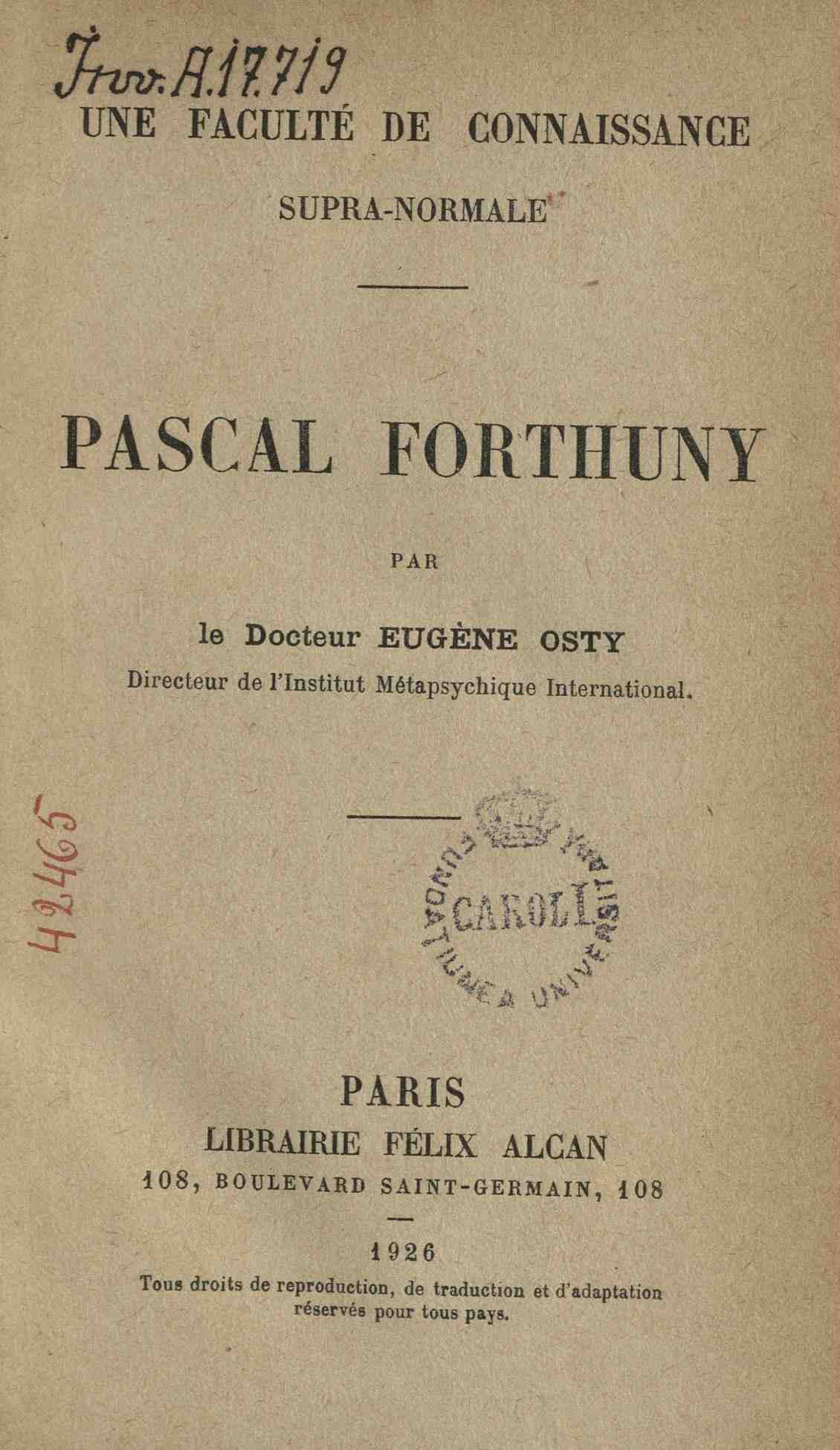
A Faculty of Supernormal Knowledge
Pascal Forthuny
By Dr. Eugène Osty
Director of the Institut Métapsychique International
Paris
Librairie Félix Alcan
108, Boulevard Saint-Germain, 108
All rights of reproduction, translation, and adaptation reserved for all countries.
Foreword
Mr. Pascal Forthuny to Dr. Eugène Osty, Director of the Institut Métapsychique International
Montmorency, 20 July 1926
My dear friend,
In asking me to add a few thoughts, assuredly inspired less by logic than by astonishment, to the learned and so solidly reasoned analysis that you have been kind enough to devote to our experiments at the Institut Métapsychique International, you have shown a friendship and confidence that do not surprise me in you, but of which I must tell you at once that they touch me as much as they honor me.
Had your study appeared alone, unaccompanied by this letter, I am certain it would have fully satisfied the reader’s curiosity, and that, at the end, he would have closed your book with a perfect knowledge of the facts you had to consider and the deductions you knew how to draw from them, with a lucidity beside which, let me assure you, my own is only a vague groping. This is to say, quite frankly, that I have no pretension to supply here anything that might have been forgotten or merely touched upon in your text, and that I am very far from seeking to add any personal illumination to it.
The sole reason that moves me to respond to your kind suggestion is of an entirely different nature; and if, having read it, you agree to insert this page beside your own, it will be because, in your scientific integrity, you have accepted that a poet’s ramblings, however incoherent, may in certain respects have a modest complementary value when, touching upon the same problem, they are set beside the firm and inexorable argument of a logician.
Logic!
I notice that twice already in these lines I have been led to speak of it. Imperiously, and although I know that I cannot meet them by my own resources alone, its demands impose themselves upon my mind. Ever since the first metagnomic observations we pursued together, ever since the day when that series of public sittings which you now describe was methodically undertaken, I have felt this need, which in the circumstances would doubtless be that of any man with some practice in the art of thinking: to explain logically to myself what I have done; to give myself positive and satisfactory reasons for that proportion of truth which you quantify elsewhere. It is truth certainly mingled with error, but through it, nevertheless, the judgment of 1,500 people who attended agrees in seeing it clearly established that I have not merely benefited from chance and fortunate coincidences, and that, to an appreciable extent, I have had, in the course of these demonstrations, the precious privilege, be it said in all humility, of proving, after several other “clairvoyants,” the reality of one of the most astonishing supernormal phenomena considered by metapsychics.
What I should like to make known, since you give me the floor for a moment, is something that my predecessors in this kind of intellectual exercise may not yet have had the opportunity to record. It is what I venture to call the whole “psychological repercussion” resulting from the operation of the faculty in the metagnome, before, after, and even during the sittings in which he endeavors to bring it into action. I must admit that, without obsessing me, this desire to sift through a sieve of logic the facts, great or small, interesting or insignificant, that I displayed before my audience accompanied me through life, particularly from the day when I had to convince myself that I was in some degree worthy of serving you as an object of study. Quite certain that I could never come even remotely near the inner workings of the metagnomic mechanism, I should have liked, and should still like, to discover at least one or two of its principles and reason a little about them; to be able to circle the great Secret at a distance, and to discern through a mist, alas, even that was asking far too much, the low doorway through which Science would one day enter, keys in hand, the castle of the Unknown. The farther you and I advanced in our bold attempts, the more this impatience to understand took possession of me; and at no period of my career have I seen myself produce so much while knowing so little of what I was doing. I do not conceal from you, and confess it to you today, that I harbored a suppressed irritation, and that on several occasions, especially after the best sittings, I was on the point of telling you that, decidedly, I did not feel myself sufficiently born under the star of Dream, if such a star exists, to consent any longer to be a plaything in the hands of someone I did not know, or under the influence of something I could not define; and that it was soon becoming intolerable to me, almost demeaning in the eyes of visitors to the Institut Métapsychique, to persist in yielding to a mental automatism whose origins and efforts remained so utterly inconceivable to me.
Fortunately, beside the “someone I did not know,” there was you, my dear friend; and what kept me from putting an end to it was the calm and wise tone in which you said to me, “Let us continue.”
You took notes and questioned me. You even assured me that you were making comparisons and deductions, and that an experiment frequently left you with the impression that you had caught, in the workings that always remained hidden from me, the movement of the gears in this bewildering psychic machine. That assurance imposed a duty upon me: to follow your example in being sensible and free of nervousness, and to regard my intentions of returning to my ordinary labors and becoming, within the metapsychical family, no more than the punctual chronicler of your twice-monthly journal, simply as fits of ill humor and vain self-love, to be carefully restrained. Thus I never allowed you to see my bitter disappointment at finding myself so incapable of explaining why, out of the blue, I announced to one lady, “Your husband has beaten you black and blue,” and to another person present, “Sir, you are an editor at the Matin of Antwerp.” Little by little, giving up the effort to decipher the why and the how, I came to leave to those more skillful than myself the task of teaching me one day by what oddity I had become a metagnome, and for precisely what reasons I sometimes succeeded in this extraordinary juggling of the mind. From that moment I temporarily relinquished that clear and reassuring logic toward which I had long directed my steps through the darkness. I resolved merely to amuse myself and marvel at the results which, without seeking them and schooled by your smiling optimism, I achieved with increasing ease.
Just as I wrote at the beginning of this letter, then, you will find here only thoughts of astonishment, and none of a logician’s.
Besides, I now find myself singularly rewarded for having known how to lay down my arms in a contest too unequal. I should have lost much time had I persisted in exploring a field which, all things considered, is not my own. I should also have been most ungrateful had I not returned, docilely, to that Dream which, quite unlike the rigors of science, enchants certain men, among whom I count myself. So I have dreamed, and even daydreamed, about the strangeness of my case and whatever paradox it might contain. I have confined myself to that. I knew that, without dreaming, you were building logically. You have just sent me, in the form of a batch of printer’s proofs, the entire plan of the house. I have walked through it from room to room, and you will not prevent me from telling you how admirable I find the learned art with which you have opened windows everywhere, so that light floods the dwelling and, for my part, I now feel at home in it.
What I could not discern, I see now in its shape and relief, its color and tone, after reading you. Your reasoning illuminates even the darkest recesses where mine languished. From your present work, I also become aware of my own work for the future. If, perchance, the “faculty” does not leave me, I owe myself henceforth to your researches. What you have already brought to light through the examination of some fifteen sittings leads me to think that I may later have the honor of placing at your disposal new and more expressive material for study, affording you still greater opportunities of approach toward establishing the essential laws of this metagnomic problem of which you have so long been the tireless and successful explorer.
Without any conceit, I most earnestly hope that it may be so, for the advancement of science, and for the deep pleasure that would be felt in being, in this matter, agreeable and useful to you by
Your devoted friend,
Pascal Forthuny
Introduction
Ever since psychology became a science, that is to say, since it ceased to be, as formerly, a subject for introspective analysis and philosophical reflection, and took as its task the search, through exact observation and experiment, for the physical and physiological laws of the human function of thought, the work of those who enrich it with their discoveries has been situated, so to speak, in two fields of exploration which have hitherto seemed distinct.
The more frequented of these two fields of work, and consequently the more extensively cultivated up to the present, is that devoted to the study of thought in its manifestations common to all men. In their laboratories, psychologists have endeavored, by methods that keep research as objective as possible, to discover the physico-physiological determinants of sensations and, from that starting point, to advance into the study of the formation of feelings, volitions, and ideas, and of those still mysterious psychodynamic processes: attention and memory. To this investigation, generally concerned with the psyche of man in a state of health, the hospital has added the immense contribution of observations made in connection with pathological disturbances of thought, surgical interventions upon the nervous centers and the endocrine glands, and comparative findings from autopsies. This vast work of university laboratories and clinical practice has experimentally confirmed the notion which Locke and Condillac, some two centuries ago, had logically derived from the outward appearance of things: “Nothing is in our mind that the senses have not introduced into it.”
Observed facts have placed other researchers, very few in number, in another field of work, where the material to be investigated is no longer thought elaborating its knowledge from the data of the known senses, but thought arriving at a notion of reality under conditions in which reason would remain wholly uninformed. This paranormal knowledge of reality, supernormal one might call it, since it surpasses normal knowledge in power, appears to be the product of a latent intelligence coexisting in certain people with ordinary intelligence and distinct from it.
It is hardly surprising that psychologists who voluntarily confine themselves to the study of manifestations of thought common to all men should be inclined to deny the probability, or even the existence, of supernormal knowledge, a property of few men. Having made no effort to observe this property, they have not observed it. Believing it irreconcilably opposed to what they know, they reject it in the name of what they know. Time and work will eliminate this prejudice.
Indeed, it is the present state of affairs that makes the property of supernormal knowledge rare. If, with a sound understanding of the ways in which it is produced and the means of bringing it to light, one systematically sought to provoke its manifestations, one would be astonished to encounter it so often. For it exists potentially in every man. It underlies the psyche of the entire human species, awaiting only the occurrence of favorable physiological conditions to realize itself, frequently in chance phenomena, sometimes in permanent faculties.
Its spontaneous manifestations, unexpected eruptions into the field of consciousness of information coming from another level of the psyche, arise ceaselessly and everywhere in the form of telepathic experiences, presentiments, warning or premonitory dreams, providing a perpetual and countless contradiction of those who deny its existence.
Its realization in established faculties takes place, according to the individual, either through spontaneous mental development, or on the occasion of the neurohumoral shock of an illness or a strong emotion, or, more simply, in response to attempts to discover whether one may possess the faculty. Once its existence has been detected, this faculty grows through cultivation: in a short time, exercise brings it to the greatest development possible for each individual and to his particular form of it.
Its form does indeed vary from one individual to another, in the sense that although, taken as a whole, it is capable of informing itself by paranormal means about everything that, in space and time, constitutes the physical plane in which our bodies live, in practice we find that its power of knowing is divided, making each person endowed with it a selective revealer of one or another aspect of reality. Why this division among individuals of a human cognitive capacity immense in its entirety? One day its physico-physiological causes will be known. All that can be perceived today is that chance requests often have something to do with it. I mean that what this faculty is asked to discover first gives it a direction and then soon fixes it in a habit.
Throughout history, across the centuries, it presents two principal aspects because two aims above all have been set before it. It has so often been called upon to discover water in places where the ordinary senses perceived none that the result has been the widespread water diviner. It has so often been asked to probe the innermost human personality and reveal the events of its life that the seer has been created. Water diviners and seers, seekers of water and revealers of individual lives, have populated the centuries. They populate our own. Two utilitarian aims have created these two specializations.
I shall say nothing of all the other aspects that give the property of supernormal knowledge the multiple objectives which curiosity or study has been led to propose to it.
At all times and in almost every country, man has made empirical use of the property of supernormal knowledge, placing the few individuals who possess it most fully in conditions where they could benefit others. Ancient civilizations gave it a large place in their knowledge and assigned it an important social role. Our present skepticism, arising from a science full of promise but limited, leads us to regard as superstition what was probably a highly intelligent use of the resources of the transcendent level of the human psyche.
How much time, how many publications, private trials, public trials, and demonstrations were needed before paranormal knowledge of underground water and certain products of the subsoil ceased, in our day, to be an object of ridicule and became the subject of communications before learned societies?
How much longer will it take before paranormal knowledge of the reality that is man, the study of which promises discoveries of the greatest interest to humanity, is taken into consideration by the scientific world and at last finds the number and quality of researchers it deserves?…
In this book I propose to describe how the property of supernormal knowledge arose, how it found its direction, and how it developed in a Parisian man of letters who, until the age of forty-eight, accepted the authority of established scientific teaching in regarding the existence of this property as improbable, and was greatly astonished when he discovered himself endowed with it.1
A Faculty of Supernormal Knowledge: Pascal Forthuny
Chapter I: The Psychological Personality of Mr. Pascal Forthuny before the Appearance of His Metagnomic Faculty
Mr. Forthuny’s metagnomic gift revealed itself late in his life: at forty-eight. I shall describe later the tragic, and then the amusing, circumstances of its appearance. To draw from this psychic case all the lessons it contains, Mr. F.’s late metagnomic phase must be integrated into the general psychological course of his life. Mr. Forthuny understood this so well that he allowed me to make public, in its broad outlines, the development of his mental personality from childhood onward.
An examination of P. F.’s family antecedents reveals no metapsychical gift of any kind, not even one of those spontaneous manifestations, presentiments, telepathic experiences, warning or premonitory dreams, of which few families are without examples.
His mother, who died in 1911 of pneumonia after catching a chill, was a person as sound morally as physically, full of common sense, practical, and little concerned with visions and visionaries. Such too is his father, a Parisian architect, now eighty-four years old and thoroughly engaged in life. The mother came from the Nivernais, the father from the region of Blois; both were of peasant stock: plowmen, farmers, carpenters. A very healthy stock, living amid concrete realities, unacquainted with so-called nervous disturbances. Looking back along both lines of descent, one encounters only a single figure standing out above the practical virtues of this respectable family: the maternal great-grandfather, an imaginative peasant who astonished his village with his Rabelaisian gaiety, his improvised songs, both tunes and words, and the fireworks of his extraordinarily active mind. Something of this ancestor has remained in his great-grandson.
As a child, P. F. was an engaging and picturesque character, but intolerable. With an alarming nervous energy, breaking everything, he lived more within himself than among things. His universe was less the spectacle of the outside world than the endlessly varied spectacle supplied without cease by a prodigiously lively imagination. In his mind there unfolded an uninterrupted succession of plans for travel, an independent life, adventures, and countless roles, always grand ones, to be played among men: a seething of images.
Literature attracted him very early, especially poetry, and lyric poetry in particular. As a young pupil at the school in Blois, he composed verses whose brief lives always ended in the stove.
Passionately fond of music, he gave up his playtimes, slipping away from the playground to shut himself in the chapel. There, through the stops of the harmonium, he asked his ardent imagination to give him the enchantments that at other times it supplied so abundantly in visual form. For although he loved to hear the works of the great musicians, he had little taste for performing them himself. Here too he preferred to dispense with outside sources and draw upon his own resources.
His music teacher at the time understood this and trained him in the direction of improvisation.
From eleven to fifteen, his life expressed itself through lyric poetry and music. His was a singing soul. His musical compositions were played at celebrations and in church. His French compositions were read in class. As for the sciences, he knew nothing of them; an addition sum to be worked out made him turn pale.
When he had obtained his baccalaureate in letters, his father, believing he was acting for the best, enrolled him in a science class at the Lycée Janson-de-Sailly in Paris, to prepare for the architecture section of the École des Beaux-Arts. He wanted to make him his associate and later pass on his architectural practice to him.
The examination for the science baccalaureate was what it was bound to be: a lamentable failure.
Admitted to the École des Beaux-Arts despite his exceptional lack of scientific knowledge, P. F. spent three years there as a student of great waywardness, taking more pains to become a fitter of thoughts and words than of stones. With an essentially improvisational mind, he instinctively refused to assimilate the methods of the masters of the past. He took pleasure in his studies only when de Baudot introduced him to modern architecture, for that was something new, material to imagine and create. His best moments, however, were spent among the literary youth who gravitated around Catulle Mendès and Maurice Barrès, toward whom he himself was drawn as iron to a magnet.
Bourgeois in family and habits, he now began to find the monotonous course of his existence burdensome. For three successive years he sought in Germany a setting for his romantic reveries. In Munich he offered his imagination the titanic suggestions of Wagner’s music. And among the old castles of the Rhine he wandered, adding a world of mental creations to the uncomplicated past of things.
His religious beliefs were gone. Reading, conversation, and the appearance of life had convinced him that matter was the sole substance of the universe and that beings and things were its ephemeral derivatives through the operation of mechanistic laws; man owed his thought to a combination more fortunate than the others. P. F. was a materialist, though with the hope that someone would one day show him that he was mistaken. But this materialist was steeped in ideals. His thought was forever attempting to escape far from things and rise above them. It was the dream, in countless variations, of something more beautiful and better than what his senses perceived. Finding nothing outside himself to satisfy him, he asked it of his mind. Finding in his mind no definite conception of the better thing he sought, he formulated it in an uninterrupted succession of imaginary constructions.
Two novels, written around the age of thirty, were the craters through which a little of this ardent idealistic lava escaped. In Les Étapes inquiètes he developed the spiritualist evolution of man. In Le Roi régicide, an expression of political idealism, he led a king, out of love for humanity, to bring his dominions to anarchy.
A novelist and musician, P. F. also devoted himself to painting, in every genre, taking account of the outside world only to imagine what was possible. He always depicted beautiful nature, in varied styles, never distorting it; but one would search the world in vain for the beautiful landscapes he painted. The only place they could be found was in his brain. Although they seemed as real as reality itself, they had been “dreamed.”
Painter, musician, and man of letters, P. F. had everything needed to be an art critic. Circumstances made him one, but not in the ordinary manner. Everything he wrote about artistic production was a kind of forward movement above the materials, the technique of the brush, and the use of colors. In a work, it was the psychological side of its creator that attracted him; he wanted to discover the inner motives of creation, to probe the “depths of the soul,” which earned him the irritation of a number of artists.
He found pleasure in spreading his ideas and fostering a taste for art. For a time he lectured in the provinces on “art for everyone.”
Wishing to make direct contact with the thought of civilized human communities and, so to speak, to immerse his mind in their works, he began learning the languages that would be most useful to him. He did so in his own way: by reading the newspapers of those countries, beginning with children’s papers, in which words recur and sentences are simple and clear; then progressing from paper to paper until he reached those intended for highly cultivated readers. In this way he made himself familiar with English, German, Spanish, Italian, and Portuguese.
Having thus extended himself into European thought through a knowledge of its principal languages and works, he soon began to feel confined within it. Asia, of which he caught only glimpses through his reading, Asia mysterious to him, took on the attraction of the unknown for an imagination always hungry for novelty. Chance put a Chinese grammar into his hands. He marveled at the plastic beauty of the written characters of that language. He judged it as a painter. At once his mind crystallized a great dream around this accidental nucleus. He must learn this language of distant Asia, leave Europe, and go to China with his wife and son to live another life. And so, at forty-one, he became a student at the École des Langues Orientales, working like a man possessed, without any concern for his immediate interests. Three years later he held a diploma in Chinese. He explored the literature of the language and, as if at play, translated and published several novels. He delighted in the scenes these readings afforded him. Nothing seemed more engaging to him than those silent lives of yellow men, haunted by demons, genii, and protective spirits. This fairy world enchanted him. He discovered in himself a love of the marvelous.
Had anyone then spoken to him of the “metapsychical marvelous,” that is to say, of the unknown human psychodynamic powers, he would have regarded it as suitable nourishment for the lull of dreams, but unacceptable to reason.
Yet a tragedy was about to descend upon this so lively soul and bring forth an unexpected faculty within it, like a new island raised from the waters by an undersea earthquake.
In June 1919, his only son, Frédéric Forthuny, twenty-four years old, a soul as vibrant as his own, was in Romania, in command of the aviation camp at Galatz. On the 25th a telegram arrived announcing that the Germans had decided to come to France to sign the peace treaty at Versailles. The population was jubilant. Flags were hung. The town took on a festive air. Quick to enthusiasm, Frédéric Forthuny wanted to celebrate the good news as an aviator. He sewed lengths of French flags end to end to make one very large flag. Then, into the sky gilded by a sun already low on the horizon, he rose, carrying the vast standard beneath his aircraft. The crowd applauded the aviator’s skill and the colors of France. Suddenly a gust of wind threw the fabric around the propeller. The aircraft plunged vertically. Frédéric F. crashed to the ground in the very cemetery of Galatz.
In the father’s so sensitive heart, there was, as may be imagined, an explosion of grief, followed by endless despair.
At the threshold of the phase in which P. F.’s metagnomic faculty emerged, I think I should add a few further touches to his psychological portrait to make it more expressive.
Pascal F. is rather frail in body, but very resilient. He is an indefatigable worker, loving what he does because he does only what he loves. The pathological record of his life is short: pleurisy without aftereffects at four; arthritis affecting a single joint at fifteen; that is all. The course of his days has always, except during the sorrowful event described above, been sustained by a fine optimism.
Everything that expresses some beauty moves his soul. Music, and the organ especially, stirs him to tears. Before some magnificent scene in nature, he withdraws from his companions to attune his sensibility to the splendor of things. If he is alone, emotion sometimes brings him to his knees.
His soul vibrates intensely in response to the outside world. At the slightest impact his imagination flares up. A trifle sends it off into boundless improvisations, which he externalizes in the various forms of art. A few overheard phrases soon produce a novel. A passage of reading is transposed into a picture. From a chord struck at random on the piano, he launches into an improvisation without limits.
P. F. does not produce for others. He makes art as one takes a walk, for oneself.
In music he has composed much, chiefly vocal works, and published little. Almost every day, once or several times, especially in the half-light of falling evening, he sits down at the piano and, allowing his fertile imagination free rein, listens to himself. What he improvises is of endless variety. He does not have one genre; he has them all. Often it is very beautiful music. It is music for himself; it is music lost.
As a painter he works in watercolor, more often in oils and gouache. One of his pictures has been acquired by the state. He paints for the sake of painting, and when he feels like it. His work consists chiefly of landscapes, never copied from nature, always imagined. They come to him at moments when he does not expect them. He is writing a letter, a few pages of a novel, or anything at all, and suddenly a vision, clear in its colors, light, and forms, takes possession of him. He takes paper and paints; two hours later the vision is fixed. He is reading; a description whose elements he has just imagined one after another takes on a unified visual form as though before his eyes. He sketches it, to add colors later, or he paints it. Here again, anyone wishing to characterize Forthuny’s style would find it impossible. He cannot have a single style. His technique is constantly different. Most of his pictures are “in the manner of…” In music he enchants himself; in painting he amuses himself.
He also amuses himself when writing his novels. He constructs them in the same frame of mind in which ordinary people go to the theater. His imagination, never making an effort, shows him scenes; he transposes them into the symbolism of words. Three of his novels have been accounts of dreams. One morning in 1904, he woke feverish and nervously dictated sixteen pages of notes, whose development became the novel entitled Le Roi régicide. Another morning, in 1923, he was about to rise, looked at the time, and fell asleep again. Awakening three minutes later, he was astonished to find that he had just witnessed an eventful passage of life tending toward social criticism. Characters, names of people, places, and occupations, individual actions and interactions between people and things: everything was in his mind as clearly as lived experience. At the end of eight days it was a written novel, L’Enfant trouvé, which the newspaper L’Avenir published. Rereading it, Forthuny was astonished that so little time had sufficed to imagine and then write things that appeared to have been thought over at length.
These uses of spontaneous dreams gave him the idea of inducing dreams for a practical purpose. He tried to link them from night to night, like motion pictures shown in episodes. He succeeded immediately. For five consecutive nights he had five dreams that unfolded a sequence of events so closely joined in its parts that each dream took up the action where the previous one had left it. In this way forty pages of a novel were written: Voyage au pays du bizarre, a logical construction to which F. added nothing. The story takes place in England. The text resembles a translation of an English humorist. Much to his regret, P. Forthuny had to abandon this way of working because he felt painful spots at the back of his neck, about which, rightly or wrongly, he became anxious.
Forthuny’s psychic personality is thus characterized by great sensitivity and a powerful inventive imagination. His best work in music, painting, and the novel comes when he improvises. And it is for his personal satisfaction that he invents. He amuses himself, and if, in addition, what he produces while amusing himself is useful to him, he congratulates himself upon it as a piece of good fortune. His is a beautiful artist’s soul.2
On 12 January 1911, when he was thirty-nine, P. F. was at Sedan station, accompanied by a young photographer. For several days he had been carrying out an assignment entrusted to him by the newspaper Le Matin: to investigate the strikes in Alsace. His travels through eastern France and Alsace were to continue for another eight days. As he approached the ticket window to buy tickets for Mulhouse, he abruptly returned to his companion and said:
“Listen, we must go back to Paris.”
“Go back to Paris! What about Mulhouse, and Colmar, where we are supposed to go?”
“I am going back,” Forthuny replied. “Do not laugh at what I am going to tell you. Over there in the corner, beside the luggage, I saw a coffin covered with a black cloth, with candles on either side. Let us be off!”
“But,” the photographer insisted, “we shall not be well received at the Matin!”
“No matter, I am going back.”
As he had said, F. had just seen a vision of a coffin standing beside the iron-bound platform on which luggage was placed. He was not upset by it and connected it with no event. He knew everyone in his family to be in good health. Yet he felt impelled to leave and, through a kind of absurd acquiescence of his reason, acted in accordance with this suggestion. On returning home, his first words were to ask after the health of all his family. Mrs. F. told him: “Your father writes to me that your mother is unwell, that she has caught a chill, and that it is serious.” F. hurried to his parents in Neuilly. His mother had pneumonia. At noon the following day, during the meal, F. suddenly left his father and brother. His mother died at the moment he approached her.
P. Forthuny, who is now so often informed of episodes of past and future life concerning people unknown to him, had, until 1923, only this single manifestation of supernormal knowledge.
At the hour when his son fell from the sky in Romania, Forthuny was quietly sorting documents. No emotion touched the threshold of his consciousness. It was in the full enjoyment of life that, five days later, he received the thunderbolt of the terrible news.
Chapter II: The Emergence and Development of P. Forthuny’s Metagnomic Faculty
Moved by P. F.’s emotional distress, a friend of his, a naval officer, judged that the best consolation he could offer would be to convince him that the death of the body was not the end of individual life, and lent him books on Spiritualism. F. read them. His conclusion was: “A fragile hypothesis.”
Nevertheless, the idea had entered his mind that death might not be the end of man, and that there were beings, mediums, supposedly endowed with the ability to communicate with discarnate souls. In an imagination such as his, this was bound to produce something “in the mediumistic manner.”
On 18 July 1920, while he was at his desk writing a few pages of a novel, his hand abruptly ceased to obey his thought and, as though moved by an alien force, began impulsively drawing a whole series of strokes, like a small child at his first writing lesson. Astonished, Forthuny took a sheet of blank paper and placed his hand upon it; the hand continued to trace strokes, then curves of every kind, and soon letters and words, still without logical connection. P. F. called Mrs. P. F. and said to her: “Here is a strange business. I am a medium!” Before her he made another attempt. The hand started off again. This first sitting of impulsive writing lasted about two hours.
Greatly intrigued by this psychological adventure, P. F. continued on the following days to put himself in a position to let his hand write independently of his will. Gradually the writing became better formed and increasingly rapid. Soon the words arranged themselves into meaningful sentences, and the sentences then linked together in streams of ideas.
A few days after the appearance of impulsive writing, P. F. obtained written answers to his questions. Henceforth things proceeded as though he were conversing with invisible intelligences that used his cerebral mechanisms to express themselves.
Two spiritual personalities thus entered into communication with him. First, a spirit who would never agree to name himself, signing “your guide.” Then his son: Frédéric Forthuny.
This intercourse, by means of impulsive writing, with these supposed entities took place for several hours each day and for six months: precisely from 18 July to 25 December 1920.
During the first weeks the writing was well formed. P. F., who became acquainted with it only after his hand had stopped, read it very easily. It consisted of rather large letters, as so-called automatic writings generally do. These were not imitations of other hands, of Frédéric F.’s, for example. It was Pascal F.’s handwriting.
One day, as his hand was preparing to begin writing, it was suddenly carried to the right-hand side of the paper and, at full speed, with his arm swept along, wrote from right to left. Page after page was covered with lines. When the sitting was over, P. F. wanted to read it; he could not recognize a single word. Then, remembering that automatic writing can be performed backward, he placed his sheets before a mirror and marveled to find that, at a frantic speed, he had been able to accomplish this prodigy. To measure its difficulty, he tried writing from right to left and reversing the letters, proceeding slowly and with the greatest care; it was unsuccessful. That day his conviction grew that, during the moments of impulsive writing, his hand was the instrument of an intelligence other than his own.
Shortly after this graphic acrobatics, the writing, having returned to its normal technique, accelerated still further, losing its fluency and becoming jerky. A time came when the hand, no longer able to write out words and sentences in full, had to write on the same spot. The letters were traced one over another at the speed of a machine. P. F. could then no longer think of reading during the pauses, for what lay before him was a black blot. While his hand raced at a dizzying pace, he concentrated his attention, with his eyes closed, on the letters being formed and, as each word took shape, dictated it to Mrs. Forthuny. After a few days, this training of his attention resulted in a mental representation of articulated words preceding their graphic inscription by a fraction of a second.
In December the writing movements became actual spasms, sudden jerks that made his shoulder ache. It was exhausting.
His friends were disturbed by this spectacle and feared for his mental health. P. F. asked the possessing entity, “What does this mean?” The hand wrote, “It will soon end.”
On Christmas Day 1920, P. F. wanted to converse with his son. He took up the position for impulsive writing. His hand moved slowly, without jerks, as though moved by a declining force. It wrote “Ad…” and stopped, forever.
Since then, P. F. has made many attempts at impulsive writing. His hand has remained inert.
Such was the evolution of the writing, considered solely in its motor expression. For simplicity, I have separated this aspect of the phenomenon from its other, principal aspect: the text of the communications. That text is a psychological document which would in itself deserve a study. But as I am eager to reach P. F.’s supernormal property, I shall, much to my regret, pass quickly over Forthuny the writing medium, confining myself to gleaning a few significant specimens from his written production.
“The guide” behaves toward P. F. as a master infatuated with his omniscience, touchy, irritable, and vindictive. He teaches him the truth about God, the soul, creation, the relationship between spirit and matter, death, the survival of the soul, and so on. He gives him advice on conduct and moral improvement. This is no gentle and persuasive teacher, but a harsh pontiff proceeding by peremptory assertions and accepting no resistance.
He entitles a series of teachings “Counsels to Those Who Need Certainty of the Truth of God.”
“Beneath the coarse millstone of reason and vain science,” he writes, “matter has been ground enough, like a grain emptied of its last juice. The time has come when one must consent to grind matter beneath a millstone whose axis is called Spirit. This will assuredly be a task very different from crushing an inert substance between two cold stones, but in this new mill it will very soon be seen that matter has a spiritual origin as much as spirit itself, and that it is another form of spirit to which Providence has given the marvelous appearance of the sensible world. Then matter, formerly proud in the hands of blind scientists, will abdicate, rehabilitated, before the light of triumphant Spirit. Matter must attain the dignity of spirit in the world, for it too has a soul. As much as it has been degraded and misunderstood, so much must it be admired and celebrated as an emanation of the universal soul.”
Pretentious in his knowledge, the guide is never wrong when speaking of the inaccessible and the unverifiable. But as soon as he confronts the things of this world, he takes on the appearance of a great fabricator, for things are not as he describes them when Forthuny does not know them. He prophesies for P. F. future gifts of clairvoyance and healing, a great mission among men, and this is how he prepares him for miraculous cures:
2 August. “You are one of those whom the divinity has designated for the category of torchbearers of the astral. Yes, you are destined for the mission of giving yourself, from this day onward, the marvelous concern of bringing to the poor in spirit that word which Christ brought to the knowledge of his disciples. You have the gift of doing good by tending the wounds of those who suffer from life, the flesh, and matter. You have the gift of curing the illnesses of those who are your patients. I have come to tell you that the mediumship with which you are endowed is to bring a remedy to the illness of poor people who have lost all hope and are in the last stage of tuberculosis.
“Can you go to the Maternity Hospital, and at the Maternity Hospital ask to see the patient called Mrs. Lomonier, who is in the Maternity Hospital ward bearing the name of my doctor before death, the doctor in command of the Maternity Hospital in the year 1826, Dr. Vacquerie?
“I am sending you there so that she may be your trial patient and you may discover the methods that will serve you in curing the illnesses of which I shall speak to you.”
Forthuny: “Must I go there at once?”
The guide: “I had thought you better instructed in the docility of souls toward their guide. So you want spirits to put themselves out to instruct you, and then you ask them whether you have time to obey them? I order you to go to the Maternity Hospital as soon as you go to attend to your affairs in Paris.”
3 August. “I bring you the means of attending to a poor woman who is slowly dying, whom you are going to save from death by giving her life. I shall tell you what you have to do, and I shall lead you to victory over the disease and over the wicked doctors who are making her die. Learn that the disease from which she suffers is called Bright’s disease and that her trouble is localized in the region of the spinal cord.3 I invite you to tell her that the disease from which she suffers is curable and that you know doctors who could cure her if she left the hospital and decided to enter a clinic where she would be much better cared for. You would take her to the house of Mrs. Grand’homme, who would receive her into her home and give her care free of charge. I am informing her of your visit, and I give you her address: 86, rue de Vanves, Vanves. You will tell her that you are sent by the spirit of her guide and by that of your guide, who know each other and have agreed to unite their actions. She has a telephone: Vanves 0.82.”
The next morning, 4 August, Mr. P. F. went to Vanves. No one in the district knew of a woman doctor named Grand’homme. P. F., using the last page of a book he carried with him, questioned the spirit, who wrote: “Go to the boundary between Vanves and Clamart.” P. F. went there and asked another question, to make the matter more precise: “Am I getting near?” Answer: “I order you to go to the Maternity Hospital before going to see Mrs. Grand’homme.” P. F. expressed his astonishment. A stern rebuke: “You have boiling blood. I shall calm you. Do not make so much fuss.”
That afternoon, P. F. went to what the Spirit called the Maternity Hospital, that is to say, the Hôpital de la Charité, in rue Jacob. There was no Vacquerie ward; there was no patient named Lomonier. There had been a patient named Lemonier, but she had died several weeks earlier. P. F. went away, wondering with some irritation why a spirit had made him undertake these useless errands. Steeped in the reading of Spiritualist books, he thought: “Perhaps I am being deceived by an evil spirit who assumes the appearance and tone of a spirit of purity and goodness.”
An hour later, alone in an editorial office, he received this answer through impulsive writing:
“I sent you to the Maternity Hospital to put you through a test of patience, and I see that you have not passed it well… You are quite right to believe that evil spirits advise you, and I warn you that their action is the sole cause of your lack of success. I leave you, my dear friend, and take my leave with regret at seeing that you cannot be the one I believed you could be. It is your brain that has ruined your heart, and I see that it has a poor sense of modesty. I leave you to consider what a useless journey I have made in coming to you. I salute you and go to your son, who is appalled by your attitude. I am going away and shall trouble you no more.”
A few words of submission from P. F. soon soothed the Guide’s irritation, and he continued to supply his pupil with philosophical and moral instruction marked by perfect Kardecian orthodoxy.
At one point, taking advantage of a period in which his Guide was showing greater amiability, P. F. slyly proposed that they write a study in collaboration. P. F. would supply his obedient hand, the Guide everything else. This was accepted. A book was begun under the title “The True Character of Art Considered in Its Role as Servant of the Spirit.”
The first two pages were given in one sitting. No continuation followed. Here is an extract:
“The artist’s present way of communicating with Nature and corresponding with his model leads him first to ask her advice, as of a friend; but, at the end of the conversation, Nature has been completely appropriated by the friend to whom she has given advice, and this friendship becomes hatred, for it ends in betrayal. This way of representing her accommodates the beauty of the earth to the eyes of those who inhabit it, and not of those who have left it. This form of Nature is that of matter and not of Spirit. It corresponds to the ways of the creature, and not to the ways of those who have ceased looking at matter with the eyes of the flesh. This presentation of Nature and matter is displayed with complacency and selfish love by the artist who walks blindly toward the light. He composes his work as a dove makes its nest with feathers from its belly. He has in his brain only the impatient, almost animal desire to convey an imaginary perfection which lacks the certainty of being able to characterize the true expression of beauty and its perpetual lesson. For the dove soon sees the storm carry away the nest, and the artist soon sees the work of art begin to fade beneath the kiss of the future, the blight of time, and the corruption of matter: it is the inevitable fulfillment of the decay of everything that has been modeled or woven by human hands. And the ‘supposed masterpiece’ is just like the coin on which the effigy of kings has been stamped, and to which time gives the appearance of the most commonplace matter, the least artistically worked.”
Emboldened by his daily conversations with the Guide and believing he had won his confidence, P. F. eventually ventured, though deferentially, to raise objections to certain of his opinions. It went badly for him. This occasioned a heated quarrel in which Forthuny was harshly treated. It was when the Guide was berating him most strongly that his hand wrote with such a frenzy of movements. Here are a few specimens:
“You had the unfortunate idea of rebelling against the word ‘wandering,’ which irritates you and has wandered about in your brain since your initiation into the knowledge of the Truth of the Astral. You had the unfortunate idea of amusing yourself with this word, which seemed to you a little old-fashioned and a little archaic!4 Have you then forgotten that it has a definite meaning and the good fortune to correspond to a vast number of senses and possibilities? You say that you know this well, but you have also had the audacity to say that it is an old person’s word. I have given you the teaching of the life of the earth and of the matter of which you are made, with your pride and the prejudices of a conceited, shoddy, contraband grammarian, with your imagination at once sickly and clumsily inspired by the vanity of men…”
The day after P. F., in vexation at some excessively sharp remarks, had thrown down his pen, the Guide made him write:
“I have sent you harsh teachings; you deserved them. I have shaken you roughly and warned you that, if your arrogance did not cease, I would abandon you to your sad fate. At that moment, you remember, you had the criminal thought of throwing your pen in my face. And I told you that treating me thus was the height of insolence… It was a truly abominable fault to strike me in the face, your greatest fault since your earthly life began. I hear you telling me that you ask my forgiveness, and I warn you that your whole life would not suffice to obtain it. It is the condemnation of your soul. The redemption of this fault calls for the most complete submission to my will.”
P. F.’s relations with the Entity Frédéric F. were quite different. The son speaks to his father as a Spirit now informed of the great mysteries of life and death, but always in respectful terms. The following lines show his manner:
29 July 1920. “It is very difficult to describe the great happiness of the ceremony in which souls are freed from their envelope of flesh and the last veils of earthly life are torn away before the world of the Beyond. The adorable truths of the region where one discovers the Key to the Mysteries of creation lie there, spread out in the light of the celestial vault and the radiance of the astral worlds that adorn it.
“I admired them, truly amazed from the first instant I arrived among them, and I declare with certainty that the most perfect brains on earth cannot see conceptions so marvelous taking shape in their delightful dreams; I admired them in rapture and ecstasy. My education proceeded and, slowly, I discovered that death was the division of the human frame, and that life was the condemnation of the soul to the prison of matter.
“I became a witness to the beautiful mathematics that governs the movement of the celestial Homelands to which souls go when they have finished their exile on earth. The tremendous truths of the creation of worlds appeared to me in their adorable splendor, and I found myself informed of the Truth of the Infinite. My former pride abdicated before this truth and humbly became the lowliest hired servant in the service of the Divinity who had created such beautiful cathedrals in the sky of the dead. The marvels whose details transported me with joy unfolded in the most verdant settings and in designs of the most captivating beauty. In the midst of the celestial vault, in a procession of white Spirits, the good Judge who was to give me the direction to follow regarded me with sympathy and asked whether I deplored the recent events that had detached me from the earth. I answered him that I would take good care not to give him cause to find me ungrateful for the exalted happiness I owed him since my arrival in the Astral, but that I knew beings on earth whose tears touched me painfully. He told me that you were among those who cannot remain long in sorrow without the ultimate hope of a final reunion.
“Then I went away, and I greatly adored the Creator who had given me the conviction of eternal life and of the Great Truth of the Elect. I cursed myself for having doubted God and asked his forgiveness, asking him also to be so kind as to grant me the grace of allowing me to free from ignorance the beings whom he had made weep by withdrawing me from their love.
“Tomorrow I shall tell you the rest of this marvelous account, and you will see that it is as beautiful as the beginning. Farewell, my dear Papa, and go and give Mama and Colette the kiss of their counselor and guide. Fred.”
Immersed in the source of all knowledge, the Entity Frédéric F. made predictions. The first was not successful:
“My grandfather,” he said, on 18 and 20 July 1920, “will die this month, on 27 July, of the heart. André’s family must be summoned from the country.”
This prediction was made more than five years ago. The grandfather, aged eighty-four, is still alive.
Concerning the coming of a gift of clairvoyance and healing, “the Guide,” for his part, had made premonitions whose tenor may appropriately be reinforced by a few quotations:
“Soon you will have the power to advance your spirit, as you wish, into the Astral and into the plane of knowledge of the fullest advance toward the world after death and after life. The true advancement of your spirit will take place through clairaudience and clairvoyance, and this will happen soon.
“… You will have a following of disciples who will gather around you and wish to know your teaching. Yes, you will advance far enough to be the Guide of contemporary Society… It was God’s will that your face should bear a slight resemblance to that of Christ. I wish to warn you that this resemblance has been the sign of the sense of Divinity that has attached itself to your person…
“… Soon you will have the gift of being able to perform miracles, and you will begin the journey of a true pilgrimage toward all those who need the truth. At that time you will go first to North America, and in that part of the earth you will begin to make yourself known by the fervor of your faith and by the way in which you spread it. At the end of your stay in America you will go to the colony of the famous Creole who was Empress of the French under Napoleon. There you will have the happiness of verifying the permission that will have been granted to you to advance along the path of celebrity that will enable you to perform miracles. Never forget it: with God’s permission, your true reign will be in the colony of Cuba, where you will have the certainty that God favors you with a true spiritual throne. This will lead you to desire to see that other country where Christ was famous in devoting himself to his mission, and there you will, so to speak, be crucified.”
The Entity Frédéric F., in many messages, made these same predictions to his father of a mission among men and the arrival of a gift of clairvoyance when he least expected it:
“… The mediumship of vision and hearing will come to you on the morning of the last day of the year, like a true New Year’s gift… You will be able to perform miracles and carry out an apostolate. You will have to sustain a struggle against the doctors of the law, against the Sanhedrins of science and philosophy. This will lead you toward the knowledge of martyrdom. I tell you that you will advance along the path of knowledge of medicine and chemistry, and that you will speak to your contemporaries of these two sciences in the sense most advanced toward the Astral, to the point of being able to cure the cancer of your brothers, who will thank you. The time is no longer far away.
“… Papa’s mission must take place as soon as possible; it will soon come about that he will be able to see me before him, and I predict that this will occur before the end of the year…
“… You will exercise the gift before long and in every class of Society. Its consequence will be to modify your existence completely; the mission will carry you across the world.
“… This faculty, my dear Papa, will begin soon, at the moment when you are not expecting it. For the way in which you begin to hear me speaking to you and to see me will begin like the other way you experienced, which led you to let your hand run across a sheet of paper.
“… Your present mediumship, my dear Papa, will take another form, and you will know it soon. A mediumship far more admirable than the one you have. It will attract the world’s attention. It will bring you complete communication with the thought of the world of the earth and of the spirit. It will have a very great impact, that of a force brought from the depths of the Beyond…
“… Soon the certainty of the mediumship of vision and hearing will help you understand the reason why you cannot write better.5 This unfortunate state will begin to bring to an end the period of preparation for your new state. The moment will quickly come when you can communicate with the Beyond. It will happen, as I told you, at a moment when you are not thinking of it at all. This faculty you will retain throughout your life, and you will use it to converse continually with the dead. This will astonish a great many people, and the way in which you show it to the crowd will lead them to acknowledge the world of the spirit. It is on 25 December that this new mediumship will come.”
Thus Pascal Forthuny lived, during the second half of 1920, in ceaseless intercourse with two “spiritual Entities.” From them he received moral counsel in accordance with that of the Gospels, philosophical teaching reflecting readings in Spiritualist books, false warnings and premonitions, and the announcement that he would become a clairvoyant and healer.
Did P. F. already possess the faculty of supernormal knowledge at that time? Nothing proves that he did. Nothing proves that he did not. What can be said is that it was not, properly speaking, called upon. Given over to a kind of splitting of his psyche, without any true metagnomic aim, P. F. expressed through impulsive writing the subconscious elaborations of his mental resources as an artist and a novice Spiritualist. He did so in the classical manner: by creating personalities. Was he certain of the existence of these personifications? P. F. was an artist, little burdened with scientific knowledge and without the time, or perhaps the inclination, to keep abreast of psychological work on the subconscious genesis of feelings and ideas. On the other hand, he had just steeped himself in Kardecist teachings and lost a dearly loved son. Had there been only the “Guide,” that irascible, pretentious, fallible master, P. F. would probably have remained in doubt. But there was his son! In a man of great sensitivity and powerful imagination, feeling was bound to prevail over rational logic.
From this psychological phase, so picturesque in its sadness, the psychologist is inclined to retain the fact that P. F.’s psyche acquired the habit of functional dissociation between the conscious and the subconscious, so favorable to manifestations of the deep levels of thought, and that, through an abundant growth of mystical-philosophical vegetation, it gave itself a warning or premonitory indication of the gift of supernormal knowledge. The first subsequent occasion that created favorable conditions for calling upon it brought it suddenly to light, like underground water under pressure which a well-placed borehole causes abruptly to gush forth. This occasion came about a year after P. F. had lost his capacity for impulsive writing.
In the winter of 1921, several people were gathered in a drawing room at the Institut Métapsychique in Paris. Forthuny was present. A clairvoyant was there: Mrs. de B. At a certain moment Dr. Geley handed this lady a folded letter, asking her to say what its contact suggested to her. P. F., in a playful mood, intercepted the letter. “It cannot be difficult,” he exclaimed, “to tell something applicable to anyone at all!” And he began speaking in the manner of clairvoyants, but at the chance prompting of passing ideas. The letter was from the sinister Landru. What Forthuny said about it made some sense, but was taken as a fortunate coincidence.
Mrs. Geley picked up a fan from a table in the drawing room, presented it to Forthuny, and said: “Now we shall see whether it is a matter of chance. What does contact with this object give you?”
Still joking, and with no other purpose than to imitate the manner of clairvoyants and also to see how far chance could favor him, P. F. felt the fan and exclaimed: “What is this? I feel as though I am suffocating! And beside me I hear: ‘Élisa!’”
Mrs. Geley was astonished. This fan had come to her from an elderly lady who had died seven years earlier of pulmonary congestion and who, during that final illness, had used it to fan herself. The friend who nursed her was called Élisa.
On hearing this account, P. F. came close to thinking that, while he believed he was making fun of others, it was he who was being made fun of.
Mrs. Geley left the drawing room and returned a few minutes later with a walking stick. “Here,” she said to Forthuny, “is an object with a very particular history. You cannot know it. If you discover it, you are without any doubt a clairvoyant.”
“This time,” P. F. thought, “I shall come crashing down. Luck cannot last indefinitely. I have got myself into a strange business. Let us see it through!”
Feeling the walking stick solemnly, he began, “like a ham actor,” to describe landscapes and movements of armies, far away, beyond the sea, toward the East. He spoke of a young officer who had owned the stick, of his return to France by sea, of the torpedoing of his ship, and so on.
“But all that is correct!” Mrs. Geley confirmed. “This stick belonged to a young Frenchman who served as an officer in the Greek campaign. His ship was torpedoed and sunk on his return to France. He was saved from the shipwreck, fell ill, and died two years later.”
At that moment P. F. experienced one of the great emotions of his life. “Chance is an admirable master,” he said to himself, “or else: what?… Could I have a faculty I never suspected?”
Pushing the test further, Mrs. Geley went to fetch a letter from another room. She placed it in one of F.’s hands in such a way that it was impossible for him to read a single word. F. squeezed it in his hand and soon exclaimed: “Oh, madam! This letter was written in a very beautiful city. It is the East… There is a harbor. It is wonderful! What a magnificent view! What a beautiful blue sky!” and so on.
The letter had been written twenty years earlier, in Constantinople, by Mrs. Geley’s father.
Thus P. F.’s metagnomic faculty manifested itself while he was amusing himself by parodying the manner of clairvoyants, that is to say, when for the first time he found himself in conditions favorable to metagnomic work.
The incident immediately became known. Forthuny the clairvoyant became the great attraction at gatherings of friends. There was no tea or dinner at which his faculty was not put to the test. He was careful not to evade it, so much pleasure did he take in trying out his new gift. Through this exercise, little by little, his clairvoyance asserted itself, became more precise, and expanded. He acquired the habit of working before varying numbers of people, without suspecting the difficulties, insurmountable for the majority of clairvoyants, that he was setting himself to overcome.
Mr. Jean Meyer, whose collaborator Forthuny had become at the Revue Spirite, soon understood the demonstrative power of this faculty, capable of operating in public. He obtained P. F.’s agreement to give a sitting every week at the headquarters of the Union Spirite, 8, rue Copernic. There, before an audience sometimes exceeding a hundred people, he accomplished the extraordinary feat of walking among them, stopping now before one, now before another, revealing one or more episodes, sometimes very intimate ones, from their lives or from the lives of someone in their circle. The variety, precision, and incontestability of the facts thus produced drew a constantly renewed curiosity around Forthuny. Very many came seeking the chance of unexpected answers to their secret concerns. Few took a simple interest in the psychological and philosophical spectacle offered to them. No professional psychologist came forward to study this case so rich in lessons.
Greatly interested in the results of this special work of P. F.’s, I asked him to come and perform it at the Institut Métapsychique for purposes of study. Delighted to be useful to scientific research, he agreed, despite an otherwise crushing workload, to give us two sittings a month. The first took place on 12 May 1925.
Chapter III: The Public Metagnomic Sittings Given by M. P. Forthuny at the I. M. I. in Paris
The general conditions of the sittings. — The public at these sittings recruits itself, so to speak. We announce the dates in the Revue Métapsychique, and subscribers come as they please, bringing members of their families and friends who live in Paris or are passing through. Everyone enters the I. M. I. freely, without formalities, and takes a seat anywhere in the large drawing room, without coming into contact with anyone belonging to the establishment. The audience is recruited in the same way as for a lecture announced in a periodical, with no admission check. In short, it is an “open-door” public.
From one sitting to the next, the audience consists of a more or less permanent core of people who follow Forthuny’s metapsychical demonstrations with sustained interest, and newcomers accounting for approximately 50 percent.
It has been noticed that P. F. has a preference for newcomers. This accords with his taste for the unfamiliar. There is also his desire to establish the indisputability of the metagnomic occurrence, which any suspicion of prior information would weaken.
Thus, the human environment in which P. F. has worked is such that, taken as a whole, I am personally certain he is working “on unknown persons.”
Moreover, the finest results he has produced concerned foreigners passing through Paris who were visiting the I. M. I. for the first time. Pascal F. was unaware of their existence, and they themselves had until then been unaware of Forthuny’s.
P. F.’s sole purpose in these sittings is to be useful to the investigation, since he has been asked to be.
For my own part, I find in them an opportunity for observation of a kind I have never before encountered: because of the difficulties to be overcome by the metagnomic subject, who must conquer the obstacles of inhibiting stage fright and the disturbing influences of an excessively large number of people; and also because of the endlessly varied psychological incidents that arise at every moment, continually providing lessons about subconscious intermental collaboration.
To make the most of this kind of complex psychological laboratory, I have tried on several occasions to make the public understand that the sittings provided for them are less a demonstration offered as a spectacle than a field of investigation from which they benefit, and that they must assist this work by giving a detailed account of the events revealed by P. F., either aloud during the sitting or privately afterward.
Here lies the weakness of public metagnomic sittings. The observer is at the mercy of testimony. The accuracy of verification depends on the frankness and moral courage of the people concerned. Alone in a private sitting, someone might readily be moved by astonishment to tell the truth corresponding to the metagnomic information given. In front of a large number of people, especially when accompanied by relatives or friends, one instinctively resists whenever the matter is something one wishes to keep secret. Many metagnomic indications supplied by Forthuny are thus diminished in the stenographic records by the bare answer “That is true,” or canceled out by “I do not quite understand” or “I do not see,” preceded by a look of astonishment and then hesitation. Many other indications, acknowledged as partly true, can be compared only with an admission of a reality partly distorted. It could hardly be otherwise. If I mention this, it is solely to make clear that the actual output of P. Forthuny’s metagnomic faculty far exceeds its apparent output, above all in the closeness of the revelations to reality, but also in their number.
The number attending these sittings has ranged from 40 to 200. P. F. does not enter the room until four o’clock, when he immediately begins his work. While the room is filling, he is on the floor above, secluded from everyone.
Forthuny comes before his audience and sweeps his eyes around it. Before long his gaze rests on someone. He approaches. Sometimes there follows a kind of tentative casting, like that of a fly fisherman. He throws out an initial, which means nothing, a first name, a surname, or a place-name. “Henri? Does that mean anything to you?” “Henri is my brother’s name,” someone answers. At the same time, one or two neighbors exclaim, “Henri is my name,” or “Henri plays a part in my life.” “I shall begin with this gentleman’s Henri,” says Forthuny, “and attend to the other two afterward.” And he sets off on the subject of “Henri,” the first person’s brother, revealing elements of an episode in his life that are sometimes so precise that nobody thinks of the possibility of coincidence. At other times he approaches someone without an opening question, but with immediate, definite assertions that await no assent, and astonishes the person by their accuracy. For an hour P. F. amuses himself in this way, for he does find it amusing, among the audience, addressing about ten people in succession. The metagnomic process is not set in motion with everyone. He tries. He makes a few exploratory touches; if nothing comes of them, he stops and passes from one person to another until inspiration springs forth.
He did not always follow this practice of refusing to linger over fruitless attempts. When he came to us at the I. M. I., he had a habit arising from his belief that he was inspired by spirits. He would say, “I am being shown,” or “I am being told,” inclined as he was to attribute to a superhuman influence knowledge of which he believed the psyche of a living human being incapable. Consistent with this conception, P. F. behaved as though the inspiring spirit, knowing everything concerning the living, ought to find no individual life inaccessible to its knowledge. He grew irritated at finding himself powerless before one person or another and persisted, in a frenzy of futile effort, in trying to make truths spring forth. To his great astonishment, the result was only hesitant and relentlessly false information. At the first two sittings I watched without intervening as he thus compromised some fine instances of supernormal knowledge by persistent attempts that were barren or erroneous. Then I made him understand that, in metagnomy directed toward a human subject, the inspiring source is the psyche of the person concerned; that an active intermental collaboration is involved, obeying a physics still unknown; and that everything happens as though a vibrational accord were necessary between detector and detected. To obtain the best results from his faculty, therefore, he ought to persist only with those people in whom the metagnomic phenomenon manifested itself immediately.
Realizing that these observations perfectly matched the fluctuations in the exercise of his faculty, which until then had seemed incoherent to him, P. F. resolved to stop any attempt that did not yield true information almost at once; or, when the person was a facilitating person, to stop as soon as erroneous indications began to follow one another. He immediately benefited from this decision. Such errors were a signal that the intermental collaboration had, so to speak, disengaged.
Since this rule was put into practice, the output of P. F.’s faculty has no longer been vitiated by misfires, by working “in a vacuum”; it varies according to his psychophysiological condition at the time and the influencing quality of the people addressed.
Since P. F. performs the psychological acrobatics of making his psyche function metagnomically under the influence of another psyche selected from among forty to two hundred other psychic influences, the output is necessarily reduced in quality, and above all in quantity, compared with what it would be if each of those same people were presented separately as the object of a private sitting. It is chiefly states of mind and episodes in people’s lives that F. gleans as he walks among the audience. Yet these fragments of personality or existence are sometimes so sharply defined that they constitute metagnomic facts of as much demonstrative and instructive value as if they had been pursued in greater detail.
Now that I have reached the account of the facts, I find myself in something of a quandary. It would seem best to give the complete record of the sittings, taken by stenotype. But this is impracticable. I have the documents before me now. To date, they represent fifteen sittings and a text of 300 pages. Of necessity, I shall confine myself to extracting from each sitting those facts most instructive by their intrinsic qualities or by the conditions in which they occurred. In the chapter on the lessons to be drawn, a statistical table will establish the numerical proportions between evidential instances, those more heavily burdened with erroneous indications, and complete failures.
Sitting of 17 June 1925
M. Pascal Forthuny enters the I. M. I. drawing room, takes a few steps among those present, and stops before a newcomer. “Pierre, Petr…, Peter…?” he says.
Answer. — “My name is Petroff.”
P. F. gives a whole succession of indications about events of the Russian Revolution, deprived of value by Admiral Petroff’s hasty disclosure of his name.
“…A proposal was made to you,” P. F. continues, “through a Russian, or almost a Russian; I will not say entirely Russian: a naturalized Russian. He said to you, ‘If you wish to return there, you will have all these advantages; otherwise the opportunity will not come again.’ You refused outright.”
M. Petroff. — Yes, I refused to return to Russia as long as the Bolsheviks are there.
M. Forthuny. — Someone came to tell you, “The Bolsheviks authorize your return for such and such a purpose.” You answered no. The man who came to fetch you was not Russian. He was a delegate. He was not even from eastern Europe. He was French.
M. Petroff. — He was indeed French.
M. Forthuny. — I am being shown that you changed your course at sea; you were not coming directly to France, and yet, when you left the place where you were, you firmly intended to go directly to France. Have you not been to Greece?
M. Petroff. — Yes, I made a journey there.
M. Forthuny. — I am being told something with little connection to this, but it is this: might you have been thinking of that family ceremony, I do not know whether it is Russian, in which there is a cake on the table with candles set around it? Have you not had a conversation about that?
M. Petroff. — Perhaps, because we did not hold that ceremony this year: I was ill.
M. Forthuny. — You regretted not holding it?
M. Petroff. — Yes, I was rather unhappy not to have held it. It was at Easter, and it is a custom in Russia.
After giving indications concerning various people, P. Forthuny comes before someone who has never visited the I. M. I. and who gave his name at the end of the sitting: Dr. Pojarsky.
M. Forthuny. — I see you on the deck of a ship. Does that correspond to anything?
Dr. Pojarsky. — Yes. It corresponds to something.
M. Forthuny. — At the same time I see you, though it may have no connection, perhaps in the future or in the past, in a lecture room. Although you are not a professor, you are speaking as though you were already teaching something; you have an audience listening to you respectfully, and all this is connected with a ship’s deck. You see how confused it is. Can you explain what basis there is for what I have just said?
M. Pojarski. — Indeed, I am a physician, and I gave lectures to members of the crew on board ship, on my way to Constantinople.
Sitting of 7 July 1925
P. F. begins the sitting as follows: “I greet you all and ask you to rid me of something that I have felt tyrannized by for three days. I have something to say concerning M. Guanl.6 Is anyone here named Guanl, or does anyone have a Guanl among their acquaintances?”
A lady. — I know someone named Guanl.
Mme L…. — I too have friends named Guanl.
M. Forthuny (addressing Mme L…). — I shall try to see about your Guanl. The injunction I have to issue imperatively to this Guanl is to abandon immediately a plan that has brought nothing but disappointments and would lead to catastrophe if it is not broken off at once. Does that mean anything? Has this Guanl not been involved in the prospect of an unhappy union?
Mme L…. — Yes.
M. Forthuny. — Then I shall work with you. Someone has run away.
Mme L…. — Yes.
M. Forthuny. — There is the expression of a feeling of horror. I am not exaggerating in using the word horror. There can be a kind of estrangement, a weariness with people; anything is possible, but here it is horror, a horror I would call tragic. Does that represent anything in this family drama?
Mme L…. — Yes.
M. Forthuny. — Bavaria? What has that to do with this?
Mme L…. — The family comes from there.
M. Forthuny. — I am being shown the figure of an officer in a foreign uniform. I would take him for an Englishman. This Englishman comes to the Guanl family just after the war; he brings news of another Guanl.
Mme L…. — I do not know.
M. Forthuny. — This Englishman is one of the causes of the family’s troubles. On the other hand, that being only an episode, I see the young woman I vaguely mentioned just now going away to a district in southeastern France, where she has lived. She is returning there, so to speak, to her family.
Mme L…. — Yes. They are together at present.
M. Forthuny. — Two women await her, who have loved her dearly, and one of them brought her up. Is her mother living? Is there not a paralyzed woman?
Mme L…. — Yes, but she is dead.
M. Forthuny. — I see a département that might be the Drôme?
Mme L…. — That is correct; they are in Valence.
M. Forthuny. — Has there not been an attempted double suicide there?
Mme L…. — It is possible.
Forthuny makes revelations to various other people, then returns to the corner of the room where Mme L… was sitting, and says to another lady: “Laurent? Who is Laurent to you?”
The lady. — I have someone in my family named Laurent.
M. Forthuny. — His head crushed, his head squeezed; do you see this Laurent? His head is constricted, as though he had more than one vexation: an extremely serious succession of worries that are already real, complicated by a disorder of the head. It is neither congestion nor neuralgia, but something more serious.
The lady. — He has indeed suffered, but not to that extent.
M. Forthuny. — I say that he has this illness in his head, and in addition a worry that will cause terrible excitement in his head. At present it may represent nothing, but it would be interesting if there were confirmation of what I have just told you.
Mme L…. — What you are saying about this Laurent, which does not seem to correspond to this lady’s Laurent, concerns me personally. This morning I received a photograph of my father, whose name was Laurent and who died of cerebral congestion complicated by serious worries. It was precisely M. Guanl, of whom you have spoken to me so much, who sent me this photograph.
M. Forthuny goes to another person. “Marie means nothing to you?”
Mme X…. — I know several.
M. Forthuny. — I do not say she resembles you, but you make me think of her.
Mme X…. — Yes. There is one who resembles me.
M. Forthuny. — To describe this Marie’s character, I would say she is extremely gentle.
Mme X…. — That is correct.
M. Forthuny. — Cruel sorrows, borne with resignation, I would even say Christian resignation.
Mme X…. — Yes.
M. Forthuny. — I would almost say a taste for martyrdom, a serene acceptance of suffering without the slightest bitterness toward anyone.
Mme X…. — Yes, that is it.
M. Forthuny. — Yet close to her there is a cause of nervous irritation, of annoyance.
Mme X…. — Yes.
M. Forthuny. — In recent months this cause has expressed itself as a kind of fear. She could suddenly be seized by the impulse to say, “There she is, there she is!” It is like the fear of people arriving behind the door.
Mme X…. — That is very true.
M. Forthuny. — She dreaded gossip.
Mme X…. — She suffered greatly from that.
M. Forthuny. — You knew the gossiping woman.
Mme X…. — Yes.
M. Forthuny. — Considerable loss of weight in this woman. There was a slow wasting away. Treatment with no result. She was in the provinces… a special corset, a belt.
Mme X…. — Yes.
Sitting of 18 November 1925
M. Forthuny immediately goes toward someone visiting the I. M. I. for the first time, who arrived in France a few days earlier and whose name and occupation are known only to me among those in the room. I may say at once that this was Dr. Papp, an editor of Vienna’s Neun Wiener Journal.
M. Forthuny. — I am being spoken to in a southern language and a northern language at the same time. Do you speak German?
M. P. — Yes.
M. Forthuny. — Your work combines German culture with research into southern matters.
M. P. — That is true. (After the sitting: “I know Spanish, Italian, and French, and the literature of those languages; moreover, in my studies I am, strictly speaking, a Romance philologist.”)
M. Forthuny. — Your case is very interesting. I see in you a kind of conjunction of logic, of the German critical spirit, if you will; let us say Germanic, or even, more accurately, northern, returning to an expression that connects you not only with Germany but also with the brilliance of southern light. I should not be surprised if you wrote books. I would take two examples defined by names: Lessing and Leopardi.
M. P. — Lessing was the subject of my doctoral dissertation, which was “Voltaire’s Influence on Lessing.”
M. Forthuny. — So even in your thesis there was an attempt to reconcile the German mentality with a mentality that was already southern, since it was French. But now you are going further. There is something either Italian or Spanish that makes your life an attempt to bring together “Ya” and “si.”
M. P. — Yes. (After the sitting: “I did that five years ago.”)
M. Forthuny. — Do you know Heidelberg? Do you know “Zum Ritter”?
M. P. — I know “Zum Ritter” in Heidelberg.
M. Forthuny. — Did you know someone named Hugo there?
M. P. — There was a friend named Hugo.
M. Forthuny. — Vera… a young Russian woman you knew.
M. P. — I know a Russian woman, but she is not Vera.
M. Forthuny. — Then perhaps it is Era.
M. P. — Her name is Ara.
M. Forthuny. — Perhaps I am being given that name to make you say that this Russian woman exists. She is someone who has, as it were, come out of the grave, because she was mortally ill. It was an entirely mental illness, a great disgust with everything, an immense despair over humanity. Today she feels herself saved by an obligation to serve an idea that was unknown to her and to which she is now profoundly devoted.
M. P. — The first part is true, the second less so.
M. Forthuny. — Will you accept as a prediction that this person will speak in public?
M. P. — She is a beginning actress, so it is possible. (After the sitting: “This young woman had a very serious illness in the past; moreover, she suffered from severe, even alarming bouts of melancholy. Perhaps the idea M. Forthuny spoke of consists in her new artistic profession, to which she is devoting herself enthusiastically.”)
M. Forthuny. — Ekhart? Does that name mean anything to you?
M. P. — It is the name of an old friend who is now a university professor; I have not thought of him for several years.
M. Forthuny. — Sainte-Marguerite Church? Did you go and play in that church? No? Then I shall leave you, for I think I have exhausted the ease of working with you.
Forthuny moves about the room a little and goes toward a lady visiting the I. M. I. for the first time, brought by a friend.
“Give me your muff, madame. What are Louis and Gabriel? They are in your family.”
The lady. — I know a Louis who is the son of a friend of mine.
M. Forthuny. — That is not it. (Looking at the muff he has taken in his hands.) This ought to give me an impression of black, but on the contrary it gives me an impression of white. What I am saying makes no sense, but I shall try to give it some. You see this object: I regard it much more as a block of crystal than as a piece of fur. I cannot quite see where I am going, but I shall continue. Does your husband suffer from tightness in his chest?
The lady. — Yes.
M. Forthuny. — I think he should be treated for this tightness. Is he stout?
The lady. — Fairly stout.
M. Forthuny. — As for this object, it is becoming more and more brilliant again in its radiance and luminosity. There is still that tightness in the chest, which strikes me very forcibly, but I have something to pursue with this object, which is growing more and more luminous, and at the same time there is a health aspect that obsesses me.
Please understand that I should be sorry to alarm you, and there is no reason for that; it is simply a matter of taking precautions. Do you have pains, muscular wrenchings?
The lady. — Yes.
M. Forthuny. — I see this object shrinking, dwindling, and being cut; it is taking on a geometrical appearance, which struck me at the very beginning, indeed. It is growing smaller, and now it has the shape of a cut stone, a diamond. I see a mass of diamonds, a quantity of diamonds; I see you surrounded by diamonds. If I wished to give you a nickname, I would call you Madame Diamond… Gagné… Gagné… I hear someone shouting to me: “Gagné! Fortune! Diamond!”
The lady’s friend. — Everything you are saying is absolutely true. This lady’s husband sells diamonds on the major markets, and just as you were about to speak to her, she complained of a pain in her wrist from which she often suffers.
M. Forthuny. — I am not satisfied. What part does the word “gagné” [won] play in your life?
The lady. — My name is Gagnerot. (Mme Gagnerot later wrote to M. Forthuny that her husband had been negotiating the sale of his house to Americans during the sitting at which he spoke to her, and that the house had been sold unexpectedly and advantageously.)
M. Forthuny looks toward the back of the room and, pointing to a man standing there, says:
“For the gentleman standing over there, I see only one image. You stand out against an immense chest, which is a safe. That is all. It is black and very solid, and I still see you standing in front of that safe. Does that make no sense?”
The gentleman. — I am a banker. (This was M. Leroy-Dupré, a banker in Paris. He and Forthuny had never met.)
M. Forthuny reveals incidents in the lives of several other people and, returning to M. Papp, says:
“You have two entirely distinct kinds of work.”
M. Papp. — That is true.
M. Forthuny. — Someone says to you, “Why do you persist in trying to make that category of Frenchmen understand what you have to explain to them, when they are completely incapable of understanding it?” I am being given the name Cachin.
M. P. — I am a journalist as well as a writer, and a few days ago my editorial office instructed me to interview M. Cachin. It is marvelous!
Sitting of 2 December 1925
At the very beginning of the sitting, without addressing anyone, M. Forthuny says:
“I hear something like the noise of a large printing works. There is nothing but the drone of machines in basements. It is two in the morning, and there is a strong smell of printer’s ink. I see a gentleman coming out of an office; he goes down into the building’s basements to look at what are called the ‘formes’ of a newspaper. My thoughts are directed back to the newspaper Le Matin, where I was once an editor. I do not think there is an editor of Le Matin in the audience, at least as regards what I hear being said about Le Matin. Yet there is a man here who holds an important position on a newspaper, where he has to go downstairs at two in the morning to inspect the ‘formes.’”
He goes to a gentleman unknown to everyone, visiting the I. M. I. for the first time. He takes his hand.
“I am being given a capital L… There is fog, there is water… there are ships… a smell of colonial produce, yellow water, gray water. Do you go downstairs at two in the morning to inspect the ‘formes,’ sir? Are you Belgian? What is Lanoi? Do you go aboard ships? Do you light cigars from the West Indies, or I do not know where, with ships’ captains at a club? You meet ships’ captains at a club, and there someone gives you a cigar? Herick? Is that captain’s name…? Have you lost a wager at a club? I see a great port, full of smoke and produce; it is Antwerp. Are you an editor of Le Matin in Antwerp, sir?”
The gentleman. — Yes.
M. Forthuny. — And Lanoi?
The gentleman. — One letter is missing.
M. Forthuny. — Well then, put in your letter!
The gentleman. — My name is Landoy.
M. Landoy is editor-in-chief of the newspaper Le Matin in Antwerp. Only after the sitting did he remember that he quite often meets an elderly shipowner at Antwerp’s Cercle français, with whom he customarily plays billiards. The stake is always “a cigar.”
After making a few revelations to two other people, M. Forthuny approaches someone and says:
“…For you, sir, it is necessary to tear up the second half of a work whose first part already seemed inadequate to you; you must set to work on it again.”
The gentleman. — That is very good.
M. Forthuny. — As a general indication: you must fear the real danger of moving increasingly, despite almost positive gains that satisfy you more than your former speculations, toward, I say, a psychology of the greatest doubt, which might lead you, and this is very delicate, to revise all the systems on which you base yourself and to abandon all these speculations of the mind altogether.
The gentleman. — That is very good. I have indeed reached a critical impasse. What you told me just now applies to the future, and it is possible. I wrote a first part that I destroyed, and I am now writing a second, which I may again destroy. Moreover, I embarked upon psychological investigations on very positive ground, as you said, and reached a void that led me into doubt. I have now passed beyond doubt and found positive ground again.
M. Forthuny. — Is it too definite to say that these were religious archives, exegesis? You have worked with Saint Augustine? Have you not climbed Monte Cassino? Have you associated with Dominicans, men in religious robes? Was there a spiritual wrestling match between you and a Doctor of the Church, in which you twisted one another’s wrists?
The gentleman. — That is correct; we twisted one another’s wrists.
M. Forthuny. — There was another, with a beard. Is it Saint Paul? Were you told: “You are striking a cracked bell, and the bell will fall at your feet; you will see the bell break loose before you as though you were pulling too hard on it at a monastery door, and it will be only by the greatest miracle that it does not kill you”?
The gentleman. — I was told something related to that. A moment ago you said we twisted one another’s wrists: this gentleman is a Catholic, whereas I am broadly spiritualist rather than narrowly Catholic. He told me: “With broad spiritualism, if you wish to solve the problem, it is impossible to solve; consequently, you are trying to pull on a bell, and the bell will fall on your head and may kill you.”
As for Saint Paul, I read a great deal but do not remember authors’ names; it is possible that I borrowed something from Saint Paul.
M. Forthuny. — Here is what I see: you, so far removed from the laboratory and the clinic, how is it that I see you going near people who are about to undergo operations for disorders of the head, and working with clinicians?
The gentleman. — That is very amusing. It is a premonition without being quite one, for I am concerned with psychology and am therefore always on the verge of going to a hospital where disorders of the head are treated.
M. Forthuny. — You will concern yourself with the convolutions of the brain and all sorts of things biologically related to your studies.
The gentleman. — That is something already done, but I shall continue more and more.
M. Forthuny takes a few steps through the room, stops before a group, and says:
“Is there someone here who has had a puncture made here, beneath the ribs, to check pleurisy?”
Mme C…. — I have.
M. Forthuny. — You have not been up in a balloon, I suppose? Does the month of July concern you?
Mme C…. — Yes, it was in July that I had pleurisy.
M. Forthuny. — It is purely symbolic: one summer I see you as though on a height and overcome with vertigo; that is, in a situation in which you are on the point of losing consciousness, courage, and all self-command. You lose all faith in life because circumstances place you in a position that brings on a tremendous vertigo, and you say, “This is the end.”
Mme C…. — I had that sensation, and felt that if the vertigo lasted one second longer, I would die.
Sitting of 16 December 1925
Having given some indications to a lady seated in a corner of the room, M. Forthuny addresses her neighbor:
“As for you, sir, you have had an ambition that resembled a kind of belief in a foundation of genius within you.”
The gentleman. — I had it, but I no longer believe in it.
M. Forthuny. — In that connection, have you not received rather stern reminders to be modest from a man of powerful thought who is connected, closely or remotely, with the ecclesiastical world?
The gentleman. — Reminders, yes, but not stern ones. This person is indeed connected with the ecclesiastical world.
M. Forthuny. — He told you, “Have confidence in God, who can help you, but not to the extent you believe.”
The gentleman. — That is approximately it.
M. Forthuny. — I see you writing, noting things such as axioms and thoughts, like a kind of framework for a much larger work. Someone took that away from you, and I think it was destroyed.
The gentleman. — I did indeed take notes, but they still exist.
M. Forthuny. — Adrienne?
The gentleman. — That is the name of one of my sisters.
M. Forthuny. — Listen carefully. I see this Adrienne, perhaps symbolically, but it ought to be easy to interpret, taking hold of thick black curtains quite high up and opening them at a window. She turns toward someone ill in bed and says, “You can see that there is light.” What does that mean?
The gentleman. — Yes, that corresponds to something, but it is not symbolic. I was violently ill with influenza in 1918; my sister nursed me, and I thought I would die, to the point that I had disturbances of vision, kinds of blindness. It is true that my sister said, as she opened the curtains, “But you can see the light.” So it is not symbolic; it is reality. Indeed, I had completely forgotten this incident; you have reminded me of it.
M. Forthuny. — The idea of light is not finished. This may reach quite far into your family’s private affairs. It is as though your two sisters had a kind of mission to restore brightness to the family, since I see both of them, and this is essentially symbolic, with their hands like this, coming into the house and standing before people who no longer believed in happiness, saying, “You must love one another; you must believe in life again.” Has there not been a family disagreement among you, in which one can appreciate the usefulness of an intervention to restore order?
The gentleman. — That is very true?
M. Forthuny. — Your two sisters say, “That is why peace must reign.”
The gentleman. — I accept it as a good omen!7
M. Forthuny. — What is Arthur?…
The gentleman. — Arthur is my eldest brother.
M. Forthuny. — I can say to you, “was your eldest brother.” Something happened. Did you not get along?
The gentleman. — He left my family and has sent no news of himself for years.
M. Forthuny moves to another gentleman, a neighbor of the one to whom he has just spoken, reminds him of a little scene he experienced recently in a café in the Latin Quarter, and continues:
“The capital letter D…?”
The gentleman (attending one of M. F.’s sittings for the first time). — It is the initial of my surname.
M. Forthuny. — I see music for you too.
M. D. — I am a musician.
M. Forthuny. — I see a strange thing; it is even comical. You climb a narrow staircase made of planks, through which one can see underneath. It is dirty and dusty, and it is dark. The lights have been put out. You are very annoyed because the lights have been put out. Then you arrive there on a platform; I hesitate to say you bump into something. You know the place and its arrangement well, but you feel apprehensive. Something is different that day. I am being shown a cello bow that has fallen on the floor there. And I am being shown the cello leaning against something. You have the thought that it may be broken.
M. D. — The staircase, the raised, dusty, dark place, is a platform in a chapel where I play music. It is indeed very dark, and one risks breaking one’s neck. There are steps leading toward the chapel, and it is very dangerous. One can bump into music stands and all sorts of things. As for the cello, it is symbolic when you see it as though abandoned, because that day we were missing the cello. Personally, I was very annoyed that the cello was absent.
M. Forthuny leaves the corner of the room where he has just spoken to M. D…, moves a little among the audience, and, reaching the other end of the room, stops before a lady and says:
“You give off a complex smell. Have you not been to the colonies?” (The lady denies it.) “You have dealt with things from the colonies. There are extraordinary smells. Do you not receive correspondence from the colonies? Correspondence that you have to file. I am being shown a snake… Do you like playing with snakes, then?”
The lady. — No, that has nothing to do with me.
M. Forthuny. — Then I shall leave you. It is ridiculous to be so mistaken.
(After the sitting, Lady Clerk, who was passing through Paris and had attended, seated directly behind M. Forthuny while he addressed the lady above, came to tell me: “I realize I was wrong not to tell M. Forthuny that what he was saying to the lady in front of him applied to me, seated behind him. I did indeed spend a large part of my youth in the colonies, and I had tame snakes with which I liked to play.”)
Passing to another lady seated a few chairs away, M. Forthuny says:
“It is a matter of smell that impresses me. It is as though you had spilled a perfume. It is not a perfume you are wearing. I am speaking of something like spilling a bottle of chypre, about a fortnight ago.”
Mme X…. — No.
M. Forthuny. — I start from an idea of perfume and arrive at the idea of assessing a thing’s value, its quality. And then I go further: what you are doing, madame, is comparing someone’s moral fragrance. I am far from the bottle of chypre. You are studying a character at the moment. It is unfortunate that we cannot obtain any verification of this, because it is private. You are experiencing the distortion of a character, just as one smells the alteration of a spilled perfume’s scent, and you are anxious to know how far it will cease to have that pleasant fragrance. At present you are following the development of an individual whose pleasant fragrance is turning into something less good. Are you not distressed to see someone changing for the worse, to such a point that the perfume becomes unbearable? It is a work of observation among those around you. It applies to a person.
Mme X…. — It is difficult for me to answer.
M. Forthuny. — You are watching a soul change for the worse; that is it. Say yes or no.
Mme X…. — It is difficult to answer.
M. Forthuny. — I beg your pardon; I shall not continue, since you cannot answer me. In private I would go further.
Sitting of 13 January 1926
M. Forthuny immediately addresses a young woman visiting the I. M. I. for the first time:
“As I pass, I am told, ‘Butterfly.’ I do not know why. Has this English word for ‘papillon’ some importance for you in your life? Have you not been called Butterfly? Is there no episode in your life in which this English name played a part?”
The lady. — No.
M. Forthuny. — Search your memory. If you find it, you will tell me. Does England mean nothing to you?
The lady. — Yes, it does, all the same.
M. Forthuny. — In an imagistic, pictorial, symbolic form, I see butterflies coming to you from England, like kindly thoughts. There is a whole story here. Have you corresponded with England?
The lady. — Yes.
M. Forthuny. — In these letters I see an exchange of gray butterflies, sad, melancholy butterflies answered, as they came from one coast to the other, by happier butterflies, which were in a way comforting. I interpret this as correspondence in which you or your correspondent must lift the other out of a state of moral distress, of profound sadness. This correspondence has a rather light and friendly character, by no means a corrective one: something butterfly-like that did not want to seem to be setting this state of mind right.
The lady. — It is true, and very recent.
M. Forthuny. — This image of butterflies is strange. I see these butterflies of sadness leaving one soul, and other, happier ones leaving another soul. It is done in so delicate and charming a way that one would truly not think it the work of a moralist, but rather of a friend who seemed to say, “You see how rosy everything is!…”
The lady. — It is true.
M. Forthuny. — I can tell you one more small thing, since I do not wish to permit myself to go further in this public demonstration, it is so intimate! I shall therefore tell you that the true emotional and mental cure is not yet entirely complete. One point has not been clarified at all in this exchange of grievances and comfort. The principal problem of this mental state remains unresolved, and the future must judge it.
The lady. — That is correct.
(Because of the private nature of the matter, the correspondence between the actual facts and the indications above cannot be published. I am authorized only to say that for eight days there had been a daily exchange of letters between this lady and a person living in England. The sad letters came from France. The comforting letters came from across the Channel.)
M. Forthuny goes to a gentleman attending for the first time, completely unknown to him. Taking his hand, he says: “It is extraordinary, sir; I see you with a beard.”
The gentleman. — I used to have one.
(The gentleman thus addressed was M. José Almira, director of the review Les Cahiers de la Femme. M. Almira, now clean-shaven, wore a full beard between 1917 and 1922, during a period when the incidents M. Forthuny was about to make him relive occurred.)
M. Forthuny. — You wore this beard in imitation of someone you loved dearly.
M. Almira. — No.
(After the sitting: “I let my beard grow at my wife’s request; she liked to see men’s faces adorned with beards. Indeed, I had it shaved off out of spite one day during a marital quarrel.”)
M. Forthuny. — Someone called you brother: hermano.
M. Almira. — Yes.
(After the sitting: “I had a friend with whom I was extremely close, a true brother in spirit, who called me brother from time to time, and almost always in Spanish: hermano, meaning brother.”)
M. Forthuny. — It is like a Spaniard.
M. A…. — That is correct.
M. Forthuny. — I am being given “the smuggler of ideas.” Did he not bring you ideas from beyond the mountains? Does that make no sense?
M. A…. — No.
(After the sitting: “My friend was a great activist in the ‘Aficionados’ groups, supporters of bullfights ending in the death of the animal. He involved me in his campaign against the Marseille municipal authorities, who refused to allow the bulls to be killed. Perhaps M. Forthuny’s expression could be understood in this sense.”)
M. Forthuny. — I am told: the anarchist. You had a friend who is dead, whose ideas were so opposed to all forms of social organization! Is that true?
M. A…. — Yes, that is it.
(After the sitting: “My friend, the same one as above, held anarchist philosophical ideas. He acknowledged no authority. But he was not an anarchist in practice. Is he dead? I do not know. He was very ill when I lost sight of him.”)
M. Forthuny. — I am being spoken to in Spanish. Did he know Spaniards? Did he know Ferrer?
M. A. — Yes, he knew Spaniards, and perhaps Ferrer.
M. Forthuny. — All this connects with the region of Barcelona, which obsesses me because of Ferrer. I hear: “What an admirably sensitive compass this man is!” Was your anarchist friend a man of great worth?
M. A. — Yes.
(After the sitting: “My friend was greatly intuitive, often acting instinctively toward people, without reasons and without being mistaken. He possessed a very profound intelligence; he left a reputation as an orator throughout the South.”)
M. Forthuny. — Why am I shown him as though he had torn or injured himself in this region? (He points to both flanks.) Look, I shall show you something: he did this. (Forthuny makes the gesture of tightening a belt.) Is it not the idea of imposing great privations on oneself that I am expressing by this common gesture of tightening one’s belt?
M. A. — That is correct.
M. Forthuny. — Imposing great privations on himself, I say, for the sake of two things: an idea and a person, a person who, in fact, was unworthy of him and who was distant from him in his life but played a great part; that is, occupied an important and perhaps somewhat secret place. Do you know about this?
M. A. — No.
(After the sitting: “My friend was a teacher. He left teaching to devote himself to intensive proselytizing for proletarian emancipation. He was a leader of the masses. His parents opposed his abandonment of teaching. They did not help him, and consequently for quite a long time he lived in material destitution. What little money he had he was obliged to give to his divorced wife.”)
M. Forthuny. — I see many writings filed in small bundles and corresponding to subjects well treated and brought up to date. This is placed exactly between him and you. Was there not a kind of collaboration, the drawing up of minutes, and secret meetings?
M. A. — Yes.
(After the sitting: “My friend and I had set down literary and journalistic plans in writing; I still have them. In 1919 we engaged in joint political activity, and for this purpose held very frequent, genuinely secret meetings, for which minutes were drawn up.”)
M. Forthuny. — I am being given François, and placed back in Barcelona, in the calle San-Francisco, where the anarchists live. They are doing many things to me here at the neck. I see him swimming, going away into a dangerous place. And then something is being done to me here at the neck again; my God, I do not want to think he was hanged!
M. A. — I do not think so!
(After the sitting: “My friend had been to Barcelona. But I do not believe he associated with the anarchists. Is he dead? I do not know; I shall inquire.”)
M. Forthuny. — Has he been to England?
M. A. — Yes.
M. Forthuny. — You do not think he is dead? He is dead.
M. A. — I do not know.
M. Forthuny. — I hear someone saying how regrettable your very profound disagreement was, after your very profound accord. Did you have a fundamental quarrel?
M. A. — That is correct.
(After the sitting: “A clear-cut quarrel, breaking all ties, even correspondence.”)
M. Forthuny. — Did he have such a remarkable accent, then?
M. A. — Yes.
M. Forthuny. — I cannot relate this accent to any language.
M. A. — That is correct.
(After the sitting: “My friend had an extremely pronounced southern accent. It gave his speech a very musical quality, which increased his persuasive power as a great orator for the crowds of the South.”)
M. Forthuny. — This man spoke several dialects; there is even something like a kind of slang among them.
M. A. — Correct.
(After the sitting: “My friend spoke English, German, Spanish, French, Italian, and, in addition, his native tongue: a dialect of southeastern France, the Hautes-Alpes, which is not Provençal and cannot be regarded as a language.”)
M. Forthuny. — You have written documents from which it is your duty to extract, if I may say so, one page out of three; that is, to make a synthesis of all this, a kind of condensation. In the whole of this work, was it understood that you were one day to produce a sort of history?
M. A. — Yes.
M. Forthuny. — Have you synthesized it? One page out of three?
M. A. — Less than that?
(After the sitting: “We had agreed on a plan to publish a kind of history of political and literary documents. We had also put down on paper a synthesis of the foundations for a course of action; there was material to cut in a proportion of fifteen to one.”)
M. Forthuny. — H… R., ri… ri H. R.; does that mean nothing to you? Richard?
M. A. — No.
M. Forthuny. — Boulevard du Port-Royal! You went with him to the boulevard du Port-Royal. There he wrapped his doctrine cautiously for you, as though in paper. I see you in this place; there are great walls, it is winter, and the two of you are there. There are leafless trees. He makes this movement. (Forthuny makes broad, enveloping gestures.) It is as though he were gracefully orchestrating his thought.
M. A. — Then it is not the same man.
(After the sitting: “The change in the personality M. Forthuny was describing is very curious. He had been speaking of a friend I have not seen for five years, and suddenly he speaks of a scene I experienced a year ago. H. R… Ri… now takes on a meaning: it concerns Han Ryner, with whom I was walking and talking on the boulevard du Port-Royal late last November, after a lecture he had just given. H. R. was speaking of his philosophical doctrines, making enveloping gestures as though he held a globe in his hands.”)
Leaving M. Almira, M. P. Forthuny points to a gentleman standing at the back of the room and says: “You are not going to stay in Paris for years, but for several days; let us see, I am being shown a large envelope. You make the letter S in a peculiar way, and then you write 19. What is that? Are you leaving again on the 19th?”
The gentleman. — Yes, that is it.
M. Forthuny. — You said you were staying in Paris until the 19th. You said this to a gentleman S…, and you were giving him your address.
The gentleman. — That is correct.
(The gentleman M. Forthuny was addressing was M. Mongel, an industrialist in Bayon. Passing through Paris, he had written the previous day to M. S… to give him his hotel address and tell him he would be back on the 19th.)
Sitting of 27 January 1926
Attendance: approximately 60 people.
In this sitting, M. P. Forthuny makes six metagnomic trials involving six different people.
First trial. — M. P. F. addresses a gentleman attending for the first time and says:
“Jackie and Jacques, what are they to you?”
The gentleman. — I know a Jacques, but no Jackie.
M. Forthuny. — Have you not made a crossing with this Jack? Have you not followed with a very curious sympathy what might be, in his life, the equivalent of a very rash crossing undertaken by this Jack, a peculiar adventure in which you feared a little for him?
The gentleman. — The Jacques I am thinking of is a little boy.
M. Forthuny. — It is another Jack, mingled with the idea of England, with the idea of a change of direction in this individual’s life, which has some connection with the theater or literature, written pages… and so on. Do you not see? I insist a little because I do not think I am very far from the side path that will lead me to the road.
The gentleman. — I do not see at all. The Jack I was thinking of is a little boy, and there is no question of the theater for him, at least for the moment.
Beside this gentleman was a lady, Mme G…, for whom M. P. Forthuny’s words had a meaning. She did not dare say immediately that the matter concerned her. After the sitting she came to tell me in confidence that her daughter, an actress, had been married to a man whose first name was Jacques, who had traveled to England for purposes that might give his life a different direction, and so on.
Obtaining no confirmation of his statements from the gentleman he was addressing, M. P. F. abandons the starting point “Jack… theater… England…” and, still addressing the same gentleman, continues:
“Without wishing to pry, do you abhor everything vulgar?”
The gentleman. — Yes, in general.
M. P. F. — Your preferred company consists of people whose refinement goes as far as haughtiness.
The gentleman. — Naturally, I prefer refined people.
M. P. F. — These people, I say, are haughty and distant, and place barriers very difficult to cross between themselves and people of commonplace ideas.
The gentleman. — If you wish.
M. P. F. — Do not feel embarrassed about accepting the role I believe I must assign you in those circles. You are not a prince there, but you are regarded, and we must be frank, we are working, we are in the laboratory, as a man of very great worth. Is that correct?
The gentleman. — I do not think so. I do not believe I am regarded as a man of very great worth.
M. P. F. — There are meetings where the deliberate aim is to study questions of a very high order, based on texts that nevertheless have nothing religious or philosophical about them. I am being given the idea of Condorcet. Have you been particularly concerned with Condorcet?
The gentleman. — Not at all.
M. P. F. — You are difficult to grasp. It is a very subtle case, and much more difficult than saying to someone, “Your name is Jacques or François.” I see a large room before you; it is not a courtroom, it is a deep room; you speak there, a large room?
The gentleman. — Yes, a large room.
M. P. F. — The initial B, as in Berthe. I see that room again: very high windows?
The gentleman. — Yes.
M. P. F. — A gloomy light, even on sunny days?
The gentleman. — Yes.
M. P. F. — You speak, you make this gesture; you are not wearing a gown, I resist the idea of a courtroom. But you have something hanging down; you are strangely dressed, you dress your thought in the clearest lines possible. By that I mean you dress your thought as Mounet might dress when acting in a Roman costume with folds. You want no folds in your thought; you present it in a statuesque form?
The gentleman. — In a clear form.
M. P. F. — Yes, in short, as carefully structured as a beautiful ancient statue can be.
The gentleman. — Would you like more precise answers?
M. P. F. — No, for then I should be asking you for supports that were too clear, and I would rely on them to continue. Your thought is recorded; your thought is taken down in shorthand?
The gentleman. — No.
M. P. F. — It seems to me that someone is taking notes.
The gentleman. — That may happen.
M. P. F. — I shall try to pursue this; it interests me greatly. The initial G? You wish to construct? Here there is a whole atmosphere of construction, of balancing, of a need for facts and principles.
The gentleman. — What you are saying is correct. There is a connection.
M. P. F. — You wish to build an edifice related to needs, to respect for old principles in order to reconcile them with new principles; it is a social undertaking, an undertaking contributing to social equilibrium?
The gentleman. — It is not what is called a social undertaking; explain precisely what you mean by “social,” and I shall give you explanations.
M. P. F. — Will you give me your hand?… I persist in saying that your friends, all those who follow you, see in you a source of strength. Do you have a heart condition? Have you had a terrible emotional shock recently?
The gentleman. — No.
M. P. F. — A strength that can be counted on, at least in assisting someone who might have the soul of a leader?
The gentleman. — Yes, I see that.
M. P. F. — I shall tell you a small thing. In fact, it is true, there is the great leader above you, but you are one of the arms of a person who is like a Buddha. Does Buddha mean nothing to you?
The gentleman (laughing). — Buddha, no.
The gentleman addressed by M. P. F. was Dr. L…, Madame Curie’s assistant.
Second trial. — M. P. F. goes to another part of the room and addresses a lady:
“Although you have suffered greatly physically, you have very great confidence in your own health. You never for a moment imagine that you might be seriously ill, because if any illness arose, you think you would find within yourself the means of remedying it.”
The lady. — That is very accurate.
M. P. F. — You find the means there so readily that you have an excellent remedy for other people’s needs.
The lady. — That is very accurate.
M. P. F. — You must practice as a healer, or at least you have the desire to find that when people come to ask your help with bodily problems, you render them very valuable services.
The lady. — Very accurate.
P. F. continues speaking of other things, but they lead to no precise results.
Third trial. — M. P. F. approaches a gentleman and speaks to him of an ulcerated Christ, a reissued book, and so on.
The gentleman sees nothing in this that concerns him. But a neighboring lady says it relates to her. P. F. looks at her, recognizes her, and remembers that a few months ago he had already given her, in another form, an indication of the same literary event connected with a member of her family.
Fourth trial. — M. P. F. walks a little among those present, stops beside a gentleman, and says:
“Suddenly I see you as though at the center of a great military fresco, sir. Yet you did not fight in the war; you are too young. How young you look!”
After the sitting: “M. R. Tocquet, a teacher at the collège in Avallon, passing through Paris and visiting the I. M. I. for the first time, says he served in the war as an officer cadet and then as an artillery lieutenant.”
M. P. F. — I see you on a ridge whose outline recalls the profile, the shape of the upper edge of Napoleon’s little hat. You are at the top; one might say you are exactly on the axis of the landscape. You are as though with your arms open among comrades, and it is an incident of the war I am recalling to you, but you are a central figure, you have rallied your comrades’ energies; you gather all the faltering men around you, and you are fully exposed to enemy fire. I see you outlined against the sky at your full height. But what are you doing there on that hillside?
M. T. — What you describe happened to me several times.
M. P. F. — You were a source of manly courage. Wait: Louis, who is that? Voisin? Still connected with this business of the mountain?
M. T. — No.
M. P. F. — I need to recall comrades’ names to you; if I gave you one or two striking ones, you would remember them well. Here is one who was not killed by enemy fire, but who seems to have gone under a gun?
M. T. — Yes, that is correct.
After the sitting: “One of my comrades did indeed go under a gun, a 155-millimeter piece, while we were going to position a battery in the forest of Villers-Cotterêts in July 1918. It was an unusual accident.”
M. P. F. — Someone else, too, but dead, from whom, as you were leaving for the rear, you supposedly received a letter to forward more quickly than through the usual military postal services, and you supposedly lost this letter?
M. T. — No.
M. P. F. — It concerns wines; this man lived in the South. Armand?
M. T. — It is possible; these episodes are so long ago.
M. P. F. — You remember this: a superior said to you, “You would be the best of soldiers if you were not so highly strung.” There is a service word that rather grates on my teeth: “grumbler.”
M. T. — That is correct.
M. P. F. — He even said to you, “That may cost you dearly.”
M. T. — Yes.
M. P. F. — Clément, Clémeng, Avaray? What is that? Does Madeleine mean nothing?
M. T. — Yes, it does.
M. P. F. — It is an image that comes back to me quite often, for it concerns sorrows of a sentimental, emotional kind; it shows me this side torn like this. But there is a very definite feeling.
M. T. — Yes.
M. P. F. — There is a sharing of feelings, a distribution. You do not have all of Madeleine. Where am I going?… The same means that made you grumble in the regiment you employ with Madeleine; it is a matter of contradiction. Jean? Connected with all this?
M. T. — Yes.
M. P. F. — I am being shown a lake with a swan moving across it.
M. T. — Yes, that is interesting.
M. P. F. — Is it connected with the matter in question?
M. T. — Perhaps not quite, but there is something similar.
M. P. F. — Bert, Bertille, Berty?
M. T. — It is a German name and is connected with the swan. As for me, my name is Robert; that is not quite Bertille.
M. P. F. — We are gathering little materials from which we shall try to build a small house. I am being given a W that marks a place.
M. T. — Yes, that is it.
M. P. F. — Behind it there are hills, against which I see the outline of a kind of dome.
M. T. — Yes.
M. P. F. — …which is central in the town. Ah! What is all this? The swan passes again; it is in a theater, I see it.
M. T. — Yes, that is it.
M. P. F. — I am being given a capital M.
M. T. — Very good.
M. P. F. — This is a curious story. The letter M is in the central box. It is a man whom I see like this. (Here P. F. assumes a stiff, forceful attitude.) Oh, what a face! I see the dome again, and above it a K, which designates the place of the dome.
M. T. — Very good, very good.
M. P. F. — There you are, off you go; there are four of you there in a… it is not an outing. Did you not pay? Someone said to you, “Go on, that is enough.”
M. T. — They did not say, “That is enough”; they said, “Go on, it costs nothing.”
M. P. F. — Do they not perform Lohengrin at the Wiesbaden theater?
M. T. — Yes. And the W is Wilhelm’s box.
M. P. F. (again assuming a forceful attitude). — And is it not Mangin?
M. T. — It was Mangin!
After the sitting, M. Tocquet wrote to me:
“I stayed for about a fortnight in Wiesbaden in 1920, while still serving with the occupying troops, in the company of a young German woman who familiarly called me Robert but pronounced it ‘Bert,’ exactly as M. Forthuny did. Since I did not immediately grasp the meaning of Bert, this very probably explains why M. F., relying on my expression, went astray with Berty, Bertille…
“One day, two of my comrades, this young woman, and I went to visit the Kurhaus in Wiesbaden, which explains K: a building surmounted by a vast dome, probably occupying the center of the town. I have photographs relating to this incident. North of Wiesbaden lies the Taunus range.
“I remember that on that same day German musicians were giving a concert in a public garden adjoining the Kurhaus. Civilians paid admission; military personnel entered free. I believe I did give some small change to the attendant, hence the possible meaning of M. F.’s words, ‘That is enough.’
“A few days later, still in the company of this young woman, I went to hear Lohengrin at the Wiesbaden theater. This theater is a few dozen meters from the Kurhaus. General Mangin occupied the imperial box, which is adorned with a large W, the initial of Wilhelm II. It is the only opera I heard in Wiesbaden.
“I no longer remember clearly whether a swan crossed the stage; it is probable. A few days after this performance, however, I saw a firework display representing a swan in one of the Kurhaus gardens.
“I wish to point out to you that there is a logical connection between the different images seen by M. F.
“My stay in Germany was in fact only the continuation of my life at the front, since immediately after the armistice I joined the occupying troops.
“Moreover, when I mentally recall episodes of the war, I always associate with them events related to this stay, which was rich for me in emotional incidents firmly embedded in my memory.
“At the moment M. F. was describing the theater episode, I was not yet conscious of the facts he subsequently recalled. But those facts, or facts of the same kind, were bound to reappear in my consciousness automatically and necessarily.”
Fifth trial. — After a pause of a few seconds, P. F. looks over M. Tocquet’s neighbors and says to one of them:
“Have you not prevented a man from killing himself by giving him very forceful advice that he must put something right, must not take so dark a view of events, and must see a way through which, with time and if he wished, he could return to life and honor?”
The gentleman. — I see something similar, but I do not remember exactly.
M. P. F. — I see the case several times, but with many variations. You are not a confessor? Do you not have a kind of duty to restore certain people’s moral strength? Do you not exercise a moral influence upon people by setting the rules of their minds straight?
The gentleman. — I associate with magnetizers.
At once P. F.’s metagnomic work stops. He passes to someone else.
Some time later I learned from M. X…, seated beside the gentleman to whom P. F. had given the above indications, that they concerned him with extraordinary precision. At one period of his life he had been obliged to use all his influence and all his affection upon his brother’s mind, for the latter was determined to escape an almost unbearable event by suicide. His advice, which was fortunately heeded, had the effect of bringing his brother back “to life and honor,” for he had truly withdrawn from social life and seemed, though this was not the case, to have lost his honor.
Sixth trial. — P. F. takes a few steps through the room and stops before a lady with a “Far Eastern” face. His imagination, deceived by appearances, fastens on the idea of Asia, Indochina, Cochinchina. Constructive work based on a false datum produces a few hesitant attempts to connect this lady with Asia. In fact, she was a Frenchwoman with no connection to Asia.
Seventh trial. — P. F. approaches a gentleman attending for the first time and gives him a succession of small false indications.
Tired, he asks for the sitting to end.
Sitting of 10 February 1926
Number attending: approximately 80.
M. Forthuny successively takes seven people as his metagnomic targets.
First trial. — P. F. lets his gaze travel over several people and, resting it on a gentleman and lady seated in the front row, says: “Buenos Aires?”
The gentleman and lady. — Yes.
(These two people were M. and Mme C…, from Buenos Aires, passing through Paris and attending a sitting with M. Forthuny for the first time.)
M. P. F. — Ra… Ramon… Do you know a Ramon, dead or alive, a workman? Aicado or Rito was injured.
The lady. — Yes, this workman has been identified; he had been injured.
M. P. F. — I see this man weeping a great deal. You can clearly picture the workman, you know who he is? He is not dead? Did he not have to go to Europe? Calisto?… I see him in two circumstances: once mounted on a little locomotive coming out of a factory, and there too he had an accident. Did he not fall off this locomotive? He was torn by its footboard.
The lady. — I do not remember that detail.
M. P. F. — Another circumstance in which he was a victim of fire, is that true? Was he injured as a consequence of fire? Curiously, I am being shown a large head in an illustrated newspaper, a theatrical paper. It is a woman of the theater; wait, we shall see where we are going. She is dark-haired, I know her, I saw her long ago, but where?… What connection this has with your Ramon I do not know. It is far-fetched, I beg your pardon… I am being given the letter M… I have strong reason to think it is a tragic actress I once knew, with whom I had lunch… now I have it, in the company of Mendès, at her own home. It is Mme Moréno… Ramon Moréno? Is that your workman’s name?
The lady. — The Ramon in question is indeed named Ramon Moréno.
M. P. F. — Are you sure?
The lady. — I am certain.
M. P. F. — Was Ramon Moreno not somewhat mystical or political?
The lady. — Political, yes.
M. P. F. — You came to Paris to attend to various things, but also to your health. You have a very pronounced nervous illness.
The lady. — Yes.
Second trial. — P. F. then addresses a young woman; he speaks to her of Lamartine, which leads him to say that an Elvire has some connection with her.
The young woman says she had a young Italian friend of that name. P. F. gives some indications about her life that are acknowledged as accurate, but soon stops because the young woman, having lost sight of her friend, cannot verify his indications.
Third trial. — M. P. F. addresses M. D…, to whom, at a previous sitting, he revealed incidents in his life with great accuracy. He speaks of connections he supposedly had with the painter Modagliani. Nothing verifiable comes of this trial, except that M. D… knew and associated with Modagliani.
Fourth trial. — P. F. looks along several rows of people and addresses a young man attending for the first time:
“Cardinal? There are two of you to whom the word Cardinal applies. Yet ‘Cardinal’ has a meaning. Has no one in this group a Cardinal? Has something been developing within you over the last few months as regards your conception of the world?”
The gentleman. — Yes.
P. F. — There is not a revolution, because nothing in you is revolutionary; everything is evolutionary, everything is deduced. For you, more than for the great majority of beings, nature makes no leaps… Indeed, this must result from a scientific inclination, a bent toward constructing arguments. They keep repeating to me, “Cardinal…” Come, give me your hat? It is silly, these are a sorcerer’s methods, but still… You ought not to have an artist’s hat; you are not so much an artist, you are a scientist. This hat is a paradox; it does not suit you. It would suit me, because I am not a scientist. Cardinal, this is too much; are you a Cardinal, sir? This hat is not a Cardinal’s, but are you a Cardinal?
The gentleman. — No.
P. F. — Above you I see gray, dusty, dirty windows, long windows; do you know these windows? It is an enclosed place: what a smell! It is fairly large; I have impressions of recollection… You speak, you explain.
Another gentleman beside the first. — This concerns me.
P. F. — You go from one table to another. I see square masonry, brick constructions on which there is glassware, kinds of brick cubes; there is a great deal of glassware. Yet you are not a dealer in crystal? It is chemistry, test tubes?
The gentleman. — Yes, that is right.
P. F. — Are you both cardinals? What have you to do with the Church?
The gentlemen. — Nothing at all.
P. F. — Did you attend a funeral about a week ago?… Both of you do the same parallel work; you are in the same research department. Were you not deeply moved to learn of someone’s death, a young man who was the victim of an explosion?
The gentleman. — A young man, yes, but not the victim of an explosion.
P. F. — Did you not have the idea that someone had been burned or had been the victim of an experiment?
The gentleman. — Yes.
P. F. — Does the letter L mean nothing to you? Oh, how your heart beat with great emotion at the thought of that cruel death! I feel an enormous cold upon me… I am probably going off the rails?… The biretta… they make me look for the Cardinal’s biretta. I see a figure passing, a very gentle man, a little stooped, bearded, with a badly trimmed beard. Have you not seen him, do you not know him? I feel twisting in my legs, a kind of resistance on this man’s part. You have his portrait. What is all this? I shall leave it; it makes no sense. Yet there is a grave, bitter, stern, critical lady beside you, both of you; a living woman, a mystic, but what a lovely mystic! There is a religious spirit. Still Cardinal, how strange… a religious spirit outside the churches, a religion like a pantheism, finding God everywhere and in all things, even in the hollow of her hand. She looks at God in the light coming from her hand?
The gentleman. — I do not see.
P. F. — Do you not see this lady beside you, moving around you?
The gentleman. — Everything you have told me is somewhat vague. Some precise details would be needed.
P. F. — Do you not work with little bodies, very small ones?
The gentleman. — Yes.
P. F. — Does this woman not have something in her eyes of that fire which I tell you is in the corpuscles, in other words, spiritually? It is a luminous substance you handle, an explosive substance. Yet you do not make gunpowder! What are these men? Do you make a terrible powder? Cardinal! Do you make gunpowder to blow up cardinals? Cardinal of the Curia!8
The gentleman. — Was it Mme Curie you meant to speak of?
P. F. — Is it radium that you handle?
The gentleman. — Yes, it is radium.
The two young men whom P. F. had addressed were Mme Curie’s pupils.
Fifth trial. — P. F. goes to another gentleman. He makes several attempts with him. The indications he gives have no meaning for the person addressed. P. F. finally says, “We do not attune well.” And he passes to someone else.
Sixth trial. — An unsuccessful trial.
Seventh trial. — P. F. addresses a young man seated beside the two young men of the fourth trial.
P. F. — You, sir, simply have, if you will, a duty to leave your present profession and take up another; otherwise you will lose your life in it. What a strange way to end a sitting! You have no inclination to change your profession; have you not wished to leave the work you do and turn in a different direction?
The gentleman. — That is correct.
P. F. — You will tell me that this is purely sentimental and has nothing scientific about it. Do it. Two opportunities have already presented themselves to you: one in America?
The gentleman. — Yes.
P. F. — The other is an opportunity of a more sentimental kind.
The gentleman. — Yes.
P. F. — I shall finish like that.
Sitting of 24 February 1926
Number attending: approximately 90.
For several days, as a result of overwork, M. P. Forthuny has been very depleted. Despite my request to cancel the sitting, he wishes to overcome his very evident fatigue and produce at least one metagnomic fact, so that those attending will not have come for nothing. Convinced that he is exposing himself to probable failures, he warns the public.
But it will turn out, as I have often observed among metagnomes, that his bodily exhaustion and the diminished activity of his conscious intelligence will not obstruct metagnomic work. Quite the contrary: as will be seen, in overall value this sitting is one of the best, if not the best, P. F. has given at the I. M. I. to date. Of ten trials of supernormal perception involving ten different people, only two were without value.
First trial. — P. F. takes a few steps among the public and soon stops before a lady attending for the first time.
P. F. — If it is not indiscreet, may I ask whether, scarcely out of childhood, as they say in the old comic opera, you did not experience a great exaltation of spirit? I explain myself badly; do not think I mean an illness, but a kind of surge of idealism toward serving humanity. If you will allow me, and keeping all due proportion, though you will not want this, I would compare you to Joan of Arc. Did you believe you had a kind of mission?… Did you not have a sort of generous delirium to help a great number of people, particularly a few around you, among whom you found yourself with a mission?
The lady. — That is correct.
(After the sitting, Mme Z… tells me in confidence that it is true that in her youth she had a spirit of sacrifice and devotion carried to excess. This kind of “generous delirium,” as M. Forthuny called it, had made her decide to go far away as a missionary sister among little savage children, a decision she was led to abandon at the last moment, having found another object for her devotion.)
P. F. — This feeling of self-offering was accompanied by an actual sacrifice, one of the finest sacrifices that can be asked of a woman’s heart?
The lady. — Yes.
P. F. — This feeling of self-offering, in forms shaped by the course of time, you continue even now?
The lady. — Morally.
P. F. — In evolved forms that time has molded. But this admirable flame, this very rare flame, will light your whole life. Am I really not entirely right in thinking that when this flame rose so high, it was useful? On the one hand, if we may continue to speak symbolically, it destroyed the evil that would have wrought havoc; on the other, it illuminated two souls that without you never saw clearly. Is that true?
The lady. — Yes.
P. F. — Who is Madeleine?
The lady. — Madeleine is connected with this idealism, this spirit of sacrifice within me.
Turning toward a gentleman seated a little farther away, P. F. says: “You speak Spanish, sir; you speak a foreign language? Is it Portuguese? Is it Mediterranean?”
The gentleman. — No.
P. F. — We shall soon see.
Returning to Mme Z…, he continues: “The letter R for you, madame, as the initial of a name. I shall help you. It concerns a dead man; you will see. You do not grasp it at all, but you will. I see him. I should not like to overuse this symbol, for it is a plank on which one can always walk with some safety; nevertheless, I shall tell you very quickly. You know the end of Twilight of the Gods, where Siegfried’s body burns? Well, I see this man dead, and there is something like an unrecognized heroism in the dead man’s life.”
The lady. — Yes.
P. F. — Even the idea of Siegfried is accompanied here by a horse.
The lady. — He was a warrior.
P. F. — So Siegfried came as a first indication to reveal the warrior to me; therefore my symbol corresponds to a reality. This parallel between Siegfried and this man is very curious. Around him, in his life, I see all sorts of very Wagnerian things: rivalries among women’s hearts competing for his, and a kind of Parsifal-like purity, upright among the flower-maidens.
The lady. — That is correct.
P. F. — A very beautiful character. In him I see Siegfried’s “fearlessness” and Parsifal’s crystal purity.
The lady. — All of that corresponds absolutely.
After the sitting, Mme Z… shows me a portrait of her son, who died during the war, a very beautiful face like a young god’s, and says: “During the war my son was a modest artillery officer in the Italian army. He possessed a sense of duty and sacrifice to the highest degree. Chivalrous and of great nobility of character, his physical and moral beauty left an ideal and very pure memory in more than one woman’s heart. Speaking of him, one young woman said, ‘There was something divine about him.’ Another compared him to a young Roman god. Others found a supernatural radiance in his face. He passed unscathed through women’s tributes.”
Second trial. — Leaving Mme Z…, M. Forthuny goes to the other end of the room, fixes his gaze on someone, and says:
“The letter B for you, sir, as the initial of a surname very close to you.”
The gentleman. — No.
P. F. — Let us see, I am being told of a wine broker in the South. Do you know him?
The gentleman. — Yes.
P. F. — So the B exists?
The gentleman. — Yes.
P. F. — Bo… Bo… I do not know any more.
The gentleman. — His name is Bonnefoy.
Third trial. — While M. Forthuny was giving Mme Z… the indications reproduced above in the first trial, he interrupted himself at one point to address a young man seated five rows farther away:
“You speak Spanish, sir; you speak a foreign language? Is it Portuguese? Is it Mediterranean?” he had said.
The gentleman. — No.
After this apparently negative touch, he continued his revelations to Mme X…, then carried out the “Bonnefoy, wine broker in the South” case, and, returning to the young man to whom he had spoken of Spanish and the Mediterranean basin, said:
P. F. — It is strange how preoccupied I am with speaking to you of the Mediterranean basin, without even being able to perceive whether you speak English, Greek, or something else. I have to choose between Spain, Portugal, and Italy in speaking of facts that concern you. (He also addresses another gentleman beside him.) You are closely connected, but I must tell one of you that if he believes himself attached to anything here in Paris, he is very much mistaken. I see him seized as though by a violent hand that carries him away, makes him travel to all sorts of places, will not leave him at a fixed post, and obliges him to set off again. What sort of life is this? What can such an existence be? Do you lead a very settled existence in Paris? I see both of you leaving suddenly; you take a train, a boat, you go to sign something, you take a paper, yet it is not a diplomatic bag? I do not know what it is.
The gentleman. — It is correct for both of us.
After the sitting, M. Poznansky, a painter, tells me that his neighbor and friend M. N… is Italian, and that they both lead the traveling life M. Forthuny described, moving about all over the world and naturally often obliged to supply signatures for passports.
Fourth trial. — M. Forthuny takes a few steps through the room, stops before a gentleman, and says:
“Nisard and Cousin, does that concern you? Have you nothing to do with the works of Nisard and Cousin? Are those names not in your families? Closely or remotely, has this nothing to do with the occupations of your mind? We shall try to unravel this mystery. Did you not have a grandfather or relative who concerned himself with history or philosophy? Do you yourself concern yourself with them?”
The gentleman. — No.
P. F. — I am being given Guizot as well. It is very difficult to grasp. Does Fernand mean nothing? You interest me, and I can draw nothing out. I shall try. Does Savoy mean nothing either?
The gentleman. — Nothing either.
P. F. — Let us try this strange method of taking your hand. I do not much like playing among the names in the calendar. Does André mean nothing?
The gentleman. — No.
P. F. — I must be on the wrong track with you. (At this point P. F. takes the gentleman’s hand, remains silent for a minute, then says:)
“Are you not concerned with pharmacy, with something colored in it?”
The gentleman. — That comes a little closer.
P. F. — Are they vessels that you reduce in height? That does not exist; it is even practically impossible. Yet I see you reducing your vessels and lengthening them. What do you do? Physically, it is something I cannot explain to myself.
The gentleman. — There is a close connection.
P. F. — I do not understand how you do that, unless it is rubber. This problem is truly difficult to solve. Is it yellow?
The gentleman. — Yes.
P. F. — It is yellow, very yellow, and measured out in a peculiar way. There are figures, there is writing on your vessels.
The gentleman. — Yes.
P. F. — It is a curious problem. Forgive me for persisting a little; I would like to see. A kind of very attentive care is taken; your vessels are weighed, they are weighed empty and weighed full?
The gentleman. — Yes.
P. F. — What is being done, then?
The gentleman. — I shall tell you whenever you wish.
P. F. — No, not at all. A curious thing: will you allow me to say something in passing? When I took your hand, you observed my hand, my temperature, my nervous excitement more than I observed your fluid; you paid very close attention to my hand?
The gentleman. — Yes, that is correct.
P. F. — Laplagne, what is that?
The gentleman. — I know him, but it has no connection with the matter.
P. F. — On the other hand, I am being given “the Professor.” Has that no connection with Laplagne?
The gentleman. — Yes. As for what you told me just now: I work in a chemistry laboratory. The little vessels that grow smaller are crucibles that shrink when fired, something I must take very carefully into account in my results. They are indeed yellow. Laplagne is the name of a chemist who worked with me in the laboratory throughout last year.
Verification after the sitting: The above indications by M. P. F. were addressed to M. D…, a physicist unknown to him, the inventor of a new high-frequency electric furnace for melting metals. In his very special process, he uses yellow crucibles whose changes in weight and volume he must check very carefully. He had been working on this in the days before the sitting.
Fifth trial. — Leaving M. D…, P. F. turns and, noticing a lady seated in the last row who has never visited the I. M. I., says:
“I shall tell you only one thing; it is better than an exhortation, for it is over. You were as though in danger, and were beset and persecuted under conditions in which you truly did not know how to rid yourself of this friendly enmity, if I may call it that.”
The lady. — That is correct.
P. F. — It is not an exhortation, because everything is over. Now you are delivered from this peril, against which you were always free to defend yourself; nevertheless, you were irritated and annoyed, and said, “How can I prevent this thing from continuing?” It is a congratulation on the way you pulled the wild beast’s teeth. You have nothing more to fear despite every kind of threat, and you are perfectly right not to let yourself be intimidated by the threat of suicide or murder.
The lady. — In my mind it did not go that far.
P. F. — You were threatened with the fear that someone would come to commit suicide, to force you into I do not know what obedience.
The lady. — I was put in such a difficult position that I had very little way out; I emerged from it through great patience and the passage of time.
P. F. — A large capital A: I give you that in passing. I am told, “the Abbé”?
The lady. — For the moment that means nothing to me.
P. F. — Now, if you will, go straight on your way, but be quite certain that the road will make a sharp bend that will take you far from Paris and make you change, happily, moreover, without detriment to you or the happiness you have built. It will make you change your surroundings and your thoughts, and you will be a quite different woman in your convictions and your relationships. You will no longer see people you find it unbearable to know, and you will almost no longer bear the same name… Do you not see circumstances appearing that might carry you far away?
The lady. — I do not see them, but it is not impossible.
P. F. — I see you as though being put aboard a liner for America, and it is a quite different existence.
The lady. — Even my convictions?
P. F. — Above all your convictions.
Verification after the sitting: Mme X… makes the following confidence. She is engaged; her marriage will take place only when her fiancé and she herself have been made free by divorce proceedings now under way. Both visit a family to whom she is bound by a close friendship. To her astonishment and distress, she discovered that her friends were quite clearly seeking to detach her fiancé from her and make him a husband for their daughter. Their method consisted in saying things in front of the fiancé that tended to diminish her, but about which it was never possible for her to become angry, so kindly were they said: “friendly enmity.” Naturally, in her absence the remarks were still more unfavorable to her, but always wrapped in terms expressing profound friendship.
She suffered greatly from this difficult situation until, sensing the danger increasing, she resolved to tell her fiancé about the maneuver, which freed her from the obsession under which she had been living.
As for the sentence, “You were threatened with the fear that someone would come to commit suicide, to force you into I do not know what obedience,” it has no direct connection with the above incident, but is connected in a way, since it forms part of an event on which that incident depended. Unhappily married, Mme X… escaped from marriage through divorce, now in progress. In these circumstances, not only did she fail to find among her parents the moral support she expected; on the contrary, she met reproaches and an ultimatum to continue her life as a wife. Hence her disgust with life. She expressed this clearly to her mother, along with her intention to end an impossible existence by suicide, a threat that had the effect of restoring her mother’s protection.
Mme X…’s fiancé is named Abel.
In light of this confidence, let the reader now reread the indications M. Forthuny gave Mme X… and judge the quality of their significance.
Sixth trial. — M. Forthuny goes to a gentleman and says:
“I see you in the streets of a large city. It is an episode from your past. You were walking along quays; it is vague. Frankly, does your name not begin with L or M? Have you nothing to do with Lyon?”
The gentleman. — No.
P. F. — I saw you in Lyon, walking along the quays, going to something like a gathering of people. Does that make no sense? Do you know a Franck in any country, or close to you?
The gentleman. — No, I do not see.
Seventh trial. — P. Forthuny walks among the audience and, in one of the back rows, addresses a lady:
“Madame, is there not someone very distinguished and very aristocratic who is beyond the oceans and who must have had a hunting accident in Europe? The correspondence may perhaps now cease, but you have been sent letters that seemed very straightforward in character, yet contained a small element of concealment resulting from this person’s social circumstances. I see this person as tall, with a horseman’s bearing, a fencer; in short, the fine bearing of a man who carries himself well, a man who wishes to make an impression. R… as the initial of a name?”
The lady. — Yes, it is an R.
P. F. — I have something to ask you, which you will confirm with “yes or no.” In these letters there is what you cannot call lying, nor can you call it the language of pity: an inevitable concealment, one forced even upon the noblest character.
The lady. — Yes, I noticed that in the letters.
P. F. — You do not see why? I shall try to tell you. There is something extraordinary in the fact I am pointing out; in this psychology there is a fact that may seem astonishing to you, but which leads this man to adopt toward you, even in terms of social rank, a kind of modesty that in fact is inexplicable. Is there not a timidity, a modesty, a desire to place himself wholly beneath you in social standing? Do you not see that?
The lady. — No.
P. F. — I am attempting something very difficult here; what I am doing is like Bourget. Did he have a brother?… I cannot; it is too hard. It would require a private sitting; in public it is too subtle.
(The lady who was the object of this trial supplied no information after the sitting.)
Eighth trial. — P. F. goes to another lady and asks whether she has known a Braga in the past and whether she has been to Portugal. When she denies it, he leaves her.
Ninth trial. — P. F. takes a few steps and addresses a lady who has never attended before: “Does Emmanuel mean nothing in your family’s past?”
The lady. — No.
Another lady says, “Yes, for me.”
P. F. (continuing to address the lady who answered no). — I see someone elderly, about fifty years ago, in the past. This person enters the château of Chantilly? I am being told of the Comte de Chambord?
The lady. — Yes, that would have a connection.
P. F. — You told me just now that you had no Emmanuel! Do Chantilly and the Comte de Chambord exist for you? But something real, not just some association to please me.
The lady. — It is real.
P. F. — Have you not forwarded a document that had been given to your Emmanuel, not directly by the Comte de Chambord, but by someone very close to him? Have you not forwarded this document again to some notable person? Do you not know whether this document exists?
The lady. — I do not know. Emmanuel was my grandfather.
P. F. — It is curious that I went to seek Emmanuel here. Fr… Fr…!
The lady. — His name was Emmanuel Wulfran.
(After the sitting, the lady tells us that at first the name Emmanuel suggested nothing to her because it corresponds to nobody in her present surroundings. Then, hearing M. Forthuny speak of the château of Chantilly and the Comte de Chambord, she realized that it concerned her grandfather, Emmanuel Wulfran, who was often received at Chantilly by the Comte de Chambord, and whose wife had been the Comte de Chambord’s milk-sister.)
Tenth trial. — P. Forthuny goes to another lady and says: “There is something strange; it is the first note of emotion in the sitting. Let us see, she is not a dancer, she is in the theater without being in the theater. You go to this house, you see this person? You feel it is the last time you will see her, not because her life is in danger, but because there is dispute, quarrelling, a divergence of views. We shall get closer. This is someone who is not professionally in the theater; in her life she has something more than acting. There might be drama, though not yet tragedy, and you go as though to receive confidences that she thinks you will approve, but which you are certain in advance, as you enter this drawing room, that you will wholly disapprove. That is the cause of the disagreement… Do you see this?”
The lady. — Yes.
P. F. — It is very hard, but I have taken the liberty of insisting a little. Have you not an Yveline? Was this person not physically ill at the time of this sort of clash of opinions, in which you played a major and very clear-sighted part? Had she acted in drawing rooms?
The lady. — No, it is closer to literature.
P. F. — It is very difficult. I am taking on the difficulty. You will agree that after this I have the right to ask you for a little time to think… I see this: did you not want to remove a weapon from a writing desk, or a poison, something like that?
The lady. — Not precisely, but something dangerous.
P. F. — It is a whole novel I am trying to unravel. She had fainted; did you lift her head?
The lady. — She was dead. I did indeed lift her head.
P. F. — It is very complicated for an ending. There is something like a cross drawn on the floor; a powder or a liquid… I should like to go quickly, but I am wrong to do so. Does Mariette have no part in it?…
The lady. — Marie, yes, not Mariette. Juliette the daughter and Marie the mother.
P. F. — What a strange thing. I see a man with a long black beard, not in the present, still connected with the matter. A great black beard. Were there not harps hanging in this room, strings through which sounds passed?
The lady. — No.
P. F. — Yet there was a keyboard. You were playing with flowers, which is hardly usual. Were you placing flowers on the keyboard itself?
The lady. — No.
P. F. — I am being given the letter G, still connected with the drama.
The lady. — No.
P. F. — I can do no more.
Verification after the sitting. — Mme A… tells us that she lost her closest friend a fortnight earlier. Summoned urgently by a maid, she had found her lying on the floor, dead from deliberate asphyxiation. The cause of the drama, which became immediately and unmistakably clear to her, obliged her to search her friend’s writing desk for a correspondence and remove it, since it would have had disastrous moral consequences for her friend’s husband.
Sitting of 10 March 1926
Attendance: approximately 130 people.
Metagnomic trials involving eight people.
First trial. — M. Forthuny enters the room, takes a few steps, and stops before a lady seated in the second row, attending these sittings for the first time. He looks at her for about ten seconds and says:
“I must ask you, madame, whether you have not kept at home, with particular care, a deluxe edition of Balzac’s The Lily in the Valley. Has someone not spoken to you of Madame de Morsauf?”
The lady. — Yes.
P. F. — Not long ago, someone recalled “Madame de Morsauf” and “The Lily in the Valley,” and I do not know why this book made a considerable impression on you when you read it.
The lady. — Yes, that is true.
P. F. — This must be only a starting point. I am told, with all the discretion that may be required, perhaps obliging me to veil my words a little, that you know a Mme de Morsauf in real life.
The lady. — Yes.
P. F. — Between this person’s life and the character of Madame de Morsauf, which was not entirely identical, you have noticed very curious parallels, similarities of situation applying not only to Madame de Morsauf and the lady I am speaking of now, but to the people around them in the book and in life. The person is still living. You have a great confidence, much more than a hope, that the present-day Madame de Morsauf will, through the course of events, contradict, and has already strongly contradicted, the conclusion Balzac gave his novel. That is, although there is a most curious correspondence between the two, between fiction and life, there is, beginning on page 242 of the novel and after a certain number of years in this lady’s life, a very appreciable difference between the novel and life. Is that correct?
The lady. — I cannot verify the point of divergence in relation to the page.
P. F. — It is somewhat subtle. It may not be worth an investigation, but the lady in question will not end her life as Madame de Morsauf ended her adventure. There is a very profound difference, and if you cared to amuse yourself by investigating, you would see that from page 242 of the edition onward, the novel ends curiously. This investigation is unusual, subtle, very delicate; I know no precedent. Will you undertake it, madame?
The lady. — Yes.
P. F. — Look from page 242 of your book onward, and you will see that at that point the person in question no longer resembles Madame de Morsauf.
Verification after the sitting. — To give this metagnomic fact its full value, I think it well to specify in its significant details the correspondence between the indications supplied by M. Forthuny and the life of the person known to Mme X….
On the day of the sitting, Mme X… did not possess a deluxe edition of The Lily in the Valley, nor had she set the book apart in her library, as M. Forthuny had said. But reading this novel had once made a vivid impression on her. It was one of the books that lived strongly in her memory.
Returning home, she looked for her copy. The one she found was in a large format and had no page 242; moreover, its pages were only partly cut, which suggested to Mme X… that it had been in a different edition that she had read the novel long before.
Nevertheless, wishing to ascertain what page 242 represented in a deluxe edition, she went on the chance to the publisher Conard and bought the first copy presented to her as a deluxe edition.
It was The Lily of the Valley, the edition revised by Bouteron and Longnon and illustrated by Ch. Huard.
As soon as she returned home and read page 242, she was astonished to find there the turning point in the life of Balzac’s heroine, which was precisely the same as the one her friend was currently experiencing.
The emotional drama of Mme de Morsauf is well known. This woman lived a quiet life in the valley of the Indre with her husband and two children. Her soul was so upright and so firmly structured by moral principles that she could not do otherwise than behave well. She was virtuous by constitution: a lily. A young man of twenty, Félix de Vaudenesse, became an intimate of the household. Between him and her a profound love soon arose and developed irresistibly, but remained confined to feeling. They lived near one another, knowing how much they loved, and quite certain they would never belong to one another. Their platonic love endured, always as intense. Mme de Morsauf contemplated marrying the young man to her elder daughter. But one day she learned that another woman, the Marquise Dudley, had just left her husband and two children to live with Félix de Vaudenesse. This was the dramatically critical moment of Mme de Morsauf’s life. Page 242 of the Conard edition sums up, in the few lines I shall quote, the upheaval of a soul that had until then remained tranquil, pure, and sure of itself:
“…At these last words, Mme de Morsauf abruptly went back inside. I (it is M. Félix de Vaudenesse speaking) found her on her sofa, lying as though struck down by the voice that felled Saint Paul.
“‘What is wrong?’ I asked her.
“‘I no longer know what virtue is,’ she said, ‘and I have no consciousness of my own!’
“We both remained petrified, listening to the sound of these words as to that of a stone thrown into an abyss.
“‘If I have been mistaken in my life, she is right, she!’ (the Marquise Dudley), Mme de Morsauf resumed…”
From the day that this emotional cyclone overturned her soul, Mme de Morsauf slowly withered, then died.
Like Mme de Morsauf, Mme X…’s friend lived a peaceful life with her husband and two children. One day a young man entered it. He was twenty and named Félix: the same age and the same first name as Balzac’s hero. They loved one another with a love confined to feeling alone. This friend had exactly Mme de Mortsauf’s character. She had the courage to urge the young man toward marriage; she married him off. At the time of the Forthuny sitting, her state of mind had arrived precisely at that of Mme de Mortsauf on page 242 of the Conard edition of the novel. Reflecting on the cruel consequences of her moral principles, she was beginning to regret having sacrificed love to duty. But Mme X…’s friend is firmly resolved not to let herself be overwhelmed by the bitterness of regret. She resists. Her will is firmly bent on continuing to live in the self-denial of family duty.
By comparing Mme X…’s friend with Mme de Mortsauf, and above all by stopping the analogy between their two lives at page 242 of a deluxe edition that Mme X… did not possess but happened upon as soon as she wished to acquire one, M. Forthuny accomplished a true masterpiece in the expression of paranormal knowledge. This fact is presented with such elegance and so clearly reveals the resources of the metagnomic faculty at work that I thought it useful to bring out its full quality.
Second trial. — As soon as the first trial ends, P. F. feels a kind of anguish, a “mental oppression,” as he calls it, which he attributes to the presence in the room of someone deliberately directing their will toward preventing his faculty from functioning. He asks whoever has wished this to say so. There is no answer. Moving among the audience, P. F. tries to find the obstructing person, but in vain.
“Perhaps,” he then says, “it is the sum of the curiosity and goodwill that makes me feel this kind of mental oppression. I shall try to overcome it. Freed from a kind of anguish, I shall now continue to work.”
Looking over part of the audience, he soon addresses a young woman who has not previously visited the I. M. I.
“May I ask you, mademoiselle, whether there have not been in your life, up to the present day, circumstances personally very dramatic, and for you a kind of good fortune that kept you among the living when you ought to have been struck from their number? And also a whole jolting course through life, not only for you but all around you: an excess of dramas, emotions, violent circumstances in a proportion astonishing for a single family. Does what I have just said represent anything?”
The lady. — In a general way, yes.
P. F. — It is as though your family’s existence were a continual drama, played out act by act upon different people, while all of you suffer together. This is all the more serious because it is not merely a matter of material suffering; that takes second place. And suddenly one sees that this series of calamities has had the effect of hindering something like the development of genius in one of you, in your family. Have you not had someone who began with every sign of a kind of genius, or an admirable cerebral organization?
The lady. — Yes.
P. F. — I have said a fair amount, and no lessons could be drawn from it unless I took the liberty of asking you, insofar as it is possible for you, to summon a little courage and tell us what actual facts correspond to what I have just said.
The lady. — In my family I had a brother who killed himself at sixteen out of love for a young woman. For me and my family the Russian Revolution overturned everything. As for my brother, he was indeed endowed with very great intellectual qualities; he was a poet, and he thought he must leave life before his time.
P. F. — Now, you yourself ought not to be in the world. What circumstance ought to have struck you from humanity? Were you not as though dead in your youth?
The lady. — I tried to kill myself.
P. F. — I see you as though restored here by a piece of unheard-of good fortune. May I ask to take your hand? I shall speak to you very frankly, as always. Do not believe that so many misfortunes have crushed you. Does the capital letter B mean something?
The lady. — It is my son.
P. F. — I regret that you spoke to me of your son. I was going to speak of a child, to tell you that you have within you something I should first like to express by a symbol, for that symbol should recall to me an image that must be dear to you. You have within you, I say, an extraordinary will, and here is the symbol: at this moment your will is twisted like the metal barrel of a rifle by a great force. Do you not remember a story of a rifle barrel twisted by someone, a man holding a weapon?
The lady. — A military man, yes; he is still living.
P. F. — Does that recall no real memory? Do you not see in this military man’s life the material act of breaking a sword or twisting a weapon? Is he physically strong?
The lady. — Yes, but not to that extent.
P. F. — D… Di… Di… Let us leave this image, which is false. Be that as it may, you have a very great personal will; I am not losing sight at all of what I mean to tell you. You will straighten the rifle barrel. You are being helped to straighten it, for you wish to use that weapon. Leaving the symbol behind, I say to you in simple terms: at present, in what I might call the general rout of confidence in your family, you are almost the only one who is sure that the future will bring redress. You are working to rebuild the future, and already have others collaborating with you in that. You are doing work of reconstruction perhaps unknown to your family. Is that true?
The lady. — Yes, I am trying.
P. F. — You are personally working to remake what others lack the energy to do, and you say, “I shall save everything.” And at this moment you have more confidence than ever in an event that is very near.
The lady. — I do have a little confidence, for as I came here I told myself that if you guessed it, things would go well.
P. F. — I need not ask you what these means are, but may I take the liberty of observing that in your mind you have indeed assumed this directing role, this leading role in your family, with outside collaboration?
The lady. — Not yet.
P. F. — I tell you that you will have it.
Third trial. — P. Forthuny addresses a young man. What he tells him that can be verified immediately is of little importance. The indications he supplies chiefly concern a sister. They recall nothing to the young man, who intends to ask his family whether or not they correspond to facts of which he is unaware.
Fourth trial. — P. F. goes to a gentleman. He speaks of a politician, a request to M. Painlevé on behalf of a young man, a member of his family in a distant country, the body of a loved one left in the colonies, and the location of a cemetery. The indications correspond to nothing precise. A failed trial.
M. Forthuny then makes a fifth trial whose indications do not deserve mention, since their correspondence with reality is unverifiable both because of their vagueness and because they concerned the grandfather of an attendee aged seventy, who did not know the details of his grandfather’s life, the latter having died when he was two.
Sitting of 24 March 1926
At the end of the March 10 sitting, I had announced that next time we would modify M. P. Forthuny’s manner of working. Instead of leaving him free to make an intuitive selection of the people upon whom he exercises his faculty, we would impose them upon him by drawing lots, exclusively among newcomers.
A few moments before the March 24 sitting, another, rather daring kind of trial was agreed upon. It consisted in asking M. Forthuny to attempt to acquire paranormal knowledge at a distance concerning someone unknown to him who had never previously been an object of metagnomy for him.
In accordance with this plan, at four o’clock I went to the first floor of the Institut Métapsychique, where between 180 and 200 people were gathered in the drawing room and library. While I explained to the audience the experiment being attempted, M. P. Forthuny, seated on the floor above in the drawing room of my private apartment, dictated to the stenographer the information that came to his mind.
At about 4:10 p.m., M. Forthuny entered the room with the stenographer and asked her to read aloud what she had written at his dictation. This is what she read:
“A gentleman who has suffered a cruel wound in his emotional life, and toward whom an angel of goodness has come, who has done and will do everything to color his life with as much gentle light as he has seen it invaded by sudden and cruel darkness.
“Charles! Marie beside him, or in the past. He is seated in the audience, not in the first room but in the second, at the foot of the bookcase, beside the fireplace and near the fireplace.
“Fifty-three years old, graying, hair swept back.
“The province of Anjou, the Saumur district?…
“He met opposition from his family over the choice of his vocation, and came to Paris.
“He finds himself again with great happiness in a province dear to him.
“He concerns himself with letters, with belles-lettres.
“He commented with a kind of bitterness on the most recent report of the Société des Gens de Lettres.
“He assumes a duty of protection toward someone who is weak and who has nevertheless personally accepted the burden of another duty, so that he finds himself protector both of this person and of the person protected at second hand.
“He frequents newspapers, editorial offices, and publishing houses. He has connections with the world of letters.
“He nevertheless concerns himself with other things I cannot define.
“He has incidentally concerned himself with questions of archives and local history.
“Maurice Debroca? Annoyed that Maurice Debroca has treated a subject he himself had in mind.
“Physically, he had to change his way of life three or four years ago.
“Mentally: a born spiritualist. He does not show this to the world, and in certain strongly opposing circles even pretends to share, to some extent, the opinions of unbelievers. Personally, and in the privacy of his thoughts, he would like nothing better than to believe, and will believe.
“He likes music, painting in tender, gentle colors.
“And I repeat that his name is Charles.
“Weak bronchial tubes; bronchial tubes to watch.
“Clean-shaven, except perhaps for a little mustache that may have gone.
“Eyeglasses.”
As soon as the reading ended, a gentleman seated near the library fireplace rose and said: “Everything I have just heard concerns me. I am at your disposal to give you any information substantiating your words.”
The stenographer was asked to reread the indicative elements of the text for comparison with reality.
Here is the comparative verification:
The stenographer. — “A gentleman who has suffered a cruel wound in his emotional life, and toward whom an angel of goodness has come, who has done and will do everything to color his life with as much gentle light as he has seen it invaded by sudden and cruel darkness.”
M. Forthuny. — Does that represent anything?
The gentleman. — That is correct.
The stenographer. — “Charles.”
The gentleman. — That is me.
The stenographer. — “Marie beside him, or in the past.”
The gentleman. — Marie is a woman friend with whom I lived for several years.
The stenographer. — “He is seated in the audience, not in the first room but in the second, at the foot of the bookcase, beside the fireplace and near the fireplace…”
M. Forthuny. — That is correct, and everyone can see it.
The stenographer. — “Fifty-three years old.”
The gentleman. — I turned fifty-three last January.
The stenographer. — “Graying, hair swept back…”
The gentleman. — Graying, alas! And my hair is indeed swept back.
The stenographer. — “The province of Anjou, the Saumur district?…”
The gentleman. — That is the only thing for which I see no connection.
M. Forthuny. — Wrong, then, as to the provinces.
The stenographer. — “He met opposition from his family over the choice of his vocation, and came to Paris.”
The gentleman. — That is entirely correct. My family did indeed oppose letting me leave for the Far East, where I held an administrative position for twenty-seven years. I went despite this obstacle. I had never left my family, in which we lived very closely united. This vocation had to arise before I could take that absolute decision. I did indeed come to Paris before going to the Far East.
The stenographer. — “He finds himself again with great happiness in a province dear to him.”
The gentleman. — I do not see.
M. Forthuny. — That is therefore of no value on that point.
The stenographer. — “He concerns himself with letters, with belles-lettres…”
The gentleman. — I am a novelist.
The stenographer. — “He commented with a kind of bitterness on the most recent report of the Société des Gens de Lettres.”
M. Forthuny. — And as regards the Société des Gens de Lettres, the bitterness?
The gentleman. — I receive the Bulletin of the Société des Gens de Lettres, but I did not have that feeling of bitterness.
M. Forthuny. — Of no value, then, for the bitterness. What remains to my credit is having sensed that the gentleman had just read the Bulletin of the Société des Gens de Lettres, and that, in short, you had reflected upon it. My exaggeration was to say that you were “embittered,” if I may put it that way.
The stenographer. — “He assumes a duty of protection toward someone who is weak and who has nevertheless personally accepted the burden of another duty, so that he finds himself protector both of this person and of the person protected at second hand…”
M. Forthuny. — I shall explain that sentence more clearly. Dependent upon someone living close to you, there would be a younger person who needs protection, and that protection, generously granted, is given joyfully in return for the benefits she receives from another quarter. Do you have something like a guardianship to exercise?
The gentleman. — Is the subject of this guardianship a relative?
M. Forthuny. — I shall say it clearly again: close to you is someone from whom there has sprung, or upon whom there depends through kinship or perhaps some intimate tie, a being without the means to defend themselves in life, whom you protect and to whom you are like an uncle, a guardian, if you wish. Does that represent anything?
The gentleman. — Yes, certainly.
M. Forthuny. — Would it be indiscreet to ask you for some explanations? Are you not like a second father?
The gentleman. — One of my colleagues, whom I regarded as a brother in Indochina, died. After his death his widow needed advice about certain personal affairs, the settlement of a pension, and so on, relating to the death of this official. I placed myself entirely at her disposal to advise her and made approaches on her behalf. This can therefore be regarded as very active protection, which, moreover, still continues.
M. Forthuny. — This person herself had a mission to protect an even weaker being dependent on her? What does that mean?
The gentleman. — This person is the local guardian of my son, who boards at a lycée in Paris.
The stenographer. — “He frequents newspapers, editorial offices, and publishing houses.”
The gentleman. — I visit newspaper offices several times a week, since I am a journalist; editorial offices very often, and publishing houses less often.
The stenographer. — “He has connections with the world of letters…”
The gentleman. — That is correct, since I am a novelist.
The stenographer. — “He nevertheless concerns himself with other things I cannot define. He has incidentally concerned himself with questions of archives and local history…”
The gentleman. — I did indeed pursue archaeological studies assiduously at the Bibliothèque Nationale; I also concerned myself with local history in the Angkor region.
The stenographer. — “Maurice Debroca? Annoyed that Maurice Debroca has treated a subject he himself had in mind…”
The gentleman. — That means nothing to me.
The stenographer. — “Physically, he had to change his way of life three or four years ago…”
M. Forthuny. — Is that correct?
The gentleman. — Very correct. I changed it so radically that I left Indochina to come and live in Paris. That was four years ago, that is, since May 1922.
The stenographer. — “Mentally, a born spiritualist…”
The gentleman. — I am more poet than realist; definite aspirations toward an ideal above human miseries.
The stenographer. — “He does not show this to the world, and in certain strongly opposing circles even pretends to share, to some extent, the opinions of unbelievers…”
M. Forthuny. — Do you share the opinions of unbelievers?
The gentleman. — Yes.
The stenographer. — “He would like nothing better than to believe, and will believe…”
The gentleman. — I envy those who believe, for belief is a very great consolation, and I cannot manage to believe, my critical spirit always inclining me to dispute. I envy the happiness of believers. That is precisely my state of mind.
The stenographer. — “He likes music, painting in tender, gentle colors…”
The gentleman. — Music, very much. Painting in muted tones is the only painting I appreciate. I notice that you have not said a word about my mystical and philosophical studies.
M. Forthuny. — Yes: this is an explanation of my sentence,
“He nevertheless concerns himself with other things I cannot define.”
The stenographer. — “I repeat that his name is Charles. Delicate bronchial tubes; bronchial tubes to watch.”
The gentleman. — I am prone to bronchitis and sore throats.
The stenographer. — “Clean-shaven, except perhaps for a little mustache that may have gone. Eyeglasses…”
M. Forthuny. — Everyone can see that it is correct.
The gentleman. — I did indeed wear a small mustache. I had it shaved off in Japan.
Second trial. — Numbers are distributed to about forty people attending M. Forthuny’s sittings for the first time and willing to supply an honest verification of the indications they might receive.
A box containing duplicates of the distributed numbers is handed to Dr. Juilhe, who is present at the sitting. He mixes the numbers and has a lady beside him draw one at random.
Chance selects a young woman completely unknown to M. Forthuny, whom we later learned was a foreigner.
P. F. takes her hand, remains silent for about thirty seconds, and says: “Antoine, Antonio, Antonia?”
The lady. — There is something close to that: Anneta.
P. F. — I was persisting with some tenacity and needed you to help me. Around a member of your family, a gentleman, I hear a whole crowd murmuring in an enclosed place; is it not something like a parliament or a society? One of your people is speaking, is heard and applauded.
The lady. — That is true. It is my husband. He had a press bureau, like the Havas agency here. On the day the bureau opened there were many people; he had spoken and was greatly applauded.
P. F. — Forgive me if I give you this detail: it is in this region here. (He holds his lower back.) Sharp pains, a great project stopped completely short, including that of a journey abroad, by the outbreak of these very sharp pains.
The lady. — I suffered a great deal of grief and was obliged to return here to France.
P. F. — That is not it. At a fairly recent time in your life, did not one of you begin to suffer such pains that your plan to go on a journey abroad was canceled because these pains first had to be treated? It is purely physical.
The lady. — Yes, that is true, a few years ago. Because of these pains the journey was delayed for a month.
P. F. — This Anneta, how strangely she keeps coming back to me! B… it is even a double letter. I see it as though engraved on paper and reversed, two Bs… it makes something like an 8. Who is Paulette? B. and P. Allow me: it is not a cheerful picture. Are you yourself, so young, not holding a fine handkerchief of silk or a very fine fabric, a little pinkish-purple, beside someone seized with such dizziness that her whole face breaks into a sweat, and you persist in wiping it away? You do not want this face to be so clammy. It is a young woman. Do you not remember nursing someone who always had these heats in the head? Was it an icy perspiration?
The lady. — I do not remember.
P. F. — Do the Borromean Islands mean nothing to you?
The lady. — Yes, I have been to the Borromean Islands.
P. F. — Was there not a Spanish or Italian servant? Félipe?
The lady. — No, but my husband is of Italian origin.
P. F. — Did he have a quarrel with this Félipe? I see a rupture, a break. It is not indiscreet to tell you that afterward your husband opened a casket in front of you and took out things, mementos. I see your husband, and allow me, this may be an unpleasant picture for you: he is like this. (P. F. assumes an angry attitude.) His fists are clenched, he stamps his foot as though he wanted to break through the floor, and in an access of almost bloodthirsty fury he says, “Beware!”
The lady. — Yes.
P. F. — My God! Did you faint?
The lady. — Yes.
P. F. — He did nothing; he slammed the door and left.
The lady. — Yes. (She weeps.)
P. F. — Forgive me for having distressed you; this is bound to happen, and you all run that risk. Certainly I am not to blame. Just as I may say pleasant things, so I may happen to turn down paths that are not pleasant.
…Caden… Cadentzo… What is Cadentzo?
The lady. — It is my husband’s name.9
Sitting of 21 April 1926
To advance the exploration of M. P. Forthuny’s metagnomic possibilities, I had planned a daring, though in my view not chimerical, trial. It consisted in having his faculty work no longer upon a person close at hand or at a distance, chosen by him or imposed upon him, but in the empty room before the sitting, upon someone who would later sit down at random on a chair designated at random.
At 2:30 p.m., M. Humblot, a senator, and Mme Camille Flammarion being at the I. M. I., I explain the proposed trial to them, take them into the empty sitting room, and ask them to designate any chair they please among the 150 seats. Walking along the strip of space dividing the chairs into two groups, M. Humblot indicates one with a gesture, making an entirely arbitrary choice. Beneath it I stick a little piece of gummed paper intended to identify it later.
This done, I fetch M. P. Forthuny, show him the chosen chair, and leave him in the room with the stenographer and my private secretary. The latter is instructed to prevent anyone from entering and to observe and record everything that happens.
Mme Flammarion, M. Humblot, and I then go upstairs to my private apartment.
M. Forthuny turns the chair with its back to the windows, so as not to be troubled by the light, and sits on it. Closing his eyes, he begins to feel each of the immediately neighboring chairs, except those behind him, for he has decided to extend the trial to the people who will come and sit around the designated chair.
Passing his hands nervously over each chair, as though questioning them in succession, he begins to express indications concerning its future occupant. Never has his speech been so rapid.
After working on five chairs, he comes to the principal one, upon which he is sitting.
The whole takes about thirty minutes. Feeling that he has much to say and that the informative mental representations are coming more readily than when he works in public, P. F. is distressed at having to stop so that there will be time to turn the shorthand into typescript. Indeed, this fear of having too little time has permeated his mind throughout the metagnomic work and hampered him.
When P. F. leaves the room at 3:30 p.m., accompanied by the stenographer and my secretary, the first-floor landing of the I. M. I., the staircase, and the ground-floor hall contain about a hundred people impatient to take their seats. As soon as the door opens, they rush into the sitting room and distribute themselves as best they can.
From 3:30 to 4 p.m., P. F., having gone to the second floor, remains with Mme C. Flammarion and me in my apartment’s drawing room.
In the adjoining study, the stenographer dictates her text to my secretary, who types it.
M. Humblot, expected elsewhere, left the I. M. I. before P. F. emerged from the room in which he was working.
The six people who knew which chair had been chosen remain until four o’clock without any contact with the people arriving for the sitting and taking whatever available seats they please.
At four o’clock I go down with M. Forthuny to the sitting room. There are about 200 people present. I explain the trial that has been attempted. I point out the chair I believe to be the one M. Humblot chose. The lady occupying it is somewhat moved at being the object of the trial. We verify that this chair bears the identifying paper underneath.
The typescript of M. Forthuny’s metagnomic indications is brought in, in duplicate. I keep one copy before me while M. Forthuny, standing level with the lady in the chair, reads aloud, first what concerns the occupants of the surrounding chairs, and finally what concerns this person, the principal object of the trial.
To give the fundamental part of this experiment its full value, I shall quote only the text concerning “the lady in the chair.” Judging by this lady’s assents as P. F. read the text, those present left with the impression that a clearly positive result had occurred. Reading the metagnomic indications here, compared with the events they identified, they will realize how much more meaning the metagnome’s words contain than they appeared to have.
To avoid repetition, I shall give Forthuny’s text in italics, following each indication with its correspondence to reality as disclosed after the sitting by the person concerned.
Mme M…, a very intelligent young woman of a positive cast of mind, unwilling to accept approximations, considered it her duty to enable us to give this fact all the precision desirable.10
“Because everything has fallen from your hands for the third or fourth time, that is no reason to leave everything on the ground. Pick up what you believe to be in pieces and continue; success lies at the end. You thought it would be so simple to forge this soul, to reshape it; it is hard, but you will succeed. Illness will help you, and at that moment you will gain authority over what still partly escapes you.”
This corresponds to special efforts by Mme M… whose object and means she confided to me, asking, for this matter alone, that I make public only her affirmation that it corresponds distinctly to reality, and nothing more.
“Your plan to go far away in the summer has already met opposition; it will again. So think no more of the East; for a time that is over…”
Mme M… had recently had two plans for the coming holidays: one a fortnight’s motor tour, already abandoned; another in the Vosges, where friends had been inviting her for two years, a plan likewise abandoned.
“Before everything else, take care of your graves…”
Mme M… belongs to the category of people who do not cherish graves. She never visits the graves of her dead. Her mother died two years ago; she went to the cemetery eight days afterward, and that was the only time.
“Léon… I am being given: the chemist; I do not know why…”
Mme M… finds no meaning in this. This indication alone will prove erroneous.
“Take care of your liver…”
Mme M… is receiving treatment for liver disorders.
“Do not wear that belt; it has already injured you.”
For some time Mme M… had worn an elastic belt, which she was wearing that day, and which had very recently injured her skin.
“What a fall! You were almost knocked to the ground, morally. You were trampled on, dragged through the ashes. It is very good that you got up again by yourself. The capital letter M… If you can regain all your composure, you will finish your life without agitation…”
This relates to a recent dramatic episode in Mme M…’s life. As soon as she entered into a business partnership with M. R…, Mme M… had to endure a violent, hostile, relentlessly harmful assault from her partner’s unjustly jealous wife, Marcelle R…. She was morally harassed, trampled on, rolled in the dirt. It went as far as a death threat. For a time she made arrangements to go far away, to escape the moral torture being inflicted upon her. Finally, she reacted and defended herself, making her enemy and the others understand the injustice of the judgments passed. Having lost all composure, she gradually recovered it, which enables her to work more effectively to restore calm around her after this violent upheaval in her life.
“Beware of the return of the ear, throat, and nose trouble; your neuralgias come only from there…”
Mme M… has recently been suffering from severe neuralgias of the head. A few days earlier she had seen an ear, nose, and throat specialist, who found a deviation of the nasal septum and inflammation of a turbinate and of the nasal mucous membrane on the right side, and asserted that restoring this region to health would make the neuralgias disappear. (To come to the I. M. I., Mme M… deliberately missed an appointment with this physician.)
“So much the worse for the one in prison. I mean a moral prison in which he has shut himself up. He will come out of his own accord through realizing that he is making others suffer. Then all of you will find freedom.”
In reaction to the slanderous attacks upon his wife, Mme M…’s husband had withdrawn completely into himself. Toward her, he had walled up his thoughts, expressing only what was strictly necessary. This attitude of coldness, of near silence and estrangement, placed Mme M… in a painful state of moral constraint. Fear of malicious and unjust judgments upon her daily acts deprived her of all independence of action. This painful state of affairs is beginning to improve. M. M… understands what has been excessive in his behavior. He is slowly emerging from his self-imposed moral imprisonment. As he does so, Mme M… sees her feeling of constraint diminish.
“Do not complain that this title has been taken away from you. All that is only human vanity…”
This corresponds to a curiosity currently occupying Mme M…. Several professional clairvoyants whom she had recently consulted had incidentally told her that she came from a titled family. Intrigued by the repetition of this indication, and knowing also that her mother had been abandoned by her parents as a child, she was making inquiries solely to verify the clairvoyants’ statements.
“Across the water, far over the seas, beyond the seas, a smell of vanilla… Greatly surprised to see someone return from Brazil, or Argentina… South America in any case… You are in contact with this person…”
Eight days before the sitting, a very good family friend whom Mme M… had not seen for four years came to visit her without any warning, arriving from Brazil.
“Threat of an operation will return…”
Two months before this sitting, Dr. Pauchet had told her: “You will have to have an operation one day.”
Having made this comparison between P. F.’s metagnomic perceptions and reality, I asked Mme M… to specify the circumstances of her coming to the I. M. I. and occupying the chair. Here is what she told me orally and in writing, part of it confirmed by M. R…, her business partner:
“I was completely unknown to you,” says Mme M…, “as I was to M. Forthuny. It was reading a recent issue of the Revue Métapsychique that made M. R…, my business partner, and me aware of the clairvoyance sittings given by M. Forthuny.
“Until half past twelve on the day of this sitting, not only had I no thought of attending; I did not even realize it was the day. M. R… told me during the meal, and I decided to go to the I. M. I., canceling an appointment I had at about the same time with a nose and throat specialist. Once this plan was made, we spoke of other things, and afterward my thoughts turned to other subjects.
“At around 2:30 p.m., though I cannot be more precise, I felt a discomfort, dyspnea, a phenomenon I had never experienced and which worried me. I told M. R…, who urged me to rest.
“Until three o’clock, although busy, my attention was continually drawn to the hands of the clock. I felt eager to leave. Nevertheless, my continuing discomfort made me think I would do better to stay and rest in my office.
“At three o’clock I left all the same for the avenue Niel. The dyspnea ceased at once.
“At about 3:20 I arrived at the I. M. I. A large crowd was already besieging the closed entrance door to the sitting room. I took my place in the crowd, and at about 3:30 the doors opened to admit the flood of attendees.
“Caught in the crush, I ended up, carried by the crowd and after some difficulty, on a chair within my reach, not without first having been jostled a little. Another person came very close to sitting in my place.
“Reflecting on this fact, I think of the multiplicity of incidents that might have prevented it from happening.
“My discomfort very nearly induced me to stay at home. I was expecting important foreign clients that day, who arrived just after I left the office; had they come while I was there, I could not have gone out. Moreover, my partner M. R…’s unexpected refusal to accompany me to the avenue Niel came very close to stopping me, since ordinarily I dislike going out alone. Again, it was the crowd’s jostling that forced upon me the chair in which I sat. And if M. R… had accompanied me, as he originally intended, everything would have been different. We would have needed two chairs. We would necessarily have been carried toward the back, into the unoccupied rows.”
Sitting of 19 May 1926
The purpose of this sitting was to attempt two trials:
First trial. — To place M. Forthuny in the empty room a few hours before the sitting and ask him to behave before an empty chair designated at random as though its future occupant were already seated there.
This trial was to repeat the one that had succeeded at the April 21 sitting.
Second trial. — To ask M. Forthuny to exercise his faculty, a few hours before the sitting, upon a person whose chair would be designated by drawing lots during the sitting itself, with everyone assembled.
The purpose of this trial, as will be understood, was to ascertain whether P. Forthuny’s metagnomy could overcome the double obstacle of two successive chances: the one bringing a person to sit on a chair, and the drawing by lot of that chair.
At eleven in the morning, numbered cards were attached to 150 seats in preparation for drawing a chair by lot during the sitting.
At 1:30 p.m. I brought M. Carl Vett of Copenhagen, passing through Paris, into the empty sitting room and asked him to designate any chair he pleased. Since the chairs were numbered, he took a number at random from the basket containing a second set of cards. Thus chair 52 was designated. No mark was made on it.
Its number was entered by the stenographer in her notebook.
Forthuny, informed of the program of trials and placed before the chair, was left in the empty room with the stenographer and my secretary.
At 2:20 p.m., Forthuny left the sitting room, having finished his work.
The secretary and stenographer went to the office on the second floor to type out the shorthand. They communicated with nobody until the sitting had begun.
From 2:20 to four o’clock, M. Forthuny and I had no contact with any attendee.
At four o’clock we entered the sitting room with the typescript. About 300 people were assembled there. I explained the trials attempted and read out the first trial.
I found chair 52 occupied by a lady known to me. She responded negatively to the first twenty lines of my reading. But at that moment a gentleman seated in the third chair to her left showed such anxious emotion that I thought a faint was beginning and asked that he be taken into the air. He rose, saying that his agitation was caused by the things being said, which indisputably concerned him. I asked whether he could say publicly what realities in his life corresponded to the indications supplied by M. Forthuny. He attempted this with such confusion of thought that I believed myself to be in the presence of a mentally unbalanced man. This made me hasten my reading of the rest of the text, stopping from time to time to ask the audience whether anyone recognized a meaning for themselves. Nobody found anything applicable, except the increasingly agitated gentleman, who repeatedly nodded assent and finally tried to explain why he regarded himself as the object of the trial. So great was his agitation that what he managed to say gave everyone who heard him the same impression I had had. Wishing to end as quickly as possible an incident we believed ridiculous, M. Forthuny and I concluded that this first trial had been a complete failure.
I then handed Dr. C… the basket containing the second set of numbers, from which 52 had been removed, and asked him to have one drawn. Number 77 was drawn.
The chair bearing this number was occupied by a lady beside whom, as we later learned, her husband was seated. M. Forthuny read the text of his metagnomic indications sentence by sentence. The answers he received were hesitant, imprecise, and mostly negative. Like the first, this second trial was judged a failure by him and me.
To avoid leaving the public with the painful impression of a completely barren sitting, M. Forthuny made a few attempts, as formerly, to glean among the audience. They yielded results I regret being unable to report, because the stenographer, owing to the sound of voices around her, could not record the words accurately, and also because none of the people P. F. addressed subsequently came to supply precise comparative information.
Somewhat disconcerted by these failures and uncomfortable in an excessively large audience, P. Forthuny stopped, apologizing for having, for the first time, given a display of powerlessness.
Everyone left feeling that a complete failure had punished Forthuny for his audacity, an audacity of which I had been the instigator.
The following day, May 20, my consultation day, I saw, with some annoyance, the gentleman whose mind had been so disturbed the day before enter my office. Then, although I expected incoherent remarks, I was astonished to have before me a man who expressed himself calmly and clearly, going straight to what was useful to say.
“You will excuse me,” he said, “for not having had yesterday the composure required before so interesting an experiment and in the presence of so many people. But when I realized that M. Forthuny’s revelations concerned me, and understood the terrible incidents of my life that they were making public, I felt an indescribable agitation at the recollection of painful events and the thought that in conscience I had to say before everyone that this was true, and why it was true. My emotion was so great that I wanted to make the truth of M. Forthuny’s words understood, but could not collect my thoughts. I must have looked like a madman. You cannot imagine how distressed I was when, without taking my few words and gestures seriously, you and M. Forthuny considered the experiment a failure. On the contrary, it was a remarkable success. I have come to confide the truth to you, and today I have enough composure to make myself properly understood.”
I proposed to M. X… that I read him, sentence by sentence, the stenographic typescript of the sitting concerning him, the first trial, so that he could tell me the meaning of each in relation to reality.
“I readily agree,” he answered; “that is why I came. But we shall save time if I first tell you what you need to know about my private life, for there lies the key to M. Forthuny’s words.
“I am married. My wife and I were not made to live together. We had no child. For about fifteen years we have shared a life in appearance; in reality our respective feelings separate us. Not finding in my home the affection I might have hoped for, I happened to encounter it among those around me, in a young woman, my cousin. More than four years ago she brought a child into the world, a very beautiful child who developed physically and intellectually more quickly than normal. Here is his portrait.11 With great diplomacy, in this very delicate situation, I managed step by step to tell my wife, with whom I was still living and still live, of our cousin’s motherhood, then to arrange for the child to come often to our home, and finally to tell her that I was his father. This beautiful child, very affectionate and remarkably intelligent, was my whole life. He died a month ago. It was a blow of terrible severity… Now read M. Forthuny’s words; you will understand them, and I shall give you every explanation needed.”
Here is the comparison between Forthuny’s indications and the reality confided to me:12
F.’s text. — “It is a sad thing to say that much time must have been lost, in any case far too much time, through going astray with a false conception of the illness from which this poor patient suffered. There was a genuine error of diagnosis, the cause of an aggravation and responsible for an inevitable consequence… It was enough to watch the patient breathing to understand that what he suffered from was not what was being said. These are cruel experiments whose error is recognized too late.”
M. X…. — At the beginning of March 1926, my child contracted a minor eruptive illness for which I was advised to take him to hospital B… for a consultation. Chickenpox was diagnosed, and they kept him. Just as he was recovering from this minor illness, he developed fever and dyspnea. They moved him to another hospital. For a fortnight they did not know what diagnosis to make. Finally they spoke of measles and scarlet fever. As this new illness was ending, I intended to take the child home, when he suddenly fell ill again. Various things were spoken of. Diphtheria and other things were mentioned. The child died on April 16 of pulmonary congestion, I was told after his death.
F.’s text. — “Ma, m…a… like the beginning of a name.”
M. X…. — I do not understand what this refers to.13
F.’s text. — “The person occupying this chair is advised, if it is not too late, to abandon this systematically cold and distant attitude toward others and to understand that the affairs of life can in no way be settled by silence and sulking, and that the solution to a problem of peace desirable for everyone can be obtained only through a frank explanation. This state of mutual misunderstanding has lasted far too long, and, parenthetically, if the child were remembered, and if the clarification of a painful problem were approached directly and frankly, one would be astonished at the softening brought by time and at all the wise reason and accommodation that, without anyone yet suspecting it, are entering into this unresolved difficulty between two, and even three, human beings…”
M. X…. — I alone can understand the unbelievable accuracy of these words, for they sum up my entire private life at present. I feel that I shall be able to make you grasp only a little of their prodigious truth. The lack of affection between my wife and me, many incidents in my life, and then my admission of fatherhood outside marriage had created the conjugal atmosphere you can imagine. To my wife’s feelings, sometimes aggressive, sometimes more conciliatory, I opposed the systematically cold and distant attitude M. Forthuny points out. I disdained all explanation. But it happens that since the child’s death my wife, doubtless moved by my moral distress, seems to be changing. It is quite possible that if I had a frank conversation with her about our life’s situation, there might emerge, as M. Forthuny says, “an accommodation in this unresolved difficulty between two, and even three, human beings.” Two human beings: my wife and me. Three human beings: my wife, my cousin, and me. What precision! How much for my thoughts in so few words!
F.’s text. — “Do not be frightened by these feelings of heaviness in the head, which, without positively obstructing your practical work, have had enough effect upon you mentally to alarm you somewhat. As regards your health, from both the cerebral and the physical standpoint, you should begin to be aware that this is a purely physiological disturbance in which the psyche plays no part, and whose principal source you will find in poor circulation combined with the residue of an old illness whose seat would be the stomach, not so much ill in itself as the victim of a poor nervous state.”
M. X…. — In 1918, during the war, I was treated for a long time in the army zone for a stomach ulcer with spasms of the pylorus. An urgent evacuation of the entire hospital suspended the operation I was about to undergo. The ulcer finally healed, but my stomach is excessively nervous. Every emotion affects it to the point of immediately giving me a sharp stomach pain. Perhaps that is the reason for my great agitation at yesterday’s sitting. I often feel heaviness in my head. Since the child’s death these feelings have alarmed me, because they sometimes hinder my work.
F.’s text. — “Pierre… and, by association, the word pierre [stone], which may designate a person, seems to me equally to designate a project of an order one might call ‘monumental,’ begun in execution, abruptly stopped in its construction, left unfinished, whose work you have always intended to resume and which you will necessarily be obliged to resume unless you wish to see all the first constructions upon which you originally thought to rest it collapse… Hurry; take advantage of a happy new emotional disposition in those whom you once thought to make your collaborators and who now, without showing it to you precisely, seem more inclined than formerly to assist you…”
M. X…. — It is strange, this presentation by M. Forthuny of another aspect of things, connected with all the rest. I live in Paris. For some time I have planned to buy land and build a house near Paris, to live there with my cousin, her sister, the latter’s daughter, and her mother. My intention was to separate from my wife by divorce.
Last week I was in negotiations to buy a house. They were interrupted. There was no construction work stopped, but negotiations.
I can carry out this plan only through financial collaboration with the members of my family who would live with me. My cousin’s mother was not favorable to it at first; now she accepts it.
F.’s text. — “Your first concern: free yourself from this kind of permanent anguish that came upon you after a death whose effects were to change the appearance of things and people’s mental states; an anguish that leaves you ill-informed about the secret intentions of a certain person in whom, if you acted toward her more resolutely and clearly, you could find, first, support; second, a means of freeing yourself from this dull and painful preoccupation.”
“…Marguerite…”
M. X. — How much meaning this has for me! After the child’s death I resolved to divorce. But I find such a change in my wife’s behavior, now calm and more kindly, that I no longer know what I shall decide. Of her own accord she has just asked for an interview with my cousin, the child’s mother. I imagine her intention is good. The very near future will tell.
Marguerite? That is my wife’s first name.
Remember that at yesterday’s sitting, when you were reading this passage, you, like the audience, attached no importance to my incoherent assertions. Remember that, while standing and trying to say something impossible to say because it required too much explanation, I suddenly collapsed onto my chair. It was the name Marguerite that struck me down. For it identified my harsh emotional life so sharply that I truly lost my head.
F.’s text. — “What strikes one in you is a fundamental feeling of coldness, of reserve, an organized and indeed natural way of withdrawing into yourself, of not letting yourself be readily approached either by sympathetic or even passionate impulses, of which you are always distrustful, or even by emotion of whatever kind. In doing this you oppose your true temperament. The proof is that at this very moment you are inclined to step over, if I may say so, the barriers with which you surround yourself, to yield to an impulse that this time comes from you, and whose object may discreetly be designated by the letter L…”
M. X. — Seeing how the recent change in my wife’s feelings has already transformed my intentions, I can well envisage that a more marked change in her behavior might lead me to ask her to arrange a less painful family life.
The letter L…? I do not understand.14
F.’s text. — “Put out of your mind the sorrow you may have felt for a little creature whose shoulder was deformed. What happened to him was the best that could have happened. You know very well that, for many reasons, happiness could not be promised him on earth…
“…Louis… and Louise… the Jura?”
M. X. — My child did not have a deformed shoulder; at least I never noticed one. When smaller, however, he had a bout of rickets, only on the left side. When he ran, he did not run straight like other children. One would have said he limped.
As for M. Forthuny’s assertion that the child’s death was the best thing that could have happened to him, and that happiness could not be promised him, I neither understand nor believe that.
Louis was his first name.
Louise, the Jura? That has no meaning for the moment.
F.’s text. — “It is important to revise immediately, and I believe this is being considered, a feeling of hatred that is not legitimate. Certainly there has been an offense against social propriety. That is not enough to wish for death, or at least for misfortune.”
M. X. — This relates to my wife. She hated the child. During his illness she was glad of this misfortune, not hesitating to say to me, “I should like him to die; it would be your punishment.” Is she thinking of revising this feeling of hatred toward the mother and toward me? Her new, better attitude toward me and the interview she has requested with my cousin make me hope so.
F.’s text. — “You are congratulated, and it is an elderly man who must have received some confidences from you on this subject, confused confidences, moreover, incapable of taking a very clear form. You are congratulated, I say, on having at last returned to simpler and more balanced feelings, first, as regards the object of a passion, of an emotional kind, who is now very far from you; second, as regards a kind of spiritual current which, without being mystical in the religious sense of the word, was tending unfortunately toward a kind of credulity that gave the hypothesis of miracle a much greater place than that of reason.
“…You have accomplished a praiseworthy work of rectification there, which has contributed in you, within the family, to a no less praiseworthy change of attitude.”
M. X. — “To what elderly man have I made confidences? None comes to mind. As for the three indications contained in this passage, one is false, for I have had no object of passion now far from me. The second may very well relate to a current of thought that has attracted me for some time after reading the works of Allan Kardec. And I imagine that this literature, which I know my wife reads in the books left on my table, may have helped to modify her attitude, which would give a meaning to the third indication.”
F.’s text. — “I cannot quite define this work you have begun again, work stopped and resumed. Is it a return to the idea of construction I spoke of just now? In any case, in thinking it opportune to set it in motion again, you will do me this justice: in continuing it tomorrow, you will give it a quite different aspect from the one you initially envisaged.”
M. X. — My wife’s return to different feelings, which now seems possible, would necessarily change my plans. There would then be no question of leaving her, and I would no longer see collaboration over a house with the members of my family I mentioned to you as possible. What would become of my plans? That is the secret of a very near future.
F.’s text. — “This is the result of a great philosophical development that, even without your knowing it, has taken place in you following decisive events by which you were enlightened.”
M. X. — One thing is certain: for some time, reading certain philosophical books, particularly the works of Allan Kardec, has introduced more kindness into me and made me more generous toward my wife.
F.’s text. — “In the strictly material sphere, I see you shortly concerned with a change of residence. I would scarcely venture to say of apartment, for I believe it is something more decisive, a move from one town to another to enter, although you believe the contrary, into noise far more than into silence. Experience will prove it to you.”
M. X. — As I told you, I am indeed currently concerned not only with changing apartments but with changing residence, since I envisage leaving Paris for the suburbs. My wish is to choose a quiet place. If I happen to live amid noise, as M. Forthuny says, I shall be very surprised.
F.’s text. — “As for your physical condition, first, I can feel only this impression of heat in the head, accompanied by sensations of brief but distressing dizziness; second, this contraction in the region of the pylorus, to which you should pay particular attention.”
M. X. — That is perfectly accurate. As for the stomach and pylorus, I have every reason to pay particular attention to them; they are where the slightest emotion has a strong effect, and I am a very emotional man.
Once this comparison of the metagnomic output with reality was made, I asked M. X… how he had come to this sitting at the I. M. I. and taken his seat there.
“I knew nothing,” he answered, “of the sittings given by M. Forthuny. I had never entered the Institut Métapsychique. At the Club du Faubourg, after a very recent meeting at which metapsychical phenomena and the experiments with M. Forthuny were discussed, a lady with whom I entered into conversation told me she was going to the next sitting and encouraged me to attend so that we could resume our conversation. Arriving at the I. M. I. at about two o’clock, I was told by the concierge that entry to the sitting room was forbidden. I remained outside until about 2:40. At that point, seeing people enter and not come out again, I followed a newly arriving group. At first I intended to sit in the middle of the room on a chair I cannot identify, but which can only have been near chair 52. Finally, I sat on one of the chairs against the wall. Two chairs separated me from the one on which, as I later learned, M. Forthuny had worked. And I had reserved one of those two chairs for the lady with whom I had arranged to meet.
“I had come to the I. M. I. for the first time. M. Forthuny and I were complete strangers to one another.”
As for the second trial, metagnomy in an empty room upon a person subsequently designated during the sitting by drawing lots, I consider it unnecessary to give the complete text, since no judgment of its value is possible.
The lady occupying chair 77 recognized as applicable to herself only a few of the indications supplied by M. Forthuny, and those the least precise.
After the sitting, her husband, occupying chair 76, asked me to send him the account concerning his wife, telling me that many of the indications, false for her, concerned him.
Here, according to his letter of May 29, 1926, is his comparison of part of M. Forthuny’s text with the reality of his life.
F.’s text. — “In the life of the person occupying this chair, there is the feeling of being unable to move forward, and this is something in the past, partly because this person feels within themselves a physical obstacle, which I cannot picture better than as an enormous callus beneath the foot, making walking painful… but it is symbolic… and partly because of the fear of walking in the dark toward something like an abyss… Explanation of the symbol: a nature extremely lacking in enterprise and audacity, relying more on destiny than on itself, and, in addition, very distrustful of destiny, having indeed been more particularly wounded by it than many people.
“Dwelling on this point, I see the death, in this person’s youth, of someone who was a guardian and protector, upon whom this person seemed able to rely. The death, or the capricious breaking of a promise of an emotional kind made during this person’s youth by a person X…, a promise broken for secret reasons still unknown today.
“…The existence of the person occupying this chair is nothing but a continual problem, and one truly cannot say this person is lucky. On the contrary, one can affirm that this is someone for whom fate is genuinely cruel, even in the animosity shown by someone close, who in fact has no other reason to detest or at least contradict this person than being themselves the victim of what might be called an unfavorable astral condition, a depressing influence that embitters their best feelings and makes them an angry and unjust melancholic. This person, harmful to the individual occupying the chair, I see as having a somewhat dark complexion, relatively speaking, which I might call changeable, without being able to explain my thought…
“…A foreign language is spoken, which I have difficulty defining as a distinct language, but which is rather a dialect intermediate between two completely different languages.
“…Someone has a diseased liver, not the person in the chair, but the other person connected with them.”
Letter from M. D…. — “I am indeed unenterprising and often lack audacity. The incidents of my youth had an enormous influence on my character, leading me often to entrust myself to destiny, in which I have confidence, with the reservation that I must conduct myself properly in every respect and devote myself to work, applying, in short, the principle: ‘Do your duty, come what may.’ This confidence is not unlimited, and at the slightest vexation or obstacle I feel that everything will fail me, a sensation of collapse, as though I were falling into an abyss.
“Not only is the callus a symbol for me of difficulties in the progress of my affairs; unfortunately, it is a reality, and I have suffered greatly from it. Many times it has been an obstacle preventing me from undertaking things I considered useful, and very often the thought of doing something outside my habits was immediately expressed in weariness and pain in the left foot, where this callus is.
“As for my youth, here it is:
“Born to a delicate mother, I was put out to nurse from birth, and apparently had several nurses. These changes caused me physical suffering. My mother died when I was four. I then suffered ill-treatment from a stepmother until I was seven. At that age, a schoolmaster’s insistence secured my entry to a boarding school at the expense of an elderly bachelor who became my protector and from whom I could expect everything. This protector died while I was still a soldier. Called by his family to attend the opening of his will, I was greatly surprised to find that I was not in it. To what could this omission, or rather this decision toward me, be attributed, knowing that he was leaving me in a painful situation bearing no possible relation to the life to which he had accustomed me? I have never known. I shall add that I never tried to find out, again entrusting myself to my destiny.
“…At present, destiny has placed me with another elderly bachelor, a friend who recently departed this world and who, this time not forgetting me, also left me the task of settling his estate in collaboration with a man who often contradicts me and frequently acts against the purpose of his mission. Moreover, his character is not very straightforward; he is driven always to act against rules and customs. His appearance is highly colored, which might make him seem dark-complexioned; and in addition, his wife, the instigator of most of his actions, speaks Flemish.
“…The person with the diseased liver is me. I am finishing treatment for the beginnings of congestion of the liver.”
It should be noted that the thirty-two lines expressing the metagnomic indications M. D… selected as concerning him form a continuous block in the typescript of this second trial.
As for the ten lines preceding this block and the thirty lines following it, several people seated not far from chair 77 recognized indications concerning themselves. But it is too fragmentary to be taken into account.
Given the importance of the lessons emerging from experiments of this kind, we propose during the coming academic year to repeat them as many times as possible and make them the subject of a special study.
Chapter IV: Lessons Drawn from M. P. Forthuny’s Metagnomic Work in Public
M. P. Forthuny’s metagnomic work under “public” conditions teaches nothing new to anyone who has studied numerous other metagnomic subjects in experimental practice. Nevertheless, through the multiplicity of spontaneous psychological incidents during the sittings, and their ceaseless repetition, it provides ever stronger confirmation of some of the ideas acquired elsewhere through deliberately elicited observations. Moreover, in certain directions it allows the extent of the faculty of supernormal knowledge to be explored more quickly, and in a more strongly demonstrative fashion, than under conditions in which metagnomy concerns a single person. Thus, to take only two recent examples, a brief moment was enough, at the sitting of 24 March 1926, to establish that M. P. F.’s psyche is capable not only of entering into metagnomic rapport at a distance with the psyche of a person surrounded by two hundred other people, but of producing better results under these conditions than when P. F. is in the presence of a person among the audience. Similarly, two hours sufficed, on 21 April, to establish, in a simple and precise experiment, that the human psyche is capable of acquiring knowledge of the future, just as it does of the present and the past.
These conditions of metagnomic work in public, despite the resulting diminution, provide material that can be studied to useful advantage, provided the work is varied and directed toward explanatory and exploratory aims. From the apparent chaos in which they intermingle, I shall draw out certain ideas concerning metagnomic psychology that can readily be disentangled.
I. The Overall Quality of the Sittings
After reading the accounts of the sittings given at the I. M. I. by M. P. Forthuny or, better still, after attending the series of sittings, one finds that the overall value of each sitting held to date has differed quite markedly, irrespective of the apparent difficulty of the experiments proposed.
Besides the many known, conjectural, or unknown causes that have determined the qualitative fluctuations of the sittings, we must consider that, on the whole, working in public diminishes metagnomic production for two principal reasons:
The first is that the arrivals, words, and various expressions of those present, acting upon P. F.’s hearing and sight, necessarily engage his attention and put his conscious intelligence to work at the very moment when he is striving to bring it into, and maintain it in, the passive subordination required for the informative outpouring from another functional level of thought. This distraction, which disrupts the ordinary work of intelligence, is particularly harmful here.
The second reason for the diminution of metagnomic work lies in the multiplicity of those present. To the emotion aroused by the fear of failing before many spectators is added the number of psychic influences acting simultaneously upon P. F.’s psyche. Knowing nothing of the psychophysics of thought that underlies such complex intermental communication, we cannot form an accurate idea of what happens under the conditions in which P. F. brings his faculty into play. Consider that each person present possesses, as metapsychical research shows with great clarity, several functional levels of thought. He has a conscious mind that does or does not want P. F. to reveal something concerning him, or that wishes metagnomy to be directed toward this or that event in his life; he has a subconscious, a fertile and rapid constructor of ideas, rich in memories that can be revived; he also has a transcendent level through which he extends himself into the source of knowledge of all realities. Every human individuality represents a psychodynamism capable of entering into communication with Forthuny’s psyche. There have been fifty, a hundred, two hundred people present, and more. If we were granted a sense enabling us for a moment to apprehend the impetuous energetic life of all these interwoven influences, we would be struck with astonishment. In public, P. F. is in the physical position of an electromagnetic-wave detector responding to two hundred transmitters emitting waves of the same vibratory family. Only a living detector can, of itself, tune selectively to the emanations of one vibrating center among many others that are almost similar.
Those who have worked with metagnomes know that the presence of only a few people is generally enough to inhibit their faculty. P. F., probably through personal dispositions, and also through a habit at once unfortunate and fortunate, has adapted himself to these conditions that diminish his output; this adaptation enables him, amid all the difficulty, to wrest from a few individuals revealing fragments of their personalities and lives.
To these causes that reduce metagnomic production in public, other secondary causes are added at every sitting: some inherent in the human individuals assembled, others in P. Forthuny’s physical and mental state.
The reader will see further on that M. Forthuny’s metagnomic production, like that of all metagnomic subjects, varies according to the person who is its object. Thus, the presence in the audience of a few particularly “facilitating” persons, and the establishment of an intermental connection with them, are enough to make a particular sitting very good, when without this it would be much less so.
If I have taken care to ensure a partial renewal of the human setting at every sitting, it is not only to give P. F. a better chance of finding facilitating psyches there, but also psyches he has not yet approached. P. F., as we have seen, is strongly drawn to newcomers. One might think that he deliberately goes to them so that the metagnomic fact will be indisputable. This is only partly true. He is led to them above all by the psychophysical determinism of intermental communication.
Anyone who has spent some time working with metagnomes whose object is a human being has observed that the first sitting often yields the most information, in both quantity and quality. This observation should be considered alongside the fact that metagnomes are generally uninformed about members of their family who live with them. In relation to external psychic influences, they behave in a manner analogous to our ordinary senses, which react strongly to a new impression and, through repetition, soon come to react so little that consciousness is no longer informed of it. A scent, a noise, a sight that is always the same makes itself felt less and less in our perception. Elsewhere I have cited the case of M. L. Kahn, who very readily acquires knowledge of the written thoughts of people he has never approached before, but finds this increasingly difficult if he repeats the work before the same group. With his wife, the phenomenon is impossible for him.
Besides this external cause of fluctuations in P. F.’s metagnomic production, there is another: his physical and mental disposition at the time. Like all metagnomes, he is more or less clairvoyant according to the day and the moment; this creates a fluctuating relativity in the “facilitating” or “inhibiting” quality of the individuals he attempts to detect. At a moment when his faculty is heightened, he sometimes receives a little information about persons previously inaccessible to his hyperknowledge. But this is then only a relative success, ultimately a mediocre one.
What causes lie behind these incessant fluctuations in P. F.’s personal disposition? It is as difficult today, and even more difficult, to say as it is to say what causes the fluctuations of our memory, our attention, our will, or our intelligence. There must be a wide variety of organic causes, as well as external ones: temperature, the hygrometric and electrical state of the atmosphere, cosmic influences, and so on.
In any case, a general depression of the body is not ordinarily the cause, for I have often seen metagnomes, and P. F. in particular, display the same hypercognitive value when exhausted as when feeling fully vigorous. I would say the same of cerebral fatigue. Some subjects give me their best results after three or four hours’ work. I recall that P. F. gave us his most productive sitting (25 February 1926) when he had arrived at the I. M. I. so “drained” of mental and physical energy, so visibly tired, that I asked him not to begin the sitting. His own idea of his condition did not act as a diminishing suggestion either.
If we now turn from the fluctuations in metagnomy from one sitting to the next, and consider the general qualitative development of M. Forthuny’s metagnomic work in public, we make two observations: 1. Adaptation and exercise have increased the yield of his faculty; 2. An ever broader capacity for hyperknowledge has been realized as we have called upon his faculty to work toward goals that seemed increasingly difficult to attain.
II. Metagnomic Production Varies According to the Human Individual Who Is Its Object
An observer would be a poor one indeed if, at the sittings given by P. F. at the I. M. I., he had not constantly noticed that the yield of his faculty varies in quantity and quality according to the persons who are its object.
It is the same for him as for all other metagnomes. In relation to him, certain people are facilitating, others inhibiting. Moving among the audience, P. F. intuitively seeks out the facilitating ones. As soon as he passes close to one of them, or his gaze falls on one, even at a distance, he immediately feels the metagnomic information well up into the functional level of consciousness. It follows in abundant, precise succession, without effort, with a feeling of well-being and no impression of fatigue.
He generally avoids inhibiting people. If he sometimes happens to stop before one of them and, out of pride, strives to obtain a few indications concerning that person, it is laborious, vain, exhausting work for him. He obtains nothing from it but error and fatigue. I have already said that, in his first two sittings at the I. M. I., P. F., still poorly adapted and with metagnomy much less developed than it is today, would linger tenaciously before inhibiting persons, not understanding why the source of inspiration failed him for some while flowing so freely for others. Since he has become convinced of the true state of affairs, the quantity and quality of his metagnomic production have greatly increased.
This more logical application of his work, and above all his intuitive selection of facilitating persons from among the audience, distort the meaning of any statistics intended to assess the proportion of persons who are facilitating or inhibiting for P. F. From this point of view, the statistics below are therefore optimistic:15
| Number | |
|---|---|
| Number of sittings from 12 May 1925 to 21 April 1926 | 15 |
| Approximate total number of people attending these sittings | 1,500 |
| Number of people who were the objects of metagnomic trials | 136 |
| Number of people who obtained complexes of statements that were entirely or almost entirely true | 46 (33.8%) |
| Number of people who obtained statements that were mostly true | 42 (30.9%) |
| Number of failures with some correct indications | 30 (22%) |
| Number of complete failures | 18 (13.2%) |
How would statistics of this sort change if, repeating the same kind of metagnomic trials in the same number, we required P. Forthuny to work exclusively with people chosen by lot? I have grounds for supposing that the number of partial and complete failures would increase. But there is better work to be done than expressing in figures the interpsychic relativity of metagnomic production.
Why are there “inhibiting” persons? Why “facilitating” ones? The physics of thought will teach us one day. In connection with P. Forthuny’s case, I should like, in passing, to dispel the mistaken opinion that a facilitating person is one who believes in the phenomenon and is quite willing to “let himself be read,” and an inhibiting person one who “closes himself off” or “is skeptical.” In truth, the wish to be penetrated or not to be penetrated, belief or skepticism, fundamentally have no influence.16 I have seen many skeptics prove remarkably facilitating, and people thoroughly convinced of the phenomenon remain impenetrable to certain metagnomes, even to the great majority of metagnomes. How many people at the Forthuny sittings, who had come as spectators and directed all their desire and will toward not being penetrated, had the misfortune of seeing an intimate fragment of their lives made public! And how many skeptics, after an involuntary personal trial, left convinced of the reality of the property of supernormal knowledge that they had doubted!
III. The Psychological State in Which P. Forthuny Works
One of the problems whose solution will teach us much is that of the functional psychological state into which metagnomes enter when, momentarily ceasing to seek knowledge of reality from the evidence of their senses, their memory, or the ordinary play of intelligence, they let it arise in their minds without logical elaboration and without any sense of its origin.
This psychological state has been called the second state or trance.
To what does it correspond physiologically? At present we have no idea. It is known through its results. We know that, on the one hand, it brings about the capacity to be informed of reality by paths and means other than those known to us; and, on the other, that it subordinates the attentive, voluntary, controlled exercise of thought (the conscious mind) to the mysterious work of another level of the psyche.
We know how greatly metagnomes differ in the way they bring about the transition from normal psychophysiology to that called trance. Certain subjects achieve it almost without effort. They need only suspend the movement of conscious thought voluntarily and, if they are placed in a condition of rapport with a human individuality, the informative mental representations immediately follow one another. Viewed from outside, these subjects appear to think supernormal knowledge as they do knowledge elaborated in the normal way. Other subjects pass less easily from the ordinary psychological state into trance; they bring it about by devices whose effect is either the passivity of the conscious mind (fixing the gaze on a crystal ball, writing, the hands, or anything at all), or even its suppression (so-called automatic writing, talking tables, ouija, and so on).
Many metagnomes find the second state only in a more or less deep degree of hypnosis, whether they place themselves in it or are placed in it by someone else.
In his public work, P. Forthuny passes from the normal to the paranormal without any device and without any change in appearance. Those who observe him at the moment when, having stopped before someone, he puts himself into a condition to work upon that person nevertheless notice that his breathing rhythm changes: it loses its regularity and becomes a succession of more or less prolonged pauses and resumptions.
Only after he has “connected” with someone does he try to bring about the second state. He then strives to halt the course of his thought and, at the same time, fixes his gaze either on some point in the room or on the person, and waits for the informative mental images to arise and follow one another. All the batches of information he receives and expresses come to him in as many brief trances.
This indispensable second state, which he has attained more and more readily through practice, is “sabotaged,” if I may put it that way, by P. F. in his public work.
In private, P. F. surrenders himself to the natural development of the psychophysiological state favorable to metagnomic functioning. He lets the conscious mind become numbed, thus freeing subconscious work to the greatest possible extent. He then has an impression of cerebral emptiness, of a sort of dematerialization of thought; he feels light. His brain seems to think without any effort, as though moved by an outside force. His surroundings scarcely affect him. Sometimes the eclipse of the conscious mind is so great that he retains no memory of what he says. Even so, to date he has surrendered himself to complete trance only in the presence of people whose judgment mattered little to him. Before people of some intellectual standing, he resists this eclipse.
In public, it is quite another matter. He constantly struggles against the natural tendency toward deep trance, not wanting to look like a “medium,” a “female caravan fortune-teller,” as he puts it. As soon as he feels himself “going,” he braces himself, wishing to retain the appearance of a lecturer. Despite everything, one sometimes sees him put a hand before his eyes to induce the favorable state, but soon resume a normal attitude.
This “mental vanity” has the result that P. F. strives to make his metagnomic faculty work at the very moment when he is opposing the proper development of the necessary psychophysiological condition. Hence an important cause of reduced yield and fatigue.
These considerations will help readers and those attending P. F.’s sittings understand why the most productive experiments were those that, logically, should have been the least so. By requiring him to work at a distance, alone with the stenographer, upon someone in the audience seated on the floor below; by requiring him to work before the sitting, in an empty room, upon the future occupant of a chair, we thought we were increasing the difficulty and consequently diminishing or annihilating the metagnomic production. The opposite occurred. In the company of one or two familiar people, he surrendered himself to the useful psychological state and, without any effort, produced a quantity and quality of information never before obtained.
IV. How P. Forthuny’s Psyche Connects with the Psyche of Another Person
The reader would misunderstand the observations I am about to relate in this section, and would not be led to draw their true consequences, if I did not tell him, or remind him, of the conclusion reached through the long and varied series of experiments I have pursued, employing numerous metagnomes, in order to discover where their paranormal information comes from.
This will be the inescapable conclusion of anyone who, realizing that the explanation of nature does not lie within ourselves, is willing to look solely to the repetition of these experiments for an answer.
The conclusion is this: in metagnomy directed toward a human object, the information supplied by the subject, when it is not a fanciful creation of his own brain, originates in various functional levels of the psyche of the person who is the object of metagnomy.
This is what forces itself upon the pure experimenter, obliging him to acquire entirely new ideas about the extent and intensity of intermental communication and the existence of a transcendent level of thought in every psyche, and obliging him also to rid himself of the prejudice that nothing is in our minds that our senses have not introduced there.
Once one has thoroughly established this in experimental practice, one has at the same time learned that intermental collaboration between the metagnome and another person depends upon a psychophysics still unknown, but expressed in: 1. The necessity for a kind of interpsychic connection; 2. The probability of a functional concord between the two psyches.
All the vicissitudes of M. P. Forthuny’s metagnomic work in public have, as we shall see, spontaneously confirmed these ideas.
It is of some interest to distinguish two cases of interpsychic connection in the Forthuny sittings: the spontaneous connection (in appearance) and the elicited one.
On one occasion the intermental influence occurred several days before he was in the presence of a person. Forthuny began the sitting as follows:
“… I greet you all and ask you to free me of something that I feel has tyrannized over me for three days. I have something to say about M. Guanl. Has someone mentioned a Guanl among his acquaintances?”17
On another occasion, the influence took effect when P. Forthuny crossed the threshold of the room, which contained about a hundred people. Before he came near the person concerned, a whole batch of informative mental images, whose nature will be described further on, led him
to say, without yet attributing them to anyone in particular:
“I hear something like the sound of a great printing works. Nothing but the rumbling of machines in the basements…, etc. There is a man here who holds an important position on a newspaper, where he has to go down at two o’clock in the morning to look at the formes…”18
Only after this information had come and been expressed did he move intuitively toward M. Landoy, editor-in-chief of a newspaper in Antwerp, and, taking his hand, continue to exercise his faculty with regard to him.
Spontaneous intermental connections are very frequent during the sittings. While P. F. is giving someone a series of indications, information sometimes suddenly wells up into his conscious mind that he feels does not concern that person. Turning toward another, he says, “Something is coming to me for you; here is what it is…, etc.” And after giving a few indications, remarkably accurate in such cases, he resumes his work on the person momentarily left aside.
These apparently spontaneous kinds of interpsychic connection, of which I cite only these examples, have always produced excellent metagnomy, as though an influence of better quality at that moment were, so to speak, asserting its predominance.
Most often the intermental connection seems to be elicited, either by the person who becomes the object of metagnomy or by P. F. himself.
Although it is evident that the will of each person present generally has no determining action, as the vain mental efforts attempted by many people have convinced me, it is possible that at a particular moment the will of certain people has an influential power that imposes a kind of selection in the “connection.” What would incline one to accept this is what occurred at the sitting of 16 December 1925. Three newcomers from M. Warcollier’s experimental telepathy study group had decided to act upon M. Forthuny as soon as he entered the room, with the aim of inducing him to work upon them. These three people had sat next to one another in a corner of the drawing room, at the greatest possible distance from Forthuny as he entered. He began the sitting as follows:
“I am trying to see what is going to jump out at me, and it is two people together…” Going straight to the three people, he first addressed two of them, and whenever he wished to leave them to satisfy other people’s curiosity, he returned, saying, “It is always in the same corner that I have something to say.” When he ceased speaking to these two people, it was to address the third. Of the 22 pages of the stenographic account, 14 are devoted to them. I add that P. F. knew none of them, and that it is unusual for him to linger so long in one place, since he takes care to distribute his metagnomic probes throughout the room.
When an intermental connection does not impose itself, P. Forthuny goes “hunting” among the audience. He moves about, looking at faces, until informative images well up. Then he stops and speaks. What he says is sometimes immediately intelligible; I mean that it clearly expresses reality. Often the initiation of intermental collaboration is laborious. At first Forthuny receives only mental images that suggest little. He gives a letter, a first name, the name of a person or a place. “A… means nothing to you? Do you have a Louis around you? Does Bordeaux play a part in your life? etc.” Whatever answer is made to this vague beginning, the cerebral activity of the person addressed has been set in motion. Forthuny persists, and soon he is no longer expressing doubt: he affirms, and rapidly supplies a whole series of information expressing, sometimes with extraordinary precision, realities concerning the person or his surroundings.
A very frequent incident at sittings is the mistaken attribution of metagnomic indications to a person. The person addressed rejects the event, but someone in front, beside, or behind claims it for himself. In such a case Forthuny has sensed the location of the influence acting upon him, but has been mistaken in identifying the person.
Highly significant is that other incident, so frequently observed, which consists in the entanglement of metagnomic indications relating to two or three neighboring people. For one, what Forthuny says is true for a time, then becomes false, but is accurate for another.
A very poor observer indeed would be one to whom the ceaseless repetition of these various incidents did not insistently suggest that the inspiring influence comes from the human individuals present. The demonstration makes itself, without interruption.
In his hunt for an influence, P. Forthuny makes unsuccessful attempts. He stops before someone, gives a few first names, a place, a fact. It is laborious. He does not persist. “We are not in accord,” he says, and continues his hunt, unless an intermental connection has suddenly been established with a neighbor.
Instinctively, Forthuny sometimes resorts to a procedure he ought always to employ. It is the one used empirically by many metagnomes when working before several people, and even before only one. We know that some of them are not content with the proximity of the person who is their object, and find direct contact (touching the hands) or indirect contact (touching an object) more beneficial.
I recall that it was by taking a lady’s muff in his hands (sitting of 18 November 1925) that he told her she was the wife of a diamond broker and gave two-thirds of her name. And it was by taking M. Landoy’s hand (sitting of 2 December 1925) that he added new accurate indications to those already given before contact. The same was true for M. Almira (sitting of 13 January 1926), who was so abundantly favored.
Several times, irritated by a succession of errors he had told someone, he took one of the person’s hands, and a series of excellent metagnomic indications followed.
Whenever Forthuny has worked at the I. M. I. holding someone’s hand, he may have encountered inhibiting persons and told them little that was true, or even nothing but falsehoods; but to date it has never happened that indications supplied under these conditions concerned anyone other than the person whose hand he held. I emphasize this observation. It identifies the inspiring source.
What happens at close range, the sitting of 24 March 1926 showed that Forthuny achieves at a distance.
And what happens in space, the sittings of 21 April and 19 May 1926 proved also takes place in time. This is the moment to tell the reader that when Forthuny worked upon an empty chair, the informative mental images arose at once and followed one another freely, while a feeling of complete confidence pervaded him, giving him the certainty that he was grasping the truth. It is also the moment to recall that during the time when P. Forthuny was carrying out his metagnomic work concerning the person whom destiny was to seat in the chair selected at Senator Humblot’s whim, Mme M., in her business premises, felt an anguishing malaise that she had never experienced before, akin to cases of spontaneous telepathy taking an anxious form without precise information. I am inclined to suppose that, in this case, Mme M.’s psychophysiological disturbance may have been the emotional emergence into her consciousness of the intermental work taking place between her psyche and Forthuny’s.
V. The Nature of the Metagnomic Indications Supplied by P. Forthuny
Metagnomy, that is, the property of knowing reality in space and time by means other than the known senses and reason, exists potentially in all human beings, but is realized only in a few, either in rare, spontaneous manifestations (telepathies, presentiments, warning or premonitory dreams), or as a permanent faculty that can be called upon at will. In the latter case, one finds that each metagnome, according to his psychophysiological constitution, and also according to what he asks his faculty to know, has a marked, sometimes exclusive disposition for detecting one or another part of the surrounding reality.
To be brief, in a general consideration worth stating here, I shall confine myself to saying that humanity has chiefly sought from the metagnomic property indications about the contents of the subsoil (water in particular) and about the contents of individual lives (intellectual and moral characteristics of the personality; events already accomplished, in progress, and above all yet to come). Other aims have been assigned to it here and there, but those above, because of their immediate usefulness, have been the most frequently proposed.
To date, M. Forthuny’s faculty has been directed almost exclusively at the reality of man. What it is capable of knowing about this is still being explored; the experiments carried out thus far at the I. M. I. have probably revealed only part of it. It will then remain to inquire, through experiments, how far his knowledge extends to the other modes of reality.
What M. Forthuny’s metagnomic work in public has taught us to date is that he is ultimately capable of becoming conscious of everything that concerns the human individual, closely or remotely, a little or a great deal.
Of the quantity of metagnomic indications thus produced, a large proportion represents states of memory easily evoked in the person who is the object. A smaller proportion refers to what has been forgotten. Only a few indications concern things not registered through the senses, and therefore not contained in memory as classically conceived.
A series of psychological incidents that occurred at the sitting of 12 May 1925 will give an idea both of psychic mutual influences and of the suggestive power of revived memories. Addressing the group of people occupying a corner of the drawing room, M. Forthuny said: “An Henri is coming to me, someone who was a political figure. He was paralyzed on one side. His voice failed at the end of his life. He is dead. Does no one want this Henri? André, what is André?…”
These indications applied to a lady of my acquaintance seated in that part of the drawing room. Embarrassed by the direction the name André was giving to Forthuny’s perceptions, she did not answer. But the painter André D., since no one accepted either Henri or André, said, “André, that may concern me.” P. Forthuny went to him and gave accurate and precise information about his intimate personality.
Having done so, he turned toward the other part of the drawing room, exclaiming, “Henri, Henri! I am obsessed by the idea of this dead person. Did no one know him?” At that moment he passed before M. L. G., who said jokingly that an Henri had played a part in his life but was not dead. And immediately Forthuny described this Henri as a horseman who had traveled in Africa in his youth…, etc., which was accurate.
This example, the prototype of many similar facts, explains why metagnomic work in public necessarily produces fragmentary results. The behavior of those present and the multiplicity of psychic influences interrupt at every moment the metagnomic flow directed toward an individual. Small fragments of life are revealed, sometimes of great prominence, often of minimal importance. There is no logic in this metagnomic fishing, given over to the chaotic determinism of interactions, interferences, inhibitions, interruptions caused by refusals to acknowledge…, etc.
Everything is found in this fragmentation of metagnomic production: comprehensive indications, details, names of people and towns that are accurate or slightly distorted, initials of names linked to an accurately indicated event, dates, ages, fragments of conversation…, etc.
Almost all the indications obtained to date at the I. M. I. have concerned what has already come to pass: the more or less distant past and the present. Forthuny has deliberately refrained from prophecies, wishing to work only on what is immediately verifiable.
What are the limits of his paranormal knowledge of the reality of man, in space and time? What is it capable of when directed toward the reality of things? This must be sought progressively, as his faculty is realized through exercise upon constantly renewed goals. As curious as I am to know the resources and possibilities of his faculty, Forthuny will certainly not evade experiment.
VI. How M. Forthuny Becomes Conscious of Metagnomic Information
In what forms do ideas derived from supernormal knowledge reach M. Forthuny’s consciousness? In other words, how does Forthuny mentally represent the metagnomic indications he supplies? This is a psychological spectacle that, because of its interest and the lessons it holds, I wish to describe here at sufficient length for it to be properly understood. It can be observed in the objective contents of the sitting reports themselves, and it emerges from the introspective analysis I have asked Forthuny to make of the mental representations underlying his words.
First, to make matters clear to readers unfamiliar with the ideas already acquired about the general functioning of the faculty of supernormal knowledge, I shall summarize in a few lines the form it takes in practice among the variety of metagnomes.
When one of these subjects is placed in a position to exercise his faculty upon a person present, to take the simplest case, the work of his psyche can be analytically divided into three phases that follow one another so rapidly that the time of their succession is generally infinitesimal.
In the first phase, paranormal knowledge of reality is acquired outside surface consciousness (the conscious mind of classical psychology).
In a second phase, the paranormally elaborated knowledge is transformed in the metagnome’s brain into the ordinary representational modes of inner thought: visual, auditory, tactile, verbal-motor images, and so on.
Finally, the intellectual function called conscious intervenes, disentangling the meaning of the successive mental images and transposing it into speech, except in cases of impulsive writing and speech, in which the metagnomic information is expressed directly.
For the metagnomic subject, therefore, the metagnomic phenomenon becomes apparent only at the instant when the informative images well up under the impulse of subconscious work. That is to say, at the moment when it seems to begin, it is in fact finished. The work of supernormal knowledge has been accomplished entirely on a kind of level of thought that man would not know he possessed if the special nature of its production did not reveal it.
Here is a series of examples that will give an idea of the imaginative procedures by which the deeper levels of Forthuny’s psyche strive to make paranormally apprehended knowledge conscious.19
Sitting of 18 November 1925. Moving about the room, P. F. fixes his gaze on Mme G… He notices a black fur muff on her lap. This muff suddenly appears luminous to him; he infers that it must be useful to him and takes it in his hands, saying:
“This ought to give me an impression of black; on the contrary, it gives me an impression of white. What I am saying has no meaning, for that matter, but I shall try to give it one…”
While he says these words, P. F. has the sensation that the muff’s temperature is falling. He looks at it attentively,
astonished to perceive it now as a block of crystal, which makes him say:
“Look at this object. I regard it much more as a block of crystal than as a fur. I do not quite see where I am going, but I shall continue…”
A sudden respiratory spasm seizes him while he says impulsively:
“Your husband suffers from difficulty breathing…”
Impulsive speech and the respiratory spasm have been two synchronous modes of information.
Looking back at the muff, he sees it growing brighter and brighter, while the respiratory spasm continues. And suddenly he feels a sharp pain in his right wrist, which makes him perform a defensive reflex movement. Because of these perceptions, he says:
“As for this object, it is again becoming more and more brilliant in its radiation and luminosity… There is still this difficulty breathing that is affecting me… But I have something to pursue with this object, which is becoming more and more luminous… And at the same time there is a matter of health that obsesses me… Do you have pains? Twisting in your muscles?” (He indicates his right wrist.)
Without delay, P. F. returns to contemplating the muff he holds in his hands. He sees the luminous block decrease in size; then suddenly, against the muff’s background, now black again, he perceives, in a veiled atmosphere, a large sparkling faceted diamond; and all at once there are numerous diamonds before him. This makes him say:
“I see this object getting smaller, shrinking, being cut. It is taking on a geometrical appearance. It now has the shape of a cut stone, a diamond. I see a mass of diamonds, a quantity of diamonds…”
From these data, his conscious mind constructs:
“If I wanted to give you a nickname, I would call you Mme Diamond…”
At this moment an insistent inner voice, an echo of his own, makes him hear words that he repeats:
“Earn, earn… fortune… diamonds…”
Sitting of 2 December 1925. On crossing the threshold of the sitting room, P. F. has the strongest vision he has had up to that date. He sees again a scene he often saw in former times. He finds himself transported into the basements of the Paris newspaper Le Matin, at the moment when the formes are about to be locked up.20 M. Henri de Jouvenel, the editor-in-chief, moves about in evening dress, while his editorial colleagues of 1907–1908 come and go. He hears the sound of the printing presses. He smells ink. It is because of this that, scarcely inside the room, he says:
“I hear something like the sound of a great printing works. Nothing but the rumbling of machines in the basements. It is two o’clock in the morning; there is a strong smell of printing ink. I see a gentleman coming out of an office; he goes down into the building’s basements to look at what are called the ‘formes’ of a newspaper. My thoughts are being taken back to the newspaper Le Matin, where I was on the editorial staff at one time. I do not think there is a member of Le Matin’s editorial staff in the audience, at least as far as what I hear said about Le Matin is concerned. Nevertheless, there is a man here who holds an important position on a newspaper, where he has to go down at two o’clock in the morning to look at the ‘formes.’”
Going impulsively to M. Landoy, he takes one of his hands and immediately has a vision of a capital letter L, as though drawn large, about 40 cm by 40 cm, on a piece of cardboard, and says:
“I am being given a large letter L…”
It is the initial of the name he will perceive in full in a moment.
Scarcely has the letter appeared when it vanishes. Another scene arises. Forthuny is on the bank of a wide watercourse. On the opposite bank a town he does not recognize is outlined. The sky hangs low. Instantly he is on the other bank, in the town itself, on a long riverside quay. There is a great bustle of goods being unloaded. It smells of tar and spices. He says:
“There is fog, there is water. There are boats. A smell of colonial produce, yellow, gray water…”
At this moment the memory of a journey to Belgium arises, making him say:
“You are Belgian.”
A gentle voice says within him: Lanoi… Hence:
“What is Lanoi?…”
Now he sees himself again in Rouen, where he once did his military service. He boards a merchant ship and sees the Norwegian captain Bellé, whom M. Lugné Poë had introduced to him. Whenever this captain came to Rouen, he would go aboard to chat, smoking very good cigars with him. This recall of a memory more than thirty years old, almost never evoked since, makes him say:
“Do you go aboard ships? Do you light cigars from the West Indies, or I do not know where, with ships’ captains?…”
And, without knowing why, he adds through impulsive speech:
“… At a club?”
Coordinating these mental data, he says:
“You meet ships’ captains at a club, and there they give you a cigar?…”
And through impulsive speech he adds:
“You lost a bet at a club?…”
At this moment there springs from his memory, vividly objectified, the vision of a watercolor by Arnold Jongkind depicting Antwerp, which he had appraised twenty-five years earlier. It is immediately followed by a painting by Boudin, meticulously analyzed long ago in one of his art reviews. It is the city of Antwerp outlined against a northern sky. Gathering together all the indications that have thus come to his mind, he concludes:
“I see a great port, full of smoke and produce; it is Antwerp. You are on the editorial staff of the Matin of Antwerp, you, Monsieur… Lanoi…”21
Sitting of 13 January 1926. Letting his gaze travel over a group of people, P. Forthuny sees a butterfly resting on a young woman’s face. Immediately his memories as an art critic associate this vision with those English engravings of the “keepsake” type depicting fair-haired young women in light veils and butterflies against a blue sky. This makes him say:
“I am being told: ‘Butterfly’… does this English word for papillon have any particular importance in your life?…”
A memory of crossing the Channel arises in his thoughts. He is on a boat beneath a gray sky. And now butterflies begin to cross one another’s flight through the air: some, gray, come from the French side; others, blue, come from the English side. P. F. translates this as follows:
“In an imagistic, pictorial, symbolic form, I see butterflies coming toward you from England, like kindly thoughts… Have you corresponded with England?… In these letters, I see an exchange of sad, melancholy butterflies answered by gayer, comforting butterflies…”
Looking at the young woman’s face, he sees it change
into a melancholy mask. This gives him the idea that she is the one being consoled.
All the other indications supplied to this lady were given through impulsive speech, without prior conscious inner thought.
Sitting of 10 February 1926. From this sitting I shall take only the mental device by which the subconscious made a name known to the conscious mind.
At the beginning of this sitting, P. F., moving in front of the first row of those present, hears “Buenos Aires” within himself as his gaze passes over one of them. He tells him this.
And immediately a column of names takes shape indistinctly before his eyes, while confused impressions of a Spanish accent produce auditory hallucinations. Suddenly one name in the tiered arrangement appears clearly: Ramón. This makes him say:
“Do you know Ramón, dead or alive?…”
After a succession of other visions suggesting various indications, a page from an illustrated newspaper appears to him. On it he sees a woman’s head in profile, very white against a black background. He does not recognize her and wonders whether it is Rose Caron. This provokes a movement of thought in his conscious mind, expressed thus:
“I am being shown a large head… in an illustrated newspaper, a theatrical newspaper…”
A feature of the portrait turns him away from identifying it as Rose Caron. He finds that the face in his vision has a longer nose and dark hair blending into the black surrounding the image. Nevertheless, he has the feeling of having once seen this head in life. He says:
“She is dark-haired; I know her; I saw her a long time ago. But where? What connection does this have with your Ramón? I have no idea.”
Then a capital M, gray-black, arises before his eyes against the background of the room, like a poster measuring half a square meter. And suddenly it is replaced by another scene. It is Catulle Mendès, slumped in an armchair, waistcoat open, waistband button undone, smoking his pipe. Only once has Forthuny seen Catulle Mendès so disheveled. He recalls the occasion: it was after lunch at the actress Moréno’s. Moréno! Why, that is the head from the vision of the illustrated newspaper! A feeling of satisfaction floods over him, confirming that he knows what he needed to know. Such is the sequence of mental representations by which P. F. came, in a few seconds, to say:
“Ramón Moreno! Is that what your workman is called?…”
Sitting of 24 February 1926. At the beginning of this sitting, P. F., walking among the audience in search of an intermental connection, sees a lady’s face suddenly transformed, strongly expressing a great feeling of mysticism, of idealistic passion. He stops beside her, and everything he says comes from his mouth through impulsive speech, except the name “Madeleine,” which he hears and repeats.
The occurrence in the fifth trial takes mental form in the same way. At the moment when P. F.’s gaze passes over Mme X…, he sees her expression change suddenly and become marked by an “old sorrow.” He is seized with a feeling of compassion while, without any consciously perceived inner thought, apparently without knowing what he is saying, he expresses through impulsive speech a series of indications concerning this person’s inner life.
Leaving this lady, P. F. goes to the other end of the drawing room, surveys a group of people, and suddenly, above and in line with one person’s head, sees a very large B outlined against the woodwork.
“The letter B, for you, Monsieur,” he exclaims.
And he adds, by pure reasoning:
“… As the initial of a family name, very close to you?…”
When the person addressed denies this, P. F. looks at him and immediately, remembering a certain wine broker he has known, says:
“Let us see, I am being told of a wine broker in the South; do you know him?…”
Hence this passage of the sitting:
The gentleman. Yes.
P. F. Then the B does exist?
The gentleman. Yes.
And P. F. sees the large B form again, with a small letter o added to it. He waits. When nothing more appears, he says:
“Bo… Bo… I do not know any more…”
The gentleman. “His name is Bonnefoy…”
Sitting of 10 March 1926. At the beginning of this sitting, P. F., passing before a lady, suddenly recalls a novel by Balzac that he reread six years ago. He remembers the image he formed of its heroine, Mme de Morsauf. In a flash he has the sight of a park, the melancholy gait of the lady of the château, and the feeling of the secret drama amid the trees. And he tells himself that, since he has this recollection of The Lily in the Valley, the book must be of particular interest to this lady. This suggests these words to him:
“… I must ask you, Madame, whether you have not kept at home, with very special care, an edition of The Lily in the Valley, by Balzac?…”
An indication that, as we have seen, is false in itself, but is a step leading him to think that someone around this lady has had a life similar to that of Mme de Morsauf. Scarcely has this reasoning been accomplished when he begins to utter, through impulsive speech, the whole series of indications that may be reread in the account.
Sitting of 24 March 1926. A large part of this sitting was devoted to a trial of metagnomic work at a distance. Here is how information derived from paranormal knowledge presented itself to P. F.’s conscious mind.
Seated in a corner of the second-floor drawing room, with the stenographer not far away, P. F. halts the ordinary movement of his thought. A few seconds pass, and he has the vision of a man’s figure, tall, slender, with black hair swept back, and of his position in the room. He delays saying what he sees. The man’s face now becomes somewhat clearer; he grasps its expression, which is one of sadness, as though an emotional shock had wounded him. A female figure approaches him and, by her attitude and gestures, seems to console him, lavishing devotion upon him. He translates as follows:
“A gentleman who, in matters of the heart, has suffered a cruel wound, and toward whom an angel of goodness has turned, who has done everything and will do everything to fill his life with as much gentle light as he saw it invaded by sudden and cruel darkness…”
“Charles… Marie…” is said through impulsive speech.
By logic he adds:
“… Beside him or in the past…”
At this moment he expresses the indication of his first vision:
“… He is seated in the audience, not in the first room but in the second, at the foot of the bookcase, beside the fireplace and close to the fireplace…”
The gentleman’s head now presents itself again more clearly. From its appearance, he estimates that it belongs to a man of about fifty. Impulsively he specifies:
“… Fifty-three years old.”
And on the evidence of the earlier vision:
“… Graying, with his hair swept back…”
A change of scene. It is still the same figure. But the gentleman is young. He sees him in a manual-working environment, something like a woodworking industry, struggling with his father, who would like to make him work there. Another picture: the young man passes on foot through one of the gates of Paris. This is transposed into these words:
“… Was opposed by his family in his choice of a vocation. And came to Paris…”
Seeing again the graying head of a moment ago, he finds refinement and intellectuality in its expression, while he is moved to say, without any other apparent reason:
“… He is engaged in letters, in belles-lettres…”
Another vision arises. The same man’s figure shows anger at the report of the Société des Gens de Lettres, a report that P. F. receives and recognizes, at the budget headings. This makes him say:
“… He commented with a sort of bitterness on the most recent report of the Société des Gens de Lettres…,” etc.
The other indications P. F. supplied to M. Charles X… rested on similar visual data. The expressive movements of the face and figure were the principal means of suggestion employed.
I emphasize this observation: in this case, where P. F. gave a particularly accurate and detailed description of the person, his vision would not have enabled him to recognize him. When, at the reading of the text during the sitting, P. F. came into M. Ch. X…‘s presence, he could see that the description was true, but that this was not the head he had seen. Here, as generally, P. F. had not been a spectator of reality, but of a succession of mental representations intended to give him an idea of a reality.
Sitting of 21 April 1926. To give a somewhat fuller idea of the passage of metagnomic thought from the deep level of the psyche to the functional level of consciousness, I shall also explain the mental representations through which P. F. was able, with great ease, to supply precise indications about a person who would later sit by chance upon a chair.
Seated, as we have seen above, on the chair to which destiny was to lead Mme M…, P. F., as soon as the normal course of his thought has ceased, sees, as though before his eyes (as one sees in a dream), a young woman standing and staring in bewilderment at things lying broken on the ground. At the same time as he sees this, he says impulsively and without any other reason:
“… Just because everything has fallen from your hands for the third or fourth time, that is no reason to leave it all on the ground. Pick up what you believe to be in pieces and go on. Success lies at the end…”
Another vision arises. The young woman is now kneading a block of clay with her hands. She struggles with the effort. While he sees this, P. F. says through impulsive speech:
“… You thought it was so simple to forge this soul, to reshape it. It is hard. But you will manage it. Illness will help you, and at that moment you will gain authority over what still partly eludes you.”
Another vision. It is a railway station in a green landscape. Without any other mental representation, P. F. says impulsively:
“… Your plan to go far away in the summer has already met with opposition. It will do so again.”
P. F. now has a vision of Nancy, which he knows, then of the blue line of the Vosges. Simultaneously, impulsive speech continues:
“… So think no more of the East; for a time, that is over.”
P. F. suddenly has a sensation comparable to what would be caused by a finger pressing hard upon the region of the liver. He says:
“Take care of your liver…”
And immediately a vision appears of a woman wearing a colored belt and having an abrasion of the skin.
“Do not wear,” he says, “that belt. It has already hurt you…”
Another scene. A woman is thrown onto a sofa by a violent hand. She is almost on the floor. She does not move, as though waiting for what will happen next. The picture changes: she is on the floor, frightened, but now, resting her hands on the worn carpet covering the parquet, she slowly rises. This vision is eclipsed by the appearance of a sort of large gray card bearing a very large letter M. The young woman reappears, standing, with tranquil eyes and a calm attitude. As these things have occurred, Forthuny has translated them into these words:
“… What a fall! You were almost thrown to the ground; morally you were trampled upon, dragged through the ashes. It is very good that you got up again all by yourself! The large letter M… If you can regain all your composure, you will complete your life without turmoil…”
Painful discomfort suddenly invades his ears, throat, and nose. Impulsively he says:
“… Beware of a return of the trouble in your ears, nose, and throat; your neuralgias come from there…”
A large building now appears to him. He recognizes it: it is the prison at Blois, which he often passed in childhood when he was at school in that town. He sees the entrance of the prison. But suddenly the scene changes. Here is a prisoner in a cell, a man standing. Another picture: the same cell, but the man is seated and holds his forehead with one hand, with a gesture as though shutting his thoughts inside it. While these visions follow one another with the rapidity of a dream, P. F. says through impulsive speech:
“So much the worse for the one who is in prison; I mean a moral prison in which he has shut himself. He will come out of it of his own accord through realizing that he is making others suffer. Then you will all find freedom…”
There comes the vision of a coat of arms in gray monochrome. A cancelling stroke crosses it out. P. F. translates:
“Do not complain that this title has been taken away from you. All that is merely human vanity…”
A smell of vanilla. And now P. F. is in the midst of a horizon of calm, shimmering water. He is on a boat, his eyes looking toward South America, toward Brazil, as though he were placed upon a vast geographical map. Suddenly it is an apartment in Paris. A man enters with easy familiarity; he has brown, slightly oily skin and a cheerful disposition. P. F. transposes this as follows:
“Across the water, far out on the seas, beyond the seas, a smell of vanilla… very surprised to see someone return from Brazil or Argentina, from South America. You are in contact with him.”
It was necessary to make known, through the examples above, the procedures of mental representation used by P. Forthuny’s metagnomic faculty at work, for these procedures contain lessons that I shall point out in the final section of this chapter.
As the reader has been able to see, P. Forthuny’s psyche employs the great majority of the sensory modes that represent inner thought. To make paranormally apprehended information conscious, almost all categories of imaginative psychodynamism come into play, succeeding, overlapping, and intermingling with one another.
What characterizes imaginative activity in the work of transposing metagnomic thought into states of consciousness is the way the mental imagery stands out, so to speak. Inner thought tends toward objectification, that is, toward acquiring the force of sensations.
In reality, in Forthuny it does not entirely succeed. He is not, strictly speaking, hallucinating. He is perfectly aware that what he sees, hears, and feels is not a reflection of the outside but an amplification of the inside. The imaginative atmosphere of his perceptions is not even comparable to that of a sleeping man who dreams. The dreamer has only one spectacle: the one in which his imagination places him. Forthuny, on the contrary, perceives two realities: the actual surroundings, room, audience, and so on, to which he closes his senses as well as he can; and, within these surroundings, the more or less powerful projection of the unfolding imagery of his inner thought, whose characteristics I think it useful to make somewhat better known.
The objectification of visual images never has truly hallucinatory force. P. F. remains at every moment fully conscious that he is not before real scenes, but before mental representations stronger than usual, intermediate, one might say, between normal inner thought and hallucination. Behind the figurative mask that his imagination superimposes on someone’s face, he sees the real face. Behind the vision of a place or a scene, he perceives the mirror, panel, or window of the drawing room that forms its background. What he sees, moreover, never has the clarity of form, color, or depth found in reality. Everything appears to him in a sort of milky-gray atmosphere, or, to use his expression, in a ghostly mist. He perceives it with his eyes open. When it is too blurred and the real background interferes, he closes his eyes, which often makes the images clearer. These ghostly scenes occupy the space before him, sometimes in the open area above the head of the person they concern, sometimes on the person’s face itself, sometimes elsewhere, where P. F. fixes his eyes. Sometimes the vision moves with his gaze. At other times, if he turns his eyes, it disappears, and to find it again he must look at the place where it was originally projected.
The duration of the visions varies. Some persist for a few seconds, allowing their discernible elements to be described. Others disappear almost as soon as they are seen. One would say that each remains only long enough to supply the useful idea.
Some unfold in movement, in the manner of a projected piece of motion-picture film. Others are like pictures whose contents are motionless. Sometimes nothing seems to be missing from the scene: it has the forms, movements, and colors of life; at other times it is constructed solely through the play of black and white.
Taken as a whole, Forthuny’s visions can be divided, according to their relation to the reality they represent, into two categories: some are clearly figurative; others seem to be a blurred perception of reality through the eyes.
The first category is by far the more abundant. Almost all Forthuny’s visions are allegorical or symbolic.
Everything that can have suggestive power is put to use: personal memories, imaginative constructions of every kind, letters, words written or being written in very large characters…, etc.
As for visions that might be taken to resemble the visual perception of reality, nothing is easier, once P. F. is asked to describe them and the description is compared with reality, than to realize that, although truthful in the indications they suggest, they are false in their reproduction of reality. P. F. does not “see” reality; he becomes conscious of it through visual images that are false in themselves, true only in what they suggest that he say. This observation, moreover, cannot be surprising if one considers that the visual mode of becoming conscious of metagnomic information is not, after all, necessary. P. F. obtains analogous results by using the other sensory forms of imagination, and much better ones through impulsive speech. Besides, the visual is only one moment in the succession of imaginative work. By itself it supplies few informative elements. The metagnomic theme is constructed through the intervention of visions, things heard, emotions, and impulsive words.
Auditory mental representation also plays a great part. P. F. hears noises, sounds, words, and sentences, not as though the outside were making his ears vibrate, but as though these sounds were resonating at a point in his head. The voice he hears, when it is a heard voice whose words he repeats, has no individually identifying timbre. It is rather as though he perceived his own voice coming from far away, as though he heard himself speak with his ears stopped. This voice resonates softly in his head, but with a more or less authoritative tone. When it is slow and faint, it gives him no assurance of the truth of what it suggests. When, on the contrary, it is imperative, he repeats its words with confidence that he is speaking the truth. Recognition of the words thus perceived is not always perfect: P. F. sometimes distorts them, like someone repeating badly what he has heard badly. Sometimes the distinctness of the speech heard is perfect.
Its localization varies. Often P. F. places the seat of the inner voice in the head as a whole. Sometimes the sensation is on one side. In that case there is generally a reason, which P. F. finds instinctively by turning his eyes in the suggested direction; another mode of representation, again auditory, or visual, or some other, often indicates to him, in such a case, the person to whom the metagnomic information refers. This is what happens when, during a sitting, P. F. abruptly interrupts his work upon someone and turns toward another person, exclaiming, “For you, Monsieur, I am being told…, etc.”
There are cases in which the auditory mode of mental representation is abundantly employed. In the first trial of the sitting of 19 May 1926, it was the only imaginative procedure brought into play. P. F., seated in the empty room on the designated chair, heard, as soon as he had halted the course of his thought, a composed, calm, gentle voice of indeterminate timbre speaking within him, giving no sensation of being heard through the ears and impossible to localize. Thus, without effort or a single pause, he had only to repeat to the stenographer what this voice clearly said in order to supply a series of indications of remarkable synthetic scope.
Concerning the tactile modes employed by mental representation, I shall confine myself to saying that P. F. feels, as though experiencing them himself, the emotions and feelings to be expressed; and that highly nuanced sensations of pain, spasm, and discomfort inform him, in part, of the nature and location of illnesses.
I recall that taste and smell participate in the informative aim.
Finally, there is a mode of mental representation that P. F.’s psyche employs a great deal: impulsive speech. In him, the motor mental images of articulation are the most strongly objectified. His verbal phonetic apparatus functions without his having the impression of contributing anything to it. He speaks without knowing what he is saying, and becomes conscious of it only at the same time as those listening to him. It is in this way that, without perceptible inner thought, he expresses the metagnomic ideas that are best presented and most laden with meaning. Metagnomic thought then takes the most direct and surest route, the one that avoids all error of interpretation. Let this extraordinary use of the verbal dynamics of articulation not be called “automatic speech.” There is no automatism, but the use of the centers of spoken language by an intelligence other than that called conscious, and perfectly aware of its aims and means.
Let us here return to P. F.’s beginnings in the psychological metanormal, and recall the development of his phase of “impulsive writing.” For a few weeks, P. F. could know what his hand was writing only by reading it afterward. But from a certain moment, the writing movement accelerated and was soon accompanied by spoken inner language. Impulsive writing eventually became secondary: an increasingly jerky, imprecise, incoherent gesture, tracing on the same spot interwoven, superimposed, illegible letters. Inner impulsive speech replaced it until the day when P. F., no longer able to write impulsively, believed his mediumship had ended and ceased to call upon it. When, later, a favorable occasion provoked genuine manifestations, impulsive speech reappeared more imperiously, since it expressed itself directly in spoken words, without a conscious inner relay; it was augmented by the other sensory modes of mental representation.
From the examples cited, the reader knows how predominant a role impulsive speech plays in M. Forthuny. It lies behind most sensory representations, emphasizing and developing their meaning.22
VII. General Lessons
Such, considered one after another, are the particular lessons that have emerged, so to speak of themselves, from M. Forthuny’s metagnomic work in public.
It is now important to combine the implications of these analyses into a few overall lessons.23
The P. Forthuny case is merely a new occasion to observe that the findings of psychology now regarded as classical are so restricted in quality, and above all in extent, that the scientist equipped with this scientific knowledge alone is unable to give himself the slightest explanation of the phenomenon of supernormal knowledge and, consequently, is inclined, if he has not established its existence, to consider it improbable.
When metapsychical researchers have brought this phenomenon into psychological science, and that cannot be long delayed, the result will be not only an immense widening of the field of research into human thought and thought in general, but also the necessity of transforming certain ideas and changing certain words. To the psychic level functioning through attention and control, to the mechanistic activity of the brain producing ideas and
feelings in a state of quasi-automatism, it will be necessary to add another functional level dependent on unknown, indeed still inconceivable, properties of perception, and drawing its information from a mode of reality in which knowledge survives material realities that have ceased to exist and precedes those yet to come. Consequently, the words conscious and subconscious will come to look like labels to be discarded, because the conceptions they designate today will have merged into a new aspect of things.
Condillac’s proposition, “Nothing is in our mind that has not come there through the senses,” still expresses classical psychology. Indeed, this proposition has lost none of its truth if study is restricted to the normal exercise of thought upon sensory data and to its disturbances. But in the face of the metagnomic fact it fails. For whereas the classical psychologist, on leaving the functional level of thought called conscious to enter the mechanisms of the mental basement, goes from the higher to the lower, the metapsychical researcher, carried beyond these two levels of cerebro-sensory ideogenesis, soon finds himself before an intelligence acquiring its knowledge, beyond the ordinary obstacles of space and time, from a mode of reality no longer that which affects our senses.
Nothing is more entertaining to observe than the stages by which scientists imbued with present-day classical psychological doctrine adapt intellectually to the metagnomic fact.
The first stage is to verify that it exists; very few of them undertake to do so. Although a few accept the possibility of the phenomenon, most deny it, out of prejudice and in the name of their knowledge. In practice, scientists do not even take the trouble to establish what is the culminating manifestation of thought, of life.
For the very few among them who have had the curiosity to confront this test, the stage of explanation opens. They approach it with the meager equipment of classical psychology and a generally very complete ignorance of metapsychical findings. There then follows, for a period varying in length according to individual subtlety of mind and the more or less thorough assimilation of the new things to be learned, an attempt, at first tranquil and then increasingly uneasy, to explain the metagnomic fact through classical ideas. Since it is accepted that outside the conscious mind there is only the specific play of cerebral mechanisms and psychophysiological habits, the mental representation of metagnomic thought seems to them a result of psychological automatism: a sense other than those known would perceive reality through its susceptibility to radiations to which the five senses are insensitive; and upon these unconscious sensations the brain, according to its ideogenetic habits, would elaborate knowledge that would finally impose itself on conscious attention in the form of the ordinary sensory images of inner thought.
This effort to adjust the findings of classical psychology, derived from observing the normal functioning of thought, to its supernormal functioning finally comes to an end, if the scientist continues to educate himself through reading and above all through experiment. Inevitably, the moment arrives when he can no longer accept that there is a similarity between normal intelligence constructing its judgments upon the data of senses affected by vibrations of the present moment, and supernormal intelligence acquiring knowledge of past events that have ceased to vibrate, and above all of future events that are not yet vibrating. Realizing that it is groundless and almost absurd to create the hypothesis that the past and future affect the human nervous system through vibrations, when a wireless detector is insensitive to waves transmitted an hour earlier or yet to be transmitted, he arrives at an idea new to him: that the human psyche, beyond its cerebro-sensory activity, possesses another intelligence that extends in knowledge throughout space and time by unknown means that do not appear to relate to the physical and physiological determinism of those employed by the intelligence that present-day psychology calls “conscious.”
If, indeed, one observes P. Forthuny’s intellectual work, like that of any other metagnome, one readily establishes that his psyche functions, so to speak, on three stories. One is before the constant spectacle of a transcendent intelligence employing the resources of subconscious cerebration, in the classical sense, to make its knowledge understood by the intelligence called conscious.
To achieve this, transcendent intelligence must bring the sensory modes of inner language into play. We have seen that it does so by using all sensory categories, putting to work everything capable of suggesting what it wishes to make known. Memories, creations, allegories, symbolism…, etc., all serve its purpose, provided they have an intelligible meaning. And when it is a matter of conveying ideas too subtle, too nuanced, or too synthetic in content to be translated into visions, it resorts to the eminently expressive symbolism of heard speech or, more often still, of impulsive speech.
Its efforts to attain its aims are admirable. It strives toward them by carrying out a sort of program that leads the mental image from the approximate to the precise. Visions, things heard, impulsive words, feelings…, etc., intermingle and follow one another, each marking a stage in the progress toward conscious apprehension. And it accompanies its suggestive efforts with a feeling of discomfort as long as the truth has not yet been understood; as soon as it has, this is replaced by an impression of tranquil satisfaction.
When one sets oneself to observe the quality of the knowledge that transcendent intelligence passes into the level of sensory activity called conscious, one perceives that one is before procedures of knowing wholly different from those of ordinary intelligence. The latter, with the help of sensory data, constructs judgments, reasonings, and ideas, proceeding from detail to whole, from analysis to synthesis. The former suddenly presents the conscious mind with something synthetic, as though, knowing all the circumstances that prepared and determined an event, it supplied their summary. In a few seconds of proximity or contact between a metagnome and a person, a body of knowledge is elaborated, transposed into mental images, and expressed, sometimes summarizing in a brilliant condensation an entire aspect of an individual life, lived over much time and through many events. Among the examples M. Forthuny has supplied, the allegory of Mme de Morsauf is characteristic of the kind.
If one reread the accounts of the sittings from this point of view alone, one would also admire the skill and sometimes exquisite tact with which transcendent intelligence formulates its information. It is concerned above all to reveal the intimacy of life, the better to convince; and, since it operates in public, it often avoids stating things directly and presents them in allusions so delicate that they take the form of a rebus for the audience, while possessing a clarity and revelatory power that astound the person concerned. In such cases it generally resorts to impulsive speech or heard speech, as though, by itself using the precise symbolisms of words, it thus secured the greatest exactness of expression and guarded against the misunderstandings, errors, and lapses of tact of surface intelligence.
The psychologist who observes at length, in various metagnomes, the work of the transcendent level of thought can no longer accommodate himself to the words and conceptions of conscious and subconscious. Besides the intelligence called conscious, besides the automatic and associative work of the classical subconscious, he encounters in the human psyche, and places in a condition to manifest itself as much as he wishes, another intelligence, infinitely better endowed with the property of knowing, clearly aware of its aims and means, and seeming to be immersed in a world where knowledge of material realities is immanent and immediate.
The role of the intelligence that might be called surface intelligence or, better, the intelligence of sensory activity, elaborating knowledge from the data of the known senses (the classical conscious mind), is clearly established in metagnomic work by observation and is easy to establish thoroughly. It is evident that its intervention is not necessary, since for a large part of the work, indeed for the best part, when there is impulsive speech, it effaces itself. When it intervenes, it is to repeat heard speech or to interpret the succession of mental representations. Even then it constantly stumbles over incessant difficulties, often distorting words and only laboriously succeeding in translating the representational play of imagination into true ideas.
Nevertheless, one must not believe that the two intelligences, the surface and the latent (I am tempted to say the sensory and the transcendent), are two strangers taking turns to use the metagnome’s cerebral mechanisms. The human psyche, whatever its still-unknown fundamental constitution, is an interdependent whole. The two consciousnesses work in perfect accord on the best means to employ. One may say that transcendent consciousness adapts itself to sensory consciousness, presenting for its interpretation only what it is capable of understanding. Hence there are as many mental representations of metagnomic thought as there are metagnomes. Each has his own imaginative play. None of them would understand the exact meaning of the others’ allegories and symbols. Moreover, the figurations of mental representation have value for the metagnome’s surface intelligence only as they arise; they would often be misunderstood if interpretation were deferred. Often the metagnome is later astonished at having given a particular meaning to particular images, and, if allowed to do so, his reason would transform the original version, thereby creating falsehood. This is because, behind the succession of sensory forms of mental representation, there is transcendent intelligence animating, so to speak, the intelligence called conscious, intuitively sustaining its movement toward the apprehension of truth. As I said above, this is moreover vaguely felt as discomfort until the goal is attained, and as satisfaction as soon as it is.
If we now consider the role of conscious intelligence, no longer in the metagnome but in the person who is the object of metagnomy, what do we find? That it scarcely exists; let us say that it does not exist.
Willing or not willing the phenomenon to occur, desiring or fearing it, wishing it to take place and upon some hoped-for point, and so on, generally has no effect.
Almost nothing appears in the person’s conscious mind to give him the idea that his psyche is at work.
In his public sittings, however, it has been thought that Forthuny had in some cases grasped a recollection that had arisen in the memory of the person concerned; but on analysis I noticed that the recollection had almost always followed an initial indication by M. Forthuny, vague but evocative.
Let us also recall that while Forthuny was working with regard to Mme M…, at a distance (sitting of 21 April 1926), her conscious mind was invaded by a strong but imprecise feeling of malaise.
Everything generally takes place, for the personality who is the object, in the passivity and ignorance of its conscious intelligence.
That is why, under the suggestion of classical prejudices that limit the cognitive capacity of the psyche, one is inclined to imagine that in metagnomy directed toward a human object, the inspiring source is extrahuman.
But if, instead of imagining under the pressure of prejudices, one observes without bias what happens when Forthuny puts his faculty to work in public, it is impossible not to realize that he draws his indications from the person, near or distant, concerning whom he supplies information unknown to anyone else.
Without interruption, the vicissitudes of metagnomic production under these conditions of multiple influences suggest: 1. That Forthuny does not perceive through the senses the realities he reveals, but that the idea of them comes to him; 2. That this idea is the product of an interpsychic collaboration conditioned by a psychophysics still unknown in its nature and laws.
And this, then so clearly manifest spontaneously, accords with what I have learned in a long series of experiments deliberately undertaken to reveal the informative source of metagnomes when their faculty operates upon the reality of the living human being.
Let me not be made to say more than I say, or something other than what I say. I am impatient for the theorists who gravitate around metapsychical science finally to understand that, if such is the general psychological determinism of metagnomy directed at the reality of the living human being, this does not mean that a metagnomic subject draws all his knowledge from other people’s psyches, and that “everything is telepathy.”
It is quite evident that, when it is a question of the realities of things, in space as in time, not connected with a human life, the metagnome has no more reason to find knowledge of them in his fellow beings’ psyches than in his own. The same reasoning holds for the reality of the dead human being, when it is unknown to every living person. What, then, is the informative source of metagnomes? It must be sought through experiment, and I can say from practice that this is not the quick and simple investigation some imagine.
But whatever explanation the future may bring of these mysteries, whether metagnomy is found to have multiple informative sources or whether it is established that ultimately there is only one, it will remain no less true that, when the reality concerned is the living human being, the metagnome receives what concerns that reality from its psyche. This is so true that, in the presence of an “inhibiting” person, the subject proves as powerless to speak of that person’s dead, or the beings and things of his surroundings, as of that person’s own personality.
I ought to confine myself to the immediate lessons of the facts, solid ground that I ordinarily dislike leaving. Today, however, I shall allow myself a hypothesis suggested by the diversity of the aspects of the phenomenon of supernormal knowledge and the psychological behavior of metagnomes. Perhaps a faint light may emerge from it, capable of giving the reader the illusion of glimpsing something within the opaque mystery of the psychic world?
Let us suppose, as many philosophers have thought and written, that the universe is fundamentally an intelligence realizing its thought and will in the infinity of space and time, under all the modes possible and acceptable to it, and that consequently the human being is an individuation of this infinite psyche on a plane of matter. If this were so, each man would play a determined role, unintelligible in itself, indeed apparently absurd. And each man would really possess two psyches: a transcendent one, dependent on universal intelligence and knowing the life program of the individuality to which it is attached; a cerebral one, acquiring, through the succession and relativity of sensations, a progressive knowledge of the physical surroundings for which it is constructed.
Consider, on the other hand, that the metagnomic subject seems to be distinguished from ordinary men by a double psychophysiological property: 1. The ability momentarily to stop his brain’s specific work upon its own resources; 2. In this condition, the ability to surrender it to the idea-producing influence either of his own transcendent level of thought or of other people’s psyches.
With this supposition and this consideration, a consideration that is really an observation, the diversity of manifestations of supernormal knowledge takes on logical aspects.
We may accept that most men’s lives pass without their cerebro-sensory psyche becoming aware of the coexistence of the transcendent psyche.
It is also understandable that, in a few people, this ordinary barrier between the two psyches within the same individual may be breached, and that by chance a fragment of the transcendent psyche’s knowledge may pass into the cerebral one, producing those more or less clear or confused states of consciousness called telepathies, presentiments, warning or premonitory visions in dreams, and so on.
And if one reflects upon the metagnome’s psychological work, one is led to imagine that his brain, ceasing in the so-called trance state to work upon its own resources, becomes the instrument for bringing into consciousness knowledge derived either from his own transcendent psyche or from another person’s psyche, and in the latter case from the cerebral as well as from the transcendent.
This being so, it would be through his transcendent level of thought that the metagnome acquired supernormal knowledge of all realities other than that of the living human being. But experiment obliges us to observe that it is through intermental collaboration with the living person that he draws the indications concerning the personality and life of the living human beings given as the object of his faculty.
Thus the person who asks a metagnome to reveal his individual characteristics and the events of his existence behaves, without knowing it, as though saying to him: “I have two psyches within me. One knows my past life as the senses have made it known to it; the other knows my past as it really was, my present as it is, and also my future development. You can place your cerebral mechanisms at the disposal of these two psyches. Strive to penetrate as far as the transcendent one and ask it the truth about some current event that interests me, or the events awaiting me in the future.” In response to this injunction, unexpressed but present in fact, the metagnome strives to take from this person’s psyche what he can. What he takes varies in abundance and quality according to the value of his faculty and the intermental psychophysical conditions. This work of detection encounters many difficulties. It is not always on the transcendent level of another person’s thought that the metagnome obtains his information. With some people, he penetrates it easily, drawing from it truths unknowable cerebrally. With others, he never succeeds. With most, he takes his knowledge now from the transcendent psyche, now from the cerebro-sensory psyche, bringing to light, in the latter case, the plans, desires, fears, and almost always erroneous conjectures about the future that the subconscious, in the classical sense, already holds in memory or suddenly constructs at the speed of a dream.
In his public sittings, P. Forthuny has chiefly shown himself to be a revealer of other people’s cerebro-sensory level, perhaps because the conditions of working under multiple influences scarcely permit more than the apprehension of this level of thought, which is the easiest to detect. From a certain point of view, this was fortunate, since the metagnomic indications were thus immediately verifiable.
Nevertheless, the successful trials of metagnomy upon empty chairs introduce us to a level of thought for which space and time do not have the value assigned to them by the cerebro-sensory psyche.
What judgment will scientific research pass on the hypothesis I have just sketched? I do not know. But I can say that the further I have advanced in the wholly practical study of the metagnomic phenomenon, the more forcefully it has suggested itself. Nothing I have observed to date has compromised it at any point. Certainly this does not decide its fundamental value, but it recommends it as a working hypothesis.
Table of Contents
Foreword — v
Introduction — 1
Chapter I
Pascal Forthuny’s Psychological Personality Before the Appearance of His Metagnomic Faculty — 7
Chapter II
The Emergence and Development of P. Forthuny’s Metagnomic Faculty — 19
Chapter III
The Public Metagnomic Sittings Given by P. Forthuny at the I. M. I. in Paris — 37
Chapter IV
Lessons Drawn from P. Forthuny’s Metagnomic Work in Public — 126
154-26. — Saint-Germain-lès-Corbeil. — Willaume Printing Works.
Footnotes
-
For convenience of exposition, in this book I shall, as is my habit, use the word metagnomy as an equivalent of “supernormal knowledge” (from μετά, “beyond,” and γνώμη, “knowledge,” that is to say, beyond the ordinary property of knowing). This word, coined by E. Boirac, has the advantage of giving rise to two useful derivatives: metagnome (a person endowed with supernormal knowledge), and metagnomic (that which relates to this kind of knowledge). ↩
-
Here, in the form of a chronological account, is Mr. Forthuny’s artistic and literary production. This record of work is a supplementary psychological document to the all-too-brief analysis above. P. Forthuny: founder of L’Œuvre d’art; contributor to the principal decorative-art journals in France since 1892. Entrusted with missions by the government to England, Germany, and Romania concerning the decorative arts; art critic for Le Matin, Excelsior, and L’Avenir. Art Criticism Prize (1913); honorary member of the Salon d’Automne; writer of prefaces for the Salon d’Automne. Painter: three exhibitions, one work acquired by the state. Musician: pieces for piano; Good Friday chorale, Le Dernier Regard du Christ, etc. Theater: Manfred, adapted from Byron, to the music of Robert Schumann (Théâtre de l’Œuvre, 1902); Le Renoncement de Joseph, one act in verse (Théâtre Mors, 1910); Le Club des Canards Mandarins, in collaboration with Henri Duvernois, three acts, Théâtre Studio des Champs-Élysées (1923–1924). Novels: La Custode d’or (1895), Notes et Impressions de voyage (1898), La Voie idéale, Les Étapes inquiètes (1899), Une Crise (1901), Le Roi régicide (1904), L’Altesse (1905), Frieda, Amour d’Allemagne (1907), Correspondance de Béranger et de Dupont de l’Eure (1909), Les Vierges solitaires (1909), Isabel ou le Poignard d’argent (1911), Au Seuil de l’Âme chinoise (1919), Le Vendeur d’huile et la Reine de beauté (1918), Icare, l’As de cœur (1919), Le Miracle des pruniers en fleurs (1920), Le Tendre Voyage à Paris (1922), La Romanesque et Glorieuse Aventure du Médium William Hope (1923), L’Enfant trouvé (1923). Forthcoming: Don Juan des Fleurs, Les Harmonies quotidiennes, La Merveilleuse Histoire de cela va très bien, Un Voyant chez les Invisibles. Diploma in Chinese from the École des Langues Orientales Vivantes (1915). Contributor to the Revue Métapsychique since 1922. ↩
-
Bright’s disease is a chronic affection of the renal glands, having no connection with the spinal cord. ↩
-
P. F. had expressed to his Guide the imprudent opinion that the word “wandering” recurred in his messages with extreme persistence. ↩
-
Message written on 12 December through violent and painful jerks of the arm. Impulsive writing was to cease on the 25th. ↩
-
For reasons of discretion, this is not the name given by P. F.; it is equally uncommon. The geographical location mentioned further on will likewise be changed. ↩
-
This sitting took place on December 16, 1925. M. C… has just informed me that on December 25, during the Christmas festivities, his sisters settled a temporary but violent family disagreement. ↩
-
The congregations of cardinals form part of the Roman Curia. A cardinal of the Curia belongs to the Pope’s household. In M. F.’s mind, “Cardinal” prepared the way for Curie. ↩
-
Since I cannot reproduce the name that was given, I replace it with one equally uncommon. ↩
-
The reader will understand why I leave this lady anonymous, as indeed most of the other people who were the objects of paranormal knowledge. Most of these people will nevertheless be available to anyone wishing to ascertain from them the accuracy of the facts. ↩
-
As regards physical appearance, the portrait fully justified the father’s statements. ↩
-
Everything that follows in italics is the stenographic typescript of the text I read publicly during the sitting of May 19. ↩
-
It will be seen further on that Ma… is the beginning of a first name subsequently given in full, Marguerite, and relating to the indications immediately following. ↩
-
The reader will understand further on. Once again it is the beginning of a name that will soon be expressed: Louis. ↩
-
It must also be borne in mind that a certain number of people, in public, declare true indications concerning facts of their private lives to be false. ↩
-
I am speaking of skepticism not expressed in offensive words or attitudes. ↩
-
See the sitting of 7 July 1925. ↩
-
See the sitting of 2 December 1925. ↩
-
To understand properly what is about to be set out, the reader may refer to the accounts of the sittings. ↩
-
It is worth noting that P. Forthuny had been on the editorial staffs of newspapers other than Le Matin, and that, as we shall see, this choice had a purpose. ↩
-
In 1907, M. Henri de Jouvenel, a prominent figure in the vision M. Forthuny relived in memory, was editor-in-chief of the Paris Matin. On 2 December 1925, the day of the sitting, M. Landoy was editor-in-chief of the Antwerp Matin. ↩
-
For metagnomic psychology, it is not without interest to compare the development of P. Forthuny’s mental representation with that of Ludwig Kahn, a metagnome of written thought. At eighteen, the latter became aware of the contents of written papers exclusively through impulsive writing. With practice, an inner vision of sentences, drawings, and so on was gradually added. A moment came when the vision became so clear that writing grew superfluous and Kahn abandoned it. From his first procedure he has retained the habit of setting his faculty in motion by moving his hand over a piece of paper. He traces only a little illegible scrawl upon it, but the excitation of the graphic function triggers the visual mental representation that formerly followed it. ↩
-
To some readers, these lessons may seem incompletely justified by the metagnomic facts cited in this book. If their curiosity about the property of supernormal knowledge prompts them to broaden their instruction and provide themselves with sound bases for judgment, I advise them to read the book La Connaissance supra-normale and the expositions cited on the first page of this book. This documentation will put them in a position to appreciate the legitimacy of the kinds of conclusions they are about to read. ↩