Huang Hui and Wang Xiaozhong
Sichuan Literature and Art Publishing House, 1992
4
Contents
Prologue …… 1 Chapter 1: March 11, 1979, in early spring in Chengdu, the Sichuan Daily published explosive news: a child named Tang Yu could “read with his ears.” Qian Xuesen said: this was “a clap of spring thunder” across the land of the motherland, and could lead to a new scientific revolution in the twenty-first century, perhaps an even greater scientific revolution than quantum mechanics and the theory of relativity of the early twentieth century. 5 Chapter 2: News media extensively reported the latest discoveries about “extraordinary human abilities.” The Central Newsreel and Documentary Film Studio released the documentary film Do You Believe It or Not?, with every screening packed to capacity. 8 Chapter 3: Through the long course of history and the passage of time, humanity’s exploration of its own extraordinary abilities has ancient origins and a deep lineage. In the vast and voluminous ancient texts, records concerning human extraordinary abilities are found time and again, appearing everywhere.… 22 Chapter 4: In 1944, in President Roosevelt’s office at the White House, Madame Jeane Dixon gazed into the crystal ball used for astrology and said slowly: “I have already seen in the crystal ball a coffin carried into the White House.” Today, far-sighted people in the West compare research on extraordinary abilities to the Manhattan Project that developed the atomic bomb. 28 Chapter 5: Symposia on the Science of China’s Extraordinary Human Abilities were held successively in Shanghai and Chongqing. An old professor who originally did not believe in “reading with ears” at all said after personally conducting tests: “The children have educated me. Now I have seen it with my own eyes—this is real. I raise my hands in surrender.” 41 Chapter 6: Is “reading with ears” a trick or a fact? Determining its authenticity can only be pursued through scientific testing and experimentation. “At the gates of hell: if I do not descend into hell, who will?” Numerous researchers began employing modern scientific instruments and methods, seeking truth through exploration, getting their first taste of the “forbidden fruit.” 46
2 Chapter 7: “Extraordinary human abilities” haunted people’s thoughtful minds like a nightmare. From the moment of its appearance, while widely favored by the public, it also met with the disdain and indifference of the world. Opinions for and against extraordinary human abilities were diametrically opposed, and the two sides crossed swords, suddenly igniting hostilities. 61 Chapter 8: Debates erupted repeatedly. Yu Guangyuan fiercely attacked extraordinary human abilities: the promotion of “reading with ears” gave “native superstition” a scientific veneer. The difference between modern “extraordinary human abilities” and ancient sorcery is that it cloaks itself in the garb of science.… 65 Chapter 9: Tit for tat, Qian Xuesen also made a stunning declaration: “reading with ears” is real, not fake. Yang Chao and others pointed out: extraordinary human abilities objectively exist, and we cannot deny this existence simply because modern science cannot yet explain it. Theoretical disputes must inevitably be adjudicated by practice; whatever is true will sooner or later lift its mysterious veil.… 83 Chapter 10: Before one wave subsided, another rose. The qigong craze swept across China, Haideng rose to fame, Yan Xin “emerged,” and extraordinary human abilities once again drew astonished attention. China’s wondrous arts displayed dazzling brilliance, renowned both at home and abroad. 91 Chapter 11: Amid the qigong craze, extraordinary individuals of all kinds stepped forward, displaying their divine powers: some could summon wind and rain, some could find mineral deposits by gazing at maps, some could turn invisible, some could kill goldfish with a glance… Startling and world-shaking “myths” circulated among the people. 109 Chapter 12: Twists and turns, smoke of battle rising once more—Hong Kong erupted in an unprecedentedly large-scale debate. Yu Guangyuan and Gan Juting called for “mystical qigong” to cease. Zhang Zhenhuan, founding father of the Two Bombs, publicly declared: his attitude toward research on extraordinary human abilities was crystal clear—firmly in favor. The “superman” Yan Xin became the center of the debate. 122 Epilogue: Through ten years of wind and rain, the fascination of qigong and “extraordinary human abilities” has not diminished. The Great Qigong Master and The Great Qigong Master Emerges became hot books that people lined up to buy. “Latest news” is disclosed from time to time, yet the riddle of the human body still leaves the world with an enormous question mark.……… 136 Afterword …… 146 —2—
Prologue
The vast earth, the boundless universe—how many wondrous mysteries have yet to be unveiled?
The long march of history, the flowing river of time—how many secrets of the human body await human exploration?
What cannot be explained is not necessarily superstition?
Must what defies common sense be dismissed as theology?
Humanity has used reason to understand this world for merely a few thousand years.
Yet this world has already existed for who knows how many tens of millions, hundreds of millions of years.
The whole world is like a “great book.” We read the “book of nature” with our senses, but to comprehend the “book of nature” we rely on reason. So said Feuerbach, the master of German classical philosophy.
The “realm of freedom” that humanity has already come to know is infinitesimally small compared to the “realm of necessity” that remains unknown. If you doubt this, then please first read the true yet legendary story below—perhaps it will clear your mind considerably:
If someone asks, can a person know your thoughts? The vast majority of people would say: this is impossible. Yet in history there was a master of psychic phenomena, renowned across Europe, America, and Asia, who could do precisely this. His name was Wolf Messing, a German Jew, whose extraordinary abilities left all manner of people dumbfounded.
In 1915, while the flames of the First World War still raged, Wolf Messing arrived in Vienna, the city of music in Europe. The two men who received him were the world-famous scientist Einstein and the psychologist Freud. They were to conduct a rigorous scientific investigation of this mysterious master of psychic phenomena. The three men sat face to face in an elegant and classical residence on the outskirts of the city. In order to ensure accuracy and authenticity in their investigation, Einstein and Freud had Messing use mental communication to learn their thoughts.
Einstein gazed at Messing while conversing warmly with Freud, yet in his mind he was thinking of something else entirely. Messing immediately rose, went to the adjacent room, and brought out a razor. Without a word, he silently handed it to Einstein. The moment Einstein saw it, he burst into laughter—it turned out he had just been thinking about shaving.
Freud, true to his stature as a great psychologist, was not moved by this scene. He fixed an intense, probing gaze upon this figure so praised by the world. Without words, without gestures, he silently issued an embarrassing command to Messing in his mind: within one minute, use tweezers to pluck three hairs from Einstein’s beard—no more, no less—and not exceeding one minute.
No sooner had the command been issued than Messing, with great solemnity and self-assurance, walked into the adjacent room and found the tweezers. He went straight to Einstein and used the tweezers to pluck three hairs from his beard. Einstein showed not the slightest displeasure at this nearly discourteous act; on the contrary, he was quite submissive. Having had three beard hairs plucked, he even nodded with a look of satisfaction.
This ironclad fact could not but leave the two great figures dumbfounded.
In 1939, the German fascists launched a new world war. Hitler, in his boundless arrogance, sought to exploit Wolf Messing’s extraordinary abilities in service of his fascist regime. Wolf Messing was not swayed by Hitler’s tyranny. He publicly issued his own prophecy: Hitler would ultimately meet his doom.
—1—
… [illegible] … and thereby offended Hitler, …
One day passed; Messing was taking a walk on the street. Two days passed; he was still walking, as if he had forgotten his promise.
This was a heavily guarded place from which escape was impossible. Wolf Messing knew in his heart: Hitler would never let him go. He was thinking about how to escape.
One day, the Gestapo sent someone to interrogate him. Wolf Messing used his superhuman powers to make all the guards in the prison receive orders for an emergency assembly. They abandoned Wolf Messing and all ran off. Not long after they assembled, they were mysteriously hypnotized. Wolf Messing took this opportunity to stroll out of the Gestapo prison in broad daylight.
When Hitler learned of this, he flew into a rage and swore to capture Wolf Messing, ordering a blockade of all Germany.
Under duress, Wolf Messing, as if by magic and without anyone noticing, shook off the fascists’ pursuit and quietly slipped into the world’s first socialist state, the Soviet Union. Unexpectedly, as soon as Wolf Messing entered the Soviet Union, he was mysteriously arrested. Given the miraculous powers Wolf Messing possessed, he could have effortlessly escaped the prison that held him, but he did not flee. He wanted to use action to persuade Stalin.
One day, Stalin was drinking tea when Wolf Messing—who knows how he had slipped past the heavily guarded prison—appeared standing before him with a smile. Stalin could not help but be greatly astonished!
Stalin, the supreme commander who had led millions of soldiers in bloody battles against the German army, after careful consideration agreed to Wolf Messing’s request, but he wanted to pose several difficult challenges to stump Messing. If Messing could not accomplish them, it would prove he was certainly a fraud, to be executed without question!
When Stalin met with Messing, he clamped his pipe in his mouth and said, somewhat indistinctly but firmly: “You have three days to withdraw one hundred thousand rubles in cash from the largest bank in Moscow. If you fail to do so, you will be subjected to severe punishment.” Hearing Stalin’s words and seeing his suspicious, uncertain gaze, Messing felt a wave of murderous intent rushing toward him. Messing had already seen through Stalin’s intentions. Without changing his expression, he accepted this harsh condition.
One should know that the Soviet Union was in a period of particular difficulty at the time, and the government’s management of finance was extremely strict. Never mind one hundred thousand rubles—even one hundred rubles could not be obtained without passing through several checkpoints.
On the third day, Messing was still unhurried. At dusk, just as the bank was about to close, a jeep came speeding along. As soon as the vehicle stopped, Messing jumped out and said to two men who were ostensibly his escorts but were actually officers monitoring him: “Please wait a moment, I’ll be right back.” Messing walked proudly into Moscow’s largest and most heavily guarded bank, went to the payment counter, casually took out a scrap of paper, wrote a few characters on it, silently transmitted his thought-power onto the paper, and then handed the paper to the teller. The teller was an experienced and careful middle-aged woman. She took the scrap of paper, glanced at it, and as if possessed, handed over one hundred thousand rubles to Messing. Messing took the one hundred thousand rubles out to the jeep and said to the two waiting officers: “I’ve got the money.”
The two officers simply could not believe what they were seeing. They turned and rushed to the counter, wanting to see exactly what method Messing had used to obtain the money. When the female teller took out the piece of paper Messing had given her and looked at it again, her face immediately turned pale. This scrap of paper was obviously different from what she had just seen—why had she not noticed this before? The female teller, seized with panic, fainted from fright.
When this matter was reported to Stalin, he remained impassive and issued a second directive: lock Messing in a heavily guarded room with multiple iron doors.
Stalin personally inspected the arrangements for Messing’s imprisonment. He looked at those formidable defensive measures and nodded with satisfaction. He packed a pipe and began to smoke. Just as he was about to light his second pipe, someone behind him greeted him: “Respected Marshal, how are you!” Startled, Stalin turned around and saw that Messing had already arrived at his side.
Two experiments had not changed Stalin’s view. He still wanted to conduct a third experiment on Wolf Messing.
-8-
This time it would be even more difficult: find one of Stalin’s secret country dachas and get inside without being discovered by anyone.
This requirement was simply impossible to fulfill. During the war, Stalin’s dachas were kept highly confidential. Apart from a few members of the Politburo who knew of them, no one else could possibly find out about them. Moreover, the dachas were surrounded by numerous sentries and had complex hidden passages—one would be discovered as soon as one approached. To enter a dacha, one had to have Stalin’s personal permission.
After hearing this difficult challenge from Stalin, Messing agreed. Relying on his extraordinary abilities, he found the location of Stalin’s country dacha and then walked toward it. Under the very eyes of the numerous sentries, he passed through three checkpoints without being stopped, and finally a sentry personally escorted him to the door of Stalin’s residence.
Stalin, who was fully absorbed in reading frontline battle reports, happened to look up and saw that Wolf Messing was already standing before him, watching him. Stalin was greatly alarmed. Later, when the sentries were questioned, they unanimously insisted that the person who had just entered the dacha was the head of the Soviet secret police—Stalin’s trusted confidant Beria—and that no one else had come at all. Faced with this, Stalin had no choice but to acknowledge Messing’s extraordinary abilities, and he even conferred upon him the title of “Renowned Artist.”
In 1927, Wolf Messing also performed a successful demonstration for Mahatma Gandhi of India. Gandhi used his thoughts to instruct Messing: “Hand the flute on the table to another person.” Messing immediately did so.
Did all of this truly happen in reality? Truly difficult to believe!
Perhaps we will still find ourselves bewildered. But if we think more deeply, we cannot avoid confronting a series of extraordinary facts revealed by modern human body science.
The renowned American medical expert Lewis Thomas once said: “Of all the achievements attained by twentieth-century science, the greatest achievement is none other than the discovery of humanity’s ignorance. Our understanding of nature, of the universe, and especially of ourselves, is more bewildering than at any other time.”
If anyone still harbors doubts about Dr. Thomas’s sighing, astonishing words, then let him first explain the “Wolf Messing phenomenon.”
It is undeniable that the phenomenon of “extraordinary human abilities”—something with which the public is both familiar and unfamiliar—is precisely one of the great unsolved mysteries of the human body.
-3-
4
3
Chapter 1
On March 11, 1979, in early-spring Chengdu, the Sichuan Daily published explosive news: a child named Tang Yu could “recognize characters with his ears.” Qian Xuesen said: this was “a clap of spring thunder” across the land of the motherland, one that could lead to a new scientific revolution in the twenty-first century—perhaps an even greater scientific revolution than quantum mechanics and the theory of relativity of the early twentieth century.
It is as if the world always has an invisible “hand” that from time to time casts mysterious and unfathomable things upon the human realm. The Sichuan Basin, renowned since ancient times as the “Land of Abundance”—blessed with rich natural resources, outstanding people, and spiritual vitality—has long been famous for producing extraordinary people and remarkable events. On March 11, 1979, on the chill streets of Chengdu, that day’s Sichuan Daily became a hot seller in the hands of newspaper vendors. The explosive headline “A Child Who Can Recognize Characters with His Ears Discovered in Dazu County” occupied a prominent position on the front page. The report stated:
Dazu County recently discovered a child who can recognize characters and distinguish colors using his ears. After repeated examinations, the matter has been confirmed as genuine.
The child Tang Yu, currently twelve years old and a fifth-grade elementary school student, lives in the Jianli Production Brigade of the Tuanjie Commune in Dazu County. One day in the tenth month of the lunar calendar last year, Tang Yu was walking along the road with his friend Chen Xiaoming when his ear accidentally touched the breast pocket of Chen’s jacket. In his mind there appeared the brand name of a pack of cigarettes: “Flying Goose.” Tang Yu, as if he had discovered a new continent, said to Chen: “The cigarettes you’re carrying are ‘Flying Goose’ brand, right?” Chen Xiaoming was surprised that Tang Yu had guessed his cigarette brand was Flying Goose, but they were playing at the time and did not pay it much attention.
More than two months later, one day, Han Renfu, a stonemason from the same brigade, and several others were playing a guessing game. Tang Yu was watching the excitement from the side and said to them: “Let’s play a guessing game. Write a character anywhere you like, wad it up after writing it, and I’ll guess what it is.” Han Renfu then turned his back, wrote the character “房” (house), crumpled it into a small ball, and handed it to Tang Yu. He placed it against his ear and quickly identified it, greatly astonishing the other man. In this way, the news that Tang Yu could recognize characters with his ear spread.
To verify the matter, commune cadres wrote characters such as “猪” (pig), “牛” (cow), “马” (horse), “羊” (sheep), and “狗” (dog), crumpling each into a ball. Tang Yu took them, held them to his ear, listened quietly for a moment, and casually read them out. The County Science and Technology Commission and the Education Bureau dispatched personnel to conduct further verification. They deliberately wrote the character “端” in “尖端科学” (cutting-edge science) as “瑞” on a slip of paper and gave it to Tang Yu to identify with his ear. Tang Yu identified each character as before and further pointed out that the character “端” had been written incorrectly. During the examination, it was also discovered that Tang Yu could distinguish whether the color of the characters was red, blue, or black, and whether they had been written with a brush or a fountain pen.
The news reached the Jiangjin District government offices. After the district party committee leaders conducted their own testing, they reported the matter up to the provincial party committee. Reporters, upon hearing the news, traveled to the scene to conduct further investigation. Using several different pens and various colors, they wrote slips with characters and phrases such as “中国” (China), “四川省” (Sichuan Province), and “安定团结” (stability and unity). Some were folded into multiple layers, others crumpled into small balls, and all were handed to Tang Yu to identify with his ear. Each slip took Tang Yu only a few minutes to identify. He could even tell what color and what kind of pen had been used. Later, several English letters were written and given to Tang Yu to identify. Tang Yu, because he had not yet…
—5—
had studied English but could not pronounce it; yet he copied it exactly according to the letters. Everyone present who saw this was amazed. The reporter immediately learned: Tang Yu was in good health, excelled in his studies, and had a particular fondness for mathematics.
According to Tang Yu’s own account: his hand felt as though it had an electric charge. When he received a wadded-up piece of paper with characters written on it, his brain would begin to register a response of the written traces; when the wad was placed at his ear, his mind would display the strokes of the characters one by one, like a movie screen. If he was in a cheerful mood and there was no noise interference, the characters that appeared in his mind would be very clear. Regarding this peculiar phenomenon, people discussed it heatedly: Tang Yu’s extraordinary ear function was rare, and human physiology had gained new subject matter for research.
In any case, regardless of how differently people thought at the time, they were largely in agreement on one point: ears — the human organ of hearing — could they also possess the function of sight? People could not figure it out no matter how hard they thought; it was as if they had fallen into a maze. People’s curiosity, once triggered, grew ever stronger, carrying an air of “a rising gale foretelling the coming storm.”
The news media were the first to react with extraordinary intensity to the sensational story of “recognizing characters with ears.” Newspapers and periodicals everywhere rushed to reprint or report on the news that “Tang Yu can recognize characters with his ears.” Very quickly, this astonishing news spread throughout the entire country through the news media.
The article “New Subjects in the Science of Life,” published in the Henan Daily, stated: “Although modern science and technology have already developed to a very high level — humanity can travel through outer space to explore the mysteries of the stars, and can peer into the interior of the atomic nucleus to master the laws of fission — there still remain many unsolved mysteries in our understanding of ourselves. The new discovery of the ability to ‘recognize characters with ears’ has greatly broadened people’s understanding of the phenomena of life activity, and has raised a series of new questions for in-depth research in the science of life. For example, displaying images in the brain without going through the eyes — this peculiar physiological phenomenon raises the question: could there exist within the human body a system for emitting and receiving electromagnetic waves or light waves? Is this system one that passively searches for and receives information, or does it actively emit and then receive reflected information? Transmitting information requires a carrier, so what ‘component’ within the human body plays the role of this transmission? If some kind of electromagnetic wave exists within the body, what band is it — shortwave, ultrashort wave, or microwave, millimeter wave? When we turn the dial, complex circuit components display the image information transmitted by a television station. So what kind of components are the processing and display devices within the human body? Most notably, this function can clearly unfold images that have been folded and crumpled — one should realize that in this regard, even the most advanced modern electronic technology cannot compare. Could this function, in addition to receiving, transmitting, processing, and displaying written and image information, be developed into other kinds of information functions? From a physiological perspective, is this function…”
On the same day’s newspaper, a news photograph was also published showing “Comrade Yang Chao, Secretary of the Provincial Party Committee, watching Tang Yu recognize characters with his ear.”
Faced with this sudden and unprecedented “miracle,” people were dumbfounded and an uproar ensued. The country had just emerged from the calamitous decade of turmoil; a hundred things waited to be rebuilt, and talent was urgently needed. News of the discovery of “child prodigies” in various places appeared from time to time in the newspapers, but someone like Tang Yu who possessed the function of “recognizing characters with the ear” seemed at the time to be absolutely unique. The elders of Sichuan took great pride and delight in the fact that their homeland could produce a wonder-worker even more extraordinary than those “child prodigies.” Here is a conversation between a teacher and a student at a certain middle school in Sichuan at the time, during a walk together:
Teacher: A couple of days ago, the Sichuan Daily published a news item saying that someone can recognize characters with their ears. Do you believe it?
Student: I find it inconceivable. Ears are for hearing sounds; only eyes can recognize characters. I have never heard of any such thing as recognizing characters with ears — it’s simply too far-fetched. The reporter probably got it wrong.
Teacher: Not necessarily. The Sichuan Daily is the official organ of the Sichuan Provincial Party Committee; it wouldn’t report false news. Perhaps the human body still has some extraordinary functions that have not yet been recognized by people, and in the future its mysterious veil may gradually be lifted.
Student: Truly, the world is vast and nothing is too strange!
— 10 —
Is it a manifestation of human evolution, or a degenerated function that has re-emerged? Once the mechanism is revealed, it will not only make major contributions to life sciences research, but will also usher in a new era of bionics and artificial intelligence.” All of these questions await answers as people delve deeper into the study of the human body’s latent functions.”
The Beijing Daily published an article titled “The Mysterious Sixth Sense,” stating: “Humans and animals ordinarily experience the external world through the eyes, ears, nose, tongue, and body. That is to say, they understand the world through the five senses of sight, hearing, smell, taste, and touch. But now many inconceivable phenomena have been discovered that go beyond the scope of these five senses. For example, some people’s ears, palms, and armpits can all see images and recognize characters. Some call this the sixth sense.” “‘The sixth sense’ has become a catch-all term for senses that people have yet to comprehend. The extraordinary sensory functions of fish, birds, dogs, and humans are quite complex in content and are far from being understood at present. But what can be affirmed is that there exist material energy sources in the external world that cannot be perceived by the five sense organs of the eyes, ears, nose, tongue, and body, and yet the body surfaces of animals and humans can receive information from these energy sources, transmitting it through the surface tissues and the nervous systems of the organs to the central nervous system of the brain for perception.” “This is a fascinating new field; scientists in many countries around the world are already conducting research.”
Not only did the news media comment on and explore the suddenly emerged phenomenon of Tang Yu’s ability to “recognize characters with the ear” from multiple perspectives and at multiple levels, but this news also alarmed a group of scientists of the highest accomplishment who have always been extremely sensitive to novel natural phenomena, arousing their attention and concern. Qian Xuesen, Wang Ganchang, Tan Jiazhen, Zhao Zhongyao, Yang Longsheng, Wang Dezhao, Bei Shizhang, Zhu Guangya, Tang Aoqing, and other scientists of long-standing reputation and rigorous attitude all expressed keen interest in the phenomenon of extraordinary human abilities. They successively gave interviews and wrote articles, arguing that extraordinary human abilities, including “recognizing characters with the ear,” and indeed the entire field of human body science, constituted a scientific domain on a par with physics, biology, and psychology. This unknown world should not be rejected as alien but should be vigorously researched.
The renowned scientist Dr. Qian Xuesen gave the highest evaluation to the news from Sichuan about Tang Yu recognizing characters with his ear, calling the discovery “a clap of spring thunder across the land of the motherland.” Qian Xuesen said: “This could lead to a new scientific revolution in the twenty-first century, perhaps a greater scientific revolution than quantum mechanics and the theory of relativity of the early twentieth century.” He believed that extraordinary human function phenomena such as “recognizing characters with the ear” were not mysterious but were closely related to the most cutting-edge developments of modern science and technology, for they themselves were major research topics in science and technology and could entirely be studied within the existing knowledge structure of science. “Our main purpose in researching and exploring extraordinary human functions is not to use human ears or other body parts to replace human eyes. Rather, it is because extraordinary human functions represent an unknown mystery within the physiological and psychological activities of human life phenomena. Understanding their patterns and mechanisms will promote the development of the life sciences and even science as a whole. Many signs indicate that the twenty-first century will be the century of biology. Now, many countries are attaching ever greater importance to life sciences research, deepening the understanding of human life activities, and striving to achieve major breakthroughs in biology. The study of extraordinary human functions is a new branch in the garden of science. The mechanisms of extraordinary human functions, once revealed, will not only make major contributions to life sciences research but will also usher in a new era of bionics and artificial intelligence.”
The journal Science of Science and Management of S. & T. published an article titled “On the Progress and Scientific Significance of Research into Extraordinary Human Functions,” which stated that the phenomenon of “recognizing characters with the ear” had “broken through the common knowledge held since ancient times that humans can only see with their eyes and hear with their ears.” “This gives us a salutary inspiration: the development of science is constantly linked to breaking through the constraints of people’s common knowledge and traditional theories.” “Our main purpose in researching and exploring extraordinary human functions is not to use human ears or other body parts to replace human eyes. Rather, it is because extraordinary human functions represent an unknown mystery within the physiological and psychological activities of human life phenomena. Understanding their patterns and mechanisms will promote the development of the life sciences and even science as a whole.”
From the various commentaries in the news media on “recognizing characters with the ear” and the enthusiastic remarks of numerous scientists, the Chinese people heard for the first time a novel and magical term: extraordinary human functions. People seemed to have stepped into a brand-new realm, full of mystery and allure, that they had never before explored, yearning to probe the mysteries of the human body that they had never before contemplated.
From that point on, “extraordinary human functions” burst into the field of vision of the Chinese people, who had just emerged from their ideological bewilderment. The alarming existence and the unexplained causes drew widespread attention to extraordinary human functions, thereby raising the curtain on China’s decade-long qigong and extraordinary human functions craze.
——
Chapter 2
News media extensively reported the latest discoveries of “extraordinary human functions.” The Central Newsreel and Documentary Film Studio released the documentary Do You Believe It or Not?, with every screening packed to capacity.
The news from Sichuan Province that a child with the extraordinary ability of “ear recognition of characters” had been discovered was like the shockwave of a hydrogen bomb, swiftly spreading in all directions. A single stone stirred up a thousand ripples; in an instant, people flocked to this novel phenomenon of “extraordinary functions,” entranced and obsessed, and began searching for people with “extraordinary functions” as if hunting for treasure. Thus, from the northern frontier to the southern border, a nationwide craze for extraordinary human functions rose uncontrollably. Within roughly a year, large numbers of remarkable individuals and related news were discovered and reported across the country.
After Tang Yu, the first to report upward the discovery of extraordinary human functions were Qin Yousan and Chen Zhaolin, workers at the Gaojiazhuang Sanatorium in Shanxi Province. They wrote a letter to the Shanxi Daily saying:
“Dear Editor:
During this year’s Spring Festival, Wang Yingzhi, a radiologist at our sanatorium, and his wife Xu Cuilan, a pharmacist, discovered that their daughters Wang Jiuhong (10 years old, 4th grade) and Wang Yonghong (8 years old, 2nd grade) could recognize characters and distinguish colors with their palms. When the news spread, many people felt both amazed and skeptical. Dr. Zhang Ruyu of our hospital gathered all the school-age children in the institution for testing, and only Jiuhong and Yonghong could recognize the characters. To verify this matter, our hospital leadership and relevant comrades tested the two sisters again on the evening of March 4th. Yonghong was tested seven times and Jiuhong five times, all with complete accuracy. We find this matter very strange, and so we write specially to your newspaper to report it.”
After receiving the letter, the Shanxi Daily immediately dispatched two reporters to conduct an on-site investigation. The matter was soon resolved. On April 27, 1980, the Shanxi Daily published the investigative report written by the reporters, titled “On-Site Observation Record of Palm Recognition of Characters and Colors”:
On the morning of April 16, together with three researchers from the Shanxi Provincial Institute of Biology and one reporter from the Changzhi Daily, we made a special trip to the Gaojiazhuang Sanatorium of the provincial workers, located in the northern suburbs of Changzhi City. We were warmly received by the hospital leadership and by Wang Yingzhi and Xu Cuilan. Comrade Wang Yingzhi said that since this year’s Spring Festival, when it was discovered that Jiuhong and Yonghong could recognize characters and distinguish colors with their palms, many people had repeatedly tested the two sisters with attitudes of half-belief, half-doubt, and curiosity. All those who saw it with their own eyes were amazed.
Hearing is unreliable; seeing is believing. After lunch, the three researchers busied themselves in the sanatorium office. They earnestly discussed the methods and procedures of the testing, crumpled paper balls, pasted paper bags, and carried out careful preparations.
A large sofa was placed in the center of the sanatorium office. The testers and observers, twelve people in total, sat around the large sofa respectively. At 3:40 p.m., eight-year-old Yonghong came to the office together with her mother and sat on the large sofa.
—8—
Yonghong is a lively and cheerful young girl. In this kind of setting, she was very confident and pleased with herself. When the paper was unfolded, sure enough, there was a red ”.” inside a blue ”△“!
Perhaps because she had been through this many times, she was completely at ease. The tester selected one from the small pre-prepared paper wads and handed it to Yonghong. She held the paper wad in her right hand, resting her hand at her side or on the armrest of the sofa. The room was perfectly quiet; twenty-four eyes were fixed on Yonghong’s right hand, watching for any change in her expression. The two of us sat directly across from her and could see her staring straight ahead — her expression seemed as if she were deep in thought, yet also as if she were intently “catching” something indistinct. After about five minutes or so, her mother asked: “Can you make it out?”
“I’ve got it!” she whispered.
Sitting on the right end of a large sofa was ten-year-old Jiuhong, a quiet and gentle girl. She sat holding a small paper wad in her right hand, deep in thought. Comrade Wang Yingzhi sat in the middle, with Yonghong on the left end. Aside from the occasional brushing of clothing between them, no parts of the father and daughters’ bodies were in contact. Both young sisters were concentrating intently.
After about four minutes, Yonghong indicated that she had “figured out” the character written on the paper wad in her sister’s right hand. The tester asked her to step away from the sofa and write it on a small white slip of paper.
Jiuhong said she had also “made it out.” She set down the paper wad and used a blue fountain pen to write the character “大” (big) on a white slip of paper.
The tester showed everyone Yonghong’s answer: it too was the character “大” written in blue fountain pen. When the paper wad was opened, sure enough — it was the character “大” written in blue fountain pen! This was a successful “remote sensing” test.
That afternoon, a total of ten tests were conducted: eight were completely correct, and two were half right. During the testing process, comrades from the Xinhua Bookstore of Shanxi Province who had come to Changzhi on an inspection tour arrived at the sanatorium and personally observed four tests. Everyone who witnessed it firsthand no longer had any doubts about the ability of the young sisters Jiuhong and Yonghong to recognize characters and distinguish colors.
Before we left the sanatorium, researchers from the Provincial Institute of Biology were still there, planning to conduct a wide range of tests. This is an alluring scientific mystery!
On that same day, Shanxi Daily, on a specially dedicated reporting page for coverage of “extraordinary human functions,” also published an essay titled “You Should No Longer Dismiss It as ‘Absurd,’” arguing that it is inappropriate and unscientific to deny extraordinary human functions on the basis of common sense.
On the table in front of Yonghong were four pens: a blue fountain pen, a blue ballpoint pen, a black pencil, a red-and-blue pencil sharpened at both ends, along with several square pieces of white paper. The tester said to Yonghong: “Whatever color the character is, and whatever kind of pen was used, you should use that same kind of pen and color to write it on the white slip.” Yonghong placed the small paper wad from her right hand on the table, picked up the red-and-blue pencil, and wrote the character “田” (field) in red on a white slip.
What character was actually inside the small paper wad, the observers of course did not know. In fact, the tester did not know either, because this paper wad was one of a dozen or so prepared after lunch, drawn out at random — just as people do when drawing lots. The tester picked up the small paper wad but did not immediately open it; instead, together with the red “田” that Yonghong had written, it was handed to the two of us. We gently opened the paper wad — sure enough, it was the character “田,” written in red pencil. We showed it to the observers around us, and everyone nodded in amazement.
The testing continued. Yonghong held the paper wad in her right hand, resting it on the armrest of the sofa, swaying back and forth. Gradually, her two eyes again displayed that expression as if she were “catching” something. “I’ve got it!” — She placed the small paper wad on the table, picked up the red-and-blue pencil, saw that the red end was pointing down, flipped it over, and drew a blue ”△” on the white slip of paper, then turned the pencil again and drew a red ”.” inside the blue triangle. Her series of movements was like those of an excellent student answering an exam question on which they were fully confident of getting a perfect score — completely self-assured and pleased with herself. When the paper wad was opened, sure enough, there was a red ”.” inside a blue ”△“!
Shortly thereafter, Henan Daily published a news report jointly written by the Mianchi County Science and Technology Commission and newspaper reporters: “Yang Xiaoming Recognizes Pictures and Characters with His Ear and Armpit.” The report stated:
Not long ago, this newspaper’s reporter, together with comrades from the Mianchi County Science and Technology Commission and the County Party Committee Propaganda Department, visited the home of Yang Xiaoming, a student at the Zhangcun Coal Mine workers’ children’s school in Zhangcun Commune, Mianchi County, to conduct an experiment on recognizing pictures and characters using the ear and the armpit. Since nine-year-old Yang Xiaoming discovered his ability to recognize characters under his ear, due to the large number of people coming to test him —
— 9 —
The tests were conducted too frequently, and the subject was somewhat reluctant about the continuous testing. After persuasion, he still agreed to give a demonstration for the visitors from afar today. Among the more than twenty onlookers, after Yang Xiaoming placed a paper wad we had prepared in advance and brought for him under his left armpit and indicated that the test could begin, the room fell silent. He sat there looking perfectly composed, turning his chubby little face and occasionally whistling a note or two. In less than five minutes, he looked up and said: “It’s a five-pointed star drawn in blue pen!” The paper wad was taken out and unfolded—and it was exactly right. The room immediately erupted in admiring gasps. The second test used a paper wad with a more complex cigarette-pack image. Yang Xiaoming switched the paper wad to his right armpit for testing, and after four minutes, he clearly answered: “On top is an eight-pointed star in red and yellow, the two characters ‘Golden Star’ in the middle are red, and the two characters ‘cigarette’ below are black.” The answer matched the paper wad exactly. This remarkable discernment once again drew cheers. Then, we conducted further experiments with his left ear and right ear respectively using a paper wad reading “study hard” and a paper wad with a colored image; both answers were completely accurate.
Hearing is believing, but seeing is the truth. Yang Xiaoming’s experiment dispelled the doubts of our entire group of visitors.
Yang Xiaoming’s extraordinary ability was discovered in April of this year, after he read a science article titled “Can Children’s Ears and Armpits Recognize Characters?” in the Shanghai magazine Youth Science, and conducted experiments with the help of neighbors and friends. In less than one month, after more than two hundred tests conducted by the leadership of the Yima Mining Bureau, the Science and Technology Commission of Mianchi County, and relevant personnel, no errors had occurred. Following the successive reports from around the nation of children whose ears could recognize characters, this was a case of relatively high sensitivity among the extraordinary abilities discovered so far in our province.
According to Yang Xiaoming, when the test paper wad was placed in his ear, he first felt a slight buzzing sensation, and then, under favorable conditions, about half a minute later, an image similar to a television picture would flash before his eyes for the first time, and thereafter it would flash once every twenty or thirty seconds. After the second flash, he could accurately determine the content. According to experiments, Yang Xiaoming responded fastest in distinguishing various colors; apart from text and images, he could also differentiate between old and new coins and other metal objects. This type of extraordinary human ability, referred to by scientists as “non-visual organ image recognition,” has attracted the attention of physiological and psychological function experts both domestically and internationally, and has been taken up as an important topic in human body research. It is believed that with the development of science, once these physiological phenomena that cannot yet be explained are broken through by research, it will be of major significance and far-reaching influence for further understanding the potential of human bodily functions, and for the development of human bionics, medicine, information science, and remote sensing.
If reports about extraordinary human abilities initially still saw the news media proceeding cautiously and adopting a very prudent attitude, then by mid-1980, as people’s interest in extraordinary human ability phenomena grew day by day and reactions became increasingly intense, and with people’s thinking and understanding becoming more active than ever before, reports from various localities about extraordinary human ability phenomena sprang up like bamboo shoots after a spring rain and could not be stopped:
Changchun Daily, May 26, 1980, front-page news: “A child with extraordinary abilities has been discovered in our city—primary school student Yu Bing can recognize characters using his ears and hands.”
Harbin Daily, June 3, 1980, report: “An eyewitness account of An Weiguang recognizing characters with his nose.”
Xi’an Daily, July 15, 1980, front-page news: “‘Child prodigy’—an on-site observation record of Chen Xin’s extraordinary human abilities.”
Liaoning Daily, front-page report: “Yet another child whose ears can recognize characters and distinguish colors—Dai Lijian; a live demonstration test left observers convinced beyond doubt.”
Changsha Daily, front-page news: “Zhang Wei, a female student at the subsidiary school of Changsha Pump Factory, can recognize characters with the inner bend of her knee.”
Xinjiang Education published: “The extraordinary is not extraordinary—an account of a demonstration of extraordinary abilities by Chen Xiaoxing and Liu Yonghong, students at Urumqi No. 21 Middle School.”
For a time, extraordinary human ability phenomena gripped the hearts of hundreds of millions. Various news media widely disseminated the latest discoveries that were hard to believe, and a dazzling array of extraordinary human ability phenomena presented themselves before people.
—In Hubei, Xie Zhaohui, an eleven-year-old primary school student who could use the naked eye to see through the internal organs of the human body, was discovered.
Xie Zhaohui is a fourth-grade student at Qipan Street Primary School in Wuchang, Wuhan.
—10—
…a first-year student. In April 1979, it was discovered that Xie Zhaohui had the ability to distinguish images using his ears. After more than a year of uninterrupted training and over 1,000 tests, he could recognize more than 6,000 different images, characters, and objects. He progressed from recognizing single characters to identifying 66 characters at a time; from recognizing characters to distinguishing eight colors including red, yellow, and blue, as well as entire calendars and various colorful figure and floral patterns drawn on envelopes, candy wrappers, and paper boxes; from recognizing characters to discerning the shape, color, and quantity of dried red chili peppers, mung beans, soybeans, red beans, orange segments, and white rice contained inside capsules; and from hearing with his ears to hearing with his entire body. The “test sample” media also progressed from thin paper, thick black paper, and kraft paper to items enclosed in thin rubber wrapping, glass ampoules, and even sealed iron boxes and plastic boxes.
On April 2, 1980, Xie Zhaohui began “seeing through” his parents’ bodies, and within a short time accurately indicated the positions, shapes, sizes, and colors of their lungs, liver, heart, intestines, and fallopian tubes. After this, Xie Zhaohui received training to become familiar with the internal structure of the human body, and with the assistance of doctors and technical personnel from relevant departments, he began “X-ray vision” diagnoses of patients. Over a period of more than two months, Xie Zhaohui used his eyes to “see through” a total of 105 patients, including 50 cases of liver disease, 40 cases of fetal position, 11 cases of fractures, and 4 miscellaneous cases including uterine fibroids and hydatidiform moles. According to the Affiliated Hospital of Hubei College of Traditional Chinese Medicine, verification through corresponding instruments, surgery, and clinical examinations confirmed that his “X-ray vision” of the human body did possess a certain degree of discerning ability. Of the fetal position “X-ray vision” diagnoses for 40 pregnant women of five months or more, 35 cases were consistent with obstetric examinations by medical personnel, ultrasound testing, and observations during delivery. One of the women was seven months pregnant, and clinical examination had indicated a dead fetus; after Xie Zhaohui’s “X-ray vision” diagnosis, he said the fetus appeared pale white, with the head and buttocks indistinguishable, and no fetal movement could be seen. Sure enough, when it was removed by cesarean section, the dead fetus already showed signs of dissolution. He also saw that one pregnant woman was carrying twins, both in head-first position; during delivery, this was indeed confirmed to be the case.
From the testing results, Xie Zhaohui had a certain degree of discerning ability for liver disease with obvious pathological changes, fetal positions at more advanced gestational months, and fractures with simple anatomical sites and large displacement of broken ends; however, he could not yet identify more complex diseases. Experts in the medical community believed that this was related to the fact that his abilities were still not strong, that he lacked medical knowledge and analytical judgment in this area, and therefore did not yet have clinical practical significance. Xie Zhaohui’s extraordinary abilities were also sometimes weakened by external influences, such as mental tension caused by unfamiliar people or environments; fatigue, noisy surroundings, low mood; mutual interference from characters and images on both sides of the “test sample”; and academic stress.
However, Xie Zhaohui’s extraordinary abilities still received attention from relevant departments in Hubei Province. The Affiliated Hospital of Hubei College of Traditional Chinese Medicine established an “Extraordinary Functions Research Group” headed by hospital director Xie Zixiu to further test and study Xie Zhaohui.
Following Xie Zhaohui, dozens of children with extraordinary human abilities were soon discovered in Hubei Province. Wuhan University, world-renowned for its rigorous scholarship, specially organized a testing event for extraordinary human abilities.
On the morning of September 21, 1980, thirty-two children with extraordinary human abilities from various parts of Hubei gathered on the beautiful Luojia Mountain. The oldest among them was 14 years old, and the youngest was only 4. These children had been invited by Wuhan University to participate in a “character recognition” speed test competition, “remote sensing,” and “X-ray vision” demonstration activities.
This test competition was organized by the Extraordinary Human Abilities Research Group of Wuhan University. Those who came to observe included Professor Wu Xizai of the Biology Department at Wuhan University, Associate Professor Huang Xiwen, director of the Information Processing Research Office of the Space Physics Department at Wuhan University, and Guo Zhicheng, deputy director of the Propaganda Department of the Wuhan Municipal Party Committee, as well as Professor Su Jingcun of the Mathematics Department at Massachusetts State University, who had come to China to give lectures, and his wife.
The 32 children with extraordinary abilities who participated in the test were divided into several groups, with monitors and recorders selected from the audience for each group. When the test began, the children in each group used different “second vision” methods—including ears, hands, legs, and armpits—to “recognize characters.” Some looked up at the sky, some bowed their heads in silence, some rested their chins in their hands in deep thought—each with a different and endearing demeanor. Within 18 minutes, Du Ping from the Wuhan University affiliated elementary school correctly identified 43 characters to take first place, Li Zhong correctly identified 41 characters for second place, and Du Ping’s younger brother Du An correctly identified 33 characters for third place. At this point, the enthusiastic Su…
-11-
Professor Su Jingcun personally wrote six Chinese characters and on the spot conducted a test of the top six winners. After receiving the small paper wads, the children each used different body parts to identify them. Before long, they successively called out: “I’ve recognized it!” and handed back the wads. Professor Su Jingcun opened one, stood up, raised the paper wad in his hand, and announced loudly: “Correct.” One, two, three… every single one was right.
Next, twelve children including Xu Qian and Xiong Jie, paired two per group, conducted “remote sensing” tests. The so-called “remote sensing” meant that between two people, without any physical contact, when person A recalled a certain shape or character in their mind, person B could perceive what the other was thinking about. The test results showed every pair was accurate. Finally, Meng Ting, a student from the Affiliated Elementary School of Wuhan Second Normal Teachers College, performed a demonstration of human body X-ray vision.
At a discussion meeting held after the testing, Professor Wu Xizai spoke to reporters about the research work on extraordinary human abilities. He said that having watched today’s performance, he was extremely pleased, and summarized it in four phrases: the facts are beyond doubt, the significance is extremely great, the difficulty is certainly not small, and the summit can be climbed. He said that these children were definitely not “prodigies” in any sense — they possessed certain extraordinary functions because their bodies contained certain special substances. What were these substances? Why could ears replace eyes? Why could skin recognize characters? Why could eyes see through metal? All of these questions remained unknown quantities and could not yet be answered. Cooperation and coordination from all sides were needed to conduct joint research and produce results as quickly as possible.
News media across the country also carried the following reports:
In Shanxi, a child named Zhang Hongxiao who could detect underground water with the naked eye was discovered.
Nine-year-old Zhang Hongxiao lived in the Nanguan Brigade of Xinjiang County. He possessed the ability to detect underground water with the naked eye, and was hailed by the masses as the “water-detecting prodigy.”
In early 1978, Zhang Hongxiao’s father had hired several young men to dig a well in their courtyard. The Nanguan Brigade was located along the banks of the Fen River, and water resources should have been fairly abundant, but they drilled three times in a row, and each was a “dry hole.” Seven-year-old Zhang Hongxiao pointed to a spot beside the latrine in the southeast corner of the courtyard and said: “There’s good water here.” At first, the boy’s father did not believe him, thinking he was talking nonsense. Later, the helpers tried drilling at the spot Zhang indicated, and sure enough, in less than half a day they struck a plentiful good well. After the news of Zhang Hongxiao’s water-finding ability spread, the commune members of his own village invited him to prospect, and every attempt was successful. Later, cadres from other brigades invited him to survey, and he was equally accurate. Since the summer of this year, Zhang Hongxiao had been invited to seven communes in the county — Diantou, Nanshe, Zezhang, and others — to detect water levels. Most of the wells that had been drilled and completed so far were good wells, and those not yet drilled were re-examined with measuring instruments, all showing consistent results with geophysical survey curves.
In the Fourth Production Team of Xingzhuang Brigade, Beizhang Commune, situated on the high plateau at the southern foot of the Liangliang Mountains, water resources were extremely scarce. In recent years, twelve wells had been drilled in succession, none of which could be used. Zhang Hongxiao was invited to find a well site; after the well was drilled, the water supply was abundant.
Local doctors had conducted darkroom examinations and field observations of Zhang Hongxiao’s eyes and found that his left eye was different from ordinary people: the palpebral fissure was narrowed, the eyeball was turned inward 25 to 30 degrees, and when standing facing the sun above underground water or a good well, the lower part of his left eye trembled violently; when turned sideways to the sun, the trembling weakened; and when facing away from the sun, there was no trembling at all. Zhang Hongxiao said: “Violent trembling means a lot of underground water; slow trembling means little underground water; no trembling means there is no underground water.”
Since Zhang Hongxiao’s water detection relied on sunlight to manifest its “divine” power, failures also occurred. For instance, when searching for water in weak sunlight, the success rate was not very high.
— In Inner Mongolia, a Mongolian female student named Siqin who could weld metal using thought was discovered.
At Ganqika No. 1 Middle School in Inner Mongolia, there was an eighteen-year-old Mongolian female student named Siqin who could weld metal with her mind, a feat that left many nationally renowned welding experts astonished and baffled.
Under the supervision of personnel from the Shenyang Institute of Metal Research, Chinese Academy of Sciences, Siqin had performed the following experiment: two pieces of copper were placed before her, and she was asked to “weld” them together without leaving any trace. According to the experts, welding copper was extremely difficult; only atomic welding or molecular welding could hope to achieve a seamless fusion leaving no trace.
Yet Siqin used half [illegible] stamped with a steel seal [illegible]
Below, despite being separated by four layers of inner and outer clothing, the two copper pieces were welded together within a minute and a half. Upon inspection, no weld marks could be seen at the join. It is said that current scientific and technological levels are utterly incapable of achieving this degree of precision!
Apart from being able to “weld” metal, Siqin can also use intention to mend broken bones, restore chewed-up calling cards, and use intention to turn on lights, open door locks, and so forth.
— In Fujian, a remarkable case was discovered in which extraordinary abilities could be passed from mother to child through heredity.
Ye Lizhen, a female commune member of the Shenwei Production Brigade in Jinhai Commune, Nan’an County, Fujian Province, is a member of an overseas Chinese family. She is 36 years old this year. When she was in primary school, she already possessed extraordinary abilities: through a kind of “remote sensing” effect of the mind, she could “foreknow” remittances sent home by her father from the South Seas. Once or twice her guesses were correct—nothing remarkable in that—but after dozens of correct guesses in succession, her grandfather and neighbors were all astonished. Some even jokingly called her a “half-immortal.” After marriage, Ye Lizhen had four children. Last year, by a chance opportunity, it was discovered that each and every one of her children possessed extraordinary abilities.
On the eve of New Year’s Day, the Nan’an County Science and Technology Commission, together with relevant departments and over a dozen comrades from the Jintao Commune, drove to the brigade to conduct a comprehensive on-site test of the four children. Ever since Tang Yu’s extraordinary abilities were discovered in Dazu County, Sichuan Province, similar cases had been discovered one after another across the country, but the phenomenon of maternal heredity was still quite rare.
The test was administered by Old Chen of the County Science and Technology Commission. He wrote all the characters and drawings to be tested uniformly on small squares of paper about two centimeters across, then folded each four times. Given the differing ages and educational levels of the four young siblings, test questions of varying difficulty were adopted accordingly.
After lunch, people set up benches and a table in the courtyard of the brigade headquarters. The eldest child, Ye Fulong, volunteered to sit in front of the table and be tested first. He had just turned 13 this year and was in the fourth grade of primary school; among the children he appeared mature and poised, and was relatively talkative. People wrote the four characters for “science and technology” and placed them on his left ear; he identified them within three minutes. Next, using the palm of his left hand, he recognized the two characters for “Four Modernizations” within one minute. On the third occasion, when we handed him the small wad of paper, without hesitation he tucked it under his arm and, despite being separated by four layers of inner and outer clothing, he still recognized it within a minute and a half. On the fourth occasion, he placed the small paper wad at his left ear, and within a minute and a half identified it as the arithmetic problem “15 ÷ 3 = 5.” On the fifth occasion, a small alarm clock had been drawn; he took off his shoe, stepped on the paper wad with his left foot, and after a little over a minute smiled and said: “It’s a watch.” When the paper was later unfolded and he saw it was an alarm clock, he felt a bit embarrassed; Old Chen laughed and said, “I didn’t draw it well.” Everyone looked and said: “He still guessed it right.”
On the sixth attempt, people deliberately posed a more difficult problem: the algebraic expression “x + y,” which he had not yet studied in school. People thought this would surely stump him. He “thought” for three minutes and said: “One character looks like a multiplication sign ’×,’ plus the written form of the pinyin letter ‘y.‘” As he spoke, he wrote it out on the table. This time again he guessed correctly. On the seventh attempt, a comrade held a nickel coin in his hand. He was asked to place his palm over the back of the hand holding the coin; after “thinking” for about five minutes, he finally “guessed” correctly that the coin held in the hand was a five-cent piece. For the final test, he was asked to “guess” a name. He tucked the small paper wad into his ear and, after only a minute, smiled and said: “It’s my own name.”
Next, testing was conducted on the second child, Ye Jinqiong. Little Ye was only 11 this year and was the only girl among them, currently in the third grade of primary school. Right from the start, she placed the small paper wad under her left armpit; through her autumn shirt, sweater, and outer jacket, she recognized within just one minute the four characters for “love our motherland.” Then, using two minutes, she recognized the two characters for “school” in the palm of her left hand. On the third try, she identified within a minute and a half the arithmetic equation “4 × 6 = 24” placed on her left ear. On the fourth occasion, we drew a picture and had her hold it in the palm of her left hand; two minutes later, she smiled and said with great confidence: “It’s a flower, red in color, with a stem below and two leaves.” On the fifth test, she placed the small paper wad at her left ear and in only one minute recognized her own name; for the last attempt, she placed the paper wad on the ground and stepped on it with her foot; within a minute she “guessed” correctly that she was stepping on the character for “earth.”
The third to be tested was Ye Chaofan. He was 9 years old this year, in the second grade of primary school, and still had a bit of a childish lisp when he talked.
113-
… [placing a wad of paper with the four characters “study hard” written on it under] his armpit, and he recognized it in just one minute. The second time, the equation “3-2=1” was written and placed at his left ear; in only forty-five seconds he “guessed” it correctly. The third time, he stepped on a small wad of paper with his foot, and after a minute he loudly exclaimed: “It’s a drawing of a tooth mug, with ‘1980’ written on it, and it’s red.” When the paper strip was turned over and looked at, he had guessed it completely correctly.
— In Sichuan, two sisters, Ye Li and Ye Tao, were also discovered who could pass through paper and move objects by mental intention.
The two sisters were from Chengdu. At first, Ye Li and Ye Tao were very interested in the reports about Tang Yu’s extraordinary abilities, and together with several other children they tried to test whether they were the same as Tang Yu. They crumpled paper with characters written on it into wads and tried at various parts of the body — hey, they could recognize them! Later, it was also discovered that Ye Li and Ye Tao had remarkable abilities. Now they could pass through paper without damaging it. For example, if a door was sealed with paper, they could pass through it; at other times, when they lacked the ability, they would say: “I can’t get through,” and casually toss one of their own objects outside the door, and the paper would still show no trace.
Sitting on a sofa, they could use mental intention to summon distant objects into their hands. A needle placed in the hand or on a table — if they wanted it to break, it would break; if they wanted it to join, it would join. When a needle was placed inside a small wooden box, wherever they wanted it to fly, it would penetrate the wooden box and fly to the designated spot.
The two sisters could also diagnose illnesses. Although they had never studied medicine, they could see the location, shape, and size of the affected area in a patient’s body. After they became famous, many overseas persons wrote letters in their own hand and pressed their palm prints onto them to send to the two sisters. Relying on these letters, they could remotely detect the other party’s health condition, and would write back with the diagnostic results, leaving all correspondents very satisfied.
Ye Li’s abilities later showed new developments. One day, while doing sewing work, she needed to thread a needle, but the thread simply would not go through the eye of the needle. She thought to herself: if only it could go through by itself. As she kept thinking, the thread indeed went through the needle’s eye by itself. Another time, she went to a friend’s house for dinner. A duck dish had been made too bland. As she ate, she thought: it would be good if more salt were added. When she tasted it again, the dish was indeed no longer bland, and her friends also found the duck tastier than before. Those in the know
— 14 —
Only upon asking Ye Li did he learn that she had used thought to turn the duck into salted…
…then use any part of the body to touch the book, and the book can…
…recognize it. Even from a great distance, she could recognize it, as if her mind…
— In Guizhou, Dong Wenbao and Dong Changjiang, a father and son capable of thought transference, were discovered.
…had already recorded the entire book.
The experiment was conducted in Liu Lisha’s home. Lisha was somewhat
Dong Wenbao was a science and technology cadre in Huishui County, Guizhou Province. As early as…
afraid of strangers; she sat on a small stool right inside the doorway. The reporter…
…in October 1977, he discovered a peculiar phenomenon:…
…sat casually on the bed in the room, while her parents stood in the middle of…
…when little Changjiang was doing exercises alone, he couldn’t even do simple addition and…
…the floor. At the start of the experiment, the reporter held in hand a copy of the 1979…
…subtraction; but when his father stood beside four-year-old little Changjiang and watched him work, even college entrance exam questions were no problem. Later it was further discovered that as long as his…
…12th issue of Youth Literature. According to Lisha’s father,…
…limbs made contact with the child’s body—no matter what part of the son’s body was touched—the child could directly perceive his father’s thoughts, and thus could write out the answer his father had in mind.
…this was one she had already read. The reporter asked: What are the characters in the first line from the top on page 38? She looked at everyone, and after about a minute, she said: “Little Chili Pepper holds a parents’ meeting.”
— In Jilin, Liu Lisha, a ten-year-old elementary school student capable of “remote sensing” characters, was discovered.
She got it right. Then she was asked: What are the characters in the first line from the top on page 89? After a while, she said: “Reflections on the Sea.” The reporter opened the magazine to check, and indeed those were the characters. Someone found a copy of Ren Daxing’s novel Wild Girl (野妹子), which she had read. The reporter asked: “What are the characters in the fourth line on the second page?” After about two minutes, she said: “There is no fourth line.” Everyone opened the book and looked—indeed, because it was the title page of the book, it bore only the book title.
On the morning of July 18, Liu Xunjiu of the Ninth Design Institute of the First Ministry of Machine Building called the Jilin Daily to say that the extraordinary abilities of Liu Lisha, daughter of their colleague Comrade Li Haiyan, had developed further than what had been reported in the newspapers: she could not only recognize characters with her hands, but could also recognize characters at a distance. That afternoon, a group of five from the newspaper went to the Ninth Design Institute of the First Ministry of Machine Building specifically to test Liu Lisha’s extraordinary abilities.
The experiment continued. By now Lisha’s mood was even better. A comrade took a slip of paper on which characters had long been written, folded it up, and placed it in her hand (from the outside it was absolutely impossible to see what was written inside). At first she said the paper was too large; after a little while, she said it was written in red ink; later she recognized the characters: “Student of Auto Factory Elementary School”—indeed, exactly those characters. Then a comrade from the institute wrote three characters in blue ink, “Beijing City” (北京市), and she recognized them accurately and without error.
Liu Lisha was born on October 9, 1970. From childhood she had always lived with her maternal grandmother in Changsha. Only in 1979 did she transfer from Changsha to the Third Elementary School of the First Changchun Automobile Factory, as a third-grade student. Once, while reading the magazine Youth Science (少年科学), she saw that some children could recognize characters with their ears. Curious, she said to her mother: Mom, you try testing me too. Her mother wrote the two characters “worker” (工人) for her to recognize, and she recognized them with her hand. Her mother asked: “Did you see what I wrote?” Lisha said: “I didn’t see.” Her mother then told her to go outside, secretly wrote the several characters “Ninth Design Institute of the First Ministry of Machine Building” (一机部第九设计院), and only then let her back into the room. She recognized them with her hand as well. From that time on, the whole family knew that Lisha had this kind of extraordinary ability. One day, Lisha was at home resting with a fever. Her father tested her again and discovered that with any book she had read, no matter what page or what line was mentioned at random, Lisha could recognize what characters were written there. When her father asked her, she did not…
The experiment was varied once more. The child’s father took the 1979 12th issue of Youth Literature from the 4th floor down to the 1st floor. The reporter, in the room, asked Lisha: What is written in the first line from the top on page 109? After a while, she answered: “Singing together with American children.” The reporter noted down the several characters she had answered. Someone else asked: What are the first five characters in the last line on page 56? This time Lisha wrote them out herself: “The shoe says: ‘This is.‘” When her father came back upstairs and opened the magazine to check, indeed she had gotten them all right.
One experiment was conducted when her father was downstairs. Liu…
-15-
her father, who lived in the suburbs of Huanan County, had been invited to Harbin to undergo scientific testing. She slipped a note downstairs, tucked between pages 8 and 9 of the magazine Youth Literature in her father’s hands.
Old Liu brought the magazine upstairs and asked Lisa to feel it with her hands, then asked her: what was tucked between pages 8 and 9? What characters were written on it? At first, Lisa said it was a slip of paper with characters written in red ink. After a little while, Lisa said the characters on the slip were: A, B, C, D. When the reporters opened pages 8 and 9, sure enough, those English letters were written on the slip of paper.
After the experiment, the reporters said with conviction: “The experiments we personally witnessed have conclusively proven that Lisa can not only recognize characters with her hands, but also, with any book she has read, as long as you randomly name any line on any page, she can identify it without using her eyes.”
When someone raised the question: could it be that Lisa’s memory was extraordinary, having committed the entire content to mind? In discussion, everyone unanimously agreed: this was also unlikely. No matter how good one’s memory, it would be impossible to remember exactly which character was on which page, which line.
Before leaving, a reporter asked Lisa: what do you feel when you are recognizing characters? She said, after she has read a book, it was as if the book were loaded into her head. When you mention a certain page, she would flip to that spot in the book in her mind. At that point, colors would first appear before her eyes, and then she would “see” the characters.
— In Heilongjiang, Mu Fengqin was discovered, who possessed the extraordinary abilities of recognizing characters through walls and identifying laser holographic photographs.
Let us look at one testing session:
On the afternoon of June 9, 1980, at the Harbin Shipbuilding Engineering Institute, a report meeting on the investigation of extraordinary human abilities was underway. The classroom was filled with experts and scholars from various fields including physiology, physics, medicine, and electronics.
Suddenly, a young woman in the audience spoke up:
“It’s come out! It’s the two characters for ‘work’ (工作), in blue.”
Everyone’s gaze turned simultaneously in the same direction. A teacher held up a kraft paper envelope that had just been taken from under the woman’s foot. After opening it, he announced to the audience: “It is indeed the two characters for ‘work,’ completely accurate.” Enthusiastic applause filled the room.
The young woman’s name was Mu Fengqin, twenty-six years old. Her family
—16 —
resided in the suburbs of Huanan County. She had been invited to Harbin to undergo scientific testing. It was said that her extraordinary ability was discovered when she was in elementary school, but at the time no one had taken the matter seriously. In 1979, the local science authorities repeatedly conducted investigations and tests on her, and received confirmation from the Jiamusi Medical College. In February 1980, Mu Fengqin was specifically invited to Shanghai to participate in the “Symposium on Extraordinary Human Abilities,” which attracted widespread attention and great interest from scientists. This time, the Shipbuilding Institute conducted a comprehensive investigation, observation, and analytical study of Mu Fengqin over more than ten days using various instruments. Professors sealed character blocks they had written by hand in kraft paper bags, or placed them in wooden boxes, porcelain jars, or plastic tubes; she was able to identify them all. On June 3, in a test conducted by Associate Professor Ling Beibei and others, Mu Fengqin was able to accurately state, through a wall fifty-five centimeters thick, what characters were placed on a stool on the other side, astonishing the experts present. The experts also confirmed that in a darkroom, she could clearly see magnetic panda toys photographed under a helium-neon laser light source, and photographs of two white horses, demonstrating that Mu Fengqin possessed the ability to recognize laser holographic photographs. She not only had direct sensory perception but also remote sensing ability. Her young son (five years old), with a folded note written by someone else clutched between his fingers, sat 1.8 meters away from his mother, and the two gazed at each other. In less than three minutes, the mother accurately stated what characters were written on the note held in her son’s fingers.
On June 30, at the invitation of the Central Newsreel and Documentary Film Studio, Mu Fengqin traveled to Beijing to participate in the filming of a documentary on extraordinary human abilities.
— In Liaoning, Zhang Baosheng was discovered, who could recognize characters using his nose.
On a certain afternoon in late June 1980, in a conference room at the Shenyang Municipal Science Hall, several professors and experts specializing in biology, physiology, embryology, physics, and electronics were engaged in animated conversation with a young man of about twenty. The young man, earnest and unassuming, sniffed the folded paper wads and sealed envelopes placed before him, while modestly answering the questions posed by those present.
The experts and professors participating in the testing at the Science Hall asked him what reactions he experienced when sniffing characters. He said: “As soon as I sniff the paper —”
…the paper wad, his vision went black, and his eyes could no longer see clearly. Yet his mind would light up first, and the characters inside the paper wad would flash forth as if on a fluorescent screen.” He also explained that when tense or fatigued, he could not recognize them — everything in his mind would be blurry. The light would flicker without any characters appearing. At that point, a comrade wrote something behind his back, folded it into an eighth-fold paper wad, and he accurately “recognized” the three characters “The East is Red.”
This young man was Zhang Baosheng, a coal-pushing worker at the Huanren Lead Mine in Benxi. His extraordinary abilities had already manifested when he was still in school. Normally, if a classmate lost a pencil, a small knife, or something similar, they only had to tell him, and he could point out where it was lost or who had stolen it — never once making a mistake. Because of this, he had even been misunderstood by others.
One midsummer evening, several classmates who had nothing to do gathered together and chatted about this and that. They talked about how Old Man Wang from the east village had grown a tumor. Little Baosheng quickly chimed in: “The auntie next door to our house has also grown a tumor on her belly.”
“How do you know that?” Several classmates didn’t believe him.
Baosheng said earnestly: “I saw it with my own eyes. If you don’t believe me, go and ask.”
His friends became interested and asked: “How did you see it?”
“She was taking a bath that day, so I saw it.”
“How shameful! You peeked at a woman bathing — how indecent!”
Only then did Zhang Baosheng realize the seriousness of the problem, and he hurriedly defended himself: “I didn’t peek — I saw it through the wall.”
See people through a wall? Stop fooling people — who would believe that! Now things were worse: an unpleasant accusation had been placed on Zhang Baosheng’s head. Fortunately, he was still young; otherwise, he surely would have been hauled in as a hooligan.
His ability to “recognize” characters with his nose was discovered in March 1980, when he was delivering a letter for someone at the mine. That day, he met the rural mail carrier on the road and took from him a letter addressed to his neighbor Xiao Chen. From the handwriting on the envelope, he could tell it was written by a young woman, and he very much wanted to know the contents of the letter, but he understood that opening someone else’s mail was illegal. So he merely sniffed it absentmindedly. Who could have expected that a miracle would occur — he saw the characters on the letter. Only after reading it through did he realize it was a tender love letter. He decided to play a joke on Xiao Chen. When handing him the letter, he said: “It’s from your girlfriend, and it says ‘dearest’…” Zhang Baosheng, in front of everyone, smilingly read out the contents of the letter word for word without a single error, making everyone roar with laughter.
Naturally, Xiao Chen would not let it go, accusing Zhang Baosheng of reading other people’s mail. Zhang Baosheng argued: “I didn’t open it — I sniffed it out!” But no one believed him.
The story spread throughout the mine, and people said all sorts of things. The mine’s security office called him in and told him to confess properly. Zhang Baosheng, having done nothing wrong, insisted: “I smelled it through the envelope. What law does that break?”
The comrades in the security office didn’t believe it at first either. Someone casually produced a document wrapped tightly in brown paper and said to Zhang Baosheng: “Take a look — what’s the content inside?” Zhang Baosheng picked up the brown paper package, looked at it, held it to his nose and sniffed, then said: “Inside is a family planning document — one couple, one child!” Zhang Baosheng was right, and only then was his “accusation” cleared.
Later, after several public demonstrations, he gained recognition from the leadership of the municipal Association for Science and Technology. In multiple tests, his speed at “sniffing out” characters ranged from as fast as ten-plus seconds to as slow as over forty minutes. He demonstrated accurate discernment of newspapers, letters, and the colors of objects placed inside iron boxes, plastic boxes, and wooden crates.
— In Hebei, a rural young woman named Yu Ruihua was discovered who could see infrared spectra and had a 3,000-gauss pulsed magnetic field in her hands.
Below is an account related by a comrade who witnessed the facts with his own eyes.
A Beijing Jeep sped past Muxidi and drove into the compound of the Beijing Institute of High Energy Physics. The three people in the vehicle each removed the watches from their wrists and placed them into a black briefcase. The one carrying the briefcase then felt his trouser pocket, took out an object, placed it into the briefcase, and then zipped it shut. After the vehicle stopped, the three of them, together with the driver, entered…
-17-
entered a conference room in the main building. By then, it was already full from the interlayer pocket, and sure enough, produced a light blue of people, including a venerable elder of the physics community — the renowned plastic hook. Even the owner of the briefcase had forgotten scientist Professor Zhao Zhongyao — as well as many other nationally famous when he had put it in there. scientists.
“Please look — what is different about my two legs?”
What kind of meeting was this? It sounds somewhat like The driver who had come along couldn’t help but join in the test out a tale of wonders ancient and modern — it turned out to be an assessment of curiosity.
session for someone who was said to be able to see the human internal Xiao Yu walked over calmly, pointed to his right leg, organs clearly with the naked eye. The protagonist was a rural girl and said: “Here and here there are two screws, and in between named Yu Ruihua. there is also a steel plate.”
Just moments earlier, she had already, in front of many scientists “That’s right, absolutely right!” the driver said. “Those present, conducted an interesting test: she had examined several comrades are souvenirs from the Korean War — nearly twenty years now, and not suffering from gallstones and kidney stones, and located every lesion many people know about them.”
with great accuracy. She also said that Mr. Xiao had a scar on his stomach, Yu Ruihua was a second-year junior high school student that another comrade had a surgical scar on his body, and that she could from Cang County, Hebei Province, fifteen years old. Through rigorous see that an elderly woman’s liver was not quite normal in color — testing, it was also discovered that she could perceive infrared spectra somewhat greyish-white, and so forth. This caused many scientists invisible to ordinary people; furthermore, she could not wear a who had originally been skeptical of such extraordinary human abilities — watch — it would stop the moment she put one on. Measurements including Professor Zhao — to have no choice but to concede before the revealed that her hands produced a pulsed magnetic field of 3,000 gauss. facts. Professor Zhao stated: although current science cannot yet The person who recounted the above story said with a sigh: “Just think explain this phenomenon, this is the most cutting-edge of cutting-edge about it — a person possessing such extraordinary abilities, how science — it is called life science. Many of the principles and immensely valuable she would be for unraveling the mysteries of mysteries within it are still not understood. But it should be studied life science! Even for medical diagnosis alone, she surpasses many of seriously and rigorously. today’s instruments, and without side effects. For public security, The four comrades who had just arrived were from the Ministry of Public customs, and criminal investigation work, her kind of extraordinary Security. After hearing the introduction, they immediately conducted ability would be of tremendous practical value.” a test on Xiao Yu. They brought out the black briefcase and asked Xiao Yu
— In Hunan, a thirteen-year-old girl named Wang Yun was what was inside it. discovered who could recognize characters with her tongue.
“A watch,” Xiao Yu answered almost immediately.
Wang Yun was a fifth-grade student at the Chengguan Complete Primary “How many?” School in Miluo County town. Her father, Wang Yunong, was the union “One, two, three.” chairman of the county supply and marketing cooperative, and her mother, “Anything else?” Chen Yaoming, was a primary school teacher. On November 19, 1979, Xiao Yu studied it for a moment, then replied: “There is also a while Wang Yun and her older brother Wang Xing were reviewing their key for opening a door, and a plastic hook.” lessons at home, Wang Yun said: “Brother, how about I show you a magic By now the comrade who had just quietly slipped a key inside was trick?” Wang Xing agreed, and following his sister’s instructions, turned dumbfounded. The zipper of the briefcase was opened, and from inside his back to her and wrote characters on small slips of paper, which he they took out three watches and a key, but there was no plastic hook. placed in her mouth. To his surprise, his sister simply licked with her “It’s in the interlayer of the cloth pocket — it’s light blue,” tongue and quickly recognized them. They tried several more times in said Xiao Yu. succession, always with the same result. Wang Xing told his parents It turned out there was also a cloth pouch inside the black about this discovery. Wang Yunong had never believed the kind of news artificial leather briefcase, with an interlayer pocket, from which reported in the newspapers about recognizing characters with the ears. they indeed Now that it had burst into his own home, this was no small
-18-
“I was truly afraid there was something ghostly going on; I had to test her myself.” When Wang Yun read out, word for word and without missing a single character, the phrase her father had written to test her — “Wang Yun, you must study earnestly” — her father was dumbfounded.
After the news spread, Wan Shinong, Deputy Director of the Propaganda Department of the Miluo County Party Committee, wrote to the Hunan Daily to report on the situation. On November 29, the newspaper decided to send three people to investigate the matter.
The testing was conducted at Wang Yun’s home. The reporter placed a pre-prepared slip of paper into her mouth. Seven minutes later, she chewed up the slip, spat it out, rinsed her mouth with water, and answered: “It is 6×6=36, written in blue ink.” The answer was completely accurate. After the second slip of paper was placed in her mouth, approximately eight minutes later, she spat out the paper pulp as before, rinsed her mouth with water, and answered: “Criticize Jiang Qing — ‘Criticize’ is written vertically, ‘Jiang Qing’ is written horizontally, and the two characters ‘Jiang Qing’ have a red cross drawn over them.” The reporter said, “Think again!” After a moment she corrected herself: “It is ‘Try.‘” The reporter said, “Correct.” She scored full marks in a series of tests.
Wang Yun used her tongue to recognize characters, taking anywhere from a few minutes to over ten minutes each time. After every test, Wang Yun would rinse her mouth. She said that after rinsing, the “movie” that passed through her mind became clearer.
⋯In Shanghai, a schoolgirl named Zhang Lei was discovered who could simultaneously recognize characters with her ear and armpit, and who possessed the ability for layered X-ray vision.
Zhang Lei’s parents, Zhang Linchen and his wife, were both middle school teachers. On the evening of February 26, 1980, Zhang Linchen, taking advantage of a free moment before preparing his lessons, played a small magic trick game with his children. He took out a book called Small Magic Tricks, turned to the section on “Reading Cards by Touch,” and read aloud: “Little Zhang has a talent for reading cards and guessing their numbers by touch. She doesn’t look at the cards; she only needs to feel them for a moment, and she can correctly report the color and number of each card.” After reading this, Zhang Linchen proceeded to “perform” the trick himself. Little Zhang Lei, however, said: “What’s so remarkable about that? I can do it too.” Zhang Linchen then drew a “Diamond 7” card; she felt it with her hand and indeed identified it correctly. He had her feel several more cards, and she got them all right. He then blindfolded Little Zhang Lei, and she felt more than twenty cards in a row, getting every single one correct. In this way, Zhang Lei’s extraordinary ability was accidentally discovered during a family game.
Upon hearing the news, a reporter from the magazine Culture and Life made a special trip to Zhang Lei’s home to conduct an exclusive interview. First, they placed a small square card they had specially brought along on a small plate and covered it with a black lacquerware cup. Little Zhang Lei touched the bottom of the cup with her finger for about three minutes, then said: “It is a small card; on the front is the character ‘书’ [book], with Pinyin notation above it, and on the back there is a drawing of a book.” “Correct!” The reporter was secretly astonished. Next, they substituted a small piece of paper with the letter “A” written on it. Little Zhang Lei identified it within one minute and also stated that it was written with a coffee-colored crayon. They substituted another small card, and in just fifteen seconds she stated that the card bore the image of a pair of scissors, with the handles wrapped in plastic thread. Completely accurate!
The reporter then witnessed her recognizing characters simultaneously with her ear and armpit. The reporter wrote two characters on small slips of paper, crumpled them into small balls, and tucked one into her ear; another ball of paper was placed under her armpit. She furrowed her brows slightly, pressed her right arm against her armpit, and used her ear to “listen” and her armpit to “see,” dividing her attention between two tasks. After a short while, she successively said: “In my ear is my name ‘张蕾’; under my armpit is the character ‘中.‘” Sure enough, correct.
Having heard that Zhang Lei also possessed the function of layered X-ray vision, the reporter asked whether she could demonstrate it in person. Little Zhang Lei nodded somewhat shyly. The reporter tucked a slip of paper bearing a character beneath two stacked pillows, two blankets, and one quilt. Little Zhang Lei placed her hand on the topmost pillow to “see through.” Within ten minutes, she identified it as the character “东” [east]. “Yes, that’s right,” the reporter said with satisfaction. After that, the reporter took eight books, stacked them together, placed them on the bed, and asked Little Zhang Lei to lie on her side beside the books (with her back to them), asking her to “sense” what the last character on page 49 of the very bottom book was. A few minutes later, she said it was the character “口” [mouth], and added that there was a stroke drawn in pen beneath the character “口.” Opening the book, it was indeed so!
The reporter had heard that extraordinary abilities would fail in water, and so covered Little Zhang Lei’s eyes with a handkerchief and asked her to immerse her hand in a washbasin full of water to recognize characters. As a result, she still identified the characters “工” and “才” written on the paper folded into a square, and further distinguished that these two characters were written in rose and grass-green ink respectively.
-19-
written in crayon.
By the time her parents noticed that her two feet were different, it had already become deformed — In Anhui, a 9-year-old girl named Jin Chen who feels no pain was discovered. She had already healed on her own. Because she could not feel pain, her parents lived in constant anxiety all day long, afraid that some accident might befall the child, afraid that the child would not grow up. And little Jin Chen grew to age 9 amid such scrapes and bleeding.
A comrade at the Xiuning County Finance Bureau had a 9-year-old daughter named Jin Chen. In height, weight, appearance, and intelligence, she was no different from ordinary children, but her entire body had no response to pain — whether from needles, cuts, or bone fractures, she felt nothing at all.
When this child was born, there was nothing unusual, and the family had no idea that she lacked the sense of pain. When she was over a year old and had already grown teeth, her mother noticed that the child’s mouth often bled, but because she showed no abnormal reaction, it did not attract the adults’ attention. Before long, while feeding, the child’s mother noticed that little Jin Chen spat out a piece of bright red flesh from her mouth. She hurriedly pried open the mouth to examine it and found that the child’s tongue had been bitten into a mangled state by herself. Strangely, the child not only did not cry, but was still using this blood-drenched tongue to suckle and babble. The parents thought at the time that the child was very greedy and that the milk had made her “endure” the pain. It was not until she fell ill at age 3 and received injections, when the long needle was thrust again and again into her tender flesh, and she not only did not cry but laughed as usual without any feeling of discomfort, that this finally drew the medical staff’s attention. Could this child have no sense of pain? After the doctor developed this suspicion, he used needles to prick different parts of her body, caught her off guard with pinching, squeezing, and other stimuli — she showed absolutely no pain response. The facts showed that little Jin Chen was a person without the sense of pain.
Because this child had no sense of pain, as her activity increased, accidents followed one after another, causing certain injuries to her body. When she was just learning to walk, she grabbed a roasted pastry from the fire and ate it; her mouth was blistered and her fingers were scalded raw, yet she felt nothing at all. This time, it cost her a joint on one finger of her right hand. On another occasion, while warming herself by a fire in winter, her foot was scalded and broken open, her toes a bloody mess. Had her parents not discovered it and forbidden her from getting near the fire, who knows how many toes would have rotted away! Once, she fell from an older child’s body and fractured her arm. Because she felt no pain, although the arm could no longer move, she dangled it and played for a whole day. Her ankle bone had been smashed at some unknown time — written in crayon.
By the time her parents noticed that her two feet were different, deformation had long since occurred — and she had already healed on her own. Because she felt no pain, her parents worried all day long, every day, afraid that some mishap might befall the child, afraid the child might not grow up. And so little Jin Chen grew to the age of nine amidst broken skin and bleeding.
Little Jin Chen was now in the second grade. But the child was restless by nature and quick-thinking; she could not stay still for a moment in class, and after class she was even wilder than the boys. Only when the weather changed abruptly, she became relatively numb and sluggish, sometimes even appearing dazed. After the weather settled, she was back to normal.
Was this characteristic of having no sense of pain congenital or acquired? Was it hereditary or some kind of mutation? Jin Chen’s parents took her to local hospitals, hospitals in Hangzhou, and several major hospitals in Shanghai. The doctors’ explanations varied, but most said the cause of this condition was still unclear; it was only recorded in medical literature, and among living persons, she was the only one discovered so far. Jin Chen’s parents were physically healthy, and there were no abnormal individuals on either her father’s or mother’s side of the family. Moreover, her two older sisters by the same parents were both normal, making the appearance of such a “mutation” in her truly puzzling. According to her mother, when carrying this child, the pregnancy reaction was extremely severe — she could not get out of bed for two weeks and vomited everything she ate. To relieve the reaction, she had taken quite a lot of medication. Was this related? It remains unknown.
In Guangdong, after induction training, 28 people in a single class were found to possess extraordinary abilities.
On April 13, Xiangqun Road No. 1 Primary School in Guangzhou conducted an extraordinary abilities experiment on a class of 37 children aged 10 to 12. This experiment was organized by Li Kunhua, a surgeon at the Red Cross Hospital. The 37 students who participated in the experiment, after induction, held folded paper slips in their palms and placed them beside their ears, on top of their heads, or under their arms. After more than ten minutes, some students raised their hands to indicate they had recognized the characters, and the number of raised hands kept increasing. Upon verification, 28 of them recognized the characters completely correctly. According to these students, after they concentrated their intention, a blurry, flickering light appeared in their forehead or before their eyes, like on a television screen; as they continued to focus their intention and “observe,” the strokes of the characters became clearer and clearer.
-20-
This experimental result attracted the attention of the medical and sports circles in the Guangzhou area. On April 17, comrades from the provincial and municipal health and sports departments personally tested three students from this class. Of them, one tried to recognize 5 characters and got 3 right; another tried 4 and got 2 right; and the third did not recognize any correctly.
The Qigong Teaching and Research Office of the Guangzhou College of Traditional Chinese Medicine also conducted similar experiments and achieved fairly good results. Some people in the medical community believed that extraordinary human abilities are universal among children, but because human vision is sharp, this ability is masked. Once induced, a considerable proportion of people will exhibit this ability.
Suddenly, so many “extraordinary people” with various, diverse abilities emerged all at once across the country that it made people feel as if “extraterrestrials” had descended from the sky. And increasingly “magical” new discoveries continued to be reported. In an instant, people were stunned. Novelty, interest, confusion, bewilderment… various complex emotions were closely intertwined, troubling people at all levels of society. There were firm believers, skeptics, wait-and-see observers, and deniers, each insisting on their own views in a remarkably lively manner.
The relevant authorities could no longer treat this casually. Many provinces and municipalities began to establish extraordinary human abilities research institutions, specifically transferring personnel to carry out this work. Even Yunnan Province, located on the remote frontier, attached great importance to this, quickly establishing a Leading Group for Extraordinary Human Abilities Research, composed of the Provincial Health Bureau, the Science and Technology Commission, the Education Bureau, and the Yunnan College of Traditional Chinese Medicine. Under it were an investigation group, a physiology and physics group, a traditional Chinese medicine group, and a Western medicine group, organizing forces from relevant scientific research and medical units to launch research.
In early August, research institutes of the Chinese Academy of Sciences—including Physics, High Energy Physics, Biophysics and Psychology, Mechanics, and Semiconductors—together with the Beijing Society for Dialectics of Nature, Peking University, Beijing Teachers College, Beijing University of Aeronautics and Astronautics, Northern Jiaotong University, Beijing Medical University, the Ministry of Health, and 19 other related units held an extraordinary human abilities research association. At the meeting, it was decided to form an extraordinary human abilities research group to organize multi-disciplinary collaborative efforts and promote the in-depth development of extraordinary human abilities research.
Crews shooting science and educational films on extraordinary human abilities from several film studios successively went to Shanghai, Beijing, Wuhu, Wuhan, and Sichuan. They filmed movies reflecting the actual situations of extraordinary human abilities in various places in an investigative format. When the documentary film Do You Believe It or Not? was released by the Central Newsreel and Film Studio, audiences surged like a tide, every screening was sold out, and everyone rushed to see it as a pleasure.
-21-
Chapter 3
The reports of “reading with the ears” and the intense shockwaves of the extraordinary human abilities craze they triggered seemed like a fresh novelty to Chinese people living in the present age. In fact, throughout the long river of history, humanity’s exploration of its own extraordinary abilities has been long-standing and deeply rooted. In China (Huaxia), with its long-standing cultural and historical traditions, people’s understanding of “extraordinary abilities” truly dates back to ancient times. In distant ages, the phenomena of extraordinary human abilities had more or less already attracted the attention and favor of the ancients. In the vast and voluminous ancient texts, explicit records of extraordinary human ability phenomena can be found everywhere. For example, such cases are not lacking in the immortal, transmitted masterpieces like the Laozi, Liezi, Zhuangzi, Xunzi, Han Feizi, Huainanzi, Yellow Emperor’s Inner Canon (Huangdi Neijing), and the Records of the Grand Historian (Shiji).
The earliest record of ancient extraordinary human abilities in our country is probably found in Sima Qian’s Records of the Grand Historian: Biography of Bian Que. Bian Que, whose real name was Qin Yueren, a famous physician during the Spring and Autumn and Warring States periods described in the book, was a “super-sensory person” with human X-ray vision. When Bian Que was young, his teacher, Elder Chang Sang, inspired and guided him. Because Bian Que was upright, he earned his teacher’s deep trust. One day, Elder Chang Sang passed a secret prescription to Bian Que, enabling him to “take the medicine for thirty days, and thereby see the people on the other side of a wall. Using this [vision] to examine illness, he could see all the disease nodes within the five viscera and six bowels, though he merely used pulse diagnosis as a pretext.” This seems to suggest that after taking the medicine, Bian Que possessed the extraordinary ability to see through objects; not only could he see people through walls, but he could also see through human internal organs. Building upon his existing medical skills, Bian Que used his extraordinary abilities to treat patients, becoming a highly renowned physician of the Warring States era. He traveled extensively to practice medicine and was deeply loved by the common people.
One day, “Bian Que passed through the State of Qi, and Marquis Huan of Qi hosted him as a guest.” At the banquet, Bian Que saw at a glance that Duke Huan of Qi had an illness in his cou li (the skin and pores). He bluntly told him: “You already have symptoms of an illness, but it is currently only in the skin. If it is not treated promptly, I fear there will be danger.” Duke Huan of Qi dismissed this and refused medical attention. Five days later, when Bian Que saw Duke Huan of Qi again, he reminded him: “Your Majesty, your illness has now developed into the stomach and intestines. If it is not treated, I fear it will be too late.” Because Duke Huan felt nothing, he still did not believe it. After another five days, when Bian Que saw Duke Huan of Qi again, his expression suddenly changed, and he urgently advised: “Your Majesty, your illness has now entered the blood vessels. If you delay further, it will be incurable.” Duke Huan of Qi became even more displeased and completely ignored Bian Que’s advice. The final time Bian Que looked at Duke Huan of Qi, he was greatly startled, turned his head, and walked away. Duke Huan of Qi sent someone to ask him why he was leaving without saying goodbye. He had no choice but to tell the truth: “If the disease is in the skin, drinking a decoction can cure it; if it reaches the intestines and stomach, acupuncture can still be used to treat it; if it enters the blood vessels, it is already very serious, but one can still try to find a way; but now Your Majesty’s disease has reached the gaohuang [incurable stage], and I am powerless to do anything, so I had to hide.” Sure enough, not long after, Duke Huan of Qi developed a fever and his whole body ached. He hurriedly sent men to look for Bian Que, but Bian Que had already fled to the State of Qin. Duke Huan of Qi ultimately lost his life because he concealed his illness and avoided doctors.
-22-
What the ancients called “gaohuang” (膏肓) refers to the vital region below the heart and above the diaphragm. In ancient times, without modern instruments, using the naked eye to clearly see the location of illness within the body would have been impossible to accomplish without extraordinary abilities. This passage from the Shiji (Records of the Grand Historian) not only rather explicitly affirms that Bian Que could see inside the human body, but through his example of diagnosing Duke Huan of Qi’s illness, also seems to describe in considerable detail how he diagnosed disease by seeing through to the internal organs. Bian Que is perhaps the earliest “super-perceiver” in China for whom we have written records.
Slightly later than Bian Que, the renowned physician Wen Zhi of the Warring States period was also said to possess the extraordinary ability to see through the human body’s internal organs. According to the Gujin Yitong (Comprehensive Medical Traditions, Ancient and Modern), “Wen Zhi was a worthy minister of the state of Song during the Warring States period, thoroughly versed in the Way of medicine and also skilled in medical arts. Long Shuzi was ill. Wen Zhi had him stand with his back to the light and, looking at him from behind, said: ‘I can see your heart—the space of a square inch is empty.’ He treated him and he was cured.” This also seems to suggest that Wen Zhi had Long Shuzi stand in the light and, looking through from behind, saw Long Shuzi’s heart.
Not only could Bian Que and Wen Zhi see through the body to examine illness, but as is widely known, the famous physician Hua Tuo of the Three Kingdoms period was also said to possess the extraordinary ability of bodily x-ray vision. According to Chen Shou’s Sanguo Zhi (Records of the Three Kingdoms), at that time a commandery governor fell ill, and Hua Tuo went to examine him. After seeing him, Hua Tuo explained to the governor’s son: “Your father’s illness is quite extraordinary. He has congealed blood in his abdomen and his life is in danger. The only approach is to enrage him so that he vomits out the congealed blood—only then can he be safe. Please tell me what your father’s weaknesses are, so that I may reproach him.” To save his father’s life, the governor’s son told Hua Tuo in full detail about his father’s character and conduct. Hua Tuo wrote a letter exposing all of the governor’s shortcomings and gave him a scolding. The governor, in a fit of rage, vomited a great deal of dark blood, and his illness was thereupon cured. Later, when Hua Tuo treated Cao Cao, he was said to have used his power of seeing through the human body to discover a tumor inside Cao Cao’s skull, and proposed to perform cranial surgery for it. This aroused Cao Cao’s suspicion, and he had Hua Tuo thrown into prison and put to death. This affair became a universally known injustice through the ages.
The Laozi (Daodejing) is one of China’s earliest philosophical masterpieces. The book not only addresses the subject of qigong, but also appears to discuss “extraordinary-function-state thinking.” Chapter 56 of the Laozi states: “Block its passages, close its doors, blend its light, merge with its dust, blunt its sharpness and unravel its tangles—this is called profound identity (xuantong).” That is to say: seal off the channels of the senses of hearing and sight, close the usual gateways of perception, and bring one’s own psychological state to a condition in which time, space, motion, stillness, energy, and mass are all indistinguishably merged—thereby achieving unity and communion with the Great Way, which is the state of “profound identity.” This is probably what is meant by “observing its subtleties without desire.” This kind of intuitive perception, cognition, or apprehension that departs from ordinary sensory perception, ordinary logical categories, and logical procedures is perhaps what we now call “extraordinary-function-state thinking.” Chapter 10 of the Laozi, in its concentrated description of his qigong methods, after discussing such essentials as “Carrying the radiant soul, embracing the One—can you not depart from it? Coalescing the breath to attain suppleness—can you be like an infant? Cleansing the profound mirror—can it be without blemish? Loving the people and governing the state—can you do so without cunning? The opening and closing of the heavenly gates—can you play the female role?” and other key principles of maintaining stillness, guarding suppleness, purifying the mind and removing desire, gathering qi, and circulating qi, further asks: “Understanding and reaching all quarters—can you do so without knowledge?”
Laozi’s outstanding inheritor Zhuangzi provided a brilliant explanation of the above discussion. As recorded in the Zhuangzi chapter “Gengsang Chu”: “Laozi said: The way of preserving life—can you embrace the One? Can you not lose it? Can you know good and bad fortune without divination? Can you bring to a halt? Can you bring to an end…?” Among these, “knowing good and bad fortune without divination” is precisely a concrete elucidation of “understanding and reaching all quarters, can you do so without knowledge.” This knowing of good and bad fortune attained in a state of profound stillness can by no means be discerned through ordinary deliberation and wisdom; rather, it refers to what can only be intuitively apprehended in the extraordinary-function state—which is why Laozi called it “understanding and reaching all quarters, can you do so without knowledge.” This seems analogous to the extraordinary-function-state thinking confirmed by modern human science, such as foreknowledge, precognition, and instant knowing upon questioning. The later book Guanzi, in its chapters “Xinshu” (The Art of the Mind) and “Neiye” (Inner Cultivation), after quoting “Can you be concentrated? Can you be unified? Can you know good and bad fortune without divination?”, also adds: “Think of it, think of it, and think again. If you think of it and cannot fathom it, the ghosts and spirits will fathom it. It is not the power of ghosts and spirits—it is the utmost of essence and qi (jingqi).” This is probably also an annotation to extraordinary-function-state thinking.
The book Liezi also contains many records of extraordinary human ability phenomena. The book relates that during the Warring States period there was a man in the state of Chen who
-23-
A man named Kangcangzi (a disciple of Laozi) was able to see events a thousand li away. This may be the earliest record in our nation’s history regarding remote viewing. The extraordinary abilities of Kangcangzi so astonished the Marquis of Lu that he sent someone with a generous sum of money to summon him into his service.
The Liezi also records the extraordinary abilities of Shang Qiukai during the Spring and Autumn and Warring States period in the state of Jin. Shang Qiukai was a peasant from the countryside who lived in dire poverty, often without rice to cook. One day, carrying baskets on a shoulder pole, he went to borrow grain from a wealthy aristocrat named Fan Zihua. Fan Zihua knew that Shang Qiukai practiced qigong and wanted to deliberately make things difficult for him. He said to the people around him: “Whoever dares to jump down from this tower platform several zhang high, I will reward with a hundred pieces of gold.” Looking up at the tall platform, no one dared to jump. Shang Qiukai climbed onto the platform, leapt off, flew like a bird, and landed gently on both feet, drawing cheers from the crowd. When Fan Zihua saw that Shang Qiukai was unharmed, he devised another scheme: he tossed a precious pearl into the river and, pointing at the deep water, said: “The reward is in the river— whoever can find it may keep it.”
Shang Qiukai said not a word. Like a fish playing in the water, he soon had the pearl in his hand and held it up for all to see. Fan Zihua, abusing his power, tried to snatch the pearl back. Shang Qiukai saw through the ugly greed of the rich man and secretly projected his gong power, pointing his finger at the storehouse where Fan Zihua kept his gold, silver, and treasures. The storehouse immediately burst into flames. Fan Zihua was at a total loss, his face turned the color of earth, and he cried out: “Whoever can enter the fire and retrieve the treasures may keep them!” But facing the roaring blaze, who dared step forward? Only Shang Qiukai stripped off his clothes, gave Fan Zihua a cold smile, and charged into the sea of fire. He moved back and forth through the flames as if walking on level ground, bringing out the treasures and distributing them to the poor onlookers. Wherever he went, the fire could not come near his body, so he did not suffer a single burn. Everyone marveled.
The extraordinary abilities of the Qing dynasty physician Ye Yuanshi were also remarkable. Ye Yuanshi was a native of Wu County, Jiangsu Province. He was a kind-hearted man who loved to practice medicine to help the people, and thus enjoyed great prestige. One day, he went to a market town to make a house call. A young, mischief-making shop clerk wanted to test the celebrated physician’s skills. He had just finished lunch, so he gave a mighty leap from inside the shop, vaulted over the counter, ran into the street, and blocked Ye Yuanshi’s path, extending his wrist for Ye to take his pulse: “Doctor Ye, take a look— what illness do I have?” Ye Yuanshi stopped in his tracks and examined the young man carefully from head to toe, then could not help but exclaim: “Oh no, your stomach has already ruptured!” The young man shook his head in disbelief, but before his words had even landed, he suddenly felt severe abdominal pain, collapsed to the ground, and died beyond treatment.
There are many examples of extraordinary abilities in ancient times. During the reign of Ming Taizu (the founding emperor of the Ming dynasty), there was a military strategist named Liu Ji (Song Bowen), a most extraordinary figure. He understood astronomy above and geography below, mastered the arts of yin and yang, and could foresee events with uncanny accuracy. During one battle, Ming Taizu was commanding the fight from aboard a boat, with Liu Ji at his side. Relying on his extraordinary abilities, Liu Ji sensed that the emperor’s vessel was in danger and promptly urged Taizu to switch to another boat, thereby saving the emperor’s life. On another occasion, Taizu was eating a flatbread (bing). He had just taken one bite when someone came to report that the military strategist had arrived. Taizu wanted to test Liu Ji’s abilities, so he covered the bread by placing a bowl upside down over it. After Liu Ji had completed his formal greeting, Taizu asked: “Does my beloved minister know what is under the bowl?” Liu Ji looked up, reflected briefly, and then recited: “Half like the sun, half like the moon— it must be a golden dragon that has bitten off a piece.” Ming Taizu was greatly astonished.
In ancient texts, phenomena related to extraordinary human abilities were also recorded in many scientific and technological works, such as the Mengxi Bitan (Dream Pool Essays) by the Song dynasty scientist Shen Kuo. The book contains the following passage:
At Shanyang there was a female shaman who possessed extremely miraculous powers. My (Shen Kuo’s) uncle once summoned her for questioning. Regarding any matter in the human world, even events a thousand li away, she could describe them all. As for what was in people’s thoughts, she could know those too. Some guests were playing chess; one person counted out a number of chess pieces and held them in his hand, asking the shaman how many there were— her answer was never wrong. But if someone grabbed a random handful of pieces without counting them and then asked the shaman, she could not answer. From this it can be seen that if something exists in another person’s mind, the shaman can know it; if it does not exist in another person’s mind, the shaman has no way of knowing. When asked what objects were inside a small chest, she could account for every one.
The female shaman described in the book was undoubtedly a person with extraordinary abilities, and this type of ability is the same as what we today call “telepathy” and similar phenomena under investigation. Shen Kuo was a man of broad learning and extensive experience.
— 24 —
…was very deep, and he must have seen many shamans, yet in his Dream Pool Essays he recorded only this one witch, which shows that Shen Kuo believed in this female shaman’s extraordinary abilities. If he had not seen it with his own eyes and been convinced of its authenticity, he would never have mentioned this matter in the highly scientific Dream Pool Essays.
A few years later, in 113 BCE, Li Shaoweng’s fellow disciple Luan Da also entered the palace, where he performed a “psychokinesis” demonstration for Emperor Wu of Han. Under Luan Da’s extraordinary psychokinetic powers, several flags were actually able to fight each other in mid-air. “Seeing is believing,” and Emperor Wu was extremely pleased. Thus, Luan Da was appointed General of Five Merits, General of Heavenly Scholars, General of Earthly Scholars, General of Great Communication, and enfeoffed as Marquis of Letong.
Luan Da never forgot to vindicate his fellow disciple Li Shaoweng. His reasoning was: how could one execute someone as a fraud merely because a single act of cheating was discovered? If that were the case, who would dare come to perform? However, Luan Da’s fate was no better than his fellow disciple’s. In just over a year, Luan Da’s deceptive behavior was also exposed. He likewise met the fate of being cut in half at the waist.
But although Emperor Wu had been repeatedly deceived, he stubbornly insisted: even if one hundred or one thousand people with extraordinary abilities were found to be frauds, this did not prove that the one hundred and first or the one thousand and first was not genuine. And so, hundreds and thousands of fearless individuals claiming to possess extraordinary abilities continued to enter and exit Ganquan Palace, summoning ghosts and spirits, passing through walls and doors, performing psychokinesis, foretelling fortune and misfortune, and guessing characters and hidden objects (then called shefu — “shooting into a covered vessel”), regularly staging all sorts of performances for Emperor Wu. Yet once the trickery was exposed, these people all met the same fate: death.
In this way, Ganquan Palace continued to be bustling for another twenty-plus years. It was not until 89 BCE, two years before Emperor Wu’s death, that he finally ceased to believe in any extraordinary abilities and decided to drive all these people who used magic tricks to commit fraud out of Ganquan Palace. From then on, Emperor Wu frequently engaged in self-criticism before his ministers, saying: “In the past I was foolish and deluded, deceived by the practitioners of occult arts. How could there be immortals in this world! It is all nothing but absurd falsehood!”
The above facts demonstrate that whether affirming or denying extraordinary human abilities, it is certain that such phenomena appeared in ancient China and were recorded in historical texts. From this we can see that our ancestors seemingly began paying attention to extraordinary human ability phenomena over two thousand years ago.
Admittedly, in ancient times, the level of science was extremely low, and people’s understanding of extraordinary ability phenomena was constrained by the conditions of the era, carrying significant limitations, invariably tinged with mysticism…
-25-
and mystical elements, but on the other hand, precisely possibility because the level of science at the time was low, in order to meet societal needs, In the twenty-fifth chapter of the famous classical literary masterpiece Dream of the Red Chamber, people with extraordinary abilities became exceptionally prominent. For there is a passage describing how Baoyu and Sister Feng fell victim to example, many renowned ancient physicians who possessed “clairvoyant abilities” the spells of a sorcerer. In ancient Chinese history, may have played roles that the science and technology of the time simply could not the phenomenon of sorcerers and witches was quite commonplace. Ancient sorcerers fulfill, and thus rose to fame — this was probably an important reason why their wielded great power. Their primary duty was to serve the Heavenly Emperor, ghosts, and spirits, names were preserved in historical records. to pray for blessings and avert disasters for others, and they also practiced divination and calendrical calculation, It is worth noting that extraordinary human ability phenomena are also or used medicines to heal the sick. In the past, people regarded sorcerers extensively reflected in ancient literary works, which may perhaps merely as products of feudal superstition, and no one was willing to conduct allow one to imagine the status and influence that qigong and extraordinary abilities held in-depth research into them. In recent years, some have developed new views on in the minds of people of that era. sorcery and spells, the arts of these sorcerers; they believe that not all of it In the Tang-Song Chuanqi (Tales of the Marvelous), there is a piece titled is deceptive trickery, and they hold that a sorcerer’s talismans and incantations “Record of Three Dreams” (Sanmeng Ji), which records a telepathic event are related to the application of extraordinary human intention power; sorcerers may between the great Tang poets Yuan Zhen and Bai Juyi. have used intention to control others in order to achieve their goals. In the fourth year of the Yuanhe era of the Tang Dynasty (809 CE), on the seventh day of the third month, The classical novel Investiture of the Gods (Fengshen Yanyi) draws the reader Yuan Zhen departed from Chang’an in his capacity as Investigating Censor to travel to Dongchuan into the world of extraordinary abilities and qigong right from the start: “The story goes that to review cases. After more than ten days had passed, Bai Juyi and his brother, together with Li Jian, on Mount Zhongnan there lived a master of qi cultivation (a qigong master), named Yunzhongzi, toured the Qujiang River and Cien Temple and other Buddhist courtyards in the suburbs of Chang’an. a sage who had attained the Way over a thousand years. One day, while idling with nothing to do, At the evening banquet after their enjoyable outing, Bai Juyi deeply missed his dear friend he set out to gather medicinal herbs, when suddenly he saw a demonic aura rising in the southeast, Yuan Zhen, who had gone far away, and composed a poem: piercing straight through the clouds. Yunzhongzi gazed at it, nodding and sighing: ‘This creature is naught but a thousand-year fox spirit, now assuming human form and hiding
Having no plan to break spring melancholy as spring arrives, within the royal palace at Chaoge. If it is not eliminated early, it will surely become a great menace.’ I drunkenly break a flowering branch to serve as a wine tally. Here it shows that Yunzhongzi, through diligent qigong practice, had already acquired Suddenly I think of my old friend, gone to the edge of the sky, clairvoyant ability. And further: “Jiang Ziya grabbed the demon’s I calculate that today he arrives at Liangzhou. cun-guan-chi pulse gate and held it fast, channeling the innate original qi from his dantian, activating his fiery golden eyes, and pinned the demon fast.” Looking at this with our
After another ten-plus days, Bai Juyi received a letter that Yuan Zhen had sent present-day perspective, the so-called masters of qi cultivation are equivalent to today’s from Liangzhou, with an attached “dream-record poem”: advanced qigong masters — this would not be an overstatement, because contemporary qigong masters still emphasize sinking qi to the dantian and cultivating innate true qi; as for
Dreaming of you brothers at the head of the Qujiang, the ability to remotely perceive animals, among “receptive-type” qigong practitioners there are also entering the Cien courtyard to wander. also many who possess this. It can be seen that the author’s creation likely had its basis. The clerk calls someone to ready the horses for departure,
Moreover, in Romance of the Three Kingdoms, Zhuge Liang’s ability to foreknow and predict, Awakening to find my body in ancient Liangzhou. and his skill in borrowing the east wind; in Water Margin, the functions possessed by
The date of the letter coincided exactly with the day Bai Juyi visited the courtyards and composed his poem. “the Divine Foot Messenger” Dai Zong, “the Flea on the Drum” Shi Qian, “the Dragon in the Clouds” It was precisely because of their deep and sincere friendship that they Gongsun Sheng, and others — all of these may be related to achieved synchronization of brain information. Furthermore, the fact that this anecdote involving extraordinary human abilities. Yuan and Bai had already been selected into the Taiping Guangji collection by the Song Dynasty at the latest In summary, within China’s vast treasure-house of ancient texts, rules out the possibility of later forgery under their names. records concerning extraordinary human ability phenomena can be found everywhere, too numerous -26-
to enumerate. This fully demonstrates that the appearance of extraordinary human ability phenomena Although the historical facts recorded in the aforementioned literary sources are not without legendary literary color, they did not begin today; at least as early as over two thousand years ago, perhaps they can offer people some kind of inspiration for unraveling the mystery of extraordinary human abilities they had already attracted widespread public attention. The qigong and extraordinary human abilities under new historical conditions?! craze that swept across China in the 1980s perhaps has its cultural traditions and historical roots.
Chapter 4
In 1944, in the office of President Roosevelt at the White House, Mrs. Jeane Dixon gazed into her crystal ball used for astrology and said slowly: “I have already seen in the crystal ball a coffin carried into the White House.” Today, far-sighted people in the West draw a parallel between research into extraordinary human abilities and the Manhattan Project that developed the atomic bomb.
In the mid-sixth century BCE (approximately 565 BCE), in the kingdom of Kapilavastu on a tributary of the Ganges River in central India, a baby boy was born with a cry. He was the son of the king of Kapilavastu at the time — Siddhartha Gautama (Śākyamuni).
Nineteen years later, the grown-up Siddhartha Gautama was troubled by the question of “how to liberate the world from suffering,” and suddenly conceived the idea of leaving home to pursue the path of spiritual cultivation. One day, taking advantage of the quiet of the night, he secretly slipped out of the capital city, changed out of his princely garments in a forest, shaved off his hair and beard, and became a spiritual seeker.
Over the next several years, Siddhartha Gautama traveled far and wide seeking teachers, practicing meditation and austere asceticism for six long years, yet still could not enter into right concentration, and gained nothing toward the path of liberation. Finally, he realized that the result of such ascetic practice would still be endless cycling between heaven and the human realm: “This is not the right path, not right wisdom, not right view, and cannot lead to supreme enlightenment.” So he went to the Nairañjanā River to bathe, washing away six years of accumulated grime.
One day, Siddhartha Gautama went alone to a bodhi tree ten li beyond the Nairañjanā River. On a large stone he spread auspicious grass, sat down cross-legged facing east, and made a vow: “If I do not now attain supreme great enlightenment, I would rather this body be shattered than rise from this seat.” Thus, after forty-nine days and nights of quiet contemplation, resisting the intrusions of demons (that is, the false thoughts arising within his mind), he finally subdued the “demon” and entered deep meditation to ponder the true truth. According to Śākyamuni’s later recollection: during the middle watch of the night “suddenly right understanding arose, great awakening: I am liberated; this is my last birth; there will be no more rebirth.” He perceived “the true reality of the three times,” penetrated “the causality of the three times,” and obtained “untainted right wisdom.” On the morning of the forty-ninth day, he realized all-encompassing wisdom and attained “unsurpassed, perfect, and complete enlightenment.” By then, he was exactly thirty years old.
After his enlightenment, Śākyamuni sat quietly beneath the bodhi tree for another seven days and seven nights, observing and contemplating, exploring the methods for spreading the teaching and delivering sentient beings. Then he began his career of preaching.
Around 6 BCE, another “sage” was born in Judea — Jesus of Nazareth. At the age of thirty, Jesus came from Galilee to the Jordan River and encountered a man named John preaching in the wilderness. The “Gospel of Mark” records: John baptized Jesus, and as Jesus just came up out of the river, he heard a voice from heaven saying: “You are my Son.”
After his baptism, Jesus was led by the Holy Spirit into the wilderness to be tempted by the devil. He fasted and sat in silent meditation for forty days and forty nights. Sometimes when he felt hungry, the tempter came and said to him: “If you are the Son of God, command these stones to become bread.” Jesus replied: “It is written, man shall not live by bread alone, but by every word that proceeds from the mouth of God.” The devil then brought him into the holy city of Jerusalem…
—28—
…Jerusalem, first had him stand atop the high pinnacle of the temple and look down… illness. For example, during the “Battle of Khaybar,” Ali suffered an eye… jump; then he took him up a high mountain and showed him all the kingdoms… disease. During the “Battle of Khaybar,” Ali was afflicted with an eye illness, and Muhammad touched him with his hand, and he was instantly cured. In the Battle of… and the glory of all kingdoms and pointed them out to him, and said, all… Battle of Zagr… injury. During the Battle of Khaybar, Abu Qatada was wounded in the face by an arrow… this I shall give you, if only you kneel and worship me. Jesus said: Satan (another name for the devil), begone! And so the devil left him, and suddenly angels came to minister to him, offering him food and drink. After that, Jesus repeatedly went alone into the wilderness to sit quietly in contemplation.
After Jesus “attained enlightenment,” he developed extraordinary abilities, and while preaching he also healed people. Chapter 4 of the “Gospel of Matthew” records: Jesus initially went to preach in the region of Syria and healed the sick, and his fame quickly spread. Thus, all who were afflicted with illness, possessed by demons, mad, or paralyzed, even lepers, came to seek his treatment. Jesus healed them one by one. Later, wherever Jesus went, people sought him for healing, and Jesus cured all manner of patients. The process of Jesus’s preaching may well have been a process of using extraordinary abilities to heal the sick. Such matters are recorded extensively in the “Gospels.”
Around 570 CE, in the Quraysh tribe, Muhammad, the founder of Islam and the Arab Empire, was born.
Muhammad’s enlightenment occurred in February 610 CE, when he had just entered his fortieth year, the age of understanding. It is said that initially he dreamed of angels descending to convey “revelation” to him, and what he saw in the dream was “as bright as the dawn.” To escape the darkness of the mortal world, he took provisions and left the community, going to the Cave of Hira near Mecca to meditate in seclusion—sometimes for ten days or half a month, sometimes persisting for over a month. After secluding himself in the cave for a period, he would return home to prepare for his next visit. He meditated and prayed in this way for “countless days and nights.” Finally one day, he beheld a majestic figure (said to be the angel Gabriel), and he heard a voice say: “You are the messenger of Allah.” He felt someone embrace him tightly, filling him with extraordinary fear, trembling all over as he ran home and asked his wife to wrap him in a blanket. After that, the revelations ceased for forty days before resuming.
“Revelation” also bestowed upon Muhammad extraordinary abilities. Thereafter, he repeatedly used extraordinary abilities to heal the sick. For instance, during the “Battle of Khaybar,” Ali suffered an eye affliction; Muhammad touched him with his hand, and he was instantly cured. In the Battle of Zagr, Abu Qatada was wounded in the face by an arrow; he blew a breath of air onto the wound, and the wound did not fester. Ibn Mura’ib Asin suffered from dropsy, and his condition had become very serious. An envoy was sent to Muhammad to seek medical help. He casually grabbed a handful of earth, blew a breath upon it, and handed it to the envoy to take back for the patient to consume. The envoy thought this was a mockery and accepted it with uncertainty. After returning, he had the patient boil the earth and drink it, whereupon the patient recovered immediately. In addition, Muhammad was also said to have commanded the moon to split, and to have possessed the ability to produce water from between his fingers.
These moving stories are respectively recorded in the Bible, the Qur’an, and Buddhist scriptures. If we do not approach the question from a theological perspective but rather from a scientific one, could we put forward the following new proposition: the religious “saints” who have been devoutly worshipped for thousands of years may perhaps all have been people who possessed one or another kind of extraordinary ability?
Of course, considering the low level of science and technology at the time, and the fact that when these stories were transmitted orally, exaggerations crept in due to psychological factors, ancient Chinese and foreign records of extraordinary human ability phenomena inevitably contain distortions and elements of the mystical, and are even shrouded in a mist of mythology. So then, let us take a look at the modern world.
Over the past century, humanity has used its own intelligence and ingenuity to drive the rapid advancement of science and technology, creating countless miracles. The frontier of scientific knowledge extends from objects as vast as distant celestial bodies 15 billion light-years away, to entities as small as quarks and even deeper levels of material structure. Yet phenomena related to extraordinary human abilities have never faded away simply for lack of an accepted scientific explanation. On the contrary, news of new “extraordinary ability” discoveries from every corner of the earth has not only never ceased, but can be said, in a sense, to arrive in waves—bizarre and extraordinary—with reports from countries all over the world. Consider:
Soviet Union
On August 16, 1980, the Soviet newspaper Komsomolskaya Pravda reported that in Tbilisi, Soviet Union, there was a woman named Dzhuna (official name Davitashvili) who possessed powerful biofield abilities. With a touch of her hand on a rose…
-29-
a flower, she could make it bloom and emit a rare fragrance; placing an empty cigarette box on her hand, it would automatically fly up from her hand one meter high; simply bringing her hands close to a patient, she could diagnose what illness they suffered from, and with a single touch from her, many illnesses would immediately lessen or be cured.
three days later, a magnitude 7 earthquake occurred in Mexico. Not long after, she notified the Mexican consulate that another earthquake of similar intensity would occur again. The next day, Mexico indeed experienced another magnitude 6 earthquake. Charlotte attracted public attention in 1980 for predicting the eruption of Mount St. Helens. Beginning in 1976, she would sometimes hear a special sound alternating with another sound echoing near her ears, enabling her to predict the occurrence of earthquakes or volcanic eruptions. Before an earthquake, her blood pressure would rise, she would have difficulty breathing, and feel very uncomfortable.
A man named Angelo Fojcik in the United States possesses the extraordinary ability of levitation. With a 10-kilogram aluminum ball attached to his feet, he can float on the water for 14 hours without sinking. He can also sleep on the water or roll like a log. Yet he is a burly man weighing 90 kilograms and standing 185 centimeters tall. Once, someone placed him inside a sack weighted with a 23-kilogram artillery shell as ballast, with only his head exposed, and put him into the sea. Not only did he not sink, but he floated continuously for 8 hours. Harvard University investigated whether his internal organs possessed the ability to store air like a fish’s swim bladder, but found nothing different from an ordinary person.
In Kentucky, USA, there is a farmer’s son named Edgar Cayce. He had never read a single medical book, had little education, and knew absolutely nothing about medicine. Yet he possessed the miraculous ability to see into others’ minds, and therefore could use modern medical knowledge to diagnose illnesses and prescribe treatments for others while in a state of unconsciousness. His extraordinary abilities began with a serious illness in his childhood. At that time, he was in a prolonged coma, and doctors had no remedy to offer. One day, the comatose Edgar Cayce suddenly began murmuring to himself in his sickbed. At first, people thought it was just delirious rambling, but upon listening carefully, they discovered that he was narrating the cause of his own illness and proposing in his sleep a complete prescription for treating his own condition. The doctors present were astonished, but having no alternative, they reluctantly tried treating him exactly as he had described. To their amazement, a miracle occurred: Edgar Cayce’s illness quickly cured. Doctors conducted extensive research on Edgar Cayce and found that while awake, he knew nothing about medical practice, but while completely insensate, he could accura
United States
A woman with extraordinary abilities in California, USA, can accurately predict the occurrence of earthquakes. This woman is named Charlotte. Whenever she senses that an earthquake is about to happen, she hears a sound; sometimes changes in the sound cause her headaches and chest pains, and based on the changes in the sound and the location of the pain, she can predict the region where the earthquake will occur. On May 5, 1986, Charlotte called a news agency, stating that she had a premonition of a major earthquake occurring in Canada, Alaska, the Aleutian Islands, or Japan. Two days later, a magnitude 7.9 earthquake indeed struck the Aleutian Islands. Charlotte’s accurate prediction of earthquakes was not a first. On April 27, 1988, she called the news agency to say that Mexico would experience an earthquake of magnitude 6 or above within 12 hours; as a res
In Moscow, there was also a woman named Djuna. In 1979, she was invited to the Kremlin. When she walked into the resplendent high-ranking apartment, she was astonished to find that the person lying unconscious on the bed was the man who held the supreme power of the Soviet Union. Everyone was frantic with anxiety, because he was supposed to go abroad for a visit in a few days. At this critical moment, Djuna simply extended her long arms and gently swept her hands over the body of the patient; strangely enough, the patient recovered the very next day. Djuna’s original name was Yevgenia, born in 1949 in a region called Guban in the northern Caucasus. When she was just two years old, her father suffered from sciatica. One day, when her father was in agony beyond endurance, the little girl happened to embrace his waist, and in an instant, her father’s pain suddenly disappeared, and from then on the ailment was completely eradicated. This was the first “miracle” she manifested. Later, she used her incredible hands to treat people’s illnesses, quickly gaining the trust of patients. Her reputation for treating gastric ulcers and rheumatoid arthritis became particularly renowned. From then on, her fame spread throughout the Soviet Union, and she became a hot figure sought after by the press of various countries for coverage.
could accurately state the cause of patients’ illnesses and strings of medication names, and with remarkable efficacy. After strict review, national authorities permitted him to practice medicine. News of Edgar Cayce’s extraordinary abilities spread throughout Kentucky in all directions. Thereafter, he cured many people’s difficult and complex illnesses, but each time he made a diagnosis, he did so entirely in a trance state, and upon waking he would forget everything about the consultation completely. In answering people’s questions, Edgar Cayce said: he was able to understand others’ thoughts. He entered the patient’s mind to understand the cause of the illness; then he entered the mind of a famous doctor to ask what medication to use. Therefore, he could give each patient the most appropriate treatment.
According to relevant reports, in January 1981, Reagan was subjected to an assassination attempt. Who could have known that two months before he was shot, someone had already predicted this world-shocking event. According to sources within the U.S. Federal Secret Service, a woman named Rainier from Florida had already foreknown that the President would be shot, but would not suffer fatal injuries.
A spokesperson for the U.S. Federal Bureau of Investigation explained to reporters: Ms. Rainier was a person with supernatural perceptual abilities (i.e., possessing extraordinary abilities). Two months before Reagan was shot, she had issued a warning to FBI agents. Naturally, no one believed her words at the time. Only after the event occurred did the FBI feel greatly astonished by her precognitive ability.
According to Rainier herself: “Over the past nine years, the FBI has recommended that police seek my help seven or eight times, mostly for unsolved murder and missing persons cases.” There was once a very difficult murder case where, after exhausting all efforts, the police found no leads, so they had to request Rainier to try her abilities. After examining some belongings of the deceased, she stated with certainty that the victim was named Hu Liezhi, a smuggler who was killed by his counterpart during an illegal transaction. Rainier pointed out to the police that the murder suspect had fled to a small town fifty miles away. Following this important lead, the police indeed captured two smugglers in that town and thereby solved the case.
In American history, several presidents and their wives were quite superstitious about astrology. President Roosevelt (term 1933–1945) was a typical example.
At the end of 1944, after Roosevelt was elected to his fourth consecutive term as president, he specially invited the renowned astrologer Mrs. Jean Dixon to the White House as a guest. The two sat around the Oval Office desk conversing. Roosevelt asked Mrs. Dixon how much longer he could live.
Mrs. Dixon felt Roosevelt’s hand, then carefully examined the crystal ball she used for astrology, and replied very frankly: “You can live at most six months!”
In January of the following year, Mrs. Dixon was again invited to the White House. Roosevelt asked her again: “How much time do I have left?” Mrs. Dixon said slowly: “I have already seen from the crystal ball a coffin carried into the White House.”
Roosevelt slumped back into his armchair, speechless for a long time. On April 12 of that same year, he indeed died of a cerebral hemorrhage within the death date Mrs. Dixon had predicted.
Mrs. Dixon had also predicted that President Kennedy would meet with misfortune and die an unnatural death. It is said that one day, while handling her crystal ball, Mrs. Dixon saw large dark clouds floating above the White House, signifying that the President’s appointed time had arrived. This prediction was later confirmed by facts for its accuracy. On November 22, 1963, President Kennedy was assassinated and killed during a campaign trip in Texas.
Lincoln was an accomplished president in American history. During his own term, he had already had a premonition of the unfortunate event that would occur: he was going to die! This matter is quite famous in American history and is also a great mystery difficult to explain.
Lincoln was assassinated on April 4, 1865. Just two or three days before the incident, at a gathering, he recounted to everyone a nightmare he had: “I walked into a very quiet, empty, and deserted hall, and suddenly heard many people sobbing. The sorrowful crying drew me through one room after another, the crying growing closer and closer. Finally, I entered a room, and the crying was coming from here. I saw a corpse lying in the room, but could not see the face of the deceased. A group of people had gathered around the deceased, wailing bitterly. I walked over and asked a soldier: ‘Who died?’ The soldier replied sorrowfully: ‘The President has been assassinated—’”
-31-
Upon hearing Lincoln’s account of his dream, the people present looked at one another, not knowing what to say. Two or three days later, Lincoln’s dream truly became reality, which greatly astonished those who had known of his dream.
Israel
Israel had a remarkable individual possessing the extraordinary ability of “psychokinesis,” who once caused a sensation across Western Europe — this was the so-called “Uri Geller effect.”
Reports said that Uri Geller was born in Israel in 1946. The extraordinary abilities he possessed were simply beyond imagination. With a gentle rub of his hand on a spoon handle, the metal stem would miraculously bend. Any metal, once in his hands, could be freely deformed like dough. When he walked into a watch shop and casually used his mind to move the clocks, within seconds he could cause all the timepieces to stop working.
From the early 1970s onward, he demonstrated his “mind power” across Western European countries. In just a few years, he traveled to more than a dozen countries, and wherever he went, he caused a great sensation.
Many scientists expressed doubt about Uri Geller’s “mind power.” Some others vehemently denied it, arguing that if this were real, then Newton’s and Einstein’s theories would have to be reevaluated.
But regardless of how people doubted, from Uri Geller’s actions alone, it was enough to compel people to take him seriously.
On a morning in November 1973, Uri Geller was invited to the British Broadcasting Corporation (BBC), where he was to be interviewed live. Reporter Jimmy Young pulled out a rather thick, large metal key from his own pocket and handed it to Uri Geller. The interview began from there.
Uri Geller, with a smile on his face as usual, unhurriedly covered the metal key with one of his hands. He began to channel his mind power to bend the key. Amiably, he made a suggestion to the vast audience over the broadcast: if anyone was interested, they might also take out a key, dinner fork, or spoon, concentrate their energy on the object in their hand, and see what would happen. It could be quite interesting. Their words were broadcast live across the entire British Isles.
Jimmy Young also held a key in his hand, and before long, he was astonished to discover that the key in his hand had begun to bend, little by little. This was simply beyond Jimmy Young’s belief. He rubbed his eyes, stared for a moment, and could not deny the astonishing fact before him.
Before long, the radio program’s editor excitedly ran in holding a large stack of papers, reporting phone records from all over. People had called in from all directions to confirm that miracles had occurred — one could say the whole country was thrown into chaos, with bending phenomena involving spoons, knives, forks, keys, and nails occurring everywhere.
One police officer said that several of his dinner knives and spoons had all curled up; a watchmaker said that one of his tweezers had bent; someone else said that a discarded old clock at home had suddenly started running again on its own… This was simply too astonishing!
This performance not only bent many metal objects — it seemed as though all of Britain had bent too. The BBC was in total disarray; they had never anticipated the enormous impact caused by this performance. Britain’s Stanford Research Institute later published an investigation report confirming: “The Uri Geller phenomenon is real.”
American scientist Andrija Puharich, having heard of this matter, specifically traveled to Israel and conducted a series of carefully controlled experiments on Uri Geller, proving: Uri Geller possesses a special “faculty of mental transcendence over matter.”
Spain
According to reports, in Cáceres, Spain, there was a 15-year-old girl named Mónica who could also use her gaze to stare at metal knives, forks, spoons, or rods, causing them to bend. Her miraculous ability attracted the attention of relevant Spanish authorities. Dr. Cardinal, an official at the Department of Public Health of the Province of Cáceres, had personally observed Mónica’s performance. He confirmed: “Mónica does indeed possess an astonishing supernatural power. I saw with my own eyes that she not only bent spoons and steel forks, but could also bend metal rods sealed inside glass test tubes. It is truly inexplicable, and yet undeniable.”
— 32 —
doubt.”
A fire in a distant place could not but be baffling.
Monica told the reporter interviewing her: “To bend something, I have to concentrate fully on staring at it, and picture in my mind the shape I want it to become. Whatever shape I want them to become, they become. I like bending lead and iron objects because they are easy to bend; for me, tin is the hardest to bend.”
Portugal
Portugal has a remarkable person who can speak Portuguese and English simultaneously, able to answer questions posed by two reporters at the same time in both languages, astonishing everyone.
This man, born with an extraordinary mouth, is named António Carmona, and lives in the city of Évora, Portugal. He told reporters: “When I relax my mind and speak, both languages flow out smoothly; but if I feel nervous, I cannot speak them.” Normally, the right side of his mouth speaks Portuguese, while the left side speaks English.
Two reporters, to test his extraordinary ability, asked him questions in Portuguese and English respectively. The left side of his mouth said in English: “I am very happy to accept the interview and explain my extraordinary talent to you, but unfortunately I cannot say for certain why I can speak this way.” The right side of his mouth said in Portuguese: “When strangers ask me questions, I do feel nervous. Dealing with reporters is a real test for me.” He toured major cities in Portugal to great acclaim. Audiences who saw his performances were invariably amazed.
Sweden
Sweden’s Manuel is a highly legendary and well-deserved “clairvoyant.” On the evening of July 10, 1975, Manuel was on a business trip to the city of Gothenburg. More than ten good friends invited him to dinner together. Old friends reunited after a long separation — what a lively and happy occasion. Just as everyone was enjoying themselves, Manuel’s expression suddenly changed drastically. He said in alarm: “Oh no, a big fire has broken out in Södermalm in Stockholm right now. The fire is very large and is spreading.” It turned out that Manuel’s home was in Södermalm, over four hundred kilometers from Gothenburg, yet he had “seen” the fire from that distance — one could not help but find it baffling.
Manuel was deeply troubled. He stood before the restaurant window, gazing in the direction of his hometown, and said anxiously: “Oh no, my friend’s house is on fire, and the blaze is spreading toward my house — danger!” He stood motionless, his expression tense. It was not until eight o’clock in the evening that he breathed a deep sigh of relief and said: “Good, the fire has been put out. It was extinguished at the third building next door to my house.” Although he spoke in earnest, his friends all expressed doubt about his words. However, not long after, one of his friends specifically investigated the matter, and the result left his friends dumbfounded: Manuel’s account matched perfectly with everything that had occurred at that time in Södermalm. Through this incident, Manuel’s fame spread widely, and people marveled at his “clairvoyant” powers. This was only one of many reports of his accurate remote viewing. His ability to “see” events thousands of miles away had been verified many times.
Egypt
Egypt has a blind photographer renowned throughout the world, who possesses the remarkable ability to frame shots using hearing and smell. The 33-year-old renowned Egyptian photographer Raiska had won numerous awards and held several photography exhibitions to considerable acclaim. What sets him apart from others is that he is a blind man who cannot see at all. At age 12 he unfortunately lost his sight, but from then on his hearing and sense of smell became extraordinarily acute. It is precisely by using smell and hearing that he “observes” the world. Raiska said that to take a photograph, he needs several minutes of preparation. First, he senses the faint sounds of the scene, then senses the sunlight. Sometimes, he plugs one nostril and takes a deep breath through the other, using his keen sense of smell to “frame the shot.”
Venezuela
Ana María is an outstanding female painter from Venezuela. Incredibly, this master of the art world has had an artistic career of only three years. She was, as it were, “granted a magic brush in a dream,” and almost overnight became a great painter. The story goes like this: three years ago, Ana suddenly painted a series of works resembling profoundly meaningful abstract art.
—33—
works, and her family and friends were all astonished. She thus quickly became widely known. In the art of painting, although Anna was a novice, strangely she was able to master it without instruction and achieve fame in one stroke. Her paintings feature flowing lines, skilled technique, novel conceptions, and bright tones, causing well-known painters to regard her with new respect. To date, she has created more than 3,000 such paintings.
Why did this ordinary woman who had never attended an art school suddenly become an outstandingly talented painter? According to Anna, for a long time she had been conducting “telepathic” communication with “extraterrestrials” in her dreams. She said that most of the paintings she created were faithful records of what she saw and heard in her dreams, and some were paintings that conveyed certain messages from the “extraterrestrials.”
Anna possesses strong “telepathic” ability. Almost every night, she has bizarre and strange dreams. Sometimes she roams through outer space in her dreams, seeing extraordinarily magnificent otherworldly sights; other times she “converses with beings from beyond the sky” in her dreams, receiving messages transmitted by the “extraterrestrials.” She faithfully renders the “people” and “objects” she sees in her dreams onto her canvases.
Anna also revealed to reporters an incredible matter. She said she has a very strong power of precognition: when she wants to see someone, she can immediately see them. Once, she wanted to meet a high-ranking government official whom ordinary people would find difficult to see. Anna said to herself: “So-and-so will come before me, shake my hand, and ask my name.” This indeed came to pass. After learning of this, psychologists came one after another and told Anna that she had this kind of extraordinary ability.
Her husband also told reporters that once they left Caracas to take a walk on the beach. Before long, Anna suddenly said to him: “Olte, let’s go back! Godfather is waiting for us at home!” This godfather had not visited their home for two years, nor had he called to say he was coming. So the couple hurried home and indeed found the godfather waiting at their house.
According to reports in relevant articles, there is a miraculous Cuban man named Tony Carturo whose extraordinary abilities are puzzling, yet they genuinely exist. His most outstanding ability is the power to foresee the future. Tony Carturo’s extraordinary abilities had been present since childhood; from the age of four, he could foresee certain things that were going to happen. He told his parents about some of these things, and at first his parents did not take it seriously, but afterward it was proven that everything Carturo said was true and accurate. One day in 1956, he said very mysteriously to his family: “Something big is going to happen.” He had already seen red flags flying everywhere in Cuba, and at the same time smelled a strong scent of gunpowder. He also said to his family with great distress: “We will definitely have to leave this country!” Tony Carturo’s words were verified one by one. Three years later, a revolution broke out in Cuba, Castro took power, and Cuba was surrounded by red flags. Tony Carturo’s family was also forced to relocate to the United States in 1961.
One day in November 1963, Tony Carturo was at school watching a television program with his classmates. The then-U.S. President Kennedy appeared on television, and in Carturo’s eyes, blood was flowing from Kennedy’s head, which shocked him greatly and made him feel terrified. His breathing became overly rapid and he fainted uncontrollably. He was urgently rushed to the hospital and, after resuscitation, regained consciousness. He reported what he had seen to the Federal Secret Service. Several days later, President Kennedy was indeed assassinated, killed by a bullet to the head! But for some unknown reason, the Federal Secret Service had not taken protective measures.
By October 28, 1971, Tony Carturo’s fame had increased. On this day he co-hosted a television program with Stephanie. When Stephanie asked him what he thought of President Nixon, the image of Nixon submitting his resignation suddenly appeared in Carturo’s mind, and he blurted out: “I think he will be involved in a scandal, and it will be related to Watergate. He will resign.” At that time, very few people had ever heard the word “Watergate.” His startling remark left people bewildered and puzzled by him.
Tony Carturo’s predictions also included: the great earthquake in Mexico in 1978; the explosion tragedy of the American space shuttle in 1986.
All of Tony Carturo’s extraordinary abilities were once —
—34—
enabled him to narrowly escape death. One day in 1982, he had business to attend to and was about to travel from Florida to Washington. As he was preparing to board the plane, an intensely strong feeling suddenly told him: do not get on the plane! The plane will have an accident. He obeyed this premonition, and sure enough, the plane exploded in midair en route to Washington, allowing Cartero to escape a great disaster. Today, Tony Cartero has attracted the attention of relevant American institutions, which are studying his extraordinary abilities.
Brazil
In Brazil there is a super-powered baby girl named Maria, who little more than a month after birth was able to cure the sick through her crying. To date, nearly a thousand people have been cured, and even medical experts have marveled at it. Maria was born in January 1986 in Brasília. Six weeks later, her parents carried her to the Tambori Church on the outskirts of Brasília to receive baptism. When the baptism ceremony was halfway through, Maria suddenly burst out crying with a “waa.” At that moment, something unexpected happened. Among the people praying in the church, a young girl suffering from polio suddenly stood up from her wheelchair and, without the support of crutches, walked straight toward the baby. An elderly woman with glaucoma suddenly cried out to her daughter-in-law sitting beside her: “Oh, God! I can see you, Lina!”
Once the miracle of Maria’s crying being able to cure illness spread, large numbers of people flocked to her home, asking the baby to heal them. Maria’s father simply began carrying the baby every evening to the small garden outside the Tambori Church to satisfy the demands of the sick. Starting in early March 1986, patients seeking treatment at the church came in an endless stream, among them many men and women suffering from stubborn diseases such as cancer, heart disease, diabetes, and elderly rheumatism. According to them, after hearing Maria’s crying, their illnesses completely disappeared the next day.
In Brazil, there also once appeared a “divine physician” named Arigo, a farmer who had never attended medical school yet performed surgery on others using whatever knife he could find, and was able to cure them all. People discovered his extraordinary abilities in 1950, when during a journey he met Brazilian Senator Lúcio Bittencourt. Arigo saw at a glance that Bittencourt was suffering from lung cancer. He casually found a knife and stabbed it into Bittencourt, who immediately fainted. When he regained consciousness, he discovered that a clearly visible yet neatly healed wound had appeared on his rib area. After returning to Rio de Janeiro and having a doctor examine him, it was unexpectedly discovered that the cancerous tumor had been cleanly and neatly removed. Within a few days, various newspapers and periodicals successively reported the incident, and Arigo’s name spread throughout Brazil. From then on, Arigo treated patients in this manner. He barely looked at most patients, filling out one prescription after another at incredible speed. From time to time he would have a patient stand against a wall, take a small knife, first wipe it on his shirt, and use it to perform excision surgery. He used no anesthesia, no hypnosis, and no antiseptic methods. The wounds bled very little, and he never sutured them, yet the wounds healed quickly and well. In the 1960s, the American physician Dr. Puharich and a party of four made a special trip to Brazil to visit and investigate Arigo’s clinic, and filmed a documentary. Yet years of research failed to unravel the mystery of Arigo’s healing methods. Over the course of several decades, Arigo cured many people’s illnesses, becoming the embodiment of a national hero. On January 11, 1971, Arigo tragically died in a car accident while on his way to see patients. The news of his death moved people to tears, and tens of thousands of citizens attended his funeral. He was buried atop a mountain peak in his hometown.
India
In the city of Bangalore, India, there is a natural-born mathematical genius named Shakuntala Devi. Due to her impoverished background, she never attended school from childhood. Yet she possessed an innate talent for rapid calculation; by the age of five or six, she could correctly solve various difficult mathematical problems at the same speed as it took to ask them.
Shakuntala also had another astonishing ability: as long as you named any day within the past one hundred years, she could immediately tell you which day of the week it was. She could recite without pause which day of the week any day of any year in the future would fall on.
Shakuntala had competed against large-scale computers in the United States, Australia, and South Africa on several occasions, and each time she emerged victorious. Once in Australia, she gave the answer before the mathematics professor at the University of New South Wales had even found it on the computer. The professor shook his head in great astonishment and said: “How terrifying!”
—35—
Shakuntala’s Competition Against a Computer in the United States
This was even more astonishing. A research team from a university in Dallas, Texas, decided to test her with a 201-digit number. At the time, contacts at three computer centers all said their own computers could not display such an enormous number. Later, the Bureau of Standards in Washington agreed to make their prize UNIVAC 1108 computer available for the purpose. This was the newest and most complex computer in the United States. When the technicians heard that their advanced computer was going to be used to compete against a woman’s brain, they all laughed. On the day of the performance, Shakuntala, draped in blue and orange silk, stood before a hundred faculty and students of the mathematics department. A professor spent four minutes writing the following enormous 201-digit number on the blackboard:
916,748,679,200,391,580,986,609,275,853,801,624,831,066,801,443,086,224,071,265,164,279,346,570,408,670,965,932,792,057,674,808,067,900,227,830,163,549,248,523,803,357,453,169,351,119,035,965,775,473,400,756,816,883,056,208,210,161,291,328,745,564,805,780,158,806,711
The professor asked Shakuntala to quickly calculate the 23rd root of this giant number. Shakuntala sat quietly on the podium, glanced at the number, and reproached the professor for writing the digits too far apart. Then she lowered her head, fixed her gaze, and concentrated. The timekeeper watched the stopwatch—only fifty seconds had passed when Shakuntala suddenly raised her head. In one breath she stated the answer: “546372891,” so fast that the professor could hardly write it down on the blackboard in time. People stared at her with distrustful eyes. But the computer’s answer verified that Shakuntala was completely correct.
Federal Republic of Germany
In the Federal Republic of Germany, there was a woman named Veronika who possessed miraculous microscopic vision. Not only could she see the “miniature print” in newspapers (“miniature print” refers to type so small that one must use a magnifying glass to read it), she could also clearly see the fibers of the newspaper. The most astonishing and inexplicable thing was that when she looked at nearby objects, she had a kind of extraordinary eyesight that ordinary people simply did not possess—her eyes could rival a microscope. Veronika gave a public performance: on a piece of paper the size of an ordinary postage stamp, she wrote 327,000 letters. Even with a magnifying glass, an ordinary person could not possibly write so many letters. Her performance caused a great sensation in the Federal Republic of Germany. Dr. Rudi, a renowned ophthalmologist in that country, said: “Veronika’s eyesight is truly marvelous. At present, no precision instrument exists in the world that could be used to accurately test her miraculous vision. Therefore, one can only say she is a person with extraordinary visual ability.”
Veronika once hand-copied a book of Goethe’s Poetry Collection. The book she copied was only 7×8 millimeters—small enough to fit on a thumb. No one else could see the characters in this book with the naked eye. Even a person with the best vision, under optimal lighting, could only faintly make out rows of dark lines on the pages. To read this book, one absolutely needed a magnifying glass.
Veronika was a dentist. Because of her extraordinary abilities,
Canada
In Prince George, British Columbia, Canada, there was a person with extraordinary abilities named Alf. His mortal body could carry electric current and also withstand any blow from knives or guns; a car could run over him without harming a single hair on his body. He worked at an electric power company, dealing with electricity all day long. When others wore full insulated work suits, Alf wore only ordinary clothing. Once, while doing live-line work on a high-voltage wire, when he grabbed the high-voltage line with his hand, his entire body was instantly filled with high-voltage current. Smoke rose in wisps from his clothes and trousers, and his leather shoes were charred, yet he was completely unharmed. Alf feared neither electric shock nor bombardment. In one performance, explosives were stuffed beneath a chair, and then he sat on the chair. With the explosion, he was blown more than ten meters into the air. The chair was blown to pieces, but he merely fell heavily to the ground, completely uninjured.
-36-
[Her extraordinary] vision was of great help to her work. But she also had her own troubles: at home in the evening, she could not watch television programs at all, because what she saw were only the individual tiny dots that made up the TV picture. Her biggest annoyance was this: because of her extraordinary vision, she aroused the curiosity of others. Wherever she went, many people would always crowd around her, asking endless questions.
France
In France there was a remarkable individual who could summon thunder and lightning, named Feilishisha. In his childhood he had been struck by lightning twice; not only did he survive, but he remained uninjured. People only knew that his body possessed the extraordinary ability to resist lightning — thunder and lightning could not harm him. By the time he was twelve, he was once assigned to perform a program at a school anniversary ceremony. He performed a routine on stage called “drawing fire from the air” — he earnestly concentrated his mind, raised his head and lifted his hands, and before long, genuine sparks actually emanated from his head, crackling and popping. At first people thought he was performing a trick, but when they looked carefully, they discovered that the fire was indeed coming from his head. What the audience below saw was a scene of lightning and thunder intertwined. The sparks lasted for half a minute before disappearing. All those who witnessed it confirmed that what they had just seen was lightning and thunder, summoned when Feilishisha performed his art — that is to say, he possessed the ability to summon thunder, and was a remarkable person who could summon thunder and lightning.
Later, Feilishisha repeatedly performed the same act, always allowing people to see that thunder and lightning indeed crackled atop his head. He could even be struck by the lightning he himself summoned; after being struck, his entire body would heat up, evaporating a thick white vapor that enveloped his whole body. The vapor would condense and adhere to him, as if a layer of flour had been sprinkled over his body. Many doctors had conducted physiological examinations of him, including electrocardiogram and brain scan examinations, but regrettably, to this day they had been unable to find any records left on his body when the lightning appeared that could be used for research.
Japan
A member of a Japanese jazz band, thirty-three-year-old Jieshijia, could play the trumpet with his eye, becoming the band’s living trademark and attracting many fans. Jieshijia had begun learning the trumpet at age six. When he was twenty-seven, he once wanted to check whether the inside of his trumpet had gotten dirty from being dropped on the ground, so he held the trumpet up to his left eye to look. The moment he touched the trumpet, his left eye immediately began to twitch, causing the trumpet to emit a sound. Jieshijia, in his astonishment, then discovered that his left eye possessed an extraordinary ability. A sudden inspiration came to him, and he deliberately trained to play the trumpet with his left eye. Eventually, he had trained to the point where he could play an entire tune with his eye, without a single mistake.
Now, in ordinary performances, Jieshijia could simultaneously play the trumpet with his left eye while telling jokes with his mouth, or blowing a horn, pitch pipe, and the like. “When the music starts, rainbow colors appear in my eye. As soon as it touches the mouthpiece of the trumpet, it can continuously twitch and play. I think the muscle tissue of my left eye is different from that of ordinary people, but I don’t consider this a medical condition, so I don’t need to see a doctor,” Jieshijia said.
If one were to use phrases like “a riot of color” and “a thousand forms and ten thousand postures” to describe the world’s extraordinary human ability phenomena, it would probably be no exaggeration. In truth, the above examples are merely a drop in the ocean of the thousands upon thousands of reports by news media in various countries, but even these alone seem sufficient to give people a glimpse of the whole picture of extraordinary human ability phenomena.
So then, faced with this dazzling array of extraordinary human ability phenomena spanning the entire globe, could the sensitive scientific community simply let them be and remain indifferent? No — exploring and researching extraordinary human ability phenomena from a scientific perspective can be said to have begun abroad more than a hundred years ago.
On July 17, 1882, under the chairmanship of the philosopher Henry Sidgwick (1838–1900), the first organization dedicated to investigating paranormal phenomena was established in London, England — the Society for Psychical Research. Its principal members were a group of scholars from Cambridge University. The Society’s stated mission was: “Without prejudice, without preconceived notions, and in a scientific spirit, to investigate those actual or alleged human abilities that are difficult to explain by any generally accepted hypothesis.” The Society’s research work had three main directions: (1) to collect, analyze, and evaluate anomalous phenomena; (2) to study individuals with extraordinary abilities to determine whether they provide honest information, and if indeed honest, to study the methods they employ; (3) to conduct experiments. This Society was the first academic body to assess the significance of extraordinary human abilities. Subsequently, in 1888, the American Society for Psychical Research was established in New York City. The Society conducted research in three areas: (1) the collection and study of case reports, discarding reports that contained contradictions or lacked corroborating evidence;
-37-
But some reports do indeed appear to predict unusual future events or provide information about distant future events, though these abilities are too feeble to serve as commonly relied-upon everyday evidence. (2) Exploring “psychic” or “spiritualist” activities, researchers found that shamans in trance states (hypnotic states) could accurately describe persons or events that, under normal waking conditions, they could not possibly have known. (3) Controlled laboratory experiments confirmed the occurrence of “psychokinetic ability” beyond what could be attributed to chance.
Beginning in the 1950s, more specialized and complex experiments were carried out, including the use of large quantities of electronic instruments, randomization of experiments, and computerization of experimental data. During this period, psychokinesis was studied. In 1969, the American Society for Psychical Research became a division of the American Association for the Advancement of Science. After parapsychology gained recognized status, universities gradually began offering courses in the discipline and permitting research projects. Thanks to the participation of many experts in physics and biology, research methods improved. According to 1970 statistics, there were already 240 laboratories and associations across 30 countries, and an International Parapsychological Association was established in New York.
In Leningrad, Soviet researchers also began studying mental connections and premonitions starting in 1920. In 1965, a Bioinformation Division was organized under the A.S. Popov Radio Engineering and Telecommunications Scientific and Technological Council in Moscow. In 1967, an Engineering Psychopsychology and Bio-introspection Division was established under the Central Council of the Scientific and Technological Association of the Instrument Manufacturing Industry.
Over the past century, and especially over the past decade or two, many renowned scientists in various countries have proposed a wide variety of hypotheses concerning extraordinary human abilities. Although to date no single theory has been able to satisfactorily explain PSI phenomena (abroad, extraordinary human ability phenomena are called PSI phenomena, where PSI is the Greek letter ψ), some have already put forward bold conjectures: extraordinary human abilities are a latent potential of human beings, a domain yet to be developed. They could enable people to see through walls, summon wind and rain, cause laser-guided ships to lose their bearings, cause missiles in flight to turn, and render military means such as laser-aimed anti-tank and anti-aircraft systems ineffective… all other sciences, no matter how advanced, would pale before the science of extraordinary human abilities. One foreign scholar asserted: whoever first achieves a breakthrough in extraordinary human abilities research will enjoy the same enormous military advantage as the United States did when it held a monopoly on the atomic bomb.
Therefore, many Western countries place extraordinary human abilities research on a par with the Manhattan Project that developed the atomic bomb. Western countries generally classify extraordinary human abilities into “extrasensory perception” and “psycho-”
-38-
two major categories: “extrasensory perception” and “psychokinesis.” Extrasensory perception refers to sensory perception, including three types: “clairvoyance,” “telepathy,” and “precognition.” Psychokinesis refers to the ability to remotely control objects using thought. Extraordinary abilities not only have broad application prospects in industry, agriculture, and medicine, but also possess boundless divine power in the military domain. Using “clairvoyance” to gather intelligence. From a distant, safe location, one can “see” various top-secret enemy documents and plans, understand enemy troop movements, learn the locations and conditions of enemy military installations, track the activities of key enemy military and political figures, and reconnoiter enemy rear areas and their deployments—while the enemy remains completely unaware. Using telepathy for communication. Telepathy has characteristics such as resistance to interference and would not fail even in a nuclear war; spies can use telepathy to make contact without worrying about being discovered or wiretapped. Using psychokinesis to carry out assassinations and sabotage. Using psychokinesis to kill or control the thoughts of key enemy military and political figures from a great distance, destroy enemy military installations, control their missile operators, and render their weapons and equipment inoperative.
The Soviet Union attaches great importance to research on extraordinary human abilities and has begun applying them in the military domain. In the 1930s, Soviet biologists and parapsychologists conducted detailed studies of telepathy. In 1959, a Soviet nuclear submarine navigating beneath the Arctic Ocean successfully conducted a telepathic communication experiment with a ground station. This experiment was regarded as a great treasure by the Soviet Supreme Command. Thereafter, under the advocacy of four renowned scientists, the Soviet Union suddenly established more than thirty extraordinary human abilities research institutes, all uniformly managed and directed by the National Security Committee (KGB). The research methods were classified at the highest level of secrecy, research results were rarely made public, and annual research funding reached as high as 21 million US dollars. According to disclosures by the US Department of Defense, Czechoslovakia was manufacturing an extraordinary abilities generator that could already kill small animals such as insects, and in the future could be used to kill enemy officers and soldiers, control enemy officials and civilians, carry out assassinations, and so on. Residents of Oregon in the United States reported that the atmosphere there contained something that could produce strange sensations in people, causing reactions such as headaches, dry throat, depression, insomnia, and irritability. This kind of “radio wave” originated from deep within Soviet territory and may have been caused by the Soviet Union’s utilization of extraordinary human abilities research. The US Defense Intelligence Agency published two reports in 1972 and 1975 respectively—“Soviet Research on the Control of Offensive Behavior” and “Parapsychological Research in the Soviet Union and Czechoslovakia”—concluding that the Soviet Union
-39-
was 25 to 50 years ahead of the United States in the field of extraordinary human abilities research. The United States, naturally, was not willing to fall behind in this area. In 1957, it formally established the American Parapsychological Association, which also became a member of the American Association for the Advancement of Science. Starting in the 1970s, the government allocated special funds for research in this field. In February 1971, the US National Aeronautics and Space Administration conducted a telepathy experiment on astronaut Edgar Mitchell aboard the Apollo 14 spacecraft. The US Air Force Cambridge Research Laboratory also conducted extrasensory perception experiments, and the Navy conducted telepathy experiments on nuclear submarines. In 1973, the US Central Intelligence Agency had individuals with extraordinary abilities Pat Price and Ingo Swann perform a “clairvoyance” observation, accurately depicting a secret base the US military was constructing on the island of Diego Garcia in the Indian Ocean. They then “remotely viewed” a Soviet missile base hidden in the Ural Mountains, obtaining intelligence far clearer and more detailed than photographs taken by US spy satellites. The results of this experiment greatly shocked the US Department of Defense and the White House. Currently, the US Navy is collaborating with Stanford University at the Naval Electronics Laboratory in San Diego to develop a “neural induction” communication system for submarines. The US Air Force allocates six million dollars annually in special funding at Hanscom Air Force Base in Massachusetts to conduct multi-category, all-directional extraordinary abilities experiments. At present, the United States has a total of seven extraordinary abilities research centers. Some universities have specially established parapsychology courses and admit graduate students. The United States also uses espionage means to obtain intelligence on other countries’ extraordinary abilities research. In addition to having specialized extraordinary human abilities research institutions (Japan’s Defense Agency allocates several million dollars annually for extraordinary abilities research), Japan’s National Defense Academy has also specially established a “Superpower Strategy Research Course” to train senior strategic research personnel in preparation for the imminent global “superpower war,” the most mysterious form of warfare.
The above situation shows that in what Westerners call the high-tech information age of the “Third Wave,” research on extraordinary human abilities is receiving increasing attention. Thus, for China in the early 1980s—having just opened its doors and set enriching the people and strengthening the nation as a trans-century goal—the desire to catch up with the world’s
-40-
Chapter 5
3
The Chinese Human Extraordinary Functions Science Symposiums were held successively in Shanghai and Chongqing. An old professor who originally did not believe in “ear recognition of characters” at all said after personally conducting tests: “The children have educated me. Now I have seen it with my own eyes—this is real. I raise my hand in surrender.”
On February 4, 1980, the Shanghai Science Hall was packed with people. A discussion meeting originally planned for sixty participants, because the news spread like wildfire, attracted many people from outside the meeting, and the organizers had no choice but to move the venue to the grand auditorium.
This was one scene among the multiple testing activities arranged at the nation’s first “Human Extraordinary Functions Discussion Meeting” held in Shanghai.
In New China, where atheism had achieved an unprecedented level of popularization, many strange yet real phenomena brought people a stimulation and desire to explore akin to Columbus’s discovery of the Americas. At the same time, because they were difficult to explain with modern scientific knowledge, and in a certain sense contradicted people’s current understanding of nature, they were difficult to be quickly and universally accepted. The convening of the nation’s first Human Extraordinary Functions Discussion Meeting undoubtedly provided an excellent opportunity for people from all walks of life who were both curious about this and eager to understand the truth to witness it with their own eyes.1
The delegates attending this Human Extraordinary Functions Science Discussion Meeting totaled over 80 persons, coming from the three cities of Beijing, Tianjin, and Shanghai, and the eight provinces of Sichuan, Anhui, Hubei, Jiangsu, Zhejiang, Hebei, Gansu, and Heilongjiang. Among them were representatives from institutions of higher education and scientific research units, representatives from local science and technology commissions, representatives from the press, publishing, and cultural circles, as well as 14 young people with extraordinary human functions and the parents and teachers who accompanied them. The academic papers and observation reports received by the meeting totaled 9.
Since the Sichuan Daily first reported the news of “ears recognizing characters” in March 1979, over the course of a year, a group of young people with extraordinary functions had been discovered one after another across the country. In May, some newspapers and periodicals openly “debunked rumors,” declaring the above reports “absurd and unfounded,” and calling for “the elimination of superstition.” However, by September, still other newspapers and periodicals successively published observation reports and research articles affirming this extraordinary ability, and the two different opinions had roughly formed a diametrically opposed standoff.
The nation’s first Human Extraordinary Functions Discussion Meeting was convened under precisely this background. This invisibly cast a layer of mystical color over this extraordinary meeting where “extraordinary people” displayed extraordinary abilities, making it even more attention-grabbing. The most sensitive, of course, was the press. Besides various Shanghai newspapers, radio stations, television stations, and science and education film studios, Beijing, Tianjin, Chengdu, and other places all dispatched reporters from afar. Beijing alone had reporters from eight news organizations including Central People’s Radio, Beijing People’s Radio, the PLA Daily, and the Workers’ Daily.
The young people with extraordinary human functions invited to the meeting were: Tang Yu (male, 13 years old) from Dazu County, Sichuan Province; Jiang Yan (female, 9 years old), Wang Qiang (female, 13 years old), and Wang Bin (female, 11 years old) from Beijing; Hu Lian (female, 12 years old) and He Xiaoqin (female, 12 years old) from Xuancheng County, Anhui Province; Huang Jiangwu (male, 12 years old) from Wuhu County; Zhang Xuemei (female, 11 years old) from Hanshan County; Xie Zhaohui (male, 11 years old) and Xiong Jie (female, 11
—41—
[…previous page continues…] Xu Qian (female, 14 years old) from Changzhou, Jiangsu Province; Zheng Hong (female, 11 years old); [Yu] Ruihua (female, 15 years old) from Cangxian County, Hebei Province; and Mou Feng[qin] (female, 25 years old) from Huanan County, Heilongjiang Province. Besides their ears, other parts of their bodies—such as the crown of the head, the armpits, the fingers, the palms, the buttocks, the backs of the knees, and the soles of the feet—also possessed this character-recognition ability. Each person’s situation differed: some were especially sensitive in certain areas, while others were particularly remarkable in others. Among the fourteen “extraordinary persons,” three were boys and the rest were girls. The youngest was nine and the oldest twenty-five; most were around eleven or twelve years old.
During the conference, ten public demonstrations were held at locations including the Shanghai Science Hall, Jiao Tong University, Jianguo Hotel, and Shanghai Television Station. Approximately two thousand people from the fields of science, medicine, education, journalism, publishing, and other sectors witnessed the tests firsthand. Including individual examinations, each participant was tested on average over one hundred times, with an accuracy rate of around eighty percent.
On the morning of February 5, an elderly man over sixty sat in the audience, dumbfounded as he watched this wondrous performance of extraordinary human abilities. He was Professor Wu Xueyu, director of the Eye, Ear, Nose, and Throat Hospital of the Shanghai First Medical College. Originally, he had absolutely refused to believe in such marvels as “recognizing characters with the ear,” considering it pure nonsense. It was not out of curiosity, but rather with the serious purpose of defending science that he accepted the invitation and came specifically to see for himself.
Yet to his surprise, the moment he saw it, Director Wu’s position was shaken. He had spent his entire life studying the ear and the eye, and never in his wildest dreams did he imagine that the myths of old could become reality. The testing methods were rigorous, the experimental attitude was serious—it was by no means nonsense. At noon, returning home, the elderly director had his wife and daughter write out several slips of paper, and that afternoon he decided to conduct tests himself.
He specifically chose thirteen-year-old Tang Yu—not only because Tang Yu was the earliest discovered and reported case, but also because he was the earliest to be debunked. A certain medical school report had claimed that Tang Yu’s ear-based character recognition was pure fraud, and the elderly director wanted to verify this personally. He sat face to face with young Tang Yu. Tang Yu came from the countryside and was somewhat shy; he had fallen ill the previous summer and his ability to recognize characters with his ear had disappeared for a time, only gradually returning in the autumn. However, due to fatigue from travel and poor physical condition, he was not as nimble during the performance as the Wang sisters. He took the elderly director’s slip of paper, placed it by his ear, and concentrated on recognizing the character. Suddenly, a flicker of a smile crossed his face. He said to the elderly director: “I’ve got it!” The verification result was completely accurate. He did several more, all recognized correctly.
The elderly director then brought in little Jiang Yan and Xie Zhaohui for multiple tests, and the results were all flawless. The elderly director was finally convinced. At the symposium, he said candidly: “Regarding recognizing characters with the ear, I was originally an old diehard who simply did not believe it. The children have educated me. Now I have seen it with my own eyes—this is real. I raise my hand and surrender!” The elderly director’s attitude of respecting objective facts and his scientific spirit of seeking truth from reality deeply moved the delegates. President Wu also invited, in his own name, veteran experts from the Shanghai medical community to come and observe the tests.
Li Baishi, an eighty-one-year-old first-rank professor and vice president of the Second Military Medical University, was one of China’s early students to study in the United States. Upon receiving President Wu’s invitation, he gladly accepted. After carefully observing the tests, he could not contain his excitement and volunteered to speak. He said: “I also study the eye, ear, nose, and throat. What the underlying principle is, I cannot figure out. Actually, it is not so strange—there are many things that modern natural science cannot explain. Acupuncture anesthesia is one example; its principle remains unclear to this day, yet the fact cannot be denied. Recognizing characters with the ear must be researched. This is the most modern topic, and it may well require the efforts of one generation or even several generations.” He smilingly said to the comrades at the Institute of Physiology: “Once a breakthrough is made, physiology will have to be rewritten!”
Chen Hankui, professor in the Physics Department of Shanghai Normal University and vice chairman of the Shanghai Electronics Society, among others, also personally conducted multiple tests. They believed that this kind of extraordinary human ability was closely related to electronics and information science, and recommended that serious attention be given to this research.
The conference held in Shanghai was called “a challenge posed to modern science.”
Indeed, for many of the questions raised at the conference, the existing theoretical knowledge of modern science seemed unable to provide explanations.
-42-
“Using the hand in place of the ear,” “using the ear in place of the eye”… this violates the ancient and immutable common sense that “the eyes are responsible for seeing, the ears for hearing,” and is hard to comprehend. Yet it is a fact, or at least an objective phenomenon not yet decoded, and science cannot refuse to accept its challenge, cannot fail to bravely face this challenge.
The first national conference on extraordinary human abilities held in February 1980 can be said to be an important turning point in the study of extraordinary human abilities nationwide. This conference did not merely remain at the level of general publicity or satisfy itself with surface-level testing; its purpose was clear from the very outset: to attract the elite of the domestic scientific community to participate and to bring the study of extraordinary human abilities into the domain of modern scientific research. Before and after the conference, a group of scientists devoted to this cause had already begun using a variety of existing scientific methods to explore its mysteries, launching an advance into the deeper levels of human body science research. This was probably the true starting point of modern human body science research in China. As Qian Xuesen pointed out, from the First National Conference on Extraordinary Human Abilities in Shanghai in 1980 to the Second National Conference on Extraordinary Human Abilities in Chongqing, the pace of development has been constantly accelerating, and is now advancing with each passing day. This fervent atmosphere cannot help but remind one of the scene sixty years ago when relativity and quantum mechanics appeared on the stage of modern science; but there is one difference: at that time the stage was in Western Europe, and now the stage is in the People’s China! Is this not inspiring? Over the past two years, large numbers of children around ten years of age with extraordinary human abilities have been continuously discovered and induced across the country; the total number has not been tallied, but should be no less than a thousand. Functions have also progressed from non-eye “vision” to magnification of one hundred times, remote “vision,” remote sensing, mentally moving watch hands and breaking branches, as well as other newly discovered functions. In this process, it was also found that children with extraordinary abilities could relieve patients’ suffering, just like qigong masters treating illness. On the other hand, China’s senior qigong masters also possess the above-mentioned extraordinary human abilities. This links extraordinary human abilities with qigong: the extraordinary abilities of young people are based on spontaneity, while the extraordinary abilities developed through qigong are controlled by consciousness. The practice of qigong masters and the records in Chinese medical literature also demonstrate the common origins of Chinese medical theory and qigong. Famous physicians of ancient China may well have been advanced qigong masters themselves. In this way, Chinese medicine, qigong, and extraordinary human abilities form a single system, with qigong at its core, the key to understanding Chinese medical theory and extraordinary human abilities. This also gives our research a foundation in long-term social practice.
From May 11 to 18, 1981, the Second National Conference on Extraordinary Human Abilities was grandly held in Chongqing, Sichuan. This was an unprecedentedly grand gathering in the history of Chinese human body science research. Most provinces, municipalities, and autonomous regions across the country, with the exception of Taiwan Province, sent representatives and relevant personnel to attend. Over four hundred people gathered in the mountain city; most of them were experts and professors engaged in research in physiology, biophysics, psychology, neurobiology and brain science, basic medicine, clinical medicine, Chinese medicine, meridians, qigong, aerospace, atomic energy, high-energy physics, physics, radio, electronics, optics, acoustics, electronic computing, science and technology information, and the dialectics of nature.
As early as the first Shanghai conference on extraordinary human abilities, while confirming the authenticity of “reading with the ears,” people had already discovered that many individuals possessed the function of thought transference. At that time, scientists had already considered: the human body must possess even more extraordinary functions, and this was a new field with considerable broad prospects. To this end, many experts and scholars launched scientific assaults on the study of extraordinary human abilities with a rigorous scientific attitude, and quickly achieved abundant results.
Over a year of extensive experiments has shown that those with extraordinary abilities indeed possess special capabilities for perceiving the world. For example, some young people can see through objects, describing internal organs and their pathological changes like an X-ray machine; some can magnify, enlarging a human blood sample hundreds of times like a microscope; some can store information — a paper roll with fifty digits written on it can be stuffed into the ear, then read out, and even after several days the digits can still be “retrieved”; under double-blind conditions, some can distinguish magnetic poles; some can even trace back certain information from the past. What is even more astonishing is that through the concentrated action of intention, those with extraordinary abilities can also emit extraordinary energy and act upon external objects. The Beijing Normal College Extraordinary Human Abilities Research Group conducted this research.
-43-
On the morning of May 6, 1981, Wang Qiang and Wang Bin conducted an experiment at the —— still remained far apart, the reality and objectivity of this information laser laboratory of Beijing Teachers College to move a matchstick. were beyond doubt. They took turns sitting half a meter away from the experimental table to emit Research on extraordinary human abilities not only advanced in the field of basic theory, qi. The matchstick was placed on a rack inside a hard plastic dark but many scientific research institutions also began to see initial success in beneficial box fixed to the table. A low-light television camera capable of attempts in applied science. Wuhan imaging in the dark was aimed directly at the rack inside the dark box. When Wang Qiang and Hospital Affiliated to the Wuhan College of Traditional Chinese Medicine and other units applied the Wang Bin emitted qi, the image on the video television alternated between dark and bright, ability to see through the human body to assist medical diagnosis, achieving certain results and was frequently subjected to interference. Suddenly, the matchstick and the rack in the diagnosis of fractures, tumors, and other conditions. Induction near it produced a burst of flashing light as if electrified and luminescent, and experiments among blind children showed that, whether among those with congenital or 29 the matchstick immediately fell off the rack… This acquired blindness, a portion of the blind could be induced to develop extraordinary visual video footage, when played at the Second Symposium on Extraordinary Human Abilities, function. Scientists joyfully believed that once the mechanism was maturely attracted great attention from scientific workers. mastered, the moving scene of the blind no longer being blind would emerge—what Researchers at the Institute of High Energy Physics, Chinese Academy of Sciences, meaningful work this was! Experiments by researchers also showed that the ability of cleverly employed a biological probe they had designed to capture extraordinary functionaries to see through soil layers and detect buried objects was also three different types of information from ordinary people, qigong masters, and extraordinary quite significant in fields such as geology, urban functionaries, not only confirming the existence of extraordinary functional information construction, cultural relics, archaeology, and public security. Gu Hansen of the Shanghai Institute of Nuclear Physics persisted but also providing clues for revealing the essence of this information. Their method was: take a fresh in exploring applications of human extraordinary abilities in bionics, leaf of a floating heart plant, insert two sharp-tipped copper needles 0.1 mm in diameter and for the first time in China captured the physical into the main leaf vein. The distance between the needles had to ensure a voltage of −1V to −4V quantity of human infrared radiation information. Later, collaborating with qigong masters and others, she obtained from the leaf. This was connected to an amplifier and a conducted machine simulation based on the measured infrared radiation, electric pulses, and magnetic signals, recording instrument. Experiments showed that when ordinary people concentrated their minds, developing a life information therapeutic device—it was the information emitted from the hand near the probe was instantaneous, only an “electronic qigong master,” or “machine qigong on the order of millivolts; the qigong master’s information also started at master.” In this way, the “qigong master” could remain with patients the millivolt level, but lasted longer, with energy gradually all day long. rising, ultimately reaching several tenths of a volt; the information emitted by extraordinary functionaries was The Second National Symposium on Extraordinary Human Abilities pulsed—at the instant they recognized a character, was held in precisely such a vigorous atmosphere of scientists striving to explore. The conference received over 120 papers, the amplitude of the sudden pulse waveform reached covering topics in more than 40 disciplines including physiology, physics, biology, medicine, several hundred millivolts or even several volts, fundamentally incomparable to ordinary people. traditional Chinese medicine, and others. This fully demonstrated that China’s scientific Interestingly, a completely different experiment was conducted at the Department of Physics, Yunnan University. Researchers, using community’s research on extraordinary human abilities was advancing from general phenomenological observation an IL-700 radiation instrument for testing, found that the energy of information emitted by ordinary people to a stage of planned experimentation and exploration of its essence using scientific instruments. was only on the order of hundred-thousandths, The renowned scientist Qian Xuesen also specially while the energy of information from extraordinary functionary children was on the order of thousandths, submitted a paper entitled “On Developing Basic Research in Human Science” to the conference. He clearly argued that: research on extraordinary human a difference of a thousand-fold, bearing a remarkable similarity to the experiment at the Institute of High Energy Physics, Chinese Academy of Sciences. The scientific workers abilities not only conformed to the trend of modern scientific development who participated in the research believed that these experiments eloquently revealed but also aligned with the very wellspring of modern scientific development, the materiality of extraordinary functions. Although still far from fully revealing and could be pursued within the framework of modern scientific knowledge to conduct this “extraordinary information” and its carrier—human radiation -44-
Sichuan Provincial Party Committee Secretary Yang Chao was invited to attend the meeting and gave a speech.
In his speech titled “Promoting Human Body Science Research,” Nie Chunrong said that this conference would be very commemorative for the research work of human body science in our country. Although extraordinary human functions are not possessed by everyone, they are discovered in the human body, which shows that the human body inherently possesses this kind of function. However, because this function contradicts classical science and common sense, it was not recognized by people. It is necessary to conduct in-depth explorations of this phenomenon from multiple aspects such as physiological theory and physical theory. This kind of research may achieve major breakthroughs in science. Its special significance lies in the fact that in the past, people often confused it with superstition, resulting in its denial and suppression by society, yet today we can study it as science. This is the result of our struggles over the past year and more; we must not underestimate this result, and we must cherish and protect it.
Before this conference, leading comrades of the China Association for Science and Technology (CAST), after listening to a report on the research work of extraordinary human functions, expressed their support for this research work and agreed to establish a preparatory organization for the China Human Body Science Research Association under the CAST. Therefore, the conference carefully discussed the “Opinions and Suggestions on Further Developing Human Body Science Work,” and finally established the Preparatory Committee of the China Human Body Science Research Association.
He Chongyin, representing the magazine Nature, delivered an academic report titled “Research Progress and Prospects of Extraordinary Human Functions Over the Past Year” at the conference. He said, “Although ‘recognizing characters with ears’ is now only a symbolic term for extraordinary human functions, it is a historically significant term well worth commemorating. It has opened up the vast scientific field of extraordinary human functions. The subsequent discovery of a series of new functions holds major scientific significance. It makes us realize the profound connotations and broad boundaries of extraordinary human functions, inspiring us to continue to deeply explore and understand their internal mechanisms and laws.” The report summarized the progress made over the past year and more in areas such as the induction and training of extraordinary functions, the experimental detection and theoretical exploration of the scientific mechanisms of extraordinary functions, the development of applied research on extraordinary functions, and the collation and research of ancient documents and foreign intelligence materials.
The holding of the Second National Scientific Symposium on Extraordinary Human Functions can be said to have erected a new milestone in the research of extraordinary human functions in our country. This milestone seems to have proclaimed to the world that research on extraordinary human functions will further prosper in the land of China:
-45-
Chapter 6
Is “Recognizing Characters with Ears” a Trick or a Fact?
Distinguishing its authenticity can only be addressed through scientific testing and experimentation. “At the gates of hell: if I don’t go to hell, who will?” Numerous scientific researchers began to use modern scientific instruments and methods, seeking truth and exploring, getting their first taste of the “forbidden fruit.”
Dante once said: “At the gates of hell: if I don’t go to hell, who will?” Whether due to their professional habits or their inherent pursuit, the enthusiasm displayed by the vast number of scientific researchers toward extraordinary human functions was completely different from the near-fanatical mindset of the majority of people in society. In the realm of scientific research, nothing else seems to help except being rigorous, calm, objective, and realistic.
The convening of the National Scientific Symposium on Extraordinary Human Functions was undoubtedly a great encouragement to the many scientific researchers dedicated to unraveling the mystery of the human body.
Chen Shouliang and He Muyan of Peking University, after investigating and testing the two sisters Wang Qiang and Wang Bin in Xicheng District, Beijing, wrote the following investigation report on September 14, 1979:
On the Authenticity of the Human Body’s Special Perceptual Function
Testing Methods
1. Non-sealing method: On a piece of white paper about one or two inches square, while avoiding the subject’s view, characters were written or pictures drawn using a fountain pen or ballpoint pen; alternatively, pre-printed text was pasted on the white paper. After folding to conceal the text or graphic, it was handed to the subjects. Upon receiving it with their hands, they would immediately place it under their armpits inside their coats. The hand holding the paper slip did not extend outside the coat, and the other hand also did not reach inside the clothing. On several occasions, they placed the paper slip by their ear or clamped it against the inner side of their knee joint to identify it. After they believed they had identified the content, they returned the paper slip to the tester, wrote down the characters or graphics they had identified on the record paper, and then opened the paper slip for verification. During the testing process, no cheating or peeking behavior was observed.
2. Paper sleeve sealing method: To completely eliminate the possibility of peeking, the paper sleeve sealing method was adopted. The character cards sealed inside these paper sleeves were covered on both sides with two layers of newspaper; even when held against sunlight or a strong lamp, the characters or graphics inside the paper sleeve could not be seen by the naked eye. Another portion of the paper sleeves contained single written characters measuring 1.5 cm square, folded in half from the middle, with three layers of white paper covering each side. One day or several days before the experiment, dozens of single characters familiar to third-grade primary school students were randomly selected and sealed inside the paper sleeves. During the experiment, the subject would randomly pick a paper sleeve and place it under their armpit, or in a few cases, by their ear for identification. The testers also did not know the contents of the extracted paper sleeve. After the subject identified it, they returned the paper sleeve and wrote down or verbally reported the identified content on the record paper. After the testers and observers checked it, they cut open the paper sleeve, took out the paper card, and verified it. All tested paper sleeves were intact when returned; there were no cases of tearing or crushing. In most tests, a stopwatch was used to record the induction time (i.e., the time required from placing the paper sleeve at the identification spot until the identification was completed).
-46-
Test Results
Discussion
I. Tests were conducted during the period from August 13 to September 9. We conducted tests on 13 experimental days, with each subject tested a varying number of times per day—ranging from several times to over 20 times. A total of 88 tests were conducted using the non-sealed method and 109 tests using the paper-sleeve sealed method, along with other testing methods. The overall results are shown in Table 1.
We believe the first issue that must be resolved is whether these two young people genuinely possess the ability to identify characters or graphics using their armpits, ears, or other parts of the body—that is, the question of the authenticity of this function. To resolve this problem, the role of the eyes must be eliminated, and the paper-sleeve sealed method is a reliable testing approach. Since the subjects had never used this method before, they were initially reluctant to adopt it. With the support of the subjects’ parents, we helped them become familiar with this testing method and obtained a set of data. Every test was conducted under the watchful eye of the testers. Except for the second and sixth experimental days, every experimental day had observers present in addition to the testers—at least one person, and as many as over forty.
Table 1. Statistics of Test Results
| Method | Subject | Total tests | Correct | Partially correct | Errors | No result |
|---|---|---|---|---|---|---|
| Times | Times | % | Times | % | ||
| Non-sealed | Wang Qiang | 49 | 42 | 86 | 6 | 12 |
| Wang Bin | 39 | 38 | 85 | 1 | 3 | |
| Sealed | Wang Qiang | 57 | 47 | 82 | 2 | 4 |
| Wang Bin | 52 | 44 | 85 | 3 | 6 |
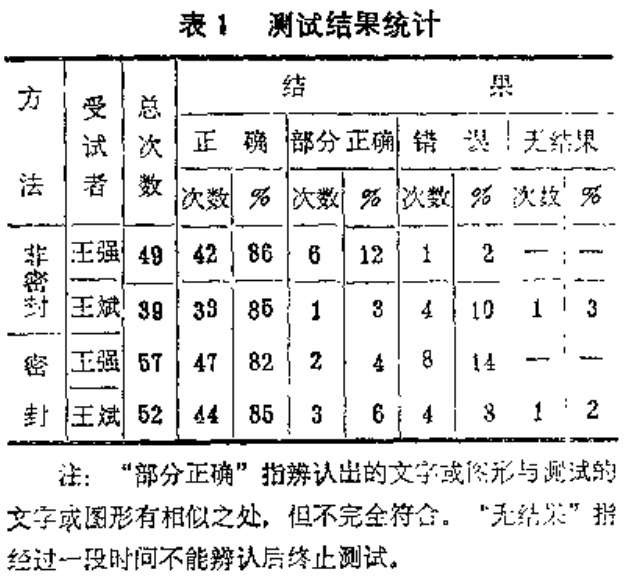
Note: “Partially correct” refers to cases where the identified character or graphic bears some resemblance to the tested character or graphic but is not a complete match. “No result” refers to cases where the test was terminated after a period of time without successful identification.
Whether in the non-sealed or sealed method tests, could such high identification accuracy be achieved through guessing? From a probabilistic analysis, the possibility is very small, and the probability of guessing correctly multiple times in succession is even smaller. We conducted control tests on two girls of the same ages as Wang Qiang and Wang Bin respectively. We asked them to randomly select paper sleeves and guess each one. The result: the 13-year-old girl got all 50 wrong, and the 11-year-old girl guessed 2 out of 50 correctly.
From the testing circumstances, the subjects’ mental state is closely related to the test results. When in an unfamiliar environment with many observers, the induction time tends to be prolonged and errors are more frequent during the initial period. On the fourth experimental day, over a dozen observers sat in a circle around the subject, making the subject tense and constrained in her actions. Wang Bin’s induction times for the first and second tests were as long as 19 minutes 34 seconds and 23 minutes 24 seconds respectively, and both were completely wrong. From the third test onward, the induction time shortened and accuracy improved. In the later stage of testing, from the eleventh to the sixteenth test, the induction time was reduced to tens of seconds—at the shortest, 6 seconds—and all were correct.
When the subjects were in a happy mood and mentally excited, the induction time was greatly reduced and accuracy was very high. On the morning of the thirteenth experimental day, because many unfamiliar observers were present, Wang Qiang was unwilling to proceed with the paper-sleeve sealed method —
-47-
II. Relationship between induction time and accuracy rate: Among the 93 paper-sleeve sealed method tests timed with a stopwatch, the induction time was within 1 minute in 71 cases, accounting for 76%. Of these 71 cases, 68 were correct, yielding an accuracy rate of 96%. There were 21 cases with induction times under 10 seconds, with the shortest being 2 seconds, and all were correct. Conversely, the one case each with induction times of 10–15 minutes and 15–20 minutes were both wrong. Of the 3 cases with induction times over 20 minutes, 2 were errors and 1 yielded no result. Thus it can be seen that, within a certain range, a shorter induction time corresponds to a higher accuracy rate.
III. Cases of consecutive accurate identifications: During the testing process, the subjects often consecutively and accurately identified the tested characters and graphics. Among the 109 paper-sleeve sealed method tests, 80 had a consecutive character. For example, there were 3 instances of correctly identifying 4 in succession; 2 instances of 7; and 1 instance each of 10 and 11; the maximum was consecutively and correctly identifying 14.
tests were only reluctantly conducted three times, of which the test of recognizing incorrect characters was entirely a fabrication—a kind of deception. According to her parents, Jiang Yan had suffered emotional distress in late April, causing her abilities to decline, and she had been unable to “recognize characters with her ears” for over two months. But after preliminary testing of the special sensory functions of Wang Qiang and Wang Bin, we conceived that it might be possible to induce Jiang Yan’s function through the testing activities of Wang Qiang and Wang Bin, helping her recover this once-diminished special sensory function.
On August 19, we brought Wang Qiang and Wang Bin to visit Jiang Yan. We first let them play together, then, under the observation of more than ten people from relevant units, we conducted tests on all three of them. Wang Qiang and Wang Bin began testing first; Jiang Yan said she could not do it and was not tested. After Wang Qiang and Wang Bin correctly recognized several characters and drawings, everyone encouraged Jiang Yan to try. The first test sample was the character “大” written with a red ballpoint pen. After 27 minutes, she said she could not recognize it, so the test was stopped. A few minutes later, everyone encouraged her to continue testing. She placed the paper wad against the inside of her right knee joint and held it there. After a few minutes she said: “I know, it’s red.” Then she said “there are three horizontal strokes.” At 10 minutes she said “it’s the red character 王,” which was correct. A third test was then conducted, and she correctly recognized the blue character “校.” In the fourth test, in less than one minute, she correctly recognized the red character “早.” The fifth and sixth tests used sealed paper sleeves; after 1 minute 10 seconds and 1 minute 45 seconds, she correctly recognized the blue characters “制” and “升.” From August 19 to October 14, testing was conducted over a total of eight experimental days. Out of 50 tests using the paper-sleeve sealing method, Jiang Yan’s correct recognition rate was 58%—lower than Wang Qiang’s and Wang Bin’s, with greater fluctuation and a higher rate of inconclusive results. This may reflect the incomplete recovery of her function, but she did indeed possess this special sensory function.
Based on the above preliminary investigations and tests, it can be concluded that these two female adolescents, during the testing period, possessed the ability to recognize characters and drawings using certain parts of the body such as the armpits and ears, without using their eyes.
Apart from the investigation of the Wang sisters, four comrades from Peking University—Chen Shouliang, Director of the Office of Natural Sciences; He Muyan, Lecturer in the Department of Biology (at the time); Wang Chu, Deputy Director and Associate Professor (at the time) of the Department of Electronics; and Zhu Quan—also conducted investigations and tests on Jiang Yan. According to reports, when they spoke about the relevant situation, they said:
After hearing the report about Tang Yu’s recognition of characters with his ears, Jiang Yan (age eight, a second-grade elementary school student) was also discovered by her parents to have the ability to recognize characters with her ears. The Beijing Science and Technology News of April 13, 1979, even published an introductory article about it. But by late April, rumors circulated that Jiang Yan could no longer recognize characters with her ears—
It has been reported in articles that Xie Yuyu and Wang Zhixiu, a married couple at the Affiliated Hospital of Hubei College of Traditional Chinese Medicine, and parents of Xie Zhaohui—
—48—
mother. As medical workers, their professional sensitivity prompted them to conduct a prolonged and deliberate observation of Xie Zhaohui. They said:
By chance, we discovered that our boy Xie Zhaohui’s ears possess a special ability to recognize characters, distinguish images, and discern colors. We have conducted four months and eleven days of actual observation of this peculiar phenomenon, keeping detailed daily records. This has attracted attention from numerous news organizations, research institutions, and educational units in the Wuhan area. To date, journalists and staff from the Xinhua News Agency Hubei Branch, the Guangming Daily Hubei Correspondent Station, the Hubei Daily, the Hubei Provincial Science and Technology Commission, the Hubei Provincial Health Bureau, the Hubei Academy of Medical Sciences, the Hubei Provincial Publishing Bureau, the Wuhan Municipal Health Bureau, the Chinese Medical Association Wuhan Branch and its Otolaryngology Group, the Wuhan Institute of Physics of the Chinese Academy of Sciences, Wuhan University, Wuhan Medical College, Hubei Medical College, Hubei College of Traditional Chinese Medicine, as well as the leadership and scientific and technical personnel of our own hospital have all personally witnessed the genuine circumstances of the child using his ear to recognize characters, distinguish images, and discern colors.
The child is currently ten and a half years old, a fourth-grade primary school student. Like any ordinary boy, he is eager to learn, inquisitive, and playful, with nothing particularly unusual about him, and his academic performance is above average. When the newspaper published reports about a child in Sichuan who could recognize characters with his ear, it gave us the idea of trying it with our own child. In mid-April, we began experiments on Xie Zhaohui’s ear. At first he was unwilling—when we stuffed a paper ball with characters written on it into his outer ear, he would immediately take it out and throw it on the ground, saying repeatedly, “Can’t recognize it, can’t recognize it.” Sometimes when he was in a good mood, he was willing to give it a try, and gradually we found that he could recognize some character radicals or characters with similar forms—for instance, recognizing “谢” as “射,” or “小” as “水.” On the evening of April 26, we asked him to identify twenty or thirty characters and images. As a result, he recognized a drawing of ”◯” and the character “大.” From this point on, we became convinced that the child’s ear could recognize characters and distinguish images. To improve accuracy, we adopted a method of encouragement and rewards, and the child was very happy about it. As a result, in just over an hour, he correctly identified in succession seven characters and images: “口、☆、柒、8、主、太、华.” From then on, every day we wrote characters or drew images for him to recognize. As of September 7, over the course of more than four months, we conducted a total of 748 tests. The total number of characters and images he identified using his ear was 4,796, of which 3,914 were completely correct, achieving an accuracy rate of 81.6%.
The method we used was as follows: on a piece of paper about one square inch in size (occasionally using cloth or plastic film), we would write or draw characters or images behind his back, crumple the paper into a ball or fold it into a small piece about the size of a fingernail, insert it into the opening of the child’s external auditory canal, and provide him with paper and pen. Within a short while, he could accurately write or draw out the character or image that had been on the paper ball placed in his ear.
The child’s ear-based ability to recognize characters, images, and colors generally went through three stages:
(I) Stage of recognizing one image at a time. From April 26 to June 17, each time we only wrote a single character or drew a simple image, such as “民, 农, 战” (people, agriculture, war), ”△, ☆,” and the like, though occasionally we wrote two or three characters at once. During this stage, the accuracy of recognizing images by ear was relatively low.
(II) Stage of recognizing multiple images at once. Starting from June 18, each time we would write anywhere from a few characters up to more than thirty characters for him to identify, or have him recognize relatively complex patterns, such as Renminbi currency, postage stamps, movie tickets, and the like. Sometimes, when we were afraid the characters would be too difficult to write out, we simply cut a section from a printed document for him to identify. On the first day of this stage, we copied a Tang dynasty poem: “Leaving home young, returning old; the local accent unchanged, though hair grown thin; children meet but know me not—smiling, they ask, ‘Where do you come from, sir?‘” Each line, seven characters, was recognized one at a time. The child’s ear-based recognition result was: “Leaving home young, returning young (old); local accent (unchanged), guest (hair grown thin); children meet but know me not—smiling, they ask, ‘From where do you come, sir?‘” Out of 28 characters, 2 were wrong and 3 were omitted—a significant improvement. On the 21st, we copied another Tang poem: “Before the bed, bright moonlight; could it be frost upon the ground? I raise my head to gaze at the bright moon; I lower my head and think of home.” Twenty characters recognized all at once. After about half an hour, the child finally identified them using his ear and wrote out: “Before the bed (bed), bright moonlight; could (it be) frost upon the ground; I raise my head to gaze at the bright moon; I lower my head and think of home.” This showed further improvement compared with before. On July 10, we copied two heptasyllabic poems from the newspaper, recognizing one poem at a time with the ear. In only 15 minutes, he had written them all out. Apart from omitting one character, everything else was correct—again, seven characters per line, arranged in eight lines.
(III) After having gone through the previous two stages, we…
-49-
we raised our requirements for the child further: in addition to recognizing characters and the images that first appeared, he also needed to identify colors, whether they were printed or handwritten, what kind of writing instrument was used, and so on. This is what we now asked of the child every day. For example, on July 9, we cut a 4-fen postage stamp from an envelope bearing an image of the Capital Gymnasium for him to recognize with his ear. In less than five minutes, the child drew the image on paper, explaining as he drew: this is a 4-fen stamp affixed to paper; the stamp is greenish-yellow; in the middle there is a department store, drawn in white, and so forth. One day we bought a movie ticket, crumpled it into a paper ball, and said to the child: this is a movie ticket—if you recognize it correctly, you can go see it; if not, you can’t. The child stuffed the paper ball into his ear and, after a brief moment of thought, told us: the ticket is for the District Committee Auditorium, second class, Row 5, Seat 9, tonight at seven o’clock sharp. We went to see the movie according to the result of his recognition, and it was exactly right.
In addition, we conducted indoor versus outdoor and bright versus dark environmental comparisons; we used various materials for writing and drawing, including different kinds of paper, cloth, plastic film, and audio cassette tape, for comparative observation; we tested character and image sizes ranging from as small as a sesame seed to as large as a chestnut. We also carried out other types of observation: for instance, wrapping the paper ball in another layer of paper, or in a layer of gauze, a layer of plastic film, or a layer of cigarette tin foil; placing paper around the plastic film or audio cassette tape on which characters were written; and so on. The child’s ear was able to accurately recognize the images in all cases.
The above constitutes our preliminary observations of Xie Zhaohui’s ability to recognize characters, images, and colors with his ear. We are firmly convinced that this is completely genuine. Regarding this new and highly worthwhile subject of research—the recognition of characters, images, and colors with the ear—we hope that the relevant authorities will give it due attention, rather than simply dismissing it as “absurd” and “nonsense.”
Comrades Xu Zifang, Xia Jikui, Hua Zhaohe, Hu Zenggao, and Zhang Lihong of Anhui Normal University formed an “Investigation Group on the Function of Ear Recognition of Characters and Colors.” With the strong support of the Wuhu Regional Science and Technology Commission, the Xuancheng County Science and Technology Commission, and the Hanshan County Science and Technology Commission, they selected Huang Hongwu (male, 12 years old) as the primary subject of investigation, and Hu Lian (female, 12 years old) and He Xiaoqin (female, 12 years old) among others as verification subjects. Beginning on April 23, 1979, and continuing through August 25, over a period of more than four months totaling 201 sessions—
-50-
…experiments, and produced an Investigation Report on the Function of Ear Recognition of Characters and Colors, drawing four overall conclusions:
- Ear recognition of characters and colors is an objectively existing fact. (See Table 1 and Table 2)
Table 1: Partial Test Results
| Date | Test Conditions | Test Sample | Recognition Result | Recognition Time |
|---|---|---|---|---|
| April 25 | Sample randomly folded, hand covering ear | Shida [Normal University] (red pen) | Completely correct | 0’45” |
| May 9 | Sample rolled into a ball, hand covering ear | Bioelectricity (brush pen) | Completely correct | 4’18” |
| May 15 | Plastic tracing paper, wrapped in white paper, hand covering ear | Fresh Orange Candy No. 232 (black characters) | Completely correct | 3’ 19” |
| May 15 | Sample folded and rolled tightly in lead sheet, hand covering ear | Growth Hormone (blue pen) | Completely correct | 7’ 95” |
| May 15 | Sample randomly folded, hand covering ear | Ke Biao Guo (blue pen) | Completely correct | 2’ 24” |
| May 20 | Sample randomly folded, not covering ear | Inorganic (red pen) | Completely correct | 4’ 53” |
| June 30 | Sample folded using envelope folding method, finger | Bu Ke Dang (blue pen) | Completely correct | 89,9 |
| July 12 | Sample randomly folded, hand covering ear | (Blue pen drawing) | Completely correct | 5’ 14” |
| July 17 | Sample rolled up, loosely wrapped several times with cotton thread and tied into a dead knot | Hao Hao Xuexi [Study Hard] (blue pen) | Completely correct | 2’ |
| July 28 | Sample rolled into a ball, wrapped in aluminum foil paper | Nerve (blue pen) | Completely correct | 3’ 25” |
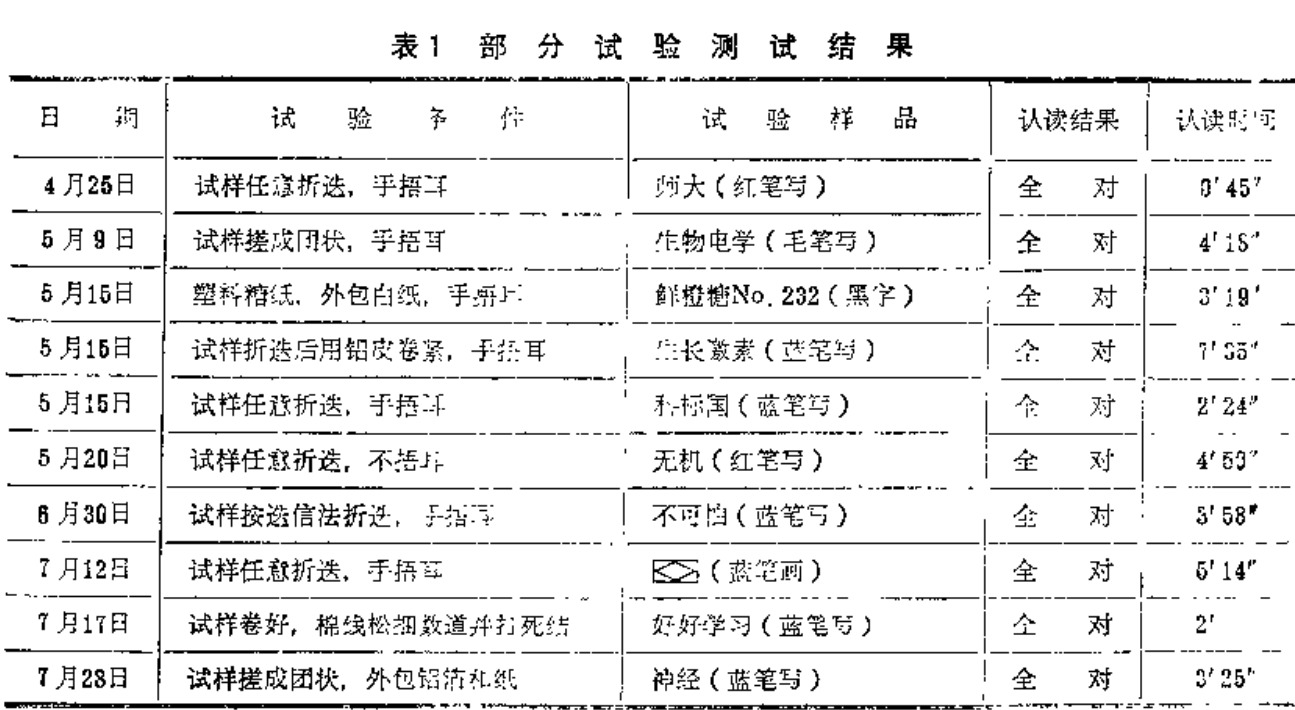
The above experiments totaled 129 times, including 15 times for verification subjects. Currently, the statistical results of the 114 tests on the main subjects are shown in Table 2.
Table 2: Statistics of Non-Sealed Method Test Results for Main Subjects
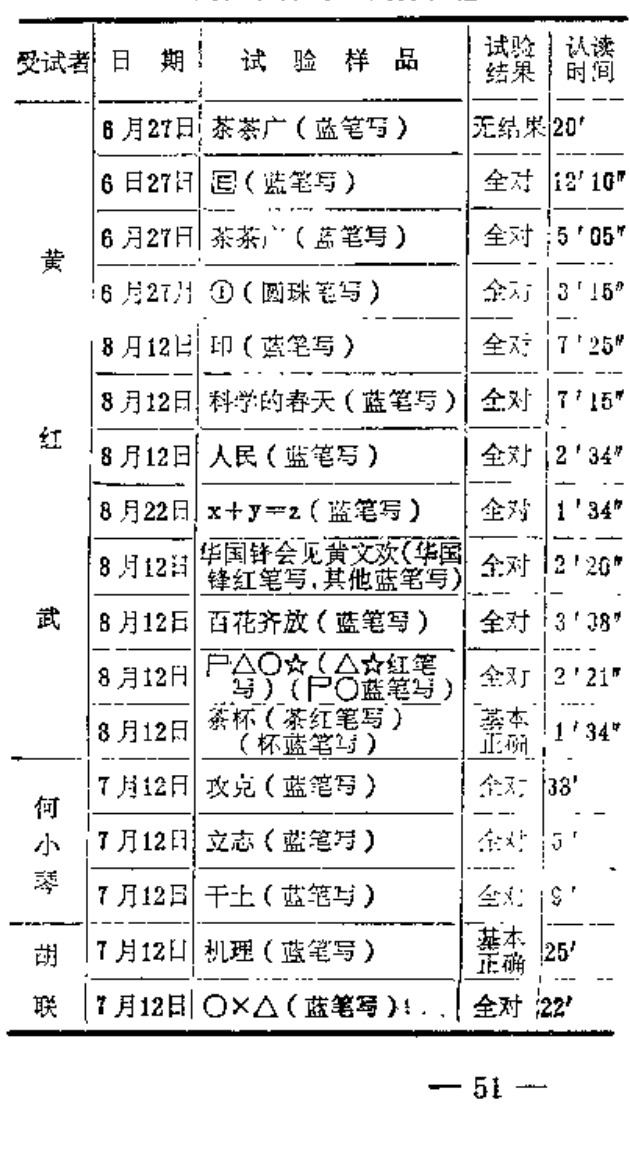
| Number of Tests | Completely Correct | Basically Correct | Error | No Result |
|---|---|---|---|---|
| 114 | Count: 104, %: 91% | Count: 8, %: 7% | Count: 2, %: 2% |
Table 3: The “Activation” Process Required for Ear Recognition of Characters and Colors (The test condition for all experiments was randomly folded samples)
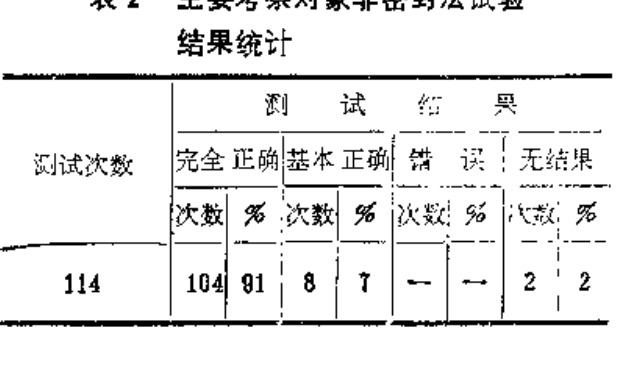
| Subject | Date | Test Sample | Result | Recognition Time |
|---|---|---|---|---|
| Huang | June 27 | Cha Cha Guang (blue pen) | No result | 20’ |
| Huang | June 27 | Hui (blue pen) | Completely correct | 12’ 10” |
| Huang | June 27 | Cha Cha Guang (blue pen) | Completely correct | 5’ 05” |
| Huang | June 27 | ① (ballpoint pen) | Completely correct | 3’ 15” |
| He Xiaoqin | August 12 | Yin (blue pen) | Completely correct | 7’ 25” |
| He Xiaoqin | August 12 | Kexue de Chuntian [Spring of Science] (blue pen) | Completely correct | 7’ 15” |
| He Xiaoqin | August 12 | Renmin [The People] (blue pen) | Completely correct | 2’ 34” |
| He Xiaoqin | August 22 | x+y=z (blue pen) | 1’ 34” | |
| He Xiaoqin | August 12 | Hua Guofeng meets Hoang Van Hoan (Hua Guofeng in red pen, others in blue pen) | Completely correct | 2’ 20” |
| He Xiaoqin | August 12 | Baihua Qifang [Let a Hundred Flowers Bloom] (blue pen) | Completely correct | 3’ 38” |
| He Xiaoqin | August 12 | Hu △ 〇 ☆ (△☆ red pen) (P 〇 blue pen) | Completely correct | 2’ 21” |
| He Xiaoqin | August 12 | Chabei [Teacup] (Cha in red pen) (Bei in blue pen) | Basically correct | 1’ 34” |
| Hu Lianping | July 12 | Gongke [Conquer] (blue pen) | Completely correct | 3’ 8” |
| Hu Lianping | July 12 | Lizhi [Aspire] (blue pen) | Completely correct | 5’ |
| Hu Lianping | July 12 | Gan Shang (blue pen) | Completely correct | [illegible] |
| Hu Lianping | July 12 | Jili [Mechanism] (blue pen) | 25’ | |
| Hu Lianping | July 12 | ○×△ (blue pen) | Completely correct | 22’ |
-
Ear recognition of characters requires two types of light sources to act simultaneously on the eyes and ears. The one acting on the eyes is visible light, and the one acting on the ears is another type of light (covering the ear with a hand does not affect its existence).
-
The function of ear recognition of characters and colors requires activation. (See Table 3)
-
The health status, mood, and attention of the tested person, as well as the intensity of the “light” irradiating the sample, affect the recognition function.
In their concluding remarks, they stated:
- 19 -
We affirm the function of recognizing characters and distinguishing colors with the ears.
- In terms of epistemology: In the past, people primarily perceived the world through the eyes, and most concepts were built upon the intuitive basis of geometric imaging. Now that we can recognize and read curved and folded character shapes, how should our concepts adapt to this new situation? This will surely provoke responses in psychology, philosophy, and other fields.
To sum up, we believe that the function of recognizing characters and distinguishing colors with the ears is a newly affirmed phenomenon obtained through serious investigation. Many of its mechanisms remain unclear at present and await in-depth and meticulous research from all fields. As research deepens, we firmly believe that the function of recognizing characters and distinguishing colors with the ears will eventually receive a proper explanation.
We have confirmed the function of recognizing characters and distinguishing colors with the ears, and have tentatively identified some patterns and conditions, which may be of help to future research work. Studying it is not intended to replace the eyes with the ears for seeing things (there is no such necessity), but rather because through research, appropriate contributions will be made to the development of philosophy, physiology, bionics, biophysics, medicine, traditional Chinese medicine meridian theory, and other fields. Of course, it is still too early to fully assess the profound significance of the ear’s ability to recognize characters and distinguish colors, but the following aspects of its potential impact are broadly possible:
-
In physiology: Studying how the ear’s function of recognizing characters and distinguishing colors operates physiologically may lead to major discoveries.
-
In biophysics: Binocular vision perceives three-dimensional spatial images, while cameras and monocular vision perceive two-dimensional spatial planar images. To convert planar images into one-dimensional spatial information, information processing must occur. The physical method of processing is scanning (as in a television set). In physiology, this is handled through ganglia. But all of these are limited to planar images (the image on the retina is planar), so scanning naturally proceeds easily. However, the test samples for ear recognition of characters and colors are all rolled, folded, twisted, and creased. How to perform curved “scanning” and receive information point by point is a problem that physics, physiology, and mathematics should solve. The ear’s function of recognizing characters and distinguishing colors can promote research in this area.
-
In bionics: If the principle of receiving information through curved “scanning” in the ear’s character-recognition and color-distinguishing function can be understood, it will surely find applications in bionics. Or in the field of engineering and technology, it may bring radar, television, and similar technologies into an entirely new domain.
-
For traditional Chinese medicine meridian theory: The mechanism of Chinese medicine meridians has not yet been resolved to this day, and the effect of recognizing characters and distinguishing colors with the ear resembles the sensation of “obtaining qi” (deqi) in acupuncture. Whether there is some kind of connection between the information transmission involved in the human body’s (not just the ear’s) recognition of characters and colors and the meridian mechanism—perhaps through research on information transmission in the ear’s character-recognition function, the problem of the meridian mechanism that has remained unsolved for thousands of years may ultimately be resolved. At the very least, it can provide another avenue for studying the meridian mechanism.
During the investigation, some people also raised challenges regarding “extraordinary human abilities” and reached negative conclusions. On April 24, 1982, China Youth Daily published an investigation report by Song Zhencai, Deputy Director of the Special Examination Department of the Second Affiliated Hospital of Guiyang College of Traditional Chinese Medicine, and Lu Jiang, Deputy Director of the Guiyang Municipal Health Education Institute, titled “An Investigation Record of the Father and Son Dong Wenbao’s ‘Thought Transmission.‘” The article states:
In February 1980, the two of us, together with Zhang Shaohua, Deputy Editor-in-Chief of Guizhou Science and Technology News, and editor Lin Wanwen, conducted an investigation into the “thought transmission” extraordinary ability of Dong Wenbao, a cadre of the Huishui County Science and Technology Commission in Guizhou Province, and his son. Dong Wenbao had explained to us beforehand that his son Dong Changjiang’s extraordinary ability was specifically manifested as follows: ① He could write out numbers 0–9 that his father was thinking of; ② He could write out the twenty-six English letters that his father was thinking of; ③ He could write out some equations that his father was thinking of; ④ He could solve a type of “recursive” arithmetic problem; ⑤ He could recognize over three hundred characters.
Our investigation lasted two days. On the first day, at the County Science and Technology Commission office, the contents of the investigation were:
-
First, the Dong father and son were asked to demonstrate. The father pressed his right hand on his son’s right shoulder and performed demonstrations of writing numbers, equations, and English letters, which were basically correct. However, the ”−” sign in the equations was written as “2,” and all capital English letters were written in lowercase.
-
After the demonstration ended, we proposed several testing methods:
① Papers of different colors were separately cut into various animal patterns, and the father was asked to transmit the information to his son, pointing—
—52—
take out a specified pattern. His father replied: “Cannot do it.” ② We then proposed placing different colored papers in front of Dong Changjiang and asking his father to transmit information so the child could take out a specified color of paper. His father said, “We have not trained for that.” ③ We cut the colored papers separately into Arabic numerals from 1 to 10, placed them in front of the child, and asked his father to transmit information so the child could take out a specified numeral. His father replied: “Cannot do it.”
From the first day of investigation, we discovered:
① While Dong Changjiang was writing, his father’s hand was moving, and the direction was completely consistent with the direction of the child’s strokes. It was just that these movements were very small and not easily noticeable. ② Before the child wrote, his father would often issue prompting signals such as “Let’s write,” “Let’s start,” or “Let’s calculate.” ③ His father frequently grabbed the child’s hand, placed it at the point where the brush should start, and then ordered him to begin. ④ When the child wrote incorrectly, his father would hurriedly erase the mistake on his behalf and order him to rewrite it. This situation accounted for roughly twenty to thirty percent of cases. ⑤ When the child could not continue writing, he would turn his head and stare at his father with an inquiring gaze.
Based on the results of the first day’s investigation, we concluded that so-called “thought transmission” did not exist and that it was likely a trained series of mechanical actions. To this end, we designed three testing methods. They were: 1. The Blocking Method; 2. The Termination Method; 3. The Substitution Method.
The second investigation took place the following morning at the Dong Wenbao household. The testing procedure was as follows:
① Blocking experiment: Zhang Shaohua placed his hand on Dong Changjiang’s right shoulder, and Dong Wenbao was asked to place his hand on Zhang’s hand. The result of the performance was that the numerals were basically written correctly, but the equations were inverted and jumbled. Consequently, the Dong family erupted in cheers, considering it a success. However, we believed that this experiment exposed a flaw: traces of a certain continuous signal were left in the written numerals, such as “5” written as “3−,” and “9” becoming “01.”
② Termination experiment. Song Zhencai placed his hand on Dong Changjiang’s right shoulder, and Dong’s father then placed his right hand on Song’s hand to direct the writing of numerals. When Dong’s father was directing his son to write halfway through a “8,” Song suddenly lifted his hand (and Dong’s father’s hand naturally left Dong’s shoulder as well). At that moment, Dong could not help but quickly turn his head, gazing at his father with an inquiring look, and the hand that had been writing also abruptly stopped, turning the “8” into a “δ.” We believed that if the father and son truly possessed the extraordinary ability of image transmission, then starting from the impression, the child could have continued to write “8”; why did the child’s hand immediately stop writing the moment the hand on his shoulder was removed? This could only mean that when the child was writing, his attention was entirely concentrated on the point of contact between his right shoulder and his father’s hand. He was tracing along with the mechanical movement of the hand. When the movement stopped, the writing lost control and therefore immediately ceased.
③ Substitution experiment. The specific procedure was: Dong’s father would issue the prompt signal “Let’s begin,” and Lu Jiang would actively substitute in his place.
Regarding the phenomenon of extraordinary human abilities, if one continued to be satisfied with adopting ordinary methods of investigation, it would be impossible to ultimately resolve the problem. Neither a scientific conclusion could be reached, nor could one convince others through reasoning. Whether affirming it as “genuine” or denouncing it as “fake,” both views lacked strong supporting evidence. Under these circumstances, beginning in early 1980, research into extraordinary human abilities across various regions shifted its focus from verifying the authenticity of such functions to conducting planned and purposeful observational studies and multi-item experiments, in order to explore their inner essence. Many institutions began employing modern scientific instruments for detection experiments. At the time, institutions carrying out this research work included Peking University, Beijing Teachers College, Wuhan University, Lanzhou University, Hangzhou University, Anhui Normal University, Jilin Normal University, Jiamusi Medical College, and more than ten other universities. Most of them established dedicated research groups and incorporated the topics into formal research plans. Among them were many renowned professors and associate professors in the fields of physics, biology, physiology, psychology, medicine, traditional Chinese medicine, education, and other disciplines. The research group at the Institute of High Energy Physics, Chinese Academy of Sciences, had Xu Jianming as its head and Zhao Zhongyao as advisor, including a number of well-known scientists. A number of provincial and municipal-level research organizations also emerged as a result. The Beijing municipal research group included relevant scientific researchers from more than twenty units, including the Institute of Physics, the Institute of Biophysics, the Institute of High Energy Physics, and the Institute of Psychology of the Chinese Academy of Sciences. Shanghai established a Society for Research on Extraordinary Human Abilities. Jilin Province established a research collaboration group, with Long Wenyu, Secretary-General of the Jilin Provincial People’s Government, as advisor.
-53-
investigation, Jilin Normal University, Norman Bethune University of Medical Sciences, Changchun
The author made a preliminary hypothesis that the child’s ears possessed the function of emitting microwaves, and that the Shenmen acupoint on the Heart Meridian of the hand had the possibility of receiving microwaves. And the integration of these two capabilities might exceed the performance of existing military radar by more than ten million times.
Through preliminary research on image recognition by non-visual organs, I believe that the theory and practice of modern medicine are still quite incomplete, and they cannot explain this particular physiological phenomenon of the human body. Moreover, the mysteries of the human body itself are still far from being understood by humanity. Research into this special physiological phenomenon will have broad and far-reaching impacts not only on medicine, but also on the semiconductor industry, military, and other sciences.
After this article was published, it generated considerable repercussions. Wen Dianzhong of Heilongjiang University wrote a letter to Nature Magazine on December 15, 1979, confirming (with appended experimental data and comparative diagrams):
The human body does indeed possess the volt-ampere characteristic curves of certain semiconductor diodes. Their experimental results and the conclusions drawn from them are consistent with the conclusions we reached through theoretical calculations comparing the electrical characteristics of squid nerve cells with those of crystal diodes. Therefore, we believe that their extensive work can demonstrate that the human body does indeed possess the volt-ampere characteristic curves of semiconductor diodes.
Luo Dongsu of the Fourth Research Institute of the Air Force, driven by curiosity and skepticism, began conducting in-depth testing and research on some people in the Beijing area who were said to possess extraordinary abilities starting from April 20, 1979. Through repeated experiments, he concluded: “It can be stated with certainty that individuals with extraordinary abilities do indeed possess the special function of recognizing images using their hands, armpits, and ears.” He published a paper titled “An Exploration of Image Recognition by Non-Visual Organs and the Human Body’s Electromagnetic Perception Mechanism” in the tenth issue of Nature Magazine in 1979, presenting his detection results obtained through various advanced scientific research instruments. The paper stated:
In recent years, using meridian acupoint characteristic graphic recorders, we measured 10,894 volt-ampere characteristic curves from different body acupoints on 423 individuals. It can be seen that the human body does indeed possess the volt-ampere characteristic curves of certain semiconductor diodes. Among these: (1) Tunnel-type diodes are components specifically used in radar for receiving microwave and sub-millimeter wave signals. (2) Body-effect diodes are used as low-to-medium power solid-state microwave oscillators or as Doppler radar transmitter tubes, possessing the function of emitting microwave signals. This indicates that the human body may also possess the functions of emitting and receiving microwaves. We also measured 4,717 volt-ampere characteristic curves from 17 acupoints on the ears of 356 individuals. The results show that the human body also possesses the ability to perceive radio waves as special signals. From the measurement results, it can be seen that as many as 66.65% of people exhibit the body-effect type on their ears. The functional-type curves are a collective term for a group of volt-ampere characteristic curves with complex patterns. They are circuit products designed with a special combination of components such as resistors, capacitors, diodes, and transistors to accomplish a particular special function. And on the acupoints of the human ear, their occurrence rate reaches an astonishing 26.41%!
What subjective sensations do children and adolescents with the extraordinary ability of “ear recognition of characters” experience during testing — this is indeed a fascinating question. Wang Chu, He Muyan, Chen Shouliang, Zheng Lemin, Shao Shaoyuan, Zhang Zuqi, Liu Zhaoqian, Luo Lin’er, Wu Baogang, and others at Peking University also conducted in-depth research and exploration in this area. They had more than a dozen children and adolescents with extraordinary abilities independently describe their subjective sensations during the process of recognizing characters or images, and on this basis synthesized their findings, reaching a consensus on the display process of non-visual image recognition by individuals with extraordinary abilities. Their survey results were:
The test subjects unanimously reported that during testing, regardless of whether the non-sealed method, paper-sleeve sealed method, or cloth-sleeve method was used —
-54-
method, after receiving the test sample (unsealed or sealed text, diagrams, or graphics), the subject subjectively feels that a color image gradually appears in their mind. The image goes from blurry and unstable to clear and stable, and this clear, stable image is often a correct reflection of the sample.
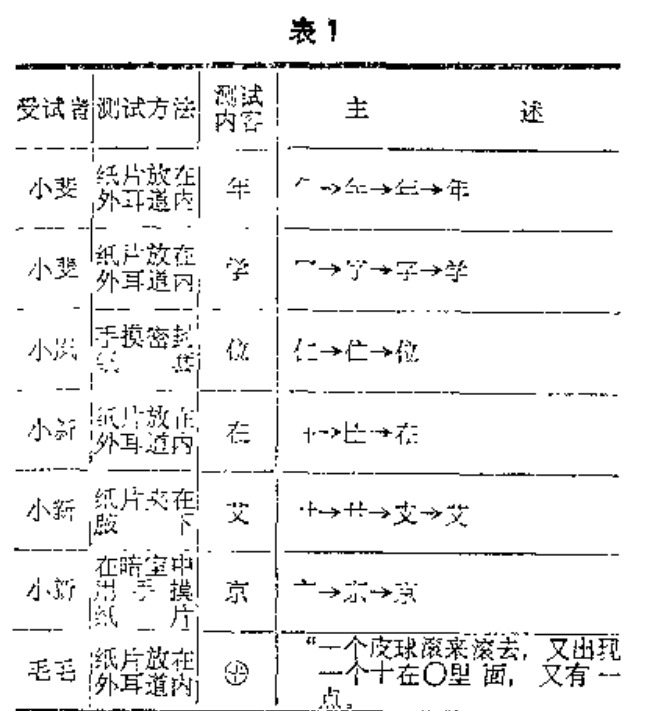
The process by which the clear, stable image appears is roughly as follows:
After receiving the test sample, a disordered image of “speckles and dots” or “horizontal and vertical lines” appears in the subject’s mind. After a further period of time, most subjects feel a large bright point appear in their mind, while some subjects feel several small bright points appear.
After the bright point(s) appear, if the sample is a color image, the background color of the image appears very quickly; if the sample is text on white paper, the color of the writing appears.
Thereafter, a blurry image gradually appears. This blurry image constantly flickers, and part by part it becomes a clear image. When the image is relatively clear and flickers little or not at all, the subject regards it as the image of the sample.
Table 1
| Subject | Testing Method | Subjective Description |
|---|---|---|
| Xiao Fei | Paper slip placed in the external ear canal | — |
| Xiao Fei | Paper slip placed in the external ear canal | — |
| Xiao Xiao | Paper slip placed in the external ear canal | — |
| Xiao Xiao | Paper slip placed in the external ear canal | — |
| Xiao Xiao | Hand touching sealed [paper] in a dark room | — |
| Xiao Xiao | Hand touching in a dark room | — |
| Mao Mao | Paper slip placed in the external ear canal | A leather ball rolling back and forth; a “ten” (十) character appearing inside a “zero” (〇) |
| Xiao Lan | Holding paper slip in hand within a cloth sleeve | — |
| Xiao Xin | Holding paper slip in hand within a black plastic box; red [image appeared] | — |
| Xiao Xin | [Paper slip] placed beside the ear | — |
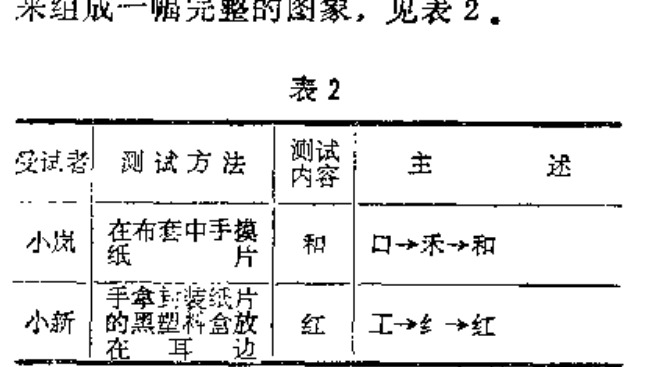
We also surveyed some children who have not yet manifested this special ability, asking them what they felt after receiving a test sample. Some said: “There is nothing in my mind.” Others said: “My mind is very messy, various colors appear, there are no bright points and no clear shapes.”
From the descriptions of the children and adolescents who possess this special perceptual ability, their recognition process resembles a process of “extracting a weak signal from a noisy background.” To record this process, we asked the subjects to state aloud or write (draw) at any time during the test the text or images that appeared in their minds.
In most cases, the image appears part by part, ultimately forming a complete image. When the test content is text, the order in which the parts appear is often unrelated to the order of strokes, as shown in Table 1.
All the above cases first display partial images, gradually increasing until a complete image appears. But sometimes a part of the image is first displayed, and then that part disappears, then another part is displayed, and finally all parts appear simultaneously to form a complete image. See Table 2.
Table 2
We also investigated some children who have not yet manifested this special ability…
There are also some records showing that during the recognition process, the shapes, relative sizes, and relative positions of each part of the image are not fixed but rather change. See Table 3.
In the fifth example of Table 3, Xiao En quickly perceived the graphics of each part of the test, but it was only after more than twenty minutes that he felt the upper and lower parts of the image merged into a complete “apple.” Additionally, other records also show that the process from perceiving the graphics of each part to composing a complete image involves a highly complex process, and sometimes a stable or correct image cannot be formed. For example, Mao Mao, with the black plastic box holding the paper slip clamped in his knee hollow, felt “a ‘ten’ (十) character, a large ‘mouth’ (口) character, the ‘ten’ character bouncing back and forth, not knowing whether inside or outside.” It turned out the paper slip inside the black plastic box had the character “Jia” (甲) written on it, which he could not recognize. In Xiao Nan’s ear…
-55-
Table 3
| Subject | Testing Method | Testing Content | Subject’s Description |
|---|---|---|---|
| Paper strip placed in external ear canal | △→A | ”A triangle. A horizontal line moved up again.” | |
| Xiao Xin | Paper strip placed in external ear canal | Dot | |
| Xiao Xin | Hand touching black plastic box containing sealed paper strips | 8 ××→×→△→α→②→ | |
| Xiao Jing | Paper strip placed in external ear canal | Stone O→Q→⑥→→Stone | |
| Xiao En | Paper strip placed in external ear canal | →→○→(“apple”) | |
| A paper strip drawn with ”:” was placed; he felt “a leather ball rolling back and forth in the mind,” unable to form a stable image. |
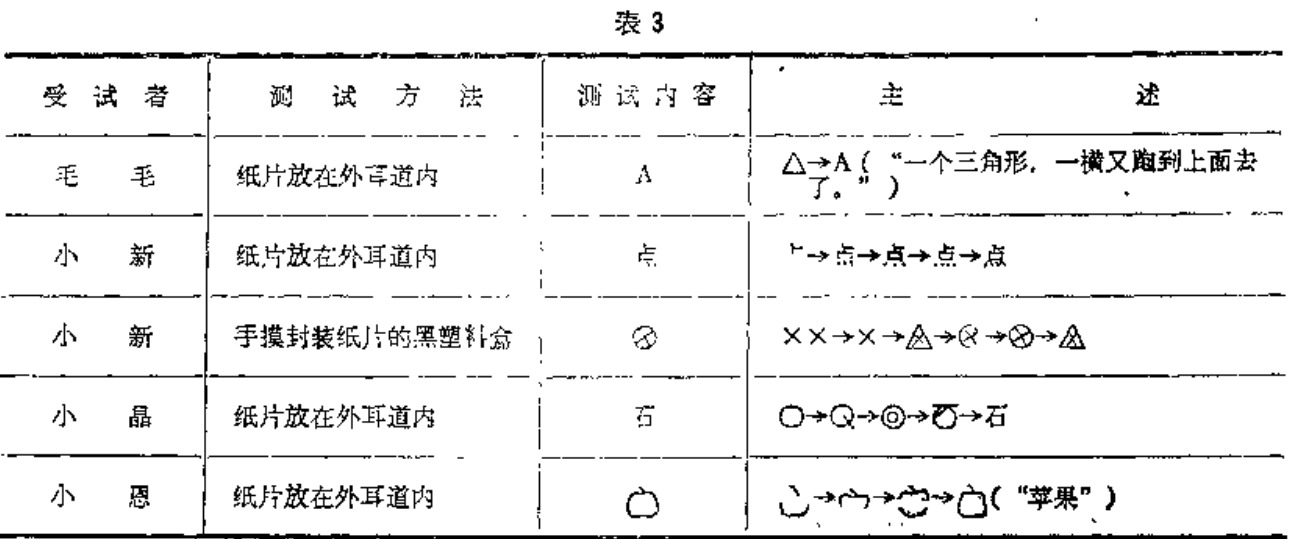
The following measures were taken:
(1) A sealed double-blind method was adopted to exclude the possibility of thought transmission.
(2) Sealed, unmarked magnet testing was used to exclude the possibility of identification through “X-ray vision.”
(3) Demagnetized and polarity-reversed magnet testing was used to further confirm the correlation between “light emission” and magnet polarity.
(4) Remote testing, testing through walls and barriers, and testing from behind were used to further explore the characteristics of this ability.
If the experiments on the manifestation process of non-visual image recognition in humans represented only a superficial understanding of “extraordinary abilities” by researchers, then a greater number of scientists turned to modern advanced detection methods and instruments to conduct multiple tests on individuals with extraordinary abilities.
Scientific workers including Xu Hongzhang of the Institute of High Energy Physics, Chinese Academy of Sciences; Li Yingbo of the Institute of Acoustics, Chinese Academy of Sciences; and Lin Shuhuang of Beijing Normal University, jointly conducted experiments on the ability of extraordinary children to perceive “light emission” from magnet poles.
“Magnet pole light emission,” in the view of most people, was impossible. However, children with extraordinary abilities Wei Ruoyang (male, age 12) and Zhang Nan (female, age 6) both said they could see magnet poles “emitting light.” On the afternoon of August 5, 1980, Wei Ruoyang, while viewing a bar magnet in the Visual Laboratory of the Physics Department at Beijing Teachers’ College, said: the center of the N pole of the bar magnet emitted a beam of intermittent red light moving along the axial direction of the magnet, as fine as a strand of hair. The S pole did not emit light. On the afternoon of August 11, 1980, when Zhang Nan was tested, she also said she saw the N pole of the bar magnet emitting red light and the S pole emitting blue light. For this reason, researchers decided to subject these two extraordinary children to rigorous testing — based on the differing “light emission” conditions of the north and south poles as observed, they would distinguish the north and south poles of the magnet, thereby verifying the objectivity of their descriptions.
To ensure the rigor of the experiments, researchers adopted the following measures:
In April 1980, Comrade Wang Guanyou of the Cangxian County Science and Technology Commission in Hebei Province reported that Yu Ruihua (female, age 16) could use her hand, lower lip, and other body parts to attract pins, attracting the attention of many scientific workers. Fang Xiaowu, Tian Jingfa, Liu Yicheng, Qin Rongxian, Jiang Nanfeng, and Tan Dajun of the Institute of Physics, Chinese Academy of Sciences, together with Shen Xianjia and Liu Huiyan of Beijing Teachers’ College, specifically conducted detection experiments on Yu Ruihua’s “human body magnetic field.” The following is a record of their experiments:
On June 6, 1980, Yu Ruihua went to Laboratory 13 of the Institute of Physics, Chinese Academy of Sciences, to undergo “human body magnetic field” detection experiments. The main experimental content was testing the “magnetic strength” on her hand and mouth using a magnetometer. The Oersted meter used in this experiment had an accuracy of 1 gamma = 1×10⁻⁵ Oe and a measurable range of 1–10⁵ gamma. The measurement results could be read from the meter’s needle pointer or recorded as a variation curve using a chart recorder.
After lunch, Xiao Yu arrived at the laboratory and sat at an office desk.
—56—
On the afternoon of July 8, 1980, Yu Ruihua came to the Form Laboratory of the Physics Department at Beijing Teachers’ College. Seven small compasses with glass and metal covers were placed on the experiment rack. We asked her to slowly move her right palm back and forth over the compasses to see what effect it would have. At first, there was no effect; she said the magnetism had not yet arrived. Then, she repeatedly tested her magnetism using a few large needles. After a little while, she said the magnetism had arrived. We looked: at the table, she tried to use her hand to attract the large needles, and in a short while, she had attracted several large needles. She said, “I feel my hand is a bit tight; let’s conduct the experiment now.”
We immediately had her move her palm back and forth (at a distance of about 2 cm) over the seven small compasses. All seven small compasses swung along with her hand. It should be emphasized: this kind of compass rotation is not flexible, and because of the covers, it is fundamentally impossible for an ordinary person to make them swing with their hand the way Yu Ruihua did. The people present at the time conducted comparative experiments; individuals without extraordinary human abilities could not make the needles swing.
We brought her to the Oersted meter and asked her to place her hand in front of the probe. The instrument’s needle swung, and everyone was amazed; Xiao Yu was also delighted. At this point, she felt sweat on her hands, washed them, and returned to continue the experiment. She moved one hand up and down in front of the probe, and the needle exceeded the full scale, meaning it exceeded 100 gamma. She then moved her hand left and right, and the needle fluctuated between 40 and 60 gamma. Next, she moved her own mouth in front of the probe, but the needle showed no obvious response. She again used her hand to move left and right in front of the probe, and the needle indicated 20 to 30 gamma; after pausing for a moment and moving her hand left and right again, the needle indicated around 20 gamma. The entire process above was recorded by a function recorder.
Before the experiment, Yu Ruihua removed all metal objects she was carrying. Before Xiao Yu’s experiment, laboratory colleagues (both male and female) conducted multiple comparative experiments, none of which detected any significant magnetic field.
Additionally, according to Xiao Yu, when she brought her mouth close to the probe that morning, her mouth and face felt numb. Inside the Oersted meter’s probe, there is a coil through which alternating current passes to generate a weak alternating magnetic field; perhaps Xiao Yu was somewhat sensitive to this. Many of us also tried with our mouths and felt nothing special.
There is another phenomenon worth noting: Yu Ruihua’s fingers cannot attract ferromagnetic metal wire at just any time; sometimes she tries for a long time without success. Only when she feels her fingertips tighten can she attract the ferromagnetic metal wire. As for when the magnetism will arrive, she cannot fully control it herself.
The Human Extraordinary Functions Research Group at Yunnan University applied measurement methods for physical quantities such as M, θ, t, and maximum static friction torque to conduct “Tests on the Mechanical Effects of Human Extraordinary Functions.” The testing situation was as follows:
On October 5, 1980, we successfully induced Sun XX (female, twelve years old) to move watch hands with her mind. Using extraordinary functions, she controlled the watch hands to spin rapidly for periods ranging from a few minutes to four or five hours within a matter of seconds. Immediately following this, on the afternoon of the same day, we successfully induced her to perform detached remote-controlled watch-hand movement from a distance of 30 centimeters. We conducted hundreds of observational experiments; the high repeatability of watch-hand movement under detached conditions ensured the authenticity and objectivity of the experiments.
We estimated that there was a considerable amount of energy radiation, which provided favorable conditions for us to quantitatively measure certain properties of human extraordinary functions, such as action time, radiation power, and the relationship between force field intensity and time. On this basis, we conducted the same induction and training on Li XX (female, eleven years old) and Shao XX (female, twelve years old). All three of them reached the ability to perform detached remote-controlled watch-hand movement and to move small desk clocks by early November 1980. Consequently, they were tested for more than half a month, and over a hundred photographs were taken through the testing device, thereby quantitatively conducting preliminary measurements and analyses of their mechanical properties.
From the photographs, it can be seen that when moving the desk clock hands, the human body radiates individual pulses, with varying pulse durations—some lasting over 1 second, and others shorter than 100 milliseconds. This results in varying power levels, some large and some small.
During testing, the back cover of the desk clock equipped with a fringe signal generator was closed and placed on the table. The shielded cable carrying the signal from the desk clock was connected to the inputs of two slow-scan oscilloscopes: one for observation and the other for photographic recording.
—57—
…was used. The tested child sat at a table and could either not touch the desk clock at all or touch the outer casing of the clock with their hand (the latter could save testing time). Because it was isolated by the back cover, the hand could not come into contact with any part inside the clock, ensuring the authenticity of the experiment. We determined that, under mental control, the human extraordinary function could radiate considerable power, and the power required to rapidly spin the clock was over 100 milliwatts. This radiation is of a pulse type, with a pulse width on the order of 1 second. It may have a strong correlation with the phenomenon of extraordinary function recognizing characters and distinguishing colors.
Chai Jianning and Zhao Yong from the Shanghai Institute of Traditional Chinese Medicine conducted experiments on the interaction between human extraordinary functions and matter. The article reported:
In an accidental occasion, Xiao Jun attempted to use his extraordinary function to move a watch without touching it, but failed to move it. However, he unexpectedly found that the watch worn on his hand had slowed down by more than an hour. To figure out whether this phenomenon occurred by chance or followed some pattern, we repeated the experiment more than a dozen times. When asking him to use his extraordinary function to move the watch, he wore a watch on his left hand and emitted his power with his right hand to move the watch placed in a box or on the table. The results showed that his right hand failed to move the watch in the box or on the table, but the watch worn on his left wrist was moved.
In further experiments, two watches were worn on his left and right wrists respectively, and he was asked to move the watches. As a result, both watches were moved, but the watch on the left hand had slowed down, while the watch on the right hand had sped up. The experiment was repeated twenty times, and the results were all the same.
Character recognition accompanied by film exposure: The characters to be recognized and the film were wrapped together in black paper in a darkroom and then brought out for Xiao Jun to recognize. Upon successful character recognition, the film was also exposed accordingly. Seventeen experiments were conducted using X-ray films and 21 DIN panchromatic films respectively, exposing a total of 41 films. When Xiao Jun could not successfully recognize characters due to unfavorable conditions such as mood, physical strength, or environment, the film would not be exposed. Whether the film was exposed or not was unrelated to the time spent recognizing characters. We used simultaneously wrapped but unrecognized films as blank controls, proving that the film exposure was not caused by light leakage. In the later stages of the experiment, we also explored the pattern for forming character images on the film. First, it required Xiao Jun to be energetic and recognize characters quickly. Second, the reading distance should be appropriately extended to prevent exposure on both sides, so that clear characters could be formed. The fact that successful character recognition was accompanied by film exposure indicated a connection between the two functions of the child with extraordinary functions. Their essence is likely identical. That is, during character recognition, the human body emitted an “extraordinary function wave,” which both exposed the film and brought back the information of the characters, forming an image in the brain after reception.
Character recognition accompanied by watch-moving: The closed-circuit phenomenon mentioned above was also manifested in the process of both hands simultaneously performing two types of functions, thereby presenting an accompanying phenomenon. We had him wear a watch on his left hand and recognize characters with his right, or wear a watch on his right hand and recognize characters with his left. As a result, when the characters were recognized, the watch was also moved. Fourteen experiments demonstrated that the above phenomenon was quite stable (among them, there were two performances in occasions with a large number of people, where the synchronization phenomenon did not occur). However, when wearing a watch on the right hand and recognizing characters with the right, or wearing a watch on the left hand and recognizing characters with the left—that is, using the same hand for both recognizing characters and moving the watch—the watch could not be moved after character recognition. This was the case in several experiments. In addition, when Xiao Jun performed remote viewing, when he successfully recognized characters via remote viewing with his right hand, the watch worn on his left hand could also be moved simultaneously.
The two accompanying phenomena mentioned above are synchronized: that is, when character recognition is successful, it can expose the film. When recognition fails, no matter how long the reading time is, the film cannot be exposed. These phenomena indicate that the “extraordinary function radiation” emitted by children with extraordinary functions does not itself possess the characteristic of continuous emission; the exposure phenomenon can only occur when it interacts with the target, and after the brain receives the information and yields a correct result. In other words, its energy is released, received, and perceived in an instant. The synchronicity of character recognition and watch-moving was confirmed as follows: when Xiao Jun was in a good functional state, he could complete both moving the watch and recognizing characters simultaneously in tens of seconds. And during the experiments, surprise inspections of the watch he wore were conducted—before Xiao Jun had completed the character recognition—and no sign of the watch having been moved was ever found.
The accompanying phenomena of the two types of functions in children with extraordinary functions indicate that these two functions may essentially be the same thing. That is, they both involve the child with extraordinary functions emitting “extraordinary function radiation” and receiving it, thereby completing the entire function.
- 58 -
Xiao Jun was able to break or join matches inside a matchbox. He could also join iron wire 0.9 millimeters in diameter. Starting from April 12, 1981, he broke ten matches, joined several dozen matches, and joined twenty-two pieces of 0.9-millimeter iron wire. According to Xiao Jun’s own account, when breaking a match, it would first gradually bend and then suddenly snap. When joining, the two broken segments of match or iron wire would first gradually approach and align with each other, and then energy would be released to carry out the joining. During the experiments, the matchbox was placed in his hand, and his hand was placed on the table, within the experimenters’ field of view for monitoring. The two segments of match and iron wire to be joined bore various markings, and finally the matchbox was also sealed with adhesive tape. The joining time ranged from approximately ten minutes to three-quarters of an hour. We conducted the following tests on the joined matches and iron wire.
(1) Soft X-ray Radiography:
Upon examining the soft X-ray photographs we took of the joined matches, we found several characteristics. First, the joined area was quite tight; although a very fine seam was visible, the external appearance was quite good. The joined match was not necessarily very straight. Compared with broken matches in the control group, partially broken matches, and matches rejoined with 502 adhesive, the matches joined by extraordinary abilities seemed the most perfect. Second, after joining, the broken fibers could be perfectly aligned; although there was a seam in the middle, this did not hinder the correct positioning of the fibers. Third, at the join seam, the wood density appeared to have increased, as if subjected to some powerful “attractive force” that brought the two broken match segments back together again.
Soft X-ray radiography of the 0.9-millimeter iron wire showed that the circumferential fracture could be seen, but at the join in the middle, no seam was visible — it was continuous.
(2) Metallographic Examination:
To further clarify the structural condition of the iron wire’s joining surface, a metallographic examination was conducted. From the metallographic photographs, it could be seen that the microstructure consisted of ferrite with varying grain sizes, and some ferrite had not yet recovered to an equiaxed state. On the edge portions of the notches on both sides of the specimen, there was relatively obvious plastic deformation. On the inner side of the notches, there were no cracking marks perpendicular to the axial direction of the iron wire. The microstructure and inclusion arrangement at that location were identical to those of the normal portions of the iron wire. Such high-quality joining is unattainable by current welding technology.
This led us to believe that when matches are joined, the method of joining appears to be fiber inlay, so the seam is visible but the fibers are continuous. When iron wire is joined, the method is grain inlay, making the join denser: soft X-ray radiography shows no seam, and the metallographic structure demonstrates good continuity. It appears that “extraordinary ability radiation,” under the guidance of the extraordinary function practitioner’s thought during joining, can handle different joining objects.
(3) Scanning Electron Microscope Observation:
We conducted scanning electron microscope observations and photography of the surface and cross-section of the joined iron wire. The results showed that after joining, a clearly visible gap remained around the circumference of the surface. In cross-sectional observation, it was found that, apart from the edge fissures being clearly visible, the middle had already formed a continuous sheet without the slightest gap. This was entirely consistent with the results of soft X-ray analysis and metallographic analysis.
(4) Fracture Testing:
We randomly selected 80 matches (with cross-sectional area similar to the joined matches) for fracture testing and compared them with the matches joined by Xiao Jun. The average transverse breaking force of the 80 matches was 540 grams, while that of the joined matches was 290 grams. This indicates that the bending resistance strength of the joined matches was lower than normal values. However, it is worth noting that the joined matches did not break at the original joining location but rather adjacent to it. This phenomenon is consistent with the increased material density at the seam shown in the soft X-ray photographs and may be of significant importance. That is to say, the area joined by extraordinary abilities is strong, while the nearby fibers have relatively reduced strength due to stretching effects.
In summary, through certain experiments conducted with the extraordinary-ability youth Xiao Jun, we believe there is a connection between the perception-type and work-type functions of extraordinary abilities. It is very likely that their essence is identical: both involve the child emitting extraordinary ability radiation that acts upon a target, and the child then receiving it. The strength of the ability depends mainly on the emission intensity and the sensitivity of reception. Work-type function appears to involve close-range action and closed-loop effects. Through remote viewing photosensitization experiments, we determined the divergence angle and energy density under those conditions. Extraordinary abilities can rejoin broken objects, and during joining—
—69—
dense material structure, with intact inlay of fibers and crystalline grains. Many science and technology workers have this type of ability, and a great deal of experimental research has been conducted on it. The experimental results show that extraordinary human abilities objectively exist. The phenomenon of extraordinary human abilities cannot yet be fully explained by existing scientific theories, which demonstrates from one perspective the scientific necessity and importance of conducting this research work. Using scientific methods to study this phenomenon and striving to explain it is precisely the way to oppose feudal superstition, and is also the fundamental method for thoroughly eradicating superstition. The current focal point of the debate lies in whether the extraordinary human ability of “recognizing characters with the ear” objectively exists. The fundamental path to resolving this debate is scientific experimentation. Therefore, the conference recommended that, under the leadership of the State Science and Technology Commission, formal experimental verification of the authenticity of “recognizing characters with the ear” be organized. Debate divorced from facts confirmed by scientific experimentation is utterly meaningless; otherwise it is no different from “scholasticism.” The conference also called upon the broad community of science and technology workers to ground their work in solid, serious scientific experimentation, to start from the most basic research work, and to prepare to spend several years or even decades establishing one or two key experimental facts that would be universally recognized by the domestic and international scientific communities.
This conference also attracted the attention of overseas scholars. The Hong Kong newspaper Ta Kung Pao reported on January 23, 1982, in its fourth edition, that at a luncheon gathering in Hong Kong, someone raised the question of the current controversy over “extraordinary human abilities” on the mainland. The renowned Nobel laureate Professor Yang Zhenning, who was present, smiled and said that in fact this type of research had been conducted in the United States for over thirty years, and to this day no scientific data sufficient to substantiate it had yet been obtained. He believed that research on “extraordinary human abilities” in China might as well continue, but it would be best to keep it within the realm of private citizens and scientific research, and that high-level figures did not seem to need to express too many opinions, lest the problem become “aggravated.” Yet no one expected that Dr. Yang Zhenning’s words would prove prophetic: before long, the issue of “extraordinary human abilities” did indeed become “aggravated” domestically. A great debate over the authenticity of extraordinary human abilities was slowly drawing open its curtain.
What is particularly worth mentioning is the scientific journal Ziran Zazhi (Nature Magazine). It was the first to stand out uniquely amidst a chorus of criticism, bravely publishing in September 1979 an article signed “Our Correspondent” titled “An Observational Report on Image Recognition by Non-Visual Organs,” which demonstrated that the phenomenon of extraordinary human abilities objectively exists and held that it was necessary to conduct scientific research into the phenomenon of extraordinary human abilities. After this article was published, it attracted great attention from relevant scientific researchers across the country. Researchers who had originally been quietly conducting their studies gradually converged to submit their manuscripts to Ziran Zazhi, and for a time Ziran Zazhi virtually became the only magazine in the country that centrally published research papers on extraordinary human abilities. For a period, the offices of Ziran Zazhi became the national center for research on extraordinary human abilities. This phenomenon of overstepping its proper role was later jokingly referred to by people as a “historical misunderstanding.”
On November 9, 1981, the Second Plenary Session of the Chinese Human Body Science Research Society (Preparatory) was held in Shanghai. Twenty-six committee members from 24 provinces, municipalities, and autonomous regions attended the meeting. The participating delegates analyzed the issue of the denial of the authenticity of extraordinary human abilities in society. They believed that it was a good thing rather than a bad thing for a new discipline to be subject to debates arising from different academic views, because only through repeated, serious academic debate and rigorous experimental verification can falsehood be discarded and truth retained, right and wrong be distinguished, and research work develop in a healthy direction along the correct path. However, all participating representatives unanimously agreed that they could not accept the view that, simply because the phenomenon of extraordinary human abilities cannot be explained by existing scientific theories, it should therefore be deemed “anti-scientific,” and that research on extraordinary human abilities should be conflated with feudal superstition and the “spiritualism” of idealism. This view was subjectively guilty of subjectivism, arbitrariness, and empiricism, and objectively was detrimental to the development of scientific research in our country.
The conference noted that since the discovery of the phenomenon of “recognizing characters with the ear” in March 1979, many children with such abilities had been discovered across the country.
— 101 —
Chapter 7
“Extraordinary human abilities” entangled people’s thoughtful minds like a nightmare. From the moment of its birth, while widely favored by the public, it also experienced people’s disdain and coldness. The opinions of supporters and opponents of extraordinary human abilities were diametrically opposed, and the two sides crossed swords in heated debate.
Since the Sichuan Daily reported on “ear-reading” in March 1979, debates over whether extraordinary human abilities constituted science or superstition have been heard from time to time. Proceeding from their respective standpoints and “background knowledge,” people launched debates and reflections—each with their own understanding—on the authenticity of “ear-reading.” Believers called it “science” and “a stepping stone for exploring human science”; skeptics called it “superstition” and “magical nonsense.”
In fact, what extraordinary human abilities truly are remains difficult for people to grasp scientifically to this day. The tumultuous phenomenon of extraordinary human abilities truly entangled people’s thoughtful minds like a nightmare. Almost from the day it first appeared, while attracting widespread public attention, it also encountered people’s disdain and coldness. The protracted debate over the authenticity of extraordinary human abilities, triggered by “ear-reading,” was undoubtedly a concentrated manifestation of this phenomenon.
Doubts and criticism regarding “ear-reading” began in May 1979. In May of that year, comrades published articles in the People’s Daily pointing out the falsity of “ear-reading,” arguing that it violated the common-sense principle that “the eyes are for seeing and the ears are for hearing.” During this period, the Guangming Daily also published articles taking a negative stance toward “ear-reading.”
In June 1979, several comrades from Sichuan Medical College (now West China University of Medical Sciences) also published articles describing their observations of Tang Yu, “proving” that the so-called “ear-reading” was nothing more than peeking. At the same time, two other newspapers and periodicals published articles and investigation reports indicating that “ear-reading” was merely a magic trick.
After this, public reports about “ear-reading” gradually disappeared. Some enthusiasts continued to conduct tests and research quietly. In mid-April, news that Wang Qiang and Wang Bin—sisters and students at Beijing’s Lishi Road Second Primary School—could recognize characters with their ears and armpits continued to circulate widely among many people. Three months later, several journalists from Shanghai’s Nature Magazine¹ traveled to Beijing and, together with comrades from the scientific, medical, educational, journalistic, and publishing communities, conducted three tests on Wang Qiang and Wang Bin, proving that their ears and armpits did indeed possess the ability to recognize images and characters. This test report was published in the ninth issue of Nature Magazine that same year. Thereafter, Nature Magazine published articles and reports in consecutive issues from the tenth through the twelfth, affirming the existence of “ear-reading” as an extraordinary ability from various angles, and publicizing the research results of certain individuals on this ability. After this, news of “ear-reading” became active again in newspapers and periodicals. Several publications successively carried related articles and investigation reports.
After a period of silence, the topic of extraordinary human functions [continued…]
-61-
^1 The Chinese title 《自然杂志》 (Ziran Zazhi) translates literally as Nature Magazine, but it is a Chinese publication unrelated to the international journal Nature.
News about extraordinary human abilities once again appeared across various newspapers and magazines. Correspondingly, articles criticizing and exposing extraordinary human abilities were also heard from time to time. For a period, voices of support and opposition rose and fell in turn. The debate over the authenticity of extraordinary human abilities reached a stalemate, with two opposing camps locked in an evenly matched standoff.
As early as May 1979, the People’s Daily published an article by Zu Jia titled “From ‘Smelling Characters with the Nose’ to ‘Recognizing Characters with the Ear,’” and on May 18 published an article by Fei Shengyang titled “Regarding News Reports on ‘Hearing Characters with the Ear’,” which carried out a serious criticism of the promotion of “recognizing characters with the ear.” In echo of this, publications including News Frontline (《新闻战线》), Knowledge Is Power (《知识就是力量》), the Guangzhou Daily, and the Wenhui Bao also published numerous articles criticizing “recognizing characters with the ear.” According to Professor Yu Guangyuan, former deputy director of the State Science and Technology Commission, “This was the first correct criticism that the promotion of ‘recognizing characters with the ear’ had received.”
Shanghai was a center for the promotion of recognizing characters with the ear. Just as “recognizing characters with the ear” was being denied and criticized by people, similar reports of “recognizing characters with the ear” were successively discovered and reported from various parts of the country. The 1979 ninth issue of Nature Magazine (《自然杂志》) published an article written by the magazine’s reporter titled “An Observation Report on ‘Non-Visual Organ Image Recognition’”; the tenth issue published “A Discussion on Non-Visual Organ Image Recognition and the Human Body’s Electromagnetic Sensing Function” (Beijing) and “The Human Body Can Sense the Earth’s Magnetic Field” (Qinghai); the eleventh issue carried “An Investigation Report on the Function of Human Character Recognition and Color Discrimination” (Anhui); and the twelfth issue published “An Investigation Report on Tang Yu’s Recognition of Characters and Colors Using the Ear” (Sichuan), among other articles. In February 1980, the editorial department of Nature Magazine held a “Symposium on Extraordinary Human Abilities” in Shanghai. At the meeting, young people possessing “extraordinary abilities” from the six major regions of North China, Northeast China, Northwest China, East China, Central-South China, and Southwest China performed numerous “dazzling and dumbfounding” extraordinary feats. In this way, extraordinary human abilities were once again affirmed by many people. For a time, articles criticizing and “exposing” “recognizing characters with the ear” virtually disappeared.
In February 1980, Shanghai’s Nature Magazine conducted large-scale promotional reporting on the “Symposium on Extraordinary Human Abilities” held in Shanghai. The reports declared, “The participants unanimously agreed that the authenticity of the extraordinary human ability of recognizing characters with the ear has been confirmed by the public, and that China’s scientific community should, as a matter of duty, conduct multidisciplinary research and make contributions to the cause of modernization.” On February 13, a national newspaper reported on this conference, and radio stations also broadcast it. The impression given was that the criticism of the promotion of “recognizing characters with the ear” during April and May of 1979 had been wrong, and that the authenticity of “recognizing characters with the ear” had already been affirmed.
The First National Symposium on Extraordinary Human Abilities, held in Shanghai, brought good news to those who held affirmative views on “recognizing characters with the ear.” After this, the promotion and reporting of “recognizing characters with the ear” was given full play, with forms that were further enriched and developed compared to the past, manifested in:
— From introducing performances of the “recognizing characters with the ear” ability, it developed into writing articles exploring the topic from a “theoretical” perspective and publishing reports on “scientific experiments” using modern instruments. Theoretically, the promoters of “recognizing characters with the ear” gave this category of “ability” a name — “non-visual organ image recognition function,” which was further elaborated as “special sensory-perception function of the human body” or “extraordinary human ability.” Regarding why such an “ability” exists, one writer argued, “Beyond the five senses of sight, hearing, smell, taste, and touch, there also exist sensations of temperature, pain, tension, acceleration, and vibration, which physiologists call the ‘sixth category of senses.’ Beyond these six categories of senses, the human body also possesses the ability to receive the special information of radio waves, which we term the ‘seventh receptor.‘”
After resolving “the question of the authenticity of special sensory perception” (Nature Magazine, 1979, no. 11), the promoters of “recognizing characters with the ear” further raised the question of “the universality of special sensory-perception function” (Nature Magazine, 1980, no. 5; Science Garden, no. 64) and research into the “image display process” within this “special sensory perception.” On the question of “universality,” one report came from eight teachers at Peking University who, from October to December 1979, conducted tests on subjects without any prior selection…
-62-
The test records and analysis conducted on 40 children. The results were — large in scale, and wide in scope, leaving the world astonished. Those who consistently — “Of the 40 test subjects, 16 have now been found to possess extrasensory — refused to promote “ear character recognition” were in the minority. perception faculties, accounting for 40%, of whom 15 reached Level I — In addition to newspapers and magazines, the Central Newsreel and Documentary Film Studio also produced (i.e., any subject who can correctly identify 5 out of 10 images — a documentary titled Do You Believe It or Not?, which was placed in a cloth sleeve possesses elementary extrasensory perception — broadcast multiple times on television, and its influence was also very great. faculties, designated as Level I extrasensory perception faculties), Many people who originally had no idea what “ear character accounting for 38%; 9 reached Level II (i.e., any subject who can — recognition” was also began to believe in “ear character correctly identify 5 character slips or images out of 10 sealed — recognition.” Several news agencies and radio stations also black plastic ink boxes possesses Level II extrasensory perception — disseminated reports on this topic, faculties), accounting for 23%. Only 1 subject failed to meet the Level II — and television stations broadcast footage of the performances. In addition, testing standard.” Therefore, the authors concluded: “Among children, — according to incomplete statistics, nearly 50 educational institutions and this kind of extrasensory perception faculty carries a certain degree of — nearly 50 research institutions across the country had quite a few universality. We surmise that this faculty may be a physiological — teachers and researchers participating in the promotion of “ear faculty in a latent state that has simply not yet been discovered.” character recognition.” Several well-known scientists and medical experts also came forward to support the promotion of “ear character recognition,” A further discovery was the cultivability of this type of extraordinary and even among those who had long been engaged in the study of human ability. According to a report in issue 61 of Science Garden, natural dialectics, some people came out to actively support the “some children had very weak faculties at the outset, but after promotion of “ear character recognition.” At the same time, among cultivation their faculties grew stronger and stronger. Xie Zhaohui, responsible comrades at the regional and departmental levels, a 12-year-old boy from Hubei, could initially only use his ear to and among the leaders of certain work units, there were also those distinguish some character radicals and similar-looking characters, for who believed in this promotion. example distinguishing ‘谢’ as ‘射’, and ‘水’ as ‘小’. After more than 9 months and 1,000 rounds of testing, he has now made all — The content of the “ear character recognition” promotion gradually participants in the tests exclaim in — expanded. As can be seen from various newspapers, magazines, and astonishment.” As for the fact that many children in Kunming were able other materials, it had already gone far beyond the scope of “non-visual to do “ear character recognition,” this was taught to them by an organ image recognition.” In anyone possessing “extraordinary human engineer from the provincial Coal Bureau. This engineer published abilities,” apart from the faculty of “ear character recognition,” there an article in the Kunming Spring City Evening News on March 12, were also many other wondrous “faculties.” 1981, titled “Induction and Training of Extrasensory Perception.” He argued that “ear character recognition is not an extraordinary ① The ability to “see” through opaque objects, such as seeing through ability, but rather a universally held human ability. Because the ‘seventh plastic, metal, walls, layers of soil, etc., to perceive objects or sense’ has long gone undiscovered and unutilized by people, it has images behind or inside them, and the ability to see internal organs faded away in most people. Induction and training are the way to of the human body and their abnormalities — for instance, to see unlock this human faculty.” whether your gallbladder contains stones, the size and location of — The scale of the “ear character recognition” promotion grew ever the stones, and so on. This faculty is called “X-ray vision” (透视). larger, with many units participating in research, investigation, ② The ability to “see” things to be viewed from a very great and experimentation, and receiving support from many figures in the distance. This “faculty” is called “remote viewing” (遥 scientific and medical communities. According to incomplete 感). For example, several teachers at Peking University had statistics, 68 newspapers and periodicals nationwide had, to varying “successfully conducted a ‘remote viewing’ experiment with the degrees, published, reprinted, or excerpted news or articles about sisters Wang Qiang and Wang Bin at a distance of 2.3 meters ‘ear character recognition.” The influence was so between the two. This time, at the auditorium of the Shanghai Academy of Sciences, Wang Qiang and Wang Bin performed a ‘remote viewing’ test before an audience of over 300 people. Everyone watched, dumbfounded, and sighed in admiration” (Guangming Daily, March 31, 1980, “Wondrous Information”).
—63—
③ Related to “remote sensing” as a kind of “extraordinary human ability,” there also emerged the ability to make objects penetrate solid walls and “fly” to a designated place without the need for speech, gestures or other movements and expressions, and without any means of communication. Whatever a person thinks in their mind—a thought, an image or impression received, a calculation, and so on—another person elsewhere, such as in another room or even in another location within the same city, or even in another city, can immediately know it. This kind of “ability” was called “thought communication” or “telepathy.”
④ A person with a certain extraordinary ability, without moving their hands and without the aid of any tools or any external force, can use only their own “mental intent” to cause an object to change position—for example, unlocking a lock that has already been fastened; “bending” or “breaking” a metal dinner knife or fork simply by looking at it, and then rejoining it by “looking” at it (or through “mental intent”) to restore it to its original state; or snapping a matchstick inside a plastic box in two using “mental intent.” These abilities are called “psychokinesis.”
Regarding “psychokinesis,” the “Human Extraordinary Abilities Research Group” at Yunnan University provided a clear explanation in its report “Preliminary Testing of the Mechanical Effects of Extraordinary Human Abilities.” The report was published in Nature Journal, 1981, No. 5. The report pointed out that, based on phenomena observed in the “mental watch-winding” tests, it was believed that “mental watch-winding” does not act on the hands and the main drive system, but rather acts on “the gears of the auxiliary system.” Calculations showed that the maximum frictional forces on the second hand and the hour hand required to move them were 27 × 10⁻³ newton-meters and 108 × 10⁻³ newton-meters respectively. Therefore, “under mental control, extraordinary human abilities can radiate considerable power, with the rate of work causing the hand to spin rapidly exceeding 100 milliwatts.”
⑤ A person possessing a certain “extraordinary ability” can not only have the power of “psychokinesis” but can also make objects penetrate solid walls and “fly” to a place they designate. For example, they can cause a leaf or flower growing on a plant tens or hundreds of meters away to pass through a wall into a room and “fly” by itself into a pre-covered cup; they can cause a button under a bowl in one room to “fly” into the adjoining room; they can even be in one room and take a bite out of an apple placed in the next room. This kind of “ability” may be called “causing objects to pass through walls and rooms.” Newspapers and magazines such as the Yangcheng Evening News, Fujian Youth, and Jiangsu Youth all carried reports of such “abilities.”
In May 1981, the “Second National Conference on Extraordinary Human Abilities” was held in Chongqing. New Observer, 1981, No. 13, published an article titled “Extraordinary Abilities Open the Door to Human Science,” which provided a relatively detailed report on the “Chongqing Conference.” The article stated: “As soon as the new discipline of extraordinary human abilities was born, it immediately attracted the close attention and keen interest of China’s scientific workers, and received the enthusiastic support of a group of renowned scientists… Now, research in this field is being carried out across all provinces, municipalities, and autonomous regions nationwide. In terms of the various disciplines involved, there are over twenty, including atomic energy, physics, high-energy physics, radio, electronics, optics, acoustics, biophysics, physiology, psychology, aerospace, neurology, brain science, biology, basic medicine, clinical medicine, traditional Chinese medicine, meridian theory, qigong, dialectics of nature, philosophy, and scientific and technical information—a truly perfect combination and a gathering of talent.”
The controversy aroused by “ear recognition of characters” could be said to have reached a conclusion at this point. Those who held a positive attitude toward “ear recognition of characters” appeared to have gained the upper hand in the debate. As a result, propaganda and reporting about “extraordinary human abilities” once again swept across the land of China. North and south of the Yangtze River, inside and outside the Great Wall, “remarkable persons” were from time to time emerging into the world. People were hearing rumors, discussing, doubting, and pondering…
— 84 —
Chapter 8
Successive Battles of Debate: Yu Guangyuan Fiercely Attacks Extraordinary Human Abilities
[…] making “vernacular superstition” take on a scientific coloring. The difference between modern “extraordinary human abilities” and ancient sorcery is that it has donned the outer garments of science.
Just as the propaganda surrounding “reading characters with the ear” stirred up divergent opinions and the research into “extraordinary human abilities” was in full swing, Yu Guangyuan, former deputy director of the State Science and Technology Commission and renowned scholar-professor, stepped forward to declare that “extraordinary human abilities” was pseudoscience and modern superstition. This attitude was like pouring a bucket of cold water onto the clamorous propaganda craze over “reading characters with the ear,” or, one might say, it was like hurling a massive boulder into a placid lake, “setting off waves upon waves.”
Professor Yu Guangyuan described himself as a resolute opponent of the pseudoscientific propaganda of “extraordinary human abilities.” From July 1981 to the spring of 1982, over the course of more than half a year, he wrote nearly two hundred thousand words of articles. These writings were scattered across numerous newspapers and magazines. Among the especially noteworthy articles were: “Spiritualism · Psychical Research · Parapsychology · Research on Extraordinary Human Abilities,” published in the first issue of Encyclopedic Knowledge (Baike Zhishi) in 1982; “A Critique of More Than Two Years of Propaganda About ‘Reading Characters with the Ear’” (Knowledge Is Power [Zhishi Jiushi Liliang], issues 10, 11, and 12 of 1981, and issues 1, 2, 3, 4, and 5 of 1982); “Eliminating Unhealthy Influences in Philosophical Instruction” (Teaching and Research [Jiaoxue Yu Yanjiu], issue 2, 1982); and “A Critique of More Than Two Years of Propaganda About ‘Reading Characters with the Ear’” […]. Professor Yu Guangyuan launched a fierce offensive against “extraordinary human abilities” from virtually every angle, asserting that “‘extraordinary human abilities’ are not facts at all, but simply fraud perpetrated through the techniques of stage magic.”
Were the phenomena of “extraordinary human abilities” a “new phenomenon” that had emerged in China in recent years? Or were they an “old phenomenon” that had existed since ancient times? Or were they simultaneously a “foreign phenomenon” that had long existed abroad? Professor Yu Guangyuan held that they were both an “old phenomenon” with ancient historical roots and a “foreign phenomenon” found in countries around the world. On this point, however, there existed a fundamental divergence between him and the promoters of “reading characters with the ear.” The promoters attempted to use the “long lineage” of “extraordinary human abilities” phenomena to prove the authenticity of such abilities, whereas Yu sought the opposite — to demonstrate that this so-called “absolutely certain and true” fact had long been exposed, and had long been condemned by sound minds as fraudulent trickery and superstition.
Professor Yu said: Let us first speak of ancient history. “Phenomena of extraordinary human abilities, whether in ancient or modern times, in China or abroad, were discovered as far back as the early stages of human cultural development. The extraordinary human phenomena that are doubted and challenged by modern science had in fact already been widely found thousands of years ago, and there exist copious written records and widely circulated folk legends.” This was from a paper submitted to the “Chongqing Conference.”
As a scholar of exceptionally high renown, Professor Yu Guangyuan’s negative stance toward “extraordinary human abilities”…
— 99 —
…text and in a “popular science materials” piece regarding the “history of the development of extraordinary human abilities.”
Professor Yu Guangyuan believes that modern “extraordinary human abilities” differ from their ancient counterparts in one important respect: they have “donned the mantle of science.” This so-called “extraordinary human abilities of the scientific age” is a new form of superstition in which the advancement of science has caused existing superstitions to change their form.
Tracing world history back to ancient times, the promoters of “reading with the ears” cited the ancient Chinese text describing how the Yellow Emperor could see the land of “the Kingdom of Huaxu” thousands of li away; how Kangcangzi, a disciple of Lao Dan, could read characters with his ears; and how during the reign of King Mu of Zhou, a man from the “Kingdom of the Two Poles” could walk into wind and fire, pass through solid metal and stone, and soar into the void without falling. They regarded all of these as proof that extraordinary abilities existed in antiquity, and expressed admiration—for example, saying that this man from the Kingdom of the Two Poles in King Mu’s time possessed “light-body skill” with “deep foundations,” because “our modern qigong masters can only levitate for 1.9 seconds, and even then they cannot fully rise into the void—they still have to stand on a matchbox. Compared to the man from the Two Poles, they are far inferior.”
The promoters of “reading with the ears” have a certain “theory”: “extraordinary human abilities” are things that run counter to reason. Animals lack reason, so “their extraordinary abilities are obviously much stronger than those of humans.” For human beings, “human extraordinary abilities also diminish in inverse proportion to the development of human reason. Therefore, in terms of the individual, during childhood and adolescence, extraordinary abilities are stronger than in adulthood. In terms of human history as well, the more ancient the era, the stronger and more widespread human extraordinary abilities were.”
Professor Yu Guangyuan believes that the promoters of “reading with the ears” can find ample support in classical texts—the Jing (Classics), Shi (Histories), Zi (Philosophers), and Ji (Collections) all serve as their evidence. For example, a journal published in September 1981 cited the Yijian Zhi by Hong Mai of the Song dynasty to prove that 800 years ago, Chengdu already had a person with extraordinary abilities who could clairvoyantly read the characters on an official document at the seat of the central government in Hangzhou from Chengdu. Not only that, literary works also serve as evidence—“there are written proofs, after all!” For instance, in Liaozhai Zhiyi (“Strange Tales from a Chinese Studio”), the story “Smelling Text with the Nose” was originally a tale invented by Pu Songling to satirize literati, telling of a blind monk who could judge the quality of writing by smelling it with his nose. After Comrade Zu Jia used this story to criticize “reading with the ears,” the promoters of “reading with the ears” claimed that reading characters by smell was an ability that had already been confirmed by a young worker in Liaoning…
The promoters of “reading with the ears” are indeed resourceful in their citations of ancient texts. Their summary of the “history of the development of extraordinary human abilities” is, in Professor Yu Guangyuan’s view, a patchwork drawn from such sources.
Beginning in the mid-nineteenth century, “extraordinary human abilities” gained considerable circulation in the United States and the European continent. Some trace its origins back to the mesmerism (animal magnetism) of the late eighteenth century. Hypnotism was originally a form of suggestive therapy—a medical technique that places the subject’s psyche in a hypnotic state. Marxism does not adopt a wholly negative attitude toward it. Engels himself conducted hypnotic experiments and successfully placed subjects in a hypnotic state. He discovered that the hypnotized person was in “a state of will that is completely passive, linked to an extraordinary hyperexcitability of all the senses. If the hypnotized person is awakened from his lethargy by any external stimulus, he proves to be more lively than when awake. There is nothing mysterious in the relationship between the hypnotizer and the hypnotized; any other person can equally easily set the hypnotized person into motion.” (Collected Works of Marx and Engels, Vol. 20, p. 391) However, Mesmer, who discovered the phenomenon of hypnotism, made an erroneous interpretation of it as “animal magnetism,” and many people mystified the phenomenon, making it the forerunner of later spiritualism, séances, and necromancy.
After the mid-nineteenth century, in the United States, Europe, and elsewhere, there appeared many people who promoted such superstitions for the purpose of swindling money and goods. They were called “spirit mediums.” Some scientists—even very famous major scientists, such as Wallace, the great biologist who proposed the theory of species variation through natural selection almost simultaneously with Darwin, and Crookes, the discoverer of the chemical element thallium and the inventor of the radiometer—became active supporters of this spiritualism. The circumstances of the time, and Engels’ exposure and critique of the activities of these spiritualists, can be read in Engels’ work The Part Played by Labour in the Transition from Ape to Man… [“Spiritualism and Natural Science”].
Spiritualism was exported from the United States to… [Europe] in the mid-nineteenth century.
—68—
were taken to Europe to perform. It was then that the deception was exposed, because during the performance, the snail girl also successfully “saw” and found oncomelania snails underground and underwater in Fujian. However, after scientists in Fujian observed the snails that were found, it turned out that this species did not exist in Fujian Province, but was a variety found only in the Shanghai and Jiangsu region. In this way, it was finally ascertained that she had brought these snails from the Shanghai and Jiangsu area to Fujian, and used a very simple magic trick to make people “see with their own eyes” that they were indeed found underground and underwater in Fujian. The time when this fraud was exposed was 1966.
During this period, Chinese history was entering the process of transitioning from a feudal society into a semi-colonial and semi-feudal society. With the massive influx of commodities from capitalist countries, various ideologies from capitalist countries were also introduced. Among these were things that played a positive role in the development of Chinese history, and things that played a negative role. Among the things that played a negative role was the so-called “extraordinary human abilities of the scientific age.”
At the beginning of the twentieth century, there were people in China actively engaged in psychical research activities. Societies for psychical research were also established in China, and journals of psychical research were published. Because Chinese society already harbored many feudal superstitions, the imported foreign superstitions combined with domestically produced native superstitions, causing the latter to also take on a scientific veneer.
Reviewing the course of development of “psychical research” from a historical perspective, Professor Yu Guangyuan further remarked with a sigh: “To eradicate ignorance and superstition from the Earth—what a formidable task this is! Since the founding of the nation, we have done a great deal of work to clear away the garbage of the old society, but incidents similar to the current promotion of ‘extraordinary human abilities’ have occurred repeatedly.” Among them, two incidents had a relatively large impact.
The first incident took place in 1965 in Jiading County, a suburb of Shanghai, where it was first “discovered” that a girl could “see” oncomelania snails underground and underwater. This girl was originally an expert snail controller. To gain honor and greater pay, she took previously found snails, threw them back into the soil and water, and then found them again. When other snail girls suspected how she could eliminate so many snails in a single day, she lied that she possessed a kind of “extraordinary function.” When the news reached Shanghai, many people, including certain comrades in leadership positions, watched her performance and believed it to be true. As a result, the influence quickly spread, and for a time a group of boys and girls possessing this kind of extraordinary function also emerged in the Suzhou and Songjiang areas. Moreover, the ability developed from seeing oncomelania snails underground and underwater to being able to see through the human body and diagnose illnesses. At the time, there were prominent people among those who sought medical consultations from these children. For a time, some people in the biology department of a certain university in Shanghai also believed it to be true. This went on for more than half a year. Later, Fujian Province invited the snail girl to perform in Fujian.
The second incident occurred in 1976 in the suburbs of Xuzhou, where a boy named Dong Xiaosi possessing “extraordinary human abilities” was “discovered.” He claimed to be able to “see” things inside cabinets, to “see” underground water, to “see” people through walls, to “see” what dead people in graves looked like, and at night to “see ghosts,” and so forth. Local cadres believed Dong possessed “clairvoyant ability,” and some senior cadres also believed it. Reporters from Beijing Television even filmed a short television segment of Dong Xiaosi. It later developed to the point where people invited him to “read fortunes” and “read fengshui.” Dong said he “saw a large snake beneath Phoenix Mountain,” causing some workers constructing facilities there to be afraid to work. Even personnel from the local garrison sought him out to determine whether artillery fire had hit its targets, and so on. The Institute of Psychology of the Chinese Academy of Sciences dispatched personnel to Xuzhou and, using strict scientific testing methods, proved that Dong Xiaosi possessed absolutely no “clairvoyant ability” and could not “see” things through barriers. The exposure of Dong Xiaosi’s fraud took place in July and August 1977.
Professor Yu Guangyuan enumerated the multifarious “psychical research” and “superstition” phenomena that have appeared from ancient times to the present, and refuted them one by one, pointing out that all these bizarre and dazzling mysterious phenomena are nothing more than people combining “foreign superstitions” with “native superstitions” and crowning them with the name of “science.” He believes that “regarding ancient superstitions, during the promotion of ‘recognizing characters with the ear’ a few years ago, they sometimes said things like ‘people do not understand the underlying principles, and attribute the function of this beautiful phenomenon to a gift of divine power,’ that it ‘carries the flavor of ghost-and-spirit superstition,’ and that ‘there are unscientific views -67-
these phenomena are facts, they vindicate all feudal superstitions, claiming they are all “not without basis.” As for superstitious activities from capitalist countries cloaked in the guise of science and introduced into China—such as the establishment of the Society for Psychical Research by Yu Rongping and others in 1912—they heap praise upon them. They even wish to overturn the case of the “snail girl” affair, which had already been exposed after the founding of the nation. Yet the more they try to use such examples to prove the authenticity of the “extraordinary human abilities” they promote, the more clearly people can see what kind of “historical tradition” they are inheriting.
After seeing their attitude toward the various superstitions of ancient history, when people learn that at the “Symposium on Extraordinary Human Abilities” held in Chongqing, all manner of superstitions—such as seeing ghosts, a university dormitory haunted by ghosts at midnight, ghosts possessing human bodies, and so forth—were all propagated as scientific facts at the conference, it should come as no surprise. (Knowledge Is Power, No. 12, 1981)
Criticism and exposure of “extraordinary human abilities” was by no means limited to Professor Yu Guangyuan alone. There were even many highly renowned experts and scholars who launched equally fierce attacks on phenomena such as “reading with the ears.”
On December 19, 1981, China Youth Daily published an article by Comrade Deng Weizhi titled “Before the Glass Bottle.” The article by Deng stated:
“On August 26, 1981, a demonstration of extraordinary human abilities was held at the Shanghai Science Hall. The host was a leading figure from something called the Preparatory Committee of the National Research Society on Extraordinary Human Abilities. The specifications could not be called low. Comrade Jiang Chunhua (a Shanghai delegate to the Fourth Session of the Fifth National People’s Congress) was also present.
“When the performance began, the conference staff asked everyone to submit slips of paper. When they received slips that were not sealed, they were beaming with joy. At that point, I took the opportunity to hand over a glass test tube—the glass bottle referred to by Comrade Jiang Chunhua. This glass test tube was colorless and transparent, with a piece of folded white paper inside that had writing on it. However, the mouth of the test tube had been sealed by melting the glass. In other words, although the paper inside the test tube was clearly visible, it could not be taken out without breaking the test tube. When the conference host saw this, his brow immediately furrowed, and he said: ‘This test tube of yours—she can recognize it, but it will be relatively slow. Let’s set it aside for the second step. Let them first recognize the unsealed ones.’ I had no choice but to wait for the ‘second step.’ By this time, the audience had noticed the small glass test tube in my hand and was somewhat surprised; someone reached out to ask me for the test tube. So I stood up and said to everyone: ‘This is a glass test tube, fully sealed. If today the two of them [referring to the two persons with extraordinary abilities] can recognize what is inside, I am willing to offer a self-criticism and change my viewpoint. Many news organizations have come today—anyone may report on my self-criticism.’ The audience became animated and responded with applause. Amid the applause, I handed the test tube to the host and awaited the ‘second step.’
“During the performance of the first act, the parent of one of the persons with extraordinary abilities walked over to my side and said: ‘This method—she [referring to the person with extraordinary abilities] can definitely recognize. You are welcome to come to my home for testing…’ After saying this, she left me an address. I said: ‘It would be best to do the recognition here at the conference today.’ He said: ‘All right.’
“Unexpectedly, as soon as the first act ended, they moved on to the second act, the third act… I ventured up to the rostrum to urge them, and the host nodded, gesturing that the performance would come in a moment. Act after act was performed, and my ‘second step’ never came. Things went against my wishes—against not only my wishes but also the wishes the host had promised. Just as I was about to urge them again, the performance abruptly stopped and transitioned into speeches. I had no choice but to force myself to listen to the presentations—something about thought transference, something about psychokinesis—described in mystical and extraordinary terms. When the speeches ended, the meeting was immediately dismissed. Several audience members refused to leave and went up to the front to look at the glass test tube. I also went to the front and conversed with the leading figure of the Preparatory Committee of the National Research Society on Extraordinary Human Abilities. He said: ‘There are people who can recognize it, but I don’t know whether the two of them can.’ I said: ‘Let them try.’ At this point, the two persons with extraordinary abilities took the test tube and took turns feeling it, without saying anything. A university teacher standing nearby, who specialized in conducting induction activities for persons with extraordinary abilities, chimed in: ‘They can’t recognize it. The way you sealed it, the substance can’t get in. If you just make a tiny opening on the dish, they would be able to recognize it.’ At this point, a sentence from the commentator’s article in Nature Magazine flashed through my mind: ‘conducting tests with glass ampoules whose mouths have been sealed by melting, and metal boxes fully sealed with solder.’ I immediately said to that teacher: ‘Because of—’”
-89-
…to promote the idea that they could see in this way. To claim they cannot see [would be] dangerous.
As to whether “reading with the ears” is “science” or “superstition,” opinions were widely divided. In the face of the various “bizarre claims” with which promoters of “reading with the ears” had “mystified” “extraordinary human functions,” Renmin Ribao published an article on page 3 of its February 25, 1982 edition. The editor’s note to the article stated:
“We do not believe in so-called ‘reading with the ears.’ In May 1979, this newspaper criticized the promotion of so-called reading with the ears. The broad readership endorsed this criticism, though some people did not.
“… Some scientific institutions and scientists insist that reading with the ears is science—profound science—and ‘a new major discovery in the phenomena of human life.’ A still greater number of scientific institutions and scientists insist that this is pseudoscience—that magic-show-style performances are being passed off as science, and that in some cases there is deliberate fraud. Is it science or pseudoscience? We believe that an authoritative commentary on this type of dispute should be made by scientific leadership bodies, not by Renmin Ribao. Moreover, it is very difficult for a political newspaper to provide the space to publish articles on such debates. Therefore, we look forward to an authoritative scientific institution resolving this dispute.”
The Renmin Ribao editor’s note truly “stirred up a thousand waves with a single stone.” Immediately following, on the same page, a news article titled “A Brief Account of Two Years of Promoting ‘Extraordinary Human Functions’” and a report on “Li Chang and Yu Guangyuan Criticize the So-Called Research and Promotion of Extraordinary Human Functions at a Science Report Meeting Convened by the Academy of Sciences” were published. The report stated:
“On the morning of February 24, the Chinese Academy of Sciences held a science report meeting. After Comrade Li Chang, Party Secretary and Executive Chairman of the Presidium of the Chinese Academy of Sciences, delivered his speech, Comrade Yu Guangyuan, Deputy Director of the State Science and Technology Commission and member of the Presidium of the Chinese Academy of Sciences, gave a report titled ‘A Historical and Scientific Analysis of So-Called Extraordinary Human Functions.’ Using persuasive materials and arguments, he once again criticized the research and promotion of ‘extraordinary human functions’ over the past two years.”
The report continued:
Regarding the passage about Deng Weizhi’s account, let me now translate that section:
“If they say they cannot see and need the seal opened, I will open it immediately.’ They naturally would not immediately withdraw this line of defense; both sides fell silent for a moment. That responsible person said: ‘Each person’s abilities are different; sealed this way, some people can still see.’ I said: ‘Very well, I will compromise. Take this tube. If anyone can read what is inside, I am willing to make a self-criticism.’ ‘All right,’ that responsible person quickly took up the offer. The atmosphere immediately became much more relaxed, and then we shook hands and parted. Half a month later, I ran into that responsible person from the research society at the offices of Ziran Zazhi (Nature Magazine)—though by then the research society had been renamed the ‘China Human Body Science Research Society’ (this society still only researched extraordinary human functions, but had adopted the signboard of ‘human body science’). We shook hands and exchanged pleasantries, but regrettably the matter of the glass tube was never mentioned. Four months have now passed, with no news whatsoever.
“Afterward, some comrades thought I had been too bold: what if they used instruments to see through it? I said, ‘It doesn’t matter.’ Because this glass test tube was not made by me; it was made by an engineer in Anhui. In Anhui, many people with extraordinary functions looked at the ‘tube’ and sighed, unable to read it. Later, when the engineer heard that I did not believe in reading with the ears, he sent me several. I still have five at home. I thought: there is no need to use all five—one would be enough to overturn the extraordinary human functions currently being promoted. Of course, relying on experience alone cannot deal with ‘extraordinary human functions.’ Needless to say, even if they were powerless before one or five test tubes, even if they failed a thousand times, they would still say: ‘There is always the one-thousand-and-first time’—because what they practice is ‘the most superficial empiricism that defies all theory and acknowledges no reasoning whatsoever.’ (Engels, Dialectics of Nature)
“Finally, I would also like to say a word to comrades who are concerned about ‘extraordinary human functions’: there are quite a few things in popular science books, educational science films, science lectures, and science fiction works that do not belong to science. They should not be lightly believed.”
Comrade Deng Weizhi’s above “eyewitness account of an ‘extraordinary human functions’ performance” exposed the fraudulent nature of “extraordinary human functions” from one angle. It tells people that any simplistic and rash blind faith toward phenomena of “extraordinary human functions” such as “reading with the ears” is extremely dangerous.
-69-
“Comrade Li Chang said that he does not believe in ‘recognizing characters with the ear’ and other such spiritualism, because it is pseudoscience. It does not conform to scientific standards. He said that so-called extraordinary human body functions are not credible. He said that our understanding of the human body, just like our understanding of other objects, is constantly developing and is inexhaustible, and there are still many topics that need to be researched. I personally do not oppose serious scientific research on the human body.
“He said that four years ago, Xuzhou promoted a child who could allegedly ‘see objects through walls,’ which caused a sensation at the time. Later it was rumored that Beijing had a child who could ‘recognize characters with the ear.’ The Institute of Psychology of the Chinese Academy of Sciences sent people to conduct tests, which proved that all of it was fake. The president of the Shanghai branch of the Chinese Academy of Sciences also told me that they had personally experienced similar cases. There are still people now who say: apart from tangible humans, there are also intangible humans; apart from the tangible world, there is also an intangible world. If comrades ask, what is the difference between your intangible humans and ghosts? What is the difference between the intangible world and the underworld? I do not know what their answer will be. He also said that the task of science is to explore the laws of nature, uphold truth, and overcome error. Engaging in fraud, making baseless and profoundly mysterious claims, renders it indistinguishable from magic (when honestly and openly acknowledged as fake) and superstition—yet insisting that it is genuine is simply wrong.
“Professor Yu Guangyuan pointed out in his report that over the past two years, large-scale promotion of so-called extraordinary human body functions such as ‘recognizing characters with the ear’ has gone to very great lengths in China. It has gone extremely far. For example, Nature Magazine published a report last September stating that people with extraordinary abilities could transport objects through willpower. During the transportation process, there is a process from tangible to intangible (i.e., disappearance), then from intangible to tangible (i.e., reappearance), in which anything from watches to flies can first drill into the brain, enter ‘an anomalous state undetectable by ordinary people,’ and then drill back out of the brain to return to normal. Some people even promote the existence of ‘tangible humans’ and ‘intangible humans,’ a ‘tangible world’ and an ‘intangible world,’ claiming that developing the ‘intangible world’ would be a great advancement for human civilization, and so on. All of these are very unscientific.
“Yu Guangyuan said that the study of extraordinary human body functions—in an article in the 1982 first issue of Nature Magazine—was described as belonging to the category of parapsychology. Parapsychology is also called psychical research. As for this type of research, Comrade Li Chang said: I do not believe in it, because it is pseudoscience. It does not conform to scientific standards. For instance, any scientific experiment can be repeated. Even a foreign history of psychology that neither believes in nor opposes extraordinary functions states that parapsychological experiments have never once been repeated. The promoters of extraordinary human body functions invoke ‘sincerity brings results’ as their basis, claiming that only those who believe can achieve successful experiments, while those who do not believe have a kind of ‘counter-intention’ that prevents the experiment from succeeding. How can this convince people that it is scientific?
“Professor Yu Guangyuan said at the end of his report, giving examples, that this kind of propaganda (referring to the promotion of ‘recognizing characters with the ear’ and other ‘extraordinary human body functions’) has already produced some negative effects in national construction and people’s daily lives—this cannot be denied. For this reason, we demand that this unscientific promotion be stopped.
In ‘A Brief Account of Two Years of Promotion of Extraordinary Human Body Functions,’ there are also the following passages:
“The broad readership and scientific and technological workers are very dissatisfied with these promotions (referring to the promotion of ‘recognizing characters with the ear’). Some have written letters to this newspaper to expose the truth; some have requested that this newspaper provide clarification. Comrade Yu Guangyuan, deputy director of the State Science and Technology Commission, has on multiple occasions since March of last year issued statements calling for a halt to unscientific promotion such as ‘recognizing characters with the ear.’ … The renowned scientists Zhou Peiyuan, Mao Yisheng, and Pan Shu, in interviews with this newspaper’s reporters, pointed out that reports in certain newspapers and periodicals claiming that they believed in and supported ‘recognizing characters with the ear’ do not accord with the facts.”
The above report, in a certain sense, seemed to deliver a “stunning blow” to the promoters of “recognizing characters with the ear.” Not only Yu Guangyuan himself, but also many famous scientists, such as Zhou Peiyuan, Mao Yisheng, Pan Shu, and others, came forward to call for a halt to the promotion of pseudoscience such as “recognizing characters with the ear.” The debate over “extraordinary human body functions” grew increasingly fierce, reaching a stalemate.
Less than a month and a half after the People’s Daily published its editor’s note article, on April 10, 1982, the fourth page of China Youth Daily published an interview article by Comrade Deng Weizhi titled “The Farce Should Come to an End.” Below the article’s title was an editor’s note. The editor’s note stated,
-70-
“Amid the uproar over ‘reading characters with the ear,’ many articles used it to ‘challenge physiology’ and ‘challenge the natural sciences.’ A small newspaper published by Nature Magazine even said: ‘It has left many eminent physiologists and psychologists bewildered, even to the point of shrinking back.’ Over the past three years, comrades in our country’s physiology and psychology circles have done much work to expose ‘reading characters with the ear,’ long ago demonstrating that it is pseudoscience. But they refuse to listen. Now let us hear Academician Zhang Xiangtong’s views.”
Comrade Zhang Xiangtong then continued: “Don’t listen to them (referring to the proponents of ‘reading characters with the ear’ — translator’s note) when they make it sound so mystical. Those so-called extraordinary human abilities have no market abroad either. In 1958, I attended a physiology conference in Moscow. The organizers of the conference invited someone similar to China’s ‘specially gifted’ individuals to give a demonstration, which drew criticism from scientists of many countries. Scientists considered it spiritualism, not science. Papers related to extraordinary functions were also rejected by the conference for publication in its proceedings.
“Why is it that such things are repeatedly denied and yet repeatedly happen again? Why do things like clairvoyance, teleaudience, and telepathy so stubbornly corrode people’s thinking? This is the case not only in China but abroad as well. This is worth deep reflection. I think it is because humanity always harbors a wish to see what human vision cannot see and to hear what human hearing cannot hear. For people to have such wishes is a good thing. It is a driving force for human progress. Without such a driving force, science and culture would stagnate. But the question is: how to realize this wish. Through long, arduous effort, people invented the microscope, the telescope, X-rays, radar, infrared technology, prospecting by artificial satellite, and so on. All these inventions of humanity can extend human organs. However, spiritualists appeal to ‘supernormal sensory ability’ and ‘extraordinary human functions.’ If these things could satisfy humanity’s wish to extend its physical organs, that would of course be the most effortless path. But this is unrealistic; it is impossible. Throughout the history of human culture, there has always been a struggle between these two kinds of thought. Abroad, the debate between these two currents of thought has been quite intense. As early as 1882, Britain had a research society; in 1927, the United States had a research laboratory. Clearly, abroad too there are many who seek an easy route and appeal to spiritual power. But the more they research, the further they drift from science. In China, dialectical materialism is our guiding philosophy. That people who profess to believe in materialism should also engage in [such things]…”
Comrade Zhang Xiangtong said: “Sensory physiology has a fundamental principle: various things in the surrounding environment must pass through their corresponding specialized receptors in order to enter the field of consciousness and produce sensation. For example, the receptors for light are the various photosensitive cells on the retina of the eye. Without such photoreceptors, it is impossible to see images. Those who promote ‘reading characters with the ear’ cannot produce a single fact that withstands scientific scrutiny to shake this principle.
“In 1964, there was a young woman in Guangzhou who claimed to be able to see through sealed letters and tell you the number on the work ID card in someone’s pocket. The relevant authorities asked physiologists to bring instruments to the scene for investigation. Scientists measured her spectral sensitivity curve, hoping to find what was special about her visual organs. But after all their research, they could find nothing about her that differed from an ordinary person. Many comrades had doubts about the authenticity of her claimed ability to see through things, but doubts were only doubts — why did so many people say it was ‘plain for all to see’? Later it was accidentally discovered that she carried on her person a device for rapidly opening and resealing letters, and the trick was finally exposed.”
Zhang Xiangtong is a member of the Academic Divisions of the Chinese Academy of Sciences, director of the Institute of Brain Research, and a renowned physiologist in our country. As a scholar of very high reputation, his views on “reading characters with the ear” — whether affirmative or negative — are undoubtedly of great social influence. No wonder on the question of “reading characters with the ear,” those who hold affirmative and those who hold negative positions both strenuously enlist various experts, scholars, and social celebrities as backing or defense for the “scientific” character of their views.
Let us now look at comrade Deng Weizhi’s interview with the eminent physiologist Mr. Zhang Xiangtong, and at comrade Zhang Xiangtong’s views on “reading characters with the ear” and other extraordinary human functions.
that would be deeply regrettable.”
Finally, Comrade Zhang Xiangtong said to Comrade Deng Weizhi: the propaganda of “recognizing characters with ears” was truly like a “farce,” and now “it is time for the farce to come to an end.”
In order to give readers a more comprehensive and systematic understanding of the views of the opponents of “recognizing characters with ears,” let us look back at how Professor Yu Guangyuan, the most resolute opponent of “recognizing characters with ears,” refuted its authenticity point by point.
Professor Yu Guangyuan’s article “A Critique of the Propaganda of ‘Recognizing Characters with Ears’ Over the Past Two-Plus Years,” published in issues 2, 3, and 4 of Knowledge Is Power in 1982 — its third part, “The So-Called Propagated ‘Extraordinary Human Functions’ Are Simply Not Facts, but Frauds Perpetrated Using Magic Tricks” — presented in a relatively comprehensive and systematic manner Professor Yu Guangyuan’s own exposure of “the fraudulent nature of recognizing characters with ears” and the views and positions he held on the matter. Therefore, this “third part” is an extremely important section among all seven issues. Professor Yu Guangyuan believed that in order to debate whether “extraordinary human functions” constitute science or superstition with the promoters of “recognizing characters with ears,” the basis for the debate must first be clarified before the debate begins; otherwise, it would be detrimental to its conduct. He first raised three questions.
“The first question: Do you agree or not to discuss the question of ‘extraordinary human functions’ from a scientific perspective? The second question: Do you acknowledge or not that ‘image recognition,’ ‘clairvoyance,’ and ‘remote viewing’ are forms of human cognition, and that ‘moving watch hands,’ ‘breaking twigs,’ and so forth are movements of material objects? Do you acknowledge or not that they are phenomena of psychology and physics? The third question: Do you acknowledge or not the philosophical principles of dialectical materialism?”
Professor Yu Guangyuan raised three questions in succession, arguing that before a debate could take place, a tacit agreement must first be reached on the above three questions, so as to facilitate the debate. Therefore, he asked the promoters of “recognizing characters with ears” to first “frankly state their views” on these three questions. Professor Yu Guangyuan said:
Regarding the first question: “If your answer is: ‘We affirm these extraordinary human functions, not because we have some kind of scientific understanding of the problem, but because of some kind of belief of ours that has nothing to do with science,’ then conducting this scientific debate with you would be unnecessary. As everyone knows, science and belief belong to different categories; between Marxism and religious faith, and between Marxism and superstition, there is no question of debate! Marxism, with regard to religion, uses scientific understanding and scientific methods to elucidate the essence of religion, and carries out correct policies toward religion in its own practice. Marxism’s policy toward superstition is not the same as its policy toward religion. But between Marxism and religious faith and superstition alike, there exists neither the possibility nor the necessity for argument.”
Professor Yu said: Among the promoters of “recognizing characters with ears” in our country, the composition is not homogeneous: among them are religious believers as well as people who make a living from superstition. Between us and such people, there is no basis for conducting a scientific debate. However, the majority of the promoters of “recognizing characters with ears” call their propaganda “scientific propaganda”; what they write is sometimes called a “scientific paper,” sometimes a “scientific report,” and sometimes a “popular science work,” published in “science magazines,” “science and technology newspapers,” and so on. Moreover, over the course of two years they organized research groups of no small scale, and even prepared to establish a national research association; they had been operating all along under the banner of “science.” Therefore, I think they would give an affirmative answer to this first question. If so, in the debate we would have the right to demand that they, like us, abide by the standards of scientific work in the debate. Regarding scientific standards and scientific logic, the scientific community worldwide knows them well. Otherwise, such a debate could be terminated at any time for losing its meaning.
Regarding the second question, Yu Guangyuan said: “In your representative article, you wrote: ‘Apart from the eyes, a certain part of the body (such as the ear, underarm, or hand) possesses the anomalous function of image recognition; having no name for it, we temporarily call it the function of “non-visual organ image recognition,” which
-72-
compared to… much weaker and slower.” (Nature Magazine, 1979, No. 9). For another example, you assert: “Beyond the five senses of human vision, hearing, smell, taste, and touch, there also exist sensations of temperature, pain, tension, acceleration, tilt, and vibration; biologists call these ‘sixth receptors’… Beyond these six categories of sensation, the human body also possesses the ability to receive special information such as radio waves… Through measurement with the above-mentioned instruments, we tentatively hypothesize that children’s ears have the function of emitting microwaves, and the Shenmen acupoint on the Heart Meridian of the hand has the possibility of receiving microwave functions. The combination of these two capabilities may exceed the performance of existing military radar by more than ten million times.” (Nature Magazine, 1979, No. 10). Regardless of how erroneous these arguments may be scientifically, their basic viewpoint is clear: they regard image recognition as a form of cognition, a kind of psychological phenomenon. Similarly, many papers—for instance, the article “Preliminary Tests of the Mechanical Effects of Extraordinary Human Body Functions”—explicitly state that the winding of a clock is a mechanical process, and regardless of how the force that winds the clock is generated, the winding of the clock itself remains a physical phenomenon. Therefore, we estimate that your answer to the second question is also in the affirmative.
Regarding the third question, Professor Yu Guangyuan holds that the overwhelming majority of specialists in “parapsychology” and “psychical research” in capitalist countries are idealists who openly stand in opposition to materialism. For example, [莱因—J.B. Rhine] openly stated: “During the period following the founding of the Society for Psychical Research, that is from 1882 to 1930, telepathy (what we now call mental communication, a type of extraordinary function) received particularly great interest and extensive research in England. The reason was that telepathy was believed to be a challenge to materialism, and materialism had begun to dominate the intellectual world of the present day.” (Entry on “Parapsychology” in the Encyclopedia Americana). Among our country’s researchers into “ears reading characters,” similar views can also be found. At the Chongqing “Symposium on Extraordinary Human Body Functions,” a paper by five “science and technology workers” from the University of Science and Technology of China contained the following passage: “A human body, apart from the visible person, also has an invisible person. A world, apart from the visible world, also has an invisible world. This invisible person lives in this invisible world and will ultimately be discovered and developed. Truly it may be said: beyond humans there are humans, beyond the world there are worlds, combining the visible and the invisible, inexhaustibly profound and wondrous.” Those who hold such a frankly idealist attitude should be considered quite numerous; articles of this kind can be cited in some number. The viewpoints of other papers are essentially also standing on idealist ground.
Therefore, to tell the truth, we believe that the debate between us and them is fundamentally a philosophical dispute between materialism and idealism. The significance of the debate lies in revealing the substance of this controversy. However, among them, most deny that they are idealists; on the contrary, they call themselves materialists, and moreover dialectical materialists, and they attempt to place the hat of idealism on our heads. There are also some who are less polite to us, saying that we hold subjectivist or blind-materialist views. Toward those who openly stand on idealist positions, provided they acknowledge reason and acknowledge logic, we are also willing to debate with them over whether their idealism is correct or our materialism is correct. As for those who call themselves materialists, we must then…
—73—
The principles of materialism must serve as the basis for debate between the two sides. Materialist fundamentals must be used to measure their statements, to see whether they are genuine materialists or counterfeit materialists. Only after they are compelled to acknowledge that they are idealists should we then argue over whose position is correct—their idealism or our materialism.
Professor Yu Guangyuan believed that genuine natural scientists always carry out their work under materialist convictions. He emphasized that although the question of vision is a highly complex problem, the achievements of science to date tell us that only the organ of the eye is capable of recognizing images. Regarding the stimuli received by sensory receptors, Professor Yu held that stimuli serving as the source of sensation always entail physical stimuli carrying a certain amount of energy, or chemical stimuli:
What the eye receives is the stimulus of light rays; what the ear receives is the stimulus of sound waves; the various receptors beneath the skin receive mechanical or thermal stimuli; the nasal mucosa receives chemical stimuli from substances in the air; and the taste buds of the tongue receive chemical stimuli from substances in liquids. In “recognizing characters with the ear,” if the stimulus is not electromagnetic waves of varying wavelengths, then what could it be? What the ear can hear is at most the rustling sound made when paper moves; what the tongue tastes and the nose smells can only be gases given off by paper, ink, or ballpoint pen fluid, or chemical substances dissolved in saliva… In Yu Guangyuan’s view, the proponents of “recognizing characters with the ear” have not told people, nor have they proposed any hypothesis, as to exactly what kind of stimulus enables the ear, armpit, hand, and so forth to recognize images.
After Professor Yu provided this brief explanation of the “basis for debate,” he began his questioning and argumentation.
First, can organs that lack visual receptors recognize images?
To clarify the matter, Professor Yu first cited a passage from Lenin’s book Materialism and Empirio-Criticism, holding that both sides in the debate should have no disagreement with the viewpoints Lenin expressed in that work: “Sensation is indeed the direct connection between consciousness and the external world; it is the transformation of external stimulus into the fact of consciousness”; “matter acts upon our sense organs and gives rise to sensation”; “sensation depends on the brain, nerves, retina, i.e., on matter organized in a definite way”; “sensation is the result of matter acting upon our sense organs,” and so forth. Yu Guangyuan held that the first question of the debate should unfold precisely on the basis of these materialist principles. Can the ear, armpit, hand… recognize characters? Can they recognize images? To thoroughly resolve the issue, the debate begins from here.
What kind of question is this? Yu Guangyuan continued:
First we must ask whether what they call the ear, armpit, hand, and so forth are sensory organs for recognizing images. If they say “no,” then they openly stand on the side of “extrasensory perception”—that is, they stand in opposition to the fundamental materialist principle that “sensation is the result of matter acting upon our sense organs,” and thus depart from the basis of debate.
If they answer that the ear, armpit, and hand are sensory organs for recognizing images, then we cannot but say directly that they oppose the principles of materialism, that they deny that cognition originates from external matter acting upon sensory organs, because they believe that organs such as the ear, armpit, and hand can replace the eye in recognizing images—they maintain that sensory organs can be interchanged. In fact, such interchange is impossible.
After answering the first question, Professor Yu then examined the second question: where does the cognition in “remote viewing” and “X-ray vision” come from?
In Professor Yu Guangyuan’s view, “remote viewing” and “X-ray vision” phenomena were not anything new to begin with and were not worth refuting at all. He held that if one examines the so-called “remote viewing” and “X-ray vision” abilities according to the fundamental materialist principle that “without a source of cognition, cognition cannot arise,” one will discover their internally contradictory true nature. For example, the claim that “extrasensory function” practitioners can see through a lead canister one centimeter thick to read characters inside is pure nonsense.
-74-
nonsense. For the “extraordinary abilities” of human organs can only be exceptionally strong receptors or analyzers. But no matter how strong a receptor or analyzer may be, there must always be objective matter acting upon it before cognition can arise. Only when some kind of matter can penetrate a lead canister to stimulate the human sensory organs can cognition be produced. Without such matter, there can be no cognition whatsoever. Nor could there exist in this world any such human “ability.”
The second question is: Can thought be transmitted without matter?
Professor Yu holds that what the promoters of “ear-reading” call “thought-sensory information transmission” is what foreign scientists call “telepathy.” If one were to use Buddhist terminology, it could also be called “telepathic knowledge of other minds,” for this ability means “knowing what beings in the six realms of existence are thinking in their hearts.” A person’s thoughts can indeed be known by another person. Speaking, writing letters, sending telegrams, making gestures, using flag signals, sign language, and the like — all are methods of transmitting thought. But the thought transmission of those claiming extraordinary abilities is entirely different.
Wherein lies the difference? Professor Yu’s explanation is as follows. The thought transmission of those with extraordinary abilities is a direct transmission of this kind: whatever A is thinking, or a passage A reads, or a story A hears — B, in another place, assumes that he cannot see the characters shown to A, nor hear the words spoken to A, yet in his own mind there appear the very characters and stories that were shown or told to A. Normal thought transmission, by contrast, must necessarily go through material means before it can be carried out.
This is a question about the process of information transmission. Information transmission can be very rudimentary. Zoologists observing ant colonies during foraging have noted that ants touch each other to transmit information. A peacock fanning its tail is also a form of information transmission. The roaring of lions and tigers, the braying of donkeys — all serve to transmit information. But even in the case of animals, even lower animals, information transmission still necessarily relies on material means. Information is something material. Those who research extraordinary abilities insist that direct transmission is possible; this is completely unscientific.
Professor Yu said: For human beings, to transmit a thought, the material means required are of two aspects. First, there must be language. Language is the material shell of thought; strictly speaking, without language there is no thought. Simple thoughts can be expressed in simple language, but rich thoughts must be expressed in rich language. The forms of language are diverse, but no matter what form of language is adopted, language is a necessary means in the transmission of thought. Even subconscious activity cannot do without language. When deaf-mute people dream, they use sign language — they gesture with their hands in their dreams.
Second, there must be matter and energy that carry, express, and transmit language. For example, in speaking, one party must use the vocal cords to produce sounds and utter language, while the other party must use the ears to take in the language. The transmission of thought is achieved through sound waves and vocalization. To transmit thought without using language, without a material carrier, is impossible. Without language, without sound, light, electricity, or direct bodily contact, not even the simplest thought can be transmitted. Information is something material. Those who research extraordinary functions obstinately claim that direct transmission is possible; this is thoroughly unscientific.
After clarifying the question “Can thought be transmitted without matter?”, Professor Yu Guangyuan immediately proceeded to conduct a historical examination under the title “Can motion arise out of nothing?”
“Psychokinesis” can easily be shown to be impossible. At the beginning of this century, Einstein established the special theory of relativity and demonstrated that the laws of Newtonian mechanics are applicable only when the ratio between the velocity of material motion and the speed of light can be neglected. This was relativity’s challenge to Newtonian mechanics. Yet the promoters of “ear-reading,” after affirming the “fact” of “psychokinesis,” claim that this too constitutes a challenge to “Newtonian mechanics.” In fact, this is fundamentally different from the historical case of relativity’s challenge to Newtonian mechanics. Relativity was a development within physics itself, whereas
— 75 —
“Telekinesis” is at its core a matter of using spiritualism — a pseudoscience — to fundamentally oppose physics; it has a clear character of opposing both physics and materialism.
Professor Yu continued: We know that conservation of mass and conservation of energy are fundamental requirements of physics. The discovery of relativity and the later experiments of atomic bomb explosions merely enriched the principles of mass conservation and energy conservation — distinguishing rest mass from moving mass, and discovering a certain relationship between rest mass and energy. Yet conservation of mass and conservation of energy remain the solid foundation of physics. Conservation of mass and conservation of energy are also the materialist cornerstone that matter is in motion from beginningless beginning to endless end. Yet the advocates of “telekinesis,” in everyday macroscopic life, have “discovered” the miracle that energy is not needed — that objects can be set in motion purely by the mental intent of some person with extraordinary abilities: needles on a watch face are moved by mental intent, plant stems and matchsticks are broken by mental intent, metal knives and forks are broken by mental intent and then restored to their original state by mental intent with no visible trace of having been broken… The motions involved in “telekinesis,” such as moving watch needles, breaking twigs, and so forth — how is this any kind of challenge to Newtonian mechanics? It is an opposition to all mechanics, all physics, including relativity and quantum mechanics. To put it bluntly, this is an attempt, based on a few fraudulent performances employing conjuring tricks, to overturn physics and thereby overturn the principles of materialism.
Professor Yu then went on to refute “scientific” ghosts, maintaining that ghosts in any form do not exist. He said: “In recent years, many articles on extraordinary human abilities have been discoursing at length on the existence of ghosts, discoursing at length on ghost science. There is the tale of a reef on Lake Dongting that constantly emits cries of ‘Help! Help!’ There is the claim that on the walls of the Forbidden City in Beijing, images of ancient palace maidens dancing gracefully have appeared. There is the story of a young woman who, having trained to a certain level, would see those two ‘foxes’ every time she got into bed! There is the case of a widow, bereaved of her husband for many years, who ‘saw the husband of her youth’ (the latter two examples appear in Extraordinary Human Functions Newsletter, Issue No. 5). There are doctors who see deceased patients appear before them; there are the dead who shout at the living: ‘This is my bed — get up!‘… In short, under the protection of ‘extraordinary human functions,’ all kinds of ghosts — male ghosts, female ghosts, big ghosts, small ghosts, old ghosts, new ghosts — have come crawling out in the past two years. As for the foreign ghosts that have been brought in, there are even more of those: ghost wars in England lasting three hours, ancient knights charging across battlefields in France, and so on and so forth — an endless litany.”
Professor Yu Guangyuan held that the so-called residual information theory is merely one of the cloaks draped over ghosts. As is well known, matter is the carrier of information; without a definite material carrier, information is difficult to store. If a person’s physical body has decayed and no longer exists, how can the information attached to it survive? Therefore, the claim that palace maidens dancing several centuries ago can be seen by people today — projected onto the walls of the Forbidden City — is pure nonsense, utterly absurd! In short, whether it is the “residual information” theory or the so-called “earth recording” theory, none of this can save the life of a ghost. Fundamentally speaking, they cannot explain the existence of ghosts.
Professor Yu then offered his views on the question “Does a world beyond three-dimensional space exist?” He believed: a world beyond three-dimensional space does not exist. That is to say, the real world we inhabit is a world of three-dimensional space and one-dimensional time — or, more precisely, a unified four-dimensional space-time world that includes time. In this real world, there is no foothold for spiritualism or for what are now called extraordinary human functions. As early as the era of Engels, some people played with knowledge of geometry in an attempt to find the so-called fourth dimension, and as a result they were subjected to Engels’s biting satire and fierce attacks. Yet now, more than a hundred years later, someone has once again dragged out “the fourth dimension,” using it to prove the existence of telekinesis and such functions associated with telekinesis as passing through walls and traversing closed doors. Without doubt, the result is every bit as absurd as the antics exposed by Engels over a century ago in the cases of Wallace, Crookes, and others.
Professor Yu Guangyuan’s insights were indeed “refreshing” for the opponents of “ear reading.” They also, in a certain sense, further posed urgent and difficult questions that the promoters of “ear reading” needed to answer. Professor Yu then proceeded to conduct [a critique of] “ear reading” and other extraordinary human functions —
-76-
Scientific experiments—this is something on which both its supporters and opponents can reach a certain tacit understanding. That is to say, they believe that extraordinary human phenomena such as “recognizing characters with ears” should and must undergo scientific testing. Only in this way is it possible to truly uncover the mystery of “recognizing characters with ears,” and thereby ultimately adjudicate whether extraordinary human abilities such as “recognizing characters with ears” are science or superstition. As the most resolute opponent of “recognizing characters with ears,” Professor Yu Guangyuan believes that the so-called “scientific experiments” conducted by the advocates of “recognizing characters with ears” are actually just meant to bluff people.
In Yu Guangyuan’s view, experiments—whether physics experiments, or chemistry, biology, or physiology experiments—are all observational records of objective phenomena occurring under certain experimental conditions. Although psychological phenomena belong to the subjective world and cannot be directly perceived by others, they can be perceived by people through objective phenomena. For example, a person’s happiness, anger, sorrow, and joy are themselves things of the subjective world, but they manifest on a person’s face. Experimental psychology is possible precisely because the manifestations of psychological phenomena can be observed, depicted, and analyzed. The self-reports of the subjects must undergo analysis of these observed objective phenomena and be compared with these phenomena before their reliability can be confirmed; otherwise, they are untrustworthy. However, this was not the case with the “experiments” in the 38 “experiment reports” published in Nature Magazine (Ziran Zazhi) between September 1979 and November 1981.
For example, “Human Non-Ocular Visual Function Relies on Meridian Sensory Transmission,” published in Issue 6 of Nature Magazine in 1981, is one such case. This “experiment” and “experiment report” are extremely rare. [illegible], the subject’s verbal account became a “display” in the report. The report itself was also written based on the subject’s verbal account, and it fundamentally cannot be considered a scientific experiment in the true sense.
“Sincerity makes it work” is the “pet phrase” of many believers in extraordinary human functions. In the present era, people might often hear certain individuals, when talking about extraordinary phenomena such as “qigong [masters]” and “recognizing characters with ears,” frequently say the pet phrase “sincerity makes it work.” It seems that with the phenomenon of “recognizing characters with ears,” as long as people are “sincere”—meaning they believe it exists—then it exists, and vice versa. What exactly is going on here? Let us listen to the opinion of Professor Yu Guangyuan! Perhaps it can give people some kind of “enlightenment.” Professor Yu says:
Things that are scientific can always be reproduced through repeated experiments. “Discoveries” that cannot be repeated or verified, no matter how remarkable such “discoveries” are portrayed to be, will not be acknowledged by people. The same is true for China’s “extraordinary human abilities.” Even though they openly claim to “welcome testing,” in reality, they are afraid of testing. This is manifested in their finding various excuses to build public opinion for the impossibility of reproducing experiments.
What excuses have they found?
First: Emotion. Nature Magazine, Issue 11, 1979, states: “When the subject is in a happy mood and mentally excited, the induction time is greatly shortened, and the accuracy rate is very high.” The implication is that if the mood is bad, it will fail.
Second: State of Consciousness. Nature Magazine, Issue 8, 1981, states: “In the process of testing children with extraordinary abilities, the state of consciousness occupies an extremely important position. When they concentrate their consciousness, the negative readings suddenly increase; and when they are distracted or talking, the negative readings immediately drop.”
Third: Unfamiliarity. Nature Magazine, Issue 11, 1979, states: “When the environment and people are unfamiliar and there are many observers, the induction time is often prolonged during the initial period, and there are more errors.” Nature Magazine, Issue 12, 1979, writes: “The speed and accuracy of a child recognizing images with the ear are closely related to emotion. When he is excited and willing to recognize, it is fast and accurate; he once correctly recognized 84 characters within 10 minutes, and a single test reached a maximum of 66 characters. When he is unhappy and forced to recognize characters, the accuracy is low, the time is long, and he might even be completely unable to recognize them. Other factors, such as feeling nervous in front of strangers, or waiting to watch TV or a movie, or having just watched TV or a movie, also have an impact.”
Fourth: Hunger. Nature Magazine, Issue 11, 1979, states: “When the subject is hungry, tired, or has unfinished homework, the test results will be affected.”
Five: You Can’t Say When Extraordinary Abilities Will Appear
The above are precisely reiterations of such claims.
Professor Yu Guangyuan ultimately concluded: performances of extraordinary human abilities are a form of deception that employs conjuring techniques.
For example, if the original claim concerns recognizing characters with the ear or with the skin, then one could test simply by placing the sample inside the subject’s ear or against the subject’s skin—there would be no need whatsoever for the extraordinary person to touch the sample with their hands. Yet in practice, experiments on recognizing characters with the ear almost invariably allow the hands to come into contact with the sample, which inevitably arouses suspicion. As one magician aptly put it: “If an extraordinary person could recognize characters without touching the paper, I would very much like to have a good look at what kind of trick they are playing. Because in the practice of us magicians, the functions of the hand are well known to all.”
In the journal Nature Journal (Ziran Zazhi), 1981, No. 2, it was written:
“Yu Ruihua’s fingers cannot attract ferromagnetic metal wire at just any time. Sometimes she tries for a very long time without success. Only when she feels her fingertips growing tight can she attract the ferromagnetic metal wire. As for when the magnetic property will come, she cannot fully control it herself.”
And in Nature Journal, 1979, No. 12, it was also written:
“This special sensory function of Sun Bin, Zheng Qiang, and Jiang Yan is not like the visual or auditory faculties, which can receive stimuli and produce sensations at any time. Even when the subject subjectively wishes to demonstrate this sensory faculty, it cannot always appear in accordance with her wishes.”
In one experimental report republished by Nature Journal in an attempt to prove “the authenticity of extraordinary human abilities,” it was still repeatedly stated:
“The subject’s mental state is closely related to the test results.”
All of this amounts to nothing more than a protective talisman that the promoters of “ear recognition of characters” have fashioned for themselves out of fear of subjecting the claim to scientific scrutiny.
Regarding the principle of “if you believe, it will work” (cheng ze ling), Professor Yu considered it not only a tried-and-true weapon of superstitious activities since ancient times, but also a weapon of foreign parapsychologists whom China’s “extraordinary human abilities” researchers regarded as kindred spirits. The parapsychology authority Rhine once wrote: “A friendly, playful, and highly enthusiastic and self-confident atmosphere.” “This condition is considered very important in confirming this elusive ability.” The author of Fads and Fallacies in the Name of Science also wrote: “The fact that dealt the greatest blow to Rhine was that, with very few exceptions, only those who held strong belief in psychic phenomena could confirm his findings. Skeptical psychologists conducted hundreds of experiments, and all their results negated Rhine’s findings. Rhine attributed this fact to the notion that the experimenter’s attitude would have a significant impact on the subject. If the scientist was a non-believer, this would destroy the subject’s fragile faculty” (ibid., 2nd edition, 1957, p. 302, New York, Dover Publications). What China’s “extraordinary human abilities” promoters say is, clearly, simply a version of these same arguments.
Let us examine several experiments published in Nature Journal:
“The tester or the subject places the sample into the subject’s ear, and timing begins simultaneously, continuing until the character is recognized. After the subject believes they have identified it, they use a pen of the same color to copy onto white paper the shape or image that appeared in their mind, matching its size and orientation. Finally, the subject removes the sample from the ear and hands it to the tester or observer to check the results.”
“Restricting the subject’s movements and eliminating the possibility of cheating: the subject is required to place the sample into the ear immediately upon receiving it, cover the ear with the hand, and make no further movement; or not cover the ear with the hand and also make no movement. Alternatively, the tester places the sample into the subject’s ear from behind the ear, and then the subject covers the ear with the hand and makes no further movement.”
In the final analysis, it still all comes down to the hands. On the face of it, this is meant to eliminate cheating, but in practice the procedure still provides the extraordinary person with opportunities to cheat.
Yu Guangyuan pointed out that magic is a skill; its hallmark is the ability to conceal the truth and present falsehoods to the audience. But magicians are honest people—they tell the audience that what they perform is illusion, not reality. Their artistry lies in the fact that even after telling the audience that what they display is illusion, the audience still cannot see through the methods by which the truth is concealed and the illusion presented to them. The current practitioners of “ear recognition of characters”—
Those who promoted “recognizing characters” would use magic techniques to display illusions to the audience and then stubbornly claim they were real. This is what fundamentally distinguishes them from magicians. Therefore, we do not simply call such performances tricks, nor do we call them magic, but rather fraud perpetrated through magic techniques.
This kind of magic-based “recognizing characters with the ear” has a long history. The precise time it began awaits further research, but by the time Lu Xun was a child — that is, some ninety years ago — it was already quite widespread. In Huabian Wenxue (Fringe Literature), we can read an essay of his titled “Friends.” The article begins: “When I was in elementary school, I watched classmates perform little tricks — ‘hearing characters with the ear’ and ‘paper figures bleeding’ — and found them quite amusing. At temple fairs there were people who would teach you these tricks; for a few copper coins they’d pass them along, and once you learned them, it all became rather boring.” This kind of trick was passed down right up until Liberation, and continues to this day. There are many people in various places who know how to perform it. In our country, the history of “recognizing characters with the ear” as a form of entertainment is certainly far older than its history of being passed off as a scientific discovery. Of course, “recognizing characters with the ear” as magic has also advanced greatly compared to the past. Moreover, what we encounter today is not limited to “recognizing characters with the ear” — there are also various performances called “extraordinary human functions.” As magic, “recognizing characters with the ear” and similar acts are not identical things, but they are connected. Once you have learned magic techniques, you can use them to perpetrate fraud. Under certain conditions, beginning in 1979, the “farce” of “extraordinary human functions” starting from “recognizing characters with the ear” emerged.
Professor Yu Guangyuan’s rational exposure and criticism of extraordinary human functions drew some who disagreed. Some put forward differing or even opposing views in direct rebuttal. For example, in response to the article published in Wenhui Bao on September 26, 1981, titled “Comrade Yu Guangyuan Expresses His Views on the Promotion of ‘Recognizing Characters with the Ear’ and the Like,” Professor Shang Chengzuo of the Chinese Department at Sun Yat-sen University put forward his own views. Professor Shang said: As for his opinions, I agree and disagree in equal measure. I agree that articles promoting things resembling magic tricks and conjuring acts should not be published in newspapers and periodicals. What I disagree with is his (referring to Yu Guangyuan) resolute denial that there are people who can “recognize characters with the ear,” and his citing of Lu Xun’s words that this is mere trickery to bolster his position — making a conclusion without thorough multi-faceted investigation is acting rashly. Professor Shang continued: The world is vast and full of wonders. There is no shortage of miraculous and strange phenomena we do not understand or have not witnessed. He stated:
Recognizing characters with the ear is a special function that the medical community still cannot explain, but it does not deny the existence of the phenomenon. We cannot, simply because some people commit fraud in this area, dismiss genuine cases and persons with a single stroke of the brush, refusing to acknowledge them. To fancy oneself very scientific while actually adopting an unscientific attitude is wrong. A certain teacher at Sun Yat-sen University has an eleven-year-old girl who, at the age of ten, told her parents she could recognize characters with her ear. Not only could she recognize characters with her ear, she could also “recognize characters under her armpit,” both with considerable sensitivity. As for “recognizing characters in a clenched hand,” “recognizing characters between fingers,” “recognizing characters by stepping on them,” and “recognizing characters by clamping between the feet,” she was less adept. Not only could she recognize them, she could also identify what color pen was used to write them. For characters she did not recognize (including seal script), she would reproduce them according to their shapes. I once invited her to my home. I wrote characters in the next room, folded them up, and handed them to her, testing her one by one — not just a few characters, but even an entire poem, which she read aloud fluently, getting every one correct.
— 79 —
[…] give me a satisfactory answer. From this it can be seen that all those who, like Deputy Director Yu, do not believe that such people or phenomena exist, when faced with the facts, must declare bankruptcy of their claims that it is “fundamentally impossible to have” and “does not exist,” as well as their assertions that it “paves the way for the revival of feudal superstition.” If Lu Xun were alive today and saw the facts, he too would change his past words, for he once said: “Facts are ruthless things; they can shatter empty talk.”
As for recognizing characters with the ear, it is no longer a novel phenomenon or miracle nowadays. At the Affiliated Primary School of Sun Yat-sen University alone, there are more than 30 primary school students who can do it. They have been examined by doctors. Does Deputy Director Yu believe it or not? I hope that one day he will come to Guangzhou in person to conduct field tests; I guarantee that he will gain a correct understanding of recognizing characters with the ear and return with a bountiful harvest. That truly would be a grand event.
To the question of whether there are people who can recognize characters with their ears, there are only two answers: one is “yes,” and the other is “no.” There is no third option, because this question does not fall under the scope of “contention of a hundred schools of thought.” If Deputy Director Yu’s conversation is spoken to someone who does not know for certain that ear-recognizing characters exists, they will undoubtedly believe his words without doubt, considering them scientific. Yet how would they know that such people exist in Guangzhou, and are not few in number! By analogy, since they exist in Guangzhou, they will similarly exist in every province and city across the country. In the face of facts, why does no one dare to write an article to cross swords with Deputy Director Yu, but instead mutter behind his back? Is it because they are afraid of having various labels pinned on them? Or is it a case of “rather less trouble than more,” adopting the attitude of “if it doesn’t concern me, hang it up high”? One must realize that facts are facts and should not be erased. Truth is truth and should not be covered up. In the face of facts and truth, I cannot remain silent. I must step forward before the truth, say a few words to defend it, and pose them as a question to the Deputy Director. I will listen eagerly for good news and look forward to it with hope.
Professor Shang Chengzuo’s rebuttal to Professor Yu Guangyuan may be described as point matching point, a direct confrontation of sharp arguments. Who is right and who is wrong is hard to determine in a single word. To better clarify the issue, let us look at the opinion of Professor Dong Taihe from the Department of Optical Instrument Engineering at Zhejiang University. Professor Dong said:
As the leading comrade of the State Science and Technology Commission, Comrade Yu Guangyuan has the most say and decision-making power regarding the direction and planning of the national scientific enterprise. It appears that not only does he disapprove of open research, but “he also disapproves of secret research into ear-recognizing characters.” His word truly carries immense weight! If the issue were merely a matter of “if it is not corrected, it is promoting superstition,” that would be easy to correct: one would just need to pay attention to the methods of promotion and description, and avoid artistic exaggeration (which is also opposed by the majority). The problem lies in Comrade Yu Guangyuan’s statement: “I fundamentally do not believe it; I think recognizing characters with the ear is simply not a fact.” Forgive me for saying this subconsciously: if his viewpoint of “disbelief” (which is a right to freedom of academic thought that everyone should have) were combined with his leadership and guiding role in the national scientific enterprise, that would indeed be a problem. However, I also believe that Comrade Yu Guangyuan, as an expert in the dialectics of nature, would absolutely never confuse his personal academic views with national science policy. Furthermore, everyone has the freedom and right to express their own views; whether in the Secretariat of the Central Committee or in other settings, they can express their opinions and make well-founded criticisms. But before a conclusion has been reached, one absolutely must not bludgeon a certain existence to death with a single blow!
Regarding the matter of recognizing characters with the ear, prior to 1980, I absolutely did not believe it was possible. Because the theorems and laws of physics and physiology have long been golden rules followed by people; no one dared or was able to overstep them by a single step. At the same time, after reading an article in the Wenhui Bao (January 7, 1980) by Comrade Deng Weizhi titled “An Eyewitness Account of ‘Recognizing’ Characters with the Ear and Armpit,” my sense of disbelief in the matter only increased. Later, holding this viewpoint, I presided over an empirical test recorded on video in Hangzhou, hoping to obtain definitive proof that ears cannot see—thereby debunking this absurd and bizarre superstition—under conditions where many eyes were watching and the subject was isolated from their relatives. The subject was a naive, simple village girl coming to the city for the first time who was said to be able to recognize characters using her ear, nose, and the top of her head. However, things went contrary to my wishes. Within 5 minutes, I became a captive of the belief that recognizing characters with the ear truly exists! Because of the proper instinct of a scientific worker, I had to acknowledge the objective existence that appeared unmistakably before me. As for the exploration of its medium and mechanism, that is another matter. Among the many subjects tested later, it was found that their efficacy and success rates varied from high to low, and some were even of a temporary or short-term nature.
-80-
But overall, this is an undeniable existence.
On the question of clarifying the authenticity of extraordinary abilities, this is positive and meaningful. We believe that this debate will be resolved through rigorous testing.
I believe that extraordinary human abilities—phenomena that appear on the human body and are absent in ordinary people—must necessarily be material in nature, and absolutely not super-material or immaterial. Therefore, I personally believe it is appropriate to approach research from the perspectives of physiology, biophysics, cellular neuroscience, and related fields as an entry point. Furthermore, I also believe we should begin with the most fundamental phenomenon—extraordinary abilities involving bodily surface contact, such as recognizing characters with the ear or under the armpit—and study their mechanisms. Only in this way can we have the possibility of uncovering their essence, arduous though that may be. As for non-contact, remote-sensing types of extraordinary abilities, research should begin from electronics, electrophysiology, microwave science, and related disciplines as starting points.
I have always believed that under modern technology, it should be possible to clarify the role of the brain in extraordinary abilities, and that this must be clarified. The fact that the renowned brain scientists Professor Hubel of the United States and Professor Wiesel of Sweden were awarded this year’s Nobel Prize in Medicine for major breakthroughs in the study of the brain and visual information further strengthens my conviction that the mysteries of the human brain will one day be fully revealed; and at that time, the mechanisms behind the various phenomena of extraordinary abilities will also become known to all!
Professors Shang and Dong put forward views diametrically opposed to those of Professor Ding Guangyuan, which shows that people have difficulty reaching any consensus for the time being on the question of whether “ear reading” and other extraordinary human abilities are genuine. The benevolent see benevolence, the wise see wisdom. But truth becomes ever clearer through debate:
What is the most reliable method for determining whether extraordinary human abilities are science or superstition? It is testing—rigorous, scientific testing. Both supporters and opponents say so. As for how specifically and scientifically to conduct such testing, people likewise hold differing views. Engineer Zhou Zhikang of the Chongqing Institute of Optics and Mechanics and comrade Yang Zhonghua, a cadre in the Popularization Department of the Chongqing Association for Science and Technology, put forward the following views. They said:
Comrade Yu Guangyuan, Deputy Director of the State Science and Technology Commission, has affirmed that “extraordinary abilities” cannot possibly exist, that ear reading is simply not a fact, and has raised various concerns about research work on extraordinary abilities. In response, we have the following thoughts:
First, at a time when reports of “extraordinary abilities” are increasing rather than decreasing, Comrade Yu Guangyuan has been able to clearly put forward a contrary viewpoint. This is positive and meaningful for clarifying the authenticity of extraordinary abilities. We believe that the emergence of extraordinary abilities on the human body—that ordinary people do not possess—must necessarily be material, and absolutely not super-material or immaterial. Therefore, I personally believe it is appropriate to approach research from physiology, biophysics, cellular neuroscience, and other fields as an entry point. And I also believe we should start with the mechanisms of bodily-surface-contact extraordinary abilities as the most fundamental phenomenon, such as recognizing characters with the ear or under the armpit. Only in this way can there be any possibility of probing their essence, arduous though it is. As for non-contact, remote-sensing extraordinary abilities, research should take electronics, electrophysiology, and microwave science as starting points.
Second, all are equal before the truth. In academic debate, simply substituting political slogans or philosophical terminology for arduous research work is detrimental to scientific development. We should draw lessons from the bitter experiences of the past.
Third, what people currently refer to as extraordinary abilities includes, apart from non-ocular vision, qigong, telepathy, clairvoyance of the human body, and so on. Therefore, using ear reading to represent all extraordinary abilities feels incomplete. Even if “ear reading” did not exist, it would still seem impossible to say that qigong does not exist. For over two thousand years in China, qigong has often been condemned as heterodox and subjected to political suppression. Today, its scientific nature is gradually being confirmed by people. We think this fact will no longer invite objection!
Fourth, practice is the sole criterion for testing truth. To lightly affirm or deny something based on conjecture and imagination, without personally participating in observation and without comprehensively studying the relevant materials, is inconsistent with the viewpoint that practice is primary. Based on our research results, we still maintain to this day that “ear reading” genuinely exists. To resolve the question of whether ear reading is authentic, we invite Yu Guangyuan and relevant comrades to jointly conduct rigorous testing.
Our preliminary ideas are:
- Comrades holding different viewpoints shall jointly formulate a testing protocol;
- All testing procedures shall be conducted under strict surveillance by television cameras and film cameras; videotapes, film reels, and other materials shall not be edited and shall be preserved long-term;
- Several nationally renowned magicians shall be invited to participate;
- Several journalists shall be invited to participate;
- The test results shall be jointly signed and published.
We hope that Comrade Yu Guangyuan and relevant comrades will accept our invitation. We will certainly submit to truth. To surrender to truth is glorious!
It is worth noting that, apart from certain experts and scholars, among those who raised objections to the critics of “ear reading” there are also some individuals who possess “extraordinary abilities.”
-81-
children. Through their own “personal experience,” they demonstrated the objective existence of extraordinary human abilities. Regardless of whether people believed the seemingly childish accounts of these children, perhaps they might offer some kind of inspiration in the debate over “recognizing characters with the ear.” Xiao Xun, a student at Chongqing No. 29 Middle School, and Xiao Yi, a student at Chongqing Bashu Elementary School — a brother and sister — had this to say:
We are a brother and sister — the older brother Xiao Xun, and the younger sister Xiao Yi. Last October, our father successively brought out in us the extraordinary ability to distinguish characters and images using a quasi-visual organ. We ourselves have never understood what principle underlies this phenomenon, and we find it strange, but since uncles and aunties are interested in studying this ability of ours, we are very happy about it.
Our parents have repeatedly told us that having extraordinary abilities is nothing to be arrogant about, and that many scientists take this new discovery very seriously and are currently exploring and researching it. At school, our teachers educate us: love science, learn science, and apply science. They urge us to study scientific and cultural knowledge diligently, saying that there are still many mysteries in the world that have not yet been recognized by people, and that when we grow up we should strive to explore and scale the heights of science. The scientists we know — Qian Xuesen, Hua Luogeng, Qian Weichang, Qian Sanqiang, Chen Jingrun, and others — are all people who dare to explore and dare to practice. They have made major contributions to the motherland and to humanity. We admire and revere them from the bottom of our hearts. How we wish that scientists could also soon uncover the mysteries of extraordinary human abilities!
But then, something happened that broke our hearts. A few evenings ago, our father asked us seriously: “Children, tell us honestly — is this ability of yours to ‘recognize characters with the ear’ real? Are you not lying?” We felt very surprised. Why didn’t Papa believe us? We answered: “It’s real! We wouldn’t lie.” Papa said a scientist grandpa said that extraordinary human abilities are fake — just magic tricks to deceive people. He neither believes in them nor is willing to investigate. Hearing this, we felt very sad. These words were like a needle piercing our hearts. Our teachers have always asked us to be good children who practice “Five Stresses and Four Beauties.” When we were still little, our parents told us the story of “The Boy Who Cried Wolf,” so from a very young age we understood the principle that being honest is good and lying is not what a good child does. We are Young Pioneers, and we must be even more determined to be good children who are loyal to the Party. So today, we are willing to raise our right hands and swear under the Young Pioneer flag: We have not lied, and we certainly do not perform magic tricks to deceive people! We are willing to accept testing by any scientist grandpa who wishes to personally examine us. Whether what we say is the truth or a lie — “practice is the sole criterion for testing truth.” We remember Chairman Mao said that if you want to know the taste of a pear, you must personally take a bite. We hope that scientist grandpa will also personally take a bite and taste “this pear.”
Finally, we want to tell that scientist grandpa: We may never be able to become scientists like him, and we may never become important people, but we are determined to grow up to be upright and honest Chinese!
— Hearing the heartfelt words of these two children, we could not help but sigh! Indeed, in our attitude toward any thing or any phenomenon — which naturally includes phenomena such as “recognizing characters with the ear” — what stance should we take? The answer, presumably, is already self-evident.
Practice is the sole criterion for testing truth — this is the iron law of dialectical materialism. The road of truth’s development, though rugged and bumpy, will ultimately reach the farther shore of success. “Green mountains cannot block the river; after all, it flows eastward.” Truth is truth, and superstition can only be superstition. As for what extraordinary human abilities ultimately are, we believe that if they are facts, they will eventually be brought fully to light; if they are superstition, they too will ultimately be thoroughly exposed. In a word, any form of categorical affirmation or categorical denial of them would seem to be premature.
—82—
Chapter 9
Qian Xuesen also made a startling pronouncement: “‘Recognizing characters with the ear’ is real, not fake.” Yang Chao and others pointed out: Extraordinary human abilities objectively exist; we cannot deny this existence simply because modern science cannot yet explain it. Theoretical disputes must inevitably be adjudicated by practice. What is genuine will sooner or later lift its mysterious veil.
The vast world holds endless wonders. The boundless universe is infinitely mysterious. In the long course of humanity’s valiant march into nature, people have created numerous “Arabian Nights”-style miracles of material technology, yet in understanding themselves, they have appeared exceptionally shallow. As early as the era of ancient Greek civilization, a famous Western philosopher uttered a simple yet profoundly deep statement: “Know thyself.” In the early stages of human civilization, people had already recognized the sacred mission of knowing themselves.
Over the centuries, the antennae of human thought have reached not only into vast domains—from the boundless expanse of the cosmos to the internal structure of microscopic particles—but also into human beings and the human body itself, the creatures known as the crown of all living things. Yet humanity’s progress in understanding the mysteries of the self has been exceedingly slow, and there remain many unknown worlds awaiting people to explore and pioneer.
The emergence of the phenomenon of “recognizing characters with the ear”—whether real or fake—is, to be precise, difficult to adjudicate for the moment. However this may be, it has, to a great extent, alerted people to the fact that the human body still harbors numerous mysteries urgently awaiting revelation.
The public reporting on “recognizing characters with the ear” elicited a strong reaction across all sectors of society. Supporters and opponents each held to their own views, launching a protracted “great debate” over whether “recognizing characters with the ear” was real or fake, which then developed into a great debate over whether extraordinary human abilities constituted science or superstition. The chief representative of the supporting side was China’s renowned scientist Professor Qian Xuesen, while the chief representative of the opposing side was China’s prominent scholar Professor Yu Guangyuan.
Both Professor Qian Xuesen and Professor Yu Guangyuan are illustrious and well-known scholars and experts in China. However, their views on the issue of “recognizing characters with the ear” and other extraordinary human abilities are utterly divergent and diametrically opposed. For example: is “recognizing characters with the ear” genuine or false? On this question, the two gave completely opposite answers.
Professor Qian Xuesen holds that “‘recognizing characters with the ear’ is real, not fake.” In an interview with Hong Kong journalists, Professor Qian expressed his support for research into extraordinary human abilities, stating that when extraordinary abilities truly become scientific theory, they will in themselves break through the modern scientific system, and taking one step further, they will ultimately bring about a scientific revolution.
So then, whose view is correct and whose is wrong—theirs?
Clearly, when dealing with such a question, we cannot adopt the simplistic and absolute mode of thinking that says “if it is, it is; if it isn’t, it isn’t.”
“Practice is the sole criterion for testing truth.”
is the iron law for judging all theories and actions. Therefore, when science is widely accepted and utilized by people, superstition fades into insignificance, and vice versa. The question is that people must be adept in practice at distinguishing superstition from science—upholding science and discarding superstition.
Therefore, when it comes to phenomena of extraordinary human abilities such as “reading with the ears,” the only way to judge whether they are true or false, right or wrong, is undoubtedly to appeal to practice.
We know that superstition often dons the garb of science, and some forms even contain elements of scientific content. Nevertheless, superstition remains superstition in the end; it does not become science simply because it has put on a scientific cloak. Conversely, that which is truly science, even though it may be rejected as “superstition” by some during a certain period, is ultimately still science. Such examples in the history of science are too numerous to count.
That the Earth revolves around the Sun is today a very simple matter of basic scientific common knowledge. However, during the “Renaissance” period from the late sixteenth century to the early seventeenth century, it was a subject of fierce debate and sharp struggle. Ptolemy’s “geocentric” theory, which held that the Earth stood motionless at the center of the universe while the Sun, Moon, stars, and the entire celestial sphere revolved around it day and night, was both consistent with people’s intuition and conformed to the Christian doctrine of “human centrality,” and thus became the theoretical pillar for maintaining theocratic rule in medieval Europe. Copernicus overturned the geocentric and stationary-Earth superstition that had persisted for over a thousand years, and proposed the “heliocentric” theory, arguing that the center of the universe was the Sun, and that the Earth was a planet that constantly rotated on its axis and revolved around the Sun. Because Copernicus’s doctrine fundamentally shook the myth of God’s creation of the world, the struggle between “geocentrism” and “heliocentrism” continued for a full century and a half, ultimately ending with the victory of the “heliocentric” theory. In this struggle, in order to uphold science and truth, Bruno was burned at the stake by the Church, and Galileo was sentenced and imprisoned by the Inquisition… But scientific astronomy ultimately emerged from the superstition of astrology. The flames of struggle tempered scientific truth, making it more mature and pure.
Bruno’s execution by fire and Galileo’s imprisonment were both charged with promoting heretical doctrines. When scientific truth is suppressed and condemned, it is always counter-accused of being evil and wicked, to the point that people in the struggle between science and superstition find it difficult to distinguish true from false and are at a loss for what to do. This situation is very much like the story in the mythological novel Journey to the West, in which the Six-Eared Macaque impersonates the Monkey King Sun Wukong—even the Tang Monk and bodhisattvas cannot tell who is real and who is fake. When the Tang Monk recites the tightening-ring incantation, not only does it fail to distinguish true from false, but it instead causes the real Sun Wukong to suffer in vain.
In fact, science is not immutable; it is constantly developing. Many newly emerging science and technologies were discovered or invented precisely on the basis of violating former scientific common knowledge. I
-84-
…we must by no means abolish old superstitions only to establish new ones. Binding ourselves in a cocoon of new superstition will never yield new scientific achievements.
“Let a hundred flowers bloom, let a hundred schools of thought contend.” Differing viewpoints and different schools may debate, but one must not impose one’s own academic views on others through administrative measures or any other means. Still less may one, in the course of academic debate, falsely accuse an opposing viewpoint or school of thought of being erroneous. Science is not the simple formula of one plus one equals two. There are still far too many mysteries in nature that we humans have not yet recognized, awaiting our arduous exploration. Many natural mysteries cannot be categorically denied before they are fully revealed.
The renowned scientist Professor Qian Xuesen is an advocate of human science in our country and is a peerless figure in China’s scientific community, deeply revered by the public. Since the early 1980s, Professor Qian Xuesen has issued a series of calls to carry out research in emerging disciplines such as cognitive science and somatic science, and has authored numerous constructive and inspiring scientific papers. These papers primarily include: “Dialectics of Nature, Cognitive Science, and Human Potential”; “Systems Science, Cognitive Science, and Somatic Science”; “Carrying Out Basic Research in Somatic Science”; “Does This Herald a New Scientific Revolution?”; “The Anthropocosmic View, Somatic Science, and Human Function”; “Prospects for Somatic Science”; “The Phantom of Somatic Science Is Prowling”; “Welcoming the Arrival of a Second Renaissance”—and so on. In these important scientific papers, Professor Qian Xuesen elucidated a multitude of crucial content related to somatic science (such as whether extraordinary human abilities like “reading with the ears” are science or superstition), pointing the direction forward for people to carry out research into emerging disciplines such as somatic science. Therefore, these articles and papers are extremely valuable. Here, our focus is to examine the insights Professor Qian Xuesen articulated regarding the issue of extraordinary human abilities such as “reading with the ears.”
Professor Qian Xuesen states in his article “Dialectics of Nature, Cognitive Science, and Human Potential”:
Over the past two years, there have been continuous reports in the press about children around ten years old being able to recognize characters and distinguish colors with their ears, and to read characters under their armpits. There is debate over this: some do not believe it, calling it fraud; others believe it, saying that relatively rigorous tests were conducted, and that this is because the human body possesses a seventh sensory receptor. A point I think is worth noting is that all those who possess this function are children around ten years of age—neither younger nor older will do. Could it be that if they are too young, their nervous system has not yet developed to the point where this is possible; and if they are too old, has this function degenerated and disappeared because it has gone unused for so long? There is no harm in having debates; we should delve deeper, make the testing work more rigorous and comprehensive, and get to the root of the matter.
These several matters all point to the fact that humans still have untapped potential. We can turn the question around and think about how human abilities as they exist today—whether the capacity for physical labor or for mental labor—gradually developed from those of human ancestors. Engels’ Dialectics of Nature contains an essay, “The Part Played by Labour in the Transition from Ape to Man,” which is well known to all. The argument there is that labor created the human world, and in this process created humans themselves. But from ape to early human, and from early human to modern human, the process of transforming humanity was not conscious; humans did not proactively tap into the latent capacities of their own organisms. Everything proceeded naturally and unconsciously through physical and mental labor. So what about now? And what about the future? I think that from now on, we should transform this process from an unconscious one into a conscious one. Utilizing the tools and methods of modern science and technology, we should develop human potential through cognitive science, through qigong, and through all latent human functions. We must establish a specialized, powerful research force—particularly in physiology and psychology—with the aim of proactively improving human capabilities. Some of our current comrades say we should promote eugenics, but eugenics, compared to what we are discussing here, appears far too limited and narrow.
I speak here about qigong, and I have also said good things about the possible seventh sensory receptor. Am I contradicting Engels?
-85-
…in Engels’ Dialectics of Nature in the chapter “Natural Science in the Spiritual World”—does this lead to a contradiction? There is no contradiction. I also do not look favorably upon the Mr. Wallace and Mr. Crookes of that work; moreover, I do not look favorably upon today’s Mr. Wallace and Mr. Crookes either. I think we should all strive to conduct ourselves according to a scientific attitude, that is, according to dialectical materialism, but we must emancipate our thinking—indeed, “do not throw the baby out with the bathwater.”
From the above discussion, it is not difficult to see that Professor Qian Xuesen holds a positive attitude regarding the objectivity of qigong and extraordinary human abilities. The question lies in how to scientifically explain and uncover these mysteries of the human body.
When discussing the tremendous role qigong can play for humanity, Professor Qian pointed out:
Those who practice qigong to a profound level—advanced qigong masters—also possess the ability to see through the human body, see through underground structures, “emit qi” to repel enemies, and knock a person down from ten paces away. This links qigong to the extraordinary human abilities that people are paying attention to today. The extraordinary abilities of advanced qigong masters are acquired through post-natal practice, while the extraordinary abilities of youths around ten years of age are innate endowments brought out through induction. The extraordinary abilities of advanced qigong masters are stronger and their effects more astonishing, although both may reflect the manifestation of some kind of latent, inherent ability of humanity.
Professor Qian Xuesen, in his article “On Launching Basic Research in Human Body Science,” emphatically stated: Qigong, traditional Chinese medical theory, and extraordinary human abilities contain the most fundamental principles of human body science. They are not mysterious; rather, they are closely related to the most cutting-edge developments in modern science and technology, and therefore they themselves constitute major research topics in science and technology. Traditional Chinese medical theory with qigong at its core, qigong itself, and extraordinary human abilities are a key to launching research in human body science.
Professor Qian continued: Practice in our country over the past several years (referring to the early 1980s) has also proven this point. It is the young people with extraordinary human abilities who have opened the great door of human body science. Therefore, basic research in human body science must include the participation of qigong masters and the participation of young people with extraordinary human abilities. He then added that, in this way, the painstaking efforts of research workers in extraordinary human abilities and of young people with extraordinary abilities over these past few years would be brought onto the right track. Coupled with the national treasures of traditional Chinese medical theory and qigong on these two fronts, human body science would blossom and bear fruit in socialist China, and human potential would be developed and unlocked. On the road ahead, Professor Qian believed, there would certainly be some unreasonable criticisms and we need not be distracted by them; there would also be people who mock and ridicule, and we should not pay them any mind—such people existed fifty or sixty years ago as well. As long as we work earnestly and diligently, we will ultimately make contributions.
Professor Qian Xuesen, addressing the objective reality that some people oppose conducting scientific research on extraordinary human abilities, raised a series of major questions, including “the dialectical relationship between research on extraordinary human abilities and contemporary society,” and on this foundation expounded his own distinctive views.
Professor Qian Xuesen pointed out: Research on extraordinary human abilities is an inevitable phenomenon given the degree to which science and technology have developed today. The problems encountered in this research are by no means unique to China. The situation is broadly similar worldwide, with commonalities of its own. Abroad, the debate over this issue (referring to extraordinary human abilities) is also very intense. In capitalist countries, owing to the contradictions inherent in the social system itself, the public is disappointed with it and consequently seeks to escape reality, pursuing novel stimuli—to the point that performances of extraordinary human abilities have also become hot commodities. This was probably quite fashionable from the late 1960s through the 1970s. There are indeed people who use it to make money, performing on stage, grandstanding, producing television programs, and so forth. In order to make things sensational, fakery and deception do exist. Such situations naturally provoke opposition from some honest and serious scientists—this is one type of situation. There is also another situation, connected to the so-called scientific revolution, of the kind Thomas Kuhn described. The set of scientific laws formed over a long period of history is deeply imprinted in people’s minds, and therefore it is believed that extraordinary abilities seemingly violate the entire body of scientific laws that people have accepted. In history, every time such problems and such new phenomena have appeared, they have inevitably been rejected by the majority of scientific workers, because they consider this to be a violation of the already established science…
-86-
academic laws as a system. Abroad, there are many such people.
Abroad, because of the above four situations, research on extraordinary human functions has never received substantial support; it is always maintained by researchers of extraordinary human functions scraping together a little here and a little there. There is also a claim that researchers engaged in extraordinary human functions research at Stanford Research Institute in the United States received six-figure dollar support from the Pentagon — that amounts to merely a million dollars or so. In fact, in the United States, six-figure research funding is trivial. For example, the space shuttle program actually cost forty billion dollars — that is ten figures. So in the United States, research on extraordinary human functions is still a “poor man’s business,” to the extent that they themselves say: “Our field cannot get support.” One of them, Stanley Krippner, complained bitterly, saying that he had been working on extraordinary human functions since his university days — over twenty years — truly “neither for fame nor for fortune.” This kind of situation is widespread; it is the same in Britain. Researchers in capitalist countries who work on extraordinary human functions visit the Soviet Union and meet with their Soviet counterparts, and they see that the situation there is currently the same. Therefore, this situation is universal — it is the case in capitalist countries and also in the Soviet Union.
Scientific American magazine has done much work in popularizing scientific knowledge, but this publication has had two regular contributors who wrote articles on mathematical theory. One is Martin Gardner, who is now retired and was succeeded by Douglas R. Hofstadter. Both of these men have been vehemently opposed to extraordinary human functions, in a denunciatory manner, saying that extraordinary human functions are “all fake.” In such a relatively authoritative publication, the attitude of its editorial board is to oppose extraordinary human functions. There is also a third situation: I recently saw a material stating that people who originally supported extraordinary human functions later turn around and attack extraordinary human functions research. The author of this article, Brian Inglis, used a term: Retro-cognitive dissonance. What does it mean? Retro-cognitive means re-thinking, and dissonance means non-resonance, non-echoing. The implication is that there is a type of person who, when first encountering extraordinary human functions, says this is something tremendous, a great discovery, and is very enthusiastic and supportive; but after pondering it over and over again for a while, the more they think about it, the less comfortable they feel, and they end up becoming resolute opponents. For this kind of person, I have coined a name: “the rumination-disconnected.” There is a British mathematics professor, John Taylor, who wrote a book attacking the work on extraordinary human functions, saying that he initially believed in it but later withdrew his support. What is the reason, really? It is nothing more than that the matter of extraordinary human functions cannot be explained by the system of laws already established by modern science, so the more one thinks about it, the less grounded it feels, and the most grounded course of action is to stand up and oppose it — which may be a comfort to his own mind. This situation is not limited to John Taylor alone. Furthermore, there is a fourth situation, which is milder: they believe that the repeatability of experiments testing extraordinary human functions is poor — sometimes they work, sometimes they do not — so is one to believe these experiments or not? It is very hard to decide, so they temporarily adopt a reserved attitude. This is a mild form of opposition.
In our country, the people who oppose extraordinary human functions research are probably not beyond the four types described above. Therefore, I feel that on this question — the question of the relationship between extraordinary human functions and society — perhaps we researchers of extraordinary human functions should seriously study it. Why? Because the actual situation of this work is rather complex; if we speak of contradictions, the intricacy of these interlocking contradictions is very high. Under such complex conditions, how can we formulate correct guidelines, strategies, and measures in our work? How can we command this battle? This is indeed very important. To command this battle, we must grasp this pattern. What pattern? It is the discipline of “extraordinary human functions and society.” This is also a topic within the science of science. Previously, we had not yet established the concept of the science of science, and there was blindness regarding the question of scientific development and society. Now that we know the importance of the science of science, it would be inexcusable to continue treating this question blindly.
-87-
Professor Qian Xuesen finally said that human science may very well lead to a new scientific revolution in the twenty-first century, perhaps even greater than quantum mechanics and the theory of relativity at the beginning of the twentieth century.”
The proposal of human science was the result of the far-sightedness of the renowned scientist Professor Qian Xuesen, who had keen insight into the major trends in the development of science and technology in the world today. The emergence of these new scientific theories would also inevitably impact people’s traditional worldview. But we are firmly convinced that the appearance of all new scientific theories will inevitably further enrich and develop Marxist philosophy. What will be shattered are only the various shackles that confine people’s thinking.
I previously said at a human science research conference that the problems we now face are in fact a second Renaissance, and this is a major event. The first Renaissance took place in the sixteenth century; it broke through the ignorance of the medieval age and opened the way for the development of modern science. What I have just said is simply that there are still many things constraining people’s minds. Those who are constrained appear very ignorant. We want to break through this, so that our understanding of the objective world and our transformation of the objective world can achieve an even greater overall leap. Is this not a second Renaissance?
Engels had a few words about the Renaissance: “The Renaissance was the greatest progressive revolution that mankind had ever experienced, a period which needed and produced giants—giants in power of thought, passion, and character, in versatility and erudition.” This is Engels’ assessment of the Renaissance. I believe that what we now face is the era of yet another Renaissance.
Professor Qian Xuesen had no doubts whatsoever about the objective existence of extraordinary human abilities. In a report titled “Welcoming the Arrival of the Second Renaissance,” delivered on December 29, 1986, to comrades at the Institute of Space Medico-Engineering, he said the following, which shows he firmly affirmed the objective existence of extraordinary human abilities. Professor Qian said: The fact of extraordinary abilities that we have already proven is neither legend nor fabrication. This contains many things worth exploring. … Let me mention another person with extraordinary abilities, named Zhu Dazheng, who could sense earthquakes in advance. This seems strange, yet is not so strange; historically, there have been many observations and records of such things. Rats and snakes can all sense earthquakes in advance, meaning that when an earthquake occurs, certain information is transmitted that makes rats and snakes feel uneasy, leading to phenomena such as snakes relocating. In fact, we humans can also perceive this information. But the problem is that we have received too much education and subjectively dismiss the information we perceive, considering it not something we need to concern ourselves with. However, Zhu Dazheng processed the information he sensed and predicted earthquakes — so that is not strange either! Even rats and snakes can sense earthquakes in advance; a person with a sound brain should be able to sense them even more accurately. Thinking about it this way, extraordinary abilities are not so extraordinary after all. Comrades all know that extraordinary abilities can be induced. The recent experiment of bending forks — anyone randomly chosen can do it. Therefore, I feel that what people in the past called “immortals” was nothing more than something people imagined. But if the results of human science research are applied to the cultivation of people, and the latent potential of human beings is brought out, then that would be an even higher level — not only can everyone become a sage, but everyone can become an “immortal.” Comrades, think about it: if the things about prodigies discussed earlier are developed and applied to the education system, then by the twenty-first century we could achieve that all people become “sages.” If we can discover patterns from extraordinary human abilities and unearth human potential, that would be an even higher level — everyone can become an “immortal.” This is a line of reasoning. Therefore, when we do this work, we should consider these issues. In fact, this is a great leap forward in humanity’s understanding and transformation of the objective world.
The series of scientific explanations that Professor Qian Xuesen provided on human science, extraordinary human abilities, and related topics attracted widespread attention and active support from people across the nation. Many renowned scientists, prominent public figures, and quite a few Party and state leaders expressed their own views and opinions on extraordinary human abilities from various perspectives.
Professor Yang Chao, former Secretary of the CPC Sichuan Provincial Committee and a prominent philosopher, pointed out when discussing human science that research on human science is situated in an era of a new scientific and technological revolution. He believed that humanity’s research on nature has been continuously deepening, whereas by comparison, humanity’s research on itself…
—88—
is still quite insufficient; therefore, research on human body science should be greatly strengthened. In-depth study of human body science will thoroughly transform humanity’s ability to understand and reshape nature, bringing benefits to humankind. From this it can be seen that Comrade Yang Chao held a positive and supportive attitude toward the study of extraordinary human abilities. He believed that “through research on extraordinary human abilities, there will be a breakthrough development in human body science, enabling humanity to further understand itself, and on the basis of fully developing human potential, to understand and transform the world more comprehensively and profoundly.”
The famous writer Zang Kejia also expressed his views on extraordinary human abilities based on his own personal experience. He said: “I personally hold a half-believing, half-doubting attitude toward this. Why half-believing? Because I received indirect confirmation. My son, who teaches at a university, was in Kunming last year and personally conducted an experiment on a child, and wrote to tell me about the situation. He is a Marxist by training and is by no means superstitious; at the same time, he is over fifty years old and would certainly not be deceived himself, let alone try to deceive me. He was astonished by what he saw with his own eyes, and I too was astonished upon hearing of it.
But why also half-doubting?
I often hear various accounts from friends, some of which have even appeared in newspapers. Things like: in the great halls of the Forbidden City, the images of palace maids from a hundred years ago dancing gracefully appeared; when a film studio went to an ancient battlefield to shoot location footage, ghosts appeared… Extending from these, theories of mental telepathy and the immortality of the soul have also been linked to extraordinary human abilities. I of course consider these absurd, because they are unscientific. Regarding extraordinary human abilities, I have always maintained the attitude: hearing is believing, but seeing is truth.
Two months ago, an old poet friend told me in a letter some astonishing news. He said: I took my two young grandchildren to the park to play, and suddenly discovered that they both had extraordinary human abilities! I folded written characters and placed them under their arms, and before long, they could tell what the characters were. At the same time, they could also ‘hear’ characters with their ears. This chance discovery gave my old friend quite a shock, and in his letter he exclaimed: How bizarre! How bizarre!
I immediately wrote back to him. I mainly made two points: First, do not make it known publicly, lest visitors flood your door and you lose your peace and quiet. Second, when you have free time, please bring the two little ones to my home to perform a demonstration. Less than a month later, my old friend arrived with three generations of his family—four people in all. For the adults, a cup of tea; for the children, candy in hand. Chatting and laughing, they were not at all reserved. The older boy was eight or nine; the girl was a bit younger; both were in elementary school. They had not been sitting long when my old friend said to me: You go inside and write some characters and fold them up, then have the children guess them. I wrote three or four characters, folded the paper to the size of a thumbnail, and walked out the door of the guest room. By then, the children’s father had already told the children to get ready. They tested the boy first. The paper with the characters was placed in his palm, and I carefully observed his demeanor: he squatted, staring straight ahead with both eyes, concentrating intently, looking somewhat strained. After three or four minutes, he correctly identified the characters on the paper. His father took back the slip of paper, then tucked another one into the crook of his elbow—and again he guessed correctly. On the second attempt, after nearly ten minutes, the child said: I can’t see it very clearly; it seems to be the character ‘月’ (moon). When we unfolded it, I had written the character ‘明’ (bright).
Why couldn’t he see it clearly? And sometimes not at all?
My old friend explained that there were two reasons: on overcast days, the results were poorer, sometimes even failing entirely; and when the child was in a bad mood or unhappy, the same would happen. He also said: this kind of extraordinary ability may exist in every child, but it goes unnoticed. If this function were trained and cultivated, it would become more pronounced. However, as age increases, this ability would also gradually degenerate.
My friend’s theories—he spoke of them in earnest, and I listened with an open mind. Yet this extraordinary ability to see and ‘hear’ characters, I witnessed with my own eyes and consider it to be real. Why it is able to work this way, I cannot answer. But one cannot dismiss it as “nonsense” or “superstition” simply because one has not seen it oneself. Modern science is already highly developed, but there are still many fields that science has yet to enter. Toward such phenomena, we can only seriously investigate and study them; when our ability falls short for the time being, we should hold them in suspension. What is genuine will sooner or later have its mysterious veil lifted.
I asked these two children who ‘performed’ for me: You squat on the ground, staring forward with both eyes, looking very strained—
—89—
What is going on? Tell me about it.
The father of Nie Weiping — Nie Chunrong, Secretary of the Secretariat of the China Association for Science and Technology — not only acknowledged the existence of extraordinary human abilities, but also considered research into them to be highly necessary. He believed that research into somatic science begins precisely with the study of extraordinary functions and qigong functions. When discussing the differing views on phenomena such as “recognizing characters with the ear,” Comrade Nie Chunrong considered this to be normal and understandable.
They said in unison: “I stare hard forward and see a square frame, then pieces of red things slowly come together, forming a character before our eyes, and I just read it out.”
Children’s words are not theory, nor are they easy to explain clearly, but they are rough depictions of empirical experience — sufficient for observation and appreciation, and providing us with material for investigation.
I was idly wondering: Could it be that various parts of the human body possess micro-electric waves that transmit the image of a hidden character as information to appear before the children’s eyes? I feel that many extraordinary phenomena in the world will one day become common knowledge in every household.
As a renowned poet and writer, Comrade Zang Kejia’s attitude toward extraordinary human abilities is commendable. Indeed, modern science has become very advanced, yet there remain many domains in the human world that science has yet to touch. Regarding phenomena such as “recognizing characters with the ear,” we can only study and investigate them earnestly; things that cannot yet be explained are best left as open questions. One must never rashly and simplistically declare them “pseudoscience.” For if they are genuine, people will sooner or later get to the bottom of them! Has not the history of humanity’s scientific and technological development already proven this?
Extraordinary human abilities, as an objectively existing human potential, have attracted numerous experts and scholars with their unique fascination, while also drawing broad attention from all sectors of society. People examine extraordinary human abilities from different angles and standpoints, and their purpose can be said to be the same: to lift the mysterious veil as early as possible and discover the true face beneath.
However, extraordinary human abilities are, after all, a “new thing” whose inner essence people have yet to accurately grasp. Therefore, fierce clashes of differing viewpoints have emerged on this issue. Nevertheless, regarding phenomena as mysterious, wondrous, peculiar, and strange as “recognizing characters with the ear,” it is perfectly normal for opinions to differ — and no one can be blamed for it. Perhaps, as humanity’s self-understanding deepens further, the science of human life — that new, profoundly mysterious, transcendent unknown realm — will make us look at certain so-called “absurd” and “feudal superstitious” phenomena in an entirely new light, and humanity will benefit immeasurably.
Research into extraordinary human abilities not only received active support from many well-known scholars and experts, but also received affirmation from certain Party and government leaders. The renowned Go national champion Nie
— 06 —
Chapter 10
One wave has yet to subside, another rises. The Qigong craze sweeps across China. Hai Deng rises to fame, Yan Xin “emerges,” and extraordinary human abilities once again draw astonished attention. China’s wondrous arts shine in brilliant array, renowned at home and abroad.
Qigong is a treasure of Chinese culture. In the long river of Chinese cultural development, qigong, with its own unique grace, has demonstrated the intelligence and wisdom of the Chinese nation. When the Greeks focused only on muscular, robust physiques and strong-bodied physical training, the Chinese had already entered the realm of “tempering the muscles, bones, and skin externally, and cultivating one breath of qi internally” — that is, they not only emphasized the practice of external martial arts but also paid attention to the cultivation of internal skills.
For thousands of years, humanity has never ceased one kind of effort: the exploration of heaven, earth, and humanity. When history advanced to the 1980s, the state of humanity’s accumulated knowledge was such that people’s understanding of “heaven” and “earth” far exceeded their understanding of themselves. Humanity’s self-recognition is the most difficult of all forms of recognition, and the history of science has proven this.
How do humans come to know themselves?
In the long river of humanity’s exploration of itself, how to resist the harmful effects and invasions of nature on the human body, how to fully absorb nature’s nourishment of the body, how to prevent and treat illness, strengthen the body, prolong life, and bring the human body to an optimal functional state — these have always been primary goals of effort. Primitive people used dance to ward off wind and cold, and pinching, patting, stroking, and striking various sore and uncomfortable parts of the body were among the earliest manifestations of this effort. Qigong originated from this.
The two characters “qigong” (气功) as used today first came from the mouth of Liu Xianzhen, director of the Beidaihe Sanatorium in the early years of New China. It was only after 1956 that the term became conventionally established. Before that, the character “炁” had always been used. According to legend, Peng Zu of ancient times lived to eight hundred years of age through qigong practice, becoming the recorded limit of lifespan. The famous late-Han physician Hua Tuo created the “Five Animal Frolics” for qigong practice. Sun Simiao’s Qianjin Yaofang (Essential Prescriptions Worth a Thousand Gold) of the Tang dynasty described qigong in categorized chapters… In the modern era, there is the further saying: “If you practice martial arts without cultivating internal skill, in the end you will have nothing.”
According to relevant articles:
Qigong was known in ancient times by various names: daoyin (guiding and pulling), tuna (expelling and drawing breath), lianqi (refining qi), xingqi (circulating qi), buqi (distributing qi), taixi (embryonic breathing), zuowang (sitting in forgetfulness), bixi (breath retention), and so forth. The Jade Pendant Inscription on Circulating Qi from the Warring States period is an early extant record of qigong: “Circulating qi: when deep, it accumulates; when accumulated, it extends; when extended, it descends; when descended, it settles; when settled, it solidifies; when solidified, it sprouts; when sprouted, it grows; when grown, it retreats; when retreated, it reaches heaven… Following this way brings life; going against it brings death.” “Accumulates” means gathering qi in the abdomen; “extends” means that after the qi is gathered and full, it can be guided to extend downward; “settles” means entering stillness, sinking qi to the dantian, and concentrating the mind into meditative absorption; “solidifies” means the condensation of essence and qi; “sprouts” is like a seed germinating, essence and qi aggregating; “grows” means the expulsion of illness and the prolongation of years, achieving immortality; “retreats to heaven” means the essence and qi travel from the lower dantian upward through the Governing Vessel to the upper dantian. Cultivating in accordance with this method grants long life; going against it shortens one’s lifespan and brings death. The “Daoyin Diagram” unearthed from the Han tomb silk manuscripts at Mawangdui depicts qigong dynamic exercises. By the Sui and Tang dynasties, “qigong” had already been cited by Daoists. The Taiqing Tiaoqi Jing records: “In spare moments after qigong practice, find a quiet room where there is no one, loosen your hair and remove your clothing…”
— 91 —
The Zhongshan Yukuai Fuqi Jing states: “The wondrous chapters of qigong—those who cultivate qi and the body do not beg for words, and further speak of the method of the Five Emperors’ xian [reverence], following the way of nourishment in largely the same manner, focusing on refined mastery…” During the Song and Yuan dynasties, the elderly, concerned about their qi and bodies, feared overexertion, and therefore did not beg for words.
Here it articulates the principle that excessive speech harms qi, and that one should “conserve speech to nourish qi.” At this point, “nourishing qi” was already closely linked with “nourishing the body,” and the history of qigong practice should be traced back at least this far.
During the Song and Yuan dynasties, qigong underwent great development. According to a rough count, there were over 500 works on qigong and health cultivation. In the Ming and Qing dynasties, qigong theories, methods, and schools flourished in profusion. Confucian, Buddhist, Daoist, medical, and martial arts traditions communicated with and complemented one another.
The wonder of qigong lies in qi. Qi is the foundation of gong (skill), and gong is the efficacy of qi. In the course of its own development, qigong—in its exploration of the relationship between the outer physical form (po, the corporeal soul) and the inner vital essence (hun, the ethereal soul) of the human being—has always taken the Chinese theory of qi transformation as its theoretical foundation, absorbing the essence of yin-yang and five-phase theory to form its theoretical system. Revealing this theoretical system unlocks the mysteries of qigong.
Qi is a fundamental concept in ancient Chinese philosophy used to express the material existence of the universe. The formation and development of the concept of qi represents the process by which humanity, in its struggle with nature, continuously deepened its understanding of the natural world. The concept of qi was derived from nature, then extended broadly, and ultimately a humanized notion of qi was used to explain nature—this too follows a pattern of cognition.
The ancients believed that after death a person’s spirit persists, and they named it hun, commonly called the soul. Hun is not corporeal, and therefore has no physical form. The Shuowen [Jiezi] explains: “Hun is yang qi; the radical is gui [spirit] and the phonetic is yun [cloud].” Since the human soul cannot be given physical form, it was described using the qi of smoke and clouds. Thus qi is not merely the air of the natural world with its power to form clouds and rain, but is also regarded as the destination of life—thereby linking qi with human life and the body.
The Song dynasty Neo-Confucian Zhu Xi said: “Po is the spirit of form; hun is the spirit of qi. Hun and po are the essence of form and qi, and are called ling [spiritual intelligence].” Since the spirit of qi is hun, then “nourishing qi” is in reality “nourishing the spirit,” and “nourishing the spirit” requires only “nourishing qi.” The Liji (“Book of Rites”), chapter “Neize” (“Inner Rules”), records: “In caring for the elderly, the Five Emperors practiced xian [reverence], while the Three Kings begged for words. The Five Emperors’ xian meant nourishing qi and the body without begging for words.” Kong Yingda’s sub-commentary states: “This section discusses the rites of the Five Emperors and Three Kings for caring for the elderly. As for the Five Emperors’ xian—xian means law. It means the Five Emperors, in caring for the elderly, took their virtue and conduct as a model. As for the Kings begging for words—it means that the virtue of the Three Kings had gradually declined, so they not only modeled themselves on virtue and conduct, but also sought good words from them. The Five Emperors’ xian meant nourishing qi and the body without begging for words.”
Here it expresses the principle that excessive speech harms qi, and the rationale of “conserving speech to nourish qi.” At this point, “nourishing qi” was already intimately connected with “nourishing the body,” and the history of qigong practice can be traced back at least this far.
During the Zhou dynasty, the concept of yin and yang was introduced into qi, indicating that people not only abstracted the categories of yin and yang from natural phenomena, but also—through the combination of yin-yang with qi as a representation of the basis of nature—began to recognize the universal laws of natural opposition and waxing-waning. The Guoyu, “Zhou Yu, Part I,” records the words of Zhou Grand Historian Boyang Fu: “The qi of Heaven and Earth does not lose its order. When it loses its order, it is because the people have thrown it into chaos. When yang is concealed and cannot emerge, and yin is pressed down and cannot rise, then earthquakes occur.” Using the two qi of yin and yang to explain earthquakes—a natural phenomenon—demonstrates the maturation of the theory of qi.
By the Spring and Autumn period, it had become even more common to use qi to explain natural phenomena. The Zuozhuan, first year of Duke Zhao, records the words of Yi He: “Heaven has six qi, which descend to generate the five flavors, manifest as the five colors, subtly become the five sounds, and when excessive produce the six diseases. The six qi are yin, yang, wind, rain, darkness, and light. They divide into the four seasons and sequence the five nodes; when excessive, they become disasters.” Here Yi He not only identifies the six qi as the sources of the five flavors, five colors, and five sounds, but also explains the causes of disease brought on by the six qi. He then continues: “Excess yin produces cold diseases, excess yang produces heat diseases, excess wind produces limb diseases, excess rain produces abdominal diseases, excess darkness produces confusions of the mind, and excess light produces heart diseases.” In this way, applying the theory of qi to medicine was not only of great significance for the formation and development of Chinese medical theory, but also provides us with a theoretical basis for using qi to explain the healing effects of qigong.
The Zuozhuan, seventh year of Duke Zhao, records Zichan as saying: “When a person’s life first forms, it is called po; once po exists, the yang is called hun. If one uses many refined things, then hun and po become strong, thereby achieving clarity of essence, reaching all the way to spiritual illumination.” Here the relationship among essence (jing), qi, and spirit (shen) is elucidated. Zichan believed that po exists from the very beginning of life; Du Yu’s commentary notes: “Po is form.” Yet po must necessarily contain essence, and from this essence arises yang qi, called hun. If an entity has abundant essence, then hun and po are strong and vital essence is sufficient, reaching “spiritual illumination.” The view proposed here—that essence transforms into qi and qi transforms into spirit—is precisely one of Chinese medicine’s fundamental perspectives on the human body. Chinese medicine refers to essence, qi, and spirit as the “Three Treasures.”
— 92 —
[Essence, qi, and spirit] are the three treasures of the human body, which is why ancient medical authorities strongly emphasized “nourishing qi to preserve the spirit whole,” “cherishing qi,” “valuing essence,” and “nourishing [the vital energies].” Through conscious relaxation, the human body and mind achieve a wondrous realm of high-degree fusion with nature, in which heaven, earth, and all things become one with the self. In this realm, one seems able to take in the myriad changes of the natural world, obtaining a genuine experience of “the unity of Heaven and humanity,” which in turn produces the effects upon oneself of “merging the spirit in stillness,” “fusing bones and flesh,” “opening and harmonizing the organs,” “becoming one with the Dao in profound stillness,” “casting aside all cares,” and “freeing the flow through the four limbs.” Persisting in this over time, one can achieve a strong body and remain free of all illness.
The theory of jing-qi (essential qi) set forth in the four chapters — “Xin Shu” (The Art of the Mind) Upper and Lower, “Bai Xin” (Whitening the Heart), and “Nei Ye” (Inner Work) — in the book Guanzi from the mid-Warring States period marked the emergence of qi-monism. Qi-monism holds that the primordial substance of the world is qi, just as Wang Chong stated in Lunheng · Ziran (On Nature): “When Heaven and Earth combine their qi, the ten thousand things come into being of themselves.” Since qi is the fundamental root of all things, the qi cultivated in qigong practice is in fact this same fundamental qi of all things — the two are interconnected. This is the philosophical rationale behind qigong’s efficacy. From this perspective, the miraculous functions of qigong become comparatively easy to understand. For example, qigong master Yan Xin placed a fractured leg in qi-infused water, and after three hours the patient was healed and able to walk. This is because human qi and the qi of water are of the same nature, thus producing the effect of reconnecting bones and rejoining sinews. The chapter Baopuzi · Zhili (Ultimate Principles) records: “Using qi to seal golden [i.e., metal-weapon] wounds, the blood immediately stops, and one can also reconnect bones and rejoin sinews.” This means, “Humans exist within qi, and qi exists within humans; from Heaven and Earth down to the ten thousand things, there is nothing that does not require qi in order to live.” Humans are generated from qi; “when qi is exhausted, life ends.” Since human sinews, bones, and the five zang and six fu organs are all composed of qi, then when Yan Xin emits qi, he can unblock sinews and invigorate the channels, reconnect bones and rejoin sinews, and treat fractures, severed sinews, as well as various conditions of qi-and-blood stagnation in the five zang and six fu organs.
Traditional Chinese Medicine (TCM) theory offers a systematic account of qigong principles. TCM holds that a person’s state of health depends on the flourishing or decline of the body’s yuanqi (original qi). When yuanqi is ample, the post-natal forms of qi — such as zongqi (pectoral qi), yingqi (nutritive qi), and weiqi (defensive qi) — receive support, so that the zang-fu organs are coordinated and body and mind are healthy. When yuanqi is insufficient, the post-natal qi forms lose their support and decline, leading to a series of illnesses. Suwen · Ci Fa (Plain Questions: Needling Methods) says: “When right qi is stored within, evil cannot interfere.” Suwen · Ping Re Bing (Plain Questions: Evaluating Heat Diseases) explains from the reverse angle: “Wherever evil converges, that person’s qi must be deficient.” Both statements illustrate the close relationship between the sufficiency of right qi (yuanqi) and human health. Precisely for this reason, medical authorities hold that the essence of qigong healing lies in cultivating and supplementing yuanqi. “In tranquil emptiness and non-striving, the true qi follows; when the spirit is kept within, how can illness arise?” “One who is skilled in practicing qi nourishes the body internally and repels evil externally” — how to guard internally and repel externally is thus connected with the practice of qi. Ge Hong believed: “Draw in the precious essence, bathe the spirit in the Great Clarity; eliminate the five luminaries externally, guard the nine essences internally; fix the Jade Key at the Gate of Life, bind the North Pole in the Yellow Court, draw the Three Luminaries into the Bright Hall, fly the Primal Beginning to refine the form, gather the spirit-fluid from the Golden Beam, drive the white [qi] far while retaining the green, coagulate the clear spring in the Elixir Field… restrain the soul and subdue the po, so that bones are filled out and the body becomes light.” And thereby one can extend the years and increase longevity.
Ancient qigong practitioners had many genuine experiential realizations about qigong. Luo Hongxian of the Ming dynasty once said: “At the moment of ultimate stillness, I suddenly became aware that within this heart-mind of mine there was not a single thing, yet it connected infinitely in all directions. It was like the vast sky — clouds and qi flowing without end; it was like the great ocean — fish and dragons transforming without interruption. There was no inside or outside that could be pointed to, no movement or stillness that could be distinguished. Above and below, in all four directions, from past to present, all merged into one — what is called being nowhere and yet everywhere. This body of mine is but its outflow, and is certainly not something that physical form can limit.” The famous Yuan-dynasty Daoist priest Yu Yan described the mysterious qi sensations and effects experienced during practice: “(Qi) inspects the two kidneys, guides through the spine, passes through the Heart channel, enters the sea of marrow, surges through the lung shu points, passes through the liver and across the spleen, and returns to guard the Elixir Field. When it opens, it is dense like clouds and mist filling the air, sudden like the violent arrival of wind and rain, indistinct like the first awakening from a long night’s sleep, dispersed like the shedding of a heavy illness. The spirit merges in stillness like the union of husband and wife; bones and flesh fuse together like one just rising from a bath.” The ancient Chinese theories of qi-transformation and yin-yang doctrine exerted an enormous influence on the formation of TCM theory. The TCM concept of “yuanqi” borrowed the philosophical category of “qi.” On one hand, this was because TCM had a need to draw upon philosophy; on the other hand, it was because when qi was used to explain the world, it also explained the phenomena of life. As Wang Chong stated in Lunheng · Qi Shou (On Qi and Longevity): “As for strength or weakness, premature death or longevity, taking one hundred as the standard — those who do not reach one hundred have insufficient qi of their own. Those who receive abundant qi will have strong bodies; those with strong bodies will have long lives. Those with thin [i.e., weak] qi will have weak bodies; those with weak bodies will have short lives; those with short lives will suffer many illnesses.” Therefore, to use the TCM theory of “yuanqi” to explain qigong is, in essence, to use the qi-theory from Chinese philosophy to explain it.
-93-
to explain qigong.
Since the human body communicates with Heaven and Earth through a single qi, forming one unified whole, and the human body likewise becomes an integral unity through qi, when this perspective is applied to Chinese medicine, it constitutes the holistic view. This holistic view is the general principle of Chinese medicine in treating illness, preventing disease, and diagnosis, and thus finds profound expression in qigong. For example, the Suwen: Discourse on High Antiquity and Heavenly Truth states: “…I have heard that in high antiquity there were the Perfected Ones, who grasped Heaven and Earth, mastered yin and yang, breathed in essential qi, and stood alone guarding their spirit, their muscles and flesh as one. Therefore they could live as long as Heaven and Earth, never reaching an end—this is the way of life.” The word “yoga” in Indian yoga, which resembles our country’s qigong, itself carries the meaning of “unity of Heaven and humanity.” Furthermore, in actual qigong practice, a single technique can treat multiple ailments throughout the body—all of these are manifestations of the holistic view in Chinese medicine.
From the Qing Dynasty onward, due to court prejudice, when the Siku Quanshu was compiled, qigong was relegated to a separate, lesser category. From that point on, qigong disappeared from official literature and fell to the purely folk level of “itinerant street performers.”
In the vastness of the human world, across the long river of time, how many rare treasures of Chinese culture have been buried by the dust of history, unrecognized to this day? Qigong, this treasure of ancient China, likewise failed to radiate its due brilliance.
When history entered the 1980s, Chinese qigong—as a marvel of life—finally emerged from among the common folk and gradually ascended to the sacred hall of science. Especially after the storms and trials of the past decade, qigong, with its distinctive grace, has attracted the multitudes and earned their deep favor.
China’s renowned scientist, Professor Qian Xuesen, with the special insight of a scientist, expressed his unique understanding of Chinese qigong. Professor Qian believes that in the study of human body science, a very important aspect is the scientific research of qigong. Many breakthroughs in the concept of human body science have been triggered by qigong. Qigong is a “stepping stone” to human body science; only by using it to open the door to this scientific palace can one enter the hall and reach the inner chambers.
When discussing qigong and extraordinary human abilities, Professor Qian Xuesen pointed out that qigong practice can cultivate extraordinary abilities. Extraordinary functions are related to qigong; qigong can mobilize a person’s innate latent potential. If we advance qigong research and transform it into science, we can greatly enhance human capabilities and improve the effectiveness of human self-transformation.
When discussing the relationship between qigong and Chinese medicine, Professor Qian emphasized: Chinese qigong can enable the human body to reach an optimal functional state. He believes that qigong will play an enormous role in areas such as tapping human latent potential and developing intellectual resources.
The reason is that in the qigong state, the mind is extremely relaxed, body and mind merge highly with nature, and some marvelous and mysterious reflections arise. The Zhouyi Cantong Qi Fahui says: “When the spirit is concentrated and qi is gathered, blending into one, inwardly one is unaware of one’s own body, outwardly one knows not the universe, merging as one with the Dao—all concerns are banished, vast and obscure.” From this genuine experience of “merging as one with the Dao,” it is quite natural to give rise to the thought of “unity of Heaven and humanity”—that “Heaven and Earth are born together with me, and all things are one with me.”
Whether from a historical perspective or from the standpoint of philosophical thought, qigong is a vital element within Chinese traditional culture. With the development of modern science and technology, qigong will increasingly demonstrate its value.
In summary, as a treasure of Chinese culture, qigong has attracted the world’s admiration with its wondrous charm since ancient times. In most early Chinese classics, records and discussions of qigong can be found almost everywhere. However, qigong at that time went far beyond the simple meaning of physical exercise—that is, it could to a great extent be attributed to the practical activities of human self-knowledge, self-transformation, self-perfection, and self-elevation. Chinese scholars of every dynasty prior to the Qing—including philosophers, military strategists, statesmen, poets, and calligraphers—had qigong as a major component of their self-cultivation. They linked qigong with art, political aspirations, and the like; their temperament and talent everywhere displayed the refinement of their qigong attainment. At that time, qigong was a kind of mental intention, a state of being. For example, clarity of body and mind, agility of thought, and the indispensable flashes of brilliant insight—these were indispensable for philosophers constructing their intellectual edifices. And qigong had the efficacy of invigorating the spirit and arousing wisdom, which must be counted as a major distinctive feature of qigong. Historical records note that at the turn of the Shang and Zhou dynasties, Yu Xiong and Lü Shang, though over ninety years old, could repeatedly produce brilliant stratagems and direct affairs from within the command tent, helping Kings Wen and Wu accomplish their great deeds. Some believe that the reason these two elders possessed such extraordinary abilities was their mastery of qigong methods of guiding and nourishing life.
Use.
Dao says:
Qian Xuesen says, looking back at history, we ask whether our distant ancestors
In April and May 1987, in Chengde City, Hebei Province —
were wild men, with no medicine, unable to treat illness, relying only on their own instincts to resist disease. Later, medicine emerged, and the transition from being unable to treat illness to being able to treat it constituted the first leap in the history of human medical development. As medicine continued to advance, immunology appeared, and the transition from being able to treat illness to being able to prevent it was the second leap in medical history. Now, the medical community has proposed rehabilitative medicine — this is not merely a matter of treating and preventing illness, but of enabling people to recover, that is, restoring people to a good functional state. This should be considered the third leap. If the first medicine is the medicine of curing disease, and the second medicine is the medicine of immunization and disease prevention, then the third medicine is the medicine of rehabilitation.
He said, in both ancient and modern times, in China and abroad, it is said that qigong can enhance human intelligence. Today, a great possibility has emerged before us: it can raise the intelligence of our nation’s people to a higher level and further unleash human potential. The social benefits of this are truly profound. This constitutes the fourth leap of medicine — the medicine of intelligence, also the fourth medicine.
Professor Qian Xuesen’s thesis essentially amounts to a full affirmation of the tremendous role of qigong in human science and in the entire modernization drive. However, qigong — this treasure of ancient Chinese culture — has long been subject to various misunderstandings, and since modern science and technology have not yet been able to accurately reveal its inner secrets, people have still not reached a consensus on the extent of its efficacy.
Practice is the sole criterion for testing truth. The most fundamental condition of a materialist is to acknowledge objective facts and maintain that matter determines consciousness. The “qigong craze” that began sweeping across the land of China in the early 1980s is an objective existence that is visible to all and praised by everyone. Whether qigong is real or fake, the best approach is to let the facts speak.
The Remarkable Chanmi Qigong
According to a report in Sports Panorama, Issue 2, 1988:
The renowned qigong master Liu Hanwen has mastered a remarkable Chanmi Qigong. This skill “defies description” (meaning it has reached a level beyond what can be conveyed in words).
Transmitting Information Over a Thousand Li, Astounding All
— a beautiful mountain city beyond the Great Wall. Mr. Liu Hanwen, Honorary Director of the China Qigong Science Research Association, Consultant to the Theory and Methods Committee, and head of the China Chanmi Qigong Guidance Central Station and the Chanmi Qigong Beijing Research Station, set off two qigong “earthquakes.” These two shocking “earthquakes” provided new evidence and clues for the efficacy of qigong and for human science research.
At the time, the China Chanmi Qigong Guidance Central Station and the Chengde Municipal Physical Culture Commission jointly organized two advanced training classes for instructors, in which Mr. Liu taught, for the first time publicly, the “Breathing Method (Three)” of “Praying to Heaven to Subdue Demons,” “Winds and Clouds from All Directions,” “A Clap of Thunder,” and the Chanmi Formulas (Special Sounds).
At the opening ceremony, Mr. Liu announced: Seven days later, between 10:00 and 10:20 p.m., the participants would send out information at the Chengde Municipal Stadium. Everyone was to notify friends and family back home to face Chengde at the appointed time, relax their entire body, and receive the information. To avoid false impressions and verify the efficacy, the people receiving the information should ideally never have practiced qigong — the more of a “qigong illiterate” they were, the better.
After seven days of practice, they could send information over distances of a hundred or a thousand li: astonishment, joy — the participants practiced with tremendous enthusiasm, all the more eagerly anticipating the early arrival of that day.
Seven days passed in a blink. The experiment proceeded on schedule. The participants emitted their qi. Would it be received by their friends and family? They waited anxiously for responses.
Telegrams, phone calls, and letters — carrying the ripples stirred up in people’s hearts, carrying excitement, conviction, and congratulations — fed back to the source of the information from all directions.
Here, we excerpt a small portion, so that we may see what their circumstances were like at the time:
— Mr. Wang, Liaoyuan City, Jilin Province, telegram: “At 10:15, a flash of red like a torch appeared before my eyes, then both arms went numb, the right side numb to the elbow, the left side numb to the wrist.”
— Mr. Liu, Linkou, Heilongjiang Province, telegram: “Information received. Classmates also received it. Felt heat, swelling, and numbness, swaying back and forth.”
— Ms. Yang, from a certain research institute in Tianjin, received word from her mother
— 95 —
A phone call from Dazhu, Sichuan: “The information was received. There was light, then… One person succeeded twice; the facts and coincidence are evenly mixed. Multiple sensations of relaxation.” People succeeding multiple times — this should be an objective reality. To doubt it is — A letter from Ting, someone at Heze No. 1 Middle School in Shandong Province, said: an individual’s freedom. But to make reckless accusations and brandish the clubs of “The information was received on time. Of the sixty-plus people present, some felt their “idealism” and “superstition” would be unreasonable. spine or entire body grow hot, some swayed left and right with their whole body, some felt “Zen-Secret Qigong can transmit information over thousands of li. It stands numbness, vibrations, some had the right side of their face go so numb that alone. What is its secret?” I pressed to the bottom of the matter. they could not breathe or speak… My heart was deeply moved. This was a remarkable “Qigong can emit external qi. Multiple experiments and tests have experiment — on the one hand, it made the students believe in the power of proven its existence. Many qigong methods can achieve this,” said Mr. Liu qigong, and on the other, it proved that your progress has been rapid and that as he spoke earnestly and at length. “Zen-Secret Qigong’s emission of your approach has been correct and important.” external qi can also, during practice, produce infrasonic waves. Infrasound — Mr. and Mrs. Lu Yigong, from the United States, received a phone cannot be heard, travels far, and decays little. It truly exists. Now, call that evening in Chengde from relatives and friends in Shanghai: “Felt instruments that imitate infrasound have been produced, and they have electric numbness and heat throughout the body; midway, balls of light already driven out the demons of illness from many people’s bodies.” kept flying toward my face…” Zen-Secret Qigong enables one to use external qi and incantations to transmit At the Chengde Municipal Physical Culture Commission’s Qigong Information information over long distances, to assist others in their practice and to treat Research Institute, there is a illness. It is truly astonishing — I was captivated and won over. You might say “Zen-Secret Information Special Sound Synthesis System.” It was designed and that in one or two successes, one should consider the role of chance. As for this manufactured by domestic CANTP — a “qigong treatment instrument” designed question, let us consult Mr. Liu! using multiple software programs and a microcomputer for processing Zen-Secret information data — by scientific research institutions and experts who simulated On January 3, snowflakes drifted down. At Mr. Liu’s invitation, the ordered-structure infrasonic waves produced when Mr. Liu recited his I once again visited the Zen-Secret Qigong Beijing Research Station. “incantations” during practice. Its purpose is to assist others in their practice Mr. Liu had just returned to Beijing from teaching qigong in Haikou. He was tall, and treat their illnesses, “to benefit the world and help the people.” robust, warm, and open-hearted. For a sixty-eight-year-old man, his ruddy complexion showed scarcely any wrinkles. His gait was vigorous, like that of a Mrs. Chen, sixty-one years old, had blood pressure as high as 201/108 prime-aged adult. The frail, tottering appearance typical of one approaching mmHg, and was also afflicted with arteriosclerosis, coronary heart disease, seventy — taking three wobbly steps at a time — could not be found on him cervical spondylosis, and periarthritis of the shoulder. For over twenty years, she in the slightest. had been unable to manage her own daily life. After sixteen treatment sessions, her blood pressure dropped to 119/75 mmHg, her other symptoms noticeably “We just returned from Haikou. After Chengde, diminished, and she could manage her daily life independently again. we held our third and fourth training classes in Shenzhen and Haikou, and tested long-distance information transmission. Each time was very Middle school teacher Teacher Dong suffered from severe rheumatoid successful.” He pulled out a stack of telegrams and we looked through them arthritis, with inflammation in the lumbar, elbow, and shoulder joints — he together. “These are the telegrams received while we were in Haikou. They came couldn’t even dress himself. He walked into the Qigong Information Research from ‘the Great Northern Wilderness,’ Chengdu, and Liuzhou. Take a look at Institute harboring doubts. After half a month of treatment, he threw away their responses.” his crutches and could dress himself and fold his own bedding… The telegrams were brief but clear in meaning. “Both arms went numb, as if a faint electric current were passing through.” “Tested The “incantations” (special sounds) in Mr. Liu’s advanced Zen-Secret on seven people; there was soreness, numbness, swelling, swaying, and qi qigong methods are, in essence, a form of information output and energy rushing upward.” “Both hands became numb, hot, and swollen; the whole body release. When this information and energy act upon others, they produce a swayed and felt light and buoyant, as if sitting on a boat. The solar plexus certain effect — it is a unique qigong treatment method. Although this and back felt piercing pain; the hands grew even hotter; the sensations extraordinary phenomenon cannot yet be fully and satisfactorily explained in gradually diminished afterward.”… theoretical terms, the fact that qigong treatment instruments have been built demonstrates that it objectively exists. People should no longer argue If the success of one person on one occasion can be considered coincidental, endlessly over whether it exists or not, but should devote their energies to
- 96 -
Discussion and research. That is the wise attitude.
Such examples are too numerous to mention.
The renowned scientist Qian Xuesen once said: “The human being, as a giant system, is also an open system. Human beings and their environment are in an extremely close relationship. This giant system of the human being exists within the entire universe; the universe is a super-giant system, and the human being is constrained by this super-giant system.” Chan-Mi Gong enables a person, within this super-giant system, to emphasize stillness, movement, and joy, and to pursue well-being of body and mind. The organic integration of stillness, movement, and joy—people within qi, qi within people—its wonders are inexhaustible. Using spinal movement to drive whole-body movement, one gains qi quickly and builds abundant internal qi. Regulating the breath, regulating the body, and regulating the mind prolong life and enhance wisdom.
Let us now look at qigong’s miraculous efficacy in medicine. The first issue of Popular Medicine in 1981 published an article by Comrade Chu Weizhong titled “The First Case of Qigong Anesthesia.” The article states:
Last May, something unprecedented occurred in the operating room of the Eighth People’s Hospital of Shanghai. A thyroid adenoma removal was performed using neither anesthetics nor acupuncture, but rather a kind of “qi” invisible to the naked eye for anesthesia.
The patient, named Mei Ernan, female, thirty-two years old, was clinically diagnosed with a thyroid adenoma. Before the operation, the doctor informed her that qigong would be used for anesthesia, and if the results were not satisfactory, other methods of anesthesia would be used instead. The patient agreed to this plan.
However, on the day of the operation, after she lay on the operating table, she became extremely nervous. Her blood pressure rose, her hands and feet turned cold, and when the nurse began administering intravenous fluids in her foot, she cried out in pain.
After the patient’s pre-operative preparations were completed, qigong master Lin Housheng of the Shanghai Institute of Chinese Medicine carried out the anesthesia. He used his right hand to emit qigong “external qi” toward the “Yintang” acupoint between the patient’s eyebrows from a distance of fifty centimeters above it. Five minutes later, the patient began to calm down; after twenty minutes, her blood pressure returned to normal and her hands and feet became warm. At that point, the chief surgeon Mao Guanyang wielded the scalpel to make the incision, approximately eight centimeters long. When the skin was cut, the patient’s expression was natural, showing no sign of pain whatsoever. The doctor asked the patient, “Do you feel any discomfort? Does it hurt?” The patient replied, “It doesn’t hurt. There’s no discomfort.” During the operation, Lin Housheng switched to emitting external qi toward the “Hegu” acupoint to maintain the anesthetic effect. When the operation reached the stage of separating the upper pole of the thyroid gland, the patient said, “It’s slightly uncomfortable.” At that moment, the qigong master again switched to emitting external qi toward the “Yintang” acupoint and increased the intensity of his qi. In less than a minute, the patient’s discomfort disappeared. The operation proceeded smoothly under this new type of anesthesia. Finally, when the skin was being sutured, the patient felt a sensation like a mosquito bite for the two stitches that were farther from the midline.
Throughout the one-and-a-half-hour operation, the patient remained fully conscious the entire time and never cried out in pain. The anesthetic effect was rated as:
Those troublesome conditions—coronary heart disease, hypertension, diabetes, gastrointestinal disorders, rheumatism, neurosis, nephritis, hepatitis, bone spurs, women’s diseases, tracheitis, silicosis, early-stage decline in sexual function, and other ailments—disappear under the light of Chan-Mi; correcting vision, developing intelligence, and cultivating extraordinary human abilities—Chan-Mi Gong shows extraordinary prowess.
Liu, a junior high school student from Liaoyang, thirteen years old, 1.66 meters tall, frequently suffered from headaches and dizziness. After practicing for just over a month, her symptoms vanished, her whole body gained strength, and the palpitations-inducing menstrual pain she dreaded was gone. On her final exams, she scored 862 points across nine subjects, rising from the upper-middle rank to first in her class.
Xu, a student at Peking University, stood 1.70 meters tall but happened to love high jumping. Having received no specialized training, his results had hovered around 1.85 meters for years. After practicing for one month and applying the technique in competition, he cleared 1.86 meters at the school sports meet. Half a month later, at the university sports meet, he cleared 1.95 meters. He was overjoyed beyond expectations, believing that qigong training can significantly improve one’s self-control, enhance one’s physical qualities, and elevate one’s psychological cultivation. With qigong training well developed, the brain’s direct control over psychology and the body is strengthened, and consistency and coordination can achieve extraordinary performance.
Ju, a teacher at a school in Beijing—her spouse injured their back in a fall that spring. At the Chengde training class, Ju emitted qi toward Beijing while her spouse sat quietly on a chair at home, feeling first a warm sensation, then full-body relaxation, and the back pain was gone. After Ju returned to Beijing, she emitted qi once more and actually cured her spouse’s condition. Yan of Shanghai, after practicing for two months, was able to perform close-range and remote detection of illnesses…
---97---
Excellent grade. China’s first case of a thyroid adenoma surgery performed under qigong anesthesia was successful. How effective the anesthesia is, etc., requires continued research and practice. From this perspective, the miraculous efficacy of qigong in medicine (such as in the issue of medical anesthesia) is self-evident.
The patient’s pronunciation and diet were very good after the surgery. Patients in the same ward said to her, “Your condition after surgery is better than ours.” The patient recovered very quickly and was discharged from the hospital in seven days.
Following the success of the first qigong anesthesia, the Eighth People’s Hospital performed 14 more thyroid adenoma surgeries under qigong anesthesia. Among them, except for one case where the anesthesia effect was relatively poor due to reasons such as the qigong master’s lack of physical stamina, weak emission of energy, and the patient’s individual differences, the anesthesia effects of the other 13 cases were all rated as excellent.
Of the 14 thyroid adenoma resections performed under qigong anesthesia, in the initial stage, 50 milligrams of Pethidine (Dolantin) was administered via intramuscular injection before the operation as an auxiliary medication. Later, because practical experience showed that the effect of qigong anesthesia was good, the last 3 cases did not use Pethidine before the operation, and the results were still satisfactory.
In addition to thyroid adenoma resections performed under qigong anesthesia, 3 cases of subtotal gastrectomy were also performed, achieving successful results.
Qigong is a dazzling pearl among our country’s precious national heritage, serving the health of the Chinese people for thousands of years. Qigong yunqi (energy channeling) therapy, also known as qigong distance therapy or energy transmission therapy, uses the “external qi” of qigong to treat diseases. It is a school that has developed in recent years, commonly known as “Kongjin” (Empty Force). It works by the qigong master channeling qi to their hands and emitting it from the Laogong acupoint on the palm to the patient’s acupoints, where it only produces a therapeutic effect after resonating with the patient’s “internal qi.”
What exactly is the “external qi” of qigong? This is a new life science involving psychology, physiology, and biophysics. According to preliminary tests conducted by Gu Hansen from the Shanghai Institute of Nuclear Research, the “external qi” emitted by Lin Housheng contains infrared radiation with a wavelength of 8 to 14 micrometers, modulated by low-frequency fluctuations. Its intensity is several times greater than that of an average person, and it can be controlled by the qigong master’s consciousness. This shows that qigong’s “external qi” has a material basis, but whether there are other substances in the “external qi” besides infrared radiation is still being explored. The principles of qigong anesthesia, its anesthetic effects on other surgeries, and so on, require continued research and practice.
Xiu Ruijuan, the creator of the “Xiu Theory” and a renowned Chinese and international expert in microcirculation, proved the objective existence of qigong through her own personal experience and the characteristic rigorous attitude of a scientist. She believed that “Chinese qigong is not a kind of magic, but a science.”
The first issue of Science Review (Kexue Bolan) in 1989 published an article by the publication’s reporter, Comrade Kong Xianzhang, titled “Xiu Ruijuan and Qigong.” The article states:
In the spring of 1985, on a sunny day when a hundred flowers were in full bloom, an intriguing scientific experiment was conducted in the laboratory of the Institute of Microcirculation. A subject lay flat on a bed. At both ends of the bed and behind it stood crowds of people, watching with astonished eyes the reactions that occurred in the subject when the qigong master emitted qi…
The subject was none other than Professor Xiu Ruijuan, Vice President of the Chinese Academy of Medical Sciences and Director of the Institute of Microcirculation. Readers may already have heard of Xiu Ruijuan. She has made breakthrough progress in the field of human microcirculation research and is the creator of the “Xiu Theory.”
The so-called microcirculation refers to the blood circulation from arterioles to capillaries, and then back through venules to the venous system. It is precisely here that the exchange of substances between blood and tissue cells takes place.
In the past, people believed that microcirculation, like general circulation, featured blood perfusion to tissue cells similar to how river water irrigates fields through large and small canals. When river water flows into the fields, it has already spent its force, only slowly and feebly seeping into the soil.
It was not until the last ten to twenty years, with the advent of various advanced testing methods, that people were able to enter the inner sanctum and glimpse everything happening in this microscopic realm of the human body.
Xiu Ruijuan, a scholar brave enough to explore the mysteries of microcirculation, relying on the rich [experience] accumulated from her many years of clinical observation…
- 98 -
experience, and utilizing advanced equipment, she finally observed, under a live-tissue microscope, a series of wondrous images: those microvessels were continuously dilating and contracting, and doing so with an automatic rhythm. She discovered that this autorhythmic movement took place in the form of ocean waves. Its blood perfusion to tissues and organs was like the tide surging toward the shore—first gently rolling in, then with each wave growing stronger, until the final surge struck like tempestuous surf, extraordinarily swift and fierce. Moreover, it struck at regular intervals. “Tidal-wave perfusion”—this was the essence of “Xiu’s Theory”!
In April 1983, at the podium of the Twenty-Ninth Microcirculation Annual Conference of the United States, held in Chicago, Xiu Ruijuan read her research paper on this finding. The publication of this paper was like a bomb dropped into a placid lake, sending up a thousand ripples. It not only shook the traditional concept of “river-style perfusion,” but also challenged the many traditional understandings of various diseases formed on the basis of that concept. Its influence was profoundly far-reaching. Precisely for this reason, this theory was acclaimed by international microcirculation experts as “Xiu’s Theory.” Colleagues from various countries enthusiastically invited her to give academic lectures and talks in their nations. As a result, over the past two years she had been ceaselessly busy, hardly finding time to sit, rushing between countries, with her itinerary sufficient to circle the Earth several times!
Xiu Ruijuan came from an intellectual family—both her parents were doctors. She was graceful and brilliant, exceptionally intelligent from childhood. Thanks to her family’s scholarly heritage and her own diligence, after graduating from secondary school she entered China’s renowned institution, Peking University. Subsequently, she was selected with outstanding results to study abroad in the Soviet Union, where she ultimately earned a comprehensive honors diploma. She later went to the United States to engage in research for several years. How could a scholar like her—so thoroughly steeped in Western scientific and cultural training, with great academic accomplishments and an esteemed reputation—become connected with the ancient practice of qigong, which in the minds of many carried a somewhat mystical aura?
At the podium of the First International Academic Exchange Conference on Medical Qigong, held in Beijing in October 1988, Xiu Ruijuan spoke about this matter and delivered an academic report on the effects of qigong on human microcirculation.
It turned out that qigong, as an effective means of strengthening the body and treating illness, had seen great development in recent years, and a nationwide “qigong fever” had emerged. Among Xiu Ruijuan’s students and assistants, there were quite a few who had some understanding of qigong, and they often mentioned to her interesting stories about the effects of external qigong energy on the human body. Xiu Ruijuan was half-believing, half-doubting, and expressed that unless she personally tested the effects of external qigong energy on the human body, she could not easily accept it.
Under these circumstances, a qigong master was invited—Dr. Zhang Yu from the Qigong Department of Xiyuan Hospital, China Academy of Chinese Medical Sciences. Xiu Ruijuan explained to Dr. Zhang the purpose of the experiment and her idea of personally experiencing the effects of qigong on the human body.
“Let’s give it a try!” said Dr. Zhang Yu, who was just over forty, with a modest and amiable manner.
He asked Xiu Ruijuan to lie flat on a bed and covered her eyes with a towel. By this time, curious medical students were standing at both ends of the bed and behind it. Dr. Zhang began to gather and emit energy, and almost simultaneously, Xiu Ruijuan’s feet began to move.
“Professor, do you feel anything?” someone asked.
“It feels as if someone is pushing my feet.”
Amid a burst of stifled laughter, someone removed the towel covering Xiu Ruijuan’s eyes. Only then did she clearly see that her feet were moving in accordance with the qigong master’s hand gestures—and the qigong master was standing a full five meters away from her!
The macroscopic effects of qigong on the human body having been verified, what then was its influence on microcirculation? Xiu Ruijuan and her collaborators worked with the qigong master to conduct tests on the effects of qigong on microcirculation. The test subjects included the qigong master himself and five healthy volunteers. The qigong master stood and emitted energy while the subjects all lay in a supine position. The tests showed that during the experiment, qigong had a clear effect on peripheral skin microcirculatory blood flow in the human body. From the monitored signal curves, it could be clearly seen that during energy emission the blood flow curve rose rapidly, and fell back when the energy emission ceased…
“The test results indicate that qigong can activate the autorhythmic movement of the human body’s microvessels, accelerating blood flow velocity and increasing blood flow volume…” Xiu Ruijuan announced in her report.
—66—
…research results. Xiu Ruijuan’s report aroused tremendous interest among those present and won enthusiastic applause.
As qigong increasingly entered society, and especially with the appearance of large numbers of qigong masters, people gained a further recognition and understanding of qigong, this cultural treasure of the Chinese nation with its rather mysterious aura. To further demonstrate the objective existence of qigong, we may cite some qigong examples that might leave people dumbfounded after reading about them.
The magazine Dangdai Qingnian (Contemporary Youth), Issue No. 3 of 1989, carried an article by Comrade Zhang Keming titled “A Remarkable Person Who Subdues the Electric Demon.” The article primarily introduced some seemingly Arabian Nights–like real-life episodes of qigong master Comrade Li Qingheng using “electric qigong” to treat patients’ illnesses. The article stated: Comrade Li Qingheng had practiced traditional Chinese qigong for over twenty years and possessed the extraordinary ability to subdue the electric tiger. At present, his qigong had reached an exceedingly high level: from several meters away, he could use qigong to push a sturdy man forward into a fall or pull him backward; through remote qigong control, he could make patients within a certain distance around him involuntarily dance gracefully; even more astonishingly, large regular-script characters written by him with ordinary paper, brush, and ink could release warmth or coolness perceptible to the human body. Consequently, quite a number of patients sought characters from him to carry against the afflicted areas of their bodies for on-the-spot “physiotherapy.”
The article went on to say: On New Year’s Day 1976, Li sent a letter from Shanxi to Beijing stating that he wished to use qigong to treat the gravely ill Premier Zhou Enlai. This brought down a menacing letter from “the Central Authorities” investigating his political background. After it was confirmed that he indeed had no “political background,” he was declared a “psychiatric patient” and placed in isolation, and later sent back to his hometown to “recuperate.” This actually gave him his freedom — he could now practice qigong behind closed doors. And so miracles began from there.
On one midnight in October 1985, Li Qingheng was, as usual, emitting qi and practicing qigong during the time he had habituated over many years. Suddenly, he noticed that the transistor radio beside him had become noticeably louder and more sensitive. Before this, something similar had also occurred: music tapes recorded near his person had no sound distortion and sounded exceptionally clear and pleasant. Li Qingheng, who possessed some knowledge of electricity, knew what this meant.
To test the field intensity he had achieved through years of qigong practice, he immediately fetched a voltage regulator and raised the voltage from the 3 volts the semiconductor could withstand to 12 volts. By common sense, this transistor should long since have been “written off,” yet strangely, it continued to work perfectly.
“Well then, what would happen if I touched alternating current? Maybe it won’t electrocute me — let’s give it a try!”
Li Qingheng had begun his adventure! He set down the semiconductor and first flicked the exposed, live power wire with his fingernail — no sensation; then he gave it a touch — nothing happened; finally he gripped the live wire hard in his palm — still perfectly fine. He was thrilled! Barefoot, he ran into the courtyard, splashed water from a basin to make a puddle, and stood in the puddle while gripping the 220-volt live wire. Death — he cast it completely out of his mind. A miracle occurred: Li Qingheng did not die. He only felt a strong but tolerable stimulation across his body.
In a laboratory of a certain national research department, the air trembled with tension. A groundbreaking experiment in the history of world science was underway — testing the human body’s resistance to electric shock on Li Qingheng (Qian Xuesen sent people to observe this experiment). The experiment was completed smoothly, producing a string of astonishing figures. The same experiment was conducted again early the following year.
Figures are irrefutable, but visual intuition may be even more convincing. Li Qingheng had performed the following demonstrations many times: he had people around him touch the electrical wires — equally unharmed; dozens of people joined hands to form a large circle, and then he, gripping both poles of the wire, also joined the circle, and the current passed tinglingly through each person in the ring, like a spring breeze seeping into their muscles and bones; using “mental intent” to control a multimeter was an absolute marvel — two live wires were connected through his hands to the multimeter, and when he called out “200,” the meter’s needle obediently moved to the 200-volt mark; when he called “70,” it dropped to “70” — it went wherever he directed. All of this demonstrated the power of his body’s biological field and the efficacy of his “mental intent.”
The magazine Wenhua yu Shenghuo (Culture and Life), Issue No. 3 of 1981, carried an article titled “The Miraculous Doctor — Jiang Bo”…
— 100 —
chapter. It introduced the deeds of Hangzhou’s renowned qigong master Jiang Bo using qigong to treat the people.
Jiang Bo’s method of examining patients was quite unusual. He “did not take the pulse, did not listen with a stethoscope, and did not ask about the course of the illness; he merely used a pair of deep eyes to see through the patient’s body, and then could make a diagnosis.” For example:
In early 1976, a young woman came to visit Jiang Bo’s home. Jiang Bo playfully took a toothpick and gently pricked the young woman’s hand, saying he was using qigong to examine her body. However, when Jiang Bo walked around behind the young woman and pricked the back of her neck, suddenly a light appeared before his eyes, and he was able to see through her neck to find two pale red scars at the opening of her throat. Upon asking, he learned that the young woman had just had her tonsils removed the day before. Everyone present, including Jiang Bo himself, was greatly astonished. It was precisely from this incident that Jiang Bo first realized qigong could unexpectedly endow him with such an extraordinary ability.
From then on, Jiang Bo used qigong to probe and, applying a three-cun-long needle, tapped a few times on the patient’s clothing and cured many illnesses without medication, such as heart disease, high blood pressure, gastrointestinal disorders, female infertility, and so forth. This was because the energy in their bodies, transmitted through this needle to the patient’s body, could regulate yin and yang, clear the meridians, promote the circulation of qi and blood and metabolism, and strengthen immunity, thereby achieving the effect of curing and preventing illness.
Even more extraordinary was that Jiang Bo could also use qigong to “read letters to diagnose illness.” For instance, if a patient sent him a letter, Jiang Bo could ascertain the sender’s state of health by feeling the letter paper. A comrade from a certain bureau under the Ministry of Culture, having heard that Jiang Bo could read letters to diagnose illness, once wrote down his own medical record and sent it to Jiang Bo. After feeling it, Jiang Bo raised a different view regarding the medical history the comrade had described, and also pointed out an illness that had not been detected in his medical record — and this was in fact the other party’s main ailment. After receiving the reply, that comrade went to the hospital for examination, and indeed this illness was found. According to Jiang Bo, when a person writes, the information from their body inevitably attaches to the letter paper; by feeling the letter paper with his hand, Jiang Bo could extract this information and bring forth an image of the patient and the color of the affected area, thereby determining the health condition of the writer.
Jiang Bo had yet another ability: “diagnosing across a mountain.” He could look at a person and see the illnesses of that person’s close relatives. Liu Dongyuan, one of the authors of this article, once invited Jiang Bo to examine him. After the examination, Jiang Bo said, “I can also look through you to see what illness your wife has.” Liu’s wife was hundreds of li away, not in the same place at all. This was even more inconceivable. Jiang Bo said, “Your wife has severe arthritis, and there is a hard lump inside her left breast.” Indeed, his wife did have arthritis, but the hard lump in her left breast had not yet been discovered at that time. Yet one year later, a tumor actually appeared in Liu’s wife’s left breast, and she entered the hospital to have it removed. This, too, was because the information about his wife was stored within Liu’s body; Jiang Bo used qigong to extract this information from Liu’s body, thereby manifesting an image of the appearance and afflicted area of Liu’s wife.
Jiang Bo could also use qigong while sitting together with a patient, drinking tea and chatting; after several such gatherings, the originally ill person would gradually lose the signs of illness and the condition would unexpectedly improve. However, using this kind of qi emission to examine or treat patients invariably took a certain toll on the emitter, both mentally and physically. After each emission, Jiang Bo felt his vision blur and his palms sweat. For the sake of his health, he could not frequently diagnose and treat people.
At present, some people had already tested, through scientific instruments, the “external qi” emitted by qigong practitioners, and had successfully measured externally radiated fluctuations modulated at low frequencies, as well as static electricity, magnetism, and certain currents. One scientist explicitly pointed out: “Since scientific instruments have already clearly recorded the physical effects of qigong’s action at a distance, this proves that the phenomenon of qigong, which falls within the scope of life science, is by no means fantasy, much less sorcery.”
Jiang Bo could not only receive information from patients, but also receive information stored by people. Once, he went as a guest to the home of the editor-in-chief of a certain magazine, and the editor-in-chief asked him to look at what information was present in the room where he lived. After looking, Jiang Bo said that a woman had died in the room, and he could describe the gruesome scene of her death. The editor-in-chief repeatedly struck the desk in admiration. Indeed, some years earlier a woman had been unjustly put to death in that very room. Jiang Bo pointed out that any object can store information; when a person is in extreme tension and agonizing struggle, powerful brain waves are emitted, and the information carried by the brain waves is then stored in
-101-
onto various objects. When suitable climatic conditions arise, this information can be activated, and upon aggregating together, it forms the image of the original person, floating in the air. Jiang Bo calls this phenomenon “phantom shadow.” Phantom shadows are material, not spiritual. At present, people abroad are already studying this science. Jiang Bo’s scientific explanation can help people overcome superstition and negate the existence of ghosts and gods.
In today’s China, although qigong and extraordinary abilities have been increasingly recognized and accepted, up to now, there are still quite a few people who regard qigong and extraordinary human abilities as heresy. Moreover, there are indeed those in the qigong world who “fish in troubled waters” and “pass off fakes as genuine,” which makes qigong and extraordinary human abilities still seem somewhat mysterious and elusive in people’s minds. However, practice is the sole criterion for testing truth. Whether qigong is real or fake, the key is to see whether it is an objectively existing fact.
Yan Xin, a qigong master now known to almost every household in China, with his “peerlessly marvelous” qigong skills, set off wave after wave of “Yan Xin fever” and “qigong shockwaves” in mid-1980s China. From the heads of the Party and the state down to ordinary people, all developed a strong interest in this legendary qigong master. Some say he is a “miracle-working physician” who brings the dying back to life — it is said that a patient who needed a cane to walk was cured in just three hours of treatment (with both feet soaked in saltwater); a patient bedridden with a back ailment was able to get up and walk freely after Yan Xin took one look at him. Even more extraordinary, Yan Xin taught a girl named Ding Xiaojuan to practice qigong, and she went 866 days without eating grain food, yet lived normally and excelled in her schoolwork. Some newspapers and magazines also reported that during the Fifth National Games held in Shanghai, because of prolonged rain, the opening ceremony could not proceed, and it was ultimately Yan Xin who used his extraordinary power to “part the clouds and mist,” allowing the opening ceremony to proceed smoothly…
Yan Xin, a native of Jiangyou, Sichuan, is currently 42 years old. In recent years, many newspapers and magazines across the country have devoted extensive space to introducing his various extraordinary skills and abilities. For a time, Yan Xin became a “divine physician,” a “modern superhuman,” a “living savior”…
At age 4, Yan Xin began studying with a reclusive qigong master, and at age 8 he became a disciple of the famous Master Hai Deng. Over the past thirty years, he has taken more than twenty masters to study their arts. He drew on the strengths of all his masters, laying a solid foundation for himself. At age 6 he could already perform body scanning, and from age 13 he began using external qi to treat illness. No matter when or where, he always firmly remembers his master’s teachings, to observe the “Seven Precepts”: abstain from alcohol, abstain from lust, abstain from wealth, abstain from anger, abstain from harmful speech (do not hurt others with harsh words), abstain from rash action (do not strike and injure others), and abstain from oversleeping (practice on time).
Precisely because he held himself to strict standards and practiced diligently, not only did his qigong make great progress, but his extraordinary abilities were also very prominent.
In 1985, the Chongqing acupoint-striking qigong master Tang Xiangjie went with Yan Xin to visit Master Hai Deng, who was living in seclusion at Chonghua Town in Jiangyou. The two got off the train at 10:30 p.m., but the destination was still 15 kilometers away, and they had to grope their way through the dark. The rural hillside roads were very difficult to travel — reaching the destination should have taken at least three hours. For some reason, Tang Xiangjie, who was normally not a good walker, felt his steps become very light and his body float effortlessly when walking through the night with Yan Xin. As they walked, he suddenly saw several vehicle lights moving in the distance and couldn’t help but remind Yan Xin: “There’s a car coming ahead, be careful.”
Yan Xin replied: “There’s no car, just keep walking.” With Yan Xin in front and Tang Xiangjie behind, the two strode rapidly forward. Previously, Tang Xiangjie had been here before and knew that this whole area consisted of uneven rural dirt roads, but at this moment he felt that the road beneath his feet was no different from the asphalt roads in the city — perfectly flat. He couldn’t help but remark: “This road has been repaired so well.” Before he could finish speaking, Yan Xin asked him: “Look, where have we arrived?”
Tang Xiangjie looked and was greatly startled — wasn’t this Yan Xin’s old home! How did they arrive so quickly? He couldn’t help but check his watch — ah, 15 kilometers of mountain road covered in only about ten minutes! What a strange thing! Tang Xiangjie suspected his watch was malfunctioning, but when he checked it at home against the television time signal, they matched exactly — no error!
The next day, Tang Xiangjie and Yan Xin rode bicycles to pay respects to Master Hai Deng. On the way, Yan Xin said to him: “You
—102—
Last night they said the road had been well repaired; now take another look.” The moment Tang Xiangjie emerged from the mountains, they were silently serving others. But there was also a section of dirt road they had walked along the previous day that had not been repaired at all and remained exactly as before. Now he was even more puzzled.
There were others who, relying on their own extraordinary abilities, played tricks with spirits and gods, seeking wealth and causing harm.
In December 1982, the three-month-old son of Hu Wenhua, a cadre at the Chongqing Installation Company, developed severe gastrointestinal dysfunction. After more than two months in the hospital, there was no improvement; instead, the condition worsened, and the hospital issued a critical-notice form. The doctor sadly told Hu Wenhua and his wife, “This child only has a few days left to live.” The couple was extremely anxious.
Having exhausted all options, in their desperation they invited a shaman woman said to possess extraordinary abilities to give it a try.
This shaman woman was surnamed Tan. Rather than using her meager extraordinary abilities to do good deeds with a kind heart, she instead harbored crooked intentions. The moment she entered the house, she did not ask about the sick child’s condition, but instead opened her mouth to demand a great many things, claiming that the more things they gave her, the faster the child would recover.
The Hu Wenhua family, having no alternative, could only prepare many gifts. When the shaman woman saw them, she beamed with delight, put on an act of wild frenzy, danced about making a commotion for a while, then gathered up the gifts and departed.
The sick child’s condition did not improve at all; instead, it grew even more severe. Later, through an introduction, Hu Wenhua found Yan Xin at the Traditional Chinese Medicine Research Institute and pleaded with him to save the child’s life. Yan Xin readily agreed and immediately began emitting energy to treat the child. Unexpectedly, just as Yan Xin began applying his technique, there was a sudden “crack” sound, and he noticed that his rubber shoes had split open with a large tear for no apparent reason.
Yan Xin immediately frowned and urgently asked Hu Wenhua and his wife, “Who exactly have you sought out to treat this child’s illness?” Hu Wenhua, feeling thoroughly ashamed, recounted the whole story of inviting the shaman woman.
Yan Xin understood that the malevolent energy from the shaman woman was clashing with his own. Unless that malevolent energy was removed, the child’s illness could not be cured. He decisively and swiftly rushed to the shaman woman’s home, first amicably asking her to retract the evil influence and return the gifts.
When the shaman woman saw that Yan Xin was a pale-faced scholar, she assumed he had no means to deal with her and coldly refused his demand with a sneer.
Seeing the shaman woman act so unscrupulously, Yan Xin used his own extraordinary abilities to uncover her secrets, then hurried back to save the sick child. Once again applying his formidable power, he finally —
Box: People with Extraordinary Abilities in Folk Society
One summer, Yan Xin and his friend Shi Changchun (director of the Chongqing College of Traditional Chinese Medicine) were out for an evening stroll. The two chatted as they walked, talking engagingly about all kinds of things far and wide.
Yan Xin suddenly stopped mid-sentence and said to Shi Changchun, “Did you see that large camphor tree?”
Only then did Shi Changchun notice the large camphor tree at Qinquan Temple (in Jie County), over thirty meters tall and so thick that several people joining hands could barely encircle it. He thought to himself, puzzled: What is the point of looking at a tree?
“Watch carefully,” said Yan Xin. Then he called out “Move!” He saw a white mist rush toward the large camphor tree, envelop it, and actually cause the great tree to sway back and forth.
Shi Changchun thought a wind had risen, but when he extended his hand to test it, there was no wind at all.
Yan Xin called out again: “Shake!” The towering, stalwart camphor tree, as though a soldier receiving a command, swayed with great motion and produced the rustling sound of its leaves. It could be heard clearly even from more than ten meters away.
Yan Xin then issued the command: “Bend!” The great tree very obediently and slowly bent over. As it bent, the trunk produced a “crack-crack” tearing sound, until it had bent to a thirty-degree angle.
“Stop!” Yan Xin issued the command, and the large camphor tree returned to its original form. This miracle left Shi Changchun utterly astonished.
In fact, there were many people in folk society who possessed extraordinary abilities. Most of them sought neither fame, nor profit, nor anything else — once they emerged from the mountains, they silently served others. But there were also those who, relying on their own extraordinary abilities, played tricks with spirits and gods, seeking wealth and causing harm.
to drive out the evil qi from the child’s body and bring the child back from danger. Hu Wenhua and his wife were deeply grateful to Yan Xin for having spent an entire night busy saving their child. To express their appreciation, they once sent 50 yuan to Yan Xin through a colleague, but within a few days the money was returned.
Altering the molecular structure of experimental samples: He could emit external qi that caused laser beams emitted by instruments at the Chinese Academy of Sciences to change direction.
At mass qigong lectures with demonstrated qi effects held across the country, Yan Xin always said this: “There are still many masters with extraordinary skills among the common people. I want to continue seeking teachers and learning. Extraordinary human abilities are not profoundly mysterious. The human brain has over 14 billion cells. Ordinary people use only about a million or so of them; the vast majority of brain cells remain silent and inactive. If all of them could be put to use, human energy would surely be astonishing!”
The renowned scientist Professor Qian Xuesen once pointed out: the cutting-edge science of the twenty-first century will be qigong science, with human body science as its object. If breakthroughs occur in the research of qigong and extraordinary human abilities, they will have an extremely significant impact on traditional science.
In September 1987, the First National Academic Conference on Qigong Scientific Research was held in Xingcheng City, Liaoning Province. A piece of news that shocked the nation emerged from the conference: through scientific testing, the Qigong Scientific Research Collaborative Group at Tsinghua University discovered that the external qi emitted by the renowned qigong physician Yan Xin could affect nucleic acids—the basic building blocks of biological organisms—and could even enable certain chemical reactions to take place that ordinarily could not occur under normal conditions.
Let us look further at the wondrous abilities of Master Yan Xin!
Comrade Luo Yu, in the article “Yan Xin, the Qigong Divine Physician Who Shocked China” (published in Hong Kong’s Wide Angle magazine), wrote the following:
Once, Mr. Jiang, the director of the editorial department of a certain newspaper, arranged to meet with Yan Xin. As their conversation concluded, Yan Xin said to him: “In one month, the right side of your head will ache so badly that you will be unable to sit still or rest comfortably, and it will also cause numbness and swelling in the right half of your body.” Mr. Jiang shook his head: “My head has never been found to have any problems.” Yet one month later, Mr. Jiang indeed felt severe pain on the right side of his head, was unable to sleep, and the right side of his body was very uncomfortable.
On April 27, 1984, Su Ping, a young worker at the Chongqing Special Steel Works, was knocked to the ground by a truck. The hospital’s X-ray diagnostic report stated: “Comminuted fractures of both shoulder blades; dislocation of the right shoulder joint.” One month passed, and he still could not move.
—104—
After being reviewed by the hospital, it was deemed that nothing further could be done.
research institute where Yan Xin worked. Yan Xin removed
Shu Ping was introduced to the Chongqing City Traditional Chinese Medicine all the tightly bound bandages wrapped around Shu Ping’s body, tossed them aside, and then told him to lie face down. Yan Xin waved both hands, vigorously pounding and massaging his back. Shu said he could not tell whether it was numbness, soreness, or itching—he only felt waves of coolness on his back. After twenty minutes, Yan Xin concluded the treatment. Half an hour later, Shu was able to do five consecutive push-ups. He also did over thirty pull-ups on a door frame, and could lift a fifty-jin weight with one hand.
Afterward, a journalist from Chongqing tracked and interviewed Shu Ping’s recovery three times; the last occasion was February 10, 1985, and Shu’s condition remained good. An X-ray examination report from Chongqing’s Southwest Hospital stated: “The fracture line has essentially disappeared, the right shoulder joint shows no obvious dislocation, and no obvious abnormal changes are seen.”
Yan Xin, holding the live wire of a 200–240 volt power source in his left hand and the ground wire in his right, used his body to complete the circuit for several minutes. He remained entirely unharmed, chatting and laughing cheerfully. When tested with a test pen, his body was found to carry electricity. This demonstrated that in a qigong state, he was impervious to electric shock. Yan Xin then had the tester hold the ground wire electrode from his right hand; the two made contact to form a series closed circuit, and both remained perfectly safe. Using the same method, three people were connected in series, and none received an electric shock.
When Yan Xin was connected to the electrical current, the voltage reading across his body remained stable. When he began emitting qi, the voltage changed. Through his intention alone, he could raise the voltage from 200 volts to 208 volts, and could also reduce the voltage to zero volts.
The miraculous powers of Qigong Master Yan Xin were known to every household and widely recognized not only within China, but even overseas there were reports and demonstrations. For example, in the winter of 1988, Yan Xin accompanied the delegation of the China Qigong Science Research Association on a visit to Japan, where his abilities received high affirmation from his Japanese peers. Yan Xin whipped up a “qigong whirlwind” in Tokyo, stunning the Eastern capital and earning fame in all directions. Regarding Qigong Master Yan Xin’s performances in Japan, Comrade Liu Yang provided the following account in “A Record of the Duel Between Chinese and Japanese Qigong Masters in Tokyo”:
On the evening of November 17, 1986, at the magnificent Hotel New Otani in Tokyo, Japan, members of the Japanese qigong community hosted a banquet in honor of the delegation from the China Qigong Science Research Association.
During the banquet, Mr. Yoshioka Masaru, chairman of the All-Japan Qigong Science Research Association, poured out his troubles to the head of the Chinese delegation, Zhang Zhenhuan—perhaps confirming the old Chinese saying that “one’s own head must be shaved by someone else.” Although Yoshioka Masaru was a veteran martial arts expert in Japan, he had suffered from a chronic elbow joint ligament injury for five years and could do nothing about it; after multiple attempts at treatment, there had been no significant improvement.
Zhang Zhenhuan understood clearly: Yoshioka Masaru was trying to test the abilities of the Chinese qigong masters!
“Yan Xin, come here.” As soon as Zhang Zhenhuan spoke, from among the seats of the Chinese delegation emerged a thin, fair-skinned qigong master. This person was Yan Xin, a young physician at the Chongqing City Traditional Chinese Medicine Research Institute, aged thirty-six at the time. In his youth he had studied martial arts, taking as his masters monks such as Hai Deng and others, and studying qigong.
Liu Bogui, the head of the Mianyang Cha’er Yan Reservoir Management Station in Sichuan, had a daughter named Liu Xiaorong, now fourteen years old, who at the age of three had lost all hearing in both ears due to drowning. During the Spring Festival of 1984, Yan Xin emitted qi toward her, and after five minutes the young girl regained her hearing.
In 1985, at the Chengdu railway station, Yan Xin saw a young migrant worker rolling on the ground in agony from severe abdominal pain, covered in cold sweat. He immediately instructed his apprentice Chen Bangrong, who was at his side, to fetch a cup of tap water from nearby. After emitting qi into the cup of water, he had the worker drink it, and the effect was immediate. The worker got up from the ground and repeatedly exclaimed: “Today I met an immortal!”
One day in 1983, a woman in Mianyang, Sichuan, swallowed pesticide in a suicide attempt due to a family dispute. On the way to the hospital, she encountered Yan Xin. Seeing the situation, Yan Xin applied acupoint techniques to the patient and emitted qigong emergency treatment. Before long, the woman began vomiting. At that point, Yan Xin casually pulled up a few stalks of green grass from the roadside, rubbed them in his hands, and gave them to her to eat. The woman immediately turned from danger to safety.
On the evening of December 11, 1986, Dr. Yan Xin gave a unique and mind-boggling qigong lecture with qi demonstration at the grand auditorium of the Party School of the Central Committee of the Communist Party of China. Before an audience of over one thousand faculty, staff, generals, and leaders of the Central Party School, Yan Xin performed a remarkable feat—conducting high-voltage electricity through his body. Relevant experts recorded and monitored the experiment on video on the spot and conducted physics
—105—
…gong, and martial arts. He combined traditional Chinese medicine, qigong, and martial arts into one discipline, and when treating patients he often achieved incredible results.
There were also those who were unconvinced. A rather well-known qigong master named Xiao…
“Yan Xin, offer Mr. Gu Gangsheng five cups of wine.” Zhang Zhenhuan did not mention the matter of treating illness, but spoke only of “offering wine.” Yan Xin nodded in understanding, picked up a small cup of white liquor, and presented it with both hands to Gu Gangsheng.
Gu Gangsheng was delighted—Zhang Zhenhuan’s words were exactly what he had been hoping for. He was usually addicted to alcohol and had astonishing capacity, known as a “grand drinker.” In his everyday life he could sit down and match a thousand cups without the slightest sign of intoxication.
The grand drinker eagerly accepted the cup and gulped it down. When Yan Xin saw this and was about to pour a second cup, the grand drinker inexplicably began to show signs of intoxication, mumbling: “I can’t take it, how strange, I, I’m already a bit drunk.”
As soon as these words came out, every Japanese friend at the table showed looks of astonishment.
Gu Gangsheng, caring nothing for his reputation as a “grand drinker,” begged off from drinking for the first time in his life, proposing that the second cup not be white liquor but changed to beer.
Yan Xin, without changing expression, handed over a cup of beer. By this time Gu Gangsheng had somewhat recovered his senses and knew that Yan Xin had “done something” to it. Holding the cup in hand, hesitating to drink, he bargained further, proposing that the beer be consumed in four portions, to make up the count of five cups.
Gu Gangsheng frowned and drank one-quarter of a cup of beer. A miracle suddenly appeared—he raised his arm with a flushed face, waved it vigorously a few times, and said happily: “It doesn’t hurt anymore, not one bit! Mr. Yan’s skill is remarkable!”
It turned out that while offering the wine, Yan Xin had quietly projected qi into both the wine and the person. His wondrous and peculiar power could make a grand drinker like Gu Gangsheng drunk, yet could also enable someone who could not drink to enjoy heartily. Not only could he raise and lower the potency of alcohol, he could also cause various beverages, tea, and even commonly seen boiled water and raw water to undergo inexplicable changes, turning them into effective medicines for healing injuries and curing illnesses.
Yan Xin’s superb qigong skills astonished everyone present. However, Japan was a land where qigong masters hid like crouching tigers and coiling dragons, and among them…
Being struck at a vital point by a master should, at the very least, leave one standing frozen like a wooden rooster. Yet Yan Xin remained perfectly composed, steady as Mount Tai, motionless. No matter how Kobayashi Yasuyuki tried one technique after another — qi, physical force, acupoint strikes — it was as if nothing had happened.
At that very moment, seeing that defeat was certain — and never dreaming he would lose so badly — Kobayashi Yasuyuki suddenly conceived another malicious idea. Casting aside all rules and propriety, he broke into a sweat, panted heavily, widened his eyes, and reached out to grip Yan Xin’s carotid artery, claiming that this was true martial prowess.
Gripping the carotid artery is a move that would, for an ordinary person, either be fatal or cause serious injury! But what a Yan Xin he was! When Kobayashi reached out, he did not dodge or fight back. He continued conversing and laughing with ease, prioritizing friendship.
Kobayashi’s efforts were all in vain — he had expended energy, leaked qi, and sweated profusely, yet nothing worked. It turned out that Yan Xin had long since emitted qi to seal all the acupoints across his entire body.
Although Kobayashi had resorted to underhanded tactics during their “mutual learning,” he was by nature a straightforward man and knew full well he was no match for Yan Xin. He immediately clasped his hands in concession, bowed, and said sincerely: “Chinese martial arts are truly superb! I am full of admiration!” He at once called over his son who was standing nearby, and together they earnestly begged to take Yan Xin as their master!
After this splendid contest, Yan Xin’s skill won the deep admiration of the Japanese friends. A Japanese boxer and a Japanese swordsman who had originally been scheduled to compete with Yan Xin voluntarily cancelled their plans.
After returning from Japan, over a hundred newspapers and magazines across the country carried reports of Yan Xin’s deeds. For a time, Yan Xin’s name spread across the land, becoming the talk of every street and alley. Yan Xin went on to give over a hundred lectures in Shanxi, Beijing, Liaoning, Jilin, Inner Mongolia, Hubei, Shaanxi, Henan, Guangzhou, Shenzhen, and other places, with audiences numbering in the hundreds of thousands.
Yan Xin’s legendary qigong abilities attracted great attention from academic circles in China and abroad. Research organizations such as Tsinghua University and the Chinese Academy of Sciences conducted a series of large-scale and fruitful scientific experiments on Yan Xin’s qigong. Some renowned scientists described these experiments as having “achieved astonishing results,” as “unprecedented work,” and as the “precursor to a scientific revolution” and the “herald of new discoveries in science.”
Yan Xin’s legendary qigong performances caused an “earthquake of magnitude eight” across all sectors of society. Surrounding the mythic effects of Yan Xin’s qigong, people flocked to him in great numbers. Some worshipped him as a deity; some dismissed it as trickery; some became entranced; some cried out to heaven; some were both joyful and sorrowful; and others seethed with anger… Opinions differed widely and consensus was hard to find.
In fact, the veneration of Yan Xin and the series of phenomena surrounding him were merely a single “small ripple” in the current qigong craze.
In the 1950s, a small number of traditional Chinese medicine practitioners in Beidaihe, Baoding in Hebei, and Shanghai began promoting collective qigong practice within sanatoria and rehabilitation institutions, aimed at treating certain chronic diseases. At that time, qigong was still little known to the public, or rather not yet widely understood — to the extent that the former Party Secretary of the Baoding Municipal Committee, because he took pleasure in this practice, was severely implicated during the “Cultural Revolution.”
In 1971, Ms. Guo Lin, a painter at the Beijing Chinese Painting Academy who had undergone surgery six times for cancer and was ultimately cured completely through qigong practice, and who had trained in martial arts since childhood, used a set of practices she had created to teach people with difficult, complicated, or terminal illnesses to practice qigong for healing at Bayi Lake. This set of practices was hailed as “Guo Lin New Qigong,” and she became the first person to bring qigong out into society at large.
If in the past society still regarded qigong as a street performer’s trick for earning a living, then in May 1978, the article “Preliminary Experimental Results on Detecting the Material Basis of Qigong External Qi Therapy,” published by Guo Hansen and others in the inaugural issue of the journal Nature, placed qigong on a scientific track. The article confirmed that qigong external qi objectively exists, although whether its signal on infrared instruments represents its essence or is merely a secondary effect remained open to further discussion.
In March 1979, Sichuan Daily reported on the phenomenon of “recognizing characters with the ear.” Thereafter, reports concerning extraordinary human abilities grew increasingly numerous, and also drew various objections and rebuttals. In the process by which extraordinary human ability phenomena came to be accepted as real by many who “saw with their own eyes and believed,” the Hangzhou qigong master Ou Hanrong, with his profound qigong power and astonishing extraordinary abilities, erected yet another milestone in bringing qigong into society.
-107-
monument.
and achieving the goal of fitness and joyful spirits; Yan Xin’s merit lies in being the first qigong master to voluntarily become
Second, since the Third Plenary Session of the Eleventh Central Committee of the Party, political stability and improvements in living standards (including social welfare) have inevitably fostered a desire for good health, comfort, and longevity. The most effective means to achieve longevity and fitness is participation in various forms of physical exercise, including qigong;
Third, despite great improvements in mass medical conditions over the more than forty years since the founding of the nation, these conditions still fall far short of meeting patients’ needs. Most people, even when suffering from minor ailments, are reluctant to go to the hospital and instead turn to qigong for help. Similarly, the overwhelming majority of patients with terminal illnesses, having exhausted all medical options, join the ranks of qigong practitioners with the attitude of “treating a dead horse as though it were still alive”;
Fourth, some newspapers and magazines, when reporting on qigong, made effective use of the “leadership effect” or “celebrity effect,” lending legitimacy to the promotion of qigong. Moreover, the increase in qigong publicity over a period of time also made qigong more readily accepted.
Fifth, a segment of “qigong masters” in society engaged in self-promotion and exaggeration. Combined with the feudal consciousness embedded in people’s minds over thousands of years—which could not be thoroughly eradicated in mere decades—a considerable portion of the population was unable to distinguish truth from falsehood when these “qigong masters” made qigong sound incredibly mystical, even mixing in elements of feudal superstition, leading to blind faith and blind obedience.
This indeed captures, in a certain sense, part of the true essence of today’s “qigong fever.”
Qigong, as a treasure among our nation’s cultural heritage, can indeed play a role for certain medical cases, for improving physical and mental qualities, and for unleashing human potential—roles difficult to achieve by other means. Therefore, it is understandable that people believe in it and revere it. However, after belief and reverence, what is more important is to conduct rigorous and earnest scientific exploration of it. Regarding qigong and qigong masters, we should neither look down on them nor exaggerate or deify them. For qigong, an objective phenomenon that is still not fully understood, research must be conducted with an even greater emphasis on scientific attitudes and scientific methods. Regarding qigong and qigong masters, people should adhere to the following: seek truth from facts, and make science the foundation. Only in this way will the domain of human self-understanding continue to expand.
Across cities throughout the Chinese land, early every morning, clusters of people or individuals practicing qigong can be seen everywhere—on street-side greenbelts or in parks. It is said that the total number of qigong practitioners nationwide may have reached sixty million. Some face the rising red sun of the east, breathing in deeply; some concentrate on standing meditation; some practice facing trees, channeling their qi; others sit quietly with eyes slightly closed—in the practitioners’ own words, this is absorbing the essence of the sun and moon to replenish the body’s original qi.
In addition, on walls along streets and alleys or on telephone poles, one can find “posters” everywhere advertising qigong training classes of various names. According to many cadres and intellectuals, qigong exercise has deepened their understanding of ancient texts such as the Book of Changes (Zhouyi) and the Laozi, and this understanding in turn further inspires their “comprehension” (wu) of qigong.
The so-called “fever” also manifests in the fact that qigong became, for a time, a hot topic of conversation. In the recent period, Yan Xin and his lectures with qi activation have been the center of this topic. People reported and confirmed that at the lecture with qi activation in Shenyang, nearly one-third of the audience entered “spontaneous qigong” states; in Hohhot, one such lecture lasted from 2 p.m. until 4 a.m. the following day, with people neither eating nor feeling drowsy; in Shanghai, a young man publicly and loudly confessed, in a moment of abandon, his former livelihood as a pickpocket during a lecture with qi activation; at Nanjing University, “victims of the brain-body inversion”[*] said that even a ticket price of 100 yuan would be worth it…
[*] “Brain-body inversion” (naoti daogua) refers to the phenomenon where intellectual labor is valued less than physical labor in terms of income.
The fifth issue of Democracy and Legal System (Minzhu yu Fazhi) in 1990 published an article titled “Mysterious Qigong,” authored by comrades Chong Qiyuan and Huang Qiang. The authors conducted multifaceted analysis and investigation of the current “qigong fever” and concluded that it is roughly caused by the following five mentalities:
First, qigong itself is indeed a science. After correct qigong practice, the “qi” can open up the human body’s meridians, achieving the goal of fitness and mental well-being.
-108-
Chapter 11
During the qigong craze, all manner of extraordinary individuals stepped forward one after another, displaying their remarkable powers: some could summon wind and rain, some could locate mineral deposits by looking at maps, some could make themselves invisible, some could kill goldfish with a glance… All sorts of astounding “myths” circulated among the common people.
On New Year’s Eve 1988, the Spring Festival Gala broadcast by China Central Television attracted hundreds of millions of viewers. On screen, the renowned great qigong master Zhang Jialing, famous throughout the land, directly demonstrated his extraordinary light-body skills before the eyes of all: a person standing on balloons, a person standing on paper, and a person suspended from a low ring. Viewers were dumbfounded and their eyes opened wide.
This was but a small episode in the nationwide qigong craze.
At the dawn of the new year, qigong, traditional Chinese medicine, and extraordinary abilities grew ever more wondrous in people’s minds, the three shining in mutual splendour. Every day at first light, in every major city across the country, the silhouettes of people practicing qigong could be seen everywhere. Everyone seemed possessed, fervently discussing qigong, discussing traditional Chinese medicine for healing, and discussing “extraordinary abilities.” Among the most eagerly discussed topics were the “extraordinary people” whose stories had spread through various channels. For years, society had been abuzz with all manner of shocking myths about “supermen.” The author too was caught up in the midst of it all, collecting from the common people many fascinating stories that seemed incredible yet were widely celebrated. Let me recount them here at leisure — whether true or illusory, whether human or divine, I leave it to the reader to judge and appraise.
Wei Ruoyang — A Remarkable Person Who Could Survey the Ground at a Glance and Locate Objects with His Ears
Wei Ruoyang was a twelve-year-old elementary school student in the city of Lanzhou. It was said that he could see clearly objects hidden in ancient wells 170 metres underground, could make out the people and objects inside aeroplanes in the sky, and could even remotely detect distant objects. His extraordinary abilities had already been recorded in many newspapers and magazines.
A reporter from the Lanzhou Bao once spent an entire week visiting and conducting an interesting investigation of Wei Ruoyang. At Ruoyang’s home, they conducted a remote-viewing experiment. Feng Jianxin of the Gansu Provincial College of Traditional Chinese Medicine, who had accompanied them on the visit, said to Ruoyang: “I live in the first room on the ground floor of the building on the north side of the College of Traditional Chinese Medicine. Can you tell me what the people in my family are doing right now?” Ruoyang had never been to the Feng family’s home, but he fell into deep thought, and after a while, answered decisively: “There’s no one at home.” “What furniture do you have?” Ruoyang leaned over the desk, and after about ten minutes, drew a floor plan of the Feng family’s home. He said: “Uncle Feng’s home has four rooms. Inside, there’s a double bed with a quilt on it, and beside the quilt there’s a book. In the outer room, the high-low cabinet contains a tea tray — it’s light blue.” Upon on-site verification, Ruoyang’s answers and drawing turned out to differ hardly at all from the facts.
The reporter asked Ruoyang: “Did you see it with your eyes?” “No. I ‘heard’ it with my ears. When my ear rings, it sends out a kind of ‘wave,’ like a smoke ring, that shines onto the object to be seen. Then a white ‘fluorescent screen’ appears on my forehead, and the object is displayed.”
In order to verify Ruoyang’s ability to “hear” underground objects, they specially invited him to come to the Lanzhou Daily Chemical Products Factory to determine the positions of underground pipes. Little Ruoyang, excited and skipping with delight, climbed up to the distillation tower platform over ten metres high, and immediately pointed out the underground pipes buried beneath the asphalt road in the factory area —
the direction of underground pipes. He also used his foot to trace out on the road the diameter and location of the pipes, at the request of onlookers. The accuracy left veteran workers familiar with the factory’s pipework and other bystanders dumbfounded and full of admiration.
On August 13 and 15, the Physics Department of Beijing Normal College organized an unusual gathering. Experts and scholars from across the country who studied the human meridian system conducted a series of physiological tests on Wei Ruoyang.
Traditional Chinese medicine holds that meridians are the body’s internal information transmission system. They can conduct sound, light, heat, and electricity, yet to this day it remains difficult to explain the meridian system from the standpoint of histology or anatomy alone, because, unlike tendons, bones, skin, and flesh, they cannot be seen or felt. For thousands of years, in medicine, people could only demonstrate the existence of meridians theoretically and through sensation. Although Ruoyang had never studied medicine and knew nothing about human meridians, he was able to use his ears to “listen and see” the existence of meridians in various parts of the human body.
First, Ruoyang used red and blue pens to trace out on the arms of two physicians the distribution, course, and convergence points of the Lung Meridian, Large Intestine Meridian, Triple Burner Meridian, Pericardium Meridian, and Small Intestine Meridian. His drawings were relatively accurate, and the experts sighed in admiration upon seeing them. Ruoyang explained that the human meridians he saw were white in color, slightly thicker than a matchstick, and about one to two centimeters beneath the skin. When an expert, taking advantage of his inattention, quietly pressed the Dazhui acupoint on the back of the person being observed, Ruoyang immediately responded, saying he saw a stream of white smoke flowing down along the Lung Meridian, stopping at the Taiyuan acupoint at the wrist. When the hand was released, the white smoke disappeared. When the experts pinched the skin and lifted it gently, Ruoyang said he saw the meridian passing through as usual. Ruoyang could not only “listen and see” human meridians, but could also discern variations in internal organs and bones, and the sex of a fetus. The experts concluded in their assessment that what Ruoyang saw was basically consistent with scientific experiments and classical descriptions.
One day in May, the Gansu Provincial Party Committee office building was exceptionally bustling. Over twenty responsible comrades from the Party, government, labor union, and Youth League organizations decided to personally test Wei Ruoyang.
The Provincial Committee Secretary-General personally presided over the test. He placed a stack of books of varying thicknesses on the table — eighteen books in total, over a foot high. After tapping them flush on top and bottom, he said to Ruoyang: “Please tell us — what is the title of the fifth book from the top?” Ruoyang licked his lips and, after a moment, reported: “The fifth book from the top is Popular Cinema!” A leading comrade stood up and asked half-doubtingly: “Can you also ‘hear’ the characters on the pages?” Ruoyang nodded and said, “Yes.” “Little friend, see if you can tell us what characters are near the page number on page 25!” Two minutes later, Ruoyang looked up and answered: “Near the page number on page 25 are the characters ‘tears.‘” The leading comrade went over and examined it closely — it was indeed so. Another comrade who had previously not quite believed in this phenomenon also stood up and asked: “Can you tell us the title of the tenth book from the top?” “China Youth.” “Which issue?” “Issue No. 4 of 1980.” That comrade counted through the books one by one and confirmed he was right again.
In fact, remote sensing was Ruoyang’s specialty. He had undergone this kind of test many times with excellent results. Consider the following examples.
Comrades from the Biology Teaching and Research Group of the Physics Department at Lanzhou University drew varying numbers of diagonal lines and geometric figures on three pieces of paper about one square inch each. They then folded them shut, wrapped them in paper, and sealed them in envelopes. On July 8, people placed the sealed envelopes respectively on the windowsill of Ruoyang’s home, on his desk, and inside a rubberwood box used for storing a microscope. They then had young Ruoyang attempt remote sensing from a school over five hundred meters away, with more than a dozen buildings in between. He shook his head more than twenty times in succession before gradually “hearing” the lines and figures on the pieces of paper. Following instructions, he drew his listening-and-seeing results in detail in his exercise book and brought it back. When relevant personnel opened the envelopes for verification, the lines and figures he had drawn, compared with the originals, had not one stroke more or one stroke fewer — just right. One could truly call it uncanny craftsmanship, almost impossible to believe.
On August 14, Ruoyang visited the Ming Tombs. After arriving at the hill above Dingling, everyone asked him to “listen and test” this “little mound.” He said that below it was a large cavern with a door. He stood in one spot, then pointed at another, saying that this was the distance between two doors. Someone measured with a ruler — the two points were over eight meters apart. Upon inquiry with the management staff, it turned out that this was exactly the location of the two rear doors of the underground palace, and the precise distance between the two doors…
—112—
…to be precise, it should have been nine meters.
At once, the entire audience erupted in amazement. Afterward, Old Zhang invited the audience to pose problems at will. When the fifth problem, 425 × 21 = ?, appeared, the calculator had not yet produced the answer, but little Kegong had already replied: “8,925.” The room instantly erupted in excitement. After a brief silence, another problem appeared on the blackboard: 672² = ? They saw him habitually fluttering his lips slightly, and in merely six seconds he produced the answer: “451,584.”
Amid applause, someone posed yet another problem that would not divide evenly: 642 ÷ 41 = ? Little Kegong answered in only eight seconds: “15.658.” At this point, a comrade who had been calculating with a calculator stood up and said: “That’s not right — the calculator shows 16.” Old Zhang smiled upon hearing this and explained: “That calculator wasn’t set to display decimal places; it rounds up. 15.658 rounds up to exactly 16.” Everyone was fully convinced. When the tenth problem — √193400 + √108900 + 48 = ? — was written out, everyone was sweating on little Kegong’s behalf. Who could have known that he would take only forty short seconds to produce the correct answer. In a flash, the conference room once again burst into enthusiastic applause. In this manner, within little more than half an hour, little Kegong rapidly and accurately performed mental calculations for fifteen problems covering addition, multiplication, division, exponentiation, and square roots, and every single answer was flawless. Moreover, complex operations involving seven- and eight-digit numbers could all be perceived at a glance, without the slightest error. All who witnessed it marveled and exclaimed in wonder.
The Super “Living Computer” Shen Kegong
On the morning of September 28, 1980, the autumn air was crisp and the sunlight beautiful. In the small conference room of the Shanxi Daily newspaper offices, it was especially lively. The gazes of over a hundred editors, reporters, and staff members were all focused on a single child. The child wore a homemade green shirt and blue trousers, looking like an ordinary farm boy: a round face, pale eyebrows, and a very ordinary appearance. But from those slightly childish eyes, one could tell that his mind was always thinking, always catching something — there was something slightly unusual about him.
He was none other than Shen Kegong, hailed as a “living computer” and a “mental arithmetic prodigy.” Little Kegong’s home was in Shicun village in Xia County. He was eleven years old that year and was a first-year student at Xia County No. 1 Middle School. Seated to his right were his father, the farmer Shen Hairong, and his teacher, Li Yongzheng. Everyone was excitedly waiting for little Kegong to give a mental arithmetic demonstration.
At about nine o’clock, the demonstration began, and the room fell completely silent. Zhang Yuzhong, a council member of the Shanxi Province Abacus Association, wrote problems on a small blackboard; three colleagues from the newspaper used electronic calculators to compute the answers; and one comrade was responsible for timing. Old Zhang first posed two problems involving three-digit numbers multiplied by two-digit numbers. Little Kegong seemed to answer without hesitation, getting them right in just a second or two. Then Old Zhang spoke while writing a problem on the blackboard: √21952 = ? Before he had finished writing, little Kegong loudly answered: “148.”
On the morning of April 12, 1980, comrades from the Poultry Parasitology Teaching and Research Office at Gansu Agricultural University invited Ruoyang over and asked him to listen to what was inside a microscope stage micrometer. A stage micrometer is a precision measuring instrument used in scientific research and teaching. The graduations inside it are 0.01 mm. During normal use, it cannot be observed with the naked eye; it must be magnified 500 times under a microscope to be seen. Ruoyang pressed his ear against the viewing aperture, listened for a moment, then shook his head and said: “There’s nothing inside — just some lines.” When he drew the lines he had perceived onto paper exactly as he had “seen” them, and the test personnel took the drawing to compare it against the actual graduations on the instrument, everyone present was dumbfounded: the graduations he had drawn were extraordinarily precise, and when measured to scale, they had virtually magnified the instrument’s true graduations by 1,000 times!
The performance ended. People truly felt as though they could not trust their own ears and eyes, and one after another they sighed in wonder at the magic of the “living computer.” Indeed — a rural child of only eleven, who had never had any famous teacher to guide him, yet who astounded the world through innate talent and extraordinary abilities — it was truly baffling.
The miracle occurred in the spring of 1979. Xia County in Shanxi Province held a unified mathematics examination for all sixth-grade students, and each school sent its outstanding pupils to gather at their respective communes for the exam. At the examination site in Dalü Commune, the problems had just been distributed when the proctor noticed a small boy lying face-down on his desk, apparently fast asleep. The teacher shook his head and walked over to the student, only to discover that he had already completed every single problem on the exam. It was simply because the examination rules did not permit early submission of papers that he had fallen into a deep sleep in that solemn and quiet examination hall. He was Shen Kegong.
— 111 —
In September 1981, the prodigy once again demonstrated miracles. During the Shanxi Province Abacus Calculation Competition and Exchange Conference, Shen Kegong participated in a mental arithmetic performance attended by over 1,200 financial and accounting personnel. He mentally calculated many arithmetic problems involving integers, decimals, and fractions, as well as powers and square roots, with both accuracy and speed.
For example, for the problem 639×33+√884736, he took only 3.4 seconds to write down the answer 21183. Many of his calculation speeds surpassed those of pocket electronic calculators. Shen Kegong’s performance astonished the conference, and he was awarded the title of “Special Grade Mental Arithmetic Competitor of Shanxi Province,” with the certificate personally presented by Pan Ruizheng, Vice Governor of Shanxi Province.
Even more breathtaking was a performance at the Agricultural Bank of China, where he took only 20 seconds to mentally calculate the answer to 625: 14551915228366851806640625. For this 26-digit answer to be calculated so quickly and flawlessly left people truly dumbfounded.
Shen Kegong’s father, Shen Hairong, said that the family had not noticed Shen Kegong’s extraordinary abilities in the past, but looking back, there were still some stories. Once, he and his mother went shopping. When paying, little Kegong said to his mother: “The salesperson calculated it wrong.” Upon checking, it was indeed wrong, and at that time, Shen Kegong had not even started elementary school. One year, his father was the accountant for the production brigade and would often count using an abacus while reciting numbers at home. Once, little Kegong, who was playing beside his father, suddenly said: “Dad, you calculated it wrong.” His father replied: “What do you know? Go play on the side, don’t make a mess.” Unexpectedly, his accounts were indeed miscalculated.
His teacher, Li Yongzheng, said that Shen Kegong was not talkative at school and never drafted his math problems. His parents were both rural commune members with low education levels, and his elementary school teachers had never given him special instruction. After entering middle school in 1980, Shen Kegong completed the three-year junior high school curriculum in just one year and skipped two consecutive grades with excellent results, advancing to the first year of high school at Xia County No. 1 Middle School. At this time, he was only 11 years old.
What is even stranger is that his answers to math problems were all correct, but there were no formulas. Even the teachers at the county middle school who graduated from Peking University and Nanjing University marveled at his accurate and lightning-fast mental arithmetic. He could even handle calculations with high-digit numbers that ordinary calculators were powerless to handle with ease. What the secret behind this is remains to be further explored by people.
—Wang Youcheng, the “Wonder Worker of Guandong” Who Can Move Objects with His Mind and Remotely Control Others’ Thoughts
Wang Youcheng, an associate professor of fine arts at the Jilin Provincial Museum, is known as the “Wonder Worker of Guandong.” He possesses extraordinary super-abilities such as penetration, exceptional movement (psychokinesis), and the remote control of others’ thoughts. His skills are simply unbelievable!
It is said that Wang Youcheng had exceptional abilities since his childhood. One summer, Wang Youcheng was wearing an undershirt. Having nowhere to put a one-yuan note in his hand, he casually placed it on his chest. Interestingly, the money could stick to his chest and even change position. Curious, he thought: “Can it go to the right chest?” As soon as he thought of this, the money moved to the right chest. He thought again: “Can it circle around my body?” The money indeed circled once between his chest and back. However, he didn’t take this phenomenon seriously at the time.
Once, Wang Youcheng was painting, and many people were watching. The “heavy smokers” among them were blowing clouds of smoke around Wang Youcheng. This made him a bit annoyed, and he thought: Why not put out the cigarettes? Soon, the cigarettes in the smokers’ hands extinguished themselves, and no matter how they tried to light them, they wouldn’t catch.
In 1979, after Wang Youcheng read the news report that Tang Yu from Sichuan could recognize characters with his ears, he said to his colleagues: “This, I can do too.” When his colleagues asked him to perform, he did not decline. Using his armpit, under his knees, ears, and palms, he identified more than 10 characters in a row, with perfect accuracy every time. He also took a perfectly sealed medicine bottle and publicly poured some of the medicine inside out through the wall of the bottle. His colleagues were amazed. Thus, the news that Wang Youcheng had exceptional abilities spread rapidly in all directions.
On the afternoon of June 26, 1988, four reporters went to interview Wang Youcheng. He first performed his penetration ability. He put a marked coin in an envelope and pressed it against the desk surface. With a “snap,” the coin “leaked” down through the desk surface. Upon inspection, the desk surface was completely intact.
Then, he took out a banknote from his bedroom and asked the reporters to remember its serial number. He then placed the banknote between his two palms and said: “Gone!” The banknote vanished without a trace. He smiled…
He said to the dumbfounded reporters: “The money is in the living room — go find it.” Several people searched the living room for a long time but could not find it. Wang Youcheng used his right hand to scan the living room for a moment, then said: “It’s in that cassette tape.” When they opened the cassette tape, it was indeed there — not a fake at all. Wang Youcheng then cut the paper currency into pieces with scissors, held it in his hand, emitted qi, and the currency was restored to its original form.
There was something even more remarkable. A colleague who worked at a bank, in order to test Wang Youcheng’s ability, took out a stack of money and asked him: “How much money do you see here?” Wang Youcheng smiled slightly: “Exactly 100 yuan.” The bank colleague had not actually counted how much money was in the stack himself; under the watchful eyes of seven or eight colleagues, he carefully counted it — not a cent off, exactly 100 yuan! Then something unexpected happened. Wang Youcheng, sitting several meters away from him, said: “The money in your hand now has only 90 yuan.” “What?” The bank colleague did not believe it. He counted — strangely, the money in his hand was indeed only 90 yuan.
Wang Youcheng laughed: “Count it again — the money in your hand now has only 80 yuan.”
He counted, and sure enough! Every time the bank colleague counted the money, it decreased by 10 yuan. The people present had no idea where the money was going. Wang Youcheng said: “The money is here.” He pulled several tens of yuan from his pocket and said: “Count it a few more times and see.” The bank colleague counted several more times, and with each count, the money in his hand increased by 10 yuan at a time, all the way back up to exactly 100 yuan. The seven or eight people present, eyes wide open, could not see how the money was being passed between the two people.
Some people might think the above was nothing more than a magic trick, but for Wang Youcheng these were trivial stunts — he had even more formidable abilities. It was claimed that he could use his own mental intent to control other people’s actions. On March 24, 1987, a friend of Wang Youcheng’s telephoned a department head in the Municipal Party Committee Propaganda Department and mentioned that his powers had grown. That department head asked Wang Youcheng to take the phone. Wang Youcheng said to him: “There are 4 people around me. I will write a few characters here, hand them to a witness, and then you also write a few characters — let’s begin.” The department head wrote three Arabic numerals “888” in succession on a small slip of paper. He telephoned Wang Youcheng and said: “I’ve written three ‘8’s.” Wang Youcheng laughed heartily. He let the several people beside him look at the slip of paper he had written — it was also three “8” characters. This was truly extraordinary. But there was something even more extraordinary. One year, the Jilin City Industrial and Commercial Bank held a lottery savings drive, with a first prize of 3,000 yuan. This aroused great interest among many people. The young staff at the museum, knowing that Wang Youcheng’s extraordinary abilities were very powerful, asked him to conduct a simulated game of controlling the lottery drawing. Wang Youcheng also wanted to test his own ability. He placed 10 playing cards numbered 0 through 9 in a paper box and had 5 colleagues each draw a card in sequence, one each, thereby forming a five-digit number. When the bank drew the lottery, the first-prize number was indeed identical to the number Wang Youcheng had controlled! When the news reached the city bank, it terrified them. Several bank leaders hurried to the museum and asked Wang Youcheng to perform once more according to the actual lottery drawing method — he succeeded again. The bank leaders were all stunned and exclaimed in alarm: “Now we can forget about issuing bank lottery tickets.”
Wang Youcheng told the bank leaders: “I know exactly how much money your bank has.” He then pointed out how many 10-yuan notes and how many 50-yuan notes were in a certain safe — he even stated the serial numbers on the money accurately, as if he himself were the staff member in charge of the safe. When the bank people heard this, they were all struck dumb, not knowing what to say.
Wang Youcheng laughed: “Rest assured, I will absolutely never do anything that harms the national interest. If someone robs the bank, I will help you solve the case.”
Wang Youcheng was as good as his word. To avoid any suspicion, he himself never bought lottery tickets, nor did he buy them on behalf of others. When someone at the museum asked him to control a draw for them, he would always just smile and never agree. He firmly believed in a dream that his late father had sent him: his father warned him in the dream, “You absolutely must not do that! Doing so will destroy your powers!” He deeply understood that his extraordinary abilities should be used more often to do good deeds and accumulate virtue for others and for society.
One early morning, before Wang Youcheng had gotten out of bed, a female friend of a colleague’s sister, whose romantic relationship had fallen through, was feeling extremely
— 113 —
distraught, came to ask Wang Youcheng to test whether there was still any possibility of reconciliation between them. Seeing her weep so bitterly, Wang Youcheng tried to console her: “Don’t be sad — I can’t test this matter…” Though he said this, he secretly conducted a reading on her. To his surprise, he was startled and blurted out: “What — you want to kill yourself? You have scissors in your pocket!” The woman burst into tears; her thoughts had been completely seen through by Wang Youcheng. He patiently counseled her for an entire morning before she gave up the idea of suicide. He then notified her elder sister, asking her to keep a close watch.
From March 5 to 17, 1988, Wang Youcheng held an extraordinary series of extraordinary human ability demonstrations in Beijing. Zhang Zhenhuan, President of the China Society for Human Body Science, said to reporters with great delight: “People in our country like Wang Youcheng — who possess both cultural refinement and professional knowledge along with extraordinary abilities — are extremely precious talent.”
When speaking of his own extraordinary abilities, he got straight to the point without any concealment: “How could I have such great power? When I emit energy to ‘summon wind and rain,’ it is an attempt to use extraordinary abilities to temporarily change local natural conditions in a short period of time. According to the ancient theory of ‘the unity of heaven and humanity,’ if a person can become one with nature, they can achieve immortality — I have not yet reached that level. Through cultivation, my sensitivity to weather changes is keener than that of ordinary people. According to the Dragon Gate school of Daoism, the human heart represents heaven and the kidneys represent earth. Changes in nature’s weather can affect changes in my own small universe. What I am exploring is using my own small universe to control the great universe — that is, locally controlling nature. Doesn’t Romance of the Three Kingdoms have the story of Zhuge Liang setting up an altar to pray for the east wind? He probably used just this method.”
It is said that Wang Liping’s “summoning wind and rain” is subject to certain constraints, such as setting, location, and natural conditions. When the clouds are thick, parting them is very difficult; when they are thin, they are easy to part open. Rainmaking also has its conditions: if there are clouds within a fifty- to sixty-kilometer radius, rain can be produced simply by using the technique to gather the clouds together. Moreover, in places like Guangzhou where clouds are low and ever-changing, performing “summoning wind and rain” is quite effortless. Beijing mostly has showers — even if it has just started raining, one can use the technique to demonstrate for a while; but if it is continuous overcast rainy weather, [illegible]
— The Extraordinary Person Wang Liping Who Could Summon Wind and Rain —
In Fushun City, Liaoning Province, there was an extraordinary person named Wang Liping, who was said to be the 18th-generation successor of the Dragon Gate school of Daoism. His skills were profoundly mysterious, but reportedly constituted only one part of the Daoist internal cultivation arts. He himself said: “This is the human body’s extraordinary ability.”
It was the summer of 1985. Wang Liping was leading over 170 people in a palace at Badachu in the Western Hills of Beijing, practicing diligently in the sweltering heat. The temperature outdoors had reached 38°C, and inside the palace it was even more stifling and unbearable. Some of the older participants could barely hold on. Seeing this, Wang Liping secretly emitted energy, using his technique to change the room temperature. The students, who had been silently suffering from the heat, suddenly felt a “whoosh” — as if they had fallen from a furnace into an ice cellar — and instantly felt cool all over. Wang Liping was emitting energy.
On the evening of September 14, 1986, the “Qigong Study Class” that Wang Liping was conducting at Beijing Railway No. 1 Elementary School had just ended. Suddenly, lightning flashed and thunder crashed outside, and rain began to fall. The raindrops grew from small to large, from sparse to dense — a torrential downpour was imminent. Since the students were completely unprepared, many had not brought rain gear. Looking at the impending heavy rain, they were naturally very anxious. Wang Liping saw through the students’ feelings and decided to use his own power to cast a spell toward the sky to temporarily control the rainstorm.
He walked alone to the center of the school playground, slowly raising both hands upward, as if lifting an enormous invisible sphere toward the sky. His expression was stern, and every gesture and movement was carried out with meticulous precision. Strangely enough, before long, the raindrops disappeared, the lightning and thunder vanished, and the churning dark clouds overhead grew still. As soon as the students saw Wang Liping activate his qigong, they dashed for home. After about an hour had passed — by which time Wang Liping estimated that even the student living farthest away could have gotten home — he withdrew his energy. The moment he returned indoors, the heavens unleashed their fury again, and a torrential downpour came crashing down, as if venting their displeasure.
The next evening, as soon as class began, Wang Liping asked everyone: “Did anyone get rained on last night?”
“No!” the students all answered excitedly.
— 114 —
Clouds, even with great effort, the effect was not very obvious. After Quan Guanliang emitted energy and parted the cloud layer, the moon was revealed, and a halo appeared. Later, he continued for three consecutive days, producing consistent results—the moon even trembled. Many residents witnessed this inexplicable phenomenon. His success caused a sensation in Shanghai.
— Quan Guanliang: The Master Who Could Compete with the Sun and Moon
In our country, there is another person whose reputation has been passed around as very “mysterious.” He is Quan Guanliang, a person with extraordinary abilities from Shanghai. Though ordinary in appearance, his skills surpass all others. His signature feat is parting the clouds and mist to reveal the sun and moon, and it is said he can even alter the trajectory of typhoons.
Quan Guanliang had been frail and sickly since childhood. At age five, he followed his father, who was skilled in martial arts, and began training. Under his father’s personal instruction, he laid a solid foundation. During qigong practice, he would often enter a state of ethereal emptiness: mountains, rivers, and vast deserts intertwined, and he even saw Japan’s Mount Fuji. His father told him: “The British physicist Crookes began researching qigong at the beginning of this century. Can you also make achievements in this area?” Quan Guanliang remembered his father’s words, and from the mid-1960s he began researching the human body—cosmic field information system and its effects.
It is said that Zheng Liping developed his current abilities through arduous training during the ten years of the “Cultural Revolution,” and now he is passing on his miraculous techniques to others. He said earnestly: “This is excavating a national treasure.”
Quan Guanliang devoted his entire life to the study of human science. One evening in 1982, Quan Guanliang was practicing with deep concentration. A colleague who was practicing with him suddenly noticed that the moon had undergone a strange change: a three-colored halo of blue, yellow, and red had appeared around the moon—both beautiful and mysterious. The colleague asked Quan Guanliang: “Was this caused by your energy emission?”
Quan Guanliang was not certain. To verify it, he and this colleague went that same evening to the playground of a primary school to emit energy toward the moon. The result was that the moon again displayed the same three colors. To be safe, Quan Guanliang conducted six more experiments on his own—all successful.
Quan Guanliang’s first public experiment was on November 29, 1982 (the 15th day of the 10th lunar month). Present were Comrade Yang from the Municipal Party Committee Propaganda Department, Comrade Tang from the Shanghai Electrochemical Plant, and others. At 8:30 p.m., Quan Guanliang emitted energy at People’s Square in downtown Shanghai. Several people went to observe from four different districts of Shanghai.
After Quan Guanliang emitted energy, the cloud layer parted, revealing the moon, and a halo appeared. Later, he continued for three consecutive days with consistent results. The moon also trembled, and many residents witnessed this inexplicable phenomenon. His success caused a sensation in Shanghai.
On the evening of May 13, 1987, at 9:10 p.m., Quan Guanliang came to China Textile University in Shanghai to perform his energy emission toward the moon. During the performance, he miraculously summoned clouds to surround the moon and caused the moon’s rim to turn pale red, forming a luminous ring. Then, he emitted energy to bring the moon closer to the audience. Before long, the moon slowly descended, getting closer and closer to the people, seemingly within arm’s reach. Then he made the moon shrink. Quan Guanliang manipulated it as if playing with something in his hand—making the moon turn into a heart shape with upper and lower layers at one moment, then into an ellipse with parallel top and bottom—truly bizarre. At that point, a cloud drifted over. Quan Guanliang quietly emitted energy, and in an instant the cloud surrounded the moon, then passed horizontally through the middle of the moon. Two moons suddenly appeared above and below the cloud, instantly drawing cheers from the crowd. A meteorologist made the exacting request that Quan Guanliang carve out a piece of the cloud surrounding the moon from the upper left. Ten minutes later, Quan Guanliang indeed removed an arc-shaped section of cloud above the moon, as if a bite had been taken out by the heavenly dog. Everything Quan Guanliang did was faithfully recorded by a video camera.
His energy emission toward the moon was successful, but would he dare to challenge the sun? His extraordinary abilities came to the attention of relevant departments in Beijing, which specially invited him to the capital to film a documentary of energy emission toward the sky. On a crisp autumn day, he stood atop Xiangshan (Fragrant Hills) in Beijing, awaiting the sun’s appearance. Beside him were cameramen from the Newsreel Studio. Whether today would be a success, no one could say.
The horizon revealed a pale red, like a fire slowly igniting, and a red sun leapt up from the edge of the sky. Under the director’s command, several cameras focused on Quan Guanliang—filming began.
The sun’s intense light made it impossible to look directly at it. But under Quan Guanliang’s hand, it was transformed into a dark green sphere, and then pulled into two. These two green spheres would overlap at times, cross at times, and then press closely together. Following Quan Guanliang’s…
-115-
Guan Liang’s energy-emitting hand trembled, and the sun spun like a top. This was directly related. Yes, this examination was entirely aimed at Du Yongcheng, who was known as “Piercing Fiery Eyes.” The sun spun in Guan Liang’s hand like the diabolo in a Chinese acrobatic “diabolo-shaking” performance — rotating clockwise one moment, counterclockwise the next; dropping straight down from high altitude one moment, then soaring back up the next. It rose and fell, dimmed and brightened, dazzling the onlookers. Even the several foreign friends present could not help but shout: “OK! OK!” If they had not seen it with their own eyes, no one would have dared to believe this was real. Yet, true or false, everything had been captured on film, waiting for the scientific research departments to unravel this mystery.
In the western North Pacific, the center of Typhoon Number Nine had formed once again, moving westward toward Shanghai at a speed of 10–20 kilometers per hour. Shanghai was mobilized on an emergency basis to guard against the unpredictability of the powerful typhoon. The typhoon’s edge had already begun to affect Shanghai, and every street and alley was engulfed in swirling dust and sand. Guan Guanliang walked into a central garden on a street, stopped at a relatively open spot, and slowly emitted energy toward the typhoon center tens of thousands of meters away.
At the same time, meteorological personnel closely monitoring the typhoon’s path suddenly noticed an anomalous phenomenon: the typhoon had deviated from its original track. The next morning at exactly 9:00 a.m., Guan Guanliang, in the street garden, once again emitted energy toward the typhoon to delay its landfall time in Shanghai.
That evening’s news broadcast reported the following item: “Typhoon Number Nine has delayed its landfall in Shanghai.” Others might have thought this ordinary, but when Guan Guanliang heard this news, he was deeply moved and filled with emotion. For he had successfully prevented the center of the powerful typhoon from making landfall in Shanghai, causing it to deviate from its course. This proved that his skill had reached a new level. Perhaps many people still could not understand Guan Guanliang, but he already felt that his responsibilities had become even greater.
The “Piercing Fiery Eyes” Du Yongcheng Who Could Remotely Sense and Locate Ore Deposits
On the morning of May 7, 1987, at 9:00 a.m., in the third conference room of the Beijing Academy of Geological Sciences, a highly unusual examination was underway. Most of those present were scientific researchers, and Zhang Zhenhuan, Chairman of the National Qigong Science Research Association, was also in attendance. It appeared that this examination had a direct connection to extraordinary human abilities. Yes, this examination was entirely directed at Du Yongcheng, who had been called “Piercing Fiery Eyes.” Du Yongcheng had been invited to perform remote sensing for mineral exploration. The target was a geological map of Yunnan Province spread on the carpet. Several ore specimens were placed on the tea table, and the task was to locate mineral deposits thousands of kilometers away in Yunnan Province — perhaps too daunting a challenge.
Du Yongcheng wore glasses and appeared quite refined. He first picked up the gold ore specimen and examined it carefully for a while, then squatted beside the geological map of Yunnan Province and observed it closely. After more than an hour of remote sensing, he calmly picked up several small yellow flags and inserted them into the geological map. He successively marked more than ten gold deposit sites. He then gave the attendees a general explanation of the distribution of gold deposits in Yunnan.
Finally, relevant mineral exploration personnel confirmed that all of Du Yongcheng’s flags had been correctly placed on the mineral points. When calculated precisely with a scale ruler, the maximum error was only a little over ten kilometers. Bear in mind that this error, reflected on that map, was only about the size of a period. The attendees were all startled by the accuracy of his remote sensing.
On the morning of March 26 of the same year, Du Yongcheng, in his capacity as a qigong master of the China Qigong Science Research Association, together with three colleagues, was invited to Yaogao County in Guangdong Province to conduct an extraordinary human ability survey of gold mine distributions for the county. The site was set up in the conference room of the County Party Committee.
Manager Zhang of the County Mineral Company stood before a 1:50,000 map and described the history of gold discoveries in the county. He showed the gold ore specimens to everyone but did not mention the deposit locations or their distribution.
Du Yongcheng listened attentively to the introduction and carefully examined the ore specimens. He stood thoughtfully before the map and jotted things down on paper with a pen. After about thirty minutes, he handed the results he had written to Yang Xiaobin, Secretary-General of the Guangdong Province Qigong Science Research Association. Yang Xiaobin then announced the six gold deposit sites that Du Yongcheng had remotely detected and asked Du Yongcheng to mark them on the map.
When Manager Zhang saw this, he was struck dumb and did not move for a long time. He knew that of the six mineral points Du Yongcheng had marked, five had already been explored or mined, and only one had not yet been —
-116-
…had not yet been detected; it could be said with certainty that this too was a goldmine waiting to be developed.
At report meetings given by alumni working in various regions, he listened with great interest, and when he got home he would chatter on endlessly to his father about what he had heard. His father, Du Wensheng, said casually: “You used to say that practicing qigong enabled you to see mountains, rivers, and beautiful scenery. Today you listened to a report — can you receive the reporter’s information?”
“All right, I’ll give it a try.” Du Yongcheng immediately assumed a qigong posture. He first recalled the reporter’s face, then entered a state of stillness and emitted qi. Gradually, images of a surging great river, vast forests, towering snow peaks, and beautiful islands appeared in his mind.
After concluding his practice, Du Yongcheng was very excited and recounted to his father in detail everything he had “seen.” His father was by now half-believing, half-doubting. However, in the spirit of seeking truth from facts, Du Wensheng specially invited his good friend Zhu Cansheng, former head of the Astronomy Department at Nanjing University, to conduct rigorous tests on his son.
In the room, a world map was placed on the table. Du Wensheng and Zhu Cansheng asked Du Yongcheng to locate the positions of major astronomical observatories around the world, and the results were quite satisfactory. Next, they asked him to observe how many layers the Earth’s atmosphere had. Du Yongcheng glanced up at the sky a few times and said, “Five layers,” and described the characteristics of each layer. His description turned out to be largely consistent with what foreign astronauts had observed from high altitudes.
To explain how Du Yongcheng’s extraordinary abilities came about, one must go back to when he was in the second year of middle school. He was fourteen years old that year — young, yet already suffering from chronic nephritis, which forced him to drop out of school midway. How could the competitive Du Yongcheng resign himself to sitting idly at home with nothing to do? He sought medical treatment and medicines everywhere, hoping for an early recovery, but the results disappointed him. With no way forward, he noticed that many people in Beijing were practicing “Crane-Style Qigong,” heard that it had remarkable therapeutic effects, and sincerely enrolled in a nearby training class.
One time, while practicing qigong at home and entering a state of stillness, Du Yongcheng was suddenly startled by the appearance of mountains, seas, and mirage-like vistas in his mind. In a daze, he seemed to have walked into a great garden where everything was so strange — what was this sensation? He could not explain it for the moment. However, as he continued practicing, his illness quickly improved, and half a year later he returned to his beloved classroom.
One Sunday evening, after practicing qigong and lying down, a flag-raising ceremony appeared before his eyes, with his homeroom teacher carrying a large roll of small flags under his arm. The next day, he arrived late at school, and upon entering, discovered that the entire school was holding a flag-raising ceremony. He had not known about this beforehand — it was a last-minute notice for a unified activity organized by Beijing’s primary and secondary schools to support patriotic education. Amid the majestic strains of the national anthem, the national flag rose slowly, and Du Yongcheng felt as if he had returned to the mental images of the previous night. What was going on? He had only heard that others could divine and foretell the future — could his own experience be the same thing? Excitedly, he told his father about what he had sensed. At first, his father did not believe it. This engineer, who worked at the Beijing Astronomical Observatory, approached everything with great seriousness and rigor, never allowing the slightest carelessness, and had never believed in so-called extraordinary abilities.
Not long after, Du Yongcheng attended a report at school given by alumni working across the country. He listened with keen interest, and upon returning home recounted it all to his father in endless detail. His father, Du Wensheng, remarked offhandedly: “Didn’t you say before that practicing qigong let you see beautiful mountains and rivers? Today you listened to the report — can you pick up the speaker’s information?”
“All right, I’ll try.” Du Yongcheng immediately assumed his qigong posture. He first recalled the speaker’s face, then entered stillness and emitted qi. Gradually there appeared in his mind a surging great river, vast forests, towering snow peaks, beautiful islands…
After concluding his practice, Du Yongcheng was thrilled and told his father everything he had “seen,” detail by detail. His father was by now half-convinced. But in the spirit of seeking truth from facts, Du Wensheng invited his good friend Zhu Cansheng, former chair of the Astronomy Department at Nanjing University, to subject his son to strict testing.
In the room, a world map was spread on the table. Du Wensheng and Zhu Cansheng had Du Yongcheng locate the positions of major observatories around the world, and the results were quite satisfactory. Then they asked him to observe how many layers the Earth’s atmosphere had. Du Yongcheng glanced toward the sky a few times and said: “Five layers,” and described the characteristics of each one. His description was remarkably similar to what astronauts had observed at high altitude.
Early in 1980, in the embassy district in northeast Beijing, the usual cold and quiet atmosphere gave way to a sense of alarm — every embassy had received the same threat: fuel supply cut off! This was no small matter. A fuel cutoff in the embassy district was not like running out of oil at home; this was a major incident. It turned out that every embassy’s fuel supply was as convenient as tap water for civilian use — turn the tap, and gasoline flowed out like water. But now, that main oil pipeline stretching over a dozen kilometers had developed a problem. Not only would this pollute underground water sources, but more importantly, it would damage China’s international reputation — the consequences were extremely serious.
Finding the oil leak along a pipeline more than ten kilometers long, beneath asphalt and concrete roads, was extraordinarily difficult. Even with modern detection equipment, slowly searching section by section for the deeply buried pipeline would take a very long time. Beijing’s urban construction, engineering, and design units had no choice but to appeal to the State Science and Technology Commission for help. The commission’s staff, experienced and resourceful, immediately thought of Du Yongcheng, who possessed extraordinary abilities.
— 117 —
Du Yongcheng arrived on orders, bringing along a video camera. Zhang Baosheng of Benxi was said to be ranked first among the crowd. It was said that he followed along as well. A team set out from the oil supply station: in front was a lead car moving slowly, in the middle was Du Yongcheng, who seemed as though he had lost something, head down looking for something, and behind him were not others but several road maintenance workers carrying picks on their shoulders. This strange procession moved forward, and with cameras filming too, bystanders thought a TV drama was being shot. Du Yongcheng walked with hunched back, walking forward without a word, when suddenly he stopped, bent very low, looked carefully a few times, and shouted: “Found it, it’s right here!” People gathered around this spot, wanting to see what was different from elsewhere. On this flat road surface, people could see nothing unusual.
Du Yongcheng had no time to explain. He took out a piece of chalk and drew a circle on the road surface, pointed with his hand: “Dig, just over a meter down below.” The road maintenance workers stood still with their picks, full of doubts. The leader on site made the decision: “Dig!” The workers had no choice but to start. Though they said nothing, they thought to themselves: this guy is going to draw a hundred circles on the surface and really stick it to us brothers. The road surface was dug open, and when they reached a depth of one meter, a strong smell of oil hit them in the face. When they reached the black oil pipeline and looked — good heavens, the wide crack was indeed right there! The maintenance workers beamed with joy: “There really are people in the world who can see underground!”
Now Du Yongcheng has become famous, and his powers have grown stronger. Not only can he see through the human body to detect illness, he has also acquired the ability to remotely sense and predict earthquakes. One day he was practicing qigong in front of a world map and suddenly saw that magma activity beneath the Hawaiian Islands was intense, and that the earth’s crust in the Beibu Gulf area of the northern South China Sea was also changing. He told the people around him: in the next few days there may be earthquakes in these two places, but no one paid attention. Within ten days, the People’s Daily successively published earthquake news from both locations. Relevant departments became very interested in Du Yongcheng’s newly acquired extraordinary ability, hoping that one day they could study the mechanism and principles behind his earthquake prediction, to benefit the nation.
— The extraordinary and peculiar talent Zhang Baosheng, possessing multiple superhuman abilities
Among the many individuals with extraordinary abilities, Zhang Baosheng of Benxi, Liaoning Province, is said to have been placed at the very top of the group. It is said he has already been protected as a “national treasure.”
Zhang Baosheng’s appearance is no different from that of an ordinary person. His narrow, squinting eyes give people an impression of honesty and good nature. Yet he possesses numerous astounding super-abilities that leave people dumbfounded and hard-pressed to believe.
The earliest report about Zhang Baosheng’s extraordinary abilities was that he could sniff out characters with his nose. Thereafter, people discovered that he also possessed many other astonishing magical abilities.
It is said he can remotely sense and detect objects. A research institution accidentally dropped an inspection device into the deep sea. Although they used advanced instruments to search, they could not even determine the specific location. Zhang Baosheng was invited. He rode a boat around the waters where the object had sunk for a few circles and then pointed out the location of the sunken object.
He can retrieve objects through mental intention. Once, at a meeting held in Beijing, an academic authority who held a negative attitude toward extraordinary abilities was giving a report from the podium, the content of which was precisely to deny extraordinary abilities. By coincidence, Zhang Baosheng was also present. That authority was reading aloud from his prepared manuscript when suddenly he stopped reading. The audience did not know what had happened and all fixed their attention on him. That authority was flipping through his speech manuscript back and forth looking for the pages — it was obvious that several pages from the middle were missing, making the content of the speech discontinuous. The authority’s secretary was quick-witted: as soon as he saw Zhang Baosheng was present, he rushed over, and after much coaxing and persuasion, found the missing pages of the speech manuscript in Zhang Baosheng’s pocket, much to the surprise of the audience at the venue. How the pages ended up in Zhang Baosheng’s hands, perhaps only he himself knows.
One day in March 1984, Zhang Baosheng gave a special performance for Comrade Wang Zhen. That day, at the outset, Comrade Wang Zhen handed him a sealed kraft paper envelope. He quickly identified the contents of the letter and wrote several characters on the envelope, and through emitting qi caused the characters to penetrate onto the letter paper inside, while also using mental intention to insert five matchsticks between the sheets of letter paper. He used mental intention to stop three watches, and used mental intention telekinesis to move someone’s electronic watch into a thermos flask full of boiling water, rendering the electronic watch unable to display numbers. The most spectacular part was when he had Comrade Wang Zhen grip a health ball in his hand, place his hand on the table, and then placed his own hand on Wang Zhen’s hand. The two exchanged a few sentences face to face, and Wang Zhen
7
The comrade looked again — the health ball in his hand had vanished into thin air, and was no longer red.
He laughed freely, while the secretary standing at the doorway discovered the health ball in his own pocket. Zhang Baosheng had not moved from his seat at all during this time, and this trick left everyone thoroughly bewildered.
People’s eyes turned back to Marshal Ye. Because the characters to be recognized had been personally prepared in advance by Marshal Ye, no one else knew what had actually been written. Pair after pair of eyes seemed to ask: Is it correct?
Marshal Ye looked at the characters Baosheng had written and could not help but laugh heartily, saying repeatedly: “Got it right! Got it right!” The atmosphere in the living room instantly became lively. Marshal Ye appeared highly animated and said with a face full of smiles: “Which of you would also like to try? Go ahead and try, all of you come and try!” Finally, at the end of the performance, Marshal Ye said to those around him: “You wrote the characters yourself, and without letting him see them, he recognized them. This proves that such a phenomenon exists.”
Zhang Baosheng also possessed the miraculous ability to cure illnesses. On the morning of November 12, 1987, Song Shaoming, a writer from the Beijing Military Region, suddenly suffered unbearable abdominal pain. He was diagnosed with kidney stones. He told Zhang Baosheng about his condition. Zhang Baosheng said: “I’ll burn the stones to pieces for you, and then pull them out.” He saw Baosheng spread out some tissue paper to one side, then used both hands to gently rub Song Shaoming’s right lower abdomen. After rubbing for a while, he wiped his palms with the tissue paper, then extended his hands for everyone to see: his palms were already covered with a yellowish-white sticky substance, seemingly powder yet also containing fine granules. In this way he rubbed and wiped, wiped and rubbed. After several sessions of treatment, when Song Shaoming — with a mixture of relief and anxiety — went to Beijing Friendship Hospital again for a B-ultrasound and kidney imaging examination, the doctor said: “No stones visible.” The doctor handed him a chart with curves drawn on it and said: “Absolutely no more stones!” Song Shaoming was spared two surgical operations. A wave of joy welled up in his heart. He admired and was grateful to Baosheng: A myth — simply a myth!
Zhang Baosheng could also cause large objects to pass through walls, and could restore chewed-up business cards and torn banknotes to their original state.
The most astonishing and intriguing of all was Zhang Baosheng’s power of optical illusion. This ability, first, could make others fail to see what was right before their eyes; second, it could conceal his own figure and allow him to pass through other people’s bodies with his own body. Truly divine beyond the divine, mysterious beyond the mysterious!
Once, when Zhang Baosheng went to perform at a certain university in northeast China, because he was in a cheerful mood, he agreed to do a large-scale
-119-
“Sleight of hand” experiment. At the beginning, more than forty nimble university students, to prevent Zhang Baosheng from finding any opening, simply stood shoulder to shoulder to block the several-meter-wide auditorium entrance, while all other large and small doors of the auditorium were likewise sealed to prevent anyone from entering.
However, just as they were noisily discussing countermeasures and reminding each other to be careful, Zhang Baosheng had already arrived in the middle of the auditorium.
The students, after their astonishment, concluded that he might have entered through the restroom, since no one was guarding it. Zhang Baosheng also spoke pleasantly, saying the first time didn’t count and they should try again. This time the students called in reinforcements, deploying heavy guards to block the main doors and restroom doors airtight. Once everything was ready, Zhang Baosheng appeared relaxed and at ease, chatting with others — but before long, he vanished again, and no one noticed how he had once more passed through the wall of people and reappeared inside the auditorium.
The Divine Eyes That Can Wilt Flowers and Kill Goldfish — Zheng Xiangling
At the International Society for Extraordinary Human Abilities, in which countries such as the Soviet Union, West Germany, and the United States participated, the sole Chinese member admitted was named Zheng Xiangling. The reason this international society favored this female military doctor was directly related to her extraordinary, transcendent human abilities.
It is said that Zheng Xiangling possessed a pair of miraculous eyes — eyes that could see through objects, wilt flowers and plants by staring at them, and kill goldfish… Her abilities were somewhat bizarre, yet people said they were factual.
Zheng Xiangling’s hometown was a village in Suide County, Shaanxi Province. According to the elders, her grandfather Zheng Weiye was regarded by people for hundreds of li around as a “living immortal” who could diagnose illness through extrasensory perception. Later, he perceived that a wealthy man had a tumor on his body and advised him to seek treatment early. The wealthy man ignored the advice and died half a year later. The man’s children turned hostile, spreading the word everywhere that Zheng Weiye was a demon who practiced sorcery. They seized him, hung him from a tree, and beat him to death — he was only forty years old that year!
Zheng Xiangling’s grandmother was a long-suffering woman of great endurance. After her husband’s death, she struggled to raise six children through bitter years. One year later, her seventeen-year-old eldest son Zheng Dehai suddenly gained the ability to see through human bones. He was both alarmed and delighted, and told his mother about it. His mother was so frightened upon hearing this that she could not speak for a long time. She could not bear to see her son meet the same fate as her husband, so she sternly warned him: “You are not allowed to speak of it, you are not allowed to show it. If you dare tell anyone, I will beat you to death.” The son obeyed his mother’s wishes and never brought up the matter again for the rest of his life. He is now over sixty years old.
Zheng Xiangling’s father was her grandmother’s second son, named Zheng Dezhi. He had six children, and Zheng Xiangling was the second daughter. Her younger brother Zheng Doudou also possessed extraordinary abilities; he is now fifteen years old and studying at a public security school.
From a young age, Zheng Xiangling displayed her extraordinary abilities. When she was six years old, she was staying at her aunt’s home in Xi’an. Once, an auntie came to visit, and Zheng Xiangling suddenly discovered that there was a child inside the auntie’s belly. She kept circling around and saying, “Auntie has a little brother in her tummy.” Sure enough, several months later, that auntie gave birth to a boy.
Once in class, because she could not recite the text from memory, she grew anxious and at a loss. Unconsciously, she placed her hand on the textbook, and immediately a sequence of backwards-written characters appeared in her mind. She focused and saw that it was the content of the lesson, and she read it out word by word. When she finished, the teacher even gave her a perfect score!
One day, she went out to play on the street and saw a crowd of people gathered around an old man who had set up a gambling stall. Out of curiosity, she went over to join in the fun. In a black bag, a set of Go stones had been placed. The bettor first put down one yuan; if they could draw out eight white or eight black stones of a single color in one try, they would win a bottle of Maotai liquor; drawing six of one color won a carton of cigarettes. Those who failed lost their one yuan to the old man. By the laws of probability, the chance of drawing eight matching stones was one in a hundred thousand, so no one had ever drawn eight of a single color. Zheng Xiangling wagered the one yuan of pocket money her aunt had given her. Her hand seemed to have grown eyes — the first time, she drew out eight white stones in a row; the second time, she drew out eight black stones in a row. Under the watchful eyes of the crowd, the gambling old man had no way to deny it and had to painfully hand over a bottle of Maotai liquor. From then on, he never dared to set up his gambling stall in that vicinity again.
In September 1979, Zheng Xiangling was accepted by Xi’an Medical College on an exceptional basis —
-120-
She was later specially approved for military service and in 1984 was transferred to a certain department of the General Staff Headquarters, where she worked as a health care physician.
[Earlier passages in this section describe tests of Zheng Xiangling’s abilities: she could correctly identify objects hidden against her neck, the soles of her feet, and other parts of her body. She also performed a diagnostic “X-ray vision” examination on a West German scientist, discovering that the person had pulmonary emphysema and kidney stones; on-the-spot verification with medical equipment proved her findings entirely correct.]
In October 1980, comrades from Xi’an Medical College conducted a test on Zheng Xiangling. She sat alone in a chair, and a pot of white chrysanthemums was placed one meter directly in front of her, with a red silk ribbon tied to the flower stalk as a marker. Zheng Xiangling concentrated her intention, entered a quiet state, and emitted her power. After approximately forty minutes, the chrysanthemum stem snapped cleanly at the point where the silk thread was tied!
One day in March 1981, Zheng Xiangling was invited to the home of Director Li of the Health Office of the Lanzhou Military Region’s Logistics Department. She noticed that the six small goldfish in the fish tank on the table were very cute and stared fixedly at the fish swimming about. After about ten minutes, three of the fish in the tank had flipped belly-up and died on the water’s surface. A live fish was then placed in a small bowl, and Zheng Xiangling stared at it for another ten minutes or so; that fish also died.
In October 1983, Zheng Xiangling underwent scientific examinations at the Central High-Level Party School in Beijing, conducted by specialists from the Soviet Union, the United States, West Germany, and other countries. The test samples were randomly selected by computer, each possessing characteristics of “uniqueness, irreversibility, and opacity.” Neither the examiners nor the subject knew the contents of the samples.
The examiner handed Zheng Xiangling a slip of paper sealed inside an iron sheet; she needed only a short time to identify the eight characters written inside: “千古绝迹,以目待睹” (“Lost to the ages through the ages — await witnessing with your own eyes”). The examiner then placed different paper slips among Zheng Xiangling’s hair, against her neck, on the soles of her feet, and other locations; she identified them all without error.
Zheng Xiangling’s family has possessed extraordinary abilities across three generations. What is the cause of this? Is it heredity, or some other factor? All of this remains for people to explore and reveal.
The above legendary tales of extraordinary human abilities, like something out of the Arabian Nights, spread far and wide across the land of China in recent years. On the one hand, they opened people’s horizons and displayed the kaleidoscopic and captivating splendor of extraordinary human abilities; on the other hand, they left people greatly puzzled, unable to distinguish truth from falsehood. This caused the controversy over the authenticity of extraordinary human abilities in society to twist and turn, with the flames of debate flaring up once more!
In summary, the qigong craze swept across the land of China like a whirlwind engulfing the Chinese earth. From Party and government dignitaries above to ordinary folk below, everyone was talking about qigong. Some were teaching qigong, some were learning qigong, and qigong training classes and study materials of every description emerged in endlessly, visible everywhere. Some people hailed qigong as a “miracle cure” for strengthening the body and treating all manner of illnesses, while others muddied the waters, using qigong to swindle and deceive, even losing their minds in the process. In a word, qigong — a treasure of Chinese culture — was, by virtue of its inherent fascination, held in especially high esteem across the land.
-121—
Chapter 12
Twists and turns, the flames of debate flare up once more: an unprecedentedly large-scale great debate erupts in Hong Kong. Yu Guangyuan and Gan Juting call out: “Magical qigong” must cease. Zhang Zhenhuan, founding father of China’s nuclear and missile programs, publicly declares: his attitude toward research on extraordinary human abilities is perfectly clear — resolutely in favor. “Superman” Yan Xin becomes the focal point of the debate.
The qigong craze that swept across the land of China in the mid-1980s was like an immensely powerful whirlwind, engulfing the region north and south of the Yangtze, inside and outside the Great Wall. Along with the successive emergence of various remarkable individuals, the wondrous and unfathomable nature of extraordinary human abilities and qigong sent many people’s heads spinning; they rushed to follow, vying to throw themselves into an unprecedentedly large-scale great debate. Certain qigong masters were reported ever more miraculously and praised ever more mystically, as though they had become living immortals. Believers worshipped them with sincere reverence, treating them as divine; skeptics were baffled and filled with endless doubts. Who, after all, was right and who was wrong?
Just as the qigong craze grew ever more intense and extraordinary human abilities were gradually acknowledged as factual by the world, in early 1989 an unprecedentedly large-scale “great debate on the authenticity of extraordinary human abilities” erupted in Hong Kong. The questions surrounding extraordinary human abilities were argued ceaselessly between believers and nonbelievers, and because Yan Xin twice visited Hong Kong, the controversy was pushed to its climax. The debate began as street gossip, then spread through the news media, and finally alarmed the scientific community.
The “Hong Kong Debate” was the most brilliant and fierce of all the debates in recent years over “whether extraordinary human abilities and qigong are real or fake, whether they constitute science or superstition.” On one side of the debate, the chief representatives were former Director of the National Defense Science, Technology and Industry Commission and Chairman of the China Qigong Science Research Association, General Zhang Zhenhuan, and the renowned qigong master Dr. Yan Xin. On the other side, the chief representatives were former Deputy Director of the State Science and Technology Commission and prominent scholar Professor Yu Guangyuan, and Hong Kong chemistry doctor Dr. Gan Juting. Both sides proceeded from their respective standpoints and exerted every effort to demonstrate the “scientific nature” of their own positions — crossing swords at every point, the debate reaching an extreme pitch.
First and foremost, it is worth noting that Hong Kong chemistry doctor Dr. Gan Juting published an article in the Hong Kong Ta Kung Pao titled “A Critique of the Scientific Experiments in ‘Yan Xin’s Report.‘” This article was like a giant boulder, stirring up turbulent waves in Hong Kong’s public opinion circles; some called it an exposure made with astonishing courage.
-122—
…the “falsity” of qigong and extraordinary human abilities, while some people repeat the experiments. dismiss it as “nonsense” not worth mentioning. So, what is the truth of the matter? Let us look at how Dr. Gan Juting explains his views. Mr. Gan, in Comments on the Scientific Experiments of the Yan Xin Report, says the following:
I know many people hold illusions about Yan Xin’s “miraculous qigong.” I also do not believe that everyone will completely negate “miraculous qigong” after listening to my words; I will venture my comments, and you gentlemen can take them for what they are worth.
At the end of 1986, Yan Xin collaborated with others for three months and achieved a series of high-tech accomplishments. Except for some that “cannot be disclosed,” “are hard to talk about,” or “cannot be explained,” Yan Xin’s colleagues compiled six (mostly the most brilliant) experimental papers, collected in the book Yan Xin Report (edited and published by Qigong and Science Magazine Press, February 1988).
Their papers were said to have been reviewed by Qian Xuesen. Qian’s opinion was: “The content of this manuscript is a world first, and it indisputably proves that: the human body can, without contacting matter, affect matter (this statement is unscientific, Gan’s note), changing its molecular properties. This is unprecedented work, so it should be published immediately and announced to the world in a timely manner as an achievement of the Chinese people.”
Qian Xuesen believed that the six papers were “indisputable,” but I dare not agree. Here it is not convenient for me to rebut them one by one (especially those regarding chemistry); I will just state my general impressions:
First, it is difficult for us to judge from their hand-drawn curves whether they are “faking it” or “fabricating,” or even whether they have done the experiments at all! Papers whose authenticity cannot be proven.
Second, the scientific nature of scientific experiments lies in their reproducibility, that is: the results will not vary from person to person—operated by someone who “completely negates” miraculous qigong, they should also yield the same results; nor will they vary from place to place—if there are results in China, there should also be results abroad. Therefore, for the papers to be published in American scientific journals, Yan Xin must also be sent across the Pacific. Let others follow the experimental procedures in the papers to repeat the experiments.
Third, all six experiments lack statistical validity; that is, they all seem to have reached their conclusion in a single try “under the strong qigong power of Dr. Yan Xin”! Doing scientific experiments is not like a track and field competition where only the best result or the final (last) result is taken!
In fact, even if all the experiments are perfectly legitimate and genuine, the ultimate conclusion can only be: “Yan Xin is a living Buddha,” which does not prove that “the qi of qigong is material and has extraordinary functions.” The “qi” in the experiments is only Yan Xin’s “divine qi,” and no one can prove that his “qi” is the qi of traditional qigong, or the “yuanqi” spoken of in ancient texts. Conversely, if all the experiments are incomplete and untrue, it does not completely negate traditional Chinese qigong:
Are my doubts justified? What exactly is going on with Yan Xin’s experiments? It is best for Yan Xin himself to answer.
After Yan Xin freely spoke about the experiments done with “foreign instruments” and “foreign drugs,” right before “closing the exercise” (the end of the lecture), he actually said this: “Some people say qigong is ‘unscientific’; I can only say that modern science does not ‘understand qigong,’ and modern scientific instruments do not ‘understand qigong,’ and are not suitable for ‘qigong’.” (Yan Xin Report, p. 54) This is a stern warning. Tsinghua University’s “relevant expert professors” used advanced American instruments and premium drugs to do experiments; if they are not fake, then they are completely meaningless!
In Yan Xin’s “qigong-empowered lectures” we found upon review that he had only a superficial understanding of science. He does not know what a “field” is, and his understanding of resonance is even more wrong: he used many unproven weird theories as major premises to deduce the practical value of “qigong.” …! A person with a superficial understanding and chaotic logic can supposedly emit “external qi” that has “thoughtfulness and censoring capabilities.” Such “external qi” would just be a kind of “stupid” qi, and it would not be smarter than its master!
What is more interesting is that Mr. Gan also told everyone two examples, “to ‘energize’ (remind) miraculous qigong enthusiasts.” However, Mr. Gan asked people to…
-123-
A Story About Lasers
The first is a story about lasers:
Mr. Gan pointed out that in his “lectures,” Yan Xin talked a lot about several experiments done with lasers. He considered lasers to be a remarkable modern technology, yet he did not know that this is simply the most convenient way to obtain polarized light in a university. In fact, if he were willing, I would only need two small pieces of Polaroid sheets (about two Hong Kong dollars) and an empty toilet paper roll to publicly test on the spot during his “lecture” whether he truly rotated the plane of polarization of light by an angle!
In the polarization plane experiment where Tsinghua University collaborated with him, a laser is not necessary! The ridiculous thing is that Yan Xin made such a practical “inference”: his “qigong” can rotate the polarization plane of a laser, which means it interferes with the laser, and thus can “make the laser travel in a curve,” and therefore can “control missiles guided by lasers,” meaning “whoever launches a nuclear missile will be out of luck.”
The last sentence is very “inspiring.” Unfortunately, the plane of polarization of light has nothing to do with its direction of velocity. In the air, light always travels in a straight line within “two thousand kilometers” (Yan Xin’s favorite distance): when an enemy missile uses laser guidance, it is already descending upon the city. At this point, even if the enemy’s laser system is interfered with, it only makes the missile’s landing slightly less accurate. The ones who will ultimately be out of luck are the compatriots relying on “magical qigong” for protection!
Fortunately, this is just a joke!
The Second Joke
The second is an even bigger joke.
It is said that this was a “high-energy experiment” (Yan Xin, of course, kept people in suspense again, saying “Cannot reveal what this experiment is”). I guess it was probably about nuclear decay, because an old professor said: “This is something that, after decades of research domestically and internationally, has long been a settled conclusion; high temperature, high pressure, high magnetism, high electricity, and low temperature cannot change it” (radioactivity and its half-life, Gan’s note). But somehow, Yan Xin’s “qigong” actually “achieved astonishing results”!?
Now, who will claim the prize? Let that old professor take the lead: The old professor said, “How would I dare to speak of this matter?”
An Analysis of “Miraculous and Supernatural Qigong”
He must be taken seriously.
This “example” probably became the “secret of national defense research” in the mouth of the “magical qigong” master. In his lecture, Yan Xin sighed heavily that scientific workers were unwilling to seriously think about “qigong” changing water molecules—which is already impossible—let alone changing the atomic nucleus.
Why wouldn’t the old professor want this ready-to-eat peach of immortality that takes ninety years to bear fruit? Old professor, what are you afraid of?
The old professor wasn’t afraid of anything; he just used a more tactful way to negate the results of those “high-energy experiments”: It is fortunate for China that there are such “highly scientifically trained” people. Otherwise, with the “results” announced to the world in the name of the “Chinese Academy of Sciences,” tens of millions of our physical science workers would have to jump into the Yellow River and wash for fifty years to cleanse themselves of this shame.
I am getting radical again. It cannot be helped; the advantage of senior intellectuals is having a bit of a temper! Our “temper” is also a kind of “qigong.” We firmly believe that our “qigong information” is interfering with Yan Xin within a range of four thousand li (from Hong Kong to Beijing), with the purpose of “tracking and treating” his symptom of ignorance and “loose talk,” to vindicate traditional qigong!
Dr. Gan Juting’s above views, formally speaking, were primarily directed at Yan Xin’s “magical qigong,” but in essence, they constituted a “fundamental negation” of qigong and extraordinary human abilities. At the very least, in a sense, Mr. Gan posed many significant questions worth pondering for those who affirm qigong and extraordinary human abilities.
Professor Yu Guangyuan also went to Hong Kong around the Spring Festival of 1989, and he seemed to highly approve of Mr. Gan’s views. He himself also published an article firmly opposing “extraordinary human abilities” in Hong Kong’s Ta Kung Pao, arguing that “China has a very peculiar phenomenon; the issue of extraordinary human abilities seems to be a restricted zone, where no one writes articles opposing ‘extraordinary human abilities,’ while those who claim to have extraordinary human abilities publish books and distribute materials.” Professor Yu Guangyuan considered himself the most resolute opponent of “extraordinary human abilities.”
— 124 —
However, there are simply too many bizarre things in the world. Those who oppose qigong and extraordinary human abilities naturally encounter staunch opposition from those who firmly believe in qigong and extraordinary human abilities. It seems that all things in the world follow the dialectical law that “things turn into their opposites when they reach the extreme.” Anything, including a firm belief in or outright denial of certain things, once pushed to an extreme, is very likely to turn into its opposite. Please consider the rebuttal against Professor Yu Guangyuan by General Zhang Zhenhuan, President of the China Qigong Science Research Society and former Director of the National Defense Science and Technology Commission.
General Zhang said: “Regarding the research on extraordinary human abilities, my attitude is very clear—I firmly support it. Yu Guangyuan’s biggest flaw is that he opposes extraordinary human abilities, but he himself has no basis; he makes judgments without having conducted experiments. In fact, regarding extraordinary human abilities, the main question is whether they are objective facts; if they are facts, we must uphold them. Practice is the criterion for testing truth.”
General Zhang Zhenhuan continued: If a person simply refuses to go and see for themselves or try it out themselves, and is confined to a narrow, one-sided view, dismisses out of hand anything they have never heard of before as “pseudoscience” and so on—is that not being a bit too arbitrary and rash? A scientific attitude of seeking truth from facts requires first acknowledging objective facts that do not depend on human subjective will. As for the internal connections and essence of these facts not being clear for the time being, that does not matter; as long as we conduct in-depth research, we will eventually understand them. If we use the excuse that we have not yet fully understood the internal essence of qigong today to deny the actual existence of the qigong effect itself, are we not repeating the empiricist errors of the Machists of the past? At that time, the great Austrian physicist Ernst Mach blatantly denied the basic fact that sensation is a property of matter, using the pretext that science had not yet resolved the problem of how sensation arises from matter. When Lenin refuted Mach’s error, he pointed out that sensation is a property of matter organized in a specific way. This is an indisputable fact. As for the question of how sensation arises from the development of matter, “we still need to study and study it again. Materialism clearly poses this unsolved problem, which facilitates its resolution from the side and propels humanity to conduct further experimental research.” (Materialism and Empirio-criticism, pp. 32–22)
(See page 32–22) Today, we should also adopt this stance toward qigong. That qigong can cure certain diseases is a fact. But before we fully understand its essence, we will inevitably feel that it is somewhat “mysterious.” Precisely because it is a bit “mysterious,” we must study it. If we refuse to acknowledge even the basic facts because it is “mysterious,” then that is wrong. Some people clearly see the fact of qigong curing illnesses, yet they stubbornly insist it is a fake “trick.” For such people who dare not even acknowledge the most basic facts, apart from pointing out their lack of scientific courage and excessive paranoia, there is really nothing more to say.
The article by Dr. Gan Juting is aimed primarily at Yan Xin’s “mystical qigong.” Therefore, in order to clear Yan Xin’s name and clarify the “false statements” and “slanders” made by Gan against Yan, General Zhang said the following few sentences, which are quite thought-provoking. He said:
“Yan Xin is a human, not a god. He cannot use qigong to cure all illnesses; his knowledge has certain limits, and he cannot know everything. In the process of exploring the mechanisms of qigong, it is inevitable that some terms will be inaccurately expressed. However, his moral character is noble. He is earnest and responsible when treating patients, and he never asks for a single penny. He is diligent in learning, open-mindedly accepts things he is not familiar with, and always welcomes feedback and suggestions. This spirit is precious.
Our motherland is a civilized nation with a long history of thousands of years, possessing a very rich and precious cultural heritage. Qigong is a treasure among these legacies. For these cultural heritages, we must excavate, organize, and elevate them, inheriting and developing them critically. That is to say, we must take Marxism-Leninism as our guide, discard the dross and select the essence, eliminate the false and retain the true, and guide the things in ancient culture that have vitality and scientific value onto a scientific track, providing them with scientific explanations. Comrade Mao Zedong once pointed out: To clean out the process of development of ancient culture, to weed out its feudal dross and absorb its democratic essence, is a necessary condition for developing a new national culture and increasing national self-confidence…”
conditions.” (Selected Works of Mao Zedong, Vol. 2, pp. 700–701). It is incorrect to uncritically embrace and absorb ancient culture in its entirety; likewise, it is wrong to adopt a nihilistic attitude of total repudiation toward ancient culture.
Currently, our research on qigong remains at a phenomenological stage: we only know that it is so, but not why it is so. We must put in arduous labor and continuously explore. At present, some Western countries also attach great importance to qigong and have already begun in-depth research. Our scientific workers must not turn a blind eye to this or remain indifferent. Everyone should work together and collaborate to contribute to the research of human body science.
Indeed, qigong is a treasure of Chinese culture, and people should study it realistically and pragmatically. Any approach that simply denies it or blindly believes in it without providing evidence will undoubtedly fail to convince the public.
Let us turn back and look at the tremendous uproar caused in society after the publication of Dr. Gan Juting’s article, “Commenting on the Scientific Experiments of the Yan Xin Reports”! The 7th issue of Qigong and Science in 1989 published an article by Gao Feng and others. Believers in “extraordinary human abilities” launched an unprecedented scale of “counterattacks” and “academic disputations” against Mr. Gan Juting. Let us look at Gao Feng’s “disputation” in his article “A Brief Discussion on the Cultural Mechanisms of Qigong and Western Natural Science”:
Mr. Gan Juting’s article, Commenting Casually, Listening Casually, raises some objections to Mr. Yan Xin’s qigong theory and experiments from the perspective of natural science. As an academic article, Gan’s piece uses many “harsh” words and phrases, which in my view are quite unnecessary. However, this might just be Mr. Gan’s “temperament”; in any case, it does not affect the main point, so I will not say more about it.
Overall, Gan’s article merely evaluates Mr. Yan Xin’s qigong casually from the aspects of natural science experimental procedures and the usage of scientific terminology. It seems to have missed the crux of the matter.
Qigong is an important component of Chinese culture. Just as Mr. Yan Xin has said, it was initially of a philosophical nature. The characteristics of Chinese culture are its humanism, organic nature, and artistry. Chinese philosophy (the theory of the Dao), which is the core of Chinese culture, embodies the aforementioned views.
When Laozi discussed the Dao, he said the Dao is “nothingness” (无), yet it is not non-existent. On the contrary, “The thing that is called Dao is elusive and evasive” (道之为物,惟恍惟惚). It does exist, but it is a kind of energy that is so faint and elusive that it is difficult to grasp. Confucius said: “Does Heaven say anything? The four seasons run their course, and all things are produced.” This too is a realization of this “wordless” vitality in the universe. The distinguishing feature of Chinese culture lies in its emphasis on a holistic grasp of this vitality and energy; therefore, it did not establish a set of natural science models based on separate, analytical approaches. Similarly, qigong, which arose from this, manifests theoretically by putting forward a series of symbolic and metaphorical expressions, and manifests practically by emphasizing personal experience and intuitive comprehension. This is why phrases like “hard to say” and “cannot be explained” frequently appear in the Yan Xin Reports. Because qigong emerged from the cultural mechanism of Chinese culture, which possesses a rich humanistic character, it possesses an artistic quality as an organic exercise of the human body itself.
Taking note of this point, the reproducibility and procedurality of scientific experiments emphasized in Gan’s article become problematic. This is because the very characteristic of organic nature and artistry is that they are exceedingly difficult to reproduce exactly. We know that the two pillars of Western natural science are formal logic and geometry. They originated from the natural philosophy of ancient Greece. The cultural mechanism of ancient Greek natural philosophy differed from that of China in that it possessed logic, regularity, and abstraction. Methodologically, it manifested as grasping the energy of the universe from a fixed perspective, and then deducing an entire set of scientific models from that point. Relative to Chinese culture, Western natural philosophy has rules and can utilize logic, mathematics, and experimental testing. Its shortcoming is that it tends to be one-sided and mechanical. Looking at it the other way, the natural view of Chinese culture focuses on directly experiencing the energy of the universe and comprehensively grasping the endless vitality of life. Its shortcoming is the lack of fixed procedures, making it difficult to systematize and formalize logically. Mr. Yan Xin said: “Other methods require others to be absolutely clear; qigong just wants you to be unclear.” My personal understanding is that this emphasizes the intuitive nature of qigong and its lack of obvious regularity.
Therefore, qigong science and Western natural science are each derived from truth. Why must Dr. Gan get so worked up, even resorting to underhanded tactics unworthy of a person of integrity?
Because their underlying cultural mechanisms differ, the methods and forms they take also differ. The contemporary Western philosopher of science Polanyi also pointed out that Western natural science can only be validated within its own cultural mechanism, and that its validation process (including derivation and testing) carries a considerable degree of cultural subjectivity. Therefore, Mr. Yan Xin said: “Some people say qigong is ‘unscientific.’ I can only say that modern science does not understand ‘qigong,’ that modern scientific instruments do not understand ‘qigong,’ and are not applicable to ‘qigong.‘” Viewed from the perspective of different cultural mechanisms, this proposition is reasonable. Dr. Gan’s article attempts to use this to prove that Mr. Yan Xin’s qigong experiments are not authentic, but the result instead proves that Mr. Gan knows rather little about matters beyond experiments. As for the point in Dr. Gan’s article regarding the imprecise use of certain scientific terms in the “Yan Xin Report,” that merely shows that the integration of Chinese qigong with Western natural science has only just taken its first steps, and that a great many problems remain to be solved.
However, Dr. Gan’s article at least gives us one inspiration: for Chinese qigong science to truly integrate with Western natural science, there is still a long road ahead. Moreover, a problem that must be solved first is conducting in-depth theoretical research into the cultural mechanism of qigong, revealing the distinctiveness that sets qigong apart from Western natural science. Otherwise, superficial integration alone will only result in mutual interference. The less-than-ideal results of integrating Chinese and Western medicine have already given us a lesson in this regard.
To better illustrate the point, or rather, to better present the views of both sides in the debate, let us look at the article by Comrade Ji Xinqun titled “Doubts Analyzed,” to see how he “discusses” matters with Dr. Gan Juying.
In an article titled “Some Tolerance and Kindness Should Be Shown,” Qiao Ren wrote as follows:
Qigong and science are both rational and empirical; there is no need to get emotional or lose one’s temper. If you disagree, just say so — express your views, that is all. Dr. Yan Xin’s qigong academic reports are quite open and freewheeling, sweeping away the long-standing hostility, prejudice, and various injustices imposed upon qigong and qigong masters. This has played, and continues to play, a role that cannot be underestimated in developing the cause of qigong and bringing benefit to the nation and humanity. However, his reports represent only one school of thought; it is impossible for every sentence to be correct or for every point to be airtight. He himself emphasized this in his reports and never treated his own understanding as the final word.
Dr. Yan Xin’s reports wander far and wide, drifting lightly and floatingly, never touching solid ground. As for whether listening to his reports helps my own qigong practice advance, I have not had that experience. But from the standpoint of my own gradual insights and mental state in practice, listening to his reports is like chatting with a fellow practitioner at the door. What others consider unscientific often brings me even more associations — I feel as though I am listening to Liaozhai (Strange Tales from a Chinese Studio), so why worry about whether it is scientific or not? However, when it comes to the evaluations of scientific experts and doctors, one must regard them differently. Apart from listening with an open and humble mind, one really must also take them with a grain of salt.
—127—
matter, and thus also noticed that Dr. Gan’s qigong commentary contains points, I believe, that are worth the doctor’s careful deliberation. improprieties, I venture to raise them for discussion:
The doctor’s article, in its exposition of lasers and speed, and in its discussion of the carbon-oxygen molecules produced by combustion, is undoubtedly of great benefit to Yan Xin, who lacks scientific
1. On the Logical Lapses in the Article
common sense yet freely discourses on science, as well as to readers like myself who lack a background in the natural sciences. However, in terms of the article’s overarching purpose—revealing that external qi cannot act upon matter—due to the absence of logical coherence that would arise from empirical qigong verification, the commentary lacks persuasiveness. This must be considered quite a failure. This is my first point of view regarding the commentary.
Dr. Gan’s article, “Evaluating It Casually, Listening to It Casually,” published in the 1989, Issue No. 2 of Qigong and Science, involves analysis related to modern science. In terms of the natural sciences themselves, I believe it is consistent with reality. Perhaps the doctor has not yet noticed that his commentary contains lapses in reasoning; I have no choice but to bluntly state my own views.
2. On “Magical and Supernatural Qigong”
A year ago, I heard Yan Xin state in a lecture that he had conducted an experiment at Tsinghua University on “information water” in which external qi altered water molecules. A year has now passed, and Tsinghua University has not publicly denied that such an experiment took place. The scientists who participated in the experiment have also not published data on whether it succeeded or failed. With only Yan Xin himself making the claim, this is a matter that may or may not be believed.
The disciplines that study matter are generally called the “natural sciences”; the disciplines that study consciousness are often subsumed under the “social sciences.” Traditional Chinese qigong has its own complexity and is difficult to encompass solely within the natural sciences. For example, in the practice and cultivation of qigong, the most critically important aspect is the forging of one’s mental state. The forging of one’s mental state is related to social and cultural thought, and can also be described as a cultural phenomenon of the social sciences.
Dr. Gan’s article also states that Yan Xin’s report is “a paper whose truth or falsehood cannot be proven.” Yet later in the article he writes: “He did not seriously consider that it is already impossible for ‘qigong’ to change water molecules, let alone to change atomic nuclei.”
“Truth or falsehood unknown” still belongs to the category of disjunctive judgment in formal logic. The doctor’s commentary, apart from inferences, provides no on-site experimental materials confirming that the experiment was declared a failure. Yet suddenly, in the stroke of a pen, he declares it “impossible” for qigong to change water molecules. “Impossible” is already a categorical judgment in formal logic. The doctor’s commentary is missing a logical transition between two concepts here—namely, the empirical verification of qigong experiments.
Conclusions of “impossible” based purely on inference are sometimes consistent with reality (this is limited to ordinary, typical circumstances), and sometimes inconsistent with reality (this refers to the special cases that phenomena may exhibit). Therefore, Dr. Gan’s purely inferential commentary itself is merely a kind of assertion falling somewhere between correct and incorrect. How much persuasiveness, then, does this kind of assertion carry when imposed upon qigong as “impossible”?
Traditional qigong was nurtured in the ancient land of China, and what nourished it could only be traditional Chinese cultural thought. The composition of traditional Chinese culture embraces the complex “studies of mind” (xin xue) (original text reads thus; hereafter the same) of Confucianism, Buddhism, Daoism, and other traditions. Therefore, traditional qigong inevitably carries the conceptual frameworks of these studies of mind, is colored by their mentalities, and even gives rise to such flights of fantasy as meditating on Zen, explicating the Dao, and becoming immortals or buddhas. In this sense, to insist on calling it “magical and supernatural qigong” is not entirely inappropriate. However, “magical and supernatural qigong” is after all still qigong—just as the murals of Dunhuang, the stone carvings of Yungang and Datong, the Nuo plays of folk sorcery, and Nuo masks, tunkou (apotropaic masks), and other forms of art are all likewise full of gods, ghosts, and strange beings in their content. And yet how many artists would deny that they are fine national arts? Who would refuse to acknowledge them as a flower in the hundredfold garden of national arts and instead label them “magical and supernatural art”? Therefore, from the perspective of the social sciences, the so-called “magical and supernatural qigong” can hardly be denied as being a rare and extraordinary flower among the national forms of qigong!
Qigong is qigong; adding the two characters “magical and supernatural” —
—128—
Whether one offers praise or disparagement toward this [terminology] is of no great importance. If the intention in examining it is to vindicate qigong, then one should accept that the examples he cites are all genuine. Yan Xin’s smooth, two-sided technique is truly admirable.
Yan Xin’s brilliance lies in leaving himself a retreat route with every story he tells. Everything he does resembles that of a divine being, yet he repeatedly explains to people that he is human, not divine, and cannot cure every illness. But since he cannot cure every illness, some people will be disappointed and the atmosphere will turn cold—so he says: “Without faith, nothing can be made clear.” People who do not believe in qigong, and who do not cooperate with the qigong master in treatment, cannot have their illnesses cured—this once again gives people a glimmer of hope: one must believe devoutly. This is truly wonderful! If your illness is not cured, it is because you were not sincere, or because you failed to cooperate with agile responsiveness—it has nothing to do with the qigong master. When Yan Xin treated Zhu Guizhen, a primary school teacher in Miyun County, Beijing, after the cure Zhu Guizhen did not follow instructions to return to work, causing Yan Xin to suffer lower back pain. He had to go back and tell Zhu Guizhen to report to work immediately. The question here is strange: Yan Xin can foresee good and bad fortune, so how could he not even know that Zhu Guizhen was not following instructions? Yan Xin would say: he knows everything, but out of consideration for “meritorious virtue,” he is willing to endure a bit of suffering himself. But why does Yan Xin not have the ability to treat his own pain? If he truly has no way, why not temporarily refrain from traveling far, wait until Zhu Guizhen has gone back to work and then resume his long journeys? If Yan Xin did not know that Zhu Guizhen was not going to work, then his extraordinary abilities are false; if he did know, yet let it happen, causing his own suffering and then stepping in to remedy it—then Yan Xin is an absolute fool.
When Yan Xin treated a comrade from the security department, the same contradiction arose. What is laughable is that this incident caused Yan Xin a headache: “I touched it, and there was a pit on my head—a pit big enough to fit your thumb.” As an ordinary mortal, if there were a pit on one’s head, surely one would know it even without touching it. Yet Yan Xin only discovered it by “touching”—so what use is his “divine power”?
Even more absurd: Yan Xin said, “Qigong is a multidisciplinary science related to both social sciences and natural sciences, and it is also the highest technology among modern high technologies.” He was boasting far too much, and even he felt uneasy about it. That is why, although he said this on many occasions, at the Central Party School he did not dare say it—he omitted the words “the highest.” This is because—
The “discussion” above all opposes the views in Mr. Gan Juting’s article “A Scientific Evaluation of the Yan Xin Report.” From different angles and different standpoints, these authors expressed their own views on qigong and extraordinary human abilities, pointing out the “recklessness” and “arbitrariness” of Gan’s position. However, the things of this world are truly complex and diverse: the same question can often elicit different or even diametrically opposite answers. If you do not believe it, Dr. Gan’s “report” article itself presents a similar situation. Amid the chorus of opposition, one can also hear voices of support and agreement. Comrade Zhang Zhaozhi, in his article “My Reading of the Yan Xin Report,” clearly stood on Dr. Gan’s side. He said:
I have read two versions of the Yan Xin Report: one is the supplement edition of Qigong and Science, and the other is the transcript of Yan Xin’s lecture included in Light of the Precious Treasure (published by Workers’ Publishing House), titled The Principles and Practice of Qigong. The outlines of these two reports are roughly the same, but the examples given differ significantly. I believe that rather than calling Yan Xin an outstanding qigong master, it would be more accurate to call him an outstanding novelist. He is very skilled at arranging stories and very good at grasping the reader’s psychology. He says, “The examples I cite in my explanations are all told as stories, and everyone should not take them as fact.” If you say the Yan Xin Report is a literary story,
— -129-
An Accidental Oversight?
In the second issue of Qigong and Science this year, an article by Mr. Gan Juting from Hong Kong’s Ta Kung Pao was reprinted, titled “Comment in Haste, Listen at Leisure.” Upon reading it, I learned that there are still forthright gentlemen in the world. Mr. Gan’s indignation truly stems from his concern that publishing Yan Xin’s results under the name of the “Chinese Academy of Sciences” would bring great shame upon China’s millions of physicists, who would need to soak in the Yellow River for fifty years to cleanse themselves. Here, speaking as an ordinary Chinese citizen, I respectfully convey to Mr. Gan Juting that there is no need for such worry. China is a country that lacks humor. Yan Xin’s arrival in the world came at just the right time. If anyone believes that all the people of the nation take it as true, that is truly their own misconception.
The “Great Hong Kong Debate” triggered by Yan Xin’s “report” brought the discussion in recent years over the authenticity of qigong and extraordinary human abilities to an unprecedented climax. One side acknowledged the effects of qigong and the existence of extraordinary human abilities, favoring exploration and serious research; the other side held that these were deceptive tricks, promoting superstition and manufacturing ignorance, and linked them to the “Boxers” and the “Yiguandao,” dismissing them as absurd and superstitious and criticizing them accordingly.
Looking at this great debate over the authenticity of qigong and extraordinary human abilities that took place in Hong Kong, there is one notable characteristic. Namely, those who deny qigong and extraordinary human abilities tend to set research into extraordinary abilities in opposition to modern science, as though the two are mutually exclusive and irreconcilable. The supporting side, on the other hand, maintains that qigong and extraordinary human abilities are real and objectively exist; modern science should study the phenomena of qigong and extraordinary abilities, and research into qigong and extraordinary abilities must in turn appeal to modern science in order to make progress.
However, to be fair, in the realm of science, affirming something new is often far more difficult than negating it, for there are no established rules to follow and no precedents to cite. Breaking through and pioneering is not easy to gain recognition from the scientific community and the public. This is especially true for extraordinary ability phenomena, which have not yet formed consistent patterns, lack stability and reproducibility, and often fall short of expectations, making them difficult to test under controlled conditions. Moreover, individuals possessing such abilities are exceedingly rare and not easily encountered. The chance of genuinely encountering extraordinary energy phenomena is extremely slim. Coupled with the fact that the qigong craze has indeed seen its share of charlatans and hucksters, this means that research into extraordinary abilities first and foremost faces the critical problem of verifying authenticity. In debates, the supporting side is consequently often placed on the defensive. It is common to see the opposing side grandly cite numerous scientific principles, mercilessly flogging and ridiculing extraordinary abilities, while the supporting side can only deflect each blow as it comes, fighting a rearguard action step by step, lacking the heavy firepower to counterattack. This must be called a regret.
In fact, that the supporting side in the debate has been able to hold its defensive ground but lacks forceful counterattacks is precisely the inevitable difficulty encountered in research on extraordinary human abilities. Truth must be tested through practice, and the best path to resolving this problem is to find more individuals with extraordinary abilities and conduct rigorous verification, and moreover to do so repeatedly. This requires a great investment of time, energy, and patience, and considerable funding to sustain. For those tireless explorers of extraordinary ability phenomena, their spirit of seeking truth is truly worthy of praise — including those doctors.
Regarding qigong and extraordinary human abilities, whether in China or overseas, human exploration of them should be said to have remained comparatively superficial up to now. But in recent years, people have used modern scientific methods to “prove” that extraordinary ability phenomena genuinely exist. Yet how to explain them and elevate them to a theoretical level for affirmation cannot but be considered a rather distant prospect.
We know that the history of modern natural science demonstrates that the various disciplines interpenetrate one another, and that any major scientific breakthrough must necessarily involve new views of nature and methodology. This is the pattern governing the incubation and development of new disciplines. Along the way, one must inevitably undergo countless difficulties and setbacks, and endure many misunderstandings and criticisms. But in any case, researching human body science — extraordinary abilities — is in keeping with the developmental trends of modern science. The concepts of physics will be sharply challenged. Looking back over the entire history of human science, we should not fear changing traditional scientific views. Human progress and civilization, the prosperity and development of society — all have come about through just such step-by-step change.
It can be foreseen that this debate over extraordinary human abilities within the Hong Kong sphere has not ended. It will continue. Extraordinary —
— 130 —
The exploration and research of these abilities must gain the support of scientists, and it will also pose difficult challenges to them. May everyone treat the exploration of somatic science research with goodwill, so that the truth of extraordinary abilities may be revealed to the public at the earliest possible date — this is the way of science.
Almost simultaneously with the “extraordinary abilities debate” that took place in Hong Kong, a major discussion also erupted in mainland China around the question of “whether modern science can explain qigong and extraordinary abilities.” Some argued that, due to its inherent limitations, modern science currently has difficulty providing scientific explanations for cutting-edge problems such as qigong and extraordinary abilities — at the very least, the level of modern scientific and technological development has not yet reached the requisite height to accurately uncover the inner secrets of qigong and extraordinary abilities. Others, on the contrary, held that modern science is indeed capable of explaining qigong and extraordinary human abilities; it is only a matter of time. So, who is right and who is wrong?
However, there are indeed many things in the world that are difficult to explain and judge scientifically using existing scientific theories and standards of value — some things that people might spend a lifetime’s effort, or even the efforts of several or dozens of generations, without being able to grasp accurately. Can we therefore conclude that among the infinitely varied things in the world, some are knowable while others are unknowable?
Around the question of whether science can reveal the essence of Chinese qigong, Wenhui Bao published two articles with diametrically opposed viewpoints in the first half of 1990. The articles conducted a highly valuable exploration of the internal relationship between science and qigong. One might say this was also a continuation of the discussions in recent years about the authenticity of qigong and extraordinary human abilities. Let us first look at the basic viewpoint in Comrade Chen Kejian’s article “Can Science Reach the Essence of Qigong,” and see how he argues his position:
What we now call science is a way of understanding nature that originated in Western culture after the Renaissance. Although over the centuries the domain of science has expanded enormously and science itself has undergone multiple revolutions, as a mode of understanding, the basic methodological principle of science has remained unchanged: namely, the use of concepts and the propositions expressing the interrelations among concepts to construct a correlated system of “suspended” [hypothetical] phenomena. This kind of “suspension” should be subjected to the test of observation and experiment. Galileo, whom the phenomenologist Husserl called a “genius of discovery,” was the founder of this methodological principle, but Husserl also called Galileo a “genius of concealment.” This mode of thinking gradually came to dominate people’s minds; people entered into it and, habituated, ceased to examine it, until finally they took it as the only possible mode of thought and viewpoint. Consequently, whatever could not be seen from this viewpoint disappeared from consciousness and was deemed not to exist. What is this if not concealment? The author once saw an advertisement at a book stall promoting a book on female psychology: “Absolute bestseller — guaranteed success in love.” I was rather puzzled: can a person who succeeds in love through mastery of scientific psychology truly appreciate the meaning of love? Has he really succeeded? Or is it merely because he sees nothing that he congratulates himself on having gained something? The mode of scientific suspension has enormous efficacy, but it also has limits that are difficult to transcend. A work on the philosophy of science, in fact, speaks throughout of the limits of science. This is especially true of questions relating to the meaning of life and the fundamental conditions of human existence — these can hardly be penetrated by the microscope of science or operated upon by the scalpel of science. The essence of qigong belongs to this category. Recognizing the limits of science will greatly benefit humanity in the application of science; being blind to this point, following science in all things, and practicing “scientism” may lead science to ruin our lives — what Husserl called “the crisis of European existence.”
Understanding this, it is not difficult to clear up various misunderstandings. To deny the existence of the extraordinary abilities of qigong on the grounds that science cannot explain them is a superficial manifestation of scientism, which may aptly be called scientific superstition. The main criterion for whether something is superstition lies not in what one believes, but in the attitude with which one believes it. There are many things that science cannot explain: Hume long ago said that when a person uses thought to raise a hand, this most ordinary matter becomes, viewed from a scientific perspective, the most miraculous; by strict standards, science has to this day failed to construct a theory adequate to account for this phenomenon. It is worth noting that qigong masters also frequently use…
-131-
[He uses] trivial things like “raising a hand” to illustrate the principle that qigong is not mysterious and is accessible to everyone. Philosophers concerned with the epistemological foundations of science and qigong masters of the highest caliber see things in much the same way — this is thought-provoking and no accident. The former, through deeply considered probing, have seen through the limits of science; the latter, by virtue of their profound “gongfu,” possess a kind of “non-discriminating wisdom” unattainable by ordinary people, and can experientially grasp that the slight effort of raising a hand and extraordinary abilities are essentially one and the same thing. In other words, what boundary is there between ordinary functions and extraordinary functions? Even if a boundary could be drawn, would it not be artificial? And by what reasoning could an artificial boundary not be surpassed?
On the other hand, the view that the existence of qigong and extraordinary abilities has “overturned” existing science — that a great scientific revolution is imminent and ready to emerge — is equally unreflective. True, science welcomes “falsification” and continually advances through it. But the fact that science currently cannot explain extraordinary functions is fundamentally different from when science could not yet explain the anomalous phenomena in black-body radiation experiments. The anomalous phenomena of black-body radiation stood in a logical conflict with classical radiation theory, and thus the former refuted the latter. However, there is no logical relationship between extraordinary human abilities and science; qigong does not falsify science — the two are simply unrelated.
Chen Kejian asserts that not only can present-day science not explain the essence of qigong, but as long as the mode of thinking that posits objects through concepts persists, science will never be able to access the essence of qigong. In the final analysis, science should never be charged with this obligation in the first place. Qigong is an important part of Eastern culture; it is fundamentally a way of life, a mode of life experience. A person situated in a profound qigong state has the realization of subject and object not yet established, self and thing intermingled, attachment and grasping both forgotten. This is a realm of “non-opposition,” “wordlessness,” and “selflessness,” departing from all manner of nominal play and transcending all demarcations and boundaries. Through this state, one can often develop abilities that “sentient” beings marvel at as extraordinary — to use a fashionable phrase, this is precisely the highest flourishing of human subjectivity. Of course, such experiences can afterward be written down; the Buddhist, Daoist, and Confucian traditions have all provided detailed descriptions of this throughout history. Although the reality is not quite as discouraging as Chan Buddhism puts it — “the moment it touches the lips, it falls into conceptualization” — it is indeed true that no one can understand qigong merely by reading and memorizing such descriptions. Descriptions serve only to guide, exhort, and point the way; they merely tell you that such a realm exists. Achieving genuine understanding depends on your own effort and aspiration, on your persistent, unwavering practice accumulated over years. The ancients said: “Manifest your nature through functioning” — only through “functioning” can one “see one’s nature.” Moral practice in daily life, maintaining clarity and a spirit-like resolve, is also indispensable. If someday a scientific theory emerges that definitively reveals the essence of qigong, would that not amount to saying that, from then on, one need only attend lectures, memorize formulas, and do homework, and everyone would be able to enter the realm of “being one with all things, coexisting with heaven and earth”? It would be utterly inconceivable. The qigong state does not possess the kind of inter-subjective communicability that science has.
Chen Kejian says that among qigong masters, one also frequently hears statements like “qigong is science,” but these are in reality already value judgments. For a long time, on the site of the smashed Confucian shop, a “science shop” has opened for business, one that — just like the old Confucian shop — specializes in the business of value certification. “Scientific” has become equivalent to good, moral, worthy of belief, and so forth. In order to spare qigong, and especially extraordinary abilities, from being dismissed as superstition and subjected to suppression, the label of science is affixed to them: this both confers legitimacy and mobilizes the masses — truly “supremely enlightened yet practicing the golden mean.” Yet what do qigong masters genuinely wish to emphasize, if not cultivation practice and moral practice? Master Yan Xin has said repeatedly that the methods of qigong are innumerable, but “all methods return to one source; morality is the foundation.”
As for conducting experiments and measurements on qigong effects, these are even less conducive to understanding the essence of qigong. Many effects are visible to the naked eye. That an instrument receives the infrared radiation of external qi contributes no more to understanding the essence of qigong than our body feeling the warmth, numbness, and distension of external qi. I have no intention whatsoever of opposing such research. That this kind of research is beneficial for developing the applied domains of qigong and for the welfare of humanity is beyond doubt.
Using scientific terms such as “information,” “energy,” and “field” to describe the “mechanism” of qigong is likewise of no
— 132 —
a step further. The meaning of scientific concepts resides in their rules of use, but using terms such as “information” to discuss qigong neither could nor did bring over the “rules of the game” from those terms’ “original dwelling places.” They are merely words that have lost their scientific meaning. In fact, anything that can be explained clearly with new terminology could also be explained clearly in the original language of Buddhism, Daoism, and Confucianism. The prevailing situation today is one in which new and old terminology are used interchangeably, and Buddhist studies and “science” coexist. This situation is in itself beyond reproach. What matters is that one should not mistake it for a scientific understanding of the essence of qigong.
In the television drama The Geisha, an elder geisha says to the anthropologist writing about the lives of geisha: “In America, people can understand each other through conversation. But in Japan, if you want to understand geisha, you have to become one.” We can say the same thing about qigong: if you want to understand qigong, you must first practice qigong.
Chen Kejian’s aforementioned views were quickly rebutted by Hu Shoujun. The former held that modern science should in no way bear the obligation to uncover the essence of qigong and extraordinary human abilities; even if it did assume this obligation, in the final analysis it would be unable to fulfill it, because modern science neither can nor has any need to explore the essence of qigong and extraordinary abilities, and therefore it is even less conceivable to conduct scientific experiments on qigong and extraordinary abilities. Hu Shoujun, on the contrary, held that qigong, as a treasure of Chinese culture, possesses relatively strong health-promoting functions and can treat certain illnesses. In order to further research and develop the applications of qigong and enable the healthy development of the qigong enterprise, it is necessary to draw a clear line between genuine qigong effects and the so-called miraculous feats of divine prowess that are propagated through hearsay, and to distinguish true qigong masters from modern charlatans who flaunt unverified so-called extraordinary abilities and curry favor with the powerful in pursuit of fame and profit. If good and bad cannot be told apart, if true and false cannot be distinguished, if fish and dragons are intermingled and mud and sand are jumbled together, this would not only be detrimental to promoting Chinese qigong but would only tarnish its reputation, and could even lead people astray into demonic deviation.
It was precisely for these reasons that Hu Shoujun published an article titled “Is It Qigong, or Is It Myth? — We Must Resort to Scientific Experimentation” in Wenhui Bao on May 12, 1990, in which he more systematically expounded views that diverged from Chen Kejian’s. He believed that to determine the truth or falsity of certain socially prevalent, profoundly mystical claims of divine prowess, it was necessary to subject them to rigorous scientific experimentation. He said: “To assert that qigong is irrelevant to science, and therefore to refuse to test qigong’s extraordinary abilities through scientific experimentation, constitutes a misunderstanding of science and the scientific method.”
Hu Shoujun argued that the rise of modern science once and for all established the foundations of the scientific method: (1) describing domains of phenomena through the logical systems of concepts; (2) testing conceptual descriptions through observation and experiment to determine their truth or falsity. The theological mode of thought, which placed dogma above all, rejected observation and experimentation, becoming a shackle on the evolution of science and civilization. Advocating a scientific method that organically integrates logical analysis with empirical verification, and breaking through the fetters of theological dogma, accomplished the greatest revolution in modes of thinking in human history. Over the centuries, the natural sciences have developed rapidly and continuously into unknown territories, yet not only have they not eliminated the two basic principles of the scientific method, they have in fact opened up ever broader domains for their application. The various disciplines of the humanities have likewise drawn upon and widely applied the scientific method. It can be said without exaggeration that the two principles of the scientific method form the core of modern modes of thinking; they have not become obsolete, nor is there any indication that they will do so.
The basic principles of the scientific method are able to retain their vitality because they contain inexhaustible vigor. Consider: (1) If one refuses to use conceptual systems to describe domains of phenomena, can any form of theoretical thinking proceed at all? (2) If one refuses experimental verification, how can the credibility of a theory be established? How can theories that better correspond to reality be selected for human use?
The scope of application of any specialized scientific theory is relatively narrow. For example, Newtonian mechanics cannot explain life phenomena, nor even the behavior of objects at high speeds. However, the limits of scientific theory are not the same as the limits of the scientific method; the latter’s scope of application is far broader. As for the two basic principles of the scientific method, their range of application is even more boundless. More precisely, the two basic principles of the scientific method are applicable to all domains involving natural objects, humanized natural objects, and the human body. If this is ignored, then it is difficult to
-133-
will inevitably face punishment. They must also admit that to make others believe, they still need to rely on the principle of experimental verification to explain. Hu Shoujun emphasized that exaggerating the role of a certain scientific theory and treating it as absolute truth is of course superstition; arbitrarily applying highly specialized methods from scientific research can also lead to a kind of scientific dogmatism. However, the two basic principles of scientific methodology will never, under any circumstances, lead to scientific superstition. The so-called use of a logical system of concepts to describe a phenomenal field means that one can freely create concepts and construct theories—it does not mean treating any particular theory as dogma. The so-called experimental verification means that any theory must be tested and selected through experiments (including observation), refusing to acknowledge any superior theory that claims to transcend experimentation—i.e., dogma. Obviously, the scientific method is undoubtedly a sharp weapon for sweeping away all manner of superstition; how could it possibly give rise to scientific superstition?
Nowadays, qigong schools are emerging in endless succession, and all sorts of sect leaders and successors are making appearances one after another. It is extremely difficult to arrive at a unified concept of qigong, and as for what the essence of qigong truly is, opinions vary widely. However, the following facts are beyond doubt: qigong for health and therapy targets the human body; the so-called extraordinary abilities of qigong mentioned above are also inseparable from nature and from the human transformation of nature. Clearly, qigong is not merely a spiritual discourse on the meaning of life, nor is it a life experience divorced from the physical world. Therefore, one cannot assert that qigong has nothing to do with science. Since many of the objects targeted by qigong do not fall outside the domain of scientific research, why shouldn’t the scientific method be brought into qigong research?
In fact, there is no need for science to intervene in qigong—qigong has long since intervened in science. Delivering energy lectures at the Wan Ti Stadium requires amplification equipment, and amplification equipment is a product of science; producing audiotapes of energy lectures—magnetic tape and recording devices are products of science; manufacturing electronic qigong masters—the components used are also products of science. Since qigong masters unhesitatingly borrow scientific equipment to transmit their energy, how can one claim that qigong has nothing to do with science?
Interestingly enough, even those qigong masters who reject experimental verification frequently cite examples to demonstrate the miraculous effects of qigong’s extraordinary abilities. Although the authenticity of these examples is hard to verify, the very act of citing examples itself reflects their contradictory mindset: they reject experimental verification,
Of course, scientific experimentation also has its limitations. Experimental equipment and techniques are constantly developing and being updated. Phenomena that were previously unobserved have been discovered thanks to improvements in experimental methods; there are many such examples in the history of science. One cannot, based on current
“A person in a profound qigong state has an awareness in which subject and object are no longer distinct, self and the external world merge together, and all grasping and attachment are forgotten. This is a realm of ‘non-duality,’ ‘wordlessness,’ and ‘no-self,’ transcending all manner of conceptual play and surpassing all boundary distinctions. Through this state, one can often develop abilities that sentient beings find astonishingly extraordinary.” (See the article by Chen Kejian in the Xuelin special supplement of Wenhui Bao, March 27)
Perhaps this is indeed so, but one must ask: since “the qigong state lacks the kind of intersubjective communicability that science possesses,” then how can anyone else know of the wondrous “awareness” of “a person in a profound qigong state”? If it is something spoken of by others, then—having rejected the mode of thinking that “suspends objects through concepts”—how can it be spoken of? Suppose this person can speak of it; then how can one determine that what is spoken is not a lie? Setting these questions aside for the moment—even if this person could truly develop extraordinary abilities, the effects would still manifest upon certain objects. Therefore, the actions of a person in “a profound qigong state” can and should be subject to verification through scientific experimentation.
If the principle of using concepts to describe objects is rejected, then should not all qigong texts from ancient times to the present be consigned to flames? How could qigong lectures be held? How could qigong training classes teach? “As soon as it touches the lips, it falls into conceptualization”—the moment one opens one’s mouth, concepts are involved; even immortals would have no way around this.
If the principle of experimental verification is rejected, then could not everyone who dabbles in qigong fabricate and invent things at will? Self-proclaimed masters are becoming ever more numerous, their boasts ever more inflated, and their miraculous powers ever more wondrous—is this not the inevitable consequence of rejecting experimental verification? Moreover, since experimental verification would no longer be needed, would not any irresponsible criticism attacking qigong, and any rhetoric completely denying qigong, be equally well-justified?
-134-
Some individuals boast of having comprehensively surveyed all phenomena, relying on certain observations. Is this not a reliable indication of value selection? This reflects the relativity of experimental verification. However, “all laws return to one origin, with morality as the foundation.” If this morality is genuine morality rather than false morality, if this morality serves the welfare of the people rather than satisfying selfish desires, then one should earnestly and conscientiously seek truth, candidly accepting the testing of scientific experiments — Qigong masters collaborating with scientists in research can serve as a model. Only in this way can Chinese culture be genuinely promoted. Otherwise, if truthfulness is absent, where is the morality?
… If an effect claimed to have been observed by the naked eye proves utterly undetectable in an experimental system, then one should conclude that the effect in fact does not exist, and that the so-called naked-eye observation cannot be established. Although future updates to experiments may perhaps reveal certain new phenomena, if repeated observation with current experimental equipment consistently yields no result, then one cannot assert that the corresponding conjecture is fact. One may retain such a conjecture and leave it for future experiments to investigate, but one must explicitly declare it to be a conjecture rather than present it as fact. If one does not acknowledge this principle, then would it not follow that any fabricated human miracle could be taken for granted as real? Would it not follow that nonexistent heavens and hells, absurd and grotesque demons and monsters, could all be grandly accepted as real?
Those who strenuously oppose the use of scientific methods as the value standard for evaluating qigong and extraordinary abilities are not actually doing without value standards — nor could they possibly do without them. Those who negate all value standards are, in fact, using the principle of “doing without value standards” as their own value standard. Whether this is conscious or unconscious is of no great consequence. Moreover, wherever the abstract value standard of “doing without value standards” prevails, certain more concrete value standards are inevitably operating beneath the surface. Therefore, those who reject the testing of qigong and extraordinary abilities through scientific experiments, yet actively defend those so-called qigong and extraordinary abilities that have not been tested, are ultimately using the premise that qigong and extraordinary abilities must exist, together with all manner of specific qigong and extraordinary abilities, as their value standard. The so-called principle of “sincerity” is simply believing in qigong and extraordinary abilities — one must believe even without having witnessed them; only then is one deemed “sincere” — and then “it works.” Given that “the qigong state lacks the kind of intersubjective communicability that science possesses,” yet people firmly believe the esoteric and mystical boasts of so-called qigong masters regarding “profound qigong states” — do such bizarre cultural phenomena not reveal the truth of the above?
Truly, it is needle meeting awn! Each side insists it is right. Whose view is more scientific? Time, we trust, will be the final arbiter.
The “Hong Kong Debate” triggered by the “qigong craze,” and the “great discussion” that subsequently spread to the mainland, made qigong and extraordinary abilities all the more conspicuous. To this day, the debate over the genuineness or falsity of qigong and extraordinary human abilities continues. Therefore, to step forward at this point and render some kind of ultimate judgment on the views of both sides of the dispute would seem rather hasty. Moreover, during the debate, both the pro and con sides, proceeding from their respective standpoints, have articulated certain “reasonings” about qigong and extraordinary human abilities — at present, each side seems to have its own valid points, which in a sense makes this controversy all the more complex and bewildering. What will the final outcome be? Clearly, people can at least not yet say with clarity or certainty. Nevertheless, practice is the sole criterion for testing truth, and truth becomes ever clearer through debate. Truth is like a flint — the harder it is struck, the more brilliantly it emits light. We firmly believe that with the passage of time and the elevation of humanity’s practical capabilities, the mysteries of qigong and extraordinary human abilities will ultimately be revealed by humankind, and their inner essence will inevitably be fully brought to light. There are only things in the world that have not yet been cognized; there is nothing that cannot be cognized. This wise maxim of the great teacher Lenin deserves people’s deep reflection.
-135-
Epilogue
Ten years of wind and rain, yet the appeal of qigong and “Extraordinary Human Abilities” remains undiminished. The Great Qigong Master and The Great Qigong Master Emerges from the Mountains became hot books that people lined up to buy. “Latest news” surfaces from time to time. The mystery of the human body still leaves the world with a massive question mark.
In early 1989, another great debate regarding extraordinary human abilities erupted in Hong Kong over the extravagant promotion of “Extraordinary Human Abilities,” but when people eventually got their hands on the newspapers and magazines, they remained as fascinated as ever by the extraordinary deeds and peculiar events of those with “extraordinary abilities.” The two sides ultimately declared a truce and withdrew their forces. This highly influential debate still failed to achieve a convincing outcome: the authorities were confused, bystanders were equally confused, and people felt as though they were still lost in the fog, with no choice but to wait for history to pass judgment. Interestingly, using this debate to bid farewell to the qigong and extraordinary human abilities craze—which had weathered ten turbulent years across the land of China—seems to be the most acceptable outcome for both sides, because up to this point, it is still impossible to say who the “winner” is and who the “loser” is. The phenomenon of “Extraordinary Human Abilities” still leaves the world with a massive question mark.
Time has begun another new cycle. As the calendar turned to a new page in the 1990s, among the general public, people’s intense interest in the phenomenon of extraordinary human abilities showed no signs of waning whatsoever. As soon as the thick volume The Great Qigong Master was published, it immediately became a “hot commodity” that people rushed to buy; as soon as The Great Qigong Master Emerges from the Mountains was placed on the shelves, it instantly became a “bestseller” that people vied to read. A friend visiting Beijing on a business trip told the author that anyone waiting in a long line outside the Xinhua Bookstore on Wangfujing Street was almost certainly scrambling to buy the latest published “qigong” books. This phenomenon formed a stark contrast and sharp comparison with the market slump permeating the entire country. It appears that qigong and extraordinary human abilities continue to be highly favored by the public.
Although public opinion is no longer as clamorous as before in its extravagant promotion of “Extraordinary Human Abilities,” reports continue to emerge—. The media, adopting a stance acceptable to the public, continues to disclose the latest news about extraordinary human abilities from home and abroad in less prominent sections to satisfy readers. Various reports are still continuing—
Fujian Youth (Fujian Qingnian), Issue 1, 1990, published an extraordinary news story titled “The Man Who Can Eat Anything”:
Frenchman Michel Lotito has teeth like a crusher and a stomach and intestines like a grinding machine. He can chew and eat almost everything. Since 1966, he has eaten thousands of razor blades, plates, cups, and iron spoons, as well as bicycles and televisions. He eats glass cups just like people eat corn kernels—chews them a bit and swallows them down. Many doctors have examined his body, but all find it difficult to provide a definitive answer.
Shenzhen Special Zone Daily (Shenzhen Tequbao) reported on the “Discovery of an ‘Electric Person’ in Urumqi”:
This “electric person” is named Xue Dibo, a worker at the Urumqi Boiler Installation and Repair Factory. A reporter from Xinjiang Daily was invited on February 8 to visit this electric person’s home and conducted an on-site investigation of his electrified state: when someone else’s fingers just touched the electric person’s fingers, a sizzling sound was immediately heard, accompanied by a slight spark. The fingers were bounced back as if from an electric shock, and the fingertips felt a numb, needle-like sensation.
—136—
This electrically charged person is now thirty-six years old, in good health, and has never suffered from any serious illness. However, since the beginning of this year, he had been restless and uneasy, with a premonition that something was going to happen. Sure enough, on February 8th, when his wife returned from getting a perm, he wanted to admire her beautiful new hairstyle. Unexpectedly, before his hand even touched her hair, he knocked his wife “flat.” Xue Dibo did not at the time realize that his body was carrying a strong voltage. Later, when he went to hang clothes on a clothes rack, before his hand even touched the metal hook, sparks and a hissing sound erupted, and his hand was repelled. From then on, this kind of electrified phenomenon occurred repeatedly. According to Xue Dibo, before discharging electricity he felt chest tightness and restlessness; after discharging, he felt extremely fatigued, weak, and numb. But sometimes, even though he was very tired after discharging, he also felt a sense of relief.
The Digest Weekly (Wenzhai Zhoukao), March 7, 1990, reprinted a report from Hong Kong’s Wen Wei Po titled “Indian Saint Demonstrates Wall-Passing Ability, Scientists Astonished”:
A gripping scene unfolded in Calcutta. The sixty-nine-year-old Hindu saint Keshari Lal Rawal agreed to demonstrate before a group of scientists his abilities of short-distance flight and passing through walls. It is said that the saint first entered a trance state, then flew through two reinforced concrete walls of the Indian Institute of Para-Psychology without suffering any harm whatsoever. However, while passing through a third wall six feet thick, something caused him to lose concentration and he became trapped inside the wall.
Dr. Gaya, a researcher of paranormal phenomena, said: “There were two hundred scientists and researchers present, but all were utterly silent. Something must have gone wrong, yet we were powerless. We tried to communicate with him, but he could not speak. We believe his molecules have already merged with the molecules of the wall. If that is indeed the case, he has become as hard as brick and lifeless.”
The saint remained trapped in the wall, guarded around the clock to prevent anyone from touching his hands and face protruding from the wall. Someone proposed tearing down the wall to rescue him, but the scientists who were consulted unanimously agreed that doing so would kill the saint.
Dr. Gaya said: “This is a most spectacular tragedy. Our only consolation is that before he agreed to pass through the wall, he knew what he was doing. This is not a game or magic.”
Sichuan Daily (Sichuan Ribao), March 10, 1990, fourth edition —
The Sichuan Daily of March 17, fourth edition, also published a news report titled “Can Fish Really Be Fried in the Palm of a Hand?”:
Frying fish in the palm of one’s hand was once considered pure fantasy, but today it has become reality.
Not long ago, at the Mianyang City Power Supply Bureau, a middle-aged man channeled electricity through his own body and placed a live carp on his palm. In an instant, smoke rose from the fish, and the aroma of grilled fish immediately filled the air. He, however, remained completely composed, chatting and laughing casually, and from time to time displayed the fully cooked carp to the surrounding crowd for verification. To cook a fish thoroughly took at most two or three minutes.
This man who could fry fish in his palm was Li Jiajun, an engineer at the Mianyang City Power Supply Bureau and a senior qigong master of the Sichuan Provincial Qigong Research Association. That day, he was performing specifically for reporters from the Xinhua News Agency who had come to interview him. Li Jiajun’s extraordinary skills went far beyond this single feat; his performances numbered in the dozens. He could hold the positive and negative bare wires of a 220-volt current and immerse them in a basin of water to boil eggs and cook noodles; he could also extend three fingers to demonstrate with 380-volt three-phase — 137 —
Short circuit. During one performance, he connected three 1000-watt electric furnace wires in series, carried an electric current in his mouth to create a short circuit, and caused the three furnace wires to burn red-hot and snap. While people were still gasping in astonishment as the red-hot wires snapped and fell, he smilingly said: “The taste of electricity is really not good; it’s strangely salty.”
Last November, Li Jiajun was invited by the Naval Guangzhou Huahai Mansion to perform, causing a sensation in Guangzhou. He was exclaimed by locals as the “Master of Electric Qigong” and the “Electricity-Playing Wonder.” News media in Guangzhou, Hong Kong, Macau, Taiwan, Singapore, the Philippines, Thailand, and other places all carried extensive reports, and thus Li Jiajun’s name became renowned at home and abroad for a time. Recently, the Sigma Photo News Agency in Paris, France, also sent a letter requesting detailed information about Li.
I, out of admiration, made a special trip to Li Jiajun’s home on March 3rd and visited this electricity-playing wonder. He did not look particularly unusual: of medium build, rather sturdy, in his forties, and very talkative. He put on a full-body short-circuit and single-finger short-circuit performance for us. When his fingers clamped the positive and negative bare wires connected to the power source at the same time, the furnace wire turned red, and the voltmeter measured the voltage at 225 volts. We used a test pen and found that his entire body was charged. He also used his hands or various parts of his body to touch the electrified positive and negative bare wires. We were truly sweating bullets for him, but he casually played around with it, treating the “electric tiger” as if it were nothing.
Li Jiajun was born in 1943 in Huayang County, Chengdu City. None of his several brothers and sisters, his parents, or his grandparents had extraordinary abilities. From the time Li Jiajun started working in 1958, he began dealing with electricity. He began practicing Daoist internal neigong in 1968, concurrently studying martial arts such as Xingyiquan, Taiji, and Bagua. In 1981, he began practicing hard qigong. Later, he also practiced external emitting power. More than 20 years of arduous training had given him profound attainment in qigong. On one occasion, he discovered by chance that his hand could actually withstand 220 volts for a moment, which thrilled him endlessly. After that, he persisted in practicing while live-wired, gradually extending his electricity-endurance time. Of course, conquering the “electric tiger” was not easy; practicing with live electricity is both painful and dangerous. He had to practice for four or five hours a day, and he had been knocked down by electric shocks three times. He admitted that this skill was partly due to his profound qigong foundation and partly due to his understanding of electricity. Currently, he can endure 220 volts of electricity for a long time. He can persist for ten-plus minutes to half an hour at 380 to 450 volts, and his maximum voltage tolerance can reach around 550 volts. According to an anti-electricity appraisal conducted by the Provincial Association for Science and Technology in January 1989, Li Jiajun’s body’s electrical conductivity and voltage resistance reached 5 milliamperes and 500 volts respectively, both ten times that of a normal person.
Li Jiajun is also dedicated to applying his kung fu to medicine, wanting to make the “electric tiger” bring good news to patients. Although Li Jiajun had never dabbled in medicine before, he is quite knowledgeable about human acupoints and meridians. Currently, he is devoting himself to studying medicine to benefit humanity. Since last year, he has performed live-wire emitted-power treatments on more than 300 patients, achieving remarkable results. During a performance in Guangzhou last year, a reporter from the China News Agency who had suffered from unexplained chest pain for over a decade was cured of the pain after just one treatment from Li Jiajun. A woman in Mianyang had suffered from neuralgic headaches for 24 years, with no relief from medicine or injections, but was essentially cured after one treatment from Li Jiajun. A 76-year-old man at the Dongfang Color Printing Factory in Mianyang City had been paralyzed in bed for 3 years, and his family had already prepared for his passing; after 8 treatments from Li Jiajun, he miraculously got out of bed and walked.
Although Li Jiajun persists in live-wire practice every day, his body remains as healthy as ever; he has not even caught a cold. Hospital physical examinations also show that everything about his body is normal. He can still perform the hard qigong of the iron-spear throat-lock to push a 3-ton car.
VI
The China Population News on April 13, 1990, reported under the title “Miracle: Cooking Food with the Power of the Mind”:
Forty-one-year-old Jamaican Oliver Kler, in the presence of 200 scientists, used his mental power to cook a large steak and a sweet potato, melt two large blocks of frozen beef tallow, and boil more than ten eggs. After evaluation by 200 scientists, it was confirmed that this act was not a trick.
Philaster, an expert from the French Society for Psychical Research, said that Kler has the ability of a microwave oven to cook food; he emits an invisible heat force sufficient to heat food. What is strange is how this invisible heat force is formed; what is even stranger is that the food was cooked simply by being placed in his hands, yet his hands suffered not the slightest damage.
—138—
In mid-April 1990, the China News Service dispatched a report on the Sun God Bashu Extraordinary Skills Grand Prix held in Chongqing: “Since ancient times, the Bashu region has produced many remarkable figures; the eccentric talents emerging here, with their superlative skills, have given the citizens of the mountain city a great feast for the eyes.”
Wang Xiaoming, an individual performer from the Central District of Chongqing, leapt into a sealed wooden box before an audience of several thousand. Workers then pressed a thick layer of earth atop the box, burying him alive. Two hours later, Wang broke out through the soil, his complexion unchanged.
His breath-holding qigong drew cheers and applause from the crowd. The reporter learned that his longest “burial” could last up to six hours.
Wu Yongqin of the Chonghua Martial Arts Hall in Ba County walked barefoot across two rows of burning candles, light and agile, completely unharmed. What left people alarmed and astonished were demonstrations of hard qigong. Zhang Ming, an individual practitioner from Hechuan County, lay half-naked on his back atop a pile of broken glass. Three stone blocks weighing over a hundred kilograms each were placed on his body, and his apprentice swung a sledgehammer to strike them repeatedly until the stones finally fractured. Zhang remained completely at ease, without a scratch.
The most inconceivable of all was the human electrification performed by Li Jun, a young man from Shapingba District in Chongqing. This refined-looking young man was not the least bit afraid of 220-volt alternating current. Holding one bare wire end in each hand, the electricity passing through his body lit up a row of light bulbs, set an electric fan spinning at high speed, and even produced an image on a black-and-white television set. Finally, he passed the current through his body to roast pork skewers for the audience on an electric hot plate on the spot.
A specialized dispatch from Changsha by Wenhui Daily dated April 22 reported that on April 15, a case of spontaneous human combustion injury occurred at the Xingyun Service Agency in Xiangxiang City. “A young boy’s body carried an electrical charge and spontaneously combusted four times in a single day; fortunately it was extinguished in time, but the poor child was covered in burns and scars.” Health News on April 26 also published the same report under the headline “A Spontaneously Combustible Boy Discovered in Hunan”:
On April 15, the emergency department of the First Affiliated Hospital of Hunan Medical University admitted a patient with spontaneous combustion burns.
At 8 a.m. on the 15th, four-and-a-half-year-old boy Tang Jiang got out of bed and smoke suddenly rose from inside his trousers. His grandmother hastily removed them and discovered that all three pairs of trousers had been scorched, with holes burned through. The child was then put back to sleep under a quilt, only for flames to ignite again. Within three hours, he spontaneously combusted four times. Tang Jiang’s perineum, scrotum, the sides of his thighs, and his right forearm all had burns of varying degrees, with the most severe areas reaching second-degree injuries.
Electrical examination found that the boy’s instantaneous electrical current, electrical resistance, and voltage were all significantly higher than those of normal children of the same age.
These news reports, for people who lived through the extraordinary human abilities craze of the 1980s, were already nothing “surprising.” As times progressed, such reports would no longer cause the same sensation as in the past. Yet upon closer attention, one would find that extraordinary human ability phenomena had not disappeared from our lives merely because they remain disputed. In fact, they continued to attract the close attention of the world with their unsolved and alluring mystique. Through the dissemination of information, everyone could continually trace their presence in newspapers and magazines. This indicated that extraordinary human ability phenomena, at least at the current level of people’s understanding, did indeed appear to be an objectively existing enigma.
So, what sort of understanding do people nowadays have of extraordinary human ability phenomena?
An article published in Chengdu Evening News on January 30, 1990, signed by Wang Qingrong and titled “Does the Human Body Have Extraordinary Abilities?,” stated the following:
Since the first report of ear-reading ability [the ability to recognize characters with the ear] in our province ten years ago, reports of extraordinary ability cases have also appeared in various parts of the country. Research on extraordinary human abilities has gradually developed since then. National academic conferences on human body science, with the investigation of extraordinary human abilities as an important component, have been convened twice in recent years. The study of extraordinary human abilities has progressed from the initial stage of collecting isolated phenomena and making direct observations to a stage of comprehensive analysis, instrument testing, and exploration of their underlying mechanisms.
Does the human body actually possess extraordinary abilities? Judging from existing research findings, the answer should be affirmative. Since they are extraordinary abilities, they are not ordinary functions that everyone possesses, let alone things that can be seen anytime and anywhere. This is precisely why many people hold a skeptical attitude toward them. Research on extraordinary abilities has demonstrated that individuals who possess extraordinary abilities do not always exhibit them constantly, either.
Being in a state of extraordinary human abilities, that is to say, the occurrence mechanism of extraordinary human abilities is extremely complex. It can be said that extraordinary human abilities remain an unsolved mystery of the human body.
There are many manifestations of human extraordinary abilities, and existing research confirms that there are three major categories comprising twelve types. The first category is extraordinary perception, such as tactile vision, X-ray vision, remote viewing, and retrospective viewing; the second category is extraordinary action, such as extraordinary psychokinesis, sudden psychokinesis, extraordinary teleportation, and extraordinary writing; the third category is extraordinary thinking, such as extraordinary logic, extraordinary calculation, extraordinary extrasensory perception, and psychokinetic thinking.
Human body science researchers, in order to explore the occurrence mechanism of extraordinary human abilities, conduct instrumental observations and tests on individuals with extraordinary abilities on the one hand, and propose hypotheses for the occurrence of certain phenomena on the other. Human extraordinary abilities, Traditional Chinese Medicine, and qigong are interconnected. Researchers of human body science in our country are utilizing these connections, combined with modern experimental methods, to conduct in-depth explorations of extraordinary abilities. The ultimate unraveling of this “mystery” is perhaps only a matter of time.
Indeed, up to now, numerous human body science researchers have proposed quite a few highly innovative hypotheses regarding the phenomenon of human extraordinary abilities.
Chen Fengjun proposed the following novel viewpoints in the book Exploring the Secrets of Human Extraordinary Abilities in Ancient and Modern Times, China and Foreign Countries (Foreign Trade and Education Press, 1989 edition):
In addition to sight, hearing, smell, taste, and touch, human beings also possess a sensation of the electromagnetic fields in their environment. Scientists call this “the human sixth sense”—extraordinary human abilities. Through this sensation, one can receive and transmit information.
All things in the world, whether material or spiritual, exist in a state of motion; motion is wave-like and can produce faint radiation. If a person can intentionally or unintentionally align and resonate their own thoughts (which are also a type of wave) with the waves of a certain object, then they will be able to understand from the object’s information what the object is and where it is hidden.
There is a qigong cultivation theory: the unity of heaven and humanity. It holds that to reach a lofty realm, one must integrate oneself into the vast universe. In fact, using this perspective to explain why human extraordinary abilities occur can also yield some basis.
We know that the Earth is a gigantic object possessing an enormous magnetic field. Compared to the Earth, humans are incredibly insignificant, yet humans still exist and form a single entity with the Earth. The human body itself possesses a magnetic field, but it is very weak. Human magnetic fields are greatly influenced by the Earth’s magnetic field. Moreover, in the “heavens”, there are other planets in the solar system; beyond the solar system, there is the Milky Way; and beyond the Milky Way, there are still many extragalactic star systems. All these objects use their own magnetic fields to mutually influence each other and transmit their own information.
A person’s own magnetic field is limited, and it will intentionally or unintentionally borrow the energy of the Earth’s magnetic field to receive or send information.
Here lies the question of how to receive or send information, which may be related to the frequency of information transmission. It is just like how everyone, when watching a television program or listening to a radio broadcast, can only receive the program they want to watch or listen to by tuning the television (or radio) to the corresponding channel. The same logic likely applies when humans receive or send information: as long as the reception and transmission are synchronized, one can receive information from the other party.
Perhaps everyone has their own instinct to receive and send information, but the key to the problem is whether they know how to synchronize with the other party (or achieve resonance). If they do not, they naturally will be unable to achieve their goal. Only those with extraordinary human abilities can achieve this; it seems they are able to promptly adjust their own and the other party’s information frequencies in order to achieve synchronization.
Wu Xiaohong published an article titled A Mathematical Explanation of Extraordinary Human Abilities in the magazine Science 24 Hours, allowing the wings of thought to soar boldly, offering a fresh perspective that is quite thought-provoking. The author states in the article:
As a witness to extraordinary human abilities, I saw a gentleman possessing extraordinary abilities “extract” a pill from a sealed bottle, and “extract” a necklace while leaving the bottle perfectly intact, without leaving any marks on the pill or the necklace indicating they had slipped out of the bottle. Therefore, I would like to use mathematical methods to explain that this strange phenomenon is actually not strange at all.
In order for the general readership to be able to understand, I will first introduce a…
the concept of “dimensions.”
Roughly speaking, dimension is defined with respect to a certain entity. To determine the position of a point on that entity, one needs to use a certain number of coordinates. That number is what we call the dimension. For example: to determine the position of a person lined up in single file (equivalent to a point on a line), one number suffices (i.e., which person in line they are). In other words, to determine the position of a point on a line, one number is enough, and therefore we say a line is one-dimensional. To specify a seat in a movie theater, however, two numbers are indispensable: one for the row number and one for the seat number. That is to say, determining the position of a point on a surface requires two numbers, and therefore we say a surface is two-dimensional. If this movie theater also extends upward into space (i.e., it has a balcony), then three numbers become necessary: one for the level, one for the row number, and one for the seat number. The three-dimensional space in which we live is three-dimensional.
Now let us examine the vast differences among one-dimensional observers and actors, two-dimensional observers and actors, and three-dimensional observers and actors when observing their respective realms, and the limitations they face when making judgments and taking actions within those realms:
In a narrow sense, what a train driver cares about and observes is the condition of the railway line ahead, and a train can only travel along the tracks. Therefore, a train driver’s observation while operating the train is one-dimensional, and the train is also a one-dimensional actor. Thus, in the train driver’s view, if there is a break in the track ahead, the train cannot pass through or cross it. To the driver, this is perfectly natural, and the train’s movement has never been able to defy this rule. However, this obstacle, which seems insurmountable to the one-dimensional observer, is no obstacle at all in the eyes of a two-dimensional observer (suppose a beetle that can only crawl on a flat surface) — a break on a line can simply be gone around. So what the one-dimensional actor considers an insurmountable barrier, the two-dimensional actor considers easily (and extremely simply) surmountable. This shows that, from the perspective of the two-dimensional observer, the judgments and actions of the one-dimensional observer and actor are one-sided and limited.
Now consider the limitations of two-dimensional observers and two-dimensional actors when observing, judging, and acting. Suppose we draw a closed circle around (that beetle that can only crawl on a flat surface) and sprinkle a ring of deadly poison powder so that it dies upon contact. In the beetle’s perception, this closed circle is a line that seals it in completely (not a broken point). To cross it is impossible. To the beetle, this too is perfectly natural and self-evident. But in the eyes of a three-dimensional observer (say, a small dog), one leap is all it takes to escape effortlessly.
Ordinary people are three-dimensional observers and actors, and therefore firmly believe that a capped bottle is closed, and that a tied-off balloon is also closed and impossible to pass through. Dear reader, you may as well boldly acknowledge that our perceptual capacity has the same kind of limitation as that beetle’s, and that our firm belief in the closedness of bottles has the same one-sidedness, the same absurdity, as the beetle’s belief that a circle is closed. This is by no means alarmist talk, because from a mathematical standpoint, the surface of a sphere in real life (closed!) is merely a cylindrical surface in four-dimensional space — a cylindrical surface with an open “mouth”! So what is so strange about “taking” something out of a “closed” bottle that has an opening?
Meanwhile, Wang Ziche, in his article “Qigong and Extraordinary Human Abilities Are Both Multi-Leveled Natural Phenomena,” published in Qigong and Science, No. 10, 1989, put forward his own entirely new perspective from another angle:
Since humans have evolved into higher animals whose somatic cells are already highly specialized and can, in multiple senses, draw upon material civilization, some of the biological instincts of ordinary people have become submerged. However, once the human body achieves a negation-of-negation in this sense — that is, once it can mobilize biological instincts and even potential capacities at a higher level of meaning — it becomes incomparable to other organisms. But at that point, the biology, physiology, and their branch disciplines and related fields originally applicable to humans will no longer be sufficient for practical use; although these disciplines will always remain useful in their respective applicable senses. In a certain sense, just as when people initially used the logic and mental inertia of constant mathematics to deal with the principles of mensurational mathematics, using parameters such as “intake,” “calories,” and “muscular work” and their matching principles and laws to solve problems of hard qigong will also —
—141—
[…] will not work. The “simplicity” of qigong forms is often questioned. However, the key to all the mysteries of qigong lies precisely in the simplicity of its methods. This simplicity can fully embody the natural law of dynamic equilibrium that the universe and Mother Nature inherently pursue. “Motion is the form of existence.” From celestial bodies to the micro-structures of particles or organisms, everything in the universe pursues its own dynamic equilibrium at every moment, yet it can never reach absolute equilibrium; this is the dialectical essence and fundamental driving force of all motion and life. Why did a storm arise somewhere? It is because that place has become the main contradiction point of the atmosphere’s pursuit of dynamic equilibrium. Why did an earthquake occur somewhere? It is because that place has become the main contradiction point of the Earth’s crust’s pursuit of dynamic equilibrium. Why, during spontaneous qigong movement, does the practitioner unconsciously or instinctively pat or massage the diseased area? The reason is the same: it is because that area has become the main contradiction point of the entire bodily system’s pursuit of dynamic equilibrium. The fundamental mechanism by which certain internal diseases and external injuries of all plants and animals can heal themselves is also based on this natural law. This is the most fundamental natural law. Therefore, whether it is a qigong master administering treatment or a practitioner self-healing, both proceed from the whole and correspondingly attend to the diseased area. The elimination of the disease—that is, the microscopic tissues at the diseased site and the entire bodily system transitioning from disorder to order—is automatically accomplished by the natural law of dynamic equilibrium and biological instinct.
Maximally eliminating all interference to “let nature take its course” is the most primitive and basic qigong state of the biological world in a broad sense. Manifesting this qigong state to cure illness and improve health is a biological instinct of all plants and animals. Generally speaking, in this regard, the plant and animal kingdoms are superior to humans; the main reason is that humans habitually use interference, especially subjective self-interference, to replace or submerge this most fundamental and crucial instinct. The monism and holographic nature of the universe and Mother Nature are closely related to qigong. The whole of nature is a unity of opposites: the One and the Myriad. Everything in the universe has primary and secondary aspects at any given moment. Without a primary aspect, there must be disorder; this is true for both nature and society. The basic qigong state of relaxation and entering quiescence can restore the entire bodily system from a state of leaderless disorder to order. The so-called “emptiness” (xu) and “quiescence” (jing) should be the ultimate sublimation of this monism. All things in the universe are holographically related. The biological holographic law can only be the biological manifestation of the natural holographic law or the holographic law itself. The ancients corresponded the structure of the universe and related celestial bodies with the structure of the human body and its relevant parts; this was an intuitive manifestation and reflection of the ancients’ understanding of nature’s monism, holography, and their laws. Relaxation and entering quiescence, in their simplest forms, can guide the entire life system from a state of leaderless disorder toward unity or a return to unity, thereby allowing the entire life system to resonate with the life rhythms of Mother Nature in an orderly hierarchy of primary and secondary aspects, achieving the unity of heaven and humanity. Illness will naturally be cured, and the body will naturally become healthy. Higher-level qigong and extraordinary human abilities, among others, should be the conscious or instinctive tuning into the life rhythms of Mother Nature at corresponding higher levels, thereby enabling the harmonious utilization of the life information of the universe and Mother Nature at those higher levels.
From this perspective, the understanding of extraordinary human ability phenomena by people from all walks of life is also very insightful and quite reasonable. If we look at the issue from the perspective of the history of science, we will discover a certain phenomenon: some undeniable phenomena that seemingly cannot yet be explained by existing knowledge and theories are often habitually labeled as “supernatural,” or considered to be the work of some supernatural force, even if they are not completely rejected. This is a phenomenon with a certain regularity, and it has been the same throughout history, both in China and abroad. Is this also the case with how extraordinary human ability phenomena are treated?
In the land of China, a whole decade has passed since the first disclosure of the extraordinary human ability phenomenon of “reading with the ears.” Now, over ten years have gone by, and presumably, people still clearly remember those famous children with extraordinary abilities from back then. The children who were around ten years old back then have all grown up now. How are they doing now? This is something everyone cares about. Let us take a look at the practical records of one such individual with extraordinary abilities.
Xie Zhaohui, now a university student at the Wuhan Institute of Physical Education, recounted his personal experiences over the years:
-142- 1324
In April 1979, I (referring to Xie Zhaohui; the same applies hereafter) had just turned ten years old when, through a chance occurrence, I was discovered to possess the ability to “read characters with the ear.” Since my parents were medical professionals, they first conducted systematic observations of my “reading characters with the ear” and wrote A Summary of Observations on Xie Zhaohui’s Recognition of Characters, Figures, and Colors (published in Issue No. 12, 1979 of Nature Magazine). Subsequently, the Extraordinary Human Functions Research Group at the Affiliated Hospital of Hubei College of Traditional Chinese Medicine further summarized my “naked-eye fluoroscopy” of the human body, writing A Summary of Extraordinary Function Child Xie Zhaohui’s “Fluoroscopy” of 105 Patients (published in the November 15, 1980 issue of Extraordinary Human Functions Newsletter). In 1987, after graduating from the medical assistant class at a health school, I was specially admitted as a student in the Qigong program at Wuhan Institute of Physical Education, under the guidance of renowned senior qigong master Xia Shuangquan, primarily practicing the “Thirteen Guardians Six-Movement Qigong.” After nearly two years of study, I achieved a certain level of attainment in qigong, further enhanced my extraordinary functions, and improved the effectiveness of “fluoroscopy” of the human body, achieving mutually reinforcing results.
Practicing Qigong Transformed Extraordinary Functions from Spontaneous to Conscious
As is well known, extraordinary function is a kind of latent potential; it is spontaneous and difficult to control by will. Therefore, in the past, when I performed or examined patients, I could only passively wait for this potential to emerge and could not mobilize it through subjective intention. Since practicing qigong, the degree of ordering of cerebral cortex activity has increased, gradually transforming this potential from spontaneous to conscious. In recent years, I have performed “fluoroscopy” on over three hundred patients. As long as my physical and mental condition was normal at the time, I could usually examine them on the spot and generally achieve satisfactory results.
Practicing Qigong Can Replenish the Energy Consumed by Extraordinary Functions
The reason extraordinary functions can perform “fluoroscopy” of the human body is that the source of their energy lies primarily in the consumption of one’s own true qi. If this potential is consumed excessively, one will feel fatigued and may even develop symptoms of kidney deficiency such as general soreness and weakness, headache, dizziness, frequent urination, and lower back pain. Therefore, when using extraordinary functions, one must, on the one hand, act according to one’s own physical condition and leave some leeway, and on the other hand, persist in practicing qigong, so that through the combined effects of regulating the mind, regulating the breath, and regulating the body, one can eliminate fatigue, replenish upright qi, harmonize the body’s qi, and make true qi abundant. In my own experience, practicing qigong versus not practicing makes a great difference. For the same number of patients in the past, I used to feel very tired after “fluoroscopy” sessions, but now I still feel full of energy.
The Mechanism of Circulating Qi Improved the Diagnostic Level of Extraordinary Functions
Before I perform “fluoroscopy” on a patient, I first calm my mind and breath, performing several moderate-speed normal abdominal breathing cycles (inhaling first, then exhaling), filling the abdomen with qi, causing the qi to diffuse from the Dantian throughout the entire abdomen. Then I slowly inhale about 80% of my breath capacity into the abdomen and raise the diaphragm. While holding the breath, I perform three diaphragm movements, mentally guiding the qi as the diaphragm presses down and lifts up, passing through the abdomen, chest, both shoulders, and neck to the entire head, with the focus concentrated on the Heavenly Eye point (because when I perform “fluoroscopy,” the image is displayed in the frontal lobe of the brain). During the concentrated process of “fluoroscopy,” I can use the slow-speed normal abdominal breathing method, slowing the breathing frequency to make the energy supply more sustained. Part of the qi remains in the head and Heavenly Eye point, while another part, together with a type of biological ray that I emit during “fluoroscopy,” is directed to the area being examined. If I feel insufficient energy, I can, under mental guidance, perform additional diaphragm movements, with the number and frequency of diaphragm movements flexibly controlled by myself.
Using this qi-circulation mechanism in conjunction with extraordinary function “fluoroscopy” of the human body has improved accuracy from the former 90% to the current 95%. Previously, when I performed “fluoroscopy,” the image display was sometimes not very clear, whereas now the image display is somewhat clearer, though the change is subtle. The most noticeable feeling is that I am less fatigued after “fluoroscopy” and can more easily enter the extraordinary functional state. The “fluoroscopy” time has also been reduced from the former 5 to 6 minutes for a localized “fluoroscopy” of one person and 8 to 10 minutes for a full-body “fluoroscopy” to the current 2 to 3 minutes and 5 to 7 minutes respectively.
Practicing Qigong Enabled Me to Emit External Qi to Relieve Patients’ Suffering
For many years, my extraordinary functions could only serve patients through—
—143—
“Clairvoyance” in diagnosing illness cannot relieve patients of their suffering, and I often felt deep regret about this. Through qigong practice, I compensated for this shortcoming and developed the ability to emit external qi. On October 30, 1988, Teacher Liu Yongfeng from our institute conducted a test on the external qi I emitted. Emitting qi from a distance of fifteen meters, he felt a numbing, warm sensation and saw intermittent yellowish-white light being emitted. Emitting qi from a distance of twenty-eight meters, he felt a qi sensation in his hands and saw light coming in circular forms. When some patients requested qigong treatment after undergoing “clairvoyant” examination, I was able to meet their requests. Although the number of patients treated was not large, and systematic records were lacking, all experienced the typical qigong effects of soreness, numbness, swelling, and warmth. For some functional disorders, particularly pain-related conditions, the results were often immediate. For example, a patient suffering from chronic prostatitis had four ”+” signs for pus cells in his prostate fluid smear; after nine treatments from me, a follow-up examination showed improvement to two ”+,” and other laboratory indicators also showed marked improvement.
During the testing of internal bodily changes upon entering the extraordinary functional state, in the course of extraordinary human abilities research, I actively cooperated with the Department of Biology at Huazhong University of Science and Technology and the First Staff Hospital of the General Logistics Department of the People’s Liberation Army in conducting a number of scientific experiments, such as digital plethysmographic wave measurements and microcirculation observations of the fingers, all of which yielded highly meaningful results. The above experiments all shared a common methodological feature: measuring one baseline state before qi emission, one functional state during the qi-emission process, and one recovery state during the qi-collection process. During my qigong practice, I compiled data on pulse changes before and after practice from nearly one hundred sessions, showing that the pulse rate after practice was generally lower than before practice. In the occasional cases where the rate increased compared to before practice, the main reason was insufficient relaxation and failure to enter the functional state.
Exploring the Mechanisms of Qigong and Extraordinary Human Abilities
Qigong and extraordinary human abilities are closely linked. What is consumed in both cases is a kind of energy — a form of genuine qi, a kind of biological radiation — and energies can be mutually transformed and mutually utilized. When entering the qigong state through practice, the pulse tends to slow compared to the normal state. This has something in common with the slowing of the heart rate I experienced during the functional state of “clairvoyance.” The images perceived by those with extraordinary abilities during “clairvoyance” are all described as appearing in the frontal lobe area of the head. Neurophysiologists refer to this as the “blind spot.” However, experiments conducted by some researchers have shown that during the qigong state, the electrical activity of cells in the frontal cortex of the brain becomes more ordered, and the activities of various regions of the cerebral cortex tend toward enhanced synchronization. The frontal lobe is precisely where the higher nerve centers are located.
In summary, based on my personal experience, through qigong practice I further developed my own latent potential. This demonstrates that for those with extraordinary abilities to consolidate and develop their functions, they must practice qigong and persevere in it — there is no other path besides this. This is my personal view.
Indeed, people each have their own personal experiences and unique understandings in their respective practices. Respecting the experience others have gained in the process of transforming both the subjective world and the objective world is tantamount to respecting the common spiritual wealth of humanity’s understanding of the world. The objectivity of things and their laws provides the possibility for people to understand their essential nature; the multilayered nature of things and their laws determines the progressive and circuitous nature of understanding. Humanity’s intuition or sudden insight into objective reality is often reflected in practice and science ahead of formal knowledge. For example, who today could still claim that the meridian system is purely fictitious? The reason anatomy has failed to find traces of the meridians might, in a certain sense, be because the approach and methods fell short of the goal by a full level. Why, in differential calculus, does taking the limit mean that “δ” does not equal “0”? Facing various criticisms, neither Leibniz nor Newton at the time could ever further clarify the necessary reasons why this was so. Rather, it was later dialectical materialism and its founders who hit the nail on the head, pointing out the essence and necessity of this issue’s key mechanism: “from quantitative change to qualitative change.” Although modern scientific experiments must often break free from the constraints of old frameworks and old patterns of thinking in order to glimpse a new world, the objective existence of biological fields and their field radiation, the lingering of biological fields in space, and other life phenomena have nonetheless been continuously confirmed by modern science and technology from different angles and in different senses and degrees. Therefore, with the development of science and technology, qigong and
—144—
extraordinary human abilities and other multilayered natural phenomena will surely receive
a fascinating veil, and the disagreements and debates surrounding it will inevitably never cease completely. This is a perfectly normal phenomenon through which humanity can continue to make progress. We trust that no one would object to the following view: a truly scientific explanation of extraordinary human abilities phenomena can only be ultimately resolved through people’s practice.
Today, although people still differ greatly in their views on qigong and extraordinary human abilities phenomena, and it appears that this debate may well continue for a long time, the realm of science is one of freedom. The history of the development of human science has been written amid the blooming of a hundred flowers and the contending of a hundred schools of thought. As long as the phenomenon of extraordinary human abilities has not yet lifted its wondrous and
Up to now, what extraordinary human abilities have left people remains an unsolved mystery?!
-145-
Afterword
After nearly two years of labor, the manuscript of this book has finally been written. Through the kindness of Sichuan Literature and Art Publishing House in not abandoning it, it has had the good fortune to meet with readers, and we feel both excited and gratified.
The publication of this book is inseparable from the strong support and assistance of Sichuan Literature and Art Publishing House. Comrades Song Tao’an and Wen Jie provided a great deal of material for the writing of this book, and Comrade Li Hua of the Sichuan Provincial Transportation School also gave generous support. Here we express our heartfelt gratitude to them.
In the course of writing this book, we referenced, drew upon, and cited relevant works and articles published both domestically and internationally over the past decade. We have made every effort to indicate the sources of materials and the names of the authors in our citations. However, due to the large volume of material involved, if there are any omissions, we respectfully ask for the understanding of our fellow authors. Here, we sincerely extend our gratitude to all the authors.
Due to the haste of the writing schedule, and given that the authors are clumsy in expression and limited in talent and shallow in learning, though we have done our utmost, we still cannot match even a ten-thousandth of the original gems. This book inevitably contains shortcomings and errors. We earnestly request our readers to offer their criticism and corrections without reservation.
The Authors Summer 1991, Guanghua Village, Chengdu
-146-
[General Information]
Title = A Decade of the Qigong and Extraordinary Human Abilities Craze in China Authors = Huang Hui Wang Xiaozhong (compilers) Pages = 146 SS Number = 10963768 Publication Date = First Edition, April 1992
Footnotes
-
The source text reads “亲眼日睹,” likely an OCR error for “亲眼目睹” (to witness with one’s own eyes). ↩