Xie Yuyu (compiler)
Hubei College of Traditional Chinese Medicine, 1982
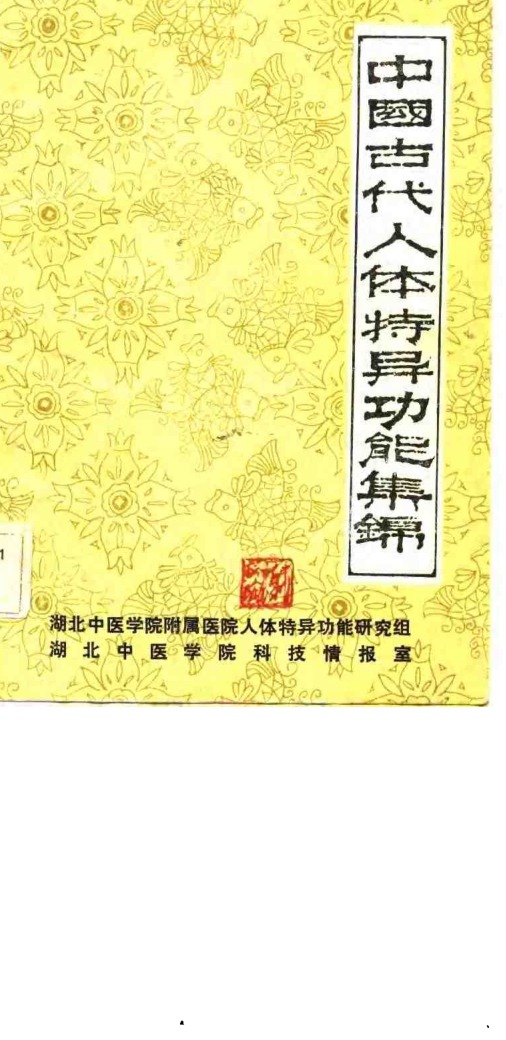
9.1 Human Extraordinary Abilities Research Group, Affiliated Hospital of Hubei College of Traditional Chinese Medicine Science and Technology Information Office, Hubei College of Traditional Chinese Medicine
Selected and compiled by Xie Yuyu Reviewed and revised by Li Jinyong Human Extraordinary Abilities Research Group, Affiliated Hospital of Hubei College of Traditional Chinese Medicine Hubei Library Book Stamp College Science and Technology Information Office Collection Stamp May 1982 B 030001
Due to the objective conditions of our country’s history, the vast majority of these 150 pieces of material are stories of the activities of figures from the Three Teachings (Confucianism, Daoism, and Buddhism) and the Nine Schools of Thought (Confucians, Daoists, Yin-Yang, Legalists, Logicians, Mohists, Diplomatists, Eclectics, and Agriculturalists). Therefore, their extraordinary abilities were integrated with their means of making a living, inevitably mixing in superstitious elements and exaggerations of the facts themselves. Readers are asked to discern this on their own. As for those who fundamentally doubt the authenticity of these historical materials, it is impossible to find the ancients to verify them now.
Early in 1981, when I, along with Teacher Yao Xinmin from Wuhan University and Comrade Wang Zhaohuai from the former Hubei Provincial Health Department, were co-authoring The Mystery of Extraordinary Abilities, we discovered during the process of collecting materials that there were many records of extraordinary abilities in ancient Chinese texts, which inspired my desire to compile this book. Since then, I have specialized in collecting ancient materials and annotating them. During the compilation process, comrades from the Hubei Provincial Library and the libraries of Hubei College of Traditional Chinese Medicine and its Affiliated Hospital provided a large amount of material and much convenience. In particular, the Hubei Provincial Health Bureau, Hubei College of Traditional Chinese Medicine, and its Affiliated Hospital listed extraordinary abilities as a scientific research topic. Therefore, the compilation of this book received the care and encouragement of the leadership from beginning to end. Division Chief Li Feng’e and Deputy Division Chief Xu Mulin of the Scientific Research Department of the College of Traditional Chinese Medicine, Hospital President Xie Zixiu and Vice Hospital President Jin Disheng of the Affiliated Hospital, among others, provided much guidance. To ensure quality, Teacher Zhang Yingliang and Professor Li Jinyong were also commissioned to review and fact-check the manuscript. Teacher Zhang checked the original text piece by piece and made many modifications to the translation. In particular, Professor Li, despite his busy schedule, conducted the final review of this book. Comrade Zhang Hanrong from the Hubei Academy of Fine Arts also enthusiastically designed the cover for this book. I express my heartfelt thanks for the care of the leadership and the help of my comrades.
Due to my low level of knowledge, there are bound to be many errors, and I respectfully ask readers for their guidance.
Xie Yuyu May 30, 1982
Preface
Since March 11, 1979, when Sichuan Daily first publicly reported the discovery in Dazu County, Sichuan Province, of a child named Tang Yu who could recognize characters with his ears, a debate over the “genuineness” and “fakeness” of extraordinary human abilities has unfolded in newspapers and magazines for over three years. Regarding this issue, I believe that as long as a little investigative research is done, it is not difficult to reach a correct conclusion.
Extraordinary abilities, semantically speaking, refer to abilities that differ from those of ordinary people. And people with abilities extraordinary compared to ordinary people have existed in ancient and modern times, in China and abroad. In his article “Carrying Out Basic Research in Human Body Science,” Comrade Qian Xuesen said: “Since it is affirmed that the key to the new development of human body science lies in traditional Chinese medical theory, Qigong, and extraordinary abilities, then the basic research of human body science should take the collation of over two thousand years of traditional Chinese medical theory and Qigong practice as a key task. It is also necessary to clean up and organize the extraordinary human abilities that have appeared throughout history from ancient books as a research task of ancient experimental science.” In May 1981, the “Second National Symposium on Extraordinary Human Abilities” held in Chongqing, Sichuan, also proposed the task of systematically organizing the records of extraordinary abilities found in ancient Chinese documents. In order to introduce to the general readership the deeds of ancient Chinese extraordinary human abilities, and to provide some reference materials for scientific researchers studying extraordinary human abilities, I have collected and compiled this Collection of Ancient Chinese Accounts of Extraordinary Human Abilities from a large number of ancient texts.
This book has collected a total of 150 pieces of material. Based on their different contents, they are divided into twelve special topics, namely: Non-visual “Sight”, Naked-eye “Fluoroscopy”, Remote “Viewing” and Remote Sensing, Microscopic Magnification, Predictive Ability, Conscious Telekinesis, Hypnotic Arts, Miraculous Qigong, Diagnosis and Treatment of Diseases, Apprehending Murderers and Solving Cases, Summoning Wind and Calling for Rain, and Other Abilities. For the convenience of readers, in addition to transcribing the original text, each piece has been translated into vernacular Chinese and provided with simple annotations.
Table of Contents
-
Part One: Non-Visual “Sight”
-
Seeing and Hearing Without Eyes or Ears … (1)
-
Dongfang Shuo Repeatedly Hits the Mark in Guessing Games … (2)
-
Guan Lu, Master of the Guessing Game … (4)
-
Ke Shi’s Superior Skill in Guessing Games … (6)
-
Cai Qian Identifies a Rat in a Box Through the Abdomen … (7)
-
Teacher and Student Identify an Ox’s Color Through a Wall … (8)
-
Several Sheng of Small Beans — Instantly Knows the Count … (9)
-
Part Two: Flesh-Eye “Fluoroscopy”
-
Eyes Seeing Five Feet Deep into the Earth … (13)
-
A Monk Spots a Buried Temple Site Underground … (13)
-
An Shi Sees Through the Mother’s Womb to the Fetus … (14)
-
Zong Fan Detects the Fetus in the Womb … (16)
-
Zhang Ji’s Flesh-Eye Sees the Meridians … (17)
-
Part Three: Remote “Viewing” and Distant Sensing
-
Mother and Child Linked Heart to Heart … (21)
-
Son Captured — Old Nurse Lactates … (22)
-
Through Hazy Mist and Water, Sees a Red Sleeve … (23)
-
Monk Xian Huo Locates a Tin Staff … (24)
-
Knowing a Guest’s Intent Before They Enter the Door … (26)
-
Tian Zhongliang Sees Through the Emperor’s Mind … (26)
-
Shao Jun Knows People’s Past Lives … (28)
-
Zhang Guo Foresees a Princess’s Marriage … (29)
-
Ma Shao Knows Taizu’s Mind in Advance … (30)
-
Mother Pinches Her Arm — Son Instantly Senses It … (32)
-
Part Four: Microscopic Magnification
-
Astonishing Microscopic Ability … (35)
-
Prefect Hua Learns the Art of Micro-Vision … (36)
-
Part Five: Precognitive Ability
-
Preparing Luggage to Welcome an Urgent Messenger … (39)
-
Liu Lu Foreknows the Coming of Flood Disaster … (40)
-
Prophecy of Events Fifty Years Hence … (42)
-
Zhu Jianping Reads People’s Lifespans … (44)
-
Hearing Drums and Horns — Foreknows the Calamity of War … (46)
-
Diagnosing People’s Life and Death — Infallibly Verified … (48)
-
Speaking of People’s Misfortune and Fortune — Many Strikingly Accurate … (49)
-
Hua Tuo Foreknows the Prognosis of Illness … (50)
-
Zhong Xuan’s Illness — Zhong Jing Foreknows … (52)
-
Part Six: Psychokinesis
-
Artificial Bees and Butterflies Dance in the Air … (57)
-
A Fish Bowl Vanishes Without a Trace … (58)
-
Birds in Midair Come Falling Down … (59)
-
Han Xiangzi Plants a Flower and Composes Linked Verses … (60)
-
Where Do the Extraordinary Flowers and Fruits Come From? … (61)
-
Ambassador Luan’s Flags Strike Each Other … (62)
-
Galloping Over Grass and the Art of Invisibility … (63)
-
Jia Da Desires Food — a Flock of Birds Delivers It … (64)
-
Applying Prohibitive Spells — Blades Cannot Pierce … (65)
-
Zuo Ci’s Arts Enrage Cao Cao … (66)
-
Three Flowers — Coins Taken from an Empty Basket … (66)
-
Wang Lian Makes Shoes Strike Each Other … (67)
-
Part Seven: Wondrous Hypnotic Arts
-
Ming Chongyan Inserts a Talisman to Stop the Music … (71)
-
Daoist Priest Lü Stages a Farce … (72)
-
Lay Buddhist Yang Wondrously Summons Musicians … (74)
-
A Monk’s Prank — a Swarm of Bees Stings Faces … (76)
-
Wang Lun’s Daughter Removes Shoes and Ascends into the Clouds … (79)
-
Incantation Turns Cooked Food Back to Raw … (80)
-
A Pair of Shoes Transforms into Swimming Fish … (81)
-
Guo Pu’s Cunning Scheme to Obtain a Maidservant … (82)
-
Part Eight: Extraordinary Qigong
-
Yang Yun Can Fly Beyond the Clouds … (87)
-
Shang Yangzi Conjures Salt as a Gift for a Friend … (88)
-
A Staff Floats on Water Bearing a Person … (88)
-
A White Feather Fan Replaces a Boat for Crossing … (90)
-
Opening an Umbrella and Fan — Walking on Water as on Land … (90)
-
Eating Stone Flakes Like Lotus Root and Sugarcane … (91)
-
Receiving Three Blade Strikes to the Neck Without Injury … (92)
-
Shi Bao Flicks a Chopstick to Remove Zhang Qing’s [Ailment] … (94)
-
Carrying Tian Yunyuan to View Lanterns at Night … (95)
-
Part Nine: Diagnosis and Treatment of Illness
-
Xia Zepei, Expert in Pulse Diagnosis … (99)
-
Diagnosing the Father’s Pulse to Know the Child’s Fortune … (100)
-
Wen Zhi Sees Through to a Person’s Heart … (101)
-
Bian Que Gains Insight into Lord Huan’s Illness … (102)
-
Xu Chengbo Diagnoses Behind a Curtain … (104)
-
Bang Yong Reads the Pulse to Know Life and Death … (105)
-
Daoyin Technique Cures Lung Disease … (106)
-
A Daoist Causes Illness to Transfer … (108)
-
Xue Borong Transfers a Tumor to a Tree … (110)
-
Self-Setting Bones — Instantly Healed and Restored … (111)
-
Cursing a Sore Across a Mountain — The Sore Heals … (111)
-
Mentally Extracting an Arrowhead from the Eye … (112)
-
Si Ming Diagnoses and Determines Life and Death … (113)
-
Du Fashun’s Extraordinary Art of Healing … (114)
-
Emitting External Qi to Treat Epilepsy … (115)
-
Part Ten: Apprehending Criminals and Solving Cases
-
Shang Wen’s Insight Catches the Gold Thief … (119)
-
Wei Ding Apprehends a Murderer … (120)
-
Prophet Monk Foreknows the Arrival of Thieves … (122)
-
Zhi Deng Foreknows That Thieves Will Come … (122)
-
Xi Yong Identifies Thieves by Observing Their Brows … (123)
-
Asking About the Fire — Identifying the Arsonist … (124)
-
The Lost Maidservant — Zhuo Tracks and Recovers Her … (125)
-
A Grass Ring Binds the Thief — The Thief Cannot Escape … (126)
-
Du Sheng Points the Way to Apprehend a Fleeing Slave … (126)
-
Part XI: Summoning Wind and Rain Liu the Daoist Prays for Rain Like a God …… …… (131) Liu Daohe Has a Technique to Stop Rain …… …… (131)
-
Part XII: Other Abilities Wei Daoan Recites Ten Thousand Words a Day …… …… (135) Ru Zhang is Proficient in the Mathematics of the Nine Chapters … …… (136) Lying on Ice in Deep Winter Without Fear …… …… (137) Scholar Jiao Fears Neither Ice nor Fire … … (138) Sitting Upright in the Snow, Dripping with Sweat … … (139) The Daoist of Songyang Has Fire in His Body …… … (139) The Belly That Steams Buns and Roasts Wine …… … (140) Zhou Dian, Unharmed by Starvation and Roasting …… … (141) Zhang Sanfeng Can Eat and Endure Hunger …… … (143) A Hole Beside the Abdomen Emits Light …… … (144) The Loud Voice of the Man from Wucheng …… …… (144) Playing While Floating on Water …… … (146) Lifting a Thousand Jin as Light as a Goose Feather …… … (147) Monk Huaibing Straightens a Bridge with a Technique …… … (147) Jing Zhiguo Cleverly Tames a Different Species …… … (149) The Drunk Old Man Who Exclusively Eats Insects and Ants …… … (150) Dan Daokai Constantly Swallows Fine Stones …… .(152)
Part One: Seeing and Hearing Without Using Ears and Eyes
Lao Dan’s1 disciple, a man named Kangcangzi, obtained Dao’s teachings and could see with his eyes and hear with his ears. The Marquis of Lu2 heard this and was greatly astonished, sending a high minister with generous gifts to summon him. Kangcangzi accepted the invitation and arrived. The Marquis of Lu humbly asked him about it. Kangcangzi said: “Those who passed down this rumor were mistaken. I can see and hear without using ears and eyes, but I cannot swap the functions of ears and eyes.”
Excerpted from Liezi3 Jishi (Collected Explanations of Liezi), Volume 4, “Zhongni” Chapter, pages 73 to 74.
[Annotations]
[Modern Chinese Translation] Kangcangzi, a direct disciple of Lao Dan, learned Lao Dan’s Daoist arts. He could see with his ears and hear with his eyes. When the ruler of the State of Lu heard about this, he was greatly astonished. He then dispatched an envoy to invite him, offering the generous gifts appropriate for a high minister. Kangcangzi gladly accepted the invitation and arrived. The Marquis of Lu humbly inquired of him. Kangcangzi said: “The rumors are inaccurate. I can only see and hear without using eyes and ears, but I cannot see with ears and hear with eyes.”
· 1 ·
Editorial note: Every located scan of this edition omits printed page 2. The following passage is reconstructed from the primary work cited by the book itself—Ban Gu’s Book of Han, “Biography of Dongfang Shuo”—and is not presented as text recovered from the defective scan.
Dongfang Shuo Repeatedly Succeeds at Hidden-Object Divination
Dongfang Shuo, courtesy name Manqian, was a native of Yanci in Pingyuan4.
The emperor once ordered several practitioners of divinatory calculation to perform shefu5. A gecko had been placed beneath a bowl, but none of them could identify it. Dongfang Shuo volunteered: “I have studied the Book of Changes6; please allow me to divine it.” He separated yarrow stalks and laid out a hexagram, then answered: “It resembles a dragon but has no horns; call it a snake, yet it has feet. It creeps and pulses, skillfully climbing walls. It can only be a gecko7 or a lizard.”
The emperor said, “Excellent,” and rewarded him with ten bolts of silk. He was then asked to divine other hidden objects; he identified them correctly one after another and was rewarded each time.
Reconstruction source: Ban Gu, Book of Han, “Biography of Dongfang Shuo”8.
…eighty-four yao (lines of a hexagram).
[Modern Chinese Translation] Dongfang Shuo, also known as Manqian, was a native of Yanci in Pingyuan (present-day Huimin, Shandong).
Emperor Wu of Han once asked those engaged in divination, astrological fate-reading, and physiognomy to play “Shefu” (guessing hidden objects). He first covered a gecko with a basin and then let everyone guess, but none of them got it right. When Dongfang Shuo saw this, he recommended himself and said to Emperor Wu: “I have studied the Book of Changes (Yijing) in the past, please let me guess too.” He then used yarrow stalks to cast a hexagram and said to Emperor Wu: “Your servant believes that if it is a dragon, it lacks horns; if you call it a snake, it has feet. Looking at the way it moves, it seems quite good at climbing walls. It is either a gecko or a lizard.” Emperor Wu said: “Good! Reward Dongfang Shuo with ten bolts of silk.” He then asked him to guess other things, and he guessed them all correctly, rewarding him with quite a lot of silk.
At this time, there was a court jester named Master Guo, who was usually good at joking and bantering and often attended to Emperor Wu. He said to Emperor Wu: “Dongfang Shuo is too arrogant; these were just lucky guesses. I am willing to have him guess again. If he guesses correctly, whip me a hundred times; if he does not, give me all those bolts of silk.” After speaking, he covered a fungus (zhijun) parasitic on a tree with a basin and asked Dongfang Shuo to guess. Dongfang Shuo said: “It is a jushu (a stand for holding a basket on the head).” Master Guo said: “I knew you, Dongfang Shuo, couldn’t guess it.” Dongfang Shuo said: “For example, raw meat is called ‘yan’, and cooked meat is called ‘pu’. This thing parasitic on a tree is called a zhijun (fungus), but when placed under a basin and covered up, it is called a jushu (stand) that supports the basin used to hold objects on one’s head.” Emperor Wu then ordered the singing and dancing eunuchs to whip Master Guo. Master Guo screamed loudly in pain.
· 3 ·
The Expert at Shefu, Guan Lu
Zhuge Yuan, the Magistrate of Guantao, was promoted to Governor of Xinxing. Lu9 went to offer a farewell banquet for him, and guests gathered together. Yuan himself rose and took a swallow’s egg, a wasp’s nest, and a spider, placing them in a vessel, and asked him to perform shefu (divination to guess hidden objects). When the hexagram was completed, Lu said: “The first item: it contains breath and must transform; it dwells by the eaves and halls; male and female take distinct forms; its wings spread wide; this is a swallow’s egg. The second item: its house hangs upside down; it has many doors and windows; it stores essence and nurtures venom; it transforms in the autumn; this is a wasp’s nest. The third item: it trembles with long legs; it spins silk to form a net; it seeks food along the web; its advantage lies in the dusk and night; this is a spider.” The entire gathering was astonished and delighted.
Liu Bin, the Governor of Pingyuan, took a seal pouch and a mountain pheasant’s feather and placed them in a vessel, asking him to divine using yarrow stalks10. Lu said: “Square inside and round outside; five colors form its pattern; it holds a treasure and keeps trust; when taken out, it serves as a seal; this is a seal pouch. On the high and precipitous rocks, there is a bird with a red body; its wings are black and yellow; it sings without missing the morning; this is a mountain pheasant’s feather.”
Xu Jilong, the Magistrate of Qinghe, sent someone out hunting, and asked Lu to divine what would be caught. Lu said: “A small beast will be caught, but it is not a fine bird. Though it has claws and teeth, they are small and not strong; though it has patterns on its body, they are variegated but not bright. It is neither a tiger nor a pheasant; its name is a li (wild cat).” The hunters returned at dusk, and it was exactly as Lu had said. Jilong took thirteen kinds of objects, placed them in a large trunk, and asked Lu to guess. Lu said: “There are thirteen kinds of objects densely packed in the vessel.” He first spoke of the chicken egg, then mentioned the silkworm pupa, and proceeded to name them one by one, only mistaking a comb for a fine-toothed comb.
Excerpted from the Book of Wei, Treatise on Fangshi (Technical Specialists), Volume 29, pages 817–824, in Records of the Three Kingdoms11. (Zhonghua Book Company, 1st edition, December 1959.)
4
Modern Translation
Zhuge Yuan, the Magistrate of Guantao County, was promoted to Governor of Xinxing Prefecture, and Guan Lu went to see him off. The visiting guests all gathered together. Zhuge Yuan himself went and took three things—a swallow’s egg, a wasp’s nest, and a spider—and placed them in a container, asking Guan Lu to guess them. After careful identification, Guan Lu said to everyone: “The first thing: it harbors vitality and needs to transform; it builds its nest by the eaves of the hall; it is divided into male and female, and can spread its wings to fly; this is a swallow’s egg. The second thing: its house hangs upside down, with many doors and windows opened; inside it stores essence and nurtures venom; as soon as autumn arrives, it generates new life; this is a wasp’s nest. The third thing: it has ugly long legs, spins silk to weave a net, and exclusively seeks food on the web; it is especially active at dusk; this is a spider.” All three things were guessed completely correctly. When the entire hall of guests saw this, they were both surprised and delighted.
Liu Bin, the Governor of Pingyuan Prefecture, took a seal pouch used for storing seals and a pheasant’s feather and placed them in a container, asking Guan Lu to divine. Guan Lu said: “The first kind of thing: this object is square inside and round outside; colored to form a pattern; it holds a treasure inside and can be trusted by people; when taken out, it is a seal. This is a seal pouch. The second kind of thing: on the high mountains, there is a bird whose feathers are vermilion red, and whose wings are black and yellow; its singing welcomes the morning. This is a pheasant’s feather.”
Xu Jilong, the Magistrate of Qinghe County, sent people out hunting and asked Guan Lu to divine what wild game they would catch. Guan Lu said: “They will be able to catch a small beast, by no means a beautiful bird. Although this beast has claws and teeth, they are small and not strong; although it has patterns on its body, they are gorgeous but not bright. It is neither a tiger nor a pheasant, but a wild cat.” The hunters hunted for a day and returned at dusk, and sure enough, they had caught a wild cat. Xu Jilong wanted to test Guan Lu again, so he took thirteen objects, placed them in a large box, and asked Guan Lu to guess. Guan Lu said: “There are thirteen objects placed horizontally and vertically inside here.” He first mentioned the chicken egg, then the silkworm pupa, and then proceeded to state the names of all the other objects one by one. Except for calling a comb a fine-toothed comb, he got everything else right.
5
Keshi’s Superior Skill in Shefu
Yuan Tiangang was a native of Chengdu… His son, Keshi, also inherited his arts. Emperor Gaozong placed a rat inside a mirror box12 and commanded the occultists to guess. They all said it was a rat, but Keshi alone said: “Although it is indeed a rat, when it went in, it was one, but when it comes out, it will be four.” They opened the box, and the rat had given birth to three offspring.
Excerpted from Volume 42, Biographies of Confucian Ministers, pages 2428–2430, in the Cangshu (Book to be Hidden)13. (Zhonghua Book Company, 1st edition, August 1974).
Annotations
Modern Translation
Yuan Tiangang was a native of Chengdu… He had a son named Keshi, who also mastered the art of physiognomy. Emperor Gaozong of the Tang dynasty locked a rat in a mirror box and asked those engaged in divination, astrology, and fortune-telling to guess. They all said that what was locked inside was a rat. Only Keshi said: “Although it is a rat, when it was locked in there was only one, but now there are four.” When the mirror box was opened, the rat had indeed given birth to three baby rats.
• 6 .
Cai Xian Discerns the Boxed Rat’s Belly
The Shuyi Ji states: The General of Chariots and Cavalry of the Liu Song dynasty, Liu Yixuan, Prince of Southern Qiao, was garrisoned in Jingzhou. A provincial clerk named Cai Xian was skilled in divination, and all his predictions were accurate. He occasionally had extraordinary insights, and his profound investigations were like those of a god. The Prince once saw a white rat climbing the wall in his inner study, and ordered his attendants to shoot it, placing the body inside a box. At that time, there were six attendants, all of whom were driven into a small door behind the study. He then called someone else to summon Xian. Xian arrived and was made to divine what was in the box. He was told: “If you are correct, you will be heavily rewarded; if you are incorrect14, you will be severely punished.” The divination cracks having formed, Xian smiled and said: “I know what it is.” The Prince said: “What is it?” Xian said: “It is a rat of a whitish color, with its back to the light facing the door. A drawn bow shot it, severing its left leg. It was pregnant with five offspring: three male and two female. If you do not believe me, slice open its belly and you will know at once.” The Prince had the rat’s belly sliced open, and everything was exactly as Xian had said. He immediately rewarded him with ten thousand cash.
Excerpted from Volume 726, Section 7 of Fangshi (Technical Specialists), page 3219, in the Taiping Yulan (Imperial Readings of the Taiping Era)15. (Zhonghua Book Company, 1st edition, February 1960).
Annotations
Modern Translation
The Shuyi Ji (Tales of the Strange) relates: When the General of Chariots and Cavalry of the Song dynasty, Liu Yixuan, Prince of Southern Qiao, was garrisoning Jingzhou, there was an official named Cai Xian in his residence who was skilled in divination and highly efficacious. He had brilliant insights into his surroundings and foresaw things with god-like accuracy. Liu Yixuan once saw a white rat climbing the wall in his inner study, and ordered his attendants to shoot it, placing the body inside a box. At that time, there were six attendants present, all of whom were driven into a small door behind the study. He then called someone else to summon Xian. Xian arrived and was made to divine what was in the box. He was told: “If you guess correctly, you will be heavily rewarded; if you are incorrect, you will be severely punished.” Xian completed his divination cracks, smiled, and said: “I know what it is.” The Prince asked: “What is it?” Xian said: “It is a rat of a whitish color, its back to the light facing the door. A drawn bow shot it, severing its left leg. It was pregnant with five offspring: three male and two female. If you say you do not believe it, slice open its belly and you will know at once.” The Prince had the rat’s belly sliced open, and everything was exactly as Xian had said. He immediately rewarded him with ten thousand cash.
• 7.
A white mouse was climbing up toward the roof, so he hastily ordered his attendants to shoot it, and then placed it into a small box. Six attendants were present at the scene and witnessed this event; he had them all escorted to a small room behind the study, and separately sent someone to summon Cai Qian. After Cai Qian arrived, he was asked to divine what was inside the box, and he was told: “If you guess correctly, you will receive a generous reward; if you do not, you will be severely punished.” After completing his divination, Cai Qian smiled and said: “I already know.” Liu Yixuan asked: “What is it?” Cai Qian said: “It is a white mouse, with its back facing the doorway, and an arrow has broken its left leg. In its belly it carries five baby mice, three male and two female. If you do not believe it, you may cut open the mouse’s belly and see.” Liu Yixuan had someone cut open the mouse’s belly, and indeed it was exactly as Cai Qian had said, so he rewarded him with ten thousand cash.
Teacher and Student Distinguish the Color of an Ox Through a Wall
Zhan He¹ was sitting with his disciple attending beside him. An ox bellowed outside the gate. The disciple said: “It is a black ox, but with a white forehead.” Zhan He said: “Indeed, it is a black ox, but the white is on its horns.” He sent someone to look, and sure enough, it was a black ox with white cloth wrapped around its horns. …
Excerpted from Han Feizi² Jishi (Collected Explanations), Chapter 6, “Jie Lao” (Explaining Laozi), Part 20, page 338. (Zhonghua Book Company, 1958 Shanghai first edition.)
¹ [Zhan He] — A thinker of the pre-Qin era. He advocated “valuing life” and therefore necessarily “regarding profit lightly,” and opposed behavior driven by self-indulgent desires. His thought is close to that of the Daoist school.
² Han Feizi — A representative work synthesizing pre-Qin Legalist thought. After Han Fei’s death, later generations collected his surviving writings and added writings by others discussing Han Fei’s doctrines. It consists of fifty-five chapters in twenty volumes. It sets forth a systematic theory of governing through law (fa), methods (shu), and power (shi).
8
[Translation in Modern Chinese]
Zhan He was sitting, and his student stood in attendance. At that moment, the sound of an ox bellowing came from outside the gate. The student said: “This is a black ox, with a white forehead.” Zhan He said: “Correct, it is a black ox, but the white part is on its horns.” He then sent someone to check, and sure enough, it was a black ox with a piece of white cloth wrapped around its horns. …
Knowing the Count of Several Sheng of Small Beans at a Glance
Zhao Da, a native of Henan, in his youth studied under Shan Fu, the Palace Attendant¹. His thinking was meticulous and precise. He once served Sun Quan² and devoted himself to the methods of the Nine Palaces and the Unity Calculation. Whenever Sun Quan went on a military campaign, he would order Zhao Da to perform astrological calculations³, and every prediction came true as stated. Sun Quan asked about his method, but Zhao Da never spoke of it, and for this reason he fell out of favor and was never given an official rank or salary. Once, someone challenged Zhao Da’s arts as fraudulent. Zhao Da had the man bring several sheng of small beans and scatter them on a mat; he instantly determined the number, and when verified by counting, it proved accurate. On one occasion, he went to visit an acquaintance, who prepared a meal for him and said: “At such short notice, I have no wine, nor any fine dishes — what can I do?” Zhao Da then picked up the chopsticks from the plate and repeatedly arranged them horizontally and vertically. He smiled and said: “Under the east wall of your house there is one hu⁴ of wine and three jin of dried venison — how can you say you have none?” The host felt ashamed and apologized, saying: “Because you are skilled at guessing hidden objects, I was deliberately testing you.” After Zhao Da died, Sun Quan sought his writings but could not find them. He had the coffin opened for inspection, but nothing was found inside either, and so his arts were lost forever.
Excerpted from Henan Tongzhi (Henan Provincial Gazetteer) (Yongzheng edition), Volume 71, “Fangji” (Arts and Techniques), page 9.
[Annotations]
¹ Palace Attendant (Shizhong) — An official title. First established in the Qin dynasty and continued through the two Han dynasties. It was an additional title conferred upon those from the rank of Marquis on down to Langzhong (Gentleman of the Household). They attended closely upon the emperor and had access to the inner court.
² Sun Quan — The founding emperor of the state of Wu during the Three Kingdoms period. He held the lands east of the Yangtze, defeated Cao Cao at Chibi, made peace with Shu-Han to the west and resisted the powerful Wei to the north, thereby establishing the tripartite division of the realm. He proclaimed himself emperor at Jianye.
• 9 •
³ Astrological calculation (Tuibu) — In ancient times, the calculation of calendars was called tuibu, meaning that the sun, moon, and stars move across the heavens much like a person walking, and can thus be calculated and known.
⁴ Hu — A unit of dry measure; in ancient usage, ten dou equaled one hu.
[Translation in Modern Chinese]
Zhao Da was a native of Henan. In his youth he studied under the Palace Attendant Shan Fu. His mind was sharp and his work precise. He once served Sun Quan, emperor of Wu, and devoted himself to researching the method of “the Nine Palaces and the Unity Calculation.” Whenever Sun Quan undertook a military action, he would first order Zhao Da to observe the celestial phenomena, and afterward every prediction proved accurate. Sun Quan asked him by what method he had made his observations, but Zhao Da would not tell him. From then on, Sun Quan grew cold toward him and did not appoint him to office. Some people said his arts were fraudulent, so Zhao Da had someone bring several sheng of small beans and pour them onto a mat; he immediately knew the exact number of beans, and upon verification it was perfectly accurate — only then did people believe him. He once went as a guest to a friend’s house, and the friend had prepared only a simple meal, saying to him: “Because time was short, there is neither wine nor any good dishes — what can we do?” Upon hearing this, Zhao Da casually picked up the chopsticks from the plate and repeatedly arranged them in horizontal and vertical patterns, then smiled and said: “Under the east wall of your house there is currently one hu of wine and three jin of dried venison — how can you say there is no wine or meat?” Once he revealed this, the host was quite embarrassed and could only say: “Because you are skilled at guessing hidden objects, I was deliberately testing you.” After Zhao Da died, Sun Quan sent someone to claim the books he had left behind, but none were found; they opened his coffin, and there was nothing inside either — and so his arts were lost.
• 10 •
Part Two
”X-Ray Vision” with the Naked Eye
Eyes That See Five Feet Beneath the Ground
Deng Yunshan was a native of Gao’an. His uncle, Xiangxian, was a Daoist priest at the Zhenyuan Daoist Temple. A certain man from Gan fell ill at the temple and was unable to rise from his bed. Yunshan came to visit his uncle and attended to the patient with great care. After the man recovered, he taught Yunshan the arts of a “form specialist” (xingjia), enabling him to see through the earth to a depth of five feet and distinguish the nature and color of the soil layers.
Excerpted from Jiangxi Tongzhi (Comprehensive Gazetteer of Jiangxi) (Yongzheng edition), Chapter 170, “Arts and Techniques,” page 11.
(Translation and Meaning) Deng Yunshan was a native of Gao’an County. His uncle, named Xiangxian, served as a Daoist priest at the Zhenyuan Daoist Temple. A man from Jiangxi fell ill at the temple and could not get out of bed. Yunshan came to visit his uncle and patiently cared for the patient. After the patient recovered, he taught Deng Yunshan a technique of the “form specialist,” which enabled him to see through the surface of the earth to a depth of five feet and distinguish the nature and color of the soil layers.
A Monk Spots a Buried Temple Site
Jiantuole was originally a man from the Western Regions.16 He came to Luoyang. Over the years, although people respected his bearing and conduct,17 no one could ever fully fathom him. Later he said to the assembled monks: “Southeast of Luoyang there is Mount Panchi. On the mountain there was once a temple site — its foundation walls18 still survive. We could rebuild it together.” The assembly did not believe him, so they went to investigate. When they entered the mountain and reached a certain place, all four sides were flat and level. Le pointed and said: “Here is the foundation of the mountain temple.” They dug there, and indeed found the stone foundation beneath the temple. He then indicated the locations of the lecture hall and the monks’ quarters, and everything was exactly as he said. Everyone was astonished and marveled. They then jointly rebuilt the temple.
Excerpted from Taiping Yulan (Imperial Readings of the Taiping Era), Chapter 655, Buddhist Section 3, page 2927. (Zhonghua Book Company, first edition, February 1960.)
·13·
(Annotations)
(Translation and Meaning) Jiantuole was originally a man from west of Dunhuang. He came to Luoyang. For many years, although people admired his bearing and conduct, they could never fully understand the details of his background. Later he said to the assembled monks: “Southeast of Luoyang there is a mountain called Mount Panchi. There was once a temple on the mountain, and the temple site is still there. It can be rebuilt.” The others did not believe his words, so they went up the mountain together to verify. When they reached a place that was flat and level on all four sides, Le told them: “This is the foundation site of the temple.” They proceeded to excavate, and indeed found the stone foundation beneath the temple. Later, the lecture hall and the monks’ living quarters were also found, just as he had indicated. Everyone was amazed, and they jointly constructed the temple.
Pang Anshi Sees Through the Mother’s Womb
Pang Anshi, courtesy name Anchang, was a native of Qishui in Qizhou.19 As a child he could read books, and whatever he glanced at he would remember. His father was a hereditary physician who taught him the essentials of pulse diagnosis.…
He once went to Tongcheng20 in Shu. A woman in a commoner’s household was pregnant and about to give birth, but after seven days the child would not come down, and no method proved effective. Anshi’s disciple Li Baiquan happened to be staying in a neighboring house and invited Anshi to go and examine her. The moment he saw her, he repeatedly declared that she would not die. He instructed her family to warm her waist and abdomen with hot water, while he himself massaged up and down from the outside. The pregnant woman felt a slight pain in her stomach and intestines, and amid her groans gave birth to a baby boy. The family was overjoyed and astonished, but did not understand how it had happened. Anshi said: “The child had already emerged from the womb, but one of its hands had mistakenly gripped the mother’s intestine and could not release itself, so neither talismans nor medicines could have any effect. Through the abdomen I felt the location of the child’s hand and needled its hukou21 (the web between thumb and index finger). Once it felt pain, it withdrew its hand — that is why the child was born
14–
so suddenly. There is no other technique involved.” They examined the child and found that the needle mark on the hukou of its right hand was still visible. His skill was extraordinary in this way.
Excerpted from the Songshi (History of the Song Dynasty)22, Chapter 462, Biographies No. 221, “Practitioners of Arts, Part 2,” pages 13520–13522. (Zhonghua Book Company, first edition, November 1977.)
[Annotations]
[Translation and Meaning] Pang Anshi, also known as Anchang, was a native of Qishui in Qizhou (present-day Xishui County, Hubei). Even as a child he was highly capable of reading, and once he had read something he would remember it. His father was a renowned hereditary physician who passed down all the diagnostic techniques to him.
Anshi once traveled to Tongcheng County in Shuzhou to practice medicine, and encountered a pregnant woman there suffering from a difficult labor. She had been in labor for seven days and the child still had not come out; every method had been tried without any effect. It happened that Anshi’s student Li Baiquan was staying nearby, and he invited his teacher to come and see her together. After Anshi examined the mother, he said there was no danger. He asked her family to prepare warm water and apply hot compresses to the mother’s waist and abdomen, while he himself used his hands to massage her abdomen up and down. The mother felt a slight pain in her stomach and intestines, and in the course of her groans she gave birth to a baby boy. The whole family was both astonished and
·15·
…rejoiced, not knowing what method of hastening childbirth he had actually used? Anshi said: “The fetus had already left the womb. The reason it could not be delivered was that one of its hands was gripping its mother’s intestines. Therefore, drawing talismans and taking medicine were of no use. I palpated through the abdominal wall to locate the position of the fetus’s hand, and used a silver needle to prick its hukou (the web between the thumb and index finger). The fetus felt pain, released its hand, and was thus born very quickly. There was no other method.” The family brought the infant over to look, and indeed there was a needle mark left at the hukou of its right hand. Pang Anshi’s medical skills were truly this miraculous.
Zhou Zongfan Detects a Fetus in the Womb
Zhou Zongfan, courtesy name Shangwen, was a scholar from Shishou. He registered his residence in Enshi and was proficient in medicine; whenever he treated severe illnesses, the patients would immediately recover. There was once a pregnant woman of the Leng clan; after observing her, he said: “This is a ghost fetus.” Upon treatment, it was delivered looking like a macaque. Later, he treated a pregnant woman of the Yang clan, and the ghost fetus delivered resembled frogs and snakes. He was a learned man, yet he never showed off his literary talents. His family was poor, but when he encountered others in urgent need, even if he only had a dou of grain, he would share half of it with them. He had no food stored for the next day, yet he remained contented and at peace.
Excerpted from the Shinan Prefecture Gazetteer (Tongzhi Edition), Volume 27, Fangji [Practitioners of Special Skills], Page 6.
[Translation / Paraphrase] Zhou Zongfan, also known by his courtesy name Shangwen, was a scholar from Shishou who resided in Enshi County. He was highly skilled in medicine; even for severe illnesses, as long as they were treated by him, the patients would recover with the prescribed medicine. Once, there was a pregnant woman surnamed Leng. After Zhou Zongfan examined her, he said: “This is a monstrous fetus.” Following treatment, a macaque-like fetal mass indeed dropped out. Later, he treated another pregnant woman surnamed Yang, and the dropped monstrous fetus resembled frogs and snakes. This person was learned and talented, but he never boasted about his literary compositions. His family’s circumstances were poor, yet when he encountered others in difficulty, even if he only had a single dou of grain left, he would divide half to give to them. Although his home lacked food for the next day, his mindset remained very optimistic.
·16·
Zhang Ji Sees the Meridians with His Naked Eyes
Zhang Ji of Wuwei Jun23 was skilled in using acupuncture. He obtained the secrets from a strange person; he was able to observe and dissect people, and when he looked at their meridians24, his understanding was completely precise. Because of the famine and plague that year, people ate each other; he observed a total of 170 people to perform acupuncture, and there was no case that did not show immediate efficacy.
Excerpted from Yishuo25 [Treatise on Medicine], compiled by Zhang Gao, Volume 2, Pages 13–14.
[Translation / Paraphrase] In Wuwei Jun, there was a man named Zhang Ji, who was skilled in treating illnesses with acupuncture. A strange person taught him the secret formulas, enabling him to see and dissect the distribution of meridians in the human body, making his technique even more refined. Because of the famine that year, compounded by a rampant plague where people ate each other, he had the opportunity to observe 170 people. From then on, when he applied needles to treat illnesses, there was none that did not yield an immediate therapeutic effect.
·17·
Part Three
Remote “Viewing” and Remote Sensing
Mother and Son of One Heart
The Bei Shi26 states: Pei Nezhi served as the Musao27 in charge of documents and records for the Pingyuan Duke’s Kaifu28 establishment, and accompanied him to Bingzhou. His mother, who was in Ye, suddenly suffered from heart pain. On that very day, Nezhi was overcome with longing; his own heart was startled and aching, so he requested urgent leave and returned. People at the time regarded this as a response evoked by filial devotion.
Source: Taiping Yulan, Chapter 741, Section on Illnesses, part 4, page 3288. (Zhonghua Book Company, first edition, February 1960.)
Translation: According to the Bei Shi: Pei Nezhi held a position in charge of documents at the Pingyuan Duke’s official residence, and accompanied the Pingyuan Duke to Bingzhou. At this very time, his mother, living far away in Ye County (present-day Linzhang County, Hebei), suddenly fell ill with heart pain. As soon as the mother fell ill, the son sensed it. On this very day, Nezhi felt his heart race with alarm and was deeply anxious about his mother far away at home, so he requested emergency leave and hurried back to visit her. Regarding this matter, people at the time all believed it was the result of Nezhi’s filial devotion moving heaven, earth, and the divine.
·21·
Son Is Captured; Old Mother’s Milk Flows
The Hou Wei Shu states: Zhu Xunzhi served as the Congshi29 Zhonglang30 under Liu Yilong’s31 Situ32 and defended Huatai33. An Jie besieged him. His mother at home suddenly had milk flow from her breasts. The mother wailed and told her family: “I am old; it is no longer the time when I should have milk. That this has suddenly happened now means my son must surely be doomed.” Indeed, on that very day, he was captured by An Jie.
Source: Taiping Yulan, Chapter 371, Section on Human Affairs, part 12, page 1709. (Zhonghua Book Company, first edition, February 1960.)
Translation: The Hou Wei Shu says: Zhu Xun served as Congshi and Zhonglang under Liu Yilong’s Situ. Liu Yilong ordered Zhu Xun to defend Huatai, and An Jie led troops to besiege Huatai. Zhu Xun’s mother was at home when milk suddenly flowed from her breasts. The mother cried out loudly and said to her family: “I am already old, and it is not a time when milk should return, yet it has come again. This foretells the death of my son.” It was later confirmed that on that very day, Zhu Xun was captured by An Jie.
·22·
Across Vast Misty Waters, a Red Sleeve Is Seen
Fan Hengzhou34 said: Once, while crossing the Qiantang River, a monk boarded the boat. He went straight to a seat, leaned against the mast, and did not exchange any greetings. When spoken to, he replied vaguely, his eyes looking elsewhere, his mind clearly not engaged. Hengzhou found his arrogance strange and spoke no further. At that time, the west wind was very strong. Hengzhou casually composed two lines: “White waves toss the bow, the traveler fears the headwind35.” He had not yet composed the matching couplet and recited the lines several times. The monk suddenly closed his eyes and murmured: “How is it that a girl in red sleeves still leans on the highest tower?” Hengzhou did not understand what he meant. He spoke to the monk again, but still received no answer. When they moored the boat, there was indeed a young woman standing on a tower, wearing exactly red sleeves. He was greatly astonished and pressed the monk with questions again and again. The monk replied, “I merely saw her by chance.” Yet across the vast misty waters, with dwellings blocking the view, there was in fact no way she could have been seen. Hengzhou suspected the monk had foreknowledge and wished to bow to him in reverence, but the monk had already departed, staff in hand36.
Source: Yuewei Caotang Biji37, Chapter 1, Luanyang Xiaoxia Lu (Part One), pages 17–18. (Shanghai Guji Chubanshe, first edition, September 1980.)
·23·
Miscellaneous Records” in five categories, totaling twenty-four volumes. The contents mostly deal with tales of ghosts, spirits, and the supernatural.
[Modern Translation]
Fan Hengzhou said: In the past, when he was crossing the Qiantang River, a monk boarded his boat and went straight to find a seat, settling down to lean against the mast. When Fan spoke with him, the monk replied casually, yet his eyes were looking elsewhere, his mind clearly on other things. Hengzhou found this monk arrogant and ceased speaking with him. At that moment, the west wind was blowing fiercely. Hengzhou was suddenly struck by inspiration and chanted two lines of verse: “White waves toss the bow, travelers fear the adverse wind.” He recited them repeatedly several times, but the following lines had not yet come to him. Then the monk suddenly closed his eyes and softly chanted: “How is it that a girl in red sleeves still leans upon the highest tower?” When Fan tried to speak with him again, he still did not answer. It was not until the boat was moored at the shore that, by coincidence, a young woman was seen standing in a tower above, wearing a garment with red sleeves. Hengzhou was greatly startled upon seeing this and repeatedly asked the monk how he had seen this young woman. The monk said: “I saw her by chance.” But at the time, the river was shrouded in vast mists and waters, and the houses along the shore obstructed the view — it would have been very difficult to see with the eyes. Hengzhou suspected that he possessed powers of foreknowledge and wished to bow to him anew, but the monk had already departed.
The Monk Tanhu Seeks His Khakkhara Staff
The śramaṇa① Tanhu — it is not known where he was from. During the time of Tufa Rutan②, he came from Henan, carrying a khakkhara staff③, and ordered people to kneel, saying: “This is the eye of Prajñā④; revere it and you may attain the Way.” The people of the time all regarded him as extraordinary. Some donated clothing to him; he accepted it and threw it into the river, then days later returned it to its original owner, the garments untainted. He walked as fast as wind and clouds, and spoke of people’s life and death, nobility and lowliness without the slightest error. When someone hid his khakkhara staff, Tanhu wept loudly several times, closed his eyes for a moment, then rose and retrieved it. All marveled at his miraculous powers; none could fathom them.
— Excerpted from the Book of Jin⑤ (Jin Shu), Volume 95, Biographies, Chapter 65, Arts, p. 252. (Zhonghua Book Company, first edition, November 1974).
·24·
(Annotations)
① Śramaṇa — A Buddhist term. Originally a general designation for renunciants of all religious schools in ancient India; later, in Buddhism, it specifically refers to those who leave the household life to practice the path in accordance with the precepts.
② Tufa Rutan — (365–415), ruler of the Southern Liang state during the Sixteen Kingdoms period. Reigned 402–414. Of the Xianbei ethnicity.
③ Khakkhara staff — A staff as high as the eyebrow, with a metal ring at its head. Originally used by monks when begging for food: the ring was shaken to make a sound in lieu of knocking on a door. Later it became a ritual implement of Buddhism.
④ Prajñā — Buddhism holds that Prajñā is the “wisdom” that comprehends the fundamental nature of all things. To distinguish it from ordinary wisdom, the Sanskrit phonetic transliteration is used.
⑤ Book of Jin (Jin Shu) — Compiled by Fang Xuanling and others of the Tang dynasty. One hundred and thirty volumes. A biographical-annalistic history of the Jin dynasty. Compiled between the eighteenth and twentieth years of the Zhenguan era (644–646).
[Modern Translation]
There was a monk named Tanhu; it is not known where he was from. During the reign of Tufa Rutan, ruler of the Southern Liang state, he came from Henan, holding a khakkhara staff in his hand, and bade people kneel, saying: “This is the eye of Prajñā; revere it and you may attain the Way.” The people of the time all marveled at his words and deeds. Some donated garments to him; he accepted them and threw them into the river, then later returned those same garments to their original donors, still perfectly clean. He walked as swiftly as wind and clouds. He spoke of others’ life and death, nobility and lowliness without the slightest error. When someone hid his khakkhara staff, he would weep loudly a few times, close his eyes in contemplation for a moment, then rise and find it. People all found his behavior miraculous and beyond comprehension.
·25·
Knowing a Visitor’s Purpose Before They Enter the Door
Geng Xuan was a man of Songzi in Julu. He was skilled in divination. Sitting indoors, if a guest knocked at the door, Xuan already knew the person’s surname and given name, what they were carrying, and the purpose of their visit. Of the matters he divined, eight or nine out of ten proved accurate.
— Excerpted from the Book of Wei② (Wei Shu): Volume 91, Biographies, Arts, Chapter 79, p. 1958. (Zhonghua Book Company, first edition, June 1974).
[Annotations]
① Divination (bu shi) — In ancient times, divination using tortoise shells was called bu, and divination using yarrow stalks was called shi.
② Book of Wei (Wei Shu) — Compiled by Wei Shou of the Northern Qi. One hundred and thirty volumes. A biographical-annalistic history of the Northern Wei. Compiled between the second and fifth years of the Tianbao era (551–554). The original text had already been lost and incomplete by the early Northern Song; Liu Shu and Fan Zuyu supplemented it using the History of the Northern Dynasties (Bei Shi) and other sources to form the current version.
[Modern Translation]
Geng Xuan was a man of Songzi in Julu County. He was very skilled in divination. While sitting at home, if someone knocked at the door outside, he would already know the visitor’s name, what they carried with them, and what they had come to ask about. Of the matters he divined, his accuracy could reach eighty or ninety percent.
Tian Zhongliang Sees Through the Emperor’s Mind
Tian Zhongliang, courtesy name Zhengqing, was originally from Zhaocheng in Pingyang. After the fall of the Jin dynasty, his family relocated to Zhongshan. Zhongliang was fond of learning and was well-versed in both Confucian and miscellaneous schools of thought. He had known Liu Bingzhong, the Grand Protector, during the latter’s humble days. Bingzhong recommended him to Shizu①, who dispatched envoys to summon him. When the emperor observed his appearance and gait, he turned to his attending ministers and said: “Though this man comes through the path of yin-yang studies, he will surely be of use to the state.” Presently, the emperor pointed to the second person in the western rank and asked Zhongliang: “What is he holding in his hand?” Zhongliang replied: “A chicken egg.” And so it was. The emperor was pleased and said further: “I have a matter weighing on my mind; try divining it for me.” He replied: “By my arts, I deduce that it must be an eminent monk who is ill.” The emperor said: “Indeed — the State Preceptor.”
When the emperor was hunting at Liulin, residing in the imperial tent-palace with many ministers in attendance, he turned to Zhongliang and said: “I am about to appoint a great commander to take the Jiangnan region. My mind is already made up — who do you think it is?” Zhongliang looked around at those present, fixed his gaze on one man, and replied: “That great man — he can be entrusted with great matters.” The emperor laughed and said: “This is Bayan [Boroghul]. He came as an envoy from the Western King Hülegü, and I kept him in service for his talents. You have read my mind indeed.”
— Excerpted from the History of Yuan② (Yuan Shi), Volume 203, Biographies, Chapter 90, Fangji (Arts), pp. 4535–4536. (Zhonghua Book Company, first edition, April 1976).
·26·
[Annotations]
① Shizu — (1215–1294), Yuan dynasty emperor. Named Kublai Khan. Reigned 1260–1294.
② History of Yuan (Yuan Shi) — Compiled by Song Lian and others of the Ming dynasty. Two hundred and ten volumes. Compiled between the second and third years of the Hongwu era (1369–1370). A biographical-annalistic history of the Yuan dynasty.
[Modern Translation]
Tian Zhongliang, also known by his courtesy name Zhengqing. His ancestors had been people of Zhaocheng in Pingyang. After the fall of the Jin dynasty, they migrated to Zhongshan. Zhongliang was very fond of study, and he had thorough knowledge of the Confucian school as well as the various schools of thought. He had been a friend of the Grand Protector Liu Bingzhong from the time when Bingzhong was still in humble circumstances, and Liu recommended him to Emperor Shizu of the Yuan dynasty. The emperor sent a special envoy to bring Tian Zhongliang to court. When the emperor saw his face, attire, and manner of walking, he turned to the attending ministers nearby and said: “Though Tian Zhongliang is a yin-yang practitioner, he will still be of use to the state.” Then, pointing to the second person standing in the right-hand row, the emperor asked Tian Zhongliang: “What is that person holding in his hand?” Zhongliang answered: “A chicken egg.” And indeed it was. The emperor was delighted and asked Tian Zhongliang again: “You—”
·27·
“Do you know what matter is currently weighing on my mind?” Tian replied, “By my arts of divination, it is that a renowned monk has fallen ill, causing Your Majesty concern.” The Emperor said, “Indeed. The State Preceptor is ill.”
Once, while hunting at Liulin, the Emperor was resting in the tent-palace, with many attending officials present. The Emperor said to Tian Zhongliang: “I now wish to dispatch a great general to lead troops to take Jiangnan. I have already decided on the person in my heart. Can you guess who it is?” Zhongliang looked around at the attending officials present, fixed his gaze on one of them, and said to the Emperor: “He is truly an extraordinary man; he can be appointed to handle such a great affair.” The Emperor smiled and said: “His name is Bayan. He came here as an envoy of the Western King Hülegü. Because I saw his talent, I kept him at my side to employ him. You truly know my mind.”
Shaojun Knows People’s Past Lives
During the reign of Emperor Wu, Li Shaojun presented himself to the Emperor with the arts of sacrificing to the stove, guiding ghosts, and averting old age.¹ The Emperor honored him. Shaojun claimed to be seventy years old and said he could command objects and avert aging, that he always had an abundance of money, clothing, and food. People all believed that without engaging in any trade or livelihood, he was yet abundantly provided for. Furthermore, no one knew where he came from, so they believed in and vied to serve him all the more. Shaojun was skilled at making uncanny pronouncements that proved astonishingly accurate. Once he was drinking with the Marquis of Wu’an, and among those seated was a man over ninety years old. Shaojun then spoke of having once roamed and shot arrows at a certain place together with the old man’s grandfather. When the old man was a child, he had accompanied his grandfather there and recognized the place. The entire gathering was astonished. His Majesty had an old bronze vessel. Shaojun said: “This vessel was displayed at the Boqin² in the tenth year of Duke Huan of Qi.” When they subsequently examined its inscription, it was indeed a vessel from the time of Duke Huan of Qi. Everyone in the palace was astounded.
— Excerpted from Cangshu (The Book of Stored Records), Volume 65, Biographies of Close Officials, pages 5,364–5,363. (Zhonghua Book Company, first edition, August 1974.)
Annotations:
¹ Sacrificing to the stove, guiding ghosts, and the method of averting old age — Sacrificing to the stove to summon ghosts and spirits, transmuting cinnabar into gold, and using it for food and drinking vessels to prolong life. These were all words of practitioners of the occult arts.
² Boqin — A place name, located northeast of Guangrao County in Shandong Province.
— Page 28 —
Translation and Paraphrase:
During the reign of Emperor Wu of the Han dynasty, Li Shaojun presented himself to Emperor Wu with the arts of transmuting cinnabar into gold and the techniques of immortality, and he gained Emperor Wu’s esteem. Li Shaojun claimed that he was already seventy years old, that he could make things forever free from aging, and that his money, clothing, and food were inexhaustible. People therefore believed that one could live an abundant life without engaging in production or labor. Moreover, since they did not understand his background, everyone believed in him all the more and vied to serve him. This man was also adept at saying things that others could scarcely imagine. For example, he once accompanied the Marquis of Wu’an to drink at the palace. At the time, among those seated was an old man over ninety years of age. Shaojun then spoke of having once amused himself and shot arrows together with this old man’s grandfather at a certain place. When this old man was still a child, he had followed his grandfather to that very place. When Shaojun said this, everyone seated was greatly astonished. Emperor Wu also had an old bronze vessel. Li Shaojun said: “This bronze vessel, in the tenth year of Duke Huan of Qi, was once displayed at the place called Boqin.” Someone then went to examine the inscription on the bronze vessel, and it had indeed been made by Duke Huan of Qi. Everyone in the palace was greatly amazed.
Zhang Guo Foreknows the Bestowing of a Princess in Marriage
Zhang Guo¹ — it is not known where he was from.
Emperor Xuanzong was fond of immortals and wished to have Guo marry a princess. Guo had no way of knowing this beforehand, yet he said to the Deputy Director of the Secretariat² Wang Jiongzhi and the Deputy Minister of the Court of Imperial Sacrifices³ Xiao Hua: “The proverb says, ‘To take a princess as one’s wife is truly a fearsome thing.‘” Jiongzhi and Hua looked at each other, not understanding what he meant. Soon after, a palace envoy⁴ arrived and proclaimed: “Princess Yuzhen⁵ has loved the Dao since her early years and wishes to descend to the household of the Master.” Guo laughed loudly and in the end refused to accept the imperial decree. Only then did Jiongzhi and the others realize the meaning of what he had said earlier.
— Excerpted from Jiu Tangshu (Old Book of Tang), Volume 191, Biographies No. 141, Fangji (Practitioners of Arts), pages 5,106–5,107. (Zhonghua Book Company, first edition, May 1975.)
— Page 29 —
Annotations:
¹ Zhang Guo — A Tang dynasty practitioner of the occult arts; it is not known where he was from. He lived in seclusion at Mount Zhongtiao and traveled between the Fen and Jin regions. He once claimed to have been born in the bingzi year of the era of Emperor Yao. When Empress Wu Zetian sent an envoy to summon him, Guo feigned death. During the Kaiyuan era, an envoy was sent to welcome him to the capital, and he soon returned to the mountains. He was given the title Master Tongxuan.
² Deputy Director of the Secretariat (Mishu Shaojian) — An official title. Responsible for managing memorials and documents submitted by officials to the Emperor, imperial edicts and proclamations, as well as the books and records of the palace.
³ Deputy Minister of the Court of Imperial Sacrifices (Taichang Shaoqing) — An official title. In charge of ancestral temple rites and etiquette, and also responsible for the selection and examination of scholarly officials.
⁴ Palace envoy (Zhongshi) — An envoy dispatched from the imperial court, referring to a eunuch.
⁵ Princess Yuzhen — Courtesy name Chiying. In the third year of the Tianbao era, she requested to relinquish her princess title, and the Emperor permitted it. She became a female Daoist priest.
Translation and Paraphrase:
Zhang Guo — it is not known what place he was from.
Because Emperor Xuanzong of the Tang dynasty believed in immortals, he wished to bestow a princess in marriage upon Zhang Guo. The Emperor’s plan was something Zhang Guo should have had no way of knowing. Yet he said to Deputy Director of the Secretariat Wang Jiongzhi and Deputy Minister of the Court of Imperial Sacrifices Xiao Hua: “The proverb says, ‘To marry a princess as one’s wife is truly fearsome.‘” Wang and Xiao, upon hearing this, looked at each other in bewilderment, not knowing what he meant. Later, the Emperor indeed dispatched a eunuch to read out the imperial decree: “Princess Yuzhen has for many years believed in the Daoist arts and hopes to descend to the household of the Master.” After Zhang Guo heard this, he laughed loudly and unexpectedly did not accept the Emperor’s decree. Only then did Jiongzhi and Xiao Hua grasp the meaning of what Zhang Guo had said earlier.
Ma Shao Foreknows Emperor Taizu’s Mind
Ma Shao was a native of Pingji in Zhaozhou. He studied astronomy and the Three Methods38. During the Kaibao era39, Taizong40, as Prince of Jin, served as Governor of the Capital. He strictly enforced the prohibition against privately studying astronomy. Shao had long been on good terms with Taizong’s trusted aide Cheng Dexuan. Dexuan every…
— Page 30 —
…forbade Shao from coming to his door. On the nineteenth day of the tenth month in the winter of the ninth year, after evening had fallen, Shao suddenly visited Dexuan. Dexuan was terrified and questioned him about why he came. Shao said: “Tomorrow is the auspicious time for the Prince of Jin to be received by the Great Man; I, Shao, therefore come to tell you.” Dexuan was shocked and frightened, detained Shao in a room, and hurriedly went in to report to Taizong. Taizong ordered Dexuan to have men guard him, and intended to report it to Taizu.41 At dawn, Taizong went in for an audience and indeed received the legacy and ascended the throne. Shao was spared due to an amnesty.
Excerpted from History of Song, Volume 461, Biographies No. 220, Fangji (Technical Arts) Part 1, page 13500. (Zhonghua Book Company, 1st Edition, November 1977).
[Annotations]
[Modern Translation]
Ma Shao, a native of Pingji in Zhaozhou (present-day Zhao County, Hebei). Familiar with astronomy, Liuren, Dunjia, and Taiyi. During the Kaibao era, Song Taizong Zhao Jiong was still the Prince of Jin and serving as the Governor of Kaifeng Prefecture in the capital. He repeatedly declared the strict prohibition against privately studying astronomy. Ma Shao was usually friendly with Taizong’s trusted official Cheng Dexuan. Dexuan warned Ma Shao multiple times not to casually visit his house. On the nineteenth day of the tenth month in the winter of the ninth year of Kaibao, it was already dark, and Ma Shao suddenly came to Dexuan’s house. Dex-
·31·
-xuan was very afraid after seeing Ma Shao and asked him why he came. Ma Shao replied: “Tomorrow is the auspicious day for the Prince of Jin to become emperor, so I came to tell you.” Upon hearing this, Dexuan became even more panicked, detained Ma Shao in a room, and hurriedly went to report to Taizong. Taizong ordered Dexuan to dispatch men to guard Ma Shao and prepared to report to Taizu. The next morning, Taizong entered the palace to pay his respects to Taizu and indeed inherited the throne. Ma Shao was also pardoned due to the general amnesty issued for the empire.
Mother Pinches Her Arm, Son Instantly Perceives It
Shen42 was determined to learn the Dao, and Confucius used this as a basis to write the Classic of Filial Piety.43 Once, he went out to gather firewood [text says “gather zhan” (崭), likely an OCR error for “gather xin” (薪)] in the wild. A guest arrived, and at his home, his mother pinched her arm with her hand. Shen immediately rushed back and asked his mother [text says “asked mother 1”, likely an OCR error for “asked mother, saying” (问母曰)]: “What is wrong with your arm?” His mother said [text says “mother mouth” (母口), likely an OCR error for “mother said” (母曰)]: “A guest arrived today, so I pinched my arm to call you.”
Excerpted from Shengxue Zongzhuan44, Volume 3, page 36, Zengzi.
[Annotations]
[Modern Translation]
Zeng Shen was very filial to his mother, and Confucius therefore wrote the Classic of Filial Piety. He was once gathering firewood in the wilderness when a guest arrived at his house. His mother then pinched her own arm, and Zeng Shen immediately hurried back. He asked his mother: “Does your arm hurt, mother?” His mother replied: “Because a guest has come, I pinched my arm to call you back!”
·32·
Part Four
Microscopic Magnification
Astonishing Microscopic Vision
Between the rivers of the Jiangpu region, there grows a tiny insect named Jiaoming. They fly in swarms and alight upon the eyelashes of mosquitoes, yet they do not touch them. When they roost, rest, depart, or arrive, the mosquito is unaware. Li Zhu① and Ziyu②, in broad daylight, wiped the corners of their eyes and raised their eyebrows to gaze at them, but could not see their forms. Chiyu and Shi Kuang③, in the quiet of the night, cleared their ears and bowed their heads to listen, but could not hear their sounds. Only the Yellow Emperor④ and Lord Rongcheng, residing atop Mount Kongtong, observed a fast together for three months. With their minds dead and their physical forms discarded, they slowly listened with their spirits and distinctly saw them as large as the cliffs of Mount Song; they slowly listened with their qi and resonantly heard them with a sound like roaring thunder…
Excerpted from Liezi Jishi (Collected Explanations of Liezi), Volume 5, “Tang Wen” (The Questions of Tang), page 98.
(Annotations) ① Li Zhu — A figure from ancient legends known for clear vision. The Shenzi states: “The clarity of Li Zhu could discern the tip of an autumn hair from a hundred paces away.” ② Ziyu — The courtesy name of Tan Tai Miyue. A native of the State of Lu during the Spring and Autumn period. ③ Shi Kuang — A musician of the State of Jin during the Spring and Autumn period. He was blind, skilled at playing the guqin, and possessed exceptionally strong auditory discrimination abilities. ④ Yellow Emperor (Huangdi) — The legendary common ancestor of the various tribes of the Central Plains. His surname was Ji, and he was also known by the designations Xuanyuan and Youxiong; he was the son of Shaodian. Legend has it that when the Yan Emperor disrupted the various tribes, he gained the support of the tribes and defeated the Yan Emperor at Banquan (southeast of present-day Zhuolu, Hebei). Later, when Chiyou caused chaos, he led the tribes to kill Chiyou at Zhuolu. From then on, he transitioned from a tribal chief to being supported as the leader of the tribal alliance. Many inventions and creations, such as sericulture, boats and carts, writing, musical tuning, medicine, and arithmetic, are said to have begun during the era of the Yellow Emperor.
[Modern Translation] In the area of Jiangpu (present-day Nanjing), there grew a tiny insect named Jiaoming. Swarms of them
would fly and gather on a mosquito’s eyelashes without touching the mosquito. Even when roosting in the eyelashes or flying back and forth, the mosquito could not feel them. Li Zhu and Ziyu, in broad daylight, wiped their eyes clean and raised their eyebrows to look, but could not see what the Jiaoming looked like. Chiyu and Shi Kuang, in the still of the night, cleared their ears and bowed their heads to listen, but could not hear the sound of the Jiaoming. Only the Emperor and Lord Rongcheng, living high up on Mount Kongtong, fasted for three months, cleared away all distracting thoughts, and then slowly sensed with their minds and spirits. Suddenly, they felt that the tiny Jiaoming were as massive as the cliffs of Mount Song; as they slowly sensed with their vital essence (qi), they suddenly felt that the sound emitted by the Jiaoming was like deafening thunder.
Prefect Hua Learns the Art of Microscopic Vision
Hua Niansi, the Prefect of Lujiang, learned the art of microscopic vision from a Daoist. Before a hundred days had passed, at night he could see the celestial bodies, and when looking at his neighbors, there were no longer any houses or fences. He had a concubine who had been dead for a long time; he also saw her form, and speaking with her was just like when she was alive. Only then did Niansi believe in Daoist arts.
Excerpted from Taiping Yulan (Imperial Readings of the Taiping Era), Volume 736, Section 17 on Methods and Arts, page 3265. (First edition published by Zhonghua Book Company in February 1960).
[Modern Translation] Hua Niansi, the Prefect of Lujiang Prefecture, learned the art of microscopic vision from a Daoist priest. Before he had studied for a full hundred days, he was able to see the conditions of the distant sky at night. If he looked around at his surroundings, the houses and fences seemed as if they did not exist. His concubine had been dead for a long time, but he could also see her form, and speaking with her was just like when she was alive. From then on, Hua Niansi believed in Daoist arts.
·36·
Part Five
Foresight Abilities
Preparing Luggage to Welcome an Urgent Envoy
Wang Zao was a native of Nanpi in Bohai45. He understood the Yin-Yang, the Nine Palaces, and the art of war, and was especially skilled in wind divination (Fengjiao)46.
Later, one morning, Zao was standing inside the gate with a guest when a sudden gust of wind shook the trees. Zao told the guest: “According to the laws of divination, there should be an urgent envoy from a thousand miles away. At noon, two horses, one white and one red, will come from the southwest. Upon arriving, they will immediately take me, force me to leave, and will not listen to any pleas for me to bid farewell to my wife and children.” After saying this, he went inside and summoned his family and neighbors to say goodbye. After speaking, he bathed, put on his book bag, and at noon went out the door to wait for the envoy. As expected, there were two horses, one white and one red, arriving from Liangzhou. As soon as they arrived, they forced Zao onto a horse and proceeded to the imperial traveling palace. At that time, Shizu [Emperor Taiwu of Northern Wei] had besieged Liangzhou but had not yet captured it, so Xu Yan recommended him. Zao was Yan’s teacher. Upon his arrival, an imperial edict asked when they would be able to take the city. Zao replied: “If Your Majesty simply moves your command to the northwest corner, it will inevitably be conquered within three days.” Shizu followed his advice, and the city was captured on schedule. When the imperial chariot returned to the capital, it had not rained for a long time. Shizu asked Zao: “When will it rain?” Zao replied: “Today during the Shen hour47, there will definitely be heavy rain.” By the time the Wei hour48 arrived, there was still not a single cloud in the sky. Shizu summoned Zao to question him. Zao said: “I beg you to wait a little longer.” When the Shen hour arrived, clouds and mist gathered from all directions, and heavy rain poured down.
Excerpted from the Book of Wei (Wei Shu), Volume 91, Biographies of Arts, No. 79, page 1957. (Zhonghua Book Company, 1st edition, June 1974).
[Annotations]
·39
[Modern Paraphrase]
Wang Zao was a native of Nanpi County in Bohai Commandery. He had studied the Yin-Yang, Nine Palaces, and the art of war, and was particularly adept at observing the wind for divination.
One morning, Wang Zao was standing inside the gate with a guest when a sudden gust of wind made the trees sway. Wang Zao told the guest: “According to the rules of divination, an envoy from a thousand miles away should arrive. Today at noon, two horses, one white and one red, will come from the southwest. As soon as they arrive, they will urge me to go with them, without even giving me time to say goodbye to my wife.” After saying this, he went into the house. He gathered his family and neighbors to say goodbye. Then he bathed, and packed up his books and luggage. At noon, he went to the door to wait for the envoy. After a while, two horses, one white and one red, indeed arrived from Liangzhou. As soon as the envoy arrived, they urged Wang Zao to get on his horse, and they went to the emperor’s traveling palace. At that time, Shizu had besieged Liangzhou but had not yet conquered it, so Xu Yan recommended him. Wang Zao was Xu Yan’s teacher. After he arrived, Shizu asked him: “When can this city be conquered?” Wang Zao replied: “Please, Your Majesty, move your command to the northwest corner, and it will inevitably be conquered within three days.” Shizu followed his advice and captured Liangzhou on schedule, and the emperor returned to the capital. At that time, it had not rained in the capital for a long time. Shizu asked Wang Zao: “When will it rain?” He replied: “It will definitely rain heavily during the Shen hour today.” By the Wei hour, there was still not a single cloud in the sky. Shizu summoned Wang Zao again to question him. Zao said: “Please wait a little longer.” When the Shen hour arrived, the sky was covered with dark clouds, and pouring rain fell.
Liu Lu Foreknew the Coming of a Flood
Liu Lu was a native of Henan. He was skilled in wind divination. Shengzu [Emperor Kangxi]49 summoned him to serve on duty in the Mengyang Studio and wanted to grant him an official position, but he repeatedly declined. When he followed the Emperor on a northern expedition, the army’s rations and pay ran short. The Emperor ordered him to divine the situation, and he said: “It will inevitably arrive within three days.” It happened exactly as he said. Later, he accompanied the Emperor to Rehe. One day, he staggered to the palace gate and asked the Emperor to quickly move to high ground to avoid a water disaster. At the time, the sky had just cleared after a rain, but that night the mountain waters surged and indeed washed away the traveling palace. … In the winter of the sixty-first year, he asked for leave to return home. On the full moon day, the fifteenth day of the eleventh lunar month50, he suddenly ordered his family to make mourning clothes, and wept facing north. Before long, the mournful edict arrived; it was exactly two days after the death of Shengzu.
Excerpted from the Draft History of Qing (Qing Shi Gao)51, Volume 502, Arts Part 1, page 13885. (Zhonghua Book Company, 1st edition, August 1977).
[Annotations]
40
[Modern Paraphrase]
Liu Lu was a native of Henan. He was skilled in divining good or bad fortune by observing the wind. Emperor Shengzu summoned him to serve in the Mengyang Studio and wanted to grant him an official title, but he declined. When Liu Lu accompanied the imperial chariot on a northern expedition, they encountered a shortage of army rations and pay. The emperor asked him to divine and predict when the rations would arrive. He said: “Within three days.” Later, his words were indeed verified. Later, he accompanied the emperor to Rehe. One day, he hurried into the palace gate and reported to the emperor that a great flood was coming, asking Emperor Shengzu to immediately move to a high mound to avoid it. At that time, the rain had just stopped and the sky was clearing. That night, the mountain waters surged and indeed washed away the traveling palace. … In the winter of the sixty-first year, he asked for leave to go home. On the fifteenth day of the eleventh month, he suddenly asked his family to quickly make mourning clothes, and he wept facing north. Before long, the news of the emperor’s death was delivered; it was exactly the second day after Emperor Shengzu’s death.
41
Foretelling Events Fifty Years Later
Sun Simiao52 was a native of Huayuan in Jingzhao53. At the age of seven, he attended school and could recite a thousand words. By the age of twenty, he was adept at discussing Zhuangzi54, Laozi, and the theories of the Hundred Schools of Thought, and he also loved Buddhist texts.
Initially, when Wei Zheng and others were commissioned by imperial edict to compile the histories of the five dynasties of Qi, Liang, Chen, Northern Zhou, and Sui, they feared there might be omissions, so they repeatedly visited him. Simiao orally dictated and transmitted the information to them as if he had witnessed it with his own eyes. Sun Chuyue, the Vice Director of the Eastern Secretariat, brought his five sons—Ting, Jing, Jun, You, and Quan—to visit Simiao. Simiao said: “Jun will be the first to attain nobility; the eldest brother (Bo) will achieve prominence late in life; Quan will have the greatest reputation, but disaster will befall him when he holds military command.” Later, everything turned out exactly as he had said. When Lu Qiqing, the Supervisor of the Crown Prince’s Household, was a young child, he asked Simiao about human relations. Simiao said: “In fifty years, you will ascend to the position of a provincial governor55, and my grandson will serve as a subordinate official under you; you may protect him.” Later, when Qiqing became the Prefect of Xuzhou, Simiao’s grandson Pu indeed became the Deputy Magistrate of Xiao County in Xuzhou. When Simiao first made this prediction to Qiqing, Pu had not even been born yet, but he foreknew the event.
Excerpted from the Old Book of Tang (Jiu Tang Shu)56, Volume 191, Biographies No. 141, Arts and Magic, pages 5094–5096. (Zhonghua Book Company, 1st edition, May 1975).
[Annotations]
42
③ Zhuang — refers to Zhuangzi (c. 369–286 BCE). A philosopher of the Warring States period, a native of Meng in the State of Song. He inherited and developed the teachings of Laozi.
④ Wei Zheng — (580–643). An early Tang statesman. A native of Guantao (in present-day Hebei). Orphaned and impoverished in youth, he became a Daoist priest. He joined the Wagang rebel army at the end of the Sui dynasty, later surrendering to Tang. During Taizong’s reign, he at one point served as Shizhong (Palace Attendant) and was enfeoffed as Duke of Zheng.
⑤ Fangbo — the chief of the regional lords of a domain. Since the Eastern Han dynasty, the title of Fangbo was applied to provincial inspectors (Cishi).
⑥ Cishi — the military and civil governor of a prefecture.
⑦ Jiu Tangshu (Old Tang History) — supervised by Liu Xu of the Later Jin; authors included Zhang Zhaoyun, Jia Wei, and others. Compiled between the fifth year of Tianfu and the second year of Kaiyun (940–945). Two hundred volumes. A biographical-style history of the Tang dynasty.
(Translation)
Sun Simiao was a native of Huayuan County, Jingzhao Prefecture. He began school at the age of seven and could recite over a thousand words in a single day. By the time he was twenty, he was adept at discoursing on Zhuangzi, Laozi, and the teachings of the Hundred Schools, and he also took pleasure in Buddhist scriptures.
Initially, when Wei Zheng and others were compiling, by imperial decree, the histories of the five dynasties — Qi, Liang, Chen, Zhou, and Sui — they feared there might be omissions and repeatedly sought Sun Simiao for consultation. He answered each query off the cuff, as though he had personally witnessed the history of all five dynasties. Sun Chuyue, Vice Director of the Eastern Secretariat, brought his five sons — Ting, Jing, Jun, You, and Quan — to call upon Sun Simiao. Simiao said: “Sun Jun will attain official rank early; Sun You will achieve success somewhat later; Sun Quan will reach the highest office, but disaster will come through his command of troops.” Subsequently, his words were entirely fulfilled. When Lu Qiqing, who managed the Crown Prince’s household affairs, was still young, he asked Sun Simiao about his own future prospects. Simiao said: “In fifty years you will become a Fangbo. My grandson will serve as an official under your jurisdiction. Take good care of yourself.” Later, Lu Qiqing indeed rose to the position of Inspector of Xuzhou, and Sun Simiao’s grandson Sun Pu served as the county magistrate of Xiao County under Xuzhou’s jurisdiction. At the time Sun Simiao made his prediction about Lu Qiqing’s future, Sun Pu had not yet been born — yet he foresaw everything with such clarity.
43
Zhu Jianping Reads People’s Lifespans
Zhu Jianping was skilled in the art of physiognomy. When Cao Pi ① served as General of the Five Offices, he hosted a gathering of over thirty guests. Pi asked about the lifespans of himself and all those present. Jianping said: “General, your lifespan is eighty years. At age forty you will encounter a minor calamity — I pray you guard yourself carefully.” To Xiahou Wei he said: “At forty-nine, you will hold the rank of Provincial Governor ② and will face a calamity. If you can pass through it, you may live to seventy.” To Ying Qu he said: “At sixty-two, you will hold the position of Changbo ③ and will face a calamity. One year prior to that, you will alone see a dog.” To Cao Biao he said: “You will hold a vassal state. At age fifty-seven, you will face calamity from military action.”
Earlier, Xun You of Yingchuan and Zhong Yao had been close friends. You died first, leaving a young son, so Yao managed his household affairs and arranged the marriage of his concubine. In a letter to an acquaintance, Yao wrote: “Gongda and I once went together to have Zhu Jianping read our fortunes. Jianping said: ‘Although Xun is younger, he will entrust his affairs to Lord Zhong.’ At the time I joked ④ to him saying: ‘The only thing left will be to marry off your A-Wu ⑤.’ Who could have imagined that this jest would actually come true?”
In the seventh year of the Huangchu era, Cao Pi was forty years old and fell ill. He said to his attendants: “What Zhu Jianping meant by eighty years was counting day and night separately.” He then passed away. Xiahou Wei was serving as Inspector of Yanzhou at age forty-nine. In the first ten days of the twelfth month he fell ill; by the last ten days he had improved and was nearly recovered. On the thirtieth day, after the sun had passed noon ⑥, he invited the chief stewards to a banquet and said: “My affliction has gradually healed. Tomorrow at cockcrow I shall be fifty — Zhu Jianping’s warning will surely have been passed.” After Wei dismissed his guests, at nightfall his illness flared up again, and by midnight he had died. Ying Qu, at sixty-one, was serving as Palace Attendant. While on duty within the palace, he suddenly saw a white dog. He asked those around him, but none had seen it. Thereafter he drank and feasted to amuse himself. He survived one year beyond the prediction and died at sixty-two. Cao Biao had been enfeoffed as Prince of Chu; at age fifty-seven, he was implicated in conspiracy with Wang Ling and was put to death.
Excerpted from Cangshu (Book of Stored Records), Volume 42, Biographies of Confucian Ministers, pages 2426–2427. (Zhonghua Book Company, first edition, August 1974.)
[Annotations]
① Cao Pi — the son of Cao Cao; later became Emperor Wen of Wei.
② Zhoumu (Provincial Governor) — an official title. In ancient times there were Nine Provinces, each governed by a Mu, hence Zhoumu.
③ Changbo — an official title; namely, Palace Attendant (Shizhong).
④ Zhou — a word describing the sound or tone of speech.
·44·
⑤ A-Wu — refers to Xun You’s concubine.
⑥ Ri yuan — the sun has passed its noon meridian.
(Translation)
Zhu Jianping was skilled in the art of physiognomy. Cao Pi, as General of the Five Offices, hosted a gathering of over thirty guests. Cao Pi asked Zhu Jianping about the lifespans of himself and the guests present. After reading their features, Jianping said: “General, your lifespan can reach eighty. At age forty you will have a minor calamity — please take good care.” To Xiahou Wei he said: “Your lifespan is forty-nine. When you become Provincial Governor, you will face a calamity. If you can pass this crisis, you may live to seventy.” To Ying Qu he said: “Your lifespan is sixty-two. You will hold the position of Changbo and face a calamity. One year before this, you will alone see a white dog.” To Cao Biao he said: “You will hold a vassal princedom. At age fifty-seven, you will face a military calamity.”
Earlier, Xun You of Yingchuan and Zhong Yao had been close friends. After Xun You died and his son was still young, Zhong Yao managed his household affairs and also married off Xun’s concubine. In a letter he wrote to someone, he said: “Xun Gongda and I once went together to Zhu Jianping for a physiognomy reading. Jianping said at the time: ‘Although Xun You is younger in age, he will entrust his final affairs to Lord Zhong.’ After hearing this, I laughed and said to Xun You: ‘If that is so, I shall certainly marry off your beloved concubine A-Wu.’ Who could have known that this jesting remark would actually be fulfilled?”
In the seventh year of the Huangchu era, when Cao Pi was forty years old, he fell ill. He said to his attendants: “When Zhu Jianping said my lifespan would be eighty, he was counting daytime and nighttime as forty years each.” Soon afterward he died. Xiahou Wei was Inspector of Yanzhou, aged forty-nine. He fell ill in the first ten days of the twelfth month, and by the last ten days showed improvement, progressing to near full recovery. On the thirtieth day, after noon had already passed, he invited the chief steward to set out wine and host the guests. He said: “My illness has gradually healed. Tomorrow at cockcrow I shall be fifty. The limit of forty-nine years that Zhu Jianping spoke of will have been passed.” After the guests had finished their meal, when evening came, his illness recurred, and he unexpectedly died at midnight. Ying Qu, at sixty-one, served as Palace Attendant. While on duty inside the imperial palace, he suddenly saw a white dog. He asked the attendants around him, but all said they had not seen it. Thereupon he drank and made merry. After one year had passed, he died at sixty-two. Cao Biao was enfeoffed as Prince of Chu; at age fifty-seven, he was put to death for his involvement in Wang Ling’s conspiracy.
·45·
Hearing the Drum and Horn, He Immediately Knew of Military Disaster
Sun Shourong was a native of Fuyang in Lin’an. At the age of seven, he lost his sight to illness. He encountered a remarkable person who taught him the arts of wind observation and bird divination. The method used musical tones to derive the five numbers, disseminate the five phases, and measure the principles of beginning, end, rise, and decline of all things. Whenever someone seeking counsel uttered a single word, within moments he could tell their fortune or misfortune. Once Shourong had mastered these arts, the remarkable person presented him with an iron flute, then departed and was never seen again. Shourong thereupon took the style name Master of Fuchun, and played his flute in the marketplace. At first, people thought nothing of it, yet his arts generally proved accurate.
During the Baoqing era,¹ he traveled to Wuxing. Hearing the sound of the drum and horn from the watchtower, he said in alarm: “Within days there will be an uprising, and a local man shall become governor of a commandery.” When he met Wang Yuanchun, he immediately congratulated him, saying: “The one who will govern the commandery must surely be you.” Yuanchun at first did not believe it. Two months later, Pan Bing rebelled, and Yuanchun, for his merit in reporting the rebellion, was indeed appointed to govern the commandery. From then on, the name of Master of Fuchun became widely known, and nobles vied to invite him to their courts.
Li Zengbo, the military commander of Huainan, recommended him to the court. When he arrived, he went to pay respects to Chancellor Shi Songzhi.² The gatekeeper turned him away, saying the chancellor was taking a midday nap. Shourong said: “The chancellor is fishing in his garden pond — how can that be so?” The gatekeeper was astonished and went in to report to the chancellor. The chancellor, upon seeing him, was quite pleased with him. From then on, he frequently came and went from the chancellor’s residence. One day, magpies were clamoring in the courtyard. The chancellor asked him to divine the meaning. He said: “Tomorrow at the hour of bu, a treasure will arrive.” The next day, Li Quan indeed sent a jade-handled axe as a token of pledge. Songzhi had also once received a dispatch from Li Quan, which he concealed in his sleeve and asked Shourong about. Shourong said: “This is merely Li Quan falsely claiming to borrow two hundred thousand sacks.” They opened the seal, and it was exactly as he said.
The scholar-officials all came to inquire about their careers, but Shourong did not answer them all. He privately told an acquaintance: “I have used the musical tones to calculate the prospects of the court officials, and they each have gains and losses. The emolument of Song is nearly at its end!” Later, he was resented by Songzhi, who falsely accused him of other crimes, and he was exiled to a distant commandery, where he died.
Excerpted from History of Song, Volume 462, Biographies, No. 221, Fangji (Technical Arts), Lower Section, pages 13513–13533. (Zhonghua Book Company, first edition, November 1977.)
[Annotations]
¹ Baoqing — Era name of Emperor Lizong of Song (1225–1227).
² Shi Songzhi — (?–1256). A native of Yin, Mingzhou (present-day Yin County, Zhejiang). He obtained the jinshi degree in the Jiading era. In the fifth year of Shaoding under Emperor Lizong, he served as Military Commissioner of Jinghu. After the fall of the Jin dynasty in the first year of Duanping, the Southern Song government planned to seize the opportunity to recover Henan. He vehemently opposed this and was dismissed from office. He later served as Right Chancellor, monopolizing power and acting autocratically, excluding dissenters. He was soon dismissed from office and lived in retirement for thirteen years until his death.
[Modern Chinese Paraphrase]
Sun Shourong was a native of Fuyang County in Lin’an. At the age of seven, he lost his sight due to illness. He encountered a remarkable person who taught him the arts of observing the wind to divine fortune and misfortune, and of divining by means of birds. The method used the five tones — gong, shang, jiao, zhi, and yu — and the five phases — wood, fire, earth, metal, and water — to measure the patterns of beginning, end, rise, and decline of all things in the natural world. Whenever someone came to ask him a question, no matter how casually they spoke a single word, within moments he could answer about their fortune or misfortune. When Shourong had fully grasped the arts taught by the remarkable person, the remarkable person gave him an iron flute and departed. Shourong thereafter adopted the name Master of Fuchun and played his flute in the marketplace to attract passersby. At first, people did not find him remarkable, but his arts usually proved accurate.
During the Baoqing era of Emperor Lizong of Song, he went to Wuxing. There, hearing the sound of drums and horns from the drum tower, he was greatly startled. He said: “There will be military disaster here within days. Among the local people, someone will become governor of a commandery.” Later, when he encountered Wang Yuanchun, he congratulated him, saying: “The person I spoke of who will become governor of a commandery — that person is you!” After hearing this, Yuanchun at first did not believe it. But two months later, a local man named Pan Bing plotted rebellion. Yuanchun, for his merit in reporting Pan Bing, was indeed appointed governor of a commandery. From then on, Master of Fuchun became famous, and officials and nobles vied to invite him as a guest.
Li Zengbo, the military commander of Huainan Commandery, recommended Master of Fuchun to the imperial court. When Master of Fuchun first arrived in the capital, he went to pay respects to Chancellor Shi Songzhi. The gatekeeper, claiming the chancellor was taking a midday nap, refused to announce him. Shourong said: “The chancellor is fishing — how can you say he is napping?” The gatekeeper
was greatly astonished and had no choice but to go in and report to the chancellor. When the chancellor saw Shourong, he took a great liking to him. From then on, he entered and exited the chancellor’s residence on many occasions. One day, magpies were chattering noisily in the chancellor’s garden. The chancellor asked him to divine the meaning. Shourong said: “Tomorrow between three and five o’clock in the afternoon, someone should bring a treasure.” The next day, the military commissioner Li Quan indeed sent a jade-handled axe as a token of trust. Shi Songzhi also once concealed in his sleeve a document previously sent by Li Quan, and asked Master of Fuchun what was inside. Shourong said: “This document was sent by Li Quan, falsely claiming to borrow two hundred thousand sacks.” They peeled open the seal of the document, and indeed it was exactly as he had said.
Officials and nobles all came to inquire about the promotion or demotion of their positions. Shourong left room for discretion in every case and did not tell them everything. He once privately told a close confidant: “I have used the musical tones to calculate the prospects of the court ministers. They each have advances and retreats. The emoluments of the Song dynasty are also nearly exhausted.” Later, Shourong was resented by Songzhi, who falsely accused him of other crimes and exiled him to a remote commandery, where he eventually died.
Diagnosing Life or Death — All Proved Accurate
Rao Jin, a native of Qimen, could diagnose whether a person would live or die, and his diagnoses never failed. He once encountered a person who was in perfect health and was jokingly asked to examine him. He said in alarm: “Tomorrow you will die.” The next day, around midday, the man came rolling up his sleeves,¹ saying: “What kind of technique do you possess? You speak nonsense.” Jin said: “According to the method, there is no error.” The man departed in anger and resentment.² Before he reached home, he was killed by a tiger.
Excerpted from Revised Gazetteer of Anhui (Guangxu edition), Volume 262, Biographies, Technical Arts, page 7.
[Annotations]
¹ Rolling up sleeves — To bare one’s arms in a threatening manner.
² Anger and resentment — Rage and hatred.
[Translation / Interpretation]
Rao Jin was a native of Qimen. His diagnoses of people’s life and death were never inaccurate. He once met a person who was not ill; as a joke, this person asked him to diagnose his condition. After looking, Rao Jin was startled and said: “You will die tomorrow.” The next day, near noon, the man came rolling up his sleeves and baring his arms, and questioned Rao Jin, saying: “What kind of magic do you have? It is all nonsense.” Rao Jin replied: “Based on my deductions about things, I am never wrong.” After hearing this, the man left in a rage. Before he even reached home, he was bitten to death by a tiger halfway there.
Talking About Human Misfortune and Fortune, Frequently Hitting the Mark
Zhang Zhong, courtesy name Jinghua, was a native of Linchuan. In his youth, he took the Jinshi examination but failed, so he freely wandered among mountains and waters. He met an extraordinary person who taught him the arts of divination; when he spoke of misfortunes and fortunes, he often hit the mark remarkably. When Taizu 57 captured Nanchang, through the recommendation of Deng Yu, he was summoned and granted a seat. Taizu asked: “I have descended upon Yuzhang without drawing blood; will the people of this land find some respite?” He replied: “Not yet. Morning and evening, this place will see bloodshed; houses will be almost completely destroyed, and the Tiezhu Temple will only have one hall left.” Soon after, Commander Kang Tai rebelled, exactly as he had said. Shortly after, he also said that there would be changes among the great ministers of the state, and precautions should be taken. In autumn, Pingzhang Shao Rong and Canzheng Zhao Jizu hid troops at the north gate to start a rebellion. The plot was discovered, and they were executed.
Excerpted from the History of Ming 58, Volume 299, Biographies No. 187, Fangji (Arts and Crafts), page 7640. (Zhonghua Book Company, 1st edition, April 1974).
[Annotations]
[Translation / Interpretation]
Zhang Zhong, also known as Jinghua, was a native of Linchuan. When he was young, he took the Jinshi examination but was not admitted, so he turned to enjoying mountains and rivers as his pleasure. He met an extraordinary person who taught him the arts of divination. He thus learned to speak of people’s life, death, misfortune, and fortune, and his accuracy was very high. When Ming Taizu Zhu Yuanzhang led his troops to take Nanchang, a man named Deng Yu recommended him to Taizu, who then summoned him. After allowing him to sit down, Taizu asked: “I came to Jiangxi, and met no resistance along the way; can this place be temporarily at peace?” Zhang Zhong replied: “It is not that simple. Sooner or later, there will be fighting in this place; the people’s houses will all be destroyed by the flames of war, and even the Tiezhu Temple will only have one complete hall left.” Sure enough, not long after, Commander Kang Tai rebelled, fulfilling his words. Later, he told Taizu: “Someone among the court ministers is opposing you; you should take precautions early.” In autumn, Pingzhang Shao Rong and Canzheng Zhao Jizu joined forces and plotted a rebellion by hiding troops at the north gate of the capital. Taizu discovered it in time and executed them both.
Hua Tuo Foreknew the Prognosis of Illness
Another scholar-official felt unwell. Tuo 59 said: “Your illness is deep; one must cut open the abdomen to remove it. However, your lifespan is no more than ten years, and this illness cannot kill you. Endure the illness for ten years; when your lifespan is exhausted, you will die anyway. It is not worth deliberately cutting yourself open.” 60 The scholar-official could not bear the pain and itching, and insisted on having it removed. Tuo then performed the procedure. The ailment was soon cured, but he died after ten years.
Initially, the military officer Li Cheng suffered from a severe cough, unable to sleep day or night, and frequently vomited pus and blood. He went to ask Tuo about it. Tuo said: “You suffer from an intestinal carbuncle. 61 What you cough up is not coming from the lungs. I will give you two qian of powder. After you vomit over two sheng of pus and blood, take good care of yourself. In a month, you will be able to walk a little; take good care of yourself, and in a year you will be healthy. At eighteen years, there will be a minor relapse; taking this powder will also cure it again. If you do not have this medicine, you will certainly die.” He again gave him two qian of powder, and Cheng took the medicine and left.
Five or six years later, a relative had the same illness as Cheng, and said to Cheng: “You are now strong and healthy, while I am about to die. How can you bear to store away 62 medicine when you have no urgent need, only to wait for some misfortune? 63 Lend it to me first; when I am cured, I will ask Hua Tuo to get more for you.” Cheng gave it to him. Later, he went to Qiao, and it so happened that Tuo had just been arrested; in his haste, he could not bear to ask Tuo’s family for it. Eighteen years later, Cheng’s illness finally relapsed. Having no medicine to take, he died as a result.
Excerpted from the Records of the Three Kingdoms (Sanguo Zhi), Book of Wei, Biographies of Fangji (Arts and Crafts), Volume 29, pages 801–803. (Zhonghua Book Company, 1st edition, December 1959).
[Annotations]
[Translation / Interpretation]
Another scholar-official felt unwell. Hua Tuo said: “Your illness is deep-rooted; one must cut open the abdomen to remove it. However, your lifespan is only ten years, and this illness cannot affect your life. Just endure the illness and live for ten years! When your lifespan is reached, you will die, so why specially have it cut out?” Because this scholar-official could not endure the pain and itching of the illness, he insisted on having it cut out. Hua Tuo then…
performed an abdominal surgery on him, and before long he recovered. Ten years later, this official indeed died.
Earlier, a military officer named Li Cheng suffered from a severe cough, unable to sleep day or night, and frequently vomited pus and blood. He sought out Hua Tuo for treatment. Hua Tuo said: “The illness you suffer from is an intestinal abscess. The pus and blood you cough up do not come from your lungs. I will give you two qian of medicinal powder. You will still vomit over two sheng of pus and blood. Once you have finished vomiting it all, you will be cured. Rest well, and within a month you will be able to get out of bed. With good care, you will fully recover your health in one year. After eighteen years, the illness will recur once. Take my medicinal powder and you will still be able to recover. Without this powder, you will die.” He then gave him another two qian of powder, and Li Cheng took the medicine and left. Five or six years later, among Li Cheng’s relatives, someone contracted the same illness. This person said to Li Cheng: “You are now in good health, while I am near death. You have no urgent condition — how can you bear to hoard medicine and refuse to give it to others, sitting by while I suffer? Lend me the medicine to take first. After I recover, I will go to Hua Tuo on your behalf to obtain more.” Li Cheng gave him the powder. Later, this person went to Qiao Commandery to find Hua Tuo, but it so happened that Hua Tuo had been arrested and imprisoned. Therefore, in haste, he could not bring himself to pursue him for the medicine. Indeed, after eighteen years, Li Cheng’s illness recurred. Because he had no powder to take, his condition grew increasingly severe, and he eventually died.
Zhongxuan’s Illness: Zhongjing’s Foreknowledge
Zhang Ji, courtesy name Zhongjing, was a native of Nieyang. He studied medicine under Zhang Bozu of the same commandery and fully inherited his teachings. During the reign of Emperor Ling,64 he was nominated as Xiaolian65 and served as the Governor of Changsha. He once said to the Palace Attendant Wang Zhongxuan: “When you reach the age of forty, you will contract an illness. Your eyebrows and beard will fall out, and within half a year of their falling, you will surely die. You should take the Five-Mineral Decoction66 in advance; then perhaps it can be averted.” Zhongxuan was then in his twenties. Hearing this, he was displeased. Though he accepted the prescription, he did not take the medicine. A few days later, he met Zhang Ji again and lied, saying: “I have already taken the Five-Mineral Decoction.” Zhang Ji said: “Looking at your complexion, you are not someone who has taken the medicine. Why do you treat your life so lightly and deceive people like this?” Twenty years later, Wang Zhongxuan indeed died of the illness exactly as had been predicted.
— Excerpted from the Henan Provincial Gazetteer (Yongzheng Edition), Volume 71, section on “Practitioners of Arts,” page 11.
52
Annotations
Translation
Zhang Ji, also known as Zhongjing, was a native of Nieyang. He studied medicine under his fellow townsman Zhang Bozu and acquired all of his teacher’s lifelong medical experience. During the reign of Emperor Ling, Zhongjing was nominated by his locality as Xiaolian and served as the Governor of Changsha. He once said to the Palace Attendant Wang Zhongxuan: “When you reach the age of forty, you will develop an illness in which your eyebrows and beard will completely fall out, and within half a year you will die. If you begin taking the Five-Mineral Decoction now, then the disease can be prevented.” When Zhongjing said this, Wang Zhongxuan was only in his twenties. Inwardly he was quite resentful, and although he accepted the prescription, he did not actually take the medicine. A few days later, Zhongxuan met Zhongjing again and dissembled, saying: “I have already begun taking the Five-Mineral Decoction.” Zhongjing said: “Judging by your complexion, it does not appear that you have been taking the Five-Mineral Decoction. Why do you not cherish your own life, and deceive me like this?” Twenty years later, Wang Zhongxuan indeed died of the very illness that Zhang Zhongjing had described years earlier.
·53·
Part Six
Consciousness-Induced Motion
Man-Made Bees and Butterflies Dance in the Air
Zhang Jiuge, during the Qingli¹ reign, resided in the capital². Even in the depths of winter he wore only unlined clothing. The Prince of Yan found him extraordinary and once summoned him for an audience, offering him wine. After more than a year had passed, he came to see the Prince and said: “I am about to travel far away, and so I have come to bid farewell. I have a small trick with which I wish to delight Your Highness.” He then took silk gauze³, layered it, and cut it into the shapes of bees and butterflies — as each was cut, it flew off, their number impossible to know. After a short while he called out to them, and all the bees and butterflies returned, reverting to silk gauze once more. The Prince asked: “How long shall my life be?” Jiuge replied: “It shall last as long as the pagoda of Kaibao Temple.” Later, the pagoda suffered a calamity by fire, and the Prince also passed away⁴.
Source: Kaifeng Fu Zhi (Chronicle of Kaifeng Prefecture), Kangxi edition, section on Immortals and Monks, Chapter 29, page 3.
Annotations:
¹ Qingli — Era name of Emperor Renzong of Song (1041–1048). ² Capital — The capital of the Northern Song dynasty, present-day Kaifeng. ³ Gauze (罗) — Silk fabric. ⁴ Passed away (薨) — The death of a feudal lord was called hong.
Modern Translation:
Zhang Jiuge lived in the capital city of Kaifeng during the Qingli reign period of Emperor Renzong of Song. Even in the bitter cold of midwinter, he still wore only unlined clothing. The Prince of Yan found this person remarkable and once summoned him, offering him wine to drink. After more than a year had passed, he came again to see the Prince of Yan and said: “I am about to travel to distant places, and so I have come to bid farewell. I have a small skill to present to Your Highness, that Your Highness may be pleased.” He then took silk gauze, layered it, and with scissors cut it into the shapes of bees and butterflies — as each piece was cut, it flew off, their number unknown. After a short while, he called out, and the bees and butterflies dancing in the air all returned, reverting to silk gauze once more. The Prince of Yan asked him: “How long shall my life be?” Jiuge replied: “It shall be as long as the pagoda of Kaibao Temple.” Later the pagoda was destroyed by calamity, and the Prince of Yan also died.
57
The Fish Bowl Vanishes Without a Trace
Conjuring tricks are all merely a matter of swift hands, yet there truly exists such a thing as the art of teleportation. (In Song-dynasty writings, the characters for “transportation” 搬运 were all written as 般.) I recall that when I was a child at the home of my maternal grandfather, Mr. Xuefeng, a practitioner of the arts placed a cup of wine on a table, raised his palm, and struck it — the cup sank into the table, its rim level with the surface. Yet when one reached underneath the table to feel¹, the bottom of the cup could not be found. A moment later he took it out, and the table was as before. This was perhaps a method of obscuring the eyes. He then picked up a large bowl of raw fish slices and tossed it into the air, where it disappeared. When asked to retrieve it, he said he could not — the bowl was now in the nested drawer of the painting cabinet in the study, and we should fetch it ourselves. At that time, because guests and attendants were coming and going in crowded confusion², and the study contained many antiquities, it had already been tightly locked³; moreover, the nested drawer was only two inches high, while the bowl stood three or four inches tall — it was utterly impossible to fit it in. We suspected him of deception, but called for the key and opened it to look, and there was the bowl placed on the table, now holding five Buddha’s-hand citrons instead. The plate that had originally held the citrons now held the fish slices, hidden in the nested drawer. Was this not the art of teleportation? By reason it ought to be impossible, yet in fact such things may indeed occur — cases like this. And in truth, there is also a principle behind them.
Source: Yuewei Caotang Biji (Notes from the Thatched Abode of Close Observations), Volume 1, Luanyang Xiaoxia Lu (Records of Leisure in Luanyang), Part 1, pages 11–12. (Shanghai Classics Publishing House, first edition, September 1980.)
Annotations:
¹ Feel (扪) — To touch with the hand. ² Crowded confusion (杂退) — Crowded and disorderly. ³ Locked (扗) — The door bar, hook, or similar device used to close a door from the outside.
Modern Translation:
Conjuring tricks all rely on swiftness of hand, yet the art of teleportation truly exists. I recall that when I was a child at the home of my maternal grandfather, Mr. Xuefeng, there was a practitioner of the arts who placed a cup of wine on the table, raised his palm and struck it, and the cup sank into the table. The rim of the cup was level with the tabletop, but when one reached under the table to feel for it, the bottom of the cup could not be touched. A moment later he took it out, and the table surface was as it had originally been. This episode may have been a method of obscuring the eyes. He then picked up a large bowl of raw fish slices and hurled it into the air, and the fish bowl vanished. When asked to retrieve the fish bowl, he said he could not — the fish bowl was now in the nested drawer of the painting cabinet in the study; we should go and get it ourselves. At the time, because there were many guests coming and going, and the study also contained quite a few antiquities, the door had long since been locked. Furthermore, the nested drawer of the painting cabinet was only two inches high, while the bowl was three or four inches tall — it could not possibly fit into the drawer, so we suspected him of fraud. We nevertheless called for someone to bring the key and unlock it, and upon entering we saw the bowl placed on the table, now holding five Buddha’s-hand citrons. And the plate that had originally held the citrons now held the fish slices, hidden in the nested drawer. Was this not the art of teleportation? By ordinary reasoning it is impossible, but in fact it may not be so — things like the kind described above do in reality have a principle behind them.
·58·
Birds in Flight Fall from the Sky
Chen Banguxian of Sanshui obtained extraordinary arts. He could ward off evil and subdue demons, achieving remarkable and immediate results. His techniques included: causing birds flying in the air to fall from the sky; holding scissors in his hand while another person’s hair or bird feathers could be made to cut themselves; drawing a paper talisman, reciting an incantation, and the talisman would fly of its own accord and adhere to a wall; using a paper boat to send away misfortune — with one wave of his sword, the boat would fly far away of its own accord; and being able to take other people’s belongings, then returning them as a form of amusement. After his death, his son became a Daoist priest, but the magical arts were not passed down.
Source: Guangzhou Fu Zhi (Chronicle of Guangzhou Prefecture), Guangxu edition, Chapter 163, Miscellaneous Records 4, page 38.
Modern Translation:
In Sanshui there was a man called Chen Banguxian (“Chen the Half-Immortal”), who possessed extraordinary magical arts. He could ward off evil influences, capture demons and monsters, and produce immediate results. His arts included the following: he could cause birds flying in the air to fall down; holding scissors in his hand and cutting with them, another person’s hair or poultry feathers would fall as though cut by scissors; once a paper talisman was drawn, he had only to recite an incantation and the paper talisman would fly of its own accord and stick onto the wall; when using a paper boat to send away misfortune and calamity, as his sword waved, the paper boat would automatically fly off into the distance; he could also seize other people’s belongings and then return them, amusing himself by playing tricks on others. After Chen Banguxian died, his son also became a Daoist priest, but the magical arts were not handed down.
·59·
Han Xiangzi Plants Flowers and Composes a Couplet
Han Xiang① was a native of Xiuwu②, and the nephew of Han Yu③. He lived a carefree and unconstrained life despite his poverty. Han Yu urged him to study. He replied: “What I have studied is not something you would know, sir.” He then composed a poem, which contained the lines: “I can brew wine in an instant④, and make flowers bloom in a moment.” Han Yu said: “Can you alter the workings of nature⑤?” He replied: “Allow me to try.” He then gathered earth and covered it with a basin. After a long while, flowers bloomed. On the leaves appeared a couplet written in gold characters: “Clouds stretch across the Qinling range—where is my home? Snow blocks the Lan Pass—my horse will not go forward.” He merely said: “In time, it will come true.” Later, when Han Yu was demoted and exiled to Chaozhou, he encountered snow on the road. By chance, Han Xiang came to welcome him. When Han Yu asked what place this was, it turned out to be the Lan Pass. He then completed a full poem incorporating those lines and presented it to Han Xiang.
Excerpted from the Henan Tongzhi (Comprehensive Gazetteer of Henan), compiled in the 8th year of the Yongzheng reign, reprinted in the 3rd year of the Republic, Chapter 70, Immortals and Monks, page 7.
[Annotations]
① Han Xiang — Traditionally regarded as one of the Eight Immortals.
② Xiuwu — A county name, located in present-day Henan Province.
③ Yu — That is, Han Yu, a man of letters of the Tang Dynasty, who rose by way of the jinshi examination to the position of Vice Minister of Personnel.
④ Xunxun — An instant, a moment.
⑤ Zaohua — The natural order, the workings of nature.
[Modern Translation]
Han Xiang, a native of Xiuwu County, was the nephew of Han Yu. Though poor and down on his luck, he lived freely and at ease. Han Yu urged him to study diligently. He replied: “The learning I pursue is something you, sir, would not understand.” He then wrote a poem containing these two lines: “I can brew wine in an instant, and make flowers bloom in a moment” (meaning he had the ability to produce wine and make flowers bloom within a very short time). Han Yu said: “Can you alter the natural laws by which things develop?” Han Xiang replied: “Let me try.” He then gathered soil and piled it together, and
·60
placed a basin over it. After a long while, the flowers bloomed, and on the leaves appeared a couplet in gold characters: “Clouds stretch across the Qinling range—where is my home? Snow blocks the Lan Pass—my horse will not go forward.” Han Xiang only said: “In time, it will naturally come to pass.” Later, when Han Yu was demoted and sent to Chaozhou, snow began to fall along the way. By chance, Han Xiang came to greet him. Han Yu asked: What place is this? It turned out to be the Lan Pass! Upon hearing this, Han Yu composed a poem incorporating the two lines above and presented it to Han Xiang.
Where Did the Extraordinary Flowers and Fruits Come From?
The State Preceptor Danba, also known as Gongjiage Lasi, was a native of Dangma in Tugansi of Xifan①. During the Zhongtong② era, the Imperial Preceptor Phagspa recommended him to the court. At that time, Huaimeng was suffering from a great drought, and Shizu (Kublai Khan) ordered Danba to pray for rain; rain fell immediately. He once also cast enchanted food into a dragon’s deep pool, and before long, extraordinary flowers and fruits in abundance surged up to the surface of the water. They were gathered and presented to the emperor, and Shizu was greatly pleased. Toward the end of the Zhiyuan③ era, unable to tolerate the Chancellor Sangge, he repeatedly requested permission to return to the west. He was later summoned back, then exiled to Chaozhou. At that time, the Deputy Commissioner of Military Affairs Yuedemishi was garrisoned at Chaozhou, and his wife had contracted a strange illness. Danba placed the rosary beads he carried upon her body, and she was immediately cured. He also once told Yuedemishi of a prophetic dream and the date of his own return to court; all subsequently came true.
Excerpted from the History of Yuan (Yuanshi), Volume 202, Biographies No. 89, Buddhists and Daoists, page 4519. (Zhonghua Book Company, first edition, April 1976.)
① Xifan — An alternative name for Tufan (Tubo). From the seventh to the ninth century, the Tibetan people established a military slave-holding regime on the Qinghai-Tibet Plateau. Tufan was the Tang Dynasty term for this regime.
② Zhongtong — Era name of Emperor Shizu of Yuan (1260–1264).
③ Zhiyuan — Era name of Emperor Shizu of Yuan (1264–1294).
[Modern Translation]
The State Preceptor Danba, also known as Gongjiage Lasi, was a native of Dangma in Tugansi of Xifan. During the Zhongtong era, the Emperor’s teacher Phagspa recommended him to Emperor Shizu of Yuan. At that time, Huaimeng was
·61·
in the midst of a severe drought. The emperor ordered Danba to pray to Heaven, and rain immediately fell. On another occasion, he recited incantations and cast food into a dragon’s pool, and after a short while, a basin-full of extraordinary flowers and fruits surged up from the water. They were brought and presented to Emperor Shizu, who was very pleased. By the end of the Zhiyuan era, Danba came into conflict with the Chancellor Sangge and requested the emperor’s permission to return to Xifan. He was later recalled to court and then demoted and exiled to Chaozhou. At that time, the garrison commander at Chaozhou was the Deputy Commissioner of Military Affairs Yuedemishi, whose wife had contracted a strange illness. Danba placed the rosary beads he carried on the patient’s body, and the illness was cured. He also once spoke to Yuedemishi about a prophetic dream and the time of his own return to court, and all of it later came to pass.
Ambassador Luan’s Banners Strike Each Other on Their Own
The Marquis of Lecheng, Ding Yi, recommended the magician Luan Da to the emperor, saying he had studied under the same master as General Wencheng. The emperor was at the time regretting the execution of Wencheng, and upon obtaining Luan Da, he was greatly pleased… The emperor then had him demonstrate a minor technique: banners were made to duel, and the banners struck against each other of their own accord①.
Excerpted from the Zizhi Tongjian②, Volume 20, Han Annals 12, Emperor Wu, 4th year of the Yuanding era (113 BC). Pages 660–661. (Zhonghua Book Company, first edition, June 1956.)
[Annotations]
① “Banners were made to duel, and the banners struck against each other of their own accord” — The Kaoyi (Textual Critique) states: Both the Fengshan Shu (Treatise on the Feng and Shan Sacrifices) and the Jiaozhi Zhi (Treatise on Sacrifices) write the character as “qi” 棋 (chess pieces); only the Shiji: Annals of Emperor Wu of Han writes “qi” 旗 (banners). The Han Wu Gushi (Stories of Emperor Wu of Han) says: “Luan Da once planted several hundred banners in front of the hall. Luan Da commanded them to strike each other on their own, and they fluttered and competed across the courtyard, rising more than ten zhang above the ground. All who watched were astonished.” Therefore, the character “旗” (banner) is the correct one. (This is a note from the original text.)
② Zizhi Tongjian — Compiled by Sima Guang of the Northern Song Dynasty. Two hundred and ninety-four chapters, plus thirty chapters each of Kaoyi (Textual Critique) and Mulu (Table of Contents). The entire work begins from the 23rd year of King Weilie of Zhou (403 BC) and ends in the 6th year of the Xiande reign of Emperor Shizong of Later Zhou (959 AD).
[Modern Translation]
The Marquis of Lecheng, Ding Yi, recommended the magician Luan Da to Emperor Wu of Han. Luan Da said that he and General Wencheng had studied the arts under the same master. Emperor Wu was at the time regretting having executed Wencheng, and now that he had obtained Luan Da, he was also pleased… Emperor Wu then personally tested Luan Da’s minor techniques. One of the demonstrations was a banner duel, and they saw banner after banner automatically striking against one another.
·62·
Galloping on Grass and the Art of Invisibility
During the Tianbao① era, there was a man named Sun Zengsheng who was renowned for his skills. He could make stones fight each other on their own, and make grass figures that could be ridden galloping away. Yang Guifei② delighted in watching him and frequently summoned him to the palace.
There was also Luo Siyuan, who could make himself invisible. The emperor tried to learn this from him, but Luo was unwilling to teach the complete technique. When the emperor tried to make himself invisible, he would often leave his clothing belt visible. But when he tried it together with Luo Siyuan, it worked. The emperor bestowed generous gifts of gold and silk upon him, yet in the end he could not master the art. The emperor grew angry, wrapped him in a cloth, and crushed him to death.
Excerpted from the New History of Tang (Xin Tangshu)③, Volume 204, Biographies No. 129, Magic and Technical Arts, page 5811. (Zhonghua Book Company, first edition, February 1975.)
[Annotations]
① Tianbao — Era name of Emperor Xuanzong of Tang (742–756).
② Yang Guifei — (719–756), that is, Yang Taizhen. A native of Yongle in Puzhou, Tang Dynasty (present-day Yongji, Shanxi). Her childhood name was Yuhuan. She was well-versed in music. She was initially the wife of Li Mao, Prince Shou, son of Emperor Xuanzong. She later entered the palace and won the emperor’s favor, and in the 4th year of Tianbao was conferred the title Guifei (Imperial Consort). Her sisters all became prominent, and her cousin Yang Guozhong manipulated court politics, leading to the corruption of government affairs. In the 14th year of Tianbao, when An Lushan rebelled, he did so under the pretext of executing Yang Guozhong. When Emperor Xuanzong fled to Mawei Post Station (west of present-day Xingping, Shaanxi), the soldiers, holding the Yang family responsible, killed Yang Guozhong, and she was also strangled to death.
③ Xin Tangshu — Compiled by Ouyang Xiu, Song Qi, and others of the Song Dynasty. Two hundred and twenty-five chapters. A biographical-annalistic history of the Tang Dynasty. It supplements the historical material found in the Jiu Tangshu (Old History of Tang).
[Modern Translation]
During the Tianbao era of Emperor Xuanzong of Tang, there was a man named Sun Zengsheng, who was famous for his extraordinary skills. He could cause
63
The stones would strike against each other; when a person rode upon the grass, the grass could gallop like a horse. Yang Guifei greatly enjoyed watching Sun Shengsheng’s performances and summoned him to the palace several times.
There was also a man named Luo Siyuan who knew the art of invisibility. The Emperor learned from him, but Luo kept one trick back and did not teach him everything. Therefore, when the Emperor practiced the art of invisibility, his clothing sash could still be seen. But when he tested it together with Luo Siyuan, he became completely invisible. The Emperor bestowed upon him a great deal of money and silk, yet still could not master the art of invisibility. In a great rage, he had him wrapped in cloth and crushed to death.
Birds Offer Fruit to Shijia Da Who Eats Them
The Indian67 monk Shijia Da was profoundly learned in Chan studies.68 He came traveling to the territory of the Song dynasty. Once, while sitting in meditation69 at a midway point, the sun was about to set, and just as the thought of wanting to eat arose in his mind, a flock of birds came flying over, each carrying fruit in its beak to offer him. Shijia Da reflected: “A macaque once offered honey, and the Buddha accepted and ate it. Now birds offer food — why should this not be acceptable?” So he accepted and consumed them.
— Excerpted from Taiping Yulan, Volume 654, Section on Buddhism, Part 4: Extraordinary Monks (Lower), p. 2932. (Zhonghua Book Company, first edition, February 1960.)
Annotations
Translation
There was an ordained Indian monk named Shijia Da who was deeply learned in Buddhist studies. He traveled from India to China during the Song dynasty. Once, while sitting in meditation at a midpoint of his journey, the sun was about to set. Just as the thought of wanting food crossed his mind, many birds came flying over carrying fruit in their beaks to offer him. Shijia Da thought: “A macaque once offered honey
·64·
to the Buddha, and the Buddha accepted it. Today birds bring fruit — why should that not be acceptable?” And so he accepted and ate them all.
Applying the Jin Sorcery: Blades Cannot Pierce
The Wu Zhi says: When He Zhai was campaigning against mountain bandits, among them was one skilled in the art of jin.70 Whenever the two sides engaged in battle, the officers’ and soldiers’ swords and blades could not be drawn from their scabbards, and arrows fired from bows and crossbows turned back in flight, so that they repeatedly suffered defeats and losses. He Zhai thought long and hard, then said: “I have heard that jin can work upon metal that has an edge, and upon venomous creatures, but cannot work upon things that have no edge or venom. They can surely jin our bladed weapons, but they certainly cannot jin objects without edges.” So he ordered the manufacture of large quantities of sturdy wooden clubs,71 and selected five thousand brave and elite soldiers as the vanguard assault force, each armed with a club. The mountain bandits, relying on their mastery of jin, did not maintain strict defenses. When the government troops charged in wielding plain clubs, the jin sorcery no longer took effect, and the bandits were beaten to death by the tens of thousands.
— Excerpted from Taiping Yulan, Volume 737, Section on Methods and Arts, Part 18: Jin, p. 3267. (Zhonghua Book Company, first edition, February 1960.)
Annotations
Translation
In the book Wu Zhi, there is a passage that says: He Zhai led troops to suppress mountain bandits. Among the bandits was someone skilled in the art of jin sorcery. Whenever the two sides engaged in battle, the government troops’ swords and blades could not be drawn, and even arrows that were shot flew back in retreat, resulting in repeated losses of soldiers and defeats in battle. He Zhai pondered day and night for a strategy to break the enemy, and finally devised a plan. He said: “I have heard that this jin sorcery can only affect edged metal and venomous snakes and insects, but has no effect on things without edges or venom. They can jin our bladed swords and spears, but they surely cannot jin weapons without edges.” So he ordered the making of
·65·
a large quantity of sturdy wooden clubs, and selected five thousand elite soldiers and warriors as the assault force, each carrying a large club. The mountain bandits, relying on their jin sorcery, were complacent and negligent in their defenses. When the government troops charged at them wielding large clubs, the jin sorcery completely lost its effect, and as a result tens of thousands of bandits were beaten to death by the government troops.
Zuo Ci’s Magical Tricks Enrage Cao Cao
Zuo Ci, courtesy name Yuanfang, was a native of Lujiang. Once, at a banquet hosted by Cao Cao, he produced perch from the Songjiang River, ginger from Shu (Sichuan), and brocade silk, obtaining them in an instant as soon as he spoke of them. Cao Cao was displeased and wanted to kill him. Zuo Ci then retreated into the wall and suddenly vanished, his whereabouts unknown. (Hou Han Shu)
— Excerpted from Chongxiu Anhui Tongzhi (Guangxu Edition), Volume 348, Miscellaneous Records, Section on Immortals and Monastics, p. 3.
Translation
Zuo Ci, also known as Yuanfang, was a native of Lujiang. He once produced, right before Cao Cao, perch from the Songjiang River, ginger from Sichuan, and woven brocade, and did so with such speed that the requested items arrived the very moment his words were spoken. Cao Cao greatly disliked this man Zuo Ci and wanted to have him killed. When Zuo Ci learned of Cao Cao’s intentions, he immediately retreated to the wall’s edge and suddenly vanished, his whereabouts unknown.
San Duo Hua Takes Coins from an Empty Basket
San Duo Hua (“Three Flowers”), whose surname was Li, lived in seclusion at Fuxi Cliff in Fangzhou.72 Each time he entered the market town, he would wear three paper flowers on his head. The market-goers would surround him and call out to him, but he only laughed and said: “Xiu da li.” “Xiu da li” was a local expression of the Fangzhou people, meaning roughly “do not do this.” There were two or three elderly men who befriended him. When they leisurely invited him into town for drinks, he would always say: “You go ahead, I’ll come shortly.” By the time the old men reached town, Li was already there waiting. Together they would go to a tavern. When the money for wine ran out but their enthusiasm had not yet waned, Li would reach into a small bamboo basket73 hung at his waist, take out coins, and order more wine until the old men were drunk. They secretly
·66·
observed the basket — it was completely empty. Yet when Li himself reached in, he would, as before, pull out handful after handful of coins, filling the table. After this had gone on for a long time, he suddenly bade farewell to them, and no one knew where he went.
— Excerpted from Yunyang Zhi (Tongzhi Edition), Miscellaneous Records, Volume 8, Selected Extracts, p. 36.
Annotations
Translation
The man called “San Duo Hua” had the surname Li and lived in seclusion at Fuxi Cliff in Fangzhou. Every time he went to town, he wore three paper flowers, so people would surround him and call him “San Duo Hua.” Li would only laugh and say: “Xiu da li.” “Xiu da li” was a local dialect of Fangzhou, meaning “don’t crowd around me like this.” There were two or three elderly locals who frequently befriended him and associated with him. When they had leisure time, they would agree to go to town for drinks, and Li would always say: “You go on ahead, I’ll come along shortly.” By the time the old men arrived in town, Li was already there waiting. Together they would go to a tavern. When they had not yet drunk their fill but the money for wine had run out, Li would reach into a small bamboo basket at his waist, take out coins to buy wine, and keep doing so until everyone was thoroughly drunk. The old men secretly examined his bamboo basket — it was completely empty. Yet when Li himself reached in to take coins, he would, just as before, pull out handful after handful of money. After a long time had passed, he suddenly bade farewell to the old men, and thereafter no one knew where he had gone.
Wang Lian Makes Shoes Strike Each Other on Their Own
Wang Lian was a native of Yidu. In his youth he encountered an extraordinary person from whom he learned the arts, and became skilled in magical illusions. When playing with children, he would remove his shoes, and the shoes would strike each other on their own, rising over a zhang high, fighting ceaselessly. Presently they would fly back and forth, darting and swooping like swallows.
·67·
Afterwards he waved his sleeve and they fell to the ground. Lian served his mother with great devotion, providing her with whatever delicacies she enjoyed, always fully supplied morning and evening. There were often goods from distant places, and no one could fathom how he obtained them. Later, a neighbor went to Hankou market and encountered Lian buying things in the marketplace. When the neighbor returned on a different day and asked the family, it turned out that at that very time and date, Lian had in fact not gone out at all. From this, people gradually came to realize that Lian possessed extraordinary abilities.
The Yu King Temple in western Shu had originally been built by merchants from Chu, but the people of Shu wanted to acquire it, and the dispute could not be settled. A strongman of Shu pointed to the iron cauldron in the temple and said to the merchants: “If you can lift this, then the temple belongs to Chu!” Everyone looked at the cauldron — it weighed a thousand jin. Suddenly a man rushed forward, lifted it with a single hand, and walked swiftly around the four corridors as though flying. The crowd was stunned and turned pale. He then slowly set the cauldron back in its original place and called out: “I am Wang Lian of Hubei — as you gentlemen have said!” In an instant, he vanished.
Excerpted from Hubei Tongzhi (Comprehensive Gazetteer of Hubei), Volume 153, Biographies Section 31, Biographies of Esoteric Arts.
[Paraphrase]
Wang Lian was a native of Yidu County. In his youth, he once learned magical arts from a strange and extraordinary man, and was particularly skilled at performing feats of transformation. When playing with children, he would take off the wooden clogs he wore on his feet, and the two shoes would automatically fly up about a zhang high and begin fighting each other in midair, quite fiercely at that. Sometimes they would flutter back and forth like swallows. Later, when he waved his sleeve, the shoes would come falling down. Wang Lian was very filial to his mother. Whatever foods his mother liked to eat were always kept in stock at home, and some were products from distant regions — people could not figure out how he managed to obtain them. Later, his neighbor went shopping on the streets of Hankou and ran into Wang Lian also buying things there. When the neighbor returned and asked the family about it, they told him that on that day Wang Lian had been at home and had not gone out at all. Only then did the neighbor begin to slightly understand Wang Lian’s extraordinary nature.
In western Sichuan there was a Temple of King Yu, originally built by merchants from Hubei. The people of Sichuan wanted to take possession of it, and so a dispute arose. A strongman of Sichuan pointed to the iron cauldron in the temple and said to the Hubei merchants: “If you can lift this iron cauldron, then the temple belongs to Hubei.” They looked at the cauldron — it must have weighed about a thousand jin. Suddenly a person stepped out from the crowd, lifted the iron cauldron with a single hand, and strode around the temple corridors as swiftly as if flying. Everyone who saw it was alarmed and lost their composure. Finally, he gently set the cauldron back in its original place and introduced himself: “I am Wang Lian of Hubei. What you gentlemen just said must be honored!” After a moment, no one knew where he had gone.
·68·
Part Seven
Wondrous Arts of Hypnosis
Ming Chongyan Plants a Talisman to Stop the Music
Ming Chongyan was a native of Yanshi in Luozhou.¹ He was a fifth-generation descendant of Ming Shanbin, the Libationer of the National Academy of the Liang dynasty. In his youth, he followed his father Ming Ke, who was serving as magistrate of Anxi. One of the clerks under his father’s command had the ability to summon ghosts and spirits, and Chongyan learned the full extent of his arts. At the beginning of the Qianfeng era,² he was recommended through the Yue Mu examination and appointed Assistant Magistrate of Huang’an, where he made a name for himself through his extraordinary skills. Emperor Gaozong summoned him for an audience and was greatly pleased, promoting him to Literary Scholar in the Prince of Ji’s establishment.
The Emperor tested him by having an underground chamber constructed and ordering palace musicians to play inside it. He then summoned Chongyan and asked: “What sort of omen is this? Make it stop for me.” Chongyan wrote two talismans on peach wood and planted³ them atop the chamber, and the music immediately ceased. He said: “I just saw a strange dragon; they were frightened and stopped.” In the height of summer, the Emperor longed for snow. Chongyan sat for a moment and then presented it, claiming he had gone to Mount Yin⁴ to fetch it. In the fourth month, the Emperor thought of melons. Chongyan asked for a hundred cash, and in an instant presented a melon, saying: “I obtained it from an old man’s melon patch in Goushi.” The Emperor summoned the old man to ask what had happened. The old man replied: “I had buried one melon and it was lost; in the earth I found a hundred cash.”
Excerpted from Xin Tangshu (New History of the Tang), Volume 204, Biographies Section 129, Esoteric Arts, page 5806. (Zhonghua Book Company, first edition, February 1975.)
[Annotations]
¹ Luozhou — present-day Luoyang City. ² Qianfeng — era name of Emperor Gaozong of the Tang dynasty, 665 CE. ³ shi (事) — to plant [as with a blade]. ⁴ Mount Yin — the Yin Mountain range, stretching for several thousand li, in the area of present-day Inner Mongolia.
[Paraphrase]
Ming Chongyan was a native of Yanshi in Luoyang, a fifth-generation descendant of Ming Shanbin, who had served as Libationer of the National Academy under the Liang dynasty. When he was young, he followed his father Ming Ke, who was serving as the magistrate of Anxi. Among his father’s subordinates was an official who could summon ghosts and spirits, and Chongyan studied under him, mastering the esoteric arts. At the beginning of the Qianfeng era, through the recommendation of the Yue Mu examination, he was appointed Assistant Magistrate of Huang’an, where he gained a reputation for his extraordinary skills. Emperor Gaozong summoned him for an audience and was greatly pleased, promoting him to Literary Scholar at the Prince of Ji’s court.
The Emperor tested him by having an underground chamber built and ordering palace musicians to perform inside. He then summoned Chongyan and asked: “What sort of omen is this? Make it stop for me.” Chongyan wrote two talismans on peach wood and planted them atop the chamber, and the music immediately ceased. He said: “I just saw a strange dragon appear; they were frightened and stopped.” In the height of summer, the Emperor longed for snow. Chongyan sat for a moment and then presented it to him, saying he had gone to Mount Yin to fetch it. In the fourth month, the Emperor thought of melons. Chongyan asked for a hundred cash, and in an instant presented a melon, saying: “I obtained it from the melon patch of an old man in Goushi.” The Emperor summoned the old man to ask what had happened, and the old man replied: “I had buried one melon and it went missing; in the earth I found a hundred cash.”
·71·
…he was promoted, and Chongyan became the Assistant Magistrate of Huang’an, renowned for his extraordinary skills. Emperor Gaozong of the Tang Dynasty therefore summoned him, was very pleased upon meeting him, and appointed him as Literary Scholar for the Prince of Ji’s household. To test him, the Emperor found a basement room and had palace women play music inside. Then he summoned Chongyan and asked him: “What does this sound portend? Make it stop for me.” Chongyan used peach wood to draw two talismans and planted them on the ceiling; the music immediately ceased. According to the palace women, “They saw a strange dragon and were too frightened to make a sound.” In summer, the Emperor thought of snowflakes; Chongyan sat there and, after a short while, brought snow and presented it to the Emperor. He said: “This snow was fetched from Mount Yin.” In the fourth month, the Emperor wanted to eat melons. Chongyan asked for a hundred coins, and soon the melons appeared. He told the Emperor: “These melons are from the garden of an old man surnamed Gou.” The Emperor summoned the old man to inquire about the reason. The old man said: “I had buried a melon in the ground; the melon disappeared, but I found a hundred coins.”
Daoist Lü Directs a Farce
Mr. Song Qingyuan of Dezhou said: Daoist Lü, whose origins are unknown, was skilled in the arts of illusion. He once stayed as a guest at the home of Tian Shanjiang, the Minister of Agriculture.¹ It happened that the wisteria was in full bloom, and guests had gathered to admire the flowers. One vulgar scholar spoke coarsely and obscenely,² chattering incessantly,³ greatly spoiling everyone’s mood. A young man of flighty disposition⁴ was especially disgusted, and told him bluntly to stop talking. The two nearly came to blows. An old scholar stepped in to mediate, but neither would listen, and the old scholar too showed anger on his face. The entire gathering was made unhappy by it. The Daoist whispered to a young servant, who fetched paper and brush. The Daoist drew three talismans and burned them. The three men suddenly all stood up and walked in circles around the courtyard four times. The vulgar guest hurried to the southeast corner⁵ and sat down, murmuring to himself. When they listened, he was discussing family matters with his wives and concubines. At times he looked left and right as if making peace; at times he argued cheerfully in his own defense; at times he assumed a posture of confessing guilt; at times he bent one knee… at times he bent both knees; at times he kowtowed endlessly. Looking at the young man, he was sitting on the flower railing in the southwest corner, casting amorous glances, murmuring soft endearments. At times he laughed playfully; at times he made humble apologies; at times he sang softly from The Story of Washing Silk,⁶ trilling on and on, beating time with his own hand, displaying every manner of wanton behavior. The old scholar sat upright on a stone bench, lecturing on the chapter in Mencius about the affairs of Duke Huan of Qi and Duke Wen of Jin. He analyzed every character and parsed every sentence, gesturing and glancing about as though conversing with four or five people. Suddenly he shook his head and said “That is not it”; suddenly he glared and said “Do you still not
·72·
understand?” and then coughed repeatedly without stopping. The crowd was both alarmed and amused; the Daoist waved his hand to stop them. By the time the drinking was winding down, the Daoist burned three more talismans. The three men then sat blankly and foolishly,⁷ and after a short while finally woke up, claiming they had unknowingly grown drunkenly asleep and apologizing for their rudeness. The guests all departed with hidden laughter.
Excerpted from Yuewei Caotang Biji (Notes from the Thatched Abode of Close Observations), Volume 1, Luanyang Xiaoxia Lu (Part One), pages 13–14. (Shanghai Guji Chubanshe [Shanghai Classical Books Publishing House], first edition, September 1980.)
Annotations
- Minister of Agriculture (司农, sinong) — An official title; the office in charge of finances and grain.
- Coarse and obscene (猥鄙, weibi) — Vulgar and base.
- Chattering (喋喋, diedie) — Nagging and verbose.
- Flighty disposition (轻脱, qingtuo) — Frivolous and flippant.
- Corner (隅, yu) — An angle or corner of a room.
- [Translator’s note: 《浣纱记》 (The Story of Washing Silk) is a Ming-dynasty chuanqi play.]
- Blankly (惘惘, wangwang) — As if at a loss; dazed.
Vernacular Translation
Mr. Song Qingyuan of Dezhou recounted: There was a Daoist Lü, whose place of origin is unknown. He was skilled in the arts of illusion and once stayed as a guest at the home of Tian Shanjiang, the Minister of Agriculture. It happened that the wisteria flowers were in full bloom, and Tian Shanjiang invited many guests to admire them. One vulgar scholar spoke in a coarse and base manner, chattering incessantly, truly spoiling everyone’s enjoyment. There was also a young man who behaved in a flighty manner and was particularly disgusted by this vulgar gentleman; he rebuked him and told him to stop talking. The two nearly came to blows. An old scholar went over to mediate, but neither would listen, and the old scholar also wore an angry expression. What should have been a fine gathering to admire the flowers was ruined — everyone was made unhappy by their squabble. Daoist Lü whispered a few words to a young servant, who went and fetched paper and brush. The Daoist then drew three talismans and burned them. The three men suddenly all stood up and paced several laps around the courtyard. The vulgar guest hurried to the southeast corner and sat down, murmuring to himself. When they listened in: he was discussing household matters with his wives and concubines. They saw him at times glancing left and right as if making peace with his wives and concubines, at times cheerfully arguing in his own defense, at times assuming a posture of apologizing, at times half-
·73·
kneeling on the ground, at times dropping to both knees, at times kowtowing endlessly. Looking again at the young man: he sat on the flower railing in the southwest corner, casting amorous glances, murmuring soft words, at times laughing playfully, at times making humble apologies, at times softly singing The Story of Washing Silk, trilling on and on, beating time as he sang — a whole repertoire of wanton, flirtatious behavior. The old scholar sat upright on the stone bench, lecturing on the chapter in Mencius about the affairs of Duke Huan of Qi and Duke Wen of Jin, explaining every word and phrase, gesturing and directing on all sides as though he were conversing with four or five people. Suddenly he shook his head and said, “That is not right.” Suddenly he opened his eyes wide and said, “Do you still not understand?” And then came a fit of coughing. Seeing this scene, the guests were both alarmed and amused, but the Daoist waved his hand to restrain them. It was not until everyone had finished their wine that the Daoist burned three more talismans. The three men then sat there blankly, as if at a loss, and after a while came to their senses, each saying he had unknowingly fallen into a drunken sleep and apologizing for his rudeness. The guests all departed with stifled laughter.
Lay Buddhist Yang Miraculously Summons Entertainers and Music
In the Hainan Commandery there was a Lay Buddhist Yang,¹ whose given name is lost. He styled himself a jushi (lay Buddhist). He often traveled among the commanderies of the Nanhai region, frequently living on the hospitality of others, and no one knew where he stayed. He told people: “I possess extraordinary arts; you ordinary folk naturally cannot recognize them.” Later he came to the commandery seat and paid a call on the Grand Administrator. Those who were curious heard of the Lay Buddhist’s arrival and were very pleased. They treated him with generous ceremony and bade him drink. At every banquet or outing, the Lay Buddhist was invariably the first to be summoned, and he grew complacent about this. One day he offended the Grand Administrator over wine, and the Grand Administrator could no longer tolerate him. Later, the Grand Administrator held another banquet in the commandery hall, with entertainers and music on display, and the Lay Buddhist was not included. At that time there were also several other guests who had not been invited by the Grand Administrator. They said to the Lay Buddhist: “Sir, you have always boasted of possessing extraordinary arts. We have long looked up to you without cease, and to meet you here now is truly fortunate. And yet, we hear that the Grand Administrator is hosting a great banquet for guests in the commandery hall,² and you are not among those invited. Can you truly not deploy some extraordinary art to impress him? Or is it that you in fact possess no extraordinary arts at all?” The Lay Buddhist smiled and said: “This is but a trivial art. Watch me — I shall summon the entertainers to accompany our wine,³ for your sake.” They all said: “We would be most delighted.” The Lay Buddhist then ordered that wine be laid out,⁴ had the guests sit in a circle around the table, and instructed a young servant to close up an empty room in the western corridor. After a long while he had it opened, and three or four beautiful women came out from beneath the corridor, splendidly adorned, carrying musical instruments. The Lay Buddhist said: “How is my art?” The guests were all astonished by it — it was virtually unfathomable.
·74·
He then ordered them to sit in rows and play music and sing. When someone asked about his technique, the Layman only smiled and did not answer. It grew dark until midnight. The Layman said to the singing girls: “You may return now.” They all rose and entered an empty room beneath the western corridor. The guests exchanged glances in astonishment, yet still suspected them to be ghosts or demonic apparitions. The next day, an official in the commandery said: “Last evening the Governor hosted a banquet at the commandery and had the singing girls and musicians perform. They were all sitting in rows when, without cause, they all collapsed to the ground. In an instant a fierce wind arose and carried off their musical instruments. It was not until midnight that the singing girls awakened, and the instruments also returned to their original places. When the Governor questioned the singing girls, they all said it was pitch black and they could see nothing. In the end, the cause was never investigated.” All the guests were greatly astonished and recounted the entire affair. When someone reported this to the Governor, he marveled. He immediately apologized and sent the Layman away, not daring to keep him in the commandery. This occurred at the beginning of the Kaicheng ⑤ era.
Excerpt from Guangzhou Prefectural Gazetteer (Guangxu edition), Chapter 160, Miscellaneous Records 1, pages 11.
① Layman — generally refers to one who does not wish to hold official office but follows the Buddhist faith. ② Commandery hall — the main hall within the government office. ③ Accompany wine — to keep company while drinking. ④ Prepare wine — to set out wine. ⑤ Kaicheng — era name of Emperor Wenzong of Tang (836–840).
[Modern Chinese Paraphrase]
In Hainan Commandery there was a Layman surnamed Yang, whose given name is unknown, who styled himself a lay Buddhist. He often traveled among the commanderies of the South Sea region, relying on others for his livelihood, and no one knew where he actually lived. He said to people: “I possess extraordinary arts. How could you ordinary people possibly understand?” Later he frequently visited the commandery to call upon the Governor. Those who were curious, upon hearing that Layman Yang had arrived, were very pleased and treated him with generous courtesy, inviting him to drink. At every banquet gathering, he was the first to be invited, and he himself considered this quite natural. One day, after drinking, he offended the Governor, who could not tolerate it. Later the Governor again hosted guests at his residence to watch singing girls perform. On this occasion Layman Yang was not invited, and there were also several other guests who had not been invited. So they said to Layman Yang:
· 75 ·
“Sir, you once claimed to possess extraordinary arts. In the past there was not a day when we did not show you respect. To encounter you here is truly our good fortune. Today we hear the Governor is hosting a great banquet at his residence, and you were not invited to attend. Could you perhaps employ some extraordinary art to astound them? Or is it that you truly possess no such art after all?” The Layman smiled and said: “This is a minor trick. Gentlemen, wait and watch me. I shall summon the singing girls to keep us company over wine.” They all replied: “Agreed.” So Layman Yang called for wine to be set out, had the guests sit around the table, and also instructed a page boy to shut up the empty room in the western corridor. After a while, he had the door opened again, and three or four beautiful women came forth from the western corridor. They were all splendidly adorned and carried musical instruments in their hands. The Layman said: “How is my art?” The guests all found this exceedingly strange — it was simply beyond belief. He then ordered the singing girls to sit and play music and sing. When someone inquired about his technique, the Layman only smiled and would not answer. They drank from dusk until midnight. Layman Yang said to the singing girls: “You may return now.” The singing girls rose and reentered the empty room in the western corridor. The guests stared at one another in endless astonishment, all suspecting they had encountered demons and goblins that evening. The next day, they heard from an official in the commandery: “Last evening the Governor hosted guests at the commandery hall and was watching the singing girls sing and play music, when suddenly every one of them collapsed from her seat. Then a fierce wind blew away all the musical instruments. It was not until midnight that the singing girls finally woke up, and the instruments also returned to their original places. When the Governor questioned the singing girls, they all said it was pitch black and they could see nothing. They had no idea what caused it.” After hearing this, the guests turned pale with fright and told the official everything that had happened the night before. Some people also reported it to the Governor, who was likewise greatly astonished. He immediately expressed his apologies to Layman Yang but did not dare let him remain in the commandery, and so sent him away. This story took place in the early Kaicheng era.
A Monk Plays a Trick on a Confucian: A Swarm of Bees Stings His Face
My clansman, my uncle Qin’an, said: In Suning there was a private tutor ① who taught the learning of Cheng and Zhu ②. One day, a wandering
· 76 ·
monk came begging for food outside the schoolhouse, striking his wooden fish with a loud clatter from the chen hour until the wu hour ③ without ceasing. The tutor found him bothersome and went out himself to shout and drive him away, saying: “You are fundamentally a heretic ④. Foolish commoners may perhaps be taken in by you, but this place is filled with followers of sages and worthies. Why do you harbor such vain delusions?” The monk bowed and said: “That a follower of the Buddha should beg for food and clothing is no different from a follower of Confucius seeking wealth and honor — both have equally lost their original nature ⑤. Why must you, sir, make it your business to torment me so?” The tutor grew angry and struck him himself with a xia chu ⑥. The monk shook out his robes and rose, saying: “What a cruel jest.” He left behind a cloth bag on the ground and departed. They assumed he would surely return, but by evening he still had not come. When they felt the bag, it contained only scattered copper coins. The disciples wanted to reach in and take some. The tutor said: “Wait until it becomes clear he is not coming back, then we shall decide what to do. But the coins must first be counted, so there will be no dispute.” But the moment the bag was opened, a swarm of bees poured forth in a cloud, stinging the tutor and his disciples until their faces were all swollen. Their cries and efforts to swat them away alarmed the neighbors, who all came rushing to ask what had happened. Suddenly the monk pushed open the door and entered, saying: “Do sages and worthies actually plot to conceal another man’s property?” He picked up the bag and walked straight out. On his way out, he pressed his palms together and said to the tutor: “A heretic has momentarily offended the sages and worthies — I trust you will forgive me.” The onlookers burst out laughing. Some said: “It was an illusion.” Others said: “The tutor liked to denounce Buddhism; whenever he saw a monk he would hurl insults, so the monk deliberately placed bees in the bag to play a trick on him.” Qin’an said: “I witnessed this matter with my own eyes. If many bees had been placed in the bag beforehand, there would surely have been signs of their wriggling visible from outside the bag, yet at the time I noticed nothing of the sort. Those who say it was an illusion are closer to the truth.”
Excerpt from Yuewei Caotang Biji (Notebook of the Thatched Abode of Close Observations), Volume 2, Luanyang Xiaoxia Lu (Records of Passing Summer Days at Luanyang), Part 2, pages 34–35. (Shanghai Classics Publishing House, first edition, September 1980.)
[Annotations]
① Private tutor — a teacher at a private school. ② Learning of Cheng and Zhu — The Song-dynasty Confucian scholars Cheng Hao, Cheng Yi, and Zhu Xi. Their learning was based on the principles of reverence and sincerity, forming a distinct school, known to the world as the Learning of Cheng and Zhu. ③ From the chen hour until the wu hour — from the chen hour to the wu hour. The chen hour refers to 7:00–9:00 AM, and the wu hour refers to 11:00 AM–1:00 PM. ④ Heretic — meaning one who deviates from the correct path. ⑤ Equally lost their original nature — both have lost our fundamental human nature. ⑥ Xia chu — names of two kinds of wood, used in ancient times for corporal punishment in education; hence the implement itself came to be called xia chu.
· 77 ·
(Translation of Meaning) My clan uncle Li’an said: In Suning, there was a teacher at a private school who taught the learning of Cheng and Zhu. One day, a wandering monk begged for food outside the school. The clear sound of his wooden fish echoed from morning until noon without ceasing. The teacher grew annoyed, went out, and loudly scolded him, saying: “You are originally a person who goes against the orthodox Way. Those foolish commoners might be deceived by you, but this place is full of people who read the books of sages and worthies. Why do you harbor such foolish delusions?” The monk pressed his palms together in greeting and said: “We monks solicit clothes and food, just as you scholars seek wealth and honor; both lose our original human nature. Why must you, sir, press us so relentlessly?” Hearing this, the teacher flew into a rage, grabbed his teaching whip, and was about to strike him. The monk shook out his robes, stood up, and said, “This is a terrible joke.” He dropped a cloth bag on the ground and left, implying he would return. But as dusk approached, he still had not come. The teacher felt the bag and found it full of loose coins. The students all wanted to reach out and grab them. The teacher said: “If we wait a long time and he does not come, we will deal with it then. But we must count the money clearly, so do not argue.” When they opened the bag, many bees flew out of it, stinging the faces of the teacher and students until they swelled up. One by one, they swatted and cried for help, alarming the neighbors, who ran to the school to ask what was happening. Just then, the monk suddenly pushed open the door and entered, saying: “Do those who read the books of sages and worthies also scheme to take other people’s money?” He picked up the cloth bag and left. As he departed, he pressed his palms together and said to the teacher: “I, this person who goes against the orthodox Way, have offended you readers of sages and worthies today. Please forgive me abundantly.” When he said this, the onlookers all laughed. Some said: “This is an illusion.” Others said: “Because the teacher opposed Buddhism, he slandered monks upon seeing them. Therefore, this monk deliberately put bees in the cloth bag to play a trick on him.” Li’an said: “I saw this incident with my own eyes. If a swarm of bees had been put into the bag beforehand, there would inevitably have been wriggling visible outside the bag, but no one saw it at the time. It makes more sense to call this an illusion.” 78
Wang Lun’s Daughter Removes Her Shoes and Mounts the Clouds
According to an old custom, on the night of the full moon of the first lunar month, people welcomed the Toilet Goddess74, known as Zigu. …During the Jingyou era75, in the household of Wang Lun, the Doctor of the Court of Imperial Sacrifices, because they were welcoming Zigu, a spirit descended. …His family also occasionally saw her form, but only from the waist up; she appeared as a beautiful woman, while her lower half was always enveloped in cloud and mist. She was skilled at playing the zheng, and her melodies were so mournful and moving that listeners forgot their fatigue. She once said to Wang Lun’s daughter: “Can you ride the clouds and wander with me?” The young woman agreed. Then, from the courtyard, white clouds billowed forth like steam. The young woman stepped on them, but the clouds could not bear her weight. The spirit said: “There is filthy soil under your shoes; you may remove your shoes and mount.” The young woman then mounted in her stockings, feeling as if she were treading on silk wadding; she slowly ascended to the roof and then came back down. The spirit said: “You cannot go yet; we will schedule it for another day.” Later, when the young woman married, the spirit no longer came to their house, bringing neither misfortune nor blessing. Those who wrote records and biographies of this did so in great detail. This is something I saw with my own eyes, and I briefly record it here.
Excerpted from the Yuan-dynasty edition of Mengxi Bitan76, Volume 21, page 11. (Cultural Relics Publishing House, 1st edition, December 1975).
(Translation of Meaning) There was an old custom of welcoming the Toilet Goddess on the night of the fifteenth day of the first lunar month. This Toilet Goddess was named Zigu. …During the Jingyou era, in the household of Wang Lun, the Doctor of the Court of Imperial Sacrifices, because they welcomed Zigu, a spirit truly descended. …The Wang Lun family also frequently saw Zigu’s true form, but only from the waist up; · 79 ·
…she was truly a beautiful woman, while her lower half was constantly obscured by cloud and mist. She was skilled at playing the zheng, with a mournful and moving tone that made listeners forget their fatigue. Zigu once said to Wang Lun’s daughter: “Can you ride the clouds and go wandering with me?” The girl agreed. Then, from the courtyard, many white clouds surged up like steam. The girl stepped onto the clouds, but they could not support her weight. The spirit said: “There is dirty soil under your shoes; take them off and mount.” The girl then mounted wearing only her stockings, feeling as if she were stepping on bound cotton wadding. She slowly ascended to the roof and then came back down. The spirit said: “You must not go today; let us reschedule for another day!” Later, when Wang Lun’s daughter was married, the spirit never came to their house again, and there was neither misfortune nor blessing. Some people recorded this matter in great detail. I also witnessed this event, and I briefly record it here.
Incantation Turns Cooked Meat Back to Raw
When I was serving as the Corrector in the Secretariat, I read the submitted documents2 from Leizhou77. There was a person who had been cursed to death by a villager3. When inquired about the circumstances, it was said that the villager could cast spells4 on cooked food. In an instant, minced and roasted meats would all revert to whole pieces of meat. If he cast the spell again, the cooked meat would turn back into raw meat; if he cast the spell once more, the raw meat could move, and he could make it come back to life: that which was beef would become a cow, and that which was mutton would become a sheep, though they would be small. If he continued to chant, they would gradually grow larger; and if he subsequently chanted again, they would revert to cooked food. If a person ate this meat, they would feel a restless stirring6 in their belly, and would invariably demand gold and silk to have the curse lifted. If the gold and silk were not provided, their abdomen would burst open and they would die, with the cow or sheep they had eaten emerging from the rupture. When the case was closed and I looked at the recorded incantation on the desk, it merely consisted of the two lines: “Eastern Queen Mother’s peach, Western Queen Mother’s peach,” and nothing else; for the rest, he only stated his desires, and there was no other technique involved.
Excerpted from the Yuan-dynasty edition of Mengxi Bitan, Volume 21, pages 8–9. (Cultural Relics Publishing House, 1st edition, December 1975).
[Annotations]
[The territory roughly corresponds to most of the Leizhou Peninsula in present-day Guangdong Province.] ② Zou (奏) — A written memorial submitted by an official to discuss state affairs. ③ Zu (诅) — Superstitious people praying to deities to bring disaster upon others. ④ Zhou (咒) — Incantations, secret words used in religion or witchcraft. ⑤ Yinyin (淫淫) — An appearance of increasing or progressing.
(Translation / Meaning) When I was serving as the Drafter Reviewer of the Secretariat (Zhongshu Jianzheng), I was reviewing memorials submitted from Leizhou. It was written on them that a person had been killed by villagers using witchcraft and incantations. When I inquired about the details of this matter, [I learned that] if this villager cast an incantation over cooked food, the cooked slices of meat could be restored to a whole piece of meat in a short while. If he chanted again, the cooked meat could turn back into raw meat. Chanting a third time, the raw meat could move, and he could even make it come alive. If the bewitched meat was beef, it could be restored into a cow; if it was mutton, it could be restored into a sheep, though smaller than genuine cows or sheep. Chanting again, they would gradually grow larger. Chanting yet another step further, it would revert to the original cooked meat. If someone ate this kind of meat, they would feel the meat moving inside their abdomen, and the movement would become increasingly violent. If money or silk was promptly given to this villager, the meat in the abdomen would stop moving. If they did not give it, the person who ate the meat would rupture at the abdomen and die, and the beef and mutton they had eaten would all flow out from the ruptured area. The incantations recorded by the prison clerk in the memorial consisted merely of two sentences: “Peach of the Queen Mother of the East, Peach of the Queen Mother of the West.” The rest were just statements of his personal desires; there were no other magical arts.
A Pair of Shoes Transforms into Swimming Fish
Li Jiu, a native of Nanhai, was born with extraordinary abilities. Once, he was going to the market and was blocked by water midway. He took off his shoes78 to wade across, and begged a farmer working in the field79 to keep watch over them. The farmer said his plowing and soil-breaking80 was nearly finished, so who would watch shoes for him? Suddenly, a pair of carp was playing among the crops, and the farmer rushed to grab them81. At dusk, Li Jiu returned from the market and saw that the farmer had not yet finished his earlier task. He collected his shoes and left, and the fish vanished along with them. Only then did people realize it was an illusion he had played.
·81·
Excerpted from Guangdong Tongzhi (General Gazetteer of Guangdong), Volume 326, Biographies 59, page 5544. (First edition published by the Commercial Press in September of the 23rd year of the Republic of China [1934]).
[Annotations]
[Translation / Meaning] Li Jiu, a native of Nanhai, was extraordinary from birth. Once he went to the city, but was blocked by water on the way. He took off his shoes to wade across the water and asked a farmer working in the field to watch his shoes for a moment. The farmer said, “My field is almost finished being leveled, how can I watch your shoes?” Suddenly, two carp were playing among the seedlings. Upon seeing this, the farmer abandoned his farming to catch the fish. It was not until dusk, when Li Jiu returned from the city, that the farmer’s land was still not completely leveled. He picked up his shoes and left, and the fish immediately disappeared. Only then did the farmer realize it was a trick played by Li Jiu.
Guo Pu Uses a Trick to Obtain a Maid
Guo Pu, courtesy name Jingchun, was a native of Wenxi82. He was fond of classical studies… He traveled to Lujiang83. At that time, the Jianghuai84 region was peaceful and tranquil85. The Grand Administrator, Hu Mengkang, was content with the situation and had no intention of crossing the river to the south. Guo Pu divined that the area would fall, but Hu Mengkang did not believe him. Guo Pu urged his preparations to leave, but he had fallen in love with his host’s maid. He then took three dou of small beans and scattered them around his host’s residence. The next morning, the host saw thousands of people in red clothes surrounding his house, but when he went close to look, they vanished. He asked Guo Pu to cast a hexagram. Guo Pu said:
·82
“It is not suitable for your household to keep this maid. You should sell her about twenty li to the southeast. Make sure not to argue over the price, and then this monster can be eliminated.” The host followed his advice. Guo Pu then arranged for someone to buy the maid at a low price. He then made a talisman and threw it into the well, and the thousands of people in red clothes all bound their own hands and threw themselves into the well. The host was overjoyed. Guo Pu took the maid and left. A few dozen days later, Lujiang indeed fell.
Excerpted from Cangshu (Book of Storage), Volume 42, Biographies of Confucian Officials, pages 241–2411. (First edition published by Zhonghua Book Company in August 1974).
[Annotations]
[Translation / Meaning] Guo Pu, also known as Jingchun, was a native of Wenxi County. He liked classical learning and Confucian arts. … When he arrived in Lujiang, the Yangtze and Huai River basins there were peaceful and tranquil. The Grand Administrator, Hu Mengkang, was complacent with the temporary peaceful scene and did not want to cross the river to the south. Guo Pu divined and predicted inevitable defeat, but Hu Mengkang did not believe it. Therefore, Guo Pu hurriedly packed his bags to leave, but he had taken a fancy to a maid in Hu Mengkang’s household. In order to obtain this maid, Guo Pu took three dou of small beans and scattered them around Hu’s mansion. The next morning, Hu Mengkang saw thousands of people in red surrounding his house, but when he looked closely, they were gone. He invited Guo Pu to divine a hexagram. Guo said: “Your household cannot keep this maid. You can sell her at a place twenty li to the southeast. Whatever you do, do not bargain with others over the price; only then can the monster be removed.” Hu listened to his words, and so Guo Pu sent someone there and bought the maid very cheaply. At this point, he drew a talisman and threw it into the well. He saw thousands of people in red tying their hands behind their backs and jumping into the well themselves. Hu Mengkang was very happy to see this. Guo Pu, however, took the maid and left. After a few dozen days, Lujiang indeed fell.
·83·
Part Eight
Divine and Extraordinary Qigong
Yang Yunwai Could Fly Beyond the Clouds
Yang Yunwai [Beimeng Suoyan], a Daoist priest at the Hancheng Palace in Yun’an County. Yang Yunwai often used wine to conceal his true nature①, and his behavior was extraordinary. The former jinshi graduate Qian Ruoyu greatly revered him. One day, Qian visited his mountain temple to stay the night, adjusted his robes②, and asked: “Does the matter of immortals truly exist?” Yang replied: “It does. I am one such person. If I were to demonstrate flying through the air and treading upon the void③, walking on water and leaping through fire, then from that day onward thousands upon tens of thousands of people would come to learn from me④ — would that not be troublesome and burdensome?” With that, he leapt upward and ascended, drifting gently in the air for a long while before descending.
Excerpted from Sichuan Tongzhi (Jiaqing Edition), Volume 167, Biographies, Immortals and Monastics, page 34.
Annotations:
① Conceal (hui) — to remain obscure and unnoticed.
② Adjust the robes (lian ren) — similar to adjusting the sleeves (lian mei), to straighten one’s garment sleeves.
③ Tread (nie) — to step upon.
④ Come to me (jiu wo) — to learn from me.
Modern Chinese Paraphrase:
Yang Yunwai was a Daoist priest at the Hancheng Palace in Yun’an County. Yang Yunwai often used wine to hide his true appearance, yet his behavior was highly unusual. A former jinshi graduate named Qian Ruoyu held him in great esteem. One day, Qian Ruoyu went to the Hancheng Palace to lodge there, and respectfully asked Yang Yunwai: “Does the matter of immortals and the like truly exist?” Yang Yunwai replied: “It does. I am one such person. If I were to let people know that I can fly into the air, tread upon the clouds, walk on water, and leap into fire, immediately thousands upon thousands of people would come to learn from me — would that not be complicated and exhausting?” Having said this, he was seen to leap upward and ascend, drifting gently in the air for a long time before coming down.
· 87 ·
Shang Yangzi Travels to Obtain Salt as a Gift for a Friend
Shang Yangzi [Jiu Tongzhi], when residing in Dianjiang, would go to drink at Li Changchun’s home, and for three years Changchun’s respect and courtesy toward him never waned. On New Year’s Eve, the household was short of salt. Shang Yangzi said: “Close your eyes and follow me, and you shall obtain some.” Changchun did as told; he heard the sound of wind whistling past his ears, and when he opened his eyes to look, he was already at Yaz Cliff. Shang Yangzi told him to wade across the river, but Changchun was afraid and stopped. Shang Yangzi then rode a white sheep across to Longshe Shoal, returned shortly after, and handed the salt to Changchun. He bowed in farewell and departed, and it was unknown where he went.
Excerpted from Sichuan Tongzhi (Jiaqing Edition), Volume 168, Biographies, Immortals and Monastics, page 22.
Modern Chinese Paraphrase:
Shang Yangzi, while residing in Dianjiang County, would often go to Li Changchun’s home to drink. For three years, Li Changchun remained consistently respectful toward him. On this day — the thirtieth of the twelfth lunar month, New Year’s Eve — Changchun was worried about having no salt for the New Year. Shang Yangzi said: “Close your eyes and come with me to fetch salt.” Changchun followed his words, and only heard the wind whistling by his ears! When he opened his eyes for a look, he had already arrived at Yaz Cliff. At that point, Shang Yangzi again invited Changchun to cross the river, but Changchun dared not go along. So Shang Yangzi alone rode a white sheep across the river to Longshe Shoal. After a while he returned, gave the salt he had brought to Changchun, bowed, and left — and no one knew where he had gone.
A Staff Floating on Water Bearing a Person’s Body
In the third month of the twenty-fifth year of the Zhiyuan era, suddenly a white-haired old man appeared, strange and peculiar in appearance, dressed in tattered rags. With staff in hand and shoes on his feet, he arrived at the south city gate and wished to enter, but the guards turned him away①. The old man said: “If you believe me, I can defend your entire city from calamity. If you do not believe me, then what will you do when great disaster strikes?” He then turned back, and saw a woman drawing water —
88
…went ashore and asked for water to drink. The woman angrily② refused. The old man tapped the bucket with his staff, and the water instantly dried up③.
The gate guards reported this to the palace, and an envoy was sent to arrest him. Before they arrived, the old man already knew. He sighed and said: “You come to capture me — what of the future calamity?” He walked to the riverbank, threw his staff into the water, stepped on the staff and floated away. Just as he was about to reach the southern bank, he suddenly disappeared. That same year, bandits seized the city, and not a living soul remained④.
Excerpted from Guangdong Tongzhi (Guangdong Provincial Gazetteer), Volume 332, Miscellaneous Records, page 5695. (Commercial Press, first edition, September 1934, Republic of China era).
Annotations: ① 却 — to refuse. ② 嗔 — angry. ③ 涸 — water dries up completely. ④ 无噍类 — all dead, with no living people remaining.
Translation:
In the third month of the twenty-fifth year of the Zhiyuan era of the Yuan dynasty, there suddenly appeared an old man who gathered all his hair and bound it atop his head. His appearance was very strange. He wore tattered clothes and leaned on a walking stick, walking step by step to the southern gate of the city. Just as he was about to enter the city, he was stopped by the gate guards. The old man said: “If you believe me, I can protect all the people of this city. If you do not believe me, then a great calamity will come.” He turned around and saw a woman carrying water from the river. The old man begged her for water to drink. Not only did the woman refuse, she also cursed at him. The old man took his staff and tapped the water bucket, and the water inside vanished. After the gate guard witnessed this, he immediately reported the old man’s extraordinary actions to the officials, who then sent yamen runners to arrest him. Before the runners arrived, the old man already knew. He could only sigh deeply and say: “You arrest me — what will you do when future calamity strikes?” The old man turned back and walked to the riverbank. He threw his staff into the water, stepped upon it, and floated straight toward the southern bank. Before reaching the opposite bank, he suddenly vanished. That very same year, bandits occupied the city, and everyone in the city was killed.
·89·
A White Feather Fan Replaces a Boat to Cross the Water
Wu Meng was a native of Yuzhang. …At the age of forty, a fellow townsman①, Ding Yi, first taught him a divine method. When he was returning to Yuzhang, the river current was very swift. Meng did not rely② on a boat or oars; instead, he crossed the water by drawing a white feather fan across it. Those who saw this were astonished.
Excerpted from Jin Shu (Book of Jin), Volume 95, Biographies, Chapter 65, Arts, page 2482. (Zhonghua Book Company, first edition, November 1974).
① 邑 — city, county. ② 不假 — not borrowing, not relying upon.
Translation:
Wu Meng was a native of Yuzhang (present-day Jiangxi). …At the age of forty, his fellow townsman Ding Yi taught Wu Meng a wondrous method. When Wu Meng was returning to his hometown of Yuzhang, he was obstructed by a great river with surging waves. He did not rely on a ferry boat; instead, he crossed the river merely by paddling the water with a white feather fan. Those who witnessed this were all astonished.
Opening an Umbrella and Fan, Walking on Water as on Land
The Surveillance Commissioner① of Xiangyang, together with a certain commandery governor, was recruiting soldiers outside the city walls. Among them was a man wielding twin swords, whose swordsmanship was exquisite and wondrous — one could only see a blur of white shadows and could not see the person himself. The Surveillance Commissioner was very pleased and wanted to grant him double rations. The commandery governor scolded: “How audacious! How dare you deceive this office? You are an actor②! You once performed plays in this office’s yamen at such-and-such a time. That is not real swordsmanship — it is fancy fist work. What practical use③ is it?” The man panicked and hastily withdrew. Another man carried a long bamboo pole, planted it in the ground, and climbed from bottom to top, then performed a staff dance atop the pole. The spectators were just beginning to cheer when the bamboo suddenly snapped. The man leapt through the air a dozen or so zhang, still dancing with his staff without pause. Yet another man carried a small umbrella and a large fan. He walked calmly to the riverbank, opened his umbrella and fan, and walked upon the water’s surface as though on solid ground.
·90·
…plays in this office’s yamen at such-and-such a time. That is not real swordsmanship — it is fancy fist work. What practical use is it?” The man grew flustered and immediately withdrew. Another man carried a long bamboo pole, planted it in the ground, and climbed from bottom to top, then performed a staff dance atop the pole. The spectators had just begun clamoring when the bamboo suddenly snapped. The man soared through the air a dozen or so zhang away, still twirling his staff without pause. Yet another man carried a small umbrella and a large fan. He walked unhurriedly to the riverbank, spread open his umbrella and fan, and walked upon the water’s surface as though treading on solid ground.
Excerpted from Xiangyang Xianzhi (Xiangyang County Gazetteer), Volume 7, Miscellaneous Categories, Trivial Records, page 52.
Annotations: ① 监司 — an official who supervised commanderies and districts. ② 优人 — zaju theatrical performers. ③ 何济实用 — of what use.
Translation:
The Surveillance Commissioner of Xiangyang Prefecture and a certain commandery governor were recruiting soldiers outside the city walls. Among those who came to enlist was a man who wielded twin swords. His swordsmanship was exquisite — one could only see a field of white shadows and could not make out the person performing. The Surveillance Commissioner was delighted upon seeing this and was about to grant him double pay and provisions. However, the commandery governor beside him began to scold: “You wretch, how bold of you! You dare to deceive me here! You are an actor. You once performed in my yamen office. That is not real swordsmanship — it is fancy fist work. Of what use is it in battle?” Upon hearing this, the man was extremely frightened and immediately withdrew. Then there was another man who took a long bamboo pole and planted it in the ground. He climbed up the pole to its very top and actually performed a staff dance up there. The onlookers were all shouting cheers when suddenly the bamboo pole snapped. That man leapt a distance of a dozen or so zhang in a single bound and resumed his staff dance. There was yet another man who carried a small umbrella and a large fan. He walked to the riverbank, opened the umbrella, and holding the umbrella in one hand and the fan in the other, he proceeded to walk upon the water’s surface just as though he were walking on land.
Eating Stone Flakes Like Lotus Root and Sugarcane
In the marketplace of Guangzhou, there was a beggar in his twenties. His body was extremely emaciated①, yet his belly was as large as a gourd②.
·16·
Every morning when he came out, he would walk and call out, saying: “Buying old tiles, stones, and porcelain.” Whenever the street children③ heard his voice, they would immediately run and follow behind him. Curious onlookers would give him a few copper coins, then pick up a piece of stone or tile and tell him to eat it. He would pop it into his mouth and chew it, no different from eating lotus root or sugarcane. Nami stones from Dongguan were what he found most palatable. Only when given porcelain to eat would he insist on a hefty reward before consuming it — at which point his eyes would bulge and his neck would extend, with a slight appearance of difficulty in swallowing. At dusk he lodged at the Sanjie Shrine. During the hot weather, he would invariably bathe in the river in front of the shrine. His gourd-like belly would float on the water and he would not sink, while the children clambered and shouted as they watched.
Excerpted from Guangzhou Fu Zhi (Guangzhou Prefecture Gazetteer, Guangxu Edition), Volume 162, Miscellaneous Records 3, page 18.
Annotations: ① 赢羸 — thin and weak. ② 匏 — gourd. ③ 竖 — children.
Translation:
In the marketplace of Guangzhou, there was a young beggar in his twenties. His body was so thin that his skin clung to his bones, yet his belly was as large as a gourd. Every morning when he came out to beg, he would walk and shout: “Buying old tiles, stones, and porcelain.” As he walked in front, a large crowd of children followed behind, eager for the spectacle. Along the way, some people would give him a few coins, then pick up a stone or tile fragment and tell him to eat it. He would toss it into his mouth and eat it with great relish, as though eating lotus root or sugarcane. Nami stones from Dongguan County were his favorite thing to eat. Only when given porcelain would he insist on being paid more money before eating. At such times one could see him staring with wide eyes and stretching his neck, with a slight appearance of having difficulty swallowing it down. At night, he stayed at the Sanjie Shrine. Every summer, he would swim in the river in front of the shrine. His gourd-like belly floated on the water’s surface, and the children watching made a tremendous commotion without end.
Receiving Three Blade Strikes to the Neck Without Injury
Zhiche was a native of Jiangxi. His surname was Zhang and his given name was Xingchang. In his youth, he was chivalrous and valorous①. Since the two lineages of the Northern and Southern [schools] became divided,
9
Their followers vied in arousing love and hatred. At that time, the disciples of the Northern School unilaterally established Master Xiu as the Sixth Patriarch, and resenting that the Patriarch’s transmission of the robe had become known throughout the land, they engaged Xingchang to come and assassinate the Master. The Master, possessing telepathic insight, foreknew the matter and placed ten taels of gold beside his seat. That night, Xingchang entered the room and was about to do harm. The Master extended his neck toward him. Xingchang struck with his blade three times, to no effect. The Master said: “I owe③ you gold; I do not owe you your life.” Xingchang was so startled he fell forward④, begged forgiveness and repented, and immediately expressed his wish to leave home and become a monk. The Master gave him the gold, saying: “Go now, lest my disciples harm you. Come another day in different attire, and I shall receive you.” Xingchang fled by night. Later, having become a monk, he came to seek audience⑤, and the Master expounded the Nirvāṇa Sūtra⑥ for him, whereupon he suddenly attained great awakening. The Master said: “You have penetrated thoroughly; it is fitting to name you Zhiche.” Zhiche bowed in gratitude and withdrew.
Excerpted from Guangdong Tongzhi (Comprehensive Gazetteer of Guangdong), Volume 328, Biographies, Section 61, page 5579. (Commercial Press, first edition, September, 23rd year of the Republic [1934]).
(Annotations)
② Rènxiá — taking upon oneself the way of chivalry and righteousness.
② Xīntōng (telepathic insight) — equivalent to what is now called telepathic perception.
③ Fù — to owe.
④ Pū — to fall forward.
⑤ Jìn — to pay court to a ruler, or to make a pilgrimage to a sacred site.
⑥ Nièpán (Nirvāṇa) — a Buddhist term. The highest realm expounded by Buddhism. Buddhism holds that one who embraces the Buddhist faith, after prolonged cultivation of the Way, can “extinguish” all afflictions and “perfect” all “pure meritorious virtues.” This state is called “Nirvāṇa.” Later, the death of a Buddha or a monk was also termed “Nirvāṇa” or “yuánjì” (perfect quiescence).
(Paraphrase)
The monk Zhiche, a native of Jiangxi, whose secular name was Zhang Xingchang, in his youth took upon himself the way of chivalry and righteousness. After the Buddhist Chan School split into the Northern and Southern schools, the followers of the two schools thereafter attacked one another. At that time, the disciples of the Northern School unilaterally established Master Xiu as the Sixth Patriarch, and out of jealousy that the Patriarch had transmitted the Dharma robe to the Southern School, making it known to all under Heaven, they bribed Zhang Xingchang to come and assassinate the Patriarch. This plot had been
·93·
remotely sensed by the Patriarch in advance, so he took ten taels of gold and placed them beside his cushion. When evening came, Xingchang sneaked into the Patriarch’s quarters. As he raised his blade and was about to strike, the Patriarch instead extended his neck and waited. Xingchang hacked at him three times, without causing the least injury. The Patriarch said: “I only owe you gold; I do not owe you your life.” Xingchang collapsed in fright, knelt before the Patriarch, begged forgiveness and repented, and expressed his willingness to become a monk. The Patriarch gave him the ten taels of gold and said to him: “Go quickly now, lest my disciples harm you. Come another day in different attire, and I shall receive you.” After hearing this, Xingchang hastily fled by night. Later, having become a monk, he came to pay his respects. The Patriarch expounded the Nirvāṇa Sūtra for him, and he suddenly achieved great and thorough awakening. The Patriarch said: “You have now thoroughly comprehended; let your name be changed to Zhiche.” Zhiche thanked the Patriarch for his instruction, bowed his farewell, and departed.
Chu Shibao Taps with Chopsticks and Eliminates Zhang Qing
Chu Shibao, courtesy name Fusheng, was a native of Shanghai in Jiangnan. His family had long been wealthy, and his physical strength surpassed that of ordinary men. He loved the martial arts² and traveled widely to study. He befriended Bi Kunyang and Wu Junqing, and thereupon became expert in the spear method, which he called the “Four-Flat Spear.” When wielded, it spun like the wind, and no one could approach him. A fellow townsman named Zhang Qing had the neck of a tiger and ribs like planks, and his strength could lift one hundred jun³. He tyrannized the neighborhood and was a menace to the community⁴. The people pleaded with Shibao to eliminate him. One day they were drinking together, and Qing boasted of his own valor. When the wine was flowing freely, he bared his arms⁵ and struck a menacing posture. Shibao slowly tapped Zhang’s chest with a chopstick⁶ and said: “Why not sit down and speak?” Qing then fell silent. After a short while he took his leave. The following day, he was found dead at a bridge pavilion.
Excerpted from Qing Shi Gao (Draft History of the Qing Dynasty), Volume 505, Arts 4, pages 13920–13921. (Zhonghua Book Company, first edition, December 1977).
(Annotations)
① Sùfēng — having no official title or fief, yet being as wealthy as an enfeoffed lord.
② Jìjī — infantrymen of the state of Qi during the Warring States period who had been trained in combat techniques. Later generations thus referred to the martial art of grappling with
·94·
an enemy as jìjī.
③ Jūn — one of the ancient units of weight. Thirty jin (catties) made one jun.
④ Lǚ — in ancient times, twenty-five households constituted one lǚ.
⑤ Rǎngbì — to roll up one’s sleeves and bare one’s arms; a sign of agitation or anger.
⑥ Zhù — chopsticks.
(Translation)
Chu Shibao, also named Fusheng, was a native of Shanghai in Jiangnan. His family was extremely wealthy. This man possessed great strength, loved the practice of martial arts, and was willing to humble himself and seek instruction everywhere. He was friends with Bi Kunyang and Wu Junqing, and thereupon became expert in spear technique, called the “Four-Flat Spear.” When danced, it spun and generated wind, and others could not come near. Among his fellow townsfolk there was a certain Zhang Qing, of towering and stalwart build, brimming with strength; his power could lift objects weighing three thousand jin. This man behaved tyrannically in the community and was utterly unreasonable. The common people feared and hated him, and all beseeched Chu Shibao to eliminate this scoundrel. Entrusted by the populace, Chu Shibao was once drinking together with Zhang Qing. Zhang Qing drank while boastfully holding forth about his own valor, until, when the wine was flowing freely, he stood up, rolled up his sleeves and bared his arms, looking as though he wanted to fight. Shibao slowly used a chopstick to tap his chest and said: “Why not sit down and talk?” Zhang Qing then said no more. After a while he took his leave. The next day, Zhang Qing was found dead at a bridge pavilion.
Carrying Kong Tianyun to View Lanterns on Yuan Night
Wang Daqing, courtesy name Yelin, was a native of Taihe County. He wandered beyond the worldly realm and encountered an extraordinary personage who imparted to him the arts of daoyin¹. Kong Tianyun, the Military Defense Circuit Intendant² of Shou-Ying, invited him into his official residence. It happened to be the night of the Yuan Festival³, and in conversation they spoke of the splendor of the lanterns in Jinling⁴. Wang bade Kong close his eyes and go together with him. In an instant they arrived at Sanshan Street, entered a tavern for a few drinks, and in jest left Kong’s garment as a pledge. By the time they returned, the night had only just reached the fifth watch. The next day, someone was dispatched to redeem the garment; the round trip took fully half a month. He authored the Hunyuan Zhaopan Ji (Treatise on the Primal Differentiation) in two volumes, as well as the Ledao Liang Ge (Two Songs of Rejoicing in the Way), which were transmitted to the world. (Yingzhou Prefecture Gazetteer)
·95·
Excerpted from Chongxiu Anhui Tongzhi (Revised Comprehensive Gazetteer of Anhui) (Guangxu edition), Volume 348, Miscellaneous Records, section on Immortals and Monastics, page 18.
(Annotations)
① Dǎoyǐn zhī shù (the art of daoyin) — a Daoist longevity technique. It involves breathing, bowing and stretching, and extending and flexing the limbs, so that qi and blood become abundant and the body becomes light and elevated.
② Bīngbèi dào (Military Defense Circuit) — During the Ming dynasty, officials in charge of military preparedness were assigned to important locations in each province, designated as Military Defense Circuit Intendants.
③ Jīnlíng — present-day Nanjing.
(Translation)
Wang Daqing, also named Yelin, was a native of Taihe County. He once traveled and studied among Buddhist monks and Daoist priests, and encountered a person of extraordinary talent who taught him the art of daoyin. Kong Tianyun, the Military Defense Circuit Intendant of Shou-Ying, invited him to the official yamen. It so happened that the day was the fifteenth of the first month — the Lantern Festival. In their conversation they spoke of the grand spectacle of the flower lanterns in Jinling that evening. Daqing then suggested that Tianyun close his eyes and go with him to view the lanterns, and indeed, in a moment they had arrived at Sanshan Street, the busiest part of Jinling. They also drank wine at a tavern there, and before leaving, as a joke, Daqing had Tianyun take off his garment and pawn it for the wine money. By the time they returned to the yamen, dawn had not yet broken. The next day, Tianyun dispatched someone to redeem the garment; the round trip took half a month. Wang Daqing authored the Hunyuan Zhaopan Ji in two volumes and the Ledao Liang Ge, which have been passed down to the world.
·96·
Part Nine
Diagnosing and Treating Illness
Xia Zepei’s Mastery of Pulse Diagnosis
Xia Zepei, courtesy name Wohou, was a zhusheng① of Yiyang. He delighted in reading medical texts and was especially skilled in pulse diagnosis. He once examined a woman and said, “You have been pregnant for three days.” The woman was half-believing, half-doubting; before long, it proved true. He examined another woman and said, “The pulse is extremely unusual. It must be twins②, but they will not survive after birth.” Later she gave birth to three boys, who died one after another. When she became pregnant again, he examined her once more and said, “This too is twins, and they will survive.” Indeed she gave birth to two boys. At the age of thirty-nine, Zepei said to his friend Xue Shengzu: “I shall die this summer, for my heart pulse has dissipated③.” In the fifth month, he indeed passed away.
— Excerpted from Hunan Tongzhi (Jiaqing Edition), Volume 173, Fangji [Arts and Skills], page 10.
[Annotations]
① Zhusheng — A designation during the imperial examination era for those who had entered the local academy.
② Twins — Literally “paired birth.”
③ Heart pulse has dissipated — The blood vessels of the heart had failed.
(Modern paraphrase)
Xia Zepei, also known as Wohou, was a xiucai [licentiate] from Yiyang. He was very fond of reading medical books and was especially accomplished in pulse diagnosis. He once took the pulse of a woman and said, “You have been pregnant for three days.” The woman was half-convinced and half-doubtful; after a period of time, it was confirmed that she was indeed pregnant. He then examined another woman’s pulse and said, “This fetal pulse is very strange. It must be a multiple birth, but the babies will not survive when born.” Later, she indeed gave birth to three male infants, who soon died. When this woman later became pregnant again, he felt her pulse and said, “This time it is again twins, and the children will survive.” She truly gave birth to two boys. At the age of thirty-nine, Xia Zepei once said to his friend Xue Shengzu: “I will die this summer, because my heart pulse has failed.” In the fifth month he indeed died of illness.
·66·
Diagnosing the Father’s Pulse to Know the Son’s Fortune
The monk Zhiyuan, a native of Suizhou, was skilled in medicine. In the late Jiayou① period, he was summoned to the capital and lodged at Xiangguo Temple. Whenever he examined a pulse, he could know a person’s nobility or baseness, misfortune or fortune, and good or ill luck②. By diagnosing the father’s pulse, he could speak of the son’s fortune or misfortune — what he said was like divine prophecy, and scholar-officials③ vied to visit him. Wang Gui and Wang Anshi④ were both in the Hanlin Academy. Wang Gui doubted this, saying there had been no such thing since ancient times. Wang Anshi said: “Long ago, Yi He⑤ examined the pulse of the Marquis of Jin and thereby knew that his worthy minister was about to die. If the fate of a worthy minister could be seen in his lord’s pulse, then to know the son by examining the father — what is so strange about that?”
— Excerpted from Song Shi [History of the Song Dynasty], Volume 462, Biographies, Section 221, Fangji xia [Arts and Skills, Part Two], page 13524. (Zhonghua Book Company, first edition, November 1977).
[Annotations]
① Jiayou — Era name of Emperor Shenzong of Song (1056–1063).
② Good or ill luck — Fortune and misfortune.
③ Scholar-officials — The bureaucratic class of ancient times.
④ Wang Anshi — (1021–1086). Northern Song statesman, literary figure, and thinker. A native of Linchuan, Fuzhou. Enfeoffed as Duke of Jing.
⑤ Yi He — A physician of the state of Qin during the Spring and Autumn period.
(Modern paraphrase)
The monk Zhiyuan, a native of Suizhou, possessed outstanding medical skill. In the latter part of the Jiayou period, he was summoned by the court to the capital and resided at Xiangguo Temple. Each time he took a pulse, he could discern from the pulse pattern a person’s social standing, fortune or misfortune, and good or ill luck. He could also diagnose a father’s pulse and thereby know the fortune or misfortune of his son, and his words were remarkably accurate. The bureaucratic nobility of the capital flocked to seek his medical counsel. Wang Gui and Wang Anshi were both at the Hanlin Academy. Wang Gui doubted whether Zhiyuan’s pulse diagnosis was genuine, saying that never since ancient times had there been…
·100·
There is [such a thing]. Wang Anshi said: “In the past, when the physician He took the pulse of the Marquis of Jin, he knew that the Marquis’s good minister would die. Since the lifespan of a good minister can be detected from the pulse of his lord, what is strange about knowing the fortune or misfortune of a son by taking the pulse of his father?”
Wen Zhi Sees Through to the Human Heart
Long Shu said to Wen Zhi86: “Your medical skill is profound87. I have an illness; can you cure88 it?”
Wen Zhi immediately instructed Long Shu to stand with his back to the light, while Wen Zhi looked at him from the direction facing the light. After a while, he said: “Ah, I can see your heart! The area of the square inch89 is empty!”
Excerpted from Taiping Yulan (Imperial Readings of the Taiping Era), Volume 724, Section on Methods and Arts, Part 5, page 3207. (Zhonghua Book Company, First Edition, February 1960).
[Annotations]
[Modern Chinese Translation / Interpretation] Long Shu said to Wen Zhi: “Your medical skill is excellent. I have an illness; can you cure it?” So Wen Zhi asked Long Shu to stand with his back to the light, and he himself looked from the direction facing the light. After looking for a while, he said: “Ah, I can see your heart; your heart qi is deficient!”
-10T.
Bian Que Gains Insight into the Illness of Marquis Huan
Bian Que90 was a native of Mao in Bohai Commandery91. His surname was Qin, and his given name was Yueren. In his youth, he served as the head of a guest house. Among the passing guests was Elder Changsang92. Bian Que alone recognized his uniqueness and always treated him with careful respect. Elder Changsang also knew that Bian Que was no ordinary person. After coming and going for over ten years, Elder Changsang called Bian Que to sit with him in private and spoke to him quietly, saying: “I possess secret prescriptions. I am now old and wish to pass them on to you; do not reveal them.” Bian Que said, “I respectfully promise.” Changsang then took medicine from his bosom and gave it to Bian Que, saying: “Drink this with water from the upper pond; after thirty days, you will be able to perceive things.” He then took all his books of secret prescriptions and gave them to Bian Que. Suddenly, he disappeared; he was likely not a mortal man. Bian Que followed his instructions and drank the medicine for thirty days. He could then see people on the other side of a wall93. Using this ability to examine illnesses, he could see all the diseased conditions within the five viscera; he merely used pulse diagnosis as a pretext.
When Bian Que passed through the State of Qi, Marquis Huan of Qi94 received him as a guest. Entering the court for an audience, he said: “My Lord, you have an illness in your pores and skin95; if not treated, it will deepen.” Marquis Huan said, “I have no illness.” After Bian Que left, Marquis Huan said to those around him: “Physicians are fond of profit; they wish to take credit by treating those who are not sick96.” Five days later, Bian Que saw him again and said: “Your illness is in your blood vessels; if not treated, I fear it will deepen.” Marquis Huan replied, “I have no illness.” Bian Que left, and Marquis Huan was displeased. Five days later, Bian Que saw him again and said: “Your illness is in your stomach and intestines; if not treated, it will deepen.” Marquis Huan did not reply. Bian Que left, and Marquis Huan was displeased. Five days later, Bian Que went to see him again, but upon catching sight of Marquis Huan, he turned and ran away. Marquis Huan sent someone to ask the reason. Bian Que said: “When the illness resides in the pores and skin, it can be reached by hot applications and massage; when it is in the blood vessels, it can be reached by acupuncture and stone probes; when it is in the stomach and intestines, it can be reached by medicinal wines; when it is in the bone marrow, even the Ruler of Destiny97 can do nothing about it. Now that the illness is in the bone marrow, I therefore have nothing further to request.” Five days later, Marquis Huan fell ill with physical symptoms. He sent someone to summon Bian Que, but Bian Que had already fled. Marquis Huan subsequently died.
Excerpted from Shiji98, Volume 105, Biographies of Bian Que and Cang Gong, No. 45, pages 2785-2793.
[Annotations]
[Modern Chinese Translation / Interpretation] Bian Que was a native of Mao County in Bohai Commandery, and his real name was Qin Yueren. In his youth, he was the manager of a guest house. Among the passing guests was Elder Changsang. Bian Que alone perceived his special qualities and often took care of him with cautious care. Elder Changsang also knew that Bian Que was no ordinary person. After coming and going to the guest house for over ten years, one time Elder Changsang asked Bian Que to sit down in his room and spoke to him in a low voice: “I have a secret prescription. Because I am old, I want to pass it on to you. Do not leak it out.” Bian Que agreed respectfully. Then Elder Changsang took medicine from his bosom and gave it to Bian Que, telling him: “Mix this medicine with water from the upper pond and drink it for thirty days, and you will have extraordinary abilities.” He also gave Bian Que all the secret prescription books he carried. The man then disappeared, and only then did he realize that Elder Changsang was not an ordinary person. Following Elder Changsang’s instructions, after drinking the medicine for thirty days, Bian Que was able to see people on the other side of a wall. When seeing patients, he could see the lesions in their five viscera and six bowels, though he merely used pulse diagnosis as a pretext.
When Bian Que went to the State of Qi, Marquis Huan of Qi kept him as a guest. During their meeting, Bian Que said to Marquis Huan: “My Lord, I see that you are ill. However, the disease is still in the skin; it will be cured with a little treatment.” ·103·
Marquis Huan replied, “I am not ill.” After Bian Que left, Marquis Huan said to the people around him: “Doctors who are fond of fame and profit simply love to treat people who are not sick to claim it as their own merit.” Five days later, Bian Que came to see Marquis Huan of Qi again and said: “My Lord, your illness has already developed into your blood vessels; if not treated, I fear it will worsen.” Marquis Huan replied, “I have no illness.” After Bian Que left, Marquis Huan was very displeased. Another five days passed, and Bian Que came to see Marquis Huan for the third time, saying: “My Lord, your illness has already developed into your stomach and intestines; if not treated, it will worsen further.” Marquis Huan ignored him. After Bian Que went out, Marquis Huan was very angry. Another five days passed, and Bian Que went to see Marquis Huan of Qi again. But after seeing Marquis Huan, he turned back without saying a word. Marquis Huan sent someone to ask him the reason. Bian Que replied: “When the disease is still in the skin, washing with medicine or applying hot compresses can cure it; when the disease is in the blood vessels, acupuncture can also achieve a curative effect; when the disease is in the stomach and intestines, it can still be treated with medicinal wine; but when the disease develops into the bone marrow, even the Ruler of Destiny can do nothing. Now that Marquis Huan’s disease has reached the bone marrow, I therefore have no requests to make.” Sure enough, five days later, Marquis Huan fell ill. He sent someone to look for Bian Que again, but Bian Que had already left. Soon after, Marquis Huan finally died.
Xu Chengbo Diagnoses Illness Across a Curtain
Xu Jian, courtesy name Chengbo, was a native of Danyang. His family originally came from Dongguan. Both he and his older brother Wenbo were skilled in medicine and pharmacy. Jian had gone to Qingzhou when Murong Baiyao pacified Dongyang, captured him, and sent a memorial to have him escorted to the capital. Emperor Xianzu wished to test his abilities, so he placed various patients behind a curtain and had Jian take their pulses through it. He deeply discerned the nature of their illnesses and also understood their facial complexion signs. Consequently, he was favored and treated exceptionally well99.
Excerpted from the Wei Shu (Book of Wei), Volume 91, Biographies: Arts and Techniques, No. 79, pages 1966-1967. (Zhonghua Book Company, First Edition, June 1974). ·104·
[Annotations]
① Danyang — An ancient regional name. Refers to the area north of the Dan River between present-day Shaanxi and Henan provinces.
② Dongguan — An ancient county name. Its administrative seat was at present-day Yishui in Shandong.
③ Qingzhou — One of the ancient “Nine Provinces.”
④ Dongyang — An ancient city name. Present-day southwest of Fei County, Shandong.
[Translation of Meaning]
Xu Jian, also known as Chengbo, was a native of Danyang. His family had originally been from Dongguan County. Both he and his older brother Xu Wenbo were doctors. When Xu Jian traveled to Qingzhou, Murong Baiyao pacified Dongyang and took him captive as well, then submitted a memorial dispatching him to the capital. Emperor Xianzu wished to test Xu Jian’s medical skill, so he placed some patients inside a curtained tent and asked him to take their pulses through the curtain. Even so, Xu Jian was able to discern their conditions and complexions. Thereupon, the emperor granted him generous treatment.
Liu Bangyong Takes the Pulse and Knows Life and Death
Liu Bangyong, a native of Conghua, was orphaned and poor in his youth. While gathering firewood in the mountains, a extraordinary person taught him the arts of Qi and Huang100 and the methods of the Shangchi and Daogui101. After a long time, he had fully mastered their secrets and returned, practicing medicine in the world. In examining illness, he mostly observed the form and scrutinized the complexion, or would press the pulse with a single finger and immediately know good or ill fortune. For those who could be treated, he was always pleased and gave medicine without asking about payment. For those who could not be treated, he would not give medicine. If they wept and asked him, he would point and count, saying: “On such-and-such a day, they will depart.” There was none that did not prove accurate. He once treated an old woman named Chen. The woman asked him how many years she had left. Bangyong used bamboo strips as tallies, sealed them in a jar, and said to her: “Take one tally each year.” Before long, the tallies were exhausted, and she indeed died. What he transmitted was the Huiji Fang in four chapters.
Excerpted from Guangdong Tongzhi, Volume 326, Biographies 59, page 5544. (Commercial Press, first edition, September 1933 [Minguo year 23].)
·105·
[Annotations]
① Qi-Huang — Refers to Qi Bo and the Yellow Emperor, meaning medicine.
② Daogui — An ancient utensil for measuring powdered medicine, shaped like the pointed corner of a knife-head, with a sharp point and a hollowed middle.
[Translation of Meaning]
Liu Bangyong was a native of Conghua. In his youth, his family was orphaned and impoverished. While cutting firewood in the mountains, he encountered an extraordinary person who taught him the arts of diagnosis and compounding medicine. After a long period of time, he had thoroughly learned this extraordinary person’s medical techniques and made his living by practicing medicine in his hometown. In diagnosing patients, he primarily relied on observing the form and scrutinizing the complexion, or merely pressed the pulse with a single finger to know whether the condition was favorable or unfavorable. For illnesses that could be cured, he would be happy and immediately dispense medicine, regardless of whether payment was given. For illnesses that could not be cured, he would not dispense medicine. When patients or their family members asked him with tears, he would state the day on which the patient would die, and there was no case that did not come true as predicted. He once treated an elderly woman surnamed Chen. The old woman asked him how many more years she could live. Bangyong then used bamboo strips as tallies, sealed them inside an earthen jar, and said to her: “Each year, take one tally from the jar. When the tallies are gone, your allotted lifespan will have also arrived.” The result was exactly as he said — when the tallies were exhausted, the old woman died that very year. Bangyong compiled his own practical medical experience into the Huiji Fang in four chapters, which he left for posterity.
The Art of Daoyin Cures Tuberculosis
Gan Fengchi was a native of Jiangning in Jiangnan102. In his youth, he was renowned for his bravery. During the Kangxi103 era, he was a guest at the residence of a noble in the capital. A strongman named Zhang Dayi admired his reputation and came from Jinan to see him. After they had drunk their fill of wine, Dayi insisted on competing with Fengchi. Fengchi declined, but Dayi forcibly pressed him. Dayi was over eight chi tall, with powerful strength in his lower legs104. He wrapped iron around his thumbs and leapt about as swiftly and violently as a sudden storm. Fengchi retreated and leaned against a pillar. When Dayi came at him, he caught him with his hands. Dayi
·106·
gave a great shout and fell. Blood filled his boots. When they were removed for inspection, his thumbs were both driven into the iron. Ma Yulin of Jimo105, tall of body and large-bellied, bound his body with silk cloth and could scale walls and climb trees, more nimble than a gibbon106. He was a guest in the home of a great merchant in Yangzhou. Fengchi arrived later and was seated above him. Yulin was indignant and competed in martial skills with him. They fought all day without victory or defeat. Fengchi said: “This is a formidable opponent, not to be compared with Zhang Dayi!” The next day they competed again, and Fengchi repeatedly exploited his openings. Yulin charged straight forward to seize Fengchi, who repelled him with two fingers pressed together107. Yulin fell to the ground and fled in shame. Fengchi once told people: “My strength does not exceed that of an ordinary person. The reason I can defeat others is that I am skilled at borrowing their force to control them.” His hands could break hard objects; gripping lead or tin, he could transform it into water. He was also skilled in the art of Daoyin. A young man of the Tan family from the same hometown was suffering from consumption. Medical treatment was ineffective. Fengchi shut the windows and doors of a quiet room, and at night sat with his back pressed against the young man’s. After forty-nine days, the illness was completely cured.
Excerpted from Qing Shi Gao, Volume 505, Arts 4, pages 13921–13922. (Zhonghua Book Company, first edition, December 1977.)
[Annotations]
① Jiangning — A prefecture name. Its jurisdiction covered roughly the area of present-day Nanjing Municipality in Jiangsu Province, as well as the counties of Jiangning, Liuhe, Jiangpu, Lishui, Gaochun, and Jurong.
② Kangxi — The reign title of the Shengzu Emperor of the Qing Dynasty (1662–1722).
③ Gui Di — Formerly referred to the residence of a high-ranking official.
④ Jing (胫) — The lower limbs of the human body.
⑤ Jimo — A county name, present-day southeast of Pingdu in Shandong.
⑥ Nao (猱) — A type of ape, agile in body and skilled at climbing.
⑦ Pian Zhi — Two fingers held side by side.
[Translation of Meaning]
Gan Fengchi was a native of Jiangning Prefecture in Jiangnan. In his youth, he was famous for his courage. During the Kangxi era, he stayed as a guest at the home of a high-ranking official in the capital. The strongman Zhang Dayi admired his reputation and traveled specially from Jinan to meet him. After the two had drunk their fill, Dayi wanted to compete in martial arts with Fengchi.
·107·
Fengchi initially refused, but after Zhang Dayi repeatedly insisted with earnest demands, he reluctantly agreed. Zhang Dayi was over eight chi tall and immensely strong; his leg techniques were especially formidable, and his big toes were wrapped in iron. He was nimble of hand and foot, and when he leapt into action, it was like the sudden onset of wind and rain. Facing such an opponent, Fengchi simply stood leaning against a pillar, awaiting the other’s attack. When Dayi came with a fierce kick, Fengchi swiftly blocked with his hand. With a cry of “Aiyo!” Dayi collapsed to the ground, blood filling his boot. When the boot was removed, they saw that his big toe had been driven into the iron wrapping.
There was also a man from Jimo named Ma Yulin. This man was tall and stout. He bound his waist with silk cloth, and when climbing walls or scaling poles, he was as agile as a gibbon. He was a guest in the home of a great merchant in Yangzhou. Later, Fengchi also arrived. The host treated Fengchi as an honored guest, which Yulin deeply resented, so he challenged Fengchi to a martial contest. However, after a full day of sparring, neither could overcome the other. Fengchi said: “Ma Yulin is a formidable opponent—not one that Zhang Dayi could compare with.” The next day they resumed their match, each trying to find the other’s opening. Ma Yulin attacked first, reaching out to grab Gan Fengchi. Gan Fengchi struck back with two fingers, knocking Ma Yulin to the ground, and Ma Yulin fled in shame.
Fengchi once told people: “My strength is no greater than that of an ordinary person. The reason I am able to defeat others is that I excel at borrowing the opponent’s own force to subdue them.” His hands could shatter hard objects; even lead or tin, when gripped in his hand, would melt into liquid. He was also skilled in qigong. Among his fellow townspeople was a man surnamed Tan whose son suffered from consumption. Despite extensive medical treatment, there was no improvement. Fengchi found a quiet room, closed the shutters, and at night sat back-to-back with the patient for a period of time each session. After forty-nine days, the illness was cured.
A Daoist Transfers Illness
Liu Lanwo, a native of Anfu,¹ was outstanding² in his village from a young age. When the son of a man named Yan was critically ill, a Daoist suddenly knocked³ on the door and said: “Give me a thousand guan,⁴ and I shall cure him.” Yan handed over the money, letting him take⁵ as much as he wished. The Daoist daily took a hundred coins to a wine shop, returning drunk each evening. Suddenly one day he called upon Yan to prepare a dog and place it before the sick son. He had strong men hold the patient fast, while the Daoist sat behind him and silently worked⁶ to treat him. The sick son suffered terribly and tried to rise, but
the Daoist warned those holding him to keep firm and not let him move. This continued until evening, then stopped. The next day the same was done. The son’s illness was completely cured, while the dog was left at death’s door that very night. Lanwo looked on and sighed: “The technique is indeed wondrous, but what of the living creature?” The Daoist was delighted and said: “Those are words of compassion!” He then ordered a new brick to be brought and placed before the dog, and worked upon it as before. The dog wagged its tail and trotted away, while the brick split open. The Daoist refused any thanks, took several books and gave them to Lanwo, then departed. Lanwo thereafter became renowned in the world as a physician.
Excerpted from the Jiangxi Tongzhi (Yongzheng Edition), Volume 170, “Fangshu” (Arts and Techniques), page 14.
Annotations: ¹ Anfu — a county name, in Jiangxi Province. ² Zhuoluo (卓荦) — outstanding, exceptional. ³ Kuan (款) — to knock. ⁴ Guan — in former times, coins were strung on cord; every one thousand coins constituted one guan. ⁵ Zi (恣) — to allow, to let someone do as they please. ⁶ Gong (攻) — to expel illness; to treat.
Translation:
Liu Lanwo, a native of Anfu County, was already outstanding in his village from a young age. When the son of a local man named Yan was critically ill, a Daoist suddenly came knocking at the door and said to Yan: “Give me one thousand guan in coins, and I can cure your son.” Yan brought out the money and let him take as much as he pleased. At the time, the Daoist took only one hundred coins to go drinking at a wine shop, not returning until evening. The next morning, the Daoist instructed Yan to find a dog and lead it before his son, then to find strong men to hold the patient still and not let him move. The Daoist sat behind the patient and silently began his treatment. The patient suffered agonizingly and desperately tried to sit up, but the Daoist told those supporting him to hold firm and not let him move. It was not until evening that the session ended. The following day the same treatment was carried out, and the son’s illness miraculously improved—while that dog was left barely clinging to life. When Lanwo saw this, he sighed and said: “This technique is indeed marvelous, but what about the dog?” Upon hearing these words, the Daoist was pleased and said: “Those are words of compassion!” He then called for
a new brick to be brought and placed before the dog, and treated the dog just as he had treated the patient. The dog wagged its tail and ran off, while the brick cracked apart. The Daoist refused any reward. He took several books, handed them to Lanwo, and departed. Thereafter, Lanwo became a physician of great renown.
Xue Bozong Transfers a Carbuncle onto a Tree
Xue Bozong was skilled at transferring¹ carbuncles.² When Gongsun Tai suffered from a back carbuncle, Bozong used qi to seal it off and transferred it onto a willow tree in front of his study. The next day the carbuncle had disappeared, while a growth appeared on the tree by its side, about the size of a fist. It gradually enlarged. After more than twenty days, the growth ulcerated and discharged over a sheng of yellowish-red fluid. The willow tree withered and deteriorated as a result.
Excerpted from the Taiping Yulan (Imperial Readings of the Taiping Era), Volume 742, “Jibing Bu” (Section on Diseases), Part 5, page 3293. (Zhonghua Book Company, first edition, February 1960.)
Annotations: ¹ Xi (徙) — to transfer, to relocate. ² Yongju (痈疽) — a purulent inflammation of the skin and subcutaneous tissue. It tends to occur on the neck or back and is often accompanied by systemic symptoms such as chills and fever.
Translation:
Xue Bozong was skilled at transferring carbuncles. When Gongsun Tai suffered from a carbuncle on his back, Bozong sealed it with qi and transferred it onto a willow tree in front of his study. The next day, Gongsun Tai’s carbuncle had vanished, while the willow tree had grown a tumor—initially the size of a fist, then gradually growing larger. After more than twenty days, the tumor ulcerated and discharged more than a sheng of yellowish-red pus. The willow tree thereupon withered.
Reconnecting a Broken Bone in an Instant
Li A was once walking along a road when he encountered a galloping cart. The cart struck both of Li A’s feet, breaking them instantly. His disciple Gu Bi saw this and was terrified. But Li A, in a moment, took the severed feet and reconnected them, as good as before.
Excerpted from the Taiping Yulan (Imperial Readings of the Taiping Era), Volume 736, “Fangshu Bu” (Section on Arts and Techniques), Part 17, page 3265. (Zhonghua Book Company, first edition, February 1960.)
Translation:
While Li A was walking along the road, he encountered a speeding horse cart. The wheels rolled over his feet and crushed them until they broke. His disciple Gu Bi was both shocked and frightened, but Li A himself swiftly reconnected the broken feet, looking exactly as they had before they were broken.
Curing Sores by Incantation Across a Mountain
Jinshen was a native of Ningzhou. He was proficient in the art of incantation and could ward off sore toxins as well as harm from snakes, insects, and other pests. Every morning he would hold water and recite incantations toward the four directions, praying that all people and livestock within ten li would not suffer¹ from sore toxins, snakes, or insects. Over the years this range gradually increased, reaching as far as a hundred li. Whenever anyone sought his incantation for sore toxins, he could cure them by emitting qi across a mountain.² People far and wide venerated him as a Dharma Master.
Excerpted from the Gansu Xin Tongzhi (New Comprehensive Gazetteer of Gansu, Xuantong first-year edition), Volume 99, “Zhi” (Records), “Fangji” (Arts and Techniques), page 3.
Annotations: ¹ Li (罹) — to suffer, to encounter (misfortune). ² Ying qi (应气) — responsive projected waiqi (external qi).
Translation:
Jinshen was a native of the Ningzhou region. He was thoroughly versed in the art of incantation and could deploy his methods to prevent sore toxins and
…snake and insect pests. Every morning, holding a bowl of water, he would sprinkle it in the four directions while chanting incantations, praying that people and livestock within a ten-mile radius would not suffer from sores, poisons, snakes, or insects. Furthermore, he expanded the scope of his blessings year by year, reaching a hundred-square-mile area. Whenever anyone sought his incantations to cure sores or poisons, even if they were separated by mountains, they would be cured simply by sensing the external qi he emitted. The common people near and far all respectfully called him a Master (Fashi).
Extracting an Arrowhead from an Eye through Mind Power
Source Text: The Book of Qi by Xiao Zixian ① states: Chen Xianda was a native of Nan Pengcheng. When Xianda went out to fight a great battle at the Du Lao Residence, he was struck in the left eye by an enemy arrow. He pulled out the arrow shaft, but the arrowhead ② remained inside. Old Woman Pan of Dihuang Village was skilled in jin (incantation/restriction arts). She first drove a nail into a pillar. The old woman performed the “Yu Step” ③ to generate qi, and the nail immediately came out. She then applied her incantation power to extract the iron arrowhead from Xianda’s eye.
Excerpted from Taiping Yulan (Imperial Readings of the Taiping Era), Volume 737, Section on Fangshu (Magical Arts) 18: Incantations, page 3267. (Zhonghua Book Company, 1st edition, February 1960).
[Annotations] ① Book of Qi by Xiao Zixian: Refers to the Book of Southern Qi, compiled by Xiao Zixian of the Liang Dynasty. ② Zu: Arrowhead. ③ Yu Bu (Pace of Yu): A specific stepping method used by shamans and Daoist priests when performing rituals.
[Translation/Paraphrase] The Book of Southern Qi, compiled by Xiao Zixian of the Liang Dynasty, states: Chen Xianda was a native of Nan Pengcheng. During a great battle at the Du Lao Residence, he was shot in the left eye by an enemy arrow. At that time, only the arrow shaft was pulled out, leaving the arrowhead lodged inside. In Dihuang Village, there was an Old Woman Pan who was skilled in incantation arts, so Chen Xianda sought her out for treatment. Old Woman Pan first drove a nail into a wooden pillar, then stepped in a specific rhythm to direct her qi, and the nail in the pillar unexpectedly pulled itself out. Following this, she directed her qi into Xianda’s left eye and extracted the arrowhead.
·112·
Ma Siming Diagnoses and Foresees Life or Death
Source Text: Ma Siming was a native of Henei ①. From a young age, he understood medicine. He extensively gathered and mastered classical prescriptions, and texts such as the Jia Yi, Su Wen, Ming Tang, and Ben Cao were all memorized by him. When diagnosing patients, he could know their life or death a year in advance. Xing Shao’s son, Dabao, suffered from cold damage (typhoid/febrile disease). Siming diagnosed him, felt his pulse, and withdrew to tell Yang Yin: “Young Master Xing’s cold damage will heal on its own without treatment. However, judging from his pulse, he will die within a year. Because it was discovered late, it cannot be cured.” Yang and Xing were both attending a banquet in the inner hall. Emperor Xianzu said: “Zicai’s [Xing Shao’s courtesy name] son—I wish to grant him a nearby commandery.” Yang, considering the youth too young, felt he was not yet fit for a pou fu (to be appointed as an official) ②. After the banquet, Yang reported: “Ma Siming says Dabao’s pulse is malevolent, and he fears he will die within a year. If he is sent out to a commandery, medical care will be hard to find.” Thus, the matter was laid to rest. Dabao died before the year was up.
Excerpted from the Book of Northern Qi ③, Volume 49, Biographies No. 41, Fangji (Arts and Crafts), page 68. (Zhonghua Book Company, 1st edition, November 1972).
① Henei: An ancient regional name. The area north of the Yellow River was called Henei, and south of it was called Hewai. ② Pou fu: In ancient times, when emperors enfeoffed vassal lords or meritorious officials, they would split a tally in two, with each party holding one half as a pledge of faith; this was called pou fu. ③ Book of Northern Qi: A total of 50 volumes, written by Li Baiyao of the Tang Dynasty. It roughly records the history of the rise and fall of dynasties from the split of the Northern Wei around 534 AD, the establishment of the Eastern Wei regime, through the Qi replacing Eastern Wei in 550 AD, up to the fall of Qi in 577 AD.
[Translation/Paraphrase] Ma Siming was a native of Henei. From a young age, he studied medical arts, extensively collecting and organizing various classical prescriptions. He could recite medical and pharmacological texts such as the Jia Yi, Su Wen, Ming Tang, and Ben Cao fluently from memory. When diagnosing a patient’s illness, he knew the patient’s life or death a year in advance. When Xing Shao’s son Dabao suffered from typhoid, he asked Siming to diagnose him. After feeling his pulse, he stepped out…
·113·
…and reported the condition to Yang Yin. He said: “Young Master Xing’s typhoid fever will heal naturally even without treatment. However, judging from his pulse, the patient will die within a year. Because it was discovered late, it is already impossible to cure.” Both Yang and Xing were attending Emperor Xianzu at a meal in the inner palace. Xianzu said to Xing Shao: “I want to assign your son to be an official in a nearby commandery.” At that time, Yang merely said that the boy was too young to bear such a heavy responsibility. After the meal, Yang further explained to Xianzu: “Ma Siming says that Dabao’s pulse is bad and that he might die within a year. If he is sent to another commandery, the medical conditions there will be worse.” The matter was then dropped. As expected, in less than a year, Dabao unexpectedly died.
Du Fashun Cures Illnesses with Extraordinary Arts
Source Text: Fashun’s surname was Du. He was a native of Wannian and was highly regarded by Emperor Wen of the Sui Dynasty, who provided him with a monthly salary for his upkeep. When someone was ill, he would sit upright ① facing them, and they would be cured in a short while. Those who were deaf from birth could hear once he spoke to them. Mutes could speak once he conversed with them. For those who were mentally deranged, he would have someone hold them and sit in chan ding (meditative concentration) ② facing them, and before long, they would bow in gratitude and leave. He once approached a stream. His attendants were afraid they could not cross. Fashun led them to wade across, and the water immediately stopped flowing. His miraculous deeds were like this.
Excerpted from Shaanxi Tongzhi (Gazetteer of Shaanxi) (Yongzheng Edition), Volume 65, Figures 11, page 9.
[Annotations] ① Wei zuo: Means sitting upright properly. In ancient times, sitting and kneeling were similar. Sitting with the buttocks resting on the heels (soles of the feet) and the upper body straight was called wei zuo. ② Chan ding: One of the Buddhist methods of cultivation. It means quieting the mind and ceasing distracting thoughts.
[Translation/Paraphrase] Fashun’s lay surname was Du; he was a native of Wannian County. He was highly regarded by Emperor Wen of the Sui Dynasty, who issued him a monthly salary for his upkeep…
·114·
…For those who were ill, he would sit upright facing them, and they would recover in a moment. Those who were deaf from birth would have their hearing become sharp upon listening to him speak. Mutes could speak after he conversed with them. For those suffering from mental disorders, he would have someone hold them, sit quietly facing them, and before long they would be cured, bow in thanks, and leave. He also once walked to the edge of a stream; even his attendants were afraid to cross, but Fashun led them to wade across the water, and the water became completely still. His miraculous deeds were all similar to what has been described above.
Emitting External Qi to Cure Chronic Illnesses
Source Text: Immortal Maiden Zhang was a native of Nanyang; her exact background is unknown. When someone was ill, the Immortal Maiden would close her eyes and secretly emit qi to attack the illness. Soon, the patient would feel their abdomen become as hot as fire, and then it would rumble like thunder. Even those with deep-seated chronic illnesses would invariably be cured. Emperor Huizong of Song ① once summoned her to the Eastern Capital ②. Her eventual fate is unknown.
Excerpted from Henan’s Nanyang Xianzhi (Gazetteer of Nanyang County) (Guangxu Edition), Volume 12, Miscellany, page 19.
[Annotations] ① Emperor Huizong of Song: (1082–1135), namely Zhao Ji. Emperor of the Northern Song Dynasty, calligrapher, and painter. Reigned 1100–1125. ② Eastern Capital: Present-day Kaifeng, Henan.
[Translation/Paraphrase] Regarding Immortal Maiden Zhang, it is only known that she was from the Nanyang area of Henan; other details are entirely unknown. When people had an illness and sought her treatment, she would always close her eyes and quietly emit external qi to attack the ailment. After a short while, the patient would begin to feel their abdomen burning like fire, followed by a rumbling sound like thunder inside their abdomen. Even if the illness was severe and long-standing, after she attacked it in this way, there was none that was not cured. Emperor Huizong of Song also once summoned Immortal Maiden Zhang to the Eastern Capital. Afterward, her ultimate fate was never known.
·115·
Part 10
Apprehending Criminals and Solving Cases
Shangwen Discerns the Gold Thief
Dai Shangwen was a native of Shupu, Hunan. … He went to Changsha to participate in the provincial examination. A scholar sharing the same lodging lost some gold. Shangwen performed a divination for him, saying: “Your gold amounts to a certain amount. The thief is dressed in black clothes, carrying fish and meat, walking in front, while a person in white clothes follows behind, carrying a heavy load on the shoulder. At a certain time, wait outside the gate of the post station 108, and you can catch him.” He went exactly as told, and it indeed proved true.
Once, while sitting with his mother at night, his heart stirred (he had a premonition), and he knew a thief had entered the house. He took mud from the well and smeared it on the stove door, wrote a talisman to seal it, and the thief could not leave.
When Shangwen met Fu Kang’an 109, he gave a deep bow but did not kneel. Fu Kang’an wanted to test his skill, so he held a silk ribbon in his hand and asked: “With your divine calculation, do you know what I am holding in my hand?” Shangwen then asked for one character to analyze its numerical components, and deduced it using the Five Elements 110, saying: “It is merely a silk thread.” [Fu Kang’an] was greatly amazed, treated him with courtesy, and always consulted him in all matters.
Excerpted from the Draft History of Qing (Qing Shi Gao), Volume 502, Arts Part 1, page 13886. (Zhonghua Book Company, 1st edition, December 1977).
[Notes]
Dai Shangwen
[Translation]
Dai Shangwen was a native of Shupu County, Hunan Province. …He went to Changsha to take the provincial examination, and a candidate sharing his dormitory lost some money. Dai Shangwen performed a divination for him and said: “A certain amount of money was lost, was it not? The person who stole your money wears blue clothing and carries fish and meat in hand, walking ahead, followed by someone in white clothing carrying a heavy load on his shoulder. At a certain time, wait outside the Yibu Gate, and you will be able to catch them.” This candidate went to wait at the time and place he specified, and indeed caught the thief.
Once, while attending to his mother and sitting up at night, his mind was suddenly stirred, and he knew that a thief had entered. He immediately grabbed a handful of well-mud, smeared it over the stove door, and drew a talisman to seal it. The thief could no longer escape.
When Dai Shangwen went to see Fukang’an, he made a deep bow but did not kneel. Fukang’an wanted to test his arts. Holding a silk sash in his hand, he asked: “I hear you can accurately divine matters. Guess what I am holding in my hand?” Shangwen asked him to say any character at random, then calculated using the Five Elements and said: “It is a silk sash.” Fukang’an was greatly astonished and treated him with courtesy. Thereafter, whenever Fukang’an had matters to attend to, he frequently sought his counsel.
Wei Ding Apprehends a Murderer
Wei Ding, courtesy name Chaosheng, was a native of Duling in Jingzhao.
In the twelfth year of Kaihuang¹, he was appointed² as Prefect of Guangzhou. He instructed through benevolence and righteousness, striving to promote³ tranquility. In the prefecture there was a local powerful figure who maintained a respectable outward appearance but acted lawlessly within, frequently committing robbery. When Wei Ding spoke to him at a public gathering, the man was struck with fear and immediately confessed. Another man who had been traveling as a guest had an affair with the host’s concubine. After he departed, the concubine stole precious items and fled by night. She was later found killed in the grass. The host, knowing of the guest’s affair with the concubine, accused the guest of murdering her. The county authorities interrogated⁵ him, obtained the facts of the illicit affair, and sentenced the guest to death. The case was finalized and submitted to Wei Ding. After reviewing it, Ding said: “This guest did indeed commit the illicit affair, but he is not the killer. Rather, it was a certain temple monk—the concubine stole his property—
·120·
and ordered a servant to kill her. The stolen goods are in a certain place.” He immediately released the guest, dispatched men to capture the monk, and recovered the stolen goods.
Excerpted from the Book of Sui, Volume 78, Biographies No. 43, “Arts,” pages 1771–1772. (Zhonghua Book Company, first edition, August 1973.)
[Annotations]
¹ Kaihuang — Era name of Emperor Wen of Sui (581–600). ² Chu (除) — To be appointed to official office. ³ Hong (弘) — To promote, to magnify. ⁴ Duhui (都会) — A metropolis, a place where people and goods gather. ⁵ Jiuwen (鞫问) — Interrogation.
[Translation]
Wei Ding, also known by his courtesy name Chaosheng, was a native of Duling in Jingzhao. In the twelfth year of the Kaihuang era of the Sui Dynasty, while serving as Prefect of Guangzhou, he instructed the common people through benevolence and righteousness, bringing peace and order to the area under his jurisdiction. There was a local powerful figure in the prefecture who dressed impeccably on the outside but did not abide by the law, robbing others of their property. Wei Ding said to him in the presence of many people: “You are a good man—how could you possibly be a thief?” He then enumerated the criminal activities of his accomplices one by one, causing the powerful figure to be both shocked and terrified, leaving him no choice but to bow his head and confess honestly.
There was also a guest from out of town who had an affair with his host’s concubine. After this guest departed, the concubine stole the host’s pearls and treasures one night and fled. She was later murdered by someone and found in the grass. The host, knowing that his concubine had previously had an affair with the guest, filed a complaint accusing the guest of murder for profit. After the county magistrate conducted an interrogation, he obtained the guest’s confession acknowledging both the affair and the murder, sentenced him to death, and reported the case to the prefecture. After reviewing the entire case file, Wei Ding said: “Although this guest did have an affair with the host’s concubine, he was not the one who killed her. The true murderer is a monk from a certain Buddhist temple. Out of greed for the concubine’s valuables, he sent someone to kill her, and the stolen goods are now in a certain place.” He then released the guest, dispatched yamen runners to arrest the monk, and recovered the stolen goods.
•121
The Monk Yuzhi Foreknows the Arrival of Thieves
Tang Dynasty, the monk Yuzhi [Li Wenyuan’s Record of Beiyan]. During the Dali¹ era, a Brahmin monk² established a hermitage at Beiyan. One day he instructed his disciples, saying: “Prepare provisions and supplies.” The disciples asked the reason. He replied: “Tonight violent guests will arrive. Receive them with this.” Sure enough, thieves came and took all the provisions. However, they were unable to exit the mountain all night long, and so they abandoned the goods and fled.
Excerpted from the Sichuan Tongzhi (Jiaqing edition), Volume 167, Biographies, Immortals and Monks, page 32.
[Annotations]
¹ Dali — Era name of Emperor Daizong of Tang (766 CE). ² Fan (梵) — Meaning “pure” and “tranquil.” ³ Jingxi (竞夕) — All night, the entire night.
[Translation]
During the Dali era of the Tang Dynasty, there was a monk known as Yuzhi (“the one who foreknows”), who established a hermitage and dwelt at Beiyan. One day, Yuzhi said to his disciples: “Go and gather some food supplies and money.” The disciples asked him why. Yuzhi explained: “Bandits will come tonight. Prepare food and provisions to await them.” When night fell, bandits did indeed arrive and seized all the food. But after walking the entire night, they could not find their way out of Beiyan no matter what. Seeing that dawn was about to break, they had no choice but to abandon the food and flee.
Zhideng Foreknows the Arrival of Thieves
Zhideng was a son of the Ma family of Baoshan. He established a hermitage outside the Longquan Gate. Twelve thieves entered his quarters at night. Zhideng sat motionless in meditation. The thieves looked around: on the table were arrays of vegetable dishes, all freshly cooked,
•122•
and bowls and chopsticks exactly matching their number. The thieves were alarmed. Zhideng slowly said: “Yesterday I already knew you gentlemen were coming, so I instructed my disciples to prepare in advance.” He urged them to eat their fill, and further expounded for them the profound doctrines of karmic cause and retribution¹. The bandits were moved to tears and bowed reverently² all around him before departing.
Excerpted from the Yunnan Tongzhi Gao (Daoguang edition), Volume 170, Biographies 10, Immortals and Monks 42.
[Annotations]
¹ Karmic cause and retribution — One of the fundamental teachings of Buddhism. Based on the doctrine that “uncreated karma does not arise; created karma is not lost,” Buddhism preaches that a person’s status and various experiences in society—whether wealth and honor or poverty and lowliness—are all the results of good and evil karma committed in former lives. ² Luobai (罗拜) — To bow reverently while surrounding someone on all sides.
[Translation]
Zhideng was a son of the Ma family of Baoshan. He became a monk at a hermitage outside the Longquan Gate. Twelve thieves broke into his quarters at night. Zhideng sat in meditative concentration without moving. The thieves saw that the table was filled with dishes of food, all freshly prepared, with exactly twelve sets of bowls and chopsticks laid out. The thieves were both astonished and afraid. Zhideng said slowly: “I knew yesterday that you gentlemen would come tonight, so I specially had my disciples prepare this for you.” He then urged them to eat their fill and expounded to them on the Buddhist law of karmic retribution. The bandits were moved to tears and all bowed to him in gratitude before departing.
Xi Yong Examines Brows to Identify Thieves
The state of Jin suffered from thieves¹. There was a man named Xi Yong who could look at the face of a thief, examining between his eyebrows and eyelashes, and discern his intentions. The Marquis of Jin² dispatched him to identify thieves, and out of a thousand, not one escaped detection.
Excerpted from the Liezi Jishi (Collected Explanations of Liezi), Volume 8, “Shuo Fu” chapter, pages 157–158. (Longmen Joint Bookstore, first edition, October 1958.)
·123
Asking About the Fire Yields the Arsonist
Bu Xiong, courtesy name Shuhei, was a native of Fagan in Yangping. In his youth he was fond of divination and the arts of numerology, and his disciples were very numerous.
Beside Bu Xiong’s school quarters, a person was burned to death. Officers seized111 Xiong’s students, claiming they had started the fire. Xiong said: “I have already divined and found the person for you. Have them go south along the road. There will be someone who comes and asks whether the one responsible for the fire has been found yet—bind that person.” The officers followed Xiong’s words, and it turned out to be a farmer. He stated himself that the grass had grown too thick112 and was difficult to plow, so he had burned it. Suddenly a wind rose and the fire spread far and wide; he truly had not known there was a person in the grass.
— Excerpt from Jin Shu (Book of Jin), Volume 95, Biographies No. 65, “Arts,” pp. 2478–2479. (Zhonghua Book Company, 1st edition, November 1974.)
[Annotations]
[Notes]
[Annotations]
① 苦盗 (kǔ dào) — rampant theft. ② 晋侯 (jìn hóu) — the Lord of Jin, the ruler of the state of Jin during the Spring and Autumn period.
[Translation of Meaning]
In the state of Jin there was much theft. There was a man named Yong Ji who could distinguish the faces of thieves; his method was to observe the expressions between their eyebrows and eyelashes and thereby know them. The Lord of Jin appointed him specifically to capture thieves, and tens of thousands of thieves were caught by him, with not a single one able to slip through the net.
• 124 •
[Translation of Meaning]
Bu Xiong, also known as Shuhei, was a native of Fagan in Yangping. In his youth he was fond of the arts of divination, and those who studied under him were many. Once, a person was burned to death beside Bu Xiong’s school quarters. The officers believed that Bu Xiong’s students had started the fire and seized them all. Bu Xiong said: “I have already divined and found the person responsible for the fire. Go south along this road. If on the way you encounter someone who asks you whether the one who started the fire has been found, then seize that person.” The officers followed his advice and indeed caught a farmer. The farmer said: “Because the grass had grown too thickly and was difficult to plow, I set it alight. Suddenly a wind sprang up and the fire spread—I truly did not know there was still a person in the grass.”
A Lost Maid Found Pierced by Grass Thorns
Yu Jiade of Yingchuan was skilled in the arts of milfoil and tortoise divination.113 A certain person had lost a female servant. Yu’s divination said: “You may go out and wait at the Eastern Mound pass. Someone surnamed Cao riding in a cart will pass by. Whether you recognize him or not, simply get on board his cart. Whether you succeed or not is more or less114 the same principle.” At dawn he went out of the city gate, and indeed there was a gentleman surnamed Cao going to visit a grave. The man went straight up onto the cart. Cao cried out in great alarm. The ox drawing the cart was startled and bolted into the thorny grass. There lay a corpse; looking down, it was the lost servant.
— Excerpt from Taiping Yulan (Imperial Readings of the Taiping Era), Volume 728, Section on Methods and Arts, Part 9, “Divination, Lower,” p. 3231. (Zhonghua Book Company, 1st edition, February 1960.)
[Annotations]
[Translation of Meaning]
In Yingchuan there was a man named Yu Jiade, skilled in the arts of divination. A certain person’s female servant had gone missing, so he went to Yu Jiade to consult the divination. After performing the divination, Yu said: “Tomorrow morning, go out and wait at the Eastern Mound pass. A man surnamed Cao riding in a cart will pass that way. Whether you know him or not, you should get on his cart. As to whether you will find her or not, by the logic of the divination it should work out.” Early the next morning, indeed a man surnamed Cao went to visit a grave. This person, without hesitation, stepped directly onto the cart. The man surnamed Cao cried out in alarm. The ox drawing the cart was startled and pulled the cart into the roadside grass and thorns. There lay a corpse in the grass. The man got down to look—it was precisely the servant he was seeking.
• 125 •
Grass Rings Bind Thieves Beyond Escape
Wu Jinbao — from the Old Gazetteer, a Daoist priest of Chengdu. During the Hongzhi reign period, he once visited the home of Luo Benlong in Xinfan. At night, dozens of bandits came. The entire household was panicked and at a loss for what to do. Jinbao said: “Do not be afraid.” He took grass and made several dozen small rings, opened the door, and threw them at the bandits. The bandits were all as though bound, bowing their heads and pleading for mercy. He removed the rings and let them flee.
— Excerpt from Sichuan Tongzhi (Comprehensive Gazetteer of Sichuan) (Jiaqing edition), Volume 167, Biographies, “Immortals and Buddhist Clergy,” p. 20.
[Translation of Meaning]
Wu Jinbao was a Daoist priest of Chengdu. During the Hongzhi reign period, he was once at the home of Luo Benlong in Xinfan. At night, several dozen bandits came. The Luo family was frightened into a state of panic and helplessness. Jinbao said: “Do not be afraid.” He then took grass and made several dozen small rings, opened the door, and threw the grass rings at them. The bandits were all as if tied up with ropes, unable to move, each one lowering his head and tearfully pleading to be released. Jinbao then removed the grass rings and let them go.
Du Sheng Points the Way to a Fugitive Slave
Du Sheng was a native of Xuzhou, skilled in Yijing divination. A person whose slave had run away asked which direction to pursue. Du instructed him:
• 126 •
“Travel from here. When you meet an envoy, earnestly beg for his horsewhip. If he refuses, then tell him your situation.” The man indeed encountered an envoy on the road and did as Du Sheng had said. The envoy was surprised and said: “If I part with my whip, I will have nothing to drive my horse with. You may break off a branch from the vines by the roadside to substitute for it.” So the man went to break off a branch, and saw the fugitive slave crouching beneath it—he seized him.
On another day, another person whose slave had run away came to ask. Du Sheng instructed him to take five hundred cash and wait by the road. “When you see an envoy presenting sparrowhawks, buy one of them from him. You will certainly find your slave.” Before long, the envoy arrived. The man told him the whole story, and the envoy gave him one. The sparrowhawk suddenly flew and landed in a thicket of trees and brush. He went to retrieve it and found the fugitive slave. Everyone considered him divine.
— Excerpt from Xin Tang Shu (New Book of Tang), Volume 204, Biographies No. 129, “Fangji” (Methods and Techniques), p. 589. (Zhonghua Book Company, 1st edition, February 1975.)
[Translation of Meaning]
There was a scholar surnamed Du, a native of Xuzhou (present-day Xuchang, Henan), who was skilled in divination. Someone’s slave had run away, and the owner went to ask Du Sheng how to find him. Du Sheng said: “Go forward from here. On the road you will meet an envoy. Beg him to give you his horsewhip. If the envoy does not agree, then tell him the truth of the matter.” Following Du Sheng’s guidance, this man indeed encountered an envoy on the road and relayed to him the words Du Sheng had taught him. The envoy was astonished and said: “If I give you the whip, what will I use to drive my horse? You may break off a small branch by the roadside instead!” The owner then went to break off a branch, but saw the fugitive slave hiding beneath the tree, and captured him.
One day, another person whose slave had run away went to consult Du Sheng. Du Sheng told this master to take five hundred cash and wait by the roadside. “When you see an envoy contributing sparrowhawks, buy one from him. You will certainly find your slave.” Before long, the envoy came. The man explained the whole matter, and the envoy gave him one. Who could have known that this sparrowhawk would fly off into the trees and brush? He went to search for it—and found the fugitive slave. From then on, Du Sheng became virtually a god in the hearts of the people.
• 127 •
Part Eleven
Summoning Wind and Rain
Daoist Liu Prays for Rain Like a Deity
Daoist Liu, his name is lost 115, was a native of Guyuan. He was skilled at praying for rain and mastered the Dunjia 116. In the early Qianlong 117 period, whenever a drought was encountered, he was invariably invited into the altar 118. He could determine the timing of the rain, and down to the very hour, there was no discrepancy 119; his miraculous responses were demonstrated repeatedly. People of the time made a proverb about him, saying: “When Daoist Liu enters the temple altar, the heavy rain pours as if basins were being overturned.”
Excerpted from the Gansu New Comprehensive Gazetteer (Xuantong First Year Edition), Volume 99, Remaining Records, Technical Arts, Page 6.
[Annotations]
[Translation / Meaning] Daoist Liu, whose given name is unknown, was a native of the Guyuan region. This person was very skilled at praying for rain and deeply understood the divinatory arts of Dunjia. In the early Qianlong years, whenever a drought occurred in Guyuan, he would invariably be invited onto the platform to pray for rain. Moreover, whatever time he said it would rain, it would rain at that exact moment, being accurate every single time. The local people composed a two-line proverb about him, which goes: “When Daoist Liu enters the temple altar, heavy rain pours like an overturned basin.”
Daoist Liu Daohe Has a Method to Stop Rain
The Daoist Liu Daohe was a native of Wanqiu in Chenzhou. Initially, he lived in seclusion together with Pan Shizheng on Mount Song.
•131•
Gaozong heard of his name and ordered that a Taiyi Abbey be established at his retreat for him to reside in. He was summoned into the palace and treated with deep reverence and ceremony. When the Emperor was about to perform the Feng sacrifice at Mount Tai③, there had been prolonged rain. The Emperor ordered Daohе to perform a rain-stopping art in the Yiluan Hall. Shortly after, the sky cleared brightly, and the Emperor was greatly pleased.
Excerpted from the Old Book of Tang, Volume 192, Biographies, Volume 142, Recluses, page 5127. (Zhonghua Book Company, first edition, May 1975).
[Annotations] ① Chenzhou — A prefecture name. Belonging to Henan. ② Mount Song — One of the Five Sacred Mountains. Located north of Dengfeng County, Henan Province. ③ Feng sacrifice at Mount Tai — During the Warring States period, some Confucian scholars in the states of Qi and Lu believed that among the Five Sacred Mountains, Mount Tai was the highest, and that the Emperor should offer sacrifices there. Ascending Mount Tai to build an altar to sacrifice to Heaven was called “Feng.”
[Modern paraphrase] The Daoist priest Liu Daohe was a native of Wanqiu County, Chenzhou Prefecture. He initially lived in reclusion on Mount Song together with Pan Shizheng. After Emperor Gaozong of Tang heard of his reputation, he ordered the construction of a Taiyi Abbey on Mount Song for him to live in. Later, Emperor Gaozong summoned him to the palace and treated him with great respect. When the Emperor decided to offer sacrifices at Mount Tai, it rained for a long time without clearing. The Emperor then ordered Liu Daohe to perform a rain-stopping art in the Yiluan Hall. After a short while, the sky cleared, and the Emperor was very pleased.
·132·
Part Twelve: Other Abilities
Part Twelve Other Abilities
2
Wei Dao’an Recites Ten Thousand Words a Day
Dao’an’s surname was Wei; he left home to become a monk at age twenty. His mind was sharp and intelligent, but his appearance was ugly①. He was not valued by his master. After several years, he then approached his master to request scriptures. The master gave him one scroll of the Bianyi Jing (Scripture on Discerning Intentions), about five thousand words. Dao’an took③ the scripture with him into the fields. At dusk he returned and gave the scripture back to the master, asking for another. The master said, “Yesterday’s scripture hasn’t been read yet; why do you ask again today?” He answered, “I have already memorized it by heart.” The master did not believe him. He then gave him the Chengju Guangming Jing (Scripture of the Determination and Completion of Radiance), ten thousand words. At dusk he returned it to the master again. The master held the scripture and examined④ him on it; he did not miss a single word. The master was greatly astonished.
Excerpted from the Shaanxi Provincial Gazetteer (Kangxi edition), Volume 25, Immortals and Monks, page 12.
[Annotations] ① Qin lou — Having an unremarkable appearance; ugly. ② Fang qi shi qiu jing — Only then did he approach his master to ask for scriptures to read. ③ Ji — To carry or hold in hand. ④ Fu — To test or examine.
[Modern paraphrase] Dao’an’s lay surname was Wei. He became a monk at the age of twenty. This man was very intelligent, but he was ugly in appearance, and was not valued by his master. After a few years in this manner, he finally went to his master to ask for scriptures to read. His master gave him one scroll of the Bianyi Jing, about five thousand words long. Taking the scripture, he went into the fields. When he returned in the evening, he gave the Bianyi Jing back to his master and asked for other scriptures to read. His master said, “You haven’t even finished reading the scroll I gave you yesterday, so why do you want to read other scriptures?” Dao’an replied, “I am already able to recite it from memory.” His master did not believe him and gave him another scroll, the Guangming Jing, about ten thousand words long. The next evening, he returned the scripture to his master again. His master opened the scripture and tested him on the spot. Indeed, he recited it without missing a single word. His master was greatly astonished upon hearing this.
·135·
Li Ruzhang’s Mastery of the Mathematics of the Nine Chapters
Li Ruzhang, courtesy name Zifu, was a native of Nanfeng①. In his youth, he was clever and quick-witted, able to use his five senses simultaneously, and was especially proficient in the Nine Chapters②. In the renchen year of the Shunzhi③ reign, the decree for land measurement was issued, territories were newly demarcated, land taxes were chaotic and overlapping, and people used this as an opportunity to commit fraud. The county gathered dozens of skilled calculators, but after more than a month, they could not sort it out. Ruzhang, then fifteen years old, laughed at their cumbersome methods. He took an abacus and manipulated the beads with both left and right hands, leaving out not a single zhu or shu④, and finished the task in a few days. The auditing of financial accounts and grain taxes⑤ in Jiangyou were all handled by him, with absolutely no errors⑥, and his methods are still considered convenient today. He sought an official audience and was appointed as the Police Inspector⑦ of the Jiangwan Office in Jiading. Because he refused to bow and scrape to his superiors, he submitted a letter of self-impeachment⑧ and returned home.
Excerpted from Jiangxi Tongzhi (Gazetteer of Jiangxi, Yongzheng Edition), Volume 170, “Fangshu” (Arts and Techniques), page 19.
[Annotations] ① Nanfeng — A county name, located in eastern Jiangxi. ② Mathematics of the Nine Chapters — The most important of the Ten Mathematical Classics. It systematically summarizes the mathematical achievements of China from the pre-Qin period to the early Eastern Han Dynasty. ③ Shunzhi — The reign title of Emperor Shizu of the Qing Dynasty (1644–1661). ④ Zhu and shu — Ancient units of weight. One hundred grains of millet (shu) made one zhu, twenty-four zhu made one liang (tael), and sixteen liang made one jin (catty). ⑤ Auditing financial accounts and grain taxes (Gouji Jingu) — Gouji means auditing official documents and records. Jingu refers to money and grain. ⑥ Te — Error, mistake. ⑦ Police Inspector (Xunjian) — An official title. Primarily established at strategic passes and important locations. Held by military officials, under the command of the prefecture and county. ⑧ Touhe (Submitting an impeachment) — In ancient times, an official would submit a document impeaching oneself, requesting to resign from office.
[Modern Translation] Li Ruzhang, also known as Zifu, was a native of Nanfeng County. In his childhood, he was intelligent, extensively knowledgeable, and could use his five senses simultaneously; he was especially proficient in the Mathematics of the Nine Chapters. In the renchen year of the Shunzhi reign, the Emperor issued a decree to measure the land. Because the territories were newly demarcated, the land taxes were chaotic and overlapping, and some people took advantage of the situation to cheat. The county gathered dozens of people who were skilled at calculation, but they could not sort it out after more than a month of calculating. Ruzhang, who was only fifteen years old at the time, mocked them for being cumbersome and toilsome. He took an abacus and moved the beads with both his left and right hands simultaneously, without omitting a single cent or penny, and finished the job in just a few days. The auditing documents, records, and grain taxes in Jiangyou were all handled by him, without a single error. His calculation methods are still felt to be very convenient even today. Therefore, when he had an audience with his superior officials, he was appointed as the Police Inspector of the Jiangwan Office in Jiading. Because he was unwilling to be submissive and servile in front of his superiors, he submitted a document to impeach himself, resign, and return home.
Sleeping on Ice in the Depths of Winter Without Fear
Emperor Yuan was ill① and widely sought fangshi (esoteric masters). Hanzhong sent a Daoist named Wang Zhongdu. The Emperor issued an edict asking: “What abilities do you possess?” He replied: “I can only endure cold and heat.” And so, on a day of severe cold in the depths of winter, he was ordered to strip off his clothes, be placed in a carriage drawn by four horses②, and gallop in circles around the ice on Kunming Lake in the Shanglin Park③. The charioteer, wearing thick clothes and a fox fur coat, shivered violently from the cold, but Zhongdu alone did not change color. He lay on the terrace of the pool, remaining completely at ease until dusk④. Such was his ability to withstand the cold. As a result, he was made a Dai Zhao (a candidate awaiting an official appointment). When the great heat of summer arrived, he was made to sit exposed in the sun, surrounded by ten braziers of fire; he did not complain of the heat, nor did he sweat.
Excerpted from Xinlun⑤ (New Treatise), Chapter 13: “Resolving Doubts”, page 54. (First Edition, Shanghai People’s Publishing House, June 1977).
[Annotations] ① Emperor Yuan was ill — Emperor Yuan of the Western Han Dynasty was ill. ② Four horses (Sima) — Four horses drawing the same carriage in ancient times, or the carriage itself drawn by four horses. ③ Shanglin — Name of an imperial park, located in Shaanxi. ④ Xunran — Dusk. ⑤ Xinlun — Written by Huan Tan of the Eastern Han Dynasty.
[Modern Translation] Emperor Yuan of the Western Han Dynasty was ill, so he widely sought fangshi from various regions for treatment. Hanzhong recommended the Daoist Wang Zhongdu. The Emperor asked him, “What skills do you have?” Zhongdu replied, “I am particularly capable of enduring cold and heat.” To test his cold resistance, an unusually cold day in the depths of winter was chosen. He was told to strip naked and sit in a carriage drawn by four horses, galloping across the ice of Kunming Lake in Shanglin Park. Even the charioteer, who wore a fox fur coat, shivered from the cold, but Zhongdu’s skin color didn’t even change. He was then told to lie on the pool terrace, remaining as if nothing had happened until dusk. This was a manifestation of his cold resistance. Because the Emperor also wanted to verify his heat resistance, after winter and spring passed and summer arrived, during the hottest days of the dog days, he was told to sit under the sun to bake, with ten braziers of fire placed around him. He neither said it was hot nor broke a sweat.
Scholar Fearless of Ice and Fire
During the reign of Emperor Ming of Wei, there was a Scholar Jiao in Hedong who was naked and wore no clothes; placed in fire, he was not scorched, and entering water, he was not frozen. When Du Shu served as the Grand Administrator, he personally summoned and observed him, and found these to be actual facts.
Excerpted from Bowuzhi Jiaozheng (Verification and Annotation of the Treatise on Curiosities), Volume 5, “Fangshi”, page 63. (First Edition, Zhonghua Book Company, January 1980).
[Modern Translation] During the reign of Emperor Ming of Wei, there was a scholar named Jiao in the area east of the Yellow River who remained bare-bodied and did not wear clothes all year round. Fire could not burn him, and water could not freeze him. When Du Shu was the Grand Administrator, he had the man called in and personally tested him, and it was indeed true.
Sitting Upright in the Snow, Sweating Profusely
Xiaoyaozi, during the twentieth year of the Jiajing① reign, came to Yulin② from the east. With a bare head and bare feet, he did not feel cold even in the depths of winter. Even during heavy snow, he would sit upright on the ground; he would not move all night, and sweat still poured out from him. If people offered him food, he would eat; even if no one offered him food, he would not need any for days on end. If people asked him questions, he would only nod and not speak. He stayed in Yulin for three months before leaving. He left the city at noon, and at the wei hour (1:00 PM to 3:00 PM), someone encountered him two hundred li away. In the end, no one knew what became of him. (Yansui Zhi)
Excerpted from Shaanxi Tongzhi (Gazetteer of Shaanxi, Yongzheng Edition), Volume 65, “Biographies 11”, page 55.
[Annotations] ① Jiajing — The reign title of Emperor Shizong of the Ming Dynasty (1522–1566). ③ Yulin — A county name, located in Shaanxi.
[Modern Translation] During the Jiajing era of the Ming Dynasty, Xiaoyaozi came to Yulin County from the east. He had a bare head and bare feet, and even in the depths of winter, he did not fear the cold. At that time, heavy snow was falling, yet he actually sat cross-legged and upright in the snow. He did not move all night, and he was still so hot that he sweated. If someone gave him food, he would eat it; if no one gave him food, he could go several days without eating. When someone inquired of him, he would only nod and not answer. He stayed in Yulin for three months and then left. He left the city at eleven o’clock in the morning, and at one o’clock in the afternoon that same day, someone encountered him in a place two hundred li away. Afterward, his ultimate fate remained unknown.
The Daoist of Songyang Had Fire Within His Body
The Daoist of Songyang—it is not known where he was from. In the early Wanli① era, he wandered into Guiyang, mingling among the woodcutters and herdsmen.
He was occasionally caught in the rain, and his clothes became completely soaked. The Daoist sat cross-legged in meditation,¹ and steam rose from his body as if from a steamer. In no time at all, his clothes were dry.
The crowd found this remarkable and asked him about it. He replied: “My body possesses true fire; it is not something that firewood fire can compare with.”
Excerpted from the Hunan Tongzhi (Jiaqing Edition),² Volume 177, Xianshi (Immortals and Buddhist Monks), Section 2, page 20.
[Annotations]
¹ Wanli — The reign title of Emperor Shenzong of the Ming dynasty (1573–1620).
² Die zuo (跌坐) — Sitting cross-legged.
[Vernacular Translation]
Daoist Songyang — it is not known where he was from. In the early Wanli reign of the Ming dynasty, he traveled to Guiyang and lived among the local woodcutters and herders. Once, he encountered heavy rain in the open fields, and his clothes were thoroughly drenched. The Daoist simply sat cross-legged, and the moisture on his body steamed up as if cooking rice; before long, his clothes were completely dry. Everyone was astonished and asked him what was going on. He answered: “My body possesses true fire; it is beyond what firewood fire can match.”
A Belly That Could Steam Buns and Roast Wine
Li Chidu, a native of Yixian County, obtained an extraordinary art: he could stretch out his belly and use it to steam buns and roast wine. When pressed for the reason, he replied: “The Five Elements¹ are inherent to every person; there is no need to obtain them from outside.”
Excerpted from the Chongxiu Anhui Tongzhi (Guangxu Edition), Volume 261, Biographies of Notable Figures, Fangji (Arts and Skills), page 8.
[Vernacular Translation]
Li Chidu, a native of Yixian County. He acquired an extraordinary technique. By stretching out his belly, he could steam buns and roast wine on it. When asked the reason, he replied: “The Five Elements — metal, wood, water, fire, and earth — are things that people already possess within themselves; there is no need to seek them from outside.”
·140·
Zhou Dian: Impervious to Fire and Starvation
Zhou Dian, a native of Jianchang,¹ had no given name. At age fourteen, he developed a madness and ran through the markets of Nanchang begging for food. His speech was erratic, and everyone called him Dian (“the Madman”). As he grew older, he displayed extraordinary traits. He repeatedly sought audiences with local officials,² saying: “I come to report that peace is under threat.”³ At the time, the realm was tranquil, and no one could fathom his meaning. Later, when Nanchang fell to Chen Youliang,⁴ Dian left the area. When Taizu⁵ captured Nanchang, Dian presented himself by the roadside. When the imperial entourage returned to Jinling, Dian followed along as well. One day, when the Emperor went out, Dian came to seek an audience. Asked “What is it?” he replied: “I come to report that peace is under threat.” From then on, he repeatedly made this pronouncement. Taizu grew weary of him and ordered that he be covered with an enormous vat and firewood piled around it to burn him. When the firewood was exhausted and the vat was opened for inspection, he was completely unharmed, with only a faint sweat on the crown of his head. Taizu found this extraordinary and ordered that he be given food and lodging at a Buddhist temple on Mount Jiang. Before long, the monks came to complain that Dian had quarreled with the novice monks⁶ over food, flew into a rage, and had not eaten for half a month. Taizu went to see Dian, and Dian showed no sign of hunger. Taizu then bestowed a lavish meal upon him, and after he had eaten, shut him in an empty room and cut off his food for an entire month. When he went to check on him, Dian was as before. The various officers and soldiers competed to offer him wine and food; he would eat it but then vomit it back up. However, when he ate together with Taizu, he did not vomit.
Excerpted from the Mingshi (History of Ming), Volume 299, Biographies, Section 187, Fangji (Arts and Skills), page 7639. (Zhonghua Book Company, first edition, April 1974.)
[Annotations]
¹ Jianchang — A prefecture name. It governed the areas of present-day Nancheng, Zixi, Nanfeng, Lichuan, Guangchang, and other counties in Jiangxi.
² Duo ye (数谒) — To seek audience multiple times.
³ Mi (谧) — Tranquil, at peace.
⁴ Chen Youliang — (1320–1363) A native of Mianyang, Hubei, in the late Yuan dynasty. Of fishing-family origin, he once served as a county clerk before joining Xu Shouhui’s Red Turban Army, serving under Ni Wenjun as a clerk, and gradually rising to the rank of marshal. In the seventeenth year of Zhizheng (1357), when Wenjun’s plot to murder Shouhui failed, he killed Wenjun, absorbed his forces, and took the position of Pingzhang (Chief Administrator). He successively captured numerous territories in Jiangxi and Fujian. Two years later, he escorted Shouhui to move the capital to Jiangzhou (present-day Jiujiang, Jiangxi) and declared himself Prince of Han. In the summer of the twentieth year, he murdered Shouhui, proclaimed himself emperor, established the capital at Jiangzhou, named his dynasty Han, and adopted the reign title Dayi. The following year, Zhu Yuanzhang captured Jiangzhou. In the twenty-third year of Zhizheng, he suffered a great defeat at Lake Poyang and died from an arrow wound at the mouth of the Jiu River.
·141·
⁵ Taizu — Ming Taizu, Zhu Yuanzhang.
⁶ Shami — Refers to a male practitioner who has left the household life according to Buddhist precepts, has received the Ten Precepts, but has not yet received full ordination. A female practitioner is called a shamini.
[Vernacular Translation]
Zhou Dian, a native of Jianchang Prefecture in Jiangxi, had no given name. At the age of fourteen, he developed a mental illness and ran through the streets of Nanchang begging for food, speaking incoherently. People called him “the Madman.” After several years, he was found to have some extraordinary phenomena. For instance, he repeatedly sought audiences with officials, and the moment he opened his mouth he would say: “I report that peace is under threat.” At that time, the entire country was at peace, and people could not understand why he would say such things. Later, Nanchang was occupied by Chen Youliang, and Zhou Dian left. When Ming Taizu captured Nanchang, Zhou Dian presented himself to him by the roadside. When Taizu returned to Jinling, Dian followed along. One day, when Taizu went out, Zhou Dian came to see him. Asked “What is it?” he said: “I report that peace is under threat.” This happened many times. Taizu also grew tired of him and ordered that he be covered with a large vat and a great fire lit around it. When the firewood burned out and the vat was lifted, he was safe and unharmed, with only a slight sweat on the crown of his head, which greatly astonished Taizu. Taizu then had him lodged and fed at a Buddhist temple on Mount Jiang. Later, the monks came to report to Taizu, saying: “Zhou Dian got angry because he quarreled with the monks over food, and has not eaten for half a month.” Taizu went to see Zhou Dian and found that he showed not the slightest sign of hunger. He then gave him food to eat, and after he had finished eating, locked him in an empty room and gave him no food for a month. When the time came to check on him, he was exactly the same as before. Many officers and soldiers then vied to offer him wine and food, but after eating he would vomit it back up. However, when he ate together with Taizu, he did not vomit.
142
Zhang Sanfeng: Able to Feast and Able to Fast
Zhang Sanfeng, a native of Yizhou¹ in Liaodong, was named Quanyi and also Junbao; Sanfeng was his sobriquet. Because he paid no attention to his appearance,² he was also called Zhang Lata (Zhang the Sloppy). He was tall and imposing in stature, with the form of a tortoise and the back of a crane, large ears and round eyes, and a beard like halberds.³ In cold or heat he wore but a single patched robe⁴ and a single rain cape. What he ate — a sheng or dou⁵ at a time — he would finish completely; sometimes he would eat once every several days, or go without food for several months. Books, once read, were never forgotten. His wanderings had no fixed abode; some said he could travel a thousand li in a single day.
Excerpted from the Mingshi (History of Ming), Volume 299, Biographies, Section 187, Fangji (Arts and Skills), page 7641. (Zhonghua Book Company, first edition, April 1974.)
[Annotations]
¹ Yizhou — A prefecture name. It governed the area of present-day Fuxin County in Liaoning and surrounding regions.
² Bianfu (边幅) — Originally referring to the edges of cloth, used metaphorically for a person’s appearance and attire.
³ Ji (戟) — An ancient weapon combining the functions of the ge (dagger-axe) and the spear, capable of both thrusting and striking. Here used to describe a stiff, bristly beard.
⁴ Na (衲) — The garments of Buddhist monks were often stitched together from many pieces of patched cloth; hence the word came to serve as a general term for monastic robes.
[Vernacular Translation]
Zhang Sanfeng, a native of Yizhou in Liaodong. His real name was Zhang Quanyi; he was also called Junbao, and Sanfeng was his nickname. Because he did not care about his appearance or dress, people also called him Zhang Lata (Zhang the Sloppy). He was tall in stature, with a slightly hunched back, large ears, round eyes, and a beard as stiff as a halberd. Regardless of winter or summer, heat or cold, he wore only a single monastic robe and a single rain cape. He could devour a full dou of rice in no time. Sometimes he would eat one meal every few days, or go without food for several months. His memory was extraordinarily powerful — once he had read a book, he remembered it. He had no fixed place of residence. Some also said he could travel a thousand li in a single day.
·143·
A Hole Beside the Abdomen Emits Light
Fotudeng was a man from Tianzhu (India). His original surname was Bo. In his youth he studied the Dao, and masterfully understood mysterious arts. In the fourth year of Yongjia, he came to Luoyang. He claimed to be over a hundred years old, constantly consuming qi to nourish himself, and was able to go many days without eating. … Beside his abdomen, there was a hole, which he usually plugged with cotton wadding. Every night when reading, he would pull out the wadding, and light would emanate from the hole, illuminating an entire room.
Excerpted from the Book of Jin, Volume 95, Biographies No. 65, Arts, page 2485. (Zhonghua Book Company, 1st edition, November 1974).
[Annotations]
- Yongjia — Era name of Emperor Huai of Jin (307–313).
- Shi — To arrive at.
[Modern Interpretation] Fotudeng was an Indian, whose secular surname was Bo. He became a monk and studied the Dao in his youth, and was proficient in mystical arts. In the fourth year of Yongjia of the Jin dynasty, he arrived in Luoyang. He himself said he was over a hundred years old, relying mainly on absorbing the qi of nature to maintain his health, and could go for many days without eating food. … Beside his navel there was a hole, usually plugged with cotton wadding. When reading at night, he would pull out the cotton wadding, and light would emit from the hole, illuminating a room.
The Loud Voice of the Man from Wucheng
During the time of Sun Xiu of Wu, a man from Wucheng contracted a severe illness, and upon recovery, he was able to speak with a “resonant voice”; he could speak here and be heard there. When listening from right where he was, one did not feel the sound was loud. But listening from afar, it was like someone speaking face to face, and one did not feel the sound came from far away. Where the sound traveled depended on the direction he faced; the farthest it reached was over a dozen li. One of his neighbors had debts and interest owed by someone outside, which had not been returned for years. So he borrowed this man’s ability to demand repayment and reprimand them, frightening them with misfortune and fortune. The debtor, thinking it was a ghost or spirit, immediately became terrified and confused, and handed it over. The man himself did not know why it was so; it was the fault of words not being obeyed.
Excerpted from the Book of Jin, Volume 28, Treatises 18, Five Elements Part 2, page 835. (Zhonghua Book Company, 1st edition, November 1974).
[Annotations]
- Kunbing (Severe illness) — A heavy illness.
- Zexi — Debt and interest.
- Shen — Confused; disordered.
- Bi (written as 界 in text) — To give; to hand over.
[Modern Interpretation] During the reign of Sun Xiu of Wu, a man in Wucheng fell ill with a severe disease. After he recovered, he was left with a peculiar phenomenon of a “resonant voice.” What he said could be heard from very far away, but listening right in front of him, one did not feel the volume of his voice was very loud. Yet listening from a faraway place, it was like having a conversation face-to-face, and one did not feel the sound came from afar. As for where the sound traveled, depending on the direction he projected his voice, it could travel over a dozen li at its furthest. One of his neighbors had a debt outside, and the debtor had not repaid it for several years. So he took advantage of his “resonant voice” to reprimand the debtor, telling them that if they did not repay, disaster would strike. When the debtors heard this, they thought it was a warning from ghosts and spirits, and immediately became terrified and confused, and repaid the account. He himself did not know the reason why, only feeling that not repaying the debt would bring disaster.
A Floating Man Playing on the Water
As for Hu Caozan, an actor of Hongzhou, he was nearly eight chi tall, educated and very clever, and could perform all kinds of comedic plays and artistic performances to perfection. He was also good at water games. From a hundred chi high, without taking off his clothes, he would dive straight down and sit upright on the surface of the water, as if on a cushion mat. He could also float on the water wearing boots. Or he would have someone put him in a sack, tie the mouth of the sack, and float on the river, then untie the knot himself. As for spinning around, appearing and disappearing, and changing into a thousand forms, those who saw it were shocked and terrified, unable to fathom it, fearing he had some other magic to achieve it; if not, he truly treated his life like child’s play.
Excerpted from the Yin Hua Lu [Record of Conversations], Volume 6, page 11. (Shanghai Classical Texts Publishing House, 1st printing, January 1979).
[Annotations]
- You — Actor. A general term for entertainers in ancient times whose profession was music, dance, and comedy.
- Yin Hua Lu — A notebook (biji). Written by Zhao Lin of the Tang Dynasty. Six volumes. It uses the five musical notes Gong, Shang, Jiao, Zheng, and Yu to represent the five sections of Ruler, Minister, Person, Affairs, and Things, recording the anecdotes of Tang people.
[Modern Interpretation] In Hongzhou, there was an actor named Hu Caozan. He was nearly eight chi tall, smart and educated. He could perform all kinds of humorous and comical plays, as well as musical, dance, and quyi performances. He was also good at performing water games. He could jump down from a hundred-chi-high mast without taking off his clothes, landing exactly sitting on the surface of the water, just like sitting on a cushion mat. He could also tread on water wearing boots. Or he would let people put him into a cloth sack, tie the mouth of the sack tightly with a rope, and throw it into the river; he could then untie the rope of the sack himself. As for spinning around in the water, or the many thrilling stunt performances of appearing and disappearing, even the people watching on the sidelines would sweat for him; it was simply inconceivable. Did he possess some magical arts? Otherwise, wouldn’t he be treating his life like child’s play?
Holding a Thousand Jin Light as a Swan Feather
When Chan Master Biefeng resided at Dongping Temple in the Xinchou year of the Shunzhi reign, a certain thief gathered a gang wanting to embarrass the Master. Pointing to a stone in front of the temple weighing a thousand jin, he said: “Can you lift this?” The crowd was astonished. The Master then clamped the stone under his left arm, crossed over the mountain ridge and came down, as light as a swan feather. The crowd submitted in awe. Today this stone is still there.
Excerpted from the Jiangxi Tongzhi [Comprehensive Gazetteer of Jiangxi] (Guangxu edition), Volume 179, Xianshi [Immortals and Monks], page 5.
[Annotations]
- Chan shi — Monk.
- Yu — To cross over.
[Modern Interpretation] When Chan Master Biefeng lived at Dongping Temple in the Xinchou year of the Shunzhi era of the Qing dynasty, a thief gathered his accomplices to trouble the Master. Pointing at a large stone weighing a thousand jin in front of the temple, he said to him: “Can you lift this stone?” Everyone was startled upon hearing this. The Master, however, clamped the stone under his left ribs and crossed over the mountain ridge and down; the thousand-jin heavy stone was as light as a swan feather. Everyone who saw this was full of admiration. This large stone is still there today.
Monk Huaibing Uses Arts to Straighten a Bridge
Monk Huaibing was a man from Zhending. His ingenious thinking was innate, not something that could be achieved through learning. In Zhending, a wooden pagoda of thirteen stories was constructed, its structure exceptionally steep and perilous. Over time, the large pillar in the middle story rotted, and it was about to lean to the northwest; other artisans could do nothing. Huaibing measured the length, made a separate pillar, and ordered the workers to hoist it up with ropes. Then he dismissed the workers, followed by a single assistant, closed the doors for a long time, and replaced the pillar underneath, without the sound of axes or chisels being heard.
In Zhaozhou, a stone bridge was carved over the Xiao River, with molten iron poured through it. Since the Tang dynasty, it had been handed down for several hundreds of years,
The Monk Huaibing
The great floods could not destroy it. Over the years, many local villagers illegally chiseled away at the iron, causing the bridge to lean and collapse. It was estimated that even a thousand men could not set it right. Huaibing did not mobilize a large workforce, but used his arts to set it straight and restore it to its original state.
Excerpted from History of the Song Dynasty (Song Shi), Volume 462, Biographies, Chapter 221, Fangji (Technical Arts), Part 2, pages 13,519–13,520. (Zhonghua Book Company, first edition, November 1977.)
Annotations:
- Zhending — name of a county. Present-day Zhengding County, Hebei.
- Futu — here refers to a Buddhist pagoda.
- Wei — a large rope used for tying things.
- Yi jie — meaning “one” (a single person).
- Qī — to tilt or lean.
Translation:
The monk Huaibing was a native of Zhengding County, Hebei. His ingenious mind was born of innate nature, not something that study could achieve. Zhengding County had built a thirteen-story wooden pagoda of imposing and unique grandeur. But after many years, one of the large pillars in the middle section deteriorated, and the pagoda began to lean toward the northwest. No other craftsman could solve this problem. Huaibing first measured the length of the great pillar, then made another identical one. He had the workers hoist it up with ropes and then told everyone to leave. Alone, he replaced the pillar. He shut the pagoda doors and spent a long time inside. In the end, the great pillar was replaced — without so much as the sound of an axe or chisel.
A stone bridge had been built over the Ye River in Zhaozhou. At the stone joints, molten iron had been poured in to bind them. From the Tang Dynasty onward, over several centuries, no matter how many great floods rose, it was never washed away. Due to the passage of time, local townsfolk frequently chiseled out the iron from the seams, causing the bridge to tilt. It was estimated that even a thousand laborers could not set it right again. Huaibing, without employing any crowd of workers at all, used his arts to straighten it, restoring the bridge to its original, proper position.
·148·
Jing Zhiguo Skillfully Tames Creatures of a Different Kind
Jing Zhiguo (from Record of the Extraordinary [Lu Yi Ji]). Zhiguo dwelled on Deng Mountain, living alongside tigers and leopards, which were as docile as domestic dogs. Crows would gather on his shoulders and arms in flocks, calling and playing as a matter of course. There was also a giant snake that appeared from time to time; when Zhiguo scolded it and sent it away, it slithered off sinuously. Three or four tigers in the courtyard once fought one another on a moonlit night, rearing and stomping to an excessive degree. Zhiguo grew angry, seized a white club¹ and struck them, and they scattered and departed. Such was his familiarity² with creatures of a different kind. Thereafter he left that place, and none knew where he went.
Excerpted from Sichuan General Gazetteer (Sichuan Tongzhi) (Jiaqing edition), Volume 168, Biographies, Daoist Immortals and Buddhist Monks, page 1.
Annotations:
- Bai ting — a large club.
- Xiá — to be on familiar terms; intimate.
Translation:
Jing Zhiguo lived on Deng Mountain. He was among the tigers and leopards of the mountain, and they were as tame toward him as dogs he had raised himself. On his shoulders, there would frequently be flocks of crows, three or five together, calling and singing, nuzzling one another in play. Giant snakes would also come to Zhiguo from time to time; when they heard him scold them to go, they would slither away. One evening, several tigers were biting at one another in the moonlit courtyard, making such a ruckus that Zhiguo lost his temper. He grabbed a wooden club and beat them, chasing all the tigers away. Such was Jing Zhiguo’s closeness with venomous snakes and fierce beasts. Later, Zhiguo left that mountain, and it is unknown where he went.
·149·
The Drunken Old Man Who Ate Only Insects and Ants
The Drunken Old Man — it is not known where he was from, nor did he state his surname or given name. Because he was always drunk, people called him “the Drunken Old Man” (Zui Sou). Once a year he would travel through the Jing-Li¹ region. He wore a seven-bridge cap and embroidered garments. He had high cheekbones and broad jaws², a long beard and a portly belly; at a glance he looked like a fierce³ general. His age was perhaps over fifty. He had no companion and carried a bamboo basket in his hand. All day long he was steeped in intoxication; even from a hundred paces away, the fumes of wine⁴ struck the nose. He would go through all the lanes and alleys⁵ begging for wine, and in an instant drink at more than ten households, yet his drunken demeanor remained as before. He did not eat grain food, but consumed only centipedes, spiders, toads, and all manner of insects and ants. The town children were astonished and frightened, yet they vied with one another to catch all kinds of poisonous creatures to supply him. Whenever he walked about, crowds followed to watch. If anyone insulted him, he would utter a few words, mostly hitting upon that person’s hidden secrets⁶. He always kept dried centipedes in his basket. When asked about them, he replied: “When the weather turns cold, wine can still be obtained, but these creatures cannot.” When Yuan Boxiu of Gong’an County first heard of this while serving in his official post, he initially thought the rumor was exaggerated, so he summoned the old man and offered him drink. A servant boy found over ten kinds of poisonous insects and brought them in; the old man ate them all raw. The smaller insects he soaked in his cup, as one places chicken in vinegar⁷, and consumed them together with the wine. As for centipedes five or six inches long, he would clamp them between cypress leaves, remove their pincers, and place them live into his mouth. Their red claws, fearsome and menacing, twisting and curling among his lips and moustache — even casual observers would feel their thighs tremble⁸ with fright. The old man, however, would chew away with evident relish, as though savoring bear fat⁹ or suckling pig. When asked which flavors were the finest, the old man said: “Scorpion is the most excellent in flavor, but alas, it is hard to come by in the southern region. Centipede comes next. Small spiders are better than large ones. Only ants should not be eaten in quantity — eating too many makes one feel stifled.”
Excerpted from Hunan General Gazetteer (Hunan Tongzhi), Volume 141, Daoist Immortals and Buddhist Monks, page 34.
Annotations:
- Jing-Li — Jingzhou in Hubei and the Lishui River region in Hunan.
- Fu — cheekbones.
- Han — fierce and brave.
- Zao feng — the fumes of wine.
- Mo — streets and lanes.
- Yin shi — hidden, secret matters.
- Xī — vinegar.
- Gu lì — to tremble with fear.
- Xiong bai — the white fat on a bear’s back, considered one of the delicacies.
150
[Annotations (continued)]
- Xī — vinegar.
- Gu lì — to tremble with fear.
- Xiong bai — the white fat on a bear’s back, considered one of the delicacies.
Translation:
The Drunken Old Man — it is not known where he was from, nor did he give his name. Because he was constantly drunk, people all called him “the Drunken Old Man.” Every year he would travel through the region of Jingzhou in Hubei and the Lishui area in Hunan. One could see him wearing a hat called the Seven-Bridge Cap and embroidered clothing. He had high cheekbones, a broad face, a long beard, and a large belly — he looked every inch a battle-hardened general. He appeared to be over fifty years of age. He was entirely alone, with no companion. He carried a bamboo basket in his hand. He was drunk all day long; even from a hundred paces away, one could smell the wine fumes he exhaled. He would beg for wine along every street and alley, downing drinks at a dozen or more houses in a short while, yet still looking just as drunk as before. He never ate grain. Instead, he ate exclusively centipedes, spiders, toads, and every kind of insect and ant. When children saw him, they were both shocked and frightened, yet they still competed eagerly to offer him the insects and ants they had caught. Every time the Drunken Old Man walked through the streets, a large crowd would follow behind, staring. If someone insulted him, he would say only a few brief words, the content of which mostly exposed that person’s disreputable secrets. He always kept dried centipedes in his basket. When asked what he kept them for, he replied: “When the weather turns cold, wine is easy to come by, but centipedes are hard to find.” When Yuan Boxiu of Gong’an County first heard the remarkable tales of the Drunken Old Man, he thought people were exaggerating. He therefore specifically invited the Drunken Old Man over and offered him wine. He also had his page boy find over ten kinds of insects and ants and bring them in, and the old man ate them all raw. He first soaked the smaller insects in his wine bowl, just as one dips chicken in sauce and vinegar, and then swallowed them down together with the wine. As for centipedes five or six inches long, he would first remove their pincers, then clamp them between cypress leaves and toss them into his mouth. The horrifying appearance of the centipede, twisting and writhing among his lips and moustache — even someone watching from the side would be afraid — yet the Drunken Old Man chewed with ever-increasing relish, as though he were eating bear fat or pig’s milk. When asked which of those insects and ants tasted best, he said: “Scorpion has the finest flavor, but unfortunately it is scarce in this southern region. Centipede is next after scorpion.
·151·
were a bit inferior. Small spiders are also quite tasty. It’s just that one cannot eat too many ants; eating too many makes one’s chest feel stifled and uncomfortable.”
Shan Daokai Constantly Swallowed Small Stones
Shan Daokai was a man of Dunhuang. He habitually wore coarse woolen cloth.¹ When someone presented him with garments of silk,² he would not put them on. He feared neither cold nor heat, and did not lie down to sleep day or night. He constantly swallowed small pebbles, taking several at a time, once daily, in greater or lesser quantities.
Excerpted from Book of Jin, Volume 95, Biographies No. 65, Arts, pp. 2491–2492. (Zhonghua Book Company, first edition, November 1974.)
Annotations:
¹ Coarse woolen cloth (粗褐) — coarse wool fabric.
² Silk garments (缯服) — clothing made of silk textiles.
Modern Chinese Rendering:
Shan Daokai was a native of the Dunhuang region. He regularly wore coarse woolen cloth. When someone gave him silk garments, he would not wear them. He did not fear the winter cold or summer heat, and he did not sleep by day or night. He regularly ate small stones, consuming several at a time, once a day, the number of stones eaten varying each time.
·152·
Footnotes
-
Lao Dan — Surname Li, name Er, courtesy name Boyang. A native of Kuxian in the State of Chu (east of present-day Luyi, Henan). He served as an official managing the library for the Zhou dynasty. Confucius once asked him about rituals. He later retired into seclusion and wrote the book Laozi, becoming the founder of Daoism. ↩
-
Marquis of Lu — The ruler of the State of Lu during the Spring and Autumn period. ↩
-
Liezi — Traditionally believed to have been written by Lie Yukou during the Warring States period. The “Treatise on Literature” in the Book of Han recorded eight chapters of Liezi, which were lost early on. The current version of Liezi in eight chapters, judging from its ideological content and language, might be a work by people of the Jin dynasty. Its content mostly consists of folktales, fables, and myths. ↩
-
Dongfang Shuo (154–93 BCE) was a Western Han court official and writer; Yanci in Pingyuan lay in what is now Shandong. ↩
-
Shefu was a guessing or divination game in which an object was concealed beneath a vessel and identified without being seen. ↩
-
The Book of Changes (Yijing) is an ancient Chinese divination classic organized around sixty-four hexagrams and their lines. ↩
-
Xiyi (Lizard) — Flat head, four feet, resembles a gecko, commonly known as a four-legged snake. ↩
-
Qian Han Shu (Book of the Former Han) — One hundred and twenty volumes, written by Ban Gu of the Eastern Han. It covers the historical events of the Former Han dynasty. It contains “Annals” (Ji), “Treatises” (Zhi), “Tables” (Biao), and “Biographies” (Liezhuan), but does not contain “Hereditary Houses” (Shijia). ↩
-
Lu — i.e., Guan Lu (209–256), an occultist of the State of Wei during the Three Kingdoms period. His courtesy name was Gongming, and he was a native of Pingyuan (present-day southwest of Pingyuan, Shandong). He was summoned by Hua Biao, the Governor of Qinghe, to serve as a Literary Clerk, and his official rank reached Assistant Director of the Lesser Treasury. In his youth, he loved astronomy, and as he grew up, he became profoundly proficient in the I Ching (Book of Changes) and divination. ↩
-
Shi — The art of using yarrow stalks to divine good or bad fortune. ↩
-
Records of the Three Kingdoms — Written by Chen Shou of the Western Jin dynasty. It consists of sixty-five volumes, divided into the three records of Wei, Shu, and Wu. It is a biographical history of the Three Kingdoms. ↩
-
Lian — A mirror box. ↩
-
Cangshu (Book to be Hidden) — Written by Li Zan in the late Ming dynasty. It consists of sixty-eight volumes in total. According to the author’s own words: “This book is only to delight oneself, and must not be shown to others.” Hence its name. The format adopts a biographical style, discussing about eight hundred historical figures from the Warring States period until the fall of the Yuan dynasty. ↩
-
Zhao — The cracks formed on a tortoise shell when it was burned to divine good or bad fortune in ancient times. ↩
-
Taiping Yulan (Imperial Readings of the Taiping Era) — Compiled by Li Fang and others under the order of Emperor Taizong of Song. It was originally named Taiping Zonglei (Taiping General Categories). The Emperor read it daily, and it was renamed to its present title. The project began in the 2nd year of the Taiping Xingguo era (AD 977) and was completed in the 8th year. It consists of one thousand volumes, divided into fifty-five sections. It cited a vast number of books, amounting to as many as one thousand six hundred and ninety titles. ↩
-
Western Regions — refers to the countries west of Dunhuang. ↩
-
Bearing and conduct — one’s demeanor and moral integrity. ↩
-
Foundation walls (jitang) — foundations; the base of a structure. ↩
-
Qizhou and Qishui — Qizhou was the name of a prefecture, circuit, and fu. Its administrative seat was located northwest of present-day Qizhou Town in Qichun County, Hubei Province. Qishui was a county name; its administrative seat was in present-day Xishui County, Hubei. ↩
-
Shu and Tongcheng — Shu refers to Shuzhou, present-day Anqing City in Anhui Province. Tongcheng is a county name, located in the south-central part of Anhui Province. ↩
-
Hukou — the connecting area between the index finger and the thumb. ↩
-
Songshi (History of the Song Dynasty) — Tuotuo (Toghto) and Alutu (Arughta) of the Yuan dynasty successively served as lead compilers, with Ouyang Xuan, Zhang Qiyan, and others serving as chief editors. It comprises 496 chapters and was compiled during the Zhizheng era, years 3 to 5 (1343–1345) under Emperor Shun. It is a biographical-annals-form history of the Song dynasty. ↩
-
Wuwei Jun — A county name. Located in Anhui Province. During the Three Kingdoms period, Cao Cao and Sun Quan successively built cities here. During the Chunhua era of the Song Dynasty, Wuwei Jun was established, and in the third year of the Xining era, the territories of Chao and Lujiang counties were divided to establish Wuwei County. ↩
-
Meridians (Jingluo) — A term in Traditional Chinese Medicine. Refers to meridians (jing) and collaterals (luo). Meridians are like paths, acting as longitudinal main lines; collaterals are like networks, acting as transverse branches. Meridians and collaterans are pathways that internally belong to the zang-fu organs, externally connect to the limbs and joints, link the entire body, and circulate qi and blood. They crisscross and traverse the interior and exterior of the human body, forming an organically connected system. The meridian system includes the twelve primary meridians, the eight extraordinary meridians, the twelve divergent meridians, the fifteen collaterals, the fine collaterals, the twelve musculotendinous meridians, and the twelve cutaneous regions. ↩
-
Yishuo [Treatise on Medicine] — Ten volumes, a photocopied print of the Song Dynasty edition, written by Zhang Gao. ↩
-
Bei Shi — A historical work. Compiled by Li Yanshou of the Tang dynasty. One hundred chapters. Records the history from Northern Wei to Sui. Written in biographical form, without tables or treatises. ↩
-
Musao — An office responsible for matters of writing and documents. ↩
-
Kaifu — Originally referred to the establishment of a government office with the right to select one’s own subordinates. ↩
-
Congshi — Official title. After the Han dynasty, the Three Ducal Ministers and provincial and commandery leaders all appointed their own subordinates, many of whom were titled Congshi. ↩
-
Zhonglang — Official title. Established in the Qin dynasty. Served as a close attendant official. The Han dynasty continued the position, under the Langzhong Ling. The chief was called Zhonglang Jiang, also generally referred to as Zhonglang. ↩
-
Liu Yilong — (407–453), namely Emperor Wen of Song, emperor of the Southern dynasty Liu Song. Reigned 424–453. Son of Liu Yu. During his reign, he strengthened central authority and reformed the administration, achieving a period of temporary stability. He was later killed by his crown prince Liu Shao. ↩
-
Situ — Official title. In charge of the state’s land and people. Managed state farmlands and was responsible for conscripting labor service. ↩
-
Huatai — Name of an ancient city. Located at present-day old Hua County, east of Hua County, Henan. It faced the ancient Yellow River to the north and was a military stronghold during the Eastern Jin and the Southern and Northern Dynasties. Murong De of Southern Yan once established his capital there. During the Liu Song and Northern Wei periods, it served as the seat of Dong Commandery in Yanzhou. The Northern Wei also designated it as one of the four towns of Henan. ↩
-
Fan Hengzhou appears to be a person’s name. (Translator’s note.) ↩
-
Shiyou — A headwind; an adverse wind. ↩
-
Zhenxi — A monk’s staff (khakkhara). When walking, it makes a rattling sound; hence a monk’s departure is called “zhenxi.” ↩
-
Yuewei Caotang Biji — A collection of anecdotal fiction. Written by Ji Yun of the Qing dynasty. Divided into Luanyang Xiaoxia Lu, Rushi Shiwen, Huaixi Zhazhi, Guwang Tingzhi, and *Luanyang… ↩
-
Studied astronomy and the Three Styles — “Da wen” (great pattern, likely an OCR error for “Tian wen”, astronomy), referring to the sun, moon, stars, wind, frost, rain, and snow, which in ancient times all belonged to astronomy. The Three Styles refer to Liuren, Dunjia, and Taiyi. It means being familiar with the knowledge of the sun, moon, stars, wind, frost, rain, and snow, as well as Liuren, Dunjia, and Taiyi. ↩
-
Kaibao — Era name of “Mi” (likely an OCR error for “Song”) Taizu (968–976). ↩
-
Taizong — (939–997), namely Zhao Ling (likely OCR error for Zhao Jiong). Emperor of the Northern Song. Younger brother of Taizu. Reigned 976–997. ↩
-
Taizu — (927–976), namely Zhao Kuangyin. Founder of the Song dynasty. Reigned 960–976. A native of Zhuozhou (administered in present-day Zhuo County, Hebei). During the Later Zhou, he served as Chief Inspector of the Palace Command and Military Commissioner of the Guide Army in Songzhou, holding military power. In 960 AD, he launched the Chenqiao Mutiny, ascended the throne, and named his state Song. ↩
-
Shen — Zeng Shen, a native of the State of Lu during the Spring and Autumn period, a student of Confucius. ↩
-
Classic of Filial Piety — One of the Confucian classics. Consists of eighteen chapters. There are various theories regarding its authorship, but it is considered more reasonable that it was written by later Confucian disciples. It discusses feudal filial piety and promotes patriarchal ideology. ↩
-
Shengxue Zongzhuan — [Note: The title is printed as “Yu xue zong zhuan” (予学宗传) in the annotation, which is an OCR error for “Sheng xue zong zhuan” (圣学宗传)]. Compiled by Zhou Rudeng of the Ming dynasty, revised by Tao Wangling. Eighteen volumes. Lithographic print from the 20th year of the Republic of China. ↩
-
Bohai — Commandery name. Established in the fifth year of Emperor Gao of Han (202 BC) by separating Julu and Jibei commanderies, it was named because its territory bordered the Bohai Sea. Its jurisdiction covered areas equivalent to present-day Tianjin City, south of Anci in Hebei, east of Wen’an, Jiaohe, Fucheng, and Ningjin, and north of Laoling and Wudi in Shandong. ↩
-
Fengjiao (Wind Horn) — Observing the wind to divine good or bad fortune. ↩
-
Shen hour — 3:00 PM to 5:00 PM. ↩
-
Wei hour — 1:00 PM to 3:00 PM. ↩
-
Shengzu — (1654–1722), namely Aisin-Gioro Xuanye. The third son of Shizu. Reigned 1661–1722. Ascended the throne at the age of eight, with the era name Kangxi. ↩
-
Wangri — The fifteenth day of every lunar month is called Wangri. ↩
-
Qing Shi Gao (Draft History of Qing) — Compiled by the modern scholar Zhao Erxun. It consists of 536 volumes and was compiled between 1914 and 1927. Its sources include the base texts of the Qing Dynasty National History Institute, as well as the Veritable Records, Imperial Edicts, Donghua Records, and Xuantong Administration Records, making it fairly complete. ↩
-
Sun Simiao — (581–682) A physician of the Tang Dynasty. A native of Huayuan in Jingzhao (present-day Yao County, Shaanxi). He studied medicine because of illness in his youth, conducted profound research on medicine, and extensively studied the classics, history, and the theories of various schools of thought, as well as mastering Buddhist texts. He authored the medical books Qianjin Yaofang (Essential Formulas Worth a Thousand Gold) and Qianjin Yifang (Supplement to the Essential Formulas Worth a Thousand Gold). ↩
-
Jingzhao — Prefecture name. In the first year of Kaiyuan of the Tang Dynasty (713 AD), it was established by redesignating Yongzhou. Its jurisdiction was equivalent to the area north of the Qinling Mountains in present-day Shaanxi, east of Qian County, south of Tongchuan, and west of Weinan. ↩
-
Zhuangzi — Here referring to the ancient Chinese philosopher Zhuang Zhou and the Daoist text named after him. ↩
-
Fangbo — A title for a regional governor or provincial commander-in-chief. ↩
-
Jiu Tang Shu (Old Book of Tang) — One of the official dynastic histories, compiled under the supervision of Liu Xu during the Later Jin period. ↩
-
① Taizu — (1328–1398), namely Zhu Yuanzhang. The founder of the Ming Dynasty. Reigned 1368–1398. A native of Zhongli, Haozhou (present-day east of Fengyang, Anhui). In his youth, he was a monk at Huangjue Temple, and later joined the peasant army. In 1368, he established his capital in Nanjing, naming the state Ming and the era Hongwu. ↩
-
② History of Ming — Compiled by Zhang Tingyu and others of the Qing Dynasty. 332 volumes. A biographical-style history of the Ming Dynasty. ↩
-
① Tuo — namely Hua Tuo. Hua Tuo was a great medical scientist in ancient China, born in the mid-2nd century AD. His medical practice footprints covered present-day Jiangsu, Shandong, Henan, Anhui, and other places. Because he refused to serve the feudal rulers exclusively, he angered Cao Cao and was tragically killed. ↩
-
② “Not worth deliberately cutting oneself open” — No need to specially cut it out. ↩
-
③ Intestinal carbuncle — A festering toxic sore inside the intestines. In ancient Chinese medicine, the internal organs are paired, such as the lungs being paired with the large intestine. When a disease occurs, there is a mutual connection. Therefore, Hua Tuo’s statement that “what is coughed up does not come from the lungs” was a diagnostic term in medicine at that time. ↩
-
④ Qu (去) — In ancient times, the character qu (去) could be interpreted as cang (藏), meaning “to store” or “to hide”. ↩
-
⑤ “How can one bear to store away medicine when there is no urgent need, waiting for misfortune” — You do not have an urgent medical condition, so how can you bear to hide the medicine and not give it to others, sitting by and watching someone else’s misfortune. ↩
-
Emperor Ling — (156–189), namely Liu Hong. An Eastern Han emperor. Reigned 168–189. ↩
-
Xiaolian — One of the subjects for selecting officials in the Han dynasty. It originated from a memorial by Dong Zhongshu. Along with the Xianliang category, candidates were recommended by each commandery and principality from among their subordinate officials and populace. ↩
-
Five-Mineral Decoction (Wushi Tang) — A formula composed of a combination of five types of minerals. ↩
-
Tianzhu (天竺) — An ancient alternative name for India. ↩
-
Chan studies (禅学) — A school of Buddhist learning. ↩
-
Sitting in meditation (坐禅) — Seated meditation; a method of religious mystical cultivation. ↩
-
Jin (禁) — A type of sorcery used by magicians and sorcerers. ↩
-
Ge (格/梃) — Clubs or staves. ↩
-
Fangzhou (房州) — Name of a prefecture. Established during the Sui dynasty, with its administrative seat at Fangling (present-day Fang County). Its jurisdiction covered roughly the area of present-day Fang County, Zhushan, Zhuxi, Baokang, and other counties. ↩
-
Zhu ruo (竹箬) — A bamboo basket. ↩
-
Toilet Goddess: namely Zigu. The Xianyi Lu states that her original surname was He, her name Mei, and her courtesy name Liqing. She was from Laiyang, Shandong. On the night of the fifteenth day of the first lunar month, she was killed in a toilet, and subsequently became the Toilet Goddess. ↩
-
Jingyou: An era name of Emperor Shenzong of Song (1034–1038). ↩
-
Yuan-dynasty edition of Mengxi Bitan (Dream Pool Essays): Authored by Shen Kuo of the Northern Song dynasty. It consists of 26 volumes. There are also 3 volumes of Supplementary Essays and 1 volume of Continued Essays. It was completed at the end of the 11th century. It was named because it was written in the Dream Brook Garden in Runzhou (whose prefectural seat is present-day Zhenjiang, Jiangsu). ↩
-
Leizhou: In the 8th year of the Zhenguan era of the Tang dynasty (AD 634), Donghe Prefecture was renamed Leizhou. It administered… · 08 · ↩
-
① Yi (疑) [Likely an OCR error for 屣 (xi)] - Same as 履, meaning shoes. ↩
-
② Long (陇) - The earth embankment dividing fields. ↩
-
③ Ji (极) [Likely an OCR error for 耰 (you)] - An ancient tool used to break up clods of earth and level the fields. It is used to cover seeds with soil. ↩
-
④ Juequ (攫取) - To grab or seize with the hands. ↩
-
① Wenxi (闻喜) - County name, currently belonging to Shanxi Province. ↩
-
② Lujiang (庐江) - An ancient river name. ↩
-
③ Jianghuai (江淮) - The Yangtze River and the Huai River. ↩
-
④ Qingyan (清晏) - Peaceful and tranquil. ↩
-
Wen Zhi — A skilled physician of the State of Song during the Spring and Autumn period. ↩
-
wei (微) — Profound, wondrous. ↩
-
yi (已) — To cure, to heal. ↩
-
fangcun (方寸, “square inch”) — Refers to the heart. ↩
-
Bian Que — It is said that he was a famous physician of high antiquity. Later generations used this name to refer to Qin Yueren to express their respect for him. ·102· ↩
-
Bohai Commandery — Corresponds to the modern southeastern part of Hebei and northeastern part of Shandong. Mao was a county under Bohai Commandery; its old city is located north of modern Renqiu County, Hebei. ↩
-
Elder Changsang (Changsang Jun) — Changsang is a compound surname; Jun was an honorific term used in ancient times. ↩
-
“See people on the other side of a wall” — Being able to see people on the far side of a wall. ↩
-
Marquis Huan of Qi — The Qi ruler Tian Wu. ↩
-
Cou li — The texture and pores of the skin. ↩
-
“Wish to take credit by treating those who are not sick” — Wanting to use people without illness to show off one’s abilities and gain fame and fortune. ↩
-
Ruler of Destiny (Siming) — The name of a god in ancient legends who controlled human life and death. ↩
-
Shiji — Compiled by Sima Qian of the Western Han dynasty. It consists of 130 chapters in total. It is China’s first general history written in biographical form. ↩
-
Chongyu — To give generous treatment. ↩
-
See annotation ① on page 115: Qi Bo and the Yellow Emperor, meaning medicine. ↩
-
See annotation ② on page 115: An ancient utensil for measuring powdered medicine. ↩
-
See annotation ① on page 116: A prefecture name corresponding to present-day Nanjing and surrounding counties. ↩
-
See annotation ② on page 116: The reign title of the Qing Shengzu Emperor (1662–1722). ↩
-
See annotation ④ on page 116: The lower limbs of the human body. ↩
-
See annotation ⑤: A county name, present-day southeast of Pingdu in Shandong. ↩
-
See annotation ⑥: A type of ape, agile in body and skilled at climbing. ↩
-
See annotation ⑦: Two fingers held side by side. ↩
-
驿 (Yi) — A station or post house in ancient times that provided accommodation and horse-changing services for couriers delivering official documents or for traveling officials. ↩
-
Fu Kang’an — (?–1796) A person of the Bordered Yellow Banner of the Manchus during the Qing dynasty. He successively served as the Viceroy of Yun-Gui, Sichuan, Min-Zhe, and Liang-Guang, and his official rank reached Grand Secretary of the Wuying Hall. ↩
-
Five Elements (Wuxing) — Refers to the five substances: wood, fire, earth, metal, and water. Ancient Chinese thinkers attempted to use these five commonly seen substances in daily life to explain the mutual generation and mutual overcoming 120 of all things in the world. “Generation” means mutual promotion, such as “wood generates fire, fire generates earth, earth generates metal, metal generates water, water generates wood.” “Overcoming” means mutual repulsion, such as “water overcomes fire, fire overcomes metal, metal overcomes wood, wood overcomes earth, earth overcomes water,” etc. ↩
-
持 (chí) — to seize. ↩
-
草恶 (cǎo è) — the grass had grown too thickly. ↩
-
蓍蔡 (shī cài) — milfoil is used for milfoil divination (shi); large tortoises come from the Cai region and are used for tortoise divination (bu). ↩
-
殆 (dài) — more or less; approximately. ↩
-
Yi (轶) — Lost or scattered. ↩
-
Dunjia (遁甲) — One of the divinatory arts. ↩
-
Qianlong (乾隆) — Era name of the Qing Dynasty Emperor Gaozong (1736–1795). ↩
-
Tan (坛) — A high platform built of earth, used in ancient times for major events such as court assemblies, sacrifices, and alliances. ↩
-
Shuang (爽) — Loss, error, or discrepancy. ↩
-
Translator’s note on OCR: The source text contains an OCR artifact (“热符和定进”) here, which has been faithfully translated based on the contextual explanation of the Five Elements theory provided immediately afterward in the original text. ↩